CN107019676B - Preparation method of anticoagulant medicine - Google Patents
Preparation method of anticoagulant medicine Download PDFInfo
- Publication number
- CN107019676B CN107019676B CN201610066942.9A CN201610066942A CN107019676B CN 107019676 B CN107019676 B CN 107019676B CN 201610066942 A CN201610066942 A CN 201610066942A CN 107019676 B CN107019676 B CN 107019676B
- Authority
- CN
- China
- Prior art keywords
- printer
- preparation
- vinyl acetate
- auxiliary materials
- hot
- Prior art date
- Legal status (The legal status is an assumption and is not a legal conclusion. Google has not performed a legal analysis and makes no representation as to the accuracy of the status listed.)
- Active
Links
- 239000003146 anticoagulant agent Substances 0.000 title claims abstract description 25
- 238000002360 preparation method Methods 0.000 title claims abstract description 20
- 239000003814 drug Substances 0.000 title claims description 42
- 229940127219 anticoagulant drug Drugs 0.000 title claims description 18
- 239000000463 material Substances 0.000 claims abstract description 53
- 238000007639 printing Methods 0.000 claims abstract description 32
- 239000010410 layer Substances 0.000 claims abstract description 26
- 238000002844 melting Methods 0.000 claims abstract description 13
- 230000008018 melting Effects 0.000 claims abstract description 9
- 238000012545 processing Methods 0.000 claims abstract description 9
- 238000001125 extrusion Methods 0.000 claims abstract description 6
- 239000002356 single layer Substances 0.000 claims abstract description 3
- KYITYFHKDODNCQ-UHFFFAOYSA-M sodium;2-oxo-3-(3-oxo-1-phenylbutyl)chromen-4-olate Chemical compound [Na+].[O-]C=1C2=CC=CC=C2OC(=O)C=1C(CC(=O)C)C1=CC=CC=C1 KYITYFHKDODNCQ-UHFFFAOYSA-M 0.000 claims description 18
- 229960002647 warfarin sodium Drugs 0.000 claims description 18
- 229940079593 drug Drugs 0.000 claims description 16
- 238000000034 method Methods 0.000 claims description 16
- 239000002202 Polyethylene glycol Substances 0.000 claims description 10
- 239000004349 Polyvinylpyrrolidone-vinyl acetate copolymer Substances 0.000 claims description 10
- 229920001223 polyethylene glycol Polymers 0.000 claims description 10
- 235000019448 polyvinylpyrrolidone-vinyl acetate copolymer Nutrition 0.000 claims description 10
- 238000009474 hot melt extrusion Methods 0.000 claims description 9
- 229920000036 polyvinylpyrrolidone Polymers 0.000 claims description 4
- 239000001267 polyvinylpyrrolidone Substances 0.000 claims description 4
- 235000013855 polyvinylpyrrolidone Nutrition 0.000 claims description 4
- 239000002552 dosage form Substances 0.000 claims description 3
- 230000001575 pathological effect Effects 0.000 claims description 3
- 239000006187 pill Substances 0.000 claims description 3
- 108090000623 proteins and genes Proteins 0.000 claims description 3
- XTXRWKRVRITETP-UHFFFAOYSA-N Vinyl acetate Chemical compound CC(=O)OC=C XTXRWKRVRITETP-UHFFFAOYSA-N 0.000 claims description 2
- 230000003442 weekly effect Effects 0.000 claims description 2
- 238000000465 moulding Methods 0.000 claims 1
- 229960005080 warfarin Drugs 0.000 abstract description 20
- PJVWKTKQMONHTI-UHFFFAOYSA-N warfarin Chemical compound OC=1C2=CC=CC=C2OC(=O)C=1C(CC(=O)C)C1=CC=CC=C1 PJVWKTKQMONHTI-UHFFFAOYSA-N 0.000 abstract description 20
- 101150053096 CYP2C9 gene Proteins 0.000 description 7
- 101150025072 VKORC1 gene Proteins 0.000 description 7
- 239000008280 blood Substances 0.000 description 7
- 210000004369 blood Anatomy 0.000 description 7
- 239000000411 inducer Substances 0.000 description 7
- 229940074982 poly(vinylpyrrolidone-co-vinyl-acetate) Drugs 0.000 description 7
- 239000007787 solid Substances 0.000 description 7
- 208000007536 Thrombosis Diseases 0.000 description 6
- 238000010009 beating Methods 0.000 description 6
- 230000000694 effects Effects 0.000 description 6
- FYUWIEKAVLOHSE-UHFFFAOYSA-N ethenyl acetate;1-ethenylpyrrolidin-2-one Chemical compound CC(=O)OC=C.C=CN1CCCC1=O FYUWIEKAVLOHSE-UHFFFAOYSA-N 0.000 description 6
- 239000012943 hotmelt Substances 0.000 description 6
- 238000004519 manufacturing process Methods 0.000 description 6
- 239000000825 pharmaceutical preparation Substances 0.000 description 6
- -1 dihydroxycoumarin ethyl acetate Chemical compound 0.000 description 5
- CTVXRMBYNFGUTF-UHFFFAOYSA-N 1,3-diiodourea Chemical compound INC(=O)NI CTVXRMBYNFGUTF-UHFFFAOYSA-N 0.000 description 4
- 230000023555 blood coagulation Effects 0.000 description 4
- 108010039209 Blood Coagulation Factors Proteins 0.000 description 3
- 102000015081 Blood Coagulation Factors Human genes 0.000 description 3
- 208000032843 Hemorrhage Diseases 0.000 description 3
- 230000010100 anticoagulation Effects 0.000 description 3
- 239000003114 blood coagulation factor Substances 0.000 description 3
- 229940019700 blood coagulation factors Drugs 0.000 description 3
- 230000037396 body weight Effects 0.000 description 3
- 239000003086 colorant Substances 0.000 description 3
- 238000005516 engineering process Methods 0.000 description 3
- 125000005395 methacrylic acid group Chemical group 0.000 description 3
- 208000010125 myocardial infarction Diseases 0.000 description 3
- 239000000126 substance Substances 0.000 description 3
- 206010051055 Deep vein thrombosis Diseases 0.000 description 2
- 208000005189 Embolism Diseases 0.000 description 2
- 239000004698 Polyethylene Substances 0.000 description 2
- 239000004372 Polyvinyl alcohol Substances 0.000 description 2
- 208000010378 Pulmonary Embolism Diseases 0.000 description 2
- 206010047249 Venous thrombosis Diseases 0.000 description 2
- 230000009286 beneficial effect Effects 0.000 description 2
- 230000000740 bleeding effect Effects 0.000 description 2
- 210000004204 blood vessel Anatomy 0.000 description 2
- ZYGHJZDHTFUPRJ-UHFFFAOYSA-N coumarin Chemical compound C1=CC=C2OC(=O)C=CC2=C1 ZYGHJZDHTFUPRJ-UHFFFAOYSA-N 0.000 description 2
- 230000007547 defect Effects 0.000 description 2
- DOBMPNYZJYQDGZ-UHFFFAOYSA-N dicoumarol Chemical compound C1=CC=CC2=C1OC(=O)C(CC=1C(OC3=CC=CC=C3C=1O)=O)=C2O DOBMPNYZJYQDGZ-UHFFFAOYSA-N 0.000 description 2
- 201000010099 disease Diseases 0.000 description 2
- 208000037265 diseases, disorders, signs and symptoms Diseases 0.000 description 2
- 229920000578 graft copolymer Polymers 0.000 description 2
- 239000000155 melt Substances 0.000 description 2
- 238000002156 mixing Methods 0.000 description 2
- 239000000203 mixture Substances 0.000 description 2
- 239000008188 pellet Substances 0.000 description 2
- 229920001200 poly(ethylene-vinyl acetate) Polymers 0.000 description 2
- 229920000573 polyethylene Polymers 0.000 description 2
- 229920002689 polyvinyl acetate Polymers 0.000 description 2
- 239000011118 polyvinyl acetate Substances 0.000 description 2
- 229920002451 polyvinyl alcohol Polymers 0.000 description 2
- 239000000843 powder Substances 0.000 description 2
- 238000001228 spectrum Methods 0.000 description 2
- 229920002554 vinyl polymer Polymers 0.000 description 2
- UHKAJLSKXBADFT-UHFFFAOYSA-N 1,3-indandione Chemical compound C1=CC=C2C(=O)CC(=O)C2=C1 UHKAJLSKXBADFT-UHFFFAOYSA-N 0.000 description 1
- RMWVZGDJPAKBDE-UHFFFAOYSA-N 2-acetyloxy-4-(trifluoromethyl)benzoic acid Chemical compound CC(=O)OC1=CC(C(F)(F)F)=CC=C1C(O)=O RMWVZGDJPAKBDE-UHFFFAOYSA-N 0.000 description 1
- 125000003006 2-dimethylaminoethyl group Chemical group [H]C([H])([H])N(C([H])([H])[H])C([H])([H])C([H])([H])* 0.000 description 1
- 238000010146 3D printing Methods 0.000 description 1
- BSYNRYMUTXBXSQ-FOQJRBATSA-N 59096-14-9 Chemical compound CC(=O)OC1=CC=CC=C1[14C](O)=O BSYNRYMUTXBXSQ-FOQJRBATSA-N 0.000 description 1
- BSYNRYMUTXBXSQ-UHFFFAOYSA-N Aspirin Chemical compound CC(=O)OC1=CC=CC=C1C(O)=O BSYNRYMUTXBXSQ-UHFFFAOYSA-N 0.000 description 1
- 206010003658 Atrial Fibrillation Diseases 0.000 description 1
- 239000005552 B01AC04 - Clopidogrel Substances 0.000 description 1
- 239000005528 B01AC05 - Ticlopidine Substances 0.000 description 1
- 239000005465 B01AC22 - Prasugrel Substances 0.000 description 1
- OYPRJOBELJOOCE-UHFFFAOYSA-N Calcium Chemical compound [Ca] OYPRJOBELJOOCE-UHFFFAOYSA-N 0.000 description 1
- 206010008190 Cerebrovascular accident Diseases 0.000 description 1
- 108010007267 Hirudins Proteins 0.000 description 1
- 102000007625 Hirudins Human genes 0.000 description 1
- 229920003171 Poly (ethylene oxide) Polymers 0.000 description 1
- 229920001054 Poly(ethylene‐co‐vinyl acetate) Polymers 0.000 description 1
- 108010094028 Prothrombin Proteins 0.000 description 1
- 102100027378 Prothrombin Human genes 0.000 description 1
- 229920002125 Sokalan® Polymers 0.000 description 1
- 208000006011 Stroke Diseases 0.000 description 1
- 229930003448 Vitamin K Natural products 0.000 description 1
- 230000002159 abnormal effect Effects 0.000 description 1
- 229960001138 acetylsalicylic acid Drugs 0.000 description 1
- 239000004480 active ingredient Substances 0.000 description 1
- 239000000853 adhesive Substances 0.000 description 1
- 230000001070 adhesive effect Effects 0.000 description 1
- 239000002671 adjuvant Substances 0.000 description 1
- 229960003856 argatroban Drugs 0.000 description 1
- KXNPVXPOPUZYGB-XYVMCAHJSA-N argatroban Chemical compound OC(=O)[C@H]1C[C@H](C)CCN1C(=O)[C@H](CCCN=C(N)N)NS(=O)(=O)C1=CC=CC2=C1NC[C@H](C)C2 KXNPVXPOPUZYGB-XYVMCAHJSA-N 0.000 description 1
- 238000003556 assay Methods 0.000 description 1
- QVGXLLKOCUKJST-UHFFFAOYSA-N atomic oxygen Chemical compound [O] QVGXLLKOCUKJST-UHFFFAOYSA-N 0.000 description 1
- OIRCOABEOLEUMC-GEJPAHFPSA-N bivalirudin Chemical compound C([C@@H](C(=O)N[C@@H](CCC(O)=O)C(=O)N[C@@H](CCC(O)=O)C(=O)N[C@@H]([C@@H](C)CC)C(=O)N1[C@@H](CCC1)C(=O)N[C@@H](CCC(O)=O)C(=O)N[C@@H](CCC(O)=O)C(=O)N[C@@H](CC=1C=CC(O)=CC=1)C(=O)N[C@@H](CC(C)C)C(O)=O)NC(=O)[C@H](CC(O)=O)NC(=O)CNC(=O)[C@H](CC(N)=O)NC(=O)CNC(=O)CNC(=O)CNC(=O)CNC(=O)[C@H]1N(CCC1)C(=O)[C@H](CCCNC(N)=N)NC(=O)[C@H]1N(CCC1)C(=O)[C@H](N)CC=1C=CC=CC=1)C1=CC=CC=C1 OIRCOABEOLEUMC-GEJPAHFPSA-N 0.000 description 1
- 229960001500 bivalirudin Drugs 0.000 description 1
- 108010055460 bivalirudin Proteins 0.000 description 1
- 125000000484 butyl group Chemical group [H]C([*])([H])C([H])([H])C([H])([H])C([H])([H])[H] 0.000 description 1
- 229960005069 calcium Drugs 0.000 description 1
- 239000011575 calcium Substances 0.000 description 1
- 229910052791 calcium Inorganic materials 0.000 description 1
- 238000004364 calculation method Methods 0.000 description 1
- YZBQHRLRFGPBSL-RXMQYKEDSA-N carbapenem Chemical compound C1C=CN2C(=O)C[C@H]21 YZBQHRLRFGPBSL-RXMQYKEDSA-N 0.000 description 1
- 210000004027 cell Anatomy 0.000 description 1
- 239000003795 chemical substances by application Substances 0.000 description 1
- 230000007012 clinical effect Effects 0.000 description 1
- GKTWGGQPFAXNFI-HNNXBMFYSA-N clopidogrel Chemical compound C1([C@H](N2CC=3C=CSC=3CC2)C(=O)OC)=CC=CC=C1Cl GKTWGGQPFAXNFI-HNNXBMFYSA-N 0.000 description 1
- 229960003009 clopidogrel Drugs 0.000 description 1
- NJDUWAXIURWWLN-UHFFFAOYSA-N clorindione Chemical compound C1=CC(Cl)=CC=C1C1C(=O)C2=CC=CC=C2C1=O NJDUWAXIURWWLN-UHFFFAOYSA-N 0.000 description 1
- 229960001307 clorindione Drugs 0.000 description 1
- 238000003181 co-melting Methods 0.000 description 1
- 238000000975 co-precipitation Methods 0.000 description 1
- 230000015271 coagulation Effects 0.000 description 1
- 238000005345 coagulation Methods 0.000 description 1
- 238000007906 compression Methods 0.000 description 1
- 230000006835 compression Effects 0.000 description 1
- 238000001816 cooling Methods 0.000 description 1
- 229960000956 coumarin Drugs 0.000 description 1
- 235000001671 coumarin Nutrition 0.000 description 1
- 239000003959 coumarin anticoagulant Substances 0.000 description 1
- 238000012864 cross contamination Methods 0.000 description 1
- DUDGXJRUMGYWSM-UHFFFAOYSA-N cyclopenta[a]naphthalen-1-one Chemical compound C1=CC=CC2=C3C(=O)C=CC3=CC=C21 DUDGXJRUMGYWSM-UHFFFAOYSA-N 0.000 description 1
- KSGXQBZTULBEEQ-UHFFFAOYSA-N dabigatran etexilate Chemical compound C1=CC(C(N)=NC(=O)OCCCCCC)=CC=C1NCC1=NC2=CC(C(=O)N(CCC(=O)OCC)C=3N=CC=CC=3)=CC=C2N1C KSGXQBZTULBEEQ-UHFFFAOYSA-N 0.000 description 1
- 229960000288 dabigatran etexilate Drugs 0.000 description 1
- 238000001514 detection method Methods 0.000 description 1
- 229960001912 dicoumarol Drugs 0.000 description 1
- 235000005911 diet Nutrition 0.000 description 1
- 230000000378 dietary effect Effects 0.000 description 1
- 230000004069 differentiation Effects 0.000 description 1
- 125000002147 dimethylamino group Chemical group [H]C([H])([H])N(*)C([H])([H])[H] 0.000 description 1
- IZEKFCXSFNUWAM-UHFFFAOYSA-N dipyridamole Chemical compound C=12N=C(N(CCO)CCO)N=C(N3CCCCC3)C2=NC(N(CCO)CCO)=NC=1N1CCCCC1 IZEKFCXSFNUWAM-UHFFFAOYSA-N 0.000 description 1
- 229960002768 dipyridamole Drugs 0.000 description 1
- 238000004090 dissolution Methods 0.000 description 1
- 230000000857 drug effect Effects 0.000 description 1
- 238000003912 environmental pollution Methods 0.000 description 1
- 125000001495 ethyl group Chemical group [H]C([H])([H])C([H])([H])* 0.000 description 1
- 239000000945 filler Substances 0.000 description 1
- 239000000796 flavoring agent Substances 0.000 description 1
- 235000013355 food flavoring agent Nutrition 0.000 description 1
- 238000009472 formulation Methods 0.000 description 1
- 230000002068 genetic effect Effects 0.000 description 1
- WQPDUTSPKFMPDP-OUMQNGNKSA-N hirudin Chemical compound C([C@@H](C(=O)N[C@@H](CCC(O)=O)C(=O)N[C@@H](CCC(O)=O)C(=O)N[C@@H]([C@@H](C)CC)C(=O)N1[C@@H](CCC1)C(=O)N[C@@H](CCC(O)=O)C(=O)N[C@@H](CCC(O)=O)C(=O)N[C@@H](CC=1C=CC(OS(O)(=O)=O)=CC=1)C(=O)N[C@@H](CC(C)C)C(=O)N[C@@H](CCC(N)=O)C(O)=O)NC(=O)[C@H](CC(O)=O)NC(=O)CNC(=O)[C@H](CC(O)=O)NC(=O)[C@H](CC(N)=O)NC(=O)[C@H](CC=1NC=NC=1)NC(=O)[C@H](CO)NC(=O)[C@H](CCC(N)=O)NC(=O)[C@H]1N(CCC1)C(=O)[C@H](CCCCN)NC(=O)[C@H]1N(CCC1)C(=O)[C@@H](NC(=O)CNC(=O)[C@H](CCC(O)=O)NC(=O)CNC(=O)[C@@H](NC(=O)[C@@H](NC(=O)[C@H]1NC(=O)[C@H](CCC(N)=O)NC(=O)[C@H](CC(N)=O)NC(=O)[C@H](CCCCN)NC(=O)[C@H](CCC(O)=O)NC(=O)CNC(=O)[C@H](CC(O)=O)NC(=O)[C@H](CO)NC(=O)CNC(=O)[C@H](CC(C)C)NC(=O)[C@H]([C@@H](C)CC)NC(=O)[C@@H]2CSSC[C@@H](C(=O)N[C@@H](CCC(O)=O)C(=O)NCC(=O)N[C@@H](CO)C(=O)N[C@@H](CC(N)=O)C(=O)N[C@H](C(=O)N[C@H](C(NCC(=O)N[C@@H](CCC(N)=O)C(=O)NCC(=O)N[C@@H](CC(N)=O)C(=O)N[C@@H](CCCCN)C(=O)N2)=O)CSSC1)C(C)C)NC(=O)[C@H](CC(C)C)NC(=O)[C@H]1NC(=O)[C@H](CC(C)C)NC(=O)[C@H](CC(N)=O)NC(=O)[C@H](CCC(N)=O)NC(=O)CNC(=O)[C@H](CO)NC(=O)[C@H](CCC(O)=O)NC(=O)[C@H]([C@@H](C)O)NC(=O)[C@@H](NC(=O)[C@H](CC(O)=O)NC(=O)[C@@H](NC(=O)[C@H](CC=2C=CC(O)=CC=2)NC(=O)[C@@H](NC(=O)[C@@H](N)C(C)C)C(C)C)[C@@H](C)O)CSSC1)C(C)C)[C@@H](C)O)[C@@H](C)O)C1=CC=CC=C1 WQPDUTSPKFMPDP-OUMQNGNKSA-N 0.000 description 1
- 229940006607 hirudin Drugs 0.000 description 1
- 239000001866 hydroxypropyl methyl cellulose Substances 0.000 description 1
- 229920003088 hydroxypropyl methyl cellulose Polymers 0.000 description 1
- UFVKGYZPFZQRLF-UHFFFAOYSA-N hydroxypropyl methyl cellulose Chemical compound OC1C(O)C(OC)OC(CO)C1OC1C(O)C(O)C(OC2C(C(O)C(OC3C(C(O)C(O)C(CO)O3)O)C(CO)O2)O)C(CO)O1 UFVKGYZPFZQRLF-UHFFFAOYSA-N 0.000 description 1
- 235000010979 hydroxypropyl methyl cellulose Nutrition 0.000 description 1
- 229920003132 hydroxypropyl methylcellulose phthalate Polymers 0.000 description 1
- 229940031704 hydroxypropyl methylcellulose phthalate Drugs 0.000 description 1
- 229920000639 hydroxypropylmethylcellulose acetate succinate Polymers 0.000 description 1
- 229920006150 hyperbranched polyester Polymers 0.000 description 1
- 238000000338 in vitro Methods 0.000 description 1
- 238000001727 in vivo Methods 0.000 description 1
- AYDXAULLCROVIT-UHFFFAOYSA-N indobufen Chemical compound C1=CC(C(C(O)=O)CC)=CC=C1N1C(=O)C2=CC=CC=C2C1 AYDXAULLCROVIT-UHFFFAOYSA-N 0.000 description 1
- 229960003422 indobufen Drugs 0.000 description 1
- 230000002401 inhibitory effect Effects 0.000 description 1
- 230000002452 interceptive effect Effects 0.000 description 1
- 238000011031 large-scale manufacturing process Methods 0.000 description 1
- 229960004408 lepirudin Drugs 0.000 description 1
- OTQCKZUSUGYWBD-BRHMIFOHSA-N lepirudin Chemical compound C([C@@H](C(=O)N[C@H](C(=O)N[C@@H](CC(O)=O)C(=O)N[C@@H](CS)C(=O)N[C@H](C(=O)N[C@@H](CCC(O)=O)C(=O)N[C@@H](CO)C(=O)NCC(=O)N[C@@H](CCC(N)=O)C(=O)N[C@@H](CC(N)=O)C(=O)N[C@@H](CC(C)C)C(=O)N[C@@H](CS)C(=O)N[C@@H](CC(C)C)C(=O)N[C@@H](CS)C(=O)N[C@@H](CCC(O)=O)C(=O)NCC(=O)N[C@@H](CO)C(=O)N[C@@H](CC(N)=O)C(=O)N[C@H](C(=O)N[C@@H](CS)C(=O)NCC(=O)N[C@@H](CCC(N)=O)C(=O)NCC(=O)N[C@@H](CC(N)=O)C(=O)N[C@@H](CCCCN)C(=O)N[C@@H](CS)C(=O)N[C@@H]([C@@H](C)CC)C(=O)N[C@@H](CC(C)C)C(=O)NCC(=O)N[C@@H](CO)C(=O)N[C@@H](CC(O)=O)C(=O)NCC(=O)N[C@@H](CCC(O)=O)C(=O)N[C@@H](CCCCN)C(=O)N[C@@H](CC(N)=O)C(=O)N[C@@H](CCC(N)=O)C(=O)N[C@@H](CS)C(=O)N[C@@H](C(C)C)C(=O)N[C@@H]([C@@H](C)O)C(=O)NCC(=O)N[C@@H](CCC(O)=O)C(=O)NCC(=O)N[C@@H]([C@@H](C)O)C(=O)N1[C@@H](CCC1)C(=O)N[C@@H](CCCCN)C(=O)N1[C@@H](CCC1)C(=O)N[C@@H](CCC(N)=O)C(=O)N[C@@H](CO)C(=O)N[C@@H](CC=1NC=NC=1)C(=O)N[C@@H](CC(N)=O)C(=O)N[C@@H](CC(O)=O)C(=O)NCC(=O)N[C@@H](CC(O)=O)C(=O)N[C@@H](CC=1C=CC=CC=1)C(=O)N[C@@H](CCC(O)=O)C(=O)N[C@@H](CCC(O)=O)C(=O)N[C@@H]([C@@H](C)CC)C(=O)N1[C@@H](CCC1)C(=O)N[C@@H](CCC(O)=O)C(=O)N[C@@H](CCC(O)=O)C(=O)N[C@@H](CC=1C=CC(O)=CC=1)C(=O)N[C@@H](CC(C)C)C(=O)N[C@@H](CCC(N)=O)C(O)=O)C(C)C)[C@@H](C)O)[C@@H](C)O)NC(=O)[C@@H](NC(=O)[C@@H](N)CC(C)C)[C@@H](C)O)C1=CC=C(O)C=C1 OTQCKZUSUGYWBD-BRHMIFOHSA-N 0.000 description 1
- 210000005229 liver cell Anatomy 0.000 description 1
- 210000003141 lower extremity Anatomy 0.000 description 1
- 239000000314 lubricant Substances 0.000 description 1
- 238000012423 maintenance Methods 0.000 description 1
- DKWNMCUOEDMMIN-PKOBYXMFSA-N melagatran Chemical compound C1=CC(C(=N)N)=CC=C1CNC(=O)[C@H]1N(C(=O)[C@H](NCC(O)=O)C2CCCCC2)CC1 DKWNMCUOEDMMIN-PKOBYXMFSA-N 0.000 description 1
- 229960002137 melagatran Drugs 0.000 description 1
- 230000002503 metabolic effect Effects 0.000 description 1
- 125000002496 methyl group Chemical group [H]C([H])([H])* 0.000 description 1
- 238000003801 milling Methods 0.000 description 1
- 238000012261 overproduction Methods 0.000 description 1
- 229910052760 oxygen Inorganic materials 0.000 description 1
- 239000001301 oxygen Substances 0.000 description 1
- 239000000546 pharmaceutical excipient Substances 0.000 description 1
- 229940127557 pharmaceutical product Drugs 0.000 description 1
- NFBAXHOPROOJAW-UHFFFAOYSA-N phenindione Chemical compound O=C1C2=CC=CC=C2C(=O)C1C1=CC=CC=C1 NFBAXHOPROOJAW-UHFFFAOYSA-N 0.000 description 1
- 229960000280 phenindione Drugs 0.000 description 1
- SHUZOJHMOBOZST-UHFFFAOYSA-N phylloquinone Natural products CC(C)CCCCC(C)CCC(C)CCCC(=CCC1=C(C)C(=O)c2ccccc2C1=O)C SHUZOJHMOBOZST-UHFFFAOYSA-N 0.000 description 1
- 230000004962 physiological condition Effects 0.000 description 1
- 229920001606 poly(lactic acid-co-glycolic acid) Polymers 0.000 description 1
- 229920001610 polycaprolactone Polymers 0.000 description 1
- 239000004632 polycaprolactone Substances 0.000 description 1
- DTGLZDAWLRGWQN-UHFFFAOYSA-N prasugrel Chemical compound C1CC=2SC(OC(=O)C)=CC=2CN1C(C=1C(=CC=CC=1)F)C(=O)C1CC1 DTGLZDAWLRGWQN-UHFFFAOYSA-N 0.000 description 1
- 229960004197 prasugrel Drugs 0.000 description 1
- 238000003825 pressing Methods 0.000 description 1
- 229940039716 prothrombin Drugs 0.000 description 1
- 238000011160 research Methods 0.000 description 1
- KGFYHTZWPPHNLQ-AWEZNQCLSA-N rivaroxaban Chemical compound S1C(Cl)=CC=C1C(=O)NC[C@@H]1OC(=O)N(C=2C=CC(=CC=2)N2C(COCC2)=O)C1 KGFYHTZWPPHNLQ-AWEZNQCLSA-N 0.000 description 1
- 229960001148 rivaroxaban Drugs 0.000 description 1
- 239000003128 rodenticide Substances 0.000 description 1
- 238000012216 screening Methods 0.000 description 1
- 238000001694 spray drying Methods 0.000 description 1
- 238000003860 storage Methods 0.000 description 1
- KDYFGRWQOYBRFD-UHFFFAOYSA-L succinate(2-) Chemical compound [O-]C(=O)CCC([O-])=O KDYFGRWQOYBRFD-UHFFFAOYSA-L 0.000 description 1
- 230000002194 synthesizing effect Effects 0.000 description 1
- PHWBOXQYWZNQIN-UHFFFAOYSA-N ticlopidine Chemical compound ClC1=CC=CC=C1CN1CC(C=CS2)=C2CC1 PHWBOXQYWZNQIN-UHFFFAOYSA-N 0.000 description 1
- 229960005001 ticlopidine Drugs 0.000 description 1
- 238000002054 transplantation Methods 0.000 description 1
- 229960002268 triflusal Drugs 0.000 description 1
- 235000019168 vitamin K Nutrition 0.000 description 1
- 239000011712 vitamin K Substances 0.000 description 1
- 150000003721 vitamin K derivatives Chemical class 0.000 description 1
- 229940046010 vitamin k Drugs 0.000 description 1
- 238000005550 wet granulation Methods 0.000 description 1
- ZXIBCJHYVWYIKI-PZJWPPBQSA-N ximelagatran Chemical compound C1([C@@H](NCC(=O)OCC)C(=O)N2[C@@H](CC2)C(=O)NCC=2C=CC(=CC=2)C(\N)=N\O)CCCCC1 ZXIBCJHYVWYIKI-PZJWPPBQSA-N 0.000 description 1
- 229960001522 ximelagatran Drugs 0.000 description 1
Classifications
-
- A—HUMAN NECESSITIES
- A61—MEDICAL OR VETERINARY SCIENCE; HYGIENE
- A61K—PREPARATIONS FOR MEDICAL, DENTAL OR TOILETRY PURPOSES
- A61K9/00—Medicinal preparations characterised by special physical form
- A61K9/20—Pills, tablets, discs, rods
-
- A—HUMAN NECESSITIES
- A61—MEDICAL OR VETERINARY SCIENCE; HYGIENE
- A61K—PREPARATIONS FOR MEDICAL, DENTAL OR TOILETRY PURPOSES
- A61K31/00—Medicinal preparations containing organic active ingredients
- A61K31/33—Heterocyclic compounds
- A61K31/335—Heterocyclic compounds having oxygen as the only ring hetero atom, e.g. fungichromin
- A61K31/365—Lactones
- A61K31/366—Lactones having six-membered rings, e.g. delta-lactones
- A61K31/37—Coumarins, e.g. psoralen
-
- A—HUMAN NECESSITIES
- A61—MEDICAL OR VETERINARY SCIENCE; HYGIENE
- A61K—PREPARATIONS FOR MEDICAL, DENTAL OR TOILETRY PURPOSES
- A61K47/00—Medicinal preparations characterised by the non-active ingredients used, e.g. carriers or inert additives; Targeting or modifying agents chemically bound to the active ingredient
- A61K47/06—Organic compounds, e.g. natural or synthetic hydrocarbons, polyolefins, mineral oil, petrolatum or ozokerite
- A61K47/08—Organic compounds, e.g. natural or synthetic hydrocarbons, polyolefins, mineral oil, petrolatum or ozokerite containing oxygen, e.g. ethers, acetals, ketones, quinones, aldehydes, peroxides
- A61K47/10—Alcohols; Phenols; Salts thereof, e.g. glycerol; Polyethylene glycols [PEG]; Poloxamers; PEG/POE alkyl ethers
-
- A—HUMAN NECESSITIES
- A61—MEDICAL OR VETERINARY SCIENCE; HYGIENE
- A61K—PREPARATIONS FOR MEDICAL, DENTAL OR TOILETRY PURPOSES
- A61K47/00—Medicinal preparations characterised by the non-active ingredients used, e.g. carriers or inert additives; Targeting or modifying agents chemically bound to the active ingredient
- A61K47/30—Macromolecular organic or inorganic compounds, e.g. inorganic polyphosphates
- A61K47/32—Macromolecular compounds obtained by reactions only involving carbon-to-carbon unsaturated bonds, e.g. carbomers, poly(meth)acrylates, or polyvinyl pyrrolidone
-
- B—PERFORMING OPERATIONS; TRANSPORTING
- B33—ADDITIVE MANUFACTURING TECHNOLOGY
- B33Y—ADDITIVE MANUFACTURING, i.e. MANUFACTURING OF THREE-DIMENSIONAL [3-D] OBJECTS BY ADDITIVE DEPOSITION, ADDITIVE AGGLOMERATION OR ADDITIVE LAYERING, e.g. BY 3-D PRINTING, STEREOLITHOGRAPHY OR SELECTIVE LASER SINTERING
- B33Y10/00—Processes of additive manufacturing
-
- B—PERFORMING OPERATIONS; TRANSPORTING
- B33—ADDITIVE MANUFACTURING TECHNOLOGY
- B33Y—ADDITIVE MANUFACTURING, i.e. MANUFACTURING OF THREE-DIMENSIONAL [3-D] OBJECTS BY ADDITIVE DEPOSITION, ADDITIVE AGGLOMERATION OR ADDITIVE LAYERING, e.g. BY 3-D PRINTING, STEREOLITHOGRAPHY OR SELECTIVE LASER SINTERING
- B33Y80/00—Products made by additive manufacturing
Landscapes
- Health & Medical Sciences (AREA)
- Chemical & Material Sciences (AREA)
- Public Health (AREA)
- General Health & Medical Sciences (AREA)
- Veterinary Medicine (AREA)
- Animal Behavior & Ethology (AREA)
- Medicinal Chemistry (AREA)
- Pharmacology & Pharmacy (AREA)
- Epidemiology (AREA)
- Life Sciences & Earth Sciences (AREA)
- Engineering & Computer Science (AREA)
- Manufacturing & Machinery (AREA)
- Materials Engineering (AREA)
- Chemical Kinetics & Catalysis (AREA)
- General Chemical & Material Sciences (AREA)
- Oil, Petroleum & Natural Gas (AREA)
- Inorganic Chemistry (AREA)
- Pharmaceuticals Containing Other Organic And Inorganic Compounds (AREA)
- Medicinal Preparation (AREA)
Abstract
The invention provides a preparation method of warfarin anticoagulant drugs, which comprises the steps of adding main materials and auxiliary materials into a 3D printer, carrying out 3D modeling through a computer, transmitting 3D modeling data to the 3D printer, carrying out layered slicing processing by using self-contained software, forming corresponding codes, extruding the main materials and the auxiliary materials from a nozzle in a hot melting extrusion mode, carrying out X-axis and Y-axis movement on a plane by a printing head of the 3D printer, carrying out single-layer printing, accumulating layer by layer along with the printer and mutually bonding the two layers, and finishing the preparation of the warfarin anticoagulant drugs.
Description
Technical Field
The invention belongs to the technical field of medicines and medicine production, and particularly relates to a preparation method of an anticoagulant medicine.
Background
Anticoagulant, thin blood pill or thin blood medicine is a substance for preventing blood coagulation. It contains a number of different drugs, the main purpose being to avoid thrombosis; secondly, when a patient needs to be connected to some medical instruments, or needs to receive blood transfusion, or the blood needs to be sent to an assay, anticoagulant is also added to prevent blood coagulation. By using anticoagulant, diseases caused by thrombus such as deep vein thrombosis, pulmonary embolism, myocardial infarction and apoplexy of lower limbs can be prevented. These diseases can be life-threatening. The dosage of anticoagulant drugs is often greatly influenced by personal factors.
Warfarin is an anticoagulant widely used clinically, and is used as one of coumarin anticoagulants to play an anticoagulant role by inhibiting vitamin K from synthesizing blood coagulation factors II, VII, IX and X in liver cells. Has no resistance to the blood coagulation factors II, VII, IX and X existing in blood. Therefore, the medicine is an indirect-acting coumarin oral anticoagulant, cannot be used as an in-vitro anticoagulant, and in-vivo anticoagulation also needs active blood coagulation factors to be consumed to be effective, so that the effect and the maintenance time are longer after the medicine takes effect. Warfarin is widely used as an anticoagulant in clinic, and can be used for treating atrial fibrillation, deep vein thrombosis, pulmonary embolism and valve transplantation, reducing the recurrence of myocardial infarction and the risk of thrombus embolism death after myocardial infarction and the like.
At present, warfarin sodium is used as an active ingredient in warfarin medicines, a common warfarin sodium tablet contains more types and quantities of auxiliary materials, and a filling agent, a lubricating agent, a disintegrating agent, an adhesive, a flavoring agent and the like are generally used.
In practical application, because individual warfarin drugs have great difference in metabolic capability, narrow treatment safety range and many factors influencing drug effects, the variability of individual warfarin doses is large (0.5 mg-60.0 mg/day), and serious potential bleeding risks and embolism with insufficient anticoagulation also exist. The prior warfarin sodium tablets in China only have three specifications of 1mg, 2.5mg and 5 mg. For patients with warfarin sodium tablet requirement of 0.5 mg/day, the existing product can not meet the requirement. For the patients who need 60 mg/day of warfarin sodium tablets, even if the patients take 5 mg-sized warfarin sodium tablets, the patients need to take 12 tablets to meet the requirement, and the medication compliance of the patients is poor. Therefore, how to realize individual warfarin administration based on the requirements of different patients on warfarin dosage is always a clinical concern.
To solve this problem, the conventional process requires the production of many different specifications to accommodate the various dosage requirements. For example, there are 9 (1mg, 2mg, 2.5mg, 3mg, 4mg, 5mg, 6mg, 7.5mg, 10mg) of Baishi Miao in the United states. Increasing the specification can alleviate the clinical requirement for multiple specifications to some extent, but cannot completely solve the problem. For example: if the patient's need is 0.7 mg/day, the need cannot be met. In order to completely solve the problem, the traditional process needs to increase the product specification without limit.
The more specifications a conventional process produces, the more risks and problems that may exist. For example: 1. the production specifications are many, and the production difficulty is increased. 2. Including cross contamination of lots. 3. Increasing the difficulty of prescription screening (e.g., ensuring consistent release profile and bioavailability for tablets of different sizes, otherwise 1mg of two tablets may be consumed and the clinical effect is inconsistent with 2mg of one tablet). 4. Medicine differentiation is increased (different specifications are generally distinguished by different colors, the specifications are more, the colors are not enough, similar colors are selected and are easy to mix), and the storage and transportation difficulty is increased.
Because the individual difference of the curative effect of patients after using the medicine is very large, the dosage of the medicine needs to be adjusted at any time according to the laboratory detection result related to blood coagulation, such as International Normalized Ratio (INR), otherwise serious consequences such as bleeding and the like can be caused, and even the life is threatened. Whether a preparation method is available or not can avoid the problems and ensure the effectiveness and safety of the medicine, and has positive significance.
Disclosure of Invention
The purpose of the invention is as follows: in order to overcome the defects of the anticoagulant drugs in the prior art, the invention aims to provide the preparation method of the warfarin anticoagulant drug, which can be used for calculating according to patient data, realizing accurate dosage and realizing the preparation of personalized dosage drugs.
The technical scheme is as follows: the invention provides a preparation method of warfarin anticoagulant drugs, which comprises the steps of adding main materials and auxiliary materials into a 3D printer, carrying out 3D modeling through a computer, transmitting 3D modeling data to the 3D printer, carrying out layered slicing processing by using self-contained software, forming corresponding codes, extruding the main materials and the auxiliary materials from a nozzle in a hot melting extrusion mode, carrying out X-axis and Y-axis movement on a plane by a printing head of the 3D printer, carrying out single-layer printing, accumulating layer by layer along with the printer and mutually bonding the two layers, and finishing the preparation of the warfarin anticoagulant drugs.
The main materials are acetopindol, rodenticide, dicoumarin, dihydroxycoumarin ethyl acetate, hydrocinnamal, warfarin sodium, 1, 3-indandione, chlorindione, benzindenone, phenindione, acetylsalicylic acid, aspirin, aloprine, carbapenem calcium, indobufen, dipyridamole, triflusal, clopidogrel, prasugrel, ticlopidine, bivalirudin, lepirudin, hirudin, argatroban, dabigatran etexilate, rivaroxaban, melagatran or ximelagatran.
More specifically, the main material is warfarin sodium, and the content of warfarin sodium is 0.1-60%, preferably 1-30% by weight of the total weight of the medicine. Warfarin has the main function of interfering with several important steps in the blood coagulation process, thus avoiding the chance of blood clots in the blood vessel due to abnormal coagulation. Blood in our body must flow smoothly to successfully transport substances such as oxygen carried by blood to various tissues of the body, but if the blood vessel is blocked by a blood clot which is not normally formed, the phenomenon that cells at the blocked part are anoxic and necrotized is caused. The dosage of warfarin is varied greatly (0.5 mg-60.0 mg/day), the dosage is not enough to have thrombus risk, and fatal hemorrhage can occur when the warfarin is taken excessively.
Due to the narrow treatment window of warfarin, the effective treatment concentration is 2.2 +/-0.4 mu g/ml. The individual differences of the drug, genetic factors, dietary factors, drug factors, and others such as age, height, weight, etc. affect the dosage required to be taken by a particular patient. Currently, the anticoagulation state is monitored clinically by detecting prothrombin time (often expressed by international normalized ratio INR), and the conventional target INR value is 2-3. The individual administration guidance is carried out on the patient according to INR, and the proper dosage is maintained, so as to achieve the ideal treatment effect.
The auxiliary materials are polyvinyl caprolactam-polyvinyl acetate-polyethylene glycol graft copolymer, poly (vinyl pyrrolidone-co-vinyl acetate), polyvinyl pyrrolidone, a mixture of polyvinyl acetate and polyvinyl pyrrolidone, polyethylene glycol-polyvinyl alcohol graft copolymer, polyvinyl alcohol, poly (vinyl acetate), poly (butyl methacrylate-co (2-dimethylaminoethyl) methacrylate-co-methyl methacrylate), poly (dimethylamino methacrylate-co-methacrylate), poly (ethyl acrylate-co-methyl methacrylate-co-trimethylammonium ethyl methacrylate chloride), poly (methyl acrylate-co-methyl methacrylate-co-methacrylic acid), Poly (methacrylic acid-co-methyl methacrylate), poly (methacrylic acid-co-ethyl acrylate), poly (methacrylic acid-co-methyl methacrylate), poly (ethylene oxide), polyethylene glycol, hyperbranched polyesters, hydroxypropyl methylcellulose phthalate, hydroxypropyl methylcellulose succinate, hydroxypropyl methylcellulose acetate succinate, poly (lactide-co-glycolide), carbomers, poly (ethylene-co-vinyl acetate), ethylene-vinyl acetate copolymers, polyethylene, polycaprolactone, and combinations thereof.
More specifically, the auxiliary material is polyvinylpyrrolidone-vinyl acetate copolymer and/or polyethylene glycol, and the content of the auxiliary material is 40-99.9%, preferably 60-99% by weight of the total weight of the medicament as 1.
The polyvinylpyrrolidone-vinyl acetate copolymer has a molar ratio of polyvinylpyrrolidone to vinyl acetate of 6: 4. Is generally applicable to most wet granulation processes and dry direct-pressing processes. In solid formulations, the present substances may also be used in processes such as physical mixing, co-milling, co-precipitation, spray drying, co-melting, etc., by forming water-soluble complexes, which may improve drug dissolution and bioavailability.
The auxiliary materials of the polyvinylpyrrolidone-vinyl acetate copolymer and the polyethylene glycol can be used independently or in combination. The choice of the adjuvants polyvinylpyrrolidone-vinyl acetate copolymer allows good tablet formability and hardness, but the hot-melt extrusion temperature required is high. Pure polyvinylpyrrolidone-vinyl acetate copolymer is used as a pharmaceutical adjuvant, and the hot-melt extrusion temperature needs to be 150-200 ℃.
The auxiliary materials are selected from polyethylene glycol, so that the tablet can be subjected to lower hot-melt extrusion, but the polyethylene glycol has higher heat shrinkage, and is greatly different from the original shape designed by a 3D model after cooling and forming.
Researches show that the two materials can well mutually make up the defects after being mixed, so that the materials can be better applied to 3D medicine printing. When the two are in a relationship of sum, the molar ratio of the polyvinylpyrrolidone-vinyl acetate copolymer to the polyethylene glycol is 30: 70-99: 1. Preferably 40:60 to 80: 20.
Furthermore, the process conditions adopted by the invention are as follows: the rotating speed of the screw of the hot-melt extrusion part is 20-100 revolutions per minute, and preferably 30-50 revolutions. The temperature of the hot-melting extruder barrel is 40-200 ℃, and preferably 50-150 ℃. The temperature of the hot-melting extruder head is 40-200 ℃, and preferably 50-150 ℃. The optimal conditions are as follows: the temperature of the hot-melt extrusion part is 180 +/-10 ℃, and the temperature of the extrusion head part is 160 +/-5 ℃. The hot melt extrusion part has the best fluidity at 180 +/-10 ℃ and the best mixing effect. When the temperature of the extrusion head part is 160 +/-5 ℃, the melt extrusion can be ensured, and the melt can be rapidly cooled and formed.
The dosage form of the anticoagulant drug can be tablets and pills. Tablets are preferred.
The volume of the formed anticoagulant drug is 0.02-1 cm3. The tablet prepared by the process has the same size and volume as the existing common tablet, and is convenient for patients to take. Is much smaller than the tablet prepared by the powder bonding 3D technology, and is more convenient for patients to take.
The preparation method of the invention is personalized and customized according to the physiological and pathological conditions of the patient including the gene spectrum of the patient. The physiological conditions include height, weight, age, and the like. The pathological condition includes whether to take inducer drugs, whether to take iodoaminoketone and the like. The gene spectrum is VKORC1 gene, CYP2C9 gene and race.
Has the advantages that: the method of the invention has the following advantages: 1. before production, accurate dose calculation is carried out according to the data of the patient, and the required dose of the patient is obtained. Then, the 3D printer is used for instant production, so that the accurate dosage required by the patient can be realized.
2. The product process is stable, is controlled by a machine, and has no artificial influence factors.
3. The process is simple and rapid, and only simple operation is needed on the 3D printer.
4. The method avoids large-scale production of a plurality of small-demand specifications of medicines and reduces environmental pollution caused by over-production of the medicines.
5. The tablet made by the hot-melt extrusion 3D printing pharmaceutical technology has the volume similar to that of a tablet made by a traditional tabletting process, even because the requirement on auxiliary materials is less, the traditional large-size tablet can be made smaller, and is more beneficial to patients to take. The tablet made by the existing powder 3D medicine printing technology is large due to the fact that the tablet has no compression volume effect, cannot be swallowed directly and is not beneficial to taking.
The specific implementation mode is as follows:
warfarin is the most representative anticoagulant, and therefore warfarin is taken as an example in the present embodiment, and the present invention is further illustrated by specific examples, which are not intended to limit the scope of the present invention.
The present invention calculates the warfarin dosages required for different patients by the following formula.
Warfarin dosage algorithm: the basal value is 5.6044, and the weekly dose is calculated based on the following influencing factors
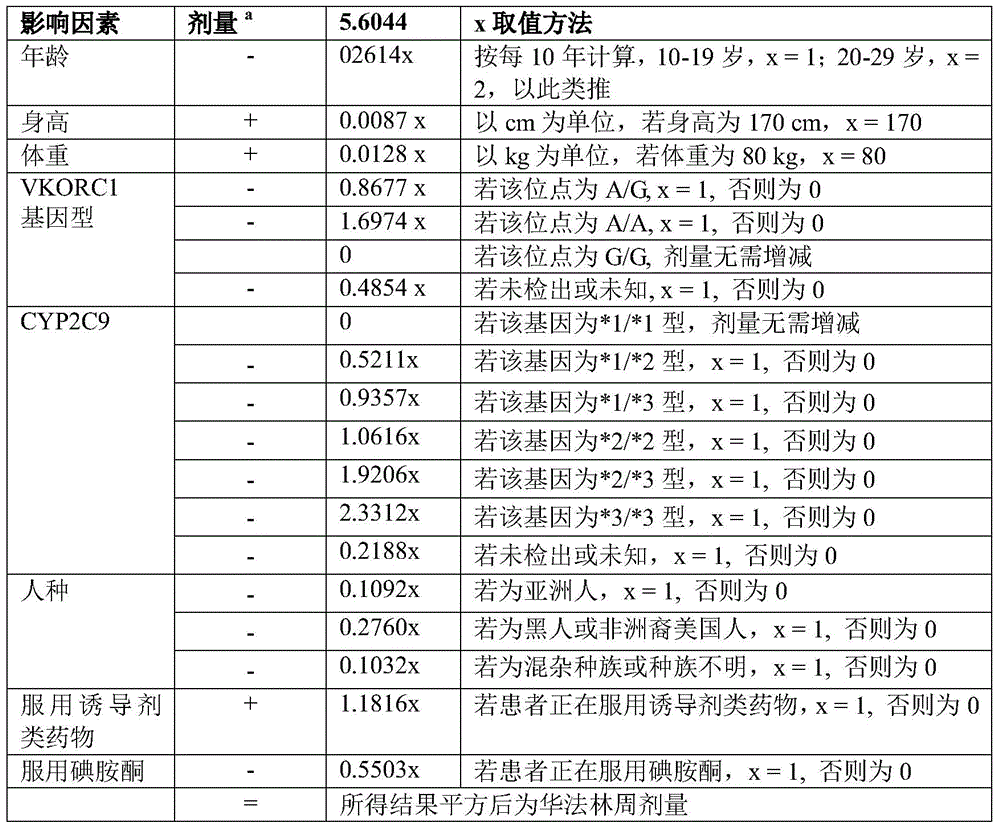
aDosage was increased to (+), reduced to (-)
Example 1
Taking patient A as an example (age 21, height 170cm, weight 60kg, VKORC1 gene A/G, CYP2C9 gene x 1/x1, Asian, no inducer, and taking iodoaminoketone), the required dose was calculated to be 33.7mg per week and 4.8mg per day.
Premixed raw and auxiliary materials to be printed were added to the feed hopper of the 3D printer, with a warfarin sodium content of 10% and a poly (vinylpyrrolidone-co-vinyl acetate) (vinylpyrrolidone/vinyl acetate ═ 6/4) content of 90%.
3D modeling by computer aided design software in a computer according to the shape (e.g. cube) and size (3 mm long, 4mm wide, 4mm high) of the pharmaceutical preparation; the computer transmits the 3D modeling data to the 3D printer, performs hierarchical slicing processing using its own software, and forms a corresponding code (this code is responsible for control at position X, Y, Z).
Through the control that 3D printer beats printer head, the mode that the primary and secondary material is extruded through the hot melt from beating printer head is extruded from the nozzle. The raw and auxiliary materials extruded by hot melting are in a molten state, can become solid after being cooled, and can be mutually bonded according to the properties of the auxiliary materials. The printing head of the 3D printer moves along the X axis and the Y axis of the printing head on a plane to finish the printing of each layer. And (4) the printer accumulates layer by layer and is bonded with each other, so that the medicine printing of the 3D printer is completed, and the medicine product is molded.
The obtained preparation has a shape of rectangular parallelepiped, size (length 3mm, width 4mm, height 4mm), and dosage of 4.8mg (specification 4.8mg, total tablet weight 48 mg).
Example 2
Taking patient B as an example (age 30, height 180cm, body weight 80kg, VKORC1 gene A/A type, CYP2C9 gene x 2/x2 type, black, no inducer, no inodone), the required dose was calculated to be 19.1mg per week, 2.7mg per day.
Premixed raw and auxiliary materials to be printed were added to the feed hopper of the 3D printer, with a warfarin sodium content of 10% and a poly (vinylpyrrolidone-co-vinyl acetate) (vinylpyrrolidone/vinyl acetate ═ 6/4) content of 90%.
3D modeling by computer aided design software in a computer according to the shape (e.g. cube) and size (length 3mm, width 3mm, height 3mm) of the pharmaceutical preparation; the computer transmits the 3D modeling data to the 3D printer, performs hierarchical slicing processing using its own software, and forms a corresponding code (this code is responsible for control at position X, Y, Z).
Through the control that 3D printer beats printer head, the mode that the primary and secondary material is extruded through the hot melt from beating printer head is extruded from the nozzle. The raw and auxiliary materials extruded by hot melting are in a molten state, can become solid after being cooled, and can be mutually bonded according to the properties of the auxiliary materials. The printing head of the 3D printer moves along the X axis and the Y axis of the printing head on a plane to finish the printing of each layer. And (4) the printer accumulates layer by layer and is bonded with each other, so that the medicine printing of the 3D printer is completed, and the medicine product is molded.
The obtained preparation has a shape of rectangular parallelepiped, size (length 3mm, width 3mm, height 3mm), and dosage of 2.7mg (specification of 2.7mg, total tablet weight of 27 mg).
Example 3
Taking patient B as an example (age 30, height 180cm, body weight 80kg, VKORC1 gene A/A type, CYP2C9 gene x 2/x2 type, black, no inducer, no inodone), the required dose was calculated to be 19.1mg per week, 2.7mg per day.
Premixed raw and auxiliary materials to be printed were added to the feed hopper of the 3D printer, with a warfarin sodium content of 1% and a poly (vinylpyrrolidone-co-vinyl acetate) (vinylpyrrolidone/vinyl acetate ═ 6/4) content of 99%.
3D modeling by computer aided design software in a computer according to the shape (e.g. cylinder) and size (radius 4.1mm, height 5mm) of the pharmaceutical preparation; the computer transmits the 3D modeling data to the 3D printer, performs hierarchical slicing processing using its own software, and forms a corresponding code (this code is responsible for control at position X, Y, Z).
Through the control that 3D printer beats printer head, the mode that the primary and secondary material is extruded through the hot melt from beating printer head is extruded from the nozzle. The raw and auxiliary materials extruded by hot melting are in a molten state, can become solid after being cooled, and can be mutually bonded according to the properties of the auxiliary materials. The printing head of the 3D printer moves along the X axis and the Y axis of the printing head on a plane to finish the printing of each layer. And (4) the printer accumulates layer by layer and is bonded with each other, so that the medicine printing of the 3D printer is completed, and the medicine product is molded.
The obtained preparation has cylindrical shape, size (radius of 4.1mm, height of 5mm), and dosage of 2.7mg (specification of 2.7mg, total tablet weight of 270 mg).
Example 4
Taking patient A as an example (age 77, height 160cm, body weight 60kg, VKORC1 gene A/A, CYP2C9 gene 3/' 3, African American, without inducers and without inodine), the required dose was calculated to be 2.66mg per week and 0.38mg per day.
Premixed raw and auxiliary materials to be printed were added to the feed hopper of the 3D printer, with a warfarin sodium content of 0.1% and a poly (vinylpyrrolidone-co-vinyl acetate) (vinylpyrrolidone/vinyl acetate: 6/4) content of 99.9%.
3D modeling by computer aided design software in a computer according to the shape (e.g. cube) and size (7.6 mm long, 5mm wide, 10mm high) of the pharmaceutical preparation; the computer transmits the 3D modeling data to the 3D printer, performs hierarchical slicing processing using its own software, and forms a corresponding code (this code is responsible for control at position X, Y, Z).
Through the control that 3D printer beats printer head, the mode that the primary and secondary material is extruded through the hot melt from beating printer head is extruded from the nozzle. The raw and auxiliary materials extruded by hot melting are in a molten state, can become solid after being cooled, and can be mutually bonded according to the properties of the auxiliary materials. The printing head of the 3D printer moves along the X axis and the Y axis of the printing head on a plane to finish the printing of each layer. And (4) the printer accumulates layer by layer and is bonded with each other, so that the medicine printing of the 3D printer is completed, and the medicine product is molded.
The obtained preparation has a shape of rectangular parallelepiped, size (length 7.6mm, width 5mm, height 10mm), and dosage of 0.38mg (specification of 0.38mg, total tablet weight of 380 mg).
Example 5
Taking patient A as an example (age 27, height 190cm, weight 90kg, VKORC1 gene G/G, CYP2C9 gene x 1/x1, white, taking inducer drug, no iodoaminoketone), the required dose was calculated to be 57mg per week and 8.14mg per day.
Premixed raw and auxiliary materials to be printed were added to the feed hopper of the 3D printer, with a warfarin sodium content of 60% and a poly (vinylpyrrolidone-co-vinyl acetate) (vinylpyrrolidone/vinyl acetate: 6/4) content of 30%.
3D modeling is carried out in a computer through computer aided design software according to the shape (such as spherical pellets) and the size (the radius is 1.48mm) of the pharmaceutical preparation; the computer transmits the 3D modeling data to the 3D printer, performs hierarchical slicing processing using its own software, and forms a corresponding code (this code is responsible for control at position X, Y, Z).
Through the control that 3D printer beats printer head, the mode that the primary and secondary material is extruded through the hot melt from beating printer head is extruded from the nozzle. The raw and auxiliary materials extruded by hot melting are in a molten state, can become solid after being cooled, and can be mutually bonded according to the properties of the auxiliary materials. The printing head of the 3D printer moves along the X axis and the Y axis of the printing head on a plane to finish the printing of each layer. And (4) the printer accumulates layer by layer and is bonded with each other, so that the medicine printing of the 3D printer is completed, and the medicine product is molded.
The obtained spherical pellet has size (radius 1.48mm) and dosage of 8.14mg (specification is 8.14mg, total tablet weight is 13.6 mg).
Example 6
Taking patient A as an example (age 27, height 190cm, weight 90kg, VKORC1 gene G/G, CYP2C9 gene x 1/x1, white, taking inducer drug, no iodoaminoketone), the required dose was calculated to be 57mg per week and 8.14mg per day.
Premixed raw and auxiliary materials to be printed were added to the feed hopper of the 3D printer, with a warfarin sodium content of 30% and a poly (vinylpyrrolidone-co-vinyl acetate) (vinylpyrrolidone/vinyl acetate ═ 6/4) content of 60%.
3D modeling is carried out in a computer through computer aided design software according to the shape (such as a cube) and the size (3 mm in length, 3mm in width and 3mm in height) of the pharmaceutical product; the computer transmits the 3D modeling data to the 3D printer, performs hierarchical slicing processing using its own software, and forms a corresponding code (this code is responsible for control at position X, Y, Z).
Through the control that 3D printer beats printer head, the mode that the primary and secondary material is extruded through the hot melt from beating printer head is extruded from the nozzle. The raw and auxiliary materials extruded by hot melting are in a molten state, can become solid after being cooled, and can be mutually bonded according to the properties of the auxiliary materials. The printing head of the 3D printer moves along the X axis and the Y axis of the printing head on a plane to finish the printing of each layer. And (4) the printer accumulates layer by layer and is bonded with each other, so that the medicine printing of the 3D printer is completed, and the medicine product is molded.
The obtained preparation has cubic shape, size (length 3mm, width 3mm, height 3mm), and dosage of 8.14mg (specification of 8.14mg, total tablet weight of 27 mg).
Claims (6)
1. A preparation method of an anticoagulant drug is characterized in that main materials and auxiliary materials are added into a 3D printer, 3D modeling is carried out through a computer, then 3D modeling data are transmitted to the 3D printer, software carried by the 3D printer is utilized for carrying out layered slicing processing, corresponding codes are formed, the main materials and the auxiliary materials are extruded out from a nozzle in a hot melting extrusion mode, a printing head of the 3D printer carries out X-axis and Y-axis movement on a plane, single-layer printing is carried out, and the main materials and the auxiliary materials are accumulated layer by layer along with the printer and are mutually bonded, so that the preparation of the anticoagulant drug is completed; the dosage form of the anticoagulant drug is tablets or pills; the main material is warfarin sodium; the auxiliary material is polyvinylpyrrolidone-vinyl acetate copolymer and/or polyethylene glycol; the warfarin sodium is personalized and customized according to physiological and pathological conditions of patients including gene profiles of the patients, and weekly dosage is calculated according to the following table:

dosage formaPlus (+) and minus (-).
2. The preparation method according to claim 1, wherein the content of warfarin sodium is 0.1% -60% by total weight of the drug as 1%; the content of the auxiliary materials is 40 to 99.9 percent.
3. The method according to claim 1, wherein the polyvinylpyrrolidone-vinyl acetate copolymer has a polyvinylpyrrolidone to vinyl acetate molar ratio of 6: 4.
4. The preparation method according to claim 1, wherein when the auxiliary materials are polyvinylpyrrolidone-vinyl acetate copolymer and polyethylene glycol, the mass ratio of the polyvinylpyrrolidone-vinyl acetate copolymer to the polyethylene glycol is 30: 70-99: 1.
5. The method of claim 1, wherein the hot-melt extrusion is carried out under the following conditions: the rotating speed of the hot-melt extrusion screw is 20-100 revolutions per minute; the temperature of the hot-melting extruder barrel is 40-200 ℃; the temperature of the hot-melting extruder head is 40-200 ℃.
6. The method according to claim 1, wherein the volume of the anticoagulant drug after molding is 0.02-1 cm3。
Priority Applications (1)
| Application Number | Priority Date | Filing Date | Title |
|---|---|---|---|
| CN201610066942.9A CN107019676B (en) | 2016-01-29 | 2016-01-29 | Preparation method of anticoagulant medicine |
Applications Claiming Priority (1)
| Application Number | Priority Date | Filing Date | Title |
|---|---|---|---|
| CN201610066942.9A CN107019676B (en) | 2016-01-29 | 2016-01-29 | Preparation method of anticoagulant medicine |
Publications (2)
| Publication Number | Publication Date |
|---|---|
| CN107019676A CN107019676A (en) | 2017-08-08 |
| CN107019676B true CN107019676B (en) | 2020-08-04 |
Family
ID=59524467
Family Applications (1)
| Application Number | Title | Priority Date | Filing Date |
|---|---|---|---|
| CN201610066942.9A Active CN107019676B (en) | 2016-01-29 | 2016-01-29 | Preparation method of anticoagulant medicine |
Country Status (1)
| Country | Link |
|---|---|
| CN (1) | CN107019676B (en) |
Families Citing this family (13)
| Publication number | Priority date | Publication date | Assignee | Title |
|---|---|---|---|---|
| EP4512394A3 (en) | 2015-06-03 | 2025-10-22 | Triastek, Inc. | Dosage forms and use thereof |
| EP3573602A4 (en) | 2017-01-26 | 2020-09-16 | Triastek, Inc. | DOSAGE FORMS WITH CONTROLLED RELEASE IN SPECIFIC GASTROINTESTINAL LOCATIONS |
| JP7174432B2 (en) | 2017-05-16 | 2022-11-17 | 南京三迭▲紀▼医▲藥▼科技有限公司 | 3D printing device and method |
| CN107343880B (en) * | 2017-06-28 | 2020-04-14 | 广东药科大学 | Warfarin sodium orally disintegrating tablet prepared by 3D printing for individualized administration and preparation method thereof |
| CN109394708B (en) * | 2017-08-17 | 2021-10-08 | 西安棣加生物科技有限公司 | Oral disintegrating first aid tablet for heart disease and its 3D printing method and use |
| US10350822B1 (en) | 2018-01-09 | 2019-07-16 | Triastek Inc. | Dosage forms with desired release profiles and methods of designing and making thereof |
| CN116270513A (en) | 2018-01-09 | 2023-06-23 | 南京三迭纪医药科技有限公司 | A combination oral pharmaceutical dosage form comprising a fixed-dose ADHD non-stimulant and an ADHD stimulant |
| US10201503B1 (en) | 2018-01-09 | 2019-02-12 | Triastek, Inc. | Precision pharmaceutical 3D printing device |
| CA3151868A1 (en) | 2019-08-20 | 2021-02-25 | Triastek, Inc. | High-throughput and high-precision pharmaceutical additive manufacturing system |
| US12384112B2 (en) | 2019-08-20 | 2025-08-12 | Triastek, Inc. | High-throughput and high-precision pharmaceutical additive manufacturing system |
| US11458684B2 (en) | 2020-07-30 | 2022-10-04 | Triastek, Inc. | High-throughput and high-precision pharmaceutical additive manufacturing system |
| CN115397652B (en) | 2020-02-17 | 2025-12-12 | 南京三迭纪医药科技有限公司 | Continuous feeding and packaging systems for pharmaceutical additive manufacturing |
| CN118544586A (en) | 2020-07-10 | 2024-08-27 | 南京三迭纪医药科技有限公司 | High-precision additive manufacturing devices and high-throughput additive manufacturing systems |
Citations (4)
| Publication number | Priority date | Publication date | Assignee | Title |
|---|---|---|---|---|
| CN1726899A (en) * | 2005-06-03 | 2006-02-01 | 华中科技大学 | Zero order controlled releasing drug system and preparation system |
| CN1732899A (en) * | 2005-06-16 | 2006-02-15 | 华中科技大学 | Implantation type local drug delivery device and three-dimensional printing preparation method thereof |
| CN101209240A (en) * | 2007-12-21 | 2008-07-02 | 东华大学 | Drug gradient zero-order implanted controlled-release drug delivery device and preparation method thereof |
| CN103393543A (en) * | 2013-08-02 | 2013-11-20 | 魏雪纹 | Method using 3D printing technology to prepare dropping pills |
Family Cites Families (1)
| Publication number | Priority date | Publication date | Assignee | Title |
|---|---|---|---|---|
| WO2003037607A1 (en) * | 2001-10-29 | 2003-05-08 | Therics, Inc. | A system and method for uniaxial compression of an article, such as a three-dimensionally printed dosage form |
-
2016
- 2016-01-29 CN CN201610066942.9A patent/CN107019676B/en active Active
Patent Citations (4)
| Publication number | Priority date | Publication date | Assignee | Title |
|---|---|---|---|---|
| CN1726899A (en) * | 2005-06-03 | 2006-02-01 | 华中科技大学 | Zero order controlled releasing drug system and preparation system |
| CN1732899A (en) * | 2005-06-16 | 2006-02-15 | 华中科技大学 | Implantation type local drug delivery device and three-dimensional printing preparation method thereof |
| CN101209240A (en) * | 2007-12-21 | 2008-07-02 | 东华大学 | Drug gradient zero-order implanted controlled-release drug delivery device and preparation method thereof |
| CN103393543A (en) * | 2013-08-02 | 2013-11-20 | 魏雪纹 | Method using 3D printing technology to prepare dropping pills |
Also Published As
| Publication number | Publication date |
|---|---|
| CN107019676A (en) | 2017-08-08 |
Similar Documents
| Publication | Publication Date | Title |
|---|---|---|
| CN107019676B (en) | Preparation method of anticoagulant medicine | |
| TWI544936B (en) | Composite formulation comprising multi-unit spheroidal tablet (must) encapsulated in hard capsule and method for preparing same | |
| EP3313187B1 (en) | Sustained release formulation and tablets prepared therefrom | |
| EA029081B1 (en) | Combination formulation of two antiviral compounds | |
| CN102137663B (en) | The stable pharmaceutical preparation of suppression variable color | |
| CN104248767A (en) | Ibuprofen preparation and preparation method thereof | |
| JP2011173932A (en) | Preparation with accurate dose-dividing function | |
| EP2275087B1 (en) | Prasugrel controlled release formulations | |
| AU2016347352A1 (en) | Optimised high-dose mesalazine-containing tablet | |
| EP2934491B1 (en) | Solid unit with high fexofenadine content and process for the preparation thereof | |
| CN106265601A (en) | A kind of sustained release preparations of ibuprofen and preparation method thereof | |
| Upadhyay et al. | A review on formulation and evaluation approaches for fast release tablet | |
| CN104688700A (en) | Tenofovir disoproxil fumarate tablet that is easy to dissolve and preparation method thereof | |
| US20240122858A1 (en) | Modified-release dosage forms of ruxolitinib | |
| KR20160076928A (en) | A pharmaceutical formulation in the form of mini-tablets containing a fumaric acid ester | |
| Gandhi et al. | Recent trends in sustained release drug delivery system | |
| KR20150059720A (en) | Anagliptin-containing preparations | |
| CN109157527B (en) | Irbesartan capsule and preparation method thereof | |
| CN102488670A (en) | Preparation method of dual slow-release potassium citrate sustained release preparation | |
| Nizam et al. | Extrusion based additive manufacturing of medicines | |
| CN107441051A (en) | A kind of propafenone hydrochloride microplate and preparation method thereof | |
| KR20160081646A (en) | An oral composite tablet containing melatonin and sertraline | |
| Uma et al. | Formulation and evaluation of sustained release matrix tablets of metformin hydrochloride | |
| CN104367582A (en) | Tablet containing clopidogrel sulfate and aspirin active compositions and preparation method thereof | |
| JP7675071B2 (en) | Pharmaceutical preparations containing amide derivatives that inhibit the growth of cancer cells and medicines containing the same |
Legal Events
| Date | Code | Title | Description |
|---|---|---|---|
| PB01 | Publication | ||
| PB01 | Publication | ||
| SE01 | Entry into force of request for substantive examination | ||
| SE01 | Entry into force of request for substantive examination | ||
| GR01 | Patent grant | ||
| GR01 | Patent grant |