CN106961289B - Interference suppression during simultaneous operation of multiple radios in a wireless device - Google Patents
Interference suppression during simultaneous operation of multiple radios in a wireless device Download PDFInfo
- Publication number
- CN106961289B CN106961289B CN201710006829.6A CN201710006829A CN106961289B CN 106961289 B CN106961289 B CN 106961289B CN 201710006829 A CN201710006829 A CN 201710006829A CN 106961289 B CN106961289 B CN 106961289B
- Authority
- CN
- China
- Prior art keywords
- channel
- channel allocation
- initial channel
- instructions
- frequency
- Prior art date
- Legal status (The legal status is an assumption and is not a legal conclusion. Google has not performed a legal analysis and makes no representation as to the accuracy of the status listed.)
- Expired - Fee Related
Links
Images


Classifications
-
- H—ELECTRICITY
- H04—ELECTRIC COMMUNICATION TECHNIQUE
- H04B—TRANSMISSION
- H04B1/00—Details of transmission systems, not covered by a single one of groups H04B3/00 - H04B13/00; Details of transmission systems not characterised by the medium used for transmission
- H04B1/38—Transceivers, i.e. devices in which transmitter and receiver form a structural unit and in which at least one part is used for functions of transmitting and receiving
- H04B1/40—Circuits
- H04B1/50—Circuits using different frequencies for the two directions of communication
- H04B1/52—Hybrid arrangements, i.e. arrangements for transition from single-path two-direction transmission to single-direction transmission on each of two paths or vice versa
- H04B1/525—Hybrid arrangements, i.e. arrangements for transition from single-path two-direction transmission to single-direction transmission on each of two paths or vice versa with means for reducing leakage of transmitter signal into the receiver
-
- H—ELECTRICITY
- H04—ELECTRIC COMMUNICATION TECHNIQUE
- H04W—WIRELESS COMMUNICATION NETWORKS
- H04W72/00—Local resource management
- H04W72/50—Allocation or scheduling criteria for wireless resources
- H04W72/54—Allocation or scheduling criteria for wireless resources based on quality criteria
- H04W72/541—Allocation or scheduling criteria for wireless resources based on quality criteria using the level of interference
-
- H—ELECTRICITY
- H04—ELECTRIC COMMUNICATION TECHNIQUE
- H04B—TRANSMISSION
- H04B1/00—Details of transmission systems, not covered by a single one of groups H04B3/00 - H04B13/00; Details of transmission systems not characterised by the medium used for transmission
- H04B1/005—Details of transmission systems, not covered by a single one of groups H04B3/00 - H04B13/00; Details of transmission systems not characterised by the medium used for transmission adapting radio receivers, transmitters andtransceivers for operation on two or more bands, i.e. frequency ranges
-
- H—ELECTRICITY
- H04—ELECTRIC COMMUNICATION TECHNIQUE
- H04W—WIRELESS COMMUNICATION NETWORKS
- H04W72/00—Local resource management
- H04W72/04—Wireless resource allocation
- H04W72/044—Wireless resource allocation based on the type of the allocated resource
- H04W72/0453—Resources in frequency domain, e.g. a carrier in FDMA
-
- H—ELECTRICITY
- H04—ELECTRIC COMMUNICATION TECHNIQUE
- H04W—WIRELESS COMMUNICATION NETWORKS
- H04W76/00—Connection management
- H04W76/10—Connection setup
- H04W76/15—Setup of multiple wireless link connections
- H04W76/16—Involving different core network technologies, e.g. a packet-switched [PS] bearer in combination with a circuit-switched [CS] bearer
Landscapes
- Engineering & Computer Science (AREA)
- Computer Networks & Wireless Communication (AREA)
- Signal Processing (AREA)
- Quality & Reliability (AREA)
- Mobile Radio Communication Systems (AREA)
Abstract
Description
相关申请的交叉引用CROSS-REFERENCE TO RELATED APPLICATIONS
本专利文件根据35 U.S.C.§119(a)和巴黎公约要求享有于2016年1月11日递交的国际专利申请No.PCT/CN2016/070565的优先权。前面提到的专利申请的全部内容以引用的方式并入作为本专利文件的公开内容的一部分。This patent document claims priority under 35 U.S.C. §119(a) and the Paris Convention to International Patent Application No. PCT/CN2016/070565, filed January 11, 2016. The entire contents of the aforementioned patent applications are incorporated by reference as part of the disclosure of this patent document.
技术领域technical field
本发明的实施例涉及无线通信领域,并且更具体地涉及信道分配调整以抑制射频通信的同时共存操作的设备中干扰。Embodiments of the present invention relate to the field of wireless communications, and more particularly to channel allocation adjustments to suppress interference in devices operating concurrently with radio frequency communications.
背景background
很多移动设备已被开发并且被设计为能够在多频带中并且使用多个通信协议操作。多个射频波段和多个通信协议的示例包括但不限于蜂窝波段1/2/3/4/5/7/8/25/26/34/39/41以覆盖GSM(全球移动通信系统)、CDMA(码分多址)、WCDMA(宽带CDMA)、TD-SCDMA(时分同步CDMA)、LTE(长期演进)、LTE-A、LTE-U和用于Wi-Fi的免许可的2.4GHz和5GHz波段的蜂窝通信技术。Many mobile devices have been developed and designed to operate in multiple frequency bands and using multiple communication protocols. Examples of multiple radio frequency bands and multiple communication protocols include, but are not limited to,
概述Overview
本文件描述了用于在多个无线电同时操作的时候抑制设备中干扰的技术。在一些示例实施例中,在设备存储器中预先限定了冲突的信道组合矩阵的矩阵表。在一些实施方式中,在多个射频操作中的一个可以被优先化,以具有在其他操作频率之上的更高的优先级,并且该设备将请求基站收发台或者接入点以关于优先化的射频信道来分配不冲突的频道。如果优先化的通信信道由于切换而改变,则设备将会将已分配的信道与预先限定的冲突信道组合矩阵相互对照,并且如果存在冲突信道则请求接入点或者基站以调整辅助频道。多个无线电共存将会因此在冲突信道表之外操作,并且设备中干扰被抑制。This document describes techniques for suppressing interference in devices when multiple radios are operating simultaneously. In some example embodiments, a matrix table of conflicting channel combination matrices is predefined in device memory. In some embodiments, one of the multiple radio frequency operations may be prioritized to have a higher priority over the other operating frequencies, and the device will request the base transceiver station or access point for information on prioritization radio frequency channels to allocate non-conflicting channels. If the prioritized communication channel changes due to handover, the device will cross-reference the assigned channel with a pre-defined conflicting channel combination matrix and request the access point or base station to adjust the secondary channel if there is a conflicting channel. Multiple radios coexisting will therefore operate outside the conflicting channel table and interference is suppressed in the device.
在一个示例方面中,公开了包括至少两个射频(RF)收发器、至少一个存储器单元和处理器的无线通信装置。RF收发器电路可以同时操作占据两个不同的频带的至少两个RF信号。该至少一个存储器单元储存了具有很多条目的一个或多个预先限定的信道冲突表。在一个或多个信道冲突表中的每个条目识别一对RF信道,使得采用对应于该一对RF信道的至少两个RF信号的装置的操作引起在装置中的不想要的RF干扰。In one example aspect, a wireless communication apparatus is disclosed that includes at least two radio frequency (RF) transceivers, at least one memory unit, and a processor. The RF transceiver circuit can simultaneously operate at least two RF signals occupying two different frequency bands. The at least one memory unit stores one or more predefined channel conflict tables with a number of entries. Each entry in the one or more channel conflict tables identifies a pair of RF channels such that operation of the device employing at least two RF signals corresponding to the pair of RF channels causes unwanted RF interference in the device.
在另一个示例方面中,公开了用于无线设备在至少两个不同的RF波段中的同时操作的无线通信方法。该方法包括使用无线设备的第一收发器电路在第一频带中处理第一传输,并且使用无线设备的第二收发器电路在不同于第一频带的第二频带中与第一传输同时地处理第二传输。第一频带和第二频带被选择以抑制在第一传输和第二传输之间的不想要的射频干扰,这是通过以下方式来实现的:将一个或多个预先限定的信道冲突表储存在存储器中,其中,每个冲突表均包括识别在同时使用时引起不理想的设备内射频干扰的频带对的条目;将第一频带和第二频带与在一个或多个预先限定的信道冲突表中的条目进行比较,以检查匹配;并且改变在第一频带和第二频带中的至少一个频带的值,使得第一频带和第二频带是与在一个或多个预先限定的信道冲突表中列出的每对频带不同的一对。In another example aspect, a wireless communication method for simultaneous operation of wireless devices in at least two different RF bands is disclosed. The method includes processing a first transmission in a first frequency band using a first transceiver circuit of the wireless device, and processing the first transmission concurrently with the first transmission in a second frequency band different from the first frequency band using a second transceiver circuit of the wireless device Second transmission. The first frequency band and the second frequency band are selected to suppress unwanted radio frequency interference between the first transmission and the second transmission by storing one or more predefined channel conflict tables in in a memory, wherein each conflict table includes an entry identifying frequency band pairs that cause undesirable in-device radio frequency interference when used concurrently; the first frequency band and the second frequency band are conflicted with one or more predefined channel conflict tables compare the entries in to check for a match; and change the value of at least one of the first frequency band and the second frequency band such that the first frequency band and the second frequency band are in conflict with the one or more predefined channel conflict tables A different pair for each pair of frequency bands listed.
在又一个示例方面中,公开了在移动设备中实施的、用于无线通信的方法。该方法包括:经由网络接口接收移动设备在未来的同时无线通信中使用的初始频道分配;在使用初始频道分配执行无线传输之前,确定初始频道分配是否在因为使用初始频道分配的操作将在接收和/或发送同时被执行的时候引起设备中射频干扰的冲突状况中;当初始频道分配冲突的时候,基于当前与无线连接相关联的使用优先级,选择重新分配与在初始频道分配中的其他频率分配相比具有更低优先级的、在初始频道分配中的第一初始频道分配;以及经由网络接口获得第一初始频道分配到新的频率分配的重新分配,由此消除冲突状况。In yet another example aspect, a method implemented in a mobile device for wireless communication is disclosed. The method includes: receiving, via a network interface, an initial channel assignment for use by the mobile device in future simultaneous wireless communications; prior to performing wireless transmissions using the initial channel assignment, determining whether the initial channel assignment is due to operations using the initial channel assignment will be performed between receiving and and/or in conflicting situations that cause RF interference in the device when transmissions are performed concurrently; when initial channel assignments conflict, choose to reassign other frequencies in the initial channel assignment based on the priority of use currently associated with the wireless connection assigning a first initial channel assignment in the initial channel assignments with a lower priority than the one; and obtaining a reallocation of the first initial channel assignment to the new frequency assignment via the network interface, thereby eliminating the conflicting condition.
这个方面和其他方面以及它们的实施方式在图中、说明书和权利要求中被更详细地描述。This and other aspects and their implementations are described in greater detail in the drawings, specification and claims.
附图简述Brief Description of Drawings
图1显示具有在两个不同频带中同时通信的能力的无线设备的框图。1 shows a block diagram of a wireless device with the ability to communicate in two different frequency bands simultaneously.
图2A显示在蜂窝和Wi-Fi波段中同时操作的示例流程图,其中,Wi-Fi连接是优先化的。2A shows an example flow diagram for simultaneous operation in the cellular and Wi-Fi bands, where Wi-Fi connections are prioritized.
图2B显示在蜂窝和Wi-Fi波段中同时操作的另一个示例流程图,其中,Wi-Fi连接是优先化的。2B shows another example flow diagram for simultaneous operation in the cellular and Wi-Fi bands, where Wi-Fi connections are prioritized.
图3A显示蜂窝和Wi-Fi操作的共存的示例流程图,其中,蜂窝连接是优先化的。3A shows an example flow diagram for coexistence of cellular and Wi-Fi operations, where cellular connections are prioritized.
图3B显示蜂窝和Wi-Fi操作的共存的另一个示例流程图,其中,蜂窝连接是优先化的。3B shows another example flow diagram for coexistence of cellular and Wi-Fi operations, where cellular connections are prioritized.
图4A显示了两个蜂窝无线电通信的共存的方法的示例流程图。4A shows an example flow diagram of a method of coexistence of two cellular radio communications.
图4B显示了两个蜂窝无线电通信的共存的方法的另一个示例流程图。4B shows another example flow diagram of a method of coexistence of two cellular radio communications.
图5是示例无线通信装置的框图。5 is a block diagram of an example wireless communication device.
图6是用于无线通信的示例方法的流程图。6 is a flowchart of an example method for wireless communication.
图7是用于无线通信的示例方法的另一个流程图。7 is another flow diagram of an example method for wireless communication.
详细描述Detailed Description
移动设备(MD)在多个射频通信同时操作的时候可能经受自干扰,也即,设备中干扰。当发射器波形的本底噪声或者谐波进入其他无线电接收器的频道的时候,设备中干扰将会使接收器灵敏度退化。在另一个情况下,当多个发射器同时操作的时候,可能在无线电接收器的接收器频道中发生相互调制失真,并因此使无线电接收器的灵敏度退化。同时操作可发生于例如在一个网络接口可在另一个物理接口正在接收或者发送的同时进行接收或发送的时候。Mobile devices (MDs) may experience self-interference, ie, in-device interference, when multiple radio frequency communications are operating simultaneously. When the noise floor or harmonics of the transmitter waveform enter other radio receiver channels, interference in the equipment will degrade the receiver sensitivity. In another case, when multiple transmitters operate simultaneously, intermodulation distortion may occur in the receiver channel of the radio receiver, and thus degrade the sensitivity of the radio receiver. Simultaneous operations may occur, for example, when one network interface may be receiving or transmitting while another physical interface is receiving or transmitting.
抑制设备中干扰的已知方法是降低无线电通信的传输功率,这将会降低蜂窝覆盖范围,并且影响移动通信的服务质量。另一个可能的解决方案是以时域双工(TDD)方式使用不同的网络接口。在TDD共享中,一个网络接口每次可以接收或者发送,其中多个网络接口的机会在时域中倍增。然而,很多无线网络协议要求无线设备遵循由网络侧指定的发送和接收调度,并因此在无线设备内的网络接口的TDD操作可能是困难的并且可能导致数据丢失。A known method of suppressing interference in devices is to reduce the transmit power of radio communications, which reduces cellular coverage and affects the quality of service for mobile communications. Another possible solution is to use different network interfaces in a time-domain duplex (TDD) manner. In TDD sharing, one network interface can receive or transmit at a time, where the chances of multiple network interfaces are multiplied in the time domain. However, many wireless network protocols require wireless devices to follow transmission and reception schedules specified by the network side, and thus TDD operation of network interfaces within wireless devices may be difficult and may result in data loss.
在一个有益的方面中,公开了适应性的频道分配调整以抑制多个无线电通信服务(例如,蜂窝通信和同时的Wi-Fi操作)的同时共存操作的设备中干扰的装置和方法。在设备存储器中预先限定了冲突信道组合的矩阵表。在其中Wi-Fi操作优先化的场景中,设备将会请求蜂窝基站收发台相对于Wi-Fi的信道的操作分配不冲突的频道。在其中蜂窝操作优先化的场景中,设备将会请求Wi-Fi接入点向通信设备分配不冲突的蜂窝信道。在LTE载波聚合的场景中,移动设备首先使通信信道(诸如,锚信道(anchor channel))优先化,并且随后请求蜂窝基站收发台相对于优先化的LTE信道来分配不冲突的频道。一旦优先化的通信信道由于切换而改变,则设备将会将已分配的信道与预先限定的冲突信道组合矩阵相互对照,并且如果存在冲突状况(例如,存在冲突的信道)则将请求Wi-Fi接入点或者基站以调整辅助频道。In one beneficial aspect, an apparatus and method for adaptive channel allocation adjustment to suppress interference in a device operating concurrently with multiple radio communication services (eg, cellular communication and simultaneous Wi-Fi operation) is disclosed. A matrix table of conflicting channel combinations is predefined in the device memory. In a scenario where Wi-Fi operation is prioritized, the device will request that the cellular base transceiver station be assigned a non-conflicting frequency channel with respect to the operation of the Wi-Fi channel. In a scenario where cellular operation is prioritized, the device will request the Wi-Fi access point to assign a non-conflicting cellular channel to the communication device. In the scenario of LTE carrier aggregation, the mobile device first prioritizes a communication channel, such as an anchor channel, and then requests the cellular base transceiver station to allocate a non-conflicting frequency channel with respect to the prioritized LTE channel. Once the prioritized communication channel changes due to handover, the device will cross-reference the assigned channel with a predefined conflicting channel combination matrix and will request Wi-Fi if a conflicting condition exists (eg, there are conflicting channels) Access point or base station to tune the secondary channel.
在本文中提到的移动设备包括但不限于蜂窝电话、便携式多媒体播放器、平板、手持设备、可穿戴设备或者具有蜂窝或者Wi-Fi通信能力的任何其他类型的设备。Mobile devices referred to herein include, but are not limited to, cellular phones, portable multimedia players, tablets, handheld devices, wearable devices, or any other type of device that has cellular or Wi-Fi communication capabilities.
图1是能够在多个频带中同时发送和/或接收的示例无线通信装置100或者移动设备100的框图表示。装置100被显示为具有同时的蜂窝和Wi-Fi通信能力。对于多波段蜂窝通信,第一多波段天线102与单刀多掷(SPxT)开关106的一个端口(该端口是天线侧端口)电连接。SPxT开关106的其他端口(例如,设备侧端口)连接至少一个双工器110和/或至少一个带通滤波器(BPF)146。在双工器110和/或BPF 146中的每个均具有连接于开关106的天线侧端口、以及与射频(RF)前端模块(FEM)116和收发器及处理器124连接的设备侧接口。1 is a block diagram representation of an example
对于Wi-Fi无线连接,第二多波段天线104被引入,以与双信器(diplexer)148和Wi-Fi模块122连接。双信器148可用于隔离在Wi-Fi中使用的两个频带2.4GHz和5GHz。装置100也可以包括全球定位系统(GPS)接收器120,接收器120的天线侧接口可以与集中在GPS频带周围的带通滤波器BPF 150电耦合,并且接收器120的设备侧接口耦合于通信处理器/应用处理器124。GPS BPF 150和双信器148通过低通和高通(LP-HP)双信器108与第二多波段天线104连接。For Wi-Fi wireless connections, a second
在存储器114内部可以储存预先限定的信道冲突表112。在本文中描述的表112储存了在LTE通信信道和Wi-Fi信道之中的冲突信道信息。处理器124包括信道配置模块128和信道管理器126。信道配置模块128通过使用(未显示的)数字锁相环(PLL)电路来配置LTE和Wi-Fi收发器的RF信道。信道管理器126基于优先级算法来确定应当使用哪个RF信道。在一些实施例中,处理器124(例如,基带通信处理器)执行用于无线通信协议的数字信号处理,并且处理器124可以包括应用处理器内核,以支持包括存储器管理、多媒体和图形处理等的MD的应用。A predefined channel conflict table 112 may be stored within the
在存储器中储存的预先限定的信道冲突表112和在应用处理器124中的信道管理器模块126可以一起工作,以在多个射频通信同时操作期间避免冲突的情况。信道冲突表112列出以避免抑制多个无线电共存操作的设备中干扰为目标的信道对。在应用处理器124中的信道管理器模块126可以读取信道冲突表(存储器管理),执行用于适应性的频道分配调整的信令命令,并且命令信道配置电路在适当的信道中操作。The predefined channel conflict table 112 stored in memory and the
为了解释的简单起见,图1仅明确示出蜂窝、Wi-Fi和GPS(全球定位系统)无线通信能力的示例实施例。在一些实施例中,在不丧失用于适应性的频道分配调整的装置和系统的一般性的情况下,可以存在包括但不限于蓝牙和WiGig的其他无线通信子系统,以抑制多个无线电共存操作的设备中干扰。For simplicity of explanation, FIG. 1 only explicitly shows an example embodiment of cellular, Wi-Fi and GPS (Global Positioning System) wireless communication capabilities. In some embodiments, other wireless communication subsystems, including but not limited to Bluetooth and WiGig, may be present to suppress multiple radio coexistence without loss of generality of the apparatus and system for adaptive channel allocation adjustment interference in the operation of the equipment.
通过示例的方式,在装置100中包括的其他可能的功能元件是显示器130(例如,触敏显示器)、输入机构132(例如,触摸传感器)、鼠标或者另一个合适的人类接口设备(HID)、用于输出声音的一个或多个扬声器134、用于捕捉音频的话筒136、用于拍照或者录像的相机138、具有向装置100提供电力的电池的电池槽140、可以控制装置100的电力消耗(例如,通过调整屏幕亮度或者监控电池电平)的电力管理模块142、用于感应装置100的定向和其他移动、环境光的一个或多个传感器144等。装置100也可以包括外围总线接口,诸如通用串行总线(USB)、HDMI、或者Lightening接口。By way of example, other possible functional elements included in the
表1呈现了蜂窝和Wi-Fi冲突信道表的示例,其中,蜂窝通信使用波段2。Table 1 presents an example of a cellular and Wi-Fi conflicting channel table, where Band 2 is used for cellular communications.
表1:示例冲突信道表Table 1: Example Conflicting Channel Table
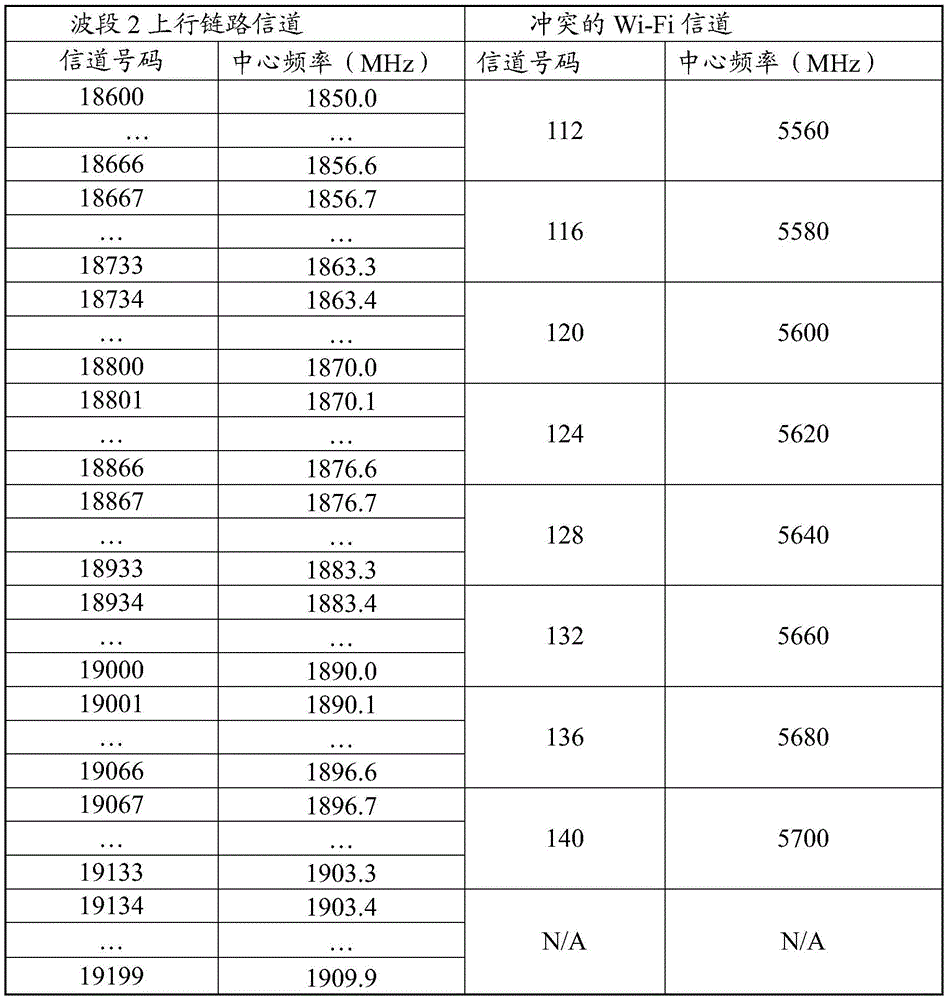
表2呈现了蜂窝和Wi-Fi冲突信道表的示例,其中,蜂窝通信使用波段3。Table 2 presents an example of a cellular and Wi-Fi conflicting channel table, where Band 3 is used for cellular communications.
表2:示例冲突信道表Table 2: Example Conflicting Channel Table

表3呈现了示例性的和Wi-Fi的冲突信道表的示例,其中,蜂窝通信使用波段4。Table 3 presents an example and an example of a conflicting channel table for Wi-Fi, where Band 4 is used for cellular communications.
表3:示例冲突信道表Table 3: Example Conflicting Channel Table
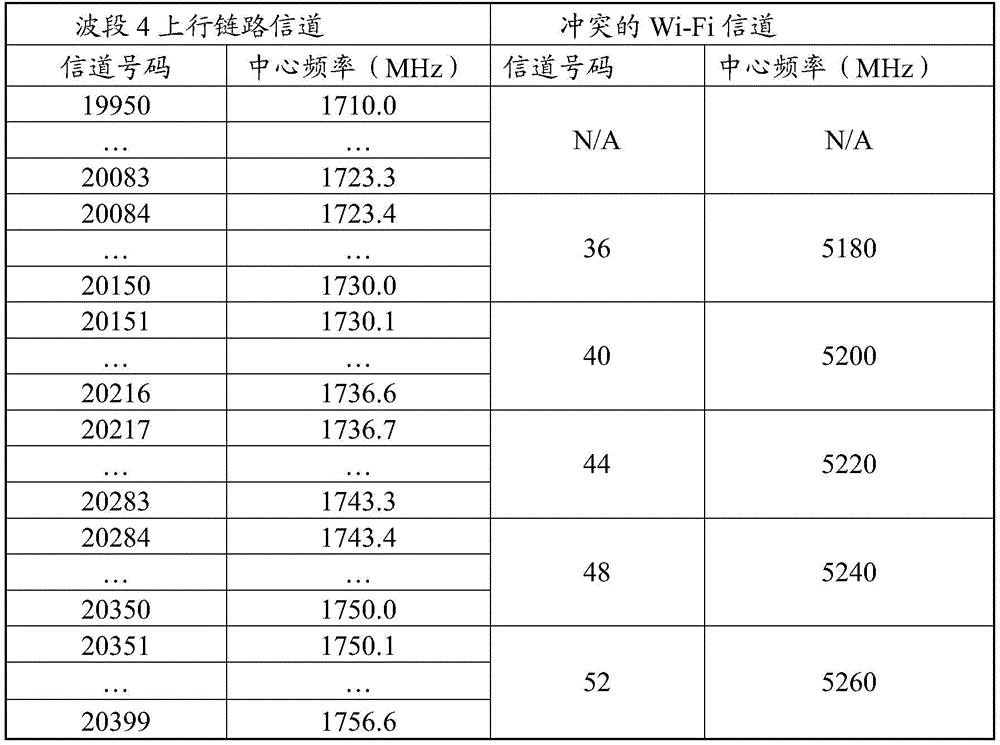
如通过表格式的示例显示的,可以通过频率、或者协议及其对应的信道号码、或者频率以及协议及其对应的信道号码来识别信道条目。As shown by the tabular example, a channel entry may be identified by frequency, or protocol and its corresponding channel number, or frequency and protocol and its corresponding channel number.
在表1、表2和表3中,第一列指的是上行链路信道号码,第二列指的是对应的中心频率。第三列依据冲突信道的信道号码列出冲突信道,例如,将不会被使用的信道。第四列列出冲突的信道的对应的中心频率。如从表中看到的,对于给定的冲突信道可以有可能是在左面两列中对于多个操作信道条目的冲突信道。In Table 1, Table 2 and Table 3, the first column refers to the uplink channel number and the second column refers to the corresponding center frequency. The third column lists the conflicting channels by their channel numbers, eg, channels that will not be used. The fourth column lists the corresponding center frequencies of the conflicting channels. As can be seen from the table, for a given conflicting channel there may be conflicting channels for multiple operating channel entries in the left two columns.
在一些实施LTE和Wi-Fi共存的实施例中,可以基于应用使用各自的网络连接来优先化LTE和Wi-Fi通信的活动。优先化可以由装置的设计者或者服务或网络的运营商基于使用模型先验地确定。基于先验设计,LTE-Wi-Fi优先级表可被储存于设备的存储器114中。In some embodiments implementing LTE and Wi-Fi coexistence, activity for LTE and Wi-Fi communications may be prioritized based on applications using respective network connections. Prioritization may be determined a priori by the designer of the device or the operator of the service or network based on a usage model. Based on a priori design, the LTE-Wi-Fi priority table may be stored in the device's
在一些实施例中,可以向依赖于低延时、连续数据通信的应用给予在对于报文延迟更宽容的另一应用之上的更高优先级。例如,当Wi-Fi视频通话正在进行,同时用户通过可以被给予较低优先级的LTE蜂窝网络发送和/或接收短信的时候,可以向Wi-Fi活动给予更高的优先级。在另一个示例中,当用户正在使用LTE网络进行音频对话,同时Wi-Fi连接正在操作以下载文件的时候,LTE活动可以被优先化以优于Wi-Fi活动。可选地或者另外地,LTE或Wi-Fi活动可以仅仅只是根据通信初始化时间来进行优先化,即,LTE或Wi-Fi中的第一个活动将会具有高通信优先级。In some embodiments, an application that relies on low-latency, continuous data communications may be given higher priority over another application that is more tolerant of packet delays. For example, Wi-Fi activity may be given higher priority when a Wi-Fi video call is in progress while the user is sending and/or receiving text messages over an LTE cellular network that may be given lower priority. In another example, when the user is using the LTE network for an audio conversation while the Wi-Fi connection is operating to download files, LTE activity may be prioritized over Wi-Fi activity. Alternatively or additionally, LTE or Wi-Fi activities may be prioritized based on communication initialization time only, ie the first activity in LTE or Wi-Fi will have high communication priority.
图2A和图2B显示用于实现蜂窝和Wi-Fi操作的共存而交换的报文的示例的流程图,其中,Wi-Fi连接是优先化的。在这个场景中,(类似于移动设备100的)移动设备MD 204首先向Wi-Fi接入点(AP)202发送通信请求(212),并且AP 202向移动设备204分配通信信道号码“a”(210)。移动设备204在已分配的RF信道“a”中建立与AP的通信(214)。稍后,移动设备204向蜂窝基站收发台(BTS)206发送通信请求(216),并且BTS 206向移动设备分配用于与BTS进行通信的初步信道“b_0”(222)。在处理器124中的信道管理器126将通信信道“a”和初步信道“b_0”与信道冲突表相互比较,以检查“a”和“b_0”是否冲突。如果没有识别出冲突,那么不需要信道调整(224),并且移动设备将继续在信道“a”中与AP进行通信并且在信道“b_0”中与BTS进行通信(218)。2A and 2B show flow diagrams of examples of messages exchanged to enable coexistence of cellular and Wi-Fi operations, where Wi-Fi connections are prioritized. In this scenario, mobile device MD 204 (similar to mobile device 100) first sends a communication request to Wi-Fi access point (AP) 202 (212), and
如果信道冲突被识别出(222),那么移动设备将向BTS发送物理上行链路控制信道(PUCCH)的命令报文,以请求信道分配调整(230)。在一些实施例中,移动设备可以具有关于在执行信道重新分配时优先使用的信道的、用户指定的或者网络操作指定的信道优先。MD204可以在请求中包括这个信息。BTS 206从MD 204接收信道调整请求(226)。BTS 206将向移动设备204分配新的信道“b_1”,并且在报文中向MD 204发送新的信道分配(228)。一旦接收到新的信道分配,当没有额外的冲突被检测到的时候,MD 204随后可以将其LTE接口重新调谐到新的信道(232),并且开始与BTS以及与Wi-Fi接入点发送和接收信号(例如,数据)(234)。发现不冲突的蜂窝信道的过程可以是迭代的,直到发现不冲突的信道为止,并且MD204可以在信道“a”中与AP进行通信并且在信道“b_n+1”(n=0,1,...)中与BTS进行通信,其中,信道“a”和“b_n+1”不在信道冲突表的列表中。If a channel collision is identified (222), the mobile device will send a Physical Uplink Control Channel (PUCCH) command message to the BTS to request channel allocation adjustment (230). In some embodiments, the mobile device may have a user-specified or network operation-specified channel preference with respect to a channel that is preferentially used when performing channel reassignment.
图3A和图3B显示实现蜂窝和Wi-Fi操作的示例过程流程300,其中,蜂窝连接是优先化的。在这个场景中,MD 204向BTS 206发送通信请求(304)。BTS 206向MD 204分配用于蜂窝通信的RF信道“b”(312)。MD204接收已分配的LTE信道报文,并且通过已分配的信道“b”与BTS 206进行通信(306)。稍后,MD 204向Wi-Fi接入点发送通信请求(308)。响应于通信请求,AP 202向MD 204分配用于与AP 202进行通信的初步信道“a_0”(302)。3A and 3B show an
在处理器124中的信道管理器126将通信信道“b”和初步信道“a_0”与信道冲突表相互比较,以检查“b”和“a_0”是否冲突(316)。如果没有识别出冲突,那么不需要信道调整(328),并且移动设备将继续在信道“a_0”中与AP进行通信并且在信道“b”中与BTS进行通信。如果信道冲突被识别出,那么MD 204向AP发送物理信道调整报文,以请求信道分配调整318。AP 202接收信道调整请求(324)。AP 202将向移动设备分配新的信道“a_1”(326)。MD204接收新的已分配的信道配置(320)。信令过程是迭代的,直到没有发现信道冲突为止,并且移动设备可以在信道“a_n+1”(n=0,1,...)中与AP进行通信(322)并且在信道“b”中与BTS进行通信,其中,信道“a_n+1”和“b”不在信道冲突表的列表中。The
图4A和图4B显示在MD 204中的载波聚合的共存的信令过程流程图400的示例。MD204向BTS 206发送通信连接请求(402)。BTS 206接收请求,并且分配用于载波聚合的在波段A中的初步信道“a_0”和在波段B中的初步信道“b_0”(404)。MD 204接收用于执行信道聚合的两个信道的信道分配(406)。MD 204的RF收发器116向处理器124报告信道信息(信道“a_0”和“b_0”)。信道管理器126将初步信道“a_0”和“b_0”与信道冲突表112相互比较,以检查“a_0”和“b_0”是否冲突(408)。如果没有识别出冲突,那么不需要信道调整,并且移动设备将继续在用于载波聚合的信道“a_0”和“b_0”中进行通信(410)。如果信道冲突被识别出(412),那么移动设备将首先使在信道中的一个信道(通常是锚信道(例如,信道“b_0”))优先化(414)。接下来,MD 204将向BTS 206发送请求(416)。该请求可以是用于物理信道调整,以请求采用可能的优选信道推荐以对辅助信道(例如,信道“a_0”)进行信道分配调整。BTS206接收请求,并且将向MD 204分配新的信道“a_n”(422)。BTS 206向MD 204发送重新分配(424)。MD204接收这个报文,并且开始使用新分配的信道的载波聚合来通过蜂窝网络进行通信(420)。信令过程是迭代的,直到没有发现信道冲突为止,并且移动设备可以采用载波聚合操作,并且在信道“a_n”和信道“b_0”中与BTS进行通信,其中,信道“a_n”和“b_0”不在信道冲突表的列表中。4A and 4B show an example of a signaling process flow diagram 400 for coexistence of carrier aggregation in
载波聚合(CA)技术和在图4A和图4B中描绘的示例实施例可以覆盖标准LTE CA,或者可被延伸以包括在免许可的波段中的LTE(LTE-U)。在LTE-U的多个无线电同时操作的情况下,锚信道是在蜂窝波段中,并且非锚信道(non-anchor channel)在免许可的5GHz波段中,并且锚信道被优先化以具有更高的优先级。Carrier aggregation (CA) techniques and the example embodiments depicted in Figures 4A and 4B may cover standard LTE CA, or may be extended to include LTE in license-exempt bands (LTE-U). In the case of simultaneous operation of multiple radios of LTE-U, the anchor channel is in the cellular band and the non-anchor channel is in the license-exempt 5GHz band, and the anchor channel is prioritized to have higher priority.
当优先化的通信信道由于切换或者任何其他原因而改变的时候,如在图2A、2B、3A、3B、4A和4B中描述的信令过程流可以迭代。当优先化的通信信道改变的时候,移动设备可以将已分配的信道与预先限定的冲突信道组合矩阵相互重新对照,并且如果由于通信信道的改变(例如,存在信道冲突)而已经发生冲突,则将会重新使通信信道优先化,以及请求接入点或者基站以调整辅助频道。The signaling process flow as described in Figures 2A, 2B, 3A, 3B, 4A and 4B may iterate when the prioritized communication channel changes due to handover or any other reason. When the prioritized communication channel changes, the mobile device may re-check the assigned channel with the predefined collision channel combination matrix, and if a collision has occurred due to a change in communication channel (eg, there is a channel collision), then The communication channel will be re-prioritized and the access point or base station requested to adjust the secondary channel.
图5显示了用于无线通信的示例方法500的流程图。方法500可以由能够在两个不同的RF波段中同时操作(例如,能够同时发送和/或接收数据)的无线通信设备来实施。5 shows a flowchart of an
方法500包括在502处使用无线设备的第一收发器电路处理来自在第一频带中的信道的第一传输。方法500包括在504处使用无线设备的第二收发器电路在与第一频带不同的第二频带的信道中与第一传输同时地处理第二传输。The
关于502和504,处理可以意味着发送或者接收。例如,当两个收发器电路都在接收信号、发送信号或者一个收发器正在接收而另一个发射器正在发送RF信号的时候,方法500可能对于抑制设备中干扰有用。With respect to 502 and 504, processing may mean sending or receiving. For example,
为了以抑制在第一传输和第二传输之间的不想要的射频干扰的方式在第一频带和第二频带中选择信道,该方法可以在506处将一个或多个预先限定的信道冲突表储存在存储器中,其中,每个冲突表均包括识别在同时使用时引起不理想的设备内射频干扰的频带对的条目。To select channels in the first frequency band and the second frequency band in a manner that suppresses unwanted radio frequency interference between the first transmission and the second transmission, the method may at 506 associate one or more predefined channel conflict tables with Stored in memory, wherein each conflict table includes an entry identifying a frequency band pair that causes undesirable in-device radio frequency interference when used concurrently.
方法500在508处可以将在第一频带和第二频带中的信道与在一个或多个预先限定的信道冲突表中的条目进行比较,以检查匹配。关于表1、表2和表3描述了冲突表的示例。比较操作可以例如将在第一频带和第二频带中的每一个频带中的信道与在表中的条目进行比较,该条目代表表示冲突状况的信道对。在一些实施例中,可以通过网络类型来安排在冲突表中的条目。例如,可以相对于一个无线协议(例如,Wi-Fi或者LTE)来限定第一频带,并且可以采用不同的无线协议来限定第二频带。在各个实施例中,可以将频带列为仅用于上行链路、仅用于下行链路或者用于上行链路和下行链路的使用。The
方法500可以在510处选择性地改变在第一频带和第二频带中的信道中的至少一个信道的值,使得在第一频带和第二频带中的信道是与在一个或多个预先限定的信道冲突表中列出的频道中每个频道对不同的一对信道。The
如例如关于表1、表2和表3所描述的,第一频带和第二频带可以用于使用不同的无线协议的操作。例如,一个频带可以被用于WLAN通信,而另一频带可以被用于蜂窝通信,例如,3G通信或者LTE通信等。The first frequency band and the second frequency band may be used for operation using different wireless protocols, as described, for example, with respect to Table 1, Table 2, and Table 3. For example, one frequency band may be used for WLAN communication, while another frequency band may be used for cellular communication, eg, 3G communication or LTE communication, or the like.
在一些实施例中,可以经由在无线设备和网络侧实体(诸如,基站或者接入点)之间的通信迭代地执行选择性地改变信道值。例如,在一些实施例中,当由无线设备请求的时候,网络侧实体可能并不知道对于无线设备的冲突信道信息,并且可能结束于分配用于通信的不同信道,其也是冲突信道。因此,无线设备可以请求多次,以改变用于通信的信道(在TDD操作的情况下,或者是上行链路的、或者是下行链路的、或者是组合的上行链路/下行链路的信道),直到作为结果的信道对不是在信道冲突表中的条目为止。In some embodiments, selectively changing the channel value may be performed iteratively via communication between the wireless device and a network-side entity, such as a base station or an access point. For example, in some embodiments, the network-side entity may not be aware of the conflicting channel information for the wireless device when requested by the wireless device, and may end up allocating a different channel for communication, which is also a conflicting channel. Thus, the wireless device may request multiple times to change the channel used for communication (in the case of TDD operation, either uplink, downlink, or combined uplink/downlink) channel) until the resulting channel pair is not an entry in the channel conflict table.
在一些实施例中,方法500可以包括,当一个或两个网络接口的操作频率改变的时候(例如,由于无线设备的移动性以及从一个覆盖区域切换到另一个覆盖区域)重复实施冲突消解。In some embodiments,
尽管相对于冲突信道的表描述了方法500,然而也可以使用列表、状态机、阵列、逻辑表达式等来执行这种冲突消解。例如,状态机可被编程以接受作为输入的第一信道频率和第二信道频率,并且产生表示是否可以使用组合的二进制输出。Although
图6显示了用于在移动设备204中实施的无线通信的示例方法600的流程图。移动设备204可以在刚刚进入网络时在通信会话的开始处实施方法600,或者当某些网络特征改变(例如,移动设备204由于移动而切换到不同的网络服务器)的时候,移动设备204在正在进行操作期间重复方法600。FIG. 6 shows a flowchart of an
方法600包括在602处接收初始频道分配。例如,如在本文中描述的,许多无线通信协议以使移动设备204在无线介质中扫描网络的存在而工作,并且在该扫描检测到网络存在的时候请求进入网络。一旦产生了请求,移动设备204随后可以接收频率,以用于利用网络进行未来的上行链路和下行链路的信道操作。在一些实施例中,频率分配可以包括在一个通信方向(例如,使用信道聚合的用于下行链路通信的两个信道)上的两个不同的频率。
方法600包括在604处确定对于接收的初始频道分配是否存在冲突状况。在一些实施例中,确定初始频道分配是否处于冲突状况包括:检查初始频道分配是否被在本地存储器中储存为冲突。在一些实施例中,使用优先级是基于通过无线连接使用的协议的固定的、预先确定的优先级。在一些实施例中,使用优先级基于正在请求接收和/或发送的应用的身份。在一些实施例中,使用优先级基于在无线设备上的应用的初始化的排序。例如,在一些实施例中,首先开始的第一应用可以接收高于在时间上稍后地启动的第二应用的优先级。The
方法600包括在606处选择用于重新分配的较低优先级频道。如在本文中描述的,较低优先级频道可以是由较低优先级应用用于上行链路或者下行链路的数据传输的信道。应用可以在显示器130上向用户呈现数据,并且可以经由模块132、136、138或144接收来自用户的输入。
方法600包括在608处获得重新分配,以消除冲突状况。获得的过程可以包括迭代地请求重新分配、接收频带的重新分配、检查冲突状况是否已解决以及重新请求重新分配以接收下一个重新分配,直到解决冲突状况为止。The
在一些实施例中,初始频道分配可以是针对被用于信道聚合的两个信道的。方法600可以包括使用初始频道分配来执行信道聚合,其中,两个不连续的频带的传输带宽被组合,以向无线设备提供更高带宽的物理层连接。In some embodiments, the initial channel assignment may be for the two channels used for channel aggregation.
图7是示例无线通信装置700的框图表示。装置700包括多个收发器702、一个或多个存储器704以及一个或多个处理器706。收发器702有可能通过开关或者多工器电连接于一个或多个天线,以在两个不同的频带上执行同时操作,例如,发送或者接收。7 is a block diagram representation of an example
一个或多个存储器704储存了具有很多条目的一个或多个预先限定的信道冲突表,其中,在一个或多个信道冲突表中的每个条目识别一对RF信道,使得采用对应于该一对RF信道的至少两个RF信号的装置的操作导致在装置中的不想要的RF干扰。The one or
处理器706通过检查在一个或多个预先限定的信道冲突表中的至少一个预先限定的信道冲突表来控制至少两个RF收发器电路的操作,以排除该至少两个RF收发器电路使用该一对RF信道,由此抑制在装置700中的不想要的RF干扰。The
在一些实施例中,处理器706接收指定用于在至少两个RF收发器电路中的一个RF收发器电路的未来操作的频带的报文,并且处理器706检查未来操作的频带是否产生在装置700中的不想要的RF干扰。In some embodiments, the
在一些实施例中,射频收发器周期性地向处理器报告操作信道,并且射频收发器的信道管理器将操作信道与预先限定的信道冲突表相互比较,以确定是否需要信道调整。周期性报告可以例如在固定时间周期(例如,1到2秒)处执行,或者可以在工作状况(诸如,信噪比)改变了至少一定的预先确定的量的时候执行。In some embodiments, the radio frequency transceiver periodically reports the operating channel to the processor, and the radio frequency transceiver's channel manager compares the operating channel with a predefined channel conflict table to determine if channel adjustment is required. Periodic reporting may be performed, for example, at fixed time periods (eg, 1 to 2 seconds), or may be performed when operating conditions (eg, signal-to-noise ratio) change by at least some predetermined amount.
将认识到,公开了几个用于抑制设备内RF干扰的技术。为了帮助抑制干扰,可以在设备中储存冲突信道表。这些表可以包括因为已知其引起设备内干扰而不被使用的频带或者信道组的条目。可以先验地执行表的生成和储存。It will be appreciated that several techniques are disclosed for suppressing RF interference within a device. To help suppress interference, a conflicting channel table may be stored in the device. These tables may include entries for frequency bands or groups of channels that are not used because they are known to cause in-device interference. The generation and storage of the table can be performed a priori.
还将认识到,所公开的技术可以被用于保持分配给较高优先级通信的频带,同时改变通过无线设备同时执行的多个通信的较低优先级使用的频率。可以基于在本文件中描述的几个可能的方式之一来确定优先级。It will also be appreciated that the disclosed techniques can be used to maintain frequency bands allocated to higher priority communications while changing frequencies used by lower priority for multiple communications performed simultaneously by a wireless device. The priority may be determined based on one of several possible ways described in this document.
尽管本专利文件包含许多细节,然而这些细节不应该被看作是对所要求保护的或者可要求保护的发明的范围的限定,而应该看作针对特定实施例的特征的描述。另外,还可以组合在一个实施例中实施在不同实施例的背景中在本文件中所描述的某些特征。相反地,在单一实施例的背景中描述的各种特征也可以分别实施于多个实施例中或者实施于任何合适的子组合中。另外,尽管特征可以在上面被描述成在某些组合中起作用并且甚至最初就是这样要求保护的,但是在一些情况下,可将所要求保护的组合中的一个或多个特征从该组合中去除,且该要求保护的组合可能会针对子组合或子组合的变型。类似地,尽管在附图中按特定顺序描绘了操作,然而这并不应该理解为要求以显示的特定顺序或者以相继顺序执行这样的操作或者所有说明的操作都要被执行,以实现所期望的结果。Although this patent document contains many details, these should not be construed as limitations on the scope of the claimed or claimable invention, but rather as descriptions of features specific to particular embodiments. Additionally, certain features that are described in this document in the context of different embodiments can also be implemented in combination in one embodiment. Conversely, various features that are described in the context of a single embodiment can also be implemented in multiple embodiments separately or in any suitable subcombination. Additionally, although features may be described above as functioning in certain combinations and even originally claimed as such, in some cases one or more features of a claimed combination may be excluded from that combination removed, and the claimed combination may be directed to a subcombination or a variation of a subcombination. Similarly, although operations in the figures are depicted in a particular order, this should not be construed as requiring that such operations be performed in the particular order shown, or in a sequential order, or that all illustrated operations be performed to achieve the desired the result of.
仅公开了少量的示例和实现方式。可基于所公开的内容做出对所描述的示例和实现方式以及其它实现方式的变型、修改和增强。Only a few examples and implementations have been disclosed. Variations, modifications, and enhancements to the described examples and implementations, as well as other implementations, may be made based on what is disclosed.
Claims (12)
Applications Claiming Priority (2)
| Application Number | Priority Date | Filing Date | Title |
|---|---|---|---|
| CNPCT/CN2016/070565 | 2016-01-11 | ||
| CN2016070565 | 2016-01-11 |
Publications (2)
| Publication Number | Publication Date |
|---|---|
| CN106961289A CN106961289A (en) | 2017-07-18 |
| CN106961289B true CN106961289B (en) | 2020-11-13 |
Family
ID=59276373
Family Applications (1)
| Application Number | Title | Priority Date | Filing Date |
|---|---|---|---|
| CN201710006829.6A Expired - Fee Related CN106961289B (en) | 2016-01-11 | 2017-01-05 | Interference suppression during simultaneous operation of multiple radios in a wireless device |
Country Status (2)
| Country | Link |
|---|---|
| US (1) | US10201000B2 (en) |
| CN (1) | CN106961289B (en) |
Families Citing this family (20)
| Publication number | Priority date | Publication date | Assignee | Title |
|---|---|---|---|---|
| US9992775B2 (en) | 2015-01-30 | 2018-06-05 | Qualcomm Incorporated | Band preference in wireless networks |
| US10517021B2 (en) | 2016-06-30 | 2019-12-24 | Evolve Cellular Inc. | Long term evolution-primary WiFi (LTE-PW) |
| KR102472989B1 (en) * | 2016-11-30 | 2022-12-01 | 삼성전자주식회사 | Method for controlling communication and electronic device therefor |
| JP6516784B2 (en) * | 2017-03-29 | 2019-05-22 | 本田技研工業株式会社 | Wireless communication apparatus and wireless communication system using the same |
| US10506592B2 (en) * | 2017-04-04 | 2019-12-10 | Qualcomm Incorporated | Method, system and/or device for managing communication channels |
| WO2019019016A1 (en) * | 2017-07-25 | 2019-01-31 | 北京小米移动软件有限公司 | Method and device for indicating undesired working channel |
| CN110035438A (en) | 2018-01-12 | 2019-07-19 | 索尼公司 | Electronic equipment and method and computer readable storage medium for wireless communication |
| WO2019144365A1 (en) * | 2018-01-26 | 2019-08-01 | SZ DJI Technology Co., Ltd. | Communication device and method |
| CN112994859B (en) * | 2019-12-18 | 2022-09-09 | 深圳市万普拉斯科技有限公司 | Frequency band channel adjustment method, device, terminal and storage medium |
| WO2021253143A1 (en) * | 2020-06-15 | 2021-12-23 | Qualcomm Incorporated | Coexistence between wireless sensing and wireless communication in cellular bands |
| US20220046431A1 (en) * | 2020-08-06 | 2022-02-10 | Qualcomm Incorporated | Cell and full duplex beam pair updating |
| US11374614B1 (en) * | 2021-02-12 | 2022-06-28 | Charter Communications Operating, Llc | In-device coexistence for new radio |
| US20240098638A1 (en) * | 2021-04-02 | 2024-03-21 | Qualcomm Incorporated | Energy pattern-based dynamic frequency selection for high-band spectrum sharing |
| US11711862B1 (en) | 2021-07-15 | 2023-07-25 | T-Mobile Usa, Inc. | Dual connectivity and carrier aggregation band selection |
| DE102021212981A1 (en) * | 2021-11-18 | 2023-05-25 | Robert Bosch Gesellschaft mit beschränkter Haftung | Method for managing dissimilar wireless communication links |
| US20240015776A1 (en) * | 2022-07-08 | 2024-01-11 | Cisco Technology, Inc. | Avoiding cellular co-existence interference in a wi-fi network |
| CN115190540B (en) * | 2022-07-08 | 2025-04-08 | Oppo广东移动通信有限公司 | Communication processing method and related device |
| CN115482827A (en) * | 2022-09-15 | 2022-12-16 | 哲库科技(上海)有限公司 | A kind of audio data transmission method and device and chip |
| CN118740247B (en) * | 2024-08-07 | 2025-07-08 | 凯睿星通信息科技(南京)股份有限公司 | Satellite communication network resource allocation method and system based on interference carrier identification |
| CN120238178B (en) * | 2025-06-03 | 2025-09-02 | 中航(成都)无人机系统股份有限公司 | A radio frequency compatibility method, device, equipment and storage medium |
Citations (2)
| Publication number | Priority date | Publication date | Assignee | Title |
|---|---|---|---|---|
| US6445787B1 (en) * | 1999-02-02 | 2002-09-03 | Charles Industries, Ltd. | Multi-drop digital telephone loop |
| EP2919542A1 (en) * | 2014-03-11 | 2015-09-16 | BlackBerry Limited | Dynamically managing band capability |
Family Cites Families (4)
| Publication number | Priority date | Publication date | Assignee | Title |
|---|---|---|---|---|
| US7751370B2 (en) * | 2001-07-13 | 2010-07-06 | Qualcomm Incorporated | Method and apparatus for forward link rate scheduling |
| US7912471B2 (en) * | 2006-01-04 | 2011-03-22 | Wireless Technology Solutions Llc | Initial connection establishment in a wireless communication system |
| TWI524799B (en) * | 2010-10-12 | 2016-03-01 | 內數位專利控股公司 | TV idle frequency channel selection and network configuration service-based approach |
| US9560661B2 (en) * | 2013-05-22 | 2017-01-31 | Microsoft Technology Licensing, Llc | Allocation of shared resources for virtualized networking |
-
2017
- 2017-01-05 CN CN201710006829.6A patent/CN106961289B/en not_active Expired - Fee Related
- 2017-01-10 US US15/402,935 patent/US10201000B2/en not_active Expired - Fee Related
Patent Citations (2)
| Publication number | Priority date | Publication date | Assignee | Title |
|---|---|---|---|---|
| US6445787B1 (en) * | 1999-02-02 | 2002-09-03 | Charles Industries, Ltd. | Multi-drop digital telephone loop |
| EP2919542A1 (en) * | 2014-03-11 | 2015-09-16 | BlackBerry Limited | Dynamically managing band capability |
Also Published As
| Publication number | Publication date |
|---|---|
| US10201000B2 (en) | 2019-02-05 |
| CN106961289A (en) | 2017-07-18 |
| US20170201997A1 (en) | 2017-07-13 |
Similar Documents
| Publication | Publication Date | Title |
|---|---|---|
| CN106961289B (en) | Interference suppression during simultaneous operation of multiple radios in a wireless device | |
| US10110355B2 (en) | Uplink transmission on unlicensed radio frequency band component carriers | |
| US10827416B2 (en) | Multi-operator spectrum resource sharing management | |
| KR102890741B1 (en) | Method and device for supporting reduced capacity devices in wireless communications | |
| EP3158810B1 (en) | Apparatus and method for capability update in wireless communication | |
| US10980037B2 (en) | Apparatus, system and method of communication by co-located wireless communication modules | |
| WO2013184971A1 (en) | Methods and apparatus for mitigating interference in aggressive from factor designs | |
| US20220322190A1 (en) | Primary cell switching in non-simultaneous uplink carrier aggregation scenarios | |
| JP6833868B2 (en) | Communication method, network equipment and terminal equipment | |
| JP7450752B2 (en) | Method and apparatus for transmitting random access signals | |
| CN113055143A (en) | Apparatus, system, and method for resource unit allocation for multi-user downlink orthogonal frequency division multiple access transmission | |
| WO2023024952A1 (en) | Communication method and device | |
| WO2016044309A1 (en) | Lte transmission mask adjustment to increase performance and reduce interference | |
| US10715215B2 (en) | Wireless communication via a mobile relay | |
| US10880916B2 (en) | Resource scheduling method and apparatus for logical channel | |
| US11038663B2 (en) | Apparatus for communicating using a frequency band with priority | |
| US9538539B2 (en) | Apparatus, system and method of channel switching | |
| WO2019137299A1 (en) | Communication method and communication device | |
| CN111095968B (en) | Information processing method and device and communication equipment | |
| CN117598000A (en) | Methods, devices and systems for signal and data transmission in wireless networks | |
| CN113875275A (en) | Method and device for signal transmission | |
| US20240129804A1 (en) | Apparatus, system, and method of quality of service (qos) network slicing over wireless local area network (wlan) | |
| US20230208574A1 (en) | Apparatus, system and method of configuring a bluetooth link for communication with a human interface device (hid) | |
| WO2026025375A1 (en) | Resource determination method, and terminal, network device, system and storage medium | |
| KR20230043763A (en) | Joint bandwidth part switching for a group of ues |
Legal Events
| Date | Code | Title | Description |
|---|---|---|---|
| PB01 | Publication | ||
| PB01 | Publication | ||
| SE01 | Entry into force of request for substantive examination | ||
| SE01 | Entry into force of request for substantive examination | ||
| GR01 | Patent grant | ||
| GR01 | Patent grant | ||
| CF01 | Termination of patent right due to non-payment of annual fee |
Granted publication date: 20201113 Termination date: 20220105 |
|
| CF01 | Termination of patent right due to non-payment of annual fee |