CN106910494B - Audio identification method and device - Google Patents
Audio identification method and device Download PDFInfo
- Publication number
- CN106910494B CN106910494B CN201610487584.9A CN201610487584A CN106910494B CN 106910494 B CN106910494 B CN 106910494B CN 201610487584 A CN201610487584 A CN 201610487584A CN 106910494 B CN106910494 B CN 106910494B
- Authority
- CN
- China
- Prior art keywords
- audio
- frame
- audio data
- data
- sample
- Prior art date
- Legal status (The legal status is an assumption and is not a legal conclusion. Google has not performed a legal analysis and makes no representation as to the accuracy of the status listed.)
- Active
Links
Images


Classifications
-
- G—PHYSICS
- G10—MUSICAL INSTRUMENTS; ACOUSTICS
- G10L—SPEECH ANALYSIS TECHNIQUES OR SPEECH SYNTHESIS; SPEECH RECOGNITION; SPEECH OR VOICE PROCESSING TECHNIQUES; SPEECH OR AUDIO CODING OR DECODING
- G10L25/00—Speech or voice analysis techniques not restricted to a single one of groups G10L15/00 - G10L21/00
- G10L25/48—Speech or voice analysis techniques not restricted to a single one of groups G10L15/00 - G10L21/00 specially adapted for particular use
- G10L25/51—Speech or voice analysis techniques not restricted to a single one of groups G10L15/00 - G10L21/00 specially adapted for particular use for comparison or discrimination
-
- G—PHYSICS
- G10—MUSICAL INSTRUMENTS; ACOUSTICS
- G10L—SPEECH ANALYSIS TECHNIQUES OR SPEECH SYNTHESIS; SPEECH RECOGNITION; SPEECH OR VOICE PROCESSING TECHNIQUES; SPEECH OR AUDIO CODING OR DECODING
- G10L15/00—Speech recognition
- G10L15/02—Feature extraction for speech recognition; Selection of recognition unit
-
- G—PHYSICS
- G06—COMPUTING OR CALCULATING; COUNTING
- G06F—ELECTRIC DIGITAL DATA PROCESSING
- G06F16/00—Information retrieval; Database structures therefor; File system structures therefor
-
- G—PHYSICS
- G06—COMPUTING OR CALCULATING; COUNTING
- G06F—ELECTRIC DIGITAL DATA PROCESSING
- G06F16/00—Information retrieval; Database structures therefor; File system structures therefor
- G06F16/60—Information retrieval; Database structures therefor; File system structures therefor of audio data
-
- G—PHYSICS
- G06—COMPUTING OR CALCULATING; COUNTING
- G06F—ELECTRIC DIGITAL DATA PROCESSING
- G06F17/00—Digital computing or data processing equipment or methods, specially adapted for specific functions
- G06F17/10—Complex mathematical operations
- G06F17/16—Matrix or vector computation, e.g. matrix-matrix or matrix-vector multiplication, matrix factorization
-
- G—PHYSICS
- G06—COMPUTING OR CALCULATING; COUNTING
- G06F—ELECTRIC DIGITAL DATA PROCESSING
- G06F40/00—Handling natural language data
- G06F40/20—Natural language analysis
- G06F40/279—Recognition of textual entities
-
- G—PHYSICS
- G10—MUSICAL INSTRUMENTS; ACOUSTICS
- G10L—SPEECH ANALYSIS TECHNIQUES OR SPEECH SYNTHESIS; SPEECH RECOGNITION; SPEECH OR VOICE PROCESSING TECHNIQUES; SPEECH OR AUDIO CODING OR DECODING
- G10L15/00—Speech recognition
- G10L15/04—Segmentation; Word boundary detection
-
- G—PHYSICS
- G10—MUSICAL INSTRUMENTS; ACOUSTICS
- G10L—SPEECH ANALYSIS TECHNIQUES OR SPEECH SYNTHESIS; SPEECH RECOGNITION; SPEECH OR VOICE PROCESSING TECHNIQUES; SPEECH OR AUDIO CODING OR DECODING
- G10L15/00—Speech recognition
- G10L15/08—Speech classification or search
- G10L15/10—Speech classification or search using distance or distortion measures between unknown speech and reference templates
Landscapes
- Engineering & Computer Science (AREA)
- Physics & Mathematics (AREA)
- Computational Linguistics (AREA)
- Health & Medical Sciences (AREA)
- Audiology, Speech & Language Pathology (AREA)
- Multimedia (AREA)
- Theoretical Computer Science (AREA)
- Acoustics & Sound (AREA)
- Human Computer Interaction (AREA)
- General Physics & Mathematics (AREA)
- Data Mining & Analysis (AREA)
- General Engineering & Computer Science (AREA)
- Databases & Information Systems (AREA)
- Computer Vision & Pattern Recognition (AREA)
- Mathematical Physics (AREA)
- Mathematical Optimization (AREA)
- Pure & Applied Mathematics (AREA)
- Computational Mathematics (AREA)
- Mathematical Analysis (AREA)
- Signal Processing (AREA)
- Computing Systems (AREA)
- Algebra (AREA)
- Software Systems (AREA)
- General Health & Medical Sciences (AREA)
- Artificial Intelligence (AREA)
- Information Retrieval, Db Structures And Fs Structures Therefor (AREA)
- Auxiliary Devices For Music (AREA)
- Telephonic Communication Services (AREA)
Abstract
本申请提供了一种音频识别方法和装置,其中,该方法包括:对待识别音频数据进行分帧处理,得到多帧音频数据;根据帧与帧之间和帧内的音频变化趋势,计算得到所述待识别音频数据每一帧的特征值;将所述待识别音频数据每一帧的特征值与预先建立的音频特征值对照表进行匹配识别,得到识别结果,其中,所述音频特征值对照表是根据样本数据帧与帧之间和帧内的音频变化趋势建立的。利用本申请实施例提供的技术方案,可以大大提高抗干扰的能力、识别成功率和识别结果的准确度。
The present application provides an audio recognition method and device, wherein the method includes: performing frame-by-frame processing on the audio data to be recognized to obtain multiple frames of audio data; and calculating and obtaining the audio data according to the audio change trend between frames and within the frame. Describe the feature value of each frame of the audio data to be identified; match and identify the feature value of each frame of the audio data to be identified and a pre-established audio feature value comparison table to obtain a recognition result, wherein the audio feature value comparison The table is built based on the trend of audio changes from frame to frame and within frames of sample data. By using the technical solutions provided by the embodiments of the present application, the anti-interference ability, the recognition success rate, and the accuracy of the recognition result can be greatly improved.
Description
技术领域technical field
本申请属于数据处理技术领域,尤其涉及一种音频识别方法和装置。The present application belongs to the technical field of data processing, and in particular, relates to an audio recognition method and device.
背景技术Background technique
随着智能化水平的不断提高,人们越来越多的生活都通过智能终端等实现。例如,近些年刚出现的电视互动、音频识别等等。举例而言,在播放车载电台,听到电台中放一首歌,想知道这首歌的名字,如果按照以前的处理方式,最多是录下来,然后问问朋友,或者是听一下歌词,然后网上搜索一下。With the continuous improvement of the level of intelligence, more and more people's lives are realized through intelligent terminals. For example, TV interaction, audio recognition, etc. have just appeared in recent years. For example, when you are playing a car radio, you hear a song playing on the radio, and you want to know the name of the song. If you follow the previous way of handling it, you can at most record it, then ask your friends, or listen to the lyrics, and then Do a search online.
然而,随着智能化水平和识别技术的不断发展,人们现在已经可以通过智能终端中直接实现对音频的识别,只要开启终端中的音乐识别功能,然后就可以自动识别出当前歌曲的歌名或者歌手等,更有甚至可以直接连接到音乐软件播放该歌曲。However, with the continuous development of the level of intelligence and recognition technology, people can now directly recognize the audio through the smart terminal. As long as the music recognition function in the terminal is turned on, the title of the current song or Singers, etc., can even directly connect to the music software to play the song.
上述就是基于音频指纹的电视互动或音乐识别的简单实现场景,但是这一切都需要依赖于较为精准的音频识别技术,目前,主流的音频识别技术是:提取特征点对,利用特征点对音频进行识别判断,具体地,如图1所示,首先将音乐转换成语谱图,在语谱图上提取若干个如图1所示的极值点。为了减少识别的难度,提升识别的效率,可以采取点对的方式进行识别,即,两个极值点构成一个点对,如图1所示示出了7个点对,识别时,如果存在一样的点对则认为存在一个正确的匹配。The above is a simple implementation scenario of TV interaction or music recognition based on audio fingerprints, but all of this needs to rely on more accurate audio recognition technology. At present, the mainstream audio recognition technology is: extract feature point pairs, and use feature points to conduct audio For identification and judgment, specifically, as shown in FIG. 1 , the music is first converted into a spectrogram, and several extreme points as shown in FIG. 1 are extracted from the spectrogram. In order to reduce the difficulty of identification and improve the efficiency of identification, point-to-point identification can be adopted, that is, two extreme points constitute a point pair, as shown in Figure 1, there are 7 point pairs. A pair of identical points is considered a correct match.
然而,由于受噪声的影响,极值点不一定都在一致的位置出现,因此点对可以匹配上的概率比较低,另外,这些极值点容易受到噪声的干扰,不是特别稳定,在噪声较大的时候不能获取较为稳定的识别结果。However, due to the influence of noise, the extreme points may not all appear in the same position, so the probability that the point pairs can be matched is relatively low. In addition, these extreme points are easily disturbed by noise and are not particularly stable. When it is large, a relatively stable recognition result cannot be obtained.
针对现有的音频识别技术中所存在的匹配成功率低、以及由于抗噪能力较弱而导致的识别准确率低的问题,目前未提出有效的解决方案。For the problems of low matching success rate and low recognition accuracy due to weak anti-noise capability in the existing audio recognition technology, no effective solution has been proposed at present.
发明内容SUMMARY OF THE INVENTION
本申请目的在于提供一种音频识别方法和装置,可以有效提高匹配成功率和识别结果的准确度。The purpose of this application is to provide an audio recognition method and device, which can effectively improve the matching success rate and the accuracy of the recognition result.
本申请提供一种音频识别方法和装置是这样实现的:The present application provides an audio recognition method and device which are implemented as follows:
一种音频识别方法,所述方法包括:An audio recognition method, the method comprising:
对待识别音频数据进行分帧处理,得到多帧音频数据;Perform frame-by-frame processing on the audio data to be identified to obtain multiple frames of audio data;
根据帧与帧之间和帧内的音频变化趋势,计算得到所述待识别音频数据每一帧的特征值;Calculate the characteristic value of each frame of the audio data to be identified according to the changing trend of the audio between frames and within the frame;
将所述待识别音频数据每一帧的特征值与预先建立的音频特征值对照表进行匹配识别,得到识别结果,其中,所述音频特征值对照表是根据样本数据帧与帧之间和帧内的音频变化趋势建立的。Match and identify the feature value of each frame of the audio data to be identified and a pre-established audio feature value comparison table to obtain a recognition result, wherein the audio feature value comparison table is based on the sample data frame and frame and frame. established within the audio trends.
一种音频识别装置装置,所述装置包括:An audio recognition device device, the device comprising:
分帧模块,用于对待识别音频数据进行分帧处理,得到多帧音频数据;The framing module is used to perform framing processing on the audio data to be identified to obtain multiple frames of audio data;
计算模块,用于根据帧与帧之间和帧内的音频变化趋势,计算得到所述待识别音频数据每一帧的特征值;A calculation module, for calculating the feature value of each frame of the audio data to be identified according to the audio change trend between frames and within the frame;
匹配识别模块,用于将所述待识别音频数据每一帧的特征值与预先建立的音频特征值对照表进行匹配识别,得到识别结果,其中,所述音频特征值对照表是根据样本数据帧与帧之间和帧内的音频变化趋势建立的。The matching identification module is used for matching and identifying the feature value of each frame of the audio data to be identified and a pre-established audio feature value comparison table to obtain a recognition result, wherein the audio feature value comparison table is based on the sample data frame. Built with audio trends between and within frames.
本申请提供的一种音频识别方法和装置,通过根据帧与帧之间和帧内的音频变化趋势,计算得到待识别音频数据每一帧的特征值,然后将每一帧的特征值与预先建立的音频特征值对照表进行匹配识别,从而得到识别结果,即,在频域不是提取极值点,而是利用帧与帧之间、帧内之间的比较关系,获得一个相对稳定的编码结果,从而可以有效地对抗噪声的干扰,使得识别结果更为准确。利用本申请实施方案,不仅可以大大提高抗干扰的能力,还可以有效提高识别成功率和识别结果的准确度。An audio recognition method and device provided by the present application, by calculating the feature value of each frame of audio data to be recognized according to the audio change trend between frames and within the frame, and then comparing the feature value of each frame with the preset The established audio feature value comparison table is matched and identified, so as to obtain the identification result, that is, in the frequency domain, instead of extracting extreme points, the comparison relationship between frames and frames is used to obtain a relatively stable encoding. As a result, the interference of noise can be effectively resisted, so that the recognition result is more accurate. By using the embodiment of the present application, not only the anti-interference ability can be greatly improved, but also the recognition success rate and the accuracy of the recognition result can be effectively improved.
附图说明Description of drawings
为了更清楚地说明本申请实施例或现有技术中的技术方案,下面将对实施例或现有技术描述中所需要使用的附图作简单地介绍,显而易见地,下面描述中的附图仅仅是本申请中记载的一些实施例,对于本领域普通技术人员来讲,在不付出创造性劳动性的前提下,还可以根据这些附图获得其他的附图。In order to more clearly illustrate the embodiments of the present application or the technical solutions in the prior art, the following briefly introduces the accompanying drawings required for the description of the embodiments or the prior art. Obviously, the drawings in the following description are only These are some embodiments described in this application. For those of ordinary skill in the art, other drawings can also be obtained based on these drawings without any creative effort.
图1是现有的基于提取特征点对的音频识别方法示意图;1 is a schematic diagram of an existing audio recognition method based on extracting feature point pairs;
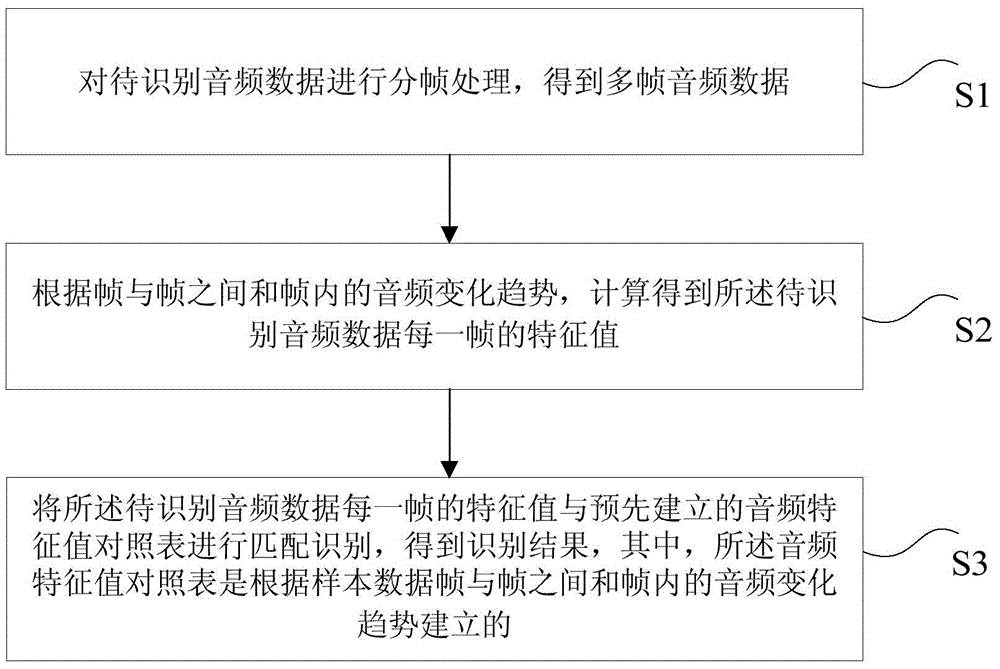
图2是本申请提供的音频识别方法一种实施例的方法流程图;Fig. 2 is a method flowchart of an embodiment of an audio recognition method provided by the present application;
图3是本申请提供的特征向量示意图;3 is a schematic diagram of a feature vector provided by the application;
图4是本申请提供的音频特征值对照表示意图;4 is a schematic diagram of an audio feature value comparison table provided by the application;
图5是本申请提供的待识别音频数据识别匹配示意图;5 is a schematic diagram of the identification and matching of audio data to be identified provided by the application;
图6是本申请提供的二进制比特位求和示意图;6 is a schematic diagram of the summation of binary bits provided by the application;
图7是本申请提供的音频识别装置的模块结构示意图。FIG. 7 is a schematic structural diagram of a module of an audio recognition device provided by the present application.
具体实施方式Detailed ways
为了使本技术领域的人员更好地理解本申请中的技术方案,下面将结合本申请实施例中的附图,对本申请实施例中的技术方案进行清楚、完整地描述,显然,所描述的实施例仅仅是本申请一部分实施例,而不是全部的实施例。基于本申请中的实施例,本领域普通技术人员在没有作出创造性劳动前提下所获得的所有其他实施例,都应当属于本申请保护的范围。In order to make those skilled in the art better understand the technical solutions in the present application, the technical solutions in the embodiments of the present application will be described clearly and completely below with reference to the accompanying drawings in the embodiments of the present application. Obviously, the described The embodiments are only a part of the embodiments of the present application, but not all of the embodiments. Based on the embodiments in this application, all other embodiments obtained by those of ordinary skill in the art without creative work shall fall within the scope of protection of this application.
为了使本技术领域的人员更好地理解本申请中的技术方案,下面将结合本申请实施例中的附图,对本申请实施例中的技术方案进行清楚、完整地描述,显然,所描述的实施例仅仅是本申请一部分实施例,而不是全部的实施例。基于本申请中的实施例,本领域普通技术人员在没有作出创造性劳动前提下所获得的所有其他实施例,都应当属于本申请保护的范围。In order to make those skilled in the art better understand the technical solutions in the present application, the technical solutions in the embodiments of the present application will be described clearly and completely below with reference to the accompanying drawings in the embodiments of the present application. Obviously, the described The embodiments are only a part of the embodiments of the present application, but not all of the embodiments. Based on the embodiments in this application, all other embodiments obtained by those of ordinary skill in the art without creative work shall fall within the scope of protection of this application.
图2是本申请所述一种音频识别方法一个实施例的方法流程图。虽然本申请提供了如下述实施例或附图所示的方法操作步骤或装置结构,但基于常规或者无需创造性的劳动在所述方法或装置中可以包括更多或者更少的操作步骤或模块单元。在逻辑性上不存在必要因果关系的步骤或结构中,这些步骤的执行顺序或装置的模块结构不限于本申请实施例描述及附图所示的执行顺序或模块结构。所述的方法或模块结构的在实际中的装置或终端产品应用时,可以按照实施例或者附图所示的方法或模块结构连接进行顺序执行或者并行执行(例如并行处理器或者多线程处理的环境,甚至分布式处理环境)。FIG. 2 is a method flowchart of an embodiment of an audio recognition method described in the present application. Although the present application provides method operation steps or device structures as shown in the following embodiments or drawings, more or less operation steps or module units may be included in the method or device based on routine or without creative work. . In the steps or structures that logically do not have necessary causal relationship, the execution sequence of these steps or the module structure of the device are not limited to the execution sequence or module structure described in the embodiments of the present application and shown in the accompanying drawings. When the described method or module structure is applied in an actual device or terminal product, it can be executed sequentially or in parallel (for example, a parallel processor or multi-threaded processing method) according to the connection of the method or module structure shown in the embodiments or the accompanying drawings. environments, even distributed processing environments).
具体的如图2所述,本申请一种实施例提供的一种音频识别方法可以包括:Specifically, as shown in FIG. 2 , an audio recognition method provided by an embodiment of the present application may include:
S1:对待识别音频数据进行分帧处理,得到多帧音频数据;S1: perform frame-by-frame processing on the audio data to be identified to obtain multiple frames of audio data;
待识别的音频数据可以是音频识别软件所录取的一小段语音,或者是在电视互动上的一段语音,一般主要是为了识别出这段语音的出处。在录取后,可以将其进行分帧处理,例如,可以每30ms作为一帧数据,当然,具体选择多少ms作为一帧音频数据的长度,本申请不作限定,可以按照实际需要选择,20ms,25ms,40ms等都可以。但是需要保证的是,待识别音频数据分帧处理的规则需要与预先建立的音频特征值对照表时的分帧原则相同。The audio data to be recognized may be a small piece of speech recorded by audio recognition software, or a piece of speech on TV interaction, generally mainly to identify the source of the speech. After admission, it can be processed in frames. For example, every 30ms can be used as a frame of data. Of course, how many ms are selected as the length of a frame of audio data is not limited in this application, and can be selected according to actual needs, 20ms, 25ms , 40ms, etc. can be. However, it needs to be ensured that the rules for framing processing of the audio data to be identified need to be the same as the framing principles in the pre-established audio feature value comparison table.
进一步的,因为在进行匹配识别的时候,由于分帧的影响,难免会出现偏差,为了减少偏差的影响,在分帧处理的时候,需要设定帧与帧之间是重叠的,以30ms作为一帧为例进行说明,第一帧是0到30ms,那么第二帧就是16ms到45ms,第三帧就是30ms到60ms,即,按照相邻帧以预定毫秒数重叠的划分规则,对所述待识别音频数据进行分帧处理,也就是说,相邻帧之间是重叠的,从而避免了帧划分造成的偏差对匹配结果的影响。Further, because when performing matching and identification, due to the influence of framing, it is inevitable that there will be deviations. In order to reduce the influence of deviations, in the frame-by-frame processing, it is necessary to set the overlap between frames, with 30ms as the Take one frame as an example to illustrate, the first frame is 0 to 30ms, the second frame is 16ms to 45ms, and the third frame is 30ms to 60ms, that is, according to the division rule that adjacent frames overlap by a predetermined number of milliseconds, for the above The audio data to be identified is processed by frame, that is to say, adjacent frames are overlapped, thereby avoiding the influence of the deviation caused by frame division on the matching result.
在进行后续的数据处理前,可以对每一帧音频数据进行快速傅立叶变换(FastFourier Transform,简称为FFT)变换,从而将音频数据转换至频域,在频域对信号进行分析。Before performing subsequent data processing, a Fast Fourier Transform (Fast Fourier Transform, FFT for short) may be performed on each frame of audio data, so as to convert the audio data to the frequency domain, and analyze the signal in the frequency domain.
S2:根据帧与帧之间和帧内的音频变化趋势,计算得到所述待识别音频数据每一帧的特征值;S2: Calculate the feature value of each frame of the audio data to be identified according to the audio change trend between frames and within the frame;
在确定特征的过程中,可以针对上述FFT变换后得到的频域结果,利用MFCC特征参数提取算法,获得预定维数的特征向量(例如12维),之所以采用MFCC特征参数提取算法,是因为MFCC特征在语音识别中能够提取出信号中的明显变化区域,具有较好的区分性。MFCC是Mel频率倒谱系数的缩写,其中,Mel频率是基于人耳听觉特性提出来的,它与Hz频率成非线性对应关系。Mel频率倒谱系数(MFCC)则是利用它们之间的这种关系,计算得到的Hz频谱特征,由于Mel频率与Hz频率之间非线性的对应关系,使得MFCC随着频率的提高,其计算精度随之下降。因此,在应用中常常只使用低频MFCC,而丢弃中高频MFCC。In the process of determining the features, the MFCC feature parameter extraction algorithm can be used for the frequency domain results obtained after the above FFT transformation to obtain a feature vector of predetermined dimensions (for example, 12 dimensions). The reason why the MFCC feature parameter extraction algorithm is used is because The MFCC feature can extract the obvious change area in the signal in speech recognition, and has better distinguishability. MFCC is the abbreviation of Mel frequency cepstral coefficient, wherein, the Mel frequency is proposed based on the auditory characteristics of the human ear, and it has a nonlinear corresponding relationship with the Hz frequency. The Mel frequency cepstral coefficient (MFCC) uses this relationship between them to calculate the Hz spectrum characteristics. Due to the nonlinear correspondence between the Mel frequency and the Hz frequency, the MFCC can be calculated as the frequency increases. Accuracy drops accordingly. Therefore, only low frequency MFCCs are often used in applications, while medium and high frequency MFCCs are discarded.
在经过MFCC特征计算之后,每一帧的信号就会变成一个预定维数的向量,假设是12维的向量,那么可以如图3所示,第i帧信号就可以表示为(di0,di1…di10,di11),d为float型数据。进一步的,为了后续比较和匹配更为简单,可以对得到的向量进行编码,转换为二进制序列或者是与二进制序列对应的正数,具体地,按照图3所示的帧的特征向量表示,可以按照以下方式进行编码转换:After the MFCC feature calculation, the signal of each frame will become a vector of predetermined dimensions. Assuming it is a 12-dimensional vector, as shown in Figure 3, the i-th frame signal can be expressed as (d i0 , d i1 …d i10 ,d i11 ), d is float data. Further, in order to make subsequent comparison and matching simpler, the obtained vector can be encoded and converted into a binary sequence or a positive number corresponding to the binary sequence. Specifically, according to the feature vector representation of the frame shown in FIG. The encoding conversion is done as follows:

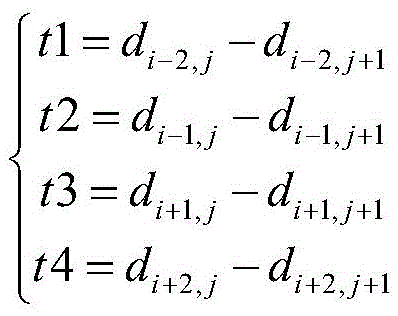
diff=-n*t1-mt2+mt3+n2*t4diff=-n*t1-mt2+mt3+n2*t4

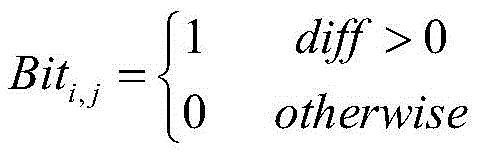
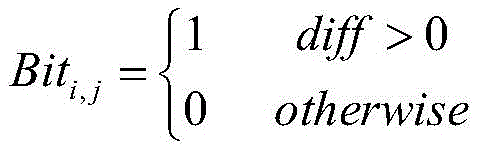
其中,di-2,j表示第i-2帧音频数据第j个维度的向量值,di-2,j+1表示第i-2帧音频数据第j+1个维度的向量值,di-1,j表示第i-1帧音频数据第j个维度的向量值、di-1,j+1表示第i-1帧音频数据第j+1个维度的向量值、di+1,j表示第i+1帧音频数据第j个维度的向量值、di+1,j+1表示第i+1帧音频数据第j+1个维度的向量值、di+2,j表示第i+2帧音频数据第j个维度的向量值、di+2,j+1表示第i+2帧音频数据第j+1个维度的向量值,t1、t2、t3、t4、diff表示中间参量、Biti,j表示第i帧音频数据二进制序列第j个比特位的取值,n、m为定量系数。Among them, d i-2,j represents the vector value of the jth dimension of the i-2th frame of audio data, d i-2,j+1 represents the vector value of the j+1th dimension of the i-2th frame of audio data, d i-1,j represents the vector value of the jth dimension of the audio data of the i-1th frame, d i-1,j+1 represents the vector value of the j+1th dimension of the audio data of the i-1th frame, d i +1,j represents the vector value of the jth dimension of the audio data of the i+1th frame, d i+1,j+1 represents the vector value of the j+1th dimension of the audio data of the i+1th frame, d i+2 ,j represents the vector value of the jth dimension of the i+2th frame of audio data, d i+2,j+1 represents the vector value of the j+1th dimension of the i+2th frame of audio data, t1, t2, t3, t4 and diff represent intermediate parameters, Bit i,j represent the value of the jth bit of the ith frame of audio data binary sequence, and n and m are quantitative coefficients.
由上述公式可以看出,二进制序列计算的过程中,是依据每一帧音频数据的向量数据相邻维度之间的向量值和相邻帧的向量值计算得到的,即,先将待识别音频数据的每一帧音频数据转换为一个预定维数的向量数据;然后,根据每一帧音频数据的向量数据相邻维度之间的向量值和相邻帧的向量值,将每一帧音频数据的向量数据转换为一个二进制序列。It can be seen from the above formula that in the process of binary sequence calculation, it is calculated according to the vector value between the adjacent dimensions of the vector data of each frame of audio data and the vector value of the adjacent frame, that is, the audio to be recognized is first calculated. Each frame of audio data of the data is converted into vector data of a predetermined dimension; then, according to the vector values between the adjacent dimensions of the vector data of each frame of audio data and the vector values of adjacent frames, each frame of audio data The vector data is converted into a binary sequence.
具体地,公式中是根据前后两帧数据的向量值,以及同一帧内相邻向量值计算得到的,这样就有效地将帧与帧之间、帧内之间的关系加入了特征值的计算中。Specifically, the formula is calculated based on the vector values of the two frames of data before and after, as well as the adjacent vector values in the same frame, so that the relationship between frames and between frames is effectively added to the calculation of eigenvalues middle.
然而,值得注意是,上述n、m就可以按照需要选取,例如,可以分别取值为2和3,那么对应的:However, it is worth noting that the above n and m can be selected as needed. For example, they can be 2 and 3 respectively, then the corresponding:
diff=-2*t1-t2+t3+2*t4。diff=-2*t1-t2+t3+2*t4.
进一步的,上述所列举的例子和公式中,是以相邻两帧之间作为计算依据的,在实际执行的时候,也可以是相邻的三帧或者四帧等等,可以根据实际的计算精度和处理器的处理能力选取合适的帧数,当然,当帧数选取不同的时候,上述公式也需要进行适应性的调整,但是调整的思路是近似的,本申请对此不作限定。Further, in the examples and formulas listed above, the calculation basis is between two adjacent frames. In actual execution, it can also be three adjacent frames or four frames, etc., which can be calculated according to the actual calculation. The accuracy and the processing capability of the processor select an appropriate number of frames. Of course, when the number of frames is different, the above formula also needs to be adjusted adaptively, but the idea of adjustment is approximate, which is not limited in this application.
按照上述方式计算得到二进制序列的过程中,如果原本向量维度是N,那么计算得到的二进制序列的位数就是N-1,例如,如果得到的是12维的特征向量,那么得到的二进制序列就是11位。In the process of calculating the binary sequence according to the above method, if the original vector dimension is N, then the number of digits of the calculated binary sequence is N-1. For example, if a 12-dimensional feature vector is obtained, then the obtained binary sequence is 11 bits.
在本例中,可以以得到的二进制序列作为特征值,也可以二进制序列所对应的十进制作为特征值,举例而言,如果某一帧音频数据的二进制序列为00000000101,那么可以以00000000101作为最终的特征值,也可以5作为最终的特征值。In this example, the obtained binary sequence can be used as the feature value, and the decimal corresponding to the binary sequence can also be used as the feature value. For example, if the binary sequence of a certain frame of audio data is 00000000101, then 00000000101 can be used as the final The eigenvalue can also be 5 as the final eigenvalue.
总的来说,可以利用一帧内相邻关系的系数做比较,成为帧内系数的比较,然后利用前后两帧的比较信息,综合这些前后帧和帧内的信息形成最后的值diff,这个值与0的比较结果构成最终对应位的编码值。具体地,一帧信号经MFCC变成12维的特征系数向量后,再经过编码变成11位的二值序列(Biti,0,Biti,1…Biti,10),如果将该二进制序列转换为十进制,那么对应的取值范围就是0到2的11次方。In general, the coefficients of the adjacent relationship in a frame can be used for comparison to become the comparison of the coefficients in the frame, and then the comparison information of the two frames before and after is used to synthesize the information of the frames before and after the frame to form the final value diff, this The result of comparing the value with 0 constitutes the encoded value of the final corresponding bit. Specifically, after a frame of signal is transformed into a 12-dimensional feature coefficient vector by MFCC, it is then encoded into an 11-bit binary sequence (Bit i,0 ,Bit i,1 ...Bit i,10 ), if the binary The sequence is converted to decimal, then the corresponding value range is 0 to 2 to the 11th power.
S3:将所述待识别音频数据每一帧的特征值与预先建立的音频特征值对照表进行匹配识别,得到识别结果,其中,所述音频特征值对照表是根据样本数据帧与帧之间和帧内的音频变化趋势建立的。S3: Match and identify the feature value of each frame of the audio data to be identified and a pre-established audio feature value comparison table, and obtain a recognition result, wherein the audio feature value comparison table is based on the sample data frame and the frame. and the audio trends within the frame are established.
为了实现对音频数据的有效匹配,需要预先建立一个音频特征值对照表,这个对照表中所记录就是每一帧数据和这帧数据所对应的特征值,当然,如果音频特征值对照表中是以二进制方式表示特征值的,那么相应的在音频识别的时候,待识别音频数据也就转换为二进制序列作为特征值,如果音频特征值对照表中是以十进制方式表示特征值的,那么相应的在音频识别的时候,待识别音频数据也就转换为十进制作为特征值。In order to achieve effective matching of audio data, it is necessary to establish an audio feature value comparison table in advance. The record in this comparison table is the feature value corresponding to each frame of data and this frame of data. Of course, if the audio feature value comparison table is If the feature value is represented in binary mode, then the corresponding audio data to be recognized is converted into a binary sequence as the feature value during audio recognition. If the feature value is represented in decimal format in the audio feature value comparison table, then the corresponding During audio recognition, the audio data to be recognized is converted into decimal as a feature value.
具体地,可以按照以下方式建立音频特征值对照表包括:Specifically, the audio feature value comparison table can be established in the following manner, including:
步骤1:获取样本数据,其中,所述样本数据包括多段样本音频;Step 1: obtaining sample data, wherein the sample data includes multiple pieces of sample audio;
步骤2:对所述多段样本音频中的各段样本音频进行分帧处理,得到每段样本音频的多帧音频数据;Step 2: Framing processing is performed on each segment of the sample audio in the multi-segment sample audio to obtain multi-frame audio data of each segment of the sample audio;
步骤3:根据帧与帧之间和帧内的音频变化趋势,计算得到每段样本音频每一帧的特征值;Step 3: Calculate the feature value of each frame of each sample audio according to the audio change trend between frames and within the frame;
步骤4:以特征值作为根节点,按照每段样本音频每一帧的特征值,将每段样本音频每一帧增加至对应的根节点之后,形成对应关系;Step 4: take the feature value as the root node, according to the feature value of each frame of each sample audio, add each frame of each sample audio to the corresponding root node to form a corresponding relationship;
步骤5:将所述对应关系作为所述音频特征值对照表。Step 5: Use the corresponding relationship as the audio feature value comparison table.
上述建立音频特征值对照表的过程中,计算特征值的过程和所涉及到的原理和方式与求取待识别音频数据的特征值是相同的,在此不再赘述。差别就在于,在建立音频特征值对照表的时候,需要以特征值作为根节点,按照每段样本音频每一帧的特征值,将每段样本音频每一帧增加至对应的根节点之后,形成对应关系。具体地,假设原始获取的是12维的向量,那么最终得到的建立音频特征值对照表可以如图4所示.In the above process of establishing the audio feature value comparison table, the process of calculating the feature value and the involved principles and methods are the same as those of obtaining the feature value of the audio data to be recognized, and will not be repeated here. The difference is that when establishing the audio feature value comparison table, the feature value needs to be used as the root node, and each frame of each sample audio is added to the corresponding root node according to the feature value of each frame of each sample audio. form a corresponding relationship. Specifically, assuming that the original acquisition is a 12-dimensional vector, then the final established audio feature value comparison table can be shown in Figure 4.
为了使得后续可以快速识别,不仅可以包括如图4所示的音频特征值对照表,还可以特征数组,记录的是每段样本音频的特征值。In order to enable quick identification later, not only the audio feature value comparison table as shown in FIG. 4 may be included, but also a feature array, which records the feature value of each sample audio.
因为向量是12维的,那么特征值就有2048(2的11次方11)种可能性,因此音频特征值对照表就对应有2048个根节点。每个根节点的后续存储就是所有特征值与之对应的音频数据帧(即,哪个声音信号的哪一帧)。举例:第0个跟节点,对应存储所有特征值为0的指纹信息,如第i个声音的第j帧对应特征值为0,第k个声音的第l帧特征值为0,则第0个跟节点下将存储这些声音片段信息(i,j)(k,l)。Because the vector is 12-dimensional, there are 2048 (2 to the 11th power 11) possibilities for the eigenvalue, so the audio eigenvalue comparison table corresponds to 2048 root nodes. The subsequent storage of each root node is the audio data frame to which all feature values correspond (ie, which frame of which sound signal). For example: the 0th follower node corresponds to storing all fingerprint information whose eigenvalue is 0. For example, the eigenvalue of the jth frame of the ith voice is 0, and the eigenvalue of the lth frame of the kth voice is 0, then the 0th frame These sound clip information (i,j)(k,l) will be stored under each follower node.
为了实现最终的检索识别,可以通过建立投票矩阵的方式确定较为准确的匹配结果,具体地,可以包括:建立投票矩阵,其中,投票矩阵是按照样本音频的数量和每段样本音频的帧数建立的,即,该投票矩阵可以是一个二维矩阵,该二维矩阵的维数代表了数据库中有多少样本音频,即数据库中有多少声音信号,以及每个声音信号最长有多少数据帧。在建立完投票矩阵之后,可以对待识别音频数据的每一帧执行以下操作:从音频特征值对照表中,查找出与当前帧的特征值相同的一帧或多帧音频数据,在所述投票矩阵中与当前帧的音频特征值相同的一帧或多帧音频数据的对应位置进行投票标记;然后,将投票标记数最高且超出预设阈值的样本音频作为识别结果。In order to realize the final retrieval and identification, a more accurate matching result can be determined by establishing a voting matrix. Specifically, it can include: establishing a voting matrix, wherein the voting matrix is established according to the number of sample audios and the frame number of each sample audio. That is, the voting matrix can be a two-dimensional matrix, and the dimension of the two-dimensional matrix represents how many sample audios are in the database, that is, how many sound signals are in the database, and how many data frames each sound signal has the longest. After the voting matrix is established, the following operations can be performed for each frame of the audio data to be identified: from the audio feature value comparison table, find out one or more frames of audio data with the same feature value as the current frame, and in the voting The corresponding positions of one or more frames of audio data in the matrix that have the same audio feature value as the current frame are marked for voting; then, the sample audio with the highest number of voting marks and exceeding the preset threshold is used as the identification result.
具体地,可以如图5所示,对于待识别音频数据,计算出该段音频数据每个帧的特征值后,可以依次根据音频特征值对照表进行投票操作。具体地,对于待识别音频数据的每一帧信号,先找到其特征值v,并在特征索引表中找到对应的根节点,该节点下存储了所有特征值为v的声音信息,例如,待识别音频数据第一帧的特征值为2046,那么找到音频特征值对照表的第2046个跟节点,该节点下存储了第k-1个声音信号的第l帧的特征为2046,因此,可以在投票矩阵中的(k-1,l)处做+1操作,这一+1操作就表示投票,而该投票操作的意思就是这段待识别音频数据可能来自第k-1个声音源的第l帧附近。Specifically, as shown in FIG. 5 , for the audio data to be identified, after calculating the feature value of each frame of the audio data, a voting operation can be performed in sequence according to the audio feature value comparison table. Specifically, for each frame of audio data to be identified, first find its feature value v, and find the corresponding root node in the feature index table, under which all sound information with feature value v is stored. Identify the feature value of the first frame of the audio data as 2046, then find the 2046th follow node of the audio feature value comparison table, and the feature of the lth frame where the k-1th sound signal is stored under this node is 2046. Therefore, it is possible to Do a +1 operation at (k-1,l) in the voting matrix. This +1 operation means voting, and the voting operation means that the audio data to be recognized may come from the k-1th sound source. near frame l.
对该待识别音频数据的所有帧的特征值进行投票后,可以统计最终的投票结果,以确定哪些声音的哪些帧获得的投票较多,说明待识别信号与数据库中的这些声音段最为相似。After voting on the feature values of all the frames of the audio data to be recognized, the final voting results can be counted to determine which frames of which sounds have more votes, indicating that the signals to be recognized are most similar to these sound segments in the database.
然而,值得注意的是,在投票的时候是存在一个换算过程的,即,如果匹配出待识别音频数据的第1帧与第5个样本音频的第3帧的特征值相同,那么后续如果匹配出待识别音频数据的第4帧与第5个样本音频的第6帧的特征值相同,那么这个时候标记的位置也是第5个样本音频的第1帧。即,所有的匹配的结果都投票在某个样本音频第一次被匹配出的位置。或者说,如果匹配出待识别音频数据的第3帧与第8个样本音频的第6帧的特征值相同(这是第一次与该样本音频匹配上),那么后续如果匹配出待识别音频数据的第4帧与第8个样本音频的第7帧的特征值相同,那么这个时候标记的位置也是第8个样本音频的第6帧。即,所有的匹配的结果都投票在某个样本音频第一次被匹配出的位置。However, it is worth noting that there is a conversion process when voting, that is, if the eigenvalues of the first frame of the audio data to be identified are the same as those of the third frame of the fifth sample audio, then if the matching The 4th frame of the audio data to be identified is the same as the 6th frame of the 5th sample audio, and the marked position is also the 1st frame of the 5th sample audio at this time. That is, all matching results are voted at the position where a sample audio is matched for the first time. In other words, if the feature value of the third frame of the audio data to be identified is the same as that of the sixth frame of the eighth sample audio (this is the first time it matches the sample audio), then if the audio to be identified is matched subsequently The 4th frame of the data has the same feature value as the 7th frame of the 8th sample audio, so the position of the mark at this time is also the 6th frame of the 8th sample audio. That is, all matching results are voted at the position where a sample audio is matched for the first time.
当然,也可以有其它的匹配方式,例如,待识别音频数据每一帧特征值的匹配都是直接对应到某一个样本音频,然后最终统计与每个样本音频的匹配度,这样操作也是可行的。但是相对于匹配出某一样本音频的某一帧作为起始帧的方式,确定某一帧的方式显然是更为精确的。Of course, other matching methods are also possible. For example, the matching of the feature value of each frame of the audio data to be identified is directly corresponding to a certain sample audio, and then the matching degree with each sample audio is finally counted. This operation is also feasible. . However, compared with the method of matching a certain frame of a certain sample audio as the starting frame, the method of determining a certain frame is obviously more accurate.
在实际实现的时候,有时可以匹配出多个满足条件的结果,为了使得最终的结果更为准确,可以设定一个匹配阈值(T),只有超出该阈值T,才进行后续的精确匹配。例如:如果找到第i个声音的第3帧处获取的投票大于阈值,那么从第3帧开始进行片段的特征值比较。如图6所示,假设voice_i的第3帧的特征值为f3,待识别信号的第一帧的特征值为f0,那么比较方式就是将f3和f0转成二进制序列后,统计对应位不同的个数,当然这种比较可以通过查表的方式进行。具体比较的时候,是用11位的二进制序列进行比较,这个11位的二进制序列其实对应一个十进制的特征值,因此,两个特征值的相似性比较,先将其还原到二进制的序列,统计这两个序列对应位不同的个数。因为待识别的音频数据中一般有多帧的数据,可以将多帧的比较结果相加,将最终统计结果最小值对应的投票位置确定为识别结果。In actual implementation, sometimes multiple results that meet the conditions can be matched. In order to make the final result more accurate, a matching threshold (T) can be set, and subsequent accurate matching can only be performed if the threshold T is exceeded. For example: if the vote obtained at frame 3 of the ith sound is found to be greater than the threshold, then start from frame 3 for feature value comparison of the segment. As shown in Figure 6, assuming that the eigenvalue of the third frame of voice_i is f3, and the eigenvalue of the first frame of the signal to be identified is f0, then the comparison method is to convert f3 and f0 into a binary sequence, and count the different corresponding bits. Of course, this comparison can be done by looking up the table. In the specific comparison, an 11-bit binary sequence is used for comparison. This 11-bit binary sequence actually corresponds to a decimal eigenvalue. Therefore, when comparing the similarity of two eigenvalues, first restore it to a binary sequence, and then count the eigenvalues. The two sequences correspond to different numbers of bits. Because there are generally multiple frames of data in the audio data to be identified, the comparison results of the multiple frames can be added, and the voting position corresponding to the minimum value of the final statistical result is determined as the identification result.
即,可以将待识别音频数据每一帧的特征值与预先建立的音频特征值对照表进行匹配识别,查找出与所述待识别音频数据的匹配度大于预设阈值的一段或多段样本音频,然后,从该一段或多段样本音频中确定出匹配度最高的样本音频作为识别结果,具体地,可以对该一段或多段样本音频中的每段音频执行以下操作:确定待识别音频数据的帧数,并获取所述待识别音频数据每一帧的二进制序列,确定所述待识别音频数据每一帧的二进制序列与所述与待识别音频数据对应的每一帧数据的二进制序列之间相同比特位置比特值不同的位数;将一段或多段样本音频中比特值不同的位数最少的样本音频作为识别结果。That is, the feature value of each frame of the audio data to be identified can be matched and identified with a pre-established audio feature value comparison table, and one or more pieces of sample audio whose matching degree with the audio data to be identified is greater than a preset threshold can be found, Then, the sample audio with the highest matching degree is determined from the one or more pieces of sample audio as the identification result, and specifically, the following operations can be performed for each piece of audio in the one or more pieces of sample audio: determine the number of frames of the audio data to be identified. , and obtain the binary sequence of each frame of the audio data to be identified, and determine the same bit between the binary sequence of each frame of the audio data to be identified and the binary sequence of each frame of data corresponding to the audio data to be identified The number of bits with different bit values in the position; the sample audio with the least number of bits with different bit values in one or more pieces of sample audio is used as the identification result.
例如:二进制序列一为0010001,二进制序列二为1010000,那么比较结果就是1。For example: binary sequence one is 0010001, binary sequence two is 1010000, then the comparison result is 1.
上例所提供的音频数据识别方法具有较好的鲁棒性,同时提出的识别方法识别速度较快,且可以应用在后续的电视互动、音乐识别等场景中,在本例中,在频域不是提取极值点,而是利用帧与帧之间、帧内之间的比较关系,获得一个相对稳定的编码结果,这种编码方式可以有效对抗一些噪声的干扰,因为具有较好的音频识别效果。The audio data recognition method provided in the above example has good robustness, and the proposed recognition method has a fast recognition speed, and can be applied in subsequent scenarios such as TV interaction and music recognition. In this example, in the frequency domain Instead of extracting extreme points, it uses the comparison between frames and frames to obtain a relatively stable encoding result. This encoding method can effectively resist some noise interference, because it has better audio recognition. Effect.
基于同一发明构思,本发明实施例中还提供了一种音频识别装置,如下面的实施例所述。由于音频识别装置解决问题的原理与音频识别方法相似,因此音频识别装置的实施可以参见音频识别方法的实施,重复之处不再赘述。以下所使用的,术语“单元”或者“模块”可以实现预定功能的软件和/或硬件的组合。尽管以下实施例所描述的装置较佳地以软件来实现,但是硬件,或者软件和硬件的组合的实现也是可能并被构想的。图7是本发明实施例的音频识别装置的一种结构框图,如图7所示,可以包括:分帧模块701、计算模块702和匹配识别模块703,下面对该结构进行说明。Based on the same inventive concept, an embodiment of the present invention also provides an audio recognition device, as described in the following embodiments. Since the principle of the audio recognition device for solving the problem is similar to that of the audio recognition method, the implementation of the audio recognition device can refer to the implementation of the audio recognition method, and the repetition will not be repeated. As used below, the term "unit" or "module" may be a combination of software and/or hardware that implements a predetermined function. Although the apparatus described in the following embodiments is preferably implemented in software, implementations in hardware, or a combination of software and hardware, are also possible and contemplated. FIG. 7 is a structural block diagram of an audio recognition device according to an embodiment of the present invention. As shown in FIG. 7 , it may include: a framing
分帧模块701,可以用于对待识别音频数据进行分帧处理,得到多帧音频数据;The framing
计算模块702,可以用于根据帧与帧之间和帧内的音频变化趋势,计算得到所述待识别音频数据每一帧的特征值;The
匹配识别模块703,可以用于将所述待识别音频数据每一帧的特征值与预先建立的音频特征值对照表进行匹配识别,得到识别结果,其中,所述音频特征值对照表是根据样本数据帧与帧之间和帧内的音频变化趋势建立的。The matching
在一个实施方式中,上述音频识别装置还可以包括:对照表建立模块,用于预先建立音频特征值对照表,所述对照表建立模块包括:获取单元,用于获取样本数据,其中,所述样本数据包括多段样本音频;分帧单元,用于对所述多段样本音频中的各段样本音频进行分帧处理,得到每段样本音频的多帧音频数据;计算单元,用于根据帧与帧之间和帧内的音频变化趋势,计算得到每段样本音频每一帧的特征值;关系确定单元,用于以特征值作为根节点,按照每段样本音频每一帧的特征值,将每段样本音频每一帧增加至对应的根节点之后,形成对应关系;生成单元,用于将所述对应关系作为所述音频特征值对照表。In one embodiment, the above audio recognition apparatus may further include: a comparison table establishment module for pre-establishing a comparison table of audio feature values, the comparison table establishment module includes: an acquisition unit for acquiring sample data, wherein the The sample data includes multi-segment sample audio; the framing unit is used to perform frame segmentation processing on each segment of the sample audio in the multi-segment sample audio to obtain multi-frame audio data of each segment of sample audio; The change trend of the audio between and within the frame is calculated to obtain the eigenvalue of each frame of each sample audio; the relationship determination unit is used to take the eigenvalue as the root node, according to the eigenvalue of each frame of each sample audio. After each frame of the segment sample audio is added to the corresponding root node, a corresponding relationship is formed; the generating unit is configured to use the corresponding relationship as the audio feature value comparison table.
在一个实施方式中,匹配识别模块703可以包括:建立单元,用于建立投票矩阵,其中,所述投票矩阵是按照样本音频的数量和每段样本音频的帧数建立的;执行单元,用于对所述待识别音频数据每一帧执行以下操作:从所述音频特征值对照表中,查找出与当前帧的特征值相同的一帧或多帧音频数据,在所述投票矩阵中与当前帧的音频特征值相同的一帧或多帧音频数据的对应位置进行投票标记;结果生成单元,用于将投票标记数最高且超出预设阈值的样本音频作为识别结果。In one embodiment, the matching
在一个实施方式中,计算模块702可以包括:第一转换单元,用于将所述待识别音频数据的每一帧音频数据转换为一个预定维数的向量数据;第二转换单元,用于根据每一帧音频数据的向量数据相邻维度之间的向量值和相邻帧的向量值,将每一帧音频数据的向量数据转换为一个二进制序列;特征值生成单元,用于将转换得到的二进制序列作为对应的一帧音频数据的特征值,或者将二进制序列对应的十进制数值作为对应的一帧数据的特征值。In one embodiment, the
在一个实施方式中,第二转换单元具体可以用于按照以下公式,将每一帧音频数据的向量数据转换为一个二进制序列:In one embodiment, the second conversion unit can be specifically configured to convert the vector data of each frame of audio data into a binary sequence according to the following formula:

diff=-n*t1-mt2+mt3+n2*t4diff=-n*t1-mt2+mt3+n2*t4
其中,di-2,j表示第i-2帧音频数据第j个维度的向量值,di-2,j+1表示第i-2帧音频数据第j+1个维度的向量值,di-1,j表示第i-1帧音频数据第j个维度的向量值、di-1,j+1表示第i-1帧音频数据第j+1个维度的向量值、di+1,j表示第i+1帧音频数据第j个维度的向量值、di+1,j+1表示第i+1帧音频数据第j+1个维度的向量值、di+2,j表示第i+2帧音频数据第j个维度的向量值、di+2,j+1表示第i+2帧音频数据第j+1个维度的向量值,t1、t2、t3、t4、diff表示中间参量、Biti,j表示第i帧音频数据二进制序列第j个比特位的取值,n、m为定量系数。Among them, d i-2,j represents the vector value of the jth dimension of the i-2th frame of audio data, d i-2,j+1 represents the vector value of the j+1th dimension of the i-2th frame of audio data, d i-1,j represents the vector value of the jth dimension of the audio data of the i-1th frame, d i-1,j+1 represents the vector value of the j+1th dimension of the audio data of the i-1th frame, d i +1,j represents the vector value of the jth dimension of the audio data of the i+1th frame, d i+1,j+1 represents the vector value of the j+1th dimension of the audio data of the i+1th frame, d i+2 ,j represents the vector value of the jth dimension of the i+2th frame of audio data, d i+2,j+1 represents the vector value of the j+1th dimension of the i+2th frame of audio data, t1, t2, t3, t4 and diff represent intermediate parameters, Bit i,j represent the value of the jth bit of the ith frame of audio data binary sequence, and n and m are quantitative coefficients.
在一个实施方式中,第一转换单元具体可以用于通过MCFF特征参数提取算法,将所述待识别音频数据的每一帧音频数据转换为一个预定维数的向量数据。In one embodiment, the first conversion unit may be specifically configured to convert each frame of audio data of the to-be-identified audio data into vector data of a predetermined dimension by using the MCFF feature parameter extraction algorithm.
在一个实施方式中,预定维数可以是12。In one embodiment, the predetermined number of dimensions may be twelve.
在一个实施方式中,匹配识别模块703可以包括:识别单元,用于将所述待识别音频数据每一帧的特征值与预先建立的音频特征值对照表进行匹配识别,查找出与所述待识别音频数据的匹配度大于预设阈值的一段或多段样本音频;匹配单元,用于从所述一段或多段样本音频中确定出匹配度最高的样本音频作为识别结果。In one embodiment, the matching and identifying
在一个实施方式中,匹配单元可以包括:执行子单元,用于对所述一段或多段样本音频中的每段音频执行以下操作:确定所述待识别音频数据的帧数,并获取所述待识别音频数据每一帧的二进制序列,获取当前段样本音频与所述待识别音频数据对应的每一帧数据的二进制序列,确定所述待识别音频数据每一帧的二进制序列与所述与待识别音频数据对应的每一帧数据的二进制序列之间相同比特位置比特值不同的位数;匹配子单元,用于将所述一段或多段样本音频中比特值不同的位数最少的样本音频作为识别结果。In one embodiment, the matching unit may include: an executing subunit, configured to perform the following operations on each piece of audio in the one or more pieces of sample audio: determine the number of frames of the audio data to be identified, and obtain the audio data to be identified. Identify the binary sequence of each frame of audio data, obtain the binary sequence of each frame of data corresponding to the current segment sample audio and the audio data to be recognized, and determine the binary sequence of each frame of the audio data to be recognized and the audio data to be recognized. Identify the number of bits with different bit values in the same bit position between the binary sequences of each frame of data corresponding to the audio data; the matching subunit is used to use the sample audio with the least number of bits in the one or more pieces of sample audio as the sample audio with different bit values. Identify the results.
在一个实施方式中,分帧模块701具体可以用于按照相邻帧以预定毫秒数重叠的划分规则,对所述待识别音频数据进行分帧处理。In an implementation manner, the framing
本申请提供的一种音频识别方法和装置,通过根据帧与帧之间和帧内的音频变化趋势,计算得到待识别音频数据每一帧的特征值,然后将每一帧的特征值与预先建立的音频特征值对照表进行匹配识别,从而得到识别结果,即,在频域不是提取极值点,而是利用帧与帧之间、帧内之间的比较关系,获得一个相对稳定的编码结果,从而可以有效地对抗噪声的干扰,使得识别结果更为准确。利用本申请实施方案,不仅可以大大提高抗干扰的能力,有效提高识别成功率和识别结果的准确度。An audio recognition method and device provided by the present application, by calculating the feature value of each frame of audio data to be recognized according to the audio change trend between frames and within the frame, and then comparing the feature value of each frame with the preset The established audio feature value comparison table is matched and identified, so as to obtain the identification result, that is, in the frequency domain, instead of extracting extreme points, the comparison relationship between frames and frames is used to obtain a relatively stable encoding. As a result, the interference of noise can be effectively resisted, so that the recognition result is more accurate. By using the embodiments of the present application, not only the anti-interference ability can be greatly improved, but also the recognition success rate and the accuracy of the recognition result can be effectively improved.
本申请中各个实施例所涉及的上述描述仅是本申请中的一些实施例中的应用,在某些标准、模型、方法的基础上略加修改后的实施方式也可以实行上述本申请各实施例的方案。当然,在符合本申请上述各实施例的中所述的处理方法步骤的其他无创造性的变形,仍然可以实现相同的申请,在此不再赘述。The above descriptions related to the various embodiments in this application are only the applications of some embodiments in this application, and slightly modified implementations based on some standards, models, and methods can also implement the above implementations in this application. example plan. Of course, other non-creative modifications of the processing method steps described in the above-mentioned embodiments of the present application can still achieve the same application, which will not be repeated here.
虽然本申请提供了如实施例或流程图所述的方法操作步骤,但基于常规或者无创造性的劳动可以包括更多或者更少的操作步骤。实施例中列举的步骤顺序仅仅为众多步骤执行顺序中的一种方式,不代表唯一的执行顺序。在实际中的装置或客户端产品执行时,可以按照实施例或者附图所示的方法顺序执行或者并行执行(例如并行处理器或者多线程处理的环境)。Although the present application provides method operation steps as described in the embodiments or flow charts, more or less operation steps may be included based on routine or non-creative work. The sequence of steps enumerated in the embodiments is only one of the execution sequences of many steps, and does not represent the only execution sequence. When an actual device or client product is executed, the methods shown in the embodiments or the accompanying drawings may be executed sequentially or in parallel (for example, a parallel processor or a multi-threaded processing environment).
上述实施例阐明的装置或模块,具体可以由计算机芯片或实体实现,或者由具有某种功能的产品来实现。为了描述的方便,描述以上装置时以功能分为各种模块分别描述。在实施本申请时可以把各模块的功能在同一个或多个软件和/或硬件中实现。当然,也可以将实现某功能的模块由多个子模块或子单元组合实现。The devices or modules described in the above embodiments may be specifically implemented by computer chips or entities, or by products with certain functions. For the convenience of description, when describing the above device, the functions are divided into various modules and described respectively. When implementing the present application, the functions of each module may be implemented in one or more software and/or hardware. Of course, a module that implements a certain function can also be implemented by a combination of multiple sub-modules or sub-units.
本申请中所述的方法、装置或模块可以以计算机可读程序代码方式实现控制器按任何适当的方式实现,例如,控制器可以采取例如微处理器或处理器以及存储可由该(微)处理器执行的计算机可读程序代码(例如软件或固件)的计算机可读介质、逻辑门、开关、专用集成电路(Application Specific Integrated Circuit,ASIC)、可编程逻辑控制器和嵌入微控制器的形式,控制器的例子包括但不限于以下微控制器:ARC 625D、Atmel AT91SAM、Microchip PIC18F26K20以及Silicone Labs C8051F320,存储器控制器还可以被实现为存储器的控制逻辑的一部分。本领域技术人员也知道,除了以纯计算机可读程序代码方式实现控制器以外,完全可以通过将方法步骤进行逻辑编程来使得控制器以逻辑门、开关、专用集成电路、可编程逻辑控制器和嵌入微控制器等的形式来实现相同功能。因此这种控制器可以被认为是一种硬件部件,而对其内部包括的用于实现各种功能的装置也可以视为硬件部件内的结构。或者甚至,可以将用于实现各种功能的装置视为既可以是实现方法的软件模块又可以是硬件部件内的结构。The methods, apparatuses or modules described in this application may be implemented in computer readable program code. The controller may be implemented in any suitable manner, for example, the controller may take the form of, for example, a microprocessor or processor and the memory may be implemented by the (micro)processing computer-readable medium, logic gates, switches, application specific integrated circuits (ASICs), programmable logic controllers, and embedded microcontrollers in the form of computer-readable program code (eg, software or firmware) executed by a computer, Examples of controllers include, but are not limited to, the following microcontrollers: ARC 625D, Atmel AT91SAM, Microchip PIC18F26K20, and Silicon Labs C8051F320, and memory controllers can also be implemented as part of the memory's control logic. Those skilled in the art also know that, in addition to implementing the controller in the form of pure computer-readable program code, the controller can be implemented as logic gates, switches, application-specific integrated circuits, programmable logic controllers and embedded devices by logically programming the method steps. The same function can be realized in the form of a microcontroller, etc. Therefore, such a controller can be regarded as a hardware component, and the devices included therein for realizing various functions can also be regarded as a structure within the hardware component. Or even, the means for implementing various functions can be regarded as both a software module implementing a method and a structure within a hardware component.
本申请所述装置中的部分模块可以在由计算机执行的计算机可执行指令的一般上下文中描述,例如程序模块。一般地,程序模块包括执行特定任务或实现特定抽象数据类型的例程、程序、对象、组件、数据结构、类等等。也可以在分布式计算环境中实践本申请,在这些分布式计算环境中,由通过通信网络而被连接的远程处理设备来执行任务。在分布式计算环境中,程序模块可以位于包括存储设备在内的本地和远程计算机存储介质中。Some of the modules in the apparatus described herein may be described in the general context of computer-executable instructions, such as program modules, being executed by a computer. Generally, program modules include routines, programs, objects, components, data structures, classes, etc. that perform particular tasks or implement particular abstract data types. The application may also be practiced in distributed computing environments where tasks are performed by remote processing devices that are linked through a communications network. In a distributed computing environment, program modules may be located in both local and remote computer storage media including storage devices.
通过以上的实施方式的描述可知,本领域的技术人员可以清楚地了解到本申请可借助软件加必需的硬件的方式来实现。基于这样的理解,本申请的技术方案本质上或者说对现有技术做出贡献的部分可以以软件产品的形式体现出来,也可以通过数据迁移的实施过程中体现出来。该计算机软件产品可以存储在存储介质中,如ROM/RAM、磁碟、光盘等,包括若干指令用以使得一台计算机设备(可以是个人计算机,移动终端,服务器,或者网络设备等)执行本申请各个实施例或者实施例的某些部分所述的方法。From the description of the above embodiments, those skilled in the art can clearly understand that the present application can be implemented by means of software plus necessary hardware. Based on this understanding, the technical solutions of the present application can be embodied in the form of software products in essence, or the parts that make contributions to the prior art can also be embodied in the implementation process of data migration. The computer software product can be stored in a storage medium, such as ROM/RAM, magnetic disk, optical disk, etc., and includes several instructions to make a computer device (which can be a personal computer, mobile terminal, server, or network device, etc.) execute this The methods described in various embodiments or portions of embodiments are claimed.
本说明书中的各个实施例采用递进的方式描述,各个实施例之间相同或相似的部分互相参见即可,每个实施例重点说明的都是与其他实施例的不同之处。本申请的全部或者部分可用于众多通用或专用的计算机系统环境或配置中。例如:个人计算机、服务器计算机、手持设备或便携式设备、平板型设备、移动通信终端、多处理器系统、基于微处理器的系统、可编程的电子设备、网络PC、小型计算机、大型计算机、包括以上任何系统或设备的分布式计算环境等等。The various embodiments in this specification are described in a progressive manner, and the same or similar parts between the various embodiments may be referred to each other, and each embodiment focuses on the differences from other embodiments. All or part of this application may be used in numerous general purpose or special purpose computer system environments or configurations. For example: personal computers, server computers, handheld or portable devices, tablet devices, mobile communication terminals, multiprocessor systems, microprocessor-based systems, programmable electronic devices, network PCs, minicomputers, mainframe computers, including A distributed computing environment for any of the above systems or devices, and the like.
虽然通过实施例描绘了本申请,本领域普通技术人员知道,本申请有许多变形和变化而不脱离本申请的精神,希望所附的权利要求包括这些变形和变化而不脱离本申请的精神。Although the application has been described by way of examples, those of ordinary skill in the art will recognize that the application is subject to many modifications and variations without departing from the spirit of the application, and the appended claims are intended to include such modifications and changes without departing from the spirit of the application.
Claims (16)


Priority Applications (8)
| Application Number | Priority Date | Filing Date | Title |
|---|---|---|---|
| CN201610487584.9A CN106910494B (en) | 2016-06-28 | 2016-06-28 | Audio identification method and device |
| TW106112617A TWI659410B (en) | 2016-06-28 | 2017-04-14 | Audio recognition method and device |
| EP17819122.7A EP3477632A4 (en) | 2016-06-28 | 2017-06-16 | METHOD AND DEVICE FOR DETECTING SOUND |
| KR1020197002466A KR102220964B1 (en) | 2016-06-28 | 2017-06-16 | Method and device for audio recognition |
| PCT/CN2017/088638 WO2018001125A1 (en) | 2016-06-28 | 2017-06-16 | Method and device for audio recognition |
| JP2018568770A JP6750048B2 (en) | 2016-06-28 | 2017-06-16 | Method and apparatus for speech recognition |
| US16/216,771 US10910000B2 (en) | 2016-06-28 | 2018-12-11 | Method and device for audio recognition using a voting matrix |
| US17/142,917 US11133022B2 (en) | 2016-06-28 | 2021-01-06 | Method and device for audio recognition using sample audio and a voting matrix |
Applications Claiming Priority (1)
| Application Number | Priority Date | Filing Date | Title |
|---|---|---|---|
| CN201610487584.9A CN106910494B (en) | 2016-06-28 | 2016-06-28 | Audio identification method and device |
Publications (2)
| Publication Number | Publication Date |
|---|---|
| CN106910494A CN106910494A (en) | 2017-06-30 |
| CN106910494B true CN106910494B (en) | 2020-11-13 |
Family
ID=59206235
Family Applications (1)
| Application Number | Title | Priority Date | Filing Date |
|---|---|---|---|
| CN201610487584.9A Active CN106910494B (en) | 2016-06-28 | 2016-06-28 | Audio identification method and device |
Country Status (7)
| Country | Link |
|---|---|
| US (2) | US10910000B2 (en) |
| EP (1) | EP3477632A4 (en) |
| JP (1) | JP6750048B2 (en) |
| KR (1) | KR102220964B1 (en) |
| CN (1) | CN106910494B (en) |
| TW (1) | TWI659410B (en) |
| WO (1) | WO2018001125A1 (en) |
Families Citing this family (7)
| Publication number | Priority date | Publication date | Assignee | Title |
|---|---|---|---|---|
| CN106910494B (en) * | 2016-06-28 | 2020-11-13 | 创新先进技术有限公司 | Audio identification method and device |
| CN111986698B (en) * | 2019-05-24 | 2023-06-30 | 腾讯科技(深圳)有限公司 | Audio fragment matching method and device, computer readable medium and electronic equipment |
| CN115376530A (en) * | 2021-05-17 | 2022-11-22 | 华为技术有限公司 | Three-dimensional audio signal coding method, device and coder |
| CN114519990B (en) * | 2022-02-10 | 2025-12-05 | 维沃移动通信有限公司 | Audio processing methods, apparatus, electronic devices and readable storage media |
| CN115294952B (en) * | 2022-05-23 | 2026-01-30 | 神盾股份有限公司 | Audio processing methods and apparatus, non-transitory computer-readable storage media |
| CN116614841B (en) * | 2023-07-17 | 2023-10-27 | 中汽智联技术有限公司 | Road side data quality assessment method and electronic equipment |
| CN119741942A (en) * | 2024-08-05 | 2025-04-01 | 北京罗克维尔斯科技有限公司 | Abnormal audio detection method, device, electronic device, computer-readable storage medium, and computer program product |
Citations (7)
| Publication number | Priority date | Publication date | Assignee | Title |
|---|---|---|---|---|
| CN101014953A (en) * | 2003-09-23 | 2007-08-08 | 音乐Ip公司 | Audio fingerprinting system and method |
| CN101493918A (en) * | 2008-10-21 | 2009-07-29 | 深圳市牧笛科技有限公司 | On-line music pirate monitoring method and system |
| US20120209612A1 (en) * | 2011-02-10 | 2012-08-16 | Intonow | Extraction and Matching of Characteristic Fingerprints from Audio Signals |
| US20140074469A1 (en) * | 2012-09-11 | 2014-03-13 | Sergey Zhidkov | Apparatus and Method for Generating Signatures of Acoustic Signal and Apparatus for Acoustic Signal Identification |
| CN103810236A (en) * | 2012-11-13 | 2014-05-21 | 三星电子株式会社 | Music information searching method and apparatus thereof |
| US20140277640A1 (en) * | 2013-03-15 | 2014-09-18 | Facebook, Inc. | Generating Audio Fingerprints based on Audio Signal Complexity |
| US20150199974A1 (en) * | 2014-01-13 | 2015-07-16 | Facebook, Inc. | Detecting distorted audio signals based on audio fingerprinting |
Family Cites Families (46)
| Publication number | Priority date | Publication date | Assignee | Title |
|---|---|---|---|---|
| US5748763A (en) | 1993-11-18 | 1998-05-05 | Digimarc Corporation | Image steganography system featuring perceptually adaptive and globally scalable signal embedding |
| US7194752B1 (en) | 1999-10-19 | 2007-03-20 | Iceberg Industries, Llc | Method and apparatus for automatically recognizing input audio and/or video streams |
| US7853664B1 (en) | 2000-07-31 | 2010-12-14 | Landmark Digital Services Llc | Method and system for purchasing pre-recorded music |
| US6968337B2 (en) * | 2001-07-10 | 2005-11-22 | Audible Magic Corporation | Method and apparatus for identifying an unknown work |
| US7529659B2 (en) * | 2005-09-28 | 2009-05-05 | Audible Magic Corporation | Method and apparatus for identifying an unknown work |
| EP1410380B1 (en) | 2001-07-20 | 2010-04-28 | Gracenote, Inc. | Automatic identification of sound recordings |
| US7505911B2 (en) | 2001-09-05 | 2009-03-17 | Roth Daniel L | Combined speech recognition and sound recording |
| WO2003091990A1 (en) * | 2002-04-25 | 2003-11-06 | Shazam Entertainment, Ltd. | Robust and invariant audio pattern matching |
| US7336890B2 (en) | 2003-02-19 | 2008-02-26 | Microsoft Corporation | Automatic detection and segmentation of music videos in an audio/video stream |
| US7323629B2 (en) | 2003-07-16 | 2008-01-29 | Univ Iowa State Res Found Inc | Real time music recognition and display system |
| US20070071330A1 (en) | 2003-11-18 | 2007-03-29 | Koninklijke Phillips Electronics N.V. | Matching data objects by matching derived fingerprints |
| JP2007534008A (en) * | 2004-02-26 | 2007-11-22 | メディアガイド・インコーポレイテッド | Method and apparatus for automatic detection and identification of broadcast audio or video program signals |
| DE102004023436B4 (en) * | 2004-05-10 | 2006-06-14 | M2Any Gmbh | Apparatus and method for analyzing an information signal |
| GB2414369B (en) | 2004-05-21 | 2007-08-01 | Hewlett Packard Development Co | Processing audio data |
| US7567899B2 (en) | 2004-12-30 | 2009-07-28 | All Media Guide, Llc | Methods and apparatus for audio recognition |
| US7516074B2 (en) * | 2005-09-01 | 2009-04-07 | Auditude, Inc. | Extraction and matching of characteristic fingerprints from audio signals |
| WO2008083315A2 (en) | 2006-12-31 | 2008-07-10 | Personics Holdings Inc. | Method and device configured for sound signature detection |
| US8131083B2 (en) | 2007-04-09 | 2012-03-06 | Sharp Kabushiki Kaisha | Image processing apparatus, image forming apparatus, image processing system, and image processing method having storage section, divided into a plurality of regions, for storing identification information for identifying reference image |
| JP4436858B2 (en) * | 2007-04-09 | 2010-03-24 | シャープ株式会社 | Image processing apparatus, image forming apparatus, image transmitting apparatus, image reading apparatus, image processing system, image processing method, image processing program, and recording medium thereof |
| JP5090523B2 (en) | 2007-06-06 | 2012-12-05 | ドルビー ラボラトリーズ ライセンシング コーポレイション | Method and apparatus for improving audio / video fingerprint search accuracy using a combination of multiple searches |
| RU2441286C2 (en) | 2007-06-22 | 2012-01-27 | Войсэйдж Корпорейшн | Method and apparatus for detecting sound activity and classifying sound signals |
| US8140331B2 (en) | 2007-07-06 | 2012-03-20 | Xia Lou | Feature extraction for identification and classification of audio signals |
| US8996538B1 (en) * | 2009-05-06 | 2015-03-31 | Gracenote, Inc. | Systems, methods, and apparatus for generating an audio-visual presentation using characteristics of audio, visual and symbolic media objects |
| JP4788810B2 (en) * | 2009-08-17 | 2011-10-05 | ソニー株式会社 | Music identification apparatus and method, music identification distribution apparatus and method |
| US9025428B2 (en) | 2010-04-14 | 2015-05-05 | Qualcomm Incorporated | Allocating and receiving tones for a frame |
| EP2567332A1 (en) * | 2010-05-04 | 2013-03-13 | Shazam Entertainment Ltd. | Methods and systems for processing a sample of a media stream |
| CN102314875B (en) * | 2011-08-01 | 2016-04-27 | 北京音之邦文化科技有限公司 | Audio file identification method and device |
| EP2751804A1 (en) * | 2011-08-29 | 2014-07-09 | Telefónica, S.A. | A method to generate audio fingerprints |
| CN103093761B (en) * | 2011-11-01 | 2017-02-01 | 深圳市世纪光速信息技术有限公司 | Audio fingerprint retrieval method and retrieval device |
| US9992745B2 (en) | 2011-11-01 | 2018-06-05 | Qualcomm Incorporated | Extraction and analysis of buffered audio data using multiple codec rates each greater than a low-power processor rate |
| KR20130104878A (en) * | 2012-03-15 | 2013-09-25 | 주식회사 다이렉트미디어 | The music searching method using energy and statistical filtering, apparatus and system thereof |
| KR101315970B1 (en) * | 2012-05-23 | 2013-10-08 | (주)엔써즈 | Apparatus and method for recognizing content using audio signal |
| JP5994974B2 (en) * | 2012-05-31 | 2016-09-21 | サターン ライセンシング エルエルシーSaturn Licensing LLC | Information processing apparatus, program, and information processing method |
| US9305559B2 (en) * | 2012-10-15 | 2016-04-05 | Digimarc Corporation | Audio watermark encoding with reversing polarity and pairwise embedding |
| US9401153B2 (en) | 2012-10-15 | 2016-07-26 | Digimarc Corporation | Multi-mode audio recognition and auxiliary data encoding and decoding |
| US9183849B2 (en) * | 2012-12-21 | 2015-11-10 | The Nielsen Company (Us), Llc | Audio matching with semantic audio recognition and report generation |
| US9195649B2 (en) * | 2012-12-21 | 2015-11-24 | The Nielsen Company (Us), Llc | Audio processing techniques for semantic audio recognition and report generation |
| US9076459B2 (en) | 2013-03-12 | 2015-07-07 | Intermec Ip, Corp. | Apparatus and method to classify sound to detect speech |
| CN104252480B (en) * | 2013-06-27 | 2018-09-07 | 深圳市腾讯计算机系统有限公司 | A kind of method and apparatus of Audio Information Retrieval |
| CN103440313B (en) * | 2013-08-27 | 2018-10-16 | 复旦大学 | music retrieval system based on audio fingerprint feature |
| CN104050259A (en) * | 2014-06-16 | 2014-09-17 | 上海大学 | An Audio Fingerprint Extraction Method Based on SOM Algorithm |
| CN105513587B (en) * | 2014-09-22 | 2020-07-24 | 联想(北京)有限公司 | MFCC extraction method and device |
| CN104462537A (en) * | 2014-12-24 | 2015-03-25 | 北京奇艺世纪科技有限公司 | Method and device for classifying voice data |
| US9740775B2 (en) | 2015-03-13 | 2017-08-22 | TCL Research America Inc. | Video retrieval based on optimized selected fingerprints |
| CN105118503A (en) * | 2015-07-13 | 2015-12-02 | 中山大学 | Ripped audio detection method |
| CN106910494B (en) * | 2016-06-28 | 2020-11-13 | 创新先进技术有限公司 | Audio identification method and device |
-
2016
- 2016-06-28 CN CN201610487584.9A patent/CN106910494B/en active Active
-
2017
- 2017-04-14 TW TW106112617A patent/TWI659410B/en active
- 2017-06-16 JP JP2018568770A patent/JP6750048B2/en active Active
- 2017-06-16 EP EP17819122.7A patent/EP3477632A4/en not_active Ceased
- 2017-06-16 WO PCT/CN2017/088638 patent/WO2018001125A1/en not_active Ceased
- 2017-06-16 KR KR1020197002466A patent/KR102220964B1/en active Active
-
2018
- 2018-12-11 US US16/216,771 patent/US10910000B2/en active Active
-
2021
- 2021-01-06 US US17/142,917 patent/US11133022B2/en active Active
Patent Citations (7)
| Publication number | Priority date | Publication date | Assignee | Title |
|---|---|---|---|---|
| CN101014953A (en) * | 2003-09-23 | 2007-08-08 | 音乐Ip公司 | Audio fingerprinting system and method |
| CN101493918A (en) * | 2008-10-21 | 2009-07-29 | 深圳市牧笛科技有限公司 | On-line music pirate monitoring method and system |
| US20120209612A1 (en) * | 2011-02-10 | 2012-08-16 | Intonow | Extraction and Matching of Characteristic Fingerprints from Audio Signals |
| US20140074469A1 (en) * | 2012-09-11 | 2014-03-13 | Sergey Zhidkov | Apparatus and Method for Generating Signatures of Acoustic Signal and Apparatus for Acoustic Signal Identification |
| CN103810236A (en) * | 2012-11-13 | 2014-05-21 | 三星电子株式会社 | Music information searching method and apparatus thereof |
| US20140277640A1 (en) * | 2013-03-15 | 2014-09-18 | Facebook, Inc. | Generating Audio Fingerprints based on Audio Signal Complexity |
| US20150199974A1 (en) * | 2014-01-13 | 2015-07-16 | Facebook, Inc. | Detecting distorted audio signals based on audio fingerprinting |
Also Published As
| Publication number | Publication date |
|---|---|
| JP2019526070A (en) | 2019-09-12 |
| US11133022B2 (en) | 2021-09-28 |
| KR20190021421A (en) | 2019-03-05 |
| WO2018001125A1 (en) | 2018-01-04 |
| US20210125628A1 (en) | 2021-04-29 |
| CN106910494A (en) | 2017-06-30 |
| EP3477632A1 (en) | 2019-05-01 |
| TWI659410B (en) | 2019-05-11 |
| US10910000B2 (en) | 2021-02-02 |
| US20190115044A1 (en) | 2019-04-18 |
| TW201801066A (en) | 2018-01-01 |
| JP6750048B2 (en) | 2020-09-02 |
| EP3477632A4 (en) | 2020-01-08 |
| KR102220964B1 (en) | 2021-03-02 |
Similar Documents
| Publication | Publication Date | Title |
|---|---|---|
| CN106910494B (en) | Audio identification method and device | |
| CN110457432B (en) | Interview scoring method, interview scoring device, interview scoring equipment and interview scoring storage medium | |
| CN109308912B (en) | Music style recognition method, device, computer equipment and storage medium | |
| US12230259B2 (en) | Array geometry agnostic multi-channel personalized speech enhancement | |
| CN113257238B (en) | Training method for pre-training model, encoding feature acquisition method and related device | |
| CN110070859B (en) | Voice recognition method and device | |
| CN105788592A (en) | Audio classification method and apparatus thereof | |
| WO2019148586A1 (en) | Method and device for speaker recognition during multi-person speech | |
| WO2022141868A1 (en) | Method and apparatus for extracting speech features, terminal, and storage medium | |
| CN103337241B (en) | Voice recognition method and device | |
| CN111341319B (en) | Audio scene identification method and system based on local texture features | |
| CN108986824A (en) | A kind of voice playback detection method | |
| CN113823323B (en) | Audio processing method and device based on convolutional neural network and related equipment | |
| Liu et al. | Simple pooling front-ends for efficient audio classification | |
| CN117037772A (en) | Voice audio segmentation method, device, computer equipment and storage medium | |
| CN112712792B (en) | A training method for a dialect recognition model, a readable storage medium, and a terminal device | |
| WO2025113018A1 (en) | Speech extraction method and apparatus, and electronic device, computer-readable storage medium and computer program product | |
| CN115985347B (en) | Voice endpoint detection method and device based on deep learning and computer equipment | |
| CN114826709B (en) | Identity authentication and acoustic environment detection method, system, electronic equipment and medium | |
| CN107919136B (en) | An estimation method of digital speech sampling frequency based on Gaussian mixture model | |
| Gubka et al. | A comparison of audio features for elementary sound based audio classification | |
| CN103778914A (en) | Anti-noise voice identification method and device based on signal-to-noise ratio weighing template characteristic matching | |
| CN108962389A (en) | Method and system for indicating risk | |
| HK1238404B (en) | Audio recognition method and apparatus | |
| HK1238404A1 (en) | Audio recognition method and apparatus |
Legal Events
| Date | Code | Title | Description |
|---|---|---|---|
| PB01 | Publication | ||
| PB01 | Publication | ||
| SE01 | Entry into force of request for substantive examination | ||
| SE01 | Entry into force of request for substantive examination | ||
| REG | Reference to a national code |
Ref country code: HK Ref legal event code: DE Ref document number: 1238404 Country of ref document: HK |
|
| TA01 | Transfer of patent application right | ||
| TA01 | Transfer of patent application right |
Effective date of registration: 20201014 Address after: Cayman Enterprise Centre, 27 Hospital Road, George Town, Grand Cayman Islands Applicant after: Innovative advanced technology Co.,Ltd. Address before: Cayman Enterprise Centre, 27 Hospital Road, George Town, Grand Cayman Islands Applicant before: Advanced innovation technology Co.,Ltd. Effective date of registration: 20201014 Address after: Cayman Enterprise Centre, 27 Hospital Road, George Town, Grand Cayman Islands Applicant after: Advanced innovation technology Co.,Ltd. Address before: Greater Cayman, British Cayman Islands Applicant before: Alibaba Group Holding Ltd. |
|
| GR01 | Patent grant | ||
| GR01 | Patent grant |