CN106709588B - Prediction model construction method and device and real-time prediction method and device - Google Patents
Prediction model construction method and device and real-time prediction method and device Download PDFInfo
- Publication number
- CN106709588B CN106709588B CN201510778908.XA CN201510778908A CN106709588B CN 106709588 B CN106709588 B CN 106709588B CN 201510778908 A CN201510778908 A CN 201510778908A CN 106709588 B CN106709588 B CN 106709588B
- Authority
- CN
- China
- Prior art keywords
- data
- prediction
- association
- different
- real
- Prior art date
- Legal status (The legal status is an assumption and is not a legal conclusion. Google has not performed a legal analysis and makes no representation as to the accuracy of the status listed.)
- Active
Links
Images




Classifications
-
- G—PHYSICS
- G06—COMPUTING OR CALCULATING; COUNTING
- G06Q—INFORMATION AND COMMUNICATION TECHNOLOGY [ICT] SPECIALLY ADAPTED FOR ADMINISTRATIVE, COMMERCIAL, FINANCIAL, MANAGERIAL OR SUPERVISORY PURPOSES; SYSTEMS OR METHODS SPECIALLY ADAPTED FOR ADMINISTRATIVE, COMMERCIAL, FINANCIAL, MANAGERIAL OR SUPERVISORY PURPOSES, NOT OTHERWISE PROVIDED FOR
- G06Q10/00—Administration; Management
- G06Q10/04—Forecasting or optimisation specially adapted for administrative or management purposes, e.g. linear programming or "cutting stock problem"
Landscapes
- Engineering & Computer Science (AREA)
- Business, Economics & Management (AREA)
- Human Resources & Organizations (AREA)
- Economics (AREA)
- Strategic Management (AREA)
- Marketing (AREA)
- Game Theory and Decision Science (AREA)
- Entrepreneurship & Innovation (AREA)
- Development Economics (AREA)
- Operations Research (AREA)
- Quality & Reliability (AREA)
- Tourism & Hospitality (AREA)
- Physics & Mathematics (AREA)
- General Business, Economics & Management (AREA)
- General Physics & Mathematics (AREA)
- Theoretical Computer Science (AREA)
- Management, Administration, Business Operations System, And Electronic Commerce (AREA)
Abstract
The present disclosure relates to a prediction model construction method and apparatus and a real-time prediction method and apparatus. The construction method of the prediction model comprises the following steps: identifying a plurality of different association modes in the data to be trained, wherein the plurality of different association modes describe a plurality of different association relations between the influence factors in the data to be trained and the target data; respectively training by utilizing multiple groups of data corresponding to multiple different association modes to obtain multiple sub-prediction models suitable for the multiple different association modes; and constructing a correlation mode transfer model among a plurality of different correlation modes according to the data to be trained, wherein the correlation mode transfer model is used for determining the matching degree between a plurality of different sub-prediction models and the data to be predicted in the prediction process. According to the embodiment of the present disclosure, since a plurality of prediction models corresponding to a plurality of data characteristics can be obtained, the weight of each prediction model can be dynamically adjusted based on the characteristics of the data itself at the time of prediction, thereby improving the prediction accuracy.
Description
Technical Field
The present disclosure relates to the field of prediction technology, and more particularly, to a method and apparatus for building a prediction model and a method and apparatus for performing real-time prediction.
Background
Prediction techniques are one of the current focus research issues. Prediction techniques may find wide application in various fields, such as air quality prediction, climate prediction, traffic flow prediction, and the like. Various prediction models have been proposed, such as parameter-based time series prediction, neural networks, regression analysis, and the like, according to the characteristics of data and the problem of prediction.
The traditional prediction model usually adopts a global modeling mode, namely, a unified model is utilized to cover various prediction processes, and the relation between independent variables and dependent variables is modeled. However, the correlation pattern between variables in data often changes greatly with time and space, and such a unified model is difficult to cover all situations in data, especially rare events in data. These events tend to be the focus of special attention in predictions such as heavy pollution predictions in air quality predictions, accident predictions in traffic flow, etc.
Traditional prediction methods, such as neural network, regression analysis, etc., usually first collect some real data as samples for training a model, and then predict with the trained model. The accuracy of such predictions is very dependent on the quantity and quality of the sample data used in the training. And when the difference between the data to be predicted and the characteristics of the training samples is large, the prediction result is often inaccurate.
The multi-model prediction is a prediction mode which is adopted by the traditional air quality prediction, and the prediction mode is proved to be effective. For example, a multi-regression model based climate prediction approach is disclosed in US6535817B 1. According to the technical scheme provided in the patent, in the training process, preprocessing is performed on historical climate data to enable the historical climate data to meet the input and output forms of a model; then randomly dividing the data into N groups; then, training the N groups to obtain corresponding N prediction models; the N corresponding predictive models are then evaluated based on historical climate data to obtain their respective historical performance. In the prediction process, N prediction models are adopted for predicting real-time data to obtain N prediction results; then, carrying out weighted average on the N prediction results based on the historical performance of each prediction model; and finally, storing the obtained average result as a final prediction result.
In the technique proposed in the above-mentioned us patent, historical performance is employed as a measure of model performance. However, real-time prediction is a rather complex problem, for example, for air quality, it is affected not only by recent historical air quality factors and traffic factors, but also by real-time meteorological factors. Therefore, the multi-model-based prediction method in the prior art including the above patent is still not ideal for real-time prediction, and the accuracy and reliability of the prediction result are still low.
For this reason, there is a need in the art for improvements to the approach of real-time prediction techniques.
Disclosure of Invention
In view of the above, the present disclosure discloses a method and apparatus for building a prediction model and a method and apparatus for performing real-time prediction to at least partially eliminate or mitigate the above-mentioned problems.
According to a first aspect of the present disclosure, a method for constructing a predictive model is provided. The method comprises the following steps: identifying a plurality of different association modes in data to be trained, wherein the plurality of different association modes describe a plurality of different association relations between influencing factors in the data to be trained and target data; respectively training by utilizing multiple groups of data corresponding to the multiple different association modes to obtain multiple sub-prediction models suitable for the multiple different association modes; and constructing an association mode transfer model among the plurality of different association modes according to the data to be trained. The associated mode transfer model is used for determining the matching degree between the plurality of different sub-prediction models and the data to be predicted in the prediction process.
In an embodiment according to the first aspect of the present disclosure, the identifying a plurality of different association patterns in the data to be trained includes: dividing the data to be trained into a plurality of data segments according to time; learning an association pattern for each of the plurality of data segments; and determining the plurality of different association patterns by combining similar association patterns and corresponding data segments.
In another embodiment according to the first aspect of the present disclosure, the determining the plurality of different association patterns comprises: and clustering the association modes of the data segments based on hierarchical clustering.
In another embodiment according to the first aspect of the present disclosure, the association pattern transition model describes probabilities of pattern transitions between the plurality of different association patterns.
In another embodiment according to the first aspect of the present disclosure, constructing an association pattern transfer model between the plurality of different association patterns according to the data to be trained comprises: and determining a transfer matrix among the various different association modes according to the data to be trained by utilizing a Markov chain model according to a maximum likelihood principle.
According to a second aspect of the present disclosure, a method for performing real-time prediction is provided. The method comprises the following steps: performing prediction on real-time data by using a plurality of different sub-prediction models to obtain a plurality of initial prediction results, wherein the plurality of different sub-prediction models are respectively suitable for a plurality of different association modes; determining a degree of match between the real-time data and the plurality of different sub-prediction models based on a correlation pattern transfer model between the plurality of different correlation patterns; and performing weighted averaging on the plurality of initial prediction results based on the matching degree to determine a prediction result for the real-time data.
In an embodiment according to the first aspect of the present disclosure, the plurality of different sub-prediction models are obtained by identifying the plurality of different association patterns in the data to be trained and training with sets of data corresponding to the plurality of different association patterns, respectively.
In another embodiment according to the first aspect of the present disclosure, the association pattern transition model describes probabilities of pattern transitions between the plurality of different association patterns.
In a further embodiment according to the first aspect of the present disclosure, the determining the degree of matching between the real-time data and the plurality of different sub-prediction models based on the associated pattern transfer model comprises: determining the degree of matching by calculating a probability that the real-time data is in each of the plurality of different association patterns according to an association pattern of data preceding the real-time data and a probability of pattern transition between the plurality of different association patterns.
According to a third aspect of the present disclosure, there is provided an apparatus for constructing a predictive model. The apparatus comprises: the device comprises a pattern recognition module, a model training module and a model construction module. The pattern recognition module is configured to recognize a plurality of different association patterns in data to be trained, wherein the plurality of different association patterns describe a plurality of different association relationships between influencing factors in the data to be trained and target data. The model training module is configured to train with multiple sets of data corresponding to the multiple different association modes, respectively, to obtain multiple sub-prediction models applicable to the multiple different association modes. The model building module is configured to build an association mode transfer model among the plurality of different association modes according to the data to be trained, wherein the association mode transfer model is used for determining the matching degree between the plurality of different sub-prediction models and the data to be predicted in a prediction process.
According to a fourth aspect of the present disclosure, there is provided an apparatus for performing real-time prediction. The apparatus comprises: the device comprises a prediction execution module, a matching degree determination module and a result averaging module. The prediction execution module is configured to execute prediction on real-time data by using a plurality of different sub-prediction models to obtain a plurality of initial prediction results, wherein the plurality of different sub-prediction models are respectively suitable for a plurality of different association modes. The matching degree determination module is configured to determine a matching degree between the real-time data and the plurality of different sub-prediction models based on a correlation pattern transfer model between the plurality of different correlation patterns. The result averaging module is configured to perform a weighted average of the plurality of initial predictors based on the degree of match to determine a predictor for the real-time data.
According to a fifth aspect of the present disclosure, there is provided a computer program product having computer program code embodied thereon, which, when loaded into a computer device, can cause the computer device to perform the method according to the first aspect of the present disclosure.
According to a sixth aspect of the present disclosure, there is provided a computer program product having computer program code embodied thereon, which when loaded into a computer device, can cause the computer device to perform the method according to the second aspect of the present disclosure.
According to a seventh aspect of the present disclosure, there is also provided an apparatus for building a predictive model, the apparatus comprising a memory, and a processor, the processor being configurable to perform a method according to the first aspect of the present disclosure.
According to an eighth aspect of the present disclosure, there is also provided an apparatus for performing real-time prediction, the apparatus comprising a memory, and a processor, the processor being configurable to perform the method according to the second aspect of the present disclosure.
According to the embodiment of the present disclosure, a plurality of predictor models corresponding to a plurality of association patterns that can reflect the characteristics of the data itself can be obtained. Therefore, during real-time prediction, the weight of each predictor model can be dynamically adjusted based on the data characteristics of the real-time data, so that the prediction precision can be improved.
Drawings
The above and other features of the present disclosure will become more apparent by describing in detail embodiments thereof that are illustrated in the accompanying drawings in which like reference numerals refer to the same or similar parts throughout the drawings. In the drawings:
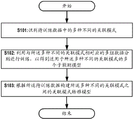
FIG. 1 schematically illustrates a flow diagram of a method for building a predictive model according to one embodiment of the present disclosure;
FIG. 2 schematically illustrates a schematic diagram of sample set formation according to an embodiment of the present disclosure;
FIG. 3 schematically illustrates a flow diagram of association pattern recognition according to one embodiment of the present disclosure;
FIG. 4 schematically illustrates a schematic diagram of data segment partitioning according to one embodiment of the present disclosure;
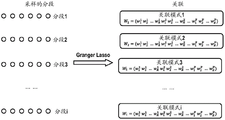
FIG. 5 schematically illustrates a schematic diagram of association pattern learning, according to an embodiment of the present disclosure;
FIG. 6 schematically shows a schematic diagram of similar association pattern merging according to an embodiment of the present disclosure;
FIG. 7 schematically shows a schematic diagram of model training according to an embodiment of the present disclosure;
FIG. 8 schematically illustrates a schematic diagram of an association schema transition model construction according to one embodiment of the present disclosure;
FIG. 9 schematically shows a flow diagram of a method for performing real-time prediction according to an embodiment of the present disclosure;
FIG. 10 schematically illustrates a schematic diagram for a degree of match calculation according to an embodiment of the present disclosure;
FIG. 11 schematically illustrates a schematic diagram of prediction averaging according to one embodiment of the present disclosure;
FIG. 12 schematically illustrates a block diagram of the overall architecture of a prediction system according to one embodiment of the present disclosure;
FIG. 13 schematically illustrates a block diagram of an apparatus for building a predictive model, according to one embodiment of the present disclosure; and
fig. 14 schematically shows a block diagram of an apparatus for performing real-time prediction according to an embodiment of the present disclosure.
Detailed Description
Hereinafter, various exemplary embodiments of the present disclosure will be described in detail with reference to the accompanying drawings. It should be noted that the drawings and the description relate to preferred embodiments by way of example only. It should be noted that from the following description, alternative embodiments of the structures and methods disclosed herein are readily contemplated and may be employed without departing from the principles of the disclosure as claimed in the present disclosure.
It should be understood that these exemplary embodiments are given solely for the purpose of enabling those skilled in the art to better understand and to practice the present disclosure, and are not intended to limit the scope of the present disclosure in any way. Also in the drawings, optional steps, modules, etc. are shown in dashed boxes for illustrative purposes.
The terms "including," comprising, "and the like, as used herein, are to be construed as open-ended terms, i.e.," including/including but not limited to. The term "based on" is "based, at least in part, on". The term "one embodiment" means "at least one embodiment"; the term "another embodiment" means "at least one additional embodiment". Relevant definitions for other terms will be given in the following description.
As mentioned above, in the prior art, the prediction method based on multiple models is still not ideal for real-time prediction, and the accuracy and reliability of the prediction result are still low. In view of this problem, a new technical solution is proposed in the present disclosure, which is a method of dividing and using a plurality of prediction models in combination based on an associated pattern in data. According to the scheme, a plurality of prediction models aiming at a plurality of correlation modes are constructed, and meanwhile, during real-time prediction, the weight of each prediction model is dynamically adjusted according to the matching degree between real-time data and the prediction models, so that the prediction precision is improved.
Hereinafter, a method and apparatus for predictive model construction and real-time prediction according to an embodiment of the present disclosure will be described in detail with reference to the accompanying drawings. It should be noted, however, that this description is for illustrative purposes only, and the present disclosure is not limited to the details in these embodiments and the accompanying drawings. Furthermore, in the following description, embodiments of the present disclosure will be described mainly with reference to air quality prediction. It should be noted, however, that the present disclosure may also find application in other forecasting applications, such as climate forecasting, traffic flow forecasting, and the like.
FIG. 1 schematically shows a flow diagram of a method for building a predictive model according to one embodiment of the present disclosure. As shown in fig. 1, first, in step S101, a plurality of different association patterns in data to be trained are identified. As shown in fig. 2, the data to be trained may be data sampled from the entire historical time series data, including, for example, target data and influencing factor data. The target data is data corresponding to a prediction target, and for example, in the case of PM2.5 prediction, the target data is PM 2.5. The influencing factors are factors influencing the target data, for example in the context of PM2.5 prediction, the influencing factors may be air quality factors such as CO, SO2, traffic conditions, etc.
The time series of target data and its contributing factors is a series of data collected by the data monitoring device, such as a time series of meteorological data, air quality data, traffic data, population density data, pollution source data, and the like. It will be clear that different time series will typically have different scales, acquisition intervals, etc. for different data. Thus, the acquired data may first be preprocessed to convert it into a sample set to be trained. For example, it may be that at different timesThe data acquired (in time) and at different locations (in space) are normalized to a sequence of data having the same time scale, resulting in a sample set. Si=(Xi,Yi) I.e. data to be trained, where XiRepresenting an influencing factor, YiRepresenting the target data. Since the influencing factor is input and the target data is output at the time of prediction, X will also be described hereinafteriCalled input, will YiReferred to as the output.
Influencing factor XiTwo parts may be included, a historical sequence part and a future sequence part. Given a prediction index y and a time step L, X may be setiIs represented as follows:

(formula 1)
This equation represents the prediction of Y by obtaining data at time i + R +1iAnd wherein A historical sequence portion representing the p-th input variable (e.g., air quality, traffic factors such as CO and traffic flow) at time (i + t);
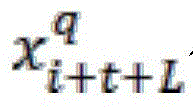 representing the future sequence portion of the qth input variable (e.g., meteorological factors such as wind, humidity) at time (i + t + L).
Yi=yi+R-1+LRepresents the prediction term at (i + R-1+ L), where L is at XiThe subsequent time step; r is the range of input variables, and R is typically greater than the time step L. It should be noted that at time i + R-1, both air quality and traffic data are detected data, and therefore, only historical data up to time i + R-1 can be used; and the meteorological data may be predictive data, so future data up to time (i + R-1+ L) may be used.
Next, a sample set S for training may be targetedi=(Xi,Yi) And executing association pattern recognition. The term "association pattern" herein refers to an association relationship between influencing factors in data to be trained and target data within a certain period of time. The plurality of different association patterns will describe a plurality of different association relationships between the influencing factors in the data to be trained and the target data. Taking the PM2.5 prediction as an example, a first correlation mode may indicate that carbon monoxide CO has a greater impact on PM2.5, a second correlation mode may indicate that traffic conditions have a greater impact on PM2.5, a third correlation mode may indicate that temperature has a greater impact on PM2.5, and so on. Sample data in the same association pattern will have common characteristics and thus these samples will form a particular association pattern.
In the following, the association pattern recognition will be described in detail with reference to an example embodiment in which the association pattern recognition is implemented based on the Granger Lasso method and hierarchical clustering. It should be noted, however, that this is for illustrative purposes only, and that any other suitable means and algorithms for defining and learning the association pattern are possible with the present disclosure.
Referring to fig. 3, first, in step S1011, the data to be trained is divided into a plurality of data segments according to time. This can be achieved, for example, by a sliding time window. Fig. 4 schematically shows a schematic diagram of segmentation according to an embodiment of the present disclosure. As shown in fig. 4, the sliding time window has a fixed length Len of, for example, 8, and the segmentation is shifted, for example, by one sample per time. This way e.g. P segments S can be obtainedeciWherein i is 1 to P. It should be noted, however, that the segment length and the moving step size are given for illustrative purposes, and the disclosure is not limited thereto.
For a given window length Len and sample set (S)1,S2,...,SnThe sample set can be divided into n-len +1 segments, where Seci={Si,Si+1,...,Si+len-1}。
Next, in step S1012, the association pattern of each of the plurality of data segments is learned. In other words, for each data segment, the association pattern of the set of data is learned. A schematic diagram of association pattern learning is shown in fig. 5, according to one embodiment of the present disclosure. In this figure, the Granger Lasso graph model method is used. The objective function of the Granger Lasso graph model method can be represented by the following equation:

(formula 2)
Wherein Is a vector of input data, which is formed by time-series variables xiA piece of data; y is the corresponding output;
 is a coefficient vector that reflects a particular input xiAn association with output y; n is the number of samples of each data segment to be trained, and lambda is a regular term coefficient.
Applying the Granger Lasso method to each data segment SeciIn order to learn the association between the input and the output. The result will be for each data segment SeciObtain a corresponding weight vector WiWherein As shown in fig. 5. Herein Sec will beiIs denoted as PiAnd using the weight vector WiAs an association pattern PiThe feature space of (1).
Then, in step S1013, the plurality of different association patterns are determined by merging the similar association patterns and the corresponding data segments. For the multiple association patterns obtained in FIG. 5, one canSo as to determine the similarity between them, and based on the similarity threshold value, combine these association modes, and finally obtain several different association modes PA-PQ。
In one embodiment according to the present disclosure, the similarity between the association patterns may be calculated by a weight of each element in the feature space. The similarity can be measured, for example, by the equation given below:

(formula 3)
Through the formula, two association modes W can be determinediAnd WjThe similarity between them.
In one embodiment according to the present disclosure, the association patterns are clustered using hierarchical clustering. In particular, in the initial state, each association pattern PiIndependently of one another, i.e. Ci=Pi. Thereafter, the clustering tree is constructed layer by layer, and the two most similar current clusters are grouped into a new pattern class in each layer, as shown in fig. 6. Two classes CaAnd CbThe similarity between them can be defined as follows:
Sim_Ca,b=max{Sim_Pi,j|Pi∈Ca,Pj∈Cb}
(formula 4)
In addition, Sim _ C is defined as abovea,bThe smaller, class CaAnd CbThe more similar. For a predetermined similarity threshold δ, when min { Sim _ C _ appears in a layera,bWhen the } is larger than the delta, the layer of clustering stops, which indicates that the similarities between the classes are enough. Suppose two classes Ca、CbMerge into a new class Cab(the corresponding new association pattern is denoted as Pab) Then the sample data corresponding to the two classes are merged together, and the association pattern corresponding to the sample is updated to Pab。
Finally, suppose we have obtained a cluster of K association patterns, denoted as And calculating a new weight vector by using the Granger Lasso method again for the data in each cluster. This will result in K corresponding weight vectors
 The K weight vectors
 Is the corresponding association pattern
 The feature space of (1).
In this way, a plurality of different association patterns in the data to be trained can be identified, for example, by the method shown in fig. 3.
Continuing reference is now made back to fig. 1. As shown in fig. 1, after a plurality of different association patterns in the data to be trained are identified, in step S102, the group data packets may be trained respectively by using the plurality of different association patterns, so as to obtain a plurality of sub-prediction models applicable to the plurality of different association patterns. For example, K prediction models may be trained for the obtained K association patterns and their corresponding K data packets, respectively, as shown in fig. 7. The prediction model can be selected differently according to the data condition, if the data volume in the grouping is small, a Lasso regression model is used, and if the data volume is large, a deep neural network model can be used. The Lasso regression model will be described as an example. For K association patterns, K Lasso regression models can be learned. Set for sample Seti={Si1,Si2,...,SimOf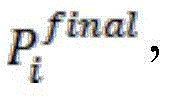 The objective function of the Lasso regression model can be expressed as:

(formula 5)
In the case of a selected predictive model, training the model using the data to be trained may employ any suitable method known to those skilled in the art. Therefore, a detailed description thereof will not be provided herein for the sake of simplicity.
Next, in step S103, an association pattern transfer model between multiple different association patterns is constructed according to the data to be trained. The association pattern transition model describes a model of a pattern transition law between the plurality of different association patterns, for example, may describe a probability of a pattern transition between the plurality of different association patterns. Based on the model, for example, the probability of one association pattern transitioning to a respective association pattern in the next step can be determined.
In one embodiment of the disclosure, a transition matrix between the plurality of different association modes is determined according to the data to be trained by using a Markov chain model according to a maximum likelihood principle. It should be noted, however, that any other suitable technique may be used to construct the association schema transition model. In particular, for each historical sample, there is a corresponding association pattern, so that for the set of samples a sequence of association patterns is obtained:
{S1,S2,...,Sn}→{P(1),P(2),...,P(n)},
(formula 6)
Wherein StIs the sample at time t; p (t) is the association pattern at time t. According to the Markov chain model, the first order transition matrix A can be calculated as follows according to the maximum likelihood estimation principle:

(formula 7)
Wherein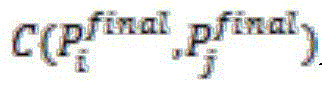 To represent
 Is transferred to
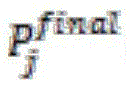 The number of times. This results in an associated schema transition model, such as that shown in FIG. 8. It should be noted, however, that although a first order transition matrix is given in
 equation 5 above, the present disclosure is not so limited and higher order matrices may be employed.
Thus, by the method given above, sub-prediction models suitable for a plurality of different modes can be obtained, and a mode transition model between a plurality of different associated modes is obtained. The pattern transition model may be used to determine a degree of match between the plurality of different sub-prediction models and the data to be predicted during the prediction process. Thus, when prediction is performed, the weight of each prediction sub-model can be dynamically adjusted based on the matching degree of the real-time data to be predicted and each sub-prediction model. Hereinafter, a method for performing real-time prediction provided in the present disclosure will be described with continued reference to fig. 9 to 11.
Referring to fig. 9, first, in step S901, prediction is performed on real-time data using a plurality of different sub-prediction models to obtain a plurality of initial prediction results. The plurality of different sub-prediction models are respectively applicable to a plurality of different association modes. Therefore, the sub-prediction model used at this step is different from the plurality of prediction models used in the conventional method. The plurality of prediction models used in the conventional method are a plurality of prediction models obtained by training randomly divided data packets, and the plurality of sub-prediction models in the present disclosure are sub-models for respective different association modes. When the monitored real-time data is input, the prediction can be respectively executed by utilizing a plurality of different sub-prediction models obtained in the training stage, so that a plurality of initial prediction results can be obtained.
Next, in step S902, a matching degree between the real-time data and the plurality of different sub-prediction models may be determined based on a correlation pattern transition model between the plurality of different correlation patterns. For example, for real-time data S at time ttThe data sequence a time before the time t is St-k,...,St-1And the corresponding association pattern sequence is { P { t-k },. The P (t-1) }. Subscripts used herein to indicate P (t), e.g. idx (t)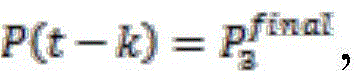 Idx (t-k) ═ 3); using f (j) indications
 F (j) can be expressed as:

(formula 8)
Wherein A is(t-i)Is a (t-i) -order transfer matrix and can be calculated as a C-K function A(n)=A(n-1)A. Thus, for real-time data StThe probability of belonging to each association pattern is f (i).
In one approach according to the present disclosure, the probability f (i) is used directly to represent the real-time data StDegree of match D with associated patterniI.e. DiF (i). However, it should be noted that the present disclosure is not limited thereto. In fact, the degree of matching DiOr a value calculated by other means based on the probability f (i). In other words degree of matching DiMay be a function of the probabilities f (i). Degree of matching DiReflects the real-time data StThe magnitude of the probability of belonging to a particular association pattern. DiThe larger the real-time data is, the more matched the association pattern is. Thus, DiLarger means thatThe real-time data is more closely matched to the prediction model applicable to the correlation pattern, the higher the reliability of the prediction model. One example of the matching degree calculation will be described below with reference to fig. 10.
Referring to fig. 10, a diagram schematically illustrating a calculation for a degree of matching is shown, according to an embodiment of the present disclosure. As shown in fig. 10, for real-time data S100Three samples S whose previous time is the nearest99,S98And S97Respectively has an association pattern of P2、P3And P1. Based on the correlation pattern and transition probability matrix of these three samples, and using the transition probability calculation formula shown in equation 6, the real-time sample S can be determined100The degrees of matching with P1, P2, P3, and P4 were 0.79, 1.08, 0.47, and 0.66, respectively. That is, the real-time data S100Having the greatest degree of matching with the associated pattern P2 and the smallest degree of matching with the associated pattern P3.
Referring back to fig. 9, then in step S903, the multiple initial prediction results are weighted-averaged based on the matching degree to determine a final prediction result for the real-time data. For example, for K initial predictors, the initial predictors may be weighted averaged with K corresponding associated pattern matching degrees.
This prediction result averaging can be performed, for example, in the following manner. First, normalization may be performed for the resulting K matching degrees, which may be given by the following equation:

(formula 9)
The weighted average is then performed using the normalized degree of match, so that the final output can be represented by the following equation:
Rfinal=ΣD_normi·Ri
wherein R isiIndicating utilization of multiple prediction modesAnd (4) modeling the obtained multiple predicted results.
For purposes of illustration, a schematic diagram of a weighted average of prediction results according to one embodiment of the present disclosure is shown in fig. 11. As shown in fig. 11, the initial prediction results a to Q are weighted and averaged by using the corresponding matching values (0.79,0.47, …, 1.08), and the weighted and averaged output is used as the final prediction result. Finally, the final prediction results may be stored in real time.
It should be noted that, in the above description, step S901 is described as being operated before S902. However, the present disclosure is not limited thereto, and it is also possible to perform step S902 before step S901, or perform both steps in parallel in practice.
A block diagram of the overall architecture of a prediction system according to one embodiment of the present disclosure will be described below with reference to fig. 12 to enable a person skilled in the art to have a deeper understanding of the overall architecture of the prediction system of the present disclosure. As shown in fig. 12, the prediction system architecture may be divided into a training process and a prediction process, wherein the training process is trained using historical data to determine a plurality of sub-prediction models for a plurality of different association patterns and an association transfer model between the plurality of different association patterns. In the prediction phase, prediction will be performed based on the prediction model and the associated pattern transition model obtained in the training process.
Specifically, as shown in fig. 12, in the training process, preprocessing is first performed on the history data so as to perform normalization on various data. Then, performing association pattern recognition, for example, dividing the data into P data segments by sliding the time window, and then learning an association pattern of each data segment; and then combining the similar association modes to further obtain K association modes. Then, for each association mode, training is performed by using the corresponding data packet, and a plurality of prediction models, namely prediction models a to K, are obtained. Meanwhile, an association mode transfer model among K different association modes can be constructed according to historical data. In the prediction process, aiming at the collected real-time data, the real-time prediction is executed based on a plurality of prediction models obtained in the training stage, and then a plurality of initial prediction results are obtained, namely a prediction result A to a prediction result K. Meanwhile, the degree of matching between the real-time data and the plurality of prediction models may be calculated, for example, based on equation 5 and the associated pattern transition model. And then carrying out weighted average on the prediction results A to K based on the calculated matching degree, and finally outputting the prediction results subjected to weighted average as final prediction results.
As can be seen from the above description of the embodiments of the present disclosure, in the present disclosure, a plurality of predictor models corresponding to a plurality of association patterns that reflect the characteristics of the data itself can be obtained. Therefore, during real-time prediction, the weight of each predictor model can be dynamically adjusted based on the data characteristics of the real-time data, so that the prediction precision can be improved.
In the above, the method for constructing the prediction model and the method for real-time prediction provided in the present disclosure are described. In addition, the present disclosure also provides an apparatus for constructing a prediction model and an apparatus for performing real-time prediction. These devices will be described in detail below with reference to fig. 13 and 14.
FIG. 13 shows a block diagram of an apparatus for building a predictive model according to one embodiment of the present disclosure. The apparatus 1300 includes a pattern recognition module 1310, a model training module 1320, and a model construction module 1330. The pattern recognition module 1310 may be configured to recognize a plurality of different association patterns in the data to be trained, where the plurality of different association patterns describe a plurality of different association relationships between influencing factors in the data to be trained and target data. The model training module 1320 may be configured to train with multiple sets of data corresponding to the multiple different association patterns, respectively, to obtain multiple sub-prediction models applicable to the multiple different association patterns. The model construction module 1330 can be configured to construct a correlation pattern transfer model between the plurality of different correlation patterns according to the data to be trained, wherein the correlation pattern transfer model is used to determine matching degrees between the plurality of different sub-prediction models and the data to be predicted in a prediction process. The association pattern transition model may describe a pattern transition law between the plurality of different association patterns. In particular, in one embodiment, the association pattern transition model may describe the probability of a pattern transition between the plurality of different association patterns.
In addition, the pattern recognition module 1310 can further include a data partitioning module 1312, a pattern learning module 1314, and a pattern determination module 1316. The data dividing module 1312 may be configured to divide the data to be trained into a plurality of data segments according to time. The pattern learning module 1314 may be configured to learn an association pattern for each of the plurality of data segments. The pattern determination module 1316 may be configured to determine the plurality of different association patterns by merging similar association patterns with corresponding data segments.
Additionally, the pattern determination module 1316 is further configured to determine the plurality of different association patterns by clustering the association patterns of the respective data segments based on hierarchical clustering.
In one embodiment, the model building module 1330 may be configured to: and determining a transfer matrix among the various different association modes according to the data to be trained by utilizing a Markov chain model according to a maximum likelihood principle.
Referring next to fig. 14, fig. 14 schematically illustrates a block diagram of an apparatus for real-time prediction according to an embodiment of the present disclosure. As shown in fig. 14, the apparatus 1400 includes a result prediction module 1410, a degree of match determination module 1420, and a result averaging module 1430. The result prediction module 1410 may be configured to perform prediction on real-time data using a plurality of different sub-prediction models to obtain a plurality of initial prediction results, wherein the plurality of different sub-prediction models are respectively applicable to a plurality of different association modes. The degree of matching determination module 1420 may be configured to determine a degree of matching between the real-time data and the plurality of different sub-prediction models based on a correlation pattern transfer model between the plurality of different correlation patterns. The result averaging module 1430 may be configured to perform a weighted average of the plurality of initial predictors based on the degree of match to determine a predictor for the real-time data. The plurality of different sub-prediction models may be obtained by identifying the plurality of different association patterns in the data to be trained and performing training using sets of data corresponding to the plurality of different association patterns, respectively. In addition, the association pattern transition model may describe a pattern transition law between the plurality of different association patterns. In particular, in one embodiment, the association pattern transition model may describe the probability of a pattern transition between the plurality of different association patterns.
Further, the degree of match determination module 1420 may be configured to: determining the degree of matching by calculating a probability that the real-time data is in each of the plurality of different association patterns according to an association pattern of data preceding the real-time data and a probability of pattern transition between the plurality of different association patterns.
It is noted that the respective modules in the devices 1300 and 1400 described above with reference to fig. 13 and 14 may be configured to perform operations corresponding to the methods described with reference to fig. 1 to 12. Accordingly, the specific operation of the various modules of the devices 1300 and 1400 will not be described in detail herein. For details of the specific operation of these modules, reference may be made to the description of the individual steps of the respective methods in connection with fig. 1 to 12.
It is further understood that embodiments of the present disclosure may be implemented in software, hardware, or a combination of software and hardware. The hardware portions may be implemented using dedicated logic; the software portions may be stored in a memory and executed by a suitable instruction execution system, such as a microprocessor or specially designed hardware. It will be appreciated by those of ordinary skill in the art that the methods and apparatus described above may be implemented using computer executable instructions and/or embodied in processor control code, such code provided, for example, on a carrier medium such as a disk, CD or DVD-ROM, programmable memory such as read only memory (firmware), or a data carrier such as an optical or electronic signal carrier. The apparatus and its components of the present embodiment may be implemented by hardware circuits such as a very large scale integrated circuit or gate array, a semiconductor such as a logic chip, a transistor, or a programmable hardware device such as a field programmable gate array, a programmable logic device, or the like, or may be implemented by software executed by various types of processors, or may be implemented by a combination of the above hardware circuits and software, for example, by firmware.
While the present disclosure has been described with reference to presently contemplated embodiments, it is to be understood that the disclosure is not limited to the disclosed embodiments. On the contrary, the disclosure is intended to cover various modifications and equivalent arrangements included within the spirit and scope of the appended claims. The scope of the following claims is to be accorded the broadest interpretation so as to encompass all such modifications and equivalent structures and functions.
Claims (18)
1. A method for performing real-time prediction, comprising:
performing prediction on real-time data by utilizing a plurality of different sub-prediction models to obtain a plurality of initial prediction results, wherein the plurality of different sub-prediction models are respectively suitable for a plurality of different association modes, the real-time data is air quality data, the plurality of different association modes represent a plurality of different association relations between target data and a plurality of influence factors, the target data is PM2.5, and the plurality of influence factors at least comprise carbon monoxide, sulfur dioxide and traffic conditions;
determining a degree of match between the real-time data and the plurality of different sub-prediction models based on a correlation pattern transfer model between the plurality of different correlation patterns; and
determining a prediction result for the real-time data based on the match and the plurality of initial prediction results, the prediction result representing an air quality prediction.
2. The method of claim 1, wherein the plurality of different sub-predictive models are derived by identifying the plurality of different association patterns in the data to be trained and training with respective sets of data corresponding to the plurality of different association patterns.
3. The method of claim 2, wherein the plurality of different sub-prediction models are derived by a training process comprising:
identifying the multiple different association modes in the data to be trained, wherein the multiple different association modes describe multiple different association relations between influencing factors in the data to be trained and target data; and
and respectively training by utilizing multiple groups of data corresponding to the multiple different association modes to obtain the multiple sub-prediction models suitable for the multiple different association modes.
4. The method of claim 3, wherein the identifying a plurality of different association patterns in data to be trained comprises:
dividing the data to be trained into a plurality of data segments according to time;
learning an association pattern for each of the plurality of data segments; and
the plurality of different association patterns are determined by combining similar association patterns and corresponding data segments.
5. The method of claim 4, wherein the determining the plurality of different association patterns comprises: and clustering the association modes of the data segments based on hierarchical clustering.
6. The method according to any one of claims 3 to 5, wherein the correlation pattern transfer model is obtained by:
and constructing an association mode transfer model among the plurality of different association modes according to the data to be trained.
7. The method of claim 6, wherein constructing an association pattern transfer model between the plurality of different association patterns from the data to be trained comprises: and determining a transfer matrix among the various different association modes according to the data to be trained by utilizing a Markov chain model according to a maximum likelihood principle.
8. The method of claim 1 or 2, wherein the association pattern transition model describes probabilities of pattern transitions between the plurality of different association patterns.
9. The method of claim 8, wherein the determining a degree of match between the real-time data and the plurality of different sub-prediction models based on an association pattern transfer model comprises: determining the degree of matching by calculating a probability that the real-time data is in each of the plurality of different association patterns according to an association pattern of data preceding the real-time data and a probability of pattern transition between the plurality of different association patterns.
10. An apparatus for performing real-time prediction, comprising:
a result prediction module configured to perform prediction on real-time data by using a plurality of different sub-prediction models to obtain a plurality of initial prediction results, wherein the plurality of different sub-prediction models are respectively applicable to a plurality of different association modes, the real-time data is air quality data, the plurality of different association modes represent a plurality of different association relations between target data and a plurality of influence factors, the target data is PM2.5, and the plurality of influence factors at least include carbon monoxide, sulfur dioxide and traffic conditions;
a matching degree determination module configured to determine a matching degree between the real-time data and the plurality of different sub-prediction models based on a correlation pattern transfer model between the plurality of different correlation patterns; and
a result averaging module configured to determine a prediction result for the real-time data based on the match and the plurality of initial prediction results, the prediction result representing an air quality prediction.
11. The apparatus of claim 10, wherein the plurality of different sub-predictive models are derived by identifying the plurality of different association patterns in the data to be trained and training with respective sets of data corresponding to the plurality of different association patterns.
12. The apparatus of claim 11, further comprising:
a pattern recognition module configured to recognize the plurality of different association patterns in the data to be trained, wherein the plurality of different association patterns describe a plurality of different association relationships between influencing factors in the data to be trained and target data; and
a model training module configured to perform training using multiple sets of data corresponding to the multiple different association modes, respectively, to obtain the multiple sub-prediction models applicable to the multiple different association modes.
13. The apparatus of claim 12, wherein the pattern recognition module further comprises:
the data dividing module is configured to divide the data to be trained into a plurality of data segments according to time;
a pattern learning module configured to learn an association pattern of each of the plurality of data segments; and
a pattern determination module configured to determine the plurality of different association patterns by merging similar association patterns and corresponding data segments.
14. The apparatus of claim 13, wherein the mode determination module is further configured for: and clustering the association modes of the data segments based on hierarchical clustering.
15. The apparatus of any of claims 12 to 14, further comprising a model building module configured to: and constructing an association mode transfer model among the plurality of different association modes according to the data to be trained.
16. The apparatus of claim 15, wherein the model building module is configured to: and determining a transfer matrix among the various different association modes according to the data to be trained by utilizing a Markov chain model according to a maximum likelihood principle.
17. The apparatus of claim 10 or 11, wherein the association pattern transition model describes probabilities of pattern transitions between the plurality of different association patterns.
18. The device of claim 17, wherein the degree of match determination module is configured to: determining the degree of matching by calculating a probability that the real-time data is in each of the plurality of different association modes according to an association mode of data preceding the real-time data and a probability of mode transition between the plurality of different association modes.
Priority Applications (1)
| Application Number | Priority Date | Filing Date | Title |
|---|---|---|---|
| CN201510778908.XA CN106709588B (en) | 2015-11-13 | 2015-11-13 | Prediction model construction method and device and real-time prediction method and device |
Applications Claiming Priority (1)
| Application Number | Priority Date | Filing Date | Title |
|---|---|---|---|
| CN201510778908.XA CN106709588B (en) | 2015-11-13 | 2015-11-13 | Prediction model construction method and device and real-time prediction method and device |
Publications (2)
| Publication Number | Publication Date |
|---|---|
| CN106709588A CN106709588A (en) | 2017-05-24 |
| CN106709588B true CN106709588B (en) | 2022-05-17 |
Family
ID=58931354
Family Applications (1)
| Application Number | Title | Priority Date | Filing Date |
|---|---|---|---|
| CN201510778908.XA Active CN106709588B (en) | 2015-11-13 | 2015-11-13 | Prediction model construction method and device and real-time prediction method and device |
Country Status (1)
| Country | Link |
|---|---|
| CN (1) | CN106709588B (en) |
Families Citing this family (10)
| Publication number | Priority date | Publication date | Assignee | Title |
|---|---|---|---|---|
| CN107688872A (en) * | 2017-08-20 | 2018-02-13 | 平安科技(深圳)有限公司 | Forecast model establishes device, method and computer-readable recording medium |
| CN110968889B (en) * | 2018-09-30 | 2024-12-10 | 中兴通讯股份有限公司 | Data protection method, device, apparatus and computer storage medium |
| CN111197838A (en) * | 2018-10-31 | 2020-05-26 | Tcl集团股份有限公司 | Air conditioner energy-saving control method and device and server |
| CN110414713A (en) * | 2019-06-27 | 2019-11-05 | 电子科技大学 | A real-time runoff prediction method based on synchronous data stream compression |
| KR102228442B1 (en) * | 2019-08-14 | 2021-03-16 | (주)호모미미쿠스 | Scheme based ideation platform and case reuse based knowledge recommendation method |
| CN111000544B (en) * | 2019-11-22 | 2021-07-16 | 北京航空航天大学 | Construction method and system of hybrid continuous blood pressure measurement model based on PPG waveform |
| CN111242280A (en) * | 2020-01-06 | 2020-06-05 | 北京拙河科技有限公司 | A combined method, device and computer equipment of a deep reinforcement learning model |
| CN115576502B (en) * | 2022-12-07 | 2023-04-28 | 苏州浪潮智能科技有限公司 | Data storage method and device, electronic equipment and storage medium |
| CN117688501A (en) * | 2024-02-03 | 2024-03-12 | 南京创蓝科技有限公司 | A method for correcting errors in air quality forecasting systems |
| CN119313110B (en) * | 2024-12-16 | 2025-05-30 | 珠海派诺科技股份有限公司 | Airport energy consumption monitoring management system and method |
Citations (6)
| Publication number | Priority date | Publication date | Assignee | Title |
|---|---|---|---|---|
| JP2009086706A (en) * | 2007-09-27 | 2009-04-23 | Fujitsu Ltd | Model creation support system, model creation support method, model creation support program |
| CN103426026A (en) * | 2013-09-10 | 2013-12-04 | 信阳师范学院 | Method for forecasting hybrid neural network and recognizing scenic spot meteorological elements |
| CN103473460A (en) * | 2013-09-16 | 2013-12-25 | 华东理工大学 | Yield prediction and raw material optimization method for liquefied petroleum gas cracking key product |
| CN104714977A (en) * | 2013-12-17 | 2015-06-17 | 日本电气株式会社 | Correlating method and device for entities and knowledge base items |
| CN104850531A (en) * | 2014-02-19 | 2015-08-19 | 日本电气株式会社 | Method and device for establishing mathematical model |
| CN104866932A (en) * | 2015-06-12 | 2015-08-26 | 哈尔滨工业大学 | Time series prediction method based on prediction model applicability judgment |
-
2015
- 2015-11-13 CN CN201510778908.XA patent/CN106709588B/en active Active
Patent Citations (6)
| Publication number | Priority date | Publication date | Assignee | Title |
|---|---|---|---|---|
| JP2009086706A (en) * | 2007-09-27 | 2009-04-23 | Fujitsu Ltd | Model creation support system, model creation support method, model creation support program |
| CN103426026A (en) * | 2013-09-10 | 2013-12-04 | 信阳师范学院 | Method for forecasting hybrid neural network and recognizing scenic spot meteorological elements |
| CN103473460A (en) * | 2013-09-16 | 2013-12-25 | 华东理工大学 | Yield prediction and raw material optimization method for liquefied petroleum gas cracking key product |
| CN104714977A (en) * | 2013-12-17 | 2015-06-17 | 日本电气株式会社 | Correlating method and device for entities and knowledge base items |
| CN104850531A (en) * | 2014-02-19 | 2015-08-19 | 日本电气株式会社 | Method and device for establishing mathematical model |
| CN104866932A (en) * | 2015-06-12 | 2015-08-26 | 哈尔滨工业大学 | Time series prediction method based on prediction model applicability judgment |
Non-Patent Citations (1)
| Title |
|---|
| 基于数据挖掘的空气质量预测模型研究与实现;许辉;《中国优秀博硕士学位论文全文数据库(硕士) 信息科技辑》;20110815(第8期);全文 * |
Also Published As
| Publication number | Publication date |
|---|---|
| CN106709588A (en) | 2017-05-24 |
Similar Documents
| Publication | Publication Date | Title |
|---|---|---|
| CN106709588B (en) | Prediction model construction method and device and real-time prediction method and device | |
| Behrmann et al. | Unified fully and timestamp supervised temporal action segmentation via sequence to sequence translation | |
| CN113570859B (en) | A Traffic Flow Prediction Method Based on Asynchronous Space-Time Dilated Graph Convolutional Networks | |
| Grolinger et al. | Energy consumption prediction with big data: Balancing prediction accuracy and computational resources | |
| CN113033643A (en) | Concept drift detection method and system based on weighted sampling and electronic equipment | |
| Bai et al. | Travel-time prediction methods: a review | |
| CN117041017B (en) | Intelligent operation and maintenance management methods and systems for data centers | |
| US20230368002A1 (en) | Multi-scale artifical neural network and a method for operating same for time series forecasting | |
| CN119313962A (en) | A trajectory prediction method and device based on spatiotemporal graph neural network learning model | |
| CN114925938A (en) | A method and device for predicting the operating state of an electric energy meter based on an adaptive SVM model | |
| CN115240871B (en) | A method for epidemic prediction based on deep embedding clustering meta-learning | |
| Benabdallah Benarmas et al. | A deep learning-based framework for road traffic prediction: RB Benarmas, K. Beghdad Bey | |
| CN115130788A (en) | Big data analysis-based power utilization prediction system | |
| Tian et al. | Traffic flow prediction based on improved deep extreme learning machine | |
| CN119557802B (en) | Time sequence prediction method and system based on exception handling | |
| Alam | Recurrent neural networks in electricity load forecasting | |
| CN120220470A (en) | A flight trajectory prediction method integrating spatial perception and time-frequency conversion | |
| CN120260263A (en) | An adaptive traffic flow prediction method based on multi-time step graph | |
| CN114692886A (en) | Model training method and system, and storage medium | |
| CN114463978B (en) | Data monitoring method based on track traffic information processing terminal | |
| CN111160419B (en) | Deep learning-based electronic transformer data classification prediction method and device | |
| CN117609790A (en) | Training behavior sequence prediction model, and method and device for predicting behavior sequence | |
| Eranga | Lstm based framework for time series anomaly detection | |
| Quan et al. | Real-time prediction method of bridge technical status in complex environment based on dynamic Bayesian network | |
| CN119399954B (en) | A traffic flow prediction method based on multi-scale lead-lag relationship modeling |
Legal Events
| Date | Code | Title | Description |
|---|---|---|---|
| PB01 | Publication | ||
| PB01 | Publication | ||
| SE01 | Entry into force of request for substantive examination | ||
| SE01 | Entry into force of request for substantive examination | ||
| GR01 | Patent grant | ||
| GR01 | Patent grant |