CN106658733B - Throughput optimization method based on user fairness and QoS in multi-user MIMO-OFDM - Google Patents
Throughput optimization method based on user fairness and QoS in multi-user MIMO-OFDM Download PDFInfo
- Publication number
- CN106658733B CN106658733B CN201611231603.8A CN201611231603A CN106658733B CN 106658733 B CN106658733 B CN 106658733B CN 201611231603 A CN201611231603 A CN 201611231603A CN 106658733 B CN106658733 B CN 106658733B
- Authority
- CN
- China
- Prior art keywords
- user
- subcarrier
- users
- gbr
- throughput
- Prior art date
- Legal status (The legal status is an assumption and is not a legal conclusion. Google has not performed a legal analysis and makes no representation as to the accuracy of the status listed.)
- Active
Links
Images


Classifications
-
- H—ELECTRICITY
- H04—ELECTRIC COMMUNICATION TECHNIQUE
- H04W—WIRELESS COMMUNICATION NETWORKS
- H04W72/00—Local resource management
- H04W72/04—Wireless resource allocation
- H04W72/044—Wireless resource allocation based on the type of the allocated resource
- H04W72/0453—Resources in frequency domain, e.g. a carrier in FDMA
-
- H—ELECTRICITY
- H04—ELECTRIC COMMUNICATION TECHNIQUE
- H04B—TRANSMISSION
- H04B7/00—Radio transmission systems, i.e. using radiation field
- H04B7/02—Diversity systems; Multi-antenna system, i.e. transmission or reception using multiple antennas
- H04B7/04—Diversity systems; Multi-antenna system, i.e. transmission or reception using multiple antennas using two or more spaced independent antennas
- H04B7/0413—MIMO systems
- H04B7/0452—Multi-user MIMO systems
-
- H—ELECTRICITY
- H04—ELECTRIC COMMUNICATION TECHNIQUE
- H04L—TRANSMISSION OF DIGITAL INFORMATION, e.g. TELEGRAPHIC COMMUNICATION
- H04L5/00—Arrangements affording multiple use of the transmission path
- H04L5/0001—Arrangements for dividing the transmission path
- H04L5/0014—Three-dimensional division
- H04L5/0023—Time-frequency-space
-
- H—ELECTRICITY
- H04—ELECTRIC COMMUNICATION TECHNIQUE
- H04W—WIRELESS COMMUNICATION NETWORKS
- H04W72/00—Local resource management
- H04W72/04—Wireless resource allocation
- H04W72/044—Wireless resource allocation based on the type of the allocated resource
- H04W72/0473—Wireless resource allocation based on the type of the allocated resource the resource being transmission power
-
- H—ELECTRICITY
- H04—ELECTRIC COMMUNICATION TECHNIQUE
- H04W—WIRELESS COMMUNICATION NETWORKS
- H04W72/00—Local resource management
- H04W72/50—Allocation or scheduling criteria for wireless resources
- H04W72/53—Allocation or scheduling criteria for wireless resources based on regulatory allocation policies
-
- H—ELECTRICITY
- H04—ELECTRIC COMMUNICATION TECHNIQUE
- H04W—WIRELESS COMMUNICATION NETWORKS
- H04W72/00—Local resource management
- H04W72/50—Allocation or scheduling criteria for wireless resources
- H04W72/54—Allocation or scheduling criteria for wireless resources based on quality criteria
- H04W72/543—Allocation or scheduling criteria for wireless resources based on quality criteria based on requested quality, e.g. QoS
-
- H—ELECTRICITY
- H04—ELECTRIC COMMUNICATION TECHNIQUE
- H04W—WIRELESS COMMUNICATION NETWORKS
- H04W72/00—Local resource management
- H04W72/50—Allocation or scheduling criteria for wireless resources
- H04W72/56—Allocation or scheduling criteria for wireless resources based on priority criteria
Landscapes
- Engineering & Computer Science (AREA)
- Signal Processing (AREA)
- Computer Networks & Wireless Communication (AREA)
- Quality & Reliability (AREA)
- Mobile Radio Communication Systems (AREA)
Abstract
本发明公开了多用户MIMO‑OFDM中基于用户公平性和QoS的吞吐量优化方法,包括:推导获得单个子载波支持的传输速率,及确定每个子载波可容纳最大用户数;将用户分成GBR用户和非GBR用户,根据当前用户的业务状态定义各自的优先级权重;定义吞吐量优化模型;利用所定义吞吐量优化模型根据用户的优先级权重进行子载波的分配,具体为:对GBR用户所需分配的GBR业务按业务优先级权重进行排序,依次为每个业务进行子载波的平行信道分配;对于剩余的子载波的平行信道,以比例公平调度算法分配给Non‑GBR业务;利用注水算法对每个用户子载波的功率进行优化分配。本发明结合子载波分配、功率分配两步进行系统吞吐量的优化,大大降低了算法复杂度,增加了资源优化的灵活性。

The invention discloses a throughput optimization method based on user fairness and QoS in multi-user MIMO-OFDM, including: deriving a transmission rate supported by a single subcarrier, and determining the maximum number of users that each subcarrier can accommodate; dividing users into GBR users and non-GBR users, define their respective priority weights according to the current user's service status; define a throughput optimization model; use the defined throughput optimization model to allocate sub-carriers according to the user's priority weight, specifically: The GBR services to be allocated are sorted according to the priority weight of the services, and the parallel channels of the sub-carriers are allocated for each service in turn; for the parallel channels of the remaining sub-carriers, the non-GBR services are allocated by the proportional fair scheduling algorithm; the water-filling algorithm is used Optimal allocation of power to each user subcarrier. The invention combines the two steps of subcarrier allocation and power allocation to optimize the system throughput, which greatly reduces the complexity of the algorithm and increases the flexibility of resource optimization.
Description
技术领域technical field
本发明涉及一种多用户MIMO-OFDM中基于用户公平性和QoS的吞吐量优化方法,属于无线通信系统的MIMO-OFDM吞吐量优化的技术领域。The invention relates to a throughput optimization method based on user fairness and QoS in multi-user MIMO-OFDM, and belongs to the technical field of MIMO-OFDM throughput optimization of wireless communication systems.
背景技术Background technique
随着无线通信的飞速发展以及移动终端数量的增加,用户对于高速数据传输的要求越来越迫切。为了容纳更多的用户,提供更高质量的服务,无线通信对系统的吞吐量、用户服务质量等各方面提出了更高的要求。With the rapid development of wireless communication and the increase in the number of mobile terminals, users' requirements for high-speed data transmission are becoming more and more urgent. In order to accommodate more users and provide higher quality services, wireless communication puts forward higher requirements on system throughput, user service quality and other aspects.
在无线通信系统中,MIMO和OFDM技术作为LTE中的两项关键技术,在过去一段时间内一直受到很大的关注。MIMO技术通过引入空分多址,可以在不增加带宽或总发送功率的情况下大幅度地增加系统吞吐量(throughput)。其核心在于:利用收发两端多天线之间的空间自由度,建立多个平行的独立信道来抑制信道衰落,进行数据传输,通过空分复用或者用户分集达到提高系统容量的目的。OFDM(Orthogonal Frequency DivisionMultiplexing)即正交频分复用技术,它是一种可靠的的高速数字数据传输技术,能够适合存在多径效应和多普勒频移的复杂无线信道。这是因为OFDM采用了多条正交子载波代替的单一频率的无线信道,将高速数据信号转换成并行的低速子数据流,调制到在每个子信道上进行传输,利用其正交性减少子信道之间的相互干扰(ISI)。由于每个子信道上的信号带宽小于信道的相关带宽,因此每个子信道上可以看成平坦性衰落。故OFDM技术可以有效抑制多径效应,消除码间串扰,减轻频率选择性衰落的影响,大大提高无线信道的资源利用率。In wireless communication systems, MIMO and OFDM technologies, as two key technologies in LTE, have been receiving great attention in the past period of time. MIMO technology can greatly increase system throughput without increasing bandwidth or total transmit power by introducing spatial division multiple access. Its core lies in: using the spatial freedom between multiple antennas at both ends of the transceiver to establish multiple parallel independent channels to suppress channel fading, perform data transmission, and improve system capacity through space division multiplexing or user diversity. OFDM (Orthogonal Frequency Division Multiplexing) is an Orthogonal Frequency Division Multiplexing technology, which is a reliable high-speed digital data transmission technology and can be suitable for complex wireless channels with multipath effects and Doppler frequency shifts. This is because OFDM uses a single-frequency wireless channel instead of multiple orthogonal sub-carriers, converts high-speed data signals into parallel low-speed sub-data streams, modulates them for transmission on each sub-channel, and uses its orthogonality to reduce sub-channels. Inter-channel Interference (ISI). Since the signal bandwidth on each sub-channel is smaller than the correlation bandwidth of the channel, flat fading can be seen on each sub-channel. Therefore, OFDM technology can effectively suppress multipath effects, eliminate inter-symbol crosstalk, reduce the influence of frequency selective fading, and greatly improve the resource utilization rate of wireless channels.
多用户MIMO-OFDM系统中,资源分配是提高频谱效率的关键技术之一,由于不同种类业务对QoS速率、时延等要求各不相同,因此在保证QoS要求的前提下优化吞吐量一直是MIMO系统资源分配的热点。然而,由于业务种类繁多,在最大化吞吐量的目标下,同时保证不同业务的速率和时延会造成约束条件过多,因此多数文献只是简单考虑了时延或者速率其一,没有对业务QoS提供精细化的保证。另一方面,由于不同通信链路的信道状况不一,一味的追求吞吐量,将资源分配给信道条件好的用户,很容易引起资源分配的不公平性,导致绝大多数资源被极少数的用户占用,其余用户一直得不到资源调度。因此,在优化吞吐量的目标下合理兼顾用户间的公平性成为了MIMO系统资源分配的另一热点问题。目前为止,绝大多数文献均未做到既合理兼顾用户公平性,又对不同类型业务QoS提供精细化的保证。同时,由于多用户MIMO通过空分复用,使得资源在可分配的维度上又增加了一倍,很多文献也通过降低资源分配维度的方式实现了复杂度的降低:比如,规定每个子载波上只容纳一个用户,限定功率在每个子载波上平均分配等。In a multi-user MIMO-OFDM system, resource allocation is one of the key technologies to improve spectral efficiency. Since different types of services have different requirements for QoS rate, delay, etc., optimizing throughput under the premise of ensuring QoS requirements has always been MIMO. Hot spots for system resource allocation. However, due to the variety of services, under the goal of maximizing throughput, ensuring the rate and delay of different services at the same time will result in too many constraints. Therefore, most literatures simply consider either the delay or the rate, and do not consider the service QoS. Provides a refined guarantee. On the other hand, due to the different channel conditions of different communication links, blindly pursuing throughput and allocating resources to users with good channel conditions can easily lead to unfair resource allocation, resulting in the vast majority of resources being used by very few users. The user is occupied, and the rest of the users have been unable to get resource scheduling. Therefore, reasonable consideration of fairness among users under the goal of optimizing throughput has become another hot issue in resource allocation of MIMO systems. So far, the vast majority of literatures have not achieved both reasonable consideration of user fairness and refined guarantees for QoS of different types of services. At the same time, because multi-user MIMO doubles the resource allocation dimension through space division multiplexing, many literatures also reduce the complexity by reducing the resource allocation dimension: Only one user is accommodated, and the limited power is equally distributed on each subcarrier, etc.
发明内容SUMMARY OF THE INVENTION
本发明所要解决的技术问题在于克服现有技术的不足,提供一种多用户MIMO-OFDM中基于用户公平性和QoS的吞吐量优化方法,解决现有的系统未做到既合理兼顾用户公平性,又对不同类型业务QoS提供精细化的保证的问题,结合子载波分配、功率分配两步进行系统吞吐量的优化,大大降低了算法复杂度。The technical problem to be solved by the present invention is to overcome the deficiencies of the prior art, to provide a throughput optimization method based on user fairness and QoS in multi-user MIMO-OFDM, and to solve the problem that the existing system does not achieve both reasonable consideration of user fairness , and to provide refined guarantees for QoS of different types of services, combining subcarrier allocation and power allocation to optimize the system throughput, greatly reducing the complexity of the algorithm.
本发明具体采用以下技术方案解决上述技术问题:The present invention specifically adopts the following technical solutions to solve the above-mentioned technical problems:
多用户MIMO-OFDM中基于用户公平性和QoS的吞吐量优化方法,包括以下步骤:The throughput optimization method based on user fairness and QoS in multi-user MIMO-OFDM includes the following steps:
步骤1、推导获得多用户MIMO-OFDM系统中单个子载波支持的传输速率,并确定每个子载波的可容纳最大用户数;Step 1. Deriving the transmission rate supported by a single subcarrier in the multi-user MIMO-OFDM system, and determining the maximum number of users that each subcarrier can accommodate;
步骤2、将用户分成GBR用户和非GBR用户,根据当前用户的业务状态定义各自的优先级权重;Step 2. Divide the users into GBR users and non-GBR users, and define their respective priority weights according to the service status of the current users;
步骤3、定义吞吐量优化模型;Step 3. Define the throughput optimization model;
利用所定义的吞吐量优化模型根据用户的优先级权重进行子载波平行信道的分配,包括:对GBR用户按业务优先级权重进行排序,依次为每个业务进行子载波的平行信道分配;对于剩余的子载波的平行信道,以比例公平调度算法分配给Non-GBR用户;Using the defined throughput optimization model to allocate sub-carrier parallel channels according to the priority weight of users, including: sorting GBR users according to the service priority weight, and performing parallel channel allocation of sub-carriers for each service in turn; The parallel channels of the subcarriers are allocated to Non-GBR users by proportional fair scheduling algorithm;
利用注水算法对每个用户所分配得到的子载波功率进行优化分配,以获得最大化吞吐量。The sub-carrier power allocated to each user is optimally allocated using the water-filling algorithm to maximize throughput.
进一步地,作为本发明的一种优选技术方案:所述步骤1推导获得的单个子载波支持的传输速率为:Further, as a preferred technical solution of the present invention: the transmission rate supported by a single subcarrier obtained by deriving in the step 1 is:

其中,λi,m为子载波m上用户i等效信道矩阵的秩;N0是满足零均值复高斯随机变量信道噪声的功率;1/Г是功率损失,且1/Γ=-ln(5BER)/1.5;si,m,l是信道增益对角矩阵
进一步地,作为本发明的一种优选技术方案:所述步骤1中确的定每个子载波的可容纳最大用户数为:Further, as a preferred technical solution of the present invention: the maximum number of users that can be accommodated for each subcarrier determined in the step 1 is:
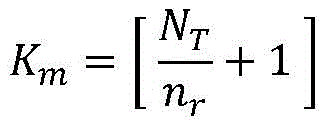
其中,Km是子载波上可容纳的最大用户数,NT是发射天线数目,nr是接收天线数目,

进一步地,作为本发明的一种优选技术方案:所述步骤2中定义各自的优先级权重为:Further, as a preferred technical solution of the present invention: the respective priority weights defined in the step 2 are:
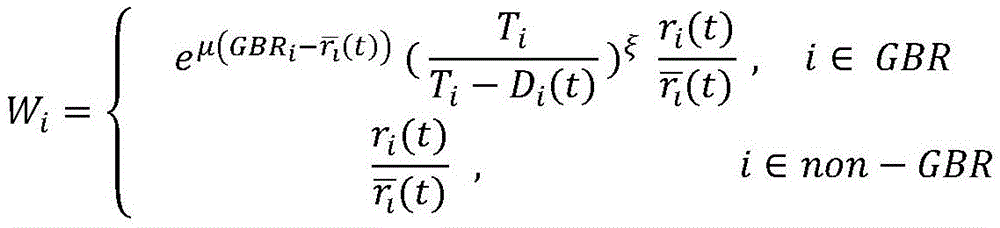
其中,Wi为用户所对应的调度优先级,GBRi表示第i个业务的保证比特率,Ti表示第i个业务容许的最大时延;。Di(t)表示第i个业务t时刻缓冲区队首分组的等待时延,等于当前时间减去到达时间;对于实时业务,若Di(t)>Ti则丢弃该分组;ri(t)为用户的瞬时数据速率,
本发明采用上述技术方案,能产生如下技术效果:The present invention adopts the above-mentioned technical scheme, and can produce the following technical effects:
本发明提出了一种多用户MIMO-OFDM系统中兼顾用户公平性和精细化保证用户QoS的吞吐量优化方法,将经典的比例公平算法,结合MIMO中的多用户空间多址技术,并联合用户的速率、时延QoS要求,在时间、频率和空间三个维度上分配系统资源,进一步优化了系统吞吐量,并且在合理兼顾用户公平性的基础上,精细化保证了用户的速率、时延的QoS要求。The present invention proposes a throughput optimization method in a multi-user MIMO-OFDM system that takes into account user fairness and fine-grained guarantee of user QoS. According to the QoS requirements of rate and delay, system resources are allocated in the three dimensions of time, frequency and space, which further optimizes the system throughput, and on the basis of reasonable consideration of user fairness, fine-grained guarantees the rate and delay of users QoS requirements.
本发明通过兼顾用户公平性和精细化保证不同用户QoS要求的吞吐量目标优化算法,并充分利用空分复用带来的频谱增益,允许每个子载波上容纳多个用户,结合子载波分配、功率分配两步进行系统吞吐量的优化,大大降低了算法复杂度。在时间、频率和空间三个维度上分配系统资源,增加了资源优化的灵活性,进一步优化了系统吞吐量和用户服务质量。The invention takes into account user fairness and refinement to ensure the throughput target optimization algorithm of different users' QoS requirements, and makes full use of the spectrum gain brought by space division multiplexing, allowing multiple users to be accommodated on each subcarrier, combined with subcarrier allocation, The system throughput is optimized in two steps of power allocation, which greatly reduces the algorithm complexity. Allocating system resources in the three dimensions of time, frequency and space increases the flexibility of resource optimization and further optimizes system throughput and user service quality.
附图说明Description of drawings
图1为本发明的方法的流程示意图。FIG. 1 is a schematic flowchart of the method of the present invention.
图2为本发明方法所建立的信道模型。FIG. 2 is a channel model established by the method of the present invention.
具体实施方式Detailed ways
下面结合说明书附图对本发明的实施方式进行描述。Embodiments of the present invention will be described below with reference to the accompanying drawings.
如图1和2所示,本发明提出了多用户MIMO-OFDM中基于用户公平性和QoS的吞吐量优化方法,该方法利用图2所建立的信道模型进行基于用户公平性和QoS的吞吐量优化过程,具体地,方法包括以下步骤:As shown in Figures 1 and 2, the present invention proposes a throughput optimization method based on user fairness and QoS in multi-user MIMO-OFDM, which utilizes the channel model established in Figure 2 to perform throughput optimization based on user fairness and QoS The optimization process, specifically, the method includes the following steps:
步骤1、推导获得多用户MIMO-OFDM系统中单个子载波支持的传输速率,并确定每个子载波的可容纳最大用户数。Step 1: Derive the transmission rate supported by a single subcarrier in the multi-user MIMO-OFDM system, and determine the maximum number of users that each subcarrier can accommodate.
假设在多用户MIMO-OFDM系统中,基站有NT根发送天线,每个终端有nr根接收天线,系统总的用户数为K,子载波m上有Km个用户复用该子载波,Tk,m为用户k(k=1,2…Km)在子载波m上的预编码矩阵,xi,m为该用户的传输数据,则子载波m上用户i的接收信号yi,m是:Assuming that in a multi-user MIMO-OFDM system, the base station has NT transmitting antennas, each terminal has n r receiving antennas, the total number of users in the system is K, and there are K m users on subcarrier m multiplexing the subcarrier , T k,m is the precoding matrix of user k (k=1,2...K m ) on subcarrier m, x i,m is the transmission data of this user, then the received signal y of user i on subcarrier m i,m are:

其中,in,
Hi,m是子载波m上用户i的信道矩阵,ni,m是该信道上的高斯白噪声。显然,xi,m作为用户发送端的传输数据不为零,故要使式(5)中其他Km-1个用户对用户i产生的干扰为零,则有:H i,m is the channel matrix of user i on subcarrier m, and n i,m is the white Gaussian noise on the channel. Obviously, the transmission data of x i, m as the user's sender is not zero, so to make the interference to user i caused by other K m -1 users in equation (5) to be zero, there are:

然后,定义干扰用户联合矩阵
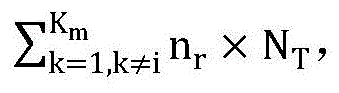

设


其中,


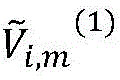


定义



故用户i在子载波m上的等效传输矩阵是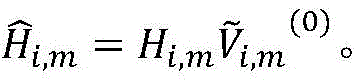

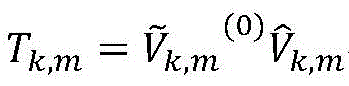

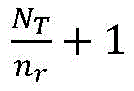
其中,Km是子载波上可容纳的最大用户数,NT是发射天线数,nr是各终端接收天线数,
且由式(6)可知,等效的信道增益为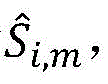

令λi,m为信道增益对角矩阵



式(11)中,N0是满足零均值复高斯随机变量信道噪声的功率,



因此,在任一子载波m上,第i个用户的带宽归一化数据速率可以表示为:Therefore, on any subcarrier m, the bandwidth-normalized data rate of the ith user can be expressed as:

步骤2、将用户分成GBR用户和非GBR用户,根据当前用户的业务状态定义各自的优先级权重。Step 2: Divide the users into GBR users and non-GBR users, and define their respective priority weights according to the current service status of the users.
本发明中,用户分成GBR用户和非GBR用户两大类,每位用户只使用一种业务。其中,GBR业务对速率、时延要求较高,容忍性较差,非GBR业务则可以容忍数据有一定的时延。In the present invention, users are divided into two categories: GBR users and non-GBR users, and each user only uses one service. Among them, GBR services have higher requirements on rate and delay, and have poor tolerance, while non-GBR services can tolerate a certain delay in data.
针对GBR用户和非GBR用户这两大类用户群体,综合考虑当前用户的业务状态,包括业务类型、队列状态以及速率等,具体可以为信道质量状况、用户保证速率、最大时延、分组数据包的队列时延以及瞬时速率和长期平均速率的比值,定义各自的优先级权重如下:For the two major user groups, GBR users and non-GBR users, comprehensively consider the service status of the current user, including service type, queue status, and rate, etc., which can be channel quality status, user guaranteed rate, maximum delay, packet data packets, etc. The queue delay of , and the ratio of the instantaneous rate and the long-term average rate, define their respective priority weights as follows:

其中,Wi为用户所对应的调度优先级,GBRi表示第i个业务的保证比特率,Ti表示第i个业务容许的最大时延(对于非实时业务,为无穷大)。Di(t)表示第i个业务t时刻缓冲区队首分组的等待时延,等于当前时间减去到达时间;对于实时业务,若Di(t)>Ti则丢弃该分组。ri(t)为用户的瞬时数据速率,
步骤3、结合子载波分配、功率分配两步进行系统吞吐量的优化,使得多用户MIMO-OFDM中基于用户公平性和QoS的吞吐量得到优化,具体如下:Step 3: Optimize the system throughput by combining the two steps of subcarrier allocation and power allocation, so that the throughput based on user fairness and QoS in multi-user MIMO-OFDM is optimized, as follows:
步骤31、定义兼顾用户公平性和精细化保证QoS的吞吐量优化模型;Step 31: Define a throughput optimization model that takes into account user fairness and refined QoS assurance;

s.t.αi,m∈{0,1}stα i, m ∈ {0, 1}
ri≥gi r i ≥ g i
Di≤Ti D i ≤T i


式中,R为系统总速率,M为子载波个数,Km为子载波上可容纳的最大用户数,λi,m为子载波m上用户i等效信道矩阵的秩(用户i的等效平行信道个数),Wi为每个用户所对应的调度优先级,αi,m表示用户i是否在子载波m上,等于1时表示用户i占用子载波m,等于0时表示不占用,ri,m,l为子载波m上用户i的某一等效平行信道l上的带宽归一化数据速率,ri为用户的瞬时数据速率,gi为用户的保证速率,Di表示第i个业务缓冲区队首分组的等待时延,Ti表示第i个业务容许的最大时延,pi,m,l为分配给某一等效平行信道l的功率,Ptotal为系统总功率。In the formula, R is the total rate of the system, M is the number of sub-carriers, K m is the maximum number of users that can be accommodated on the sub-carrier, λ i, m is the rank of the equivalent channel matrix of user i on sub-carrier m (the rank of user i is Equivalent parallel channel number), W i is the scheduling priority corresponding to each user, α i, m indicates whether user i is on sub-carrier m, when it is equal to 1, it means that user i occupies sub-carrier m, and when it is equal to 0, it means that user i occupies sub-carrier m Not occupied, ri , m, l is the bandwidth normalized data rate on an equivalent parallel channel l of user i on subcarrier m, ri is the instantaneous data rate of the user, gi is the guaranteed rate of the user, D i represents the waiting delay of the first packet of the i-th service buffer, T i represents the maximum allowable delay of the i-th service, pi , m, l are the power allocated to an equivalent parallel channel l, P total is the total power of the system.
步骤32、利用所定义的吞吐量优化模型根据用户的优先级权重进行子载波平行信道的分配,具体为:把每个子载波看成相互无干扰的平行信道,对GBR用户按业务优先级权重进行排序,依次为每个业务进行子载波的平行信道分配;对于剩余的子载波的平行信道,以比例公平调度算法分配给Non-GBR用户;该过程如下:Step 32: Use the defined throughput optimization model to allocate sub-carrier parallel channels according to the user's priority weight, specifically: regard each sub-carrier as a parallel channel that does not interfere with each other, and carry out the GBR users according to the service priority weight. Sort, perform parallel channel allocation of subcarriers for each service in turn; for the remaining parallel channels of subcarriers, allocate to Non-GBR users by proportional fair scheduling algorithm; the process is as follows:
①设置待调度用户集合K={1,2,…,K},可用子载波集合M={1,2,…,M},保证速率集合GBR={g1,g2,…,gk}。①Set the user set to be scheduled K={1,2,...,K}, the available subcarrier set M={1,2,...,M}, the guaranteed rate set GBR={g 1 ,g 2 ,...,g k }.
②初始化。子载波发射功率相等,用户初始速率
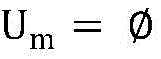
③将用户按属性分为GBR用户集合和Non-GBR用户集合。③ Divide users into GBR user sets and Non-GBR user sets according to their attributes.
④当GBR用户集合为非空时,按用户优先级从高到低排序。从队头取一个用户k,当用户k的速率小于其保证速率且可用子载波集合不为空时,比较用户k在所有子载波平行信道上的速率,将速率最大的子载波平行信道分配给用户k。④ When the GBR user set is non-empty, sort by user priority from high to low. Take a user k from the head of the queue, when the rate of user k is less than its guaranteed rate and the set of available subcarriers is not empty, compare the rates of user k on all subcarrier parallel channels, and assign the subcarrier parallel channel with the highest rate to user k.
若子载波m上被选的总用户数不超过Km,计算R,如果新算得的R大于或者等于之前的R值,则该用户被选择,将k加入到该子载波用户集合Um中,更新用户k的速率;否则,该用户被舍弃。直至子载波m上被选的总用户数大于或者等于Km,从集合M中删除m;If the total number of selected users on the subcarrier m does not exceed K m , calculate R, if the newly calculated R is greater than or equal to the previous R value, the user is selected, and k is added to the subcarrier user set U m , The rate at which user k is updated; otherwise, the user is discarded. Until the total number of selected users on subcarrier m is greater than or equal to K m , delete m from set M;
直至用户k的速率大于或者等于其保证速率时,从GBR用户集合中删除k,从GBR用户保证速率集合中删除gk。Until the rate of user k is greater than or equal to its guaranteed rate, k is deleted from the GBR user set, and g k is deleted from the GBR user guaranteed rate set.
⑤当非GBR用户集合且可用子载波集合为非空时,对子载波m,选择rk,m,l/rk值最大的子载波的平行信道,将其分配给用户k;若子载波m上被选的总用户数不超过Km,计算R,如果新算得的R大于或者等于之前的R值,则该用户被选择,将k加入到该子载波用户集合Um中,更新用户k的速率;否则,该用户被舍弃;直至子载波m上被选的总用户数大于或者等于Km,从集合M中删除m。⑤ When the set of non-GBR users and the set of available sub-carriers are non-empty, for sub-carrier m, select the parallel channel of the sub-carrier with the largest value of r k, m, l /r k , and assign it to user k; if sub-carrier m The total number of selected users does not exceed K m , and R is calculated. If the newly calculated R is greater than or equal to the previous R value, the user is selected, k is added to the sub-carrier user set U m , and the user k is updated rate; otherwise, the user is discarded; until the total number of users selected on the subcarrier m is greater than or equal to K m , delete m from the set M.
⑥更新各业务的平均速率。⑥Update the average rate of each business.
⑦循环执行②~⑥直至完成所有数据的发送。⑦ Repeat ②~⑥ until all data is sent.
步骤33、对每个用户所分配得到的子载波功率进行调整,利用注水算法对每个用户子载波的功率进行优化分配,以获得最大化吞吐量。即使用步骤32完成子载波分配,且子载波分配过程中功率是平均分配的,而本步骤继续用注水算法进行子载波的功率优化分配。Step 33: Adjust the power of the sub-carriers allocated by each user, and use the water-filling algorithm to optimally allocate the power of the sub-carriers of each user to obtain maximum throughput. That is, step 32 is used to complete the sub-carrier allocation, and the power is evenly allocated in the sub-carrier allocation process, and this step continues to use the water-filling algorithm to optimally allocate the power of the sub-carriers.
上述子载波分配算法中,为了使得问题简化,过程中假设功率平均分配,即

假设基站完全已知所有用户的信道状态信息hi,m,其中


然后对每个用户各子载波的功率进行调整,利用注水算法可以获得最优的功率分配,每个用户的子载波上的功率分配可分别按如下公式计算:Then the power of each sub-carrier of each user is adjusted, and the optimal power allocation can be obtained by using the water-filling algorithm. The power allocation on each sub-carrier of each user can be calculated according to the following formula:


pi,m≥0 (17)p i, m ≥ 0 (17)
其中,pi,1表示用户i在最小特征值空间子信道上的功率,pi,m表示用户i在子载波m上所分配的功率,hi,1表示用户i所在空间子信道中的最小特征值,hi,m表示用户i在子载波m空间子信道上的特征值。此时,基于注水原理完成了功率的二次分配,使得每个用户子载波之间的功率得到优化调整:信道条件好的给予更大的发送功率,信道条件差的适当降低发送功率,从而更进一步的优化了系统吞吐量。Among them, pi ,1 represents the power of user i on the minimum eigenvalue spatial subchannel, pi ,m represents the power allocated by user i on the subcarrier m, and hi ,1 represents the power of the spatial subchannel where user i is located. The minimum eigenvalues, hi , m represent the eigenvalues of user i on the spatial subchannel of subcarrier m. At this time, the secondary distribution of power is completed based on the principle of water injection, so that the power between sub-carriers of each user can be optimally adjusted: the channel conditions are good, the transmission power is given more, and the transmission power is appropriately reduced in the poor channel conditions, so as to increase the transmission power. The system throughput is further optimized.
综上所述,本发明将比例公平和MIMO中的多用户空分多址技术运用到了传统的3G-LTE MIMO-OFDM系统中,并结合用户的速率、时延等QoS要求,在时间、频率和空间三个维度上分配系统资源,增加了资源优化的灵活性,进一步优化了系统吞吐量和用户服务质量。To sum up, the present invention applies proportional fairness and multi-user spatial division multiple access technology in MIMO to the traditional 3G-LTE MIMO-OFDM system, and combines the user's QoS requirements such as rate and delay to achieve the optimal performance in time and frequency. System resources are allocated in three dimensions and space, which increases the flexibility of resource optimization and further optimizes system throughput and user service quality.
上面结合附图对本发明的实施方式作了详细说明,但是本发明并不限于上述实施方式,在本领域普通技术人员所具备的知识范围内,还可以在不脱离本发明宗旨的前提下做出各种变化。The embodiments of the present invention have been described in detail above in conjunction with the accompanying drawings, but the present invention is not limited to the above-mentioned embodiments, and can also be made within the scope of knowledge possessed by those of ordinary skill in the art without departing from the purpose of the present invention. Various changes.
Claims (5)



Priority Applications (1)
| Application Number | Priority Date | Filing Date | Title |
|---|---|---|---|
| CN201611231603.8A CN106658733B (en) | 2016-12-28 | 2016-12-28 | Throughput optimization method based on user fairness and QoS in multi-user MIMO-OFDM |
Applications Claiming Priority (1)
| Application Number | Priority Date | Filing Date | Title |
|---|---|---|---|
| CN201611231603.8A CN106658733B (en) | 2016-12-28 | 2016-12-28 | Throughput optimization method based on user fairness and QoS in multi-user MIMO-OFDM |
Publications (2)
| Publication Number | Publication Date |
|---|---|
| CN106658733A CN106658733A (en) | 2017-05-10 |
| CN106658733B true CN106658733B (en) | 2020-04-21 |
Family
ID=58833063
Family Applications (1)
| Application Number | Title | Priority Date | Filing Date |
|---|---|---|---|
| CN201611231603.8A Active CN106658733B (en) | 2016-12-28 | 2016-12-28 | Throughput optimization method based on user fairness and QoS in multi-user MIMO-OFDM |
Country Status (1)
| Country | Link |
|---|---|
| CN (1) | CN106658733B (en) |
Cited By (1)
| Publication number | Priority date | Publication date | Assignee | Title |
|---|---|---|---|---|
| WO2023167686A1 (en) * | 2022-03-04 | 2023-09-07 | Viasat, Inc. | Allocating transmission power to client devices in a communications network |
Families Citing this family (6)
| Publication number | Priority date | Publication date | Assignee | Title |
|---|---|---|---|---|
| CN107949061B (en) * | 2017-11-28 | 2021-08-10 | 重庆邮电大学 | Multi-user grouping method based on non-orthogonal multiple access system |
| CN107734697B (en) * | 2017-11-28 | 2021-04-20 | 重庆邮电大学 | Low-complexity multi-user grouping method based on NOMA system |
| CN109120552B (en) * | 2018-08-15 | 2021-10-19 | 大连大学 | A QOS-oriented bandwidth and power multi-objective cross-layer optimization method in AOS |
| CN111372312A (en) * | 2018-12-26 | 2020-07-03 | 中兴通讯股份有限公司 | Time-frequency-space resource allocation method, computer device, and computer-readable storage medium |
| CN111246585B (en) * | 2020-01-14 | 2022-04-22 | 重庆邮电大学 | 5G resource scheduling method based on channel state |
| CN111711986B (en) * | 2020-05-06 | 2022-06-07 | 哈尔滨工业大学 | UC-UDN proportional fair resource allocation method in 5G communication system |
Citations (3)
| Publication number | Priority date | Publication date | Assignee | Title |
|---|---|---|---|---|
| CN101562842A (en) * | 2008-04-16 | 2009-10-21 | 大唐移动通信设备有限公司 | Method, system and device for resource allocation |
| CN102404860A (en) * | 2010-09-14 | 2012-04-04 | 中兴通讯股份有限公司 | A method and device for allocating downlink resources in an LTE system |
| CN104618921A (en) * | 2015-01-15 | 2015-05-13 | 南京邮电大学 | Estimation method for user capacity of multi-service large-scale MIMO system |
Family Cites Families (1)
| Publication number | Priority date | Publication date | Assignee | Title |
|---|---|---|---|---|
| US9706522B2 (en) * | 2013-03-01 | 2017-07-11 | Intel IP Corporation | Wireless local area network (WLAN) traffic offloading |
-
2016
- 2016-12-28 CN CN201611231603.8A patent/CN106658733B/en active Active
Patent Citations (3)
| Publication number | Priority date | Publication date | Assignee | Title |
|---|---|---|---|---|
| CN101562842A (en) * | 2008-04-16 | 2009-10-21 | 大唐移动通信设备有限公司 | Method, system and device for resource allocation |
| CN102404860A (en) * | 2010-09-14 | 2012-04-04 | 中兴通讯股份有限公司 | A method and device for allocating downlink resources in an LTE system |
| CN104618921A (en) * | 2015-01-15 | 2015-05-13 | 南京邮电大学 | Estimation method for user capacity of multi-service large-scale MIMO system |
Non-Patent Citations (1)
| Title |
|---|
| 一种基于注水原理的LTE下行调度算法研究;姚汝贤等;《计算机应用与软件》;20141231;第31卷(第12期);第295-298页 * |
Cited By (2)
| Publication number | Priority date | Publication date | Assignee | Title |
|---|---|---|---|---|
| WO2023167686A1 (en) * | 2022-03-04 | 2023-09-07 | Viasat, Inc. | Allocating transmission power to client devices in a communications network |
| JP2025509167A (en) * | 2022-03-04 | 2025-04-11 | ヴィアサット,インコーポレイテッド | Allocation of transmit power to client devices in a communications network - Patents.com |
Also Published As
| Publication number | Publication date |
|---|---|
| CN106658733A (en) | 2017-05-10 |
Similar Documents
| Publication | Publication Date | Title |
|---|---|---|
| CN106658733B (en) | Throughput optimization method based on user fairness and QoS in multi-user MIMO-OFDM | |
| CN101018084B (en) | Resource allocation method of the multi-user MIMO-OFDM system of the QoS | |
| CN108650006B (en) | Non-orthogonal multiple access method based on large-scale MIMO | |
| Antón-Haro et al. | Cross-layer scheduling for multi-user MIMO systems | |
| CN103096485B (en) | A kind of method of multi-user's multiple-input, multiple-output frequency selection scheduling in LTE system | |
| CN103067328B (en) | Based on the wireless resource allocation methods of effectiveness in a kind of OFDMA system | |
| JP2007318576A (en) | Wireless communication system and wireless communication method | |
| CN106507487B (en) | A kind of Power Ratio Bi-Objective Optimization Method in multi-user MIMO-OFDM system | |
| CN101702700A (en) | Duality-Based Power Minimization Allocation Method for MIMO-OFDM Multi-User System | |
| WO2013034093A1 (en) | Method for sdma transmission in multicarrier mu mimo system and base station | |
| CN107248896A (en) | A kind of D2D communications united mode selection and Proportional Fair optimization method | |
| WO2018050059A1 (en) | Time-frequency resource space-division scheduling method and apparatus | |
| CN102083191B (en) | Resource allocation method and device, data transmission method and device | |
| CN108882352A (en) | A kind of downlink NOMA power distribution method that the weight rate based on non-perfect SIC is optimal | |
| CN106060917B (en) | One kind is based on the matched antenna of grouping and power combined allocation method | |
| CN106851726A (en) | A kind of cross-layer resource allocation method based on minimum speed limit constraint | |
| CN102291352A (en) | Resource allocation method based on QoS in cognitive OFDM system | |
| CN104684055B (en) | A kind of orthogonal frequency and the MIMO-OFDM system DTX power optimization methods of space division mixing | |
| Torabzadeh et al. | Packet scheduling and fairness for multiuser MIMO systems | |
| CN101754378B (en) | Base station and method for distributing radio resource | |
| Makhlouf et al. | Dynamic multiuser sub-channels allocation and real-time aggregation model for IEEE 802.11 WLANs | |
| CN101772172A (en) | Multi-band based method for allocating frequency spectrum resources, device and system thereof | |
| CN103532671B (en) | MIMO-OFDM systematic bits distribution method based on delayed channel status information | |
| WO2012019450A1 (en) | Pairing method for multi-user multiple input multiple output system, data transmission method and devices thereof | |
| CN103024821B (en) | Multi-user-collaboration multi-point transmission method and device |
Legal Events
| Date | Code | Title | Description |
|---|---|---|---|
| PB01 | Publication | ||
| PB01 | Publication | ||
| SE01 | Entry into force of request for substantive examination | ||
| SE01 | Entry into force of request for substantive examination | ||
| GR01 | Patent grant | ||
| GR01 | Patent grant | ||
| TR01 | Transfer of patent right |
Effective date of registration: 20250526 Address after: 101200 No. 1, Jia Building, Fengguan Road, Fengtai District, Beijing Patentee after: Beijing Zhonghu Environmental Protection Technology Co.,Ltd. Country or region after: China Address before: 210003 Gulou District, Jiangsu, Nanjing new model road, No. 66 Patentee before: NANJING University OF POSTS AND TELECOMMUNICATIONS Country or region before: China |
|
| TR01 | Transfer of patent right |