CN106632276B - Preparation method of medicine for treating breast cancer - Google Patents
Preparation method of medicine for treating breast cancer Download PDFInfo
- Publication number
- CN106632276B CN106632276B CN201510716895.3A CN201510716895A CN106632276B CN 106632276 B CN106632276 B CN 106632276B CN 201510716895 A CN201510716895 A CN 201510716895A CN 106632276 B CN106632276 B CN 106632276B
- Authority
- CN
- China
- Prior art keywords
- compound
- formula
- reacting
- inert solvent
- compound shown
- Prior art date
- Legal status (The legal status is an assumption and is not a legal conclusion. Google has not performed a legal analysis and makes no representation as to the accuracy of the status listed.)
- Active
Links
- 238000002360 preparation method Methods 0.000 title claims abstract description 24
- 206010006187 Breast cancer Diseases 0.000 title abstract description 5
- 239000003814 drug Substances 0.000 title abstract description 5
- 208000026310 Breast neoplasm Diseases 0.000 title abstract description 4
- 238000000034 method Methods 0.000 claims abstract description 27
- 150000001875 compounds Chemical class 0.000 claims description 102
- YMWUJEATGCHHMB-UHFFFAOYSA-N Dichloromethane Chemical compound ClCCl YMWUJEATGCHHMB-UHFFFAOYSA-N 0.000 claims description 48
- YXFVVABEGXRONW-UHFFFAOYSA-N Toluene Chemical compound CC1=CC=CC=C1 YXFVVABEGXRONW-UHFFFAOYSA-N 0.000 claims description 48
- 238000006243 chemical reaction Methods 0.000 claims description 40
- 239000012442 inert solvent Substances 0.000 claims description 26
- WEVYAHXRMPXWCK-UHFFFAOYSA-N Acetonitrile Chemical compound CC#N WEVYAHXRMPXWCK-UHFFFAOYSA-N 0.000 claims description 21
- IJGRMHOSHXDMSA-UHFFFAOYSA-N Atomic nitrogen Chemical compound N#N IJGRMHOSHXDMSA-UHFFFAOYSA-N 0.000 claims description 21
- IMNFDUFMRHMDMM-UHFFFAOYSA-N N-Heptane Chemical compound CCCCCCC IMNFDUFMRHMDMM-UHFFFAOYSA-N 0.000 claims description 21
- KDLHZDBZIXYQEI-UHFFFAOYSA-N Palladium Chemical compound [Pd] KDLHZDBZIXYQEI-UHFFFAOYSA-N 0.000 claims description 20
- 239000003054 catalyst Substances 0.000 claims description 20
- FYSNRJHAOHDILO-UHFFFAOYSA-N thionyl chloride Chemical compound ClS(Cl)=O FYSNRJHAOHDILO-UHFFFAOYSA-N 0.000 claims description 20
- WYURNTSHIVDZCO-UHFFFAOYSA-N Tetrahydrofuran Chemical compound C1CCOC1 WYURNTSHIVDZCO-UHFFFAOYSA-N 0.000 claims description 18
- ZMXDDKWLCZADIW-UHFFFAOYSA-N N,N-Dimethylformamide Chemical compound CN(C)C=O ZMXDDKWLCZADIW-UHFFFAOYSA-N 0.000 claims description 16
- XLYOFNOQVPJJNP-UHFFFAOYSA-N water Substances O XLYOFNOQVPJJNP-UHFFFAOYSA-N 0.000 claims description 16
- 239000003153 chemical reaction reagent Substances 0.000 claims description 14
- VLKZOEOYAKHREP-UHFFFAOYSA-N n-Hexane Chemical compound CCCCCC VLKZOEOYAKHREP-UHFFFAOYSA-N 0.000 claims description 14
- 229910052757 nitrogen Inorganic materials 0.000 claims description 12
- 239000002904 solvent Substances 0.000 claims description 12
- 239000012320 chlorinating reagent Substances 0.000 claims description 10
- 229910052763 palladium Inorganic materials 0.000 claims description 10
- OISVCGZHLKNMSJ-UHFFFAOYSA-N 2,6-dimethylpyridine Chemical compound CC1=CC=CC(C)=N1 OISVCGZHLKNMSJ-UHFFFAOYSA-N 0.000 claims description 9
- SJRJJKPEHAURKC-UHFFFAOYSA-N N-Methylmorpholine Chemical compound CN1CCOCC1 SJRJJKPEHAURKC-UHFFFAOYSA-N 0.000 claims description 9
- ZMANZCXQSJIPKH-UHFFFAOYSA-N Triethylamine Chemical compound CCN(CC)CC ZMANZCXQSJIPKH-UHFFFAOYSA-N 0.000 claims description 9
- XPOLVIIHTDKJRY-UHFFFAOYSA-N acetic acid;methanimidamide Chemical compound NC=N.CC(O)=O XPOLVIIHTDKJRY-UHFFFAOYSA-N 0.000 claims description 9
- 239000003446 ligand Substances 0.000 claims description 9
- YLQBMQCUIZJEEH-UHFFFAOYSA-N tetrahydrofuran Natural products C=1C=COC=1 YLQBMQCUIZJEEH-UHFFFAOYSA-N 0.000 claims description 9
- RYHBNJHYFVUHQT-UHFFFAOYSA-N 1,4-Dioxane Chemical compound C1COCCO1 RYHBNJHYFVUHQT-UHFFFAOYSA-N 0.000 claims description 7
- 239000007800 oxidant agent Substances 0.000 claims description 7
- FVSKHRXBFJPNKK-UHFFFAOYSA-N propionitrile Chemical compound CCC#N FVSKHRXBFJPNKK-UHFFFAOYSA-N 0.000 claims description 7
- GQHTUMJGOHRCHB-UHFFFAOYSA-N 2,3,4,6,7,8,9,10-octahydropyrimido[1,2-a]azepine Chemical compound C1CCCCN2CCCN=C21 GQHTUMJGOHRCHB-UHFFFAOYSA-N 0.000 claims description 6
- NHQDETIJWKXCTC-UHFFFAOYSA-N 3-chloroperbenzoic acid Chemical group OOC(=O)C1=CC=CC(Cl)=C1 NHQDETIJWKXCTC-UHFFFAOYSA-N 0.000 claims description 6
- VHYFNPMBLIVWCW-UHFFFAOYSA-N 4-Dimethylaminopyridine Chemical compound CN(C)C1=CC=NC=C1 VHYFNPMBLIVWCW-UHFFFAOYSA-N 0.000 claims description 6
- YNAVUWVOSKDBBP-UHFFFAOYSA-N Morpholine Chemical compound C1COCCN1 YNAVUWVOSKDBBP-UHFFFAOYSA-N 0.000 claims description 6
- JGFZNNIVVJXRND-UHFFFAOYSA-N N,N-Diisopropylethylamine (DIPEA) Chemical compound CCN(C(C)C)C(C)C JGFZNNIVVJXRND-UHFFFAOYSA-N 0.000 claims description 6
- JRNVZBWKYDBUCA-UHFFFAOYSA-N N-chlorosuccinimide Chemical compound ClN1C(=O)CCC1=O JRNVZBWKYDBUCA-UHFFFAOYSA-N 0.000 claims description 6
- CTQNGGLPUBDAKN-UHFFFAOYSA-N O-Xylene Chemical compound CC1=CC=CC=C1C CTQNGGLPUBDAKN-UHFFFAOYSA-N 0.000 claims description 6
- GLUUGHFHXGJENI-UHFFFAOYSA-N Piperazine Chemical compound C1CNCCN1 GLUUGHFHXGJENI-UHFFFAOYSA-N 0.000 claims description 6
- JUJWROOIHBZHMG-UHFFFAOYSA-N Pyridine Chemical compound C1=CC=NC=C1 JUJWROOIHBZHMG-UHFFFAOYSA-N 0.000 claims description 6
- MUALRAIOVNYAIW-UHFFFAOYSA-N binap Chemical compound C1=CC=CC=C1P(C=1C(=C2C=CC=CC2=CC=1)C=1C2=CC=CC=C2C=CC=1P(C=1C=CC=CC=1)C=1C=CC=CC=1)C1=CC=CC=C1 MUALRAIOVNYAIW-UHFFFAOYSA-N 0.000 claims description 6
- NFHFRUOZVGFOOS-UHFFFAOYSA-N palladium;triphenylphosphane Chemical compound [Pd].C1=CC=CC=C1P(C=1C=CC=CC=1)C1=CC=CC=C1.C1=CC=CC=C1P(C=1C=CC=CC=1)C1=CC=CC=C1.C1=CC=CC=C1P(C=1C=CC=CC=1)C1=CC=CC=C1.C1=CC=CC=C1P(C=1C=CC=CC=1)C1=CC=CC=C1 NFHFRUOZVGFOOS-UHFFFAOYSA-N 0.000 claims description 6
- XHXFXVLFKHQFAL-UHFFFAOYSA-N phosphoryl trichloride Chemical compound ClP(Cl)(Cl)=O XHXFXVLFKHQFAL-UHFFFAOYSA-N 0.000 claims description 6
- 239000008096 xylene Substances 0.000 claims description 6
- 230000001590 oxidative effect Effects 0.000 claims description 5
- 229960000549 4-dimethylaminophenol Drugs 0.000 claims description 3
- NXQGGXCHGDYOHB-UHFFFAOYSA-L cyclopenta-1,4-dien-1-yl(diphenyl)phosphane;dichloropalladium;iron(2+) Chemical compound [Fe+2].Cl[Pd]Cl.[CH-]1C=CC(P(C=2C=CC=CC=2)C=2C=CC=CC=2)=C1.[CH-]1C=CC(P(C=2C=CC=CC=2)C=2C=CC=CC=2)=C1 NXQGGXCHGDYOHB-UHFFFAOYSA-L 0.000 claims description 3
- YNHIGQDRGKUECZ-UHFFFAOYSA-N dichloropalladium;triphenylphosphanium Chemical compound Cl[Pd]Cl.C1=CC=CC=C1[PH+](C=1C=CC=CC=1)C1=CC=CC=C1.C1=CC=CC=C1[PH+](C=1C=CC=CC=1)C1=CC=CC=C1 YNHIGQDRGKUECZ-UHFFFAOYSA-N 0.000 claims description 3
- PIBWKRNGBLPSSY-UHFFFAOYSA-L palladium(II) chloride Chemical compound Cl[Pd]Cl PIBWKRNGBLPSSY-UHFFFAOYSA-L 0.000 claims description 3
- YJVFFLUZDVXJQI-UHFFFAOYSA-L palladium(ii) acetate Chemical compound [Pd+2].CC([O-])=O.CC([O-])=O YJVFFLUZDVXJQI-UHFFFAOYSA-L 0.000 claims description 3
- UHZYTMXLRWXGPK-UHFFFAOYSA-N phosphorus pentachloride Chemical compound ClP(Cl)(Cl)(Cl)Cl UHZYTMXLRWXGPK-UHFFFAOYSA-N 0.000 claims description 3
- FAIAAWCVCHQXDN-UHFFFAOYSA-N phosphorus trichloride Chemical compound ClP(Cl)Cl FAIAAWCVCHQXDN-UHFFFAOYSA-N 0.000 claims description 3
- UMJSCPRVCHMLSP-UHFFFAOYSA-N pyridine Natural products COC1=CC=CN=C1 UMJSCPRVCHMLSP-UHFFFAOYSA-N 0.000 claims description 3
- ZAMOUSCENKQFHK-UHFFFAOYSA-N Chlorine atom Chemical compound [Cl] ZAMOUSCENKQFHK-UHFFFAOYSA-N 0.000 claims description 2
- 239000000460 chlorine Substances 0.000 claims description 2
- 229910052801 chlorine Inorganic materials 0.000 claims description 2
- 238000004519 manufacturing process Methods 0.000 claims description 2
- 239000003960 organic solvent Substances 0.000 claims description 2
- 239000012046 mixed solvent Substances 0.000 claims 2
- -1 N- { 3-chloro-4- [ (3-fluorobenzyl) methoxy ] phenyl } -6- [5- ({ [2- (methylsulfonyl) ethyl ] amino } methyl) furan-2-yl ] -4-quinazolinamine Chemical compound 0.000 abstract description 16
- 239000007858 starting material Substances 0.000 abstract description 5
- 239000002994 raw material Substances 0.000 abstract description 4
- 238000006467 substitution reaction Methods 0.000 abstract description 3
- 238000005660 chlorination reaction Methods 0.000 abstract description 2
- 230000000694 effects Effects 0.000 abstract description 2
- 230000007613 environmental effect Effects 0.000 abstract description 2
- 238000009776 industrial production Methods 0.000 abstract description 2
- JXDYKVIHCLTXOP-UHFFFAOYSA-N isatin Chemical class C1=CC=C2C(=O)C(=O)NC2=C1 JXDYKVIHCLTXOP-UHFFFAOYSA-N 0.000 abstract 3
- 230000008878 coupling Effects 0.000 abstract 1
- 238000010168 coupling process Methods 0.000 abstract 1
- 238000005859 coupling reaction Methods 0.000 abstract 1
- 230000003647 oxidation Effects 0.000 abstract 1
- 238000007254 oxidation reaction Methods 0.000 abstract 1
- IWJDBOBJWQISKU-UHFFFAOYSA-N 6-bromo-n-[3-chloro-4-[(3-fluorophenyl)methoxy]phenyl]quinazolin-4-amine Chemical compound FC1=CC=CC(COC=2C(=CC(NC=3C4=CC(Br)=CC=C4N=CN=3)=CC=2)Cl)=C1 IWJDBOBJWQISKU-UHFFFAOYSA-N 0.000 description 21
- ARXJGSRGQADJSQ-UHFFFAOYSA-N 1-methoxypropan-2-ol Chemical compound COCC(C)O ARXJGSRGQADJSQ-UHFFFAOYSA-N 0.000 description 20
- LFQSCWFLJHTTHZ-UHFFFAOYSA-N Ethanol Chemical compound CCO LFQSCWFLJHTTHZ-UHFFFAOYSA-N 0.000 description 20
- 238000003756 stirring Methods 0.000 description 15
- DXSMYDSFWCOSFM-UHFFFAOYSA-N 6-bromo-1h-3,1-benzoxazine-2,4-dione Chemical compound N1C(=O)OC(=O)C2=CC(Br)=CC=C21 DXSMYDSFWCOSFM-UHFFFAOYSA-N 0.000 description 14
- KFZMGEQAYNKOFK-UHFFFAOYSA-N Isopropanol Chemical compound CC(C)O KFZMGEQAYNKOFK-UHFFFAOYSA-N 0.000 description 14
- OKKJLVBELUTLKV-UHFFFAOYSA-N Methanol Chemical compound OC OKKJLVBELUTLKV-UHFFFAOYSA-N 0.000 description 12
- 239000000203 mixture Substances 0.000 description 8
- BWHMMNNQKKPAPP-UHFFFAOYSA-L potassium carbonate Chemical compound [K+].[K+].[O-]C([O-])=O BWHMMNNQKKPAPP-UHFFFAOYSA-L 0.000 description 8
- 239000000047 product Substances 0.000 description 8
- 239000002136 L01XE07 - Lapatinib Substances 0.000 description 7
- BCFGMOOMADDAQU-UHFFFAOYSA-N lapatinib Chemical compound O1C(CNCCS(=O)(=O)C)=CC=C1C1=CC=C(N=CN=C2NC=3C=C(Cl)C(OCC=4C=C(F)C=CC=4)=CC=3)C2=C1 BCFGMOOMADDAQU-UHFFFAOYSA-N 0.000 description 7
- 229960004891 lapatinib Drugs 0.000 description 7
- MBVCESWADCIXJN-UHFFFAOYSA-N 5-Bromoisatin Chemical compound BrC1=CC=C2NC(=O)C(=O)C2=C1 MBVCESWADCIXJN-UHFFFAOYSA-N 0.000 description 6
- JOLQKTGDSGKSKJ-UHFFFAOYSA-N 1-ethoxypropan-2-ol Chemical compound CCOCC(C)O JOLQKTGDSGKSKJ-UHFFFAOYSA-N 0.000 description 4
- MHAJPDPJQMAIIY-UHFFFAOYSA-N Hydrogen peroxide Chemical compound OO MHAJPDPJQMAIIY-UHFFFAOYSA-N 0.000 description 4
- LRHPLDYGYMQRHN-UHFFFAOYSA-N N-Butanol Chemical compound CCCCO LRHPLDYGYMQRHN-UHFFFAOYSA-N 0.000 description 4
- UIIMBOGNXHQVGW-UHFFFAOYSA-M Sodium bicarbonate Chemical compound [Na+].OC([O-])=O UIIMBOGNXHQVGW-UHFFFAOYSA-M 0.000 description 4
- FJDQFPXHSGXQBY-UHFFFAOYSA-L caesium carbonate Chemical compound [Cs+].[Cs+].[O-]C([O-])=O FJDQFPXHSGXQBY-UHFFFAOYSA-L 0.000 description 4
- 229910000024 caesium carbonate Inorganic materials 0.000 description 4
- 238000001816 cooling Methods 0.000 description 4
- 238000010511 deprotection reaction Methods 0.000 description 4
- VLTRZXGMWDSKGL-UHFFFAOYSA-N perchloric acid Chemical compound OCl(=O)(=O)=O VLTRZXGMWDSKGL-UHFFFAOYSA-N 0.000 description 4
- 229910000027 potassium carbonate Inorganic materials 0.000 description 4
- 238000010992 reflux Methods 0.000 description 4
- 239000012047 saturated solution Substances 0.000 description 4
- RIOQSEWOXXDEQQ-UHFFFAOYSA-N triphenylphosphine Chemical compound C1=CC=CC=C1P(C=1C=CC=CC=1)C1=CC=CC=C1 RIOQSEWOXXDEQQ-UHFFFAOYSA-N 0.000 description 4
- KZPYGQFFRCFCPP-UHFFFAOYSA-N 1,1'-bis(diphenylphosphino)ferrocene Chemical compound [Fe+2].C1=CC=C[C-]1P(C=1C=CC=CC=1)C1=CC=CC=C1.C1=CC=C[C-]1P(C=1C=CC=CC=1)C1=CC=CC=C1 KZPYGQFFRCFCPP-UHFFFAOYSA-N 0.000 description 3
- 238000010438 heat treatment Methods 0.000 description 3
- 238000002156 mixing Methods 0.000 description 3
- QJGQUHMNIGDVPM-UHFFFAOYSA-N nitrogen group Chemical group [N] QJGQUHMNIGDVPM-UHFFFAOYSA-N 0.000 description 3
- 238000000746 purification Methods 0.000 description 3
- OVEISJPVPHWEHR-UHFFFAOYSA-N 6-bromo-1h-quinazolin-4-one Chemical compound N1C=NC(=O)C2=CC(Br)=CC=C21 OVEISJPVPHWEHR-UHFFFAOYSA-N 0.000 description 2
- 238000006646 Dess-Martin oxidation reaction Methods 0.000 description 2
- CBENFWSGALASAD-UHFFFAOYSA-N Ozone Chemical compound [O-][O+]=O CBENFWSGALASAD-UHFFFAOYSA-N 0.000 description 2
- 101150003085 Pdcl gene Proteins 0.000 description 2
- RXUWDKBZZLIASQ-UHFFFAOYSA-N Puerarin Natural products OCC1OC(Oc2c(O)cc(O)c3C(=O)C(=COc23)c4ccc(O)cc4)C(O)C(O)C1O RXUWDKBZZLIASQ-UHFFFAOYSA-N 0.000 description 2
- VYPSYNLAJGMNEJ-UHFFFAOYSA-N Silicium dioxide Chemical compound O=[Si]=O VYPSYNLAJGMNEJ-UHFFFAOYSA-N 0.000 description 2
- PMZURENOXWZQFD-UHFFFAOYSA-L Sodium Sulfate Chemical compound [Na+].[Na+].[O-]S([O-])(=O)=O PMZURENOXWZQFD-UHFFFAOYSA-L 0.000 description 2
- DWAQJAXMDSEUJJ-UHFFFAOYSA-M Sodium bisulfite Chemical compound [Na+].OS([O-])=O DWAQJAXMDSEUJJ-UHFFFAOYSA-M 0.000 description 2
- 239000005708 Sodium hypochlorite Substances 0.000 description 2
- 229920002472 Starch Polymers 0.000 description 2
- QAOWNCQODCNURD-UHFFFAOYSA-N Sulfuric acid Chemical compound OS(O)(=O)=O QAOWNCQODCNURD-UHFFFAOYSA-N 0.000 description 2
- NKLCNNUWBJBICK-UHFFFAOYSA-N dess–martin periodinane Chemical compound C1=CC=C2I(OC(=O)C)(OC(C)=O)(OC(C)=O)OC(=O)C2=C1 NKLCNNUWBJBICK-UHFFFAOYSA-N 0.000 description 2
- 238000001514 detection method Methods 0.000 description 2
- 238000001035 drying Methods 0.000 description 2
- 239000012065 filter cake Substances 0.000 description 2
- 239000000706 filtrate Substances 0.000 description 2
- 150000002466 imines Chemical class 0.000 description 2
- 239000011259 mixed solution Substances 0.000 description 2
- 239000012044 organic layer Substances 0.000 description 2
- 239000012285 osmium tetroxide Substances 0.000 description 2
- 229910000489 osmium tetroxide Inorganic materials 0.000 description 2
- 239000012286 potassium permanganate Substances 0.000 description 2
- BDERNNFJNOPAEC-UHFFFAOYSA-N propan-1-ol Chemical compound CCCO BDERNNFJNOPAEC-UHFFFAOYSA-N 0.000 description 2
- HKEAFJYKMMKDOR-VPRICQMDSA-N puerarin Chemical compound O[C@@H]1[C@@H](O)[C@H](O)[C@@H](CO)O[C@H]1C1=C(O)C=CC(C2=O)=C1OC=C2C1=CC=C(O)C=C1 HKEAFJYKMMKDOR-VPRICQMDSA-N 0.000 description 2
- 239000000376 reactant Substances 0.000 description 2
- 238000002390 rotary evaporation Methods 0.000 description 2
- 235000010267 sodium hydrogen sulphite Nutrition 0.000 description 2
- SUKJFIGYRHOWBL-UHFFFAOYSA-N sodium hypochlorite Chemical compound [Na+].Cl[O-] SUKJFIGYRHOWBL-UHFFFAOYSA-N 0.000 description 2
- PFUVRDFDKPNGAV-UHFFFAOYSA-N sodium peroxide Chemical compound [Na+].[Na+].[O-][O-] PFUVRDFDKPNGAV-UHFFFAOYSA-N 0.000 description 2
- HPALAKNZSZLMCH-UHFFFAOYSA-M sodium;chloride;hydrate Chemical class O.[Na+].[Cl-] HPALAKNZSZLMCH-UHFFFAOYSA-M 0.000 description 2
- 239000000243 solution Substances 0.000 description 2
- VNFWTIYUKDMAOP-UHFFFAOYSA-N sphos Chemical compound COC1=CC=CC(OC)=C1C1=CC=CC=C1P(C1CCCCC1)C1CCCCC1 VNFWTIYUKDMAOP-UHFFFAOYSA-N 0.000 description 2
- 235000019698 starch Nutrition 0.000 description 2
- 239000008107 starch Substances 0.000 description 2
- 239000000126 substance Substances 0.000 description 2
- 238000000967 suction filtration Methods 0.000 description 2
- 238000001308 synthesis method Methods 0.000 description 2
- 231100000331 toxic Toxicity 0.000 description 2
- 230000002588 toxic effect Effects 0.000 description 2
- 238000005406 washing Methods 0.000 description 2
- UGOMMVLRQDMAQQ-UHFFFAOYSA-N xphos Chemical compound CC(C)C1=CC(C(C)C)=CC(C(C)C)=C1C1=CC=CC=C1P(C1CCCCC1)C1CCCCC1 UGOMMVLRQDMAQQ-UHFFFAOYSA-N 0.000 description 2
- ADVWVIQNAOXLCV-UHFFFAOYSA-N 2,2,6,6-tetramethylpiperazine Chemical compound CC1(C)CNCC(C)(C)N1 ADVWVIQNAOXLCV-UHFFFAOYSA-N 0.000 description 1
- RNSQFWZYYMHKGA-UHFFFAOYSA-N 2-methylsulfonyl-n-[[5-[4-(oxan-2-yloxy)quinazolin-6-yl]furan-2-yl]methyl]ethanamine Chemical compound O1C(CNCCS(=O)(=O)C)=CC=C1C1=CC=C(N=CN=C2OC3OCCCC3)C2=C1 RNSQFWZYYMHKGA-UHFFFAOYSA-N 0.000 description 1
- BOFRXDMCQRTGII-UHFFFAOYSA-N 619-08-9 Chemical compound OC1=CC=C([N+]([O-])=O)C=C1Cl BOFRXDMCQRTGII-UHFFFAOYSA-N 0.000 description 1
- 206010055113 Breast cancer metastatic Diseases 0.000 description 1
- KZBUYRJDOAKODT-UHFFFAOYSA-N Chlorine Chemical compound ClCl KZBUYRJDOAKODT-UHFFFAOYSA-N 0.000 description 1
- 101000851181 Homo sapiens Epidermal growth factor receptor Proteins 0.000 description 1
- 229910002666 PdCl2 Inorganic materials 0.000 description 1
- UIIMBOGNXHQVGW-DEQYMQKBSA-M Sodium bicarbonate-14C Chemical compound [Na+].O[14C]([O-])=O UIIMBOGNXHQVGW-DEQYMQKBSA-M 0.000 description 1
- ATJFFYVFTNAWJD-UHFFFAOYSA-N Tin Chemical compound [Sn] ATJFFYVFTNAWJD-UHFFFAOYSA-N 0.000 description 1
- 239000002253 acid Substances 0.000 description 1
- 125000003172 aldehyde group Chemical group 0.000 description 1
- 239000003513 alkali Substances 0.000 description 1
- 238000005576 amination reaction Methods 0.000 description 1
- 239000002585 base Substances 0.000 description 1
- 239000006227 byproduct Substances 0.000 description 1
- 238000004440 column chromatography Methods 0.000 description 1
- 238000002474 experimental method Methods 0.000 description 1
- 230000026030 halogenation Effects 0.000 description 1
- 238000005658 halogenation reaction Methods 0.000 description 1
- 239000012535 impurity Substances 0.000 description 1
- 230000004048 modification Effects 0.000 description 1
- 238000012986 modification Methods 0.000 description 1
- 230000002018 overexpression Effects 0.000 description 1
- 229910000030 sodium bicarbonate Inorganic materials 0.000 description 1
- 235000017557 sodium bicarbonate Nutrition 0.000 description 1
- 229910000080 stannane Inorganic materials 0.000 description 1
- SANWDQJIWZEKOD-UHFFFAOYSA-N tributyl(furan-2-yl)stannane Chemical compound CCCC[Sn](CCCC)(CCCC)C1=CC=CO1 SANWDQJIWZEKOD-UHFFFAOYSA-N 0.000 description 1
- WLPUWLXVBWGYMZ-UHFFFAOYSA-N tricyclohexylphosphine Chemical compound C1CCCCC1P(C1CCCCC1)C1CCCCC1 WLPUWLXVBWGYMZ-UHFFFAOYSA-N 0.000 description 1
- 229940121358 tyrosine kinase inhibitor Drugs 0.000 description 1
- 239000005483 tyrosine kinase inhibitor Substances 0.000 description 1
- 150000004917 tyrosine kinase inhibitor derivatives Chemical class 0.000 description 1
- 239000002699 waste material Substances 0.000 description 1
Classifications
-
- C—CHEMISTRY; METALLURGY
- C07—ORGANIC CHEMISTRY
- C07D—HETEROCYCLIC COMPOUNDS
- C07D405/00—Heterocyclic compounds containing both one or more hetero rings having oxygen atoms as the only ring hetero atoms, and one or more rings having nitrogen as the only ring hetero atom
- C07D405/02—Heterocyclic compounds containing both one or more hetero rings having oxygen atoms as the only ring hetero atoms, and one or more rings having nitrogen as the only ring hetero atom containing two hetero rings
- C07D405/04—Heterocyclic compounds containing both one or more hetero rings having oxygen atoms as the only ring hetero atoms, and one or more rings having nitrogen as the only ring hetero atom containing two hetero rings directly linked by a ring-member-to-ring-member bond
-
- C—CHEMISTRY; METALLURGY
- C07—ORGANIC CHEMISTRY
- C07D—HETEROCYCLIC COMPOUNDS
- C07D239/00—Heterocyclic compounds containing 1,3-diazine or hydrogenated 1,3-diazine rings
- C07D239/70—Heterocyclic compounds containing 1,3-diazine or hydrogenated 1,3-diazine rings condensed with carbocyclic rings or ring systems
- C07D239/72—Quinazolines; Hydrogenated quinazolines
- C07D239/86—Quinazolines; Hydrogenated quinazolines with hetero atoms directly attached in position 4
- C07D239/94—Nitrogen atoms
Landscapes
- Chemical & Material Sciences (AREA)
- Organic Chemistry (AREA)
- Plural Heterocyclic Compounds (AREA)
- Pharmaceuticals Containing Other Organic And Inorganic Compounds (AREA)
Abstract
The invention provides a preparation method of a medicine for treating breast cancer, and particularly relates to a novel method for preparing N- { 3-chloro-4- [ (3-fluorobenzyl) methoxy ] phenyl } -6- [5- ({ [2- (methylsulfonyl) ethyl ] amino } methyl) furan-2-yl ] -4-quinazolinamine (I). The method takes clean and easily-obtained 5-halogenated isatin (II) as a raw material, and synthesizes a target product (I) through the steps of oxidation, substitution, chlorination, substitution and coupling. The method has the advantages of clean and easily obtained starting materials, short route, simple operation, environmental friendliness, high atom economy, high yield, good effect and the like, and is suitable for industrial production.
Description
Technical Field
The invention relates to a preparation method of a medicine for treating breast cancer, in particular to a preparation method of a chemical medicine N- { 3-chloro-4- [ (3-fluorobenzyl) methoxy ] phenyl } -6- [5- ({ [2- (methylsulfonyl) ethyl ] amino } methyl) furan-2-yl ] -4-quinazolinamine.
Background
Lapatinib (Lapatinib) is a tyrosine kinase inhibitor with the chemical name N- { 3-chloro-4- [ (3-fluorobenzyl) methoxy ] phenyl } -6- [5- ({ [2- (methylsulfonyl) ethyl ] amino } methyl) furan-2-yl ] -4-quinazolinamine. Is successfully developed by Kurarin Schker in UK and is marketed in the United states in 2007 under the trade name of TakePo, and is applied to the treatment of advanced or metastatic breast cancer caused by the overexpression of the human epidermal growth factor receptor type 2 (HER-2).
The specific structural formula is as follows:

the synthetic route of lapatinib is as follows:
WO 9935146 is a patent to Puerarin for preparing lapatinib. In the patent, 2-chloro-4-nitrophenol is used as a starting material, and a target product is finally synthesized through 6 steps. The patent relates to a highly toxic and expensive organic heteroaryl stannane reagent 5- (1, 3-dioxolan-2-yl) -2- (tributylstannyl-furan) as a reaction reagent, and the intermediate process needs to be separated and purified by column chromatography, so that the route has the disadvantages of high risk, large investment, small profit and the like.
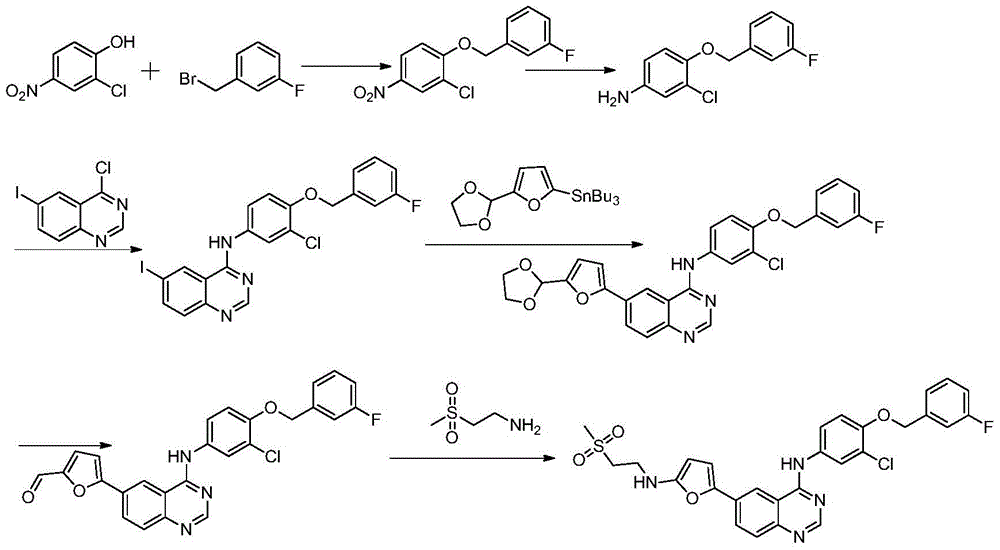
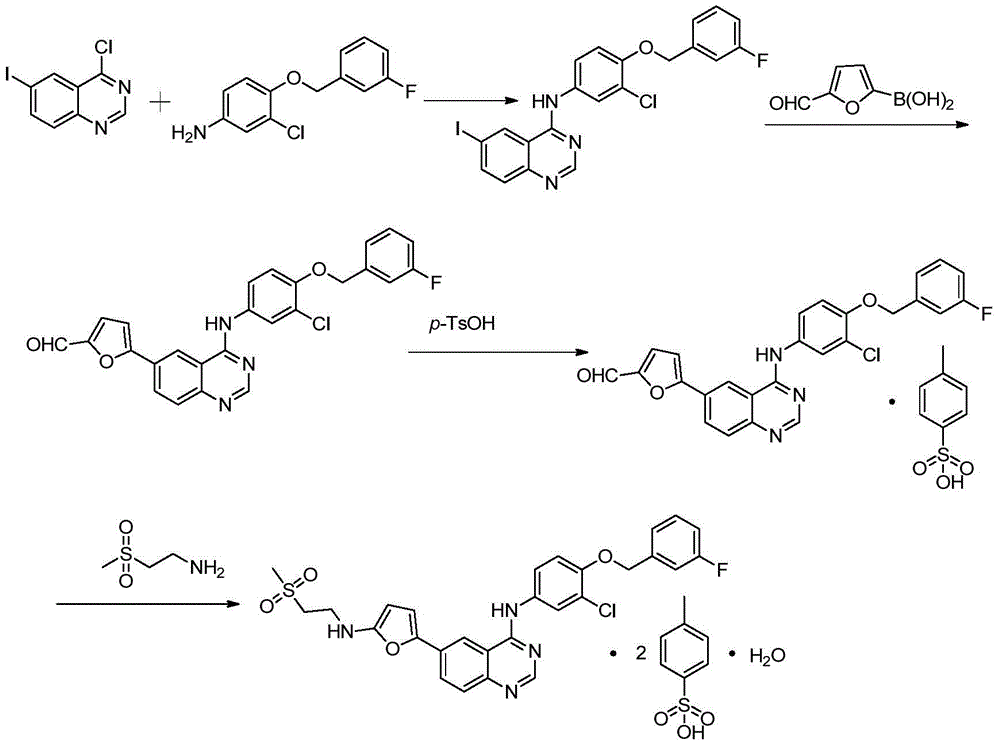
The Puerarin company also applies for a patent WO 2005120504A2 in 2005, and improves the former patent, the reaction steps of the patent are shortened by two steps, the use of a highly toxic organic reagent, namely organic tin is also avoided, but an intermediate containing aldehyde groups is not protected, so that other byproducts are easily generated at high temperature, and the generation of impurities is increased; and the product of each reaction needs to be purified, which increases the complexity of the post-treatment, which is not preferable from the viewpoint of the operability of production and the economy of industrialization. The specific synthetic route is as follows:
Francisco-Tortan et al in patent CN 103923070 disclose a synthetic route for preparing lapatinib from a compound 2- (methylsulfonyl) -N- ({5- [4- (tetrahydro-2H-pyran-2-yloxy) quinazolin-6-yl ] furan-2-yl } methyl) ethylamine as a raw material, the route obtains a target product through deprotection, imine protection, halogenation, amination and deprotection, the route is simple, but the raw material is difficult to obtain, the experimental operation is complex, particularly, the first deprotection reaction involves the use of sulfuric acid, a large amount of waste acid brings harm to the environment, and the operation steps of the imine protection and deprotection increase the reaction.

Therefore, the synthesis method of lapatinib which is economically feasible, safe to operate and environment-friendly is not available in the field.
Disclosure of Invention
The invention aims to provide an economical, feasible, safe and environment-friendly lapatinib synthesis method.
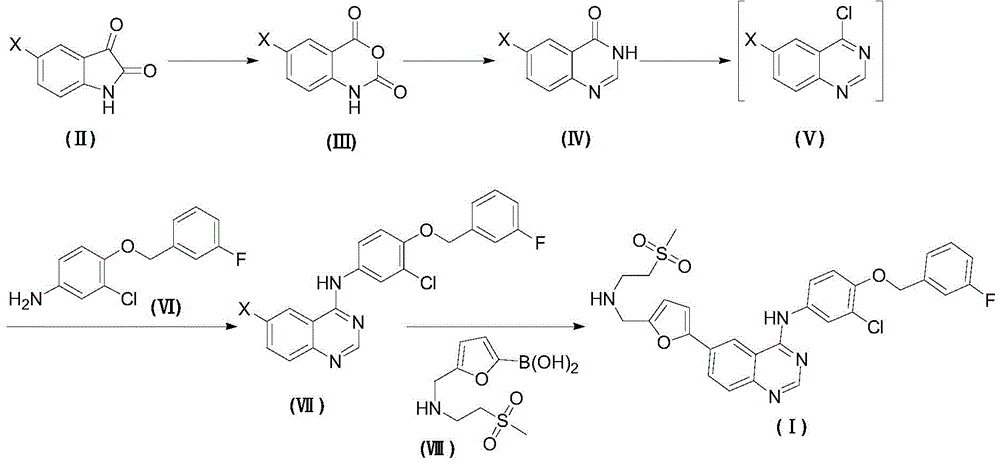
In a first aspect of the invention, there is provided a process for the preparation of N- { 3-chloro-4- [ (3-fluorobenzyl) methoxy ] phenyl } -6- [5- ({ [2- (methanesulphonyl) ethyl ] amino } methyl) furan-2-yl ] -4-quinazolinamine, said process comprising the steps of:
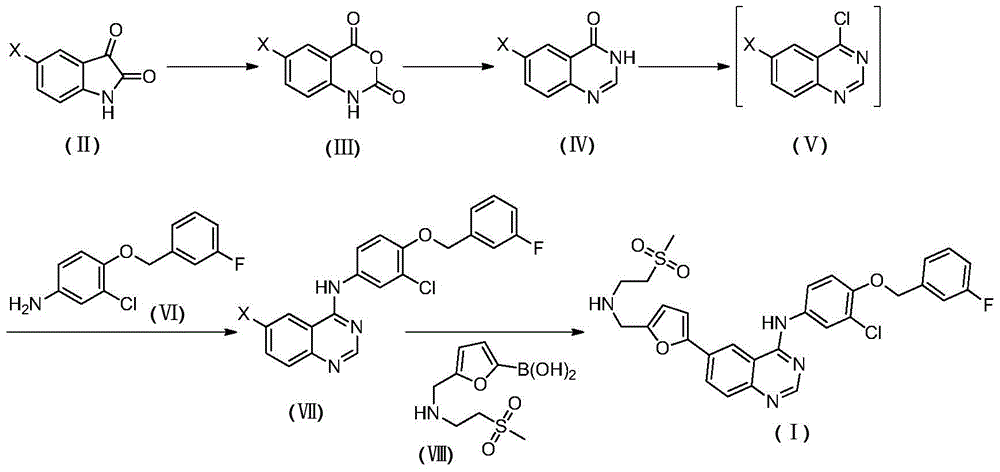
wherein X is selected from the group consisting of: cl, Br, I;
(1) reacting a compound shown in a formula (II) with an oxidizing reagent in an inert solvent to obtain a compound shown in a formula (III);
(2) reacting a compound shown in a formula (III) with a formamidine acetate reagent in an inert solvent to obtain a compound (IV);
(3) reacting a compound shown in a formula (IV) with a chlorinating agent in an organic solvent in the presence of a catalyst to obtain a compound shown in a formula (V);
(4) reacting a compound of a formula (V) with a compound of a formula (VI) in an inert solvent to obtain a compound (VII);
(5) and (3) reacting the compound of the formula (VII) with the compound of the formula (VIII) in an inert solvent in the presence of a palladium catalyst under the protection of nitrogen to obtain the target compound (I).
In another preferred embodiment, in the step (1), the inert solvent is selected from the group consisting of: dichloromethane, tetrahydrofuran, toluene, xylene, dioxane, n-heptane, n-hexane, acetonitrile, propionitrile, or combinations thereof.
In another preferred embodiment, the step (3) and the step (4) are carried out in the same reaction system.
In another preferred embodiment, after the step (3) is finished, the product is not separated and is directly used in the step (4).
In another preferred embodiment, in the step (1), the oxidizing agent is selected from the group consisting of: osmium tetroxide, potassium permanganate, perchloric acid, ozone, sodium peroxide, hydrogen peroxide, m-chloroperoxybenzoic acid, dess-martin oxidant, IBX and sodium hypochlorite.
In another preferred embodiment, in the step (1), the solvent is selected from the group consisting of: dichloromethane, tetrahydrofuran, toluene, xylene, dioxane, n-heptane, n-hexane, acetonitrile, propionitrile, or combinations thereof; preferably dichloromethane.
In another preferred example, in the step (1), the reaction is carried out at-20 to 40 ℃, preferably-10 to 30 ℃.
In another preferred embodiment, in the step (1), the molar ratio of the compound of formula (ii) to the oxidizing agent is 1: 1-3.
In another preferred embodiment, in the step (2), the inert solvent is selected from the group consisting of: tetrahydrofuran, ethanol, isopropanol, 1-methoxy-2-propanol, 1-ethoxy-2-propanol, or a combination thereof; preferably 1-methoxy-2-propanol, or a combination thereof.
In another preferred example, in the step (2), the reaction is carried out at 40-140 ℃, preferably 80-130 ℃.
In another preferred embodiment, in the step (2), the molar ratio of the compound of formula (iii) to the formamidine acetate reagent is 1: 1-4.
In another preferred embodiment, in the step (3), the chlorinating agent is selected from the group consisting of: chlorine, NCS, thionyl chloride, phosphorus trichloride, phosphorus oxychloride and phosphorus pentachloride.
In another preferred embodiment, in the step (3), the catalyst is selected from the group consisting of: triethylamine, pyridine, diisopropylethylamine, N-methylmorpholine, DMF, DBU, DMAP, 2, 6-dimethylpyridine, 2,6, 6-tetramethylpiperazine, piperazine and morpholine.
In another preferred embodiment, in the step (3), the solvent is selected from the group consisting of: dichloromethane, tetrahydrofuran, dioxane, n-heptane, n-hexane, acetonitrile, propionitrile, thionyl chloride, or combinations thereof.
In another preferred embodiment, the thionyl chloride is used as both a reactant and a solvent.
In another preferred example, in the step (3), the reaction is performed at 40 to 130 ℃, preferably 50 to 110 ℃.
In another preferred embodiment, in the step (3), the molar ratio of the compound of formula (iv) to the chlorinating agent is 1: 1-10.
In another preferred embodiment, in the step (3), the molar ratio of the compound of formula (iv) to the catalyst is 1: 1-3.
In another preferred embodiment, in the step (4), the inert solvent is selected from the group consisting of: methanol, ethanol, propanol, butanol, isopropanol, 1-methoxy-2-propanol, 1-ethoxy-2-propanol, or a combination thereof; preferably ethanol, isopropanol, or a combination thereof.
In another preferred embodiment, in the step (4), the molar ratio of the compound of formula (V) to the compound of formula (VI) is 1: 1-3.
In another preferred example, in the step (4), the reaction is carried out at 60-130 ℃, preferably 80-110 ℃.
In another preferred embodiment, in the step (5), the palladium catalyst is selected from the group consisting of: palladium chloride, palladium acetate, bis (triphenylphosphine) palladium dichloride, tetrakis (triphenylphosphine) palladium, (dppf) PdCl2。
In another preferred embodiment, in the step (5), the reaction is carried out in the presence of a ligand, and the ligand is selected from the group consisting of PPh3、P(n-Bu)3、PCy3、BINAP、S-phos、X-phos。
In another preferred embodiment, in the step (5), the molar ratio of the compound of formula (vii) to the ligand is 1: 0.01-0.5.
In another preferred embodiment, in the step (5), the inert solvent is selected from the group consisting of: water, dichloromethane, tetrahydrofuran, toluene, xylene, dioxane, n-heptane, n-hexane, acetonitrile, propionitrile, or a combination thereof; water, toluene, or a combination thereof is preferred.
In another preferred embodiment, in the step (5), the molar ratio of the compound of formula (VII) to the compound of formula (VIII) is 1: 1-2.
In another preferred embodiment, in the step (5), the molar ratio of the compound of formula (vii) to the palladium catalyst is 1: 0.01-0.5.
In another preferred example, in the step (5), the reaction is carried out at 50-140 ℃, preferably 60-120 ℃.
In another preferred embodiment, in the step (5), the reaction is performed in a reagent selected from the group consisting of: potassium carbonate, cesium carbonate, sodium bicarbonate.
In a second aspect of the present invention, there is provided a process for the preparation of a compound of formula VII, said process comprising the steps of:

(3) reacting a compound shown in a formula (IV) with a chlorinating agent in an inert solvent in the presence of a catalyst to obtain a compound shown in a formula (V);

(4) reacting a compound of a formula (V) with a compound of a formula (VI) in an inert solvent to obtain a compound (VII);
wherein X is selected from the group consisting of: cl, Br, I.
In another preferred embodiment, after the step (3) is finished, the step (4) is directly performed without separating a product.
In another preferred embodiment, the method further comprises the steps of:

(2) reacting a compound shown in a formula (III) with a formamidine acetate reagent in an inert solvent to obtain a compound (IV);
wherein X is selected from the group consisting of: cl, Br, I.
In a third aspect of the present invention, there is provided a process for the preparation of N- { 3-chloro-4- [ (3-fluorobenzyl) methoxy ] phenyl } -6- [5- ({ [2- (methanesulphonyl) ethyl ] amino } methyl) furan-2-yl ] -4-quinazolinamine, said process comprising the steps of:
preparing a compound of formula VII, by a process according to the second aspect of the invention, and;
using the compound of formula VII as a starting material, N- { 3-chloro-4- [ (3-fluorobenzyl) methoxy ] phenyl } -6- [5- ({ [2- (methylsulfonyl) ethyl ] amino } methyl) furan-2-yl ] -4-quinazolinamine was prepared.
In another preferred embodiment, the method further comprises the steps of:

(5) and (3) in an inert solvent, in the presence of a palladium catalyst, under the protection of nitrogen, completing the reaction, and finally reacting the compound of the formula (VII) with the compound of the formula (VIII) to obtain the target compound (I).
It is to be understood that within the scope of the present invention, the above-described features of the present invention and those specifically described below (e.g., in the examples) may be combined with each other to form new or preferred embodiments. Not to be reiterated herein, but to the extent of space.
Detailed Description
The present inventors have conducted extensive and intensive studies for a long time to develop a process for producing N- { 3-chloro-4- [ (3-fluorobenzyl) methoxy ] phenyl } -6- [5- ({ [2- (methylsulfonyl) ethyl ] amino } methyl) furan-2-yl ] -4-quinazolinamine (I). The method adopts easily available raw materials, and has the advantages of short synthetic route, simple operation, environmental friendliness, high atom economy, high yield, good effect and the like, thereby being suitable for industrial production. Based on the above findings, the inventors have completed the present invention.
Term(s) for
As used herein, the terms "compound of formula (I)" and "N- { 3-chloro-4- [ (3-fluorobenzyl) methoxy ] phenyl } -6- [5- ({ [2- (methylsulfonyl) ethyl ] amino } methyl) furan-2-yl ] -4-quinazolinamine" are used interchangeably and refer to compounds having the structure shown below:

preparation of Compounds of formula I
The invention provides a preparation method of N- { 3-chloro-4- [ (3-fluorobenzyl) methoxy ] phenyl } -6- [5- ({ [2- (methylsulfonyl) ethyl ] amino } methyl) furan-2-yl ] -4-quinazolinamine, which is characterized by comprising the following steps:

(3) reacting a compound shown in a formula (IV) with a chlorinating agent in an inert solvent in the presence of a catalyst to obtain a compound shown in a formula (V);

(4) reacting a compound of a formula (V) with a compound of a formula (VI) in an inert solvent to obtain a compound (VII);
wherein X is selected from the group consisting of: cl, Br, I.
After the compound of formula VII has been prepared, it can be used as a starting material to prepare N- { 3-chloro-4- [ (3-fluorobenzyl) methoxy ] phenyl } -6- [5- ({ [2- (methylsulfonyl) ethyl ] amino } methyl) furan-2-yl ] -4-quinazolinamine.
In another preferred embodiment, after the step (3) is finished, the step (4) is directly performed without separating a product.
In another preferred embodiment, the preparation method of the compound of formula (I) further comprises the steps of:

(5) and (3) in an inert solvent, in the presence of a palladium catalyst, under the protection of nitrogen, completing the reaction, and finally reacting the compound of the formula (VII) with the compound of the formula (VIII) to obtain the target compound (I).
In each of the above steps, the reactants may be purchased from commercial sources or designed by one of ordinary skill in the art in conjunction with techniques known in the art. In another preferred embodiment, the compound of formula (IV) used as starting material is prepared by the following method:
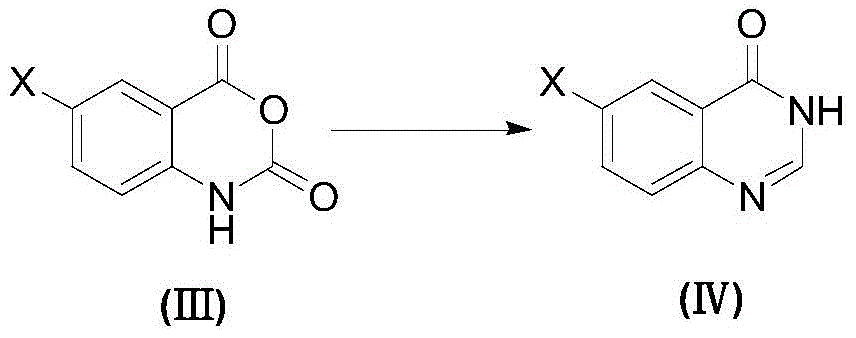
(2) reacting a compound shown in a formula (III) with a formamidine acetate reagent in an inert solvent to obtain a compound (IV);
wherein X is selected from the group consisting of: cl, Br, I.
The preferred method of the present invention comprises the steps of:

(1) preparation of Compound (III)
Dispersing the compound (II) into a proper solvent, adding a proper oxidant in batches, and completing the reaction at a proper temperature to obtain a compound (III).
Wherein: suitable solvents are dichloromethane, tetrahydrofuran, toluene, xylene, dioxane, n-heptane, n-hexane, acetonitrile, propionitrile, preferably dichloromethane; suitable oxidants are osmium tetroxide, potassium permanganate, perchloric acid, ozone, sodium peroxide, hydrogen peroxide, m-chloroperoxybenzoic acid, dess-martin oxidant, IBX, sodium hypochlorite, preferably m-chloroperoxybenzoic acid; adding the mixture in batches at a proper temperature, wherein the reaction temperature is-20-40 ℃, and preferably-10-30 ℃.
(2) Preparation of Compound (IV)
Dispersing the compound (III) and a formamidine acetate reagent in a proper solvent, completing the reaction at a proper temperature, and obtaining the compound (IV) through proper treatment.
Wherein: suitable solvents are tetrahydrofuran, ethanol, isopropanol, 1-methoxy-2-propanol, 1-ethoxy-2-propanol, preferably 1-methoxy-2-propanol; adding the mixture in batches at a proper temperature, wherein the reaction temperature is 40-140 ℃, and preferably 80-130 ℃.
(3) Preparation of Compound (VII)
The compound (IV) reacts with a proper amount of chlorinating agent and a proper catalyst at a proper temperature, the compound (V) is obtained by proper treatment after the reaction is finished, the compound (V) is directly dispersed in a proper solvent without further purification, reacts with a proper amount of compound (VI), and the compound (VII) is obtained by proper treatment after the reaction.
Wherein: in the chlorination reaction, suitable chlorinating agents are chlorine gas, NCS, thionyl chloride, phosphorus trichloride, phosphorus oxychloride, phosphorus pentachloride, and preferably thionyl chloride; suitable catalysts are triethylamine, pyridine, diisopropylethylamine, N-methylmorpholine, DBU, DMF, DMAP, 2, 6-dimethylpyridine, 2,2,6, 6-tetramethylpiperazine, piperazine, morpholine, preferably DMF; adding the mixture in batches at a proper temperature, wherein the reaction temperature is 40-130 ℃, and preferably 50-110 ℃; in the substitution reaction, suitable solvents are methanol, ethanol, propanol, butanol, isopropanol, 1-methoxy-2-propanol and 1-ethoxy-2-propanol, preferably ethanol and isopropanol, and are added in batches at a suitable temperature, wherein the reaction temperature is 60-130 ℃, and preferably 80-110 ℃.
(4) Preparation of N- { 3-chloro-4- [ (3-fluorobenzyl) methoxy ] phenyl } -6- [5- ({ [2- (methylsulfonyl) ethyl ] amino } methyl) furan-2-yl ] -4-quinazolinamine (I)
Mixing N- [ 3-chloro-4- [ (3-fluorobenzyl) oxy ] phenyl ] -6-bromo-quinazolin-4-amine (VII) and a compound (VIII) in a suitable reagent, adding a proper amount of alkali, a ligand and a palladium catalyst, and finishing the reaction under the protection of nitrogen to obtain the target compound (I).
Wherein: suitable solvents are water, dichloromethane, tetrahydrofuran, toluene, xylene, dioxane, n-heptane, n-hexane, acetonitrile, propionitrile, preferably water, toluene; suitable bases are potassium carbonate, cesium carbonate, sodium bicarbonate, and the like, preferably potassium carbonate, cesium carbonate; the ligand is PPh3,P(n-Bu)3,PCy3BINAP, S-phos, X-phos, preferably BINAP; suitable palladium catalysts are palladium chloride, palladium acetate, bis (triphenylphosphine) palladium dichloride, tetrakis (triphenylphosphine) palladium, (dppf) PdCl2Preferably (dppf) PdCl2(ii) a Adding the mixture in batches at a proper temperature, wherein the reaction temperature is 50-140 ℃, and preferably 60-120 ℃.
The invention will be further illustrated with reference to the following specific examples. It should be understood that these examples are for illustrative purposes only and are not intended to limit the scope of the present invention. The experimental procedures, in which specific conditions are not noted in the following examples, are generally carried out under conventional conditions or conditions recommended by the manufacturers. Unless otherwise indicated, percentages and parts are by weight.
Example 1
(1) Preparation of Compound (III)
5-bromoisatin (II) (20.0g, 88.49mmol) was dispersed in dichloromethane solution (300mL), m-chloroperoxybenzoic acid (22.91g, 132.73mmol) was added in portions at room temperature, and the reaction was completed by TLC after 2h at room temperature. And (3) cooling to 10 ℃, continuously stirring, dropwise adding a sodium bisulfite saturated solution until the starch test paper does not change color, removing dichloromethane by rotation, adding 50mL of water, mixing and stirring with the residual mixed solution, dropwise adding a saturated sodium bicarbonate saturated solution until no bubbles are generated, performing suction filtration, washing with a small amount of water, and drying at 50 ℃ to obtain 20.56g of 5-bromoisatoic anhydride (III), wherein the yield is 96%.
(2) Preparation of 6-bromoquinazolin-4-one (IV)
5-bromoisatoic anhydride (III) (20.0g, 82.64mmol) and formamidine acetate (17.04g, 165.27mmol) were dispersed in 1-methoxy-2-propanol (300mL), stirred well and heated to reflux for 2h, TLC check reaction was complete. The 1-methoxy-2-propanol was removed by rotation under reduced pressure, and the residue was slurried with 50ml of water for 0.5h, filtered, washed with water and dried to give the title compound (IV) (16.55g, 89%).
(3) Preparation of N- [ 3-chloro-4- [ (3-fluorobenzyl) oxy ] phenyl ] -6-bromo-quinazolin-4-amine (VII)
After uniformly stirring compound (IV) (15g, 66.65mmol) and thionyl chloride (30mL), DMF (5.36g, 73.32mmol) was slowly added dropwise, and after the dropwise addition was completed, stirring was continued and the temperature was raised to 80 ℃ to complete the reaction for 2 h. Cooling to room temperature, removing most of thionyl chloride and DMF under reduced pressure, adding 40mL of toluene, continuing to carry out rotary evaporation under reduced pressure to obtain a residue which is the compound (V), directly transferring the residue into another clean three-neck round-bottom flask without further purification, sequentially adding isopropanol (200mL) and the compound (VI) (17.61g, 69.98mmol), stirring uniformly, heating to reflux, and completing the reaction after 1 h. Cooled, filtered, washed with a small amount of methanol, and the resulting filter cake dried to give N- [ 3-chloro-4- [ (3-fluorobenzyl) oxy ] phenyl ] -6-bromo-quinazolin-4-amine (VII) (25.38g, 83%).
(4) Preparation of N- { 3-chloro-4- [ (3-fluorobenzyl) methoxy ] phenyl } -6- [5- ({ [2- (methylsulfonyl) ethyl ] amino } methyl) furan-2-yl ] -4-quinazolinamine (I)
Reacting N- [ 3-chloro-4- [ (3-fluorobenzyl) oxy]Phenyl radical]-6-bromo-quinazolin-4-amine (VII) (20g, 43.6mmol), Compound (VIII) (12.9g, 52.3mmol), Cesium carbonate (21.3g, 65.4mmol), BINAP (1.22g, 1.96mmol), and Water (10mL) and toluene (200mL) were mixed with stirring for 15min, nitrogen was replaced three times, and (dppf) PdCl was added2(0.96g, 1.31mmol), nitrogen was replaced, the temperature was raised to 100 ℃ under nitrogen protection, and the reaction was stirred for 3.5 hours. After the TLC detection reaction was completed, the reaction was cooled, toluene was recovered, the residual mixture was diluted with dichloromethane (100mL) under stirring, and filtered through celite, the resulting mixture was washed twice with saturated brine, the organic layer was taken out, dried over anhydrous sodium sulfate, filtered, the filtrate was removed by rotation, and the residue was recrystallized from ethanol to give the objective product (I), 22.3g, 88%.
Example 2
(1) Preparation of Compound (III)
5-bromoisatin (II) (20.0g, 88.49mmol) was dispersed in dichloromethane solution (300mL), m-chloroperoxybenzoic acid (22.91g, 132.73mmol) was added in portions at room temperature, and the reaction was completed by TLC after 2h at room temperature. Cooling to 10 ℃, continuously stirring, dropwise adding a sodium bisulfite saturated solution until the starch test paper does not change color, removing dichloromethane by rotation, adding 50mL of water, mixing and stirring with the residual mixed solution, dropwise adding a saturated sodium bicarbonate saturated solution until no bubbles are generated, performing suction filtration, washing with a small amount of water, and drying at 50 ℃ to obtain 20.99g of 5-bromoisatoic anhydride (III), wherein the yield is 98%.
(2) Preparation of 6-bromoquinazolin-4-one (IV)
5-bromoisatoic anhydride (III) (20.0g, 82.64mmol) and formamidine acetate (17.04g, 165.27mmol) were dispersed in 1-methoxy-2-propanol (300mL), stirred well and heated to reflux for 2h, TLC check reaction was complete. The 1-methoxy-2-propanol was removed by rotation under reduced pressure, and the residue was slurried with 50ml of water for 0.5h, filtered, washed with water and dried to give the objective compound (IV) (16.0g, 86%).
(3) Preparation of N- [ 3-chloro-4- [ (3-fluorobenzyl) oxy ] phenyl ] -6-bromo-quinazolin-4-amine (VII)
After uniformly stirring compound (IV) (15g, 66.65mmol) and thionyl chloride (30mL), DMF (5.36g, 73.32mmol) was slowly added dropwise, and after the dropwise addition was completed, stirring was continued and the temperature was raised to 80 ℃ to complete the reaction for 2 h. Cooling to room temperature, removing most of thionyl chloride and DMF under reduced pressure, adding 40mL of toluene, continuing to carry out rotary evaporation under reduced pressure to obtain a residue which is the compound (V), directly transferring the residue into another clean three-neck round-bottom flask without further purification, sequentially adding ethanol (200mL) and the compound (VI) (17.61g, 69.98mmol), stirring uniformly, heating to reflux, and completing the reaction after 1 h. Cooled, filtered, washed with a small amount of methanol, and the resulting filter cake dried to give N- [ 3-chloro-4- [ (3-fluorobenzyl) oxy ] phenyl ] -6-bromo-quinazolin-4-amine (VII) (24.76g, 81%).
(4) Preparation of N- { 3-chloro-4- [ (3-fluorobenzyl) methoxy ] phenyl } -6- [5- ({ [2- (methylsulfonyl) ethyl ] amino } methyl) furan-2-yl ] -4-quinazolinamine (I)
Reacting N- [ 3-chloro-4- [ (3-fluorobenzyl) oxy]Phenyl radical]-6-bromo-quinazolin-4-amine (VII) (20g, 43.6mmol), Compound (VIII) (11.3g, 45.78mmol), Potassium carbonate (21.3g, 65.4mmol), BINAP (1.22g, 1.96mmol),And water (10mL) and toluene (200mL) were mixed with stirring for 15min, nitrogen was replaced three times, and (dppf) PdCl was added2(0.96g, 1.31mmol), replacing nitrogen, heating to 100 ℃ under the protection of nitrogen, and stirring for reaction for 8 h. After completion of the TLC detection reaction, the reaction was cooled, toluene was recovered, and the residual mixture was diluted with methylene chloride (100mL) under stirring, filtered through celite, the resulting mixture was washed twice with saturated brine, the organic layer was taken out, dried over anhydrous sodium sulfate, filtered, the filtrate was removed by rotation, and the residue was recrystallized from ethanol to give the objective product (I) (21.54g, 85%).
All documents referred to herein are incorporated by reference into this application as if each were individually incorporated by reference. Furthermore, it should be understood that various changes and modifications of the present invention can be made by those skilled in the art after reading the above teachings of the present invention, and these equivalents also fall within the scope of the present invention as defined by the appended claims.
Claims (7)
1. A process for preparing a compound of formula I, said process comprising the steps of:
wherein X is Br;
(1) reacting a compound shown in a formula (II) with an oxidizing reagent in an inert solvent to obtain a compound shown in a formula (III); wherein the oxidizing agent is m-chloroperoxybenzoic acid; the solvent is selected from the following group: dichloromethane, tetrahydrofuran, toluene, xylene, dioxane, n-heptane, n-hexane, acetonitrile, propionitrile, or combinations thereof; the reaction is carried out at-20 to 40 ℃;
(2) reacting a compound shown in a formula (III) with a formamidine acetate reagent in an inert solvent to obtain a compound (IV);
(3) reacting a compound shown in a formula (IV) with a chlorinating agent in an organic solvent in the presence of a catalyst to obtain a compound shown in a formula (V);
(4) reacting a compound of a formula (V) with a compound of a formula (VI) in an inert solvent to obtain a compound (VII);
(5) reacting a compound shown in a formula (VII) with a compound shown in a formula (VIII) in an inert solvent in the presence of a palladium catalyst under the protection of nitrogen to obtain a target compound (I);
wherein said step (5) is carried out in the presence of a ligand, and said ligand is BINAP; and in the step (5), the inert solvent used is a mixed solvent of water and toluene.
2. The method of claim 1, wherein in step (1), the solvent is dichloromethane.
3. The method of claim 1, wherein in step (3), the chlorinating agent is selected from the group consisting of: chlorine, NCS, thionyl chloride, phosphorus trichloride, phosphorus oxychloride and phosphorus pentachloride.
4. The method of claim 1, wherein in step (3), the catalyst is selected from the group consisting of: triethylamine, pyridine, diisopropylethylamine, N-methylmorpholine, DMF, DBU, DMAP, 2, 6-dimethylpyridine, 2,6, 6-tetramethylpiperazine, piperazine and morpholine.
5. The method of claim 1, wherein in step (5), the palladium catalyst is selected from the group consisting of: palladium chloride, palladium acetate, bis (triphenylphosphine) palladium dichloride, tetrakis (triphenylphosphine) palladium, (dppf) PdCl2。
6. A process for the preparation of a compound of formula I, said process comprising the steps of:

reacting a compound shown in a formula (IV) with a chlorinating agent in an inert solvent in the presence of a catalyst to obtain a compound shown in a formula (V);

reacting a compound of a formula (V) with a compound of a formula (VI) in an inert solvent to obtain a compound (VII);
and;

reacting a compound of a formula (VII) with a compound of a formula (VIII) in an inert solvent in the presence of a palladium catalyst and a ligand under the protection of nitrogen to obtain a target compound (I); and the ligand is BINAP; the inert solvent is a mixed solvent of water and toluene;
in each reaction step, X is Br.
7. The method of claim 6, wherein said method further comprises the steps of:

reacting a compound shown in a formula (III) with a formamidine acetate reagent in an inert solvent to obtain a compound (IV);
wherein X is Br.
Priority Applications (1)
| Application Number | Priority Date | Filing Date | Title |
|---|---|---|---|
| CN201510716895.3A CN106632276B (en) | 2015-10-28 | 2015-10-28 | Preparation method of medicine for treating breast cancer |
Applications Claiming Priority (1)
| Application Number | Priority Date | Filing Date | Title |
|---|---|---|---|
| CN201510716895.3A CN106632276B (en) | 2015-10-28 | 2015-10-28 | Preparation method of medicine for treating breast cancer |
Publications (2)
| Publication Number | Publication Date |
|---|---|
| CN106632276A CN106632276A (en) | 2017-05-10 |
| CN106632276B true CN106632276B (en) | 2021-06-15 |
Family
ID=58831082
Family Applications (1)
| Application Number | Title | Priority Date | Filing Date |
|---|---|---|---|
| CN201510716895.3A Active CN106632276B (en) | 2015-10-28 | 2015-10-28 | Preparation method of medicine for treating breast cancer |
Country Status (1)
| Country | Link |
|---|---|
| CN (1) | CN106632276B (en) |
Families Citing this family (1)
| Publication number | Priority date | Publication date | Assignee | Title |
|---|---|---|---|---|
| CN111138420A (en) * | 2020-02-10 | 2020-05-12 | 北京凯吉特医药科技发展有限公司 | C13Isotope labeled lapatinib synthesis method |
Family Cites Families (4)
| Publication number | Priority date | Publication date | Assignee | Title |
|---|---|---|---|---|
| RS49779B (en) * | 1998-01-12 | 2008-06-05 | Glaxo Group Limited, | BICYCLIC HETEROAROMATIC COMPOUNDS AS PROTEIN TYROSINE KINASE INHIBITORS |
| RU2007119432A (en) * | 2004-12-17 | 2009-01-27 | Смитклайн Бичам (Корк) Лимитед (Ie) | CANCER TREATMENT METHOD |
| CN102532109B (en) * | 2010-12-27 | 2015-05-13 | 浙江海正药业股份有限公司 | Synthetic method of lapatinib and salt of lapatinib |
| CN102321076B (en) * | 2011-07-07 | 2013-08-21 | 中国科学技术大学 | Preparation method of lapatinib intermediate and analogues thereof |
-
2015
- 2015-10-28 CN CN201510716895.3A patent/CN106632276B/en active Active
Also Published As
| Publication number | Publication date |
|---|---|
| CN106632276A (en) | 2017-05-10 |
Similar Documents
| Publication | Publication Date | Title |
|---|---|---|
| EP3291814B1 (en) | An anti-cancer agent 1-((4-(4-fluoro-2-methyl-1h-indol-5-yloxy)-6-methoxyquinolin-7-yloxy)methyl) cyclopropanamine, its crystalline form and its salts | |
| RU2631243C2 (en) | Dimethylamide 7-cyclopentyle-2-(5-piperazin-1-il-pyridine-2-ylamino)-7h-pyrrolo[2,3-d]pyrimidine-6-carbonic acid salt (salts) and method for their production | |
| JP6995178B2 (en) | Method for preparing cytotoxic benzodiazepine derivative | |
| CN104193676B (en) | Prepare method and the synthetic intermediate thereof of compound | |
| CN102239148A (en) | The preparation method of quinoline derivative | |
| JP7038263B2 (en) | Method for Producing Morpholine Quinazoline Compound and its Intermediate | |
| JP2025179092A (en) | Methods for preparing solid forms of BET bromodomain inhibitors | |
| CN107141261A (en) | Quinazoline compounds and preparation method thereof and the application in tyrosine kinase inhibitor is prepared | |
| WO2017071419A1 (en) | Method for preparing rociletinib | |
| CN106632276B (en) | Preparation method of medicine for treating breast cancer | |
| CN109053594B (en) | 1-(3,5-Dimethoxyphenyl)-3-(substituted pyrimidin-4-yl)urea compounds and their preparation and application | |
| CN114621109B (en) | Synthesis method of apatamide and intermediate thereof | |
| CN117049976A (en) | Preparation method of N-ethyl-2- (4-formylphenyl) acetamide | |
| CN112679430B (en) | A kind of method for preparing isoquinolinone compound | |
| CN108440503A (en) | The preparation method of the disubstituted quinazoline medicinal compound of the parent nucleus containing triazole | |
| CN119264111B (en) | Benzotriazole derivatives as CDKs inhibitors, and pharmaceutical composition and application thereof | |
| CN110669027B (en) | Compounds and their esters, their preparation and use | |
| CN118359587A (en) | Synthesis method of 4- (((2- (3- (hydroxymethyl) phenyl) pyrimidine-5-yl) oxo) methyl) piperidine-1-tert-butyl formate | |
| CN103288755B (en) | Midbody 4-chlorine-6-amino-7-hydroxy-quinazoline for synthesizing nilotinib type antineoplastic drug and preparation method for midbody 4-chlorine-6-amino-7-hydroxy-quinazoline | |
| CN108752282B (en) | A kind of synthetic method of condensed heterocyclic pharmaceutical intermediate | |
| CN121293155A (en) | Preparation method of intermediates for dallotamine | |
| TWI290139B (en) | Novel 1,3,5-triazine derivatives as ligands for human adenosine-A3 receptors | |
| CN115974882A (en) | A kind of preparation method of epinastine hydrochloride impurity | |
| CN104447733A (en) | 1-benzyl-2-pyrroline ketone-4-amide compounds and preparing method and application thereof | |
| CN119978009A (en) | A ceritinib derivative, preparation method, application and medicine thereof |
Legal Events
| Date | Code | Title | Description |
|---|---|---|---|
| PB01 | Publication | ||
| PB01 | Publication | ||
| SE01 | Entry into force of request for substantive examination | ||
| SE01 | Entry into force of request for substantive examination | ||
| GR01 | Patent grant | ||
| GR01 | Patent grant |