CN1065873C - Decorative ignitor - Google Patents
Decorative ignitor Download PDFInfo
- Publication number
- CN1065873C CN1065873C CN98105627A CN98105627A CN1065873C CN 1065873 C CN1065873 C CN 1065873C CN 98105627 A CN98105627 A CN 98105627A CN 98105627 A CN98105627 A CN 98105627A CN 1065873 C CN1065873 C CN 1065873C
- Authority
- CN
- China
- Prior art keywords
- primer
- benzyl
- amplification
- primers
- modified
- Prior art date
- Legal status (The legal status is an assumption and is not a legal conclusion. Google has not performed a legal analysis and makes no representation as to the accuracy of the status listed.)
- Expired - Lifetime
Links
Images


Classifications
-
- C—CHEMISTRY; METALLURGY
- C07—ORGANIC CHEMISTRY
- C07H—SUGARS; DERIVATIVES THEREOF; NUCLEOSIDES; NUCLEOTIDES; NUCLEIC ACIDS
- C07H21/00—Compounds containing two or more mononucleotide units having separate phosphate or polyphosphate groups linked by saccharide radicals of nucleoside groups, e.g. nucleic acids
-
- C—CHEMISTRY; METALLURGY
- C12—BIOCHEMISTRY; BEER; SPIRITS; WINE; VINEGAR; MICROBIOLOGY; ENZYMOLOGY; MUTATION OR GENETIC ENGINEERING
- C12Q—MEASURING OR TESTING PROCESSES INVOLVING ENZYMES, NUCLEIC ACIDS OR MICROORGANISMS; COMPOSITIONS OR TEST PAPERS THEREFOR; PROCESSES OF PREPARING SUCH COMPOSITIONS; CONDITION-RESPONSIVE CONTROL IN MICROBIOLOGICAL OR ENZYMOLOGICAL PROCESSES
- C12Q1/00—Measuring or testing processes involving enzymes, nucleic acids or microorganisms; Compositions therefor; Processes of preparing such compositions
- C12Q1/68—Measuring or testing processes involving enzymes, nucleic acids or microorganisms; Compositions therefor; Processes of preparing such compositions involving nucleic acids
- C12Q1/6844—Nucleic acid amplification reactions
- C12Q1/686—Polymerase chain reaction [PCR]
Landscapes
- Chemical & Material Sciences (AREA)
- Organic Chemistry (AREA)
- Life Sciences & Earth Sciences (AREA)
- Health & Medical Sciences (AREA)
- Biochemistry (AREA)
- Molecular Biology (AREA)
- Engineering & Computer Science (AREA)
- Proteomics, Peptides & Aminoacids (AREA)
- Genetics & Genomics (AREA)
- Biotechnology (AREA)
- General Health & Medical Sciences (AREA)
- Chemical Kinetics & Catalysis (AREA)
- Zoology (AREA)
- Wood Science & Technology (AREA)
- Physics & Mathematics (AREA)
- Analytical Chemistry (AREA)
- Microbiology (AREA)
- Bioinformatics & Cheminformatics (AREA)
- General Engineering & Computer Science (AREA)
- Immunology (AREA)
- Biophysics (AREA)
- Measuring Or Testing Involving Enzymes Or Micro-Organisms (AREA)
- Paints Or Removers (AREA)
- Dental Preparations (AREA)
- Saccharide Compounds (AREA)
Abstract
Description
本发明涉及分子生物学和核酸化学领域,特别涉及提高核酸扩增反应产量的方法和试剂。因此本发明可应用于任何有关核酸扩增的领域。The invention relates to the fields of molecular biology and nucleic acid chemistry, in particular to a method and a reagent for improving the output of nucleic acid amplification reaction. Therefore the present invention can be applied to any field related to nucleic acid amplification.
聚合酶链反应(PCR)的发明使在体外扩增核酸序列成为可能,有关PCR的资料可见美国专利号4,683,195;4,683,202;和4,965,188;Saiki等,1985,科学(Science)230:1350-1354;Mullis等,1986,Cold SpringsHarbor,Symp.Quant.Biol.51:263-273;以及Mullis和Faloona,1987,酶学方法(Methods Enzymol),155:335-350。PCR技术的发展和应用已广泛见于本学科文献,例如,PCR相关课题范围见于PCR技术-DNA扩增原理和应用,1989,(H.A.Erlich编)stockton press,New York;PCR方案:方法和应用指南,1990,(M.A.Znnis等编),Academic press,San Diego;以及PCR策略,1995,(M.A.Znnis等编),Academic press,San Diego;销售商例如PerkinElmer(Norwalk,CT),出售PCR反映试剂并出版PCR手册。The invention of the polymerase chain reaction (PCR) made it possible to amplify nucleic acid sequences in vitro. Information on PCR can be found in U.S. Patent Nos. 4,683,195; 4,683,202; and 4,965,188; Saiki et al., 1985 , Science 230: 1350-1354; Mullis et al., 1986, Cold Springs Harbor, Symp. Quant. Biol. 51:263-273; and Mullis and Faloona, 1987, Methods Enzymol, 155:335-350. The development and application of PCR technology have been widely seen in the literature of this subject. For example, the scope of PCR-related topics can be found in PCR Technology-DNA Amplification Principles and Applications, 1989, (edited by H.A. Erlich) stockton press, New York; PCR protocol: method and Application Guidelines, 1990, (M.A. Znnis et al.), Academic press, San Diego; and PCR Strategies, 1995, (M.A. Znnis et al.), Academic press, San Diego; vendors such as PerkinElmer (Norwalk , CT), selling PCR reaction reagents and publishing PCR manuals.
自从最初核酸扩增方法公布以来,各种以引物为基础的核酸扩增方法包括(但并不仅限于这些)连接酶链反应(LCR,Wuand Wallace,1989,基因学(Genomics)4:560-569;Barany,1991,美国国家科学院院刊(Proc.Natl.Acad.Sci.USA)88:189-193);聚合酶、连接酶链反应(Barany,1991,PCR方法和应用、1:5-16);间隙连接酶链反应(PCT专利申请公布号WO90/01069),修复链反应(欧洲专利申请公布号439,182A2),3SR(kwoh等,1989,美国国家科学院院刊(Proc.Natl.Acad.Sci.USA)86:1173-1177;Guatelli等,1990,美国国家科学院院刊USA87:1874-1878;PCT专利申请公布号WO 92/0880A)。以及NASBA(美国专利号5,132,238);Abramson和Myers,在1993当前生物技术(Current Opinon in Biotechnology)4;41-47中概括了各种扩增体系。Since the publication of the initial nucleic acid amplification method, various primer-based nucleic acid amplification methods include, but are not limited to, the ligase chain reaction (LCR, Wu and Wallace, 1989, Genomics (Genomics) 4: 560-569 ; Barany, 1991, Proc.Natl.Acad.Sci.USA (Proc.Natl.Acad.Sci.USA) 88:189-193); polymerase, ligase chain reaction (Barany, 1991, PCR methods and applications, 1:5-16 ); gap ligase chain reaction (PCT patent application publication number WO90/01069), repair chain reaction (European patent application publication number 439,182A2), 3SR (kwoh et al., 1989, Proc. Natl. Acad Sci. USA) 86: 1173-1177; Guatelli et al., 1990, Proceedings of the National Academy of Sciences USA 87: 1874-1878; PCT Patent Application Publication No. WO 92/0880A). and NASBA (US Pat. No. 5,132,238); Abramson and Myers, 1993 Current Opinon in Biotechnology 4; 41-47 summarize various amplification systems.
以引物为基础的扩增反应特异性依赖于引物杂交的特异性,在高于常规扩增的温度下,引物只与延伸的目的序列杂交。但扩增反应混合物通常在室温下制备,因此会降低引物杂交特异性所需要的温度,在非严谨条件下,引物可能会非特异性的与只有部分互补的核酸序列结合,或与其他引物结合,并引发非目的延伸产物的合成而伴随目的序列扩增。非特异引物延伸产物的扩增可与目的序列扩增竞争并显著降低所需序列的扩增效率。The specificity of the primer-based amplification reaction depends on the specificity of the hybridization of the primer. At a temperature higher than that of conventional amplification, the primer only hybridizes to the extended target sequence. However, the amplification reaction mixture is usually prepared at room temperature, which will reduce the temperature required for the specificity of primer hybridization. Under non-stringent conditions, primers may non-specifically bind to nucleic acid sequences that are only partially complementary, or bind to other primers. And trigger the synthesis of non-intended extension products accompanied by the amplification of the target sequence. Amplification of non-specific primer extension products can compete with target sequence amplification and significantly reduce the amplification efficiency of the desired sequence.
常见的一种非特异扩增产物类型是模板非依赖性扩增反应的人工产物,称之为“引物二聚体”。引物二聚体是一双链片段,长度通常接近于两个引物长度的总和,一般发生于一个引物在另一个引物之上延伸时,产生的多联体可作为非目的模板,由于该模板长度比较短,因此能有效扩增。A common type of non-specific amplification product is an artifact of template-independent amplification reactions known as "primer-dimers". A primer-dimer is a double-stranded fragment whose length is usually close to the sum of the lengths of the two primers. It usually occurs when one primer is extended on the other, and the resulting concatemer can be used as a non-target template. Short and thus efficient amplification.
可以通过在反应开始前减少引物延伸产物的形成来降低非特异扩增。在一种称为热起动法的方案中,从反应混合物中去除一种或多种反应物直到温度升至足以产生特异杂交时。在该方法中,反应混合物在反应条件不能保证特异引物杂交期间不支持引物延伸。Nonspecific amplification can be reduced by reducing the formation of primer extension products before the reaction begins. In one protocol known as the hot start method, one or more reactants are removed from the reaction mixture until the temperature has risen sufficiently to produce specific hybridization. In this method, the reaction mixture does not support primer extension during reaction conditions that do not allow specific primer hybridization.
在手工热起动方法中,由于反应管在最初的高温孵育后是打开的,以便加入缺失的反应物,因此工作强度大而且增加反应混合物污染的危险。但可以用热敏感物质(例如,石蜡)隔离反应成分。见美国专利号5,411,876及Chou等,1992,核酸研究(Nud.Acids.Res.)20(7):1717-1723。该方法中反应前的高温孵育可以融化热敏感物质,从而使反应物得以混合。The manual hot-start method is labor-intensive and increases the risk of contamination of the reaction mixture since the reaction tubes are opened after the initial high-temperature incubation to allow addition of missing reactants. However, heat-sensitive substances (eg, paraffin) can be used to isolate the reaction components. See US Patent No. 5,411,876 and Chou et al., 1992, Nucleic Acids Research (Nud. Acids. Res.) 20(7):1717-1723. The high-temperature incubation prior to the reaction in this method melts heat-sensitive substances, allowing the reactants to mix.
另一种在反应开始前降低引物延伸产物形成的方法是依据DNA聚合酶特异抗体对DNA聚合酶的热可逆性阻滞作用,见美国专利号5,338,671。在制备反应混合物之前将抗体和DNA聚合酶在缓冲液中室温下孵育,以形成抗体-DNA聚合酶复合物。抗体对DNA聚合酶活性的阻止作用可被反应前孵育时的高温失活。该方法的一个缺点是DNA聚合酶特异抗体的生产昂贵而费时,特别是大剂量应用时。而且反应混合物中抗体的加入要求重新设计扩增反应。Another approach to reduce the formation of primer extension products prior to the initiation of the reaction is based on the thermoreversible blocking of DNA polymerase by DNA polymerase-specific antibodies, see U.S. Patent No. 5,338,671. Antibody and DNA polymerase are incubated in buffer at room temperature prior to preparation of the reaction mixture to form antibody-DNA polymerase complexes. The blocking effect of the antibody on DNA polymerase activity can be inactivated by the high temperature of the incubation prior to the reaction. A disadvantage of this method is that the production of DNA polymerase-specific antibodies is expensive and time-consuming, especially when high doses are used. Furthermore, the addition of antibodies to the reaction mixture requires a redesign of the amplification reaction.
反应开始前延伸产物的形成也可通过加入一种单链结合蛋白来抑制,该蛋白以热可逆方式与引物非共价结合并防止杂交从而阻滞引物延伸。The formation of extension products before the reaction begins can also be inhibited by the addition of a single-strand binding protein that non-covalently binds the primer in a thermoreversible manner and prevents hybridization thereby arresting primer extension.
非特异扩增也可通过酶降解反应开始前形成的延伸产物而降低,该法详见美国专利号5,418,149。新合成延伸物的降解可通过脱氧尿苷三磷酸(dUTP)和软膏(UNG)加入到反应混合物中并在进行扩增反应前45-60℃孵育反应混合物的方法实现。引物延伸形成的含尿嘧啶的DNA在扩增前用UNG降解。该方法的缺点是延伸产物的降解竞争延伸产物的形成,而且非特异引物的消除可能会不完全。该方法的优点是介入到反应混合物中的含尿嘧啶的DNA作为前面反应的污染剂也被降解,因此该方法也减少了由于前一反应的扩增核酸造成的PCR污染问题。Nonspecific amplification can also be reduced by enzymatically degrading extension products formed before the reaction begins, as described in U.S. Patent No. 5,418,149. Degradation of newly synthesized extensions can be achieved by adding deoxyuridine triphosphate (dUTP) and ointment (UNG) to the reaction mixture and incubating the reaction mixture at 45-60°C before performing the amplification reaction. Uracil-containing DNA formed by primer extension was degraded with UNG prior to amplification. The disadvantage of this method is that the degradation of the extension product competes with the formation of the extension product, and the elimination of non-specific primers may be incomplete. The advantage of this method is that the uracil-containing DNA introduced into the reaction mixture is also degraded as a contaminating agent of the previous reaction, so this method also reduces the problem of PCR contamination caused by the amplified nucleic acid of the previous reaction.
现有技术中的分子生物学和核酸生化技术可在本学科内完全得到解释,例如,Sambrook等,1989,分子克隆-实验手册,Cold Spring HarborLaboratory,Cold Spring Harbor,New York;寡核苷酸合成(M.J.Gait编,1984);核酸杂交(B.D.Hames和S.J.Higgins编,1984);以及一系列酶学方法(AcademicPress,Inc.)。Molecular biology and nucleic acid biochemical techniques of the prior art are fully explained within the discipline, e.g., Sambrook et al., 1989, Molecular Cloning - A Laboratory Manual, Cold Spring Harbor Laboratory, Cold Spring Harbor, New York; Oligonucleotide Synthesis (M. J. Gait, eds., 1984); nucleic acid hybridization (B. D. Hames and S. J. Higgins, eds., 1984); and a series of enzymatic methods (Academic Press, Inc.).
本发明为体外核酸序列扩增提供了共价修饰的寡核苷酸引物。应用本发明的修饰引物可减少非特异扩增,特别是引物二聚体的形成,和/或与非修饰引物的扩增相比,同时增加目的片段的产量。The present invention provides covalently modified oligonucleotide primers for nucleic acid sequence amplification in vitro. The use of the modified primers of the present invention can reduce non-specific amplification, especially the formation of primer dimers, and/or increase the yield of target fragments at the same time compared with the amplification of non-modified primers.
本发明一方面涉及一用于核酸序列扩增的寡核苷酸引物,具有以下一般结构: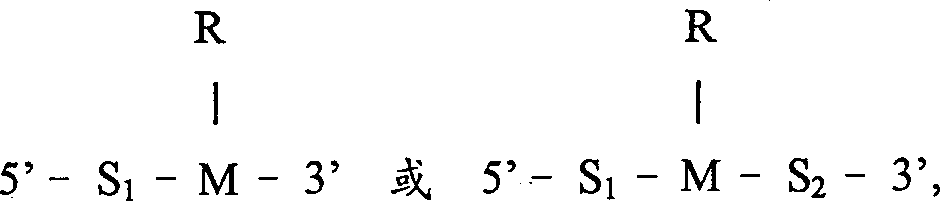
其中S1代表大约5和大约50个核苷酸长度之间的第一个核苷酸序列;wherein S represents the first nucleotide sequence between about 5 and about 50 nucleotides in length;
其中S2代表1和3个核苷酸长度之间的第二个序列;wherein S2 represents a second sequence between 1 and 3 nucleotides in length;
其中M代表一个含有嘌呤或嘧啶碱基的核苷酸,该碱基含有一环外胺;Wherein M represents a nucleotide containing a purine or pyrimidine base containing an exocyclic amine;
其中R代表一修饰物基团,R通过环外胺与M共价结合,R具有以下结构: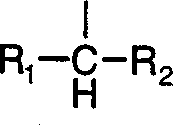
其中R1、R2各自代表氢、C1-C10烷基、烷氧基、苯基、苯氧基、取代苯基、萘基或取代萘基。烷基可以是支链或非支链。Wherein R 1 and R 2 each represent hydrogen, C 1 -C 10 alkyl, alkoxy, phenyl, phenoxy, substituted phenyl, naphthyl or substituted naphthyl. Alkyl groups may be branched or unbranched.
优选实施方案中,M是一修饰的常规核苷酸,比如M为修饰后的腺苷、胞苷或鸟苷,修饰成分与腺嘌呤、鸟嘌呤或胞嘧啶碱基的环外胺共价结合,M更优选为修饰的腺苷。In a preferred embodiment, M is a modified conventional nucleotide, such as M is modified adenosine, cytidine or guanosine, and the modification component is covalently bonded to the exocyclic amine of adenine, guanine or cytosine bases , M is more preferably a modified adenosine.
优选实施方案中,R为2-萘甲基,苄基、或取代苄基。优选取代的苄基具有如下结构: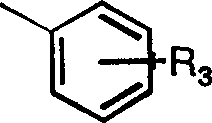
其中R3代表一C1-C6支链或直链烷基,更优选C1-C4支链或直链烷基、甲氧基或硝基,R3优选对位连接。Wherein R 3 represents a C 1 -C 6 branched or straight chain alkyl group, more preferably a C 1 -C 4 branched or straight chain alkyl group, methoxy group or nitro group, and R 3 is preferably connected at the para position.
更优选实施方案中,R为苄基、对一甲基苄基、对叔丁基苄基、对甲氧苄基、或2-萘甲基。In a more preferred embodiment, R is benzyl, p-methylbenzyl, p-tert-butylbenzyl, p-methoxybenzyl, or 2-naphthylmethyl.
本发明另一方面涉及由光敏共价结合的修饰基团修饰的扩增引物,该修饰基团会部分或全部阻滞引物延伸。该光敏修饰物可以结合环外胺(如在前述修饰的核苷酸中的)也可结合环氮。在一实施方案中,至少有一个硝基苄基结合到3'末端核苷酸的腺嘌呤、鸟嘌呤、或胞嘧啶碱基的环外胺。Another aspect of the invention relates to amplification primers modified with a photosensitive covalently attached modifying group that partially or fully retards primer extension. The photosensitizing modifier can bind either an exocyclic amine (as in the aforementioned modified nucleotides) or a ring nitrogen. In one embodiment, at least one nitrobenzyl group is bound to the exocyclic amine of the adenine, guanine, or cytosine base of the 3' terminal nucleotide.
本发明另一方面涉及一对或一系列引物,其中至少有一个引物按上面所述修饰过。优选实施方案中,一对或全部的一系列引物都被修饰。Another aspect of the invention relates to a pair or series of primers, at least one of which is modified as described above. In preferred embodiments, a pair or all of a series of primers are modified.
本发明另一方面涉及扩增核酸的方法,包括用本发明的修饰引物进行扩增反应。Another aspect of the present invention relates to a method for amplifying nucleic acid comprising carrying out an amplification reaction with the modified primers of the present invention.
本发明另一方面涉及扩增目的核酸的方法,包括用本发明的光敏修饰引物进行扩增反应,其中反应混合物用光照射,该光应足以消除修饰基团并形成引物延伸产物。本发明的一个实施方案中,照射在扩增反应开始前,反应混合物被加热到高于50℃后,作为独立的一步进行。另一实施方案中,照射是伴随扩增过程的初始阶段一起进行的,例如,伴随RNA扩增反应的反转录阶段,或DNA扩增反应的初始变性阶段。Another aspect of the invention relates to a method of amplifying a nucleic acid of interest comprising performing an amplification reaction with a photosensitive modified primer of the invention, wherein the reaction mixture is irradiated with light sufficient to eliminate the modifying group and form a primer extension product. In one embodiment of the invention, irradiation is performed as a separate step after the reaction mixture has been heated above 50° C. before the start of the amplification reaction. In another embodiment, irradiation is performed with the initial stages of the amplification process, eg, with the reverse transcription stage of an RNA amplification reaction, or with the initial denaturation stage of a DNA amplification reaction.
本发明另一方面涉及核苷酸序列体外扩增的试剂盒,其中包含一对引物,该引物中至少有一个是按本文所述修饰过的。本发明的试剂盒也包含一个或多个扩增反应物,例如核酸聚合酶或连接酶、核苷三磷酸酶、以及适当的缓冲液。Another aspect of the present invention relates to a kit for in vitro amplification of nucleotide sequences, comprising a pair of primers, at least one of which is modified as described herein. Kits of the invention also comprise one or more amplification reagents, such as nucleic acid polymerase or ligase, nucleoside triphosphatase, and appropriate buffers.
附图概述:Overview of the drawings:
图1显示用苄基化的引物进行HIV-1RNA扩增的结果,如实施例5所述。Figure 1 shows the results of HIV-1 RNA amplification using benzylated primers, as described in Example 5.
图2显示用苄基化的引物进行HCV RNA扩增的结果,如实施例6所述。Figure 2 shows the results of HCV RNA amplification using benzylated primers, as described in Example 6.
图3显示用分别用三种修饰基团之一修饰后的引物进行HCV RNA扩增的结果,如实施例7所述。Figure 3 shows the results of HCV RNA amplification using primers modified with one of the three modifying groups, as described in Example 7.
图4显示用光敏修饰后引物进行HCV RNA扩增的结果,如实施例8所述。Figure 4 shows the results of HCV RNA amplification with photosensitive modified primers, as described in Example 8.
图5显示用苄基修饰的引物和用对叔丁基苄基修饰的引物扩增分枝杆菌DNA的结果,如实施例10所述。Figure 5 shows the results of the amplification of mycobacterial DNA with benzyl-modified primers and with p-tert-butylbenzyl-modified primers, as described in Example 10.
图6显示适用于苄基或取代苄基修饰的脱氧腺苷(dA)可控孔度玻璃(CPG)合成的常用反应体系。Figure 6 shows a common reaction system suitable for the synthesis of benzyl or substituted benzyl modified deoxyadenosine (dA) controlled pore glass (CPG).
为帮助理解本发明,对有关术语定义如下:To help understand the present invention, relevant terms are defined as follows:
“核酸”、“寡核苷酸”指的是多聚脱氧核糖核苷酸(含有2-脱氧-D-核糖)、多聚核糖核苷酸(含有D-核糖)及其它类型的多核苷酸:嘌呤或嘧啶碱基的N糖甙或修饰后的嘌呤或嘧啶碱基的N糖基。“核酸”和“寡核苷酸”之间没有长度上的区别,可以互换使用。这些术语仅指分子的一级结构,可以包括双股、单股DNA以及双股、单股RNA。"Nucleic acid" and "oligonucleotide" refer to polydeoxyribonucleotides (containing 2-deoxy-D-ribose), polyribonucleotides (containing D-ribose) and other types of polynucleotides : N-glycoside of purine or pyrimidine base or modified N-glycoside of purine or pyrimidine base. There is no difference in length between "nucleic acid" and "oligonucleotide" and are used interchangeably. These terms refer only to the primary structure of the molecule and can include double- and single-stranded DNA as well as double- and single-stranded RNA.
“常规的”在表示核酸碱基、核苷或核苷酸时是指所述的多核苷酸中自然产生的那些。四种常规的(即主要的)构成DNA的脱氧核糖核苷酸包括嘌呤碱基(腺嘌呤和鸟嘌呤)和嘧啶碱基(胞嘧啶和胸腺嘧啶)。四种常规的RNA核糖核苷酸包括嘌呤碱基(腺嘌呤和鸟嘌呤)及嘧啶碱基(胞嘧啶和尿嘧啶)。除了上述常规的或通用的碱基,一些其它的嘌呤和嘧啶衍生物(称为稀有或少数碱基)也少量出现于某些核酸中。在本文中“非常规的”表示核酸碱基、核苷或核苷酸时是指稀有或少数核酸碱基、核苷或核苷酸以及常规碱基、核苷或核苷酸的修饰物、衍生物或类似物,也包括含有修饰碱基成份和/或修饰糖成份的合成的核苷酸(见寡核苷酸缀合物方案,分子生物学方法,26卷(SudhirAgrawal编,Hmana Press,Totowa,NJ,(1994));寡核苷酸和类似物,实施方法(Fritz Eckstrin编,IRL Press,牛津大学出版,Oxford)。"Ordinary" when referring to nucleic acid bases, nucleosides or nucleotides refers to those that occur naturally in the polynucleotide in question. The four conventional (ie, main) deoxyribonucleotides that make up DNA include the purine bases (adenine and guanine) and the pyrimidine bases (cytosine and thymine). The four conventional RNA ribonucleotides include the purine bases (adenine and guanine) and the pyrimidine bases (cytosine and uracil). In addition to the conventional or universal bases described above, some other purine and pyrimidine derivatives (referred to as rare or minority bases) also occur in small amounts in certain nucleic acids. "Unconventional" as used herein when referring to nucleic acid bases, nucleosides or nucleotides means rare or few nucleic acid bases, nucleosides or nucleotides as well as modifications of conventional bases, nucleosides or nucleotides, Derivatives or analogs, also including synthetic nucleotides containing modified base moieties and/or modified sugar moieties (see Protocols for Oligonucleotide Conjugates, Methods in Molecular Biology, vol. 26 (Edited by Sudhir Agrawal, Hmana Press, Totowa, NJ, (1994)); Oligonucleotides and Analogs, Methods of Implementation (ed. Fritz Eckstrin, IRL Press, Oxford University Press, Oxford).
寡核苷酸可用适当的方法制备,如克隆并限制适当序列以及直接化学合成,例如应用Narang等的磷酸三酯法,1979,酶学方法(Meth.Enzymol.)68:90-99。Brown等的磷酸二酯法1979酶学方法,(Meth.Enzymol.)68:109-151;Beaucage等的二乙基磷酸酰胺法,1981,四面体通讯(TetrahedonLett.)22:1859-1862;美国专利号4,458,066的固相载体法。这些合成方法在goodchild,1990,生物结合化学(Bioconjugate Chemistry)l(3):165-187中有综述。Oligonucleotides can be prepared by appropriate methods, such as cloning and restriction of appropriate sequences and direct chemical synthesis, for example using the phosphotriester method of Narang et al., 1979, Meth. Enzymol. 68: 90-99. The phosphodiester method of Brown et al. 1979 Enzyme Methods, (Meth. Enzymol.) 68: 109-151; The diethyl phosphoric acid amide method of Beaucage et al., 1981, Tetrahedon Lett. 22: 1859-1862; USA The solid phase carrier method of Patent No. 4,458,066. These synthetic methods are reviewed in goodchild, 1990, Bioconjugate Chemistry 1 (3): 165-187.
“碱基配对”,本领域中称为“Waston-crick碱基配对”,是指众所周知的在双链DNA结构中碱基对腺嘌呤-胸腺嘧啶和鸟嘌呤-胞嘧啶之间,以及RNA/DNA杂合分子中的腺嘌呤-鸟嘧啶和鸟嘌呤-胞嘧啶,之间互补的氢键成键,以及非常规核苷酸对之间的类似结合。"Base pairing", referred to in the art as "Waston-crick base pairing", refers to the well-known relationship between the base pairs adenine-thymine and guanine-cytosine in the double-stranded DNA structure, and between RNA/cytosine Complementary hydrogen bonding between adenine-guanine and guanine-cytosine in DNA hybrid molecules, and similar binding between unconventional nucleotide pairs.
“杂交”指的是应用两个单链核酸通过碱基互补配对形成双链结构。杂交可发生于完全互补的核酸链间或存在少量错配区的“基本上互补的”核酸链间。只能在完全互补核酸链间发生杂交的条件称为“严格杂交条件”或“序列特异杂交条件”。基本互补序列的稳定双螺旋体可在非严格杂交条件下获得。耐受的错配程度可通过适当调节杂交条件控制。核酸领域的技术人员通过考虑一些变量能凭经验可以确定双螺旋的稳定性。这些变量包括:寡核苷酸的长度和碱基对的浓度、离子强度、碱基对错配率。可以按技术指南(Sambook 1989,分子克隆-实验手册,(Molecular Cloning-A LaboratoryManual)Cold Spring Harbor,New York;Wetmur,1991,生物化学和分子生物学评论26(3/4):227-259)进行。"Hybridization" refers to the use of two single-stranded nucleic acids to form a double-stranded structure through complementary base pairing. Hybridization can occur between perfectly complementary nucleic acid strands or between "substantially complementary" nucleic acid strands that contain minor regions of mismatch. Conditions under which hybridization occurs only between perfectly complementary nucleic acid strands are referred to as "stringent hybridization conditions" or "sequence-specific hybridization conditions." Stable duplexes of substantially complementary sequences can be obtained under non-stringent hybridization conditions. The degree of mismatch tolerance tolerated can be controlled by appropriate adjustment of hybridization conditions. Duplex stability can be determined empirically by those skilled in the nucleic acid arts by taking into account a number of variables. These variables include: oligonucleotide length and base pair concentration, ionic strength, base pair mismatch rate. According to the technical guide (Sambook 1989, Molecular Cloning-A Laboratory Manual, (Molecular Cloning-A Laboratory Manual) Cold Spring Harbor, New York; Wetmur, 1991, Biochemistry and Molecular Biology Review 26 (3/4): 227-259) conduct.
“引物”指的是在诱导合成与核酸链互补的引物延伸产物条件下,在4种不同的核苷三磷酸和延伸试剂(例如DNA聚合酶或反转录酶)及适宜缓冲液和适宜温度下,能作为DNA合成的起始点的寡核苷酸。本文中的“引物”包括用于连接介导扩增反应中的寡核苷酸,此反应过程中一个寡核苷酸通过与在相邻位置杂交的第二个寡核苷酸连接而“延伸”。因此本文中的“引物延伸”是指应用作为DNA合成起始点的引物进行的单个核苷三磷酸的聚合反应,也指两个引物形成一个延伸产物的连接反应。"Primer" refers to the primer under the condition of inducing the synthesis of a primer extension product complementary to the nucleic acid strand, in four different nucleoside triphosphates and extension reagents (such as DNA polymerase or reverse transcriptase) and suitable buffer and suitable temperature Next, an oligonucleotide that can serve as the starting point for DNA synthesis. "Primer" as used herein includes oligonucleotides used in ligation-mediated amplification reactions during which one oligonucleotide is "extended" by ligation with a second oligonucleotide that hybridizes at an adjacent position. ". Therefore, "primer extension" herein refers to the polymerization reaction of a single nucleoside triphosphate using a primer as the starting point of DNA synthesis, and also refers to the ligation reaction of two primers to form an extension product.
引物优选单链的DNA。引物的适宜长度取决于该引物所要求的用途,一般在6-50个核苷酸之间。短的引物分子一般要求较低的温度以与模板形成足够稳定的杂交复合物。引物不需要反应模板核酸的准确序列,但必须与模板充分互补杂交。用于扩增给定目的序列的适宜引物设计在现有技术中是已知的,可参考本文文献。The primer is preferably single-stranded DNA. The suitable length of the primer depends on the required use of the primer, generally between 6-50 nucleotides. Short primer molecules generally require lower temperatures to form sufficiently stable hybrid complexes with the template. Primers do not need to react to the exact sequence of the template nucleic acid, but must fully hybridize with the template. Appropriate primer design for the amplification of a given sequence of interest is known in the art and reference is made herein.
引物可以为检测或固定而添加一些特征,但不能改变引物的基本特征即作为DNA合成起始点。例如引物可以在5末端增加一核酸序列,它不与目的核酸杂交,但有助于克隆扩增产物。引物与模板充分互补杂交的区域在本文中称为杂交区域。Primers can add features for detection or immobilization, but do not change the basic feature of the primer as a starting point for DNA synthesis. For example, the primer can add a nucleic acid sequence at the 5 end, which does not hybridize with the target nucleic acid, but is helpful for cloning the amplification product. The region where the primer hybridizes to the template in a sufficient complementarity is referred to herein as the hybridization region.
“目的序列”、“目的区域”、及“目的核酸”指的是用于扩增的核酸区域或序列。"Sequence of interest," "region of interest," and "nucleic acid of interest" refer to a nucleic acid region or sequence for amplification.
按本文所指,如果引物序列与目的序列之间的错配数少于引物序列与样品中存在的非目的序列间的错配数,则该引物对于目的序列来说就是“特异的”。只有当错配数不超过引物与目的序列间的错配数时才能选择形成稳定双链的杂交条件。在该条件下目的特异引物只与目的序列形成稳定双链。因此在稳定严格扩增条件下应用目的特异性引物能特异扩增含有目的引物结合位点的序列。应用序列特异扩增条件能特异扩增那些含有精确互补引物结合位点的目的序列。As referred to herein, a primer is "specific" for a sequence of interest if the number of mismatches between the primer sequence and the sequence of interest is less than the number of mismatches between the primer sequence and non-target sequences present in the sample. Only when the number of mismatches does not exceed the number of mismatches between the primer and the target sequence can the hybridization conditions that form a stable duplex be selected. Under this condition, the target-specific primer only forms a stable duplex with the target sequence. Therefore, the target-specific primers can be used to specifically amplify the sequence containing the target primer-binding site under stable and stringent amplification conditions. The application of sequence-specific amplification conditions can specifically amplify those target sequences that contain precise complementary primer binding sites.
“非特异扩增”是指由于引物与非目的序列杂交并作为引物延伸底物而产生的该非目的序列的核酸扩增。引物与非目的序列的杂交称为“非特异杂交”,可发生于温度较低、低严格性和预扩增条件下。"Non-specific amplification" refers to nucleic acid amplification of a non-target sequence due to a primer hybridizing to the non-target sequence and serving as a primer extension substrate. The hybridization of primers to non-target sequences is called "non-specific hybridization" and can occur under low temperature, low stringency and preamplification conditions.
“引物二聚体”指模板非依赖性的来自引物在另一引物作为模板时延伸产生的非特异扩增产物。尽管引物二聚体经常是两个引物的串联体,即一种二聚体,但也可能出现超过两个引物的串联体。“引物二聚体”在本文中一般包括模板非依赖性的非特异扩增产物。"Primer-dimer" refers to a template-independent non-specific amplification product resulting from the extension of a primer when another primer serves as a template. Although a primer-dimer is often a tandem of two primers, ie a dimer, a tandem of more than two primers may also occur. "Primer dimers" herein generally include template-independent non-specific amplification products.
“反应混合物”指的是含有进行一种给定反应所必须试剂的溶液。“扩增反应混合物”是指进行扩增反应所必须试剂的溶液,一般含有寡核苷酸引物和DNA聚合酶或适宜缓冲液中的连接酶。“PCR反应混合物”一般含有寡核苷酸引物、热稳定性DNA聚合酶、脱氧三磷酸核苷(dNTPS)、和适宜缓冲液中的二价金属阳离子。若反应混合物含有进行反应所必须的全部试剂则为完全的,若只含有一部分试剂则为不完全混合物。熟悉本科学领域的人都明白,反应成份常规单独保存,各含有一种成份,以利于方便、稳定储存或便于调节所用化合物浓度;也知道在反应之前合并各反应物以形成完全反应混合物。而且反应物单独包装出售,适用的商品试剂盒含有包括本发明修饰引物在内的任何一种反应组分。修饰的引物"Reaction mixture"refers to a solution containing the reagents necessary to carry out a given reaction. "Amplification reaction mixture" refers to a solution of reagents necessary for performing an amplification reaction, generally containing oligonucleotide primers and DNA polymerase or ligase in a suitable buffer. A "PCR reaction mixture" generally contains oligonucleotide primers, a thermostable DNA polymerase, deoxynucleoside triphosphates (dNTPS), and a divalent metal cation in a suitable buffer. A reaction mixture is complete if it contains all the reagents necessary to carry out the reaction, and an incomplete mixture if it contains only a portion of the reagents. It is understood by those skilled in the art that reaction components are routinely kept separately, each containing one component, for convenience, storage stability or to facilitate adjustment of the concentration of the compound used; and that the reactants are combined prior to reaction to form a complete reaction mixture. Moreover, the reactants are packaged and sold separately, and applicable commercial kits contain any reaction components including the modified primers of the present invention. modified primers
本发明的扩增引物是通过在引物3’末端的四种核苷酸中的一种上共价结合一基团进行修饰的。实施方案中本发明的修饰引物包括具有以下一般结构的核酸序列:
S2代表1和3个核苷酸长度之间的第二个序列;S 2 represents the second sequence between 1 and 3 nucleotides in length;
M代表一个含有嘌呤或嘧啶碱基的核苷酸,该碱基含有一环外胺。M represents a nucleotide containing a purine or pyrimidine base containing an exocyclic amine.
R代表一修饰剂基团,R通过环外胺与M共价结合,R如下述结构。R represents a modifier group, R is covalently bonded to M through an exocyclic amine, and R has the following structure.
按实施例所示,当修饰发生在3’末端核苷酸上时修饰效率最大,因此引物优选包含修饰的3’末端核苷酸。As shown in the Examples, the modification efficiency is greatest when the modification occurs at the 3' terminal nucleotide, so the primer preferably contains the modified 3' terminal nucleotide.
修饰的核苷酸选自那些碱基中含有环外胺的,环外胺通过其互补核苷酸而进入核苷酸碱基配对中。引物一般是只含常规核苷酸的DNA。DNA中常规核苷酸碱基腺嘌呤、鸟嘌呤、胞嘧啶含有一环外伯胺,其通过互补碱基进入碱基配对。本发明的优选的一方面在于引物的修饰是通过将单个的修饰基团结合到环外胺上代替胺基中的两个氢之一(其在未修饰的碱基中能进入碱基配对)而实现的。修饰核苷酸的结构中分别含有一修饰的腺嘌呤、鸟嘌呤、胞嘧啶碱基,如下所示:其中S代表糖成份,R代表修饰基团。Modified nucleotides are selected from those whose bases contain an exocyclic amine that enters into nucleotide base pairing through its complementary nucleotide. Primers are generally DNA containing only conventional nucleotides. The conventional nucleotide bases adenine, guanine, and cytosine in DNA contain a ring of exogenous primary amines, which enter into base pairing through complementary bases. A preferred aspect of the invention is that the primers are modified by attaching a single modifying group to the exocyclic amine in place of one of the two hydrogens in the amine group (which can enter base pairing in the unmodified base) and achieved. The structure of modified nucleotides contains a modified adenine, guanine, and cytosine bases, as shown below: Wherein S represents the sugar component, R represents the modifying group.
本发明不局限于常规核苷酸构成的引物,任何碱基成份中与互补碱基配对的含有环外伯胺的核苷酸类似物都可按本文所示修饰。非常规核苷酸的例子包括3-甲基腺嘌呤、7-甲基鸟嘌呤、3-甲基鸟嘌呤、5-甲基胞嘧啶以及5-羟甲基胞嘧啶。The present invention is not limited to primers composed of conventional nucleotides, and nucleotide analogs containing exocyclic primary amines that pair with complementary bases in any base composition can be modified as shown herein. Examples of unconventional nucleotides include 3-methyladenine, 7-methylguanine, 3-methylguanine, 5-methylcytosine, and 5-hydroxymethylcytosine.
由于修饰物取代了一个氢原子使修饰基团限制了修饰碱基形成氢键的能力。剩余的氢原子仍能参与氢键形成。修饰物因此影响了杂交的动力学和热动力学。各种预计的修饰基团具有如下特性:Since the modifier replaces a hydrogen atom, the modifying group limits the ability of the modified base to form hydrogen bonds. The remaining hydrogen atoms can still participate in hydrogen bond formation. The modifier thus affects the kinetics and thermodynamics of hybridization. Various contemplated modifying groups have the following properties:
1、干扰但不阻滞修饰的碱基与互补的碱基的Waston-Crick碱基配对;1. Interfering but not blocking the Watton-Crick base pairing between the modified base and the complementary base;
2、干扰但不阻滞修饰引物的延伸;2. Interfering with but not blocking the extension of modified primers;
3、允许与修饰引物延伸产物互补的单股DNA的合成。3. Allows the synthesis of single-stranded DNA that is complementary to the extension product of the modified primer.
修饰基团在空间上干扰碱基配对从而干扰引物延伸,因此修饰物的体积影响干扰杂交的程度。当修饰的腺嘌呤或胞嘧啶核苷酸构成双股核酸时,修饰基团会插入到大沟的中间区,因此即使相当大的修饰基团也几乎不会造成双螺旋结构的空间紊乱,但适宜的修饰物不能太大以致阻滞氢键形成或阻滞引物3’-羟基的酶促延伸。当修饰的鸟嘌呤核苷酸进入双股核酸时,修饰基团会插入到小沟中,该小沟只能为应顺修饰基团提供较小的空间,因此优选较小的修饰基团结合鸟嘌呤碱基。Modifiers sterically interfere with base pairing and thus primer extension, so the size of the modifier affects the degree to which it interferes with hybridization. When the modified adenine or cytosine nucleotide constitutes a double-stranded nucleic acid, the modification group will be inserted into the middle region of the major groove, so even a relatively large modification group will hardly cause the spatial disorder of the double helix structure, but Suitable modifiers are not so large as to block hydrogen bond formation or enzymatic extension of the 3'-hydroxyl of the primer. When the modified guanine nucleotides enter the double-stranded nucleic acid, the modifying group will be inserted into the minor groove, which can only provide a small space for the corresponding modifying group, so the smaller modifying group is preferred for binding guanine base.
作为下一扩增循环模板的引物延伸产物含有来自引物的修饰碱基,选择该修饰碱基要使模板中修饰碱基的存在不会终止引物延伸或抑制引物延伸。修饰碱基的性质不能提高突变的发生,否则修饰碱基本身会在引物产生的模板复制中丢失。模板中修饰碱基对引物延伸的影响可用现有技术指南检测到(例如Gniazdowski和Cera,1996,化学杂志(Chem.Rev.)96:619-634)。The primer extension product serving as a template for the next amplification cycle contains a modified base from the primer selected such that the presence of the modified base in the template does not terminate or inhibit primer extension. The nature of the modified base does not enhance the occurrence of mutations, otherwise the modified base itself would be lost in the replication of the template generated by the primers. The effect of modified bases in the template on primer extension can be detected using state of the art guidelines (eg Gniazdowski and Cera, 1996, Chem. Rev. 96:619-634).
满足上述特性的修饰基团R适用于本发明的方法。优选具有以下结构的修饰基团: A modifying group R that satisfies the above properties is suitable for use in the method of the present invention. A modifying group with the following structure is preferred:
其中R1、R2各自代表氢、C1-C10烷基、苯基、取代苯基、萘基或取代萘基,烷基可以是支链或直链,也可使用大于C20的烷基。Wherein R 1 and R 2 each represent hydrogen, C 1 -C 10 alkyl, phenyl, substituted phenyl, naphthyl or substituted naphthyl, the alkyl can be branched or straight chained, and an alkane greater than C 20 can also be used base.
优选实施方案中R为2-萘甲基、苄基或取代苄基,优选的取代苄基具有如下结构: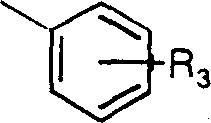
其中R3代表一C1-C6支链或直链烷基团,更优选C1-C4支链或直链烷基,甲氧基、硝基。C1-C4支链或直链烷基为甲烷、乙烷、丙烷、丁烷、异丙烷、异丁烷等。甲烷和对丁烷为优选烷基,R3优选对位。特别优选的修饰基团R如下所示: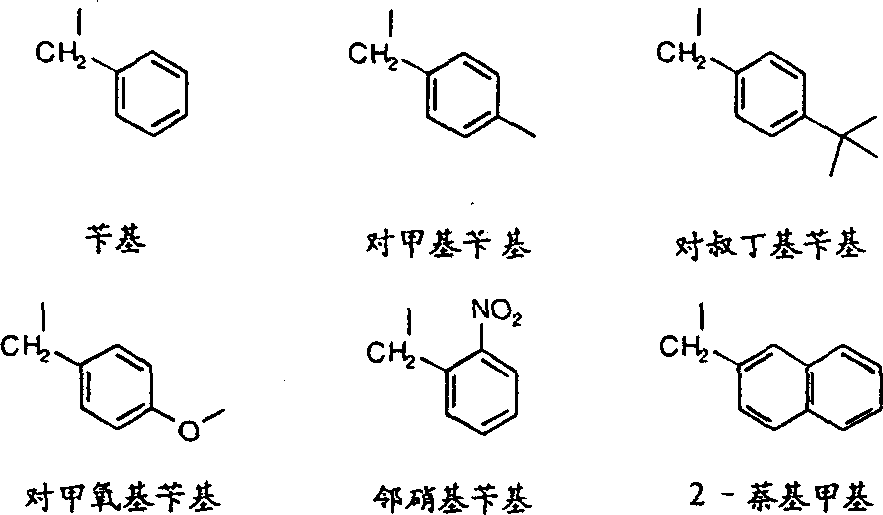
一些特殊的修饰基团可见实施例。一般来说,本领域的技术人员可以按本文提供指南从一类化合物中凭经验选择适宜的修饰基团。特殊基团的适宜性最好通过在扩增反应中应用修饰引物来确定。成功的扩增表明修饰碱基不会完全阻止引物延伸,而且引物衍生模板中的修饰碱基也不会终止引物延伸。引物二聚体的减少可按实施例中所述确定。光敏修饰的引物Some specific modification groups can be seen in the examples. In general, those skilled in the art can select a suitable modifying group empirically from a class of compounds according to the guidelines provided herein. The suitability of a particular group is best determined by using modified primers in the amplification reaction. Successful amplification demonstrates that the modified base does not completely prevent primer extension, and that the modified base in the primer-derived template does not terminate primer extension. The reduction of primer dimers can be determined as described in the Examples. photosensitive modified primers
本发明的另一实施方案中,引物用一个或多个光敏基因修饰,该光敏基因可以在反应达到确保特异性的高温反应条件后通过光照去除。因为该修饰物在引物延伸之前去除,修饰的引物在修饰基团去除前不需要有延伸性。可用于本发明方法中的光敏修饰物的例子,见Pillai,1980,"有机合成中的光消除性保护基团",合成:1-26。In another embodiment of the present invention, the primers are modified with one or more photosensitive genes, which can be removed by light after the reaction reaches high temperature reaction conditions to ensure specificity. Because the modifier is removed prior to primer extension, the modified primer need not be extensible prior to removal of the modifying group. For examples of photosensitive modifiers that may be used in the methods of the invention, see Pillai, 1980, "Photoeliminative Protecting Groups in Organic Synthesis", Synthesis: 1-26.
本发明的光敏引物修饰优选在3'末端核苷酸上加上一个或两个邻硝基苄基团: The photosensitive primer modification of the present invention preferably adds one or two o-nitrobenzyl groups on the 3' terminal nucleotide:
通过在碱基成分的环外的伯胺上加上单个硝基苄基而修饰的引物,如果胺基能旋转以使保留的氢朝向互补碱基,则形成的仲胺仍能参与碱基配对。如实施例中所述,这些引物可用于伴或不伴紫外光照清除的扩增。A primer modified by adding a single nitrobenzyl group to a primary amine outside the ring of the base component, if the amine group can be rotated so that the retained hydrogen is oriented toward the complementary base, the secondary amine formed can still participate in base pairing . These primers can be used for amplification with or without UV light clearance as described in the Examples.
用两个硝基苄基结合碱基的环外胺而修饰的引物不能延伸。这种抑制作用可能是由于修饰的碱基在进行碱基配对时因环外胺的两个氢被大体积的硝基苄基取代而失活。用两个硝基苄基修饰的引物在扩增中的应用见实施例,在该扩增中反应混合物需暴露于紫外线下一段时间以充分去除硝基苄基,从而产生引物延伸。Primers modified with exocyclic amines of two nitrobenzyl binding bases cannot be extended. This inhibitory effect may be due to the inactivation of the modified base during base pairing due to the replacement of two hydrogens of the exocyclic amine by the bulky nitrobenzyl group. See Examples for the use of primers modified with two nitrobenzyl groups in amplification in which the reaction mixture is exposed to ultraviolet light for a period of time sufficient to remove the nitrobenzyl groups to produce primer extension.
在另一实施方案中,修饰基团结合到环氮上。将一个硝基苄基结合到碱基的环氮上修饰的引物,由于修饰碱基进行碱基配对时失活而不能延伸。通过紫外线照射去除硝基苄基可以使引物延伸。In another embodiment, the modifying group is bound to the ring nitrogen. A primer modified by binding a nitrobenzyl group to the ring nitrogen of the base cannot be extended due to the inactivation of the modified base during base pairing. Removal of the nitrobenzyl group by UV irradiation allows primer extension.
应用去除修饰基因才能延伸的光敏引物可以进行热起动扩增。引物延伸在反应前非特异条件下被抑制,只有当反应温度升至能确保反应特异性后,照射反应物使引物解除抑制。修饰引物的合成Hot-start amplification can be performed using light-sensitive primers that can only be extended by removing the modified gene. Primer extension is inhibited under non-specific conditions before the reaction, and only when the reaction temperature rises to ensure the specificity of the reaction, the primers are uninhibited by irradiating the reactants. Synthesis of modified primers
修饰引物的合成是用现有技术中的标准化学方法进行的。修饰物引入的方法分4种:1.通过应用修饰的核苷作为DNA合成的支持体而引入该修饰物。2.通过应用修饰的核苷作为亚磷酰胺引入修饰物。3.通过应用DNA合成过程中的试剂引入修饰物。(例如加到DNA序列中的用苄基胺处理可转化的亚酰胺盐)4.合成后修饰。修饰物可以在与合成的DNA接触时作为反应试剂引入。Synthesis of modified primers is performed using standard chemistry known in the art. There are 4 ways to introduce modifiers: 1. The modification is introduced by using the modified nucleoside as a support for DNA synthesis. 2. Modifications are introduced by using modified nucleosides as phosphoramidites. 3. Modifications are introduced by applying reagents during DNA synthesis. (eg, benzylamine treatment convertible imide salts added to the DNA sequence) 4. Post-synthetic modification. Modifications can be introduced as reactive reagents upon contact with the synthesized DNA.
特殊修饰引物的合成见实施例。其它的修饰引物可按类似方式用标准方法合成。The synthesis of specially modified primers is shown in the Examples. Other modified primers can be synthesized in a similar manner using standard methods.
修饰引物优选用衍生的可控孔度玻璃(CPG)载体来合成。合成衍生的dACPG的常规反应方案见图6。特殊的修饰基团可通过应用适当的烷基卤化物、苄基卤化物、取代的苄基卤化物、萘甲基卤化物或取代的萘甲基卤化物等烷基化剂加入。苄基和对叔丁基苄基dACPG的合成见实施例1和2,按图6的方案进行。Modified primers are preferably synthesized using derivatized controlled pore glass (CPG) supports. A general reaction scheme for the synthesis of derivatized dACPG is shown in Figure 6. Specific modifying groups can be added through the use of appropriate alkylating agents such as alkyl halides, benzyl halides, substituted benzyl halides, naphthylmethyl halides or substituted naphthylmethyl halides. See Examples 1 and 2 for the synthesis of benzyl and p-tert-butylbenzyl dACPG, and proceed according to the scheme in Figure 6.
环外氨基的烷化可用类似甲基化的方式进行。见Grittin和Reese,1963,生物化学杂志(Biochim.Acta)68:185-192。其它的合成方法见Aritoma等,1995,J.Chem.Soc.Perkin.Trans.1:1837-1849.用修饰的引物扩增Alkylation of exocyclic amino groups can be carried out in a similar manner to methylation. See Grittin and Reese, 1963, Biochim. Acta 68: 185-192. For other synthetic methods, see Aritoma et al., 1995, J. Chem. Soc. Perkin. Trans. 1: 1837-1849. Amplify with modified primers
本发明的方法包括应用本发明的修饰引物进行以引物为基础的扩增。修饰引物一般可以取代含有相同核苷酸序列的未修饰引物,而不需改变扩增反应条件。当然,本领域技术人员认识到反应条件略作调整对某些反应有利。The methods of the invention comprise primer-based amplification using the modified primers of the invention. Modified primers can generally replace unmodified primers containing the same nucleotide sequence without changing the amplification reaction conditions. Of course, those skilled in the art recognize that some reactions may benefit from slight adjustments in the reaction conditions.
优选实施方案中,本发明的修饰引物用于聚合酶链反应(PCR)。但本发明不限于任何具体的扩增体系。本发明的修饰引物可用于任何以引物为基础的形成引物二聚体或非特异扩增产物的扩增体系。实施例中包括了上述文献中的扩增方法。如同其它体系的发展,这些体系也会通过实施本发明受益。In a preferred embodiment, the modified primers of the invention are used in polymerase chain reaction (PCR). However, the present invention is not limited to any particular amplification system. The modified primers of the present invention can be used in any primer-based amplification system that forms primer dimers or non-specific amplification products. The examples include the amplification methods in the above-mentioned documents. As other systems are developed, these systems will also benefit from the practice of the present invention.
本发明的方法适用于DNA和RNA的扩增。例如现有技术中,用反转录/聚合酶链反应(RT-PCR)进行RNA扩增,见美国专利号5,322,770和5,310,652,Myers和Gelfand,1991,生物化学(Biochemistry)30(31):7661-7666;Young等,1993,临床微生物学杂志(J.Clin.Microbiol.)32(2):292-300。The method of the invention is applicable to the amplification of DNA and RNA. For example, in the prior art, RNA amplification is carried out with reverse transcription/polymerase chain reaction (RT-PCR), see U.S. Patent No. 5,322,770 and 5,310,652, Myers and Gelfand, 1991, Biochemistry ( Biochemistry) 30(31): 7661-7666; Young et al., 1993, J. Clin. Microbiol. 32(2): 292-300.
以引物为基础的扩增中,引物延伸通常是在高温度下用耐热酶(例如用耐热DNA聚合酶)进行的。酶首先在引物的3'末端启动合成并向模板的5'末端方向前进直到合成终止。用于扩增反应的纯的热稳定DNA聚合酶在现有技术中是已知的;包括(但不限于)美国专利号4,889,818;5,079,352;5,325,600;5,491,086;WO91/09950;WO92/03556;WO92/06200;WO92/06202;WO92/09689;以及美国专利号5,210,036中提及的那些酶。对热稳定DNA聚合酶的评述见Abramson,1995,PCR策略(M.A.Znnis等编),39-57页,AcademicPress,SanDiego。In primer-based amplification, primer extension is usually performed at elevated temperature with a thermostable enzyme (eg, with a thermostable DNA polymerase). The enzyme first initiates synthesis at the 3' end of the primer and proceeds toward the 5' end of the template until synthesis is terminated. Pure thermostable DNA polymerases for amplification reactions are known in the art; including (but not limited to) U.S. Patent Nos. 4,889,818; 5,079,352; 5,325,600; 5,491,086; WO91/09950; WO92/03556; WO92/06200; WO92/06202; WO92/09689; and those enzymes mentioned in U.S. Patent No. 5,210,036. For a review of thermostable DNA polymerases, see Abramson, 1995, PCR Strategies (eds. M.A. Znnis et al.), pp. 39-57, Academic Press, San Diego.
优选实施方案中(特别针对DNA扩增),应用一可逆失活酶进行扩增,该可逆失活酶在高温反应条件下能复活,它的应用通过抑制反应开始前的引物延伸而进一步降低了非特异扩增。可逆失活的热稳定DNA聚合酶由Hoffmann-La Roche(Nutley,NJ)开发制造,PerkinElmer(Norwalk,CT)销售,见Birch等,1996,自然(Nature)381(6581):445-446。In a preferred embodiment (particularly for DNA amplification), the amplification is performed using a reversibly inactivating enzyme that is revived under high temperature reaction conditions, and its use further reduces the non-specific amplification. A reversibly inactivated thermostable DNA polymerase was developed and manufactured by Hoffmann-La Roche (Nutley, NJ) and sold by PerkinElmer (Norwalk, CT), see Birch et al., 1996, Nature 381(6581):445-446.
修饰基团对酶延伸引物能力的影响,部分地取决于所用的具体的酶,而部分取决于选择的反应条件。例如用TthDNA聚合酶在某些RNA扩增中,用Mn2+作二阶阳离子比Mg2+好。现有技术表明常规选择适宜修饰基团时要考虑酶和反应条件。The effect of the modifying group on the ability of the enzyme to extend the primer depends in part on the particular enzyme used and in part on the reaction conditions chosen. For example, in certain RNA amplifications with TthDNA polymerase, it is better to use Mn 2+ as the secondary cation than Mg 2+ . The prior art shows that enzyme and reaction conditions are routinely selected in consideration of the appropriate modifying group.
用于扩增反应的样品制备方法在现有技术中是已知的,在本文所引文献中有详细说明,特殊方法的应用不是本发明的关键,本专业人员能按已知的样品制备方法优化反应条件。The sample preparation method that is used for the amplification reaction is known in the prior art, is described in detail in the document cited herein, the application of special method is not the key of the present invention, and those skilled in the art can follow known sample preparation method Optimize reaction conditions.
分析扩增核酸的方法在现有技术中是已知的,在本文文献中有详细叙述。特殊方法的应用不是本发明的关键,可按应用来选择适宜的分析方法。Methods of analyzing amplified nucleic acids are known in the art and are described in detail in the literature herein. The application of a particular method is not critical to the present invention, and an appropriate analysis method can be selected according to the application.
分析扩增反应的优选方法是通过监测反应混合物中双链DNA总量的增加来分析,见Higuchi等,1992,生物/技术(Bio/Technology)10:413-417;Higuchi等,1993,Bio/Technology11:1026-1030;欧洲专利公布号512,334和640,828。该方法本文中称为"动力PCR".双链DNA的检测依赖于当溴化乙锭(EtBr)和其它DNA结合标记与双链DNA结合时增加的荧光度。扩增在标记物存在下进行。由目的序列合成而增加的双链DNA会使扩增过程中检测的荧光度增加。因此,该方法能监测扩增反应的进程。The preferred method of analyzing the amplification reaction is to analyze by monitoring the increase in the total amount of double-stranded DNA in the reaction mixture, see Higuchi et al., 1992, Bio/Technology (Bio/Technology) 10:413-417; Higuchi et al., 1993, Bio/Technology Technology 11: 1026-1030; European Patent Publication Nos. 512,334 and 640,828. This method is referred to herein as "kinetic PCR". Detection of double-stranded DNA relies on increased fluorescence when ethidium bromide (EtBr) and other DNA-binding labels bind to double-stranded DNA. Amplification is performed in the presence of a marker. Increased double-stranded DNA synthesized from the target sequence increases the fluorescence detected during amplification. Thus, the method enables monitoring the progress of the amplification reaction.
在动力PCR中,测得的荧光度依赖于双链DNA存在的总量,不管双链DNA是来自非特异扩增还是来自目的片段的扩增。监测荧光度能测量双链DNA总量的增加,但测量目的序列扩增的增加不能与非特异扩增产物的增加分开。本发明的修饰引物特别适用于动力PCR,因为这些引物不仅降低了形成引物二聚体的数量,也延缓了可检测量的引物二聚体的形成。使引物二聚体的形成延缓到目的序列显著增加后才发生,从而能独立监测目的序列扩增的情况,并减少引物二聚体的干扰。试剂盒In kinetic PCR, the measured fluorescence depends on the total amount of double-stranded DNA present, regardless of whether the double-stranded DNA is from non-specific amplification or amplification of the target fragment. Monitoring fluorescence can measure the increase in the total amount of double-stranded DNA, but the measurement of the increase in the amplification of the target sequence cannot be separated from the increase in the non-specific amplification product. The modified primers of the present invention are particularly useful in kinetic PCR because these primers not only reduce the amount of primer-dimers formed, but also delay the formation of detectable amounts of primer-dimers. The formation of primer dimers is delayed until the target sequence is significantly increased, so that the amplification of the target sequence can be independently monitored and the interference of primer dimers can be reduced. Reagent test kit
本发明也涉及试剂盒,即实施本方法所需化合物的多包装单位。试剂盒包括用于核酸扩增的引物(至少一个引物是如本文所述修饰过的)。其它可选成分包括:催化引物延伸产物合成的试剂、底物三磷酸核苷、适宜的反应缓冲液、以及实施本方法的有关说明。The invention also relates to kits, ie multipackage units of the compounds required for the practice of the methods. The kit includes primers for nucleic acid amplification (at least one primer is modified as described herein). Other optional components include: reagents to catalyze the synthesis of primer extension products, substrate nucleoside triphosphates, suitable reaction buffers, and instructions for carrying out the method.
本发明的以下这些实施例只是用于说明本发明,而不是要限制本发明的范围。本专业的普通技术人员从上面的说明书内容和以下的实施例将会清楚地了解本申请权利要求范围之内的本发明许多实施方案。The following examples of the present invention are only used to illustrate the present invention, but not to limit the scope of the present invention. Many embodiments of the invention within the scope of the claims herein will be apparent to those of ordinary skill in the art from the foregoing description and the following examples.
实施例1Example 1
苄基修饰引物的合成Synthesis of benzyl-modified primers
用下述两种方法之一合成了由苄基修饰的引物。在3'末端碱基上修饰的引物是采用N6-苄基脱氧腺苷的可控孔度玻璃(CPG)载体来引发DNA而合成的。合成在内碱基上修饰的引物是用一种N6-苄基脱氧腺苷亚磷酰胺。Benzyl-modified primers were synthesized by one of the following two methods. Primers modified at the 3' terminal base are synthesized by using N 6 -benzyl deoxyadenosine controlled pore glass (CPG) carrier to prime DNA. Primers modified at the inner base were synthesized using an N 6 -benzyldeoxyadenosine phosphoramidite.
在该实施例中使用以下标准的缩略语:DMAP 4-二甲基氨基吡啶DMF N,N-二甲基甲酰胺TEA 三乙胺EDC 1-乙基-(3-二甲基氨基丙基)碳化二亚胺,盐酸化物THF 氢呋喃DMT 4,4'-甲氧三苯甲基LCAA-CPG 长链烷基氨基可控孔度玻璃Ⅰ.N6-苄基脱氧腺苷CPG的合成The following standard abbreviations are used in this example: DMAP 4-dimethylaminopyridine DMF N,N-dimethylformamide TEA triethylamine EDC 1-ethyl-(3-dimethylaminopropyl) Carbodiimide, hydrochloride
步骤1:合成N6-苄氧基,N6-苄基,5'-O-DMT-2'-脱氧腺苷Step 1: Synthesis of N 6 -benzyloxy, N 6 -benzyl, 5'-O-DMT-2'-deoxyadenosine
在N6-苄氧基-5'-O-(4,4'-二甲氧基三苯甲基)2'-脱氧腺苷(657mg,1.0mmol;Aldrich Chemical Co.,Milwaukee,WI)中加吡啶(10ml),并将该混合物真空蒸发干燥。重复此过程。将所得泡沫溶于无水DMF(15ml;Aldrich Chemical Co.,Milwaukee,WI),冷却至5℃。在氩气氛下加氢化钠(44mg,1.1mmol,1.1当量60%的油分散液),并在室温下搅拌45分钟。加苄基溴化物2分钟(143μl,206mg,1.2mmol,1.2当量;Aldrich ChemicalCO.,Milwaukee,WI)并在室温下将该混合物搅拌过夜。真空蒸发干燥后的残留物在乙酸乙酯和水(每次10ml)中分配和萃取。水相再用乙酸乙酯(10ml)萃取,将此合并的萃取物经无水硫酸镁干燥,过滤和蒸发。粗产物通过柱色谱用甲醇∶三乙胺∶二氯甲烷(3∶0.5∶96.5)在硅胶上提纯。将含产物的馏份合并并蒸干,得到所需的N6-苄氧基,N6-苄基,5′-O-DMT-2′-脱氧腺苷(410mg,54%)。产物的结构用NMR鉴定。In N 6 -benzyloxy-5'-O-(4,4'-dimethoxytrityl) 2'-deoxyadenosine (657 mg, 1.0 mmol; Aldrich Chemical Co., Milwaukee, WI) Pyridine (10ml) was added and the mixture was evaporated to dryness in vacuo. Repeat the process. The resulting foam was dissolved in anhydrous DMF (15 mL; Aldrich Chemical Co., Milwaukee, WI) and cooled to 5°C. Sodium hydride (44 mg, 1.1 mmol, 1.1 eq. 60% dispersion in oil) was added under argon atmosphere and stirred at room temperature for 45 minutes. Benzyl bromide (143 l, 206 mg, 1.2 mmol, 1.2 equiv; Aldrich Chemical CO., Milwaukee, WI) was added for 2 minutes and the mixture was stirred overnight at room temperature. The residue dried by evaporation in vacuo was partitioned and extracted between ethyl acetate and water (10 ml each). The aqueous phase was further extracted with ethyl acetate (10ml), the combined extracts were dried over anhydrous magnesium sulfate, filtered and evaporated. The crude product was purified by column chromatography on silica gel with methanol:triethylamine:dichloromethane (3:0.5:96.5). Fractions containing product were combined and evaporated to dryness to give the desired N6 -benzyloxy, N6 -benzyl, 5'-O-DMT-2'-deoxyadenosine (410 mg, 54%). The structure of the product was identified by NMR.
步骤2:琥珀酰化Step 2: Succinylation
向该N6-苄氧基,N6-苄基,5'-O-DMT-2'-脱氧腺苷(295mg,0.39mmol)加10ml吡啶并将该混合物在高真空下蒸干。重复这个步骤。将新的无水吡啶(10ml)与琥珀酸酐(200mg,2mmol,5.0当量)和DMAP(24mg)加在一起,并在室温下将该溶液在氩气氛下搅拌过夜。真空下除去大部分溶剂之后的残留物在二氯甲烷(20ml)和柠檬酸钠溶液(20ml,0.1M,pH5.0)中分配并萃取。水相再用二氯甲烷(20ml)萃取,合并的萃取物用无水硫酸钠干燥,过滤,并蒸干。产物通过柱色谱用乙酸乙酯、三乙胺、二氯甲烷(32∶1∶67)在硅胶上提纯,得到所需的3′-琥珀酸酯,N6-苄氧基-N6-苄基-3′-O-琥珀酸-5'-O-DMT-2′-脱氧腺苷(247mg,74%)。To the N6 -benzyloxy, N6 -benzyl, 5'-O-DMT-2'-deoxyadenosine (295mg, 0.39mmol) was added 10ml of pyridine and the mixture was evaporated to dryness under high vacuum. Repeat this step. Fresh anhydrous pyridine (10 mL) was added together with succinic anhydride (200 mg, 2 mmol, 5.0 equiv) and DMAP (24 mg) and the solution was stirred at room temperature under argon overnight. The residue after removing most of the solvent in vacuo was partitioned between dichloromethane (20ml) and sodium citrate solution (20ml, 0.1M, pH 5.0) and extracted. The aqueous phase was further extracted with dichloromethane (20ml) and the combined extracts were dried over anhydrous sodium sulfate, filtered and evaporated to dryness. The product was purified by column chromatography on silica gel with ethyl acetate, triethylamine, dichloromethane (32:1:67) to give the desired 3'-succinate, N 6 -benzyloxy-N 6 -benzyl Amyl-3'-O-succinic acid-5'-O-DMT-2'-deoxyadenosine (247 mg, 74%).
步骤3:CPG的衍生Step 3: Derivation of CPG
酸洗的CPG制备如下。将LCAA-CPG(1.0g,LCA 00500C,500A,88.6(mol/g);CPG Inc.,Farifield,NJ)用二氯乙酸在二氯甲烷中的溶液(2%,20ml)在室温下通过20分钟的周期性回荡进行洗涤。将该酸洗过的CPG在玻璃料上过滤之后用二氯甲烷洗至无酸为止。所得粉末经空气干燥之后在室温下真空干燥过夜。Acid washed CPG was prepared as follows. LCAA-CPG (1.0g, LCA 00500C, 500A, 88.6 (mol/g); CPG Inc., Farifield, NJ) was treated with a solution of dichloroacetic acid in dichloromethane (2%, 20ml) at room temperature Washing was performed with periodic swirling for 20 min. The acid washed CPG was filtered on a frit and washed acid free with dichloromethane. The resulting powder was air dried and then vacuum dried overnight at room temperature.
修饰的核苷中间体与酸洗过的CPG之间进行偶联的方法如下。向上面制备的N6-苄氧基-N6-苄基-3'-O-琥珀酸-5′-O-DMT-2'-脱氧腺苷(170mg,0.2mmol)的二氯甲烷(10ml)溶液中加入TEA(100μl),将该溶液浓缩(在氩气下)至大约5ml。依次加入DMAP(12mg,0.1mmol,0.5当量),TEA(100μl),EDL(384mg,2.0mmol,10当量),以及以上得到的酸洗过的CPG。加入无水吡啶并将该混合物密封以及在室温下摇3天之后,真空下滤出CPG,用异丙醇充分洗涤,然后再用二氯甲烷洗,空气干燥后再真空干燥1小时。The method of coupling between the modified nucleoside intermediate and the acid-washed CPG is as follows. To N 6 -benzyloxy-N 6 -benzyl-3'-O-succinic acid-5'-O-DMT-2'-deoxyadenosine (170 mg, 0.2 mmol) prepared above in dichloromethane ( 10 ml) was added TEA (100 μl) and the solution was concentrated (under argon) to about 5 ml. DMAP (12 mg, 0.1 mmol, 0.5 equiv), TEA (100 μl), EDL (384 mg, 2.0 mmol, 10 equiv), and the acid-washed CPG obtained above were added sequentially. After addition of anhydrous pyridine and the mixture sealed and shaken at room temperature for 3 days, the CPG was filtered off under vacuum, washed well with isopropanol and then with dichloromethane, air dried and then vacuum dried for 1 hour.
衍生的CPG按以下方法封端。向干燥的衍生CPG中加入端A和端B溶液(每种5ml,乙酸酐/2,6-二甲基吡啶/THF以及10%N-甲基咪唑的THF溶液;Glen Research DNA合成试剂,Sterling,VA)并在室温下摇该混合物4小时。真空下滤出CPG,用异丙醇充分洗涤,然后用二氯甲烷洗,空气干燥,再在真空下干燥过夜。Ⅱ.N6-苄基脱氧腺苷亚磷酰胺的合成The derivatized CPG was capped as follows. To the dried derivatized CPG was added terminal A and terminal B solutions (5 ml each, acetic anhydride/2,6-lutidine/THF and 10% N-methylimidazole in THF; Glen Research DNA synthesis reagents, Sterling , VA) and the mixture was shaken at room temperature for 4 hours. The CPG was filtered off under vacuum, washed well with isopropanol and then with dichloromethane, air dried, and then dried under vacuum overnight. Ⅱ. Synthesis of N 6 -Benzyldeoxyadenosine Phosphoramidite
N6-苄氧基,N6-苄基,5'-O-DMT-2'-脱氧腺苷按以下方法合成。N 6 -benzyloxy, N 6 -benzyl, 5'-O-DMT-2'-deoxyadenosine was synthesized as follows.
在N6-苄氧基,N6-苄基,5'-O-DMT-2'-脱氧腺苷(196mg,0.26mmol)的无水THF(8ml)中加二异丙基乙胺(350μl,270mg,2.04mmol,7.8equiv.)和2-氰乙基N,N-二异丙基亚磷酰氯(161mg,0.68mmol,2.6当量;Aldrich Chemical Co.,Milwaukee,WI),将该混合物在室温和氩气氛下搅拌30分钟。真空除去溶剂,残留物在碳酸氢钠溶液(5%,20ml)和乙酸乙酯(20ml)之间分配。有机相依次用碳酸氢盐、水、和饱和盐水(每种20ml)洗涤,用硫酸镁干燥、过滤、以及蒸发。残留物通过硅胶柱色谱法用丙酮/乙烷/TEA(34∶65∶0.7)提纯,得到所需的亚磷酰胺(248mg,100%)。Ⅲ.DNA合成、纯化、以及分析 Diisopropylethylamine ( 350 μ l, 270 mg, 2.04 mmol, 7.8 equiv.) and 2-cyanoethyl N, N-diisopropyl phosphorous oxychloride (161 mg, 0.68 mmol, 2.6 equiv.; Aldrich Chemical Co., Milwaukee, WI ), and the mixture was stirred at room temperature under argon atmosphere for 30 min. The solvent was removed in vacuo and the residue was partitioned between sodium bicarbonate solution (5%, 20ml) and ethyl acetate (20ml). The organic phase was washed sequentially with bicarbonate, water, and saturated brine (20 ml each), dried over magnesium sulfate, filtered, and evaporated. The residue was purified by silica gel column chromatography with acetone/ethane/TEA (34:65:0.7) to give the desired phosphoramidite (248 mg, 100%). Ⅲ. DNA synthesis, purification, and analysis
将该苄基衍生的腺苷CPG(25mg,1.0mol)移至空的合成柱(Glen Research,Sterling,VA),用这些衍生物在一个ABI 274 DNA合成器中按常用的合成方法和去保护条件来制成寡核苷酸。该合成器的生产商为Perkin Elmer, AppliedBiosystems Division,Foster City,CA。纯化此粗的DMT-DNA并转化成5'-羟基-DNA。该转化是通过标准的DMT断断续续的HPLC法在一个RaininHPLC系统(Rainin Instrument Co,Wobum,MA)的Rainin Pure-DNA柱中进行。用ABI毛细管电泳系统(Perkin Elmer,Applied Biosystems Division,FosterCity,CA)或用变性阴离子交换HPLC色谱法在Dionex Nudeopak柱(DionexCorp,Sunnyvale,CA)上对寡核苷酸作分析。The benzyl-derivatized adenosine CPG (25 mg, 1.0 mol) was transferred to an empty synthesis column (Glen Research, Sterling, VA), and these derivatives were synthesized in an ABI 274 DNA synthesizer according to the usual synthesis method and to protection conditions to make oligonucleotides. The manufacturer of this synthesizer is Perkin Elmer, Applied Biosystems Division, Foster City, CA. This crude DMT-DNA was purified and converted into 5'-hydroxy-DNA. The transformation was carried out by standard DMT intermittent HPLC method on a Rainin Pure-DNA column of a Rainin HPLC system (Rainin Instrument Co, Wobum, MA). Oligonucleotides were analyzed using an ABI capillary electrophoresis system (Perkin Elmer, Applied Biosystems Division, Foster City, CA) or by denaturing anion exchange HPLC chromatography on Dionex Nudeopak columns (Dionex Corp, Sunnyvale, CA).
同样,内修饰的引物也用一种未修饰的CPG和如上合成的修饰过的亚磷酰胺来合成。Likewise, internally modified primers were synthesized using an unmodified CPG and the modified phosphoramidites synthesized above.
实施例2Example 2
叔丁基苄基修饰引物的合成Synthesis of tert-butylbenzyl modified primers
本实施例描述的是用对-叔丁基苄基在3'端腺苷上修饰的引物的合成方法。该修饰的引物基本上按实施例1的方法合成,但用的是N6-(对-叔-丁基苄基)脱氧腺苷CPG。该衍生的CPG合成方法如下。This example describes the synthesis of a primer modified with p-tert-butylbenzyl at the 3' adenosine. The modified primer was basically synthesized according to the method of Example 1, but N 6 -(p-tert-butylbenzyl)deoxyadenosine CPG was used. The derived CPG synthesis method is as follows.
步骤1:合成N6-苄氧基-N6-(对-叔-丁基苄基)-5'-O-(4,4'-二甲氧基三苯甲基)-2'-脱氧腺苷Step 1: Synthesis of N 6 -benzyloxy-N 6 -(p-tert-butylbenzyl)-5'-O-(4,4'-dimethoxytrityl)-2'-deoxy Adenosine
将DMF(无水,10ml)加到N6-苄氧基-5′-O-(4,4'-二甲氧基三苯甲基)-2′-脱氧腺苷(685mg,1.0mmol)中,蒸干。重复此过程。在氩气下加新的DMF(10ml)。加氢化钠(44mg,60%油溶液,1.1mmole),混合物在室温下搅拌0.5小时。滴加4-(叔-丁基)苄基溴(272mg,1.2mmole)并在室温下搅拌过夜。真空除去溶剂,残留物在乙酸乙酯和水(各20ml)之间分配。有机相用水洗(3次,20ml),经无水硫酸镁干燥,过滤,蒸干。粗产物通过硅胶酸(100g)柱色谱法用=氯甲烷∶甲醇∶三乙胺(96.5∶3∶0.5)提纯,得到N6-苄氧基-N6-(p-叔-丁基苄基)-5'-O-(4,4'-二甲氧基三苯甲基)-2'-脱氧腺苷,(229mg,28.5%)。Add DMF (anhydrous, 10ml) to N 6 -benzyloxy-5'-O-(4,4'-dimethoxytrityl)-2'-deoxyadenosine (685mg, 1.0mmol ), evaporated to dryness. Repeat the process. Fresh DMF (10ml) was added under argon. Sodium hydride (44 mg, 60% in oil, 1.1 mmole) was added, and the mixture was stirred at room temperature for 0.5 hours. 4-(tert-butyl)benzyl bromide (272 mg, 1.2 mmole) was added dropwise and stirred overnight at room temperature. The solvent was removed in vacuo and the residue was partitioned between ethyl acetate and water (20ml each). The organic phase was washed with water (3 times, 20 ml), dried over anhydrous magnesium sulfate, filtered and evaporated to dryness. The crude product was purified by silica gel (100 g) column chromatography with =chloromethane:methanol:triethylamine (96.5:3:0.5) to give N 6 -benzyloxy-N 6 -(p-tert- Butylbenzyl)-5'-O-(4,4'-dimethoxytrityl)-2'-deoxyadenosine, (229 mg, 28.5%).
步骤2:琥珀酰化Step 2: Succinylation
用琥珀酸酐(135mg,5当量)和DMAP(17mg,0.5当量)在吡啶(10ml)中的溶液来处理N6-苄氧基-N6-(对-叔-丁基苄基)-5'-O-(4,4'-二甲氧基三苯甲基)-2'-脱氧腺苷(127mg,0.27mmol)。按上述实施例1方法操作和色谱纯化,得到N6-苄氧基-N6-(对-叔-丁基苄基)-5′-O-(4,4'-二甲氧基三苯甲基)-2′-脱氧腺苷,3′-O-琥珀酸(199mg,82%)。N 6 -benzyloxy-N 6 -(p-tert-butylbenzyl)- 5'-O-(4,4'-dimethoxytrityl)-2'-deoxyadenosine (127 mg, 0.27 mmol). According to the operation and chromatographic purification of the above-mentioned Example 1, N 6 -benzyloxy-N 6 -(p-tert-butylbenzyl)-5'-O-(4,4'-dimethoxytriphenyl Methyl)-2'-deoxyadenosine, 3'-O-succinic acid (199 mg, 82%).
步骤3:CPG的衍生Step 3: Derivation of CPG
上述第2步得到的琥珀酸(180mg,0.2mmol)用实施例1所述酸洗的LCAA-CPG处理。封端该CPG,真空干燥得到N6-苄氧基-N6-(对-叔-丁基苄基)-5'-O-(4,4′-二甲氧基三苯甲基)-2′-脱氧腺苷,3'-O-琥珀酸衍生的CPG,(1.065g)。Succinic acid (180 mg, 0.2 mmol) from
实施例3Example 3
甲基修饰引物的合成Synthesis of methyl-modified primers
用甲基在3'端腺苷上修饰的引物是用N6-甲基脱氧腺苷(dA)CPG(22mg,1μmole,Glen Research,Sterling VA)合成的。将N6-甲基脱氧腺苷CPG放在一个空的合成柱中,按标准的合成和去保护条件制得引物。该引物用实施例1所述的DMT断断续续的HPLC方法提纯。Primers modified with a methyl group on the 3'-terminal adenosine were synthesized using N6 -methyldeoxyadenosine (dA) CPG (22 mg, 1 µmole, Glen Research, Sterling VA). Put N 6 -methyldeoxyadenosine CPG in an empty synthesis column, and prepare primers according to standard synthesis and deprotection conditions. The primer was purified using the DMT intermittent HPLC method described in Example 1.
实施例4Example 4
合成光敏的修饰引物Synthetic light-sensitive modified primers
本实施例描述用一个或两个硝基苄基在3'端腺苷上修饰引物的合成方法。该修饰的引物基本上按实施例1所述的方法来合成,但用的是一种单硝基苄基dA CPG或一种双硝基苄基dACPG。Ⅰ.单硝基苄基化的引物This example describes the synthesis of primers modified with one or two nitrobenzyl groups on the 3' adenosine. The modified primer was synthesized essentially as described in Example 1, but using either a mononitrobenzyl dA CPG or a dinitrobenzyl dACPG. Ⅰ. Mononitrobenzylated primer
合成N6-苄氧基-N6-邻-硝基苄基-2'-脱氧腺苷衍生的CPG,一般应用合成N6-苄氧基-N6-苄基-2'-脱氧腺苷衍生的CPG(实施例1)所用的方法,其中用邻位硝基苄基溴作为烷基化试剂。用于该CPG的后面一些步骤与实施例1所述的相同,另外需要将中间体放在用铝箔包起来的反应烧并中来蔽光。Synthesis of CPG derived from N 6 -benzyloxy-N 6 -o-nitrobenzyl-2'-deoxyadenosine, general application Synthesis of N 6 -benzyloxy-N 6 -benzyl-2'-deoxyadenosine The method used for the derivatized CPG (Example 1) wherein ortho-nitrobenzyl bromide was used as the alkylating agent. Subsequent procedures for this CPG were the same as described in Example 1, with the addition of placing the intermediate in a reaction oven wrapped in aluminum foil to shield it from light.
衍生的CPG合成之后,引物的合成如实施例1所述,但分离的方法是采用Nensorb Prep的一次性应用柱(NEN Research Products BiotechnologgSystems,Du Pont Co,Boston MA),该厂商有使用方法的说明。Ⅱ.双硝基苄基化的引物After the derivatized CPG was synthesized, the primers were synthesized as described in Example 1, but the method of isolation was to use a single-use column of Nensorb Prep (NEN Research Products BiotechnologgSystems, Du Pont Co, Boston MA), and the manufacturer had a description of the method of use. . Ⅱ. Bis-nitrobenzylated primer
按以下所述的方法合成双硝基苄基脱氧腺苷CPG。衍生的CPG合成之后接着合成和纯化该引物的方法如同单硝基苄基引物所用的方法。Bisnitrobenzyldeoxyadenosine CPG was synthesized as described below. Synthesis of the derivatized CPG followed by synthesis and purification of the primer was as used for the mononitrobenzyl primer.
步骤1:合成5'-O-DMT-N6-双-邻-硝基苄基-2'-脱氧腺苷Step 1: Synthesis of 5'-O-DMT-N 6 -bis-o-nitrobenzyl-2'-deoxyadenosine
将2'-脱氧腺苷单水合物(538mg,2.0mmol,Aldrich Chemical,Milwaukee,WI)用无水吡啶(2次,10ml)在真空下蒸干。残留物溶于氩气保护下的无水DMF(10ml,Aldrich,Milwaukee,WI),加氢化钠(88mg,2.2mmol,1.1.当量,60%的油分散液),并在室温下搅拌40分钟。加2-硝基苄溴(710mg,3.3mmol,1.5当量)并将此溶液在室温下搅拌4小时。真空蒸去DMF,残留物在乙酸乙酯与水(各20ml)之间分配。水相用乙酸乙酯(20ml)萃取。合并几次的萃取物,用水(20ml)洗涤,经硫酸镁干燥,过滤和蒸发。粗产物通过硅胶酸(50g)色谱柱提纯(用3%MeOH的CH2Cl2溶液),得到2'-脱氧-N6-双-邻-硝基苄基脱氧腺苷(320mg,30%)。2'-Deoxyadenosine monohydrate (538 mg, 2.0 mmol, Aldrich Chemical, Milwaukee, WI) was evaporated to dryness under vacuum with anhydrous pyridine (twice, 10 mL). The residue was dissolved in anhydrous DMF (10ml, Aldrich, Milwaukee, WI) under the protection of argon, sodium hydride (88mg, 2.2mmol, 1.1. Equivalent, 60% oil dispersion), and heated at room temperature Stir for 40 minutes. 2-Nitrobenzyl bromide (710 mg, 3.3 mmol, 1.5 equiv) was added and the solution was stirred at room temperature for 4 hours. DMF was evaporated in vacuo and the residue was partitioned between ethyl acetate and water (20ml each). The aqueous phase was extracted with ethyl acetate (20ml). Several extracts were combined, washed with water (20ml), dried over magnesium sulfate, filtered and evaporated. The crude product was purified by chromatography on silica gel (50 g) (3% MeOH in CH2Cl2 ) to give 2'-deoxy- N6 -bis-o-nitrobenzyldeoxyadenosine (320 mg, 30%) .
向2'-脱氧-N6-邻-硝基苄基脱氧腺苷(200mg,0.518mmol)中加入无水吡啶(10ml)并蒸干。加吡啶(10ml)接着加4,4'-二甲氧基三苯甲基氯(900mg,2.3mmol,4.5当量)和三乙胺(280mg,2.76mmol,4.0当量),在室温和氩气下搅拌5小时。加水(0.5ml)再搅拌20分钟。混合物在乙醚与水(各20ml)之间分配后,水相再用乙醚(20ml)萃取。合并萃取物,用水(20ml)洗涤,无水硫酸钠干燥,过滤,蒸发。混合物通过硅胶(4g,用0.7-2.5%甲醇二氯甲烷溶液)色谱柱纯化,得到5'-O-DMT-N6-双-邻-硝基苄基-2′-脱氧腺苷,(121mg,33%)。To 2'-deoxy-N 6 -o-nitrobenzyldeoxyadenosine (200mg, 0.518mmol) was added anhydrous pyridine (10ml) and evaporated to dryness. Add pyridine (10ml) followed by 4,4'-dimethoxytrityl chloride (900mg, 2.3mmol, 4.5eq) and triethylamine (280mg, 2.76mmol, 4.0eq), Stir at room temperature under argon for 5 hours. Water (0.5ml) was added and stirred for 20 minutes. After partitioning the mixture between ether and water (20ml each), the aqueous phase was extracted with ether (20ml). The combined extracts were washed with water (20ml), dried over anhydrous sodium sulfate, filtered and evaporated. The mixture was purified by column chromatography on silica gel (4 g, with 0.7-2.5% methanol in dichloromethane) to give 5'-O-DMT-N 6 -bis-o-nitrobenzyl-2'-deoxyadeno Glycosides, (121 mg, 33%).
步骤2:琥珀酰化Step 2: Succinylation
将5'-O-DMT-N6-双-邻-硝基苄基-2′-脱氧腺苷(121mg,0.145mmol)用无水吡啶(2次,3ml)蒸干。加入吡啶(3ml)、琥珀酸酐(58mg,0.58mmol,4当量)和DMAP(11mg,催化剂),在室温下将该溶液搅拌3天。真空蒸发之后残留物在二氯甲烷(10ml)与柠檬酸缓冲液(0.1M,pH5.0,10ml)。有机相用无水碳酸钠干燥,过滤,蒸干。粗产物通过硅胶(2g,用EtOAc∶CH2Cl2∶TEA,32∶67∶1,10ml,然后用MeOH∶CH2Cl2,2∶97,25ml)色谱纯化,得到浅黄色泡沫5'-O-DMT-N6-双-邻-硝基苄基-2'-脱氧腺苷-3'-O-琥珀酸,(138mg,99.5%)。5'-O-DMT-N 6 -bis-o-nitrobenzyl-2'-deoxyadenosine (121 mg, 0.145 mmol) was evaporated to dryness with anhydrous pyridine (twice, 3 ml). Pyridine (3ml), succinic anhydride (58mg, 0.58mmol, 4eq) and DMAP (11mg, catalyst) were added and the solution was stirred at room temperature for 3 days. After evaporation in vacuo the residue was dissolved in dichloromethane (10ml) and citrate buffer (0.1M, pH 5.0, 10ml). The organic phase was dried over anhydrous sodium carbonate, filtered and evaporated to dryness. The crude product was purified by chromatography on silica gel (2g, EtOAc : CH2Cl2 :TEA, 32:67:1, 10ml, then MeOH : CH2Cl2 , 2:97, 25ml) to give 5'- O-DMT-N 6 -bis-o-nitrobenzyl-2'-deoxyadenosine-3'-O-succinic acid, (138 mg, 99.5%).
步骤3:CPG的衍生Step 3: Derivation of CPG
按实施例1所述方法制备酸洗的LCAA-CPG。Acid-washed LCAA-CPG was prepared as described in Example 1.
修饰的核苷中间体与酸洗的CPG之间的偶联按如下所述的进行操作。将5'-O-DMT-N6-双-邻-硝基苄基-2'-脱氧腺苷-3'-O-琥珀酸(37mg,0.04mmol)用在一个琥珀色玻璃管形瓶中的TEA(16μl)处理并蒸发。在该残留物中加入无水吡啶(1.5ml)、TEA(2μl)、DMAP(2.4mg)、EDC(76mg,0.04mmol)和酸洗的LCAA-CPG(200mg),并将该混合物在一个轨道式摇动混合器中在室温下混合三天。减压滤出CPG,用异丙醇充分洗涤,再用二氯甲烷洗,空气干燥后再在真空下干燥1小时。Coupling between modified nucleoside intermediates and acid washed CPG was performed as described below. 5'-O-DMT-N 6 -bis-o-nitrobenzyl-2'-deoxyadenosine-3'-O-succinic acid (37 mg, 0.04 mmol) was used in an amber glass vial TEA (16 μl) in and evaporated. Anhydrous pyridine (1.5ml), TEA (2μl), DMAP (2.4mg), EDC (76mg, 0.04mmol) and acid-washed LCAA-CPG (200mg) were added to the residue, and the mixture Mix on an orbital shaker for three days at room temperature. The CPG was filtered off under reduced pressure, washed well with isopropanol and then with dichloromethane, air dried and then dried under vacuum for 1 hour.
衍生的CPG按实施例1的方法进行封端。The derivatized CPG was capped as in Example 1.
实施例5Example 5
用修饰的引物扩增-修饰核苷酸位置的影响Amplification with modified primers - effects of modified nucleotide positions
为了证明修饰引物对形成引物二聚体的影响,同时用修饰的引物和未修饰的引物进行HIV-1RNA扩增。另外,为了评价修饰核苷酸的位置对降低引物二聚体的影响,用三种不同的上游修饰引物进行扩增,这些引物只在修饰碱基的位置上有所不同。目的核酸To demonstrate the effect of modified primers on the formation of primer-dimers, HIV-1 RNA amplification was performed with both modified and unmodified primers. Additionally, to evaluate the effect of the position of the modified nucleotide on the reduction of primer-dimers, amplification was performed with three different upstream modified primers that differed only in the position of the modified base. target nucleic acid
HIV-1RNA模板是用HIV-1RNA转录载体合成的,见Mulder等,1994,临床微生物学杂志(J.Clin.Microbiol),32(2):292-300。引物HIV-1 RNA templates are synthesized using HIV-1 RNA transcription vectors, see Mulder et al., 1994, J. Clin. Microbiol, 32(2):292-300. Primer
用未修饰的和修饰的引物进行扩增,未修饰引物的核苷酸序列如下所示,方向为5'到3'。用上游引物RAR1032MB(SEQ ID NO:1)和下游引物RAR1033 MB(SEQ ID NO:2)扩增175碱基对长的产物,相对应于HIV-1参照株HXB2(基因库号K03455)的核苷酸位置2956到3130序列。Amplification was carried out with unmodified and modified primers. The nucleotide sequences of the unmodified primers are shown below, in the direction of 5' to 3'. Use upstream primer RAR1032MB (SEQ ID NO: 1) and downstream primer RAR1033 MB (SEQ ID NO: 2) to amplify a 175-base-pair-long product, corresponding to the nucleus of HIV-1 reference strain HXB2 (GenBank No. K03455) Nucleotide position 2956 to 3130 sequence.
HIV-1扩增产物引物 Seq ID No. 序列RAR1032MB 1 CAATGAGACACCAGGAATTAGATATCAGTACAARAR1033MB 2 CCCTAAATCAGATCCTACATATAAGTCATCCAPrimers for HIV-1 amplification products Seq ID No.
上述引物为未修饰引物,未修饰引物在5'端生物素化。修饰引物按实施例1合成,其与未修饰引物含有相同核苷酸序列,但在3'末端或离3'末端上游1-3个核苷酸的位置加上一苄基化的腺苷。引物的修饰形式如下所示:The above primers are unmodified primers, and the 5' end of the unmodified primers is biotinylated. The modified primer was synthesized according to Example 1, which contained the same nucleotide sequence as the unmodified primer, but a benzylated adenosine was added at the 3' end or 1-3 nucleotides upstream from the 3' end. The modified form of the primer is as follows:
修饰的HIV-1扩增引物引物 Seq IDNo. 修饰核苷酸位置RAR1032MBA1 1 3’末端RAR1032MBA2 1 3’末端起1个RAR1032MBA4 1 3’末端起3个RAR1033MBA1 2 3’末端扩增Modified HIV-1 Amplification Primer Primer Seq IDNo. Modified
扩增反应在100μl反应体系中进行,含有如下反应物:The amplification reaction was carried out in a 100 μl reaction system containing the following reactants:
100拷贝的HIV模板RNA100 copies of HIV template RNA
50mM N-[三(羟甲基)甲基]苷氨酸(Tricine)PH8.33;50mM N-[tri(hydroxymethyl)methyl]glycosine (Tricine) pH8.33;
110mM K OAc;110mM KOAc;
300μM dATP、dCTP、dGTP(每一);300 μM dATP, dCTP, dGTP (each);
50μM dTTP;50 μM dTTP;
500μM dUTP;500 μM dUTP;
50μM 引物(每一);50 μM primers (each);
3.5mM Mn(OAc)2;3.5 mM Mn(OAc) 2 ;
13%甘油;13% glycerin;
20单位Z05 DNA聚合酶*;和20 units of Z05 DNA polymerase * ; and
2.0/单位 UNG** *见美国专利号5,455,170**由Hoffmann-La Roch生产制造,Perkin Elmer出售,Norwalk,CT.2.0/unit UNG ** * See US Patent No. 5,455,170 ** Manufactured by Hoffmann-La Roch, sold by Perkin Elmer, Norwalk, CT.
扩增温度周期性变化,在TC480DNA热循环仪(PerkinElmer,Norwalk,CT)上按如下温度设计进行:The amplification temperature was changed periodically, and it was carried out according to the following temperature design on the TC480 DNA thermal cycler (PerkinElmer, Norwalk, CT):
反应前孵育 45℃ 4分钟Incubate at 45°C for 4 minutes before reaction
反转录 60℃ 20分钟Reverse transcription 60°C 20 minutes
46个循环:变性 94℃ 45秒钟46 cycles: Denaturation at 94°C for 45 seconds
退火/延伸 60℃ 45秒种Annealing/extension 60℃ 45 seconds
最后延伸 60℃ 7分钟Final extension at 60°C for 7 minutes
反应后保存 10℃直到分析时(较短时间)扩增产物检测Store at 10°C after reaction until analysis (short time) amplification product detection
用如下凝胶电泳法检测扩增产物:用琼脂糖凝胶(100ml的3%Nusieve和0.5%Seachem)和1×TBE(0.089Mtris,0.089M硼酸,0.0025M的EDTA二钠)电泳缓冲液分级反应产物。加入溴化乙锭(0.5g/ml)使DNA染色。100伏电泳约1小时。用紫外放射仪观测溴化乙锭染色的DNA条带。结果The amplified products were detected by gel electrophoresis as follows: agarose gel (100ml of 3% Nusieve and 0.5% Seachem) and 1×TBE (0.089Mtris, 0.089M boric acid, 0.0025M disodium EDTA ) Electrophoresis buffer fractionation reaction products. Ethidium bromide (0.5 g/ml) was added to stain the DNA. 100 volt electrophoresis for about 1 hour. The ethidium bromide-stained DNA bands were observed with an ultraviolet radiation instrument. result
凝胶电泳分析结果见图1,泳道号相对应于用未修饰和修饰合并的引物扩增的结果见下表。对应于HIV产物的条带在图中用箭头标出了。凝胶上其他的条带对应于非特异扩增产物,特别是引物二聚体。The results of gel electrophoresis analysis are shown in Figure 1, and the lane numbers corresponding to the results of amplification using unmodified and modified combined primers are shown in the table below. Bands corresponding to HIV products are marked with arrows in the figure. Other bands on the gel correspond to non-specific amplification products, especially primer-dimers.
引物 泳道号Upstream DownstreamRAR1032MB RAR1033MB 1RAR1032MBA1 RAR1033MB 2RAR1032MBA2 RAR1033MB 3RAR1032MBA4 RAR1033MB 4RAR1032MB RAR1033MBA1 5RAR1032MBA1 RAR1033MBA1 6RAR1032MBA2 RAR1033MBA1 7RAR1032MBA4 RAR1033MBA1 8引物 泳道号Upstream DownstreamRAR1032MB RAR1033MB 1RAR1032MBA1 RAR1033MB 2RAR1032MBA2 RAR1033MB 3RAR1032MBA4 RAR1033MB 4RAR1032MB RAR1033MBA1 5RAR1032MBA1 RAR1033MBA1 6RAR1032MBA2
由于引物二聚体的形成与目的扩增产物的形成相竞争,减少引物二聚体会相应增加目的产物产生的数量。因此,通过比较用修饰和未修饰引物扩增形成的二聚体以及目的产物的量可以看出修饰引物的作用。Since the formation of primer-dimers competes with the formation of target amplification products, reducing primer-dimers will correspondingly increase the amount of target products produced. Therefore, the effect of the modified primers can be seen by comparing the dimers formed by amplification with the modified and unmodified primers and the amount of the target product.
将用两个非修饰引物(泳道1)扩增结果与用单个3′-修饰的引物(泳道2和5)和用两个3-′修饰引物(泳道6)扩增结果比较,可以看出用一个或两个修饰引物扩增减少了引物二聚体的形成。在用单个3'-修饰的引物扩增中,修饰哪条引物对降低引物二聚体的效果差别不大。用两条修饰引物扩增(泳道6)可使引物二聚体最大程度的降低以及目的片段量显著的增加。Comparing the amplification results with two unmodified primers (lane 1) with the amplification results with a single 3′-modified primer (
比较6-8泳道可见修饰核苷酸位置的影响。用邻近3'末端核苷酸修饰的引物产生的引物二聚体的降低(泳道7)与用3'末端核苷酸修饰的引物产生的效果(泳道6)相同,而用3'末端上游3个碱基处核苷酸修饰的引物(泳道8)取得的成效较小。Comparing lanes 6-8 shows the effect of modified nucleotide position. Primers modified with a nucleotide adjacent to the 3' end produced the same reduction in primer dimers (lane 7) as did primers modified with a nucleotide at the 3' end (lane 6), whereas primers modified with a nucleotide upstream of the 3' end The primers with nucleotide modifications at bases (lane 8) achieved less success.
实施例6Example 6
用修饰引物进一步扩增-Further amplification with modified primers-
修饰核苷酸的位置影响Modified nucleotide position effects
为了进一步说明修饰引物对引物二聚体形成的影响,对用修饰和未修饰引物扩增HCV RNA的效果进行了比较,如上所示。用三种只在修饰碱基部位有所不同的修饰下游引物进行扩增反应。目的核酸To further illustrate the effect of modified primers on primer-dimer formation, the amplification of HCV RNA with modified and unmodified primers was compared, as shown above. Amplification reactions were performed using three modified downstream primers that differ only in the modified base position. target nucleic acid
HCV RNA模板是用HCV RNA转录载体按Yong等,1993,J.Clin.Microbiol.31(4):882-886的方法合成的。引物HCV RNA template is HCV RNA transcription vector according to Yong et al., 1993, J. Clin. Microbiol. 31(4):882-886 synthesized. Primer
用修饰的和未修饰的引物分别进行扩增,未修饰引物的核苷酸序列如下所示,方向为5'到3'。上游引物ST280A(SEQ ID NO:3)和下游引物ST778AA(SEQ ID NO:4)扩增了一条HCV基因组中5'非翻译区的含240个碱基的产物。Amplification was performed with modified and unmodified primers respectively. The nucleotide sequences of the unmodified primers are shown below, and the direction is from 5' to 3'. The upstream primer ST280A (SEQ ID NO: 3) and the downstream primer ST778AA (SEQ ID NO: 4) amplified a product containing 240 bases in the 5' untranslated region of the HCV genome.
HCV扩增引物引物 Seq ID.No: 核苷酸序列ST280A 3 GCAGAAAGCGTCTAGCCATGGCGTTAST778AA 4 GCAAGCACCCTATCAGGCAGTACCACAAHCV Amplification Primer Primer Seq ID. No:
以上引物设计是针对非修饰引物的,修饰引物按实施例1合成,与未修饰引物具有相同的核苷酸序列,但在3'末端或在3'末端上游1个或3个核苷酸位置上含有一苄基化的腺苷,引物的修饰形式如下所示:The above primers are designed for non-modified primers. The modified primers are synthesized according to Example 1 and have the same nucleotide sequence as the unmodified primers, but at the 3' end or 1 or 3 nucleotide positions upstream of the 3' end Containing a benzylated adenosine, the modified form of the primer is as follows:
修饰的HCV扩增引物引物 Sep ID.No. 修饰核苷酸位置ST280ABA1 3 3'末端ST778AABA1 4 3'末端ST778AABA2 4 3'末端起1个ST778AABA4 4 3'末端起3个扩增和分析Modified HCV amplification primer Primer Sep ID. No. Modified
扩增按实施例3进行,但用100个拷贝的HCV RNA模板。扩增产物按实施例3进行凝胶分析。结果Amplification was carried out as in Example 3, but with 100 copies of the HCV RNA template. The amplified product was subjected to gel analysis according to Example 3. result
凝胶电泳分析结果见图2。泳道号对应于用未修饰和修饰引物进行的扩增见下表。对应于目的HCV产物的条带在图中已用箭头标出。凝胶中其他的条带对应于非特异扩增产物,特别是引物二聚体。The results of gel electrophoresis analysis are shown in Figure 2. Lane numbers correspond to amplifications performed with unmodified and modified primers in the table below. The bands corresponding to the HCV products of interest have been marked with arrows in the figure. Other bands in the gel correspond to non-specific amplification products, especially primer-dimers.
引物 泳道号上游 下游ST280A ST778AA 1ST280A ST778AABA1 2ST280A ST778AABA2 3ST280ABA ST778AABA4 4ST280ABA1 ST778AA 5ST280ABA1 ST778AABA1 6ST280ABA1 ST778AABA2 7ST280ABA1 ST778AABA4 8The upstream and downstream of the primary lane number ST280A ST778AA 1st280A ST778AABA1 2ST280A ST778ABA2 3ST280ABA ST778ABA4 4ST280ABA1 ST778AA1 ST778ABA7778ABA8778ABA280ABA280ABA280ABA878ABA78AABA7778ABA878ABABABA880ABA280ABA280ABA280aba280aba280aba280aba280AB80AB80ABABABABABABABABABABABABABABABABABA280AB 7ST280A288AABABAA -ATE
由于引物二聚体的形成竞争目的扩增产物,引物二聚体的减少通常会伴随目的产物量的增加。因此可以通过比较用修饰引物扩增相对于用非修饰引物扩增产生的引物二聚体的量观察到,以及通过比较用两者扩增产生的目的片段的量观察到用修饰引物的效果。Since the formation of primer-dimers competes with the desired amplification product, a decrease in primer-dimers is usually accompanied by an increase in the amount of the desired product. The effect of using modified primers can thus be observed by comparing the amount of primer dimers amplified with modified primers relative to the amount of primer-dimer amplified with unmodified primers, and by comparing the amount of target fragment amplified with both.
得到的结果与前例中HCV扩增结果相同。但在HCV扩增中,目的产物的增加比HIV扩增更明显。比较用两个未修饰引物扩增的结果(泳道1)与用单个3'-修饰引物扩增的结果(泳道2和5)以及用两个3'修饰的引物扩增结果(泳道6)显示,用一个或两个修饰引物扩增可以降低引物二聚体。应用两个修饰引物(泳道6)会使引物二聚体最大程度地减少并且能使扩增目的序列的量显著增加。如上例所示,用单个3'修饰引物扩增时,将哪条引物修饰对引物二聚体的降低差别不大。The result obtained is the same as that of HCV amplification in the previous example. But in HCV amplification, the increase of target product was more obvious than in HIV amplification. Comparing the results amplified with two unmodified primers (lane 1) with those amplified with a single 3'-modified primer (
通过比较泳道6-8可见修饰核苷酸位置的影响。用3'-末端核苷酸(泳道6)、邻近3'-末端核苷酸(泳道7)以及3-′末端上游3个碱基的核苷酸(泳道8)修饰的引物扩增结果基本一致。这表明修饰基团可以与引物3'末端的四个核苷酸中任一个相连。The effect of the modified nucleotide position can be seen by comparing lanes 6-8. The amplification results of primers modified with the 3'-terminal nucleotide (lane 6), adjacent to the 3'-terminal nucleotide (lane 7), and
实施例7Example 7
用修饰的引物扩增-修饰基团的作用Amplification with modified primers - role of modifying groups
为了进一步说明修饰引物对引物二聚体形成的影响以及为了说明引物的变更修饰作用,比较了用修饰引物和未修饰引物扩增HCV RNA的情况,其中引物是通过加入三个不同修饰基:苄基、甲基、硝基苄基中之一来修饰的。In order to further illustrate the effect of modified primers on the formation of primer-dimers and to illustrate the modification of primers, the situation of amplifying HCV RNA with modified primers and unmodified primers was compared, wherein the primers were modified by adding three different modification groups: benzyl One of base, methyl, nitrobenzyl to modify.
用两种不同的方法分析扩增结果。第一种方法是用凝胶电泳法分析反应产物,检测引物二聚体。第二种方法是通过用上文中动力PCR的方法检测引物二聚体的形成。目的核酸Amplification results were analyzed by two different methods. The first method is to analyze the reaction products by gel electrophoresis to detect primer-dimers. The second method is by detecting the formation of primer-dimers by the method of kinetic PCR above. target nucleic acid
HCV RNA是用HCVRNA转录载体按Young等,1993,(J.Clin.Microbiol)临床微生物杂志31(4):882-886的方法合成的。扩增引物HCV RNA was synthesized by using HCV RNA transcription vector according to the method of Young et al., 1993, (J. Clin. Microbiol) Journal of Clinical Microbiology 31 (4): 882-886. Amplification primer
用未修饰的和修饰的二种引物进行扩增,修饰引物与未修饰引物含有相同的核苷酸序列,但在3'末端腺苷处加一甲基、苄基或硝基苄基团进行修饰。引物合成按前面一些实施例所述,引物设计如下:引物 Seq ID.No. 3'碱基的修饰ST280A 3 未修饰ST280AMEA1 3 甲基ST280ABA1 3 苄基ST280ANBA1 3 硝基苄基ST778AA 4 未修饰ST778AAMEA 4 甲基ST778AABA1 4 苄基ST778AANBA1 4 硝基苄基扩增反应Amplification is carried out with unmodified and modified primers. The modified primers contain the same nucleotide sequence as the unmodified primers, but a methyl, benzyl or nitrobenzyl group is added to the 3' terminal adenosine. grooming. The primers were synthesized as described in some previous examples, and the primers were designed as follows: Primer Seq ID. No. 3
用含下列试剂的100μl反应体积进行扩增:0,20,或200拷贝的HCVRNA模板50mM Tricine,PH8.3;110mM K OAc;3.5mM Mn(OAc)2;300μM dATP、dCTP、dGTP(每一);50μM dTTP;500μM dUTP;250nM每一引物;20单位rTth*2单位UNG*13%甘油*由Hoffmann-La Roche生产,Perkin Elmer Norwalk,CT.出售。Amplification was carried out in 100 μl reaction volume containing the following reagents: 0, 20, or 200 copies of HCV RNA template 50 mM Tricine, pH 8.3; 110 mM K OAc; 3.5 mM Mn(OAc) 2 ; 300 μM dATP, dCTP, dGTP (per a); 50 μM dTTP; 500 μM dUTP; 250 nM each primer; 20 units of
每一反应混合物的热循环是在GeneAmp PCR体系9600热循环仪(Perkin Elmer,Norwalk,CT)按如下程序进行的:Thermal cycling of each reaction mixture was carried out in the GeneAmp PCR System 9600 Thermal Cycler (Perkin Elmer, Norwalk, CT) as follows:
反应前孵育 45℃ 4分钟Incubate at 45°C for 4 minutes before reaction
反转录 60℃ 24分钟Reverse transcription 60°C 24 minutes
46个循环变性 94℃ 30秒钟46 cycles of denaturation at 94°C for 30 seconds
退火/延伸 60℃ 30秒种Annealing/extension 60℃ for 30 seconds
最后延伸 60℃ 7分钟Final extension at 60°C for 7 minutes
反应后保存 4℃扩增产物检测A.凝胶电泳法After reaction, store at 4°C for amplification product detection A. gel electrophoresis
扩增产物用凝胶电泳法按如下步骤检测:用琼脂糖凝胶(100ml的3%Nusieve,0.5%Seachem,0.5ug/ml,溴化乙锭)和1×TBE(0.089MTris,0.089M硼酸,0.0025M乙二胺四乙酸二钠)电泳缓冲液分级反应产物。100伏电泳大约1小时,用紫外放射仪观察溴化乙锭染色的DNA条带。B.用动力PCR检测The amplified product was detected by gel electrophoresis as follows: use agarose gel (100ml of 3% Nusieve, 0.5% Seachem, 0.5ug/ml, ethidium bromide) and 1 × TBE (0.089M Tris , 0.089M boric acid, 0.0025M disodium edetate) electrophoresis buffer fractionation reaction products. Electrophoresis at 100 volts for about 1 hour, and the DNA bands stained with ethidium bromide were observed with an ultraviolet radiation instrument. B. Detection by kinetic PCR
按上文所述的动力PCR法,将嵌入染料(如溴化乙锭,当其嵌入双链DNA中时会增加荧光度)加入PCR中,通过测量反应过程中染料的荧光度来监测扩增过程中双链DNA的增加。因动力PCR法测量的只是双链DNA总量的增加,所以无法测知非特异扩增产物的形成情况。为了检测来自非模板依赖的引物二聚体的非特异扩增,不加模板核酸进行扩增。在无模板的反应中,所有双链DNA的增加都来自非模板依赖的非特异扩增产物的形成。Amplification is monitored by measuring the fluorescence of the dye during the reaction by adding an intercalating dye (such as ethidium bromide, which increases fluorescence when intercalated into double-stranded DNA) into PCR as described above for kinetic PCR Double-stranded DNA increases during the process. Because the dynamic PCR method only measures the increase of the total amount of double-stranded DNA, it cannot detect the formation of non-specific amplification products. To detect non-specific amplification from template-independent primer-dimers, amplification is performed without the addition of template nucleic acid. In a template-free reaction, all increases in double-stranded DNA come from the formation of non-specific amplification products that are not template-dependent.
动力PCR反应条件如上文所述,但溴化乙锭是按1g/mg的浓度加入到反应混合物中的。通过EP640,828的方法测量反应混合物荧光度来检测反应的情况。Kinetic PCR reaction conditions were as above, but ethidium bromide was added to the reaction mixture at a concentration of 1 g/mg. The reaction was detected by measuring the fluorescence of the reaction mixture by the method of EP640,828.
通过除以反应早期的循环过程中测得的初始荧光度使荧光度测量法标准化,并在循环间连续测量荧光度。初始荧光度测量的循环数在各反应中相同,以使所有测量的增加都对应于相同的反应循环。不含目的片段的扩增的反应荧光度直到引物二聚体形成时才有变化。多数反应中,若扩增循环足够,最终可测得引物二聚体。修饰引物的作用可通过比较引物二聚体开始出现的循环次数观察到。结果Fluorescence measurements were normalized by dividing by the initial fluorescence measured during the cycle early in the reaction, and fluorescence was measured continuously between cycles. The number of cycles for the initial fluorescence measurement was the same in each reaction so that all measured increases corresponded to the same reaction cycle. The fluorescence of the reaction for amplifications that do not contain the fragment of interest does not change until primer-dimers are formed. In most reactions, primer-dimers will eventually be detected if the amplification cycles are sufficient. The effect of modified primers can be observed by comparing the cycle numbers at which primer-dimers begin to appear. result
凝胶电泳分析结果见图三。泳道数对应于用未修饰的和三种修饰的引物以及200拷贝、20拷贝、或0拷贝的HCVRNA扩增的情况见下表。(泳道数从左向右数,1-30是凝胶的上半,31-60泳道是凝胶的下半)。此外,分子量标记见泳道1和31(HaeⅢ消化的phiX 174 RF DNA,NewEnglandBiolabs,Beverly,MA)以及30和60泳道(从高到低,20bp梯,GenSura,DelMar,CA)。对应于目的特异产物的条带在图中已用箭头标出(~230bp)。凝胶中其他条带对应于非特异扩增产物特别是引物二聚体。The results of gel electrophoresis analysis are shown in Figure 3. Lane numbers corresponding to amplification with unmodified and three modified primers and 200 copies, 20 copies, or 0 copies of HCV RNA are shown in the table below. (The number of lanes is counted from left to right, 1-30 is the upper half of the gel, and 31-60 lanes are the lower half of the gel). In addition, molecular weight markers are shown in
图3所示的扩增结果泳道号模板 引物 泳道号200 未修饰 2-5200 甲基修饰 6-9200 苄基修饰 10-13200 硝基甲苯修饰 14-1720 未修饰 18-2120 甲基修饰 22-2520 苄基修饰 26-2920 硝基甲苯修饰 32-350 未修饰 36-410 甲基修饰 42-470 苄基修饰 48-530 硝基甲苯修饰 54-59FIG. 3 The amplification result of the lane lane number templates, the lane number of the lane number of the lane number of the 2-5200 methyl-based modification 6-9200 pyrine-based decoration 10-13200 nit The nit The nit The nit The decoration 14-1720 unmodified 18-2120 methyl-based modification 22-252020 Benzyl modification 26-2920 nitrotoluene modification 32-350 unmodified 36-410 methyl modification 42-470 benzyl modification 48-530 nitrotoluene modification 9 54-5
结果显示用修饰引物扩增比用未修饰引物扩增产生的HCV核酸量大。而且相对于未修饰的引物,用修饰引物扩增可降低引物二聚体。The results showed that amplification with modified primers produced a greater amount of HCV nucleic acid than amplification with unmodified primers. Furthermore, amplification with modified primers reduces primer-dimers relative to unmodified primers.
动力PCR检测法中,在整个反应过程中都监测荧光度。通过观测荧光度对应于循环次数(本文未示)的曲线形状,可检测到的荧光度增加后其增加率在所有反应中几乎相同。这表明修饰引物不明显阻滞扩增开始后每个扩增步骤的效率。在可测知的荧光度增加之前所进行的循环数,各反应有显著不同。In kinetic PCR assays, fluorescence is monitored throughout the reaction. By observing the shape of the curve of fluorescence versus cycle number (not shown here), the rate of increase in detectable fluorescence was nearly the same in all reactions. This indicates that modified primers do not significantly block the efficiency of each amplification step after the start of amplification. The number of cycles performed before a measurable increase in fluorescence varied significantly from reaction to reaction.
为定量反应中的差异,用荧光度超过专有荧光水平(AFL)时的扩增循环数来表示结果。AFL选自接近基底荧光水平,但高于测量的荧光度的随机波动以使能在扩增的几何增长期测量反应动力学。后面循环中扩增产物的积累会阻碍反应进行并最终达到反应平台期。To quantify the differences in the reactions, the results are expressed as the number of amplification cycles at which the fluorescence exceeds the specific fluorescence level (AFL). The AFL is selected from random fluctuations close to the basal fluorescence level, but above the measured fluorescence to enable measurement of reaction kinetics during the geometric growth phase of amplification. Accumulation of amplification products in later cycles hinders the reaction and eventually reaches a reaction plateau.
下表概括了动力PCR的结果,除了用苄基化的引物和20拷贝的目的片段进行的扩增代表4次平均值外,其他每个扩增20或200拷贝的目的模板的值代表5次重复扩增的平均值。无模板的扩增值代表了8次重复的平均值。The table below summarizes the results of kinetic PCR, except that amplifications with benzylated primers and 20 copies of the target fragment represent the average of 4 runs, and the values for each amplification of 20 or 200 copies of the target template represent 5 runs Average of repeat expansions. Amplification values without template represent the average of 8 replicates.
用苄基化的引物进行的8次无目的片段存在的扩增中有两次在46个循环末没有产生引物二聚体。剩余的6次扩增的平均值代表引物二聚体形成的平均条件。由于是删除数据,所以此条件平均值不能与其他值比较。Two of the eight amplifications with benzylated primers in which no target fragment was present produced no primer-dimers by the end of 46 cycles. The average of the remaining 6 amplifications represents the average conditions for primer-dimer formation. Because data is removed, this conditional mean cannot be compared to other values.
达到AFL的循环数Number of cycles to reach AFL
目的片段拷贝数引物 0 20 200未修饰 35 36 34甲基 39 38 36硝基苄基 43 40 37苄基 (43*) 41 37*2/8表示无引物二聚体形成Target fragment
该数据表明修饰引物明显延缓了目的核酸的扩增以致拖后几个循环才达到AFL。该延缓不会造成特异扩增产物的终产量减少。所有的目的核酸的扩增都在本实验中46个循环内达到平台期,而且由相应的凝胶电泳分析数据表明用修饰引物会提高终产量。The data indicated that the modified primers significantly delayed the amplification of the nucleic acid of interest so that AFL was reached several cycles later. This delay does not result in a reduction in the final yield of specific amplification products. The amplification of all target nucleic acids reached a plateau within 46 cycles in this experiment, and the corresponding gel electrophoresis analysis data showed that the use of modified primers would increase the final yield.
该数据表明引物二聚体形成的延缓显著大于目的扩增的延缓。比较无目的片段的扩增和200拷贝模板的扩增可明显看到该引物的优点。用未修饰的引物,在无目的的片段的扩增中只需1个循环后就使荧光度增加到AFL水平,这表明目的片段的扩增很难与引物二聚体的形成区分开。相反,用修饰引物,由于引物二聚体造成的荧光度增加至少在3个循环之后,应用苄基化的引物,该增加若发生的话,也在6个循环以后。因此,可以测到目的片段扩增,并能与引物二聚体的形成分开。The data indicate that the delay in primer dimer formation is significantly greater than the delay in amplification of interest. The advantage of this primer can be clearly seen by comparing the amplification of no target fragment and the amplification of 200 copy template. With unmodified primers, only 1 cycle was needed to increase fluorescence to AFL levels in the amplification of untargeted fragments, suggesting that amplification of target fragments was indistinguishable from primer-dimer formation. In contrast, with modified primers, the increase in fluorescence due to primer-dimers occurred after at least 3 cycles, and with benzylated primers, the increase, if any, occurred after 6 cycles. Thus, amplification of the target fragment can be measured and can be separated from the formation of primer-dimers.
比较无目的片段的扩增和20拷贝模板的扩增,修饰引物的作用显示对引物二聚体产生的延缓大于目的扩增的延缓。用未修饰的引物,20拷贝的模板不能被检测到。用硝基苄基化和甲基化引物,引物二聚体形成明显延缓以致能在该体系中检测到20拷贝的模板。Comparing the amplification of the non-target fragment and the amplification of the 20-copy template, the effect of the modified primers showed that the delay of primer-dimer generation was greater than that of the target amplification. With unmodified primers, 20 copies of the template could not be detected. With nitrobenzylated and methylated primers, primer dimer formation was significantly delayed such that 20 copies of template could be detected in this system.
每一扩增循环的荧光度检测数据(本文未示)表明引物二聚体形成的延缓一般足以阻止46个循环内引物二聚体达到平台期。因此,修饰引物明显延缓引物二聚体的延伸以致目的片段的扩增能完全,并使反应在引物二聚体显著形成以前停止。Fluorescence measurement data (not shown here) for each amplification cycle indicated that the delay in primer-dimer formation was generally sufficient to prevent the primer-dimer from reaching a plateau within 46 cycles. Thus, modifying the primers significantly delays the extension of the primer-dimer so that the amplification of the target fragment can be completed and stops the reaction before the primer-dimer is significantly formed.
实施例8Example 8
光敏引物photosensitive primer
为说明光敏修饰引物的应用,用修饰引物和未修饰引物扩增HCVRNA。修饰引物用一个或两个硝基苄基结合到3’-末端腺嘌呤的环外胺上进行修饰。扩增引物To illustrate the application of photosensitive modified primers, HCV RNA was amplified with modified primers and unmodified primers. Modified primers are modified with one or two nitrobenzyl groups attached to the exocyclic amine of the 3'-terminal adenine. Amplification primer
引物按实施例4合成,该引物的设计如下:引物 Seq ID.No. 3'碱基修饰ST280A 3 未修饰15239 3 双硝基苄基15241 3 单硝基苄基ST778AA 4 未修饰15240 4 双硝基苄基15242 4 单硝基苄基扩增反应The primers were synthesized according to Example 4, and the primers were designed as follows: Primer Seq ID. No. 3 饰 alkali
对每一对引物对,都用系列稀释的加入目的片段浓度进行反应。共进行两组反应,各包括所有的引物对和加入的目的片段浓度,每组反应中重复进行给定的引物对和目的片段浓度的反应。用含有下列试剂的100μl反应体积进行扩增。For each primer pair, the reactions were performed with serial dilutions of the added target fragment concentration. A total of two sets of reactions were carried out, each including all the primer pairs and the concentration of the target fragment added, and the reaction of the given primer pair and the concentration of the target fragment was repeated in each set of reactions. Amplifications were performed using 100 [mu]l reaction volumes containing the following reagents.
0,10,102,103,104,或105拷贝的HCV RNA模板0, 10, 10 2 , 10 3 , 10 4 , or 10 5 copies of HCV RNA template
55mM Tricine,55mM Tricine,
90mM K OAc,90mM KOAc,
3mM Mn(OAc)2,3mM Mn(OAc) 2 ,
200μM dATP、dCTP、dGTP(每一),200 μM dATP, dCTP, dGTP (each),
200μM dUTP,200 μM dUTP,
250nM每一引物,250nM for each primer,
10单位rTth*,10 units rTth * ,
2单位UNG*,和2 units of UNG * , and
8%甘油*由Hoffmann-La Roche生产,Perkin Elmer Norwalk,CT出售。8% Glycerin * Manufactured by Hoffmann-La Roche and sold by Perkin Elmer Norwalk, CT.
每一反应混合物的热循环在GeneAmp PCR体系9600热循环仪(PerkinElmer,Norwalk,CT)上按如下温度程序进行:The thermal cycling of each reaction mixture was carried out according to the following temperature program on the GeneAmp PCR System 9600 thermal cycler (PerkinElmer, Norwalk, CT):
反应前孵育 50℃ 5分钟Incubate at 50°C for 5 minutes before reaction
反转录 60℃ 30分钟Reverse transcription 60°C 30 minutes
起始变性 95℃ 1分钟Initial denaturation at 95°C for 1 minute
2个循环变性 95℃ 15秒钟2 cycles of denaturation at 95°C for 15 seconds
退火/延伸 60℃ 20秒种46个循环变性 90℃ 15秒钟Annealing/extension 60°C 20 seconds, 46 cycles of denaturation 90°C 15 seconds
退火/延伸 60℃ 20秒种最后延伸 72℃ 10分钟Annealing/extension 60℃ 20 seconds and final extension 72℃ 10 minutes
整个反应中使用磨口盖的反应管(Perkin Elmer,Norwalk,CT)。当反转录这一步的反应温度升至60度反转录后,从热反应块中的PCR盘中除去热盖。反应管的一半(重复反应的完整部分)用铝箔覆盖,另一半用320nm波长的手提式紫外灯(UVP型号UVM-57,UVP产品,San Gabriel,CA)照射十分钟,重新放上热盖继续扩增。结果Ground cap reaction tubes (Perkin Elmer, Norwalk, CT) were used throughout the reactions. When the reaction temperature of the reverse transcription step rises to 60°C after reverse transcription, remove the thermal cover from the PCR plate in the thermal reaction block. Half of the reaction tube (the complete part of the repeated reaction) was covered with aluminum foil, and the other half was irradiated with a 320nm wavelength portable UV lamp (UVP model UVM-57, UVP Products, San Gabriel, CA) for ten minutes, and the heated lid was replaced to continue Amplify. result
用凝胶电泳法按上文所述分析扩增结果。结果见图4。在每一反应中所用的引物和模板拷贝数在凝胶上显示(显示拷贝数的对数)。对应于目的产物的条带在图中已标出。凝胶中的其它条带对应于非特异扩增产物,特别是引物二聚体。Amplification results were analyzed by gel electrophoresis as described above. The results are shown in Figure 4. The primer and template copy numbers used in each reaction are shown on the gel (logarithm of copy number shown). The band corresponding to the desired product is marked in the figure. Other bands in the gel correspond to non-specific amplification products, especially primer dimers.
比较紫外线照射一组反应显示,用修饰的引物能使引物二聚体显著减少,特别是拷贝数低。Comparison of UV-irradiated sets of reactions revealed that the use of modified primers resulted in a significant reduction in primer-dimers, especially at low copy numbers.
比较无照射的一组反应显示,应用二硝基苄基化引物会完全阻滞扩增,结果与预期的一致。用单硝基苄基化的引物进行的扩增不仅可以形成产物也能使引物二聚体显著减少,这与前例中的结果一致。Comparison of the unirradiated set of reactions showed that application of dinitrobenzylated primers completely blocked amplification, as expected. Amplification with mononitrobenzylated primers resulted in not only product formation but also a significant reduction in primer-dimers, which is consistent with the results in previous examples.
实施例9Example 9
用对-叔-丁基苄基团修饰的引物扩增Amplification with primers modified with p-tert-butylbenzyl group
本实施例描述了用对-叔-丁基苄基团修饰的引物进行的扩增。目的核酸This example describes amplification using p-tert-butylbenzyl modified primers. target nucleic acid
HCV RNA模板用HCV RNA转录载体,按Young等,1993,临床微生物学杂志(J.Cli.Microbio1.31(4):882-886法合成。引物HCV RNA template was synthesized by HCV RNA transcription vector according to Young et al., 1993, Journal of Clinical Microbiology (J. Cli. Microbio1.31 (4): 882-886 method. Primers
用实施例2中方法合成的修饰引物进行扩增。未修饰引物的核酸序列如下所示,方向为5’-3’。所用引物是修饰的上游引物ST280A(SEQ ID NO:3)和下游引物ST778AA(SEQ ID NO:4),修饰形式见下:The modified primers synthesized by the method in Example 2 were used for amplification. The nucleic acid sequence of the unmodified primer is shown below, in the 5'-3' direction. The primers used are modified upstream primer ST280A (SEQ ID NO: 3) and downstream primer ST778AA (SEQ ID NO: 4), and the modified form is as follows:
修饰的HCV扩增引物引物 Seq ID.No. 修饰核苷酸的位置ST280ATBU 3 3'末端ST778AATBU 4 3'末端扩增并分析Modified HCV amplification primer Primer Seq ID. No. The position of the modified
用含下列成份的100μl反应体积进行扩增:Amplify with a 100 µl reaction volume containing the following components:
20,5,2.5,2,或0拷贝的HIVRNA模板20, 5, 2.5, 2, or 0 copies of HIV RNA template
50mM Tricine,PH8.3350mM Tricine, PH8.33
110mM K(OAc)110mM K(OAc)
300μM dATP、dCTP、及dGTP,每种,300 μM dATP, dCTP, and dGTP, each,
50μM dTTP50 μM dTTP
500μM dUTP500 μM dUTP
50nM每一引物50nM each primer
3.5mM Mn(OAc)2 3.5mM Mn(OAc) 2
13%甘油13% glycerin
20单位rTth DNA聚合酶20 units of rTth DNA polymerase
8.0单位UNG* *由Hoffmann-La Roche生产,Perkin Elmer Norwalk,CT出售。8.0 Units UNG * * Manufactured by Hoffmann-La Roche and sold by Perkin Elmer Norwalk, CT.
扩增温度循环是在TC480DNA热循环仪(Perkin Elmer,Norwalk,CT)按如下温度程序进行的:Amplification temperature cycling was carried out in a TC480 DNA thermal cycler (Perkin Elmer, Norwalk, CT) according to the following temperature program:
反应前孵育 45℃ 12分钟Incubate at 45°C for 12 minutes before reaction
UNG灭活 90℃ 30秒钟UNG inactivation 90℃ for 30 seconds
反转录 60℃ 20分钟Reverse transcription at 60°C for 20 minutes
47个循环 变性 94℃ 45秒钟47 cycles Denaturation 94°C 45 seconds
退火/延伸 60℃ 70秒种Annealing/extension 60℃ 70 seconds
最后延伸 60℃ 7分钟Final extension at 60°C for 7 minutes
反应后保存 10℃至到分析(短期内)Store at 10°C until analysis after reaction (short term)
扩增产物按上文所述的凝胶电泳法分析。结果Amplified products were analyzed by gel electrophoresis as described above. result
每一目的模板的扩增按如下所述重复进行:用20个拷贝的目的模板扩增3次,用5个拷贝的模板扩增3次,用2.5拷贝的目的模板扩增2次,用2拷贝的目的模板扩增1次,在不含目的片段时扩增23次。所有的模板扩增都在凝胶上产生一预期大小的单条带。扩增均未产生引物二聚体或其它的非特异扩增产物。The amplification of each target template was repeated as follows: 3 times with 20 copies of the target template, 3 times with 5 copies of the template, 2 times with 2.5 copies of the target template, Amplify once with 2 copies of the target template, and amplify 23 times without the target fragment. All template amplifications produced a single band of the expected size on the gel. Amplification did not produce primer dimers or other non-specific amplification products.
本结果可与实施例6比较,两例均用相同的引物序列扩增相同的HCV。通过与实施例6比较发现用对-叔-丁基苄基修饰的引物进行的扩增相对于用未修饰的引物进行的扩增结果有明显改善。This result can be compared with Example 6, both examples use the same primer sequence to amplify the same HCV. Compared with Example 6, it was found that the amplification results performed with p-tert-butylbenzyl-modified primers were significantly improved compared with the amplification results performed with unmodified primers.
另一实验是用上面实施例5中对-叔-丁基苄基修饰的引物扩增HIV-lRNA,扩增基本按上述方法进行,与本文中的HCV体系相同,所有的HIV-1模板正扩增都在凝胶上见到一预期大小的单条带,扩增均未产生引物二聚体或其它的非特异扩增产物。Another experiment is to amplify HIV-1RNA with the primer modified by p-tert-butylbenzyl in the
本结果可与实施例5比较,两例均用相同的引物扩增相同的HCV目的片段。通过比较发现用对-叔-丁基苄基修饰的引物进行的扩增相对于用未修饰的引物进行的扩增结果有明显改善。This result can be compared with Example 5, both examples use the same primers to amplify the same HCV target fragment. By comparison, it was found that the amplification results performed with p-tert-butylbenzyl modified primers were significantly improved compared to the amplification results performed with unmodified primers.
实施例10Example 10
分枝杆菌DNA的扩增Amplification of Mycobacterial DNA
本实施例讲述了用未修饰的和修饰的引物扩增分枝杆菌DNA的效果比较。应用在3’末端核苷酸上加上一苄基修饰的引物和用在3’末端核苷酸上加上一对-叔-丁基苄基修饰的引物。用未修饰的引物进行的反应基本按Tevere等,1996,临床微生物学杂志(J.Clin.Microbiol.)34(4):918-923的方法进行。用将已知浓度的分枝杆菌DNA加入到唾液样品中而模拟的临床感染模型进行扩增,同时用纯化的分枝杆菌DNA和不含DNA的阴性对照样本进行扩增。样品准备This example describes the comparison of the effect of using unmodified and modified primers to amplify mycobacterial DNA. A primer with a benzyl modification on the 3' terminal nucleotide and a primer with a pair of tert-butylbenzyl modifications on the 3' terminal nucleotide were used. The reaction with unmodified primers was basically carried out according to the method of Tevere et al., 1996, J. Clin. Microbiol. 34(4): 918-923. Amplification was performed using a clinical infection model simulated by spiking known concentrations of mycobacterial DNA into saliva samples, together with purified mycobacterial DNA and a negative control sample without DNA. sample preparation
将通过显微镜检测和培养显示是分枝杆菌阴性的唾液样品液化并用CDC(Kent和Kubica,1985,分枝杆菌公共卫生学-三级实验室指南,美国健康和人群服务系,疾病控制中心,Atlanta,包含在本文参考文献中)推荐的N-乙酰半胱氨酸氢氧化钠法液化和消毒。将液化的唾液(100μl)加到500μl呼吸Specimen洗液(10mMTris盐酸,1mM乙二胺四乙酸,1%(体积比)Triton X-100,0.05%NaN3,PH8.0)中,12,500xg离心10分钟。将沉淀重悬在100μl裂解液(0.05NNaOH,1%(体积比)Triton X-100,1mM乙二胺四乙酸,0.05%NaN3)中,60℃孵育45分钟。用100μl中和剂(0.2MTris-HCl,8mM氯化镁,0.05%NaN3,PH7.5)中和裂解液。Saliva samples that were negative for mycobacteria by microscopy and culture were liquefied and analyzed with CDC (Kent and Kubica, 1985, Mycobacterial Public Health—Guidelines for
将各80ul的两种唾液裂解液混合制成混合裂解液。在每8份混合裂解液(各160ul)中加入由培养的结核分枝杆菌(M.tuberculosis)纯化的DNA原样(每微升含2拷贝,存在于1∶1的裂解液和中和液组成的混合液中)。Each 80ul of the two saliva lysates were mixed to make a mixed lysate. Add the original DNA purified from cultured Mycobacterium tuberculosis (M. tuberculosis) to each 8 mixed lysates (160ul each) (2 copies per microliter, present in a 1:1 lysate and neutralizer) in the mixture).
将10ul的DNA原样加到100μl1∶1的裂解液和中和剂的混合液中制备已知浓度的纯化分枝杆菌DNA的样品(不含唾液)。A sample of purified mycobacterial DNA of known concentration (without saliva) was prepared by adding 10 ul of DNA as it was to 100 μl of a 1:1 mixture of lysate and neutralizer.
阴性对照样品(不含DNA)是100ul裂解液和100ul中和剂的混合物。扩增引物The negative control sample (without DNA) was a mixture of 100ul lysate and 100ul neutralizer. Amplification primer
用含下列核酸序列的引物进行扩增:引物 序列KY18(SEQ ID NO:5) 5’-CACATGCAAGTCGAACGGAAAGG-3’KY436(SEQ ID NO:6) 5’-TAACACATGCAAGTCGAACGGAAA-3’KY75(SEQ ID NO:7) 5’-GCCCGTATCGCCCGCACGCTCACA-3’Amplify with primers containing the following nucleic acid sequences: primer sequence KY18 (SEQ ID NO: 5) 5'-CACATGCAAGTCGAACGGAAAGG-3'KY436 (SEQ ID NO: 6) 5'-TAACACATGCAAGTCGAACGGAAA-3'KY75 (SEQ ID NO: 7 ) 5'-GCCCGTATCGCCCGCACGCTCACA-3'
用以下包含连接在3’末端碱基的修饰基团的引物对进行扩增。所有的修饰引物按前面的实施例所示合成,所有的引物都在5’末端生物素化。引物对 引物序列 修饰A KY18(SEQ ID NO:5) 未修饰Amplification was performed with the following primer pairs containing a modification group attached to the 3' terminal base. All modified primers were synthesized as shown in previous examples, and all primers were biotinylated at the 5' end. Primer pair Primer sequence Modified A KY18 (SEQ ID NO: 5) Unmodified
KY75(SEQ ID NO:7) 未修饰B KY436(SEQ ID NO:6) 苄基KY75 (SEQ ID NO: 7) Unmodified B KY436 (SEQ ID NO: 6) Benzyl
KY75(SEQ ID NO:7) 苄基C KY436(SEQ ID NO:6) 对-叔-丁基苄基KY75 (SEQ ID NO: 7) Benzyl C KY436 (SEQ ID NO: 6) p-tert-butylbenzyl
KY75(SEQ ID NO:7) 对-叔-丁基苄基扩增KY75 (SEQ ID NO: 7) p-tert-butylbenzyl amplification
每一样品都用未修饰的引物对KY18(5)和KY75(7)以及引物对KY436(6)和KY75(7)的修饰形式进行扩增。Each sample was amplified with the unmodified primer pair KY18(5) and KY75(7) and a modified version of the primer pair KY436(6) and KY75(7).
扩增反应在各含50μl的上述三种样品之一和50ul的2x反应混合物的100μl反应体积中进行,反应混合物包括以下试剂:Amplification reactions were performed in reaction volumes of 100 μl each containing 50 μl of one of the three samples above and 50 μl of a 2x reaction mix consisting of the following reagents:
100mM Tris-HCl,pH8.9;100mM Tris-HCl, pH8.9;
500nM引物;500nM primer;
各200μM dNTP(dATP,dCTP,dGTP,dUTP)Each 200μM dNTP (dATP, dCTP, dGTP, dUTP)
20%(体积比)甘油20% (volume ratio) glycerin
10单位Amp Taq* 10 units of Amp Taq *
6单位 AmpErase* *由Hoffmann-La Roche生产,Perkin Elmer Norwalk,CT,出售。6 units of AmpErase * * manufactured by Hoffmann-La Roche and sold by Perkin Elmer Norwalk, CT.
每一反应混合物的热循环在GeneAmp PCR体系9600热循环仪(PerkinElmer,Norwalk,CT)上按如下温度程序进行:反应前孵育 50℃ 5分钟2个循环 变性 98℃ 20秒钟The thermal cycling of each reaction mixture was performed on the GeneAmp PCR System 9600 thermal cycler (PerkinElmer, Norwalk, CT) according to the following temperature program: pre-reaction incubation 50°C for 5
退火 62℃ 20秒种 Annealing 62°C 20 seconds
延伸 72℃ 45秒种41个循环 变性 94℃ 20秒钟Extension 72°C 45 seconds 41 cycles Denaturation 94°C 20 seconds
退火 62℃ 20秒种 Annealing 62°C 20 seconds
延伸 72℃ 45秒种最后延伸 72℃约12小时(过夜)Extension 72°C 45 seconds Final extension 72°C for about 12 hours (overnight)
扩增产物用电泳法通过2%Nusiev,0.5%的琼脂糖凝胶显现,然后用溴化乙锭染色。结果Amplified products were visualized by electrophoresis on a 2% Nusiev® , 0.5% agarose gel and stained with ethidium bromide. result
电泳分析结果见图5。对每一样品的用未修饰的引物(“A”)和用修饰引物(“B”、“C”)的扩增产物在相邻的泳道进行电泳。对应于分枝杆菌目的序列的条带已用箭头标出。其它条带对应于非特异扩增产物。凝胶最下面的条带是引物二聚体,标有“M”的泳道含有分子量标记(HaeⅢ消化的PHiX174DNA)。The results of electrophoresis analysis are shown in Figure 5. Amplification products with unmodified primers ("A") and with modified primers ("B", "C") were electrophoresed in adjacent lanes for each sample. Bands corresponding to sequences of interest to mycobacteria have been marked with arrows. Other bands correspond to non-specific amplification products. The bottom band of the gel is the primer dimer, and the lane marked "M" contains the molecular weight marker (HaeIII digested PHiX174 DNA).
用未修饰的引物扩增纯化的分枝杆菌DNA都产生引物二聚体,修饰引物对的应用增加了目的片段的量并基本消除了可测量的引物二聚体的形成。Amplification of purified mycobacterial DNA with unmodified primers all produced primer-dimers, and the use of modified primer pairs increased the amount of target fragment and essentially eliminated measurable primer-dimer formation.
与纯化的DNA扩增相反,用未修饰的引物,扩增的反应中唾液裂解液的存在降低了扩增效率,而且增加了非特异产物的形成,表示形成外来产物条带。考虑到唾液裂解液中含有显著数量的人类DNA,所以非特异扩增产物的增加并不奇怪,但该非特异产物不存在于纯化的分枝杆菌DNA扩增中。在唾液存在时进行的扩增中应用两种修饰引物对均可以显著增加目的产物的量,并均能显著降低非特异扩增。In contrast to purified DNA amplification, with unmodified primers, the presence of saliva lysate in the amplification reaction decreased the amplification efficiency and increased the formation of non-specific products, indicating the formation of extraneous product bands. Given the significant amount of human DNA contained in saliva lysates, the increase in nonspecific amplification products was not surprising, but this nonspecific product was not present in the amplification of purified mycobacterial DNA. The use of both modified primer pairs in amplification in the presence of saliva significantly increased the amount of product of interest and both significantly reduced non-specific amplification.
实施例11Example 11
其他苄基修饰引物的合成Synthesis of other benzyl modified primers
通过苄基加到末端胞嘧啶上而修饰的引物,其合成方法基本上如实施例1所述,但用的是如下制备的连接N4-乙酰基,N4-苄基-5'-O-DMT-2'脱氧胞苷的LCAA-CPG。A primer modified by the addition of a benzyl group to the terminal cytosine was synthesized essentially as described in Example 1, but using a linked N 4 -acetyl, N 4 -benzyl-5'-O - LCAA-CPG of DMT-2'deoxycytidine.
步骤1:N4-苄基-2'-脱氧胞苷的合成Step 1: Synthesis of N 4 -benzyl-2'-deoxycytidine
将苄基胺(20ml)加到2'-脱氧胞苷盐酸(5.28g,20mmol,U.S.BiochemicalCorp.,Cleveland,OH)中,并将该混合物在氩气下150℃加热3小时。真空浓缩溶液,得到粘性黄色油,将其在水(100ml)与乙酸乙酯(100ml)之间分配。水相用乙酸乙酯洗涤并分离。真空浓缩该水相后得到黄色的浆(13g),通过硅胶柱色谱提纯(用15∶1的二氯甲烷:甲醇作为洗脱液),得到所需的产物(58g,91.5%),一种无色的浆。Benzylamine (20 mL) was added to 2'-deoxycytidine hydrochloride (5.28 g, 20 mmol, U.S. Biochemical Corp., Cleveland, OH), and the mixture was heated at 150°C under argon for 3 hours. The solution was concentrated in vacuo to give a viscous yellow oil which was partitioned between water (100ml) and ethyl acetate (100ml). The aqueous phase was washed with ethyl acetate and separated. Concentration of the aqueous phase in vacuo gave a yellow syrup (13 g), which was purified by column chromatography on silica gel (using 15:1 dichloromethane:methanol as eluent) to give the desired product (58 g, 91.5%), A colorless pulp.
步骤2:N4-乙酰基,N4-苄基-2'脱氧胞苷的合成Step 2: Synthesis of N 4 -acetyl, N 4 -benzyl-2'deoxycytidine
将N4-苄基-2'脱氧胞苷(2.5mg,7.9mmol)溶于15ml干燥的二甲基甲酰胺中,加入乙酸酐(8g,79mmol,10当量),混合物在室温下搅拌过夜。真空除去溶剂和过量的乙酸酐。产物通过硅酸胶柱色谱提纯(用20∶1的二氯甲烷:甲醇作为洗脱液),得到标题化合物(1.3g,48%)。该化合物是高收湿的,将其在-20℃下干燥贮存。Dissolve N 4 -benzyl-2'deoxycytidine (2.5mg, 7.9mmol) in 15ml of dry dimethylformamide, add acetic anhydride (8g, 79mmol, 10 equivalents), and stir the mixture at room temperature overnight. The solvent and excess acetic anhydride were removed in vacuo. The product was purified by silica gel column chromatography (using 20:1 dichloromethane:methanol as eluent) to give the title compound (1.3 g, 48%). The compound is hygroscopic and was stored dry at -20°C.
步骤3:N4-乙酰基,N4-苄基,5'-O-DMT-2'-脱氧胞苷的合成Step 3: Synthesis of N 4 -acetyl, N 4 -benzyl, 5'-O-DMT-2'-deoxycytidine
将N4-乙酰基,N4-苄基-2'-脱氧胞苷(76mg,0.2mmol)溶于1ml干燥的吡啶中,加入DMT-Cl(122mg,0.2mmol,1.0当量)。将该反应混合物搅拌3小时。经TLC分析表明有些原料已反应除去,所以再加上述一半量的DMT-Cl(61mg,0.5当量)并再将所得的混合物搅拌一直到用TLC分析显示出反应完成为止。用15ml盐水使该反应停止,水相用二氯甲烷(3×15ml)萃取。合并的有机层用盐水(2×15ml)洗涤后用无水硫酸镁干燥。蒸去溶剂并将该混合物通过硅酸胶色谱提纯(用50∶1的二氯甲烷∶甲醇),得到N4-乙酰基,N4-苄基,5'-O-DMT-2′-脱氧胞苷(96mg,65%产率)。Dissolve N 4 -acetyl, N 4 -benzyl-2'-deoxycytidine (76 mg, 0.2 mmol) in 1 ml of dry pyridine, add DMT-Cl (122 mg, 0.2 mmol, 1.0 equiv) . The reaction mixture was stirred for 3 hours. TLC analysis indicated that some starting material had reacted, so half the amount of DMT-Cl (61 mg, 0.5 equiv) was added and the resulting mixture was stirred again until TLC analysis indicated that the reaction was complete. The reaction was quenched with 15ml of brine and the aqueous phase extracted with dichloromethane (3 x 15ml). The combined organic layers were washed with brine (2 x 15ml) and dried over anhydrous magnesium sulfate. The solvent was evaporated and the mixture was purified by chromatography on silica gel (with 50:1 dichloromethane:methanol) to give N4 -acetyl, N4-benzyl, 5' -O-DMT-2'-deoxy Cytidine (96 mg, 65% yield).
步骤4:琥珀酰化Step 4: Succinylation
将N4-乙酰基,N4-苄基,5′-O-DMT-2′-脱氧胞苷(96mg,0.13mmol)溶解在2ml的干吡啶中。加琥珀酸酐(100mg,1.0mmol)和二甲基氨基吡啶(20mg),所得混合物在室温下搅拌三天。蒸去溶剂后残留物用甲苯(3×10ml)共沸。加氯仿(50ml)使该残留物溶解(用超声法帮助溶解)。用盐水(3×15ml)洗氯仿层,再用水(3×15ml)洗。有机层用无水硫酸镁干燥。蒸去溶剂得到108mg纯的N4-乙酰基,N4-苄基,5'-O-DMT-2'-脱氧胞苷-3'-O-琥珀酸(97%产率)。N 4 -acetyl, N 4 -benzyl, 5'-O-DMT-2'-deoxycytidine (96 mg, 0.13 mmol) was dissolved in 2 ml of dry pyridine. Succinic anhydride (100 mg, 1.0 mmol) and dimethylaminopyridine (20 mg) were added, and the resulting mixture was stirred at room temperature for three days. After evaporation of the solvent the residue was azeotroped with toluene (3 x 10ml). Chloroform (50 mL) was added to dissolve the residue (use sonication to aid dissolution). The chloroform layer was washed with brine (3x15ml) and then with water (3x15ml). The organic layer was dried over anhydrous magnesium sulfate. The solvent was evaporated to obtain 108 mg of pure N 4 -acetyl, N 4 -benzyl, 5'-O-DMT-2'-deoxycytidine-3'-O-succinic acid (97% yield).
步骤5:连接5'-O-DMT-N4-乙酰基,N4-苄基2'-脱氧胞苷-3'-O-琥珀酸的LCAA-CPG的制备Step 5: Preparation of LCAA-CPG linked with 5'-O-DMT-N 4 -acetyl, N 4 -benzyl 2'-deoxycytidine-3'-O-succinic acid
活化的CPG制备如下:将LCAA-CPG(1.0g,LCA00500C,CPGInc.,FairField,NJ)用三氯乙酸在二氯甲烷中的溶液(3%,10ml)处理并在旋转式蒸发器上(旋转式蒸发器,Buchi,Flawil,Switgerland)(无真空)旋转混合4小时。滤出溶剂,CPG依次用9∶1的三乙胺∶乙基二异丙基胺(3×5ml),二氯甲烷(3×10ml),及乙醚(3×10ml)洗涤,然后真空干燥。Activated CPG was prepared as follows: LCAA-CPG (1.0 g, LCA00500C, CPGI Inc., Fair Field, NJ) was treated with a solution of trichloroacetic acid in dichloromethane (3%, 10 ml) and evaporated on a rotary evaporator ( Rotary evaporator, Buchi, Flawil, Switzerland) (no vacuum) with rotary mixing for 4 hours. The solvent was filtered off, and the CPG was washed sequentially with 9:1 triethylamine: ethyldiisopropylamine (3 x 5ml), dichloromethane (3 x 10ml), and diethyl ether (3 x 10ml), then dried in vacuo.
修饰过的核苷中间体与酸洗过的CPG之间的偶联按如下方法进行。在1g活化的LCAA-CPG中加入上面制备的N4-乙酰基,N4-苄基,5'-O-DMT-2'脱氧胞苷-3'-O-琥珀酸(108mg,0.13mmol),二甲基氨基吡啶(20mg),和5ml干吡啶。反应混合物在旋转蒸发器(无真空)旋转三天。滤出上清液,偶联后的LCAA-CPG相继用吡啶(3×5ml),二氯甲烷(3×10ml),和乙醚(3×10ml)洗涤,然后真空干燥。Coupling between modified nucleoside intermediates and acid-washed CPG was performed as follows. Add N 4 -acetyl, N 4 -benzyl, 5'-O-DMT-2'deoxycytidine-3'-O-succinic acid (108mg, 0.13mmol ), dimethylaminopyridine (20 mg), and 5 ml dry pyridine. The reaction mixture was rotated on a rotary evaporator (no vacuum) for three days. The supernatant was filtered off, and the coupled LCAA-CPG was washed successively with pyridine (3×5 ml), dichloromethane (3×10 ml), and diethyl ether (3×10 ml), and then dried in vacuo.
连接有N4-乙酰基,N4-苄基,5'-O-DMT-2'-脱氧胞苷-3’琥珀酸按以下方法进行封端。在衍生的CPG中加入封端用的混合试剂A(THF/二甲基吡啶/Ac2O8∶1∶1,Glen Research DNA合成试剂,Sterling,VA)和B(10%N-甲基咪唑在THF中的溶液,Glen Research),将该反应混合物在旋转蒸发器上(无真空)旋转过夜。滤出溶液,偶联的LCAA-CPG相继用吡啶(3×5ml),二氯甲烷(3×10ml),THF(3×10ml),及乙醚(3×10ml)洗涤,然后真空干燥。Linked with N 4 -acetyl, N 4 -benzyl, 5'-O-DMT-2'-deoxycytidine-3'succinic acid was capped as follows. Add the mixed reagents A (THF/lutidine/Ac 2 O8:1:1, Glen Research DNA synthesis reagents, Sterling, VA) and B (10% N-methylimidazole in THF, Glen Research), and the reaction mixture was spun overnight on a rotary evaporator (no vacuum). The solution was filtered off, and the coupled LCAA-CPG was washed successively with pyridine (3 x 5ml), dichloromethane (3 x 10ml), THF (3 x 10ml), and diethyl ether (3 x 10ml), then dried in vacuo.
衍生的LCAA-CPG通过用3%三氯乙酸的二氯甲烷溶液对5mg该产品进行处理来测定其偶联能力,并通过UV光谱测定析出的二甲基三苯甲基碳离子的量。测得连接LCAA-CPG的核苷衍生物的量为19.5μmol/g。The coupling capacity of the derivatized LCAA-CPG was determined by treating 5 mg of the product with 3% trichloroacetic acid in dichloromethane and the amount of dimethyltritylcarbenium precipitated was determined by UV spectroscopy. The amount of nucleoside derivatives linked to LCAA-CPG was measured to be 19.5 μmol/g.
序列表(1)一般信息:Sequence Listing (1) General Information:
(ⅰ)申请人:(i) Applicant:
(A)姓名:F.HOFFMANN-LAROCHEAG(A) Name: F. HOFFMANN-LAROCHEAG
(A)街道:Grenzacherstrasse124(A) Street: Grenzacherstrasse 124
(C)城市:Basle(C) City: Basle
(D)洲:BS(D) Continent: BS
(E)国家:Switzerland(E) Country: Switzerland
(F)邮编:(ZIP):CH-4070(F) Zip code: (ZIP): CH-4070
(G)电话:061-6882511(G) Tel: 061-6882511
(H)传真:061-6881395(H) Fax: 061-6881395
(Ⅰ)电报:962292/665542 hlr ch(I) Telegram: 962292/665542 hlr ch
(ⅱ)发明名称:修饰的引物(ii) Title of Invention: Modified Primer
(ⅲ)序列数:7(ⅲ) Number of sequences: 7
(ⅳ)机读形式:(iv) Machine-readable form:
(A)媒介类型:软盘(A) Media type: floppy disk
(B)计算机:Apple Macintosh(B) Computer: Apple Macintosh
(C)操作系统:System7.1(Mactintosh)(C) Operating system: System7.1 (Mactintosh)
(D)软件:Word5.1(D) Software: Word5.1
(v)在先申请资料:(v) Prior application information:
申请号:60-041127Application number: 60-041127
申请日:20.03.97(2)SEQ ID NO:1的信息:Application date: 20.03.97 (2) Information on SEQ ID NO: 1:
(ⅰ)序列特征:(i) Sequence features:
(A)长度:33个碱基对(A) Length: 33 base pairs
(B)类型:核酸(B) type: nucleic acid
(C)链型:单链(C) Chain type: single chain
(D)拓扑结构:线性(D) Topology: Linear
(ⅱ)分子类型:DNA(基因组)(ii) Molecular type: DNA (genome)
(ⅹⅰ)序列描述:SEQ ID NO:1:GAATGAGACA CCAGGAATTAGATATCAGTA CAA(2)SEQ ID NO:2的信息:(ⅹⅰ) Sequence description: SEQ ID NO: 1: GAATGAGACA CCAGGAATTAGATATCAGTA CAA (2) Information of SEQ ID NO: 2:
(ⅰ)序列特征:(i) Sequence features:
(A)长度:32个碱基对(A) Length: 32 base pairs
(B)类型:核酸(B) type: nucleic acid
(C)链型:单链(C) Chain type: single chain
(D)拓扑结构:线性(D) Topology: Linear
(ⅱ)分子类型:DNA(基因组)(ii) Molecular type: DNA (genome)
(ⅹⅰ)序列描述:SEQ ID NO:2:(ⅹⅰ) Sequence description: SEQ ID NO: 2:
CCCTAAATCA GATCCTACAT ATAAGTCATC CA(2)SEQ ID NO:3的信息:Information about CCCTAAATCA GATCCTACAT ATAAGTCATC CA(2) SEQ ID NO: 3:
(ⅰ)序列特征:(i) Sequence features:
(A)长度:26个碱基对(A) Length: 26 base pairs
(B)类型:核酸(B) type: nucleic acid
(C)链型:单链(C) Chain type: single chain
(D)拓扑结构:线性(D) Topology: Linear
(ⅱ)分子类型:DNA(基因组)(ii) Molecular type: DNA (genome)
(ⅹⅰ)序列描述:SEQ ID NO:3:GCAGAAAGCG TCTAGCCATG GCGTTA(2)SEQ ID NO:4的信息:(ⅹⅰ) Sequence description: SEQ ID NO: 3: GCAGAAAGCG TCTAGCCATG GCGTTA (2) Information of SEQ ID NO: 4:
(ⅰ)序列特征:(i) Sequence features:
(A)长度:28个碱基对(A) Length: 28 base pairs
(B)类型:核酸(B) type: nucleic acid
(C)链型:单链(C) Chain type: single chain
(D)拓扑结构:线性(D) Topology: linear
(ⅱ)分子类型:DNA(基因组)(ii) Molecular type: DNA (genome)
(ⅹⅰ)序列描述:SEQ ID NO:4:GCAAGCACCC TATCAGGCAG TACCACAA(2)SEQ ID NO:5的信息:(ⅹⅰ) Sequence description: SEQ ID NO: 4: GCAAGCACCC TATCAGGCAG TACCACAA (2) Information of SEQ ID NO: 5:
(ⅰ)序列特征:(i) Sequence features:
(A)长度:23个碱基对(A) Length: 23 base pairs
(B)类型:核酸(B) type: nucleic acid
(C)链型:单链(C) Chain type: single chain
(D)拓扑结构:线性(D) Topology: linear
(ⅱ)分子类型:DNA(基因组)(ii) Molecular type: DNA (genome)
(ⅹⅰ)序列描述:SEQ ID NO:5:CACATGCAAG TCGAACGGAA AGG(2)SEQ ID NO:6的信息:(ⅹⅰ) Sequence description: SEQ ID NO: 5: CACATGCAAG TCGAACGGAA AGG (2) Information of SEQ ID NO: 6:
(ⅰ)序列特征:(i) Sequence features:
(A)长度:24个碱基对(A) Length: 24 base pairs
(B)类型:核酸(B) type: nucleic acid
(C)链型:单链(C) Chain type: single chain
(D)拓扑结构:线性(D) Topology: linear
(ⅱ)分子类型:DNA(基因组)(ii) Molecular type: DNA (genome)
(ⅹⅰ)序列描述:SEQ ID NO:6:TAACACATGC AAGTCGAACG GAAA(2)SEQ ID NO:7的信息:(ⅹⅰ) Sequence description: SEQ ID NO: 6: TAACACATGC AAGTCGAACG GAAA (2) Information of SEQ ID NO: 7:
(ⅰ)序列特征:(i) Sequence features:
(A)长度:24个碱基对(A) Length: 24 base pairs
(B)类型:核酸(B) type: nucleic acid
(C)链型:单链(C) Chain type: single chain
(D)拓扑结构:线性(D) Topology: linear
(ⅱ)分子类型:DNA(基因组)(ii) Molecular type: DNA (genome)
(ⅹⅰ)序列描述:SEQ ID NO:7:GCCCGTATCG CCCGCACGCT CACA(ⅹⅰ) Sequence description: SEQ ID NO: 7: GCCCGTATCG CCCGCACGCT CACA
Claims (19)


Applications Claiming Priority (3)
| Application Number | Priority Date | Filing Date | Title |
|---|---|---|---|
| US4112797P | 1997-03-20 | 1997-03-20 | |
| US60/041,127 | 1997-03-20 | ||
| US60/041127 | 1997-03-20 |
Publications (2)
| Publication Number | Publication Date |
|---|---|
| CN1194270A CN1194270A (en) | 1998-09-30 |
| CN1065873C true CN1065873C (en) | 2001-05-16 |
Family
ID=21914898
Family Applications (1)
| Application Number | Title | Priority Date | Filing Date |
|---|---|---|---|
| CN98105627A Expired - Lifetime CN1065873C (en) | 1997-03-20 | 1998-03-19 | Decorative ignitor |
Country Status (20)
| Country | Link |
|---|---|
| US (1) | US6001611A (en) |
| EP (1) | EP0866071B1 (en) |
| JP (1) | JP2966389B2 (en) |
| KR (1) | KR100292997B1 (en) |
| CN (1) | CN1065873C (en) |
| AT (1) | ATE280177T1 (en) |
| AU (1) | AU712448B2 (en) |
| BR (1) | BR9801878B1 (en) |
| CA (1) | CA2229766C (en) |
| CZ (1) | CZ291525B6 (en) |
| DE (1) | DE69827060T2 (en) |
| DK (1) | DK0866071T3 (en) |
| ES (1) | ES2230631T3 (en) |
| HU (1) | HU223669B1 (en) |
| IL (1) | IL123694A (en) |
| NO (1) | NO322136B1 (en) |
| PL (1) | PL190142B1 (en) |
| RU (1) | RU2159248C2 (en) |
| TW (1) | TW567188B (en) |
| UA (1) | UA49843C2 (en) |
Families Citing this family (206)
| Publication number | Priority date | Publication date | Assignee | Title |
|---|---|---|---|---|
| DE19520398B4 (en) | 1995-06-08 | 2009-04-16 | Roche Diagnostics Gmbh | Magnetic pigment |
| KR100463475B1 (en) | 1995-06-08 | 2005-06-22 | 로셰 디아그노스틱스 게엠베하 | Magnetic Pigment |
| US6200757B1 (en) * | 1999-01-19 | 2001-03-13 | Dade Behring Inc. | Method for controlling the extension of an oligonucleotide |
| US6509157B1 (en) * | 1999-11-05 | 2003-01-21 | Roche Molecular Systems, Inc | 3 blocked nucleic acid amplification primers |
| JP2003514383A (en) | 1999-11-17 | 2003-04-15 | ロシュ ダイアグノスティクス ゲゼルシャフト ミット ベシュレンクテル ハフツング | Magnetic glass particles, their production method and their use |
| CA2389533C (en) | 1999-12-15 | 2010-10-05 | Gen-Probe Incorporated | Methods and compositions for detection of mycobacterium avium complex species |
| ATE495268T1 (en) * | 1999-12-17 | 2011-01-15 | Gen Probe Inc | NUCLEIC ACID AMPLIFICATION AND DETECTION OF MYCOBACTERIUM SPECIES |
| US6664081B2 (en) | 1999-12-17 | 2003-12-16 | Gen-Probe Incorporated | Nucleic acid amplification and detection of mycobacterium species |
| US7205129B1 (en) * | 2000-02-28 | 2007-04-17 | Qiagen Gmbh | Method for reducing artifacts in nucleic acid amplification |
| WO2001075139A1 (en) * | 2000-04-03 | 2001-10-11 | Biolink Partners, Inc. | Reversible chemical modification of nucleic acids and improved method for nucleic acid hybridization |
| US6548251B1 (en) * | 2000-09-05 | 2003-04-15 | Fidelity Systems, Inc. | Inhibition of molecular and biological processes using modified oligonucleotides |
| WO2002020845A2 (en) * | 2000-09-08 | 2002-03-14 | Thomas Jefferson University | Ultra yield amplification reaction |
| US9708358B2 (en) | 2000-10-06 | 2017-07-18 | The Trustees Of Columbia University In The City Of New York | Massive parallel method for decoding DNA and RNA |
| EP1337541B1 (en) | 2000-10-06 | 2007-03-07 | The Trustees of Columbia University in the City of New York | Massive parallel method for decoding DNA and RNA |
| DE60115811T2 (en) * | 2000-10-25 | 2006-08-03 | Roche Diagnostics Gmbh | Amplification using modified primers |
| US6986992B2 (en) * | 2001-03-30 | 2006-01-17 | Amersham Biosciences Ab | P450 single nucleotide polymorphism biochip analysis |
| RU2218414C2 (en) * | 2001-05-04 | 2003-12-10 | Институт молекулярной биологии им. В.А. Энгельгардта РАН | Method for integration of multiple polymerase reactions of amplification with following analysis of amplified sequences on biochip directly |
| US6905827B2 (en) | 2001-06-08 | 2005-06-14 | Expression Diagnostics, Inc. | Methods and compositions for diagnosing or monitoring auto immune and chronic inflammatory diseases |
| US7026121B1 (en) | 2001-06-08 | 2006-04-11 | Expression Diagnostics, Inc. | Methods and compositions for diagnosing and monitoring transplant rejection |
| US7235358B2 (en) | 2001-06-08 | 2007-06-26 | Expression Diagnostics, Inc. | Methods and compositions for diagnosing and monitoring transplant rejection |
| WO2002101041A1 (en) * | 2001-06-12 | 2002-12-19 | Takara Bio Inc. | Method of amplifying nucleic acid and method of detecting nucleotide polymorphism with the use of nucleotide analog |
| WO2003020983A1 (en) * | 2001-08-30 | 2003-03-13 | Virginia Commonwealth University | Allele specific pcr for genotyping |
| US7297485B2 (en) * | 2001-10-15 | 2007-11-20 | Qiagen Gmbh | Method for nucleic acid amplification that results in low amplification bias |
| US6617137B2 (en) | 2001-10-15 | 2003-09-09 | Molecular Staging Inc. | Method of amplifying whole genomes without subjecting the genome to denaturing conditions |
| US7211382B2 (en) * | 2002-04-09 | 2007-05-01 | Orchid Cellmark Inc. | Primer extension using modified nucleotides |
| JP4457001B2 (en) * | 2002-05-31 | 2010-04-28 | セクレタリー・デパートメント・オブ・アトミック・エナジー | MET / FRET based method for target nucleic acid detection in which donor / acceptor moieties are on complementary strands |
| US9487823B2 (en) | 2002-12-20 | 2016-11-08 | Qiagen Gmbh | Nucleic acid amplification |
| US7955795B2 (en) | 2003-06-06 | 2011-06-07 | Qiagen Gmbh | Method of whole genome amplification with reduced artifact production |
| RU2240350C1 (en) * | 2003-03-11 | 2004-11-20 | НИИ онкологии им. проф. Н.Н.Петрова Минздрава РФ | Method for identifying gene mutation and polymorphism |
| JP4782668B2 (en) | 2003-03-31 | 2011-09-28 | エフ.ホフマン−ラ ロシュ アーゲー | Compositions and methods for detecting certain flaviviruses, including members of the Japanese encephalitis virus serogroup |
| WO2004094986A2 (en) | 2003-04-16 | 2004-11-04 | Handylab, Inc. | System and method for electrochemical detection of biological compounds |
| US7892745B2 (en) | 2003-04-24 | 2011-02-22 | Xdx, Inc. | Methods and compositions for diagnosing and monitoring transplant rejection |
| US7408051B2 (en) | 2004-04-14 | 2008-08-05 | Applera Corporation | Modified oligonucleotides and applications thereof |
| US7517978B1 (en) | 2004-04-14 | 2009-04-14 | Applied Biosystems, Llc | Modified oligonucleotides and applications thereof |
| US7939251B2 (en) | 2004-05-06 | 2011-05-10 | Roche Molecular Systems, Inc. | SENP1 as a marker for cancer |
| US20090232771A1 (en) | 2004-07-13 | 2009-09-17 | Takeda Pharmaceutical Company Limited | Method of controlling cell functions |
| US7645575B2 (en) | 2004-09-08 | 2010-01-12 | Xdx, Inc. | Genes useful for diagnosing and monitoring inflammation related disorders |
| EP1809765A2 (en) * | 2004-11-04 | 2007-07-25 | Roche Diagnostics GmbH | Classification of acute myeloid leukemia |
| US7842794B2 (en) | 2004-12-17 | 2010-11-30 | Roche Molecular Systems, Inc. | Reagents and methods for detecting Neisseria gonorrhoeae |
| RU2299240C2 (en) * | 2005-02-21 | 2007-05-20 | Рамиль Ришадович Вафин | Method for carrying out polymerase chain reaction (pcr) |
| JP2008535518A (en) * | 2005-04-14 | 2008-09-04 | アプレラ コーポレイション | 3 'modified oligonucleotides containing pseudoisocytosine nucleobase derivatives and their application as primers or probes |
| US7919242B2 (en) | 2005-06-30 | 2011-04-05 | Roche Molecular Systems, Inc. | Light emission modifiers and their uses in nucleic acid detection, amplification and analysis |
| US10081839B2 (en) | 2005-07-29 | 2018-09-25 | Natera, Inc | System and method for cleaning noisy genetic data and determining chromosome copy number |
| US11111544B2 (en) | 2005-07-29 | 2021-09-07 | Natera, Inc. | System and method for cleaning noisy genetic data and determining chromosome copy number |
| US10083273B2 (en) | 2005-07-29 | 2018-09-25 | Natera, Inc. | System and method for cleaning noisy genetic data and determining chromosome copy number |
| US9424392B2 (en) | 2005-11-26 | 2016-08-23 | Natera, Inc. | System and method for cleaning noisy genetic data from target individuals using genetic data from genetically related individuals |
| US11111543B2 (en) | 2005-07-29 | 2021-09-07 | Natera, Inc. | System and method for cleaning noisy genetic data and determining chromosome copy number |
| ATE502122T1 (en) | 2006-06-01 | 2011-04-15 | Trilink Biotechnologies | CHEMICALLY MODIFIED OLIGONUCLEOTIDE PRIMERS FOR NUCLEIC ACID AMPLIFICATION |
| WO2007147110A2 (en) * | 2006-06-16 | 2007-12-21 | Pacific Biosciences Of California, Inc. | Controlled initiation of primer extension |
| ES2376202T3 (en) * | 2006-07-31 | 2012-03-09 | Wanli Bi | AMPLIFICATION OF NUCLEIC CIDES USING A REVERSIBLY MODIFIED OLIGONUCLEOTIDE. |
| US9045522B2 (en) | 2006-07-31 | 2015-06-02 | Wanli Bi | Nucleic acid amplification using a reversibly modified oligonucleotide |
| WO2008021431A2 (en) | 2006-08-14 | 2008-02-21 | Xdx, Inc. | Methods and compositions for diagnosing and monitoring the status of transplant rejection and immune disorders |
| WO2008140484A2 (en) | 2006-11-09 | 2008-11-20 | Xdx, Inc. | Methods for diagnosing and monitoring the status of systemic lupus erythematosus |
| GB2457402B (en) | 2006-12-01 | 2011-10-19 | Univ Columbia | Four-color DNA sequencing by synthesis using cleavable fluorescent nucleotide reversible terminators |
| US7897737B2 (en) | 2006-12-05 | 2011-03-01 | Lasergen, Inc. | 3′-OH unblocked, nucleotides and nucleosides, base modified with photocleavable, terminating groups and methods for their use in DNA sequencing |
| US7893227B2 (en) | 2006-12-05 | 2011-02-22 | Lasergen, Inc. | 3′-OH unblocked nucleotides and nucleosides base modified with non-cleavable, terminating groups and methods for their use in DNA sequencing |
| US9938641B2 (en) | 2006-12-18 | 2018-04-10 | Fluidigm Corporation | Selection of aptamers based on geometry |
| ES2582602T3 (en) | 2007-03-28 | 2016-09-14 | Signal Diagnostics | High resolution nucleic acid analysis system and method to detect sequence variations |
| WO2009004630A1 (en) | 2007-07-03 | 2009-01-08 | Genaphora Ltd. | Chimeric primers for improved nucleic acid amplification reactions |
| EP2185726B1 (en) | 2007-08-06 | 2014-01-08 | Orion Genomics, LLC | Novel single nucleotide polymorphisms and combinations of novel and known polymorphisms for determining the allele-specific expression of the igf2 gene |
| CA2639416C (en) | 2007-09-11 | 2019-12-31 | F. Hoffmann-La Roche Ag | Diagnostic test for susceptibility to b-raf kinase inhibitors |
| CN101889096B (en) * | 2007-10-04 | 2015-10-21 | 联邦科学及工业研究组织 | Nucleic acid amplification |
| US20100086914A1 (en) * | 2008-10-03 | 2010-04-08 | Roche Molecular Systems, Inc. | High resolution, high throughput hla genotyping by clonal sequencing |
| EP2940029B1 (en) | 2007-10-19 | 2023-11-29 | The Trustees of Columbia University in the City of New York | Design and synthesis of cleavable fluorescent nucleotides as reversible terminators for dna sequencing by synthesis |
| EP2725107B1 (en) | 2007-10-19 | 2018-08-29 | The Trustees of Columbia University in the City of New York | DNA sequencing with non-fluorescent nucleotide reversible terminators and cleavable label modified ddNTPs and nucleic acid comprising inosine with reversible terminators |
| DE102008005667A1 (en) | 2008-01-19 | 2009-07-30 | Olfert Landt | Base modified primer oligomers for multiplex RT-PCR |
| DK2644707T3 (en) | 2008-04-30 | 2015-06-29 | Integrated Dna Tech Inc | RNase-H-based assays using modified RNA monomers. |
| US8911948B2 (en) * | 2008-04-30 | 2014-12-16 | Integrated Dna Technologies, Inc. | RNase H-based assays utilizing modified RNA monomers |
| KR101677772B1 (en) | 2008-06-11 | 2016-11-18 | 레이저젠, 인코퍼레이티드 | Nucleotides and nucleosides and methods for their use in dna sequencing |
| EP2321642B1 (en) | 2008-08-04 | 2017-01-11 | Natera, Inc. | Methods for allele calling and ploidy calling |
| CN102186996A (en) * | 2008-10-20 | 2011-09-14 | 霍夫曼-拉罗奇有限公司 | Improved allele-specific amplification |
| US10669574B2 (en) | 2008-11-18 | 2020-06-02 | XCR Diagnostics, Inc. | DNA amplification technology |
| US8206929B2 (en) * | 2009-01-07 | 2012-06-26 | Roche Molecular Systems, Inc. | Nucleic acid amplification with allele-specific suppression of sequence variants |
| JP5748672B2 (en) | 2009-02-11 | 2015-07-15 | オリオン ゲノミクス エルエルシー | Combination of polymorphisms to determine allele-specific expression of IGF2 |
| US8409802B2 (en) | 2009-08-14 | 2013-04-02 | Roche Molecular Systems, Inc. | Format of probes to detect nucleic acid differences |
| ES2640776T3 (en) | 2009-09-30 | 2017-11-06 | Natera, Inc. | Methods for non-invasively calling prenatal ploidy |
| US9238832B2 (en) | 2009-12-11 | 2016-01-19 | Roche Molecular Systems, Inc. | Allele-specific amplification of nucleic acids |
| US8614071B2 (en) * | 2009-12-11 | 2013-12-24 | Roche Molecular Systems, Inc. | Preferential amplification of mRNA over DNA using chemically modified primers |
| WO2011128096A1 (en) | 2010-04-16 | 2011-10-20 | Roche Diagnostics Gmbh | Polymorphism markers for predicting response to interleukin-6 receptor-inhibiting monoclonal antibody drug treatment |
| US11408031B2 (en) | 2010-05-18 | 2022-08-09 | Natera, Inc. | Methods for non-invasive prenatal paternity testing |
| US10316362B2 (en) | 2010-05-18 | 2019-06-11 | Natera, Inc. | Methods for simultaneous amplification of target loci |
| US9677118B2 (en) | 2014-04-21 | 2017-06-13 | Natera, Inc. | Methods for simultaneous amplification of target loci |
| CA3207599A1 (en) | 2010-05-18 | 2011-11-24 | Natera, Inc. | Methods for non-invasive prenatal ploidy calling |
| US11326208B2 (en) | 2010-05-18 | 2022-05-10 | Natera, Inc. | Methods for nested PCR amplification of cell-free DNA |
| US11332785B2 (en) | 2010-05-18 | 2022-05-17 | Natera, Inc. | Methods for non-invasive prenatal ploidy calling |
| US11939634B2 (en) | 2010-05-18 | 2024-03-26 | Natera, Inc. | Methods for simultaneous amplification of target loci |
| US11339429B2 (en) | 2010-05-18 | 2022-05-24 | Natera, Inc. | Methods for non-invasive prenatal ploidy calling |
| US20190010543A1 (en) | 2010-05-18 | 2019-01-10 | Natera, Inc. | Methods for simultaneous amplification of target loci |
| US12152275B2 (en) | 2010-05-18 | 2024-11-26 | Natera, Inc. | Methods for non-invasive prenatal ploidy calling |
| US12221653B2 (en) | 2010-05-18 | 2025-02-11 | Natera, Inc. | Methods for simultaneous amplification of target loci |
| US11322224B2 (en) | 2010-05-18 | 2022-05-03 | Natera, Inc. | Methods for non-invasive prenatal ploidy calling |
| US11332793B2 (en) | 2010-05-18 | 2022-05-17 | Natera, Inc. | Methods for simultaneous amplification of target loci |
| CA2801468C (en) | 2010-06-04 | 2018-09-04 | Chronix Biomedical | Prostate cancer associated circulating nucleic acid biomarkers |
| WO2012038049A2 (en) | 2010-09-22 | 2012-03-29 | Roche Diagnostics Gmbh | Amplification of distant nucleic acid targets using engineered primers |
| US20120142908A1 (en) | 2010-12-01 | 2012-06-07 | Berry And Associates, Inc. | Compounds for the synthetic introduction of n-alkyl nucleosides into dna oligonucleotides |
| US20120164641A1 (en) | 2010-12-22 | 2012-06-28 | Roche Molecular Systems, Inc. | Methods and Compositions for Detecting Mutation in the Human Epidermal Growth Factor Receptor Gene |
| EP2656263B1 (en) | 2010-12-22 | 2019-11-06 | Natera, Inc. | Methods for non-invasive prenatal paternity testing |
| CA2824387C (en) | 2011-02-09 | 2019-09-24 | Natera, Inc. | Methods for non-invasive prenatal ploidy calling |
| AU2012236896A1 (en) | 2011-03-25 | 2013-05-16 | Integrated Dna Technologies, Inc. | RNase H-based assays utilizing modified RNA monomers |
| US9624539B2 (en) | 2011-05-23 | 2017-04-18 | The Trustees Of Columbia University In The City Of New York | DNA sequencing by synthesis using Raman and infrared spectroscopy detection |
| US9034581B2 (en) * | 2011-05-26 | 2015-05-19 | Roche Molecular Systems, Inc. | Compositions and methods for detection of Staphylococcus aureus |
| US20140303008A1 (en) | 2011-10-21 | 2014-10-09 | Chronix Biomedical | Colorectal cancer associated circulating nucleic acid biomarkers |
| ES2413566B1 (en) | 2011-12-14 | 2014-05-20 | Fundación Pública Andaluza Progreso Y Salud | Method of obtaining useful data for the diagnosis and prognosis of sensorineural hearing loss. |
| US9115394B2 (en) | 2011-12-22 | 2015-08-25 | Roche Molecular Systems, Inc. | Methods and reagents for reducing non-specific amplification |
| KR101545848B1 (en) * | 2012-04-09 | 2015-08-21 | (주)바이오니아 | High-sensitivity nucleic acid preparation methods for the detection of nucleic acid by nucleic acid polymerization |
| WO2013188839A1 (en) | 2012-06-14 | 2013-12-19 | Life Technologies Corporation | Novel compositions, methods and kits for real time polymerase chain reaction (pcr) |
| US20140100126A1 (en) | 2012-08-17 | 2014-04-10 | Natera, Inc. | Method for Non-Invasive Prenatal Testing Using Parental Mosaicism Data |
| US9982313B2 (en) | 2012-08-17 | 2018-05-29 | Roche Molecular Systems, Inc. | Compositions and methods for detection of herpes simplex virus 1 and 2 |
| EP2722399A1 (en) | 2012-10-18 | 2014-04-23 | Roche Diagniostics GmbH | Method for preventing high molecular weight products during amplification |
| US9382581B2 (en) * | 2012-12-13 | 2016-07-05 | Roche Molecular Systems, Inc. | Primers with modified phosphate and base in allele-specific PCR |
| ES2703764T3 (en) | 2012-12-14 | 2019-03-12 | Chronix Biomedical | Custom biomarkers for cancer |
| US10648026B2 (en) | 2013-03-15 | 2020-05-12 | The Trustees Of Columbia University In The City Of New York | Raman cluster tagged molecules for biological imaging |
| US9828629B2 (en) | 2013-03-15 | 2017-11-28 | Roche Molecular Systems, Inc. | Nucleic acid target identification by structure based probe cleavage |
| HRP20190209T4 (en) | 2013-05-29 | 2023-09-15 | Chronix Biomedical | Detection and quantification of donor cell-free dna in the circulation of organ transplant recipients |
| CR20160132A (en) | 2013-08-12 | 2016-08-25 | Genentech Inc | COMPOSITIONS AND METHOD TO TREAT CONDITIONS ASSOCIATED WITH THE COMPLEMENT |
| US10577655B2 (en) | 2013-09-27 | 2020-03-03 | Natera, Inc. | Cell free DNA diagnostic testing standards |
| US10262755B2 (en) | 2014-04-21 | 2019-04-16 | Natera, Inc. | Detecting cancer mutations and aneuploidy in chromosomal segments |
| US9499870B2 (en) | 2013-09-27 | 2016-11-22 | Natera, Inc. | Cell free DNA diagnostic testing standards |
| ES2705573T3 (en) | 2013-10-09 | 2019-03-26 | Hoffmann La Roche | Methods and compositions for detecting mutations in the human EZH2 gene |
| US10370707B2 (en) | 2013-10-09 | 2019-08-06 | Fluoresentric, Inc. | Multiplex probes |
| JP2016538882A (en) | 2013-10-30 | 2016-12-15 | グリーン ライフ バイオテック,エルエルシー | Etiology determination system and treatment method for citrus greening disease |
| US10072288B2 (en) | 2013-11-11 | 2018-09-11 | Roche Molecular Systems, Inc. | Detecting single nucleotide polymorphism using overlapped primer and melting probe |
| US9637791B2 (en) | 2013-12-20 | 2017-05-02 | Roche Molecular Systems, Inc. | Multiplexed nucleic acid target identification by strucutre based probe cleavage |
| CN106456729A (en) | 2014-02-08 | 2017-02-22 | 豪夫迈·罗氏有限公司 | Ways to treat Alzheimer's disease |
| EP3134541B1 (en) | 2014-04-21 | 2020-08-19 | Natera, Inc. | Detecting copy number variations (cnv) of chromosomal segments in cancer |
| US20180173846A1 (en) | 2014-06-05 | 2018-06-21 | Natera, Inc. | Systems and Methods for Detection of Aneuploidy |
| EP3201361B1 (en) | 2014-10-01 | 2020-02-12 | Chronix Biomedical | Methods of quantifying cell-free dna |
| US9745618B2 (en) | 2014-11-19 | 2017-08-29 | Roche Molecular Systems, Inc. | Photoblocked probes and methods for sequential detection of nucleic acids |
| US9920381B2 (en) | 2014-12-02 | 2018-03-20 | Roche Molecular Systems, Inc. | Compositions and methods for detecting MECC-containing methicillin-resistant Staphylococcus aureus |
| US9909169B2 (en) | 2014-12-17 | 2018-03-06 | Roche Molecular Systems, Inc. | Allele-specific amplification of nucleic acids using blocking oligonucleotides for wild type suppression |
| US9857328B2 (en) | 2014-12-18 | 2018-01-02 | Agilome, Inc. | Chemically-sensitive field effect transistors, systems and methods for manufacturing and using the same |
| US10006910B2 (en) | 2014-12-18 | 2018-06-26 | Agilome, Inc. | Chemically-sensitive field effect transistors, systems, and methods for manufacturing and using the same |
| US10020300B2 (en) | 2014-12-18 | 2018-07-10 | Agilome, Inc. | Graphene FET devices, systems, and methods of using the same for sequencing nucleic acids |
| US9618474B2 (en) | 2014-12-18 | 2017-04-11 | Edico Genome, Inc. | Graphene FET devices, systems, and methods of using the same for sequencing nucleic acids |
| US9859394B2 (en) | 2014-12-18 | 2018-01-02 | Agilome, Inc. | Graphene FET devices, systems, and methods of using the same for sequencing nucleic acids |
| CA2971589C (en) | 2014-12-18 | 2021-09-28 | Edico Genome Corporation | Chemically-sensitive field effect transistor |
| CN114250274A (en) | 2015-04-24 | 2022-03-29 | 阿提拉生物系统公司 | Amplification of primers with limited nucleotide composition |
| DK3294906T3 (en) | 2015-05-11 | 2024-08-05 | Natera Inc | Methods for determining ploidy |
| US9970062B2 (en) * | 2015-08-06 | 2018-05-15 | Roche Molecular Systems, Inc. | Compositions and methods for detection of mycobacterium tuberculosis |
| US9382582B1 (en) * | 2015-08-25 | 2016-07-05 | Tracy Hayden | Methods, compositions and kits for enriching for a minor template amplification product in a mixed template amplification reaction |
| WO2017121836A1 (en) | 2016-01-15 | 2017-07-20 | Thermo Fisher Scientific Baltics Uab | Thermophilic dna polymerase mutants |
| JP6962927B2 (en) | 2016-03-11 | 2021-11-05 | エフ.ホフマン−ラ ロシュ アーゲーF. Hoffmann−La Roche Aktiengesellschaft | Compositions and methods for detecting Zika virus |
| JP6681804B2 (en) * | 2016-03-30 | 2020-04-15 | 大研医器株式会社 | Mutation primer design method |
| WO2017169119A1 (en) * | 2016-03-30 | 2017-10-05 | 大研医器株式会社 | Method for designing mutant primer |
| US12146195B2 (en) | 2016-04-15 | 2024-11-19 | Natera, Inc. | Methods for lung cancer detection |
| US10811539B2 (en) | 2016-05-16 | 2020-10-20 | Nanomedical Diagnostics, Inc. | Graphene FET devices, systems, and methods of using the same for sequencing nucleic acids |
| US10934597B2 (en) * | 2016-05-27 | 2021-03-02 | Roche Molecular Systems, Inc. | Compositions and methods for detection of trichomonas vaginalis |
| US10612101B2 (en) | 2016-05-27 | 2020-04-07 | Roche Molecular Systems, Inc. | Compositions and methods for detection of Mycoplasma genitalium |
| JP7098536B2 (en) * | 2016-05-27 | 2022-07-11 | エフ.ホフマン-ラ ロシュ アーゲー | Compositions and Methods for Detection of Trichomonas Vagina |
| US20170356025A1 (en) | 2016-06-14 | 2017-12-14 | Roche Molecular Systems, Inc. | Internal control probes for improving pcr assay performance |
| JP6999645B2 (en) | 2016-08-02 | 2022-02-04 | エフ.ホフマン-ラ ロシュ アーゲー | Helper oligonucleotides to improve the efficiency of nucleic acid amplification and detection / quantification |
| US11485996B2 (en) | 2016-10-04 | 2022-11-01 | Natera, Inc. | Methods for characterizing copy number variation using proximity-litigation sequencing |
| GB201618485D0 (en) | 2016-11-02 | 2016-12-14 | Ucl Business Plc | Method of detecting tumour recurrence |
| US10793923B2 (en) | 2016-11-09 | 2020-10-06 | Roche Molecular Systems, Inc. | Compositions and methods for detection of BK virus |
| WO2018089942A1 (en) | 2016-11-10 | 2018-05-17 | Slipchip Corporation | Polynucleotides for the amplification and detection of chlamydia trachomatis |
| US20190284618A1 (en) | 2016-11-10 | 2019-09-19 | Talis Biomedical Corporation | Polynucleotides for the amplification and detection of neisseria gonorrhoeae |
| US10011870B2 (en) | 2016-12-07 | 2018-07-03 | Natera, Inc. | Compositions and methods for identifying nucleic acid molecules |
| US20190211377A1 (en) | 2016-12-22 | 2019-07-11 | Roche Molecular Systems, Inc. | Cobra probes to detect a marker for epidemic ribotypes of clostridium difficile |
| WO2018156418A1 (en) | 2017-02-21 | 2018-08-30 | Natera, Inc. | Compositions, methods, and kits for isolating nucleic acids |
| WO2019002178A1 (en) | 2017-06-26 | 2019-01-03 | Thermo Fisher Scientific Baltics Uab | Thermophilic dna polymerase mutants |
| US10760137B2 (en) | 2017-07-18 | 2020-09-01 | Roche Molecular Systems, Inc. | Compositions and methods for detection of Babesia |
| WO2019045532A2 (en) * | 2017-08-31 | 2019-03-07 | Seegene, Inc. | Evaluation of performance of components using a pair of dimer-forming primers |
| WO2019063661A1 (en) | 2017-09-29 | 2019-04-04 | Roche Diagnostics Gmbh | Compositions and methods for detection of trichomonas vaginalis |
| WO2019118926A1 (en) | 2017-12-14 | 2019-06-20 | Tai Diagnostics, Inc. | Assessing graft suitability for transplantation |
| US12398389B2 (en) | 2018-02-15 | 2025-08-26 | Natera, Inc. | Methods for isolating nucleic acids with size selection |
| US12043851B2 (en) | 2018-03-21 | 2024-07-23 | Roche Molecular Systems, Inc. | DNA polymerases for efficient and effective incorporation of methylated-dNTPS |
| JP7573443B2 (en) | 2018-04-14 | 2024-10-25 | ナテラ, インコーポレイテッド | Methods for cancer detection and monitoring using personalized detection of circulating tumor dna - Patents.com |
| US10450616B1 (en) | 2018-05-09 | 2019-10-22 | Talis Biomedical Corporation | Polynucleotides for the amplification and detection of Chlamydia trachomatis |
| WO2020006421A1 (en) | 2018-06-29 | 2020-01-02 | Pacific Biosciences Of California, Inc. | Methods and compositions for delivery of molecules and complexes to reaction sites |
| US12234509B2 (en) | 2018-07-03 | 2025-02-25 | Natera, Inc. | Methods for detection of donor-derived cell-free DNA |
| AU2019371797A1 (en) | 2018-10-29 | 2021-05-20 | Cepheid | Exponential base-3 nucleic acid amplification with reduced amplification time using nested overlapping primers |
| CN113166802A (en) | 2018-12-03 | 2021-07-23 | 豪夫迈·罗氏有限公司 | Compositions and methods for detecting candida auriculae |
| JP2022515782A (en) | 2018-12-19 | 2022-02-22 | ニュークレイン リミテッド ライアビリティ カンパニー | Devices and methods for molecular diagnostics |
| KR102141312B1 (en) * | 2019-04-19 | 2020-08-04 | 주식회사 제노헬릭스 | Small RNA-primed Xenosensor module amplification mediated small RNA detection method |
| WO2020221915A1 (en) | 2019-05-02 | 2020-11-05 | F. Hoffmann-La Roche Ag | UTILIZATION OF dITP FOR PREFERENTIAL/SELECTIVE AMPLIFICATION OF RNA VERSUS DNA TARGETS BASED ON STRAND-SEPARATION TEMPERATURE |
| WO2020225231A1 (en) | 2019-05-07 | 2020-11-12 | F. Hoffmann-La Roche Ag | Compositions and methods for detection of neisseria gonorroheae |
| US12305235B2 (en) | 2019-06-06 | 2025-05-20 | Natera, Inc. | Methods for detecting immune cell DNA and monitoring immune system |
| US10954572B2 (en) | 2019-07-25 | 2021-03-23 | Talis Biomedical Corporation | Polynucleotides for the amplification and detection of Neisseria gonorrhoeae |
| CN114174540A (en) | 2019-07-25 | 2022-03-11 | 豪夫迈·罗氏有限公司 | Compositions and methods for detecting epstein-barr virus (EBV) |
| CN114286866A (en) | 2019-08-27 | 2022-04-05 | 豪夫迈·罗氏有限公司 | Compositions and methods for amplification and detection of hepatitis b viral RNA including HBV RNA transcribed from cccDNA |
| US11441167B2 (en) | 2019-11-20 | 2022-09-13 | Roche Molecular Systems, Inc. | Compositions and methods for rapid identification and phenotypic antimicrobial susceptibility testing of bacteria and fungi |
| US11891662B2 (en) | 2019-12-02 | 2024-02-06 | Talis Biomedical Corporation | Polynucleotides for amplification and detection of human beta actin |
| EP4081666B1 (en) | 2019-12-27 | 2024-08-21 | F. Hoffmann-La Roche AG | Compositions and methods for detecting methicillin-resistant staphylococcus aureus |
| US20220356537A1 (en) | 2019-12-31 | 2022-11-10 | Roche Molecular Systems, Inc. | Quantitative pcr screening of inducible prophage from bacterial isolates |
| EP4118239A1 (en) | 2020-03-09 | 2023-01-18 | F. Hoffmann-La Roche AG | Compositions and methods for detecting severe acute respiratory syndrome coronavirus 2 (sars-cov-2), influenza a and influenza b |
| US12264365B2 (en) | 2020-03-23 | 2025-04-01 | Talis Biomedical Corporation | Polynucleotides for amplification and detection of SARS-CoV-2 |
| US20220042117A1 (en) | 2020-08-06 | 2022-02-10 | Roche Molecular Systems, Inc. | COMPOSITIONS AND METHODS FOR THE SIMULTANEOUS DETECTION OF INFLUENZA A, INFLUENZA B, AND SEVERE ACUTE RESPIRATORY SYNDROME CORONAVIRUS 2 (SARS-CoV-2) |
| JP2023552546A (en) | 2020-12-04 | 2023-12-18 | エフ. ホフマン-ラ ロシュ アーゲー | Compositions and methods for detecting malaria |
| US20220205020A1 (en) * | 2020-12-30 | 2022-06-30 | Roche Molecular Systems, Inc. | Compositions and methods for detection of bacteria and fungi associated with bacterial and candida vaginosis |
| JP2024505686A (en) | 2021-02-05 | 2024-02-07 | エフ. ホフマン-ラ ロシュ アーゲー | Compositions and methods for the detection of human parainfluenza virus 1-4 (HPIV1-4) |
| US20220290221A1 (en) | 2021-03-15 | 2022-09-15 | Roche Molecular Systems, Inc. | Compositions and methods for detecting severe acute respiratory syndrome coronavirus 2 (sars-cov-2) variants having spike protein mutations |
| JP2024517835A (en) | 2021-05-06 | 2024-04-23 | エフ. ホフマン-ラ ロシュ アーゲー | Compositions and methods for detecting hepatitis delta virus by a dual target assay - Patents.com |
| CN118202069A (en) | 2021-11-05 | 2024-06-14 | 豪夫迈·罗氏有限公司 | Compositions and methods for detecting malaria |
| US20250011882A1 (en) | 2021-11-22 | 2025-01-09 | Roche Molecular Systems, Inc. | Compositions and Methods for Detecting vanA and/or vanB Genes Associated with Multidrug Resistance |
| WO2023104812A1 (en) | 2021-12-09 | 2023-06-15 | F. Hoffmann-La Roche Ag | Mass based detection of pcr amplicons |
| CN118382706A (en) | 2021-12-15 | 2024-07-23 | 南京金斯瑞生物科技有限公司 | A method for detecting integration sites |
| CN119452104A (en) | 2022-06-30 | 2025-02-14 | 豪夫迈·罗氏有限公司 | Compositions and methods for detecting serovars of Chlamydia trachomatis with lymphogranuloma venereum (LGV) |
| WO2024018485A1 (en) * | 2022-07-18 | 2024-01-25 | Haystackanalytics Private Limited | Methods and systems for detection and identification of pathogens and antibiotic resistance genes |
| WO2024042042A1 (en) | 2022-08-24 | 2024-02-29 | F. Hoffmann-La Roche Ag | Compositions and methods for detecting monkeypox virus |
| JP2025542121A (en) | 2022-12-25 | 2025-12-25 | エフ. ホフマン-ラ ロシュ アーゲー | Compositions and methods for detecting carbapenem-resistant Acinetobacter calcoaceticus-baumannii (CRAB) |
| JP2026502046A (en) | 2022-12-28 | 2026-01-21 | エフ. ホフマン-ラ ロシュ アーゲー | Digital PCR assay design for multiple hepatitis B virus gene targets and non-extendable blocker oligonucleotides therefor |
| EP4669777A1 (en) | 2023-02-25 | 2025-12-31 | F. Hoffmann-La Roche AG | Compositions and methods for the detection of Candida species |
| WO2024184165A1 (en) | 2023-03-03 | 2024-09-12 | F. Hoffmann-La Roche Ag | Compositions and methods for the detection of group b streptococcus ( streptococcus agalactiae) and clindamycin resistance gene determinants |
| WO2025024676A1 (en) | 2023-07-26 | 2025-01-30 | Caribou Biosciences, Inc. | In vitro validation methods for cd19-targeting cell therapies |
| WO2025027080A1 (en) | 2023-08-03 | 2025-02-06 | F. Hoffmann-La Roche Ag | Use of 5'-tailed long primers to improve amplification performance when targeting short primer-binding sites |
| WO2025202488A1 (en) | 2024-03-28 | 2025-10-02 | Roche Diagnostics Gmbh | Enhancer of nucleic acid amplification |
Citations (2)
| Publication number | Priority date | Publication date | Assignee | Title |
|---|---|---|---|---|
| US5338671A (en) * | 1992-10-07 | 1994-08-16 | Eastman Kodak Company | DNA amplification with thermostable DNA polymerase and polymerase inhibiting antibody |
| US5418149A (en) * | 1990-07-24 | 1995-05-23 | Hoffmann-La Roche Inc. | Reduction of non-specific amplification glycosylase using DUTP and DNA uracil |
Family Cites Families (12)
| Publication number | Priority date | Publication date | Assignee | Title |
|---|---|---|---|---|
| US4711955A (en) * | 1981-04-17 | 1987-12-08 | Yale University | Modified nucleotides and methods of preparing and using same |
| US5256549A (en) * | 1986-03-28 | 1993-10-26 | Chiron Corporation | Purification of synthetic oligomers |
| US5359100A (en) * | 1987-10-15 | 1994-10-25 | Chiron Corporation | Bifunctional blocked phosphoramidites useful in making nucleic acid mutimers |
| US5354656A (en) * | 1989-10-02 | 1994-10-11 | Stratagene | Method of DNA sequencing |
| US5459255A (en) * | 1990-01-11 | 1995-10-17 | Isis Pharmaceuticals, Inc. | N-2 substituted purines |
| GB9024005D0 (en) * | 1990-11-05 | 1990-12-19 | British Bio Technology | Process for amplifying nucleic acid |
| WO1993005175A1 (en) * | 1991-09-11 | 1993-03-18 | Medical Research Council | Improvements in oligonucleotide primers and probes |
| CA2159631A1 (en) * | 1993-03-30 | 1994-10-13 | Sanofi | Acyclic nucleoside analogs and oligonucleotide sequences containing them |
| RU2084534C1 (en) * | 1993-07-07 | 1997-07-20 | Институт молекулярной генетики РАН | Method of double-chain nucleic acid preparing |
| FR2722799B1 (en) * | 1994-07-21 | 1996-10-04 | Parteurop | METHOD FOR AMPLIFICATION OF NUCLEIC ACID USING A MODIFIED NUCLEOSIDE, AND DETECTION OF THE AMPLIFICATION PRODUCT USING ANTIBODIES |
| US5599662A (en) * | 1995-02-17 | 1997-02-04 | Hoffmann-La Roche Inc. | Oliconucleotide primers and probes for the detection of HIV-1 |
| US5837442A (en) * | 1995-11-29 | 1998-11-17 | Roche Molecular Systems, Inc. | Oligonucleotide primers for amplifying HCV nucleic acid |
-
1998
- 1998-03-12 ES ES98104461T patent/ES2230631T3/en not_active Expired - Lifetime
- 1998-03-12 EP EP98104461A patent/EP0866071B1/en not_active Expired - Lifetime
- 1998-03-12 DE DE69827060T patent/DE69827060T2/en not_active Expired - Lifetime
- 1998-03-12 DK DK98104461T patent/DK0866071T3/en active
- 1998-03-12 AT AT98104461T patent/ATE280177T1/en active
- 1998-03-13 AU AU58404/98A patent/AU712448B2/en not_active Expired
- 1998-03-16 IL IL12369498A patent/IL123694A/en not_active IP Right Cessation
- 1998-03-16 HU HU9800581A patent/HU223669B1/en active IP Right Grant
- 1998-03-16 US US09/039,866 patent/US6001611A/en not_active Expired - Lifetime
- 1998-03-18 CA CA002229766A patent/CA2229766C/en not_active Expired - Lifetime
- 1998-03-19 UA UA98031382A patent/UA49843C2/en unknown
- 1998-03-19 NO NO19981239A patent/NO322136B1/en not_active IP Right Cessation
- 1998-03-19 CN CN98105627A patent/CN1065873C/en not_active Expired - Lifetime
- 1998-03-19 CZ CZ1998841A patent/CZ291525B6/en not_active IP Right Cessation
- 1998-03-19 PL PL98325439A patent/PL190142B1/en unknown
- 1998-03-19 RU RU98105786/04A patent/RU2159248C2/en active
- 1998-03-20 KR KR1019980009644A patent/KR100292997B1/en not_active Expired - Lifetime
- 1998-03-20 BR BRPI9801878-7A patent/BR9801878B1/en not_active IP Right Cessation
- 1998-03-20 JP JP10090641A patent/JP2966389B2/en not_active Expired - Lifetime
- 1998-04-03 TW TW087104213A patent/TW567188B/en not_active IP Right Cessation
Patent Citations (2)
| Publication number | Priority date | Publication date | Assignee | Title |
|---|---|---|---|---|
| US5418149A (en) * | 1990-07-24 | 1995-05-23 | Hoffmann-La Roche Inc. | Reduction of non-specific amplification glycosylase using DUTP and DNA uracil |
| US5338671A (en) * | 1992-10-07 | 1994-08-16 | Eastman Kodak Company | DNA amplification with thermostable DNA polymerase and polymerase inhibiting antibody |
Also Published As
Similar Documents
| Publication | Publication Date | Title |
|---|---|---|
| CN1065873C (en) | Decorative ignitor | |
| CN1128884C (en) | Methods and compositions for efficient nucleic acid sequencing | |
| CN1254548C (en) | nucleic acid amplification method | |
| CN1059562A (en) | Reduce the method for carryover contamination in the amplification procedure | |
| CN1154733C (en) | Improved heat-stable DNA polymerase | |
| CN1197962C (en) | Thermal stable DNA polyase for detecting change of frequency | |
| CN1227357C (en) | Method for amplifying nucleic acid sequences | |
| CN1863927A (en) | Nucleic acid detection and analysis | |
| CN1602361A (en) | Hybridization partial control oligonucleotide and its application | |
| CN1373812A (en) | Methods and compositions for linear isothermal amplification of polynucleotide sequences | |
| HK1048339A1 (en) | Detectionion of mutations in genes by specific lna primers | |
| CN1350591A (en) | One step sample preparation and detection of nucleic acids in complex biological samples | |
| CN1633505A (en) | Nucleic acid amplification methods | |
| CN1432061A (en) | Method of amplifying nucleic acid by using double-stranded nucleic acid as template | |
| CN1498274A (en) | Transcription-based nucleic acid amplification methods and compositions | |
| CN1592792A (en) | Materials and methods for detection of nucleic acids | |
| CN101076537A (en) | Oligonucleotides labeled with a plurality of fluorophores | |
| HK1042525A1 (en) | Methods of nucleic acid amplification and sequencing | |
| CN101056883A (en) | Amplification blocker for imbedibility nucleic acid (ina) containing imbedibility pseudo nucleic acid (IPN) | |
| CN1191575A (en) | Oligonucleotide sizing using cleavable primers | |
| CN1291240A (en) | Method for characterisation of nucleic acid molecules involving generation of extendable upstream DNA fragments resulting from the cleavage of nucleic acid of an abasic site | |
| CN1653079A (en) | Pseudonucleotides including intercalators | |
| CN1208469C (en) | Gag gene primers for detection of HIV-1 | |
| CN1798851A (en) | Detection of herpes simplex virus types 1 and 2 by nucleic acid amplification | |
| CN1850981A (en) | Method for amplifying target nucleic acid sequence by nickase, and kit for amplifying target nucleic acid sequence and its use |
Legal Events
| Date | Code | Title | Description |
|---|---|---|---|
| C10 | Entry into substantive examination | ||
| SE01 | Entry into force of request for substantive examination | ||
| C06 | Publication | ||
| PB01 | Publication | ||
| C14 | Grant of patent or utility model | ||
| GR01 | Patent grant | ||
| CX01 | Expiry of patent term | ||
| CX01 | Expiry of patent term |
Granted publication date: 20010516 |