CN106573907B - Quinoline derivatives and their use for neurodegenerative diseases - Google Patents
Quinoline derivatives and their use for neurodegenerative diseases Download PDFInfo
- Publication number
- CN106573907B CN106573907B CN201580041824.6A CN201580041824A CN106573907B CN 106573907 B CN106573907 B CN 106573907B CN 201580041824 A CN201580041824 A CN 201580041824A CN 106573907 B CN106573907 B CN 106573907B
- Authority
- CN
- China
- Prior art keywords
- quinoline
- amide
- carboxylic acid
- cyclohexylmethyl
- difluoro
- Prior art date
- Legal status (The legal status is an assumption and is not a legal conclusion. Google has not performed a legal analysis and makes no representation as to the accuracy of the status listed.)
- Expired - Fee Related
Links
Classifications
-
- A—HUMAN NECESSITIES
- A61—MEDICAL OR VETERINARY SCIENCE; HYGIENE
- A61K—PREPARATIONS FOR MEDICAL, DENTAL OR TOILETRY PURPOSES
- A61K31/00—Medicinal preparations containing organic active ingredients
- A61K31/33—Heterocyclic compounds
- A61K31/395—Heterocyclic compounds having nitrogen as a ring hetero atom, e.g. guanethidine or rifamycins
- A61K31/435—Heterocyclic compounds having nitrogen as a ring hetero atom, e.g. guanethidine or rifamycins having six-membered rings with one nitrogen as the only ring hetero atom
- A61K31/47—Quinolines; Isoquinolines
-
- A—HUMAN NECESSITIES
- A61—MEDICAL OR VETERINARY SCIENCE; HYGIENE
- A61P—SPECIFIC THERAPEUTIC ACTIVITY OF CHEMICAL COMPOUNDS OR MEDICINAL PREPARATIONS
- A61P1/00—Drugs for disorders of the alimentary tract or the digestive system
-
- A—HUMAN NECESSITIES
- A61—MEDICAL OR VETERINARY SCIENCE; HYGIENE
- A61K—PREPARATIONS FOR MEDICAL, DENTAL OR TOILETRY PURPOSES
- A61K31/00—Medicinal preparations containing organic active ingredients
- A61K31/33—Heterocyclic compounds
- A61K31/395—Heterocyclic compounds having nitrogen as a ring hetero atom, e.g. guanethidine or rifamycins
- A61K31/435—Heterocyclic compounds having nitrogen as a ring hetero atom, e.g. guanethidine or rifamycins having six-membered rings with one nitrogen as the only ring hetero atom
- A61K31/47—Quinolines; Isoquinolines
- A61K31/4709—Non-condensed quinolines and containing further heterocyclic rings
-
- A—HUMAN NECESSITIES
- A61—MEDICAL OR VETERINARY SCIENCE; HYGIENE
- A61P—SPECIFIC THERAPEUTIC ACTIVITY OF CHEMICAL COMPOUNDS OR MEDICINAL PREPARATIONS
- A61P1/00—Drugs for disorders of the alimentary tract or the digestive system
- A61P1/04—Drugs for disorders of the alimentary tract or the digestive system for ulcers, gastritis or reflux esophagitis, e.g. antacids, inhibitors of acid secretion, mucosal protectants
-
- A—HUMAN NECESSITIES
- A61—MEDICAL OR VETERINARY SCIENCE; HYGIENE
- A61P—SPECIFIC THERAPEUTIC ACTIVITY OF CHEMICAL COMPOUNDS OR MEDICINAL PREPARATIONS
- A61P11/00—Drugs for disorders of the respiratory system
-
- A—HUMAN NECESSITIES
- A61—MEDICAL OR VETERINARY SCIENCE; HYGIENE
- A61P—SPECIFIC THERAPEUTIC ACTIVITY OF CHEMICAL COMPOUNDS OR MEDICINAL PREPARATIONS
- A61P11/00—Drugs for disorders of the respiratory system
- A61P11/02—Nasal agents, e.g. decongestants
-
- A—HUMAN NECESSITIES
- A61—MEDICAL OR VETERINARY SCIENCE; HYGIENE
- A61P—SPECIFIC THERAPEUTIC ACTIVITY OF CHEMICAL COMPOUNDS OR MEDICINAL PREPARATIONS
- A61P11/00—Drugs for disorders of the respiratory system
- A61P11/06—Antiasthmatics
-
- A—HUMAN NECESSITIES
- A61—MEDICAL OR VETERINARY SCIENCE; HYGIENE
- A61P—SPECIFIC THERAPEUTIC ACTIVITY OF CHEMICAL COMPOUNDS OR MEDICINAL PREPARATIONS
- A61P13/00—Drugs for disorders of the urinary system
-
- A—HUMAN NECESSITIES
- A61—MEDICAL OR VETERINARY SCIENCE; HYGIENE
- A61P—SPECIFIC THERAPEUTIC ACTIVITY OF CHEMICAL COMPOUNDS OR MEDICINAL PREPARATIONS
- A61P13/00—Drugs for disorders of the urinary system
- A61P13/08—Drugs for disorders of the urinary system of the prostate
-
- A—HUMAN NECESSITIES
- A61—MEDICAL OR VETERINARY SCIENCE; HYGIENE
- A61P—SPECIFIC THERAPEUTIC ACTIVITY OF CHEMICAL COMPOUNDS OR MEDICINAL PREPARATIONS
- A61P13/00—Drugs for disorders of the urinary system
- A61P13/10—Drugs for disorders of the urinary system of the bladder
-
- A—HUMAN NECESSITIES
- A61—MEDICAL OR VETERINARY SCIENCE; HYGIENE
- A61P—SPECIFIC THERAPEUTIC ACTIVITY OF CHEMICAL COMPOUNDS OR MEDICINAL PREPARATIONS
- A61P17/00—Drugs for dermatological disorders
- A61P17/06—Antipsoriatics
-
- A—HUMAN NECESSITIES
- A61—MEDICAL OR VETERINARY SCIENCE; HYGIENE
- A61P—SPECIFIC THERAPEUTIC ACTIVITY OF CHEMICAL COMPOUNDS OR MEDICINAL PREPARATIONS
- A61P19/00—Drugs for skeletal disorders
- A61P19/02—Drugs for skeletal disorders for joint disorders, e.g. arthritis, arthrosis
-
- A—HUMAN NECESSITIES
- A61—MEDICAL OR VETERINARY SCIENCE; HYGIENE
- A61P—SPECIFIC THERAPEUTIC ACTIVITY OF CHEMICAL COMPOUNDS OR MEDICINAL PREPARATIONS
- A61P25/00—Drugs for disorders of the nervous system
-
- A—HUMAN NECESSITIES
- A61—MEDICAL OR VETERINARY SCIENCE; HYGIENE
- A61P—SPECIFIC THERAPEUTIC ACTIVITY OF CHEMICAL COMPOUNDS OR MEDICINAL PREPARATIONS
- A61P25/00—Drugs for disorders of the nervous system
- A61P25/08—Antiepileptics; Anticonvulsants
-
- A—HUMAN NECESSITIES
- A61—MEDICAL OR VETERINARY SCIENCE; HYGIENE
- A61P—SPECIFIC THERAPEUTIC ACTIVITY OF CHEMICAL COMPOUNDS OR MEDICINAL PREPARATIONS
- A61P25/00—Drugs for disorders of the nervous system
- A61P25/14—Drugs for disorders of the nervous system for treating abnormal movements, e.g. chorea, dyskinesia
- A61P25/16—Anti-Parkinson drugs
-
- A—HUMAN NECESSITIES
- A61—MEDICAL OR VETERINARY SCIENCE; HYGIENE
- A61P—SPECIFIC THERAPEUTIC ACTIVITY OF CHEMICAL COMPOUNDS OR MEDICINAL PREPARATIONS
- A61P25/00—Drugs for disorders of the nervous system
- A61P25/18—Antipsychotics, i.e. neuroleptics; Drugs for mania or schizophrenia
-
- A—HUMAN NECESSITIES
- A61—MEDICAL OR VETERINARY SCIENCE; HYGIENE
- A61P—SPECIFIC THERAPEUTIC ACTIVITY OF CHEMICAL COMPOUNDS OR MEDICINAL PREPARATIONS
- A61P25/00—Drugs for disorders of the nervous system
- A61P25/20—Hypnotics; Sedatives
-
- A—HUMAN NECESSITIES
- A61—MEDICAL OR VETERINARY SCIENCE; HYGIENE
- A61P—SPECIFIC THERAPEUTIC ACTIVITY OF CHEMICAL COMPOUNDS OR MEDICINAL PREPARATIONS
- A61P25/00—Drugs for disorders of the nervous system
- A61P25/22—Anxiolytics
-
- A—HUMAN NECESSITIES
- A61—MEDICAL OR VETERINARY SCIENCE; HYGIENE
- A61P—SPECIFIC THERAPEUTIC ACTIVITY OF CHEMICAL COMPOUNDS OR MEDICINAL PREPARATIONS
- A61P25/00—Drugs for disorders of the nervous system
- A61P25/24—Antidepressants
-
- A—HUMAN NECESSITIES
- A61—MEDICAL OR VETERINARY SCIENCE; HYGIENE
- A61P—SPECIFIC THERAPEUTIC ACTIVITY OF CHEMICAL COMPOUNDS OR MEDICINAL PREPARATIONS
- A61P25/00—Drugs for disorders of the nervous system
- A61P25/28—Drugs for disorders of the nervous system for treating neurodegenerative disorders of the central nervous system, e.g. nootropic agents, cognition enhancers, drugs for treating Alzheimer's disease or other forms of dementia
-
- A—HUMAN NECESSITIES
- A61—MEDICAL OR VETERINARY SCIENCE; HYGIENE
- A61P—SPECIFIC THERAPEUTIC ACTIVITY OF CHEMICAL COMPOUNDS OR MEDICINAL PREPARATIONS
- A61P29/00—Non-central analgesic, antipyretic or antiinflammatory agents, e.g. antirheumatic agents; Non-steroidal antiinflammatory drugs [NSAID]
-
- A—HUMAN NECESSITIES
- A61—MEDICAL OR VETERINARY SCIENCE; HYGIENE
- A61P—SPECIFIC THERAPEUTIC ACTIVITY OF CHEMICAL COMPOUNDS OR MEDICINAL PREPARATIONS
- A61P37/00—Drugs for immunological or allergic disorders
- A61P37/08—Antiallergic agents
-
- A—HUMAN NECESSITIES
- A61—MEDICAL OR VETERINARY SCIENCE; HYGIENE
- A61P—SPECIFIC THERAPEUTIC ACTIVITY OF CHEMICAL COMPOUNDS OR MEDICINAL PREPARATIONS
- A61P43/00—Drugs for specific purposes, not provided for in groups A61P1/00-A61P41/00
-
- A—HUMAN NECESSITIES
- A61—MEDICAL OR VETERINARY SCIENCE; HYGIENE
- A61P—SPECIFIC THERAPEUTIC ACTIVITY OF CHEMICAL COMPOUNDS OR MEDICINAL PREPARATIONS
- A61P9/00—Drugs for disorders of the cardiovascular system
- A61P9/10—Drugs for disorders of the cardiovascular system for treating ischaemic or atherosclerotic diseases, e.g. antianginal drugs, coronary vasodilators, drugs for myocardial infarction, retinopathy, cerebrovascula insufficiency, renal arteriosclerosis
-
- C—CHEMISTRY; METALLURGY
- C07—ORGANIC CHEMISTRY
- C07D—HETEROCYCLIC COMPOUNDS
- C07D215/00—Heterocyclic compounds containing quinoline or hydrogenated quinoline ring systems
- C07D215/02—Heterocyclic compounds containing quinoline or hydrogenated quinoline ring systems having no bond between the ring nitrogen atom and a non-ring member or having only hydrogen atoms or carbon atoms directly attached to the ring nitrogen atom
- C07D215/16—Heterocyclic compounds containing quinoline or hydrogenated quinoline ring systems having no bond between the ring nitrogen atom and a non-ring member or having only hydrogen atoms or carbon atoms directly attached to the ring nitrogen atom with hetero atoms or with carbon atoms having three bonds to hetero atoms with at the most one bond to halogen, e.g. ester or nitrile radicals, directly attached to ring carbon atoms
- C07D215/48—Carbon atoms having three bonds to hetero atoms with at the most one bond to halogen
-
- C—CHEMISTRY; METALLURGY
- C07—ORGANIC CHEMISTRY
- C07D—HETEROCYCLIC COMPOUNDS
- C07D401/00—Heterocyclic compounds containing two or more hetero rings, having nitrogen atoms as the only ring hetero atoms, at least one ring being a six-membered ring with only one nitrogen atom
- C07D401/02—Heterocyclic compounds containing two or more hetero rings, having nitrogen atoms as the only ring hetero atoms, at least one ring being a six-membered ring with only one nitrogen atom containing two hetero rings
- C07D401/04—Heterocyclic compounds containing two or more hetero rings, having nitrogen atoms as the only ring hetero atoms, at least one ring being a six-membered ring with only one nitrogen atom containing two hetero rings directly linked by a ring-member-to-ring-member bond
-
- C—CHEMISTRY; METALLURGY
- C07—ORGANIC CHEMISTRY
- C07D—HETEROCYCLIC COMPOUNDS
- C07D401/00—Heterocyclic compounds containing two or more hetero rings, having nitrogen atoms as the only ring hetero atoms, at least one ring being a six-membered ring with only one nitrogen atom
- C07D401/14—Heterocyclic compounds containing two or more hetero rings, having nitrogen atoms as the only ring hetero atoms, at least one ring being a six-membered ring with only one nitrogen atom containing three or more hetero rings
-
- C—CHEMISTRY; METALLURGY
- C07—ORGANIC CHEMISTRY
- C07D—HETEROCYCLIC COMPOUNDS
- C07D405/00—Heterocyclic compounds containing both one or more hetero rings having oxygen atoms as the only ring hetero atoms, and one or more rings having nitrogen as the only ring hetero atom
- C07D405/02—Heterocyclic compounds containing both one or more hetero rings having oxygen atoms as the only ring hetero atoms, and one or more rings having nitrogen as the only ring hetero atom containing two hetero rings
- C07D405/04—Heterocyclic compounds containing both one or more hetero rings having oxygen atoms as the only ring hetero atoms, and one or more rings having nitrogen as the only ring hetero atom containing two hetero rings directly linked by a ring-member-to-ring-member bond
Landscapes
- Health & Medical Sciences (AREA)
- Chemical & Material Sciences (AREA)
- Organic Chemistry (AREA)
- Animal Behavior & Ethology (AREA)
- Pharmacology & Pharmacy (AREA)
- Life Sciences & Earth Sciences (AREA)
- Medicinal Chemistry (AREA)
- General Health & Medical Sciences (AREA)
- Public Health (AREA)
- Veterinary Medicine (AREA)
- Engineering & Computer Science (AREA)
- Bioinformatics & Cheminformatics (AREA)
- Nuclear Medicine, Radiotherapy & Molecular Imaging (AREA)
- General Chemical & Material Sciences (AREA)
- Chemical Kinetics & Catalysis (AREA)
- Biomedical Technology (AREA)
- Neurology (AREA)
- Neurosurgery (AREA)
- Pulmonology (AREA)
- Epidemiology (AREA)
- Urology & Nephrology (AREA)
- Psychiatry (AREA)
- Pain & Pain Management (AREA)
- Rheumatology (AREA)
- Immunology (AREA)
- Cardiology (AREA)
- Heart & Thoracic Surgery (AREA)
- Psychology (AREA)
- Hospice & Palliative Care (AREA)
- Vascular Medicine (AREA)
- Anesthesiology (AREA)
- Orthopedic Medicine & Surgery (AREA)
- Physical Education & Sports Medicine (AREA)
- Otolaryngology (AREA)
- Dermatology (AREA)
- Pharmaceuticals Containing Other Organic And Inorganic Compounds (AREA)
- Quinoline Compounds (AREA)
- Plural Heterocyclic Compounds (AREA)
Abstract
本发明涉及喹啉化合物及其药学上可接受的组合物,它们可用作P2X7拮抗剂,用于治疗与P2X相关的疾病或病症。
Description
相关申请Related applications
本专利申请要求于2014年6月5日提交的的美国专利申请第62/008,012号的优先权,其全部内容纳入作为参考This patent application claims priority to US Patent Application No. 62/008,012, filed June 5, 2014, the entire contents of which are incorporated by reference
技术领域technical field
本发明涉及可用作P2X7拮抗剂的喹啉化合物。本发明也提供包含本发明化合物的药学上可接受的组合物以及使用所述组合物治疗各种疾病的方法。The present invention relates to quinoline compounds useful as P2X7 antagonists. The present invention also provides pharmaceutically acceptable compositions comprising the compounds of the present invention and methods of using the compositions to treat various diseases.
发明背景Background of the Invention
P2X7受体是配体门控型离子通道受体,属于Purinergic受体家族。受体在与免疫和神经系统相关的许多类型的细胞类型上表达。在神经系统中,P2X7在小神经胶质细胞、少突神经胶质细胞和星形胶质细胞上表达。P2X7受体通道与其内源性配体ATP的短暂激活导致几个下游事件,包括从单核细胞和巨噬细胞加工和释放促炎细胞因子IL1-β。P2X7的激活在调节星形胶质细胞中的谷氨酸释放/摄取中也起重要作用。P2X7 receptors are ligand-gated ion channel receptors belonging to the Purinergic receptor family. Receptors are expressed on many types of cell types associated with the immune and nervous systems. In the nervous system, P2X7 is expressed on microglia, oligodendrocytes, and astrocytes. Transient activation of the P2X7 receptor channel with its endogenous ligand ATP leads to several downstream events, including the processing and release of the proinflammatory cytokine IL1-β from monocytes and macrophages. Activation of P2X7 also plays an important role in regulating glutamate release/uptake in astrocytes.
P2X7受体是由ATP激活的离子通道型受体,其可以通过激活中枢和周围神经元和神经胶质上的突触前和/或突触后P2X7受体来调节中枢神经系统(CNS)中的神经传递(Deuchars S.A.等人,J.Neurosci.21:7143-7152,(2001),Kanjhan R.等人,J.Comp.Neurol. 407:11-32(1997),Le K.T.等人,Neuroscience 83:177-190(1998))。免疫系统的细胞(巨噬细胞、肥大细胞和淋巴细胞)上的P2X7受体的激活导致白细胞介素-1β(IL-1β)的释放、巨细胞形成、脱颗粒和L-选择蛋白的脱落。腹膜内注射脂多糖(LPS)后,ATP能够通过P2X7 受体介导的机制增加大鼠中IL-1的局部释放和加工(Griffiths等人,J.Immunology Vol.154, pages 2821-2828(1995);Solle等人,J.Biol.Chemistry,Vol.276,pages 125-132,(2001))。P2X7 receptors are ATP-activated ion channel-type receptors that can modulate in the central nervous system (CNS) by activating presynaptic and/or postsynaptic P2X7 receptors on central and peripheral neurons and glia of neurotransmission (Deuchars S.A. et al., J. Neurosci. 21:7143-7152, (2001), Kanjhan R. et al., J. Comp. Neurol. 407:11-32 (1997), Le K.T. et al., Neuroscience 83: 177-190 (1998)). Activation of the P2X7 receptor on cells of the immune system (macrophages, mast cells and lymphocytes) results in the release of interleukin-1β (IL-1β), giant cell formation, degranulation and shedding of L-selectin. After intraperitoneal injection of lipopolysaccharide (LPS), ATP can increase the local release and processing of IL-1 in rats through a P2X7 receptor-mediated mechanism (Griffiths et al., J. Immunology Vol. 154, pages 2821-2828 (1995) ); Solle et al., J. Biol. Chemistry, Vol. 276, pages 125-132, (2001)).
P2X7受体的拮抗被认为是治疗多发性硬化症和阿尔茨海默氏病的有吸引力的治疗方法,因为其在抑制CNS炎症和支持神经保护中发挥重要作用。Antagonism of the P2X7 receptor is considered an attractive therapeutic approach for the treatment of multiple sclerosis and Alzheimer's disease because of its important role in suppressing CNS inflammation and supporting neuroprotection.
发明内容SUMMARY OF THE INVENTION
业已发现,本发明的化合物及其药学上可接受的组合物是有效的P2X7拮抗剂。所述化合物以通式I表示:It has been found that the compounds of the present invention and pharmaceutically acceptable compositions thereof are potent P2X7 antagonists. The compound is represented by general formula I:

或其药学上可接受的盐,其中环A、Z、R1、R2、m和n具有此处实施例中所限定和描述的意义。or a pharmaceutically acceptable salt thereof, wherein Rings A , Z, R1, R2 , m and n have the meanings defined and described in the Examples herein.
本发明的化合物及其药学上可接受的组合物可用于治疗与P2X7活性相关的各种疾病、障碍或病征。这些疾病、障碍或病征包括本文所描述的那些。The compounds of the present invention and their pharmaceutically acceptable compositions are useful in the treatment of various diseases, disorders or conditions associated with P2X7 activity. These diseases, disorders or conditions include those described herein.
某些实施例的详细描述DETAILED DESCRIPTION OF CERTAIN EMBODIMENTS
1.本发明化合物的一般定义 1. General Definition of the Compounds of the Invention
在某些实施方案中,本发明提供P2X7拮抗剂。在一些实施方案中,这样的化合物包括以本文描述的通式表示的那些或其药学上可接受的盐,其中定义和描述了各变量。In certain embodiments, the present invention provides P2X7 antagonists. In some embodiments, such compounds include those represented by the general formulae described herein, or a pharmaceutically acceptable salt thereof, wherein the variables are defined and described.
2.化合物和定义 2. Compounds and Definitions
本发明的化合物包括上文所概述的化合物,且按本文所揭示的类别、子类和种类进一步加以说明。除非另外指示,否则如本文所用的以下定义应适用。就本发明来说,化学元素是根据元素周期表(the Periodic Table of the Elements)(化学文摘社版本(CASversion),化学与物理手册(Handbook of Chemistry和Physics),第75版)来识别。另外,有机化学的一般原理描述于“有机化学(Organic Chemistry)”(托马斯·索瑞尔(ThomasSorrell),大学自然科学图书公司(University Science Books),索萨利托(Sausalito):1999)和“马奇高等有机化学(March′s Advanced Organic Chemistry)”(第5版,编辑:史密斯(SmitH,M.B.)和马奇 (MarcH,J.),约翰威立父子出版公司(John Wiley&Sons),纽约(New York):2001)中,这些书籍的全部内容都以引用的方式并入本文中。Compounds of the present invention include the compounds outlined above and are further described in accordance with the classes, subclasses and species disclosed herein. The following definitions as used herein shall apply unless otherwise indicated. For the purposes of the present invention, chemical elements are identified according to the Periodic Table of the Elements (CAS version, Handbook of Chemistry and Physics, 75th edition). Additionally, general principles of organic chemistry are described in "Organic Chemistry" (Thomas Sorrell, University Science Books, Sausalito: 1999) and " March's Advanced Organic Chemistry" (5th ed., editors: Smith (SmitH, M.B.) and MarcH, J.), John Wiley & Sons, New York ( New York): 2001), the entire contents of these books are incorporated herein by reference.
本文所用的术语“脂族”或“脂族基团”是指完全饱和或含有一个或一个以上不饱和单元的经取代或未经取代的直链(即无支链)或支链烃链,或完全饱和或含有一个或一个以上不饱和单元但不为芳香族的单环烃或双环烃,其具有单个连接点与分子的其余部分相连接。除非另外说明,否则脂肪族基含有1-6个脂肪族碳原子。在一些实施例中,脂肪族基含有1-5个脂肪族碳原子。在一些实施例中,脂肪族基含有1-4个脂肪族碳原子。在一些实施例中,脂肪族基含有1-3个脂肪族碳原子,并且在一些实施例中,脂肪族基含有1-2 个脂肪族碳原子。在一些实施例中,“环脂肪族基”(或“碳环”或“环烷基”)是指完全饱和或含有一个或一个以上不饱和单元但非芳香族的单环C3-C7烃,其具有单个连接点与分子的其余部分相连接。示例性脂族基团是直链或支链的取代的或未取代的C1-C8烷基、 C2-C8烯基、C2-C8炔基及其杂化物,例如(环烷基)烷基、(环烯基)烷基或(环烷基)烯基。The term "aliphatic" or "aliphatic group" as used herein refers to a substituted or unsubstituted straight (ie unbranched) or branched hydrocarbon chain that is fully saturated or contains one or more units of unsaturation, A monocyclic or bicyclic hydrocarbon, either fully saturated or containing one or more units of unsaturation but not aromatic, which has a single point of attachment to the rest of the molecule. Unless otherwise specified, aliphatic groups contain 1-6 aliphatic carbon atoms. In some embodiments, aliphatic groups contain 1-5 aliphatic carbon atoms. In some embodiments, aliphatic groups contain 1-4 aliphatic carbon atoms. In some embodiments, aliphatic groups contain 1-3 aliphatic carbon atoms, and in some embodiments, aliphatic groups contain 1-2 aliphatic carbon atoms. In some embodiments, "cycloaliphatic" (or "carbocycle" or "cycloalkyl") refers to a monocyclic C3 - C7 ring that is fully saturated or contains one or more units of unsaturation but is not aromatic Hydrocarbons, which have a single point of attachment to the rest of the molecule. Exemplary aliphatic groups are linear or branched substituted or unsubstituted C1 - C8 alkyl, C2 - C8 alkenyl, C2 - C8 alkynyl, and hybrids thereof, such as (cyclic alkyl) alkyl, (cycloalkenyl)alkyl or (cycloalkyl)alkenyl.
术语“低级烷基”是指C1-4直链或支链烷基。示例性低级烷基是甲基、乙基、丙基、异丙基、丁基、异丁基和叔丁基。The term "lower alkyl" refers to a C 1-4 straight or branched chain alkyl group. Exemplary lower alkyl groups are methyl, ethyl, propyl, isopropyl, butyl, isobutyl and tert-butyl.
术语“低级卤代烷基”指的是含有一个或多个卤素原子的C1-4直链或支链烷基。The term "lower haloalkyl" refers to a C 1-4 straight or branched chain alkyl group containing one or more halogen atoms.
术语“杂原子”是指一个或一个以上氧、硫、氮、或磷(包括氮、硫、或磷的任何氧化形式;任何碱性氮的季铵化形式;杂环的可取代氮,例如N(如在3,4-二氢-2H-吡咯基)、NH(如在吡咯烷基中)或NR+(如在N-取代的吡咯烷基中))。The term "heteroatom" refers to one or more oxygen, sulfur, nitrogen, or phosphorus (including any oxidized form of nitrogen, sulfur, or phosphorus; quaternized form of any basic nitrogen; heterocyclic substitutable nitrogens such as N (as in 3,4-dihydro-2H-pyrrolyl), NH (as in pyrrolidinyl) or NR + (as in N-substituted pyrrolidinyl)).
本文所用的术语“不饱和”是指具有一个或更多个不饱和单元的部分。The term "unsaturated" as used herein refers to a moiety having one or more units of unsaturation.
本文所用的术语“二价C1-8(或C1-6)饱和或不饱和的直链或支链烃链”是指二价亚烷基、亚烯基、亚炔基链,它们是此处定义的直链或支链。The term "divalent C 1-8 (or C 1-6 ) saturated or unsaturated straight or branched hydrocarbon chain" as used herein refers to divalent alkylene, alkenylene, alkynylene chains, which are Straight or branched chain as defined herein.
术语“亚烷基”是指二价烷基。“亚烷基链”是聚亚甲基,即-(CH2)n-,其中n为正整数,优选为1到6、1到4、1到3、1到2或者2到3。经取代的亚烷基链是一个或一个以上亚甲基氢原子经取代基置换的聚亚甲基。合适的取代基包括下文关于经取代的脂肪族基所描述的取代基。The term "alkylene" refers to a divalent alkyl group. "Alkylene chain" is polymethylene, ie -( CH2 ) n- , where n is a positive integer, preferably 1 to 6, 1 to 4, 1 to 3, 1 to 2, or 2 to 3. A substituted alkylene chain is a polymethylene in which one or more methylene hydrogen atoms have been replaced by a substituent. Suitable substituents include those described below for substituted aliphatic groups.
术语“亚烯基”是指二价烯基。取代的亚烯基链是含有至少一个双键的聚亚甲基,其中一个或多个氢原子被取代基置换。合适的取代基包括下文描述有关取代的脂族基团的那些。术语“亚炔基”是指二价炔基。取代的亚炔基链是含有至少一个三键的基团,其中一个或多个氢原子被取代基置换。合适的取代基包括下文描述有关取代的脂族基团的那些。The term "alkenylene" refers to a divalent alkenyl group. A substituted alkenylene chain is a polymethylene group containing at least one double bond in which one or more hydrogen atoms are replaced by a substituent. Suitable substituents include those described below with respect to substituted aliphatic groups. The term "alkynylene" refers to a divalent alkynyl group. A substituted alkynylene chain is a group containing at least one triple bond in which one or more hydrogen atoms are replaced by a substituent. Suitable substituents include those described below with respect to substituted aliphatic groups.
术语“卤素”指F、Cl、Br或I。The term "halogen" refers to F, Cl, Br or I.
单独使用或作为较大部分如“芳烷基”、“芳羟基”或“芳氧基烷基”的一部分使用的术语“芳基”指单环和双环系统,所述系统共具有5至14个环成员,其中系统中至少一个环是芳族,并且其中系统中各环含有3至7个环成员。术语“芳基”与术语“芳基环”互换使用。在本发明的某些实施方案中,“芳基”是指芳香环系统。示例性芳基是苯基、联苯基、萘基、蒽基等,其任选地包括一个或多个取代基。。如本文中所用,术语“芳基”的范围内也包括芳环与一个或一个以上非芳环稠合而成的基团,例如茚满基、邻苯二甲酰亚胺基、萘二甲酰亚胺基(naphthimidyl)、菲啶基或四氢萘基等。The term "aryl" used alone or as part of a larger moiety such as "aralkyl", "arylhydroxy", or "aryloxyalkyl" refers to monocyclic and bicyclic ring systems having a total of 5 to 14 ring members, wherein at least one ring in the system is aromatic, and wherein each ring in the system contains 3 to 7 ring members. The term "aryl" is used interchangeably with the term "aryl ring". In certain embodiments of the present invention, "aryl" refers to an aromatic ring system. Exemplary aryl groups are phenyl, biphenyl, naphthyl, anthracenyl, and the like, optionally including one or more substituents. . As used herein, the scope of the term "aryl" also includes groups in which an aromatic ring is fused to one or more non-aromatic rings, such as indanyl, phthalimido, naphthalene dimethyl imide (naphthimidyl), phenanthridine or tetrahydronaphthyl and the like.
单独使用或作为例如“杂芳烷基”或“杂芳羟基”等较大部分的一部分使用的术语“杂芳基”和“杂芳-”是指如下基团,其具有5到10个环原子,优选5、6或9个环原子;环系(cyclic array)中共享6、10或14个π电子;并且除碳原子外,还具有1到5个杂原子。术语“杂原子”是指氮、氧或硫,并包括氮或硫的任何氧化形式和碱性氮的任何季铵化形式。杂芳基包括(但不限于)噻吩基、呋喃基、吡咯基、咪唑基、吡唑基、三唑基、四唑基、噁唑基、异噁唑基、噁二唑基、噻唑基、异噻唑基、噻二唑基、吡啶基、哒嗪基、嘧啶基、吡嗪基、吲哚嗪基、嘌呤基、萘啶基和蝶啶基。如本文所用的术语“杂芳基”和“杂芳-”也包括杂芳环与一个或一个以上芳环、环脂肪族环或杂环稠合而成的基团,其中连接基团或连接点在杂芳环上。非限制性实例包括吲哚基、异吲哚基、苯并噻吩基、苯并呋喃基、二苯并呋喃基、吲唑基、苯并咪唑基、苯并噻唑基、喹啉基、异喹啉基、噌啉基、酞嗪基、喹唑啉基、喹喔啉基、4H-喹嗪基、咔唑基、吖啶基、吩嗪基、吩噻嗪基、吩噁嗪基、四氢喹啉基、四氢异喹啉基和吡啶并[2,3-b]-1,4-噁嗪-3(4H)-酮。杂芳基可为单环或双环的。术语“杂芳基”与术语“杂芳环”或“杂芳香族基”可互换使用,任一术语都包括任选经取代的环。术语“杂芳烷基”是指经杂芳基取代的烷基,其中烷基和杂芳基部分独立地任选经取代。The terms "heteroaryl" and "heteroaryl-" used alone or as part of a larger moiety such as "heteroaralkyl" or "heteroarylhydroxy" refer to groups having 5 to 10 rings atoms, preferably 5, 6 or 9 ring atoms; share 6, 10 or 14 pi electrons in a cyclic array; and have 1 to 5 heteroatoms in addition to carbon atoms. The term "heteroatom" refers to nitrogen, oxygen, or sulfur, and includes any oxidized form of nitrogen or sulfur and any quaternized form of basic nitrogen. Heteroaryl groups include, but are not limited to, thienyl, furyl, pyrrolyl, imidazolyl, pyrazolyl, triazolyl, tetrazolyl, oxazolyl, isoxazolyl, oxadiazolyl, thiazolyl, Isothiazolyl, thiadiazolyl, pyridyl, pyridazinyl, pyrimidinyl, pyrazinyl, indolazinyl, purinyl, naphthyridinyl and pteridyl. The terms "heteroaryl" and "heteroaryl-" as used herein also include groups in which a heteroaromatic ring is fused to one or more aromatic, cycloaliphatic, or heterocyclic rings, wherein the linking group or linking on the heteroaromatic ring. Non-limiting examples include indolyl, isoindolyl, benzothienyl, benzofuranyl, dibenzofuranyl, indazolyl, benzimidazolyl, benzothiazolyl, quinolyl, isoquinoyl olinyl, cinnoline, phthalazinyl, quinazolinyl, quinoxalinyl, 4H-quinazinyl, carbazolyl, acridinyl, phenazinyl, phenothiazinyl, phenoxazinyl, tetra Hydroquinolinyl, tetrahydroisoquinolinyl and pyrido[2,3-b]-1,4-oxazin-3(4H)-one. Heteroaryl groups can be monocyclic or bicyclic. The term "heteroaryl" is used interchangeably with the terms "heteroaromatic ring" or "heteroaromatic", either term including rings that are optionally substituted. The term "heteroaralkyl" refers to a heteroaryl-substituted alkyl group wherein the alkyl and heteroaryl moieties are independently optionally substituted.
本文所用的术语“杂环”、“杂环基”、“杂环基团”和“杂环状环”可互换使用,并且是指饱和或部分不饱和并且除碳原子外还具有一个或一个以上、优选1到4个如上文所定义的杂原子的稳定的5到7元单环或7-10元双环杂环部分。当关于杂环的环原子而使用时,术语“氮”包括经取代的氮。举例来说,在具有0-3个选自氧、硫或氮的杂原子的饱和或部分不饱和环中,氮可能是N(如3,4-二氢-2H-吡咯基中)、NH(如吡咯烷基中)或+NR(如N-取代的吡咯烷基中)。As used herein, the terms "heterocycle,""heterocyclyl,""heterocyclicgroup," and "heterocyclic ring" are used interchangeably and refer to saturated or partially unsaturated and having one or more carbon atoms in addition to A stable 5 to 7 membered monocyclic or 7-10 membered bicyclic heterocyclic moiety of one or more, preferably 1 to 4 heteroatoms as defined above. The term "nitrogen" when used with reference to ring atoms of a heterocycle includes substituted nitrogens. For example, in saturated or partially unsaturated rings having 0-3 heteroatoms selected from oxygen, sulfur or nitrogen, nitrogen may be N (as in 3,4-dihydro-2H-pyrrolyl), NH (as in pyrrolidinyl) or + NR (as in N-substituted pyrrolidinyl).
杂环可在任何杂原子或碳原子上连接到其侧基,从而形成稳定结构,并且任何环原子都可以任选经取代。这些饱和或部分不饱和杂环基的实例包括(但不限于)四氢呋喃基、四氢吡喃基、四氢噻吩基、吡咯烷基、哌啶基、吡咯啉基、吗啉基、四氢喹啉基、四氢异喹啉基、十氢喹啉基、噁唑烷基、哌嗪基、二噁烷基、二氧戊环基、二氮杂卓基、氧氮杂卓基、硫氮杂卓基、吗啉基和奎宁环基。术语“杂环”、“杂环基”和“杂环部分”在本文中可互换使用,并且也包括杂环与一个或一个以上芳环、杂芳环或环脂肪族环稠合而成的基团,例如吲哚啉基、3H-吲哚基、色满基、菲啶基或四氢喹啉基,其中连接基团或连接点在杂环上。杂环基可为单环或双环的。术语“杂环基烷基”是指经杂环基取代的烷基,其中烷基和杂环基部分独立地任选经取代。A heterocycle may be attached to its pendant group at any heteroatom or carbon atom to form a stable structure, and any ring atom may be optionally substituted. Examples of these saturated or partially unsaturated heterocyclyl groups include, but are not limited to, tetrahydrofuranyl, tetrahydropyranyl, tetrahydrothienyl, pyrrolidinyl, piperidinyl, pyrrolinyl, morpholinyl, tetrahydroquinoline Linyl, tetrahydroisoquinolinyl, decahydroquinolinyl, oxazolidinyl, piperazinyl, dioxanyl, dioxolane, diazepine, oxazepine, sulfur nitrogen Heterozoyl, morpholinyl and quinuclidinyl. The terms "heterocycle," "heterocyclyl," and "heterocycle moiety" are used interchangeably herein and also include a heterocycle fused to one or more aromatic, heteroaromatic, or cycloaliphatic rings , such as indolinyl, 3H-indolyl, chromanyl, phenanthridine or tetrahydroquinolinyl, where the linking group or point of attachment is on the heterocycle. Heterocyclyl groups can be monocyclic or bicyclic. The term "heterocyclylalkyl" refers to a heterocyclyl-substituted alkyl group wherein the alkyl and heterocyclyl moieties are independently optionally substituted.
如本文所用的术语“部分不饱和”是指包括至少一个双键或三键的环部分。术语“部分不饱和”打算涵盖具有多个不饱和位点的环,但不打算包括如本文中所定义的芳基或杂芳基部分。The term "partially unsaturated" as used herein refers to a ring moiety that includes at least one double or triple bond. The term "partially unsaturated" is intended to encompass rings having multiple sites of unsaturation, but is not intended to include aryl or heteroaryl moieties as defined herein.
如本文所述,本发明的某些化合物可含有“任选经取代”的部分。一般来说,术语“经取代”之前无论是否存在术语“任选”,都意指指定部分的一个或一个以上氢经合适的取代基置换。“取代的”适用于结构上明确的或暗示的一个或多个氢原子(例如,



“任选经取代”的基团的可取代碳原子上的合适单价取代基独立地为氘;卤素;–(CH2)0–4R○;–(CH2)0–4OR○;-O(CH2)0-4R○,–O–(CH2)0–4C(O)OR○;–(CH2)0–4CH(OR○)2;–(CH2)0–4SR○;–(CH2)0–4PH,其可经R○取代;–(CH2)0–4O(CH2)0–1PH,其可经R○取代;–CH=CHPH,其可经R○取代;–(CH2)0–4O(CH2)0–1-吡啶基,其可经R○取代;–NO2;–CN;–N3; -(CH2)0–4N(R○)2;–(CH2)0–4N(R○)C(O)R○;–N(R○)C(S)R○;–(CH2)0–4N(R○)C(O)NR○ 2;- N(R○)C(S)NR○ 2;–(CH2)0–4N(R○)C(O)OR○;–N(R○)N(R○)C(O)R○;-N(R○)N(R○)C(O)NR○ 2; -N(R○)N(R○)C(O)OR○;–(CH2)0–4C(O)R○;–C(S)R○;–(CH2)0–4C(O)OR○;–(CH2)0–4C(O)SR○; -(CH2)0–4C(O)OSiR○ 3;–(CH2)0–4OC(O)R○;–OC(O)(CH2)0–4SR○,SC(S)SR○;–(CH2)0–4SC(O)R○;–(CH2)0–4C(O)NR○ 2;–C(S)NR○ 2;–C(S)SR○;–SC(S)SR○,-(CH2)0–4OC(O)NR○ 2;- C(O)N(OR○)R○;–C(O)C(O)R○;–C(O)CH2C(O)R○;–C(NOR○)R○;-(CH2)0–4SSR○;–(CH2)0–4S(O)2R○;–(CH2)0–4S(O)2OR○;–(CH2)0–4OS(O)2R○;–S(O)2NR○ 2;-(CH2)0–4S(O)R○; -N(R○)S(O)2NR○ 2;–N(R○)S(O)2R○;–N(OR○)R○;–C(NH)NR○ 2;–P(O)2R○;-P(O)R○ 2;- OP(O)R○ 2;–OP(O)(OR○)2;SiR○ 3;–(C1–4直链或支链亚烷基)O–N(R○)2;或(C1–4直链或支链亚烷基)C(O)O–N(R○)2,其中各R○可如下文所定义经取代并且独立地为氢、C1-6脂肪族基、 -CH2Ph、-O(CH2)0-1Ph、-NH(CH2)0–1Ph、-CH2-(5-6元杂芳基环)、或具有0-4个独立地选自氮、氧或硫的杂原子的5-6元饱和环、部分不饱和环或芳环,或不管以上定义,两个独立存在的R○连同插入其间的原子一起形成具有0-4个独立地选自氮、氧或硫的杂原子的3-12 元饱和、部分不饱和或芳基单环或多环,此环可如下文所定义经取代。Suitable monovalent substituents on substitutable carbon atoms of "optionally substituted" groups are independently deuterium; halogen; -(CH 2 ) 0-4 R o ; -(CH 2 ) 0-4 OR o ; - O(CH 2 ) 0-4 R ○ , –O–(CH 2 ) 0–4 C(O)OR ○ ;–(CH 2 ) 0–4 CH(OR ○ ) 2 ;–(CH 2 ) 0– 4 SR ○ ; -(CH 2 ) 0-4 PH, which can be substituted by R ○ ; -(CH 2 ) 0-4 O(CH 2 ) 0-1 PH, which can be substituted by R ○ ; -CH=CHPH , which can be substituted by R ○ ; -(CH 2 ) 0-4 O(CH 2 ) 0-1 -pyridyl, which can be substituted by R ○ ; -NO 2 ; -CN; -N 3 ; -(CH 2 ) 0–4 N(R ○ ) 2 ;–(CH 2 ) 0–4 N(R ○ )C(O)R ○ ;–N(R ○ )C(S)R ○ ;–(CH 2 ) 0 –4 N(R ○ )C(O)NR ○ 2 ;- N(R ○ )C(S)NR ○ 2 ;–(CH 2 ) 0–4 N(R ○ )C(O)OR ○ ;– N(R ○ )N(R ○ )C(O)R ○ ;-N(R ○ )N(R ○ )C(O)NR ○ 2 ;-N(R ○ )N(R ○ )C(O )OR ○ ;–(CH 2 ) 0–4 C(O)R ○ ;–C(S)R ○ ;–(CH 2 ) 0–4 C(O)OR ○ ;–(CH 2 ) 0–4 C(O)SR ○ ; -(CH 2 ) 0–4 C(O)OSiR ○ 3 ; –(CH 2 ) 0–4 OC(O)R ○ ; –OC(O)(CH 2 ) 0–4 SR ○ , SC(S)SR ○ ; –(CH 2 ) 0–4 SC(O)R ○ ; –(CH 2 ) 0–4 C(O)NR ○ 2 ; –C(S)NR ○ 2 ; –C(S)SR ○ ; –SC(S)SR ○ , -(CH 2 ) 0–4 OC(O)NR ○ 2 ;- C(O)N(OR ○ )R ○ ; –C(O) C(O)R ○ ;–C(O)CH 2 C(O)R ○ ;–C(NOR ○ )R ○ ;-(CH 2 ) 0–4 SSR ○ ;–(CH 2 ) 0–4 S (O) 2 R ○ ;–(CH 2 ) 0–4 S(O) 2 OR ○ ;–(CH 2 ) 0–4 OS(O) 2 R ○ ;–S(O) 2 NR ○ 2 ;- (CH 2 ) 0–4 S(O )R ○ ; -N(R ○ )S(O) 2 NR ○ 2 ; –N(R ○ )S(O) 2 R ○ ; –N(OR ○ )R ○ ; –C(NH)NR ○ 2 ;-P(O) 2 R ○ ;-P(O)R ○ 2 ;- OP(O)R ○ 2 ;-OP(O)(OR ○ ) 2 ;SiR ○ 3 ;-(C 1-4 chain or branched alkylene)O-N(R o ) 2 ; or (C 1-4 straight or branched alkylene)C(O)O-N(R o ) 2 , wherein each R o can be Substituted as defined below and independently hydrogen, C 1-6 aliphatic, -CH 2 Ph, -O(CH 2 ) 0-1 Ph, -NH(CH 2 ) 0-1 Ph, -CH 2 -(5-6 membered heteroaryl ring), or 5-6 membered saturated, partially unsaturated or aromatic ring having 0-4 heteroatoms independently selected from nitrogen, oxygen or sulfur, or notwithstanding the above definitions , two independently existing R o together with the intervening atoms form a 3-12 membered saturated, partially unsaturated or aryl mono- or polycyclic having 0-4 heteroatoms independently selected from nitrogen, oxygen or sulfur , this ring may be substituted as defined below.
R○(或由两个独立存在的R○连同插入其间的原子一起形成的环)上的合适单价取代基独立地为氘、卤素、–(CH2)0–2R●、–(卤代R●)、–(CH2)0–2OH、–(CH2)0–2OR●、–(CH2)0–2CH(OR●)2、 -O(卤代R●)、–CN、–N3、–(CH2)0–2C(O)R●、–(CH2)0–2C(O)OH、–(CH2)0–2C(O)OR●、–(CH2)0– 2SR●、–(CH2)0–2SH、–(CH2)0–2NH2、–(CH2)0–2NHR●、–(CH2)0–2NR● 2、–NO2、–SiR● 3、–OSiR● 3、-C(O)SR●、–(C1–4直链或支链亚烷基)C(O)OR●、或–SSR●,其中各R●未经取代或在前面有“卤代”的情况下仅经一个或一个以上卤素取代,并且独立地选自C1-4脂肪族基、–CH2Ph、–O(CH2)0–1Ph、或具有0-4个独立地选自氮、氧或硫的杂原子的5-6元饱和环、部分不饱和环或芳环。R○的饱和碳原子上的合适二价取代基包括=O和=S。Suitable monovalent substituents on R o (or a ring formed by two independently existing R o together with an intervening atom) are independently deuterium, halogen, -(CH 2 ) 0-2 R , -(halo R ) , –(CH 2 ) 0–2 OH, –(CH 2 ) 0–2 OR , –(CH 2 ) 0–2 CH(OR ) 2 , -O(halogenated R ) , – CN, –N 3 , –(CH 2 ) 0–2 C(O ) R , –(CH 2 ) 0–2 C(O)OH, –(CH 2 ) 0–2 C(O ) OR , –(CH 2 ) 0– 2 SR , –(CH 2 ) 0–2 SH, –(CH 2 ) 0–2 NH 2 , –(CH 2 ) 0–2 NHR , –(CH 2 ) 0– 2 NR ● 2 , -NO 2 , -SiR ● 3 , -OSiR ● 3 , -C(O)SR ● , -(C 1-4 linear or branched alkylene)C(O)OR ● , or -SSR ● , wherein each R ● is unsubstituted or substituted with only one or more halogens if preceded by "halo", and is independently selected from C 1-4 aliphatic, -CH 2 Ph, - O(CH 2 ) 0-1 Ph, or a 5-6 membered saturated, partially unsaturated or aromatic ring having 0-4 heteroatoms independently selected from nitrogen, oxygen or sulfur. Suitable divalent substituents on the saturated carbon atoms of R o include =O and =S.
“任选经取代”的基团的饱和碳原子上的合适二价取代基包括以下:=O、=S、=NNR* 2、=NNHC(O)R*、=NNHC(O)OR*、=NNHS(O)2R*、=NR*、=NOR*、–O(C(R* 2))2–3O–、或–S(C(R* 2))2–3S–,其中各独立存在的R*是选自氢、可如下文所定义经取代的C1-6脂肪族基或具有0-4个独立地选自氮、氧或硫的杂原子的未经取代的5-6元饱和环、部分不饱和环或芳环。与“任选经取代”的基团的邻位可取代碳结合的合适二价取代基包括:–O(CR* 2)2–3O–,其中各独立存在的R*是选自氢、可如下文所定义经取代的C1-6脂肪族基或具有0-4个独立地选自氮、氧或硫的杂原子的未经取代的5-6元饱和环、部分不饱和环或芳环。Suitable divalent substituents on saturated carbon atoms of "optionally substituted" groups include the following: =O, =S, =NNR * 2 , =NNHC(O)R * , =NNHC(O)OR * , =NNHS(O) 2 R * , =NR * , =NOR * , –O(C(R * 2 )) 2–3 O–, or –S(C(R * 2 )) 2–3 S–, wherein each independently present R * is selected from hydrogen, C1-6 aliphatic which may be substituted as defined below, or unsubstituted with 0-4 heteroatoms independently selected from nitrogen, oxygen or sulfur 5-6 membered saturated ring, partially unsaturated ring or aromatic ring. Suitable divalent substituents bound to the ortho-substitutable carbon of an "optionally substituted" group include: -O(CR * 2 ) 2-3O- , wherein each independently present R * is selected from hydrogen, A substituted C 1-6 aliphatic or unsubstituted 5-6 membered saturated ring, partially unsaturated ring having 0-4 heteroatoms independently selected from nitrogen, oxygen or sulfur, which may be as defined below, or Aromatic ring.
R*的脂肪族基上的合适取代基包括卤素、–R●、-(卤代R●)、-OH、–OR●、–O(卤代R●)、–CN、–C(O)OH、–C(O)OR●、–NH2、–NHR●、–NR● 2、或–NO2,其中各R●未经取代或在前面有“卤代”的情况下仅经一个或一个以上卤素取代,并且独立地为C1-4脂肪族基、–CH2PH,–O(CH2)0– 1Ph或具有0-4个独立地选自氮、氧或硫的杂原子的5-6元饱和环、部分不饱和环或芳环。Suitable substituents on the aliphatic group of R * include halogen, -R ● , -(halogenated R ● ), -OH, -OR ● , -O(halogenated R ● ), -CN, -C(O) OH, -C(O ) OR , -NH 2 , -NHR , -NR 2 , or -NO 2 , wherein each R One or more halogens are substituted, and are independently C 1-4 aliphatic, -CH 2 PH, -O(CH 2 ) 0-1 Ph or have 0-4 heteroatoms independently selected from nitrogen, oxygen or sulfur 5-6 membered saturated ring, partially unsaturated ring or aromatic ring.
“任选经取代”的基团的可取代氮上的合适取代基包括


在某些实施方案中,术语“任选经取代的”,“任选经取代的烷基”,“任选经取代的烯基”,“任选经取代的炔基”,“任选经取代的碳环”,“任选经取代的芳基”,“任选经取代的杂芳基”,“任选经取代的杂环”,以及本文中所使用的任何其它任选经取代的基团,是指未被取代的基团或者被取代的基团,其中由典型的取代基独立地置换该基团上一个、两个、三个或更多个氢原子,所述典型的取代基不限于:In certain embodiments, the terms "optionally substituted", "optionally substituted alkyl", "optionally substituted alkenyl", "optionally substituted alkynyl", "optionally substituted substituted carbocycle", "optionally substituted aryl", "optionally substituted heteroaryl", "optionally substituted heterocycle", and any other optionally substituted as used herein A group means an unsubstituted group or a substituted group in which one, two, three or more hydrogen atoms on the group are independently replaced by a typical substituent group, the typical substitution The base is not limited to:
-F、-Cl、-Br、-I、氘,-F, -Cl, -Br, -I, deuterium,
-OH、保护的羟基、烷氧基、氧代、硫代氧代,-OH, protected hydroxy, alkoxy, oxo, thiooxo,
-NO2、-CN、CF3、N3,-NO 2 , -CN, CF 3 , N 3 ,
-NH2、保护的氨基、-NH烷基、-NH烯基、-NH链炔基、-NH环烷基、-NH-芳基、-NH- 杂芳基、-NH-杂环基、-二烷基氨基、-二芳基氨基、-二杂芳基氨基, -NH2 , protected amino, -NHalkyl, -NHalkenyl, -NHalkynyl, -NHcycloalkyl, -NH-aryl, -NH-heteroaryl, -NH-heterocyclyl, -dialkylamino, -diarylamino, -diheteroarylamino,
-O-烷基、-O-烯基、-O-炔基、-O-环烷基、-O-芳基、-O-杂芳基、-O-杂环基,-O-alkyl, -O-alkenyl, -O-alkynyl, -O-cycloalkyl, -O-aryl, -O-heteroaryl, -O-heterocyclyl,
-C(O)-烷基、-C(O)-烯基、-C(O)-炔基、-C(O)-碳环基、-C(O)-芳基、-C(O)-杂芳基、-C(O)- 杂环基,-C(O)-alkyl, -C(O)-alkenyl, -C(O)-alkynyl, -C(O)-carbocyclyl, -C(O)-aryl, -C(O )-heteroaryl, -C(O)-heterocyclyl,
-CONH2、-CONH-烷基、-CONH-烯基、-CONH-炔基、-CONH-碳环基、-CONH-芳基、 -CONH-杂芳基、-CONH-杂环基,-CONH 2 , -CONH-alkyl, -CONH-alkenyl, -CONH-alkynyl, -CONH-carbocyclyl, -CONH-aryl, -CONH-heteroaryl, -CONH-heterocyclyl,
-OCO2-烷基、-OCO2-烯基、-OCO2-炔基、-OCO2-碳环基、-OCO2-芳基、-OCO2-杂芳基、-OCO2-杂环基、-OCONH2、-OCONH-烷基、-OCONH-烯基、-OCONH-炔基、-OCONH- 碳环基、-OCONH-芳基、-OCONH-杂芳基、-OCONH-杂环基,-OCO2 - alkyl, -OCO2 - alkenyl, -OCO2 -alkynyl, -OCO2 -carbocyclyl, -OCO2 -aryl, -OCO2 -heteroaryl, -OCO2 -heterocycle base, -OCONH 2 , -OCONH-alkyl, -OCONH-alkenyl, -OCONH-alkynyl, -OCONH-carbocyclyl, -OCONH-aryl, -OCONH-heteroaryl, -OCONH-heterocyclyl ,
-NHC(O)-烷基、-NHC(O)-烯基、-NHC(O)-炔基、-NHC(O)-碳环基、-NHC(O)-芳基、 -NHC(O)-杂芳基、-NHC(O)-杂环基、-NHCO2-烷基、-NHCO2-烯基、-NHCO2-炔基、-NHCO2- 碳环基、-NHCO2-芳基、-NHCO2-杂芳基、-NHCO2-杂环基、-NHC(O)NH2、-NHC(O)NH- 烷基、-NHC(O)NH-烯基、-NHC(O)NH-烯基、-NHC(O)NH-碳环基、-NHC(O)NH-芳基、 -NHC(O)NH-杂芳基、-NHC(O)NH-杂环基、NHC(S)NH2、-NHC(S)NH-烷基、-NHC(S)NH- 烯基、-NHC(S)NH-炔基、-NHC(S)NH-碳环基、-NHC(S)NH-芳基、-NHC(S)NH-杂芳基、 -NHC(S)NH-杂环基、-NHC(NH)NH2、-NHC(NH)NH-烷基、-NHC(NH)NH--烯基、 -NHC(NH)NH-烯基、-NHC(NH)NH-碳环基、-NHC(NH)NH-芳基、-NHC(NH)NH-杂芳基、 -NHC(NH)NH-杂环基、-NHC(NH)-烷基、-NHC(NH)-烯基、-NHC(NH)-烯基、-NHC(NH)- 碳环基、-NHC(NH)-芳基、-NHC(NH)-杂芳基、-NHC(NH)-杂环基,-NHC(O)-alkyl, -NHC(O)-alkenyl, -NHC(O)-alkynyl, -NHC(O)-carbocyclyl, -NHC(O)-aryl, -NHC(O )-heteroaryl, -NHC(O)-heterocyclyl, -NHCO2 -alkyl, -NHCO2 - alkenyl, -NHCO2 -alkynyl, -NHCO2 -carbocyclyl, -NHCO2 -aryl group, -NHCO 2 -heteroaryl, -NHCO 2 -heterocyclyl, -NHC(O)NH 2 , -NHC(O)NH-alkyl, -NHC(O)NH-alkenyl, -NHC(O )NH-alkenyl, -NHC(O)NH-carbocyclyl, -NHC(O)NH-aryl, -NHC(O)NH-heteroaryl, -NHC(O)NH-heterocyclyl, NHC (S)NH 2 , -NHC(S)NH-alkyl, -NHC(S)NH-alkenyl, -NHC(S)NH-alkynyl, -NHC(S)NH-carbocyclyl, -NHC( S)NH-aryl, -NHC(S)NH-heteroaryl, -NHC(S)NH-heterocyclyl, -NHC(NH)NH 2 , -NHC(NH)NH-alkyl, -NHC( NH)NH--alkenyl, -NHC(NH)NH-alkenyl, -NHC(NH)NH-carbocyclyl, -NHC(NH)NH-aryl, -NHC(NH)NH-heteroaryl, -NHC(NH)NH-heterocyclyl, -NHC(NH)-alkyl, -NHC(NH)-alkenyl, -NHC(NH)-alkenyl, -NHC(NH)-carbocyclyl, -NHC (NH)-aryl, -NHC(NH)-heteroaryl, -NHC(NH)-heterocyclyl,
-C(NH)NH-烷基、-C(NH)NH-烯基、-C(NH)NH-炔基、-C(NH)NH-碳环基、-C(NH)NH-芳基、-C(NH)NH-杂芳基、-C(NH)NH-杂环基,-C(NH)NH-alkyl, -C(NH)NH-alkenyl, -C(NH)NH-alkynyl, -C(NH)NH-carbocyclyl, -C(NH)NH-aryl , -C(NH)NH-heteroaryl, -C(NH)NH-heterocyclyl,
-S(O)-烷基、-S(O)-烯基、-S(O)-炔基、-S(O)-碳环基、-S(O)-芳基、-S(O)-杂芳基、-S(O)- 杂环基-SO2NH2、-SO2NH-烷基、-SO2NH-烯基、-SO2NH-炔基、-SO2NH-碳环基、-SO2NH- 芳基、-SO2NH-杂芳基、-SO2NH-杂环基,-S(O)-alkyl, -S(O)-alkenyl, -S(O)-alkynyl, -S(O)-carbocyclyl, -S(O)-aryl, -S(O )-heteroaryl, -S(O)-heterocyclyl-SO 2 NH 2 , -SO 2 NH-alkyl, -SO 2 NH-alkenyl, -SO 2 NH-alkynyl, -SO 2 NH- carbocyclyl, -SO2NH-aryl, -SO2NH - heteroaryl, -SO2NH -heterocyclyl,
-NHSO2-烷基、-NHSO2-烯基、-NHSO2-炔基、-NHSO2-碳环基、-NHSO2-芳基、-NHSO2-杂芳基、-NHSO2-杂环基,-NHSO2 - alkyl, -NHSO2 - alkenyl, -NHSO2 -alkynyl, -NHSO2 -carbocyclyl, -NHSO2 -aryl, -NHSO2 -heteroaryl, -NHSO2 -heterocycle base,
-CH2NH2、-CH2SO2CH3,-CH 2 NH 2 , -CH 2 SO 2 CH 3 ,
-一-、二-、或三-烷基甲硅烷基,-mono-, di-, or tri-alkylsilyl,
-烷基、-烯基、-炔基、-芳基、-芳基烷基、-杂芳基、-杂芳基烷基、-杂环烷基、-环烷基、-碳环基、-杂环基、聚烷氧基烷基、聚烷氧基、-甲氧基甲氧基、-甲氧基乙氧基、-SH、 -S-烷基、-S-烯基、-S-炔基、-S-碳环基、-S-芳基、-S-杂芳基、-S-杂环基、或者甲基硫代甲基。-Alkyl, -alkenyl, -alkynyl, -aryl, -arylalkyl, -heteroaryl, -heteroarylalkyl, -heterocycloalkyl, -cycloalkyl, -carbocyclyl, -heterocyclyl, polyalkoxyalkyl, polyalkoxy, -methoxymethoxy, -methoxyethoxy, -SH, -S-alkyl, -S-alkenyl, -S -alkynyl, -S-carbocyclyl, -S-aryl, -S-heteroaryl, -S-heterocyclyl, or methylthiomethyl.
本文所用的术语“药学上可接受的盐”用以指在可靠医学判断的范围内,适于与人类和低等动物的组织接触使用而没有过多毒性、刺激、过敏反应或其它问题或并发症,并且与合理的效益/风险比相称的那些盐。药学上可接受的盐是公知的现有技术。例如,SMBerge 等人在J.Pharmaceutical ScienceS,第1977年,66,1-19,详细描述了药学上可接受的盐,纳入其内容作为参考。本发明的化合物的药学上可接受的盐包括从适合的无机酸和碱以及有机酸和碱衍生而来的那些盐。药学上可接受的无毒性酸加成盐的实例是氨基与无机酸如盐酸,氢溴酸,磷酸,硫酸和高氯酸,或者与有机酸如乙酸,草酸,马来酸、酒石酸,柠檬酸,琥珀酸或丙二酸形成的盐,或者通过使用诸如离子交换等本领域的其他方法形成的盐。其他药学上可接受的盐包括己二酸盐、藻酸盐、抗坏血酸盐、天冬氨酸盐、苯磺酸盐、苯甲酸盐、硫酸氢盐、硼酸盐、丁酸盐、樟脑酸盐、樟脑磺酸盐、柠檬酸盐、环戊丙酸盐、葡糖酸盐、十二烷基硫酸盐、乙磺酸盐、甲酸盐、富马酸盐、葡庚糖酸盐、甘油磷酸盐、葡糖酸盐、半硫酸盐、庚酸盐、氢碘酸盐、2-羟基乙磺酸盐、乳酸盐、月桂酸盐、月桂基硫酸盐、苹果酸盐、马来酸盐、丙二酸盐、甲磺酸盐、2-萘磺酸盐、烟酸盐、硝酸盐、油酸盐、草酸盐、棕榈酸盐、扑酸盐、果胶酸盐、过硫酸盐、3-苯基丙酸盐、磷酸盐、新戊酸盐、丙酸盐、硬脂酸盐、琥珀酸盐、硫酸盐、酒石酸盐、硫氰酸盐、对甲苯磺酸盐、十一酸盐、戊酸盐等。As used herein, the term "pharmaceutically acceptable salt" is used to mean, within the scope of sound medical judgment, suitable for use in contact with human and lower animal tissues without undue toxicity, irritation, allergic reaction or other problems or complications symptoms, and those salts commensurate with a reasonable benefit/risk ratio. Pharmaceutically acceptable salts are well known in the art. For example, SM Berge et al. in J. Pharmaceutical Science S, 1977, 66, 1-19, describe pharmaceutically acceptable salts in detail, the contents of which are incorporated by reference. Pharmaceutically acceptable salts of the compounds of the present invention include those derived from suitable inorganic and organic acids and bases. Examples of pharmaceutically acceptable non-toxic acid addition salts are amino acids with inorganic acids such as hydrochloric, hydrobromic, phosphoric, sulfuric and perchloric acids, or with organic acids such as acetic, oxalic, maleic, tartaric, citric , succinic acid or malonic acid, or by using other methods in the art such as ion exchange. Other pharmaceutically acceptable salts include adipate, alginate, ascorbate, aspartate, besylate, benzoate, bisulfate, borate, butyrate, camphoric acid Salt, camphorsulfonate, citrate, cypionate, gluconate, lauryl sulfate, ethanesulfonate, formate, fumarate, glucoheptonate, glycerin Phosphate, Gluconate, Hemisulfate, Heptanoate, Hydroiodide, 2-Hydroxyethanesulfonate, Lactate, Laurate, Lauryl Sulfate, Malate, Maleate , malonate, mesylate, 2-naphthalenesulfonate, nicotinate, nitrate, oleate, oxalate, palmitate, pamoate, pectate, persulfate, 3-phenylpropionate, phosphate, pivalate, propionate, stearate, succinate, sulfate, tartrate, thiocyanate, p-toluenesulfonate, undecanoate , valerate, etc.
从适当的碱衍生的盐包括碱金属、碱土金属、铵和N+(C1–4烷基)4盐。代表性的碱或碱土金属盐包括钠、锂、钾、钙、镁等。其它药学可接受的盐包括使用诸如卤化物、氢氧化物、羧酸盐、硫酸盐、磷酸盐、硝酸盐、低级烷基磺酸盐和芳基磺酸盐形成的合适的无毒的铵盐,季铵盐和胺阳离子。Salts derived from suitable bases include alkali metal, alkaline earth metal, ammonium and N + (C 1-4 alkyl) 4 salts. Representative alkali or alkaline earth metal salts include sodium, lithium, potassium, calcium, magnesium, and the like. Other pharmaceutically acceptable salts include suitable non-toxic ammonium salts formed using, for example, halides, hydroxides, carboxylates, sulfates, phosphates, nitrates, lower alkyl sulfonates and aryl sulfonates , quaternary ammonium salts and amine cations.
除非另有说明,本文所描述的结构也意味着包括结构的所有异构形式(例如,对映体、非对映体、互变异构体和几何(或构象)异构体);例如,每一不对称中心的R和S构型、Z和E双键异构体、以及Z和E构象异构体。因此,本发明化合物的混合物的单个立体化学异构体以及对映体、非对映体、和几何(或构象)异构体的混合物在本发明的范围之内。除非另有说明,本发明的化合物的所有互变异构形式都在本发明的范围之内。Unless otherwise indicated, structures depicted herein are also meant to include all isomeric forms of the structures (eg, enantiomers, diastereomers, tautomers, and geometric (or conformational) isomers); eg, R and S configurations, Z and E double bond isomers, and Z and E conformers for each asymmetric center. Accordingly, individual stereochemical isomers as well as mixtures of enantiomers, diastereomers, and geometric (or conformational) isomers of mixtures of the compounds of the present invention are within the scope of the invention. Unless otherwise indicated, all tautomeric forms of the compounds of the present invention are within the scope of the present invention.
另外,除非另有说明,本文所述的结构包括这样的化合物:其区别仅在于存在一个或多个同位素富集的原子。例如,具有本发明结构的化合物包括由氘或氚替换氢、或由一个13C-或14C-富集碳置换碳,这些化合物都本发明的范围之内。在一些实施方案中,基团包含一个或多个氘原子。Additionally, unless otherwise indicated, structures depicted herein include compounds that differ only in the presence of one or more isotopically enriched atoms. For example, compounds having the structures of the present invention including the replacement of a hydrogen by deuterium or tritium, or the replacement of a carbon by a13C- or14C -enriched carbon are within the scope of this invention. In some embodiments, the group contains one or more deuterium atoms.
具有通式I的化合物还应包括其同位素标记形式。具有通式I的化合物的同位素标记形式与所述化合物的区别仅在于所述化合物的一个或多个原子被原子量或质量数与通常是天然存在的原子的原子量或质量数不同的一个或多个原子取代。市场上容易买到且可通过已知方法被结合到具有通式I的化合物中的同位素的例子包括氢、碳、氮、氧、磷、氟和氯,例如分别为2H、3H、13C、14C、15N、18O、17O、31P、32P、35S、18F和36CI。含有一或多个上述同位素和/或其他原子的同位素的通式I化合物、其前药或它们中任一个的药学上可接受的盐都应理解为本发明的一部分。可以多种有利的方式使用同位素标记的通式I化合物。例如,结合了诸如3H或14C的放射性同位素的同位素标记的通式1化合物可用于药物和/或底物组织分布试验。由于其制备简单及可检测性良好而尤其优选这两种放射性同位素,即氚(3H)和碳-14(14C)。由于诸如氘(2H)的较重的同位素具有较高的代谢稳定性,将这种同位素标记化合物结合到通式I化合物中在治疗上是有好处的。较高的代谢稳定性直接导致体内半衰期延长或剂量减少,这在多数情况下代表了本发明的优选实施例。通常可通过进行本文本的实施例部分和制备部分中的合成方案和相关描述中公开的步骤来制备同位素标记的通式I化合物,用容易得到的同位素标记反应物代替非同位素标记反应物。本发明的化合物可以被18F所取代,用作PET显像剂。Compounds of general formula I shall also include isotopically labeled forms thereof. Isotopically-labeled forms of compounds of general formula I differ from said compounds only in that one or more atoms of said compounds are separated by one or more atoms having a different atomic weight or mass number than that of a normally naturally occurring atom. Atomic substitution. Examples of isotopes that are readily available on the market and can be incorporated into compounds of general formula I by known methods include hydrogen, carbon, nitrogen, oxygen, phosphorus, fluorine and chlorine, such as 2H, 3H , 13 , respectively C, 14 C, 15 N, 18 O, 17 O, 31 P, 32 P, 35 S, 18 F, and 36 CI. Compounds of general formula I containing one or more of the above isotopes and/or isotopes of other atoms, prodrugs thereof or pharmaceutically acceptable salts of any of them are understood to be part of the present invention. Isotopically-labeled compounds of general formula I can be used in a variety of advantageous ways. For example, isotopically-labeled compounds of Formula 1 incorporating radioactive isotopes such as3H or14C are useful in drug and/or substrate tissue distribution assays. These two radioisotopes, tritium ( 3 H) and carbon-14 ( 14 C), are especially preferred due to their simplicity of preparation and good detectability. Due to the higher metabolic stability of heavier isotopes such as deuterium ( 2 H), the incorporation of such isotopically-labeled compounds into compounds of general formula I may be of therapeutic benefit. Higher metabolic stability leads directly to increased in vivo half-life or dose reduction, which in most cases represents a preferred embodiment of the present invention. Isotopically labeled compounds of formula I can generally be prepared by carrying out the procedures disclosed in the synthetic schemes and associated descriptions in the Examples and Preparations section of this text, substituting a readily available isotopically labeled reactant for a non-isotopically labeled reactant. The compounds of the present invention can be substituted by 18 F and used as PET imaging agents.
为了通过一级动力学同位素效应控制化合物的氧化代谢,可将氘(2H)结合到所述化合物中。一级动力学同位素效应是由于同位素核的替换而导致化学反应速率发生变化,这是由于所述同位素替换之后形成共价键所需的基态能量的变化而引起的。较重的同位素的替换通常导致化学键的基态能量降低,从而引起速率限制的键断裂反应的速率降低。如果键断裂发生在沿着多产物反应的坐标的鞍点区中或其附近,产物分布比率可被显着改变。解释如下:如果氘被键合到碳原子的非可替换位置上,通常速率差异km/kd=2-7。如果该速率差异被成功地应用于易于氧化的通式I化合物,则该化合物在体内的性质可被显着地改变,从而改善药物动力学特性。In order to control the oxidative metabolism of compounds through first-order kinetic isotope effects, deuterium ( 2 H) can be incorporated into the compounds. First-order kinetic isotope effects are changes in the rate of chemical reactions due to the replacement of isotopic nuclei due to changes in the ground state energy required to form covalent bonds following said isotopic replacement. Substitution of heavier isotopes generally results in a decrease in the ground state energy of the chemical bond, thereby causing a decrease in the rate of the rate-limiting bond cleavage reaction. If bond cleavage occurs in or near the saddle point region along the coordinates of the multi-product reaction, the product distribution ratio can be altered significantly. The explanation is as follows: If deuterium is bound to a non-replaceable position of a carbon atom, usually the rate difference km /k d = 2-7. If this rate difference is successfully applied to a compound of general formula I that is susceptible to oxidation, the properties of the compound in vivo can be significantly altered, thereby improving pharmacokinetic properties.
在发现和开发治疗剂时,本领域技术人员尝试在保持有利的体外特性的同时优化药物动力学参数。可以合理地认为,许多药物动力学性质差的化合物易于被氧化代谢。现有的体外肝微粒体试验提供了关于这种类型的氧化代谢过程的有价值的信息,这些信息使得可以合理地设计具有通式I的含氘化合物,使其由于抗氧化代谢而提高稳定性。因此,通式I化合物的药物动力学性质显着地改善了,这种改善可用体内半衰期(t/2)的延长、疗效最好的浓度(Cmax)、剂量响应曲线下的面积(AUC)以及F来定量地表示,也可用降低的清除率、剂量和材料成本来定量地表示。In discovering and developing therapeutic agents, those skilled in the art attempt to optimize pharmacokinetic parameters while maintaining favorable in vitro properties. It is reasonable to assume that many compounds with poor pharmacokinetic properties are susceptible to oxidative metabolism. Existing in vitro liver microsomal assays provide valuable information on this type of oxidative metabolic process, which allows the rational design of deuterium-containing compounds of general formula I for improved stability due to anti-oxidative metabolism . Thus, the pharmacokinetic properties of the compounds of general formula I are significantly improved, and this improvement can be achieved by prolongation of the in vivo half-life (t/2), the most effective concentration ( Cmax ), the area under the dose-response curve (AUC) and Quantitatively expressed in terms of F, and also in terms of reduced clearance, dose, and material cost.
以下阐述用于说明上述内容:把通式I化合物制备成一系列类似物,其中所述通式I 化合物具有多个氧化代谢可能攻击的位点,例如苯甲基氢原子和与氮原子键合的氢原子,在所述类似物中各种组合的氢原子被氘原子取代,因此所述氢原子中的一部分、大多数或全部被氘原子取代。半衰期的确定使得可以有利地及准确地确定对氧化代谢的抵抗能力提高的程度。通过这种方式确定了,由于这种类型的氘-氢替换,母化合物的半衰期可被提高高达100%。The following description is used to illustrate the above: Compounds of general formula I are prepared as a series of analogs, wherein said compounds of general formula I have multiple sites of potential attack by oxidative metabolism, such as benzyl hydrogen atoms and nitrogen atoms bonded to Hydrogen atoms, in various combinations of the analogs, are replaced by deuterium atoms such that some, most or all of the hydrogen atoms are replaced by deuterium atoms. The determination of the half-life allows advantageous and accurate determination of the degree of increased resistance to oxidative metabolism. In this way it was determined that the half-life of the parent compound can be increased by up to 100% due to this type of deuterium-hydrogen substitution.
通式I化合物中的氘-氢替换也可被用来有利地改变起始化合物的代谢物谱,以减少或消除不良有毒代谢物。例如,如果通过氧化性碳-氢(C-H)键断裂产生了有毒代谢物,可以合理地认为,含氘类似物将会显着地减少或消除不良代谢物的产生,即使该具体的氧化反应并不是速率决定步骤。更多现有技术中关于氘-氢替换的信息可参见例如Hanzlik等,J. Org.Chem.55,3992-3997,1990,Reider等,J.Org.Chem.52,3326-3334,1987,FosteR,Adv.Drug Res.14,1-40,1985,Gillette等,Biochemistry 33(10)2927-2937,1994,和Jarman 等Carcinogenesis 16(4),683-688,1993。Deuterium-hydrogen substitution in compounds of formula I can also be used to advantageously alter the metabolite profile of the starting compound to reduce or eliminate undesirable toxic metabolites. For example, if a toxic metabolite is produced by oxidative carbon-hydrogen (C-H) bond cleavage, it is reasonable to assume that the deuterium-containing analog will significantly reduce or eliminate the production of the undesirable metabolite, even if the specific oxidation reaction is not rate-determining steps. More information on deuterium-hydrogen substitutions in the prior art can be found, for example, in Hanzlik et al., J. Org. Chem. 55, 3992-3997, 1990, Reider et al., J. Org. Chem. Foste R, Adv. Drug Res. 14, 1-40, 1985, Gillette et al., Biochemistry 33(10) 2927-2937, 1994, and Jarman et al. Carcinogenesis 16(4), 683-688, 1993.
本文所使用的术语“调节剂”被定义为以可测量的亲和力结合和/或抑制靶的化合物。在某些实施方案中,调节剂的IC50和/或结合常数约小于50μM。在某些实施方案中,调节剂的IC50和/或结合常数约小于5μM。在某些实施方案中,调节剂的IC50和/或结合常数约在1μM至5μM之间。在某些实施方案中,调节剂的IC50和/或结合常数约小于1μM。在某些实施方案中,调节剂的IC50和/或结合常数约在500nM至1000nM之间。在某些实施方案中,调节剂的IC50和/或结合常数约小于500nM。在某些实施方案中,调节剂的IC50和/ 或结合常数约在100nM至500nM之间。在某些实施方案中,调节剂的IC50和/或结合常数约小于100nM。在某些实施方案中,调节剂的IC50和/或结合常数约在10nM至100nM 之间。在某些实施方案中,调节剂的IC50和/或结合常数小于约10nM。The term "modulator" as used herein is defined as a compound that binds and/or inhibits a target with measurable affinity. In certain embodiments, the IC50 and/or binding constant of the modulator is less than about 50 μM. In certain embodiments, the IC50 and/or binding constant of the modulator is less than about 5 μM. In certain embodiments, the IC50 and/or binding constant of the modulator is between about 1 μM and 5 μM. In certain embodiments, the IC50 and/or binding constant of the modulator is less than about 1 μM. In certain embodiments, the IC50 and/or binding constant of the modulator is between about 500 nM and 1000 nM. In certain embodiments, the IC50 and/or binding constant of the modulator is less than about 500 nM. In certain embodiments, the IC50 and/or binding constant of the modulator is between about 100 nM and 500 nM. In certain embodiments, the IC50 and/or binding constant of the modulator is less than about 100 nM. In certain embodiments, the IC50 and/or binding constant of the modulator is between about 10 nM and 100 nM. In certain embodiments, the IC50 and/or binding constant of the modulator is less than about 10 nM.
本文所使用的术语“可测量的亲和力”和“可测量地抑制”是指在含有本发明化合物或其组合物和P2X7的样本与包含P2X7但不含有本发明化合物或其组合物的等效样品之间的P2X7活性发生可测量的变化。As used herein, the terms "measurable affinity" and "measurably inhibited" refer to the difference between a sample containing a compound of the present invention or a composition thereof and P2X7 and an equivalent sample containing P2X7 but not containing a compound of the present invention or a composition thereof A measurable change in P2X7 activity occurred between.
本发明预想的取代基和变量的组合仅为形成稳定化合物的那些。本文所用的术语“稳定”是指具有的稳定性足以允许制造,并且能保持化合物的完整性足够长的时间以用于本文详述的各种目的(例如,向受试者治疗性或预防性给药)。Combinations of substituents and variables envisioned by this invention are only those that form stable compounds. The term "stable," as used herein, means having stability sufficient to permit manufacture, and maintaining the integrity of the compound for a sufficient period of time for the various purposes detailed herein (eg, therapeutic or prophylactic to a subject) administration).
本文的变量的任何定义中化学基团列表的记载包括该变量作为任何单个基团或列出基团的组合的定义。本文的变量的实施方案的记载包括该实施方案作为任何单个实施方案或与任何其他实施方案结合。The recitation of a listing of chemical groups in any definition of a variable herein includes the definition of that variable as any single group or combination of listed groups. The recitation of an embodiment of a variable herein includes that embodiment as any single embodiment or in combination with any other embodiment.
3.实施例化合物的描述 3. Description of Example Compounds
本发明的一方面提供通式I所示的化合物,One aspect of the present invention provides a compound of formula I,

或药学上可接受的盐,式中:or a pharmaceutically acceptable salt, where:
R1是氢,C1–6脂族基团,C3–10芳基,3-8元饱和或部分不饱和碳环,具有1-4个独立地选自氮、氧或硫的杂原子的3-7元杂环,具有1-4个独立地选自氮、氧或硫的杂原子的5-6元单环杂芳环,或者稠合的7-10元双环的饱和或部分不饱和的环、芳环或杂芳环;上述每个基团任选地被1-5个RA取代;或者R1是–OR、–SR、–CN、–NO2、-SO2R、-SOR、 -C(O)R、-CO2R、-C(O)N(R)2、-NRC(O)R、-NRC(O)N(R)2、-NRSO2R或–N(R)2;R 1 is hydrogen, C 1-6 aliphatic, C 3-10 aryl, 3-8 membered saturated or partially unsaturated carbocyclic ring with 1-4 heteroatoms independently selected from nitrogen, oxygen or sulfur 3-7 membered heterocyclic ring, 5-6 membered monocyclic heteroaromatic ring with 1-4 heteroatoms independently selected from nitrogen, oxygen or sulfur, or fused 7-10 membered bicyclic saturated or partially non-cyclic heteroaromatic ring A saturated, aromatic or heteroaromatic ring; each of the above groups is optionally substituted with 1-5 RAs; or R1 is -OR, -SR, -CN, -NO2 , -SO2R , -SOR, -C(O)R, -CO 2 R, -C(O)N(R) 2 , -NRC(O)R, -NRC(O)N(R) 2 , -NRSO 2 R or – N(R) 2 ;
每个RA独立地是–R、卤素、-卤代烷基、-羟基烷基、–OR、–SR、–CN、–NO2、-SO2R、 -SOR、-C(O)R、-CO2R、-C(O)N(R)2、-NRC(O)R、-NRC(O)N(R)2、-NRSO2R、或–N(R)2;Each RA is independently -R, halogen, -haloalkyl, -hydroxyalkyl, -OR, -SR, -CN, -NO2 , -SO2R , -SOR, -C(O)R, - CO 2 R, -C(O)N(R) 2 , -NRC(O)R, -NRC(O)N(R) 2 , -NRSO 2 R, or -N(R) 2 ;
其中当R1是具有1-4个氮原子的3-7元杂环且其中1个氮原子附于喹啉环时,RA是–R、卤素、-卤代烷基、-羟基烷基、–SR、–CN、–NO2、-SO2R、-SOR、-C(O)R、-CO2R、-C(O)N(R)2、 -NRC(O)R、-NRC(O)N(R)2、-NRSO2R、或–N(R)2;wherein when R 1 is a 3-7 membered heterocycle having 1-4 nitrogen atoms and one of the nitrogen atoms is attached to the quinoline ring, R A is -R, halogen, -haloalkyl, -hydroxyalkyl, - SR, -CN, -NO 2 , -SO 2 R, -SOR, -C(O)R, -CO 2 R, -C(O)N(R) 2 , -NRC(O)R, -NRC( O)N(R) 2 , -NRSO 2 R, or -N(R) 2 ;
其中当R1是具有1-4个氮原子的3-7元杂环且其中1个氮原子附于喹啉环以及RA是–OR时,至少一个R2是卤素;wherein when R 1 is a 3-7 membered heterocycle having 1-4 nitrogen atoms and wherein 1 nitrogen atom is attached to the quinoline ring and RA is -OR, at least one R 2 is halogen;
Z是O、S、SO2、SO、C(O)、CO2、C(O)N(R)、NRC(O)、NRC(O)N(R)、NRSO2、或 N(R);Z is O, S, SO2, SO, C(O ) , CO2 , C(O)N(R), NRC(O), NRC(O)N(R), NRSO2 , or N(R) ;
环A是3-8元饱和或部分不饱和碳环,或者是具有1-4个独立地选自氮、氧或硫的杂原子的3-7元杂环;Ring A is a 3-8 membered saturated or partially unsaturated carbocyclic ring, or a 3-7 membered heterocyclic ring having 1-4 heteroatoms independently selected from nitrogen, oxygen or sulfur;
每个R2独立地是–R、卤素、-卤代烷基、–OR、–SR、–CN、–NO2、-SO2R、-SOR、 -C(O)R、-CO2R、-C(O)N(R)2、-NRC(O)R、-NRC(O)N(R)2、-NRSO2R、或–N(R)2;或者在同一个原子上的两个R2基团与它们所连接的原子一起形成C3–10芳基,3-8元饱和或部分不饱和碳环,具有1-4个独立地选自氮、氧或硫的杂原子的3-7元杂环,或者具有1-4个独立地选自氮、氧或硫的杂原子的5-6元单环杂芳环;上述每个基团任选经取代;Each R2 is independently -R, halogen, -haloalkyl, -OR, -SR, -CN, -NO2 , -SO2R , -SOR , -C(O)R, -CO2R , - C(O)N(R) 2 , -NRC(O)R, -NRC(O)N(R) 2 , -NRSO 2 R, or -N(R) 2 ; or two on the same atom The R groups together with the atoms to which they are attached form C 3-10 aryl, 3-8 membered saturated or partially unsaturated carbocyclic rings, 3 with 1-4 heteroatoms independently selected from nitrogen, oxygen or sulfur -7-membered heterocyclic ring, or 5-6 membered monocyclic heteroaromatic ring having 1-4 heteroatoms independently selected from nitrogen, oxygen or sulfur; each of the above groups is optionally substituted;
每个R独立地是氢、C1–6脂族基团,C3–10芳基,3-8元饱和或部分不饱和碳环,具有1-4个独立地选自氮、氧或硫的杂原子的3-7元杂环,或者具有1-4个独立地选自氮、氧或硫的杂原子的5-6元单环杂芳环,上述每个基团任选经取代;或者Each R is independently hydrogen, C 1-6 aliphatic, C 3-10 aryl, 3-8 membered saturated or partially unsaturated carbocyclic ring with 1-4 independently selected from nitrogen, oxygen or sulfur A 3-7 membered heterocyclic ring of heteroatoms, or a 5-6 membered monocyclic heteroaromatic ring having 1-4 heteroatoms independently selected from nitrogen, oxygen or sulfur, each of the above groups is optionally substituted; or
在同一个原子上的两个R基团与它们所连接的原子一起形成C3–10芳基,3-8元饱和或部分不饱和碳环,具有1-4个独立地选自氮、氧或硫的杂原子的3-7元杂环,或具有1-4 个独立地选自氮、氧或硫的杂原子的5-6元单环杂芳环;上述每个基团任选经取代;Two R groups on the same atom together with the atom to which they are attached form a C 3-10 aryl, 3-8 membered saturated or partially unsaturated carbocyclic ring with 1-4 independently selected from nitrogen, oxygen or a 3-7 membered heterocycle of sulfur heteroatoms, or a 5-6 membered monocyclic heteroaromatic ring with 1-4 heteroatoms independently selected from nitrogen, oxygen or sulfur; each of the above groups is optionally replace;
m是0、1或2;以及m is 0, 1, or 2; and
n是1、2、3、4或5;n is 1, 2, 3, 4 or 5;
其中RA或R2中至少之一是卤素或卤代烷基,或者至少一个R2是–OR;以及wherein at least one of R A or R 2 is halo or haloalkyl, or at least one R 2 is -OR; and
不包括以下化合物:The following compounds are not included:
6-氯-N-{[(1S,3S)-1-羟基-3-甲基环己基]甲基}-2-[(3S)-3-羟基吡咯烷-1-基]喹啉-5-羧酰胺;6-Chloro-N-{[(1S,3S)-1-hydroxy-3-methylcyclohexyl]methyl}-2-[(3S)-3-hydroxypyrrolidin-1-yl]quinoline-5 - Carboxamides;
6-氯-N-{[(1S,3S)-1-羟基-3-甲基环己基]甲基}-2-[(3R)-3-羟基吡咯烷-1-基]喹啉-5-羧酰胺;6-Chloro-N-{[(1S,3S)-1-hydroxy-3-methylcyclohexyl]methyl}-2-[(3R)-3-hydroxypyrrolidin-1-yl]quinoline-5 - Carboxamides;
6-氯-N-{[(1S,3S)-1-羟基-3-甲基环己基]甲基}-2-(4-羟基哌啶-1-基]喹啉-5-羧酰胺;以及6-Chloro-N-{[(1S,3S)-1-hydroxy-3-methylcyclohexyl]methyl}-2-(4-hydroxypiperidin-1-yl]quinoline-5-carboxamide; as well as
6-氯-N-{[(1S,3S)-1-羟基-3-甲基环己基]甲基}-2-(3-羟基-3-甲基吡咯烷-1-基]喹啉-5-羧酰胺。6-Chloro-N-{[(1S,3S)-1-hydroxy-3-methylcyclohexyl]methyl}-2-(3-hydroxy-3-methylpyrrolidin-1-yl]quinoline- 5-Carboxamide.
在某些实施例中,RA或R2中至少之一是卤素。在某些实施例中,RA或R2中至少之一是F。在某些实施例中,至少一个R2是OH。In certain embodiments, at least one of R A or R 2 is halogen. In certain embodiments, at least one of RA or R2 is F. In certain embodiments, at least one R 2 is OH.
在某些实施例中,R1是氢。 In certain embodiments, R1 is hydrogen.
在某些实施例中,R1是任选地被1-5个RA C1–6脂族基团。在某些实施例中,R1是C1–6脂族基团。在某些实施例中,R1是C1–6烯基。在某些实施例中,R1是C1–6炔基。In certain embodiments, R 1 is an aliphatic group optionally surrounded by 1-5 R A C 1-6 . In certain embodiments, R 1 is a C 1-6 aliphatic group. In certain embodiments, R 1 is C 1-6 alkenyl. In certain embodiments, R 1 is C 1-6 alkynyl.
在某些实施例中,R1是甲基、乙基、丙基、异丙基、丁基、仲丁基、叔丁基、直链或支链的戊基、或直链或支链的己基;上述每个基团任选地被1-5个RA取代。在某些实施例中,R1是乙烯基、丙烯基、异丙烯基、丁烯基、仲丁烯基、叔丁烯基、直链或支链的戊烯基、或直链或支链的己烯基;上述每个基团任选地被1-5个RA取代。在某些实施例中,R1是乙炔基、丙炔基、异丙炔基、丁炔基、仲丁炔基、叔丁炔基、直链或支链的戊炔基、或直链或支链的己炔基;上述每个基团任选地被1-5个RA取代。In certain embodiments, R 1 is methyl, ethyl, propyl, isopropyl, butyl, sec-butyl, tert-butyl, linear or branched pentyl, or linear or branched Hexyl; each of the above groups is optionally substituted with 1-5 RAs . In certain embodiments, R 1 is vinyl, propenyl, isopropenyl, butenyl, sec-butenyl, tert-butenyl, linear or branched pentenyl, or linear or branched chain of hexenyl; each of the above groups is optionally substituted with 1-5 RAs . In certain embodiments, R 1 is ethynyl, propynyl, isopropynyl, butynyl, sec-butynyl, tert-butynyl, linear or branched pentynyl, or linear or Branched hexynyl; each of the above is optionally substituted with 1-5 RAs .
在某些实施例中,R1是In certain embodiments, R 1 is

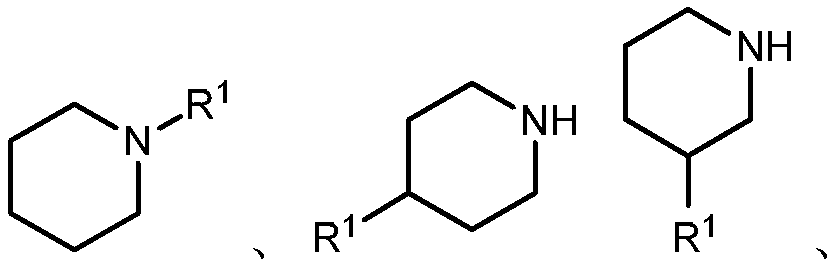
在某些实施例中,R1是C5–10芳基,3-8元饱和或部分不饱和碳环,具有1-4个独立地选自氮、氧或硫的杂原子的3-7元杂环,具有1-4个独立地选自氮、氧或硫的杂原子的5-6 元单环杂芳环,或者稠合的7-10元双环的饱和或部分不饱和的环、芳环或杂芳环;上述每个基团任选地被1-5个RA取代。In certain embodiments, R 1 is a C 5-10 aryl, 3-8 membered saturated or partially unsaturated carbocyclic ring, 3-7 with 1-4 heteroatoms independently selected from nitrogen, oxygen or sulfur A membered heterocycle, a 5-6 membered monocyclic heteroaromatic ring having 1-4 heteroatoms independently selected from nitrogen, oxygen or sulfur, or a fused 7-10 membered bicyclic saturated or partially unsaturated ring, Aromatic or heteroaromatic; each of the above groups is optionally substituted with 1-5 RAs .
在某些实施例中,R1是苯基,萘基,环丙基,环丁基,环戊基,环己基,环庚基,金刚烷基,环辛基,[3.3.0]双环辛烷基,[4.3.0]双环壬烷基,[4.4.0]双环癸烷基,[2.2.2]双环辛烷基,芴基,茚满基,四氢萘基,吖啶基,吖辛因基,苯并咪唑基,苯并呋喃基,苯并噻吩基,苯并苯硫基,苯并噁唑基,苯并噻唑基,苯并三唑基,苯并四唑基,苯并异噁唑基,苯并异噻唑基,苯并咪唑啉基,咔唑基,NH-咔唑基,咔啉基,色满基,色烯基,噌啉基,十氢喹啉基,2H,6H-1,5,2-二噻嗪基,二氢呋喃并[2,3-b]四氢呋喃基,呋喃基,呋咱基,咪唑烷基,咪唑啉基,咪唑基,1H-吲唑基,吲哚烯基,二氢吲哚基,中氮茚基,吲哚基,3H-吲哚基,异二氢吲哚,异吲哚烯基,异苯并呋喃基,异色满基,异吲唑基,异二氢吲哚,异吲哚基,异喹啉基,异噻唑基,异噁唑基,吗啉基,萘啶基,八氢异喹啉基,噁二唑基,1,2,3-噁二唑基,1,2,4-噁二唑基;1,2,5-噁二唑基,1,3,4-噁二唑基,噁唑烷基,噁唑基,噁唑烷基,嘧啶基,菲啶基,菲咯啉基,吩嗪基,吩噻嗪基,苯并氧硫杂环己二烯基,吩噁嗪基,酞嗪基,哌嗪基,哌啶基,蝶啶基,嘌呤基,吡喃基,吡嗪基,吡唑烷基,吡唑啉基,吡唑基,哒嗪基,吡啶并噁唑,吡啶并咪唑,吡啶并噻唑,吡啶基,吡啶基,嘧啶基,吡咯烷基,吡咯啉基,2H-吡咯基,吡咯基,喹唑啉基,喹啉基,4H-喹嗪基,喹喔啉基,奎宁环基,四氢呋喃基,四氢异喹啉基,四氢喹啉基,6H-1,2,5-噻二嗪基,1,2,3- 噻二唑基,1,2,4-噻二唑基,1,2,5-噻二唑基,1,3,4-噻二唑基,噻蒽基,噻唑基,噻吩基,噻吩并噻唑基,噻吩并噁唑基,噻吩并咪唑基,硫代苯基,三嗪基,1,2,3-三唑基,1,2,4- 三唑基,1,2,5-三唑基,1,3,4-三唑基,氧杂环丁烷基,氮杂环丁烷基,或呫吨基;上述每个基团任选地被1-5个RA取代。In certain embodiments, R 1 is phenyl, naphthyl, cyclopropyl, cyclobutyl, cyclopentyl, cyclohexyl, cycloheptyl, adamantyl, cyclooctyl, [3.3.0]bicyclooctyl Alkyl, [4.3.0] Bicyclononyl, [4.4.0] Bicyclodecyl, [2.2.2] Bicyclooctyl, Fluorenyl, Indanyl, Tetrahydronaphthyl, Acridinyl, Acridine Octinyl, benzimidazolyl, benzofuranyl, benzothienyl, benzothiophene, benzoxazolyl, benzothiazolyl, benzotriazolyl, benzotetrazolyl, benzoyl Isoxazolyl, benzisothiazolyl, benzimidazolinyl, carbazolyl, NH-carbazolyl, carboline, chromanyl, chromenyl, cinnolinyl, decahydroquinolinyl, 2H ,6H-1,5,2-dithiazinyl, dihydrofuro[2,3-b]tetrahydrofuranyl, furanyl, furanyl, imidazolidinyl, imidazolinyl, imidazolyl, 1H-indazole base, indolenyl, indolinyl, indolizine, indolyl, 3H-indolyl, isoindole, isoindolenyl, isobenzofuranyl, isochromanyl , isoindazolyl, isoindoline, isoindolyl, isoquinolinyl, isothiazolyl, isoxazolyl, morpholinyl, naphthyridinyl, octahydroisoquinolinyl, oxadiazolyl , 1,2,3-oxadiazolyl, 1,2,4-oxadiazolyl; 1,2,5-oxadiazolyl, 1,3,4-oxadiazolyl, oxazolidinyl, oxazolyl, oxazolidinyl, pyrimidinyl, phenanthridine, phenanthrolinyl, phenazinyl, phenothiazinyl, benzoxathiocyclohexadienyl, phenoxazinyl, phthalazinyl, Piperazinyl, piperidinyl, pteridyl, purinyl, pyranyl, pyrazinyl, pyrazolidine, pyrazolinyl, pyrazolyl, pyridazinyl, pyridooxazole, pyridoimidazole, pyridothiazole, pyridyl, pyridyl, pyrimidinyl, pyrrolidinyl, pyrrolinyl, 2H-pyrrolyl, pyrrolyl, quinazolinyl, quinolinyl, 4H-quinazinyl, quinoxalinyl, quinoline Nutricyclyl, tetrahydrofuranyl, tetrahydroisoquinolinyl, tetrahydroquinolinyl, 6H-1,2,5-thiadiazinyl, 1,2,3-thiadiazolyl, 1,2,4- Thiadiazolyl, 1,2,5-thiadiazolyl, 1,3,4-thiadiazolyl, thianthyl, thiazolyl, thienyl, thienothiazolyl, thienooxazolyl, thieno Imidazolyl, thiophenyl, triazinyl, 1,2,3-triazolyl, 1,2,4-triazolyl, 1,2,5-triazolyl, 1,3,4-triazole group, oxetanyl, azetidinyl, or xanthenyl ; each of the foregoing is optionally substituted with 1-5 RAs.
在某些实施例中,R1是In certain embodiments, R 1 is

在某些实施例中,R1是In certain embodiments, R 1 is


在某些实施例中,R1是–OR、–SR、–CN、–NO2、-SO2R、-SOR、-C(O)R、-CO2R、 -C(O)N(R)2、-NRC(O)R、-NRC(O)N(R)2、-NRSO2R或–N(R)2。在某些实施例中,R1是–OR、–SR、-SO2R、-SOR、-NRC(O)R、-NRC(O)N(R)2、-NRSO2R或–N(R)2。在某些实施例中, R1是-NRC(O)R、-NRC(O)N(R)2、-NRSO2R或–N(R)2。In certain embodiments, R1 is -OR, -SR, -CN, -NO2 , -SO2R , -SOR , -C(O)R, -CO2R, -C (O)N( R) 2 , -NRC(O)R, -NRC(O)N(R) 2 , -NRSO 2 R or -N(R) 2 . In certain embodiments, R 1 is -OR, -SR, -SO 2 R, -SOR, -NRC(O)R, -NRC(O)N(R) 2 , -NRSO 2 R or -N( R) 2 . In certain embodiments, R 1 is -NRC(O)R, -NRC(O)N(R) 2 , -NRSO 2 R or -N(R) 2 .
在某些实施例中,R1是–N(R)2。In certain embodiments, R 1 is -N(R) 2 .
在某些实施例中,R1是In certain embodiments, R 1 is

在某些实施例中,R1是–OR。In certain embodiments, R 1 is -OR.
在某些实施例中,R1是In certain embodiments, R 1 is

在某些实施例中,每个RA独立地是H。In certain embodiments, each RA is independently H.
在某些实施例中,每个RA独立地是–R、卤素、-卤代烷基、–OR、–SR、–CN、–NO2、 -SO2R、-SOR、-C(O)R、-CO2R、-C(O)N(R)2、-NRC(O)R、-NRC(O)N(R)2、-NRSO2R或–N(R)2。In certain embodiments, each RA is independently -R, halogen, -haloalkyl, -OR, -SR, -CN, -NO2 , -SO2R , -SOR, -C(O)R , -CO 2 R, -C(O)N(R) 2 , -NRC(O)R, -NRC(O)N(R) 2 , -NRSO 2 R or -N(R) 2 .
在某些实施例中,每个RA独立地是In certain embodiments, each RA is independently


在某些实施例中,Z是C(O)、CO2、C(O)N(R)、NRC(O)、NRC(O)N(R)、NRSO2或N(R)。在某些实施例中,Z是C(O)、CO2或C(O)N(R)。In certain embodiments, Z is C(O), CO2 , C(O)N(R), NRC(O), NRC(O)N(R), NRSO2 , or N(R). In certain embodiments, Z is C(O), CO 2 or C(O)N(R).
在某些实施例中,Z是C(O)。In certain embodiments, Z is C(O).
在某些实施例中,Z是CO2。In certain embodiments, Z is CO2 .
在某些实施例中,Z是C(O)N(R)。In certain embodiments, Z is C(O)N(R).
在某些实施例中,Z是C(O)NH。In certain embodiments, Z is C(O)NH.
在某些实施例中,环A是3-8元饱和或部分不饱和碳环。在某些实施例中,环A是具有1-4个独立地选自氮、氧或硫的杂原子的3-7元杂环。In certain embodiments, Ring A is a 3-8 membered saturated or partially unsaturated carbocyclic ring. In certain embodiments, Ring A is a 3-7 membered heterocycle having 1-4 heteroatoms independently selected from nitrogen, oxygen, or sulfur.
在某些实施例中,环A是环己基、环庚基、吗啉基、哌嗪基、哌啶基、吡咯烷基、吡咯啉基、2H-吡咯基、吡咯基、四氢呋喃基、氧杂环丁烷基或氮杂环丁烷基。In certain embodiments, Ring A is cyclohexyl, cycloheptyl, morpholinyl, piperazinyl, piperidinyl, pyrrolidinyl, pyrrolinyl, 2H-pyrrolyl, pyrrolyl, tetrahydrofuranyl, oxa Cyclobutanyl or azetidinyl.
在某些实施例中,环A是环己基。在某些实施例中,环A是环庚基。In certain embodiments, Ring A is cyclohexyl. In certain embodiments, Ring A is cycloheptyl.
在某些实施例中,环A是In certain embodiments, Ring A is

在某些实施例中,每个R2独立地是H。 In certain embodiments, each R2 is independently H.
在某些实施例中,每个R2独立地是–R、卤素或–OR。在某些实施例中,每个R2独立地是C1–6脂族基团、卤素或–OR。在某些实施例中,每个R2独立地是甲基、乙基、丙基、异丙基、丁基、仲丁基、叔丁基、直链或支链的戊基、或直链或支链的己基、F、Cl、Br、 I、CF3或OH。In certain embodiments, each R 2 is independently -R, halogen, or -OR. In certain embodiments, each R 2 is independently C 1-6 aliphatic, halogen, or -OR. In certain embodiments, each R is independently methyl, ethyl, propyl, isopropyl, butyl, sec-butyl, tert-butyl, linear or branched pentyl, or linear Or branched hexyl, F, Cl, Br, I, CF3 or OH.
在某些实施例中,每个R2独立地是甲基、F、CF3或OH。 In certain embodiments, each R2 is independently methyl, F, CF3 , or OH.
在某些实施例中,在同一个原子上的两个R2基团与它们所连接的原子一起形成C3–10芳基,3-8元饱和或部分不饱和碳环,具有1-4个独立地选自氮、氧或硫的杂原子的3-7元杂环,或者具有1-4个独立地选自氮、氧或硫的杂原子的5-6元单环杂芳环;上述每个基团任选经取代。In certain embodiments, two R2 groups on the same atom together with the atom to which they are attached form a C3-10 aryl, 3-8 membered saturated or partially unsaturated carbocyclic ring with 1-4 a 3-7 membered heterocyclic ring with heteroatoms independently selected from nitrogen, oxygen or sulfur, or a 5-6 membered monocyclic heteroaromatic ring with 1-4 heteroatoms independently selected from nitrogen, oxygen or sulfur; Each of the above groups is optionally substituted.
在某些实施例中,在同一个原子上的两个R2基团与它们所连接的原子一起形成环丁环、环戊环、环己环或环庚环。In certain embodiments, two R2 groups on the same atom together with the atom to which they are attached form a cyclobutane, cyclopentane, cyclohexyl, or cycloheptyl ring.
在某些实施例中,m是0。在某些实施例中,m是1。在某些实施例中,m是2。In some embodiments, m is zero. In certain embodiments, m is 1. In certain embodiments, m is 2.
在某些实施例中,R1、R2、RA、Z、环A、m和n各自的定义如上所述,且按实施例、类别、子类和本文单独或结合进一步加以描述。In certain embodiments, R 1 , R 2 , RA , Z, Rings A, m, and n are each as defined above, and further described by embodiments, classes, subclasses, and herein, alone or in combination.
在某些实施例中,本发明提供通式II所示的化合物,In certain embodiments, the present invention provides compounds of general formula II,

或其药学上可接受的盐,其中R1、R2、Z、m和n各自的定义如上所述,且按实施例、类别、子类和本文单独或结合进一步加以描述。or a pharmaceutically acceptable salt thereof, wherein each of R 1 , R 2 , Z, m, and n are as defined above, and are further described by example, class, subclass, and herein, alone or in combination.
在某些实施例中,本发明提供通式III所示的化合物,In certain embodiments, the present invention provides compounds of general formula III,

或其药学上可接受的盐,其中R1、R2和n各自的定义如上所述,且按实施例、类别、子类和本文单独或结合进一步加以描述。or a pharmaceutically acceptable salt thereof, wherein each of R 1 , R 2 , and n are as defined above, and further described by Examples, Classes, Subclasses, and herein, alone or in combination.
在某些实施例中,本发明提供通式IV所示的化合物,In certain embodiments, the present invention provides compounds of general formula IV,

或其药学上可接受的盐,其中R1、R2和n各自的定义如上所述,且按实施例、类别、子类和本文单独或结合进一步加以描述。or a pharmaceutically acceptable salt thereof, wherein each of R 1 , R 2 , and n are as defined above, and further described by Examples, Classes, Subclasses, and herein, alone or in combination.
在某些实施例中,本发明提供通式V所示的化合物,In certain embodiments, the present invention provides compounds of general formula V,

或其药学上可接受的盐,其中R1、R2和n各自的定义如上所述,且按实施例、类别、子类和本文单独或结合进一步加以描述。or a pharmaceutically acceptable salt thereof, wherein each of R 1 , R 2 , and n are as defined above, and further described by Examples, Classes, Subclasses, and herein, alone or in combination.
在某些实施例中,本发明提供表1中给出的化合物:In certain embodiments, the present invention provides the compounds given in Table 1:
表1Table 1


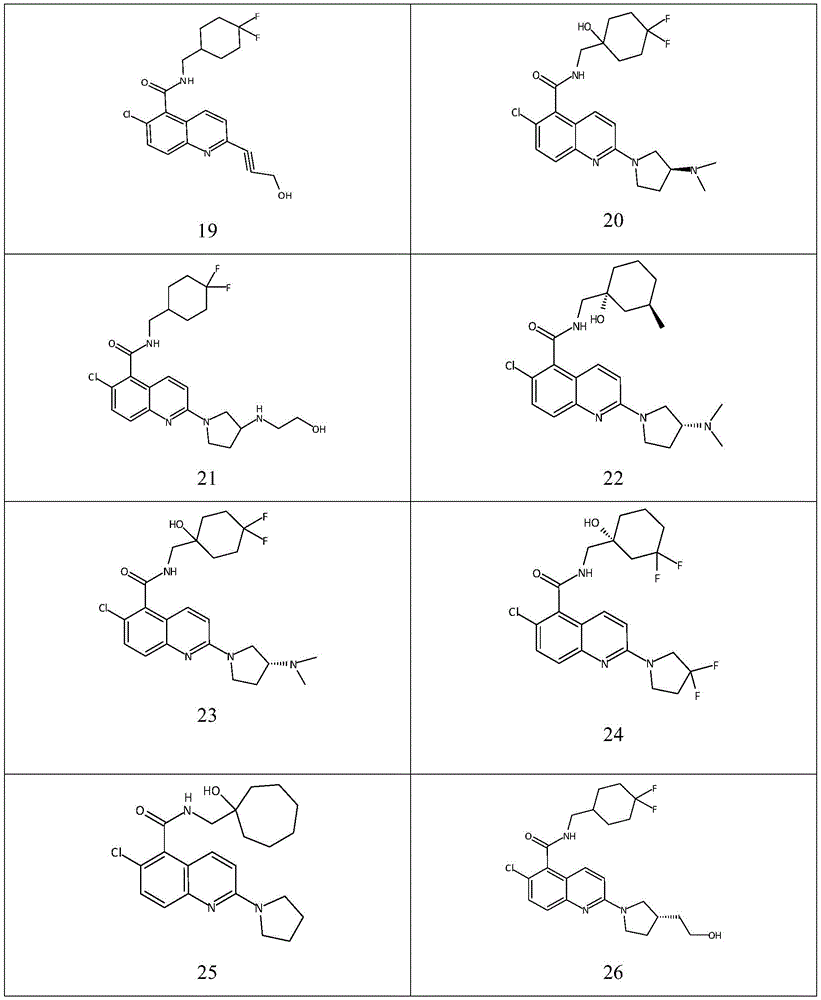


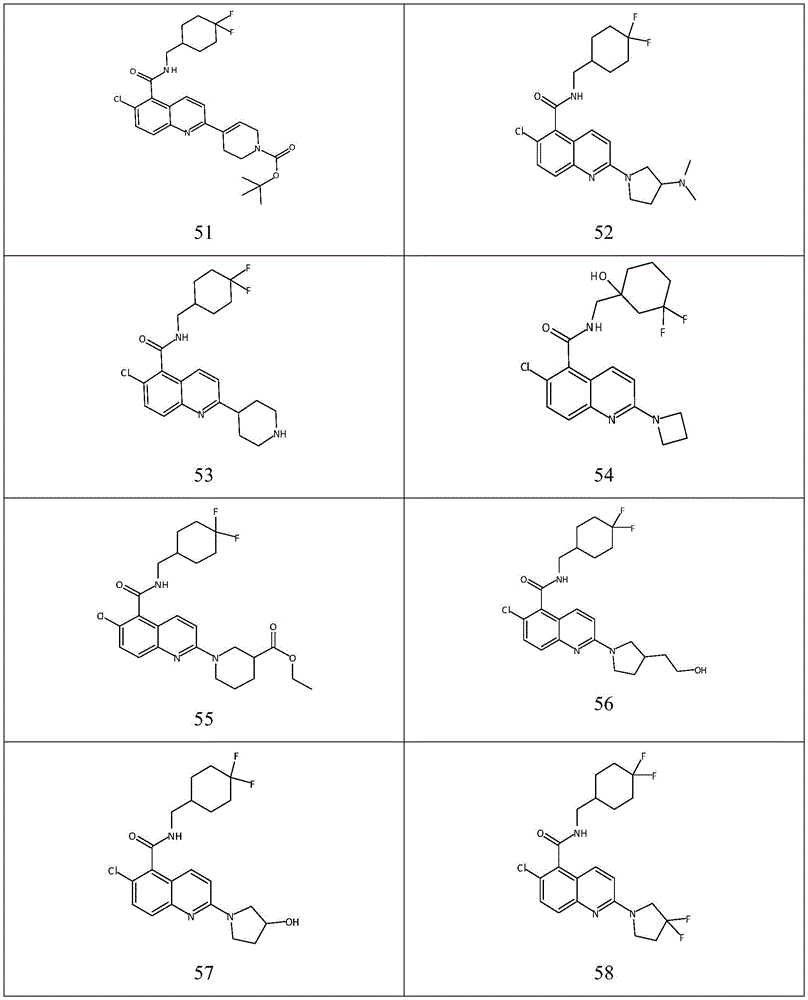
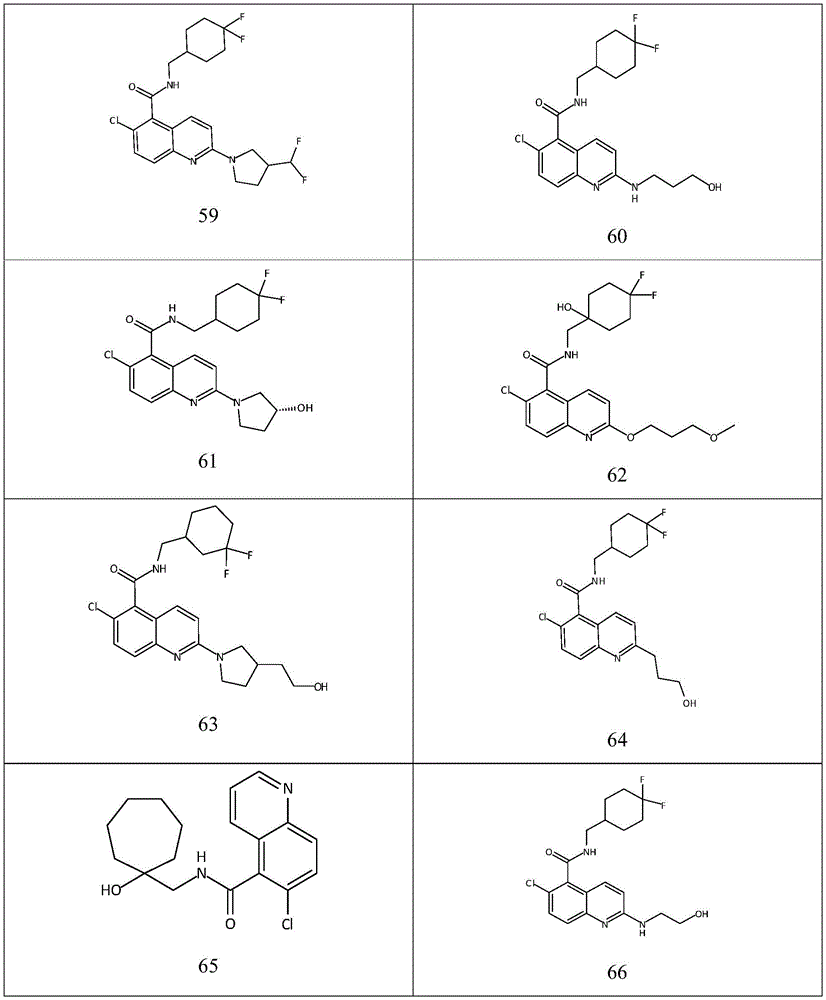


在一些实施例中,本发明提供选自上文描述的化合物或其药学上可接受的盐。In some embodiments, the present invention provides a compound selected from the group consisting of those described above, or a pharmaceutically acceptable salt thereof.
各种结构示式可以显示杂原子,没有与其连接的基团、根、电荷或反离子。本领域普通技术人员会明白这样的示式意指杂原子与氢连接(例如,

在某些实施例中,按照以下流程合成本发明的化合物。利用所述流程制备化合物的更具体实例在下面的实施例中提供。In certain embodiments, compounds of the present invention are synthesized according to the following schemes. More specific examples of compounds prepared using the schemes are provided in the Examples below.
4.用途、制剂和给药 4. USE, FORMULATION AND ADMINISTRATION
药学上可接受的组合物pharmaceutically acceptable composition
根据另一个实施方案中,本发明提供包含本发明的化合物或其药学上可接受的衍生物和药学上可接受的载体、佐剂或媒介物的组合物。在本发明的组合物中化合物的量要能在生物样品或病人中有效地可测量调节P2X7。在某些实施例中,在本发明的组合物中化合物的量要能在生物样品或病人中有效地可测量调节P2X7。在某些实施例中,本发明的组合物被配制用于施用至有需要该组合物的病人。According to another embodiment, the present invention provides a composition comprising a compound of the present invention, or a pharmaceutically acceptable derivative thereof, and a pharmaceutically acceptable carrier, adjuvant or vehicle. The amount of compound in the composition of the present invention is effective to measurably modulate P2X7 in a biological sample or patient. In certain embodiments, the amount of compound in the compositions of the present invention is effective to measurably modulate P2X7 in a biological sample or patient. In certain embodiments, the compositions of the present invention are formulated for administration to a patient in need thereof.
本文所用的术语“病人”或“受试者”指动物,优选哺乳动物,最佳是人。The term "patient" or "subject" as used herein refers to an animal, preferably a mammal, most preferably a human.
术语“药学上可接受的载体、佐剂或媒介物”指的是无毒的载体、佐剂、或媒介物,它们不会破坏与其一起配制的化合物的药理学活性。用在本发明的组合物中的药学上可接受的载体、佐剂或媒介物包括,但不限于,离子交换剂、氧化铝、硬脂酸铝、卵磷脂、血清蛋白(如人血清白蛋白)、缓冲物质(如磷酸盐)、甘氨酸、山梨酸、山梨酸钾、饱和植物脂肪酸的偏甘油酯混合物、水、盐或电解质(如硫酸鱼精蛋白)、磷酸氢二钠、磷酸氢钾、氯化钠、锌盐、胶体二氧化硅、三硅酸镁、聚乙烯吡咯烷酮、基于纤维素的物质、聚乙基烯乙二醇、羧甲基纤维素钠、聚丙烯酸酯、蜡、聚乙烯-聚氧丙烯嵌段共聚物、聚乙基烯乙二醇和羊毛脂。The term "pharmaceutically acceptable carrier, adjuvant, or vehicle" refers to a non-toxic carrier, adjuvant, or vehicle that does not destroy the pharmacological activity of the compound with which it is formulated. Pharmaceutically acceptable carriers, adjuvants or vehicles for use in the compositions of the present invention include, but are not limited to, ion exchangers, alumina, aluminum stearate, lecithin, serum proteins such as human serum albumin ), buffer substances (such as phosphates), glycine, sorbic acid, potassium sorbate, mixtures of partial glycerides of saturated vegetable fatty acids, water, salts or electrolytes (such as protamine sulfate), disodium hydrogen phosphate, potassium hydrogen phosphate, Sodium chloride, zinc salts, colloidal silicon dioxide, magnesium trisilicate, polyvinylpyrrolidone, cellulose-based substances, polyethylene glycol, sodium carboxymethylcellulose, polyacrylates, waxes, polyethylene - Polyoxypropylene block copolymer, polyethylene glycol and lanolin.
“药学上可接受的衍生物”是指任何无毒性的盐、酯、酯的盐或本发明的化合物的其它衍生物,它们被施加于接受者后能够直接或间接地提供本发明的化合物或具有抑制活性的代谢物或残余物。"Pharmaceutically acceptable derivative" refers to any non-toxic salt, ester, salt of ester, or other derivative of a compound of the present invention which, upon administration to a recipient, is capable of providing, directly or indirectly, a compound of the present invention or Metabolites or residues with inhibitory activity.
本发明的组合物通过口服、肠胃外、吸入喷雾、局部、直肠、经鼻、口腔、阴道或植入容器给予。本文所用的术语“肠胃外”包括皮下、静脉内、肌内、关节内、滑膜内、胸骨内、鞘内、肝内、病灶内和颅内注射或输注技术。优选的是,组合物是经口服、腹膜内或静脉内给予。本发明的组合物的无菌可注射形式包括水性或油性悬浮液。这些悬浮液按照在本领域中已知的技术使用适合的分散或润湿剂和悬浮剂配制。无菌可注射制剂也可以是用无毒的肠胃外可接受的稀释剂或溶剂(例如在1,3-丁二醇中的溶液)制成的无菌可注射溶液或悬浮液。所使用的可接受的媒介物和溶剂包括水、林格氏溶液和等渗氯化钠溶液。此外,无菌不挥发性油通常用作溶剂或悬浮介质。The compositions of the present invention are administered orally, parenterally, by inhalation spray, topically, rectally, nasally, bucally, vaginally, or from an implanted container. The term "parenteral" as used herein includes subcutaneous, intravenous, intramuscular, intraarticular, intrasynovial, intrasternal, intrathecal, intrahepatic, intralesional and intracranial injection or infusion techniques. Preferably, the composition is administered orally, intraperitoneally or intravenously. Sterile injectable forms of the compositions of the present invention include aqueous or oily suspensions. These suspensions are formulated according to techniques known in the art using suitable dispersing or wetting agents and suspending agents. The sterile injectable preparation may also be a sterile injectable solution or suspension in a nontoxic parenterally acceptable diluent or solvent, for example as a solution in 1,3-butanediol. Among the acceptable vehicles and solvents employed are water, Ringer's solution and isotonic sodium chloride solution. In addition, sterile, fixed oils are conventionally employed as a solvent or suspending medium.
为此,任何可用的温和的固定油包括合成的单-或二-甘油酯。诸如油酸及其甘油酯衍生物的脂肪酸可用于制备注射剂,如同天然的药学上可接受的油,例如橄榄油或蓖麻油,尤其是它们的聚氧乙基化油。这些油溶液或悬浮液还含有长链醇稀释剂或分散剂,例如羧甲基纤维素或类似的分散剂,它们常用于制备药学上可接受的剂型制剂中,包括乳剂和混悬剂。其它常用的表面活性剂,如吐温(Tweens)、司盘(Spans)和其它乳化剂或生物利用度增强剂,它们常用于制备药学上可接受的固体、液体,或者其它剂型也可以用于配制的目的。For this purpose, any available bland fixed oil includes synthetic mono- or di-glycerides. Fatty acids such as oleic acid and its glyceride derivatives are useful in the preparation of injectables, as are natural pharmaceutically acceptable oils, such as olive oil or castor oil, especially their polyoxyethylated oils. These oil solutions or suspensions also contain a long-chain alcohol diluent or dispersant, such as carboxymethyl cellulose or similar dispersants, which are commonly used in the preparation of pharmaceutically acceptable dosage forms, including emulsions and suspensions. Other commonly used surfactants, such as Tweens, Spans, and other emulsifiers or bioavailability enhancers, which are commonly used in the preparation of pharmaceutically acceptable solids, liquids, or other dosage forms may also be used purpose of preparation.
本发明的药学上可接受的组合物以任何口服可接受的剂型口服给药。示例性口服剂型是胶囊、片剂、水性混悬剂或溶液。对于口服用片剂,常用的载体包括乳糖和玉米淀粉。通常也会加入润滑剂如硬脂酸镁。对于以胶囊形式的口服给药,有用的稀释剂包括乳糖和干玉米淀粉。当需要口服水悬浮液时,活性成分与乳化剂和悬浮剂结合。如果需要的话,任选地可加入某些甜味剂、调味剂或着色剂。The pharmaceutically acceptable compositions of the present invention are administered orally in any orally acceptable dosage form. Exemplary oral dosage forms are capsules, tablets, aqueous suspensions or solutions. For tablets for oral use, common carriers include lactose and cornstarch. Lubricants such as magnesium stearate are also usually added. For oral administration in capsule form, useful diluents include lactose and dried cornstarch. When aqueous suspensions are required for oral use, the active ingredient is combined with emulsifying and suspending agents. Certain sweetening, flavoring or coloring agents may optionally be added if desired.
或者,本发明的药学上可接受的组合物以直肠给药的栓剂形式给药。这些通过将药剂与合适的无刺激性赋形剂混合来制成,其中所述赋形剂在室温下为固体,但在直肠温度下为液体,因此将在直肠中熔融并释放出药物。这样的材料包括可可脂、蜂蜡和丙二醇。Alternatively, the pharmaceutically acceptable compositions of the present invention are administered in the form of suppositories for rectal administration. These are prepared by mixing the agent with a suitable non-irritating excipient which is solid at room temperature but liquid at the rectal temperature and will therefore melt in the rectum and release the drug. Such materials include cocoa butter, beeswax and propylene glycol.
本发明的药学上可接受的组合物也可以局部给药,尤其当治疗目标包括局部施用容易到达的部位和器官,包括眼、皮肤或下肠道疾病。根据各个部位或器官容易制备适合的局部制剂。The pharmaceutically acceptable compositions of the present invention may also be administered topically, especially when the target of treatment includes sites and organs readily accessible by topical application, including ocular, skin, or lower intestinal disorders. Appropriate topical formulations are readily prepared for each site or organ.
可以以直肠栓剂制剂(参见上文)或合适的灌肠剂来实现下肠道的局部施用。也可使用局部透皮贴剂。Topical administration to the lower intestinal tract can be achieved in rectal suppository formulations (see above) or suitable enemas. Topical transdermal patches can also be used.
对于局部施用,在合适的软膏中配制药学上可接受的组合物,所述软膏含有悬浮或溶解于一种或多种载体中的活性成分。局部施用本发明化合物的示例性载体包括矿物油、液体凡士林、白凡士林、丙基烯二醇、聚氧乙基烯、聚氧丙基烯化合物、乳化蜡和水。可替代地,在合适的洗液或乳膏中配制药学上可接受的组合物,所述洗液或乳膏含有悬浮或溶解于一种或多种载体中的活性成分。合适的载体包括,但不限于,矿物油、脱水山梨醇单硬脂酸酯、聚山梨醇酯60、十六烷基酯蜡、CETE芳基醇、2-辛基十二烷醇、苯甲醇和水。For topical administration, the pharmaceutically acceptable composition is formulated in a suitable ointment containing the active ingredient suspended or dissolved in one or more carriers. Exemplary carriers for topical administration of the compounds of this invention include mineral oil, liquid petrolatum, white petrolatum, propylene glycol, polyoxyethylene, polyoxypropylene compound, emulsifying wax and water. Alternatively, the pharmaceutically acceptable compositions are formulated in a suitable lotion or cream containing the active ingredient suspended or dissolved in one or more carriers. Suitable carriers include, but are not limited to, mineral oil, sorbitan monostearate, polysorbate 60, cetyl esters wax, CETE aryl alcohol, 2-octyldodecanol, benzyl alcohol and water.
本发明的药学上可接受的组合物任选地通过鼻气雾剂或吸入给药。这种组合物根据药物制剂领域中公知的技术制备,可制成在盐水中的溶液,采用苯甲醇或其他合适的防腐剂、吸收促进剂以提高生物利用度,也可采用碳氟化合物和/或其它常规增溶剂或分散剂。The pharmaceutically acceptable compositions of the present invention are optionally administered by nasal aerosol or inhalation. Such compositions are prepared according to techniques well known in the pharmaceutical formulation arts and may be formulated as solutions in saline using benzyl alcohol or other suitable preservatives, absorption enhancers to enhance bioavailability, fluorocarbons and/or or other conventional solubilizers or dispersants.
最优选地,本发明的药学上可接受的组合物配制用于口服给药。这类制剂可与或不与食物施用。在一些实施方案中,本发明的药学上可接受的组合物不与食物一起施用。在其他实施方案中,本发明的药学上可接受的组合物与食物施用。Most preferably, the pharmaceutically acceptable compositions of the present invention are formulated for oral administration. Such formulations may be administered with or without food. In some embodiments, the pharmaceutically acceptable compositions of the present invention are administered without food. In other embodiments, the pharmaceutically acceptable compositions of the present invention are administered with food.
本发明的化合物任选地与载体材料组合以产生单一剂型的组合物,所述化合物的量将取决于所治疗的宿主、具体的给药模式。优选地,提供的组合物应配制成0.01-100mg/kg 体重/化合物之间的剂量,可以每天给予病人接受这些组合物。The compounds of the present invention are optionally combined with carrier materials to produce a single dosage form of the composition, the amount of which will depend upon the host being treated, the particular mode of administration. Preferably, the provided compositions should be formulated in dosages between 0.01-100 mg/kg body weight/compound, and patients receiving these compositions may be administered daily.
还应当理解,对于任何特定病人的具体剂量和治疗方案将取决于多种因素,包括采用的特定化合物的活性、年龄、体重、一般健康状况、性别、饮食状况、给药时间、排泄速率、药物组合、以及治疗医师的判断和具体疾病的严重程度。在组合物中本发明化合物的量还将取决于组合物中的特定化合物。It will also be appreciated that the specific dosage and treatment regimen for any particular patient will depend on a variety of factors, including the activity of the particular compound employed, age, body weight, general health, sex, dietary conditions, time of administration, rate of excretion, drug combination, as well as the judgment of the treating physician and the severity of the particular disease. The amount of the compound of the present invention in the composition will also depend on the particular compound in the composition.
化合物和药学上可接受的组合物的用途Use of compounds and pharmaceutically acceptable compositions
在某些实施例中,本发明提供了在病人或生物样品中正向拮抗P2X7的方法,所述方法包括向所述病人给予本发明的化合物或者使所述生物样品与本发明的化合物接触。In certain embodiments, the present invention provides a method of positively antagonizing P2X7 in a patient or biological sample, the method comprising administering to the patient or contacting the biological sample with a compound of the present invention.
在某些实施例中,本发明涉及本发明的化合物和/或其生理学上可接受的盐在拮抗 P2X7中的用途。化合物的特征是具有与P2X7高的亲和力,确保可靠的P2X7结合,优选地拮抗P2X7。在某些实施例中,物质具有单特异性,以保证对单个P2X7靶的唯一和直接识别。在本发明的上下文中,术语“识别”–非限制性地-涉及在特定化合物和靶之间的任何类别的相互作用,特别是共价或非共价结合或缔合,例如共价键、亲水/疏水相互作用、范德华力、离子对、氢键、配体-受体相互作用等等。这样的缔合也可以包含其他分子(例如肽、蛋白质或核苷酸序列)的存在。本发明的受体/配体相互作用的特征是高亲和力、高选择性以及与其他靶分子有极小的甚至没有交叉反应,从而排除了对治疗受试者产生不健康的和有害的作用。In certain embodiments, the present invention relates to the use of a compound of the present invention and/or a physiologically acceptable salt thereof for antagonizing P2X7. The compounds are characterized by a high affinity for P2X7, ensuring reliable P2X7 binding, preferably antagonizing P2X7. In certain embodiments, the substances are monospecific to ensure unique and direct recognition of a single P2X7 target. In the context of the present invention, the term "recognition" - without limitation - relates to any kind of interaction between a specific compound and a target, in particular covalent or non-covalent binding or association, such as covalent bonds, Hydrophilic/hydrophobic interactions, van der Waals forces, ion pairs, hydrogen bonds, ligand-receptor interactions, and more. Such associations may also involve the presence of other molecules such as peptides, proteins or nucleotide sequences. The receptor/ligand interactions of the present invention are characterized by high affinity, high selectivity, and little to no cross-reactivity with other target molecules, thereby precluding unhealthy and deleterious effects on the subject being treated.
在某些实施例中,本发明涉及在拮抗P2X7受体的条件下使用本发明的至少一种通式I 所示的化合物和/或生理学上可接受的盐来拮抗P2X7的方法。在某些实施例中,所述系统是细胞系统。在其他实施例中,所述系统是体外翻译系统,所述翻译系统基于蛋白质合成,不需要活细胞。细胞系统定义为任何受试者,只要该受试者包含细胞。因此,细胞系统可以选自单细胞、细胞培养基、组织、器官和动物。在某些实施例中,拮抗P2X7的方法在体外进行。本说明书上文有关通式I化合物(包括其任何优选实施例)的教导是有效的和适用的,当在用拮抗P2X7的方法中不限于通式I化合物及其盐。在某些实施例中,拮抗P2X7 的方法在体外进行。本说明书上文有关通式I化合物(包括其任何优选实施例)的教导是有效的和适用的,当在用拮抗P2X7的方法中不限于通式I化合物及其盐。In certain embodiments, the present invention relates to methods of antagonizing P2X7 using at least one compound of formula I and/or a physiologically acceptable salt of the present invention under conditions that antagonize the P2X7 receptor. In certain embodiments, the system is a cellular system. In other embodiments, the system is an in vitro translation system, which is based on protein synthesis and does not require living cells. A cellular system is defined as any subject so long as the subject contains cells. Thus, the cell system can be selected from single cells, cell culture media, tissues, organs and animals. In certain embodiments, the method of antagonizing P2X7 is performed in vitro. The teachings of this specification above regarding compounds of general formula I (including any preferred embodiments thereof) are valid and applicable when not limited to compounds of general formula I and their salts in methods for antagonizing P2X7. In certain embodiments, the method of antagonizing P2X7 is performed in vitro. The teachings of this specification above regarding compounds of general formula I (including any preferred embodiments thereof) are valid and applicable when not limited to compounds of general formula I and their salts in methods for antagonizing P2X7.
在某些实施例中,根据本发明的化合物表现出有利的生物活性,这在基于细胞培养物的测定法获得证实,例如本文所述的测定法或现有技术的测定法(参见例如WO 2002/09706,其内容被引入作为参考)。在这些测定法中,根据本发明的化合物优选地表现出并引起激动作用。In certain embodiments, compounds according to the present invention exhibit favorable biological activities as demonstrated in cell culture-based assays, such as those described herein or those of the prior art (see, eg, WO 2002 /09706, the contents of which are incorporated by reference). In these assays, the compounds according to the invention preferably exhibit and cause an agonistic effect.
在某些实施例中,本发明提供一种治疗、预防或改善受试者中与P2X7受体的异常活性引起的相关疾病、紊乱和状况的方法,所述方法包括对所述受试者给予有效治疗量的此处通式所示的化合物或其药学上可接受的组合物的步骤。在某些实施例中,所述疾病或紊乱是自身免疫性、炎性或心血管疾病或紊乱。In certain embodiments, the present invention provides a method of treating, preventing or ameliorating diseases, disorders and conditions associated with abnormal activity of the P2X7 receptor in a subject, the method comprising administering to the subject A therapeutically effective amount of a compound of the general formula herein or a pharmaceutically acceptable composition thereof. In certain embodiments, the disease or disorder is an autoimmune, inflammatory or cardiovascular disease or disorder.
在某些实施例中,所述疾病或紊乱是神经退化性疾病或紊乱,包括帕金森病、多发性硬化(MS);阿尔茨海默病,由神经炎症介导或导致的疾病和紊乱,例如创伤性脑损伤和脑炎;中枢介导的神经精神疾病和紊乱,例如抑郁症、双相性精神障碍、焦虑症、精神分裂症、进食障碍、睡眠障碍和认知障碍;癫痫和癫痫发作疾病;前列腺、膀胱和肠功能障碍,例如尿失禁、尿踌躇、直肠超敏反应、大便失禁,良性前列腺肥大和炎性肠病;呼吸道和气道疾病和紊乱,例如过敏性鼻炎、哮喘和反应性气道疾病和慢性阻塞性肺病;由炎症介导或导致的疾病和紊乱,例如类风湿性关节炎和骨关节炎、心肌梗死、各种自身免疫性疾病和紊乱、葡萄膜炎和动脉粥样硬化等;瘙痒/搔痒症,例如银屑病;肥胖;脂质疾病;癌症;血压;脊髓损伤;和肾脏疾病。In certain embodiments, the disease or disorder is a neurodegenerative disease or disorder, including Parkinson's disease, multiple sclerosis (MS); Alzheimer's disease, diseases and disorders mediated or caused by neuroinflammation, such as traumatic brain injury and encephalitis; centrally mediated neuropsychiatric diseases and disorders such as depression, bipolar disorder, anxiety, schizophrenia, eating disorders, sleep disorders and cognitive impairment; epilepsy and seizure disorders ; Prostate, bladder, and bowel dysfunction, such as urinary incontinence, hesitant, rectal hypersensitivity, fecal incontinence, benign prostatic hypertrophy, and inflammatory bowel disease; Respiratory and airway diseases and disorders, such as allergic rhinitis, asthma, and reactive gas tract disease and chronic obstructive pulmonary disease; diseases and disorders mediated or caused by inflammation, such as rheumatoid arthritis and osteoarthritis, myocardial infarction, various autoimmune diseases and disorders, uveitis and atherosclerosis etc.; pruritus/scratch disorders such as psoriasis; obesity; lipid disorders; cancer; blood pressure; spinal cord injury; and kidney disease.
在某些实施例中,所述疾病或紊乱是疼痛,包括急性、炎性和神经性疼痛、慢性疼痛、牙痛和头痛(包括偏头痛、丛集性头痛和紧张性头痛)。In certain embodiments, the disease or disorder is pain, including acute, inflammatory and neuropathic pain, chronic pain, dental pain, and headache (including migraine, cluster headache, and tension headache).
在某些实施例中,所述疾病或紊乱是类风湿性关节炎,骨关节炎,牛皮癣,过敏性皮炎,哮喘,气道高反应性,慢性阻塞性肺病(COPD),支气管炎,败血性休克,肾小球性肾炎,肠易激病,克罗恩氏病,溃疡性结肠炎,动脉粥样硬化,恶性细胞的生长和转移,成肌细胞白血病,糖尿病,神经变性疾病,阿尔茨海默病,多发性硬化症,脑膜炎,骨质疏松症,烧伤,缺血性心脏病,中风,外周血管疾病,静脉曲张,青光眼,双相性精神障碍和神经性疼痛疾病如糖尿病性神经病,肝后神经痛,腰痛,化疗诱发的神经性疼痛,纤维肌痛和脊髓损伤疼痛。In certain embodiments, the disease or disorder is rheumatoid arthritis, osteoarthritis, psoriasis, atopic dermatitis, asthma, airway hyperresponsiveness, chronic obstructive pulmonary disease (COPD), bronchitis, septicaemia Shock, Glomerulonephritis, Irritable Bowel Disease, Crohn's Disease, Ulcerative Colitis, Atherosclerosis, Growth and Metastasis of Malignant Cells, Myoblast Leukemia, Diabetes, Neurodegenerative Diseases, Alzheimer's Silent disease, multiple sclerosis, meningitis, osteoporosis, burns, ischemic heart disease, stroke, peripheral vascular disease, varicose veins, glaucoma, bipolar disorder and neuropathic pain disorders such as diabetic neuropathy, liver Posterior neuralgia, low back pain, chemotherapy-induced neuropathic pain, fibromyalgia and spinal cord injury pain.
在某些实施例中,当使用抑制P2X7受体的化合物预期能改善病理状况时使用本发明。这样的情况包括例如预防和治疗类风湿性关节炎中的肿胀、疼痛和骨代谢的恶化,预防和治疗炎性肠病、慢性阻塞性肺病(COPD)和骨关节炎,预防和治疗炎性疼痛、癌症疼痛和IL-1β相关的疾病,例如克罗恩氏病,肺气肿,急性呼吸窘迫综合征,成人呼吸窘迫综合征,哮喘,支气管炎,慢性肺炎性疾病,硅肺病,肺结节病,过敏反应,过敏性接触性过敏,湿疹,接触性皮炎,牛皮癣,晒伤,癌症,组织溃疡,再狭窄,牙周病,大疱性表皮溶解水疱症,骨质疏松症,骨吸收疾病,人工关节植入物松动,动脉粥样硬化,主动脉瘤,充血性心力衰竭,心肌梗塞,中风,脑缺血,头部创伤,神经外伤,脊髓损伤,神经变性疾病,阿尔茨海默氏病,帕金森病,偏头痛,抑郁症,周围神经病,疼痛,脑淀粉样血管病,促智或认知增强,肌萎缩性侧索硬化,多发性硬化症,眼血管生成,角膜损伤,黄斑变性,角膜瘢痕形成,巩膜炎,异常伤口愈合,烧伤,自身免疫性疾病,亨廷顿舞蹈病,糖尿病, AIDS,恶病质,败血症,败血性休克,内毒素休克,结膜炎休克,革兰氏阴性脓毒症,中毒性休克综合征,脑疟疾,心脏和肾再灌注损伤,血栓形成,肾小球性肾炎,移植物抗宿主反应,同种异体移植排斥,器官移植毒性,溃疡性结肠炎或肌肉变性。In certain embodiments, the present invention is used when the use of compounds that inhibit the P2X7 receptor is expected to ameliorate a pathological condition. Such conditions include, for example, prevention and treatment of swelling, pain and deterioration of bone metabolism in rheumatoid arthritis, prevention and treatment of inflammatory bowel disease, chronic obstructive pulmonary disease (COPD) and osteoarthritis, prevention and treatment of inflammatory pain , cancer pain and IL-1β related diseases such as Crohn's disease, emphysema, acute respiratory distress syndrome, adult respiratory distress syndrome, asthma, bronchitis, chronic pulmonary disease, silicosis, pulmonary nodules Diseases, allergic reactions, allergic contact allergies, eczema, contact dermatitis, psoriasis, sunburn, cancer, tissue ulcers, restenosis, periodontal disease, epidermolysis bullosa, osteoporosis, bone resorption diseases , artificial joint implant loosening, atherosclerosis, aortic aneurysm, congestive heart failure, myocardial infarction, stroke, cerebral ischemia, head trauma, neurotrauma, spinal cord injury, neurodegenerative diseases, Alzheimer's Disease, Parkinson's Disease, Migraine, Depression, Peripheral Neuropathy, Pain, Cerebral Amyloid Angiopathy, Nootropic or Cognitive Enhancement, Amyotrophic Lateral Sclerosis, Multiple Sclerosis, Ocular Angiogenesis, Corneal Damage, Macula Degeneration, Corneal Scarring, Scleritis, Abnormal Wound Healing, Burns, Autoimmune Diseases, Huntington's Disease, Diabetes, AIDS, Cachexia, Sepsis, Septic Shock, Endotoxic Shock, Conjunctivitis Shock, Gram Negative Sepsis disease, toxic shock syndrome, cerebral malaria, cardiac and renal reperfusion injury, thrombosis, glomerulonephritis, graft-versus-host reaction, allograft rejection, organ transplant toxicity, ulcerative colitis or muscle degeneration .
在某些实施例中,本发明包括治疗患有情感障碍(包括患有治疗耐受型抑郁症)的患者的方法,所述方法包括向患有所述情感障碍的受试者施用治疗有效量的具有P2X7受体活性的调节剂。应当理解,情绪障碍可以是影响情绪和行为的许多障碍中的一种。例如,情绪障碍包括抑郁障碍(包括重度抑郁障碍,情感低落症),双相障碍(包括双相I障碍、双相II障碍、循环性情感障碍),由一般医学病症引起的情绪障碍和物质诱导的情绪障碍(American Psychiatric Association:Diagnostic和Statistical Manual of MentalDisorders (DSM-IV-TR),Fourth EditioN,Text Revision.WashingtoN,D.C.,AmericanPsychiatric AssociatioN,pages 345-428,2000.)。在某些实施例中,障碍是抑郁障碍。本发明还包括治疗患有焦虑症的患者的方法。焦虑症包括:惊恐发作,广场恐怖症,特定恐怖症,社交恐怖症,强迫症,创伤后应激障碍,急性应激障碍和广泛性焦虑症。In certain embodiments, the present invention includes a method of treating a patient suffering from an affective disorder, including suffering from treatment-tolerant depression, the method comprising administering to the subject suffering from the affective disorder a therapeutically effective amount A modulator of P2X7 receptor activity. It should be understood that a mood disorder can be one of many disorders that affect mood and behavior. For example, mood disorders include depressive disorders (including major depressive disorder, depression), bipolar disorders (including bipolar I disorder, bipolar II disorder, cyclothymia), mood disorders caused by general medical conditions, and substance-induced disorders (American Psychiatric Association: Diagnostic and Statistical Manual of Mental Disorders (DSM-IV-TR), Fourth EditioN, Text Revision. WashingtoN, D.C., American Psychiatric AssociatioN, pages 345-428, 2000.). In certain embodiments, the disorder is a depressive disorder. The present invention also includes methods of treating patients suffering from anxiety disorders. Anxiety disorders include: panic attacks, agoraphobia, specific phobias, social phobias, obsessive-compulsive disorder, post-traumatic stress disorder, acute stress disorder, and generalized anxiety disorder.
在某些实施例中,所述疾病或病症是选自与乳房切除术后疼痛综合征相关的疼痛,残肢疼痛,幻肢痛,口腔神经性疼痛,夏科氏疼痛(Charcot's pain),牙痛,毒蛇咬伤,蜘蛛咬伤,昆虫刺痛,带状疱疹后神经痛,糖尿病性神经病变,反射性交感神经病营养不良,三叉神经痛,骨关节炎,类风湿性关节炎,纤维肌痛,格林巴利综合征,感觉异常性股痛,灼口综合征,双侧周围神经病,灼痛,坐骨神经炎,外周神经炎,多发性神经炎,节段性神经炎,Gombault氏神经炎,神经元炎,颈臂神经痛,颅神经痛,膝状神经节神经痛,舌咽神经痛,移位神经痛,特发性神经痛,肋间神经痛,乳房神经痛,下颌关节神经痛,摩顿氏神经痛(Morton's neuralgia),鼻睫神经痛,枕神经痛,红色神经痛,Sluder氏神经痛,蝶腭神经痛,眶上神经痛,翼管神经痛,窦性头痛,紧张性头痛,生产,分娩,肠气,月经,癌症和创伤。In certain embodiments, the disease or condition is selected from pain associated with post-mastectomy pain syndrome, residual limb pain, phantom limb pain, oral neuropathic pain, Charcot's pain, toothache , venomous snake bite, spider bite, insect sting, post-herpetic neuralgia, diabetic neuropathy, reflex sympathetic dystrophy, trigeminal neuralgia, osteoarthritis, rheumatoid arthritis, fibromyalgia, Guillain-Barré syndrome, paresthesias, burning mouth syndrome, bilateral peripheral neuropathy, burning pain, sciatic neuritis, peripheral neuritis, polyneuritis, segmental neuritis, Gombault's neuritis, neuronal Inflammation, cervical-brachial neuralgia, cranial neuralgia, geniculate ganglion neuralgia, glossopharyngeal neuralgia, transposition neuralgia, idiopathic neuralgia, intercostal neuralgia, breast neuralgia, mandibular neuralgia, Morton Morton's neuralgia, naso-ciliary neuralgia, occipital neuralgia, red neuralgia, Sluder's neuralgia, sphenopalatine neuralgia, supraorbital neuralgia, pterygoid neuralgia, sinus headache, tension headache, production , childbirth, intestinal gas, menstruation, cancer and trauma.
在某些实施例中,所述疾病或病症与炎症相关,包括类风湿性关节炎,骨关节炎,葡萄膜炎,哮喘,心肌梗死,创伤性脑损伤;脓毒性休克,动脉粥样硬化,慢性肺阻塞性疾病(COPD),急性脊髓损伤,炎性肠病和免疫功能障碍。In certain embodiments, the disease or disorder is associated with inflammation, including rheumatoid arthritis, osteoarthritis, uveitis, asthma, myocardial infarction, traumatic brain injury; septic shock, atherosclerosis, Chronic pulmonary obstructive disease (COPD), acute spinal cord injury, inflammatory bowel disease and immune dysfunction.
在某些实施例中,所述疾病或病症与疼痛反应或维持感觉神经的基础活性的不平衡有关。本发明的胺化合物用作治疗如下疼痛的镇痛药:各种基因或病因的疼痛,例如急性炎性疼痛(例如与骨关节炎和类风湿性关节炎相关的疼痛);各种神经性疼痛综合征(例如疱疹后神经痛,三叉神经痛,反射性交感神经营养不良,糖尿病性神经病,吉林巴利综合征,纤维肌痛,幻肢痛,切除后疼痛,周围神经病,HIV神经病和化疗诱导的和其他医源性神经病);内脏疼痛(例如与胃食管反射疾病,肠易激综合征,炎性肠病,胰腺炎和各种妇科和泌尿疾病相关的疼痛),牙痛和头痛(例如偏头痛,丛集性头痛和紧张性头痛)。In certain embodiments, the disease or disorder is associated with an imbalance in pain response or maintenance of basal activity of sensory nerves. The amine compounds of the present invention are useful as analgesics for the treatment of pain of various genes or etiologies, such as acute inflammatory pain (eg, pain associated with osteoarthritis and rheumatoid arthritis); various neuropathic pains syndromes (eg, postherpetic neuralgia, trigeminal neuralgia, reflex sympathetic dystrophy, diabetic neuropathy, Gilling-Barre syndrome, fibromyalgia, phantom limb pain, post-resection pain, peripheral neuropathy, HIV neuropathy, and chemotherapy-induced and other iatrogenic neuropathy); visceral pain (eg, pain associated with gastroesophageal reflex disease, irritable bowel syndrome, inflammatory bowel disease, pancreatitis, and various gynecological and urinary disorders), dental pain and headache (eg, partial headache, cluster headache and tension headache).
在某些实施例中,所述疾病或病症是关节炎,葡萄膜炎,哮喘,心肌梗死,创伤性脑损伤,急性脊髓损伤或炎性肠病。In certain embodiments, the disease or disorder is arthritis, uveitis, asthma, myocardial infarction, traumatic brain injury, acute spinal cord injury, or inflammatory bowel disease.
在某些实施例中,所述疾病或病症是多发性硬化症。In certain embodiments, the disease or disorder is multiple sclerosis.
在某些实施例中,所述疾病或病症是帕金森氏病。In certain embodiments, the disease or disorder is Parkinson's disease.
在某些实施例中,所述疾病或病症是类风湿关节炎。In certain embodiments, the disease or disorder is rheumatoid arthritis.
在某些实施例中,所述疾病或病症是创伤性脑损伤。In certain embodiments, the disease or disorder is traumatic brain injury.
在某些实施例中,所述疾病或病症是疼痛。In certain embodiments, the disease or disorder is pain.
在其它实施例中,本发明提供了本发明的化合物作为药物的用途,特别是用于治疗或预防上述病症和疾病。本文还提供本发明的化合物在制备用于治疗或预防上述病症和疾病之一的药物中的用途。本发明还提供了本发明的化合物或其药学上可接受的盐在制备用于治疗如下病症或疾病的药物中的用途:选自P2X7受体介导的病症或疾病。In other embodiments, the present invention provides the use of a compound of the present invention as a medicament, particularly for the treatment or prevention of the aforementioned conditions and diseases. Also provided herein is the use of a compound of the present invention in the manufacture of a medicament for the treatment or prevention of one of the aforementioned conditions and diseases. The present invention also provides the use of a compound of the present invention or a pharmaceutically acceptable salt thereof in the manufacture of a medicament for the treatment of a disorder or disease selected from the group consisting of disorders or diseases mediated by P2X7 receptors.
当用于预防P2X7相关疾病/病症的发作时,通常在医生的建议和监督下,向具有发展该病症风险的病人施加如上所述剂量水平的本发明的化合物。具有发展特定病症风险的病人通常包括患有该病症的家族史的那些人或者通过遗传测试或筛选鉴定为特别易于发展该病症的那些人。When used to prevent the onset of a P2X7-related disease/disorder, the compounds of the invention are administered at the dosage levels described above to patients at risk of developing the disorder, usually under the advice and supervision of a physician. Patients at risk of developing a particular disorder typically include those with a family history of the disorder or those identified by genetic testing or screening as being particularly susceptible to developing the disorder.
本发明还涉及联合治疗,其中本发明化合物或其药学上可接受的盐,或者包含本发明化合物的药物组合物或制剂与另一种或多种治疗剂同时或依次或作为组合制剂施用,用于治疗上述列出的一种或多种病症。The present invention also relates to combination therapy, wherein a compound of the present invention, or a pharmaceutically acceptable salt thereof, or a pharmaceutical composition or formulation comprising the compound of the present invention, is administered concurrently or sequentially or as a combined preparation with another therapeutic agent(s), with for the treatment of one or more of the conditions listed above.
本发明的通式(I)化合物可以作为单独的活性药剂施用或可以与其它活性药剂联用。这些药剂包括非甾体抗炎药(NSAIDS),例如塞来考昔,罗非考昔,西米考昔,艾托考昔,鲁米昔布,伐地考昔,地拉考昔,N-(2-环己基氧基硝基苯基)甲烷磺酰胺,COX189,ABT963,JTE-522,GW-406381,LAS-34475,CS-706,PAC-10649,SVT-2016,GW-644784,替尼达普,乙酰水杨酸(阿司匹林),安西普林,贝诺酯,胆碱水杨酸镁,二氟尼柳,法西阿明,水杨酸甲酯,水杨酸镁,水杨酸辛酯,双氯芬酸,醋氯芬酸,醋美沙明,溴芬酸,依托度酸,吲哚美辛,萘丁美酮,舒林酸,托美丁,布洛芬,卡洛芬,芬布芬,非诺洛芬,氟比洛芬,酮洛芬,酮洛酸,洛索洛芬,萘普生,奥沙普秦,噻洛芬酸,甲氧芬酸,保泰松,阿扎丙宗,安乃近,羟基保泰松,磺吡酮,吡罗昔康,氯诺昔康,美洛昔康,替诺昔康,尼美舒利,利福酮或扑热息痛。The compounds of general formula (I) of the present invention may be administered as the sole active agent or may be used in combination with other active agents. These include non-steroidal anti-inflammatory drugs (NSAIDS) such as celecoxib, rofecoxib, cimicoxib, etoricoxib, luminacoxib, valdecoxib, delacoxib, N-(2 -Cyclohexyloxynitrophenyl)methanesulfonamide, COX189, ABT963, JTE-522, GW-406381, LAS-34475, CS-706, PAC-10649, SVT-2016, GW-644784, Tenidap , Acetylsalicylic acid (Aspirin), Amazeprim, Benoate, Choline Magnesium Salicylate, Diflunisal, Faciamin, Methyl Salicylate, Magnesium Salicylate, Octyl Salicylate, Diclofenac, aceclofenac, acemethamine, bromfenac, etodolac, indomethacin, nabumetone, sulindac, tolmedin, ibuprofen, carprofen, fenbufen, non- noprofen, flurbiprofen, ketoprofen, ketoprofen, loxoprofen, naproxen, oxaprozin, tiaprofen acid, mefenac, phenylbutazone, azaprozone, Dipyrone, hydroxybutazone, sulfinpyrazone, piroxicam, lornoxicam, meloxicam, tenoxicam, nimesulide, rifazone, or paracetamol.
本发明的通式(I)化合物可以与如下试剂联用:TNFα抑制剂例如抗TNF单克隆抗体(例如Remicade,CDP-870和D2E7)和TNF受体免疫球蛋白分子(例如Enbrel),低剂量甲氨蝶呤,来氟米特;环索奈德;羟基氯喹,d-青霉胺,金诺芬或肠胃外或口服金。The compounds of general formula (I) of the present invention may be used in combination with agents such as TNFα inhibitors such as anti-TNF monoclonal antibodies (eg Remicade, CDP-870 and D2E7) and TNF receptor immunoglobulin molecules (eg Enbrel), at low doses Methotrexate, leflunomide; ciclesonide; hydroxychloroquine, d-penicillamine, auranofin, or parenteral or oral gold.
本发明的通式(I)化合物还可以与proTNFα转化酶(TACE)抑制剂联用,例如3-氨基-N- 羟基-a-(2-甲基丙基)-3-[4-[(2-甲基-4-喹啉基)甲氧基]苯基]-2-氧代-1-吡咯烷乙酰胺, 2(S),3(S)-哌啶二羧酰胺,N3-羟基-1-甲基-N2-[4-[(2-甲基-4-喹啉基)甲氧基]苯基],3-硫吗啉羧酰胺,4-[[4-(2-丁炔氧基)苯基]磺酰基]-N-羟基-2,2-二甲基-5-己烯酸,3-[(羟基氨基)羰基]-2-(2-甲基丙基)-6-苯基-2-(2-甲基丙基)-2-(甲基磺酰基)酰肼,(2R,3S,5E)-2-哌啶羧酰胺, N,5-二羟基-1-[[4-(1-萘基甲氧基)苯基]磺酰基]-(2R,5R)-戊酰胺,3-(甲酰基羟基氨基)-4-甲基 -2-(2-甲基丙基)-N-[(1S,2S)-2-甲基-1-[(2-吡啶基氨基)羰基]丁基]-(2R,3S)-2-丙烯酰胺,N-羟基-3-[3-[[(4-甲氧基苯基)磺酰基](1-甲基乙基)氨基]苯基]-3-(3-吡啶基)-(2E)-苯甲酰胺, N-(2,4-二氧代-1,3,7-三氮杂螺[4.4]壬-9-基)-4-[(2-甲基-4-喹啉基)甲氧基]-苯甲酰胺,N-[(1- 乙酰基-4-哌啶基)(2,5-二氧代-4-咪唑烷基)甲基]-4-[(2-甲基-4-喹啉基)甲氧基],或者2,4-咪唑烷二酮,5-甲基-5-[[[4-[(2-甲基-4-喹啉基)甲氧基]苯基]磺酰基]甲基]。The compounds of general formula (I) of the present invention may also be used in combination with proTNFa converting enzyme (TACE) inhibitors, such as 3-amino-N-hydroxy-a-(2-methylpropyl)-3-[4-[( 2-Methyl-4-quinolinyl)methoxy]phenyl]-2-oxo-1-pyrrolidineacetamide, 2(S),3(S)-piperidinedicarboxamide, N3-hydroxyl -1-Methyl-N2-[4-[(2-methyl-4-quinolinyl)methoxy]phenyl], 3-thiomorpholinecarboxamide, 4-[[4-(2-butane Alkynyloxy)phenyl]sulfonyl]-N-hydroxy-2,2-dimethyl-5-hexenoic acid, 3-[(hydroxyamino)carbonyl]-2-(2-methylpropyl)- 6-Phenyl-2-(2-methylpropyl)-2-(methylsulfonyl)hydrazide, (2R,3S,5E)-2-piperidinecarboxamide, N,5-dihydroxy-1 -[[4-(1-Naphthylmethoxy)phenyl]sulfonyl]-(2R,5R)-pentanamide, 3-(formylhydroxyamino)-4-methyl-2-(2-methyl) propylpropyl)-N-[(1S,2S)-2-methyl-1-[(2-pyridylamino)carbonyl]butyl]-(2R,3S)-2-acrylamide, N-hydroxy- 3-[3-[[(4-Methoxyphenyl)sulfonyl](1-methylethyl)amino]phenyl]-3-(3-pyridyl)-(2E)-benzamide, N-(2,4-dioxo-1,3,7-triazaspiro[4.4]non-9-yl)-4-[(2-methyl-4-quinolinyl)methoxy] - Benzamide, N-[(1-Acetyl-4-piperidinyl)(2,5-dioxo-4-imidazolidinyl)methyl]-4-[(2-methyl-4- quinolinyl)methoxy], or 2,4-imidazolidinedione, 5-methyl-5-[[[4-[(2-methyl-4-quinolinyl)methoxy]phenyl ]sulfonyl]methyl].
本发明的通式(I)化合物还可以与皮质类固醇联用,例如布地奈德,皮质酮,皮质醇,醋酸可的松,泼尼松,泼尼松龙,甲基泼尼松龙,地塞米松,倍他米松,曲安奈德,倍氯米松,醋酸氟氢可的松,醋酸脱氧皮质酮(doca)或醛固酮。The compounds of general formula (I) of the present invention can also be used in combination with corticosteroids, such as budesonide, corticosterone, cortisol, cortisone acetate, prednisone, prednisolone, methylprednisolone, dexamethasone, betamethasone, triamcinolone acetonide, beclomethasone, fludrocortisone acetate, deoxycorticosterone acetate (doca), or aldosterone.
本发明的通式(I)化合物还可以与b2-肾上腺素能受体激动剂联用,例如福莫特罗,沙丁胺醇(沙丁胺醇),左旋沙丁胺醇,特布他林,吡布特罗,丙卡特罗,异丙肾上腺素,非诺特罗,甲磺酸比托特罗,班布特罗或克仑特罗。The compounds of general formula (I) of the present invention can also be used in combination with b2-adrenergic receptor agonists, such as formoterol, salbutamol (salbutamol), levalbuterol, terbutaline, pirbuterol, procatel Luo, isoproterenol, fenoterol, bitoterol mesylate, bambuterol, or clenbuterol.
本发明的通式(I)化合物还可以与抗抑郁药联用,例如舍曲林,依他普仑,氟西汀,安非他酮,帕罗西汀,文拉法辛,曲唑酮,阿米替林,西酞普兰,度洛西汀,米尔塔扎平,去甲替林,丙米嗪或锂。The compounds of general formula (I) of the present invention may also be used in combination with antidepressants such as sertraline, escitalopram, fluoxetine, bupropion, paroxetine, venlafaxine, trazodone, mitriptyline, citalopram, duloxetine, mirtazapine, nortriptyline, imipramine, or lithium.
本发明的式(I)化合物还可以与抗精神病药联用,例如氯丙嗪,氟奋乃静,奋乃静,丙氯拉嗪,甲硫哒嗪,三氟拉嗪,美索达嗪,丙嗪,三氟丙嗪,左美丙嗪,异丙嗪,氯丙嗪,氟哌噻吨,氟哌啶醇,氟哌啶醇,氟哌利多,匹莫齐特,美哌隆,苯哌利多,三氟哌多,氯氮平,奧氮平,利培酮,喹硫平,齐拉西酮,氨磺必利,帕潘立酮,百芬普那(bifeprunox) 或阿立哌唑。The compounds of formula (I) of the present invention may also be used in combination with antipsychotics such as chlorpromazine, fluphenazine, perphenazine, prochlorperazine, thioridazine, trifluoperazine, mesoridazine , promethazine, triflupromazine, levomepromazine, promethazine, chlorpromazine, flupentixol, haloperidol, haloperidol, droperidol, pimozide, mepirone, benperidol, trifluoperidol, clozapine, olanzapine, risperidone, quetiapine, ziprasidone, amisulpride, paliperidone, bifeprenox, or ari Piperazole.
本发明的通式(I)化合物还可以与如下药剂联用:白细胞三烯生物合成抑制剂,5-脂氧合酶(5-LO)抑制剂或5-脂氧合酶活化蛋白(FLAP)拮抗剂,例如齐留通(zileuton);ABT-761;芬莱顿;替泊沙林;尼加拉文;VIA-2291;依托泊;酮洛芬,Abt-79175;Abt-85761;N-(5- 取代的)噻吩-2-烷基磺酰胺;TDT-070;地塞米松;PEP-03;替诺昔康;2,6-二叔丁基苯酚腙;甲氧基四氢吡喃如Zeneca ZD-2138;化合物SB-210661;吡啶基取代的2-氰基萘化合物,如L-739-010;2-氰基喹啉化合物,如L-746-530;吲哚和喹啉化合物,例如MK-591,MK-886和BAY x 1005。The compounds of general formula (I) of the present invention may also be used in combination with the following agents: leukotriene biosynthesis inhibitors, 5-lipoxygenase (5-LO) inhibitors or 5-lipoxygenase-activating protein (FLAP) Antagonists, eg zileuton; ABT-761; Finlayton; Tepoxalin; Nigaraven; VIA-2291; Etopo; Ketoprofen, Abt-79175; Abt-85761; (5-substituted)thiophene-2-alkylsulfonamide; TDT-070; Dexamethasone; PEP-03; Tenoxicam; 2,6-di-tert-butylphenolhydrazone; Methoxytetrahydropyran Such as Zeneca ZD-2138; Compound SB-210661; Pyridyl-substituted 2-cyanonaphthalene compounds, such as L-739-010; 2-cyanoquinoline compounds, such as L-746-530; Indole and quinoline compounds , such as MK-591, MK-886 and BAY x 1005.
本发明的通式(I)化合物可以与白三烯LTB4、LTC4、LTD4和LTE的受体拮抗剂联用,例如吩噻嗪-3-酮,如L-651.392;脒基化合物,如CGS-25019c;苯并噁唑胺,如昂泽司特;苯甲酰亚胺酰胺,如BIIL 284/260;以及诸如扎鲁司特,阿布司特,孟鲁司特,普仑司特,氟尿嘧啶(MK-679),RG-12525,Ro-245913,伊鲁司特(CGP 45715A),BAY x 7195和马鲁司特。The compounds of general formula (I) of the present invention can be used in combination with receptor antagonists of leukotrienes LTB4, LTC4, LTD4 and LTE, such as phenothiazin-3-ones, such as L-651.392; amidino compounds, such as CGS- 25019c; benzoxazolamines such as onzakast; benzimide amides such as BIIL 284/260; MK-679), RG-12525, Ro-245913, Ilukast (CGP 45715A), BAY x 7195 and Malukast.
本发明的通式(I)化合物还可以与PDE4抑制剂(包括同种型PDE4D的抑制剂)联用。The compounds of general formula (I) of the present invention may also be used in combination with PDE4 inhibitors, including inhibitors of the isoform of PDE4D.
本发明的通式(I)化合物还可以与抗组胺H1受体拮抗剂联用,包括西替利嗪,氯雷他定,地氯雷他定,非索非那定,阿司咪唑,氮卓斯汀和氯苯那敏。本发明的通式(I)化合物还可以与胃保护性H2受体拮抗剂联用。The compounds of general formula (I) of the present invention can also be used in combination with antihistamine H1 receptor antagonists, including cetirizine, loratadine, desloratadine, fexofenadine, astemizole, Azelastine and chlorpheniramine. The compounds of general formula (I) of the present invention may also be used in combination with gastroprotective H2 receptor antagonists.
本发明的通式(I)化合物还可以与α1-和α2-肾上腺素受体激动剂血管收缩剂拟交感神经药剂联用,包括丙基己糖精,苯肾上腺素(phenylephrine),苯基丙醇胺,伪麻黄碱,盐酸萘甲唑啉,羟甲唑啉盐酸盐,四氢唑啉盐酸盐,木糖唑啉盐酸盐和乙基去甲肾上腺素盐酸盐。The compounds of general formula (I) of the present invention may also be used in combination with α1- and α2-adrenoceptor agonists vasoconstrictors sympathomimetic agents, including propylhexosaccharin, phenylephrine, phenylpropanol Amine, pseudoephedrine, naphazoline hydrochloride, oxymetazoline hydrochloride, tetrahydrozoline hydrochloride, xylosazoline hydrochloride and ethyl norepinephrine hydrochloride.
本发明的通式(I)化合物可以与抗胆碱能剂联用,包括异丙托溴铵;噻托溴铵;氧化丙啶;哌仑西平和替仑西平。本发明还涉及本发明化合物与b1-至b4-肾上腺素受体激动剂联用,包括奥西那林,异丙肾上腺素,异丙去甲肾上腺素,沙丁胺醇,舒喘宁,福莫特罗,沙美特罗,特布他林,奥西那林,甲磺酸比托特罗和吡布特罗;或者甲基黄嘌呤,包括茶碱和氨基籽晶;色甘酸钠;或毒蕈碱受体(M1、M2和M3)拮抗剂。The compounds of general formula (I) of the present invention may be used in combination with anticholinergic agents, including ipratropium bromide; tiotropium bromide; propidium oxide; pirenzepine and telenzepine. The present invention also relates to the use of compounds of the present invention in combination with b1- to b4-adrenoceptor agonists, including ocinaline, isoproterenol, isoproterenol, salbutamol, salbutamol, formoterol, salmeterol, terbutaline, ocinaline, bitoterol mesylate, and pirbuterol; or methylxanthines, including theophylline and aminoseeds; sodium cromolyn; or muscarinic receptors (M1, M2 and M3) Antagonists.
本发明的通式(I)化合物可以与胰岛素样生长因子I型(IGF-1)模拟物联用。The compounds of general formula (I) of the present invention may be used in combination with insulin-like growth factor type I (IGF-1) mimetics.
本发明的通式(I)化合物可以与能降低全身副作用的吸入性糖皮质激素联合给药,包括泼尼松,泼尼松龙,氟尼缩松,曲安奈德,丙酸倍氯米松,布地奈德,丙酸氟替卡松和糠酸莫米松。The compounds of general formula (I) of the present invention can be administered in combination with inhaled glucocorticoids that can reduce systemic side effects, including prednisone, prednisolone, flunisolide, triamcinolone acetonide, beclomethasone propionate, Budesonide, fluticasone propionate, and mometasone furoate.
本发明的通式(I)化合物可以与如下药剂联用:(a)类胰蛋白酶抑制剂,(b)血小板活化因子(PAF)拮抗剂;(c)白介素转化酶(ICE)抑制剂;(d)IMPDH抑制剂;(e)粘附分子抑制剂,包括VLA-4拮抗剂;(f)组织蛋白酶;(g)MAP激酶抑制剂;(h)葡萄糖-6-磷酸脱氢酶抑制剂; (i)激肽-B1-和B2-受体拮抗剂;(j)抗痛风剂,例如秋水仙碱;(k)黄嘌呤氧化酶抑制剂,例如别嘌呤醇;(l)尿酸排泄剂,例如丙磺舒、磺吡酮和苯溴马隆;(m)生长激素促分泌素;(n) 转化生长因子(TGFBβ);(o)血小板衍生的生长因子(PDGF);(p)成纤维细胞生长因子,例如碱性成纤维细胞生长因子(bFGF);(q)粒细胞巨噬细胞集落刺激因子(GM-CSF);(r)辣椒素膏;(s)速激肽NK1和NK3受体拮抗剂,例如NKP-608C、SB-233412(他奈特)和D-4418;以及(t)弹性蛋白酶抑制剂,例如UT-77和ZD-0892。The compounds of general formula (I) of the present invention can be used in combination with the following agents: (a) tryptase inhibitors, (b) platelet-activating factor (PAF) antagonists; (c) interleukin-converting enzyme (ICE) inhibitors; ( d) IMPDH inhibitors; (e) adhesion molecule inhibitors, including VLA-4 antagonists; (f) cathepsins; (g) MAP kinase inhibitors; (h) glucose-6-phosphate dehydrogenase inhibitors; (i) kinin-B1- and B2-receptor antagonists; (j) anti-gout agents, such as colchicine; (k) xanthine oxidase inhibitors, such as allopurinol; (l) uric acid excretory agents, For example, probenecid, sulfinpyrazone, and benzbromarone; (m) growth hormone secretagogues; (n) transforming growth factor (TGFBβ); (o) platelet-derived growth factor (PDGF); (p) fibroblasts Cell growth factors such as basic fibroblast growth factor (bFGF); (q) granulocyte macrophage colony stimulating factor (GM-CSF); (r) capsaicin cream; (s) tachykinins NK1 and NK3 receptors. body antagonists, such as NKP-608C, SB-233412 (talanide), and D-4418; and (t) elastase inhibitors, such as UT-77 and ZD-0892.
本发明的通式(I)的化合物可以与基质金属蛋白酶(MMP)抑制剂联用,即速溶基质素,胶原酶和明胶酶,以及软骨聚集蛋白聚糖酶;特别是胶原酶-1(MMP-1),胶原酶-2(MMP-8),胶原酶-3(MMP-13),溶基质蛋白酶-1(MMP-3),溶基质蛋白酶-2(MMP-10)和溶基质蛋白酶 -3(MMP-11)。The compounds of general formula (I) of the present invention can be used in combination with inhibitors of matrix metalloproteinases (MMPs), namely fast-soluble matrixins, collagenases and gelatinases, and aggrecanases; in particular collagenase-1 (MMP) -1), collagenase-2 (MMP-8), collagenase-3 (MMP-13), stromelysin-1 (MMP-3), stromelysin-2 (MMP-10) and stromelysin- 3 (MMP-11).
本发明的通式(I)化合物可以与抗癌药物联用,例如内皮抑素和血管抑素或细胞毒性药物如阿霉素,道诺霉素,顺铂,依托泊苷,紫杉醇,泰索帝和法尼基转移酶抑制剂,VEGF 抑制剂,COX-2抑制剂和抗代谢物如甲氨蝶呤抗肿瘤剂,特别是抗有丝分裂药物,包括长春花生物碱如长春花碱和长春新碱。The compounds of general formula (I) of the present invention can be used in combination with anticancer drugs such as endostatin and angiostatin or cytotoxic drugs such as doxorubicin, daunorubicin, cisplatin, etoposide, paclitaxel, taxol Di and farnesyltransferase inhibitors, VEGF inhibitors, COX-2 inhibitors and antimetabolites such as methotrexate Antineoplastics, especially antimitotics, including vinca alkaloids such as vinblastine and vinblastine alkali.
本发明的通式(I)化合物可以与抗病毒剂联用,例如奈非那韦(Viracept),AZT,阿昔洛韦和泛昔洛韦,以及抗菌化合物如Valant。The compounds of general formula (I) of the present invention may be used in combination with antiviral agents such as nelfinavir (Viracept), AZT, acyclovir and famciclovir, and antibacterial compounds such as Valant.
本发明的通式(I)化合物可以与心血管药剂联用,例如钙通道阻断剂,降脂剂例如他汀类药物,贝特类药物,β-阻断剂,ACE抑制剂,血管紧张素-2受体拮抗剂和血小板聚集抑制剂。The compounds of general formula (I) of the present invention can be used in combination with cardiovascular agents, such as calcium channel blockers, lipid-lowering agents such as statins, fibrates, beta-blockers, ACE inhibitors, angiotensin -2 receptor antagonists and platelet aggregation inhibitors.
本发明的通式(I)化合物可以与中枢神经系统药剂联用,例如抗抑郁药(如舍曲林),抗帕金森药(例如地塞米松,左旋多巴,力必平(Requip),米拉帕(Mirapex),MAOB抑制剂如司来吉兰和雷沙吉兰,comP抑制剂如TasmaR,A-2抑制剂,多巴胺再摄取抑制剂,NMDA拮抗剂,尼古丁激动剂,神经元一氧化氮合酶的多巴胺激动剂和抑制剂,以及抗阿尔茨海默病药物如多奈哌齐,他克林,COX-2抑制剂,丙戊茶碱或美曲磷酯。The compounds of general formula (I) of the present invention can be used in combination with central nervous system agents, such as antidepressants (such as sertraline), antiparkinsonian drugs (such as dexamethasone, levodopa, Requip), Mirapex, MAOB inhibitors such as selegiline and rasagiline, comP inhibitors such as TasmaR, A-2 inhibitors, dopamine reuptake inhibitors, NMDA antagonists, nicotine agonists, neuronal one Dopamine agonists and inhibitors of nitric oxide synthase, and anti-Alzheimer's drugs such as donepezil, tacrine, COX-2 inhibitors, valprophylline, or metrophosphate.
本发明的通式(I)化合物可以与以下药剂联用,例如骨质疏松药剂,如罗索昔芬,屈洛昔芬,拉索昔芬或福善美(fosomax),以及免疫抑制剂如FK-506,雷帕霉素,环孢霉素,硫唑嘌呤和甲氨蝶呤。The compounds of general formula (I) of the present invention may be used in combination with, for example, osteoporotic agents such as rosoxifene, droloxifene, lasoxifene or fosomax, and immunosuppressive agents such as FK -506, rapamycin, cyclosporine, azathioprine and methotrexate.
在某些实施例中,本发明的化合物可以与下面列出的药剂联用。In certain embodiments, the compounds of the present invention may be used in combination with the agents listed below.
非甾体抗炎药(以下称为NSAID),包括非选择性环加氧酶COX-1/COX-2抑制剂(无论局部或全身施用)(例如吡罗昔康,双氯芬酸,丙酸如萘普生,氟比洛芬,非诺洛芬,酮洛芬和非诺洛芬,芬那酸盐如甲芬那酸,吲哚美辛,舒林酸,阿扎丙宗,吡唑啉酮如苯基丁酮,水杨酸盐如阿司匹林);选择性COX-2抑制剂(例如美洛昔康,塞来考昔,罗非考昔,伐地考昔,鲁米昔布,帕瑞考昔和依托考昔);环加氧酶抑制性一氧化氮供体(CINOD);糖皮质激素(无论通过局部、口服、肌内、静脉内或关节内途径施用);甲氨蝶呤;来氟米特;羟基氯喹;d-青霉胺;金诺芬或其它肠胃外或口服金制剂;镇痛药;双醋瑞因;关节内治疗剂例如透明质酸衍生物;以及营养补充剂如葡糖胺。Non-steroidal anti-inflammatory drugs (hereafter referred to as NSAIDs), including non-selective cyclooxygenase COX-1/COX-2 inhibitors (whether administered topically or systemically) (eg, piroxicam, diclofenac, propionic acids such as naproxen , flurbiprofen, fenoprofen, ketoprofen and fenoprofen, fenamic acid salts such as mefenamic acid, indomethacin, sulindac, azaprozone, pyrazolones such as benzene butanone, salicylates such as aspirin); selective COX-2 inhibitors (eg, meloxicam, celecoxib, rofecoxib, valdecoxib, luminecoxib, parecoxib, and etoricoxib cyclooxygenase-inhibiting nitric oxide donor (CINOD); glucocorticoids (whether administered by topical, oral, intramuscular, intravenous or intra-articular route); methotrexate; leflunomide; hydroxychloroquine; d-penicillamine; auranofin or other parenteral or oral gold formulations; analgesics; diacerein; intra-articular therapeutics such as hyaluronic acid derivatives; and nutritional supplements such as glucosamine.
本发明还进一步涉及本发明化合物或其药学上可接受的盐与如下药剂的组合:细胞因子或具有细胞因子功能的激动剂或拮抗剂(包括作用于细胞因子信号传导途径的药剂,例如 SOCS系统的调节剂),包括α-,β-和γ-干扰素;胰岛素样生长因子I(IGF-1);白介素(IL),包括IL1至17,以及白细胞介素拮抗剂或抑制剂,如阿那白滞素;肿瘤坏死因子α(TNF-α) 抑制剂,例如抗TNF单克隆抗体(例如英夫利昔单抗;阿达木单抗和CDP-870);TNF受体拮抗剂,包括免疫球蛋白分子(例如依那西普);以及低分子量试剂,例如戊氧基乙烯。The present invention still further relates to a combination of a compound of the present invention, or a pharmaceutically acceptable salt thereof, with an agent of a cytokine or an agonist or antagonist of cytokine function (including agents acting on cytokine signaling pathways, such as the SOCS system) modulators), including alpha-, beta-, and gamma-interferons; insulin-like growth factor I (IGF-1); interleukins (ILs), including IL1 to 17, and interleukin antagonists or inhibitors, such as Nakinra; tumor necrosis factor alpha (TNF-alpha) inhibitors, eg, anti-TNF monoclonal antibodies (eg, infliximab; adalimumab, and CDP-870); TNF receptor antagonists, including immunoglobulins protein molecules such as etanercept; and low molecular weight agents such as pentoxyethylene.
此外,本发明涉及本发明的化合物或其药学上可接受的盐与如下药剂的组合:靶向B- 淋巴细胞的单克隆抗体(例如CD20(利妥昔单抗)、MRA-aIL16R和T-淋巴细胞、CTLA4-Ig、 HuMax I1-15)。Furthermore, the present invention relates to the combination of a compound of the present invention, or a pharmaceutically acceptable salt thereof, with the following agents: monoclonal antibodies targeting B-lymphocytes (eg CD20 (rituximab), MRA-aIL16R and T-lymphocytes) Lymphocytes, CTLA4-Ig, HuMax I1-15).
本发明还进一步涉及本发明的化合物或其药学上可接受的盐与如下药剂的组合:趋化因子受体功能调节剂,例如C-C家族的CCR1、CCR3、CCR4、CCR5、CCR6、CCR7、 CCR8、CCR9、CCR10和CCR11;C-X-C家族的CXCR1、CXCR2、CXCR3、CXCR4和 CXCR5;以及C-X3-C家族的CX3CR1。The present invention still further relates to a combination of a compound of the present invention, or a pharmaceutically acceptable salt thereof, with a modulator of chemokine receptor function, such as CCR1, CCR3, CCR4, CCR5, CCR6, CCR7, CCR8, CCR9, CCR10 and CCR11; CXCR1, CXCR2, CXCR3, CXCR4 and CXCR5 of the C-X-C family; and CX3CR1 of the C-X3-C family.
本发明还涉及本发明的化合物或其药学上可接受的盐与如下药剂的组合:基质金属蛋白酶(MMP)抑制剂,即基质溶解素,胶原酶和明胶酶以及聚集蛋白聚糖酶;特别是胶原酶 -1(MMP-1),胶原酶-2(MMP-8),胶原酶-3(MMP-13),溶基质蛋白酶-1(MMP-3),溶基质蛋白酶-2(MMP-10),溶基质蛋白酶-3(MMP-11),MMP-9和MMP-12,包括试剂例如多西环素。The present invention also relates to a combination of a compound of the present invention, or a pharmaceutically acceptable salt thereof, with an agent of a matrix metalloproteinase (MMP) inhibitor, namely stromelysin, collagenase and gelatinase and aggrecanase; in particular Collagenase-1 (MMP-1), Collagenase-2 (MMP-8), Collagenase-3 (MMP-13), stromelysin-1 (MMP-3), stromelysin-2 (MMP-10) ), stromelysin-3 (MMP-11), MMP-9 and MMP-12, including reagents such as doxycycline.
本发明还涉及本发明的化合物或其药学上可接受的盐与如下药剂的组合:白细胞三烯生物合成抑制剂,5-脂氧合酶(5-LO)抑制剂或5-脂氧合酶活化蛋白(FLAP)拮抗剂,例如齐留通(zileuton);ABT-761;芬莱顿;替泊沙林;尼加拉文;VIA-2291;依托泊;酮洛芬,Abt-79175;Abt-85761;N-(5-取代的)噻吩-2-烷基磺酰胺;TDT-070;地塞米松;PEP-03;替诺昔康;2,6-二叔丁基苯酚腙;甲氧基四氢吡喃如Zeneca ZD-2138;化合物SB-210661;吡啶基取代的2-氰基萘化合物,如L-739-010;2-氰基喹啉化合物,如L-746-530;吲哚和喹啉化合物,例如MK-591,MK-886和BAY x 1005。The present invention also relates to a combination of a compound of the present invention, or a pharmaceutically acceptable salt thereof, with a leukotriene biosynthesis inhibitor, a 5-lipoxygenase (5-LO) inhibitor or a 5-lipoxygenase Activated protein (FLAP) antagonists such as zileuton; ABT-761; Finlayton; Tepoxalin; Niagaraven; VIA-2291; Etopo; Ketoprofen, Abt-79175; Abt -85761;N-(5-substituted)thiophene-2-alkylsulfonamide;TDT-070;dexamethasone;PEP-03;tenoxicam;2,6-di-tert-butylphenolhydrazone;methoxyl tetrahydropyrans such as Zeneca ZD-2138; compound SB-210661; pyridyl-substituted 2-cyanonaphthalene compounds such as L-739-010; 2-cyanoquinoline compounds such as L-746-530; indium Indoles and quinoline compounds such as MK-591, MK-886 and BAY x 1005.
本发明还涉及本发明的化合物或其药学上可接受的盐与如下药剂的组合:白三烯LTB4、LTC4、LTD4和LTE的受体拮抗剂,选自以下组内:吩噻嗪-3-酮,如L-651.392;脒基化合物,如CGS-25019c;苯并噁唑胺,如昂泽司特;苯甲酰亚胺酰胺,如BIIL 284/260;以及诸如扎鲁司特,阿布司特,孟鲁司特,普仑司特,氟尿嘧啶(MK-679),RG-12525, Ro-245913,伊鲁司特(CGP 45715A),以及BAY x 7195和马鲁司特。The present invention also relates to a combination of a compound of the present invention, or a pharmaceutically acceptable salt thereof, with an agent that is a receptor antagonist of leukotrienes LTB4, LTC4, LTD4 and LTE selected from the group consisting of: phenothiazine-3- Ketones, such as L-651.392; amidino compounds, such as CGS-25019c; benzoxazolamines, such as onzakast; benzimide amides, such as BIIL 284/260; Tetra, Montelukast, Prankast, Fluorouracil (MK-679), RG-12525, Ro-245913, Ilukast (CGP 45715A), and BAY x 7195 and Malukast.
本发明还涉及本发明的化合物或其药学上可接受的盐与如下药剂的组合:磷酸二酯酶 (PDE)抑制剂,如甲基黄嘌呤,包括茶碱和氨基茶碱;选择性PDE同工酶抑制剂,包括PDE4 抑制剂,同工型PDE4D抑制剂或PDE5抑制剂。The present invention also relates to a combination of a compound of the present invention, or a pharmaceutically acceptable salt thereof, with the following agents: phosphodiesterase (PDE) inhibitors, such as methylxanthines, including theophylline and aminophylline; selective PDEs with Enzyme inhibitors, including PDE4 inhibitors, isoform PDE4D inhibitors or PDE5 inhibitors.
本发明还涉及本发明的化合物或其药学上可接受的盐与如下药剂的组合:组胺1型受体拮抗剂,如西替利嗪,氯雷他定,地氯雷他定,非索非那定,阿伐斯汀,特非那定,阿司咪唑,氮卓斯汀,左卡巴斯汀,氯苯那敏,异丙嗪,赛克力嗪或咪唑斯汀;以口服、局部或胃肠外施用。The present invention also relates to a combination of a compound of the present invention, or a pharmaceutically acceptable salt thereof, with an agent such as a histamine type 1 receptor antagonist, such as cetirizine, loratadine, desloratadine, fexo Fenadine, atorvastatin, terfenadine, astemizole, azelastine, levocabastine, chlorpheniramine, promethazine, cyclizine, or mizolastine; as oral, topical or parenteral administration.
本发明还涉及本发明的化合物或其药学上可接受的盐与如下药剂的组合:质子泵抑制剂(例如奥美拉唑)或胃保护性组胺2型受体拮抗剂。The present invention also relates to a combination of a compound of the present invention, or a pharmaceutically acceptable salt thereof, with a proton pump inhibitor (eg, omeprazole) or a gastroprotective histamine type 2 receptor antagonist.
本发明还涉及本发明的化合物或其药学上可接受的盐与组胺4型受体拮抗剂的组合。The present invention also relates to a combination of a compound of the present invention, or a pharmaceutically acceptable salt thereof, and a histamine type 4 receptor antagonist.
本发明还涉及本发明的化合物或其药学上可接受的盐与如下药剂的组合:α1-和α2-肾上腺素受体激动剂血管收缩剂拟交感神经药剂,例如丙基己糖精,苯肾上腺素,苯基丙醇胺,伪麻黄碱,盐酸萘甲唑啉,羟甲唑啉盐酸盐,四氢唑啉盐酸盐,曲马唑啉盐酸盐和乙基去甲肾上腺素盐酸盐。The present invention also relates to a combination of a compound of the present invention, or a pharmaceutically acceptable salt thereof, with the following agents: alpha 1- and alpha 2-adrenoceptor agonists vasoconstrictors sympathomimetic agents such as propylhexosaccharin, phenylephrine , phenylpropanolamine, pseudoephedrine, naphazoline hydrochloride, oxymetazoline hydrochloride, tetrahydrozoline hydrochloride, tramazoline hydrochloride and ethyl norepinephrine hydrochloride.
本发明还涉及本发明的化合物或其药学上可接受的盐与如下药剂的组合:抗胆碱能剂,包括包括毒蕈碱受体(M1、M2和M3)拮抗剂,如阿托品,东莨菪碱,格隆溴铵,异丙托溴铵,噻托溴铵,氧托溴铵,哌仑西平或替仑西平。The present invention also relates to a combination of a compound of the present invention, or a pharmaceutically acceptable salt thereof, with an anticholinergic agent, including muscarinic receptor (M1, M2 and M3) antagonists, such as atropine, scopolamine, Glycopyrronium bromide, ipratropium bromide, tiotropium bromide, oxytropium bromide, pirenzepine, or telenzepine.
本发明还涉及本发明的化合物或其药学上可接受的盐与如下药剂的组合:β-肾上腺素受体激动剂(包括β受体亚型1-4),例如异丙肾上腺素,沙丁胺醇,福莫特罗,沙美特罗,特布他林,奥西那林,甲磺酸比托特罗或吡布特罗,或其手性对映体。The present invention also relates to a combination of a compound of the present invention, or a pharmaceutically acceptable salt thereof, with a beta-adrenergic receptor agonist (including beta receptor subtypes 1-4), such as isoproterenol, albuterol, Formoterol, salmeterol, terbutaline, ocinaline, bitoterol or pirbuterol mesylate, or a chiral enantiomer thereof.
本发明还涉及本发明的化合物或其药学上可接受的盐与色酮(例如色甘酸钠或奈多罗米钠)的组合。The present invention also relates to a compound of the present invention, or a pharmaceutically acceptable salt thereof, in combination with a chromone, such as sodium cromoglycate or sodium nedocromil.
本发明还涉及本发明的化合物或其药学上可接受的盐与如下药剂的组合:糖皮质激素,例如氟尼缩松,曲安奈德,二丙酸倍氯米松,布地奈德,丙酸氟替卡松,环索奈德或糠酸莫米他松。The present invention also relates to a combination of a compound of the present invention, or a pharmaceutically acceptable salt thereof, with a glucocorticoid such as flunisolide, triamcinolone acetonide, beclomethasone dipropionate, budesonide, fluticasone propionate , ciclesonide or mometasone furoate.
本发明还涉及本发明的化合物或其药学上可接受的盐与如下药剂的组合:调节核激素受体的试剂,例如PPARs如罗格列酮。The present invention also relates to a combination of a compound of the present invention, or a pharmaceutically acceptable salt thereof, with an agent that modulates nuclear hormone receptors, such as PPARs such as rosiglitazone.
本发明还涉及本发明的化合物或其药学上可接受的盐与如下药剂的组合:加巴喷丁,利多卡因,普瑞巴林及其等价物和药物活性异构体和代谢物。The present invention also relates to the combination of a compound of the present invention or a pharmaceutically acceptable salt thereof with the following agents: gabapentin, lidocaine, pregabalin and their equivalents and pharmaceutically active isomers and metabolites.
本发明还涉及本发明的化合物或其药学上可接受的盐与如下药剂的组合:塞来昔布,依托考昔,罗美昔布,罗非昔布,伐地考昔,双氯芬酸,洛索洛芬,萘普生,对乙酰氨基酚及其等效物和药学活性异构体及其代谢物。The present invention also relates to a combination of a compound of the present invention or a pharmaceutically acceptable salt thereof with the following agents: celecoxib, etoricoxib, lumiracoxib, rofecoxib, valdecoxib, diclofenac, loxoprofen, Naproxen, acetaminophen and its equivalents and pharmaceutically active isomers and their metabolites.
本发明还涉及本发明的化合物或其药学上可接受的盐与如下药剂的组合:免疫球蛋白 (Ig)或Ig制剂或调节Ig功能的拮抗剂或抗体,例如抗IgE(例如奥马珠单抗)。The present invention also relates to a combination of a compound of the present invention, or a pharmaceutically acceptable salt thereof, with an immunoglobulin (Ig) or Ig preparation or an antagonist or antibody that modulates Ig function, such as an anti-IgE (eg, omalizumab) ).
本发明还涉及本发明化合物或其药学上可接受的盐与另一种全身或局部施用的抗炎剂 (如沙利度胺或其衍生物、类视黄醇,二噻醇或卡泊三醇)的组合。The present invention also relates to a compound of the present invention, or a pharmaceutically acceptable salt thereof, with another systemically or locally administered anti-inflammatory agent such as thalidomide or a derivative thereof, a retinoid, dithiol or calcipotrin alcohol) combination.
本发明还涉及本发明的化合物或其药学上可接受的盐与如下药剂的组合:氨基水杨酸盐和磺胺吡啶,例如柳氮磺吡啶,美色拉秦,巴柳氮和奥色拉嗪;免疫调节剂如硫嘌呤,和皮质类固醇如布地奈德。The present invention also relates to a combination of a compound of the present invention, or a pharmaceutically acceptable salt thereof, with the following agents: aminosalicylates and sulfapyridines, such as sulfasalazine, mesalazine, balsalazide and oserapazine; immunization Modulators such as thiopurines, and corticosteroids such as budesonide.
本发明还涉及本发明的化合物或其药学上可接受的盐与如下药剂的组合:抗菌剂,例如青霉素衍生物,四环素,大环内酯,β-内酰胺,氟喹诺酮,甲硝唑,吸入氨基糖苷;抗病毒剂,包括阿昔洛韦,泛昔洛韦,伐昔洛韦,更昔洛韦,西多福韦,金刚烷胺,金刚乙胺,利巴韦林,扎那米韦和奥塞米韦;蛋白酶抑制剂,例如茚地那韦,奈非那韦,利托那韦和沙奎那韦;核苷逆转录酶抑制剂,例如去羟肌苷,拉米夫定,司他夫定,扎西他滨或齐多夫定;或者非核苷逆转录酶抑制剂,例如奈韦拉平或依法韦仑。The present invention also relates to a combination of a compound of the present invention, or a pharmaceutically acceptable salt thereof, with an antibacterial agent such as penicillin derivatives, tetracyclines, macrolides, beta-lactams, fluoroquinolones, metronidazole, inhalation Aminoglycosides; antiviral agents, including acyclovir, famciclovir, valacyclovir, ganciclovir, cidofovir, amantadine, rimantadine, ribavirin, zanamivir, and oselt Mivir; protease inhibitors such as indinavir, nelfinavir, ritonavir, and saquinavir; nucleoside reverse transcriptase inhibitors such as didanosine, lamivudine, stavudine , zalcitabine or zidovudine; or a non-nucleoside reverse transcriptase inhibitor such as nevirapine or efavirenz.
本发明还涉及本发明的化合物或其药学上可接受的盐与如下药剂的组合:心血管药,例如钙通道阻断剂,β-肾上腺素受体阻断剂,血管紧张素转化酶(ACE)抑制剂,血管紧张素-2受体拮抗剂;降脂剂,例如他汀类或贝特类;血细胞形态的调节剂,例如戊氧苯乙胺;溶栓剂,或抗凝血剂,例如血小板聚集抑制剂。The present invention also relates to a combination of a compound of the present invention, or a pharmaceutically acceptable salt thereof, with an agent such as a cardiovascular drug, such as calcium channel blockers, beta-adrenergic receptor blockers, angiotensin-converting enzyme (ACE) ) inhibitors, angiotensin-2 receptor antagonists; lipid-lowering agents, such as statins or fibrates; modulators of blood cell morphology, such as pentoxyphenethylamine; thrombolytics, or anticoagulants, such as Platelet aggregation inhibitor.
本发明还涉及本发明的化合物或其药学上可接受的盐与如下药剂的组合:中枢神经系统(CNS)药剂,例如抗抑郁药(例如舍曲林),抗帕金森药(例如苯炔胺,左旋多巴,罗匹尼罗,普拉克索,MAOB抑制剂如司来吉兰和雷沙吉兰,comP抑制剂如答是美(tasmar),A-2抑制剂,多巴胺再摄取抑制剂,NMDA拮抗剂,尼古丁激动剂,多巴胺激动剂或神经元一氧化氮合酶抑制剂)或抗阿尔茨海默病药物如多奈哌齐,利伐斯的明,他克林,COX-2抑制剂,丙戊脯胺或美曲磷酯。The present invention also relates to a combination of a compound of the present invention, or a pharmaceutically acceptable salt thereof, with a central nervous system (CNS) agent such as an antidepressant (eg, sertraline), an antiparkinsonian (eg, benzynamide) , levodopa, ropinirole, pramipexole, MAOB inhibitors such as selegiline and rasagiline, comP inhibitors such as tasmar, A-2 inhibitors, dopamine reuptake inhibitors , NMDA antagonists, nicotine agonists, dopamine agonists or neuronal nitric oxide synthase inhibitors) or anti-Alzheimer's drugs such as donepezil, rivastigmine, tacrine, COX-2 inhibitors, Valproline or metrophosphate.
本发明还涉及本发明的化合物或其药学上可接受的盐与如下药剂的组合:用于治疗急性或慢性疼痛的药剂,例如中枢或外周作用的镇痛药(例如阿片样物质或其衍生物),卡马西平,加巴喷丁,普瑞巴林,苯妥英,丙戊酸钠,阿米替林或其它抗抑郁药的药物,扑热息痛,CB 1激动剂,毒蕈碱激动剂,TRPV-1拮抗剂,mGluR5激动剂或非甾体抗炎剂。The present invention also relates to a combination of a compound of the present invention, or a pharmaceutically acceptable salt thereof, with an agent for the treatment of acute or chronic pain, such as a centrally or peripherally acting analgesic (eg an opioid or a derivative thereof) ), carbamazepine, gabapentin, pregabalin, phenytoin, sodium valproate, amitriptyline or other antidepressant drugs, paracetamol, CB 1 agonists, muscarinic agonists, TRPV-1 antagonists, mGluR5 agonists or non-steroidal anti-inflammatory agents.
本发明还涉及本发明的化合物或其药学上可接受的盐与如下药剂的组合:肠胃外或局部施用(包括吸入)的局部麻醉剂,例如利多卡因或其衍生物。The present invention also relates to a combination of a compound of the present invention, or a pharmaceutically acceptable salt thereof, with a parenteral or topical (including inhalation) local anesthetic such as lidocaine or a derivative thereof.
本发明还涉及本发明的化合物或其药学上可接受的盐与如下药剂的组合:抗骨质疏松症药物,包括激素药物如雷洛昔芬、或双膦酸盐如阿仑膦酸盐。The present invention also relates to the combination of a compound of the present invention, or a pharmaceutically acceptable salt thereof, with an anti-osteoporotic drug, including a hormonal drug such as raloxifene, or a bisphosphonate such as alendronate.
本发明还涉及本发明的化合物或其药学上可接受的盐与如下药剂的组合:a:(i)类胰蛋白酶抑制剂;(ii)血小板活化因子(PAF)拮抗剂;(iii)白介素转化酶(ICE)抑制剂;(iv)IMPDH 抑制剂;(v)粘附分子抑制剂,包括VLA-4拮抗剂;(vi)组织蛋白酶;(vii)激酶抑制剂,例如酪氨酸激酶抑制剂(例如Btk、Itk、Jak3或MAP,例如吉非替尼或甲磺酸伊马替尼),丝氨酸/苏氨酸激酶(例如MAP激酶的抑制剂,例如p38、JNK、蛋白激酶A、B或C或IKK),或参与细胞周期调节的激酶(例如肌动蛋白依赖性激酶);(viii)葡萄糖-6-磷酸脱氢酶抑制剂; (ix)激肽-B1-或B2-受体拮抗剂;(x)抗痛风剂,例如秋水仙素;(xi)黄嘌呤氧化酶抑制剂,例如别嘌呤醇;(xii)尿酸排泄试剂,例如丙磺舒,磺吡酮或苯溴马隆;(xiii)生长激素促分泌素;(xiv)转化生长因子(TGFβ);(xv)血小板衍生的生长因子(PDGF);(xvi)成纤维细胞生长因子,例如碱性成纤维细胞生长因子(bFGF);(xvii)粒细胞巨噬细胞集落刺激因子(GM-CSF);(xviii)辣椒素膏;(xix)速激肽NK1或NK3受体拮抗剂,例如NKP-608C、 SB-233412(他奈坦)或D-4418;(xx)弹性蛋白酶抑制剂,例如UT-77或ZD-0892;(xxi)TNF-α转换酶抑制剂(TACE);(xxii)诱导的一氧化氮合酶(iNOS)抑制剂;(xxiii)在TH2细胞上表达的化学引诱物受体同源分子(例如CRTH2拮抗剂);(xxiv)P38抑制剂;(xxv)调节Toll样受体(TLR)功能的药剂,或(xxvi)转录因子激活抑制剂,例如NFkB、API或STATS。The present invention also relates to a combination of a compound of the present invention, or a pharmaceutically acceptable salt thereof, with the following agents: a: (i) tryptase inhibitor; (ii) platelet activating factor (PAF) antagonist; (iii) interleukin conversion Enzyme (ICE) inhibitors; (iv) IMPDH inhibitors; (v) adhesion molecule inhibitors, including VLA-4 antagonists; (vi) cathepsins; (vii) kinase inhibitors, such as tyrosine kinase inhibitors (eg Btk, Itk, Jak3 or MAP such as gefitinib or imatinib mesylate), serine/threonine kinases (eg inhibitors of MAP kinases such as p38, JNK, protein kinases A, B or C or IKK), or kinases involved in cell cycle regulation (eg actin-dependent kinases); (viii) glucose-6-phosphate dehydrogenase inhibitors; (ix) kinin-B1- or B2-receptor antagonism (x) anti-gout agents such as colchicine; (xi) xanthine oxidase inhibitors such as allopurinol; (xii) uricosuric agents such as probenecid, sulfinpyrazone or benzbromarone; (xiii) growth hormone secretagogue; (xiv) transforming growth factor (TGFβ); (xv) platelet-derived growth factor (PDGF); (xvi) fibroblast growth factor such as basic fibroblast growth factor (bFGF) ); (xvii) granulocyte-macrophage colony-stimulating factor (GM-CSF); (xviii) capsaicin cream; (xix) tachykinin NK1 or NK3 receptor antagonists, such as NKP-608C, SB-233412 (he Netan) or D-4418; (xx) elastase inhibitors such as UT-77 or ZD-0892; (xxi) TNF-alpha converting enzyme inhibitor (TACE); (xxii) nitric oxide synthase ( iNOS) inhibitors; (xxiii) chemoattractant receptor cognate molecules expressed on TH2 cells (eg CRTH2 antagonists); (xxiv) P38 inhibitors; (xxv) agents that modulate Toll-like receptor (TLR) function , or (xxvi) inhibitors of transcription factor activation, such as NFkB, API or STATS.
本发明的化合物或其药学上可接受的盐也可以与用于治疗癌症的现有治疗药剂联用,例如合适的药剂包括:The compounds of the present invention or pharmaceutically acceptable salts thereof may also be used in combination with existing therapeutic agents for the treatment of cancer, for example suitable agents include:
(i)用于医学肿瘤学的抗增殖药物/抗肿瘤药物或其组合,例如烷化剂(例如顺铂,卡铂,环磷酰胺,氮芥,美法仑,苯丁酸氮芥,白消安或亚硝基脲);抗代谢物(例如抗叶酸剂,如5-氟尿嘧啶或替加氟,雷替曲塞,甲氨蝶呤,阿糖胞苷,羟基脲,吉西他滨或紫杉醇);抗肿瘤抗生素(例如蒽环类,如阿霉素,博来霉素,多柔比星,道诺霉素,表柔比星,伊达比星,丝裂霉素C,更生霉素或光辉霉素);抗有丝分裂剂(例如长春花生物碱,如长春新碱,长春碱,长春地辛或长春瑞滨,或紫杉烷,如紫杉醇或泰索帝);或拓扑异构酶抑制剂 (例如表鬼臼毒素,如依托泊苷,替尼泊苷,安吖啶,拓扑替康或喜树碱);(ii)细胞生长抑制剂,例如抗雌激素(例如他莫昔芬,托瑞米芬,雷洛昔芬,屈洛昔芬或碘屈芬),雌激素受体下调剂(例如氟维司群),抗雄激素(例如比卡鲁胺,氟他胺,尼鲁米特或醋酸环丙孕酮), LHRH拮抗剂或LHRH激动剂(例如戈舍瑞林,亮丙瑞林或布舍瑞林),孕激素(例如醋酸甲地孕酮),芳香酶抑制剂(例如阿那曲唑,来曲唑,伏罗唑或依西美坦)或5α-还原酶抑制剂,例如非那雄胺;(iii)抑制癌细胞侵袭的试剂(例如金属蛋白酶抑制剂,如马立马司他或尿激酶纤溶酶原激活物受体功能的抑制剂);(iv)生长因子功能抑制剂,例如:生长因子抗体(例如抗erbb2抗体曲妥珠单抗或抗erbb1抗体西妥昔单抗[C225]),法尼基转移酶抑制剂,酪氨酸激酶抑制剂或丝氨酸/苏氨酸激酶抑制剂,表皮生长因子家族的抑制剂(例如EGFR家族酪氨酸激酶抑制剂,例如N-(3-氯-4-氟苯基)-7-甲氧基-6-(3-吗啉-4-丙氧基)喹唑啉-4-胺(吉非替尼,AZD1839),N-(3-乙炔基苯基)-6,7-双(2-甲氧基乙氧基)喹唑啉-4-胺(厄洛替尼, OSI-774)或6-丙烯酰氨基-N-(3-氯-4-氟苯基)-7-(3-吗啉代丙氧基)喹唑啉-4-胺(CI-1033)),血小板衍生的生长因子家族的抑制剂,或肝细胞生长因子家族的抑制剂;(v)抗血管生成剂,例如抑制血管内皮生长因子作用的抗血管生成剂(例如抗血管内皮细胞生长因子抗体贝伐单抗,三羧氨基喹啉,整合素αvb3功能抑制剂或血管抑制素);(vi)血管损伤剂,例如考布他汀A4;(vii)用于反义治疗的试剂,例如针对上述靶标之一的试剂,例如ISIS 2503,抗ras反义;(viii)用于基因治疗方法的试剂,例如用于如下方法的试剂:替代异常基因(如异常p53或异常BRCA1或BRCA2)的方法,例如使用胞嘧啶脱氨酶,胸苷激酶或细菌硝基还原酶的GDEPT(基因定向酶前药治疗)方法,以及增加患者对化疗或放射性治疗的耐受性的方法,例如多药物抗性基因治疗;或者(ix)免疫治疗方法中使用的试剂,例如用于增加患者肿瘤细胞的免疫原性的体外和体内方法,例如用细胞因子如白介素2、白细胞介素4或粒细胞-巨噬细胞集落刺激因子转染,降低T细胞无反应性的方法,使用转染的免疫细胞(例如细胞因子转染的树突细胞)的方法,使用细胞因子转染的肿瘤细胞系的方法以及使用抗独特型抗体的方法。(i) Antiproliferative/antineoplastic drugs or combinations thereof for use in medical oncology, such as alkylating agents (e.g. cisplatin, carboplatin, cyclophosphamide, chlorambucil, melphalan, chlorambucil, white antimetabolites (eg, antifolates such as 5-fluorouracil or tegafur, raltitrexed, methotrexate, cytarabine, hydroxyurea, gemcitabine, or paclitaxel); Antineoplastic antibiotics (eg, anthracyclines, such as doxorubicin, bleomycin, doxorubicin, daunorubicin, epirubicin, idarubicin, mitomycin C, dactinomycin, or suracil antimitotic agents (eg, vinca alkaloids, such as vincristine, vinblastine, vindesine, or vinorelbine, or taxanes, such as paclitaxel or taxotere); or topoisomerase inhibitors (eg epipodophyllotoxins such as etoposide, teniposide, amacridine, topotecan or camptothecin); (ii) cytostatics such as anti-estrogens (eg tamoxifen, remifene, raloxifene, droloxifene, or iodronide), estrogen receptor downregulators (eg, fulvestrant), anti-androgens (eg, bicalutamide, flutamide, nilutamide) or cyproterone acetate), LHRH antagonists or LHRH agonists (eg, goserelin, leuprolide, or buserelin), progestins (eg, megestrol acetate), aromatase inhibitors ( such as anastrozole, letrozole, vorozole or exemestane) or 5α-reductase inhibitors such as finasteride; (iii) agents that inhibit cancer cell invasion (eg metalloproteinase inhibitors such as horse limastat or inhibitors of urokinase plasminogen activator receptor function); (iv) inhibitors of growth factor function, such as: growth factor antibodies (e.g. anti-erbb2 antibody trastuzumab or anti-erbb1 antibody cetuxil) ximab [C225]), farnesyltransferase inhibitors, tyrosine kinase inhibitors or serine/threonine kinase inhibitors, inhibitors of the epidermal growth factor family (e.g. EGFR family tyrosine kinase inhibitors, For example N-(3-chloro-4-fluorophenyl)-7-methoxy-6-(3-morpholine-4-propoxy)quinazolin-4-amine (Gefitinib, AZD1839) , N-(3-ethynylphenyl)-6,7-bis(2-methoxyethoxy)quinazolin-4-amine (erlotinib, OSI-774) or 6-acrylamido -N-(3-Chloro-4-fluorophenyl)-7-(3-morpholinopropoxy)quinazolin-4-amine (CI-1033)), an inhibitor of the platelet-derived growth factor family , or inhibitors of the hepatocyte growth factor family; (v) anti-angiogenic agents, such as anti-angiogenic agents that inhibit the action of vascular endothelial growth factor (such as the anti-vascular endothelial growth factor antibody bevacizumab, tricarboxamidoquinoline , an inhibitor of integrin αvb3 function or angiostatin); (vi) vascular damaging agents, such as combretastatin A4; (vii) agents for antisense therapy, such as those directed against one of the above targets, such as ISIS 2503, anti-ras antisense; (viii) reagents for use in gene therapy methods, such as for Reagents for methods that replace abnormal genes (such as abnormal p53 or abnormal BRCA1 or BRCA2), such as the GDEPT (Gene Directed Enzyme Prodrug Therapy) method using cytosine deaminase, thymidine kinase or bacterial nitroreductase, and methods of increasing patient tolerance to chemotherapy or radiotherapy, such as multidrug resistance gene therapy; or (ix) agents used in immunotherapy methods, such as in vitro and in vivo methods for increasing the immunogenicity of tumor cells in patients Methods, such as transfection with cytokines such as interleukin 2, interleukin 4, or granulocyte-macrophage colony-stimulating factor, methods of reducing T cell anergy, using transfected immune cells (e.g., cytokine-transfected trees) dendritic cells), methods using cytokine-transfected tumor cell lines, and methods using anti-idiotype antibodies.
本发明的方法可以在体外或体内进行。可在研究和临床应用的过程中用体外试验测定对用本发明化合物治疗具体细胞的敏感性。通常混合培育细胞培养物与各种浓度的本发明化合物足够时间,其时间使活性药物得以拮抗P2X7的活性,培养时间常介于1小时与1周之间。可用活检样品或细胞系的培养细胞进行体外处理。The methods of the present invention can be performed in vitro or in vivo. In vitro assays can be used to determine the susceptibility of specific cells to treatment with the compounds of the present invention during research and clinical applications. Cell cultures are usually incubated with various concentrations of the compounds of the invention for sufficient time for the active drug to antagonize the activity of P2X7, often between 1 hour and 1 week. In vitro processing can be performed with cultured cells from biopsy samples or cell lines.
宿主或病人可属于哺乳动物,如灵长类动物,具体是人;啮齿动物,包括小鼠、大鼠和仓鼠;兔、马、牛、狗、猫等。供实验研究的感兴趣动物模型可提供治疗人类疾病的模型。The host or patient may belong to mammals, such as primates, in particular humans; rodents, including mice, rats, and hamsters; rabbits, horses, cows, dogs, cats, and the like. Animal models of interest for experimental research provide models for the treatment of human disease.
为了鉴定信号转导通路和检测各种信号转导通路之间的相互作用,许多科学家开发了适当的模型或模型系统,例如细胞培养模型和转基因动物模型。为了检测信号转导级联反应所处的某些阶段,可采用相互作用的化合物来调节信号。可将本发明化合物用作试剂来检测动物模型和/或细胞培养模型或本申请书中所提及临床疾病中的P2X7依赖性信号转导通路状况。To identify signal transduction pathways and examine the interactions between various signal transduction pathways, many scientists have developed appropriate models or model systems, such as cell culture models and transgenic animal models. To detect certain stages of the signal transduction cascade, interacting compounds can be used to modulate the signal. The compounds of the present invention can be used as reagents to detect P2X7-dependent signaling pathway conditions in animal models and/or cell culture models or clinical diseases referred to in this application.
本说明书前文段落描述的应用可以在体外或体内模型中进行。通过本说明书整篇描述的技术可以监测调节。在某些实施例中,体外应用优选地用于患有P2X7相关疾病的人的样本。测试几种具体化合物和/或其衍生物,就可以选择最适合于治疗人受试者的活性成分。有利地,针对相应受试者的疾病的P2X7易感性和/或严重性的体外数据,预先调节所选择的衍生物的体内剂量率。这样,会显着增加治疗效果。此外,本说明书以下涉及通式(1)化合物及其衍生物在制备预防、或治疗和/或控制疾病进程的药物上的用途的教导是有效的和适用的,如果看起来合理,可不限于本发明化合物拮抗P2X7活性的用途。The applications described in the preceding paragraphs of this specification can be performed in in vitro or in vivo models. Adjustments can be monitored by the techniques described throughout this specification. In certain embodiments, in vitro applications are preferably performed on samples from humans with P2X7-related diseases. By testing several specific compounds and/or derivatives thereof, one can select the active ingredient most suitable for the treatment of human subjects. Advantageously, the in vivo dose rate of the selected derivative is pre-adjusted for the in vitro data of the P2X7 susceptibility and/or severity of the disease in the respective subject. In this way, the therapeutic effect will be significantly increased. Furthermore, the following teachings of the present specification relating to the use of compounds of general formula (1) and their derivatives in the manufacture of medicaments for the prevention, or treatment and/or control of disease progression are valid and applicable, and may not be limited to the present if it seems reasonable. Use of inventive compounds to antagonize P2X7 activity.
本发明还涉及通式I所示的化合物和/或其生理学上可接受的盐在预防性或治疗性治疗和/或监测由P2X7活性引致、介导和/或蔓延的疾病中的用途。此外,本发明涉及通式I所示的化合物和/或其生理学上可接受的盐在制备用于预防性或治疗性治疗和/或监测由P2X7 活性引致、介导和/或蔓延的疾病的药物中的用途。在某些实施例中,本发明提供了通式I 所示的化合物和/或其生理学上可接受的盐在制备用于预防性或治疗性治疗由P2X7介导的疾病的药物中的用途。The present invention also relates to the use of compounds represented by general formula I and/or physiologically acceptable salts thereof in the prophylactic or therapeutic treatment and/or monitoring of diseases caused, mediated and/or spread by P2X7 activity. Furthermore, the present invention relates to compounds of general formula I and/or physiologically acceptable salts thereof in the preparation of prophylactic or therapeutic treatment and/or monitoring of diseases caused, mediated and/or spread by P2X7 activity. Use in medicine. In certain embodiments, the present invention provides the use of a compound represented by general formula I and/or a physiologically acceptable salt thereof in the manufacture of a medicament for the prophylactic or therapeutic treatment of a disease mediated by P2X7.
通式I所示的化合物和/或其生理上可接受的盐可以用作制备其他药物活性成分的中间体。药物优选地以非化学方法制备,例如通过将活性成分与至少一种固体、液体和/或半液体载体或赋形剂结合,任选地在合适的剂型中掺合一或多种其他活性物质。The compounds represented by the general formula I and/or their physiologically acceptable salts can be used as intermediates for the preparation of other active pharmaceutical ingredients. The medicament is preferably prepared non-chemically, for example by combining the active ingredient with at least one solid, liquid and/or semi-liquid carrier or excipient, optionally incorporating one or more other active substances in a suitable dosage form .
本发明通式I所示的化合物可在发病前或后给予一次或多次作为治疗。本发明的上述化合物和医学产品特别用于治疗性治疗。治疗相关作用指某程度上解除一种或多种疾病症状,或部分或完全地将与疾病或病理相关的或导致疾病或病理改变的一种或多种生理或生化参数逆转成正常状态。假如化合物以不同的时间间隔给予,监测可被认为是一种治疗,以增强应答和完全根除疾病病原体和/或症状。可以施加同一种或不同种化合物。也可以使用药物来减低发展疾病或者甚至预先防止与P2X7活性相关的病症出现,或者治疗出现的或持续有的病症。The compounds represented by the general formula I of the present invention can be administered one or more times as a treatment before or after the onset of the disease. The above-mentioned compounds and medical products of the present invention are particularly useful in therapeutic treatment. A treatment-related effect refers to the relief of one or more disease symptoms to some extent, or the partial or complete reversal of one or more physiological or biochemical parameters associated with or causing the disease or pathology to a normal state. If the compounds are administered at different time intervals, monitoring can be considered a treatment to enhance the response and completely eradicate disease pathogens and/or symptoms. The same or different compounds can be applied. Drugs can also be used to reduce the progression of disease or even to prevent the development of disorders associated with P2X7 activity in advance, or to treat emerging or persistent disorders.
在本发明的意义中,如果受试者拥有上述生理或病理状况的前置条件,例如家族性倾向、基因缺陷、或者曾经有过病史,给予预防性治疗是可取的。In the sense of the present invention, prophylactic treatment may be advisable if the subject has preconditions for the above-mentioned physiological or pathological conditions, such as familial predisposition, genetic defects, or previous medical history.
本发明也涉及含有至少一种本发明化合物和/或其药学上可用的衍生物、盐、溶剂化物和立体异构体,包括它们的各种比例混合物的药物。在某些实施例中,本发明还涉及包含至少一种本发明化合物和/或其生理学上可接受的盐的药物。The present invention also relates to medicaments containing at least one compound of the present invention and/or pharmaceutically acceptable derivatives, salts, solvates and stereoisomers thereof, including mixtures thereof in various ratios. In certain embodiments, the present invention also relates to a medicament comprising at least one compound of the present invention and/or a physiologically acceptable salt thereof.
本发明意义的“药物”是药物领域的任何药剂,包括一或多种通式I化合物或其制剂(例如药物组合物或药物制剂),可用于预防、治疗、跟进或治疗后调养患有与P2X7活性相关的疾病的病人,所述病人至少暂时地显示整体病况或病人机体个别部分的病理改变。A "drug" in the sense of the present invention is any agent in the pharmaceutical field, including one or more compounds of general formula I or formulations thereof (eg, pharmaceutical compositions or pharmaceutical formulations), which can be used for prevention, treatment, follow-up or post-treatment care of patients with A patient with a disease associated with P2X7 activity that exhibits at least temporarily pathological changes in the overall condition or in individual parts of the patient's body.
本发明的另一方面提供药盒,其由分开包装的有效量的本发明化合物和/或其药学上可接受的盐、衍生物、溶剂化物和立体异构体,包括它们的各种比例混合物,以及任选地有效量的其他活性成分所组成。该药盒包含合适的容器,例如,盒子、各种瓶子、袋子或安瓿。例如,该药盒可包含分置的安瓿,每个安瓿装有溶解形式或冻干形式的有效量本发明化合物和/或其药学上可接受的盐、衍生物、溶剂化物和立体异构体,包括它们的各种比例混合物,和有效量的其他活性化合物。Another aspect of the present invention provides kits comprising separately packaged effective amounts of a compound of the present invention and/or pharmaceutically acceptable salts, derivatives, solvates and stereoisomers thereof, including mixtures thereof in various ratios , and optionally an effective amount of other active ingredients. The kit contains a suitable container, eg, a box, various bottles, bags or ampoules. For example, the kit may contain separate ampoules, each containing an effective amount of a compound of the invention and/or pharmaceutically acceptable salts, derivatives, solvates and stereoisomers thereof in dissolved or lyophilized form , including mixtures thereof in various proportions, and effective amounts of other active compounds.
本文所用的术语“治疗”指逆转、减缓、延迟此处描述的疾病或病症或者一或多种症状的出现或抑制此处描述的疾病或病症或者一或多种症状的发展。在一些实施方案中,在一或多种症状已经出现后给予治疗。在其他实施方案中,治疗是在没有症状的情况下给予。例如,在易感个体的症状发作之前给予治疗(例如,基于症状历史和/或遗传或其它感受因素)。在症状消失后可继续治疗,例如防止或延迟其复发。The term "treating" as used herein refers to reversing, slowing, delaying the onset of, or inhibiting the development of, a disease or disorder or one or more symptoms described herein. In some embodiments, treatment is administered after one or more symptoms have occurred. In other embodiments, treatment is administered in the absence of symptoms. For example, treatment is administered prior to the onset of symptoms in susceptible individuals (eg, based on symptom history and/or genetic or other predisposing factors). Treatment can be continued after symptoms have resolved, for example to prevent or delay their recurrence.
根据本发明的方法采用任何能有效地治疗或减轻上述病症的严重程度的给药量和给药途径给予化合物和组合物。所需要的确切量视乎不同受试者会有所不同,取决于人种、年龄和受试者的一般状况、感染的严重程度、特定药物、给药方式等。本发明的化合物优选配制成剂量单元形式,易于给药和保持剂量均一。如本文中所使用的术语“单位剂型”指在物理上分开的单位,适于给待治疗的病人单一剂量使用。然而,可以理解的是,本发明的化合物与组合物的每日总用量将由主治医师在合理的医学判断范围内决定。任一具体病人或生物的特定剂量水平取决于多种因素,包括,需要治疗的具体病情及其严重程度、所选用具体化合物的活性、所使用的具体组合物、年龄、体重、健康状况、性别、饮食状态、给药时间和途径、具体化合物的排泄率、治疗的持续时间、与所述用具体化合物联用或共享的药物等等本领域内公知的因素。The compounds and compositions are administered in accordance with the methods of the present invention in any amount and route of administration effective to treat or lessen the severity of the conditions described above. The exact amount required will vary from subject to subject, depending on the race, age, and general condition of the subject, the severity of the infection, the particular drug, the mode of administration, and the like. The compounds of the present invention are preferably formulated in dosage unit form for ease of administration and uniformity of dosage. The term "unit dosage form" as used herein refers to physically discrete units suitable for single dosage administration to the patient to be treated. It will be understood, however, that the total daily dosage of the compounds and compositions of the present invention will be determined by the attending physician within the scope of sound medical judgment. The particular dosage level for any particular patient or organism will depend on a variety of factors, including, the particular condition to be treated and its severity, the activity of the particular compound chosen, the particular composition employed, age, weight, health, sex , dietary status, time and route of administration, rate of excretion of a particular compound, duration of treatment, drugs co-administered or shared with the particular compound, and the like, factors well known in the art.
本发明的药学上可接受的组合物可经口服、直肠、胃肠外、脑池内、阴道内、腹膜内、局部(如通过粉剂、软膏、或滴剂)、颊内、口用或鼻用喷雾剂等等途径施用于人和其他动物,这取决于感染的严重程度。在某些实施例中,本发明的化合物以剂量水平约0.01mg/kg受试者体重至100mg/kg受试者体重,优选约1mg/kg受试者体重至50mg/kg受试者体重经口服或肠胃外给药,每天一次或更多次,以获得所需的治疗效果。The pharmaceutically acceptable compositions of the present invention may be administered orally, rectally, parenterally, intracisternally, intravaginally, intraperitoneally, topically (eg, by powder, ointment, or drops), buccally, orally or nasally Depending on the severity of the infection, sprays and other routes are administered to humans and other animals. In certain embodiments, the compounds of the present invention are administered at a dosage level of about 0.01 mg/kg to 100 mg/kg of subject body weight, preferably about 1 mg/kg to 50 mg/kg of subject body weight. Oral or parenteral administration once or more daily to obtain the desired therapeutic effect.
适合口服给药的液体剂型包括,但不限于,药学上可接受的乳剂、微乳液、溶液、悬浮液、糖浆和酏剂。除了活性化合物外,液体剂型任选地含有本领域中常用的惰性稀释剂(例如水或其他溶剂),增溶剂和乳化剂(例如乙醇、异丙醇、碳酸乙酯、乙酸乙酯、苄醇、苯甲酸苄酯、丙基烯二醇、1,3-丁基烯二醇、二甲基甲酰胺、油(特别是棉籽油、花生油、玉米油、胚芽油、橄榄油、蓖麻油和芝麻油)、甘油、四氢糠醇、聚乙二醇、脱水山梨醇的脂肪酸酯、以及它们的混合物。除了惰性稀释剂,口服组合物还可以包括助剂如润湿剂、乳化剂和悬浮剂、甜味剂、调味剂和芳香剂。Liquid dosage forms suitable for oral administration include, but are not limited to, pharmaceutically acceptable emulsions, microemulsions, solutions, suspensions, syrups and elixirs. In addition to the active compound, liquid dosage forms optionally contain inert diluents commonly used in the art (eg, water or other solvents), solubilizers, and emulsifiers (eg, ethanol, isopropanol, ethyl carbonate, ethyl acetate, benzyl alcohol) , benzyl benzoate, propylene glycol, 1,3-butylene glycol, dimethylformamide, oils (especially cottonseed oil, peanut oil, corn oil, germ oil, olive oil, castor oil and sesame oil ), glycerol, tetrahydrofurfuryl alcohol, polyethylene glycol, fatty acid esters of sorbitan, and mixtures thereof. In addition to inert diluents, oral compositions can also include adjuvants such as wetting agents, emulsifying and suspending agents, Sweeteners, flavors and aromas.
注射制剂,例如无菌可注射的水性或油性悬浮液,是按照已知技术使用适合的分散剂或润湿剂和悬浮剂来配制。无菌可注射制剂也可以是用无毒性的肠胃外可接受的稀释剂或溶剂(例如在1,3-丁二醇中的溶液)配制成无菌注射溶液、悬浮液或乳液。可采用的可接受的载体和溶剂中有水、林格氏溶液、U.S.P和等渗氯化钠溶液。此外,通常使用无菌的不挥发性作为油溶剂或悬浮介质。为此,可以使用任何温和的固定油,包括合成的单甘油酯或二甘油酯。此外,制备注射剂可使用脂肪酸例如油酸。Injectable preparations, such as sterile injectable aqueous or oily suspensions, are formulated according to the known art using suitable dispersing or wetting agents and suspending agents. The sterile injectable preparation may also be a sterile injectable solution, suspension or emulsion in a nontoxic parenterally acceptable diluent or solvent, for example as a solution in 1,3-butanediol. Among the acceptable vehicles and solvents that may be employed are water, Ringer's solution, U.S.P and isotonic sodium chloride solution. In addition, sterile, fixed oil solvents or suspending media are conventionally employed. For this purpose any bland fixed oil may be employed including synthetic mono- or diglycerides. In addition, fatty acids such as oleic acid are used in the preparation of injectables.
在使用之前,通过细菌截留过滤器进行灭菌,或以灭菌固体组合物的形式掺入灭菌剂,所述组合物可溶解或分散在灭菌水或其它灭菌可注射介质中,以将注射用制剂灭菌。Before use, sterilize through a bacterial-retaining filter or incorporate sterilizing agents in the form of sterile solid compositions that can be dissolved or dispersed in sterile water or other sterile injectable medium to The preparation for injection is sterilized.
为了延长本发明化合物的作用,一般会减慢化合物经皮下或肌肉注射的吸收。这可通过使用水溶性差的结晶或非晶态物质的液体悬浮液来实现。化合物的吸收速率取决于它的溶解速率,而溶解速率又取决于晶体大小和结晶形式而变化的。或者,通过将化合物溶解或悬浮在油类载体中,延迟肠胃外给药的化合物的吸收。在可生物降解的聚合物(聚交酯- 聚乙醇酸交酯)中形成化合物的微胶囊基质,制备注射剂的储库形式。根据化合物与聚合物的比例和所用特定聚合物的性质,可以控制化合物的释放速率。其它可生物降解的聚合物的实例包括聚(原酸酯)和聚(酸酐)。将化合物包埋在与机体组织兼容的脂质体或微乳液中,也可制备贮库式可注射制剂。In order to prolong the effect of the compounds of the present invention, the absorption of the compounds by subcutaneous or intramuscular injection is generally slowed. This can be achieved by using liquid suspensions of poorly water-soluble crystalline or amorphous substances. The rate of absorption of a compound depends on its rate of dissolution, which in turn varies depending on crystal size and crystalline form. Alternatively, delayed absorption of a parenterally administered compound is accomplished by dissolving or suspending the compound in an oil vehicle. Depot injectable forms are prepared by forming microcapsule matrices of the compounds in biodegradable polymers (polylactide-polyglycolide). Depending on the ratio of compound to polymer and the nature of the particular polymer used, the rate of release of the compound can be controlled. Examples of other biodegradable polymers include poly(orthoesters) and poly(anhydrides). Depot injectable formulations are also prepared by entrapping the compounds in liposomes or microemulsions which are compatible with body tissues.
用于直肠或阴道给药的组合物优选地是栓剂,所述栓剂可通过将本发明的化合物与合适的无刺激性赋形剂或载体如可可脂、聚乙二醇或栓剂用蜡混合来制备,其中所述赋形剂在室温下为固体,但在体温下为液体,因此将在直肠或阴道腔中熔融并释放出活性化合物。Compositions for rectal or vaginal administration are preferably suppositories which may be prepared by admixing a compound of the present invention with a suitable non-irritating excipient or carrier such as cocoa butter, polyethylene glycol or a suppository wax prepared in which the excipient is solid at room temperature but liquid at body temperature and will therefore melt in the rectal or vaginal cavity and release the active compound.
用于口服的固体剂型包括胶囊、片剂、丸剂、粉末和粒剂。在所述固体剂型中,活性化合物与至少一种惰性的药用可接受赋形剂或载体混合,所述药用可接受赋形剂或载体包括柠檬酸钠或磷酸二钙和/或a)填料或补充剂,例如淀粉、乳糖、蔗糖、葡萄糖、甘露糖和硅酸,b)粘合剂,例如羧甲基纤维素、藻酸盐、明胶、聚乙烯基吡咯烷酮、蔗糖和阿拉伯树胶,c)致湿剂,例如甘油,d)崩解剂,例如琼脂、碳酸钙、马铃薯或木薯淀粉、藻酸、特定的硅酸盐和碳酸钠,e)溶液阻断剂,例如石蜡,f)吸收促进剂,例如季铵化合物,g) 湿润剂,例如十六烷醇和甘油单硬脂酸酯,h)吸收剂,例如高岭土和膨润土,以及i)润滑剂,例如滑石、硬脂酸钙、硬脂酸镁、固体聚乙二醇、十二烷基磺酸钠及其混合物。在胶囊、片剂或丸剂的情况下,剂型中还可含有缓冲剂。Solid dosage forms for oral administration include capsules, tablets, pills, powders and granules. In such solid dosage forms, the active compound is mixed with at least one inert pharmaceutically acceptable excipient or carrier including sodium citrate or dicalcium phosphate and/or a) Fillers or extenders such as starch, lactose, sucrose, glucose, mannose and silicic acid, b) binders such as carboxymethyl cellulose, alginates, gelatin, polyvinylpyrrolidone, sucrose and acacia, c ) humectants, such as glycerol, d) disintegrants, such as agar-agar, calcium carbonate, potato or tapioca starch, alginic acid, certain silicates and sodium carbonate, e) solution blocking agents, such as paraffin, f) absorption Accelerators such as quaternary ammonium compounds, g) wetting agents such as cetyl alcohol and glycerol monostearate, h) absorbents such as kaolin and bentonite, and i) lubricants such as talc, calcium stearate, hard Magnesium fatty acid, solid polyethylene glycol, sodium dodecyl sulfonate and mixtures thereof. In the case of capsules, tablets or pills, the dosage form may also contain buffering agents.
相似类型的固体组合物还可以作为填料用于软或硬填充的明胶胶囊,所述胶囊使用例如乳糖或奶糖,以及大分子量的聚乙二醇等作为赋形剂。片剂、糖衣丸、胶囊、丸剂和粒剂的固体剂型可以采用包衣和外壳制备,例如肠溶衣和药物配制领域公知的其它包衣。它们任选地含有不透明剂,并且成为组合物,任选地以滞后的方式,仅仅(或优选)在肠道的特定部位释放活性成分。可使用的包埋组合物的例子包括聚合物和蜡。相似类型的固体组合物还可以作为填料用于软或硬填充的明胶胶囊,所述胶囊使用例如乳糖或奶糖,以及大分子量的聚乙二醇等作为赋形剂。Solid compositions of a similar type can also be used as fillers in soft or hard filled gelatin capsules using, for example, lactose or milk sugar, and high molecular weight polyethylene glycols and the like as excipients. Solid dosage forms of tablets, dragees, capsules, pills, and granules can be prepared with coatings and shells, such as enteric coatings and other coatings well known in the pharmaceutical formulation art. They optionally contain opacifying agents and are formulated to release the active ingredient only (or preferably) in a specific part of the intestinal tract, optionally in a delayed manner. Examples of embedding compositions that can be used include polymers and waxes. Solid compositions of a similar type can also be used as fillers in soft or hard filled gelatin capsules using, for example, lactose or milk sugar, and high molecular weight polyethylene glycols and the like as excipients.
活性化合物也可与一种或多种赋形剂,例如上文描述的赋形剂,一起配制为微胶囊形式。片剂、糖衣丸、胶囊、丸剂和粒剂的固体剂型可以采用包衣和外壳制备,例如肠溶衣、控释包衣和药物配制领域公知的其它包衣。在所述固体剂型中,活性化合物与至少一种惰性稀释剂混合,所述稀释剂例如是蔗糖、乳糖或淀粉。正常实践中,这样的剂型也包括除惰性稀释剂之外的压片润滑剂和其它压片助剂,例如硬脂酸镁和微晶纤维素。在胶囊、片剂或丸剂的情况下,剂型中还可含有缓冲剂。它们任选地含有不透明剂,并且成为组合物,任选地以滞后的方式,仅仅(或优选)在肠道的特定部位释放活性成分。可使用的包埋组合物的例子包括聚合物和蜡。The active compounds may also be formulated in microencapsulated form with one or more excipients, such as those described above. Solid dosage forms of tablets, dragees, capsules, pills, and granules can be prepared with coatings and shells, such as enteric coatings, controlled release coatings, and other coatings well known in the pharmaceutical formulation art. In such solid dosage forms, the active compound is mixed with at least one inert diluent such as sucrose, lactose or starch. In normal practice, such dosage forms also include, in addition to inert diluents, tableting lubricants and other tableting aids, such as magnesium stearate and microcrystalline cellulose. In the case of capsules, tablets or pills, the dosage form may also contain buffering agents. They optionally contain opacifying agents and are formulated to release the active ingredient only (or preferably) in a specific part of the intestinal tract, optionally in a delayed manner. Examples of embedding compositions that can be used include polymers and waxes.
用于局部或经皮给药的本发明化合物的剂型包括软膏剂、糊剂、霜剂、洗剂、凝胶、粉剂、溶液、喷雾剂、吸入剂或贴剂。活性化合物在灭菌条件下与药用可接受载体以及任何需要的防腐剂、缓冲剂或推进剂混合。眼用的制剂、滴耳剂和滴眼剂也在本发明考虑的范围内。另外,本发明涵盖使用经皮贴片,其额外优点是能够可控地向机体递送化合物。在适当的介质中溶解或分散化合物,可制成这种剂型。也可使用吸收增强剂,用于增加化合物通过皮肤的通量。提供速率控制膜或将化合物分散在聚合物基质或凝胶中,可以控制所述速率。Dosage forms for topical or transdermal administration of the compounds of this invention include ointments, pastes, creams, lotions, gels, powders, solutions, sprays, inhalants or patches. The active compound is mixed under sterile conditions with a pharmaceutically acceptable carrier and any required preservatives, buffers or propellants. Ophthalmic formulations, ear drops and eye drops are also contemplated by the present invention. Additionally, the present invention contemplates the use of transdermal patches, which have the added advantage of being able to controllably deliver compounds to the body. Such dosage forms can be made by dissolving or dispersing the compound in the proper medium. Absorption enhancers can also be used to increase the flux of the compound through the skin. The rate can be controlled by providing a rate controlling membrane or dispersing the compound in a polymer matrix or gel.
本发明的化合物也可用作各种医学研究和诊断用途的商业研究试剂。这样的用途包括但不限于:在各种功能性试验中用作定量候选P2X7拮抗剂的活性的校准标准;在随机化合物筛选中用作阻断剂,即在寻找新的P2X7受体配体家族时,可使用化合物来阻断本发明要求保护的P2X7化合物的恢复;与P2X7受体在共结晶中使用,即本发明的化合物允许化合物与P2X7结合形成晶体,从而通过X射线晶体照相术来确定酶/化合物的结构;用于其他研究和诊断应用;用在分析试验中作为探针来确定细胞内P2X7的表达;以及用于研发分析试验中检测P2X7结合配体所在的位点的化合物。The compounds of the present invention are also useful as commercial research reagents for various medical research and diagnostic applications. Such uses include, but are not limited to, as calibration standards for quantifying the activity of candidate P2X7 antagonists in various functional assays; as blockers in random compound screening, i.e. in the search for new families of P2X7 receptor ligands Compounds can be used to block the recovery of the P2X7 compounds claimed in the present invention; use in co-crystallization with P2X7 receptors, i.e. compounds of the present invention allow the compounds to bind to P2X7 to form crystals, as determined by X-ray crystallography Structures of enzymes/compounds; for other research and diagnostic applications; for use as probes in assays to determine intracellular P2X7 expression; and for use in the development of compounds for assays to detect the site of P2X7 binding ligands.
通式(I)化合物及其盐、异构体、互变异构体、对映体形式、非对映体、外消旋体、衍生物、前药和/或代谢物的特征是高特异性和稳定性、低制造成本和方便处理。这些特征构成能重复再现作用的基础,其中包括没有交叉反应,并且可靠安全地与靶结构相互作用。The compounds of general formula (I) and their salts, isomers, tautomers, enantiomeric forms, diastereomers, racemates, derivatives, prodrugs and/or metabolites are characterized by high specificity performance and stability, low manufacturing cost and easy handling. These characteristics form the basis for reproducible effects, including the absence of cross-reactivity, and the reliable and safe interaction with target structures.
本文所用的术语“生物样品”包括,但不限于,细胞培养物或其提取物、从哺乳动物或其提取物获得的活组织检查材料、以及血液、唾液、尿液、粪便、精液、泪液或者其他体液或其提取物。The term "biological sample" as used herein includes, but is not limited to, cell cultures or extracts thereof, biopsy material obtained from mammals or extracts thereof, and blood, saliva, urine, feces, semen, tears, or Other body fluids or extracts thereof.
拮抗生物样品中的P2X7的活性可用于各种本领域技术人员已知的各种目的。这类目的的实例包括,但不限于,输血、器官移植、生物试样储存和生物试验。Antagonizing the activity of P2X7 in a biological sample can be used for a variety of purposes known to those skilled in the art. Examples of such purposes include, but are not limited to, blood transfusion, organ transplantation, biological sample storage, and biological testing.
具体实施方式Detailed ways
如在下面的实施例所描述那样,在某些示例性实施方案中按照以下一般程序制备化合物。应当理解,尽管一般方法描述了本发明某些化合物的合成,但下面的一般方法以及本领域普通技术人员所公知的其他方法的也适用于合成本文描述的所有化合物及每个化合物的子类和种类。As described in the examples below, in certain exemplary embodiments compounds were prepared according to the following general procedures. It should be understood that although the general methods describe the synthesis of certain compounds of the present invention, the general methods below, as well as other methods known to those of ordinary skill in the art, are also applicable to the synthesis of all compounds described herein and each subclass of compounds and type.
以下实施例使用的化合物编号对应于上文的化合物编号。The compound numbers used in the following examples correspond to the compound numbers above.
1H NMR(核磁共振)在Bruker 400MHz光谱仪上记录1H NMR,用氘代溶剂的残留信号作为内标。相对于四甲基硅烷记录化学位移,以在每百万份(ppm)表示。1H NMR数据记录如下:化学位移(多重性、耦合常数和氢的数目)。多重性表示如下:s(单峰),d(双峰),t(三重峰),q(四重峰),m(多重峰),br(宽)。 1 H NMR (Nuclear Magnetic Resonance) 1 H NMR was recorded on a Bruker 400 MHz spectrometer, using the residual signal of the deuterated solvent as an internal standard. Chemical shifts are reported in parts per million (ppm) relative to tetramethylsilane. 1 H NMR data are recorded as follows: chemical shifts (multiplicity, coupling constant and number of hydrogens). The multiplicity is expressed as follows: s (singlet), d (doublet), t (triplet), q (quartet), m (multiplet), br (broad).
在下列条件下进行LCMS分析:LCMS analysis was performed under the following conditions:
以下实施例中使用的化合物编号对应于上述化合物编号。The compound numbers used in the following examples correspond to the above compound numbers.
方法A(快速LC):在50℃的温度使用Shimadzu Shim-pack XR-ODS(3.0×30mm,2.2μm),流速:1.5mL/min,注射量:2μL,流动相:(A)含0.1%甲酸和1%乙腈的水,流动相(B)含0.1%甲酸的甲醇;保留时间以分钟表示。方法的细节:(I)在具有UV/Vis二极管阵列检测器G1315C和Agilent 6130质谱仪的二元泵G1312B在正和负离子电喷雾模式下进行, UV-检测:220和254nm,2.2分钟线性梯度15-95%(B),(II)95%(B)保持0.8分钟,(III)0.1 分钟线性梯度从95-15%(B),(IV)15%(B)保持0.29分钟。Method A (fast LC): Shimadzu Shim-pack XR-ODS (3.0×30 mm, 2.2 μm) at 50°C, flow rate: 1.5 mL/min, injection volume: 2 μL, mobile phase: (A) containing 0.1% Formic acid and 1% acetonitrile in water, mobile phase (B) 0.1% formic acid in methanol; retention times in minutes. Details of the method: (I) Performed on binary pump G1312B with UV/Vis diode array detector G1315C and Agilent 6130 mass spectrometer in positive and negative ion electrospray mode, UV-detection: 220 and 254 nm, 2.2 min linear gradient 15- 95% (B), (II) 95% (B) hold 0.8 min, (III) 0.1 min linear gradient from 95-15% (B), (IV) 15% (B) hold 0.29 min.
方法B:A:0.1%TFA水溶液,B:0.1%TFA在ACN中的溶液:Method B: A: 0.1% TFA in water, B: 0.1% TFA in ACN:
运行时间:6.5minRunning time: 6.5min
流速:1.0mL/minFlow rate: 1.0mL/min
梯度:5-95%B,4.5min,波长:254和215nM.Gradient: 5-95%B, 4.5min, wavelength: 254 and 215nM.
柱:Waters Sunfire C18,3.0x50mm,3.5um正离子模式Column: Waters Sunfire C18, 3.0x50mm, 3.5um positive ion mode
质谱扫描:100-900DaMass spectrometry scan: 100-900Da
中间体的合成Synthesis of Intermediates
方案1plan 1

中间体1:2,6-二氯-N-((4,4-二氟环己基)甲基)喹啉-5-羧酰胺Intermediate 1: 2,6-Dichloro-N-((4,4-difluorocyclohexyl)methyl)quinoline-5-carboxamide

步骤1:5-溴-2,6-二氯喹啉Step 1: 5-Bromo-2,6-dichloroquinoline
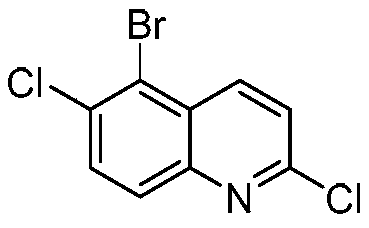
在氮气气氛下边搅拌边将2,6-二氯喹啉(5.0g,25.4mmol)和三氯化铝(10.0g,76.1mmol) 的混合物加热至120℃。在0.5小时内滴加入溴(4.81g,30.48mmol,1.54mL),混合物再在120℃搅拌1小时,然后冷却至室温。缓慢地加入甲醇/水混合物(50mL,1:1),混合物在真空下浓缩。加入二氯甲烷(500mL)和水(250mL),分离出有机层,含水馏分用二氯甲烷(2x 50mL)萃取。有机萃取液合并,用饱和碳酸氢钠水溶液(150mL)洗涤,然后干燥,过滤,浓缩。经硅胶柱色谱法(石油醚:乙酸乙酯=10:1)纯化,获得固体5-溴-2,6-二氯喹啉(5.7g,82%)。m/z:275.2[M+H]+。A mixture of 2,6-dichloroquinoline (5.0 g, 25.4 mmol) and aluminum trichloride (10.0 g, 76.1 mmol) was heated to 120°C with stirring under a nitrogen atmosphere. Bromine (4.81 g, 30.48 mmol, 1.54 mL) was added dropwise over 0.5 h, and the mixture was stirred at 120°C for an additional 1 h, then cooled to room temperature. A methanol/water mixture (50 mL, 1:1) was added slowly and the mixture was concentrated in vacuo. Dichloromethane (500 mL) and water (250 mL) were added, the organic layer was separated, and the aqueous fractions were extracted with dichloromethane (2 x 50 mL). The organic extracts were combined, washed with saturated aqueous sodium bicarbonate (150 mL), then dried, filtered, and concentrated. Purified by silica gel column chromatography (petroleum ether:ethyl acetate=10:1) to obtain solid 5-bromo-2,6-dichloroquinoline (5.7 g, 82%). m/z: 275.2 [M+H] + .
步骤2:2,6-二氯喹啉-5-羧酸Step 2: 2,6-Dichloroquinoline-5-carboxylic acid

0℃下在1小时内边搅拌边向5-溴-2,6-二氯喹啉(5.7g,20.7mmol)在THF(100mL)中的混合物加入异丙基氯化镁(10.5mL,20.9mmol,2.0M在THF中的溶液),然后使反应混合物鼓泡CO2,保持温度在0℃ 60分钟。将混合物倒入水中,用乙酸乙酯萃取。水层用盐酸(2M)酸化至pH 2~3,过滤收集得到的固体。该固体用水洗涤,干燥,获得2,6-二氯喹啉-5-羧酸(2.1g,42%),为一种白色固体。m/z:242.02[M+H]+。To a mixture of 5-bromo-2,6-dichloroquinoline (5.7 g, 20.7 mmol) in THF (100 mL) was added isopropylmagnesium chloride (10.5 mL, 20.9 mmol, 2.0 M in THF), then the reaction mixture was sparged with CO2 , maintaining the temperature at 0°C for 60 minutes. The mixture was poured into water and extracted with ethyl acetate. The aqueous layer was acidified to pH 2-3 with hydrochloric acid (2M) and the resulting solid was collected by filtration. The solid was washed with water and dried to give 2,6-dichloroquinoline-5-carboxylic acid (2.1 g, 42%) as a white solid. m/z: 242.02 [M+H] + .
步骤3:2,6-二氯-N-((4,4-二氟环己基)甲基)喹啉-5-羧酰胺Step 3: 2,6-Dichloro-N-((4,4-difluorocyclohexyl)methyl)quinoline-5-carboxamide
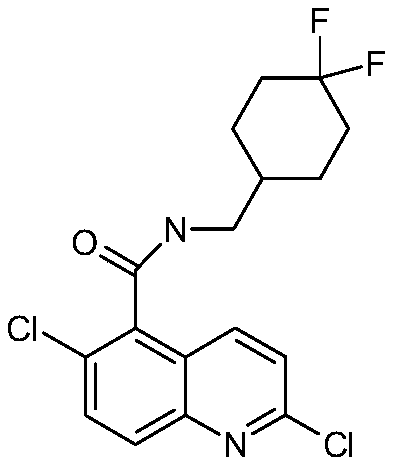
室温下2,6-二氯-喹啉-5-羧酸(1500.00mg;6.20mmol;1.00eq.)、(4,4-二氟-环己基)- 甲胺(1380.48mg;7.44mmol;1.20eq.)、(3-二甲基氨基-丙基)-乙基-碳二亚胺盐酸盐(1425.53 mg;7.44mmol;1.20eq.)(EDCI)、苯并三唑-1-醇(1004.81mg;7.44mmol;1.20eq.)(HOBt) 和乙基-二异丙基-胺(2402.70mg;18.59mmol;3.00eq.)在DMF(10.0mL)中的混合物搅拌过夜。将混合物倒入水中,过滤收集固体,用乙酸乙酯洗涤,然后干燥。产物2,6-二氯-N-((4,4- 二氟环己基)甲基)喹啉-5-羧酰胺(1.78g,77%yield)无需进一步纯化可用在下一反应中。m/z: 374[M+H]+。2,6-Dichloro-quinoline-5-carboxylic acid (1500.00 mg; 6.20 mmol; 1.00 eq.), (4,4-difluoro-cyclohexyl)-methylamine (1380.48 mg; 7.44 mmol; 1.20 at room temperature) eq.), (3-dimethylamino-propyl)-ethyl-carbodiimide hydrochloride (1425.53 mg; 7.44 mmol; 1.20 eq.) (EDCI), benzotriazol-1-ol ( A mixture of 1004.81 mg; 7.44 mmol; 1.20 eq.) (HOBt) and ethyl-diisopropyl-amine (2402.70 mg; 18.59 mmol; 3.00 eq.) in DMF (10.0 mL) was stirred overnight. The mixture was poured into water, and the solid was collected by filtration, washed with ethyl acetate, and dried. The product 2,6-dichloro-N-((4,4-difluorocyclohexyl)methyl)quinoline-5-carboxamide (1.78 g, 77% yield) was used in the next reaction without further purification. m/z: 374[M+H] + .
中间体2:2,6-二氯-N-((3,3-二氟环己基)甲基)喹啉-5-羧酰胺Intermediate 2: 2,6-Dichloro-N-((3,3-difluorocyclohexyl)methyl)quinoline-5-carboxamide

采用(3,3-二氟-环己基)-甲胺盐酸盐代替(4,4-二氟-环己基)-甲胺,依据中间体1的程序合成中间体2。m/z:374[M+H]+。Intermediate 2 was synthesized according to the procedure of Intermediate 1 using (3,3-difluoro-cyclohexyl)-methylamine hydrochloride instead of (4,4-difluoro-cyclohexyl)-methylamine. m/z: 374[M+H] + .
中间体3:2,6-二氯-N-((3,3-二氟-1-羟基环己基)甲基)喹啉-5-羧酰胺Intermediate 3: 2,6-Dichloro-N-((3,3-difluoro-1-hydroxycyclohexyl)methyl)quinoline-5-carboxamide

采用(3,3-二氟-羟基环己基)-甲胺盐酸盐代替(4,4-二氟-环己基)-甲胺,依据中间体1的程序合成中间体3。m/z:390[M+H]+。Intermediate 3 was synthesized according to the procedure of Intermediate 1 using (3,3-difluoro-hydroxycyclohexyl)-methylamine hydrochloride in place of (4,4-difluoro-cyclohexyl)-methylamine. m/z: 390 [M+H] + .
中间体4:2,6-二氯-N-((4,4-二氟-1-羟基环己基)甲基)喹啉-5-羧酰胺Intermediate 4: 2,6-Dichloro-N-((4,4-difluoro-1-hydroxycyclohexyl)methyl)quinoline-5-carboxamide

采用(4,4-二氟-1-羟基环己基)-甲胺盐酸盐代替(4,4-二氟-环己基)-甲胺,依据中间体1 的程序合成中间体4。m/z:390[M+H]+。Intermediate 4 was synthesized according to the procedure of Intermediate 1 using (4,4-difluoro-1-hydroxycyclohexyl)-methylamine hydrochloride in place of (4,4-difluoro-cyclohexyl)-methylamine. m/z: 390 [M+H] + .
中间体5:2,6-二氯-N-(1-羟基-3-甲基环己基)甲基)喹啉-5-羧酰胺Intermediate 5: 2,6-Dichloro-N-(1-hydroxy-3-methylcyclohexyl)methyl)quinoline-5-carboxamide

采用(1-羟基-3-甲基环己基)-甲胺代替(4,4-二氟-环己基)-甲胺,依据中间体1的程序合成中间体5。m/z:368[M+H]+。Intermediate 5 was synthesized according to the procedure of Intermediate 1 using (1-hydroxy-3-methylcyclohexyl)-methylamine in place of (4,4-difluoro-cyclohexyl)-methylamine. m/z: 368[M+H] + .
中间体6:2,6-二氯-N-((1R,3R)-1-羟基-3-甲基环己基)甲基)喹啉-5-羧酰胺Intermediate 6: 2,6-Dichloro-N-((1R,3R)-1-hydroxy-3-methylcyclohexyl)methyl)quinoline-5-carboxamide

采用((1R,3R)-1-羟基-3-甲基环己基)-甲胺代替(4,4-二氟-环己基)-甲胺,依据中间体1 的程序合成中间体6。m/z:368[M+H]+。Intermediate 6 was synthesized according to the procedure of Intermediate 1 using ((1R,3R)-1-hydroxy-3-methylcyclohexyl)-methylamine in place of (4,4-difluoro-cyclohexyl)-methylamine. m/z: 368[M+H] + .
中间体7:2,6-二氯-N-((1S,3S)-1-羟基-3-甲基环己基)甲基)喹啉-5-羧酰胺Intermediate 7: 2,6-Dichloro-N-((1S,3S)-1-hydroxy-3-methylcyclohexyl)methyl)quinoline-5-carboxamide

采用((1S,3S)-1-羟基-3-甲基环己基)-甲胺代替(4,4-二氟-环己基)-甲胺,依据中间体1的程序合成中间体7。m/z:368[M+H]+。Intermediate 7 was synthesized according to the procedure of Intermediate 1 using ((1S,3S)-1-hydroxy-3-methylcyclohexyl)-methylamine in place of (4,4-difluoro-cyclohexyl)-methylamine. m/z: 368[M+H] + .
中间体8:2,6-二氯-N-(4,4-二氟-1-羟基-3-甲基环己基)甲基)喹啉-5-羧酰胺Intermediate 8: 2,6-Dichloro-N-(4,4-difluoro-1-hydroxy-3-methylcyclohexyl)methyl)quinoline-5-carboxamide

采用(4,4-二氟-1-羟基-3-甲基环己基)-甲胺盐酸盐代替(4,4-二氟-环己基)-甲胺,依据中间体1的程序合成中间体8。m/z:404[M+H]+。Using (4,4-difluoro-1-hydroxy-3-methylcyclohexyl)-methylamine hydrochloride instead of (4,4-difluoro-cyclohexyl)-methylamine, intermediate was synthesized according to the procedure of Intermediate 1 body 8. m/z: 404[M+H] + .
中间体9:2,6-二氯-N-(1-羟基-3-三氟甲基环己基)甲基)喹啉-5-羧酰胺Intermediate 9: 2,6-Dichloro-N-(1-hydroxy-3-trifluoromethylcyclohexyl)methyl)quinoline-5-carboxamide

采用(1-羟基-3-三氟甲基环己基)-甲胺盐酸盐代替(4,4-二氟-环己基)-甲胺,依据中间体 1的程序合成中间体9。m/z:422[M+H]+。Intermediate 9 was synthesized according to the procedure of Intermediate 1 using (1-hydroxy-3-trifluoromethylcyclohexyl)-methylamine hydrochloride in place of (4,4-difluoro-cyclohexyl)-methylamine. m/z: 422[M+H] + .
中间体10:2,6-二氯-N-(1-羟基-3-环丙基环己基)甲基)喹啉-5-羧酰胺Intermediate 10: 2,6-Dichloro-N-(1-hydroxy-3-cyclopropylcyclohexyl)methyl)quinoline-5-carboxamide

采用(1-羟基-3-环丙基环己基)-甲胺盐酸盐代替(4,4-二氟-环己基)-甲胺,依据中间体1 的程序合成中间体10。m/z:380[M+H]+。Intermediate 10 was synthesized according to the procedure of Intermediate 1 using (1-hydroxy-3-cyclopropylcyclohexyl)-methylamine hydrochloride in place of (4,4-difluoro-cyclohexyl)-methylamine. m/z: 380[M+H] + .
实施例1. 6-氯-2-(3,3-二氟-氮杂环丁烷-1-基)-喹啉-5-羧酸(4,4-二氟-环己基甲基)-酰胺(74)Example 1. 6-Chloro-2-(3,3-difluoro-azetidin-1-yl)-quinoline-5-carboxylic acid (4,4-difluoro-cyclohexylmethyl)- Amide (74)

将装在微波小瓶内的2,6-二氯-喹啉-5-羧酸(4,4-二氟-环己基甲基)-酰胺(100mg,0.27 mmol)、3,3-二氟-氮杂环丁烷盐酸盐(347.07mg,2.68mmol)和DIPEA(519.43mg,4.02mmol) 在ACN(1.5mL)中的混合物在120℃微波辐射下加热2小时。然后冷却至室温,混合物浓缩,经反相HPLC纯化,获得所希望的产物(68mg,59%),为一种固体。1HNMR(400MHz, DMSO-d6)δppm 8.75(1H),7.88(1H),6.69(1H),4.54(4H),3.24(t,J=6.24Hz,2H), 2.04(m,2H),1.85(m,2H),1.74-1.76(m,3H),1.27-1.30(m,2H)。m/z:430[M+H]。2,6-Dichloro-quinoline-5-carboxylic acid (4,4-difluoro-cyclohexylmethyl)-amide (100 mg, 0.27 mmol), 3,3-difluoro- A mixture of azetidine hydrochloride (347.07 mg, 2.68 mmol) and DIPEA (519.43 mg, 4.02 mmol) in ACN (1.5 mL) was heated under microwave irradiation at 120°C for 2 hours. It was then cooled to room temperature and the mixture was concentrated and purified by reverse phase HPLC to give the desired product (68 mg, 59%) as a solid. 1 H NMR (400 MHz, DMSO-d 6 ) δppm 8.75(1H), 7.88(1H), 6.69(1H), 4.54(4H), 3.24(t, J=6.24Hz, 2H), 2.04(m, 2H), 1.85 (m, 2H), 1.74-1.76 (m, 3H), 1.27-1.30 (m, 2H). m/z: 430 [M+H].
实施例2. 3-{6-氯-5-[(4,4-二氟-环己基甲基)-氨基甲酰基]-喹啉-2-基氨基}-丙酸乙酯(81)Example 2. 3-{6-Chloro-5-[(4,4-Difluoro-cyclohexylmethyl)-carbamoyl]-quinolin-2-ylamino}-propionic acid ethyl ester (81)

依据实施例1的程序,在140℃加热2,6-二氯-喹啉-5-羧酸(4,4-二氟-环己基甲基)-酰胺、DIEPA和3-氨基-丙酸乙酯盐酸盐在DMSO中的混合物,合成标题化合物。1H NMR(400 MHz,DMSO-d6)δ4.16(S,1H),4.00(t,J=13.2Hz,2H),3.78(t,J=7.60Hz,2H),3.28(d,J=6.04Hz,2H),8.81(S,1H),7.68-7.77(m,2H),6.93-7.02(m,1H),4.05-4.10(m, 2H),3.68-3.80(m,2H),3.23(t,J=6.03Hz,2H),2.01-2.03(m,2H),1.73-1.88(m,5H), 1.22-2.27(m,2H),1.15-1.19(m,3H)。m/z:454.0[M+H]+。2,6-Dichloro-quinoline-5-carboxylic acid (4,4-difluoro-cyclohexylmethyl)-amide, DIEPA and 3-amino-propionic acid ethyl were heated at 140°C according to the procedure of Example 1 The title compound was synthesized from a mixture of ester hydrochloride in DMSO. 1 H NMR (400 MHz, DMSO-d 6 ) δ 4.16 (S, 1H), 4.00 (t, J=13.2 Hz, 2H), 3.78 (t, J=7.60 Hz, 2H), 3.28 (d, J =6.04Hz, 2H), 8.81(S, 1H), 7.68-7.77(m, 2H), 6.93-7.02(m, 1H), 4.05-4.10(m, 2H), 3.68-3.80(m, 2H), 3.23 (t, J=6.03 Hz, 2H), 2.01-2.03 (m, 2H), 1.73-1.88 (m, 5H), 1.22-2.27 (m, 2H), 1.15-1.19 (m, 3H). m/z: 454.0 [M+H] + .
实施例3. 3-{6-氯-5-[(4,4-二氟环己基甲基)-氨基甲酰基]-喹啉-2-基氨基}-丙酸(83)Example 3. 3-{6-Chloro-5-[(4,4-difluorocyclohexylmethyl)-carbamoyl]-quinolin-2-ylamino}-propionic acid (83)

向3-{6-氯-5-[(4,4-二氟-环己基甲基)-氨基甲酰基]-喹啉-2-基氨基}-丙酸乙酯(80mg, 0.17mmol,1.00eq)在THF(8.00mL,100V)和水(2.00mL,25V)中的溶液加入氢氧化锂一水合物(14.72mg,0.35mmol,2.00eq)。反应混合物在室温搅拌过夜。反应混合物在真空下浓缩。水溶液被调至pH 2,然后用乙酸乙酯萃取,有机相合并,收集,经无水硫酸钠干燥,过滤,真空浓缩。粗产物经制备型HPLC纯化,获得标题化合物(35mg,0.08mmol, 45.3%),为乳白色固体。1H NMR(400MHz,DMSO-d6):δ8.69(t,J=6.01Hz,1H),7.60 (d,J=9.22Hz,1H),7.46-7.52(m,2H),7.31-7.33(m,1H),6.84(d,J=9.24Hz,1H), 3.57(q,J=6.43Hz,2H),3.22(t,J=6.40Hz,2H),2.54-2.57(m,2H),2.03-2.00(m, 2H),1.72-1.89(m,5H),1.22-1.31(m,2H)。m/z:426.0[M+H]+。To 3-{6-chloro-5-[(4,4-difluoro-cyclohexylmethyl)-carbamoyl]-quinolin-2-ylamino}-propionic acid ethyl ester (80 mg, 0.17 mmol, 1.00 eq) To a solution of THF (8.00 mL, 100 V) and water (2.00 mL, 25 V) was added lithium hydroxide monohydrate (14.72 mg, 0.35 mmol, 2.00 eq). The reaction mixture was stirred at room temperature overnight. The reaction mixture was concentrated under vacuum. The aqueous solution was adjusted to pH 2, then extracted with ethyl acetate, and the organic phases were combined, collected, dried over anhydrous sodium sulfate, filtered, and concentrated in vacuo. The crude product was purified by preparative HPLC to give the title compound (35 mg, 0.08 mmol, 45.3%) as a milky white solid. 1 H NMR (400 MHz, DMSO-d 6 ): δ 8.69 (t, J=6.01 Hz, 1H), 7.60 (d, J=9.22 Hz, 1H), 7.46-7.52 (m, 2H), 7.31-7.33 (m, 1H), 6.84 (d, J=9.24Hz, 1H), 3.57 (q, J=6.43Hz, 2H), 3.22 (t, J=6.40Hz, 2H), 2.54-2.57 (m, 2H) , 2.03-2.00 (m, 2H), 1.72-1.89 (m, 5H), 1.22-1.31 (m, 2H). m/z: 426.0 [M+H] + .
实施例4. 6-氯-2-(2-二甲基氨基甲酰基-乙基氨基)-喹啉-5-羧酸(4,4-二氟-环己基甲基)-酰胺 (82)Example 4. 6-Chloro-2-(2-dimethylcarbamoyl-ethylamino)-quinoline-5-carboxylic acid (4,4-difluoro-cyclohexylmethyl)-amide (82)

边搅拌边向3-{6-氯-5-[(4,4-二氟-环己基甲基)-氨基甲酰基]-喹啉-2-基氨基}-丙酸(100 mg,0.22mmol,1.00eq)在DMF(2.00mL,20.00V)中的溶液加入二异丙基-乙胺(0.15mL, 0.89mmol,4.00eq)和苯并三唑-1-醇(54.48mg,0.33mmol,1.50eq),在氮气气氛下室温搅拌1小时。1小时后,向反应混合物加入二甲基-胺(22.05mg,0.27mmol,1.20eq),反应混合物在氮气气氛下室温搅拌过夜。粗产物用乙酸乙酯(50mL)稀释,用水(2x 25mL)、盐水(2x 25mL)洗涤。有机层合并,收集,经无水硫酸钠干燥,过滤,真空浓缩。粗产物经硅胶色谱法纯化,获得标题化合物(11.00mg,0.02mmol,10.4%),为一种白色固体。1H NMR(400MHz,DMSO-d6):δ8.69-8.70(m,1H),7.59(d,J=8.81Hz,1H),7.46-7.51(m,2H), 7.27(S,1H),6.84(d,J=9.61Hz,1H),3.59-3.60(m,2H),3.21-3.24(m,2H),2.97(S,3H), 2.83(S,3H),2.60-2.63(m,2H),2.01-2.03(m,2H),1.73-1.85(m,5H),1.23-1.28(m,2H)。 m/z:453.3[M+H]+。To 3-{6-chloro-5-[(4,4-difluoro-cyclohexylmethyl)-carbamoyl]-quinolin-2-ylamino}-propionic acid (100 mg, 0.22 mmol) was added with stirring , 1.00eq) in DMF (2.00mL, 20.00V) was added diisopropyl-ethylamine (0.15mL, 0.89mmol, 4.00eq) and benzotriazol-1-ol (54.48mg, 0.33mmol, 1.50eq), stirred at room temperature for 1 hour under nitrogen atmosphere. After 1 hour, dimethyl-amine (22.05 mg, 0.27 mmol, 1.20 eq) was added to the reaction mixture, and the reaction mixture was stirred at room temperature under nitrogen atmosphere overnight. The crude product was diluted with ethyl acetate (50 mL), washed with water (2 x 25 mL), brine (2 x 25 mL). The organic layers were combined, collected, dried over anhydrous sodium sulfate, filtered, and concentrated in vacuo. The crude product was purified by silica gel chromatography to give the title compound (11.00 mg, 0.02 mmol, 10.4%) as a white solid. 1 H NMR (400 MHz, DMSO-d 6 ): δ 8.69-8.70 (m, 1H), 7.59 (d, J=8.81 Hz, 1H), 7.46-7.51 (m, 2H), 7.27 (S, 1H) , 6.84(d, J=9.61Hz, 1H), 3.59-3.60(m, 2H), 3.21-3.24(m, 2H), 2.97(S, 3H), 2.83(S, 3H), 2.60-2.63(m , 2H), 2.01-2.03 (m, 2H), 1.73-1.85 (m, 5H), 1.23-1.28 (m, 2H). m/z: 453.3 [M+H] + .
实施例5. 6-氯-2-(2-甲氧基-乙基氨基)-喹啉-5-羧酸(4,4-二氟-环己基甲基)-酰胺(68)Example 5. 6-Chloro-2-(2-methoxy-ethylamino)-quinoline-5-carboxylic acid (4,4-difluoro-cyclohexylmethyl)-amide (68)

采用2,6-二氯-喹啉-5-羧酸(4,4-二氟-环己基甲基)-酰胺和2-甲氧基-乙基胺,依据实施例1的程序合成标题化合物。1H NMR(400MHz,DMSO-d6):δ8.70(t,J=5.81Hz,1H),7.59(d,J=9.21Hz,1H),7.45-7.50(m,2H),7.32(t,J=5.32Hz,1H),6.88(d,J=9.21 Hz,1H),3.55-3.54(m,2H),3.51-3.52(m,2H),3.28(S,3H),3.22(t,J=6.31Hz,2H), 2.01-2.03(m,2H),1.73-1.85(m,5H),1.22-1.31(m,2H)。m/z:412.0[M+H]+。The title compound was synthesized according to the procedure of Example 1 using 2,6-dichloro-quinoline-5-carboxylic acid (4,4-difluoro-cyclohexylmethyl)-amide and 2-methoxy-ethylamine . 1 H NMR (400 MHz, DMSO-d 6 ): δ 8.70 (t, J=5.81 Hz, 1H), 7.59 (d, J=9.21 Hz, 1H), 7.45-7.50 (m, 2H), 7.32 (t , J=5.32Hz, 1H), 6.88(d, J=9.21 Hz, 1H), 3.55-3.54(m, 2H), 3.51-3.52(m, 2H), 3.28(S, 3H), 3.22(t, J=6.31 Hz, 2H), 2.01-2.03 (m, 2H), 1.73-1.85 (m, 5H), 1.22-1.31 (m, 2H). m/z: 412.0 [M+H] + .
实施例6. 6-氯-2-(3-甲氧基-丙基氨基)-喹啉-5-羧酸(4,4-二氟-环己基甲基)-酰胺(77)Example 6. 6-Chloro-2-(3-methoxy-propylamino)-quinoline-5-carboxylic acid (4,4-difluoro-cyclohexylmethyl)-amide (77)

采用2,6-二氯-喹啉-5-羧酸(4,4-二氟-环己基甲基)-酰胺和3-甲氧基-丙基胺,依据实施例1的程序合成标题化合物。1H NMR(400MHz,DMSO-d6)δppm 8.70(t,J=5.8Hz,1H),7.59(d,J=9.2Hz,1H),7.47-7.50(m,2H),7.24(t,J=5.4Hz,1H),6.82(d,J=9.2Hz,1H),3.39-3.42(m,4H),3.20-3.22(m,5H),2.01-2.03(m,2H),1.73-1.85(m,7H),1.22-1.31(m,2H)。m/z:426.0[M+H]+。The title compound was synthesized according to the procedure of Example 1 using 2,6-dichloro-quinoline-5-carboxylic acid (4,4-difluoro-cyclohexylmethyl)-amide and 3-methoxy-propylamine . 1 H NMR (400 MHz, DMSO-d 6 ) δppm 8.70 (t, J=5.8 Hz, 1H), 7.59 (d, J=9.2 Hz, 1H), 7.47-7.50 (m, 2H), 7.24 (t, J =5.4Hz, 1H), 6.82(d, J=9.2Hz, 1H), 3.39-3.42(m, 4H), 3.20-3.22(m, 5H), 2.01-2.03(m, 2H), 1.73-1.85( m, 7H), 1.22-1.31 (m, 2H). m/z: 426.0 [M+H] + .
实施例7. 6-氯-2-(2-羟基-乙基氨基)-喹啉-5-羧酸(4,4-二氟-环己基甲基)-酰胺(66)Example 7. 6-Chloro-2-(2-hydroxy-ethylamino)-quinoline-5-carboxylic acid (4,4-difluoro-cyclohexylmethyl)-amide (66)

采用2,6-二氯-喹啉-5-羧酸(4,4-二氟-环己基甲基)-酰胺和2-氨基-乙醇,依据实施例1 的程序合成标题化合物。1H NMR(400MHz,DMSO-d6):δ8.70(t,J=5.81Hz,1H),7.59(d,J=9.21Hz,1H),7.47(S,2H),7.27(t,J=5.21Hz,1H),6.87(d,J=9.21Hz,1H), 4.79-4.81(m,1H),3.55-3.59(m,2H),3.44-3.48(m,2H),3.22-3.23(m,2H),1.98-2.03(m, 2H),1.73-1.85(m,5H),1.22-1.31(m,2H)。m/z:398.3[M+H]+。The title compound was synthesized according to the procedure of Example 1 using 2,6-dichloro-quinoline-5-carboxylic acid (4,4-difluoro-cyclohexylmethyl)-amide and 2-amino-ethanol. 1 H NMR (400 MHz, DMSO-d 6 ): δ 8.70 (t, J=5.81 Hz, 1H), 7.59 (d, J=9.21 Hz, 1H), 7.47 (S, 2H), 7.27 (t, J =5.21Hz, 1H), 6.87(d, J=9.21Hz, 1H), 4.79-4.81(m, 1H), 3.55-3.59(m, 2H), 3.44-3.48(m, 2H), 3.22-3.23( m, 2H), 1.98-2.03 (m, 2H), 1.73-1.85 (m, 5H), 1.22-1.31 (m, 2H). m/z: 398.3 [M+H] + .
实施例8. 6-氯-2-(3-羟基-丙基氨基)-喹啉-5-羧酸(4,4-二氟-环己基甲基)-酰胺(60)Example 8. 6-Chloro-2-(3-hydroxy-propylamino)-quinoline-5-carboxylic acid (4,4-difluoro-cyclohexylmethyl)-amide (60)

采用2,6-二氯-喹啉-5-羧酸(4,4-二氟-环己基甲基)-酰胺和3-氨基-丙-1-醇,依据实施例 1的程序合成标题化合物。1H NMR(400MHz,DMSO-d6):δ8.70(t,J=5.81Hz,1H),7.59(d,J=9.12Hz,1H),7.47-7.50(m,2H),7.24(t,J=5.41Hz,1H),6.82(d,J=9.21 Hz,1H),4.58-4.60(m,1H),3.46-3.51(m,2H),3.39-3.44(m,2H),3.20-3.23(m,2H), 2.00-2.03(m,2H),1.82-1.85(m,3H),1.68-1.76(m,4H),1.22-1.31(m,2H)。m/z:412.2 [M+H]+。The title compound was synthesized according to the procedure of Example 1 using 2,6-dichloro-quinoline-5-carboxylic acid (4,4-difluoro-cyclohexylmethyl)-amide and 3-amino-propan-1-ol . 1 H NMR (400 MHz, DMSO-d 6 ): δ 8.70 (t, J=5.81 Hz, 1H), 7.59 (d, J=9.12 Hz, 1H), 7.47-7.50 (m, 2H), 7.24 (t , J=5.41Hz, 1H), 6.82 (d, J=9.21 Hz, 1H), 4.58-4.60 (m, 1H), 3.46-3.51 (m, 2H), 3.39-3.44 (m, 2H), 3.20- 3.23 (m, 2H), 2.00-2.03 (m, 2H), 1.82-1.85 (m, 3H), 1.68-1.76 (m, 4H), 1.22-1.31 (m, 2H). m/z: 412.2 [M+H] + .
实施例9. 6-氯-2-(2-甲氧基-乙氧基)-喹啉-5-羧酸(4,4-二氟-环己基甲基)-酰胺(70)Example 9. 6-Chloro-2-(2-methoxy-ethoxy)-quinoline-5-carboxylic acid (4,4-difluoro-cyclohexylmethyl)-amide (70)
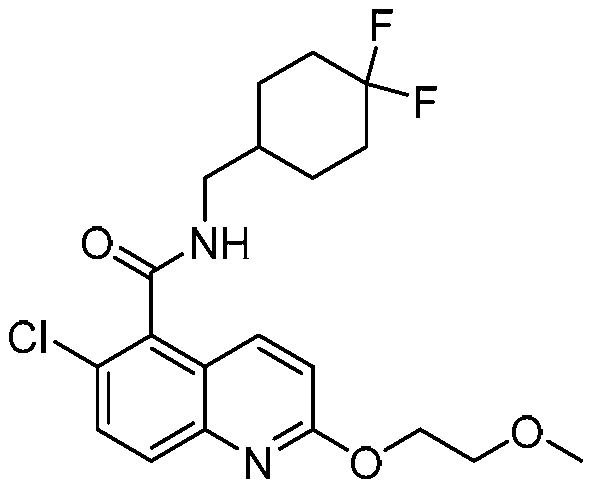
在0℃下边搅拌边向NaH(38.28mg,2.0eq)在THF(5.00mL,25.00V)中的60%溶液加入2-甲氧基-乙醇(54.74mg,0.72mmol,1.50eq),搅拌30分钟。然后在0℃下向反应混合物加入2,6-二氯-喹啉-5-羧酸(4,4-二氟环己基甲基)-酰胺(200mg,0.48mmol,1.00eq),室温搅拌12小时。加入冰水淬灭反应,用乙酸乙酯萃取。有机层经无水Na2SO4干燥,蒸发至干。粗产物经柱色谱法纯化,获得标题化合物(46mg,0.11mmol,22.3%),为乳白色固体。1H NMR(400MHz,DMSO-d6):δ8.74(t,J=5.6Hz,1H),7.73(d,J=9.61Hz, 1H),7.49-7.55(m,2H),7.17(d,J=9.62Hz,1H),3.23(t,J=6.41Hz,2H),3.15(S,6H), 1.99-2.05(m,2H),1.75-1.85(m,5H),1.22-1.28(m,2H)。m/z:413.0[M+H]+。To a 60% solution of NaH (38.28 mg, 2.0 eq) in THF (5.00 mL, 25.00 V) was added 2-methoxy-ethanol (54.74 mg, 0.72 mmol, 1.50 eq) at 0°C with stirring, and stirred for 30 minute. Then 2,6-dichloro-quinoline-5-carboxylic acid (4,4-difluorocyclohexylmethyl)-amide (200 mg, 0.48 mmol, 1.00 eq) was added to the reaction mixture at 0°C, and stirred at room temperature for 12 Hour. The reaction was quenched by adding ice water and extracted with ethyl acetate. The organic layer was dried over anhydrous Na2SO4 and evaporated to dryness. The crude product was purified by column chromatography to give the title compound (46 mg, 0.11 mmol, 22.3%) as a milky white solid. 1 H NMR (400 MHz, DMSO-d 6 ): δ 8.74 (t, J=5.6 Hz, 1H), 7.73 (d, J=9.61 Hz, 1H), 7.49-7.55 (m, 2H), 7.17 (d , J=9.62Hz, 1H), 3.23(t, J=6.41Hz, 2H), 3.15(S, 6H), 1.99-2.05(m, 2H), 1.75-1.85(m, 5H), 1.22-1.28( m, 2H). m/z: 413.0 [M+H] + .
实施例10. 6-氯-2-(3-甲氧基-丙氧基)-喹啉-5-羧酸(4,4-二氟-环己基甲基)-酰胺(69)Example 10. 6-Chloro-2-(3-methoxy-propoxy)-quinoline-5-carboxylic acid (4,4-difluoro-cyclohexylmethyl)-amide (69)

采用2,6-二氯-喹啉-5-羧酸(4,4-二氟环己基甲基)-酰胺和3-甲氧基-丙-1-醇,依据实施例9的程序合成标题化合物。1H NMR(400MHz,DMSO-d6):δ8.79-8.82(m,1H),7.95(d, J=9.11Hz,1H),7.79(d,J=9.01Hz,1H),7.70(d,J=9.01Hz,1H),7.12(d,J=9.12Hz,1H),4.45(t,J=13.2Hz,2H),3.49(t,J=12.61Hz,2H),3.25(S,5H),1.97-2.04(m,4H),1.80-1.86(m,3H),1.73-1.76(m,2H),1.23-1.32(m,2H)。m/z:427.0[M+H]+。The title was synthesized according to the procedure of Example 9 using 2,6-dichloro-quinoline-5-carboxylic acid (4,4-difluorocyclohexylmethyl)-amide and 3-methoxy-propan-1-ol compound. 1 H NMR (400 MHz, DMSO-d 6 ): δ 8.79-8.82 (m, 1H), 7.95 (d, J=9.11 Hz, 1H), 7.79 (d, J=9.01 Hz, 1H), 7.70 (d , J=9.01Hz, 1H), 7.12 (d, J=9.12Hz, 1H), 4.45 (t, J=13.2Hz, 2H), 3.49 (t, J=12.61Hz, 2H), 3.25 (S, 5H) ), 1.97-2.04 (m, 4H), 1.80-1.86 (m, 3H), 1.73-1.76 (m, 2H), 1.23-1.32 (m, 2H). m/z: 427.0 [M+H] + .
实施例11. 6-氯-2-(3-甲氧基-丙氧基)-喹啉-5-羧酸(4,4-二氟-1-羟基-环己基甲基)-酰胺(62)Example 11. 6-Chloro-2-(3-methoxy-propoxy)-quinoline-5-carboxylic acid (4,4-difluoro-1-hydroxy-cyclohexylmethyl)-amide (62 )

采用2,6-二氯-喹啉-5-羧酸(4,4-二氟-1-羟基-环己基甲基)-酰胺和3-甲氧基-丙-1-醇,依据实施例9的程序合成标题化合物。1H NMR(400MHz,DMSO-d6):δ8.74(t,J=6.01Hz, 1H),8.03(d,J=9.61Hz,1H),7.77-7.80(m,1H),7.69-7.71(m,1H),7.10(d,J=9.21 Hz,1H),4.68(S,1H),4.45(t,J=6.41Hz,2H),3.47-3.50(m,2H),3.38-3.39(m,2H),3.25(S,3H),2.01-2.04(m,4H),1.90-2.00(m,2H),1.67-1.72(m,4H)。m/z:443.2[M+H] +。Using 2,6-dichloro-quinoline-5-carboxylic acid (4,4-difluoro-1-hydroxy-cyclohexylmethyl)-amide and 3-methoxy-propan-1-ol, according to example The title compound was synthesized by the procedure of 9. 1 H NMR (400 MHz, DMSO-d 6 ): δ 8.74 (t, J=6.01 Hz, 1H), 8.03 (d, J=9.61 Hz, 1H), 7.77-7.80 (m, 1H), 7.69-7.71 (m, 1H), 7.10 (d, J=9.21 Hz, 1H), 4.68 (S, 1H), 4.45 (t, J=6.41 Hz, 2H), 3.47-3.50 (m, 2H), 3.38-3.39 ( m, 2H), 3.25 (S, 3H), 2.01-2.04 (m, 4H), 1.90-2.00 (m, 2H), 1.67-1.72 (m, 4H). m/z: 443.2 [M+H] + .
实施例12. 6-氯-2-(3-羟基-丙-1-炔基)-喹啉-5-羧酸(4,4-二氟-环己基甲基)-酰胺(19)Example 12. 6-Chloro-2-(3-hydroxy-prop-1-ynyl)-quinoline-5-carboxylic acid (4,4-difluoro-cyclohexylmethyl)-amide (19)

向2,6-二氯-喹啉-5-羧酸(4,4-二氟-环己基甲基)-酰胺(500mg,1.24mmol,1.00eq)在脱气1,4-二噁烷(2.50mL,5.00V)中的溶液加入丙-2-炔-1-醇(0.09mL,1.49mmol,1.20eq)、三乙胺(0.52mL,3.71mmol,3.00eq)、双(三苯基膦)二氯化钯(II)(34.86mg,0.05mmol, 0.04eq)和碘化铜(I)(4.81mg,0.02mmol,0.02eq)。反应混合物在90℃加热1小时。反应混合物用二氯甲烷稀释,用硅藻土过滤。滤液浓缩,经柱色谱法纯化,获得标题化合物(0.38 g,0.94mmol,75.7%),为乳白色固体。1H NMR(400MHz,DMSO-d6):δ8.87(t,J=5.92 Hz,1H),8.09(d,J=8.61Hz,1H),8.01(d,J=9.01Hz,1H),7.86(d,J=9.11Hz,1H), 7.68(d,J=8.72Hz,1H),5.53(t,J=6.13Hz,1H),4.39(d,J=6.01Hz,2H),3.27(t, J=6.32Hz,2H),1.98-2.04(m,2H),1.74-1.86(m,5H),1.24-1.33(m,2H)。m/z:393.2 [M+H]+。To 2,6-dichloro-quinoline-5-carboxylic acid (4,4-difluoro-cyclohexylmethyl)-amide (500 mg, 1.24 mmol, 1.00 eq) in degassed 1,4-dioxane ( The solution in 2.50mL, 5.00V) was added prop-2-yn-1-ol (0.09mL, 1.49mmol, 1.20eq), triethylamine (0.52mL, 3.71mmol, 3.00eq), bis(triphenylphosphine) ) palladium(II) dichloride (34.86 mg, 0.05 mmol, 0.04 eq) and copper(I) iodide (4.81 mg, 0.02 mmol, 0.02 eq). The reaction mixture was heated at 90°C for 1 hour. The reaction mixture was diluted with dichloromethane and filtered through celite. The filtrate was concentrated and purified by column chromatography to give the title compound (0.38 g, 0.94 mmol, 75.7%) as a milky white solid. 1 H NMR (400 MHz, DMSO-d 6 ): δ 8.87 (t, J=5.92 Hz, 1H), 8.09 (d, J=8.61 Hz, 1H), 8.01 (d, J=9.01 Hz, 1H), 7.86(d, J=9.11Hz, 1H), 7.68(d, J=8.72Hz, 1H), 5.53(t, J=6.13Hz, 1H), 4.39(d, J=6.01Hz, 2H), 3.27( t, J=6.32 Hz, 2H), 1.98-2.04 (m, 2H), 1.74-1.86 (m, 5H), 1.24-1.33 (m, 2H). m/z: 393.2 [M+H] + .
实施例13. 6-氯-2-(3-羟基-丙基)-喹啉-5-羧酸(4,4-二氟环己基甲基)-酰胺(64)Example 13. 6-Chloro-2-(3-hydroxy-propyl)-quinoline-5-carboxylic acid (4,4-difluorocyclohexylmethyl)-amide (64)

0℃下向6-氯-2-(3-羟基-丙-1-炔基)-喹啉-5-羧酸(4,4-二氟-环己基甲基)-酰胺(0.25g, 0.62mmol,1.00eq)在甲醇(5mL,20V)中的溶液加入三甲硅烷(0.65mL,6.23mmol,10eq),然后加入钯/炭(10%w/w)(0.07g,0.06mmol,0.10eq)。反应混合物搅拌0.6小时。通过 TLC监测到反应完成后,反应混合物在真空下浓缩。反应混合物用乙酸乙酯(20mL)稀释,水(20mL)和盐水溶液(20mL)萃取。分离出有机层,经Na2SO4干燥,真空浓缩。粗产物经柱色谱法纯化,获得标题化合物(0.08g,0.18mmol,29.0%),为白色固体。1H NMR(400MHz, DMSO-d6):δ8.82(t,J=5.83Hz,1H),7.96-8.01(m,2H),7.76(d,J=9.01Hz,1H),7.55(d,J=8.72Hz,1H),4.58(t,J=6.22Hz,1H),3.46(t,J=6.41Hz,2H),3.27(t, J=6.22Hz,2H),2.95(t,J=7.62Hz,2H),2.02-2.04(m,2H),1.74-1.93(m,7H),1.29-1.33 (m,2H)。m/z:397.2[M+H]+。To 6-chloro-2-(3-hydroxy-prop-1-ynyl)-quinoline-5-carboxylic acid (4,4-difluoro-cyclohexylmethyl)-amide (0.25 g, 0.62 g) at 0 °C mmol, 1.00eq) in methanol (5mL, 20V) was added trimethylsilane (0.65mL, 6.23mmol, 10eq) followed by palladium/charcoal (10% w/w) (0.07g, 0.06mmol, 0.10eq) . The reaction mixture was stirred for 0.6 hours. After completion of the reaction as monitored by TLC, the reaction mixture was concentrated in vacuo. The reaction mixture was diluted with ethyl acetate (20 mL) and extracted with water (20 mL) and brine solution (20 mL). The organic layer was separated, dried over Na2SO4 and concentrated in vacuo. The crude product was purified by column chromatography to give the title compound (0.08 g, 0.18 mmol, 29.0%) as a white solid. 1 H NMR (400 MHz, DMSO-d 6 ): δ 8.82 (t, J=5.83 Hz, 1H), 7.96-8.01 (m, 2H), 7.76 (d, J=9.01 Hz, 1H), 7.55 (d , J=8.72Hz, 1H), 4.58(t, J=6.22Hz, 1H), 3.46(t, J=6.41Hz, 2H), 3.27(t, J=6.22Hz, 2H), 2.95(t, J = 7.62 Hz, 2H), 2.02-2.04 (m, 2H), 1.74-1.93 (m, 7H), 1.29-1.33 (m, 2H). m/z: 397.2 [M+H] + .
实施例14. 6-氯-2-((R)-3-羟基甲基-吡咯烷-1-基)-喹啉-5-羧酸(4,4-二氟-环己基甲基)-酰胺 (12)Example 14. 6-Chloro-2-((R)-3-hydroxymethyl-pyrrolidin-1-yl)-quinoline-5-carboxylic acid (4,4-difluoro-cyclohexylmethyl)- Amide (12)

采用2,6-二氯-喹啉-5-羧酸(4,4-二氟-环己基甲基)-酰胺、DIPEA和(R)-吡咯烷-3-基甲醇,依据实施例1的程序合成标题化合物。1H NMR(400MHz,DMSO-d6)δppm 7.75(1H),7.48 (2H),6.69(1H),4.72(1H),3.66(m,2H),3.49(m,2H),3.32(m,2H),2.44(m,2H),2.06(m,2H),1.85(m,2H),1.74-1.76(m,5H),1.27-1.30(m,2H)。m/z:438[M+H]。Using 2,6-dichloro-quinoline-5-carboxylic acid (4,4-difluoro-cyclohexylmethyl)-amide, DIPEA and (R)-pyrrolidin-3-ylmethanol, according to Example 1 program to synthesize the title compound. 1 H NMR (400 MHz, DMSO-d 6 ) δppm 7.75 (1H), 7.48 (2H), 6.69 (1H), 4.72 (1H), 3.66 (m, 2H), 3.49 (m, 2H), 3.32 (m, 2H), 2.44 (m, 2H), 2.06 (m, 2H), 1.85 (m, 2H), 1.74-1.76 (m, 5H), 1.27-1.30 (m, 2H). m/z: 438 [M+H].
实施例15. 6-氯-2-((S)-3-羟基甲基-吡咯烷-1-基)-喹啉-5-羧酸(4,4-二氟-环己基甲基)-酰胺 (29)Example 15. 6-Chloro-2-((S)-3-hydroxymethyl-pyrrolidin-1-yl)-quinoline-5-carboxylic acid (4,4-difluoro-cyclohexylmethyl)- Amide (29)

采用2,6-二氯-喹啉-5-羧酸(4,4-二氟-环己基甲基)-酰胺、DIPEA和(S)-吡咯烷-3-基甲醇,依据实施例1的程序合成标题化合物。1H NMR(400MHz,DMSO-d6)δppm 7.75(1H),7.48 (2H),6.69(1H),4.72(1H),3.66(m,2H),3.49(m,2H),3.32(m,2H),2.44(m,2H), 2.06(m,2H),1.85(m,2H),1.74-1.76(m,5H),1.27-1.30(m,2H)。m/z:438[M+H]Using 2,6-dichloro-quinoline-5-carboxylic acid (4,4-difluoro-cyclohexylmethyl)-amide, DIPEA and (S)-pyrrolidin-3-ylmethanol, according to Example 1 program to synthesize the title compound. 1 H NMR (400 MHz, DMSO-d 6 ) δppm 7.75 (1H), 7.48 (2H), 6.69 (1H), 4.72 (1H), 3.66 (m, 2H), 3.49 (m, 2H), 3.32 (m, 2H), 2.44 (m, 2H), 2.06 (m, 2H), 1.85 (m, 2H), 1.74-1.76 (m, 5H), 1.27-1.30 (m, 2H). m/z: 438[M+H]
实施例16. 2-(氮杂环丁烷-1-基)-6-氯-喹啉-5-羧酸(4,4-二氟-环己基甲基)-酰胺(49)Example 16. 2-(azetidin-1-yl)-6-chloro-quinoline-5-carboxylic acid (4,4-difluoro-cyclohexylmethyl)-amide (49)

采用2,6-二氯-喹啉-5-羧酸(4,4-二氟-环己基甲基)-酰胺、DIPEA和氮杂环丁烷,依据实施例1的程序合成标题化合物。1H NMR(400MHz,DMSO-d6)δppm 8.75(1H),7.88(1H),6.69(1H),4.49(m,4H),3.24(m,2H),2.40(m,2H),2.04(m,2H),1.85(m,2H),1.74-1.76 (m,3H),1.27-1.30(m,2H)。m/z:394[M+H]。The title compound was synthesized according to the procedure of Example 1 using 2,6-dichloro-quinoline-5-carboxylic acid (4,4-difluoro-cyclohexylmethyl)-amide, DIPEA and azetidine. 1 H NMR (400 MHz, DMSO-d 6 ) δppm 8.75 (1H), 7.88 (1H), 6.69 (1H), 4.49 (m, 4H), 3.24 (m, 2H), 2.40 (m, 2H), 2.04 ( m, 2H), 1.85 (m, 2H), 1.74-1.76 (m, 3H), 1.27-1.30 (m, 2H). m/z: 394 [M+H].
实施例17. 6-氯-2-((R)-3-氟吡咯烷-1-基)-喹啉-5-羧酸(4,4-二氟-环己基甲基)-酰胺(33)Example 17. 6-Chloro-2-((R)-3-fluoropyrrolidin-1-yl)-quinoline-5-carboxylic acid (4,4-difluoro-cyclohexylmethyl)-amide (33 )

采用2,6-二氯-喹啉-5-羧酸(4,4-二氟-环己基甲基)-酰胺、DIPEA和(R)-3-氟吡咯烷,依据实施例1的程序合成标题化合物。1H NMR(400MHz,DMSO-d6)δppm 7.75(1H),7.48(2H), 6.69(1H),5.43-5.56(1H),3.89(m,2H),3.70(m,1H),3.55(m,1H),3.26(m,2H),2.44(m,2H),2.06(m,2H),1.85(m,2H),1.74-1.76(m,5H),1.27-1.32(m,2H)。m/z: 426[M+H]。Synthesized according to the procedure of Example 1 using 2,6-dichloro-quinoline-5-carboxylic acid (4,4-difluoro-cyclohexylmethyl)-amide, DIPEA and (R)-3-fluoropyrrolidine title compound. 1 H NMR (400 MHz, DMSO-d 6 ) δppm 7.75 (1H), 7.48 (2H), 6.69 (1H), 5.43-5.56 (1H), 3.89 (m, 2H), 3.70 (m, 1H), 3.55 ( m, 1H), 3.26 (m, 2H), 2.44 (m, 2H), 2.06 (m, 2H), 1.85 (m, 2H), 1.74-1.76 (m, 5H), 1.27-1.32 (m, 2H) . m/z: 426[M+H].
实施例18. 6-氯-2-((S)-3-氟吡咯烷-1-基)-喹啉-5-羧酸(4,4-二氟-环己基甲基)-酰胺(41)Example 18. 6-Chloro-2-((S)-3-fluoropyrrolidin-1-yl)-quinoline-5-carboxylic acid (4,4-difluoro-cyclohexylmethyl)-amide (41 )

采用2,6-二氯-喹啉-5-羧酸(4,4-二氟-环己基甲基)-酰胺、DIPEA和(S)-3-氟吡咯烷,依据实施例1的程序合成标题化合物。1H NMR(400MHz,DMSO-d6)δppm 7.75(1H),7.48(2H), 6.69(1H),5.43-5.56(1H),3.89(m,2H),3.70(m,1H),3.55(m,1H),3.26(m,2H),2.44(m,2H),2.06(m,2H),1.85(m,2H),1.74-1.76(m,5H),1.27-1.32(m,2H)。m/z: 426[M+H]。Synthesized according to the procedure of Example 1 using 2,6-dichloro-quinoline-5-carboxylic acid (4,4-difluoro-cyclohexylmethyl)-amide, DIPEA and (S)-3-fluoropyrrolidine title compound. 1 H NMR (400 MHz, DMSO-d 6 ) δppm 7.75 (1H), 7.48 (2H), 6.69 (1H), 5.43-5.56 (1H), 3.89 (m, 2H), 3.70 (m, 1H), 3.55 ( m, 1H), 3.26 (m, 2H), 2.44 (m, 2H), 2.06 (m, 2H), 1.85 (m, 2H), 1.74-1.76 (m, 5H), 1.27-1.32 (m, 2H) . m/z: 426[M+H].
实施例19. 6-氯-2-(3-二氟甲基-吡咯烷-1-基)-喹啉-5-羧酸(4,4-二氟-环己基甲基)-酰胺(59)Example 19. 6-Chloro-2-(3-difluoromethyl-pyrrolidin-1-yl)-quinoline-5-carboxylic acid (4,4-difluoro-cyclohexylmethyl)-amide (59 )

采用2,6-二氯-喹啉-5-羧酸(4,4-二氟-环己基甲基)-酰胺、DIPEA和3-二氟甲基-吡咯烷盐酸盐,依据实施例1的程序合成标题化合物。1H NMR(400MHz,DMSO-d6):δ8.75(t, J=5.81Hz,1H),7.75(dd,J=9.31,Hz,1H),7.51-7.58(m,2H),7.01(d,J=9.01Hz, 1H),6.05-6.34(m,1H),3.67-3.76(m,2H),3.51-3.57(m,2H),3.22-3.24(m,2H),2.84-2.93 (m,1H),2.13-2.21(m,1H),1.99-2.06(m,3H),1.73-1.86(m,5H),1.23-1.32(m,2H)。 m/z:458.2[M+H]+。Using 2,6-dichloro-quinoline-5-carboxylic acid (4,4-difluoro-cyclohexylmethyl)-amide, DIPEA and 3-difluoromethyl-pyrrolidine hydrochloride according to Example 1 procedure to synthesize the title compound. 1 H NMR (400 MHz, DMSO-d 6 ): δ 8.75 (t, J=5.81 Hz, 1H), 7.75 (dd, J=9.31, Hz, 1H), 7.51-7.58 (m, 2H), 7.01 ( d, J=9.01Hz, 1H), 6.05-6.34(m, 1H), 3.67-3.76(m, 2H), 3.51-3.57(m, 2H), 3.22-3.24(m, 2H), 2.84-2.93 ( m, 1H), 2.13-2.21 (m, 1H), 1.99-2.06 (m, 3H), 1.73-1.86 (m, 5H), 1.23-1.32 (m, 2H). m/z: 458.2 [M+H] + .
实施例20. 6-氯-2-(3-甲基氨基-吡咯烷-1-基)-喹啉-5-羧酸(4,4-二氟-环己基甲基)-酰胺(17)Example 20. 6-Chloro-2-(3-methylamino-pyrrolidin-1-yl)-quinoline-5-carboxylic acid (4,4-difluoro-cyclohexylmethyl)-amide (17)

采用2,6-二氯-喹啉-5-羧酸(4,4-二氟-环己基甲基)-酰胺和甲基-吡咯烷-3-基-胺,依据实施例1的程序合成标题化合物。1H NMR(400MHz,DMSO-d6):δ8.73-8.76(m,1H),7.70-7.73 (m,1H),7.48-7.54(m,2H),6.94-6.96(m,1H),3.53-3.56(m,3H),3.22-3.29(m,4H), 2.31-2.34(m,5H),2.01-2.13(m,3H),1.73-1.86(m,6H),1.23-1.32(m,2H)。m/z:458.2 [M+H]+。Synthesized according to the procedure of Example 1 using 2,6-dichloro-quinoline-5-carboxylic acid (4,4-difluoro-cyclohexylmethyl)-amide and methyl-pyrrolidin-3-yl-amine title compound. 1 H NMR (400 MHz, DMSO-d 6 ): δ 8.73-8.76 (m, 1H), 7.70-7.73 (m, 1H), 7.48-7.54 (m, 2H), 6.94-6.96 (m, 1H), 3.53-3.56(m, 3H), 3.22-3.29(m, 4H), 2.31-2.34(m, 5H), 2.01-2.13(m, 3H), 1.73-1.86(m, 6H), 1.23-1.32(m , 2H). m/z: 458.2 [M+H] + .
实施例21. 6-氯-2-((S)-3-甲基氨基-吡咯烷-1-基)-喹啉-5-羧酸(4,4-二氟-环己基甲基)-酰胺 (99)Example 21. 6-Chloro-2-((S)-3-methylamino-pyrrolidin-1-yl)-quinoline-5-carboxylic acid (4,4-difluoro-cyclohexylmethyl)- Amide (99)

采用2,6-二氯-喹啉-5-羧酸(4,4-二氟-环己基甲基)-酰胺、DIPEA和(S)-3-甲基氨基吡咯烷,依据实施例1的程序合成标题化合物。1H NMR(400MHz,DMSO-d6)δppm 7.75(1H),7.48(2H),6.69(1H),3.66(m,2H),3.49(m,2H),3.32(m,2H),2.36(S,3H),2.06(m,2H),1.85(m,2H),1.74-1.76(m,5H),1.27-1.30(m,2H)。m/z:437[M+H]。Using 2,6-dichloro-quinoline-5-carboxylic acid (4,4-difluoro-cyclohexylmethyl)-amide, DIPEA and (S)-3-methylaminopyrrolidine, according to Example 1 program to synthesize the title compound. 1 H NMR (400 MHz, DMSO-d 6 ) δppm 7.75 (1H), 7.48 (2H), 6.69 (1H), 3.66 (m, 2H), 3.49 (m, 2H), 3.32 (m, 2H), 2.36 ( S, 3H), 2.06 (m, 2H), 1.85 (m, 2H), 1.74-1.76 (m, 5H), 1.27-1.30 (m, 2H). m/z: 437 [M+H].
实施例22. 6-氯-2-((R)-3-甲基氨基-吡咯烷-1-基)-喹啉-5-羧酸(4,4-二氟-环己基甲基)-酰胺 (100)Example 22. 6-Chloro-2-((R)-3-methylamino-pyrrolidin-1-yl)-quinoline-5-carboxylic acid (4,4-difluoro-cyclohexylmethyl)- Amide (100)

采用2,6-二氯-喹啉-5-羧酸(4,4-二氟-环己基甲基)-酰胺、DIPEA和(R)-3-甲基氨基吡咯烷,依据实施例1的程序合成标题化合物。1H NMR(400MHz,DMSO-d6)δppm 7.75(1H), 7.48(2H),6.69(1H),3.66(m,2H),3.49(m,2H),3.32(m,2H),2.36(S,3H),2.06(m,2H),1.85(m,2H),1.74-1.76(m,5H),1.27-1.30(m,2H)。m/z:437[M+H]。Using 2,6-dichloro-quinoline-5-carboxylic acid (4,4-difluoro-cyclohexylmethyl)-amide, DIPEA and (R)-3-methylaminopyrrolidine, according to Example 1 program to synthesize the title compound. 1 H NMR (400MHz, DMSO-d 6 ) δppm 7.75(1H), 7.48(2H), 6.69(1H), 3.66(m, 2H), 3.49(m, 2H), 3.32(m, 2H), 2.36( S, 3H), 2.06 (m, 2H), 1.85 (m, 2H), 1.74-1.76 (m, 5H), 1.27-1.30 (m, 2H). m/z: 437 [M+H].
实施例23. 2-(3-乙酰基氨基-吡咯烷-1-基)-6-氯-喹啉-5-羧酸(4,4-二氟-环己基甲基)-酰胺 (67)Example 23. 2-(3-Acetylamino-pyrrolidin-1-yl)-6-chloro-quinoline-5-carboxylic acid (4,4-difluoro-cyclohexylmethyl)-amide (67)

采用2,6-二氯-喹啉-5-羧酸(4,4-二氟-环己基甲基)-酰胺和N-吡咯烷-3-基-乙酰胺,并以 DMSO为溶剂,依据实施例1的程序合成标题化合物。1H NMR(400MHz,DMSO-d6):δ8.73-8.76(m,1H),8.17-8.18(m,1H),7.72-7.75(m,1H),7.49-7.56(m,2H),6.96-6.99(m,1H),4.34-4.35(m,1H),3.71-3.76(m,1H),3.59-3.63(m,2H),3.38-3.40(m,1H),3.22-3.25(m,2H),2.15-2.20(m,1H),2.01-2.07(m,2H),1.73-1.94(m,9H),1.29-1.32(m,2H)。 m/z:465.2[M+H]+。Using 2,6-dichloro-quinoline-5-carboxylic acid (4,4-difluoro-cyclohexylmethyl)-amide and N-pyrrolidin-3-yl-acetamide, and using DMSO as solvent, according to The title compound was synthesized by the procedure of Example 1. 1 H NMR (400 MHz, DMSO-d 6 ): δ 8.73-8.76 (m, 1H), 8.17-8.18 (m, 1H), 7.72-7.75 (m, 1H), 7.49-7.56 (m, 2H), 6.96-6.99(m, 1H), 4.34-4.35(m, 1H), 3.71-3.76(m, 1H), 3.59-3.63(m, 2H), 3.38-3.40(m, 1H), 3.22-3.25(m , 2H), 2.15-2.20 (m, 1H), 2.01-2.07 (m, 2H), 1.73-1.94 (m, 9H), 1.29-1.32 (m, 2H). m/z: 465.2 [M+H] + .
实施例24. 6-氯-2-(3-羟基-吡咯烷-1-基)-喹啉-5-羧酸(4,4-二氟-环己基甲基)-酰胺(57)Example 24. 6-Chloro-2-(3-hydroxy-pyrrolidin-1-yl)-quinoline-5-carboxylic acid (4,4-difluoro-cyclohexylmethyl)-amide (57)

采用2,6-二氯-喹啉-5-羧酸(4,4-二氟-环己基甲基)-酰胺和吡咯烷-3-醇,依据实施例1 的程序合成标题化合物。1H NMR(400MHz,DMSO-d6):δ8.74(t,J=5.62Hz,1H),7.72(d,J=9.61Hz,1H),7.52(dd,J=9.21,8.20Hz,2H),6.96(d,J=9.23Hz,1H),4.97-5.01(m,1H),3.55-3.61(m,4H),3.22-3.25(m,2H),2.02-2.04(m,3H),1.73-1.94(m,6H), 1.15-1.32(m,2H)。m/z:424.2[M+H]+。The title compound was synthesized according to the procedure of Example 1 using 2,6-dichloro-quinoline-5-carboxylic acid (4,4-difluoro-cyclohexylmethyl)-amide and pyrrolidin-3-ol. 1 H NMR (400 MHz, DMSO-d 6 ): δ 8.74 (t, J=5.62 Hz, 1H), 7.72 (d, J=9.61 Hz, 1H), 7.52 (dd, J=9.21, 8.20 Hz, 2H) ), 6.96(d, J=9.23Hz, 1H), 4.97-5.01(m, 1H), 3.55-3.61(m, 4H), 3.22-3.25(m, 2H), 2.02-2.04(m, 3H), 1.73-1.94 (m, 6H), 1.15-1.32 (m, 2H). m/z: 424.2 [M+H] + .
实施例25. 6-氯-2-(3-氟吡咯烷-1-基)-喹啉-5-羧酸(3,3-二氟-环己基甲基)-酰胺(39)Example 25. 6-Chloro-2-(3-fluoropyrrolidin-1-yl)-quinoline-5-carboxylic acid (3,3-difluoro-cyclohexylmethyl)-amide (39)

采用2,6-二氯-喹啉-5-羧酸(3,3-二氟-环己基甲基)-酰胺、DIPEA和3-氟吡咯烷,依据实施例1的程序合成标题化合物。1H NMR(400MHz,DMSO-d6)δppm 8.75(1H),7.75(m,1H),7.55(2H),7.05(1H),5.43-5.56(1H),3.89(m,2H),3.70(m,1H),3.55(m,1H), 3.26(m,2H),2.44(m,2H),2.06(m,2H),1.85(m,2H),1.74-1.76(m,5H),1.27-1.32 (m,2H)。m/z:426[M+H]。The title compound was synthesized according to the procedure of Example 1 using 2,6-dichloro-quinoline-5-carboxylic acid (3,3-difluoro-cyclohexylmethyl)-amide, DIPEA and 3-fluoropyrrolidine. 1 H NMR (400 MHz, DMSO-d 6 ) δppm 8.75 (1H), 7.75 (m, 1H), 7.55 (2H), 7.05 (1H), 5.43-5.56 (1H), 3.89 (m, 2H), 3.70 ( m, 1H), 3.55 (m, 1H), 3.26 (m, 2H), 2.44 (m, 2H), 2.06 (m, 2H), 1.85 (m, 2H), 1.74-1.76 (m, 5H), 1.27 -1.32 (m, 2H). m/z: 426 [M+H].
实施例26. 6-氯-2-((S)-3-氟吡咯烷-1-基)-喹啉-5-羧酸(3,3-二氟-环己基甲基)-酰胺(3)Example 26. 6-Chloro-2-((S)-3-fluoropyrrolidin-1-yl)-quinoline-5-carboxylic acid (3,3-difluoro-cyclohexylmethyl)-amide (3 )

采用2,6-二氯-喹啉-5-羧酸(3,3-二氟-环己基甲基)-酰胺、DIPEA和(S)-3-氟吡咯烷,依据实施例1的程序合成标题化合物。1H NMR(400MHz,DMSO-d6)δppm 8.75(1H),7.75(m, 1H),7.55(2H),7.05(1H),5.43-5.56(1H),3.89(m,2H),3.70(m,1H),3.55(m,1H),3.26(m,2H),2.44(m,2H),2.06(m,2H),1.85(m,2H),1.74-1.76(m,5H),1.27-1.32 (m,2H)。m/z:426[M+H]。Synthesized according to the procedure of Example 1 using 2,6-dichloro-quinoline-5-carboxylic acid (3,3-difluoro-cyclohexylmethyl)-amide, DIPEA and (S)-3-fluoropyrrolidine title compound. 1 H NMR (400 MHz, DMSO-d 6 ) δppm 8.75 (1H), 7.75 (m, 1H), 7.55 (2H), 7.05 (1H), 5.43-5.56 (1H), 3.89 (m, 2H), 3.70 ( m, 1H), 3.55 (m, 1H), 3.26 (m, 2H), 2.44 (m, 2H), 2.06 (m, 2H), 1.85 (m, 2H), 1.74-1.76 (m, 5H), 1.27 -1.32 (m, 2H). m/z: 426 [M+H].
实施例27. 6-氯-2-((R)-3-氟吡咯烷-1-基)-喹啉-5-羧酸(3,3-二氟-环己基甲基)-酰胺(1)Example 27. 6-Chloro-2-((R)-3-fluoropyrrolidin-1-yl)-quinoline-5-carboxylic acid (3,3-difluoro-cyclohexylmethyl)-amide (1 )

采用2,6-二氯-喹啉-5-羧酸(3,3-二氟-环己基甲基)-酰胺、DIPEA和(R)-3-氟吡咯烷,依据实施例1的程序合成标题化合物。1H NMR(400MHz,DMSO-d6)δppm 8.75(1H),7.75(m, 1H),7.55(2H),7.05(1H),5.43-5.56(1H),3.89(m,2H),3.70(m,1H),3.55(m,1H),3.26(m,2H),2.44(m,2H),2.06(m,2H),1.85(m,2H),1.74-1.76(m,5H),1.27-1.32 (m,2H)。m/z:426[M+H]。Synthesized according to the procedure of Example 1 using 2,6-dichloro-quinoline-5-carboxylic acid (3,3-difluoro-cyclohexylmethyl)-amide, DIPEA and (R)-3-fluoropyrrolidine title compound. 1 H NMR (400 MHz, DMSO-d 6 ) δppm 8.75 (1H), 7.75 (m, 1H), 7.55 (2H), 7.05 (1H), 5.43-5.56 (1H), 3.89 (m, 2H), 3.70 ( m, 1H), 3.55 (m, 1H), 3.26 (m, 2H), 2.44 (m, 2H), 2.06 (m, 2H), 1.85 (m, 2H), 1.74-1.76 (m, 5H), 1.27 -1.32 (m, 2H). m/z: 426 [M+H].
实施例28. 6-氯-2-(3-氟吡咯烷-1-基)-喹啉-5-羧酸(3,3-二氟-1-羟基环己基甲基)-酰胺(38)Example 28. 6-Chloro-2-(3-fluoropyrrolidin-1-yl)-quinoline-5-carboxylic acid (3,3-difluoro-1-hydroxycyclohexylmethyl)-amide (38)

采用2,6-二氯-喹啉-5-羧酸(3,3-二氟-1-羟基环己基甲基)-酰胺、DIPEA和3-氟吡咯烷,依据实施例1的程序合成标题化合物。1H NMR(400MHz,DMSO-d6)δppm 8.75(1H),7.85 (m,1H),7.58(2H),7.05(1H),5.43-5.56(1H),4.56(S,1H),3.89(m,2H),3.70(m,1H),3.55(m,1H),3.26(m,2H),2.44(m,2H),2.06(m,2H),1.85(m,2H),1.74-1.76(m, 5H),1.27-1.32(m,2H)。m/z:442[M+H]。The title was synthesized according to the procedure of Example 1 using 2,6-dichloro-quinoline-5-carboxylic acid (3,3-difluoro-1-hydroxycyclohexylmethyl)-amide, DIPEA and 3-fluoropyrrolidine compound. 1 H NMR (400 MHz, DMSO-d 6 ) δppm 8.75 (1H), 7.85 (m, 1H), 7.58 (2H), 7.05 (1H), 5.43-5.56 (1H), 4.56 (S, 1H), 3.89 ( m, 2H), 3.70 (m, 1H), 3.55 (m, 1H), 3.26 (m, 2H), 2.44 (m, 2H), 2.06 (m, 2H), 1.85 (m, 2H), 1.74-1.76 (m, 5H), 1.27-1.32 (m, 2H). m/z: 442 [M+H].
实施例29. 6-氯-2-((S)-3-氟吡咯烷-1-基)-喹啉-5-羧酸(3,3-二氟-1-羟基环己基甲基)-酰胺 (36)Example 29. 6-Chloro-2-((S)-3-fluoropyrrolidin-1-yl)-quinoline-5-carboxylic acid (3,3-difluoro-1-hydroxycyclohexylmethyl)- Amide (36)

采用2,6-二氯-喹啉-5-羧酸(3,3-二氟-1-羟基环己基甲基)-酰胺、DIPEA和(S)-3-氟吡咯烷,依据实施例1的程序合成标题化合物。1H NMR(400MHz,DMSO-d6)δppm 8.75(1H), 7.85(m,1H),7.58(2H),7.05(1H),5.43-5.56(1H),4.56(S,1H),3.89(m,2H),3.70(m,1H),3.55(m,1H),3.26(m,2H),2.44(m,2H),2.06(m,2H),1.85(m,2H),1.74-1.76 (m,5H),1.27-1.32(m,2H)。m/z:442[M+H]。Using 2,6-dichloro-quinoline-5-carboxylic acid (3,3-difluoro-1-hydroxycyclohexylmethyl)-amide, DIPEA and (S)-3-fluoropyrrolidine, according to Example 1 procedure to synthesize the title compound. 1 H NMR (400 MHz, DMSO-d 6 ) δppm 8.75(1H), 7.85(m,1H), 7.58(2H), 7.05(1H), 5.43-5.56(1H), 4.56(S,1H), 3.89( m, 2H), 3.70 (m, 1H), 3.55 (m, 1H), 3.26 (m, 2H), 2.44 (m, 2H), 2.06 (m, 2H), 1.85 (m, 2H), 1.74-1.76 (m, 5H), 1.27-1.32 (m, 2H). m/z: 442 [M+H].
实施例30. 6-氯-2-((R)-3-氟吡咯烷-1-基)-喹啉-5-羧酸(3,3-二氟-1-羟基环己基甲基)-酰胺 (37)Example 30. 6-Chloro-2-((R)-3-fluoropyrrolidin-1-yl)-quinoline-5-carboxylic acid (3,3-difluoro-1-hydroxycyclohexylmethyl)- Amide (37)

采用2,6-二氯-喹啉-5-羧酸(3,3-二氟-1-羟基环己基甲基)-酰胺、DIPEA和(R)-3-氟吡咯烷,依据实施例1的程序合成标题化合物。1H NMR(400MHz,DMSO-d6)δppm 8.75(1H), 7.85(m,1H),7.58(2H),7.05(1H),5.43-5.56(1H),4.56(S,1H),3.89(m,2H),3.70(m, 1H),3.55(m,1H),3.26(m,2H),2.44(m,2H),2.06(m,2H),1.85(m,2H),1.74-1.76 (m,5H),1.27-1.32(m,2H)。m/z:442[M+H]Using 2,6-dichloro-quinoline-5-carboxylic acid (3,3-difluoro-1-hydroxycyclohexylmethyl)-amide, DIPEA and (R)-3-fluoropyrrolidine, according to Example 1 procedure to synthesize the title compound. 1 H NMR (400 MHz, DMSO-d 6 ) δppm 8.75(1H), 7.85(m,1H), 7.58(2H), 7.05(1H), 5.43-5.56(1H), 4.56(S,1H), 3.89( m, 2H), 3.70 (m, 1H), 3.55 (m, 1H), 3.26 (m, 2H), 2.44 (m, 2H), 2.06 (m, 2H), 1.85 (m, 2H), 1.74-1.76 (m, 5H), 1.27-1.32 (m, 2H). m/z: 442[M+H]
实施例31. 2-(3-氨基吡咯烷-1-基)-6-氯-喹啉-5-羧酸(3,3-二氟-1-羟基环己基甲基)-酰胺(32)Example 31. 2-(3-Aminopyrrolidin-1-yl)-6-chloro-quinoline-5-carboxylic acid (3,3-difluoro-1-hydroxycyclohexylmethyl)-amide (32)

采用2,6-二氯-喹啉-5-羧酸(3,3-二氟-1-羟基环己基甲基)-酰胺、DIPEA和3-氨基吡咯烷,依据实施例1的程序合成标题化合物。1H NMR(400MHz,DMSO-d6)δppm 8.75(1H),7.85 (m,1H),7.58(2H),7.05(1H),,4.61(S,1H),4.01(m,2H),3.80(m,2H),3.45(m, 1H),3.26(m,2H),2.44(m,2H),2.06(m,2H),1.85(m,2H),1.74-1.76(m,5H),1.27-1.32 (m,2H)。m/z:439[M+H]。The title was synthesized according to the procedure of Example 1 using 2,6-dichloro-quinoline-5-carboxylic acid (3,3-difluoro-1-hydroxycyclohexylmethyl)-amide, DIPEA and 3-aminopyrrolidine compound. 1 H NMR (400 MHz, DMSO-d 6 ) δppm 8.75 (1H), 7.85 (m, 1H), 7.58 (2H), 7.05 (1H), 4.61 (S, 1H), 4.01 (m, 2H), 3.80 (m, 2H), 3.45 (m, 1H), 3.26 (m, 2H), 2.44 (m, 2H), 2.06 (m, 2H), 1.85 (m, 2H), 1.74-1.76 (m, 5H), 1.27-1.32 (m, 2H). m/z: 439 [M+H].
实施例32. 6-氯-2-(3,3-二氟氮杂环丁烷-1-基)-喹啉-5-羧酸(3,3-二氟-1-羟基环己基甲基)-酰胺(75)Example 32. 6-Chloro-2-(3,3-difluoroazetidin-1-yl)-quinoline-5-carboxylic acid (3,3-difluoro-1-hydroxycyclohexylmethyl) )-amide (75)

采用2,6-二氯-喹啉-5-羧酸(3,3-二氟-1-羟基环己基甲基)-酰胺、DIPEA和3,3-二氟氮杂环丁烷,依据实施例1的程序合成标题化合物。1H NMR(400MHz,DMSO-d6)δppm 8.75(1H),7.94(m,1H),7.66(2H),7.05(1H),4.57(m,4H),3.49(m,2H),2.44(m,2H), 2.06(m,2H),1.85(m,2H),1.74-1.76(m,5H),1.27-1.32(m,2H)。m/z:446[M+H]。Using 2,6-dichloro-quinoline-5-carboxylic acid (3,3-difluoro-1-hydroxycyclohexylmethyl)-amide, DIPEA and 3,3-difluoroazetidine according to implementation The title compound was synthesized by the procedure of Example 1. 1 H NMR (400 MHz, DMSO-d 6 ) δppm 8.75 (1H), 7.94 (m, 1H), 7.66 (2H), 7.05 (1H), 4.57 (m, 4H), 3.49 (m, 2H), 2.44 ( m, 2H), 2.06 (m, 2H), 1.85 (m, 2H), 1.74-1.76 (m, 5H), 1.27-1.32 (m, 2H). m/z: 446 [M+H].
实施例33. 2-(氮杂环丁烷-1-基)-6-氯-喹啉-5-羧酸(3,3-二氟-1-羟基环己基甲基)-酰胺(54)Example 33. 2-(azetidin-1-yl)-6-chloro-quinoline-5-carboxylic acid (3,3-difluoro-1-hydroxycyclohexylmethyl)-amide (54)

采用2,6-二氯-喹啉-5-羧酸(3,3-二氟-1-羟基环己基甲基)-酰胺、DIPEA和氮杂环丁烷,依据实施例1的程序合成标题化合物。1H NMR(400MHz,DMSO-d6)δppm 8.75(1H),7.84 (m,1H),7.56(2H),6.85(1H),4.57(m,1H),4.11(m,4H),3.49(m,2H),2.44(m,2H),2.06(m,2H),1.85(m,2H),1.74-1.76(m,5H),1.27-1.32(m,2H)。m/z:410[M+ H]。The title was synthesized according to the procedure of Example 1 using 2,6-dichloro-quinoline-5-carboxylic acid (3,3-difluoro-1-hydroxycyclohexylmethyl)-amide, DIPEA and azetidine compound. 1 H NMR (400 MHz, DMSO-d 6 ) δppm 8.75 (1H), 7.84 (m, 1H), 7.56 (2H), 6.85 (1H), 4.57 (m, 1H), 4.11 (m, 4H), 3.49 ( m, 2H), 2.44 (m, 2H), 2.06 (m, 2H), 1.85 (m, 2H), 1.74-1.76 (m, 5H), 1.27-1.32 (m, 2H). m/z: 410 [M+H].
实施例34. 6-氯-2-(3-羟基甲基吡咯烷-1-基)-喹啉-5-羧酸(3,3-二氟-环己基甲基)-酰胺(35)Example 34. 6-Chloro-2-(3-hydroxymethylpyrrolidin-1-yl)-quinoline-5-carboxylic acid (3,3-difluoro-cyclohexylmethyl)-amide (35)

采用2,6-二氯-喹啉-5-羧酸(3,3-二氟-环己基甲基)-酰胺、DIPEA和吡咯烷-3-基甲醇,依据实施例1的程序合成标题化合物。1H NMR(400MHz,DMSO-d6)δppm 8.72(1H),7.75(m,1H),7.55(2H),7.05(1H),4.73(1H),3.65(m,2H),3.50(m,3H),3.26(m,2H), 2.44(m,2H),2.06(m,2H),1.85(m,2H),1.74-1.76(m,5H),1.27-1.32(m,2H)。m/z: 438[M+H]。The title compound was synthesized according to the procedure of Example 1 using 2,6-dichloro-quinoline-5-carboxylic acid (3,3-difluoro-cyclohexylmethyl)-amide, DIPEA and pyrrolidin-3-ylmethanol . 1 H NMR (400 MHz, DMSO-d 6 ) δppm 8.72 (1H), 7.75 (m, 1H), 7.55 (2H), 7.05 (1H), 4.73 (1H), 3.65 (m, 2H), 3.50 (m, 3H), 3.26 (m, 2H), 2.44 (m, 2H), 2.06 (m, 2H), 1.85 (m, 2H), 1.74-1.76 (m, 5H), 1.27-1.32 (m, 2H). m/z: 438 [M+H].
实施例35. 6-氯-2-(3-羟基乙基-吡咯烷-1-基)-喹啉-5-羧酸(3,3-二氟-环己基甲基)-酰胺(63)Example 35. 6-Chloro-2-(3-hydroxyethyl-pyrrolidin-1-yl)-quinoline-5-carboxylic acid (3,3-difluoro-cyclohexylmethyl)-amide (63)

采用2,6-二氯-喹啉-5-羧酸(3,3-二氟-环己基甲基)-酰胺、DIPEA和吡咯烷-3-基乙醇,依据实施例1的程序合成标题化合物。1H NMR(400MHz,DMSO-d6)δppm 8.72(m,1H),7.75(1H),7.48(2H),6.96(1H),4.48(1H),3.79(m,1H),3.66(m,1H),3.49(m,2H), 3.34(m,1H),3.23(m,2H),3.09(m,1H),2.44(m,1H),2.12(m,1H),2.06(m,2H), 1.85(m,2H),1.77(m,2H),1.60(m,4H),1.27-1.30(m,2H)。m/z:452[M+H]。The title compound was synthesized according to the procedure of Example 1 using 2,6-dichloro-quinoline-5-carboxylic acid (3,3-difluoro-cyclohexylmethyl)-amide, DIPEA and pyrrolidin-3-ylethanol . 1 H NMR (400 MHz, DMSO-d 6 ) δppm 8.72 (m, 1H), 7.75 (1H), 7.48 (2H), 6.96 (1H), 4.48 (1H), 3.79 (m, 1H), 3.66 (m, 1H), 3.49(m, 2H), 3.34(m, 1H), 3.23(m, 2H), 3.09(m, 1H), 2.44(m, 1H), 2.12(m, 1H), 2.06(m, 2H) ), 1.85 (m, 2H), 1.77 (m, 2H), 1.60 (m, 4H), 1.27-1.30 (m, 2H). m/z: 452 [M+H].
实施例36. 6-氯-2-((R)-3-羟基乙基-吡咯烷-1-基)-喹啉-5-羧酸(4,4-二氟-环己基甲基)-酰胺 (11)Example 36. 6-Chloro-2-((R)-3-hydroxyethyl-pyrrolidin-1-yl)-quinoline-5-carboxylic acid (4,4-difluoro-cyclohexylmethyl)- Amide (11)

采用2,6-二氯-喹啉-5-羧酸(4,4-二氟-环己基甲基)-酰胺、DIPEA和(R)-吡咯烷-3-基乙醇,依据实施例1的程序合成标题化合物。1H NMR(400MHz,DMSO-d6)δppm 8.71(m,1H), 7.75(1H),7.48(2H),6.96(1H),4.52(1H),3.79(m,1H),3.66(m,1H),3.49(m,2H),3.34(m,1H),3.23(m,2H),3.09(m,1H),2.44(m,1H),2.12(m,1H),2.06(m,2H), 1.85(m,2H),1.77(m,2H),1.60(m,4H),1.27-1.30(m,2H)。m/z:452[M+H]。Using 2,6-dichloro-quinoline-5-carboxylic acid (4,4-difluoro-cyclohexylmethyl)-amide, DIPEA and (R)-pyrrolidin-3-ylethanol, according to Example 1 program to synthesize the title compound. 1 H NMR (400 MHz, DMSO-d 6 ) δppm 8.71 (m, 1H), 7.75 (1H), 7.48 (2H), 6.96 (1H), 4.52 (1H), 3.79 (m, 1H), 3.66 (m, 1H), 3.49(m, 2H), 3.34(m, 1H), 3.23(m, 2H), 3.09(m, 1H), 2.44(m, 1H), 2.12(m, 1H), 2.06(m, 2H) ), 1.85 (m, 2H), 1.77 (m, 2H), 1.60 (m, 4H), 1.27-1.30 (m, 2H). m/z: 452 [M+H].
实施例37. 6-氯-2-((S)-3-羟基乙基-吡咯烷-1-基)-喹啉-5-羧酸(4,4-二氟-环己基甲基)-酰胺 (26)Example 37. 6-Chloro-2-((S)-3-hydroxyethyl-pyrrolidin-1-yl)-quinoline-5-carboxylic acid (4,4-difluoro-cyclohexylmethyl)- Amide (26)

采用2,6-二氯-喹啉-5-羧酸(4,4-二氟-环己基甲基)-酰胺、DIPEA和(S)-吡咯烷-3-基乙醇,依据实施例1的程序合成标题化合物。1H NMR(400MHz,DMSO-d6)δppm 8.71(m,1H), 7.75(1H),7.48(2H),6.96(1H),4.52(1H),3.79(m,1H),3.66(m,1H),3.49(m,2H),3.34(m,1H),3.23(m,2H),3.09(m,1H),2.44(m,1H),2.12(m,1H),2.06(m,2H), 1.85(m,2H),1.77(m,2H),1.60(m,4H),1.27-1.30(m,2H)。m/z:452[M+H]。Using 2,6-dichloro-quinoline-5-carboxylic acid (4,4-difluoro-cyclohexylmethyl)-amide, DIPEA and (S)-pyrrolidin-3-ylethanol, according to Example 1 program to synthesize the title compound. 1 H NMR (400 MHz, DMSO-d 6 ) δppm 8.71 (m, 1H), 7.75 (1H), 7.48 (2H), 6.96 (1H), 4.52 (1H), 3.79 (m, 1H), 3.66 (m, 1H), 3.49(m, 2H), 3.34(m, 1H), 3.23(m, 2H), 3.09(m, 1H), 2.44(m, 1H), 2.12(m, 1H), 2.06(m, 2H) ), 1.85 (m, 2H), 1.77 (m, 2H), 1.60 (m, 4H), 1.27-1.30 (m, 2H). m/z: 452 [M+H].
实施例38. 6-氯-2-(3-吡咯烷基-吡咯烷-1-基)-喹啉-5-羧酸(4,4-二氟-环己基甲基)-酰胺(30)Example 38. 6-Chloro-2-(3-pyrrolidinyl-pyrrolidin-1-yl)-quinoline-5-carboxylic acid (4,4-difluoro-cyclohexylmethyl)-amide (30)

采用2,6-二氯-喹啉-5-羧酸(4,4-二氟-环己基甲基)-酰胺、DIPEA和3-吡咯烷基-吡咯烷二盐酸盐,依据实施例1的程序合成标题化合物。1H NMR(400MHz,DMSO-d6)δppm 7.75(1H),7.48(2H),6.69(1H),3.89(m,1H),3.70(m,1H),3.45(m,1H),3.26(m,2H), 2.85(m,1H),2.54(m,4H),2.15(m,1H),2.06(m,2H),1.85(m,3H),1.74-1.76(m, 5H),1.27-1.32(m,2H)。m/z:478[M+H]。Using 2,6-dichloro-quinoline-5-carboxylic acid (4,4-difluoro-cyclohexylmethyl)-amide, DIPEA and 3-pyrrolidinyl-pyrrolidine dihydrochloride, according to Example 1 procedure to synthesize the title compound. 1 H NMR (400 MHz, DMSO-d 6 ) δppm 7.75(1H), 7.48(2H), 6.69(1H), 3.89(m,1H), 3.70(m,1H), 3.45(m,1H), 3.26( m, 2H), 2.85 (m, 1H), 2.54 (m, 4H), 2.15 (m, 1H), 2.06 (m, 2H), 1.85 (m, 3H), 1.74-1.76 (m, 5H), 1.27 -1.32 (m, 2H). m/z: 478 [M+H].
实施例39. 6-氯-2-(3-吡咯烷基-吡咯烷-1-基)-喹啉-5-羧酸(3,3-二氟-环己基甲基)-酰胺(34)Example 39. 6-Chloro-2-(3-pyrrolidinyl-pyrrolidin-1-yl)-quinoline-5-carboxylic acid (3,3-difluoro-cyclohexylmethyl)-amide (34)

采用2,6-二氯-喹啉-5-羧酸(3,3-二氟-环己基甲基)-酰胺、DIPEA和3-吡咯烷基-吡咯烷二盐酸盐,依据实施例1的程序合成标题化合物。1H NMR(400MHz,DMSO-d6)δppm 7.75(1H),7.48(2H),6.69(1H),3.89(m,1H),3.70(m,1H),3.45(m,1H),3.26(m,2H),2.85(m,1H),2.54(m,4H),2.15(m,1H),2.06(m,2H),1.85(m,3H),1.74-1.76(m, 5H),1.27-1.32(m,2H)。m/z:478[M+H]。Using 2,6-dichloro-quinoline-5-carboxylic acid (3,3-difluoro-cyclohexylmethyl)-amide, DIPEA and 3-pyrrolidinyl-pyrrolidine dihydrochloride according to Example 1 procedure to synthesize the title compound. 1 H NMR (400 MHz, DMSO-d 6 ) δppm 7.75 (1H), 7.48 (2H), 6.69 (1H), 3.89 (m, 1H), 3.70 (m, 1H), 3.45 (m, 1H), 3.26 ( m, 2H), 2.85 (m, 1H), 2.54 (m, 4H), 2.15 (m, 1H), 2.06 (m, 2H), 1.85 (m, 3H), 1.74-1.76 (m, 5H), 1.27 -1.32 (m, 2H). m/z: 478 [M+H].
实施例40. 6-氯-2-(3-吡咯烷基-吡咯烷-1-基)-喹啉-5-羧酸(4,4-二氟-1-羟基-环己基甲基)-酰胺(27)Example 40. 6-Chloro-2-(3-pyrrolidinyl-pyrrolidin-1-yl)-quinoline-5-carboxylic acid (4,4-difluoro-1-hydroxy-cyclohexylmethyl)- Amide (27)

采用2,6-二氯-喹啉-5-羧酸(4,4-二氟-1-羟基环己基甲基)-酰胺、DIPEA和3-吡咯烷基- 吡咯烷二盐酸盐,依据实施例1的程序合成标题化合物。1H NMR(400MHz,DMSO-d6)δppm 7.75(1H),7.48(2H),6.69(1H),4.59(S,1H),3.89(m,1H),3.70(m,1H),3.45(m, 1H),3.26(m,2H),2.85(m,1H),2.54(m,4H),2.15(m,1H),2.06(m,2H),1.85(m, 3H),1.74-1.76(m,5H),1.27-1.32(m,2H)。m/z:494[M+H]。Using 2,6-dichloro-quinoline-5-carboxylic acid (4,4-difluoro-1-hydroxycyclohexylmethyl)-amide, DIPEA and 3-pyrrolidinyl-pyrrolidine dihydrochloride according to The title compound was synthesized by the procedure of Example 1. 1 H NMR (400 MHz, DMSO-d 6 ) δppm 7.75(1H), 7.48(2H), 6.69(1H), 4.59(S,1H), 3.89(m,1H), 3.70(m,1H), 3.45( m, 1H), 3.26 (m, 2H), 2.85 (m, 1H), 2.54 (m, 4H), 2.15 (m, 1H), 2.06 (m, 2H), 1.85 (m, 3H), 1.74-1.76 (m, 5H), 1.27-1.32 (m, 2H). m/z: 494 [M+H].
实施例41. 6-氯-2-吡咯烷-1-基-喹啉-5-羧酸((1R,3R)-1-羟基-3-甲基-环己基甲基)-酰胺(16)Example 41. 6-Chloro-2-pyrrolidin-1-yl-quinoline-5-carboxylic acid ((1R,3R)-1-hydroxy-3-methyl-cyclohexylmethyl)-amide (16)

采用2,6-二氯-喹啉-5-羧酸((1R,3R)-1-羟基-3-甲基-环己基甲基)-酰胺和吡咯烷,依据实施例1的程序合成标题化合物。1H NMR(400MHz,DMSO-d6):δ8.50(t,J=6.01Hz,1H), 7.80(d,J=9.21Hz,1H),7.47-7.54(m,2H),6.96(d,J=9.22Hz,1H),4.16(S,1H),3.51-3.53(m,4H),3.26-3.28(m,2H),1.97-1.98(m,4H),1.71-1.73(m,1H),1.45-1.61(m,6H),1.00-1.07(m,1H),0.83-0.84(m,3H),0.73-0.74(m,1H)。m/z:402.2[M+H]+。The title was synthesized according to the procedure of Example 1 using 2,6-dichloro-quinoline-5-carboxylic acid ((1R,3R)-1-hydroxy-3-methyl-cyclohexylmethyl)-amide and pyrrolidine compound. 1 H NMR (400 MHz, DMSO-d 6 ): δ 8.50 (t, J=6.01 Hz, 1H), 7.80 (d, J=9.21 Hz, 1H), 7.47-7.54 (m, 2H), 6.96 (d , J=9.22Hz, 1H), 4.16(S, 1H), 3.51-3.53(m, 4H), 3.26-3.28(m, 2H), 1.97-1.98(m, 4H), 1.71-1.73(m, 1H) ), 1.45-1.61 (m, 6H), 1.00-1.07 (m, 1H), 0.83-0.84 (m, 3H), 0.73-0.74 (m, 1H). m/z: 402.2 [M+H] + .
实施例42. 6-氯-2-吡咯烷-1-基-喹啉-5-羧酸((1S,3S)-1-羟基-3-甲基-环己基甲基)-酰胺(2)Example 42. 6-Chloro-2-pyrrolidin-1-yl-quinoline-5-carboxylic acid ((1S,3S)-1-hydroxy-3-methyl-cyclohexylmethyl)-amide (2)

采用2,6-二氯-喹啉-5-羧酸((1S,3S)-1-羟基-3-甲基-环己基甲基)-酰胺和吡咯烷,依据实施例1的程序合成标题化合物。1H NMR(400MHz,DMSO-d6):δ8.50(t,J=6.01Hz,1H), 7.80(d,J=9.22Hz,1H),7.47-7.54(m,2H),6.96(d,J=9.21Hz,1H),4.16(S,1H),3.51-3.53(m,4H),3.26-3.28(m,2H),1.97-1.98(m,4H),1.71-1.73(m,1H),1.45-1.61(m,6H),1.00-1.07(m,1H),0.83-0.84(m,3H),0.73-0.79(m,1H)。m/z:402.2[M+H]+。The title was synthesized according to the procedure of Example 1 using 2,6-dichloro-quinoline-5-carboxylic acid ((1S,3S)-1-hydroxy-3-methyl-cyclohexylmethyl)-amide and pyrrolidine compound. 1 H NMR (400 MHz, DMSO-d 6 ): δ 8.50 (t, J=6.01 Hz, 1H), 7.80 (d, J=9.22 Hz, 1H), 7.47-7.54 (m, 2H), 6.96 (d , J=9.21Hz, 1H), 4.16 (S, 1H), 3.51-3.53 (m, 4H), 3.26-3.28 (m, 2H), 1.97-1.98 (m, 4H), 1.71-1.73 (m, 1H) ), 1.45-1.61 (m, 6H), 1.00-1.07 (m, 1H), 0.83-0.84 (m, 3H), 0.73-0.79 (m, 1H). m/z: 402.2 [M+H] + .
实施例43. 6-氯-2-(3-氟吡咯烷-1-基)-喹啉-5-羧酸((1R,3R)-1-羟基-3-甲基-环己基甲基)-酰胺 (5)Example 43. 6-Chloro-2-(3-fluoropyrrolidin-1-yl)-quinoline-5-carboxylic acid ((1R,3R)-1-hydroxy-3-methyl-cyclohexylmethyl) -Amide (5)

采用2,6-二氯-喹啉-5-羧酸((1R,3R)-1-羟基-3-甲基-环己基甲基)-酰胺、DIPEA和3-氟吡咯烷,依据实施例1的程序合成标题化合物。1H NMR(400MHz,DMSO-d6)δppm 8.75(1H), 7.85(m,1H),7.58(2H),7.05(1H),5.43-5.56(1H),4.16(S,1H),3.89(m,2H),3.70(m, 1H),3.55(m,1H),3.26(m,2H),2.44(m,2H),2.06(m,2H),1.85(m,2H),1.74-1.76 (m,5H),1.27-1.32(m,1H),0.83(d,3H)。m/z:420[M+H]。Using 2,6-dichloro-quinoline-5-carboxylic acid ((1R,3R)-1-hydroxy-3-methyl-cyclohexylmethyl)-amide, DIPEA and 3-fluoropyrrolidine, according to example 1 to synthesize the title compound. 1 H NMR (400 MHz, DMSO-d 6 ) δppm 8.75(1H), 7.85(m,1H), 7.58(2H), 7.05(1H), 5.43-5.56(1H), 4.16(S,1H), 3.89( m, 2H), 3.70 (m, 1H), 3.55 (m, 1H), 3.26 (m, 2H), 2.44 (m, 2H), 2.06 (m, 2H), 1.85 (m, 2H), 1.74-1.76 (m, 5H), 1.27-1.32 (m, 1H), 0.83 (d, 3H). m/z: 420 [M+H].
实施例44. 6-氯-2-(3-(R)-氟吡咯烷-1-基)-喹啉-5-羧酸((1R,3R)-1-羟基-3-甲基-环己基甲基)- 酰胺(8)Example 44. 6-Chloro-2-(3-(R)-Fluoropyrrolidin-1-yl)-quinoline-5-carboxylic acid ((1R,3R)-1-hydroxy-3-methyl-cyclic Hexylmethyl)-amide (8)
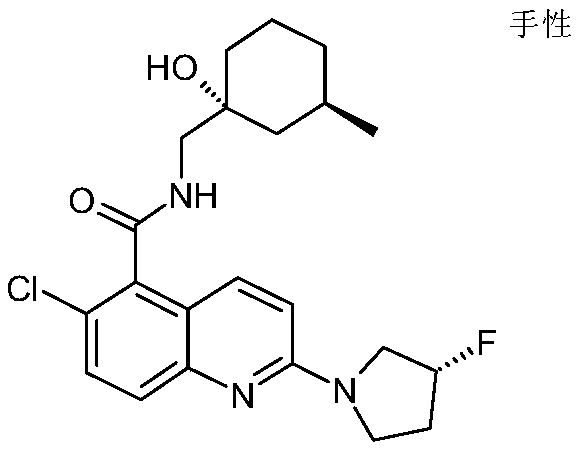
采用2,6-二氯-喹啉-5-羧酸((1R,3R)-1-羟基-3-甲基-环己基甲基)-酰胺、DIPEA和(R)-3- 氟吡咯烷,依据实施例1的程序合成标题化合物。1H NMR(400MHz,DMSO-d6)δppm8.75 (1H),7.85(m,1H),7.58(2H),7.05(1H),5.43-5.56(1H),4.16(S,1H),3.89(m,2H),3.70(m,1H),3.55(m,1H),3.26(m,2H),2.44(m,2H),2.06(m,2H),1.85(m,2H), 1.74-1.76(m,5H),1.27-1.32(m,1H),0.83(d,3H)。m/z:420[M+H]。2,6-Dichloro-quinoline-5-carboxylic acid ((1R,3R)-1-hydroxy-3-methyl-cyclohexylmethyl)-amide, DIPEA and (R)-3-fluoropyrrolidine , the title compound was synthesized according to the procedure of Example 1. 1 H NMR (400 MHz, DMSO-d 6 ) δppm 8.75 (1H), 7.85 (m, 1H), 7.58 (2H), 7.05 (1H), 5.43-5.56 (1H), 4.16 (S, 1H), 3.89 (m, 2H), 3.70 (m, 1H), 3.55 (m, 1H), 3.26 (m, 2H), 2.44 (m, 2H), 2.06 (m, 2H), 1.85 (m, 2H), 1.74- 1.76 (m, 5H), 1.27-1.32 (m, 1H), 0.83 (d, 3H). m/z: 420 [M+H].
实施例45. 6-氯-2-(3-(S)-氟吡咯烷-1-基)-喹啉-5-羧酸((1R,3R)-1-羟基-3-甲基-环己基甲基)- 酰胺(9)Example 45. 6-Chloro-2-(3-(S)-Fluoropyrrolidin-1-yl)-quinoline-5-carboxylic acid ((1R,3R)-1-hydroxy-3-methyl-cyclic Hexylmethyl)-amide (9)

采用2,6-二氯-喹啉-5-羧酸((1R,3R)-1-羟基-3-甲基-环己基甲基)-酰胺、DIPEA和(S)-3- 氟吡咯烷,依据实施例1的程序合成标题化合物。1H NMR(400MHz,DMSO-d6)δppm8.75 (1H),7.85(m,1H),7.58(2H),7.05(1H),5.43-5.56(1H),4.16(S,1H),3.89(m,2H),3.70(m,1H),3.55(m,1H),3.26(m,2H),2.44(m,2H),2.06(m,2H),1.85(m,2H), 1.74-1.76(m,5H),1.27-1.32(m,1H),0.83(d,3H)。m/z:420[M+H]。2,6-Dichloro-quinoline-5-carboxylic acid ((1R,3R)-1-hydroxy-3-methyl-cyclohexylmethyl)-amide, DIPEA and (S)-3-fluoropyrrolidine , the title compound was synthesized according to the procedure of Example 1. 1 H NMR (400 MHz, DMSO-d 6 ) δppm 8.75 (1H), 7.85 (m, 1H), 7.58 (2H), 7.05 (1H), 5.43-5.56 (1H), 4.16 (S, 1H), 3.89 (m, 2H), 3.70 (m, 1H), 3.55 (m, 1H), 3.26 (m, 2H), 2.44 (m, 2H), 2.06 (m, 2H), 1.85 (m, 2H), 1.74- 1.76 (m, 5H), 1.27-1.32 (m, 1H), 0.83 (d, 3H). m/z: 420 [M+H].
实施例46. 6-氯-2-((R)-3-二甲基氨基-吡咯烷-1-基)-喹啉-5-羧酸(4,4-二氟-1-羟基-环己基甲基)-酰胺(23)Example 46. 6-Chloro-2-((R)-3-dimethylamino-pyrrolidin-1-yl)-quinoline-5-carboxylic acid (4,4-difluoro-1-hydroxy-cyclic Hexylmethyl)-amide (23)

采用2,6-二氯-喹啉-5-羧酸(4,4-二氟-1-羟基环己基甲基)-酰胺、DIPEA和(R)-N,N-二甲基吡咯烷-3-胺,依据实施例1的程序合成标题化合物。1H NMR(400MHz,DMSO-d6)δppm 8.73(m,1H),7.85(1H),7.48(m,2H),6.69(1H),4.66(S,1H),3.89(m,1H),3.70(m,1H),3.45(m,1H),3.26(m,2H),2.85(m,1H),2.54(m,4H),2.22(S,6H),2.15(m, 1H),2.06(m,2H),1.85(m,3H),1.74-1.76(m,5H)。m/z:467[M+H]。2,6-Dichloro-quinoline-5-carboxylic acid (4,4-difluoro-1-hydroxycyclohexylmethyl)-amide, DIPEA and (R)-N,N-dimethylpyrrolidine- 3-amine, the title compound was synthesized according to the procedure of Example 1. 1 H NMR (400 MHz, DMSO-d 6 ) δppm 8.73 (m, 1H), 7.85 (1H), 7.48 (m, 2H), 6.69 (1H), 4.66 (S, 1H), 3.89 (m, 1H), 3.70(m, 1H), 3.45(m, 1H), 3.26(m, 2H), 2.85(m, 1H), 2.54(m, 4H), 2.22(S, 6H), 2.15(m, 1H), 2.06 (m, 2H), 1.85 (m, 3H), 1.74-1.76 (m, 5H). m/z: 467 [M+H].
实施例47. 6-氯-2-(3-二甲基氨基-吡咯烷-1-基)-喹啉-5-羧酸(1-羟基-3-甲基-环己基甲基)-酰胺(88)Example 47. 6-Chloro-2-(3-dimethylamino-pyrrolidin-1-yl)-quinoline-5-carboxylic acid (1-hydroxy-3-methyl-cyclohexylmethyl)-amide (88)

采用2,6-二氯-喹啉-5-羧酸(1-羟基-3-甲基-环己基甲基)-酰胺、DIPEA和N,N-二甲基吡咯烷-3-胺,依据实施例1的程序合成标题化合物。1H NMR(400MHz,DMSO-d6)δppm8.75 (1H),7.85(m,1H),7.58(2H),7.05(1H),4.16(S,1H),4.00(t,2H),3.80(t,1H),3.55(m,1H),3.26(m,2H),2.44(m,2H),2.22(S,6H),2.06(m,2H),1.85(m,2H),1.74-1.76 (m,5H),1.27(t,1H),1.07(t,1H),0.83(d,3H)。m/z:446[M+H]。Using 2,6-dichloro-quinoline-5-carboxylic acid (1-hydroxy-3-methyl-cyclohexylmethyl)-amide, DIPEA and N,N-dimethylpyrrolidin-3-amine according to The title compound was synthesized by the procedure of Example 1. 1 H NMR (400 MHz, DMSO-d 6 ) δppm 8.75 (1H), 7.85 (m, 1H), 7.58 (2H), 7.05 (1H), 4.16 (S, 1H), 4.00 (t, 2H), 3.80 (t, 1H), 3.55 (m, 1H), 3.26 (m, 2H), 2.44 (m, 2H), 2.22 (S, 6H), 2.06 (m, 2H), 1.85 (m, 2H), 1.74- 1.76 (m, 5H), 1.27 (t, 1H), 1.07 (t, 1H), 0.83 (d, 3H). m/z: 446 [M+H].
实施例48. 6-氯-2-(3-二甲基氨基-吡咯烷-1-基)-喹啉-5-羧酸((1R,3R)-1-羟基-3-甲基-环己基甲基)-酰胺(6)Example 48. 6-Chloro-2-(3-dimethylamino-pyrrolidin-1-yl)-quinoline-5-carboxylic acid ((1R,3R)-1-hydroxy-3-methyl-cyclic Hexylmethyl)-amide (6)

采用2,6-二氯-喹啉-5-羧酸((1R,3R)-1-羟基-3-甲基-环己基甲基)-酰胺、DIPEA和3-二甲基氨基-吡咯烷,依据实施例1的程序合成标题化合物。1H NMR(400MHz,DMSO-d6)δppm 8.75(1H),7.85(m,1H),7.58(2H),7.05(1H),4.16(S,1H),4.00(t,2H),3.80(t,1H),3.55(m,1H),3.26(m,2H),2.44(m,2H),2.22(S,6H),2.06(m,2H),1.85(m,2H), 1.74-1.76(m,5H),1.27(t,1H),1.07(t,1H),0.83(d,3H)。m/z:446[M+H]。2,6-Dichloro-quinoline-5-carboxylic acid ((1R,3R)-1-hydroxy-3-methyl-cyclohexylmethyl)-amide, DIPEA and 3-dimethylamino-pyrrolidine , the title compound was synthesized according to the procedure of Example 1. 1 H NMR (400 MHz, DMSO-d 6 ) δppm 8.75 (1H), 7.85 (m, 1H), 7.58 (2H), 7.05 (1H), 4.16 (S, 1H), 4.00 (t, 2H), 3.80 ( t, 1H), 3.55(m, 1H), 3.26(m, 2H), 2.44(m, 2H), 2.22(S, 6H), 2.06(m, 2H), 1.85(m, 2H), 1.74-1.76 (m, 5H), 1.27 (t, 1H), 1.07 (t, 1H), 0.83 (d, 3H). m/z: 446 [M+H].
实施例49. 6-氯-2-((S)-3-二甲基氨基-吡咯烷-1-基)-喹啉-5-羧酸(1-羟基-3-甲基-环己基甲基)-酰胺(87)Example 49. 6-Chloro-2-((S)-3-dimethylamino-pyrrolidin-1-yl)-quinoline-5-carboxylic acid (1-hydroxy-3-methyl-cyclohexylmethyl) yl)-amide (87)

采用2,6-二氯-喹啉-5-羧酸(1-羟基-3-甲基-环己基甲基)-酰胺、DIPEA和(S)-N,N-二甲基吡咯烷-3-胺,依据实施例1的程序合成标题化合物。1H NMR(400MHz,DMSO-d6)δppm8.75(1H),7.85(m,1H),7.58(2H),7.05(1H),4.16(S,1H),4.00(t,2H),3.80(t,1H), 3.55(m,1H),3.26(m,2H),2.44(m,2H),2.22(S,6H),2.06(m,2H),1.85(m,2H), 1.74-1.76(m,5H),1.27(t,1H),1.07(t,1H),0.83(d,3H)。m/z:446[M+H]。2,6-Dichloro-quinoline-5-carboxylic acid (1-hydroxy-3-methyl-cyclohexylmethyl)-amide, DIPEA and (S)-N,N-dimethylpyrrolidine-3 - Amine, the title compound was synthesized according to the procedure of Example 1. 1 H NMR (400 MHz, DMSO-d 6 ) δ ppm 8.75 (1H), 7.85 (m, 1H), 7.58 (2H), 7.05 (1H), 4.16 (S, 1H), 4.00 (t, 2H), 3.80 (t, 1H), 3.55(m, 1H), 3.26(m, 2H), 2.44(m, 2H), 2.22(S, 6H), 2.06(m, 2H), 1.85(m, 2H), 1.74- 1.76 (m, 5H), 1.27 (t, 1H), 1.07 (t, 1H), 0.83 (d, 3H). m/z: 446 [M+H].
实施例51. 6-氯-2-((S)-3-二甲基氨基-吡咯烷-1-基)-喹啉-5-羧酸((1R,3R)-1-羟基-3-甲基-环己基甲基)-酰胺(4)Example 51. 6-Chloro-2-((S)-3-dimethylamino-pyrrolidin-1-yl)-quinoline-5-carboxylic acid ((1R,3R)-1-hydroxy-3- Methyl-cyclohexylmethyl)-amide (4)

采用2,6-二氯-喹啉-5-羧酸((1R,3R)-1-羟基-3-甲基-环己基甲基)-酰胺、DIPEA和 ((S)-N,N-二甲基吡咯烷-3-胺,依据实施例1的程序合成标题化合物。1H NMR(400MHz,DMSO-d6)δppm 8.75(1H),7.85(m,1H),7.58(2H),7.05(1H),4.16(S,1H),4.00(t,2H),3.80(t,1H),3.55(m,1H),3.26(m,2H),2.44(m,2H),2.22(S,6H),2.06(m,2H), 1.85(m,2H),1.74-1.76(m,5H),1.27(t,1H),1.07(t,1H),0.83(d,3H)。m/z:446[M +H]。2,6-Dichloro-quinoline-5-carboxylic acid ((1R,3R)-1-hydroxy-3-methyl-cyclohexylmethyl)-amide, DIPEA and ((S)-N,N- Dimethylpyrrolidin-3-amine, the title compound was synthesized according to the procedure of Example 1. 1 H NMR (400 MHz, DMSO-d 6 ) δ ppm 8.75 (1H), 7.85 (m, 1H), 7.58 (2H), 7.05 (1H), 4.16(S, 1H), 4.00(t, 2H), 3.80(t, 1H), 3.55(m, 1H), 3.26(m, 2H), 2.44(m, 2H), 2.22(S, 6H), 2.06(m, 2H), 1.85(m, 2H), 1.74-1.76(m, 5H), 1.27(t, 1H), 1.07(t, 1H), 0.83(d, 3H). m/z : 446[M+H].
实施例52. 6-氯-2-((R)-3-二甲基氨基-吡咯烷-1-基)-喹啉-5-羧酸((1R,3R)-1-羟基-3-甲基-环己基甲基)-酰胺(22)Example 52. 6-Chloro-2-((R)-3-dimethylamino-pyrrolidin-1-yl)-quinoline-5-carboxylic acid ((1R,3R)-1-hydroxy-3- Methyl-cyclohexylmethyl)-amide (22)

采用2,6-二氯-喹啉-5-羧酸((1R,3R)-1-羟基-3-甲基-环己基甲基)-酰胺、DIPEA和 (R)-N,N-二甲基吡咯烷-3-胺,依据实施例1的程序合成标题化合物。1H NMR(400MHz,DMSO-d6)δppm 8.75(1H),7.85(m,1H),7.58(2H),7.05(1H),4.16(S,1H),4.00(t,2H),3.80(t,1H),3.55(m,1H),3.26(m,2H),2.44(m,2H),2.22(S,6H),2.06(m,2H), 1.85(m,2H),1.74-1.76(m,5H),1.27(t,1H),1.07(t,1H),0.83(d,3H)。m/z:446[M +H]。2,6-Dichloro-quinoline-5-carboxylic acid ((1R,3R)-1-hydroxy-3-methyl-cyclohexylmethyl)-amide, DIPEA and (R)-N,N-di Methylpyrrolidin-3-amine, the title compound was synthesized according to the procedure of Example 1 . 1 H NMR (400 MHz, DMSO-d 6 ) δppm 8.75 (1H), 7.85 (m, 1H), 7.58 (2H), 7.05 (1H), 4.16 (S, 1H), 4.00 (t, 2H), 3.80 ( t, 1H), 3.55(m, 1H), 3.26(m, 2H), 2.44(m, 2H), 2.22(S, 6H), 2.06(m, 2H), 1.85(m, 2H), 1.74-1.76 (m, 5H), 1.27 (t, 1H), 1.07 (t, 1H), 0.83 (d, 3H). m/z: 446[M+H].
实施例53. 6-氯-2-(3-吡咯烷基-吡咯烷-1-基)-喹啉-5-羧酸((1R,3R)-1-羟基-3-甲基-环己基甲基)-酰胺(13)Example 53. 6-Chloro-2-(3-pyrrolidinyl-pyrrolidin-1-yl)-quinoline-5-carboxylic acid ((1R,3R)-1-hydroxy-3-methyl-cyclohexyl Methyl)-amide (13)

采用2,6-二氯-喹啉-5-羧酸((1R,3R)-1-羟基-3-甲基-环己基甲基)-酰胺、DIPEA和3-吡咯烷基-吡咯烷二盐酸盐,依据实施例1的程序合成标题化合物。1H NMR(400MHz,DMSO-d6) δppm 8.75(1H),7.85(m,1H),7.58(2H),7.05(1H),4.16(S,1H),4.00(t,2H),3.80(t, 1H),3.55(m,1H),3.26(m,2H),2.44(m,2H),2.06(m,2H),1.85(m,2H),1.74-1.76(m,5H),1.27(t,1H),1.07(t,1H),0.83(d,3H)。m/z:472[M+H]。2,6-Dichloro-quinoline-5-carboxylic acid ((1R,3R)-1-hydroxy-3-methyl-cyclohexylmethyl)-amide, DIPEA and 3-pyrrolidinyl-pyrrolidinedi hydrochloride, the title compound was synthesized according to the procedure of Example 1. 1 H NMR (400 MHz, DMSO-d 6 ) δppm 8.75(1H), 7.85(m,1H), 7.58(2H), 7.05(1H), 4.16(S,1H), 4.00(t,2H), 3.80( t, 1H), 3.55 (m, 1H), 3.26 (m, 2H), 2.44 (m, 2H), 2.06 (m, 2H), 1.85 (m, 2H), 1.74-1.76 (m, 5H), 1.27 (t, 1H), 1.07 (t, 1H), 0.83 (d, 3H). m/z: 472 [M+H].
实施例54. 6-氯-2-(3-二甲基氨基-吡咯烷-1-基)-喹啉-5-羧酸(4,4-二氟-1-羟基-环己基甲基)- 酰胺(28)Example 54. 6-Chloro-2-(3-dimethylamino-pyrrolidin-1-yl)-quinoline-5-carboxylic acid (4,4-difluoro-1-hydroxy-cyclohexylmethyl) - Amide (28)

采用2,6-二氯-喹啉-5-羧酸(4,4-二氟-1-羟基环己基甲基)-酰胺、DIPEA和N,N-二甲基吡咯烷-3-胺,依据实施例1的程序合成标题化合物。1H NMR(400MHz,DMSO-d6)δppm8.73(m,1H),7.85(1H),7.48(m,2H),6.69(1H),4.66(S,1H),3.89(m,1H),3.70(m,1H),3.45(m,1H),3.26(m,2H),2.85(m,1H),2.54(m,4H),2.22(S,6H),2.15(m, 1H),2.06(m,2H),1.85(m,3H),1.74-1.76(m,5H)。m/z:467[M+H]。Using 2,6-dichloro-quinoline-5-carboxylic acid (4,4-difluoro-1-hydroxycyclohexylmethyl)-amide, DIPEA and N,N-dimethylpyrrolidin-3-amine, The title compound was synthesized according to the procedure of Example 1. 1 H NMR (400 MHz, DMSO-d 6 ) δppm 8.73 (m, 1H), 7.85 (1H), 7.48 (m, 2H), 6.69 (1H), 4.66 (S, 1H), 3.89 (m, 1H) , 3.70(m, 1H), 3.45(m, 1H), 3.26(m, 2H), 2.85(m, 1H), 2.54(m, 4H), 2.22(S, 6H), 2.15(m, 1H), 2.06 (m, 2H), 1.85 (m, 3H), 1.74-1.76 (m, 5H). m/z: 467 [M+H].
实施例55. 6-氯-2-((S)-3-二甲基氨基-吡咯烷-1-基)-喹啉-5-羧酸(4,4-二氟-1-羟基-环己基甲基)-酰胺(20)Example 55. 6-Chloro-2-((S)-3-dimethylamino-pyrrolidin-1-yl)-quinoline-5-carboxylic acid (4,4-difluoro-1-hydroxy-cyclic Hexylmethyl)-amide (20)

采用2,6-二氯-喹啉-5-羧酸(4,4-二氟-1-羟基环己基甲基)-酰胺、DIPEA和(S)-N,N-二甲基吡咯烷-3-胺,依据实施例1的程序合成标题化合物。1H NMR(400MHz,DMSO-d6)δppm 8.73(m,1H),7.85(1H),7.48(m,2H),6.69(1H),4.66(S,1H),3.89(m,1H),3.70(m,1H),3.45(m,1H),3.26(m,2H),2.85(m,1H),2.54(m,4H),2.22(S,6H),2.15(m, 1H),2.06(m,2H),1.85(m,3H),1.74-1.76(m,5H)。m/z:467[M+H]。2,6-Dichloro-quinoline-5-carboxylic acid (4,4-difluoro-1-hydroxycyclohexylmethyl)-amide, DIPEA and (S)-N,N-dimethylpyrrolidine- 3-amine, the title compound was synthesized according to the procedure of Example 1. 1 H NMR (400 MHz, DMSO-d 6 ) δppm 8.73 (m, 1H), 7.85 (1H), 7.48 (m, 2H), 6.69 (1H), 4.66 (S, 1H), 3.89 (m, 1H), 3.70(m, 1H), 3.45(m, 1H), 3.26(m, 2H), 2.85(m, 1H), 2.54(m, 4H), 2.22(S, 6H), 2.15(m, 1H), 2.06 (m, 2H), 1.85 (m, 3H), 1.74-1.76 (m, 5H). m/z: 467 [M+H].
实施例56. 6-氯-2-(3,3-二氟-吡咯烷-1-基)-喹啉-5-羧酸(4,4-二氟-1-羟基-环己基甲基)-酰胺 (91)Example 56. 6-Chloro-2-(3,3-difluoro-pyrrolidin-1-yl)-quinoline-5-carboxylic acid (4,4-difluoro-1-hydroxy-cyclohexylmethyl) -Amide (91)

采用2,6-二氯-喹啉-5-羧酸(4,4-二氟-1-羟基-环己基甲基)-酰胺和3,3-二氟-吡咯烷,依据实施例1的程序合成标题化合物。1H NMR(400MHz,DMSO-d6)δppm 8.68-8.71(bS,1H), 7.89(d,J=9.2Hz,1H),7.55-7.62(m,2H),7.03(d,J=9.3Hz,1H),4.67(S,1H),3.96-4.03 (m,2H),3.76-3.80(m,2H),3.37-3.39(m,2H),2.54-2.61(m,2H),1.88-2.08(m,4H), 1.68-1.76(m,4H)。m/z:460.2[M+H]+。Using 2,6-dichloro-quinoline-5-carboxylic acid (4,4-difluoro-1-hydroxy-cyclohexylmethyl)-amide and 3,3-difluoro-pyrrolidine, according to Example 1 program to synthesize the title compound. 1 H NMR (400 MHz, DMSO-d 6 ) δppm 8.68-8.71 (bS, 1H), 7.89 (d, J=9.2 Hz, 1H), 7.55-7.62 (m, 2H), 7.03 (d, J=9.3 Hz) , 1H), 4.67 (S, 1H), 3.96-4.03 (m, 2H), 3.76-3.80 (m, 2H), 3.37-3.39 (m, 2H), 2.54-2.61 (m, 2H), 1.88-2.08 (m, 4H), 1.68-1.76 (m, 4H). m/z: 460.2 [M+H] + .
实施例57. 6-氯-2-(3,3-二氟吡咯烷-1-基)-喹啉-5-羧酸(3,3-二氟-1-羟基环己基甲基)-酰胺 (46)Example 57. 6-Chloro-2-(3,3-difluoropyrrolidin-1-yl)-quinoline-5-carboxylic acid (3,3-difluoro-1-hydroxycyclohexylmethyl)-amide (46)

采用2,6-二氯-喹啉-5-羧酸(3,3-二氟-1-羟基环己基甲基)-酰胺、DIPEA和3,3-二氟吡咯烷,依据实施例1的程序合成标题化合物。1H NMR(400MHz,DMSO-d6)δppm 8.75(1H),7.85(m,1H),7.58(2H),7.05(1H),,4.61(S,1H),4.01(m,2H),3.80(m,2H),3.45(m,1H),3.26(m,2H),2.44(m,2H),2.06(m,2H),1.85(m,2H),1.74-1.76(m,5H),1.27-1.32 (m,2H)。m/z:460[M+H]。Using 2,6-dichloro-quinoline-5-carboxylic acid (3,3-difluoro-1-hydroxycyclohexylmethyl)-amide, DIPEA and 3,3-difluoropyrrolidine, according to Example 1 program to synthesize the title compound. 1 H NMR (400 MHz, DMSO-d 6 ) δppm 8.75 (1H), 7.85 (m, 1H), 7.58 (2H), 7.05 (1H), 4.61 (S, 1H), 4.01 (m, 2H), 3.80 (m, 2H), 3.45 (m, 1H), 3.26 (m, 2H), 2.44 (m, 2H), 2.06 (m, 2H), 1.85 (m, 2H), 1.74-1.76 (m, 5H), 1.27-1.32 (m, 2H). m/z: 460 [M+H].
实施例58. 6-氯-2-(3,3-二氟吡咯烷-1-基)-喹啉-5-羧酸((R)-3,3-二氟-1-羟基环己基甲基)-酰胺(24)Example 58. 6-Chloro-2-(3,3-difluoropyrrolidin-1-yl)-quinoline-5-carboxylic acid ((R)-3,3-difluoro-1-hydroxycyclohexylmethyl yl)-amide (24)
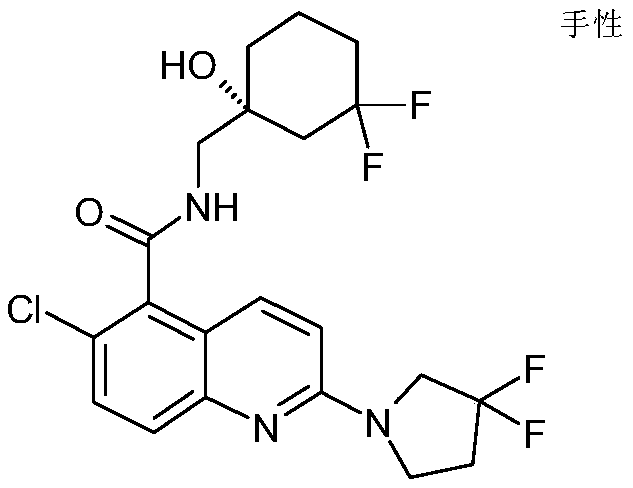
通过手性柱从6-氯-2-(3,3-二氟吡咯烷-1-基)-喹啉-5-羧酸(3,3-二氟-1-羟基环己基甲基)- 酰胺分离得到标题化合物。1H NMR(400MHz,DMSO-d6)δppm 8.75(1H),7.85(m,1H), 7.58(2H),7.05(1H),,4.61(S,1H),4.01(m,2H),3.80(m,2H),3.45(m,1H),3.26(m, 2H),2.44(m,2H),2.06(m,2H),1.85(m,2H),1.74-1.76(m,5H),1.27-1.32(m,2H)。 m/z:460[M+H]。From 6-chloro-2-(3,3-difluoropyrrolidin-1-yl)-quinoline-5-carboxylic acid (3,3-difluoro-1-hydroxycyclohexylmethyl)- Amide isolation afforded the title compound. 1 H NMR (400 MHz, DMSO-d 6 ) δppm 8.75 (1H), 7.85 (m, 1H), 7.58 (2H), 7.05 (1H), 4.61 (S, 1H), 4.01 (m, 2H), 3.80 (m, 2H), 3.45 (m, 1H), 3.26 (m, 2H), 2.44 (m, 2H), 2.06 (m, 2H), 1.85 (m, 2H), 1.74-1.76 (m, 5H), 1.27-1.32 (m, 2H). m/z: 460 [M+H].
实施例59. 6-氯-2-(3,3-二氟吡咯烷-1-基)-喹啉-5-羧酸((S)-3,3-二氟-1-羟基环己基甲基)-酰胺 (80)Example 59. 6-Chloro-2-(3,3-difluoropyrrolidin-1-yl)-quinoline-5-carboxylic acid ((S)-3,3-difluoro-1-hydroxycyclohexylmethyl base)-amide (80)

通过手性柱从6-氯-2-(3,3-二氟吡咯烷-1-基)-喹啉-5-羧酸(3,3-二氟-1-羟基环己基甲基)- 酰胺分离得到标题化合物。1H NMR(400MHz,DMSO-d6)δppm 8.75(1H),7.85(m,1H), 7.58(2H),7.05(1H),,4.61(S,1H),4.01(m,2H),3.80(m,2H),3.45(m,1H),3.26(m, 2H),2.44(m,2H),2.06(m,2H),1.85(m,2H),1.74-1.76(m,5H),1.27-1.32(m,2H)。 m/z:460[M+H]。From 6-chloro-2-(3,3-difluoropyrrolidin-1-yl)-quinoline-5-carboxylic acid (3,3-difluoro-1-hydroxycyclohexylmethyl)- Amide isolation afforded the title compound. 1 H NMR (400 MHz, DMSO-d 6 ) δppm 8.75 (1H), 7.85 (m, 1H), 7.58 (2H), 7.05 (1H), 4.61 (S, 1H), 4.01 (m, 2H), 3.80 (m, 2H), 3.45 (m, 1H), 3.26 (m, 2H), 2.44 (m, 2H), 2.06 (m, 2H), 1.85 (m, 2H), 1.74-1.76 (m, 5H), 1.27-1.32 (m, 2H). m/z: 460 [M+H].
实施例60. 6-氯-2-(3-(S)-氟吡咯烷-1-基)-喹啉-5-羧酸(1-羟基-3-甲基-环己基甲基)-酰胺(89)Example 60. 6-Chloro-2-(3-(S)-fluoropyrrolidin-1-yl)-quinoline-5-carboxylic acid (1-hydroxy-3-methyl-cyclohexylmethyl)-amide (89)

采用2,6-二氯-喹啉-5-羧酸((1R,3R)-1-羟基-3-甲基-环己基甲基)-酰胺、DIPEA和(S)-3- 氟吡咯烷,依据实施例1的程序合成标题化合物。1H NMR(400MHz,DMSO-d6)δppm8.75 (1H),7.85(m,1H),7.58(2H),7.05(1H),5.43-5.56(1H),4.16(S,1H),3.89(m,2H),3.70(m,1H),3.55(m,1H),3.26(m,2H),2.44(m,2H),2.06(m,2H),1.85(m,2H), 1.74-1.76(m,5H),1.27-1.32(m,1H),0.83(d,3H)。m/z:420[M+H]2,6-Dichloro-quinoline-5-carboxylic acid ((1R,3R)-1-hydroxy-3-methyl-cyclohexylmethyl)-amide, DIPEA and (S)-3-fluoropyrrolidine , the title compound was synthesized according to the procedure of Example 1. 1 H NMR (400 MHz, DMSO-d 6 ) δppm 8.75 (1H), 7.85 (m, 1H), 7.58 (2H), 7.05 (1H), 5.43-5.56 (1H), 4.16 (S, 1H), 3.89 (m, 2H), 3.70 (m, 1H), 3.55 (m, 1H), 3.26 (m, 2H), 2.44 (m, 2H), 2.06 (m, 2H), 1.85 (m, 2H), 1.74- 1.76 (m, 5H), 1.27-1.32 (m, 1H), 0.83 (d, 3H). m/z: 420[M+H]
实施例61. 6-氯-2-(3-(S)-氟吡咯烷-1-基)-喹啉-5-羧酸(1-羟基-3-甲基-环己基甲基)-酰胺(90)Example 61. 6-Chloro-2-(3-(S)-fluoropyrrolidin-1-yl)-quinoline-5-carboxylic acid (1-hydroxy-3-methyl-cyclohexylmethyl)-amide (90)

采用2,6-二氯-喹啉-5-羧酸(1-羟基-3-甲基-环己基甲基)-酰胺、DIPEA和(R)-3-氟吡咯烷,依据实施例1的程序合成标题化合物。1H NMR(400MHz,DMSO-d6)δppm 8.75(1H),7.85 (m,1H),7.58(2H),7.05(1H),5.43-5.56(1H),4.16(S,1H),3.89(m,2H),3.70(m,1H),3.55(m,1H),3.26(m,2H),2.44(m,2H),2.06(m,2H),1.85(m,2H),1.74-1.76(m, 5H),1.27-1.32(m,1H),0.83(d,3H)。m/z:420[M+H]。Using 2,6-dichloro-quinoline-5-carboxylic acid (1-hydroxy-3-methyl-cyclohexylmethyl)-amide, DIPEA and (R)-3-fluoropyrrolidine, according to Example 1 program to synthesize the title compound. 1 H NMR (400 MHz, DMSO-d 6 ) δppm 8.75 (1H), 7.85 (m, 1H), 7.58 (2H), 7.05 (1H), 5.43-5.56 (1H), 4.16 (S, 1H), 3.89 ( m, 2H), 3.70 (m, 1H), 3.55 (m, 1H), 3.26 (m, 2H), 2.44 (m, 2H), 2.06 (m, 2H), 1.85 (m, 2H), 1.74-1.76 (m, 5H), 1.27-1.32 (m, 1H), 0.83 (d, 3H). m/z: 420 [M+H].
实施例62. 6-氯-2-((S)-3-羟基甲基-乙基-吡咯烷-1-基)-喹啉-5-羧酸(4,4-二氟-环己基甲基)-酰胺(98)Example 62. 6-Chloro-2-((S)-3-hydroxymethyl-ethyl-pyrrolidin-1-yl)-quinoline-5-carboxylic acid (4,4-difluoro-cyclohexylmethyl) base)-amide (98)

采用2,6-二氯-喹啉-5-羧酸(4,4-二氟-1-羟基环己基甲基)-酰胺、DIPEA和(S)-3-羟基甲基-乙基-吡咯烷,依据实施例1的程序合成标题化合物。1H NMR(400MHz,DMSO-d6)δppm 7.75(1H),7.48(2H),6.69(1H),4.72(1H),3.66(m,2H),3.49(m,2H),3.32(m,2H),2.44(m,2H),2.06(m,2H),1.85(m,2H),1.74-1.76(m,5H),1.27-1.30(m,2H)。m/z: 466[M+H]。2,6-Dichloro-quinoline-5-carboxylic acid (4,4-difluoro-1-hydroxycyclohexylmethyl)-amide, DIPEA and (S)-3-hydroxymethyl-ethyl-pyrrole alkane, the title compound was synthesized according to the procedure of Example 1. 1 H NMR (400 MHz, DMSO-d 6 ) δppm 7.75 (1H), 7.48 (2H), 6.69 (1H), 4.72 (1H), 3.66 (m, 2H), 3.49 (m, 2H), 3.32 (m, 2H), 2.44 (m, 2H), 2.06 (m, 2H), 1.85 (m, 2H), 1.74-1.76 (m, 5H), 1.27-1.30 (m, 2H). m/z: 466[M+H].
实施例63. 6-氯-2-(3,3-二氟吡咯烷-1-基)-喹啉-5-羧酸(1-羟基-3-甲基-环己基甲基)-酰胺(97)Example 63. 6-Chloro-2-(3,3-difluoropyrrolidin-1-yl)-quinoline-5-carboxylic acid (1-hydroxy-3-methyl-cyclohexylmethyl)-amide ( 97)

采用2,6-二氯-喹啉-5-羧酸(1-羟基-3-甲基-环己基甲基)-酰胺、DIPEA和3,3-二氟吡咯烷,依据实施例1的程序合成标题化合物。1H NMR(400MHz,DMSO-d6)δppm 8.75(1H),7.85(m,1H),7.58(2H),7.05(1H),4.16(S,1H),3.89(m,2H),3.70(m,1H),3.55(m, 1H),3.26(m,2H),2.44(m,2H),2.06(m,2H),1.85(m,2H),1.74-1.76(m,5H),1.27-1.32 (m,1H),0.83(d,3H)。m/z:438[M+H]。Following the procedure of Example 1 using 2,6-dichloro-quinoline-5-carboxylic acid (1-hydroxy-3-methyl-cyclohexylmethyl)-amide, DIPEA and 3,3-difluoropyrrolidine The title compound was synthesized. 1 H NMR (400 MHz, DMSO-d 6 ) δppm 8.75 (1H), 7.85 (m, 1H), 7.58 (2H), 7.05 (1H), 4.16 (S, 1H), 3.89 (m, 2H), 3.70 ( m, 1H), 3.55 (m, 1H), 3.26 (m, 2H), 2.44 (m, 2H), 2.06 (m, 2H), 1.85 (m, 2H), 1.74-1.76 (m, 5H), 1.27 -1.32 (m, 1H), 0.83 (d, 3H). m/z: 438 [M+H].
实施例64. 6-氯-2-(3,3-二氟吡咯烷-1-基)-喹啉-5-羧酸((1R,3R)-1-羟基-3-甲基-环己基甲基)- 酰胺(10)Example 64. 6-Chloro-2-(3,3-difluoropyrrolidin-1-yl)-quinoline-5-carboxylic acid ((1R,3R)-1-hydroxy-3-methyl-cyclohexyl Methyl)-amide (10)

采用2,6-二氯-喹啉-5-羧酸((1R,3R)-1-羟基-3-甲基-环己基甲基)-酰胺、DIPEA和3,3- 二氟吡咯烷,依据实施例1的程序合成标题化合物。1H NMR(400MHz,DMSO-d6)δppm8.75(1H),7.85(m,1H),7.58(2H),7.05(1H),4.16(S,1H),4.00(t,2H),3.80(t,1H), 3.55(m,1H),3.26(m,2H),2.44(m,2H),2.06(m,2H),1.85(m,2H),1.74-1.76(m, 5H),1.27-1.32(m,1H),0.83(d,3H)。m/z:438[M+H]。Using 2,6-dichloro-quinoline-5-carboxylic acid ((1R,3R)-1-hydroxy-3-methyl-cyclohexylmethyl)-amide, DIPEA and 3,3-difluoropyrrolidine, The title compound was synthesized according to the procedure of Example 1. 1 H NMR (400 MHz, DMSO-d 6 ) δ ppm 8.75 (1H), 7.85 (m, 1H), 7.58 (2H), 7.05 (1H), 4.16 (S, 1H), 4.00 (t, 2H), 3.80 (t, 1H), 3.55(m, 1H), 3.26(m, 2H), 2.44(m, 2H), 2.06(m, 2H), 1.85(m, 2H), 1.74-1.76(m, 5H), 1.27-1.32 (m, 1H), 0.83 (d, 3H). m/z: 438 [M+H].
实施例65. 6-氯-2-(3,3-二氟-吡咯烷-1-基)-喹啉-5-羧酸((1S,3S)-1-羟基-3-甲基-环己基甲基)- 酰胺(86)Example 65. 6-Chloro-2-(3,3-difluoro-pyrrolidin-1-yl)-quinoline-5-carboxylic acid ((1S,3S)-1-hydroxy-3-methyl-cyclic Hexylmethyl)-amide (86)

采用2,6-二氯-喹啉-5-羧酸((1S,3S)-1-羟基-3-甲基-环己基甲基)-酰胺、DIPEA和3,3-二氟吡咯烷,依据实施例1的程序合成标题化合物。1H NMR(400MHz,DMSO-d6):δ8.54(t, J=6.01Hz,1H),7.89(d,J=9.32Hz,1H),7.54-7.61(m,2H),7.04(d,J=9.21Hz, 1H),4.16(S,1H),3.96-4.03(m,2H),3.45(t,J=5.00Hz,2H),3.27-3.28(m,2H),2.56-2.59 (m,3H),1.73-1.75(m,1H),1.52-1.61(m,4H),1.46-1.47(m,1H),1.34-1.38(m,1H), 1.18-1.19(m,1H),0.84-0.87(m,4H)。m/z:438.2[M+H]+。Using 2,6-dichloro-quinoline-5-carboxylic acid ((1S,3S)-1-hydroxy-3-methyl-cyclohexylmethyl)-amide, DIPEA and 3,3-difluoropyrrolidine, The title compound was synthesized according to the procedure of Example 1. 1 H NMR (400 MHz, DMSO-d 6 ): δ 8.54 (t, J=6.01 Hz, 1H), 7.89 (d, J=9.32 Hz, 1H), 7.54-7.61 (m, 2H), 7.04 (d , J=9.21Hz, 1H), 4.16(S, 1H), 3.96-4.03(m, 2H), 3.45(t, J=5.00Hz, 2H), 3.27-3.28(m, 2H), 2.56-2.59 ( m, 3H), 1.73-1.75 (m, 1H), 1.52-1.61 (m, 4H), 1.46-1.47 (m, 1H), 1.34-1.38 (m, 1H), 1.18-1.19 (m, 1H), 0.84-0.87 (m, 4H). m/z: 438.2 [M+H] + .
实施例66. 6-氯-2-(3-吡咯烷基-吡咯烷-1-基)-喹啉-5-羧酸(1-羟基-3-甲基-环己基甲基)-酰胺 (96)Example 66. 6-Chloro-2-(3-pyrrolidinyl-pyrrolidin-1-yl)-quinoline-5-carboxylic acid (1-hydroxy-3-methyl-cyclohexylmethyl)-amide ( 96)

采用2,6-二氯-喹啉-5-羧酸(1-羟基-3-甲基-环己基甲基)-酰胺、DIPEA和3-吡咯烷-基- 吡咯烷,依据实施例1的程序合成标题化合物。1H NMR(400MHz,DMSO-d6)δppm 8.75(1H),7.85(m,1H),7.58(2H),7.05(1H),4.16(S,1H),3.89(m,2H),3.70(m,1H),3.55 (m,1H),3.26(m,2H),2.44(m,2H),2.06(m,2H),1.85(m,2H),1.74-1.76(m,5H), 1.27-1.32(m,1H),0.83(d,3H),0.77(m,1H)。m/z:472[M+H]。Using 2,6-dichloro-quinoline-5-carboxylic acid (1-hydroxy-3-methyl-cyclohexylmethyl)-amide, DIPEA and 3-pyrrolidin-yl-pyrrolidine, according to Example 1 program to synthesize the title compound. 1 H NMR (400 MHz, DMSO-d 6 ) δppm 8.75 (1H), 7.85 (m, 1H), 7.58 (2H), 7.05 (1H), 4.16 (S, 1H), 3.89 (m, 2H), 3.70 ( m, 1H), 3.55 (m, 1H), 3.26 (m, 2H), 2.44 (m, 2H), 2.06 (m, 2H), 1.85 (m, 2H), 1.74-1.76 (m, 5H), 1.27 -1.32 (m, 1H), 0.83 (d, 3H), 0.77 (m, 1H). m/z: 472 [M+H].
实施例67. 6-氯-2-(3-氟吡咯烷-1-基)-喹啉-5-羧酸(1-羟基-3-甲基-环己基甲基)-酰胺(95)Example 67. 6-Chloro-2-(3-fluoropyrrolidin-1-yl)-quinoline-5-carboxylic acid (1-hydroxy-3-methyl-cyclohexylmethyl)-amide (95)

采用2,6-二氯-喹啉-5-羧酸(1-羟基-3-甲基-环己基甲基)-酰胺、DIPEA和3-氟吡咯烷,依据实施例1的程序合成标题化合物。1H NMR(400MHz,DMSO-d6)δppm 8.75(1H),7.85(m,1H),7.58(2H),7.05(1H),5.43-5.56(1H),4.16(S,1H),3.89(m,2H),3.70(m,1H), 3.55(m,1H),3.26(m,2H),2.44(m,2H),2.06(m,2H),1.85(m,2H),1.74-1.76(m, 5H),1.27-1.32(m,1H),0.83(d,3H)。m/z:420[M+H]。The title compound was synthesized according to the procedure of Example 1 using 2,6-dichloro-quinoline-5-carboxylic acid (1-hydroxy-3-methyl-cyclohexylmethyl)-amide, DIPEA and 3-fluoropyrrolidine . 1 H NMR (400 MHz, DMSO-d 6 ) δppm 8.75(1H), 7.85(m,1H), 7.58(2H), 7.05(1H), 5.43-5.56(1H), 4.16(S,1H), 3.89( m, 2H), 3.70 (m, 1H), 3.55 (m, 1H), 3.26 (m, 2H), 2.44 (m, 2H), 2.06 (m, 2H), 1.85 (m, 2H), 1.74-1.76 (m, 5H), 1.27-1.32 (m, 1H), 0.83 (d, 3H). m/z: 420 [M+H].
实施例68. 6-氯-2-((R)-3-羟基甲基-乙基-吡咯烷-1-基)-喹啉-5-羧酸(4,4-二氟-环己基甲基)- 酰胺(101)Example 68. 6-Chloro-2-((R)-3-hydroxymethyl-ethyl-pyrrolidin-1-yl)-quinoline-5-carboxylic acid (4,4-difluoro-cyclohexylmethyl) base)-amide (101)

采用2,6-二氯-喹啉-5-羧酸(4,4-二氟-1-羟基环己基甲基)-酰胺、DIPEA和(R)-3-羟基甲基-乙基-吡咯烷,依据实施例1的程序合成标题化合物。1H NMR(400MHz,DMSO-d6)δppm 7.75(1H),7.48(2H),6.69(1H),4.72(1H),3.66(m,2H),3.49(m,2H),3.32(m,2H),2.44(m,2H),2.06(m,2H),1.85(m,2H),1.74-1.76(m,5H),1.27-1.30(m,2H)。m/z: 466[M+H]。2,6-Dichloro-quinoline-5-carboxylic acid (4,4-difluoro-1-hydroxycyclohexylmethyl)-amide, DIPEA and (R)-3-hydroxymethyl-ethyl-pyrrole alkane, the title compound was synthesized according to the procedure of Example 1. 1 H NMR (400 MHz, DMSO-d 6 ) δppm 7.75 (1H), 7.48 (2H), 6.69 (1H), 4.72 (1H), 3.66 (m, 2H), 3.49 (m, 2H), 3.32 (m, 2H), 2.44 (m, 2H), 2.06 (m, 2H), 1.85 (m, 2H), 1.74-1.76 (m, 5H), 1.27-1.30 (m, 2H). m/z: 466[M+H].
实施例69. 6-氯-2-(3-(1-羟基乙基)-吡咯烷-1-基)-喹啉-5-羧酸(4,4-二氟-环己基甲基)-酰胺 (102)Example 69. 6-Chloro-2-(3-(1-hydroxyethyl)-pyrrolidin-1-yl)-quinoline-5-carboxylic acid (4,4-difluoro-cyclohexylmethyl)- Amide (102)

采用2,6-二氯-喹啉-5-羧酸(4,4-二氟-1-羟基环己基甲基)-酰胺、DIPEA和3-羟基乙基- 吡咯烷,依据实施例1的程序合成标题化合物。1H NMR(400MHz,DMSO-d6)δppm 7.75(1H),7.48(2H),6.69(1H),4.62(m,1H),3.71-3.66(m,2H),3.49(m,2H),3.32(m, 2H),2.44(m,2H),2.06(m,2H),1.85(m,2H),1.74-1.76(m,5H),1.30(m,2H),1.13 (m,3H)。m/z:452[M+H]。Using 2,6-dichloro-quinoline-5-carboxylic acid (4,4-difluoro-1-hydroxycyclohexylmethyl)-amide, DIPEA and 3-hydroxyethyl-pyrrolidine, according to Example 1 program to synthesize the title compound. 1 H NMR (400 MHz, DMSO-d 6 ) δ ppm 7.75 (1H), 7.48 (2H), 6.69 (1H), 4.62 (m, 1H), 3.71-3.66 (m, 2H), 3.49 (m, 2H), 3.32 (m, 2H), 2.44 (m, 2H), 2.06 (m, 2H), 1.85 (m, 2H), 1.74-1.76 (m, 5H), 1.30 (m, 2H), 1.13 (m, 3H) . m/z: 452 [M+H].
实施例70. 6-氯-2-(4-氟-2-羟基甲基-吡咯烷-1-基)-喹啉-5-羧酸(4,4-二氟-环己基甲基)-酰胺 (103)Example 70. 6-Chloro-2-(4-fluoro-2-hydroxymethyl-pyrrolidin-1-yl)-quinoline-5-carboxylic acid (4,4-difluoro-cyclohexylmethyl)- Amide (103)

采用2,6-二氯-喹啉-5-羧酸(4,4-二氟-1-羟基环己基甲基)-酰胺、DIPEA和4-氟-2-羟基甲基-吡咯烷,依据实施例1的程序合成标题化合物。1H NMR(400MHz,DMSO-d6)δppm7.75 (1H),7.48(2H),6.69(1H),5.33-5.52(1H),4.31(m,1H),3.89(m,1H),3.70(m,3H),3.55(m,1H),3.26(m,2H),2.44(m,2H),2.06(m,2H),1.85(m,2H),1.74-1.76(m, 5H),1.27-1.32(m,2H)。m/z:456[M+H]。Using 2,6-dichloro-quinoline-5-carboxylic acid (4,4-difluoro-1-hydroxycyclohexylmethyl)-amide, DIPEA and 4-fluoro-2-hydroxymethyl-pyrrolidine according to The title compound was synthesized by the procedure of Example 1. 1 H NMR (400 MHz, DMSO-d 6 ) δppm 7.75 (1H), 7.48 (2H), 6.69 (1H), 5.33-5.52 (1H), 4.31 (m, 1H), 3.89 (m, 1H), 3.70 (m, 3H), 3.55 (m, 1H), 3.26 (m, 2H), 2.44 (m, 2H), 2.06 (m, 2H), 1.85 (m, 2H), 1.74-1.76 (m, 5H), 1.27-1.32 (m, 2H). m/z: 456 [M+H].
实施例71. 6-氯-2-(3-羟基-甲基-吡咯烷-1-基)-喹啉-5-羧酸((1R,3R)-1-羟基-3-甲基-环己基甲基)-酰胺(85)Example 71. 6-Chloro-2-(3-hydroxy-methyl-pyrrolidin-1-yl)-quinoline-5-carboxylic acid ((1R,3R)-1-hydroxy-3-methyl-cyclic Hexylmethyl)-amide (85)

采用2,6-二氯-喹啉-5-羧酸((1R,3R)-1-羟基-3-甲基-环己基甲基)-酰胺、DIPEA和3-(1- 羟基-甲基)-吡咯烷,依据实施例1的程序合成标题化合物。1H NMR(400MHz,DMSO-d6) δppm 8.75(1H),7.85(m,1H),7.58(2H),7.05(1H),4.47(S,1H),4.14(S,1H),3.65(m,2H),3.45(m,3H),3.28(m,2H),2.44(m,2H),2.06(m,2H),1.85(m,2H),1.74-1.76 (m,5H),1.15(m,1H),1.03(m,1H),0.83(d,3H),0.74(m,1H)。m/z:432[M+H]。Using 2,6-dichloro-quinoline-5-carboxylic acid ((1R,3R)-1-hydroxy-3-methyl-cyclohexylmethyl)-amide, DIPEA and 3-(1-hydroxy-methyl )-pyrrolidine, the title compound was synthesized according to the procedure of Example 1. 1 H NMR (400 MHz, DMSO-d 6 ) δppm 8.75(1H), 7.85(m,1H), 7.58(2H), 7.05(1H), 4.47(S,1H), 4.14(S,1H), 3.65( m, 2H), 3.45 (m, 3H), 3.28 (m, 2H), 2.44 (m, 2H), 2.06 (m, 2H), 1.85 (m, 2H), 1.74-1.76 (m, 5H), 1.15 (m, 1H), 1.03 (m, 1H), 0.83 (d, 3H), 0.74 (m, 1H). m/z: 432 [M+H].
实施例72. 6-氯-2-(3-羟基甲基-吡咯烷-1-基)-喹啉-5-羧酸((1S,3S)-1-羟基-3-甲基环己基甲基)-酰胺(84)Example 72. 6-Chloro-2-(3-hydroxymethyl-pyrrolidin-1-yl)-quinoline-5-carboxylic acid ((1S,3S)-1-hydroxy-3-methylcyclohexylmethyl yl)-amide (84)

采用2,6-二氯-喹啉-5-羧酸2,6-二氯-喹啉-5-羧酸((1S,3S)-1-羟基-3-甲基-环己基甲基)- 酰胺、DIPEA和3-(1-羟基-甲基)-吡咯烷,依据实施例1的程序合成标题化合物。1H NMR(400 MHz,DMSO-d6):δ8.49(t,J=6.16Hz,1H),7.80(d,J=9.28Hz,1H),7.53-7.47(m, 2H),6.94(d,J=9.32Hz,1H),4.73-4.72(m,1H),4.15(S,1H),3.64-3.49(m,2H),3.47-3.41 (m,3H),2.42(S,1H),2.05-2.03(m,1H),1.79-1.60(m,2H),1.60-1.47(m,5H),1.29-1.28 (m,1H),1.18-1.17(m,1H),0.84-0.82(m,3H),0.75-0.75(m,1H)m/z:432.2[M+H]+。2,6-Dichloro-quinoline-5-carboxylic acid 2,6-dichloro-quinoline-5-carboxylic acid ((1S,3S)-1-hydroxy-3-methyl-cyclohexylmethyl) - Amide, DIPEA and 3-(1-hydroxy-methyl)-pyrrolidine, the title compound was synthesized according to the procedure of Example 1 . 1 H NMR (400 MHz, DMSO-d 6 ): δ 8.49 (t, J=6.16 Hz, 1H), 7.80 (d, J=9.28 Hz, 1H), 7.53-7.47 (m, 2H), 6.94 ( d, J=9.32Hz, 1H), 4.73-4.72 (m, 1H), 4.15 (S, 1H), 3.64-3.49 (m, 2H), 3.47-3.41 (m, 3H), 2.42 (S, 1H) , 2.05-2.03(m, 1H), 1.79-1.60(m, 2H), 1.60-1.47(m, 5H), 1.29-1.28(m, 1H), 1.18-1.17(m, 1H), 0.84-0.82( m, 3H), 0.75-0.75 (m, 1H) m/z: 432.2 [M+H] + .
实施例73. 6-氯-2-(4-氟-2-羟基甲基-吡咯烷-1-基)-喹啉-5-羧酸((1R,3R)-1-羟基-3-甲基-环己基甲基)-酰胺(104)Example 73. 6-Chloro-2-(4-fluoro-2-hydroxymethyl-pyrrolidin-1-yl)-quinoline-5-carboxylic acid ((1R,3R)-1-hydroxy-3-methyl yl-cyclohexylmethyl)-amide (104)

采用2,6-二氯-喹啉-5-羧酸((1R,3R)-1-羟基-3-甲基-环己基甲基)-酰胺、DIPEA和4-氟 -2-(羟基甲基)吡咯烷,依据实施例1的程序合成标题化合物。1H NMR(400MHz,DMSO-d6) δppm 8.75(1H),7.85(m,1H),7.58(2H),7.05(1H),5.43-5.56(1H),5.07(m,1H),4.31 (m,1H),4.16(S,1H),3.89(m,1H),3.70(m,2H),3.55(m,1H),3.26(m,2H),2.44 (m,2H),2.06(m,2H),1.85(m,2H),1.74-1.76(m,5H),1.27-1.32(m,1H),0.83(d, 3H),0.74(m,1H)。m/z:450[M+H]。2,6-Dichloro-quinoline-5-carboxylic acid ((1R,3R)-1-hydroxy-3-methyl-cyclohexylmethyl)-amide, DIPEA and 4-fluoro-2-(hydroxymethyl) base) pyrrolidine, the title compound was synthesized according to the procedure of Example 1. 1 H NMR (400 MHz, DMSO-d 6 ) δppm 8.75 (1H), 7.85 (m, 1H), 7.58 (2H), 7.05 (1H), 5.43-5.56 (1H), 5.07 (m, 1H), 4.31 ( m, 1H), 4.16 (S, 1H), 3.89 (m, 1H), 3.70 (m, 2H), 3.55 (m, 1H), 3.26 (m, 2H), 2.44 (m, 2H), 2.06 (m , 2H), 1.85 (m, 2H), 1.74-1.76 (m, 5H), 1.27-1.32 (m, 1H), 0.83 (d, 3H), 0.74 (m, 1H). m/z: 450 [M+H].
实施例74. 6-氯-2-(3-(1-羟基乙基)-吡咯烷-1-基)-喹啉-5-羧酸((1R,3R)-1-羟基-3-甲基-环己基甲基)-酰胺(105)Example 74. 6-Chloro-2-(3-(1-hydroxyethyl)-pyrrolidin-1-yl)-quinoline-5-carboxylic acid ((1R,3R)-1-hydroxy-3-methyl yl-cyclohexylmethyl)-amide (105)

采用2,6-二氯-喹啉-5-羧酸((1R,3R)-1-羟基-3-甲基-环己基甲基)-酰胺、DIPEA和3-(1- 羟基乙基)-吡咯烷,依据实施例1的程序合成标题化合物。1H NMR(400MHz,DMSO-d6)δ ppm 8.75(1H),7.85(m,1H),7.58(2H),7.05(1H),4.69(m,1H),4.16(S,1H),3.89(m,1H),3.70(m,2H),3.55(m,1H),3.26(m,2H),2.44(m,2H),2.06(m,2H),1.85(m, 2H),1.74-1.76(m,5H),1.15(m,3H),1.03(m,1H),0.83(d,3H),0.74(m,1H)。m/z: 446[M+H]。2,6-Dichloro-quinoline-5-carboxylic acid ((1R,3R)-1-hydroxy-3-methyl-cyclohexylmethyl)-amide, DIPEA and 3-(1-hydroxyethyl) - Pyrrolidine, the title compound was synthesized according to the procedure of Example 1. 1 H NMR (400 MHz, DMSO-d 6 ) δ ppm 8.75(1H), 7.85(m,1H), 7.58(2H), 7.05(1H), 4.69(m,1H), 4.16(S,1H), 3.89 (m, 1H), 3.70 (m, 2H), 3.55 (m, 1H), 3.26 (m, 2H), 2.44 (m, 2H), 2.06 (m, 2H), 1.85 (m, 2H), 1.74- 1.76 (m, 5H), 1.15 (m, 3H), 1.03 (m, 1H), 0.83 (d, 3H), 0.74 (m, 1H). m/z: 446[M+H].
实施例75. 6-氯-2-((R)-3-(1-羟基-1-甲基-乙基)-吡咯烷-1-基)-喹啉-5-羧酸((1R,3R)-1-羟基-3- 甲基-环己基甲基)-酰胺(106)Example 75. 6-Chloro-2-((R)-3-(1-hydroxy-1-methyl-ethyl)-pyrrolidin-1-yl)-quinoline-5-carboxylic acid ((1R, 3R)-1-Hydroxy-3-methyl-cyclohexylmethyl)-amide (106)

采用2,6-二氯-喹啉-5-羧酸((1R,3R)-1-羟基-3-甲基-环己基甲基)-酰胺、DIPEA和 (R)-3-(1-羟基-1-甲基-乙基)-吡咯烷,依据实施例1的程序合成标题化合物。1H NMR(400 MHz,DMSO-d6)δppm 8.75(1H),7.85(m,1H),7.58(2H),7.05(1H),4.40(S,1H),4.14(S,1H), 3.74(m,1H),3.65(m,1H),3.36(m,2H),3.28(m,2H),2.44(m,2H),2.06(m,2H),1.85(m,2H),1.74-1.76(m,5H),1.15(m,6H),1.03(m,1H),0.83(d,3H),0.74(m, 1H)。m/z:460[M+H]。2,6-Dichloro-quinoline-5-carboxylic acid ((1R,3R)-1-hydroxy-3-methyl-cyclohexylmethyl)-amide, DIPEA and (R)-3-(1- Hydroxy-1-methyl-ethyl)-pyrrolidine, the title compound was synthesized according to the procedure of Example 1. 1 H NMR (400 MHz, DMSO-d 6 ) δppm 8.75(1H), 7.85(m,1H), 7.58(2H), 7.05(1H), 4.40(S,1H), 4.14(S,1H), 3.74 (m, 1H), 3.65 (m, 1H), 3.36 (m, 2H), 3.28 (m, 2H), 2.44 (m, 2H), 2.06 (m, 2H), 1.85 (m, 2H), 1.74- 1.76 (m, 5H), 1.15 (m, 6H), 1.03 (m, 1H), 0.83 (d, 3H), 0.74 (m, 1H). m/z: 460 [M+H].
实施例76. 6-氯-2-((S)-3-(1-羟基-1-甲基-乙基)-吡咯烷-1-基)-喹啉-5-羧酸((1R,3R)-1-羟基-3- 甲基-环己基甲基)-酰胺(107)Example 76. 6-Chloro-2-((S)-3-(1-hydroxy-1-methyl-ethyl)-pyrrolidin-1-yl)-quinoline-5-carboxylic acid ((1R, 3R)-1-Hydroxy-3-methyl-cyclohexylmethyl)-amide (107)

采用2,6-二氯-喹啉-5-羧酸((1R,3R)-1-羟基-3-甲基-环己基甲基)-酰胺、DIPEA和 (S)-3-(1-羟基-1-甲基-乙基)-吡咯烷,依据实施例1的程序合成标题化合物。1H NMR(400 MHz,DMSO-d6)δppm 8.75(1H),7.85(m,1H),7.58(2H),7.05(1H),4.40(S,1H),4.14(S,1H), 3.74(m,1H),3.65(m,1H),3.36(m,2H),3.28(m,2H),2.44(m,2H),2.06(m,2H),1.85(m,2H),1.74-1.76(m,5H),1.15(m,6H),1.03(m,1H),0.83(d,3H),0.74(m, 1H)。m/z:460[M+H]。2,6-Dichloro-quinoline-5-carboxylic acid ((1R,3R)-1-hydroxy-3-methyl-cyclohexylmethyl)-amide, DIPEA and (S)-3-(1- Hydroxy-1-methyl-ethyl)-pyrrolidine, the title compound was synthesized according to the procedure of Example 1. 1 H NMR (400 MHz, DMSO-d 6 ) δppm 8.75(1H), 7.85(m,1H), 7.58(2H), 7.05(1H), 4.40(S,1H), 4.14(S,1H), 3.74 (m, 1H), 3.65 (m, 1H), 3.36 (m, 2H), 3.28 (m, 2H), 2.44 (m, 2H), 2.06 (m, 2H), 1.85 (m, 2H), 1.74- 1.76 (m, 5H), 1.15 (m, 6H), 1.03 (m, 1H), 0.83 (d, 3H), 0.74 (m, 1H). m/z: 460 [M+H].
实施例77. 6-氯-2-(3-二乙基氨基-吡咯烷-1-基)-喹啉-5-羧酸(3,3-二氟-1-羟基环己基甲基)-酰胺(108)Example 77. 6-Chloro-2-(3-diethylamino-pyrrolidin-1-yl)-quinoline-5-carboxylic acid (3,3-difluoro-1-hydroxycyclohexylmethyl)- Amide (108)

采用2,6-二氯-喹啉-5-羧酸(3,3-二氟-1-羟基环己基甲基)-酰胺、DIPEA和3-二乙基氨基吡咯烷,依据实施例1的程序合成标题化合物。1H NMR(400MHz,DMSO-d6)δppm 8.75(1H),7.85(m,1H),7.58(2H),7.05(1H),4.56(S,1H),3.89(m,1H),3.70(m,1H),3.45 (m,3H),3.34(m,2H),3.26(m,1H),2.63(m,4H),2.06(m,2H),1.85(m,2H),1.74-1.76 (m,2H),1.27-1.32(m,2H),0.98(m,5H)。m/z:496[M+H]。Using 2,6-dichloro-quinoline-5-carboxylic acid (3,3-difluoro-1-hydroxycyclohexylmethyl)-amide, DIPEA and 3-diethylaminopyrrolidine, according to Example 1 program to synthesize the title compound. 1 H NMR (400 MHz, DMSO-d 6 ) δppm 8.75(1H), 7.85(m,1H), 7.58(2H), 7.05(1H), 4.56(S,1H), 3.89(m,1H), 3.70( m, 1H), 3.45 (m, 3H), 3.34 (m, 2H), 3.26 (m, 1H), 2.63 (m, 4H), 2.06 (m, 2H), 1.85 (m, 2H), 1.74-1.76 (m, 2H), 1.27-1.32 (m, 2H), 0.98 (m, 5H). m/z: 496 [M+H].
实施例78. 6-氯-2-(3-吡咯烷基-吡咯烷-1-基)-喹啉-5-羧酸(3,3-二氟-1-羟基-环己基甲基)-酰胺(109)Example 78. 6-Chloro-2-(3-pyrrolidinyl-pyrrolidin-1-yl)-quinoline-5-carboxylic acid (3,3-difluoro-1-hydroxy-cyclohexylmethyl)- Amide (109)

采用2,6-二氯-喹啉-5-羧酸(3,3-二氟-1-羟基环己基甲基)-酰胺、DIPEA和3-吡咯烷-基- 吡咯烷二盐酸盐,依据实施例1的程序合成标题化合物。1H NMR(400MHz,DMSO-d6)δppm 7.75(1H),7.48(2H),6.69(1H),4.59(S,1H),3.89(m,1H),3.70(m,1H),3.45(m, 1H),3.26(m,2H),2.85(m,1H),2.54(m,4H),2.15(m,1H),2.06(m,2H),1.85(m, 3H),1.74-1.76(m,5H),1.27-1.32(m,2H)。m/z:494[M+H]。Using 2,6-dichloro-quinoline-5-carboxylic acid (3,3-difluoro-1-hydroxycyclohexylmethyl)-amide, DIPEA and 3-pyrrolidin-yl-pyrrolidine dihydrochloride, The title compound was synthesized according to the procedure of Example 1. 1 H NMR (400 MHz, DMSO-d 6 ) δppm 7.75(1H), 7.48(2H), 6.69(1H), 4.59(S,1H), 3.89(m,1H), 3.70(m,1H), 3.45( m, 1H), 3.26 (m, 2H), 2.85 (m, 1H), 2.54 (m, 4H), 2.15 (m, 1H), 2.06 (m, 2H), 1.85 (m, 3H), 1.74-1.76 (m, 5H), 1.27-1.32 (m, 2H). m/z: 494 [M+H].
实施例79. 6-氯-2-(3-(2-羟基乙基)-吡咯烷-1-基)-喹啉-5-羧酸((1R,3R)-1-羟基-3-甲基-环己基甲基)-酰胺(110)Example 79. 6-Chloro-2-(3-(2-hydroxyethyl)-pyrrolidin-1-yl)-quinoline-5-carboxylic acid ((1R,3R)-1-hydroxy-3-methyl yl-cyclohexylmethyl)-amide (110)

采用2,6-二氯-喹啉-5-羧酸((1R,3R)-1-羟基-3-甲基-环己基甲基)-酰胺、DIPEA和3-(2- 羟基乙基)-吡咯烷,依据实施例1的程序合成标题化合物。1H NMR(400MHz,DMSO-d6)δ ppm 8.75(1H),7.85(m,1H),7.58(2H),7.05(1H),4.69(m,1H),4.16(S,1H),3.89(m,1H),3.70(m,2H),3.55(m,1H),3.26(m,2H),2.44(m,2H),2.06(m,2H),1.85(m, 2H),1.74-1.76(m,5H),1.15(m,3H),1.03(m,1H),0.83(d,3H),0.74(m,1H)。m/z: 446[M+H]。2,6-Dichloro-quinoline-5-carboxylic acid ((1R,3R)-1-hydroxy-3-methyl-cyclohexylmethyl)-amide, DIPEA and 3-(2-hydroxyethyl) - Pyrrolidine, the title compound was synthesized according to the procedure of Example 1. 1 H NMR (400 MHz, DMSO-d 6 ) δ ppm 8.75(1H), 7.85(m,1H), 7.58(2H), 7.05(1H), 4.69(m,1H), 4.16(S,1H), 3.89 (m, 1H), 3.70 (m, 2H), 3.55 (m, 1H), 3.26 (m, 2H), 2.44 (m, 2H), 2.06 (m, 2H), 1.85 (m, 2H), 1.74- 1.76 (m, 5H), 1.15 (m, 3H), 1.03 (m, 1H), 0.83 (d, 3H), 0.74 (m, 1H). m/z: 446[M+H].
实施例80. 6-氯-2-((S)-3-羟基-甲基-吡咯烷-1-基)-喹啉-5-羧酸((1R,3R)-1-羟基-3-甲基-环己基甲基)-酰胺(111)Example 80. 6-Chloro-2-((S)-3-hydroxy-methyl-pyrrolidin-1-yl)-quinoline-5-carboxylic acid ((1R,3R)-1-hydroxy-3- Methyl-cyclohexylmethyl)-amide (111)

采用2,6-二氯-喹啉-5-羧酸((1R,3R)-1-羟基-3-甲基-环己基甲基)-酰胺、DIPEA和 (S)-3-(羟基甲基)-吡咯烷,依据实施例1的程序合成标题化合物。1H NMR(400MHz,DMSO-d6)δppm 8.75(1H),7.85(m,1H),7.58(2H),7.05(1H),4.47(S,1H),4.14(S,1H),3.65(m,2H),3.45(m,3H),3.28(m,2H),2.44(m,2H),2.06(m,2H),1.85(m,2H), 1.74-1.76(m,5H),1.15(m,1H),1.03(m,1H),0.83(d,3H),0.74(m,1H)。m/z:432[M +H]。2,6-Dichloro-quinoline-5-carboxylic acid ((1R,3R)-1-hydroxy-3-methyl-cyclohexylmethyl)-amide, DIPEA and (S)-3-(hydroxymethyl) yl)-pyrrolidine, the title compound was synthesized according to the procedure of Example 1. 1 H NMR (400 MHz, DMSO-d 6 ) δppm 8.75(1H), 7.85(m,1H), 7.58(2H), 7.05(1H), 4.47(S,1H), 4.14(S,1H), 3.65( m, 2H), 3.45 (m, 3H), 3.28 (m, 2H), 2.44 (m, 2H), 2.06 (m, 2H), 1.85 (m, 2H), 1.74-1.76 (m, 5H), 1.15 (m, 1H), 1.03 (m, 1H), 0.83 (d, 3H), 0.74 (m, 1H). m/z: 432 [M+H].
实施例81. 2-(氮杂环丁烷-1-基)-6-氯-喹啉-5-羧酸((S)-3,3-二氟-1-羟基环己基甲基)-酰胺 (112)Example 81. 2-(azetidin-1-yl)-6-chloro-quinoline-5-carboxylic acid ((S)-3,3-difluoro-1-hydroxycyclohexylmethyl)- Amide (112)

通过手性柱从6-氯-2-(氮杂环丁烷-1-基)-喹啉-5-羧酸(3,3-二氟-1-羟基环己基甲基)-酰胺分离得到标题化合物。1H NMR(400MHz,DMSO-d6)δppm 8.75(1H),7.84(m,1H),7.56(2H),6.85(1H),4.57(m,1H),4.11(m,4H),3.49(m,2H),2.44(m,2H),2.06(m, 2H),1.85(m,2H),1.74-1.76(m,5H),1.27-1.32(m,2H)。m/z:410[M+H]Isolated from 6-chloro-2-(azetidin-1-yl)-quinoline-5-carboxylic acid (3,3-difluoro-1-hydroxycyclohexylmethyl)-amide by chiral column title compound. 1 H NMR (400 MHz, DMSO-d 6 ) δppm 8.75 (1H), 7.84 (m, 1H), 7.56 (2H), 6.85 (1H), 4.57 (m, 1H), 4.11 (m, 4H), 3.49 ( m, 2H), 2.44 (m, 2H), 2.06 (m, 2H), 1.85 (m, 2H), 1.74-1.76 (m, 5H), 1.27-1.32 (m, 2H). m/z: 410[M+H]
实施例82. 2-(氮杂环丁烷-1-基)-6-氯-喹啉-5-羧酸((R)-3,3-二氟-1-羟基环己基甲基)-酰胺 (113)Example 82. 2-(azetidin-1-yl)-6-chloro-quinoline-5-carboxylic acid ((R)-3,3-difluoro-1-hydroxycyclohexylmethyl)- Amide (113)

通过手性柱从6-氯-2-(氮杂环丁烷-1-基)-喹啉-5-羧酸(3,3-二氟-1-羟基环己基甲基)-酰胺分离得到标题化合物。1H NMR(400MHz,DMSO-d6)δppm 8.75(1H),7.84(m,1H),7.56(2H),6.85(1H),4.57(m,1H),4.11(m,4H),3.49(m,2H),2.44(m,2H),2.06(m, 2H),1.85(m,2H),1.74-1.76(m,5H),1.27-1.32(m,2H)。m/z:410[M+H]。Isolated from 6-chloro-2-(azetidin-1-yl)-quinoline-5-carboxylic acid (3,3-difluoro-1-hydroxycyclohexylmethyl)-amide by chiral column title compound. 1 H NMR (400 MHz, DMSO-d 6 ) δppm 8.75 (1H), 7.84 (m, 1H), 7.56 (2H), 6.85 (1H), 4.57 (m, 1H), 4.11 (m, 4H), 3.49 ( m, 2H), 2.44 (m, 2H), 2.06 (m, 2H), 1.85 (m, 2H), 1.74-1.76 (m, 5H), 1.27-1.32 (m, 2H). m/z: 410 [M+H].
实施例83. 6-氯-2-((R)-3-二甲基氨基-吡咯烷-1-基)-喹啉-5-羧酸(4,4-二氟-环己基甲基)-酰胺 (114)Example 83. 6-Chloro-2-((R)-3-dimethylamino-pyrrolidin-1-yl)-quinoline-5-carboxylic acid (4,4-difluoro-cyclohexylmethyl) -Amide (114)

采用2,6-二氯-喹啉-5-羧酸(4,4-二氟-环己基甲基)-酰胺、DIPEA和(R)-3-二甲基氨基- 吡咯烷,依据实施例1的程序合成标题化合物。1H NMR(400MHz,DMSO-d6)δppm 7.75(1H),7.48(2H),6.69(1H),3.66(m,2H),3.49(m,2H),3.32(m,2H),2.36(S,6H),2.06 (m,2H),1.85(m,2H),1.74-1.76(m,5H),1.27-1.30(m,2H)。m/z:451[M+H]。Using 2,6-dichloro-quinoline-5-carboxylic acid (4,4-difluoro-cyclohexylmethyl)-amide, DIPEA and (R)-3-dimethylamino-pyrrolidine, according to example 1 to synthesize the title compound. 1 H NMR (400 MHz, DMSO-d 6 ) δppm 7.75 (1H), 7.48 (2H), 6.69 (1H), 3.66 (m, 2H), 3.49 (m, 2H), 3.32 (m, 2H), 2.36 ( S, 6H), 2.06 (m, 2H), 1.85 (m, 2H), 1.74-1.76 (m, 5H), 1.27-1.30 (m, 2H). m/z: 451 [M+H].
实施例84. 6-氯-2-((S)-3-二甲基氨基-吡咯烷-1-基)-喹啉-5-羧酸(4,4-二氟-环己基甲基)-酰胺 (115)Example 84. 6-Chloro-2-((S)-3-dimethylamino-pyrrolidin-1-yl)-quinoline-5-carboxylic acid (4,4-difluoro-cyclohexylmethyl) -Amide (115)

采用2,6-二氯-喹啉-5-羧酸(4,4-二氟-环己基甲基)-酰胺、DIPEA和(S)-3-二甲基氨基-吡咯烷,依据实施例1的程序合成标题化合物。1H NMR(400MHz,DMSO-d6)δppm 7.75(1H), 7.48(2H),6.69(1H),3.66(m,2H),3.49(m,2H),3.32(m,2H),2.36(S,6H),2.06(m,2H),1.85(m,2H),1.74-1.76(m,5H),1.27-1.30(m,2H)。m/z:451[M+H]。Using 2,6-dichloro-quinoline-5-carboxylic acid (4,4-difluoro-cyclohexylmethyl)-amide, DIPEA and (S)-3-dimethylamino-pyrrolidine, according to example 1 to synthesize the title compound. 1 H NMR (400MHz, DMSO-d 6 ) δppm 7.75(1H), 7.48(2H), 6.69(1H), 3.66(m, 2H), 3.49(m, 2H), 3.32(m, 2H), 2.36( S, 6H), 2.06 (m, 2H), 1.85 (m, 2H), 1.74-1.76 (m, 5H), 1.27-1.30 (m, 2H). m/z: 451 [M+H].
实施例85. 6-氯-2-((R)-3-氟吡咯烷-1-基)-喹啉-5-羧酸(4,4-二氟-1-羟基环己基甲基)-酰胺 (116)Example 85. 6-Chloro-2-((R)-3-fluoropyrrolidin-1-yl)-quinoline-5-carboxylic acid (4,4-difluoro-1-hydroxycyclohexylmethyl)- Amide (116)

采用2,6-二氯-喹啉-5-羧酸(4,4-二氟-1-羟基-环己基甲基)-酰胺、DIPEA和(R)-3-氟-吡咯烷,依据实施例1的程序合成标题化合物。1H NMR(400MHz,DMSO-d6)δppm 8.75(1H), 7.85(m,1H),7.58(2H),7.05(1H),5.43-5.56(1H),4.56(S,1H),3.89(m,2H),3.70(m, 1H),3.55(m,1H),3.26(m,2H),2.44(m,2H),2.06(m,2H),1.85(m,2H),1.74-1.76 (m,5H),1.27-1.32(m,2H)。m/z:442[M+H]。Using 2,6-dichloro-quinoline-5-carboxylic acid (4,4-difluoro-1-hydroxy-cyclohexylmethyl)-amide, DIPEA and (R)-3-fluoro-pyrrolidine according to implementation The title compound was synthesized by the procedure of Example 1. 1 H NMR (400 MHz, DMSO-d 6 ) δppm 8.75(1H), 7.85(m,1H), 7.58(2H), 7.05(1H), 5.43-5.56(1H), 4.56(S,1H), 3.89( m, 2H), 3.70 (m, 1H), 3.55 (m, 1H), 3.26 (m, 2H), 2.44 (m, 2H), 2.06 (m, 2H), 1.85 (m, 2H), 1.74-1.76 (m, 5H), 1.27-1.32 (m, 2H). m/z: 442 [M+H].
实施例86. 6-氯-2-((S)-3-氟吡咯烷-1-基)-喹啉-5-羧酸(4,4-二氟-1-羟基环己基甲基)-酰胺 (117)Example 86. 6-Chloro-2-((S)-3-fluoropyrrolidin-1-yl)-quinoline-5-carboxylic acid (4,4-difluoro-1-hydroxycyclohexylmethyl)- Amide (117)

采用22,6-二氯-喹啉-5-羧酸(4,4-二氟-1-羟基-环己基甲基)-酰胺、DIPEA和(S)-3-氟-吡咯烷,依据实施例1的程序合成标题化合物。1H NMR(400MHz,DMSO-d6)δppm8.75(1H), 7.85(m,1H),7.58(2H),7.05(1H),5.43-5.56(1H),4.56(S,1H),3.89(m,2H),3.70(m, 1H),3.55(m,1H),3.26(m,2H),2.44(m,2H),2.06(m,2H),1.85(m,2H),1.74-1.76(m,5H),1.27-1.32(m,2H)。m/z:442[M+H]。Using 22,6-dichloro-quinoline-5-carboxylic acid (4,4-difluoro-1-hydroxy-cyclohexylmethyl)-amide, DIPEA and (S)-3-fluoro-pyrrolidine according to implementation The title compound was synthesized by the procedure of Example 1. 1 H NMR (400 MHz, DMSO-d 6 ) δppm 8.75(1H), 7.85(m,1H), 7.58(2H), 7.05(1H), 5.43-5.56(1H), 4.56(S,1H), 3.89 (m, 2H), 3.70 (m, 1H), 3.55 (m, 1H), 3.26 (m, 2H), 2.44 (m, 2H), 2.06 (m, 2H), 1.85 (m, 2H), 1.74- 1.76 (m, 5H), 1.27-1.32 (m, 2H). m/z: 442 [M+H].
实施例87. 6-氯-2-((S)-3-氟吡咯烷-1-基)-喹啉-5-羧酸(4,4-二氟-1-羟基-3-甲基-环己基甲基)- 酰胺(160)Example 87. 6-Chloro-2-((S)-3-fluoropyrrolidin-1-yl)-quinoline-5-carboxylic acid (4,4-difluoro-1-hydroxy-3-methyl- Cyclohexylmethyl)-amide (160)

采用2,6-二氯-喹啉-5-羧酸(4,4-二氟-1-羟基-3-甲基-环己基甲基)-酰胺、DIPEA和(S)-3- 氟-吡咯烷,依据实施例1的程序合成标题化合物。1H NMR(400MHz,DMSO-d6)δppm 8.75 (1H),7.85(m,1H),7.58(2H),7.05(1H),5.43-5.56(1H),4.66(S,1H),3.89(m,2H), 3.70(m,1H),3.55(m,1H),3.26(m,2H),2.44(m,2H),2.06(m,2H),1.85(m,2H), 1.74-1.56(m,1H),1.27-1.32(m,1H),1.00(d,3H)。m/z:456[M+H]。2,6-Dichloro-quinoline-5-carboxylic acid (4,4-difluoro-1-hydroxy-3-methyl-cyclohexylmethyl)-amide, DIPEA and (S)-3-fluoro- Pyrrolidine, the title compound was synthesized according to the procedure of Example 1. 1 H NMR (400 MHz, DMSO-d 6 ) δppm 8.75 (1H), 7.85 (m, 1H), 7.58 (2H), 7.05 (1H), 5.43-5.56 (1H), 4.66 (S,1H), 3.89 ( m, 2H), 3.70 (m, 1H), 3.55 (m, 1H), 3.26 (m, 2H), 2.44 (m, 2H), 2.06 (m, 2H), 1.85 (m, 2H), 1.74-1.56 (m, 1H), 1.27-1.32 (m, 1H), 1.00 (d, 3H). m/z: 456 [M+H].
实施例88. 6-氯-2-((R)-3-氟吡咯烷-1-基)-喹啉-5-羧酸(4,4-二氟-1-羟基-3-甲基-环己基甲基)- 酰胺(161)Example 88. 6-Chloro-2-((R)-3-fluoropyrrolidin-1-yl)-quinoline-5-carboxylic acid (4,4-difluoro-1-hydroxy-3-methyl- Cyclohexylmethyl)-amide (161)

采用2,6-二氯-喹啉-5-羧酸(4,4-二氟-1-羟基-3-甲基-环己基甲基)-酰胺、DIPEA和(R)-3- 氟-吡咯烷,依据实施例1的程序合成标题化合物。1H NMR(400MHz,DMSO-d6)δppm 8.75 (1H),7.85(m,1H),7.58(2H),7.05(1H),5.43-5.56(1H),4.66(S,1H),3.89(m,2H), 3.70(m,1H),3.55(m,1H),3.26(m,2H),2.44(m,2H),2.06(m,2H),1.85(m,2H), 1.74-1.56(m,1H),1.27-1.32(m,1H),1.00(d,3H)。m/z:456[M+H]。2,6-Dichloro-quinoline-5-carboxylic acid (4,4-difluoro-1-hydroxy-3-methyl-cyclohexylmethyl)-amide, DIPEA and (R)-3-fluoro- Pyrrolidine, the title compound was synthesized according to the procedure of Example 1. 1 H NMR (400 MHz, DMSO-d 6 ) δppm 8.75 (1H), 7.85 (m, 1H), 7.58 (2H), 7.05 (1H), 5.43-5.56 (1H), 4.66 (S,1H), 3.89 ( m, 2H), 3.70 (m, 1H), 3.55 (m, 1H), 3.26 (m, 2H), 2.44 (m, 2H), 2.06 (m, 2H), 1.85 (m, 2H), 1.74-1.56 (m, 1H), 1.27-1.32 (m, 1H), 1.00 (d, 3H). m/z: 456 [M+H].
实施例89. 6-氯-2-((R)-3-二甲基氨基-吡咯烷-1-基)-喹啉-5-羧酸(4,4-二氟-1-羟基-3-甲基-环己基甲基)-酰胺(118)Example 89. 6-Chloro-2-((R)-3-dimethylamino-pyrrolidin-1-yl)-quinoline-5-carboxylic acid (4,4-difluoro-1-hydroxy-3 -Methyl-cyclohexylmethyl)-amide (118)

采用2,6-二氯-喹啉-5-羧酸(4,4-二氟-1-羟基-3-甲基-环己基甲基)-酰胺、DIPEA和(R)-3- 二甲基氨基-吡咯烷,依据实施例1的程序合成标题化合物。1H NMR(400MHz,DMSO-d6) δppm 8.75(1H),7.85(m,1H),7.58(2H),7.05(1H),5.43-5.56(1H),4.66(S,1H),3.89(m, 2H),3.70(m,1H),3.55(m,1H),3.26(m,2H),2.44(m,2H),2.26(S,6H),2.06(m, 2H),1.85(m,2H),1.74-1.56(m,1H),1.27-1.32(m,1H),1.00(d,3H)。m/z:481[M+ H]。Using 2,6-dichloro-quinoline-5-carboxylic acid (4,4-difluoro-1-hydroxy-3-methyl-cyclohexylmethyl)-amide, DIPEA and (R)-3-dimethyl amino-pyrrolidine, the title compound was synthesized according to the procedure of Example 1. 1 H NMR (400 MHz, DMSO-d 6 ) δppm 8.75(1H), 7.85(m,1H), 7.58(2H), 7.05(1H), 5.43-5.56(1H), 4.66(S,1H), 3.89( m, 2H), 3.70 (m, 1H), 3.55 (m, 1H), 3.26 (m, 2H), 2.44 (m, 2H), 2.26 (S, 6H), 2.06 (m, 2H), 1.85 (m , 2H), 1.74-1.56 (m, 1H), 1.27-1.32 (m, 1H), 1.00 (d, 3H). m/z: 481 [M+H].
实施例90. 6-氯-2-(3-(S)-二甲基氨基-吡咯烷-1-基)-喹啉-5-羧酸(4,4-二氟-1-羟基-3-甲基-环己基甲基)-酰胺(119)Example 90. 6-Chloro-2-(3-(S)-dimethylamino-pyrrolidin-1-yl)-quinoline-5-carboxylic acid (4,4-difluoro-1-hydroxy-3 -Methyl-cyclohexylmethyl)-amide (119)

采用2,6-二氯-喹啉-5-羧酸(4,4-二氟-1-羟基-3-甲基-环己基甲基)-酰胺、DIPEA和(S)-3- 二甲基氨基-吡咯烷,依据实施例1的程序合成标题化合物。1H NMR(400MHz,DMSO-d6) δppm 8.75(1H),7.85(m,1H),7.58(2H),7.05(1H),5.43-5.56(1H),4.66(S,1H),3.89(m,2H),3.70(m,1H),3.55(m,1H),3.26(m,2H),2.44(m,2H),2.26(S,6H),2.06(m, 2H),1.85(m,2H),1.74-1.56(m,1H),1.27-1.32(m,1H),1.00(d,3H)。m/z:481[M+H]。2,6-Dichloro-quinoline-5-carboxylic acid (4,4-difluoro-1-hydroxy-3-methyl-cyclohexylmethyl)-amide, DIPEA and (S)-3-dimethyl amino-pyrrolidine, the title compound was synthesized according to the procedure of Example 1. 1 H NMR (400 MHz, DMSO-d 6 ) δppm 8.75(1H), 7.85(m,1H), 7.58(2H), 7.05(1H), 5.43-5.56(1H), 4.66(S,1H), 3.89( m, 2H), 3.70 (m, 1H), 3.55 (m, 1H), 3.26 (m, 2H), 2.44 (m, 2H), 2.26 (S, 6H), 2.06 (m, 2H), 1.85 (m , 2H), 1.74-1.56 (m, 1H), 1.27-1.32 (m, 1H), 1.00 (d, 3H). m/z: 481 [M+H].
实施例91. 6-氯-2-(3-二甲基氨基-吡咯烷-1-基)-喹啉-5-羧酸(4,4-二氟-1-羟基-3-甲基-环己基甲基)-酰胺(120)Example 91. 6-Chloro-2-(3-dimethylamino-pyrrolidin-1-yl)-quinoline-5-carboxylic acid (4,4-difluoro-1-hydroxy-3-methyl- Cyclohexylmethyl)-amide (120)

采用2,6-二氯-喹啉-5-羧酸(4,4-二氟-1-羟基-3-甲基-环己基甲基)-酰胺、DIPEA和3-二甲基氨基-吡咯烷,依据实施例1的程序合成标题化合物。1H NMR(400MHz,DMSO-d6)δ ppm 8.75(1H),7.85(m,1H),7.58(2H),7.05(1H),5.43-5.56(1H),4.66(S,1H),3.89(m,2H),3.70(m,1H),3.55(m,1H),3.26(m,2H),2.44(m,2H),2.26(S,6H),2.06(m,2H),1.85(m,2H),1.74-1.56(m,1H),1.27-1.32(m,1H),1.00(d,3H)。m/z:481[M+ H]。2,6-Dichloro-quinoline-5-carboxylic acid (4,4-difluoro-1-hydroxy-3-methyl-cyclohexylmethyl)-amide, DIPEA and 3-dimethylamino-pyrrole alkane, the title compound was synthesized according to the procedure of Example 1. 1 H NMR (400 MHz, DMSO-d 6 ) δ ppm 8.75(1H), 7.85(m,1H), 7.58(2H), 7.05(1H), 5.43-5.56(1H), 4.66(S,1H), 3.89 (m, 2H), 3.70 (m, 1H), 3.55 (m, 1H), 3.26 (m, 2H), 2.44 (m, 2H), 2.26 (S, 6H), 2.06 (m, 2H), 1.85 ( m, 2H), 1.74-1.56 (m, 1H), 1.27-1.32 (m, 1H), 1.00 (d, 3H). m/z: 481 [M+H].
实施例92. 6-氯-2-(3-吡咯烷基-吡咯烷-1-基)-喹啉-5-羧酸(4,4-二氟-1-羟基-3-甲基-环己基甲基)-酰胺(121)Example 92. 6-Chloro-2-(3-pyrrolidinyl-pyrrolidin-1-yl)-quinoline-5-carboxylic acid (4,4-difluoro-1-hydroxy-3-methyl-cyclic Hexylmethyl)-amide (121)

采用2,6-二氯-喹啉-5-羧酸(4,4-二氟-1-羟基-3-甲基-环己基甲基)-酰胺、DIPEA和3-吡咯烷-基-吡咯烷二盐酸盐,依据实施例1的程序合成标题化合物。1H NMR(400MHz, DMSO-d6)δppm 8.75(1H),7.85(m,1H),7.58(2H),7.05(1H),5.43-5.56(1H),4.66(S,1H), 3.89(m,2H),3.70(m,1H),3.55(m,1H),3.26(m,2H),2.24(m,2H),2.06(m,4H), 1.85(m,2H),1.74-1.56(m,3H),1.27-1.32(m,1H),1.00(d,3H)。m/z:508[M+H]。2,6-Dichloro-quinoline-5-carboxylic acid (4,4-difluoro-1-hydroxy-3-methyl-cyclohexylmethyl)-amide, DIPEA and 3-pyrrolidin-yl-pyrrole Alkanedihydrochloride, the title compound was synthesized according to the procedure of Example 1. 1 H NMR (400 MHz, DMSO-d 6 ) δppm 8.75(1H), 7.85(m,1H), 7.58(2H), 7.05(1H), 5.43-5.56(1H), 4.66(S,1H), 3.89( m, 2H), 3.70 (m, 1H), 3.55 (m, 1H), 3.26 (m, 2H), 2.24 (m, 2H), 2.06 (m, 4H), 1.85 (m, 2H), 1.74-1.56 (m, 3H), 1.27-1.32 (m, 1H), 1.00 (d, 3H). m/z: 508 [M+H].
实施例93. 6-氯-2-(3-二氟-吡咯烷-1-基)-喹啉-5-羧酸(4,4-二氟-1-羟基-3-甲基-环己基甲基)- 酰胺(122)Example 93. 6-Chloro-2-(3-difluoro-pyrrolidin-1-yl)-quinoline-5-carboxylic acid (4,4-difluoro-1-hydroxy-3-methyl-cyclohexyl Methyl)-amide (122)

采用2,6-二氯-喹啉-5-羧酸(4,4-二氟-1-羟基-3-甲基-环己基甲基)-酰胺、DIPEA和3,3- 氟-吡咯烷,依据实施例1的程序合成标题化合物。1H NMR(400MHz,DMSO-d6)δppm 8.75 (1H),7.85(m,1H),7.58(2H),7.05(1H),5.43-5.56(1H),4.66(S,1H),3.89(m,2H), 3.70(m,1H),3.55(m,1H),3.26(m,2H),2.24(m,2H),2.06(m,2H),1.85(m,2H), 1.74-1.56(m,1H),1.27-1.32(m,1H),1.00(d,3H)。m/z:474[M+H]。2,6-Dichloro-quinoline-5-carboxylic acid (4,4-difluoro-1-hydroxy-3-methyl-cyclohexylmethyl)-amide, DIPEA and 3,3-fluoro-pyrrolidine , the title compound was synthesized according to the procedure of Example 1. 1 H NMR (400 MHz, DMSO-d 6 ) δppm 8.75 (1H), 7.85 (m, 1H), 7.58 (2H), 7.05 (1H), 5.43-5.56 (1H), 4.66 (S,1H), 3.89 ( m, 2H), 3.70 (m, 1H), 3.55 (m, 1H), 3.26 (m, 2H), 2.24 (m, 2H), 2.06 (m, 2H), 1.85 (m, 2H), 1.74-1.56 (m, 1H), 1.27-1.32 (m, 1H), 1.00 (d, 3H). m/z: 474 [M+H].
实施例94. 6-氯-2-(3-二乙基氨基-吡咯烷-1-基)-喹啉-5-羧酸(4,4-二氟-1-羟基-3-甲基-环己基甲基)-酰胺(123)Example 94. 6-Chloro-2-(3-diethylamino-pyrrolidin-1-yl)-quinoline-5-carboxylic acid (4,4-difluoro-1-hydroxy-3-methyl- Cyclohexylmethyl)-amide (123)
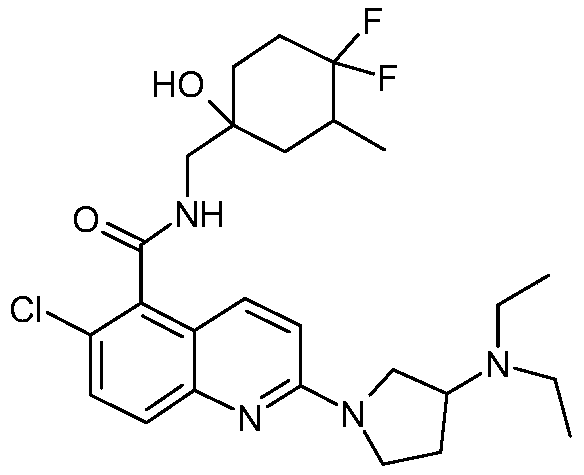
采用2,6-二氯-喹啉-5-羧酸(4,4-二氟-1-羟基-3-甲基-环己基甲基)-酰胺、DIPEA和3-二乙基氨基-吡咯烷,依据实施例1的程序合成标题化合物。1H NMR(400MHz,DMSO-d6)δ ppm 8.75(1H),7.85(m,1H),7.58(2H),7.05(1H),5.43-5.56(1H),4.66(S,1H),3.89(m, 2H),3.70(m,1H),3.55(m,1H),3.26(m,2H),2.19(m,3H),2.06(m,2H),1.85(m,3H),1.74-1.56(m,1H),1.27-1.32(m,1H),1.00(m,9H)。m/z:505[M+H]。2,6-Dichloro-quinoline-5-carboxylic acid (4,4-difluoro-1-hydroxy-3-methyl-cyclohexylmethyl)-amide, DIPEA and 3-diethylamino-pyrrole alkane, the title compound was synthesized according to the procedure of Example 1. 1 H NMR (400 MHz, DMSO-d 6 ) δ ppm 8.75(1H), 7.85(m,1H), 7.58(2H), 7.05(1H), 5.43-5.56(1H), 4.66(S,1H), 3.89 (m, 2H), 3.70 (m, 1H), 3.55 (m, 1H), 3.26 (m, 2H), 2.19 (m, 3H), 2.06 (m, 2H), 1.85 (m, 3H), 1.74- 1.56 (m, 1H), 1.27-1.32 (m, 1H), 1.00 (m, 9H). m/z: 505 [M+H].
实施例95. 6-氯-2-(3-二甲基氨基-吡咯烷-1-基)-喹啉-5-羧酸(3,3-二氟-1-羟基-环己基甲基)- 酰胺(124)Example 95. 6-Chloro-2-(3-dimethylamino-pyrrolidin-1-yl)-quinoline-5-carboxylic acid (3,3-difluoro-1-hydroxy-cyclohexylmethyl) - Amide (124)

采用2,6-二氯-喹啉-5-羧酸(3,3-二氟-1-羟基-环己基甲基)-酰胺、DIPEA和3-二甲基氨基-吡咯烷,依据实施例1的程序合成标题化合物。1H NMR(400MHz,DMSO-d6)δppm8.73 (m,1H),7.85(1H),7.48(m,2H),6.69(1H),4.66(S,1H),3.89(m,1H),3.70(m,1H),3.45(m,1H),3.26(m,2H),2.85(m,1H),2.54(m,4H),2.22(S,6H),2.15(m,1H), 2.06(m,2H),1.85(m,3H),1.74-1.76(m,5H)。m/z:467[M+H]。Using 2,6-dichloro-quinoline-5-carboxylic acid (3,3-difluoro-1-hydroxy-cyclohexylmethyl)-amide, DIPEA and 3-dimethylamino-pyrrolidine, according to example 1 to synthesize the title compound. 1 H NMR (400 MHz, DMSO-d 6 ) δppm 8.73 (m, 1H), 7.85 (1H), 7.48 (m, 2H), 6.69 (1H), 4.66 (S, 1H), 3.89 (m, 1H) , 3.70(m, 1H), 3.45(m, 1H), 3.26(m, 2H), 2.85(m, 1H), 2.54(m, 4H), 2.22(S, 6H), 2.15(m, 1H), 2.06 (m, 2H), 1.85 (m, 3H), 1.74-1.76 (m, 5H). m/z: 467 [M+H].
实施例96. 6-氯-2-(3-(S)-二甲基氨基-吡咯烷-1-基)-喹啉-5-羧酸(3,3-二氟-1-羟基-环己基甲基)-酰胺(125)Example 96. 6-Chloro-2-(3-(S)-dimethylamino-pyrrolidin-1-yl)-quinoline-5-carboxylic acid (3,3-difluoro-1-hydroxy-cyclic Hexylmethyl)-amide (125)

采用2,6-二氯-喹啉-5-羧酸(3,3-二氟-1-羟基-环己基甲基)-酰胺、DIPEA和(S)-3-二甲基氨基-吡咯烷,依据实施例1的程序合成标题化合物。1H NMR(400MHz,DMSO-d6)δppm8.73(m,1H),7.85(1H),7.48(m,2H),6.69(1H),4.66(S,1H),3.89(m,1H),3.70(m, 1H),3.45(m,1H),3.26(m,2H),2.85(m,1H),2.54(m,4H),2.22(S,6H),2.15(m, 1H),2.06(m,2H),1.85(m,3H),1.74-1.76(m,5H)。m/z:467[M+H]。2,6-Dichloro-quinoline-5-carboxylic acid (3,3-difluoro-1-hydroxy-cyclohexylmethyl)-amide, DIPEA and (S)-3-dimethylamino-pyrrolidine , the title compound was synthesized according to the procedure of Example 1. 1 H NMR (400 MHz, DMSO-d 6 ) δppm 8.73 (m, 1H), 7.85 (1H), 7.48 (m, 2H), 6.69 (1H), 4.66 (S, 1H), 3.89 (m, 1H) , 3.70(m, 1H), 3.45(m, 1H), 3.26(m, 2H), 2.85(m, 1H), 2.54(m, 4H), 2.22(S, 6H), 2.15(m, 1H), 2.06 (m, 2H), 1.85 (m, 3H), 1.74-1.76 (m, 5H). m/z: 467 [M+H].
实施例97. 6-氯-2-(3-(R)-二甲基氨基-吡咯烷-1-基)-喹啉-5-羧酸(3,3-二氟-1-羟基-环己基甲基)-酰胺(126)Example 97. 6-Chloro-2-(3-(R)-dimethylamino-pyrrolidin-1-yl)-quinoline-5-carboxylic acid (3,3-difluoro-1-hydroxy-cyclic Hexylmethyl)-amide (126)
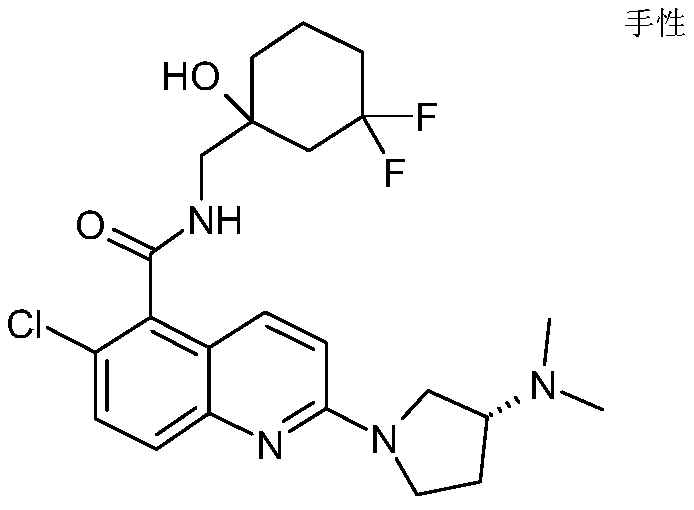
采用2,6-二氯-喹啉-5-羧酸(3,3-二氟-1-羟基-环己基甲基)-酰胺、DIPEA和(R)-3-二甲基氨基-吡咯烷,依据实施例1的程序合成标题化合物。1H NMR(400MHz,DMSO-d6)δppm8.73(m,1H),7.85(1H),7.48(m,2H),6.69(1H),4.66(S,1H),3.89(m,1H),3.70(m, 1H),3.45(m,1H),3.26(m,2H),2.85(m,1H),2.54(m,4H),2.22(S,6H),2.15(m, 1H),2.06(m,2H),1.85(m,3H),1.74-1.76(m,5H)。m/z:467[M+H]。2,6-Dichloro-quinoline-5-carboxylic acid (3,3-difluoro-1-hydroxy-cyclohexylmethyl)-amide, DIPEA and (R)-3-dimethylamino-pyrrolidine , the title compound was synthesized according to the procedure of Example 1. 1 H NMR (400 MHz, DMSO-d 6 ) δppm 8.73 (m, 1H), 7.85 (1H), 7.48 (m, 2H), 6.69 (1H), 4.66 (S, 1H), 3.89 (m, 1H) , 3.70(m, 1H), 3.45(m, 1H), 3.26(m, 2H), 2.85(m, 1H), 2.54(m, 4H), 2.22(S, 6H), 2.15(m, 1H), 2.06 (m, 2H), 1.85 (m, 3H), 1.74-1.76 (m, 5H). m/z: 467 [M+H].
实施例98. 6-氯-2-(3-(S)-氟吡咯烷-1-基)-喹啉-5-羧酸((R)-3,3-二氟-1-羟基环己基甲基)-酰胺 (127)Example 98. 6-Chloro-2-(3-(S)-fluoropyrrolidin-1-yl)-quinoline-5-carboxylic acid ((R)-3,3-difluoro-1-hydroxycyclohexyl Methyl)-amide (127)

通过手性柱从6-氯-2-(3-(S)-氟吡咯烷-1-基)-喹啉-5-羧酸(3,3-二氟-1-羟基环己基甲基)- 酰胺分离得到合成标题化合物。1H NMR(400MHz,DMSO-d6)δppm 8.75(1H),7.85(m, 1H),7.58(2H),7.05(1H),5.57-5.44(d,1H),4.58(S,1H),3.98(m,2H),3.80(m,2H), 3.45(m,1H),3.26(m,2H),2.44(m,2H),2.06(m,2H),1.85(m,2H),1.74-1.76(m, 5H),1.27-1.32(m,1H)。m/z:442[M+H]。From 6-chloro-2-(3-(S)-fluoropyrrolidin-1-yl)-quinoline-5-carboxylic acid (3,3-difluoro-1-hydroxycyclohexylmethyl) by chiral column - Amide isolation gave the synthetic title compound. 1 H NMR (400 MHz, DMSO-d 6 ) δppm 8.75(1H), 7.85(m, 1H), 7.58(2H), 7.05(1H), 5.57-5.44(d,1H), 4.58(S,1H), 3.98(m, 2H), 3.80(m, 2H), 3.45(m, 1H), 3.26(m, 2H), 2.44(m, 2H), 2.06(m, 2H), 1.85(m, 2H), 1.74 -1.76 (m, 5H), 1.27-1.32 (m, 1H). m/z: 442 [M+H].
实施例99. 6-氯-2-(3-(S)-氟吡咯烷-1-基)-喹啉-5-羧酸((S)-3,3-二氟-1-羟基环己基甲基)-酰胺 (128)Example 99. 6-Chloro-2-(3-(S)-fluoropyrrolidin-1-yl)-quinoline-5-carboxylic acid ((S)-3,3-difluoro-1-hydroxycyclohexyl Methyl)-amide (128)

通过手性柱从6-氯-2-(3-(S)-氟吡咯烷-1-基)-喹啉-5-羧酸(3,3-二氟-1-羟基环己基甲基)- 酰胺分离得到合成标题化合物。1H NMR(400MHz,DMSO-d6)δppm 8.75(1H),7.85(m, 1H),7.58(2H),7.05(1H),5.57-5.44(d,1H),4.58(S,1H),3.98(m,2H),3.80(m,2H), 3.45(m,1H),3.26(m,2H),2.44(m,2H),2.06(m,2H),1.85(m,2H),1.74-1.76(m, 5H),1.27-1.32(m,1H)。m/z:442[M+H]。From 6-chloro-2-(3-(S)-fluoropyrrolidin-1-yl)-quinoline-5-carboxylic acid (3,3-difluoro-1-hydroxycyclohexylmethyl) by chiral column - Amide isolation gave the synthetic title compound. 1 H NMR (400 MHz, DMSO-d 6 ) δppm 8.75(1H), 7.85(m, 1H), 7.58(2H), 7.05(1H), 5.57-5.44(d,1H), 4.58(S,1H), 3.98(m, 2H), 3.80(m, 2H), 3.45(m, 1H), 3.26(m, 2H), 2.44(m, 2H), 2.06(m, 2H), 1.85(m, 2H), 1.74 -1.76 (m, 5H), 1.27-1.32 (m, 1H). m/z: 442 [M+H].
实施例100. 6-氯-2-(3-(R)-二甲基氨基-吡咯烷-1-基)-喹啉-5-羧酸((1S,3S)-1-羟基-3-甲基-环己基甲基)-酰胺(129)Example 100. 6-Chloro-2-(3-(R)-dimethylamino-pyrrolidin-1-yl)-quinoline-5-carboxylic acid ((1S,3S)-1-hydroxy-3- Methyl-cyclohexylmethyl)-amide (129)
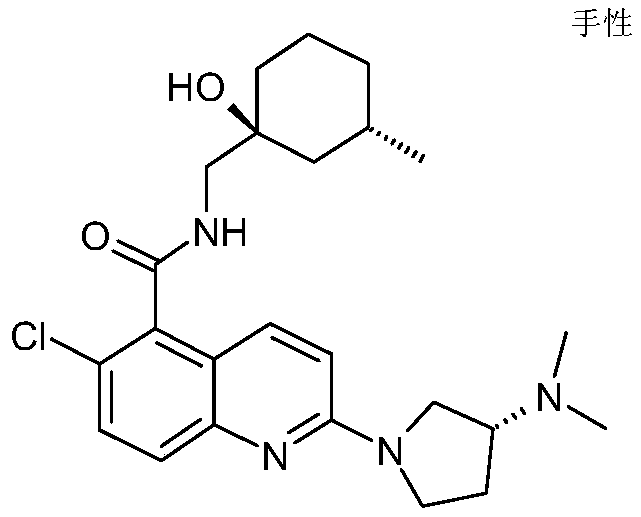
采用2,6-二氯-喹啉-5-羧酸((1S,3S)-1-羟基-3-甲基-环己基甲基)-酰胺、DIPEA和(R)-3- 二甲基氨基-吡咯烷,依据实施例1的程序合成标题化合物。1H NMR(400MHz,DMSO-d6) δppm 8.75(1H),7.85(m,1H),7.58(2H),7.05(1H),4.16(S,1H),4.00(t,2H),3.80(t, 1H),3.55(m,1H),3.26(m,2H),2.44(m,2H),2.22(S,6H),2.06(m,2H),1.85(m,2H),1.74-1.76(m,5H),1.27(t,1H),1.07(t,1H),0.83(d,3H)。m/z:446[M+H]。2,6-Dichloro-quinoline-5-carboxylic acid ((1S,3S)-1-hydroxy-3-methyl-cyclohexylmethyl)-amide, DIPEA and (R)-3-dimethyl Amino-pyrrolidine, the title compound was synthesized according to the procedure of Example 1. 1 H NMR (400 MHz, DMSO-d 6 ) δppm 8.75(1H), 7.85(m,1H), 7.58(2H), 7.05(1H), 4.16(S,1H), 4.00(t,2H), 3.80( t, 1H), 3.55 (m, 1H), 3.26 (m, 2H), 2.44 (m, 2H), 2.22 (S, 6H), 2.06 (m, 2H), 1.85 (m, 2H), 1.74-1.76 (m, 5H), 1.27 (t, 1H), 1.07 (t, 1H), 0.83 (d, 3H). m/z: 446 [M+H].
实施例101. 6-氯-2-(3-(S)-二甲基氨基-吡咯烷-1-基)-喹啉-5-羧酸((1S,3S)-1-羟基-3-甲基-环己基甲基)-酰胺(130)Example 101. 6-Chloro-2-(3-(S)-dimethylamino-pyrrolidin-1-yl)-quinoline-5-carboxylic acid ((1S,3S)-1-hydroxy-3- Methyl-cyclohexylmethyl)-amide (130)

采用2,6-二氯-喹啉-5-羧酸((1S,3S)-1-羟基-3-甲基-环己基甲基)-酰胺、DIPEA和(S)-3- 二甲基氨基-吡咯烷,依据实施例1的程序合成标题化合物。1H NMR(400MHz,DMSO-d6) δppm 8.75(1H),7.85(m,1H),7.58(2H),7.05(1H),4.16(S,1H),4.00(t,2H),3.80(t, 1H),3.55(m,1H),3.26(m,2H),2.44(m,2H),2.22(S,6H),2.06(m,2H),1.85(m,2H),1.74-1.76(m,5H),1.27(t,1H),1.07(t,1H),0.83(d,3H)。m/z:446[M+H]。2,6-Dichloro-quinoline-5-carboxylic acid ((1S,3S)-1-hydroxy-3-methyl-cyclohexylmethyl)-amide, DIPEA and (S)-3-dimethyl Amino-pyrrolidine, the title compound was synthesized according to the procedure of Example 1. 1 H NMR (400 MHz, DMSO-d 6 ) δppm 8.75(1H), 7.85(m,1H), 7.58(2H), 7.05(1H), 4.16(S,1H), 4.00(t,2H), 3.80( t, 1H), 3.55 (m, 1H), 3.26 (m, 2H), 2.44 (m, 2H), 2.22 (S, 6H), 2.06 (m, 2H), 1.85 (m, 2H), 1.74-1.76 (m, 5H), 1.27 (t, 1H), 1.07 (t, 1H), 0.83 (d, 3H). m/z: 446 [M+H].
实施例102. 6-氯-2-(3-(S)-氟吡咯烷-1-基)-喹啉-5-羧酸((1S,3S)-1-羟基-3-甲基-环己基甲基)- 酰胺(131)Example 102. 6-Chloro-2-(3-(S)-fluoropyrrolidin-1-yl)-quinoline-5-carboxylic acid ((1S,3S)-1-hydroxy-3-methyl-cyclo Hexylmethyl)-amide (131)

采用2,6-二氯-喹啉-5-羧酸((1S,3S)-1-羟基-3-甲基-环己基甲基)-酰胺、DIPEA和(S)-3- 氟吡咯烷,依据实施例1的程序合成标题化合物。1H NMR(400MHz,DMSO-d6)δppm8.75 (1H),7.85(m,1H),7.58(2H),7.05(1H),5.43-5.56(1H),4.16(S,1H),3.89(m,2H),3.70(m,1H),3.55(m,1H),3.26(m,2H),2.44(m,2H),2.06(m,2H),1.85(m,2H), 1.74-1.76(m,5H),1.27-1.32(m,1H),0.83(d,3H)。m/z:420[M+H]。2,6-Dichloro-quinoline-5-carboxylic acid ((1S,3S)-1-hydroxy-3-methyl-cyclohexylmethyl)-amide, DIPEA and (S)-3-fluoropyrrolidine , the title compound was synthesized according to the procedure of Example 1. 1 H NMR (400 MHz, DMSO-d 6 ) δppm 8.75 (1H), 7.85 (m, 1H), 7.58 (2H), 7.05 (1H), 5.43-5.56 (1H), 4.16 (S, 1H), 3.89 (m, 2H), 3.70 (m, 1H), 3.55 (m, 1H), 3.26 (m, 2H), 2.44 (m, 2H), 2.06 (m, 2H), 1.85 (m, 2H), 1.74- 1.76 (m, 5H), 1.27-1.32 (m, 1H), 0.83 (d, 3H). m/z: 420 [M+H].
实施例103. 6-氯-2-(3-(R)-氟吡咯烷-1-基)-喹啉-5-羧酸((1S,3S)-1-羟基-3-甲基-环己基甲基)- 酰胺(132)Example 103. 6-Chloro-2-(3-(R)-Fluoropyrrolidin-1-yl)-quinoline-5-carboxylic acid ((1S,3S)-1-hydroxy-3-methyl-cyclic Hexylmethyl)-amide (132)

采用2,6-二氯-喹啉-5-羧酸((1S,3S)-1-羟基-3-甲基-环己基甲基)-酰胺、DIPEA和(R)-3- 氟吡咯烷,依据实施例1的程序合成标题化合物。1H NMR(400MHz,DMSO-d6)δppm8.75 (1H),7.85(m,1H),7.58(2H),7.05(1H),5.43-5.56(1H),4.16(S,1H),3.89(m,2H),3.70(m,1H),3.55(m,1H),3.26(m,2H),2.44(m,2H),2.06(m,2H),1.85(m,2H), 1.74-1.76(m,5H),1.27-1.32(m,1H),0.83(d,3H)。m/z:420[M+H]。2,6-Dichloro-quinoline-5-carboxylic acid ((1S,3S)-1-hydroxy-3-methyl-cyclohexylmethyl)-amide, DIPEA and (R)-3-fluoropyrrolidine , the title compound was synthesized according to the procedure of Example 1. 1 H NMR (400 MHz, DMSO-d 6 ) δppm 8.75 (1H), 7.85 (m, 1H), 7.58 (2H), 7.05 (1H), 5.43-5.56 (1H), 4.16 (S, 1H), 3.89 (m, 2H), 3.70 (m, 1H), 3.55 (m, 1H), 3.26 (m, 2H), 2.44 (m, 2H), 2.06 (m, 2H), 1.85 (m, 2H), 1.74- 1.76 (m, 5H), 1.27-1.32 (m, 1H), 0.83 (d, 3H). m/z: 420 [M+H].
实施例104. 6-氯-2-(3-二甲基氨基-吡咯烷-1-基)-喹啉-5-羧酸((1S,3S)-1-羟基-3-甲基-环己基甲基)-酰胺(133)Example 104. 6-Chloro-2-(3-dimethylamino-pyrrolidin-1-yl)-quinoline-5-carboxylic acid ((1S,3S)-1-hydroxy-3-methyl-cyclic Hexylmethyl)-amide (133)

采用2,6-二氯-喹啉-5-羧酸((1S,3S)-1-羟基-3-甲基-环己基甲基)-酰胺、DIPEA和3-二甲基氨基-吡咯烷,依据实施例1的程序合成标题化合物。1H NMR(400MHz,DMSO-d6)δppm 8.75(1H),7.85(m,1H),7.58(2H),7.05(1H),4.16(S,1H),4.00(t,2H),3.80(t,1H),3.55(m,1H),3.26(m,2H),2.44(m,2H),2.22(S,6H),2.06(m,2H),1.85(m,2H), 1.74-1.76(m,5H),1.27(t,1H),1.07(t,1H),0.83(d,3H)。m/z:446[M+H]。2,6-Dichloro-quinoline-5-carboxylic acid ((1S,3S)-1-hydroxy-3-methyl-cyclohexylmethyl)-amide, DIPEA and 3-dimethylamino-pyrrolidine , the title compound was synthesized according to the procedure of Example 1. 1 H NMR (400 MHz, DMSO-d 6 ) δppm 8.75 (1H), 7.85 (m, 1H), 7.58 (2H), 7.05 (1H), 4.16 (S, 1H), 4.00 (t, 2H), 3.80 ( t, 1H), 3.55(m, 1H), 3.26(m, 2H), 2.44(m, 2H), 2.22(S, 6H), 2.06(m, 2H), 1.85(m, 2H), 1.74-1.76 (m, 5H), 1.27 (t, 1H), 1.07 (t, 1H), 0.83 (d, 3H). m/z: 446 [M+H].
实施例105. 6-氯-2-(3-二乙基氨基-吡咯烷-1-基)-喹啉-5-羧酸((1S,3S)-1-羟基-3-甲基-环己基甲基)-酰胺(134)Example 105. 6-Chloro-2-(3-diethylamino-pyrrolidin-1-yl)-quinoline-5-carboxylic acid ((1S,3S)-1-hydroxy-3-methyl-cyclic Hexylmethyl)-amide (134)

采用2,6-二氯-喹啉-5-羧酸((1S,3S)-1-羟基-3-甲基-环己基甲基)-酰胺、DIPEA和3-二乙基氨基-吡咯烷,依据实施例1的程序合成标题化合物。1H NMR(400MHz,DMSO-d6)δppm 8.75(1H),7.85(m,1H),7.58(2H),7.05(1H),4.16(S,1H),4.00(t,2H),3.80(t,1H),3.55(m,1H),3.26(m,2H),2.44(m,2H),2.22(S,6H),2.06(m,2H),1.85(m,2H), 1.74-1.76(m,5H),1.27(t,1H),1.07(t,3H),0.83(d,3H)。m/z:474[M+H]。2,6-Dichloro-quinoline-5-carboxylic acid ((1S,3S)-1-hydroxy-3-methyl-cyclohexylmethyl)-amide, DIPEA and 3-diethylamino-pyrrolidine , the title compound was synthesized according to the procedure of Example 1. 1 H NMR (400 MHz, DMSO-d 6 ) δppm 8.75 (1H), 7.85 (m, 1H), 7.58 (2H), 7.05 (1H), 4.16 (S, 1H), 4.00 (t, 2H), 3.80 ( t, 1H), 3.55(m, 1H), 3.26(m, 2H), 2.44(m, 2H), 2.22(S, 6H), 2.06(m, 2H), 1.85(m, 2H), 1.74-1.76 (m, 5H), 1.27 (t, 1H), 1.07 (t, 3H), 0.83 (d, 3H). m/z: 474 [M+H].
实施例106. 6-氯-2-(3-乙基-甲基-氨基-吡咯烷-1-基)-喹啉-5-羧酸((1S,3S)-1-羟基-3-甲基-环己基甲基)-酰胺(135)Example 106. 6-Chloro-2-(3-ethyl-methyl-amino-pyrrolidin-1-yl)-quinoline-5-carboxylic acid ((1S,3S)-1-hydroxy-3-methyl yl-cyclohexylmethyl)-amide (135)

采用2,6-二氯-喹啉-5-羧酸((1S,3S)-1-羟基-3-甲基-环己基甲基)-酰胺、DIPEA和3-乙基甲基氨基-吡咯烷,依据实施例1的程序合成标题化合物。1H NMR(400MHz,DMSO-d6)δ ppm 8.75(1H),7.85(m,1H),7.58(2H),7.05(1H),4.16(S,1H),4.00(t,2H),3.80(t,1H),3.55(m,1H),3.26(m,2H),2.44(m,2H),2.22(S,3H),2.06(m,2H),1.85(m, 2H),1.74-1.76(m,5H),1.27(t,1H),1.07(t,3H),0.83(d,3H)。m/z:460[M+H]。2,6-Dichloro-quinoline-5-carboxylic acid ((1S,3S)-1-hydroxy-3-methyl-cyclohexylmethyl)-amide, DIPEA and 3-ethylmethylamino-pyrrole alkane, the title compound was synthesized according to the procedure of Example 1. 1 H NMR (400 MHz, DMSO-d 6 ) δ ppm 8.75 (1H), 7.85 (m, 1H), 7.58 (2H), 7.05 (1H), 4.16 (S, 1H), 4.00 (t, 2H), 3.80 (t, 1H), 3.55(m, 1H), 3.26(m, 2H), 2.44(m, 2H), 2.22(S, 3H), 2.06(m, 2H), 1.85(m, 2H), 1.74- 1.76 (m, 5H), 1.27 (t, 1H), 1.07 (t, 3H), 0.83 (d, 3H). m/z: 460 [M+H].
实施例107. 6-氯-2-(3-异丙基-甲基-氨基-吡咯烷-1-基)-喹啉-5-羧酸((1S,3S)-1-羟基-3-甲基- 环己基甲基)-酰胺(136)Example 107. 6-Chloro-2-(3-isopropyl-methyl-amino-pyrrolidin-1-yl)-quinoline-5-carboxylic acid ((1S,3S)-1-hydroxy-3- Methyl-cyclohexylmethyl)-amide (136)

采用2,6-二氯-喹啉-5-羧酸((1S,3S)-1-羟基-3-甲基-环己基甲基)-酰胺、DIPEA和3-异丙基甲基氨基-吡咯烷,依据实施例1的程序合成标题化合物。1H NMR(400MHz,DMSO-d6) δppm 8.75(1H),7.85(m,1H),7.58(2H),7.05(1H),4.16(S,1H),4.00(t,2H),3.80(t,1H),3.55(m,1H),3.26(m,2H),2.44(m,2H),2.22(S,3H),2.06(m,2H),1.85(m, 2H),1.74-1.76(m,5H),1.27(t,1H),1.07(t,4H),0.83(d,3H)。m/z:474[M+H]。2,6-Dichloro-quinoline-5-carboxylic acid ((1S,3S)-1-hydroxy-3-methyl-cyclohexylmethyl)-amide, DIPEA and 3-isopropylmethylamino- Pyrrolidine, the title compound was synthesized according to the procedure of Example 1. 1 H NMR (400 MHz, DMSO-d 6 ) δppm 8.75(1H), 7.85(m,1H), 7.58(2H), 7.05(1H), 4.16(S,1H), 4.00(t,2H), 3.80( t, 1H), 3.55(m, 1H), 3.26(m, 2H), 2.44(m, 2H), 2.22(S, 3H), 2.06(m, 2H), 1.85(m, 2H), 1.74-1.76 (m, 5H), 1.27 (t, 1H), 1.07 (t, 4H), 0.83 (d, 3H). m/z: 474 [M+H].
实施例108. 6-氯-2-(3-环丙基-甲基-氨基-吡咯烷-1-基)-喹啉-5-羧酸((1S,3S)-1-羟基-3-甲基- 环己基甲基)-酰胺(137)Example 108. 6-Chloro-2-(3-cyclopropyl-methyl-amino-pyrrolidin-1-yl)-quinoline-5-carboxylic acid ((1S,3S)-1-hydroxy-3- Methyl-cyclohexylmethyl)-amide (137)

采用2,6-二氯-喹啉-5-羧酸((1S,3S)-1-羟基-3-甲基-环己基甲基)-酰胺、DIPEA和3-环丙基-甲基-氨基-吡咯烷,依据实施例1的程序合成标题化合物。1H NMR(400MHz,DMSO-d6) δppm 8.75(1H),7.85(m,1H),7.58(2H),7.05(1H),4.16(S,1H),4.00(t,2H),3.80(t, 1H),3.55(m,1H),3.26(m,2H),2.44(m,2H),2.22(S,3H),2.06(m,2H),1.85(m,2H),1.74-1.76(m,5H),1.27(t,1H),1.07(t,1H),0.83(d,4H)。m/z:472[M+H]。2,6-Dichloro-quinoline-5-carboxylic acid ((1S,3S)-1-hydroxy-3-methyl-cyclohexylmethyl)-amide, DIPEA and 3-cyclopropyl-methyl- Amino-pyrrolidine, the title compound was synthesized according to the procedure of Example 1. 1 H NMR (400 MHz, DMSO-d 6 ) δppm 8.75(1H), 7.85(m,1H), 7.58(2H), 7.05(1H), 4.16(S,1H), 4.00(t,2H), 3.80( t, 1H), 3.55 (m, 1H), 3.26 (m, 2H), 2.44 (m, 2H), 2.22 (S, 3H), 2.06 (m, 2H), 1.85 (m, 2H), 1.74-1.76 (m, 5H), 1.27 (t, 1H), 1.07 (t, 1H), 0.83 (d, 4H). m/z: 472 [M+H].
实施例109. 6-氯-2-(3-吡咯烷基-吡咯烷-1-基)-喹啉-5-羧酸((1S,3S)-1-羟基-3-甲基-环己基甲基)-酰胺(138)Example 109. 6-Chloro-2-(3-pyrrolidinyl-pyrrolidin-1-yl)-quinoline-5-carboxylic acid ((1S,3S)-1-hydroxy-3-methyl-cyclohexyl Methyl)-amide (138)

采用2,6-二氯-喹啉-5-羧酸((1S,3S)-1-羟基-3-甲基-环己基甲基)-酰胺、DIPEA和3-吡咯烷基-吡咯烷二盐酸盐,依据实施例1的程序合成标题化合物。1H NMR(400MHz,DMSO-d6) δppm 8.75(1H),7.85(m,1H),7.58(2H),7.05(1H),4.16(S,1H),4.00(t,2H),3.80(t, 1H),3.55(m,1H),3.26(m,2H),2.44(m,2H),2.06(m,2H),1.85(m,2H),1.74-1.76(m,5H),1.27(t,1H),1.07(t,1H),0.83(d,3H)。m/z:472[M+H]。2,6-Dichloro-quinoline-5-carboxylic acid ((1S,3S)-1-hydroxy-3-methyl-cyclohexylmethyl)-amide, DIPEA and 3-pyrrolidinyl-pyrrolidinedi hydrochloride, the title compound was synthesized according to the procedure of Example 1. 1 H NMR (400 MHz, DMSO-d 6 ) δppm 8.75(1H), 7.85(m,1H), 7.58(2H), 7.05(1H), 4.16(S,1H), 4.00(t,2H), 3.80( t, 1H), 3.55 (m, 1H), 3.26 (m, 2H), 2.44 (m, 2H), 2.06 (m, 2H), 1.85 (m, 2H), 1.74-1.76 (m, 5H), 1.27 (t, 1H), 1.07 (t, 1H), 0.83 (d, 3H). m/z: 472 [M+H].
实施例110. 6-氯-2-(3-环丙基-甲基-氨基-吡咯烷-1-基)-喹啉-5-羧酸((1R,3R)-1-羟基-3-甲基- 环己基甲基)-酰胺(139)Example 110. 6-Chloro-2-(3-cyclopropyl-methyl-amino-pyrrolidin-1-yl)-quinoline-5-carboxylic acid ((1R,3R)-1-hydroxy-3- Methyl-cyclohexylmethyl)-amide (139)

采用2,6-二氯-喹啉-5-羧酸((1R,3R)-1-羟基-3-甲基-环己基甲基)-酰胺、DIPEA和3-环丙基-甲基-氨基-吡咯烷,依据实施例1的程序合成标题化合物。1H NMR(400MHz,DMSO-d6) δppm 8.75(1H),7.85(m,1H),7.58(2H),7.05(1H),4.16(S,1H),4.00(t,2H),3.80(t, 1H),3.55(m,1H),3.26(m,2H),2.44(m,2H),2.22(S,3H),2.06(m,2H),1.85(m,2H),1.74-1.76(m,5H),1.27(t,1H),1.07(t,1H),0.83(d,4H)。m/z:472[M+H]。2,6-Dichloro-quinoline-5-carboxylic acid ((1R,3R)-1-hydroxy-3-methyl-cyclohexylmethyl)-amide, DIPEA and 3-cyclopropyl-methyl- Amino-pyrrolidine, the title compound was synthesized according to the procedure of Example 1. 1 H NMR (400 MHz, DMSO-d 6 ) δppm 8.75(1H), 7.85(m,1H), 7.58(2H), 7.05(1H), 4.16(S,1H), 4.00(t,2H), 3.80( t, 1H), 3.55 (m, 1H), 3.26 (m, 2H), 2.44 (m, 2H), 2.22 (S, 3H), 2.06 (m, 2H), 1.85 (m, 2H), 1.74-1.76 (m, 5H), 1.27 (t, 1H), 1.07 (t, 1H), 0.83 (d, 4H). m/z: 472 [M+H].
实施例111. 6-氯-2-(3-乙基-甲基-氨基-吡咯烷-1-基)-喹啉-5-羧酸((1R,3R)-1-羟基-3-甲基-环己基甲基)-酰胺(140)Example 111. 6-Chloro-2-(3-ethyl-methyl-amino-pyrrolidin-1-yl)-quinoline-5-carboxylic acid ((1R,3R)-1-hydroxy-3-methyl yl-cyclohexylmethyl)-amide (140)

采用2,6-二氯-喹啉-5-羧酸((1R,3R)-1-羟基-3-甲基-环己基甲基)-酰胺、DIPEA和3-乙基 -甲基-氨基-吡咯烷,依据实施例1的程序合成标题化合物。1H NMR(400MHz,DMSO-d6) δppm 8.75(1H),7.85(m,1H),7.58(2H),7.05(1H),4.16(S,1H),4.00(t,2H),3.80(t, 1H),3.55(m,1H),3.26(m,2H),2.44(m,2H),2.22(S,3H),2.06(m,2H),1.85(m,2H),1.74-1.76(m,5H),1.27(t,1H),1.07(t,3H),0.83(d,3H)。m/z:460[M+H]。2,6-Dichloro-quinoline-5-carboxylic acid ((1R,3R)-1-hydroxy-3-methyl-cyclohexylmethyl)-amide, DIPEA and 3-ethyl-methyl-amino - Pyrrolidine, the title compound was synthesized according to the procedure of Example 1. 1 H NMR (400 MHz, DMSO-d 6 ) δppm 8.75(1H), 7.85(m,1H), 7.58(2H), 7.05(1H), 4.16(S,1H), 4.00(t,2H), 3.80( t, 1H), 3.55 (m, 1H), 3.26 (m, 2H), 2.44 (m, 2H), 2.22 (S, 3H), 2.06 (m, 2H), 1.85 (m, 2H), 1.74-1.76 (m, 5H), 1.27 (t, 1H), 1.07 (t, 3H), 0.83 (d, 3H). m/z: 460 [M+H].
实施例112. 6-氯-2-(3-异丙基-甲基-氨基-吡咯烷-1-基)-喹啉-5-羧酸((1R,3R)-1-羟基-3-甲基- 环己基甲基)-酰胺(141)Example 112. 6-Chloro-2-(3-isopropyl-methyl-amino-pyrrolidin-1-yl)-quinoline-5-carboxylic acid ((1R,3R)-1-hydroxy-3- Methyl-cyclohexylmethyl)-amide (141)

采用2,6-二氯-喹啉-5-羧酸((1R,3R)-1-羟基-3-甲基-环己基甲基)-酰胺、DIPEA和3-异丙基-甲基-氨基-吡咯烷,依据实施例1的程序合成标题化合物。1H NMR(400MHz,DMSO-d6) δppm 8.75(1H),7.85(m,1H),7.58(2H),7.05(1H),4.16(S,1H),4.00(t,2H),3.80(t, 1H),3.55(m,1H),3.26(m,2H),2.44(m,2H),2.22(S,3H),2.06(m,2H),1.85(m,2H),1.74-1.76(m,5H),1.27(t,1H),1.07(t,4H),0.83(d,3H)。m/z:474[M+H]。2,6-Dichloro-quinoline-5-carboxylic acid ((1R,3R)-1-hydroxy-3-methyl-cyclohexylmethyl)-amide, DIPEA and 3-isopropyl-methyl- Amino-pyrrolidine, the title compound was synthesized according to the procedure of Example 1. 1 H NMR (400 MHz, DMSO-d 6 ) δppm 8.75(1H), 7.85(m,1H), 7.58(2H), 7.05(1H), 4.16(S,1H), 4.00(t,2H), 3.80( t, 1H), 3.55 (m, 1H), 3.26 (m, 2H), 2.44 (m, 2H), 2.22 (S, 3H), 2.06 (m, 2H), 1.85 (m, 2H), 1.74-1.76 (m, 5H), 1.27 (t, 1H), 1.07 (t, 4H), 0.83 (d, 3H). m/z: 474 [M+H].
实施例113. 6-氯-2-(3-二乙基氨基-吡咯烷-1-基)-喹啉-5-羧酸((1R,3R)-1-羟基-3-甲基-环己基甲基)-酰胺(142)Example 113. 6-Chloro-2-(3-diethylamino-pyrrolidin-1-yl)-quinoline-5-carboxylic acid ((1R,3R)-1-hydroxy-3-methyl-cyclic Hexylmethyl)-amide (142)

采用2,6-二氯-喹啉-5-羧酸((1R,3R)-1-羟基-3-甲基-环己基甲基)-酰胺、DIPEA和3-二乙基氨基-吡咯烷,依据实施例1的程序合成标题化合物。1H NMR(400MHz,DMSO-d6)δppm 8.75(1H),7.85(m,1H),7.58(2H),7.05(1H),4.16(S,1H),4.00(t,2H),3.80(t,1H),3.55(m,1H),3.26(m,2H),2.44(m,2H),2.22(S,6H),2.06(m,2H),1.85(m,2H), 1.74-1.76(m,5H),1.27(t,1H),1.07(t,3H),0.83(d,3H)。m/z:474[M+H]。2,6-Dichloro-quinoline-5-carboxylic acid ((1R,3R)-1-hydroxy-3-methyl-cyclohexylmethyl)-amide, DIPEA and 3-diethylamino-pyrrolidine , the title compound was synthesized according to the procedure of Example 1. 1 H NMR (400 MHz, DMSO-d 6 ) δppm 8.75 (1H), 7.85 (m, 1H), 7.58 (2H), 7.05 (1H), 4.16 (S, 1H), 4.00 (t, 2H), 3.80 ( t, 1H), 3.55(m, 1H), 3.26(m, 2H), 2.44(m, 2H), 2.22(S, 6H), 2.06(m, 2H), 1.85(m, 2H), 1.74-1.76 (m, 5H), 1.27 (t, 1H), 1.07 (t, 3H), 0.83 (d, 3H). m/z: 474 [M+H].
实施例114. 6-氯-2-(3-二甲基氨基-吡咯烷-1-基)-喹啉-5-羧酸(1-羟基-3-三氟甲基-环己基甲基)-酰胺(143)Example 114. 6-Chloro-2-(3-dimethylamino-pyrrolidin-1-yl)-quinoline-5-carboxylic acid (1-hydroxy-3-trifluoromethyl-cyclohexylmethyl) -Amide (143)

采用2,6-二氯-喹啉-5-羧酸(1-羟基-3-三氟甲基-环己基甲基)-酰胺、DIPEA和3-二甲基氨基-吡咯烷,依据实施例1的程序合成标题化合物。1H NMR(400MHz,DMSO-d6)δppm8.75(1H),7.85(m,1H),7.58(2H),7.05(1H),4.76(S,1H),3.83(t,1H),3.75(m,2H), 3.46(m,2H),3.26(m,2H),2.84(m,1H),2.22(S,6H),2.12(m,2H),1.85-1.72(m, 4H),1.27(t,1H),1.07(t,1H),0.83(d,3H)。m/z:499[M+H]。Using 2,6-dichloro-quinoline-5-carboxylic acid (1-hydroxy-3-trifluoromethyl-cyclohexylmethyl)-amide, DIPEA and 3-dimethylamino-pyrrolidine, according to example 1 to synthesize the title compound. 1 H NMR (400 MHz, DMSO-d 6 ) δppm 8.75(1H), 7.85(m,1H), 7.58(2H), 7.05(1H), 4.76(S,1H), 3.83(t,1H), 3.75 (m, 2H), 3.46 (m, 2H), 3.26 (m, 2H), 2.84 (m, 1H), 2.22 (S, 6H), 2.12 (m, 2H), 1.85-1.72 (m, 4H), 1.27 (t, 1H), 1.07 (t, 1H), 0.83 (d, 3H). m/z: 499 [M+H].
实施例115. 6-氯-2-((S)-3-二甲基氨基-吡咯烷-1-基)-喹啉-5-羧酸(1-羟基-3-三氟甲基-环己基甲基)-酰胺(144)Example 115. 6-Chloro-2-((S)-3-dimethylamino-pyrrolidin-1-yl)-quinoline-5-carboxylic acid (1-hydroxy-3-trifluoromethyl-cyclic Hexylmethyl)-amide (144)

采用2,6-二氯-喹啉-5-羧酸(1-羟基-3-三氟甲基-环己基甲基)-酰胺、DIPEA和(S)-3-二甲基氨基-吡咯烷,依据实施例1的程序合成标题化合物1H NMR(400MHz,DMSO-d6)δppm 8.75(1H),7.85(m,1H),7.58(2H),7.05(1H),4.76(S,1H),3.83(t,1H),3.75(m,2H),3.46(m,2H),3.26(m,2H),2.84(m,1H),2.22(S,6H),2.12(m,2H),1.85-1.72(m, 4H),1.27(t,1H),1.07(t,1H),0.83(d,3H)。m/z:499[M+H]。2,6-Dichloro-quinoline-5-carboxylic acid (1-hydroxy-3-trifluoromethyl-cyclohexylmethyl)-amide, DIPEA and (S)-3-dimethylamino-pyrrolidine , the title compound was synthesized according to the procedure of Example 11H NMR (400MHz, DMSO -d6)δppm 8.75(1H), 7.85(m, 1H), 7.58(2H), 7.05(1H), 4.76(S,1H) , 3.83(t, 1H), 3.75(m, 2H), 3.46(m, 2H), 3.26(m, 2H), 2.84(m, 1H), 2.22(S, 6H), 2.12(m, 2H), 1.85-1.72 (m, 4H), 1.27 (t, 1H), 1.07 (t, 1H), 0.83 (d, 3H). m/z: 499 [M+H].
实施例116. 6-氯-2-((R)-3-二甲基氨基-吡咯烷-1-基)-喹啉-5-羧酸(1-羟基-3-三氟甲基-环己基甲基)-酰胺(145)Example 116. 6-Chloro-2-((R)-3-dimethylamino-pyrrolidin-1-yl)-quinoline-5-carboxylic acid (1-hydroxy-3-trifluoromethyl-cyclic Hexylmethyl)-amide (145)

采用2,6-二氯-喹啉-5-羧酸(1-羟基-3-三氟甲基-环己基甲基)-酰胺、DIPEA和(R)-3-二甲基氨基-吡咯烷,依据实施例1的程序合成标题化合物。1H NMR(400MHz,DMSO-d6)δppm 8.75(1H),7.85(m,1H),7.58(2H),7.05(1H),4.76(S,1H),3.83(t,1H),3.75(m,2H),3.46(m,2H),3.26(m,2H),2.84(m,1H),2.22(S,6H),2.12(m,2H),1.85-1.72(m, 4H),1.27(t,1H),1.07(t,1H),0.83(d,3H)。m/z:499[M+H]。2,6-Dichloro-quinoline-5-carboxylic acid (1-hydroxy-3-trifluoromethyl-cyclohexylmethyl)-amide, DIPEA and (R)-3-dimethylamino-pyrrolidine , the title compound was synthesized according to the procedure of Example 1. 1 H NMR (400 MHz, DMSO-d 6 ) δppm 8.75(1H), 7.85(m,1H), 7.58(2H), 7.05(1H), 4.76(S,1H), 3.83(t,1H), 3.75( m, 2H), 3.46 (m, 2H), 3.26 (m, 2H), 2.84 (m, 1H), 2.22 (S, 6H), 2.12 (m, 2H), 1.85-1.72 (m, 4H), 1.27 (t, 1H), 1.07 (t, 1H), 0.83 (d, 3H). m/z: 499 [M+H].
实施例117. 6-氯-2-((R)-3-氟-吡咯烷-1-基)-喹啉-5-羧酸(1-羟基-3-三氟甲基-环己基甲基)-酰胺(146)Example 117. 6-Chloro-2-((R)-3-fluoro-pyrrolidin-1-yl)-quinoline-5-carboxylic acid (1-hydroxy-3-trifluoromethyl-cyclohexylmethyl) )-amide (146)

采用2,6-二氯-喹啉-5-羧酸(1-羟基-3-三氟甲基-环己基甲基)-酰胺、DIPEA和(R)-3-氟- 吡咯烷,依据实施例1的程序合成标题化合物。1H NMR(400MHz,DMSO-d6)δppm8.75 (1H),7.85(m,1H),7.58(2H),7.05(1H),5.43-5.56(d,1H),4.72(S,1H),3.80-3.58(m, 3H),3.26(m,2H),2.59(m,1H),2.22(m,1H),2.08(1H),1.85-1.72(m,2H),1.50(m,1H),1.33-1.20(m,3H)。m/z:474[M+H]。Using 2,6-dichloro-quinoline-5-carboxylic acid (1-hydroxy-3-trifluoromethyl-cyclohexylmethyl)-amide, DIPEA and (R)-3-fluoro-pyrrolidine according to implementation The title compound was synthesized by the procedure of Example 1. 1 H NMR (400 MHz, DMSO-d 6 ) δppm 8.75 (1H), 7.85 (m, 1H), 7.58 (2H), 7.05 (1H), 5.43-5.56 (d, 1H), 4.72 (S, 1H) , 3.80-3.58(m, 3H), 3.26(m, 2H), 2.59(m, 1H), 2.22(m, 1H), 2.08(1H), 1.85-1.72(m, 2H), 1.50(m, 1H) ), 1.33-1.20 (m, 3H). m/z: 474 [M+H].
实施例118. 6-氯-2-((S)-3-氟-吡咯烷-1-基)-喹啉-5-羧酸(1-羟基-3-三氟甲基-环己基甲基)-酰胺(147)Example 118. 6-Chloro-2-((S)-3-fluoro-pyrrolidin-1-yl)-quinoline-5-carboxylic acid (1-hydroxy-3-trifluoromethyl-cyclohexylmethyl) )-amide (147)

采用2,6-二氯-喹啉-5-羧酸(1-羟基-3-三氟甲基-环己基甲基)-酰胺、DIPEA和(S)-3-氟- 吡咯烷,依据实施例1的程序合成标题化合物。1H NMR(400MHz,DMSO-d6)δppm8.75 (1H),7.85(m,1H),7.58(2H),7.05(1H),5.43-5.56(d,1H),4.72(S,1H),3.80-3.58(m, 3H),3.26(m,2H),2.59(m,1H),2.22(m,1H),2.08(1H),1.85-1.72(m,2H),1.50(m,1H),1.33-1.20(m,3H)。m/z:474[M+H]。Using 2,6-dichloro-quinoline-5-carboxylic acid (1-hydroxy-3-trifluoromethyl-cyclohexylmethyl)-amide, DIPEA and (S)-3-fluoro-pyrrolidine according to implementation The title compound was synthesized by the procedure of Example 1. 1 H NMR (400 MHz, DMSO-d 6 ) δppm 8.75 (1H), 7.85 (m, 1H), 7.58 (2H), 7.05 (1H), 5.43-5.56 (d, 1H), 4.72 (S, 1H) , 3.80-3.58(m, 3H), 3.26(m, 2H), 2.59(m, 1H), 2.22(m, 1H), 2.08(1H), 1.85-1.72(m, 2H), 1.50(m, 1H) ), 1.33-1.20 (m, 3H). m/z: 474 [M+H].
实施例119. 6-氯-2-(3-氟-吡咯烷-1-基)-喹啉-5-羧酸(1-羟基-3-三氟甲基-环己基甲基)-酰胺 (148)Example 119. 6-Chloro-2-(3-fluoro-pyrrolidin-1-yl)-quinoline-5-carboxylic acid (1-hydroxy-3-trifluoromethyl-cyclohexylmethyl)-amide ( 148)

采用2,6-二氯-喹啉-5-羧酸(1-羟基-3-三氟甲基-环己基甲基)-酰胺、DIPEA和3-氟-吡咯烷,依据实施例1的程序合成标题化合物。1H NMR(400MHz,DMSO-d6)δppm 8.75(1H),7.85(m,1H),7.58(2H),7.05(1H),5.43-5.56(d,1H),4.72(S,1H),3.80-3.58(m,3H), 3.26(m,2H),2.59(m,1H),2.22(m,1H),2.08(1H),1.85-1.72(m,2H),1.50(m,1H), 1.33-1.20(m,3H)。m/z:474[M+H]。Following the procedure of Example 1 using 2,6-dichloro-quinoline-5-carboxylic acid (1-hydroxy-3-trifluoromethyl-cyclohexylmethyl)-amide, DIPEA and 3-fluoro-pyrrolidine The title compound was synthesized. 1 H NMR (400 MHz, DMSO-d 6 ) δppm 8.75(1H), 7.85(m,1H), 7.58(2H), 7.05(1H), 5.43-5.56(d,1H), 4.72(S,1H), 3.80-3.58(m, 3H), 3.26(m, 2H), 2.59(m, 1H), 2.22(m, 1H), 2.08(1H), 1.85-1.72(m, 2H), 1.50(m, 1H) , 1.33-1.20 (m, 3H). m/z: 474 [M+H].
实施例120. 6-氯-2-(3-二甲基氨基-吡咯烷-1-基)-喹啉-5-羧酸(1-羟基-3-环丙基-环己基甲基)-酰胺(149)Example 120. 6-Chloro-2-(3-dimethylamino-pyrrolidin-1-yl)-quinoline-5-carboxylic acid (1-hydroxy-3-cyclopropyl-cyclohexylmethyl)- Amide (149)
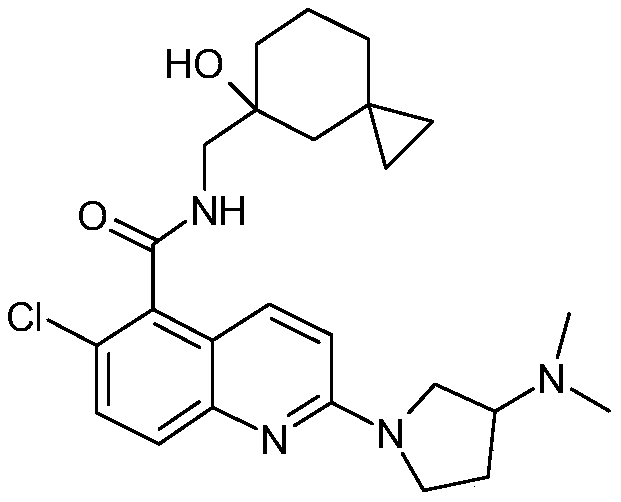
采用2,6-二氯-喹啉-5-羧酸(1-羟基-3-环丙基-环己基甲基)-酰胺、DIPEA和3-二甲基氨基-吡咯烷,依据实施例1的程序合成标题化合物。1H NMR(400MHz,DMSO-d6)δppm8.75 (1H),7.85(m,1H),7.58(2H),7.05(1H),4.26(S,1H),3.87(t,1H),3.75(m,2H),3.56(m,1H),3.49(m,1H),3.36(m,2H),3.24(m,2H),2.84(m,1H),2.22(S,6H),1.85(m, 1H),1.67(m,2H),1.44-1.38(m,4H),1.27(m,2H),0.30(m,2H),0.23(m,2H)。m/z: 458[M+H]。Using 2,6-dichloro-quinoline-5-carboxylic acid (1-hydroxy-3-cyclopropyl-cyclohexylmethyl)-amide, DIPEA and 3-dimethylamino-pyrrolidine, according to Example 1 procedure to synthesize the title compound. 1 H NMR (400 MHz, DMSO-d 6 ) δppm 8.75 (1H), 7.85 (m, 1H), 7.58 (2H), 7.05 (1H), 4.26 (S, 1H), 3.87 (t, 1H), 3.75 (m, 2H), 3.56 (m, 1H), 3.49 (m, 1H), 3.36 (m, 2H), 3.24 (m, 2H), 2.84 (m, 1H), 2.22 (S, 6H), 1.85 ( m, 1H), 1.67 (m, 2H), 1.44-1.38 (m, 4H), 1.27 (m, 2H), 0.30 (m, 2H), 0.23 (m, 2H). m/z: 458[M+H].
实施例121. 6-氯-2-((S)-3-二甲基氨基-吡咯烷-1-基)-喹啉-5-羧酸(1-羟基-3-环丙基-环己基甲基)-酰胺(150)Example 121. 6-Chloro-2-((S)-3-dimethylamino-pyrrolidin-1-yl)-quinoline-5-carboxylic acid (1-hydroxy-3-cyclopropyl-cyclohexyl Methyl)-amide (150)

采用2,6-二氯-喹啉-5-羧酸(1-羟基-3-环丙基-环己基甲基)-酰胺、DIPEA和(S)-3-二甲基氨基-吡咯烷,依据实施例1的程序合成标题化合物。1H NMR(400MHz,DMSO-d6)δppm8.75(1H),7.85(m,1H),7.58(2H),7.05(1H),4.26(S,1H),3.87(t,1H),3.75(m,2H), 3.56(m,1H),3.49(m,1H),3.36(m,2H),3.24(m,2H),2.84(m,1H),2.22(S,6H), 1.85(m,1H),1.67(m,2H),1.44-1.38(m,4H),1.27(m,2H),0.30(m,2H),0.23(m, 2H)。m/z:458[M+H]。Using 2,6-dichloro-quinoline-5-carboxylic acid (1-hydroxy-3-cyclopropyl-cyclohexylmethyl)-amide, DIPEA and (S)-3-dimethylamino-pyrrolidine, The title compound was synthesized according to the procedure of Example 1. 1 H NMR (400 MHz, DMSO-d 6 ) δppm 8.75(1H), 7.85(m,1H), 7.58(2H), 7.05(1H), 4.26(S,1H), 3.87(t,1H), 3.75 (m, 2H), 3.56 (m, 1H), 3.49 (m, 1H), 3.36 (m, 2H), 3.24 (m, 2H), 2.84 (m, 1H), 2.22 (S, 6H), 1.85 ( m, 1H), 1.67 (m, 2H), 1.44-1.38 (m, 4H), 1.27 (m, 2H), 0.30 (m, 2H), 0.23 (m, 2H). m/z: 458 [M+H].
实施例122. 6-氯-2-((R)-3-二甲基氨基-吡咯烷-1-基)-喹啉-5-羧酸(1-羟基-3-环丙基-环己基甲基)-酰胺(151)Example 122. 6-Chloro-2-((R)-3-dimethylamino-pyrrolidin-1-yl)-quinoline-5-carboxylic acid (1-hydroxy-3-cyclopropyl-cyclohexyl Methyl)-amide (151)

采用2,6-二氯-喹啉-5-羧酸(1-羟基-3-环丙基-环己基甲基)-酰胺、DIPEA和(R)-3-二甲基氨基-吡咯烷,依据实施例1的程序合成标题化合物。1H NMR(400MHz,DMSO-d6)δppm8.75(1H),7.85(m,1H),7.58(2H),7.05(1H),4.26(S,1H),3.87(t,1H),3.75(m,2H), 3.56(m,1H),3.49(m,1H),3.36(m,2H),3.24(m,2H),2.84(m,1H),2.22(S,6H), 1.85(m,1H),1.67(m,2H),1.44-1.38(m,4H),1.27(m,2H),0.30(m,2H),0.23(m, 2H)。m/z:458[M+H]。Using 2,6-dichloro-quinoline-5-carboxylic acid (1-hydroxy-3-cyclopropyl-cyclohexylmethyl)-amide, DIPEA and (R)-3-dimethylamino-pyrrolidine, The title compound was synthesized according to the procedure of Example 1. 1 H NMR (400 MHz, DMSO-d 6 ) δppm 8.75(1H), 7.85(m,1H), 7.58(2H), 7.05(1H), 4.26(S,1H), 3.87(t,1H), 3.75 (m, 2H), 3.56 (m, 1H), 3.49 (m, 1H), 3.36 (m, 2H), 3.24 (m, 2H), 2.84 (m, 1H), 2.22 (S, 6H), 1.85 ( m, 1H), 1.67 (m, 2H), 1.44-1.38 (m, 4H), 1.27 (m, 2H), 0.30 (m, 2H), 0.23 (m, 2H). m/z: 458 [M+H].
实施例123. 1-{6-氯-5-[(4,4-二氟-环己基甲基)-氨基甲酰基]-喹啉-2-基}-哌啶-3-羧酸乙酯 (55)Example 123. Ethyl 1-{6-Chloro-5-[(4,4-Difluoro-cyclohexylmethyl)-carbamoyl]-quinolin-2-yl}-piperidine-3-carboxylate (55)

采用2,6-二氯-喹啉-5-羧酸(1-羟基-3-环丙基-环己基甲基)-酰胺和哌啶-3-羧酸乙酯,依据实施例1的程序合成标题化合物。1H NMR(400MHz,DMSO-d6):δ8.73-8.75(m,1H), 7.74(d,J=9.51Hz,1H),7.51-7.56(m,2H),7.35(d,J=9.52Hz,1H),4.42(d,J=2.81Hz,1H),4.04-4.12(m,3H),3.36-3.38(m,1H),3.22-3.25(m,3H),2.54-2.57(m,1H), 1.96-2.03(m,3H),1.69-1.85(m,7H),1.51(S,1H),1.25-1.29(m,2H),1.16-1.19(m,3H)。 m/z:494.3[M+H]+。Following the procedure of Example 1 using 2,6-dichloro-quinoline-5-carboxylic acid (1-hydroxy-3-cyclopropyl-cyclohexylmethyl)-amide and piperidine-3-carboxylic acid ethyl ester The title compound was synthesized. 1 H NMR (400 MHz, DMSO-d 6 ): δ 8.73-8.75 (m, 1H), 7.74 (d, J=9.51 Hz, 1H), 7.51-7.56 (m, 2H), 7.35 (d, J= 9.52Hz, 1H), 4.42(d, J=2.81Hz, 1H), 4.04-4.12(m, 3H), 3.36-3.38(m, 1H), 3.22-3.25(m, 3H), 2.54-2.57(m , 1H), 1.96-2.03 (m, 3H), 1.69-1.85 (m, 7H), 1.51 (S, 1H), 1.25-1.29 (m, 2H), 1.16-1.19 (m, 3H). m/z: 494.3 [M+H] + .
实施例124. 1-{6-氯-5-[(4,4-二氟-环己基甲基)-氨基甲酰基]-喹啉-2-基}-哌啶-3-羧酸(79)Example 124. 1-{6-Chloro-5-[(4,4-difluoro-cyclohexylmethyl)-carbamoyl]-quinolin-2-yl}-piperidine-3-carboxylic acid (79 )

1-{6-氯-5-[(4,4-二氟-环己基甲基)-氨基甲酰基]-喹啉-2-基}-哌啶-3-羧酸乙酯与2.5M氢氧化钠水溶液水解,获得所希望的产物。1H NMR(400MHz,DMSO-d6)δppm 12.41(S,1H), 8.72-8.75(m,1H),7.73(d,J=9.41Hz,1H),7.50-7.56(m,2H),7.35(d,J=9.51Hz, 1H),4.48-4.51(m,1H),4.18-4.21(m,1H),3.15-3.25(m,4H),2.48-2.52(m,1H),1.97-2.03 (m,3H),1.82-1.85(m,3H),1.63-1.76(m,4H),1.45-1.51(m,1H),1.27-1.31(m,2H)。 m/z:466.3[M+H]+。1-{6-Chloro-5-[(4,4-Difluoro-cyclohexylmethyl)-carbamoyl]-quinolin-2-yl}-piperidine-3-carboxylate ethyl ester with 2.5M hydrogen Aqueous sodium oxide is hydrolyzed to obtain the desired product. 1 H NMR (400 MHz, DMSO-d 6 ) δppm 12.41 (S, 1H), 8.72-8.75 (m, 1H), 7.73 (d, J=9.41 Hz, 1H), 7.50-7.56 (m, 2H), 7.35 (d, J=9.51Hz, 1H), 4.48-4.51 (m, 1H), 4.18-4.21 (m, 1H), 3.15-3.25 (m, 4H), 2.48-2.52 (m, 1H), 1.97-2.03 (m, 3H), 1.82-1.85 (m, 3H), 1.63-1.76 (m, 4H), 1.45-1.51 (m, 1H), 1.27-1.31 (m, 2H). m/z: 466.3 [M+H] + .
方案2Scenario 2

实施例125. 6-氯-2-环戊-1-烯基-喹啉-5-羧酸(4,4-二氟-环己基甲基)-酰胺(42)Example 125. 6-Chloro-2-cyclopent-1-enyl-quinoline-5-carboxylic acid (4,4-difluoro-cyclohexylmethyl)-amide (42)

将2,6-二氯-喹啉-5-羧酸(4,4-二氟-环己基甲基)-酰胺(300mg,0.74mmol,1.00eq)在1,4- 二噁烷(6mL,69.44mmol,20V)/水(2mL,111.02mmol,6.67V)中的溶液放入微波小瓶中,加入氟化铯(338.80mg,2.23mmol,3.00eq)和2-环戊-1-烯基-4,4,5,5-四甲基-[1,3,2]二氧杂硼烷(172.97mg,0.89mmol,1.20eq)。反应混合物用氮气吹扫15分钟,加入双(三苯基膦)二氯化钯(II)(25.16mg,0.04mmol,0.05eq),在130℃微波加热1小时。反应混合物浓缩,得到的粗产物经快速柱色谱法纯化,获得标题化合物(12mg,0.03mmol,3.9%),为白色固体。1H NMR(400MHz,DMSO-d6):δ8.85(t,J=5.64Hz,1H),7.95-7.98(m,3H),7.75(d,J=9.0Hz,1H),6.88(S,1H),3.26-3.29(m,2H),2.85-2.89(m,2H),2.60 (S,2H),1.96-2.04(m,4H),1.81-1.86(m,3H),1.74-1.77(m,2H),1.23-1.33(m,2H)。 m/z:405[M+H]+。2,6-Dichloro-quinoline-5-carboxylic acid (4,4-difluoro-cyclohexylmethyl)-amide (300 mg, 0.74 mmol, 1.00 eq) in 1,4-dioxane (6 mL, A solution of 69.44mmol, 20V)/water (2mL, 111.02mmol, 6.67V) was placed in a microwave vial, and cesium fluoride (338.80mg, 2.23mmol, 3.00eq) and 2-cyclopent-1-enyl- 4,4,5,5-Tetramethyl-[1,3,2]dioxaborane (172.97 mg, 0.89 mmol, 1.20 eq). The reaction mixture was purged with nitrogen for 15 minutes, bis(triphenylphosphine)palladium(II) dichloride (25.16 mg, 0.04 mmol, 0.05 eq) was added and microwave heated at 130°C for 1 hour. The reaction mixture was concentrated and the resulting crude product was purified by flash column chromatography to give the title compound (12 mg, 0.03 mmol, 3.9%) as a white solid. 1 H NMR (400 MHz, DMSO-d 6 ): δ 8.85 (t, J=5.64 Hz, 1H), 7.95-7.98 (m, 3H), 7.75 (d, J=9.0 Hz, 1H), 6.88 (S , 1H), 3.26-3.29(m, 2H), 2.85-2.89(m, 2H), 2.60 (S, 2H), 1.96-2.04(m, 4H), 1.81-1.86(m, 3H), 1.74-1.77 (m, 2H), 1.23-1.33 (m, 2H). m/z: 405[M+H] + .
实施例126. 6-氯-2-环戊基-喹啉-5-羧酸(4,4-二氟-环己基甲基)-酰胺(43)Example 126. 6-Chloro-2-cyclopentyl-quinoline-5-carboxylic acid (4,4-difluoro-cyclohexylmethyl)-amide (43)

在氩气气氛下向6-氯-2-环戊-1-烯基-喹啉-5-羧酸(4,4-二氟-环己基甲基)-酰胺(110.00 mg,0.25mmol,1.00eq)在甲醇(15mL,136.36V)中的溶液加入钯/炭(10%w/w)(20mg, 0.02mmol,0.08eq)。向反应混合物加入三乙基硅烷(0.40mL,2.49mmol,10eq),搅拌30 分钟。反应混合物经硅藻土床过滤,滤液浓缩,得到粗产物,该粗产物经制备型HPLC纯化,获得标题化合物(18mg,0.04mmol,17.5%),为白色固体。1H NMR(400MHz,DMSO-d6):δ8.80(t,J=5.80Hz,1H),7.94-8.01(m,2H),7.75(d,J=9.01Hz,1H),7.58(d,J=8.72 Hz,1H),3.39-3.40(m,1H),3.27(t,J=6.21Hz,2H),2.02-2.11(m,4H),1.64-1.86(m, 11H),1.27-1.33(m,2H)。m/z:407[M+H]+。Under argon atmosphere, 6-chloro-2-cyclopent-1-enyl-quinoline-5-carboxylic acid (4,4-difluoro-cyclohexylmethyl)-amide (110.00 mg, 0.25 mmol, 1.00 eq) A solution in methanol (15 mL, 136.36 V) was added palladium on carbon (10% w/w) (20 mg, 0.02 mmol, 0.08 eq). To the reaction mixture was added triethylsilane (0.40 mL, 2.49 mmol, 10 eq) and stirred for 30 minutes. The reaction mixture was filtered through a bed of celite and the filtrate was concentrated to give the crude product which was purified by preparative HPLC to give the title compound (18 mg, 0.04 mmol, 17.5%) as a white solid. 1 H NMR (400 MHz, DMSO-d 6 ): δ 8.80 (t, J=5.80 Hz, 1H), 7.94-8.01 (m, 2H), 7.75 (d, J=9.01 Hz, 1H), 7.58 (d , J=8.72 Hz, 1H), 3.39-3.40(m, 1H), 3.27(t, J=6.21Hz, 2H), 2.02-2.11(m, 4H), 1.64-1.86(m, 11H), 1.27- 1.33 (m, 2H). m/z: 407[M+H] + .
实施例127. 2,6-二-环己-1-烯基喹啉-5-羧酸(4,4-二氟-环己基甲基)-酰胺(40)Example 127. 2,6-Di-cyclohex-1-enylquinoline-5-carboxylic acid (4,4-difluoro-cyclohexylmethyl)-amide (40)

采用2,6-二氯-喹啉-5-羧酸(4,4-二氟-环己基甲基)-酰胺、环己烯-1-基-硼酸、碳酸铯和四(三苯基膦)钯(0),依据实施例125的程序合成标题化合物。1H NMR(400MHz,DMSO-d6):δ8.83(t,J=5.9Hz,1H),7.89-8.00(m,3H),7.73-7.76(m,1H),6.91(S,1H),3.27(t,J =6.2Hz,2H),2.65-2.66(m,2H),2.31-2.32(m,2H),1.86-2.01(m,2H),1.74-1.76(m,3H),1.65-1.67(m,6H),1.27-1.30(m,2H)。m/z:419[M+H]+。2,6-Dichloro-quinoline-5-carboxylic acid (4,4-difluoro-cyclohexylmethyl)-amide, cyclohexen-1-yl-boronic acid, cesium carbonate and tetrakis(triphenylphosphine) ) palladium(0), the title compound was synthesized according to the procedure of Example 125. 1 H NMR (400 MHz, DMSO-d 6 ): δ 8.83 (t, J=5.9 Hz, 1H), 7.89-8.00 (m, 3H), 7.73-7.76 (m, 1H), 6.91 (S, 1H) , 3.27(t, J=6.2Hz, 2H), 2.65-2.66(m, 2H), 2.31-2.32(m, 2H), 1.86-2.01(m, 2H), 1.74-1.76(m, 3H), 1.65 -1.67 (m, 6H), 1.27-1.30 (m, 2H). m/z: 419[M+H] + .
实施例128. 6-氯-2-环己基-喹啉-5-羧酸(4,4-二氟-环己基甲基)-酰胺(48)Example 128. 6-Chloro-2-cyclohexyl-quinoline-5-carboxylic acid (4,4-difluoro-cyclohexylmethyl)-amide (48)

采用6-氯-2-环己-1-烯基-喹啉-5-羧酸(4,4-二氟-环己基甲基)-酰胺、钯/炭和三乙基硅烷,依据实施例126的程序合成标题化合物。1H NMR(400MHz,DMSO-d6):δppm 8.78-8.80(m, 1H),7.96-7.95(m,1H),7.76(d,J=9.04Hz,1H),7.59(d,J=8.80Hz,1H),3.25-3.40 (m,2H),2.85-2.95(m,1H),2.01-2.15(m,2H),1.86-1.99(m,10H),1.55-1.60(m,2H),1.40-1.45(m,2H),1.23-1.26(m,3H)。m/z:421[M+H]+。Using 6-chloro-2-cyclohex-1-enyl-quinoline-5-carboxylic acid (4,4-difluoro-cyclohexylmethyl)-amide, palladium/carbon and triethylsilane, according to example The title compound was synthesized by the procedure of 126. 1 H NMR (400 MHz, DMSO-d 6 ): δppm 8.78-8.80 (m, 1H), 7.96-7.95 (m, 1H), 7.76 (d, J=9.04 Hz, 1H), 7.59 (d, J=8.80 Hz, 1H), 3.25-3.40(m, 2H), 2.85-2.95(m, 1H), 2.01-2.15(m, 2H), 1.86-1.99(m, 10H), 1.55-1.60(m, 2H), 1.40-1.45 (m, 2H), 1.23-1.26 (m, 3H). m/z: 421[M+H] + .
实施例129. 6-氯-2-(3,6-二氢-2H-吡喃-4-基)-喹啉-5-羧酸(4,4-二氟-环己基甲基)-酰胺(31)Example 129. 6-Chloro-2-(3,6-dihydro-2H-pyran-4-yl)-quinoline-5-carboxylic acid (4,4-difluoro-cyclohexylmethyl)-amide (31)

采用2,6-二氯-喹啉-5-羧酸(4,4-二氟-环己基甲基)-酰胺、碳酸铯、4-(4,4,5,5-四甲基 -[1,3,2]二氧杂硼烷-2-基)-3,6-二氢-2H-吡喃和四(三苯基膦)钯(0),依据实施例125的程序合成标题化合物。1H NMR(400MHz,DMSO-d6):δppm 8.85(t,J=6.00Hz,1H),7.95-8.05 (m,3H),7.77(d,J=9.00Hz,1H),6.98(S,1H),4.33-4.35(m,2H),3.86(t,J=5.48Hz, 2H),3.26-3.28(m,2H),2.66-2.70(m,2H),2.00-2.07(m,2H),1.74-1.87(m,5H),1.23-1.31(m, 2H)。m/z:421[M+H]+。2,6-Dichloro-quinoline-5-carboxylic acid (4,4-difluoro-cyclohexylmethyl)-amide, cesium carbonate, 4-(4,4,5,5-tetramethyl-[ 1,3,2]dioxaboran-2-yl)-3,6-dihydro-2H-pyran and tetrakis(triphenylphosphine)palladium(0), the title compound was synthesized according to the procedure of Example 125 . 1 H NMR (400 MHz, DMSO-d 6 ): δppm 8.85 (t, J=6.00 Hz, 1H), 7.95-8.05 (m, 3H), 7.77 (d, J=9.00 Hz, 1H), 6.98 (S, 1H), 4.33-4.35(m, 2H), 3.86(t, J=5.48Hz, 2H), 3.26-3.28(m, 2H), 2.66-2.70(m, 2H), 2.00-2.07(m, 2H) , 1.74-1.87 (m, 5H), 1.23-1.31 (m, 2H). m/z: 421[M+H] + .
实施例130. 6-氯-2-(四氢-吡喃-4-基)-喹啉-5-羧酸(4,4-二氟-环己基甲基)-酰胺(47)Example 130. 6-Chloro-2-(tetrahydro-pyran-4-yl)-quinoline-5-carboxylic acid (4,4-difluoro-cyclohexylmethyl)-amide (47)

采用6-氯-2-(3,6-二氢-2H-吡喃-4-基)-喹啉-5-羧酸(4,4-二氟-环己基甲基)-酰胺、钯/炭和三乙基硅烷,依据实施例126的程序合成标题化合物。1H NMR(400MHz,DMSO-d6):δ 8.80(t,J=5.92Hz,1H),7.97-8.04(m,2H),7.77(d,J=9.00Hz,1H),7.62(d,J=8.76 Hz,1H),3.96-4.00(m,2H),3.45-3.52(m,2H),3.25-3.27(m,2H),3.11-3.17(m,1H),2.01-2.04(m,2H),1.80-1.90(m,7H),1.74-1.77(m,2H),1.23-1.33(m,2H)。m/z:423[M +H]+。Using 6-chloro-2-(3,6-dihydro-2H-pyran-4-yl)-quinoline-5-carboxylic acid (4,4-difluoro-cyclohexylmethyl)-amide, palladium/ The title compound was synthesized according to the procedure of Example 126 using charcoal and triethylsilane. 1 H NMR (400 MHz, DMSO-d 6 ): δ 8.80 (t, J=5.92 Hz, 1H), 7.97-8.04 (m, 2H), 7.77 (d, J=9.00 Hz, 1H), 7.62 (d, J=8.76 Hz, 1H), 3.96-4.00(m, 2H), 3.45-3.52(m, 2H), 3.25-3.27(m, 2H), 3.11-3.17(m, 1H), 2.01-2.04(m, 2H), 1.80-1.90 (m, 7H), 1.74-1.77 (m, 2H), 1.23-1.33 (m, 2H). m/z: 423[M+H] + .
实施例131. 6-氯-2-环戊基-喹啉-5-羧酸((1S,3S)-1-羟基-3-甲基-环己基甲基)-酰胺(7)Example 131. 6-Chloro-2-cyclopentyl-quinoline-5-carboxylic acid ((1S,3S)-1-hydroxy-3-methyl-cyclohexylmethyl)-amide (7)

步骤1. 6-氯-2-环戊-1-烯基-喹啉-5-羧酸((1S,3S)-1-羟基-3-甲基-环己基甲基)-酰胺Step 1. 6-Chloro-2-cyclopent-1-enyl-quinoline-5-carboxylic acid ((1S,3S)-1-hydroxy-3-methyl-cyclohexylmethyl)-amide

采用2,6-二氯-喹啉-5-羧酸((1S,3S)-1-羟基-3-甲基-环己基甲基)-酰胺、碳酸铯、2-环戊 -1-烯基-4,4,5,5-四甲基-[1,3,2]二氧杂硼烷和四(三苯基膦)钯(0),依据实施例125的程序合成标题化合物。1H NMR(400MHz,DMSO-d6):δ8.63(t,J=5.91Hz,1H),8.06(d,J=8.91 Hz,1H),7.96(dd,J=4.41,8.91Hz,2H),7.73(d,J=9.02Hz,1H),6.89(S,1H),4.18 (S,1H),3.29(S,1H),2.85-2.87(m,2H),2.48-2.49(m,2H),1.96-2.03(m,1H),1.45-1.78 (m,6H),1.28-1.32(m,5H)。2,6-Dichloro-quinoline-5-carboxylic acid ((1S,3S)-1-hydroxy-3-methyl-cyclohexylmethyl)-amide, cesium carbonate, 2-cyclopent-1-ene base-4,4,5,5-tetramethyl-[1,3,2]dioxaborane and tetrakis(triphenylphosphine)palladium(0), the title compound was synthesized according to the procedure of Example 125. 1 H NMR (400 MHz, DMSO-d 6 ): δ 8.63 (t, J=5.91 Hz, 1H), 8.06 (d, J=8.91 Hz, 1H), 7.96 (dd, J=4.41, 8.91 Hz, 2H) ), 7.73(d, J=9.02Hz, 1H), 6.89(S, 1H), 4.18(S, 1H), 3.29(S, 1H), 2.85-2.87(m, 2H), 2.48-2.49(m, 2H), 1.96-2.03 (m, 1H), 1.45-1.78 (m, 6H), 1.28-1.32 (m, 5H).
步骤2:6-氯-2-环戊基-喹啉-5-羧酸((1S,3S)-1-羟基-3-甲基-环己基甲基)-酰胺Step 2: 6-Chloro-2-cyclopentyl-quinoline-5-carboxylic acid ((1S,3S)-1-hydroxy-3-methyl-cyclohexylmethyl)-amide
采用6-氯-2-环戊-1-烯基-喹啉-5-羧酸((1S,3S)-1-羟基-3-甲基-环己基甲基)-酰胺,依据实施例126的程序合成标题化合物。1H NMR(400MHz,DMSO-d6):δ8.59(t,J=6.03Hz, 1H),8.10(d,J=8.81Hz,1H),7.95(d,J=9.23Hz,1H),7.75(d,J=8.81Hz,1H),7.59(d,J=8.81Hz,1H),3.37-3.39(m,1H),3.29-3.30(m,2H),2.06-2.08(m,2H),1.67-1.87 (m,7H),1.54-1.65(m,4H),1.12-1.47(m,1H),1.23-1.32(m,3H),1.02-1.08(m,1H),0.83-0.85(m,3H)m/z:401.2[M+H]+。Using 6-chloro-2-cyclopent-1-enyl-quinoline-5-carboxylic acid ((1S,3S)-1-hydroxy-3-methyl-cyclohexylmethyl)-amide according to Example 126 procedure to synthesize the title compound. 1 H NMR (400 MHz, DMSO-d 6 ): δ 8.59 (t, J=6.03 Hz, 1H), 8.10 (d, J=8.81 Hz, 1H), 7.95 (d, J=9.23 Hz, 1H), 7.75(d, J=8.81Hz, 1H), 7.59(d, J=8.81Hz, 1H), 3.37-3.39(m, 1H), 3.29-3.30(m, 2H), 2.06-2.08(m, 2H) , 1.67-1.87(m, 7H), 1.54-1.65(m, 4H), 1.12-1.47(m, 1H), 1.23-1.32(m, 3H), 1.02-1.08(m, 1H), 0.83-0.85( m, 3H) m/z: 401.2 [M+H] + .
实施例132. 6-氯-2-环戊基-喹啉-5-羧酸((1R,3R)-1-羟基-3-甲基-环己基甲基)-酰胺(15)Example 132. 6-Chloro-2-cyclopentyl-quinoline-5-carboxylic acid ((1R,3R)-1-hydroxy-3-methyl-cyclohexylmethyl)-amide (15)
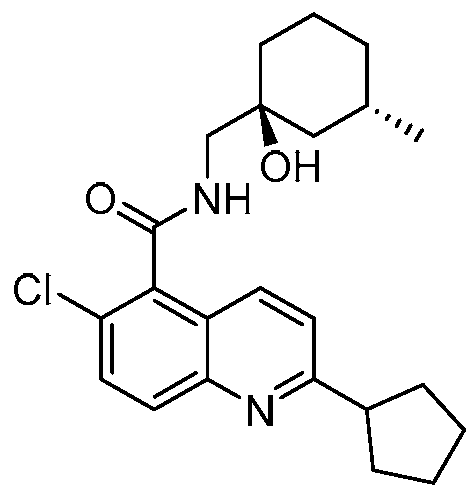
步骤1:6-氯-2-环戊-1-烯基-喹啉-5-羧酸((1R,3R)-1-羟基-3-甲基-环己基甲基)-酰胺Step 1: 6-Chloro-2-cyclopent-1-enyl-quinoline-5-carboxylic acid ((1R,3R)-1-hydroxy-3-methyl-cyclohexylmethyl)-amide

采用2,6-二氯-喹啉-5-羧酸((1R,3R)-1-羟基-3-甲基-环己基甲基)-酰胺、碳酸铯、2-环戊 -1-烯基-4,4,5,5-四甲基-[1,3,2]二氧杂硼烷和四(三苯基膦)钯(0),依据实施例125的程序合成标题化合物。1H NMR(400MHz,DMSO-d6):δ8.63(t,J=5.91Hz,1H),8.06(d,J=8.92 Hz,1H),7.96(dd,J=4.43,8.92Hz,2H),7.73(d,J=9.01Hz,1H),6.89(S,1H),4.18 (S,1H),3.29(S,1H),2.85-2.87(m,2H),2.48-2.49(m,2H),1.96-2.03(m,1H),1.45-1.78 (m,6H),1.28-1.32(m,5H)。m/z:399.2[M+H]+。Using 2,6-dichloro-quinoline-5-carboxylic acid ((1R,3R)-1-hydroxy-3-methyl-cyclohexylmethyl)-amide, cesium carbonate, 2-cyclopent-1-ene base-4,4,5,5-tetramethyl-[1,3,2]dioxaborane and tetrakis(triphenylphosphine)palladium(0), the title compound was synthesized according to the procedure of Example 125. 1 H NMR (400 MHz, DMSO-d 6 ): δ 8.63 (t, J=5.91 Hz, 1H), 8.06 (d, J=8.92 Hz, 1H), 7.96 (dd, J=4.43, 8.92 Hz, 2H) ), 7.73(d, J=9.01Hz, 1H), 6.89(S, 1H), 4.18(S, 1H), 3.29(S, 1H), 2.85-2.87(m, 2H), 2.48-2.49(m, 2H), 1.96-2.03 (m, 1H), 1.45-1.78 (m, 6H), 1.28-1.32 (m, 5H). m/z: 399.2 [M+H] + .
步骤2:6-氯-2-环戊基-喹啉-5-羧酸((1R,3R)-1-羟基-3-甲基-环己基甲基)-酰胺Step 2: 6-Chloro-2-cyclopentyl-quinoline-5-carboxylic acid ((1R,3R)-1-hydroxy-3-methyl-cyclohexylmethyl)-amide

采用6-氯-2-环戊-1-烯基-喹啉-5-羧酸((1R,3R)-1-羟基-3-甲基-环己基甲基)-酰胺、钯/炭和三乙基硅烷,依据实施例126的程序合成标题化合物。1H NMR(400MHz,DMSO-d6):δ8.59(t,J=6.01Hz,1H),8.10(d,J=8.82Hz,1H),7.96(d,J=9.22Hz,1H),7.75(d, J=9.23Hz,1H),7.59(d,J=8.81Hz,1H),3.35-3.39(m,1H),3.29(S,2H),2.06-2.09(m,2H),1.78-1.87(m,4H),1.69-1.75(m,3H),1.47-1.61(m,4H),1.47-1.48(m,1H),1.23-1.29(m,1H),1.03(t,J=12.81Hz,1H),0.83-0.84(m,3H),0.73-0.76(m,1H)。m/z:401.2 [M+H]+。6-Chloro-2-cyclopent-1-enyl-quinoline-5-carboxylic acid ((1R,3R)-1-hydroxy-3-methyl-cyclohexylmethyl)-amide, palladium/carbon and Triethylsilane, the title compound was synthesized according to the procedure of Example 126. 1 H NMR (400 MHz, DMSO-d 6 ): δ 8.59 (t, J=6.01 Hz, 1H), 8.10 (d, J=8.82 Hz, 1H), 7.96 (d, J=9.22 Hz, 1H), 7.75(d, J=9.23Hz, 1H), 7.59(d, J=8.81Hz, 1H), 3.35-3.39(m, 1H), 3.29(S, 2H), 2.06-2.09(m, 2H), 1.78 -1.87(m, 4H), 1.69-1.75(m, 3H), 1.47-1.61(m, 4H), 1.47-1.48(m, 1H), 1.23-1.29(m, 1H), 1.03(t, J= 12.81 Hz, 1H), 0.83-0.84 (m, 3H), 0.73-0.76 (m, 1H). m/z: 401.2 [M+H] + .
方案3Scenario 3

实施例133. 6-氯-2-(3-二甲基氨基环戊基)-喹啉-5-羧酸(4,4-二氟-1-羟基-环己基甲基)-酰胺 (152)Example 133. 6-Chloro-2-(3-dimethylaminocyclopentyl)-quinoline-5-carboxylic acid (4,4-difluoro-1-hydroxy-cyclohexylmethyl)-amide (152 )

步骤1:6-氯-2-(3-氧代-环戊-1-烯基)-喹啉-5-羧酸(4,4-二氟-环己基甲基)-酰胺Step 1: 6-Chloro-2-(3-oxo-cyclopent-1-enyl)-quinoline-5-carboxylic acid (4,4-difluoro-cyclohexylmethyl)-amide

采用2,6-二氯-喹啉-5-羧酸(4,4-二氟-环己基甲基)-酰胺、碳酸铯、3-(4,4,5,5-四甲基 -[1,3,2]二氧杂硼烷-2-基)-环戊-2-烯酮和四(三苯基膦)钯(0),依据实施例125的程序合成标题化合物。1H NMR(400MHz,DMSO-d6):δppm 8.89-8.92(m,1H),8.12-8.24(m,2H), 7.88(d,J=9.12Hz,1H),7.11(d,J=3.43Hz,1H),3.28-3.32(m,2H),3.19-3.21(m,2H),2.54-2.56(m,2H),1.98-2.05(m,2H),1.75-1.87(m,4H),1.15-1.34(m,2H)。m/z: 423[M+H]+。2,6-Dichloro-quinoline-5-carboxylic acid (4,4-difluoro-cyclohexylmethyl)-amide, cesium carbonate, 3-(4,4,5,5-tetramethyl-[ 1,3,2]dioxaboran-2-yl)-cyclopent-2-enone and tetrakis(triphenylphosphine)palladium(0), the title compound was synthesized according to the procedure of Example 125. 1 H NMR (400 MHz, DMSO-d 6 ): δppm 8.89-8.92 (m, 1H), 8.12-8.24 (m, 2H), 7.88 (d, J=9.12 Hz, 1H), 7.11 (d, J=3.43 Hz, 1H), 3.28-3.32(m, 2H), 3.19-3.21(m, 2H), 2.54-2.56(m, 2H), 1.98-2.05(m, 2H), 1.75-1.87(m, 4H), 1.15-1.34 (m, 2H). m/z: 423[M+H] + .
步骤2:6-氯-2-(3-氧代-环戊基)-喹啉-5-羧酸(4,4-二氟-环己基甲基)-酰胺Step 2: 6-Chloro-2-(3-oxo-cyclopentyl)-quinoline-5-carboxylic acid (4,4-difluoro-cyclohexylmethyl)-amide

采用6-氯-2-(3-氧代-环戊-1-烯基)-喹啉-5-羧酸(4,4-二氟-环己基甲基)-酰胺、钯/炭和三乙基硅烷,依据实施例126的程序合成标题化合物。m/z:421[M+H]+。6-Chloro-2-(3-oxo-cyclopent-1-enyl)-quinoline-5-carboxylic acid (4,4-difluoro-cyclohexylmethyl)-amide, palladium/carbon and tris ethylsilane, the title compound was synthesized according to the procedure of Example 126. m/z: 421[M+H] + .
步骤3.6-氯-2-(3-二甲基氨基环戊基)-喹啉-5-羧酸(4,4-二氟-1-羟基-环己基甲基)-酰胺Step 3. 6-Chloro-2-(3-dimethylaminocyclopentyl)-quinoline-5-carboxylic acid (4,4-difluoro-1-hydroxy-cyclohexylmethyl)-amide

0℃下边搅拌边向6-氯-2-(3-氧代-环戊基)-喹啉-5-羧酸(4,4-二氟-1-羟基环己基甲基)-酰胺(0.30g,0.28mmol,1.00eq)在DCM(15.00ml,50.00V)中的溶液加入三乙胺(0.09g,0.84 mmol,3.00eq)和2.0M二甲胺在THF中的溶液(0.70mL,1.40mmol,5.00eq),温度升至室温。反应混合物室温搅拌1小时,加入三乙酰氧基硼氢化钠(0.09g,0.42mmol,1.50eq),反应混合物室温搅拌16小时,真空除去溶剂。粗产物经制备型HPLC纯化,获得6-氯-2-(3- 二甲基氨基环戊基)-喹啉-5-羧酸(4,4-二氟-1-羟基-环己基甲基)-酰胺(0.03g,0.06mmol, 22.3%,褐色固体)。1H NMR(400MHz,DMSO-d6):δ8.81(t,J=5.82Hz,1H),8.01-7.96 (m,2H),7.76-7.74(m,1H),7.60-7.56(m,1H),7.56-3.28(m,1H),3.27-3.25(m,2H), 2.68-2.57(m,1H),2.56-2.48(m,1H),2.25-2.16(m,1H),2.15-2.07(m,6H),2.06-1.96(m, 5H),1.96-1.90(m,4H),1.88-1.83(m,2H),1.78-1.72(m,1H),1.30-1.24(m,2H)。m/z: 450.2[M+H]+。To 6-chloro-2-(3-oxo-cyclopentyl)-quinoline-5-carboxylic acid (4,4-difluoro-1-hydroxycyclohexylmethyl)-amide (0.30 g, 0.28 mmol, 1.00 eq) in DCM (15.00 ml, 50.00 V) was added triethylamine (0.09 g, 0.84 mmol, 3.00 eq) and 2.0 M dimethylamine in THF (0.70 mL, 1.40 mmol, 5.00 eq), the temperature was raised to room temperature. The reaction mixture was stirred at room temperature for 1 hour, sodium triacetoxyborohydride (0.09 g, 0.42 mmol, 1.50 eq) was added, the reaction mixture was stirred at room temperature for 16 hours, and the solvent was removed in vacuo. The crude product was purified by preparative HPLC to give 6-chloro-2-(3-dimethylaminocyclopentyl)-quinoline-5-carboxylic acid (4,4-difluoro-1-hydroxy-cyclohexylmethyl) )-amide (0.03 g, 0.06 mmol, 22.3%, brown solid). 1 H NMR (400 MHz, DMSO-d 6 ): δ 8.81 (t, J=5.82 Hz, 1H), 8.01-7.96 (m, 2H), 7.76-7.74 (m, 1H), 7.60-7.56 (m, 1H), 7.56-3.28(m, 1H), 3.27-3.25(m, 2H), 2.68-2.57(m, 1H), 2.56-2.48(m, 1H), 2.25-2.16(m, 1H), 2.15- 2.07(m, 6H), 2.06-1.96(m, 5H), 1.96-1.90(m, 4H), 1.88-1.83(m, 2H), 1.78-1.72(m, 1H), 1.30-1.24(m, 2H) ). m/z: 450.2[M+H] + .
实施例134. 2-(3-氮杂环丁烷-1-基-环戊基)-6-氯-喹啉-5-羧酸(4,4-二氟环己基甲基)-酰胺 (153)Example 134. 2-(3-Azetidin-1-yl-cyclopentyl)-6-chloro-quinoline-5-carboxylic acid (4,4-difluorocyclohexylmethyl)-amide ( 153)

采用6-氯-2-(3-氧代-环戊基)-喹啉-5-羧酸(4,4-二氟-环己基甲基)-酰胺和氮杂环丁烷盐酸盐,依据实施例133的程序合成标题化合物。1H NMR(400MHz,DMSO-d6):δ10.08(m, 1H),8.81(t,J=4.41Hz,1H),8.06-8.03(m,1H),8.00-7.96(m,1H),7.81-7.77(m,1H),7.62-7.58(m,1H),4.17-4.06(m,5H),4.06-4.04(m,1H),3.29-3.26(m,2H),2.50-2.44(m,5H),2.07-2.03(m,3H),1.90-1.84(m,7H),1.78-1.74(m,1H),1.31-1.27(m,2H)。m/z:462.3[M+H]+。Using 6-chloro-2-(3-oxo-cyclopentyl)-quinoline-5-carboxylic acid (4,4-difluoro-cyclohexylmethyl)-amide and azetidine hydrochloride, The title compound was synthesized according to the procedure of Example 133. 1 H NMR (400 MHz, DMSO-d 6 ): δ 10.08 (m, 1H), 8.81 (t, J=4.41 Hz, 1H), 8.06-8.03 (m, 1H), 8.00-7.96 (m, 1H) , 7.81-7.77(m, 1H), 7.62-7.58(m, 1H), 4.17-4.06(m, 5H), 4.06-4.04(m, 1H), 3.29-3.26(m, 2H), 2.50-2.44( m, 5H), 2.07-2.03 (m, 3H), 1.90-1.84 (m, 7H), 1.78-1.74 (m, 1H), 1.31-1.27 (m, 2H). m/z: 462.3[M+H] + .
实施例135:6-氯-2-(3-吡咯烷-1-基-环戊基)-喹啉-5-羧酸(4,4-二氟环己基甲基)-酰胺(154)Example 135: 6-Chloro-2-(3-pyrrolidin-1-yl-cyclopentyl)-quinoline-5-carboxylic acid (4,4-difluorocyclohexylmethyl)-amide (154)

采用6-氯-2-(3-氧代-环戊基)-喹啉-5-羧酸(4,4-二氟-环己基甲基)-酰胺、吡咯烷、冰醋酸和三乙酰氧基硼氢化钠,依据实施例133的程序合成标题化合物。1H NMR(400MHz, DMSO-d6):δ8.80(t,J=5.82Hz,1H),8.01-7.95(m,2H),7.76-7.74(m,1H),7.61-7.56 (m,1H),3.55-3.44(m,1H),3.43-3.41(m,1H),3.27(t,J=6.2Hz,2H),2.74-2.66(m,1H),2.64-2.50(m,1H),2.27-2.24(m,1H),2.10-1.99(m,5H),1.89-1.76(m,6H),1.75-1.68(m,2H),1.33-1.29(m,5H),1.27-1.24(m,2H)。m/z:476.2[M+H]+。6-Chloro-2-(3-oxo-cyclopentyl)-quinoline-5-carboxylic acid (4,4-difluoro-cyclohexylmethyl)-amide, pyrrolidine, glacial acetic acid and triacetoxy The title compound was synthesized according to the procedure of Example 133 using sodium borohydride. 1 H NMR (400 MHz, DMSO-d 6 ): δ 8.80 (t, J=5.82 Hz, 1H), 8.01-7.95 (m, 2H), 7.76-7.74 (m, 1H), 7.61-7.56 (m, 1H), 3.55-3.44 (m, 1H), 3.43-3.41 (m, 1H), 3.27 (t, J=6.2Hz, 2H), 2.74-2.66 (m, 1H), 2.64-2.50 (m, 1H) , 2.27-2.24(m, 1H), 2.10-1.99(m, 5H), 1.89-1.76(m, 6H), 1.75-1.68(m, 2H), 1.33-1.29(m, 5H), 1.27-1.24( m, 2H). m/z: 476.2 [M+H] + .
实施例136. 6-氯-2-(3-羟基-环戊基)-喹啉-5-羧酸(4,4-二氟-环己基甲基)-酰胺(92)Example 136. 6-Chloro-2-(3-hydroxy-cyclopentyl)-quinoline-5-carboxylic acid (4,4-difluoro-cyclohexylmethyl)-amide (92)

0℃下边搅拌边向6-氯-2-(3-氧代-环戊基)-喹啉-5-羧酸(4,4-二氟-环己基甲基)-酰胺(30 mg,0.07mmol,1.00eq)在干THF(3mL)中的溶液加入NaBH4(5.34mg,0.14mmol,2.00 eq),室温搅拌1小时。用水(5mL)淬灭反应混合物并用乙酸乙酯(15mL)萃取。有机层用盐水洗涤,Na2SO4干燥,过滤,浓缩,获得粗产物,该粗产物经制备型HPLC纯化,获得标题化合物(10.00mg,0.02mmol,32.9%),为乳白色胶状物。1H NMR(400MHz,DMSO-d6):δ8.26-8.39(bS,1H),7.98-8.20(m,1H),7.53-7.72(m,2H),6.53-6.71(m,1H),4.42(d, J=5.52Hz,1H),3.70(d,J=3.83Hz,1H),3.48-3.51(m,2H),2.08-2.37(m,6H),1.69-2.05 (m,8H),1.26-1.49(m,2H)。m/z:423[M+H]+。To 6-chloro-2-(3-oxo-cyclopentyl)-quinoline-5-carboxylic acid (4,4-difluoro-cyclohexylmethyl)-amide (30 mg, 0.07 mmol, 1.00 eq) in dry THF ( 3 mL) was added NaBH4 (5.34 mg, 0.14 mmol, 2.00 eq) and stirred at room temperature for 1 hour. The reaction mixture was quenched with water (5 mL) and extracted with ethyl acetate (15 mL). The organic layer was washed with brine, dried over Na2SO4 , filtered, and concentrated to give the crude product, which was purified by preparative HPLC to give the title compound (10.00 mg, 0.02 mmol, 32.9%) as a milky white gum. 1 H NMR (400 MHz, DMSO-d 6 ): δ 8.26-8.39 (bS, 1H), 7.98-8.20 (m, 1H), 7.53-7.72 (m, 2H), 6.53-6.71 (m, 1H), 4.42 (d, J=5.52Hz, 1H), 3.70 (d, J=3.83Hz, 1H), 3.48-3.51 (m, 2H), 2.08-2.37 (m, 6H), 1.69-2.05 (m, 8H) , 1.26-1.49 (m, 2H). m/z: 423[M+H] + .
实施例137. 6-氯-2-(3-二甲基氨基-环戊基)-喹啉-5-羧酸(1-羟基-3-甲基-环己基甲基)-酰胺 (155)Example 137. 6-Chloro-2-(3-dimethylamino-cyclopentyl)-quinoline-5-carboxylic acid (1-hydroxy-3-methyl-cyclohexylmethyl)-amide (155)

步骤1. 6-氯-2-(3-氧代-环戊-1-烯基)-喹啉-5-羧酸(1-羟基-3-甲基环己基甲基)-酰胺Step 1. 6-Chloro-2-(3-oxo-cyclopent-1-enyl)-quinoline-5-carboxylic acid (1-hydroxy-3-methylcyclohexylmethyl)-amide

采用2,6-二氯-喹啉-5-羧酸(1-羟基-3-甲基-环己基甲基)-酰胺、碳酸铯、3-(4,4,5,5-四甲基-[1,3,2]二氧杂硼烷-2-基)-环戊-2-烯酮和[1,1'-双(二苯基膦)二茂铁]二氯化钯(II),依据实施例125的程序合成标题化合物。1H NMR(400MHz,DMSO-d6)δppm:8.70(t,J=6.04Hz, 1H),8.28-8.22(m,2H),8.12(d,J=9.21Hz,1H),7.86(d,J=9.03Hz,1H),7.13(t, J=1.64Hz,1H),4.21(S,1H),3.22-3.20(m,2H),2.56-2.54(m,2H),1.73(t,J=3.41Hz,1H),1.62-1.56(m,4H),1.48-1.45(m,1H),1.32-1.25(m,1H),1.06-1.00(m,1H),0.84 (d,J=6.63Hz,3H),0.77-0.74(m,1H)。m/z:413.2[M+H]+。2,6-Dichloro-quinoline-5-carboxylic acid (1-hydroxy-3-methyl-cyclohexylmethyl)-amide, cesium carbonate, 3-(4,4,5,5-tetramethyl) -[1,3,2]dioxaboran-2-yl)-cyclopent-2-enone and [1,1'-bis(diphenylphosphino)ferrocene]palladium(II) chloride ), the title compound was synthesized according to the procedure of Example 125. 1 H NMR (400 MHz, DMSO-d 6 ) δppm: 8.70 (t, J=6.04 Hz, 1H), 8.28-8.22 (m, 2H), 8.12 (d, J=9.21 Hz, 1H), 7.86 (d, J=9.03Hz, 1H), 7.13(t, J=1.64Hz, 1H), 4.21(S, 1H), 3.22-3.20(m, 2H), 2.56-2.54(m, 2H), 1.73(t, J =3.41Hz, 1H), 1.62-1.56(m, 4H), 1.48-1.45(m, 1H), 1.32-1.25(m, 1H), 1.06-1.00(m, 1H), 0.84 (d, J=6.63 Hz, 3H), 0.77-0.74 (m, 1H). m/z: 413.2 [M+H] + .
步骤2. 6-氯-2-(3-氧代-环戊基)-喹啉-5-羧酸(1-羟基-3-甲基-环己基甲基)-酰胺Step 2. 6-Chloro-2-(3-oxo-cyclopentyl)-quinoline-5-carboxylic acid (1-hydroxy-3-methyl-cyclohexylmethyl)-amide
采用6-氯-2-(3-氧代-环戊-1-烯基)-喹啉-5-羧酸(1-羟基-3-甲基环己基甲基)-酰胺、钯/炭和三乙基硅烷,依据实施例126的程序合成标题化合物。6-Chloro-2-(3-oxo-cyclopent-1-enyl)-quinoline-5-carboxylic acid (1-hydroxy-3-methylcyclohexylmethyl)-amide, palladium/carbon and Triethylsilane, the title compound was synthesized according to the procedure of Example 126.
步骤3. 6-氯-2-(3-二甲基氨基-环戊基)-喹啉-5-羧酸(1-羟基-3-甲基-环己基甲基)-酰胺Step 3. 6-Chloro-2-(3-dimethylamino-cyclopentyl)-quinoline-5-carboxylic acid (1-hydroxy-3-methyl-cyclohexylmethyl)-amide

采用6-氯-2-(3-氧代-环戊基)-喹啉-5-羧酸(1-羟基-3-甲基环己基甲基)-酰胺和二甲基胺,依据实施例133的程序合成标题化合物。1H NMR(400MHz,DMSO-d6)δppm(VTNMR:80℃):8.26-8.24(m,1H),8.11-8.09(m,1H),7.97-7.94(m,1H),7.73-7.70(m,1H), 7.56-7.54(m,1H),3.87-3.85(m,1H),3.46-3.33(m,3H),2.77-2.49(m,1H),2.25-1.34(m, 20H),0.87-0.77(m,1H)。m/z:444.0[M+H]+。Using 6-chloro-2-(3-oxo-cyclopentyl)-quinoline-5-carboxylic acid (1-hydroxy-3-methylcyclohexylmethyl)-amide and dimethylamine, according to the examples The title compound was synthesized by the procedure of 133. 1 H NMR (400 MHz, DMSO-d 6 ) δppm (VTNMR: 80° C.): 8.26-8.24 (m, 1H), 8.11-8.09 (m, 1H), 7.97-7.94 (m, 1H), 7.73-7.70 ( m, 1H), 7.56-7.54 (m, 1H), 3.87-3.85 (m, 1H), 3.46-3.33 (m, 3H), 2.77-2.49 (m, 1H), 2.25-1.34 (m, 20H), 0.87-0.77 (m, 1H). m/z: 444.0 [M+H] + .
实施例138:6-氯-2-(3-羟基-环戊基)-喹啉-5-羧酸(4,4-二氟-环己基甲基)-酰胺(94)Example 138: 6-Chloro-2-(3-hydroxy-cyclopentyl)-quinoline-5-carboxylic acid (4,4-difluoro-cyclohexylmethyl)-amide (94)

步骤1. 6-氯-2-(3-氧代-环戊-1-烯基)-喹啉-5-羧酸(4,4-二氟-1-羟基-环己基甲基)-酰胺Step 1. 6-Chloro-2-(3-oxo-cyclopent-1-enyl)-quinoline-5-carboxylic acid (4,4-difluoro-1-hydroxy-cyclohexylmethyl)-amide

采用2,6-二氯-喹啉-5-羧酸(4,4-二氟-1-羟基-环己基甲基)-酰胺、碳酸铯、3-(4,4,5,5-四甲基-[1,3,2]二氧杂硼烷-2-基)-环戊-2-烯酮和四(三苯基膦)钯(0),依据实施例125的程序合成标题化合物。1H NMR(400MHz,DMSO-d6)δppm 8.83-8.86(bS,1H),8.27-8.29(m,1H), 8.22(d,J=8.8Hz,1H),8.12-8.14(m,1H),7.87(d,J=9.1Hz,1H),7.12(S,1H),4.72 (S,1H),3.42-3.44(m,2H),3.20-3.22(m,2H),2.55-2.57(m,2H),2.07-2.10(m,2H), 1.89-2.01(m,2H),1.70-1.77(m,4H)。Using 2,6-dichloro-quinoline-5-carboxylic acid (4,4-difluoro-1-hydroxy-cyclohexylmethyl)-amide, cesium carbonate, 3-(4,4,5,5-tetrakis Methyl-[1,3,2]dioxaboran-2-yl)-cyclopent-2-enone and tetrakis(triphenylphosphine)palladium(0), the title compound was synthesized according to the procedure of Example 125 . 1 H NMR (400 MHz, DMSO-d 6 ) δppm 8.83-8.86 (bS, 1H), 8.27-8.29 (m, 1H), 8.22 (d, J=8.8 Hz, 1H), 8.12-8.14 (m, 1H) , 7.87(d, J=9.1Hz, 1H), 7.12(S, 1H), 4.72(S, 1H), 3.42-3.44(m, 2H), 3.20-3.22(m, 2H), 2.55-2.57(m , 2H), 2.07-2.10 (m, 2H), 1.89-2.01 (m, 2H), 1.70-1.77 (m, 4H).
步骤2. 6-氯-2-(3-氧代-环戊基)-喹啉-5-羧酸(4,4-二氟-1-羟基-环己基甲基)-酰胺Step 2. 6-Chloro-2-(3-oxo-cyclopentyl)-quinoline-5-carboxylic acid (4,4-difluoro-1-hydroxy-cyclohexylmethyl)-amide

采用6-氯-2-(3-氧代-环戊-1-烯基)-喹啉-5-羧酸(4,4-二氟-1-羟基-环己基甲基)-酰胺、钯/ 炭和三乙基硅烷,依据实施例126的程序合成标题化合物。1H NMR(400MHz,DMSO-d6) δppm 8.74-8.77(bS,1H),8.13(d,J=9.0Hz,1H),7.96(d,J=9.51Hz,1H),7.76(d,J= 9.01Hz,1H),7.66(d,J=8.81Hz,1H),4.71(S,1H),3.80-3.83(m,1H),3.31-3.41(m, 2H),2.60-2.72(m,2H),2.41-2.50(m,1H),2.31-2.40(m,2H),2.00-2.12(m,3H),1.89-1.97 (m,2H),1.68-1.76(m,4H)。m/z:437.3[M+H]+。6-Chloro-2-(3-oxo-cyclopent-1-enyl)-quinoline-5-carboxylic acid (4,4-difluoro-1-hydroxy-cyclohexylmethyl)-amide, palladium / charcoal and triethylsilane, the title compound was synthesized according to the procedure of Example 126. 1 H NMR (400 MHz, DMSO-d 6 ) δppm 8.74-8.77 (bS, 1H), 8.13 (d, J=9.0 Hz, 1H), 7.96 (d, J=9.51 Hz, 1H), 7.76 (d, J = 9.01Hz, 1H), 7.66(d, J=8.81Hz, 1H), 4.71(S, 1H), 3.80-3.83(m, 1H), 3.31-3.41(m, 2H), 2.60-2.72(m, 2H), 2.41-2.50 (m, 1H), 2.31-2.40 (m, 2H), 2.00-2.12 (m, 3H), 1.89-1.97 (m, 2H), 1.68-1.76 (m, 4H). m/z: 437.3 [M+H] + .
步骤3. 6-氯-2-(3-羟基-环戊基)-喹啉-5-羧酸(4,4-二氟-环己基甲基)-酰胺Step 3. 6-Chloro-2-(3-hydroxy-cyclopentyl)-quinoline-5-carboxylic acid (4,4-difluoro-cyclohexylmethyl)-amide

采用6-氯-2-(3-氧代-环戊基)-喹啉-5-羧酸(4,4-二氟-1-羟基环己基甲基)-酰胺和NaBH4,依据实施例136的程序合成标题化合物。1H NMR(400MHz,DMSO-d6):δ88.72-8.76(bS,1H), 8.05-8.10(m,1H),7.94(d,J=9.51Hz,1H),7.72-7.76(m,1H),7.54-7.63(m,1H),4.68 (S,2H),4.25-4.26(m,1H),3.31-3.40(m,3H),2.48-2.50(m,1H),1.95-2.32(m,4H), 1.81-1.92(m,3H),1.72-1.79(m,2H),1.63-1.71(m,5H)。m/z:439.2[M+H]+。Using 6-chloro-2-(3-oxo-cyclopentyl)-quinoline-5-carboxylic acid (4,4-difluoro-1-hydroxycyclohexylmethyl)-amide and NaBH 4 according to example The title compound was synthesized by the procedure of 136. 1 H NMR (400 MHz, DMSO-d 6 ): δ 88.72-8.76 (bS, 1H), 8.05-8.10 (m, 1H), 7.94 (d, J=9.51 Hz, 1H), 7.72-7.76 (m, 1H), 7.54-7.63 (m, 1H), 4.68 (S, 2H), 4.25-4.26 (m, 1H), 3.31-3.40 (m, 3H), 2.48-2.50 (m, 1H), 1.95-2.32 ( m, 4H), 1.81-1.92 (m, 3H), 1.72-1.79 (m, 2H), 1.63-1.71 (m, 5H). m/z: 439.2 [M+H] + .
实施例139. 6-氯-2-(3-二甲基氨基环戊基)-喹啉-5-羧酸(4,4-二氟-1-羟基-环己基甲基)-酰胺 (156)Example 139. 6-Chloro-2-(3-dimethylaminocyclopentyl)-quinoline-5-carboxylic acid (4,4-difluoro-1-hydroxy-cyclohexylmethyl)-amide (156 )

采用6-氯-2-(3-氧代-环戊基)-喹啉-5-羧酸(4,4-二氟-1-羟基环己基甲基)-酰胺和二甲基胺,依据实施例133的程序合成标题化合物。1H NMR(400MHz,DMSO-d6):δ8.76(d,J =6.2Hz,1H),8.13(t,J=5.6Hz,1H),8.11-7.96(m,1H),7.79-7.77(m,2H),7.59(d, J=8.6Hz,1H),3.41-2.85(m,1H),2.84-2.50(m,1H),2.50-2.49(m,2H),2.48-2.46(m, 6H),2.25-2.07(m,1H),2.01-1.91(m,4H),1.90-1.85(m,5H),1.73-1.69(m,4H)。m/z: 466.3[M+H]+。Using 6-chloro-2-(3-oxo-cyclopentyl)-quinoline-5-carboxylic acid (4,4-difluoro-1-hydroxycyclohexylmethyl)-amide and dimethylamine, according to The title compound was synthesized by the procedure of Example 133. 1 H NMR (400 MHz, DMSO-d 6 ): δ 8.76 (d, J=6.2 Hz, 1H), 8.13 (t, J=5.6 Hz, 1H), 8.11-7.96 (m, 1H), 7.79-7.77 (m, 2H), 7.59 (d, J=8.6Hz, 1H), 3.41-2.85 (m, 1H), 2.84-2.50 (m, 1H), 2.50-2.49 (m, 2H), 2.48-2.46 (m , 6H), 2.25-2.07 (m, 1H), 2.01-1.91 (m, 4H), 1.90-1.85 (m, 5H), 1.73-1.69 (m, 4H). m/z: 466.3[M+H] + .
实施例140. 2-(3-氮杂环丁烷-1-基-环戊基)-6-氯-喹啉-5-羧酸(4,4-二氟-1-羟基-环己基甲基)- 酰胺(157)Example 140. 2-(3-Azetidin-1-yl-cyclopentyl)-6-chloro-quinoline-5-carboxylic acid (4,4-difluoro-1-hydroxy-cyclohexylmethyl) base)-amide (157)

采用6-氯-2-(3-氧代-环戊基)-喹啉-5-羧酸(4,4-二氟-1-羟基环己基甲基)-酰胺和氮杂环丁烷盐酸盐在冰醋酸中的溶液,依据实施例133的程序合成标题化合物。1H NMR(400MHz, DMSO-d6):δ8.76(t,J=6.0Hz,1H),8.11-8.06(m,1H),7.97-7.94(m,1H),7.76-7.73(m, 1H),7.64-7.54(m,1H),4.71(S,1H),3.47-3.16(m,1H),3.07-2.49(m,4H),2.23-2.02(m, 1H),2.01-1.95(m,6H),1.90(S,6H),1.64-1.59(m,8H.m/z:478.3[M+H]+。Using 6-chloro-2-(3-oxo-cyclopentyl)-quinoline-5-carboxylic acid (4,4-difluoro-1-hydroxycyclohexylmethyl)-amide and azetidine salt The title compound was synthesized according to the procedure of Example 133 as a solution of the acid salt in glacial acetic acid. 1 H NMR (400 MHz, DMSO-d 6 ): δ 8.76 (t, J=6.0 Hz, 1H), 8.11-8.06 (m, 1H), 7.97-7.94 (m, 1H), 7.76-7.73 (m, 1H), 7.64-7.54(m, 1H), 4.71(S, 1H), 3.47-3.16(m, 1H), 3.07-2.49(m, 4H), 2.23-2.02(m, 1H), 2.01-1.95( m, 6H), 1.90 (S, 6H), 1.64-1.59 (m, 8H. m/z: 478.3 [M+H] + .
实施例141. 4-{6-氯-5-[(4,4-二氟-环己基甲基)-氨基甲酰基]-喹啉-2-基}-3,6-二氢-2H-吡啶 -1-羧酸叔丁酯(51)Example 141. 4-{6-Chloro-5-[(4,4-Difluoro-cyclohexylmethyl)-carbamoyl]-quinolin-2-yl}-3,6-dihydro-2H- tert-Butyl pyridine-1-carboxylate (51)

采用2,6-二氯-喹啉-5-羧酸(4,4-二氟-环己基甲基)-酰胺、氟化铯、4-(4,4,5,5-四甲基 -[1,3,2]二氧杂硼烷-2-基)-3,6-二氢-2H-吡啶-1-羧酸叔丁酯和双(三苯基膦)二氯化钯(II),依据实施例125的程序合成标题化合物。1H NMR(400MHz,DMSO-d6):δ8.85(t,J=5.82Hz, 1H),8.03-8.05(m,1H),7.94-8.00(m,2H),7.78(d,J=9.01Hz,1H),6.89(S,1H),4.12 (S,2H),3.57(t,J=5.5Hz,2H),3.28(t,J=6.23Hz,2H),2.73(S,2H),2.02-2.04(m, 2H),1.74-1.87(m,5H),1.43(S,9H),1.30-1.32(m,2H)。m/z:519.0[M+H]+。2,6-Dichloro-quinoline-5-carboxylic acid (4,4-difluoro-cyclohexylmethyl)-amide, cesium fluoride, 4-(4,4,5,5-tetramethyl- [1,3,2]Dioxaboran-2-yl)-3,6-dihydro-2H-pyridine-1-carboxylate tert-butyl ester and bis(triphenylphosphine)palladium(II) chloride ), the title compound was synthesized according to the procedure of Example 125. 1 H NMR (400 MHz, DMSO-d 6 ): δ 8.85 (t, J=5.82 Hz, 1H), 8.03-8.05 (m, 1H), 7.94-8.00 (m, 2H), 7.78 (d, J= 9.01Hz, 1H), 6.89 (S, 1H), 4.12 (S, 2H), 3.57 (t, J=5.5Hz, 2H), 3.28 (t, J=6.23Hz, 2H), 2.73 (S, 2H) , 2.02-2.04 (m, 2H), 1.74-1.87 (m, 5H), 1.43 (S, 9H), 1.30-1.32 (m, 2H). m/z: 519.0 [M+H] + .
实施例142. 4-{6-氯-5-[(4,4-二氟-环己基甲基)-氨基甲酰基]-喹啉-2-基}-哌啶-1-羧酸叔丁酯 (71)Example 142. 4-{6-Chloro-5-[(4,4-Difluoro-cyclohexylmethyl)-carbamoyl]-quinolin-2-yl}-piperidine-1-carboxylic acid tert-butyl Esters (71)

采用4-{6-氯-5-[(4,4-二氟-环己基甲基)-氨基甲酰基]-喹啉-2-基}-3,6-二氢-2H-吡啶-1-羧酸叔丁酯、钯/炭和三乙基硅烷,依据实施例126的程序合成标题化合物。1HNMR(400MHz, DMSO-d6)δppm 8.80(t,J=5.71Hz,1H),8.00(dd,J=10.82 9.12Hz,2H),7.77(d,J= 9.04Hz,1H),7.61(d,J=8.80Hz,1H),4.07-4.10(m,2H),3.05-3.11(m,2H),2.87(S,3H), 2.01-2.04(m,2H),1.83-1.91(m,5H),1.62-1.77(m,4H),1.41(S,9H),1.22-1.29(m,2H)。 m/z:522.0[M+H]+。4-{6-Chloro-5-[(4,4-difluoro-cyclohexylmethyl)-carbamoyl]-quinolin-2-yl}-3,6-dihydro-2H-pyridine-1 - tert-butyl carboxylate, palladium/carbon and triethylsilane, the title compound was synthesized according to the procedure of Example 126. 1 H NMR (400 MHz, DMSO-d 6 ) δppm 8.80 (t, J=5.71 Hz, 1H), 8.00 (dd, J=10.82 9.12 Hz, 2H), 7.77 (d, J=9.04 Hz, 1H), 7.61 ( d, J=8.80Hz, 1H), 4.07-4.10(m, 2H), 3.05-3.11(m, 2H), 2.87(S, 3H), 2.01-2.04(m, 2H), 1.83-1.91(m, 5H), 1.62-1.77 (m, 4H), 1.41 (S, 9H), 1.22-1.29 (m, 2H). m/z: 522.0 [M+H] + .
实施例143. 6-氯-2-哌啶-4-基-喹啉-5-羧酸(4,4-二氟环己基甲基)-酰胺(53)Example 143. 6-Chloro-2-piperidin-4-yl-quinoline-5-carboxylic acid (4,4-difluorocyclohexylmethyl)-amide (53)

0℃和氮气气氛下边搅拌边向4-{6-氯-5-[(4,4-二氟-环己基甲基)-氨基甲酰基]-喹啉-2- 基}-哌啶-1-羧酸叔丁酯(50mg,0.09mmol,1.00eq)在二氯甲烷(5.00mL,77.14mmol,100 V)中的溶液滴加入4M HCl在二噁烷中的溶液(2mL,8.00mmol,89.05eq)。反应混合物室温搅拌2小时,完全蒸发溶剂。得到的粗产物用10%碳酸氢钠溶液碱化,并用DCM萃取。分离出有机层,用硫酸钠干燥,减压浓缩。得到的粗产物经制备型HPLC纯化,获得标题化合物(10mg,0.02mmol,24.5%),为浅褐色固体。1H NMR(400MHz,DMSO-d6):δ8.79 (t,J=5.91Hz,1H),7.99(dd,J=9.42,9.0Hz,2H),7.76(d,J=9.03Hz,1H),7.58(d, J=8.72Hz,1H),3.43(S,1H),3.25-3.29(m,2H),3.03-3.06(m,2H),2.91-2.98(m,1H), 2.58-2.67(m,2H),2.02-2.04(m,2H),1.64-1.84(m,9H),1.23-1.30(m,2H)。m/z:422.0 [M+H]+。To 4-{6-chloro-5-[(4,4-difluoro-cyclohexylmethyl)-carbamoyl]-quinolin-2-yl}-piperidine-1 with stirring at 0°C under nitrogen atmosphere - A solution of tert-butyl carboxylate (50 mg, 0.09 mmol, 1.00 eq) in dichloromethane (5.00 mL, 77.14 mmol, 100 V) was added dropwise a solution of 4M HCl in dioxane (2 mL, 8.00 mmol, 89.05 eq). The reaction mixture was stirred at room temperature for 2 hours and the solvent was completely evaporated. The resulting crude product was basified with 10% sodium bicarbonate solution and extracted with DCM. The organic layer was separated, dried over sodium sulfate, and concentrated under reduced pressure. The resulting crude product was purified by preparative HPLC to give the title compound (10 mg, 0.02 mmol, 24.5%) as a light brown solid. 1 H NMR (400 MHz, DMSO-d 6 ): δ 8.79 (t, J=5.91 Hz, 1H), 7.99 (dd, J=9.42, 9.0 Hz, 2H), 7.76 (d, J=9.03 Hz, 1H) ), 7.58(d, J=8.72Hz, 1H), 3.43(S, 1H), 3.25-3.29(m, 2H), 3.03-3.06(m, 2H), 2.91-2.98(m, 1H), 2.58- 2.67 (m, 2H), 2.02-2.04 (m, 2H), 1.64-1.84 (m, 9H), 1.23-1.30 (m, 2H). m/z: 422.0 [M+H] + .
方案4Scenario 4

实施例144. 6-氯-2-(1-甲基-哌啶-4-基)-喹啉-5-羧酸(4,4-二氟-环己基甲基)-酰胺(158)Example 144. 6-Chloro-2-(1-methyl-piperidin-4-yl)-quinoline-5-carboxylic acid (4,4-difluoro-cyclohexylmethyl)-amide (158)
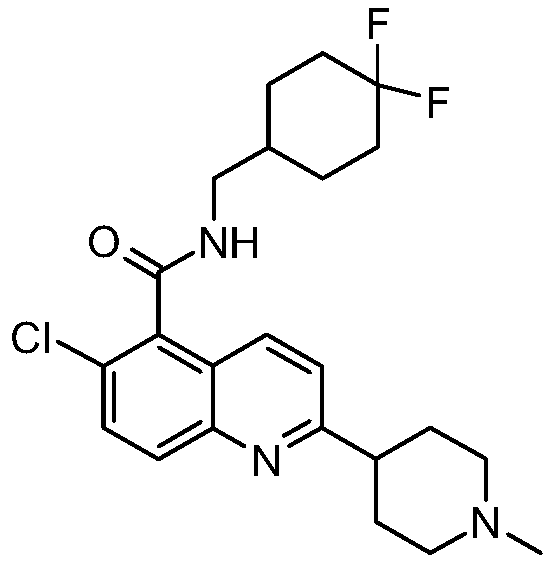
步骤1. 6-氯-2-(1-甲基-1,2,3,6-四氢-吡啶-4-基)-喹啉-5-羧酸(4,4-二氟环己基甲基)-酰胺Step 1. 6-Chloro-2-(1-methyl-1,2,3,6-tetrahydro-pyridin-4-yl)-quinoline-5-carboxylic acid (4,4-difluorocyclohexylmethyl) base)-amide

将2,6-二氯-喹啉-5-羧酸(4,4-二氟-环己基甲基)-酰胺(150mg,0.37mmol,1.00eq)在1,4- 二噁烷(4.00mL,26.67V)和水(0.50mL,3.33V)中的悬液脱氮气15分钟,然后加入1-甲基-1,2,3,6-四氢吡啶-4-硼酸频哪醇酯(101.25mg,0.44mmol,1.20eq)、碳酸铯(362.17mg, 1.10mmol,3.00eq)和[1,1'-双(二苯磷)二茂铁二氯化钯(II)二氯甲烷络合物(30.15mg,0.04 mmol,0.10eq),反应混合物放入压力试管中,在100℃加热5小时。通过TLC监测到反应完成,将反应混合物冷却至室温,用硅藻土过滤,乙酸乙酯洗涤,滤液在减压下浓缩,获得粗化合物。该粗化合物经柱色谱法纯化,获得标题化合物(90mg,0.17mmol,47.5%),为深褐色固体。m/z:434.2[M+H]+。2,6-Dichloro-quinoline-5-carboxylic acid (4,4-difluoro-cyclohexylmethyl)-amide (150 mg, 0.37 mmol, 1.00 eq) in 1,4-dioxane (4.00 mL) , 26.67V) and water (0.50mL, 3.33V) were denitrogenated for 15 minutes, then 1-methyl-1,2,3,6-tetrahydropyridine-4-boronic acid pinacol ester ( 101.25mg, 0.44mmol, 1.20eq), cesium carbonate (362.17mg, 1.10mmol, 3.00eq) and [1,1'-bis(diphenylphosphonium)ferrocene palladium(II) dichloromethane complex Compound (30.15 mg, 0.04 mmol, 0.10 eq), the reaction mixture was placed in a pressure test tube and heated at 100 °C for 5 hours. Completion of the reaction was monitored by TLC, the reaction mixture was cooled to room temperature, filtered through celite, washed with ethyl acetate, and the filtrate was concentrated under reduced pressure to obtain the crude compound. The crude compound was purified by column chromatography to give the title compound (90 mg, 0.17 mmol, 47.5%) as a dark brown solid. m/z: 434.2 [M+H] + .
步骤2. 6-氯-2-(1-甲基-哌啶-4-基)-喹啉-5-羧酸(4,4-二氟-环己基甲基)-酰胺Step 2. 6-Chloro-2-(1-methyl-piperidin-4-yl)-quinoline-5-carboxylic acid (4,4-difluoro-cyclohexylmethyl)-amide

采用6-氯-2-(1-甲基-1,2,3,6-四氢-吡啶-4-基)-喹啉-5-羧酸(4,4-二氟-环己基甲基)-酰胺、钯/炭和三乙基硅烷,依据实施例126的程序合成标题化合物。1H NMR(400MHz,DMSO-d6) δ8.80(t,J=5.81Hz,1H),8.05(d,J=8.72Hz,1H),7.98(d,J=9.01Hz,1H),7.78(d, J=9.01Hz,1H),7.61(d,J=8.71Hz,1H),3.27(t,J=6.21Hz,4H),3.04(S,1H),2.69 (S,2H),2.58(S,3H),2.03(S,6H),1.74-1.86(m,5H),1.22-1.33(m,2H)。m/z:436.0[M+ H]+。6-Chloro-2-(1-methyl-1,2,3,6-tetrahydro-pyridin-4-yl)-quinoline-5-carboxylic acid (4,4-difluoro-cyclohexylmethyl )-amide, palladium/carbon and triethylsilane, the title compound was synthesized according to the procedure of Example 126. 1 H NMR (400 MHz, DMSO-d 6 ) δ 8.80 (t, J=5.81 Hz, 1H), 8.05 (d, J=8.72 Hz, 1H), 7.98 (d, J=9.01 Hz, 1H), 7.78 (d, J=9.01Hz, 1H), 7.61 (d, J=8.71Hz, 1H), 3.27 (t, J=6.21Hz, 4H), 3.04 (S, 1H), 2.69 (S, 2H), 2.58 (S, 3H), 2.03 (S, 6H), 1.74-1.86 (m, 5H), 1.22-1.33 (m, 2H). m/z: 436.0[M+H] + .
实施例145. 6-氯-2-(1-异丙基-哌啶-4-基)-喹啉-5-羧酸(4,4-二氟-环己基甲基)-酰胺(159)Example 145. 6-Chloro-2-(1-isopropyl-piperidin-4-yl)-quinoline-5-carboxylic acid (4,4-difluoro-cyclohexylmethyl)-amide (159)

步骤1. 6-氯-2-(1-异丙基-1,2,3,6-四氢-吡啶-4-基)-喹啉-5-羧酸(4,4-二氟-环己基甲基)- 酰胺Step 1. 6-Chloro-2-(1-isopropyl-1,2,3,6-tetrahydro-pyridin-4-yl)-quinoline-5-carboxylic acid (4,4-difluoro-cyclic Hexylmethyl)-amide

边搅拌边向6-氯-2-(1,2,3,6-四氢-吡啶-4-基)-喹啉-5-羧酸(4,4-二氟环己基甲基)-酰胺 (150.00mg,0.33mmol,1.00eq)在1,2-二氯乙烷(5.00mL,33.33V)中的溶液加入丙酮(0.05 mL,0.66mmol,2.00eq)和冰醋酸(0.04mL,0.66mmol,2.00eq),反应混合物在室温搅拌 1小时,然后冷却至0℃。加入氰基硼氢化钠(43.54mg,0.66mmol,2.00eq),室温搅拌16 小时。除去溶剂,粗产物经快速柱色谱法纯化,获得6-氯-2-(1-异丙基-1,2,3,6-四氢-吡啶-4- 基)-喹啉-5-羧酸(4,4-二氟-环己基甲基)-酰胺(100.00mg,0.21mmol,62.5%,浅黄色固体)。1H NMR(400MHz,DMSO-d6)δppm:8.83(t,J=6.03Hz,1H),8.00-7.96(m,3H),7.76 (d,J=9.02Hz,1H),6.91(S,1H),3.27(t,J=6.12Hz,4H),2.70-2.65(m,4H),2.04-2.02 (m,2H),1.86-1.74(m,5H),1.33-1.17(m,2H),1.05(br S,6H)。m/z:462.3[M+H]+。To 6-chloro-2-(1,2,3,6-tetrahydro-pyridin-4-yl)-quinoline-5-carboxylic acid (4,4-difluorocyclohexylmethyl)-amide with stirring (150.00 mg, 0.33 mmol, 1.00 eq) in 1,2-dichloroethane (5.00 mL, 33.33 V) was added acetone (0.05 mL, 0.66 mmol, 2.00 eq) and glacial acetic acid (0.04 mL, 0.66 mmol) , 2.00 eq), the reaction mixture was stirred at room temperature for 1 hour, then cooled to 0 °C. Sodium cyanoborohydride (43.54 mg, 0.66 mmol, 2.00 eq) was added, and the mixture was stirred at room temperature for 16 hours. The solvent was removed and the crude product was purified by flash column chromatography to give 6-chloro-2-(1-isopropyl-1,2,3,6-tetrahydro-pyridin-4-yl)-quinoline-5-carboxylate Acid (4,4-Difluoro-cyclohexylmethyl)-amide (100.00 mg, 0.21 mmol, 62.5%, pale yellow solid). 1 H NMR (400 MHz, DMSO-d 6 ) δppm: 8.83 (t, J=6.03 Hz, 1H), 8.00-7.96 (m, 3H), 7.76 (d, J=9.02 Hz, 1H), 6.91 (S, 1H), 3.27 (t, J=6.12Hz, 4H), 2.70-2.65 (m, 4H), 2.04-2.02 (m, 2H), 1.86-1.74 (m, 5H), 1.33-1.17 (m, 2H) , 1.05 (br S, 6H). m/z: 462.3[M+H] + .
步骤2. 6-氯-2-(1-异丙基-哌啶-4-基)-喹啉-5-羧酸(4,4-二氟-环己基甲基)-酰胺Step 2. 6-Chloro-2-(1-isopropyl-piperidin-4-yl)-quinoline-5-carboxylic acid (4,4-difluoro-cyclohexylmethyl)-amide

采用6-氯-2-(1-异丙基-1,2,3,6-四氢-吡啶-4-基)-喹啉-5-羧酸(4,4-二氟-环己基甲基)-酰胺、钯/炭和三乙基硅烷,依据实施例126的程序合成标题化合物。1H NMR(400MHz,DMSO-d6) δppm:8.79(t,J=5.92Hz,1H),8.01(d,J=8.71Hz,1H),7.97(dd,J=0.5,9.02Hz, 1H),7.76(d,J=9.02Hz,1H),7.60(d,J=8.81Hz,1H),3.27(t,J=6.23Hz,2H), 2.91(d,J=7.61Hz,3H),2.82(S,1H),2.25(S,2H),2.03(d,J=9.4Hz,2H),1.86-1.74(m, 9H),1.30-1.24(m,2H),1.00(d,J=5.8Hz,6H)。m/z:464.20[M+H]+。6-Chloro-2-(1-isopropyl-1,2,3,6-tetrahydro-pyridin-4-yl)-quinoline-5-carboxylic acid (4,4-difluoro-cyclohexylmethyl) base)-amide, palladium on carbon and triethylsilane, and the title compound was synthesized according to the procedure of Example 126. 1 H NMR (400 MHz, DMSO-d 6 ) δppm: 8.79 (t, J=5.92 Hz, 1H), 8.01 (d, J=8.71 Hz, 1H), 7.97 (dd, J=0.5, 9.02 Hz, 1H) , 7.76(d, J=9.02Hz, 1H), 7.60(d, J=8.81Hz, 1H), 3.27(t, J=6.23Hz, 2H), 2.91(d, J=7.61Hz, 3H), 2.82 (S, 1H), 2.25 (S, 2H), 2.03 (d, J=9.4Hz, 2H), 1.86-1.74 (m, 9H), 1.30-1.24 (m, 2H), 1.00 (d, J=5.8 Hz, 6H). m/z: 464.20 [M+H] + .
实施例146Example 146
IL-1β释放试验:通过ATP激活P2X7,导致细胞快速瞬时激活,获得Ca2+内流,随后将前IL-1β转化为活性IL-1β。通过夹心ELISA检测在THP-1细胞培养基中释放出来的成熟IL-1β,以测量P2X7化合物的功能活性。将细胞维持在完全生长培养基(RPMI 1640+ 10%HI-FCS+2mM L-谷氨酰胺+1×PS)中。每三天将细胞稀释1/3至1/4,更新培养基,细胞密度不超过50万个细胞/ml(接种细胞密度为1×105个细胞/ml)。以100g离心细胞3 分钟,从50ml烧瓶中收获THP-1细胞。将细胞重悬于用0.5μM PMA补充的培养基中,悬液的细胞密度为2x10⁵个细胞/ml,并孵育。将细胞洗涤,并重悬于用10ng/ml LPS补充的培养基中,悬液的细胞密度为1.5×10⁵个细胞/ml,并将细胞在37℃、5%CO2下引发4小时。在加入20μL预稀释的测试化合物、空白试剂、标准试剂和对照试剂后,将细胞在37℃下再孵育20分钟,并用0.8mM BzATP刺激30分钟。将细胞离心,收集上清液,并使用双重性人IL-1b试剂盒根据制造商的说明检测成熟IL-1β是否存在。四氢苯并二氮杂
孔渗透试验Pore penetration test
用人P2X7受体转染HEK293,测量转染后的HEK293中的YO PRO荧光染料被细胞摄取的数量,藉此测定由激动剂诱导所形成的孔。使用HQTase试剂从T75cm烧瓶中分离细胞,收获过表达人P2X7的HEK293细胞。将收获的细胞在室温下以1200rpm离心5分钟。通过Trypan蓝染料确定细胞的存活力,并将50ul体积的细胞以10,000个细胞/孔接种在384W BD聚赖氨酸涂覆的孔板中,在37℃下孵育过夜。孵育过夜后,用35ul/孔试验缓冲液(5mM KCl,0.1mMCaCl2,5mM葡萄糖,含有125mM NaCl的10mM HEPES缓冲液pH7.4) 替换培养基。使用Bravo液体处理仪器将化合物进行一系列稀释,使用Bravo将化合物加入到细胞试验孔板中,开始浓度是2.5uM,三次稀释10点(three dilutions for 10points)。将阳性对照抑制剂化合物加入第23行。孔板在板振荡器上缓慢摇动10秒。细胞与化合物在室温下孵育20分钟。孵育期后,将YO PRO染料(1uM)与BzATP(10uM)一起以10ul/孔加入到细胞中。将孔板以1000rpm离心5秒,并在室温下温育30分钟。使用Envision荧光板读数仪器(Perkin Elmer)测量进入细胞的YO PRO染料摄取量。HEK293 was transfected with the human P2X7 receptor, and the amount of YO PRO fluorescent dye in the transfected HEK293 was measured by cells, thereby determining the formation of pores induced by the agonist. HEK293 cells overexpressing human P2X7 were harvested by detaching cells from T75cm flasks using HQTase reagent. Harvested cells were centrifuged at 1200 rpm for 5 minutes at room temperature. Cell viability was determined by Trypan blue dye and cells were seeded in 384W BD polylysine-coated well plates at 10,000 cells/well in 50ul volumes and incubated overnight at 37°C. After overnight incubation, the medium was replaced with 35 ul/well assay buffer (5 mM KCl, 0.1 mM CaCl 2, 5 mM glucose, 10 mM HEPES buffer pH 7.4 containing 125 mM NaCl). Compounds were serially diluted using a Bravo liquid handling apparatus and added to cell assay well plates using a Bravo starting at 2.5uM with three dilutions for 10points. A positive control inhibitor compound was added to row 23. The plate was shaken slowly for 10 seconds on a plate shaker. Cells were incubated with compound for 20 minutes at room temperature. After the incubation period, YO PRO dye (1 uM) was added to the cells at 10 ul/well along with BzATP (10 uM). The plate was centrifuged at 1000 rpm for 5 seconds and incubated at room temperature for 30 minutes. YO PRO dye uptake into cells was measured using an Envision fluorescence plate reader (Perkin Elmer).
按照以下定义理解数据:Data is understood by the following definitions:


实施例147Example 147
药物制剂pharmaceutical preparation
(A)注射液瓶:将100g本发明化合物作为活性成分与5g磷酸二氢钠在3L再蒸馏水中的溶液用2N盐酸调它的pH至6.5,无菌过滤,转移到注射瓶中,无菌条件下冻干,并在无菌条件下密封。每个注射液瓶含有5mg活性成分。(A) Injection bottle: use 100 g of the compound of the present invention as an active ingredient and a solution of 5 g of sodium dihydrogen phosphate in 3 L of re-distilled water to adjust its pH to 6.5 with 2N hydrochloric acid, sterile filter, transfer to an injection bottle, sterile Lyophilized under sterile conditions. Each injection vial contains 5 mg of active ingredient.
(B)栓剂:将20g本发明化合物作为活性成分与100g大豆卵磷脂和1400g可可油混合,倒入模中,冷却。每片栓剂含20mg活性成分。(B) Suppository: 20 g of the present compound as an active ingredient was mixed with 100 g of soybean lecithin and 1400 g of cocoa butter, poured into a mold, and cooled. Each suppository contains 20 mg of active ingredient.
(C)溶液制剂:由1g作为活性成分的本发明化合物、9.38g NaH2PO4·2H2O、28.48gNa2HPO4·12H2O和0.1g苯扎氯铵在940mL再蒸馏水中制成一种溶液。将该溶液的pH调至6.8,再将该溶液配至1L,放射灭菌。该溶液以眼药水形式使用。(C) Solution formulation: prepared from 1 g of the compound of the present invention as an active ingredient, 9.38 g NaH 2 PO 4 ·2H 2 O, 28.48 g Na 2 HPO 4 ·12H 2 O and 0.1 g benzalkonium chloride in 940 mL of redistilled water a solution. The pH of the solution was adjusted to 6.8, and the solution was made up to 1 L and sterilized by radiation. This solution is used in the form of eye drops.
(D)软膏:在无菌条件下将500mg本发明化合物作为活性成分与99.5g凡士林混合。(D) Ointment: Mix 500 mg of the compound of the present invention as an active ingredient with 99.5 g of petrolatum under sterile conditions.
(E)片剂:将1kg本发明化合物作为活性成分、4kg乳糖、1.2kg马铃薯粉、0.2kg滑石和0.1kg硬脂酸镁按照常规方法压成片剂,以致于每片含10mg活性成分。(E) Tablets: 1 kg of the present compound as active ingredient, 4 kg of lactose, 1.2 kg of potato flour, 0.2 kg of talc and 0.1 kg of magnesium stearate were compressed into tablets by conventional methods so that each tablet contained 10 mg of active ingredient.
(F)包衣片剂:类似实施例E压成片剂,然后按照常规方法用蔗糖包衣、马铃薯粉、滑石、黄芪胶和染料来包衣片剂。(F) Coated tablets: Compressed into tablets analogously to Example E, the tablets were then coated with a sucrose coating, potato flour, talc, tragacanth and dyes in a conventional manner.
(G)胶囊剂:将2kg本发明化合物作为活性成分按照常规方法导入硬胶囊中,以致于每个胶囊含20mg活性成分。(G) Capsules: 2 kg of the present compound as an active ingredient were introduced into hard capsules according to a conventional method so that each capsule contained 20 mg of the active ingredient.
(H)安瓿剂:将1kg本发明化合物作为活性成分在60L再蒸馏水中的溶液无菌过滤,转移到安瓿中,无菌条件下冻干,并在无菌条件下密封。每个安瓿含有10mg活性成分。(H) Ampoule preparation: Aseptically filter a solution of 1 kg of the compound of the present invention as an active ingredient in 60 L of redistilled water, transfer to an ampoule, lyophilize under aseptic conditions, and seal under aseptic conditions. Each ampoule contains 10 mg of active ingredient.
(I)吸入喷雾剂:将14g本发明化合物作为活性成分溶解在10L等渗氯化钠溶液中,将该溶液转移至商业可买到的带泵机构的喷雾容器中。可将溶液喷入嘴或鼻内。一次喷射(约0.1ml)相当于一剂约0.14mg。(I) Inhalation spray: 14 g of the compound of the present invention as the active ingredient was dissolved in 10 L of isotonic sodium chloride solution, and the solution was transferred to a commercially available spray container with a pump mechanism. The solution can be sprayed into the mouth or nose. One injection (about 0.1 ml) corresponds to one dose of about 0.14 mg.
尽管此处描述了本发明的许多实施例,但显然采用本发明的化合物和方法可以改变基本实施例,从而提供其他实施例。因此,应当理解,本发明的范围由所附的权利要求书而非以示例方式提供的具体实施例限定。While many embodiments of the present invention are described herein, it will be apparent that other embodiments may be provided by altering the basic embodiments using the compounds and methods of the present invention. Therefore, it is to be understood that the scope of the present invention is to be defined by the appended claims rather than the specific embodiments provided by way of example.
Claims (6)


Applications Claiming Priority (3)
| Application Number | Priority Date | Filing Date | Title |
|---|---|---|---|
| US201462008012P | 2014-06-05 | 2014-06-05 | |
| US62/008,012 | 2014-06-05 | ||
| PCT/US2015/034108 WO2015187905A1 (en) | 2014-06-05 | 2015-06-04 | Novel quinoline derivatives and their use in neurodegenerative diseases |
Publications (2)
| Publication Number | Publication Date |
|---|---|
| CN106573907A CN106573907A (en) | 2017-04-19 |
| CN106573907B true CN106573907B (en) | 2020-09-08 |
Family
ID=53385999
Family Applications (1)
| Application Number | Title | Priority Date | Filing Date |
|---|---|---|---|
| CN201580041824.6A Expired - Fee Related CN106573907B (en) | 2014-06-05 | 2015-06-04 | Quinoline derivatives and their use for neurodegenerative diseases |
Country Status (9)
| Country | Link |
|---|---|
| US (2) | US9399623B2 (en) |
| EP (1) | EP3152192A1 (en) |
| JP (1) | JP6692759B2 (en) |
| CN (1) | CN106573907B (en) |
| AR (1) | AR100724A1 (en) |
| AU (1) | AU2015269598B2 (en) |
| CA (1) | CA2948888A1 (en) |
| IL (1) | IL249308B (en) |
| WO (1) | WO2015187905A1 (en) |
Families Citing this family (8)
| Publication number | Priority date | Publication date | Assignee | Title |
|---|---|---|---|---|
| US8563573B2 (en) | 2007-11-02 | 2013-10-22 | Vertex Pharmaceuticals Incorporated | Azaindole derivatives as CFTR modulators |
| US8802868B2 (en) | 2010-03-25 | 2014-08-12 | Vertex Pharmaceuticals Incorporated | Solid forms of (R)-1(2,2-difluorobenzo[D][1,3]dioxo1-5-yl)-N-(1-(2,3-dihydroxypropyl-6-fluoro-2-(1-hydroxy-2-methylpropan2-yl)-1H-Indol-5-yl)-Cyclopropanecarboxamide |
| MX2012012204A (en) | 2010-04-22 | 2012-12-05 | Vertex Pharma | Process of producing cycloalkylcarboxamido-indole compounds. |
| DK3925607T3 (en) | 2014-04-15 | 2023-08-21 | Vertex Pharma | PHARMACEUTICAL COMPOSITIONS FOR THE TREATMENT OF CYSTIC FIBROSIS TRANS MEMBRANE BRANCH CONDUCTANCE REGULATOR-MEDIATED DISEASES |
| AR100724A1 (en) * | 2014-06-05 | 2016-10-26 | Merck Patent Gmbh | DERIVATIVES OF QUINOLINA AND ITS USE IN NEURODEGENERATIVE DISEASES |
| FI3609868T3 (en) * | 2017-03-13 | 2023-11-22 | Raqualia Pharma Inc | Tetrahydroquinoline derivatives as P2X7 receptor antagonists |
| BR112021005082A2 (en) | 2018-09-18 | 2021-06-08 | Nikang Therapeutics, Inc. | fused tricyclic ring derivatives as src homology-2 phosphatase inhibitors |
| WO2025180517A1 (en) * | 2024-03-01 | 2025-09-04 | 武汉人福创新药物研发中心有限公司 | Sf5-containing quinoline derivatives and use thereof as p2x7 antagonists |
Citations (7)
| Publication number | Priority date | Publication date | Assignee | Title |
|---|---|---|---|---|
| WO2003080579A1 (en) * | 2002-03-25 | 2003-10-02 | Astrazeneca Ab | Novel adamantane derivatives |
| CN1829694A (en) * | 2003-07-28 | 2006-09-06 | 阿斯利康(瑞典)有限公司 | Quinoline derivatives and their use in therapy |
| CN1832925A (en) * | 2003-06-02 | 2006-09-13 | 阿斯利康(瑞典)有限公司 | New p2x7 receptor avtagonists and their use |
| CN101111488A (en) * | 2004-11-30 | 2008-01-23 | 阿斯利康(瑞典)有限公司 | new compound |
| WO2008013494A1 (en) * | 2006-07-27 | 2008-01-31 | Astrazeneca Ab | Quinoline derivatives as p2x7 receptor antagonist and their use in the treatment of rheumatoid arthritis, osteoarthritis, copd and ibd |
| WO2009070116A1 (en) * | 2007-11-30 | 2009-06-04 | Astrazeneca Ab | A quinoline derivative acting as a p2x7-receptor antagonist |
| WO2009132000A1 (en) * | 2008-04-22 | 2009-10-29 | Janssen Pharmaceutica Nv | Quinoline or isoquinoline substituted p2x7 antagonists |
Family Cites Families (4)
| Publication number | Priority date | Publication date | Assignee | Title |
|---|---|---|---|---|
| AU2001278006A1 (en) | 2000-07-27 | 2002-02-13 | Smithkline Beecham Corporation | Agonists of follicle stimulating hormone activity |
| ES2576643T3 (en) * | 2007-03-09 | 2016-07-08 | Second Genome, Inc. | Bicycloheteroaryl compounds as modulators of P2X7 and uses thereof |
| MX2009010059A (en) * | 2007-03-22 | 2009-10-12 | Astrazeneca Ab | Quinoline derivatives for the treatment of inflammatory diseases. |
| AR100724A1 (en) * | 2014-06-05 | 2016-10-26 | Merck Patent Gmbh | DERIVATIVES OF QUINOLINA AND ITS USE IN NEURODEGENERATIVE DISEASES |
-
2015
- 2015-06-04 AR ARP150101761A patent/AR100724A1/en unknown
- 2015-06-04 WO PCT/US2015/034108 patent/WO2015187905A1/en not_active Ceased
- 2015-06-04 EP EP15728739.2A patent/EP3152192A1/en not_active Withdrawn
- 2015-06-04 US US14/730,351 patent/US9399623B2/en not_active Expired - Fee Related
- 2015-06-04 CA CA2948888A patent/CA2948888A1/en not_active Abandoned
- 2015-06-04 JP JP2016571149A patent/JP6692759B2/en not_active Expired - Fee Related
- 2015-06-04 AU AU2015269598A patent/AU2015269598B2/en not_active Ceased
- 2015-06-04 CN CN201580041824.6A patent/CN106573907B/en not_active Expired - Fee Related
-
2016
- 2016-06-21 US US15/188,301 patent/US20160296509A1/en not_active Abandoned
- 2016-11-30 IL IL249308A patent/IL249308B/en active IP Right Grant
Patent Citations (8)
| Publication number | Priority date | Publication date | Assignee | Title |
|---|---|---|---|---|
| WO2003080579A1 (en) * | 2002-03-25 | 2003-10-02 | Astrazeneca Ab | Novel adamantane derivatives |
| CN1832925A (en) * | 2003-06-02 | 2006-09-13 | 阿斯利康(瑞典)有限公司 | New p2x7 receptor avtagonists and their use |
| CN1829694A (en) * | 2003-07-28 | 2006-09-06 | 阿斯利康(瑞典)有限公司 | Quinoline derivatives and their use in therapy |
| CN101111488A (en) * | 2004-11-30 | 2008-01-23 | 阿斯利康(瑞典)有限公司 | new compound |
| WO2008013494A1 (en) * | 2006-07-27 | 2008-01-31 | Astrazeneca Ab | Quinoline derivatives as p2x7 receptor antagonist and their use in the treatment of rheumatoid arthritis, osteoarthritis, copd and ibd |
| WO2009070116A1 (en) * | 2007-11-30 | 2009-06-04 | Astrazeneca Ab | A quinoline derivative acting as a p2x7-receptor antagonist |
| WO2009132000A1 (en) * | 2008-04-22 | 2009-10-29 | Janssen Pharmaceutica Nv | Quinoline or isoquinoline substituted p2x7 antagonists |
| CN102066360A (en) * | 2008-04-22 | 2011-05-18 | 詹森药业有限公司 | Quinoline or isoquinoline substituted P2X7 antagonists |
Non-Patent Citations (1)
| Title |
|---|
| Simon D. Guile et al..Antagonists of the P2X 7 Receptor. From Lead Identification to Drug Development.《 Journal of Medicinal Chemistry》.2009,第52卷(第10期),3123-3141. * |
Also Published As
| Publication number | Publication date |
|---|---|
| AR100724A1 (en) | 2016-10-26 |
| IL249308A0 (en) | 2017-02-28 |
| US20150353497A1 (en) | 2015-12-10 |
| WO2015187905A1 (en) | 2015-12-10 |
| IL249308B (en) | 2020-02-27 |
| CN106573907A (en) | 2017-04-19 |
| AU2015269598A1 (en) | 2016-11-24 |
| EP3152192A1 (en) | 2017-04-12 |
| US20160296509A1 (en) | 2016-10-13 |
| JP2017520538A (en) | 2017-07-27 |
| JP6692759B2 (en) | 2020-05-13 |
| AU2015269598B2 (en) | 2019-11-14 |
| CA2948888A1 (en) | 2015-12-10 |
| US9399623B2 (en) | 2016-07-26 |
Similar Documents
| Publication | Publication Date | Title |
|---|---|---|
| CN106573907B (en) | Quinoline derivatives and their use for neurodegenerative diseases | |
| CN107001356B (en) | Indolizine derivatives for neurodegenerative diseases | |
| TWI846690B (en) | Heteroaryl compounds as type ii irak inhibitors and uses thereof | |
| AU2018302026A1 (en) | TLR7/8 antagonists and uses thereof | |
| US10676433B2 (en) | Indole derivatives and their use in neurodegenerative diseases | |
| WO2007039578A1 (en) | Imidazolyl-substituted azabenzophenone compounds | |
| CN120025283B (en) | Amide compound and application thereof | |
| HK1240592A1 (en) | Indolizine derivatives which are applicable to neurodegenerative diseases | |
| HK1244786B (en) | Indole and azaindoles derivatives and their use in neurodegenerative diseases | |
| HK1246287A1 (en) | Pyridazinone macrocycles as irak inhibitors and uses thereof |
Legal Events
| Date | Code | Title | Description |
|---|---|---|---|
| PB01 | Publication | ||
| PB01 | Publication | ||
| SE01 | Entry into force of request for substantive examination | ||
| SE01 | Entry into force of request for substantive examination | ||
| GR01 | Patent grant | ||
| GR01 | Patent grant | ||
| CF01 | Termination of patent right due to non-payment of annual fee |
Granted publication date: 20200908 Termination date: 20210604 |
|
| CF01 | Termination of patent right due to non-payment of annual fee |