CN106573062B - Apoptosis inducer - Google Patents
Apoptosis inducer Download PDFInfo
- Publication number
- CN106573062B CN106573062B CN201580032443.1A CN201580032443A CN106573062B CN 106573062 B CN106573062 B CN 106573062B CN 201580032443 A CN201580032443 A CN 201580032443A CN 106573062 B CN106573062 B CN 106573062B
- Authority
- CN
- China
- Prior art keywords
- drug
- gst
- cancer
- rb1cc1
- inhibits
- Prior art date
- Legal status (The legal status is an assumption and is not a legal conclusion. Google has not performed a legal analysis and makes no representation as to the accuracy of the status listed.)
- Active
Links
Images


Classifications
-
- A—HUMAN NECESSITIES
- A61—MEDICAL OR VETERINARY SCIENCE; HYGIENE
- A61K—PREPARATIONS FOR MEDICAL, DENTAL OR TOILETRY PURPOSES
- A61K31/00—Medicinal preparations containing organic active ingredients
- A61K31/70—Carbohydrates; Sugars; Derivatives thereof
- A61K31/7088—Compounds having three or more nucleosides or nucleotides
- A61K31/713—Double-stranded nucleic acids or oligonucleotides
-
- C—CHEMISTRY; METALLURGY
- C12—BIOCHEMISTRY; BEER; SPIRITS; WINE; VINEGAR; MICROBIOLOGY; ENZYMOLOGY; MUTATION OR GENETIC ENGINEERING
- C12N—MICROORGANISMS OR ENZYMES; COMPOSITIONS THEREOF; PROPAGATING, PRESERVING, OR MAINTAINING MICROORGANISMS; MUTATION OR GENETIC ENGINEERING; CULTURE MEDIA
- C12N15/00—Mutation or genetic engineering; DNA or RNA concerning genetic engineering, vectors, e.g. plasmids, or their isolation, preparation or purification; Use of hosts therefor
- C12N15/09—Recombinant DNA-technology
- C12N15/11—DNA or RNA fragments; Modified forms thereof; Non-coding nucleic acids having a biological activity
- C12N15/113—Non-coding nucleic acids modulating the expression of genes, e.g. antisense oligonucleotides; Antisense DNA or RNA; Triplex- forming oligonucleotides; Catalytic nucleic acids, e.g. ribozymes; Nucleic acids used in co-suppression or gene silencing
- C12N15/1137—Non-coding nucleic acids modulating the expression of genes, e.g. antisense oligonucleotides; Antisense DNA or RNA; Triplex- forming oligonucleotides; Catalytic nucleic acids, e.g. ribozymes; Nucleic acids used in co-suppression or gene silencing against enzymes
-
- A—HUMAN NECESSITIES
- A61—MEDICAL OR VETERINARY SCIENCE; HYGIENE
- A61K—PREPARATIONS FOR MEDICAL, DENTAL OR TOILETRY PURPOSES
- A61K31/00—Medicinal preparations containing organic active ingredients
- A61K31/70—Carbohydrates; Sugars; Derivatives thereof
- A61K31/7088—Compounds having three or more nucleosides or nucleotides
-
- A—HUMAN NECESSITIES
- A61—MEDICAL OR VETERINARY SCIENCE; HYGIENE
- A61K—PREPARATIONS FOR MEDICAL, DENTAL OR TOILETRY PURPOSES
- A61K31/00—Medicinal preparations containing organic active ingredients
- A61K31/70—Carbohydrates; Sugars; Derivatives thereof
- A61K31/7088—Compounds having three or more nucleosides or nucleotides
- A61K31/7105—Natural ribonucleic acids, i.e. containing only riboses attached to adenine, guanine, cytosine or uracil and having 3'-5' phosphodiester links
-
- A—HUMAN NECESSITIES
- A61—MEDICAL OR VETERINARY SCIENCE; HYGIENE
- A61K—PREPARATIONS FOR MEDICAL, DENTAL OR TOILETRY PURPOSES
- A61K35/00—Medicinal preparations containing materials or reaction products thereof with undetermined constitution
- A61K35/66—Microorganisms or materials therefrom
- A61K35/76—Viruses; Subviral particles; Bacteriophages
-
- A—HUMAN NECESSITIES
- A61—MEDICAL OR VETERINARY SCIENCE; HYGIENE
- A61K—PREPARATIONS FOR MEDICAL, DENTAL OR TOILETRY PURPOSES
- A61K45/00—Medicinal preparations containing active ingredients not provided for in groups A61K31/00 - A61K41/00
- A61K45/06—Mixtures of active ingredients without chemical characterisation, e.g. antiphlogistics and cardiaca
-
- A—HUMAN NECESSITIES
- A61—MEDICAL OR VETERINARY SCIENCE; HYGIENE
- A61K—PREPARATIONS FOR MEDICAL, DENTAL OR TOILETRY PURPOSES
- A61K48/00—Medicinal preparations containing genetic material which is inserted into cells of the living body to treat genetic diseases; Gene therapy
-
- A—HUMAN NECESSITIES
- A61—MEDICAL OR VETERINARY SCIENCE; HYGIENE
- A61P—SPECIFIC THERAPEUTIC ACTIVITY OF CHEMICAL COMPOUNDS OR MEDICINAL PREPARATIONS
- A61P35/00—Antineoplastic agents
-
- A—HUMAN NECESSITIES
- A61—MEDICAL OR VETERINARY SCIENCE; HYGIENE
- A61P—SPECIFIC THERAPEUTIC ACTIVITY OF CHEMICAL COMPOUNDS OR MEDICINAL PREPARATIONS
- A61P35/00—Antineoplastic agents
- A61P35/02—Antineoplastic agents specific for leukemia
-
- A—HUMAN NECESSITIES
- A61—MEDICAL OR VETERINARY SCIENCE; HYGIENE
- A61P—SPECIFIC THERAPEUTIC ACTIVITY OF CHEMICAL COMPOUNDS OR MEDICINAL PREPARATIONS
- A61P43/00—Drugs for specific purposes, not provided for in groups A61P1/00-A61P41/00
-
- C—CHEMISTRY; METALLURGY
- C12—BIOCHEMISTRY; BEER; SPIRITS; WINE; VINEGAR; MICROBIOLOGY; ENZYMOLOGY; MUTATION OR GENETIC ENGINEERING
- C12N—MICROORGANISMS OR ENZYMES; COMPOSITIONS THEREOF; PROPAGATING, PRESERVING, OR MAINTAINING MICROORGANISMS; MUTATION OR GENETIC ENGINEERING; CULTURE MEDIA
- C12N15/00—Mutation or genetic engineering; DNA or RNA concerning genetic engineering, vectors, e.g. plasmids, or their isolation, preparation or purification; Use of hosts therefor
- C12N15/09—Recombinant DNA-technology
- C12N15/11—DNA or RNA fragments; Modified forms thereof; Non-coding nucleic acids having a biological activity
- C12N15/113—Non-coding nucleic acids modulating the expression of genes, e.g. antisense oligonucleotides; Antisense DNA or RNA; Triplex- forming oligonucleotides; Catalytic nucleic acids, e.g. ribozymes; Nucleic acids used in co-suppression or gene silencing
-
- C—CHEMISTRY; METALLURGY
- C12—BIOCHEMISTRY; BEER; SPIRITS; WINE; VINEGAR; MICROBIOLOGY; ENZYMOLOGY; MUTATION OR GENETIC ENGINEERING
- C12N—MICROORGANISMS OR ENZYMES; COMPOSITIONS THEREOF; PROPAGATING, PRESERVING, OR MAINTAINING MICROORGANISMS; MUTATION OR GENETIC ENGINEERING; CULTURE MEDIA
- C12N2310/00—Structure or type of the nucleic acid
- C12N2310/10—Type of nucleic acid
- C12N2310/14—Type of nucleic acid interfering nucleic acids [NA]
-
- C—CHEMISTRY; METALLURGY
- C12—BIOCHEMISTRY; BEER; SPIRITS; WINE; VINEGAR; MICROBIOLOGY; ENZYMOLOGY; MUTATION OR GENETIC ENGINEERING
- C12N—MICROORGANISMS OR ENZYMES; COMPOSITIONS THEREOF; PROPAGATING, PRESERVING, OR MAINTAINING MICROORGANISMS; MUTATION OR GENETIC ENGINEERING; CULTURE MEDIA
- C12N2320/00—Applications; Uses
- C12N2320/30—Special therapeutic applications
- C12N2320/31—Combination therapy
Landscapes
- Health & Medical Sciences (AREA)
- Life Sciences & Earth Sciences (AREA)
- Chemical & Material Sciences (AREA)
- General Health & Medical Sciences (AREA)
- Veterinary Medicine (AREA)
- Medicinal Chemistry (AREA)
- Pharmacology & Pharmacy (AREA)
- Public Health (AREA)
- Animal Behavior & Ethology (AREA)
- Molecular Biology (AREA)
- Engineering & Computer Science (AREA)
- Epidemiology (AREA)
- Genetics & Genomics (AREA)
- Organic Chemistry (AREA)
- Biomedical Technology (AREA)
- Biotechnology (AREA)
- Biochemistry (AREA)
- Bioinformatics & Cheminformatics (AREA)
- Zoology (AREA)
- Wood Science & Technology (AREA)
- General Engineering & Computer Science (AREA)
- Microbiology (AREA)
- Virology (AREA)
- General Chemical & Material Sciences (AREA)
- Nuclear Medicine, Radiotherapy & Molecular Imaging (AREA)
- Chemical Kinetics & Catalysis (AREA)
- Physics & Mathematics (AREA)
- Biophysics (AREA)
- Plant Pathology (AREA)
- Mycology (AREA)
- Hematology (AREA)
- Oncology (AREA)
- Pharmaceuticals Containing Other Organic And Inorganic Compounds (AREA)
- Medicines That Contain Protein Lipid Enzymes And Other Medicines (AREA)
Abstract
本发明的目的在于提供用于在细胞中有效地诱导细胞凋亡和/或增殖抑制的组合物及使用该组合物的方法。本发明涉及用于诱导细胞凋亡的药剂、含有该药剂的医药组合物、使用了该药剂的伴随着细胞凋亡的异常的疾病的处置方法等,所述药剂含有抑制GST‑π的药物和抑制RB1CC1的药物作为活性成分。An object of the present invention is to provide compositions for effectively inducing apoptosis and/or proliferation inhibition in cells and methods of using the compositions. The present invention relates to a drug for inducing apoptosis, a pharmaceutical composition containing the drug, a method for treating abnormal diseases accompanied by apoptosis using the drug, and the like, the drug containing a drug for inhibiting GST-π and Drugs that inhibit RB1CC1 as active ingredients.
Description
技术领域technical field
本发明涉及新型的细胞凋亡诱导剂、细胞增殖抑制剂、自噬抑制剂、含有该细胞凋亡诱导剂、细胞增殖抑制剂或自噬抑制剂的医药组合物、以及伴随着细胞凋亡、细胞增殖或自噬的异常的疾病的新型治疗方法等。The present invention relates to novel apoptosis-inducing agents, cell proliferation inhibitors, autophagy inhibitors, pharmaceutical compositions containing the apoptosis-inducing agents, cell proliferation inhibitors or autophagy inhibitors, and cell apoptosis-inducing agents, cell proliferation inhibitors or autophagy inhibitors. Novel treatments for diseases with abnormal cell proliferation or autophagy, etc.
背景技术Background technique
癌是人类所面对的最重要且最难对付的疾病之一,为了对其进行治疗进行了大量的研究努力。癌是由于基因的突变或表基因的异常等而使细胞失去控制地进行增殖的疾病。关于癌的基因异常已有很多报告(例如非专利文献1等),其中很多被认为和与细胞的增殖、分化、生存相关的信号传递有某些关联。另外,由于这样的基因异常,由正常分子构成的细胞内的信号传递发生异常,由此导致特定的信号级联的活化或灭活,最终有时会成为引起细胞异常增殖的一个因素。初期的癌治疗主要着眼于对细胞增殖本身的抑制,但由于该治疗也抑制生理性地正常增殖的细胞的增殖,因此会伴随着脱发、消化系统疾病、骨髄抑制等副作用。因此,为了抑制所述副作用,基于以癌特有的基因异常或信号传递异常为靶的分子靶向药等的新想法的癌治疗药的开发不断进展。Cancer is one of the most important and difficult diseases facing human beings, and a great deal of research efforts have been made to treat it. Cancer is a disease in which cells proliferate out of control due to gene mutation or epigenetic abnormality. There are many reports on gene abnormalities of cancer (for example,
作为癌特有的基因异常,已熟知KRAS(V-Ki-ras2Kirsten rat sarcoma viraloncogene homolog,V-Ki-ras2Kirsten大鼠肉瘤病毒致癌基因同源物)的异常。KRAS是位于EGFR(Epidermal growth factor receptor,表皮生长因子受体)、PDGFR(Platelet-derived growth factor receptor,血小板衍生生长因子受体)等酪氨酸激酶型受体的下游的低分子量GTP结合蛋白(也称为低分子量G蛋白),其担负着将来自这些受体的与增殖、分化相关的信号向下游的MAPK(Mitogen-activated protein kinase,丝裂原活化蛋白激酶)级联传递的作用。正常的KRAS通过配体的结合在被活化的受体的酪氨酸激酶活性作用下介由Grb2(Growth factor receptor-bound protein 2,生长因子受体结合蛋白2)及SOS(Son of sevenless,鸟苷酸交换因子)而被活化,将Raf(Rapidly acceleratedfibrosarcoma,迅速加速纤维肉瘤)等的MAPK磷酸化而驱动MAPK级联,但突变型KRAS即使没有来自受体的刺激也恒定性地活化,持续传递增殖信号。考虑因此而发生异常的细胞增殖。An abnormality of KRAS (V-Ki-ras2Kirsten rat sarcoma viraloncogene homolog, V-Ki-ras2Kirsten rat sarcoma virus oncogene homolog) is known as a gene abnormality specific to cancer. KRAS is a low-molecular-weight GTP-binding protein located downstream of tyrosine kinase-type receptors such as EGFR (Epidermal growth factor receptor) and PDGFR (Platelet-derived growth factor receptor). Also referred to as low molecular weight G protein), it is responsible for transmitting signals related to proliferation and differentiation from these receptors to the downstream MAPK (Mitogen-activated protein kinase, mitogen-activated protein kinase) cascade. Normal KRAS is mediated by Grb2 (Growth factor receptor-bound
作为催化谷胱甘肽结合的酶之一的谷胱甘肽-S-转移酶(GST)、特别是GST-π(glutathione S-transferase pi,谷胱甘肽-S-转移酶π,也称为GSTP1)的表达在各种癌细胞中增加,表明其可能是对部分抗癌剂产生抗性的一个原因。实际上已知,当使针对GST-π的反义DNA或GST-π抑制剂作用于过量表达GST-π并显示药物抗性的癌细胞系时,药剂抗性得到抑制(非专利文献2~4)。此外,最近的报告中报告了,当使针对GST-π的siRNA作用于过量表达GST-π的雄激素非依赖性前列腺癌细胞系时,其增殖得到抑制、细胞凋亡增加(非专利文献5)。另外还报告了,当使针对GST-π的siRNA作用于KRAS存在突变的癌细胞系时,Akt的活化得到抑制且自噬增加,但细胞凋亡的诱导为中等程度(非专利文献6),专利文献1中记载了一种凋亡诱导剂等,其含有抑制GST-π的药物和抑制自噬的药物作为活性成分。As one of the enzymes that catalyze glutathione binding, glutathione-S-transferase (GST), especially GST-π (glutathione S-transferase pi, glutathione-S-transferase pi, also known as The expression of GSTP1) is increased in various cancer cells, suggesting that it may be a cause of resistance to some anticancer agents. In fact, it is known that drug resistance is suppressed when antisense DNA against GST-π or a GST-π inhibitor is acted on a cancer cell line that overexpresses GST-π and exhibits drug resistance (Non-Patent Document 2- 4). In addition, a recent report reported that when siRNA against GST-π was applied to an androgen-independent prostate cancer cell line overexpressing GST-π, its proliferation was inhibited and apoptosis was increased (Non-Patent Document 5). ). It was also reported that, when siRNA against GST-π was applied to a cancer cell line having a KRAS mutation, activation of Akt was inhibited and autophagy was increased, but apoptosis was induced to a moderate degree (Non-Patent Document 6).
但是,关于GST-π与细胞增殖或细胞凋亡之间的关系、GST-π的分子机理、GST-π在各种细胞内信号传递中的作用等还几乎未弄清楚。细胞内的信号传递极其复杂,不仅常有1种分子影响多种分子的作用、或相反1种分子受到多种分子的影响的情况,而且常有即使抑制了某种分子的作用,其它的信号级联也活化,从而无法获得期望效果的情况。因此,为了开发更为优异的分子靶向药,需要弄清楚复杂地交织在一起的细胞的信号传递机理,但是尽管经过了多年研究也不过弄清楚了其中的极小一部分,因此还需要进一步的研究努力。However, the relationship between GST-π and cell proliferation or apoptosis, the molecular mechanism of GST-π, the role of GST-π in various intracellular signal transmission, and the like have not been clarified. Signal transmission in cells is extremely complex. Not only is there often a case where one molecule affects the action of multiple molecules, or on the contrary, one molecule is affected by multiple molecules, but even if the action of a certain molecule is inhibited, other signals are often affected. Cascade is also activated, so that the desired effect cannot be obtained. Therefore, in order to develop more excellent molecularly targeted drugs, it is necessary to clarify the signaling mechanism of cells that are intricately intertwined. However, despite years of research, only a very small part of them has been clarified, so further research is required. research effort.
现有技术文献prior art literature
专利文献Patent Literature
专利文献1:国际公开第2012/176282号Patent Document 1: International Publication No. 2012/176282
非专利文献Non-patent literature
非专利文献1:Futreal et al.,Nat Rev Cancer.2004;4(3):177-83Non-Patent Document 1: Futreal et al., Nat Rev Cancer. 2004; 4(3): 177-83
非专利文献2:Takahashi and Niitsu,Gan To Kagaku Ryoho.1994;21(7):945-51Non-Patent Document 2: Takahashi and Niitsu, Gan To Kagaku Ryoho. 1994;21(7):945-51
非专利文献3:Ban et al.,Cancer Res.1996;56(15):3577-82Non-Patent Document 3: Ban et al., Cancer Res. 1996;56(15):3577-82
非专利文献4:Nakajima et al.,J Pharmacol Exp Ther.2003;306(3):861-9Non-Patent Document 4: Nakajima et al., J Pharmacol Exp Ther. 2003; 306(3): 861-9
非专利文献5:Hokaiwado et al.,Carcinogenesis.2008;29(6):1134-8Non-Patent Document 5: Hokaiwado et al., Carcinogenesis. 2008;29(6):1134-8
非专利文献6:Nishita et al.,AACR 102nd Annual Meeting,Abstract No.1065Non-Patent Document 6: Nishita et al., AACR 102nd Annual Meeting, Abstract No. 1065
发明内容SUMMARY OF THE INVENTION
发明所要解决的课题The problem to be solved by the invention
本发明的目的在于提供用于在细胞中有效地诱导细胞凋亡和/或增殖抑制的组合物及使用该组合物的方法。An object of the present invention is to provide compositions for effectively inducing apoptosis and/or proliferation inhibition in cells and methods of using the compositions.
用于解决课题的方法methods for solving problems
本发明者们为了弄清楚GST-π的分子机理不断地进行刻苦研究,结果发现了当同时抑制细胞中GST-π的表达和RC1CC1(RB1-inducible coiled-coil protein1,RB1-诱导卷曲蛋白1)的表达时,与仅抑制两者中的任一者的表达时相比,细胞增殖被进一步强力抑制,并且进一步发现了通过同时抑制RB1CC1的表达,由GST-π的表达抑制诱导的自噬显著地得到抑制、细胞凋亡得到强力诱导,从而完成了本发明。The inventors of the present invention continued to study hard in order to clarify the molecular mechanism of GST-π, and as a result, they found that when the expression of GST-π and RC1CC1 (RB1-inducible coiled-
即本发明涉及以下内容。That is, the present invention relates to the following.
(1)一种用于诱导细胞凋亡的药剂,其含有抑制GST-π的药物和抑制RB1CC1的药物作为活性成分。(1) An agent for inducing apoptosis, which contains a drug that inhibits GST-π and a drug that inhibits RB1CC1 as active ingredients.
(2)一种用于抑制细胞增殖的药剂,其含有抑制GST-π的药物和抑制RB1CC1的药物作为活性成分。(2) An agent for inhibiting cell proliferation, which contains a drug that inhibits GST-π and a drug that inhibits RB1CC1 as active ingredients.
(3)一种用于在GST-π得到抑制的细胞中抑制自噬的药剂,其含有抑制RB1CC1的药物作为活性成分。(3) An agent for inhibiting autophagy in GST-π-inhibited cells, which contains a drug that inhibits RB1CC1 as an active ingredient.
(4)一种用于增强由抑制GST-π的药物引起的细胞凋亡的诱导和/或细胞增殖的抑制的药剂,其含有抑制RB1CC1的药物作为活性成分。(4) An agent for enhancing induction of apoptosis and/or inhibition of cell proliferation by a drug that inhibits GST-π, which contains a drug that inhibits RB1CC1 as an active ingredient.
(5)根据(1)~(4)中任一项所述的药剂,其中,活性成分选自由RNAi分子、核酶、反义核酸、DNA/RNA嵌合多核苷酸及表达它们的载体组成的组。(5) The agent according to any one of (1) to (4), wherein the active ingredient is selected from the group consisting of RNAi molecules, ribozymes, antisense nucleic acids, DNA/RNA chimeric polynucleotides, and vectors expressing them group.
(6)一种医药组合物,其含有(1)~(5)中任一项所述的药剂。(6) A pharmaceutical composition containing the drug according to any one of (1) to (5).
(7)根据(6)所述的医药组合物,其为细胞的异常增殖引起的疾病的治疗用。(7) The pharmaceutical composition according to (6), which is for the treatment of diseases caused by abnormal cell proliferation.
(8)根据(6)所述的医药组合物,其为癌治疗用。(8) The pharmaceutical composition according to (6), which is for cancer treatment.
发明效果Invention effect
由于本发明的细胞凋亡诱导剂与以往的药剂相比能够更有效地诱导细胞凋亡、抑制细胞增殖,因此作为医药组合物是极其有用的。特别是在癌的治疗中,由于能够通过细胞凋亡杀死癌细胞,因此不仅可期待阻止癌发展的效果,而且可期待使癌退缩的效果。Since the apoptosis-inducing agent of the present invention can induce apoptosis and inhibit cell proliferation more effectively than conventional drugs, it is extremely useful as a pharmaceutical composition. Especially in the treatment of cancer, since cancer cells can be killed by apoptosis, not only the effect of preventing the development of cancer, but also the effect of regressing the cancer can be expected.
附图说明Description of drawings
图1为表示各种癌细胞中的GST-π和/或RB1CC1的敲减产生的细胞增殖抑制效果的图。FIG. 1 is a graph showing the cell growth inhibitory effect of GST-π and/or RB1CC1 knockdown in various cancer cells.
图2为表示MDA-MB-231细胞中的GST-π和/或RB1CC1的敲减产生的细胞增殖抑制效果的图。FIG. 2 is a graph showing the cell growth inhibitory effect of GST-π and/or RB1CC1 knockdown in MDA-MB-231 cells.
图3为表示M7609细胞中的GST-π或GST-π+RB1CC1的敲减产生的细胞增殖抑制效果的图。Fig. 3 is a graph showing the cell growth inhibitory effect of GST-π or GST-π+RB1CC1 knockdown in M7609 cells.
图4为表示MIA PaCa-2细胞中由GST-π的敲减产生的自噬得到诱导的图。Fig. 4 is a graph showing induction of autophagy by knockdown of GST-π in MIA PaCa-2 cells.
图5为表示将用对照siRNA处理过的MIA PaCa-2细胞用针对LC3B的抗体进行免疫染色而得到的结果的照片图。Fig. 5 is a photograph showing the results of immunostaining MIA PaCa-2 cells treated with control siRNA with an antibody against LC3B.
图6为表示将用GST-πsiRNA处理过的MIAPaCa-2细胞用针对LC3B的抗体进行免疫染色而得到的结果的图。FIG. 6 is a diagram showing the results of immunostaining MIAPaCa-2 cells treated with GST-π siRNA with an antibody against LC3B.
图7为表示将用GST-πsiRNA和RB1CC1siRNA这两者处理过的MIA PaCa-2细胞用针对LC3B的抗体进行免疫染色而得到的结果的图。FIG. 7 is a diagram showing the results of immunostaining MIA PaCa-2 cells treated with both GST-π siRNA and RB1CC1 siRNA with an antibody against LC3B.
图8为表示用各种siRNA处理过的MIA PaCa-2细胞中的开裂了的caspase-3的检测结果的图。Fig. 8 is a graph showing the detection results of cleaved caspase-3 in MIA PaCa-2 cells treated with various siRNAs.
具体实施方式Detailed ways
本发明涉及用于抑制细胞增殖的药剂或组合物(以下也称为“细胞增殖抑制剂”或“细胞增殖抑制用组合物”)及用于诱导细胞凋亡的药剂或组合物(以下也称为“细胞凋亡诱导剂”或“细胞凋亡诱导组合物”),它们含有抑制GST-π的药物和抑制RB1CC1的药物作为活性成分。The present invention relates to an agent or composition for inhibiting cell proliferation (hereinafter also referred to as "cell proliferation inhibitor" or "composition for inhibiting cell proliferation") and an agent or composition for inducing apoptosis (hereinafter also referred to as "cell proliferation inhibiting composition") "apoptosis-inducing agent" or "apoptosis-inducing composition"), they contain a drug that inhibits GST-π and a drug that inhibits RB1CC1 as active ingredients.
GST-π是由GSTP1基因编码的对谷胱甘肽结合(glutathione conjugation)进行催化的酶。GST-π存在于包括人在内的各种动物,其序列信息也是公知的(例如人:NP_000843(NM_000852)、大鼠:NP_036709(NM_012577)、小鼠:NP_038569(NM_013541)等。编号表示NCBI数据库的登录号,括号外为氨基酸序列的编号、括号内为碱基序列的编号)。GST-π is an enzyme encoded by the GSTP1 gene that catalyzes glutathione conjugation. GST-π exists in various animals including humans, and its sequence information is also known (for example, human: NP_000843 (NM_000852), rat: NP_036709 (NM_012577), mouse: NP_038569 (NM_013541), etc. The numbers indicate the NCBI database The accession number of , the numbering of the amino acid sequence outside the brackets, and the numbering of the base sequence in the brackets).
RB1CC1已知是由RB1CC1基因编码的蛋白,其诱导癌抑制基因RB1(retinoblastoma1)的表达(Chano et al.,Oncogene.2002;21(8):1295-8)。RB1CC1存在于包括人在内的各种动物,其序列信息也是公知的(例如,人:BAB69690(AB059622)、大鼠:NP_001101371(NM_001107901)、小鼠:NP_033956(NM_009826)等。编号表示NCBI数据库的登录号,括号外为氨基酸序列的编号、括号内为碱基序列的编号)。RB1CC1 is known to be a protein encoded by the RB1CC1 gene, which induces the expression of the cancer suppressor gene RB1 (retinoblastoma1) (Chano et al., Oncogene. 2002; 21(8): 1295-8). RB1CC1 exists in various animals including humans, and its sequence information is also known (for example, human: BAB69690 (AB059622), rat: NP_001101371 (NM_001107901), mouse: NP_033956 (NM_009826), etc. The numbers indicate the NCBI database Accession number, outside the parentheses is the number of the amino acid sequence, inside the parenthesis is the number of the base sequence).
由于生物个体间有可能发生不影响蛋白的生理学功能的基因序列或氨基酸序列的突变,因此本发明中的GST-π或GSTP1基因、或者RB1CC1或RB1CC1基因并不限于与公知序列具有相同序列的蛋白或核酸,可具有相对于该序列有1个或2个以上、典型地有1个或数个、例如1个、2个、3个、4个、5个、6个、7个、8个、9个或10个不同的氨基酸或碱基的序列,另外可以包含与上述公知的GST-π或RB1CC1具有同等功能的序列。关于GST-π及RB1CC1的具体功能,如后所述。Since mutations in gene sequences or amino acid sequences that do not affect the physiological functions of proteins may occur between living organisms, the GST-π or GSTP1 gene, or the RB1CC1 or RB1CC1 gene in the present invention is not limited to proteins having the same sequence as a known sequence. or nucleic acid, may have 1 or 2 or more, typically 1 or more, such as 1, 2, 3, 4, 5, 6, 7, 8, relative to the sequence , 9 or 10 different amino acid or base sequences, and may also include sequences having functions equivalent to the above-mentioned known GST-π or RB1CC1. Specific functions of GST-π and RB1CC1 will be described later.
需要说明的是,本说明书中,“在本说明书中使用的情况下”、“本说明书中使用的”、“本说明书中”、“本说明书中记载的”等表述只要没有特别说明,则表示其后的记载适用于本说明书中记载的全部发明。另外,只要没有另外地定义,本说明书中使用的全部技术用语及科学用语具有与本领域技术人员通常理解的相同的含义。本说明书中参照的全部专利、公报及其它出版物它们整体引用到本说明书中。It should be noted that, in this specification, expressions such as "when used in this specification", "used in this specification", "in this specification", "described in this specification", etc., mean unless otherwise specified. The following descriptions apply to all inventions described in this specification. In addition, unless otherwise defined, all technical terms and scientific terms used in the present specification have the same meaning as commonly understood by those skilled in the art. All patents, gazettes, and other publications referred to in this specification are incorporated herein by reference in their entirety.
对本说明书中使用的“抑制GST-π的药物”没有限定,例如包括抑制GST-π的产生和/或活性的药物、促进GST-π的分解和/或灭活的药物等。作为抑制GST-π的产生的药物,并不限定于此,可列举出例如针对编码GST-π的DNA的RNAi分子、核酶、反义核酸、DNA/RNA嵌合多核苷酸等抑制性核酸及表达它们的载体等。The "GST-π-inhibiting drug" used in the present specification is not limited, and includes, for example, drugs that inhibit the production and/or activity of GST-π, and drugs that promote the decomposition and/or inactivation of GST-π, and the like. Drugs that inhibit the production of GST-π are not limited to these, and examples thereof include inhibitory nucleic acids such as RNAi molecules, ribozymes, antisense nucleic acids, and DNA/RNA chimeric polynucleotides against DNA encoding GST-π. and vectors for their expression.
作为抑制GST-π的活性的药物,并不限定于此,可列举出例如与GST-π结合的物质、例如谷胱甘肽、谷胱甘肽类似物(例如WO95/08563、WO96/40205、WO99/54346、非专利文献4等中记载的物质)、酮洛芬(非专利文献2)、吲哚美辛(Hall et al.,Cancer Res.1989;49(22):6265-8)、依他尼酸、伊洛前列素(iloprost)(Tew et al.,Cancer Res.1988;48(13):3622-5)、抗GST-π抗体、GST-π的显性失活突变体等。这些药物可从市售获得,也可基于公知的技术适当制造。The drug that inhibits the activity of GST-π is not limited to this, and examples thereof include substances that bind to GST-π, such as glutathione and glutathione analogs (eg WO95/08563, WO96/40205, Substances described in WO99/54346, Non-Patent Document 4, etc.), ketoprofen (Non-Patent Document 2), indomethacin (Hall et al., Cancer Res. 1989; 49(22): 6265-8), Ethanic acid, iloprost (Tew et al., Cancer Res. 1988; 48(13): 3622-5), anti-GST-π antibody, dominant negative mutant of GST-π, etc. . These drugs are commercially available, and can be appropriately produced based on known techniques.
作为抑制GST-π的产生或活性的药物,从特异性高、副作用的可能性低出发,优选针对编码GST-π的DNA的RNAi分子、核酶、反义核酸、DNA/RNA嵌合多核苷酸等抑制性核酸及表达它们的载体。As a drug that inhibits the production or activity of GST-π, RNAi molecules, ribozymes, antisense nucleic acids, and DNA/RNA chimeric polynucleosides against DNA encoding GST-π are preferred from the viewpoint of high specificity and low possibility of side effects. Acid and other inhibitory nucleic acids and vectors for their expression.
GST-π的抑制可通过与不使GST-π抑制剂发挥作用时相比,细胞中GST-π的表达、活性受到抑制来确定。GST-π的表达可通过已知的任意方法来进行评价,没有限定,例如利用了抗GST-π抗体的免疫沉降法、EIA(enzyme immunoassay,酶免疫分析法)(例如ELISA(enzyme-linked immunosorbent assay,酶联免疫吸附法)等)、RIA(radioimmunoassay,放射免疫分析法)(例如IRMA(immunoradiometric assay,免疫放射分析法)、RAST(radioallergosorbent test,放射过敏原吸附试验)、RIST(radioimmunosorbent test,放射免疫吸附试验)等)、Western blotting法、免疫组化法、免疫细胞化学法、流式细胞法、利用了与编码GST-π的核酸或其独特的片段或该核酸的转录产物(例如mRNA)或剪接(splicing)产物特异性地杂交的核酸的、各种杂交反应法、Northern blot法、Southernblot法、各种PCR法等。Inhibition of GST-π can be determined by inhibiting the expression and activity of GST-π in cells compared to when the GST-π inhibitor is not allowed to act. The expression of GST-π can be evaluated by any known method without limitation, for example, immunoprecipitation using an anti-GST-π antibody, EIA (enzyme immunoassay) (for example, ELISA (enzyme-linked immunosorbent). assay, enzyme-linked immunosorbent assay), etc.), RIA (radioimmunoassay, radioimmunoassay) (such as IRMA (immunoradiometric assay, immunoradiometric assay), RAST (radioallergosorbent test, radioallergen adsorption test), RIST (radioimmunosorbent test, radioimmunoassay), etc.), Western blotting, immunohistochemistry, immunocytochemistry, flow cytometry, the use of nucleic acid encoding GST-π or its unique fragment or the transcription product of the nucleic acid (such as mRNA ) or a nucleic acid that specifically hybridizes to a splicing product, various hybridization reaction methods, Northern blot method, Southern blot method, various PCR methods, and the like.
另外,GST-π的活性可以通过采用已知的任意方法、例如免疫沉降法、Westernblotting法、质量分析法、拉下法(pull-down method)、表面等离体激元共振(SPR)法等对GST-π的已知活性、没有限定、例如与Raf-1(特别是磷酸化Raf-1)、EGFR(特别是磷酸化EGFR)等蛋白的结合性等进行分析来评价。In addition, the activity of GST-π can be determined by using any known method, such as immunoprecipitation method, Western blotting method, mass spectrometry method, pull-down method, surface plasmon resonance (SPR) method, etc. The known activity of GST-π, but not limited, for example, binding to proteins such as Raf-1 (particularly phosphorylated Raf-1), EGFR (particularly phosphorylated EGFR), etc. is analyzed and evaluated.
对本说明书中使用的“抑制RB1CC1的药物”没有限定,例如包括抑制RB1CC1的产生和/或活性的药物、促进RB1CC1的分解和/或灭活的药物等。作为抑制RB1CC1的产生的药物,并不限定于此,可列举出例如针对编码RB1CC1的DNA的RNAi分子、核酶、反义核酸、DNA/RNA嵌合多核苷酸等抑制性核酸及表达它们的载体等。The "drug that inhibits RB1CC1" used in the present specification is not limited, and includes, for example, a drug that inhibits the production and/or activity of RB1CC1, a drug that promotes the decomposition and/or inactivation of RB1CC1, and the like. Drugs that inhibit the production of RB1CC1 are not limited thereto, and examples thereof include RNAi molecules directed against DNA encoding RB1CC1, ribozymes, antisense nucleic acids, DNA/RNA chimeric polynucleotides, and other inhibitory nucleic acids, and those expressing them. carrier etc.
作为抑制RB1CC1的活性的药物,并不限定于此,可列举出例如抗RB1CC1抗体、RB1CC1的显性失活突变体等。这些药物可从市售获得,也可基于公知的技术适当制造。The drug that inhibits the activity of RB1CC1 is not limited to this, and examples thereof include anti-RB1CC1 antibodies, dominant-negative mutants of RB1CC1, and the like. These drugs are commercially available, and can be appropriately produced based on known techniques.
作为抑制RB1CC1的产生或活性的药物,从特异性高、副作用的可能性低出发,优选针对编码RB1CC1的DNA的RNAi分子、核酶、反义核酸、DNA/RNA嵌合多核苷酸等抑制性核酸及表达它们的载体。As a drug that inhibits the production or activity of RB1CC1, from the viewpoint of high specificity and low possibility of side effects, an inhibitory agent such as RNAi molecules, ribozymes, antisense nucleic acids, DNA/RNA chimeric polynucleotides against DNA encoding RB1CC1 is preferable Nucleic acids and vectors for their expression.
RB1CC1的抑制可通过与不使RB1CC1抑制剂发挥作用时相比,细胞中RB1CC1的表达、活性受到抑制来确定。RB1CC1的表达可通过已知的任意方法来进行评价,没有限定,例如利用了抗RB1CC1抗体的免疫沉降法、EIA(例如ELISA等)、RIA(例如,IRMA、RAST、RIST等)、Western blotting法、免疫组化法、免疫细胞化学法、流式细胞法、利用了与编码RB1CC1的核酸或其独特的片段或该核酸的转录产物(例如mRNA)或剪接(splicing)产物特异性地杂交的核酸的、各种杂交反应法、Northern blot法、Southern blot法、各种PCR法等。The inhibition of RB1CC1 can be determined by inhibiting the expression and activity of RB1CC1 in cells compared to when the RB1CC1 inhibitor does not act. The expression of RB1CC1 can be evaluated by any known method without limitation, such as immunoprecipitation using anti-RB1CC1 antibody, EIA (for example, ELISA, etc.), RIA (for example, IRMA, RAST, RIST, etc.), Western blotting method , immunohistochemistry, immunocytochemistry, flow cytometry, utilizing nucleic acids that specifically hybridize to a nucleic acid encoding RB1CC1 or a unique fragment thereof, or a transcription product (eg, mRNA) or splicing product of the nucleic acid Various hybridization reaction methods, Northern blot method, Southern blot method, various PCR methods, etc.
另外,RB1CC1的活性可以通过采用已知的任意方法对RB1CC1的已知活性、没有限定、例如RB1的诱导活性等进行分析来评价,没有限定,例如利用了RB1抗体的免疫沉降法、EIA(例如ELISA等)、RIA(例如IRMA、RAST、RIST等)、Western blotting法、免疫组化法、免疫细胞化学法、流式细胞法、利用了与编码RB1的核酸或其独特的片段或该核酸的转录产物(例如mRNA)或剪切产物特异性杂交的核酸的、各种杂交反应法、Northern blot法、Southern blot法、各种PCR法等。In addition, the activity of RB1CC1 can be evaluated by analyzing the known activity of RB1CC1 by any known method, not limited, for example, the induction activity of RB1, etc., not limited, for example, immunoprecipitation using RB1 antibody, EIA (for example, ELISA, etc.), RIA (e.g. IRMA, RAST, RIST, etc.), Western blotting, immunohistochemistry, immunocytochemistry, flow cytometry, using a nucleic acid encoding RB1 or a unique fragment thereof or an interaction with the nucleic acid. Various hybridization reaction methods, Northern blot methods, Southern blot methods, various PCR methods, etc., for nucleic acids to which transcription products (eg, mRNA) or cleavage products are specifically hybridized.
在本说明书中使用的情况下,RNAi分子是指引起RNA干扰的任意分子,没有限定,包括siRNA(small interfering RNA,小干扰RNA)、miRNA(micro RNA,微RNA)、shRNA(shorthairpin RNA,短发夹RNA)、ddRNA(DNA-directed RNA,DNA指导的RNA)、piRNA(Piwi-interacting RNA,与Piwi蛋白相作用的RNA)、rasiRNA(repeat associated siRNA,重复相关siRNA)等核酸分子及它们的突变体等。上述核酸分子(例如siRNA等)还可以包括经修饰或未经修饰的RNA、DNA、PNA或它们的复合物。这些RNAi分子可从市售获得,或基于公知的序列信息等进行设计、制作。As used in this specification, RNAi molecule refers to any molecule that causes RNA interference, without limitation, including siRNA (small interfering RNA, small interfering RNA), miRNA (micro RNA, micro RNA), shRNA (short hairpin RNA, short hairpin RNA) Nucleic acid molecules such as hairpin RNA), ddRNA (DNA-directed RNA, DNA-guided RNA), piRNA (Piwi-interacting RNA, RNA that interacts with Piwi protein), rasiRNA (repeat associated siRNA, repeat-related siRNA) and their mutants etc. The aforementioned nucleic acid molecules (eg, siRNA, etc.) may also include modified or unmodified RNA, DNA, PNA, or complexes thereof. These RNAi molecules are commercially available, or can be designed and produced based on known sequence information or the like.
另外,在本说明书中使用的情况下,反义核酸包括经修饰或未经修饰的RNA、DNA、PNA或它们的复合物。Additionally, as used in this specification, antisense nucleic acid includes modified or unmodified RNA, DNA, PNA, or complexes thereof.
在本说明书中使用的情况下,DNA/RNA嵌合多核苷酸没有限定,包括例如日本特开2003-219893中记载的由抑制靶基因表达的DNA和RNA构成的双链多核苷酸、或Park etal.,Nucleic Acids Symp Ser.1999;(42):225-6中记载的DNA/RNA嵌合寡核苷酸等。When used in the present specification, the DNA/RNA chimeric polynucleotide is not limited, and includes, for example, a double-stranded polynucleotide composed of DNA and RNA that inhibits the expression of a target gene described in Japanese Patent Laid-Open No. 2003-219893, or a Park et al., Nucleic Acids Symp Ser. 1999; (42): 225-6 DNA/RNA chimeric oligonucleotides, etc.
抑制GST-π的药物和抑制RB1CC1的药物可以包含在单一制剂中,也可以分别包含在2个以上的制剂中。后者的情况下,各制剂可同时给予,也可以隔开时间间隔地给予。在隔开时间间隔地给予的情况下,可以将含有抑制GST-π的药物的制剂在含有抑制RB1CC1的药物的制剂之前给予,也可以在之后给予。The drug that inhibits GST-π and the drug that inhibits RB1CC1 may be contained in a single preparation, or may be contained in two or more preparations, respectively. In the latter case, the respective preparations may be administered at the same time, or may be administered at time intervals. In the case of administration at intervals, the formulation containing the drug that inhibits GST-π may be administered before or after the formulation containing the drug that inhibits RB1CC1.
本发明还涉及用于增强由抑制GST-π的药物引起的细胞凋亡的诱导和/或细胞增殖的抑制的药剂或组合物(以下也称为“细胞凋亡诱导增强剂”、“细胞增殖抑制增强”、“细胞凋亡诱导增强用组合物”或“细胞增殖抑制增强用组合物”),其含有抑制RB1CC1的药物作为活性成分。“增强”由抑制GST-π的药物引起的凋亡的诱导和/或细胞增殖的抑制是指与使抑制GST-π的药物作用于细胞时的凋亡的诱导和/或细胞增殖的抑制的程度相比,在抑制GST-π的药物之外还使该增强剂作用时使凋亡的诱导和/或细胞增殖的抑制的程度增大。The present invention also relates to an agent or composition for enhancing the induction of apoptosis and/or the inhibition of cell proliferation by a drug that inhibits GST-π (hereinafter also referred to as "apoptosis induction enhancer", "cell proliferation enhancer" Inhibition enhancement", "composition for enhancement of apoptosis induction" or "composition for enhancement of cell proliferation inhibition"), which contains a drug that inhibits RB1CC1 as an active ingredient. "Enhancing" induction of apoptosis and/or inhibition of cell proliferation by a drug that inhibits GST-π means induction of apoptosis and/or inhibition of cell proliferation when a drug that inhibits GST-π acts on cells When the enhancer acts in addition to the drug that inhibits GST-π, the degree of induction of apoptosis and/or inhibition of cell proliferation is increased.
作为增大的程度,没有限定,可列举出例如当使用抑制GST-π的药物和上述增强剂时,将产生相同效果的抑制GST-π的药物的用量与仅用该药物时相比,降低约1.25倍以上、约1.5倍以上、约1.75倍以上、约2倍以上、约2.5倍以上、约3倍以上、约4倍以上、约5倍以上、约6倍以上、约8倍以上、约10倍以上、约20倍以上、约25倍以上、约50倍以上或约100倍以上的程度(这里,例如将用量降低约2倍以上是指,使用量为约1/2以下);在凋亡诱导的情况下,当将仅使抑制GST-π的药物作用时的凋亡诱导率记为x(%)时,使抑制GST-π的药物和上述增强剂作用时的凋亡诱导率(例如检测到细胞凋亡的诱导的细胞与所检查的全部细胞的比例等)与x相比,可以增大100-x的约5%以上、约10%以上、约15%以上、约20%以上、约25%以上、约30%以上、约40%以上、约50%以上、约60%以上、约70%以上、约80%以上、约90%以上、约95%以上、约99%以上或100%的程度;在细胞增殖抑制的情况下,可以将使抑制GST-π的药物和上述增强剂作用时的规定时间培养后的细胞数与仅使抑制GST-π的药物作用时的规定时间培养后的细胞数相比,可以降低约5%以上、约10%以上、约15%以上、约20%以上、约25%以上、约30%以上、约40%以上、约50%以上、约60%以上、约70%以上、约80%以上、约90%以上、约95%以上或100%的程度(这里,例如细胞数降低约5%以上是指当将仅使抑制GST-π的药物作用时的规定时间培养后的细胞数记为y个时,使细胞数为y-(y×0.05)个以下)等。The degree of increase is not limited. For example, when a GST-π-inhibiting drug and the above-mentioned enhancer are used, the amount of the GST-π-inhibiting drug that produces the same effect is reduced compared to when only the drug is used. More than about 1.25 times, more than about 1.5 times, more than about 1.75 times, more than about 2 times, more than about 2.5 times, more than about 3 times, more than about 4 times, more than about 5 times, more than about 6 times, more than about 8 times, About 10 times or more, about 20 times or more, about 25 times or more, about 50 times or more, or about 100 times or more (here, for example, reducing the dosage by about 2 times or more means that the usage amount is about 1/2 or less); In the case of apoptosis induction, the apoptosis induction rate when only the GST-π inhibitory drug acts as x (%), the apoptosis induction when the GST-π inhibitory drug and the above-mentioned enhancer act. The rate (for example, the ratio of induced apoptosis-inducing cells to all cells examined, etc.) can be increased by about 5% or more, about 10% or more, about 15% or more, about 100-x compared to x. 20% or more, about 25% or more, about 30% or more, about 40% or more, about 50% or more, about 60% or more, about 70% or more, about 80% or more, about 90% or more, about 95% or more, about 99% or more or 100%; in the case of inhibition of cell proliferation, the number of cells after incubation for a predetermined period of time when the drug that inhibits GST-π and the above-mentioned enhancer acts can be compared with the drug that inhibits GST-π only. It can be reduced by about 5% or more, about 10% or more, about 15% or more, about 20% or more, about 25% or more, about 30% or more, about 40% or more, about 50% or more, about 60% or more, about 70% or more, about 80% or more, about 90% or more, about 95% or more, or 100% or more (here, for example, a decrease in the number of cells by about 5% or more means that when only When the number of cells after culturing for a predetermined period of time when the drug action of GST-π is inhibited is denoted as y, the number of cells is set to be y−(y×0.05) or less).
关于本发明的药剂或组合物中的活性成分的配合量,可以是当给予药剂或组合物时细胞凋亡得到诱导和/或细胞增殖得到抑制的量。另外,优选为不产生超过给予所带来的好处的不良影响的量。所述量可以是公知的,或者可以通过使用了培养细胞等的体外试验、或通过在小鼠、大鼠、狗或猪等动物模型中进行的试验来适当确定,这样的试验方法是本领域技术人员熟知的。细胞凋亡的诱导可通过各种已知的方法、例如检测DNA片段化、膜联蛋白V在细胞膜上的结合、线粒体膜电位的变化、胱天蛋白酶的活化等细胞凋亡特有的现象、或通过TUNEL染色等来进行评价。另外,细胞增殖的抑制可通过各种已知的方法、例如经时性的活细胞数的计数、肿瘤的大小、体积或重量的测定、DNA合成量的测定、WST-1法、BrdU(溴脱氧尿苷)法、3H胸腺嘧啶脱氧核苷摄入法等来进行评价。活性成分的配合量可以根据药剂或组合物的给药方式的不同而变化。例如,当1次给予使用几个单位的组合物时,组合物1个单位中配合的有效成分的量可以为1次给予所需要的有效成分的量的几分之一。所述配合量的调整是本领域技术人员能够适当进行的。The compounding amount of the active ingredient in the agent or composition of the present invention may be an amount in which apoptosis is induced and/or cell proliferation is inhibited when the agent or composition is administered. In addition, it is preferably an amount that does not produce adverse effects that exceed the benefits of administration. The amount may be known, or may be appropriately determined by in vitro tests using cultured cells, etc., or by tests in animal models such as mice, rats, dogs, or pigs, and such test methods are well known in the art. well known to the skilled person. Apoptosis can be induced by various known methods, such as detection of DNA fragmentation, binding of annexin V to the cell membrane, changes in mitochondrial membrane potential, activation of caspases, and other phenomena specific to apoptosis, or Evaluation is performed by TUNEL staining or the like. In addition, cell proliferation can be inhibited by various known methods, such as counting the number of viable cells over time, measuring the size, volume or weight of a tumor, measuring the amount of DNA synthesis, the WST-1 method, BrdU (bromine) Deoxyuridine) method, 3 H thymidine uptake method, etc. were used for evaluation. The compounding amount of the active ingredient may vary depending on the administration method of the medicament or composition. For example, when several units of the composition are used for one administration, the amount of the active ingredient compounded in one unit of the composition may be a fraction of the amount of the active ingredient required for one administration. The adjustment of the compounding amount can be appropriately performed by those skilled in the art.
本发明还涉及:制造用于诱导细胞凋亡或抑制细胞增殖的药剂或组合物的方法,其包含将抑制GST-π的药物和抑制RB1CC1的药物作为活性成分进行配合;抑制GST-π的药物和抑制RB1CC1的药物在制造用于诱导细胞凋亡或抑制细胞增殖的药剂或组合物中的用途;细胞凋亡的诱导或细胞增殖的抑制中使用的抑制GST-π的药物与抑制RB1CC1的药物的组合;以及,诱导细胞凋亡或抑制细胞增殖的方法,其包含给予有效量的抑制GST-π的药物和抑制RB1CC1的药物。The present invention also relates to: a method for producing a medicament or composition for inducing apoptosis or inhibiting cell proliferation, which comprises compounding a drug for inhibiting GST-π and a drug for inhibiting RB1CC1 as active ingredients; the drug for inhibiting GST-π and the use of a drug that inhibits RB1CC1 in the manufacture of a medicament or composition for inducing apoptosis or inhibiting cell proliferation; a drug that inhibits GST-π and a drug that inhibits RB1CC1 for inducing apoptosis or inhibiting cell proliferation and, a method for inducing apoptosis or inhibiting cell proliferation, comprising administering an effective amount of a drug that inhibits GST-π and a drug that inhibits RB1CC1.
本发明还涉及:制造用于在GST-π得到抑制的细胞中诱导凋亡的药剂或组合物的方法,其包含将抑制RB1CC1的药物作为活性成分进行配合;抑制RB1CC1的药物在制造用于在GST-π得到抑制的细胞中诱导凋亡的药剂或组合物中的用途;在GST-π得到抑制的细胞中诱导凋亡的方法,其包含给予GST-π被抑制的细胞中的用于细胞凋亡的诱导的抑制RB1CC1的药物、以及有效量的抑制RB1CC1的药物。The present invention also relates to: a method for producing a drug or a composition for inducing apoptosis in GST-π-inhibited cells, comprising compounding a drug that inhibits RB1CC1 as an active ingredient; the drug that inhibits RB1CC1 is used in the production of Use in an agent or composition for inducing apoptosis in a cell in which GST-π is inhibited; a method for inducing apoptosis in a cell in which GST-π is inhibited, comprising administering to a cell in which GST-π is inhibited Apoptosis-inducing drugs that inhibit RB1CC1, and an effective amount of drugs that inhibit RB1CC1.
关于上述制造方法或用途中的药物和/或其配合量如已在上文所述的。各药物的配合可以按照已知的任意方法来进行。The drug and/or the compounding amount thereof in the above-mentioned production method or use are as described above. The compounding of each drug can be carried out according to any known method.
上述细胞凋亡诱导或细胞增殖抑制方法均可以是体外的方法,也可以是体内的方法。为体内的方法时,可以将药物给予需要其的对象。另外,关于该方法中的药物如已在上文所述的,药物的有效量可以是在所给予的细胞中细胞凋亡得到诱导、或细胞增殖得到抑制的量。另外,优选不产生超过给予所带来的好处的不良影响的量。该量可以是公知的,或可以通过使用了培养细胞等的体外试验等来适当确定,这样的试验方法是本领域技术人员熟知的。细胞凋亡的诱导或细胞增殖的抑制可以通过包含上述方法在内的各种已知方法来进行评价。关于上述有效量,当将药物给予某细胞集团时,可以不必是导致该细胞集团的全部细胞发生细胞凋亡或增殖抑制的量。例如,上述有效量可以是引起细胞集团中的细胞的1%以上、2%以上、3%以上、4%以上、5%以上、6%以上、8%以上、10%以上、12%以上、15%以上、20%以上、进而25%以上等发生细胞凋亡或增殖抑制的量。The above-mentioned methods for inducing apoptosis or inhibiting cell proliferation may be in vitro or in vivo. In the case of an in vivo method, the drug can be administered to a subject in need thereof. Additionally, as already described above with respect to the drug in the method, an effective amount of the drug may be an amount that induces apoptosis, or inhibits cell proliferation, in the administered cells. In addition, it is preferable that the amount does not produce adverse effects that outweigh the benefits of administration. This amount may be known, or may be appropriately determined by in vitro tests using cultured cells or the like, and such test methods are well known to those skilled in the art. Induction of apoptosis or inhibition of cell proliferation can be evaluated by various known methods including those described above. With regard to the above-mentioned effective amount, when the drug is administered to a certain cell population, it does not necessarily have to be an amount that causes apoptosis or inhibition of proliferation of all cells in the cell population. For example, the above-mentioned effective amount may be 1% or more, 2% or more, 3% or more, 4% or more, 5% or more, 6% or more, 8% or more, 10% or more, 12% or more of the cells in the cell population. 15% or more, 20% or more, and furthermore, 25% or more, the amount of which apoptosis or proliferation inhibition occurs.
本发明的细胞凋亡诱导及细胞增殖抑制剂即使在细胞增殖存在异常的细胞等中也能够有效地诱导细胞凋亡或增殖抑制,作为医药组合物的成分是有效的。因此,本发明的一个方面包括含有本发明的细胞凋亡诱导剂或细胞增殖抑制剂的医药组合物。The apoptosis-inducing and cell-proliferating inhibitor of the present invention can effectively induce apoptosis or inhibit proliferation even in cells with abnormal cell proliferation, and is useful as a component of a pharmaceutical composition. Accordingly, one aspect of the present invention includes a pharmaceutical composition comprising the apoptosis-inducing agent or cell proliferation inhibitor of the present invention.
本发明的医药组合物在处置细胞凋亡存在异常的疾病方面特别有效。因此,本发明的一个方式涉及用于处置细胞凋亡存在异常的疾病的医药组合物,其含有上述细胞凋亡诱导剂。在本说明书中使用的情况下,关于细胞凋亡存在异常的疾病,并不限定于此,包括例如细胞的异常增殖所引起的疾病、KRAS的突变所引起的疾病、GST-π的过量表达所引起的疾病等。The pharmaceutical composition of the present invention is particularly effective in treating diseases in which apoptosis is abnormal. Therefore, one aspect of the present invention relates to a pharmaceutical composition for treating a disease in which apoptosis is abnormal, comprising the above-mentioned apoptosis-inducing agent. As used in the present specification, diseases with abnormal apoptosis are not limited to these, and include, for example, diseases caused by abnormal cell proliferation, diseases caused by KRAS mutation, and diseases caused by overexpression of GST-π. caused diseases, etc.
作为细胞的异常增殖所引起的疾病,没有限定,包括例如良性或恶性肿瘤、增生、瘢痕疙瘩、Cushing’s综合征、原发性醛固酮增多症、红斑症、真性红细胞增多症、白斑症、增生性瘢痕、扁平苔癣及着色斑病等。Diseases caused by abnormal proliferation of cells are not limited, and include, for example, benign or malignant tumors, hyperplasia, keloids, Cushing's syndrome, primary aldosteronism, erythema, polycythemia vera, vitiligo, hypertrophic scars , lichen planus and pigmented patch disease.
作为KRAS的突变所引起的疾病,没有限定,包括例如良性或恶性肿瘤(也称为癌、恶性新生物)等。作为KRAS的突变,没有限定,可列举出例如导致KRAS的恒定性活化的突变、例如抑制内因性GTPase的突变、增大鸟苷酸交换速度的突变等。所述突变的具体例子,没有限定,可列举出例如人KRAS中的第12、13和/或61位氨基酸中的突变(抑制内因性GTPase)或人KRAS中的第116和/或119位氨基酸中的突变(增大鸟苷酸交换速度)等(Bos,CancerRes.1989;49(17):4682-9、Levi et al.,Cancer Res.1991;51(13):3497-502)。The disease caused by the mutation of KRAS is not limited, and includes, for example, benign and malignant tumors (also referred to as cancer, malignant neoplasm) and the like. The mutation of KRAS is not limited, and examples thereof include mutations that cause constant activation of KRAS, mutations that inhibit intrinsic GTPase, and mutations that increase the rate of guanylate exchange. Specific examples of the mutation are not limited, and examples include mutations in amino acids 12, 13 and/or 61 in human KRAS (inhibiting intrinsic GTPase), and amino acids 116 and/or 119 in human KRAS. (Bos, Cancer Res. 1989; 49(17): 4682-9, Levi et al., Cancer Res. 1991; 51(13): 3497-502).
作为GST-π的过量表达所引起的疾病,没有限定,包括例如良性或恶性肿瘤、特别是药物抗性(例如对美法仑、环磷酰胺等烷化剂、阿霉素等蒽环类抗肿瘤性抗生素、顺铂等铂络合物、依托泊甙等产生抗性)的恶性肿瘤等。The disease caused by the overexpression of GST-π is not limited, and includes, for example, benign or malignant tumors, particularly drug resistance (for example, resistance to alkylating agents such as melphalan and cyclophosphamide, and anthracyclines such as doxorubicin). Tumor antibiotics, cisplatin and other platinum complexes, etoposide and other resistant) malignant tumors.
本发明的一个方式中,细胞凋亡存在异常的疾病为癌。作为本发明中的癌,没有限定,可列举出例如纤维肉瘤、恶性纤维组织细胞瘤、脂肪肉瘤、横纹肌肉瘤、平滑肌肉瘤、血管肉瘤、kaposi肉瘤、淋巴管肉瘤、滑膜肉瘤、软骨肉瘤、骨肉瘤等肉瘤、脑肿瘤、头颈部癌、乳腺癌、肺癌、食道癌、胃癌、十二指肠癌、阑尾癌、结肠癌、直肠癌、肝癌、胰腺癌、胆嚢癌、胆管癌、肛门癌、肾癌、输尿管癌、膀胱癌、前列腺癌、阴茎癌、睾丸癌、子宫癌、卵巢癌、外阴癌、阴道癌、皮肤癌等肿瘤、以及白血病、恶性淋巴瘤等。需要说明的是,本发明中,“癌”包括上皮性恶性肿瘤及非上皮性恶性肿瘤。本发明中的癌可存在于身体的任意部位,例如脑、头颈部、胸部、四肢、肺、心脏、胸腺、食道、胃、小肠(十二指肠、空肠、回肠)、大肠(结肠、盲肠、阑尾、直肠)、肝脏、胰脏、胆嚢、肛门、肾、输尿管、膀胱、前列腺、阴茎、睾丸、子宫、卵巢、外阴、阴道、皮肤、横纹肌、平滑肌、滑膜、软骨、骨、甲状腺、肾上腺、腹膜、肠系膜、骨髄、血液、血管系统、淋巴结等淋巴系统、淋巴液等。In one embodiment of the present invention, the disease having abnormal apoptosis is cancer. The cancer in the present invention is not limited, and examples thereof include fibrosarcoma, malignant fibrous histiocytoma, liposarcoma, rhabdomyosarcoma, leiomyosarcoma, angiosarcoma, kaposi sarcoma, lymphangiosarcoma, synovial sarcoma, chondrosarcoma, and osteosarcoma. Sarcoma, brain tumor, head and neck cancer, breast cancer, lung cancer, esophagus cancer, stomach cancer, duodenal cancer, appendix cancer, colon cancer, rectal cancer, liver cancer, pancreatic cancer, cholangiocarcinoma, bile duct cancer, anal cancer , kidney cancer, ureteral cancer, bladder cancer, prostate cancer, penile cancer, testicular cancer, uterine cancer, ovarian cancer, vulvar cancer, vaginal cancer, skin cancer and other tumors, as well as leukemia, malignant lymphoma, etc. In addition, in the present invention, "cancer" includes epithelial malignant tumors and non-epithelial malignant tumors. Cancer in the present invention can be present in any part of the body, such as brain, head and neck, chest, limbs, lung, heart, thymus, esophagus, stomach, small intestine (duodenum, jejunum, ileum), large intestine (colon, cecum, appendix, rectum), liver, pancreas, gall bladder, anus, kidney, ureter, bladder, prostate, penis, testis, uterus, ovary, vulva, vagina, skin, striated muscle, smooth muscle, synovium, cartilage, bone, thyroid , adrenal gland, peritoneum, mesentery, bone marrow, blood, vascular system, lymph nodes and other lymphatic systems, lymphatic fluid, etc.
本发明的一个方式中,癌包含具有上述定义的突变型KRAS的癌细胞。本发明的一个方式中,癌包含显示激素或生长因子非依赖性的增殖的癌细胞。本发明的一个方式中,癌包含显示GST-π的过量表达的癌细胞。本发明的一个方式中,癌为药剂抗性的。本发明的一个方式中,癌具有对选自由美法仑、环磷酰胺等烷化剂、阿霉素等蒽环类抗肿瘤性抗生素、顺铂等铂络合物、依托泊甙组成的组中的药剂具有抗性。本发明的一个方式中,癌对选自由美法仑、环磷酰胺、阿霉素、顺铂、依托泊甙组成的组中的药剂具有抗性。In one embodiment of the present invention, the cancer includes cancer cells having the above-defined mutant KRAS. In one embodiment of the present invention, the cancer includes cancer cells that exhibit hormone- or growth factor-independent proliferation. In one embodiment of the present invention, the cancer includes cancer cells exhibiting overexpression of GST-π. In one embodiment of the present invention, the cancer is drug-resistant. In one embodiment of the present invention, the cancer has resistance to the group consisting of alkylating agents such as melphalan and cyclophosphamide, anthracycline antitumor antibiotics such as doxorubicin, platinum complexes such as cisplatin, and etoposide. The potions in are resistant. In one embodiment of the present invention, the cancer is resistant to a drug selected from the group consisting of melphalan, cyclophosphamide, doxorubicin, cisplatin, and etoposide.
本发明还涉及:用于处置细胞凋亡存在异常的疾病的医药组合物,其含有抑制GST-π的药物及抑制RB1CC1的药物作为活性成分;用于处置细胞凋亡存在异常的疾病的医药组合物的制造方法,其包含将抑制GST-π的药物及抑制的药物作为活性成分进行配合;抑制GST-π的药物及抑制RB1CC1的药物在制造用于处置细胞凋亡存在异常的疾病的医药组合物中的用途;在处置细胞凋亡存在异常的疾病中使用的抑制GST-π的药物与抑制RB1CC1的药物的组合;以及,用于处置细胞凋亡存在异常的疾病的方法,其包含将所述医药组合物的有效量给予需要其的对象。The present invention also relates to: a pharmaceutical composition for treating diseases with abnormal apoptosis, which contains a drug for inhibiting GST-π and a drug for inhibiting RB1CC1 as active ingredients; a pharmaceutical composition for treating diseases with abnormal apoptosis A method for producing a drug, which comprises compounding a drug that inhibits GST-π and a drug that inhibits the drug as active ingredients; the drug that inhibits GST-π and the drug that inhibits RB1CC1 is used in the manufacture of a pharmaceutical combination for treating diseases with abnormal apoptosis. use in the treatment of a disease with abnormal apoptosis; a combination of a drug that inhibits GST-π and a drug that inhibits RB1CC1 for use in treating a disease with abnormal apoptosis; and a method for treating a disease with abnormal apoptosis, comprising combining the An effective amount of the pharmaceutical composition is administered to a subject in need thereof.
关于上述制造方法或用途中的药物或配合量、细胞凋亡存在异常的疾病,如已在上文所述的。另外,各药物的配合可以按照已知的任意方法来进行。Diseases in which there is an abnormality in the drug, compounding amount, or apoptosis in the above-mentioned production method or use are as described above. In addition, the compounding of each drug can be performed according to any known method.
本发明的细胞凋亡诱导剂、细胞增殖抑制剂及含有这些药剂的组合物还可以与其他有效成分并用。这里,并用包括例如将其他有效成分分别制成制剂进行给予、及将其他有效成分制成与至少1种其他药剂的合剂来进行给予等。以分开的制剂进行给予时,将含有其他有效成分的制剂在其他制剂之前、与其他制剂同时、或在其他制剂之后给予。The apoptosis-inducing agent, cell growth inhibitor, and composition containing these agents of the present invention may be used in combination with other active ingredients. Here, the combined use includes, for example, administering other active ingredients as separate formulations and administering other active ingredients as a mixture with at least one other drug. When administered in separate formulations, the formulation containing the other active ingredient is administered before, simultaneously with, or after the other formulation.
作为所述其他有效成分,可列举出对作为对象的疾病的处置有效的成分。例如,要处置的疾病为癌时,可以并用抗癌剂。作为抗癌剂例子,可列举出例如异环磷酰胺、盐酸尼莫司汀、环磷酰胺、达卡巴嗪、美法仑、雷莫司汀等烷化剂,盐酸吉西他滨、依诺他滨、阿糖胞苷·十八烷基磷酸钠、阿糖胞苷制剂、替加氟·尿嘧啶、替加氟·吉莫斯特·氧嗪酸钾配合剂(例如TS-1)、去氧氟尿苷、羟基脲、氟尿嘧啶、氨甲喋呤、巯基嘌呤等抗代谢剂,盐酸依达比星、盐酸表柔比星、盐酸柔红霉素、柠檬酸柔红霉素、盐酸阿霉素、盐酸吡柔比星、盐酸博来霉素、硫酸培洛霉素、盐酸米托蒽醌、丝裂霉素C等抗肿瘤性抗生素,依托泊甙、盐酸伊立替康、酒石酸长春瑞滨、多西他赛水合物、紫杉醇、硫酸长春新碱、硫酸长春地辛、硫酸长春碱等生物碱,阿那曲唑、柠檬酸他莫昔芬、柠檬酸托瑞米芬、比卡鲁胺、氟他胺、磷酸雌莫司汀等激素疗法剂,铂尔定、顺铂(CDDP)、奈达铂等铂络合物,沙利度胺、新伐司他、贝伐单抗等新生血管抑制剂,L-门冬酰胺酶等As the other active ingredient, an ingredient effective for treatment of a target disease can be exemplified. For example, when the disease to be treated is cancer, an anticancer agent may be used in combination. Examples of anticancer agents include alkylating agents such as ifosfamide, nimustine hydrochloride, cyclophosphamide, dacarbazine, melphalan, and ramustine, gemcitabine hydrochloride, enocitabine, Cytarabine, sodium octadecyl phosphate, cytarabine preparation, tegafur, uracil, tegafur, gemmost, potassium oxonate complexing agent (such as TS-1), deoxyfluoride Uridine, hydroxyurea, fluorouracil, methotrexate, mercaptopurine and other antimetabolites, idarubicin hydrochloride, epirubicin hydrochloride, daunorubicin hydrochloride, daunorubicin citrate, doxorubicin hydrochloride, pirarubicin hydrochloride Antitumor antibiotics such as bicin, bleomycin hydrochloride, pelomycin sulfate, mitoxantrone hydrochloride, mitomycin C, etoposide, irinotecan hydrochloride, vinorelbine tartrate, docetaxel Alkaloids such as Hydrate, Paclitaxel, Vincristine Sulfate, Vindesine Sulfate, Vinblastine Sulfate, Anastrozole, Tamoxifen Citrate, Toremifene Citrate, Bicalutamide, Flutamide, Phosphate Hormone therapy agents such as estramustine, platinum complexes such as platin, cisplatin (CDDP), and nedaplatin, neovascularization inhibitors such as thalidomide, novastat, and bevacizumab, L- asparaginase, etc.
作为其他有效成分的其他例子,可列举出抑制自噬的药物。在本说明书中使用的情况下,自噬可包括巨自噬、微自噬、分子伴侣介导的自噬等,典型地是指巨自噬。因此,本发明中的“自噬”这一用语只要没有特别说明,是指“巨自噬”。Other examples of other active ingredients include drugs that inhibit autophagy. As used in this specification, autophagy may include macroautophagy, microautophagy, chaperone-mediated autophagy, etc., typically referring to macroautophagy. Therefore, the term "autophagy" in the present invention means "macroautophagy" unless otherwise specified.
自噬是也被称为“自食”的细胞内蛋白分解机理之一,负责细胞内的蛋白分解、循环。自噬在包括酵母、哺乳动物在内的广泛的生物种中可见,大致伴随有包括(a)PAS(phagophore assembly site,吞噬泡组装位置)的形成、(b)将要分解的蛋白包围的吞噬泡(隔离膜)的伸长及增大、和由此的将要分解的蛋白内包的自噬体的形成、(c)通过自噬体与溶酶体的融合的自溶酶体的形成、(d)自溶酶体内的蛋白的分解的一连串过程。Autophagy is one of the mechanisms of intracellular proteolysis, also known as "autophagy", which is responsible for the breakdown and recycling of proteins in cells. Autophagy is seen in a wide range of organisms including yeast and mammals, and is roughly accompanied by (a) the formation of a PAS (phagophore assembly site), (b) a phagophore surrounded by proteins to be broken down (separation membrane) elongation and enlargement, and the resulting formation of autophagosomes enclosing proteins to be decomposed, (c) formation of autolysosomes by fusion of autophagosomes and lysosomes, (d) ) is a chain of processes for the breakdown of proteins in autolysosomes.
上述(a)~(c)的过程与特有的自噬相关因子相关。自噬相关因子最初在酵母中进行研究,到目前为止被鉴定为以Atg1~27为代表的多种物质(Klionsky et al.,DevCell.2003;5(4):539-45),但在哺乳动物中的研究也在进展,也鉴定了多种同源物,自噬的核分子机理也在逐渐变得清楚(Yang and Klionsky,CurrOpin Cell Biol.2010;22(2):124-31)。The processes (a) to (c) above are related to specific autophagy-related factors. Autophagy-related factors were initially studied in yeast, and so far they have been identified as a variety of substances represented by Atg1-27 (Klionsky et al., DevCell. 2003; 5(4): 539-45), but in lactation Research in animals is also progressing, and multiple homologs have been identified, and the nuclear molecular mechanism of autophagy is gradually becoming clear (Yang and Klionsky, CurrOpin Cell Biol. 2010; 22(2): 124-31).
作为哺乳动物中的与自噬的核分子机理相关的自噬相关因子,可列举出例如与PAS的形成相关的VMP1、TP53INP2、mAtg9、ULK复合物(由ULK1、ULK2、mAtg13、RB1CC1构成)、PI3K复合物(由Beclin1、hVps34、p150、Ambra1、Atg14L构成的Atg14L复合物、及由Beclin1、hVps34、p150、Bif-1、UVRAG构成的UVRAG复合物)、与吞噬泡的伸长相关的LC3-II、Atg12-Atg5-Atg16L复合物等。Examples of autophagy-related factors involved in the nuclear molecular mechanism of autophagy in mammals include VMP1, TP53INP2, mAtg9, ULK complex (consisting of ULK1, ULK2, mAtg13, RB1CC1), which are involved in the formation of PAS, PI3K complex (Atg14L complex consisting of Beclin1, hVps34, p150, Ambra1, Atg14L, and UVRAG complex consisting of Beclin1, hVps34, p150, Bif-1, UVRAG), LC3- II, Atg12-Atg5-Atg16L complex, etc.
因此,作为抑制自噬的药物,没有限定,可列举出例如抑制包括上述因子在内的自噬相关因子(在相关因子为复合物的情况下,不仅包括该复合物本身,还包括构成该复合物的各个成分)的产生和/或活性的药物、促进自噬相关因子的分解和/或灭活的药物等。作为抑制自噬相关因子的产生的药物,可列举出针对编码自噬相关因子的DNA的RNAi分子、核酶、反义核酸、DNA/RNA嵌合多核苷酸及表达它们的载体等。Therefore, the drug that inhibits autophagy is not limited, and examples include inhibition of autophagy-related factors including the above-mentioned factors (in the case of a complex, not only the complex itself, but also the components constituting the complex) Drugs that promote the production and/or activity of various components of the organism), drugs that promote the decomposition and/or inactivation of autophagy-related factors, and the like. Examples of drugs that inhibit the production of autophagy-related factors include RNAi molecules, ribozymes, antisense nucleic acids, DNA/RNA chimeric polynucleotides, and vectors expressing them against DNA encoding autophagy-related factors.
作为抑制自噬相关因子的活性的药物,并不限定与此,可列举出例如PI3K的抑制剂(例如渥曼青霉素等)、特别是Class III PI3K的抑制剂(例如3-MA(3-甲基腺嘌呤)等)、抑制自噬体与溶酶体的融合的物质(例如巴佛洛霉素A1等)、抑制自溶酶体中的蛋白分解的物质(例如氯喹、亮肽素等)、与自噬相关因子结合的物质(例如抗自噬相关因子的抗体等)、自噬相关因子的显性失活突变体等。这些药物可以从市售获得,也可以基于公知的技术适当制造。Drugs that inhibit the activity of autophagy-related factors are not limited thereto, and examples thereof include PI3K inhibitors (for example, wortmannin, etc.), particularly Class III PI3K inhibitors (for example, 3-MA (3-methyl) Adenine, etc.), substances that inhibit the fusion of autophagosomes and lysosomes (such as bafilomycin A1, etc.), substances that inhibit proteolysis in autolysosomes (such as chloroquine, leupeptin, etc.) , Substances that bind to autophagy-related factors (such as antibodies against autophagy-related factors, etc.), dominant-negative mutants of autophagy-related factors, etc. These drugs can be obtained commercially, and can be appropriately produced based on known techniques.
作为抑制自噬的药物,从特异性高、副作用低的角度出发,优选针对编码自噬相关因子的DNA的RNAi分子、核酶、反义核酸、DNA/RNA嵌合多核苷酸及表达它们的载体。As a drug for inhibiting autophagy, from the viewpoint of high specificity and low side effects, RNAi molecules, ribozymes, antisense nucleic acids, DNA/RNA chimeric polynucleotides that target DNA encoding autophagy-related factors, and chimeric polynucleotides expressing them are preferred. vector.
自噬的抑制可通过与不使本发明的自噬抑制剂作用时相比,细胞中自噬得到抑制来确定。自噬的抑制可基于已知的任意方法来评价,没有限定,例如利用电子显微镜法的自噬体的检测、自噬标记物(例如Atg5、Atg12、LC3、特别是LC3-II等)的检测等。关于LC3-II,没有限定,可以例如用抗LC3-II的特异性抗体检测,也可以在用电泳将试样分离后,使用与LC3-II或者与LC3-I和LC3-II这两者反应的抗体通过Western blot法等对分为与LC3-I不同的条带的LC3-II进行检测。另外,由于LC3-I散在于细胞质内,而LC3-II局部分布在隔离膜、自噬体、自溶酶体等自噬特有的结构中,因此也可以通过利用与LC3-II反应的抗体(包括与LC3-I和LC3-II这两者反应的抗体)的免疫染色等使其显现出来,将显示这些结构的点状信号的存在、数量作为自噬的指标。Inhibition of autophagy can be determined by inhibiting autophagy in cells compared to when the autophagy inhibitor of the present invention is not allowed to act. Inhibition of autophagy can be evaluated based on any known method without limitation, such as detection of autophagosomes by electron microscopy, detection of autophagy markers (eg, Atg5, Atg12, LC3, especially LC3-II, etc.) Wait. LC3-II is not limited, and it can be detected, for example, with a specific antibody against LC3-II, or after the sample is separated by electrophoresis, it can be reacted with LC3-II or with both LC3-I and LC3-II. LC3-II, which is divided into a different band from LC3-I, was detected by Western blotting or the like. In addition, since LC3-I is scattered in the cytoplasm, and LC3-II is locally distributed in structures specific to autophagy, such as the isolation membrane, autophagosome, and autolysosome, it is also possible to use an antibody that reacts with LC3-II ( Immunostaining or the like including antibodies that react with both LC3-I and LC3-II) is visualized, and the presence and number of punctate signals showing these structures are used as indicators of autophagy.
本发明还涉及用于在GST-π得到抑制的细胞中抑制自噬的药剂或组合物(也称为“自噬抑制剂”或“自噬抑制组合物”),其包含抑制RB1CC1的药物作为活性成分。The present invention also relates to an agent or composition for inhibiting autophagy in GST-π-inhibited cells (also referred to as an "autophagy inhibitor" or "autophagy-inhibiting composition") comprising a drug that inhibits RB1CC1 as a Active ingredient.
本发明中,自噬的抑制可通过与不使本发明的药剂或组合物作用时相比,细胞中自噬得到抑制来确定。关于自噬的评价方法,如上所述。In the present invention, inhibition of autophagy can be determined by inhibiting autophagy in cells compared to when the agent or composition of the present invention is not acted on. The evaluation method for autophagy is as described above.
在本说明书中使用的情况下,“GST-π得到抑制”包括例如在有GST-π表达的细胞中GST-π得到抑制的状态。作为所述状态,可列举出例如将抑制GST-π的药物(例如上述的药物等)向有GST-π表达的细胞给予后的状态等。As used in the present specification, "GST-π is inhibited" includes, for example, a state in which GST-π is inhibited in cells expressing GST-π. The state includes, for example, a state after administration of a GST-π-inhibiting drug (eg, the above-mentioned drugs, etc.) to a cell expressing GST-π.
某细胞中是否有GST-π表达可以是文献学上已知的,或可以通过实际地对细胞中的GST-π的表达进行检测来确定。GST-π的表达可以使用包括已在上文描述过的方法在内的已知的任意方法来进行检测。Whether or not GST-π is expressed in a cell can be known from the literature, or can be determined by actually detecting the expression of GST-π in the cell. The expression of GST-[pi] can be detected using any known method including those already described above.
本发明进一步涉及:用于在GST-π得到抑制的细胞中抑制自噬的药剂或组合物的制造方法,其包含将抑制RB1CC1的药物进行配合的工序;抑制RB1CC1的药物在制造用于在GST-π得到抑制的细胞中抑制自噬的药剂或组合物中的用途;在GST-π得到抑制的细胞中的自噬抑制中使用的抑制RB1CC1的药物;以及,在GST-π得到抑制的细胞中抑制自噬的方法,其包含给予有效量的抑制RB1CC1的药物。The present invention further relates to: a method for producing a drug or a composition for inhibiting autophagy in GST-π-inhibited cells, comprising the step of blending a drug for inhibiting RB1CC1; the drug for inhibiting RB1CC1 is produced for use in GST Use in an agent or composition that inhibits autophagy in cells where π is inhibited; an agent that inhibits RB1CC1 for use in inhibiting autophagy in cells where GST-π is inhibited; and, in cells where GST-π is inhibited A method of inhibiting autophagy in the present invention, comprising administering an effective amount of a drug that inhibits RB1CC1.
本发明的用于抑制自噬的药剂或组合物对于在GST-π得到抑制的状况下处置伴随着自噬的亢进的状态等是有用的。作为所述状态,没有限定,可列举出例如GST-π的表达、活性降低的状态、给予了抑制GST-π的表达、活性的药物的状态等。The agent or composition for inhibiting autophagy of the present invention is useful for treating a state accompanied by an increase in autophagy and the like when GST-π is inhibited. The state is not limited, and examples thereof include a state in which GST-π expression and activity are reduced, a state in which a drug that inhibits GST-π expression and activity is administered, and the like.
因此,本发明还涉及:用于对在GST-π得到抑制的状况下伴随着自噬的亢进的状态进行处置的医药组合物,其含有抑制RB1CC1的药物作为活性成分;用于对在GST-π得到抑制的状况下伴随着自噬的亢进的状态进行处置的医药组合物的制造方法,其包含将抑制RB1CC1的药物进行配合的工序;抑制RB1CC1的药物在制造用于对在GST-π得到抑制的状况下伴随着自噬的亢进的状态进行处置的医药组合物中的用途;在GST-π得到抑制的状况下伴随着自噬的亢进的状态的处置中使用的抑制RB1CC1的药物;以及,对在GST-π得到抑制的状况下伴随着自噬的亢进的状态进行处置的方法,其包含将有效量的抑制RB1CC1的药物给予需要其的对象。Therefore, the present invention also relates to: a pharmaceutical composition for treating a state accompanied by an increase in autophagy when GST-π is inhibited, comprising a drug that inhibits RB1CC1 as an active ingredient; A method for producing a pharmaceutical composition that is treated with an autophagy-increased state in which π is inhibited, comprising a step of blending a drug that inhibits RB1CC1; Use in a pharmaceutical composition for treating a state accompanied by an increase in autophagy under a state of inhibition; a drug for inhibiting RB1CC1 for use in the treatment of a state accompanied by an increase in autophagy in a state where GST-π is inhibited; and , a method for treating a state accompanied by autophagy enhancement in a state where GST-π is inhibited, comprising administering an effective amount of a drug that inhibits RB1CC1 to a subject in need thereof.
关于自噬的抑制的本发明的上述药剂或组合物中的活性成分的配合量,当给予该药剂或组合物时,可以是实现自噬的抑制的量。另外,优选为不产生超过给予所带来的好处的不良影响的量。所述量可以是公知的,或者可以通过使用了培养细胞等的体外试验、或通过在小鼠、大鼠、狗或猪等动物模型中进行的试验来适当确定,这样的试验方法是本领域技术人员熟知的。自噬的抑制可通过包括上述方法在内的各种已知的方法进行评价。活性成分的配合量可以根据药剂或组合物的给药方式的不同而变化。例如,当1次给予使用几个单位的组合物时,组合物1个单位中配合的有效成分的量可以为1次给予所需要的有效成分的量的几分之一。所述配合量的调整是本领域技术人员能够适当进行的。The compounding amount of the active ingredient in the above-mentioned agent or composition of the present invention regarding inhibition of autophagy may be an amount that achieves inhibition of autophagy when the agent or composition is administered. In addition, it is preferably an amount that does not produce adverse effects that exceed the benefits of administration. The amount may be known, or may be appropriately determined by in vitro tests using cultured cells, etc., or by tests in animal models such as mice, rats, dogs, or pigs, and such test methods are well known in the art. well known to the skilled person. Inhibition of autophagy can be assessed by various known methods including those described above. The compounding amount of the active ingredient may vary depending on the administration method of the medicament or composition. For example, when several units of the composition are used for one administration, the amount of the active ingredient compounded in one unit of the composition may be a fraction of the amount of the active ingredient required for one administration. The adjustment of the compounding amount can be appropriately performed by those skilled in the art.
关于自噬的抑制的上述药剂或组合物的制造方法或用途中的药物或其配合量,如上文所述。各药物的配合也可以按照已知的任意方法进行。The drug or the compounding amount thereof in the production method or use of the above-mentioned drug or composition for inhibiting autophagy is as described above. The compounding of each drug can also be performed according to any known method.
自噬的抑制的上述方法均可以是体外方法,也可以是体内方法。另外,上述方法中的药物的有效量可以是在投与了的细胞中实现所期望的效果(即自噬的抑制)的量。另外,优选不产生超过给予所带来的好处的不良影响的量。所述量可以是公知的,或可以通过使用了培养细胞等的体外试验等来适当确定,这样的试验方法是本领域技术人员熟知的。所期望的效果的实现可以通过包含上述方法在内的各种已知方法来进行评价。关于上述有效量,当将药物给予某细胞集团时,可以不必是诱导该细胞集团的全部细胞实现所期望的效果的量。例如,上述有效量可以是诱导细胞集团中的细胞的1%以上、2%以上、3%以上、4%以上、5%以上、6%以上、8%以上、10%以上、12%以上、15%以上、20%以上、进而25%以上等实现所期望的效果的量。All of the above-mentioned methods for inhibiting autophagy may be in vitro or in vivo. In addition, the effective amount of the drug in the above method may be an amount that achieves the desired effect (ie, inhibition of autophagy) in the administered cells. In addition, it is preferable that the amount does not produce adverse effects that outweigh the benefits of administration. The amount may be known, or may be appropriately determined by in vitro tests using cultured cells or the like, and such test methods are well known to those skilled in the art. The achievement of the desired effect can be evaluated by various known methods including those described above. With regard to the above-mentioned effective amount, when a drug is administered to a certain cell population, it does not necessarily have to be an amount that induces all cells of the cell population to achieve the desired effect. For example, the above-mentioned effective amount can be 1% or more, 2% or more, 3% or more, 4% or more, 5% or more, 6% or more, 8% or more, 10% or more, 12% or more of the cells in the induced cell population. 15% or more, 20% or more, furthermore 25% or more, etc., the amount to achieve the desired effect.
当本说明书中记载的本发明的各种药剂、组合物、处置方法等中的活性成分为核酸、例如RNAi分子、核酶、反义核酸、DNA/RNA嵌合多核苷酸等时,这些活性成分可以作为单独的核酸直接利用,也可以载持到各种载体上后利用。作为载体,可以利用质粒载体、噬菌体载体、噬菌粒载体、粘粒载体、病毒载体等公知的任意载体。载体优选至少包含增强所载持的核酸的表达的启动子,此时,所述核酸优选与所述启动子以可发挥功能的方式连接。核酸与启动子以可发挥功能的方式连接是指,在启动子的作用下,该核酸与启动子按照合适地产生该核酸所编码的蛋白的方式配置。载体可以是在宿主细胞内能够复制的,另外,基因的转录可以是在宿主细胞的细胞核外进行,也可以在细胞核内进行。在后者的情况下,核酸被整合到宿主细胞的基因组中。When the active ingredients in the various agents, compositions, treatment methods, etc. of the present invention described in this specification are nucleic acids, such as RNAi molecules, ribozymes, antisense nucleic acids, DNA/RNA chimeric polynucleotides, and the like, these activities The components can be used directly as a single nucleic acid, or they can be used after being carried on various carriers. As the vector, any known vector such as plasmid vector, phage vector, phagemid vector, cosmid vector, and viral vector can be used. The vector preferably contains at least a promoter that enhances the expression of the nucleic acid carried, and in this case, the nucleic acid is preferably linked to the promoter in a functional manner. Functionally linking a nucleic acid to a promoter means that, under the action of the promoter, the nucleic acid and the promoter are arranged in a manner suitable for producing the protein encoded by the nucleic acid. The vector may be replicable in the host cell, and the transcription of the gene may be performed outside or inside the nucleus of the host cell. In the latter case, the nucleic acid is integrated into the genome of the host cell.
另外,有效成分也可以载持在各种非病毒性脂质或蛋白载体上。作为所述载体,没有限定,可列举出例如胆固醇、脂质体、抗体原体(antibody protomer)、环糊精纳米粒子、融合肽、适体(aptamer)、生物降解性聚乳酸共聚物、聚合物等,能够提高向细胞内摄入的效率(例如参照Pirollo and Chang,Cancer Res.2008;68(5):1247-50等)。特别是阳离子脂质体、聚合物(例如聚乙烯亚胺等)是有用的。关于作为所述载体有用的聚合物的进一步的例子,可列举出例如US2008/0207553、US2008/0312174等中记载的载体等。In addition, the active ingredient can also be carried on various non-viral lipid or protein carriers. The carrier is not limited, and examples thereof include cholesterol, liposome, antibody protomer, cyclodextrin nanoparticle, fusion peptide, aptamer, biodegradable polylactic acid copolymer, polymer substances, etc., can improve the efficiency of uptake into cells (for example, see Pirollo and Chang, Cancer Res. 2008; 68(5): 1247-50, etc.). In particular, cationic liposomes, polymers (eg, polyethyleneimine, etc.) are useful. Further examples of polymers useful as the carrier include those described in US2008/0207553, US2008/0312174, and the like.
本说明书中记载的本发明的各种医药组合物中,只要不影响活性成分的效果,还可以将活性成分与其它任意成分组合。作为这样的任意成分,可列举出例如其它的化学治疗剂、药理学上容许的载体、赋形剂、稀释剂等。另外,根据给予途径、药物释放方式等,还可以将上述组合物用合适的材料、例如肠溶性包衣剂、限时崩解性材料包覆,另外,还可以纳入合适的药物释放体系。In the various pharmaceutical compositions of the present invention described in this specification, as long as the effect of the active ingredient is not affected, the active ingredient may be combined with other arbitrary ingredients. Examples of such optional components include other chemotherapeutic agents, pharmacologically acceptable carriers, excipients, diluents, and the like. In addition, according to the route of administration, the mode of drug release, etc., the above-mentioned composition can also be coated with suitable materials, such as enteric coating agents, time-limited disintegration materials, and can also be incorporated into a suitable drug release system.
本说明书中记载的本发明的各种药剂及组合物(包括各种医药组合物)可以通过包括经口及非经口这两者的各种路径给予,例如没有限定,经口、静脉内、肌肉内、皮下、局部、肿瘤内、直肠、动脉内、门静脉内、心室内、经粘膜、经皮、鼻内、腹腔内、肺内及子宫内等路径,也可以制成适合各给予途径的剂型。所述剂型及制剂方法可以适当采用任意的公知的剂型及制剂方法(例如参照標準薬剤学、渡辺喜照ら編、南江堂、2003年等)。The various agents and compositions (including various pharmaceutical compositions) of the present invention described in this specification can be administered by various routes including both oral and parenteral, for example, without limitation, oral, intravenous, Intramuscular, subcutaneous, topical, intratumoral, rectal, intraarterial, intraportal, intraventricular, transmucosal, percutaneous, intranasal, intraperitoneal, intrapulmonary and intrauterine routes, and can also be prepared for each route of administration. dosage form. Any known dosage forms and formulation methods can be appropriately adopted as the dosage forms and formulation methods (for example, refer to Standard Medicine Science, Edited by Watanabe Kisho, Nanjiangdo, 2003, etc.).
例如,作为适合经口给予的剂型,没有限定,可列举出散剂、颗粒剂、片剂、胶囊剂、液体制剂、悬浮剂、乳剂、凝胶剂、糖浆剂等,另外作为适合非经口给予的剂型,可列举出溶液性注射剂、悬浮性注射剂、乳浊性注射剂、用时制备型注射剂等注射剂。非经口给予用制剂可以为水性或非水性的等渗性无菌溶液或悬浮液的形态。For example, the dosage forms suitable for oral administration include, without limitation, powders, granules, tablets, capsules, liquid preparations, suspensions, emulsions, gels, syrups, and the like, and examples suitable for parenteral administration include The dosage forms of the drug include injections such as solution injections, suspension injections, emulsified injections, and ready-to-use injections. Formulations for parenteral administration may be in the form of aqueous or non-aqueous isotonic sterile solutions or suspensions.
本说明书中记载的本发明的各种药剂或组合物(包括各种医药组合物)可以靶向化为以特定的组织、细胞为靶。靶向化可以通过已知的任意方法实现。当期望向癌递送时,没有限定,可以使用例如通过将制剂制成适合表现EPR(enhanced permeability andretention,增强性透过与滞留)效果的直径为50~200μm、特别是75~150μm等大小的被动靶向、或使用CD19、HER2、转铁蛋白受体、叶酸受体、VIP受体、EGFR(Torchilin,AAPSJ.2007;9(2):E128-47)、RAAG10(日本特表2005-532050)、PIPA(日本特表2006-506071)、KID3(日本特表2007-529197)等配体、或具有RGD基序、NGR基序的肽、以F3、LyP-1(Ruoslahti et al.,J Cell Biol.2010;188(6):759-68)等为靶向剂的主动靶向等方法。另外,类视黄醇或其衍生物由于已知作为针对癌细胞的靶向剂是有用的(WO2008/120815),因此还可以利用含有类视黄醇作为靶向剂的载体。所述载体除了上述文献外,在WO2009/036368、WO2010/014117、WO 2012/170952等中有记载。靶向分子的结合方法已知由各种方法(例如,Torchilin,Nat Rev Drug Discov.2005;4(2):145-60,Nobs et al.,J PharmSci.2004;93(8):1980-92,Marcucci and Lefoulon,Drug Discov Today,2004;9(5):219~28等),本领域技术人员可以给予这些信息利用靶向分子将本发明的各种药剂或组合物(包括各种医药组合物)靶向化。Various agents or compositions (including various pharmaceutical compositions) of the present invention described in this specification can be targeted to specific tissues and cells. Targeting can be achieved by any known method. When it is desired to deliver to cancer, it is not limited, for example, by making the preparation suitable for the EPR (enhanced permeability and retention) effect, a passive diameter of 50-200 μm, especially 75-150 μm, etc., can be used. Targeting or using CD19, HER2, transferrin receptor, folate receptor, VIP receptor, EGFR (Torchilin, AAPSJ. 2007; 9(2): E128-47), RAAG10 (Japanese Special Table 2005-532050) , PIPA (Japanese Special Table 2006-506071), KID3 (Japanese Special Table 2007-529197) and other ligands, or peptides with RGD motif, NGR motif, with F3, LyP-1 (Ruoslahti et al., J Cell Biol. 2010; 188(6): 759-68) etc. are methods of active targeting of targeting agents. In addition, since retinoids or derivatives thereof are known to be useful as targeting agents against cancer cells (WO2008/120815), a carrier containing retinoids as targeting agents can also be used. In addition to the above-mentioned documents, the carrier is described in WO2009/036368, WO2010/014117, WO 2012/170952 and the like. Binding methods for targeting molecules are known from various methods (eg, Torchilin, Nat Rev Drug Discov. 2005; 4(2): 145-60, Nobs et al., J PharmSci. 2004; 93(8): 1980- 92, Marcucci and Lefoulon, Drug Discov Today, 2004; 9(5): 219-28, etc.), those skilled in the art can give these information and use targeting molecules to target various agents or compositions of the present invention (including various pharmaceuticals). composition) targeting.
本说明书中记载的本发明的各种药剂或组合物(包括各种医药组合物)可以以任意形态供给,从保存稳定性的观点出发,也可以以可用时制备的形态提供,例如在医疗现场或其附近由医师和/或药剂师、护士、或其他辅助医务人员等制备得到的形态。该形态当本发明的药剂或组合物含有脂质和/或蛋白、核酸等难以稳定保存的成分时特别有用。此时,本发明的药剂或组合物可以以包含这些必须构成要素中的至少一个的1个或2个以上的容器形式提供,在使用之前,例如使用前24小时以内、优选使用前3小时以内、并且更优选即将使用前制备。制备时,可以适当使用进行制备的场所中通常能够获得的试剂、溶剂、调剂器具等。The various agents or compositions of the present invention (including various pharmaceutical compositions) described in this specification can be supplied in any form, and from the viewpoint of storage stability, they can also be supplied in a form prepared when they are available, for example, in a medical field Forms prepared by physicians and/or pharmacists, nurses, or other paramedics, etc., at or near them. This form is particularly useful when the agent or composition of the present invention contains components that are difficult to store stably, such as lipids, proteins, and nucleic acids. In this case, the medicament or composition of the present invention may be provided in the form of one or two or more containers containing at least one of these essential components, before use, for example, within 24 hours before use, preferably within 3 hours before use , and more preferably prepared immediately before use. At the time of preparation, reagents, solvents, preparation tools, etc. that are generally available in the place where the preparation is performed can be appropriately used.
因此,本发明还涉及组合物的制备试剂盒或包,其包含单独或组合地包含本发明的各种药剂或组合物中可含有的活性成分的1个或2个以上的容器;以及以这样的试剂盒或包形式提供的各种药剂或组合物的必要构成要素。本发明的试剂盒或包除了上述外,还可以包含记载有本发明的各种药剂或组合物的制备方法、使用方法(例如给予方法等)等的说明,例如使用说明书、记录有说明内容的介质、例如软盘、CD、DVD、蓝光光盘、存储卡、USB存储器等电子记录介质等。另外,本发明的试剂盒或包可以包含用于完成本发明的各种药剂或组合物的全部构成要素,但也可以不一定要含有全部构成要素。因此,本发明的试剂盒或包可以不含有在医疗现场、实验室等中通常可获得的试剂、溶剂,例如无菌水、生理盐水、葡萄糖溶液等。本发明的试剂盒或包可以用于有关本发明的药剂或组合物的上述各种用途、例如细胞凋亡的诱导、细胞增殖的抑制、细胞凋亡存在异常的疾病的处置、自噬的抑制、在GST-π被抑制的状况下伴随有自噬的亢进的状态的处置等。Accordingly, the present invention also relates to a kit or pack for the preparation of a composition comprising 1 or 2 or more containers, alone or in combination, of the active ingredients that may be contained in the various medicaments or compositions of the present invention; and in such a manner Essential components of each agent or composition provided in kit or pack form. The kit or package of the present invention may include, in addition to the above, instructions describing the preparation method and use method (eg, administration method, etc.) of the various pharmaceutical agents or compositions of the present invention, for example, instructions for use, instructions for recording the contents of the instructions, etc. Media, such as electronic recording media such as floppy disks, CDs, DVDs, Blu-ray discs, memory cards, USB memories, and the like. In addition, the kit or pack of the present invention may contain all the constituent elements for completing the various pharmaceuticals or compositions of the present invention, but does not necessarily need to contain all the constituent elements. Therefore, the kits or packs of the present invention may not contain reagents, solvents, such as sterile water, physiological saline, glucose solutions, etc., commonly available in medical fields, laboratories, and the like. The kit or package of the present invention can be used for the above-mentioned various uses of the agent or composition of the present invention, such as induction of apoptosis, inhibition of cell proliferation, treatment of diseases with abnormal apoptosis, and inhibition of autophagy , In the state where GST-π is inhibited, the treatment of the state accompanied by the enhancement of autophagy, etc.
本说明书中记载的本发明的各种处置方法中的有效量是例如减轻疾病的症状,或使疾病的进展延缓或停止的量,优选为抑制或使疾病治愈的量。另外,优选为不产生超过给予所带来的好处的不良影响的量。所述量可以通过使用了培养细胞等的体外试验、或通过在小鼠、大鼠、狗或猪等动物模型中的试验来适当确定,这样的试验方法是本领域技术人员熟知的。另外,本发明的处置方法中使用的药物的用量可以是本领域技术人员公知的,也可以通过上述试验等来适当确定。The effective amount in the various treatment methods of the present invention described in the present specification is, for example, an amount for alleviating symptoms of a disease, or for delaying or stopping the progression of a disease, preferably an amount for inhibiting or curing the disease. In addition, it is preferably an amount that does not produce adverse effects that exceed the benefits of administration. The amount can be appropriately determined by in vitro tests using cultured cells or the like, or by tests in animal models such as mice, rats, dogs, or pigs, and such test methods are well known to those skilled in the art. In addition, the dosage of the drug used in the treatment method of the present invention may be known to those skilled in the art, and may be appropriately determined by the above-mentioned experiments and the like.
本说明书中记载的本发明的处置方法中给予的活性成分的具体用量可以考虑与需要处置的对象有关的各种条件,例如症状的严重程度、对象的一般健康状态、年龄、体重、对象的性别、饮食、给予的时期及频率、并用的药物、对治疗的反应性、剂型及对治疗的依从性等来确定。The specific dosage of the active ingredient to be administered in the treatment method of the present invention described in this specification can take into account various conditions related to the subject to be treated, such as the severity of symptoms, the general health status of the subject, age, weight, the gender of the subject , diet, period and frequency of administration, concomitant medications, responsiveness to treatment, dosage form, and compliance with treatment.
作为给予途径包括包含经口及非经口这两者的各种路径,例如经口、静脉内、肌肉内、皮下、局部、肿瘤内、直肠、动脉内、门静脉内、心室内、经粘膜、经皮、鼻内、腹腔内、肺内及子宫内等路径。The administration route includes various routes including both oral and parenteral, such as oral, intravenous, intramuscular, subcutaneous, topical, intratumoral, rectal, intraarterial, intraportal, intraventricular, transmucosal, Percutaneous, intranasal, intraperitoneal, intrapulmonary and intrauterine routes.
关于给予频率,根据所用药剂、组合物的性状、包括上述条件在内的对象的条件的不同而不同,例如可以为1日多次(即1日2、3、4次或5次以上)、1日1次、数日(即2、3、4、5、6、7日等)1次、1周1次、数周1次(即2、3、4周1次等)。The frequency of administration varies depending on the properties of the drug and composition to be used, and the conditions of the subject including the above-mentioned conditions. Once a day, once a few days (i.e. 2, 3, 4, 5, 6, 7 days, etc.), once a week, once a few weeks (i.e. once a week, 2, 3, 4, etc.).
在本说明书中使用的情况下,用语“对象”表示任意的生物个体,优选为动物,进一步优选为哺乳动物,进一步优选为人的个体。本发明中,对象可以是健康的,也可以患有某种疾病,当期望处置特定的疾病时,典型地是指患有所述疾病,或者具有患病风险的对象。As used in the present specification, the term "subject" refers to any biological individual, preferably an animal, more preferably a mammal, and still more preferably a human individual. In the present invention, a subject may be healthy or suffering from a certain disease, and when it is desired to treat a specific disease, it typically refers to a subject suffering from the disease or at risk of the disease.
另外,用语“处置”在本说明书中使用的情况下,是包含以疾病的治愈、暂时的缓解或预防等为目的的医学上容许的全部种类的预防性和/或治疗性介入。例如,“处置”这一用语包括疾病进展的延缓或停止、病变的退缩或消失、发病的预防或再发的防止等,包含各种目的的医学上容许的介入。In addition, the term "treatment" as used in this specification includes all types of medically acceptable prophylactic and/or therapeutic interventions for the purpose of curing, temporarily relieving, or preventing a disease. For example, the term "treatment" includes delay or cessation of disease progression, regression or disappearance of lesions, prevention of onset or prevention of recurrence, and the like, and includes medically acceptable interventions for various purposes.
实施例Example
通过以下的例子对本发明进一步详细地进行说明,但这些例子不过是示例,并不是对本发明进行限定。The present invention will be described in further detail by the following examples, but these examples are merely illustrative and do not limit the present invention.
例1:利用siRNA的GST-π和RB1CC1的敲减(Knockdown)Example 1: Knockdown of GST-π and RB1CC1 by siRNA
将1×10⁵个PANC-1细胞(人胰腺癌来源)播种到6cm培养皿中,在添加有10%胎牛血清(Fetal bovine serum、FBS)和5%L-谷氨酰胺的Roswell Park Memorial Institute1640(RPMI 1640、Sigma-Aldrich公司)中培养18小时。关于培养条件,只要没有特别说明,则是在37℃、5%CO2下进行。另外,将1×10⁶个MIA PaCa-2细胞(人胰腺癌来源)、0.5×10⁵个A549细胞(人肺癌来源)播种到6cm培养皿中,在添加有10%FBS和10%L-谷氨酰胺的Dulbecco's modified Eagle's medium(DMEM、Sigma-Aldrich公司)中培养18小时。分别将培养基更换为Opti-MEM(R)(Life Technologies公司),使用Lipofectamine(R)RNAiMAX(LifeTechnologies公司)向铺满至20~30%的MIAPaCa-2、PANC-1或A549细胞转染GST-πsiRNA和/或RB1CC1siRNA。 1 x 10⁵ PANC-1 cells (derived from human pancreatic cancer) were seeded into 6 cm dishes in Roswell Park Memorial supplemented with 10% Fetal bovine serum (FBS) and 5% L-glutamine. The cells were cultured in Institute 1640 (RPMI 1640, Sigma-Aldrich) for 18 hours. The culture conditions were carried out at 37°C and 5% CO 2 unless otherwise specified. Separately, 1 x 10 6 MIA PaCa-2 cells (derived from human pancreatic cancer) and 0.5 x 10 5 A549 cells (derived from human lung cancer) were seeded into a 6 cm dish, supplemented with 10% FBS and 10% L- The cells were cultured in Dulbecco's modified Eagle's medium (DMEM, Sigma-Aldrich) in glutamine for 18 hours. The medium was changed to Opti-MEM (R) (Life Technologies), respectively, and GST was transfected into MIAPaCa-2, PANC-1 or A549 cells confluent to 20-30% using Lipofectamine (R) RNAiMAX (Life Technologies). -πsiRNA and/or RB1CC1siRNA.
转染用的Lipofectamine(R)/siRNA混合溶液如下制作。首先,制备混合有35μL的Lipofectamine(R)RNAiMAX和965μL的Opti-MEM(R)的Lipofectamine(R)溶液。接着,制备用Opti-MEM将规定量的10μM siRNA定容至1mL的siRNA溶液(例如,在制作终浓度为50nM的要使用的siRNA溶液时,将6μL的50μM siRNA与994μL的Opti-MEM(R)混合),将其与上述lipofectamine(R)溶液混合,在室温下静置15分钟。其中,siRNA使用下述物质。Lipofectamine (R) /siRNA mixed solution for transfection was prepared as follows. First, prepare a Lipofectamine (R) solution mixed with 35 μL of Lipofectamine (R) RNAiMAX and 965 μL of Opti-MEM (R) . Next, prepare an siRNA solution in which a predetermined amount of 10 μM siRNA is made up to 1 mL with Opti-MEM (for example, when preparing a siRNA solution to be used at a final concentration of 50 nM, mix 6 μL of 50 μM siRNA with 994 μL of Opti-MEM (R ), mixed with the lipofectamine (R) solution described above, and allowed to stand at room temperature for 15 minutes. Among them, the following substances were used for siRNA.
GST-πsiRNA:GST-πsiRNA:
正义链:5'GGGAGGCAAGACCUUCAUUtt 3'(序列编号1)Sense strand: 5'GGGAGGCAAGACCUUCAUUtt 3' (SEQ ID NO: 1)
反义链:5'AAUGAAGGUCUUGCCUCCCtg 3'(序列编号2)Antisense strand: 5'AAUGAAGGUCUUGCCUCCCtg 3' (SEQ ID NO: 2)
RB1CC1siRNA:RB1CC1siRNA:
正义链:5'GGGACGGAUACAAAUCCAAtt 3'(序列编号3)Sense strand: 5'GGGACGGAAUACAAAUCCAAtt 3' (SEQ ID NO: 3)
反义链:5'UUGGAUUUGUAUCCGUCCCag 3'(序列编号4)Antisense strand: 5'UUGGAUUUGUAUCCGUCCCag 3' (SEQ ID NO: 4)
对照siRNA:Control siRNA:
正义链:5'ACGUGACACGUUCGGAGAAtt 3'(序列编号5)Sense strand: 5'ACGUGACACGUUCGGAGAAtt 3' (SEQ ID NO: 5)
反义链:5'UUCUCCGAACGUGUCACGUtt 3'(序列编号6)Antisense strand: 5'UUCUCCGAACGUGUCACGUtt 3' (SEQ ID NO: 6)
(上记序列中,大写字母表示RNA、小写字母表示DNA)(In the above sequence, uppercase letters indicate RNA, and lowercase letters indicate DNA)
为了验证使GST-πsiRNA和RB1CC1siRNA同时作用时的效果,将GST-πsiRNA或RB1CC1siRNA以50nM的终浓度,在使GST-πsiRNA和RB1CC1siRNA同时作用时,将GST-πsiRNA以30nM、RB1CC1siRNA以20nM的终浓度添加到用5mL的Opti-MEM(R)替换了的含有PANC-1、A549、MIAPaCa-2细胞的培养皿中,在37℃下培养5小时后,替换(PANC-1细胞用5%FBS加RPMI 1640、MIAPaCa-2、A549细胞用10%FBS加DMEM)培养基。5日后,将细胞用胰蛋白酶处理,从培养皿剥离、采集,对细胞数进行计数。未处理(No Treatment)组中,不使上记siRNA作用,细胞播种后在37℃下培养6日,将细胞用胰蛋白酶处理,从培养皿剥离、采集,对细胞数进行计数。将结果示于表1~2及图1。表1~2中用根据播种细胞数计算的增加倍率表示细胞增殖的程度,图1中用将未处理组记为100时的相对数表示细胞增殖的程度。In order to verify the effect when GST-πsiRNA and RB1CC1siRNA are simultaneously applied, GST-πsiRNA or RB1CC1siRNA was treated at a final concentration of 50nM, and when GST-πsiRNA and RB1CC1siRNA were simultaneously treated, GST-πsiRNA was treated at a final concentration of 30nM, and RB1CC1siRNA was treated at a final concentration of 20nM. It was added to a dish containing PANC-1, A549, and MIAPaCa-2 cells replaced with 5 mL of Opti-MEM (R) , and after culturing at 37°C for 5 hours, replaced (PANC-1 cells were added with 5% FBS). RPMI 1640, MIAPaCa-2, A549 cells were supplemented with 10% FBS plus DMEM) medium. Five days later, the cells were trypsinized, detached from the culture dish, collected, and the number of cells was counted. In the untreated (No Treatment) group, the above-mentioned siRNA was not applied, the cells were cultured at 37° C. for 6 days after seeding, the cells were trypsinized, detached and collected from the petri dish, and the number of cells was counted. The results are shown in Tables 1 to 2 and FIG. 1 . In Tables 1 and 2, the degree of cell proliferation is represented by the increase rate calculated from the number of seeded cells, and in FIG.
表1Table 1
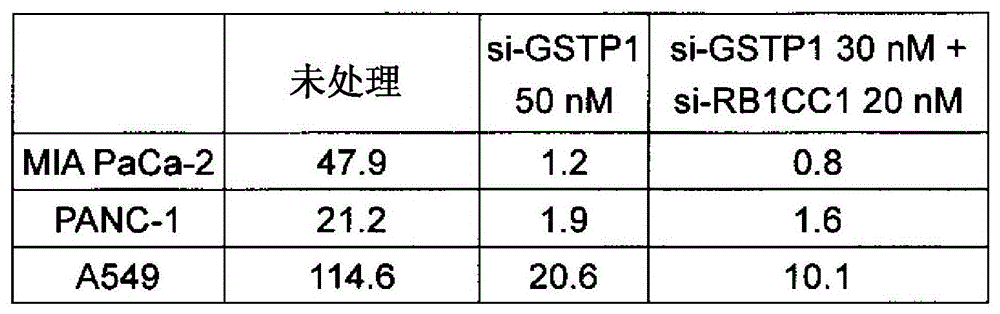
表2Table 2
另外,对MDA-MB-231细胞(人乳癌来源)及M7609细胞(人大肠癌来源)进行与上述同样的实验。将MDA-MB-231细胞1×10⁵个播种到6cm培养皿中,在添加有10%FBS和10%L-谷氨酰胺的DMEM中培养18小时后,将培养基更换成Opti-MEM(R),使各种siRNA作用5小时,接着将培养基替换成10%FBS加DMEM,5日后采集细胞,对细胞数进行计数。将M7609细胞1×10⁵个播种到6cm培养皿中,在添加有10%FBS和5%L-谷氨酰胺的RPMI 1640中培养18小时后,将培养基更换成Opti-MEM(R),使各种siRNA作用5小时,接着将培养基替换成10%FBS加RPMI 1640,5日后采集细胞,对细胞数进行计数。将结果示于图2~3。图2中用根据播种细胞数计算的增加倍率表示细胞增殖的程度的图,图3表示实验结束时所采集的细胞数。In addition, experiments similar to the above were performed on MDA-MB-231 cells (derived from human breast cancer) and M7609 cells (derived from human colorectal cancer). MDA-MB-231 cells were seeded 1×10 5 into 6 cm dishes, and after culturing in DMEM supplemented with 10% FBS and 10% L-glutamine for 18 hours, the medium was changed to Opti-MEM ( R) , various siRNAs were allowed to act for 5 hours, then the medium was replaced with 10% FBS plus DMEM, the cells were harvested 5 days later, and the number of cells was counted.
根据这些结果可知,当将GST-π和RB1CC1两者均敲减时,与仅敲减任一者时相比,细胞增殖抑制效果增加。From these results, it was found that when both GST-π and RB1CC1 were knocked down, the cell proliferation inhibitory effect was increased compared with the case where only one of them was knocked down.
例2:GST-π及RB1CC1的双敲减产生的自噬的抑制Example 2: Inhibition of autophagy by double knockdown of GST-π and RB1CC1
研究在GST-π及RB1CC1的双敲减下自噬会受到怎样的影响。将1×10⁶个MIA PaCa-2细胞播种于6cm培养皿中,在添加有10%FBS和10%L-谷氨酰胺的DMEM中培养24小时。将培养基替换成5mL的Opti-MEM(R),在培养皿中按照各siRNA的终浓度达到30nM的方式添加与例1同样地制备的GST-πsiRNA、RB1CC1 siRNA、或GST-πsiRNA和RB1CC1 siRNA的混合溶液,在37℃下培养5小时后,将培养基替换为10%FBS加DMEM,培养3日。将培养皿内的细胞用冰冷PBS洗涤后,加入冰冷Lysis buffer,将细胞破碎。Lysis buffer是通过将NP-40Alternative、PROTEIN GRADE(R)Detergent、10%Solution,Sterile-Filtered(MerckMillipore公司)100μL、1M Tris-HCl(pH7.5)500μL、5M NaCl 300μL、0.5M EDTA20μL、灭菌水9.08μL混和而制备的。将细胞破碎液用细胞刮棒聚拢,冰冷30分钟。此期间每隔10分钟进行颠倒混和。将得到的溶液以15000rpm、在4℃下离心15分钟,采集上清作为细胞提取液。将该细胞提取液供于Western blot分析。作为一次抗体,使用抗LC3B抗体(Sigma-Aldrich公司),使其与转录膜在4℃下反应16小时。在使其与HRP标记二次抗体反应后,使用化学发光试剂进行LC3分子的检测。自噬是否得到诱导采用向LC3的I型(18kDa)和II型(16kDa)中的移行来评价。To investigate how autophagy is affected by double knockdown of GST-π and RB1CC1. 1×10 6 MIA PaCa-2 cells were seeded in 6 cm dishes and cultured in DMEM supplemented with 10% FBS and 10% L-glutamine for 24 hours. The medium was replaced with 5 mL of Opti-MEM (R) , and GST-π siRNA, RB1CC1 siRNA, or GST-π siRNA and RB1CC1 siRNA prepared in the same manner as in Example 1 were added to the petri dish so that the final concentration of each siRNA reached 30 nM. After culturing at 37°C for 5 hours, the medium was replaced with 10% FBS plus DMEM and cultured for 3 days. After washing the cells in the dish with ice-cold PBS, ice-cold Lysis buffer was added to disrupt the cells. Lysis buffer was prepared by mixing NP-40Alternative, PROTEIN GRADE (R) Detergent, 10% Solution, Sterile-Filtered (MerckMillipore) 100μL, 1M Tris-HCl (pH7.5) 500μL, 5M NaCl 300μL, 0.5M EDTA 20μL, sterilized Prepared by mixing 9.08 μL of water. The cell disruption solution was collected with a cell scraper and ice-cold for 30 minutes. During this period, inversion mixing was performed every 10 minutes. The resulting solution was centrifuged at 15,000 rpm at 4°C for 15 minutes, and the supernatant was collected as a cell extract. The cell extract was used for Western blot analysis. As the primary antibody, an anti-LC3B antibody (Sigma-Aldrich) was used, and it was reacted with the transcription membrane at 4°C for 16 hours. After reacting with HRP-labeled secondary antibodies, detection of LC3 molecules was performed using a chemiluminescent reagent. Whether autophagy was induced was assessed using the transition into type I (18 kDa) and type II (16 kDa) of LC3.
从图4所示的结果可知,由于GST-π的敲减,自噬得到诱导。As can be seen from the results shown in Figure 4, autophagy was induced due to the knockdown of GST-π.
将1×10⁶个MIAPaCa-2细胞播种于6cm培养皿中,在添加有10%FBS和10%L-谷氨酰胺的DMEM中培养24小时。将培养基替换为5mL的Opti-MEM(R),在培养皿中按照各siRNA的终浓度达到30nM的方式添加与例1同样地制备的GST-πsiRNA、RB1CC1siRNA、或GST-πsiRNA和RB1CC1siRNA的混合溶液,在37℃下培养5小时后,将培养基替换成10%FBS加DMEM,培养3日。从培养皿将培养基吸出,加入1mL的4%PFA(Paraformaldehyde,多聚甲醛)/PBS,在室温下静置10~15分钟。PFA/PBS吸出后,加入1mL的0.5%Triton X-100/PBS,在冰块上静置5分钟。将Triton X-100/PBS吸出后,加入2mL的PBS,在冰块上静置10分钟。作为一次抗体,使用抗LC3B抗体(Invitrogen公司),在37℃下使其反应1小时。按照PBS、0.05%Tween(R)20/PBS、PBS的顺序分别洗涤每个5分钟。作为二次抗体,使用Alexa Fluor(R)488标记抗兔IgG抗体(Life Technologies公司),在37℃下使其反应1小时。按照PBS、0.05%Tween(R)20/PBS、PBS的顺序分别洗涤每个5分钟。用ProLong(R)Gold(Life Technologies公司)载持。在暗室内静置1晩后,用荧光显微镜观察来自Alexa Fluor(R)488的荧光。1×10 6 MIAPaCa-2 cells were seeded in 6 cm dishes and cultured in DMEM supplemented with 10% FBS and 10% L-glutamine for 24 hours. The medium was replaced with 5 mL of Opti-MEM (R) , and GST-πsiRNA, RB1CC1siRNA, or a mixture of GST-πsiRNA and RB1CC1siRNA prepared in the same manner as in Example 1 was added to the petri dish so that the final concentration of each siRNA reached 30 nM. The solution was cultured at 37°C for 5 hours, and then the medium was replaced with 10% FBS plus DMEM, and cultured for 3 days. The medium was aspirated from the petri dish, 1 mL of 4% PFA (Paraformaldehyde, paraformaldehyde)/PBS was added, and the mixture was allowed to stand at room temperature for 10 to 15 minutes. After the PFA/PBS was aspirated, 1 mL of 0.5% Triton X-100/PBS was added and left on ice for 5 minutes. After the Triton X-100/PBS was aspirated, 2 mL of PBS was added and left on ice for 10 minutes. As the primary antibody, an anti-LC3B antibody (Invitrogen) was used, and the reaction was carried out at 37°C for 1 hour. Each was washed for 5 minutes in the order of PBS, 0.05
从图5~7所示的结果可知,通过GST-π的敲减诱导的自噬(图6中的点状的强信号)通过与RB1CC1同时敲减而基本完全被抑制(图7)。此外,从通过GST-π和RB1CC1同时敲减观察到核的片段化(图7中用箭头表示)推测,通过RB1CC1同时敲减抑制由GST-π的敲减诱导的自噬,由此细胞凋亡得到诱导。From the results shown in FIGS. 5 to 7 , it was found that autophagy induced by knockdown of GST-π (strong punctate signal in FIG. 6 ) was almost completely inhibited by simultaneous knockdown of RB1CC1 ( FIG. 7 ). Furthermore, from the fragmentation of the nucleus observed by simultaneous knockdown of GST-π and RB1CC1 (indicated by arrows in FIG. 7 ), it is presumed that autophagy induced by knockdown of GST-π is suppressed by simultaneous knockdown of RB1CC1, whereby apoptosis death is induced.
例3:GST-π及RB1CC1的双敲减产生的细胞凋亡诱导Example 3: Induction of apoptosis by double knockdown of GST-π and RB1CC1
研究在GST-π及RB1CC1的双敲减下细胞凋亡是否会得到诱导。将1×10⁶个MIAPaCa-2细胞播种于6cm培养皿中,在添加有10%FBS和10%L-谷氨酰胺的DMEM中培养24小时。将培养基替换为5mL的Opti-MEM(R),在培养皿中按照各siRNA的终浓度达到30nM的方式添加与例1同样地制备的GST-πsiRNA、RB1CC1siRNA、或GST-πsiRNA和RB1CC1siRNA的混合溶液,在37℃下培养5小时后,将培养基替换成10%FBS加DMEM,培养3日。将培养皿的细胞用冰冷PBS洗涤后,加入冰冷Lysis buffer,将细胞破碎。Lysis buffer是通过将NP-40Alternative、PROTEIN GRADE(R)Detergent、10%Solution、Sterile-Filtered 100μL、1MTris-HCl(pH7.5)500μL、5M NaCl 300μL、0.5M EDTA 20μL、灭菌水9.08μL混和而制备的。将细胞破碎液用细胞刮棒聚拢,冰冷30分钟。在此期间每隔10分钟进行颠倒混和。将得到的溶液以15000rpm、在4℃下离心15分钟,采集上清作为细胞提取液。将该细胞提取液供于Western blot分析。作为一次抗体,使用抗Cleaved Caspase-3抗体(Sigma-Aldrich公司),使其与转录膜在4℃下反应16小时。在使其与HRP标记二次抗体反应后,使用化学发光试剂进行Cleaved Caspase-3分子的检测。细胞凋亡是否得到诱导用Cleaved Caspase-3的增加量来评价。由于Caspase-3在凋亡诱导时发生开裂而被活化,因此开裂的Caspase-3(Cleaved Caspase-3)的存在成为凋亡的指标。To investigate whether apoptosis can be induced under the double knockdown of GST-π and RB1CC1. 1×10 6 MIAPaCa-2 cells were seeded in 6 cm dishes and cultured in DMEM supplemented with 10% FBS and 10% L-glutamine for 24 hours. The medium was replaced with 5 mL of Opti-MEM (R) , and GST-πsiRNA, RB1CC1siRNA, or a mixture of GST-πsiRNA and RB1CC1siRNA prepared in the same manner as in Example 1 was added to the petri dish so that the final concentration of each siRNA reached 30 nM. The solution was cultured at 37°C for 5 hours, and then the medium was replaced with 10% FBS plus DMEM, and cultured for 3 days. After washing the cells in the culture dish with ice-cold PBS, ice-cold Lysis buffer was added to disrupt the cells. Lysis buffer is prepared by mixing NP-40Alternative, PROTEIN GRADE (R) Detergent, 10% Solution, Sterile-Filtered 100μL, 1M Tris-HCl (pH7.5) 500μL, 5M NaCl 300μL, 0.5M EDTA 20μL, and sterilized water 9.08μL and prepared. The cell disruption solution was collected with a cell scraper and ice-cold for 30 minutes. During this period, inversion mixing was performed every 10 minutes. The resulting solution was centrifuged at 15,000 rpm at 4°C for 15 minutes, and the supernatant was collected as a cell extract. The cell extract was used for Western blot analysis. As the primary antibody, an anti-Cleaved Caspase-3 antibody (Sigma-Aldrich) was used, and it was allowed to react with the transcription membrane at 4°C for 16 hours. After reacting with HRP-labeled secondary antibodies, detection of Cleaved Caspase-3 molecules was performed using chemiluminescence reagents. Whether apoptosis was induced was assessed by increasing the amount of Cleaved Caspase-3. Since Caspase-3 is activated by cleavage during apoptosis induction, the presence of cleaved Caspase-3 (Cleaved Caspase-3) is an indicator of apoptosis.
从图8所示的结果可知,通过GST-π和RB1CC1的同时敲减,细胞凋亡得到诱导。从图4~8的结果可知,通过将RB1CC1同时敲减抑制由GST-π的敲减诱导的自噬,由此细胞凋亡得到诱导。From the results shown in FIG. 8 , it was found that apoptosis was induced by simultaneous knockdown of GST-π and RB1CC1. As can be seen from the results in FIGS. 4 to 8 , the simultaneous knockdown of RB1CC1 inhibits autophagy induced by knockdown of GST-π, thereby inducing apoptosis.


Claims (8)
Applications Claiming Priority (3)
| Application Number | Priority Date | Filing Date | Title |
|---|---|---|---|
| JP2014-124782 | 2014-06-17 | ||
| JP2014124782 | 2014-06-17 | ||
| PCT/JP2015/067240 WO2015194522A1 (en) | 2014-06-17 | 2015-06-16 | Apoptosis inducer |
Publications (2)
| Publication Number | Publication Date |
|---|---|
| CN106573062A CN106573062A (en) | 2017-04-19 |
| CN106573062B true CN106573062B (en) | 2020-08-25 |
Family
ID=54935507
Family Applications (1)
| Application Number | Title | Priority Date | Filing Date |
|---|---|---|---|
| CN201580032443.1A Active CN106573062B (en) | 2014-06-17 | 2015-06-16 | Apoptosis inducer |
Country Status (7)
| Country | Link |
|---|---|
| US (1) | US10093931B2 (en) |
| EP (1) | EP3159009B1 (en) |
| JP (1) | JP6727765B2 (en) |
| CN (1) | CN106573062B (en) |
| ES (1) | ES2899211T3 (en) |
| TW (1) | TW201625273A (en) |
| WO (1) | WO2015194522A1 (en) |
Families Citing this family (5)
| Publication number | Priority date | Publication date | Assignee | Title |
|---|---|---|---|---|
| HUE060394T2 (en) * | 2014-11-18 | 2023-02-28 | Univ South Florida | Compositions and methods for treating endometriosis |
| US20160187319A1 (en) * | 2014-12-26 | 2016-06-30 | Nitto Denko Corporation | Cell death-inducing agent, cell growth-inhibiting agent, and pharmaceutical composition for treatment of disease caused by abnormal cell growth |
| WO2016104588A1 (en) * | 2014-12-26 | 2016-06-30 | 日東電工株式会社 | Cell death-inducing agent, cytostatic agent, and pharmaceutical composition for treatment of diseases caused by abnormal cell growth |
| JP6899201B2 (en) * | 2016-06-23 | 2021-07-07 | 日東電工株式会社 | Cell death inducer, cell proliferation inhibitor and therapeutic pharmaceutical composition for diseases caused by abnormal cell proliferation |
| WO2019115417A2 (en) * | 2017-12-12 | 2019-06-20 | Roche Innovation Center Copenhagen A/S | Oligonucleotides for modulating rb1 expression |
Citations (1)
| Publication number | Priority date | Publication date | Assignee | Title |
|---|---|---|---|---|
| CN103619355A (en) * | 2011-06-21 | 2014-03-05 | 日东电工株式会社 | Apoptosis-inducing agent |
Family Cites Families (18)
| Publication number | Priority date | Publication date | Assignee | Title |
|---|---|---|---|---|
| US5786336A (en) | 1991-04-29 | 1998-07-28 | Terrapin Technologies, Inc. | Target-selective protocols based on mimics |
| WO1996040205A1 (en) | 1995-06-07 | 1996-12-19 | Terrapin Technologies, Inc. | Metabolic effects of certain glutathione analogs |
| US6627732B1 (en) | 1998-04-16 | 2003-09-30 | Teijin Limited | Glutathione derivatives and their dosage forms |
| EP1445312B1 (en) | 2001-11-21 | 2012-12-26 | Astellas Pharma Inc. | Method of inhibiting gene expression |
| JP3803318B2 (en) | 2001-11-21 | 2006-08-02 | 株式会社RNAi | Gene expression inhibition method |
| CA2490399C (en) | 2002-06-19 | 2015-10-06 | Raven Biotechnologies, Inc. | Novel raag10 cell surface target and a family of antibodies recognizing that target |
| US20040029275A1 (en) | 2002-08-10 | 2004-02-12 | David Brown | Methods and compositions for reducing target gene expression using cocktails of siRNAs or constructs expressing siRNAs |
| AU2003295474B2 (en) | 2002-11-13 | 2009-07-30 | Macrogenics West, Inc. | Antigen PIPA and antibodies that bind thereto |
| CA2539322C (en) | 2003-09-18 | 2016-07-12 | Raven Biotechnologies, Inc. | Kid3 and kid3 antibodies that bind thereto |
| TW200538149A (en) | 2004-05-20 | 2005-12-01 | Telik Inc | Sensitization to another anticancer therapy and/or amelioration of a side effect of another anticancer therapy by treatment with a GST-activated anticancer compound |
| US7358223B2 (en) | 2004-10-04 | 2008-04-15 | Nitto Denko Corporation | Biodegradable cationic polymers |
| US20080269259A1 (en) | 2005-01-19 | 2008-10-30 | The Trustees Of The University Of Pennsylvania | Regulation of Autophagy and Cell Survival |
| TWI407971B (en) | 2007-03-30 | 2013-09-11 | Nitto Denko Corp | Cancer cells and tumor-related fibroblasts |
| US20080312174A1 (en) | 2007-06-05 | 2008-12-18 | Nitto Denko Corporation | Water soluble crosslinked polymers |
| CN101970012A (en) | 2007-09-14 | 2011-02-09 | 日东电工株式会社 | Drug carrier |
| US20100028416A1 (en) | 2008-07-30 | 2010-02-04 | Nitto Denko Corporation | Drug carriers |
| CN103857654B (en) | 2011-06-08 | 2017-03-15 | 日东电工株式会社 | Compounds for targeted drug delivery and enhanced siRNA activity |
| US20130064815A1 (en) | 2011-09-12 | 2013-03-14 | The Trustees Of Princeton University | Inducing apoptosis in quiescent cells |
-
2015
- 2015-06-16 US US15/319,582 patent/US10093931B2/en active Active
- 2015-06-16 CN CN201580032443.1A patent/CN106573062B/en active Active
- 2015-06-16 ES ES15810564T patent/ES2899211T3/en active Active
- 2015-06-16 JP JP2015120736A patent/JP6727765B2/en active Active
- 2015-06-16 WO PCT/JP2015/067240 patent/WO2015194522A1/en not_active Ceased
- 2015-06-16 EP EP15810564.3A patent/EP3159009B1/en active Active
- 2015-06-17 TW TW104119577A patent/TW201625273A/en unknown
Patent Citations (1)
| Publication number | Priority date | Publication date | Assignee | Title |
|---|---|---|---|---|
| CN103619355A (en) * | 2011-06-21 | 2014-03-05 | 日东电工株式会社 | Apoptosis-inducing agent |
Non-Patent Citations (2)
| Title |
|---|
| FIP200 is Involved in Murine Pseudomonas Infection by Regulating HMGB1 Intracellular Translocation;Yi Li等;《Cellular Physiology and Biochemistry》;20140520;第33卷;第1733-1744页,尤其是摘要 * |
| RB1CC1 insufficiency causes neuronal atrophy through mTOR signaling alteration and involved in the pathology of Alzheimer"s diseases;Tokuhiro Chano等;《Brain Research》;20070721;第97-105页,尤其是摘要 * |
Also Published As
| Publication number | Publication date |
|---|---|
| US20170137825A1 (en) | 2017-05-18 |
| US10093931B2 (en) | 2018-10-09 |
| EP3159009B1 (en) | 2021-10-27 |
| JP2016020337A (en) | 2016-02-04 |
| ES2899211T3 (en) | 2022-03-10 |
| WO2015194522A1 (en) | 2015-12-23 |
| TW201625273A (en) | 2016-07-16 |
| EP3159009A4 (en) | 2018-04-04 |
| CN106573062A (en) | 2017-04-19 |
| EP3159009A1 (en) | 2017-04-26 |
| JP6727765B2 (en) | 2020-07-22 |
Similar Documents
| Publication | Publication Date | Title |
|---|---|---|
| CA2841203C (en) | Apoptosis-inducing agent | |
| JP6340162B2 (en) | Apoptosis inducer | |
| CN106573062B (en) | Apoptosis inducer | |
| TWI812591B (en) | Cell death inducer, cell growth inhibitor, and pharmaceutical composition for treatment of diseases caused by abnormal proliferation of cells | |
| TWI651093B (en) | Apoptosis-inducing agent |
Legal Events
| Date | Code | Title | Description |
|---|---|---|---|
| PB01 | Publication | ||
| PB01 | Publication | ||
| SE01 | Entry into force of request for substantive examination | ||
| SE01 | Entry into force of request for substantive examination | ||
| GR01 | Patent grant | ||
| GR01 | Patent grant |