CN106559121B - A kind of multi-antenna channel measurement method and device - Google Patents
A kind of multi-antenna channel measurement method and device Download PDFInfo
- Publication number
- CN106559121B CN106559121B CN201510623199.8A CN201510623199A CN106559121B CN 106559121 B CN106559121 B CN 106559121B CN 201510623199 A CN201510623199 A CN 201510623199A CN 106559121 B CN106559121 B CN 106559121B
- Authority
- CN
- China
- Prior art keywords
- csi
- codebook
- wireless network
- measurement result
- matrix
- Prior art date
- Legal status (The legal status is an assumption and is not a legal conclusion. Google has not performed a legal analysis and makes no representation as to the accuracy of the status listed.)
- Active
Links
Images


Classifications
-
- H—ELECTRICITY
- H04—ELECTRIC COMMUNICATION TECHNIQUE
- H04B—TRANSMISSION
- H04B7/00—Radio transmission systems, i.e. using radiation field
- H04B7/02—Diversity systems; Multi-antenna system, i.e. transmission or reception using multiple antennas
- H04B7/04—Diversity systems; Multi-antenna system, i.e. transmission or reception using multiple antennas using two or more spaced independent antennas
- H04B7/06—Diversity systems; Multi-antenna system, i.e. transmission or reception using multiple antennas using two or more spaced independent antennas at the transmitting station
- H04B7/0613—Diversity systems; Multi-antenna system, i.e. transmission or reception using multiple antennas using two or more spaced independent antennas at the transmitting station using simultaneous transmission
- H04B7/0615—Diversity systems; Multi-antenna system, i.e. transmission or reception using multiple antennas using two or more spaced independent antennas at the transmitting station using simultaneous transmission of weighted versions of same signal
- H04B7/0619—Diversity systems; Multi-antenna system, i.e. transmission or reception using multiple antennas using two or more spaced independent antennas at the transmitting station using simultaneous transmission of weighted versions of same signal using feedback from receiving side
- H04B7/0621—Feedback content
- H04B7/0626—Channel coefficients, e.g. channel state information [CSI]
-
- H—ELECTRICITY
- H04—ELECTRIC COMMUNICATION TECHNIQUE
- H04B—TRANSMISSION
- H04B7/00—Radio transmission systems, i.e. using radiation field
- H04B7/02—Diversity systems; Multi-antenna system, i.e. transmission or reception using multiple antennas
- H04B7/04—Diversity systems; Multi-antenna system, i.e. transmission or reception using multiple antennas using two or more spaced independent antennas
- H04B7/06—Diversity systems; Multi-antenna system, i.e. transmission or reception using multiple antennas using two or more spaced independent antennas at the transmitting station
- H04B7/0613—Diversity systems; Multi-antenna system, i.e. transmission or reception using multiple antennas using two or more spaced independent antennas at the transmitting station using simultaneous transmission
- H04B7/0615—Diversity systems; Multi-antenna system, i.e. transmission or reception using multiple antennas using two or more spaced independent antennas at the transmitting station using simultaneous transmission of weighted versions of same signal
- H04B7/0619—Diversity systems; Multi-antenna system, i.e. transmission or reception using multiple antennas using two or more spaced independent antennas at the transmitting station using simultaneous transmission of weighted versions of same signal using feedback from receiving side
- H04B7/0636—Feedback format
- H04B7/0639—Using selective indices, e.g. of a codebook, e.g. pre-distortion matrix index [PMI] or for beam selection
-
- H—ELECTRICITY
- H04—ELECTRIC COMMUNICATION TECHNIQUE
- H04B—TRANSMISSION
- H04B7/00—Radio transmission systems, i.e. using radiation field
- H04B7/02—Diversity systems; Multi-antenna system, i.e. transmission or reception using multiple antennas
- H04B7/04—Diversity systems; Multi-antenna system, i.e. transmission or reception using multiple antennas using two or more spaced independent antennas
- H04B7/0413—MIMO systems
- H04B7/0456—Selection of precoding matrices or codebooks, e.g. using matrices antenna weighting
- H04B7/046—Selection of precoding matrices or codebooks, e.g. using matrices antenna weighting taking physical layer constraints into account
- H04B7/0469—Selection of precoding matrices or codebooks, e.g. using matrices antenna weighting taking physical layer constraints into account taking special antenna structures, e.g. cross polarized antennas into account
-
- H—ELECTRICITY
- H04—ELECTRIC COMMUNICATION TECHNIQUE
- H04B—TRANSMISSION
- H04B7/00—Radio transmission systems, i.e. using radiation field
- H04B7/02—Diversity systems; Multi-antenna system, i.e. transmission or reception using multiple antennas
- H04B7/04—Diversity systems; Multi-antenna system, i.e. transmission or reception using multiple antennas using two or more spaced independent antennas
- H04B7/0413—MIMO systems
- H04B7/0456—Selection of precoding matrices or codebooks, e.g. using matrices antenna weighting
- H04B7/0478—Special codebook structures directed to feedback optimisation
- H04B7/0479—Special codebook structures directed to feedback optimisation for multi-dimensional arrays, e.g. horizontal or vertical pre-distortion matrix index [PMI]
-
- H—ELECTRICITY
- H04—ELECTRIC COMMUNICATION TECHNIQUE
- H04B—TRANSMISSION
- H04B7/00—Radio transmission systems, i.e. using radiation field
- H04B7/02—Diversity systems; Multi-antenna system, i.e. transmission or reception using multiple antennas
- H04B7/04—Diversity systems; Multi-antenna system, i.e. transmission or reception using multiple antennas using two or more spaced independent antennas
- H04B7/06—Diversity systems; Multi-antenna system, i.e. transmission or reception using multiple antennas using two or more spaced independent antennas at the transmitting station
-
- H—ELECTRICITY
- H04—ELECTRIC COMMUNICATION TECHNIQUE
- H04B—TRANSMISSION
- H04B7/00—Radio transmission systems, i.e. using radiation field
- H04B7/02—Diversity systems; Multi-antenna system, i.e. transmission or reception using multiple antennas
- H04B7/04—Diversity systems; Multi-antenna system, i.e. transmission or reception using multiple antennas using two or more spaced independent antennas
- H04B7/06—Diversity systems; Multi-antenna system, i.e. transmission or reception using multiple antennas using two or more spaced independent antennas at the transmitting station
- H04B7/0613—Diversity systems; Multi-antenna system, i.e. transmission or reception using multiple antennas using two or more spaced independent antennas at the transmitting station using simultaneous transmission
- H04B7/0615—Diversity systems; Multi-antenna system, i.e. transmission or reception using multiple antennas using two or more spaced independent antennas at the transmitting station using simultaneous transmission of weighted versions of same signal
- H04B7/0619—Diversity systems; Multi-antenna system, i.e. transmission or reception using multiple antennas using two or more spaced independent antennas at the transmitting station using simultaneous transmission of weighted versions of same signal using feedback from receiving side
- H04B7/0621—Feedback content
- H04B7/0634—Antenna weights or vector/matrix coefficients
-
- H—ELECTRICITY
- H04—ELECTRIC COMMUNICATION TECHNIQUE
- H04B—TRANSMISSION
- H04B7/00—Radio transmission systems, i.e. using radiation field
- H04B7/02—Diversity systems; Multi-antenna system, i.e. transmission or reception using multiple antennas
- H04B7/04—Diversity systems; Multi-antenna system, i.e. transmission or reception using multiple antennas using two or more spaced independent antennas
- H04B7/06—Diversity systems; Multi-antenna system, i.e. transmission or reception using multiple antennas using two or more spaced independent antennas at the transmitting station
- H04B7/0613—Diversity systems; Multi-antenna system, i.e. transmission or reception using multiple antennas using two or more spaced independent antennas at the transmitting station using simultaneous transmission
- H04B7/0615—Diversity systems; Multi-antenna system, i.e. transmission or reception using multiple antennas using two or more spaced independent antennas at the transmitting station using simultaneous transmission of weighted versions of same signal
- H04B7/0619—Diversity systems; Multi-antenna system, i.e. transmission or reception using multiple antennas using two or more spaced independent antennas at the transmitting station using simultaneous transmission of weighted versions of same signal using feedback from receiving side
- H04B7/0636—Feedback format
- H04B7/0645—Variable feedback
- H04B7/065—Variable contents, e.g. long-term or short-short
-
- H—ELECTRICITY
- H04—ELECTRIC COMMUNICATION TECHNIQUE
- H04L—TRANSMISSION OF DIGITAL INFORMATION, e.g. TELEGRAPHIC COMMUNICATION
- H04L1/00—Arrangements for detecting or preventing errors in the information received
- H04L1/02—Arrangements for detecting or preventing errors in the information received by diversity reception
- H04L1/06—Arrangements for detecting or preventing errors in the information received by diversity reception using space diversity
-
- H—ELECTRICITY
- H04—ELECTRIC COMMUNICATION TECHNIQUE
- H04L—TRANSMISSION OF DIGITAL INFORMATION, e.g. TELEGRAPHIC COMMUNICATION
- H04L1/00—Arrangements for detecting or preventing errors in the information received
- H04L1/02—Arrangements for detecting or preventing errors in the information received by diversity reception
- H04L1/06—Arrangements for detecting or preventing errors in the information received by diversity reception using space diversity
- H04L1/0618—Space-time coding
- H04L1/0675—Space-time coding characterised by the signaling
-
- H—ELECTRICITY
- H04—ELECTRIC COMMUNICATION TECHNIQUE
- H04L—TRANSMISSION OF DIGITAL INFORMATION, e.g. TELEGRAPHIC COMMUNICATION
- H04L5/00—Arrangements affording multiple use of the transmission path
- H04L5/003—Arrangements for allocating sub-channels of the transmission path
- H04L5/0048—Allocation of pilot signals, i.e. of signals known to the receiver
-
- H—ELECTRICITY
- H04—ELECTRIC COMMUNICATION TECHNIQUE
- H04W—WIRELESS COMMUNICATION NETWORKS
- H04W24/00—Supervisory, monitoring or testing arrangements
- H04W24/10—Scheduling measurement reports ; Arrangements for measurement reports
-
- H—ELECTRICITY
- H04—ELECTRIC COMMUNICATION TECHNIQUE
- H04W—WIRELESS COMMUNICATION NETWORKS
- H04W76/00—Connection management
- H04W76/20—Manipulation of established connections
- H04W76/27—Transitions between radio resource control [RRC] states
Landscapes
- Engineering & Computer Science (AREA)
- Signal Processing (AREA)
- Computer Networks & Wireless Communication (AREA)
- Physics & Mathematics (AREA)
- Mathematical Physics (AREA)
- Mobile Radio Communication Systems (AREA)
Abstract
本发明实施例提供一种多天线信道测量的方法、装置、通信系统和终端,其中,基站发送第一信道状态信息参考信号(CSI‑RS)和第二CSI‑RS给终端,所述第一CSI‑RS和第二CSI‑RS分别在正交维度的天线振子上发送;所述基站接收所述终端反馈的针对第一CSI‑RS和第二CSI‑RS的第一CSI测量结果;所述基站根据所述第一CSI测量结果发送第三CSI‑RS给所述终端,所述第三CSI‑RS依据所述第一CSI测量结果进行过预编码;和所述基站接收所述终端反馈的针对第三CSI‑RS的第三CSI测量结果。从而达到多天线端口下,降低信道测量终端侧计算复杂度,减少信道测量反馈所占资源的目的。

Embodiments of the present invention provide a method, device, communication system, and terminal for multi-antenna channel measurement, wherein a base station sends a first channel state information reference signal (CSI-RS) and a second CSI-RS to the terminal, where the first channel state information reference signal (CSI-RS) and the second CSI-RS are sent to the terminal. The CSI-RS and the second CSI-RS are respectively sent on the antenna elements of orthogonal dimensions; the base station receives the first CSI measurement results for the first CSI-RS and the second CSI-RS fed back by the terminal; the The base station sends a third CSI-RS to the terminal according to the first CSI measurement result, and the third CSI-RS is precoded according to the first CSI measurement result; and the base station receives the information fed back by the terminal. The third CSI measurement result for the third CSI-RS. In this way, the purpose of reducing the computational complexity of the channel measurement terminal side and reducing the resources occupied by the channel measurement feedback under the multi-antenna port is achieved.
Description
技术领域technical field
本发明涉及通信技术领域,特别是涉及一种多天线信道测量方法和装置。The present invention relates to the field of communication technologies, and in particular, to a multi-antenna channel measurement method and device.
背景技术Background technique
传统信息论角度分析可以知道,系统容量由接收端信噪比决定,多用户进行多址时,本质上是如何划分或者共享系统容量,无论是TDMA、CDMA还是(O)FDMA,理论上都不会提升系统容量界,而仅仅是不同的容量划分方法。而MIMO的出现,从理论上证明了系统的容量可以随着收发天线数目的增加而增加,因此把系统的理论界提升了。LTE系统在进行设计时,将MIMO和OFDMA作为其基本的物理层技术,以最大化系统容量。为了提升接收机检测性能,发射端一般需要对要先对信号进行预编码然后发送,以减小不同天线上信号到接收天线时的干扰。在FDD系统中,由于无法使用信道互易性,发射端使用的预编码需要接收端进行反馈来获得,在LTE协议中,一般是UE通过反馈PMI来指示BS对其使用的最优码本。From the perspective of traditional information theory, it can be known that the system capacity is determined by the signal-to-noise ratio of the receiving end. When multiple users perform multiple access, how to divide or share the system capacity in essence, whether it is TDMA, CDMA or (O)FDMA, theoretically not. Raise system capacity bounds, but just different ways of dividing capacity. The emergence of MIMO has theoretically proved that the capacity of the system can increase with the increase of the number of transmitting and receiving antennas, thus improving the theoretical circle of the system. In the design of the LTE system, MIMO and OFDMA are used as its basic physical layer technologies to maximize the system capacity. In order to improve the detection performance of the receiver, the transmitter generally needs to precode the signal before sending, so as to reduce the interference when the signal from different antennas reaches the receiving antenna. In the FDD system, since channel reciprocity cannot be used, the precoding used by the transmitter needs to be obtained by feedback from the receiver. In the LTE protocol, the UE generally indicates the optimal codebook used by the BS by feeding back the PMI.
LTE在初始版本中(Release 8),支持基站侧4根发射天线,且定义了四天线的码本,UE侧需要依据小区级参考信号CRS进行CSI计算,由于天线数目较少,码本的尺寸也比较小,UE侧在进行PMI计算和反馈时,也比较简单;在LTE R10中,基站侧的发送天线数目最大可以支持8个,CRS只支持4个发射端口,且在每个子帧中都有,若支持8个天线端口则导频导致开销太大,因此引入了发送较为稀疏、可动态配置的CSI-RS进行8天线时CSI的测量反馈,此时为了降低UE侧进行PMI计算的复杂度,并且减少反馈量,8天线的码本采用双码本结构,即系统的码本W由第一码本W1和第二码本W2构成,即W=W1W2,第一码本为宽波束码本,变化较慢,UE反馈周期也较长,第二码本为快变码本(也称为短时码本或窄波束码本),目的是匹配信道的频选、短时特性,UE需要较短的周期进行码本反馈。In the initial version (Release 8), LTE supports four transmit antennas on the base station side, and defines a codebook of four antennas. The UE side needs to perform CSI calculation based on the cell-level reference signal CRS. Due to the small number of antennas, the size of the codebook It is also relatively small, and it is relatively simple for the UE side to perform PMI calculation and feedback; in LTE R10, the number of transmit antennas on the base station side can support a maximum of 8, and the CRS only supports 4 transmit ports, and each subframe has a maximum of 8 transmit antennas. Yes, if 8 antenna ports are supported, the pilot frequency will cause too much overhead. Therefore, CSI measurement feedback when 8 antennas are sent by sparse and dynamically configurable CSI-RS is introduced. In this case, in order to reduce the complexity of PMI calculation on the UE side The codebook of 8 antennas adopts a dual codebook structure, that is, the codebook W of the system consists of the first codebook W 1 and the second codebook W 2 , that is, W=W 1 W 2 , the first The codebook is a wide-beam codebook, which changes slowly and has a long feedback period for the UE. The second codebook is a fast-changing codebook (also called a short-time codebook or a narrow-beam codebook), which is designed to match the frequency selection of the channel. , short-term characteristics, the UE needs a short period for codebook feedback.
随着基站天线数目的进一步增加,并且天线由线阵变为两维的面阵时,单个CSI-RS配置已经无法支持更多的天线端口,从理论上而言,现有LTE的CSI-RS在一个资源块RB(resource block)内最多包含40个资源单元RE(resource element),因此通过不停地扩展CSI-RS的端口数目,理论上可以支持到40个正交的天线端口。但是随着天线数目的继续增加,当前按照每个天线端口占用一个正交导频的CSI-RS分配方法以及UE通过测量全部天线端口并反馈完整PMI的方法已经无能为继了。因而在天线端口增多的趋势下给出一个合适的信道测量方法,是一个亟需解决的问题。With the further increase in the number of base station antennas, and when the antennas are changed from linear arrays to two-dimensional area arrays, a single CSI-RS configuration can no longer support more antenna ports. In theory, the existing CSI-RS of LTE A resource block RB (resource block) contains at most 40 resource elements RE (resource elements), so by continuously expanding the number of CSI-RS ports, 40 orthogonal antenna ports can theoretically be supported. However, as the number of antennas continues to increase, the current CSI-RS allocation method in which each antenna port occupies one orthogonal pilot frequency and the method in which the UE measures all antenna ports and feeds back a complete PMI are no longer sustainable. Therefore, it is an urgent problem to provide a suitable channel measurement method under the trend of increasing antenna ports.
发明内容SUMMARY OF THE INVENTION
本发明实施例提供一种多天线信道测量的方法、装置,通信系统和终端,以适用在多天线场景下的信道测量。Embodiments of the present invention provide a multi-antenna channel measurement method, device, communication system, and terminal, which are suitable for channel measurement in a multi-antenna scenario.
第一方面提供一种多天线信道测量的方法,从第一无线网络设备的角度,该方法包括:A first aspect provides a method for multi-antenna channel measurement. From the perspective of a first wireless network device, the method includes:
第一无线网络设备发送第一信道状态信息参考信号(CSI-RS)和第二CSI-RS给第二无线网络设备,所述第一CSI-RS和第二CSI-RS分别在正交维度的天线振子上发送;The first wireless network device sends a first channel state information reference signal (CSI-RS) and a second CSI-RS to the second wireless network device, where the first CSI-RS and the second CSI-RS are respectively in orthogonal dimensions. Send on the antenna vibrator;
所述第一无线网络设备接收所述第二无线网络设备反馈的针对第一CSI-RS和第二CSI-RS的第一CSI测量结果;receiving, by the first wireless network device, a first CSI measurement result for the first CSI-RS and the second CSI-RS fed back by the second wireless network device;
所述第一无线网络设备根据所述第一CSI测量结果发送第三CSI-RS给所述第二无线网络设备,所述第三CSI-RS依据所述第一CSI测量结果进行过预编码;和The first wireless network device sends a third CSI-RS to the second wireless network device according to the first CSI measurement result, and the third CSI-RS is precoded according to the first CSI measurement result; and
所述第一无线网络设备接收所述第二无线网络设备反馈的针对第三CSI-RS的第三CSI测量结果。The first wireless network device receives the third CSI measurement result for the third CSI-RS fed back by the second wireless network device.
从第二无线网络设备的角度,该方法包括:From the perspective of the second wireless network device, the method includes:
第二无线网络设备接收第一信道状态信息参考信号(CSI-RS)和第二CSI-RS并基于第一CSI-RS和第二CSI-RS进行CSI测量,所述第一CSI-RS和第二CSI-RS分别在正交维度的天线振子上发送;The second wireless network device receives the first channel state information reference signal (CSI-RS) and the second CSI-RS and performs CSI measurement based on the first CSI-RS and the second CSI-RS, the first CSI-RS and the second CSI-RS Two CSI-RSs are sent on the antenna elements of orthogonal dimensions respectively;
所述第二无线网络设备向所述第一无线网络设备反馈针对第一CSI-RS和第二CSI-RS的第一CSI测量结果;feeding back, by the second wireless network device, a first CSI measurement result for the first CSI-RS and the second CSI-RS to the first wireless network device;
所述第二无线网络设备接收第三CSI-RS,所述第三CSI-RS依据所述第一CSI测量结果进行过预编码;和the second wireless network device receives a third CSI-RS, the third CSI-RS is precoded according to the first CSI measurement result; and
所述第二无线网络设备向所述第一无线网络设备反馈针对第三CSI-RS的第三CSI测量结果。The second wireless network device feeds back the third CSI measurement result for the third CSI-RS to the first wireless network device.
可选的,第一无线网络设备可以为基站,第二无线网络设备可以为UE。Optionally, the first wireless network device may be a base station, and the second wireless network device may be a UE.
可选的,前述正交维度可以为垂直方向(维度)和水平方向(维度)。Optionally, the aforementioned orthogonal dimensions may be a vertical direction (dimension) and a horizontal direction (dimension).
可选的,所述第一CSI-RS和所述第二CSI-RS通过无线资源控制(RRC)进行配置,所述第一CSI-RS和所述第二CSI-RS的配置包括在不同的CSI进程中,或者,在同一个增强型的CSI进程中。Optionally, the first CSI-RS and the second CSI-RS are configured through radio resource control (RRC), and the configurations of the first CSI-RS and the second CSI-RS are included in different CSI process, or, in the same enhanced CSI process.
可选的,所述第一CSI-RS和/或第二CSI-RS的配置包括第一指示,用于告知第二无线网络设备当前所发送的CSI-RS为第一CSI-RS和/或第二CSI-RS,或者,不是第三CSI-RS;和/或,Optionally, the configuration of the first CSI-RS and/or the second CSI-RS includes a first indication for informing the second wireless network device that the currently sent CSI-RS is the first CSI-RS and/or The second CSI-RS, or, not the third CSI-RS; and/or,
第二指示,用于指示所述第一CSI-RS和/或所述第二CSI-RS是通过同一个极化方向上的天线振子发出的,或者,所述第一CSI-RS和/或所述第二CSI-RS是通过两个极化方向上的天线振子发出的。The second indication is used to indicate that the first CSI-RS and/or the second CSI-RS are sent by the antenna elements in the same polarization direction, or, the first CSI-RS and/or The second CSI-RS is sent by antenna elements in two polarization directions.
可选的,第三CSI-RS通过无线资源控制(RRC)进行配置,所述配置包括第三指示,用于告知第二无线网络设备当前所发送的CSI-RS为第三CSI-RS。Optionally, the third CSI-RS is configured through radio resource control (RRC), and the configuration includes a third indication for informing the second wireless network device that the CSI-RS currently sent is the third CSI-RS.
可选的,第三CSI-RS通过无线资源控制(RRC)进行配置,所述配置包括同时配置多个CSI-RS资源。Optionally, the third CSI-RS is configured through radio resource control (RRC), and the configuration includes configuring multiple CSI-RS resources at the same time.
可选的,所述第一无线网络设备通过在RRC配置中增加指示位告知第二无线网络设备当前所发送的CSI-RS为第一CSI-RS或第二CSI-RS,或者,不是第三CSI-RS。这样,UE在反馈针对第一CSI-RS或第二CSI-RS的预编码矩阵指示时,可以仅反馈宽波束码本的索引。Optionally, the first wireless network device informs the second wireless network device that the currently sent CSI-RS is the first CSI-RS or the second CSI-RS, or not the third CSI-RS, by adding an indication bit in the RRC configuration. CSI-RS. In this way, when the UE feeds back the precoding matrix indication for the first CSI-RS or the second CSI-RS, it can only feed back the index of the wide beam codebook.
可选的,所述第一CSI-RS和第二CSI-RS为全向发送。Optionally, the first CSI-RS and the second CSI-RS are sent omnidirectionally.
可选的,所述第三CSI-RS依据所述第一CSI测量结果进行过预编码包括:Optionally, the third CSI-RS performing precoding according to the first CSI measurement result includes:
所述第三CSI-RS依据第一CSI测量结果进行过波束赋形。The third CSI-RS is beamformed according to the first CSI measurement result.
这样,基站可以依据UE针对第一CSI-RS和第二CSI-RS反馈的CSI测量结果,对第三CSI-RS符号进行预编码,使得第三CSI-RS在UE所反馈的宽波束上进行发送。从而,可以减小UE的CSI测量工作量,降低UE计算CSI测量结果的复杂度。In this way, the base station can precode the third CSI-RS symbol according to the CSI measurement results fed back by the UE for the first CSI-RS and the second CSI-RS, so that the third CSI-RS is performed on the wide beam fed back by the UE. send. Therefore, the CSI measurement workload of the UE can be reduced, and the complexity of calculating the CSI measurement result by the UE can be reduced.
可选的,所述第一CSI测量结果包括第一预编码矩阵指示(PMI),对应第一码本。Optionally, the first CSI measurement result includes a first precoding matrix indication (PMI), which corresponds to the first codebook.
可选的,所述第一CSI测量结果对应宽波束码本,所述宽波束码本用于表示宽波束的选择。Optionally, the first CSI measurement result corresponds to a wide beam codebook, and the wide beam codebook is used to indicate the selection of a wide beam.
可选的,基站通过两个极化方向上的天线振子发送第一CSI-RS和/或第二CSI-RS时,所述宽波束码本为一个包含两个子阵的对角阵(W1),所述两个子阵分别对应所述天线振子的两个极化方向上的宽波束的选择。Optionally, when the base station transmits the first CSI-RS and/or the second CSI-RS through antenna elements in two polarization directions, the wide-beam codebook is a diagonal array (W 1 ), the two sub-arrays respectively correspond to the selection of wide beams in the two polarization directions of the antenna element.
可选的,所述两个子阵不同。Optionally, the two subarrays are different.
这样,UE可以在两个极化方向上选择不同的宽波束。In this way, the UE can select different wide beams in the two polarization directions.
可选的,所述两个子阵相同。即,UE可以在两个极化方向上选择相同的宽波束,从而降低UE的CSI测量结果的反馈量。Optionally, the two subarrays are the same. That is, the UE can select the same wide beam in the two polarization directions, thereby reducing the feedback amount of the CSI measurement result of the UE.
可选的,第一码本为一个包含两个子阵的对角阵(W1),所述两个子阵分别对应天线振子的两个极化方向。Optionally, the first codebook is a diagonal matrix (W 1 ) including two sub-arrays, and the two sub-arrays respectively correspond to the two polarization directions of the antenna element.
可选的,宽波束码本或第一码本中每个子阵的每一列为矩阵


可选的,基站通过同一个极化方向上的天线振子发送第一CSI-RS和/或第二CSI-RS时,所述宽波束码本或第一码本为一个矩阵,对应天线振子的同一个极化方向,该矩阵的每一列为矩阵



可选的,所述第一PMI包括针对第一CSI-RS反馈的PMI1和针对第二CSI-RS反馈的PMI2,PMI1和PMI2均对应第一码本(也称为宽波束码本)。Optionally, the first PMI includes PMI1 fed back for the first CSI-RS and PMI2 fed back for the second CSI-RS, where both PMI1 and PMI2 correspond to a first codebook (also referred to as a wide beam codebook).
可选的,所述PMI1和所述PMI2不同。Optionally, the PMI1 and the PMI2 are different.
可选的,所述PMI1和PMI2联合编码后通过部分PMI进行反馈,部分PMI所占用的资源均可以为现有协议中PMI反馈宽波束码本所占用的资源,从而降低UE反馈CSI测量结果所占用的资源,且减少对现有协议的修改;或者,Optionally, after the PMI1 and PMI2 are jointly encoded, they are fed back through part of the PMI, and the resources occupied by the part of the PMI may be the resources occupied by the PMI feedback wide beam codebook in the existing protocol, thereby reducing the amount of time required for the UE to feed back the CSI measurement result. resources occupied, and reduce modifications to existing agreements; or,
所述PMI1通过部分PMI反馈,所述PMI2通过另一部分PMI反馈,其中,部分PMI和另一部分PMI为同一次PMI反馈,从而利用了现有协议中PMI反馈窄波束码本的资源来反馈宽波束码本,降低UE反馈CSI测量结果所占用的资源;或者,The PMI1 is fed back through a part of the PMI, and the PMI2 is fed back through another part of the PMI, wherein the part of the PMI and the other part of the PMI are the same PMI feedback, so that the resources of the PMI feedback narrow beam codebook in the existing protocol are used to feed back the wide beam A codebook to reduce the resources occupied by the UE to feed back CSI measurement results; or,
所述PMI1通过部分PMI反馈,且,所述PMI2通过另一次反馈的所述部分PMI反馈,所述部分PMI所占用的资源均可以为现有协议中PMI反馈宽波束码本所占用的资源,这样可以减少对现有协议的修改。The PMI1 is fed back through the partial PMI, and the PMI2 is fed back through the partial PMI fed back in another time, and the resources occupied by the partial PMI may be the resources occupied by the PMI feedback wide beam codebook in the existing protocol, This reduces modifications to existing protocols.
可选的,所述第一PMI包括针对第一CSI-RS反馈的PMI1或针对第二CSI-RS反馈的PMI2,所述PMI1和所述PMI2相同。这样,可以降低UE的CSI测量结果的反馈量。Optionally, the first PMI includes PMI1 fed back for the first CSI-RS or PMI2 fed back for the second CSI-RS, where the PMI1 and the PMI2 are the same. In this way, the feedback amount of the CSI measurement result of the UE can be reduced.
可选的,所述第三CSI测量结果包括第三预编码矩阵指示(PMI),对应第二码本。Optionally, the third CSI measurement result includes a third precoding matrix indication (PMI), which corresponds to the second codebook.
可选的,所述第三CSI测量结果对应窄波束码本(也称为第二码本),所述窄波束码本用于表示宽波束码本中对应的宽波束中的窄波束选择和该宽波束对应的不同极化方向的天线振子之间的同相因子的选择。Optionally, the third CSI measurement result corresponds to a narrow beam codebook (also referred to as a second codebook), and the narrow beam codebook is used to indicate the narrow beam selection and the corresponding wide beam in the wide beam codebook. Selection of in-phase factors between antenna elements of different polarization directions corresponding to the wide beam.
可选的,所述窄波束码本为矩阵W2,且,
可选的,所述第二码本为矩阵W2,且,
可选的,所述第三CSI测量结果还可以包括UE所选择的CSI-RS资源的信息,如标识。Optionally, the third CSI measurement result may further include information on the CSI-RS resource selected by the UE, such as an identifier.
可选的,所述第三CSI-RS依据所述第一CSI测量结果进行过预编码包括:Optionally, the third CSI-RS performing precoding according to the first CSI measurement result includes:
第一无线网络设备依据所述第一CSI测量结果确定第一CSI-RS对应的第一维度预编码矩阵和第二CSI-RS对应的第二维度预编码矩阵;The first wireless network device determines a first-dimension precoding matrix corresponding to the first CSI-RS and a second-dimension precoding matrix corresponding to the second CSI-RS according to the first CSI measurement result;
第一无线网络设备将待发送的第三CSI-RS乘以第一维度预编码矩阵中相应列与第二维度预编码矩阵中相应列的Kronecher积,其中,所述相应列与所述第三CSI-RS所对应的天线端口相对应。The first wireless network device multiplies the third CSI-RS to be sent by the Kronecher product of the corresponding column in the first dimension precoding matrix and the corresponding column in the second dimension precoding matrix, wherein the corresponding column and the third The antenna ports corresponding to the CSI-RSs correspond.
可选的,所述第一CSI-RS和所述第二CSI-RS分别在不同的CSI进程中进行配置,或者,在同一个增强型的CSI进程中进行配置。Optionally, the first CSI-RS and the second CSI-RS are configured in different CSI processes respectively, or are configured in the same enhanced CSI process.
可选的,所述配置包括发送周期,端口数目,所占用的频域资源,不同极化方向的天线振子的宽波束选择是否相同中的至少一项。Optionally, the configuration includes at least one of a transmission period, the number of ports, occupied frequency domain resources, and whether wide beam selections of antenna elements in different polarization directions are the same.
可选的,所述第一CSI-RS和第二CSI-RS的发送周期比所述第三CSI-RS的发送周期长。Optionally, the transmission period of the first CSI-RS and the second CSI-RS is longer than the transmission period of the third CSI-RS.
可选的,所述第三CSI测量结果还包括CQI,RI中的至少一项。Optionally, the third CSI measurement result further includes at least one of CQI and RI.
可选的,从第一无线网络设备的角度,该方法还包括所述第一无线网络设备告知第二无线网络设备,所述第一CSI-RS和/或所述第二CSI-RS是通过同一个极化方向上的天线振子发出的,或者,所述第一CSI-RS和/或所述第二CSI-RS是通过两个极化方向上的天线振子发出的。Optionally, from the perspective of the first wireless network device, the method further includes the first wireless network device notifying the second wireless network device that the first CSI-RS and/or the second CSI-RS are The first CSI-RS and/or the second CSI-RS are sent by antenna elements in the same polarization direction, or the first CSI-RS and/or the second CSI-RS are sent by antenna elements in two polarization directions.
可选的,所述第一无线网络设备告知第二无线网络设备包括:所述第一无线网络设备通过RRC配置的CSI进程告知所述第二无线网络设备。Optionally, the first wireless network device notifying the second wireless network device includes: the first wireless network device notifying the second wireless network device through the CSI process configured by the RRC.
可选的,从第一无线网络设备的角度,该方法还包括所述第二无线网络设备从第一无线网络设备获知,所述第一CSI-RS和/或所述第二CSI-RS是通过同一个极化方向上的天线振子发出的,或者,所述第一CSI-RS和/或所述第二CSI-RS是通过两个极化方向上的天线振子发出的。Optionally, from the perspective of the first wireless network device, the method further includes that the second wireless network device learns from the first wireless network device that the first CSI-RS and/or the second CSI-RS are Sent by antenna elements in the same polarization direction, or the first CSI-RS and/or the second CSI-RS are sent by antenna elements in two polarization directions.
可选的,所述第二无线网络设备从第一无线网络设备获知包括:所述第二无线网络设备通过RRC配置的CSI进程从所述第一无线网络设备获知。Optionally, the acquiring by the second wireless network device from the first wireless network device includes: the second wireless network device acquires from the first wireless network device through a CSI process configured by an RRC.
第二方面,还提供一种无线网络设备,包括处理器、存储器和收发器,In a second aspect, a wireless network device is also provided, including a processor, a memory and a transceiver,
所述存储器用于存储指令,所述处理器用于执行所述存储器存储的指令,以控制收发器进行信号的接收和发送,当处理器执行所述存储器存储的指令时,所述无线网络设备用于完成如第一方面中所描述的第一无线网络设备所涉及的任意一种方法。The memory is used to store instructions, and the processor is used to execute the instructions stored in the memory to control the transceiver to receive and transmit signals. When the processor executes the instructions stored in the memory, the wireless network device uses for completing any one of the methods involved in the first wireless network device as described in the first aspect.
第三方面,还提供一种无线网络设备,包括处理器、存储器和收发器,In a third aspect, a wireless network device is also provided, including a processor, a memory and a transceiver,
所述存储器用于存储指令,所述处理器用于执行所述存储器存储的指令,以控制收发器进行信号的接收和发送,当处理器执行所述存储器存储的指令时,所述无线网络设备用于完成如第一方面中所描述的第二无线网络设备所涉及的任意一种方法。The memory is used to store instructions, and the processor is used to execute the instructions stored in the memory to control the transceiver to receive and transmit signals. When the processor executes the instructions stored in the memory, the wireless network device uses Any one of the methods involved in completing the second wireless network device as described in the first aspect.
第四方面,还提供一种多天线信道测量的装置,包括一些模块,用于实现前述第一无线网络设备所涉及的任意一种方法。具体模块可以和各方法步骤相对应,在此不予赘述。In a fourth aspect, an apparatus for multi-antenna channel measurement is also provided, including some modules for implementing any one of the methods involved in the foregoing first wireless network device. The specific modules may correspond to the steps of each method, which will not be repeated here.
第五方面,还提供一种多天线信道测量的装置,包括一些模块,用于实现前述第二无线网络设备所涉及的任意一种方法。具体模块可以和各方法步骤相对应,在此不予赘述。In a fifth aspect, an apparatus for multi-antenna channel measurement is also provided, including some modules for implementing any one of the methods involved in the foregoing second wireless network device. The specific modules may correspond to the steps of each method, which will not be repeated here.
第六方面,还提供一种计算机存储介质,用于存储一些指令,这些指令被执行时,可以完成前述第一无线网络设备或第二无线网络设备所涉及的任意一种方法。In a sixth aspect, a computer storage medium is also provided for storing some instructions, which, when executed, can perform any one of the methods involved in the foregoing first wireless network device or second wireless network device.
第七方面,还提供一种通信系统,包括前述第二方面提供的无线网络设备和第三方面提供的无线网络设备。In a seventh aspect, a communication system is also provided, including the wireless network device provided in the second aspect and the wireless network device provided in the third aspect.
为了便于理解,示例的给出了与部分与本发明相关概念的说明以供参考。如下所示:For ease of understanding, examples are given for reference in the description of some concepts related to the present invention. As follows:
第三代合作伙伴计划(英文:3rd generation partnership project,简称3GPP)是一个致力于发展无线通信网络的项目。通常,将3GPP相关的机构称为3GPP机构。The 3rd Generation Partnership Project (English: 3rd generation partnership project, 3GPP for short) is a project dedicated to developing wireless communication networks. Generally, 3GPP-related organizations are referred to as 3GPP organizations.
无线通信网络,是一种提供无线通信功能的网络。无线通信网络可以采用不同的通信技术,例如码分多址(英文:code division multiple access,简称CDMA)、宽带码分多址(wideband code division multiple access,简称WCDMA)、时分多址(英文:timedivision multiple access,简称:TDMA)、频分多址(英文:frequency division multipleaccess,简称FDMA)、正交频分多址(英文:orthogonal frequency-division multipleaccess,简称:OFDMA)、单载波频分多址(英文:single Carrier FDMA,简称:SC-FDMA)、载波侦听多路访问/冲突避免(英文:Carrier Sense Multiple Access with CollisionAvoidance)。根据不同网络的容量、速率、时延等因素可以将网络分为2G(英文:generation)网络、3G网络或者4G网络。典型的2G网络包括全球移动通信系统(英文:globalsystem for mobile communications/general packet radio service,简称:GSM)网络或者通用分组无线业务(英文:general packet radio service,简称:GPRS)网络,典型的3G网络包括通用移动通信系统(英文:universal mobile telecommunications system,简称:UMTS)网络,典型的4G网络包括长期演进(英文:long term evolution,简称:LTE)网络。其中,UMTS网络有时也可以称为通用陆地无线接入网(英文:universal terrestrialradio access network,简称:UTRAN),LTE网络有时也可以称为演进型通用陆地无线接入网(英文:evolved universal terrestrial radio access network,简称:E-UTRAN)。根据资源分配方式的不同,可以分为蜂窝通信网络和无线局域网络(英文:wireless localarea networks,简称:WLAN),其中,蜂窝通信网络为调度主导,WLAN为竞争主导。前述的2G、3G和4G网络,均为蜂窝通信网络。本领域技术人员应知,随着技术的发展本发明实施例提供的技术方案同样可以应用于其他的无线通信网络,例如4.5G或者5G网络,或其他非蜂窝通信网络。为了简洁,本发明实施例有时会将无线通信网络简称为网络。A wireless communication network is a network that provides wireless communication functions. The wireless communication network can adopt different communication technologies, such as code division multiple access (English: code division multiple access, CDMA for short), wideband code division multiple access (WCDMA for short), time division multiple access (English: time division multiple access) multiple access, referred to as TDMA), frequency division multiple access (English: frequency division multiple access, referred to as FDMA), orthogonal frequency division multiple access (English: orthogonal frequency-division multiple access, referred to as: OFDMA), single carrier frequency division multiple access ( English: single Carrier FDMA, abbreviation: SC-FDMA), carrier sense multiple access/collision avoidance (English: Carrier Sense Multiple Access with CollisionAvoidance). The network can be classified into a 2G (English: generation) network, a 3G network or a 4G network according to factors such as capacity, speed, and delay of different networks. A typical 2G network includes a global system for mobile communications (English: global system for mobile communications/general packet radio service, abbreviated as: GSM) network or a general packet radio service (English: general packet radio service, abbreviated as: GPRS) network, a typical 3G network It includes a universal mobile telecommunications system (English: universal mobile telecommunications system, UMTS for short) network, and a typical 4G network includes a long term evolution (English: long term evolution, abbreviated: LTE) network. Among them, the UMTS network may also be sometimes referred to as a universal terrestrial radio access network (English: universal terrestrial radio access network, referred to as: UTRAN), and the LTE network may also be sometimes referred to as an evolved universal terrestrial radio access network (English: evolved universal terrestrial radio access network). access network, referred to as E-UTRAN). According to different resource allocation methods, it can be divided into cellular communication networks and wireless local area networks (English: wireless local area networks, WLAN for short). The aforementioned 2G, 3G and 4G networks are all cellular communication networks. Those skilled in the art should know that, with the development of technology, the technical solutions provided by the embodiments of the present invention can also be applied to other wireless communication networks, such as 4.5G or 5G networks, or other non-cellular communication networks. For brevity, the embodiments of the present invention may sometimes refer to the wireless communication network simply as a network.
蜂窝通信网络是无线通信网络的一种,其采用蜂窝无线组网方式,在终端设备和网络设备之间通过无线通道连接起来,进而实现用户在活动中可相互通信。其主要特征是终端的移动性,并具有越区切换和跨本地网自动漫游功能。A cellular communication network is a type of wireless communication network, which adopts a cellular wireless networking method to connect terminal equipment and network equipment through a wireless channel, thereby enabling users to communicate with each other during activities. Its main feature is the mobility of the terminal, and has the function of handover and automatic roaming across the local network.
MIMO:多输入多输出,multi-input multi-outputMIMO: Multiple Input Multiple Output, multi-input multi-output
FDD:频分双工,frequency division duplexingFDD: frequency division duplexing, frequency division duplexing
用户设备(英文:user equipment,简称:UE)是一种终端设备,可以是可移动的终端设备,也可以是不可移动的终端设备。该设备主要用于接收或者发送业务数据。用户设备可分布于网络中,在不同的网络中用户设备有不同的名称,例如:终端,移动台,用户单元,站台,蜂窝电话,个人数字助理,无线调制解调器,无线通信设备,手持设备,膝上型电脑,无绳电话,无线本地环路台等。该用户设备可以经无线接入网(radio access network,简称:RAN)(无线通信网络的接入部分)与一个或多个核心网进行通信,例如与无线接入网交换语音和/或数据。User equipment (English: user equipment, UE for short) is a terminal device, which may be a movable terminal device or an immovable terminal device. The device is mainly used to receive or send service data. User equipment can be distributed in a network, where user equipment has different names in different networks, for example: terminal, mobile station, subscriber unit, station, cellular phone, personal digital assistant, wireless modem, wireless communication device, handheld device, laptop Top computers, cordless phones, wireless local loop stations, etc. The user equipment may communicate with one or more core networks via a radio access network (RAN) (the access part of the wireless communication network), eg to exchange voice and/or data with the radio access network.
基站(英文:base station,简称:BS)设备,也可称为基站,是一种部署在无线接入网用以提供无线通信功能的装置。例如在2G网络中提供基站功能的设备包括基地无线收发站(英文:base transceiver station,简称:BTS)和基站控制器(英文:base stationcontroller,简称:BSC),3G网络中提供基站功能的设备包括节点B(英文简称:NodeB)和无线网络控制器(英文:radio network controller,简称:RNC),在4G网络中提供基站功能的设备包括演进的节点B(英文:evolved NodeB,简称:eNB),在WLAN中,提供基站功能的设备为接入点(英文:access point,简称:AP)。A base station (English: base station, BS for short) equipment, also referred to as a base station, is a device deployed in a wireless access network to provide a wireless communication function. For example, the equipment that provides base station function in 2G network includes base transceiver station (English: base transceiver station, referred to as: BTS) and base station controller (English: base station controller, referred to as: BSC), and the equipment that provides base station function in 3G network includes: Node B (English: NodeB) and Radio Network Controller (English: radio network controller, abbreviated: RNC), the equipment providing base station functions in 4G network includes evolved Node B (English: evolved NodeB, abbreviated: eNB), In a WLAN, a device that provides a base station function is an access point (English: access point, AP for short).
无线网络设备,是指位于无线通信网络中的设备。该设备可以是基站,也可以是用户设备,还可以是其他网元。A wireless network device refers to a device located in a wireless communication network. The device may be a base station, a user equipment, or other network elements.
无线局域网络(英文:wireless local area networks,简称:WLAN),是指采用无线电波作为数据传送媒介的局域网,传送距离一般只有几十米。A wireless local area network (English: wireless local area networks, referred to as: WLAN) refers to a local area network that uses radio waves as a data transmission medium, and the transmission distance is generally only tens of meters.
接入点(英文:access point,简称:AP),连接无线网络,亦可以连接有线网络的设备。它能当作中介点,使得有线与无线上网的设备互相连接、传输数据。An access point (English: access point, referred to as: AP) is a device that connects to a wireless network or a wired network. It can be used as an intermediary point, allowing wired and wireless Internet devices to connect to each other and transmit data.
RRC(radio resource control):无线资源控制协议RRC (radio resource control): radio resource control protocol
RRC处理UE和UTRAN之间控制平面的第三层信息。通常包含以下功能中的至少一项:RRC handles
广播核心网非接入层提供的信息。RRC负责网络系统信息向UE的广播。系统信息通常情况下按照一定的基本规律重复,RRC负责执行计划、分割和重复。也支持上层信息的广播。Broadcast the information provided by the non-access stratum of the core network. RRC is responsible for broadcasting network system information to UE. System information is usually repeated according to certain basic rules, and RRC is responsible for executing the plan, segmentation and repetition. Broadcast of upper layer information is also supported.
将广播信息关联到接入层。RRC负责网络系统信息向UE的广播。系统信息通常情况下按照一定的基本规律重复,RRC负责执行计划、分割和重复。Associate broadcast information to the access layer. RRC is responsible for broadcasting network system information to UE. System information is usually repeated according to certain basic rules, and RRC is responsible for executing the plan, segmentation and repetition.
建立、重新建立、维持和释放在UE和UTRAN之间的RRC连接。为了建立UE的第一个信号连接,由UE的高层请求建立一个RRC的连接。RRC连接建立过程包括可用小区的重新选择、接入许可控制以及2层信号链路的建立几个步骤。RRC连接释放也是由高层请求,用于拆除最后的信号连接;或者当RRC链路失败的时候由RRC本层发起。如果连接失败,UE会要求重新建立RRC连接。如果RRC连接失败,RRC释放已经分配的资源。RRC connection between UE and UTRAN is established, re-established, maintained and released. In order to establish the first signal connection of the UE, the upper layer of the UE requests to establish an RRC connection. The RRC connection establishment process includes several steps of available cell reselection, access admission control and establishment of
CRS:小区级参考信号,cell-specific reference signalCRS: cell-level reference signal, cell-specific reference signal
PMI:预编码矩阵指示,precoding matrix indicator,从预定义码本集合中选取的码本所对应的索引。PMI: precoding matrix indicator, precoding matrix indicator, the index corresponding to the codebook selected from the predefined codebook set.
CSI:信道状态信息,channel state informationCSI: channel state information, channel state information
CSI-RS:信道状态信息-参考信号,channel state information-referencesignalCSI-RS: channel state information-reference signal, channel state information-reference signal
MAC:介质访问控制media access controlMAC: media access control media access control
FDD Massive MIMO:频分双工大型MIMOFDD Massive MIMO: Frequency Division Duplex Massive MIMO
CSI测量:第二无线网络设备针对第一网络设备发送的CSI-RS进行检测,从中估计出第一无线网络设备与第二无线网络设备之间的包括由表征信道方向的预编码矩阵信息(PMI)、表征信道质量的信道质量指示信息(CQI)以及表征多天线同时传输层数的秩信息(RI)共同组成的信道状态。CSI measurement: The second wireless network device detects the CSI-RS sent by the first network device, and estimates the precoding matrix information (PMI) between the first wireless network device and the second wireless network device including the channel direction ), channel quality indicator information (CQI) representing channel quality, and rank information (RI) representing the number of simultaneous transmission layers for multiple antennas.
CQI:信道质量指示,channel quality indicatorCQI: channel quality indicator, channel quality indicator
RI:秩指示,rank indicatorRI: rank indicator, rank indicator
全向发送:相较于波束赋形后发送,指发送前不进行波束赋形。Omnidirectional transmission: Compared with transmission after beamforming, it means that beamforming is not performed before transmission.
预编码矩阵:由用于表征第一无线网络设备与第二无线网络设备之间信道方向的特征向量构成的矩阵。Precoding matrix: a matrix composed of eigenvectors used to characterize the channel direction between the first wireless network device and the second wireless network device.
第一码本:宽波束码本,用于表示宽波束的选择。The first codebook: a wide beam codebook, which is used to indicate the selection of a wide beam.
第二码本:窄波束码本,用于表示宽波束码本中对应的宽波束中的窄波束选择和该宽波束对应的不同极化方向上的天线振子之间的同相因子的选择。Second codebook: narrow beam codebook, used to indicate the selection of narrow beams in the corresponding wide beams in the wide beam codebook and the selection of in-phase factors between antenna elements in different polarization directions corresponding to the wide beams.
附图说明Description of drawings
为了更清楚地说明本发明实施例或现有技术中的技术方案,下面将对实施例或现有技术描述中所需要使用的附图作简单地介绍,显而易见地,下面描述中的附图仅仅是本发明的一些实施例,对于本领域普通技术人员来讲,在不付出创造性劳动性的前提下,还可以根据这些附图获得其他的附图。In order to explain the embodiments of the present invention or the technical solutions in the prior art more clearly, the following briefly introduces the accompanying drawings that need to be used in the description of the embodiments or the prior art. Obviously, the accompanying drawings in the following description are only These are some embodiments of the present invention, and for those of ordinary skill in the art, other drawings can also be obtained from these drawings without any creative effort.
图1为基站和UE之间进行通信的示意图;1 is a schematic diagram of communication between a base station and a UE;
图2为基站和UE的内部结构的简化示意图;2 is a simplified schematic diagram of the internal structure of a base station and a UE;
图3为基站的天线阵列示意图;3 is a schematic diagram of an antenna array of a base station;
图4为本发明实施例中CSI测量过程的示意图;4 is a schematic diagram of a CSI measurement process in an embodiment of the present invention;
图5a和图5b为本发明实施例中CSI-RS的发送方式示意图;5a and 5b are schematic diagrams of transmission modes of CSI-RS in an embodiment of the present invention;
图6为本发明实施例中波束与CSI-RS端口编号的映射关系示意图;6 is a schematic diagram of a mapping relationship between beams and CSI-RS port numbers in an embodiment of the present invention;
图7a和图7b为本发明实施例中8天线端口CSI-RS的示意图;7a and 7b are schematic diagrams of 8-antenna port CSI-RS in an embodiment of the present invention;
图8为本发明实施例提供的多天线信道测量的装置的示意图;FIG. 8 is a schematic diagram of an apparatus for multi-antenna channel measurement provided by an embodiment of the present invention;
图9为本发明实施例提供的另一多天线信道测量的装置的示意图。FIG. 9 is a schematic diagram of another apparatus for multi-antenna channel measurement provided by an embodiment of the present invention.
具体实施方式Detailed ways
下面将结合本发明实施例中的附图,对本发明实施例中的技术方案进行描述,显然,所描述的实施例仅仅是本发明一部分实施例,而不是全部的实施例。基于本发明中的实施例,本领域普通技术人员在没有付出创造性劳动前提下所获得的所有其他实施例,都属于本发明保护的范围。The technical solutions in the embodiments of the present invention will be described below with reference to the drawings in the embodiments of the present invention. Obviously, the described embodiments are only a part of the embodiments of the present invention, rather than all the embodiments. Based on the embodiments of the present invention, all other embodiments obtained by those of ordinary skill in the art without creative efforts shall fall within the protection scope of the present invention.
如本申请所使用的,术语“组件”、“模块”、“系统”等等旨在指代计算机相关实体,该计算机相关实体可以是硬件、固件、硬件和软件的结合、软件或者运行中的软件。例如,组件可以是,但不限于是:在处理器上运行的处理、处理器、对象、可执行文件、执行中的线程、程序和/或计算机。作为示例,在计算设备上运行的应用和该计算设备都可以是组件。一个或多个组件可以存在于执行中的过程和/或线程中,并且组件可以位于一个计算机中以及/或者分布在两个或更多个计算机之间。此外,这些组件能够从在其上具有各种数据结构的各种计算机可读介质中执行。这些组件可以通过诸如根据具有一个或多个数据分组(例如,来自一个组件的数据,该组件与本地系统、分布式系统中的另一个组件进行交互和/或以信号的方式通过诸如互联网之类的网络与其它系统进行交互)的信号,以本地和/或远程过程的方式进行通信。As used in this application, the terms "component," "module," "system," etc. are intended to refer to a computer-related entity, which may be hardware, firmware, a combination of hardware and software, software, or running software. For example, a component can be, but is not limited to, a process running on a processor, a processor, an object, an executable, a thread in execution, a program, and/or a computer. As an example, both an application running on a computing device and the computing device may be components. One or more components can exist in a process and/or thread of execution, and a component can be localized on one computer and/or distributed between two or more computers. In addition, these components can execute from various computer readable media having various data structures thereon. These components can be implemented by, for example, having one or more data groupings (eg, data from one component interacting with another component in a local system, a distributed system, and/or in a signaling manner such as the Internet network to interact with other systems) to communicate locally and/or as remote processes.
此外,本申请结合无线网络设备来描述各个方面,该无线网络设备可以为基站,基站可以用于与一个或多个用户设备进行通信,也可以用于与一个或多个具有部分用户设备功能的基站进行通信(比如宏基站与微基站,如接入点,之间的通信);该无线网络设备还可以为用户设备,用户设备可以用于一个或多个用户设备进行通信(比如D2D通信),也可以用于与一个或多个基站进行通信。用户设备还可以称为用户终端,并且可以包括系统、用户单元、用户站、移动站、移动无线终端、移动设备、节点、设备、远程站、远程终端、终端、无线通信设备、无线通信装置或用户代理的功能中的一些或者所有功能。用户设备可以是蜂窝电话、无绳电话、会话发起协议(SIP)电话、智能电话、无线本地环路(WLL)站、个人数字助理(PDA)、膝上型计算机、手持式通信设备、手持式计算设备、卫星无线设备、无线调制解调器卡和/或用于在无线系统上进行通信的其它处理设备。基站还可以称为接入点、节点、节点B、演进节点B(eNB)或某种其它网络实体,并且可以包括以上网络实体的功能中的一些或所有功能。基站可以通过空中接口与无线终端进行通信。该通信可以通过一个或多个扇区来进行。基站可以通过将所接收的空中接口帧转换成IP分组,来用作无线终端和接入网络的其余部分之间的路由器,其中所述接入网络包括互联网协议(IP)网络。基站还可以对空中接口属性的管理进行协调,并且还可以是有线网络和无线网络之间的网关。In addition, various aspects are described in this application in conjunction with wireless network equipment, which can be a base station, and the base station can be used to communicate with one or more user equipments, and can also be used to communicate with one or more devices with partial user equipment functions. The base station communicates (such as communication between a macro base station and a micro base station, such as an access point); the wireless network device can also be a user equipment, and the user equipment can be used for one or more user equipment to communicate (such as D2D communication) , can also be used to communicate with one or more base stations. User equipment may also be referred to as a user terminal, and may include a system, subscriber unit, subscriber station, mobile station, mobile radio terminal, mobile device, node, device, remote station, remote terminal, terminal, wireless communication device, wireless communication apparatus or Some or all of the functions of the user agent. The user equipment may be a cellular phone, a cordless phone, a Session Initiation Protocol (SIP) phone, a smart phone, a wireless local loop (WLL) station, a personal digital assistant (PDA), a laptop computer, a handheld communication device, a handheld computing device devices, satellite wireless devices, wireless modem cards, and/or other processing devices used to communicate over wireless systems. A base station may also be referred to as an access point, node, Node B, Evolved Node B (eNB), or some other network entity, and may include some or all of the functions of the above network entities. The base station can communicate with the wireless terminal over the air interface. This communication may be through one or more sectors. The base station may act as a router between the wireless terminal and the rest of the access network, including an Internet Protocol (IP) network, by converting received air interface frames into IP packets. The base station can also coordinate the management of air interface properties and can also be a gateway between wired and wireless networks.
本申请将围绕可包括多个设备、组件、模块等的系统来呈现各个方面、实施例或特征。应当理解和明白的是,各个系统可以包括另外的设备、组件、模块等,并且/或者可以并不包括结合附图讨论的所有设备、组件、模块等。此外,还可以使用这些方案的组合。This application will present various aspects, embodiments, or features around a system that may include a plurality of devices, components, modules, and the like. It is to be understood and appreciated that the various systems may include additional devices, components, modules, etc., and/or may not include all of the devices, components, modules, etc. discussed in connection with the figures. In addition, combinations of these schemes can also be used.
另外,在本发明实施例中,“示例的”一词用于表示作例子、例证或说明。本申请中被描述为“示例”的任何实施例或设计方案不应被解释为比其它实施例或设计方案更优选或更具优势。确切而言,使用示例的一词旨在以具体方式呈现概念。In addition, in the embodiments of the present invention, the word "exemplary" is used to mean serving as an example, illustration or illustration. Any embodiment or design described in this application as "exemplary" should not be construed as preferred or advantageous over other embodiments or designs. Rather, the use of the word example is intended to present a concept in a concrete way.
本发明实施例中,信息(information),信号(signal),消息(message),信道(channel)有时可以混用,应当指出的是,在不强调其区别时,其所要表达的含义是一致的。“的(of)”,“相应的(corresponding,relevant)”和“对应的(corresponding)”有时可以混用,应当指出的是,在不强调其区别时,其所要表达的含义是一致的。In this embodiment of the present invention, information, signal, message, and channel may sometimes be mixed. It should be noted that, when the difference is not emphasized, the meanings to be expressed are the same. "of", "corresponding, relevant" and "corresponding" can sometimes be used interchangeably. It should be pointed out that when the difference is not emphasized, the meanings they intend to express are the same.
本发明实施例中,有时候下标如W1可能会笔误为非下标的形式如W1,在不强调其区别时,其所要表达的含义是一致的。In the embodiment of the present invention, sometimes a subscript such as W1 may be mistakenly written in a non-subscript form such as W1. When the difference is not emphasized, the meaning to be expressed is consistent.
本发明实施例描述的网络架构以及业务场景是为了更加清楚的说明本发明实施例的技术方案,并不构成对于本发明实施例提供的技术方案的限定,本领域普通技术人员可知,随着网络架构的演变和新业务场景的出现,本发明实施例提供的技术方案对于类似的技术问题,同样适用。The network architecture and service scenarios described in the embodiments of the present invention are for the purpose of illustrating the technical solutions of the embodiments of the present invention more clearly, and do not constitute a limitation on the technical solutions provided by the embodiments of the present invention. The evolution of the architecture and the emergence of new business scenarios, the technical solutions provided by the embodiments of the present invention are also applicable to similar technical problems.
本发明实施例既可以应用于时分双工(time division duplexing,TDD)的场景,也可以适用于频分双工(frequency division duplexing,FDD)的场景。The embodiments of the present invention can be applied to both a time division duplexing (time division duplexing, TDD) scenario and a frequency division duplexing (frequency division duplexing, FDD) scenario.
本发明实施例依托无线通信网络中4G网络的场景进行说明,应当指出的是,本发明实施例中的方案还可以应用于其他无线通信网络中,相应的名称也可以用其他无线通信网络中的对应功能的名称进行替代。The embodiments of the present invention are described based on the scenario of a 4G network in a wireless communication network. It should be noted that the solutions in the embodiments of the present invention can also be applied to other wireless communication networks, and the corresponding names can also be used in other wireless communication networks. Substitute the name of the corresponding function.
随着基站天线数目的进一步增加,并且天线由线阵变为两维的面阵时,单个CSI-RS配置已经无法支持更多的天线端口,从理论上而言,现有LTE的CSI-RS在一个资源块RB(resource block)内最多包含40个资源单元RE(resource element),因此通过不停地扩展CSI-RS的端口数目,理论上可以支持到40个正交的天线端口。但是随着天线数目的继续增加,当前按照每个天线端口占用一个正交导频的CSI-RS分配方法以及UE通过测量全部天线端口并反馈完整PMI的方法已经无能为继了。如果UE需要通过估计所有天线端口对应的信道,计算BS对应的最优CSI,当天线端口增加时,UE侧的计算复杂度太高(在进行CSI计算时,UE端一般需要将所有可能的预编码码本进行遍历计算,当天线数目太多时,UE的计算复杂度也大大增加);因为码本数目增加,导致UE侧的反馈量急剧增加,进而需要增加上行控制信道占用的资源,降低了上行用户的数据吞吐量。With the further increase in the number of base station antennas, and when the antennas are changed from linear arrays to two-dimensional area arrays, a single CSI-RS configuration can no longer support more antenna ports. In theory, the existing CSI-RS of LTE A resource block RB (resource block) contains at most 40 resource elements RE (resource elements), so by continuously expanding the number of CSI-RS ports, 40 orthogonal antenna ports can theoretically be supported. However, as the number of antennas continues to increase, the current CSI-RS allocation method in which each antenna port occupies one orthogonal pilot frequency and the method in which the UE measures all antenna ports and feeds back a complete PMI are no longer sustainable. If the UE needs to calculate the optimal CSI corresponding to the BS by estimating the channels corresponding to all antenna ports, when the antenna ports increase, the computational complexity on the UE side is too high (when performing CSI calculation, the UE side generally needs to The coding codebook is used for traversal calculation. When the number of antennas is too large, the computational complexity of the UE is also greatly increased); because the number of codebooks increases, the amount of feedback on the UE side increases sharply, which in turn needs to increase the resources occupied by the uplink control channel, reducing the Data throughput of uplink users.
在本发明实施例中给出了一种多天线信道测量的方案,适用于天线端口较多的场景下的信道测量。可以理解的是,本发明实施例中,多天线在物理上是指多天线振子,在逻辑上可以指多天线端口。通过本发明实施例所给的方案,可以达到减小天线端口较多时CSI-RS导频开销、降低UE侧测量CSI计算复杂度、降低UE反馈开销等效果,尤其适用于天线数目较多、上下行信道不互易的系统,如FDD Massive MIMO系统。In the embodiment of the present invention, a multi-antenna channel measurement solution is provided, which is suitable for channel measurement in a scenario with many antenna ports. It can be understood that, in this embodiment of the present invention, the multi-antenna physically refers to a multi-antenna element, and logically can refer to a multi-antenna port. The solution provided by the embodiment of the present invention can achieve the effects of reducing the CSI-RS pilot overhead when there are many antenna ports, reducing the computational complexity of measuring CSI at the UE side, and reducing the UE feedback overhead, etc. systems with non-reciprocal channels, such as FDD Massive MIMO systems.
需指出的是,本发明实施例中的方法或装置可以应用于基站和用户设备之间,也可以应用于基站和基站(如宏基站和微基站)之间,还可以应用于用户设备和用户设备(如D2D场景)之间,在本发明所有实施例中,以基站和UE之间的通信为例进行描述。It should be noted that the methods or apparatuses in the embodiments of the present invention can be applied between a base station and a user equipment, between a base station and a base station (such as a macro base station and a micro base station), and also between a user equipment and a user Between devices (such as a D2D scene), in all embodiments of the present invention, communication between a base station and a UE is used as an example for description.
图1所示为基站和UE之间进行通信的示意图。FIG. 1 is a schematic diagram of communication between a base station and a UE.
基站可以和一个或多个UE进行通信。A base station may communicate with one or more UEs.
基站的天线可以由多个天线振子构成,此时天线可以称为天线阵列。在基站的逻辑层面,可以将要发送的信号映射到多个天线端口。需要指出的是,天线端口是一个逻辑概念,主要是为了区分不同的正交导频,而天线振子是一个物理概念。实际中,一个天线端口既可以对应一个天线振子,也可以对应多个天线振子,具体天线端口与天线振子之间的映射关系,可依据系统需求决定。The antenna of the base station may be composed of multiple antenna elements, and the antenna may be called an antenna array in this case. At the logical level of the base station, the signal to be transmitted can be mapped to multiple antenna ports. It should be pointed out that the antenna port is a logical concept mainly to distinguish different orthogonal pilots, while the antenna element is a physical concept. In practice, one antenna port may correspond to either one antenna element or multiple antenna elements, and the specific mapping relationship between the antenna port and the antenna element may be determined according to system requirements.
图2所示为基站和UE的内部结构的简化示意图。Figure 2 shows a simplified schematic diagram of the internal structure of the base station and the UE.
基站可以包括天线阵列,双工器,发信机(TX)和收信机(RX)(有时,TX和RX统称为收发信机TRX),以及基带处理部分。其中,双工器用于实现天线阵列既用于发送信号,又用于接收信号。TX用于实现射频信号和基带信号之间的转换,通常TX可以包括功率放大器PA,数模转换器DAC和变频器,通常RX可以包括低噪放LNA,模数转换器ADC和变频器。基带处理部分用于实现所发送或接收的信号的处理,比如层映射、预编码、调制/解调,编码/译码等,并且对于物理控制信道、物理数据信道、物理广播信道、参考信号等进行分别的处理。A base station may include an antenna array, a duplexer, a transmitter (TX) and a receiver (RX) (sometimes, TX and RX are collectively referred to as a transceiver TRX), and a baseband processing section. Among them, the duplexer is used to realize that the antenna array is used for both sending and receiving signals. TX is used to realize the conversion between radio frequency signal and baseband signal, usually TX can include power amplifier PA, digital-to-analog converter DAC and frequency converter, usually RX can include low-noise amplifier LNA, analog-to-digital converter ADC and frequency converter. The baseband processing part is used to realize the processing of transmitted or received signals, such as layer mapping, precoding, modulation/demodulation, coding/decoding, etc., and for physical control channels, physical data channels, physical broadcast channels, reference signals, etc. processed separately.
在一个示例中,基站还可以包括控制部分,用于进行多用户调度和资源分配、导频调度、用户物理层参数配置等。In one example, the base station may further include a control part for performing multi-user scheduling and resource allocation, pilot frequency scheduling, user physical layer parameter configuration, and the like.
UE可以包括天线,双工器,发信机(TX)和收信机(RX)(有时,TX和RX统称为收发信机TRX),以及基带处理部分。在图2中,UE具有单天线。可以理解的是,UE也可以具有多天线(即天线阵列)。A UE may include an antenna, a duplexer, a transmitter (TX) and a receiver (RX) (sometimes, TX and RX are collectively referred to as a transceiver TRX), and a baseband processing portion. In Figure 2, the UE has a single antenna. It is understood that the UE may also have multiple antennas (ie, antenna arrays).
其中,双工器用于实现天线阵列既用于发送信号,又用于接收信号。TX用于实现射频信号和基带信号之间的转换,通常TX可以包括功率放大器PA,数模转换器DAC和变频器,通常RX可以包括低噪放LNA,模数转换器ADC和变频器。基带处理部分用于实现所发送或接收的信号的处理,比如层映射、预编码、调制/解调,编码/译码等,并且对于物理控制信道、物理数据信道、物理广播信道、参考信号等进行分别的处理。Among them, the duplexer is used to realize that the antenna array is used for both sending and receiving signals. TX is used to realize the conversion between radio frequency signal and baseband signal, usually TX can include power amplifier PA, digital-to-analog converter DAC and frequency converter, usually RX can include low-noise amplifier LNA, analog-to-digital converter ADC and frequency converter. The baseband processing part is used to realize the processing of transmitted or received signals, such as layer mapping, precoding, modulation/demodulation, coding/decoding, etc., and for physical control channels, physical data channels, physical broadcast channels, reference signals, etc. processed separately.
在一个示例中,UE也可以包括控制部分,用于请求上行物理资源、计算下行信道对应的信道状态信息(CSI)、判断下行数据包是否接收成功等等。In an example, the UE may also include a control part for requesting uplink physical resources, calculating channel state information (CSI) corresponding to the downlink channel, judging whether the downlink data packet is successfully received, and so on.
图3所示为基站的天线阵列示意图。FIG. 3 is a schematic diagram of an antenna array of a base station.
该天线阵列包括多个同一个极化方向上的天线振子,和另一个极化方向上的天线振子。The antenna array includes a plurality of antenna elements in the same polarization direction and antenna elements in another polarization direction.
通常情况下,这种天线阵列可以称为双极化天线。两个极化方向可以为交叉极化,如一个左旋,另一个右旋;或,一个+45°,另一个-45°。图4所示为基站和UE之间CSI-RS测量的示意图。Typically, such an antenna array can be referred to as a dual polarized antenna. The two polarization directions can be cross-polarized, such as one left-handed and the other right-handed; or, one +45° and the other -45°. FIG. 4 is a schematic diagram of CSI-RS measurement between the base station and the UE.
示例的,如图4所示,CSI测量过程可以包括如下步骤:Illustratively, as shown in FIG. 4 , the CSI measurement process may include the following steps:
S1.基站向UE发送第一CSI-RS(CSI-RS-1)。S1. The base station sends the first CSI-RS (CSI-RS-1) to the UE.
S3.基站向UE发送第二CSI-RS(CSI-RS-2)。S3. The base station sends the second CSI-RS (CSI-RS-2) to the UE.
可选的,第一CSI-RS和第二CSI-RS可以分别对应基站的天线阵列的两个正交的维度上的振子,如图4所示,第一CSI-RS对应垂直方向的振子,第二CSI-RS对应水平方向的振子。Optionally, the first CSI-RS and the second CSI-RS may respectively correspond to the oscillators in two orthogonal dimensions of the antenna array of the base station. As shown in FIG. 4 , the first CSI-RS corresponds to the oscillators in the vertical direction, The second CSI-RS corresponds to the vibrator in the horizontal direction.
可选的,基站可以在UE接入系统后,通过RRC配置/重配置消息(简称RRC配置),为UE配置第一CSI-RS和第二CSI-RS。Optionally, the base station may configure the first CSI-RS and the second CSI-RS for the UE through an RRC configuration/reconfiguration message (RRC configuration for short) after the UE accesses the system.
可选的,第一CSI-RS和第二CSI-RS可以分别包括在两个CSI进程中CSI进程。一个CSI进程是通过RRC信息元素配置的,下方给出一个CSI进程配置消息可以包含的信息元素(引自3GPP TS 36.331中6.3.2节):Optionally, the first CSI-RS and the second CSI-RS may be respectively included in two CSI processes in CSI processes. A CSI process is configured through the RRC information element. The following information elements can be included in a CSI process configuration message (quoted from 3GPP TS 36.331, section 6.3.2):


其中csi-ProcessId-r11表示该CSI进程的进程号,csi-RS-ConfigNZPId-r11和csi-IM-ConfigId-r11分别表示该CSI进程中非零功率CSI-RS对应的标识号和干扰测量CSI-RS对应的标识号,这两个标识号对应的CSI-RS资源组成了一组CSI-RS资源。csi-RS-ConfigNZPId-r11对应的非零功率CSI-RS是通过CSI-RS-ConfigNZP信息元素进行配置的,CSI-RS-ConfigNZP信息元素内容如下(引自3GPP TS 36.331中6.3.2节):Where csi-ProcessId-r11 represents the process ID of the CSI process, csi-RS-ConfigNZPId-r11 and csi-IM-ConfigId-r11 represent the identification number corresponding to the non-zero power CSI-RS in the CSI process and the interference measurement CSI- The identification number corresponding to the RS, and the CSI-RS resources corresponding to the two identification numbers form a group of CSI-RS resources. The non-zero power CSI-RS corresponding to csi-RS-ConfigNZPId-r11 is configured through the CSI-RS-ConfigNZP information element. The content of the CSI-RS-ConfigNZP information element is as follows (quoted from Section 6.3.2 in 3GPP TS 36.331):


其中antennaPortsCount-r11表示非零功率CSI-RS对应的天线端口(可以简称为CSI-RS端口)的数目。resourceConfig-r11表示该非零功率CSI-RS对应的配置类型,指示其对应的物理时频资源。图7a是现有LTE一种8天线端口CSI-RS资源配置,给出一个CSI-RS所占物理时频资源块示意图,一个物理时频资源块包含频域12个连续的子载波、时域两个连续的子帧,每个子帧包含7个(对应正常循环前缀)或6个(对应扩展循环前缀)时域符号,图中一个方格代表一个时频资源颗粒:时域一个符号、频域一个子载波。LTE中CSI-RS的逻辑端口为端口15-22,每相邻两个端口通过正交覆盖码(Orthogonal Cover Code)共同复用两个相邻的时频资源。csi-IM-ConfigId-r11对应的干扰测量CSI-RS可以通过csi-IM-Config-r11信息元素进行配置的,其对应的天线端口数目等于该CSI进程中非零功率CSI-RS对应的天线端口数目(现有标准中默认相同)。此外,现有标准中干扰测量CSI-RS和非零功率CSI-RS对应的天线端口也是默认相同的。The antennaPortsCount-r11 represents the number of antenna ports (may be referred to as CSI-RS ports for short) corresponding to the non-zero power CSI-RS. resourceConfig-r11 indicates the configuration type corresponding to the non-zero power CSI-RS, and indicates the corresponding physical time-frequency resource. Figure 7a is an 8-antenna port CSI-RS resource configuration in the existing LTE, and a schematic diagram of a physical time-frequency resource block occupied by a CSI-RS is given. A physical time-frequency resource block includes 12 consecutive subcarriers in the frequency domain and Two consecutive subframes, each subframe contains 7 (corresponding to the normal cyclic prefix) or 6 (corresponding to the extended cyclic prefix) time domain symbols, a square in the figure represents a time-frequency resource particle: one symbol in the time domain, one symbol in the frequency domain. domain a subcarrier. The logical ports of the CSI-RS in LTE are ports 15-22, and every two adjacent ports jointly multiplex two adjacent time-frequency resources through an orthogonal cover code (Orthogonal Cover Code). The interference measurement CSI-RS corresponding to csi-IM-ConfigId-r11 can be configured through the csi-IM-Config-r11 information element, and the number of corresponding antenna ports is equal to the number of antenna ports corresponding to the non-zero power CSI-RS in the CSI process number (same by default in existing standards). In addition, the antenna ports corresponding to the interference measurement CSI-RS and the non-zero power CSI-RS in the existing standard are also the same by default.
第一CSI-RS和第二CSI-RS可以通过两个独立的CSI进程分别进行配置。The first CSI-RS and the second CSI-RS may be configured separately through two independent CSI processes.
可选的,第一CSI-RS和第二CSI-RS也可以通过一个增强型的CSI进程进行配置,其中,增强型CSI-RS进程中可以同时配置两组CSI-RS资源。如下所示,CSI-RS资源分别对应垂直维度(第一CSI-RS)和水平维度(第二CSI-RS)的CSI-RS资源:Optionally, the first CSI-RS and the second CSI-RS may also be configured through an enhanced CSI process, wherein two groups of CSI-RS resources may be configured simultaneously in the enhanced CSI-RS process. As shown below, the CSI-RS resources correspond to the CSI-RS resources of the vertical dimension (the first CSI-RS) and the horizontal dimension (the second CSI-RS) respectively:


其中,csi-ProcessId-r13表示该CSI进程的进程号,csi-RS-ConfigNZPId-Horizontal-r13表示水平维度的CSI-RS所包括的非零功率CSI-RS对应的标识号,csi-IM-ConfigId-Horizontal-r13表示水平维度的CSI-RS所包括的干扰测量CSI-RS对应的标识号,这两个标识号对应的CSI-RS资源组成了一组水平维度的CSI-RS资源。csi-RS-ConfigNZPId-Vertical-r13表示垂直维度的CSI-RS所包括的非零功率CSI-RS对应的标识号,csi-IM-ConfigId-Vertical-r13表示垂直维度的CSI-RS所包括的干扰测量CSI-RS对应的标识号,这两个标识号对应的CSI-RS资源组成了一组垂直维度的CSI-RS资源。Among them, csi-ProcessId-r13 represents the process ID of the CSI process, csi-RS-ConfigNZPId-Horizontal-r13 represents the identification number corresponding to the non-zero power CSI-RS included in the CSI-RS of the horizontal dimension, and csi-IM-ConfigId -Horizontal-r13 represents the identification number corresponding to the interference measurement CSI-RS included in the CSI-RS of the horizontal dimension, and the CSI-RS resources corresponding to the two identification numbers form a group of CSI-RS resources of the horizontal dimension. csi-RS-ConfigNZPId-Vertical-r13 indicates the identification number corresponding to the non-zero power CSI-RS included in the CSI-RS of the vertical dimension, and csi-IM-ConfigId-Vertical-r13 indicates the interference included in the CSI-RS of the vertical dimension The identification numbers corresponding to the CSI-RSs are measured, and the CSI-RS resources corresponding to the two identification numbers form a group of CSI-RS resources in a vertical dimension.
可选的,所述配置可以包括发送周期,端口数目,所占用的频域资源,不同极化方向的天线振子的宽波束选择是否相同,采用单极化方向的天线振子还是双极化方向的天线振子等中的至少一项。Optionally, the configuration may include the transmission period, the number of ports, the occupied frequency domain resources, whether the wide beam selections of the antenna elements in different polarization directions are the same, and whether the antenna elements in the single polarization direction or the dual polarization direction are used. At least one of antenna elements, etc.
可选的,第一CSI-RS和第二CSI-RS对应的天线端口数目分别为系统支持的CSI-RS端口配置中的某一个值,如2、4、8、12和16等。具体天线端口数目的值可以依据标准要求或系统需求而定,在此不予限定。Optionally, the number of antenna ports corresponding to the first CSI-RS and the second CSI-RS is a certain value in the CSI-RS port configuration supported by the system, such as 2, 4, 8, 12, and 16, respectively. The value of the specific number of antenna ports may be determined according to standard requirements or system requirements, and is not limited here.
其中,对于二维天线阵列,如图3所示,一般使用交叉极化天线,每一列天线振子数目既可以指某一极化方向上的一列天线振子数目(比如图3中垂直方向上同一极化方向包括8个天线振子),也可以指两个交叉极化方向上的一列天线振子数目(比如图3中垂直方向上两个极化方向包括16个天线振子),同理每一行天线振子数目既可以指某一极化方向上的一行天线振子数目(比如图3中水平方向上同一极化方向包括4个天线振子),也可以指一行中两个交叉极化天线振子的总数目(比如图3中水平方向上两个极化方向包括8个天线振子)。在本发明实施例中,当描述两个极化方向时,如图3所示,共有64个天线振子,描述为每一行天线振子数目为8,共8行,或,每一列天线振子数目为16,共4列,当描述一个极化方向时,描述为每一行天线振子数目为4,共8行,或,每一列天线振子数目为8,共4列。当然,也可以采用其他方式描述,具体按照哪种表述,既可以预定义,也可以由基站自行决定如何实现。Among them, for a two-dimensional antenna array, as shown in Figure 3, a cross-polarized antenna is generally used, and the number of antenna elements in each column can refer to the number of antenna elements in a column in a certain polarization direction (such as the same pole in the vertical direction in Figure 3). The polarization direction includes 8 antenna elements), and it can also refer to the number of antenna elements in a column in two cross-polarization directions (for example, the two polarization directions in the vertical direction in Figure 3 include 16 antenna elements), and the same is true for each row of antenna elements. The number can either refer to the number of antenna elements in a row in a certain polarization direction (for example, the same polarization direction in Figure 3 includes 4 antenna elements in the horizontal direction), or it can refer to the total number of two cross-polarized antenna elements in a row ( For example, the two polarization directions in the horizontal direction in FIG. 3 include 8 antenna elements). In this embodiment of the present invention, when describing two polarization directions, as shown in FIG. 3 , there are 64 antenna elements in total, and the description is that the number of antenna elements in each row is 8, and there are 8 rows in total, or, the number of antenna elements in each column is 16. There are 4 columns in total. When describing one polarization direction, the number of antenna elements in each row is 4, and there are 8 rows in total, or the number of antenna elements in each column is 8, and there are 4 columns in total. Of course, other descriptions may also be used, and the specific description may be pre-defined, or the base station may decide how to implement it.
可选的,以基站的天线的二维天线阵列包括垂直方向的天线振子和水平方向的天线振子为例,基站可以从二维天线阵列的垂直方向选取一列天线振子,从水平方向选取一行天线振子。具体选取方式可以是随机的,也可以是预设的,还可以是根据某种原则选取的,垂直方向和水平方向的选取方式可以相同也可以不同,具体如何选取可以根据系统实际需求或设计确定,在此不予赘述。示例的,垂直方向上的每个振子对应第一CSI-RS中的一个端口,水平方向上的每个振子对应第二CSI-RS中的一个端口,第一CSI-RS和第二CSI-RS均进行全向发送。Optionally, taking the two-dimensional antenna array of the antenna of the base station including the antenna elements in the vertical direction and the antenna elements in the horizontal direction as an example, the base station can select one column of antenna elements from the vertical direction of the two-dimensional antenna array, and one row of antenna elements from the horizontal direction. . The specific selection method can be random, preset, or selected according to a certain principle. The selection methods in the vertical direction and the horizontal direction can be the same or different, and the specific selection method can be determined according to the actual needs or design of the system , will not be repeated here. Exemplarily, each vibrator in the vertical direction corresponds to a port in the first CSI-RS, each vibrator in the horizontal direction corresponds to a port in the second CSI-RS, the first CSI-RS and the second CSI-RS All are sent omnidirectionally.
可选的,基站在配置第一CSI-RS和/或第二CSI-RS的时候,除了CSI-RS天线端口数目外,还可以指示相应的CSI反馈时,不同极化方向的天线振子是否选用相同码本(如指示UE采用后续反馈方式(2a)还是(2b))。其中,CSI-RS天线端口数目是通过CSI进程中的非零功率的CSI-RS资源配置的。Optionally, when the base station configures the first CSI-RS and/or the second CSI-RS, in addition to the number of CSI-RS antenna ports, it can also indicate whether antenna elements with different polarization directions are selected when the corresponding CSI is fed back. The same codebook (eg, indicating whether the UE adopts the subsequent feedback mode (2a) or (2b)). The number of CSI-RS antenna ports is configured through non-zero power CSI-RS resources in the CSI process.
CSI-RS是否对应由同一个极化方向天线振子发出还是由两个交叉极化方向上的天线振子发送(即第一CSI-RS或第二CSI-RS具有两种不同的CSI-RS发送方式)。这两种不同的CSI-RS发送方式,可以不影响后续UE第一码本的选择和反馈。比如,当CSI-RS仅通过同一个极化方向(如极化方向1)的天线振子发送时,另一个极化方向(如极化方向2)上的码本选择和反馈默认和极化方向1相同。具体的,这两种CSI-RS发送方式可以分别如下所述,由于第一CSI-RI和第二CSI-RI在发送方式上是类似的,在此描述时不予区分:Whether the CSI-RS is sent by antenna elements in the same polarization direction or is sent by antenna elements in two cross-polarized directions (that is, the first CSI-RS or the second CSI-RS has two different CSI-RS transmission modes) ). These two different CSI-RS transmission modes may not affect the selection and feedback of the subsequent UE's first codebook. For example, when the CSI-RS is only sent through the antenna element in the same polarization direction (such as polarization direction 1), the codebook in the other polarization direction (such as polarization direction 2) selects and feeds back the default and
(1a)第一种发送方式如图5a所示,CSI-RS从同一个极化方向上的天线振子发出。这与现有的LTE中的多天线发送方式不同。(1a) The first transmission mode As shown in Figure 5a, the CSI-RS is sent from the antenna elements in the same polarization direction. This is different from the multi-antenna transmission method in the existing LTE.
(1b)第二种发送方式如图5b所示,CSI-RS从两个极化方向上的天线振子发出。这与现有LTE中8天线的CSI-RS发送方式一样。(1b) The second transmission method As shown in Figure 5b, the CSI-RS is transmitted from antenna elements in two polarization directions. This is the same as the CSI-RS transmission method of 8 antennas in the existing LTE.
第一CSI-RS的发送方式可以为上面所述两种发送方式(1a)和(1b)中任意一种,第二CSI-RS的发送方式也可以为上面所述两种发送方法(1a)和(1b)中任意一种。The transmission mode of the first CSI-RS may be any one of the above two transmission modes (1a) and (1b), and the transmission mode of the second CSI-RS may also be the above two transmission methods (1a) and any of (1b).
可选的,S1和S3的时间先后在本发明实施例中不予限定。Optionally, the time sequence of S1 and S3 is not limited in this embodiment of the present invention.
S2.UE按照基站的RRC配置及接收到的第一CSI-RS,对第一CSI-RS进行CSI测量,并反馈针对第一CSI-RS的预编码矩阵中的第一码本对应的索引(为预编码矩阵指示PMI中的部分,对应宽波束码本),在本实施例中记该第一码本为W1v。S2. The UE performs CSI measurement on the first CSI-RS according to the RRC configuration of the base station and the received first CSI-RS, and feeds back the index corresponding to the first codebook in the precoding matrix for the first CSI-RS ( The precoding matrix indicates the part in the PMI, corresponding to the wide beam codebook), and the first codebook is recorded as W 1v in this embodiment.
S4.UE按照基站的RRC配置及接收到的第二CSI-RS,对第二CSI-RS进行CSI测量,并反馈针对第二CSI-RS的预编码矩阵中的第一码本对应的索引(为预编码矩阵指示PMI中的部分,对应宽波束码本),在本实施例中记该第一码本为W1h。可选的,S2和/或S4中UE所反馈的第一码本的设计和码本索引的设计可以参考现有LTE协议中的设计。现有LTE协议中的设计如下:S4. The UE performs CSI measurement on the second CSI-RS according to the RRC configuration of the base station and the received second CSI-RS, and feeds back the index corresponding to the first codebook in the precoding matrix for the second CSI-RS ( The precoding matrix indicates the part in the PMI, corresponding to the wide beam codebook), and in this embodiment, the first codebook is recorded as W 1h . Optionally, the design of the first codebook and the design of the codebook index fed back by the UE in S2 and/or S4 may refer to the design in the existing LTE protocol. The design in the existing LTE protocol is as follows:
(引自TS 36.213中7.2.4节,由于字母下标与本发明实施例其他下标相重,采用了其他字母进行描述,如m由p代替,n由q代替,j由y代替)下表为LTE R12中八天线双码本结构中秩为1时的预编码码本以及对应的码本索引,i1表示第一码本W1对应的码本索引,i2表示第二码本W2对应的码本索引,UE在反馈时,可以直接反馈i1和i2,其中i1为0-15中的1个整数值,可以表示16个宽波束中被选中的那一个;i2也为0-15中的1个整数值,可以表示每个宽波束中选中的那一个窄波束(秩为1的情况),由于每个宽波束中包括4个窄波束,而4个窄波束对应的相位情况有4种,故i2有16个值。基站收到UE所反馈的i1和i2后,可以依据下表确定对应的预编码码本。其中,


其中:in:

p=2i1,2i1+1,2i1+4,2i1+3;p=2i 1 , 2i 1 +1, 2i 1 +4, 2i 1 +3;
q=0,1,2,3;q=0,1,2,3;
i1=0,1,2,3…15;i 1 =0,1,2,3...15;
i2=0,1,2,3…15。i 2 =0,1,2,3...15.
上述码本对应表格中,W1为如下形式:In the above codebook corresponding table, W 1 is in the following form:
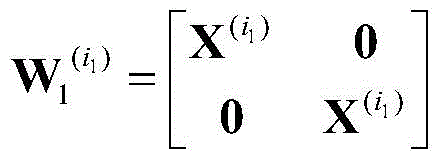
其中i1表示第i1个宽波束,每个宽波束由四个连续的窄波束构成(列向量),因而


由于系统支持的窄波束为32个,对应16个宽波束,则可以定义每个宽波Since the system supports 32 narrow beams, corresponding to 16 wide beams, each wide beam can be defined
束

C=[c0 c1 … c31],
其中ck为包含4个元素的列向量,[C]y,k表示矩阵C中第y行、第k列的元素值。Where c k is a column vector containing 4 elements, [C] y, k represents the element value of the y-th row and the k-th column in matrix C.
第二码本W2是由在宽波束中(W1中的所有列向量,包括两个极化方向)进行窄波束选择(一个或者几个列向量,和秩的值有关)和极化天线间的同相因子选择共同构成,LTE中8天线秩为1的码本中,W2包括4种可能的波束选择和四个可能的极化天线同相(co-phasing)因子,一共构成16个可选矩阵(故i2=0,1,2,3…15),对应如下:The second codebook W2 consists of narrow beam selection (one or several column vectors, depending on the value of the rank) and polarized antennas in a wide beam (all column vectors in W1, including both polarization directions) The co-phasing factor selection between the two is composed together. In the codebook of 8 antennas with


Ψ∈{1,-1,j,-j}Ψ∈{1,-1,j,-j}
其中
可选的,图4中,UE反馈的第一码本W1h中包含Nh个窄波束,W1v中包含Nv个窄波束。其中,第一码本对于宽波束码本。Optionally, in FIG. 4 , the first codebook W 1h fed back by the UE includes N h narrow beams, and W 1v includes N v narrow beams. Among them, the first codebook is for the wide beam codebook.
可选的,在S2和/或S4中UE进行CSI测量和第一码本反馈的方式可以参考现有技术中的方式,比如3GPP协议中已经定义的方式,如第一码本和/或第二码本的反馈可以采用索引的方式进行。Optionally, the manner in which the UE performs CSI measurement and feedback of the first codebook in S2 and/or S4 may refer to the manner in the prior art, such as the manner already defined in the 3GPP protocol, such as the first codebook and/or the first codebook. The feedback of the two codebooks can be performed in the form of an index.
可选的,S2和/或S4中,UE反馈的CSI测量结果可以包括第一PMI,其中第一PMI包括针对第一CSI-RS反馈的PMI1和针对第二CSI-RS反馈的PMI2。Optionally, in S2 and/or S4, the CSI measurement result fed back by the UE may include a first PMI, where the first PMI includes PMI1 fed back for the first CSI-RS and PMI2 fed back for the second CSI-RS.
可选的,所述PMI1和所述PMI2不同。Optionally, the PMI1 and the PMI2 are different.
可选的,所述PMI1和PMI2联合编码后通过部分PMI进行反馈,或者,Optionally, the PMI1 and PMI2 are jointly encoded and fed back through part of the PMI, or,
所述PMI1通过部分PMI反馈,所述PMI2通过另一部分PMI反馈,或者,The PMI1 is fed back through a part of the PMI, and the PMI2 is fed back through another part of the PMI, or,
所述PMI1通过部分PMI反馈,且,所述PMI2通过另一次反馈的所述部分PMI反馈。The PMI1 is fed back through the partial PMI, and the PMI2 is fed back through the partial PMI fed back in another time.
可选的,所述第一PMI包括针对第一CSI-RS反馈的PMI1或针对第二CSI-RS反馈的PMI2,所述PMI1和所述PMI2相同。此时,UE可以同时指示基站PMI1和PMI2相同。从而,降低UE的CSI反馈所占的资源。Optionally, the first PMI includes PMI1 fed back for the first CSI-RS or PMI2 fed back for the second CSI-RS, where the PMI1 and the PMI2 are the same. At this time, the UE may simultaneously indicate that the base station PMI1 and PMI2 are the same. Therefore, the resources occupied by the CSI feedback of the UE are reduced.
可选的,在S2和/或S4中UE可以不反馈第二码本、CQI和RI中的任意一个。其中,第二码本为窄波束码本。Optionally, in S2 and/or S4, the UE may not feed back any one of the second codebook, CQI and RI. The second codebook is a narrow beam codebook.
可选的,W1h和/或W1v的反馈方式可以为以下(2a)和(2b)中的一种,具体为何种反馈方式,可以视最终标准选择或是系统设计而定:Optionally, the feedback method of W 1h and/or W 1v can be one of the following (2a) and (2b), and the specific feedback method can be determined by the final standard selection or system design:
(2a)W1h和/或W1v的反馈方式可以是现有LTE所支持的W1的形式。(2a) The feedback mode of W 1h and/or W 1v may be the form of W 1 supported by existing LTE.
LTE当前所支持的W1是由一个块对角阵组成(此时第一CSI-RS或第二CSI-RS均按照上述(1b)方式进行发送),共包含两个相同的非零子阵组成,即:


对于CSI-RS按照前述(1a)方式(即仅在同一个极化方向上发送CSI-RS)发送时,W1的形式不再是


对于W1=[X]的情况,UE反馈X对应的索引,基站收到X对应的索引后,可以自行根据该X索引所对应的极化方向上的反馈,获得另一个极化方向上的X(或X的索引),用于后续第三CSI-RS(CSI-RS-3)的预编码。通常情况,默认另一个极化方向上的X和所反馈的极化方向上的X相同。For the case of W 1 =[X], the UE feeds back the index corresponding to X. After receiving the index corresponding to X, the base station can obtain the index corresponding to another polarization direction by itself according to the feedback in the polarization direction corresponding to the X index. X (or an index of X) is used for precoding of the subsequent third CSI-RS (CSI-RS-3). Usually, the X in the other polarization direction is the same as the X in the feedback polarization direction by default.
对于
在本申请中,第一码本W1v、W1h分别对应垂直方向的宽波束和水平方向的宽波束。在一个可选的示例中,水平和垂直两种宽波束对应的波束宽度以及包含的宽波束号可能均不相同,亦即W1h、W1v的X不同,即X所包括的列数、行数、元素中的至少一项不同。在另一个可选的示例中,水平和垂直两种宽波束对应的波束宽度以及包含的宽波束数目均相同,亦即W1h和W1v的X相同,包括相同的列数、行数和每个元素。In this application, the first codebooks W 1v and W 1h correspond to a wide beam in the vertical direction and a wide beam in the horizontal direction, respectively. In an optional example, the beam widths corresponding to the horizontal and vertical wide beams and the included wide beam numbers may be different, that is, the X of W 1h and W 1v are different, that is, the number of columns and rows included in X At least one of number and element is different. In another optional example, the beam widths corresponding to the horizontal and vertical wide beams and the number of wide beams included are the same, that is, the X of W 1h and W 1v are the same, including the same number of columns, rows and each elements.
可选的,在W1v、W1h的X不同时,UE可以利用前述现有LTE协议中的i1和i2所占用的资源分别反馈W1v、W1h的X所对应的索引,基站收到后,根据i1和i2确定W1v、W1h的码本。Optionally, when the X of W 1v and W 1h are different, the UE can use the resources occupied by i 1 and i 2 in the aforementioned existing LTE protocol to feed back the indices corresponding to the X of W 1v and W 1h respectively, and the base station receives the index. After that, the codebooks of W 1v and W 1h are determined according to i 1 and i 2 .
可选的,在W1v、W1h的X不同时,UE可以分两次利用前述现有LTE协议中的i1所占用的资源分别反馈W1v、W1h的X所对应的索引。基站收到后,分别根据收到的i1确定W1v、W1h的码本。Optionally, when the X of W 1v and W 1h are different, the UE may use the resources occupied by i 1 in the foregoing existing LTE protocol to feed back the indices corresponding to the X of W 1v and W 1h respectively. After receiving, the base station determines the codebooks of W 1v and W 1h respectively according to the received i 1 .
可选的,在W1v、W1h的X相同时,UE可以利用前述现有LTE协议中的i1所占用的资源反馈W1v和W1h的X所对应的索引,并通过其他字段(或域)告知基站W1v、W1h的X相同。Optionally, when the X of W 1v and W 1h are the same, the UE can use the resources occupied by i 1 in the aforementioned existing LTE protocol to feed back the index corresponding to the X of W 1v and W 1h , and pass other fields (or domain) informs the base stations that W 1v and W 1h have the same X.
可以理解的是,W1v、W1h的码本的形式可以和现有LTE协议中W1相同,也可以不同,比如根据系统演进,可支持的窄波束数目大于32,或是宽波束数目大于16,或是每个宽波束包含的窄波束数目不为4等,那么相应的W1的设计也相应的改变。It can be understood that the form of the codebooks of W 1v and W 1h can be the same as W 1 in the existing LTE protocol, or can be different, for example, according to system evolution, the number of supported narrow beams is greater than 32, or the number of wide beams is greater than 32. 16, or the number of narrow beams included in each wide beam is not 4, etc., then the corresponding design of W 1 is also changed accordingly.
(2b)W1h和/或W1v也可以不是现有LTE所支持的W1的形式(此时第一CSI-RS或第二CSI-RS均按照上述(1b)方式进行发送)。(2b) W 1h and/or W 1v may not be in the form of W 1 supported by existing LTE (in this case, both the first CSI-RS or the second CSI-RS are sent according to the above (1b) method).
比如,UE反馈的第一码本W1h和W1v,可以针对每个极化方向分别进行宽波束选择(即每个极化方向上的宽波束所包括的窄波束不同),W1的形式可以修改为
可选的,UE针对每个CSI-RS反馈X1、X2的码本索引,可以通过现有LTE协议中的i1所占用的资源进行反馈X1,由于此时不需要反馈i2,因此可以将i2所占用的资源用来反馈X2对应的码本索引,或者将X1、X2进行联合编码再反馈,所述联合编码可以使用差分编码,如反馈完整的X1码本以及X2与X1不同的波束构成的差分码本。Optionally, the UE feeds back the codebook indices of X 1 and X 2 for each CSI-RS, and can feed back X 1 through the resources occupied by i 1 in the existing LTE protocol. Since i 2 does not need to be fed back at this time, Therefore, the resources occupied by i 2 can be used to feed back the codebook index corresponding to X 2 , or X 1 and X 2 can be jointly coded and fed back. The joint coding can use differential coding, such as feeding back the complete X 1 codebook And the differential codebook formed by different beams of X 2 and X 1 .
在一个示例中,X1、X2对应的某些列可以相同,意味着该列对应的窄波束对两个极化方向的天线而言都较优。可以理解的是,反馈模式(2b)相较于(2a)中的反馈模式,(2b)的最大开销为(2a)的两倍。In an example, some columns corresponding to X 1 and X 2 may be the same, which means that the narrow beam corresponding to the column is better for antennas in both polarization directions. It can be understood that the maximum overhead of (2b) is twice that of (2a) in the feedback mode (2b) compared to the feedback mode in (2a).
第一码本W1v、W1h分别对应垂直方向的宽波束和水平方向的宽波束。在一个可选的示例中,水平和垂直两种宽波束对应的波束宽度以及包含的宽波束号可能均不相同,亦即W1h的X1与W1v的X1不同,和/或W1h的X2与W1v的X2不同,即W1h的X1和W1v的X1(和/或W1h的X2与W1v的X2)所包括的列数、行数、元素中的至少一项不同。在另一个可选的示例中,水平和垂直两种宽波束对应的波束宽度以及包含的宽波束号均相同,亦即W1h的X1与W1v的X1相同,且W1h的X2与W1v的X2相同,包括相同的列数、行数和每个元素。The first codebooks W 1v and W 1h correspond to a wide beam in the vertical direction and a wide beam in the horizontal direction, respectively. In an optional example, the beam widths corresponding to the horizontal and vertical wide beams and the included wide beam numbers may be different, that is, X 1 of W 1h is different from X 1 of W 1v , and/or W 1h X 2 of W 1v is different from X 2 of W 1v, that is, X 1 of W 1h and X 1 of W 1v (and/or X 2 of W 1h and X 2 of W 1v ) include the number of columns, rows, and elements in at least one of them differs. In another optional example, the beam widths corresponding to the horizontal and vertical wide beams and the included wide beam numbers are the same, that is, X 1 of W 1h is the same as X 1 of W 1v , and X 2 of W 1h Same as X 2 for W 1v , including the same number of columns, rows, and each element.
可选的,S2和S4的时间先后在本发明实施例中不予限定。可以理解的是,S2在S1后,S4在S3后即可。S2和S4可以同时反馈,比如在同一个PMI中反馈。Optionally, the time sequence of S2 and S4 is not limited in this embodiment of the present invention. It can be understood that S2 can be after S1, and S4 can be after S3. S2 and S4 can be fed back at the same time, such as in the same PMI.
S5.基站向UE发送第三CSI-RS。S5. The base station sends the third CSI-RS to the UE.
可选的,第三CSI-RS的配置信息可以通过RRC,MAC层控制元素,或,物理控制信道,配置给UE。Optionally, the configuration information of the third CSI-RS may be configured to the UE through RRC, a MAC layer control element, or a physical control channel.
可选的,第三CSI-RS为基站按照UE在S2和S4中反馈的W1h、W1v指示的码本进行波束赋形后发送的。第三CSI-RS对应的CSI-RS资源共包含Nv1*Nh1+Nv2*Nh2(当Nv1=Nv2=Nv且Nh1=Nh2=Nh时,为2*Nv*Nh)个CSI-RS端口,或者小于Nv1*Nh1+Nv2*Nh2(2*Nv*Nh)个CSI-RS端口。其中,Nv1为垂直方向上一个极化方向(极化方向1)所包含的列的数目(窄波束数),Nv2为垂直方向上另一个极化方向(极化方向2)所包含的列的数目(窄波束数),Nh1为水平方向上一个极化方向(极化方向1)所包含的列的数目(窄波束数),Nh2为水平方向上另一个极化方向(极化方向2)所包含的列的数目(窄波束数)。每个端口可以对应一个经过预编码后的窄波束,窄波束与CSI-RS端口编号的映射关系可以如图6所示,在图6中,一个端口对应一个窄波束,在其他示例中,也可以多个端口对应一个窄波束。在图6中,按照一个维度先进行天线端口映射,如水平维度,然后按照另外一个维度进行端口映射,如垂直维度,需要注意的是,图6仅仅给出一种示意,且仅仅画出一个极化方向端口映射图,另一个极化方向端口映射与其类似,此处不再赘述。Optionally, the third CSI-RS is sent by the base station after beamforming according to the codebook indicated by W 1h and W 1v fed back by the UE in S2 and S4 . The CSI-RS resources corresponding to the third CSI-RS include N v1 *N h1 +N v2 *N h2 (when N v1 =N v2 =N v and N h1 =N h2 =N h , it is 2*N v *N h ) CSI-RS ports, or less than N v1 *N h1 +N v2 *N h2 (2*N v *N h ) CSI-RS ports. Among them, N v1 is the number of columns (the number of narrow beams) included in one polarization direction (polarization direction 1) in the vertical direction, and N v2 is the number of columns included in the other polarization direction (polarization direction 2) in the vertical direction The number of columns (the number of narrow beams), N h1 is the number of columns (the number of narrow beams) contained in one polarization direction (polarization direction 1) in the horizontal direction, and N h2 is the other polarization direction (polarization direction 1) in the horizontal direction. The number of columns (the number of narrow beams) included in the direction 2). Each port can correspond to a precoded narrow beam, and the mapping relationship between the narrow beam and the CSI-RS port number can be as shown in Figure 6. In Figure 6, one port corresponds to one narrow beam. In other examples, also Multiple ports can correspond to a narrow beam. In Fig. 6, the antenna port mapping is performed according to one dimension, such as the horizontal dimension, and then the port mapping is performed according to another dimension, such as the vertical dimension. It should be noted that Fig. 6 only gives a schematic diagram, and only draws one The port mapping diagram in the polarization direction is similar to the port mapping diagram in the other polarization direction, and details are not described here.
可选的,所述第三CSI-RS依据所述第一CSI测量结果进行过预编码包括:Optionally, the third CSI-RS performing precoding according to the first CSI measurement result includes:
第一无线网络设备依据所述第一CSI测量结果确定第一CSI-RS对应的第一维度预编码矩阵和第二CSI-RS对应的第二维度预编码矩阵;The first wireless network device determines a first-dimension precoding matrix corresponding to the first CSI-RS and a second-dimension precoding matrix corresponding to the second CSI-RS according to the first CSI measurement result;
第一无线网络设备将待发送的第三CSI-RS乘以第一维度预编码矩阵中相应列与第二维度预编码矩阵中相应列的Kronecher积,其中,所述相应列与所述第三CSI-RS所对应的天线端口相对应。The first wireless network device multiplies the third CSI-RS to be sent by the Kronecher product of the corresponding column in the first dimension precoding matrix and the corresponding column in the second dimension precoding matrix, wherein the corresponding column and the third The antenna ports corresponding to the CSI-RSs correspond.
可选的,波束赋形的方法可以为(3a)和(3b)中的一种,具体为(3a)还是(3b)可以依据标准选择或系统设计而定,在此不予限定。其中,Optionally, the beamforming method may be one of (3a) and (3b), specifically (3a) or (3b) may be determined according to standard selection or system design, which is not limited herein. in,
(3a)对于W1h、W1v采用上述反馈方式(2a)或(2c)进行反馈的情况,即
可选的,在此以第0至第Nv*Nh-1个CSI-RS端口在所有同一极化方向的天线振子上发送(如+45°极化天线),第Nv*Nh至第2*Nv*Nh-1个CSI-RS端口在另一极化方向的天线上发送(如-45°极化天线)为例进行描述,可以理解的是,CSI-RS端口和天线振子之间的关系还可以为其他情况,而非此描述的情形。Optionally, the 0th to N v *N h -1 CSI-RS ports are used here to transmit on all antenna elements in the same polarization direction (such as a +45° polarized antenna), and the N v *N h th The 2*N v *N h -1 CSI-RS port is sent on an antenna in another polarization direction (such as a -45° polarization antenna) as an example. It can be understood that the CSI-RS port and the The relationship between the antenna elements can also be in other situations than the one described here.
第m(m大于等于0,小于2*Nv*Vh-1)个CSI导频(RS的另一种称呼)端口在发送CSI-RS前将CSI-RS符号乘以预编码矩阵W1h中对角阵Xh的第m modNh列
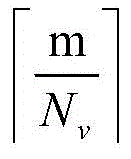
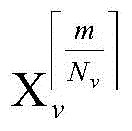


如前所描述的,第三CSI-RS端口数目可以小于2*Nv*Vh,这种情况下:As previously described, the number of third CSI-RS ports may be less than 2*N v *V h , in this case:
(3a.1)基站可以在配置第三CSI-RS时,使用比特序列


(3a.2)基站为UE配置增强后的第三CSI-RS,该第三CSI-RS可以包含多个CSI-RS资源,每个CSI-RS资源端口数目为当前LTE所支持的,例如每个CSI-RS资源包括2个或者4个或者8个CSI-RS端口端口,每个CSI-RS资源占用不同的物理时频资源。基站在进行该第三CSI-RS发送时,将各窄波束分别对应到不同CSI-RS资源的不同端口上。如图7b所示,假设第三CSI-RS需要发送8个窄波束(每个极化方向各4个,假设一个极化方向标号波束0-波束3,另一极化方向波束标号波束4-波束7),共占用8个正交的导频资源。按照本方案,第三CSI-RS可以由4个两天线端口的CSI-RS资源构成,记为CSI-RS资源1至CSI-RS资源4,基站在进行CSI-RS资源1发送时,其端口15对应的CSI-RS需要经过波束0进行预编码后发送,端口16对应的CSI-RS需要经过波束4进行预编码后发送;基站在进行CSI-RS资源2发送时,其端口15对应的CSI-RS需要经过波束1进行预编码后发送,端口16对应的CSI-RS需要经过波束5进行预编码后发送;基站在进行CSI-RS资源3发送时,其端口15对应的CSI-RS需要经过波束2进行预编码后发送,端口16对应的CSI-RS需要经过波束6进行预编码后发送;基站在进行CSI-RS资源4发送时,其端口15 对应的CSI-RS需要经过波束3进行预编码后发送,端口16对应的CSI-RS需要经过波束7进行预编码后发送。所述仅是一种举例,具体配置多少CSI-RS资源以及每个CSI-RS资源的配置(包括端口数目、占用的时频资源等)可以由基站动态决定。(3a.2) The base station configures the UE with an enhanced third CSI-RS, the third CSI-RS may include multiple CSI-RS resources, and the number of ports of each CSI-RS resource is supported by the current LTE, for example, every Each CSI-RS resource includes 2 or 4 or 8 CSI-RS port ports, and each CSI-RS resource occupies a different physical time-frequency resource. When the base station transmits the third CSI-RS, each narrow beam is respectively corresponding to different ports of different CSI-RS resources. As shown in Figure 7b, it is assumed that the third CSI-RS needs to transmit 8 narrow beams (4 in each polarization direction, assuming that one polarization direction is labeled beam 0-
(3b)对于W1h、W1v采用上述反馈方式(2b)进行反馈的情况,即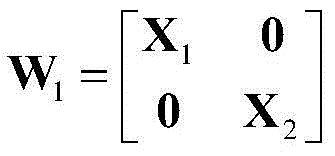
可选的,在此以第0至第Nv*Nh-1个CSI-RS端口在所有同一极化方向的天线振子上发送(如+45°极化天线),第Nv*Nh至第2*Nv*Nh-1个CSI-RS端口在另一极化方向的天线上发送(如-45°极化天线)为例进行描述,可以理解的是,CSI-RS端口和天线振子之间的关系还可以为其他情况,而非此描述的情形。Optionally, the 0th to N v *N h -1 CSI-RS ports are used here to transmit on all antenna elements in the same polarization direction (such as a +45° polarized antenna), and the N v *N h th The 2*N v *N h -1 CSI-RS port is sent on an antenna in another polarization direction (such as a -45° polarization antenna) as an example. It can be understood that the CSI-RS port and the The relationship between the antenna elements can also be in other situations than the one described here.
第m(m大于等于0,小于Nh1*Nv1-1)个CSI-RS端口在所有同一极化方向的天线上发送(如左极化天线),导频符号在发送前乘以预编码矩阵W1h中左上对角阵X1,h的第mmodNh1列


可选的,第三CSI-RS端口数目可以小于Nv1*Vh1+Nv2*Vh2。这种情况下,基站可以在配置第三CSI-RS时,使用比特序列


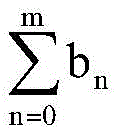
S6.UE接收第三CSI-RS,针对S5中配置的第三CSI-RS进行CSI测量,由于第三CSI-RS有不同的配置方式,UE反馈的CSI信息也有区别,具体为哪种形式可以参考标准的决定或实际系统的设计。S6. The UE receives the third CSI-RS, and performs CSI measurement on the third CSI-RS configured in S5. Since the third CSI-RS has different configuration modes, the CSI information fed back by the UE is also different. The decision of the reference standard or the design of the actual system.
可选的,所述第三CSI测量结果包括第三预编码矩阵指示(PMI)。Optionally, the third CSI measurement result includes a third precoding matrix indication (PMI).
可选的,所述第三CSI测量结果对应窄波束码本,所述窄波束码本用于表示宽波束码本中对应的宽波束中的窄波束选择和该宽波束对应的天线振子之间的同相因子的选择。Optionally, the third CSI measurement result corresponds to a narrow beam codebook, and the narrow beam codebook is used to indicate the difference between the narrow beam selection in the wide beam corresponding to the wide beam codebook and the antenna element corresponding to the wide beam. The choice of the in-phase factor.
具体的,可以包括和(4a)和(4b)中的一种。具体为哪种形式可以参考标准的决定或实际系统的设计。Specifically, one of (4a) and (4b) may be included. The specific form can refer to the decision of the standard or the design of the actual system.
(4a)针对前述(3a.1)或(3b)的情况(4a) In the case of (3a.1) or (3b) above
UE反馈由所选的窄波束和不同极化天线间的量化同相系数共同构成的第二预编码矩阵(W2)。具体反馈形式可以如现有LTE协议中的反馈第二预编码矩阵所对应的索引。进一步的,UE还反馈RI以及CQI。从而使基站得到数据传输需要的合成的预编码矩阵。其中所选窄波束是指对第一码本进行列选择,不同极化天线间的量化同相系数是指两个不同极化方向的天线(每个同一极化方向的天线可以包括1个天线振子,也可包括多个天线振子)之间存在的经过量化后的相位差。The UE feeds back a second precoding matrix (W 2 ) composed of the selected narrow beam and the quantized in-phase coefficients between different polarized antennas. The specific feedback form may be the index corresponding to the feedback of the second precoding matrix in the existing LTE protocol. Further, the UE also feeds back RI and CQI. Thus, the base station can obtain the synthesized precoding matrix required for data transmission. The selected narrow beam refers to the column selection of the first codebook, and the quantized in-phase coefficient between different polarization antennas refers to two antennas with different polarization directions (each antenna with the same polarization direction may include one antenna element) , and may also include the quantized phase difference existing between multiple antenna elements).
可选的,所述窄波束码本为第二预编码矩阵W2,且,
可选的,第二预编码矩阵可以为两种形式(4a.1)和(4a.2)中的一种。具体为哪种形式可以参考标准的决定或实际系统的设计。具体的,Optionally, the second precoding matrix may be one of two forms (4a.1) and (4a.2). The specific form can refer to the decision of the standard or the design of the actual system. specific,
(4a.1)与现有LTE中类似,主要针对第一码本为(2a),且BS在进行第三CSI-RS发送时,采用(3a.1)的预编码对CSI-RS进行波束成形(赋形)发送的情况,第二预编码矩阵的构成上包括在每个极化方向选取相同的波束,然后加上一个不同极化天线间的量化同相系数;(4a.1) Similar to the existing LTE, the first codebook is (2a), and when the BS transmits the third CSI-RS, the precoding of (3a.1) is used to beam the CSI-RS In the case of shaping (shaping) transmission, the composition of the second precoding matrix includes selecting the same beam in each polarization direction, and then adding a quantized in-phase coefficient between antennas of different polarizations;
(4a.2)与现有LTE有些区别,主要针对第一码本为(2b),且BS在进行第三CSI-RS发送时,采用(3b)的预编码对CSI-RS进行波束成形发送的情况,第二预编码矩阵的构成上包括每个极化方向选取不同的波束,再加上不同极化天线间的量化同相系数,即前面所述LTE第二预编码矩阵中,Y可以独立的进行选择,即Y1不等于Y2。(4a.2) There are some differences from the existing LTE, mainly for the first codebook (2b), and when the BS transmits the third CSI-RS, the precoding of (3b) is used to transmit the CSI-RS by beamforming In the case of , the composition of the second precoding matrix includes selecting different beams for each polarization direction, plus the quantized in-phase coefficients between antennas of different polarizations, that is, in the second LTE precoding matrix described above, Y can be independently , that is, Y 1 is not equal to Y 2 .
(4b)针对前述(3a.2)的情况(4b) In the case of (3a.2) above
UE反馈第三CSI-RS配置的多个CSI-RS资源中的一个CSI-RS资源对应的ID、以及由所选的CSI-RS资源中的一个或者多个窄波束ID和不同极化天线间的量化同相系数构成的第二预编码矩阵。具体反馈形式可以和现有LTE协议中第二码本的反馈形式相同或类似。进一步的,UE还可以反馈RI以及CQI。从而使基站得到数据传输需要的合成的预编码矩阵。The UE feeds back the ID corresponding to one CSI-RS resource in the multiple CSI-RS resources configured by the third CSI-RS, and the ID between one or more narrow beam IDs in the selected CSI-RS resources and the different polarization antennas The quantized in-phase coefficients constitute the second precoding matrix. The specific feedback form may be the same as or similar to the feedback form of the second codebook in the existing LTE protocol. Further, the UE can also feed back RI and CQI. Thus, the base station can obtain the synthesized precoding matrix required for data transmission.
可以理解的是,在第三CSI-RS只配置一个CSI-RS资源的情况下,所述第二预编码矩阵与(4a)中相同,本方案与(4a)中的不同体现在对CSI-RS资源的选择反馈。It can be understood that in the case where only one CSI-RS resource is configured for the third CSI-RS, the second precoding matrix is the same as in (4a), and the difference between this solution and (4a) is reflected in the RS resource selection feedback.
可以理解的是,由于第一CSI-RS和第二CSI-RS的主要作用是为了获取宽波束码本W1,因此第一CSI-RS和第二CSI-RS的测量发起周期(包括基站发送和UE反馈)可以大于用于获取短时码本的第三CSI-RS的测量发起周期,即两次第一CSI-RS测量发起或是第二CSI-RS测量发起之间可以存在多次第三CSI-RS的测量。It can be understood that since the main function of the first CSI-RS and the second CSI-RS is to obtain the wide beam codebook W 1 , the measurement initiation period of the first CSI-RS and the second CSI-RS (including the base station sending and UE feedback) may be greater than the measurement initiation period used to obtain the third CSI-RS of the short-time codebook, that is, there may be multiple times between the two initiations of the first CSI-RS measurement or the initiation of the second CSI-RS measurement. Three CSI-RS measurements.
通过本发明实施例中提供的宽带CSI-RS(第一CSI-RS,第二CSI-RS)和窄带CSI-RS(第三CSI-RS)结合的方式,可以在多个天线端口的场景下,降低UE 侧计算复杂度,减少UE侧的反馈量,进而减少上行控制信道占用的资源,增加上行用户的数据吞吐量。Through the combination of wideband CSI-RS (first CSI-RS, second CSI-RS) and narrowband CSI-RS (third CSI-RS) provided in the embodiments of the present invention, in the scenario of multiple antenna ports , reducing the computational complexity of the UE side, reducing the amount of feedback on the UE side, thereby reducing the resources occupied by the uplink control channel and increasing the data throughput of the uplink user.
根据前述方法,如图8所示,本发明实施例还提供一种用于多天线信道测量的装置,该装置可以为无线网络设备10,该无线网络设备10对应上述方法中的第一无线网络设备。第一无线网络设备可以为基站,也可以为其他设备,在此不予限定。According to the foregoing method, as shown in FIG. 8 , an embodiment of the present invention further provides an apparatus for multi-antenna channel measurement. The apparatus may be a
该无线网络设备包括处理器110、存储器120、总线系统130、接收器140和发送器150。其中,处理器110、存储器120、接收器140和发送器150通过总线系统130相连,该存储器120用于存储指令,该处理器110用于执行该存储器120存储的指令,以控制接收器140接收信号,并控制发送器150发送信号,完成上述方法中第一无线网络设备(如基站)的步骤。其中,接收器140和发送器150可以为相同或者不同的物理实体。为相同的物理实体时,可以统称为收发器。The wireless network device includes a
作为一种实现方式,接收器140和发送器150的功能可以考虑通过收发电路或者收发的专用芯片实现。处理器110可以考虑通过专用处理芯片、处理电路、处理器或者通用芯片实现。As an implementation manner, the functions of the
作为另一种实现方式,可以考虑使用通用计算机的方式来实现本发明实施例提供的无线接入设备。即将实现处理器110,接收器140和发送器150功能的程序代码存储在存储器中,通用处理器通过执行存储器中的代码来实现处理器110,接收器140和发送器150的功能。As another implementation manner, a general-purpose computer may be used to implement the wireless access device provided in the embodiments of the present invention. The program codes that will implement the functions of the
无线网络设备所涉及的与本发明实施例提供的技术方案相关的概念,解释和详细说明及其他步骤请参见前述方法或其他实施例中关于这些内容的描述,此处不做赘述。For the concepts related to the technical solutions provided by the embodiments of the present invention involved in the wireless network device, for explanations and detailed descriptions, and other steps, please refer to the descriptions of the foregoing methods or other embodiments, which will not be repeated here.
根据前述方法,如图9所示,本发明实施例还提供另一种用于多天线信道测量的装置,该装置可以为无线网络设备20,该无线网络设备20对应上述方法中的第二无线网络设备。第二无线网络设备可以为UE,也可以为微基站或小基站,在此不予限定。According to the foregoing method, as shown in FIG. 9 , an embodiment of the present invention further provides another apparatus for multi-antenna channel measurement, which may be a wireless network device 20, and the wireless network device 20 corresponds to the second wireless network in the above method. Network equipment. The second wireless network device may be a UE, or may be a micro base station or a small base station, which is not limited herein.
该无线网络设备包括处理器210、存储器220、总线系统230、接收器240和发送器250。其中,处理器210、存储器220、接收器240和发送器250通过总线系统230相连,该存储器220用于存储指令,该处理器210用于执行该存储器220存储的指令,以控制接收器240接收信号,并控制发送器250发送信号,完成上述方法中第二无线网络设备(如UE)的步骤。其中,接收器240和发送器250可以为相同或者不同的物理实体。为相同的物理实体时,可以统称为收发器。The wireless network device includes a
作为一种实现方式,接收器240和发送器250的功能可以考虑通过收发电路或者收发的专用芯片实现。处理器210可以考虑通过专用处理芯片、处理电路、处理器或者通用芯片实现。As an implementation manner, the functions of the
作为另一种实现方式,可以考虑使用通用计算机的方式来实现本发明实施例提供的无线接入设备。即将实现处理器210,接收器240和发送器250功能的程序代码存储在存储器中,通用处理器通过执行存储器中的代码来实现处理器210,接收器240和发送器250的功能。As another implementation manner, a general-purpose computer may be used to implement the wireless access device provided in the embodiments of the present invention. The program codes that will implement the functions of the
第二无线网络设备所涉及的与本发明实施例提供的技术方案相关的概念,解释和详细说明及其他步骤请参见前述方法或其他实施例中关于这些内容的描述,此处不做赘述。For concepts related to the technical solutions provided by the embodiments of the present invention involved in the second wireless network device, please refer to the descriptions of the foregoing methods or other embodiments for explanations, detailed descriptions, and other steps, which will not be repeated here.
根据本发明实施例提供的方法,本发明实施例还提供一种通信系统,其包括前述的第一无线网络设备和一个或多于一个第二无线网络设备。According to the method provided by the embodiment of the present invention, the embodiment of the present invention further provides a communication system, which includes the aforementioned first wireless network device and one or more than one second wireless network device.
应理解,在本发明实施例中,处理器110或210可以是中央处理单元(CentralProcessing Unit,简称为“CPU”),该处理器还可以是其他通用处理器、数字信号处理器(DSP)、专用集成电路(ASIC)、现成可编程门阵列(FPGA)或者其他可编程逻辑器件、分立门或者晶体管逻辑器件、分立硬件组件等。通用处理器可以是微处理器或者该处理器也可以是任何常规的处理器等。It should be understood that, in this embodiment of the present invention, the
该存储器120或220可以包括只读存储器和随机存取存储器,并向处理器310提供指令和数据。存储器的一部分还可以包括非易失性随机存取存储器。例如,存储器还可以存储设备类型的信息。The
该总线系统130或230除包括数据总线之外,还可以包括电源总线、控制总线和状态信号总线等。但是为了清楚说明起见,在图中将各种总线都标为总线系统。In addition to the data bus, the
在实现过程中,上述方法的各步骤可以通过处理器110或210中的硬件的集成逻辑电路或者软件形式的指令完成。结合本发明实施例所公开的方法的步骤可以直接体现为硬件处理器执行完成,或者用处理器中的硬件及软件模块组合执行完成。软件模块可以位于随机存储器,闪存、只读存储器,可编程只读存储器或者电可擦写可编程存储器、寄存器等本领域成熟的存储介质中。该存储介质位于存储器,处理器读取存储器中的信息,结合其硬件完成上述方法的步骤。为避免重复,这里不再详细描述。In the implementation process, each step of the above-mentioned method may be completed by an integrated logic circuit of hardware in the
还应理解,本文中涉及的第一、第二、第三、第四以及各种数字编号仅为描述方便进行的区分,并不用来限制本发明实施例的范围。It should also be understood that the first, second, third, fourth and various numerical numbers involved in this document are only for the convenience of description, and are not used to limit the scope of the embodiments of the present invention.
应理解,本文中术语“和/或”,仅仅是一种描述关联对象的关联关系,表示可以存在三种关系,例如,A和/或B,可以表示:单独存在A,同时存在A和B,单独存在B这三种情况。另外,本文中字符“/”,一般表示前后关联对象是一种“或”的关系。It should be understood that the term "and/or" in this document is only an association relationship to describe associated objects, indicating that there can be three kinds of relationships, for example, A and/or B, which can mean that A exists alone, and A and B exist at the same time , there are three cases of B alone. In addition, the character "/" in this document generally indicates that the related objects are an "or" relationship.
应理解,在本发明的各种实施例中,上述各过程的序号的大小并不意味着执行顺序的先后,各过程的执行顺序应以其功能和内在逻辑确定,而不应对本发明实施例的实施过程构成任何限定。It should be understood that, in various embodiments of the present invention, the size of the sequence numbers of the above-mentioned processes does not mean the sequence of execution, and the execution sequence of each process should be determined by its functions and internal logic, rather than the embodiments of the present invention. implementation constitutes any limitation.
本领域普通技术人员可以意识到,结合本文中所公开的实施例描述的各示例的单元及算法步骤,能够以电子硬件、或者计算机软件和电子硬件的结合来实现。这些功能究竟以硬件还是软件方式来执行,取决于技术方案的特定应用和设计约束条件。专业技术人员可以对每个特定的应用来使用不同方法来实现所描述的功能,但是这种实现不应认为超出本发明的范围。Those of ordinary skill in the art can realize that the units and algorithm steps of each example described in conjunction with the embodiments disclosed herein can be implemented in electronic hardware, or a combination of computer software and electronic hardware. Whether these functions are performed in hardware or software depends on the specific application and design constraints of the technical solution. Skilled artisans may implement the described functionality using different methods for each particular application, but such implementations should not be considered beyond the scope of the present invention.
所属领域的技术人员可以清楚地了解到,为描述的方便和简洁,上述描述的系统、装置和单元的具体工作过程,可以参考前述方法实施例中的对应过程,在此不再赘述。Those skilled in the art can clearly understand that, for the convenience and brevity of description, the specific working process of the above-described systems, devices and units may refer to the corresponding processes in the foregoing method embodiments, which will not be repeated here.
在本申请所提供的几个实施例中,应该理解到,所揭露的系统、装置和方法,可以通过其它的方式实现。例如,以上所描述的装置实施例仅仅是示意性的,例如,所述单元的划分,仅仅为一种逻辑功能划分,实际实现时可以有另外的划分方式,例如多个单元或组件可以结合或者可以集成到另一个系统,或一些特征可以忽略,或不执行。另一点,所显示或讨论的相互之间的耦合或直接耦合或通信连接可以是通过一些接口,装置或单元的间接耦合或通信连接,可以是电性,机械或其它的形式。In the several embodiments provided in this application, it should be understood that the disclosed system, apparatus and method may be implemented in other manners. For example, the apparatus embodiments described above are only illustrative. For example, the division of the units is only a logical function division. In actual implementation, there may be other division methods. For example, multiple units or components may be combined or Can be integrated into another system, or some features can be ignored, or not implemented. On the other hand, the shown or discussed mutual coupling or direct coupling or communication connection may be through some interfaces, indirect coupling or communication connection of devices or units, and may be in electrical, mechanical or other forms.
所述作为分离部件说明的单元可以是或者也可以不是物理上分开的,作为单元显示的部件可以是或者也可以不是物理单元,即可以位于一个地方,或者也可以分布到多个网络单元上。可以根据实际的需要选择其中的部分或者全部单元来实现本实施例方案的目的。The units described as separate components may or may not be physically separated, and components displayed as units may or may not be physical units, that is, may be located in one place, or may be distributed to multiple network units. Some or all of the units may be selected according to actual needs to achieve the purpose of the solution in this embodiment.
另外,在本发明各个实施例中的各功能单元可以集成在一个处理单元中,也可以是各个单元单独物理存在,也可以两个或两个以上单元集成在一个单元中。In addition, each functional unit in each embodiment of the present invention may be integrated into one processing unit, or each unit may exist physically alone, or two or more units may be integrated into one unit.
所述功能如果以软件功能单元的形式实现并作为独立的产品销售或使用时,可以存储在一个计算机可读取存储介质中。基于这样的理解,本发明的技术方案本质上或者说对现有技术做出贡献的部分或者该技术方案的部分可以以软件产品的形式体现出来,该计算机软件产品存储在一个存储介质中,包括若干指令用以使得一台计算机设备(可以是个人计算机,服务器,或者网络设备等)执行本发明各个实施例所述方法的全部或部分步骤。而前述的存储介质包括:U盘、移动硬盘、只读存储器(ROM,Read-Only Memory)、随机存取存储器(RAM,Random Access Memory)、磁碟或者光盘等各种可以存储程序代码的介质。The functions, if implemented in the form of software functional units and sold or used as independent products, may be stored in a computer-readable storage medium. Based on this understanding, the technical solution of the present invention can be embodied in the form of a software product in essence, or the part that contributes to the prior art or the part of the technical solution. The computer software product is stored in a storage medium, including Several instructions are used to cause a computer device (which may be a personal computer, a server, or a network device, etc.) to execute all or part of the steps of the methods described in the various embodiments of the present invention. The aforementioned storage medium includes: U disk, mobile hard disk, Read-Only Memory (ROM, Read-Only Memory), Random Access Memory (RAM, Random Access Memory), magnetic disk or optical disk and other media that can store program codes .
以上所述,仅为本发明的具体实施方式,但本发明的保护范围并不局限于此,任何熟悉本技术领域的技术人员在本发明揭露的技术范围内,可轻易想到变化或替换,都应涵盖在本发明的保护范围之内。因此,本发明的保护范围应以所述权利要求的保护范围为准。The above are only specific embodiments of the present invention, but the protection scope of the present invention is not limited thereto. Any person skilled in the art can easily think of changes or substitutions within the technical scope disclosed by the present invention. should be included within the protection scope of the present invention. Therefore, the protection scope of the present invention should be based on the protection scope of the claims.
Claims (14)





Priority Applications (5)
| Application Number | Priority Date | Filing Date | Title |
|---|---|---|---|
| CN201510623199.8A CN106559121B (en) | 2015-09-25 | 2015-09-25 | A kind of multi-antenna channel measurement method and device |
| JP2018515852A JP2018534836A (en) | 2015-09-25 | 2016-09-26 | Multi-antenna channel measurement method and apparatus |
| PCT/CN2016/100134 WO2017050295A1 (en) | 2015-09-25 | 2016-09-26 | Multi-antenna channel measurement method and apparatus |
| EP16848176.0A EP3343796B1 (en) | 2015-09-25 | 2016-09-26 | Multi-antenna channel measurement method and apparatus |
| US15/935,035 US10530450B2 (en) | 2015-09-25 | 2018-03-25 | Multi-antenna channel measurement method and apparatus |
Applications Claiming Priority (1)
| Application Number | Priority Date | Filing Date | Title |
|---|---|---|---|
| CN201510623199.8A CN106559121B (en) | 2015-09-25 | 2015-09-25 | A kind of multi-antenna channel measurement method and device |
Publications (2)
| Publication Number | Publication Date |
|---|---|
| CN106559121A CN106559121A (en) | 2017-04-05 |
| CN106559121B true CN106559121B (en) | 2021-07-09 |
Family
ID=58385628
Family Applications (1)
| Application Number | Title | Priority Date | Filing Date |
|---|---|---|---|
| CN201510623199.8A Active CN106559121B (en) | 2015-09-25 | 2015-09-25 | A kind of multi-antenna channel measurement method and device |
Country Status (5)
| Country | Link |
|---|---|
| US (1) | US10530450B2 (en) |
| EP (1) | EP3343796B1 (en) |
| JP (1) | JP2018534836A (en) |
| CN (1) | CN106559121B (en) |
| WO (1) | WO2017050295A1 (en) |
Families Citing this family (36)
| Publication number | Priority date | Publication date | Assignee | Title |
|---|---|---|---|---|
| CN106603128A (en) * | 2015-10-18 | 2017-04-26 | 株式会社Ntt都科摩 | Method and electronic device for generating the configuration items of main codebook |
| EP3371921A1 (en) * | 2015-11-03 | 2018-09-12 | Intel Corporation | Antenna port multiplexing |
| KR102721403B1 (en) * | 2017-02-24 | 2024-10-25 | 삼성전자주식회사 | Apparatus and method for transmitting reference siganls in wireless communication system |
| WO2018176324A1 (en) * | 2017-03-30 | 2018-10-04 | 华为技术有限公司 | Data exchange method, terminal device, and network device |
| AU2018262536A1 (en) | 2017-05-05 | 2019-11-21 | Telefonaktiebolaget Lm Ericsson (Publ) | Interference measurements and channel state information feedback for multi-user multiple-in multiple-out |
| WO2018215052A1 (en) * | 2017-05-23 | 2018-11-29 | Huawei Technologies Co., Ltd. | Channel state information related feedback reporting and channel state information acquisition |
| CN109150256B (en) | 2017-06-16 | 2022-01-14 | 华为技术有限公司 | Communication method, communication device and system |
| WO2019028860A1 (en) * | 2017-08-11 | 2019-02-14 | Qualcomm Incorporated | A scalable process for indicating beam selection |
| CN109428637B (en) * | 2017-08-28 | 2022-02-01 | 华为技术有限公司 | CSI-RS measurement feedback method and equipment |
| CN109495149B (en) | 2017-09-11 | 2021-10-15 | 华为技术有限公司 | Communication method, network device, terminal device and system |
| CN114696928A (en) * | 2017-09-29 | 2022-07-01 | 大唐移动通信设备有限公司 | Interference measurement method, user terminal and network side equipment |
| EP3697128B1 (en) * | 2017-11-17 | 2024-04-03 | Huawei Technologies Co., Ltd. | Channel state information feedback method, communication device, and system |
| CN109803414B (en) * | 2017-11-17 | 2021-10-26 | 华为技术有限公司 | Resource allocation method and device |
| CN110034802B (en) * | 2018-01-12 | 2021-08-20 | 大唐移动通信设备有限公司 | An information transmission method and device |
| CN111727568A (en) * | 2018-01-16 | 2020-09-29 | 索尼公司 | operate devices in a wireless communication system |
| US11088754B2 (en) | 2018-01-29 | 2021-08-10 | Qualcomm Incorporated | Autonomous reception beam refinement and tracking |
| US10911168B2 (en) | 2018-02-02 | 2021-02-02 | Cornell University | Channel charting in wireless systems |
| CN110290551B (en) * | 2018-03-19 | 2023-02-28 | 上海朗帛通信技术有限公司 | Method and device used in user equipment and base station for wireless communication |
| CN111971992B (en) * | 2018-05-23 | 2022-06-21 | 上海朗帛通信技术有限公司 | Method and apparatus used for positioning in wireless communication |
| US11463151B2 (en) * | 2018-07-30 | 2022-10-04 | Sony Group Corporation | Operating devices in a wireless communication system |
| US11638256B2 (en) | 2018-08-10 | 2023-04-25 | Sony Group Corporation | Method and system for performing beam sweeping using multiple polarization |
| WO2020047774A1 (en) * | 2018-09-05 | 2020-03-12 | 华为技术有限公司 | Channel information processing method and apparatus |
| US11637611B2 (en) | 2019-01-29 | 2023-04-25 | Huawei Technologies Co., Ltd. | Methods and apparatus for beam management for device communications |
| CN111726155B (en) * | 2019-03-21 | 2022-06-10 | 大唐移动通信设备有限公司 | CSI feedback method, receiving method, terminal and network side equipment |
| US10778298B1 (en) | 2019-03-29 | 2020-09-15 | At&T Intellectual Property I, L.P. | Context-based precoding matrix computations for radio access network for 5G or other next generation network |
| CN110174649B (en) * | 2019-05-07 | 2024-07-19 | 加特兰微电子科技(上海)有限公司 | Radio frequency front-end transceiver and vehicle-mounted radar transceiver system |
| CN111158335B (en) * | 2019-11-19 | 2021-08-20 | 潍柴动力股份有限公司 | Pin function matching method and storage medium for multi-ECU system |
| CN111479281B (en) * | 2020-04-10 | 2022-08-19 | 展讯通信(上海)有限公司 | Cell measurement method and device, storage medium and terminal |
| CN113872649B (en) * | 2020-06-30 | 2023-03-10 | 华为技术有限公司 | A feedback method and communication device for channel state information |
| WO2022016321A1 (en) * | 2020-07-20 | 2022-01-27 | Qualcomm Incorporated | Channel state information reporting techniques for wide beams |
| KR102402854B1 (en) * | 2020-09-01 | 2022-05-26 | 주식회사 엘지유플러스 | Base station apparatus and beamforming method thereof |
| US12126418B2 (en) * | 2020-09-02 | 2024-10-22 | Qualcomm Incorporated | Inter-stream interference measurement for non-linear precoding techniques |
| CN117356146A (en) * | 2021-05-27 | 2024-01-05 | 高通股份有限公司 | Uplink control information multiplexing for multi-panel transmission |
| CN115623497A (en) * | 2021-07-12 | 2023-01-17 | 华为技术有限公司 | Channel information acquisition method and communication device |
| EP4544695A1 (en) * | 2022-06-27 | 2025-04-30 | MediaTek Inc | Method and apparatus for uplink signal precoding and reporting |
| CN119834837B (en) * | 2023-10-13 | 2025-11-18 | 成都鼎桥通信技术有限公司 | Precoding matrix indicator measurement optimization method, device, equipment, medium and product |
Citations (1)
| Publication number | Priority date | Publication date | Assignee | Title |
|---|---|---|---|---|
| CN104396153A (en) * | 2012-05-18 | 2015-03-04 | 三星电子株式会社 | Method and device for channel state information code word construction in cellular wireless communication system |
Family Cites Families (20)
| Publication number | Priority date | Publication date | Assignee | Title |
|---|---|---|---|---|
| US9369971B2 (en) * | 2011-09-28 | 2016-06-14 | Sharp Kabushiki Kaisha | Mobile station device, communication system, communication method, and integrated circuit |
| KR101988285B1 (en) * | 2012-09-20 | 2019-06-12 | 삼성전자 주식회사 | Method and apparatus for transmitting and receiving channel state information in wireless communication system |
| KR101987232B1 (en) | 2012-11-02 | 2019-09-30 | 주식회사 팬택 | Apparatus and method of transmitting reference signal in multiple antenna system |
| CN103840868A (en) * | 2012-11-20 | 2014-06-04 | 电信科学技术研究院 | A method, device and system for indicating and feeding back channel quality information |
| EP2950458A4 (en) * | 2013-01-28 | 2016-11-16 | Fujitsu Ltd | METHOD FOR TRANSMITTING CHANNEL STATE INFORMATION, METHOD FOR TRANSMITTING CHANNEL STATE INFORMATION REFERENCE SIGNAL, USER EQUIPMENT, AND BASE STATION |
| US20140301492A1 (en) * | 2013-03-08 | 2014-10-09 | Samsung Electronics Co., Ltd. | Precoding matrix codebook design for advanced wireless communications systems |
| JP6607453B2 (en) * | 2013-04-02 | 2019-11-20 | サン パテント トラスト | Base station apparatus and communication method |
| CN104348592B (en) | 2013-08-02 | 2019-03-15 | 夏普株式会社 | Method and base station for configuring CSI process, and CSI feedback method and user equipment |
| KR102064939B1 (en) * | 2013-08-07 | 2020-01-13 | 삼성전자 주식회사 | Method and apparatus for transmitting and receivintg feedback information in mobile communication system based on 2 dimensional massive mimo |
| WO2015054895A1 (en) * | 2013-10-18 | 2015-04-23 | Qualcomm Incorporated | Method and apparatus for configuration of csi-rs for 3-d mimo |
| CN104753628B (en) * | 2013-12-26 | 2019-12-10 | 中兴通讯股份有限公司 | Channel information feedback method, system, base station and terminal |
| CN104811229B (en) * | 2014-01-24 | 2020-09-08 | 中兴通讯股份有限公司 | Channel state information processing method and device, terminal and base station |
| CN105245310B (en) * | 2014-07-09 | 2020-01-14 | 中兴通讯股份有限公司 | Method and system for processing downlink pilot signal |
| KR102274645B1 (en) * | 2015-01-19 | 2021-07-07 | 퀄컴 인코포레이티드 | Enhanced csi feedback for fd-mimo |
| KR102574004B1 (en) * | 2015-01-19 | 2023-09-01 | 퀄컴 인코포레이티드 | Csi feedback overhead reduction for fd-mimo |
| US20180083681A1 (en) * | 2015-01-30 | 2018-03-22 | Telefonaktiebolaget Lm Ericsson (Publ) | A CSI Report Framework for Enhanced Separate Dimension Feedback |
| WO2016122393A1 (en) * | 2015-01-30 | 2016-08-04 | Telefonaktiebolaget Lm Ericsson (Publ) | Estimating joint csi based on multiple csi reports |
| CN106033986B (en) * | 2015-03-19 | 2020-02-04 | 电信科学技术研究院 | Large-scale digital-analog hybrid antenna and channel state information feedback method and device |
| CN106160804B (en) * | 2015-03-31 | 2021-08-27 | 索尼公司 | Electronic device and wireless communication method in wireless communication system |
| KR102202038B1 (en) * | 2015-07-23 | 2021-01-12 | 엘지전자 주식회사 | Codebook-based signal transmission/reception method in multi-antenna wireless communication system and apparatus therefor |
-
2015
- 2015-09-25 CN CN201510623199.8A patent/CN106559121B/en active Active
-
2016
- 2016-09-26 WO PCT/CN2016/100134 patent/WO2017050295A1/en not_active Ceased
- 2016-09-26 EP EP16848176.0A patent/EP3343796B1/en active Active
- 2016-09-26 JP JP2018515852A patent/JP2018534836A/en active Pending
-
2018
- 2018-03-25 US US15/935,035 patent/US10530450B2/en active Active
Patent Citations (1)
| Publication number | Priority date | Publication date | Assignee | Title |
|---|---|---|---|---|
| CN104396153A (en) * | 2012-05-18 | 2015-03-04 | 三星电子株式会社 | Method and device for channel state information code word construction in cellular wireless communication system |
Non-Patent Citations (3)
| Title |
|---|
| 3GPP.3rd Generation Partnership Project.《3GPP TR 36.897 V13.0.0》.2015,第6节. * |
| 3rd Generation Partnership Project;3GPP;《3GPP TR 36.897 V13.0.0》;20150703;同上 * |
| Evaluation Results of Codebook Proposals for FD-MIMO;ITRI;《3GPP TSG RAN WG1 Meeting #82,R1-154366》;20150823;第2节 * |
Also Published As
| Publication number | Publication date |
|---|---|
| EP3343796A1 (en) | 2018-07-04 |
| EP3343796B1 (en) | 2020-07-15 |
| JP2018534836A (en) | 2018-11-22 |
| CN106559121A (en) | 2017-04-05 |
| EP3343796A4 (en) | 2018-09-19 |
| US10530450B2 (en) | 2020-01-07 |
| WO2017050295A1 (en) | 2017-03-30 |
| US20180212662A1 (en) | 2018-07-26 |
Similar Documents
| Publication | Publication Date | Title |
|---|---|---|
| CN106559121B (en) | A kind of multi-antenna channel measurement method and device | |
| JP7336489B2 (en) | Multibeam codebook with further optimized overhead | |
| US12267132B2 (en) | Channel state information reporting method and communications apparatus | |
| JP7003111B2 (en) | Configurable codebook for advanced CSI feedback overhead reduction | |
| CN107733493B (en) | Method and apparatus for determining precoding matrix | |
| CN108282207B (en) | A kind of precoding matrix indication method, apparatus and system | |
| CN108631831B (en) | Information transmission method and equipment | |
| CN108809388B (en) | Channel state information reporting method, receiving method and device | |
| KR102293682B1 (en) | Precoder Codebook for CSI Reporting in Advanced Wireless Communication Systems | |
| CN108616299B (en) | Method, user equipment and base station for determining precoding matrix indication | |
| CN112039566B (en) | Method for determining precoding matrix indication, user equipment and base station | |
| CN109964414B (en) | Advanced CSI reporting for mixed class A/B operation | |
| CN107431515A (en) | Method and apparatus for codebook design and signaling | |
| CN108631847A (en) | Method, terminal device and the network equipment of transmitting channel state information | |
| US20240178893A1 (en) | Channel information feedback method and communication apparatus | |
| JP2018533865A (en) | Method and system for CSI-RS port selection for CSI reporting | |
| CN107872261A (en) | A kind of method, user equipment and the base station of reporting channel status information | |
| WO2014101242A1 (en) | Method for reporting channel state information (csi), user equipment and base station | |
| WO2014005257A1 (en) | Method for determining precoding matrix indicator, user equipment and base station | |
| KR20100133883A (en) | Codebook design method and data transmission method in multi-antenna system | |
| CN108599819B (en) | Feedback method indicated by precoding matrix, receiver and transmitter | |
| CN110663199A (en) | Codebook Implementation in User Equipment and Base Station Systems | |
| CN115333582A (en) | precoding information | |
| CN117461369A (en) | Systems and methods for uplink codebook based transmission | |
| WO2025090008A1 (en) | Measurement based reporting for user equipment (ue) with low complexity receivers |
Legal Events
| Date | Code | Title | Description |
|---|---|---|---|
| PB01 | Publication | ||
| PB01 | Publication | ||
| SE01 | Entry into force of request for substantive examination | ||
| SE01 | Entry into force of request for substantive examination | ||
| GR01 | Patent grant | ||
| GR01 | Patent grant |