CN106456727B - Antibodies, hybridomas producing said antibodies, and uses thereof - Google Patents
Antibodies, hybridomas producing said antibodies, and uses thereof Download PDFInfo
- Publication number
- CN106456727B CN106456727B CN201580011286.6A CN201580011286A CN106456727B CN 106456727 B CN106456727 B CN 106456727B CN 201580011286 A CN201580011286 A CN 201580011286A CN 106456727 B CN106456727 B CN 106456727B
- Authority
- CN
- China
- Prior art keywords
- antibody
- antigen
- amino acid
- seq
- acid sequence
- Prior art date
- Legal status (The legal status is an assumption and is not a legal conclusion. Google has not performed a legal analysis and makes no representation as to the accuracy of the status listed.)
- Active
Links
Images


Classifications
-
- C—CHEMISTRY; METALLURGY
- C07—ORGANIC CHEMISTRY
- C07K—PEPTIDES
- C07K16/00—Immunoglobulins [IGs], e.g. monoclonal or polyclonal antibodies
- C07K16/18—Immunoglobulins [IGs], e.g. monoclonal or polyclonal antibodies against material from animals or humans
- C07K16/28—Immunoglobulins [IGs], e.g. monoclonal or polyclonal antibodies against material from animals or humans against receptors, cell surface antigens or cell surface determinants
- C07K16/30—Immunoglobulins [IGs], e.g. monoclonal or polyclonal antibodies against material from animals or humans against receptors, cell surface antigens or cell surface determinants from tumour cells
-
- A—HUMAN NECESSITIES
- A61—MEDICAL OR VETERINARY SCIENCE; HYGIENE
- A61P—SPECIFIC THERAPEUTIC ACTIVITY OF CHEMICAL COMPOUNDS OR MEDICINAL PREPARATIONS
- A61P35/00—Antineoplastic agents
-
- C—CHEMISTRY; METALLURGY
- C07—ORGANIC CHEMISTRY
- C07K—PEPTIDES
- C07K16/00—Immunoglobulins [IGs], e.g. monoclonal or polyclonal antibodies
- C07K16/18—Immunoglobulins [IGs], e.g. monoclonal or polyclonal antibodies against material from animals or humans
- C07K16/28—Immunoglobulins [IGs], e.g. monoclonal or polyclonal antibodies against material from animals or humans against receptors, cell surface antigens or cell surface determinants
- C07K16/30—Immunoglobulins [IGs], e.g. monoclonal or polyclonal antibodies against material from animals or humans against receptors, cell surface antigens or cell surface determinants from tumour cells
- C07K16/3015—Breast
-
- A—HUMAN NECESSITIES
- A61—MEDICAL OR VETERINARY SCIENCE; HYGIENE
- A61K—PREPARATIONS FOR MEDICAL, DENTAL OR TOILETRY PURPOSES
- A61K39/00—Medicinal preparations containing antigens or antibodies
- A61K39/395—Antibodies; Immunoglobulins; Immune serum, e.g. antilymphocytic serum
- A61K39/39533—Antibodies; Immunoglobulins; Immune serum, e.g. antilymphocytic serum against materials from animals
- A61K39/39558—Antibodies; Immunoglobulins; Immune serum, e.g. antilymphocytic serum against materials from animals against tumor tissues, cells, antigens
-
- A—HUMAN NECESSITIES
- A61—MEDICAL OR VETERINARY SCIENCE; HYGIENE
- A61P—SPECIFIC THERAPEUTIC ACTIVITY OF CHEMICAL COMPOUNDS OR MEDICINAL PREPARATIONS
- A61P43/00—Drugs for specific purposes, not provided for in groups A61P1/00-A61P41/00
-
- C—CHEMISTRY; METALLURGY
- C07—ORGANIC CHEMISTRY
- C07K—PEPTIDES
- C07K16/00—Immunoglobulins [IGs], e.g. monoclonal or polyclonal antibodies
- C07K16/18—Immunoglobulins [IGs], e.g. monoclonal or polyclonal antibodies against material from animals or humans
- C07K16/28—Immunoglobulins [IGs], e.g. monoclonal or polyclonal antibodies against material from animals or humans against receptors, cell surface antigens or cell surface determinants
- C07K16/30—Immunoglobulins [IGs], e.g. monoclonal or polyclonal antibodies against material from animals or humans against receptors, cell surface antigens or cell surface determinants from tumour cells
- C07K16/303—Liver or Pancreas
-
- C—CHEMISTRY; METALLURGY
- C07—ORGANIC CHEMISTRY
- C07K—PEPTIDES
- C07K16/00—Immunoglobulins [IGs], e.g. monoclonal or polyclonal antibodies
- C07K16/44—Immunoglobulins [IGs], e.g. monoclonal or polyclonal antibodies against material not provided for elsewhere, e.g. haptens, metals, DNA, RNA, amino acids
-
- C—CHEMISTRY; METALLURGY
- C12—BIOCHEMISTRY; BEER; SPIRITS; WINE; VINEGAR; MICROBIOLOGY; ENZYMOLOGY; MUTATION OR GENETIC ENGINEERING
- C12N—MICROORGANISMS OR ENZYMES; COMPOSITIONS THEREOF; PROPAGATING, PRESERVING, OR MAINTAINING MICROORGANISMS; MUTATION OR GENETIC ENGINEERING; CULTURE MEDIA
- C12N5/00—Undifferentiated human, animal or plant cells, e.g. cell lines; Tissues; Cultivation or maintenance thereof; Culture media therefor
- C12N5/10—Cells modified by introduction of foreign genetic material
- C12N5/12—Fused cells, e.g. hybridomas
- C12N5/16—Animal cells
- C12N5/163—Animal cells one of the fusion partners being a B or a T lymphocyte
-
- G01N33/575—
-
- A—HUMAN NECESSITIES
- A61—MEDICAL OR VETERINARY SCIENCE; HYGIENE
- A61K—PREPARATIONS FOR MEDICAL, DENTAL OR TOILETRY PURPOSES
- A61K39/00—Medicinal preparations containing antigens or antibodies
- A61K2039/505—Medicinal preparations containing antigens or antibodies comprising antibodies
-
- C—CHEMISTRY; METALLURGY
- C07—ORGANIC CHEMISTRY
- C07K—PEPTIDES
- C07K2317/00—Immunoglobulins specific features
- C07K2317/10—Immunoglobulins specific features characterized by their source of isolation or production
- C07K2317/14—Specific host cells or culture conditions, e.g. components, pH or temperature
-
- C—CHEMISTRY; METALLURGY
- C07—ORGANIC CHEMISTRY
- C07K—PEPTIDES
- C07K2317/00—Immunoglobulins specific features
- C07K2317/20—Immunoglobulins specific features characterized by taxonomic origin
- C07K2317/24—Immunoglobulins specific features characterized by taxonomic origin containing regions, domains or residues from different species, e.g. chimeric, humanized or veneered
-
- C—CHEMISTRY; METALLURGY
- C07—ORGANIC CHEMISTRY
- C07K—PEPTIDES
- C07K2317/00—Immunoglobulins specific features
- C07K2317/30—Immunoglobulins specific features characterized by aspects of specificity or valency
- C07K2317/33—Crossreactivity, e.g. for species or epitope, or lack of said crossreactivity
-
- C—CHEMISTRY; METALLURGY
- C07—ORGANIC CHEMISTRY
- C07K—PEPTIDES
- C07K2317/00—Immunoglobulins specific features
- C07K2317/50—Immunoglobulins specific features characterized by immunoglobulin fragments
- C07K2317/56—Immunoglobulins specific features characterized by immunoglobulin fragments variable (Fv) region, i.e. VH and/or VL
- C07K2317/565—Complementarity determining region [CDR]
-
- C—CHEMISTRY; METALLURGY
- C07—ORGANIC CHEMISTRY
- C07K—PEPTIDES
- C07K2317/00—Immunoglobulins specific features
- C07K2317/70—Immunoglobulins specific features characterized by effect upon binding to a cell or to an antigen
- C07K2317/72—Increased effector function due to an Fc-modification
-
- C—CHEMISTRY; METALLURGY
- C07—ORGANIC CHEMISTRY
- C07K—PEPTIDES
- C07K2317/00—Immunoglobulins specific features
- C07K2317/90—Immunoglobulins specific features characterized by (pharmaco)kinetic aspects or by stability of the immunoglobulin
- C07K2317/92—Affinity (KD), association rate (Ka), dissociation rate (Kd) or EC50 value
-
- G—PHYSICS
- G01—MEASURING; TESTING
- G01N—INVESTIGATING OR ANALYSING MATERIALS BY DETERMINING THEIR CHEMICAL OR PHYSICAL PROPERTIES
- G01N2400/00—Assays, e.g. immunoassays or enzyme assays, involving carbohydrates
- G01N2400/02—Assays, e.g. immunoassays or enzyme assays, involving carbohydrates involving antibodies to sugar part of glycoproteins
-
- G—PHYSICS
- G01—MEASURING; TESTING
- G01N—INVESTIGATING OR ANALYSING MATERIALS BY DETERMINING THEIR CHEMICAL OR PHYSICAL PROPERTIES
- G01N2440/00—Post-translational modifications [PTMs] in chemical analysis of biological material
- G01N2440/38—Post-translational modifications [PTMs] in chemical analysis of biological material addition of carbohydrates, e.g. glycosylation, glycation
Landscapes
- Health & Medical Sciences (AREA)
- Chemical & Material Sciences (AREA)
- Life Sciences & Earth Sciences (AREA)
- Organic Chemistry (AREA)
- Immunology (AREA)
- Genetics & Genomics (AREA)
- General Health & Medical Sciences (AREA)
- Medicinal Chemistry (AREA)
- Engineering & Computer Science (AREA)
- Biochemistry (AREA)
- Cell Biology (AREA)
- Molecular Biology (AREA)
- Proteomics, Peptides & Aminoacids (AREA)
- Biophysics (AREA)
- Bioinformatics & Cheminformatics (AREA)
- Biomedical Technology (AREA)
- Biotechnology (AREA)
- Wood Science & Technology (AREA)
- Zoology (AREA)
- Microbiology (AREA)
- Animal Behavior & Ethology (AREA)
- Veterinary Medicine (AREA)
- Public Health (AREA)
- Pharmacology & Pharmacy (AREA)
- General Engineering & Computer Science (AREA)
- Nuclear Medicine, Radiotherapy & Molecular Imaging (AREA)
- General Chemical & Material Sciences (AREA)
- Chemical Kinetics & Catalysis (AREA)
- Gastroenterology & Hepatology (AREA)
- Oncology (AREA)
- Mycology (AREA)
- Epidemiology (AREA)
- Peptides Or Proteins (AREA)
- Medicines Containing Antibodies Or Antigens For Use As Internal Diagnostic Agents (AREA)
- Hematology (AREA)
- Urology & Nephrology (AREA)
- Hospice & Palliative Care (AREA)
- Food Science & Technology (AREA)
- Physics & Mathematics (AREA)
- Analytical Chemistry (AREA)
Abstract
本发明提供一种结合至一个或多个糖类抗原的抗体或其抗原结合部份。本发明亦公开一种药学组成物以及在有需求的受试者中抑制癌细胞的方法。药学组成物包含抗体或其抗原结合部份以及至少一个药学上可接受载体。The present invention provides an antibody or antigen-binding portion thereof that binds to one or more carbohydrate antigens. The present invention also discloses a pharmaceutical composition and a method of inhibiting cancer cells in a subject in need thereof. A pharmaceutical composition comprises an antibody or antigen-binding portion thereof and at least one pharmaceutically acceptable carrier.
Description
相关申请案交互参照Cross-reference to related applications
本申请声明于2014年4月10日申请的美国专利申请号61/977,824,以 及2014年9月30日申请的美国专利申请号62/057,381的权益,其全部内容 于此并入本文中作为参考。This application claims the benefit of US Patent Application No. 61/977,824, filed April 10, 2014, and US Patent Application No. 62/057,381, filed September 30, 2014, the entire contents of which are incorporated herein by reference .
技术领域technical field
本发明是关于对肿瘤相关糖类抗原的抗体,其包含特定针对至少一个 肿瘤相关糖类抗原或其片段的特定部份或变异体、以及编码这些抗体的核 酸、互补核酸、载体、宿主细胞和其制造与使用方法,其包括包含所述抗 体的治疗制剂及药学组成物。进一步,提供用于给予有效量的抗体予受试 者以抑制癌细胞的方法。The present invention relates to antibodies to tumor-associated carbohydrate antigens comprising specific portions or variants specific for at least one tumor-associated carbohydrate antigen or fragment thereof, and nucleic acids encoding these antibodies, complementary nucleic acids, vectors, host cells and Methods of making and using the same include therapeutic formulations and pharmaceutical compositions comprising the antibodies. Further, methods are provided for administering to a subject an effective amount of an antibody to inhibit cancer cells.
背景技术Background technique
数种表面糖类会表现在恶性肿瘤细胞上。举例来说,Globo H(Fuc α1→2Galβ1→3GalNAcβ1→3Gal α1→4Galβ1→4Glc)已经显示出在多种上 皮癌中会过表现,且其在乳癌和小细胞肺癌中与肿瘤侵袭性和差预后有关 联。先前研究显示出Globo H及阶段特异性胚抗原3(Stage-specific embryonic antigen 3,SSEA3,也被称为Gb5)于乳癌和乳癌干细胞上被观察 到(WW Chang等人,「Globo H与SSEA3在乳癌干细胞中的表现以及岩藻 醣基转移酶1和2在Globo H合成中的参与」(Expression of Globo H and SSEA3 in breast cancerstem cells and the involvement of fucosyl transferases 1 and 2in Globo Hsynthesis),PNAS,105(33):11667-11672)。Several surface carbohydrates are expressed on malignant cells. For example, Globo H (Fuc α1→2Galβ1→3GalNAcβ1→3Gal α1→4Galβ1→4Glc) has been shown to be overexpressed in various epithelial cancers, and it is associated with tumor aggressiveness and poor prognosis in breast and small cell lung cancers. related. Previous studies have shown that Globo H and stage-specific embryonic antigen 3 (SSEA3, also known as Gb5) are observed on breast cancer and breast cancer stem cells (WW Chang et al., "Globo H and SSEA3 in Expression of Globo H and SSEA3 in breast cancerstem cells and the involvement of
这些发现支持针对肿瘤相关糖类抗原的抗体的发展的合理解释,然而 仍有针对癌症在有效治疗及/或预防上的未满足需求。本发明提供对肿瘤相 关糖类抗原的抗体以满足这些与其他需求。These findings support a plausible explanation for the development of antibodies against tumor-associated carbohydrate antigens, yet there remains an unmet need for effective treatment and/or prevention of cancer. The present invention addresses these and other needs by providing antibodies to tumor-associated carbohydrate antigens.
发明内容SUMMARY OF THE INVENTION
本发明提供抗体、或其抗原结合部份,其包含结合至糖类抗原的可变 域、这些抗体的共轭版本、编码或互补核酸、载体、宿主细胞、组成物、 制剂、装置、基因转殖动物、其相关的基因转殖植物、以及其制造及使用 方法,如本文所描述和启用的,与本发明所属领域公知的组合。抗体或其 抗原结合部份可具有大约10E-7M或更小、大约10E-8M或更小、大约10E-9 M或更小、大约10E-10M或更小、大约10E-11M或更小、或大约10E-12M 或更小的解离常数(KD)。抗体或其抗原结合部份可为人源化的或嵌合的。The invention provides antibodies, or antigen-binding portions thereof, comprising variable domains that bind to carbohydrate antigens, conjugated versions of these antibodies, encoding or complementary nucleic acids, vectors, host cells, compositions, formulations, devices, transgenes Transgenic animals, their related transgenic plants, and methods of making and using the same, as described and enabled herein, in combination with those known in the art to which the present invention pertains. The antibody or antigen-binding portion thereof can have about 10E-7M or less, about 10E-8M or less, about 10E-9M or less, about 10E-10M or less, about 10E-11M or less, or a dissociation constant (K D ) of about 10E-12M or less. Antibodies or antigen-binding portions thereof may be humanized or chimeric.
在一个实施例中,本发明提供抗体、或其抗原结合部份,其包含包括 大约80%至大约100%与SEQ ID NO:3所示的氨基酸序列同源的氨基酸序列 的重链可变域。In one embodiment, the present invention provides an antibody, or antigen-binding portion thereof, comprising a heavy chain variable domain comprising an amino acid sequence that is about 80% to about 100% homologous to the amino acid sequence set forth in SEQ ID NO:3 .
在另一个实施例中,本发明提供抗体、或其抗原结合部份,其包含包 括大约80%至大约100%与SEQ ID NO:4所示的氨基酸序列同源的氨基酸序 列的轻链可变域。In another embodiment, the present invention provides an antibody, or antigen-binding portion thereof, comprising a light chain variable comprising an amino acid sequence that is about 80% to about 100% homologous to the amino acid sequence set forth in SEQ ID NO:4 area.
在又另一个实施例中,本发明提供抗体、或其抗原结合部份,其包含 包括大约80%至大约100%与SEQ ID NO:3所示的氨基酸序列同源的氨基酸 序列的重链可变域;以及包括大约80%至大约100%与SEQ ID NO:4所示的 氨基酸序列同源的氨基酸序列的轻链可变域。In yet another embodiment, the present invention provides an antibody, or antigen-binding portion thereof, comprising a heavy chain protein that includes an amino acid sequence that is about 80% to about 100% homologous to the amino acid sequence set forth in SEQ ID NO:3 variable domain; and a light chain variable domain comprising an amino acid sequence that is about 80% to about 100% homologous to the amino acid sequence set forth in SEQ ID NO:4.
在第四个实施例中,本发明提供抗体、或其抗原结合部份,包含重链 区,其中所述重链区包含三个互补决定区(complementarity determining region(s),CDRs),CDR1、CDR2及CDR3,其分别具有大约80%至大约100% 与SEQ ID NOs:5、6及7中所阐明的氨基酸序列同源的氨基酸序列。在一个 例示性实施例中,重链进一步包含在前导序列和所述CDR1之间的框架 (Framework),其具有大约80%至大约100%与SEQ ID NO:87同源的氨基酸 序列。在另一个实施例中,重链进一步包含在所述CDR2和CDR3之间的框 架,其具有大约80%至大约100%与SEQ ID NO:89同源的氨基酸序列。在 又另一个例示性实施例中,重链进一步包含在具有大约80%至大约100%与 SEQ ID NO:11同源的氨基酸序列的重链的所述CDR1和CDR2之间的框架, 其中所述框架含有在位置9的甘氨酸,且其抗体或其抗原结合部份结合至糖 类抗原,诸如Globo H。In a fourth embodiment, the present invention provides an antibody, or antigen-binding portion thereof, comprising a heavy chain region, wherein the heavy chain region comprises three complementarity determining region(s), CDRs), CDR1, CDR2 and CDR3 have amino acid sequences that are about 80% to about 100% homologous to the amino acid sequences set forth in SEQ ID NOs: 5, 6 and 7, respectively. In an exemplary embodiment, the heavy chain further comprises a framework between the leader sequence and the CDR1 having an amino acid sequence that is about 80% to about 100% homologous to SEQ ID NO:87. In another embodiment, the heavy chain further comprises a framework between said CDR2 and CDR3 having an amino acid sequence that is about 80% to about 100% homologous to SEQ ID NO:89. In yet another exemplary embodiment, the heavy chain further comprises a framework between said CDR1 and CDR2 of the heavy chain having an amino acid sequence that is about 80% to about 100% homologous to SEQ ID NO: 11, wherein said The framework contains a glycine at position 9, and the antibody or antigen-binding portion thereof binds to a carbohydrate antigen, such as Globo H.
在第五个实施例中,本发明提供抗体、或其抗原结合部份,包含轻链 区,其中轻链区包含三个CDR,CDR1、CDR2及CDR3,其分别具有大约 80%至100%与SEQ ID NOs:8、9及10中所阐明的氨基酸序列同源的氨基酸 序列。在一个例示性实施例中,轻链进一步包含在前导序列和所述CDR1 之间的框架,其具有大约80%至大约100%与SEQ ID NO:88同源的氨基酸 序列。在另一个例示性实施例中,轻链进一步包含在轻链的所述CDR2和 CDR3之间的框架,其具有大约80%至大约100%与SEQ ID NO:90同源的氨 基酸序列。在又另一个例示性实施例中,轻链进一步包含在具有大约80% 至大约100%与SEQ ID NO:12同源的氨基酸序列的轻链的所述CDR1和 CDR2之间的框架,其中所述框架含有在位置12的脯氨酸,且抗体或其抗原 结合部份结合至Globo H。在又另一个例示性实施例中,轻链进一步包含在 具有大约80%至大约100%与SEQ ID NO:12同源的氨基酸序列的轻链的所 述CDR1和CDR2之间的框架,其中所述框架含有在位置13的色氨酸,且抗 体或其抗原结合部份结合至糖类抗原,诸如Globo H。In a fifth embodiment, the present invention provides an antibody, or antigen-binding portion thereof, comprising a light chain region, wherein the light chain region comprises three CDRs, CDR1, CDR2, and CDR3, each having about 80% to 100% Amino acid sequences homologous to the amino acid sequences set forth in SEQ ID NOs: 8, 9 and 10. In an exemplary embodiment, the light chain further comprises a framework between the leader sequence and the CDR1 having an amino acid sequence that is about 80% to about 100% homologous to SEQ ID NO:88. In another exemplary embodiment, the light chain further comprises a framework between said CDR2 and CDR3 of the light chain having an amino acid sequence that is about 80% to about 100% homologous to SEQ ID NO:90. In yet another exemplary embodiment, the light chain further comprises a framework between said CDR1 and CDR2 of the light chain having an amino acid sequence that is about 80% to about 100% homologous to SEQ ID NO: 12, wherein the The framework contains a proline at position 12, and the antibody or antigen-binding portion thereof binds to Globo H. In yet another exemplary embodiment, the light chain further comprises a framework between said CDR1 and CDR2 of the light chain having an amino acid sequence that is about 80% to about 100% homologous to SEQ ID NO: 12, wherein said The framework contains tryptophan at position 13, and the antibody or antigen-binding portion thereof binds to a carbohydrate antigen, such as Globo H.
在第六个实施例中,本发明提供抗体、或其抗原结合部份,其包含重 链区和轻链区,其中所述重链区包含三个CDR,CDR1、CDR2以及CDR3, 其分别具有大约80%至大约100%与SEQ ID NOs:5、6及7中所阐明的氨基酸 序列同源的氨基酸序列,且其中轻链区包含三个CDR,CDR1、CDR2及 CDR3,其分别具有大约80%至大约100%与SEQ ID NOs:8、9及10中阐明的 氨基酸序列同源的氨基酸序列。In a sixth embodiment, the present invention provides an antibody, or antigen-binding portion thereof, comprising a heavy chain region and a light chain region, wherein the heavy chain region comprises three CDRs, CDR1, CDR2, and CDR3, which respectively have An amino acid sequence that is about 80% to about 100% homologous to the amino acid sequences set forth in SEQ ID NOs: 5, 6, and 7, and wherein the light chain region comprises three CDRs, CDR1, CDR2, and CDR3, each having about 80 % to about 100% amino acid sequences homologous to the amino acid sequences set forth in SEQ ID NOs: 8, 9 and 10.
在一些实施例中,所提供的是抗体或其抗原结合部份,其包含:重链 区,其中所述重链区包含具有大约80%至大约100%与选自SEQ ID NOs:5、 6或7的氨基酸序列同源的氨基酸序列的CDR。在其他实施例中,所提供的 是抗体或其抗原结合部份,其包含轻链区,其中轻链区包含具有大约80% 至大约100%与选自SEQ ID NOs:8、9或10的氨基酸序列同源的氨基酸序列 的CDR。In some embodiments, provided is an antibody, or antigen-binding portion thereof, comprising: a heavy chain region, wherein the heavy chain region comprises about 80% to about 100% of an antibody or antigen-binding portion thereof selected from the group consisting of SEQ ID NOs: 5, 6 or 7 CDRs of the amino acid sequence homologous to the amino acid sequence. In other embodiments, provided are antibodies, or antigen-binding portions thereof, comprising a light chain region, wherein the light chain region comprises about 80% to about 100% of an antibody or antigen-binding portion thereof selected from the group consisting of SEQ ID NOs: 8, 9, or 10. CDRs of amino acid sequences that are homologous to the amino acid sequence.
本发明也针对抗体、或其抗原结合部份,其包含:包括大约80%至大 约100%与SEQ ID NO:13所示的氨基酸序列同源的氨基酸序列的重链可变 域。The present invention is also directed to antibodies, or antigen-binding portions thereof, comprising: a heavy chain variable domain comprising an amino acid sequence that is about 80% to about 100% homologous to the amino acid sequence set forth in SEQ ID NO:13.
本发明也关于抗体、或其抗原结合部份,其包含:包括大约80%至大 约100%与SEQ ID NO:14所示的氨基酸序列同源的氨基酸序列的轻链可变 域。The present invention also relates to antibodies, or antigen-binding portions thereof, comprising: a light chain variable domain comprising an amino acid sequence that is about 80% to about 100% homologous to the amino acid sequence set forth in SEQ ID NO:14.
本发明也关于抗体、或其抗原结合部份,其包含:包括大约80%至大 约100%与SEQ ID NO:13所示的氨基酸序列同源的氨基酸序列的重链可变 域;以及包括大约80%至大约100%与SEQ ID NO:14所示的氨基酸序列同 源的氨基酸序列的轻链可变域。The present invention also relates to antibodies, or antigen-binding portions thereof, comprising: a heavy chain variable domain comprising an amino acid sequence that is about 80% to about 100% homologous to the amino acid sequence set forth in SEQ ID NO: 13; and comprising about A light chain variable domain of an amino acid sequence that is 80% to about 100% homologous to the amino acid sequence set forth in SEQ ID NO:14.
一例示性实施例提供抗体、或其抗原结合部份,包含重链区,其中重 链区包含三个CDR,CDR1、CDR2及CDR3,其分别具有大约80%至大约 100%与SEQ ID NOs:15、16及17中所阐明的氨基酸序列同源的氨基酸序 列。另一个例示性实施例提供抗体、或其抗原结合部份,包含轻链区,其 中轻链区包含三个CDR,CDR1、CDR2及CDR3,其分别具有大约80%至大约100%与SEQ ID NOs:18、19及20中所阐明的氨基酸序列同源的氨基酸序 列。An exemplary embodiment provides an antibody, or antigen-binding portion thereof, comprising a heavy chain region, wherein the heavy chain region comprises three CDRs, CDR1, CDR2, and CDR3, each having about 80% to about 100% with SEQ ID NOs: Amino acid sequences homologous to the amino acid sequences set forth in 15, 16 and 17. Another exemplary embodiment provides an antibody, or antigen-binding portion thereof, comprising a light chain region, wherein the light chain region comprises three CDRs, CDR1, CDR2, and CDR3, each having from about 80% to about 100% the same as SEQ ID NOs. : amino acid sequences homologous to the amino acid sequences set forth in 18, 19 and 20.
另一个例示性实施例提供抗体、或其抗原结合部份,其包含重链区和 轻链区,其中重链区包含三个CDR,CDR1、CDR2及CDR3,其分别具有 大约80%至大约100%与SEQ IDNOs:15、16及17中所阐明的氨基酸序列同 源的氨基酸序列,且其中轻链区包含三个CDRs,CDR1、CDR2及CDR3, 其分别具有大约80%至大约100%与SEQ ID NOs:18、19及20所阐明的氨基 酸序列同源的氨基酸序列。Another exemplary embodiment provides an antibody, or antigen-binding portion thereof, comprising a heavy chain region and a light chain region, wherein the heavy chain region comprises three CDRs, CDR1, CDR2, and CDR3, each having about 80% to about 100% % amino acid sequences homologous to the amino acid sequences set forth in SEQ ID NOs: 15, 16 and 17, and wherein the light chain region comprises three CDRs, CDR1, CDR2 and CDR3, which have about 80% to about 100% respectively with SEQ ID NOs: Amino acid sequences homologous to the amino acid sequences set forth in ID NOs: 18, 19 and 20.
在一些实施例中,所提供的是抗体、或其抗原结合部份,其包含:重 链区,其中重链区包括具有大约80%至大约100%与选自SEQ ID NOs:15、 16或17的氨基酸序列同源的氨基酸序列的CDR。在其他实施例中,所提供 的是抗体或其抗原结合部份,其包含轻链区,其中轻链区包含具有大约80% 至大约100%与选自SEQ ID NOs:18、19或20的氨基酸序列同源的氨基酸序 列的CDR。In some embodiments, provided is an antibody, or antigen-binding portion thereof, comprising: a heavy chain region, wherein the heavy chain region comprises from about 80% to about 100% an antibody selected from the group consisting of SEQ ID NOs: 15, 16 or 17 CDRs of the amino acid sequence homologous to the amino acid sequence. In other embodiments, provided are antibodies, or antigen-binding portions thereof, comprising a light chain region, wherein the light chain region comprises about 80% to about 100% of an antibody or antigen-binding portion thereof selected from the group consisting of SEQ ID NOs: 18, 19, or 20. CDRs of amino acid sequences that are homologous to the amino acid sequence.
本发明的一个实施例是抗体、或其抗原结合部份,其包含:包括大约 80%至大约100%与SEQ ID NO:21所示的氨基酸序列同源的氨基酸序列的 重链可变域。One embodiment of the invention is an antibody, or antigen-binding portion thereof, comprising: a heavy chain variable domain comprising an amino acid sequence that is about 80% to about 100% homologous to the amino acid sequence set forth in SEQ ID NO:21.
另一个本发明的实施例是抗体或其抗原结合部份,其包含:包括大约 80%至大约100%与SEQ ID NO:22所示的氨基酸序列同源的氨基酸序列的 轻链可变域。Another embodiment of the present invention is an antibody, or antigen-binding portion thereof, comprising: a light chain variable domain comprising an amino acid sequence that is about 80% to about 100% homologous to the amino acid sequence set forth in SEQ ID NO:22.
在本发明的另一个实施例是抗体或其抗原结合部份,其包含:包括大 约80%至大约100%与SEQ ID NO:21所示的氨基酸序列同源的氨基酸序 列的重链可变域;以及包括大约80%至大约100%与SEQ ID NO:22中所示 的氨基酸序列同源的氨基酸序列的轻链可变域。In another embodiment of the invention is an antibody or antigen-binding portion thereof comprising: a heavy chain variable domain comprising an amino acid sequence that is about 80% to about 100% homologous to the amino acid sequence set forth in SEQ ID NO:21 and a light chain variable domain comprising an amino acid sequence that is about 80% to about 100% homologous to the amino acid sequence shown in SEQ ID NO:22.
一例示性实施例提供抗体、或其抗原结合部份,包含重链区,其中所 述重链区包含三个CDRs,CDR1、CDR2及CDR3,其分别具有大约80%至 大约100%与SEQ ID NOs:23、24及25中所阐明的氨基酸序列同源的氨基酸 序列。另一个例示性实施例提供抗体、或其抗原结合部份,包含轻链区, 其中所述轻链区包含三个CDRs,CDR1、CDR2及CDR3,其分别具有大约80%至大约100%与SEQ ID NOs:26、27及28中所阐明的氨基酸序列同源的 氨基酸序列。An exemplary embodiment provides an antibody, or antigen-binding portion thereof, comprising a heavy chain region, wherein the heavy chain region comprises three CDRs, CDR1, CDR2 and CDR3, each having about 80% to about 100% of the same as SEQ ID Amino acid sequences homologous to the amino acid sequences set forth in NOs: 23, 24 and 25. Another exemplary embodiment provides an antibody, or antigen-binding portion thereof, comprising a light chain region, wherein the light chain region comprises three CDRs, CDR1, CDR2, and CDR3, each having about 80% to about 100% with SEQ Amino acid sequences homologous to the amino acid sequences set forth in ID NOs: 26, 27 and 28.
另一个例示性实施例提供抗体、或其抗原结合部份,其包括重链区和 轻链区,其中重链区包含三个CDRs,CDR1、CDR2及CDR3,其分别具有 大约80%至大约100%与SEQ IDNOs:23、24及25中所阐明的氨基酸序列同 源的氨基酸序列,且其中轻链区包含三个CDRs,CDR1、CDR2及CDR3, 其分别具有大约80%至大约100%与SEQ ID NOs:26、27及28所阐明的氨基 酸序列同源的氨基酸序列。Another exemplary embodiment provides an antibody, or antigen-binding portion thereof, comprising a heavy chain region and a light chain region, wherein the heavy chain region comprises three CDRs, CDR1, CDR2 and CDR3, each having about 80% to about 100% % amino acid sequences homologous to the amino acid sequences set forth in SEQ ID NOs: 23, 24 and 25, and wherein the light chain region comprises three CDRs, CDR1, CDR2 and CDR3, which have about 80% to about 100% respectively with SEQ ID NOs: Amino acid sequences homologous to the amino acid sequences set forth in ID NOs: 26, 27 and 28.
在一些实施例中,所提供的是抗体或其抗原结合部份,其包含:重链 区,其中所述重链区包括具有大约80%至大约100%与选自SEQ ID NOs:23、 24或25的氨基酸序列同源的氨基酸序列的CDR。在其他实施例中,所提供 的是抗体或其抗原结合部份,其包含轻链区,其中轻链区包括具有大约80% 至大约100%与选自SEQ ID NOs:26、27或28的氨基酸序列同源的氨基酸序 列的CDR。In some embodiments, provided is an antibody, or antigen-binding portion thereof, comprising: a heavy chain region, wherein the heavy chain region comprises about 80% to about 100% and is selected from the group consisting of SEQ ID NOs: 23, 24 or 25 CDRs of the amino acid sequence homologous to the amino acid sequence. In other embodiments, provided are antibodies, or antigen-binding portions thereof, comprising a light chain region, wherein the light chain region comprises about 80% to about 100% of an antibody or antigen-binding portion thereof selected from the group consisting of SEQ ID NOs: 26, 27, or 28. CDRs of amino acid sequences that are homologous to the amino acid sequence.
本发明也揭露抗体、或其抗原结合部份,其包含:包括大约80%至大 约100%与SEQ ID NO:29所示的氨基酸序列同源的氨基酸序列的重链可变 域。The present invention also discloses antibodies, or antigen-binding portions thereof, comprising: a heavy chain variable domain comprising an amino acid sequence that is about 80% to about 100% homologous to the amino acid sequence set forth in SEQ ID NO:29.
本发明也揭露抗体、或其抗原结合部份,其包含:包括大约80%至大 约100%与SEQ ID NO:30所示的氨基酸序列同源的氨基酸序列的轻链可变 域。The present invention also discloses antibodies, or antigen-binding portions thereof, comprising: a light chain variable domain comprising an amino acid sequence that is about 80% to about 100% homologous to the amino acid sequence set forth in SEQ ID NO:30.
本发明也揭露抗体、或其抗原结合部份,其包含:包括大约80%至大 约100%与SEQ ID NO:29所示的氨基酸序列同源的氨基酸序列的重链可变 域;以及包括大约80%至大约100%与SEQ ID NO:30所示的氨基酸序列同 源的氨基酸序列的轻链可变域。The present invention also discloses an antibody, or antigen-binding portion thereof, comprising: a heavy chain variable domain comprising an amino acid sequence that is about 80% to about 100% homologous to the amino acid sequence set forth in SEQ ID NO: 29; and comprising about A light chain variable domain of an amino acid sequence that is 80% to about 100% homologous to the amino acid sequence set forth in SEQ ID NO:30.
一例示性实施例提供抗体、或其抗原结合部份,包含重链区,其中所 述重链区包含三个CDRs,CDR1、CDR2及CDR3,其分别具有大约80%至 大约100%与SEQ ID NOs:31、32及33中所阐明的氨基酸序列同源的氨基酸 序列。另一个例示性实施例提供抗体、或其抗原结合部份,包含轻链区, 其中所述轻链区包含三个CDRs,CDR1、CDR2及CDR3,其分别具有大约80%至大约100%与SEQ ID NOs:34、35及36中所阐明的氨基酸序列同源的 氨基酸序列。An exemplary embodiment provides an antibody, or antigen-binding portion thereof, comprising a heavy chain region, wherein the heavy chain region comprises three CDRs, CDR1, CDR2 and CDR3, each having about 80% to about 100% of the same as SEQ ID Amino acid sequences homologous to the amino acid sequences set forth in NOs: 31, 32 and 33. Another exemplary embodiment provides an antibody, or antigen-binding portion thereof, comprising a light chain region, wherein the light chain region comprises three CDRs, CDR1, CDR2, and CDR3, each having about 80% to about 100% with SEQ Amino acid sequences homologous to the amino acid sequences set forth in ID NOs: 34, 35 and 36.
另一个例示性实施例提供抗体、或其抗原结合部份,其包含重链区和 轻链区,其中重链区包含三个CDRs,CDR1、CDR2及CDR3,其分别具有 大约80%至大约100%与SEQ IDNOs:31、32及33中所阐明的氨基酸序列同 源的氨基酸序列,且其中轻链区包含三个CDRs,CDR1、CDR2及CDR3, 其分别具有大约80%至大约100%与SEQ ID NOs:34、35及36所阐明的氨基 酸序列同源的氨基酸序列。Another exemplary embodiment provides an antibody, or antigen-binding portion thereof, comprising a heavy chain region and a light chain region, wherein the heavy chain region comprises three CDRs, CDR1, CDR2 and CDR3, each having about 80% to about 100% % amino acid sequences homologous to the amino acid sequences set forth in SEQ ID NOs: 31, 32 and 33, and wherein the light chain region comprises three CDRs, CDR1, CDR2 and CDR3, which have about 80% to about 100% respectively with SEQ ID NOs: Amino acid sequences homologous to the amino acid sequences set forth in ID NOs: 34, 35 and 36.
在一些实施例中,所提供的是抗体或其抗原结合部份,其包含:重链 区,其中所述重链区包括具有大约80%至大约100%与选自SEQ ID NOs:31、 32或33的氨基酸序列同源的氨基酸序列的CDR。在其他实施例中,所提供 的是抗体或其抗原结合部份,其包含轻链区,其中轻链区包含具有大约80% 至大约100%与选自SEQ ID NOs:34、35或36的氨基酸序列同源的氨基酸序 列的CDR。In some embodiments, provided is an antibody, or antigen-binding portion thereof, comprising: a heavy chain region, wherein the heavy chain region comprises about 80% to about 100% of an antibody selected from the group consisting of SEQ ID NOs: 31, 32 or 33 CDRs of the amino acid sequence homologous to the amino acid sequence. In other embodiments, provided are antibodies, or antigen-binding portions thereof, comprising a light chain region, wherein the light chain region comprises about 80% to about 100% of an antibody selected from the group consisting of SEQ ID NOs: 34, 35, or 36 CDRs of amino acid sequences that are homologous to the amino acid sequence.
本发明的一个实施例是抗体、或其抗原结合部份,其包含:包括大约 80%至大约100%与SEQ ID NO:37所示的氨基酸序列同源的氨基酸序列的 重链可变域。One embodiment of the invention is an antibody, or antigen-binding portion thereof, comprising: a heavy chain variable domain comprising an amino acid sequence that is about 80% to about 100% homologous to the amino acid sequence set forth in SEQ ID NO:37.
另一个本发明的实施例提供抗体或其抗原结合部份,其包含:包括大 约80%至大约100%与SEQ ID NO:38所示的氨基酸序列同源的氨基酸序列 的轻链可变域。Another embodiment of the present invention provides an antibody, or antigen-binding portion thereof, comprising: a light chain variable domain comprising an amino acid sequence that is about 80% to about 100% homologous to the amino acid sequence set forth in SEQ ID NO:38.
在本发明的另一个实施例中提供抗体或其抗原结合部份,其包含:包 括大约80%至大约100%与SEQ ID NO:37所示的氨基酸序列同源的氨基 酸序列的重链可变域;以及包括大约80%至大约100%与SEQ ID NO:38中 所示的氨基酸序列同源的氨基酸序列的轻链可变域。In another embodiment of the invention there is provided an antibody, or antigen-binding portion thereof, comprising: a heavy chain variable comprising an amino acid sequence that is about 80% to about 100% homologous to the amino acid sequence set forth in SEQ ID NO:37 domain; and a light chain variable domain comprising an amino acid sequence that is about 80% to about 100% homologous to the amino acid sequence set forth in SEQ ID NO:38.
一例示性实施例提供抗体、或其抗原结合部份,包含重链区,其中所 述重链区包含三个CDRs,CDR1、CDR2及CDR3,其分别具有大约80%至 大约100%与SEQ ID NOs:39、40及41中所阐明的氨基酸序列同源的氨基酸 序列。另一个例示性实施例揭露抗体、或其抗原结合部份,包含轻链区, 其中所述轻链区包含三个CDRs,CDR1、CDR2及CDR3,其分别具有大约80%至大约100%与SEQ ID NOs:42、43及44中所阐明的氨基酸序列同源的 氨基酸序列。An exemplary embodiment provides an antibody, or antigen-binding portion thereof, comprising a heavy chain region, wherein the heavy chain region comprises three CDRs, CDR1 , CDR2, and CDR3, each having about 80% to about 100% with SEQ ID Amino acid sequences homologous to the amino acid sequences set forth in NOs: 39, 40 and 41. Another exemplary embodiment discloses an antibody, or antigen-binding portion thereof, comprising a light chain region, wherein the light chain region comprises three CDRs, CDR1, CDR2 and CDR3, each having about 80% to about 100% of the same as SEQ Amino acid sequences homologous to the amino acid sequences set forth in ID NOs: 42, 43 and 44.
另一个例示性实施例提供抗体、或其抗原结合部份,其包含重链区和 轻链区,其中重链区包含三个CDRs,CDR1、CDR2及CDR3,其分别具有 大约80%至大约100%与SEQ IDNOs:39、40及41中所阐明的氨基酸序列同 源的氨基酸序列,且其中轻链区包含三个CDRs,CDR1、CDR2及CDR3, 其分别具有大约80%至大约100%与SEQ ID NOs:42、43及44所阐明的氨基 酸序列同源的氨基酸序列。Another exemplary embodiment provides an antibody, or antigen-binding portion thereof, comprising a heavy chain region and a light chain region, wherein the heavy chain region comprises three CDRs, CDR1, CDR2 and CDR3, each having about 80% to about 100% % amino acid sequences homologous to the amino acid sequences set forth in SEQ ID NOs: 39, 40 and 41, and wherein the light chain region comprises three CDRs, CDR1, CDR2 and CDR3, which have about 80% to about 100% respectively with SEQ ID NOs: Amino acid sequences homologous to the amino acid sequences set forth in ID NOs: 42, 43 and 44.
在一些实施例中,所提供的是抗体或其抗原结合部份,其包含:重链 区,其中所述重链区包含具有大约80%至大约100%与选自SEQ ID NOs:39、 40或41的氨基酸序列同源的氨基酸序列的CDR。在其他实施例中,所提供 的是抗体或其抗原结合部份,其包含轻链区,其中轻链区包含具有大约80% 至大约100%与选自SEQ ID NOs:42、43或44的氨基酸序列同源的氨基酸序 列的CDR。In some embodiments, provided is an antibody, or antigen-binding portion thereof, comprising: a heavy chain region, wherein the heavy chain region comprises from about 80% to about 100% and is selected from the group consisting of SEQ ID NOs: 39, 40 or 41 CDRs of the amino acid sequence homologous to the amino acid sequence. In other embodiments, provided are antibodies, or antigen-binding portions thereof, comprising a light chain region, wherein the light chain region comprises about 80% to about 100% of an antibody selected from the group consisting of SEQ ID NOs: 42, 43, or 44. CDRs of amino acid sequences that are homologous to the amino acid sequence.
本发明提供包含如本文描述的抗体或其抗原结合部份以及至少一个药 学上可接受的载体的药学组成物。The present invention provides pharmaceutical compositions comprising an antibody, or antigen-binding portion thereof, as described herein, and at least one pharmaceutically acceptable carrier.
本发明也提供用于抑制Globo H表现的癌细胞的方法,其包含对需要的 受试者投以如本文所提供的抗体或其抗原结合部份的有效量,其中Globo H 表现的癌细胞被抑制。The present invention also provides methods for inhibiting Globo H-expressing cancer cells, comprising administering to a subject in need thereof an effective amount of an antibody or antigen-binding portion thereof as provided herein, wherein the Globo H-expressing cancer cells are inhibition.
本发明也提供指定为2C2(寄存于美国菌种保存中心(American Type CultureCollection,ATCC)寄存号码PTA-121138);3D7(寄存于美国菌种 保存中心寄存号码PTA-121310);7A11(寄存于美国菌种保存中心寄存号 码PTA-121311);2F8(寄存于美国菌种保存中心寄存号码PTA-121137;以 及1E1(寄存于美国菌种保存中心寄存号码PTA-121312)的杂交瘤克隆 (clones),以及从其产生的抗体与抗原结合部份。The present invention also provides designated as 2C2 (deposited in the American Type Culture Collection (ATCC), deposit number PTA-121138); 3D7 (deposited in the American Type Culture Collection, deposit number PTA-121310); 7A11 (deposited in the United States Hybridoma clones (clones) of 2F8 (deposited in the American Culture Collection Center, deposit number PTA-121311); and the antibody-antigen-binding portion produced therefrom.
附图说明Description of drawings
第1图为显示PBS、Globo H-VK9 mAbs、Globo H-2C2 mAbs和Globo H-3D7 mAb对于在小鼠中胰腺癌(HPAC)体积的效果的线性图。Figure 1 is a line graph showing the effect of PBS, Globo H-VK9 mAbs, Globo H-2C2 mAbs and Globo H-3D7 mAb on pancreatic cancer (HPAC) volume in mice.
第2图为显示正常食盐水和Globo H-2C2 mAbs的不同剂量对于在小鼠 中乳癌(MCF7)体积的效果的线性图。Figure 2 is a line graph showing the effect of normal saline and different doses of Globo H-2C2 mAbs on breast cancer (MCF7) volume in mice.
第3A图至第3F图为显示Globo H-2C2 mAb(第3A图)、Globo H-7A11 mAb(第3B图)、Globo H-3D7 mAb(第3C图)、Globo H-2F8 mAb(第3D 图)、Globo H-1E1 mAb(第3E图)以及Globo H-VK9 mAb(第3F图)与多 种糖类抗原的结合亲和力的条形图。Figures 3A to 3F show Globo H-2C2 mAb (Figure 3A), Globo H-7A11 mAb (Figure 3B), Globo H-3D7 mAb (Figure 3C), Globo H-2F8 mAb (Figure 3D Bar graphs of binding affinity of Globo H-1E1 mAb (Panel 3E) and Globo H-VK9 mAb (Panel 3F) to various carbohydrate antigens.
具体实施方式Detailed ways
如本文所使用的,文章「一」指称文章的文法对象的一个或一个以上 (即,至少一个)。以实例的方式,「一组件」意思为一个组件或一个以上 组件。As used herein, an article "a" refers to one or more (ie, at least one) of the grammatical objects of the article. By way of example, "a component" means one component or more than one component.
如本文所使用的「有效量」,意指足以降低癌症的症状和征象的疫苗 或药学组成物的剂量,癌症的症状和征象诸如体重减轻、疼痛和可触及肿 块,其为临床上为可触及肿块或通过多种成像装置放射性地可侦测的。术 语「有效量」和「治疗有效量」可互换使用。As used herein, an "effective amount" means a dose of a vaccine or pharmaceutical composition sufficient to reduce symptoms and signs of cancer, such as weight loss, pain, and palpable mass, that are clinically palpable The mass is either radioactively detectable by various imaging devices. The terms "effective amount" and "therapeutically effective amount" are used interchangeably.
术语「受试者」可指称具有癌症的脊椎动物或被认为需要癌症治疗的 脊椎动物。受试者包括所有温血动物,诸如哺乳动物、诸如灵长类,以及 优选地,人类。非人类的灵长类也是受试者。术语受试者包括驯养动物, 诸如猫、狗等,家畜(举例来说,牛、马、猪、绵羊、山羊等)以及实验动 物(举例来说,小鼠、兔、大鼠、沙鼠、豚鼠等)。如此,兽医用途和医药制剂是本文所预期的。The term "subject" may refer to a vertebrate having cancer or a vertebrate considered to be in need of cancer treatment. Subjects include all warm-blooded animals, such as mammals, such as primates, and preferably, humans. Non-human primates are also subjects. The term subject includes domestic animals, such as cats, dogs, etc., domestic animals (eg, cows, horses, pigs, sheep, goats, etc.) as well as laboratory animals (eg, mice, rabbits, rats, gerbils, guinea pigs, etc.). As such, veterinary use and pharmaceutical formulations are contemplated herein.
所有本文的数目是近似值且可以「大约」修饰。All numbers herein are approximate and may be modified "about".
本发明提供用于癌细胞的治疗或抑制的药学组成物和方法。药学组成 物包含辨识糖类抗原的抗体,其包括小鼠单株抗体、人源化抗体、嵌合抗 体、或前述的任一抗原结合部份。这些抗体(或其抗原结合部份)可中和糖 类抗原,及/或抑制癌细胞。因此,本发明的抗体或其抗原结合部份可被使 用于癌细胞的治疗或抑制。The present invention provides pharmaceutical compositions and methods for the treatment or inhibition of cancer cells. The pharmaceutical composition comprises antibodies that recognize carbohydrate antigens, including mouse monoclonal antibodies, humanized antibodies, chimeric antibodies, or any antigen-binding portion of the foregoing. These antibodies (or antigen-binding portions thereof) can neutralize carbohydrate antigens, and/or inhibit cancer cells. Accordingly, the antibodies of the present invention or antigen-binding portions thereof can be used for the treatment or inhibition of cancer cells.
本发明的抗体包括包含重链或轻链、或其配体结合部份的至少一个互 补决定区(CDR)的任何蛋白或肽,其源自如本文所描述的,指定为2C2(寄 存于美国菌种保存中心寄存号码PTA-121138)的杂交瘤;指定为3D7(寄存 于美国菌种保存中心寄存号码PTA-121310)的杂交瘤;指定为7A11(寄存于 美国菌种保存中心寄存号码PTA-121311)的杂交瘤;指定为2F8(寄存于美 国菌种保存中心寄存号码PTA-121137)的杂交瘤;或指定为1E1(寄存于美 国菌种保存中心寄存号码PTA-121312)的杂交瘤所产生的抗体。抗体包括 抗体片段、抗体变异体、单株抗体、多株抗体;以及重组抗体之类。抗体 可在小鼠、兔或人类中产生。Antibodies of the invention include any protein or peptide comprising at least one complementarity determining region (CDR) of a heavy or light chain, or a ligand-binding portion thereof, derived as described herein, designated 2C2 (deposited in the U.S. Hybridoma designated as 3D7 (deposited in PTA-121310); Hybridoma designated as 7A11 (deposited in PTA-121310) 121311); the hybridoma designated as 2F8 (deposited in the American Type Depository, PTA-121137); or the hybridoma designated as 1E1 (deposited in the American Type Depository, PTA-121312) of antibodies. Antibodies include antibody fragments, antibody variants, monoclonal antibodies, polyclonal antibodies; and recombinant antibodies and the like. Antibodies can be raised in mice, rabbits or humans.
本发明的抗体也包括从本发明的抗体产生的嵌合的或人源化的单株抗 体。The antibodies of the present invention also include chimeric or humanized monoclonal antibodies produced from the antibodies of the present invention.
如此,本发明的抗癌抗体包括非鼠类来源的重链或轻链可变区、重链 或轻链恒定区、框架区、或任何其部份的组合,优选地为人类来源,其可 并入本发明的抗体。Thus, the anti-cancer antibodies of the invention include heavy or light chain variable regions, heavy or light chain constant regions, framework regions, or any combination of parts thereof of non-murine origin, preferably of human origin, which can be Incorporate the antibodies of the invention.
本发明的抗体能够调节、减少、拮抗、减轻、缓和、阻断、抑制、消 除及/或干扰在体外、原位及/或体内的至少一个Globo-H表现的癌细胞活 性。Antibodies of the invention are capable of modulating, reducing, antagonizing, alleviating, alleviating, blocking, inhibiting, eliminating and/or interfering with at least one Globo-H-expressed cancer cell activity in vitro, in situ, and/or in vivo.
术语「抗体」进一步旨在涵盖抗体、消化片段、特异的部份和其变异 体,其包括抗体模拟物或包含模拟抗癌抗体或其特异片段或部份的结构及/ 或功能的抗体的部份,其包括其单链抗体及片段,每一个含有至少一个从 本发明的抗癌抗体衍生的CDR。功能片段包括结合至Globo-H表现的癌细 胞的抗原结合片段。举例来说,能够结合至Globo-H表现的癌细胞的抗体 片段或其部份,其包括,但不限于,Fab(例如,通过木瓜酶消化)、Fab'(例 如,通过胃蛋白酶消化且部份还原)、F(ab')2(例如,通过胃蛋白酶消化)、 facb(例如,通过胞浆素消化)、pFc'(例如,通过胃蛋白酶或胞浆素消化)、 Fd(例如,通过胃蛋白酶消化、部份还原和再聚集)、Fv或scFv(例如,通 过分子生物技术)片段,被涵盖在本发明中(参见,例如,Colligan,免疫学 (Immunology),如上述)。The term "antibody" is further intended to encompass antibodies, digested fragments, specific portions and variants thereof, including antibody mimetics or portions comprising antibodies that mimic the structure and/or function of anti-cancer antibodies or specific fragments or portions thereof. components, which include single-chain antibodies and fragments thereof, each containing at least one CDR derived from an anti-cancer antibody of the present invention. Functional fragments include antigen-binding fragments that bind to Globo-H expressed cancer cells. For example, antibody fragments or portions thereof capable of binding to Globo-H expressing cancer cells include, but are not limited to, Fab (eg, by papain digestion), Fab' (eg, by pepsin digestion and part thereof partial reduction), F(ab')2 (eg, by pepsin digestion), facb (eg, by cytoplasmin digestion), pFc' (eg, by pepsin or cytoplasmin digestion), Fd (eg, by pepsin or cytoplasmin digestion) Pepsin digestion, partial reduction and reaggregation), Fv or scFv (eg, by molecular biotechnology) fragments are encompassed by the present invention (see, eg, Colligan, Immunology, supra).
如本文使用的,2C2指称杂交瘤克隆或通过相应的杂交瘤克隆产生的 抗体。As used herein, 2C2 refers to a hybridoma clone or an antibody produced by the corresponding hybridoma clone.
抗体的抗原结合部份可包括特异性结合至糖类抗原(例如,Globo H、 SSEA-3或SSEA-4)的抗体的一部份。The antigen-binding portion of an antibody can include a portion of an antibody that specifically binds to a carbohydrate antigen (eg, Globo H, SSEA-3, or SSEA-4).
本发明的人源化抗体是来自非人类物种的抗体,其中在非抗原结合区 (及/或所述抗原结合区)中的氨基酸序列被改变,使得所述抗体更接近类似 于人类抗体,然而同时维持其原有的结合能力。.Humanized antibodies of the invention are antibodies from non-human species in which the amino acid sequence in the non-antigen-binding region (and/or the antigen-binding region) is altered so that the antibody more closely resembles a human antibody, however While maintaining its original binding capacity. .
人源化抗体可通过以源自人类可变区的等价序列来替换非直接涉及抗 原结合的可变区的序列来产生。这些方法包括分离、操作、以及表现编码 来自重链或轻链的至少一个的全部或部分可变区的核酸序列。这样的核酸 的来源对所属技术领域的技术人员而言是公知的。编码人源化抗体、或其 片段的重组DNA,可接着被转殖进入合适的表现载体。Humanized antibodies can be produced by replacing sequences of variable regions not directly involved in antigen binding with equivalent sequences derived from human variable regions. These methods include isolating, manipulating, and expressing nucleic acid sequences encoding all or part of a variable region from at least one of the heavy or light chains. Sources of such nucleic acids are well known to those skilled in the art. Recombinant DNA encoding the humanized antibody, or fragment thereof, can then be transformed into a suitable expression vector.
抗体轻链或重链可变区包含被三个高度变异区中断的框架区,称为 CDR。在一个实施例中,人源化抗体是具有来自非人类物种的一个、两个 或全部CDRs,以及来自人类免疫球蛋白分子的一个、两个或全部三个框架 区的源自非人类物种的抗体分子。Antibody light or heavy chain variable regions contain framework regions interrupted by three hypervariable regions, called CDRs. In one embodiment, the humanized antibody is derived from a non-human species having one, two or all CDRs from a non-human species, and one, two or all three framework regions from a human immunoglobulin molecule Antibody molecule.
根据本发明的一个态样,CDRs和框架残基的位置是通过揭露于Kabat, E.A.,等人,(1991年)《免疫学感兴趣的蛋白质的序列》(Sequences of Proteins ofImmunological Interest),第五版,美国,卫生和公众服务部(Department of Health andHuman Services),NIH出版No.91-3242的方法来测定。根据本 发明的另一个态样,抗体或其抗原结合部份可具有下列结构:According to one aspect of the invention, the positions of the CDRs and framework residues are disclosed by Kabat, E.A., et al., (1991) Sequences of Proteins of Immunological Interest, 5 Edition, United States, Department of Health and Human Services, NIH Publication No. 91-3242 method. According to another aspect of the invention, the antibody or antigen-binding portion thereof may have the following structure:
前导序列-FW1-CDR1-FW2-CDR2-FW3-CDR3-,leader sequence -FW1-CDR1-FW2-CDR2-FW3-CDR3-,
其中,框架区FW1、FW2、FW3及CDRs,CDR1、CDR2、CDR3具有 揭露于表1的氨基酸序列。Among them, the framework regions FW1, FW2, FW3 and CDRs, CDR1, CDR2, CDR3 have the amino acid sequences disclosed in Table 1.
本发明的人源化抗体可通过所属技术领域中公知的方法来制造。举例 来说,一旦获得非人类(例如,鼠类)抗体,可变区可被定序、且CDRs的位 置和框架残基可被测定。Kabat,E.A.等人,(1991年)《免疫学感兴趣的 蛋白质的序列》,第五版,美国,卫生和公众服务部,NIH出版No.91-3242。 Chothia,C.等人,(1987年),分子生物学期刊(J.Mol.Biol.),196:901-917, 编码轻链和重链可变区的DNA可选择地被连接至相应的恒定区且接着次 转殖进入合适的表现载体。CDR接枝的抗体分子可通过CDR接枝或CDR取 代来产生。免疫球蛋白链的一个、两个或全部CDRs可被替换。举例来说, 特定的抗体的CDRs的全部可来自非人类动物(例如,小鼠诸如表1所示的 CDRs)的至少一部份或所述CDRs的仅一些可被替换。只需要保持需要用于 抗体对预定的糖类抗原(例如,Globo H)的结合的CDRs。Morrison,S.L., 1985年,科学期刊(Science),229:1202-1207。Oi等人,1986年,生物技术 期刊(BioTechniques),4:214。美国专利号(Patent Nos.)5,585,089;5, 225,539;5,693,761及5,693,762。EP 519596。Jones等人,1986年, 自然期刊(Nature),321:552-525。Verhoeyan等人,1988,科学期刊(Science), 239:1534。Beidler等人,1988年,免疫学期刊(J.Immunol.),141:4053-4060。The humanized antibody of the present invention can be produced by a method known in the art. For example, once a non-human (e.g., murine) antibody is obtained, the variable regions can be sequenced, and the positions and framework residues of the CDRs can be determined. Kabat, E.A. et al. (1991) Sequences of Proteins of Interest in Immunology, Fifth Edition, United States, Department of Health and Human Services, NIH Publication No. 91-3242. Chothia, C. et al. (1987), J. Mol. Biol., 196:901-917, DNA encoding light and heavy chain variable regions is optionally ligated to the corresponding The constant region is then sub-transfected into a suitable expression vector. CDR-grafted antibody molecules can be produced by CDR-grafting or CDR-substitution. One, two or all of the CDRs of the immunoglobulin chain can be replaced. For example, at least a portion of all of the CDRs of a particular antibody can be derived from a non-human animal (e.g., a mouse such as the CDRs shown in Table 1) or only some of the CDRs can be replaced. Only the CDRs needed for binding of the antibody to a predetermined carbohydrate antigen (e.g., Globo H) need only be maintained. Morrison, S.L., 1985, Science, 229:1202-1207. Oi et al., 1986, BioTechniques, 4:214. US Patent Nos. 5,585,089; 5,225,539; 5,693,761 and 5,693,762. EP519596. Jones et al., 1986, Nature, 321:552-525. Verhoeyan et al., 1988, Science, 239:1534. Beidler et al., 1988, J. Immunol., 141:4053-4060.
本发明亦涵盖的是抗体或其抗原结合部份,其包含一个或两个如本文 所揭露的可变区,具被来自至少一个不同物种的序列所替换的其他区,至 少一个不同物种包括但不限于,人类、兔、绵羊、狗、猫、母牛、马、山 羊、猪、猴、猿、大猩猩、黑猩猩、鸭、鹅、鸡、两栖类、爬虫类以及其 他动物。Also encompassed by the present invention are antibodies, or antigen-binding portions thereof, comprising one or two variable regions as disclosed herein, with other regions replaced by sequences from at least one different species, including but not limited to Without limitation, humans, rabbits, sheep, dogs, cats, cows, horses, goats, pigs, monkeys, apes, gorillas, chimpanzees, ducks, geese, chickens, amphibians, reptiles, and other animals.
嵌合抗体是其中不同部份源自不同动物物种的分子。举例来说,抗体 可含有源自鼠类mAb的可变区和人类免疫球蛋白恒定区。嵌合抗体可通过 重组DNA技术来产生。Morrison等人,美国国家科学院院刊(Proc Natl Acad Sci),81:6851-6855(1984年)。举例来说,编码鼠类(或其他物种)抗体分子 的基因是用限制酶来酶切以移除编码所述鼠类Fc的区域,且编码人类Fc恒 定区的基因的等价部份接着取代进入所述重组DNA分子。嵌合抗体也可通 过重组DNA技术来创造,其中编码鼠类V区域的DNA可被接合至编码所述 人类恒定区的DNA。Better等人,科学期刊(Science),1988年, 240:1041-1043。Liu等人,美国国家科学院院刊(PNAS),1987年, 84:3439-3443。Liu等人,免疫学期刊(J.Immunol.),1987年,139:3521-3526。 Sun等人,美国国家科学院院刊(PNAS),1987年,84:214-218。Nishimura等人,癌症研究期刊(Canc.Res.),1987年,47:999-1005。Wood等人,自 然期刊(Nature),1985年,314:446-449。Shaw等人,美国国家癌症研究所 期刊(J.Natl.Cancer Inst.),1988年,80:1553-1559。国际专利公开号 WO1987002671及WO 86/01533。欧洲专利申请号184,187;171,496;125, 023;以及173,494。美国专利号4,816,567。Chimeric antibodies are molecules in which different parts are derived from different animal species. For example, an antibody can contain variable regions derived from murine mAbs and human immunoglobulin constant regions. Chimeric antibodies can be produced by recombinant DNA techniques. Morrison et al., Proc Natl Acad Sci, 81:6851-6855 (1984). For example, the gene encoding a murine (or other species) antibody molecule is digested with restriction enzymes to remove the region encoding the murine Fc, and an equivalent portion of the gene encoding the human Fc constant region is then replaced into the recombinant DNA molecule. Chimeric antibodies can also be created by recombinant DNA technology, wherein DNA encoding the murine V region can be joined to DNA encoding the human constant region. Better et al. Science, 1988, 240:1041-1043. Liu et al., Proceedings of the National Academy of Sciences (PNAS), 1987, 84:3439-3443. Liu et al., J. Immunol., 1987, 139:3521-3526. Sun et al., Proceedings of the National Academy of Sciences (PNAS), 1987, 84:214-218. Nishimura et al., Canc. Res., 1987, 47:999-1005. Wood et al., Nature, 1985, 314:446-449. Shaw et al., J. Natl. Cancer Inst., 1988, 80: 1553-1559. International Patent Publication Nos. WO1987002671 and WO 86/01533. European Patent Application Nos. 184,187; 171,496; 125,023; and 173,494. US Patent No. 4,816,567.
抗体可为全长或可包含具有抗原结合部份的抗体的片段(或复数个片 段),其特征在于,但不限于,Fab、F(ab')2、Fab'、F(ab)'、Fv、单链Fv(scFv)、 二价的scFv(bi-scFv)、三价的scFv(tri-scFv)、Fd、dAb片段(例如,Ward等 人,自然期刊(Nature),341:544-546(1989年))、分离的CDR、二聚抗体、 三聚抗体、四聚抗体、线性抗体、单链抗体分子、以及从抗体片段形成的 多特异性抗体。通过使用重组方法、或合成的链接物来接附抗体片段所产生的单链抗体,也被本发明所涵盖。Bird等人,科学期刊(Science),1988 年,242:423-426。Huston等人,美国国家科学院院刊(Proc.Natl.Acad.Sci.), 美国,1988年,85:5879-5883。The antibody may be full length or may comprise a fragment (or fragments) of an antibody having an antigen binding portion characterized by, but not limited to, Fab, F(ab')2, Fab', F(ab)', Fv, single-chain Fv (scFv), bivalent scFv (bi-scFv), trivalent scFv (tri-scFv), Fd, dAb fragments (eg, Ward et al., Nature, 341:544- 546 (1989)), isolated CDRs, dimeric antibodies, trimeric antibodies, tetrameric antibodies, linear antibodies, single chain antibody molecules, and multispecific antibodies formed from antibody fragments. Single chain antibodies produced by attaching antibody fragments using recombinant methods, or synthetic linkers, are also encompassed by the present invention. Bird et al. Science, 1988, 242:423-426. Huston et al., Proc. Natl. Acad. Sci., USA, 1988, 85:5879-5883.
本发明的抗体或其抗原结合部份可为单特异性、双特异性或多特异性。 多特异性或双特异性抗体或其片段可针对一个目标糖类(例如,Globo H)的 不同表位为特异性,或可含有针对一个以上目标糖类(例如,针对Globo H、 SSEA-3与SSEA-4特异性的抗原结合域)特异性的抗原结合域。在一个实 施例中,多特异性抗体或其抗原结合部份包含至少两个不同的可变域,其 中每一个可变域能够特异地结合至分开的糖类抗原或是在相同的糖类抗原 上的不同表位。Tutt等人,1991年,免疫学期刊(J.Immunol.),147:60-69。 Kufer等人,2004年,生物技术趋势(Trends Biotechnol.),22:238-244。本发 明的抗体可链接到另一个功能性分子或与另一个功能性分子共表现,例如, 另一个肽或蛋白质。举例来说,抗体或其片段可功能性地连接(例如,通过 化学耦合、遗传融合、非共价结合或其他方式)至一个或多个其他分子实体, 诸如另一个抗体或抗体片段以产生双特异性或有着第二结合特异性的多特 异性抗体。Antibodies of the invention, or antigen-binding portions thereof, may be monospecific, bispecific, or multispecific. Multispecific or bispecific antibodies or fragments thereof may be specific for different epitopes of one target carbohydrate (eg, Globo H), or may contain antibodies against more than one target carbohydrate (eg, Globo H, SSEA-3 An antigen-binding domain specific for SSEA-4). In one embodiment, the multispecific antibody or antigen-binding portion thereof comprises at least two distinct variable domains, wherein each variable domain is capable of specifically binding to a separate carbohydrate antigen or to the same carbohydrate antigen different epitopes. Tutt et al., 1991, J. Immunol., 147:60-69. Kufer et al., 2004, Trends Biotechnol., 22:238-244. Antibodies of the invention can be linked to or co-expressed with another functional molecule, for example, another peptide or protein. For example, an antibody or fragment thereof can be functionally linked (eg, by chemical coupling, genetic fusion, non-covalent association, or otherwise) to one or more other molecular entities, such as another antibody or antibody fragment, to produce a dual A specific or multispecific antibody with a secondary binding specificity.
所有抗体同型被本发明所涵盖,其包括IgG(例如,IgG1、IgG2、IgG3、 IgG4)、IgM、IgA(IgA1、IgA2)、IgD或IgE(所有类型和子类型被本发明所 涵盖)。抗体或其抗原结合部份可为哺乳类(例如,小鼠、人类)抗体或其抗 原结合部份。抗体的轻链可为κ或λ类型。All antibody isotypes are encompassed by the present invention, including IgG (e.g., IgGl, IgG2, IgG3, IgG4), IgM, IgA (IgA1, IgA2), IgD or IgE (all classes and subtypes are encompassed by the present invention). The antibody or antigen-binding portion thereof can be a mammalian (e.g., mouse, human) antibody or antigen-binding portion thereof. The light chain of an antibody can be of the kappa or lambda type.
本发明的抗体或其抗原结合部份的可变区可来自非人类或人类来源。 本发明的抗体或其抗原结合部份的框架可为人类、人源化的、非人类(例如, 修饰以减少在人类中的抗原性的鼠类框架)、或合成的框架(例如,共有框 架)。The variable regions of the antibodies of the invention, or antigen-binding portions thereof, can be derived from non-human or human sources. The frameworks of the antibodies or antigen-binding portions thereof of the invention may be human, humanized, non-human (eg, murine frameworks modified to reduce antigenicity in humans), or synthetic frameworks (eg, consensus frameworks) ).
在一个实施例中,本发明的抗体或其抗原结合部份,包含至少一个重 链可变区及/或至少一个轻链可变区。In one embodiment, the antibody of the invention, or antigen-binding portion thereof, comprises at least one heavy chain variable region and/or at least one light chain variable region.
本发明的抗体或其抗原结合部份以小于约10E-7M、小于约10E-8M、 小于约10E-9M、小于约10E-10M、小于约10E-11M、或小于约10E-12M 的解离常数(KD)特异性地结合至Globo H。在一个实施例中,抗体或其抗原 结合部份具有1~10x10E-9或小于其的解离常数(KD)。在另一个实施例中, Kd是通过表面等离子共振来测定。The antibodies of the invention, or antigen-binding portions thereof, dissociate with less than about 10E-7M, less than about 10E-8M, less than about 10E-9M, less than about 10E-10M, less than about 10E-11M, or less than about 10E-12M The constant (K D ) binds specifically to Globo H. In one embodiment, the antibody or antigen-binding portion thereof has a dissociation constant (K D ) of 1-10×10E-9 or less. In another embodiment, Kd is determined by surface plasmon resonance.
抗体有着可变重链区和可变轻链区以至少约70%、至少约75%、至少 约80%、至少约81%、至少约82%、至少约83%、至少约84%、至少约85%、 至少约86%、至少约87%、至少约88%、至少约89%、至少约90%、至少约 91%、至少约92%、至少约93%、至少约94%、至少约95%、至少约96%、 至少约97%、至少约98%、至少约99%或约100%同源于由克隆2C2所产生的 抗体的可变重链区和可变轻链区,并且也可结合至糖类抗原(例如,Globo H)。同源性可以氨基酸或核苷酸序列层级来表现。The antibody has a variable heavy chain region and a variable light chain region of at least about 70%, at least about 75%, at least about 80%, at least about 81%, at least about 82%, at least about 83%, at least about 84%, at least about about 85%, at least about 86%, at least about 87%, at least about 88%, at least about 89%, at least about 90%, at least about 91%, at least about 92%, at least about 93%, at least about 94%, at least about about 95%, at least about 96%, at least about 97%, at least about 98%, at least about 99%, or about 100% homologous to the variable heavy and variable light chain regions of the antibody produced by clone 2C2, And can also bind to carbohydrate antigens (eg, Globo H). Homology can be expressed at the amino acid or nucleotide sequence level.
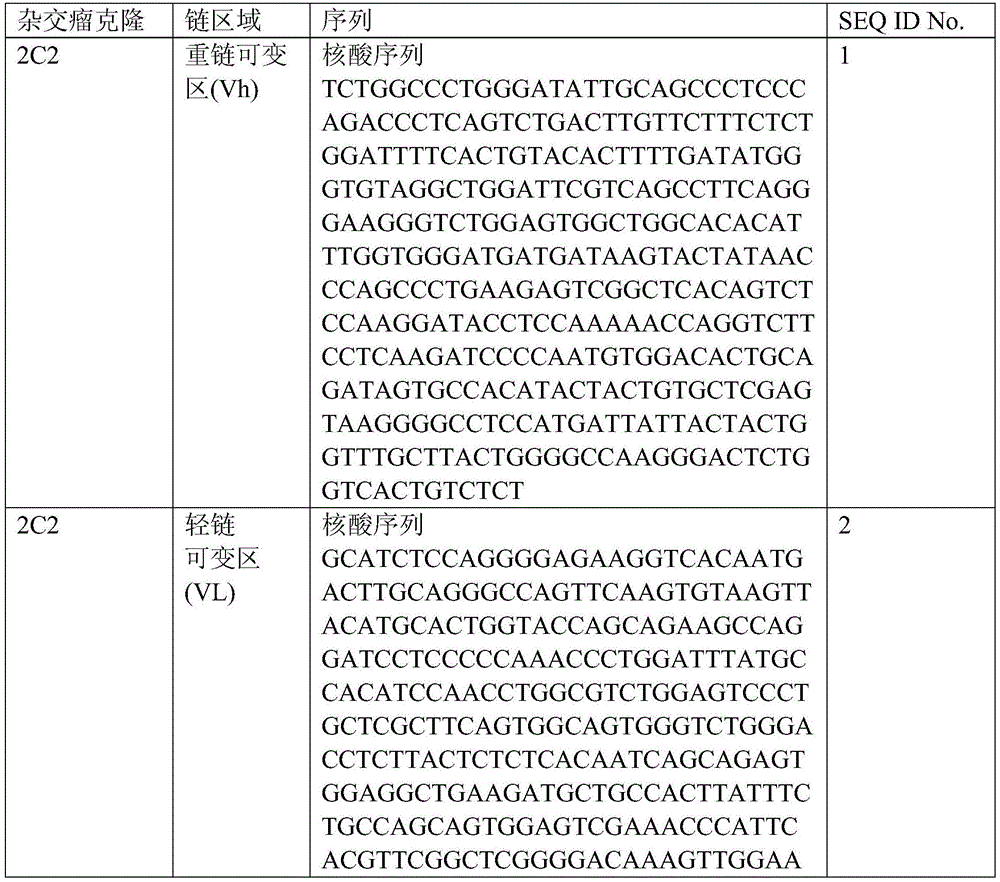
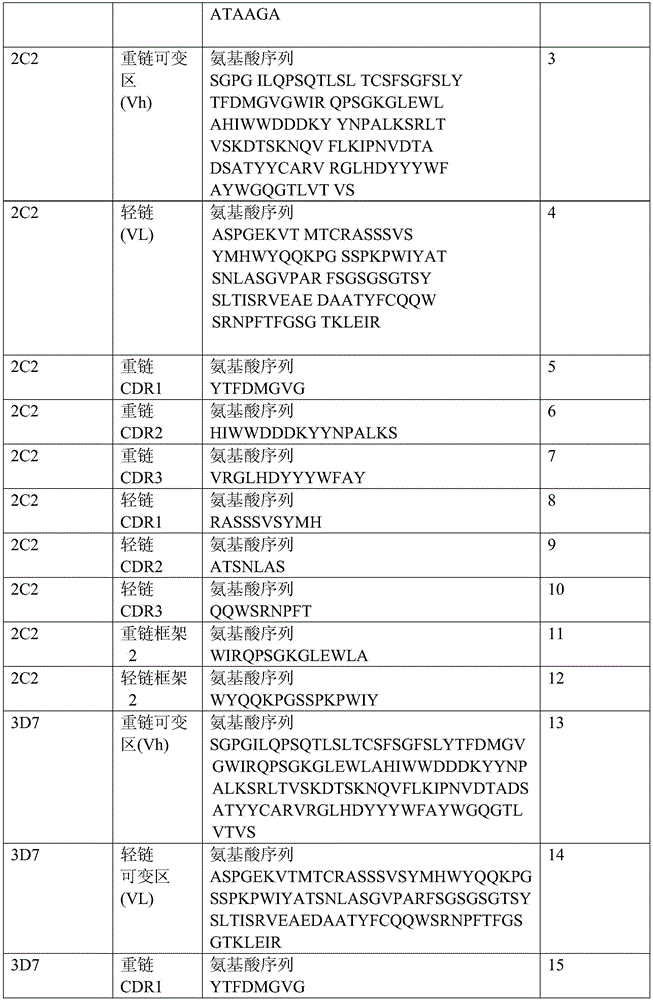
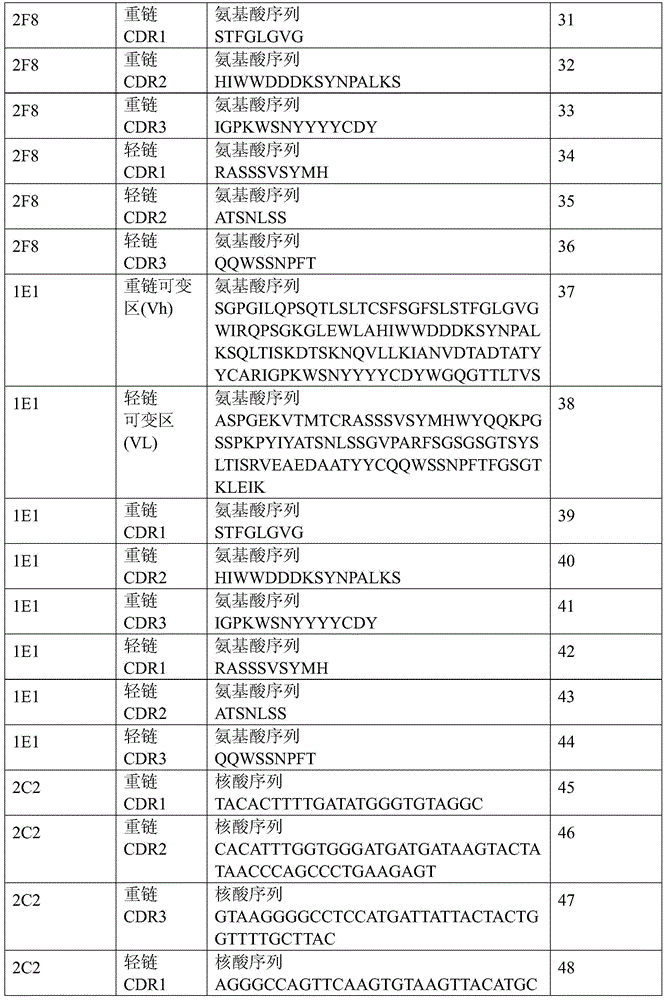
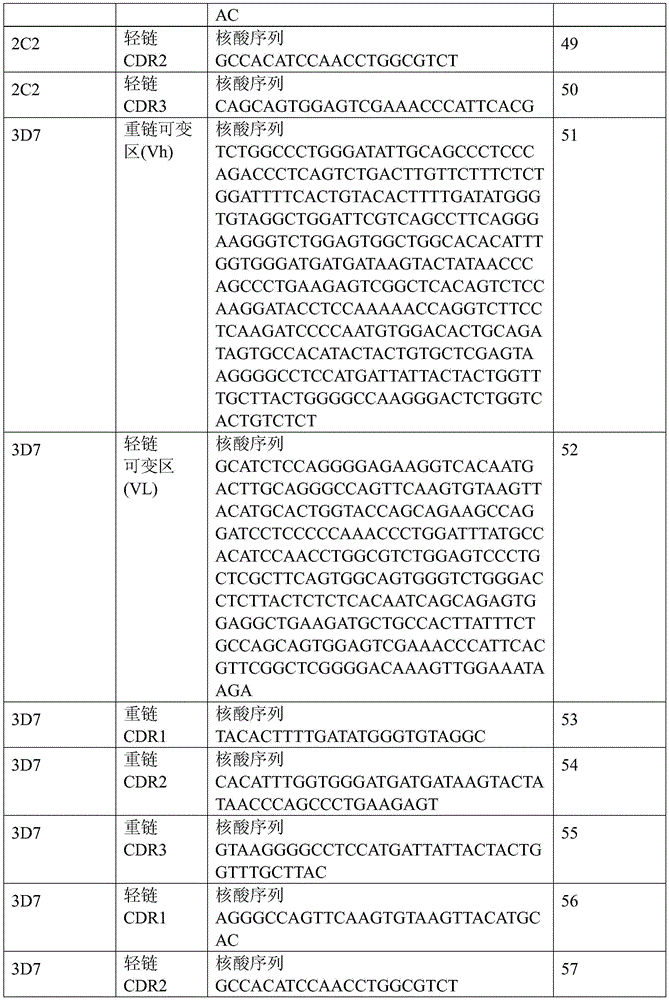
在一些实施例中,抗体或其抗原结合部份,举例来说,通过杂交瘤2C2、 杂交瘤3D7、杂交瘤7A11、杂交瘤2F8、以及杂交瘤1E1所产生的抗体的可 变重链及/或可变轻链,显示于表1中。In some embodiments, the antibody or antigen-binding portion thereof, for example, the variable heavy chain and/or the variable heavy chain of the antibody produced by hybridoma 2C2, hybridoma 3D7, hybridoma 7A11, hybridoma 2F8, and hybridoma 1E1 or variable light chains, shown in Table 1.
在相关的实施例中,抗体或其抗原结合部份包括,举例来说,从杂交 瘤2C2、杂交瘤3D7、杂交瘤7A11、杂交瘤2F8、以及杂交瘤1E1产生的抗 体的可变重链的CDRs及/或可变轻链的CDRs。来自这些杂交瘤克隆中可变 重链和可变轻链的CDRs和框架显示于表1。In related embodiments, the antibody or antigen-binding portion thereof includes, for example, the variable heavy chain of the antibody produced from hybridoma 2C2, hybridoma 3D7, hybridoma 7A11, hybridoma 2F8, and hybridoma 1E1 CDRs and/or CDRs of variable light chains. The CDRs and frameworks from the variable heavy and variable light chains in these hybridoma clones are shown in Table 1.
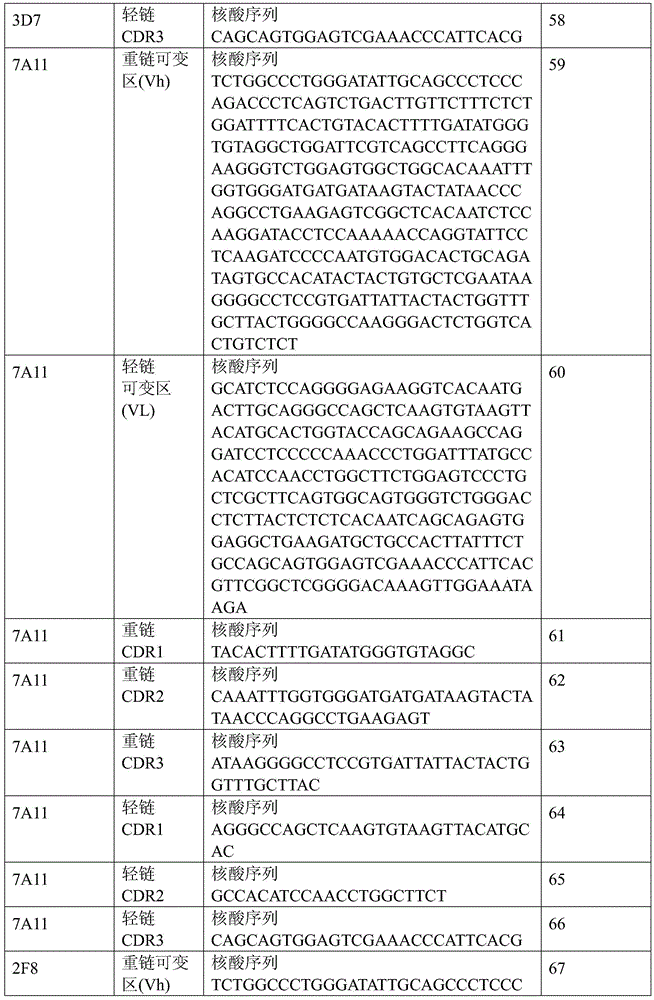
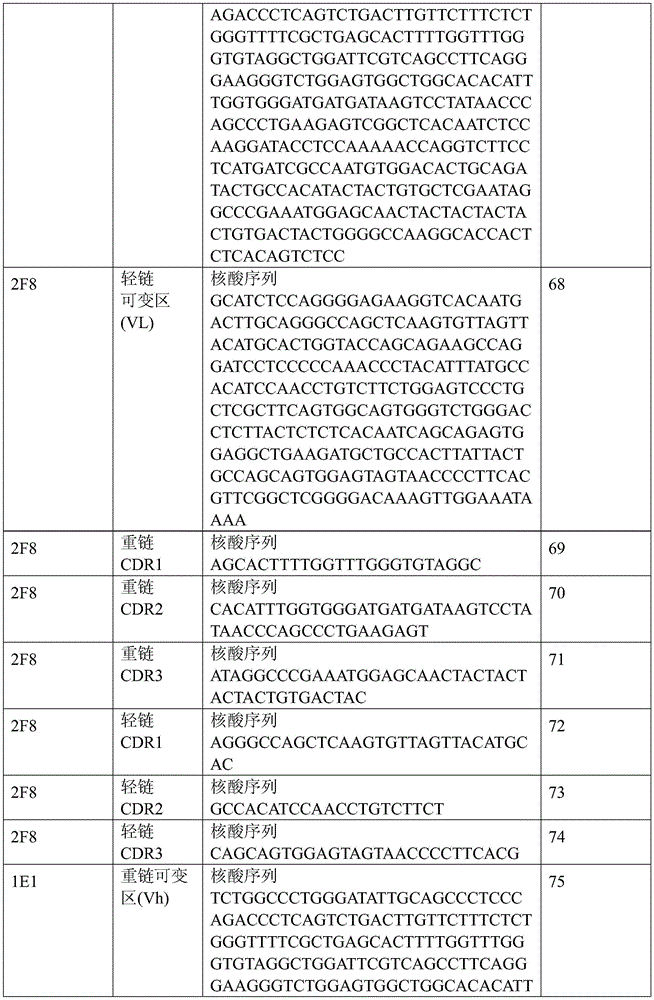
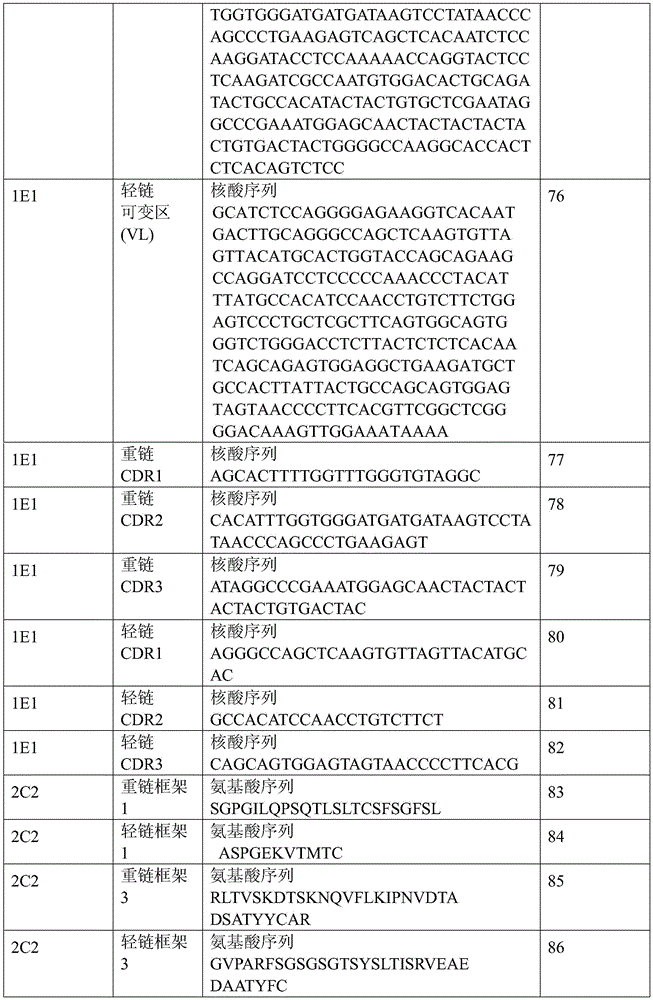
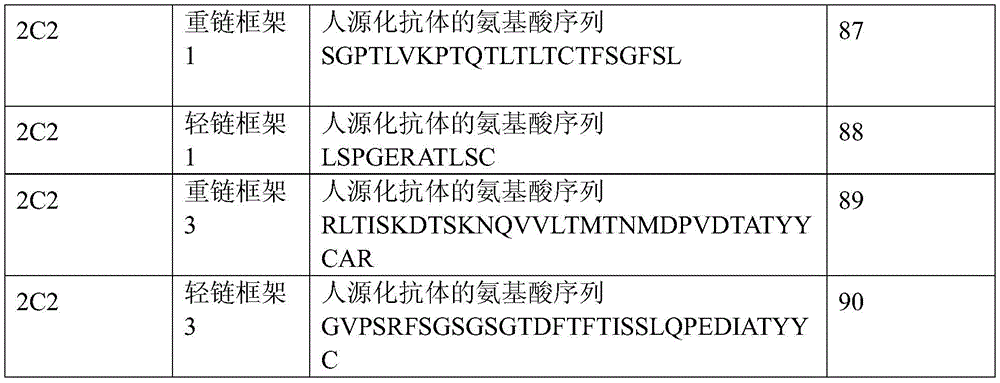
表1:SEQ ID NO:1–90Table 1: SEQ ID NOs: 1-90

本发明也涵盖编码可特异地结合至糖类抗原的本发明的抗体或其抗 原结合部份的核酸。在一个实施例中,糖类抗原是Globo H。在另一个实 施例中,糖类抗原是SSEA-3。在又另一个实施例中,糖类抗原是SSEA-4。 核酸可表现在一细胞中以产生本发明的抗体或其抗原结合部份。The invention also encompasses nucleic acids encoding antibodies of the invention, or antigen-binding portions thereof, that specifically bind to carbohydrate antigens. In one embodiment, the carbohydrate antigen is Globo H. In another embodiment, the carbohydrate antigen is SSEA-3. In yet another embodiment, the carbohydrate antigen is SSEA-4. Nucleic acids can be expressed in a cell to produce an antibody or antigen-binding portion thereof of the invention.
在特定实施例中,本发明的抗体或其抗原结合部份包括包含至少约 70%、至少约75%、至少约80%、至少约81%、至少约82%、至少约83%、 至少约84%、至少约85%、至少约86%、至少约87%、至少约88%、至少 约89%、至少约90%、至少约91%、至少约92%、至少约93%、至少约94%、 至少约95%、至少约96%、至少约97%、至少约98%、至少约99%或约100% 同源至下列:In particular embodiments, an antibody or antigen-binding portion thereof of the invention comprises at least about 70%, at least about 75%, at least about 80%, at least about 81%, at least about 82%, at least about 83%, at least about 84%, at least about 85%, at least about 86%, at least about 87%, at least about 88%, at least about 89%, at least about 90%, at least about 91%, at least about 92%, at least about 93%, at least about 94%, at least about 95%, at least about 96%, at least about 97%, at least about 98%, at least about 99%, or about 100% homologous to the following:
a)SEQ ID NO:3(杂交瘤2C2);a) SEQ ID NO: 3 (hybridoma 2C2);
b)SEQ ID NO:13(杂交瘤3D7);b) SEQ ID NO: 13 (hybridoma 3D7);
c)SEQ ID NO:21(杂交瘤7A11);c) SEQ ID NO: 21 (hybridoma 7A11);
d)SEQ ID NO:29(杂交瘤2F8);或d) SEQ ID NO: 29 (hybridoma 2F8); or
e)SEQ ID NO:37(杂交瘤1E1)的任一个的氨基酸序列的可变重链区。e) The variable heavy chain region of the amino acid sequence of any of SEQ ID NO: 37 (Hybridoma 1E1).
在特定实施例中,本发明的抗体或其抗原结合部份包括包含至少约 70%、至少约75%、至少约80%、至少约81%、至少约82%、至少约83%、 至少约84%、至少约85%、至少约86%、至少约87%、至少约88%、至少 约89%、至少约90%、至少约91%、至少约92%、至少约93%、至少约94%、 至少约95%、至少约96%、至少约97%、至少约98%、至少约99%或约100% 同源至下列:In particular embodiments, an antibody or antigen-binding portion thereof of the invention comprises at least about 70%, at least about 75%, at least about 80%, at least about 81%, at least about 82%, at least about 83%, at least about 84%, at least about 85%, at least about 86%, at least about 87%, at least about 88%, at least about 89%, at least about 90%, at least about 91%, at least about 92%, at least about 93%, at least about 94%, at least about 95%, at least about 96%, at least about 97%, at least about 98%, at least about 99%, or about 100% homologous to the following:
a)SEQ ID NO:4(杂交瘤2C2);a) SEQ ID NO: 4 (hybridoma 2C2);
b)SEQ ID NO:14(杂交瘤3D7);b) SEQ ID NO: 14 (hybridoma 3D7);
c)SEQ ID NO:22(杂交瘤7A11);c) SEQ ID NO: 22 (hybridoma 7A11);
d)SEQ ID NO:30(杂交瘤2F8);或d) SEQ ID NO: 30 (hybridoma 2F8); or
e)SEQ ID NO:38(杂交瘤1E1)的任一个的氨基酸序列的可变轻链区。e) The variable light chain region of the amino acid sequence of any of SEQ ID NO: 38 (Hybridoma 1E1).
在特定实施例中,抗体或其抗原结合部份的可变重链区包含至少约 70%、至少约75%、至少约80%、至少约81%、至少约82%、至少约83%、 至少约84%、至少约85%、至少约86%、至少约87%、至少约88%、至 少约89%、至少约90%、至少约91%、至少约92%、至少约93%、至少约 94%、至少约95%、至少约96%、至少约97%、至少约98%、至少约99%或约100%同源至SEQ ID NO:3的氨基酸序列,且抗体或其抗原结合部份的 可变轻链区包含至少约70%、至少约75%、至少约80%、至少约81%、至 少约82%、至少约83%、至少约84%、至少约85%、至少约86%、至少 约87%、至少约88%、至少约89%、至少约90%、至少约91%、至少约92%、 至少约93%、至少约94%、至少约95%、至少约96%、至少约97%、至少 约98%、至少约99%或约100%同源至SEQ ID NO:4的氨基酸序列。In particular embodiments, the variable heavy chain region of the antibody or antigen-binding portion thereof comprises at least about 70%, at least about 75%, at least about 80%, at least about 81%, at least about 82%, at least about 83%, at least about 84%, at least about 85%, at least about 86%, at least about 87%, at least about 88%, at least about 89%, at least about 90%, at least about 91%, at least about 92%, at least about 93%, at least about 94%, at least about 95%, at least about 96%, at least about 97%, at least about 98%, at least about 99%, or about 100% homologous to the amino acid sequence of SEQ ID NO: 3, and the antibody or antigen thereof The variable light chain region of the binding portion comprises at least about 70%, at least about 75%, at least about 80%, at least about 81%, at least about 82%, at least about 83%, at least about 84%, at least about 85%, at least about 86%, at least about 87%, at least about 88%, at least about 89%, at least about 90%, at least about 91%, at least about 92%, at least about 93%, at least about 94%, at least about 95%, At least about 96%, at least about 97%, at least about 98%, at least about 99%, or about 100% homologous to the amino acid sequence of SEQ ID NO:4.
在特定实施例中,抗体或其抗原结合部份的可变重链区包含至少约 70%、至少约75%、至少约80%、至少约81%、至少约82%、至少约83%、 至少约84%、至少约85%、至少约86%、至少约87%、至少约88%、至 少约89%、至少约90%、至少约91%、至少约92%、至少约93%、至少约 94%、至少约95%、至少约96%、至少约97%、至少约98%、至少约99%或约100%同源至SEQ ID NO:13的氨基酸序列,且抗体或其抗原结合部份的 可变轻链区包含至少约70%、至少约75%、至少约80%、至少约81%、至 少约82%、至少约83%、至少约84%、至少约85%、至少约86%、至少 约87%、至少约88%、至少约89%、至少约90%、至少约91%、至少约92%、 至少约93%、至少约94%、至少约95%、至少约96%、至少约97%、至少 约98%、至少约99%或约100%同源至SEQ ID NO:14的氨基酸序列。In particular embodiments, the variable heavy chain region of the antibody or antigen-binding portion thereof comprises at least about 70%, at least about 75%, at least about 80%, at least about 81%, at least about 82%, at least about 83%, at least about 84%, at least about 85%, at least about 86%, at least about 87%, at least about 88%, at least about 89%, at least about 90%, at least about 91%, at least about 92%, at least about 93%, at least about 94%, at least about 95%, at least about 96%, at least about 97%, at least about 98%, at least about 99%, or about 100% homologous to the amino acid sequence of SEQ ID NO: 13, and the antibody or antigen thereof The variable light chain region of the binding portion comprises at least about 70%, at least about 75%, at least about 80%, at least about 81%, at least about 82%, at least about 83%, at least about 84%, at least about 85%, at least about 86%, at least about 87%, at least about 88%, at least about 89%, at least about 90%, at least about 91%, at least about 92%, at least about 93%, at least about 94%, at least about 95%, At least about 96%, at least about 97%, at least about 98%, at least about 99%, or about 100% homologous to the amino acid sequence of SEQ ID NO:14.
在特定实施例中,抗体或其抗原结合部份的可变重链区包含至少约 70%、至少约75%、至少约80%、至少约81%、至少约82%、至少约83%、 至少约84%、至少约85%、至少约86%、至少约87%、至少约88%、至 少约89%、至少约90%、至少约91%、至少约92%、至少约93%、至少约 94%、至少约95%、至少约96%、至少约97%、至少约98%、至少约99%或约100%同源至SEQ ID NO:21的氨基酸序列,且抗体或其抗原结合部份的 可变轻链区包含至少约70%、至少约75%、至少约80%、至少约81%、至 少约82%、至少约83%、至少约84%、至少约85%、至少约86%、至少 约87%、至少约88%、至少约89%、至少约90%、至少约91%、至少约92%、 至少约93%、至少约94%、至少约95%、至少约96%、至少约97%、至少 约98%、至少约99%或约100%同源至SEQ ID NO:22的氨基酸序列。In particular embodiments, the variable heavy chain region of the antibody or antigen-binding portion thereof comprises at least about 70%, at least about 75%, at least about 80%, at least about 81%, at least about 82%, at least about 83%, at least about 84%, at least about 85%, at least about 86%, at least about 87%, at least about 88%, at least about 89%, at least about 90%, at least about 91%, at least about 92%, at least about 93%, at least about 94%, at least about 95%, at least about 96%, at least about 97%, at least about 98%, at least about 99%, or about 100% homologous to the amino acid sequence of SEQ ID NO: 21, and the antibody or antigen thereof The variable light chain region of the binding portion comprises at least about 70%, at least about 75%, at least about 80%, at least about 81%, at least about 82%, at least about 83%, at least about 84%, at least about 85%, at least about 86%, at least about 87%, at least about 88%, at least about 89%, at least about 90%, at least about 91%, at least about 92%, at least about 93%, at least about 94%, at least about 95%, At least about 96%, at least about 97%, at least about 98%, at least about 99%, or about 100% homologous to the amino acid sequence of SEQ ID NO:22.
在特定实施例中,抗体或其抗原结合部份的可变重链区包含至少约 70%、至少约75%、至少约80%、至少约81%、至少约82%、至少约83%、 至少约84%、至少约85%、至少约86%、至少约87%、至少约88%、至 少约89%、至少约90%、至少约91%、至少约92%、至少约93%、至少约 94%、至少约95%、至少约96%、至少约97%、至少约98%、至少约99%或约100%同源至SEQ ID NO:29的氨基酸序列,且抗体或其抗原结合部份的 可变轻链区包含至少约70%、至少约75%、至少约80%、至少约81%、至 少约82%、至少约83%、至少约84%、至少约85%、至少约86%、至少 约87%、至少约88%、至少约89%、至少约90%、至少约91%、至少约92%、 至少约93%、至少约94%、至少约95%、至少约96%、至少约97%、至少 约98%、至少约99%或约100%同源至SEQ ID NO:30的氨基酸序列。In particular embodiments, the variable heavy chain region of the antibody or antigen-binding portion thereof comprises at least about 70%, at least about 75%, at least about 80%, at least about 81%, at least about 82%, at least about 83%, at least about 84%, at least about 85%, at least about 86%, at least about 87%, at least about 88%, at least about 89%, at least about 90%, at least about 91%, at least about 92%, at least about 93%, at least about 94%, at least about 95%, at least about 96%, at least about 97%, at least about 98%, at least about 99%, or about 100% homologous to the amino acid sequence of SEQ ID NO: 29, and the antibody or antigen thereof The variable light chain region of the binding portion comprises at least about 70%, at least about 75%, at least about 80%, at least about 81%, at least about 82%, at least about 83%, at least about 84%, at least about 85%, at least about 86%, at least about 87%, at least about 88%, at least about 89%, at least about 90%, at least about 91%, at least about 92%, at least about 93%, at least about 94%, at least about 95%, At least about 96%, at least about 97%, at least about 98%, at least about 99%, or about 100% homologous to the amino acid sequence of SEQ ID NO:30.
在特定实施例中,抗体或其抗原结合部份的可变重链区包含至少约 70%、至少约75%、至少约80%、至少约81%、至少约82%、至少约83%、 至少约84%、至少约85%、至少约86%、至少约87%、至少约88%、至 少约89%、至少约90%、至少约91%、至少约92%、至少约93%、至少约 94%、至少约95%、至少约96%、至少约97%、至少约98%、至少约99%或约100%同源至SEQ ID NO:37的氨基酸序列,且抗体或其抗原结合部份的 可变轻链区包含至少约70%、至少约75%、至少约80%、至少约81%、至 少约82%、至少约83%、至少约84%、至少约85%、至少约86%、至少 约87%、至少约88%、至少约89%、至少约90%、至少约91%、至少约92%、 至少约93%、至少约94%、至少约95%、至少约96%、至少约97%、至少 约98%、至少约99%或约100%同源至SEQ ID NO:38的氨基酸序列。In particular embodiments, the variable heavy chain region of the antibody or antigen-binding portion thereof comprises at least about 70%, at least about 75%, at least about 80%, at least about 81%, at least about 82%, at least about 83%, at least about 84%, at least about 85%, at least about 86%, at least about 87%, at least about 88%, at least about 89%, at least about 90%, at least about 91%, at least about 92%, at least about 93%, at least about 94%, at least about 95%, at least about 96%, at least about 97%, at least about 98%, at least about 99%, or about 100% homologous to the amino acid sequence of SEQ ID NO: 37, and the antibody or antigen thereof The variable light chain region of the binding portion comprises at least about 70%, at least about 75%, at least about 80%, at least about 81%, at least about 82%, at least about 83%, at least about 84%, at least about 85%, at least about 86%, at least about 87%, at least about 88%, at least about 89%, at least about 90%, at least about 91%, at least about 92%, at least about 93%, at least about 94%, at least about 95%, At least about 96%, at least about 97%, at least about 98%, at least about 99%, or about 100% homologous to the amino acid sequence of SEQ ID NO:38.
抗体或其抗原结合部份的可变重链区可包含一个、两个、三个或更多 CDRs包含至少约70%、至少约75%、至少约80%、至少约85%、至少约90%、 至少约95%、至少约99%、约70%、约75%、约80%、约81%、约82%、 约83%、约84%、约85%、约86%、约87%、约88%、约89%、约90%、约 91%、约92%、约93%、约94%、约95%、约96%、约97%、约98%、约99% 或约100%同源至下列:The variable heavy chain region of an antibody or antigen-binding portion thereof may comprise one, two, three or more CDRs comprising at least about 70%, at least about 75%, at least about 80%, at least about 85%, at least about 90% %, at least about 95%, at least about 99%, about 70%, about 75%, about 80%, about 81%, about 82%, about 83%, about 84%, about 85%, about 86%, about 87% %, about 88%, about 89%, about 90%, about 91%, about 92%, about 93%, about 94%, about 95%, about 96%, about 97%, about 98%, about 99% or About 100% homologous to the following:
a)通过杂交瘤2C2所产生的抗体的可变重链区的CDRs(SEQ ID NOs: 5、6及7);a) CDRs (SEQ ID NOs: 5, 6 and 7) of the variable heavy chain region of the antibody produced by hybridoma 2C2;
b)通过杂交瘤3D7所产生的抗体的可变重链区的CDRs(SEQ ID NOs:15、16及17);b) CDRs of the variable heavy chain region of the antibody produced by hybridoma 3D7 (SEQ ID NOs: 15, 16 and 17);
c)通过杂交瘤7A11所产生的抗体的可变重链区的CDRs(SEQ ID NOs:23、24及25);c) CDRs of the variable heavy chain region of the antibody produced by hybridoma 7A11 (SEQ ID NOs: 23, 24 and 25);
d)通过杂交瘤2F8所产生的抗体的可变重链区的CDRs(SEQ ID NOs: 31、32及33);或d) the CDRs (SEQ ID NOs: 31, 32 and 33) of the variable heavy chain region of the antibody produced by hybridoma 2F8; or
e)通过杂交瘤1E1所产生的抗体的可变重链区的CDRs(SEQ ID No: 39、40及41)任一个的氨基酸序列。e) The amino acid sequence of any one of the CDRs (SEQ ID Nos: 39, 40 and 41) of the variable heavy chain region of the antibody produced by hybridoma 1E1.
抗体或其抗原结合部份的可变轻链区可包含一个、两个、三个或更多 CDRs包含至少约70%、至少约75%、至少约80%、至少约85%、至少约90%、 至少约95%、至少约99%、约70%、约75%、约80%、约81%、约82%、 约83%、约84%、约85%、约86%、约87%、约88%、约89%、约90%、约 91%、约92%、约93%、约94%、约95%、约96%、约97%、约98%、约99% 或约100%同源至下列:The variable light chain region of an antibody or antigen-binding portion thereof may comprise one, two, three or more CDRs comprising at least about 70%, at least about 75%, at least about 80%, at least about 85%, at least about 90% %, at least about 95%, at least about 99%, about 70%, about 75%, about 80%, about 81%, about 82%, about 83%, about 84%, about 85%, about 86%, about 87% %, about 88%, about 89%, about 90%, about 91%, about 92%, about 93%, about 94%, about 95%, about 96%, about 97%, about 98%, about 99% or About 100% homologous to the following:
a)通过杂交瘤2C2所产生的抗体的可变轻链区的CDRs(SEQ ID NOs: 8、9及10);a) CDRs (SEQ ID NOs: 8, 9 and 10) of the variable light chain region of the antibody produced by hybridoma 2C2;
b)通过杂交瘤3D7所产生的抗体的可变轻链区的CDRs(SEQ ID NOs:18、19及20);b) CDRs of the variable light chain region of the antibody produced by hybridoma 3D7 (SEQ ID NOs: 18, 19 and 20);
c)通过杂交瘤7A11所产生的抗体的可变轻链区的CDRs(SEQ ID NOs:26、27及28);c) CDRs of the variable light chain region of the antibody produced by hybridoma 7A11 (SEQ ID NOs: 26, 27 and 28);
d)通过杂交瘤2F8所产生的抗体的可变轻链区的CDRs(SEQ ID NOs: 34、35及36);或d) the CDRs (SEQ ID NOs: 34, 35 and 36) of the variable light chain region of the antibody produced by hybridoma 2F8; or
e)通过杂交瘤1E1所产生的抗体的可变轻链区的CDRs(SEQ ID NOs: 42、43及44)任一个的氨基酸序列。e) The amino acid sequence of any one of the CDRs (SEQ ID NOs: 42, 43 and 44) of the variable light chain region of the antibody produced by hybridoma 1E1.
抗体或其抗原结合部份的可变重链区可包含一个、两个或三个或更多 CDRs包含至少约70%、至少约75%、至少约80%、至少约85%、至少约 90%、至少约95%、至少约99%、约70%、约75%、约80%、约81%、约 82%、约83%、约84%、约85%、约86%、约87%、约88%、约89%、约90%、 约91%、约92%、约93%、约94%、约95%、约96%、约97%、约98%、约 99%或约100%同源至通过杂交瘤2C2所产生的抗体的可变重链区的CDRs (SEQID NOs:5、6及7)、或通过杂交瘤3D7所产生的抗体的可变重链区的 CDRs(SEQ ID NOs:15、16及17)的氨基酸序列,且抗体或其抗原结合部 份的可变轻链区可包含一个、两个或三个或更多CDRs,包含至少约70%、 至少约75%、至少约80%、至少约85%、至少约90%、至少约95%、至少 约99%、约70%、约75%、约80%、约81%、约82%、约83%、约84%、约 85%、约86%、约87%、约88%、约89%、约90%、约91%、约92%、约93%、 约94%、约95%、约96%、约97%、约98%、约99%或约100%同源至通过 杂交瘤2C2所产生的抗体的可变轻链区的CDRs(SEQ ID NOs:8、9及10) 或通过杂交瘤3D7所产生的抗体的可变轻链区的CDRs(SEQ IDNOs:18、 19及20)的氨基酸序列。The variable heavy chain region of an antibody or antigen-binding portion thereof may comprise one, two or three or more CDRs comprising at least about 70%, at least about 75%, at least about 80%, at least about 85%, at least about 90% %, at least about 95%, at least about 99%, about 70%, about 75%, about 80%, about 81%, about 82%, about 83%, about 84%, about 85%, about 86%, about 87% %, about 88%, about 89%, about 90%, about 91%, about 92%, about 93%, about 94%, about 95%, about 96%, about 97%, about 98%, about 99% or About 100% homologous to the CDRs of the variable heavy chain region of the antibody produced by hybridoma 2C2 (SEQ ID NOs: 5, 6 and 7), or the CDRs of the variable heavy chain region of the antibody produced by hybridoma 3D7 (SEQ ID NOs: 15, 16 and 17), and the variable light chain region of the antibody or antigen-binding portion thereof may comprise one, two or three or more CDRs comprising at least about 70%, at least about 75%, at least about 80%, at least about 85%, at least about 90%, at least about 95%, at least about 99%, about 70%, about 75%, about 80%, about 81%, about 82%, about 83%, about 84%, about 85%, about 86%, about 87%, about 88%, about 89%, about 90%, about 91%, about 92%, about 93%, about 94%, about 95% , about 96%, about 97%, about 98%, about 99% or about 100% homologous to the CDRs of the variable light chain region of the antibody produced by hybridoma 2C2 (SEQ ID NOs: 8, 9 and 10) Or the amino acid sequences of the CDRs (SEQ ID NOs: 18, 19 and 20) of the variable light chain region of the antibody produced by hybridoma 3D7.
在一个实施例中,抗体或其抗原结合部份进一步包含至少约70%、至 少约75%、至少约80%、至少约85%、至少约90%、至少约95%、至少约99%、 约70%、约75%、约80%、约81%、约82%、约83%、约84%、约85%、约 86%、约87%、约88%、约89%、约90%、约91%、约92%、约93%、约94%、 约95%、约96%、约97%、约98%、约99%或约100%同源至SEQ ID NO:83 (2C2抗体的重链框架1)或SED ID NO:87(人源化2C2抗体的重链框架1,参见表1)的框架,其中框架是在前导序列与通过杂交瘤2C2产生的抗体的可 变重链区的CDR1之间。在另一个实施例中,抗体或其抗原结合部份进一 步包含至少约70%、至少约75%、至少约80%、至少约85%、至少约90%、 至少约95%、至少约99%、约70%、约75%、约80%、约81%、约82%、 约83%、约84%、约85%、约86%、约87%、约88%、约89%、约90%、约 91%、约92%、约93%、约94%、约95%、约96%、约97%、约98%、约99% 或约100%同源至SEQ IDNO:84(2C2抗体的轻链框架1)或SED ID NO: 88(人源化2C2抗体的轻链框架1,参见表1)的框架,且所述框架是在前 导序列与通过杂交瘤2C2产生的抗体的可变轻链区的CDR1之间。In one embodiment, the antibody or antigen-binding portion thereof further comprises at least about 70%, at least about 75%, at least about 80%, at least about 85%, at least about 90%, at least about 95%, at least about 99%, about 70%, about 75%, about 80%, about 81%, about 82%, about 83%, about 84%, about 85%, about 86%, about 87%, about 88%, about 89%, about 90% %, about 91%, about 92%, about 93%, about 94%, about 95%, about 96%, about 97%, about 98%, about 99%, or about 100% homologous to SEQ ID NO:83 ( 2C2 antibody heavy chain framework 1) or the framework of SED ID NO: 87 (
在一个实施例中,抗体或其抗原结合部份进一步包含介于由杂交瘤 2C2产生的抗体的可变重链区的CDR1和CDR2之间的框架,其中框架可至 少约70%、至少约75%、至少约80%、至少约85%、至少约90%、至少约 95%、至少约99%、约70%、约75%、约80%、约81%、约82%、约83%、 约84%、约85%、约86%、约87%、约88%、约89%、约90%、约91%、约 92%、约93%、约94%、约95%、约96%、约97%、约98%、约99%或约100% 同源于SEQID NO:11(在表1中的重链框架2)。在例示性实施例中,在具 有大约80%至大约100%同源至SEQ ID NO:11的氨基酸序列的可变重链区 的CDR1和CDR2之间的框架,含有在位置9的甘氨酸。SEQ ID NO:11的氨 基酸的位置如下描述:In one embodiment, the antibody or antigen-binding portion thereof further comprises a framework between CDR1 and CDR2 of the variable heavy chain region of the antibody produced by hybridoma 2C2, wherein the framework may be at least about 70%, at least about 75% %, at least about 80%, at least about 85%, at least about 90%, at least about 95%, at least about 99%, about 70%, about 75%, about 80%, about 81%, about 82%, about 83% , about 84%, about 85%, about 86%, about 87%, about 88%, about 89%, about 90%, about 91%, about 92%, about 93%, about 94%, about 95%, about 96%, about 97%, about 98%, about 99% or about 100% homologous to SEQ ID NO: 11 (heavy chain framework 2 in Table 1). In an exemplary embodiment, the framework between CDR1 and CDR2 of the variable heavy chain region having about 80% to about 100% homology to the amino acid sequence of SEQ ID NO: 11 contains a glycine at position 9. The positions of the amino acids of SEQ ID NO: 11 are described as follows:
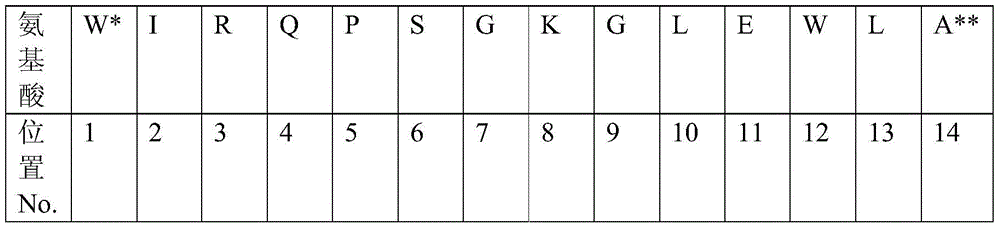
*在FW2(W)的位置1的氨基酸是邻近于CDR1的残基。*The amino acid at
**在FW2(A)的位置14的氨基酸是邻近于CDR2的残基。**The amino acid at position 14 of FW2(A) is the residue adjacent to CDR2.
在另一个实施例中,抗体或其抗原结合部份进一步包含在由杂交瘤 2C2产生的抗体的可变轻链区的CDR1和CDR2之间的框架,其中框架是至 少约70%、至少约75%、至少约80%、至少约85%、至少约90%、至少约95%、 至少约99%、约70%、约75%、约80%、约81%、约82%、约83%、约84%、 约85%、约86%、约87%、约88%、约89%、约90%、约91%、约92%、约 93%、约94%、约95%、约96%、约97%、约98%、约99%或约100%同源于 SEQID NO:12(在表1中的轻链框架2)。在一例示性实施例中,在通过杂交 瘤2C2产生的抗体的可变轻链区的CDR1和CDR2之间的框架含有在位置12 的脯氨酸。在另一个例示性实施例中,在通过杂交瘤2C2产生的抗体的可 变轻链区的CDR1和CDR2之间的框架含有在位置13的色氨酸。在又另一个 例示性实施例中,在通过杂交瘤2C2产生的抗体的可变轻链区的CDR1和CDR2之间的框架含有在位置12的脯氨酸和位置13的色氨酸。SEQ ID NO: 12的氨基酸的位置如下描述:In another embodiment, the antibody or antigen-binding portion thereof further comprises a framework between CDR1 and CDR2 of the variable light chain region of the antibody produced by hybridoma 2C2, wherein the framework is at least about 70%, at least about 75% %, at least about 80%, at least about 85%, at least about 90%, at least about 95%, at least about 99%, about 70%, about 75%, about 80%, about 81%, about 82%, about 83% , about 84%, about 85%, about 86%, about 87%, about 88%, about 89%, about 90%, about 91%, about 92%, about 93%, about 94%, about 95%, about 96%, about 97%, about 98%, about 99% or about 100% homologous to SEQ ID NO: 12 (light chain framework 2 in Table 1). In an exemplary embodiment, the framework between CDR1 and CDR2 of the variable light chain region of the antibody produced by hybridoma 2C2 contains a proline at position 12. In another exemplary embodiment, the framework between CDR1 and CDR2 of the variable light chain region of the antibody produced by hybridoma 2C2 contains tryptophan at position 13. In yet another exemplary embodiment, the framework between CDR1 and CDR2 of the variable light chain region of the antibody produced by hybridoma 2C2 contains proline at position 12 and tryptophan at position 13. The positions of the amino acids of SEQ ID NO: 12 are described as follows:

*在FW2(W)的位置1的氨基酸是邻近于CDR1的残基。*The amino acid at
**在FW2(Y)的位置15的氨基酸是邻近于CDR2的残基。**The amino acid at
在一个实施例中,抗体或其抗原结合部份进一步包含至少大约70%、 至少大约75%、至少大约80%、至少大约85%、至少大约90%、至少大约95%、 至少大约99%、约70%、约75%、约80%、约81%、约82%、约83%、约84%、 约85%、约86%、约87%、约88%、约89%、约90%、约91%、约92%、约 93%、约94%、约95%、约96%、约97%、约98%、约99%或约100%同源至 SEQ ID NO:85(重链框架3)或SED ID NO:89(人源化抗体的重链框架3,见 于表1)的框架,其中所述框架是在通过杂交瘤2C2产生的抗体的可变重链区 的CDR2和CDR3之间。在另一个实施例中,抗体或其抗原结合部份进一步 包含至少大约70%、至少大约75%、至少大约80%、至少大约85%、至少大 约90%、至少大约95%、至少大约99%、约70%、约75%、约80%、约81%、 约82%、约83%、约84%、约85%、约86%、约87%、约88%、约89%、约 90%、约91%、约92%、约93%、约94%、约95%、约96%、约97%、约98%、 约99%或约100%同源至SEQ ID NO:86(轻链框架3)或SEQ ID NO:90(人源 化抗体的轻链框架3,见于表1)的框架,且所述框架是在通过杂交瘤2C2产 生的抗体的可变轻链区的CDR2和CDR3之间。In one embodiment, the antibody or antigen-binding portion thereof further comprises at least about 70%, at least about 75%, at least about 80%, at least about 85%, at least about 90%, at least about 95%, at least about 99%, about 70%, about 75%, about 80%, about 81%, about 82%, about 83%, about 84%, about 85%, about 86%, about 87%, about 88%, about 89%, about 90% %, about 91%, about 92%, about 93%, about 94%, about 95%, about 96%, about 97%, about 98%, about 99%, or about 100% homologous to SEQ ID NO:85 ( Heavy chain framework 3) or the framework of SED ID NO: 89 (heavy chain framework 3 of a humanized antibody, see Table 1), wherein the framework is CDR2 in the variable heavy chain region of the antibody produced by hybridoma 2C2 and CDR3. In another embodiment, the antibody or antigen binding portion thereof further comprises at least about 70%, at least about 75%, at least about 80%, at least about 85%, at least about 90%, at least about 95%, at least about 99% , about 70%, about 75%, about 80%, about 81%, about 82%, about 83%, about 84%, about 85%, about 86%, about 87%, about 88%, about 89%, about 90%, about 91%, about 92%, about 93%, about 94%, about 95%, about 96%, about 97%, about 98%, about 99% or about 100% homologous to SEQ ID NO:86 (light chain framework 3) or the framework of SEQ ID NO: 90 (light chain framework 3 of a humanized antibody, see Table 1) in the variable light chain region of the antibody produced by hybridoma 2C2 between CDR2 and CDR3.
抗体或其抗原结合部份的可变重链区可包含一个、两个或三个或更多 CDRs包含至少约70%、至少约75%、至少约80%、至少约85%、至少约90%、 至少约95%、至少约99%、约70%、约75%、约80%、约81%、约82%、约 83%、约84%、约85%、约86%、约87%、约88%、约89%、约90%、约91%、 约92%、约93%、约94%、约95%、约96%、约97%、约98%、约99%或约 100%同源至通过杂交瘤7A11所产生的抗体的可变重链区的CDRs(SEQID NOs:23、24及25)的氨基酸序列,且抗体或其抗原结合部份的可变轻链区 可包含一个、两个或三个或更多CDRs包含至少约70%、至少约75%、至少 约80%、至少约85%、至少约90%、至少约95%、至少约99%、约70%、 约75%、约80%、约81%、约82%、约83%、约84%、约85%、约86%、约 87%、约88%、约89%、约90%、约91%、约92%、约93%、约94%、约95%、 约96%、约97%、约98%、约99%或约100%同源至通过杂交瘤7A11所产生 的抗体的可变轻链区的CDRs(SEQ ID NOs:26、27及28)的氨基酸序列。The variable heavy chain region of an antibody or antigen-binding portion thereof may comprise one, two or three or more CDRs comprising at least about 70%, at least about 75%, at least about 80%, at least about 85%, at least about 90% %, at least about 95%, at least about 99%, about 70%, about 75%, about 80%, about 81%, about 82%, about 83%, about 84%, about 85%, about 86%, about 87% %, about 88%, about 89%, about 90%, about 91%, about 92%, about 93%, about 94%, about 95%, about 96%, about 97%, about 98%, about 99% or About 100% homologous to the amino acid sequence of the CDRs (SEQ ID NOs: 23, 24 and 25) of the variable heavy chain region of the antibody produced by hybridoma 7A11, and the variable light chain region of the antibody or antigen-binding portion thereof Can comprise one, two or three or more CDRs comprising at least about 70%, at least about 75%, at least about 80%, at least about 85%, at least about 90%, at least about 95%, at least about 99%, about 70%, about 75%, about 80%, about 81%, about 82%, about 83%, about 84%, about 85%, about 86%, about 87%, about 88%, about 89%, about 90% , about 91%, about 92%, about 93%, about 94%, about 95%, about 96%, about 97%, about 98%, about 99%, or about 100% homologous to that produced by hybridoma 7A11 Amino acid sequences of the CDRs (SEQ ID NOs: 26, 27 and 28) of the variable light chain region of the antibody.
抗体或其抗原结合部份的可变重链区可包含一个、两个或三个或更多 CDRs包含至少约70%、至少约75%、至少约80%、至少约85%、至少约90%、 至少约95%、至少约99%、约70%、约75%、约80%、约81%、约82%、约 83%、约84%、约85%、约86%、约87%、约88%、约89%、约90%、约91%、 约92%、约93%、约94%、约95%、约96%、约97%、约98%、约99%或约 100%同源至通过杂交瘤2F8所产生的抗体的可变重链区的CDRs(SEQ IDNOs:31、32及33)、或通过杂交瘤1E1所产生的抗体的可变重链区的CDRs (SEQ ID NOs:39、40及41)的氨基酸序列,且抗体或其抗原结合部份的可变 轻链区可包含一个、两个或三个或更多CDRs,包含至少约70%、至少约 75%、至少约80%、至少约85%、至少约90%、至少约95%、至少约99%、 约70%、约75%、约80%、约81%、约82%、约83%、约84%、约85%、约86%、约87%、约88%、约89%、约90%、约91%、约92%、约93%、约94%、 约95%、约96%、约97%、约98%、约99%或约100%同源至通过杂交瘤2F8 所产生的抗体的可变轻链区的CDRs(SEQ ID NOs:34、35及36)或通过杂交 瘤1E1所产生的抗体的可变轻链区的CDRs(SEQID NOs:42、43及44)的氨 基酸序列。The variable heavy chain region of the antibody or antigen-binding portion thereof may comprise one, two or three or more CDRs comprising at least about 70%, at least about 75%, at least about 80%, at least about 85%, at least about 90% %, at least about 95%, at least about 99%, about 70%, about 75%, about 80%, about 81%, about 82%, about 83%, about 84%, about 85%, about 86%, about 87% %, about 88%, about 89%, about 90%, about 91%, about 92%, about 93%, about 94%, about 95%, about 96%, about 97%, about 98%, about 99% or About 100% homologous to the CDRs of the variable heavy chain region of the antibody produced by hybridoma 2F8 (SEQ ID NOs: 31, 32 and 33), or the CDRs of the variable heavy chain region of the antibody produced by hybridoma 1E1 (SEQ ID NOs: 39, 40 and 41), and the variable light chain region of the antibody or antigen-binding portion thereof may comprise one, two or three or more CDRs comprising at least about 70%, at least about 75%, at least about 80%, at least about 85%, at least about 90%, at least about 95%, at least about 99%, about 70%, about 75%, about 80%, about 81%, about 82%, about 83%, about 84%, about 85%, about 86%, about 87%, about 88%, about 89%, about 90%, about 91%, about 92%, about 93%, about 94%, about 95% , about 96%, about 97%, about 98%, about 99% or about 100% homologous to the CDRs of the variable light chain region of the antibody produced by hybridoma 2F8 (SEQ ID NOs: 34, 35 and 36) Or the amino acid sequence of the CDRs (SEQ ID NOs: 42, 43 and 44) of the variable light chain region of the antibody produced by hybridoma 1E1.
在特定实施例中,对应于表1中可变区的可变区具有序列变异。举例来 说,一重链可变区,在其中有1个、2个、3个、4个、5个、6个、7个或8个 残基,或小于40%、小于约30%、约25%、约20%、约15%、约10%、约9%、 约8%、约7%、约6%、约5%、约4%、约3%、约2%或约1%氨基酸残基经 取代或剔除,但保有实质上相同的免疫特质,其包括,但不限于,结合至 糖类抗原。In certain embodiments, the variable regions corresponding to the variable regions in Table 1 have sequence variation. For example, a heavy chain variable region in which 1, 2, 3, 4, 5, 6, 7 or 8 residues, or less than 40%, less than about 30%, about 25%, about 20%, about 15%, about 10%, about 9%, about 8%, about 7%, about 6%, about 5%, about 4%, about 3%, about 2%, or about 1% Amino acid residues are substituted or deleted, but retain substantially the same immunological properties, including, but not limited to, binding to carbohydrate antigens.
在特定实施例中,相应于在表1中的CDRs的CDRs具有序列变异。举例 来说,CDRs,在其中1个、2个、3个、4个、5个、6个、7个或8个残基,或 在CDR中的总残基的小于20%、小于30%、或小于约40%经取代或剔除, 可存在于结合至糖类抗原的抗体(或其抗原结合部份)中。In certain embodiments, the CDRs corresponding to the CDRs in Table 1 have sequence variation. For example, CDRs in which 1, 2, 3, 4, 5, 6, 7 or 8 residues, or less than 20%, less than 30% of the total residues in the CDRs , or less than about 40%, substituted or deleted, may be present in antibodies (or antigen-binding portions thereof) that bind to carbohydrate antigens.
抗体或其抗原结合部份可为肽。这类肽可包括肽的变异型、类似物、 异种同源物、同源物以及衍生物,其展现生物活性,例如糖类抗原的结合。 肽可含有一个或多个氨基酸的类似物(其包括,举例来说,非天然存在的氨 基酸、仅天然存在于非相关生物系统中的氨基酸、源自哺乳类系统修饰的 氨基酸等)、有着取代键联(substituted linkages)的肽、以及所属技术领域中 公知的其他修饰物。The antibody or antigen-binding portion thereof can be a peptide. Such peptides may include variants, analogs, xenologs, homologs, and derivatives of peptides that exhibit biological activity, such as binding of carbohydrate antigens. Peptides may contain analogs of one or more amino acids (including, for example, non-naturally occurring amino acids, amino acids only naturally occurring in unrelated biological systems, amino acids derived from modifications in mammalian systems, etc.), with substitutions Peptides of substituted linkages, and other modifications known in the art.
也在本发明的范畴中的是抗体或其抗原结合部份,在其中特异的氨基 酸已经被取代、剔除或添加。在例示性实施例中,这些替换不具有对于肽 的生物特质上的实质效应,诸如结合亲和力。在另一个例示性实施例中, 抗体可具有在框架区中的氨基酸取代基,如此以增进所述抗体对抗原的结 合亲和力。在又另一个例示性实施例中,一个选定的,受体的框架残基的 小数目可通过相应的供体氨基酸来替换。供体框架可为成熟或生克隆人类抗体框架序列或相应的序列。考虑如何制造表型静默氨基酸取代作用的导 引提供于Bowie等人,科学期刊(Science),247:1306-1310(1990年)。 Cunningham等人,科学期刊(Science),244:1081-1085(1989年)。Ausubel(编 着),《分子生物学现行操作方法》(Current Protocols in Molecular Biology), 约翰威立出版公司(John Wiley andSons,Inc.)(1994年)。T.Maniatis,E.F. Fritsch及J.Sambrook,《分子选殖:实验室手册》(Molecular Cloning:A Laboratory Manual),冷泉港实验室(Cold Spring Harborlaboratory),冷泉港 出版社(Cold Spring Harbor),N.Y.(1989年)。Pearson,分子生物学方法期 刊(Methods Mol.Biol.),243:307-31(1994年)。Gonnet等人,科学期刊(Science),256:1443-45(1992年)。Also within the scope of the present invention are antibodies, or antigen-binding portions thereof, in which specific amino acids have been substituted, deleted or added. In exemplary embodiments, these substitutions do not have a substantial effect on the biological properties of the peptide, such as binding affinity. In another exemplary embodiment, an antibody may have amino acid substitutions in the framework regions such that the binding affinity of the antibody for the antigen is increased. In yet another exemplary embodiment, a selected, small number of acceptor framework residues can be replaced by corresponding donor amino acids. The donor framework can be a mature or cloned human antibody framework sequence or a corresponding sequence. Guidance on considering how to make phenotypically silent amino acid substitutions is provided by Bowie et al., Science, 247: 1306-1310 (1990). Cunningham et al., Science, 244:1081-1085 (1989). Ausubel (ed.), Current Protocols in Molecular Biology, John Wiley and Sons, Inc. (1994). T. Maniatis, E.F. Fritsch and J. Sambrook, Molecular Cloning: A Laboratory Manual, Cold Spring Harbor Laboratory, Cold Spring Harbor, N.Y. (in 1989). Pearson, Methods Mol. Biol., 243:307-31 (1994). Gonnet et al., Science, 256:1443-45 (1992).
抗体、或其抗原结合部份,可被衍生或链接至另一个功能分子。举例 来说,抗体可为功能性地连接(通过化学耦合、遗传融合、非共价交互作用 等)至一个或多个其他分子实体,诸如另一个抗体、可侦测试剂、细胞毒性 试剂、药学试剂、可介导关联另一个分子(诸如链霉亲和素核心区或聚组氨 酸标签)的蛋白或肽、氨基酸连接物、讯息序列、免疫性的载体、或有用于 蛋白质纯化的配体,诸如麸胱甘肽-S-转移酶(glutathione-S-transferase)、组 氨酸标签、以及葡萄球菌的蛋白A。衍生的蛋白质的一个类型是通过交联两个或更多(相同类型或不同类型的)蛋白质来产生。合适的交联物包括那 些为异双官能者,具有被合适的间隔物(例如,M-马来酰亚胺苯甲酸-N-羟 基琥珀酰亚胺酯(m-maleimidobenzoyl-N-hydroxysuccinimide ester))分开的 两个相异反应基团,或同双官能的(例如,双琥珀酰亚胺辛二酸酯 (disuccinimidyl suberate))。这类链接物可从Pierce化学公司,Rockford,IL 取得。藉以可衍生(或标记)蛋白质的有用的可侦测试剂包括荧光化合物、 多种酵素、辅基、发光材料、生物发光材料、以及放射性材料。非限制性 的例示荧光可侦测试剂包括荧光素、硫氰酸盐荧光素、玫瑰红、以及藻红 素。蛋白质或抗体也可以可侦测酵素衍生化,诸如碱性磷酸酶、山葵过氧 化酶、β-半乳糖苷酶、乙酰胆碱酯酶、葡萄糖氧化酶之类。蛋白质也可以 辅基衍生化(例如,链霉亲和素/生物素以及抗生物素蛋白/生物素)。An antibody, or antigen-binding portion thereof, can be derivatized or linked to another functional molecule. For example, an antibody can be functionally linked (through chemical coupling, genetic fusion, non-covalent interaction, etc.) to one or more other molecular entities, such as another antibody, a detectable agent, a cytotoxic agent, a pharmaceutical Reagents, proteins or peptides that can mediate association with another molecule (such as a streptavidin core region or a polyhistidine tag), amino acid linkers, message sequences, carriers for immunity, or ligands useful for protein purification , such as glutathione-S-transferase (glutathione-S-transferase), histidine tag, and protein A of staphylococci. One type of derivatized protein is produced by cross-linking two or more proteins (of the same type or different types). Suitable crosslinkers include those that are heterobifunctional with a suitable spacer (eg, m-maleimidobenzoyl-N-hydroxysuccinimide ester) ) separated by two distinct reactive groups, or homobifunctional (eg, disuccinimidyl suberate). Such linkers are available from Pierce Chemical Company, Rockford, IL. Useful detectable reagents by which proteins can be derivatized (or labeled) include fluorescent compounds, various enzymes, prosthetic groups, luminescent materials, bioluminescent materials, and radioactive materials. Non-limiting exemplary fluorescent detectable reagents include fluorescein, fluorescein thiocyanate, rose bengal, and phycoerythrin. The protein or antibody can also be derivatized with detectable enzymes such as alkaline phosphatase, horseradish peroxidase, beta-galactosidase, acetylcholinesterase, glucose oxidase, and the like. Proteins can also be derivatized with prosthetic groups (e.g., streptavidin/biotin and avidin/biotin).
编码本发明的抗体或其抗原结合部份的功能性活性变异型的核酸也可 被本发明涵盖。这些核酸分子可在中度严谨、高严谨或非常高严谨的条件 的下与编码本发明的抗体或其抗原结合部份的任一个的核酸杂合。用于执 行杂合反应的引导可在《分子生物学的现行操作》(Current Protocols in Molecular Biology),John Wiley&Sons,N.Y.,6.3.1-6.3.6,1989年中找到。 其通过参考并入本文。本文所称的特异的杂合条件可如下:1)中度严谨杂 合条件:6 X SSC于大约45℃,随后以0.2 X SSC,0.1%SDS于60℃洗涤一 次或多次;2)高严谨杂合条件:6 X SSC于大约45℃,随后在0.2X SSC,0.1% SDS于65℃洗涤一次或多次;以及3)非常高严谨杂合条件:0.5M磷酸钠, 7%SDS于65℃,随后在0.2X SSC,1%SDS于65℃洗涤一次或多次。Nucleic acids encoding functionally active variants of the antibodies of the invention, or antigen-binding portions thereof, are also encompassed by the invention. These nucleic acid molecules can hybridize under conditions of moderate stringency, high stringency, or very high stringency to nucleic acids encoding any of the antibodies or antigen-binding portions thereof of the invention. Guidance for performing hybrid reactions can be found in Current Protocols in Molecular Biology, John Wiley & Sons, N.Y., 6.3.1-6.3.6, 1989. It is incorporated herein by reference. Specific hybridization conditions referred to herein may be as follows: 1) Moderately stringent hybridization conditions: 6X SSC at approximately 45°C followed by one or more washes with 0.2X SSC, 0.1% SDS at 60°C; 2) High Stringent hybrid conditions: 6X SSC at approximately 45°C followed by one or more washes in 0.2X SSC, 0.1% SDS at 65°C; and 3) Very high stringency hybrid conditions: 0.5M sodium phosphate, 7% SDS at 65°C followed by one or more washes in 0.2X SSC, 1% SDS at 65°C.
编码本发明的抗体或其抗原结合部份的核酸可被引介进入可在合适的 表现系统中表现的表现载体中,接续分离或纯化所述表现抗体或其抗原结 合部份。可选地,编码本发明的抗体或其抗原结合部份的核酸可被转译到 无细胞转译系统中。美国专利号4,816,567。Queen等人,美国国家科学 院院刊(Proc Natl Acad Sci),美国,86:10029-10033(1989年)。Nucleic acids encoding the antibodies or antigen-binding portions thereof of the invention can be introduced into expression vectors that can be expressed in a suitable expression system, followed by isolation or purification of the expression antibodies or antigen-binding portions thereof. Alternatively, nucleic acids encoding the antibodies of the invention, or antigen-binding portions thereof, can be translated into a cell-free translation system. US Patent No. 4,816,567. Queen et al., Proc Natl Acad Sci, USA, 86: 10029-10033 (1989).
本发明的抗体或其抗原结合部份可通过转形有着编码所期望的抗体的 轻链和重链(或其部分)的DNA的宿主细胞来产生。抗体可从这些培养上清 液及/或细胞使用标准技术来分离和纯化。举例来说,宿主细胞可被转形有 着编码抗体的轻链、重链、或两者的DNA。重组DNA技术也可被使用以移 除一些或全部编码不需要用于结合的轻链和重链的任一者或两者的DNA, 例如,恒定区。Antibodies of the invention, or antigen-binding portions thereof, can be produced by transforming host cells with DNA encoding the light and heavy chains (or portions thereof) of the desired antibody. Antibodies can be isolated and purified from these culture supernatants and/or cells using standard techniques. For example, host cells can be transformed with DNA encoding the light chain, heavy chain, or both of the antibody. Recombinant DNA techniques can also be used to remove some or all of the DNA encoding either or both of the light and heavy chains not required for binding, eg, constant regions.
本发明的核酸可在多种合适的细胞中表现,其包括原核和真核细胞, 例如,细菌细胞(例如,E.coli)、酵母细胞、植物细胞、昆虫细胞、以及哺 乳类细胞。许多哺乳类细胞株可为在所属领域中为公知的,且包括从美国 菌种保存中心(ATCC)可得的永生细胞株。细胞的非限制性实例包括哺乳类 来源或是类似哺乳类特性的全部细胞株,其包括但不限于,猴子肾细胞 (COS,例如,COS-1、COS-7)、HEK293、幼仓鼠肾(BHK,例如,BHK21)、 中国仓鼠卵巢(CHO)、NS0、PerC6、BSC-1、人类肝细胞癌细胞(例如, Hep G2)、SP2/0、HeLa、Madin-Darby牛肾(MDBK)、骨髓瘤以及淋巴瘤细 胞的亲代细胞、衍生物及/或改造变异型。改造变异型包括,例如,聚醣谱 修饰及/或位置特异性整合位置衍生物。The nucleic acids of the present invention can be expressed in a variety of suitable cells, including prokaryotic and eukaryotic cells, for example, bacterial cells (eg, E. coli), yeast cells, plant cells, insect cells, and mammalian cells. Many mammalian cell lines are available as known in the art and include immortalized cell lines available from the American Type Culture Collection (ATCC). Non-limiting examples of cells include all cell lines of mammalian origin or with mammalian-like properties, including, but not limited to, monkey kidney cells (COS, e.g., COS-1, COS-7), HEK293, baby hamster kidney ( BHK, eg, BHK21), Chinese hamster ovary (CHO), NSO, PerC6, BSC-1, human hepatocellular carcinoma cells (eg, Hep G2), SP2/0, HeLa, Madin-Darby bovine kidney (MDBK), bone marrow Parental cells, derivatives and/or engineered variants of tumor and lymphoma cells. Engineered variants include, for example, glycan profile modifications and/or position-specific integration position derivatives.
本发明也提供用于包含本文所描述的核酸的细胞。细胞可为杂交瘤或 转染子,诸如指名为2C2的杂交瘤。The invention also provides cells for use with the nucleic acids described herein. The cells can be hybridomas or transfectants, such as the hybridoma designated 2C2.
替选地,本发明的抗体或其抗原结合部份可通过所属技术领域所公知 的固相程序来合成。《固相肽合成:实行方法》(Solid Phase Peptide Synthesis: A PracticalApproach),E.Atherton与R.C.Sheppard着,IRL于牛津大学出版 社(Oxford UniversityPress)出版(1989年)。《分子生物学方法》(Methods in Molecular Biology),卷35:肽合成程序(Peptide Synthesis Protocols),(M. W.Pennington与B.M.Dunn编着),第七章。《固相肽合成》,第二版,Pierce 化学公司,Rockford,IL(1984年)。G.Barany与R.B.Merrifield,《肽: 分析、合成、生物学》(The Peptides:Analysis,Synthesis,Biology),编 者E.Gross与J.Meienhofer,卷1及卷2,学术出版社(Academic Press),NewYork,(1980年),页次3-254。M.Bodansky,《肽合成原则》(Principles of PeptideSynthesis),Springer-Verlag,柏林(1984年)。Alternatively, the antibodies of the invention, or antigen-binding portions thereof, can be synthesized by solid phase procedures well known in the art. Solid Phase Peptide Synthesis: A Practical Approach, E. Atherton and R.C. Sheppard, IRL, Oxford University Press (1989). Methods in Molecular Biology, Volume 35: Peptide Synthesis Protocols, (M. W. Pennington and B.M. Dunn eds.), Chapter 7. Solid Phase Peptide Synthesis, Second Edition, Pierce Chemical Company, Rockford, IL (1984). G. Barany and R.B. Merrifield, The Peptides: Analysis, Synthesis, Biology, eds. E. Gross and J. Meienhofer,
本发明提供用于制造特异性地结合至糖类抗原(例如,Globo H)的抗体 或其抗原结合部份的方法。举例来说,非人类动物是以包括糖类抗原(例如, Globo H)的组成物来免疫接种(is immunized with),且接着特异性抗体从所 述动物分离。所述方法可进一步包括评估抗体对糖类抗原的结合。The present invention provides methods for making antibodies or antigen-binding portions thereof that specifically bind to carbohydrate antigens (e.g., Globo H). For example, a non-human animal is immunized with a composition that includes a carbohydrate antigen (e.g., Globo H), and then specific antibodies are isolated from the animal. The method may further comprise assessing the binding of the antibody to the carbohydrate antigen.
各种糖类抗原的任何一个,特别是Globo H,可被使用于本发明的实践 中。糖类抗原的实例包括,但不限于Globo抗原诸如Globo H、阶段特异性 胚抗原3(SSEA-3)(也被称为Gb5)、阶段特异性胚抗原4(SSEA-4)、Gb-4以 及Gb-3、Lewis抗原诸如sLex、Lex、sLea、Lea以及Ley,多醣抗原诸如聚唾 液酸(PSA)、sTn(c)以及Tn(c)、Thomsen-Friedenreich抗原(TF(c))、神经节苷 脂诸如GD1、GD2、GD3、岩藻糖基GM1、GM1、GM2、GM3、GD1α以 及GM2、硫脂抗原(sulfitide antigen)诸如6Gal-HSO3-SiaLex以及 6GluNAc-HSO3-SiaLex。其他糖类抗原包括,但不限于:α-半乳糖、α-Man-6- 磷酸盐(α-Man-6-phosphate)、α-L-鼠李糖、α-GalNAc(Tn)、 α-NeuAc-OCH2C6H4-p-NHCOOCH2、Fucα1-2Galβ1-4GalNAcβ(H第三型)、 NeuAcα2-8NeuAcα、(NeuAcα2-8)2聚唾液酸、NeuAca2-6Galb、 NeuAcb2-6Gala(STn)、Gala1-3Galb1-4GlaNAcb(NeuAca2-8)3、 GalNAcαa-3(Fucα1-2)Galβ(血型A型)、Galα1-3(Fucα1-2)Galβ(血型B型)、 6Gal-HSO3-SiaLex、6GluNAc-HSO3-SiaLex以及α2-6唾液酸二天线型N-聚 糖(α2-6sialylated biantennary N-glycans)。Any of a variety of carbohydrate antigens, particularly Globo H, can be used in the practice of the present invention. Examples of carbohydrate antigens include, but are not limited to, Globo antigens such as Globo H, stage-specific embryonic antigen 3 (SSEA-3) (also known as Gb5), stage-specific embryonic antigen 4 (SSEA-4), Gb-4 and Gb-3, Lewis antigens such as sLex , Lex, sLea , Lea and Ley , polysaccharide antigens such as polysialic acid (PSA), sTn( c ) and Tn( c ), Thomsen-Friedenreich antigen (TF( c)), gangliosides such as GD1, GD2, GD3, fucosyl GM1, GM1, GM2, GM3, GD1α and GM2, sulfitide antigens such as 6Gal-HSO3 - SiaLex and 6GluNAc- HSO3 -SiaLex. Other carbohydrate antigens include, but are not limited to: α-galactose, α-Man-6-phosphate, α-L-rhamnose, α-GalNAc(Tn), α- NeuAc-OCH 2 C 6 H 4 -p-NHCOOCH 2 , Fuca1-2Galβ1-4GalNAcβ (H type III), NeuAcα2-8NeuAcα, (NeuAcα2-8)2 polysialic acid, NeuAca2-6Galb, NeuAcb2-6Gala(STn) , Gala1-3Galb1-4GlaNAcb(NeuAca2-8)3, GalNAcαa-3(Fucα1-2)Galβ(blood group A), Galα1-3(Fucα1-2)Galβ(blood group B), 6Gal-HSO 3 -SiaLex, 6GluNAc-HSO 3 -SiaLex and α2-6sialylated biantennary N-glycans.
在一个实施例中,抗-Globo H抗体或其抗原结合部份可交互反应或与 其他有着高选择性的糖类抗原结合,诸如在第3A图和第3B图中所绘示的。 糖类抗原的非限制性实例为:SSEA-3、SSEA-4、Lewis抗原。In one embodiment, an anti-Globo H antibody or antigen-binding portion thereof can cross-react or bind to other carbohydrate antigens with high selectivity, such as those depicted in Figures 3A and 3B. Non-limiting examples of carbohydrate antigens are: SSEA-3, SSEA-4, Lewis antigen.
在一个实施例中,本发明提供用于制作表现特异性结合至糖类抗原(例 如,GloboH)的抗体的杂交瘤的方法。所述方法含有下列步骤:以包括糖 类抗原(例如,Globo H)的组成物来免疫化动物;从所述动物分离脾细胞; 从脾细胞产生杂交瘤;以及挑选产生特异性结合至Globo H的抗体的杂交 瘤。Kohler及Milstein,自然期刊(Nature),256:495,1975年。Harlow,E. 及Lane,D.,《抗体:实验室手册》(Antibodies:A Laboratory Manual), 冷泉港实验室出版(Cold Spring Harbor Laboratory Press),冷泉港实验室, N.Y.,1988年。In one embodiment, the present invention provides methods for making hybridomas expressing antibodies that specifically bind to carbohydrate antigens (e.g., GloboH). The method comprises the steps of: immunizing an animal with a composition comprising a carbohydrate antigen (eg, Globo H); isolating spleen cells from the animal; generating hybridomas from the spleen cells; antibody hybridomas. Kohler and Milstein, Nature, 256:495, 1975. Harlow, E. and Lane, D., Antibodies: A Laboratory Manual, Cold Spring Harbor Laboratory Press, Cold Spring Harbor Laboratory, N.Y., 1988.
在一个实施例中,糖类抗原被用于皮下注射地免疫化小鼠。可或可不 施予一或多次追加。在血浆中抗体的效价可通过,例如ELISA(酵素结合免 疫吸附法(enzyme-linkedimmunosorbent assay))或流动式细胞测量术监测。 有着足够抗糖类抗原抗体的效价的小鼠被使用于融合。小鼠在牺牲及移除 脾脏前三天可以或可不以抗原追加。小鼠脾细胞被分离且以PEG融合成小 鼠骨髓瘤细胞株。所得杂交瘤接着被筛选制备抗原特异性抗体。细胞被涂 盘,且接着在选择性培养基中培养。来自个别孔的上清液接着通过ELISA 针对人类抗糖类抗原单株抗体来筛选。分泌抗体的杂交瘤被重新涂盘,再 次筛选,且如果针对抗糖类抗原抗体仍为阳性,可通过限制性稀释次转殖。In one embodiment, carbohydrate antigens are used to immunize mice subcutaneously. One or more supplements may or may not be administered. Antibody titers in plasma can be monitored, for example, by ELISA (enzyme-linked immunosorbent assay) or flow cytometry. Mice with sufficient titers of anti-saccharide antigen antibodies were used for fusion. Mice may or may not be boosted with antigen three days before sacrifice and removal of the spleen. Mouse splenocytes were isolated and PEG-fused into a mouse myeloma cell line. The resulting hybridomas are then screened to produce antigen-specific antibodies. Cells were plated and then cultured in selective medium. Supernatants from individual wells were then screened by ELISA for human anti-saccharide antigen monoclonal antibodies. Antibody-secreting hybridomas are replated, screened again, and if still positive for antibodies against the carbohydrate antigen, subtransfected by limiting dilution.
佐剂可被使用以增加糖类抗原的一个或多个的免疫原性。佐剂的非限 制性实例包括铝磷酸盐、氢氧化铝、MF59(4.3%w/v角鲨烯、0.5%w/v聚 山梨醇酯80(Tween 80)、0.5%w/v山梨醇三油酸酯(Span 85))、含有CpG- 的核酸、QS21(皂苷佐剂)、α-半乳糖苷脑酰胺或其合成的类似物(例如, C34,参见US 8,268,969)、MPL(单磷酸脂质A(Monophosphoryl Lipid A))、 3DMPL(3-O-去酰MPL)、源自安奎拉(Aquila)的萃取物、ISCOMS(参见, Sjolander等人,(1998年),白血球生物学期刊(J.Leukocyte Biol.),64:713; WO90/03184;WO96/11711;WO 00/48630;WO98/36772;WO00/41720; WO06/134423以及WO07/026190)、LT/CT突变、聚(D,L-丙交酯-共-乙交 酯)(PLG)微粒、Quil A、介白素、佛朗氏佐剂(Freund's)、N-乙酰基-胞壁 酰-L-苏胺酰基-D-异麸酰氨酸(thr-MDP)、N-乙酰基-去甲胞壁酰-L-丙胺酰 基-D-异麸酰氨酸(CGP 11637,称为nor-MDP)、N-乙酰胞壁酰-L-丙胺酰基 -D-异麸酰氨酸-L-丙氨酸-2-(1'-2'-二棕榈酰基-sn-甘油-3-羟基磷酰)-乙胺(CGP 19835A,称为MTP-PE)、以及RIBI,其含有从细菌萃取的三种成分: 单磷酸脂质A、茧蜜糖二霉菌酸酯(trehalose dimycolate)以及细胞壁骨架 (MPL+TDM+CWS)于2%的角鲨烯/吐恩80(Tween 80)乳化液。Adjuvants can be used to increase the immunogenicity of one or more of the carbohydrate antigens. Non-limiting examples of adjuvants include aluminophosphates, aluminum hydroxide, MF59 (4.3% w/v squalene, 0.5% w/v polysorbate 80 (Tween 80), 0.5% w/v sorbitan triacetate Oleate (Span 85)), CpG-containing nucleic acids, QS21 (saponin adjuvant), alpha-galactosylceramide or synthetic analogs thereof (eg, C34, see US 8,268,969), MPL (monophosphate Monophosphoryl Lipid A (Monophosphoryl Lipid A), 3DMPL (3-O-deacylated MPL), Aquila-derived extract, ISCOMS (see, Sjolander et al., (1998), Journal of Leukocyte Biology ( J. Leukocyte Biol.), 64:713; WO90/03184; WO96/11711; WO 00/48630; WO98/36772; WO00/41720; WO06/134423 and WO07/026190), LT/CT mutation, poly(D, L-lactide-co-glycolide) (PLG) microparticles, Quil A, interleukin, Freund's, N-acetyl-muramyl-L-threonyl-D- Isoglutamic acid (thr-MDP), N-acetyl-normuramyl-L-alanaminoyl-D-isoglutamic acid (CGP 11637, known as nor-MDP), N-acetyl cell wall Acyl-L-alaninoyl-D-isoglutamic acid-L-alanine-2-(1'-2'-dipalmitoyl-sn-glycero-3-hydroxyphosphoryl)-ethylamine (CGP 19835A , called MTP-PE), and RIBI, which contain three components extracted from bacteria: lipid A monophosphate, trehalose dimycolate, and cell wall skeleton (MPL+TDM+CWS) in 2 % Squalene/Tween 80 emulsion.
免疫化动物可为当给予免疫原时,任何能够产生可恢复抗体的动物, 诸如但不限于,兔、小鼠、大鼠、仓鼠、山羊、马、猴、狒狒、以及人类。 在一个态样中,宿主是基因转殖的且产生人类抗体,例如,表现人类免疫 球蛋白基因区段的小鼠。美国专利号8,236,311;7,625,559以及5,770, 429,其每一篇揭露整体作为参考并入本文。Lonberg等人,自然期刊(Nature),368(6474):856-859,1994年。Lonberg,N.,《实验药理学课 本》(Handbook ofExperimental Pharmacology),113:49-101,1994年。 Lonberg,N.以及Huszar,D.,免疫学国际评论(Intern.Rev.Immunol.), 13:65-93,1995。Harding,F.以及Lonberg,N.,纽约科学学院年刊(Ann. N.Y.Acad.Sci.),764:536-546,1995年。The immunized animal can be any animal capable of producing recoverable antibodies when the immunogen is administered, such as, but not limited to, rabbits, mice, rats, hamsters, goats, horses, monkeys, baboons, and humans. In one aspect, the host is genetically transfected and produces human antibodies, e.g., mice expressing human immunoglobulin gene segments. US Patent Nos. 8,236,311; 7,625,559; and 5,770,429, the disclosures of each of which are incorporated herein by reference in their entirety. Lonberg et al., Nature, 368(6474):856-859, 1994. Lonberg, N., Handbook of Experimental Pharmacology, 113:49-101, 1994. Lonberg, N. and Huszar, D., Intern. Rev. Immunol., 13:65-93, 1995. Harding, F. and Lonberg, N., Ann. N.Y. Acad. Sci., 764:536-546, 1995.
在宿主被免疫化且抗体生成后,抗体被检测以确定其对目标抗原是特 异性的,且确定其是否展现与其他抗原的任何交互反应。执行这些检测的 一个方法是血清筛选检测,如描述于美国专利公开号2004/0126829。抗糖 类抗原抗体可通过多种公知技术定性为结合至所述糖类。举例来说,在 ELISA中,微量滴定盘涂布在PBS中的毒素或类毒素抗原,且接着以不相 关的蛋白质来阻断,诸如稀释于PBS中的牛血清白蛋白(BSA)。来自毒素免 疫化的小鼠的血浆的稀释液被添加至每一个孔且培养。微量滴定盘被洗涤 且接着以共轭至酵素(例如,碱性磷酸酶)的二级抗体培养。在洗涤的后, 微量滴定盘以酵素的基质(例如,ABTS)显影,且在特定OD下被分析。在 其他实施例中,为了测定选定的单株抗体是否结合至目标糖类抗原或表位, 抗体可被生物素化,其接着可以链霉亲和素标记探针来侦测。抗糖类抗原 抗体可通过西方印渍术测试与糖类的反应性。After the host is immunized and antibodies are produced, the antibodies are tested to determine if they are specific for the target antigen and if they exhibit any reactivity with other antigens. One method of performing these assays is a serum screening assay, such as described in U.S. Patent Publication No. 2004/0126829. Anti-saccharide antigen antibodies can be characterized as binding to the saccharide by a variety of well-known techniques. For example, in ELISA, microtiter plates are coated with toxin or toxoid antigen in PBS, and then blocked with an unrelated protein, such as bovine serum albumin (BSA) diluted in PBS. Dilutions of plasma from toxin-immunized mice were added to each well and incubated. Microtiter plates are washed and then incubated with secondary antibodies conjugated to enzymes (eg, alkaline phosphatase). After washing, microtiter plates are developed with an enzymatic substrate (eg, ABTS) and analyzed at a specific OD. In other embodiments, to determine whether a selected monoclonal antibody binds to a carbohydrate antigen or epitope of interest, the antibody can be biotinylated, which can then be detected with a streptavidin-labeled probe. Antibodies to carbohydrate antigens can be tested for reactivity with carbohydrates by Western blotting.
产生结合至糖类抗原的抗体的杂交瘤,优选地以高亲和力结合至糖类 抗原的抗体的杂交瘤,可接着被次转殖且进一步被定性。源自各杂交瘤维 持亲代细胞的反应性(依ELISA)的一个克隆,可接着被挑选用于制作细胞 库,且用于抗体纯化。Hybridomas producing antibodies that bind to carbohydrate antigens, preferably with high affinity to carbohydrate antigens, can then be sub-transfected and further characterized. One clone derived from each hybridoma that maintains the reactivity of the parental cells (by ELISA) can then be selected for cell banking and for antibody purification.
本发明的抗体、或抗原结合片段、其变异型或衍生物也可以就其对抗 原的结合亲和力而言来描述或指定。针对糖类抗原的抗体的亲和力可使用 任何合适的方法来实验地测定(参见,例如,Berzofsky等人,《抗体-抗原 交互作用》(Antibody-AntigenInteractions),于《基础免疫学》(Fundamental Immunology),Paul,W.E.编着,RavenPress:New York,N.Y.(1984年); Kuby,Janis,《免疫学》(Immunology),W.H.Freeman以及Company: New York,N.Y.(1992年);以及本文所描述的方法)。特定抗体-糖类抗原 交互作用的测量亲和力若在不同条件下(例如,盐浓度、pH)测量可能有所 变化。如此,亲和力以及其他抗原结合参数(例如,KD、Ka、Kd)的测量可 优选地以抗体和抗原的标准化溶液、以及标准化缓冲液进行。Antibodies, or antigen-binding fragments, variants or derivatives thereof of the invention may also be described or specified in terms of their binding affinity for antigen. The affinity of antibodies to carbohydrate antigens can be determined experimentally using any suitable method (see, eg, Berzofsky et al., Antibody-Antigen Interactions, in Fundamental Immunology). , Paul, WE, eds., RavenPress: New York, NY (1984); Kuby, Janis, Immunology, WH Freeman and Company: New York, NY (1992); and the methods described herein) . The measured affinity of a particular antibody-carbohydrate-antigen interaction may vary if measured under different conditions (eg, salt concentration, pH). As such, measurements of affinity and other antigen binding parameters (eg, KD, Ka , Kd ) can preferably be performed with standardized solutions of antibody and antigen, as well as with standardized buffers.
本抗体或其抗原结合部份具有体外和体内治疗、预防、及/或诊断效用。 举例来说,这些抗体可被给药至培养基中的细胞,例如,体外或离体、或 给药至受试者,例如,体内、以处理、抑制、防止复发、及/或诊断癌症。The present antibodies, or antigen-binding portions thereof, have therapeutic, prophylactic, and/or diagnostic utility in vitro and in vivo. For example, these antibodies can be administered to cells in culture, e.g., in vitro or ex vivo, or to a subject, e.g., in vivo, to treat, inhibit, prevent recurrence, and/or diagnose cancer.
抗体或其抗原结合部份可被使用在培养基中的细胞上,例如,体外或 离体。举例来说,细胞可在体外于培养基中被培养,且通过抗Globo H抗体 或其片段来接触。所述方法可在存在于受试者中的细胞上执行,作为体内 程序的一部份(例如,治疗的或预防的)。针对体内实施例,接触步骤在受 试者内是有效的,且包括给药抗毒素抗体或其部份予所述受试者,在有效 于允许抗体或其部份,对表现在受试者内的一个或更多癌细胞上,例如, 乳癌细胞上的糖类抗原(例如,Globo H)的结合条件下。Antibodies or antigen-binding portions thereof can be used on cells in culture, e.g., in vitro or ex vivo. For example, cells can be cultured in vitro in culture medium and contacted by anti-Globo H antibodies or fragments thereof. The methods can be performed on cells present in a subject as part of an in vivo procedure (e.g., therapeutic or prophylactic). For in vivo embodiments, the contacting step is effective in the subject and comprises administering to the subject an anti-toxin antibody or portion thereof effective to allow the antibody, or portion thereof, to be expressed in the subject under binding conditions for carbohydrate antigens (eg, Globo H) on one or more cancer cells, eg, breast cancer cells.
抗体或其抗原结合部份可单独给药或可与另一个治疗剂组合给药,例 如,第二单株或多株抗体或其抗原结合部份或化学治疗剂。组合产物可为 两个化合物的混合物或其可为共价地连接。在一个实例中,特异地接合至 Globo H的抗体或其抗原结合部份可与特异地结合VEGF的抗体(单株或多 株)或其抗原结合部份组合。在另一个实例中,第二用剂是化学治疗剂(例 如,环磷酰胺、5-氟尿嘧啶或放射菌素-D)。抗体也可以与癌症疫苗组合给药,例如,Globo H共轭至白喉毒素以及皂苷佐剂。The antibody or antigen-binding portion thereof may be administered alone or may be administered in combination with another therapeutic agent, e.g., a second monoclonal or polyclonal antibody or antigen-binding portion thereof, or a chemotherapeutic agent. The combined product can be a mixture of two compounds or it can be covalently linked. In one example, an antibody or antigen-binding portion thereof that specifically binds to Globo H can be combined with an antibody (monoclonal or polyclonal) or antigen-binding portion thereof that specifically binds VEGF. In another example, the second agent is a chemotherapeutic agent (e.g., cyclophosphamide, 5-fluorouracil, or actinomycin-D). Antibodies can also be administered in combination with cancer vaccines, eg, Globo H conjugated to diphtheria toxin and saponin adjuvants.
用于抑制癌细胞的方法Methods for inhibiting cancer cells
本发明也提供用于抑制在体外、离体、或体内的细胞生长的方法,其 中所述细胞,诸如癌细胞,可与如本文所描述的抗体或其抗原结合部份的 有效量接触。病理细胞或组织诸如过度增生细胞或组织可通过接触所述细 胞或所述组织与本发明的抗体或其抗原结合部份的有效量来处理。细胞、 诸如癌细胞,可为原发癌细胞或可为从组织银行可得的培养细胞,诸如美 国菌种保存中心(ATCC)。病理学细胞可为表现Glolob H的癌、神经胶质瘤、脑脊髓膜瘤、垂体线瘤、或从全身性癌、肺癌、前列腺癌、乳癌、造血性 癌或卵巢癌的CNS转移的细胞。细胞可来自脊椎动物,优选地为哺乳类, 更佳地为人类。美国专利公开号2004/0087651。Balassiano等人,(2002年), 分子医学国际期刊(Intern.J.Mol.Med.),10:785-788。Thorne,等人,(2004 年),神经科学期刊(Neuroscience),127:481-496。Fernandes等人,(2005年), 肿瘤报告(Oncology Reports),13:943-947。Da Fonseca等人,(2008年),神经外科期刊(Surgical Neurology),70:259267。Da Fonseca等人,(2008年), 实验免疫学与治疗学文献(Arch.Immunol.Ther.Exp.),56:267-276。 Hashizume等人,(2008年),神经肿瘤学期刊(Neuroncology),10:112-120。 在一个实施例中,癌症是表现Globo H的癌。在另一个实施例中,癌症是表 现SSEA-3的癌。在又另一个实施例中,癌症是表现SSEA-4的癌。表现 Globo H的癌、表现SSEA-3的癌以及表现SSEA-4的癌包括,但不限于,乳 癌、肺癌、前列腺癌、胰腺癌、胃癌、卵巢癌以及子宫内膜癌以及结肠癌、 肝癌、鼻咽癌、皮肤癌、口腔癌、肾癌、脑癌、子宫颈癌以及膀胱癌。The present invention also provides methods for inhibiting the growth of cells in vitro, ex vivo, or in vivo, wherein the cells, such as cancer cells, can be contacted with an effective amount of an antibody or antigen-binding portion thereof as described herein. Pathological cells or tissues, such as hyperproliferative cells or tissues, can be treated by contacting the cells or tissues with an effective amount of an antibody or antigen-binding portion thereof of the invention. The cells, such as cancer cells, can be primary cancer cells or can be cultured cells available from tissue banks, such as the American Type Culture Collection (ATCC). Pathological cells may be Glolob H-expressing carcinomas, gliomas, meningiomas, pituitary tumors, or cells metastasized from the CNS of systemic, lung, prostate, breast, hematopoietic, or ovarian cancers. The cells may be from vertebrates, preferably mammals, more preferably humans. US Patent Publication No. 2004/0087651. Balassiano et al., (2002), Intern. J. Mol. Med., 10:785-788. Thorne, et al. (2004) Neuroscience, 127:481-496. Fernandes et al. (2005) Oncology Reports, 13:943-947. Da Fonseca et al, (2008) Surgical Neurology, 70:259267. Da Fonseca et al. (2008), Arch. Immunol. Ther. Exp., 56:267-276. Hashizume et al., (2008) Neuroncology, 10:112-120. In one embodiment, the cancer is a Globo H-expressing cancer. In another embodiment, the cancer is a cancer that expresses SSEA-3. In yet another embodiment, the cancer is a cancer expressing SSEA-4. Cancers expressing Globo H, cancers expressing SSEA-3, and cancers expressing SSEA-4 include, but are not limited to, breast, lung, prostate, pancreatic, gastric, ovarian, and endometrial cancers as well as colon, liver, Nasopharyngeal, skin, oral, kidney, brain, cervix, and bladder cancers.
本发明的抗体或其抗原结合部份的体外功效可使用所属领域中公知的 方法来测定。举例来说,抗体或其抗原结合部份的细胞毒性可通过MTT [3-(4,5-二甲基噻唑-2-基)-2,5-联苯四唑溴化物](3-(4, 5-dimethylthiazol-2-yl)-2,5-diphenyl tetrazoliumbromide)细胞毒性检测来研 究。MTT检测是基于MTT、四唑盐被代谢地活性细胞所摄取的原理进行, 其中其代谢为可以光谱测定的蓝色甲腊产物(blue colored formazonproduct)。免疫学方法期刊(J.of Immunological Methods),65:55 63,1983 年。本发明的抗体或其抗原结合部份的细胞毒性可通过集落形成检测来研 究。针对结合Globo H抗原的功能性检测可通过ELISA来执行。依照抗体或 其抗原结合部份的细胞周期钟可通过标准碘化丙啶(propidium iodide,PI) 染色以及流动式细胞测量术来研究。侵入抑制可通过博伊登室(Boyden chamber)来研究。在此检测中,重新建构的基底膜的一层,Matrigel,被 涂在趋化性滤过器上,且作为在博伊登室中细胞迁移的屏障。只有有着侵 入能力的细胞可穿过所述Matrigel屏障。其他检测包括,但不限于,细胞活 力检测、细胞凋亡检测、以及形态检测。The in vitro efficacy of an antibody of the invention, or antigen-binding portion thereof, can be determined using methods well known in the art. For example, cytotoxicity of an antibody or antigen-binding portion thereof can be achieved by MTT [3-(4,5-dimethylthiazol-2-yl)-2,5-biphenyltetrazolium bromide](3-( 4,5-dimethylthiazol-2-yl)-2,5-diphenyl tetrazoliumbromide) cytotoxicity assay to study. The MTT assay is based on the principle that MTT, the tetrazolium salt, is taken up by metabolically active cells, where it is metabolized to a blue colored formazon product that can be measured spectroscopically. J. of Immunological Methods, 65:5563, 1983. The cytotoxicity of the antibodies of the invention, or antigen-binding portions thereof, can be studied by colony formation assays. Functional assays for binding to Globo H antigen can be performed by ELISA. The cell cycle clock in accordance with the antibody or antigen-binding portion thereof can be studied by standard propidium iodide (PI) staining and flow cytometry. Invasion inhibition can be studied in Boyden chambers. In this assay, a layer of the reconstituted basement membrane, Matrigel, is coated on the chemotactic filter and acts as a barrier to cell migration in the Boyden chamber. Only invasive cells can cross the Matrigel barrier. Other assays include, but are not limited to, cell viability assays, apoptosis assays, and morphology assays.
检测也可使用鼠类模型在体内进行。参见,例如,B.Teicher,用于测 定功效的肿瘤模型(Tumor Models for Efficacy Determination),分子癌症治 疗期刊(Mol CancerTher),2006年;5:2435-2443。Assays can also be performed in vivo using murine models. See, eg, B. Teicher, Tumor Models for Efficacy Determination, Mol Cancer Ther, 2006;5:2435-2443.
药学组成物pharmaceutical composition
在一个实施例中,本发明提供药学组成物,其包含本文描述的抗体或 其抗原结合部份、以及药学上可接受的载体。在另一个实施例中,药学组 成物包含编码本发明的抗体或其抗原结合部份的分离核酸、以及药学上可 接受的载体。药学上可接受的载体包括任何及所有生理上兼容的溶剂、分 散介质、等张和吸收延迟剂以及类似物。在一个实施例中,组成物有效于 在受试者中抑制癌细胞。In one embodiment, the present invention provides a pharmaceutical composition comprising an antibody, or antigen-binding portion thereof, described herein, and a pharmaceutically acceptable carrier. In another embodiment, the pharmaceutical composition comprises an isolated nucleic acid encoding an antibody or antigen-binding portion thereof of the invention, and a pharmaceutically acceptable carrier. Pharmaceutically acceptable carriers include any and all solvents, dispersion media, isotonic and absorption delaying agents, and the like, which are physiologically compatible. In one embodiment, the composition is effective to inhibit cancer cells in a subject.
本发明的药学组成物的给药途径包括,但不限于,静脉内、肌内、鼻 内、皮下的、经口、局部、皮下的、皮内、经皮、真皮下、非经口、直肠、 脊髓、或表皮给药。Routes of administration of the pharmaceutical compositions of the present invention include, but are not limited to, intravenous, intramuscular, intranasal, subcutaneous, oral, topical, subcutaneous, intradermal, transdermal, subdermal, parenteral, rectal , spinal cord, or epidermal administration.
本发明的药学组成物可被制备为可注射的,不论为液体溶液或是悬浮 液、或在注射之前于液体载体中适用为溶液或悬浮液的固体形式。药学组 成物也可被制备成固体形式、乳化或封在脂质体载体或其他被使用于持续 递送的颗粒载体中的活性成分。举例来说,药学组成物可为油乳化剂的形 式、油包水乳剂、水包油包水乳剂、位置特异性的乳剂、稳定乳剂、黏性 乳剂、微乳剂、奈米乳剂、脂质体、微颗粒、微球、奈米球、奈米颗粒以 及多种天然或合成聚合物,诸如不可吸收的不渗透聚合物诸如乙烯醋酸乙 烯酯共聚合物以及
本发明抗体或其抗原结合部份被制剂进入药学组成物用于递送至哺乳 类受试者。药学组成物是单独给药、及/或与药学上可接受的载体、赋形剂 或载体混合。合适的载体诸如、举例来说,水、盐水、右旋糖、甘油、乙 醇、或类似物、以及其组合物。此外,载体可含有少量辅助物质诸如润湿 或乳化剂、pH缓冲剂、或佐剂。药学上可接受的载体可含有作用如,例如, 稳定、或增加或减少本发明的药学上组成物的吸收或清除率的生理上可接 受化合物。生理上可接受化合物可包括,例如,糖类,诸如葡萄糖、蔗糖、 或聚葡糖;抗氧化剂,诸如抗坏血酸或麸胱甘肽;螯合剂;低分子重量的 蛋白质;清洁剂;脂质体载体;或赋形剂或其他稳定剂及/或缓冲液。其他 生理上可接受的化合物包括润湿剂、乳化剂、分散剂或防腐剂。参见,例 如,《芮明通药理学科学》(Remington’s Pharmaceutical Science)的第二十一版,Mack Publishing Company,Easton,Pa.(“Remington’s”)。本发明的 药学组成物也可包括辅助物质,诸如药学剂、细胞介素、或其他生物反应 修饰物。The antibodies of the invention, or antigen-binding portions thereof, are formulated into pharmaceutical compositions for delivery to mammalian subjects. The pharmaceutical composition is administered alone, and/or in admixture with a pharmaceutically acceptable carrier, excipient or carrier. Suitable carriers such as, for example, water, saline, dextrose, glycerol, ethanol, or the like, and combinations thereof. In addition, the carrier may contain minor amounts of auxiliary substances such as wetting or emulsifying agents, pH buffering agents, or adjuvants. A pharmaceutically acceptable carrier may contain a physiologically acceptable compound that acts such as, for example, to stabilize, or to increase or decrease the rate of absorption or clearance of the pharmaceutical compositions of the present invention. Physiologically acceptable compounds may include, for example, carbohydrates, such as glucose, sucrose, or polydextrose; antioxidants, such as ascorbic acid or glutathione; chelating agents; low molecular weight proteins; detergents; liposomal carriers ; or excipients or other stabilizers and/or buffers. Other physiologically acceptable compounds include wetting agents, emulsifying agents, dispersing agents or preservatives. See, e.g., Remington's Pharmaceutical Science, Twenty-First Edition, Mack Publishing Company, Easton, Pa. ("Remington's"). The pharmaceutical compositions of the present invention may also include auxiliary substances, such as pharmaceutical agents, cytokines, or other biological response modifiers.
此外,药学组成物可被制剂为中性或盐形式的药学组成物。药学上可 接受的盐包括酸加成盐(以活性多肽的自由胺基团形成),且其以无机酸形 成,诸如,举例来说,氢氯酸或磷酸;或以有机酸形成,诸如乙酸、草酸、 酒石酸、杏仁酸等。从自由羧基团形成的盐也可从无机碱衍生,诸如,举 例来说,钠、钾、铵、钙、或氢氧化铁,以及诸如有机碱如异丙胺、三甲 胺、2-乙胺基乙醇、组氨酸、普罗卡因等。In addition, the pharmaceutical composition can be formulated as a neutral or salt form of the pharmaceutical composition. Pharmaceutically acceptable salts include acid addition salts (formed with free amine groups of the active polypeptide), and those formed with inorganic acids, such as, for example, hydrochloric acid or phosphoric acid; or with organic acids, such as acetic acid , oxalic acid, tartaric acid, mandelic acid, etc. Salts formed from free carboxyl groups can also be derived from inorganic bases such as, for example, sodium, potassium, ammonium, calcium, or ferric hydroxide, and organic bases such as isopropylamine, trimethylamine, 2-ethylaminoethanol , histidine, procaine, etc.
制备这类剂量形式的实际方法是公知的,或对所属技术领域的技术人 员而言是显而易见的。参见,例如,《芮明通药理学科学》,Mack Publishing Company,Easton,宾州,Pennsylvania,第二十一版。Actual methods of preparing such dosage forms are well known, or will be apparent to those skilled in the art. See, eg, "The Pharmacological Science of Rui Mingtong," Mack Publishing Company, Easton, PA, Pennsylvania, 21st ed.
药学组成物可依行程表以单一剂量治疗或于多重剂量处理来给药,且 历时对所述受试者的年龄、体重和情况适合的时间期间,使用特定的组成 物以及给药的路径、不论所述药学组成物被使用于预防或治病目的等。举 例来说,在一个实施例中,根据本发明的药学组成物是每月一次、每月两 次、每月三次、每隔周一次(qow)、每周一次(qw)、每周两次(biw)、每周三 次(tiw)、每周四次、每周五次、每周六次、每隔日一次(qod)、每日(qd)、 一日两次(qid)、或一日三次(tid)给药。The pharmaceutical composition may be administered in a single dose treatment or in a multiple dose treatment according to a schedule, and over a period of time appropriate to the age, weight and condition of the subject, using the particular composition and route of administration, Whether the pharmaceutical composition is used for prophylactic or therapeutic purposes or the like. For example, in one embodiment, the pharmaceutical composition according to the present invention is once a month, twice a month, three times a month, every other week (qow), once a week (qw), twice a week (biw), three times a week (tiw), four times a week, five times a week, six times a week, every other day (qod), daily (qd), twice a day (qid), or a day Three (tid) dosing.
根据本发明的抗体的给药期间,例如,药学组成物被给药的时间时段, 可取决于多种变因中的任一个来变化,例如受试者的反应等。举例来说, 药学组成物可历时范围从大约一或多秒至一或多个小时、一天至约一周、 从大约两周至大约四周、从大约一个月至大约两个月、从大约两个月至大 约四个月、从大约四个月至大约六个月、从大约六个月至约八个月、从约 八个月至约1年、从约1年至2年、或从约2年至约4年或更多的时间期间来给药。The period of administration of an antibody according to the invention, eg, the period of time during which the pharmaceutical composition is administered, can vary depending on any of a variety of variables, such as the subject's response and the like. For example, the pharmaceutical composition may range from about one or more seconds to one or more hours, one day to about one week, from about two weeks to about four weeks, from about one month to about two months, from about two months to about four months, from about four months to about six months, from about six months to about eight months, from about eight months to about 1 year, from about 1 year to 2 years, or from about 2 for a period of one year to about 4 years or more.
为了便于剂量的给药和均匀性,依单位剂量形式的口服或非经口的药 物组成物可被使用。本文所使用的单位剂量形式指物理性的离散单位,适 合作为用于要被治疗的受试者的单一剂量;每一剂量含有与需要的药学载 体相关联的计算好产生期望治疗效果的活性化合物预定量。For ease of administration and uniformity of dosage, oral or parenteral pharmaceutical compositions can be employed in dosage unit form. Dosage unit form as used herein refers to physically discrete units suitable as unitary dosages for the subjects to be treated; each dosage contains a quantity of active compound calculated to produce the desired therapeutic effect in association with the required pharmaceutical carrier predetermined amount.
从细胞培养检测以及动物研究中获得的数据可用于制定针对动物使用 的剂量范围。在一个实施例中,这样的化合物的剂量处于包括ED50具极小 或无毒性的循环浓度的范围内。剂量可在此范围内取决于执行的剂量形式 和给药利用的途径而变化。在另一个实施例中,治疗有效剂量可初始地从 细胞培养检测来估计。在动物模型中剂量可被制剂以达到循环血浆浓度范 围,包括如在细胞培养中所测定的IC50(即,达到症状的半最大抑制的测试化合物的浓度)。Sonderstrup,Springer,病理免疫学研讨会(Sem. Immunopathol.),25:35-45,2003年。Nikula等人,吸入毒理学(Inhal.Toxicol.) 4(12):123-53,2000年。Data obtained from cell culture assays and animal studies can be used in formulating a range of doses for use in animals. In one embodiment, the dosage of such compounds lies within a range of circulating concentrations that include the ED50 with little or no toxicity. The dosage may vary within this range depending upon the dosage form performed and the route of administration utilized. In another embodiment, the therapeutically effective dose can be estimated initially from cell culture assays. Doses can be formulated in animal models to achieve a range of circulating plasma concentrations, including the IC50 (ie, the concentration of test compound that achieves half-maximal inhibition of symptoms) as determined in cell culture. Sonderstrup, Springer, Sem. Immunopathol., 25:35-45, 2003. Nikula et al., Inhal. Toxicol. 4(12):123-53, 2000.
本发明的抗体或其抗原结合部份的治疗或预防有效量的例示性非限制 范围是从约0.001至约60mg/kg体重、约0.01至约30mg/kg体重、约0.01至 约25mg/kg体重、约0.5至约25mg/kg体重、约0.1至约20mg/kg体重、约10 至约20mg/kg体重、约0.75至约10mg/kg体重、约1至约10mg/kg体重、约2 至约9mg/kg体重、约1至约2mg/kg体重、约3至约8mg/kg体重、约4至约7 mg/kg体重、约5至约6mg/kg体重、约8至约13mg/kg体重、约8.3至约12.5 mg/kg体重、约4至约6mg/kg体重、约4.2至约6.3mg/kg体重、约1.6至 约2.5mg/kg体重、约2至约3mg/kg体重、或约10mg/kg体重。Exemplary non-limiting ranges for therapeutically or prophylactically effective amounts of antibodies of the invention, or antigen-binding portions thereof, are from about 0.001 to about 60 mg/kg body weight, about 0.01 to about 30 mg/kg body weight, about 0.01 to about 25 mg/kg body weight , about 0.5 to about 25 mg/kg body weight, about 0.1 to about 20 mg/kg body weight, about 10 to about 20 mg/kg body weight, about 0.75 to about 10 mg/kg body weight, about 1 to about 10 mg/kg body weight, about 2 to about 9 mg/kg body weight, about 1 to about 2 mg/kg body weight, about 3 to about 8 mg/kg body weight, about 4 to about 7 mg/kg body weight, about 5 to about 6 mg/kg body weight, about 8 to about 13 mg/kg body weight , about 8.3 to about 12.5 mg/kg body weight, about 4 to about 6 mg/kg body weight, about 4.2 to about 6.3 mg/kg body weight, about 1.6 to about 2.5 mg/kg body weight, about 2 to about 3 mg/kg body weight, or About 10mg/kg body weight.
药学组成物被制剂以含有本发明的抗体或其抗原结合部份的有效量, 其中所述量取决于要被治疗的动物和被治疗的情况。在一个实施例中,本 发明的抗体或其抗原结合部份是以范围从约0.01mg至约10g、从约0.1mg 至约9g、从约1mg至约8g、从约2mg至约7g、从约3mg至约6g、从约10 mg至约5g、从约20mg至约1g、从约50mg至约800mg、从约100mg至约500mg、从约0.01μg至约10g、从约0.05μg至约1.5mg、从约10μg至约1mg 蛋白质、从约30μg至约500μg、从约40μg至约300μg、从约0.1μg至约200 μg、从约0.1μg至约5μg、从约5μg至约10μg、从约10μg至约25μg、从约 25μg至约50μg、从约50μg至约100μg、从约100μg至约500μg、从约500μg 至约1mg、从约1mg至约2mg的剂量来给药。针对任何特定受试者的特异 剂量程度取决于多种因素,其包括经受疗程的特异性肽活性、年龄、体重、 整体健康、性别、饮食、给药时间、给药途径、以及排泄速率、药物组合 和特定疾病严重性,且所属技术领域的技术人员不须过度实验便可决定。The pharmaceutical composition is formulated to contain an effective amount of an antibody or antigen-binding portion thereof of the invention, wherein the amount depends on the animal to be treated and the condition being treated. In one embodiment, the antibody or antigen-binding portion thereof of the invention is in a range from about 0.01 mg to about 10 g, from about 0.1 mg to about 9 g, from about 1 mg to about 8 g, from about 2 mg to about 7 g, from about 3 mg to about 6 g, from about 10 mg to about 5 g, from about 20 mg to about 1 g, from about 50 mg to about 800 mg, from about 100 mg to about 500 mg, from about 0.01 μg to about 10 g, from about 0.05 μg to about 1.5 mg, from about 10 μg to about 1 mg protein, from about 30 μg to about 500 μg, from about 40 μg to about 300 μg, from about 0.1 μg to about 200 μg, from about 0.1 μg to about 5 μg, from about 5 μg to about 10 μg, from about Doses of 10 μg to about 25 μg, from about 25 μg to about 50 μg, from about 50 μg to about 100 μg, from about 100 μg to about 500 μg, from about 500 μg to about 1 mg, from about 1 mg to about 2 mg are administered. The specific dose level for any particular subject depends on a variety of factors, including the specific peptide activity undergoing the course of treatment, age, body weight, general health, gender, diet, time of administration, route of administration, and excretion rate, drug combinations and specific disease severities, and can be determined without undue experimentation by one of ordinary skill in the art.
本发明的抗体和其抗原结合部份、药学组成物和方法可使用于所有脊 椎动物,例如,哺乳类和非哺乳类,其包括人类、小鼠、大鼠、天竺鼠、 仓鼠、狗、猫、牛、马、山羊、绵羊、猪、猴、猿、大猩猩、黑猩猩、兔、 鸭、鹅、鸡、两栖类、爬虫类以及其他动物。The antibodies and antigen-binding portions thereof, pharmaceutical compositions and methods of the invention can be used in all vertebrates, eg, mammals and non-mammalians, including humans, mice, rats, guinea pigs, hamsters, dogs, cats, Cattle, horses, goats, sheep, pigs, monkeys, apes, gorillas, chimpanzees, rabbits, ducks, geese, chickens, amphibians, reptiles and other animals.
所用于执行本发明的特定态样的下列实例仅是为了描述的目的提供, 而非旨在以任何方式限制本发明的范畴。The following examples of specific aspects for carrying out the invention are provided for descriptive purposes only, and are not intended to limit the scope of the invention in any way.
实例example
实例1:杂交瘤融合和筛选Example 1: Hybridoma fusion and screening
执行典型的杂交瘤融合。小鼠接受以Globo H-KLH(钥孔笠贝血蓝蛋白 (KeyholeLimpet Hemocyanin))与皂苷佐剂共轭的初次免疫接种 (immunization),且在第7、14、及24天依续追加。在第10、17、21及24天 执行出血试验,且血清被检测以检查抗Globo H抗体的效价。有五只小鼠被 发现产生高抗Globo H IgG以及抗Globo H IgM效价,且被使用用于杂交瘤 生产。小鼠杂交瘤细胞被使用以与小鼠脾细胞融合,依照

实例2:小鼠单株抗体的动力学分析Example 2: Kinetic analysis of mouse monoclonal antibodies
动力学结合实验在25℃下,以Biacore T100(奇异医疗(GE Healthcare)) 通过单循环动力学(single-cycle kinetics,SCK)和多循环动力学(multi-cycle kinetics,MCK)方法执行。Kinetic binding experiments were performed at 25°C with a Biacore T100 (GE Healthcare) by single-cycle kinetics (SCK) and multi-cycle kinetics (MCK) methods.
根据制造商的指示,Globo H通过胺耦合来固定(immobilized)。Globo H- 胺在固定缓冲液中(10mM的醋酸钠,pH4.5)被稀释成15mg/ml,且在25℃ 使用5μl/分的流速固定。Globo H was immobilized by amine coupling according to the manufacturer's instructions. Globo H-amine was diluted to 15 mg/ml in fixation buffer (10 mM sodium acetate, pH 4.5) and fixed at 25°C using a flow rate of 5 μl/min.
抗Globo H抗体(Globo H-Vk9 mab、Globo H-2C2 mAb以及Globo H-3D7 mAb)在电泳缓冲液中被稀释成200nM(50nM)。200μl的200nM(50nM) 溶液可与200μl的电泳缓冲液混合以获得100nM(25nM)溶液。持续稀释成 下列系列稀释:200、100、50、25以及12.5nM(分析浓度:50nM、25nM、 12.5nM、6.25nM、3.125nM)。稀释样本被放置在搁架位置(RackPositions) 上,并通过MCK和SCK方法测试。用于MCK和SCK序列的样本接受420秒 的解离时间。表面被10mM甘氨酸pH2.0/1.5(v/v=1)溶液的40秒注射再 生。SCK和MCK数据以BiacoreEvluation软件2.0套入1:1结合模型。Anti-Globo H antibodies (Globo H-Vk9 mab, Globo H-2C2 mAb, and Globo H-3D7 mAb) were diluted to 200 nM (50 nM) in running buffer. 200 μl of a 200 nM (50 nM) solution can be mixed with 200 μl of running buffer to obtain a 100 nM (25 nM) solution. Serial dilutions were made into the following serial dilutions: 200, 100, 50, 25, and 12.5 nM (assay concentrations: 50 nM, 25 nM, 12.5 nM, 6.25 nM, 3.125 nM). Diluted samples were placed on rack positions (RackPositions) and tested by MCK and SCK methods. Samples for MCK and SCK sequences received a dissociation time of 420 seconds. The surface was regenerated by a 40 second injection of a 10 mM glycine pH 2.0/1.5 (v/v=1) solution. SCK and MCK data were fitted into a 1:1 binding model with BiacoreEvluation software 2.0.
对结果分析解离常数(KD),其为被使用以描述抗体和抗原之间的结合 强度的量值;kon(1/Ms),其为抗体抗原复合物形成的结合速率;koff(1/s), 抗体抗原复合物解离的解离速率;Rmax,分析物反应的最大量。表2显示 源自下列杂交瘤:VK9、2C2以及3D7的抗Globo H抗体的亲和力和动力学 数据。3D7抗体和2C2抗体具有比VK9抗体较高的结合亲和力。The results were analyzed for dissociation constant (K D ), which is a quantity used to describe the strength of binding between antibody and antigen; kon(1/Ms), which is the rate of association of antibody-antigen complex formation; koff(1 /s), the dissociation rate of the dissociation of the antibody-antigen complex; Rmax, the maximum amount of analyte reaction. Table 2 shows affinity and kinetic data for anti-Globo H antibodies derived from the following hybridomas: VK9, 2C2 and 3D7. 3D7 antibody and 2C2 antibody have higher binding affinity than VK9 antibody.
表2、针对抗Globo H抗体的动力学资料Table 2. Kinetic data for anti-Globo H antibodies
实例3:抗Globo H抗体的亲和力分析Example 3: Affinity analysis of anti-Globo H antibody
下列抗Globo H抗体可针对EC50及细胞结合的百分比作测试:Globo H-VK9 mAb、Globo H-1E1 mAb、Globo H-2C2 mAb、Globo H-2F8 mAb、 Globo H-3D7 mAb、Globo H-7A11mAb。The following anti-Globo H antibodies can be tested for EC 50 and % cell binding: Globo H-VK9 mAb, Globo H-1E1 mAb, Globo H-2C2 mAb, Globo H-2F8 mAb, Globo H-3D7 mAb, Globo H- 7A11mAb.
步骤:step:
针对EC50的ELISA亲和力:孔在冰上每孔涂以0.2μg的Globo H-脑酰 胺。阻断之后,介于6.2ng/ml至51200ng/ml的测试抗体被添加至所述孔中。 在室温下培养1小时之后,过量的抗体通过洗涤3次移除。山羊抗-小鼠 IgG-HRP(1:533)被添加。颜色显影以490nm于盘式分析仪定量。EC50通过 Prism 5.0软件测定。ELISA affinity for EC 50 : Wells were coated on ice with 0.2 μg of Globo H-encephalamide per well. After blocking, between 6.2 ng/ml to 51200 ng/ml of test antibody was added to the wells. After 1 hour incubation at room temperature, excess antibody was removed by washing 3 times. Goat anti-mouse IgG-HRP (1:533) was added. Color development was quantified on a disc analyzer at 490 nm. EC50 was determined by Prism 5.0 software.
针对细胞与抗体的结合百分比的FACS:依每试管50μl FACS缓冲液以 200,000细胞的总数来准备癌细胞株。指定的抗体被添加以达到1μg/ml的 最后浓度。在轻柔震荡后,试管被放置在冰上且培养大约1hr。在以FACS 缓冲液洗涤之后,抗小鼠IgG-PE在FACS缓冲液中被添加以达到4μg/ml的 最后浓度。在轻柔震荡后,试管被放置在冰上并培养大约30分。在以FACS 缓冲液洗涤之后,测试的细胞在200μl的FACS缓冲液中再悬浮。执行流动 式细胞测量术之后,细胞结合的百分比可通过WinMDI软件来分析。在直 方图中,二级抗体的培养仅被使用以界定背景(M1)以及结合(M2)区。基于 仅作为背景(M1)的二级抗体设置,指定抗体的结合区(M2)的百分比被测 定。FACS for percent binding of cells to antibody: Prepare cancer cell lines at a total of 200,000 cells per tube with 50 [mu]l of FACS buffer. The indicated antibodies were added to reach a final concentration of 1 μg/ml. After gentle shaking, the tubes were placed on ice and incubated for approximately 1 hr. After washing with FACS buffer, anti-mouse IgG-PE was added in FACS buffer to reach a final concentration of 4 μg/ml. After gentle shaking, the tubes were placed on ice and incubated for approximately 30 minutes. After washing with FACS buffer, the cells tested were resuspended in 200 μl of FACS buffer. After performing flow cytometry, the percentage of cell binding can be analyzed by WinMDI software. In the histograms, secondary antibody incubations were only used to define the background (M1) and binding (M2) regions. Based on the secondary antibody setting as background only (M1), the percentage of binding region (M2) of a given antibody was determined.
在乳癌细胞株(MCF-7)、肺癌细胞株(LLC1)以及胰腺癌细胞株(HPAC) 中,结合至Globo H的抗体可使用荧光活化细胞分类(fluorescence activated cell sorting,FACS)分析来评估。Antibody binding to Globo H can be assessed using fluorescence activated cell sorting (FACS) analysis in breast cancer cell lines (MCF-7), lung cancer cell lines (LLC1), and pancreatic cancer cell lines (HPAC).
结果:表3总结Globo H-2C2 mAb、Globo H-2F8 mAb、Globo H-3D7 mAb、Globo H-7A11 mAb、以及Globo H-1E1 mAb的EC50数据。结果显示 Globo H-2C2 mAb、Globo H-2F8mAb、Globo H-3D7 mAb、以及Globo H-7A11 mAb在中和Globo H抗原中相比于Globo H-VK9mAb更为有效。 FACS分析显示Globo H-2C2 mAb以及Globo H-3D7 mAb在乳癌细胞株中, 相比于Globo H VK9 mAb而言针对Globo H抗原具有更高的结合亲和力。此 外,Globo H-2C2mAb和Globo H-3D7 mAb在胰腺癌细胞株(HPAC)中,相 比于Globo H VK9 mAb而言针对Globo H抗原具有更高的结合亲和力。此 外,Globo H-1E1 mAb、Globo H-2C2 mAb、GloboH-3D7 mAb以及Globo H-7A11 mAb在肺癌细胞株(LLC1)中,相比于Globo H VK9 mAb而言针对 Globo H抗原具有更高的结合亲和力。 Results: Table 3 summarizes the EC50 data for Globo H-2C2 mAb, Globo H-2F8 mAb, Globo H-3D7 mAb, Globo H-7A11 mAb, and Globo H-1E1 mAb. The results showed that Globo H-2C2 mAb, Globo H-2F8 mAb, Globo H-3D7 mAb, and Globo H-7A11 mAb were more effective in neutralizing Globo H antigen than Globo H-VK9 mAb. FACS analysis showed that Globo H-2C2 mAb and Globo H-3D7 mAb had higher binding affinity for Globo H antigen than Globo H VK9 mAb in breast cancer cell lines. In addition, Globo H-2C2 mAb and Globo H-3D7 mAb have higher binding affinity for Globo H antigen in pancreatic cancer cell line (HPAC) than Globo H VK9 mAb. In addition, Globo H-1E1 mAb, Globo H-2C2 mAb, GloboH-3D7 mAb, and Globo H-7A11 mAb have higher potency against Globo H antigen in lung cancer cell line (LLC1) than Globo H VK9 mAb binding affinity.
表3、抗Globo H抗体的EC50和结合亲和力Table 3. EC50 and binding affinity of anti-Globo H antibodies
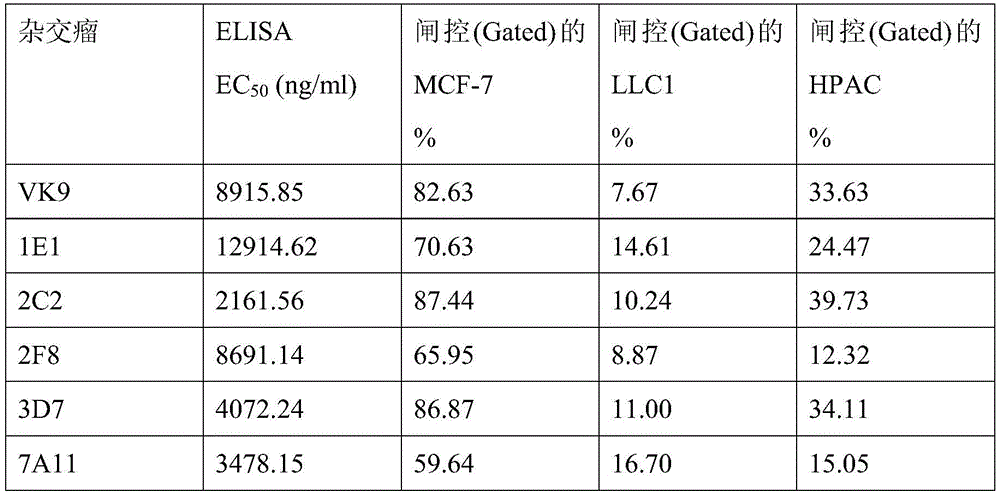
EC50值是中和掉Globo H的50%的抗体浓度。The EC50 value is the concentration of antibody that neutralizes 50% of Globo H.
实例4:抗Globo H抗体的体内抗肿瘤评估Example 4: In vivo antitumor evaluation of anti-Globo H antibodies
以人类胰腺癌(HPAC)异种移植的体重33g的裸鼠被随机分成 下列6个实验组:Human pancreatic cancer (HPAC) xenografted nude mice weighing 33 g were randomly divided into the following 6 experimental groups:
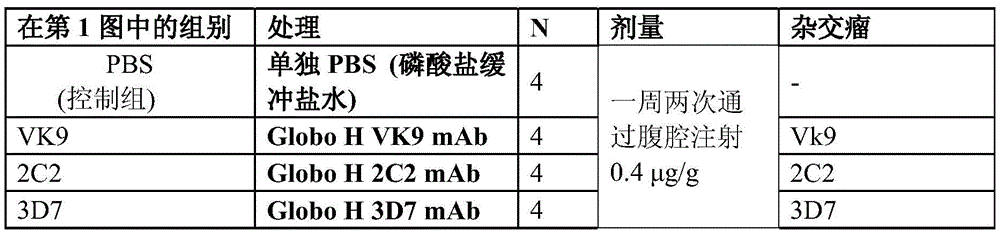
针对肿瘤体积观察小鼠29天期间,且结果被记录并总结在第1图中。Mice were observed for tumor volume over a 29-day period, and the results were recorded and summarized in Figure 1 .
结果:在第29天,肿瘤体积以下列顺序减少:VK9=3D7<2C2组别。在 2C2组别中的肿瘤体积相比于控制组显着地减少(P<0.05)。Results: On
实例5:抗Globo H抗体的体内抗肿瘤评估Example 5: In vivo antitumor evaluation of anti-Globo H antibodies
以人类乳癌(MCF7)异种移植的体重27g的裸鼠被随机分成下列5个实 验组:Human breast cancer (MCF7) xenografted nude mice weighing 27 g were randomly divided into the following 5 experimental groups:

针对肿瘤体积观察小鼠18天的期间,且结果被记录并总结在第2图中。Mice were observed for a period of 18 days for tumor volume and the results were recorded and summarized in Figure 2.
结果:如在第2图显示的,在第15天之后,与控制组相比肿瘤体积于下 列组别中减少:2C2(4mg/kg)>2C2(0.4mg/kg)。从第8天开始,在2C2(4 mg/kg)中的肿瘤体积相比于控制组显着地减少(P<0.05)。 Results: As shown in Figure 2, after
实例6:抗Globo H抗体的交互反应Example 6: Interaction of anti-Globo H antibodies
执行抗Globo H抗体(Globo H 2C2、7A11、3D7、2F8、1E1mAb以及 Globo H Vk9)的体外交互评估。In vitro interaction assessments of anti-Globo H antibodies (Globo H 2C2, 7A11, 3D7, 2F8, 1E1 mAbs and Globo H Vk9) were performed.
步骤:step:
GlycoDx盒(GlycoDx cartridges)加入620μL的洗涤缓冲液、100μL的稀 释抗Globo H抗体、100μL的阻断缓冲液、120μL的共轭缓冲液、以及120μL 的基质缓冲液。盒以CCD分析仪侦测,且数据输出至Excel电子表格以进一 步分析。GlycoDx cartridges (GlycoDx cartridges) were filled with 620 μL of wash buffer, 100 μL of diluted anti-Globo H antibody, 100 μL of blocking buffer, 120 μL of conjugation buffer, and 120 μL of matrix buffer. Boxes were detected with a CCD analyzer and the data exported to an Excel spreadsheet for further analysis.
结果:如在第3A图中显示的,Globo H 2C2mAb结合至Globo H,且显 示对其他糖类抗原的交互反应,诸如Lewis抗原(sLex以及sLea)和S15-S27抗 原(参见表4的糖类抗原的列表)。Globo H 7A11mAb结合至Globo H并且显 示对其他糖类抗原的交互反应,诸如Lewis抗原(sLex以及sLea)以及 S15-S17、S19-S22抗原(见第3B图)。Globo H 3D7mAb结合至GloboH,且 显示对其他糖类抗原的交互反应,诸如Lewis抗原(sLex、sLea、以及Ley)以 及S15-S22抗原(见第3C图)。Globo H 2F8mAb结合至Globo H并且显示对 其他糖类抗原的交互反应,诸如Lewis抗原(sLex及sLea)以及S15、S17以及 S21抗原(见第3D图)。Globo H 1E1mAb结合至Globo H且显示对其他糖类抗 原的交互反应,诸如Lewis抗原(sLex)以及S16、S17和S20-S22抗原(见第3E 图)。相比之下,Globo H VK9mAb仅结合至Globo H且不显示对其他糖类抗原的交互反应(见第3F图)。Results: As shown in Figure 3A, Globo H 2C2 mAb bound to Globo H and showed reactivity to other carbohydrate antigens, such as Lewis antigens (sLex and sLea ) and S15-S27 antigens (see Table 4 for list of carbohydrate antigens). Globo H 7A11 mAb binds to Globo H and shows cross-reactivity to other carbohydrate antigens, such as Lewis antigens (sLex and sLea ) and S15-S17, S19-S22 antigens (see Figure 3B). Globo H 3D7 mAb binds to GloboH and shows cross-reactivity to other carbohydrate antigens, such as Lewis antigens (sLex, sLea , and Ley ) and S15-S22 antigens (see Figure 3C). Globo H 2F8 mAb binds to Globo H and shows reactivity to other carbohydrate antigens, such as Lewis antigens (sLex and sLea ) and S15, S17 and S21 antigens (see Figure 3D). Globo H 1E1 mAb bound to Globo H and showed reciprocal reactivity to other carbohydrate antigens, such as Lewis antigen ( sLex ) and S16, S17 and S20-S22 antigens (see Figure 3E). In contrast, Globo H VK9 mAb bound only to Globo H and did not show cross-reactivity to other carbohydrate antigens (see Figure 3F).
表4、在第3A图至第3C图中的糖类抗原的列表Table 4. List of carbohydrate antigens in Figures 3A to 3C
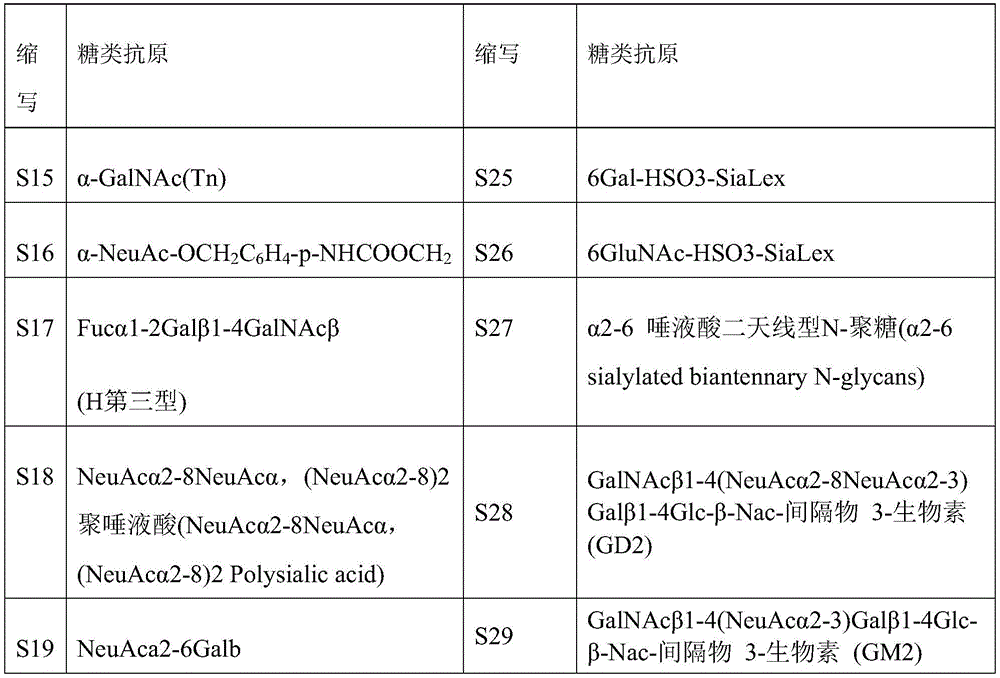
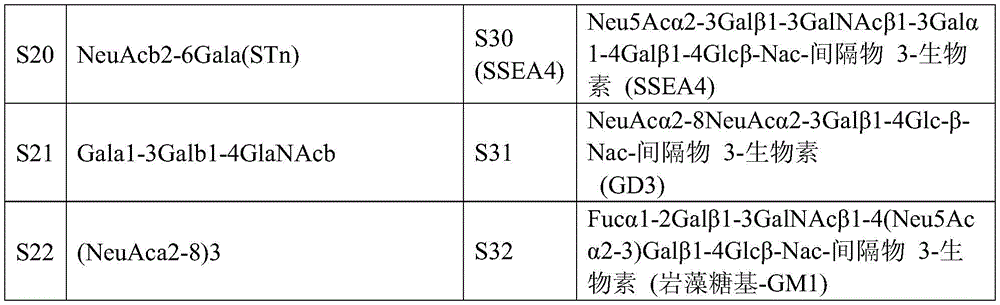
实例7:抗Globo H抗体的结合亲和力Example 7: Binding affinity of anti-Globo H antibody
执行下列抗Globo H人源化抗体的体外评估。表5列出源自杂交瘤2C2 的人源化抗体的重链区和轻链区的氨基酸序列。The following in vitro evaluations of anti-Globo H humanized antibodies were performed. Table 5 lists the amino acid sequences of the heavy and light chain regions of the humanized antibody derived from hybridoma 2C2.
表5、2C2人源化抗体的氨基酸序列Table 5. Amino acid sequence of 2C2 humanized antibody
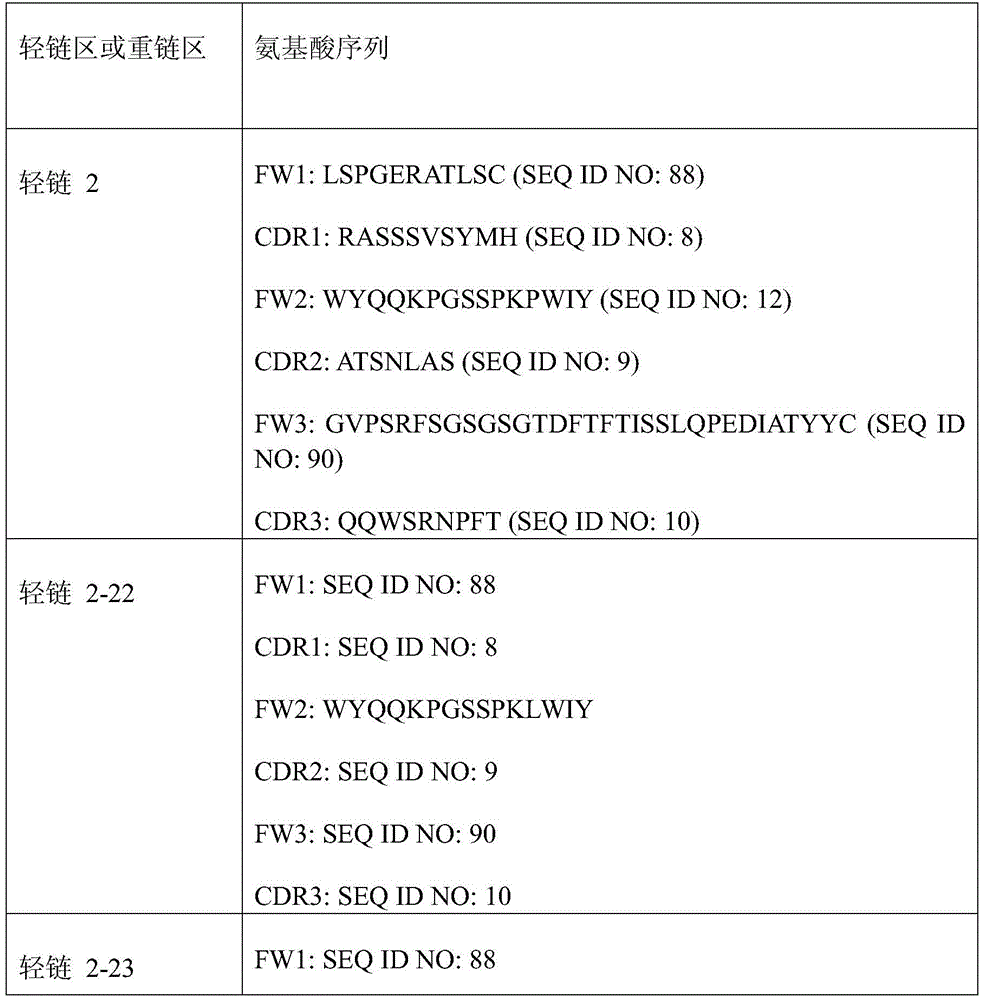

通过ELISA方法测定的结合亲和力的结果被列在表6-9中。The results of the binding affinity determined by the ELISA method are listed in Tables 6-9.
表6:具嵌合轻链和人源化重链的抗体的结合亲和力Table 6: Binding affinities of antibodies with chimeric light and humanized heavy chains
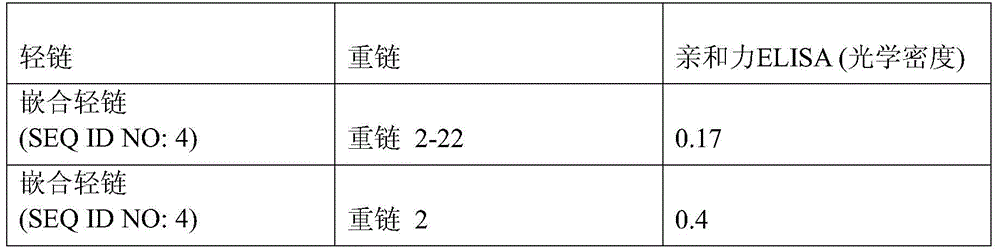
这些结果显示重链的FW2中位置9的氨基酸替换(从G到A)使抗体的 结合亲和力从0.4降低到0.17。These results show that the amino acid substitution at position 9 (from G to A) in FW2 of the heavy chain reduces the binding affinity of the antibody from 0.4 to 0.17.
表7:具人源化轻链和人源化重链的抗体的结合亲和力Table 7: Binding affinities of antibodies with humanized light and heavy chains
表8:具人源化轻链和人源化重链的抗体的结合亲和力Table 8: Binding affinities of antibodies with humanized light and heavy chains
表9:具人源化轻链和人源化重链的抗体的结合亲和力Table 9: Binding affinities of antibodies with humanized light and heavy chains
这些结果显示在轻链的FW2的位置12的氨基酸替换(从P至L)使结合亲 和力从0.32-0.53减少到0.07-0.08,且在轻链的FW2的位置13的氨基酸替换 (从W到L)使结合亲和力从0.32-0.53减少至0.08-0.12。These results show that the amino acid substitution at position 12 of FW2 of the light chain (from P to L) reduces the binding affinity from 0.32-0.53 to 0.07-0.08, and the amino acid substitution at position 13 of FW2 of the light chain (from W to L) ) reduced binding affinity from 0.32-0.53 to 0.08-0.12.
诚然本发明的具体态样已经被叙述和描绘,这样的态样可被认为仅是 本发明的描述而非作为本发明的限制,如根据附录的权利要求书所解释的。 所有在本说明书中引用的公开文献和专利申请于所有目的通过引用而整体 并入本文中,如同每一个别公开文献或专利申请被特定地和个别地指定以 于所有目的上通过引用而整体并入。虽然上述发明已为了清楚理解的目的 而以描述和举例的方式进行部分细节的描述,然而显而易见的是,对所属 技术领域中的技术人员而言根据此发明教示可在不悖离所附权利要求书的 精神或范畴下进行一些变化和修饰。While specific aspects of the invention have been described and depicted, such aspects are to be considered merely as descriptions of the invention and not as limitations of the invention, as interpreted in accordance with the appended claims. All publications and patent applications cited in this specification are hereby incorporated by reference in their entirety for all purposes as if each individual publication or patent application were specifically and individually designated to be incorporated by reference in their entirety for all purposes enter. While the foregoing invention has been described in some detail by way of description and example for purposes of clarity of understanding, it will be apparent to those skilled in the art that the teachings of this invention may be employed without departing from the appended claims. Some changes and modifications are made within the spirit or scope of the book.
序列表清单:SEQ ID No.1-90Sequence Listing Listing: SEQ ID No. 1-90
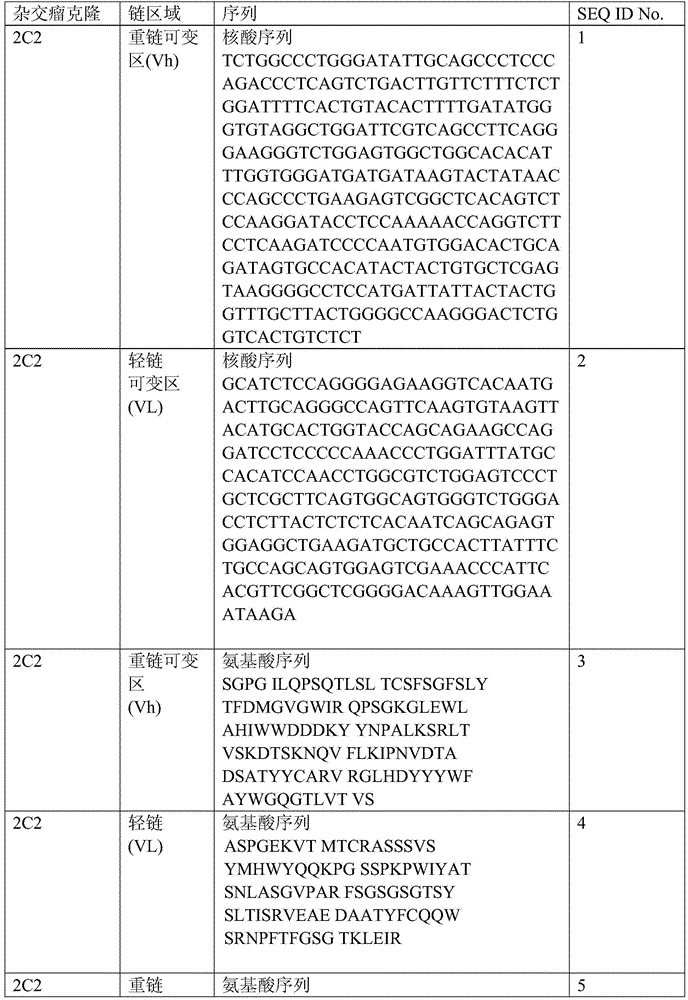
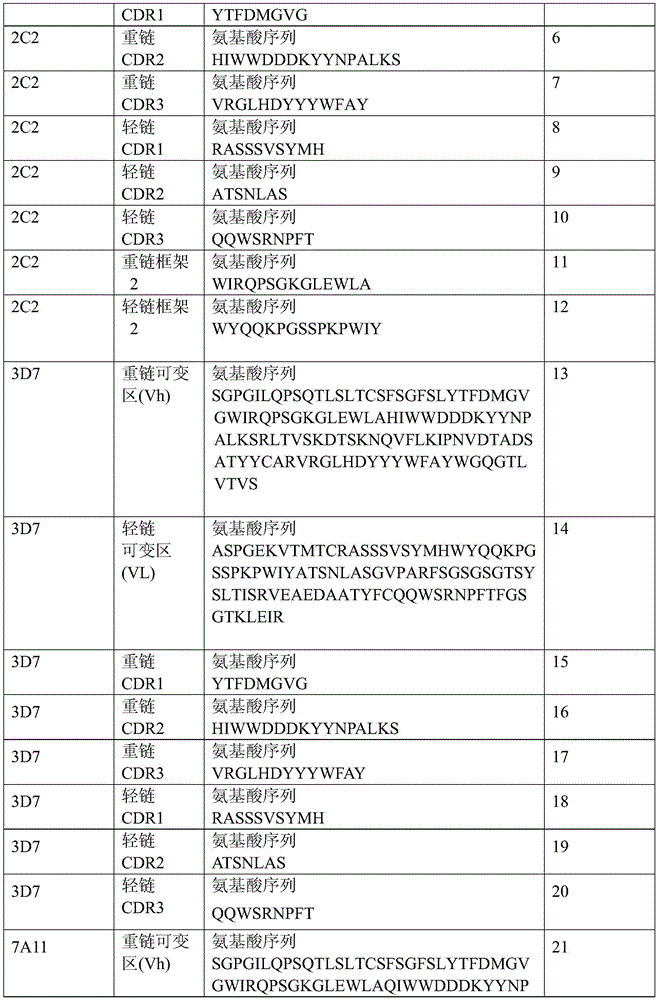
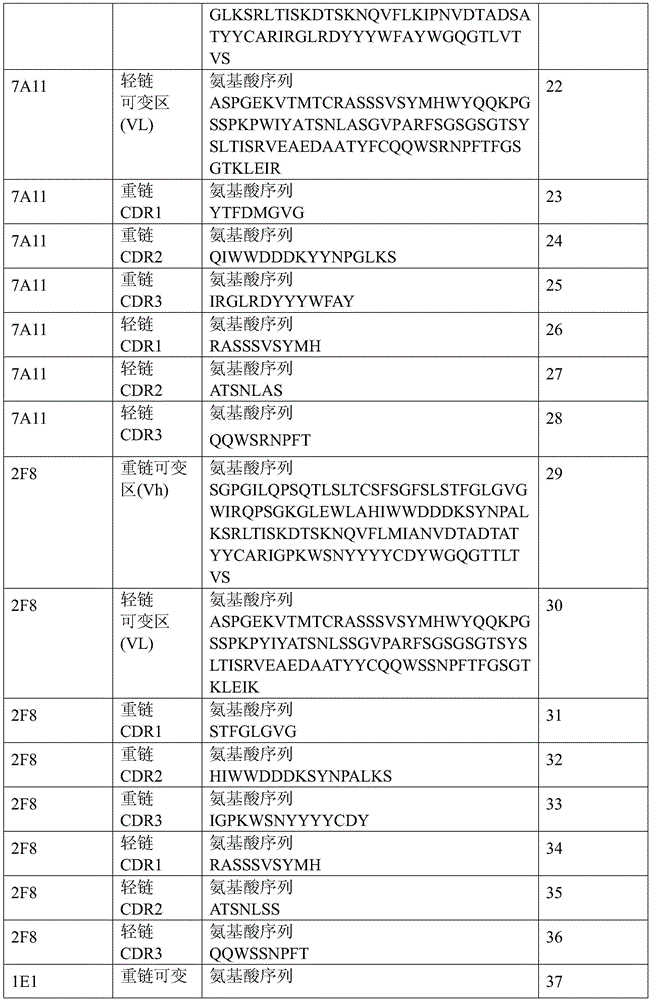
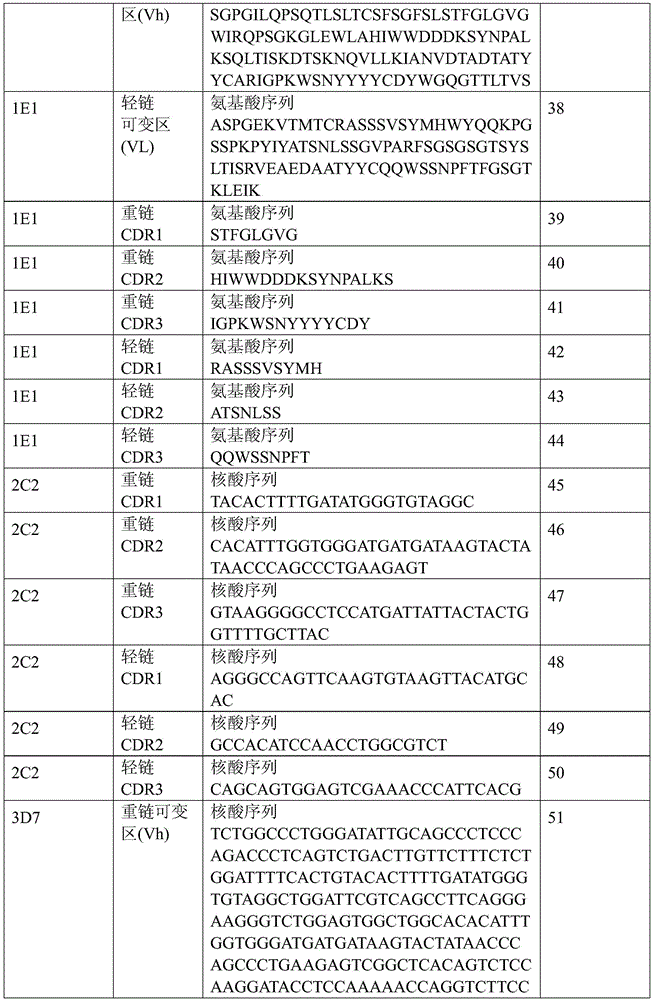
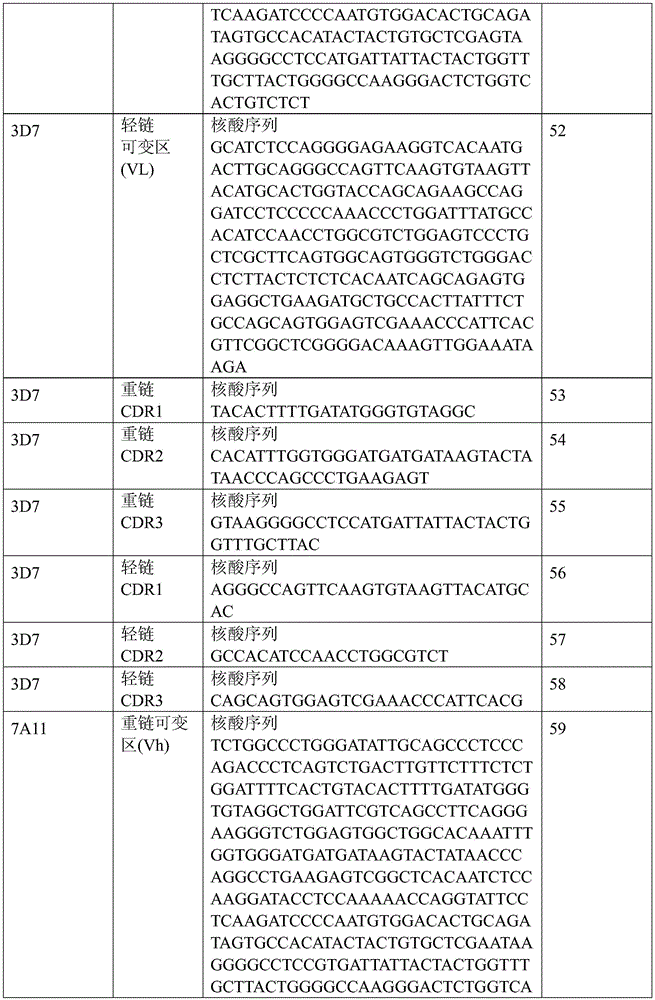


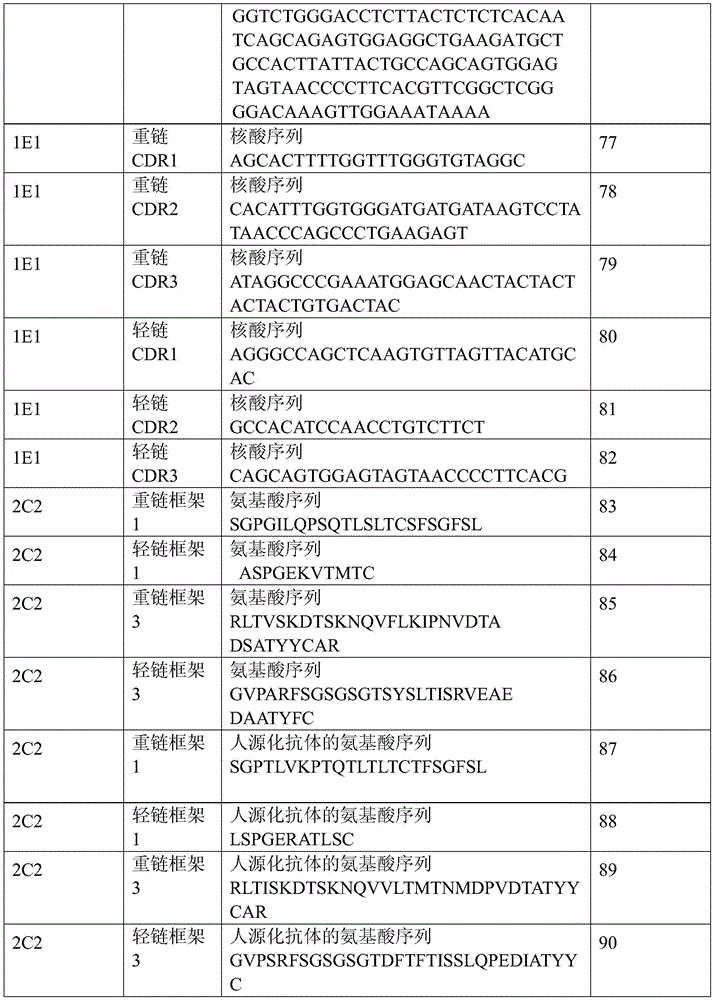

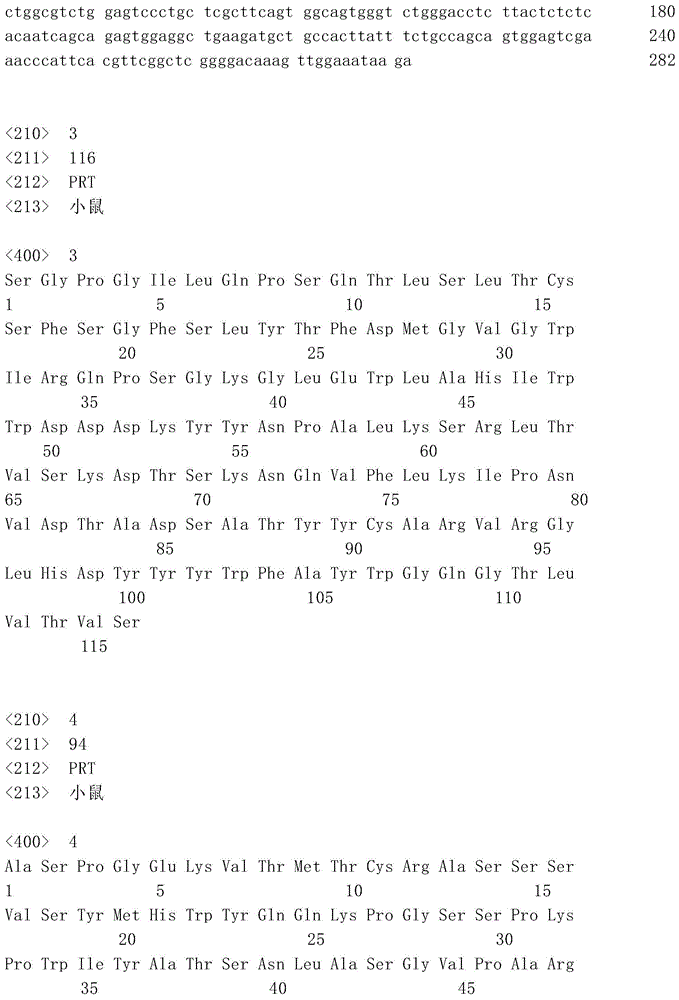
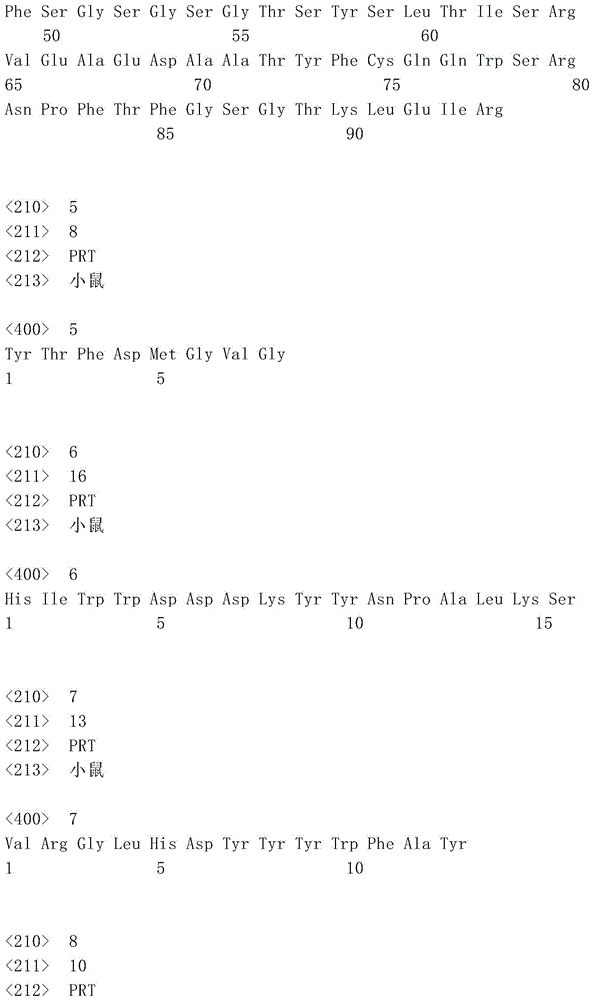
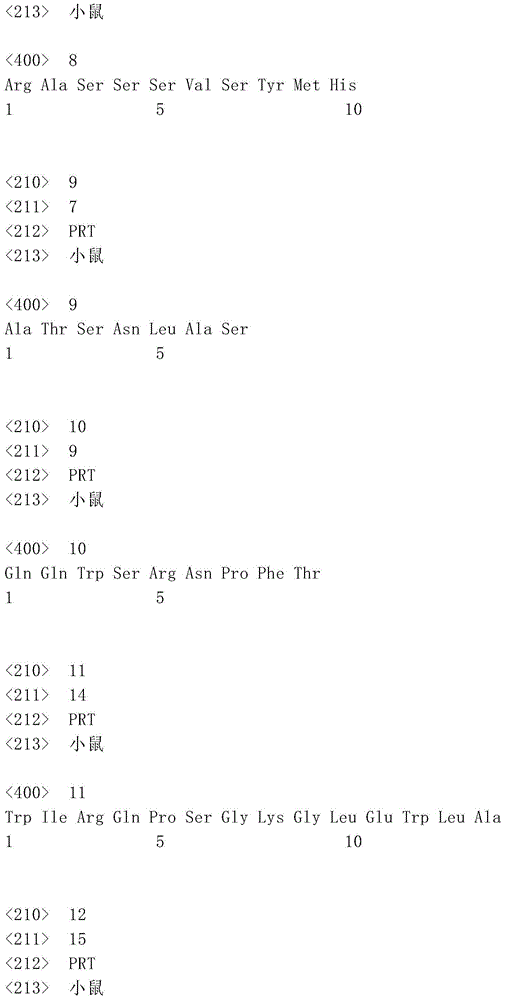
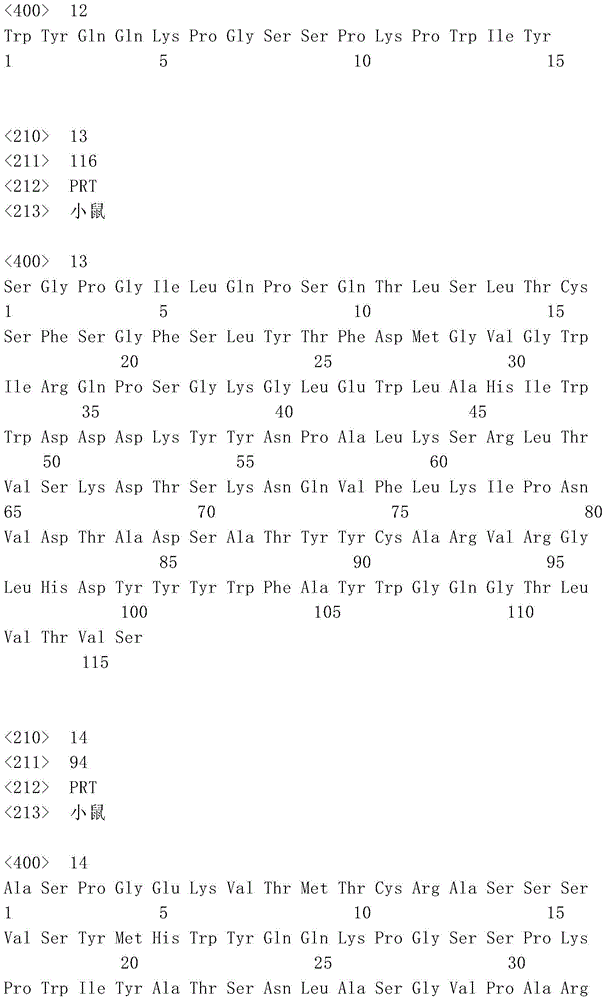
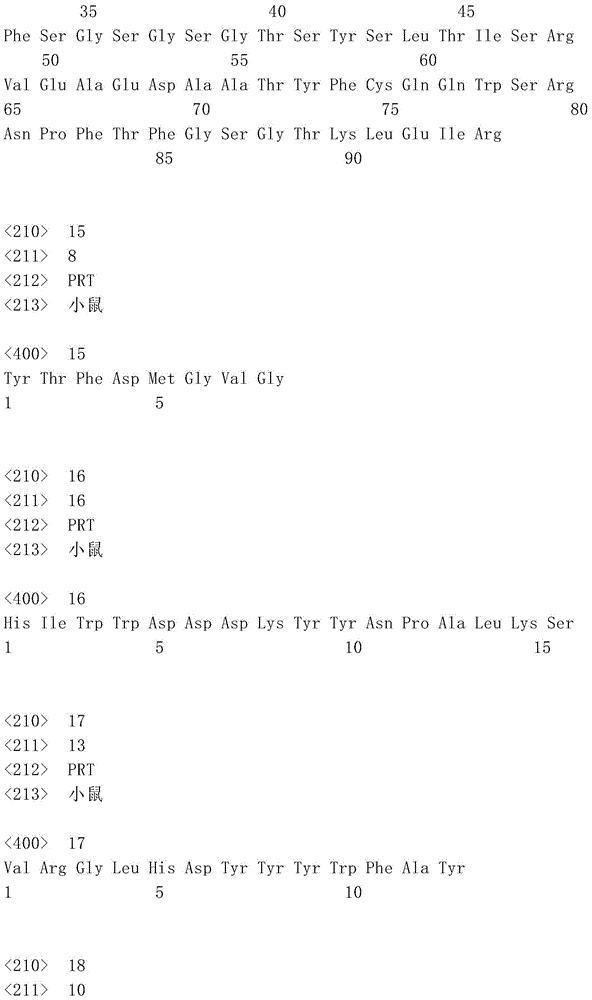


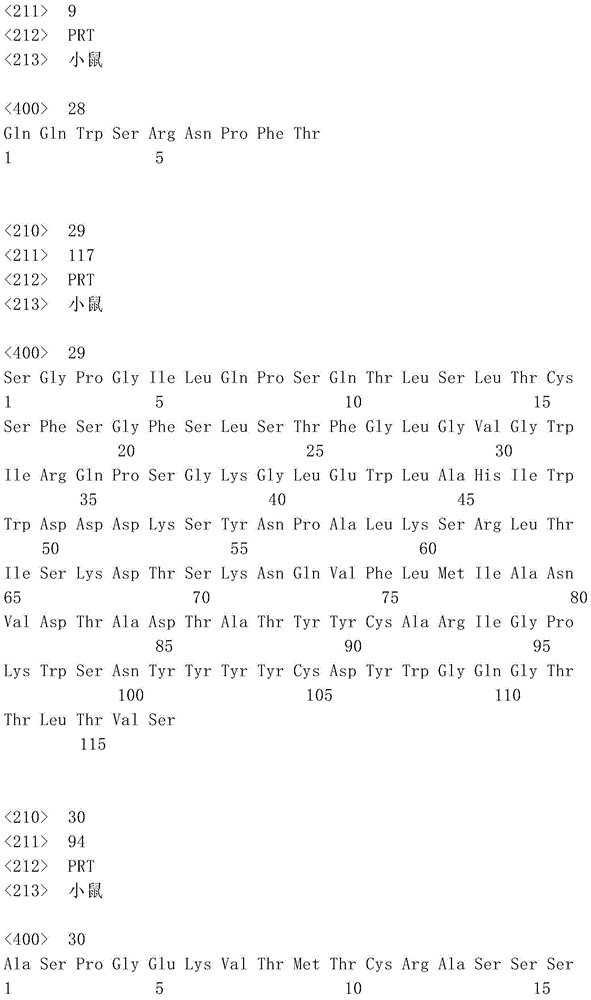
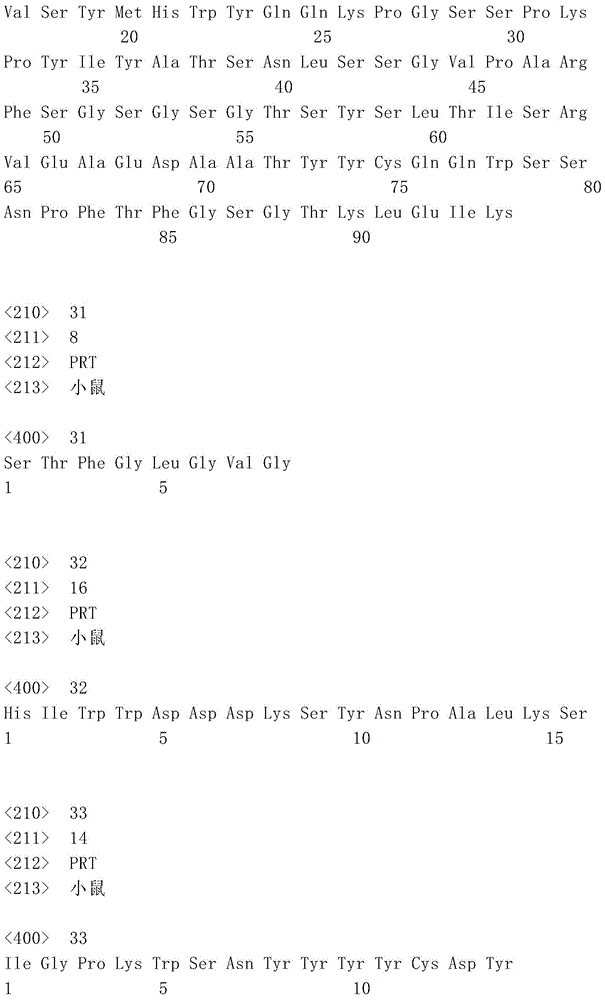

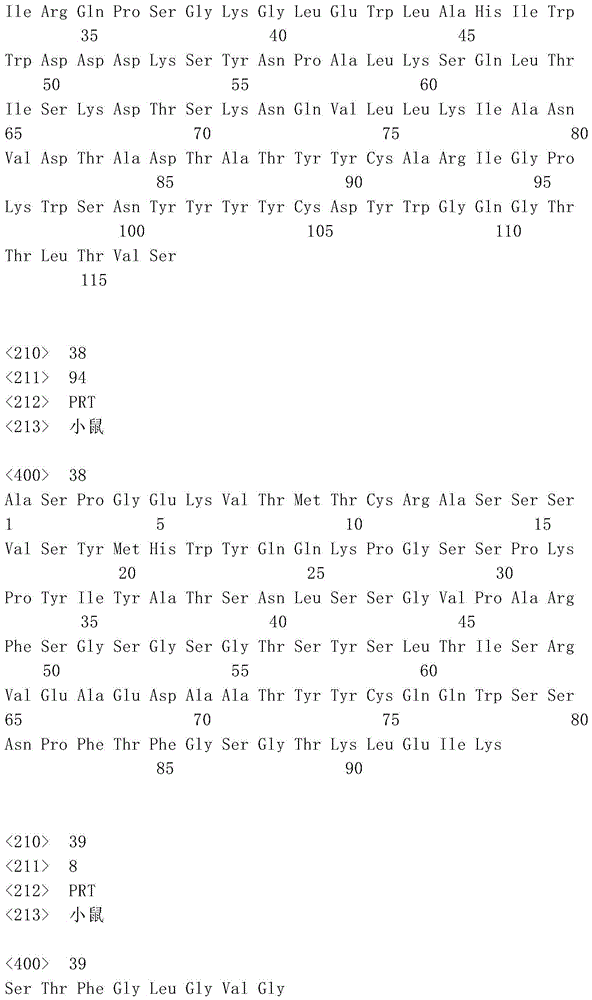
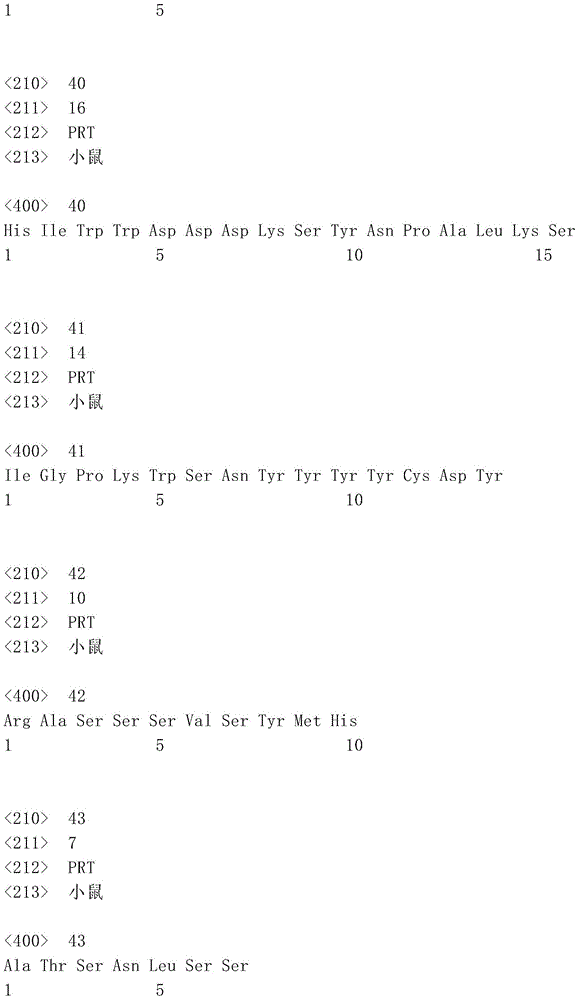


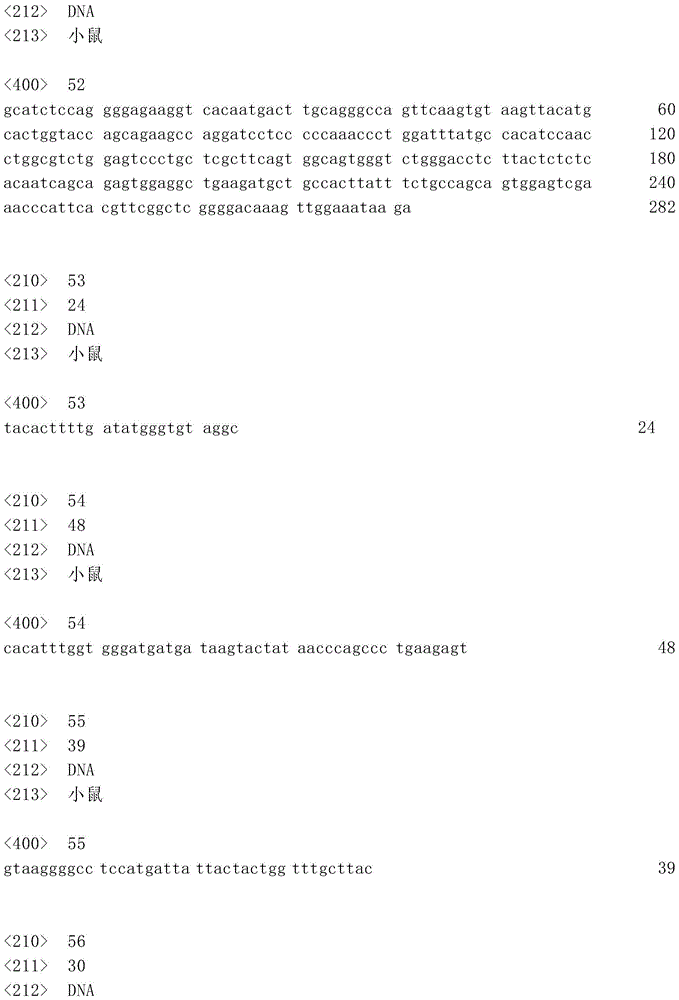
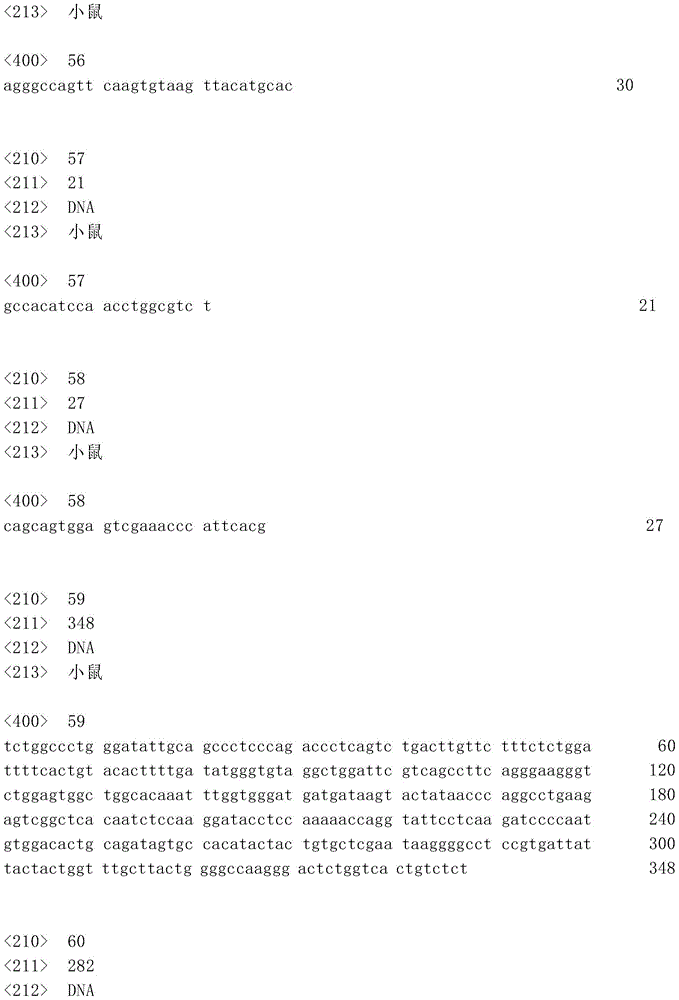
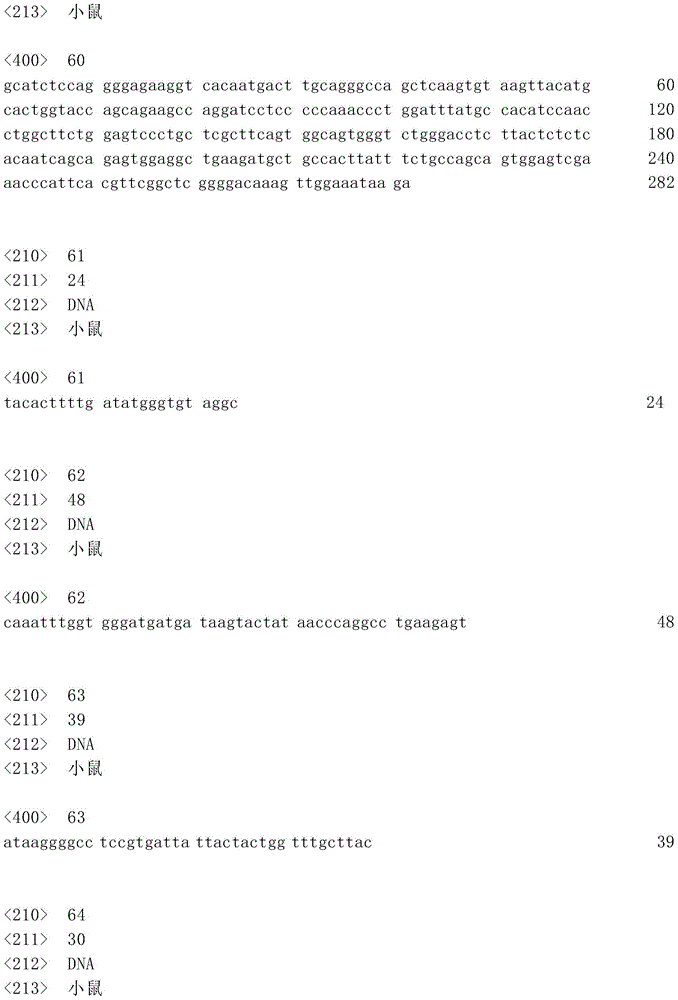
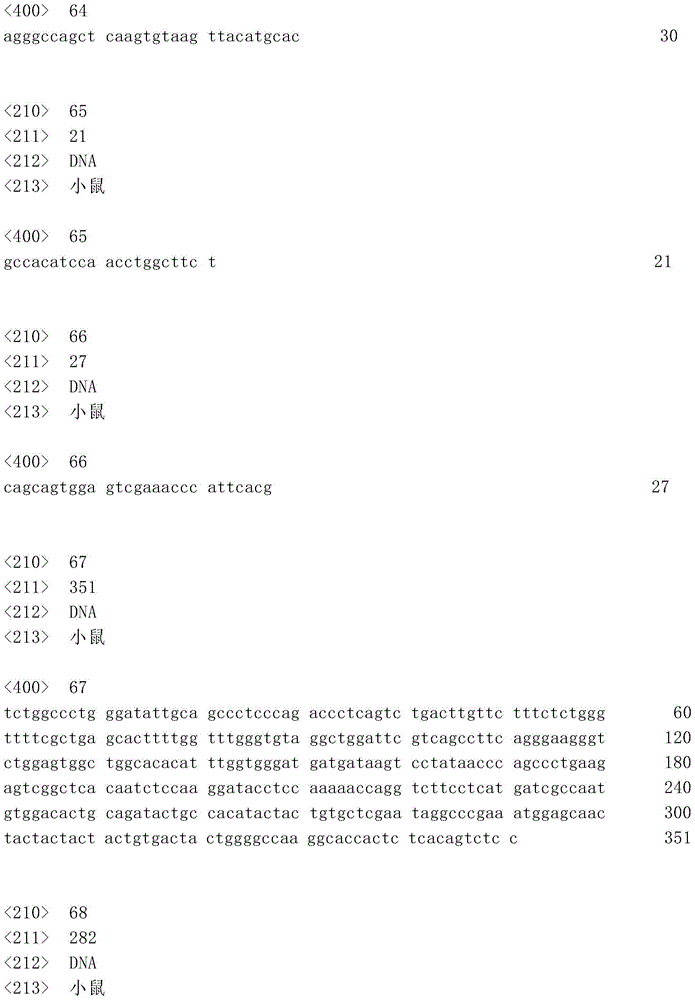

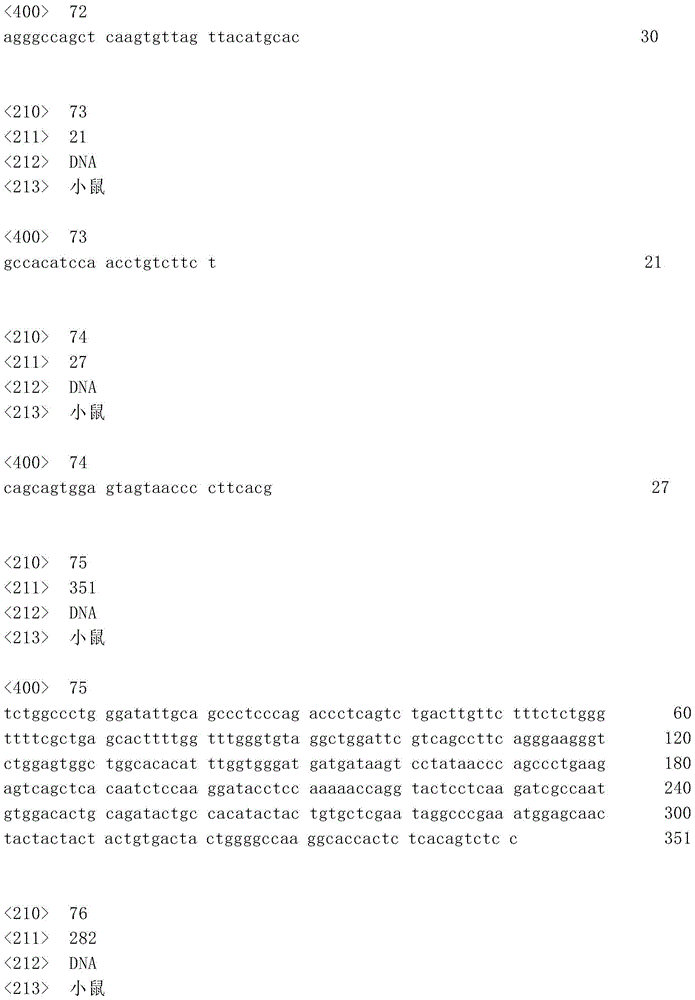
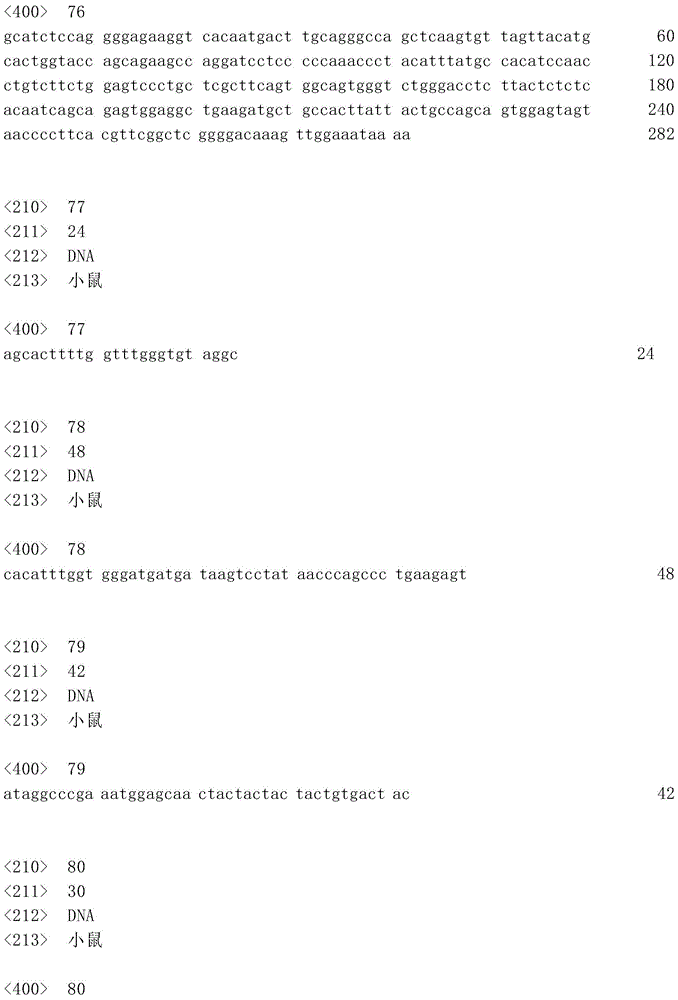
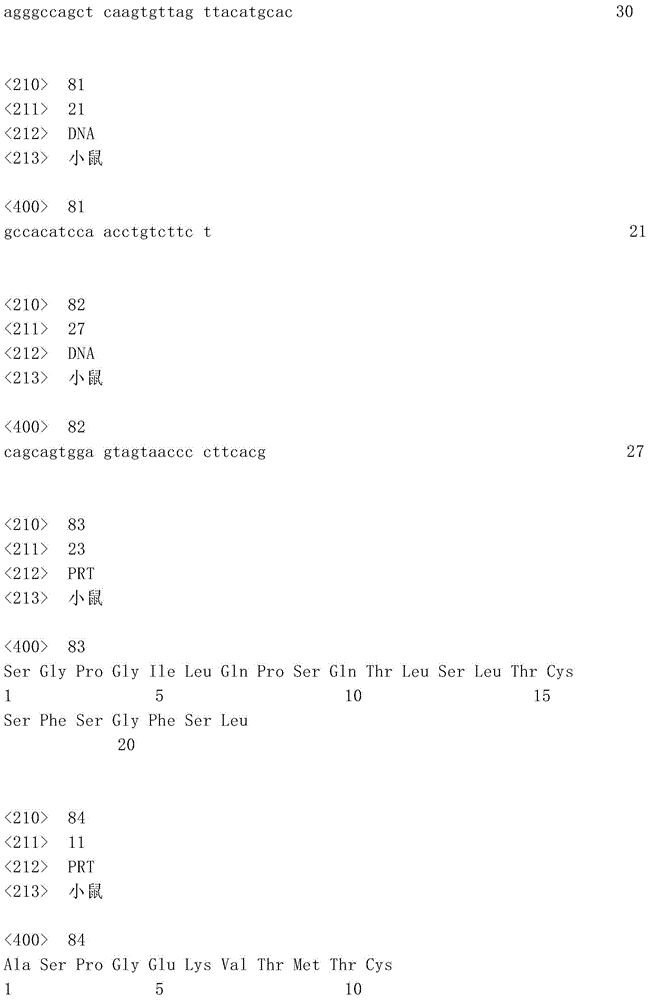
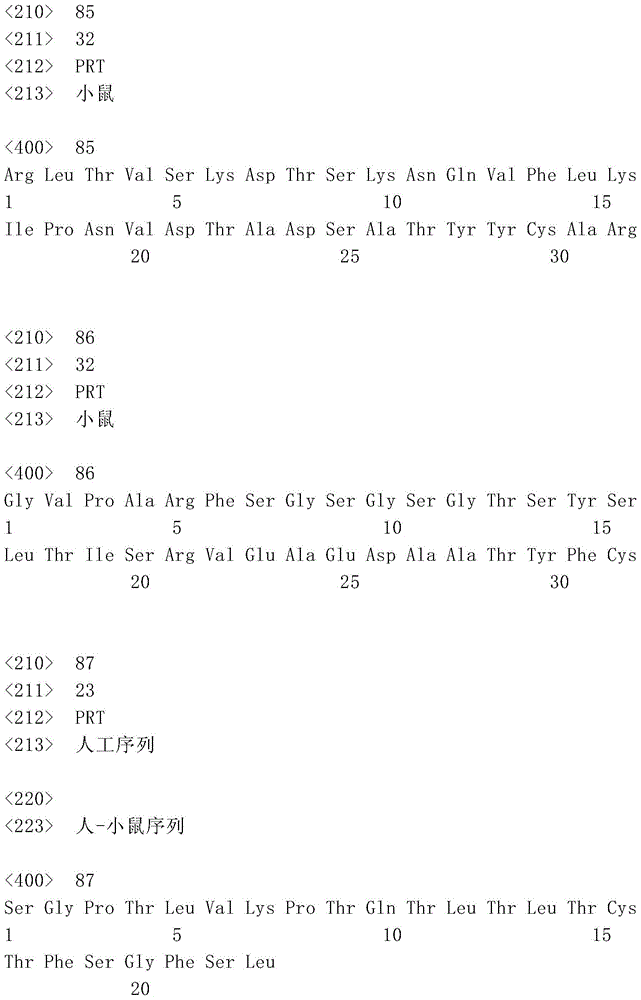

Claims (16)
Priority Applications (1)
| Application Number | Priority Date | Filing Date | Title |
|---|---|---|---|
| CN202011258954.4A CN112390887B (en) | 2014-04-10 | 2015-04-10 | Antibodies, hybridomas producing said antibodies, and uses thereof |
Applications Claiming Priority (5)
| Application Number | Priority Date | Filing Date | Title |
|---|---|---|---|
| US201461977824P | 2014-04-10 | 2014-04-10 | |
| US61/977,824 | 2014-04-10 | ||
| US201462057381P | 2014-09-30 | 2014-09-30 | |
| US62/057,381 | 2014-09-30 | ||
| PCT/US2015/025305 WO2015157629A2 (en) | 2014-04-10 | 2015-04-10 | Antibodies, pharmaceutical compositions and uses thereof |
Related Child Applications (1)
| Application Number | Title | Priority Date | Filing Date |
|---|---|---|---|
| CN202011258954.4A Division CN112390887B (en) | 2014-04-10 | 2015-04-10 | Antibodies, hybridomas producing said antibodies, and uses thereof |
Publications (2)
| Publication Number | Publication Date |
|---|---|
| CN106456727A CN106456727A (en) | 2017-02-22 |
| CN106456727B true CN106456727B (en) | 2020-11-27 |
Family
ID=54288553
Family Applications (2)
| Application Number | Title | Priority Date | Filing Date |
|---|---|---|---|
| CN201580011286.6A Active CN106456727B (en) | 2014-04-10 | 2015-04-10 | Antibodies, hybridomas producing said antibodies, and uses thereof |
| CN202011258954.4A Active CN112390887B (en) | 2014-04-10 | 2015-04-10 | Antibodies, hybridomas producing said antibodies, and uses thereof |
Family Applications After (1)
| Application Number | Title | Priority Date | Filing Date |
|---|---|---|---|
| CN202011258954.4A Active CN112390887B (en) | 2014-04-10 | 2015-04-10 | Antibodies, hybridomas producing said antibodies, and uses thereof |
Country Status (17)
| Country | Link |
|---|---|
| US (2) | US9902779B2 (en) |
| EP (2) | EP3662928A1 (en) |
| JP (1) | JP2017512759A (en) |
| KR (1) | KR101966408B1 (en) |
| CN (2) | CN106456727B (en) |
| AU (2) | AU2015243246B2 (en) |
| BR (1) | BR112016020009A2 (en) |
| CA (2) | CA2941029C (en) |
| CL (1) | CL2016002569A1 (en) |
| ES (1) | ES2772817T3 (en) |
| IL (2) | IL246837B (en) |
| PH (1) | PH12016501976A1 (en) |
| RU (1) | RU2016138744A (en) |
| SG (1) | SG11201607258SA (en) |
| TW (3) | TWI697503B (en) |
| WO (1) | WO2015157629A2 (en) |
| ZA (1) | ZA201605175B (en) |
Families Citing this family (18)
| Publication number | Priority date | Publication date | Assignee | Title |
|---|---|---|---|---|
| CN105764921B (en) | 2013-09-17 | 2020-06-30 | 台湾浩鼎生技股份有限公司 | Carbohydrate vaccine compositions for inducing immune response and use thereof for treating cancer |
| CA2943333A1 (en) | 2014-03-19 | 2015-09-24 | Mackay Medical Foundation The Presbyterian Church In Taiwan Mackay Memorial Hospital | Antibodies against immunogenic glycopeptides, composition comprising the same and use thereof |
| WO2015157629A2 (en) | 2014-04-10 | 2015-10-15 | Obi Pharma Inc. | Antibodies, pharmaceutical compositions and uses thereof |
| HK1256912A1 (en) | 2015-09-04 | 2019-10-04 | 台湾浩鼎生技股份有限公司 | Glycan arrays and method of use |
| CN108472362B (en) * | 2015-10-07 | 2022-03-29 | 台湾浩鼎生技股份有限公司 | Novel carbohydrate antibodies, pharmaceutical compositions and uses thereof |
| CN109311995A (en) | 2016-03-29 | 2019-02-05 | 台湾浩鼎生技股份有限公司 | Antibodies, pharmaceutical compositions and methods |
| US10980894B2 (en) | 2016-03-29 | 2021-04-20 | Obi Pharma, Inc. | Antibodies, pharmaceutical compositions and methods |
| RU2018140976A (en) | 2016-04-22 | 2020-05-22 | Оби Фарма, Инк. | CANCER IMMUNOTHERAPY BY IMMUNE ACTIVATION OR IMMUNE MODULATION THROUGH GLOBO SERIES ANTIGENS |
| GB201612317D0 (en) | 2016-07-15 | 2016-08-31 | Philogen Spa | Antibody compositions |
| KR20230117482A (en) | 2016-07-27 | 2023-08-08 | 오비아이 파머 인코퍼레이티드 | Immunogenic/therapeutic glycan compositions and uses thereof |
| KR102528998B1 (en) | 2016-07-29 | 2023-05-03 | 오비아이 파머 인코퍼레이티드 | Human Antibodies, Pharmaceutical Compositions and Methods |
| CN110290800A (en) | 2016-11-21 | 2019-09-27 | 台湾浩鼎生技股份有限公司 | Conjugated biomolecules, pharmaceutical compositions and methods |
| CA3064443A1 (en) * | 2017-05-24 | 2018-11-29 | Development Center For Biotechnology | Humanized antibodies against globo h and uses thereof in cancer treatments |
| WO2019178218A1 (en) * | 2018-03-14 | 2019-09-19 | Memorial Sloan Kettering Cancer Center | Anti-polysialic acid antibodies and uses thereof |
| WO2019232519A1 (en) * | 2018-06-01 | 2019-12-05 | Obi Pharma, Inc. | Combination therapy by using anti-globo h or anti-ssea-4 antibody with anti-negative immune check points antibody |
| WO2020006176A1 (en) | 2018-06-27 | 2020-01-02 | Obi Pharma, Inc. | Glycosynthase variants for glycoprotein engineering and methods of use |
| AU2020245607A1 (en) * | 2019-03-28 | 2021-12-02 | Ming-Tain Lai | Companion diagnostic assay for Globo-H related cancer therapy |
| WO2022173772A1 (en) * | 2021-02-09 | 2022-08-18 | Obi Pharma, Inc. | Globo series antigens-binding chimeric antigen receptors and uses thereof |
Citations (3)
| Publication number | Priority date | Publication date | Assignee | Title |
|---|---|---|---|---|
| WO2004005349A2 (en) * | 2002-07-03 | 2004-01-15 | Igeneon Krebs-Immuntherapie Forschungs-Und Entwicklungs-Ag | Preparation based on an antibody directed against a tumor-associated glycosylation such as lewis structures |
| CN102574915A (en) * | 2009-08-06 | 2012-07-11 | 伊缪纳斯制药株式会社 | Antibodies that specifically bind to A beta oligomers and use thereof |
| CN103459600A (en) * | 2010-07-01 | 2013-12-18 | 帝斯曼知识产权资产管理有限公司 | A method for the production of a compound of interest |
Family Cites Families (45)
| Publication number | Priority date | Publication date | Assignee | Title |
|---|---|---|---|---|
| US4816567A (en) | 1983-04-08 | 1989-03-28 | Genentech, Inc. | Recombinant immunoglobin preparations |
| JPS6147500A (en) | 1984-08-15 | 1986-03-07 | Res Dev Corp Of Japan | Chimera monoclonal antibody and its preparation |
| EP0173494A3 (en) | 1984-08-27 | 1987-11-25 | The Board Of Trustees Of The Leland Stanford Junior University | Chimeric receptors by dna splicing and expression |
| GB8422238D0 (en) | 1984-09-03 | 1984-10-10 | Neuberger M S | Chimeric proteins |
| JPS61134325A (en) | 1984-12-04 | 1986-06-21 | Teijin Ltd | Expression of hybrid antibody gene |
| WO1987002671A1 (en) | 1985-11-01 | 1987-05-07 | International Genetic Engineering, Inc. | Modular assembly of antibody genes, antibodies prepared thereby and use |
| US5225539A (en) | 1986-03-27 | 1993-07-06 | Medical Research Council | Recombinant altered antibodies and methods of making altered antibodies |
| NZ230747A (en) | 1988-09-30 | 1992-05-26 | Bror Morein | Immunomodulating matrix comprising a complex of at least one lipid and at least one saponin; certain glycosylated triterpenoid saponins derived from quillaja saponaria molina |
| US5530101A (en) | 1988-12-28 | 1996-06-25 | Protein Design Labs, Inc. | Humanized immunoglobulins |
| US5770429A (en) | 1990-08-29 | 1998-06-23 | Genpharm International, Inc. | Transgenic non-human animals capable of producing heterologous antibodies |
| EP0519596B1 (en) | 1991-05-17 | 2005-02-23 | Merck & Co. Inc. | A method for reducing the immunogenicity of antibody variable domains |
| WO1993006213A1 (en) | 1991-09-23 | 1993-04-01 | Medical Research Council | Production of chimeric antibodies - a combinatorial approach |
| AUPM873294A0 (en) | 1994-10-12 | 1994-11-03 | Csl Limited | Saponin preparations and use thereof in iscoms |
| AUPO517897A0 (en) | 1997-02-19 | 1997-04-11 | Csl Limited | Chelating immunostimulating complexes |
| AUPP807399A0 (en) | 1999-01-08 | 1999-02-04 | Csl Limited | Improved immunogenic lhrh composition and methods relating thereto |
| NZ513935A (en) | 1999-02-17 | 2004-02-27 | Csl Ltd | Immunogenic complexes and methods relating thereto |
| CZ20023203A3 (en) | 2000-03-24 | 2003-08-13 | Micromet Ag | Multifunctional polypeptides comprising a binding site to an epitope of the NKG2D receptor complex |
| CU23007A1 (en) * | 2001-04-06 | 2004-12-17 | Ct De Inmunologia Molecular Ct De Inmunologia Mole | IMMUNOTHERAPEUTIC COMBINATIONS FOR THE TREATMENT IMMUNOTHERAPEUTIC COMBINATIONS FOR THE TREATMENT OF TUMORS THAT OVER-EXPRESS GANGLIOSIDES TO OF TUMORS THAT OVER-EXPRESS GANGLOSIDES |
| DE60124912T2 (en) * | 2001-09-14 | 2007-06-14 | Affimed Therapeutics Ag | Multimeric, single chain, tandem Fv antibodies |
| BR0107262B1 (en) | 2001-12-17 | 2014-04-22 | Da Fonseca Clovis Orlando Pereira | INHALORY PHARMACEUTICAL COMPOSITION |
| US20040126829A1 (en) | 2001-12-18 | 2004-07-01 | Hildebrand William H. | Anti-HLA assay and methods |
| ATE444972T1 (en) * | 2002-04-30 | 2009-10-15 | Kyowa Hakko Kirin Co Ltd | ANTIBODIES AGAINST THE HUMAN ßINSULIN LIKE GROWTH FACTOR |
| DE60334453D1 (en) * | 2002-05-30 | 2010-11-18 | Macrogenics Inc | CD16A BINDING PROTEINS AND USE FOR THE TREATMENT OF IMMUNE DISEASES |
| RS51908B (en) | 2004-02-06 | 2012-02-29 | University of Massachusetts | CLOSTRIDIUM DIFFICILE TOXIN ANTIBODIES AND THEIR USES |
| EP2287195B1 (en) * | 2004-07-01 | 2019-05-15 | Novo Nordisk A/S | Pan-kir2dl nk-receptor antibodies and their use in diagnostik and therapy |
| AU2005333126A1 (en) | 2004-07-18 | 2006-12-21 | Csl Limited | Methods and compositions for inducing innate immune responses |
| JP2008506789A (en) | 2004-07-18 | 2008-03-06 | シーエスエル、リミテッド | Immunostimulatory complex and oligonucleotide formulation for inducing enhanced interferon-gamma response |
| CN105085678B (en) * | 2004-12-21 | 2019-05-07 | 阿斯利康公司 | Angiopoietin-2 antibody and its application |
| RU2488597C2 (en) * | 2005-02-07 | 2013-07-27 | Гликарт Биотехнологи Аг | Antigen-binding molecules, which bind egfr, their coding vectors and their usage |
| CA2602777C (en) * | 2005-03-25 | 2018-12-11 | Tolerrx, Inc. | Gitr binding molecules and uses therefor |
| CL2007002668A1 (en) * | 2006-09-20 | 2008-05-09 | Amgen Inc | ANTIGEN UNION PROTEIN THAT JOINS THE HUMAN GLUCAGON RECEIVER; NUCLEIC ACID THAT CODIFIES IT; METHOD OF PRODUCTION; PHARMACEUTICAL COMPOSITION THAT UNDERSTANDS IT; AND ITS USE TO TREAT OR PREVENT TYPE 2 DIABETES. |
| EP1920782A1 (en) | 2006-11-10 | 2008-05-14 | Glycotope Gmbh | Carboyhdrate specific cellular immunity inducing microorganisms and fractions thereof |
| US20100145032A1 (en) * | 2007-01-18 | 2010-06-10 | Suomen Punainen Risti, Veripalelu | Novel carbohydrate profile compositions from human cells and methods for analysis and modification thereof |
| MX2010013931A (en) | 2008-06-16 | 2011-06-01 | Academia Sinica | CANCER DIAGNOSIS BASED ON ANTIBODY LEVELS AGAINST GLOBE H AND ITS FRAGMENTS. |
| WO2010005735A2 (en) * | 2008-06-16 | 2010-01-14 | Academia Sinica | Compositions for inducing immune responses specific to globo h and ssea3 and uses thereof in cancer treatment |
| TWI392502B (en) * | 2009-06-16 | 2013-04-11 | Academia Sinica | Globo h and related anti-cancer vaccines with novel glycolipid adjuvants |
| ES2566602T3 (en) * | 2010-04-09 | 2016-04-14 | Aveo Pharmaceuticals, Inc. | Anti-ErbB3 antibodies |
| CN105440134A (en) * | 2010-08-16 | 2016-03-30 | 安姆根公司 | Antibody of combination of muscle amicine, compound and method |
| US20120275996A1 (en) * | 2010-12-21 | 2012-11-01 | Abbott Laboratories | IL-1 Binding Proteins |
| EP2497782A1 (en) * | 2011-03-08 | 2012-09-12 | Alzinova AB | Anti oligomer antibodies and uses thereof |
| US9828635B2 (en) | 2011-10-06 | 2017-11-28 | Aveo Pharmaceuticals, Inc. | Predicting tumor response to anti-ERBB3 antibodies |
| JP6089047B2 (en) | 2012-02-24 | 2017-03-01 | アッヴィ・ステムセントルクス・エル・エル・シー | DLL3 modulator and method of use |
| JP2017507118A (en) | 2014-01-16 | 2017-03-16 | アカデミア シニカAcademia Sinica | Compositions and methods for the treatment and detection of cancer |
| CA2943333A1 (en) * | 2014-03-19 | 2015-09-24 | Mackay Medical Foundation The Presbyterian Church In Taiwan Mackay Memorial Hospital | Antibodies against immunogenic glycopeptides, composition comprising the same and use thereof |
| WO2015157629A2 (en) | 2014-04-10 | 2015-10-15 | Obi Pharma Inc. | Antibodies, pharmaceutical compositions and uses thereof |
-
2015
- 2015-04-10 WO PCT/US2015/025305 patent/WO2015157629A2/en not_active Ceased
- 2015-04-10 TW TW106128654A patent/TWI697503B/en active
- 2015-04-10 US US15/303,132 patent/US9902779B2/en active Active
- 2015-04-10 EP EP20151337.1A patent/EP3662928A1/en not_active Withdrawn
- 2015-04-10 CN CN201580011286.6A patent/CN106456727B/en active Active
- 2015-04-10 ES ES15777370T patent/ES2772817T3/en active Active
- 2015-04-10 AU AU2015243246A patent/AU2015243246B2/en not_active Ceased
- 2015-04-10 BR BR112016020009A patent/BR112016020009A2/en not_active IP Right Cessation
- 2015-04-10 TW TW106128651A patent/TWI695013B/en active
- 2015-04-10 TW TW104111557A patent/TWI609886B/en active
- 2015-04-10 SG SG11201607258SA patent/SG11201607258SA/en unknown
- 2015-04-10 CA CA2941029A patent/CA2941029C/en active Active
- 2015-04-10 EP EP15777370.6A patent/EP3129048B1/en active Active
- 2015-04-10 CN CN202011258954.4A patent/CN112390887B/en active Active
- 2015-04-10 CA CA3104268A patent/CA3104268A1/en not_active Abandoned
- 2015-04-10 KR KR1020167024072A patent/KR101966408B1/en not_active Expired - Fee Related
- 2015-04-10 JP JP2016554855A patent/JP2017512759A/en active Pending
- 2015-04-10 RU RU2016138744A patent/RU2016138744A/en not_active Application Discontinuation
-
2016
- 2016-07-19 IL IL246837A patent/IL246837B/en active IP Right Grant
- 2016-07-25 ZA ZA2016/05175A patent/ZA201605175B/en unknown
- 2016-10-04 PH PH12016501976A patent/PH12016501976A1/en unknown
- 2016-10-07 CL CL2016002569A patent/CL2016002569A1/en unknown
-
2017
- 2017-11-28 US US15/824,733 patent/US10815307B2/en active Active
-
2018
- 2018-10-26 AU AU2018253589A patent/AU2018253589B2/en not_active Ceased
-
2020
- 2020-08-13 IL IL276695A patent/IL276695B/en unknown
Patent Citations (3)
| Publication number | Priority date | Publication date | Assignee | Title |
|---|---|---|---|---|
| WO2004005349A2 (en) * | 2002-07-03 | 2004-01-15 | Igeneon Krebs-Immuntherapie Forschungs-Und Entwicklungs-Ag | Preparation based on an antibody directed against a tumor-associated glycosylation such as lewis structures |
| CN102574915A (en) * | 2009-08-06 | 2012-07-11 | 伊缪纳斯制药株式会社 | Antibodies that specifically bind to A beta oligomers and use thereof |
| CN103459600A (en) * | 2010-07-01 | 2013-12-18 | 帝斯曼知识产权资产管理有限公司 | A method for the production of a compound of interest |
Also Published As
Similar Documents
| Publication | Publication Date | Title |
|---|---|---|
| CN106456727B (en) | Antibodies, hybridomas producing said antibodies, and uses thereof | |
| TWI811604B (en) | Antibodies, pharmaceutical compositions and uses thereof | |
| CN103917559B (en) | Clostridium difficile antibody | |
| KR20160131082A (en) | Anti-laminin4 antibodies specific for lg1-3 | |
| JP6159010B2 (en) | Hybridoma clones and monoclonal antibodies against tetraspanin 8 | |
| JP6159011B2 (en) | Hybridoma clones and monoclonal antibodies against CD9 | |
| HK1232767B (en) | Antibodies, hybridoma producing such antibodies and uses thereof | |
| HK40037463B (en) | Antibodies, hybridoma producing such antibodies and uses thereof | |
| HK40037463A (en) | Antibodies, hybridoma producing such antibodies and uses thereof | |
| HK1232767A1 (en) | Antibodies, hybridoma producing such antibodies and uses thereof | |
| WO2024125331A1 (en) | ANTIBODIES AGAINST SIRPα AND USES THEREOF | |
| US20240084040A1 (en) | Novel carbohydrate antibodies, pharmaceutical compositions and uses thereof | |
| WO2024125330A1 (en) | ANTIBODIES AGAINST SIRPα AND USES THEREOF |
Legal Events
| Date | Code | Title | Description |
|---|---|---|---|
| C06 | Publication | ||
| PB01 | Publication | ||
| SE01 | Entry into force of request for substantive examination | ||
| SE01 | Entry into force of request for substantive examination | ||
| REG | Reference to a national code |
Ref country code: HK Ref legal event code: DE Ref document number: 1232767 Country of ref document: HK |
|
| GR01 | Patent grant | ||
| GR01 | Patent grant |