CN106137469B - Implant for restoring normal range of flexion and knee joint kinematics - Google Patents
Implant for restoring normal range of flexion and knee joint kinematics Download PDFInfo
- Publication number
- CN106137469B CN106137469B CN201610457091.0A CN201610457091A CN106137469B CN 106137469 B CN106137469 B CN 106137469B CN 201610457091 A CN201610457091 A CN 201610457091A CN 106137469 B CN106137469 B CN 106137469B
- Authority
- CN
- China
- Prior art keywords
- medial
- lateral
- tibial
- arc
- compartment
- Prior art date
- Legal status (The legal status is an assumption and is not a legal conclusion. Google has not performed a legal analysis and makes no representation as to the accuracy of the status listed.)
- Active
Links
Images


Classifications
-
- A—HUMAN NECESSITIES
- A61—MEDICAL OR VETERINARY SCIENCE; HYGIENE
- A61F—FILTERS IMPLANTABLE INTO BLOOD VESSELS; PROSTHESES; DEVICES PROVIDING PATENCY TO, OR PREVENTING COLLAPSING OF, TUBULAR STRUCTURES OF THE BODY, e.g. STENTS; ORTHOPAEDIC, NURSING OR CONTRACEPTIVE DEVICES; FOMENTATION; TREATMENT OR PROTECTION OF EYES OR EARS; BANDAGES, DRESSINGS OR ABSORBENT PADS; FIRST-AID KITS
- A61F2/00—Filters implantable into blood vessels; Prostheses, i.e. artificial substitutes or replacements for parts of the body; Appliances for connecting them with the body; Devices providing patency to, or preventing collapsing of, tubular structures of the body, e.g. stents
- A61F2/02—Prostheses implantable into the body
- A61F2/30—Joints
- A61F2/38—Joints for elbows or knees
- A61F2/3859—Femoral components
-
- A—HUMAN NECESSITIES
- A61—MEDICAL OR VETERINARY SCIENCE; HYGIENE
- A61F—FILTERS IMPLANTABLE INTO BLOOD VESSELS; PROSTHESES; DEVICES PROVIDING PATENCY TO, OR PREVENTING COLLAPSING OF, TUBULAR STRUCTURES OF THE BODY, e.g. STENTS; ORTHOPAEDIC, NURSING OR CONTRACEPTIVE DEVICES; FOMENTATION; TREATMENT OR PROTECTION OF EYES OR EARS; BANDAGES, DRESSINGS OR ABSORBENT PADS; FIRST-AID KITS
- A61F2/00—Filters implantable into blood vessels; Prostheses, i.e. artificial substitutes or replacements for parts of the body; Appliances for connecting them with the body; Devices providing patency to, or preventing collapsing of, tubular structures of the body, e.g. stents
- A61F2/02—Prostheses implantable into the body
- A61F2/30—Joints
- A61F2/30767—Special external or bone-contacting surface, e.g. coating for improving bone ingrowth
-
- A—HUMAN NECESSITIES
- A61—MEDICAL OR VETERINARY SCIENCE; HYGIENE
- A61F—FILTERS IMPLANTABLE INTO BLOOD VESSELS; PROSTHESES; DEVICES PROVIDING PATENCY TO, OR PREVENTING COLLAPSING OF, TUBULAR STRUCTURES OF THE BODY, e.g. STENTS; ORTHOPAEDIC, NURSING OR CONTRACEPTIVE DEVICES; FOMENTATION; TREATMENT OR PROTECTION OF EYES OR EARS; BANDAGES, DRESSINGS OR ABSORBENT PADS; FIRST-AID KITS
- A61F2/00—Filters implantable into blood vessels; Prostheses, i.e. artificial substitutes or replacements for parts of the body; Appliances for connecting them with the body; Devices providing patency to, or preventing collapsing of, tubular structures of the body, e.g. stents
- A61F2/02—Prostheses implantable into the body
- A61F2/30—Joints
- A61F2/38—Joints for elbows or knees
-
- A—HUMAN NECESSITIES
- A61—MEDICAL OR VETERINARY SCIENCE; HYGIENE
- A61F—FILTERS IMPLANTABLE INTO BLOOD VESSELS; PROSTHESES; DEVICES PROVIDING PATENCY TO, OR PREVENTING COLLAPSING OF, TUBULAR STRUCTURES OF THE BODY, e.g. STENTS; ORTHOPAEDIC, NURSING OR CONTRACEPTIVE DEVICES; FOMENTATION; TREATMENT OR PROTECTION OF EYES OR EARS; BANDAGES, DRESSINGS OR ABSORBENT PADS; FIRST-AID KITS
- A61F2/00—Filters implantable into blood vessels; Prostheses, i.e. artificial substitutes or replacements for parts of the body; Appliances for connecting them with the body; Devices providing patency to, or preventing collapsing of, tubular structures of the body, e.g. stents
- A61F2/02—Prostheses implantable into the body
- A61F2/30—Joints
- A61F2/38—Joints for elbows or knees
- A61F2/389—Tibial components
-
- A—HUMAN NECESSITIES
- A61—MEDICAL OR VETERINARY SCIENCE; HYGIENE
- A61F—FILTERS IMPLANTABLE INTO BLOOD VESSELS; PROSTHESES; DEVICES PROVIDING PATENCY TO, OR PREVENTING COLLAPSING OF, TUBULAR STRUCTURES OF THE BODY, e.g. STENTS; ORTHOPAEDIC, NURSING OR CONTRACEPTIVE DEVICES; FOMENTATION; TREATMENT OR PROTECTION OF EYES OR EARS; BANDAGES, DRESSINGS OR ABSORBENT PADS; FIRST-AID KITS
- A61F2/00—Filters implantable into blood vessels; Prostheses, i.e. artificial substitutes or replacements for parts of the body; Appliances for connecting them with the body; Devices providing patency to, or preventing collapsing of, tubular structures of the body, e.g. stents
- A61F2/02—Prostheses implantable into the body
- A61F2/30—Joints
- A61F2/38—Joints for elbows or knees
- A61F2/3836—Special connection between upper and lower leg, e.g. constrained
-
- A—HUMAN NECESSITIES
- A61—MEDICAL OR VETERINARY SCIENCE; HYGIENE
- A61F—FILTERS IMPLANTABLE INTO BLOOD VESSELS; PROSTHESES; DEVICES PROVIDING PATENCY TO, OR PREVENTING COLLAPSING OF, TUBULAR STRUCTURES OF THE BODY, e.g. STENTS; ORTHOPAEDIC, NURSING OR CONTRACEPTIVE DEVICES; FOMENTATION; TREATMENT OR PROTECTION OF EYES OR EARS; BANDAGES, DRESSINGS OR ABSORBENT PADS; FIRST-AID KITS
- A61F2/00—Filters implantable into blood vessels; Prostheses, i.e. artificial substitutes or replacements for parts of the body; Appliances for connecting them with the body; Devices providing patency to, or preventing collapsing of, tubular structures of the body, e.g. stents
- A61F2/02—Prostheses implantable into the body
- A61F2/30—Joints
- A61F2/38—Joints for elbows or knees
- A61F2/3886—Joints for elbows or knees for stabilising knees against anterior or lateral dislocations
-
- A—HUMAN NECESSITIES
- A61—MEDICAL OR VETERINARY SCIENCE; HYGIENE
- A61F—FILTERS IMPLANTABLE INTO BLOOD VESSELS; PROSTHESES; DEVICES PROVIDING PATENCY TO, OR PREVENTING COLLAPSING OF, TUBULAR STRUCTURES OF THE BODY, e.g. STENTS; ORTHOPAEDIC, NURSING OR CONTRACEPTIVE DEVICES; FOMENTATION; TREATMENT OR PROTECTION OF EYES OR EARS; BANDAGES, DRESSINGS OR ABSORBENT PADS; FIRST-AID KITS
- A61F2/00—Filters implantable into blood vessels; Prostheses, i.e. artificial substitutes or replacements for parts of the body; Appliances for connecting them with the body; Devices providing patency to, or preventing collapsing of, tubular structures of the body, e.g. stents
- A61F2/02—Prostheses implantable into the body
- A61F2/30—Joints
- A61F2002/30001—Additional features of subject-matter classified in A61F2/28, A61F2/30 and subgroups thereof
- A61F2002/30108—Shapes
-
- A—HUMAN NECESSITIES
- A61—MEDICAL OR VETERINARY SCIENCE; HYGIENE
- A61F—FILTERS IMPLANTABLE INTO BLOOD VESSELS; PROSTHESES; DEVICES PROVIDING PATENCY TO, OR PREVENTING COLLAPSING OF, TUBULAR STRUCTURES OF THE BODY, e.g. STENTS; ORTHOPAEDIC, NURSING OR CONTRACEPTIVE DEVICES; FOMENTATION; TREATMENT OR PROTECTION OF EYES OR EARS; BANDAGES, DRESSINGS OR ABSORBENT PADS; FIRST-AID KITS
- A61F2/00—Filters implantable into blood vessels; Prostheses, i.e. artificial substitutes or replacements for parts of the body; Appliances for connecting them with the body; Devices providing patency to, or preventing collapsing of, tubular structures of the body, e.g. stents
- A61F2/02—Prostheses implantable into the body
- A61F2/30—Joints
- A61F2002/30001—Additional features of subject-matter classified in A61F2/28, A61F2/30 and subgroups thereof
- A61F2002/30316—The prosthesis having different structural features at different locations within the same prosthesis; Connections between prosthetic parts; Special structural features of bone or joint prostheses not otherwise provided for
- A61F2002/30329—Connections or couplings between prosthetic parts, e.g. between modular parts; Connecting elements
-
- A—HUMAN NECESSITIES
- A61—MEDICAL OR VETERINARY SCIENCE; HYGIENE
- A61F—FILTERS IMPLANTABLE INTO BLOOD VESSELS; PROSTHESES; DEVICES PROVIDING PATENCY TO, OR PREVENTING COLLAPSING OF, TUBULAR STRUCTURES OF THE BODY, e.g. STENTS; ORTHOPAEDIC, NURSING OR CONTRACEPTIVE DEVICES; FOMENTATION; TREATMENT OR PROTECTION OF EYES OR EARS; BANDAGES, DRESSINGS OR ABSORBENT PADS; FIRST-AID KITS
- A61F2/00—Filters implantable into blood vessels; Prostheses, i.e. artificial substitutes or replacements for parts of the body; Appliances for connecting them with the body; Devices providing patency to, or preventing collapsing of, tubular structures of the body, e.g. stents
- A61F2/02—Prostheses implantable into the body
- A61F2/30—Joints
- A61F2002/30001—Additional features of subject-matter classified in A61F2/28, A61F2/30 and subgroups thereof
- A61F2002/30316—The prosthesis having different structural features at different locations within the same prosthesis; Connections between prosthetic parts; Special structural features of bone or joint prostheses not otherwise provided for
- A61F2002/30329—Connections or couplings between prosthetic parts, e.g. between modular parts; Connecting elements
- A61F2002/30331—Connections or couplings between prosthetic parts, e.g. between modular parts; Connecting elements made by longitudinally pushing a protrusion into a complementarily-shaped recess, e.g. held by friction fit
- A61F2002/30362—Connections or couplings between prosthetic parts, e.g. between modular parts; Connecting elements made by longitudinally pushing a protrusion into a complementarily-shaped recess, e.g. held by friction fit with possibility of relative movement between the protrusion and the recess
-
- A—HUMAN NECESSITIES
- A61—MEDICAL OR VETERINARY SCIENCE; HYGIENE
- A61F—FILTERS IMPLANTABLE INTO BLOOD VESSELS; PROSTHESES; DEVICES PROVIDING PATENCY TO, OR PREVENTING COLLAPSING OF, TUBULAR STRUCTURES OF THE BODY, e.g. STENTS; ORTHOPAEDIC, NURSING OR CONTRACEPTIVE DEVICES; FOMENTATION; TREATMENT OR PROTECTION OF EYES OR EARS; BANDAGES, DRESSINGS OR ABSORBENT PADS; FIRST-AID KITS
- A61F2/00—Filters implantable into blood vessels; Prostheses, i.e. artificial substitutes or replacements for parts of the body; Appliances for connecting them with the body; Devices providing patency to, or preventing collapsing of, tubular structures of the body, e.g. stents
- A61F2/02—Prostheses implantable into the body
- A61F2/30—Joints
- A61F2002/30001—Additional features of subject-matter classified in A61F2/28, A61F2/30 and subgroups thereof
- A61F2002/30316—The prosthesis having different structural features at different locations within the same prosthesis; Connections between prosthetic parts; Special structural features of bone or joint prostheses not otherwise provided for
- A61F2002/30329—Connections or couplings between prosthetic parts, e.g. between modular parts; Connecting elements
- A61F2002/30518—Connections or couplings between prosthetic parts, e.g. between modular parts; Connecting elements with possibility of relative movement between the prosthetic parts
-
- A—HUMAN NECESSITIES
- A61—MEDICAL OR VETERINARY SCIENCE; HYGIENE
- A61F—FILTERS IMPLANTABLE INTO BLOOD VESSELS; PROSTHESES; DEVICES PROVIDING PATENCY TO, OR PREVENTING COLLAPSING OF, TUBULAR STRUCTURES OF THE BODY, e.g. STENTS; ORTHOPAEDIC, NURSING OR CONTRACEPTIVE DEVICES; FOMENTATION; TREATMENT OR PROTECTION OF EYES OR EARS; BANDAGES, DRESSINGS OR ABSORBENT PADS; FIRST-AID KITS
- A61F2/00—Filters implantable into blood vessels; Prostheses, i.e. artificial substitutes or replacements for parts of the body; Appliances for connecting them with the body; Devices providing patency to, or preventing collapsing of, tubular structures of the body, e.g. stents
- A61F2/02—Prostheses implantable into the body
- A61F2/30—Joints
- A61F2/38—Joints for elbows or knees
- A61F2002/3895—Joints for elbows or knees unicompartimental
-
- A—HUMAN NECESSITIES
- A61—MEDICAL OR VETERINARY SCIENCE; HYGIENE
- A61F—FILTERS IMPLANTABLE INTO BLOOD VESSELS; PROSTHESES; DEVICES PROVIDING PATENCY TO, OR PREVENTING COLLAPSING OF, TUBULAR STRUCTURES OF THE BODY, e.g. STENTS; ORTHOPAEDIC, NURSING OR CONTRACEPTIVE DEVICES; FOMENTATION; TREATMENT OR PROTECTION OF EYES OR EARS; BANDAGES, DRESSINGS OR ABSORBENT PADS; FIRST-AID KITS
- A61F2230/00—Geometry of prostheses classified in groups A61F2/00 - A61F2/26 or A61F2/82 or A61F9/00 or A61F11/00 or subgroups thereof
- A61F2230/0063—Three-dimensional shapes
Landscapes
- Health & Medical Sciences (AREA)
- Orthopedic Medicine & Surgery (AREA)
- Cardiology (AREA)
- Oral & Maxillofacial Surgery (AREA)
- Transplantation (AREA)
- Engineering & Computer Science (AREA)
- Biomedical Technology (AREA)
- Heart & Thoracic Surgery (AREA)
- Vascular Medicine (AREA)
- Life Sciences & Earth Sciences (AREA)
- Animal Behavior & Ethology (AREA)
- General Health & Medical Sciences (AREA)
- Public Health (AREA)
- Veterinary Medicine (AREA)
- Physical Education & Sports Medicine (AREA)
- Prostheses (AREA)
Abstract
本发明的实施例提供了膝关节假体,其更加精确地和精密地复制正常人类膝关节的功能、解剖结构和生理机能,这产生了多种优势。其中,该假体能够提供特别是在伸展、深屈和在正常步态过程中的更加正常的、增加的运动范围和功能。根据本发明各个方面的膝关节假体,意识到在膝关节运动中、特别是在弯曲过程中,膝盖骨的运动性能在于实现引起膝关节运动的力的均衡。此外,关节面的形状结合各个肌肉、韧带和腱施加的力一同作用决定了大接触力的方向。
Embodiments of the present invention provide knee joint prostheses that more accurately and precisely replicate the function, anatomy, and physiology of a normal human knee joint, which yields various advantages. Among other things, the prosthesis is able to provide a more normal, increased range of motion and function, particularly in extension, deep flexion, and during normal gait. According to the knee prosthesis of various aspects of the present invention, it is recognized that the kinematic properties of the kneecap during knee joint motion, particularly during flexion, are to achieve an equalization of the forces that cause the knee joint to move. In addition, the shape of the articular surfaces combined with the forces exerted by individual muscles, ligaments, and tendons work together to determine the direction of large contact forces.
Description
本申请是名称为“用于恢复正常弯曲范围和膝关节运动性能的植入物”、进入中国的申请日为2012年8月6日、进入中国的申请号为201080063231.7、国际申请日为2010年12月8日、国际申请号为PCT/US2010/059387的分案申请。This application is entitled "Implant for Restoring Normal Flexion Range and Knee Movement Performance", the filing date for entering China is August 6, 2012, the filing date for entering China is 201080063231.7, and the international filing date is 2010 On December 8, the divisional application with the international application number PCT/US2010/059387.
相关申请的交叉引用CROSS-REFERENCE TO RELATED APPLICATIONS
本申请要求2009年12月9日申请的名称为“用于恢复正常弯曲范围和膝关节运动性能的植入物”的美国临时申请No.61/268,000的优先权,其全部内容通过引用而记载于此。This application claims priority to US Provisional Application No. 61/268,000, filed December 9, 2009, entitled "Implants for Restoring Normal Flexion Range and Knee Motion Performance," the entire contents of which are hereby incorporated by reference here.
技术领域technical field
本发明广义上涉及膝关节假体。The present invention relates broadly to knee joint prostheses.
背景技术Background technique
影响膝关节关节面的疾病和损伤通常在外科上采用假体股骨和胫骨植入物替换股骨和胫骨的末端来治疗,以及有时,采用髌骨组件替换髌骨来治疗。这些手术有时被称作全膝关节置换术(TKA)。在TKA手术中,外科医生通常将两个假体组件固定至患者的骨结构;第一个假体组件固定至患者股骨以及第二假体组件固定至患者胫骨。这些组件通常被分别称为股骨组件和胫骨组件。Diseases and injuries affecting the articular surface of the knee are often treated surgically by replacing the ends of the femur and tibia with prosthetic femoral and tibial implants, and sometimes, by replacing the patella with a patella component. These procedures are sometimes called total knee replacements (TKA). In a TKA procedure, the surgeon typically secures two prosthetic components to the patient's bony structure; a first prosthetic component to the patient's femur and a second prosthetic component to the patient's tibia. These components are commonly referred to as the femoral component and the tibial component, respectively.
股骨组件在股骨适当切除后置于患者的远端股骨。股骨组件通常是金属的,具有高抛光外髁突关节面,其通常为J-形。通常类型的胫骨组件包括顶面(平台),所述顶面通常与患者的切除过近端的胫骨一致。胫骨组件的底面还通常包括杆,其以相对平台的一定角度延伸以进入胫骨髓内腔内以外科方式形成的开口。现有胫骨组件的两种通常设计。在一种设计中,胫骨组件是整块的(单件),并由塑料/聚合材料制成。在另一种设计中,塑料或聚合(通常是超高分子量聚乙烯)盘固定在胫骨底板顶部,所述底板包括杆并通常由金属制成。胫骨组件的顶面提供了相对于股骨组件髁部关节的表面,即,总运动的移动通常对应于股骨相对于胫骨的运动。The femoral component is placed on the patient's distal femur after appropriate resection of the femur. The femoral component is usually metallic with a highly polished lateral condyle articular surface, which is usually J-shaped. A typical type of tibial component includes a top surface (plateau) that generally coincides with a patient's resected proximally tibia. The underside of the tibial component also typically includes a stem that extends at an angle relative to the platform to enter a surgically formed opening within the tibial intramedullary cavity. There are two common designs of existing tibial components. In one design, the tibial component is monolithic (one piece) and made of plastic/polymeric material. In another design, a plastic or polymeric (usually ultra-high molecular weight polyethylene) disk is affixed to the top of the tibial base plate, which includes a rod and is usually made of metal. The top surface of the tibial component provides a surface that articulates relative to the condyles of the femoral component, ie, the movement of the total motion generally corresponds to the motion of the femur relative to the tibia.
虽然TKA对于诸如骨关节炎和风湿性关节炎的严重膝关节疾病是十分成功的外科治疗选择,然而许多研究已经说明目前的TKA植入物没有将膝关节运动恢复到正常/健康状态,进而限制了手术后的患者功能。通常,TKA之后的主动(与肌肉放松时的被动相反)膝弯曲范围限制为小于115度,而健康膝关节能够弯曲达到160度。诸如蹲下和膝下跪的动作需要膝关节运动的更高范围,这对于某些民族和宗教团体以及某些职业和休闲运动的患者是特别重要的。除了限制的运动范围,还在1-20%的TKA患者中观察到特别是髌股骨关节的并发症,包括慢性疼痛、髌骨半脱位、髌骨倾斜、髌骨脱位和髌骨组件松动。While TKA is a very successful surgical treatment option for severe knee diseases such as osteoarthritis and rheumatoid arthritis, many studies have demonstrated that current TKA implants do not restore knee motion to a normal/healthy state, thereby limiting patient function after surgery. In general, active (as opposed to passive) knee flexion after TKA is limited to less than 115 degrees, whereas healthy knees are capable of flexing up to 160 degrees. Movements such as squatting and kneeling require a higher range of knee motion, which is especially important for patients in certain ethnic and religious groups and certain occupational and recreational sports. In addition to the restricted range of motion, complications, especially of the patellofemoral joint, are observed in 1-20% of TKA patients, including chronic pain, patellar subluxation, patellar tilt, patellar luxation, and loosening of the patellar component.
TKA的这些局限性部分涉及现有设计不能复制体内膝关节运动性能,包括股骨相对于胫骨的运动性能(胫股运动性能)以及髌骨相对于股骨的运动性能(髌股运动性能)。TKA后的胫股运动性能特征在于相比于正常膝关节减少的股骨后移和减少的内胫骨转动。此外,在采用TKA的膝关节中经常发现不期望的股骨前移。现有的TKA设计还表明了具有异常的髌股运动性能。例如,研究表明相比于正常膝关节而在TKA中具有更冗余的髌股接触、不协调的髌骨轨迹、髌股分离、以及更高的髌骨倾斜角度。Part of these limitations of TKAs relate to the inability of existing designs to replicate knee joint motion performance in vivo, including femoral-relative tibia motion (tibiofemoral motion) and patella versus femoral motion (patellofemoral motion). Tibiofemoral motor performance after TKA is characterized by reduced femoral retroversion and reduced medial tibial rotation compared to normal knees. In addition, undesired femoral advancement is often found in knee joints employing TKA. Existing TKA designs have also been shown to have abnormal patellofemoral motor performance. For example, studies have shown more redundant patellofemoral contact, uncoordinated patellofemoral trajectory, patellofemoral separation, and higher patellar tilt angles in TKA compared to normal knees.
此外,一些现有TKA设计仅使用6个自由度上的3个自由度运动性能信息,即它们包括关于前后平移、内外转动和弯曲的信息,6而它们不包括关于内外平移、上下平移以及内翻-外翻转动。有关上下平移和内翻-外翻转动的信息对于保证胫股关节不在深屈上过度装填是特别重要的,而这在接纳标准TKA的患者中经常发生。此外,虽然TKA设计开始结合胫股关节的运动性能特征,而很大程度上忽略了髌股关节。Furthermore, some existing TKA designs only use 3-DOF motion performance information over 6 DOFs, i.e. they include information about forward-backward translation, inside-out rotation, and bending,6 while they do not include information about inside-out translation, up-down translation, and inside-out translation Flip - Flip out. Information on supra-up and varus-valgus translation is especially important to ensure that the tibiofemoral joint is not overloaded in deep flexion, which often occurs in patients receiving standard TKA. Furthermore, while the TKA design began to incorporate the kinematic performance characteristics of the tibiofemoral joint, the patellofemoral joint was largely ignored.
因此,依旧有改进治疗影响膝关节的疾病和损伤的膝关节假体以及方法的需求。Accordingly, there remains a need for improved knee joint prostheses and methods of treating diseases and injuries affecting the knee joint.
发明内容SUMMARY OF THE INVENTION
本发明提供了一种膝关节置换的方法和装置。在一个实施方式中,提供膝关节假体,且该膝关节假体包括胫骨组件,其具有下表面和上表面,该上表面作为针对股骨组件的支承面。该上表面具有大致上是凹进的内侧隔室,其配置以接纳并以关节方式接合内侧股骨髁突。在一些实施方式中该内侧隔室具有沿内侧隔室前侧至内侧隔室后侧延伸的长度上具有大致是直的结构。胫骨组件还包括大致上是凹进的外侧隔室,其配置以接纳并以关节方式接合外侧股骨髁突。该外侧隔室能够绕内侧中心弯曲并且从外侧隔室前侧至外侧隔室后侧延伸的长度大于内侧隔室的长度。胫骨组件还包括布置于内侧和外侧隔室之间的中间部。The present invention provides a method and apparatus for knee replacement. In one embodiment, a knee prosthesis is provided and includes a tibial component having a lower surface and an upper surface, the upper surface serving as a bearing surface for the femoral component. The superior surface has a generally recessed medial compartment configured to receive and articulately engage the medial femoral condyle. In some embodiments the medial compartment has a generally straight configuration along a length extending from the anterior side of the medial compartment to the posterior side of the medial compartment. The tibial component also includes a generally recessed lateral compartment configured to receive and articulately engage the lateral femoral condyle. The outer compartment is bendable about the center of the inner side and extends from the front side of the outer compartment to the rear side of the outer compartment for a length greater than the length of the inner compartment. The tibial component also includes an intermediate portion disposed between the medial and lateral compartments.
虽然外侧组件能够具有多种配置,在一个实施方式中,外侧隔室能够具有前后轮廓,其特征在于第一前弧是凹进的,在第一弧之后的第二弧是凸起的,以及在第二弧之后的第三弧是凹进的。内侧隔室具有前后轮廓,其特征在于,例如,第一前弧是凹进的,以及在第二后弧是凹进的,其中第一弧和第二弧具有不同的曲率半径。内侧隔室还可以包括在第二弧之后的凸起后缘,其配置以允许在深屈期间与股骨组件的稳定接触。在其他实施方式中,内侧隔室具有前后轮廓,其特征在于第一前弧是凹进的,在第一弧之后的第二弧是凸起的,以及在第二弧之后的第三弧是凹进的。内侧隔室还包括在第三弧之后的凸起后缘,且其配置成提供在深屈期间与股骨组件的稳定接触。外侧和内侧隔室根据需求具有任意相对尺寸,但在一些实施方式中,外侧隔室的第二凸起弧的前后尺寸能够在外侧隔室的中间部至外侧隔室的外侧部增加。While the outboard assembly can have a variety of configurations, in one embodiment, the outboard compartment can have a fore-aft profile characterized by a first forward arc that is concave, a second arc that follows the first arc is convex, and The third arc after the second arc is concave. The medial compartment has a fore-and-aft profile characterized, for example, by a first front arc that is concave and a second rear arc, wherein the first and second arcs have different radii of curvature. The medial compartment may also include a raised posterior edge behind the second arc configured to allow stable contact with the femoral component during deep flexion. In other embodiments, the medial compartment has an anterior-posterior profile characterized by a first forward arc that is concave, a second arc that follows the first arc is convex, and a third arc that follows the second arc is recessed. The medial compartment also includes a raised posterior edge behind the third arc and is configured to provide stable contact with the femoral component during deep flexion. The outboard and inboard compartments have any relative size as desired, but in some embodiments, the fore and aft dimensions of the second convex arc of the outboard compartment can increase from the middle of the outboard compartment to the outboard of the outboard compartment.
中间部包括前斜面,以啮合股骨组件中形成的滑车沟并配置以防止异常股骨后移。中间部还包括后不对称支柱,其配置以啮合股骨组件上的仿形件,并配置以引起大于约75度弯曲角度上的股骨后移。在一些实施方式中,胫骨组件能够配置成用来匹配切除过的的胫骨。在其他实施方式中,膝关节假体还包括胫骨基底,其具有配置成用来匹配切除过的胫骨的下表面和配置成用来匹配胫骨组件的上表面。The intermediate portion includes an anterior bevel to engage a trochlear groove formed in the femoral component and is configured to prevent abnormal femoral retroversion. The medial portion also includes a posterior asymmetric strut configured to engage the contour on the femoral component and configured to cause femoral posterior translation over an angle of flexion greater than about 75 degrees. In some embodiments, the tibial component can be configured to match a resected tibia. In other embodiments, the knee prosthesis further includes a tibial base having a lower surface configured to mate with the resected tibia and an upper surface configured to mate with the tibial component.
膝关节假体还包括股骨组件,其具有相对的内侧和外侧髁突,每个都具有用来以关节方式接合胫骨组件的内侧和外侧隔室的支承表面。股骨组件还配置成用来匹配切除过的的股骨。在植入到人体内时,膝关节能够允许高达150度弯曲的弯曲。The knee prosthesis also includes a femoral component having opposing medial and lateral condyles, each having bearing surfaces for articulating the medial and lateral compartments of the tibial component. The femoral component is also configured to match the resected femur. When implanted in the human body, the knee joint is capable of allowing up to 150 degrees of flexion.
在其他方面,提供了膝关节假体,且该膝关节假体包括股骨组件,其配置以支承胫骨组件。股骨组件包括内侧和外侧股骨髁突,每个都具有大致上是凸起下支承表面,其配置以啮合并关节接合胫骨隔室。在一些实施方式中,内侧股骨髁突的支承表面能够具有至少七个不同的圆弧,每个圆弧具有不同的半径。此外,外侧股骨髁突的支承表面能够具有至少六个圆弧,每个圆弧具有不同的半径。在内侧和外侧股骨髁突之间布置滑车沟。In other aspects, a knee prosthesis is provided and includes a femoral component configured to support a tibial component. The femoral component includes medial and lateral femoral condyles, each having a generally convex inferior bearing surface configured to engage and articulate the tibial compartment. In some embodiments, the bearing surface of the medial femoral condyle can have at least seven different arcs, each arc having a different radius. Furthermore, the bearing surface of the lateral femoral condyle can have at least six arcs, each arc having a different radius. The trochlear groove is placed between the medial and lateral femoral condyles.
内侧股骨髁突能够具有多种配置,且包括定位在从最前侧第一圆弧算起的第四和第五圆弧之间支承表面上的沟槽。从内侧股骨髁突最前侧第一圆弧算起的第四圆弧至第七圆弧能够具有逐渐减小的半径。从外侧股骨髁突最前侧第一圆弧算起的第三圆弧至第六圆弧能够具有逐渐减小的半径。在一个实施方式中,外侧股骨髁突包括构成轮廓的外缘,其配置以允许外侧股骨髁突绕内侧枢轴点的无阻碍转动。滑车沟包括两个外侧朝向的圆弧,其具有不同的曲率半径,并配置以啮合胫骨组件的前侧斜面以防止异常的股骨后移。The medial femoral condyle can have a variety of configurations and includes a groove positioned on the bearing surface between the fourth and fifth arcs from the anterior-most first arc. The fourth to seventh arcs from the first arc most anterior to the medial femoral condyle can have gradually decreasing radii. The third to sixth arcs from the first arc most anterior to the lateral femoral condyle can have gradually decreasing radii. In one embodiment, the lateral femoral condyle includes a contoured outer edge configured to allow unobstructed rotation of the lateral femoral condyle about the medial pivot point. The trochlear groove includes two laterally facing arcs with different radii of curvature and configured to engage the anterior slope of the tibial component to prevent abnormal femoral retroversion.
在另一实施方式中,膝关节假体具有股骨组件,其具有中心轴、内侧和外侧髁突、以及在内侧和外侧髁突之间布置的滑车沟。该滑车沟包括关于中心轴中性定位的远侧部、关于中心轴内侧定位的中间部、以及关于中心轴外侧定位的近侧部。股骨组件还能够具有内外侧轴,以及滑车沟能够具相对于内外侧轴在内侧方向上倾斜的远侧部、相对于内外侧轴在内侧方向上大于远侧部内侧方向倾斜的中间部、以及相对于内外侧轴在内侧方向上小于远侧部内侧方向倾斜的近侧部。In another embodiment, a knee prosthesis has a femoral component having a central axis, medial and lateral condyles, and a trochlear groove disposed between the medial and lateral condyles. The pulley groove includes a distal portion positioned neutrally with respect to the central axis, a middle portion positioned with respect to the inboard of the central axis, and a proximal portion positioned with respect to the outboard of the central axis. The femoral component can also have a medial-lateral axis, and the trochlear groove can have a distal portion inclined in a medial direction relative to the medial-lateral axis, a medial portion inclined in a medial direction relative to the medial-lateral axis more than the medial direction of the distal portion, and The proximal portion is less inclined in the medial direction than the distal portion in the medial direction relative to the medial-lateral axis.
在其他方面,提供了一种膝关节假体,且该膝关节假体包括具有不对称内侧和外侧髁突的股骨组件,以及具有不对称内侧和外侧表面的胫骨组件,该不对称内侧和外侧表面啮合不对称内侧和外侧髁突。股骨组件和胫骨组件能够配置以在植入体内时允许股骨组件相对于胫骨组件绕内侧枢轴点的轴向转动,从而在植入体内时恢复弯曲到高达约150度,并允许股骨组件所附接股骨的后移。In other aspects, a knee prosthesis is provided and includes a femoral component having asymmetric medial and lateral condyles, and a tibial component having asymmetric medial and lateral surfaces, the asymmetric medial and lateral surfaces Surfaces engage asymmetric medial and lateral condyles. The femoral and tibial components can be configured to allow axial rotation of the femoral component about the medial pivot point relative to the tibial component when implanted in the body to restore flexion up to about 150 degrees when implanted in the body and allow the femoral component to attach The posterior displacement of the femur.
在其他方面,提供了一种膝关节假体,且该膝关节假体包括胫骨组件,其具有大致上是凹进内侧隔室,其具有在前后方向上的大致为直的定向且具有第一长度,以及外侧隔室,其具有在前后方向上的曲状定向且具有第二长度。曲状外侧隔室能够配置以引导外侧股骨髁突对比于内侧股骨髁突的后向运动更大的后向运动。第一长度可以小于第二长度。In other aspects, a knee prosthesis is provided and includes a tibial component having a generally recessed medial compartment having a generally straight orientation in an anterior-posterior direction and having a first a length, and the outer compartment has a curved orientation in the anterior-posterior direction and has a second length. The curved lateral compartment can be configured to guide greater posterior movement of the lateral femoral condyle compared to posterior movement of the medial femoral condyle. The first length may be smaller than the second length.
在一个实施方式中,提供了一种膝关节假体的胫骨组件,以及该胫骨组件包括外侧胫骨隔室,其具有第一长度的凹进前区、凸起中-后区、以及第二长度的凹进后区。第一长度能够小于第二长度,以及中-后区能够在内侧至外侧方向上增加长度并允许股骨绕整个内侧定位轴的转动。In one embodiment, a tibial component of a knee prosthesis is provided, and the tibial component includes a lateral tibial compartment having a first length of a concave anterior region, a convex medial-posterior region, and a second length the recessed rear area. The first length can be less than the second length, and the medial-posterior region can increase in length in a medial-to-lateral direction and allow for rotation of the femur about the entire medial positioning axis.
在另一实施方式中,提供了一种膝关节假体的胫骨组件,以及该胫骨组件包括内侧胫骨表面,其具有第一长度的凹进前区、以及第二长度的凹进后区。第一长度能够大于第二长度。In another embodiment, a tibial component of a knee prosthesis is provided, and the tibial component includes a medial tibial surface having a first length of a recessed anterior region, and a second length of a recessed posterior region. The first length can be greater than the second length.
在一个方面,提供了一种膝关节假体的胫骨组件,以及该胫骨组件包括内侧胫骨表面,其具有第一长度的凹进前区、第二长度的凸起中区、以及第三长度的凹进后区。第一长度能够大于第二和第三长度,以及第三长度能够大于第二长度。In one aspect, a tibial component of a knee prosthesis is provided, and the tibial component includes a medial tibial surface having a first length of a concave anterior region, a second length of a convex middle region, and a third length of Recessed back area. The first length can be greater than the second and third lengths, and the third length can be greater than the second length.
在其他方面,提供了一种膝关节假体的胫骨组件,以及该胫骨组件包括内侧胫骨表面,其具有基本上是圆形的后缘,配置以防止高度膝弯曲时对股骨的冲击,并允许在深屈时与股骨的稳定接触。In other aspects, a tibial component of a knee prosthesis is provided, and the tibial component includes a medial tibial surface having a substantially rounded posterior edge configured to prevent shock to the femur at high knee flexion and to allow for Stable contact with the femur in deep flexion.
在又一个其他方面,提供了一种膝关节假体的胫骨组件,以及该胫骨组件包括定位在内侧和外侧胫骨隔室之间的中间部,以及该中间部具有前侧凸起斜面,其配置以啮合远侧股骨滑车沟,从而防止股骨相对于胫骨的后向运动或在膝关节完全伸展上的胫骨前移。In yet another aspect, a tibial component of a knee prosthesis is provided, and the tibial component includes an intermediate portion positioned between the medial and lateral tibial compartments, and the intermediate portion has an anterior raised ramp in a configuration To engage the distal femoral trochlear groove, thereby preventing posterior movement of the femur relative to the tibia or anterior displacement of the tibia on full knee extension.
在另一实施方式中,提供了一种膝关节假体的股骨组件,以及该股骨组件包括外侧股骨髁突,其具有下关节面,该下关节面包括多个凸起圆弧以及布置在其后部上相邻凸起圆弧之间的凹槽。该凹槽能够用来啮合外侧胫骨面的凸起中间区。In another embodiment, a femoral component of a knee prosthesis is provided, and the femoral component includes a lateral femoral condyle having an inferior articular surface including a plurality of convex arcs and disposed thereon Grooves between adjacent raised arcs on the rear. The groove can be used to engage the raised medial region of the lateral tibial surface.
在一个实施方式中,提供了一种膝关节假体的股骨组件,以及该股骨组件包括内侧股骨髁突,其具有下关节面,该下关节面包括多个凸起圆弧以及布置在其后部上相邻圆弧之间的凹槽,其用来啮合内侧胫骨面的凸起中间区。In one embodiment, a femoral component of a knee prosthesis is provided, and the femoral component includes a medial femoral condyle having an inferior articular surface including a plurality of convex arcs and disposed posteriorly therefrom The groove between the adjacent arcs on the upper part is used to engage the convex middle area of the medial tibial surface.
在另一实施方式中,提供了一种膝关节假体的股骨组件,以及该股骨组件包括外侧股骨髁突,其具有下关节面,该下关节面包括六个弧、以及布置两个弧之间的凹槽,且能够配置以啮合外侧胫骨面的凸起中-后区。外侧股骨髁突还可以具有曲线的上后段侧棱,其配置以允许股骨绕整个内侧定位旋转轴的无阻碍转动。In another embodiment, a femoral component of a knee prosthesis is provided, and the femoral component includes a lateral femoral condyle having an inferior articular surface, the inferior articular surface including six arcs, and arranging between two arcs and can be configured to engage the raised medial-posterior region of the lateral tibial surface. The lateral femoral condyles may also have curvilinear superior posterior lateral ribs configured to allow unimpeded rotation of the femur about the entire medial positioning axis of rotation.
在其他方面,提供了一种膝关节假体的股骨组件,以及该股骨组件包括内侧和外侧股骨髁突,其每个具有延伸的上后段表面,其配置以允许深屈的时候与胫骨面的稳定和低接触面应力的接合。In other aspects, a femoral component of a knee prosthesis is provided, and the femoral component includes medial and lateral femoral condyles, each having an extended superior posterior surface configured to allow deep flexion with the tibial surface stable and low contact surface stress bonding.
在其他方面,提供了一种膝关节假体的股骨组件,以及该股骨组件包括滑车沟,其具有额状面上的三个区。这三个区包括在内侧和外侧维度上中性定向的远侧区、内侧定向的中间区、以及中间至外侧定向的近侧区。In other aspects, a femoral component of a knee prosthesis is provided, and the femoral component includes a trochlear groove having three zones on the frontal plane. The three zones include a distal zone oriented neutrally in medial and lateral dimensions, a medial zone oriented medially, and a proximal zone oriented medially to laterally.
在其他实施方式中,提供了一种膝关节假体的股骨组件,以及该股骨组件包括滑车沟,其具有在横向平面上的三个区。这三个区包括在远侧至近侧方向上具有内侧倾斜的远侧区、具有大于远侧区内侧倾斜的内侧倾斜的中间区、以及具有中性至内侧倾斜的近侧区。In other embodiments, a femoral component of a knee prosthesis is provided, and the femoral component includes a trochlear groove having three zones in a transverse plane. The three zones include a distal zone with a medial slope in the distal-to-proximal direction, an intermediate zone with a medial slope greater than the distal zone medial slope, and a proximal zone with a neutral to medial slope.
在一个实施方式中,提供了一种膝关节假体,以及该膝关节假体包括胫骨组件,其具有非对称胫骨支柱,其具有弯曲的前外侧表面以及外侧旋转的后侧表面。该胫骨支柱能够配置成用来匹配股骨组件。In one embodiment, a knee prosthesis is provided and includes a tibial component having an asymmetric tibial strut having a curved anterolateral surface and a laterally rotated posterior surface. The tibial strut can be configured to match the femoral component.
在另一实施方式中,提供了一种膝关节假体,以及该膝关节假体包括胫骨组件,其具有基底构件以及分离的安装在基底构件上的内侧和外侧胫骨支承表面。该基底构件能够具有前桥,其连接基底构件的内侧和外缘,配置以允许内侧-外侧负载分配以避免由于一侧的过载而引起的内侧/外侧胫骨表面的下陷。前桥能够具有用来接纳深屈时的髌骨腱的沟槽,并能够具有大于内侧和外侧支承表面厚度的厚度,以增加强度。In another embodiment, a knee prosthesis is provided and includes a tibial component having a base member and separate medial and lateral tibial bearing surfaces mounted on the base member. The base member can have an anterior bridge connecting the medial and lateral edges of the base member configured to allow medial-lateral load distribution to avoid depression of the medial/lateral tibial surface due to overloading of one side. The anterior bridge can have a groove to receive the patellar tendon in deep flexion, and can have a thickness greater than the thickness of the medial and lateral bearing surfaces for added strength.
在一个实施方式中,提供了一种膝关节假体,以及该膝关节假体包括胫骨组件,其具有内侧和外侧胫骨隔室,所述隔室配置作为与股骨髁突以关节方式接合的支承表面。内侧和外侧胫骨隔室的后部能够位于比内侧和远侧胫骨隔室前部较低的远侧。该较低的远侧后部能够防止胫股关节间隙的装填过度。In one embodiment, a knee prosthesis is provided and includes a tibial component having medial and lateral tibial compartments configured as a bearing for articulating engagement with a femoral condyle surface. The posterior portions of the medial and lateral tibial compartments can be located lower distally than the anterior portions of the medial and distal tibial compartments. The lower distal posterior portion prevents overfilling of the tibiofemoral joint space.
在另一方面,提供了一种膝关节假体,以及该膝关节假体包括股骨组件,其具有内侧和外侧髁突。内侧髁突定位在相比外侧髁突的更远侧。膝关节假体还包括胫骨组件,其具有内侧和外侧隔室,配置作为与内侧和外侧髁突以关节方式接合的支承表面。该内侧隔室可定位在相比外侧隔室的更远侧,以及股骨和胫骨组件能够配置成在安装于股骨上时恢复解剖关节线。In another aspect, a knee prosthesis is provided and includes a femoral component having medial and lateral condyles. The medial condyle is positioned more distally than the lateral condyle. The knee prosthesis also includes a tibial component having medial and lateral compartments configured as bearing surfaces that articulate with the medial and lateral condyles. The medial compartment can be positioned more distal than the lateral compartment, and the femoral and tibial components can be configured to restore the anatomical joint line when mounted on the femur.
附图说明Description of drawings
本发明将结合附图从下面详细描述中得到更加全面的理解,其中The present invention will be more fully understood from the following detailed description in conjunction with the accompanying drawings, in which
图1A是正常人体膝关节的透视图;Figure 1A is a perspective view of a normal human knee joint;
图1B是示例性膝关节假体的透视图;Figure IB is a perspective view of an exemplary knee prosthesis;
图1C是图1B的膝关节假体的股骨组件和胫骨组件的一个实施方式的透视图;Figure 1C is a perspective view of one embodiment of the femoral and tibial components of the knee prosthesis of Figure IB;
图1D是图1C的股骨组件在0度弯曲和150度弯曲的透视图;1D is a perspective view of the femoral component of FIG. 1C at 0 degrees of flexion and 150 degrees of flexion;
图2是图1C的胫骨组件的顶视图;Figure 2 is a top view of the tibial component of Figure 1C;
图3A是图1C的胫骨组件的顶视图,其说明了外侧胫骨隔室的曲率;3A is a top view of the tibial component of FIG. 1C illustrating the curvature of the lateral tibial compartment;
图3B是图3A的外侧胫骨隔室曲率的示意图;Figure 3B is a schematic illustration of the curvature of the lateral tibial compartment of Figure 3A;
图3C是图3A的外侧胫骨隔室曲率的示意图;Figure 3C is a schematic illustration of the curvature of the lateral tibial compartment of Figure 3A;
图4是图1C的股骨组件在图3A的外侧胫骨隔室上移动的示意图;Figure 4 is a schematic diagram of the movement of the femoral component of Figure 1C over the lateral tibial compartment of Figure 3A;
图5A是图1C的胫骨组件的顶视图,其说明了内侧胫骨隔室的曲率;5A is a top view of the tibial component of FIG. 1C illustrating the curvature of the medial tibial compartment;
图5B是图5A的内侧胫骨隔室曲率的示意图;Figure 5B is a schematic illustration of the curvature of the medial tibial compartment of Figure 5A;
图5C是图5A的内侧胫骨隔室曲率的示意图;Figure 5C is a schematic illustration of the curvature of the medial tibial compartment of Figure 5A;
图5D是图5A的胫骨隔室曲率的另一实施方式的示意图;Figure 5D is a schematic illustration of another embodiment of the curvature of the tibial compartment of Figure 5A;
图6是图1C的股骨组件在图5A的内侧胫骨隔室上移动的示意图;Fig. 6 is a schematic diagram of the movement of the femoral component of Fig. 1C over the medial tibial compartment of Fig. 5A;
图7A是对比于传统膝关节假体,图3A的外侧胫骨隔室的更低位置的示意图;Figure 7A is a schematic illustration of the lower position of the lateral tibial compartment of Figure 3A compared to a conventional knee prosthesis;
图7B是传统膝关节假体的关节装填过度的示意图;7B is a schematic diagram of joint overfilling of a conventional knee prosthesis;
图7C是图1C的胫骨组件的顶视图和后视图;Figure 7C is a top and rear view of the tibial component of Figure 1C;
图8A是图1C的胫骨组件的顶视图,其说明了中间斜面;FIG. 8A is a top view of the tibial component of FIG. 1C illustrating a medial ramp;
图8B是图8A的斜面曲率的示意图;Figure 8B is a schematic diagram of the slope curvature of Figure 8A;
图9A是图1C股骨组件的滑车沟啮合图8A的斜面的示意图;9A is a schematic view of the trochlear groove of the femoral component of FIG. 1C engaging the slope of FIG. 8A;
图9B是图1C的胫骨组件的中间部曲率的示意图;Figure 9B is a schematic illustration of the curvature of the medial portion of the tibial component of Figure 1C;
图10A是图1C的股骨组件的顶视图;Figure 10A is a top view of the femoral component of Figure 1C;
图10B是构成一个实施方式的内侧股骨髁突的七个弧的示意图;10B is a schematic diagram of the seven arcs that make up the medial femoral condyle of one embodiment;
图10C是构成另一实施方式的内侧股骨髁突的七个弧的示意图;10C is a schematic illustration of the seven arcs that make up the medial femoral condyle of another embodiment;
图11是构成一个实施方式的外侧股骨髁突的六个弧的示意图;11 is a schematic diagram of the six arcs that make up the lateral femoral condyle of one embodiment;
图12A是一个实施方式的股骨组件的前视图,其说明了构成轮廓的侧缘;Figure 12A is an anterior view of the femoral component of one embodiment illustrating the contoured lateral edges;
图12B是图12A的股骨组件的透视图;Figure 12B is a perspective view of the femoral component of Figure 12A;
图13A是一个实施方式的外侧股骨髁突的弧以及改进的容纳股骨髁突几何尺寸所需的股骨切口的示意图;13A is a schematic illustration of the arc of the lateral femoral condyle and the femoral cut required to accommodate the modified geometry of the femoral condyle of one embodiment;
图13B是一个与植入例示性股骨组件有关的骨切口的实施方式的示意图;Figure 13B is a schematic diagram of an embodiment of a bone cut associated with implanting an exemplary femoral component;
图13C是现有技术股骨组件的示意图;Figure 13C is a schematic illustration of a prior art femoral component;
图14A是示例性滑车沟的前视图;14A is a front view of an exemplary pulley groove;
图14B是图14A的滑车沟的外侧位置的示意图;Fig. 14B is a schematic diagram of the outer position of the pulley groove of Fig. 14A;
图15A是图14A的滑车沟处于0度弯曲的顶视图;Figure 15A is a top view of the pulley groove of Figure 14A in a 0 degree bend;
图15B是图14A的滑车沟倾斜角度的示意图;Figure 15B is a schematic diagram of the inclination angle of the pulley groove of Figure 14A;
图15C是说明正常软骨变形的示例性滑车沟的示意图;Figure 15C is a schematic diagram of an exemplary trochlear groove illustrating normal cartilage deformation;
图15D是图15C的滑车沟的矢状面截面;Figure 15D is a sagittal section of the trochlear groove of Figure 15C;
图16A是具有仿形件和支柱接合的一个实施方式的膝关节假体的透视图;16A is a perspective view of a knee prosthesis with one embodiment of the profile and strut engagement;
图16B是图16A的支柱的透视图;Figure 16B is a perspective view of the strut of Figure 16A;
图16C是图16A的仿形件的顶视图;Figure 16C is a top view of the replica of Figure 16A;
图16D是现有技术的对称胫骨组件;Figure 16D is a prior art symmetrical tibial component;
图17A是具有分离的内侧和外侧隔室的另一实施方式的胫骨组件的顶视图;17A is a top view of another embodiment of a tibial component with separate medial and lateral compartments;
图17B是图17A的胫骨组件的透视图;Figure 17B is a perspective view of the tibial component of Figure 17A;
图18A是一个实施方式的膝关节假体的后视图,其示意了内侧和外侧隔室/侧面之间的角差;Figure 18A is a posterior view of an embodiment knee prosthesis illustrating the angular difference between the medial and lateral compartments/sides;
图18B是膝关节线的示意图;Figure 18B is a schematic diagram of the knee joint line;
图18C是用于示例性膝关节假体的骨中阶梯型切割的示意图;18C is a schematic illustration of a stepped cut in bone for an exemplary knee prosthesis;
图19A是股骨的前视图,其说明了标准膝关节置换手术中的骨切口;Figure 19A is an anterior view of the femur illustrating a bone cut in standard knee replacement surgery;
图19B是图19A的股骨的另一视图;Figure 19B is another view of the femur of Figure 19A;
图19C是胫骨的前视图,其说明了标准膝关节置换手术中做出的骨切口;Figure 19C is an anterior view of the tibia illustrating the bone incision made in standard knee replacement surgery;
图19D是图19C的胫骨的矢状视图。Figure 19D is a sagittal view of the tibia of Figure 19C.
具体实施方式Detailed ways
本发明的各种实施方式提供了改进的膝关节假体,用于置换股骨的远端和胫骨的近端之间的至少部分膝关节。Various embodiments of the present invention provide improved knee prostheses for replacing at least a portion of the knee joint between the distal end of the femur and the proximal end of the tibia.
本发明的实施方式提供了膝关节假体,其更加精确地和精密地复制正常人类膝关节的功能、解剖结构和生理机能,这产生了多种优势。其中,该假体能够提供特别是在伸展、深屈和在正常步态过程中的更加正常地增加的运动范围和功能。根据本发明各个方面的膝关节假体,意识到在膝关节运动中、特别是在弯曲过程中,膝盖骨的运动性能在于实现引起膝关节运动的力的均衡。此外,关节面的形状结合各个肌肉、韧带和腱施加的力一同作用决定了大接触力的方向。Embodiments of the present invention provide knee joint prostheses that more accurately and precisely replicate the function, anatomy, and physiology of a normal human knee joint, which yields various advantages. Among other things, the prosthesis is able to provide a more normally increased range of motion and function, particularly during extension, deep flexion and during normal gait. In accordance with the knee prosthesis of various aspects of the present invention, it is recognized that the kinematic properties of the patella during knee joint motion, particularly during flexion, are to achieve an equalization of the forces that cause the knee joint to move. In addition, the shape of the articular surfaces combined with the forces exerted by individual muscles, ligaments and tendons work together to determine the direction of large contact forces.
所开发的传统膝关节假体没有解决主动膝关节运动的全范围动力学。一些主要涉及实现更大弯曲。然而,除了弯曲和伸展,膝关节的运动时可旋转和可平移的。在股骨髁突关于胫骨平台关节接合时,股骨髁突即转动又滑动。在膝关节从全伸展至弯曲运动时,股骨和胫骨之间的旋转轴相对于股骨和胫骨向后移动。另外,在正常人类膝关节中,在膝关节在全伸展和大约150度弯曲之间弯曲时发生胫骨关于股骨的内部转动。根据本发明各个实施方式的膝关节假体提供了至少在股骨组件和胫骨组件上的各种表面,它们促进了更大弯曲、在膝关节弯曲时胫骨关于股骨的内部转动、以及正常膝关节的其他特性。The developed conventional knee prostheses do not address the full range of kinetics of active knee motion. Some are mainly concerned with achieving greater bends. However, in addition to flexion and extension, the motion of the knee joint is rotational and translational. The femoral condyles both rotate and slide as they articulate about the tibial plateau. During movement of the knee joint from full extension to flexion, the axis of rotation between the femur and tibia moves posteriorly relative to the femur and tibia. Additionally, in a normal human knee, internal rotation of the tibia with respect to the femur occurs when the knee is flexed between full extension and approximately 150 degrees of flexion. Knee prostheses according to various embodiments of the present invention provide various surfaces on at least the femoral and tibial components that promote greater flexion, internal rotation of the tibia with respect to the femur as the knee flexes, and normal knee joint rotation other features.
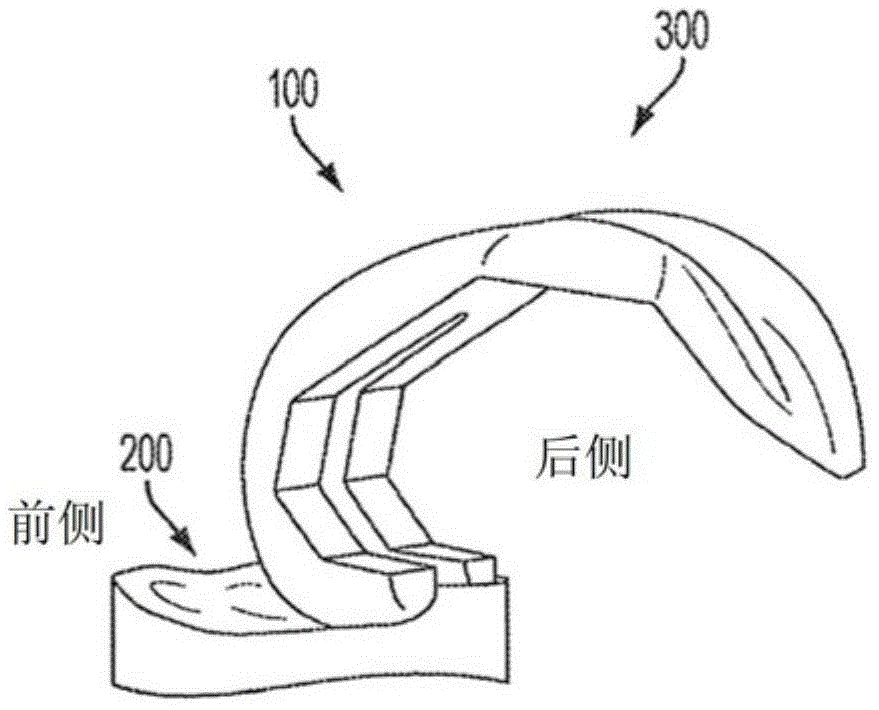
图1A说明了不具有膝关节假体的一般膝关节。示出的股骨和胫骨具有健康的股骨和胫骨软骨。根据本发明的部分膝关节假体的示例性实施方式示于图1B-1D。提供了一种膝关节假体100,其设计以置换股骨远端和胫骨近端之间的至少部分膝关节(示出右膝)。膝关节100的镜像(未示出)将置换股骨远端和胫骨近端之间的至少部分左膝。如图所示,膝关节假体100包括胫骨组件200,其用于安装至切除过的胫骨的近端,或安装至诸如匹配切除过的胫骨的胫骨基底260的另一假体元件,以及股骨组件300,其用于安装至切除过的股骨的远端。Figure 1A illustrates a typical knee joint without a knee joint prosthesis. The femur and tibia are shown with healthy femoral and tibial cartilage. Exemplary embodiments of partial knee joint prostheses according to the present invention are shown in Figures 1B-1D. A
图1D说明了在0度弯曲的股骨组件300和在150度弯曲的股骨组件300’。如所示,在股骨组件300在这两个弯曲点之间移动时,股骨经历绕整个内侧定位枢轴点的轴向转动以及其中心的向后运动。在一些实施方式中,股骨组件能够以大约12度的轴向转动来旋转。在其他实施方式中,旋转轴能够处于1度至30度、5度至25度、8度至20度、10度至15度等的范围内。另外,在其在0度至150度弯曲之间的运动,股骨组件300的中心轴能够向后平移,如图1C所示并如图1D的中心箭头所示。虽然在弯曲期间股骨中心平移的距离依据植入物的尺寸而变化,在一个实施方式中,股骨中心能够在12mm至45mm、15mm至40mm、18mm至40mm、20mm至38mm、24mm至33mm、26mm至30mm等的范围内平移。Figure ID illustrates
图2中详细示出了胫骨组件200。胫骨组件200能够以各种方式和各种材料构造。胫骨组件200能够由诸如聚乙烯(例如,高分子量聚乙烯和/或含维生素E的高分子量聚乙烯)等的医疗级、生理可接受材料以适合各种典型患者的各种尺寸来加工、铸造、锻造或构造为一体式整体单元、或两件套单元,或者它可以是针对特定患者基于特定患者身体检查和射线探测后由外科医生提供的数据来专门设计的。如上面所提及的,胫骨组件200能够配置与胫骨基底260一起使用。在其他实施方式中,胫骨组件200通过本领域技术人员已知的适当变化而无需使用胫骨基底260,并能够直接移植在切除过的胫骨上。The
在一些实施方式中,胫骨组件200能够具有非对称的内侧和外侧隔室220、210,其与股骨组件300的非对称内侧和外侧髁突(下文将描述)相互作用以恢复正常/生理的膝关节活动,其特征在于:膝关节弯曲时,(a)股骨绕整个内侧定位枢轴点的轴向旋转,以及(b)股骨中心的向后运动,如图1C和1D所示意。股骨关于胫骨的运动能够描述为随着膝关节从0°至150°弯曲(图1D),外侧股骨髁突关于内侧股骨髁突的更大向后活动。在一些用于部分膝关节置换的实施方式中,隔室220、210能够单独使用和/或结合中间部(下文将描述)使用和/或结合胫骨基底260使用。胫骨组件200的整体尺寸能够依据患者的尺寸而变化。在一些实施方式中,从外侧组件210的外侧壁至内侧组件220的内侧壁的胫骨组件200的外侧宽度能够约为74mm。在其他实施方式中,该整个宽度可以处于45mm至95mm、50mm至90mm、55mm至95mm、60mm至80mm、65mm至75mm等的范围。In some embodiments, the
在图3A-3C详细示出的外侧胫骨隔室210能够具有诸如芸豆形的形状,其绕内侧定位中心弯曲。外侧胫骨隔室210能够由外侧壁212限定,其具有关于隔室210的凹曲率,并可以具有内侧壁214,其具有关于隔室210的凸曲率。外侧壁212的长度能够长于内侧壁214的长度以使得外侧胫骨隔室绕形成芸豆形的内侧点弯曲。外侧胫骨隔室210还由前端壁216和后端壁218限定,其中外侧胫骨隔室210的细长长度在其间延伸。端壁216、218两者均具有关于外侧胫骨隔室210的凹曲率,其连结内侧壁和外侧壁212、214的曲率。在一些实施方式中,端壁216、218之间的长度能够是约50mm,然而该尺寸将依据患者尺寸变化。例如,端壁216、218之间的长度能够在30mm至70mm、35mm至65mm、40mm至55mm、45mm至55mm等的范围内。The
外侧胫骨隔室在冠状面和矢状面通常是凹进的。在前后方向上,外侧胫骨隔室210能够例如具有三个不同区域,它们在膝关节弯曲的不同阶段作用。第一区域RLT1,其最清晰示意于图3C,是具有凹进或碟状几何结构的前部定位表面。第一区域RLT1在早期弯曲起作用,例如,在大约0度至30度弯曲的范围内,并具有例如约70mm的曲率半径。本领域技术人员能够意识到的是,第一区域RLT1能够根据需要具有任意曲率半径,例如在50mm至90mm、55mm至85mm、60mm至80mm、65mm至75mm等的范围内。第一区域RLT1的内外侧宽度能够是约22mm,然而它可以根据需要具有任意宽度,例如在12mm至30mm、15mm至28mm、20mm至25mm等的范围内。图4示意了股骨组件300在外侧胫骨隔室210上在其完整弯曲范围中进展时的股骨组件300。前部第一区域RLT1能够遮盖大约50%的外侧隔室210,然而其能够根据所需遮盖任意百分比的隔室。如图4中所示意,股骨组件300从约0度至约30度与区域RLT1接触。The lateral tibial compartment is usually concave in the coronal and sagittal planes. In the anterior-posterior direction, the
第二中间区域RLT2能够具有拱顶型或凸曲率,如图3C所示。该中间区域RLT2的前后跨度能够最短靠近外侧胫骨隔室210的内缘以及最大朝向外缘。例如,中间区域RLT2的内侧最大前后侧宽度能够约为6mm,而中间区域RLT2的外侧最大前后侧宽度能够约为11mm,然而这两个宽度都可以是针对特定尺寸的患者而根据需求是任意尺寸的,例如,这两个宽度都可以处于1mm至20mm、3mm至18mm、4mm至15mm等的范围内。这在图3A和3B中最清楚的示出。图3B示意了外侧胫骨隔室210的轮廓。图3A中前部定位的点状线表示了从前部第一区域RLT1至中间区域RLT2的过渡。后部定位的点状线表示了从中间区域RLT2至后部第三区域RLT3的过渡,如下所述。如所示,由两条点线限定的中间区域RLT2在宽度上从外侧越过后侧胫骨隔室210。中间区域RLT2的“扇形”能够允许股骨组件300绕整个内侧定位轴转动。中间区域RLT2能够在膝关节弯曲的中间范围内起作用,例如在约30度至约75度弯曲的范围内,如图4所示,并可以具有约36mm的曲率半径,然而该曲率半径也可以处于20mm至50mm、25mm至45mm、30mm至40mm等的范围内。区域RLT2的内外侧宽度能够约为24mm,然而它可以根据需要具有任意宽度,例如,在12mm至30mm、15mm至28mm、20mm至25mm等的范围内。中间区域RLT2能够标记外侧股骨髁突至外侧胫骨隔室210的第三和最后方区域RLT3的过渡。The second intermediate region RLT2 can have a dome-shaped or convex curvature, as shown in Figure 3C. The anterior-posterior span of the intermediate region RLT2 can be shortest near the inner edge of the
后部第三区域RLT3能够在中度至深度膝关节弯曲期间起作用,例如,在约75度至约150度弯曲的范围内,如图4所示,且其具有约12mm的曲率半径,然而曲率半径也可以处于1mm至25mm、3mm至20mm、5mm至18mm等的范围内。第一区域RLT1的内外侧宽度能够约为22mm,然而它可以根据需要具有任意宽度,例如在12mm至30mm、15mm至28mm、20mm至25mm等的范围内。区域RLT3的凸起或碟状几何结构能够运行即使在深屈(大于约120度)时与股骨关节连接的稳定和高一致性。另外的,后部第三区域RLT3能够与中间凸起区域RLT2一起作用来防止外侧股骨髁突向前方滑动,这将引起生理性膝关节旋转和股骨后移的损失,这正如在现有膝关节假体中所发生的。胫骨隔室210的三个区域的总长度能够为在图3A的截面标记3上的约46mm,然而该尺寸依据患者尺寸是能够变化的。The posterior third region RLT3 is capable of functioning during moderate to deep knee flexion, eg, in the range of about 75 degrees to about 150 degrees of flexion, as shown in Figure 4, and has a radius of curvature of about 12 mm, however The radius of curvature may also be in the range of 1 mm to 25 mm, 3 mm to 20 mm, 5 mm to 18 mm, and the like. The inside and outside width of the first region RLT1 can be about 22mm, however it can have any width as desired, eg in the range of 12mm to 30mm, 15mm to 28mm, 20mm to 25mm, etc. The raised or dish-like geometry of region RLT3 enables stable and high consistency of articulation with the femur even in deep flexion (greater than about 120 degrees). Additionally, the posterior third region RLT3 can act in conjunction with the medial raised region RLT2 to prevent anterior sliding of the lateral femoral condyle, which would cause a loss of physiologic knee rotation and femoral retroversion, as in existing knees what happens in the prosthesis. The total length of the three regions of the
在图5A-5D中详细示意了内侧胫骨隔室220,对比于外侧隔室210其具有更短的区域。虽然内侧隔室220能够具有多种配置,而在示意的实施方式中,内侧隔室220定向以使得其在前后方向上基本是直的。内侧胫骨隔室220能够由相对直的外侧壁222和相对直的内侧壁224限定,然而本领域技术人员可以意识到的是,侧壁222、224能够具有多种曲率,例如,关于内侧胫骨隔室220的凹曲率。外侧壁222的长度和内侧壁224的长度可以基本相同和/或一个侧壁222、224能够具有比另一个稍长或稍短的长度。内侧胫骨隔室220还可以由前端壁226和后端壁228限定,以外侧胫骨隔室220的细长长度在其间延伸。端壁226、228能够大致上具有关于内侧胫骨隔室220的凹曲率。在一些实施方式中,端壁226、228之间的长度能够是约42mm,然而该尺寸将依据患者尺寸变化。例如,端壁226、228之间的长度能够在25mm至65mm、30mm至60mm、35mm至55mm、40mm至50mm等的范围内。对比于外侧隔室210长度的内侧隔室220的较短长度以及内侧隔室220的相对平直能够限制内侧股骨髁突对比于外侧股骨髁突的整体后向运动,以及允许股骨绕内侧枢轴点的转动。The
内侧胫骨隔室220在冠状面和矢状面通常是凹进的。内侧胫骨隔室220的矢状面断面能够具有两个可能的几何结构。在一个实施方式中,如图5B和5C所示,内侧胫骨隔室220能够具有凹进或碟状的几何机构,其在前后区域之间具有相对较长、较大的曲率的凹进前部区域RMT1,以及具有相对较短、较小的曲率曲率区域RMT2。例如,区域RMT1的曲率半径能够是约60mm,而区域RMT2的曲率半径能够是约22mm,然而区域RMT1的曲率半径能够在40mm至80mm、45mm至75mm、50mm至70mm、55mm至65mm等的范围内。类似的,区域RMT2的曲率半径能够在5mm至40mm、10mm至35mm、15mm至30mm等的范围内。第一区域RMT1和第二区域RMT2的内外侧宽度能够是约19mm,然而它可以根据需要具有任意宽度,例如在12mm至30mm、15mm至28mm、18mm至23mm等的范围内。The
图5A和5B示出的点线示意了两个区域RMT1、RMT2之间的过渡点。在早期/低度弯曲期间,例如小于30度的弯曲,外侧胫股接触限定至外侧胫骨隔室210的凹进前部区域(图3C的RLT1),而内侧胫股接触由于内侧胫骨隔室220的整体凹进几何结构被较少限制,如图6所示。这允许了早期/低度弯曲期间股骨绕外侧轴的旋转,表示出步行期间正常膝关节运动的特征。然而,对比于内侧隔室220,外侧胫骨隔室210的整体较大的长度导致了在中度至深度弯曲期间外部股骨绕内侧轴的旋转,表示出如包括较深膝关节弯曲的蹲下的其他活动中正常膝关节运动的特征。过渡点的内外侧宽度能够是约25mm,然而它可以根据需要具有任意宽度,例如在12mm至30mm、15mm至28mm、20mm至26mm等的范围内。The dotted lines shown in Figures 5A and 5B illustrate the transition point between the two regions RMT1, RMT2. During early/low flexion, eg, less than 30 degrees of flexion, the lateral tibiofemoral contact is limited to the recessed anterior region of the lateral tibial compartment 210 (RLT1 of FIG. 3C ), while the medial tibiofemoral contact is due to the
图5D示意了另一实施方式的内侧隔室220’。早该实施方式中,内侧隔室220’可由类似于外侧隔室210的三个区域组成,然而具有一些不同。第一和第三区域RMT1’、RMT3’能够与内侧隔室220的第一和第二区域RMT1、RMT2相同或相似。中间凸起拱顶型区域RMT2’能够布置于前部区域和后部区域RMT1’、RMT3’之间,并可以对比于前部区域和后部区域RMT1’、RMT3’具有相对较短长度。另外,中间区域RMT2’的前后长度能够从内侧隔室220的内缘至后缘很小的变化,即没有如同外侧隔室210上的“扇形”。中间区域RMT2’的曲率半径能够约为20mm,然而它也可以处于5mm至35mm、10mm至30mm、15mm至25mm等的范围内。中间区域RMT2’的较短长度还暗示了从胫骨前部至后部区域的胫股接触的过渡随后并在相对较短范围的弯曲上发生,例如,对比于外侧的30度至75度弯曲范围,在约60度至约90度弯曲的范围。Figure 5D illustrates another embodiment of the medial compartment 220'. In this embodiment, the medial compartment 220' may consist of three regions similar to the
图6示意了股骨组件300,其在内侧隔室220、220’上移动。示意了膝关节从0至150°弯曲时穿过股骨和胫骨组件200、300内侧的矢状面断面。通过内侧隔室220,胫股接触能够在低度-中度弯曲位于前部凹进区域RMT1、并能够在中度-深度弯曲过渡至后部凹进区域RMT2。通过内侧隔室220’,胫股接触能够在低度弯曲位于前部凹进区域RMT1’、并能够从中度弯曲的中间凸起区域RMT2’过渡至深度弯曲的后部凹进区域RMT3’。Figure 6 illustrates the
内侧隔室220、220’也可以具有大致上圆形的后缘330、330’,它们能够防止内侧股骨与内侧胫骨隔室220、220’的早期碰撞,这将限制膝关节运动范围。后缘330、330’的曲率半径能够是约7mm,然而它可以具有从1mm至15mm、2mm至13mm、4mm至11mm、5mm至10mm等范围的半径。这是在现有膝关节假体中所发现的受限膝关节弯曲范围所牵涉的一个因素。有关更多信息,参见Varadarajan K.M., Moynihan A.L., Seon J.K., Freiberg A.,RubashH.E., Li G.的“Changes in Tibiofemor1a4l Joint Space following Total KneeArthroplasty during Weight-bearing Knee Motion”(2009年6月加州太浩湖ASMESummer Bioengineering Conference会刊)。圆形后缘330、330’能够允许深度弯曲时与股骨的稳定接触。一般来说,对比于外侧胫骨隔室210与外侧股骨髁突,内侧胫骨隔室220、220’的矢状面几何结构能够与内侧股骨髁突更好的相符。因此内侧能够提供更好的稳定性而外侧能够提供更好的活动性。虽然内侧隔室220、220’的区域能够针对特定患者根据需要具有任意长度,在一个实施方式中,该区域和后缘330、330’的整个长度能够是约46mm,然而它可以处于30mm至60mm、35mm至55mm、40mm至50mm等的范围内。The
在一些实施方式中,内侧和外侧隔室210、220的后部胫骨表面能够垂直地低于已知的假体,如图7A所示,从而避免以标准膝关节假体治疗的膝关节中发现的后部胫股关节间隙的装填过渡。如这里所使用的,胫股关节间隙指代股骨上的固定点和胫骨上的固定点之间的垂直距离。将内侧和外侧隔室210、220垂直地低于标准TKA定位能够帮助避免深屈中四头肌和其他软组织结构的绷紧,进而能够增加膝关节弯曲的范围,如图7A所示意。例如,如图7B所示,外侧胫骨隔室210的上表面的中间部能够比标准膝关节假体垂直低约2.5mm,并能够仅垂直地在切除过的胫骨表面之上约9mm。本领域技术人员能够意识到的是,该尺寸将根据患者的尺寸而变化,以及外侧胫骨隔室210的上表面在切除过的胫骨表面之上的距离能够处于5mm至15mm、6mm至12mm等的范围内。In some embodiments, the posterior tibial surfaces of the medial and
在其他实施方式中,膝关节假体100的胫骨组件200能够具有布置于外侧和内侧胫骨隔室210、220之间的中间部。该中间部包括凹进前部斜面230,其作为前交叉韧带(ACL)的替代,如图8A和8B所示意。前部斜面230可以布置在中间部的前侧并能够具有约22mm的曲率半径,然而该曲率半径能够处于12mm至30mm、15mm至25mm等的范围内。在TKA手术的很多时候,ACL被切除以便于假体的植入。作为切除ACL的后果,在TKA后,股骨在全伸展时(0°弯曲)具有关于胫骨的异常后部位置。这能够通过提供在矢状面具有凹进或碟状曲率区域RCT1的前部斜面230来防止且同轴度的实现。斜面230能够与远侧股骨滑车槽啮合,这将在下文详细描述,从而防止股骨关于胫骨的过早/异常后移,如图9A和9B所示。股骨滑车槽由两个弧组成,例如图B所示意的弧1和弧2,它们与斜面230啮合,以及它们也将在下文详细描述。In other embodiments, the
图7C示意了胫骨组件的顶视图,以及从后视图的胫骨组件200,其示出了组件200在内侧/外侧方向上的曲率。如所示意的,内侧胫骨隔室220的上部支承表面能够垂直地低于外侧胫骨隔室210的上部支承表面。内侧胫骨隔室220在冠状面上是凹进的并能够具有27mm的曲率半径,而外侧胫骨隔室210同样能够在冠状面上是凹进的以及具有24mm的曲率半径。胫骨组件200的中间部270能够是凸起的并具有上表面,其垂直地高于内侧和外侧胫骨隔室210、220的上表面。中间部270能够具有约18mm的曲率半径。这些曲率半径中任一个能够依据使用胫骨组件200的患者的尺寸而变化。例如,这些曲率半径中任一个能够在10mm至40mm、12mm至36mm、14mm至32mm、16mm至28mm等的范围内。Figure 7C illustrates a top view of the tibial component, and a posterior view of the
现参照图10A-11,更详细示意了股骨组件300。股骨组件300能够以各种方式和各种材料构成。例如,股骨组件300能够由诸如钴铬铸造合金、钛合金、不锈钢等医疗级、生理可接受材料以适合各种典型患者的各种尺寸来加工、铸造、锻造或构造为一体式整体单元,或者它可以是针对特定患者基于特定患者身体检查和射线探测后由外科医生提供的数据来专门设计的。Referring now to Figures 10A-11, the
虽然股骨组件300能够具有许多配置,在一个实施方式中,股骨组件300包括非对称的内侧和外侧髁突320、310。内侧和外侧髁突320、310能够配置与非对称的内侧和外侧胫骨隔室220、210相互作用并以关节方式接合。此外,股骨组件300能够具有独特的滑车沟330,其对比于现有膝关节假体设计能够提供更加正规的髌骨轨迹,以及它能够与可选的ACL替代胫骨斜面230相互作用以防止股骨的过早后向移动。如图10A所示意的,外侧股骨髁突能够具有约22mm的内外侧曲率半径。本领域技术人员能够意识到的是,外侧和内侧股骨髁突的曲率半径能够依据所需的尺寸变化,并能够处于12mm至35mm、15mm至30mm、20mm至27mm等的范围内。While the
在矢状面,内侧股骨髁突320一般能够由七个不同半径的圆弧组成。示于图10B和和10C的弧1-7从股骨的前侧进展到弧的后侧。如图10B所示,弧4-7具有逐渐减小的半径。不同于传统的膝关节假体,内侧股骨髁突320能够具有在弧2和4之间的短凹弧(弧3)。对比于弧2具有24mm的曲率半径以及弧4具有44mm的曲率半径,弧3能够具有例如5mm的曲率半径。弧3能够允许比弧4小的半径,而保持与弧2的连续性。在图10A中,虚曲线指示了在移除弧3时(如同传统膝关节假体中)弧2和4之间的关节几何结构。弧4的较小半径能够允许前内侧胫骨隔室220具有较小半径。这转而为股骨提供了更大的前后稳定性,因此减小了通常在采用传统膝关节假体的膝关节中所发现的早期弯曲中非预期的(反常的)的股骨前移。弧6能够具有约20mm的曲率半径,然而它能够具有在10mm至30mm、12mm至28mm、15mm至25mm等范围内的任意半径。弧1能够具有约50mm的曲率半径,然而它能够具有在30mm至70mm、35mm至65mm、40mm至60mm、45mm至55mm等范围内的任意半径。In the sagittal plane, the medial
在其他实施方式中,内侧股骨髁突320’能够具有另外的凹进区域或沟槽321’,其被包含在弧4和5之间,如图10C所示意。该凹进沟槽321’能够具有约33mm的曲率半径,并能够设计以啮合和以关节方式接合内侧胫骨隔室220’上的中间凸起区域RMT2’(参加图5D),因此在整个膝关节弯曲范围提供了与胫骨隔室220’的全等互动,并确保了从胫骨隔室的前侧至后侧的胫股接触的平稳过渡。本领域技术人员应该意识到的是沟槽321’能够根据需要具有任意曲率半径来关节接合中间凸起区域RMT2’,例如20mm至50mm、25mm至45mm、30mm至40mm等。In other embodiments, the medial femoral condyle 320' can have an additional recessed area or groove 321' that is contained between
在矢状面中,外侧股骨髁突能够由不同半径的6个凸圆弧组成,其中弧3至6具有逐渐减小的半径,如图11所示。另外,能够在弧3和4之间添加可选的凹进沟槽321。凹进沟槽321能够啮合和以关节方式接合外侧胫骨隔室210上的中间凸起区域RLT2(参见图3C),因此在整个膝关节弯曲范围提供了与胫骨隔室210的全等互动,并确保了从胫骨隔室210的前侧至后侧的胫股接触的平稳过渡。沟槽321能够具有约60mm的曲率半径,然而它可以具有40mm至80mm、45mm至75mm、50mm至70mm、55mm至65mm等范围内的任意半径。弧6能够具有约20mm的曲率半径,然而它能够具有在10mm至30mm、12mm至28mm、15mm至25mm等范围内的任意半径。弧1能够具有约70mm的曲率半径,然而它能够具有在50mm至90mm、55mm至85mm、60mm至80mm、65mm至75mm等范围内的任意半径。In the sagittal plane, the lateral femoral condyle can be composed of 6 convex arcs of different radii, with
在一些实施方式中,如图12A和12B所示,从背面看时,外侧股骨髁突310能够具有上后段外侧髁突310的构成轮廓的侧棱314。该构成轮廓的几何结构能够允许外侧股骨髁突310绕整个内侧定位旋转轴的无障碍旋转。In some embodiments, as shown in FIGS. 12A and 12B , the lateral
传统的膝关节假体的股骨髁突通常由5个圆弧组成。内侧和外侧股骨髁突320、310后侧靠近内侧股骨髁突320上的弧6以及外侧股骨髁突310上的弧5终结,如图13A和13B所示。目前已知的股骨髁突认为只具有5个弧,如图13C所示。在深屈时,传统的TKA因此经历了股骨和胫骨组件表面的截然接触。然而,内侧和外侧髁突320、310上延伸的具有减小半径的上后段弧允许了即便在非常深度弯曲(高达150°)时的稳定、低应力接触。这些延伸的弧能够通过另外的上后段股骨切口、向内成角的后切口、从后侧移除另外的骨、或通过使用导航/机器人切割工具的构成轮廓的切口来调节,如图13A和13B所示。内侧股骨髁突320上的弧6和外侧股骨髁突上的弧7中每个能够具有约10mm的曲率半径,然而它们能够具有1mm至20mm、5mm至15mm、8mm至12mm等的范围内的任意半径。The femoral condyle of a traditional knee prosthesis usually consists of 5 arcs. The medial and lateral
现参照图14A和14B,如上所提及的,在一些实施方式中,股骨组件300能够具有股骨滑车沟330以啮合胫骨组件200的ACL斜面230。在矢状面中,股骨滑车沟330能够由两个圆弧组成,其具有在几何结构上由针对弧2的不同半径产生的两个可能变体。在一个实施方式中,弧2能够具有对应更接近解剖几何结构的相对较小的半径,其在滑车沟的远端上产生向上倾斜的唇缘,这与远侧股骨切迹相符,如图9B所示意。该股骨几何结构与胫骨组件200上的ACL斜面230相互作用以防止过早的股骨后移(参见图9)。在另一实施方式中,弧2能够具有较大的半径,其在滑车沟330上产生向下倾斜或水平的唇缘。这种实施方式的股骨几何结构能够与不具有ACL斜面230的胫骨组件设计一起作用。Referring now to FIGS. 14A and 14B , as mentioned above, in some embodiments, the
当从前侧观察时,如图14A所示,股骨滑车沟330具有基本不同于传统膝关节假体中的定向,并且这能够允许更加生理的髌骨轨迹。在正常的人膝关节中,从全伸展至完全弯曲,髌骨在股骨髁突320、310上向尾部滑动。通过20至30度的弯曲,髌骨首先开始与滑车沟以关节方式接合。在极度弯曲的时候,髌骨处于髁间窝中。最初,髌骨接触在远侧发生,以及随着弯曲增加,该接触区域移向髌骨上的近侧。根据本发明的某些实施方式和方面的膝关节假体结合如下特征,即该特征允许膝关节假体的髌骨植入物以类似于正常人类膝关节的方式运动,以及在没有不必要的韧带释放的情况下承受正常的髌股接触压力。When viewed from the anterior side, as shown in Figure 14A, the
图14A和14B所示意的股骨滑车沟330能够具有三个不同区域。第一且最远侧部具有在从远侧向近侧方向观察时的中性定向(即,不向内侧或外侧倾斜),以及能够定位关于标准膝关节假体中滑车的外侧。第二、中间部能够是向内侧弯曲的,类似于天然滑车,以及不同于标准膝关节假体中的中性定向。第三且最近侧区具有中性定向滑车或向外侧定向滑车,以确保在全伸展处(0°)俘获髌骨。The
在横向平面,如图15A和15B所示意,滑车结合结构也能够由3个区组成。第一且最远侧部具有稍微的内侧弯曲(从远侧向近侧方向观察),不同于标准TKA中的中性倾斜。第二、中间部能够是更内侧弯曲的,类似于天然滑车。第三且最近侧区具有中性取向或稍微内侧倾斜,以确保在全伸展处(0°弯曲)俘获髌骨。In the lateral plane, as illustrated in Figures 15A and 15B, the pulley engagement structure can also consist of 3 zones. The first and most distal portion has a slight medial curvature (viewed from the distal to proximal direction), unlike the neutral slope in standard TKA. Second, the middle portion can be more medially curved, similar to a natural pulley. The third and most proximal zone has a neutral orientation or a slight medial inclination to ensure capture of the patella at full extension (0° flexion).
在一些实施方式中,示例性的滑车沟能够设计为解决在髌骨相对于股骨运动时股骨和髌骨关节软骨面的变形。通常TKA中的髌骨组件是刚性的,并安装以匹配天然髌骨的高度。因此,为解决正常膝关节中发生的软骨变形,能够基于相对于股骨滑车软骨335的区域朝向身体后向和/或近侧地推动(示例性)滑车沟331,而仍能够前向地和/或远侧地远离身体和远离股骨339。通常能够通过沿滑车331长度非均匀量的基于相对于天然关节软骨335的区域后向和/或近侧地推动滑车沟331。在一个实施方式中,如图15C和15D所示,能够相对于近侧区域I(对应早期膝关节弯曲)中的天然滑车表面335向后推动滑车沟331约1mm至约2mm的范围,例如约1.5mm。能够相对于中间区域I I(对应中度膝关节弯曲)中的天然滑车表面335向后和/或近侧地推动滑车沟约2mm至约3mm的范围,例如约2.6mm。能够相对于远侧区域III(对应晚期弯曲)中的天然滑车表面335近侧地推动滑车沟约0.4mm至约1.5mm的范围,例如约0.9mm。本领域技术人员可以意识到的是,该用于设计股骨滑车沟表面并解决髌股软骨变形的原理还能够扩展到股骨/胫骨关节面的设计以解决胫股软骨变形。In some embodiments, the exemplary trochlear groove can be designed to account for deformation of the articular cartilage surfaces of the femur and patella as the patella moves relative to the femur. Usually the patella component in TKA is rigid and installed to match the height of the natural patella. Thus, to address the cartilage deformations that occur in normal knee joints, the (exemplary)
在一些实施方式中,膝关节假体100包括股骨仿形件350和胫骨支柱250,如图16A-16C所示。仿形件350和支柱250能够在高于75度弯曲角度上啮合以产生股骨后移,即替代后十字韧带的功能,所述后十字韧带在后十字韧带置换(PS)TKA手术中被切除。然而,不像如图16D所示的标准、对称PS假体设计,胫骨支柱250的后表面能够外部旋转(朝外侧)以适合股骨在整个内侧定位旋转轴上的轴向转动。另外,胫骨支柱250的前外侧表面能够是弯曲的以适合并引导股骨的轴向转动。In some embodiments,
在一些TKA手术中,能够保留前十字韧带和后十字韧带。膝关节假体100的一个实施方式,如上所述的股骨组件300和内侧和外侧胫骨隔室220、210。然而,针对内侧和外侧胫骨隔室220、210之间的PCL的切除能够向前延伸,以允许ACL在内侧和外侧胫骨隔室220、210之间通过,如图17A和17B所示意。ACL替代斜面230不是必需的,因此内侧和外侧胫骨隔室220、210是间隔开的。然而,内侧侧边和外侧侧边仍能够一起分摊负载,例如,单片式胫骨金属基板260,其具有连接内侧侧边和外侧侧边的前桥262。基板260能够根据需要具有任意适合的厚度,但在一个实施方式中其具有约2.5mm的厚度。前桥262也可以依需要而有任何厚度,但是在一个实施例中,他可有一个大约10mm的厚度。该相对侧边之间的负载分配能够最小化完全隔离的内侧侧边和外侧侧边相关的问题,其中在一侧上的过载能够引起胫骨组件200下陷进入胫骨中从而导致植入失败。单片式金属基板260的另一个优势在于帮助避免隔离的内侧和外侧胫骨隔室220、210的相对定位中的误差。基板260的前桥262能够比内侧和外侧隔室220、210厚以增加强度。另外,桥262的前表面能够具有沟槽264以特别在深度弯曲时容纳髌韧带。In some TKA procedures, the anterior and posterior cruciate ligaments can be preserved. One embodiment of
膝关节假体100还能够有效的恢复自然胫股关节线。在标准TKA中,以垂直于大腿的力轴的方向对胫骨和股骨进行切割。这产生了胫股关节线,其相对于力轴大约旋转3度且没有恢复至正常,如图18B所示。在本发明的实施方式中,也能够垂直力轴做出胫骨切割。然而,内侧和外侧胫骨隔室220、210的厚度相差约3-4mm,其中外侧隔室210比内侧隔室220更厚。设计股骨组件300以使得其安装在相对于力轴(标准手术议定书)大约5-6度的外翻角度时,TKA股骨组件300的髁突表面310、320匹配正常股骨髁突表面。因此,股骨和胫骨组件300、200一起能够产生解剖胫股关节线。The
在另一实施方式中,还能够在胫骨上具有“阶梯型”切割以及对应的胫骨设计,其中内侧和外侧胫骨隔室220、210具有相同的厚度,而外侧胫骨隔室的底部被抬升,如图18C所示。这能够允许垂直于力轴和解剖关节线的胫骨切割,而减少从胫骨外侧上切除骨头的量。In another embodiment, it is also possible to have a "stepped" cut on the tibia and a corresponding tibial design, where the medial and lateral
这里描述的实施方式能够直接基于体内膝关节运动性能中的6个自由度,因此捕获了体内膝关节运动的所有复杂度。现有技术设计依赖尸体膝关节上测试获得的体外数据,它们不能完全代表活体状况,以及现有技术设计仅结合了对应6个自由度中3个自由度的运动性能信息。关于股骨关于胫骨的上下位置变化的信息、股骨关于胫骨的内外侧位置的信息、以及内翻-外翻旋转的信息也没有包括在这些现有技术设计中。The embodiments described here can be directly based on the 6 degrees of freedom in in vivo knee kinematic performance, thus capturing all the complexity of in vivo knee kinematics. Prior art designs rely on in vitro data obtained from tests on cadaveric knee joints, which are not fully representative of living conditions, and prior art designs incorporate only motion performance information corresponding to 3 of the 6 degrees of freedom. Information about the variation of the superior and inferior position of the femur with respect to the tibia, the medial-lateral position of the femur with respect to the tibia, and the varus-valgus rotation are also not included in these prior art designs.
本领域技术人员可以意识到,根据本发明的膝关节假体能够仅以上述描述的部分组件来设置。例如,在局部疾病或损伤情形中,可以仅提供胫骨组件或股骨组件。类似的,可以仅提供单个胫骨隔室(内侧或外侧)或单个股骨髁突(内侧或外侧)。Those skilled in the art will appreciate that the knee joint prosthesis according to the present invention can be provided with only some of the components described above. For example, in the case of localized disease or injury, only a tibial component or a femoral component may be provided. Similarly, only a single tibial compartment (medial or lateral) or a single femoral condyle (medial or lateral) may be provided.
在一些实施方式中,这里描述的各种组件包括在成套工具中。例如,一个或多个胫骨组件以及一个或多个股骨组件包括在成套工具中。一个或多个胫骨组件包括ACL斜面和/或仿形件以匹配股骨组件的支柱。此外,可以设置一个或多个基板以容纳胫骨组件。In some embodiments, the various components described herein are included in a kit. For example, one or more tibial components and one or more femoral components are included in the kit. One or more of the tibial components include ACL ramps and/or contours to match the struts of the femoral component. Additionally, one or more baseplates may be provided to accommodate the tibial component.
这里描述的膝关节假体能够用于现在已知的或还没发现的任意外科手术中。在一些实施方式中,用于植入示例性膝关节假体的外科手术包括安装股骨组件。在垂直于腿的力轴来切割远侧股骨,如图18B所示,其关于图19A所示的股骨干骨的轴具有约5度至6度的外翻角度。相对于后侧髁突的相切线,后侧股骨以大约3度外旋转的切割,如图19B的轴向图所示。远侧和后侧股骨的切割能够相对于外侧股骨髁突来测量,并能够匹配股骨假体组件的厚度,通常约为9mm。The knee prosthesis described herein can be used in any surgical procedure now known or not yet discovered. In some embodiments, the surgical procedure for implanting an exemplary knee prosthesis includes installing a femoral component. The distal femur is cut perpendicular to the force axis of the leg, as shown in Figure 18B, with a valgus angle of about 5 to 6 degrees relative to the axis of the femoral shaft shown in Figure 19A. The posterior femur is cut with approximately 3 degrees of external rotation relative to the tangent to the posterior condyle, as shown in the axial view of Figure 19B. Distal and posterior femoral cuts can be measured relative to the lateral femoral condyle and can match the thickness of the femoral prosthetic component, typically about 9 mm.
由于这里描述的示例性股骨组件能够恢复正常膝关节的解剖结构和关节线,能够使得远侧和后侧股骨的切割平行于膝关节0°弯曲和90弯曲时的关节线,分别示意于图18B。由于股骨髁突上延伸的上后侧弧,需要对标准切骨做出改变,如图13A所示。第一选择是附加约3mm的更厚后侧切骨。第二选择是约10度的倾斜/向内倾斜的后侧切口。这比选择1切割更少的骨。第三选择是做出另外的、上侧切骨(关于垂直线倾斜约45度)。该选择比选择1和选择2切割更少的骨。该最后选择是做出平滑的构成轮廓的切骨,以最小化股骨切割(甚至小于标准切骨),并使得更加方便地安装股骨组件。Since the exemplary femoral component described here is capable of restoring the anatomy and joint line of the normal knee joint, it enables the cutting of the distal and posterior femurs parallel to the joint line of the knee at 0° and 90 flexion, respectively, as illustrated in Figure 18B . Because of the superior posterior arc extending over the femoral condyle, a change to the standard osteotomy was required, as shown in Figure 13A. The first option is to attach a thicker posterior cut of approximately 3mm. A second option is a rear side cutout that is about 10 degrees sloping/inward sloping. This cuts less bone than
在额状面中,能够如图18B所示的垂直于腿的力轴切割胫骨,其与垂直胫骨干骨轴切割基本相同。如图19C和19D所示,切骨在矢状面中具有大约5度至7度的后倾。切割表面通过定位在外侧胫骨平台的软骨表面以下约10mm。In the frontal plane, the tibia can be cut perpendicular to the force axis of the leg as shown in Figure 18B, which is substantially the same as cutting perpendicular to the tibial shaft axis. As shown in Figures 19C and 19D, the osteotomy has approximately 5 to 7 degrees of retroversion in the sagittal plane. The cutting surface was positioned approximately 10 mm below the cartilaginous surface of the lateral tibial plateau by positioning.
优选的是该装置是无菌的。这能够通过本领域已知的许多方式来实现,包括贝塔或伽马射线、环氧乙烷、蒸汽、以及熔浴(例如,冷浸)。Preferably the device is sterile. This can be accomplished by many means known in the art, including beta or gamma radiation, ethylene oxide, steam, and molten baths (eg, cold soaks).
本领域技术人员可以基于上述实施方式意识到本发明的其他特征和优势。因所引用的所有公开文件或参考的全部内容通过引用明确的合并于此。Those skilled in the art may appreciate other features and advantages of the present invention based on the above-described embodiments. The entire contents of all publications or references cited are hereby expressly incorporated by reference.
下面是要求保护的内容。Below is what is claimed.
Claims (18)
Applications Claiming Priority (3)
| Application Number | Priority Date | Filing Date | Title |
|---|---|---|---|
| US26800009P | 2009-12-09 | 2009-12-09 | |
| US61/268,000 | 2009-12-09 | ||
| CN201080063231.7A CN102917670B (en) | 2009-12-09 | 2010-12-08 | Implant for restoring normal range of flexion and knee joint kinematics |
Related Parent Applications (1)
| Application Number | Title | Priority Date | Filing Date |
|---|---|---|---|
| CN201080063231.7A Division CN102917670B (en) | 2009-12-09 | 2010-12-08 | Implant for restoring normal range of flexion and knee joint kinematics |
Publications (2)
| Publication Number | Publication Date |
|---|---|
| CN106137469A CN106137469A (en) | 2016-11-23 |
| CN106137469B true CN106137469B (en) | 2020-02-14 |
Family
ID=44146155
Family Applications (2)
| Application Number | Title | Priority Date | Filing Date |
|---|---|---|---|
| CN201610457091.0A Active CN106137469B (en) | 2009-12-09 | 2010-12-08 | Implant for restoring normal range of flexion and knee joint kinematics |
| CN201080063231.7A Active CN102917670B (en) | 2009-12-09 | 2010-12-08 | Implant for restoring normal range of flexion and knee joint kinematics |
Family Applications After (1)
| Application Number | Title | Priority Date | Filing Date |
|---|---|---|---|
| CN201080063231.7A Active CN102917670B (en) | 2009-12-09 | 2010-12-08 | Implant for restoring normal range of flexion and knee joint kinematics |
Country Status (5)
| Country | Link |
|---|---|
| US (2) | US8911502B2 (en) |
| EP (3) | EP3143964B1 (en) |
| JP (1) | JP5775092B2 (en) |
| CN (2) | CN106137469B (en) |
| WO (1) | WO2011071979A2 (en) |
Cited By (1)
| Publication number | Priority date | Publication date | Assignee | Title |
|---|---|---|---|---|
| EP4140451A4 (en) * | 2020-04-23 | 2023-10-11 | Beijing Chunlizhengda Medical Instruments Co., Ltd | Anatomical knee joint prosthesis |
Families Citing this family (62)
| Publication number | Priority date | Publication date | Assignee | Title |
|---|---|---|---|---|
| US8771365B2 (en) * | 2009-02-25 | 2014-07-08 | Conformis, Inc. | Patient-adapted and improved orthopedic implants, designs, and related tools |
| US8480754B2 (en) | 2001-05-25 | 2013-07-09 | Conformis, Inc. | Patient-adapted and improved articular implants, designs and related guide tools |
| JP4943655B2 (en) | 2002-12-20 | 2012-05-30 | スミス アンド ネフュー インコーポレーテッド | High performance knee prosthesis |
| EP1968497B1 (en) | 2005-12-15 | 2016-03-16 | Zimmer, Inc. | Distal femoral knee prostheses |
| CN102006839B (en) * | 2008-02-18 | 2014-07-23 | 麦克斯外科整形公司 | Total knee replacement prosthesis |
| JP2012518519A (en) | 2009-02-25 | 2012-08-16 | モハメッド ラシュワン マーフォーズ | Customized orthopedic implants and related methods and deformable joint templates |
| US9078755B2 (en) | 2009-02-25 | 2015-07-14 | Zimmer, Inc. | Ethnic-specific orthopaedic implants and custom cutting jigs |
| CA2782137A1 (en) | 2009-12-11 | 2011-06-16 | Conformis, Inc. | Patient-specific and patient-engineered orthopedic implants |
| US8764840B2 (en) | 2010-07-24 | 2014-07-01 | Zimmer, Inc. | Tibial prosthesis |
| RU2573939C2 (en) | 2010-07-24 | 2016-01-27 | Зиммер, Инк. | Tibial prosthesis (versions) |
| ES2631181T3 (en) | 2010-09-10 | 2017-08-29 | Zimmer, Inc. | Tibia components that facilitate movement for a knee prosthesis |
| AU2011300819B2 (en) * | 2010-09-10 | 2014-01-23 | Zimmer Gmbh | Femoral prothesis with medialized patellar groove |
| US8603101B2 (en) | 2010-12-17 | 2013-12-10 | Zimmer, Inc. | Provisional tibial prosthesis system |
| JP6151190B2 (en) | 2011-01-27 | 2017-06-21 | スミス アンド ネフュー インコーポレイテッド | Tibial insert, prosthesis |
| WO2012112694A2 (en) | 2011-02-15 | 2012-08-23 | Conformis, Inc. | Medeling, analyzing and using anatomical data for patient-adapted implants. designs, tools and surgical procedures |
| US9308095B2 (en) | 2011-06-16 | 2016-04-12 | Zimmer, Inc. | Femoral component for a knee prosthesis with improved articular characteristics |
| US9060868B2 (en) | 2011-06-16 | 2015-06-23 | Zimmer, Inc. | Femoral component for a knee prosthesis with bone compacting ridge |
| US8932365B2 (en) | 2011-06-16 | 2015-01-13 | Zimmer, Inc. | Femoral component for a knee prosthesis with improved articular characteristics |
| JP2014524809A (en) * | 2011-07-13 | 2014-09-25 | ザ ジェネラル ホスピタル コーポレーション ドゥーイング ビジネス アズ マサチューセッツ ジェネラル ホスピタル | Method and apparatus for knee joint replacement with anterior cruciate ligament replacement |
| EP2779949B1 (en) | 2011-11-18 | 2016-03-16 | Zimmer, Inc. | Tibial bearing component for a knee prosthesis with improved articular characteristics |
| AU2012341026B2 (en) | 2011-11-21 | 2015-01-29 | Zimmer, Inc. | Tibial baseplate with asymmetric placement of fixation structures |
| KR20140133836A (en) | 2012-01-30 | 2014-11-20 | 짐머, 인크. | Asymmetric tibial components for a knee prosthesis |
| US9452054B2 (en) * | 2012-03-06 | 2016-09-27 | University Of Cape Town | Rotating hinge knee prosthesis |
| AU2013349254B2 (en) * | 2012-11-21 | 2018-01-18 | L&K Biomed Co., Ltd. | Knee replacement prosthetic |
| DE102013205156B4 (en) | 2013-03-22 | 2015-02-12 | Heraeus Medical Gmbh | Knee spacer for temporary replacement of an artificial knee joint |
| US9925052B2 (en) | 2013-08-30 | 2018-03-27 | Zimmer, Inc. | Method for optimizing implant designs |
| JP2017018150A (en) * | 2013-11-21 | 2017-01-26 | 経憲 武井 | Prosthetic knee replacement component and artificial knee joint structure |
| US9387085B2 (en) * | 2014-05-30 | 2016-07-12 | Stryker Corporation | Stepped tibial baseplate |
| US10130375B2 (en) | 2014-07-31 | 2018-11-20 | Zimmer, Inc. | Instruments and methods in performing kinematically-aligned total knee arthroplasty |
| PT3197403T (en) | 2014-09-24 | 2022-05-02 | Depuy Ireland Ultd Co | Surgical planning and method |
| GB201503838D0 (en) * | 2015-03-06 | 2015-04-22 | Murray David W And Monk Paul | Knee prosthesis |
| CN108135701B (en) * | 2015-09-21 | 2019-12-24 | 捷迈有限公司 | Prosthetic system including tibial bearing components |
| WO2017058535A1 (en) | 2015-09-29 | 2017-04-06 | Zimmer, Inc. | Tibial prosthesis for tibia with varus resection |
| CN105213071A (en) * | 2015-10-21 | 2016-01-06 | 苏州锐进医疗科技有限公司 | A kind of bone conservative knee-joint prosthesis |
| JP6838134B2 (en) * | 2016-03-31 | 2021-03-17 | 晨 楊 | Knee replacement prosthesis |
| CN107280818B (en) * | 2016-03-31 | 2024-02-27 | 杨晨 | Femoral side prosthesis and tibial side prosthesis for artificial knee replacement |
| US10179052B2 (en) | 2016-07-28 | 2019-01-15 | Depuy Ireland Unlimited Company | Total knee implant prosthesis assembly and method |
| EP3592299B1 (en) | 2017-03-10 | 2021-06-09 | Zimmer, Inc. | Tibial prosthesis with tibial bearing component securing feature |
| EP3400912B1 (en) | 2017-05-10 | 2019-11-20 | Howmedica Osteonics Corporation | Patient specific composite knee replacement |
| ES3003885T3 (en) * | 2017-05-12 | 2025-03-11 | Zimmer Inc | Femoral prostheses with upsizing and downsizing capabilities |
| AU2018203343B2 (en) | 2017-05-15 | 2023-04-27 | Howmedica Osteonics Corp. | Patellofemoral implant |
| US10940666B2 (en) | 2017-05-26 | 2021-03-09 | Howmedica Osteonics Corp. | Packaging structures and additive manufacturing thereof |
| US11426282B2 (en) | 2017-11-16 | 2022-08-30 | Zimmer, Inc. | Implants for adding joint inclination to a knee arthroplasty |
| US10835380B2 (en) | 2018-04-30 | 2020-11-17 | Zimmer, Inc. | Posterior stabilized prosthesis system |
| US11490886B2 (en) | 2018-05-22 | 2022-11-08 | The Brigham And Women's Hospital, Inc. | Bone fixation system |
| TWI786139B (en) * | 2018-06-22 | 2022-12-11 | 財團法人工業技術研究院 | Artificial joint |
| JP2020093063A (en) * | 2018-11-30 | 2020-06-18 | 佐藤 卓 | Artificial knee joint implant |
| KR102210434B1 (en) * | 2018-12-12 | 2021-02-02 | 주식회사 비트러스트메디텍 | Animal Knee Joint Implant Reflecting Anatomical Structure of Animal |
| EP3698761B1 (en) | 2019-02-22 | 2021-11-17 | Stryker European Operations Limited | Total ankle prosthesis |
| EP3937856A1 (en) | 2019-03-12 | 2022-01-19 | DePuy Ireland Unlimited Company | Orthopaedic system with medial pivoting femoral component and insert |
| US12465493B2 (en) | 2019-03-12 | 2025-11-11 | Depuy Ireland Unlimited Company | Orthopaedic system with insert having a post for medial pivoting of a femoral component |
| WO2020222169A1 (en) | 2019-05-02 | 2020-11-05 | DePuy Synthes Products, Inc. | Orthopaedic implant placement system and method |
| EP3965698A4 (en) | 2019-05-08 | 2023-01-25 | DePuy Ireland Unlimited Company | HINGED ORTHOPEDIC IMPLANT SYSTEM |
| US12083020B2 (en) | 2019-09-10 | 2024-09-10 | Depuy Ireland Unlimited Company | Orthopaedic knee prosthesis system and methods for using same |
| EP3854353A4 (en) * | 2019-09-11 | 2022-05-04 | Corentec Co., Ltd. | Knee joint implant preventing hyperextension |
| ES2986484T3 (en) | 2019-12-17 | 2024-11-11 | Implantcast Gmbh | Femoral component |
| BR112022014496A2 (en) * | 2020-01-22 | 2022-09-20 | Symbios Orthopedie S A | ANATOMICAL KNEE PROSTHESIS AND DESIGN METHOD |
| CN111658240A (en) * | 2020-05-16 | 2020-09-15 | 北京市春立正达医疗器械股份有限公司 | Keep dissection type knee joint shin bone platform pad of back cruciate ligament |
| CN111658239A (en) * | 2020-05-16 | 2020-09-15 | 北京市春立正达医疗器械股份有限公司 | Anatomical knee joint femoral prosthesis with reserved posterior cruciate ligament |
| CN111616840A (en) * | 2020-05-16 | 2020-09-04 | 北京市春立正达医疗器械股份有限公司 | Anatomical knee joint prosthesis with reserved posterior cruciate ligament |
| EP4178497B1 (en) * | 2020-07-10 | 2025-04-09 | DePuy Ireland Unlimited Company | Medial stabilized orthopaedic knee prosthesis |
| CN115317203A (en) * | 2022-08-04 | 2022-11-11 | 北京市春立正达医疗器械股份有限公司 | Double-compartment knee joint prosthesis |
Citations (4)
| Publication number | Priority date | Publication date | Assignee | Title |
|---|---|---|---|---|
| US3748662A (en) * | 1971-04-21 | 1973-07-31 | A Helfet | Replacements for bicondylar joints in human limbs |
| US5824105A (en) * | 1994-08-04 | 1998-10-20 | Smith & Nephew, Inc. | Asymmetric femoral prosthesis |
| US6013103A (en) * | 1996-07-11 | 2000-01-11 | Wright Medical Technology, Inc. | Medial pivot knee prosthesis |
| CN102058445A (en) * | 2009-10-30 | 2011-05-18 | 德普伊产品公司 | Prosthesis with cut-off pegs and surgical operation method |
Family Cites Families (18)
| Publication number | Priority date | Publication date | Assignee | Title |
|---|---|---|---|---|
| US4340978A (en) * | 1979-07-02 | 1982-07-27 | Biomedical Engineering Corp. | New Jersey meniscal bearing knee replacement |
| US4963152A (en) | 1986-10-27 | 1990-10-16 | Intermedics Orthopedics, Inc. | Asymmetric prosthetic tibial component |
| US5203807A (en) * | 1991-07-10 | 1993-04-20 | Smith & Nephew Richards Inc. | Knee joint prosthesis articular surface |
| US5133758A (en) * | 1991-09-16 | 1992-07-28 | Research And Education Institute, Inc. Harbor-Ucla Medical Center | Total knee endoprosthesis with fixed flexion-extension axis of rotation |
| FR2698536B1 (en) * | 1992-12-01 | 1996-07-05 | Ysebaert | Knee prosthesis. |
| US5702458A (en) * | 1994-12-09 | 1997-12-30 | New York Society For The Ruptured And Crippled Maintaining The Hospital For Special Surgery | Joint prosthesis |
| US5609643A (en) * | 1995-03-13 | 1997-03-11 | Johnson & Johnson Professional, Inc. | Knee joint prosthesis |
| US5681354A (en) | 1996-02-20 | 1997-10-28 | Board Of Regents, University Of Colorado | Asymmetrical femoral component for knee prosthesis |
| GB9914074D0 (en) * | 1999-06-16 | 1999-08-18 | Btg Int Ltd | Tibial component |
| JP4148316B2 (en) * | 2002-11-18 | 2008-09-10 | 株式会社神戸製鋼所 | Artificial knee joint |
| JP4943655B2 (en) * | 2002-12-20 | 2012-05-30 | スミス アンド ネフュー インコーポレーテッド | High performance knee prosthesis |
| US7261740B2 (en) * | 2003-10-29 | 2007-08-28 | Wright Medical Technology, Inc. | Tibial knee prosthesis |
| EP1703867B1 (en) * | 2004-01-12 | 2012-03-07 | Depuy Products, Inc. | Systems for compartmental replacement in a knee |
| DE202004003133U1 (en) * | 2004-02-26 | 2004-07-29 | Aap Implantate Ag | Joint replacement tibial plateau |
| WO2006074503A1 (en) | 2005-01-12 | 2006-07-20 | Richarson Rodney Ian Walter | Prosthetic knee |
| US8211181B2 (en) * | 2005-12-14 | 2012-07-03 | New York University | Surface guided knee replacement |
| DE102006042829A1 (en) * | 2006-09-08 | 2008-03-27 | Siebel, Thomas, Dr. | knee prosthesis |
| US8470047B2 (en) * | 2007-09-25 | 2013-06-25 | Depuy (Ireland) | Fixed-bearing knee prosthesis |
-
2010
- 2010-12-08 CN CN201610457091.0A patent/CN106137469B/en active Active
- 2010-12-08 EP EP16183551.7A patent/EP3143964B1/en active Active
- 2010-12-08 EP EP25168385.0A patent/EP4595928A3/en active Pending
- 2010-12-08 WO PCT/US2010/059387 patent/WO2011071979A2/en not_active Ceased
- 2010-12-08 JP JP2012543228A patent/JP5775092B2/en active Active
- 2010-12-08 CN CN201080063231.7A patent/CN102917670B/en active Active
- 2010-12-08 EP EP10836587.5A patent/EP2512380B1/en active Active
-
2012
- 2012-06-07 US US13/491,126 patent/US8911502B2/en active Active
-
2014
- 2014-11-21 US US14/550,755 patent/US9414926B2/en active Active
Patent Citations (4)
| Publication number | Priority date | Publication date | Assignee | Title |
|---|---|---|---|---|
| US3748662A (en) * | 1971-04-21 | 1973-07-31 | A Helfet | Replacements for bicondylar joints in human limbs |
| US5824105A (en) * | 1994-08-04 | 1998-10-20 | Smith & Nephew, Inc. | Asymmetric femoral prosthesis |
| US6013103A (en) * | 1996-07-11 | 2000-01-11 | Wright Medical Technology, Inc. | Medial pivot knee prosthesis |
| CN102058445A (en) * | 2009-10-30 | 2011-05-18 | 德普伊产品公司 | Prosthesis with cut-off pegs and surgical operation method |
Cited By (1)
| Publication number | Priority date | Publication date | Assignee | Title |
|---|---|---|---|---|
| EP4140451A4 (en) * | 2020-04-23 | 2023-10-11 | Beijing Chunlizhengda Medical Instruments Co., Ltd | Anatomical knee joint prosthesis |
Also Published As
| Publication number | Publication date |
|---|---|
| US8911502B2 (en) | 2014-12-16 |
| JP5775092B2 (en) | 2015-09-09 |
| CN106137469A (en) | 2016-11-23 |
| WO2011071979A3 (en) | 2011-10-20 |
| JP2013513435A (en) | 2013-04-22 |
| EP2512380A2 (en) | 2012-10-24 |
| EP2512380A4 (en) | 2014-11-19 |
| EP3143964B1 (en) | 2025-04-09 |
| US9414926B2 (en) | 2016-08-16 |
| EP3143964A2 (en) | 2017-03-22 |
| CN102917670B (en) | 2016-08-03 |
| CN102917670A (en) | 2013-02-06 |
| US20150088264A1 (en) | 2015-03-26 |
| EP4595928A2 (en) | 2025-08-06 |
| US20120310362A1 (en) | 2012-12-06 |
| WO2011071979A2 (en) | 2011-06-16 |
| EP3143964A3 (en) | 2017-06-07 |
| EP2512380B1 (en) | 2016-08-17 |
| EP4595928A3 (en) | 2025-12-31 |
Similar Documents
| Publication | Publication Date | Title |
|---|---|---|
| CN106137469B (en) | Implant for restoring normal range of flexion and knee joint kinematics | |
| CA2542619C (en) | High flexion articular insert | |
| US12115080B2 (en) | Total knee implant prosthesis assembly and method | |
| JP5208116B2 (en) | Posterior stable knee prosthesis | |
| JP5410027B2 (en) | Movable support assembly | |
| JP4559061B2 (en) | Femoral component for knee prosthesis | |
| US20030100953A1 (en) | Knee joint prostheses | |
| US20160235540A1 (en) | Reverse knee prosthesis | |
| CN114206271B (en) | Bicompartmental knee prosthesis | |
| US20220175541A1 (en) | Orthopaedic system with medial pivoting femoral component and insert | |
| CN121398764A (en) | Articulated orthopedic prosthesis system with controlled curvature | |
| CN114040733A (en) | Orthopaedic implant system with bone protection features | |
| AU2011221425A1 (en) | High flexion articular insert | |
| HK1206580A1 (en) | Systems and methods for providing deeper knee flexion capabilities for knee prosthesis patients | |
| HK1147051B (en) | Systems and methods for providing deeper knee flexion capabilities for knee prosthesis patients | |
| HK1206580B (en) | Systems and methods for providing deeper knee flexion capabilities for knee prosthesis patients |
Legal Events
| Date | Code | Title | Description |
|---|---|---|---|
| C06 | Publication | ||
| PB01 | Publication | ||
| C10 | Entry into substantive examination | ||
| SE01 | Entry into force of request for substantive examination | ||
| GR01 | Patent grant | ||
| GR01 | Patent grant |