CN105922778B - Ink jet recording method and ink jet recording apparatus - Google Patents
Ink jet recording method and ink jet recording apparatus Download PDFInfo
- Publication number
- CN105922778B CN105922778B CN201610101718.9A CN201610101718A CN105922778B CN 105922778 B CN105922778 B CN 105922778B CN 201610101718 A CN201610101718 A CN 201610101718A CN 105922778 B CN105922778 B CN 105922778B
- Authority
- CN
- China
- Prior art keywords
- ink
- recording medium
- resin
- coloring
- reaction liquid
- Prior art date
- Legal status (The legal status is an assumption and is not a legal conclusion. Google has not performed a legal analysis and makes no representation as to the accuracy of the status listed.)
- Active
Links
- 238000000034 method Methods 0.000 title claims abstract description 116
- 238000004040 coloring Methods 0.000 claims abstract description 196
- 229920005989 resin Polymers 0.000 claims abstract description 144
- 239000011347 resin Substances 0.000 claims abstract description 144
- 239000012295 chemical reaction liquid Substances 0.000 claims abstract description 112
- 238000006243 chemical reaction Methods 0.000 claims abstract description 90
- 239000003795 chemical substances by application Substances 0.000 claims abstract description 14
- 239000000976 ink Substances 0.000 claims description 414
- 238000001035 drying Methods 0.000 claims description 54
- XLYOFNOQVPJJNP-UHFFFAOYSA-N water Substances O XLYOFNOQVPJJNP-UHFFFAOYSA-N 0.000 claims description 40
- 239000000376 reactant Substances 0.000 claims description 19
- 238000010438 heat treatment Methods 0.000 claims description 18
- 229920002635 polyurethane Polymers 0.000 claims description 9
- 239000004814 polyurethane Substances 0.000 claims description 9
- 239000004925 Acrylic resin Substances 0.000 claims description 7
- 229920000178 Acrylic resin Polymers 0.000 claims description 7
- 239000006185 dispersion Substances 0.000 claims description 7
- 239000003086 colorant Substances 0.000 claims description 5
- 230000008569 process Effects 0.000 claims description 2
- 229920002803 thermoplastic polyurethane Polymers 0.000 claims description 2
- 239000000463 material Substances 0.000 abstract description 27
- 238000007639 printing Methods 0.000 abstract description 26
- 239000000049 pigment Substances 0.000 description 62
- 239000004094 surface-active agent Substances 0.000 description 32
- 229920001577 copolymer Polymers 0.000 description 30
- 238000000151 deposition Methods 0.000 description 29
- 230000008021 deposition Effects 0.000 description 28
- -1 polyethylene terephthalate Polymers 0.000 description 28
- 150000003839 salts Chemical class 0.000 description 28
- 229910052751 metal Inorganic materials 0.000 description 20
- 239000002184 metal Substances 0.000 description 20
- 239000003960 organic solvent Substances 0.000 description 20
- 239000007788 liquid Substances 0.000 description 17
- 125000002091 cationic group Chemical group 0.000 description 15
- 239000011248 coating agent Substances 0.000 description 14
- 238000000576 coating method Methods 0.000 description 14
- 230000006870 function Effects 0.000 description 14
- VVJKKWFAADXIJK-UHFFFAOYSA-N Allylamine Chemical compound NCC=C VVJKKWFAADXIJK-UHFFFAOYSA-N 0.000 description 13
- 230000000052 comparative effect Effects 0.000 description 13
- 230000000694 effects Effects 0.000 description 13
- 238000011156 evaluation Methods 0.000 description 13
- 239000000178 monomer Substances 0.000 description 13
- 239000000126 substance Substances 0.000 description 12
- LYCAIKOWRPUZTN-UHFFFAOYSA-N ethylene glycol Natural products OCCO LYCAIKOWRPUZTN-UHFFFAOYSA-N 0.000 description 11
- 229920005672 polyolefin resin Polymers 0.000 description 11
- 239000002270 dispersing agent Substances 0.000 description 10
- 230000008719 thickening Effects 0.000 description 10
- NIXOWILDQLNWCW-UHFFFAOYSA-N Acrylic acid Chemical compound OC(=O)C=C NIXOWILDQLNWCW-UHFFFAOYSA-N 0.000 description 9
- RAHZWNYVWXNFOC-UHFFFAOYSA-N Sulphur dioxide Chemical compound O=S=O RAHZWNYVWXNFOC-UHFFFAOYSA-N 0.000 description 9
- 230000000740 bleeding effect Effects 0.000 description 9
- 150000001875 compounds Chemical class 0.000 description 9
- 239000007787 solid Substances 0.000 description 9
- 230000032258 transport Effects 0.000 description 9
- WGCNASOHLSPBMP-UHFFFAOYSA-N hydroxyacetaldehyde Natural products OCC=O WGCNASOHLSPBMP-UHFFFAOYSA-N 0.000 description 8
- 239000000203 mixture Substances 0.000 description 8
- 229920005749 polyurethane resin Polymers 0.000 description 8
- 229920001296 polysiloxane Polymers 0.000 description 7
- VTYYLEPIZMXCLO-UHFFFAOYSA-L Calcium carbonate Chemical compound [Ca+2].[O-]C([O-])=O VTYYLEPIZMXCLO-UHFFFAOYSA-L 0.000 description 6
- OKTJSMMVPCPJKN-UHFFFAOYSA-N Carbon Chemical compound [C] OKTJSMMVPCPJKN-UHFFFAOYSA-N 0.000 description 6
- CSNNHWWHGAXBCP-UHFFFAOYSA-L Magnesium sulfate Chemical compound [Mg+2].[O-][S+2]([O-])([O-])[O-] CSNNHWWHGAXBCP-UHFFFAOYSA-L 0.000 description 6
- ZCCIPPOKBCJFDN-UHFFFAOYSA-N calcium nitrate Chemical compound [Ca+2].[O-][N+]([O-])=O.[O-][N+]([O-])=O ZCCIPPOKBCJFDN-UHFFFAOYSA-N 0.000 description 6
- 230000001112 coagulating effect Effects 0.000 description 6
- 239000000839 emulsion Substances 0.000 description 6
- 230000000704 physical effect Effects 0.000 description 6
- 238000001454 recorded image Methods 0.000 description 6
- VEXZGXHMUGYJMC-UHFFFAOYSA-N Hydrochloric acid Chemical compound Cl VEXZGXHMUGYJMC-UHFFFAOYSA-N 0.000 description 5
- VYPSYNLAJGMNEJ-UHFFFAOYSA-N Silicium dioxide Chemical compound O=[Si]=O VYPSYNLAJGMNEJ-UHFFFAOYSA-N 0.000 description 5
- 125000000524 functional group Chemical group 0.000 description 5
- 150000007524 organic acids Chemical class 0.000 description 5
- 239000002985 plastic film Substances 0.000 description 5
- 238000006116 polymerization reaction Methods 0.000 description 5
- 229920005792 styrene-acrylic resin Polymers 0.000 description 5
- 238000012360 testing method Methods 0.000 description 5
- 238000011282 treatment Methods 0.000 description 5
- QTBSBXVTEAMEQO-UHFFFAOYSA-M Acetate Chemical compound CC([O-])=O QTBSBXVTEAMEQO-UHFFFAOYSA-M 0.000 description 4
- YCKRFDGAMUMZLT-UHFFFAOYSA-N Fluorine atom Chemical compound [F] YCKRFDGAMUMZLT-UHFFFAOYSA-N 0.000 description 4
- OFOBLEOULBTSOW-UHFFFAOYSA-N Malonic acid Chemical compound OC(=O)CC(O)=O OFOBLEOULBTSOW-UHFFFAOYSA-N 0.000 description 4
- NBIIXXVUZAFLBC-UHFFFAOYSA-N Phosphoric acid Chemical compound OP(O)(O)=O NBIIXXVUZAFLBC-UHFFFAOYSA-N 0.000 description 4
- 239000000980 acid dye Substances 0.000 description 4
- 230000002411 adverse Effects 0.000 description 4
- HSFWRNGVRCDJHI-UHFFFAOYSA-N alpha-acetylene Natural products C#C HSFWRNGVRCDJHI-UHFFFAOYSA-N 0.000 description 4
- 239000011575 calcium Substances 0.000 description 4
- NIHNNTQXNPWCJQ-UHFFFAOYSA-N fluorene Chemical compound C1=CC=C2CC3=CC=CC=C3C2=C1 NIHNNTQXNPWCJQ-UHFFFAOYSA-N 0.000 description 4
- 239000011737 fluorine Substances 0.000 description 4
- 229910052731 fluorine Inorganic materials 0.000 description 4
- 150000002736 metal compounds Chemical class 0.000 description 4
- 238000002156 mixing Methods 0.000 description 4
- 230000004048 modification Effects 0.000 description 4
- 238000012986 modification Methods 0.000 description 4
- DNIAPMSPPWPWGF-UHFFFAOYSA-N monopropylene glycol Natural products CC(O)CO DNIAPMSPPWPWGF-UHFFFAOYSA-N 0.000 description 4
- 239000012860 organic pigment Substances 0.000 description 4
- 239000002245 particle Substances 0.000 description 4
- 229920006255 plastic film Polymers 0.000 description 4
- 229920000642 polymer Polymers 0.000 description 4
- 238000002360 preparation method Methods 0.000 description 4
- 238000005507 spraying Methods 0.000 description 4
- OHJYHAOODFPJOD-UHFFFAOYSA-N 2-(2-ethylhexoxy)ethanol Chemical compound CCCCC(CC)COCCO OHJYHAOODFPJOD-UHFFFAOYSA-N 0.000 description 3
- QTBSBXVTEAMEQO-UHFFFAOYSA-N Acetic acid Chemical compound CC(O)=O QTBSBXVTEAMEQO-UHFFFAOYSA-N 0.000 description 3
- PEDCQBHIVMGVHV-UHFFFAOYSA-N Glycerine Chemical compound OCC(O)CO PEDCQBHIVMGVHV-UHFFFAOYSA-N 0.000 description 3
- CERQOIWHTDAKMF-UHFFFAOYSA-N Methacrylic acid Chemical compound CC(=C)C(O)=O CERQOIWHTDAKMF-UHFFFAOYSA-N 0.000 description 3
- 239000004743 Polypropylene Substances 0.000 description 3
- PPBRXRYQALVLMV-UHFFFAOYSA-N Styrene Chemical compound C=CC1=CC=CC=C1 PPBRXRYQALVLMV-UHFFFAOYSA-N 0.000 description 3
- 238000005299 abrasion Methods 0.000 description 3
- 238000010521 absorption reaction Methods 0.000 description 3
- 230000002776 aggregation Effects 0.000 description 3
- 238000004220 aggregation Methods 0.000 description 3
- 230000002421 anti-septic effect Effects 0.000 description 3
- 239000003429 antifungal agent Substances 0.000 description 3
- 229940121375 antifungal agent Drugs 0.000 description 3
- 239000004599 antimicrobial Substances 0.000 description 3
- 229910000019 calcium carbonate Inorganic materials 0.000 description 3
- 239000006229 carbon black Substances 0.000 description 3
- 239000002738 chelating agent Substances 0.000 description 3
- KRKNYBCHXYNGOX-UHFFFAOYSA-N citric acid Chemical compound OC(=O)CC(O)(C(O)=O)CC(O)=O KRKNYBCHXYNGOX-UHFFFAOYSA-N 0.000 description 3
- MTHSVFCYNBDYFN-UHFFFAOYSA-N diethylene glycol Chemical compound OCCOCCO MTHSVFCYNBDYFN-UHFFFAOYSA-N 0.000 description 3
- 230000009477 glass transition Effects 0.000 description 3
- 239000004615 ingredient Substances 0.000 description 3
- 239000003112 inhibitor Substances 0.000 description 3
- JEIPFZHSYJVQDO-UHFFFAOYSA-N iron(III) oxide Inorganic materials O=[Fe]O[Fe]=O JEIPFZHSYJVQDO-UHFFFAOYSA-N 0.000 description 3
- 229910052943 magnesium sulfate Inorganic materials 0.000 description 3
- 235000019341 magnesium sulphate Nutrition 0.000 description 3
- 238000005259 measurement Methods 0.000 description 3
- 239000012528 membrane Substances 0.000 description 3
- 150000007522 mineralic acids Chemical class 0.000 description 3
- DYUWTXWIYMHBQS-UHFFFAOYSA-N n-prop-2-enylprop-2-en-1-amine Chemical compound C=CCNCC=C DYUWTXWIYMHBQS-UHFFFAOYSA-N 0.000 description 3
- 239000003002 pH adjusting agent Substances 0.000 description 3
- 239000004417 polycarbonate Substances 0.000 description 3
- 229920000515 polycarbonate Polymers 0.000 description 3
- 229920001155 polypropylene Polymers 0.000 description 3
- 238000007763 reverse roll coating Methods 0.000 description 3
- 238000004528 spin coating Methods 0.000 description 3
- VZCYOOQTPOCHFL-UHFFFAOYSA-N trans-butenedioic acid Natural products OC(=O)C=CC(O)=O VZCYOOQTPOCHFL-UHFFFAOYSA-N 0.000 description 3
- LXOFYPKXCSULTL-UHFFFAOYSA-N 2,4,7,9-tetramethyldec-5-yne-4,7-diol Chemical compound CC(C)CC(C)(O)C#CC(C)(O)CC(C)C LXOFYPKXCSULTL-UHFFFAOYSA-N 0.000 description 2
- OADIZUFHUPTFAG-UHFFFAOYSA-N 2-[2-(2-ethylhexoxy)ethoxy]ethanol Chemical compound CCCCC(CC)COCCOCCO OADIZUFHUPTFAG-UHFFFAOYSA-N 0.000 description 2
- HRPVXLWXLXDGHG-UHFFFAOYSA-N Acrylamide Chemical compound NC(=O)C=C HRPVXLWXLXDGHG-UHFFFAOYSA-N 0.000 description 2
- 229920002126 Acrylic acid copolymer Polymers 0.000 description 2
- CIWBSHSKHKDKBQ-JLAZNSOCSA-N Ascorbic acid Chemical compound OC[C@H](O)[C@H]1OC(=O)C(O)=C1O CIWBSHSKHKDKBQ-JLAZNSOCSA-N 0.000 description 2
- OYPRJOBELJOOCE-UHFFFAOYSA-N Calcium Chemical compound [Ca] OYPRJOBELJOOCE-UHFFFAOYSA-N 0.000 description 2
- UXVMQQNJUSDDNG-UHFFFAOYSA-L Calcium chloride Chemical compound [Cl-].[Cl-].[Ca+2] UXVMQQNJUSDDNG-UHFFFAOYSA-L 0.000 description 2
- VZCYOOQTPOCHFL-OWOJBTEDSA-N Fumaric acid Chemical compound OC(=O)\C=C\C(O)=O VZCYOOQTPOCHFL-OWOJBTEDSA-N 0.000 description 2
- AEMRFAOFKBGASW-UHFFFAOYSA-N Glycolic acid Chemical compound OCC(O)=O AEMRFAOFKBGASW-UHFFFAOYSA-N 0.000 description 2
- MHAJPDPJQMAIIY-UHFFFAOYSA-N Hydrogen peroxide Chemical compound OO MHAJPDPJQMAIIY-UHFFFAOYSA-N 0.000 description 2
- UQSXHKLRYXJYBZ-UHFFFAOYSA-N Iron oxide Chemical compound [Fe]=O UQSXHKLRYXJYBZ-UHFFFAOYSA-N 0.000 description 2
- SECXISVLQFMRJM-UHFFFAOYSA-N N-Methylpyrrolidone Chemical compound CN1CCCC1=O SECXISVLQFMRJM-UHFFFAOYSA-N 0.000 description 2
- PVNIIMVLHYAWGP-UHFFFAOYSA-N Niacin Chemical compound OC(=O)C1=CC=CN=C1 PVNIIMVLHYAWGP-UHFFFAOYSA-N 0.000 description 2
- 239000004698 Polyethylene Substances 0.000 description 2
- 239000004793 Polystyrene Substances 0.000 description 2
- PMZURENOXWZQFD-UHFFFAOYSA-L Sodium Sulfate Chemical compound [Na+].[Na+].[O-]S([O-])(=O)=O PMZURENOXWZQFD-UHFFFAOYSA-L 0.000 description 2
- 229920002125 Sokalan® Polymers 0.000 description 2
- QAOWNCQODCNURD-UHFFFAOYSA-N Sulfuric acid Chemical compound OS(O)(=O)=O QAOWNCQODCNURD-UHFFFAOYSA-N 0.000 description 2
- GWEVSGVZZGPLCZ-UHFFFAOYSA-N Titan oxide Chemical compound O=[Ti]=O GWEVSGVZZGPLCZ-UHFFFAOYSA-N 0.000 description 2
- XSQUKJJJFZCRTK-UHFFFAOYSA-N Urea Chemical compound NC(N)=O XSQUKJJJFZCRTK-UHFFFAOYSA-N 0.000 description 2
- BZHJMEDXRYGGRV-UHFFFAOYSA-N Vinyl chloride Chemical compound ClC=C BZHJMEDXRYGGRV-UHFFFAOYSA-N 0.000 description 2
- 239000002250 absorbent Substances 0.000 description 2
- 230000002745 absorbent Effects 0.000 description 2
- 239000002253 acid Substances 0.000 description 2
- 150000001336 alkenes Chemical class 0.000 description 2
- PYKYMHQGRFAEBM-UHFFFAOYSA-N anthraquinone Natural products CCC(=O)c1c(O)c2C(=O)C3C(C=CC=C3O)C(=O)c2cc1CC(=O)OC PYKYMHQGRFAEBM-UHFFFAOYSA-N 0.000 description 2
- 150000004056 anthraquinones Chemical class 0.000 description 2
- TZCXTZWJZNENPQ-UHFFFAOYSA-L barium sulfate Chemical compound [Ba+2].[O-]S([O-])(=O)=O TZCXTZWJZNENPQ-UHFFFAOYSA-L 0.000 description 2
- WERYXYBDKMZEQL-UHFFFAOYSA-N butane-1,4-diol Chemical compound OCCCCO WERYXYBDKMZEQL-UHFFFAOYSA-N 0.000 description 2
- 229910052791 calcium Inorganic materials 0.000 description 2
- 239000001110 calcium chloride Substances 0.000 description 2
- 229910001628 calcium chloride Inorganic materials 0.000 description 2
- 229940043430 calcium compound Drugs 0.000 description 2
- 150000001674 calcium compounds Chemical class 0.000 description 2
- 159000000007 calcium salts Chemical class 0.000 description 2
- OSGAYBCDTDRGGQ-UHFFFAOYSA-L calcium sulfate Chemical compound [Ca+2].[O-]S([O-])(=O)=O OSGAYBCDTDRGGQ-UHFFFAOYSA-L 0.000 description 2
- 150000001767 cationic compounds Chemical class 0.000 description 2
- 239000003093 cationic surfactant Substances 0.000 description 2
- 238000003851 corona treatment Methods 0.000 description 2
- 238000010586 diagram Methods 0.000 description 2
- GUJOJGAPFQRJSV-UHFFFAOYSA-N dialuminum;dioxosilane;oxygen(2-);hydrate Chemical compound O.[O-2].[O-2].[O-2].[Al+3].[Al+3].O=[Si]=O.O=[Si]=O.O=[Si]=O.O=[Si]=O GUJOJGAPFQRJSV-UHFFFAOYSA-N 0.000 description 2
- 238000009792 diffusion process Methods 0.000 description 2
- YIOJGTBNHQAVBO-UHFFFAOYSA-N dimethyl-bis(prop-2-enyl)azanium Chemical compound C=CC[N+](C)(C)CC=C YIOJGTBNHQAVBO-UHFFFAOYSA-N 0.000 description 2
- 238000007599 discharging Methods 0.000 description 2
- 238000001704 evaporation Methods 0.000 description 2
- 230000008020 evaporation Effects 0.000 description 2
- 239000004744 fabric Substances 0.000 description 2
- 238000011049 filling Methods 0.000 description 2
- 239000001023 inorganic pigment Substances 0.000 description 2
- 238000007689 inspection Methods 0.000 description 2
- 230000003993 interaction Effects 0.000 description 2
- JVTAAEKCZFNVCJ-UHFFFAOYSA-N lactic acid Chemical compound CC(O)C(O)=O JVTAAEKCZFNVCJ-UHFFFAOYSA-N 0.000 description 2
- 150000002681 magnesium compounds Chemical class 0.000 description 2
- 159000000003 magnesium salts Chemical class 0.000 description 2
- VZCYOOQTPOCHFL-UPHRSURJSA-N maleic acid Chemical compound OC(=O)\C=C/C(O)=O VZCYOOQTPOCHFL-UPHRSURJSA-N 0.000 description 2
- 239000011976 maleic acid Substances 0.000 description 2
- 238000004519 manufacturing process Methods 0.000 description 2
- GBCKRQRXNXQQPW-UHFFFAOYSA-N n,n-dimethylprop-2-en-1-amine Chemical compound CN(C)CC=C GBCKRQRXNXQQPW-UHFFFAOYSA-N 0.000 description 2
- JRZJOMJEPLMPRA-UHFFFAOYSA-N olefin Natural products CCCCCCCC=C JRZJOMJEPLMPRA-UHFFFAOYSA-N 0.000 description 2
- 125000005375 organosiloxane group Polymers 0.000 description 2
- 235000011007 phosphoric acid Nutrition 0.000 description 2
- IEQIEDJGQAUEQZ-UHFFFAOYSA-N phthalocyanine Chemical compound N1C(N=C2C3=CC=CC=C3C(N=C3C4=CC=CC=C4C(=N4)N3)=N2)=C(C=CC=C2)C2=C1N=C1C2=CC=CC=C2C4=N1 IEQIEDJGQAUEQZ-UHFFFAOYSA-N 0.000 description 2
- 229920003023 plastic Polymers 0.000 description 2
- 239000004033 plastic Substances 0.000 description 2
- BASFCYQUMIYNBI-UHFFFAOYSA-N platinum Chemical compound [Pt] BASFCYQUMIYNBI-UHFFFAOYSA-N 0.000 description 2
- 239000004584 polyacrylic acid Substances 0.000 description 2
- 229920000573 polyethylene Polymers 0.000 description 2
- 229920000139 polyethylene terephthalate Polymers 0.000 description 2
- 239000005020 polyethylene terephthalate Substances 0.000 description 2
- 229920002223 polystyrene Polymers 0.000 description 2
- 239000004800 polyvinyl chloride Substances 0.000 description 2
- 229920000915 polyvinyl chloride Polymers 0.000 description 2
- 229960004063 propylene glycol Drugs 0.000 description 2
- 235000013772 propylene glycol Nutrition 0.000 description 2
- 150000004040 pyrrolidinones Chemical class 0.000 description 2
- 230000009257 reactivity Effects 0.000 description 2
- 239000000377 silicon dioxide Substances 0.000 description 2
- 229910052938 sodium sulfate Inorganic materials 0.000 description 2
- 235000011152 sodium sulphate Nutrition 0.000 description 2
- 239000002904 solvent Substances 0.000 description 2
- 239000000758 substrate Substances 0.000 description 2
- 150000005846 sugar alcohols Polymers 0.000 description 2
- 239000000454 talc Substances 0.000 description 2
- 229910052623 talc Inorganic materials 0.000 description 2
- 238000010998 test method Methods 0.000 description 2
- OGIDPMRJRNCKJF-UHFFFAOYSA-N titanium oxide Inorganic materials [Ti]=O OGIDPMRJRNCKJF-UHFFFAOYSA-N 0.000 description 2
- 238000011144 upstream manufacturing Methods 0.000 description 2
- DNIAPMSPPWPWGF-VKHMYHEASA-N (+)-propylene glycol Chemical compound C[C@H](O)CO DNIAPMSPPWPWGF-VKHMYHEASA-N 0.000 description 1
- DNIAPMSPPWPWGF-GSVOUGTGSA-N (R)-(-)-Propylene glycol Chemical compound C[C@@H](O)CO DNIAPMSPPWPWGF-GSVOUGTGSA-N 0.000 description 1
- BJEPYKJPYRNKOW-REOHCLBHSA-N (S)-malic acid Chemical compound OC(=O)[C@@H](O)CC(O)=O BJEPYKJPYRNKOW-REOHCLBHSA-N 0.000 description 1
- 229940083957 1,2-butanediol Drugs 0.000 description 1
- 229940015975 1,2-hexanediol Drugs 0.000 description 1
- 229940031723 1,2-octanediol Drugs 0.000 description 1
- YPFDHNVEDLHUCE-UHFFFAOYSA-N 1,3-propanediol Substances OCCCO YPFDHNVEDLHUCE-UHFFFAOYSA-N 0.000 description 1
- 229940035437 1,3-propanediol Drugs 0.000 description 1
- CUVLMZNMSPJDON-UHFFFAOYSA-N 1-(1-butoxypropan-2-yloxy)propan-2-ol Chemical compound CCCCOCC(C)OCC(C)O CUVLMZNMSPJDON-UHFFFAOYSA-N 0.000 description 1
- VXNZUUAINFGPBY-UHFFFAOYSA-N 1-Butene Chemical compound CCC=C VXNZUUAINFGPBY-UHFFFAOYSA-N 0.000 description 1
- ZFPGARUNNKGOBB-UHFFFAOYSA-N 1-Ethyl-2-pyrrolidinone Chemical compound CCN1CCCC1=O ZFPGARUNNKGOBB-UHFFFAOYSA-N 0.000 description 1
- RWNUSVWFHDHRCJ-UHFFFAOYSA-N 1-butoxypropan-2-ol Chemical compound CCCCOCC(C)O RWNUSVWFHDHRCJ-UHFFFAOYSA-N 0.000 description 1
- BNXZHVUCNYMNOS-UHFFFAOYSA-N 1-butylpyrrolidin-2-one Chemical compound CCCCN1CCCC1=O BNXZHVUCNYMNOS-UHFFFAOYSA-N 0.000 description 1
- RTBFRGCFXZNCOE-UHFFFAOYSA-N 1-methylsulfonylpiperidin-4-one Chemical compound CS(=O)(=O)N1CCC(=O)CC1 RTBFRGCFXZNCOE-UHFFFAOYSA-N 0.000 description 1
- GZMAAYIALGURDQ-UHFFFAOYSA-N 2-(2-hexoxyethoxy)ethanol Chemical compound CCCCCCOCCOCCO GZMAAYIALGURDQ-UHFFFAOYSA-N 0.000 description 1
- SMZOUWXMTYCWNB-UHFFFAOYSA-N 2-(2-methoxy-5-methylphenyl)ethanamine Chemical compound COC1=CC=C(C)C=C1CCN SMZOUWXMTYCWNB-UHFFFAOYSA-N 0.000 description 1
- KYOBHZJMEUPABN-UHFFFAOYSA-N 2-(2-methylpentoxy)ethanol Chemical compound CCCC(C)COCCO KYOBHZJMEUPABN-UHFFFAOYSA-N 0.000 description 1
- HHAPGMVKBLELOE-UHFFFAOYSA-N 2-(2-methylpropoxy)ethanol Chemical compound CC(C)COCCO HHAPGMVKBLELOE-UHFFFAOYSA-N 0.000 description 1
- XYVAYAJYLWYJJN-UHFFFAOYSA-N 2-(2-propoxypropoxy)propan-1-ol Chemical compound CCCOC(C)COC(C)CO XYVAYAJYLWYJJN-UHFFFAOYSA-N 0.000 description 1
- WFMPPNQMYUMGFY-UHFFFAOYSA-N 2-(4-methylpentoxy)ethanol Chemical compound CC(C)CCCOCCO WFMPPNQMYUMGFY-UHFFFAOYSA-N 0.000 description 1
- ZWXNANUZPQAZDL-UHFFFAOYSA-N 2-(5-methylhexoxy)ethanol Chemical compound CC(C)CCCCOCCO ZWXNANUZPQAZDL-UHFFFAOYSA-N 0.000 description 1
- JKLOHVRPWUWEKJ-UHFFFAOYSA-N 2-(6-methylheptoxy)ethanol Chemical compound CC(C)CCCCCOCCO JKLOHVRPWUWEKJ-UHFFFAOYSA-N 0.000 description 1
- FEKZISUDCVHILF-UHFFFAOYSA-N 2-(dodecylamino)ethane-1,1-diol Chemical compound CCCCCCCCCCCCNCC(O)O FEKZISUDCVHILF-UHFFFAOYSA-N 0.000 description 1
- JDSQBDGCMUXRBM-UHFFFAOYSA-N 2-[2-(2-butoxypropoxy)propoxy]propan-1-ol Chemical compound CCCCOC(C)COC(C)COC(C)CO JDSQBDGCMUXRBM-UHFFFAOYSA-N 0.000 description 1
- COGYMUUVZGSCGA-UHFFFAOYSA-N 2-[2-(2-ethylpentoxy)ethoxy]ethanol Chemical compound CCCC(CC)COCCOCCO COGYMUUVZGSCGA-UHFFFAOYSA-N 0.000 description 1
- RGICCULPCWNRAB-UHFFFAOYSA-N 2-[2-(2-hexoxyethoxy)ethoxy]ethanol Chemical compound CCCCCCOCCOCCOCCO RGICCULPCWNRAB-UHFFFAOYSA-N 0.000 description 1
- WAEVWDZKMBQDEJ-UHFFFAOYSA-N 2-[2-(2-methoxypropoxy)propoxy]propan-1-ol Chemical compound COC(C)COC(C)COC(C)CO WAEVWDZKMBQDEJ-UHFFFAOYSA-N 0.000 description 1
- LSCNICLUNGUIRB-UHFFFAOYSA-N 2-[2-(2-methylpentoxy)ethoxy]ethanol Chemical compound CCCC(C)COCCOCCO LSCNICLUNGUIRB-UHFFFAOYSA-N 0.000 description 1
- GXEAGUBQZBHQCV-UHFFFAOYSA-N 2-[2-(4-methylpentoxy)ethoxy]ethanol Chemical compound CC(C)CCCOCCOCCO GXEAGUBQZBHQCV-UHFFFAOYSA-N 0.000 description 1
- BZWPVBXLCFUYQM-UHFFFAOYSA-N 2-[2-(5-methylhexoxy)ethoxy]ethanol Chemical compound CC(C)CCCCOCCOCCO BZWPVBXLCFUYQM-UHFFFAOYSA-N 0.000 description 1
- GSKKPNMVOYDARW-UHFFFAOYSA-N 2-[2-[2-(2-ethylhexoxy)ethoxy]ethoxy]ethanol Chemical compound CCCCC(CC)COCCOCCOCCO GSKKPNMVOYDARW-UHFFFAOYSA-N 0.000 description 1
- YXGCXNLRRDMPNX-UHFFFAOYSA-N 2-[2-[2-(4-methylpentoxy)ethoxy]ethoxy]ethanol Chemical compound CC(C)CCCOCCOCCOCCO YXGCXNLRRDMPNX-UHFFFAOYSA-N 0.000 description 1
- NLVRCTGGMRNFDO-UHFFFAOYSA-N 2-[2-[2-(5-methylhexoxy)ethoxy]ethoxy]ethanol Chemical compound CC(C)CCCCOCCOCCOCCO NLVRCTGGMRNFDO-UHFFFAOYSA-N 0.000 description 1
- ZIDXZCBSPAZIPY-UHFFFAOYSA-N 2-[2-[2-(6-methylheptoxy)ethoxy]ethoxy]ethanol Chemical compound CC(C)CCCCCOCCOCCOCCO ZIDXZCBSPAZIPY-UHFFFAOYSA-N 0.000 description 1
- SMNDYUVBFMFKNZ-UHFFFAOYSA-N 2-furoic acid Chemical compound OC(=O)C1=CC=CO1 SMNDYUVBFMFKNZ-UHFFFAOYSA-N 0.000 description 1
- UPGSWASWQBLSKZ-UHFFFAOYSA-N 2-hexoxyethanol Chemical compound CCCCCCOCCO UPGSWASWQBLSKZ-UHFFFAOYSA-N 0.000 description 1
- ZQCIMPBZCZUDJM-UHFFFAOYSA-N 2-octoxyethanol Chemical compound CCCCCCCCOCCO ZQCIMPBZCZUDJM-UHFFFAOYSA-N 0.000 description 1
- MTNFAXLGPSLYEY-UHFFFAOYSA-N 3-(2-ethenylnaphthalen-1-yl)prop-2-enoic acid Chemical compound C1=CC=C2C(C=CC(=O)O)=C(C=C)C=CC2=C1 MTNFAXLGPSLYEY-UHFFFAOYSA-N 0.000 description 1
- PYSRRFNXTXNWCD-UHFFFAOYSA-N 3-(2-phenylethenyl)furan-2,5-dione Chemical compound O=C1OC(=O)C(C=CC=2C=CC=CC=2)=C1 PYSRRFNXTXNWCD-UHFFFAOYSA-N 0.000 description 1
- LDMRLRNXHLPZJN-UHFFFAOYSA-N 3-propoxypropan-1-ol Chemical compound CCCOCCCO LDMRLRNXHLPZJN-UHFFFAOYSA-N 0.000 description 1
- XCENPWBBAXQVCG-UHFFFAOYSA-N 4-phenylpiperidine-4-carbaldehyde Chemical compound C=1C=CC=CC=1C1(C=O)CCNCC1 XCENPWBBAXQVCG-UHFFFAOYSA-N 0.000 description 1
- KSLLMGLKCVSKFF-UHFFFAOYSA-N 5,12-dihydroquinolino[2,3-b]acridine-6,7,13,14-tetrone Chemical compound N1C2=CC=CC=C2C(=O)C2=C1C(=O)C(C(=O)C1=CC=CC=C1N1)=C1C2=O KSLLMGLKCVSKFF-UHFFFAOYSA-N 0.000 description 1
- ODHCTXKNWHHXJC-VKHMYHEASA-N 5-oxo-L-proline Chemical compound OC(=O)[C@@H]1CCC(=O)N1 ODHCTXKNWHHXJC-VKHMYHEASA-N 0.000 description 1
- GJCOSYZMQJWQCA-UHFFFAOYSA-N 9H-xanthene Chemical compound C1=CC=C2CC3=CC=CC=C3OC2=C1 GJCOSYZMQJWQCA-UHFFFAOYSA-N 0.000 description 1
- RSWGJHLUYNHPMX-UHFFFAOYSA-N Abietic-Saeure Natural products C12CCC(C(C)C)=CC2=CCC2C1(C)CCCC2(C)C(O)=O RSWGJHLUYNHPMX-UHFFFAOYSA-N 0.000 description 1
- 229920002972 Acrylic fiber Polymers 0.000 description 1
- NLHHRLWOUZZQLW-UHFFFAOYSA-N Acrylonitrile Chemical compound C=CC#N NLHHRLWOUZZQLW-UHFFFAOYSA-N 0.000 description 1
- 239000005995 Aluminium silicate Substances 0.000 description 1
- 241000894006 Bacteria Species 0.000 description 1
- LSNNMFCWUKXFEE-UHFFFAOYSA-M Bisulfite Chemical compound OS([O-])=O LSNNMFCWUKXFEE-UHFFFAOYSA-M 0.000 description 1
- PJBBVCTYOBUPLC-UHFFFAOYSA-N C(C)OS(=O)(=O)[O-].CC(CCCCCCCCCCC)([NH+](CCCCCCCCCCCC)CC)C Chemical compound C(C)OS(=O)(=O)[O-].CC(CCCCCCCCCCC)([NH+](CCCCCCCCCCCC)CC)C PJBBVCTYOBUPLC-UHFFFAOYSA-N 0.000 description 1
- 101100245267 Caenorhabditis elegans pas-1 gene Proteins 0.000 description 1
- 239000005749 Copper compound Substances 0.000 description 1
- 229920000742 Cotton Polymers 0.000 description 1
- FEWJPZIEWOKRBE-JCYAYHJZSA-N Dextrotartaric acid Chemical compound OC(=O)[C@H](O)[C@@H](O)C(O)=O FEWJPZIEWOKRBE-JCYAYHJZSA-N 0.000 description 1
- RWSOTUBLDIXVET-UHFFFAOYSA-N Dihydrogen sulfide Chemical class S RWSOTUBLDIXVET-UHFFFAOYSA-N 0.000 description 1
- 239000004593 Epoxy Substances 0.000 description 1
- HMEKVHWROSNWPD-UHFFFAOYSA-N Erioglaucine A Chemical compound [NH4+].[NH4+].C=1C=C(C(=C2C=CC(C=C2)=[N+](CC)CC=2C=C(C=CC=2)S([O-])(=O)=O)C=2C(=CC=CC=2)S([O-])(=O)=O)C=CC=1N(CC)CC1=CC=CC(S([O-])(=O)=O)=C1 HMEKVHWROSNWPD-UHFFFAOYSA-N 0.000 description 1
- VGGSQFUCUMXWEO-UHFFFAOYSA-N Ethene Chemical compound C=C VGGSQFUCUMXWEO-UHFFFAOYSA-N 0.000 description 1
- KIWBPDUYBMNFTB-UHFFFAOYSA-N Ethyl hydrogen sulfate Chemical compound CCOS(O)(=O)=O KIWBPDUYBMNFTB-UHFFFAOYSA-N 0.000 description 1
- 239000005977 Ethylene Substances 0.000 description 1
- 235000000177 Indigofera tinctoria Nutrition 0.000 description 1
- 229920005692 JONCRYL® Polymers 0.000 description 1
- FYYHWMGAXLPEAU-UHFFFAOYSA-N Magnesium Chemical compound [Mg] FYYHWMGAXLPEAU-UHFFFAOYSA-N 0.000 description 1
- 241000517773 Myotis sodalis Species 0.000 description 1
- WHNWPMSKXPGLAX-UHFFFAOYSA-N N-Vinyl-2-pyrrolidone Chemical compound C=CN1CCCC1=O WHNWPMSKXPGLAX-UHFFFAOYSA-N 0.000 description 1
- GRYLNZFGIOXLOG-UHFFFAOYSA-N Nitric acid Chemical compound O[N+]([O-])=O GRYLNZFGIOXLOG-UHFFFAOYSA-N 0.000 description 1
- 101150033824 PAA1 gene Proteins 0.000 description 1
- SJEYSFABYSGQBG-UHFFFAOYSA-M Patent blue Chemical compound [Na+].C1=CC(N(CC)CC)=CC=C1C(C=1C(=CC(=CC=1)S([O-])(=O)=O)S([O-])(=O)=O)=C1C=CC(=[N+](CC)CC)C=C1 SJEYSFABYSGQBG-UHFFFAOYSA-M 0.000 description 1
- 229920002845 Poly(methacrylic acid) Polymers 0.000 description 1
- 229920002518 Polyallylamine hydrochloride Polymers 0.000 description 1
- 239000004721 Polyphenylene oxide Substances 0.000 description 1
- 229920001131 Pulp (paper) Polymers 0.000 description 1
- NRCMAYZCPIVABH-UHFFFAOYSA-N Quinacridone Chemical compound N1C2=CC=CC=C2C(=O)C2=C1C=C1C(=O)C3=CC=CC=C3NC1=C2 NRCMAYZCPIVABH-UHFFFAOYSA-N 0.000 description 1
- KHPCPRHQVVSZAH-HUOMCSJISA-N Rosin Natural products O(C/C=C/c1ccccc1)[C@H]1[C@H](O)[C@@H](O)[C@@H](O)[C@@H](CO)O1 KHPCPRHQVVSZAH-HUOMCSJISA-N 0.000 description 1
- 229920000147 Styrene maleic anhydride Polymers 0.000 description 1
- KDYFGRWQOYBRFD-UHFFFAOYSA-N Succinic acid Natural products OC(=O)CCC(O)=O KDYFGRWQOYBRFD-UHFFFAOYSA-N 0.000 description 1
- FEWJPZIEWOKRBE-UHFFFAOYSA-N Tartaric acid Natural products [H+].[H+].[O-]C(=O)C(O)C(O)C([O-])=O FEWJPZIEWOKRBE-UHFFFAOYSA-N 0.000 description 1
- GAMYVSCDDLXAQW-AOIWZFSPSA-N Thermopsosid Natural products O(C)c1c(O)ccc(C=2Oc3c(c(O)cc(O[C@H]4[C@H](O)[C@@H](O)[C@H](O)[C@H](CO)O4)c3)C(=O)C=2)c1 GAMYVSCDDLXAQW-AOIWZFSPSA-N 0.000 description 1
- RTAQQCXQSZGOHL-UHFFFAOYSA-N Titanium Chemical compound [Ti] RTAQQCXQSZGOHL-UHFFFAOYSA-N 0.000 description 1
- ZJCCRDAZUWHFQH-UHFFFAOYSA-N Trimethylolpropane Chemical compound CCC(CO)(CO)CO ZJCCRDAZUWHFQH-UHFFFAOYSA-N 0.000 description 1
- 229920002433 Vinyl chloride-vinyl acetate copolymer Polymers 0.000 description 1
- FMRLDPWIRHBCCC-UHFFFAOYSA-L Zinc carbonate Chemical compound [Zn+2].[O-]C([O-])=O FMRLDPWIRHBCCC-UHFFFAOYSA-L 0.000 description 1
- 239000005083 Zinc sulfide Substances 0.000 description 1
- YKTSYUJCYHOUJP-UHFFFAOYSA-N [O--].[Al+3].[Al+3].[O-][Si]([O-])([O-])[O-] Chemical compound [O--].[Al+3].[Al+3].[O-][Si]([O-])([O-])[O-] YKTSYUJCYHOUJP-UHFFFAOYSA-N 0.000 description 1
- 150000001242 acetic acid derivatives Chemical class 0.000 description 1
- VRQIXCOIBHRSSE-UHFFFAOYSA-N acetic acid;prop-2-en-1-amine Chemical compound CC([O-])=O.[NH3+]CC=C VRQIXCOIBHRSSE-UHFFFAOYSA-N 0.000 description 1
- 239000006230 acetylene black Substances 0.000 description 1
- 229920006322 acrylamide copolymer Polymers 0.000 description 1
- 230000009471 action Effects 0.000 description 1
- 229910052784 alkaline earth metal Inorganic materials 0.000 description 1
- 150000001342 alkaline earth metals Chemical class 0.000 description 1
- 125000000217 alkyl group Chemical group 0.000 description 1
- BJEPYKJPYRNKOW-UHFFFAOYSA-N alpha-hydroxysuccinic acid Natural products OC(=O)C(O)CC(O)=O BJEPYKJPYRNKOW-UHFFFAOYSA-N 0.000 description 1
- 229920005603 alternating copolymer Polymers 0.000 description 1
- AZDRQVAHHNSJOQ-UHFFFAOYSA-N alumane Chemical class [AlH3] AZDRQVAHHNSJOQ-UHFFFAOYSA-N 0.000 description 1
- 229910052782 aluminium Inorganic materials 0.000 description 1
- WNROFYMDJYEPJX-UHFFFAOYSA-K aluminium hydroxide Chemical compound [OH-].[OH-].[OH-].[Al+3] WNROFYMDJYEPJX-UHFFFAOYSA-K 0.000 description 1
- PNEYBMLMFCGWSK-UHFFFAOYSA-N aluminium oxide Inorganic materials [O-2].[O-2].[O-2].[Al+3].[Al+3] PNEYBMLMFCGWSK-UHFFFAOYSA-N 0.000 description 1
- 229910000147 aluminium phosphate Inorganic materials 0.000 description 1
- 235000012211 aluminium silicate Nutrition 0.000 description 1
- 150000001412 amines Chemical class 0.000 description 1
- JFCQEDHGNNZCLN-UHFFFAOYSA-N anhydrous glutaric acid Natural products OC(=O)CCCC(O)=O JFCQEDHGNNZCLN-UHFFFAOYSA-N 0.000 description 1
- PGEHNUUBUQTUJB-UHFFFAOYSA-N anthanthrone Chemical compound C1=CC=C2C(=O)C3=CC=C4C=CC=C5C(=O)C6=CC=C1C2=C6C3=C54 PGEHNUUBUQTUJB-UHFFFAOYSA-N 0.000 description 1
- 235000010323 ascorbic acid Nutrition 0.000 description 1
- 239000011668 ascorbic acid Substances 0.000 description 1
- 229960005070 ascorbic acid Drugs 0.000 description 1
- 150000001553 barium compounds Chemical class 0.000 description 1
- 239000000440 bentonite Substances 0.000 description 1
- 229910000278 bentonite Inorganic materials 0.000 description 1
- SVPXDRXYRYOSEX-UHFFFAOYSA-N bentoquatam Chemical compound O.O=[Si]=O.O=[Al]O[Al]=O SVPXDRXYRYOSEX-UHFFFAOYSA-N 0.000 description 1
- 229960000686 benzalkonium chloride Drugs 0.000 description 1
- 125000005501 benzalkonium group Chemical class 0.000 description 1
- MYONAGGJKCJOBT-UHFFFAOYSA-N benzimidazol-2-one Chemical compound C1=CC=CC2=NC(=O)N=C21 MYONAGGJKCJOBT-UHFFFAOYSA-N 0.000 description 1
- JBIROUFYLSSYDX-UHFFFAOYSA-M benzododecinium chloride Chemical compound [Cl-].CCCCCCCCCCCC[N+](C)(C)CC1=CC=CC=C1 JBIROUFYLSSYDX-UHFFFAOYSA-M 0.000 description 1
- CADWTSSKOVRVJC-UHFFFAOYSA-N benzyl(dimethyl)azanium;chloride Chemical compound [Cl-].C[NH+](C)CC1=CC=CC=C1 CADWTSSKOVRVJC-UHFFFAOYSA-N 0.000 description 1
- VJGNLOIQCWLBJR-UHFFFAOYSA-M benzyl(tributyl)azanium;chloride Chemical compound [Cl-].CCCC[N+](CCCC)(CCCC)CC1=CC=CC=C1 VJGNLOIQCWLBJR-UHFFFAOYSA-M 0.000 description 1
- 239000011230 binding agent Substances 0.000 description 1
- 229920001400 block copolymer Polymers 0.000 description 1
- 238000007664 blowing Methods 0.000 description 1
- BMRWNKZVCUKKSR-UHFFFAOYSA-N butane-1,2-diol Chemical compound CCC(O)CO BMRWNKZVCUKKSR-UHFFFAOYSA-N 0.000 description 1
- KDYFGRWQOYBRFD-NUQCWPJISA-N butanedioic acid Chemical compound O[14C](=O)CC[14C](O)=O KDYFGRWQOYBRFD-NUQCWPJISA-N 0.000 description 1
- IAQRGUVFOMOMEM-UHFFFAOYSA-N butene Natural products CC=CC IAQRGUVFOMOMEM-UHFFFAOYSA-N 0.000 description 1
- QHIWVLPBUQWDMQ-UHFFFAOYSA-N butyl prop-2-enoate;methyl 2-methylprop-2-enoate;prop-2-enoic acid Chemical compound OC(=O)C=C.COC(=O)C(C)=C.CCCCOC(=O)C=C QHIWVLPBUQWDMQ-UHFFFAOYSA-N 0.000 description 1
- 239000000378 calcium silicate Substances 0.000 description 1
- 229910052918 calcium silicate Inorganic materials 0.000 description 1
- OYACROKNLOSFPA-UHFFFAOYSA-N calcium;dioxido(oxo)silane Chemical compound [Ca+2].[O-][Si]([O-])=O OYACROKNLOSFPA-UHFFFAOYSA-N 0.000 description 1
- 239000004202 carbamide Substances 0.000 description 1
- 239000003054 catalyst Substances 0.000 description 1
- DVBJBNKEBPCGSY-UHFFFAOYSA-M cetylpyridinium bromide Chemical compound [Br-].CCCCCCCCCCCCCCCC[N+]1=CC=CC=C1 DVBJBNKEBPCGSY-UHFFFAOYSA-M 0.000 description 1
- YMKDRGPMQRFJGP-UHFFFAOYSA-M cetylpyridinium chloride Chemical compound [Cl-].CCCCCCCCCCCCCCCC[N+]1=CC=CC=C1 YMKDRGPMQRFJGP-UHFFFAOYSA-M 0.000 description 1
- WOWHHFRSBJGXCM-UHFFFAOYSA-M cetyltrimethylammonium chloride Chemical compound [Cl-].CCCCCCCCCCCCCCCC[N+](C)(C)C WOWHHFRSBJGXCM-UHFFFAOYSA-M 0.000 description 1
- 239000006231 channel black Substances 0.000 description 1
- 239000003153 chemical reaction reagent Substances 0.000 description 1
- 150000001845 chromium compounds Chemical class 0.000 description 1
- 235000015165 citric acid Nutrition 0.000 description 1
- 239000004927 clay Substances 0.000 description 1
- 229910052570 clay Inorganic materials 0.000 description 1
- 230000015271 coagulation Effects 0.000 description 1
- 238000005345 coagulation Methods 0.000 description 1
- 239000011247 coating layer Substances 0.000 description 1
- 150000001869 cobalt compounds Chemical class 0.000 description 1
- 150000001880 copper compounds Chemical class 0.000 description 1
- XCJYREBRNVKWGJ-UHFFFAOYSA-N copper(II) phthalocyanine Chemical compound [Cu+2].C12=CC=CC=C2C(N=C2[N-]C(C3=CC=CC=C32)=N2)=NC1=NC([C]1C=CC=CC1=1)=NC=1N=C1[C]3C=CC=CC3=C2[N-]1 XCJYREBRNVKWGJ-UHFFFAOYSA-N 0.000 description 1
- ICMYIQTVBRLNEE-UHFFFAOYSA-N decyl(dimethyl)azanium;chloride Chemical compound Cl.CCCCCCCCCCN(C)C ICMYIQTVBRLNEE-UHFFFAOYSA-N 0.000 description 1
- 230000006866 deterioration Effects 0.000 description 1
- 125000005265 dialkylamine group Chemical group 0.000 description 1
- 125000000664 diazo group Chemical group [N-]=[N+]=[*] 0.000 description 1
- ZBCBWPMODOFKDW-UHFFFAOYSA-N diethanolamine Chemical class OCCNCCO ZBCBWPMODOFKDW-UHFFFAOYSA-N 0.000 description 1
- 238000000113 differential scanning calorimetry Methods 0.000 description 1
- PFKRTWCFCOUBHS-UHFFFAOYSA-N dimethyl(octadecyl)azanium;chloride Chemical compound [Cl-].CCCCCCCCCCCCCCCCCC[NH+](C)C PFKRTWCFCOUBHS-UHFFFAOYSA-N 0.000 description 1
- VXKJCYOFOIIBHH-UHFFFAOYSA-N dimethyl(tetradecyl)azanium;chloride Chemical compound Cl.CCCCCCCCCCCCCCN(C)C VXKJCYOFOIIBHH-UHFFFAOYSA-N 0.000 description 1
- 238000003618 dip coating Methods 0.000 description 1
- SZXQTJUDPRGNJN-UHFFFAOYSA-N dipropylene glycol Chemical compound OCCCOCCCO SZXQTJUDPRGNJN-UHFFFAOYSA-N 0.000 description 1
- 229940113120 dipropylene glycol Drugs 0.000 description 1
- FTZLWXQKVFFWLY-UHFFFAOYSA-L disodium;2,5-dichloro-4-[3-methyl-5-oxo-4-[(4-sulfonatophenyl)diazenyl]-4h-pyrazol-1-yl]benzenesulfonate Chemical compound [Na+].[Na+].CC1=NN(C=2C(=CC(=C(Cl)C=2)S([O-])(=O)=O)Cl)C(=O)C1N=NC1=CC=C(S([O-])(=O)=O)C=C1 FTZLWXQKVFFWLY-UHFFFAOYSA-L 0.000 description 1
- 239000012153 distilled water Substances 0.000 description 1
- DDXLVDQZPFLQMZ-UHFFFAOYSA-M dodecyl(trimethyl)azanium;chloride Chemical compound [Cl-].CCCCCCCCCCCC[N+](C)(C)C DDXLVDQZPFLQMZ-UHFFFAOYSA-M 0.000 description 1
- DDXLVDQZPFLQMZ-UHFFFAOYSA-N dodecyl(trimethyl)azanium;hydrochloride Chemical compound Cl.CCCCCCCCCCCC[N+](C)(C)C DDXLVDQZPFLQMZ-UHFFFAOYSA-N 0.000 description 1
- JRBPAEWTRLWTQC-UHFFFAOYSA-N dodecylamine Chemical compound CCCCCCCCCCCCN JRBPAEWTRLWTQC-UHFFFAOYSA-N 0.000 description 1
- 239000000975 dye Substances 0.000 description 1
- 238000005516 engineering process Methods 0.000 description 1
- CYKDLUMZOVATFT-UHFFFAOYSA-N ethenyl acetate;prop-2-enoic acid Chemical compound OC(=O)C=C.CC(=O)OC=C CYKDLUMZOVATFT-UHFFFAOYSA-N 0.000 description 1
- RTZKZFJDLAIYFH-UHFFFAOYSA-N ether Substances CCOCC RTZKZFJDLAIYFH-UHFFFAOYSA-N 0.000 description 1
- XUQIHIHYTRZORE-UHFFFAOYSA-M ethyl-dimethyl-octylazanium;ethyl sulfate Chemical compound CCOS([O-])(=O)=O.CCCCCCCC[N+](C)(C)CC XUQIHIHYTRZORE-UHFFFAOYSA-M 0.000 description 1
- 238000001914 filtration Methods 0.000 description 1
- 239000012847 fine chemical Substances 0.000 description 1
- 229930003944 flavone Natural products 0.000 description 1
- 150000002212 flavone derivatives Chemical class 0.000 description 1
- 235000011949 flavones Nutrition 0.000 description 1
- 238000005187 foaming Methods 0.000 description 1
- 239000001530 fumaric acid Substances 0.000 description 1
- 235000011087 fumaric acid Nutrition 0.000 description 1
- 239000006232 furnace black Substances 0.000 description 1
- 230000004927 fusion Effects 0.000 description 1
- YVIVRJLWYJGJTJ-UHFFFAOYSA-N gamma-Valerolactam Chemical compound CC1CCC(=O)N1 YVIVRJLWYJGJTJ-UHFFFAOYSA-N 0.000 description 1
- 229920000578 graft copolymer Polymers 0.000 description 1
- 229940093915 gynecological organic acid Drugs 0.000 description 1
- JEGUKCSWCFPDGT-UHFFFAOYSA-N h2o hydrate Chemical compound O.O JEGUKCSWCFPDGT-UHFFFAOYSA-N 0.000 description 1
- URXQDXAVUYKSCK-UHFFFAOYSA-N hexadecyl(dimethyl)azanium;chloride Chemical compound [Cl-].CCCCCCCCCCCCCCCC[NH+](C)C URXQDXAVUYKSCK-UHFFFAOYSA-N 0.000 description 1
- FHKSXSQHXQEMOK-UHFFFAOYSA-N hexane-1,2-diol Chemical compound CCCCC(O)CO FHKSXSQHXQEMOK-UHFFFAOYSA-N 0.000 description 1
- XXMIOPMDWAUFGU-UHFFFAOYSA-N hexane-1,6-diol Chemical compound OCCCCCCO XXMIOPMDWAUFGU-UHFFFAOYSA-N 0.000 description 1
- 239000003906 humectant Substances 0.000 description 1
- 150000003840 hydrochlorides Chemical class 0.000 description 1
- 125000004435 hydrogen atom Chemical group [H]* 0.000 description 1
- 229920001477 hydrophilic polymer Polymers 0.000 description 1
- MTNDZQHUAFNZQY-UHFFFAOYSA-N imidazoline Chemical compound C1CN=CN1 MTNDZQHUAFNZQY-UHFFFAOYSA-N 0.000 description 1
- 239000012535 impurity Substances 0.000 description 1
- 235000019239 indanthrene blue RS Nutrition 0.000 description 1
- UHOKSCJSTAHBSO-UHFFFAOYSA-N indanthrone blue Chemical compound C1=CC=C2C(=O)C3=CC=C4NC5=C6C(=O)C7=CC=CC=C7C(=O)C6=CC=C5NC4=C3C(=O)C2=C1 UHOKSCJSTAHBSO-UHFFFAOYSA-N 0.000 description 1
- 229940097275 indigo Drugs 0.000 description 1
- COHYTHOBJLSHDF-UHFFFAOYSA-N indigo powder Natural products N1C2=CC=CC=C2C(=O)C1=C1C(=O)C2=CC=CC=C2N1 COHYTHOBJLSHDF-UHFFFAOYSA-N 0.000 description 1
- 150000002500 ions Chemical class 0.000 description 1
- 150000002506 iron compounds Chemical class 0.000 description 1
- IQPQWNKOIGAROB-UHFFFAOYSA-N isocyanate group Chemical group [N-]=C=O IQPQWNKOIGAROB-UHFFFAOYSA-N 0.000 description 1
- PXZQEOJJUGGUIB-UHFFFAOYSA-N isoindolin-1-one Chemical compound C1=CC=C2C(=O)NCC2=C1 PXZQEOJJUGGUIB-UHFFFAOYSA-N 0.000 description 1
- NLYAJNPCOHFWQQ-UHFFFAOYSA-N kaolin Chemical compound O.O.O=[Al]O[Si](=O)O[Si](=O)O[Al]=O NLYAJNPCOHFWQQ-UHFFFAOYSA-N 0.000 description 1
- 239000004310 lactic acid Substances 0.000 description 1
- 235000014655 lactic acid Nutrition 0.000 description 1
- 239000006233 lamp black Substances 0.000 description 1
- 239000010410 layer Substances 0.000 description 1
- QDLAGTHXVHQKRE-UHFFFAOYSA-N lichenxanthone Natural products COC1=CC(O)=C2C(=O)C3=C(C)C=C(OC)C=C3OC2=C1 QDLAGTHXVHQKRE-UHFFFAOYSA-N 0.000 description 1
- SXQCTESRRZBPHJ-UHFFFAOYSA-M lissamine rhodamine Chemical compound [Na+].C=12C=CC(=[N+](CC)CC)C=C2OC2=CC(N(CC)CC)=CC=C2C=1C1=CC=C(S([O-])(=O)=O)C=C1S([O-])(=O)=O SXQCTESRRZBPHJ-UHFFFAOYSA-M 0.000 description 1
- 229910052749 magnesium Inorganic materials 0.000 description 1
- 239000011777 magnesium Substances 0.000 description 1
- HCWCAKKEBCNQJP-UHFFFAOYSA-N magnesium orthosilicate Chemical compound [Mg+2].[Mg+2].[O-][Si]([O-])([O-])[O-] HCWCAKKEBCNQJP-UHFFFAOYSA-N 0.000 description 1
- 239000000391 magnesium silicate Substances 0.000 description 1
- 229910052919 magnesium silicate Inorganic materials 0.000 description 1
- 235000019792 magnesium silicate Nutrition 0.000 description 1
- 239000001630 malic acid Substances 0.000 description 1
- 235000011090 malic acid Nutrition 0.000 description 1
- 230000007246 mechanism Effects 0.000 description 1
- 230000008018 melting Effects 0.000 description 1
- 238000002844 melting Methods 0.000 description 1
- VNLHWLYAOHNSCH-UHFFFAOYSA-N methyl-bis(prop-2-enyl)azanium;chloride Chemical compound [Cl-].C=CC[NH+](C)CC=C VNLHWLYAOHNSCH-UHFFFAOYSA-N 0.000 description 1
- 229910052901 montmorillonite Inorganic materials 0.000 description 1
- WGESLFUSXZBFQF-UHFFFAOYSA-N n-methyl-n-prop-2-enylprop-2-en-1-amine Chemical compound C=CCN(C)CC=C WGESLFUSXZBFQF-UHFFFAOYSA-N 0.000 description 1
- OBJNZHVOCNPSCS-UHFFFAOYSA-N naphtho[2,3-f]quinazoline Chemical compound C1=NC=C2C3=CC4=CC=CC=C4C=C3C=CC2=N1 OBJNZHVOCNPSCS-UHFFFAOYSA-N 0.000 description 1
- 230000003472 neutralizing effect Effects 0.000 description 1
- 239000011664 nicotinic acid Substances 0.000 description 1
- 235000001968 nicotinic acid Nutrition 0.000 description 1
- 229960003512 nicotinic acid Drugs 0.000 description 1
- 229910017604 nitric acid Inorganic materials 0.000 description 1
- AEIJTFQOBWATKX-UHFFFAOYSA-N octane-1,2-diol Chemical compound CCCCCCC(O)CO AEIJTFQOBWATKX-UHFFFAOYSA-N 0.000 description 1
- 235000005985 organic acids Nutrition 0.000 description 1
- WCVRQHFDJLLWFE-UHFFFAOYSA-N pentane-1,2-diol Chemical compound CCCC(O)CO WCVRQHFDJLLWFE-UHFFFAOYSA-N 0.000 description 1
- DGBWPZSGHAXYGK-UHFFFAOYSA-N perinone Chemical compound C12=NC3=CC=CC=C3N2C(=O)C2=CC=C3C4=C2C1=CC=C4C(=O)N1C2=CC=CC=C2N=C13 DGBWPZSGHAXYGK-UHFFFAOYSA-N 0.000 description 1
- 125000002080 perylenyl group Chemical group C1(=CC=C2C=CC=C3C4=CC=CC5=CC=CC(C1=C23)=C45)* 0.000 description 1
- CSHWQDPOILHKBI-UHFFFAOYSA-N peryrene Natural products C1=CC(C2=CC=CC=3C2=C2C=CC=3)=C3C2=CC=CC3=C1 CSHWQDPOILHKBI-UHFFFAOYSA-N 0.000 description 1
- SIOXPEMLGUPBBT-UHFFFAOYSA-N picolinic acid Chemical compound OC(=O)C1=CC=CC=N1 SIOXPEMLGUPBBT-UHFFFAOYSA-N 0.000 description 1
- 238000009832 plasma treatment Methods 0.000 description 1
- 229910052697 platinum Inorganic materials 0.000 description 1
- 229920000083 poly(allylamine) Polymers 0.000 description 1
- 229920000371 poly(diallyldimethylammonium chloride) polymer Polymers 0.000 description 1
- 229920002647 polyamide Polymers 0.000 description 1
- 229920000728 polyester Polymers 0.000 description 1
- 229920001225 polyester resin Polymers 0.000 description 1
- 229920000570 polyether Polymers 0.000 description 1
- 239000003505 polymerization initiator Substances 0.000 description 1
- 230000000379 polymerizing effect Effects 0.000 description 1
- 229920005862 polyol Polymers 0.000 description 1
- 150000003077 polyols Chemical class 0.000 description 1
- 229920000166 polytrimethylene carbonate Polymers 0.000 description 1
- 229920002451 polyvinyl alcohol Polymers 0.000 description 1
- 235000019422 polyvinyl alcohol Nutrition 0.000 description 1
- XAEFZNCEHLXOMS-UHFFFAOYSA-M potassium benzoate Chemical compound [K+].[O-]C(=O)C1=CC=CC=C1 XAEFZNCEHLXOMS-UHFFFAOYSA-M 0.000 description 1
- OTYBMLCTZGSZBG-UHFFFAOYSA-L potassium sulfate Chemical compound [K+].[K+].[O-]S([O-])(=O)=O OTYBMLCTZGSZBG-UHFFFAOYSA-L 0.000 description 1
- 229910052939 potassium sulfate Inorganic materials 0.000 description 1
- 235000011151 potassium sulphates Nutrition 0.000 description 1
- 150000003141 primary amines Chemical class 0.000 description 1
- 230000002035 prolonged effect Effects 0.000 description 1
- 230000001737 promoting effect Effects 0.000 description 1
- QQONPFPTGQHPMA-UHFFFAOYSA-N propylene Natural products CC=C QQONPFPTGQHPMA-UHFFFAOYSA-N 0.000 description 1
- 125000004805 propylene group Chemical group [H]C([H])([H])C([H])([*:1])C([H])([H])[*:2] 0.000 description 1
- JEXVQSWXXUJEMA-UHFFFAOYSA-N pyrazol-3-one Chemical compound O=C1C=CN=N1 JEXVQSWXXUJEMA-UHFFFAOYSA-N 0.000 description 1
- WRHZVMBBRYBTKZ-UHFFFAOYSA-N pyrrole-2-carboxylic acid Chemical compound OC(=O)C1=CC=CN1 WRHZVMBBRYBTKZ-UHFFFAOYSA-N 0.000 description 1
- 229940079889 pyrrolidonecarboxylic acid Drugs 0.000 description 1
- FYNROBRQIVCIQF-UHFFFAOYSA-N pyrrolo[3,2-b]pyrrole-5,6-dione Chemical compound C1=CN=C2C(=O)C(=O)N=C21 FYNROBRQIVCIQF-UHFFFAOYSA-N 0.000 description 1
- 150000003242 quaternary ammonium salts Chemical class 0.000 description 1
- IZMJMCDDWKSTTK-UHFFFAOYSA-N quinoline yellow Chemical compound C1=CC=CC2=NC(C3C(C4=CC=CC=C4C3=O)=O)=CC=C21 IZMJMCDDWKSTTK-UHFFFAOYSA-N 0.000 description 1
- 230000005855 radiation Effects 0.000 description 1
- 229920005604 random copolymer Polymers 0.000 description 1
- 239000002994 raw material Substances 0.000 description 1
- 230000000717 retained effect Effects 0.000 description 1
- 238000001223 reverse osmosis Methods 0.000 description 1
- 150000003335 secondary amines Chemical class 0.000 description 1
- 159000000000 sodium salts Chemical class 0.000 description 1
- 238000003756 stirring Methods 0.000 description 1
- 238000003860 storage Methods 0.000 description 1
- 150000003438 strontium compounds Chemical class 0.000 description 1
- 239000011975 tartaric acid Substances 0.000 description 1
- 235000002906 tartaric acid Nutrition 0.000 description 1
- 150000003505 terpenes Chemical class 0.000 description 1
- 235000007586 terpenes Nutrition 0.000 description 1
- JOUDBUYBGJYFFP-FOCLMDBBSA-N thioindigo Chemical compound S\1C2=CC=CC=C2C(=O)C/1=C1/C(=O)C2=CC=CC=C2S1 JOUDBUYBGJYFFP-FOCLMDBBSA-N 0.000 description 1
- QERYCTSHXKAMIS-UHFFFAOYSA-N thiophene-2-carboxylic acid Chemical compound OC(=O)C1=CC=CS1 QERYCTSHXKAMIS-UHFFFAOYSA-N 0.000 description 1
- 239000010936 titanium Substances 0.000 description 1
- 229910052719 titanium Inorganic materials 0.000 description 1
- 150000003609 titanium compounds Chemical class 0.000 description 1
- KHPCPRHQVVSZAH-UHFFFAOYSA-N trans-cinnamyl beta-D-glucopyranoside Natural products OC1C(O)C(O)C(CO)OC1OCC=CC1=CC=CC=C1 KHPCPRHQVVSZAH-UHFFFAOYSA-N 0.000 description 1
- AAAQKTZKLRYKHR-UHFFFAOYSA-N triphenylmethane Chemical compound C1=CC=CC=C1C(C=1C=CC=CC=1)C1=CC=CC=C1 AAAQKTZKLRYKHR-UHFFFAOYSA-N 0.000 description 1
- 229910021642 ultra pure water Inorganic materials 0.000 description 1
- 238000000108 ultra-filtration Methods 0.000 description 1
- 239000012498 ultrapure water Substances 0.000 description 1
- 125000000391 vinyl group Chemical group [H]C([*])=C([H])[H] 0.000 description 1
- 229920002554 vinyl polymer Polymers 0.000 description 1
- VHBFFQKBGNRLFZ-UHFFFAOYSA-N vitamin p Natural products O1C2=CC=CC=C2C(=O)C=C1C1=CC=CC=C1 VHBFFQKBGNRLFZ-UHFFFAOYSA-N 0.000 description 1
- 238000009736 wetting Methods 0.000 description 1
- 235000019235 yellow 2G Nutrition 0.000 description 1
- 229910052727 yttrium Inorganic materials 0.000 description 1
- 239000011667 zinc carbonate Substances 0.000 description 1
- 235000004416 zinc carbonate Nutrition 0.000 description 1
- 229910000010 zinc carbonate Inorganic materials 0.000 description 1
- 229910052984 zinc sulfide Inorganic materials 0.000 description 1
- DRDVZXDWVBGGMH-UHFFFAOYSA-N zinc;sulfide Chemical compound [S-2].[Zn+2] DRDVZXDWVBGGMH-UHFFFAOYSA-N 0.000 description 1
Images

Classifications
-
- B—PERFORMING OPERATIONS; TRANSPORTING
- B41—PRINTING; LINING MACHINES; TYPEWRITERS; STAMPS
- B41J—TYPEWRITERS; SELECTIVE PRINTING MECHANISMS, i.e. MECHANISMS PRINTING OTHERWISE THAN FROM A FORME; CORRECTION OF TYPOGRAPHICAL ERRORS
- B41J2/00—Typewriters or selective printing mechanisms characterised by the printing or marking process for which they are designed
- B41J2/005—Typewriters or selective printing mechanisms characterised by the printing or marking process for which they are designed characterised by bringing liquid or particles selectively into contact with a printing material
- B41J2/01—Ink jet
- B41J2/21—Ink jet for multi-colour printing
- B41J2/2107—Ink jet for multi-colour printing characterised by the ink properties
-
- B—PERFORMING OPERATIONS; TRANSPORTING
- B41—PRINTING; LINING MACHINES; TYPEWRITERS; STAMPS
- B41M—PRINTING, DUPLICATING, MARKING, OR COPYING PROCESSES; COLOUR PRINTING
- B41M5/00—Duplicating or marking methods; Sheet materials for use therein
- B41M5/0011—Pre-treatment or treatment during printing of the recording material, e.g. heating, irradiating
- B41M5/0017—Application of ink-fixing material, e.g. mordant, precipitating agent, on the substrate prior to printing, e.g. by ink-jet printing, coating or spraying
-
- B—PERFORMING OPERATIONS; TRANSPORTING
- B41—PRINTING; LINING MACHINES; TYPEWRITERS; STAMPS
- B41J—TYPEWRITERS; SELECTIVE PRINTING MECHANISMS, i.e. MECHANISMS PRINTING OTHERWISE THAN FROM A FORME; CORRECTION OF TYPOGRAPHICAL ERRORS
- B41J11/00—Devices or arrangements of selective printing mechanisms, e.g. ink-jet printers or thermal printers, for supporting or handling copy material in sheet or web form
- B41J11/0015—Devices or arrangements of selective printing mechanisms, e.g. ink-jet printers or thermal printers, for supporting or handling copy material in sheet or web form for treating before, during or after printing or for uniform coating or laminating the copy material before or after printing
-
- B—PERFORMING OPERATIONS; TRANSPORTING
- B41—PRINTING; LINING MACHINES; TYPEWRITERS; STAMPS
- B41J—TYPEWRITERS; SELECTIVE PRINTING MECHANISMS, i.e. MECHANISMS PRINTING OTHERWISE THAN FROM A FORME; CORRECTION OF TYPOGRAPHICAL ERRORS
- B41J2/00—Typewriters or selective printing mechanisms characterised by the printing or marking process for which they are designed
- B41J2/005—Typewriters or selective printing mechanisms characterised by the printing or marking process for which they are designed characterised by bringing liquid or particles selectively into contact with a printing material
- B41J2/01—Ink jet
- B41J2/21—Ink jet for multi-colour printing
- B41J2/2107—Ink jet for multi-colour printing characterised by the ink properties
- B41J2/2114—Ejecting specialized liquids, e.g. transparent or processing liquids
-
- B—PERFORMING OPERATIONS; TRANSPORTING
- B41—PRINTING; LINING MACHINES; TYPEWRITERS; STAMPS
- B41M—PRINTING, DUPLICATING, MARKING, OR COPYING PROCESSES; COLOUR PRINTING
- B41M7/00—After-treatment of prints, e.g. heating, irradiating, setting of the ink, protection of the printed stock
- B41M7/0036—After-treatment of prints, e.g. heating, irradiating, setting of the ink, protection of the printed stock using protective coatings or layers dried without curing
-
- C—CHEMISTRY; METALLURGY
- C09—DYES; PAINTS; POLISHES; NATURAL RESINS; ADHESIVES; COMPOSITIONS NOT OTHERWISE PROVIDED FOR; APPLICATIONS OF MATERIALS NOT OTHERWISE PROVIDED FOR
- C09D—COATING COMPOSITIONS, e.g. PAINTS, VARNISHES OR LACQUERS; FILLING PASTES; CHEMICAL PAINT OR INK REMOVERS; INKS; CORRECTING FLUIDS; WOODSTAINS; PASTES OR SOLIDS FOR COLOURING OR PRINTING; USE OF MATERIALS THEREFOR
- C09D11/00—Inks
- C09D11/02—Printing inks
- C09D11/10—Printing inks based on artificial resins
-
- C—CHEMISTRY; METALLURGY
- C09—DYES; PAINTS; POLISHES; NATURAL RESINS; ADHESIVES; COMPOSITIONS NOT OTHERWISE PROVIDED FOR; APPLICATIONS OF MATERIALS NOT OTHERWISE PROVIDED FOR
- C09D—COATING COMPOSITIONS, e.g. PAINTS, VARNISHES OR LACQUERS; FILLING PASTES; CHEMICAL PAINT OR INK REMOVERS; INKS; CORRECTING FLUIDS; WOODSTAINS; PASTES OR SOLIDS FOR COLOURING OR PRINTING; USE OF MATERIALS THEREFOR
- C09D11/00—Inks
- C09D11/30—Inkjet printing inks
-
- C—CHEMISTRY; METALLURGY
- C09—DYES; PAINTS; POLISHES; NATURAL RESINS; ADHESIVES; COMPOSITIONS NOT OTHERWISE PROVIDED FOR; APPLICATIONS OF MATERIALS NOT OTHERWISE PROVIDED FOR
- C09D—COATING COMPOSITIONS, e.g. PAINTS, VARNISHES OR LACQUERS; FILLING PASTES; CHEMICAL PAINT OR INK REMOVERS; INKS; CORRECTING FLUIDS; WOODSTAINS; PASTES OR SOLIDS FOR COLOURING OR PRINTING; USE OF MATERIALS THEREFOR
- C09D11/00—Inks
- C09D11/30—Inkjet printing inks
- C09D11/32—Inkjet printing inks characterised by colouring agents
- C09D11/322—Pigment inks
-
- C—CHEMISTRY; METALLURGY
- C09—DYES; PAINTS; POLISHES; NATURAL RESINS; ADHESIVES; COMPOSITIONS NOT OTHERWISE PROVIDED FOR; APPLICATIONS OF MATERIALS NOT OTHERWISE PROVIDED FOR
- C09D—COATING COMPOSITIONS, e.g. PAINTS, VARNISHES OR LACQUERS; FILLING PASTES; CHEMICAL PAINT OR INK REMOVERS; INKS; CORRECTING FLUIDS; WOODSTAINS; PASTES OR SOLIDS FOR COLOURING OR PRINTING; USE OF MATERIALS THEREFOR
- C09D11/00—Inks
- C09D11/30—Inkjet printing inks
- C09D11/38—Inkjet printing inks characterised by non-macromolecular additives other than solvents, pigments or dyes
-
- C—CHEMISTRY; METALLURGY
- C09—DYES; PAINTS; POLISHES; NATURAL RESINS; ADHESIVES; COMPOSITIONS NOT OTHERWISE PROVIDED FOR; APPLICATIONS OF MATERIALS NOT OTHERWISE PROVIDED FOR
- C09D—COATING COMPOSITIONS, e.g. PAINTS, VARNISHES OR LACQUERS; FILLING PASTES; CHEMICAL PAINT OR INK REMOVERS; INKS; CORRECTING FLUIDS; WOODSTAINS; PASTES OR SOLIDS FOR COLOURING OR PRINTING; USE OF MATERIALS THEREFOR
- C09D11/00—Inks
- C09D11/30—Inkjet printing inks
- C09D11/40—Ink-sets specially adapted for multi-colour inkjet printing
-
- C—CHEMISTRY; METALLURGY
- C09—DYES; PAINTS; POLISHES; NATURAL RESINS; ADHESIVES; COMPOSITIONS NOT OTHERWISE PROVIDED FOR; APPLICATIONS OF MATERIALS NOT OTHERWISE PROVIDED FOR
- C09D—COATING COMPOSITIONS, e.g. PAINTS, VARNISHES OR LACQUERS; FILLING PASTES; CHEMICAL PAINT OR INK REMOVERS; INKS; CORRECTING FLUIDS; WOODSTAINS; PASTES OR SOLIDS FOR COLOURING OR PRINTING; USE OF MATERIALS THEREFOR
- C09D11/00—Inks
- C09D11/54—Inks based on two liquids, one liquid being the ink, the other liquid being a reaction solution, a fixer or a treatment solution for the ink
Landscapes
- Chemical & Material Sciences (AREA)
- Life Sciences & Earth Sciences (AREA)
- Engineering & Computer Science (AREA)
- Materials Engineering (AREA)
- Wood Science & Technology (AREA)
- Organic Chemistry (AREA)
- Chemical Kinetics & Catalysis (AREA)
- Ink Jet Recording Methods And Recording Media Thereof (AREA)
- Ink Jet (AREA)
- Inks, Pencil-Leads, Or Crayons (AREA)
Abstract
The invention provides an ink jet recording method capable of stably recording images with excellent fixing performance and suppressed uneven printing on a recording medium. The inkjet recording method of the present invention includes: a reaction liquid attaching step of attaching a reaction liquid containing a reaction agent that coagulates or thickens a component of a coloring ink containing a coloring material to a recording medium; a coloring ink adhering step of adhering a coloring ink to the region to which the reaction liquid adheres by an ink jet method in a state in which a residual rate of volatile components of the reaction liquid adhering to the recording medium is 25 mass% or more after the reaction liquid adhering step; and a transparent ink adhering step of adhering a transparent ink containing a resin to the region to which the coloring ink adheres.
Description
Technical Field
The present invention relates to an ink jet recording method and an ink jet recording apparatus.
Background
Conventionally, there is known an ink jet recording method of ejecting fine ink droplets from nozzles of a recording head of an ink jet recording apparatus and recording an image on a recording medium. In recent years, the inkjet recording method is used not only for recording an image on a recording medium (for example, plain paper or the like) having excellent ink absorbability, but also for recording an image on a (low-absorbability) recording medium (for example, art paper, coated paper or the like) having a small ink absorbability and a (non-absorbability) recording medium (for example, plastic film or the like) having little ink absorbability. In addition, in regard to inks used for image recording on such low-absorbing or non-absorbing recording media, the use of water-based inks based on water is being studied from the viewpoint of global environment, safety, and the like.
The aqueous ink has a property of being less compatible with a recording medium having low absorbability or a non-absorbable recording medium, as compared with a non-aqueous ink containing an organic solvent as a base. Therefore, color unevenness is likely to occur in an image recorded on a recording medium having low absorbency or non-absorbency. From such a viewpoint, for example, an attempt has been made to react a reaction liquid containing a polyvalent metal salt or the like with an aqueous (water-based) ink composition on a recording medium having low absorbability (patent documents 1 to 3).
Documents of the prior art
Patent document
Patent document 1: japanese patent laid-open publication No. 2009-226851
Patent document 2: japanese patent laid-open publication No. 2013-071277
Patent document 3: japanese patent laid-open publication No. 2006-507159
Disclosure of Invention
As described above, by bringing the reaction liquid into contact with the ink on the recording medium, it is possible to suppress troubles such as bleeding of the ink in the image. Among these, patent documents 1 to 3 describe the idea that the smaller the water content (water content after drying) of the reaction solution to be applied, the better. It is also generally considered that an image having good fixing properties can be obtained by sufficiently drying the reaction solution after the application of the reaction solution and then applying the coloring ink, and attempts have been made to dry the reaction solution in the techniques disclosed in the above patent documents.
If a colored ink is applied without drying the reaction liquid, adhesion between the ink components and the recording medium cannot be sufficiently obtained, and the scratch resistance (fixing property) may be insufficient. That is, if the coloring ink is applied in a wet state of the reaction liquid, the coloring ink is excessively coagulated at an early stage, and the coloring ink is fixed to the recording medium in a state of not sufficiently contacting the coloring ink, and thus there is a possibility that the adhesiveness to the recording medium is lowered and the fixing property of the coating film is lowered.
However, if the ink is allowed to adhere to the position before the reaction liquid is dried, the aggregation of the components of the ink and/or the thickening of the ink occur more effectively, and the components of the ink are in a granular form, which is more advantageous in terms of color developability. Therefore, in the techniques of patent documents 1 to 3, the fixing property is preferentially secured, but the color developability is not necessarily sufficiently improved.
Further, since the reaction solution is dried by heating the recording medium, clogging of the recording head is likely to occur, and it takes time to dry the recording medium, and it is not preferable in terms of downsizing since the apparatus includes a region for drying the recording medium and a drying unit. Therefore, it is advantageous to perform the ink recording directly without providing a drying step of the reaction liquid, from the viewpoints of increasing the recording speed, making the apparatus compact without requiring a drying region, and eliminating the adverse effect on the head due to the heating of the platen.
An object of one of the aspects of the present invention is to provide an ink jet recording method and an ink jet recording apparatus, which can stably record an image having excellent fixability and suppressed unevenness in printing on a recording medium.
The present invention has been made to solve at least part of the above problems, and is achieved by the following aspects or application examples.
[ application example 1]
One embodiment of the inkjet recording method of the present invention includes:
a reaction liquid attaching step of attaching a reaction liquid containing a reaction agent for coagulating or thickening a component of a coloring ink containing a coloring material to a recording medium,
a coloring ink adhering step of adhering the coloring ink to a region to which the reaction liquid adheres by an ink jet method in a state in which a residual ratio of volatile components of the reaction liquid adhering to the recording medium is 25 mass% or more,
and a transparent ink adhering step of adhering a transparent ink containing a resin to the region to which the reaction liquid is adhered, after or simultaneously with the coloring ink adhering step.
According to the inkjet recording method of the present application example, an image having excellent fixability and suppressed uneven printing can be stably recorded on a recording medium. That is, an image having good fixing properties of the aggregate to a recording medium can be formed by the resin of the transparent ink.
[ application example 2]
According to the inkjet recording method described in application example 1, the recording medium may be a low-absorption recording medium or a non-absorption recording medium.
According to the inkjet recording method of the present application example, when the coloring ink adheres, the reaction liquid having a high residual ratio of volatile components is likely to remain on the surface of the recording medium, and thus an image having further excellent color developability can be formed. That is, according to the inkjet recording method of the present application example, the coloring ink is brought into contact with the reaction liquid containing a large amount of volatile components, whereby the coloring material is aggregated in a granular form, and thus the color developability is good.
[ application example 3]
According to the inkjet recording method described in application example 1 or application example 2, the coloring ink may be an aqueous coloring ink containing a resin.
According to the inkjet recording method of the present application example, the thickening property of the coloring ink when attached to the recording medium can be further improved, and bleeding of the image can be further suppressed.
[ application example 4]
According to the inkjet recording method of application example 3, the resin contained in the transparent ink and the resin contained in the coloring ink may be the same resin.
According to the inkjet recording method of the present application example, an image having further excellent fixability can be further formed.
[ application example 5]
According to the inkjet recording method of any one of application examples 1 to 4, the surface temperature of the recording medium between the reaction liquid adhesion step and the coloring ink adhesion step is 38 ℃ or lower, and the adhesion of the coloring ink can be started within 30 seconds from the end of the adhesion of the reaction liquid to the recording medium.
According to the inkjet recording method of the present application example, when the coloring ink adheres, the reaction liquid having a high residual ratio of the volatile component is likely to remain on the surface of the recording medium, and therefore an image having further excellent color developability can be formed.
[ application example 6]
According to the ink jet recording method of any one of application examples 1 to 5, the reaction liquid adhesion step may include an adhesion amount of the reactant contained in the reaction liquid in a region where the reaction liquid adheres being 0.01mg/inch2~0.2mg/inch2The step (3) of adhering the reaction solution.
[ application example 7]
According to the inkjet recording method of any one of application examples 1 to 5, the transparent ink deposition step may include a step of depositing the transparent ink in a region where the transparent ink is deposited in an amount of 0.5mg/inch2~3mg/inch2The transparent ink adhering step (2).
[ application example 8]
According to the inkjet recording method described in any one of application examples 1 to 7, the content of the resin in the transparent ink may be 2 to 20% by mass.
[ application example 9]
An ink set according to an embodiment of the present invention is an ink set used in the inkjet recording method described in any one of application examples 1 to 8, including:
a reaction liquid containing a reaction agent for coagulating or thickening components of the coloring ink containing a coloring material,
colored ink, and
a transparent ink containing a resin.
According to the ink set of the present application example, an image having excellent fixability and suppressed uneven printing can be stably recorded on a recording medium. That is, according to the ink set of the present application example, an image having good fixability to a recording medium of the aggregate can be formed by the resin of the transparent ink.
Drawings
Fig. 1 is a diagram schematically showing an example of an inkjet recording apparatus used in the inkjet recording method of the present invention.
Detailed Description
Several embodiments of the present invention will be described below. The following description of the embodiments is an embodiment for explaining an example of the present invention. The present invention is not limited to the following embodiments, and various modifications may be made without departing from the spirit of the present invention. The entire contents of the configurations described below are not necessarily essential to the present invention.
1. Ink jet recording method
The inkjet recording method of the present embodiment includes: a reaction liquid attachment step of attaching a reaction liquid containing a reaction agent for coagulating or thickening a component of the coloring ink containing a coloring material to a recording medium; a coloring ink adhering step of adhering a coloring ink to a region to which the reaction liquid has adhered by an ink jet method in a state in which a residual rate of volatile components of the reaction liquid adhering to the recording medium is 25 mass% or more after the reaction liquid adhering step; a transparent ink adhesion step of adhering a transparent ink containing a1 st resin (resin) to a region to which a coloring ink adheres.
Hereinafter, the ink jet recording method according to the present embodiment will be described in detail in order.
1.1. Reaction solution adhesion step
The reaction liquid adhering step is a step of adhering a reaction liquid containing a reactant to a recording medium. The reaction liquid adheres to at least the region to which the coloring ink adheres. The reaction solution may be attached to a part of the recording medium or may be attached to the entire recording medium. From the viewpoint of reducing the amount of the reaction liquid used, it is preferable that the reaction liquid adheres only to the region to which the coloring ink adheres. In addition, only the region to which the reaction liquid is attached may remain on the recording medium.
The reactive agent has a function of coagulating the coloring material and a function of thickening the coloring ink by reacting (interacting) with the coloring material contained in the coloring ink (described later) and the resin dispersant (the 2 nd resin (resin)) contained in the coloring ink. That is, the reactive agent coagulates or thickens the components of the coloring ink, and the coagulation of the coloring material improves the color-developing property and reduces the print unevenness, and the thickening suppresses the bleeding or bleeding of the image. This can suppress print unevenness of the recorded image.
As the method of attaching the reaction liquid, for example, spin coating, spray coating, gravure roll coating, reverse roll coating, bar coating, inkjet method, and the like can be used.
The reaction solution adhering step preferably includes adhering the reactant contained in the reaction solution to the recording medium in an amount of 0.01mg/inch2~5mg/inch2Preferably 0.05mg/inch2~5mg/inch2More preferably 0.08mg/inch2~3mg/inch2Most preferably 0.1mg/inch2~2mg/inch2The step (3) of adhering the reaction solution. By including 0.01mg/inch2In the above reaction solution deposition step, the coloring material is likely to be coagulated and, in some cases, the thickening of the second resin 2 may be likely to occur. In addition, from the fixation further excellent point of view preferably contains 5mg/inch2The step (3) of adhering the reaction solution. Particularly, in view of further excellent fixing property, the amount of the reactant contained in the reaction solution adhering to the recording medium is preferably 0.2mg/inch2More preferably 0.1mg/inch2The following.
The inkjet recording method of the present embodiment includes such a reaction liquid adhering step. Similarly, in each of the following deposition steps, an expression including a deposition step having a predetermined deposition amount means a deposition step including at least the deposition amount. The amount of adhesion is the amount of adhesion in the adhesion step, and the adhered matter is not necessarily all retained in the finally obtained recorded matter.
In the ink jet recording method of the present embodiment, the reaction liquid does not need to be heated and dried, but the step of drying the reaction liquid may be provided after the reaction liquid adhesion step and before the coloring ink adhesion step. In this case, the reaction solution may be dried until the residual rate of volatile components in the reaction solution adhering to the recording medium becomes 25 mass% or more. The step of drying the reaction solution may be natural drying or drying by heating. The method of heating the reaction solution is not particularly limited, but the method described below can be used. However, in the heat drying step, the size of the apparatus to be used may be increased or the energy to be used may be increased.
Here, the residual ratio of volatile components in the reaction liquid means the residual ratio (drying ratio) of volatile components in the reaction liquid on the recording medium immediately before the colored ink starts to adhere, and can be calculated by the following formula.
Volatile component residue ratio [% ] is 100- ((Af-A)/(Af-Ae)). times.100
In the above formula, Af is the total added amount of the reaction liquid adhering to the recording medium (ejection amount [ mg ], Ae is the residual amount of the reaction liquid on the recording medium in a state where the reaction liquid is dried (volatilized) until the recorded matter can be sufficiently used [ mg ], and a is the total mass of the reaction liquid on the recording medium before the coloring ink adheres [ mg ].
In the formula, Af can be determined as the amount of the reaction solution to be applied, for example, from the ejection data of the ink jet recording apparatus and the mass per 1 dot. A can be determined by measuring the mass of the recording medium at the time when the adhesion of the coloring ink starts and the mass of the recording medium before the reaction liquid adhesion step and taking the difference between them.
When the residual ratio of the volatile component is measured, a recording medium prepared for the measurement is used simply. For example, the measurement may be measured using an electronic scale. In the measurement, the relationship between the drying time and the residual amount when the predetermined heat drying is performed by the platen after the reaction solution is applied can be obtained. In the case of recording with an ink jet recording apparatus, the time from the application of the reaction liquid to the application of the coloring ink can be a predetermined residual amount by setting the time in the relationship between the drying time and the residual amount obtained above.
When the reaction solution is heated in the drying step, the heating method is not particularly limited, and examples thereof include a hot press method, an atmospheric pressure steam method, a high pressure steam method, and a heat fixation method. The heat source for heating may be, for example, infrared rays (lamp). When the step of drying the reaction solution is provided, the operation of transferring the recording medium or the like can be facilitated.
However, as described above, it is preferable that the heating step of heating and drying the reaction solution is not performed after the reaction solution adhesion step. The surface temperature of the recording medium from the reaction liquid adhesion step to the coloring ink adhesion step is preferably 40 ℃ or lower, more preferably 38 ℃ or lower, still more preferably 35 ℃ or lower, particularly preferably 30 ℃ or lower, and most preferably 25 ℃ or lower. The time from the end of the adhesion of the reaction liquid to the start of the adhesion of the coloring ink is preferably within 30 seconds, more preferably within 20 seconds, still more preferably within 10 seconds, and most preferably within 5 seconds. In this case, it is preferable that the residual ratio of volatile components in the reaction solution is easily within the above range.
The inkjet recording method according to the present embodiment may include, for example, corona treatment, atmospheric pressure plasma treatment, frame treatment, ultraviolet irradiation treatment, solvent treatment, and the like, in addition to the reaction liquid adhesion step. These processes can be carried out using known apparatuses. In the case of performing these treatments, it is more preferable to perform the treatments before the reaction solution adhesion step. By performing corona treatment, for example, before the reaction liquid adhering step, the adhesion and wettability of the reaction liquid to the surface of the recording medium can be further improved, and the adhesion and abrasion resistance of the recorded image can be further improved.
The composition of the reaction solution and the reactants contained in the reaction solution will be described later.
1.2. Recording medium
The non-absorptive or low-absorptive recording medium in the present specification means a recording medium having a property of absorbing no or little ink at all. Quantitatively, a non-absorptive or low-absorptive recording medium means "from the start of contact to 30msec in Bristow method1/2The water absorption capacity was 10mL/m2The following recording medium ". The bristol method is the most popular method for measuring the amount of liquid absorbed in a short time, and is adopted by japanese paper pulp technical association (JAPAN TAPPI). The details of the test method are described in "JAPAN TAPPI pulp test method 2000 edition" Standard No.51 "paper and paperboard-liquid absorbency test method-Bristol method".
Examples of the non-absorbent recording medium include a recording medium in which a plastic is coated on a substrate such as a plastic film, a plastic sheet, or paper having no ink receiving layer, and a recording medium in which a plastic film is bonded. Examples of the plastic material include polyvinyl chloride, polyethylene terephthalate, polycarbonate, polystyrene, polyurethane, polyethylene, polypropylene, poly (meth) acrylic acid, and modified products, copolymers, and mixtures thereof.
Examples of the low-absorbing recording medium include recording media having a coating layer for receiving ink provided on the surface thereof, and examples of the recording medium include recording media in which paper is used as a substrate, printing base paper such as art paper, coated paper, and matte paper, and in the case of a plastic film, recording media in which a hydrophilic polymer is coated on the surface of polyvinyl chloride, polyethylene terephthalate, polycarbonate, polystyrene, polyurethane, polyethylene, polypropylene, or the like, and recording media in which particles of silica, titanium, or the like are coated together with a binder.
1.3. Adhesion step of coloring ink
The coloring ink deposition step is a step of recording an image on the region to which the reaction liquid has been deposited, using a coloring ink for ink-jet recording containing a coloring material, after the reaction liquid deposition step. The coloring ink does not need to adhere to the entire area to which the reaction liquid has adhered, and an area to which the reaction liquid has adhered and to which the coloring ink has not adhered can be left on the recording medium. Thus, the coloring material contained in the coloring ink reacts with the reactant, whereby the coloring material is coagulated on the surface of the recording medium, and further the color developability of the recorded image can be improved. Further, since the coloring ink adheres to the surface of the recording medium to which the reaction liquid is applied (adhered), the reaction (interaction) between the coloring ink and the reaction agent can be more reliably performed. This can suppress occurrence of print unevenness or the like in the recorded image. In addition, when the coloring ink contains the 2 nd resin, the coloring ink can be thickened by contact with the reactive agent, whereby diffusion of components between ink droplets in the recording medium can be suppressed, and bleeding can be reduced.
The term "uneven printing" as used herein refers to the following phenomenon: when droplets of the same coloring ink are attached to a recording medium, color difference occurs between the droplets, or filling failure of an image occurs due to the droplets bouncing up on the recording medium, and thus color unevenness is observed in the recorded image.
In the coloring ink adhering step, droplets of the coloring ink are ejected from the nozzles of the ink jet recording head and adhere to the surface of the recording medium (the region to which the reaction liquid adheres), thereby recording an image on the recording medium. The number of colors of the coloring ink to be deposited in this step is not limited, and may be a single color (monochrome printing) or a multi-color (color printing). Even when a plurality of coloring inks are used, each coloring ink exhibits the behavior described in this item.
In the coloring ink adhesion step, it is preferable that the amount of adhesion of the coloring ink is 0.01mg/inch in order to make the image quality of the recorded matter more excellent and to impart a desired color to the recorded matter and in order to reduce the amount of the coloring ink used2~25mg/inch2Preferably 0.1mg/inch2~20mg/inch2More preferably 1mg/inch2~10mg/inch2The coloring ink deposition step (2) is more preferably 20mg/inch as an upper limit of the coloring ink deposition step2Hereinafter, more preferably 15mg/inch2Hereinafter, the most preferable is 10mg/inch2The following. The deposition amount is an amount of deposition in a region of the recording medium on which the reaction solution deposition step has been performed.
After the coloring ink adhering step, a step of drying the image recorded on the surface of the recording medium may be provided. In this case, the image adhered to the recording medium can be dried to such an extent that the image does not feel sticky when touched. The image drying step may be natural drying or drying with heating. The method of heating the image is not particularly limited, but the same method as the method exemplified in the method of heating the reaction solution can be used.
The coloring ink adhesion step is performed so that the residual rate of volatile components in the reaction solution is 25 mass% or more. The residual ratio of volatile components in the reaction liquid in the coloring ink deposition step is preferably 30% by mass or more, more preferably 40% by mass or more, still more preferably 50% by mass or more, more preferably 60% by mass or more, and particularly preferably 70% by mass or more. That is, if the residual ratio of volatile components in the reaction liquid is 25% by mass or more, droplets of the coloring ink easily come into contact with the reaction liquid from all directions, and the coloring material of the coloring ink can be more effectively coagulated and thickened. The upper limit of the residual rate of volatile components in the reaction liquid in the coloring ink deposition step is not particularly limited, and is, for example, 100 mass% or less or 95 mass% or less.
In the inkjet recording method of the present embodiment, if a non-absorptive recording medium or a low-absorptive recording medium is used, the reaction liquid is likely to remain on the surface of the recording medium. After the reaction solution adhering step, if drying is not performed, the residual rate of volatile components in the reaction solution is likely to be 25 mass% or more. After the reaction solution is adhered, even if natural drying or the above-mentioned heat drying is performed, the residual rate of volatile components in the reaction solution may be 25 mass% or more depending on the degree of the adhesion.
The coloring ink adhering step may be performed by an ink jet method. The inkjet recording apparatus that can be used in this step is not particularly limited, and may be any apparatus that controls the timing of the colored ink ejected from the nozzles and the relative position of the nozzles and the medium in accordance with a predetermined image to attach the ink to a predetermined position on the medium. The method of ejecting ink from the nozzles is not limited, and may be, for example, an electrostatic attraction method, a piezoelectric method, a thermal foaming method, or the like. The relative position between the nozzle and the medium may be changed by a so-called serial type or a line type. As a typical inkjet recording apparatus, an inkjet recording apparatus including an inkjet recording head, a main body, a tray, a head driving mechanism, and a carriage is exemplified. The ink jet recording head has a plurality of nozzles, and the nozzles communicate with an attached or independent ink cartridge (ink storage container) to eject ink from the ink cartridge. For example, at least one ink cartridge may be filled with coloring inks having different hues. The ink jet recording apparatus may be configured to eject various inks other than the coloring ink (for example, a reaction liquid, a clear ink, or the like is deposited by an ink jet method, and then introduced into the recording apparatus as an ink). When such an ink jet recording apparatus is used, the coloring ink can be easily ejected and attached (applied) to the recording medium, and a predetermined image or pattern can be formed on the recording medium.
The composition of the coloring ink and the 2 nd resin (resin) and the like which the coloring ink may contain will be described later.
1.4. Transparent ink adhesion step
The transparent ink adhesion step is a step of: and a step of adhering a transparent ink containing a1 st resin (resin) to the region to which the reaction liquid has adhered, after or simultaneously with the coloring ink adhering step. The transparent ink does not need to be attached only to the region to which the coloring ink is attached, and may be attached to the entire surface of the recording medium or to a region to which the coloring ink is not attached. In the case where the transparent ink adhesion step is performed simultaneously with the coloring ink adhesion step, for example, by performing a plurality of scans (passes) of ejecting the ink from the nozzles to adhere the ink to the recording medium while changing the relative positions of the head having the nozzles and the recording medium, when recording is performed on the recording area facing the head, the transparent ink is ejected by the same scan as the scan of ejecting the coloring ink to adhere the coloring ink to the recording medium, and the transparent ink is adhered to the same recording area. When the step of adhering the transparent ink is performed after the step of adhering the color ink, for example, when recording is performed on the recording region by a plurality of scans, the method is a method in which after the color ink is ejected and the color ink is adhered to the recording region, the transparent ink is ejected and the transparent ink is adhered to the recording region, or a method in which when recording is performed on the recording region by 1 scan, the nozzle that ejects the transparent ink is disposed on the downstream side in the scanning direction of the nozzle that ejects the color ink. Among these, from the viewpoint of further improving the effect of the present embodiment, it is preferable to perform the transparent ink adhesion step after the coloring ink adhesion step.
In this step, the 1 st resin (resin) is provided in a region to which at least the coloring ink adheres. Thus, the coloring ink can be covered with the transparent ink, and the coloring ink becomes less likely to fall off from the recording medium, whereby the fixing property (scratch resistance) of the image can be improved. Further, the presence of the 1 st resin (resin) makes it difficult for the coloring ink to contact moisture or the like from the outside, and therefore, wet rubbing resistance can be provided.
As described above, in the inkjet recording method of the present embodiment, when the coloring ink adheres, aggregation of the coloring ink component occurs. The aggregates can improve the color developability of an image, but the aggregates are likely to be granular in shape and have a small contact area with a recording medium. In the inkjet recording method of the present embodiment, such aggregates are coated with a transparent ink and bonded to a recording medium, thereby imparting excellent scratch resistance.
The amount of the transparent ink deposited in the deposition step is not particularly limited, and may be, for example, 0.05mg/inch2Above, preferably 0.1mg/inch2~5.0mg/inch2More preferably 0.5mg/inch2~3mg/inch2The transparent ink adhering step (2). The deposition amount is the deposition amount of the transparent ink in the region where the reaction liquid deposition step and the coloring ink deposition step are performed.
As a method for performing the transparent ink adhesion step, various methods such as spin coating, dip coating, spray coating, gravure roll coating, reverse roll coating, bar coating, and inkjet methods can be used, and the method can be appropriately selected in consideration of the amount of transparent ink adhesion, the size of the recording medium, the apparatus configuration, and the like.
After the transparent ink adhering step, a step of drying the entire transparent ink or the liquid adhering to the recording medium may be provided. In this case, for example, drying may be performed to such an extent that the recording medium does not feel sticky.
This drying may be performed under natural drying, and heating may be performed from the viewpoint of increasing the drying speed, promoting fusion of the 1 st resin (resin) to the recording medium, and forming a coating film. The heating method and the like are not particularly limited, and examples thereof include a hot press method, an atmospheric steam method, a high pressure steam method, and a heat fixing method.
The composition of the transparent ink and the 1 st resin (resin) and the like contained in the transparent ink are as described later.
1.5. Effect of action
According to the ink jet recording method of the present embodiment, an image having excellent color developability and fixability and suppressed print unevenness can be stably recorded on a recording medium. That is, according to the inkjet recording method of the present embodiment, the coloring ink is brought into contact with the reaction liquid in a state where the residual rate of volatile components is 25 mass% or more, thereby simplifying the reaction liquid drying step, and an image having good fixing property to a recording medium of the aggregate can be formed by the resin of the transparent ink (the 1 st resin).
2. Reaction liquid, transparent ink and colored ink
Hereinafter, the reaction liquid, the transparent ink and the coloring ink used in the inkjet recording method of the present embodiment will be described in this order.
2.1. Reaction solution
In the inkjet recording method of the present embodiment, a reaction liquid is used in the reaction liquid adhesion step. Hereinafter, components and components that may be contained in the reaction solution will be described.
2.1.1. Reactant
The reaction solution of the present embodiment contains a reactant. The reactive agent has a function of coagulating the coloring material by reacting with the coloring material contained in the coloring ink, the pigment dispersion and/or the resin which may be contained in the coloring ink. This improves the color developability of an image recorded with the coloring ink. In addition, the reactive agent reacts with a pigment dispersion and/or a resin that may be contained in the coloring ink, thereby making it possible to increase the viscosity (thickening) of the coloring ink. This can reduce bleeding and bleeding of the coloring ink.
The reactant is not particularly limited, and examples thereof include a metal salt, an organic acid, and a cationic compound, and a cationic resin, a cationic surfactant, and the like can be used as the cationic compound. The metal salt is preferably a polyvalent metal salt, but a metal salt other than a polyvalent metal salt may be used. Among these reactive agents, at least 1 selected from the group consisting of metal salts and organic acids is preferably used in view of excellent reactivity with components contained in the coloring ink.
By neutralizing the surface charge of the components contained in the coloring ink with the reactive agent or changing the pH of the coloring ink, these components are coagulated or precipitated, and the coloring ink is coagulated or thickened. The component to be reacted with the reactive agent contained in the coloring ink includes a coloring material, a resin, and the like described later.
The polyvalent metal compound in the metal salt is not limited to the following compounds, and examples thereof include titanium compounds, chromium compounds, copper compounds, cobalt compounds, strontium compounds, barium compounds, iron compounds, aluminum compounds, calcium compounds, magnesium compounds, and salts thereof (polyvalent metal salts). Among these polyvalent metal compounds, since the pigment can be efficiently aggregated, 1 or more selected from the group consisting of an aluminum compound, a calcium compound, a magnesium compound, and salts thereof is preferable, a free salt of an alkaline earth metal such as calcium and magnesium is more preferable, and at least one of a calcium salt and a magnesium salt is further preferable.
The polyvalent metal compound is preferably an ionic polyvalent metal salt, and particularly when the polyvalent metal salt is a magnesium salt or a calcium salt, the stability of the reaction solution becomes further excellent. The counter ion of the polyvalent metal may be either an inorganic acid ion or an organic acid ion.
Specific examples of the polyvalent metal salt include calcium carbonate such as ground calcium carbonate and light calcium carbonate, calcium nitrate, calcium chloride, calcium sulfate, magnesium sulfate, barium sulfate, zinc carbonate, aluminum silicate, calcium silicate, and magnesium silicate. Among these polyvalent metal salts, at least one of magnesium sulfate, calcium nitrate and calcium chloride is preferable, and calcium nitrate is more preferable, in order to ensure sufficient solubility in water and reduce the occurrence of remaining traces (traces are not conspicuous) due to the reaction solution.
Examples of the metal salt other than the polyvalent metal salt include monovalent metal salts such as sodium salt and potassium salt. Examples thereof include sodium sulfate and potassium sulfate.
In addition to the above, examples of the polyvalent metal compound include inorganic pigments such as chalk, kaolin, calcined clay, talc, titanium oxide, zinc sulfide, synthetic silica, aluminum hydroxide, alumina, sericite, white carbon, talc, calcium montmorillonite, sodium montmorillonite and bentonite, acrylic plastic pigments and organic pigments such as urea polymer.
Examples of the organic acid include polyacrylic acid, acetic acid, glycolic acid, malonic acid, malic acid, maleic acid, ascorbic acid, succinic acid, glutaric acid, fumaric acid, citric acid, tartaric acid, lactic acid, sulfonic acid, orthophosphoric acid, pyrrolidone carboxylic acid, pyrone carboxylic acid, pyrrole carboxylic acid, furan carboxylic acid, pyridine carboxylic acid, coumaric acid, thiophene carboxylic acid, nicotinic acid, derivatives of these compounds, and salts thereof. The organic acid may be used alone in 1 kind, or may be used in combination in 2 or more kinds.
Preferable examples of the inorganic acid include sulfuric acid, hydrochloric acid, nitric acid, phosphoric acid, and salts thereof. The inorganic acid may be used alone in 1 kind, or may be used in combination in 2 or more kinds.
Examples of the cationic resin include cationic polyurethane resins, cationic olefin resins, and cationic allylamine resins.
As the cationic polyurethane resin, a known cationic polyurethane resin can be appropriately selected and used. As the cationic polyurethane-based resin, commercially available products can be used, for example, HYDRAN CP-7010, CP-7020, CP-7030, CP-7040, CP-7050, CP-7060, CP-7610 (trade name, manufactured by Dainippon ink chemical Co., Ltd.), SUPERFLEX 600, 610, 620, 630, 640, 650 (trade name, manufactured by Dainippon Kagaku K.K.), and a polyurethane emulsion WBR-2120C, WBR-2122C (trade name, manufactured by Dainippon Kagaku Co., Ltd.) can be used.
The cationic olefin resin has an olefin such as ethylene or propylene in the structural skeleton, and a known cationic olefin resin can be appropriately selected and used. The cationic olefin resin may be in the form of an emulsion dispersed in water or a solvent containing an organic solvent or the like. As the cationic olefin resin, commercially available products can be used, and examples thereof include ARROWBASE CB-1200 and CD-1200 (trade name, available from Youngco Co., Ltd.).
As the cationic allylamine resin, known cationic allylamine resins can be appropriately selected and used, and examples thereof include polyallylamine hydrochloride, polyallylamine amide sulfate, copolymer of allylamine hydrochloride/diallylamine hydrochloride, copolymer of allylamine acetate/diallylamine acetate, copolymer of allylamine hydrochloride/dimethylallylamine hydrochloride, copolymer of allylamine/dimethylallylamine, polydiallylamine hydrochloride, polymethlyamine amide sulfate, polymethlyamine acetate, polydiallyldimethylammonium chloride, copolymer of diallylamine acetate/sulfur dioxide, copolymer of diallylmethylammonium ethylsulfate/sulfur dioxide, copolymer of methyldiallylamine hydrochloride/sulfur dioxide, copolymer of diallylmethylammonium chloride/sulfur dioxide, copolymer of allylamine hydrochloride/diallylamine acetate, copolymer, Diallyl dimethyl ammonium chloride-sulfur dioxide copolymer, diallyl dimethyl ammonium chloride-acrylamide copolymer, and the like. As such cationic allylamine-based resins, commercially available products can be used, for example, PAA-HCL-01, PAA-HCL-03, PAA-HCL-05, PAA-HCL-3L, PAA-HCL-10L, PAA-H-HCL, PAA-SA, PAA-01, PAA-03, PAA-05, PAA-08, PAA-15C, PAA-25, PAA-H-10C, PAA-D11-HCL, PAA-D41-HCL, PAA-D19-HCL, PAS-21CL, PAS-M-1L, PAS-M-1, PAS-22SA, PAS-M-1A, PAS-H-1L, PAS-H-5L, PAS-H-10L, PAS-21CL, PAA-1, PAA-L, PAS-M-1, PAS-22SA, PAS-1, PAS-92, PAS-92A, PAS-J-81L, PAS-J-81 (trade name, manufactured by NITTOBO MEDICAL Co., Ltd.), HYMO Neo-600, HIMOLOC Q-101, Q-311, Q-501, HIMAX SC-505, SC-505 (trade name, manufactured by HYMO Corp.).
Examples of the cationic surfactant include primary, secondary and tertiary amine salt type compounds, alkylamine salts, dialkylamine salts, aliphatic amine salts, benzalkonium salts, quaternary ammonium salts, alkyl quaternary ammonium salts, and alkyl pyridines Onium salts, sulfonium salts,
 Salt,
Salt, Salt, imidazoline
 And (3) salt. Specific examples thereof include hydrochlorides such as dodecylamine, cocoamine and rosin amine, acetates, dodecyltrimethylammonium chloride, hexadecyltrimethylammonium chloride, benzyltributylammonium chloride, benzalkonium chloride, dimethylethyldidodecylammonium ethylsulfate, dimethylethyloctylammonium ethylsulfate, trimethyldodecylammonium hydrochloride, hexadecylpyridinium chloride, hexadecylpyridinium bromide, dihydroxyethyldodecylamine, decyldimethylammonium chloride, dodecyldimethylbenzylammonium chloride, tetradecyldimethylammonium chloride, hexadecyldimethylammonium chloride and octadecyldimethylammonium chloride.
The content of the reactant may be appropriately determined so as to exhibit the above-described effects, and is, for example, preferably 0.1 to 40% by mass, and more preferably 2 to 25% by mass, based on the total mass of the reaction solution.
2.1.2. Water (W)
The reaction solution of the present embodiment may contain water. Water is a component that functions as a main medium of the reaction solution and is scattered by drying and evaporation. The water is preferably water from which ionic impurities are removed as much as possible, such as pure water or ultrapure water, e.g., ion-exchanged water, ultrafiltration water, reverse osmosis water, and distilled water. Further, if water sterilized by ultraviolet irradiation, addition of hydrogen peroxide, or the like is used, generation of mold and bacteria can be prevented when the reaction solution is stored for a long period of time, and therefore, it is preferable.
The content of water contained in the reaction solution may be, for example, 50 mass% or more, or 60 mass% or more, based on the total mass of the reaction solution.
2.1.3. Organic solvent
The reaction solution of the present embodiment may contain an organic solvent. The organic solvent has a function of improving the adhesion of the reaction solution to the low-absorptive or non-absorptive recording medium, a function as a humectant, and the like.
The organic solvent is not particularly limited, and examples thereof include 1, 2-alkylene glycols, polyhydric alcohols, pyrrolidone derivatives, glycol ethers, and the like.
Examples of the 1, 2-alkylene glycols include 1, 2-propanediol, 1, 2-butanediol, 1, 2-pentanediol, 1, 2-hexanediol, and 1, 2-octanediol. The 1, 2-alkylene glycols have an excellent effect of improving the wettability of the reaction liquid to a recording medium to thereby achieve uniform wetting. When the 1, 2-alkylene glycol is contained, the content thereof may be 1 to 20% by mass based on the total mass of the reaction solution.
Examples of the polyhydric alcohol include ethylene glycol, diethylene glycol, propylene glycol, dipropylene glycol, 1, 3-propanediol, 1, 4-butanediol, 1, 6-hexanediol, trimethylolpropane, glycerol, and the like. When the polyol is contained, the content may be 2 to 30% by mass based on the total mass of the reaction solution.
Examples of the pyrrolidone derivative include N-methyl-2-pyrrolidone, N-ethyl-2-pyrrolidone, N-vinyl-2-pyrrolidone, N-butyl-2-pyrrolidone, and 5-methyl-2-pyrrolidone.
Examples of the glycol ethers include ethylene glycol monoisobutyl ether, ethylene glycol monohexyl ether, ethylene glycol monoisohexyl ether, diethylene glycol monohexyl ether, triethylene glycol monohexyl ether, diethylene glycol monoisohexyl ether, triethylene glycol monoisohexyl ether, ethylene glycol monoisoheptyl ether, diethylene glycol monoisoheptyl ether, triethylene glycol monoisoheptyl ether, ethylene glycol monooctyl ether, ethylene glycol monoisooctyl ether, triethylene glycol monoisooctyl ether, ethylene glycol mono-2-ethylhexyl ether, diethylene glycol mono-2-ethylhexyl ether, triethylene glycol mono-2-ethylhexyl ether, diethylene glycol mono-2-ethylpentyl ether, ethylene glycol mono-2-ethylhexyl ether, diethylene glycol mono-2-ethylhexyl ether, ethylene glycol mono-2-ethylhexyl ether, ethylene glycol mono-2-methylpentyl ether, diethylene glycol mono-2-methylpentyl ether, propylene glycol monobutyl ether, dipropylene glycol monobutyl ether, tripropylene glycol monobutyl ether, propylene glycol monopropyl ether, dipropylene glycol monopropyl ether, tripropylene glycol monomethyl ether, and the like. These can be used alone in 1 or mixed with 2 or more. The glycol ethers can control the wettability of the reaction liquid to the recording medium, and the like.
2.1.4. Surface active agent
The reaction solution of the present embodiment may contain a surfactant. The surfactant has a function of lowering surface tension and improving wettability with a recording medium. Among the surfactants, for example, an acetylene glycol-based surfactant, a silicone-based surfactant, and a fluorine-based surfactant can be preferably used.
The acetylene glycol surfactant is not particularly limited, and examples thereof include Surfynol104, 104E, 104H, 104A, 104BC, 104DPM, 104PA, 104PG-50, 104S, 420, 440, 465, 485, SE-F, 504, 61, DF37, CT111, CT121, CT131, CT136, TG, GA, DF110D (all trade names mentioned above, manufactured by air products and Chemicals Inc.), Olifine B, Y, P, A, STG, SPC, E1004, E1010, PD-001, PD-002W, PD-003, PD-004, EXP.4001, EXP.4036, EXP.4051, AF-103, AF-104, AK-02, SK-14, AE-3 (all trade names mentioned above, manufactured by Nissan chemical industries Co., Ltd.), Acetylenol E00, E3600, E00P, E40 and Fine chemical industries, manufactured by Okayak chemical industries, Ltd.).
The silicone surfactant is not particularly limited, and a silicone compound is preferably used. The polysiloxane compound is not particularly limited, and examples thereof include polyether-modified organosiloxanes. Examples of commercially available products of the polyether-modified organosiloxane include BYK-306, BYK-307, BYK-333, BYK-341, BYK-345, BYK-346, BYK-348 (trade name: BYK corporation), KF-351A, KF-352A, KF-353, KF-354L, KF-355A, KF-615A, KF-945, KF-640, KF-642, KF-643, KF-6020, X-22-4515, KF-6011, KF-6012, KF-6015, and KF-6017 (trade name: shin chemical industry Co., Ltd.).
As the fluorine-based surfactant, a fluorine-modified polymer is preferably used, and specific examples thereof include BYK-340 (manufactured by BYK Japan).
When the surfactant is contained, the content thereof may be 0.1 to 1.5% by mass based on the total mass of the reaction solution.
2.1.5. Other ingredients
The reaction solution of the present embodiment may contain a pH adjuster, an antiseptic/antifungal agent, a rust inhibitor, a chelating agent, a resin, and the like as necessary.
2.1.6. Physical Properties of reaction solution
When the reaction liquid of the present embodiment is deposited on a recording medium by an ink jet method, the surface tension at 20 ℃ is preferably 20 to 40mN/m, more preferably 25 to 35mN/m, from the viewpoint of balance between image quality and reliability as an ink for ink jet recording. In addition, when the reaction solution is deposited by an ink jet method, the viscosity of the reaction solution at 20 ℃ is preferably 3 to 10 mPas, more preferably 3 to 8 mPas, from the same viewpoint.
2.2. Transparent printing ink
In the inkjet recording method of the present embodiment, the transparent ink is used in the transparent ink adhesion step.
The transparent ink used in the transparent ink adhesion step contains the 1 st resin (resin). In the case of the 1 st resin, the coloring ink is less likely to be dropped from the recording medium by applying the coloring ink component adhering to the recording medium. This has a function of improving the fixing property (scratch resistance) of the image. Further, the presence of the 1 st resin makes it difficult for the coloring ink to contact moisture or the like from the outside, and therefore, wet rubbing resistance can be provided. Further, when the step of melting the 1 st resin is included after the transparent ink adhesion step, a coating film of the 1 st resin can be formed on the surface of the recording medium, and a high-grade recorded matter can be further formed. The content of the coloring material in the ink is not more than 0.5% by mass, preferably not more than 0.1% by mass, and more preferably not more than 0.05% by mass, other than the coloring ink used for coloring. The pigment may not be contained.
Hereinafter, components contained in the clear ink and components that may be contained in the clear ink will be described.
2.2.1. The No. 1 resin
The transparent ink contains a resin. In the present embodiment, the resin contained in the transparent ink is also referred to as a1 st resin. The 1 st resin can improve physical strength such as adhesion, scratch resistance (fixing property) and the like of a recorded image.
Examples of the 1 st resin contained in the transparent ink include known resins such as polyurethane-based resins, acrylic-based resins, fluorene-based resins, polyolefin-based resins, rosin-modified resins, terpene-based resins, polyester-based resins, polyamide-based resins, epoxy-based resins, and vinyl chloride-based resins. The vinyl chloride resin also includes vinyl chloride copolymers such as vinyl chloride-vinyl acetate copolymers. These resins may be used alone in 1 kind or in combination of 2 or more kinds.
Among the above resins, the 1 st resin contained in the transparent ink of the present embodiment preferably contains a polyurethane-based resin, an acrylic resin, and a polyolefin-based resin. When these resins are used, the effect of improving the adhesion between an image and a recording medium tends to be further improved.
The polyurethane resin is a general term for a resin having a urethane bond. As the polyurethane-based resin, in addition to urethane bonds, polyether polyurethane resins having ether bonds in the main chain, polyester polyurethane resins having ester bonds in the main chain, polycarbonate polyurethane resins having carbonate bonds in the main chain, and the like can be used. As the polyurethane resin, commercially available products such as SUPERFLEX460, 460s, 840, E-4000 (trade name, manufactured by first Industrial pharmaceutical Co., Ltd.), RESAMINE D-1060, D-2020, D-4080, D-4200, D-6300, D-6455 (trade name, manufactured by Dai Highuai Kagaku K.K.), TAKELAC WS-6021, W-512-A-6 (trade name, manufactured by Mitsui Kagaku K.K.), Sancure 2710 (trade name, manufactured by LUBRIZOL Co., Ltd.), Pamari U A-150 (trade name, manufactured by Sanyo chemical industries Co., Ltd.) and the like can be used.
The acrylic resin is a general term for a polymer obtained by polymerizing at least acrylic monomers such as (meth) acrylic acid and (meth) acrylic esters, and examples thereof include (meth) acrylic resins obtained from acrylic monomers, and copolymers of acrylic monomers and other monomers (for example, vinyl monomers such as styrene). As the acrylic monomer, acrylamide, acrylonitrile, and the like can also be used. As the resin emulsion using an acrylic resin as a raw material, commercially available products can be used, and examples thereof include FK-854 (trade name, manufactured by Central science and technology industries), Mowinyl 952B, 718A (trade name, manufactured by Nippon chemical industries), NipolLX852, LX874 (trade name, manufactured by Nippon Zeon Co., Ltd.), and the like.
In the present specification, the acrylic resin may contain a styrene acrylic resin described later. In the present specification, the symbol of (meth) acrylic acid denotes at least one of acrylic acid and methacrylic acid.
The styrene acrylic resin is a copolymer obtained from a styrene monomer and an acrylic monomer, and examples thereof include a styrene-acrylic acid copolymer, a styrene-methacrylic acid-acrylic ester copolymer, a styrene- α -methylstyrene-acrylic acid-acrylic ester copolymer, and the like. Commercially available styrene acrylic resins can be used, and examples thereof include JONCRYL 62J, 7100, 390, 711, 511, 7001, 632, 741, 450, 840, 74J, HRC-1645J, 734, 852, 7600, 775, 537J, 1535, PDX-7630A, 352J, 352D, PDX-7145, 538J, 7640, 7641, 631, 790, 780, 7610 (product name, manufactured by BASF corporation), Mowinyl 966A, 975N (product name, manufactured by Nissan chemical industries, Ltd.), VINYLLAN 2586 (manufactured by Nissan chemical industries, Ltd.).
The polyolefin resin is a polyolefin resin having an olefin such as ethylene, propylene, or butene in the structural skeleton, and a known polyolefin resin can be appropriately selected and used. As the olefin resin, a commercially available one can be used, and examples thereof include ARROWBASE CB-1200 and CD-1200 (trade name, available from Youngco Co., Ltd.).
The 1 st resin contained in the transparent ink preferably contains a resin having a glass transition temperature (Tg) of 50 ℃ or lower, more preferably contains a resin having a Tg of-80 ℃ to 50 ℃, and further contains a resin having a Tg of-80 ℃ to 40 ℃. When the resin having a Tg of 50 ℃ or less is contained, the adhesion of the transparent ink to the recording medium may be improved, and when the resin having a Tg of-80 ℃ or more is contained, the adhesiveness of the transparent ink that can be always adhered to the recording medium may be excessively high. Further, if Tg is at room temperature (25 ℃ C.) or lower, the film-forming property (skinning) of the resin becomes good. The glass transition temperature of the 1 st resin contained in the transparent ink is changed by changing at least one of the kind, the composition ratio, the polymerization conditions, and the modification of the resin, such as the monomer constituting the resin used for polymerization, the compound having 2 or more isocyanate groups, the compound having 2 or more active hydrogen groups, and the like. The polymerization conditions include the temperature at the time of polymerization, the type of the medium containing the monomer, the monomer concentration in the medium, the polymerization initiator used at the time of polymerization, the type and the amount of the catalyst used, and the like. The glass transition temperature can be measured by differential scanning calorimetry (DSC method) in accordance with JIS K7121.
The content (solid content-converted amount) of the 1 st resin in the transparent ink is 1 to 30% by mass, preferably 1.5 to 25% by mass, and more preferably 2 to 20% by mass, based on the total mass of the transparent ink. When the content of the 1 st resin contained in the clear ink is within the above range, the effect of improving the fixing property (scratch resistance) of an image tends to be further excellent.
The 1 st resin may be contained in the transparent ink in the form of a dispersion such as an emulsion or in the form of a solution. The dispersion is more preferable from the viewpoint of water resistance and scratch resistance of the recorded matter.
2.2.2. Water (W)
The transparent ink of the present embodiment contains water. As water which can be preferably used, water which is the same as the water described in the reaction solution is omitted. The content of water may be, for example, 50% by mass or more based on the total mass of the transparent ink.
2.2.3. Organic solvent
The transparent ink of the present embodiment may contain an organic solvent. The organic solvent has a function of improving adhesion between the 2 nd resin and the 1 st resin, or suppressing drying of the transparent ink. As a specific example of the organic solvent, the same organic solvent as the organic solvent exemplified in the description of the reaction solution can be used, and therefore, the description thereof is omitted. The content of the organic solvent is not particularly limited, but may be, for example, 1 to 40% by mass based on the total mass of the coloring ink.
2.2.4. Surface active agent
The transparent ink of the present embodiment may contain a surfactant. The surfactant has a function of reducing the surface tension of the transparent ink and improving wettability. Among the surfactants, for example, an acetylene glycol-based surfactant, a silicone-based surfactant, and a fluorine-based surfactant can be preferably used. As specific examples of these surfactants, the same surfactants as those exemplified in the description of the reaction solution can be used, and therefore, the description thereof is omitted. The content of the surfactant is not particularly limited, but may be set to 0.1 to 1.5% by mass based on the total mass of the transparent ink.
2.2.5. Other ingredients
The transparent ink of the present embodiment may contain a pH adjuster, an antiseptic/antifungal agent, a rust inhibitor, a chelating agent, and the like as necessary.
2.2.6. Physical Properties of transparent ink
When the transparent ink of the present embodiment is applied to a recording medium by an ink jet method, the surface tension at 20 ℃ is preferably 20 to 40mN/m, more preferably 25 to 35mN/m, from the viewpoint of balance between image quality and reliability as an ink for ink jet recording. In addition, when the transparent ink is deposited by the ink jet method, the viscosity of the transparent ink at 20 ℃ is 3 to 10 mPas, and more preferably 3 to 8 mPas, from the same viewpoint as above.
2.3. Pigmented inks
In the inkjet recording method of the present embodiment, in the coloring ink adhesion step, an image is formed using a coloring ink for inkjet recording. Hereinafter, components contained in the coloring ink used in the coloring ink deposition step and components that may be contained therein will be described.
2.3.1. Colorant
The coloring ink of the present embodiment contains a coloring material. The coloring material is preferably a pigment or an acid dye, from the viewpoint of excellent reactivity with the reactant contained in the reaction liquid.
Among the pigments, examples of the inorganic pigment include carbon black, iron oxide, and titanium oxide. The carbon black is not particularly limited, and examples thereof include furnace black, lamp black, acetylene black, and channel black (c.i. pigment black 7). Examples of commercially available products of Carbon Black include No.2300, 900, MCF88, No.20B, No.33, No.40, No.45, No.52, MA7, MA8, MA100, No.2200B (all trade names made by Mitsubishi chemical corporation), Color Black FW1, Color Black FW2, Color Black FW2V, Color FW18, Color Black FW200, Color Black S150, Color Black S160, Color Black S170, Printex 35, PrintexU, PrintexV, Printex140U, Color Black6, Special Black5, Special Black4A, Special Black4, Special Black Blacket 5000 (all trade names made by Mondevil corporation, Monbagen chemical corporation, Monbagen corporation 300, Maren corporation, Monbagen corporation, Monduct 80, Monbagen corporation, Monduct 700, Monduct 575, Monduct 700, or more, cabot corporation (Cabot corporation).
Examples of the organic pigment include quinacridone pigments, Quinacridonequinone (quinacridoquinone) pigments, and disazo pigments Examples of the pigment include an alkyl pigment, a phthalocyanine pigment, an anthrapyrimidine pigment, an anthanthrone pigment, an indanthrone pigment, a flavone pigment, a perylene pigment, a diketopyrrolopyrrole pigment, a perinone pigment, a quinophthalone pigment, an anthraquinone pigment, a thioindigo pigment, a benzimidazolone pigment, an isoindolinone pigment, an azomethine pigment, and an azo pigment. Specific examples of the organic pigment include the following organic pigments.
Examples of the pigment used in the cyan ink include c.i. pigment blue 1,2, 3, 15: 1. 15: 2. 15: 3. 15: 4. 15: 6. 15: 34. 16, 18, 22, 60, 65, 66, c.i. bat blue 4, 60.
Examples of pigments used in magenta ink include c.i. pigment red 1,2, 3, 4, 5, 6, 7, 8, 9, 10, 11, 12, 14, 15, 16, 17, 18, 19, 21, 22, 23, 30, 31, 32, 37, 38, 40, 41, 42, 48(Ca), 48(Mn), 57(Ca), 57: 1. 88, 112, 114, 122, 123, 144, 146, 149, 150, 166, 168, 170, 171, 175, 176, 177, 178, 179, 184, 185, 187, 202, 209, 219, 224, 245, 254, 264, c.i. pigment violet 19, 23, 32, 33, 36, 38, 43, 50.
Examples of the pigment used in the yellow ink include c.i. pigment yellow 1,2, 3, 4, 5, 6, 7, 10, 11, 12, 13, 14, 16, 17, 24, 34, 35, 37, 53, 55, 65, 73, 74, 75, 81, 83, 93, 94, 95, 97, 98, 99, 108, 109, 110, 113, 114, 117, 120, 124, 128, 129, 133, 138, 139, 147, 151, 153, 154, 155, 167, 172, 180, 185, 213.
Examples of the pigment used for the ink having a color other than the above-described color, such as green ink or orange ink, include conventionally known pigments. The pigment may be used alone in 1 kind, or may be used in combination of 2 or more kinds.
Examples of the acid dye include azo-based, anthraquinone-based, pyrazolone-based, phthalocyanine-based, xanthene-based, indigo-based, and triphenylmethane-based acid dyes. Specific examples of the acid dye include c.i. acid yellow 17, 23, 42, 44, 79, 142, c.i. acid red 52, 80, 82, 249, 254, 289, c.i. acid blue 9, 45, 249, c.i. acid black 1,2, 24, 94, and the like. The dye can be used alone in 1 kind, also can be combined with more than 2 kinds.
2.3.2. Resin dispersant
When a pigment is used as the coloring material, the pigment is preferably dispersed and held stably in water so as to be suitable for a colored ink. Examples of the method include a method of dispersing the pigment with a resin dispersant such as a water-soluble resin and/or a water-dispersible resin (hereinafter, the pigment treated by this method may be referred to as a "resin-dispersed pigment"); a method of dispersing the pigment with a dispersant (hereinafter, the pigment treated by this method may be referred to as "dispersant-dispersed pigment"); a method of chemically and physically introducing a hydrophilic functional group to the surface of the pigment particle and dispersing and/or dissolving the pigment particle in water without using the above resin or dispersant (hereinafter, the pigment treated by this method may be referred to as "surface-treated pigment").
The coloring ink of the present embodiment may be used in any of the above resin-dispersed pigment, dispersant-dispersed pigment, and surface-treated pigment, or may be used in a mixture of a plurality of kinds as needed.
Examples of the resin dispersant used in the resin-dispersed pigment include polyvinyl alcohols, polyacrylic acid, acrylic acid-acrylonitrile copolymers, vinyl acetate-acrylate copolymers, acrylic acid-acrylate copolymers, styrene-acrylic acid copolymers, styrene-methacrylic acid-acrylate copolymers, styrene- α -methylstyrene-acrylic acid-acrylate copolymers, styrene-maleic acid copolymers, styrene-maleic anhydride copolymers, vinyl naphthalene-acrylic acid copolymers, vinyl naphthalene-maleic acid copolymers, vinyl acetate-maleic acid ester copolymers, vinyl acetate-crotonic acid copolymers, acrylic acid-, Vinyl acetate-acrylic acid copolymers and the like and salts thereof. Among them, preferred are copolymers of monomers having a dilute aqueous functional group and monomers having a hydrophilic functional group, and polymers composed of monomers having both a dilute aqueous functional group and a hydrophilic functional group. The copolymer may be used in any form of a random copolymer, a block copolymer, an alternating copolymer, and a graft copolymer.
The content of the resin dispersant may be appropriately selected depending on the pigment to be dispersed, but is preferably 5 to 200 parts by mass, and more preferably 30 to 120 parts by mass, based on 100 parts by mass of the pigment contained in the coloring ink.
2.3.3. Water (W)
The coloring ink of the present embodiment contains water. As water which can be preferably used, water similar to that described in the reaction solution is used, and therefore, the description thereof is omitted. The content of water may be, for example, 50% by mass or more based on the total mass of the coloring ink.
2.3.4. Organic solvent
The coloring ink of the present embodiment may contain an organic solvent. The organic solvent has a function of improving adhesion between the coloring ink and the low-absorbing or non-absorbing recording medium, or suppressing drying of a head of the inkjet recording apparatus. As a specific example of the organic solvent, the same organic solvent as the organic solvent exemplified in the description of the reaction solution can be used, and therefore, the description thereof is omitted. The content of the organic solvent is not particularly limited, but may be, for example, 1 to 40% by mass based on the total mass of the coloring ink.
2.3.5. Surface active agent
The coloring ink of the present embodiment may contain a surfactant. The surfactant has a function of reducing the surface tension of the coloring ink and improving wettability with a recording medium. Among the surfactants, for example, an acetylene glycol-based surfactant, a silicone-based surfactant, and a fluorine-based surfactant can be preferably used. As specific examples of these surfactants, the same surfactants as those exemplified in the description of the reaction solution can be used, and therefore, the description thereof is omitted. The content of the surfactant is not particularly limited, but may be 0.1 to 1.5% by mass based on the total mass of the coloring ink.
2.3.6. No.2 resin
The coloring ink of the present embodiment may contain a resin. The resin contained in the coloring ink in the present embodiment is also referred to as a 2 nd resin. As a specific example of the 2 nd resin, the same resin as the 1 st resin exemplified in the description of the transparent ink can be used, and therefore, the description thereof is omitted. When the resin 2 is contained, the content (solid content equivalent amount) thereof is preferably 1 to 10% by mass, and more preferably 1 to 7% by mass, based on the total mass of the coloring ink. When a resin dispersant is used for the coloring ink, it can be regarded as the 2 nd resin. In this case, the 2 nd resin also functions as a dispersant for the pigment.
When the coloring ink contains the 2 nd resin, the viscosity of the coloring ink can be increased by the interaction between the 2 nd resin and the reactant. This reduces the fluidity of the coloring ink on the recording medium, and when a plurality of coloring inks (different colors from each other) are bleeding or adhered, the mutual diffusion of the components between these coloring inks can be suppressed, and bleeding can be further suppressed.
2.3.7. Other ingredients
The coloring ink of the present embodiment may contain a pH adjuster, an antiseptic/antifungal agent, a rust inhibitor, a chelating agent, and the like as necessary.
2.3.8. Physical Properties of colored ink
The surface tension at 20 ℃ of the colored ink of the present embodiment is preferably 20 to 40mN/m, more preferably 25 to 35mN/m, from the viewpoint of balance between image quality and reliability as an ink for ink jet recording. The surface tension can be measured, for example, by confirming the surface tension when a platinum plate is wetted with an ink in an environment of 20 ℃ by using an automatic surface tensiometer CBVP-Z (trade name, manufactured by synechia scientific co.).
From the same viewpoint, the viscosity of the coloring ink of the present embodiment at 20 ℃ is preferably 3 to 10mPa · s, and more preferably 3 to 8mPa · s. The viscosity can be measured, for example, by a viscoelasticity tester MCR-300 (product name, manufactured by Pysica) under an environment of 20 ℃.
When the 2 nd resin is added to the coloring ink, the coloring ink may be the same resin as the 1 st resin contained in the clear ink. If the 2 nd resin is the same resin as the 1 st resin, the affinity between the two resins is improved, for example, the adhesion of the 1 st resin and the 2 nd resin to the recording medium is improved, and the 1 st resin and the 2 nd resin can improve the effect of fixing the coloring material covering the coloring ink. By these effects, if the 2 nd resin is the same kind of resin as the 1 st resin, the scratch resistance and wet abrasion resistance of the image can be improved. The same type of resin is classified into the same classification when the resins are classified as the above-described urethane resin, acrylic resin, fluorene resin, or the like.
3. Ink jet recording apparatus
The inkjet recording apparatus of the present embodiment includes: and a recording head which is moved relative to the recording medium and ejects a reaction liquid containing a reactant which coagulates or thickens a component of the coloring ink containing the coloring material, the coloring ink, and the transparent ink containing the resin No. 1. After the reaction liquid is allowed to adhere to the recording medium, the coloring ink adheres to the region to which the reaction liquid adheres, and the transparent ink adheres to the region to which the coloring ink adheres, in a state in which the residual rate of volatile components of the reaction liquid adhering to the recording medium is 25 mass% or more.
The inkjet recording apparatus of the present embodiment includes, for example, the inkjet recording apparatus usable in the coloring ink deposition step described in "1.3. coloring ink deposition step", and an apparatus configured to eject the reaction liquid, the coloring ink, and the transparent ink from the nozzles can be suitably exemplified.
Hereinafter, an example of an inkjet recording apparatus capable of implementing the inkjet recording method according to the present embodiment will be briefly described with reference to the drawings. The inkjet recording apparatus used in the inkjet recording method according to the present embodiment is not limited to the following embodiments. That is, the following embodiment shows an ink jet recording apparatus in which all steps are continuously performed in one line (on-line), and each step may be performed intermittently, not in on-line.
Fig. 1 is a diagram schematically showing an inkjet recording apparatus capable of implementing the image recording method according to the present embodiment. The inkjet recording apparatus 1000 of the present embodiment includes: a transport unit 10 that transports the recording medium 1, and a recording head 22 as a recording unit 20 that moves relative to the recording medium 1 and attaches the reaction liquid to the recording medium 1, a recording head 24 that moves relative to the recording medium 1 and attaches the coloring ink to the recording medium 1, and a recording head 26 that moves relative to the recording medium 1 and attaches the clear ink to the recording medium 1.
3.1. Transport unit
The transport unit 10 may be constituted by a roller 11, for example. The conveying unit 10 may have a plurality of rollers 11. The transport unit 10 is provided upstream of the recording unit 20 in the transport direction of the recording medium 1 (indicated by an arrow in the figure) in the illustrated example, but is not limited thereto, and any position or number may be provided as long as the recording medium 1 can be transported. The transport unit 10 may include a paper feed roller, a paper feed tray, a paper discharge roller, a paper discharge tray, various platen plates, and the like.
The recording medium 1 conveyed by the conveying unit 10 can be conveyed to a position where each liquid is attached by the recording unit 20. Note that, although fig. 1 illustrates a case where the recording medium 1 is a continuous body, the above-described conveyance of the recording medium can be performed by appropriately configuring the conveyance unit 10 even if the recording medium 1 is a single sheet.
3.2. Recording unit
In the inkjet recording apparatus 1000 of the present embodiment, the recording unit 20 includes the recording heads 22, 24, and 26. The recording head 22 attaches the reaction solution to a predetermined region of the recording medium 1. The recording head 24 attaches the coloring ink to a predetermined region of the reaction liquid to which the recording medium 1 is attached. The recording head 26 attaches the transparent ink to a predetermined region to which the coloring ink of the recording medium 1 is attached. In fig. 1, the case of using the ink jet method is shown as the recording unit 20, but the method is not limited to this, and may be changed to a method in which the above-described method (for example, spray coating, roll coating) can be performed.
Although not shown, the reaction solution adhering to the recording medium 1 may be dried by a drying unit not shown. The drying unit is preferably disposed on the upstream side of the recording head 24 on the downstream side of the recording head 22 in the transport direction of the recording medium 1, but the position and the number of the units to be disposed are arbitrary. The drying means is not particularly limited as long as it has a structure that promotes evaporation and scattering of volatile components of the liquid, and examples thereof include means for heating the recording medium 1, means for blowing air to the liquid, and means for combining these. Specifically, forced air heating, radiation heating, conduction heating, high-frequency drying, microwave drying, and the like can be preferably used.
The inkjet recording apparatus 1000 of the present embodiment may not include a drying unit when drying is performed by natural drying. The unit for drying the liquid adhering to the recording medium 1 may be provided at a position facing the recording heads 22, 24, and 26 of the recording unit 20 across the recording medium 1, may be provided downstream of the heads, or may be provided at both positions.
The recording unit 20 may be any of an ink jet recording apparatus including a serial type recording head and an ink jet recording apparatus including a line type recording head.
An ink jet recording apparatus including a serial recording head performs recording by performing scanning (passes) of discharging a liquid component a plurality of times while moving the recording head relative to a recording medium. A specific example of a serial type recording head is an inkjet recording apparatus in which a recording head is mounted on a carriage that moves in a width direction of a recording medium (a direction intersecting a transport direction of the recording medium), and the recording head moves in accordance with the movement of the carriage to discharge liquid droplets onto the recording medium.
On the other hand, an inkjet recording apparatus including a line-type recording head performs recording by performing 1 scan (pass) of discharging a liquid component while moving the recording head relative to a recording medium. A specific example of the line-type recording head is an inkjet recording apparatus in which the recording head is formed to be wider than the recording medium and the recording head ejects liquid droplets onto the recording medium without moving.
Since the serial recording head records images in a plurality of passes, it is possible to secure a drying time for the droplets discharged in the previous pass until the last pass is performed. In contrast, since the line-type recording head adheres all the droplets necessary for recording to the recording medium in 1 pass, the drying time of the droplets is shorter than that in the case of using the serial-type recording head. Therefore, a more preferable effect can be obtained in the inkjet recording method of the present embodiment.
As described above, in one embodiment of the present embodiment, physical properties suitable for inkjet recording of the reaction liquid, the coloring ink, and the transparent ink can be obtained, and if such liquids are introduced into the ink cartridge of each inkjet recording apparatus, the inkjet recording method of the present embodiment can be easily performed.
According to such an ink jet recording apparatus, an image having excellent color developability and fixability and suppressed print unevenness can be stably recorded on a recording medium. That is, according to the ink jet recording apparatus of the present embodiment, the coloring ink is brought into contact with the reaction liquid containing a large amount of volatile components to cause the aggregation of the coloring material to be formed into particles, whereby an image having good color developability and good fixing properties of the aggregate to the recording medium by the 1 st resin of the transparent ink can be formed.
4. Ink set
The ink set of the present embodiment includes: a reaction liquid containing a reactant for coagulating or thickening a component of the coloring ink containing the coloring material, the coloring ink, and a transparent ink containing a resin No. 1. The ink set of the present embodiment may contain other liquid components in addition to these configurations.
The reaction liquid of the ink set of the present embodiment may not necessarily have physical properties that can be used in an inkjet recording apparatus. That is, the reaction liquid and the transparent ink may have physical properties suitable for spin coating, spray coating, gravure roll coating, reverse roll coating, bar coating, and the like. Therefore, the ink set of the present embodiment is a set of liquids usable in the above-described inkjet recording method, and can be formed in any manner.
5. Examples of the embodiments
The present invention will be further described below by way of examples and comparative examples, but the present invention is not limited to the examples.
5.1. Preparation of reaction solution
The components were mixed and stirred so as to have the mixing ratios shown in table 1, and then filtered through a10 μm membrane filter to prepare a reaction solution. All the numerical values in table 1 represent mass%, and ion-exchanged water was added so that the total mass of the reaction solution became 100 mass%. Each reaction solution described in table 1 contains magnesium sulfate (polyvalent metal salt), maleic acid (organic acid), or sodium sulfate (inorganic acid metal salt) as a reactant.
The components listed in table 1 by compound name are commercially available reagents, and the components listed in the table other than compound name are as follows.
BYK-348 (trade name, BYK Japan, Silicone surfactant)
Table 1:
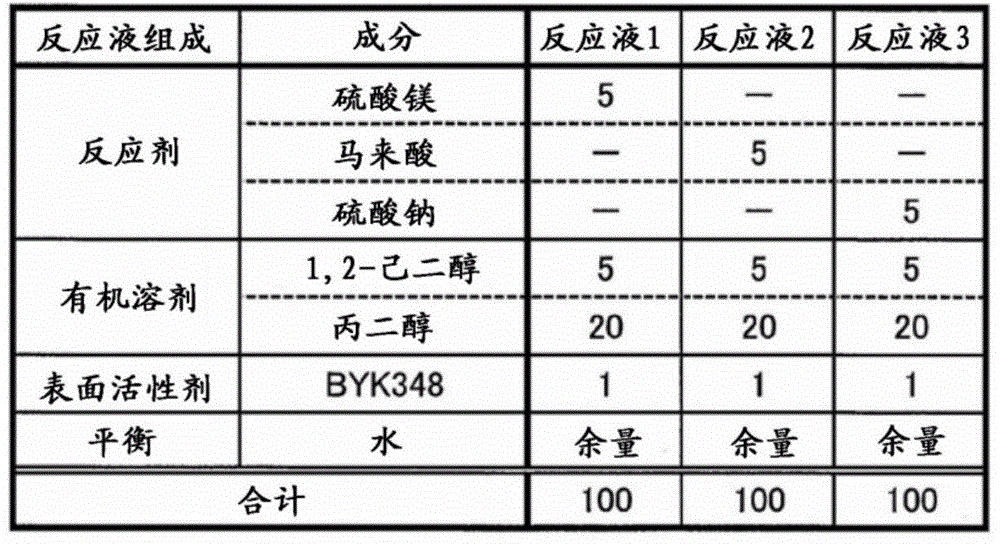
5.2. preparation of pigmented inks
The respective components were mixed and stirred so as to have the blending ratios shown in table 2, and then filtered through a10 μm membrane filter, thereby preparing a colored ink. In the preparation of the colored ink, a pigment dispersion liquid containing a pigment, a resin dispersant and water is prepared in advance, and the pigment dispersion liquid and the remaining components are mixed. All the numerical values in table 2 represent mass%, and ion-exchanged water is added so that the total mass of the coloring ink becomes 100 mass%. As the pigment, c.i. pigment blue 15: 3 (cyan pigment). The coloring inks shown in table 2 contain the materials shown in the table as the 2 nd resin. The respective resins are as follows. In each table, the solid content is the mass of the solid content.
VINYBLAN2586 (trade name, manufactured by Nissin chemical industry Co., Ltd., aqueous styrene-acrylic resin emulsion)
D4200 (trade name: RESAMINED-4200, manufactured by Dai Ching Kogyo Co., Ltd., aqueous polyurethane emulsion)
Table 2:
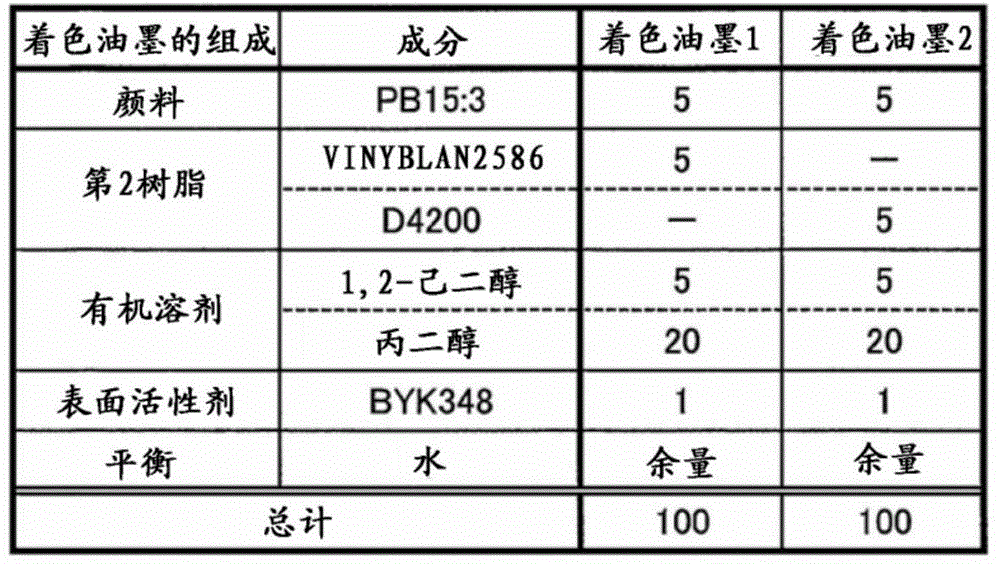
5.3. preparation of clear inks
Transparent inks were prepared by mixing and stirring the respective components so as to have the blending ratios shown in table 3, and then filtering the mixture with a10 μm membrane filter. All the numerical values in table 3 represent mass%, and ion-exchanged water was added so that the total mass of the transparent ink became 100 mass%. The transparent inks shown in table 3 contained the materials shown in table 2 as the second resin.
Table 3:
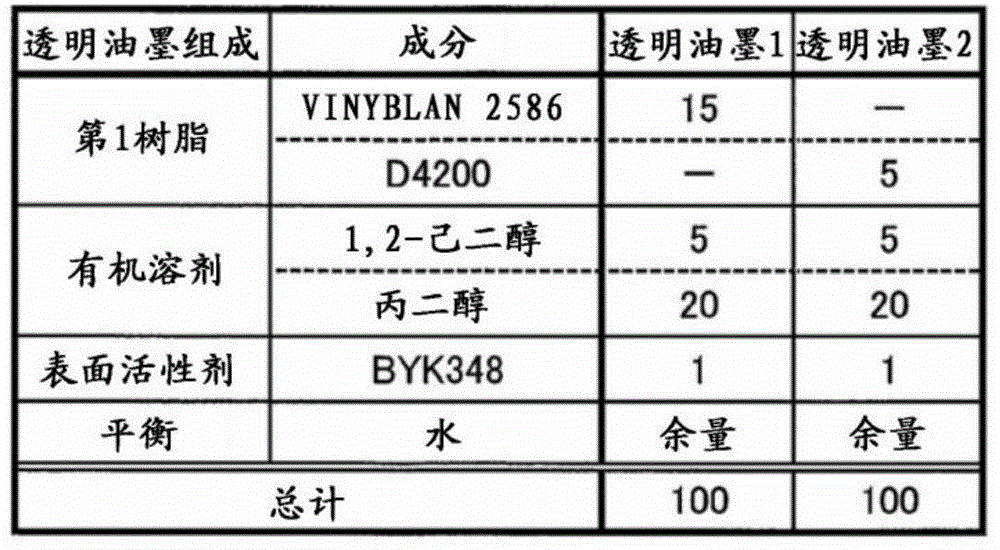
5.4. recording medium
In the following evaluation test, a polypropylene film (trade name "SY 51M", manufactured by UPM RAFLATAC) was used as a non-absorbent recording medium.
5.5. Production of recorded matter
The production conditions and evaluation results of the examples and comparative examples are shown in tables 4 and 5. In each example, the reaction solution, the coloring ink and the clear ink prepared as described above were charged into a modification machine of an ink jet printer PX-G930 (product of Seiko Epson corporation) so that the reaction solution, the coloring ink and the clear ink became 1 nozzle row/1 liquid. The nozzle density of the nozzle row of the recording head of the printer was set to 300 dpi. The recording medium was set and the reaction solution was applied in the amount of deposition shown in tables 4 and 5. The pattern was a solid pattern of 10cm × 10 cm. After the adhesion, the recording medium was recovered and set again so as to superimpose the coloring ink on the same pattern in an amount of 7mg/inch2Printing is performed after the application.
Thereafter, the recording medium was again recovered and set, and transparent inks were superimposed and adhered to the same pattern at the application amounts shown in tables 4 and 5. The dot resolution of the printing was 1200X 1200dpi for each of the reaction liquid, the coloring ink and the clear ink. Thereafter, the recording medium was heat-dried at 60 ℃ for 10 minutes in an oven.
The platen of the printer is provided with a heater, and the heater is configured to heat the recording medium during recording.
In tables 4 and 5, whether or not the reaction solution drying step was performed is also described. The example without the drying step is an example in which the recording medium is set again immediately after the reaction solution adheres without operating the heater. The surface temperature of the recording medium during recording was 25 ℃, and the residual ratio of volatile components in the reaction liquid during printing of the coloring ink was 90%. However, in example 6 having a residual rate of 50%, the reaction solution adhered thereto and then left at room temperature, whereby the residual rate was 50%. In the case where the residual ratio was 90%, the time from the end of the reaction liquid adhesion to the start of the color ink adhesion was within 5 seconds, and in example 6 where the residual ratio was 50%, the time from the end of the reaction liquid adhesion to the start of the color ink adhesion was 30 seconds, and the recording medium surface temperature in each adhesion step was 25 ℃. In example 1 having a residual rate of 30%, the time from the end of the reaction liquid deposition to the start of the coloring ink deposition was 25 seconds, and the recording medium surface temperature in the deposition step was 50 ℃. In comparative examples 1 and 4, in which the residual ratio was 20%, the time from the completion of the reaction liquid adhesion to the start of the coloring ink adhesion was 25 seconds, and the recording medium surface temperature in the adhesion step was 55 ℃.
In example 10 and comparative example 5, which have a drying step, printing was performed so that the surface temperature of the recording medium was 45 ℃. The time from the end of the reaction liquid adhesion to the start of the coloring ink adhesion was about 25 seconds. The residual ratio of volatile components in the reaction solution after printing is shown in the table.
5.6. Evaluation test
5.6.1. Fixability (scratch resistance)
The fixability of the image was evaluated by a rubbing test using a cloth. The abrasion resistance was evaluated by using a chemical vibration type rubbing fastness Tester AB-301 (trade name, manufactured by Tester industries, Ltd.). Specifically, a 300g load was applied to the surface of the recording medium on which an image was recorded with a rubbing block equipped with white cotton cloth (JIS L0803 standard) until the coating film was peeled off, or rubbed 30 times. Then, the image (coating film) on the surface of the recording medium was visually observed to be peeled. The evaluation criteria are as follows.
It: even if the rubbing is performed 30 times, the coating film is not peeled off
Very good: the film was peeled off after 20 or more reciprocations and 29 or less reciprocations
O: the film was peeled off after 15 or more reciprocations and 19 or less reciprocations
And (delta): the film was peeled off after 10 or more reciprocations and 14 or less reciprocations
X: within 9 reciprocations, peeling of the coating film was observed
5.6.2. Picture quality
The solid pattern recorded on the surface of the recording medium of each sample was visually checked, and the presence or absence of uneven printing (solid filling property) was determined. The evaluation criteria are as follows.
Very good: the ink density in the pattern was not observed to be uneven
O: can see fine unevenness
X: can see significant unevenness
5.6.3. Printing stability 1
Solid pattern printing was performed on 300 sheets of A4PPC paper in the same manner as in the evaluation of fixability. For the nozzle row (300 nozzles), nozzle inspection of the coloring ink was performed every 50 prints. The evaluation of the printing stability was carried out according to the following evaluation criteria, and the results are shown in the table.
O: without non-ejectable nozzles
X: there were nozzles that could not be ejected (nozzle clogging occurred), but the portion of the pattern that was poor in the coloring ink due to non-ejection of the coloring ink was not conspicuous (the number of nozzles that could not be ejected was less than 15% of the total)
X: there are nozzles that could not be ejected (nozzle clogging occurred), and the portion of the pattern where the coloring ink was poor due to the non-ejection of the coloring ink was conspicuous (the number of nozzles that could not be ejected was 15% or more of the total number)
5.6.4. Printing stability 2
Solid pattern printing was performed on 300 sheets of A4PPC paper in the same manner as in the evaluation of fixability. For the nozzle row (300 nozzles), nozzle inspection of the clear ink was performed every 50 prints. The evaluation of the printing stability was carried out according to the following evaluation criteria, and the results are shown in the table.
O: without non-ejectable nozzles
X: there were nozzles that could not be ejected (nozzle clogging occurred), but the part of the pattern that had poor gloss due to non-ejection of the clear ink was not noticeable (the number of nozzles that could not be ejected was less than 15% of the total)
X: the presence of the non-discharge nozzles (nozzle clogging) and the difference in gloss due to the non-discharge of the clear ink in the pattern were marked (the number of non-discharge nozzles was 15% or more of the total number)
5.7. Evaluation results
The results of the above evaluation tests are shown in tables 4 and 5.
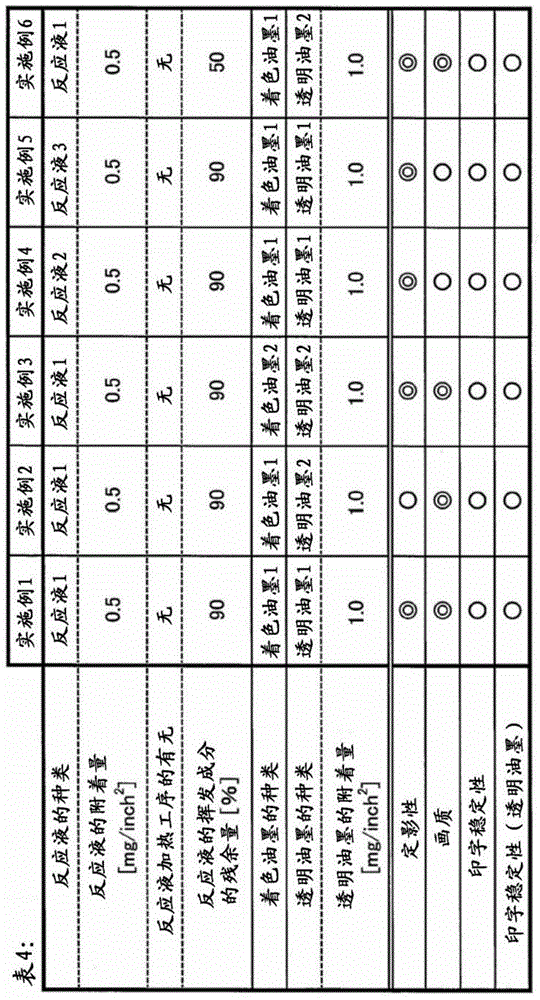
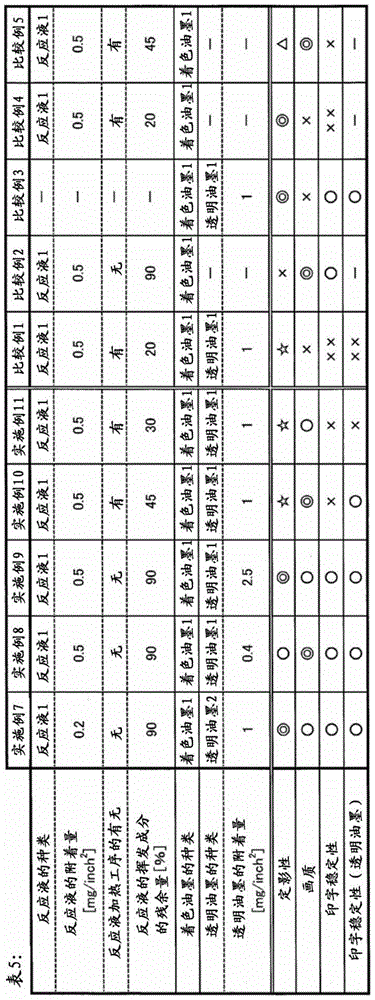
In examples 1 to 9, all of the fixability, image quality and printing stability were good; in examples 10 and 11, although the printing stability was slightly lowered, very good fixing property and image quality were obtained. In contrast, in comparative examples 1 and 4, both the image quality and the printing stability were insufficient. Further, in comparative example 2 in which the clear ink was not used, the fixing property was poor; in comparative example 3 in which no reaction liquid was used, the image quality was insufficient. In comparative example 5, the fixing property and the printing stability were lowered, but the image quality was maintained good.
At least the following can be understood from the results of tables 4 and 5.
(1) According to examples 1 and 2, the transparent ink using the styrene acrylic resin No. 1 can obtain more excellent scratch resistance
(2) According to examples 3 to 5, if the type of the 2 nd resin of the coloring ink is the same as that of the 1 st resin of the clear ink, the fixing property tends to be good
(3) According to examples 1,4 and 5, the reactants are all effective, but the polyvalent metal salts are particularly good
(4) According to examples 2 and 6, the fixing property was improved by drying the reaction solution, but the recording time was prolonged
(5) According to examples 2 and 7, if the reaction liquid is small, the image quality is slightly poor, but the fixing property is improved
(6) According to examples 1, 7, 8 and 9, the amount of clear ink controlled the balance between fixability and image quality
(7) According to comparative example 1, although the fixing property was improved due to the strong drying degree of the reaction liquid, the heat generated from the heater adversely affects the head of the recording tape, and the printing stability of the clear ink also became poor
(8) According to comparative example 2, if there is no clear ink, the fixability becomes insufficient
(9) According to comparative example 3, if there is no reaction liquid, the fixing property is good but the image quality becomes insufficient
(10) According to comparative example 4, if the reaction liquid is dried to a high degree, the fixing property is improved, but the heat generated by the heater adversely affects the recording head
(11) According to comparative example 5, if the reaction liquid is dried, the fixing property can be secured even without the clear ink, although the adverse effect on the recording head is caused by the heater
(12) According to examples 10 and 11, when the reaction liquid was dried moderately, the fixing property became very good
(13) According to examples 10 and 11, the transparent ink does not contain a pigment, clogging is less likely to occur as compared with the colored ink, and deterioration of the glossy feeling of the pattern is remarkable when ejection failure occurs on the opposite side of the ink
In the above examples, a serial printer was used, but it is understood that a line printer may be used in the present invention. When the line printer is used, for example, a line head for applying a reaction liquid, a line head for applying a coloring ink, and a line head for applying a transparent ink may be provided, and the respective heads may be applied (coated) to a recording medium to be conveyed. The present embodiment is particularly useful in that the recording speed is particularly high when the line printer is used, and the recording speed is not reduced.
The present invention is not limited to the above-described embodiments, and various modifications can be made. For example, the present invention includes substantially the same configurations as those described in the embodiments (for example, configurations having the same functions, methods, and results, or configurations having the same objects and effects). The present invention includes a configuration in which the nonessential portions of the configurations described in the embodiments are replaced. The present invention includes a configuration that produces the same operational effects as the configuration described in the embodiment or a configuration that can achieve the same object. The present invention includes a configuration in which a known technique is added to the configuration described in the embodiment.
Description of the symbols
1 … recording medium, 10 … conveying unit, 11 … roller, 20 … recording unit, 22, 24, 26 … recording head, 1000 … ink jet recording device
Claims (9)
Applications Claiming Priority (6)
| Application Number | Priority Date | Filing Date | Title |
|---|---|---|---|
| JP2015038292 | 2015-02-27 | ||
| JP2015-038292 | 2015-02-27 | ||
| JP2015-075129 | 2015-04-01 | ||
| JP2015075129 | 2015-04-01 | ||
| JP2015135870A JP6645049B2 (en) | 2015-02-27 | 2015-07-07 | Inkjet recording method |
| JP2015-135870 | 2015-07-07 |
Publications (2)
| Publication Number | Publication Date |
|---|---|
| CN105922778A CN105922778A (en) | 2016-09-07 |
| CN105922778B true CN105922778B (en) | 2021-02-09 |
Family
ID=55650049
Family Applications (1)
| Application Number | Title | Priority Date | Filing Date |
|---|---|---|---|
| CN201610101718.9A Active CN105922778B (en) | 2015-02-27 | 2016-02-24 | Ink jet recording method and ink jet recording apparatus |
Country Status (3)
| Country | Link |
|---|---|
| US (2) | US9862203B2 (en) |
| EP (1) | EP3061619B1 (en) |
| CN (1) | CN105922778B (en) |
Families Citing this family (9)
| Publication number | Priority date | Publication date | Assignee | Title |
|---|---|---|---|---|
| US10676631B2 (en) * | 2016-03-11 | 2020-06-09 | Maxell Holdings, Ltd. | Ink set for ink-jet printing and ink-jet recording method |
| JP2017186455A (en) * | 2016-04-06 | 2017-10-12 | セイコーエプソン株式会社 | Treatment liquid composition and printing method |
| JP6938955B2 (en) * | 2017-02-24 | 2021-09-22 | セイコーエプソン株式会社 | Inkjet recording method |
| JP7017051B2 (en) * | 2017-09-27 | 2022-02-08 | セイコーエプソン株式会社 | Ink set and recording method |
| EP3689631B1 (en) * | 2017-09-29 | 2023-10-25 | FUJIFILM Corporation | Method for forming image and ink set |
| JP7087443B2 (en) * | 2018-02-27 | 2022-06-21 | セイコーエプソン株式会社 | Inkjet recording method and recording device |
| JP7091739B2 (en) * | 2018-03-16 | 2022-06-28 | セイコーエプソン株式会社 | Recording method, ink set and recording device |
| EP3875554B1 (en) * | 2018-11-02 | 2026-01-07 | FUJIFILM Corporation | Ink set and image formation method |
| CN111806112A (en) * | 2020-06-18 | 2020-10-23 | 深圳汉华工业数码设备有限公司 | Digital printing method, digital printer and storage medium |
Citations (3)
| Publication number | Priority date | Publication date | Assignee | Title |
|---|---|---|---|---|
| CN101531089A (en) * | 2008-03-12 | 2009-09-16 | 富士胶片株式会社 | Image recording method, ink set, recorded material |
| CN101585259A (en) * | 2008-05-23 | 2009-11-25 | 富士胶片株式会社 | Inkjet recording method and apparatus |
| CN102574406A (en) * | 2009-08-21 | 2012-07-11 | 株式会社理光 | Image forming method, and image formed matter |
Family Cites Families (20)
| Publication number | Priority date | Publication date | Assignee | Title |
|---|---|---|---|---|
| US6833008B2 (en) | 2001-01-16 | 2004-12-21 | Aprion Digital Ltd. | Surface treatment for printing applications using water-based ink |
| EP1567360B1 (en) | 2002-11-25 | 2008-06-18 | Hewlett-Packard Industrial Printing Ltd. | Surface treatment for printing applications using water-based ink |
| US7122077B2 (en) * | 2003-03-28 | 2006-10-17 | E. I. Du Pont De Nemours And Company | Inkjet ink set and method of using same |
| JP4827450B2 (en) * | 2005-07-15 | 2011-11-30 | 富士フイルム株式会社 | Image forming method and image forming apparatus |
| US8042906B2 (en) | 2007-09-25 | 2011-10-25 | Fujifilm Corporation | Image forming method and apparatus |
| JP5330763B2 (en) | 2007-09-25 | 2013-10-30 | 富士フイルム株式会社 | Image forming method and image forming apparatus |
| JP4949297B2 (en) * | 2008-03-12 | 2012-06-06 | 富士フイルム株式会社 | Image recording method, ink set, and inkjet recording |
| JP2009226851A (en) | 2008-03-25 | 2009-10-08 | Fujifilm Corp | Ink-jet recording apparatus and image recording method |
| JP5388902B2 (en) * | 2010-03-01 | 2014-01-15 | 富士フイルム株式会社 | Image forming method |
| US9278515B2 (en) * | 2010-06-14 | 2016-03-08 | Hewlett-Packard Development Company, L.P. | Printing method |
| JP5874186B2 (en) * | 2011-03-30 | 2016-03-02 | セイコーエプソン株式会社 | Inkjet recording method |
| JP5554290B2 (en) * | 2011-06-17 | 2014-07-23 | 富士フイルム株式会社 | Ink set and image forming method |
| JP2013071277A (en) | 2011-09-27 | 2013-04-22 | Seiko Epson Corp | Inkjet recording method and recorded matter |
| EP2614964B1 (en) | 2012-01-10 | 2017-01-04 | Ricoh Company, Ltd. | Image forming method |
| CA2862378C (en) * | 2012-03-06 | 2019-11-12 | Oce-Technologies B.V. | Ink composition |
| JP5653968B2 (en) * | 2012-06-22 | 2015-01-14 | 富士フイルム株式会社 | Decorative sheet, method for producing decorative sheet, in-mold injection molding method and resin molded body |
| JP6107141B2 (en) | 2013-01-07 | 2017-04-05 | 株式会社リコー | Image forming method and image forming apparatus |
| JP6222422B2 (en) * | 2013-03-27 | 2017-11-01 | セイコーエプソン株式会社 | White pigment, white ink composition, ink set, and ink jet recording method |
| EP2988946B1 (en) * | 2013-04-24 | 2017-08-16 | OCE-Technologies B.V. | Method of printing |
| EP3107848A1 (en) * | 2014-02-21 | 2016-12-28 | OCE-Technologies B.V. | Sheet transport system |
-
2016
- 2016-02-24 CN CN201610101718.9A patent/CN105922778B/en active Active
- 2016-02-25 US US15/053,507 patent/US9862203B2/en active Active
- 2016-02-26 EP EP16157696.2A patent/EP3061619B1/en active Active
-
2017
- 2017-11-29 US US15/825,874 patent/US10618309B2/en active Active
Patent Citations (3)
| Publication number | Priority date | Publication date | Assignee | Title |
|---|---|---|---|---|
| CN101531089A (en) * | 2008-03-12 | 2009-09-16 | 富士胶片株式会社 | Image recording method, ink set, recorded material |
| CN101585259A (en) * | 2008-05-23 | 2009-11-25 | 富士胶片株式会社 | Inkjet recording method and apparatus |
| CN102574406A (en) * | 2009-08-21 | 2012-07-11 | 株式会社理光 | Image forming method, and image formed matter |
Also Published As
| Publication number | Publication date |
|---|---|
| US20160250861A1 (en) | 2016-09-01 |
| US9862203B2 (en) | 2018-01-09 |
| CN105922778A (en) | 2016-09-07 |
| US10618309B2 (en) | 2020-04-14 |
| EP3061619B1 (en) | 2023-11-15 |
| EP3061619A1 (en) | 2016-08-31 |
| US20180079222A1 (en) | 2018-03-22 |
Similar Documents
| Publication | Publication Date | Title |
|---|---|---|
| JP6384658B2 (en) | How to record images | |
| CN105922778B (en) | Ink jet recording method and ink jet recording apparatus | |
| JP6645049B2 (en) | Inkjet recording method | |
| US9815999B2 (en) | Ink jet recording method and ink set | |
| JP6394854B2 (en) | Treatment liquid, recording method | |
| CN113755056A (en) | White ink composition and recording method | |
| US10265973B2 (en) | Recording method and recording apparatus | |
| JP6772439B2 (en) | Recording method and ink set | |
| US10279602B2 (en) | Recording method and recording apparatus | |
| US20230023979A1 (en) | Ink Set And Recording Method | |
| JP2020104486A (en) | Ink-jet recording method, ink-jet recording apparatus, and treatment liquid | |
| JP6714810B2 (en) | Recording method and recording apparatus | |
| US20240010007A1 (en) | Recording Method And Recording Apparatus | |
| JP6589340B2 (en) | Inkjet recording method | |
| JP2017074729A (en) | Inkjet recording apparatus maintenance method and inkjet recording apparatus | |
| JP2019010877A (en) | Image recording method | |
| JP2025150268A (en) | Recording method and recording device | |
| JP2024117948A (en) | Recording method and recording device | |
| JP2025023468A (en) | Recording method and recording device | |
| JP2024103134A (en) | Recording method and recording device |
Legal Events
| Date | Code | Title | Description |
|---|---|---|---|
| C06 | Publication | ||
| PB01 | Publication | ||
| SE01 | Entry into force of request for substantive examination | ||
| SE01 | Entry into force of request for substantive examination | ||
| GR01 | Patent grant | ||
| GR01 | Patent grant |