CN105900375B - Apparatus, system and method for protecting identity in authenticated transactions - Google Patents
Apparatus, system and method for protecting identity in authenticated transactions Download PDFInfo
- Publication number
- CN105900375B CN105900375B CN201580004375.8A CN201580004375A CN105900375B CN 105900375 B CN105900375 B CN 105900375B CN 201580004375 A CN201580004375 A CN 201580004375A CN 105900375 B CN105900375 B CN 105900375B
- Authority
- CN
- China
- Prior art keywords
- user device
- public key
- access device
- shared secret
- user
- Prior art date
- Legal status (The legal status is an assumption and is not a legal conclusion. Google has not performed a legal analysis and makes no representation as to the accuracy of the status listed.)
- Active
Links
Images


Classifications
-
- H—ELECTRICITY
- H04—ELECTRIC COMMUNICATION TECHNIQUE
- H04L—TRANSMISSION OF DIGITAL INFORMATION, e.g. TELEGRAPHIC COMMUNICATION
- H04L9/00—Cryptographic mechanisms or cryptographic arrangements for secret or secure communications; Network security protocols
- H04L9/08—Key distribution or management, e.g. generation, sharing or updating, of cryptographic keys or passwords
- H04L9/0816—Key establishment, i.e. cryptographic processes or cryptographic protocols whereby a shared secret becomes available to two or more parties, for subsequent use
- H04L9/0838—Key agreement, i.e. key establishment technique in which a shared key is derived by parties as a function of information contributed by, or associated with, each of these
- H04L9/0841—Key agreement, i.e. key establishment technique in which a shared key is derived by parties as a function of information contributed by, or associated with, each of these involving Diffie-Hellman or related key agreement protocols
- H04L9/0844—Key agreement, i.e. key establishment technique in which a shared key is derived by parties as a function of information contributed by, or associated with, each of these involving Diffie-Hellman or related key agreement protocols with user authentication or key authentication, e.g. ElGamal, MTI, MQV-Menezes-Qu-Vanstone protocol or Diffie-Hellman protocols using implicitly-certified keys
-
- H—ELECTRICITY
- H04—ELECTRIC COMMUNICATION TECHNIQUE
- H04L—TRANSMISSION OF DIGITAL INFORMATION, e.g. TELEGRAPHIC COMMUNICATION
- H04L63/00—Network architectures or network communication protocols for network security
- H04L63/06—Network architectures or network communication protocols for network security for supporting key management in a packet data network
- H04L63/061—Network architectures or network communication protocols for network security for supporting key management in a packet data network for key exchange, e.g. in peer-to-peer networks
-
- H—ELECTRICITY
- H04—ELECTRIC COMMUNICATION TECHNIQUE
- H04L—TRANSMISSION OF DIGITAL INFORMATION, e.g. TELEGRAPHIC COMMUNICATION
- H04L9/00—Cryptographic mechanisms or cryptographic arrangements for secret or secure communications; Network security protocols
- H04L9/08—Key distribution or management, e.g. generation, sharing or updating, of cryptographic keys or passwords
- H04L9/0816—Key establishment, i.e. cryptographic processes or cryptographic protocols whereby a shared secret becomes available to two or more parties, for subsequent use
- H04L9/0819—Key transport or distribution, i.e. key establishment techniques where one party creates or otherwise obtains a secret value, and securely transfers it to the other(s)
-
- H—ELECTRICITY
- H04—ELECTRIC COMMUNICATION TECHNIQUE
- H04L—TRANSMISSION OF DIGITAL INFORMATION, e.g. TELEGRAPHIC COMMUNICATION
- H04L9/00—Cryptographic mechanisms or cryptographic arrangements for secret or secure communications; Network security protocols
- H04L9/14—Cryptographic mechanisms or cryptographic arrangements for secret or secure communications; Network security protocols using a plurality of keys or algorithms
-
- H—ELECTRICITY
- H04—ELECTRIC COMMUNICATION TECHNIQUE
- H04W—WIRELESS COMMUNICATION NETWORKS
- H04W12/00—Security arrangements; Authentication; Protecting privacy or anonymity
- H04W12/04—Key management, e.g. using generic bootstrapping architecture [GBA]
- H04W12/041—Key generation or derivation
-
- H—ELECTRICITY
- H04—ELECTRIC COMMUNICATION TECHNIQUE
- H04L—TRANSMISSION OF DIGITAL INFORMATION, e.g. TELEGRAPHIC COMMUNICATION
- H04L2209/00—Additional information or applications relating to cryptographic mechanisms or cryptographic arrangements for secret or secure communication H04L9/00
- H04L2209/04—Masking or blinding
-
- H—ELECTRICITY
- H04—ELECTRIC COMMUNICATION TECHNIQUE
- H04L—TRANSMISSION OF DIGITAL INFORMATION, e.g. TELEGRAPHIC COMMUNICATION
- H04L2209/00—Additional information or applications relating to cryptographic mechanisms or cryptographic arrangements for secret or secure communication H04L9/00
- H04L2209/16—Obfuscation or hiding, e.g. involving white box
-
- H—ELECTRICITY
- H04—ELECTRIC COMMUNICATION TECHNIQUE
- H04L—TRANSMISSION OF DIGITAL INFORMATION, e.g. TELEGRAPHIC COMMUNICATION
- H04L2209/00—Additional information or applications relating to cryptographic mechanisms or cryptographic arrangements for secret or secure communication H04L9/00
- H04L2209/24—Key scheduling, i.e. generating round keys or sub-keys for block encryption
-
- H—ELECTRICITY
- H04—ELECTRIC COMMUNICATION TECHNIQUE
- H04L—TRANSMISSION OF DIGITAL INFORMATION, e.g. TELEGRAPHIC COMMUNICATION
- H04L2209/00—Additional information or applications relating to cryptographic mechanisms or cryptographic arrangements for secret or secure communication H04L9/00
- H04L2209/56—Financial cryptography, e.g. electronic payment or e-cash
-
- H—ELECTRICITY
- H04—ELECTRIC COMMUNICATION TECHNIQUE
- H04L—TRANSMISSION OF DIGITAL INFORMATION, e.g. TELEGRAPHIC COMMUNICATION
- H04L2209/00—Additional information or applications relating to cryptographic mechanisms or cryptographic arrangements for secret or secure communication H04L9/00
- H04L2209/80—Wireless
- H04L2209/805—Lightweight hardware, e.g. radio-frequency identification [RFID] or sensor
Landscapes
- Engineering & Computer Science (AREA)
- Computer Security & Cryptography (AREA)
- Computer Networks & Wireless Communication (AREA)
- Signal Processing (AREA)
- Computer Hardware Design (AREA)
- Computing Systems (AREA)
- General Engineering & Computer Science (AREA)
- Financial Or Insurance-Related Operations Such As Payment And Settlement (AREA)
- Mobile Radio Communication Systems (AREA)
- Storage Device Security (AREA)
Abstract
本发明提供了用于在认证数据传输中保护身份的系统和方法。例如,可以在便携式用户设备与访问设备之间进行非接触式交易而不会以明文暴露便携式用户设备的公钥。在一个实施例中,访问设备可以向便携式用户设备发送访问设备公钥。用户设备可以返回用户设备盲公钥和加密的用户设备数据。访问设备可以使用用户设备盲公钥和访问设备私钥确定共享秘密。访问设备则可以使用共享秘密对加密的用户设备数据进行解密。

The present invention provides systems and methods for protecting identities during authenticated data transmission. For example, contactless transactions can be conducted between a portable user device and an access device without exposing the portable user device's public key in plain text. In one embodiment, the access device can send the access device public key to the portable user device. The user device can return the user device blind public key and encrypted user device data. The access device can use the user device blind public key and the access device private key to determine a shared secret. The access device can then use the shared secret to decrypt the encrypted user device data.
Description
相关申请的交叉引用CROSS-REFERENCE TO RELATED APPLICATIONS
本申请是2014年1月13日提交的美国临时申请号61/926,908(代理人案卷号79900-897598)的非临时申请并要求保护其优先权,其全部内容出于所有目的通过援引并入本文。This application is a non-provisional application of and claims priority to US Provisional Application No. 61/926,908 (Attorney Docket No. 79900-897598), filed January 13, 2014, the entire contents of which are incorporated herein by reference for all purposes .
背景background
随着非接触式支付设备(如NFC使能移动电话和非接触式卡)越来越流行,维护支付交易的安全性仍然是关注问题。例如,在一个情景下,攻击者可能试图窃听非接触式交易(例如,通过使用隐蔽的无线电接收机)。即使支付信息被加密或以其他方式受保护,但攻击者可能尝试确定进行交易的用户的身份。如果被确定了,则用户的身份可能被用于不正当目的。As contactless payment devices such as NFC-enabled mobile phones and contactless cards become more popular, maintaining the security of payment transactions remains a concern. For example, in one scenario, an attacker may attempt to eavesdrop on a contactless transaction (eg, by using a covert radio receiver). Even if payment information is encrypted or otherwise protected, an attacker could try to determine the identity of the user who made the transaction. If so, the user's identity may be used for improper purposes.
本发明的实施例单独和共同地解决了这些问题和其他问题。Embodiments of the present invention address these and other problems individually and collectively.
简要概述Brief overview
本发明的实施例涉及用于在认证数据传输中保护身份的高效方法。例如,可以在便携式用户设备与访问设备之间进行非接触式交易而不会以明文暴露便携式用户设备的公钥。Embodiments of the present invention relate to efficient methods for protecting identities in authenticated data transmissions. For example, a contactless transaction between the portable user device and the access device can be performed without exposing the portable user device's public key in clear text.
在一个实施例中,可以由便携式用户设备从访问设备接收访问设备公钥。可以从存储在便携式用户设备上的用户设备公钥、以及密码随机数(nonce)(例如,随机值)生成用户设备盲公钥。类似地,可以从与用户设备公钥和密码随机数相对应的用户设备私钥生成用户设备盲私钥。接下来,可以使用用户设备盲私钥和暂时性公钥生成共享秘密。共享秘密可以用于派生出会话密钥,并且会话密钥可以用于加密用户设备数据,如用户设备证书。可以将加密的用户设备数据和用户设备盲公钥发送至访问设备。访问设备可以使用用户设备盲公钥和访问设备私钥重新生成共享秘密。然后共享秘密用于重新生成会话密钥并对加密的用户设备数据进行解密。因而,访问设备可以在不以明文传输证书的情况下获得并验证用户设备证书。In one embodiment, the access device public key may be received by the portable user device from the access device. The user device blind public key may be generated from a user device public key stored on the portable user device, and a cryptographic nonce (eg, a random value). Similarly, the user device blind private key can be generated from the user device private key corresponding to the user device public key and the cryptographic random number. Next, a shared secret can be generated using the user device blind private key and ephemeral public key. The shared secret can be used to derive a session key, and the session key can be used to encrypt user device data, such as user device certificates. The encrypted user device data and the user device blind public key may be sent to the access device. The access device can regenerate the shared secret using the user's device blind public key and the access device private key. The shared secret is then used to regenerate the session key and decrypt the encrypted user device data. Thus, the access device can obtain and verify the user device certificate without transmitting the certificate in clear text.
附图简要说明Brief Description of Drawings
图1示出了本发明的实施例可以使用的系统的示例。Figure 1 shows an example of a system with which embodiments of the present invention may be used.
图2示出了根据本发明的一些实施例的访问设备与用户设备之间的通信图。Figure 2 shows a communication diagram between an access device and a user device according to some embodiments of the present invention.
图3示出了从用户设备安全地获得用户设备数据的方法。Figure 3 illustrates a method of securely obtaining user equipment data from a user equipment.
图4示出了将用户设备数据安全地传输至访问设备的方法。Figure 4 illustrates a method of securely transmitting user device data to an access device.
图5示出了数据流程图,展示了根据一些实施例在建立共享秘密时所执行的操作。Figure 5 illustrates a data flow diagram illustrating operations performed in establishing a shared secret in accordance with some embodiments.
图6示出了更详细的数据流程图,展示了根据一些实施例的在数据传输方法中执行的操作。Figure 6 shows a more detailed data flow diagram illustrating operations performed in a data transfer method according to some embodiments.
图7示出了从用户设备安全地获得用户设备数据的最优方法。Figure 7 illustrates an optimal method for securely obtaining user equipment data from user equipment.
图8示出了将用户设备数据安全地传输至访问设备的最优方法。Figure 8 illustrates an optimal method for securely transferring user device data to an access device.
图9示出了根据一些实施例的用户设备的示例。Figure 9 shows an example of a user equipment according to some embodiments.
图10示出了示例性计算机装置的框图。10 shows a block diagram of an exemplary computer apparatus.
术语the term
在讨论本发明的一些实施例之前,对一些术语的说明可能有助于理解本发明的实施例。Before discussing some embodiments of the present invention, a description of some terms may be helpful in understanding the embodiments of the present invention.
术语“服务器计算机”可以包括强大的计算机或计算机集群。例如,服务器计算机可以是大型主机、微型计算机集群、或起到单元作用的一组服务器。在一个示例中,服务器计算机可以是联接至Web服务器的数据库服务器。服务器计算机可以联接至数据库并且可以包括用于服务于来自一个或多个客户机计算机的请求的任何硬件、软件、其他逻辑、或以上内容的组合。服务器计算机可以包括一个或多个计算装置并且可以使用各种计算结构、安排、和编译中的任一者来服务于来自一个或多个客户机计算机的请求。The term "server computer" can include a powerful computer or cluster of computers. For example, a server computer may be a mainframe, a cluster of microcomputers, or a group of servers functioning as a unit. In one example, the server computer may be a database server coupled to a web server. The server computer may be coupled to the database and may include any hardware, software, other logic, or combination of the above for servicing requests from one or more client computers. A server computer may include one or more computing devices and may use any of a variety of computing structures, arrangements, and compilations to service requests from one or more client computers.
术语“公/私钥对”可以包括由实体生成的一对关联加密密钥。所述公钥可以用于公共功能,如对要发送给实体的消息进行加密,或用于对应该由实体做出的数字签名进行验证。另一方面,私钥可以用于私用功能,如对接收到的消息解密或应用数字签名。公钥通常将由被称为证书授权中心(CA)的主体进行授权,所述证书授权中心将公钥存储在数据库中并将其分配给请求它的任何其他实体。私钥一般将被保持在安全存储介质中并且通常将是只有实体知道。然而,在此所描述的密码系统可以以用于恢复丢失的密钥并避免数据损失的密钥恢复机构为特征。公钥和私钥可以是任何适当格式,包括基于RSA或椭圆曲线密码学(ECC)的格式。The term "public/private key pair" may include a pair of associated encryption keys generated by an entity. The public key can be used for public functions, such as encrypting messages to be sent to the entity, or for verifying digital signatures that should be made by the entity. On the other hand, private keys can be used for private functions such as decrypting received messages or applying digital signatures. The public key will typically be authorized by a principal called a certificate authority (CA), which stores the public key in a database and distributes it to any other entity that requests it. The private key will generally be kept in a secure storage medium and will generally be known only to the entity. However, the cryptographic systems described herein may feature a key recovery mechanism for recovering lost keys and avoiding data loss. The public and private keys may be in any suitable format, including formats based on RSA or Elliptic Curve Cryptography (ECC).
“数字签名”可以指基于公/私钥对应用算法的结果,这种算法允许签名方显露,并且验证方验证文件的真实性和完整性。签名方借助于私钥起作用,并且验证方借助于公钥起作用。这个过程证明发送者的真实性、已签名文件的完整性和所谓的不可否认性原则,所述原则不允许否认已经签署的内容。证书或其他包括签名方的数字签名的数据据称是签名方所“签署的”。A "digital signature" may refer to the result of applying an algorithm based on a public/private key pair that allows the signing party to reveal and the verifier to verify the authenticity and integrity of the document. The signer functions by means of the private key, and the verifier functions by means of the public key. This process certifies the authenticity of the sender, the integrity of the signed document and the so-called principle of non-repudiation, which does not allow denying what has been signed. A certificate or other data that includes the signing party's digital signature is said to be "signed" by the signing party.
“证书”或“数字证书”可以包括使用数字签名将公钥与关联于身份的数据绑定的电子文件或数据文件。所述证书可以包括一个或多个数据字段,如身份的合法姓名、证书的序列号、证书的有效起止日期、证书相关的权限等。证书可以包括指示证书有效的第一天的“有效起始”日期,以及指示证书有效的最后一天的“有效截止”日期。证书还可以包含包括这些数据字段的证书中的数据的拼凑。除非另外说明,每个证书都由证书授权机构签名。A "certificate" or "digital certificate" may include an electronic or data file that binds a public key to data associated with an identity using a digital signature. The certificate may include one or more data fields, such as the legal name of the identity, the serial number of the certificate, the valid start and end dates of the certificate, the authority related to the certificate, and the like. The certificate may include a "valid from" date indicating the first day the certificate is valid, and an "valid until" date indicating the last day the certificate is valid. The certificate may also contain a patchwork of data in the certificate that includes these data fields. Unless otherwise stated, each certificate is signed by a certificate authority.
“证书授权机构”(CA)可以包括一个或多个操作性联接以向实体发行证书的服务器计算机。所述CA可以使用CA证书证明其身份,其证书包括CA的公钥。可以用另一个CA密钥签名、或可以用同一个CA密钥签署CA证书。后者被称为自签名证书。CA可以维护CA所发行的所有证书的数据库,并且还可以维护被撤销的证书的列表。A "Certificate Authority" (CA) may include one or more server computers operatively coupled to issue certificates to entities. The CA can prove its identity using a CA certificate, whose certificate includes the CA's public key. The CA certificate can be signed with another CA key, or the same CA key can be signed. The latter are called self-signed certificates. The CA may maintain a database of all certificates issued by the CA, and may also maintain a list of revoked certificates.
在典型的过程中,证书授权机构从其身份已知的实体接收未签名的证书。未签名的证书包括公钥、一个或多个数据字段、以及所述证书中的数据的拼凑。CA用与CA证书上所包括的公钥相对应的私钥对证书进行签名。CA然后可以将签名的证书存储在数据库中,并将签名的证书发行给实体。In a typical process, a certificate authority receives an unsigned certificate from an entity whose identity is known. An unsigned certificate includes a public key, one or more data fields, and a patchwork of data in the certificate. The CA signs the certificate with a private key corresponding to the public key included on the CA certificate. The CA can then store the signed certificate in the database and issue the signed certificate to the entity.
“密码随机数”可以包括任何数字、字符串、位序列、或其他旨在联合单个通信会话使用的数据值。在一些情况下,密码随机数可以是随机或伪随机生成的。通常,密码随机数具有足够的长度以使多次独立生成同一随机数值的可能性不大。A "cryptographic random number" may include any number, string, sequence of bits, or other data value intended for use in conjunction with a single communication session. In some cases, the cryptographic random number may be randomly or pseudo-randomly generated. In general, cryptographic random numbers are of sufficient length that it is unlikely that the same random number will be independently generated multiple times.
“盲密钥”(如“盲公钥”)可以包括已经通过与另一数据元素(如密码随机数)组合而混乱或以其他方式修改了其原始值的密钥。例如,在椭圆曲线密码学中,公钥可以乘以随机数从而生成“盲公钥”。类似地,私钥可以乘以随机数从而生成“盲私钥”。A "blind key" (eg, a "blind public key") may include a key whose original value has been scrambled or otherwise modified by combining with another data element (eg, a cryptographic random number). For example, in elliptic curve cryptography, the public key can be multiplied by a random number to generate a "blind public key". Similarly, the private key can be multiplied by a random number to generate a "blind private key".
“暂时性密钥对”可以包括被生成以供单次交易或其他通信会话使用的公钥(即,“暂时性公钥”)和私钥(即,暂时性私钥)。所述暂时性密钥对可以具有任何适当格式,如ECC或RSA。通常,一旦交易或通信会话已经结束,就可以删除暂时性密钥对。A "transitory key pair" may include a public key (ie, a "transitory public key") and a private key (ie, a transitory private key) that are generated for use in a single transaction or other communication session. The ephemeral key pair may be in any suitable format, such as ECC or RSA. Typically, a transient key pair can be deleted once the transaction or communication session has ended.
“加密密钥”可以包括任何数据值或其他适用于用密码加密数据的信息。“解密密钥”可以包括任何数据值或其他适用于对已加密的数据进行解密的信息。在一些情况下,用于加密数据的同一密钥可以可操作用于解密数据。这种密钥可以被称为对称加密密钥。An "encryption key" may include any data value or other information suitable for cryptographically encrypting data. A "decryption key" may include any data value or other information suitable for decrypting encrypted data. In some cases, the same key used to encrypt the data may be operable to decrypt the data. Such keys may be referred to as symmetric encryption keys.
术语“用户设备数据”可以包括任何数据或与用户设备相关联的信息。用户设备数据的示例可以包括与用户设备相关联的用户姓名、与用户设备相关联的组织、与用户设备相关联的支付信息(如主账号(PAN))、用户设备的失效日期、与用户设备相关联的证书等。The term "user equipment data" may include any data or information associated with user equipment. Examples of user equipment data may include the user name associated with the user equipment, the organization associated with the user equipment, payment information associated with the user equipment (eg, primary account number (PAN)), the expiration date of the user equipment, the user equipment associated certificates, etc.
详细说明Detailed description
本发明的实施例涉及用于在认证数据传输中保护身份的高效方法。例如,可以在便携式用户设备与访问设备之间进行非接触式交易而不会以明文暴露便携式用户设备的公钥。Embodiments of the present invention relate to efficient methods for protecting identities in authenticated data transmissions. For example, a contactless transaction between the portable user device and the access device can be performed without exposing the portable user device's public key in clear text.
在一个实施例中,可以由便携式用户设备从访问设备接收访问设备公钥。可以从存储在便携式用户设备上的用户设备公钥、以及密码随机数(例如,随机值)生成用户设备盲公钥。类似地,可以从与用户设备公钥和密码随机数相对应的用户设备私钥生成用户设备盲私钥。接下来,可以使用用户设备盲私钥和暂时性公钥生成共享秘密。共享秘密可以用于派生出会话密钥,并且会话密钥可以用于加密用户设备数据,如用户设备证书。可以将加密的用户设备数据和用户设备盲公钥发送至访问设备。访问设备可以使用用户设备盲公钥和访问设备私钥重新生成共享秘密。然后共享秘密用于重新生成会话密钥并对加密的用户设备数据进行解密。因而,访问设备可以在不以明文传输证书的情况下获得并验证用户设备证书。In one embodiment, the access device public key may be received by the portable user device from the access device. The user device blind public key may be generated from a user device public key stored on the portable user device, and a cryptographic random number (eg, a random value). Similarly, the user device blind private key can be generated from the user device private key corresponding to the user device public key and the cryptographic random number. Next, a shared secret can be generated using the user device blind private key and ephemeral public key. The shared secret can be used to derive a session key, and the session key can be used to encrypt user device data, such as user device certificates. The encrypted user device data and the user device blind public key may be sent to the access device. The access device can regenerate the shared secret using the user's device blind public key and the access device private key. The shared secret is then used to regenerate the session key and decrypt the encrypted user device data. Thus, the access device can obtain and verify the user device certificate without transmitting the certificate in clear text.
实施例可以在安全通信中保护便携式用户设备的身份或其他实体。在一些情况下,攻击者可能监听或另外监视在访问设备与便携式用户设备之间传递的数据。由于本发明的实施例可以避免以明文传输任何可识别的信息(如用户设备的公钥),所以从未授权实体保护了便携式用户设备的身份。Embodiments may protect the identity of portable user equipment or other entities in secure communications. In some cases, an attacker may listen or otherwise monitor data passing between the access device and the portable user device. The identity of the portable user device is protected from unauthorized entities, as embodiments of the present invention may avoid transmitting any identifiable information (eg, the user device's public key) in clear text.
实施例还可以仅使用单个请求和单个响应实现认证通信。这允许减小延迟来快速认证,并且允许将实施例的安全特性整合至其他现有的请求/响应流中,而不需要附加请求。例如,在一些实施例中,可以将所公开的协议数据附于现有请求/响应上。Embodiments may also implement authenticated communications using only a single request and a single response. This allows fast authentication with reduced latency, and allows the security features of an embodiment to be integrated into other existing request/response flows without requiring additional requests. For example, in some embodiments, the disclosed protocol data can be appended to an existing request/response.
另外,在之前已经通信的便携式用户设备和访问设备的情况下,实施例可以提供更快且更高效的通信。在一些实施例中,便携式用户设备处的注册表可以用于存储用于一个或多个访问设备的将来的共享秘密和将来的盲公钥值。访问设备处的模拟注册表可以用于存储用于一个或多个用户设备的将来的共享秘密和将来的用户设备标识符值。从而,如果用户设备和访问设备多次通信,则可以使用所存储的数据。这可以避免某些可能相对太占时间和功率的操作,如椭圆曲线Diffie-Hellman(ECDH)算法。这还可以为非接触式设备的用户提供改善的体验,因为便携式用户设备和访问设备可能不需要长时间保持在一起。例如,根据一些实施例,两个设备之间的安全且私密的通信可以在不到50ms时间内进行。Additionally, embodiments may provide faster and more efficient communications in the case of portable user devices and access devices that have previously communicated. In some embodiments, a registry at the portable user device may be used to store future shared secret and future blind public key values for one or more access devices. The impersonation registry at the access device may be used to store future shared secrets and future user device identifier values for one or more user devices. Thus, if the user device and the access device communicate multiple times, the stored data can be used. This avoids certain operations that may be relatively time- and power-intensive, such as the Elliptic Curve Diffie-Hellman (ECDH) algorithm. This may also provide an improved experience for the user of the contactless device, as the portable user device and the access device may not need to be kept together for long periods of time. For example, according to some embodiments, a secure and private communication between two devices may take place in less than 50ms.
实施例对于不使用对窃听者而言的盲密钥的系统可能看起来一样,因为窃听者将不会知道从便携式用户设备传输至访问设备(或反之)的公钥是盲公钥还是非盲公钥。因为,实施例可以提供针对协议逆向工程的保护。Embodiments may look the same for a system that does not use a blind key to an eavesdropper, since the eavesdropper will not know whether the public key transmitted from the portable user device to the access device (or vice versa) is blind or non-blind public key. Because, embodiments may provide protection against protocol reverse engineering.
I.系统I. System
图1示出了根据本发明的实施例的系统。所述系统包括可能操作便携式用户设备101的用户(未示出)。用户可以使用便携式用户设备101与访问设备102通信进行支付交易。如在此所使用的,“便携式用户设备”可以包括移动电话、平板、信用卡、借记卡、或任何其他合适的设备。如在此所使用的,“访问设备”可以包括任何适用于与便携式用户设备通信的计算设备。在一些实施例中,访问设备102可以直接与便携式用户设备101通信。在其他实施例中,访问设备102可以经由接口设备与便携式用户设备101通信,如智能手表、智能眼镜、或任何其他合适的设备。访问设备102可以与商户计算机103连接,所述商户计算机可以与收单行计算机104连接。收单行计算机104可以经由支付处理网络105与发卡行计算机106连接。Figure 1 shows a system according to an embodiment of the present invention. The system includes a user (not shown) who may operate the
如在此所使用的,“发卡行”通常可以指为用户维护金融账户并且经常向用户发行便携式用户设备101(如信用卡或借记卡)的企业实体(例如,银行)。“商户”通常是参与交易和可以销售商品或服务的实体。“收单行”通常是与具体商户或其他实体具有业务关系的业务实体(例如,商业银行)。一些实体可以执行发卡行和收单行两者的功能。一些实施例可以包含这样的单个实体发卡行-收单行。这些实体中的每一者可以包括一个或多个计算机装置(例如,商户计算机103、收单行计算机、支付处理网络105、以及发卡行计算机106)从而使能通信,或执行在此所描述的功能中的一项或多项功能。As used herein, a "card issuer" may generally refer to a business entity (eg, a bank) that maintains financial accounts for users and often issues portable user devices 101 (eg, credit or debit cards) to users. A "merchant" is generally an entity that participates in a transaction and can sell goods or services. An "acquirer" is typically a business entity (eg, a commercial bank) that has a business relationship with a particular merchant or other entity. Some entities may perform the functions of both issuer and acquirer. Some embodiments may include such a single entity issuer-acquirer. Each of these entities may include one or more computer devices (eg,
支付处理网络105可以包括数据处理子系统、网络、和用于支持和递送证书权限服务、授权服务、异常文件服务、交易评分服务、和清算与结算服务的操作。示例性支付处理网络可以包括VisaNetTM。支付处理网络(如VisaNetTM)能够处理信用卡交易、借记卡交易、和其他类型的商业交易。VisaNetTM具体地包括处理授权请求的VIP系统(Visa综合支付系统)和执行清算和结算服务的Base II系统。
支付处理网络105可以包括一个或多个服务器计算机。“服务器计算机”通常是强大的计算机或计算机集群。例如,服务器计算机可以是大型主机、微型计算机集群、或起到单元作用的一组服务器。在一个示例中,服务器计算机可以是联接至Web服务器的数据库服务器。支付处理网络105可以使用任何合适的有线或无线网络,包括互联网。
在一些支付交易中,用户使用便携式用户设备101在商户处购买商品或服务。用户的便携式用户设备101可以与商户处与商户计算机103相关联的访问设备102交互。例如,用户可以将便携式用户设备101轻按在访问设备103中的NFC读卡器上。可替代地,用户可以通过计算机网络向商户指示支付细节,如网上交易。In some payment transactions, the user uses the
用于交易的授权请求消息可以由访问设备102或商户计算机103生成然后被转发至收单行计算机104。在接收所述授权请求消息之后,授权请求消息则被发送至支付处理网络105。支付处理网络105则将授权请求消息转发至相对应的发卡行计算机106,发卡行计算机与关联于便携式用户设备101的发卡行相关联。The authorization request message for the transaction may be generated by the
“授权请求消息”可以是被发送至支付处理网络和/或用于请求授权交易的支付卡的发卡行的电子消息。根据一些实施例的授权请求消息可以符合ISO 8583,其是交换与用户使用支付设备或支付账户进行的支付相关联的电子交易信息的系统的标准。授权请求消息可以包括发卡行账户标识符,所述发卡行账户标识符与支付设备或支付账户相关联。授权请求消息还可以包括对应于“识别信息”的附加数据元素,包括(仅举例来讲):服务代码、CVV(卡验证值)、dCVV(动态卡验证值)、失效日期等。授权请求消息还可以包括“交易信息”,如与当前交易相关联的任何信息,如交易金额、商户标识符、商户位置等、以及可以用于确定是否识别和/或授权交易的任何其他信息。授权请求消息还可以包括其他信息,如对生成授权请求消息的访问设备进行识别的信息、关于访问设备的位置的信息等。An "authorization request message" may be an electronic message sent to the payment processing network and/or the issuer of the payment card for requesting authorization of the transaction. Authorization request messages according to some embodiments may conform to ISO 8583, which is a standard for systems for exchanging electronic transaction information associated with payments made by users using payment devices or payment accounts. The authorization request message may include the issuer account identifier associated with the payment device or payment account. The authorization request message may also include additional data elements corresponding to "identification information" including (by way of example only): service code, CVV (card verification value), dCVV (dynamic card verification value), expiration date, and the like. The authorization request message may also include "transaction information," such as any information associated with the current transaction, such as transaction amount, merchant identifier, merchant location, etc., as well as any other information that may be used to determine whether to identify and/or authorize the transaction. The authorization request message may also include other information, such as information identifying the access device that generated the authorization request message, information about the location of the access device, and the like.
在发卡行计算机106接收到授权请求消息之后,发卡行计算机106将授权响应消息发送回到支付处理网络105从而指示当前交易被授权(或未被授权)。然后,支付处理网络105将授权请求消息转发回收单行计算机104。在一些实施例中,根据欺诈风险分数值,即使发卡行计算机106已经授权交易,支付处理网络105也可以拒绝交易。收单行计算机104然后将响应消息转发回商户计算机103。After the
“授权响应消息”可以是由发卡金融机构106或支付处理网络105所生成的对授权请求消息的电子消息回复。授权响应消息可以包括(仅举例来讲)以下状态指示符中的一项或多项:同意--同意交易;拒绝--不同意交易;或呼叫中心--响应未决的更多信息,商户必须呼叫免费授权电话号码。授权响应消息还可以包括授权代码,该授权代码可以是信用卡发行银行响应于电子消息中的授权请求消息而返回(直接地或通过支付处理网络105)至指示同意交易的商户计算机103的代码。该代码可以用作授权的证明。如以上指出的,在一些实施例中,支付处理网络105可以生成或转发授权响应消息至商户。An "authorization response message" may be an electronic message reply to an authorization request message generated by the card issuing
商户计算机103收到授权响应消息之后,商户计算机103则可以为用户提供授权响应消息。响应消息可以由访问设备102显示、或可以在物理收据上打印出来。可替代地,如果所述交易是网上交易,商户可以提供网页或授权响应消息的其他指示作为虚拟收据。所述收据可以包括交易的交易数据。After the
在一天结束时,支付处理网络105可以进行正常的清算和结算过程。清算过程是收单行与发卡行之间交换金融详情的过程以促成过账到顾客的支付账户和用户的结算位置的对账。At the end of the day, the
II.认证通信方法II. Authentication Communication Method
图2示出了根据本发明的一些实施例的便携式用户设备101和访问设备102之间的通信图。在一些实施例中,图2中所示的交互可以作为支付交易的一部分发生。例如,如果便携式用户设备101是非接触式芯片卡,用户则可以在由商户操作的访问设备102上轻按或刷芯片卡。Figure 2 shows a communication diagram between
在步骤201,访问设备102生成暂时性公/私钥对。可以用任何适当方式生成公/私钥对,如通过使用随机或伪随机数发生器。此外,密钥对可以被生成为任何合适的密钥格式,如RSA或椭圆曲线密码学(ECC)。在一些实施例中,可以在便携式用户设备101进入访问设备102的非接触域之前生成暂时性密钥对。At step 201, the
在步骤202,在生成用于便携式用户设备101进入访问设备102的非接触域的暂时性密钥对之后,访问设备102等待一段时间。At step 202, after generating a temporary key pair for the
在步骤203,一旦便携式用户设备101进入访问设备102的非接触域,访问设备102将在步骤201生成的密钥对中的暂时性公钥传输给便携式用户设备101。At
在步骤204(a),便携式用户设备101使用所接收到的暂时性公钥与访问设备101建立共享秘密。然后,便携式用户设备101使用共享秘密派生出会话密钥,并使用会话密钥加密响应数据。在一些实施例中,可以通过将接收到的暂时性公钥与用户设备私钥和密码随机数结合来确定共享秘密。At step 204(a), the
在步骤204(b),访问设备102等待便携式用户设备101的响应。At step 204(b), the
在步骤205,便携式用户设备101向访问设备101发送响应消息。所述响应消息可以包括加密的响应数据或其他数据。例如,在一些实施例中,所述响应消息可以包括用户设备盲公钥,访问设备102可以使用用户设备盲公钥来确定用户设备101在步骤204(a)所建立的同一共享秘密。在一些实施例中,加密的响应数据可以包括支付信息,如主账号(PAN)、账户失效日期等。在一些实施例中,支付信息可以被包括作为用户设备证书的一部分。At
在步骤206,访问设备102建立与便携式用户设备101在步骤204(a)建立的相同的共享秘密。然后,访问设备102使用共享秘密生成会话密钥,并且使用会话密钥对加密的响应数据进行解密。解密后的响应数据可以被访问设备102用于认证便携式用户设备101。例如,在响应数据包括用户设备证书的实施例中,可以使用数字签名算法对证书的签名进行验证。At
在步骤207-210,在一些实施例中,访问设备102和便携式用户设备101可以交换命令和响应。例如,访问设备101可以从便携式用户设备101请求额外数据,或者便携式用户设备101可以从访问设备102请求交易信息。通常,可以使用从之前在便携式用户设备101与访问设备102之间建立的共享秘密派生出的会话密钥对这些命令和响应进行加密。此外,应当注意的是,虽然图2中示出了四条消息207-210,设备101与102之间可以交换任何数量的消息。At steps 207-210, in some embodiments, the
在步骤211,访问设备102使用便携式用户设备101所提供的响应数据对交易进行授权。例如,在一些实施例中,访问设备101可以如参照图1所描述的生成授权请求消息,并且在所述授权请求消息中包括与便携式用户设备101相关联的支付信息。通常,便携式用户设备101可以在交易被授权之前离开访问设备101的非接触域。在一些实施例中,一旦接收到授权响应消息,访问设备101可以向用户提供交易是否被授权的指示。At
虽然图2描述了便携式用户设备101与访问设备102之间的通信的示例,但实施例不限于以上说明。例如,一些实施例可以跳过命令和响应步骤207-210。在一些实施例中,便携式用户设备101可以在步骤205之后离开访问设备101的非接触域。While FIG. 2 depicts an example of communication between
可替代地,在一些实施例中,在响应消息在步骤205被接收之后,但在向便携式用户设备101发送一条或多条消息之前,访问设备102可以对交易进行授权。例如,在一个实施例中,在访问设备102确定交易已经被便携式用户设备101的发出方授权之后可以更新便携式用户设备101上存储的账户余额。Alternatively, in some embodiments, the
A.访问设备A. Access the device
图3示出了安全地获得用户设备数据的方法300。在一些实施例中,可以结合图4的方法400执行方法300,其中,方法300由访问设备102执行,而方法400由用户设备101执行。FIG. 3 illustrates a
在一些实施例中,方法300可以作为支付交易的一部分发生。例如,如果用户设备101是非接触式芯片卡,用户则可以在由商户操作的访问设备102上轻按或刷芯片卡。In some embodiments,
通常,在所述方法之前,便携式用户设备101可以生成或加载用户设备密钥对。“用户设备密钥对”可以包括公钥(即,“用户设备公钥”)和私钥(即,“用户设备私钥”)。用户设备101还可以包括“用户设备证书”,所述用户设备证书包括用户设备公钥。用户设备证书可以由证书授权机构签名,如支付处理网络105或发卡行计算机106。Typically, prior to the method, the
在步骤301,生成暂时性密钥对。“暂时性密钥对”可以包括被生成以供单次交易或其他通信会话使用的公钥(即,“暂时性公钥”)和私钥(即,暂时性私钥)。所述暂时性密钥对可以具有任何适当格式,如ECC或RSA。通常,一旦访问设备102与便携式用户设备101之间的通信会话已经结束,就可以删除暂时性密钥对。At
在步骤302,将认证请求发送至便携式用户设备101,包括暂时性公钥。在一些实施例中,认证请求还可以包括与访问设备102相关联的访问设备标识符。“访问设备标识符”可以包括任何适用于识别访问设备的数据。例如,访问设备标识符可以是序列号、全局唯一标识符(GUID)、网络地址、或任何其他合适的标识符。在一些实施例中,当访问设备102检测到便携式用户设备101时,比如如果它靠近非接触式收发器的话,可以发送认证请求。At
在步骤303,从便携式用户设备101接收加密的用户设备数据和用户设备盲公钥。可以从用户设备公钥生成“用户设备盲公钥”。例如,用户设备盲公钥可以是用户设备公钥和密码随机数的组合。“加密的用户设备数据”可以包括任何数据或与用户设备相关联的信息。例如,在一些实施例中,加密的用户设备数据可以包括用于生成用户设备盲公钥的加密的用户设备证书和密码随机数。At
在步骤304,使用在步骤301生成的暂时性私钥和在步骤303接收到的用户设备盲公钥生成共享秘密。可以使用任何合适的方法生成共享秘密。例如,在使用椭圆曲线密码学的实施例中,可以使用椭圆曲线Diffie-Hellman协议(ECDH)确定共享秘密。At
在步骤305,使用在步骤304所生成的共享秘密生成会话密钥。会话密钥可以具有任何合适的格式(例如,AES、DES、Blowfish等)、具有任何合适的长度、使用任何合适的密钥派生函数生成的。例如,在一个实施例中,可以使用基于密码的密钥派生函数2(PBKDF2)算法生成会话密钥。在一些实施例中,其他数据(如访问设备标识符)可以用作密钥派生函数的额外输入。At
在步骤306,使用会话密钥对加密的用户设备数据进行解密,从而确定用户设备证书。用户设备证书可以包括任何证实用户设备101的身份的数字证书。在一些实施例中,用户设备证书可以包括与用户设备101和/或与用户设备101相关联的用户有关的信息,如存储在用户设备上的用户设备密钥对的公钥、用户姓名、与用户设备101相关联的主账号(PAN)、账户的失效日期等。用户设备证书可以由证书授权机构(CA)签名。在一些情况下,经解密的用户设备数据还可以包括用于生成用户设备盲公钥的密码随机数。At
在步骤307,对用户设备证书和用户设备盲公钥进行验证。In
对用户设备证书进行验证可以包括基于已知的CA公钥保证用户设备证书的签名与期望值匹配。例如,在一些实施例中,数字签名算法(如椭圆曲线数字签名算法(ECDSA))可以用于验证用户设备证书。Verifying the user equipment certificate may include ensuring that the signature of the user equipment certificate matches an expected value based on a known CA public key. For example, in some embodiments, a digital signature algorithm, such as Elliptic Curve Digital Signature Algorithm (ECDSA), may be used to verify the user device certificate.
验证用户设备盲公钥可以包括确保用户设备盲公钥与预期值匹配。例如,在一些情况下,可以使用用户设备证书上所包括的用户设备公钥、以及在步骤306解密的密码随机数生成第二用户设备盲公钥。然后,可以将第二用户设备盲公钥与在步骤303接收的用户设备盲公钥进行比较从而确保这些密钥匹配。可替代地,在一些情况下,可以通过将在步骤303接收的用户设备盲公钥与存储的用户设备盲公钥进行比较来对前者进行验证。Verifying the user device blind public key may include ensuring that the user device blind public key matches an expected value. For example, in some cases, the second user device blind public key may be generated using the user device public key included on the user device certificate, and the cryptographic random number decrypted at
在步骤308,如果用户设备证书和用户设备盲公钥被验证,则使用用户设备数据进行交易。例如,在一些实施例中,可以如参照图1所描述的生成授权请求消息。在一些实施例中,一旦接收到授权响应消息,可以向用户提供交易是否成功的指示。At
应当注意的是,虽然参照暂时性密钥对对图3的方法进行了描述,但实施例不限于使用暂时性密钥。例如,在一些实施例中,访问设备102可以维护持久性密钥对(即,“访问设备公/私钥对”),并代替暂时性公钥和私钥分别使用访问设备公钥和私钥。It should be noted that although the method of FIG. 3 is described with reference to a pair of ephemeral keys, embodiments are not limited to the use of ephemeral keys. For example, in some embodiments, the
B.用户设备B. User Equipment
图4示出了从用户设备101的角度将用户设备数据安全地传输至访问设备102的方法400。在一些实施例中,可以结合方法400执行图3的方法300,其中,方法300由访问设备102执行,而方法400由用户设备101执行。FIG. 4 illustrates a
在一些实施例中,方法400可以作为支付交易的一部分发生。例如,如果用户设备101是非接触式芯片卡,用户则可以在由商户操作的访问设备102上轻按或刷芯片卡。In some embodiments,
通常,在所述方法之前,便携式用户设备101可以生成或加载用户设备密钥对。“用户设备密钥对”可以包括公钥(即,“用户设备公钥”)和私钥(即,“用户设备私钥”)。用户设备102还可以包括“用户设备证书”,所述用户设备证书包括用户设备公钥。用户设备证书可以由证书授权机构签名,如支付处理网络105或发卡行计算机106。Typically, prior to the method, the
在步骤401,接收认证请求,包括暂时性公钥。暂时性公钥可以具有任何合适的格式的,如ECC或RSA。通常,一旦访问设备102与便携式用户设备101之间的通信会话已经结束,就可以删除暂时性公钥。At step 401, an authentication request is received, including a temporary public key. Ephemeral public keys can be in any suitable format, such as ECC or RSA. Typically, the temporary public key may be deleted once the communication session between the
在步骤402,生成密码随机数。密码随机数可以是使用任何合适的方法生成的随机或伪随机数据值。In
在步骤403,使用用户设备私钥和密码随机数生成用户设备盲私钥。例如,在一些实施例中,可以通过将用户设备私钥乘以密码随机数来生成用户设备盲私钥。In
在步骤404,使用用户设备公钥和密码随机数生成用户设备盲公钥。例如,在一些实施例中,可以通过将用户设备公钥乘以密码随机数来生成用户设备盲公钥。In
在步骤405,使用在步骤403生成的用户设备盲私钥和在步骤401接收到的暂时性公钥生成共享秘密。可以使用任何合适的方法生成共享秘密。例如,在使用椭圆曲线密码学的实施例中,可以使用椭圆曲线Diffie-Hellman协议(ECDH)确定共享秘密。通常,用于生成共享秘密的方法是与访问设备102在图3的步骤304所使用的相同的过程。At
在步骤406,使用在步骤405所生成的共享秘密生成会话密钥。会话密钥可以具有任何合适的格式(例如,AES、DES、Blowfish等)、具有任何合适的长度、使用任何合适的密钥派生函数生成的。例如,在一个实施例中,可以使用基于密码的密钥派生函数2(PBKDF2)算法生成会话密钥。在一些实施例中,其他数据(如访问设备标识符)可以用作密钥派生函数的额外输入。通常,用于生成共享秘密的算法是与访问设备102在图3的步骤304所使用的相同的协议。通常,用于派生出会话密钥的方法是与访问设备102在图3的步骤305所使用的相同的过程。At
在步骤407,使用会话密钥对用户设备数据进行加密,从而生成加密的用户设备数据。通常,用户设备数据可以包括用户设备证书。在一些实施例中,用户设备数据可以包括其他数据,如用于生成用户设备盲公钥的用户设备标识符和/或密码随机数。At
在一些实施例中,第二共享秘密还可以用于对在响应中返回的另外的用户设备数据(如用户设备公钥)进行解密(除了使用在步骤405生成的第一共享秘密进行加密之外)。此类实施例可以提供的优点是,当使用第一共享秘密时不需要对用户设备数据进行解密。可以在第二共享秘密被建立的时候或地点对密钥进行解密,例如,在远程连接至访问设备102的单独设备(例如,硬件安全模块(HSM))中。In some embodiments, the second shared secret may also be used to decrypt additional user device data (eg, the user device public key) returned in the response (in addition to encryption using the first shared secret generated at step 405 ) ). Such an embodiment may provide the advantage that user equipment data does not need to be decrypted when the first shared secret is used. The key may be decrypted when or where the second shared secret is established, eg, in a separate device (eg, a hardware security module (HSM)) remotely connected to the
在步骤408,发送包括加密的用户设备数据和用户设备盲公钥的认证响应。At
类似于图3的方法,应当注意的是,虽然参照暂时性公钥(通常是从访问设备102接收的)对图4的方法进行了描述,但实施例不限于使用暂时性密钥。例如,在一些实施例中,访问设备102可以维护持久性密钥对(即,“访问设备公/私钥对”),并代替暂时性公钥和私钥分别使用访问设备公钥和私钥。Similar to the method of FIG. 3, it should be noted that while the method of FIG. 4 is described with reference to a transient public key (typically received from access device 102), embodiments are not limited to the use of transient keys. For example, in some embodiments, the
III.认证通信流程III. Authentication Communication Process
A.派生共享秘密A. Derived Shared Secret
图5示出了数据流程图,展示了根据本发明的一些实施例的在访问设备102与便携式用户设备101之间建立共享秘密时执行的操作。Figure 5 shows a data flow diagram illustrating operations performed in establishing a shared secret between the
如图5中所示,访问设备102使用公/私钥对发生器(“KeyGen”)生成暂时性公钥(“ePubA”)和暂时性私钥(“ePrivA”)。访问设备101将暂时性公钥(“ePubT”)在请求消息中发送给便携式用户设备101。便携式用户设备101生成密码随机数(“NonceC”),并结合(“MUL”)密码随机数(“NonceU”)与用户设备私钥(“PrivU”)从而生成用户设备盲私钥(“PrivU*”)。然后,将用户设备盲私钥(“PrivC*”)和暂时性公钥(“ePubT”)用作椭圆曲线Diffie-Hellman(“ECDH”)函数的输入从而生成共享秘密(“Z”)。As shown in FIG. 5, the
便携式用户设备101还结合(“MUL”)密码随机数(“NonceU”)与用户设备公钥(“PubU”)从而生成用户设备盲公钥(“PubU*”)。用户设备盲公钥(“PubU*”)在响应消息中传输至访问设备102。访问设备102将用户设备盲公钥(“PubU*”)和暂时性私钥(“ePrivA”)用作椭圆曲线Diffie-Hellman(“ECDH”)函数的输入从而生成相同的共享秘密(“Z”)。
以这种方式,实施例可以在访问设备102和便携式用户设备101之间建立共享秘密。In this manner, embodiments may establish a shared secret between the
B.认证用户设备B. Authenticate the user device
图6示出了数据流程图,展示了根据一些实施例在向访问设备102安全地认证用户设备101时执行的操作。6 illustrates a data flow diagram illustrating operations performed in securely authenticating
如图6中所示,访问设备102使用公/私钥对发生器(“KeyGen”)生成暂时性公钥(“ePubA”)和暂时性私钥(“ePrivA”)。访问设备101将暂时性公钥(“ePubT”)在请求消息中发送给便携式用户设备101。便携式用户设备101生成密码随机数(“NonceC”),并结合(“MUL”)密码随机数(“NonceU”)与用户设备私钥(“PrivU”)从而生成用户设备盲私钥(“PrivU*”)。然后,将用户设备盲私钥(“PrivC*”)和暂时性公钥(“ePubT”)用作椭圆曲线Diffie-Hellman(“ECDH”)函数的输入从而生成共享秘密(“Z”)。As shown in FIG. 6, the
便携式用户设备101使用共享秘密(“Z”)作为密钥派生函数(“KDF”)的输入从而生成会话密钥(“SK”)。经认证的加密密文(“AE”)使用会话密钥(“SK”)对用户设备证书(“CertU”)和密码随机数(“NonceU”)进行加密,从而生成加密的用户设备证书(“CertUe”)和加密的密码随机数(“NonceUe”)。便携式用户设备101还结合(“MUL”)密码随机数(“NonceU”)与用户设备公钥(“PubU”)从而生成用户设备盲公钥(“PubU*”)。然后,将用户设备盲公钥(“PubU*”)、加密的用户设备证书(“CertUe”)、和加密的密码随机数(“NonceUe”)在响应消息中传输至访问设备102。
访问设备102使用用户设备盲公钥(“PubU*”)和暂时性私钥(“ePrivA”)作为椭圆曲线Diffie-Hellman(“ECDH”)函数的输入从而生成相同的共享秘密(“Z”)。将共享秘密(“Z”)用作密钥派生函数(“KDF”)的输入从而生成相同的会话密钥(“SK”)。经认证的解密函数(“AE-1”)对密码随机数(“NonceU”)、用户设备证书(“CertU”)、和包括在用户设备证书(“CertU”)中的用户设备公钥(“PubU”)进行解密。椭圆曲线数字签名算法(“ECDSA”)用来使用证书授权机构的公钥(“PubCA”)来验证用户设备证书(“CertU”)。通过将接收到的用户设备盲公钥(“PubU*)与从已解密的用户设备公钥(“PubU”)和已解密的密码随机数(“NonceU”)生成的用户设备盲公钥(“PubU*2”)进行比较来验证接收到的用户设备盲公钥。
如果用户设备证书和用户设备盲公钥都被验证,则用户设备101通过认证。If both the user equipment certificate and the user equipment blind public key are verified, the
IV.最优认证通信方法IV. Optimal Authentication Communication Method
图7和图8、表1和表2描述了根据本发明的一些实施例的用于安全通信的最优方法。确切地,在一些实施例中,用户设备101和访问设备102可以各自维护过去发生通信的设备的注册表。每个注册的设备可以与下一个共享秘密和/或有待用于与设备的将来通信会话的其他数据相关联。以这种方式,实施例可以避免两个设备之间的任何后续通信中的某些操作,如Diffie-Hellman密钥交换。因而,实施例可以减少建立通信会话所需的时间量和处理量。此外,在保护用户设备101的身份的同时,实施例可以实现这些益处,如下面将进一步详细描述的。Figures 7 and 8, and Tables 1 and 2 describe optimal methods for secure communications in accordance with some embodiments of the present invention. Specifically, in some embodiments,
A.访问设备A. Access the device
图7示出了安全地获得用户设备数据的最优方法700。在一些实施例中,方法700可以包括图3的方法300中的一些或所有步骤。此外,在一些实施例中,可以结合图8的方法800执行方法700,其中,方法700由访问设备102执行,而方法800由用户设备101执行。FIG. 7 illustrates an
通常,在所述方法之前,便携式用户设备101可以生成或加载用户设备密钥对。“用户设备密钥对”可以包括公钥(即,“用户设备公钥”)和私钥(即,“用户设备私钥”)。用户设备101还可以包括“用户设备证书”,所述用户设备证书包括用户设备公钥。用户设备证书可以由证书授权机构签名,如支付处理网络105或发卡行计算机106。Typically, prior to the method, the
此外,用户设备101和访问设备102都可以维护发生之前的通信的设备的注册表。“注册表”可以包括任何适合于存储数据的电子介质。例如,注册表可以包括数据库、文本文件、或任何其他合适的介质。Additionally, both
在步骤701,生成暂时性密钥对。“暂时性密钥对”可以包括被生成以供单次交易或其他通信会话使用的公钥(即,“暂时性公钥”)和私钥(即,暂时性私钥)。所述暂时性密钥对可以具有任何适当格式,如ECC或RSA。通常,一旦访问设备102与便携式用户设备101之间的通信会话已经结束,就可以删除暂时性密钥对。At step 701, a temporary key pair is generated. A "transitory key pair" may include a public key (ie, a "transitory public key") and a private key (ie, a transitory private key) that are generated for use in a single transaction or other communication session. The ephemeral key pair may be in any suitable format, such as ECC or RSA. Typically, the temporary key pair can be deleted once the communication session between the
在步骤702,将认证请求发送至便携式用户设备101,包括暂时性公钥和与访问设备102相关联的访问设备标识符。“访问设备标识符”可以包括任何适用于识别访问设备的数据。在一些实施例中,当访问设备102检测到便携式用户设备101时,比如如果它靠近非接触式收发器的话,可以发送认证请求。At
在步骤703,从便携式用户设备101接收加密的用户设备数据、用户设备盲公钥、以及用户设备盲标识符。“加密的用户设备数据”可以包括任何数据或与用户设备相关联的信息。例如,在一些实施例中,加密的用户设备数据可以包括用于生成用户设备盲公钥的加密的用户设备证书和密码随机数。可以从用户设备公钥生成“用户设备盲公钥”。例如,用户设备盲公钥可以是用户设备公钥和密码随机数的组合。可以从用户设备101的用户设备标识符生成“用户设备盲标识符”。在一些实施例中,用户设备标识符可以是用户设备公钥。在一些此类实施例中,用户设备盲标识符可以是用户设备公钥的缩短版本。在其他实施例中,用户设备标识符可以是序列号、全局唯一标识符(GUID)、或其他数据。在一些此类实施例中,用户设备标识符可以是用户设备标识符与密码随机数的组合。At
在步骤704,判定用户设备盲标识符是否已注册。例如,在一些实施例中,可以在注册表中查找用户设备盲标识符。At
如果用户设备盲标识符已经注册,则在步骤705获得与用户设备盲标识符相关联的共享秘密。例如,在一些实施例中,可以从注册表中的与用户设备盲标识符相关联的记录中检索共享秘密。然后,所述方法前进至步骤707。If the blind user equipment identifier is already registered, then at step 705 a shared secret associated with the blind user equipment identifier is obtained. For example, in some embodiments, the shared secret may be retrieved from a record in the registry associated with the blind identifier of the user device. Then, the method proceeds to step 707 .
如果用户设备盲标识符未注册,则在步骤706,执行图3的步骤304。确切地,使用在步骤701生成的暂时性私钥和在步骤703接收到的用户设备盲公钥生成共享秘密。可以使用任何合适的方法生成共享秘密。例如,在使用椭圆曲线密码学的实施例中,可以使用椭圆曲线Diffie-Hellman协议(ECDH)确定共享秘密。然后,所述方法前进至步骤707。If the user equipment blind identifier is not registered, then at step 706, step 304 of FIG. 3 is performed. Specifically, the shared secret is generated using the temporary private key generated at step 701 and the user device blind public key received at
在方法700的步骤707,执行方法300的步骤305-308。确切地,在一些实施例中,共享秘密用于生成会话密钥。会话密钥用于对加密的用户设备数据进行解密从而确定用户设备证书。然后对用户设备证书和用户设备盲公钥进行验证。然后使用已解密的用户设备数据进行交易。参照图3中的相应步骤可以发现对这些步骤的进一步描述。At
在步骤708,使用共享秘密生成下一个共享秘密和下一个用户设备盲标识符。可以从共享秘密以任何合适的方式生成下一个共享秘密和下一个用户设备盲标识符。例如,在一些实施例中,可以使用密钥派生函数确定下一个共享秘密。例如,用于在步骤707生成会话密钥的密钥派生函数还可以生成下一个共享秘密。At
还可以使用密钥派生函数生成下一个用户设备盲标识符。例如,在一些实施例中,用于在步骤707生成会话密钥的密钥派生函数可以用于生成下一个密码随机数。下一个密码随机数和用户设备公钥则于是可以用于生成下一个用户设备盲公钥。在一些实施例中,下一个用户设备盲标识符可以是下一个用户设备盲公钥的子集。在其他实施例中,密码随机数可以与用户设备盲标识符结合,从而确定下一个用户设备盲标识符。通常,用于在步骤708确定下一个用户设备盲标识符的过程还可以在方法800的步骤807被用户设备101使用。The next user device blind identifier can also be generated using a key derivation function. For example, in some embodiments, the key derivation function used to generate the session key at
在步骤709,注册下一个用户设备盲标识符,并将其与下一个共享秘密相关联。例如,在一些实施例中,可以将下一个用户设备盲标识符和下一个共享秘密存储在注册表或数据库中。At
A.用户设备A. User Equipment
图8示出了将用户设备数据安全地传输至访问设备的最优方法。通常,在所述方法之前,便携式用户设备101可以生成或加载用户设备密钥对。“用户设备密钥对”可以包括公钥(即,“用户设备公钥”)和私钥(即,“用户设备私钥”)。用户设备101还可以包括“用户设备证书”,所述用户设备证书包括用户设备公钥。用户设备证书可以由证书授权机构签名,如支付处理网络105或发卡行计算机106。Figure 8 illustrates an optimal method for securely transferring user device data to an access device. Typically, prior to the method, the
此外,用户设备101和访问设备102都可以维护发生之前的通信的设备的注册表。“注册表”可以包括任何适合于存储数据的电子介质。例如,注册表可以包括数据库、文本文件、或任何其他合适的介质。Additionally, both
在步骤801,从访问设备102接收认证请求,包括暂时性公钥和访问设备标识符。暂时性公钥可以具有任何合适的格式的,如ECC或RSA。通常,一旦暂时性公钥已经被使用(例如,在访问设备102与便携式用户设备101之间的通信会话已经结束之后),就可以删除暂时性公钥。“访问设备标识符”可以包括任何适用于识别访问设备的数据。At
在步骤802,判定访问设备标识符是否已注册。例如,在一些实施例中,可以在注册表中查找访问设备标识符。At
如果访问设备标识符已注册,则在步骤803获得共享秘密、用户设备盲公钥、以及与访问设备标识符相关联的用户设备盲标识符。例如,在一些实施例中,可以从注册表中的与用户设备盲标识符相关联的记录中检索共享秘密、用户设备盲公钥、以及用户设备盲标识符。在一些实施例中,共享秘密、用户设备盲公钥、以及用户设备盲标识符中的一些或全部可以重叠。例如,用户设备盲标识符可以是用户设备盲公钥的子集(例如,最后4位或8位)。方法800前进至步骤805。If the access device identifier is registered, then at
如果访问设备未注册,则在步骤803,执行方法400的步骤402-405。确切地,在一些实施例中,生成密码随机数。使用密码随机数和用户设备私钥生成用户设备盲私钥,并且使用随机数和用户设备公钥生成用户设备盲公钥。使用用户设备盲私钥和在步骤801接收的暂时性公钥生成共享秘密。参照图4中的相应步骤可以发现对这些步骤的进一步描述。方法800前进至步骤805。If the access device is not registered, at
在步骤805,执行方法400的步骤406-408。确切地,在一些实施例中,使用共享秘密生成会话密钥。会话密钥用于对用户设备数据进行加密,如用户设备证书。然后向访问设备102发送认证响应消息,所述响应包括加密的用户设备和用户设备盲公钥。参照图4中的相应步骤还可以发现对这些步骤的进一步描述。At
在步骤806,使用共享秘密生成下一个共享秘密、下一个用户设备盲标识符、和下一个用户设备盲公钥。可以从共享秘密以任何合适的方式生成下一个共享秘密、下一个用户设备盲标识符、和下一个用户设备盲公钥。例如,在一些实施例中,可以使用密钥派生函数确定下一个共享秘密。例如,用于在步骤805生成会话密钥的密钥派生函数还可以生成下一个共享秘密。At
还可以使用密钥派生函数生成下一个用户设备盲标识符。例如,在一些实施例中,用于在步骤805生成会话密钥的密钥派生函数可以用于生成密码随机数。密码随机数和用户设备公钥则可以用于生成下一个用户设备盲公钥。在一些实施例中,下一个用户设备盲标识符可以是下一个用户设备盲公钥的子集。在其他实施例中,密码随机数可以与用户设备盲标识符结合,从而确定下一个用户设备盲标识符。通常,用于在步骤806确定下一个用户设备盲标识符的过程还可以在方法700的步骤708被访问设备102使用。The next user device blind identifier can also be generated using a key derivation function. For example, in some embodiments, the key derivation function used to generate the session key at
在步骤807,注册下一个用户设备盲标识符,并将其与下一个共享秘密相关联。例如,在一些实施例中,可以将下一个用户设备盲公钥和下一个共享秘密存储在注册表或数据库中。At
B.伪代码清单B. Pseudocode Listing
以下表1和表2根据本发明的某些实施例示出了用于认证数据传输的安全方法的伪代码列表。Tables 1 and 2 below show pseudo-code listings of security methods for authenticating data transmissions according to some embodiments of the present invention.


表1Table 1
表1示出了用于实现从用户设备安全地获得用户设备数据的方法的伪代码清单。如下面所描述的,通过与用户设备101通信的访问设备102来执行表1的方法。然而,在其他实施例中,可以由任何其他适当实体来执行所述方法。Table 1 shows a pseudo-code listing for implementing a method of securely obtaining user equipment data from a user equipment. The methods of Table 1 are performed by the
在步骤A1,生成暂时性密钥对。暂时性密钥对包括暂时性私钥(deA)和暂时性公钥(QeA)。In step A1, a temporary key pair is generated. The temporary key pair includes a temporary private key ( deA ) and a temporary public key (Q eA ).
在步骤A2,将认证请求发送至用户设备101,包括访问设备标识符(IDsA)、暂时性公钥(QeA)、以及指示关于访问设备102的各种信息的访问设备协议控制字节(CBA)。In step A2, an authentication request is sent to the
在发送认证请求之后,进行等待,直到从用户设备101接收到认证响应。认证响应包括用户设备盲公钥(BDataU)和加密的用户设备数据(EncDataU)。After sending the authentication request, wait until an authentication response is received from the
在步骤A3,通过取用户设备盲公钥(BDataU)的最左侧8个字节(T8),确定用户设备盲标识符(IDsU)。In step A3, the user equipment blind identifier (ID sU ) is determined by taking the leftmost 8 bytes (T 8 ) of the user equipment blind public key (BData U ).
在步骤A4,进行检查以确保用户设备盲公钥(BDataU)属于期望的椭圆曲线(EC)域。At step A4, a check is made to ensure that the user equipment blind public key (BData U ) belongs to the desired elliptic curve (EC) domain.
在步骤A5,进行检查从而确定用户设备盲标识符(IDsU)是否之前被访问设备102注册过。如果用户设备盲标识符(IDsU)未被注册,则在步骤A6,通过结合暂时性私钥(deA)和接收到的用户设备盲公钥(BdataU)计算共享秘密(Z)。一旦计算了共享秘密,在步骤A7,将暂时性私钥擦除。At step A5, a check is made to determine whether the user equipment blind identifier (ID sU ) has been previously registered by the
在步骤A8,如果用户设备盲标识符(IDsU)注册过,则在步骤A9,使用用户设备盲标识符(IDsU)从持久绑定(PB)注册表获得共享秘密(Z)。At step A8, if the blind user equipment identifier ( IDsU ) is registered, then at step A9, the shared secret (Z) is obtained from the persistent binding (PB) registry using the blind user equipment identifier ( IDsU ).
在步骤A10,使用密钥派生函数(KDF)派生出若干会话密钥(SKCFRM、SKMAC、SKENC、以及SKRMAC)、下一个共享秘密(NextZ)、以及下一个密码随机数(NextBlind)。密钥派生函数的输入是共享秘密(Z)、期望的输出长度(len)、以及用户设备盲标识符(IDsU)与访问设备标识符(IDsA)的组合、以及暂时性公钥(QeA)的左16个字节。一旦完成密钥派生函数,在步骤A11擦除共享秘密。At step A10, a number of session keys (SK CFRM , SK MAC , SK ENC , and SK RMAC ), a next shared secret (NextZ), and a next cryptographic random number (NextBlind) are derived using a key derivation function (KDF) . The inputs to the key derivation function are the shared secret (Z), the desired output length (len), and the combination of the blind user device identifier (ID sU ) and the access device identifier (ID sA ), and the ephemeral public key (Q ). eA ) the left 16 bytes. Once the key derivation function is completed, the shared secret is erased in step A11.
在步骤A12,派生出的会话密钥(SKCFRM)用于使用认证的解密算法(AE-1)对加密的用户设备数据(EncDataU)进行解密。从解密的用户设备数据确定报头(Header)、用户设备证书(CU)、密码随机数(NU)、以及用户设备协议控制字节(CBU)。At step A12, the derived session key (SK CFRM ) is used to decrypt the encrypted user equipment data (EncData U ) using an authenticated decryption algorithm (AE -1 ). A header (Header), a user equipment certificate (C U ), a cryptographic random number (N U ), and a user equipment protocol control byte (CB U ) are determined from the decrypted user equipment data.
在步骤A13,将报头与预期值进行比较。在一些实施例中,如果报头与预期值不匹配,则对用户设备101的认证会失败。In step A13, the header is compared with the expected value. In some embodiments, authentication of the
在步骤A14,对用户设备协议控制字节(CBU)进行检验,从而判定用户设备101是否打算计算和注册新的共享秘密。如果这样,则在步骤A15,使用下一个密码随机数(NextBind)和用户设备公钥(QsU)确定下一用户设备盲标识符(NextIDsU)。在步骤A16,注册下一个共享秘密(NextZ)和下一个用户设备盲标识符(NextIDsU)。At step A14, the user equipment protocol control byte (CB U ) is checked to determine whether the
在步骤A17,对用户设备协议控制字节(CBU)进行检验,从而判定用户设备101是否打算计算并注册新的共享秘密,或者用户设备101是否不支持持久绑定。如果是任一种情况,则在步骤A18,使用椭圆曲线数字签名算法(ECDSA)对用户设备证书(CU)进行验证。此外,在步骤A19,从用户设备证书(CU)确定用户设备公钥。将用户设备公钥(QsU)与随机数(NU)的左侧四个字节组合,从而验证所接收的用户设备盲公钥与用户设备证书一致。如果证书和用户设备盲公钥都被验证,则用户设备101可以被认证。At step A17, the user equipment protocol control byte (CB U ) is checked to determine whether the
在步骤A21,可以使用派生出的会话密钥中的一个或多个密钥进行进一步的通信。At step A21, one or more of the derived session keys may be used for further communication.
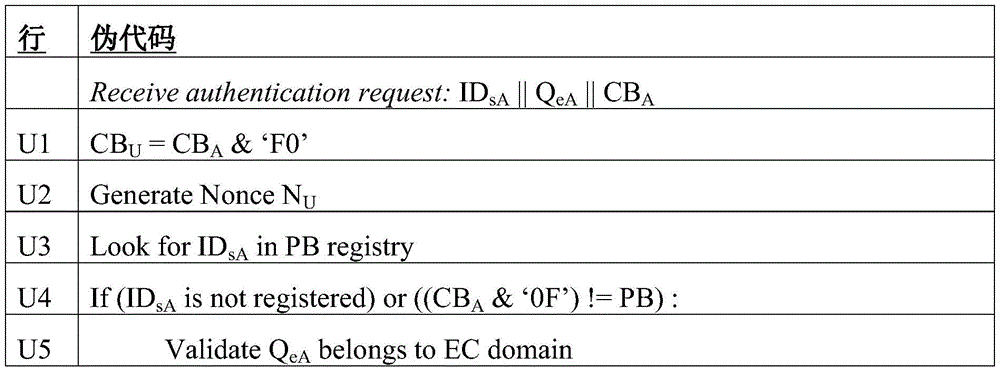
表2Table 2
表2示出了用于实现将用户设备数据安全地传输至访问设备的方法的伪代码清单。如下面所描述的,通过与访问设备102通信的用户设备101来执行表2的方法。然而,在其他实施例中,可以由任何其他适当实体来执行所述方法。Table 2 shows a pseudo-code listing for implementing a method of securely transferring user device data to an access device. The methods of Table 2 are performed by the
在表2的方法之前,可以从访问设备102接收认证请求消息。认证请求可以包括访问设备标识符(IDsA)、暂时性公钥(QeA)、以及指示关于访问设备102的各种信息的访问设备协议控制字节(CBA)。Prior to the method of Table 2, an authentication request message may be received from the
在步骤U1,使用所接收到的访问设备协议控制字节(CBA)准备用户设备协议控制字节(CBU)。At step U1, the user equipment protocol control byte (CB U ) is prepared using the received access device protocol control byte (CB A ).
在步骤U2,生成密码随机数(NU)。In step U2, a cryptographic random number (N U ) is generated.
在步骤U3,在用户设备101处的注册表查找接收到的访问设备标识符(IDsA)。At step U3, the received access device identifier (ID sA ) is looked up in the registry at the
在步骤U4,如果访问设备标识符(IDsA)未注册,或如果访问设备协议控制字节(CBA)指示访问设备101不支持持久绑定,则执行步骤U5-U7。在步骤U5,进行检查从而确保暂时性公钥(QeA)属于正确的椭圆曲线(EC)域。在步骤U6,通过结合暂时性公钥(QeA)以及被随机数(NU)遮掩的用户设备私钥(dsU)计算共享秘密(Z)。此外,在步骤U7,使用用户设备公钥(QsU)和随机数的左四个字节(T4(NU))生成用户设备盲公钥(BDataU)。At step U4, if the access device identifier (ID sA ) is not registered, or if the access device protocol control byte (CB A ) indicates that the
在步骤U8,如果在步骤U4所检查的条件非真,则执行步骤U9和U10。在步骤U9,使用访问设备标识符(IDsA)从注册表检索共享秘密(Z)和用户设备盲公钥(BDataU)。在步骤U10,更新用户设备协议控制字节,以指示支持持久绑定。At step U8, if the condition checked at step U4 is not true, steps U9 and U10 are performed. At step U9, the shared secret (Z) and the user device blind public key (BData U ) are retrieved from the registry using the access device identifier (ID sA ). At step U10, the user equipment protocol control byte is updated to indicate that persistent binding is supported.
在步骤U11,通过取用户设备盲公钥(BDataU)的最左侧8个字节,确定用户设备盲标识符(IDsU)。In step U11, the user equipment blind identifier (ID sU ) is determined by taking the leftmost 8 bytes of the user equipment blind public key (BData U ).
在步骤U12,使用密钥派生函数(KDF)派生出若干会话密钥(SKCFRM、SKMAC、SKENC、以及SKRMAC)、下一个共享秘密(NextZ)、以及下一个密码随机数(NextBlind)。密钥派生函数的输入是共享秘密(Z)、期望的输出长度(len)、以及用户设备盲标识符(IDsU)与访问设备标识符(IDsA)的组合、以及暂时性公钥(QeA)的左16个字节。一旦完成密钥派生函数,在步骤U13,擦除共享秘密。At step U12, several session keys (SK CFRM , SK MAC , SK ENC , and SK RMAC ), the next shared secret (NextZ), and the next cryptographic random number (NextBlind) are derived using a key derivation function (KDF) . The inputs to the key derivation function are the shared secret (Z), the desired output length (len), and the combination of the blind user device identifier (ID sU ) and the access device identifier (ID sA ), and the ephemeral public key (Q ). eA ) the left 16 bytes. Once the key derivation function is completed, at step U13, the shared secret is erased.
在步骤U14,经认证的加密函数(AE)对预先定义的报头(“KC_1_V”)、用户设备证书(CU)、密码随机数(NU)、以及用户协议控制字节(CBU)进行加密。加密函数的结果是加密的用户设备数据(EncDataU)。At step U14, the authenticated encryption function (AE) performs a pre-defined header ("KC_1_V"), user equipment certificate (C U ), cryptographic random number (N U ), and user protocol control bytes (CB U ) encryption. The result of the encryption function is encrypted user device data (EncData U ).
在步骤U15,如果用户设备101和访问设备102支持持久绑定(如其相应的协议控制字节所指示的),并且或者访问设备标识符(IDsA)未注册或请求重新册(如访问控制协议控制字节所指示的),则执行步骤U16-U17。在步骤U16,对下一个共享秘密(NextZ)、和下一个用户设备盲公钥(NextBDataU)进行注册并将其与访问设备标识符(IDsA)相关联。在步骤U17,更新用户设备协议控制字节(CBU),从而指示用户设备101计算了与访问设备102相关联的下一个新的共享秘密。At step U15, if the
在步骤U18,如果在步骤U15的条件非真并且用户设备101不支持持久绑定,则在步骤U19更新用户设备协议控制字节(CBU)以指示不支持持久绑定。At step U18, if the condition at step U15 is not true and the
在步骤U20,向访问设备102发送认证响应消息,包括用户设备盲公钥(BDataU)和加密的用户设备数据(EncDataU)。In step U20, an authentication response message is sent to the
V.装置V. Device
图9示出了卡形式的支付设备101”的示例。如所示,支付设备101”包括塑料基板101(m)。在一些实施例中,用于与访问设备102接口连接的非接触式元件101(o)可以存在于塑料基板101(m)上或嵌入其中。可以将用户信息101(p),如账号、失效日期、和/或用户姓名打印或浮雕在卡上。塑料基板101(m)上还可以存在磁条101(n)。在一些实施例中,支付设备101”可以包括微处理器和/或存储器芯片,其中存储着用户数据。Figure 9 shows an example of a
如上文指出及图9中所示的,支付设备101”可以包括磁条101(n)和非接触式元件101(o)。在一些实施例中,磁条101(n)和非接触式元件101(o)都在支付设备101”中。在一些实施例中,磁条101(n)或者非接触式元件101(o)可以存在于支付设备101”中。As noted above and shown in Figure 9,
图10是可以用于实现上述任何实体或部件的计算机系统的高级框图。图10中所示的子系统经由系统总线1075互连。附加子系统包括打印机1003、键盘1006、固定磁盘1007、以及联接至显示器适配器1004的监视器1009。联接至I/O控制器1000的外围设备和输入/输出(I/O)设备可以通过本领域中已知的任何数量的装置(如串行端口)连接至计算机系统。例如,串行端口1005或外部接口1008可以用于将计算机装置连接至广域网(如互联网)、鼠标输入设备、或扫描仪。经由系统总线1075的互连允许中央处理器1002与每个子系统通信和控制来自系统存储器1001或固定磁盘1007的指令的执行、以及子系统之间信息的交换。系统存储器1001和/或固定磁盘可以实施计算机可读介质。10 is a high-level block diagram of a computer system that may be used to implement any of the entities or components described above. The subsystems shown in FIG. 10 are interconnected via a
如所描述的,发明服务可以涉及实现一个或多个功能、过程、操作或方法步骤。在一些实施例中,这些功能、过程、操作或方法步骤可以实现为由适当编程的计算设备、微处理器、数据处理器等执行指令集或软件代码的结果。可以将指令集或软件代码存储在存储器或由计算设备、微处理器等访问的其他形式的数据存储元件中。在其他实施例中,这些功能、过程、操作或方法步骤可以由固件或专用处理器、集成电路等实现。As described, an invention service may involve implementing one or more functions, processes, operations, or method steps. In some embodiments, the functions, procedures, operations, or method steps may be implemented as the result of execution of sets of instructions or software codes by a suitably programmed computing device, microprocessor, data processor, or the like. The set of instructions or software codes may be stored in a memory or other form of data storage element accessible by a computing device, microprocessor, or the like. In other embodiments, the functions, processes, operations, or method steps may be implemented by firmware or special purpose processors, integrated circuits, or the like.
应理解到,上述本发明可以用模块化方式或集成方式呈使用计算机软件的控制逻辑的形式实现。基于本文中提供的披露内容和教导,本领域的普通技术人员将了解和认识到使用硬件和硬件与软件的组合实现本发明的其他方式和/或方法。It will be appreciated that the invention described above may be implemented in a modular fashion or in an integrated fashion in the form of control logic using computer software. Based on the disclosure and teachings provided herein, those of ordinary skill in the art will understand and appreciate other ways and/or methods of implementing the present invention using hardware and combinations of hardware and software.
本说明书中所描述的任何软件部件或功能可以实现为有待由处理器使用任何合适的计算机语言(例如,像使用例如常规的或面向对象的技术的Java、C++或Perl)执行的软件代码。软件代码可以作为一系列指令或命令存储在计算机可读介质上,如随机存取存储器(RAM)、只读存储器(ROM)、磁介质(如硬盘驱动器或软盘)、或光介质(如CD-ROM)。任何这种计算机可读介质可以驻留在单个计算装置上或内,并且可以是存在于系统或网络内的不同计算装置上或内。Any software components or functions described in this specification may be implemented as software code to be executed by a processor using any suitable computer language such as Java, C++ or Perl using eg conventional or object oriented techniques. The software code may be stored as a series of instructions or commands on a computer-readable medium, such as random access memory (RAM), read only memory (ROM), magnetic media (such as a hard drive or floppy disk), or optical media (such as CD- ROM). Any such computer-readable medium may reside on or within a single computing device and may be present on or within different computing devices within a system or network.
虽然已经详细描述并在附图中示出了某些示例性实施例,但应当理解的是,此类实施例仅是示意性的并且不旨在限制宽泛的发明,并且本发明不限于所示和所描述的特定安排和构造,因为本领域的普通技术人员可以对这些实施例进行各种其他修改。While certain exemplary embodiments have been described in detail and shown in the accompanying drawings, it should be understood that such embodiments are illustrative only and are not intended to limit the broad invention, and that the invention is not limited to those shown and the specific arrangements and constructions described, as various other modifications to these embodiments may be made by those of ordinary skill in the art.
除非明确指示有相反的意思,在此所使用的“一个(a)”、“一个(an)”或“所述”旨在指“至少一个”。As used herein, "a (a)," "an (an)," or "the" is intended to mean "at least one" unless expressly indicated to the contrary.
Claims (29)
Priority Applications (1)
| Application Number | Priority Date | Filing Date | Title |
|---|---|---|---|
| CN202010070652.8A CN111277597B (en) | 2014-01-13 | 2015-01-13 | Apparatus, system and method for protecting identity in authenticated transactions |
Applications Claiming Priority (3)
| Application Number | Priority Date | Filing Date | Title |
|---|---|---|---|
| US201461926908P | 2014-01-13 | 2014-01-13 | |
| US61/926,908 | 2014-01-13 | ||
| PCT/US2015/011153 WO2015106248A1 (en) | 2014-01-13 | 2015-01-13 | Efficient methods for protecting identity in authenticated transmissions |
Related Child Applications (1)
| Application Number | Title | Priority Date | Filing Date |
|---|---|---|---|
| CN202010070652.8A Division CN111277597B (en) | 2014-01-13 | 2015-01-13 | Apparatus, system and method for protecting identity in authenticated transactions |
Publications (2)
| Publication Number | Publication Date |
|---|---|
| CN105900375A CN105900375A (en) | 2016-08-24 |
| CN105900375B true CN105900375B (en) | 2020-02-07 |
Family
ID=53522258
Family Applications (2)
| Application Number | Title | Priority Date | Filing Date |
|---|---|---|---|
| CN201580004375.8A Active CN105900375B (en) | 2014-01-13 | 2015-01-13 | Apparatus, system and method for protecting identity in authenticated transactions |
| CN202010070652.8A Active CN111277597B (en) | 2014-01-13 | 2015-01-13 | Apparatus, system and method for protecting identity in authenticated transactions |
Family Applications After (1)
| Application Number | Title | Priority Date | Filing Date |
|---|---|---|---|
| CN202010070652.8A Active CN111277597B (en) | 2014-01-13 | 2015-01-13 | Apparatus, system and method for protecting identity in authenticated transactions |
Country Status (5)
| Country | Link |
|---|---|
| US (5) | US9647832B2 (en) |
| EP (2) | EP3095210B1 (en) |
| CN (2) | CN105900375B (en) |
| AU (1) | AU2015204470B2 (en) |
| WO (1) | WO2015106248A1 (en) |
Families Citing this family (73)
| Publication number | Priority date | Publication date | Assignee | Title |
|---|---|---|---|---|
| DE102013108714B3 (en) * | 2013-08-12 | 2014-08-21 | Deutsche Post Ag | Support decryption of encrypted data |
| CN105900375B (en) | 2014-01-13 | 2020-02-07 | 维萨国际服务协会 | Apparatus, system and method for protecting identity in authenticated transactions |
| EP3089091B1 (en) * | 2014-05-02 | 2020-03-11 | Barclays Execution Services Limited | Transaction authentication |
| WO2015188151A1 (en) * | 2014-06-06 | 2015-12-10 | Bittorrent, Inc. | Securely sharing information via a public key- value data store |
| EP3860041B1 (en) | 2014-06-18 | 2023-03-15 | Visa International Service Association | Efficient methods for authenticated communication |
| RU2710897C2 (en) | 2014-08-29 | 2020-01-14 | Виза Интернэшнл Сервис Ассосиэйшн | Methods for safe generation of cryptograms |
| WO2016123264A1 (en) | 2015-01-27 | 2016-08-04 | Visa International Service Association | Methods for secure credential provisioning |
| WO2016129863A1 (en) | 2015-02-12 | 2016-08-18 | Samsung Electronics Co., Ltd. | Payment processing method and electronic device supporting the same |
| WO2016131056A1 (en) | 2015-02-13 | 2016-08-18 | Visa International Service Association | Confidential communication management |
| EP3262582B1 (en) | 2015-02-27 | 2021-03-17 | Samsung Electronics Co., Ltd. | Electronic device providing electronic payment function and operating method thereof |
| US10193700B2 (en) | 2015-02-27 | 2019-01-29 | Samsung Electronics Co., Ltd. | Trust-zone-based end-to-end security |
| EP3062270B1 (en) * | 2015-02-27 | 2021-09-15 | Samsung Electronics Co., Ltd. | Method and apparatus for providing card service using electronic device |
| KR102460459B1 (en) | 2015-02-27 | 2022-10-28 | 삼성전자주식회사 | Method and apparatus for providing card service using electronic device |
| US11138585B2 (en) * | 2015-03-11 | 2021-10-05 | Paypal, Inc. | NFC cookies for enhanced mobile transactions and payments |
| CN113630416A (en) | 2015-06-30 | 2021-11-09 | 维萨国际服务协会 | Secret authentication and provisioning |
| US9390154B1 (en) | 2015-08-28 | 2016-07-12 | Swirlds, Inc. | Methods and apparatus for a distributed database within a network |
| US9529923B1 (en) | 2015-08-28 | 2016-12-27 | Swirlds, Inc. | Methods and apparatus for a distributed database within a network |
| US10747753B2 (en) | 2015-08-28 | 2020-08-18 | Swirlds, Inc. | Methods and apparatus for a distributed database within a network |
| US9584493B1 (en) * | 2015-12-18 | 2017-02-28 | Wickr Inc. | Decentralized authoritative messaging |
| US9602477B1 (en) | 2016-04-14 | 2017-03-21 | Wickr Inc. | Secure file transfer |
| US9591479B1 (en) * | 2016-04-14 | 2017-03-07 | Wickr Inc. | Secure telecommunications |
| US10972257B2 (en) | 2016-06-07 | 2021-04-06 | Visa International Service Association | Multi-level communication encryption |
| WO2018151778A1 (en) * | 2016-11-03 | 2018-08-23 | Resmed Limited | Secure networked respiratory therapy systems |
| RU2746446C2 (en) | 2016-11-10 | 2021-04-14 | Свирлдз, Инк. | Methods and the device for distributed database containing anonymous input data |
| US10601585B1 (en) * | 2016-12-16 | 2020-03-24 | EMC IP Holding Company LLC | Methods and apparatus for blockchain encryption |
| RU2754189C2 (en) | 2016-12-19 | 2021-08-30 | Свирлдз, Инк. | Method and device for distributed database that allows deleting events |
| KR102156812B1 (en) * | 2017-02-24 | 2020-09-17 | 젬테크 인터나치오날 아게 | Privacy protection message blinding |
| US10313133B2 (en) * | 2017-06-21 | 2019-06-04 | Visa International Service Association | Secure communications providing forward secrecy |
| KR102208336B1 (en) | 2017-07-11 | 2021-01-27 | 스월즈, 인크. | Methods and apparatus for efficiently implementing a distributed database within a network |
| US10819696B2 (en) * | 2017-07-13 | 2020-10-27 | Microsoft Technology Licensing, Llc | Key attestation statement generation providing device anonymity |
| GB2566107B (en) | 2017-09-05 | 2019-11-27 | Istorage Ltd | Methods and systems of securely transferring data |
| JP6798065B2 (en) | 2017-11-01 | 2021-02-03 | スワールズ,インコーポレイテッド | Methods and equipment for efficiently implementing high-speed copyable databases |
| WO2019179608A1 (en) * | 2018-03-20 | 2019-09-26 | Telefonaktiebolaget Lm Ericsson (Publ) | Initial network authorization for a communications device |
| US10841080B2 (en) * | 2018-03-20 | 2020-11-17 | International Business Machines Corporation | Oblivious pseudorandom function in a key management system |
| US10887088B2 (en) * | 2018-03-20 | 2021-01-05 | International Business Machines Corporation | Virtualizing a key hierarchy using a partially-oblivious pseudorandom function (P-OPRF) |
| US10887293B2 (en) | 2018-03-20 | 2021-01-05 | International Business Machines Corporation | Key identifiers in an obliviousness pseudorandom function (OPRF)-based key management service (KMS) |
| US11687929B2 (en) * | 2018-03-23 | 2023-06-27 | American Express Travel Related Services Co., Inc. | Authenticated secure online and offline transactions |
| US11451382B2 (en) * | 2018-05-14 | 2022-09-20 | nChain Holdings Limited | Method and system for communicating a secret |
| US10721064B2 (en) * | 2018-05-30 | 2020-07-21 | Nxp B.V. | Modular key exchange for key agreement and optional authentication |
| US11115206B2 (en) | 2018-08-23 | 2021-09-07 | International Business Machines Corporation | Assymetric structured key recovering using oblivious pseudorandom function |
| US10924267B2 (en) | 2018-08-24 | 2021-02-16 | International Business Machines Corporation | Validating keys derived from an oblivious pseudorandom function |
| KR102659649B1 (en) * | 2018-10-15 | 2024-04-22 | 비자 인터네셔널 서비스 어소시에이션 | Techniques for securely communicating sensitive data for heterogeneous data messages |
| CN112970225B (en) * | 2018-10-29 | 2024-10-18 | 维萨国际服务协会 | Efficient and reliable communication system and method |
| GB2578767B (en) * | 2018-11-07 | 2023-01-18 | Istorage Ltd | Methods and systems of securely transferring data |
| US12462250B2 (en) * | 2019-03-01 | 2025-11-04 | Visa International Service Association | Mobile payments using multiple cryptographic protocols |
| SG11202108394TA (en) | 2019-03-07 | 2021-08-30 | Mastercard International Inc | User verification for credential device |
| US11218330B2 (en) * | 2019-03-25 | 2022-01-04 | Micron Technology, Inc. | Generating an identity for a computing device using a physical unclonable function |
| US11233650B2 (en) | 2019-03-25 | 2022-01-25 | Micron Technology, Inc. | Verifying identity of a vehicle entering a trust zone |
| US11361660B2 (en) | 2019-03-25 | 2022-06-14 | Micron Technology, Inc. | Verifying identity of an emergency vehicle during operation |
| US11323275B2 (en) * | 2019-03-25 | 2022-05-03 | Micron Technology, Inc. | Verification of identity using a secret key |
| CA3134691A1 (en) | 2019-05-22 | 2020-11-26 | Swirlds, Inc. | Methods and apparatus for implementing state proofs and ledger identifiers in a distributed database |
| US11539517B2 (en) * | 2019-09-09 | 2022-12-27 | Cisco Technology, Inc. | Private association of customer information across subscribers |
| US11456855B2 (en) * | 2019-10-17 | 2022-09-27 | Arm Limited | Obfuscating data at-transit |
| GB2589145A (en) | 2019-11-25 | 2021-05-26 | Istorage Ltd | Protected portable media storage |
| US11366933B2 (en) * | 2019-12-08 | 2022-06-21 | Western Digital Technologies, Inc. | Multi-device unlocking of a data storage device |
| KR20220164560A (en) * | 2020-04-15 | 2022-12-13 | 구글 엘엘씨 | 3-party cryptographic handshake protocol |
| DE102020112102B3 (en) * | 2020-05-05 | 2021-05-20 | Infineon Technologies Ag | Method and apparatus for generating a symmetrical session key for encrypted communication |
| CN113873513A (en) * | 2020-06-30 | 2021-12-31 | 云丁网络技术(北京)有限公司 | Method and apparatus for processing control key |
| EP4161033A4 (en) | 2020-06-30 | 2023-11-01 | Yunding Network Technology (Beijing) Co., Ltd. | METHOD AND SYSTEM FOR CONTROLLING AN INTELLIGENT DEVICE |
| KR20230107561A (en) | 2020-10-06 | 2023-07-17 | 헤데라 하쉬그라프, 엘엘씨 | Methods and Apparatus for Distributed Database in a Network |
| US11595189B2 (en) * | 2020-10-27 | 2023-02-28 | Microsoft Technology Licensing, Llc | Secure key exchange using key-associated attributes |
| US12184771B2 (en) * | 2021-05-21 | 2024-12-31 | Samsung Electronics Co., Ltd. | Encryption key generating method, apparatus, ciphertext operation method and apparatus using the generated encryption key |
| WO2022271554A1 (en) * | 2021-06-24 | 2022-12-29 | Google Llc | Protection environment for attestation and sealing using a device identifier composition engine |
| US11785449B2 (en) * | 2021-09-30 | 2023-10-10 | Visa International Service Association | Secure on-demand ultra-wideband communication channels systems and methods |
| CN114006741A (en) * | 2021-10-27 | 2022-02-01 | 杭州弦冰科技有限公司 | Method and system for realizing cluster security deployment of Intel SGX trusted service |
| US12225130B2 (en) * | 2022-01-14 | 2025-02-11 | Micron Technology, Inc. | Embedded TLS protocol for lightweight devices |
| US12225111B2 (en) * | 2022-03-08 | 2025-02-11 | SanDisk Technologies, Inc. | Authorization requests from a data storage device to multiple manager devices |
| US12537668B2 (en) * | 2022-05-17 | 2026-01-27 | Samsung Electronics Co., Ltd | Authentication mechanism for computational storage download program |
| US11811752B1 (en) * | 2022-08-03 | 2023-11-07 | 1080 Network, Inc. | Systems, methods, and computing platforms for executing credential-less network-based communication exchanges |
| WO2024040226A1 (en) * | 2022-08-19 | 2024-02-22 | Authentic Indication, Inc. | Secure computing platform |
| WO2024226179A1 (en) * | 2023-04-27 | 2024-10-31 | Private Tech Inc. | Blinded token device authentication |
| US12267428B2 (en) | 2023-04-27 | 2025-04-01 | Private Tech Inc. | Blinded token device authentication |
| US12273725B2 (en) | 2023-04-27 | 2025-04-08 | Private Tech Inc. | Mobile subscriber identity rotation |
Citations (2)
| Publication number | Priority date | Publication date | Assignee | Title |
|---|---|---|---|---|
| CN101278538A (en) * | 2005-10-05 | 2008-10-01 | 普里瓦斯菲尔公司 | Method and device for user authentication |
| US7707420B1 (en) * | 1999-06-23 | 2010-04-27 | Research In Motion Limited | Public key encryption with digital signature scheme |
Family Cites Families (42)
| Publication number | Priority date | Publication date | Assignee | Title |
|---|---|---|---|---|
| US6007701A (en) | 1999-02-16 | 1999-12-28 | Miami University | Method of removing contaminants from used oil |
| US6453159B1 (en) | 1999-02-25 | 2002-09-17 | Telxon Corporation | Multi-level encryption system for wireless network |
| US7254232B2 (en) | 2001-02-14 | 2007-08-07 | Copytele, Inc. | Method and system for selecting encryption keys from a plurality of encryption keys |
| US7085376B2 (en) | 2001-02-14 | 2006-08-01 | Copytele, Inc. | Method and system for securely exchanging encryption key determination information |
| US7127063B2 (en) | 2001-12-31 | 2006-10-24 | Certicom Corp. | Method and apparatus for computing a shared secret key |
| US20050044385A1 (en) * | 2002-09-09 | 2005-02-24 | John Holdsworth | Systems and methods for secure authentication of electronic transactions |
| WO2004092956A1 (en) | 2003-04-02 | 2004-10-28 | Pathfire, Inc. | Cascading key encryption |
| KR100571820B1 (en) | 2003-10-20 | 2006-04-17 | 삼성전자주식회사 | Conference Session Key Distribution in Cryptosystem Based on Identity Information |
| US8031865B2 (en) | 2004-01-08 | 2011-10-04 | Encryption Solutions, Inc. | Multiple level security system and method for encrypting data within documents |
| US7346773B2 (en) | 2004-01-12 | 2008-03-18 | Cisco Technology, Inc. | Enabling stateless server-based pre-shared secrets |
| US7627760B2 (en) * | 2005-07-21 | 2009-12-01 | Microsoft Corporation | Extended authenticated key exchange |
| EP1748615A1 (en) | 2005-07-27 | 2007-01-31 | Sun Microsystems France S.A. | Method and system for providing public key encryption security in insecure networks |
| DE102006004868B4 (en) | 2005-11-04 | 2010-06-02 | Siemens Ag | Method and server for providing a mobility key |
| US8074078B2 (en) * | 2006-05-15 | 2011-12-06 | Research In Motion Limited | System and method for remote reset of password and encryption key |
| KR101366243B1 (en) * | 2006-12-04 | 2014-02-20 | 삼성전자주식회사 | Method for transmitting data through authenticating and apparatus therefor |
| CN101287277B (en) * | 2007-04-13 | 2012-07-25 | 华为技术有限公司 | Method and system for providing service to customer's terminal in wireless personal area network |
| EP2163067B1 (en) | 2008-02-22 | 2013-12-25 | Security First Corp. | Systems and methods for secure workgroup management and communication |
| JP4613969B2 (en) * | 2008-03-03 | 2011-01-19 | ソニー株式会社 | Communication apparatus and communication method |
| US8406735B2 (en) * | 2008-06-24 | 2013-03-26 | Stmicroelectronics S.R.L. | Method for pairing electronic equipment in a wireless network system |
| USH2270H1 (en) | 2009-07-09 | 2012-06-05 | Actividentity, Inc. | Open protocol for authentication and key establishment with privacy |
| US8429408B2 (en) | 2010-06-11 | 2013-04-23 | Certicom Corp. | Masking the output of random number generators in key generation protocols |
| KR20130098368A (en) | 2010-09-21 | 2013-09-04 | 액티비덴티티, 인크. | Shared secret establishment and distribution |
| EP2434715A1 (en) * | 2010-09-24 | 2012-03-28 | Gemalto SA | Method for establishing a secure communication channel |
| EP2518932A3 (en) | 2010-10-05 | 2015-11-18 | Brandenburgische Technische Universität Cottbus-Senftenberg | A method of password-based authentication and session key agreement for secure data transmission, a method for securely transmitting data, and an electronic data transmission system |
| US8756706B2 (en) | 2010-10-12 | 2014-06-17 | Blackberry Limited | Method for securing credentials in a remote repository |
| US8566577B2 (en) | 2010-11-30 | 2013-10-22 | Blackberry Limited | Method and device for storing secured sent message data |
| CN102063592B (en) * | 2011-01-07 | 2013-03-06 | 北京工业大学 | Credible platform and method for controlling hardware equipment by using same |
| US8549299B2 (en) | 2011-02-28 | 2013-10-01 | Certicom Corp. | Accelerated key agreement with assisted computations |
| KR101233254B1 (en) * | 2011-04-26 | 2013-02-14 | 숭실대학교산학협력단 | Session key sharing method between Wireless Communication devices by using variable length of authentication code |
| US20120314865A1 (en) * | 2011-06-07 | 2012-12-13 | Broadcom Corporation | NFC Communications Device for Setting Up Encrypted Email Communication |
| US20130091353A1 (en) | 2011-08-01 | 2013-04-11 | General Instrument Corporation | Apparatus and method for secure communication |
| DE102011080876A1 (en) * | 2011-08-12 | 2013-02-14 | Tridonic Gmbh & Co Kg | Device ownership management and commissioning in wireless networks with public key encryption |
| JP5367039B2 (en) | 2011-09-30 | 2013-12-11 | 株式会社東芝 | Server apparatus and program |
| EP2817916B1 (en) | 2012-02-21 | 2020-06-10 | Microchip Technology Incorporated | Cryptographic transmission system using key encryption key |
| US20130343542A1 (en) * | 2012-06-26 | 2013-12-26 | Certicom Corp. | Methods and devices for establishing trust on first use for close proximity communications |
| US8948386B2 (en) | 2012-06-27 | 2015-02-03 | Certicom Corp. | Authentication of a mobile device by a network and key generation |
| CN103078741B (en) * | 2013-01-07 | 2016-04-20 | 南通大学 | A kind of RFID bidirectional identification protocol method |
| KR102123210B1 (en) | 2013-01-10 | 2020-06-15 | 닛본 덴끼 가부시끼가이샤 | Mtc key management for key derivation at both ue and network |
| GB201310084D0 (en) | 2013-06-06 | 2013-07-17 | Mastercard International Inc | Improvements to electronic authentication systems |
| CN105900375B (en) | 2014-01-13 | 2020-02-07 | 维萨国际服务协会 | Apparatus, system and method for protecting identity in authenticated transactions |
| EP3860041B1 (en) | 2014-06-18 | 2023-03-15 | Visa International Service Association | Efficient methods for authenticated communication |
| RU2710897C2 (en) | 2014-08-29 | 2020-01-14 | Виза Интернэшнл Сервис Ассосиэйшн | Methods for safe generation of cryptograms |
-
2015
- 2015-01-13 CN CN201580004375.8A patent/CN105900375B/en active Active
- 2015-01-13 EP EP15735349.1A patent/EP3095210B1/en active Active
- 2015-01-13 CN CN202010070652.8A patent/CN111277597B/en active Active
- 2015-01-13 EP EP22155816.6A patent/EP4027576B1/en active Active
- 2015-01-13 AU AU2015204470A patent/AU2015204470B2/en active Active
- 2015-01-13 US US14/595,792 patent/US9647832B2/en active Active
- 2015-01-13 WO PCT/US2015/011153 patent/WO2015106248A1/en not_active Ceased
-
2017
- 2017-04-17 US US15/489,409 patent/US9967090B2/en active Active
-
2018
- 2018-03-13 US US15/920,271 patent/US10129020B2/en active Active
- 2018-03-13 US US15/920,236 patent/US10313110B2/en active Active
-
2019
- 2019-05-03 US US16/403,185 patent/US10666428B2/en active Active
Patent Citations (2)
| Publication number | Priority date | Publication date | Assignee | Title |
|---|---|---|---|---|
| US7707420B1 (en) * | 1999-06-23 | 2010-04-27 | Research In Motion Limited | Public key encryption with digital signature scheme |
| CN101278538A (en) * | 2005-10-05 | 2008-10-01 | 普里瓦斯菲尔公司 | Method and device for user authentication |
Non-Patent Citations (1)
| Title |
|---|
| "An Analysis of the EMV Channel Establishment Protocol";CHRISTINA;《INTERNATIONAL ASSOCIATION FOR CPYPTOLOGIC RESEARCH》;20131105;1-30 * |
Also Published As
| Publication number | Publication date |
|---|---|
| AU2015204470B2 (en) | 2019-03-07 |
| US20170222801A1 (en) | 2017-08-03 |
| CN105900375A (en) | 2016-08-24 |
| EP3095210B1 (en) | 2022-03-23 |
| CN111277597B (en) | 2022-08-16 |
| EP4027576A1 (en) | 2022-07-13 |
| US20190260578A1 (en) | 2019-08-22 |
| US9967090B2 (en) | 2018-05-08 |
| US10666428B2 (en) | 2020-05-26 |
| WO2015106248A1 (en) | 2015-07-16 |
| US20180205538A1 (en) | 2018-07-19 |
| AU2015204470A1 (en) | 2016-07-14 |
| EP4027576B1 (en) | 2023-11-22 |
| US9647832B2 (en) | 2017-05-09 |
| US20180205539A1 (en) | 2018-07-19 |
| US10129020B2 (en) | 2018-11-13 |
| EP3095210A1 (en) | 2016-11-23 |
| US10313110B2 (en) | 2019-06-04 |
| EP3095210A4 (en) | 2018-05-30 |
| US20150200774A1 (en) | 2015-07-16 |
| CN111277597A (en) | 2020-06-12 |
Similar Documents
| Publication | Publication Date | Title |
|---|---|---|
| CN105900375B (en) | Apparatus, system and method for protecting identity in authenticated transactions | |
| US11856104B2 (en) | Methods for secure credential provisioning | |
| US11588637B2 (en) | Methods for secure cryptogram generation | |
| CN106664206B (en) | Efficient method for authenticated communication | |
| HK1241588A1 (en) | Methods for secure credential provisioning |
Legal Events
| Date | Code | Title | Description |
|---|---|---|---|
| C06 | Publication | ||
| PB01 | Publication | ||
| C10 | Entry into substantive examination | ||
| SE01 | Entry into force of request for substantive examination | ||
| GR01 | Patent grant | ||
| GR01 | Patent grant |