CN105654041B - Gait data-based characteristic parameter acquisition method and device - Google Patents
Gait data-based characteristic parameter acquisition method and device Download PDFInfo
- Publication number
- CN105654041B CN105654041B CN201510990401.0A CN201510990401A CN105654041B CN 105654041 B CN105654041 B CN 105654041B CN 201510990401 A CN201510990401 A CN 201510990401A CN 105654041 B CN105654041 B CN 105654041B
- Authority
- CN
- China
- Prior art keywords
- pressure value
- pressure
- ordinate
- pressure sensor
- center point
- Prior art date
- Legal status (The legal status is an assumption and is not a legal conclusion. Google has not performed a legal analysis and makes no representation as to the accuracy of the status listed.)
- Expired - Fee Related
Links
Images


Classifications
-
- G—PHYSICS
- G06—COMPUTING OR CALCULATING; COUNTING
- G06F—ELECTRIC DIGITAL DATA PROCESSING
- G06F2218/00—Aspects of pattern recognition specially adapted for signal processing
- G06F2218/08—Feature extraction
- G06F2218/10—Feature extraction by analysing the shape of a waveform, e.g. extracting parameters relating to peaks
Landscapes
- Engineering & Computer Science (AREA)
- Computer Vision & Pattern Recognition (AREA)
- Theoretical Computer Science (AREA)
- Artificial Intelligence (AREA)
- Signal Processing (AREA)
- Physics & Mathematics (AREA)
- General Engineering & Computer Science (AREA)
- General Physics & Mathematics (AREA)
- Measurement Of The Respiration, Hearing Ability, Form, And Blood Characteristics Of Living Organisms (AREA)
Abstract
本发明公开了一种基于步态数据的特征参数获取方法和装置。其中,该方法包括:在第一预设时间内通过压力传感器采集检测对象在行走过程中足部的步态数据;其中,该步态数据包括该压力传感器的坐标和通过该压力传感器采集到的压力值;对每个该压力传感器采集的该压力值进行处理得到目标压力值,并根据该目标压力值和该压力传感器的坐标得到压力值中心点的坐标,并生成该压力值中心点的纵坐标序列;根据该压力值中心点的纵坐标序列通过双峰分布概率模型得到特征参数,并输出该特征参数。本发明解决了能够细粒度的根据足底压力的步态数据获取对应的特征参数。

The invention discloses a method and device for acquiring characteristic parameters based on gait data. Wherein, the method includes: collecting gait data of the feet of the detection object during walking by using a pressure sensor within a first preset time; wherein, the gait data includes the coordinates of the pressure sensor and the data collected through the pressure sensor. pressure value; the pressure value collected by each pressure sensor is processed to obtain a target pressure value, and the coordinates of the center point of the pressure value are obtained according to the target pressure value and the coordinates of the pressure sensor, and the vertical axis of the center point of the pressure value is generated. Coordinate sequence; according to the ordinate sequence of the center point of the pressure value, the characteristic parameter is obtained through the bimodal distribution probability model, and the characteristic parameter is output. The invention solves the problem that the corresponding characteristic parameters can be acquired according to the gait data of the plantar pressure in a fine-grained manner.
Description
技术领域technical field
本发明涉及医学领域,具体而言,涉及一种基于步态数据的特征参数获取方法和装置。The present invention relates to the field of medicine, and in particular, to a method and device for acquiring characteristic parameters based on gait data.
背景技术Background technique
现在,通过压力采集设备能够获取用户的足底压力的步态数据,从而对该步态数据进行分析获知用户的步态状况。Now, the gait data of the user's plantar pressure can be obtained through the pressure collection device, so as to analyze the gait data to obtain the user's gait condition.
现有的基于足底压力的步态数据的分析方法主要包括了对静止和运动两种状态下的运动特征研究。静止状态下主要研究压力中心点的转移速度、覆盖面积、轨迹长度以及压力的分布区域等。在运动状态下,主要研究用户步速、步幅长度变化等特征。但是这类研究都是从粗粒度的步与步之间的变化入手,无法细致的描述足底压力的特征。The existing analysis methods of gait data based on plantar pressure mainly include the study of motion characteristics in two states of rest and motion. In the static state, the transfer speed, coverage area, trajectory length and pressure distribution area of the pressure center point are mainly studied. In the motion state, the characteristics of the user's pace and stride length change are mainly studied. However, this kind of research starts from the coarse-grained step-to-step variation, and cannot describe the characteristics of plantar pressure in detail.
针对上述的问题,目前尚未提出有效的解决方案。For the above problems, no effective solution has been proposed yet.
发明内容SUMMARY OF THE INVENTION
本发明实施例提供了一种基于步态数据的特征参数获取方法和装置,能够细粒度的根据足底压力的步态数据获取对应的特征参数。The embodiments of the present invention provide a method and device for acquiring characteristic parameters based on gait data, which can acquire corresponding characteristic parameters according to the gait data of plantar pressure in a fine-grained manner.
根据本发明实施例的一个方面,提供了一种基于步态数据的特征参数获取方法,包括:在第一预设时间内通过压力传感器采集检测对象在行走过程中足部的步态数据;其中,所述步态数据包括所述压力传感器的坐标和通过所述压力传感器采集到的压力值;对每个所述压力传感器采集的所述压力值进行处理得到目标压力值,并根据所述目标压力值和所述压力传感器的坐标得到压力值中心点的坐标,并生成所述压力值中心点的纵坐标序列;根据所述压力值中心点的纵坐标序列通过双峰分布概率模型得到特征参数,并输出所述特征参数。According to an aspect of the embodiments of the present invention, a method for obtaining characteristic parameters based on gait data is provided, including: collecting gait data of the feet of a detection object during walking by using a pressure sensor within a first preset time; wherein , the gait data includes the coordinates of the pressure sensor and the pressure value collected by the pressure sensor; the pressure value collected by each pressure sensor is processed to obtain a target pressure value, and according to the target pressure value The pressure value and the coordinates of the pressure sensor obtain the coordinates of the center point of the pressure value, and generate the ordinate sequence of the center point of the pressure value; according to the ordinate sequence of the center point of the pressure value, the characteristic parameters are obtained through a bimodal distribution probability model , and output the feature parameters.
根据本发明实施例的另一方面,还提供了一种基于步态数据的特征参数获取装置,包括:采集单元,用于在第一预设时间内通过压力传感器采集检测对象在行走过程中足部的步态数据;其中,所述步态数据包括所述压力传感器的坐标和通过所述压力传足部的步态数据;其中,所述步态数据包括所述压力传感器的坐标和通过所述压力传感器采集到的压力值;处理单元,用于对每个所述压力传感器采集的所述压力值进行处理得到目标压力值,并根据所述目标压力值和所述压力传感器的坐标得到压力值中心点的坐标,并生成所述压力值中心点的纵坐标序列;参数获取单元,用于根据所述压力值中心点的纵坐标序列通过双峰分布概率模型得到特征参数,并输出所述特征参数。According to another aspect of the embodiments of the present invention, a device for acquiring characteristic parameters based on gait data is also provided, including: a collection unit configured to collect, through a pressure sensor within a first preset time, the feet of the detected object during walking. The gait data of the part; wherein the gait data includes the coordinates of the pressure sensor and the gait data of the foot transmitted by the pressure; wherein, the gait data includes the coordinates of the pressure sensor and the gait data transmitted by the pressure sensor. The pressure value collected by the pressure sensor; the processing unit is used to process the pressure value collected by each pressure sensor to obtain a target pressure value, and obtain the pressure according to the target pressure value and the coordinates of the pressure sensor The coordinates of the center point of the pressure value are generated, and the ordinate sequence of the center point of the pressure value is generated; the parameter acquisition unit is used to obtain characteristic parameters through a bimodal distribution probability model according to the ordinate sequence of the center point of the pressure value, and output the Characteristic Parameters.
在本发明实施例中,在第一预设时间内通过压力传感器采集检测对象在行走过程中足部的步态数据;其中,该步态数据包括该压力传感器的坐标和通过该压力传感器采集到的压力值;对每个该传感器采集的该压力值进行处理得到目标压力值,并根据该目标压力值和该压力传感器的坐标得到压力值中心点的坐标,并生成该压力值中心点的纵坐标序列;根据所述压力值中心点的纵坐标序列通过双峰分布概率模型得到特征参数,并输出所述特征参数。这样,通过压力传感器获取步态数据,并通过统计学模型对该步态数据进行处理,实现更加细致的对步态数据进行分析,能够细粒度的根据足底压力的步态数据获取对应的特征参数。In the embodiment of the present invention, the gait data of the foot of the detection object during walking is collected by the pressure sensor within the first preset time; wherein, the gait data includes the coordinates of the pressure sensor and the data collected by the pressure sensor. The pressure value collected by each sensor is processed to obtain the target pressure value, and the coordinates of the center point of the pressure value are obtained according to the target pressure value and the coordinates of the pressure sensor, and the vertical axis of the center point of the pressure value is generated. Coordinate sequence; according to the ordinate sequence of the center point of the pressure value, characteristic parameters are obtained through a bimodal distribution probability model, and the characteristic parameters are output. In this way, the gait data is obtained through the pressure sensor, and the gait data is processed through a statistical model, so as to realize a more detailed analysis of the gait data, and obtain the corresponding features according to the gait data of the plantar pressure in a fine-grained manner. parameter.
附图说明Description of drawings
此处所说明的附图用来提供对本发明的进一步理解,构成本申请的一部分,本发明的示意性实施例及其说明用于解释本发明,并不构成对本发明的不当限定。在附图中:The accompanying drawings described herein are used to provide a further understanding of the present invention and constitute a part of the present application. The exemplary embodiments of the present invention and their descriptions are used to explain the present invention and do not constitute an improper limitation of the present invention. In the attached image:
图1是根据本发明实施例的一种可选的基于步态数据的特征参数获取方法的流程示意图;1 is a schematic flowchart of an optional method for obtaining characteristic parameters based on gait data according to an embodiment of the present invention;
图2是根据本发明实施例的另一种可选的基于步态数据的特征参数获取方法的流程示意图;2 is a schematic flowchart of another optional method for obtaining characteristic parameters based on gait data according to an embodiment of the present invention;
图3是根据本发明实施例的一种可选的基于步态数据的特征参数获取装置的结构示意图。FIG. 3 is a schematic structural diagram of an optional device for acquiring characteristic parameters based on gait data according to an embodiment of the present invention.
具体实施方式Detailed ways
为了使本技术领域的人员更好地理解本发明方案,下面将结合本发明实施例中的附图,对本发明实施例中的技术方案进行清楚、完整地描述,显然,所描述的实施例仅仅是本发明一部分的实施例,而不是全部的实施例。基于本发明中的实施例,本领域普通技术人员在没有做出创造性劳动前提下所获得的所有其他实施例,都应当属于本发明保护的范围。In order to make those skilled in the art better understand the solutions of the present invention, the technical solutions in the embodiments of the present invention will be clearly and completely described below with reference to the accompanying drawings in the embodiments of the present invention. Obviously, the described embodiments are only Embodiments are part of the present invention, but not all embodiments. Based on the embodiments of the present invention, all other embodiments obtained by persons of ordinary skill in the art without creative efforts shall fall within the protection scope of the present invention.
需要说明的是,本发明的说明书和权利要求书及上述附图中的术语“第一”、“第二”等是用于区别类似的对象,而不必用于描述特定的顺序或先后次序。应该理解这样使用的数据在适当情况下可以互换,以便这里描述的本发明的实施例能够以除了在这里图示或描述的那些以外的顺序实施。此外,术语“包括”和“具有”以及他们的任何变形,意图在于覆盖不排他的包含,例如,包含了一系列步骤或单元的过程、方法、系统、产品或设备不必限于清楚地列出的那些步骤或单元,而是可包括没有清楚地列出的或对于这些过程、方法、产品或设备固有的其它步骤或单元。It should be noted that the terms "first", "second" and the like in the description and claims of the present invention and the above drawings are used to distinguish similar objects, and are not necessarily used to describe a specific sequence or sequence. It is to be understood that the data so used may be interchanged under appropriate circumstances such that the embodiments of the invention described herein can be practiced in sequences other than those illustrated or described herein. Furthermore, the terms "comprising" and "having" and any variations thereof, are intended to cover non-exclusive inclusion, for example, a process, method, system, product or device comprising a series of steps or units is not necessarily limited to those expressly listed Rather, those steps or units may include other steps or units not expressly listed or inherent to these processes, methods, products or devices.
根据本发明实施例,提供了一种基于步态数据的特征参数获取方法实施例,需要说明的是,在附图的流程图示出的步骤可以在诸如一组计算机可执行指令的计算机系统中执行,并且,虽然在流程图中示出了逻辑顺序,但是在某些情况下,可以以不同于此处的顺序执行所示出或描述的步骤。According to an embodiment of the present invention, an embodiment of a method for obtaining characteristic parameters based on gait data is provided. It should be noted that the steps shown in the flowchart of the accompanying drawings may be implemented in a computer system such as a set of computer-executable instructions. and, although a logical order is shown in the flowcharts, in some cases the steps shown or described may be performed in an order different from that herein.
图1是根据本发明实施例的一种基于步态数据的特征参数获取方法,如图1所示,本发明实施例的执行主体为基于步态数据的特征参数获取装置,该方法包括如下步骤:FIG. 1 is a method for obtaining characteristic parameters based on gait data according to an embodiment of the present invention. As shown in FIG. 1 , the execution subject of the embodiment of the present invention is a device for obtaining characteristic parameters based on gait data, and the method includes the following steps :
步骤S102,在第一预设时间内通过压力传感器采集检测对象在行走过程中足部的步态数据;其中,该步态数据包括该压力传感器的坐标和通过该压力传感器采集到的压力值。Step S102 , collect gait data of the foot of the detection object during walking by using a pressure sensor within a first preset time; wherein, the gait data includes the coordinates of the pressure sensor and the pressure value collected by the pressure sensor.
其中,该压力传感器用于采集检测对象的双足的步态数据,例如可以在双足对应的鞋垫上设置多个压力传感器,该压力传感器采集该检测对象在不需要外力帮助下在水平平路自由行走第一预设时间内的足部的步态数据。Wherein, the pressure sensor is used to collect the gait data of the feet of the detection object. For example, a plurality of pressure sensors can be set on the insoles corresponding to the feet, and the pressure sensors collect the detection object on a level road without the help of external force. The gait data of the foot during the first preset time of free walking.
步骤S104,对每个该压力传感器采集的该压力值进行处理得到目标压力值,并根据该目标压力值和该压力传感器的坐标得到压力值中心点的坐标,并生成该压力值中心点的纵坐标序列。In step S104, the pressure value collected by each pressure sensor is processed to obtain a target pressure value, and the coordinates of the center point of the pressure value are obtained according to the target pressure value and the coordinates of the pressure sensor, and the vertical axis of the center point of the pressure value is generated. Coordinate sequence.
可选地,从该压力值中去除从采集起始时刻起的第二预设时间内采集的压力值以及该足部处于空中摆动状态且压力值不为0的压力值,得到该目标压力值。Optionally, the target pressure value is obtained by removing the pressure value collected within the second preset time from the collection start time and the pressure value in which the foot is in the air swing state and the pressure value is not 0 from the pressure value. .
具体地,首先,将该检测对象开始行走时的第二预设时间(如20秒)内的步态数据去除,避免因检测对象未进入正常行走状态而引起误差;其次,进行步态阶段识别,并将处于摆动器且压力值不为0的压力值去除。Specifically, first, remove the gait data within the second preset time (such as 20 seconds) when the detection object starts walking to avoid errors caused by the detection object not entering a normal walking state; secondly, perform gait stage identification , and removes pressure values that are in the oscillator and whose pressure value is not 0.
其中,该步态阶段包括支撑期和摆动期,支撑期为该检测对象的足部处于着地状态的时期,摆动期为该检测对象的足部处于空中摆动状态的时期。The gait stage includes a support period and a swing period, the support period is a period when the foot of the detection object is in a grounded state, and the swing period is a period when the foot of the detection object is in a swing state in the air.
可选地,通过以下公式得到该压力值中心点的坐标:Optionally, the coordinates of the center point of the pressure value are obtained by the following formula:

其中,X为该压力值中心点的横坐标,Y为该压力值中心点的纵坐标,Xi为第i个该压力传感器的横坐标,Yi第i个该压力传感器的纵坐标,Pi为第i个该压力传感器采集的压力值,n为该压力传感器的个数。Among them, X is the abscissa of the center point of the pressure value, Y is the ordinate of the center point of the pressure value, X i is the abscissa of the ith pressure sensor, Y i is the ordinate of the ith pressure sensor, P i is the pressure value collected by the i-th pressure sensor, and n is the number of the pressure sensor.
步骤S106,根据该压力值中心点的纵坐标序列通过双峰分布概率模型得到特征参数,并输出该特征参数。Step S106, obtaining characteristic parameters through a bimodal distribution probability model according to the ordinate sequence of the center point of the pressure value, and outputting the characteristic parameters.
可选地,通过以下公式将该压力值中心点的纵坐标序列划分成N个纵坐标区间,并获取每个该纵坐标区间内的样本个数与该纵坐标序列的样本总数的比值,并根据该比值通过双峰分布概率模型进行拟合得到特征参数。Optionally, divide the vertical coordinate sequence of the pressure value center point into N vertical coordinate intervals by the following formula, and obtain the ratio of the number of samples in each vertical coordinate interval to the total number of samples in the vertical coordinate sequence, and According to the ratio, the characteristic parameters are obtained by fitting a bimodal distribution probability model.
具体地,该公式为:Specifically, the formula is:
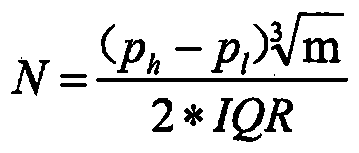
其中,N为该纵坐标区间的个数,ph为该纵坐标序列中的最大值,pl为该纵坐标序列中的最小值,m为该纵坐标序列的样本总数,IQR为四分位距;Among them, N is the number of the ordinate interval, ph is the maximum value in the ordinate sequence, p l is the minimum value in the ordinate sequence, m is the total number of samples in the ordinate sequence, and IQR is the quarter bit distance;
在本发明实施例中,该IQR在数值上等于上四分位值减去下四分位值。In this embodiment of the present invention, the IQR is numerically equal to the upper quartile value minus the lower quartile value.
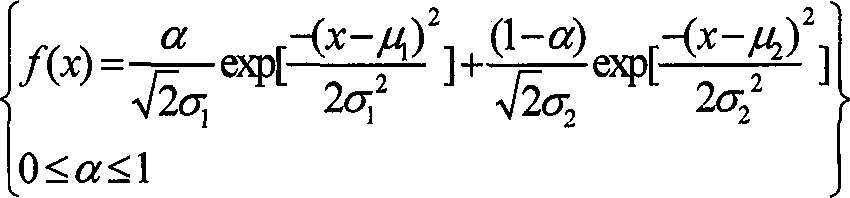
可选地,该双峰分布概率模型为:Optionally, the bimodal distribution probability model is:

其中,μ1,σ1和μ2,σ2分别为两个正态分布概率密度函数的期望和标准差,α为混合系数,该特征参数包括μ1、σ1、μ2和σ2以及α。Among them, μ 1 , σ 1 and μ 2 , σ 2 are the expectation and standard deviation of the probability density functions of the two normal distributions, respectively, α is the mixing coefficient, and the characteristic parameters include μ 1 , σ 1 , μ 2 and σ 2 and a.
具体地,通过调整双峰概率分布的5个参数(μ1,σ1,μ2,σ2以及α),使双峰概率分布的曲线与得到的全部比值的均方根误差最小,则确定此时的μ1,σ1,μ2,σ2和α为得到的特征参数。Specifically, by adjusting the five parameters (μ 1 , σ 1 , μ 2 , σ 2 and α) of the bimodal probability distribution, the root mean square error of the curve of the bimodal probability distribution and all the obtained ratios is minimized, then determine At this time μ 1 , σ 1 , μ 2 , σ 2 and α are obtained characteristic parameters.
需要说明的是,在得到上述特征参数后,通过对该特征参数进一步地的处理能够获取该检测对象的步态状态,示例地,通过对该特征参数的后续处理,能够识别帕金森患者异常步态,例如,应用t检验观察正常人和帕金森患者的左右脚对应的5个特征参数是否具有显著性差异,将具有显著性差异的特征参数作为输入,根据该输入的特征参数利用人工神经网络的方法对正常人和帕金森患者的步态进行分类,实现对帕金森患者异常步态的识别。It should be noted that, after obtaining the above characteristic parameters, the gait state of the detection object can be obtained by further processing the characteristic parameters. For example, the abnormal gait of Parkinson's patients can be identified by subsequent processing of the characteristic parameters. For example, use the t test to observe whether the 5 characteristic parameters corresponding to the left and right feet of normal people and Parkinson's patients have significant differences, take the characteristic parameters with significant differences as input, and use the artificial neural network according to the input characteristic parameters. The method classifies the gait of normal people and Parkinson's patients, and realizes the identification of abnormal gait in Parkinson's patients.
在本发明实施例中,由于正常人在自由行走时压力中心点在足跟中间区域和前脚掌两个区域转移较慢,而在足跟前部、足弓和脚趾区域转移较快。因此,在前后方向压力中心点在足跟中部和前脚掌分布相对密集,其他区域分布相对稀疏,从而,压力中心点在前后方向形成双峰分布的趋势。但是对于步态异常的人,如帕金森患者,由于中枢神经系统机能受到损伤,其足底着地方式也发生变化。典型的着地方式包括脚掌水平着地和脚尖先着地。因此,帕金森患者的足底压力中心点的分布也与正常人产生明显区别,具体表现为双峰趋势不明显或不存在双峰分布趋势,因此,上述实施例采用双峰分布概率模型能够更加准确的区分步态正常的人和步态异常的人。In the embodiment of the present invention, the pressure center point is transferred slowly in the middle area of the heel and the forefoot area, and the transfer is faster in the front of the heel, the arch of the foot and the toe area when a normal person walks freely. Therefore, in the anterior and posterior directions, the pressure center points are relatively densely distributed in the middle of the heel and the forefoot, and the distribution in other areas is relatively sparse. Therefore, the pressure center points form a bimodal distribution trend in the anterior and posterior directions. However, for people with abnormal gait, such as Parkinson's patients, due to the damage to the central nervous system, the way their feet land on the ground also changes. Typical landing patterns include ball-level landing and toe-first landing. Therefore, the distribution of the center point of plantar pressure in Parkinson's patients is also significantly different from that in normal people, which is manifested in that the bimodal trend is not obvious or there is no bimodal distribution trend. Therefore, the bimodal distribution probability model in the above embodiment can be more Accurately distinguish people with normal gait from those with abnormal gait.
采用上述步骤,通过压力传感器获取步态数据,并通过统计学模型对该步态数据进行处理,实现更加细致的对步态数据进行分析,能够细粒度的根据足底压力的步态数据获取对应的特征参数。Using the above steps, the gait data is obtained through the pressure sensor, and the gait data is processed through a statistical model, so as to realize a more detailed analysis of the gait data, and obtain the corresponding gait data according to the plantar pressure in a fine-grained manner. characteristic parameters.
图2是根据本发明实施例的一种基于步态数据的特征参数获取方法,如图1所示,该方法的执行主体为基于步态数据的特征参数获取装置,该方法包括如下步骤:2 is a method for obtaining characteristic parameters based on gait data according to an embodiment of the present invention. As shown in FIG. 1 , the execution subject of the method is a device for obtaining characteristic parameters based on gait data, and the method includes the following steps:
步骤S201,在第一预设时间内通过压力传感器采集检测对象在行走过程中足部的步态数据;其中,该步态数据包括该压力传感器的坐标和通过该压力传感器采集到的压力值。Step S201 , collecting gait data of the feet of the detection object during walking by using a pressure sensor within a first preset time; wherein, the gait data includes the coordinates of the pressure sensor and the pressure value collected by the pressure sensor.
其中,该压力传感器用于采集检测对象的双足的步态数据,例如可以在双足对应的鞋垫上设置多个压力传感器,该压力传感器采集该检测对象在不需要外力帮助下在水平平路自由行走第一预设时间内的足部的步态数据。Wherein, the pressure sensor is used to collect the gait data of the feet of the detection object. For example, a plurality of pressure sensors can be set on the insoles corresponding to the feet, and the pressure sensors collect the detection object on a level road without the help of external force. The gait data of the foot during the first preset time of free walking.
步骤S202,从该压力值中去除从采集起始时刻起的第二预设时间内采集的压力值以及该足部处于空中摆动状态且压力值不为0的压力值,得到该目标压力值。Step S202, remove the pressure value collected within the second preset time from the collection start time and the pressure value in which the foot is in the air swing state and the pressure value is not 0 from the pressure value to obtain the target pressure value.
具体地,首先,将该检测对象开始行走时的第二预设时间(如20秒)内的步态数据去除,避免因检测对象未进入正常行走状态而引起误差;其次,进行步态阶段识别,并将处于摆动器且压力值不为0的压力值去除。Specifically, first, remove the gait data within the second preset time (such as 20 seconds) when the detection object starts walking to avoid errors caused by the detection object not entering a normal walking state; secondly, perform gait stage identification , and removes pressure values that are in the oscillator and whose pressure value is not 0.
其中,该步态阶段包括支撑期和摆动期,支撑期为该检测对象的足部处于着地状态的时期,摆动期为该检测对象的足部处于空中摆动状态的时期。The gait stage includes a support period and a swing period, the support period is a period when the foot of the detection object is in a grounded state, and the swing period is a period when the foot of the detection object is in a swing state in the air.
步骤S203,根据该目标压力值和该压力传感器的坐标得到压力值中心点的坐标,并生成该压力值中心点的纵坐标序列。In step S203, the coordinates of the center point of the pressure value are obtained according to the target pressure value and the coordinates of the pressure sensor, and an ordinate sequence of the center point of the pressure value is generated.
具体地,通过以下公式得到该压力值中心点的坐标:Specifically, the coordinates of the center point of the pressure value are obtained by the following formula:
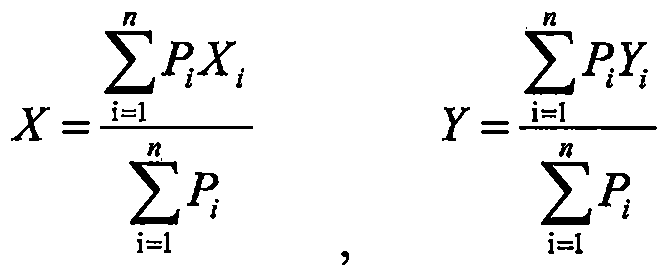
其中,X为该压力值中心点的横坐标,Y为该压力值中心点的纵坐标,Xi为第i个该压力传感器的横坐标,Yi第i个该压力传感器的纵坐标,Pi为第i个该压力传感器采集的压力值,n为该压力传感器的个数。Among them, X is the abscissa of the center point of the pressure value, Y is the ordinate of the center point of the pressure value, X i is the abscissa of the ith pressure sensor, Y i is the ordinate of the ith pressure sensor, P i is the pressure value collected by the i-th pressure sensor, and n is the number of the pressure sensor.
步骤S204,将该压力值中心点的纵坐标序列划分成N个纵坐标区间。Step S204: Divide the ordinate sequence of the center point of the pressure value into N ordinate intervals.
具体地,通过以下公式将该压力值中心点的纵坐标序列划分成N个纵坐标区间:Specifically, the ordinate sequence of the center point of the pressure value is divided into N ordinate intervals by the following formula:

其中,N为该纵坐标区间的个数,ph为该纵坐标序列中的最大值,pl为该纵坐标序列中的最小值,m为该纵坐标序列的样本总数,IQR为四分位距;Among them, N is the number of the ordinate interval, ph is the maximum value in the ordinate sequence, p l is the minimum value in the ordinate sequence, m is the total number of samples in the ordinate sequence, and IQR is the quarter bit distance;
在本发明实施例中,该IQR在数值上等于上四分位值减去下四分位值。In this embodiment of the present invention, the IQR is numerically equal to the upper quartile value minus the lower quartile value.
步骤S205,获取每个该纵坐标区间内的样本个数与该纵坐标序列的样本总数的比值,并根据该比值通过双峰分布概率模型进行拟合得到特征参数,并输出该特征参数。Step S205: Obtain the ratio of the number of samples in each ordinate interval to the total number of samples in the ordinate sequence, and obtain characteristic parameters by fitting a bimodal distribution probability model according to the ratio, and output the characteristic parameters.
其中,该双峰分布概率模型为:Among them, the bimodal distribution probability model is:

其中,μ1,σ1和μ2,σ2分别为两个正态分布概率密度函数的期望和标准差,α为混合系数,该特征参数包括μ1、σ1、μ2和σ2以及α。Among them, μ 1 , σ 1 and μ 2 , σ 2 are the expectation and standard deviation of the probability density functions of the two normal distributions, respectively, α is the mixing coefficient, and the characteristic parameters include μ 1 , σ 1 , μ 2 and σ 2 and a.
需要说明的是,在得到上述特征参数后,通过对该特征参数进一步地的处理能够获取该检测对象的步态状态,示例地,通过对该特征参数的后续处理,能够识别帕金森患者异常步态,例如,应用t检验观察正常人和帕金森患者的左右脚对应的5个特征参数是否具有显著性差异,将具有显著性差异的特征参数作为输入,根据该输入的特征参数利用人工神经网络的方法对正常人和帕金森患者的步态进行分类,实现对帕金森患者异常步态的识别。It should be noted that, after obtaining the above characteristic parameters, the gait state of the detection object can be obtained by further processing the characteristic parameters. For example, the abnormal gait of Parkinson's patients can be identified by subsequent processing of the characteristic parameters. For example, use the t test to observe whether the 5 characteristic parameters corresponding to the left and right feet of normal people and Parkinson's patients have significant differences, take the characteristic parameters with significant differences as input, and use the artificial neural network according to the input characteristic parameters. The method classifies the gait of normal people and Parkinson's patients, and realizes the identification of abnormal gait in Parkinson's patients.
在本发明实施例中,由于正常人在自由行走时压力中心点在足跟中间区域和前脚掌两个区域转移较慢,而在足跟前部、足弓和脚趾区域转移较快。因此,在前后方向压力中心点在足跟中部和前脚掌分布相对密集,其他区域分布相对稀疏,从而,压力中心点在前后方向形成双峰分布的趋势。但是对于步态异常的人,如帕金森患者,由于中枢神经系统机能受到损伤,其足底着地方式也发生变化。典型的着地方式包括脚掌水平着地和脚尖先着地。因此,帕金森患者的足底压力中心点的分布也与正常人产生明显区别,具体表现为双峰趋势不明显或不存在双峰分布趋势,因此,上述实施例采用双峰分布概率模型能够更加准确的区分步态正常的人和步态异常的人。In the embodiment of the present invention, the pressure center point is transferred slowly in the middle area of the heel and the forefoot area, and the transfer is faster in the front of the heel, the arch of the foot and the toe area when a normal person walks freely. Therefore, in the anterior and posterior directions, the pressure center points are relatively densely distributed in the middle of the heel and the forefoot, and the distribution in other areas is relatively sparse. Therefore, the pressure center points form a bimodal distribution trend in the anterior and posterior directions. However, for people with abnormal gait, such as Parkinson's patients, due to the damage to the central nervous system, the way their feet land on the ground also changes. Typical landing patterns include ball-level landing and toe-first landing. Therefore, the distribution of the center point of plantar pressure in Parkinson's patients is also significantly different from that in normal people, which is manifested in that the bimodal trend is not obvious or there is no bimodal distribution trend. Therefore, the bimodal distribution probability model in the above embodiment can be more Accurately distinguish people with normal gait from those with abnormal gait.
采用上述步骤,通过压力传感器获取步态数据,并通过统计学模型对该步态数据进行处理,实现更加细致的对步态数据进行分析,能够细粒度的根据足底压力的步态数据获取对应的特征参数。Using the above steps, the gait data is obtained through the pressure sensor, and the gait data is processed through a statistical model, so as to realize a more detailed analysis of the gait data, and obtain the corresponding gait data according to the plantar pressure in a fine-grained manner. characteristic parameters.
需要说明的是,对于上述方法实施例,为了简单描述,故将其都表述为一系列的动作组合,但是本领域技术人员应该知悉,本发明并不受所描述的动作顺序的限制,因为依据本发明,某些步骤可以采用其他顺序或者同时进行。其次,本领域技术人员也应该知悉,说明书中所描述的实施例均属于优选实施例,所涉及的动作和模块并不一定是本发明所必须的。It should be noted that, for the purpose of simple description, the above method embodiments are all expressed as a series of action combinations, but those skilled in the art should know that the present invention is not limited by the described action sequence, because according to In the present invention, certain steps may be performed in other sequences or simultaneously. Secondly, those skilled in the art should also know that the embodiments described in the specification are all preferred embodiments, and the actions and modules involved are not necessarily required by the present invention.
图3为本发明实施例提供的一种基于步态数据的特征参数获取装置,如图3所示,该装置包括:FIG. 3 is a device for obtaining characteristic parameters based on gait data provided by an embodiment of the present invention. As shown in FIG. 3 , the device includes:
采集单元301,用于在第一预设时间内通过压力传感器采集检测对象在行走过程中足部的步态数据;其中,该步态数据包括该压力传感器的坐标和通过该压力传感器采集到的压力值;The collection unit 301 is used for collecting the gait data of the foot of the detection object during walking through the pressure sensor within the first preset time; wherein, the gait data includes the coordinates of the pressure sensor and the data collected through the pressure sensor. Pressure value;
处理单元302,用于对每个该压力传感器采集的该压力值进行处理得到目标压力值,并根据该目标压力值和该压力传感器的坐标得到压力值中心点的坐标,并生成该压力值中心点的纵坐标序列;The processing unit 302 is configured to process the pressure value collected by each pressure sensor to obtain a target pressure value, obtain the coordinates of the center point of the pressure value according to the target pressure value and the coordinates of the pressure sensor, and generate the center of the pressure value The ordinate sequence of points;
参数获取单元303,用于根据该压力值中心点的纵坐标序列通过双峰分布概率模型得到特征参数,并输出该特征参数。The parameter obtaining unit 303 is configured to obtain characteristic parameters through a bimodal distribution probability model according to the ordinate sequence of the center point of the pressure value, and output the characteristic parameters.
可选地,该处理单元302用于通过以下步骤执行对每个该压力传感器采集的该压力值进行处理得到目标压力值:从该压力值中去除从采集起始时刻起的第二预设时间内采集的压力值以及该足部处于空中摆动状态且压力值不为0的压力值,得到该目标压力值。Optionally, the processing unit 302 is configured to process the pressure value collected by each pressure sensor to obtain a target pressure value by performing the following steps: removing the second preset time from the collection start time from the pressure value The target pressure value is obtained from the pressure value collected inside and the pressure value in which the foot is in the air swing state and the pressure value is not 0.
可选地,该处理单元302用于根据该目标压力值和该压力传感器的坐标得到压力值中心点的坐标:通过以下公式得到该压力值中心点的坐标:Optionally, the processing unit 302 is configured to obtain the coordinates of the center point of the pressure value according to the target pressure value and the coordinates of the pressure sensor: obtain the coordinates of the center point of the pressure value by the following formula:
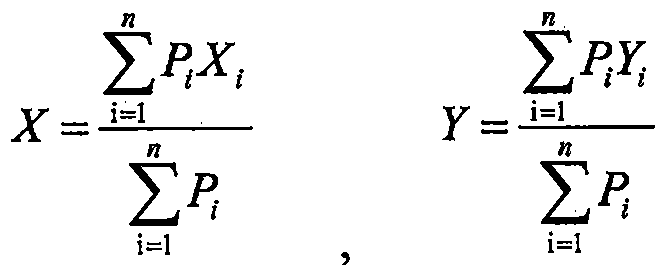
其中,X为该压力值中心点的横坐标,Y为该压力值中心点的纵坐标,Xi为第i个该压力传感器的横坐标,Yi第i个该压力传感器的纵坐标,Pi为第i个该压力传感器采集的压力值,n为该压力传感器的个数。Among them, X is the abscissa of the center point of the pressure value, Y is the ordinate of the center point of the pressure value, X i is the abscissa of the ith pressure sensor, Y i is the ordinate of the ith pressure sensor, P i is the pressure value collected by the i-th pressure sensor, and n is the number of the pressure sensor.
可选地,该参数获取单元303用于通过以下步骤执行根据该压力值中心点的纵坐标序列通过双峰分布概率模型得到特征参数:通过以下公式将该压力值中心点的纵坐标序列划分成N个纵坐标区间,其中,Optionally, the parameter obtaining unit 303 is configured to perform the following steps to obtain characteristic parameters according to the ordinate sequence of the center point of the pressure value through a bimodal distribution probability model: The ordinate sequence of the center point of the pressure value is divided into: N ordinate intervals, where,
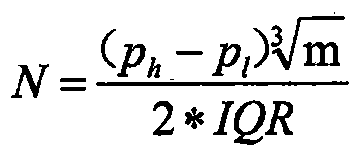
其中,N为该纵坐标区间的个数,ph为该纵坐标序列中的最大值,pl为该纵坐标序列中的最小值,m为该纵坐标序列的样本总数,IQR为四分位距;Among them, N is the number of the ordinate interval, ph is the maximum value in the ordinate sequence, p l is the minimum value in the ordinate sequence, m is the total number of samples in the ordinate sequence, and IQR is the quarter bit distance;
获取每个该纵坐标区间内的样本个数与该纵坐标序列的样本总数的比值,并根据该比值通过双峰分布概率模型进行拟合得到特征参数。The ratio of the number of samples in each ordinate interval to the total number of samples in the ordinate sequence is obtained, and the characteristic parameters are obtained by fitting a bimodal distribution probability model according to the ratio.
可选地,该双峰分布概率模型为:Optionally, the bimodal distribution probability model is:
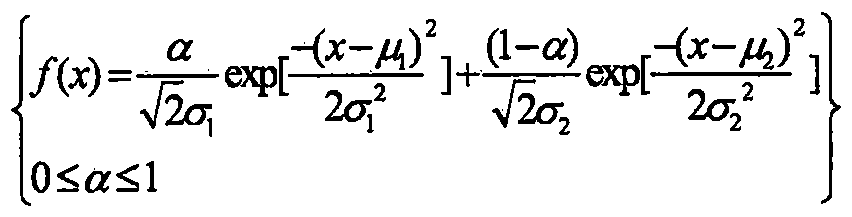
其中,μ1,σ1和μ2,σ2分别为两个正态分布概率密度函数的期望和标准差,α为混合系数,该特征参数包括μ1、σ1、μ2和σ2以及α。Among them, μ 1 , σ 1 and μ 2 , σ 2 are the expectation and standard deviation of the probability density functions of the two normal distributions, respectively, α is the mixing coefficient, and the characteristic parameters include μ 1 , σ 1 , μ 2 and σ 2 and a.
采用采用上述基于步态数据的特征参数获取装置,该装置通过压力传感器获取步态数据,并通过统计学模型对该步态数据进行处理,实现更加细致的对步态数据进行分析,能够细粒度的根据足底压力的步态数据获取对应的特征参数。Using the above-mentioned characteristic parameter acquisition device based on gait data, the device obtains gait data through a pressure sensor, and processes the gait data through a statistical model, so as to realize a more detailed analysis of the gait data, and can achieve fine-grained analysis of the gait data. The corresponding characteristic parameters are obtained according to the gait data of the plantar pressure.
所属本领域的技术人员可以清楚地了解到,为描述的方便和简洁,上述描述的基于步态数据的特征参数获取装置的具体工作过程和描述,可以参考前述方法实施例中的对应过程,在此不再赘述。Those skilled in the art can clearly understand that, for the convenience and conciseness of the description, the specific working process and description of the above-described gait data-based feature parameter acquisition device can refer to the corresponding process in the foregoing method embodiment, in the This will not be repeated here.
上述本发明实施例序号仅仅为了描述,不代表实施例的优劣。The above-mentioned serial numbers of the embodiments of the present invention are only for description, and do not represent the advantages or disadvantages of the embodiments.
在本发明的上述实施例中,对各个实施例的描述都各有侧重,某个实施例中没有详述的部分,可以参见其他实施例的相关描述。In the above-mentioned embodiments of the present invention, the description of each embodiment has its own emphasis. For parts that are not described in detail in a certain embodiment, reference may be made to related descriptions of other embodiments.
在本申请所提供的几个实施例中,应该理解到,所揭露的技术内容,可通过其它的方式实现。其中,以上所描述的装置实施例仅仅是示意性的,例如所述单元的划分,可以为一种逻辑功能划分,实际实现时可以有另外的划分方式,例如多个单元或组件可以结合或者可以集成到另一个系统,或一些特征可以忽略,或不执行。另一点,所显示或讨论的相互之间的耦合或直接耦合或通信连接可以是通过一些接口,单元或模块的间接耦合或通信连接,可以是电性或其它的形式。In the several embodiments provided in this application, it should be understood that the disclosed technical content can be implemented in other ways. The device embodiments described above are only illustrative, for example, the division of the units may be a logical function division, and there may be other division methods in actual implementation, for example, multiple units or components may be combined or Integration into another system, or some features can be ignored, or not implemented. On the other hand, the shown or discussed mutual coupling or direct coupling or communication connection may be through some interfaces, indirect coupling or communication connection of units or modules, and may be in electrical or other forms.
所述作为分离部件说明的单元可以是或者也可以不是物理上分开的,作为单元显示的部件可以是或者也可以不是物理单元,即可以位于一个地方,或者也可以分布到多个单元上。可以根据实际的需要选择其中的部分或者全部单元来实现本实施例方案的目的。The units described as separate components may or may not be physically separated, and components shown as units may or may not be physical units, that is, may be located in one place, or may be distributed to multiple units. Some or all of the units may be selected according to actual needs to achieve the purpose of the solution in this embodiment.
另外,在本发明各个实施例中的各功能单元可以集成在一个处理单元中,也可以是各个单元单独物理存在,也可以两个或两个以上单元集成在一个单元中。上述集成的单元既可以采用硬件的形式实现,也可以采用软件功能单元的形式实现。In addition, each functional unit in each embodiment of the present invention may be integrated into one processing unit, or each unit may exist physically alone, or two or more units may be integrated into one unit. The above-mentioned integrated units may be implemented in the form of hardware, or may be implemented in the form of software functional units.
所述集成的单元如果以软件功能单元的形式实现并作为独立的产品销售或使用时,可以存储在一个计算机可读取存储介质中。基于这样的理解,本发明的技术方案本质上或者说对现有技术做出贡献的部分或者该技术方案的全部或部分可以以软件产品的形式体现出来,该计算机软件产品存储在一个存储介质中,包括若干指令用以使得一台计算机设备(可为个人计算机、服务器或者网络设备等)执行本发明各个实施例所述方法的全部或部分步骤。而前述的存储介质包括:U盘、只读存储器(ROM,Read-Only Memory)、随机存取存储器(RAM,Random Access Memory)、移动硬盘、磁碟或者光盘等各种可以存储程序代码的介质。The integrated unit, if implemented in the form of a software functional unit and sold or used as an independent product, may be stored in a computer-readable storage medium. Based on this understanding, the technical solution of the present invention is essentially or the part that contributes to the prior art, or all or part of the technical solution can be embodied in the form of a software product, and the computer software product is stored in a storage medium , including several instructions for causing a computer device (which may be a personal computer, a server, or a network device, etc.) to execute all or part of the steps of the methods described in the various embodiments of the present invention. The aforementioned storage medium includes: U disk, read-only memory (ROM, Read-Only Memory), random access memory (RAM, Random Access Memory), mobile hard disk, magnetic disk or optical disk and other media that can store program codes .
以上所述仅是本发明的优选实施方式,应当指出,对于本技术领域的普通技术人员来说,在不脱离本发明原理的前提下,还可以做出若干改进和润饰,这些改进和润饰也应视为本发明的保护范围。The above are only the preferred embodiments of the present invention. It should be pointed out that for those skilled in the art, without departing from the principles of the present invention, several improvements and modifications can be made. It should be regarded as the protection scope of the present invention.
Claims (6)


Priority Applications (1)
| Application Number | Priority Date | Filing Date | Title |
|---|---|---|---|
| CN201510990401.0A CN105654041B (en) | 2015-12-28 | 2015-12-28 | Gait data-based characteristic parameter acquisition method and device |
Applications Claiming Priority (1)
| Application Number | Priority Date | Filing Date | Title |
|---|---|---|---|
| CN201510990401.0A CN105654041B (en) | 2015-12-28 | 2015-12-28 | Gait data-based characteristic parameter acquisition method and device |
Publications (2)
| Publication Number | Publication Date |
|---|---|
| CN105654041A CN105654041A (en) | 2016-06-08 |
| CN105654041B true CN105654041B (en) | 2020-09-08 |
Family
ID=56477613
Family Applications (1)
| Application Number | Title | Priority Date | Filing Date |
|---|---|---|---|
| CN201510990401.0A Expired - Fee Related CN105654041B (en) | 2015-12-28 | 2015-12-28 | Gait data-based characteristic parameter acquisition method and device |
Country Status (1)
| Country | Link |
|---|---|
| CN (1) | CN105654041B (en) |
Families Citing this family (5)
| Publication number | Priority date | Publication date | Assignee | Title |
|---|---|---|---|---|
| TWI681756B (en) * | 2018-06-21 | 2020-01-11 | 國立清華大學 | Method and system for recognizing gait |
| CN109222903A (en) * | 2018-08-29 | 2019-01-18 | 清华大学玉泉医院 | Parkinsonian's abnormal operation reminding method and device |
| CN110059633A (en) * | 2019-04-19 | 2019-07-26 | 西北工业大学 | A kind of body gait based on ultrasound perception and its personal identification method |
| CN111714125B (en) * | 2020-06-09 | 2022-09-06 | 京东科技信息技术有限公司 | Method, device and system for monitoring motion state and storage medium |
| CN117179741B (en) * | 2023-07-24 | 2024-05-28 | 北京华益精点生物技术有限公司 | Method and related device for marking sole position based on pressure |
Citations (3)
| Publication number | Priority date | Publication date | Assignee | Title |
|---|---|---|---|---|
| CN102175356A (en) * | 2011-02-22 | 2011-09-07 | 中国科学院合肥物质科学研究院 | Device and method for measuring gait touch information |
| CN102930133A (en) * | 2012-09-24 | 2013-02-13 | 安徽埃力智能科技有限公司 | Integrated rapid balance and gait assessment system and method |
| CN103800016A (en) * | 2014-02-25 | 2014-05-21 | 河北工业大学 | Human body identity gait recognition system based on combination of visual sense and tactile sense and recognition method thereof |
-
2015
- 2015-12-28 CN CN201510990401.0A patent/CN105654041B/en not_active Expired - Fee Related
Patent Citations (3)
| Publication number | Priority date | Publication date | Assignee | Title |
|---|---|---|---|---|
| CN102175356A (en) * | 2011-02-22 | 2011-09-07 | 中国科学院合肥物质科学研究院 | Device and method for measuring gait touch information |
| CN102930133A (en) * | 2012-09-24 | 2013-02-13 | 安徽埃力智能科技有限公司 | Integrated rapid balance and gait assessment system and method |
| CN103800016A (en) * | 2014-02-25 | 2014-05-21 | 河北工业大学 | Human body identity gait recognition system based on combination of visual sense and tactile sense and recognition method thereof |
Also Published As
| Publication number | Publication date |
|---|---|
| CN105654041A (en) | 2016-06-08 |
Similar Documents
| Publication | Publication Date | Title |
|---|---|---|
| CN105654041B (en) | Gait data-based characteristic parameter acquisition method and device | |
| US10503967B2 (en) | Fast behavior and abnormality detection | |
| CN104008398B (en) | A kind of Approach for Gait Classification based on multi-sensor information fusion | |
| CN111582108B (en) | A method for gait recognition and intention perception | |
| JP7327516B2 (en) | Abnormality detection device, judgment system, abnormality detection method, and program | |
| CN105268171B (en) | gait monitoring method, device and wearable device | |
| CN106419893A (en) | Sleep state detection method and device | |
| CN105411593A (en) | Method and apparatus for recognizing gait task | |
| KR102302719B1 (en) | Apparatus and method for classification of gait type by performing neural network analysis for various detection information | |
| CN108836344B (en) | Step length step frequency estimation method and device and gait detector | |
| CN110367991A (en) | A kind of Falls in Old People methods of risk assessment | |
| CN108814617A (en) | Freezing of gait recognition methods and device and gait detector | |
| CN103462619A (en) | Plantar pressure measuring device and gait mode identification method using same | |
| KR102194313B1 (en) | Apparatus and method for identifying individuals by performing neural network analysis for various detection information | |
| CN109924981A (en) | A kind of talipes cavus detection system and method | |
| CN110946585A (en) | Fall detection system and method based on data fusion and BP neural network | |
| CN114470719B (en) | A fully automatic posture correction training method and system | |
| CN117100255B (en) | Method for judging fall prevention based on neural network model and related products | |
| US20240382111A1 (en) | Method of detecting gait pattern based on deep-learning and computer program performing the same | |
| Macdonald et al. | Underfoot pressure-based left and right foot classification algorithms: The impact of footwear | |
| CN106175697A (en) | Sleep state detection method and device | |
| Majumder et al. | A wireless IoT system towards gait detection in stroke patients | |
| CN114171194B (en) | Parkinson's multi-symptom quantitative assessment methods, devices, electronic devices, and media | |
| Patel et al. | A wearable computing platform for developing cloud-based machine learning models for health monitoring applications | |
| CN105901823A (en) | Method and device for measuring weight and smart shoes |
Legal Events
| Date | Code | Title | Description |
|---|---|---|---|
| C06 | Publication | ||
| PB01 | Publication | ||
| C10 | Entry into substantive examination | ||
| SE01 | Entry into force of request for substantive examination | ||
| WD01 | Invention patent application deemed withdrawn after publication |
Application publication date: 20160608 |
|
| WD01 | Invention patent application deemed withdrawn after publication | ||
| RA01 | Restoration of patent right |
Former decision: deemed withdrawal of patent application after publication Former decision publication date: 20200515 |
|
| RA01 | Restoration of patent right | ||
| GR01 | Patent grant | ||
| GR01 | Patent grant | ||
| CF01 | Termination of patent right due to non-payment of annual fee |
Granted publication date: 20200908 Termination date: 20201228 |
|
| CF01 | Termination of patent right due to non-payment of annual fee |