CN105648042B - Uses of Human YEATS4 Gene and Related Drugs - Google Patents
Uses of Human YEATS4 Gene and Related Drugs Download PDFInfo
- Publication number
- CN105648042B CN105648042B CN201410636062.1A CN201410636062A CN105648042B CN 105648042 B CN105648042 B CN 105648042B CN 201410636062 A CN201410636062 A CN 201410636062A CN 105648042 B CN105648042 B CN 105648042B
- Authority
- CN
- China
- Prior art keywords
- yeats4
- gene
- nucleic acid
- plko
- interfering
- Prior art date
- Legal status (The legal status is an assumption and is not a legal conclusion. Google has not performed a legal analysis and makes no representation as to the accuracy of the status listed.)
- Active
Links
Images


Landscapes
- Pharmaceuticals Containing Other Organic And Inorganic Compounds (AREA)
- Medicines That Contain Protein Lipid Enzymes And Other Medicines (AREA)
Abstract
本发明公开了人YEATS4基因的用途及其相关药物。本发明公开了人YEATS4基因在肿瘤治疗、肿瘤诊断及药物制备中的用途。本发明还进一步构建了人YEATS4基因小分子干扰RNA、人YEATS4基因干扰核酸构建体、人YEATS4基因干扰慢病毒并公开了它们的用途。本发明提供的siRNA或者包含该siRNA序列的核酸构建体、慢病毒能够特异性抑制人YEATS4基因的表达,尤其是慢病毒,能够高效侵染靶细胞,高效率地抑制靶细胞中YEATS4基因的表达,进而抑制肿瘤细胞的生长,促进肿瘤细胞凋亡,在肿瘤治疗中具有重要意义。

The invention discloses the use of human YEATS4 gene and related medicines. The invention discloses the application of human YEATS4 gene in tumor treatment, tumor diagnosis and drug preparation. The present invention further constructs human YEATS4 gene small molecule interfering RNA, human YEATS4 gene interfering nucleic acid construct, and human YEATS4 gene interfering lentivirus and discloses their uses. The siRNA or the nucleic acid construct comprising the siRNA sequence and the lentivirus provided by the present invention can specifically inhibit the expression of the human YEATS4 gene, especially the lentivirus, which can efficiently infect the target cells and efficiently inhibit the expression of the YEATS4 gene in the target cells. , thereby inhibiting the growth of tumor cells and promoting tumor cell apoptosis, which is of great significance in tumor therapy.
Description
技术领域technical field
本发明涉及生物技术领域,更具体地涉及人YEATS4基因的用途及其相关药物。The present invention relates to the field of biotechnology, and more particularly to the use of human YEATS4 gene and related medicines.
背景技术Background technique
RNA干扰(RNA interference,RNAi)即用核苷酸组成的短的双链RNA(dsRNA)进行转录后基因沉默。它可高效、特异地阻断体内特定基因的表达,导致其降解,从而引起生物体内特异基因的沉默,使细胞表现出某种基因表型的缺失,是近年来新兴的一种常用的研究基因功能、寻找疾病治疗方法的实验室技术。研究表明,长度为21-23nt的双链RNA能够在转录和转录后水平特异性的引起RNAi(Tuschl T,Zamore PD,Sharp PA,Bartel DP.RNAi:double-stranded RNA directs the ATP-dependent cleavage of mRNA at 21to23nucleotideintervals.Cell 2000;101:25-33.)。肿瘤患者虽经化疗、放疗和综合治疗,但五年生存率仍很低,如能对肿瘤发病和进展有关的基因进行干预,将能为肿瘤的治疗开辟新途径。近年来,RNAi已成为肿瘤的基因治疗的有效策略。利用RNAi技术可以抑制原癌基因、突变的抑癌基因、细胞周期相关基因、抗凋亡相关基因等的表达来抑制肿瘤进程(Uprichard,Susan L.The therapeutic potential of RNA interference.FEBS Letters2005;579:5996-6007.)。RNA interference (RNAi) refers to post-transcriptional gene silencing using short double-stranded RNA (dsRNA) composed of nucleotides. It can efficiently and specifically block the expression of specific genes in the body, leading to their degradation, thereby causing the silencing of specific genes in the organism and causing cells to show the loss of a certain gene phenotype. It is a commonly used research gene emerging in recent years. Functional, laboratory techniques for finding cures for diseases. Studies have shown that double-stranded RNA with a length of 21-23 nt can specifically cause RNAi at the transcriptional and post-transcriptional levels (Tuschl T, Zamore PD, Sharp PA, Bartel DP. RNAi: double-stranded RNA directs the ATP-dependent cleavage of mRNA at 21to23nucleotideintervals. Cell 2000;101:25-33.). Although cancer patients have undergone chemotherapy, radiotherapy and comprehensive treatment, the five-year survival rate is still very low. If the genes related to the onset and progression of tumors can be intervened, it will open up new ways for tumor treatment. In recent years, RNAi has become an effective strategy for gene therapy of tumors. RNAi technology can inhibit the expression of proto-oncogenes, mutated tumor suppressor genes, cell cycle-related genes, and anti-apoptosis-related genes to inhibit tumor progression (Uprichard, Susan L. The therapeutic potential of RNA interference. FEBS Letters 2005; 579: 5996-6007.).
YEATS4(增值细胞核抗原结合蛋白,PAF15)是由YEATS4基因编码的蛋白,定位于人类15号染色体长臂22区31带(15q22.31),共含有5个外显子区,编码111个氨基酸,其中第15位赖氨酸、第24位赖氨酸存在单/双泛素化修饰,而第63位赖氨酸存在单泛素化修饰(neXtProt/Ensembl/Reactome)。其主要定位于细胞核,在核周区也有少量分布,且在不同物种间进化高度保守(NCBI Reference Sequence:NP_001025160.1)。YEATS4蛋白只在细胞周期的S期和G2期表达,与G2/M期达到高峰,在有丝分裂结束时表达急剧下降。该蛋白的表达还具有组织特异性,在肝脏、胰脏和胎盘中高表达。YEATS4在DNA复制期间起着调控DNA修复的作用,当DNA损伤时YEATS4的第15位和第24位赖氨酸发生单泛素化,招募DNA聚合酶跨越损伤缺口合成DNA从而达到修复。该蛋白的过表达会促进紫外线照射导致的DNA损伤的修复并阻止细胞死亡,而其表达抑制则会阻碍DNA复制及细胞存活[Simpson F,Lammerts vanBueren K,Butterfield N et al.The PCNA-associated factor YEATS4/p15(PAF)bindsthe potential tumor suppressor product p33ING1b.Exp Cell Res 2006;312:73–85.Turchi L,Fareh M,Aberdam E et al.ATF3and p15PAF are novel gatekeepers ofgenomic integrity upon UV stress.Cell Death Differ 2009;16:728–37.van BuerenKL,Bennetts JS,Fowles LF,Berkman JL,Simpson F,Wicking C.Murine embryonicexpression of the gene for the UV-responsive protein p15(PAF).Gene ExprPatterns 2007;7:47–50.]。YEATS4 (proliferating cell nuclear antigen-binding protein, PAF15) is a protein encoded by the YEATS4 gene, which is located in the 31 band (15q22.31) of the 22 region of the long arm of human chromosome 15. It contains 5 exons and encodes 111 amino acids. Among them, the 15th lysine and the 24th lysine are mono/diubiquitinated, and the 63rd lysine is monoubiquitinated (neXtProt/Ensembl/Reactome). It is mainly located in the nucleus, with a small amount of distribution in the perinuclear region, and is highly evolutionarily conserved among different species (NCBI Reference Sequence: NP_001025160.1). The YEATS4 protein was only expressed in the S and G2 phases of the cell cycle, peaked in the G2/M phase, and declined sharply at the end of mitosis. The expression of this protein is also tissue-specific, with high expression in liver, pancreas and placenta. YEATS4 plays a role in regulating DNA repair during DNA replication. When DNA is damaged, the 15th and 24th lysines of YEATS4 are monoubiquitinated, recruiting DNA polymerase to synthesize DNA across the damage gap to achieve repair. Overexpression of this protein promotes the repair of DNA damage caused by UV irradiation and prevents cell death, while inhibition of its expression hinders DNA replication and cell survival [Simpson F, Lammerts van Bueren K, Butterfield N et al. The PCNA-associated factor YEATS4/p15(PAF) binds the potential tumor suppressor product p33ING1b. Exp Cell Res 2006;312:73–85. Turchi L, Fareh M, Aberdam E et al. ATF3 and p15PAF are novel gatekeepers ofgenomic integrity upon UV stress. Cell Death Differ 2009 16:728–37. van Bueren KL, Bennetts JS, Fowles LF, Berkman JL, Simpson F, Wicking C. Murine embryonic expression of the gene for the UV-responsive protein p15 (PAF). Gene ExprPatterns 2007;7:47–50 .].
关于YEATS4在肿瘤相关领域的报道很少。为了研究YEATS4和肿瘤的相关性,本发明选取结肠癌细胞模型,以RNAi为手段研究YEATS4在结肠癌发生和发展中的作用。There are few reports on YEATS4 in tumor-related fields. In order to study the correlation between YEATS4 and tumors, the present invention selects a colon cancer cell model, and uses RNAi as a means to study the role of YEATS4 in the occurrence and development of colon cancer.
发明内容SUMMARY OF THE INVENTION
本发明的目的在于公开与人YEATS4基因相关的治疗方法及药物,以RNA干扰(RNAi)为手段研究YEATS4基因在肿瘤细胞的存活和凋亡过程中的作用。The purpose of the present invention is to disclose therapeutic methods and medicines related to human YEATS4 gene, and to study the role of YEATS4 gene in tumor cell survival and apoptosis by means of RNA interference (RNAi).
本发明第一方面,以RNA干扰为手段,研究了YEATS4基因在肿瘤发生和发展中的作用,公开了一种抑制或降低肿瘤细胞生长、增殖、分化和/或存活的方法,该方法包括:向肿瘤细胞施用一种能够特异性抑制YEATS4基因的转录或翻译,或能够特异性抑制YEATS4蛋白的表达或活性的分子,以此来抑制肿瘤细胞的生长、增殖、分化和/或存活。In the first aspect of the present invention, the role of YEATS4 gene in the occurrence and development of tumors is studied by means of RNA interference, and a method for inhibiting or reducing tumor cell growth, proliferation, differentiation and/or survival is disclosed, and the method includes: A molecule capable of specifically inhibiting the transcription or translation of the YEATS4 gene, or the expression or activity of the YEATS4 protein is administered to tumor cells, thereby inhibiting the growth, proliferation, differentiation and/or survival of tumor cells.
所述肿瘤细胞选自其生长与YEATS4蛋白的表达或活性相关的肿瘤细胞。较优的,所述肿瘤细胞选自结肠癌。The tumor cells are selected from tumor cells whose growth is associated with the expression or activity of the YEATS4 protein. Preferably, the tumor cells are selected from colon cancer.
所述抑制或降低肿瘤细胞生长、增殖、分化和/或存活的方法中,所述分子的施用量为足够降低YEATS4基因的转录或翻译,或者足够降低YEATS4蛋白的表达或活性的剂量。进一步的,所述YEATS4基因的表达至少被降低50%、80%、90%、95%或99%。In the method of inhibiting or reducing tumor cell growth, proliferation, differentiation and/or survival, the molecule is administered in an amount sufficient to reduce the transcription or translation of the YEATS4 gene, or to reduce the expression or activity of the YEATS4 protein. Further, the expression of the YEATS4 gene is reduced by at least 50%, 80%, 90%, 95% or 99%.
所述分子可选自但不限于:核酸分子、碳水化合物、脂类、小分子化学药、抗体药、多肽、蛋白或干扰慢病毒。The molecules may be selected from, but not limited to, nucleic acid molecules, carbohydrates, lipids, small molecule chemical drugs, antibody drugs, polypeptides, proteins or interfering lentiviruses.
所述核酸包括但不限于:反义寡核苷酸、双链RNA(dsRNA)、核酶、核糖核酸内切酶III制备的小干扰RNA(esiRNA)或者短发夹RNA(shRNA)。The nucleic acids include, but are not limited to, antisense oligonucleotides, double-stranded RNA (dsRNA), ribozymes, endoribonuclease III-produced small interfering RNA (esiRNA), or short hairpin RNA (shRNA).
所述双链RNA、核酶、esiRNA或者shRNA含有YEATS4基因的启动子序列或YEATS4基因的信息序列。The double-stranded RNA, ribozyme, esiRNA or shRNA contains the promoter sequence of the YEATS4 gene or the information sequence of the YEATS4 gene.
进一步的,所述双链RNA为小干扰RNA(siRNA)。所述小干扰RNA包含第一链和第二链,所述第一链和所述第二链互补共同形成RNA二聚体,并且所述第一链的序列与YEATS4基因中15-27个连续的核苷酸序列基本相同。所述小分子干扰RNA能特异性结合靶序列所编码的mRNA片段,并特异性沉默人YEATS4基因的表达。Further, the double-stranded RNA is small interfering RNA (siRNA). The small interfering RNA comprises a first strand and a second strand, the first strand and the second strand are complementary to form an RNA dimer together, and the sequence of the first strand is continuous with 15-27 in the YEATS4 gene The nucleotide sequences are basically the same. The small interfering RNA can specifically bind to the mRNA fragment encoded by the target sequence, and specifically silence the expression of the human YEATS4 gene.
进一步的,所述小干扰RNA的第一链序列与YEATS4基因中的靶序列基本相同。较优的,所述YEATS4基因中的靶序列含有如SEQ ID NO:1-5任一所示的序列。Further, the first strand sequence of the small interfering RNA is substantially the same as the target sequence in the YEATS4 gene. Preferably, the target sequence in the YEATS4 gene contains the sequence shown in any of SEQ ID NOs: 1-5.
所述YEATS4基因中的靶序列即为所述小分子干扰RNA特异性沉默YEATS4基因表达时,与所述的小分子干扰RNA互补结合的mRNA片段所对应的YEATS4基因中的片段。The target sequence in the YEATS4 gene is the fragment in the YEATS4 gene corresponding to the mRNA fragment complementary to the small molecule interfering RNA when the small molecule interfering RNA specifically silences the expression of the YEATS4 gene.
较佳的,所述YEATS4基因来源于人。Preferably, the YEATS4 gene is derived from human.
本发明第一方面还公开了一种分离的人YEATS4基因在制备或筛选肿瘤治疗药物,或者在制备肿瘤诊断药物中的用途。The first aspect of the present invention also discloses the use of the isolated human YEATS4 gene in the preparation or screening of tumor therapeutic drugs, or in the preparation of tumor diagnosis drugs.
进一步的,所述肿瘤选自结肠癌。Further, the tumor is selected from colon cancer.
所述将分离的YEATS4基因用于制备或筛选肿瘤治疗药物包括两方面的内容:其一,将YEATS4基因作为药物或制剂针对肿瘤细胞的作用靶标应用于制备肿瘤治疗药物或制剂;其二,将YEATS4基因作为药物或制剂针对肿瘤细胞的作用靶标应用于筛选肿瘤治疗药物或制剂。The use of the isolated YEATS4 gene for the preparation or screening of tumor therapeutic drugs includes two aspects: first, the YEATS4 gene is used as the target of the drug or preparation on tumor cells to prepare tumor therapeutic drugs or preparations; The YEATS4 gene is used as the target of drugs or preparations for tumor cells to be used to screen tumor therapeutic drugs or preparations.
所述将YEATS4基因作为药物或制剂针对肿瘤细胞的作用靶标应用于制备肿瘤治疗药物或制剂具体是指:将YEATS4基因作为RNA干扰作用的靶标,来研制针对肿瘤细胞的药物或制剂,从而能降低肿瘤细胞内YEATS4基因的表达水平。The use of the YEATS4 gene as a drug or preparation targeting tumor cells in the preparation of tumor therapeutic drugs or preparations specifically refers to: using the YEATS4 gene as the target of RNA interference to develop drugs or preparations for tumor cells, thereby reducing Expression level of YEATS4 gene in tumor cells.
所述将YEATS4基因作为药物或制剂针对肿瘤细胞的作用靶标应用于筛选肿瘤治疗药物或制剂具体是指:将YEATS4基因作为作用对象,对药物或制剂进行筛选,以找到可以抑制或促进人YEATS4基因表达的药物作为肿瘤治疗备选药物。如本发明所述的YEATS4基因小分子干扰RNA(siRNA)即是以人YEATS4基因为作用对象筛选获得的,可用作具有抑制肿瘤细胞增殖作用的药物。除此之外,诸如抗体药物,小分子药物等也可将YEATS4基因及其蛋白作为作用对象。The use of the YEATS4 gene as a drug or preparation for the action target of tumor cells in the screening of tumor therapeutic drugs or preparations specifically refers to: using the YEATS4 gene as an object of action, the drugs or preparations are screened to find a gene that can inhibit or promote the human YEATS4 gene. The expressed drug is used as an alternative drug for tumor treatment. The YEATS4 gene small interfering RNA (siRNA) according to the present invention is obtained by screening the human YEATS4 gene as the target, and can be used as a drug with the effect of inhibiting the proliferation of tumor cells. In addition, such as antibody drugs and small molecule drugs, the YEATS4 gene and its protein can also be used as targets.
所述将YEATS4基因用于制备肿瘤诊断药物,是指将YEATS4基因表达产物作为一项肿瘤诊断指标应用于肿瘤诊断药物的制备。The use of the YEATS4 gene for the preparation of a tumor diagnostic drug refers to using the YEATS4 gene expression product as a tumor diagnostic index in the preparation of a tumor diagnostic drug.
通过免疫组织化学的方法检测YEATS4基因在肿瘤组织、正常组织和肿瘤周围正常组织中的表达水平。研究发现:YEATS4基因在肿瘤组织中的表达量显著高于正常组织和肿瘤周围正常组织。提示YEATS4基因可能作为一种癌基因,在肿瘤的发生发展中发挥重要作用;YEATS4基因的表达水平可能成为肿瘤诊断的标志。The expression levels of YEATS4 gene in tumor tissue, normal tissue and surrounding normal tissue were detected by immunohistochemistry. It was found that the expression of YEATS4 gene in tumor tissues was significantly higher than that in normal tissues and surrounding normal tissues. It is suggested that YEATS4 gene may act as an oncogene and play an important role in the occurrence and development of tumors; the expression level of YEATS4 gene may become a marker of tumor diagnosis.
所述肿瘤治疗药物为能够特异性抑制YEATS4基因的转录或翻译,或能够特异性抑制YEATS4蛋白的表达或活性的分子,从而降低肿瘤细胞中YEATS4基因的表达水平,达到抑制肿瘤细胞的增殖、生长、分化和/或存活的目的。The tumor therapeutic drug is a molecule that can specifically inhibit the transcription or translation of the YEATS4 gene, or can specifically inhibit the expression or activity of the YEATS4 protein, thereby reducing the expression level of the YEATS4 gene in tumor cells, thereby inhibiting the proliferation and growth of tumor cells. , differentiation and/or survival purposes.
所述通过分离的YEATS4基因制备或筛选获得的肿瘤治疗药物或者肿瘤诊断药物包括但不限于:核酸分子、碳水化合物、脂类、小分子化学药、抗体药、多肽、蛋白或干扰慢病毒。The tumor therapeutic drugs or tumor diagnostic drugs obtained by preparing or screening the isolated YEATS4 gene include but are not limited to: nucleic acid molecules, carbohydrates, lipids, small molecule chemical drugs, antibody drugs, polypeptides, proteins or interfering lentiviruses.
所述核酸包括但不限于:反义寡核苷酸、双链RNA(dsRNA)、核酶、核糖核酸内切酶III制备的小干扰RNA(esiRNA)或者短发夹RNA(shRNA)。The nucleic acids include, but are not limited to, antisense oligonucleotides, double-stranded RNA (dsRNA), ribozymes, endoribonuclease III-produced small interfering RNA (esiRNA), or short hairpin RNA (shRNA).
所述肿瘤治疗药物的施用量为足够降低人YEATS4基因的转录或翻译,或者足够降低人YEATS4蛋白的表达或活性的剂量。以使人YEATS4基因的表达至少被降低50%、80%、90%、95%或99%。The administration amount of the tumor therapeutic drug is a dose sufficient to reduce the transcription or translation of the human YEATS4 gene, or to reduce the expression or activity of the human YEATS4 protein. so that the expression of the human YEATS4 gene is reduced by at least 50%, 80%, 90%, 95% or 99%.
采用前述肿瘤治疗药物治疗肿瘤的方法,主要是通过降低人YEATS4基因的表达水平抑制肿瘤细胞的增殖来达到治疗的目的。具体的,治疗时,将能有效降低人YEATS4基因表达水平的物质给药于患者。The method of using the aforementioned tumor therapeutic drugs to treat tumors mainly achieves the purpose of treatment by reducing the expression level of the human YEATS4 gene and inhibiting the proliferation of tumor cells. Specifically, during the treatment, a substance that can effectively reduce the expression level of the human YEATS4 gene is administered to the patient.
本发明第二方面公开了一种降低肿瘤细胞中YEATS4基因表达的分离的核酸分子,所述核酸分子包含:A second aspect of the present invention discloses an isolated nucleic acid molecule that reduces YEATS4 gene expression in tumor cells, the nucleic acid molecule comprising:
a)双链RNA,所述双链RNA中含有能够在严紧条件下与YEATS4基因杂交的核苷酸序列;或者a) a double-stranded RNA containing a nucleotide sequence capable of hybridizing to the YEATS4 gene under stringent conditions; or
b)shRNA,所述shRNA中含有能够在严紧条件下与YEATS4基因杂交的核苷酸序列。b) shRNA containing a nucleotide sequence capable of hybridizing to the YEATS4 gene under stringent conditions.
进一步的,所述双链RNA包含第一链和第二链,所述第一链和所述第二链互补共同形成RNA二聚体,并且所述第一链的序列与YEATS4基因中15-27个连续的核苷酸序列基本相同。较佳的,所述第一链的序列与YEATS4基因中19-23个连续的核苷酸序列基本相同;更佳的,所述第一链的序列与YEATS4基因中19、20或者21个连续的核苷酸序列基本相同。Further, the double-stranded RNA comprises a first strand and a second strand, and the first strand and the second strand are complementary to form an RNA dimer together, and the sequence of the first strand is the same as that in the YEATS4 gene 15- 27 consecutive nucleotide sequences are substantially identical. Preferably, the sequence of the first strand is substantially the same as 19-23 consecutive nucleotide sequences in the YEATS4 gene; more preferably, the sequence of the first strand is 19, 20 or 21 consecutive in the YEATS4 gene. The nucleotide sequences are basically the same.
更进一步的,所述双链RNA包含第一链和第二链,所述第一链和所述第二链互补共同形成RNA二聚体,并且所述第一链的序列与YEATS4基因中的靶序列基本相同。Further, the double-stranded RNA comprises a first strand and a second strand, and the first strand and the second strand are complementary to form an RNA dimer together, and the sequence of the first strand is the same as that in the YEATS4 gene. The target sequences are substantially identical.
所述双链RNA第一链和第二链的长度均为15-27个核苷酸;较佳的,长度均为19-23个核苷酸;最佳的,长度均为19、20或者21个核苷酸。The lengths of the first strand and the second strand of the double-stranded RNA are both 15-27 nucleotides; preferably, the lengths are 19-23 nucleotides; 21 nucleotides.
进一步的,所述双链RNA为小干扰RNA(siRNA)。更进一步的,所述小干扰RNA第一链的序列如SEQ ID NO:17所示,具体为5’-CCAAUAGUUUACGGUAAUGUU-3’。Further, the double-stranded RNA is small interfering RNA (siRNA). Further, the sequence of the first strand of the small interfering RNA is shown in SEQ ID NO: 17, specifically 5'-CCAAUAGUUUACGGUAAUGUU-3'.
SEQ ID NO:17所示的siRNA为以SEQ ID NO:1所示的序列为RNA干扰靶序列设计的、针对人YEATS4基因的小干扰RNA的一条链,另一条链即第二链的序列与第一链序列互补,该siRNA可以起到特异性沉默肿瘤细胞中内源YEATS4基因表达的作用。The siRNA shown in SEQ ID NO: 17 is a chain of the small interfering RNA against the human YEATS4 gene designed with the sequence shown in SEQ ID NO: 1 as the RNA interference target sequence, and the other chain, that is, the sequence of the second chain is the same as that of the human YEATS4 gene. Complementary to the first strand sequence, the siRNA can specifically silence the expression of endogenous YEATS4 gene in tumor cells.
进一步的,所述shRNA包括正义链片段和反义链片段,以及连接所述正义链片段和反义链片段的茎环结构,所述正义链片段和所述反义链片段的序列互补,并且所述正义链片段的序列与YEATS4基因中15-27个连续的核苷酸序列基本相同。所述shRNA经加工后可成为小干扰RNA(siRNA)进而起到特异性沉默肿瘤细胞中内源YEATS4基因表达的作用。Further, the shRNA comprises a sense strand segment and an antisense strand segment, and a stem-loop structure connecting the sense strand segment and the antisense strand segment, the sense strand segment and the antisense strand segment are complementary in sequence, and The sequence of the sense strand fragment is substantially the same as the 15-27 consecutive nucleotide sequences in the YEATS4 gene. The shRNA can be processed into small interfering RNA (siRNA) to specifically silence the expression of endogenous YEATS4 gene in tumor cells.
更一步的,所述shRNA包括正义链片段和反义链片段,以及连接所述正义链片段和反义链片段的茎环结构,所述正义链片段和所述反义链片段的序列互补,并且所述正义链片段的序列与YEATS4基因中的靶序列基本相同。Further, the shRNA includes a sense strand segment and an antisense strand segment, and a stem-loop structure connecting the sense strand segment and the antisense strand segment, and the sense strand segment and the antisense strand segment are complementary in sequence, And the sequence of the sense strand fragment is basically the same as the target sequence in the YEATS4 gene.
较佳的,所述正义链片段与YEATS4基因中19-23个连续的核苷酸序列基本相同;更佳的,所述正义链片段与YEATS4基因中19、20或者21个连续的核苷酸序列基本相同。Preferably, the sense strand fragment is substantially the same as 19-23 consecutive nucleotide sequences in the YEATS4 gene; more preferably, the sense strand fragment is 19, 20 or 21 consecutive nucleotides in the YEATS4 gene. The sequence is basically the same.
进一步的,所述shRNA的茎环结构的序列可选自以下任一:UUCAAGAGA、AUG、CCC、UUCG、CCACC、CTCGAG、AAGCUU和CCACACC。Further, the sequence of the stem-loop structure of the shRNA can be selected from any one of the following: UUCAAGAGA, AUG, CCC, UUCG, CCACC, CTCGAG, AAGCUU and CCACACC.
更进一步的,所述shRNA的序列如SEQ ID NO:18所示,具体为:5’-CCAAUAGUUUACGGUAAUGUUUUCAAGAGA AACAUUACCGUAAACUAUUGG-3’。Further, the sequence of the shRNA is shown in SEQ ID NO: 18, specifically: 5'-CCAAUAGUUUACGGUAAUGUUUUCAAGAGA AACAUUACCGUAAACUAUUGG-3'.
shRNA经酶切加工后可成为siRNA,进而起到特异性沉默肿瘤细胞中内源性人YEATS4基因表达的作用。The shRNA can be converted into siRNA after enzymatic digestion, which can specifically silence the expression of endogenous human YEATS4 gene in tumor cells.
编码本发明所述shRNA的基因片段的干扰慢病毒载体含有SEQ ID NO:1-5的任一序列及其互补序列。The interfering lentiviral vector encoding the gene fragment of the shRNA of the present invention contains any sequence of SEQ ID NO: 1-5 and its complementary sequence.
所述双链RNA的第一链或所述shRNA的正义链片段与YEATS4基因中的靶序列基本相同,所述YEATS4基因的靶序列即为siRNA用于特异性沉默YEATS4基因表达时,被所述siRNA识别并沉默的mRNA片段所对应的YEATS4基因中的片段。The first strand of the double-stranded RNA or the sense strand fragment of the shRNA is substantially the same as the target sequence in the YEATS4 gene, and the target sequence of the YEATS4 gene is that siRNA is used to specifically silence the expression of the YEATS4 gene. Fragments in the YEATS4 gene corresponding to mRNA fragments recognized and silenced by siRNA.
较佳的,所述YEATS4基因中的靶序列含有SEQ ID NO:1-5的任一序列。Preferably, the target sequence in the YEATS4 gene contains any sequence of SEQ ID NOs: 1-5.
进一步的,所述YEATS4基因来源于人。Further, the YEATS4 gene is derived from human.
本发明第三方面,公开了一种YEATS4基因干扰核酸构建体,含有编码本发明所述分离的核酸分子中的shRNA的基因片段,能表达所述shRNA。The third aspect of the present invention discloses a YEATS4 gene interference nucleic acid construct, which contains a gene fragment encoding the shRNA in the isolated nucleic acid molecule of the present invention, and can express the shRNA.
所述的人YEATS4基因干扰核酸构建体可以是将编码前述人YEATS4基因shRNA的基因片段克隆入已知载体获得。进一步的,所述YEATS4基因干扰核酸构建体为YEATS4基因干扰慢病毒载体。The human YEATS4 gene interfering nucleic acid construct can be obtained by cloning the gene fragment encoding the aforementioned human YEATS4 gene shRNA into a known vector. Further, the YEATS4 gene interference nucleic acid construct is a YEATS4 gene interference lentiviral vector.
本发明的YEATS4基因干扰慢病毒载体是将编码前述YEATS4基因shRNA的DNA片段克隆入已知载体获得,所述已知载体多为慢病毒载体,所述YEATS4基因干扰慢病毒载体经过病毒包装成为有感染力的病毒颗粒后,感染肿瘤细胞,进而转录出本发明所述shRNA,通过酶切加工等步骤,最终获得所述siRNA,用于特异性沉默YEATS4基因的表达。The YEATS4 gene interference lentiviral vector of the present invention is obtained by cloning the DNA fragment encoding the aforementioned YEATS4 gene shRNA into a known vector, and the known vector is mostly a lentiviral vector. After the infectious virus particles are infected with tumor cells, the shRNA of the present invention is then transcribed, and the siRNA is finally obtained through steps such as enzymatic cleavage processing, which is used to specifically silence the expression of the YEATS4 gene.
进一步的,所述YEATS4基因干扰慢病毒载体还含有启动子序列和/或编码肿瘤细胞中可被检测的标记物的核苷酸序列;较优的,所述可被检测的标记物如绿色荧光蛋白(GFP)。Further, the YEATS4 gene interference lentiviral vector also contains a promoter sequence and/or a nucleotide sequence encoding a detectable marker in tumor cells; preferably, the detectable marker such as green fluorescence protein (GFP).
进一步的,所述慢病毒载体可以选自:pLKO.1-puro、pLKO.1-CMV-tGFP、pLKO.1-puro-CMV-tGFP、pLKO.1-CMV-Neo、pLKO.1-Neo、pLKO.1-Neo-CMV-tGFP、pLKO.1-puro-CMV-TagCFP、pLKO.1-puro-CMV-TagYFP、pLKO.1-puro-CMV-TagRFP、pLKO.1-puro-CMV-TagFP635、pLKO.1-puro-UbC-TurboGFP、pLKO.1-puro-UbC-TagFP635、pLKO-puro-IPTG-1xLacO、pLKO-puro-IPTG-3xLacO、pLP1、pLP2、pLP/VSV-G、pENTR/U6、pLenti6/BLOCK-iT-DEST、pLenti6-GW/U6-laminshrna、pcDNA1.2/V5-GW/lacZ、pLenti6.2/N-Lumio/V5-DEST、pGCSIL-GFP或pLenti6.2/N-Lumio/V5-GW/lacZ中的任一。Further, the lentiviral vector can be selected from: pLKO.1-puro, pLKO.1-CMV-tGFP, pLKO.1-puro-CMV-tGFP, pLKO.1-CMV-Neo, pLKO.1-Neo, pLKO.1-Neo-CMV-tGFP, pLKO.1-puro-CMV-TagCFP, pLKO.1-puro-CMV-TagYFP, pLKO.1-puro-CMV-TagRFP, pLKO.1-puro-CMV-TagFP635, pLKO.1-puro-UbC-TurboGFP, pLKO.1-puro-UbC-TagFP635, pLKO-puro-IPTG-1xLacO, pLKO-puro-IPTG-3xLacO, pLP1, pLP2, pLP/VSV-G, pENTR/U6, pLenti6/BLOCK-iT-DEST, pLenti6-GW/U6-laminshRNA, pcDNA1.2/V5-GW/lacZ, pLenti6.2/N-Lumio/V5-DEST, pGCSIL-GFP or pLenti6.2/N-Lumio/ Any of V5-GW/lacZ.
本发明实施例具体列举了以pGCSIL-GFP为载体构建的人YEATS4基因干扰慢病毒载体,命名为pGCSIL-GFP-YEATS4-siRNA。The embodiment of the present invention specifically lists a human YEATS4 gene interference lentiviral vector constructed with pGCSIL-GFP as a vector, named pGCSIL-GFP-YEATS4-siRNA.
本发明分离的核酸分子可用于制备预防或治疗肿瘤的药物,所述肿瘤为结肠癌。The isolated nucleic acid molecule of the present invention can be used to prepare a medicament for preventing or treating tumor, and the tumor is colon cancer.
本发明的YEATS4基因siRNA可用于抑制肿瘤细胞的增殖,进一步地可以用作治疗肿瘤的药物或制剂。YEATS4基因干扰慢病毒载体则可用于制备所述YEATS4基因siRNA。当用作治疗肿瘤的药物或制剂时,是将安全有效量的所述核酸分子施用于哺乳动物。具体剂量还应考虑给药途径、病人健康状况等因素,这些都是熟练医师技能范围之内的。The YEATS4 gene siRNA of the present invention can be used to inhibit the proliferation of tumor cells, and further can be used as a drug or preparation for treating tumors. YEATS4 gene interference lentiviral vector can be used to prepare the YEATS4 gene siRNA. When used as a medicament or formulation for the treatment of tumors, a safe and effective amount of the nucleic acid molecule is administered to a mammal. The specific dosage should also take into account factors such as the route of administration, the patient's health status, etc., which are all within the skill of the skilled physician.
本发明第四方面,公开了一种YEATS4基因干扰慢病毒,由前述YEATS4基因干扰慢病毒载体在慢病毒包装质粒、细胞系的辅助下,经过病毒包装而成。该慢病毒可感染肿瘤细胞并产生针对YEATS4基因的小分子干扰RNA,从而抑制结肠癌细胞的增殖。该YEATS4基因干扰慢病毒可用于制备预防或治疗肿瘤的药物。In a fourth aspect of the present invention, a YEATS4 gene interference lentivirus is disclosed, which is formed by viral packaging of the aforementioned YEATS4 gene interference lentiviral vector with the assistance of a lentiviral packaging plasmid and a cell line. The lentivirus can infect tumor cells and produce small interfering RNA targeting the YEATS4 gene, thereby inhibiting the proliferation of colon cancer cells. The YEATS4 gene interfering lentivirus can be used to prepare medicines for preventing or treating tumors.
本发明第五方面,公开了一种用于预防或治疗肿瘤的药物组合物,其有效物质含有前述的分离的核酸分子,YEATS4基因干扰核酸构建体或YEATS4基因干扰慢病毒中的一种或多种的组合。The fifth aspect of the present invention discloses a pharmaceutical composition for preventing or treating tumors, the effective substance of which contains the aforementioned isolated nucleic acid molecule, one or more of the YEATS4 gene interference nucleic acid construct or the YEATS4 gene interference lentivirus combination of species.
进一步的,所述药物组合物含有1~99wt%所述双链RNA、shRNA、YEATS4基因干扰核酸构建体或YEATS4基因干扰慢病毒,以及药学上可接受的载体、稀释剂或赋形剂。Further, the pharmaceutical composition contains 1-99 wt% of the double-stranded RNA, shRNA, YEATS4 gene interference nucleic acid construct or YEATS4 gene interference lentivirus, and a pharmaceutically acceptable carrier, diluent or excipient.
在制备这些组合物时,通常将活性成分与赋形剂混合,或用赋形剂稀释,或包在可以胶囊或药囊形式存在的载体中。当赋形剂起稀释剂作用时,它可以是固体、半固体或液体材料作为赋形剂、载体或活性成分的介质。因此,组合物可以是片剂、丸剂、粉剂、溶液剂、糖浆剂、灭菌注射溶液等。合适的赋形剂的例子包括:乳糖、葡萄糖、蔗糖、山梨醇、甘露醇、淀粉、微晶纤维素、聚乙烯吡咯烷酮、纤维素、水、等。制剂还可包括:湿润剂、乳化剂、防腐剂(如羟基苯甲酸甲酯和丙酯)、甜味剂等。In preparing these compositions, the active ingredient is usually mixed with an excipient, or diluted with an excipient, or enclosed in a carrier which can be in the form of a capsule or sachet. When an excipient acts as a diluent, it can be a solid, semi-solid or liquid material that acts as an excipient, carrier or medium for the active ingredient. Thus, the compositions can be in the form of tablets, pills, powders, solutions, syrups, sterile injectable solutions and the like. Examples of suitable excipients include: lactose, glucose, sucrose, sorbitol, mannitol, starch, microcrystalline cellulose, polyvinylpyrrolidone, cellulose, water, and the like. The formulations may also include: wetting agents, emulsifiers, preservatives (eg, methyl and propyl hydroxybenzoates), sweetening agents, and the like.
本发明还公开了所述药物组合物在制备治疗结肠癌的肿瘤治疗药物中的应用。The invention also discloses the application of the pharmaceutical composition in preparing a tumor therapeutic drug for treating colon cancer.
该药物组合物的应用为肿瘤的治疗提供了一种方法,具体为一种预防或治疗对象体内肿瘤的方法,包括将有效剂量的所述的药物组合物施用于对象中。进一步的,所述肿瘤选自结肠癌。The application of the pharmaceutical composition provides a method for tumor treatment, specifically a method for preventing or treating tumors in a subject, comprising administering an effective dose of the pharmaceutical composition to the subject. Further, the tumor is selected from colon cancer.
所述药物组合物用于预防或治疗对象体内肿瘤时,需要将有效剂量的所述的药物组合物施用于对象中。采用该方法,所述肿瘤的生长、增殖、复发和/或转移被抑制。进一步的,所述肿瘤的生长、增殖、复发和/或转移的至少10%、20%、30%、40%、50%、60%、70%、80%、90%、95%或99%的部分被抑制。When the pharmaceutical composition is used to prevent or treat tumors in a subject, an effective dose of the pharmaceutical composition needs to be administered to the subject. Using this method, the growth, proliferation, recurrence and/or metastasis of the tumor is inhibited. Further, at least 10%, 20%, 30%, 40%, 50%, 60%, 70%, 80%, 90%, 95% or 99% of the growth, proliferation, recurrence and/or metastasis of the tumor part is suppressed.
所述方法的对象可以为人。The object of the method may be a human being.
本发明第六方面,公开了一种用于降低肿瘤细胞中的YEATS4基因表达的试剂盒,所述试剂盒包括:存在于容器中的所述分离的核酸分子,YEATS4基因干扰核酸构建体,和/或所述的YEATS4基因干扰慢病毒。A sixth aspect of the present invention discloses a kit for reducing YEATS4 gene expression in tumor cells, the kit comprising: the isolated nucleic acid molecule present in a container, a YEATS4 gene interference nucleic acid construct, and /or the YEATS4 gene interferes with the lentivirus.
综上所述,本发明设计了针对人YEATS4基因的5个RNAi靶点序列,构建相应的YEATS4RNAi载体,其中编码序列SEQ ID NO:1的RNAi载体pGCSIL-GFP-YEATS4-siRNA能够显著下调YEATS4基因在mRNA水平和蛋白水平的表达。使用慢病毒(lentivirus,简写为Lv)作为基因操作工具携带RNAi载体pGCSIL-GFP-YEATS4-siRNA能够靶向地将针对YEATS4基因的RNAi序列高效导入人结肠癌RKO细胞,降低YEATS4基因的表达水平,显著抑制上述肿瘤细胞的增殖能力。因此慢病毒介导的YEATS4基因沉默是恶性肿瘤潜在的临床非手术治疗方式。To sum up, the present invention has designed five RNAi target sequences for the human YEATS4 gene, and constructed the corresponding YEATS4 RNAi vector, wherein the RNAi vector pGCSIL-GFP-YEATS4-siRNA of the coding sequence SEQ ID NO: 1 can significantly down-regulate the YEATS4 gene. Expression at the mRNA and protein levels. Using lentivirus (Lv for short) as a genetic manipulation tool to carry the RNAi vector pGCSIL-GFP-YEATS4-siRNA, the RNAi sequence targeting the YEATS4 gene can be efficiently introduced into human colon cancer RKO cells, and the expression level of the YEATS4 gene can be reduced. Significantly inhibit the proliferation of the above tumor cells. Therefore, lentivirus-mediated gene silencing of YEATS4 is a potential clinical non-surgical treatment for malignant tumors.
本发明提供的siRNA或者包含该siRNA序列的核酸构建体、慢病毒能够特异性抑制人YEATS4基因的表达,尤其是慢病毒,能够高效侵染靶细胞,高效率地抑制靶细胞中YEATS4基因的表达,促进细胞凋亡、降低肿瘤细胞的侵袭和转移能力等,进而抑制肿瘤细胞的生长,促进肿瘤细胞凋亡,在肿瘤治疗中具有重要意义。The siRNA or the nucleic acid construct comprising the siRNA sequence and the lentivirus provided by the present invention can specifically inhibit the expression of the human YEATS4 gene, especially the lentivirus, which can efficiently infect the target cells and efficiently inhibit the expression of the YEATS4 gene in the target cells. , promoting cell apoptosis, reducing the invasion and metastasis of tumor cells, etc., thereby inhibiting the growth of tumor cells and promoting tumor cell apoptosis, which is of great significance in tumor therapy.
附图说明Description of drawings
图1:pGCSIL-GFP质粒DNA图谱Figure 1: pGCSIL-GFP plasmid DNA map
图2:YEATS4-RNAi慢病毒侵染结肠癌细胞4天后,YEATS4mRNA的表达水平显著降低Figure 2: The expression level of YEATS4 mRNA was significantly decreased after 4 days of YEATS4-RNAi lentivirus infection of colon cancer cells
图3:YEATS4-RNAi慢病毒侵染结肠癌细胞4天后,引起细胞增殖抑制Figure 3: YEATS4-RNAi lentivirus infects colon cancer cells for 4 days, causing cell proliferation inhibition
具体实施方式Detailed ways
本发明涉及了一组针对人YEATS4基因的小分子干扰RNA(siRNA)序列、RNA干扰载体和RNA干扰慢病毒。选取人YEATS4mRNA编码区序列作为siRNA的靶位点,根据靶位点中连续的10-30(优选15-27,更优选19-23)个碱基序列设计siRNA靶点序列。通过基因克隆,构建表达上述siRNA的核酸构建体,包装表达上述siRNA的慢病毒。细胞实验证明,上述siRNA序列能够特异性沉默人肿瘤细胞中内源YEATS4基因的表达。The present invention relates to a group of small molecule interfering RNA (siRNA) sequences, RNA interference vectors and RNA interference lentiviruses targeting human YEATS4 gene. The coding region sequence of human YEATS4 mRNA is selected as the target site of siRNA, and the siRNA target site sequence is designed according to the consecutive 10-30 (preferably 15-27, more preferably 19-23) base sequences in the target site. Through gene cloning, a nucleic acid construct expressing the above siRNA is constructed, and the lentivirus expressing the above siRNA is packaged. Cell experiments proved that the above siRNA sequence can specifically silence the expression of endogenous YEATS4 gene in human tumor cells.
本发明的发明人经过广泛而深入的研究发现,在肿瘤组织中,YEATS4基因显著高表达;发明人发现,采用RNAi方法下调人YEATS4基因的表达后可有效地抑制肿瘤细胞的增殖、促进细胞凋亡、降低肿瘤细胞的侵袭和转移能力等,可以有效地控制肿瘤的生长进程,这一研究成果表明YEATS4基因是原癌基因,可作为肿瘤治疗的靶点。发明人进一步合成和测试了多种针对YEATS4基因的siRNA,筛选出了可有效抑制YEATS4的表达进而抑制结肠癌RKO细胞增殖和生长的siRNA,在此基础上完成了本发明。The inventors of the present invention have found through extensive and in-depth research that the YEATS4 gene is significantly highly expressed in tumor tissues; the inventors have found that using RNAi to down-regulate the expression of the human YEATS4 gene can effectively inhibit the proliferation of tumor cells and promote cell apoptosis It can effectively control the growth process of tumors, and this research result shows that the YEATS4 gene is a proto-oncogene and can be used as a target for tumor therapy. The inventors further synthesized and tested a variety of siRNAs against the YEATS4 gene, and screened out siRNAs that can effectively inhibit the expression of YEATS4 and thereby inhibit the proliferation and growth of colon cancer RKO cells, and the present invention was completed on this basis.
本发明提供了一系列干扰人YEATS4基因的小干扰RNA(siRNA)序列,构建了可特异性沉默YEATS4基因表达的慢病毒。本发明研究发现,针对人YEATS4基因设计的小干扰RNA及RNAi慢病毒,稳定并特异地下调YEATS4基因的表达,并有效地抑制人肿瘤细胞的增殖。本发明表明YEATS4基因可促进肿瘤细胞生长,有望成为肿瘤早期诊断和治疗的靶点。而且,通过RNAi方式沉默YEATS4基因的表达,可作为抑制肿瘤发展的有效手段。The present invention provides a series of small interfering RNA (siRNA) sequences that interfere with the human YEATS4 gene, and constructs a lentivirus that can specifically silence the expression of the YEATS4 gene. The present invention finds that the small interfering RNA and RNAi lentivirus designed for the human YEATS4 gene can stably and specifically downregulate the expression of the YEATS4 gene, and effectively inhibit the proliferation of human tumor cells. The present invention shows that the YEATS4 gene can promote the growth of tumor cells, and is expected to become a target for early diagnosis and treatment of tumors. Moreover, silencing the expression of YEATS4 gene by RNAi can be used as an effective means to inhibit tumor development.
本发明的设计思路为:The design idea of the present invention is:
本发明通过如下方法来筛选获得一种人YEATS4基因RNAi慢病毒:从Genbank中调取人YEATS4基因序列;预测siRNA位点;合成针对YEATS4基因的有效的siRNA序列、两端含酶切位点粘端的双链DNA Oligo;慢病毒载体双酶切后与双链DNA Oligo连接,构建表达YEATS4基因siRNA序列的RNAi质粒;将RNAi质粒和慢病毒包装需要的辅助载体(PackingMix,Sigma-aldrich公司)共转染人胚肾细胞293T,产生重组慢病毒颗粒,即可制得高效沉默YEATS4基因的慢病毒。In the present invention, a human YEATS4 gene RNAi lentivirus is screened and obtained by the following methods: extracting the human YEATS4 gene sequence from Genbank; predicting the siRNA site; synthesizing an effective siRNA sequence targeting the YEATS4 gene, containing an enzyme cutting site at both ends, Double-stranded DNA Oligo at the end; the lentiviral vector was double-enzyme digested and then ligated with double-stranded DNA Oligo to construct an RNAi plasmid expressing the siRNA sequence of the YEATS4 gene; the RNAi plasmid and the auxiliary vector (PackingMix, Sigma-aldrich Company) required for lentiviral packaging were combined Human embryonic kidney cells 293T were transfected to generate recombinant lentiviral particles, and then a lentivirus that efficiently silenced the YEATS4 gene could be prepared.
基于上述方法,本发明提供了5个干扰YEATS4基因的有效靶点(具体如SEQ ID NO:1-5所示),构建了特异干扰人YEATS4基因的慢病毒。Based on the above method, the present invention provides five effective targets for interfering with the YEATS4 gene (specifically shown in SEQ ID NOs: 1-5), and constructs a lentivirus that specifically interferes with the human YEATS4 gene.
同时本发明还公开一种人YEATS4基因RNAi慢病毒(YEATS4-RNAi)及其制备与应用。At the same time, the invention also discloses a human YEATS4 gene RNAi lentivirus (YEATS4-RNAi) and its preparation and application.
本研究发现,利用慢病毒介导的RNAi方法,在降低YEATS4基因在肿瘤细胞中的表达后,可以有效抑制肿瘤细胞的增殖。本研究表明,YEATS4基因是一个原癌基因,可促进肿瘤细胞增殖,在肿瘤发生和发展中具有重要的生物学功能,YEATS4基因可以为肿瘤治疗的靶标,慢病毒介导的YEATS4基因特异性沉默可作为肿瘤治疗的一种新手段。This study found that the use of lentivirus-mediated RNAi method can effectively inhibit the proliferation of tumor cells after reducing the expression of YEATS4 gene in tumor cells. This study shows that YEATS4 gene is a proto-oncogene that can promote tumor cell proliferation and has important biological functions in tumorigenesis and development. YEATS4 gene can be a target for tumor therapy. Lentivirus-mediated YEATS4 gene-specific silencing It can be used as a new means of tumor treatment.
下面结合实施例进一步阐述本发明。应理解,实施例仅用于说明本发明,而非限制本发明的范围。实施例中未注明具体条件的实验方法及未说明配方的试剂均为按照常规条件,如[美]Sambrook.J等著;黄培堂等译。分子克隆试验指南,第三版。北京:科学出版社2002中所述的条件或者制造商建议的条件进行或配置。The present invention is further described below in conjunction with the examples. It should be understood that the embodiments are only used to illustrate the present invention, but not to limit the scope of the present invention. In the embodiment, the experimental method without specifying the specific conditions and the reagent without specifying the formula are all according to the conventional conditions, such as [US] Sambrook.J et al.; Huang Peitang et al. A Guide to Molecular Cloning Assays, Third Edition. Beijing: The conditions described in Science Press 2002 or the conditions suggested by the manufacturer were performed or configured.
实施例1针对人YEATS4基因RNAi慢病毒的制备Example 1 Preparation of RNAi Lentivirus for Human YEATS4 Gene
1.筛选针对人YEATS4基因的有效的siRNA靶点1. Screening of effective siRNA targets against the human YEATS4 gene
从Genbank调取YEATS4基因信息;设计针对YEATS4基因的有效的siRNA靶点。表1列出了其中5条针对YEATS4基因的有效siRNA靶点序列。Retrieve YEATS4 gene information from Genbank; design effective siRNA targets for YEATS4 gene. Table 1 lists five of the effective siRNA target sequences against the YEATS4 gene.
表1靶向于人YEATS4基因的siRNA靶点序列Table 1 siRNA target sequences targeting human YEATS4 gene


2.慢病毒载体的制备2. Preparation of Lentiviral Vectors
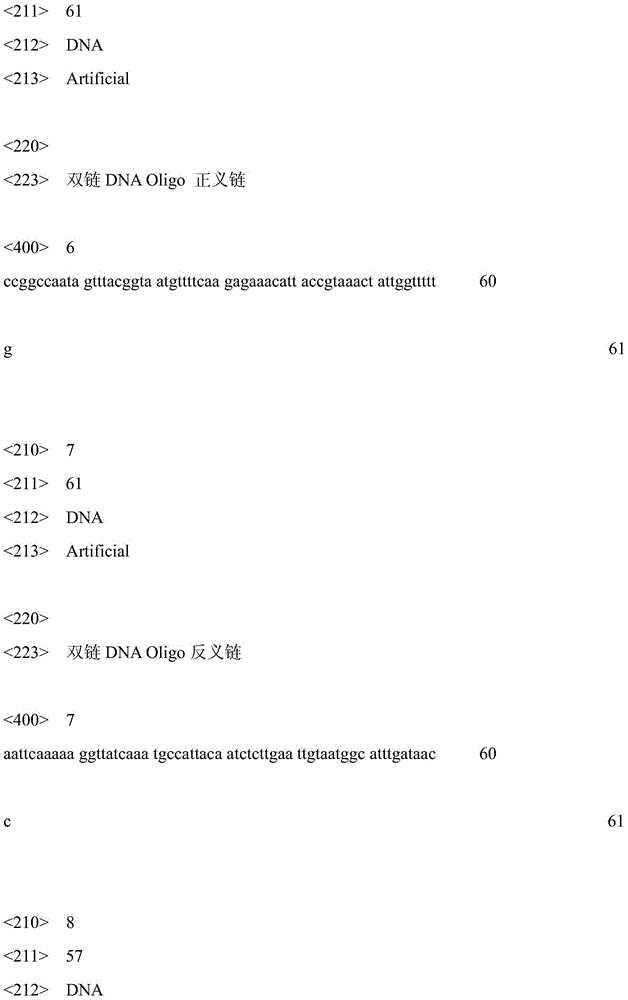
针对siRNA靶点(以SEQ ID NO:1为例)合成两端含Age I和EcoR I酶切位点粘端的双链DNA Oligo序列(表2);以Age I和EcoR I限制性内切酶作用于pGCSIL-GFP载体(上海吉凯基因化学技术有限公司提供,图1),使其线性化,琼脂糖凝胶电泳鉴定酶切片段。Synthesize double-stranded DNA Oligo sequences (Table 2) with sticky ends containing Age I and EcoR I restriction endonucleases against the siRNA target (take SEQ ID NO: 1 as an example); use Age I and EcoR I restriction endonucleases Act on the pGCSIL-GFP vector (provided by Shanghai Jikai Gene Chemical Technology Co., Ltd., Figure 1) to linearize it, and identify the digested fragments by agarose gel electrophoresis.
表2两端含Age I和EcoR I酶切位点粘端的双链DNA OligoTable 2 Double-stranded DNA Oligo with sticky ends containing Age I and EcoR I restriction sites at both ends

通过T4DNA连接酶将双酶切线性化(酶切体系如表4所示,37℃,反应1h)的载体DNA和纯化好的双链DNA Oligo连接,在适当的缓冲体系(连接体系如表5所示)中于16℃连接过夜,回收连接产物。将连接产物转化氯化钙制备的新鲜的大肠杆菌感受态细胞(转化操作参考:分子克隆实验指南第二版55-56页)。在连接转化产物长出菌克隆表面沾一下,溶于10μlLB培养基,混匀取1μl作为模板;在以慢病毒载体中RNAi序列的上下游,设计通用PCR引物,上游引物序列:5’-CCTATTTCCCATGATTCCTTCATA-3’(SEQ ID NO:10);下游引物序列:5’-GTAATACGGTTATCCACGCG-3’(SEQ ID NO:11),进行PCR鉴定实验(PCR反应体系如表6-1,反应条件如表6-2)。对PCR鉴定阳性的克隆进行测序和比对分析,比对正确的克隆即为构建成功的针对SEQ ID NO:1的表达RNAi的载体,命名为pGCSIL-GFP-YEATS4-siRNA。Use T4 DNA ligase to linearize the double-enzyme digestion (enzyme digestion system shown in Table 4, 37 ° C, reaction 1h) and the purified double-stranded DNA Oligo ligation, in an appropriate buffer system (ligation system shown in Table 5) ligation at 16°C overnight, and the ligation product was recovered. The ligation product was transformed into fresh E. coli competent cells prepared by calcium chloride (transformation operation reference: Molecular Cloning Experiment Guide, Second Edition, pages 55-56). Dip on the surface of the colony that grows from the ligated transformation product, dissolve it in 10 μl LB medium, mix well and take 1 μl as a template; design universal PCR primers upstream and downstream of the RNAi sequence in the lentiviral vector, upstream primer sequence: 5'-CCTATTTCCCATGATTCCTTCATA -3' (SEQ ID NO: 10); downstream primer sequence: 5'-GTAATACGGTTATCCACGCG-3' (SEQ ID NO: 11), carry out the PCR identification experiment (the PCR reaction system is shown in Table 6-1, and the reaction conditions are shown in Table 6- 2). The clones identified by PCR were sequenced and compared, and the correct clones were successfully constructed to express the RNAi vector against SEQ ID NO: 1, which was named pGCSIL-GFP-YEATS4-siRNA.
构建pGCSIL-GFP-Scr-siRNA阴性对照质粒,阴性对照siRNA靶序列为5’-TTCTCCGAACGTGTCACGT-3’(SEQ ID NO:12)。构建pGCSIL-GFP-Scr-siRNA阴性对照质粒时,针对Scr siRNA靶点合成两端含Age I和EcoR I酶切位点粘端的双链DNA Oligo序列(表3),其余构建方法、鉴定方法及条件均同pGCSIL-GFP-YEATS4-siRNA。The pGCSIL-GFP-Scr-siRNA negative control plasmid was constructed, and the negative control siRNA target sequence was 5'-TTCTCCGAACGTGTCACGT-3' (SEQ ID NO: 12). When constructing the pGCSIL-GFP-Scr-siRNA negative control plasmid, the double-stranded DNA Oligo sequence (Table 3) with the sticky ends of Age I and EcoR I restriction sites at both ends was synthesized for the Scr siRNA target. The other construction methods, identification methods and Conditions are the same as pGCSIL-GFP-YEATS4-siRNA.
表3两端含Age I和EcoR I酶切位点粘端的双链DNA OligoTable 3 Double-stranded DNA Oligo with sticky ends containing Age I and EcoR I restriction sites at both ends


通过T4DNA连接酶将双酶切线性化(酶切体系如表4所示,37℃,反应1h)的载体The vector that was linearized by double-enzyme digestion by T4 DNA ligase (the digestion system is shown in Table 4, 37°C, reaction for 1h)
表4pGCSIL-GFP质粒酶切反应体系Table 4 pGCSIL-GFP plasmid digestion reaction system
表5载体DNA和双链双链DNA Oligo连接反应体系Table 5 Vector DNA and double-stranded double-stranded DNA Oligo ligation reaction system
表6-1PCR反应体系Table 6-1 PCR reaction system
表6-2PCR反应体系程序设定Table 6-2 PCR reaction system program settings

3.包装YEATS4-siRNA慢病毒3. Packaging YEATS4-siRNA Lentivirus
以Qiagen公司的质粒抽提试剂盒提取RNAi质粒pGCSIL-GFP-YEATS4-siRNA的DNA,配制成100ng/μl储存液。The DNA of the RNAi plasmid pGCSIL-GFP-YEATS4-siRNA was extracted with a plasmid extraction kit from Qiagen, and prepared into a 100 ng/μl stock solution.
转染前24h,用胰蛋白酶消化对数生长期的人胚肾细胞293T细胞,以含10%胎牛血清的DMEM完全培养基调整细胞密度为1.5×10⁵细胞/ml,接种于6孔板,37℃,5%CO2培养箱内培养。待细胞密度达70%-80%时即可用于转染。转染前2h,吸出原有培养基,加入1.5ml新鲜的完全培养基。按照Sigma-aldrich公司的MISSION Lentiviral Packaging Mix试剂盒的说明,向一灭菌离心管中加入Packing Mix(PVM)20μl,PEI 12μl,无血清DMEM培养基400μl,取20μl上述抽提的质粒DNA,加至上述PVM/PEI/DMEM混合液。24h before transfection, human embryonic kidney cell 293T cells in logarithmic growth phase were digested with trypsin, and the cell density was adjusted to 1.5×10 5 cells/ml in DMEM complete medium containing 10% fetal bovine serum, and seeded in 6-well plates , 37 ° C, 5% CO 2 incubator. When the cell density reaches 70%-80%, it can be used for transfection. 2h before transfection, the original medium was aspirated, and 1.5 ml of fresh complete medium was added. According to the instructions of the MISSION Lentiviral Packaging Mix kit from Sigma-aldrich, add 20 μl of Packing Mix (PVM), 12 μl of PEI, and 400 μl of serum-free DMEM medium to a sterilized centrifuge tube, take 20 μl of the above-extracted plasmid DNA, add to the above PVM/PEI/DMEM mixture.
将上述转染混和物在室温下孵育15min,转移至人胚肾细胞293T细胞的培养基中,37℃,5%CO2培养箱内培养16h。弃去含有转染混和物的培养介质,PBS溶液洗涤,加入完全培养基2ml。由于慢病毒载体自身带有绿色荧光蛋白的报告基因,24h后可置于荧光显微镜下观察两组细胞GFP的表达情况,确定慢病毒质粒是否已被293T细胞包装。继续培养48h后,收集细胞上清液,Centricon Plus-20离心超滤装置(Millipore)纯化和浓缩慢病毒,步骤如下:(1)4℃,4000g离心10min,除去细胞碎片;(2)0.45μm滤器过滤上清液于40ml超速离心管中;(3)4000g离心,10-15min,至需要的病毒浓缩体积;(4)离心结束后,将过滤杯和下面的滤过液收集杯分开,将过滤杯倒扣在样品收集杯上,离心2min离心力不超过1000g;(5)把离心杯从样品收集杯上移开,样品收集杯中的即为病毒浓缩液。将病毒浓缩液分装后于-80摄氏度保存。病毒浓缩液中含有的siRNA的第一链的序列如SEQ ID NO:18所示。对照慢病毒的包装过程同YEATS4-siRNA慢病毒,仅以pGCSIL-GFP-Scr-siRNA载体代替pGCSIL-GFP-YEATS4-siRNA载体。The above-mentioned transfection mixture was incubated at room temperature for 15 min, transferred to the medium of human embryonic kidney cells 293T cells, and cultured in a 37° C., 5% CO 2 incubator for 16 h. The culture medium containing the transfection mixture was discarded, washed with PBS solution, and 2 ml of complete medium was added. Since the lentiviral vector itself carries the reporter gene of green fluorescent protein, the expression of GFP in the two groups of cells can be observed under a fluorescence microscope after 24 hours to determine whether the lentiviral plasmid has been packaged by 293T cells. After culturing for 48 hours, the cell supernatant was collected, and the lentivirus was purified and concentrated by a Centricon Plus-20 centrifugal ultrafiltration device (Millipore). The steps were as follows: (1) Centrifuge at 4000g for 10 min at 4°C to remove cell debris; (2) 0.45 μm Filter the supernatant into a 40ml ultracentrifuge tube; (3) Centrifuge at 4000g for 10-15min to the required virus concentration volume; (4) After centrifugation, separate the filter cup and the filtrate collection cup below, The filter cup is upside down on the sample collection cup, and the centrifugal force does not exceed 1000g for 2 minutes; (5) Remove the centrifuge cup from the sample collection cup, and the virus concentrate in the sample collection cup is. Store the virus concentrate in aliquots at -80°C. The sequence of the first strand of the siRNA contained in the virus concentrate is shown in SEQ ID NO:18. The packaging process of the control lentivirus was the same as that of the YEATS4-siRNA lentivirus, only the pGCSIL-GFP-Scr-siRNA vector was used instead of the pGCSIL-GFP-YEATS4-siRNA vector.
实施例2实时荧光定量RT-PCR法检测YEATS4基因的沉默效率Example 2 Detection of silencing efficiency of YEATS4 gene by real-time fluorescence quantitative RT-PCR
处于对数生长期的结肠癌RKO细胞进行胰酶消化,制成细胞悬液(细胞数约为5×10⁴/ml)接种于6孔板中,培养至细胞融合度达到约30%。根据侵染复数(MOI,RKO:10)值,加入适宜量的实施例1制备的病毒,培养24h后更换培养基,待侵染时间达到4天后,收集细胞。根据Invitrogen公司的Trizol操作说明书,抽提总RNA。根据Promega公司的M-MLV操作说明书,将RNA逆转录获得cDNA(逆转录反应体系见表7,42℃反应1h,然后在70℃水浴锅中水浴10min使逆转录酶失活)。Colon cancer RKO cells in logarithmic growth phase were digested with trypsin, and a cell suspension (the number of cells was about 5×10 4 /ml) was inoculated into a 6-well plate, and cultured until the cell confluence reached about 30%. According to the multiplicity of infection (MOI, RKO: 10) value, an appropriate amount of the virus prepared in Example 1 was added, the medium was replaced after culturing for 24 hours, and the cells were collected after the infection time reached 4 days. Total RNA was extracted according to Invitrogen's Trizol operating instructions. According to the M-MLV operating instructions of Promega company, reverse transcription of RNA to obtain cDNA (reverse transcription reaction system is shown in Table 7, 42 ° C for 1 h, and then in a 70 ° C water bath for 10 min to inactivate reverse transcriptase).
采用TP800型Real time PCR仪(TAKARA)进行实时定量检测。YEATS4基因的引物如下:上游引物5’-TCATAGAACTCTGAAACCACTGTC-3’(SEQ ID NO:13)和下游引物5’-CCTGTAACCCTGTATCATTTGCTA-3’(SEQ ID NO:14)。以管家基因GAPDH为内参,引物序列如下:上游引物5’-TGACTTCAACAGCGACACCCA-3’(SEQ ID NO:15)和下游引物5’-CACCCTGTTGCTGTAGCCAAA-3’(SEQ ID NO:16)。按表8中的比例配置反应体系。Real-time quantitative detection was performed using a TP800 Real time PCR instrument (TAKARA). Primers for the YEATS4 gene were as follows: upstream primer 5'-TCATAGAACTCTGAAACCACTGTC-3' (SEQ ID NO: 13) and downstream primer 5'-CCTGTAACCCTGTATCATTTGCTA-3' (SEQ ID NO: 14). Taking housekeeping gene GAPDH as internal reference, the primer sequences are as follows: upstream primer 5'-TGACTTCAACAGCGACACCCA-3' (SEQ ID NO: 15) and downstream primer 5'-CACCCTGTTGCTGTAGCCAAA-3' (SEQ ID NO: 16). The reaction system was configured according to the ratio in Table 8.
表7逆转录反应体系Table 7 Reverse transcription reaction system
表8Real-time PCR反应体系Table 8 Real-time PCR reaction system
设定程序为两步法Real-time PCR:预变性95℃,15s;之后每一步变性95℃,5s;退火延伸60℃,30s;共进行45个循环。每次在延伸阶段读取吸光值。PCR结束后,95℃变性1min,然后冷却至55℃,使DNA双链充分结合。从55℃开始到95℃,每一步增加0.5℃,保持4s,同时读取吸光值,制作熔解曲线。采用2-ΔΔCt分析法计算侵染了YEATS4mRNA的表达丰度。侵染对照病毒(Lv-Scr-siRNA)的细胞作为对照。实验结果(图2)表明,结肠癌RKO细胞mRNA的表达水平下调了62.9%。The set program was two-step Real-time PCR: pre-denaturation at 95°C for 15s; subsequent denaturation at 95°C for 5s for each step; annealing and extension at 60°C for 30s; a total of 45 cycles were performed. The absorbance was read each time during the extension phase. After PCR, denature at 95°C for 1 min, and then cool to 55°C to fully bind the DNA double strands. Start from 55°C to 95°C, increase 0.5°C in each step, hold for 4s, read the absorbance value at the same time, and make a melting curve. The expression abundance of infected YEATS4 mRNA was calculated by 2- ΔΔCt analysis. Cells infected with control virus (Lv-Scr-siRNA) served as controls. The experimental results (Fig. 2) showed that the expression level of mRNA in colon cancer RKO cells was down-regulated by 62.9%.
实施例3检测侵染了YEATS4-siRNA慢病毒的肿瘤细胞的增殖能力Example 3 Detection of proliferation ability of tumor cells infected with YEATS4-siRNA lentivirus
处于对数生长期的结肠癌RKO细胞进行胰酶消化,制成细胞悬液(细胞数约为5×10⁴/ml)接种于6孔板中,培养至细胞融合度达到约30%。根据侵染复数(MOI,RKO:10),加入适宜量的病毒,培养24h后更换培养基,待侵染时间达到4天后,收集处于对数生长期的各实验组细胞。完全培养基重悬成细胞悬液(2×104/ml),以细胞密度约为2000个/孔,接种96孔板。每组5个复孔,每孔100μl。铺好板后,置37℃、5%CO2培养箱培养。从铺板后第二天开始,每天用Cellomics仪器(Thermo Fisher)检测读板一次,连续检测读板5天。通过调整Cellomics arrayscan的输入参数,准确地计算出每次扫描孔板中的带绿色荧光的细胞的数量,对数据进行统计绘图,绘出细胞增殖曲线(结果如图3)。结果表明,慢病毒侵染组各肿瘤在细胞体外培养5天后,增殖速度显著减缓,远低于对照组肿瘤细胞的增殖速度,活力细胞数目分别下降了67.9%,表明YEATS4基因沉默导致肿瘤细胞增殖能力被抑制。Colon cancer RKO cells in logarithmic growth phase were digested with trypsin, and a cell suspension (the number of cells was about 5×10 4 /ml) was inoculated into a 6-well plate, and cultured until the cell confluence reached about 30%. According to the multiplicity of infection (MOI, RKO: 10), an appropriate amount of virus was added, and the medium was replaced after culturing for 24 hours. After the infection time reached 4 days, the cells of each experimental group in the logarithmic growth phase were collected. The complete medium was resuspended into a cell suspension (2×10 4 /ml), and the cells were seeded in a 96-well plate at a cell density of about 2000 cells/well. 5 replicate wells in each group, 100 μl per well. After laying the plate, place it in a 37°C, 5% CO 2 incubator for cultivation. Starting from the second day after plating, the plate was detected and read once a day with the Cellomics instrument (Thermo Fisher), and the plate was detected and read continuously for 5 days. By adjusting the input parameters of Cellomics arrayscan, the number of cells with green fluorescence in each scanning well plate was accurately calculated, the data was statistically drawn, and the cell proliferation curve was drawn (the results are shown in Figure 3). The results showed that the proliferation rate of each tumor in the lentivirus infection group was significantly slowed down after 5 days of cell culture in vitro, which was much lower than the proliferation rate of tumor cells in the control group, and the number of viable cells decreased by 67.9%, indicating that YEATS4 gene silencing led to tumor cell proliferation. ability is inhibited.
以上所述,仅为本发明的较佳实施例,并非对本发明任何形式上和实质上的限制,应当指出,对于本技术领域的普通技术人员,在不脱离本发明方法的前提下,还将可以做出若干改进和补充,这些改进和补充也应视为本发明的保护范围。凡熟悉本专业的技术人员,在不脱离本发明的精神和范围的情况下,当可利用以上所揭示的技术内容而做出的些许更动、修饰与演变的等同变化,均为本发明的等效实施例;同时,凡依据本发明的实质技术对上述实施例所作的任何等同变化的更动、修饰与演变,均仍属于本发明的技术方案的范围内。The above are only preferred embodiments of the present invention, and are not intended to limit the present invention in any form or substance. It should be pointed out that for those skilled in the art, without departing from the method of the present invention, the Several improvements and supplements can be made, and these improvements and supplements should also be regarded as the protection scope of the present invention. All those skilled in the art, without departing from the spirit and scope of the present invention, can utilize the above-disclosed technical content to make some changes, modifications and equivalent changes of evolution, all belong to the present invention. Equivalent embodiments; at the same time, any modification, modification and evolution of any equivalent changes made to the above embodiments according to the essential technology of the present invention still fall within the scope of the technical solutions of the present invention.




Claims (11)
Priority Applications (1)
| Application Number | Priority Date | Filing Date | Title |
|---|---|---|---|
| CN201410636062.1A CN105648042B (en) | 2014-11-12 | 2014-11-12 | Uses of Human YEATS4 Gene and Related Drugs |
Applications Claiming Priority (1)
| Application Number | Priority Date | Filing Date | Title |
|---|---|---|---|
| CN201410636062.1A CN105648042B (en) | 2014-11-12 | 2014-11-12 | Uses of Human YEATS4 Gene and Related Drugs |
Publications (2)
| Publication Number | Publication Date |
|---|---|
| CN105648042A CN105648042A (en) | 2016-06-08 |
| CN105648042B true CN105648042B (en) | 2020-09-04 |
Family
ID=56483591
Family Applications (1)
| Application Number | Title | Priority Date | Filing Date |
|---|---|---|---|
| CN201410636062.1A Active CN105648042B (en) | 2014-11-12 | 2014-11-12 | Uses of Human YEATS4 Gene and Related Drugs |
Country Status (1)
| Country | Link |
|---|---|
| CN (1) | CN105648042B (en) |
Family Cites Families (1)
| Publication number | Priority date | Publication date | Assignee | Title |
|---|---|---|---|---|
| CN101528926A (en) * | 2006-08-18 | 2009-09-09 | 肿瘤疗法科学股份有限公司 | Treating or preventing cancers over-expressing REG4 or KIAA0101 |
-
2014
- 2014-11-12 CN CN201410636062.1A patent/CN105648042B/en active Active
Also Published As
| Publication number | Publication date |
|---|---|
| CN105648042A (en) | 2016-06-08 |
Similar Documents
| Publication | Publication Date | Title |
|---|---|---|
| CN104894224B (en) | Application of human CKIP1 gene and related medicine thereof | |
| CN103173529B (en) | Uses related to human NLK gene and related medicines | |
| CN102433383B (en) | Use of human STIM1 gene and related medicines | |
| CN105586391B (en) | Application of human GTPBP4 gene and related medicine thereof | |
| CN110643705A (en) | Application of human DGKZ gene and related medicine thereof | |
| CN105779576B (en) | Application of human TNFRSF12A gene and related medicine thereof | |
| CN103656674B (en) | Application of human eIF5B gene and related medicine thereof | |
| CN103157115B (en) | The purposes of people RHBDD1 gene and related drugs thereof | |
| CN113930422A (en) | Application of human IGFL3 gene and related product | |
| US9434949B2 (en) | Uses of the human ZFX gene and drugs associated with same | |
| CN105779575B (en) | Uses of human EIF3A gene and related drugs | |
| CN103667430B (en) | A kind of purposes and its related drugs of eight polynucleotides binding protein expression gene | |
| CN105648042B (en) | Uses of Human YEATS4 Gene and Related Drugs | |
| CN110882390B (en) | Use of human LSM5 gene and related products | |
| CN110863047B (en) | Application of human CCDC154 gene and related product | |
| CN105648041B (en) | Application of human KIAA0101 gene and related medicine thereof | |
| CN104630221B (en) | Suppress shRNA and its recombinant vector and the application of growth of tumour cell | |
| CN102229928B (en) | Small-interfering RNA (Ribonucleic Acid) of human RBBP6 (Retinoblastoma-binding Proteingene) and application thereof | |
| CN105803056B (en) | Application of human IARS2 gene and related medicine thereof | |
| CN105803053B (en) | Use of human RBM17 gene and related medicines | |
| CN106267208B (en) | Use of RPS15A gene and related drugs | |
| CN104928354A (en) | Use of human PTP4A3 gene and related medicines | |
| CN105582548B (en) | Application of human UBA2 gene and related medicine thereof | |
| CN110117593A (en) | Specificity reduces the application of the nucleic acid, recombinant vector and recombinant slow virus of FAM84B gene expression | |
| CN104928352B (en) | Application of human L MNB2 gene and related medicine thereof |
Legal Events
| Date | Code | Title | Description |
|---|---|---|---|
| C06 | Publication | ||
| PB01 | Publication | ||
| SE01 | Entry into force of request for substantive examination | ||
| SE01 | Entry into force of request for substantive examination | ||
| CB02 | Change of applicant information |
Address after: 200233, room 680, 619-21 Guiping Road, Shanghai, Xuhui District Applicant after: Shanghai Jikai gene Medical Technology Co.,Ltd. Address before: 200233, room 680, 619-21 Guiping Road, Shanghai, Xuhui District Applicant before: SHANGHAI GENECHEM Co.,Ltd. |
|
| CB02 | Change of applicant information | ||
| GR01 | Patent grant | ||
| GR01 | Patent grant | ||
| PE01 | Entry into force of the registration of the contract for pledge of patent right |
Denomination of invention: The use of human YEATS4 gene and its related drugs Granted publication date: 20200904 Pledgee: Agricultural Bank of China Limited Shanghai Huangpu Sub branch Pledgor: Shanghai Jikai gene Medical Technology Co.,Ltd. Registration number: Y2024310000749 |
|
| PE01 | Entry into force of the registration of the contract for pledge of patent right | ||
| PC01 | Cancellation of the registration of the contract for pledge of patent right |
Granted publication date: 20200904 Pledgee: Agricultural Bank of China Limited Shanghai Huangpu Sub branch Pledgor: Shanghai Jikai gene Medical Technology Co.,Ltd. Registration number: Y2024310000749 |
|
| PC01 | Cancellation of the registration of the contract for pledge of patent right |