CN105379312B - Device triggering - Google Patents
Device triggering Download PDFInfo
- Publication number
- CN105379312B CN105379312B CN201480035034.2A CN201480035034A CN105379312B CN 105379312 B CN105379312 B CN 105379312B CN 201480035034 A CN201480035034 A CN 201480035034A CN 105379312 B CN105379312 B CN 105379312B
- Authority
- CN
- China
- Prior art keywords
- trigger message
- trigger
- application
- server
- service layer
- Prior art date
- Legal status (The legal status is an assumption and is not a legal conclusion. Google has not performed a legal analysis and makes no representation as to the accuracy of the status listed.)
- Active
Links
Images




Classifications
-
- H—ELECTRICITY
- H04—ELECTRIC COMMUNICATION TECHNIQUE
- H04W—WIRELESS COMMUNICATION NETWORKS
- H04W4/00—Services specially adapted for wireless communication networks; Facilities therefor
- H04W4/70—Services for machine-to-machine communication [M2M] or machine type communication [MTC]
-
- H—ELECTRICITY
- H04—ELECTRIC COMMUNICATION TECHNIQUE
- H04W—WIRELESS COMMUNICATION NETWORKS
- H04W4/00—Services specially adapted for wireless communication networks; Facilities therefor
- H04W4/50—Service provisioning or reconfiguring
-
- H—ELECTRICITY
- H04—ELECTRIC COMMUNICATION TECHNIQUE
- H04L—TRANSMISSION OF DIGITAL INFORMATION, e.g. TELEGRAPHIC COMMUNICATION
- H04L65/00—Network arrangements, protocols or services for supporting real-time applications in data packet communication
- H04L65/1066—Session management
- H04L65/1069—Session establishment or de-establishment
-
- H—ELECTRICITY
- H04—ELECTRIC COMMUNICATION TECHNIQUE
- H04W—WIRELESS COMMUNICATION NETWORKS
- H04W12/00—Security arrangements; Authentication; Protecting privacy or anonymity
- H04W12/04—Key management, e.g. using generic bootstrapping architecture [GBA]
-
- H—ELECTRICITY
- H04—ELECTRIC COMMUNICATION TECHNIQUE
- H04W—WIRELESS COMMUNICATION NETWORKS
- H04W12/00—Security arrangements; Authentication; Protecting privacy or anonymity
- H04W12/30—Security of mobile devices; Security of mobile applications
- H04W12/35—Protecting application or service provisioning, e.g. securing SIM application provisioning
Landscapes
- Engineering & Computer Science (AREA)
- Computer Networks & Wireless Communication (AREA)
- Signal Processing (AREA)
- Computer Security & Cryptography (AREA)
- Business, Economics & Management (AREA)
- General Business, Economics & Management (AREA)
- Multimedia (AREA)
- Mobile Radio Communication Systems (AREA)
- Data Exchanges In Wide-Area Networks (AREA)
- Telephonic Communication Services (AREA)
Abstract
Description
相关申请的交叉引用CROSS-REFERENCE TO RELATED APPLICATIONS
本申请主张2013年5月6日申请的题为“服务层和应用触发方法(SERVICE LAYERAND APPLICATION TRIGGERING METHODS)”的美国临时专利申请No.61/819,970号的权益,该美国临时专利申请案的内容以引用方式并入本文中。This application claims the benefit of US Provisional Patent Application No. 61/819,970, filed May 6, 2013, entitled "SERVICE LAYERAND APPLICATION TRIGGERING METHODS," the contents of which Incorporated herein by reference.
背景技术Background technique
机器对机器(M2M)技术允许装置使用有线和无线通信系统而相互直接通信。M2M技术使物联网(IoT)的进一步实现成为可能,即,IoT是可唯一标识的对象以及在诸如互联网的网络上相互通信的这些对象的虚拟表述的系统。IoT可有助于与甚至普通的日常对象(诸如,杂货店中的产品或住宅中的电器)的通信,且由此通过提高对这些对象的认识而减少成本和浪费。例如,商店可通过能够与可处于库存中或可能已出售的对象通信或从该对象获得数据而维持极精确的库存数据。Machine-to-Machine (M2M) technology allows devices to communicate directly with each other using wired and wireless communication systems. M2M technology enables a further realization of the Internet of Things (IoT), ie, IoT is a system of uniquely identifiable objects and virtual representations of those objects that communicate with each other over a network such as the Internet. IoT can facilitate communication with even mundane everyday objects, such as products in a grocery store or appliances in a home, and thereby reduce cost and waste by increasing awareness of these objects. For example, a store may maintain extremely accurate inventory data by being able to communicate with or obtain data from an object that may be in inventory or may be sold.
第三代合作伙伴计划(3GPP)和作为3GPP的一部分的标准机构之一的欧洲电信标准协会(ETSI)已定义支持M2M通信的架构。具体来说,3GPP已在其TS 23.682中定义用于机器类型通信(MTC)的架构。ETSI在其TS 102 690中定义其ETSI M2M架构。The 3rd Generation Partnership Project (3GPP) and the European Telecommunications Standards Institute (ETSI), one of the standards bodies that are part of 3GPP, have defined an architecture to support M2M communications. Specifically, 3GPP has defined in its TS 23.682 an architecture for Machine Type Communication (MTC). ETSI defines its ETSI M2M architecture in its TS 102 690.
一般来说,在两种架构中,M2M实体(例如,M2M功能实体,诸如,可由硬件或硬件与软件的组合实施的装置、网关、服务器/平台)可提供应用或服务。例如,光传感器可提供指示所检测的光照等级的数据,或恒温器可提供温度数据,且还提供调整空调控制的能力。此数据可用作可由其它M2M实体访问且基本上充当在M2M实体之间交换数据的手段的“资源”。资源可为可使用统一资源指示符(URI)来寻址的数据的可唯一寻址的表述。这些资源的可用性可经由M2M服务能力层(SCL)而在M2M实体之间通信。In general, in both architectures, M2M entities (eg, M2M functional entities such as devices, gateways, servers/platforms, which may be implemented by hardware or a combination of hardware and software) may provide applications or services. For example, a light sensor may provide data indicative of detected light levels, or a thermostat may provide temperature data and also provide the ability to adjust air conditioning controls. This data can be used as a "resource" that can be accessed by other M2M entities and essentially acts as a means of exchanging data between M2M entities. A resource may be a uniquely addressable representation of data that can be addressed using a Uniform Resource Indicator (URI). The availability of these resources may be communicated between M2M entities via the M2M Service Capability Layer (SCL).
M2M SCL是可由硬件或硬件与软件的组合实施且提供展现在参考点(即,M2M实体之间的功能接口)上的功能的功能实体。例如,M2M SCL可提供由不同M2M应用和/或服务共享或共同使用的公用(服务)功能性。这些公用功能性可使用一组开放接口而展现。此外,M2M服务能力可经由一组展现接口(例如,由3GPP、3GPP2、ETSI TISPAN等规定的现有接口)而使用蜂窝核心网络功能性,且还可对接到一个或更多个其它核心网络。An M2M SCL is a functional entity that can be implemented by hardware or a combination of hardware and software and provides functions that are exposed at a reference point (ie, a functional interface between M2M entities). For example, the M2M SCL may provide common (service) functionality that is shared or commonly used by different M2M applications and/or services. These common functionalities can be exposed using a set of open interfaces. Additionally, M2M service capabilities may use cellular core network functionality via a set of exposed interfaces (eg, existing interfaces specified by 3GPP, 3GPP2, ETSI TISPAN, etc.), and may also interface to one or more other core networks.
图1是说明3GPP TS 23.682中所定义的用于MTC的架构的图式。在此架构中,服务能力服务器(SCS)112(有时也称为M2M服务器)是将服务提供到MTC应用的实体。如TS23.682中所描述,为了支持MTC的间接模型与混合模型两者,MTC互通功能(MTC-IWF)的一个或更多个实例驻留在线118以上的归属公共陆地移动网络(HPLMN)中。MTC-IWF可为独立实体或另一网络元件的功能实体。MTC-IWF隐藏内部公共陆地移动网络(PLMN)拓扑,且中继或转换在Tsp参考点上使用的信令协议以调用PLMN中的特定功能性。Figure 1 is a diagram illustrating the architecture defined in 3GPP TS 23.682 for MTC. In this architecture, a service capability server (SCS) 112 (also sometimes referred to as an M2M server) is the entity that provides services to MTC applications. As described in TS23.682, to support both the indirect and hybrid models of MTC, one or more instances of the MTC Interworking Function (MTC-IWF) reside in the Home Public Land Mobile Network (HPLMN) above
如图1所示,MTC-IWF 116驻留在3GPP核心网络(CN)中,且能够在作为架构的“控制平面”的一部分的若干接口,例如,3GPP所定义的T4和T5参考点上与用户设备(UE)通信,其中用户设备(UE)可为任何类型的计算装置,诸如移动电话、传感器、致动器或任何其它类型的M2M装置。如进一步示出的,SCS 112经由3GPP所定义的“Tsp”接口而与MTC-IWF通信。UE通常经由网络的“用户平面”而与SCS通信。控制平面一般可被描述为主要在网络上传送信令业务的通信路径。用户平面(有时被称为数据平面、转发平面、载体平面或承载平面)是传送诸如语音通信和数据通信(例如,来自互联网的电子邮件或网页信息)的用户业务的通信路径。在蜂窝通信中,控制平面消息的示例是页面、短消息服务消息、位置区域更新、附接、拆离等。As shown in Figure 1, the MTC-IWF 116 resides in the 3GPP Core Network (CN) and is able to communicate with the User Equipment (UE) communications, where the User Equipment (UE) may be any type of computing device, such as a mobile phone, sensor, actuator, or any other type of M2M device. As further shown, the
图2是说明根据由ETSI在其TS 102 690中定义的ETSI M2M架构的系统120的图式。应注意,此图式被简化以有助于本文所公开的主题的描述。如图2所示,系统120可包括多个网络域,诸如,网络域122、网络域130、网络域135和网络域138。每一网络域可包含网络服务能力层(NSCL),诸如,NSCL 126、NSCL 131、NSCL 136和NSCL139。每一NSCL可与相应网络应用对接,诸如,分别在网络域122和网络域130中的网络应用127和网络应用132。Figure 2 is a diagram illustrating a
如进一步示出的,网络域,诸如网络域122,可还包括一个或更多个装置,诸如装置145,和一个或更多个网关,诸如网关140。在3GPP术语中,装置和网关是UE的示例。如图所示,装置145可运行装置SCL(DSCL)146,其中装置SCL(DSCL)146在该架构所定义的mId接口上与NSCL 126通信。装置应用(DA)147也可在装置145上运行,且可在dIa接口上与DSCL 146通信。类似地,网关140可实施网关SCL(GSCL)141,其中网关SCL(GSCL)141在mId接口上与NSCL 126通信。在网关140上运行的网关应用(GA)142可经由dIa接口而与GSCL141通信。一般来说,dIa参考点允许装置和网关应用与其相应的本地服务能力(即,在DSCL或GSCL处分别可获得的服务能力)通信。mId参考点允许驻留在M2M装置(例如,DSCL 146)或M2M网关(例如,GSCL 141)中的M2M SCL与网络域中的M2M服务能力(例如,NSCL126)通信,且反之亦然。As further shown, a network domain, such as network domain 122 , may also include one or more devices, such as
仍参照图2,更详细地说,NSCL 126可处于域122中,且在M2M服务器平台125上配置有网络应用(NA)127。NA 127和NSCL 126可经由参考点mIa 128而通信。mIa参考点可允许NA访问在M2M域中从NSCL可获得的M2M服务能力。Still referring to FIG. 2 , in more detail, the NSCL 126 may be in the domain 122 with a network application (NA) 127 configured on the M2M
通常,装置145、网关140和M2M服务器平台125包括计算装置,诸如图7C和图7D所说明且下文所描述的装置。NSCL、DSCL、GSCL、NA、GA和DA实体通常是实施为软件的形式、在基础装置或平台上执行以在系统120中执行其相应功能的逻辑实体。Typically,
如图2进一步示出,NSCL 131可与NA 132一起处于域130中。NA 132和NSCL 131可经由mIa参考点133而通信。在网络域135中,还可存在NSCL 136,且在网络域138中,还可存在NSCL 139。mIm参考点123可以是域间参考点,其中域间参考点允许不同网络域中的M2M网络节点,诸如,网络域122中的NSCL 126、网络域130中的NSCL 131、网络域135中的NSCL 136或网络域138中的NSCL 139,相互通信。在本文中,为了简洁起见,术语“M2M服务器”可用于指示服务能力服务器(SCS)、NSCL、应用服务器、NA或MTC服务器。此外,如本文所论述的术语,用户设备(UE),可应用于GA、GSCL、DA或DSCL。如本文所论述的UE可被视为移动站、固定或移动用户单元、传呼机、蜂窝电话、个人数字助理(PDA)、智能电话、膝上型计算机、上网本、个人计算机、无线传感器或致动器、消费型电子产品、医疗装置、汽车等。如本文所论述的机器对机器服务能力层实体可包含M2M服务器或UE。As further shown in FIG. 2 ,
虽然3GPP和ETSI M2M架构在本文中作为背景技术来描述且可用于说明下文所述的各种实施例,但应理解,下文所述的实施例的实施方案可变化,而仍落入本公开的范围内。所属领域的技术人员还将认识到,所公开的实施例不限于使用上文所论述的3GPP或ETSI M2M架构的实施方案,而是可实施在其它架构和系统中,诸如,单M2M、MQTT和其它M2M系统和架构。While the 3GPP and ETSI M2M architectures are described herein as background and may be used to illustrate the various embodiments described below, it should be understood that implementations of the embodiments described below may vary while still falling within the scope of the present disclosure. within the range. Those skilled in the art will also appreciate that the disclosed embodiments are not limited to implementations using the 3GPP or ETSI M2M architectures discussed above, but may be implemented in other architectures and systems, such as single M2M, MQTT and Other M2M systems and architectures.
在M2M网络中,诸如,在上文所论述的3GPP和ETSI M2M网络架构中,能够执行的一个功能被称为装置触发。装置触发是由诸如应用服务器的网络实体发起且通常在网络的控制平面上发送到装置的消息。因为装置触发是在控制平面上发送,所以IP地址不需要对装置寻址。替代地,触发可以寻址到装置的外部3GPP标识符,诸如,移动站国际订户目录编号(MSISDN)或统一资源标识符(URI)。装置触发可用于若干目的。例如,装置触发可用于将少量的应用或服务层数据从SCS(M2M服务器)发送到UE(M2M装置或网关)。此外,装置触发可用于指示UE上的DA、GA、DSCL或GSCL以发起与SCS(M2M服务器)的通信。In M2M networks, such as in the 3GPP and ETSI M2M network architectures discussed above, one function that can be performed is called device triggering. A device trigger is a message that is initiated by a network entity, such as an application server, and is typically sent to the device on the control plane of the network. Because device triggers are sent on the control plane, the IP address does not need to address the device. Alternatively, the trigger may be addressed to an external 3GPP identifier of the device, such as a Mobile Station International Subscriber Directory Number (MSISDN) or a Uniform Resource Identifier (URI). Device triggering can be used for several purposes. For example, a device trigger can be used to send a small amount of application or service layer data from the SCS (M2M server) to the UE (M2M device or gateway). Additionally, a device trigger can be used to indicate DA, GA, DSCL or GSCL on the UE to initiate communication with the SCS (M2M server).
在图1所说明的3GPP架构中,MTC-IWF可用于经由诸如T4和T5的控制平面接口来触发UE。MTC-IWF将经由Tsp接口而从SCS接收触发请求,且将执行UE的外部标识符与诸如IMSI的内部标识符之间的映射。MTC-IWF将向SCS报告触发递送的成功或失败。In the 3GPP architecture illustrated in Figure 1, MTC-IWF may be used to trigger the UE via control plane interfaces such as T4 and T5. The MTC-IWF will receive the trigger request from the SCS via the Tsp interface and will perform the mapping between the UE's external identifier and the internal identifier such as the IMSI. The MTC-IWF will report the success or failure of the trigger delivery to the SCS.
本文中描述在装置触发的领域中解决现有M2M网络架构的限制的若干技术。Described herein are several techniques that address the limitations of existing M2M network architectures in the field of device triggering.
发明内容SUMMARY OF THE INVENTION
现有M2M架构的一个问题与装置如何收听触发相关。具体来说,可被触发的装置服务层或应用在特定端口号上收听触发。端口号未由任何标准定义。特定端口号未被保留用于触发,这是因为在同一服务层或应用的两个实例同时尝试在同一端口上收听触发的情况下,将导致冲突。替代地,依赖于服务层或应用(即,D/GSCL)来选择开放端口收听触发。所选择的端口号必须被广告到被允许触发装置的任意方。迄今为止,装置服务层和应用不将此信息提供到M2M服务器;应用或服务层协议未定义端口号可如何广告到SCS。本公开的一个方面提供此问题的解决方案。具体来说,在实施例中,现有服务层过程,诸如注册,可允许装置或网关服务层或应用向机器对机器(M2M)服务器指示装置或网关服务层或应用在其上收听触发的端口。One problem with existing M2M architectures is related to how devices listen for triggers. Specifically, the device service layer or application that can be triggered listens for the trigger on a specific port number. Port numbers are not defined by any standard. A specific port number is not reserved for triggering because a conflict would result if two instances of the same service layer or application were trying to listen for triggers on the same port at the same time. Alternatively, the open port listening trigger is selected depending on the service layer or application (ie, D/GSCL). The chosen port number must be advertised to any party that is allowed to trigger the device. To date, the device service layer and application do not provide this information to the M2M server; the application or service layer protocol does not define how the port number can be advertised to the SCS. One aspect of the present disclosure provides a solution to this problem. Specifically, in an embodiment, existing service layer procedures, such as registration, may allow a device or gateway service layer or application to indicate to a machine-to-machine (M2M) server the port on which the device or gateway service layer or application listens for triggers .
本公开中解决的另一问题与“明码”(例如,没有安全上下文)发送装置或SCL标识相关。具体来说,当M2M服务器/NSCL由装置服务层或应用在公共互联网上访问时,有时候当进行初始联络时,装置服务层或应用必须“明码”发送其装置和/或D/GSCL标识符。例如,当应用服务器或SCS对装置应用或装置服务层作出自举引导请求时,该请求必须在SCS和装置应用或服务层已建立安全上下文之前在互联网上发送。优选做法是SCS和装置服务层或应用建立可在自举引导期间使用且在自举引导之后改变的临时标识符。但现有M2M架构,诸如ETSI M2M,不为NSCL提供将此信息提供到D/GSCL的机制。本公开的第二方面提供此问题的解决方案。具体地,在实施例中,触发可用于自举引导。包含用于自举引导的临时标识符的自举引导指令可嵌入在触发请求中。通过将自举引导指令和临时自举引导标识符嵌入在触发请求中,NSCL能够与原本不可达成的装置发起自举引导,且整体自举引导过程较安全。此外,触发可用于以安全方式指配临时自举引导标识符。Another problem addressed in this disclosure is related to sending a device or SCL identity "in the clear" (eg, without a security context). Specifically, when the M2M server/NSCL is accessed on the public internet by the device service layer or application, sometimes the device service layer or application must send its device and/or D/GSCL identifier "in the clear" when making initial contact . For example, when an application server or SCS makes a bootstrap request to a device application or device service layer, the request must be sent over the Internet before the SCS and the device application or service layer have established a security context. It is preferred that the SCS and the device service layer or application establish a temporary identifier that can be used during bootstrapping and changed after bootstrapping. But existing M2M architectures, such as ETSI M2M, do not provide a mechanism for the NSCL to provide this information to the D/GSCL. A second aspect of the present disclosure provides a solution to this problem. Specifically, in embodiments, triggering may be used for bootstrapping. A bootstrap instruction containing a temporary identifier for the bootstrap can be embedded in the trigger request. By embedding the bootstrap instruction and the temporary bootstrap identifier in the trigger request, the NSCL can initiate a bootstrap with a device that is otherwise unreachable, and the overall bootstrap process is safer. Additionally, triggers can be used to assign temporary bootstrap identifiers in a secure manner.
本公开中解决的第三问题与被称为“长轮询”的ETSI M2M服务层过程相关。在长轮询中,装置应用或服务层告知SCS装置应用或服务层想要在发生某事件时被通知到。事件的示例是网络应用对SCS上的特定资源进行写入。当发生事件时,SCS会将通知发送到装置应用或服务层。可能需要装置应用或服务层在等待通知时包括其与SCS的IP连接活跃。这可能需要装置或SCS发送周期性“保持活跃”消息以将连接保持活跃。这些“保持活跃”消息消耗网络资源。根据本文所呈现的第三解决方案,触发用于使长轮询较更有效。具体来说,定义一种用于利用触发特征而将通知发送到装置应用或服务层以使得长轮询可以更有效或得以避免的方法。服务层或应用指令嵌入在触发有效负荷内,以使得装置和SCS可将其需要用来维持数据平面连接的时间量减到最少。The third problem addressed in this disclosure is related to the ETSI M2M service layer procedure known as "long polling". In long polling, the device application or service layer informs the SCS that the device application or service layer wants to be notified when an event occurs. An example of an event is a web application writing to a specific resource on the SCS. When an event occurs, the SCS sends a notification to the device application or service layer. The device application or service layer may be required to include its IP connection with the SCS active while waiting for notification. This may require the device or SCS to send periodic "keep alive" messages to keep the connection alive. These "keep alive" messages consume network resources. According to the third solution presented herein, triggering is used to make long polling more efficient. Specifically, a method is defined for sending notifications to a device application or service layer using a trigger feature so that long polling can be more efficient or avoided. The service layer or application instructions are embedded within the trigger payload so that the device and the SCS can minimize the amount of time it needs to maintain a data plane connection.
本公开中解决的最后一问题与触发有效负荷的格式相关。当前,上文所述的Tsp参考点是基于已知的diameter协议,且Tsp参考点上的消息是由3GPP定义。Tsp参考点可用于在SCS与UE之间发送和接收小数据分组。当如此进行时,Tsp Diameter消息将包含有效负荷属性-值对(AVP)或字段。有效负荷AVP的内容对于3GPP网络来说是完全透明的。3GPP可对有效负荷强加大小限制,否则有效负荷格式必须由用于SCS和UE应用中的应用协议定义。当前应用和服务层协议,诸如ETSI M2M,尚未定义触发有效负荷的格式。本公开定义可用于这些实例中的触发有效负荷格式。The last problem addressed in this disclosure is related to the format of the trigger payload. Currently, the Tsp reference point described above is based on the known diameter protocol, and the messages on the Tsp reference point are defined by 3GPP. The Tsp reference point can be used to send and receive small data packets between the SCS and the UE. When doing so, the Tsp Diameter message will contain a payload attribute-value pair (AVP) or field. The content of the payload AVP is completely transparent to the 3GPP network. 3GPP may impose size restrictions on the payload, otherwise the payload format must be defined by the application protocol used in SCS and UE applications. Current application and service layer protocols, such as ETSI M2M, do not yet define the format of the trigger payload. The present disclosure defines trigger payload formats that can be used in these examples.
提供本发明内容来以简化形式介绍下文在具体实施方式中进一步描述的一组概念。本发明内容不希望标识所主张的主题的关键特征或必要特征,也不希望用于限制所主张的主题的范围。此外,所主张的主题不局限于解决本公开的任何部分中所述的任何或全部缺点的限制。This Summary is provided to introduce a set of concepts in a simplified form that are further described below in the Detailed Description. This Summary is not intended to identify key features or essential features of the claimed subject matter, nor is it intended to be used to limit the scope of the claimed subject matter. Furthermore, the claimed subject matter is not limited to limitations that solve any or all disadvantages noted in any part of this disclosure.
附图说明Description of drawings
可从结合附图以示例方式给出的下文描述获得更详细的理解,其中:A more detailed understanding can be obtained from the following description, given by way of example in conjunction with the accompanying drawings, in which:
图1说明用于机器类型通信(MTC)的3GPP架构;Figure 1 illustrates a 3GPP architecture for Machine Type Communication (MTC);
图2说明包含装置和参考点的示例性ETSI M2M架构;2 illustrates an exemplary ETSI M2M architecture including devices and reference points;
图3说明可实施本公开的第一方面的示例性M2M系统;3 illustrates an exemplary M2M system in which the first aspect of the present disclosure may be implemented;
图4说明触发的非限制性示例性方法;4 illustrates a non-limiting exemplary method of triggering;
图5说明自举引导和触发;Figure 5 illustrates bootstrapping and triggering;
图6说明示例性资源结构;Figure 6 illustrates an exemplary resource structure;
图7A是其中可实施一个或更多个所公开的实施例的示例机器对机器(M2M)或物联网(IoT)通信系统的系统图;7A is a system diagram of an example machine-to-machine (M2M) or Internet of Things (IoT) communication system in which one or more disclosed embodiments may be implemented;
图7B是可用于图7A所说明的M2M/IoT通信系统内的示例架构的系统图;7B is a system diagram of an example architecture that may be used within the M2M/IoT communication system illustrated in FIG. 7A;
图7C是可用于图7A所说明的通信系统内的示例M2M/IoT终端或网关装置的系统图;以及7C is a system diagram of an example M2M/IoT terminal or gateway device that may be used within the communication system illustrated in FIG. 7A; and
图7D是可体现图7A的通信系统的方面的示例计算系统的框图。7D is a block diagram of an example computing system that may embody aspects of the communication system of FIG. 7A.
具体实施方式Detailed ways
本文中公开与触发,诸如服务层触发和应用触发,相关的概念。第一概念使用现有服务层过程,诸如装置、网关或应用注册,以使装置或网关服务层或应用能够向机器对机器服务器指示供装置或网关服务层或应用收听触发的端口。本文所论述的第二概念允许触发以被用于提供自举引导指令,包含临时自举引导标识符。根据本文所公开的第三概念,触发可用于辅助事件通知。最后,定义触发有效负荷格式的示例性实施例。Concepts related to triggers, such as service layer triggers and application triggers, are disclosed herein. The first concept uses existing service layer procedures, such as device, gateway or application registration, to enable the device or gateway service layer or application to indicate to the machine-to-machine server the port on which the device or gateway service layer or application listens for triggers. The second concept discussed herein allows a trigger to be used to provide bootstrap instructions, including a temporary bootstrap identifier. According to the third concept disclosed herein, triggers can be used to assist event notifications. Finally, an exemplary embodiment of the trigger payload format is defined.
关于本文所公开的第一概念,涉及触发端口号标识,图3说明其中可实施此第一概念的用于机器类型通信(MTC)的示例性网络100。在图3中,虚线表示控制平面通信,且实线表示用户平面通信。在此示例网络100中,M2M服务器108经由用户平面参考点109(例如,3GPP Gi/SGi参考点)而与互联网110通信连接。M2M服务器108经由控制平面接口107而与MTC互通功能(MTC-IWF)106通信连接。控制平面接口107可以是如3GPP所定义的Tsp参考点。如进一步示出的,M2M服务器108、MTC-IWF 106、售货机101(即,用户设备(UE))以及短消息服务-服务中心(SMS-SC)104可经由控制平面通信信道而相互通信连接。售货机101还可经由互联网110,即,用户平面,而与M2M服务器108通信连接。M2M服务器108可经由控制平面107或用户平面109而与售货机101通信。With respect to the first concept disclosed herein, relating to trigger port number identification, FIG. 3 illustrates an
在示例性实施例中,M2M服务器108可能想要与售货机101的应用或服务层通信,但售货机101可能不具有IP地址,或者M2M服务器108可能不知晓售货机101的IP地址。在此情形下,触发可用于有助于M2M服务器108与售货机101之间的通信。触发指令(例如,图4的方法)可在触发被发送之前提供到M2M服务器108。售货机101可具有移动站国际订户目录编号(MSISDN)(例如,电话号码)、国际移动订户标识(IMSI)、URI或3GPP外部标识符,且触发可由M2M服务器108发起且基于售货机101的MSISDN、IMSI、URI或3GPP外部标识符在控制平面上发送到售货机101。触发可以是使用控制平面而从SMS-SC104发送的SMS消息。SMS消息中的字段可向售货机101指示SMS消息是触发。作为一个示例,如果售货机101尚未具有IP地址,那么触发可用于从动态主机配置协议服务器等向售货机101提供IP地址,以使得售货机101然后可在用户平面(即,互联网110)上与M2M服务器108通信。In an exemplary embodiment,
因为触发是在控制平面上发送,所以IP地址不需要最初与售货机101通信。触发可被发送到MSISDN、IMSI、URI或3GPP外部标识符。触发可用于指示售货机101的应用或服务层发起与M2M服务器108的通信。在另一示例中,M2M服务器108可使用触发以指示售货机101接通。如果M2M服务器108不预期响应或响应是少量的数据,那么IP连接可以不被建立。Because the trigger is sent on the control plane, the IP address does not need to communicate with the
如上所述,可被触发的装置服务层或应用,诸如可在售货机101上执行的服务层或应用,在特定端口号上收听触发。用于触发的端口号当前未通过任何标准定义。特定端口号未被保留用于触发,这是因为在同一服务层或应用的两个实例同时尝试在同一端口上收听触发的情况下,将导致冲突。替代地,依赖于服务层或应用(即,D/GSCL、DA或GA)来选择开放端口收听触发。所选择的端口号必须被广告到被允许触发装置的任意方。然而,在现有M2M架构,诸如3GPP MTC和ETSI M2M中,装置服务层和应用不将此信息提供到M2M服务器;应用或服务层协议未定义端口号可如何广告到SCS。As described above, a device service layer or application that can be triggered, such as a service layer or application that can execute on the
图4说明用于向M2M服务器提供触发端口号的标识以用于触发装置或网关应用或服务层的方法160的一个示例实施例。图4表示图3所表示的可在网络中发生的过程。在此实施例中,此信息在装置或网关应用或服务层的注册期间被提供到M2M服务器,且该信息是以触发指令的形式提供。4 illustrates one example embodiment of a
在步骤162中,装置或网关服务层或应用(即,UE)创建用于触发的指令。在此实施例中,指令包含装置或网关应用或服务层在其上收听触发的端口号的标识。In
在步骤164中,当向M2M服务器注册时,装置或网关应用或服务层将用于触发的指令传输到M2M服务器,其中指令包含装置或网关应用或服务层在其上收听触发的端口号的标识。在M2M系统根据ETSI M2M架构而操作的实施例中,ETSI M2M规范(TS 102 921)规定SCL创建请求(sclCreateRequestIndication)消息,其中SCL创建请求(sclCreateRequestIndication)消息将由UE用于向M2M服务器注册。此消息是RESTfulCREATE操作的一部分。ETSI M2M TS 102 921定义sclCreateRequestIndication消息的基元。根据此实施例,sclCreateRequestIndication消息被修改成使得UE可将其触发指令——具体地其触发端口号标识符——插入在消息中。In
表1说明经修改的sclCreateRequestIndication消息的布局的一个实施例,其中该经修改的sclCreateRequestIndication消息可由UE的应用或服务层使用以告知M2M服务器其收听触发的端口号。具体地,已添加两个字段——accessNetworkDeviceId和accessNetworkPortId。accessNetworkDeviceId可用于提供UE的3GPP外部标识符、MSISDN或IMSI。accessNetworkPortId字段可用于指定注册UE的应用或服务层从接入网络在其上收听控制平面消息,即,触发的端口的编号。Table 1 illustrates one embodiment of the layout of a modified sclCreateRequestIndication message that can be used by the UE's application or service layer to inform the M2M server of the port number on which it listens for triggers. Specifically, two fields have been added - accessNetworkDeviceId and accessNetworkPortId. accessNetworkDeviceId may be used to provide the UE's 3GPP external identifier, MSISDN or IMSI. The accessNetworkPortId field may be used to specify the number of the port on which the application or service layer of the registered UE listens to control plane messages from the access network, ie, the trigger.
当M2M服务器接收到经修改的sclCreateRequestIndication消息时,M2M服务器可从accessNetworkDeviceId和accessNetworkPortId字段提取值,其中accessNetworkDeviceId和accessNetworkPortId字段一起构成用于触发UE的指令。这些值然后可例如存储在处于M2M服务器内或与M2M服务器连接的数据库或表中,以使得当M2M服务器希望将触发发送到UE时,这些值可被检索以供稍后使用。When the M2M server receives the modified sclCreateRequestIndication message, the M2M server may extract values from the accessNetworkDeviceId and accessNetworkPortId fields, which together constitute an instruction for triggering the UE. These values may then be stored eg in a database or table within or connected to the M2M server so that when the M2M server wishes to send a trigger to the UE, these values may be retrieved for later use.
再次参照图4,在步骤166中,可基于提供到M2M服务器的用于触发的指令而接收触发。在一个实施例中,3GPP TS 23.682和3GPP TS29.368中所规定的方法可由M2M服务器(例如,SCS或NSCL)用于触发UE。在此方法中,装置-动作-请求(DAR)命令——其为diameter协议的命令——用于请求触发被发布到UE。DAR命令包含被称为触发-数据的属性-值对(AVP)或字段。触发-数据AVP包含应用-端口-标识符AVP或字段。此应用-端口-标识符字段用于标识UE上的应用或服务层在其上收听触发的端口。Referring again to FIG. 4, in
根据本发明的实施例,当将触发发布到UE时,M2M服务器可使用经修改的sclCreateRequestIndication消息的accessNetworkPortId字段中的在UE注册期间接收的端口号以填充应用端口ID字段。According to an embodiment of the present invention, when publishing the trigger to the UE, the M2M server may use the port number received during UE registration in the accessNetworkPortId field of the modified sclCreateRequestIndication message to populate the application port ID field.
应注意,accessNetworkDeviceId和accessNetworkPortId可周期性地更新以对应于预定时间间隔。此外,当对端口号进行改变时、当端口号与另一标识符的组合已改变时、在进行改变之后的所设置的时间,或在发生上述情形的组合,可更新标识符。在示例中,accessNetworkPortId可为无符号整数,诸如47,600。accessNetworkDeviceId可为MSISDN,诸如555-555-1234,或3GPP外部标识符,诸如mikes-vending-machine@mobile-network.com。It should be noted that accessNetworkDeviceId and accessNetworkPortId may be updated periodically to correspond to predetermined time intervals. Furthermore, the identifier may be updated when a change is made to the port number, when the combination of the port number and another identifier has changed, at a set time after the change is made, or when a combination of the above occurs. In an example, accessNetworkPortId may be an unsigned integer, such as 47,600. The accessNetworkDeviceId may be an MSISDN, such as 555-555-1234, or a 3GPP external identifier, such as mikes-vending-machine@mobile-network.com.
表1SCL基元sclCreateRequestIndicationTable 1 SCL primitive sclCreateRequestIndication

参照上文简述的第二概念,触发可用于自举引导。具体地,现有M2M架构的缺点可通过将自举引导指令,包含用于自举引导的临时标识符,嵌入在触发请求中来克服。此外,触发可用于以安全方式指配临时自举引导标识符。Referring to the second concept briefly described above, triggering can be used for bootstrapping. Specifically, the shortcomings of the existing M2M architecture can be overcome by embedding a bootstrap instruction, including a temporary identifier for the bootstrap, in the trigger request. Additionally, triggers can be used to assign temporary bootstrap identifiers in a secure manner.
如上所述,当M2M服务器由UE的服务层或应用在诸如公共互联网的网络上访问时,有时候当进行初始联络时,UE“明码”发送其UE标识符。例如,当M2M服务器对UE作出自举引导请求时,该请求可在M2M服务器和UE已建立安全上下文之前在互联网上发送。优选做法包含M2M服务器和UE建立可在自举引导期间使用的临时标识符。然后临时标识符可在自举引导之后改变。但现有M2M架构,诸如3GPP MTC、ETSI M2M和单M2M,不为NSCL提供将此信息提供到D/GSCL的机制。如下所述,此问题通过将自举引导指令和临时自举引导标识符嵌入在触发请求中来解决。通过将自举引导指令和临时自举引导标识符嵌入在触发请求中,M2M服务器可能够发起与原本不可达成的装置和网关的自举引导,且确保整体自举引导过程。As mentioned above, when the M2M server is accessed by the UE's service layer or applications on a network such as the public Internet, sometimes the UE sends its UE identifier "in the clear" when making initial contact. For example, when the M2M server makes a bootstrap request to the UE, the request may be sent over the Internet before the M2M server and the UE have established a security context. The preferred practice involves the M2M server and the UE establishing a temporary identifier that can be used during bootstrapping. The temporary identifier can then be changed after bootstrapping. But existing M2M architectures, such as 3GPP MTC, ETSI M2M and single M2M, do not provide a mechanism for NSCL to provide this information to D/GSCL. As described below, this problem is solved by embedding the bootstrap instructions and a temporary bootstrap identifier in the trigger request. By embedding the bootstrap instruction and the temporary bootstrap identifier in the trigger request, the M2M server may be able to initiate bootstrap with otherwise unreachable devices and gateways, and ensure the overall bootstrap process.
ETSI TS 102 921定义sclCreateResponseConfirm消息。表2示出针对成功sclCreate的情况的sclCreateResponseConfirm消息的基元的示例。字段tempAccessNetworkDeviceId是由M2M服务器指配的临时UE标识符。M2M服务器保留此标识符到UE的永久标识符的映射。当UE作出未来的注册请求时,UE可使用此标识符来代替永久标识符。例如,M2M服务器可给予图3的售货机101临时标识符tempAccessNetworkDeviceId=qrxp3121994@lmnop.mfs。M2M服务器可在内部保持指示qrxp3121994@lmnop.mfs=mikes-vending-machine@mobile-network.com的映射。ETSI TS 102 921 defines the sclCreateResponseConfirm message. Table 2 shows an example of the primitives of the sclCreateResponseConfirm message for the case of a successful sclCreate. The field tempAccessNetworkDeviceId is a temporary UE identifier assigned by the M2M server. The M2M server keeps a mapping of this identifier to the UE's permanent identifier. The UE may use this identifier in place of the permanent identifier when the UE makes future registration requests. For example, the M2M server may give the
表2SCL基元:sclCreateResponseConfirmTable 2 SCL primitive: sclCreateResponseConfirm

图5说明用于使用触发以对UE作出自举引导或注册请求的示例性过程的一个实施例。自举引导是第一实体(例如,UE)与第二实体(例如,M2M服务器)执行认证与安全密钥建立的过程。注册是第一实体(UE)与第二实体(M2M服务器)建立服务连接的过程。在注册过程之后,对应于UE的资源在M2M服务器资源树下创建,且对应于M2M服务器的资源在UE资源树下创建。通常,自举引导和注册可组合为单一步骤或步骤的集合。在185,M2M服务器184发现UE 181。例如,M2M服务器184可已从先前连接知晓UE 181,或UE 181可已被发现,这是因为另一计算机(例如,UE或服务器)进行了广告。在186,M2M服务器184经由MTC-IWF 183和接入网络182而发送通往UE 181的触发请求。在此实施例中,M2M服务器184在步骤186中在Tsp参考点上发布DAR命令以例如按上文在图4的步骤166中描述的方式触发UE。与创建和提供触发指令相关的步骤,诸如图4的步骤162和步骤164,可已在图5未示的先前注册时发生。如上文还描述,UE 181可通过标识符,诸如3GPP外部标识符、MSISDN或IMSI,来标识,且在UE上执行的应用或服务层可具有供其收听触发的指定端口号。M2M服务器184可例如已在发现期间或在先前关联期间获悉UE标识符和端口号。当将触发发布到UE 181时,M2M服务器184可将应用或服务层的端口号置于DAR命令的触发-数据字段的应用-端口-标识符字段中。当UE接收到触发时,端口ID可用于确定将触发路由到什么端口号。如下文更详细地描述,触发消息可指示UE向M2M服务器184自举引导或注册。5 illustrates one embodiment of an exemplary process for using a trigger to make a bootstrap or registration request to a UE. Bootstrapping is a process in which a first entity (eg, UE) and a second entity (eg, M2M server) perform authentication and security key establishment. Registration is a process in which a first entity (UE) establishes a service connection with a second entity (M2M server). After the registration process, resources corresponding to the UE are created under the M2M server resource tree, and resources corresponding to the M2M server are created under the UE resource tree. Typically, bootstrapping and registration can be combined into a single step or collection of steps. At 185, the
在187,UE 181使用所接收的触发中的信息以与M2M服务器184进行自举引导。在188,UE 181向M2M服务器184注册。视需要,可在步骤188中或大约在步骤188中创建经更新的用于触发的指令以及在装置/网关注册期间将经更新的用于触发的指令提供到M2M服务器。在189,M2M服务器184确认UE 181的注册。当发生注册时,UE 181和M2M服务器184形成关联。此处,UE 181和M2M服务器184在彼此的SCL上创建资源且能够开始通信。且,在注册时,触发指令可由UE 181给予M2M服务器184。At 187, the
更详细地说,如果在UE 181与M2M服务器184之间执行用于传送网络接入的认证的协议(PANA)自举引导,那么触发的applicationSpecificPayload字段可用于传送PANA-认证-请求(PAR)命令以发起自举引导。然后PANA自举引导过程的剩余部分可在用户平面上发生。触发请求的triggerPurpose字段可被设置为指示该请求的自举引导请求。触发请求的目的地端口号可被设置为熟知的PANA端口号、服务层已规定用于收听自举引导请求的端口号或UE 181已知在其上收听的端口号。In more detail, if a Protocol for Transferring Authentication for Network Access (PANA) bootstrapping is performed between the
如上文进一步描述,可在SCS(即,M2M服务器)与MTC-IWF之间的Tsp参考点上发起图1的3GPP架构中的触发请求。在Tsp参考点上传递的消息基于diameter协议。具体来说,用于触发请求的diameter消息将触发的细节包含在diameter消息的有效负荷AVP(即,字段)中。然而,现有M2M架构中的当前应用和服务层协议未定义触发有效负荷的格式。为了解决此缺点,本公开定义可用于此目的的用于触发请求的有效负荷格式。As further described above, the trigger request in the 3GPP architecture of Figure 1 may be initiated on the Tsp reference point between the SCS (ie, the M2M server) and the MTC-IWF. The messages passed on the Tsp reference point are based on the Diameter protocol. Specifically, the diameter message used to trigger the request includes the details of the trigger in the payload AVP (ie, field) of the diameter message. However, current application and service layer protocols in existing M2M architectures do not define the format of the trigger payload. To address this shortcoming, the present disclosure defines a payload format for triggering requests that can be used for this purpose.
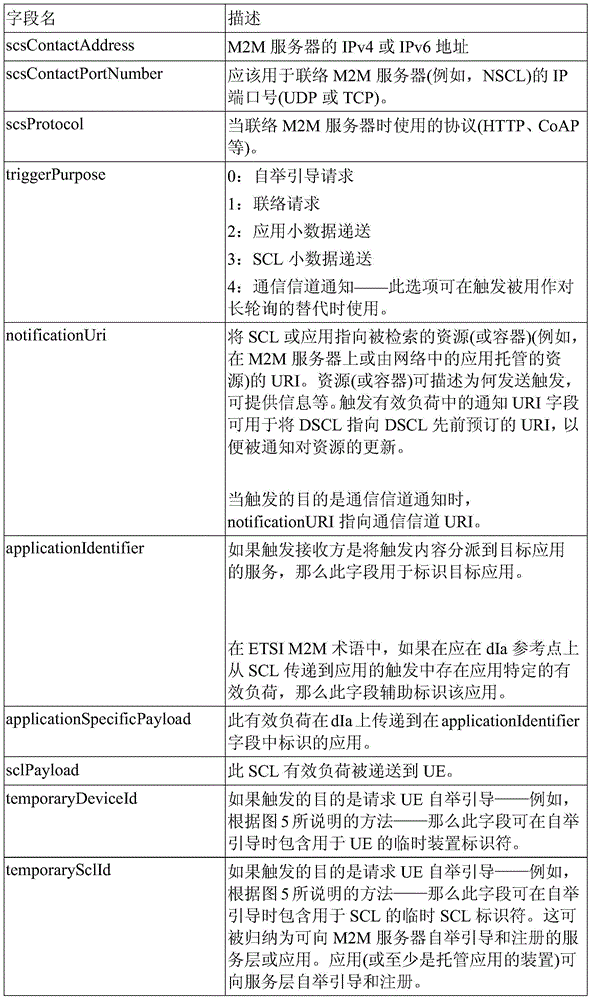
具体地,本文中公开用于由M2M服务器发送到UE的传送有效负荷的Tsp消息的有效负荷格式的实施例。本文所定义的Tsp触发有效负荷可以利用例如兼容ETSI的UE和NSCL使用。表3布局此Tsp触发有效负荷格式的示例性实施例,其中可使用全部或一些字段。应注意,triggerPurpose字段可用于将触发标识为用于自举引导的请求。Specifically, disclosed herein are embodiments of payload formats for Tsp messages conveying payloads sent by the M2M server to the UE. The Tsp trigger payload as defined herein may be used with, for example, ETSI compliant UEs and NSCLs. Table 3 lays out an exemplary embodiment of this Tsp trigger payload format, in which all or some fields may be used. It should be noted that the triggerPurpose field can be used to identify the trigger as a request for bootstrapping.
表3TSP触发有效负荷TABLE 3TSP trigger payload
参照上文所述的第三概念,触发可用于将通知发送到装置应用或服务层。此所公开技术解决现有M2M架构中的“长轮询”过程的缺点。如上所述,在长轮询中,装置应用或服务层告知SCS装置应用或服务层想要在发生某事件时被通知到。事件的示例是网络应用对SCS上的特定资源进行写入。当发生事件时,SCS会将通知发送到装置应用或服务层。可能需要装置应用或服务层在等待通知时保持其与SCS的IP连接活跃。这可能需要装置或SCS发送周期性“保持活跃(keep-alive)”消息以将连接保持活跃。这些“保持活跃”消息消耗网络资源。如下所述,触发可用于使长轮询较有效。具体来说,定义一种用于利用触发特征而将通知发送到装置应用或服务层以使得长轮询可更有效或得以避免的方法。服务层或应用指令被嵌入在触发有效负荷内,以使得装置和SCS可将其需要用来维持数据平面连接的时间量减到最少。Referring to the third concept described above, triggers can be used to send notifications to the device application or service layer. This disclosed technique addresses the shortcomings of the "long polling" procedure in existing M2M architectures. As mentioned above, in long polling, the device application or service layer informs the SCS that the device application or service layer wants to be notified when a certain event occurs. An example of an event is a web application writing to a specific resource on the SCS. When an event occurs, the SCS sends a notification to the device application or service layer. The device application or service layer may be required to keep its IP connection to the SCS active while waiting for notification. This may require the device or SCS to send periodic "keep-alive" messages to keep the connection alive. These "keep alive" messages consume network resources. As described below, triggering can be used to make long polling more efficient. Specifically, a method is defined for sending notifications to a device application or service layer using a trigger feature so that long polling can be more efficient or avoided. The service layer or application instructions are embedded within the trigger payload so that the device and the SCS can minimize the amount of time it needs to maintain a data plane connection.
当前,ETSI M2M参考TS 102 690定义服务层长轮询,其中如上所述,服务层长轮询可由UE用于告知M2M服务层UE想要在发生事件时被通知到。事件的示例是网络应用对M2M服务器上的特定资源进行写入。参照图3的示例M2M环境,示例可包含以更新的定价信息更新M2M服务器108上的资源。当发生更新时,M2M服务器108将通知发送到售货机101。可能需要售货机101(即,UE)在等待通知时保持其与M2M服务器108的IP连接活跃。因此,售货机101或M2M服务器108可发送周期性“保持活跃”消息以将IP连接保持活跃。这些“保持活跃”消息消耗网络资源。Currently, ETSI M2M defines service layer long polling with reference to TS 102 690, where as described above, service layer long polling can be used by the UE to inform the M2M service layer that the UE wants to be notified when an event occurs. An example of an event is a web application writing to a specific resource on the M2M server. Referring to the example M2M environment of Figure 3, an example may include updating resources on the
为了解决此问题,触发可在控制平面上被发送以向UE通知事件。触发有效负荷可包含notificationUri字段,例如,如表3的示例触发有效负荷格式所示。notificationUri字段将UE服务层或应用指向应被检索的资源。triggerPurpose字段——诸如表3的示例触发有效负荷格式中所提供的triggerPurpose字段——可由M2M服务器用于向装置应用或服务层指示触发是“通信信道通知”。例如,表3所说明的格式的triggerPupose字段将被设置为4。在此实施例中,triggerPupose字段中的“通信信道通知”值是对发生某事件的指示或对于UE检索关于发生的事件的某信息的请求。如表3进一步示出,触发有效负荷可包含applicationIdentfier,且当触发经由服务层或触发分派功能被发送时,applicationIdentfier字段可用于标识目标应用。在诸如图3所说明的示例中,售货机101可具有接收触发的DSCL。可存在若干应用在DSCL之上运行。一个应用可管理定价且另一应用可管理维护记录。applicationIdentifier字段中的应用标识符可用于标识应用特定的有效负荷应传递到定价应用。进一步参照表3的触发有效负荷格式,applicationSpecificPayload字段可保持指向包含更新的定价信息的NSCL上的资源的指针(例如,URI)。或者,此字段可传送实际定价信息,或此字段可含有售货机应联络NSCL以发现为何发送触发的指示。To address this issue, triggers can be sent on the control plane to notify the UE of the event. The trigger payload may contain a notificationUri field, eg, as shown in the example trigger payload format of Table 3. The notificationUri field points the UE service layer or application to the resource that should be retrieved. A triggerPurpose field, such as the triggerPurpose field provided in the example trigger payload format of Table 3, may be used by the M2M server to indicate to the device application or service layer that the trigger is a "communication channel notification". For example, the triggerPupose field of the format illustrated in Table 3 would be set to 4. In this embodiment, the "communication channel notification" value in the triggerPupose field is an indication of the occurrence of some event or a request for the UE to retrieve some information about the occurrence of the event. As further shown in Table 3, the trigger payload may contain an applicationIdentfier, and the applicationIdentfier field may be used to identify the target application when the trigger is sent via the service layer or trigger dispatch function. In an example such as that illustrated in FIG. 3, the
例如,参照图3,售货机101可含有若干售卖品。例如M2M服务器108可具有在资源或URI中所含有的售卖品的更新的定价。M2M服务器108可向售货机101发送触发以读取资源来发现新定价。触发有效负荷可包含需要由售货机101读取的URI。有效负荷中的消息传递到售货机101以读取特定URI来获得进一步的信息。当售货机101接收触发时,售货机101通常将建立IP连接(如果售货机101尚未具有IP连接),然后联络M2M服务器108以确定其为何被触发。消息可以是SMS型消息。有效负荷的大小极有限,因此,有效负荷在许多情况下可仅指导售货机101从URI获得更多信息。For example, referring to FIG. 3, the
在ETSI M2M SCL上,资源被管理为树结构,如图6所示。<sclBase>资源190含有托管M2M SCL(例如,售货机101或M2M服务器108)的所有其它子资源。<sclBase>资源190是其含有的其它资源的根。<sclBase>资源190由绝对URI表示。SCL中所托管的其它资源由URI标识,其中该URI是从<sclBase>资源190的URI分层导出的。例如,关于如本文所论述的售货机定价,目录结构可为<sclBase>190/容器193/售卖品194/售卖品定价195。On ETSI M2M SCL, resources are managed as a tree structure, as shown in Figure 6. <sclBase>
通过如上所述将服务层或应用指令嵌入在触发有效负荷内,与传统长轮询的情况相比,UE和M2M服务器可将其需要用来维持数据平面连接的时间量减到最少。By embedding the service layer or application instructions within the trigger payload as described above, the UE and M2M server can minimize the amount of time they need to maintain a data plane connection compared to the case of traditional long polling.
图7A是其中可实施一个或更多个所公开的实施例的示例机器对机器(M2M)或物联网(IoT)通信系统10的另一图式。通常,M2M技术提供IoT的构建块,且任何M2M装置、网关或服务平台可以是IoT的组件以及IoT服务层等。7A is another diagram of an example machine-to-machine (M2M) or Internet of Things (IoT)
如图7A所示,M2M/IoT通信系统10包含通信网络12。通信网络12可为固定网络或无线网络(例如,WLAN、蜂窝式网络等)或异构网络的网络。例如,通信网络12可包括多个接入网络,其中接入网络将诸如语音、数据、视频、消息、广播等内容提供到多个用户。例如,通信网络12可采用一个或更多个信道接入方法,诸如码分多址(CDMA)、时分多址(TDMA)、频分多址(FDMA)、正交FDMA(OFDMA)、单载波FDMA(SC-FDMA)等。此外,通信网络12可包括其它网络,诸如核心网络、互联网、传感器网络、工业控制网络、个域网、融合个人网络、卫星网络、家庭网络或企业网络等。As shown in FIG. 7A , the M2M/
如图7A所示,M2M/IoT通信系统10可包含M2M网关装置14和M2M终端装置18。应了解,视需要,任何数量的M2M网关装置14和M2M终端装置18可包含在M2M/IoT通信系统10中。M2M网关装置14和M2M终端装置18中的每一个被配置成经由通信网络12或直接无线电链路而发送和接收信号。M2M网关装置14允许无线M2M装置(例如,蜂窝式和非蜂窝式)和固定网络M2M装置(例如,PLC)经由诸如通信网络12的运营商网络或直接无线电链路而通信。例如,M2M装置18可收集数据,且经由通信网络12或直接无线电链路而将数据发送到M2M应用20或M2M装置18。M2M装置18还可从M2M应用20或M2M装置18接收数据。此外,如下所述,可经由M2M服务平台22而将数据和信号发送到M2M应用20以及从M2M应用20接收数据和信号。M2M装置18和网关14可经由各种网络,例如,包含蜂窝网络、WLAN、WPAN(例如,紫蜂、6LoWPAN、蓝牙)、直接无线电链路和电线,而通信。As shown in FIG. 7A , the M2M/
所说明的M2M服务平台22为M2M应用20、M2M网关装置14、M2M终端装置18和通信网络12提供服务。应理解,视需要,M2M服务平台22可与任何数量的M2M应用、M2M网关装置14、M2M终端装置18和通信网络12通信。M2M服务平台22可由一个或更多个服务器、计算机等实施。M2M服务平台22提供诸如M2M终端装置18和M2M网关装置14的管理和监视等服务。M2M服务平台22还可收集数据且转换数据,以使得数据与不同类型的M2M应用20兼容。M2M服务平台22的功能可按各种方式实施,例如,实施为网页服务器、实施在蜂窝核心网络中、实施在云中等。The illustrated
还参照图7B,M2M服务平台通常实施服务层26(例如,如本文所述的网络服务能力层(NSCL)),其中服务层26提供各种应用和纵向产品可利用的诸如触发的服务递送能力的核心集合。这些服务能力使M2M应用20能够与装置交互,且执行诸如数据收集、数据分析、装置管理、安全性、记账、服务/装置发现等功能。基本上,这些服务能力使应用摆脱实施这些功能性的负担,因此简化应用开发且降低成本并缩短上市时间。服务层26还使M2M应用20能够结合服务层26提供的服务经由各种网络12而通信。Referring also to FIG. 7B, M2M service platforms typically implement a service layer 26 (eg, a Network Services Capability Layer (NSCL) as described herein) that provides service delivery capabilities, such as triggering, that various applications and vertical products can utilize core collection. These service capabilities enable
在一些实施例中,M2M应用20可包含使用触发来通信的期望的应用,如本文所论述。M2M应用20可包含各种行业中的应用,诸如而不限于运输、健康与保健、联网家庭、能量管理、资产追踪以及安保与监控。如本文所述,跨越系统的装置、网关和其它服务器运行的M2M服务层支持例如数据收集、装置管理、安全性、记账、位置追踪/地理围栏、装置/服务发现以及传统系统集成等功能,且将这些功能作为服务提供到M2M应用20。In some embodiments,
图7C是诸如M2M终端装置18或M2M网关装置14的示例M2M装置30的系统图。如图7C所示,M2M装置30可包含处理器32、收发器34、发送/接收元件36、扬声器/麦克风38、小键盘40、显示器/触控板42、不可移除存储器44、可移除存储器46、电源48、全球定位系统(GPS)芯片组50以及其它外围设备52。应了解,M2M装置40可包含前述元件的任何子组合,同时仍保持与实施例一致。此装置可为将所公开的系统和方法用于装置触发的装置。FIG. 7C is a system diagram of an
处理器32可为通用处理器、专用处理器、常规处理器、数字信号处理器(DSP)、多个微处理器、结合DSP核的一个或更多个微处理器、控制器、微控制器、专用集成电路(ASIC)、现场可编程门阵列(FPGA)电路、任何其它类型的集成电路(IC)、状态机等。处理器32可执行信号编码、数据处理、功率控制、输入/输出处理以及使M2M装置30能够在无线环境中操作的任何其它功能性。处理器32可耦合到收发器34,其中收发器34可耦合到发送/接收元件36。虽然图7C将处理器32和收发器34描绘为独立组件,但应了解,处理器32和收发器34可一起集成到电子封装或芯片中。处理器32可执行应用层程序(例如,浏览器)和/或无线电接入层(RAN)程序和/或通信。处理器32可例如在接入层和/或应用层执行安全性操作,诸如认证、安全密钥协商和/或加密操作。The
发送/接收元件36可被配置成将信号发送到M2M服务平台22或从M2M服务平台22接收信号。例如,在实施例中,发送/接收元件36可为被配置成发送和/或接收RF信号的天线。发送/接收元件36可支持各种网络和空中接口,诸如WLAN、WPAN、蜂窝式等。在实施例中,发送/接收元件36可为被配置成发送和/或接收例如IR、UV或可见光信号的发射器/检测器。在又一实施例中,发送/接收元件36可为被配置成发送和接收RF信号与光信号两者。应了解,发送/接收元件36可被配置成发送和/或接收无线或有线信号的任何组合。The transmit/receive
此外,虽然发送/接收元件36在图7C中被描绘为单一元件,但M2M装置30可包含任何数量的发送/接收元件36。更具体来说,M2M装置30可使用MIMO技术。因此,在实施例中,M2M装置30可包含用于发送和接收无线信号的两个或更多个发送/接收元件36(例如,多个天线)。Furthermore, although the transmit/receive
收发器34可被配置成调制将由发送/接收元件36发送的信号,且解调由发送/接收元件36接收的信号。如上所述,M2M装置30可具有多模式能力。因此,收发器34可包含用于使M2M装置30能够经由多个RAT,诸如UTRA和IEEE 802.11,通信的多个收发器。
处理器32可从任何类型的适当存储器,诸如不可移除存储器44和/或可移除存储器46,访问信息,并将数据存储在其中。不可移除存储器44可包含随机存取存储器(RAM)、只读存储器(ROM)、硬盘或任何其它类型的存储器存储装置。可移除存储器46可包含用户标识模块(SIM)卡、记忆棒、安全数字(SD)存储卡等。在其它实施例中,处理器32可从未在物理上位于M2M装置30上,诸如位于服务器上或家用计算机上的存储器访问信息,并将数据存储在其中。处理器32可被配置成控制响应于本文所述的一些实施例中的触发(例如,服务层触发端口号或自举引导标识符)成功还是不成功而控制显示器或指示器42上的照明图案、图像或颜色,或以其它方式指示资源传播过程的状态。
处理器32可从电源48接收电力,且可被配置成将电力分配到M2M装置30中的其它组件和/或控制电力。电源48可为用于对M2M装置30供电的任何适当装置。例如,电源48可包含一个或更多个干电池(例如,镍镉(NiCd)、镍锌(NiZn)、镍金属氢化物(NiMH)、锂离子(Li离子)等)、太阳电池、燃料电池等。The
处理器32还可耦合到GPS芯片组50,其中GPS芯片组50被配置成提供关于M2M装置30的当前位置的位置信息(例如,经度和纬度)。应了解,M2M装置30可通过任何适当的位置确定方法而获得位置信息,同时仍保持与实施例一致。The
处理器32可还耦合到其它外围设备52,其中其它外围设备52可包含提供额外特征、功能性和/或有线或无线连接性的一个或更多个软件和/或硬件模块。例如,外围设备52可包含加速度计、电子罗盘、卫星收发器、传感器、数码相机(用于照片或视频)、通用串行总线(USB)端口、振动装置、电视收发器、免提耳机、
图7D是可例如实施图7A和图7B的M2M服务平台22的示例性计算系统90的框图。计算系统90可包括计算机或服务器,且可主要由计算机可读指令控制,其中计算机可读指令可呈软件的形式,而不管该软件是在何处或通过何种方式被存储或访问。这些计算机可读指令可在中央处理单元(CPU)91内执行,而使计算系统90工作。在许多已知的工作站、服务器和个人计算机中,中央处理单元91由被称为微处理器的单芯片CPU实施。在其它机器中,中央处理单元91可包括多个处理器。协同处理器81是与主CPU 91不同的可选处理器,用于执行额外功能或辅助CPU 91。CPU 91和/或协同处理器81可接收、产生和处理与所公开的用于触发的系统和方法,诸如在控制平面上交换触发消息,相关的数据。7D is a block diagram of an
在操作中,CPU 91提取、解码且执行指令,且经由计算机的主数据传送路径,系统总线80,而将信息传输到其它资源以及从其它资源传输信息。此系统总线连接计算系统90中的组件且定义数据交换的媒介。系统总线80通常包含用于发送数据的数据线路、用于发送地址的地址线路和用于发送中断和操作系统总线的控制线路。此系统总线80的示例是外围组件互连(PCI)总线。In operation,
耦合到系统总线80的存储器装置包含随机存取存储器(RAM)82和只读存储器(ROM)93。这些存储器包含允许存储和提取信息的电路。ROM 93通常含有无法容易修改的所存储的数据。RAM 82中所存储的数据可由CPU 91或其它硬件装置读取或改变。对RAM 82和/或ROM93的存取可受存储器控制器92控制。存储器控制器92可提供地址转换功能,其中随着指令被执行,地址转换功能将虚拟地址转换为物理地址。存储器控制器92还可提供存储器保护功能,其中存储器保护功能隔离系统内的进程,且将系统进程与用户进程隔离。因此,在第一模式中运行的程序可仅存取由其自身的进程虚拟地址空间映射的存储器;除非已设置进程之间的存储器共享,否则该程序无法存取另一进程的虚拟地址空间内的存储器。Memory devices coupled to
此外,计算系统90可含有外围设备控制器83,其中外围设备控制器83负责将指令从CPU 91传达到外围设备,诸如打印机94、键盘84、鼠标95和硬盘驱动器85。Additionally,
受显示器控制器96控制的显示器86用于显示由计算系统90产生的视觉输出。该视觉输出可包含文字、图形、动画图形和视频。显示器86可使用基于CRT的视频显示器、基于LCD的平板显示器、基于气体等离子体的平板显示器或触摸板来实施。显示器控制器96包含产生发送到显示器86的视频信号所需的电子组件。
此外,计算系统90可含有网络适配器97,其中网络适配器97可用于将计算系统90连接到外部通信网络,诸如图7A和图7B的网络12。Additionally,
应理解,本文所述的任何或所有系统、方法和过程可体现为存储在计算机可读存储介质上的计算机可执行指令(即,程序代码)的形式,其中当由诸如计算机、服务器、M2M终端装置、M2M网关装置等机器执行时,指令执行和/或实施本文所述的系统、方法和过程。具体来说,上文所述的任何步骤、操作或功能可实施为这些计算机可执行指令的形式。计算机可读存储介质包含在任何方法或技术中实施为存储信息的易失性与非易失性的可移除和不可移除介质,但这些计算机可读存储介质不包含信号。计算机可读存储介质包含,但不限于,RAM、ROM、EEPROM、闪存或其它存储器技术、CD-ROM、数字多功能光盘(DVD)或其它光盘存储器、磁带盒、磁带、磁盘存储装置或其它磁性存储装置或可用于存储所要信息且可由计算机存取的任何其它物理介质。It should be understood that any or all of the systems, methods, and processes described herein may be embodied in the form of computer-executable instructions (ie, program code) stored on a computer-readable storage medium, where When executed by a machine such as a device, M2M gateway device, etc., the instructions execute and/or implement the systems, methods and processes described herein. In particular, any of the steps, operations or functions described above may be implemented in the form of these computer-executable instructions. Computer readable storage media include volatile and nonvolatile removable and non-removable media implemented in any method or technology for storage of information, but these computer readable storage media do not include signals. Computer readable storage media include, but are not limited to, RAM, ROM, EEPROM, flash memory or other memory technology, CD-ROM, digital versatile disc (DVD) or other optical disk storage, magnetic cassettes, magnetic tape, magnetic disk storage devices or other magnetic A storage device or any other physical medium that can be used to store the desired information and that can be accessed by a computer.
在描述本公开的主题的优选实施例时,如图所说明,为了清楚起见而使用了特定术语。然而,所主张的主题不希望限于所选择的特定术语,且应理解,每一特定元件包含以类似方式操作以实现类似目的的所有技术等同物。通常,可在本文中互换使用术语服务能力服务器(SCS)、NSCL、应用服务器、M2M服务器和MTC服务器。可使用任何适当标识符,而不仅仅是M2M服务器所知的应用-端口-标识符,如本文所论述。如本文所论述的触发的使用可与任何适当配置的计算装置一起使用。例如,不与机器对机器相关的装置可使用本文中的系统和方法。In describing the preferred embodiments of the presently disclosed subject matter, as illustrated in the figures, specific terminology is employed for the sake of clarity. However, the claimed subject matter is not intended to be limited to the specific terminology so selected, and it is to be understood that each specific element includes all technical equivalents that operate in a similar manner to accomplish a similar purpose. Generally, the terms service capability server (SCS), NSCL, application server, M2M server and MTC server are used interchangeably herein. Any suitable identifier may be used, not just the application-port-identifier known to the M2M server, as discussed herein. The use of triggers as discussed herein may be used with any suitably configured computing device. For example, devices that are not machine-to-machine related can use the systems and methods herein.
本书面描述使用示例来公开本发明,包含最佳模式,且使所属领域的技术人员能够实践本发明,包含制造且使用任何装置或系统且执行任何所并入的方法。本发明的可取得专利权的范围由权利要求书界定,且可包含所属领域的技术人员清楚的其它示例。如果这些其它示例具有不与权利要求书的文字表述不同的结构元件或如果这些其它示例包含带有与文字表述的非实质性不同的等同结构元件,那么这些其它示例旨在处于权利要求书的范围内。This written description uses examples to disclose the invention, including the best mode, and to enable any person skilled in the art to practice the invention, including making and using any devices or systems and performing any incorporated methods. The patentable scope of the invention is defined by the claims, and may include other examples that are apparent to those skilled in the art. Such other examples are intended to be within the scope of the claims if they have structural elements that do not differ from the literal expressions of the claims, or if they contain equivalent structural elements with insubstantial differences from the literal expressions Inside.
Claims (12)
Priority Applications (1)
| Application Number | Priority Date | Filing Date | Title |
|---|---|---|---|
| CN202010450394.6A CN111556468B (en) | 2013-05-06 | 2014-05-06 | device trigger |
Applications Claiming Priority (3)
| Application Number | Priority Date | Filing Date | Title |
|---|---|---|---|
| US201361819970P | 2013-05-06 | 2013-05-06 | |
| US61/819,970 | 2013-05-06 | ||
| PCT/US2014/036964 WO2014182694A1 (en) | 2013-05-06 | 2014-05-06 | Device triggering |
Related Child Applications (1)
| Application Number | Title | Priority Date | Filing Date |
|---|---|---|---|
| CN202010450394.6A Division CN111556468B (en) | 2013-05-06 | 2014-05-06 | device trigger |
Publications (2)
| Publication Number | Publication Date |
|---|---|
| CN105379312A CN105379312A (en) | 2016-03-02 |
| CN105379312B true CN105379312B (en) | 2020-06-23 |
Family
ID=50942843
Family Applications (2)
| Application Number | Title | Priority Date | Filing Date |
|---|---|---|---|
| CN201480035034.2A Active CN105379312B (en) | 2013-05-06 | 2014-05-06 | Device triggering |
| CN202010450394.6A Active CN111556468B (en) | 2013-05-06 | 2014-05-06 | device trigger |
Family Applications After (1)
| Application Number | Title | Priority Date | Filing Date |
|---|---|---|---|
| CN202010450394.6A Active CN111556468B (en) | 2013-05-06 | 2014-05-06 | device trigger |
Country Status (6)
| Country | Link |
|---|---|
| US (4) | US9800621B2 (en) |
| EP (2) | EP2995099B1 (en) |
| JP (2) | JP6364069B2 (en) |
| KR (2) | KR20160009597A (en) |
| CN (2) | CN105379312B (en) |
| WO (1) | WO2014182694A1 (en) |
Families Citing this family (35)
| Publication number | Priority date | Publication date | Assignee | Title |
|---|---|---|---|---|
| CN102804738B (en) | 2010-03-01 | 2016-10-19 | 交互数字专利控股公司 | Machine-to-Machine Gateway Architecture and Functionality |
| CN105379312B (en) | 2013-05-06 | 2020-06-23 | 康维达无线有限责任公司 | Device triggering |
| GB2518257A (en) * | 2013-09-13 | 2015-03-18 | Vodafone Ip Licensing Ltd | Methods and systems for operating a secure mobile device |
| US9467828B2 (en) | 2013-11-08 | 2016-10-11 | Gogo Llc | Systems and methods for configuring an electronic device for cellular-based communications |
| US20150195717A1 (en) * | 2014-01-06 | 2015-07-09 | Puneet K. Jain | Techniques for communication between interworking function and short message service nodes for device trigger replacement/recall |
| WO2015123785A1 (en) * | 2014-02-24 | 2015-08-27 | Sierra Wireless, Inc. | Wireless device customization resources |
| CN104918221B (en) * | 2014-03-14 | 2019-03-15 | 中兴通讯股份有限公司 | Method and system for registration, cancellation and standby processing of terminal peripherals |
| CN105100002B (en) * | 2014-05-05 | 2019-05-07 | 中兴通讯股份有限公司 | Attribute operation method and device |
| US9503956B2 (en) * | 2014-05-30 | 2016-11-22 | Gogo Llc | Systems and methods for facilitating communications originating from a non-terrestrial network |
| GB2529838B (en) | 2014-09-03 | 2021-06-30 | Advanced Risc Mach Ltd | Bootstrap Mechanism For Endpoint Devices |
| GB2530552B (en) * | 2014-09-26 | 2018-07-25 | Telit Tech Cyprus Ltd | System and method of controlling operation of connected devices |
| GB2540989B (en) * | 2015-08-03 | 2018-05-30 | Advanced Risc Mach Ltd | Server initiated remote device registration |
| GB2540987B (en) | 2015-08-03 | 2020-05-13 | Advanced Risc Mach Ltd | Bootstrapping without transferring private key |
| CN106131832B (en) * | 2015-11-25 | 2019-05-14 | 北京邮电大学 | Core network architecture for convergence of WLAN and cellular network |
| CN109314839B (en) * | 2016-05-06 | 2021-08-03 | 康维达无线有限责任公司 | Service layer business orientation |
| CN108307402A (en) * | 2016-08-31 | 2018-07-20 | 中兴通讯股份有限公司 | Manage the method, apparatus and system of UPF |
| KR102561083B1 (en) * | 2016-10-06 | 2023-07-31 | 콘비다 와이어리스, 엘엘씨 | Profile-based content and services |
| KR102389004B1 (en) * | 2016-10-07 | 2022-04-22 | 콘비다 와이어리스, 엘엘씨 | Service layer resource management for generic interworking and extensibility |
| US10530865B2 (en) * | 2017-04-19 | 2020-01-07 | Vmware, Inc. | Offline sideloading for enrollment of devices in a mobile device management system |
| US10698750B2 (en) * | 2017-04-24 | 2020-06-30 | At&T Intellectual Property I, L.P. | Cross-vertical service development |
| CN108882224B (en) * | 2017-05-12 | 2022-05-03 | 中兴通讯股份有限公司 | User identity information distribution method and access service router |
| WO2019067892A1 (en) * | 2017-09-29 | 2019-04-04 | Condvida Wireless, Llc | Service registration based on service capabilities requirements and preferences |
| US10833926B2 (en) * | 2017-11-17 | 2020-11-10 | T-Mobile Usa, Inc. | Touchless secure bootstrapping of IoT devices |
| CN109995701B (en) * | 2017-12-29 | 2020-12-01 | 华为技术有限公司 | Device booting method, terminal and server |
| WO2020076630A1 (en) * | 2018-10-08 | 2020-04-16 | Convida Wireless, Llc | Device discovery and connectivity in a cellular network |
| CN109474916B (en) * | 2018-11-19 | 2020-09-18 | 海信集团有限公司 | Equipment authentication method, device and machine readable medium |
| GB2579574B (en) | 2018-12-03 | 2021-08-11 | Advanced Risc Mach Ltd | Bootstrapping with common credential data |
| GB2579571B (en) | 2018-12-03 | 2021-05-12 | Advanced Risc Mach Ltd | Device bootstrapping |
| CN111416723B (en) * | 2019-01-04 | 2022-03-01 | 华为云计算技术有限公司 | A device management method and related devices |
| GB2582736B (en) | 2019-02-01 | 2022-02-16 | Arm Ip Ltd | Template-based registration |
| GB2582735B (en) | 2019-02-01 | 2022-11-30 | Arm Ip Ltd | Template-based registration |
| GB2582737B (en) | 2019-02-01 | 2021-07-14 | Arm Ip Ltd | Device registration mechanism |
| US11475134B2 (en) | 2019-04-10 | 2022-10-18 | Arm Limited | Bootstrapping a device |
| US11429395B2 (en) * | 2020-01-02 | 2022-08-30 | Jpmorgan Chase Bank, N.A. | Peripheral device support in thin client environments |
| US11588788B2 (en) * | 2020-05-06 | 2023-02-21 | Verizon Patent And Licensing Inc. | Systems and methods for facilitating data transmission to internet of things devices |
Citations (2)
| Publication number | Priority date | Publication date | Assignee | Title |
|---|---|---|---|---|
| CN102281334A (en) * | 2010-06-11 | 2011-12-14 | 中兴通讯股份有限公司 | Management control method and system thereof for wired terminal and access server |
| CN102752794A (en) * | 2011-04-18 | 2012-10-24 | 华为技术有限公司 | Method, device and transmission system for transmitting and receiving data block |
Family Cites Families (74)
| Publication number | Priority date | Publication date | Assignee | Title |
|---|---|---|---|---|
| US6516343B1 (en) * | 2000-04-24 | 2003-02-04 | Fong Pong | Computer system and method for enhancing memory-to-memory copy transactions by utilizing multiple system control units |
| US7197301B2 (en) * | 2002-03-04 | 2007-03-27 | Telespree Communications | Method and apparatus for secure immediate wireless access in a telecommunications network |
| US6950660B1 (en) * | 2002-05-10 | 2005-09-27 | Qualcomm, Incorporated | Provisioning a mobile device in a wireless communication system |
| JP4511603B2 (en) * | 2005-02-18 | 2010-07-28 | テレフオンアクチーボラゲット エル エム エリクソン(パブル) | Configuration for providing peer-to-peer communication in public land mobile networks |
| GB0504865D0 (en) * | 2005-03-09 | 2005-04-13 | Nokia Corp | User authentication in a communications system |
| WO2007085951A1 (en) * | 2006-01-30 | 2007-08-02 | Nokia Corporation | Management of user data |
| US8041335B2 (en) * | 2008-04-18 | 2011-10-18 | Kineto Wireless, Inc. | Method and apparatus for routing of emergency services for unauthorized user equipment in a home Node B system |
| CN101582730B (en) * | 2008-05-15 | 2011-06-01 | 华为技术有限公司 | Method, system, corresponding device and communication terminal for providing MBMS service |
| US8156318B2 (en) * | 2008-06-04 | 2012-04-10 | Intel Corporation | Storing a device management encryption key in a network interface controller |
| US20090305674A1 (en) * | 2008-06-04 | 2009-12-10 | Nokia Siemens Networks Oy | Device management in visited network |
| US9590961B2 (en) * | 2009-07-14 | 2017-03-07 | Alcatel Lucent | Automated security provisioning protocol for wide area network communication devices in open device environment |
| WO2011025876A1 (en) * | 2009-08-27 | 2011-03-03 | Interdigital Patent Holdings, Inc. | Method and apparatus for solving limited addressing space in machine-to-machine (m2m) environments |
| US8750145B2 (en) * | 2009-11-23 | 2014-06-10 | Interdigital Patent Holdings, Inc. | Method and apparatus for machine-to-machine communication registration |
| JP2013512624A (en) * | 2009-11-25 | 2013-04-11 | インターデイジタル パテント ホールディングス インコーポレイテッド | Machine type communication pre-registration |
| US10251146B2 (en) * | 2009-12-11 | 2019-04-02 | Qualcomm Incorporated | Apparatus and method for network-initiated attachment and registration-less paging |
| EP2517511A1 (en) * | 2009-12-22 | 2012-10-31 | InterDigital Patent Holdings, Inc. | Group-based machine to machine communication |
| US9167517B2 (en) * | 2010-01-29 | 2015-10-20 | Interdigital Patent Holdings, Inc. | Group-based machine to machine communication |
| US9246763B2 (en) * | 2010-02-11 | 2016-01-26 | Nokia Solutions And Networks Oy | Device management |
| EP2545694A1 (en) * | 2010-03-09 | 2013-01-16 | InterDigital Patent Holdings, Inc. | Method and apparatus for supporting machine-to-machine communications |
| EP2375849B1 (en) * | 2010-03-29 | 2015-08-12 | Vodafone Holding GmbH | Connection management for M2M device in a mobile communication network |
| US9807602B2 (en) * | 2010-04-07 | 2017-10-31 | Qualcomm Incorporated | Apparatus and method for connection establishment in a communications network |
| US9729516B2 (en) * | 2010-04-09 | 2017-08-08 | Gemalto Sa | Method of machine-to-machine communication |
| JP5755639B2 (en) * | 2010-04-14 | 2015-07-29 | パナソニック インテレクチュアル プロパティ コーポレーション オブアメリカPanasonic Intellectual Property Corporation of America | Connection establishment method and communication node |
| WO2011163561A1 (en) * | 2010-06-25 | 2011-12-29 | Interdigital Patend Holdings, Inc. | Interface of an m2m server with the 3gpp core network |
| WO2012017562A1 (en) * | 2010-08-04 | 2012-02-09 | Telefonaktiebolaget L M Ericsson (Publ) | Telephone, control method therefor, provisioning server, and control method therefor |
| US8650619B2 (en) * | 2010-08-19 | 2014-02-11 | Alcatel Lucent | Method and apparatus of automated discovery in a communication network |
| US9119171B2 (en) * | 2010-09-08 | 2015-08-25 | Samsung Electronics Co., Ltd. | Apparatus and method for supporting location update registration process in machine to machine communication system |
| US8509431B2 (en) * | 2010-09-20 | 2013-08-13 | Interdigital Patent Holdings, Inc. | Identity management on a wireless device |
| EP2636232A4 (en) * | 2010-11-01 | 2016-04-20 | Ericsson Telefon Ab L M | Gateway apparatus, control method therefor and computer program |
| TWI533629B (en) * | 2010-12-28 | 2016-05-11 | 內數位專利控股公司 | Triggering devices that are not attached to a wireless network |
| US9071925B2 (en) * | 2011-01-05 | 2015-06-30 | Alcatel Lucent | System and method for communicating data between an application server and an M2M device |
| WO2012103902A1 (en) * | 2011-02-04 | 2012-08-09 | Telefonaktiebolaget L M Ericsson (Publ) | Method and arrangements for mtc communication |
| CN103503487B (en) * | 2011-03-03 | 2017-05-03 | 交互数字专利控股公司 | Method and apparatus for accessing services affiliated with discovered service providers |
| CN103703697A (en) * | 2011-03-09 | 2014-04-02 | 英特尔公司 | Base station and communication method for machine-to-machine communication |
| CN102724661B (en) * | 2011-03-30 | 2016-12-28 | 中兴通讯股份有限公司 | A kind of method and system obtaining machine type communication device IP address |
| KR101981229B1 (en) * | 2011-04-15 | 2019-05-22 | 삼성전자주식회사 | Machine-to-machine node erase procedure |
| US20120284785A1 (en) * | 2011-05-05 | 2012-11-08 | Motorola Mobility, Inc. | Method for facilitating access to a first access nework of a wireless communication system, wireless communication device, and wireless communication system |
| US9769648B2 (en) * | 2011-06-15 | 2017-09-19 | Telefonaktiebolaget Lm Ericsson (Publ) | Provisioning connectivity service data in a telecommunications network |
| EP2544470A1 (en) * | 2011-07-04 | 2013-01-09 | Koninklijke KPN N.V. | Triggering with QoS parameters |
| WO2013019260A1 (en) * | 2011-08-01 | 2013-02-07 | Intel Corporation | Method and system for network access control |
| CN102932767B (en) * | 2011-08-11 | 2017-02-01 | 中兴通讯股份有限公司 | Information transmission method, packet data network gateway as well as policy and charging rules function |
| CN102958194B (en) * | 2011-08-25 | 2017-11-03 | 中兴通讯股份有限公司 | A kind of method, user equipment and system for maintaining largely to connect |
| US9210532B2 (en) * | 2011-09-12 | 2015-12-08 | Intel Corporation | Changing the machine-to-machine (M2M) group of an M2M device |
| GB201117072D0 (en) * | 2011-10-04 | 2011-11-16 | Vodafone Ip Licensing Ltd | Use of non e.164 msisdns |
| KR101540499B1 (en) * | 2011-10-10 | 2015-07-29 | 주식회사 케이티 | Short Message Server, User Equipment Triggering Method Thereof, Trigger Request Delivering Server, and Trigger Request Delivering Method Thereof |
| JP5826090B2 (en) * | 2011-10-13 | 2015-12-02 | Kddi株式会社 | Gateway and program |
| US20130339438A1 (en) * | 2011-12-02 | 2013-12-19 | Qualcomm Incorporated | Systems and methods for group based access control of machine to machine devices |
| US9549321B2 (en) * | 2011-12-29 | 2017-01-17 | Telefonaktiebolaget Lm Ericsson (Publ) | Remote provisioning of 3GPP downloadable subscriber identity module for virtual machine applications |
| US20150055640A1 (en) * | 2012-01-13 | 2015-02-26 | Interdigital Patent Holdings, Inc. | Method and apparatus for supporting machine-to-machine communications |
| CN103220670B (en) * | 2012-01-19 | 2018-01-19 | 华为技术有限公司 | A kind of equipment switching method, M2M platforms and network system |
| US9094437B2 (en) * | 2012-01-25 | 2015-07-28 | Telefonaktiebolaget Lm Ericsson (Publ) | System, policy nodes, and methods to perform policy provisioning of traffic offloaded at a fixed broadband network |
| KR101626453B1 (en) * | 2012-02-02 | 2016-06-01 | 노키아 솔루션스 앤드 네트웍스 오와이 | Group based bootstrapping in machine type communication |
| US9049685B2 (en) * | 2012-02-03 | 2015-06-02 | Interdigital Patent Holdings, Inc. | Identifiers and triggers for capillary devices |
| WO2013121362A2 (en) * | 2012-02-13 | 2013-08-22 | Telefonaktiebolaget Lm Ericsson (Publ) | M2m service enablement over access networks |
| US9380038B2 (en) * | 2012-03-09 | 2016-06-28 | T-Mobile Usa, Inc. | Bootstrap authentication framework |
| EP2848081A1 (en) * | 2012-05-09 | 2015-03-18 | Interdigital Patent Holdings, Inc. | Handling mtc long drx cycle/sleep lengths |
| US9253621B2 (en) * | 2012-05-18 | 2016-02-02 | Telefonaktiebolaget L M Ericsson (Publ) | Method and apparatus for associating service provider network identifiers with access network identifiers |
| US9094790B2 (en) * | 2012-05-18 | 2015-07-28 | Telefonaktiebolaget L M Ericsson (Publ) | Automatic transfer of machine-to-machine device identifier to network-external service providers |
| US9451594B2 (en) * | 2012-05-25 | 2016-09-20 | Telefonaktiebolaget Lm Ericsson (Publ) | Method and apparatus for associating service provider network identifiers with access network identifiers |
| US9497567B2 (en) * | 2012-06-22 | 2016-11-15 | Telefonaktiebolaget Lm Ericsson (Publ) | Selection of M2M devices by external triggering |
| US9125031B2 (en) * | 2012-10-11 | 2015-09-01 | Qualcomm Incorporated | Methods and apparatus for using USSD over a common channel |
| US8938731B2 (en) * | 2012-10-24 | 2015-01-20 | Telefonaktiebolaget L M Ericsson (Publ) | Cost optimization for firmware updates for globally mobile machine-to-machine devices |
| US8874164B2 (en) * | 2012-11-07 | 2014-10-28 | Qualcomm Incorporated | Power consumption improvement for certain M2M devices |
| US9253081B2 (en) * | 2012-11-15 | 2016-02-02 | Cisco Technology, Inc. | Trigger message routing according to a service class |
| WO2014101935A1 (en) * | 2012-12-24 | 2014-07-03 | Telefonaktiebolaget L M Ericsson (Publ) | Enabling external access to multiple services on a local server |
| US9232524B2 (en) * | 2013-01-05 | 2016-01-05 | Qualcomm Incorporated | Multiple access scheme for multi-channels of a network with a limited link budget |
| US9900727B2 (en) * | 2013-01-18 | 2018-02-20 | Lg Electronics Inc. | Method and apparatus for controlling access in wireless communication system |
| KR101432128B1 (en) * | 2013-01-29 | 2014-08-21 | 주식회사 케이티 | M2M platform for converting resources into abstracted device object on M2M network |
| CN105379312B (en) | 2013-05-06 | 2020-06-23 | 康维达无线有限责任公司 | Device triggering |
| EP3021601B1 (en) * | 2013-08-14 | 2021-12-22 | Huawei Technologies Co., Ltd. | Method and device for sending trigger message |
| GB2518257A (en) * | 2013-09-13 | 2015-03-18 | Vodafone Ip Licensing Ltd | Methods and systems for operating a secure mobile device |
| US9398633B2 (en) * | 2014-03-27 | 2016-07-19 | Qualcomm Incorporated | Methods and apparatus for low power tracking of network system timing for long paging cycles |
| JP6402583B2 (en) * | 2014-10-23 | 2018-10-10 | 富士通株式会社 | Relay device, relay system, relay method, and program |
| JP2016116205A (en) * | 2014-12-18 | 2016-06-23 | 富士通株式会社 | Positional information management unit, mobile apparatus and radio communication system |
-
2014
- 2014-05-06 CN CN201480035034.2A patent/CN105379312B/en active Active
- 2014-05-06 US US14/270,970 patent/US9800621B2/en active Active
- 2014-05-06 EP EP14730306.9A patent/EP2995099B1/en active Active
- 2014-05-06 KR KR1020157034627A patent/KR20160009597A/en not_active Abandoned
- 2014-05-06 KR KR1020177021728A patent/KR101999039B1/en active Active
- 2014-05-06 EP EP19174707.0A patent/EP3557894B1/en active Active
- 2014-05-06 WO PCT/US2014/036964 patent/WO2014182694A1/en not_active Ceased
- 2014-05-06 CN CN202010450394.6A patent/CN111556468B/en active Active
- 2014-05-06 JP JP2016513015A patent/JP6364069B2/en active Active
-
2017
- 2017-10-10 US US15/728,885 patent/US10250647B2/en active Active
-
2018
- 2018-06-29 JP JP2018124786A patent/JP6629392B2/en active Active
-
2019
- 2019-03-25 US US16/363,252 patent/US10848526B2/en active Active
-
2020
- 2020-10-27 US US17/080,913 patent/US11444986B2/en active Active
Patent Citations (2)
| Publication number | Priority date | Publication date | Assignee | Title |
|---|---|---|---|---|
| CN102281334A (en) * | 2010-06-11 | 2011-12-14 | 中兴通讯股份有限公司 | Management control method and system thereof for wired terminal and access server |
| CN102752794A (en) * | 2011-04-18 | 2012-10-24 | 华为技术有限公司 | Method, device and transmission system for transmitting and receiving data block |
Also Published As
| Publication number | Publication date |
|---|---|
| US10848526B2 (en) | 2020-11-24 |
| US20190222615A1 (en) | 2019-07-18 |
| EP3557894B1 (en) | 2023-12-27 |
| KR20160009597A (en) | 2016-01-26 |
| KR101999039B1 (en) | 2019-07-10 |
| US11444986B2 (en) | 2022-09-13 |
| JP2018196122A (en) | 2018-12-06 |
| JP6364069B2 (en) | 2018-07-25 |
| CN111556468A (en) | 2020-08-18 |
| EP2995099A1 (en) | 2016-03-16 |
| US20180034864A1 (en) | 2018-02-01 |
| US10250647B2 (en) | 2019-04-02 |
| EP2995099B1 (en) | 2019-07-10 |
| JP6629392B2 (en) | 2020-01-15 |
| KR20170093998A (en) | 2017-08-16 |
| US20140330952A1 (en) | 2014-11-06 |
| US9800621B2 (en) | 2017-10-24 |
| CN111556468B (en) | 2023-02-17 |
| CN105379312A (en) | 2016-03-02 |
| JP2016527739A (en) | 2016-09-08 |
| US20210044632A1 (en) | 2021-02-11 |
| WO2014182694A1 (en) | 2014-11-13 |
| EP3557894A1 (en) | 2019-10-23 |
Similar Documents
| Publication | Publication Date | Title |
|---|---|---|
| US11444986B2 (en) | Device triggering | |
| US10492048B2 (en) | Service layer resource propagation across domains | |
| CN106797391B (en) | Interworking with the service layer using the MQTT protocol | |
| CN106797400B (en) | System and method for enabling access to third party services via a service layer | |
| CN105531980A (en) | Service layer device location management and privacy control | |
| KR20170075808A (en) | Method and apparatus for the virtualization of resources using a virtualization broker and context information | |
| US10992578B2 (en) | Message retargeting in machine-to-machine service layer communications | |
| US20220141309A1 (en) | Efficient resource representation exchange between service layers | |
| CN105493471A (en) | Transparent data transmission method and public service entity |
Legal Events
| Date | Code | Title | Description |
|---|---|---|---|
| C06 | Publication | ||
| PB01 | Publication | ||
| C10 | Entry into substantive examination | ||
| SE01 | Entry into force of request for substantive examination | ||
| GR01 | Patent grant | ||
| GR01 | Patent grant | ||
| TR01 | Transfer of patent right |
Effective date of registration: 20250811 Address after: U.S.A. Patentee after: INTERDIGITAL PATENT HOLDINGS, Inc. Country or region after: U.S.A. Address before: Delaware, USA Patentee before: CONVIDA WIRELESS, LLC Country or region before: U.S.A. |
|
| TR01 | Transfer of patent right |