CN105001213B - C-aryl glycoside derivative, pharmaceutical composition, preparation method and application thereof - Google Patents
C-aryl glycoside derivative, pharmaceutical composition, preparation method and application thereof Download PDFInfo
- Publication number
- CN105001213B CN105001213B CN201410392098.XA CN201410392098A CN105001213B CN 105001213 B CN105001213 B CN 105001213B CN 201410392098 A CN201410392098 A CN 201410392098A CN 105001213 B CN105001213 B CN 105001213B
- Authority
- CN
- China
- Prior art keywords
- compound
- reaction
- solvent
- following
- steps
- Prior art date
- Legal status (The legal status is an assumption and is not a legal conclusion. Google has not performed a legal analysis and makes no representation as to the accuracy of the status listed.)
- Active
Links
- 238000002360 preparation method Methods 0.000 title claims abstract description 38
- 229930182470 glycoside Natural products 0.000 title claims abstract description 24
- 239000008194 pharmaceutical composition Substances 0.000 title claims abstract description 17
- 150000001875 compounds Chemical class 0.000 claims abstract description 189
- 238000006243 chemical reaction Methods 0.000 claims abstract description 158
- 239000002904 solvent Substances 0.000 claims abstract description 113
- 238000000034 method Methods 0.000 claims abstract description 59
- 230000006196 deacetylation Effects 0.000 claims abstract description 18
- 238000003381 deacetylation reaction Methods 0.000 claims abstract description 18
- 125000006239 protecting group Chemical group 0.000 claims abstract description 18
- 150000003839 salts Chemical class 0.000 claims abstract description 16
- 239000003513 alkali Substances 0.000 claims abstract description 13
- 238000002156 mixing Methods 0.000 claims abstract description 12
- 230000009471 action Effects 0.000 claims abstract description 11
- 229930182478 glucoside Natural products 0.000 claims abstract description 9
- 238000010534 nucleophilic substitution reaction Methods 0.000 claims abstract description 6
- 238000006751 Mitsunobu reaction Methods 0.000 claims abstract description 4
- 102000000070 Sodium-Glucose Transport Proteins Human genes 0.000 claims abstract 3
- 108010080361 Sodium-Glucose Transport Proteins Proteins 0.000 claims abstract 3
- OKKJLVBELUTLKV-UHFFFAOYSA-N Methanol Chemical group OC OKKJLVBELUTLKV-UHFFFAOYSA-N 0.000 claims description 129
- 125000000217 alkyl group Chemical group 0.000 claims description 27
- 229910052799 carbon Inorganic materials 0.000 claims description 27
- KZMGYPLQYOPHEL-UHFFFAOYSA-N Boron trifluoride etherate Chemical compound FB(F)F.CCOCC KZMGYPLQYOPHEL-UHFFFAOYSA-N 0.000 claims description 26
- AQRLNPVMDITEJU-UHFFFAOYSA-N triethylsilane Chemical compound CC[SiH](CC)CC AQRLNPVMDITEJU-UHFFFAOYSA-N 0.000 claims description 24
- OKTJSMMVPCPJKN-UHFFFAOYSA-N Carbon Chemical compound [C] OKTJSMMVPCPJKN-UHFFFAOYSA-N 0.000 claims description 22
- 239000003814 drug Substances 0.000 claims description 21
- 229910052736 halogen Inorganic materials 0.000 claims description 16
- 150000002367 halogens Chemical class 0.000 claims description 16
- 125000002496 methyl group Chemical group [H]C([H])([H])* 0.000 claims description 15
- 229940124597 therapeutic agent Drugs 0.000 claims description 14
- WQDUMFSSJAZKTM-UHFFFAOYSA-N Sodium methoxide Chemical compound [Na+].[O-]C WQDUMFSSJAZKTM-UHFFFAOYSA-N 0.000 claims description 12
- AFVFQIVMOAPDHO-UHFFFAOYSA-N Methanesulfonic acid Chemical compound CS(O)(=O)=O AFVFQIVMOAPDHO-UHFFFAOYSA-N 0.000 claims description 10
- 239000003153 chemical reaction reagent Substances 0.000 claims description 9
- 239000000460 chlorine Substances 0.000 claims description 9
- 229910052801 chlorine Inorganic materials 0.000 claims description 9
- 229910052731 fluorine Inorganic materials 0.000 claims description 9
- 238000006722 reduction reaction Methods 0.000 claims description 8
- ZCYVEMRRCGMTRW-UHFFFAOYSA-N 7553-56-2 Chemical group [I] ZCYVEMRRCGMTRW-UHFFFAOYSA-N 0.000 claims description 7
- GDTBXPJZTBHREO-UHFFFAOYSA-N bromine Chemical group BrBr GDTBXPJZTBHREO-UHFFFAOYSA-N 0.000 claims description 7
- 229910052794 bromium Inorganic materials 0.000 claims description 7
- 206010012601 diabetes mellitus Diseases 0.000 claims description 7
- 229910052740 iodine Chemical group 0.000 claims description 7
- 239000011630 iodine Chemical group 0.000 claims description 7
- 125000000026 trimethylsilyl group Chemical group [H]C([H])([H])[Si]([*])(C([H])([H])[H])C([H])([H])[H] 0.000 claims description 6
- WHXSMMKQMYFTQS-UHFFFAOYSA-N Lithium Chemical compound [Li] WHXSMMKQMYFTQS-UHFFFAOYSA-N 0.000 claims description 5
- 239000003795 chemical substances by application Substances 0.000 claims description 5
- 229910052744 lithium Inorganic materials 0.000 claims description 5
- 229940098779 methanesulfonic acid Drugs 0.000 claims description 5
- 125000001246 bromo group Chemical group Br* 0.000 claims description 4
- 201000010099 disease Diseases 0.000 claims description 4
- 208000037265 diseases, disorders, signs and symptoms Diseases 0.000 claims description 4
- 239000000463 material Substances 0.000 claims description 4
- 230000001404 mediated effect Effects 0.000 claims description 4
- WKBOTKDWSSQWDR-UHFFFAOYSA-N Bromine atom Chemical group [Br] WKBOTKDWSSQWDR-UHFFFAOYSA-N 0.000 claims description 3
- 206010020772 Hypertension Diseases 0.000 claims description 3
- 208000008589 Obesity Diseases 0.000 claims description 3
- 235000020824 obesity Nutrition 0.000 claims description 3
- 125000001309 chloro group Chemical group Cl* 0.000 claims description 2
- 239000003937 drug carrier Substances 0.000 claims description 2
- 150000002632 lipids Chemical class 0.000 claims description 2
- 238000004519 manufacturing process Methods 0.000 claims description 2
- 125000002777 acetyl group Chemical group [H]C([H])([H])C(*)=O 0.000 claims 1
- 229940121377 sodium-glucose co-transporter inhibitor Drugs 0.000 claims 1
- 239000000651 prodrug Substances 0.000 abstract description 8
- 229940002612 prodrug Drugs 0.000 abstract description 8
- 239000003112 inhibitor Substances 0.000 abstract description 3
- 239000002671 adjuvant Substances 0.000 abstract 1
- XEKOWRVHYACXOJ-UHFFFAOYSA-N Ethyl acetate Chemical compound CCOC(C)=O XEKOWRVHYACXOJ-UHFFFAOYSA-N 0.000 description 207
- YMWUJEATGCHHMB-UHFFFAOYSA-N Dichloromethane Chemical group ClCCl YMWUJEATGCHHMB-UHFFFAOYSA-N 0.000 description 108
- 239000000243 solution Substances 0.000 description 81
- -1 heterocycloalkyloxy Chemical group 0.000 description 73
- RTZKZFJDLAIYFH-UHFFFAOYSA-N Diethyl ether Chemical compound CCOCC RTZKZFJDLAIYFH-UHFFFAOYSA-N 0.000 description 68
- HEDRZPFGACZZDS-MICDWDOJSA-N Trichloro(2H)methane Chemical group [2H]C(Cl)(Cl)Cl HEDRZPFGACZZDS-MICDWDOJSA-N 0.000 description 66
- 238000005160 1H NMR spectroscopy Methods 0.000 description 62
- XLYOFNOQVPJJNP-UHFFFAOYSA-N water Substances O XLYOFNOQVPJJNP-UHFFFAOYSA-N 0.000 description 62
- WYURNTSHIVDZCO-UHFFFAOYSA-N Tetrahydrofuran Chemical compound C1CCOC1 WYURNTSHIVDZCO-UHFFFAOYSA-N 0.000 description 56
- 229910001868 water Inorganic materials 0.000 description 53
- 230000015572 biosynthetic process Effects 0.000 description 44
- 238000003786 synthesis reaction Methods 0.000 description 44
- PMZURENOXWZQFD-UHFFFAOYSA-L Sodium Sulfate Chemical compound [Na+].[Na+].[O-]S([O-])(=O)=O PMZURENOXWZQFD-UHFFFAOYSA-L 0.000 description 42
- 239000012074 organic phase Substances 0.000 description 34
- WEVYAHXRMPXWCK-UHFFFAOYSA-N Acetonitrile Chemical compound CC#N WEVYAHXRMPXWCK-UHFFFAOYSA-N 0.000 description 33
- 239000003208 petroleum Substances 0.000 description 31
- HPALAKNZSZLMCH-UHFFFAOYSA-M sodium;chloride;hydrate Chemical class O.[Na+].[Cl-] HPALAKNZSZLMCH-UHFFFAOYSA-M 0.000 description 30
- YLQBMQCUIZJEEH-UHFFFAOYSA-N tetrahydrofuran Natural products C=1C=COC=1 YLQBMQCUIZJEEH-UHFFFAOYSA-N 0.000 description 30
- 238000010898 silica gel chromatography Methods 0.000 description 29
- 239000007787 solid Substances 0.000 description 29
- 239000000203 mixture Substances 0.000 description 28
- OKKJLVBELUTLKV-MZCSYVLQSA-N Deuterated methanol Chemical compound [2H]OC([2H])([2H])[2H] OKKJLVBELUTLKV-MZCSYVLQSA-N 0.000 description 26
- 239000010410 layer Substances 0.000 description 26
- 239000012043 crude product Substances 0.000 description 25
- ZMXDDKWLCZADIW-UHFFFAOYSA-N N,N-Dimethylformamide Chemical compound CN(C)C=O ZMXDDKWLCZADIW-UHFFFAOYSA-N 0.000 description 24
- 238000004458 analytical method Methods 0.000 description 23
- 125000000592 heterocycloalkyl group Chemical group 0.000 description 23
- UIIMBOGNXHQVGW-UHFFFAOYSA-M Sodium bicarbonate Chemical compound [Na+].OC([O-])=O UIIMBOGNXHQVGW-UHFFFAOYSA-M 0.000 description 21
- 238000002390 rotary evaporation Methods 0.000 description 20
- LFQSCWFLJHTTHZ-UHFFFAOYSA-N Ethanol Chemical compound CCO LFQSCWFLJHTTHZ-UHFFFAOYSA-N 0.000 description 19
- VEXZGXHMUGYJMC-UHFFFAOYSA-N Hydrochloric acid Chemical compound Cl VEXZGXHMUGYJMC-UHFFFAOYSA-N 0.000 description 19
- YXFVVABEGXRONW-UHFFFAOYSA-N Toluene Chemical compound CC1=CC=CC=C1 YXFVVABEGXRONW-UHFFFAOYSA-N 0.000 description 18
- 125000003118 aryl group Chemical group 0.000 description 18
- 229920006395 saturated elastomer Polymers 0.000 description 18
- 125000000753 cycloalkyl group Chemical group 0.000 description 17
- 239000011734 sodium Substances 0.000 description 17
- 239000003921 oil Substances 0.000 description 16
- 150000003254 radicals Chemical class 0.000 description 16
- CSCPPACGZOOCGX-UHFFFAOYSA-N Acetone Chemical compound CC(C)=O CSCPPACGZOOCGX-UHFFFAOYSA-N 0.000 description 15
- FAPWRFPIFSIZLT-UHFFFAOYSA-M Sodium chloride Chemical class [Na+].[Cl-] FAPWRFPIFSIZLT-UHFFFAOYSA-M 0.000 description 15
- HEMHJVSKTPXQMS-UHFFFAOYSA-M Sodium hydroxide Chemical compound [OH-].[Na+] HEMHJVSKTPXQMS-UHFFFAOYSA-M 0.000 description 15
- 125000003545 alkoxy group Chemical group 0.000 description 15
- 125000001072 heteroaryl group Chemical group 0.000 description 15
- MZRVEZGGRBJDDB-UHFFFAOYSA-N N-Butyllithium Chemical compound [Li]CCCC MZRVEZGGRBJDDB-UHFFFAOYSA-N 0.000 description 14
- 210000004027 cell Anatomy 0.000 description 14
- TWRXJAOTZQYOKJ-UHFFFAOYSA-L Magnesium chloride Chemical compound [Mg+2].[Cl-].[Cl-] TWRXJAOTZQYOKJ-UHFFFAOYSA-L 0.000 description 13
- 125000004432 carbon atom Chemical group C* 0.000 description 13
- 238000004821 distillation Methods 0.000 description 13
- 230000000694 effects Effects 0.000 description 13
- QTBSBXVTEAMEQO-UHFFFAOYSA-N Acetic acid Chemical compound CC(O)=O QTBSBXVTEAMEQO-UHFFFAOYSA-N 0.000 description 12
- NLXLAEXVIDQMFP-UHFFFAOYSA-N Ammonia chloride Chemical compound [NH4+].[Cl-] NLXLAEXVIDQMFP-UHFFFAOYSA-N 0.000 description 12
- ZMANZCXQSJIPKH-UHFFFAOYSA-N Triethylamine Chemical compound CCN(CC)CC ZMANZCXQSJIPKH-UHFFFAOYSA-N 0.000 description 12
- 125000002619 bicyclic group Chemical group 0.000 description 12
- 239000007788 liquid Substances 0.000 description 12
- 125000000956 methoxy group Chemical group [H]C([H])([H])O* 0.000 description 12
- IJGRMHOSHXDMSA-UHFFFAOYSA-N nitrogen Substances N#N IJGRMHOSHXDMSA-UHFFFAOYSA-N 0.000 description 12
- 235000002639 sodium chloride Nutrition 0.000 description 12
- RIOQSEWOXXDEQQ-UHFFFAOYSA-N triphenylphosphine Chemical compound C1=CC=CC=C1P(C=1C=CC=CC=1)C1=CC=CC=C1 RIOQSEWOXXDEQQ-UHFFFAOYSA-N 0.000 description 12
- WQZGKKKJIJFFOK-GASJEMHNSA-N Glucose Natural products OC[C@H]1OC(O)[C@H](O)[C@@H](O)[C@@H]1O WQZGKKKJIJFFOK-GASJEMHNSA-N 0.000 description 11
- 239000008103 glucose Substances 0.000 description 11
- 210000002700 urine Anatomy 0.000 description 11
- CURLTUGMZLYLDI-UHFFFAOYSA-N Carbon dioxide Chemical group O=C=O CURLTUGMZLYLDI-UHFFFAOYSA-N 0.000 description 10
- WCUXLLCKKVVCTQ-UHFFFAOYSA-M Potassium chloride Chemical compound [Cl-].[K+] WCUXLLCKKVVCTQ-UHFFFAOYSA-M 0.000 description 10
- 230000014759 maintenance of location Effects 0.000 description 10
- VLKZOEOYAKHREP-UHFFFAOYSA-N n-Hexane Chemical group CCCCCC VLKZOEOYAKHREP-UHFFFAOYSA-N 0.000 description 10
- CTSLXHKWHWQRSH-UHFFFAOYSA-N oxalyl chloride Chemical compound ClC(=O)C(Cl)=O CTSLXHKWHWQRSH-UHFFFAOYSA-N 0.000 description 10
- 238000003756 stirring Methods 0.000 description 10
- WFDIJRYMOXRFFG-UHFFFAOYSA-N Acetic anhydride Chemical compound CC(=O)OC(C)=O WFDIJRYMOXRFFG-UHFFFAOYSA-N 0.000 description 9
- WMFOQBRAJBCJND-UHFFFAOYSA-M Lithium hydroxide Chemical compound [Li+].[OH-] WMFOQBRAJBCJND-UHFFFAOYSA-M 0.000 description 9
- VYPSYNLAJGMNEJ-UHFFFAOYSA-N Silicium dioxide Chemical compound O=[Si]=O VYPSYNLAJGMNEJ-UHFFFAOYSA-N 0.000 description 9
- 125000001797 benzyl group Chemical group [H]C1=C([H])C([H])=C(C([H])=C1[H])C([H])([H])* 0.000 description 9
- 229910052757 nitrogen Inorganic materials 0.000 description 9
- 235000017557 sodium bicarbonate Nutrition 0.000 description 9
- 229910000030 sodium bicarbonate Inorganic materials 0.000 description 9
- 239000000706 filtrate Substances 0.000 description 8
- 125000004438 haloalkoxy group Chemical group 0.000 description 8
- 125000005842 heteroatom Chemical group 0.000 description 8
- 229910052739 hydrogen Inorganic materials 0.000 description 8
- 239000012046 mixed solvent Substances 0.000 description 8
- 125000001997 phenyl group Chemical group [H]C1=C([H])C([H])=C(*)C([H])=C1[H] 0.000 description 8
- BWHMMNNQKKPAPP-UHFFFAOYSA-L potassium carbonate Chemical compound [K+].[K+].[O-]C([O-])=O BWHMMNNQKKPAPP-UHFFFAOYSA-L 0.000 description 8
- 238000010791 quenching Methods 0.000 description 8
- 239000011541 reaction mixture Substances 0.000 description 8
- 239000000741 silica gel Substances 0.000 description 8
- 229910002027 silica gel Inorganic materials 0.000 description 8
- IFZLNUZUEFXQRL-CYDVYFGRSA-N O1C(CC2=C1C=CC=C2)COC1=CC=C(CC=2C=C(C=CC=2C)[C@@H]2O[C@@H]([C@H]([C@@H]([C@H]2O)O)O)CO)C=C1 Chemical compound O1C(CC2=C1C=CC=C2)COC1=CC=C(CC=2C=C(C=CC=2C)[C@@H]2O[C@@H]([C@H]([C@@H]([C@H]2O)O)O)CO)C=C1 IFZLNUZUEFXQRL-CYDVYFGRSA-N 0.000 description 7
- 229960001713 canagliflozin Drugs 0.000 description 7
- VHOFTEAWFCUTOS-TUGBYPPCSA-N canagliflozin hydrate Chemical compound O.CC1=CC=C([C@H]2[C@@H]([C@@H](O)[C@H](O)[C@@H](CO)O2)O)C=C1CC(S1)=CC=C1C1=CC=C(F)C=C1.CC1=CC=C([C@H]2[C@@H]([C@@H](O)[C@H](O)[C@@H](CO)O2)O)C=C1CC(S1)=CC=C1C1=CC=C(F)C=C1 VHOFTEAWFCUTOS-TUGBYPPCSA-N 0.000 description 7
- 238000004128 high performance liquid chromatography Methods 0.000 description 7
- 125000002950 monocyclic group Chemical group 0.000 description 7
- 125000002924 primary amino group Chemical group [H]N([H])* 0.000 description 7
- 239000000047 product Substances 0.000 description 7
- 238000000746 purification Methods 0.000 description 7
- 238000001953 recrystallisation Methods 0.000 description 7
- 239000012279 sodium borohydride Substances 0.000 description 7
- 229910000033 sodium borohydride Inorganic materials 0.000 description 7
- HEDRZPFGACZZDS-UHFFFAOYSA-N Chloroform Chemical compound ClC(Cl)Cl HEDRZPFGACZZDS-UHFFFAOYSA-N 0.000 description 6
- 241000699670 Mus sp. Species 0.000 description 6
- DKGAVHZHDRPRBM-UHFFFAOYSA-N Tert-Butanol Chemical compound CC(C)(C)O DKGAVHZHDRPRBM-UHFFFAOYSA-N 0.000 description 6
- 125000000218 acetic acid group Chemical group C(C)(=O)* 0.000 description 6
- 235000019270 ammonium chloride Nutrition 0.000 description 6
- 239000011203 carbon fibre reinforced carbon Substances 0.000 description 6
- 239000012230 colorless oil Substances 0.000 description 6
- 125000004122 cyclic group Chemical group 0.000 description 6
- HPNMFZURTQLUMO-UHFFFAOYSA-N diethylamine Chemical compound CCNCC HPNMFZURTQLUMO-UHFFFAOYSA-N 0.000 description 6
- 230000002401 inhibitory effect Effects 0.000 description 6
- 229910001629 magnesium chloride Inorganic materials 0.000 description 6
- 229910052760 oxygen Inorganic materials 0.000 description 6
- 239000012071 phase Substances 0.000 description 6
- 230000008569 process Effects 0.000 description 6
- 238000012360 testing method Methods 0.000 description 6
- DPIALHFJIMHDAS-QYENANPWSA-N (2S,3R,4R,5S,6R)-2-[4-chloro-3-[[4-(2,3-dihydro-1-benzofuran-2-ylmethoxy)phenyl]methyl]phenyl]-6-(hydroxymethyl)oxane-3,4,5-triol Chemical compound ClC1=C(C=C(C=C1)[C@@H]1O[C@@H]([C@H]([C@@H]([C@H]1O)O)O)CO)CC1=CC=C(C=C1)OCC1OC2=C(C1)C=CC=C2 DPIALHFJIMHDAS-QYENANPWSA-N 0.000 description 5
- QTBSBXVTEAMEQO-UHFFFAOYSA-M Acetate Chemical compound CC([O-])=O QTBSBXVTEAMEQO-UHFFFAOYSA-M 0.000 description 5
- AYQMOLAIBRTRNL-DFLSAPQXSA-N O1C(=CC2=C1C=CC=C2)COC1=CC=C(CC=2C=C(C=CC=2Cl)[C@@H]2O[C@@H]([C@H]([C@@H]([C@H]2O)O)O)CO)C=C1 Chemical compound O1C(=CC2=C1C=CC=C2)COC1=CC=C(CC=2C=C(C=CC=2Cl)[C@@H]2O[C@@H]([C@H]([C@@H]([C@H]2O)O)O)CO)C=C1 AYQMOLAIBRTRNL-DFLSAPQXSA-N 0.000 description 5
- 229940123518 Sodium/glucose cotransporter 2 inhibitor Drugs 0.000 description 5
- 125000003282 alkyl amino group Chemical group 0.000 description 5
- 125000004390 alkyl sulfonyl group Chemical group 0.000 description 5
- 125000004391 aryl sulfonyl group Chemical group 0.000 description 5
- 239000002585 base Substances 0.000 description 5
- 239000008280 blood Substances 0.000 description 5
- 210000004369 blood Anatomy 0.000 description 5
- 239000001569 carbon dioxide Substances 0.000 description 5
- 229910002092 carbon dioxide Inorganic materials 0.000 description 5
- 229940079593 drug Drugs 0.000 description 5
- 125000005143 heteroarylsulfonyl group Chemical group 0.000 description 5
- 239000003960 organic solvent Substances 0.000 description 5
- 239000001103 potassium chloride Substances 0.000 description 5
- 235000011164 potassium chloride Nutrition 0.000 description 5
- 239000011780 sodium chloride Substances 0.000 description 5
- 229910052717 sulfur Inorganic materials 0.000 description 5
- 230000002194 synthesizing effect Effects 0.000 description 5
- QYFBYHXEEODTMX-QMMMGPOBSA-N (2S)-2-(bromomethyl)-2,3-dihydro-1-benzofuran Chemical compound BrC[C@H]1OC2=C(C1)C=CC=C2 QYFBYHXEEODTMX-QMMMGPOBSA-N 0.000 description 4
- CJBNUOVCABHNLY-NSDXNHJYSA-N (2S,3R,4R,5S,6S)-2-[4-chloro-3-[[4-[(7-fluoro-2,3-dihydro-1-benzofuran-2-yl)methoxy]phenyl]methyl]phenyl]-6-(hydroxymethyl)oxane-3,4,5-triol Chemical compound ClC1=C(C=C(C=C1)[C@@H]1O[C@H]([C@H]([C@@H]([C@H]1O)O)O)CO)CC1=CC=C(C=C1)OCC1OC2=C(C1)C=CC=C2F CJBNUOVCABHNLY-NSDXNHJYSA-N 0.000 description 4
- SSZOCHFYWWVSAI-UHFFFAOYSA-N 1-bromo-2-ethenylbenzene Chemical compound BrC1=CC=CC=C1C=C SSZOCHFYWWVSAI-UHFFFAOYSA-N 0.000 description 4
- RRUIKDIGARKZIA-UHFFFAOYSA-N 3-fluoro-2-prop-2-enylphenol Chemical compound OC1=CC=CC(F)=C1CC=C RRUIKDIGARKZIA-UHFFFAOYSA-N 0.000 description 4
- WUNQTXVVERFOSK-UHFFFAOYSA-N 5-fluoro-2-prop-2-enylphenol Chemical compound OC1=CC(F)=CC=C1CC=C WUNQTXVVERFOSK-UHFFFAOYSA-N 0.000 description 4
- VLQIGOKMXCJNAM-UHFFFAOYSA-N BrC=1C=CC(=C(CC2=CC=C(OCC3OC4=C(C3)C=CC=C4F)C=C2)C=1)Cl Chemical compound BrC=1C=CC(=C(CC2=CC=C(OCC3OC4=C(C3)C=CC=C4F)C=C2)C=1)Cl VLQIGOKMXCJNAM-UHFFFAOYSA-N 0.000 description 4
- BLKGHTVOWGHABE-KGFFULNXSA-N C1(OCC2=CC=CC=C12)COC1=CC=C(CC=2C=C(C=CC=2C)[C@@H]2O[C@@H]([C@H]([C@@H]([C@H]2O)O)O)CO)C=C1 Chemical compound C1(OCC2=CC=CC=C12)COC1=CC=C(CC=2C=C(C=CC=2C)[C@@H]2O[C@@H]([C@H]([C@@H]([C@H]2O)O)O)CO)C=C1 BLKGHTVOWGHABE-KGFFULNXSA-N 0.000 description 4
- 125000000882 C2-C6 alkenyl group Chemical group 0.000 description 4
- 125000003601 C2-C6 alkynyl group Chemical group 0.000 description 4
- KTGWASGADVZXKH-WGWDPUIZSA-N ClC1=C(C=C(C=C1)[C@@H]1O[C@@H]([C@H]([C@@H]([C@H]1O)O)O)CO)CC1=CC=C(C=C1)OCC1OCC2=CC=CC=C12 Chemical compound ClC1=C(C=C(C=C1)[C@@H]1O[C@@H]([C@H]([C@@H]([C@H]1O)O)O)CO)CC1=CC=C(C=C1)OCC1OCC2=CC=CC=C12 KTGWASGADVZXKH-WGWDPUIZSA-N 0.000 description 4
- DPIALHFJIMHDAS-RUPQSZEGSA-N ClC1=C(C=C(C=C1)[C@@H]1O[C@@H]([C@H]([C@@H]([C@H]1O)O)O)CO)CC1=CC=C(C=C1)OC[C@@H]1OC2=C(C1)C=CC=C2 Chemical compound ClC1=C(C=C(C=C1)[C@@H]1O[C@@H]([C@H]([C@@H]([C@H]1O)O)O)CO)CC1=CC=C(C=C1)OC[C@@H]1OC2=C(C1)C=CC=C2 DPIALHFJIMHDAS-RUPQSZEGSA-N 0.000 description 4
- DPIALHFJIMHDAS-RIVXRUHVSA-N ClC1=C(C=C(C=C1)[C@@H]1O[C@@H]([C@H]([C@@H]([C@H]1O)O)O)CO)CC1=CC=C(C=C1)OC[C@H]1OC2=C(C1)C=CC=C2 Chemical compound ClC1=C(C=C(C=C1)[C@@H]1O[C@@H]([C@H]([C@@H]([C@H]1O)O)O)CO)CC1=CC=C(C=C1)OC[C@H]1OC2=C(C1)C=CC=C2 DPIALHFJIMHDAS-RIVXRUHVSA-N 0.000 description 4
- IAZDPXIOMUYVGZ-UHFFFAOYSA-N Dimethylsulphoxide Chemical compound CS(C)=O IAZDPXIOMUYVGZ-UHFFFAOYSA-N 0.000 description 4
- SIKJAQJRHWYJAI-UHFFFAOYSA-N Indole Chemical compound C1=CC=C2NC=CC2=C1 SIKJAQJRHWYJAI-UHFFFAOYSA-N 0.000 description 4
- IFZLNUZUEFXQRL-VQYGVQKLSA-N O1[C@@H](CC2=C1C=CC=C2)COC1=CC=C(CC=2C=C(C=CC=2C)[C@@H]2O[C@@H]([C@H]([C@@H]([C@H]2O)O)O)CO)C=C1 Chemical compound O1[C@@H](CC2=C1C=CC=C2)COC1=CC=C(CC=2C=C(C=CC=2C)[C@@H]2O[C@@H]([C@H]([C@@H]([C@H]2O)O)O)CO)C=C1 IFZLNUZUEFXQRL-VQYGVQKLSA-N 0.000 description 4
- YTPLMLYBLZKORZ-UHFFFAOYSA-N Thiophene Chemical compound C=1C=CSC=1 YTPLMLYBLZKORZ-UHFFFAOYSA-N 0.000 description 4
- DTQVDTLACAAQTR-UHFFFAOYSA-N Trifluoroacetic acid Chemical compound OC(=O)C(F)(F)F DTQVDTLACAAQTR-UHFFFAOYSA-N 0.000 description 4
- 239000008346 aqueous phase Substances 0.000 description 4
- 125000004429 atom Chemical group 0.000 description 4
- FJDQFPXHSGXQBY-UHFFFAOYSA-L caesium carbonate Chemical compound [Cs+].[Cs+].[O-]C([O-])=O FJDQFPXHSGXQBY-UHFFFAOYSA-L 0.000 description 4
- 229910000024 caesium carbonate Inorganic materials 0.000 description 4
- 150000001721 carbon Chemical group 0.000 description 4
- DCFKHNIGBAHNSS-UHFFFAOYSA-N chloro(triethyl)silane Chemical compound CC[Si](Cl)(CC)CC DCFKHNIGBAHNSS-UHFFFAOYSA-N 0.000 description 4
- 125000001316 cycloalkyl alkyl group Chemical group 0.000 description 4
- 125000005112 cycloalkylalkoxy group Chemical group 0.000 description 4
- FAMRKDQNMBBFBR-BQYQJAHWSA-N diethyl azodicarboxylate Substances CCOC(=O)\N=N\C(=O)OCC FAMRKDQNMBBFBR-BQYQJAHWSA-N 0.000 description 4
- 238000010790 dilution Methods 0.000 description 4
- 239000012895 dilution Substances 0.000 description 4
- 238000001035 drying Methods 0.000 description 4
- FAMRKDQNMBBFBR-UHFFFAOYSA-N ethyl n-ethoxycarbonyliminocarbamate Chemical compound CCOC(=O)N=NC(=O)OCC FAMRKDQNMBBFBR-UHFFFAOYSA-N 0.000 description 4
- 125000005885 heterocycloalkylalkyl group Chemical group 0.000 description 4
- 239000011259 mixed solution Substances 0.000 description 4
- 125000004433 nitrogen atom Chemical group N* 0.000 description 4
- 239000012044 organic layer Substances 0.000 description 4
- 229910000027 potassium carbonate Inorganic materials 0.000 description 4
- VVWRJUBEIPHGQF-UHFFFAOYSA-N propan-2-yl n-propan-2-yloxycarbonyliminocarbamate Chemical compound CC(C)OC(=O)N=NC(=O)OC(C)C VVWRJUBEIPHGQF-UHFFFAOYSA-N 0.000 description 4
- 239000007858 starting material Substances 0.000 description 4
- 125000000472 sulfonyl group Chemical group *S(*)(=O)=O 0.000 description 4
- 238000001308 synthesis method Methods 0.000 description 4
- FYSNRJHAOHDILO-UHFFFAOYSA-N thionyl chloride Chemical compound ClS(Cl)=O FYSNRJHAOHDILO-UHFFFAOYSA-N 0.000 description 4
- 238000005406 washing Methods 0.000 description 4
- XBPDGDITBHGBNK-MRXNPFEDSA-N (2R)-1-(2-methoxyphenyl)-3-phenylmethoxypropan-2-ol Chemical compound C(C1=CC=CC=C1)OC[C@@H](CC1=C(C=CC=C1)OC)O XBPDGDITBHGBNK-MRXNPFEDSA-N 0.000 description 3
- KIMJBSWICNBTOJ-UHFFFAOYSA-N (3,3-dimethyl-1h-2-benzofuran-1-yl)methanol Chemical compound C1=CC=C2C(C)(C)OC(CO)C2=C1 KIMJBSWICNBTOJ-UHFFFAOYSA-N 0.000 description 3
- OEURLNJEQCLGPS-UHFFFAOYSA-N (5-bromo-2-chlorophenyl)-(4-ethoxyphenyl)methanone Chemical compound C1=CC(OCC)=CC=C1C(=O)C1=CC(Br)=CC=C1Cl OEURLNJEQCLGPS-UHFFFAOYSA-N 0.000 description 3
- LVILQFKAGQFQEK-UHFFFAOYSA-N (5-bromo-2-chlorophenyl)-(4-fluorophenyl)methanone Chemical compound C1=CC(F)=CC=C1C(=O)C1=CC(Br)=CC=C1Cl LVILQFKAGQFQEK-UHFFFAOYSA-N 0.000 description 3
- AKVQTDXFHZCUQD-UHFFFAOYSA-N (5-bromo-2-methoxyphenyl)-(4-fluorophenyl)methanone Chemical compound COC1=CC=C(Br)C=C1C(=O)C1=CC=C(F)C=C1 AKVQTDXFHZCUQD-UHFFFAOYSA-N 0.000 description 3
- VFXRFXAEZVQAHB-UHFFFAOYSA-N (5-fluoro-1-benzofuran-2-yl)methanol Chemical compound FC1=CC=C2OC(CO)=CC2=C1 VFXRFXAEZVQAHB-UHFFFAOYSA-N 0.000 description 3
- UWOCHNNRMCCPTF-UHFFFAOYSA-N (7-fluoro-2,3-dihydro-1-benzofuran-2-yl)methanol Chemical compound C1=CC(F)=C2OC(CO)CC2=C1 UWOCHNNRMCCPTF-UHFFFAOYSA-N 0.000 description 3
- WSLDOOZREJYCGB-UHFFFAOYSA-N 1,2-Dichloroethane Chemical compound ClCCCl WSLDOOZREJYCGB-UHFFFAOYSA-N 0.000 description 3
- OKTWLGWQEYGNBA-UHFFFAOYSA-N 1,3-dihydro-2-benzofuran-1-ylmethanol Chemical compound C1=CC=C2C(CO)OCC2=C1 OKTWLGWQEYGNBA-UHFFFAOYSA-N 0.000 description 3
- KKLSEIIDJBCSRK-UHFFFAOYSA-N 1-(chloromethyl)-2-ethenylbenzene Chemical compound ClCC1=CC=CC=C1C=C KKLSEIIDJBCSRK-UHFFFAOYSA-N 0.000 description 3
- HSOMHPHYGAQRTF-UHFFFAOYSA-N 1-benzofuran-2-ylmethanol Chemical class C1=CC=C2OC(CO)=CC2=C1 HSOMHPHYGAQRTF-UHFFFAOYSA-N 0.000 description 3
- MABBMHBZKPIFFV-UHFFFAOYSA-N 1-fluoro-2-prop-2-enoxybenzene Chemical compound FC1=CC=CC=C1OCC=C MABBMHBZKPIFFV-UHFFFAOYSA-N 0.000 description 3
- WTUUABQVRKOWKA-UHFFFAOYSA-N 1-fluoro-3-prop-2-enoxybenzene Chemical compound FC1=CC=CC(OCC=C)=C1 WTUUABQVRKOWKA-UHFFFAOYSA-N 0.000 description 3
- WDZLZKSUBSXWID-UHFFFAOYSA-N 2,3-dihydro-1-benzofuran-2-ol Chemical compound C1=CC=C2OC(O)CC2=C1 WDZLZKSUBSXWID-UHFFFAOYSA-N 0.000 description 3
- ZJMQZZXXIOGDIO-UHFFFAOYSA-N 2-(2,3-dihydro-1-benzofuran-2-yl)ethanol Chemical compound C1=CC=C2OC(CCO)CC2=C1 ZJMQZZXXIOGDIO-UHFFFAOYSA-N 0.000 description 3
- ZHYZZBGVWDYSEW-UHFFFAOYSA-N 2-(2-bromophenyl)oxirane Chemical compound BrC1=CC=CC=C1C1OC1 ZHYZZBGVWDYSEW-UHFFFAOYSA-N 0.000 description 3
- BYACWLJXEJASBO-UHFFFAOYSA-N 2-(3-fluorophenyl)oxane Chemical compound FC=1C=C(C=CC=1)C1OCCCC1 BYACWLJXEJASBO-UHFFFAOYSA-N 0.000 description 3
- IWFBKDZCZVDZRT-UHFFFAOYSA-N 2-(chloromethyl)-5-fluoro-1-benzofuran Chemical compound FC1=CC=C2OC(CCl)=CC2=C1 IWFBKDZCZVDZRT-UHFFFAOYSA-N 0.000 description 3
- ADDZHRRCUWNSCS-UHFFFAOYSA-N 2-Benzofurancarboxaldehyde Chemical compound C1=CC=C2OC(C=O)=CC2=C1 ADDZHRRCUWNSCS-UHFFFAOYSA-N 0.000 description 3
- DHXICAQGITWFAS-VIFPVBQESA-N 2-[(3R)-3-bromo-3-hydroxypropyl]phenol Chemical compound Br[C@H](CCC1=C(C=CC=C1)O)O DHXICAQGITWFAS-VIFPVBQESA-N 0.000 description 3
- DHEJIZSVHGOKMJ-UHFFFAOYSA-N 2-ethenylbenzaldehyde Chemical compound C=CC1=CC=CC=C1C=O DHEJIZSVHGOKMJ-UHFFFAOYSA-N 0.000 description 3
- YKZMHGAKPDCTCH-UHFFFAOYSA-N 2-fluoro-6-(oxan-2-yloxy)benzaldehyde Chemical compound FC1=CC=CC(OC2OCCCC2)=C1C=O YKZMHGAKPDCTCH-UHFFFAOYSA-N 0.000 description 3
- FZIBGCDUHZBOLA-UHFFFAOYSA-N 2-fluoro-6-hydroxybenzaldehyde Chemical compound OC1=CC=CC(F)=C1C=O FZIBGCDUHZBOLA-UHFFFAOYSA-N 0.000 description 3
- NHQDETIJWKXCTC-UHFFFAOYSA-N 3-chloroperbenzoic acid Chemical compound OOC(=O)C1=CC=CC(Cl)=C1 NHQDETIJWKXCTC-UHFFFAOYSA-N 0.000 description 3
- SJTBRFHBXDZMPS-UHFFFAOYSA-N 3-fluorophenol Chemical compound OC1=CC=CC(F)=C1 SJTBRFHBXDZMPS-UHFFFAOYSA-N 0.000 description 3
- ZUNCHZBITMUSRD-UHFFFAOYSA-N 4-bromo-1-chloro-2-[(4-ethoxyphenyl)methyl]benzene Chemical compound C1=CC(OCC)=CC=C1CC1=CC(Br)=CC=C1Cl ZUNCHZBITMUSRD-UHFFFAOYSA-N 0.000 description 3
- JFDUXZIRWBYBAQ-UHFFFAOYSA-N 5-bromo-2-methoxybenzoic acid Chemical compound COC1=CC=C(Br)C=C1C(O)=O JFDUXZIRWBYBAQ-UHFFFAOYSA-N 0.000 description 3
- FDUBQNUDZOGOFE-UHFFFAOYSA-N 5-fluoro-2-hydroxybenzaldehyde Chemical compound OC1=CC=C(F)C=C1C=O FDUBQNUDZOGOFE-UHFFFAOYSA-N 0.000 description 3
- XLEBMLLEWBPUAT-UHFFFAOYSA-N 7-fluoro-2,3-dihydro-1-benzofuran Chemical compound FC1=CC=CC2=C1OCC2 XLEBMLLEWBPUAT-UHFFFAOYSA-N 0.000 description 3
- NJXLGWSKFGQCQM-UHFFFAOYSA-N BrC1=CC(=C(C#N)C=C1)C(O)C1=CC=C(C=C1)OCC1OC2=C(C1)C=CC=C2 Chemical compound BrC1=CC(=C(C#N)C=C1)C(O)C1=CC=C(C=C1)OCC1OC2=C(C1)C=CC=C2 NJXLGWSKFGQCQM-UHFFFAOYSA-N 0.000 description 3
- JZUIPNJQQBHLQR-UHFFFAOYSA-N BrC1=CC(=C(C#N)C=C1)CC1=CC=C(C=C1)OCC1OC2=C(C1)C=CC=C2 Chemical compound BrC1=CC(=C(C#N)C=C1)CC1=CC=C(C=C1)OCC1OC2=C(C1)C=CC=C2 JZUIPNJQQBHLQR-UHFFFAOYSA-N 0.000 description 3
- BHRILQRVZAKUJL-UHFFFAOYSA-N BrC=1C=CC(=C(C=1)C(=O)C1=CC=C(C=C1)F)O Chemical compound BrC=1C=CC(=C(C=1)C(=O)C1=CC=C(C=C1)F)O BHRILQRVZAKUJL-UHFFFAOYSA-N 0.000 description 3
- IJLICWIHSZYBFU-UHFFFAOYSA-N BrC=1C=CC(=C(C=1)C(=O)C1=CC=C(C=C1)OCC1OC2=C(C1)C=CC=C2F)Cl Chemical compound BrC=1C=CC(=C(C=1)C(=O)C1=CC=C(C=C1)OCC1OC2=C(C1)C=CC=C2F)Cl IJLICWIHSZYBFU-UHFFFAOYSA-N 0.000 description 3
- BIGVVTGYXZQHKR-UHFFFAOYSA-N BrCCC1OC2=C(C1)C=CC=C2 Chemical compound BrCCC1OC2=C(C1)C=CC=C2 BIGVVTGYXZQHKR-UHFFFAOYSA-N 0.000 description 3
- UXVMQQNJUSDDNG-UHFFFAOYSA-L Calcium chloride Chemical compound [Cl-].[Cl-].[Ca+2] UXVMQQNJUSDDNG-UHFFFAOYSA-L 0.000 description 3
- CJBNUOVCABHNLY-FMHUMOTFSA-N ClC1=C(C=C(C=C1)C1O[C@@H]([C@H]([C@@H]([C@H]1O)O)O)CO)CC1=CC=C(C=C1)OCC1OC2=C(C1)C=CC=C2F Chemical compound ClC1=C(C=C(C=C1)C1O[C@@H]([C@H]([C@@H]([C@H]1O)O)O)CO)CC1=CC=C(C=C1)OCC1OC2=C(C1)C=CC=C2F CJBNUOVCABHNLY-FMHUMOTFSA-N 0.000 description 3
- 229940126062 Compound A Drugs 0.000 description 3
- NLDMNSXOCDLTTB-UHFFFAOYSA-N Heterophylliin A Natural products O1C2COC(=O)C3=CC(O)=C(O)C(O)=C3C3=C(O)C(O)=C(O)C=C3C(=O)OC2C(OC(=O)C=2C=C(O)C(O)=C(O)C=2)C(O)C1OC(=O)C1=CC(O)=C(O)C(O)=C1 NLDMNSXOCDLTTB-UHFFFAOYSA-N 0.000 description 3
- OKTWLGWQEYGNBA-SECBINFHSA-N OC[C@H]1OCc2ccccc12 Chemical compound OC[C@H]1OCc2ccccc12 OKTWLGWQEYGNBA-SECBINFHSA-N 0.000 description 3
- KWYUFKZDYYNOTN-UHFFFAOYSA-M Potassium hydroxide Chemical compound [OH-].[K+] KWYUFKZDYYNOTN-UHFFFAOYSA-M 0.000 description 3
- ITMGMSZDAOAVNO-QMMMGPOBSA-N [(2s)-2,3-dihydro-1-benzofuran-2-yl]methanol Chemical compound C1=CC=C2O[C@H](CO)CC2=C1 ITMGMSZDAOAVNO-QMMMGPOBSA-N 0.000 description 3
- OKTWLGWQEYGNBA-VIFPVBQESA-N [C@H]1(OCC2=CC=CC=C12)CO Chemical compound [C@H]1(OCC2=CC=CC=C12)CO OKTWLGWQEYGNBA-VIFPVBQESA-N 0.000 description 3
- 238000010521 absorption reaction Methods 0.000 description 3
- 229910052783 alkali metal Inorganic materials 0.000 description 3
- 125000003342 alkenyl group Chemical group 0.000 description 3
- VSCWAEJMTAWNJL-UHFFFAOYSA-K aluminium trichloride Chemical compound Cl[Al](Cl)Cl VSCWAEJMTAWNJL-UHFFFAOYSA-K 0.000 description 3
- 239000003472 antidiabetic agent Substances 0.000 description 3
- DIHWNRNXRGICRQ-UHFFFAOYSA-N benzyl but-3-enoate Chemical compound C=CCC(=O)OCC1=CC=CC=C1 DIHWNRNXRGICRQ-UHFFFAOYSA-N 0.000 description 3
- 230000037396 body weight Effects 0.000 description 3
- 239000001110 calcium chloride Substances 0.000 description 3
- 229910001628 calcium chloride Inorganic materials 0.000 description 3
- 125000002915 carbonyl group Chemical group [*:2]C([*:1])=O 0.000 description 3
- 210000004978 chinese hamster ovary cell Anatomy 0.000 description 3
- 238000004440 column chromatography Methods 0.000 description 3
- 238000007796 conventional method Methods 0.000 description 3
- 238000001816 cooling Methods 0.000 description 3
- 125000000000 cycloalkoxy group Chemical group 0.000 description 3
- 230000001419 dependent effect Effects 0.000 description 3
- UAOMVDZJSHZZME-UHFFFAOYSA-N diisopropylamine Chemical compound CC(C)NC(C)C UAOMVDZJSHZZME-UHFFFAOYSA-N 0.000 description 3
- 230000008034 disappearance Effects 0.000 description 3
- 229960003345 empagliflozin Drugs 0.000 description 3
- OBWASQILIWPZMG-QZMOQZSNSA-N empagliflozin Chemical compound O[C@@H]1[C@@H](O)[C@H](O)[C@@H](CO)O[C@H]1C1=CC=C(Cl)C(CC=2C=CC(O[C@@H]3COCC3)=CC=2)=C1 OBWASQILIWPZMG-QZMOQZSNSA-N 0.000 description 3
- RBQUPHUYCPBKSF-UHFFFAOYSA-N ethyl 5-fluoro-1-benzofuran-2-carboxylate Chemical compound FC1=CC=C2OC(C(=O)OCC)=CC2=C1 RBQUPHUYCPBKSF-UHFFFAOYSA-N 0.000 description 3
- 239000012065 filter cake Substances 0.000 description 3
- 238000001914 filtration Methods 0.000 description 3
- 239000005457 ice water Substances 0.000 description 3
- RAXXELZNTBOGNW-UHFFFAOYSA-N imidazole Natural products C1=CNC=N1 RAXXELZNTBOGNW-UHFFFAOYSA-N 0.000 description 3
- 230000005764 inhibitory process Effects 0.000 description 3
- 210000003734 kidney Anatomy 0.000 description 3
- UBJFKNSINUCEAL-UHFFFAOYSA-N lithium;2-methylpropane Chemical group [Li+].C[C-](C)C UBJFKNSINUCEAL-UHFFFAOYSA-N 0.000 description 3
- DXYFFDHUTOBVEK-UHFFFAOYSA-N methanol;styrene Chemical compound OC.C=CC1=CC=CC=C1 DXYFFDHUTOBVEK-UHFFFAOYSA-N 0.000 description 3
- 125000000896 monocarboxylic acid group Chemical group 0.000 description 3
- 125000006578 monocyclic heterocycloalkyl group Chemical group 0.000 description 3
- 125000006574 non-aromatic ring group Chemical group 0.000 description 3
- 239000001301 oxygen Chemical group 0.000 description 3
- GEHJYWRUCIMESM-UHFFFAOYSA-L sodium sulfite Chemical compound [Na+].[Na+].[O-]S([O-])=O GEHJYWRUCIMESM-UHFFFAOYSA-L 0.000 description 3
- 238000004808 supercritical fluid chromatography Methods 0.000 description 3
- ZGYICYBLPGRURT-UHFFFAOYSA-N tri(propan-2-yl)silicon Chemical compound CC(C)[Si](C(C)C)C(C)C ZGYICYBLPGRURT-UHFFFAOYSA-N 0.000 description 3
- LENZDBCJOHFCAS-UHFFFAOYSA-N tris Chemical compound OCC(N)(CO)CO LENZDBCJOHFCAS-UHFFFAOYSA-N 0.000 description 3
- 208000001072 type 2 diabetes mellitus Diseases 0.000 description 3
- QYFBYHXEEODTMX-MRVPVSSYSA-N (2r)-2-(bromomethyl)-2,3-dihydro-1-benzofuran Chemical compound C1=CC=C2O[C@@H](CBr)CC2=C1 QYFBYHXEEODTMX-MRVPVSSYSA-N 0.000 description 2
- LDDMACCNBZAMSG-BDVNFPICSA-N (2r,3r,4s,5r)-3,4,5,6-tetrahydroxy-2-(methylamino)hexanal Chemical compound CN[C@@H](C=O)[C@@H](O)[C@H](O)[C@H](O)CO LDDMACCNBZAMSG-BDVNFPICSA-N 0.000 description 2
- LBUJPTNKIBCYBY-UHFFFAOYSA-N 1,2,3,4-tetrahydroquinoline Chemical compound C1=CC=C2CCCNC2=C1 LBUJPTNKIBCYBY-UHFFFAOYSA-N 0.000 description 2
- IANQTJSKSUMEQM-UHFFFAOYSA-N 1-benzofuran Chemical compound C1=CC=C2OC=CC2=C1 IANQTJSKSUMEQM-UHFFFAOYSA-N 0.000 description 2
- FCEHBMOGCRZNNI-UHFFFAOYSA-N 1-benzothiophene Chemical compound C1=CC=C2SC=CC2=C1 FCEHBMOGCRZNNI-UHFFFAOYSA-N 0.000 description 2
- NNQDMQVWOWCVEM-UHFFFAOYSA-N 1-bromoprop-1-ene Chemical compound CC=CBr NNQDMQVWOWCVEM-UHFFFAOYSA-N 0.000 description 2
- LSGCBNJHZGJEEJ-UHFFFAOYSA-N 2-(chloromethyl)-1-benzofuran Chemical compound C1=CC=C2OC(CCl)=CC2=C1 LSGCBNJHZGJEEJ-UHFFFAOYSA-N 0.000 description 2
- WFCSWCVEJLETKA-UHFFFAOYSA-N 2-piperazin-1-ylethanol Chemical compound OCCN1CCNCC1 WFCSWCVEJLETKA-UHFFFAOYSA-N 0.000 description 2
- VHYFNPMBLIVWCW-UHFFFAOYSA-N 4-Dimethylaminopyridine Chemical compound CN(C)C1=CC=NC=C1 VHYFNPMBLIVWCW-UHFFFAOYSA-N 0.000 description 2
- YUCBLVFHJWOYDN-PPIALRKJSA-N 4-[(r)-[(2r,4s,5r)-5-ethyl-1-azabicyclo[2.2.2]octan-2-yl]-(6-methoxyquinolin-4-yl)methoxy]-1-[(r)-[(2r,4r,5s)-5-ethyl-1-azabicyclo[2.2.2]octan-2-yl]-(6-methoxyquinolin-4-yl)methoxy]phthalazine Chemical compound C1=C(OC)C=C2C([C@@H](OC=3C4=CC=CC=C4C(O[C@@H]([C@@H]4N5CC[C@@H]([C@@H](C5)CC)C4)C=4C5=CC(OC)=CC=C5N=CC=4)=NN=3)[C@H]3C[C@@H]4CCN3C[C@@H]4CC)=CC=NC2=C1 YUCBLVFHJWOYDN-PPIALRKJSA-N 0.000 description 2
- GBJJCODOZGPTBC-UHFFFAOYSA-N 4-fluoro-2-hydroxybenzaldehyde Chemical compound OC1=CC(F)=CC=C1C=O GBJJCODOZGPTBC-UHFFFAOYSA-N 0.000 description 2
- 125000003143 4-hydroxybenzyl group Chemical group [H]C([*])([H])C1=C([H])C([H])=C(O[H])C([H])=C1[H] 0.000 description 2
- FGERXQWKKIVFQG-UHFFFAOYSA-N 5-bromo-2-chlorobenzoic acid Chemical compound OC(=O)C1=CC(Br)=CC=C1Cl FGERXQWKKIVFQG-UHFFFAOYSA-N 0.000 description 2
- HELBBGLIOALLAF-UHFFFAOYSA-N 5-bromo-2-cyanobenzoic acid Chemical compound OC(=O)C1=CC(Br)=CC=C1C#N HELBBGLIOALLAF-UHFFFAOYSA-N 0.000 description 2
- KRNSYSYRLQDHDK-UHFFFAOYSA-N 6,7-dihydro-5h-cyclopenta[b]pyridine Chemical compound C1=CN=C2CCCC2=C1 KRNSYSYRLQDHDK-UHFFFAOYSA-N 0.000 description 2
- KDCGOANMDULRCW-UHFFFAOYSA-N 7H-purine Chemical compound N1=CNC2=NC=NC2=C1 KDCGOANMDULRCW-UHFFFAOYSA-N 0.000 description 2
- 206010067484 Adverse reaction Diseases 0.000 description 2
- CPELXLSAUQHCOX-UHFFFAOYSA-M Bromide Chemical compound [Br-] CPELXLSAUQHCOX-UHFFFAOYSA-M 0.000 description 2
- XVGIBYTWUNKGFC-SNVBAGLBSA-N CC=1C=C2CO[C@@H](C2=CC=1)CO Chemical compound CC=1C=C2CO[C@@H](C2=CC=1)CO XVGIBYTWUNKGFC-SNVBAGLBSA-N 0.000 description 2
- VEXZGXHMUGYJMC-UHFFFAOYSA-M Chloride anion Chemical compound [Cl-] VEXZGXHMUGYJMC-UHFFFAOYSA-M 0.000 description 2
- ZAMOUSCENKQFHK-UHFFFAOYSA-N Chlorine atom Chemical compound [Cl] ZAMOUSCENKQFHK-UHFFFAOYSA-N 0.000 description 2
- ZYPBQGOGPKQPFM-TWQRTPDCSA-N ClC1=C(C=C(C=C1)[C@@H]1O[C@@H]([C@H]([C@@H]([C@H]1O)O)O)CO)CC1=CC(=C(C=C1)OCC1OC2=C(C1)C=CC=C2)F Chemical compound ClC1=C(C=C(C=C1)[C@@H]1O[C@@H]([C@H]([C@@H]([C@H]1O)O)O)CO)CC1=CC(=C(C=C1)OCC1OC2=C(C1)C=CC=C2)F ZYPBQGOGPKQPFM-TWQRTPDCSA-N 0.000 description 2
- XYQLRDQDWFTIEY-KGFFULNXSA-N ClC1=C(C=C(C=C1)[C@@H]1O[C@@H]([C@H]([C@@H]([C@H]1O)O)O)CO)CC1=CC=C(C=C1)OCC1OC(C2=CC=CC=C12)(C)C Chemical compound ClC1=C(C=C(C=C1)[C@@H]1O[C@@H]([C@H]([C@@H]([C@H]1O)O)O)CO)CC1=CC=C(C=C1)OCC1OC(C2=CC=CC=C12)(C)C XYQLRDQDWFTIEY-KGFFULNXSA-N 0.000 description 2
- DBRFXVYVLMFFSQ-TWQRTPDCSA-N ClC1=C(C=C(C=C1)[C@@H]1O[C@@H]([C@H]([C@@H]([C@H]1O)O)O)CO)CC1=CC=C(C=C1)OCC1OC2=C(C1)C(=CC=C2)F Chemical compound ClC1=C(C=C(C=C1)[C@@H]1O[C@@H]([C@H]([C@@H]([C@H]1O)O)O)CO)CC1=CC=C(C=C1)OCC1OC2=C(C1)C(=CC=C2)F DBRFXVYVLMFFSQ-TWQRTPDCSA-N 0.000 description 2
- ZKCQEPKJMTVUPT-AQCDROMSSA-N ClC1=C(C=C(C=C1)[C@@H]1O[C@@H]([C@H]([C@@H]([C@H]1O)O)O)CO)CC1=CC=C(C=C1)OCC1OC2=C(C1)C=C(C=C2)C Chemical compound ClC1=C(C=C(C=C1)[C@@H]1O[C@@H]([C@H]([C@@H]([C@H]1O)O)O)CO)CC1=CC=C(C=C1)OCC1OC2=C(C1)C=C(C=C2)C ZKCQEPKJMTVUPT-AQCDROMSSA-N 0.000 description 2
- YLUOFFVBNMGJSO-QYENANPWSA-N ClC1=C(C=C(C=C1)[C@@H]1O[C@@H]([C@H]([C@@H]([C@H]1O)O)O)CO)CC1=CC=C(C=C1)OCC1OC2=C(C1)C=C(C=C2)F Chemical compound ClC1=C(C=C(C=C1)[C@@H]1O[C@@H]([C@H]([C@@H]([C@H]1O)O)O)CO)CC1=CC=C(C=C1)OCC1OC2=C(C1)C=C(C=C2)F YLUOFFVBNMGJSO-QYENANPWSA-N 0.000 description 2
- PVDJPDFLWJGBIA-QYENANPWSA-N ClC1=C(C=C(C=C1)[C@@H]1O[C@@H]([C@H]([C@@H]([C@H]1O)O)O)CO)CC1=CC=C(C=C1)OCC1OC2=C(C1)C=CC(=C2)F Chemical compound ClC1=C(C=C(C=C1)[C@@H]1O[C@@H]([C@H]([C@@H]([C@H]1O)O)O)CO)CC1=CC=C(C=C1)OCC1OC2=C(C1)C=CC(=C2)F PVDJPDFLWJGBIA-QYENANPWSA-N 0.000 description 2
- RBEJDGYWSLUYEX-AQCDROMSSA-N ClC1=C(C=C(C=C1)[C@@H]1O[C@@H]([C@H]([C@@H]([C@H]1O)O)O)CO)CC1=CC=C(C=C1)OCCC1OC2=C(C1)C=CC=C2 Chemical compound ClC1=C(C=C(C=C1)[C@@H]1O[C@@H]([C@H]([C@@H]([C@H]1O)O)O)CO)CC1=CC=C(C=C1)OCCC1OC2=C(C1)C=CC=C2 RBEJDGYWSLUYEX-AQCDROMSSA-N 0.000 description 2
- KTGWASGADVZXKH-JABWBWSPSA-N ClC1=C(C=C(C=C1)[C@@H]1O[C@@H]([C@H]([C@@H]([C@H]1O)O)O)CO)CC1=CC=C(C=C1)OC[C@@H]1OCC2=CC=CC=C12 Chemical compound ClC1=C(C=C(C=C1)[C@@H]1O[C@@H]([C@H]([C@@H]([C@H]1O)O)O)CO)CC1=CC=C(C=C1)OC[C@@H]1OCC2=CC=CC=C12 KTGWASGADVZXKH-JABWBWSPSA-N 0.000 description 2
- MHDQPSWZICUHJJ-CJSXUKLZSA-N ClC1=C(C=C(C=C1)[C@@H]1O[C@@H]([C@H]([C@@H]([C@H]1O)O)O)CO)CC1=CC=C(C=C1)OC[C@H]1OCC2=CC(=CC=C12)C Chemical compound ClC1=C(C=C(C=C1)[C@@H]1O[C@@H]([C@H]([C@@H]([C@H]1O)O)O)CO)CC1=CC=C(C=C1)OC[C@H]1OCC2=CC(=CC=C12)C MHDQPSWZICUHJJ-CJSXUKLZSA-N 0.000 description 2
- PGBNOKIUOPBGKO-GTMDKHCLSA-N ClC1=C(C=C(C=C1)[C@@H]1O[C@@H]([C@H]([C@@H]([C@H]1O)O)O)CO)CC1=CC=C(C=C1)OC[C@H]1OCC2=CC(=CC=C12)F Chemical compound ClC1=C(C=C(C=C1)[C@@H]1O[C@@H]([C@H]([C@@H]([C@H]1O)O)O)CO)CC1=CC=C(C=C1)OC[C@H]1OCC2=CC(=CC=C12)F PGBNOKIUOPBGKO-GTMDKHCLSA-N 0.000 description 2
- KTGWASGADVZXKH-GTMDKHCLSA-N ClC1=C(C=C(C=C1)[C@@H]1O[C@@H]([C@H]([C@@H]([C@H]1O)O)O)CO)CC1=CC=C(C=C1)OC[C@H]1OCC2=CC=CC=C12 Chemical compound ClC1=C(C=C(C=C1)[C@@H]1O[C@@H]([C@H]([C@@H]([C@H]1O)O)O)CO)CC1=CC=C(C=C1)OC[C@H]1OCC2=CC=CC=C12 KTGWASGADVZXKH-GTMDKHCLSA-N 0.000 description 2
- 208000002249 Diabetes Complications Diseases 0.000 description 2
- 206010012655 Diabetic complications Diseases 0.000 description 2
- OBWASQILIWPZMG-UHFFFAOYSA-N Empagliflozin Chemical compound OC1C(O)C(O)C(CO)OC1C1=CC=C(Cl)C(CC=2C=CC(OC3COCC3)=CC=2)=C1 OBWASQILIWPZMG-UHFFFAOYSA-N 0.000 description 2
- YQYJSBFKSSDGFO-UHFFFAOYSA-N Epihygromycin Natural products OC1C(O)C(C(=O)C)OC1OC(C(=C1)O)=CC=C1C=C(C)C(=O)NC1C(O)C(O)C2OCOC2C1O YQYJSBFKSSDGFO-UHFFFAOYSA-N 0.000 description 2
- VFLMFIMNNIHXQU-SECBINFHSA-N FC=1C=C2CO[C@@H](C2=CC=1)CO Chemical compound FC=1C=C2CO[C@@H](C2=CC=1)CO VFLMFIMNNIHXQU-SECBINFHSA-N 0.000 description 2
- 108091052347 Glucose transporter family Proteins 0.000 description 2
- UFHFLCQGNIYNRP-UHFFFAOYSA-N Hydrogen Chemical compound [H][H] UFHFLCQGNIYNRP-UHFFFAOYSA-N 0.000 description 2
- DGAQECJNVWCQMB-PUAWFVPOSA-M Ilexoside XXIX Chemical compound C[C@@H]1CC[C@@]2(CC[C@@]3(C(=CC[C@H]4[C@]3(CC[C@@H]5[C@@]4(CC[C@@H](C5(C)C)OS(=O)(=O)[O-])C)C)[C@@H]2[C@]1(C)O)C)C(=O)O[C@H]6[C@@H]([C@H]([C@@H]([C@H](O6)CO)O)O)O.[Na+] DGAQECJNVWCQMB-PUAWFVPOSA-M 0.000 description 2
- CSNNHWWHGAXBCP-UHFFFAOYSA-L Magnesium sulfate Chemical compound [Mg+2].[O-][S+2]([O-])([O-])[O-] CSNNHWWHGAXBCP-UHFFFAOYSA-L 0.000 description 2
- 241001465754 Metazoa Species 0.000 description 2
- 238000005481 NMR spectroscopy Methods 0.000 description 2
- UFWIBTONFRDIAS-UHFFFAOYSA-N Naphthalene Chemical compound C1=CC=CC2=CC=CC=C21 UFWIBTONFRDIAS-UHFFFAOYSA-N 0.000 description 2
- 241000208125 Nicotiana Species 0.000 description 2
- 235000002637 Nicotiana tabacum Nutrition 0.000 description 2
- LWQWDNDVPLPJCY-DFLSAPQXSA-N O1C(=CC2=C1C=CC=C2)COC1=C(C=C(CC=2C=C(C=CC=2Cl)[C@@H]2O[C@@H]([C@H]([C@@H]([C@H]2O)O)O)CO)C=C1)F Chemical compound O1C(=CC2=C1C=CC=C2)COC1=C(C=C(CC=2C=C(C=CC=2Cl)[C@@H]2O[C@@H]([C@H]([C@@H]([C@H]2O)O)O)CO)C=C1)F LWQWDNDVPLPJCY-DFLSAPQXSA-N 0.000 description 2
- IPBHNTPOJRNPCZ-RQKPWJHBSA-N O1C(=CC2=C1C=CC=C2)COC1=CC=C(CC2=C(C#N)C=CC(=C2)[C@@H]2O[C@@H]([C@H]([C@@H]([C@H]2O)O)O)CO)C=C1 Chemical compound O1C(=CC2=C1C=CC=C2)COC1=CC=C(CC2=C(C#N)C=CC(=C2)[C@@H]2O[C@@H]([C@H]([C@@H]([C@H]2O)O)O)CO)C=C1 IPBHNTPOJRNPCZ-RQKPWJHBSA-N 0.000 description 2
- NIKWHNYNSIKYHY-DFLSAPQXSA-N O1C(=CC2=C1C=CC=C2)COC1=CC=C(CC=2C=C(C=CC=2)[C@@H]2O[C@@H]([C@H]([C@@H]([C@H]2O)O)O)CO)C=C1 Chemical compound O1C(=CC2=C1C=CC=C2)COC1=CC=C(CC=2C=C(C=CC=2)[C@@H]2O[C@@H]([C@H]([C@@H]([C@H]2O)O)O)CO)C=C1 NIKWHNYNSIKYHY-DFLSAPQXSA-N 0.000 description 2
- LYZBNSNBRSKCKG-DFLSAPQXSA-N O1C(=CC2=C1C=CC=C2)COC1=CC=C(CC=2C=C(C=CC=2F)[C@@H]2O[C@@H]([C@H]([C@@H]([C@H]2O)O)O)CO)C=C1 Chemical compound O1C(=CC2=C1C=CC=C2)COC1=CC=C(CC=2C=C(C=CC=2F)[C@@H]2O[C@@H]([C@H]([C@@H]([C@H]2O)O)O)CO)C=C1 LYZBNSNBRSKCKG-DFLSAPQXSA-N 0.000 description 2
- VYPKMXZMMOSMLR-RQKPWJHBSA-N O1C(=CC2=C1C=CC=C2)COC1=CC=C(CC=2C=C(C=CC=2OC)[C@@H]2O[C@@H]([C@H]([C@@H]([C@H]2O)O)O)CO)C=C1 Chemical compound O1C(=CC2=C1C=CC=C2)COC1=CC=C(CC=2C=C(C=CC=2OC)[C@@H]2O[C@@H]([C@H]([C@@H]([C@H]2O)O)O)CO)C=C1 VYPKMXZMMOSMLR-RQKPWJHBSA-N 0.000 description 2
- PUWUVKYKRLFQMR-CYDVYFGRSA-N O1C(CC2=C1C=CC=C2)COC1=CC=C(CC2=C(C#N)C=CC(=C2)[C@@H]2O[C@@H]([C@H]([C@@H]([C@H]2O)O)O)CO)C=C1 Chemical compound O1C(CC2=C1C=CC=C2)COC1=CC=C(CC2=C(C#N)C=CC(=C2)[C@@H]2O[C@@H]([C@H]([C@@H]([C@H]2O)O)O)CO)C=C1 PUWUVKYKRLFQMR-CYDVYFGRSA-N 0.000 description 2
- XNNQAARVCUYAKW-RMFGLVLUSA-N O1C(CC2=C1C=CC=C2)COC1=CC=C(CC=2C=C(C=CC=2)[C@@H]2O[C@@H]([C@H]([C@@H]([C@H]2O)O)O)CO)C=C1 Chemical compound O1C(CC2=C1C=CC=C2)COC1=CC=C(CC=2C=C(C=CC=2)[C@@H]2O[C@@H]([C@H]([C@@H]([C@H]2O)O)O)CO)C=C1 XNNQAARVCUYAKW-RMFGLVLUSA-N 0.000 description 2
- VYLYNQGAEQUOKU-QYENANPWSA-N O1C(CC2=C1C=CC=C2)COC1=CC=C(CC=2C=C(C=CC=2F)[C@@H]2O[C@@H]([C@H]([C@@H]([C@H]2O)O)O)CO)C=C1 Chemical compound O1C(CC2=C1C=CC=C2)COC1=CC=C(CC=2C=C(C=CC=2F)[C@@H]2O[C@@H]([C@H]([C@@H]([C@H]2O)O)O)CO)C=C1 VYLYNQGAEQUOKU-QYENANPWSA-N 0.000 description 2
- GBOINAFCKBFJMU-AQCDROMSSA-N O1C(CC2=C1C=CC=C2)COC1=CC=C(CC=2C=C(C=CC=2OC)[C@@H]2O[C@@H]([C@H]([C@@H]([C@H]2O)O)O)CO)C=C1 Chemical compound O1C(CC2=C1C=CC=C2)COC1=CC=C(CC=2C=C(C=CC=2OC)[C@@H]2O[C@@H]([C@H]([C@@H]([C@H]2O)O)O)CO)C=C1 GBOINAFCKBFJMU-AQCDROMSSA-N 0.000 description 2
- OFBQJSOFQDEBGM-UHFFFAOYSA-N Pentane Chemical compound CCCCC OFBQJSOFQDEBGM-UHFFFAOYSA-N 0.000 description 2
- JUJWROOIHBZHMG-UHFFFAOYSA-N Pyridine Chemical compound C1=CC=NC=C1 JUJWROOIHBZHMG-UHFFFAOYSA-N 0.000 description 2
- SMWDFEZZVXVKRB-UHFFFAOYSA-N Quinoline Chemical compound N1=CC=CC2=CC=CC=C21 SMWDFEZZVXVKRB-UHFFFAOYSA-N 0.000 description 2
- NINIDFKCEFEMDL-UHFFFAOYSA-N Sulfur Chemical group [S] NINIDFKCEFEMDL-UHFFFAOYSA-N 0.000 description 2
- 239000007983 Tris buffer Substances 0.000 description 2
- 208000021017 Weight Gain Diseases 0.000 description 2
- 239000002253 acid Substances 0.000 description 2
- 230000006838 adverse reaction Effects 0.000 description 2
- 150000001340 alkali metals Chemical class 0.000 description 2
- 125000000304 alkynyl group Chemical group 0.000 description 2
- 239000007864 aqueous solution Substances 0.000 description 2
- 238000003556 assay Methods 0.000 description 2
- QVGXLLKOCUKJST-UHFFFAOYSA-N atomic oxygen Chemical group [O] QVGXLLKOCUKJST-UHFFFAOYSA-N 0.000 description 2
- IOJUPLGTWVMSFF-UHFFFAOYSA-N benzothiazole Chemical compound C1=CC=C2SC=NC2=C1 IOJUPLGTWVMSFF-UHFFFAOYSA-N 0.000 description 2
- QUKGYYKBILRGFE-UHFFFAOYSA-N benzyl acetate Chemical compound CC(=O)OCC1=CC=CC=C1 QUKGYYKBILRGFE-UHFFFAOYSA-N 0.000 description 2
- ILAHWRKJUDSMFH-UHFFFAOYSA-N boron tribromide Chemical compound BrB(Br)Br ILAHWRKJUDSMFH-UHFFFAOYSA-N 0.000 description 2
- 230000003197 catalytic effect Effects 0.000 description 2
- 238000004296 chiral HPLC Methods 0.000 description 2
- KQIADDMXRMTWHZ-UHFFFAOYSA-N chloro-tri(propan-2-yl)silane Chemical compound CC(C)[Si](Cl)(C(C)C)C(C)C KQIADDMXRMTWHZ-UHFFFAOYSA-N 0.000 description 2
- IJOOHPMOJXWVHK-UHFFFAOYSA-N chlorotrimethylsilane Chemical compound C[Si](C)(C)Cl IJOOHPMOJXWVHK-UHFFFAOYSA-N 0.000 description 2
- LDHQCZJRKDOVOX-NSCUHMNNSA-N crotonic acid Chemical compound C\C=C\C(O)=O LDHQCZJRKDOVOX-NSCUHMNNSA-N 0.000 description 2
- 125000000596 cyclohexenyl group Chemical group C1(=CCCCC1)* 0.000 description 2
- GGSUCNLOZRCGPQ-UHFFFAOYSA-N diethylaniline Chemical compound CCN(CC)C1=CC=CC=C1 GGSUCNLOZRCGPQ-UHFFFAOYSA-N 0.000 description 2
- 238000007865 diluting Methods 0.000 description 2
- QMMFVYPAHWMCMS-UHFFFAOYSA-N dimethyl monosulfide Natural products CSC QMMFVYPAHWMCMS-UHFFFAOYSA-N 0.000 description 2
- ZUOUZKKEUPVFJK-UHFFFAOYSA-N diphenyl Chemical compound C1=CC=CC=C1C1=CC=CC=C1 ZUOUZKKEUPVFJK-UHFFFAOYSA-N 0.000 description 2
- 238000010828 elution Methods 0.000 description 2
- 150000002148 esters Chemical class 0.000 description 2
- IDGUHHHQCWSQLU-UHFFFAOYSA-N ethanol;hydrate Chemical compound O.CCO IDGUHHHQCWSQLU-UHFFFAOYSA-N 0.000 description 2
- 230000029142 excretion Effects 0.000 description 2
- 238000002474 experimental method Methods 0.000 description 2
- 210000001035 gastrointestinal tract Anatomy 0.000 description 2
- 230000010030 glucose lowering effect Effects 0.000 description 2
- 125000001188 haloalkyl group Chemical group 0.000 description 2
- 150000002430 hydrocarbons Chemical group 0.000 description 2
- 239000001257 hydrogen Substances 0.000 description 2
- 125000004435 hydrogen atom Chemical group [H]* 0.000 description 2
- 201000001421 hyperglycemia Diseases 0.000 description 2
- 238000001727 in vivo Methods 0.000 description 2
- PQNFLJBBNBOBRQ-UHFFFAOYSA-N indane Chemical compound C1=CC=C2CCCC2=C1 PQNFLJBBNBOBRQ-UHFFFAOYSA-N 0.000 description 2
- NOESYZHRGYRDHS-UHFFFAOYSA-N insulin Chemical compound N1C(=O)C(NC(=O)C(CCC(N)=O)NC(=O)C(CCC(O)=O)NC(=O)C(C(C)C)NC(=O)C(NC(=O)CN)C(C)CC)CSSCC(C(NC(CO)C(=O)NC(CC(C)C)C(=O)NC(CC=2C=CC(O)=CC=2)C(=O)NC(CCC(N)=O)C(=O)NC(CC(C)C)C(=O)NC(CCC(O)=O)C(=O)NC(CC(N)=O)C(=O)NC(CC=2C=CC(O)=CC=2)C(=O)NC(CSSCC(NC(=O)C(C(C)C)NC(=O)C(CC(C)C)NC(=O)C(CC=2C=CC(O)=CC=2)NC(=O)C(CC(C)C)NC(=O)C(C)NC(=O)C(CCC(O)=O)NC(=O)C(C(C)C)NC(=O)C(CC(C)C)NC(=O)C(CC=2NC=NC=2)NC(=O)C(CO)NC(=O)CNC2=O)C(=O)NCC(=O)NC(CCC(O)=O)C(=O)NC(CCCNC(N)=N)C(=O)NCC(=O)NC(CC=3C=CC=CC=3)C(=O)NC(CC=3C=CC=CC=3)C(=O)NC(CC=3C=CC(O)=CC=3)C(=O)NC(C(C)O)C(=O)N3C(CCC3)C(=O)NC(CCCCN)C(=O)NC(C)C(O)=O)C(=O)NC(CC(N)=O)C(O)=O)=O)NC(=O)C(C(C)CC)NC(=O)C(CO)NC(=O)C(C(C)O)NC(=O)C1CSSCC2NC(=O)C(CC(C)C)NC(=O)C(NC(=O)C(CCC(N)=O)NC(=O)C(CC(N)=O)NC(=O)C(NC(=O)C(N)CC=1C=CC=CC=1)C(C)C)CC1=CN=CN1 NOESYZHRGYRDHS-UHFFFAOYSA-N 0.000 description 2
- 125000000904 isoindolyl group Chemical group C=1(NC=C2C=CC=CC12)* 0.000 description 2
- AWJUIBRHMBBTKR-UHFFFAOYSA-N isoquinoline Chemical compound C1=NC=CC2=CC=CC=C21 AWJUIBRHMBBTKR-UHFFFAOYSA-N 0.000 description 2
- 239000012280 lithium aluminium hydride Substances 0.000 description 2
- 238000004949 mass spectrometry Methods 0.000 description 2
- 239000002609 medium Substances 0.000 description 2
- 208000030159 metabolic disease Diseases 0.000 description 2
- 230000004060 metabolic process Effects 0.000 description 2
- PYLWMHQQBFSUBP-UHFFFAOYSA-N monofluorobenzene Chemical compound FC1=CC=CC=C1 PYLWMHQQBFSUBP-UHFFFAOYSA-N 0.000 description 2
- QJGQUHMNIGDVPM-UHFFFAOYSA-N nitrogen group Chemical group [N] QJGQUHMNIGDVPM-UHFFFAOYSA-N 0.000 description 2
- SCVFZCLFOSHCOH-UHFFFAOYSA-M potassium acetate Chemical compound [K+].CC([O-])=O SCVFZCLFOSHCOH-UHFFFAOYSA-M 0.000 description 2
- LPNYRYFBWFDTMA-UHFFFAOYSA-N potassium tert-butoxide Chemical compound [K+].CC(C)(C)[O-] LPNYRYFBWFDTMA-UHFFFAOYSA-N 0.000 description 2
- 230000000171 quenching effect Effects 0.000 description 2
- 210000000813 small intestine Anatomy 0.000 description 2
- 229910052708 sodium Inorganic materials 0.000 description 2
- JQWHASGSAFIOCM-UHFFFAOYSA-M sodium periodate Chemical compound [Na+].[O-]I(=O)(=O)=O JQWHASGSAFIOCM-UHFFFAOYSA-M 0.000 description 2
- RSIJVJUOQBWMIM-UHFFFAOYSA-L sodium sulfate decahydrate Chemical compound O.O.O.O.O.O.O.O.O.O.[Na+].[Na+].[O-]S([O-])(=O)=O RSIJVJUOQBWMIM-UHFFFAOYSA-L 0.000 description 2
- XHFLOLLMZOTPSM-UHFFFAOYSA-M sodium;hydrogen carbonate;hydrate Chemical class [OH-].[Na+].OC(O)=O XHFLOLLMZOTPSM-UHFFFAOYSA-M 0.000 description 2
- 239000000126 substance Substances 0.000 description 2
- 125000001424 substituent group Chemical group 0.000 description 2
- 239000011593 sulfur Chemical group 0.000 description 2
- HJUGFYREWKUQJT-UHFFFAOYSA-N tetrabromomethane Chemical compound BrC(Br)(Br)Br HJUGFYREWKUQJT-UHFFFAOYSA-N 0.000 description 2
- FPGGTKZVZWFYPV-UHFFFAOYSA-M tetrabutylammonium fluoride Chemical compound [F-].CCCC[N+](CCCC)(CCCC)CCCC FPGGTKZVZWFYPV-UHFFFAOYSA-M 0.000 description 2
- CXWXQJXEFPUFDZ-UHFFFAOYSA-N tetralin Chemical compound C1=CC=C2CCCCC2=C1 CXWXQJXEFPUFDZ-UHFFFAOYSA-N 0.000 description 2
- CZDYPVPMEAXLPK-UHFFFAOYSA-N tetramethylsilane Chemical compound C[Si](C)(C)C CZDYPVPMEAXLPK-UHFFFAOYSA-N 0.000 description 2
- 229930192474 thiophene Natural products 0.000 description 2
- JOXIMZWYDAKGHI-UHFFFAOYSA-N toluene-4-sulfonic acid Chemical compound CC1=CC=C(S(O)(=O)=O)C=C1 JOXIMZWYDAKGHI-UHFFFAOYSA-N 0.000 description 2
- FIQMHBFVRAXMOP-UHFFFAOYSA-N triphenylphosphane oxide Chemical compound C=1C=CC=CC=1P(C=1C=CC=CC=1)(=O)C1=CC=CC=C1 FIQMHBFVRAXMOP-UHFFFAOYSA-N 0.000 description 2
- 210000005239 tubule Anatomy 0.000 description 2
- 239000003643 water by type Substances 0.000 description 2
- 230000004584 weight gain Effects 0.000 description 2
- 235000019786 weight gain Nutrition 0.000 description 2
- DTGKSKDOIYIVQL-WEDXCCLWSA-N (+)-borneol Chemical group C1C[C@@]2(C)[C@@H](O)C[C@@H]1C2(C)C DTGKSKDOIYIVQL-WEDXCCLWSA-N 0.000 description 1
- UXOFRFPVWFJROK-UHFFFAOYSA-N (2-ethenylphenyl)methanol Chemical compound OCC1=CC=CC=C1C=C UXOFRFPVWFJROK-UHFFFAOYSA-N 0.000 description 1
- QNYBOILAKBSWFG-JTQLQIEISA-N (2r)-2-(phenylmethoxymethyl)oxirane Chemical compound C([C@@H]1OC1)OCC1=CC=CC=C1 QNYBOILAKBSWFG-JTQLQIEISA-N 0.000 description 1
- QNYBOILAKBSWFG-SNVBAGLBSA-N (2s)-2-(phenylmethoxymethyl)oxirane Chemical compound C([C@H]1OC1)OCC1=CC=CC=C1 QNYBOILAKBSWFG-SNVBAGLBSA-N 0.000 description 1
- QLWGPEHYNFONNA-UHFFFAOYSA-N (3-bromophenyl)-(4-fluorophenyl)methanone Chemical compound C1=CC(F)=CC=C1C(=O)C1=CC=CC(Br)=C1 QLWGPEHYNFONNA-UHFFFAOYSA-N 0.000 description 1
- GZHRFQYLSXKVMB-UHFFFAOYSA-N (5-bromo-2-methylphenyl)-(4-fluorophenyl)methanone Chemical compound CC1=CC=C(Br)C=C1C(=O)C1=CC=C(F)C=C1 GZHRFQYLSXKVMB-UHFFFAOYSA-N 0.000 description 1
- 125000006584 (C3-C10) heterocycloalkyl group Chemical group 0.000 description 1
- 125000006570 (C5-C6) heteroaryl group Chemical group 0.000 description 1
- DQXKOHDUMJLXKH-PHEQNACWSA-N (e)-n-[2-[2-[[(e)-oct-2-enoyl]amino]ethyldisulfanyl]ethyl]oct-2-enamide Chemical compound CCCCC\C=C\C(=O)NCCSSCCNC(=O)\C=C\CCCCC DQXKOHDUMJLXKH-PHEQNACWSA-N 0.000 description 1
- BCMCBBGGLRIHSE-UHFFFAOYSA-N 1,3-benzoxazole Chemical compound C1=CC=C2OC=NC2=C1 BCMCBBGGLRIHSE-UHFFFAOYSA-N 0.000 description 1
- FLBAYUMRQUHISI-UHFFFAOYSA-N 1,8-naphthyridine Chemical compound N1=CC=CC2=CC=CN=C21 FLBAYUMRQUHISI-UHFFFAOYSA-N 0.000 description 1
- HTDQSWDEWGSAMN-UHFFFAOYSA-N 1-bromo-2-methoxybenzene Chemical compound COC1=CC=CC=C1Br HTDQSWDEWGSAMN-UHFFFAOYSA-N 0.000 description 1
- NZKWIAVSCANBMU-UHFFFAOYSA-N 1-bromo-3-[(4-ethoxyphenyl)methyl]benzene Chemical compound C1=CC(OCC)=CC=C1CC1=CC=CC(Br)=C1 NZKWIAVSCANBMU-UHFFFAOYSA-N 0.000 description 1
- 125000004214 1-pyrrolidinyl group Chemical group [H]C1([H])N(*)C([H])([H])C([H])([H])C1([H])[H] 0.000 description 1
- HYZJCKYKOHLVJF-UHFFFAOYSA-N 1H-benzimidazole Chemical compound C1=CC=C2NC=NC2=C1 HYZJCKYKOHLVJF-UHFFFAOYSA-N 0.000 description 1
- BAXOFTOLAUCFNW-UHFFFAOYSA-N 1H-indazole Chemical compound C1=CC=C2C=NNC2=C1 BAXOFTOLAUCFNW-UHFFFAOYSA-N 0.000 description 1
- SFFUEHODRAXXIA-UHFFFAOYSA-N 2,2,2-trifluoroacetonitrile Chemical compound FC(F)(F)C#N SFFUEHODRAXXIA-UHFFFAOYSA-N 0.000 description 1
- ITMGMSZDAOAVNO-UHFFFAOYSA-N 2,3-dihydro-1-benzofuran-2-ylmethanol Chemical compound C1=CC=C2OC(CO)CC2=C1 ITMGMSZDAOAVNO-UHFFFAOYSA-N 0.000 description 1
- GNENVASJJIUNER-UHFFFAOYSA-N 2,4,6-tricyclohexyloxy-1,3,5,2,4,6-trioxatriborinane Chemical compound C1CCCCC1OB1OB(OC2CCCCC2)OB(OC2CCCCC2)O1 GNENVASJJIUNER-UHFFFAOYSA-N 0.000 description 1
- OISVCGZHLKNMSJ-UHFFFAOYSA-N 2,6-Lutidine Substances CC1=CC=CC(C)=N1 OISVCGZHLKNMSJ-UHFFFAOYSA-N 0.000 description 1
- HGLRGLPUTGCWQB-UHFFFAOYSA-N 2-(2-ethenylphenyl)ethanol Chemical compound OCCC1=CC=CC=C1C=C HGLRGLPUTGCWQB-UHFFFAOYSA-N 0.000 description 1
- MFHFWRBXPQDZSA-UHFFFAOYSA-N 2-(4-bromophenyl)acetonitrile Chemical compound BrC1=CC=C(CC#N)C=C1 MFHFWRBXPQDZSA-UHFFFAOYSA-N 0.000 description 1
- WWPKCWFXTQSXKX-UHFFFAOYSA-N 2-[[4-[(5-bromo-2-methoxyphenyl)methyl]phenyl]methyl]-1-benzofuran Chemical compound BrC=1C=CC(=C(CC2=CC=C(C=C2)CC=2OC3=C(C=2)C=CC=C3)C=1)OC WWPKCWFXTQSXKX-UHFFFAOYSA-N 0.000 description 1
- QIRNGVVZBINFMX-UHFFFAOYSA-N 2-allylphenol Chemical compound OC1=CC=CC=C1CC=C QIRNGVVZBINFMX-UHFFFAOYSA-N 0.000 description 1
- NDOPHXWIAZIXPR-UHFFFAOYSA-N 2-bromobenzaldehyde Chemical compound BrC1=CC=CC=C1C=O NDOPHXWIAZIXPR-UHFFFAOYSA-N 0.000 description 1
- HFHFGHLXUCOHLN-UHFFFAOYSA-N 2-fluorophenol Chemical compound OC1=CC=CC=C1F HFHFGHLXUCOHLN-UHFFFAOYSA-N 0.000 description 1
- PHXGVUCVCYAGQL-UHFFFAOYSA-N 3,4-dihydro-2h-1,4-benzoxazine Chemical compound C1=CC=C2NCCOC2=C1.C1=CC=C2NCCOC2=C1 PHXGVUCVCYAGQL-UHFFFAOYSA-N 0.000 description 1
- PHKYYUQQYARDIU-UHFFFAOYSA-N 3-methyl-9h-carbazole Chemical compound C1=CC=C2C3=CC(C)=CC=C3NC2=C1 PHKYYUQQYARDIU-UHFFFAOYSA-N 0.000 description 1
- BEYBTNQFCZVLQL-UHFFFAOYSA-N 4-bromo-2-[(4-ethoxyphenyl)methyl]-1-fluorobenzene Chemical compound C1=CC(OCC)=CC=C1CC1=CC(Br)=CC=C1F BEYBTNQFCZVLQL-UHFFFAOYSA-N 0.000 description 1
- MPOCPHMKKBYZMO-UHFFFAOYSA-N 4-bromo-2-[(4-ethoxyphenyl)methyl]-1-methylbenzene Chemical compound C1=CC(OCC)=CC=C1CC1=CC(Br)=CC=C1C MPOCPHMKKBYZMO-UHFFFAOYSA-N 0.000 description 1
- WJFJJYNKLXCHHX-UHFFFAOYSA-N 4-bromo-2-[(4-ethoxyphenyl)methyl]benzonitrile Chemical compound C1=CC(OCC)=CC=C1CC1=CC(Br)=CC=C1C#N WJFJJYNKLXCHHX-UHFFFAOYSA-N 0.000 description 1
- RHMPLDJJXGPMEX-UHFFFAOYSA-N 4-fluorophenol Chemical compound OC1=CC=C(F)C=C1 RHMPLDJJXGPMEX-UHFFFAOYSA-N 0.000 description 1
- IJIBRSFAXRFPPN-UHFFFAOYSA-N 5-bromo-2-methoxybenzaldehyde Chemical compound COC1=CC=C(Br)C=C1C=O IJIBRSFAXRFPPN-UHFFFAOYSA-N 0.000 description 1
- HBAQYPYDRFILMT-UHFFFAOYSA-N 8-[3-(1-cyclopropylpyrazol-4-yl)-1H-pyrazolo[4,3-d]pyrimidin-5-yl]-3-methyl-3,8-diazabicyclo[3.2.1]octan-2-one Chemical class C1(CC1)N1N=CC(=C1)C1=NNC2=C1N=C(N=C2)N1C2C(N(CC1CC2)C)=O HBAQYPYDRFILMT-UHFFFAOYSA-N 0.000 description 1
- 229940077274 Alpha glucosidase inhibitor Drugs 0.000 description 1
- ATRRKUHOCOJYRX-UHFFFAOYSA-N Ammonium bicarbonate Chemical compound [NH4+].OC([O-])=O ATRRKUHOCOJYRX-UHFFFAOYSA-N 0.000 description 1
- 229910000013 Ammonium bicarbonate Inorganic materials 0.000 description 1
- VHUUQVKOLVNVRT-UHFFFAOYSA-N Ammonium hydroxide Chemical compound [NH4+].[OH-] VHUUQVKOLVNVRT-UHFFFAOYSA-N 0.000 description 1
- 229940123208 Biguanide Drugs 0.000 description 1
- 108091003079 Bovine Serum Albumin Proteins 0.000 description 1
- WCPFBDXSTATULX-UHFFFAOYSA-N BrC1=CC(=C(C#N)C=C1)C(C1=CC=C(C=C1)OCC1OC2=C(C1)C=CC=C2)=O Chemical compound BrC1=CC(=C(C#N)C=C1)C(C1=CC=C(C=C1)OCC1OC2=C(C1)C=CC=C2)=O WCPFBDXSTATULX-UHFFFAOYSA-N 0.000 description 1
- MEQVJPAXGJYBRP-UHFFFAOYSA-N BrC1=CC(=C(C=C1)Cl)CC1=CC(=C(C=C1)OC)F Chemical compound BrC1=CC(=C(C=C1)Cl)CC1=CC(=C(C=C1)OC)F MEQVJPAXGJYBRP-UHFFFAOYSA-N 0.000 description 1
- WBVUGMIGLDKZCG-UHFFFAOYSA-N BrC=1C=C(CC2=CC=C(OCC3OC4=C(C3)C=CC=C4)C=C2)C=CC=1 Chemical compound BrC=1C=C(CC2=CC=C(OCC3OC4=C(C3)C=CC=C4)C=C2)C=CC=1 WBVUGMIGLDKZCG-UHFFFAOYSA-N 0.000 description 1
- FGKLXDWIRXHPDM-UHFFFAOYSA-N BrC=1C=CC(=C(CC2=CC=C(OCC3OC(C4=CC=CC=C34)(C)C)C=C2)C=1)Cl Chemical compound BrC=1C=CC(=C(CC2=CC=C(OCC3OC(C4=CC=CC=C34)(C)C)C=C2)C=1)Cl FGKLXDWIRXHPDM-UHFFFAOYSA-N 0.000 description 1
- KEWCSGQGTMJEHR-UHFFFAOYSA-N BrC=1C=CC(=C(CC2=CC=C(OCC3OC4=C(C3)C(=CC=C4)F)C=C2)C=1)Cl Chemical compound BrC=1C=CC(=C(CC2=CC=C(OCC3OC4=C(C3)C(=CC=C4)F)C=C2)C=1)Cl KEWCSGQGTMJEHR-UHFFFAOYSA-N 0.000 description 1
- OEAQJQFNHMQDCC-UHFFFAOYSA-N BrC=1C=CC(=C(CC2=CC=C(OCC3OC4=C(C3)C=C(C=C4)C)C=C2)C=1)Cl Chemical compound BrC=1C=CC(=C(CC2=CC=C(OCC3OC4=C(C3)C=C(C=C4)C)C=C2)C=1)Cl OEAQJQFNHMQDCC-UHFFFAOYSA-N 0.000 description 1
- CYTSYAUVKCCCAF-UHFFFAOYSA-N BrC=1C=CC(=C(CC2=CC=C(OCC3OC4=C(C3)C=C(C=C4)F)C=C2)C=1)Cl Chemical compound BrC=1C=CC(=C(CC2=CC=C(OCC3OC4=C(C3)C=C(C=C4)F)C=C2)C=1)Cl CYTSYAUVKCCCAF-UHFFFAOYSA-N 0.000 description 1
- BWXMIBDLGJKSAK-UHFFFAOYSA-N BrC=1C=CC(=C(CC2=CC=C(OCC3OC4=C(C3)C=CC(=C4)F)C=C2)C=1)Cl Chemical compound BrC=1C=CC(=C(CC2=CC=C(OCC3OC4=C(C3)C=CC(=C4)F)C=C2)C=1)Cl BWXMIBDLGJKSAK-UHFFFAOYSA-N 0.000 description 1
- QJTBOEMYDKQCOM-UHFFFAOYSA-N BrC=1C=CC(=C(CC2=CC=C(OCC3OC4=C(C3)C=CC=C4)C=C2)C=1)C Chemical compound BrC=1C=CC(=C(CC2=CC=C(OCC3OC4=C(C3)C=CC=C4)C=C2)C=1)C QJTBOEMYDKQCOM-UHFFFAOYSA-N 0.000 description 1
- SORWURQBSCSEJP-UHFFFAOYSA-N BrC=1C=CC(=C(CC2=CC=C(OCC3OC4=C(C3)C=CC=C4)C=C2)C=1)Cl Chemical compound BrC=1C=CC(=C(CC2=CC=C(OCC3OC4=C(C3)C=CC=C4)C=C2)C=1)Cl SORWURQBSCSEJP-UHFFFAOYSA-N 0.000 description 1
- CATGOURPAQRYOR-UHFFFAOYSA-N BrC=1C=CC(=C(CC2=CC=C(OCC3OC4=C(C3)C=CC=C4)C=C2)C=1)OC Chemical compound BrC=1C=CC(=C(CC2=CC=C(OCC3OC4=C(C3)C=CC=C4)C=C2)C=1)OC CATGOURPAQRYOR-UHFFFAOYSA-N 0.000 description 1
- OMLBEQAVQZXNBE-UHFFFAOYSA-N BrC=1C=CC(=C(CC2=CC=C(OCC3OCC4=CC=CC=C34)C=C2)C=1)C Chemical compound BrC=1C=CC(=C(CC2=CC=C(OCC3OCC4=CC=CC=C34)C=C2)C=1)C OMLBEQAVQZXNBE-UHFFFAOYSA-N 0.000 description 1
- MXFGXEDSHGDHMO-UHFFFAOYSA-N BrC=1C=CC(=C(CC2=CC=C(OCC3OCC4=CC=CC=C34)C=C2)C=1)Cl Chemical compound BrC=1C=CC(=C(CC2=CC=C(OCC3OCC4=CC=CC=C34)C=C2)C=1)Cl MXFGXEDSHGDHMO-UHFFFAOYSA-N 0.000 description 1
- MXFGXEDSHGDHMO-QFIPXVFZSA-N BrC=1C=CC(=C(CC2=CC=C(OC[C@@H]3OCC4=CC=CC=C34)C=C2)C=1)Cl Chemical compound BrC=1C=CC(=C(CC2=CC=C(OC[C@@H]3OCC4=CC=CC=C34)C=C2)C=1)Cl MXFGXEDSHGDHMO-QFIPXVFZSA-N 0.000 description 1
- QJTBOEMYDKQCOM-QFIPXVFZSA-N BrC=1C=CC(=C(CC2=CC=C(OC[C@H]3OC4=C(C3)C=CC=C4)C=C2)C=1)C Chemical compound BrC=1C=CC(=C(CC2=CC=C(OC[C@H]3OC4=C(C3)C=CC=C4)C=C2)C=1)C QJTBOEMYDKQCOM-QFIPXVFZSA-N 0.000 description 1
- SORWURQBSCSEJP-FQEVSTJZSA-N BrC=1C=CC(=C(CC2=CC=C(OC[C@H]3OC4=C(C3)C=CC=C4)C=C2)C=1)Cl Chemical compound BrC=1C=CC(=C(CC2=CC=C(OC[C@H]3OC4=C(C3)C=CC=C4)C=C2)C=1)Cl SORWURQBSCSEJP-FQEVSTJZSA-N 0.000 description 1
- SAIGKYGQBCWHRO-HSZRJFAPSA-N BrC=1C=CC(=C(CC2=CC=C(OC[C@H]3OCC4=CC(=CC=C34)C)C=C2)C=1)Cl Chemical compound BrC=1C=CC(=C(CC2=CC=C(OC[C@H]3OCC4=CC(=CC=C34)C)C=C2)C=1)Cl SAIGKYGQBCWHRO-HSZRJFAPSA-N 0.000 description 1
- JYDORGPQLIXHFE-JOCHJYFZSA-N BrC=1C=CC(=C(CC2=CC=C(OC[C@H]3OCC4=CC(=CC=C34)F)C=C2)C=1)Cl Chemical compound BrC=1C=CC(=C(CC2=CC=C(OC[C@H]3OCC4=CC(=CC=C34)F)C=C2)C=1)Cl JYDORGPQLIXHFE-JOCHJYFZSA-N 0.000 description 1
- MXFGXEDSHGDHMO-JOCHJYFZSA-N BrC=1C=CC(=C(CC2=CC=C(OC[C@H]3OCC4=CC=CC=C34)C=C2)C=1)Cl Chemical compound BrC=1C=CC(=C(CC2=CC=C(OC[C@H]3OCC4=CC=CC=C34)C=C2)C=1)Cl MXFGXEDSHGDHMO-JOCHJYFZSA-N 0.000 description 1
- ASVYXWZOBCRSFB-UHFFFAOYSA-N C(C)S(=O)(O)=S.OCCN1CCNCC1 Chemical compound C(C)S(=O)(O)=S.OCCN1CCNCC1 ASVYXWZOBCRSFB-UHFFFAOYSA-N 0.000 description 1
- XTNGUQKDFGDXSJ-ZXGKGEBGSA-N Canagliflozin Chemical compound CC1=CC=C([C@H]2[C@@H]([C@@H](O)[C@H](O)[C@@H](CO)O2)O)C=C1CC(S1)=CC=C1C1=CC=C(F)C=C1 XTNGUQKDFGDXSJ-ZXGKGEBGSA-N 0.000 description 1
- OKTJSMMVPCPJKN-NJFSPNSNSA-N Carbon-14 Chemical group [14C] OKTJSMMVPCPJKN-NJFSPNSNSA-N 0.000 description 1
- 241000167550 Centella Species 0.000 description 1
- VTGAJDMLNBVTRF-SJZQLPTNSA-N ClC1=C(C=C(C=C1)C1(O[C@@H]([C@H]([C@@H]([C@H]1O)O)O)CO)OC)CC1=CC=C(C=C1)OCC1OC2=C(C1)C=CC=C2F Chemical compound ClC1=C(C=C(C=C1)C1(O[C@@H]([C@H]([C@@H]([C@H]1O)O)O)CO)OC)CC1=CC=C(C=C1)OCC1OC2=C(C1)C=CC=C2F VTGAJDMLNBVTRF-SJZQLPTNSA-N 0.000 description 1
- JVZAZWKXHOJDCX-UHFFFAOYSA-N ClCC=1OC2=C(C=1)C(=CC=C2)F Chemical compound ClCC=1OC2=C(C=1)C(=CC=C2)F JVZAZWKXHOJDCX-UHFFFAOYSA-N 0.000 description 1
- FWMZQFQQEMRXLU-UHFFFAOYSA-N ClCC=1OC2=C(C=1)C=CC(=C2)F Chemical compound ClCC=1OC2=C(C=1)C=CC(=C2)F FWMZQFQQEMRXLU-UHFFFAOYSA-N 0.000 description 1
- IEHLSVIJVDOAKT-UHFFFAOYSA-N ClCC=1OC2=C(C=1)C=CC=C2F Chemical compound ClCC=1OC2=C(C=1)C=CC=C2F IEHLSVIJVDOAKT-UHFFFAOYSA-N 0.000 description 1
- 229910021589 Copper(I) bromide Inorganic materials 0.000 description 1
- PHOQVHQSTUBQQK-SQOUGZDYSA-N D-glucono-1,5-lactone Chemical compound OC[C@H]1OC(=O)[C@H](O)[C@@H](O)[C@@H]1O PHOQVHQSTUBQQK-SQOUGZDYSA-N 0.000 description 1
- JVHXJTBJCFBINQ-ADAARDCZSA-N Dapagliflozin Chemical compound C1=CC(OCC)=CC=C1CC1=CC([C@H]2[C@@H]([C@@H](O)[C@H](O)[C@@H](CO)O2)O)=CC=C1Cl JVHXJTBJCFBINQ-ADAARDCZSA-N 0.000 description 1
- BUDQDWGNQVEFAC-UHFFFAOYSA-N Dihydropyran Chemical compound C1COC=CC1 BUDQDWGNQVEFAC-UHFFFAOYSA-N 0.000 description 1
- IAZDPXIOMUYVGZ-WFGJKAKNSA-N Dimethyl sulfoxide Chemical compound [2H]C([2H])([2H])S(=O)C([2H])([2H])[2H] IAZDPXIOMUYVGZ-WFGJKAKNSA-N 0.000 description 1
- SNRUBQQJIBEYMU-UHFFFAOYSA-N Dodecane Natural products CCCCCCCCCCCC SNRUBQQJIBEYMU-UHFFFAOYSA-N 0.000 description 1
- 102000018711 Facilitative Glucose Transport Proteins Human genes 0.000 description 1
- PXGOKWXKJXAPGV-UHFFFAOYSA-N Fluorine Chemical compound FF PXGOKWXKJXAPGV-UHFFFAOYSA-N 0.000 description 1
- 102000042092 Glucose transporter family Human genes 0.000 description 1
- CPELXLSAUQHCOX-UHFFFAOYSA-N Hydrogen bromide Chemical compound Br CPELXLSAUQHCOX-UHFFFAOYSA-N 0.000 description 1
- 208000013016 Hypoglycemia Diseases 0.000 description 1
- 102000004877 Insulin Human genes 0.000 description 1
- 108090001061 Insulin Proteins 0.000 description 1
- 206010022489 Insulin Resistance Diseases 0.000 description 1
- 102000004310 Ion Channels Human genes 0.000 description 1
- 239000012359 Methanesulfonyl chloride Substances 0.000 description 1
- DBTDEFJAFBUGPP-UHFFFAOYSA-N Methanethial Chemical compound S=C DBTDEFJAFBUGPP-UHFFFAOYSA-N 0.000 description 1
- 241000699666 Mus <mouse, genus> Species 0.000 description 1
- SECXISVLQFMRJM-UHFFFAOYSA-N N-Methylpyrrolidone Chemical compound CN1CCCC1=O SECXISVLQFMRJM-UHFFFAOYSA-N 0.000 description 1
- MEIZZXIIHFPBDY-RQKPWJHBSA-N O1C(=CC2=C1C=CC=C2)COC1=CC=C(CC=2C=C(C=CC=2C)[C@@H]2O[C@@H]([C@H]([C@@H]([C@H]2O)O)O)CO)C=C1 Chemical compound O1C(=CC2=C1C=CC=C2)COC1=CC=C(CC=2C=C(C=CC=2C)[C@@H]2O[C@@H]([C@H]([C@@H]([C@H]2O)O)O)CO)C=C1 MEIZZXIIHFPBDY-RQKPWJHBSA-N 0.000 description 1
- 229930040373 Paraformaldehyde Natural products 0.000 description 1
- 240000003152 Rhus chinensis Species 0.000 description 1
- 235000014220 Rhus chinensis Nutrition 0.000 description 1
- KEAYESYHFKHZAL-UHFFFAOYSA-N Sodium Chemical compound [Na] KEAYESYHFKHZAL-UHFFFAOYSA-N 0.000 description 1
- FKNQFGJONOIPTF-UHFFFAOYSA-N Sodium cation Chemical compound [Na+] FKNQFGJONOIPTF-UHFFFAOYSA-N 0.000 description 1
- 229940100389 Sulfonylurea Drugs 0.000 description 1
- OKJPEAGHQZHRQV-UHFFFAOYSA-N Triiodomethane Natural products IC(I)I OKJPEAGHQZHRQV-UHFFFAOYSA-N 0.000 description 1
- 230000009102 absorption Effects 0.000 description 1
- 125000002015 acyclic group Chemical group 0.000 description 1
- 150000008044 alkali metal hydroxides Chemical class 0.000 description 1
- 239000003888 alpha glucosidase inhibitor Substances 0.000 description 1
- HSFWRNGVRCDJHI-UHFFFAOYSA-N alpha-acetylene Natural products C#C HSFWRNGVRCDJHI-UHFFFAOYSA-N 0.000 description 1
- 125000003277 amino group Chemical group 0.000 description 1
- 235000012538 ammonium bicarbonate Nutrition 0.000 description 1
- 239000001099 ammonium carbonate Substances 0.000 description 1
- 235000011114 ammonium hydroxide Nutrition 0.000 description 1
- 229940101006 anhydrous sodium sulfite Drugs 0.000 description 1
- 238000010171 animal model Methods 0.000 description 1
- 150000004303 annulenes Chemical class 0.000 description 1
- 229940127003 anti-diabetic drug Drugs 0.000 description 1
- 230000003178 anti-diabetic effect Effects 0.000 description 1
- 229940125708 antidiabetic agent Drugs 0.000 description 1
- 125000002029 aromatic hydrocarbon group Chemical group 0.000 description 1
- 125000004069 aziridinyl group Chemical group 0.000 description 1
- RFRXIWQYSOIBDI-UHFFFAOYSA-N benzarone Chemical compound CCC=1OC2=CC=CC=C2C=1C(=O)C1=CC=C(O)C=C1 RFRXIWQYSOIBDI-UHFFFAOYSA-N 0.000 description 1
- 125000005605 benzo group Chemical group 0.000 description 1
- UMIVXZPTRXBADB-UHFFFAOYSA-N benzocyclobutene Chemical compound C1=CC=C2CCC2=C1 UMIVXZPTRXBADB-UHFFFAOYSA-N 0.000 description 1
- 125000000499 benzofuranyl group Chemical group O1C(=CC2=C1C=CC=C2)* 0.000 description 1
- 125000001164 benzothiazolyl group Chemical group S1C(=NC2=C1C=CC=C2)* 0.000 description 1
- 125000004196 benzothienyl group Chemical group S1C(=CC2=C1C=CC=C2)* 0.000 description 1
- 125000004541 benzoxazolyl group Chemical group O1C(=NC2=C1C=CC=C2)* 0.000 description 1
- 150000004283 biguanides Chemical class 0.000 description 1
- 239000004305 biphenyl Substances 0.000 description 1
- 235000010290 biphenyl Nutrition 0.000 description 1
- 210000004556 brain Anatomy 0.000 description 1
- ANUZKYYBDVLEEI-UHFFFAOYSA-N butane;hexane;lithium Chemical compound [Li]CCCC.CCCCCC ANUZKYYBDVLEEI-UHFFFAOYSA-N 0.000 description 1
- 125000004369 butenyl group Chemical group C(=CCC)* 0.000 description 1
- 125000000480 butynyl group Chemical group [*]C#CC([H])([H])C([H])([H])[H] 0.000 description 1
- 238000004113 cell culture Methods 0.000 description 1
- 239000006285 cell suspension Substances 0.000 description 1
- VZWXIQHBIQLMPN-UHFFFAOYSA-N chromane Chemical compound C1=CC=C2CCCOC2=C1 VZWXIQHBIQLMPN-UHFFFAOYSA-N 0.000 description 1
- WCZVZNOTHYJIEI-UHFFFAOYSA-N cinnoline Chemical compound N1=NC=CC2=CC=CC=C21 WCZVZNOTHYJIEI-UHFFFAOYSA-N 0.000 description 1
- 239000002299 complementary DNA Substances 0.000 description 1
- 229940125782 compound 2 Drugs 0.000 description 1
- NKNDPYCGAZPOFS-UHFFFAOYSA-M copper(i) bromide Chemical compound Br[Cu] NKNDPYCGAZPOFS-UHFFFAOYSA-M 0.000 description 1
- 238000012258 culturing Methods 0.000 description 1
- 125000001995 cyclobutyl group Chemical group [H]C1([H])C([H])([H])C([H])(*)C1([H])[H] 0.000 description 1
- 125000000582 cycloheptyl group Chemical group [H]C1([H])C([H])([H])C([H])([H])C([H])([H])C([H])(*)C([H])([H])C1([H])[H] 0.000 description 1
- 125000000113 cyclohexyl group Chemical group [H]C1([H])C([H])([H])C([H])([H])C([H])(*)C([H])([H])C1([H])[H] 0.000 description 1
- 125000000640 cyclooctyl group Chemical group [H]C1([H])C([H])([H])C([H])([H])C([H])([H])C([H])(*)C([H])([H])C([H])([H])C1([H])[H] 0.000 description 1
- 125000001511 cyclopentyl group Chemical group [H]C1([H])C([H])([H])C([H])([H])C([H])(*)C1([H])[H] 0.000 description 1
- 125000001559 cyclopropyl group Chemical group [H]C1([H])C([H])([H])C1([H])* 0.000 description 1
- 229960003834 dapagliflozin Drugs 0.000 description 1
- 125000002704 decyl group Chemical group [H]C([H])([H])C([H])([H])C([H])([H])C([H])([H])C([H])([H])C([H])([H])C([H])([H])C([H])([H])C([H])([H])C([H])([H])* 0.000 description 1
- 238000001514 detection method Methods 0.000 description 1
- 125000004431 deuterium atom Chemical group 0.000 description 1
- 229940043279 diisopropylamine Drugs 0.000 description 1
- 239000003085 diluting agent Substances 0.000 description 1
- 125000005879 dioxolanyl group Chemical group 0.000 description 1
- 208000016097 disease of metabolism Diseases 0.000 description 1
- 125000003438 dodecyl group Chemical group [H]C([H])([H])C([H])([H])C([H])([H])C([H])([H])C([H])([H])C([H])([H])C([H])([H])C([H])([H])C([H])([H])C([H])([H])C([H])([H])C([H])([H])* 0.000 description 1
- 238000001647 drug administration Methods 0.000 description 1
- 238000007876 drug discovery Methods 0.000 description 1
- 239000003480 eluent Substances 0.000 description 1
- PQJJJMRNHATNKG-UHFFFAOYSA-N ethyl bromoacetate Chemical compound CCOC(=O)CBr PQJJJMRNHATNKG-UHFFFAOYSA-N 0.000 description 1
- 125000001495 ethyl group Chemical group [H]C([H])([H])C([H])([H])* 0.000 description 1
- 125000002534 ethynyl group Chemical group [H]C#C* 0.000 description 1
- 239000013613 expression plasmid Substances 0.000 description 1
- 238000000605 extraction Methods 0.000 description 1
- 239000012091 fetal bovine serum Substances 0.000 description 1
- 239000012530 fluid Substances 0.000 description 1
- 239000011737 fluorine Substances 0.000 description 1
- 235000013305 food Nutrition 0.000 description 1
- 238000011990 functional testing Methods 0.000 description 1
- 230000002496 gastric effect Effects 0.000 description 1
- 229960003681 gluconolactone Drugs 0.000 description 1
- 230000009229 glucose formation Effects 0.000 description 1
- 230000004190 glucose uptake Effects 0.000 description 1
- 239000001963 growth medium Substances 0.000 description 1
- 210000002216 heart Anatomy 0.000 description 1
- 230000002440 hepatic effect Effects 0.000 description 1
- 125000003187 heptyl group Chemical group [H]C([*])([H])C([H])([H])C([H])([H])C([H])([H])C([H])([H])C([H])([H])C([H])([H])[H] 0.000 description 1
- 125000004051 hexyl group Chemical group [H]C([H])([H])C([H])([H])C([H])([H])C([H])([H])C([H])([H])C([H])([H])* 0.000 description 1
- IXCSERBJSXMMFS-UHFFFAOYSA-N hydrogen chloride Substances Cl.Cl IXCSERBJSXMMFS-UHFFFAOYSA-N 0.000 description 1
- 229910000041 hydrogen chloride Inorganic materials 0.000 description 1
- 230000002218 hypoglycaemic effect Effects 0.000 description 1
- 125000003453 indazolyl group Chemical group N1N=C(C2=C1C=CC=C2)* 0.000 description 1
- PZOUSPYUWWUPPK-UHFFFAOYSA-N indole Natural products CC1=CC=CC2=C1C=CN2 PZOUSPYUWWUPPK-UHFFFAOYSA-N 0.000 description 1
- RKJUIXBNRJVNHR-UHFFFAOYSA-N indolenine Natural products C1=CC=C2CC=NC2=C1 RKJUIXBNRJVNHR-UHFFFAOYSA-N 0.000 description 1
- 125000001041 indolyl group Chemical group 0.000 description 1
- 238000011081 inoculation Methods 0.000 description 1
- 229940125396 insulin Drugs 0.000 description 1
- 230000003914 insulin secretion Effects 0.000 description 1
- INQOMBQAUSQDDS-UHFFFAOYSA-N iodomethane Chemical compound IC INQOMBQAUSQDDS-UHFFFAOYSA-N 0.000 description 1
- 125000000959 isobutyl group Chemical group [H]C([H])([H])C([H])(C([H])([H])[H])C([H])([H])* 0.000 description 1
- 125000001449 isopropyl group Chemical group [H]C([H])([H])C([H])(*)C([H])([H])[H] 0.000 description 1
- 125000005956 isoquinolyl group Chemical group 0.000 description 1
- 238000001638 lipofection Methods 0.000 description 1
- QARBMVPHQWIHKH-UHFFFAOYSA-N methanesulfonyl chloride Chemical compound CS(Cl)(=O)=O QARBMVPHQWIHKH-UHFFFAOYSA-N 0.000 description 1
- KRGUYSPPLXOXEJ-XBXARRHUSA-N methyl (E)-4-(2-hydroxyphenyl)but-2-enoate Chemical compound COC(=O)\C=C\CC1=CC=CC=C1O KRGUYSPPLXOXEJ-XBXARRHUSA-N 0.000 description 1
- YNIGPUJYUCFJOX-UHFFFAOYSA-N methyl 2-(2,3-dihydro-1-benzofuran-2-yl)acetate Chemical compound C1=CC=C2OC(CC(=O)OC)CC2=C1 YNIGPUJYUCFJOX-UHFFFAOYSA-N 0.000 description 1
- NTNUDYROPUKXNA-UHFFFAOYSA-N methyl 2-(triphenyl-$l^{5}-phosphanylidene)acetate Chemical compound C=1C=CC=CC=1P(C=1C=CC=CC=1)(=CC(=O)OC)C1=CC=CC=C1 NTNUDYROPUKXNA-UHFFFAOYSA-N 0.000 description 1
- YNIGPUJYUCFJOX-VIFPVBQESA-N methyl 2-[(2S)-2,3-dihydro-1-benzofuran-2-yl]acetate Chemical compound COC(=O)C[C@@H]1Cc2ccccc2O1 YNIGPUJYUCFJOX-VIFPVBQESA-N 0.000 description 1
- HOVAGTYPODGVJG-ZFYZTMLRSA-N methyl alpha-D-glucopyranoside Chemical compound CO[C@H]1O[C@H](CO)[C@@H](O)[C@H](O)[C@H]1O HOVAGTYPODGVJG-ZFYZTMLRSA-N 0.000 description 1
- HOVAGTYPODGVJG-UHFFFAOYSA-N methyl beta-galactoside Natural products COC1OC(CO)C(O)C(O)C1O HOVAGTYPODGVJG-UHFFFAOYSA-N 0.000 description 1
- LSEFCHWGJNHZNT-UHFFFAOYSA-M methyl(triphenyl)phosphanium;bromide Chemical compound [Br-].C=1C=CC=CC=1[P+](C=1C=CC=CC=1)(C)C1=CC=CC=C1 LSEFCHWGJNHZNT-UHFFFAOYSA-M 0.000 description 1
- 125000004170 methylsulfonyl group Chemical group [H]C([H])([H])S(*)(=O)=O 0.000 description 1
- 229910000403 monosodium phosphate Inorganic materials 0.000 description 1
- 235000019799 monosodium phosphate Nutrition 0.000 description 1
- 125000004573 morpholin-4-yl group Chemical group N1(CCOCC1)* 0.000 description 1
- 125000004108 n-butyl group Chemical group [H]C([H])([H])C([H])([H])C([H])([H])C([H])([H])* 0.000 description 1
- 125000004123 n-propyl group Chemical group [H]C([H])([H])C([H])([H])C([H])([H])* 0.000 description 1
- 125000001624 naphthyl group Chemical group 0.000 description 1
- 239000012299 nitrogen atmosphere Substances 0.000 description 1
- 125000001400 nonyl group Chemical group [H]C([*])([H])C([H])([H])C([H])([H])C([H])([H])C([H])([H])C([H])([H])C([H])([H])C([H])([H])C([H])([H])[H] 0.000 description 1
- 125000002347 octyl group Chemical group [H]C([*])([H])C([H])([H])C([H])([H])C([H])([H])C([H])([H])C([H])([H])C([H])([H])C([H])([H])[H] 0.000 description 1
- 230000003287 optical effect Effects 0.000 description 1
- 239000012285 osmium tetroxide Substances 0.000 description 1
- 229910000489 osmium tetroxide Inorganic materials 0.000 description 1
- 125000004430 oxygen atom Chemical group O* 0.000 description 1
- QVGXLLKOCUKJST-NJFSPNSNSA-N oxygen-18 atom Chemical group [18O] QVGXLLKOCUKJST-NJFSPNSNSA-N 0.000 description 1
- 229920002866 paraformaldehyde Polymers 0.000 description 1
- 125000001147 pentyl group Chemical group C(CCCC)* 0.000 description 1
- 230000002093 peripheral effect Effects 0.000 description 1
- 238000011170 pharmaceutical development Methods 0.000 description 1
- 239000000546 pharmaceutical excipient Substances 0.000 description 1
- 239000000825 pharmaceutical preparation Substances 0.000 description 1
- 229940127557 pharmaceutical product Drugs 0.000 description 1
- 239000008363 phosphate buffer Substances 0.000 description 1
- 230000035790 physiological processes and functions Effects 0.000 description 1
- 239000002504 physiological saline solution Substances 0.000 description 1
- 125000000587 piperidin-1-yl group Chemical group [H]C1([H])N(*)C([H])([H])C([H])([H])C([H])([H])C1([H])[H] 0.000 description 1
- 235000011056 potassium acetate Nutrition 0.000 description 1
- 239000012286 potassium permanganate Substances 0.000 description 1
- 125000004368 propenyl group Chemical group C(=CC)* 0.000 description 1
- 125000002568 propynyl group Chemical group [*]C#CC([H])([H])[H] 0.000 description 1
- CPNGPNLZQNNVQM-UHFFFAOYSA-N pteridine Chemical compound N1=CN=CC2=NC=CN=C21 CPNGPNLZQNNVQM-UHFFFAOYSA-N 0.000 description 1
- UMJSCPRVCHMLSP-UHFFFAOYSA-N pyridine Natural products COC1=CC=CN=C1 UMJSCPRVCHMLSP-UHFFFAOYSA-N 0.000 description 1
- 150000003242 quaternary ammonium salts Chemical class 0.000 description 1
- 125000002294 quinazolinyl group Chemical group N1=C(N=CC2=CC=CC=C12)* 0.000 description 1
- 125000005493 quinolyl group Chemical group 0.000 description 1
- 230000009103 reabsorption Effects 0.000 description 1
- 230000009467 reduction Effects 0.000 description 1
- 238000010992 reflux Methods 0.000 description 1
- 230000030558 renal glucose absorption Effects 0.000 description 1
- 238000003757 reverse transcription PCR Methods 0.000 description 1
- 238000012552 review Methods 0.000 description 1
- 238000007423 screening assay Methods 0.000 description 1
- AJPJDKMHJJGVTQ-UHFFFAOYSA-M sodium dihydrogen phosphate Chemical compound [Na+].OP(O)([O-])=O AJPJDKMHJJGVTQ-UHFFFAOYSA-M 0.000 description 1
- 239000012312 sodium hydride Substances 0.000 description 1
- 229910000104 sodium hydride Inorganic materials 0.000 description 1
- 229910001415 sodium ion Inorganic materials 0.000 description 1
- 229940001482 sodium sulfite Drugs 0.000 description 1
- 235000010265 sodium sulphite Nutrition 0.000 description 1
- 125000004434 sulfur atom Chemical group 0.000 description 1
- 125000000999 tert-butyl group Chemical group [H]C([H])([H])C(*)(C([H])([H])[H])C([H])([H])[H] 0.000 description 1
- 150000003512 tertiary amines Chemical class 0.000 description 1
- 125000004192 tetrahydrofuran-2-yl group Chemical group [H]C1([H])OC([H])(*)C([H])([H])C1([H])[H] 0.000 description 1
- 125000001712 tetrahydronaphthyl group Chemical group C1(CCCC2=CC=CC=C12)* 0.000 description 1
- WROMPOXWARCANT-UHFFFAOYSA-N tfa trifluoroacetic acid Chemical compound OC(=O)C(F)(F)F.OC(=O)C(F)(F)F WROMPOXWARCANT-UHFFFAOYSA-N 0.000 description 1
- 125000006168 tricyclic group Chemical group 0.000 description 1
- 239000005051 trimethylchlorosilane Substances 0.000 description 1
- 125000002948 undecyl group Chemical group [H]C([*])([H])C([H])([H])C([H])([H])C([H])([H])C([H])([H])C([H])([H])C([H])([H])C([H])([H])C([H])([H])C([H])([H])C([H])([H])[H] 0.000 description 1
- 230000002485 urinary effect Effects 0.000 description 1
- 238000001291 vacuum drying Methods 0.000 description 1
- 125000000391 vinyl group Chemical group [H]C([*])=C([H])[H] 0.000 description 1
- 238000010626 work up procedure Methods 0.000 description 1
Classifications
-
- C—CHEMISTRY; METALLURGY
- C07—ORGANIC CHEMISTRY
- C07D—HETEROCYCLIC COMPOUNDS
- C07D407/00—Heterocyclic compounds containing two or more hetero rings, at least one ring having oxygen atoms as the only ring hetero atoms, not provided for by group C07D405/00
- C07D407/02—Heterocyclic compounds containing two or more hetero rings, at least one ring having oxygen atoms as the only ring hetero atoms, not provided for by group C07D405/00 containing two hetero rings
- C07D407/12—Heterocyclic compounds containing two or more hetero rings, at least one ring having oxygen atoms as the only ring hetero atoms, not provided for by group C07D405/00 containing two hetero rings linked by a chain containing hetero atoms as chain links
-
- A—HUMAN NECESSITIES
- A61—MEDICAL OR VETERINARY SCIENCE; HYGIENE
- A61K—PREPARATIONS FOR MEDICAL, DENTAL OR TOILETRY PURPOSES
- A61K31/00—Medicinal preparations containing organic active ingredients
- A61K31/33—Heterocyclic compounds
- A61K31/335—Heterocyclic compounds having oxygen as the only ring hetero atom, e.g. fungichromin
- A61K31/35—Heterocyclic compounds having oxygen as the only ring hetero atom, e.g. fungichromin having six-membered rings with one oxygen as the only ring hetero atom
- A61K31/351—Heterocyclic compounds having oxygen as the only ring hetero atom, e.g. fungichromin having six-membered rings with one oxygen as the only ring hetero atom not condensed with another ring
-
- A—HUMAN NECESSITIES
- A61—MEDICAL OR VETERINARY SCIENCE; HYGIENE
- A61K—PREPARATIONS FOR MEDICAL, DENTAL OR TOILETRY PURPOSES
- A61K45/00—Medicinal preparations containing active ingredients not provided for in groups A61K31/00 - A61K41/00
- A61K45/06—Mixtures of active ingredients without chemical characterisation, e.g. antiphlogistics and cardiaca
-
- A—HUMAN NECESSITIES
- A61—MEDICAL OR VETERINARY SCIENCE; HYGIENE
- A61P—SPECIFIC THERAPEUTIC ACTIVITY OF CHEMICAL COMPOUNDS OR MEDICINAL PREPARATIONS
- A61P3/00—Drugs for disorders of the metabolism
- A61P3/04—Anorexiants; Antiobesity agents
-
- A—HUMAN NECESSITIES
- A61—MEDICAL OR VETERINARY SCIENCE; HYGIENE
- A61P—SPECIFIC THERAPEUTIC ACTIVITY OF CHEMICAL COMPOUNDS OR MEDICINAL PREPARATIONS
- A61P3/00—Drugs for disorders of the metabolism
- A61P3/06—Antihyperlipidemics
-
- A—HUMAN NECESSITIES
- A61—MEDICAL OR VETERINARY SCIENCE; HYGIENE
- A61P—SPECIFIC THERAPEUTIC ACTIVITY OF CHEMICAL COMPOUNDS OR MEDICINAL PREPARATIONS
- A61P3/00—Drugs for disorders of the metabolism
- A61P3/08—Drugs for disorders of the metabolism for glucose homeostasis
- A61P3/10—Drugs for disorders of the metabolism for glucose homeostasis for hyperglycaemia, e.g. antidiabetics
-
- A—HUMAN NECESSITIES
- A61—MEDICAL OR VETERINARY SCIENCE; HYGIENE
- A61P—SPECIFIC THERAPEUTIC ACTIVITY OF CHEMICAL COMPOUNDS OR MEDICINAL PREPARATIONS
- A61P43/00—Drugs for specific purposes, not provided for in groups A61P1/00-A61P41/00
-
- A—HUMAN NECESSITIES
- A61—MEDICAL OR VETERINARY SCIENCE; HYGIENE
- A61P—SPECIFIC THERAPEUTIC ACTIVITY OF CHEMICAL COMPOUNDS OR MEDICINAL PREPARATIONS
- A61P9/00—Drugs for disorders of the cardiovascular system
- A61P9/12—Antihypertensives
-
- C—CHEMISTRY; METALLURGY
- C07—ORGANIC CHEMISTRY
- C07D—HETEROCYCLIC COMPOUNDS
- C07D307/00—Heterocyclic compounds containing five-membered rings having one oxygen atom as the only ring hetero atom
- C07D307/77—Heterocyclic compounds containing five-membered rings having one oxygen atom as the only ring hetero atom ortho- or peri-condensed with carbocyclic rings or ring systems
- C07D307/78—Benzo [b] furans; Hydrogenated benzo [b] furans
- C07D307/79—Benzo [b] furans; Hydrogenated benzo [b] furans with only hydrogen atoms, hydrocarbon or substituted hydrocarbon radicals, directly attached to carbon atoms of the hetero ring
- C07D307/80—Radicals substituted by oxygen atoms
-
- C—CHEMISTRY; METALLURGY
- C07—ORGANIC CHEMISTRY
- C07D—HETEROCYCLIC COMPOUNDS
- C07D307/00—Heterocyclic compounds containing five-membered rings having one oxygen atom as the only ring hetero atom
- C07D307/77—Heterocyclic compounds containing five-membered rings having one oxygen atom as the only ring hetero atom ortho- or peri-condensed with carbocyclic rings or ring systems
- C07D307/87—Benzo [c] furans; Hydrogenated benzo [c] furans
-
- C—CHEMISTRY; METALLURGY
- C07—ORGANIC CHEMISTRY
- C07H—SUGARS; DERIVATIVES THEREOF; NUCLEOSIDES; NUCLEOTIDES; NUCLEIC ACIDS
- C07H1/00—Processes for the preparation of sugar derivatives
-
- C—CHEMISTRY; METALLURGY
- C07—ORGANIC CHEMISTRY
- C07H—SUGARS; DERIVATIVES THEREOF; NUCLEOSIDES; NUCLEOTIDES; NUCLEIC ACIDS
- C07H15/00—Compounds containing hydrocarbon or substituted hydrocarbon radicals directly attached to hetero atoms of saccharide radicals
- C07H15/02—Acyclic radicals, not substituted by cyclic structures
- C07H15/04—Acyclic radicals, not substituted by cyclic structures attached to an oxygen atom of the saccharide radical
-
- C—CHEMISTRY; METALLURGY
- C07—ORGANIC CHEMISTRY
- C07H—SUGARS; DERIVATIVES THEREOF; NUCLEOSIDES; NUCLEOTIDES; NUCLEIC ACIDS
- C07H7/00—Compounds containing non-saccharide radicals linked to saccharide radicals by a carbon-to-carbon bond
- C07H7/04—Carbocyclic radicals
-
- Y—GENERAL TAGGING OF NEW TECHNOLOGICAL DEVELOPMENTS; GENERAL TAGGING OF CROSS-SECTIONAL TECHNOLOGIES SPANNING OVER SEVERAL SECTIONS OF THE IPC; TECHNICAL SUBJECTS COVERED BY FORMER USPC CROSS-REFERENCE ART COLLECTIONS [XRACs] AND DIGESTS
- Y02—TECHNOLOGIES OR APPLICATIONS FOR MITIGATION OR ADAPTATION AGAINST CLIMATE CHANGE
- Y02P—CLIMATE CHANGE MITIGATION TECHNOLOGIES IN THE PRODUCTION OR PROCESSING OF GOODS
- Y02P20/00—Technologies relating to chemical industry
- Y02P20/50—Improvements relating to the production of bulk chemicals
- Y02P20/55—Design of synthesis routes, e.g. reducing the use of auxiliary or protecting groups
Landscapes
- Chemical & Material Sciences (AREA)
- Health & Medical Sciences (AREA)
- Organic Chemistry (AREA)
- Life Sciences & Earth Sciences (AREA)
- General Health & Medical Sciences (AREA)
- Engineering & Computer Science (AREA)
- Medicinal Chemistry (AREA)
- Pharmacology & Pharmacy (AREA)
- Animal Behavior & Ethology (AREA)
- Public Health (AREA)
- Veterinary Medicine (AREA)
- General Chemical & Material Sciences (AREA)
- Bioinformatics & Cheminformatics (AREA)
- Diabetes (AREA)
- Nuclear Medicine, Radiotherapy & Molecular Imaging (AREA)
- Chemical Kinetics & Catalysis (AREA)
- Genetics & Genomics (AREA)
- Molecular Biology (AREA)
- Biotechnology (AREA)
- Biochemistry (AREA)
- Epidemiology (AREA)
- Hematology (AREA)
- Obesity (AREA)
- Child & Adolescent Psychology (AREA)
- Emergency Medicine (AREA)
- Endocrinology (AREA)
- Cardiology (AREA)
- Heart & Thoracic Surgery (AREA)
- Crystallography & Structural Chemistry (AREA)
- Pharmaceuticals Containing Other Organic And Inorganic Compounds (AREA)
- Plural Heterocyclic Compounds (AREA)
- Medicines That Contain Protein Lipid Enzymes And Other Medicines (AREA)
Abstract
The invention relates to a C-aryl glucoside derivative, a pharmaceutical composition, a preparation method and application thereof. The preparation method comprises the following steps: the method comprises the following steps: in a solvent, under the action of alkali, performing deacetylation protecting group reaction on the compound 1-f; the second method comprises the following steps: 1. reacting 2-g of compound withCarrying out mitsunobu reaction; 2. performing deacetylation protecting group reaction on the compound 2-f obtained in the step 1; the third method comprises the following steps: 1. reacting 3-g of compound with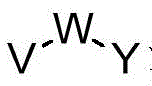 Mixing, and carrying out nucleophilic substitution reaction; 2. and (3) performing deacetylation protecting group reaction on the compound 3-f obtained in the step (1). The pharmaceutical composition comprises: c-aryl glycoside derivatives, pharmaceutically acceptable salts and/or prodrugs thereof, and adjuvants. The invention also relates to the use of the C-aryl glycoside derivatives, their pharmaceutically acceptable salts or pharmaceutical compositions for the preparation of SGLT inhibitors. The C-aryl glycoside derivative provides a new direction for the research of SGLT inhibitors.
Description
Technical Field
The invention relates to a C-aryl glucoside derivative, a stereoisomer, a prodrug or a pharmaceutically acceptable salt thereof, a pharmaceutical composition, a preparation method and application thereof.
Background
Diabetes mellitus is a metabolic disease characterized by hyperglycemia, and the incidence rate is on the rise year by year at present, wherein 90% of patients with diabetes mellitus are type II diabetes mellitus, and hyperglycemia is caused by excessive hepatic glucose production and peripheral insulin resistance (pharmaceutical development, 2003, 27: 88-91). At present, the most commonly used medicines suitable for type II diabetes mellitus comprise sulfonylureas, biguanides, alpha-glucosidase inhibitors, insulin and the like, have good effects of controlling blood sugar rise and reducing blood sugar, but are accompanied by a plurality of adverse reactions related to medicines, such as weight gain, insulin secretion reduction, hypoglycemia, gastrointestinal adverse reactions and the like. Therefore, there is a need to develop a safer, more effective, orally administrable antidiabetic agent.
Sodium-dependent glucose transporters (SGLTs) play a key role in maintaining human blood glucose stability. SGLT-1 is distributed mainly in the small intestine, kidney, heart and brain, and its main physiological function is to complete the absorption of glucose in the small intestine. SGLT-2 is specifically distributed at the proximal convoluted tubule S1 part of the kidney and is responsible for about 90% of glucose reabsorption, and the remaining 10% is completed by SGLT-1 located at the proximal convoluted tubule S3 part, so that reabsorption of glucose by the kidney can be specifically blocked by inhibiting the activity of SGLT-2, and blood glucose lowering effect can be achieved by excreting excessive glucose through urine without the risk of weight gain and blood glucose lowering. Therefore, SGLT, particularly SGLT2 inhibitors, are promising candidate antidiabetic drugs (Handlon, A.L., Expert opin.Ther.Patents (2005)15(11): 1531-1540; Am Jphysiol Renal Physiol,2001,280: 10-18).
Many SGLT2 inhibitors have been disclosed, for example, Handlon, A.L., ExpertOpin. Ther. patents (2005)15(11): 1531-; nature Reviews Drug Discovery,2010, Vol.9, No.7, 551-; WO 01/27128, WO 02/083066, WO 03/099836, US2003/0114390, WO04/063209, WO 2005/012326, US 2005/0209166. Among the SGLT-2 inhibitors that have been approved for marketing by the U.S. food and drug administration are Canagliflozin from the banchen pharmaceutical company (Canagliflozin, approved 3/29 in 2013), daslican from astragacon and darlington from the centella sumac (Dapagliflozin, approved 1/8 in 2014), and rigagliflozin from blin and the rita corporation (Empagliflozin) are currently approved only for marketing by the european drug administration human pharmaceutical product Committee (CHMP) (approved 3/21 in 2014).
Disclosure of Invention
The technical problem to be solved by the invention is to provide a C-aryl glycoside derivative with an inhibitory effect on sodium-dependent glucose transporter (SGLT), a stereoisomer, a prodrug or a pharmaceutically acceptable salt thereof, a pharmaceutical composition, a preparation method and an application thereof.
The invention relates to a C-aryl glucoside derivative shown as a formula I, a stereoisomer, an isotope substituted derivative, a prodrug or a pharmaceutically acceptable salt thereof;
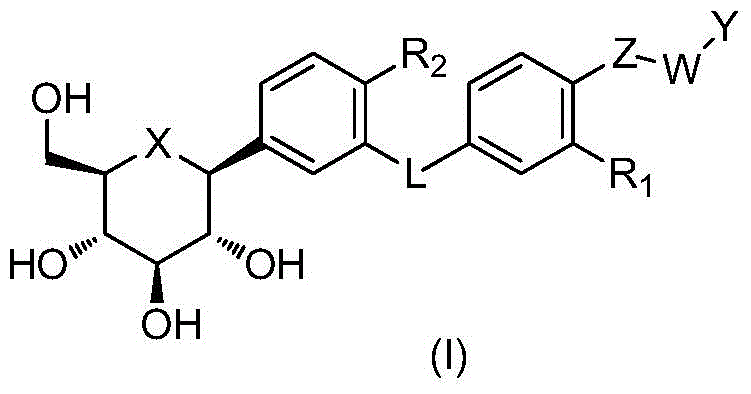
wherein X is O or S; l is CH2、CD2C ═ O or CF2(ii) a Z is CH2S, O or a single bond; w is a single bond or (CH)2)nN is 1,2 or 3;
y is a bicyclic group; said bicyclic group is preferably C5-8Cycloalkyl radical and C6Aryl radical, C5-8Cycloalkyl radical and C3-5Heteroaryl group, C3-7Heterocycloalkyl radical C6Aryl radical, C3-7Heterocycloalkyl radical C3-5Heteroaryl group, C6Aryl radical and C6Aryl radical, C3-5Heteroaryl and C6Aryl or C3-5Heteroaryl and C3-5A heteroaryl group; the bicyclic group may be substituted at any position with one or more of the following groups: H. alkyl radicalCN, halogen, CF3OH, amino, C2-6Alkynyl, C2-6Alkenyl, alkoxy, haloalkoxy, cycloalkyl, cycloalkyloxy, cycloalkylalkyl, cycloalkylalkoxy, heterocycloalkyl, heterocycloalkyloxy, heterocycloalkylalkyl, heterocycloalkylalkoxy, alkylamino, carbonyl, COOH, COOR7、COR7、CONR7R7a、-NHCOR7、-NHSO2R7Aryl, heteroaryl, alkylsulfonyl, arylsulfonyl, or heteroarylsulfonyl, wherein, in the substituents of the bicyclic group, the substituents may be further substituted with one or more of the following groups: alkyl, halogen, CF3OH, CN, amino, alkoxy or haloalkoxy;
R1is H, halogen, CN, alkyl, alkoxy, haloalkoxy, OCD3、OC2D5Or CF3;
R2Is H, alkyl, halogen, CF3CN, OH, amino, alkoxy, haloalkoxy, OCD3、OC2D5、C2-6Alkynyl, C2-6Alkenyl, cycloalkyl, heterocycloalkyl, alkylamino, carbonyl, COOH, COOR7、COR7、CONR7R7a、-NHCOR7、-NHSO2R7Aryl, heteroaryl, alkylsulfonyl, arylsulfonyl or heteroarylsulfonyl;
R7and R7aEach independently selected from alkyl, cycloalkyl or heterocycloalkyl, or, R7And R7aTogether with the N atom to which they are attached form a 3-7 membered heterocycloalkyl group.
When said R is2When halogen is used, the halogen is preferably chlorine.
At R7And R7aIn forming a 3-7 membered heterocycloalkyl group together with the N atom to which they are attached, said 3-7 membered heterocycloalkyl group may further contain 1-3 of the following atoms or groups: n, O, S, SO and SO2。
At R7And R7aWith itThe N atoms to which they are attached together form a 3-7 membered heterocycloalkyl group, which 3-7 membered heterocycloalkyl group may be substituted with alkyl and/or methanesulfonyl.
In the present invention, in Y, said C3-7Heterocycloalkyl radical C6Aryl is preferably C4~6Heterocycloalkyl radical C6And (4) an aryl group. Said C3-5Heteroaryl and C6Aryl is preferably C3-4Heteroaryl and C6And (4) an aryl group.
In the present invention, Y is more preferably (but not limited to) any one of the following Y1 to Y24:
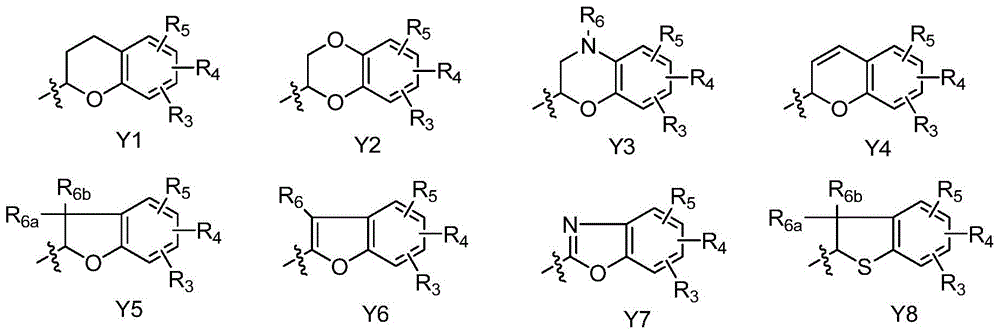
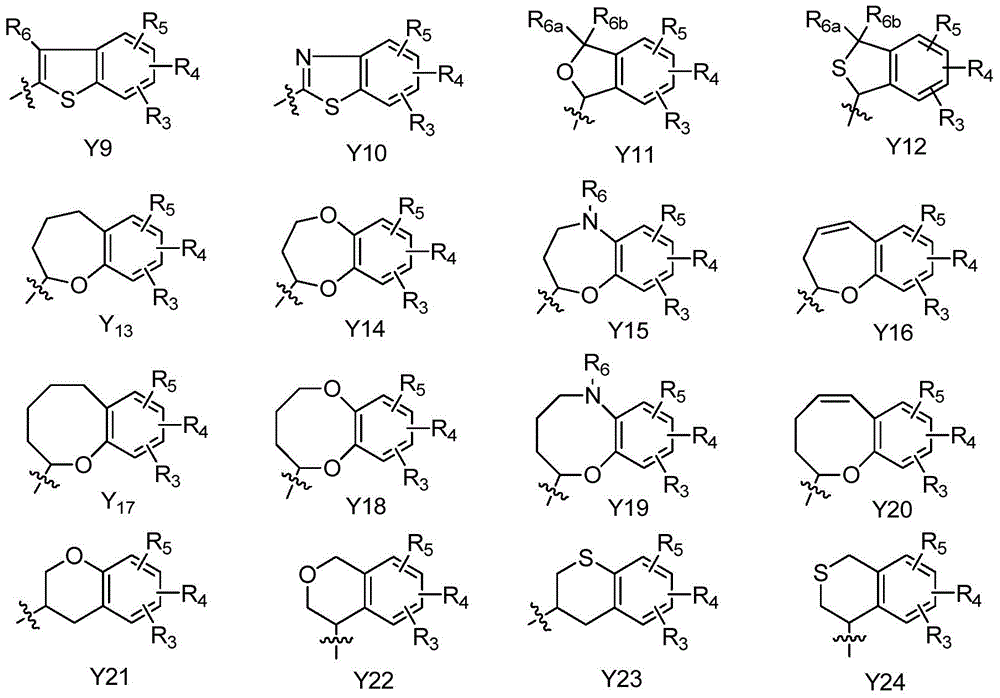
wherein R is3、R4、R5、R6、R6aAnd R6bEach independently of the others being H, alkyl, CN, halogen, CF3OH, amino, C2-6Alkynyl, C2-6Alkenyl, alkoxy, haloalkoxy, cycloalkyl, cycloalkyloxy, cycloalkylalkyl, cycloalkylalkoxy, heterocycloalkyl, heterocycloalkyloxy, heterocycloalkylalkyl, heterocycloalkylalkoxy, alkylamino, carbonyl, COOH, COOR7、COR7、CONR7R7a、-NHCOR7、-NHSO2R7Aryl, heteroaryl, alkylsulfonyl, arylsulfonyl or heteroarylsulfonyl;
said R3、R4、R5、R6、R6aAnd R6bMay be further substituted with any of the following groups: alkyl, halogen, CF3OH, CN, amino, alkoxy or haloalkoxy;
said R6aAnd R6bAnd may also form, together with the atoms to which they are attached, a 3-8 membered cycloalkyl group, or a 3-8 membered heterocycloalkyl group. Said 3-to 8-membered heterocycloalkyl group preferably contains 1 to 3 atoms or groupsAnd (3) clustering: n, O, S, SO and SO2. The 3-to 8-membered cycloalkyl or 3-to 8-membered heterocycloalkyl group may be substituted with alkyl and/or halogen.
In the present invention, Y is preferably
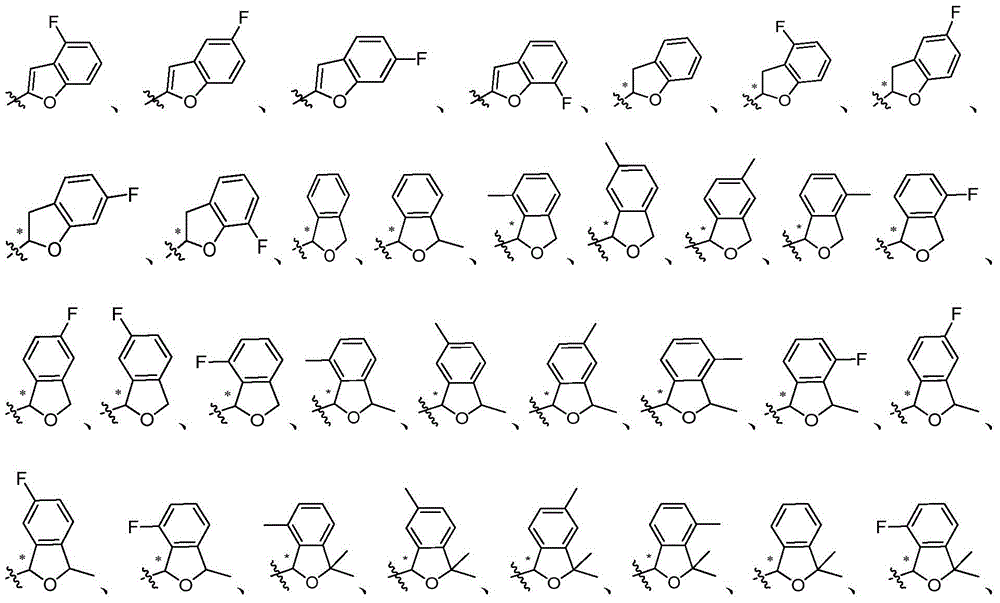


The C-aryl glycoside derivative shown in the formula I is preferably IA, IB or IC,
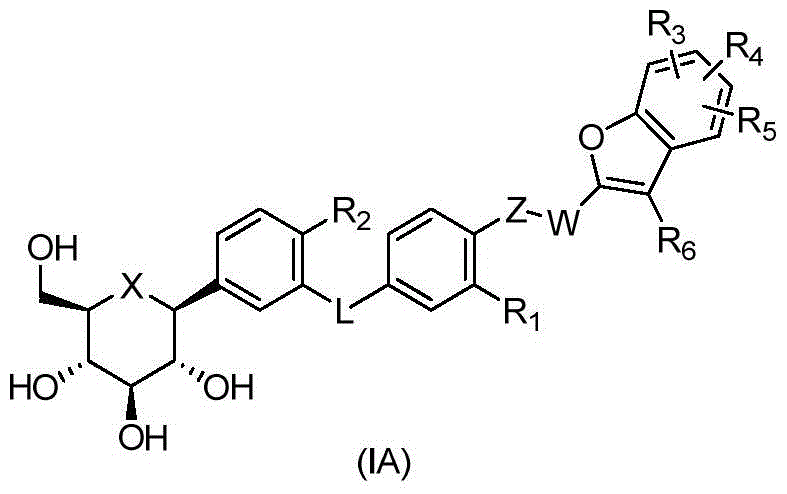
in IA, X is O; l is CH2(ii) a Z is O; w is (CH)2)nN is 1 or 2; r1、R2、R3、R4、R5、R6As defined above;
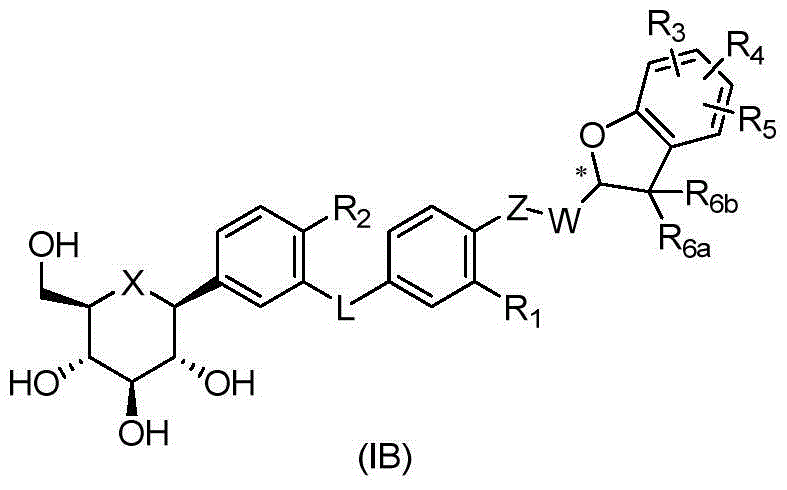
in IB, X is O; l is CH2(ii) a Z is O; w is (CH)2)nN is 1 or 2; r1、R2、R3、R4、R5、R6a、R6bAs defined above; the carbon marked is chiral carbon, which includes racemate, S or R;
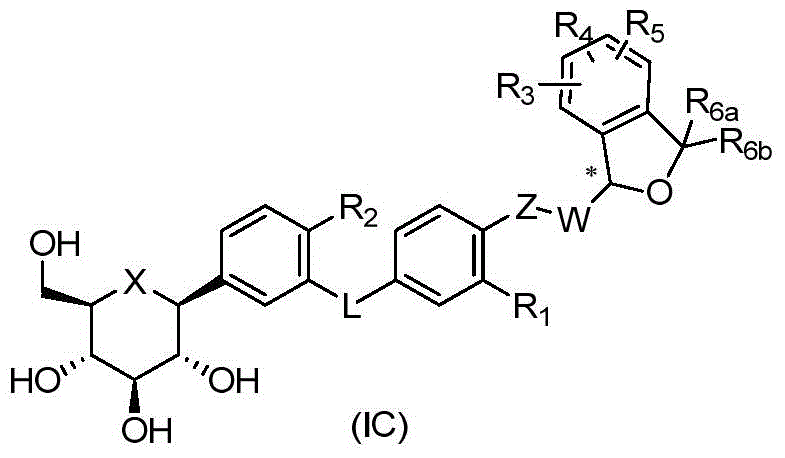
in IC, X is O; l is CH2(ii) a Z is O; w is (CH)2)nN is 1 or 2; r1、R2、R3、R4、R5、R6a、R6bAs defined above; the carbon labeled is a chiral carbon, which includes racemic, S, or R forms.
The above IB and IC formulas include S-type absolute configuration, R-type absolute configuration and racemate of marked carbon.
The C-aryl glycoside derivatives represented by formula IA are preferably:

wherein X is O; l is CH2(ii) a Z is O; w is (CH)2)nN is 1 or 2; r1Is H or F; r2Is H, F, Cl, CN, CH3Or OCH3;R3、R4、R5Each independently is H, methyl or F; r6Is H.
The C-aryl glycoside derivatives represented by formula IB are preferred:
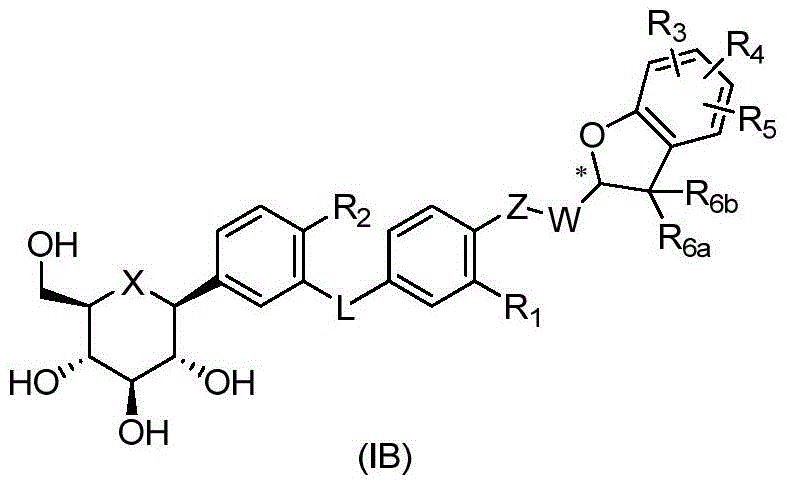
wherein X is O; l is CH2(ii) a Z is O; w is (CH)2)nN is 1 or 2; r1Is H or F; r2Is H, F, Cl, CN, CH3Or OCH3;R3、R4、R5Each independently is H, methyl or F; r6aAnd R6bIs H; the carbon labeled is a chiral carbon, which includes racemic, S, or R forms.
The C-aryl glycoside derivatives represented by formula IC are preferably:
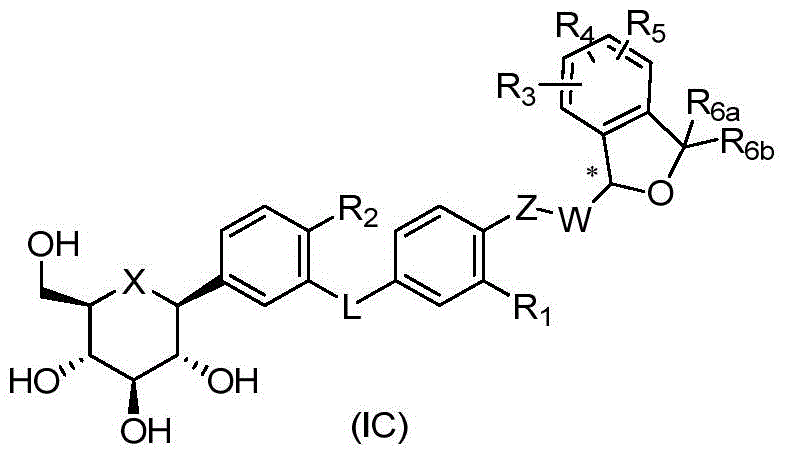
in IC, X is O; l is CH2(ii) a Z is O; w is (CH)2)nN is 1 or 2; r1Is H or F; r2Is H, F, Cl, CN, CH3Or OCH3;R3、R4、R5Each independently is H, methyl or F; r6aAnd R6bEach independently is H or CH3(ii) a The carbon labeled is a chiral carbon, which includes racemic, S, or R forms.
The C-aryl glucoside derivative shown in the formula I is any one of the following compounds I-1 to I-104:

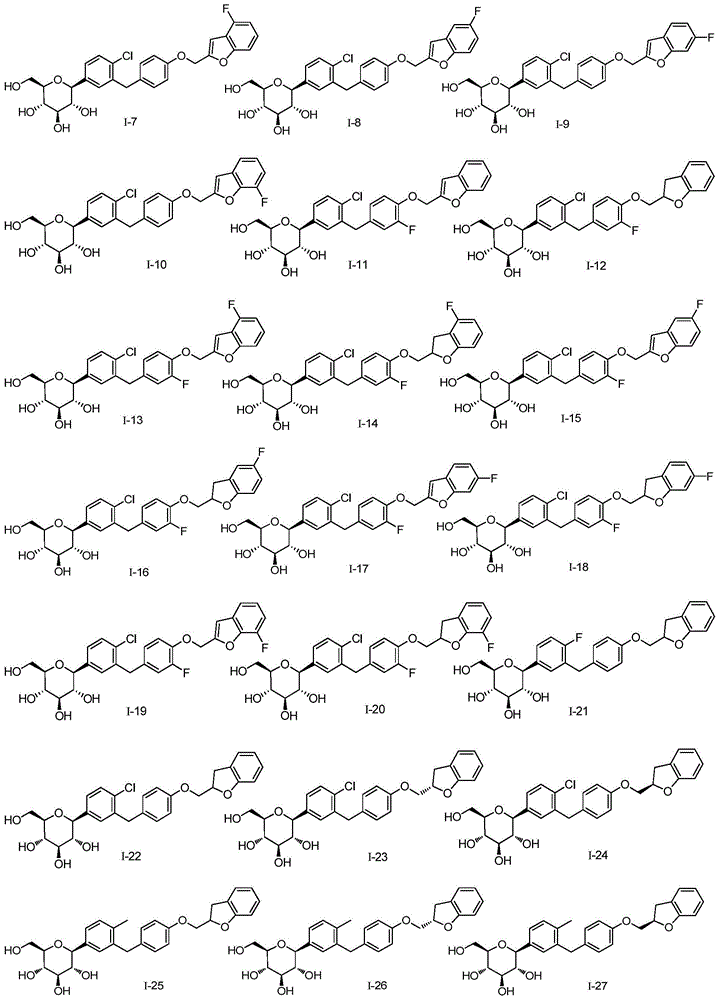

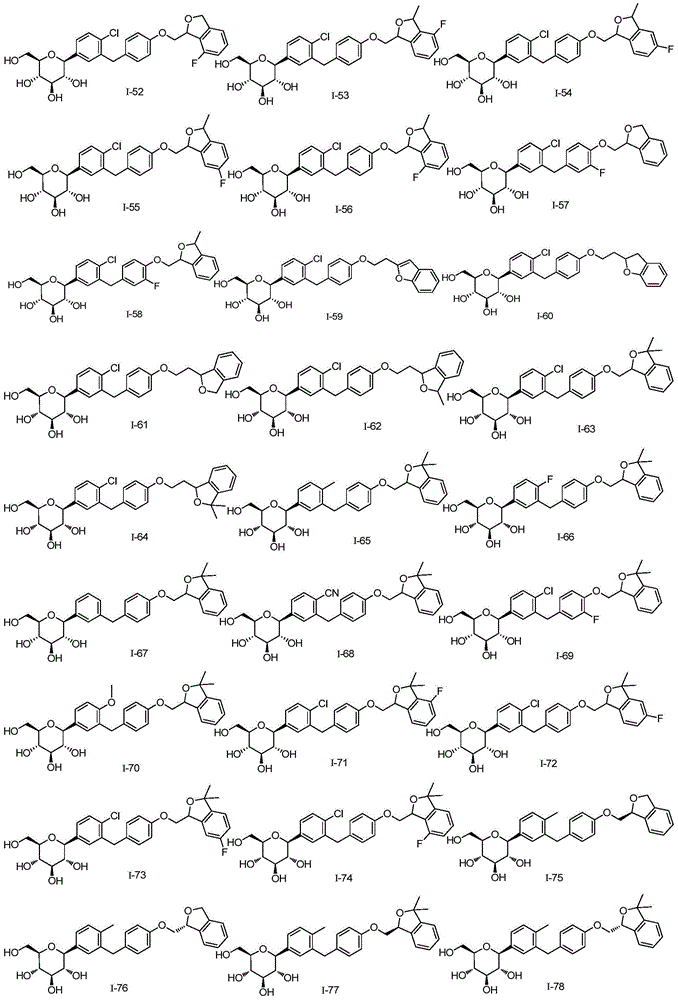
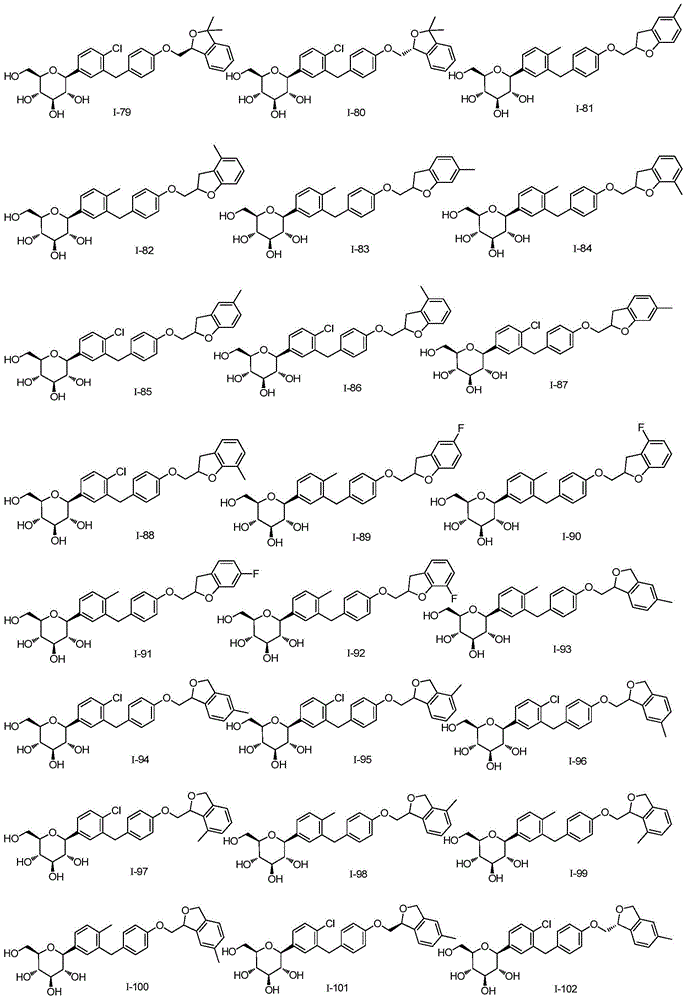

the invention also provides a preparation method of the C-aryl glucoside derivative shown in the formula I, which is any one of the following methods:
the method comprises the following steps: the preparation method comprises the following steps: in a solvent, under the action of alkali, performing deacetylation protecting group reaction on the compound 1-f;
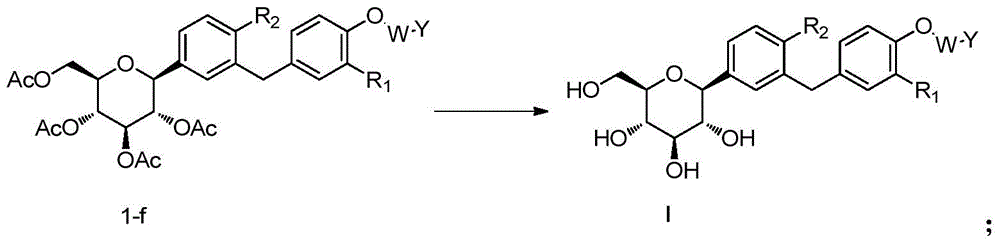
the second method comprises the following steps: the preparation method comprises the following stepsThe method comprises the following steps: 1) in a solvent, under the action of a condensing agent, reacting 2-g of a compound with Carrying out mitsunobu reaction; 2) in a solvent, under the action of alkali, performing deacetylation protecting group reaction on the compound 2-f obtained in the step 1);

the third method comprises the following steps: the preparation method comprises the following steps: 1. in a solvent, under the action of alkali, 3-g of a compound is mixed with Mixing, and carrying out nucleophilic substitution reaction; 2. in a solvent, under the action of alkali, performing deacetylation protecting group reaction on the compound 3-f obtained in the step 1;

wherein V is chlorine, bromine or iodine; the remaining radical and letter definitions are as described above.
In the first method, the conditions and steps for the reaction of the deacetylation protecting group can be those conventional in the art, and the following reaction conditions are particularly preferred in the present invention: the solvent is preferably methanol or a mixed solvent of methanol, tetrahydrofuran and water; when a mixed solvent is adopted, the volume ratio of methanol to tetrahydrofuran to water is preferably 4:1: 0.5-0.5: 1:0.5, and the dosage of the solvent is preferably 5-15 mL/mmol of compound 1-f; the base is preferably an alkali metal alkoxide or an alkali metal hydroxide; the base is more preferably sodium methoxide or lithium hydroxide; the molar ratio of the alkali to the compound 1-f is preferably 0.1: 1-2: 1; the reaction temperature is preferably 10-30 ℃; the reaction can be detected by TLC, and the end point of the reaction is generally the time when the compound 1-f disappears, preferably 0.5-12 hours; after the reaction is finished, the product can be further purified by post-treatment, and the method preferably comprises the following steps: adjusting the pH of the reaction system to 6-8 with acetic acid, removing the solvent under reduced pressure, and purifying the solid residue by using a thin layer preparation plate or silica gel column chromatography. The step and conditions of the purification by thin layer preparative plate or silica gel column chromatography may be those conventional in the art. In the present invention, the deacetylation protecting group reaction preferably adopts a sodium methoxide and methanol system, or a lithium hydroxide, methanol, tetrahydrofuran and water system. In the lithium hydroxide, methanol, tetrahydrofuran and water system, the volume ratio of methanol to tetrahydrofuran to water is preferably 4:1: 0.5-0.5: 1: 0.5.
In process one, the preparation of said compounds 1-f may be conventional in the art for such reactions, preferably comprising the steps of: in a solvent, carrying out acetyl protection reaction on the compound 1-e, and then recrystallizing;

the acetyl protection reaction can be a conventional acetyl protection reaction in the field, and the reaction conditions and the steps can be referred to as the following references: med, chem, 2008,51, 1145-: the solvent is preferably dichloromethane; the dosage of the solvent is preferably 5-20mL/mmol of compound 1-e; in the acetyl protection reaction, acetic anhydride is preferably used as an acetyl protection reagent; the molar ratio of the acetyl protection reagent to the compound 1-e is preferably 5: 1-20: 1. In the step and the condition of recrystallization, the solvent used is preferably ethanol water solution with volume concentration of more than or equal to 50% and less than 100%, or absolute ethanol. The dosage of the recrystallized ethanol is preferably 3-10 mL/mmol of the compound 1-e. The recrystallization temperature is preferably 50-100 ℃.
In process one, the preparation of said compounds 1-e may be conventional in the art for such reactions, preferably comprising the steps of: in a solvent, mixing the compound 1-d with a triethylsilane and boron trifluoride diethyl etherate system for reduction reaction;
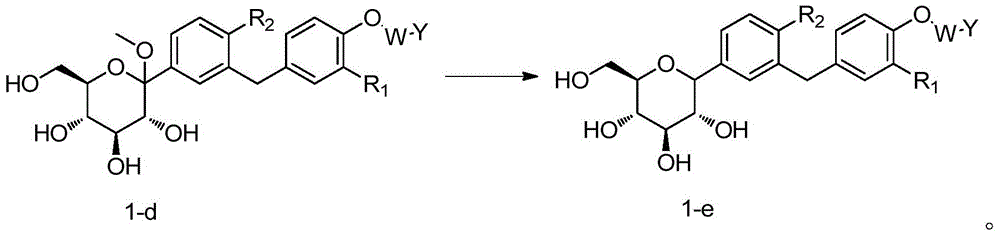
the solvent can be a solvent commonly used in the reaction in the field, preferably a mixed solvent of dichloromethane and acetonitrile, wherein the volume ratio of dichloromethane to acetonitrile is preferably 1: 1-2: 1. The dosage of the solvent does not influence the reaction, and preferably 5-15 mL/mmol of the compound 1-d. In the triethylsilane and boron trifluoride diethyl etherate system, the molar ratio of triethylsilane to boron trifluoride diethyl etherate is preferably 1: 1-1.5: 1. The molar ratio of the triethylsilane to the compound 1-d is preferably 1.5:1 to 3: 1. The temperature of the reduction reaction is preferably-20 ℃ to 10 ℃. The progress of the reaction can be detected by HPLC or TLC, and the end point of the reaction is generally determined as the disappearance of the compound 1-d, preferably 2 to 5 hours. After the reaction is finished, the product can be further purified by post-treatment, and the method preferably comprises the following steps: after quenching reaction with saturated sodium bicarbonate water solution, extracting the reaction system with organic solvent, drying the organic phase, and removing the organic solvent under reduced pressure to obtain the compound 1-e. The compound 1-e obtained by the above-mentioned workup is usually used in the next reaction without purification.
In process one, the preparation of compounds 1-d can be conventional in the art for such reactions, and reference can be made to: med, chem, 2008,51, 1145-: in a solvent, at-78 to-60 ℃, the compound 1-c is mixed with an alkali metal lithium reagent for reaction for 0.5 to 1 hour, then mixed with 2,3,4, 6-tetra-O- (trimethylsilyl) -D-glucopyranosone (the preparation method can be referred to as J.Med.chem.2008,51,1145 and 1149) for reaction for 0.5 to 2 hours (preferably 1 hour), and then mixed with a methanol solution of methanesulfonic acid for reaction at 10 to 30 ℃;

wherein Q is bromine or iodine.
The solvent may be a solvent commonly used in such reactions in the art, and is preferably a mixed solvent of tetrahydrofuran and toluene. In the mixed solvent of tetrahydrofuran and toluene, the volume ratio of tetrahydrofuran to toluene is preferably 1: 1-1: 4. The organic lithium reagent is preferably tert-butyl lithium or n-butyl lithium; when R is2When CN is used, tert-butyl lithium is preferably used as the organic lithium reagent. The mol ratio of the organic lithium reagent to the compound 1-c is preferably 0.9: 1-2: 1. The mol ratio of the 2,3,4, 6-tetra-O- (trimethylsilyl) -D-glucopyranosone to the compound 1-c is preferably 1: 1-1.5: 1. The molar concentration of the methanol solution of the methanesulfonic acid is preferably 0.5-1.2 mol/L. The molar ratio of the methanesulfonic acid to the compound 1-c is preferably 1.2:1 to 3.0: 1. The progress of the reaction can be checked by HPLC or TLC, and the end point of the reaction is generally determined by the disappearance of compound 1-c.
In the first process, the preparation method of the compound 1-c preferably comprises the following steps: in a solvent, mixing the compound 1-b with a triethylsilane and boron trifluoride diethyl etherate system for reduction reaction;

wherein Q is bromine or iodine.
The solvent can be a solvent commonly used in the reaction in the field, preferably a mixed solvent of 1, 2-dichloroethane and acetonitrile, wherein the volume ratio of the 1, 2-dichloroethane to the acetonitrile is preferably 1: 2-2: 1. The amount of the solvent does not influence the reaction, and preferably is 5-15 mL/mmol of the compound 1-b. In the triethylsilane and boron trifluoride diethyl etherate system, the molar ratio of triethylsilane to boron trifluoride diethyl etherate is preferably 1.2: 1-3: 1. The molar ratio of the triethylsilane to the compound 1-b is preferably 1.5:1 to 4: 1. The reaction temperature is preferably 0-30 ℃. The progress of the reduction reaction can be checked by HPLC or TLC, and is generally used as the end point of the reaction when the compound 1-b disappears. After the reduction reaction is finished, the product can be further purified by a post-treatment step, and the post-treatment step preferably comprises: after quenching reaction with saturated sodium bicarbonate water solution, extracting the reaction system with organic solvent, drying the organic phase, and removing the organic solvent under reduced pressure to obtain the compound 1-e. The compound 1-e can be purified by silica gel column chromatography or recrystallization.
In Process one, in the preparation of Compounds 1-c, when R is2In case of CN, the process for preparing compounds 1-c preferably comprises the following steps: in a solvent, firstly mixing the compound 1-b with a sodium borohydride and methanol system, carrying out reduction reaction, and then mixing with a triethylsilane and boron trifluoride diethyl etherate system for reaction to obtain a compound 1-c. The sodium borohydride and methanol system can be a sodium borohydride and methanol system which is conventional in the field, wherein the molar ratio of sodium borohydride to the compound 1-b is preferably 1: 1-3: 1; the use amount of the solvent does not influence the reaction, and preferably 5-20mL/mmol of the compound 1-b.
In the first process, the preparation method of the compound 1-b preferably comprises the following steps: reacting compound 1-a with a base in the presence of a solvent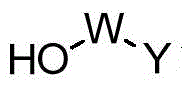 Mixing, and carrying out nucleophilic substitution reaction;
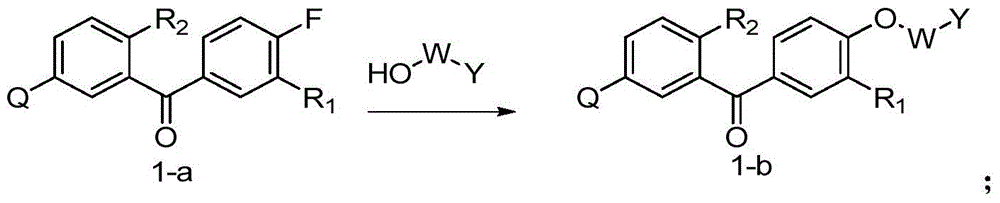
wherein Q is bromine or iodine.
The solvent may be a conventional solvent used in such reactions in the art, and is preferably N, N-dimethylformamide. The amount of the solvent is not particularly limited as long as the reaction is not affected, and preferably 2 to 20mL/mmol of the compound 1-a. The base may be an alcoholate of an alkali metal, preferably potassium tert-butylate. The molar weight of the alkali is preferably 0.9-2.5 times of that of the compound 1-a. Said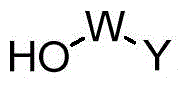 The molar ratio of the compound to the compound 1-a is preferably 1.0:1 to 2.0: 1. The reaction temperature is preferably 20-50 ℃. The progress of the reaction can be detected by HPLC or TLC, and the end point of the reaction is generally determined as the disappearance of the compound 1-a, preferably 1 to 18 hours. After the reaction is finished, the product can be further purified by a post-treatment step, preferably comprising the following post-treatment steps: by organic solventsDiluting the reaction system with agent, washing the organic phase with water and saturated saline solution, drying, removing the solvent under reduced pressure to obtain compound 1-b, and purifying by silica gel column chromatography or recrystallization. The method and conditions for column chromatography or recrystallization can be selected according to the conventional methods and conditions for column chromatography or recrystallization in the field. The solvent used for recrystallization is preferably ethanol water solution with volume concentration of more than or equal to 50% and less than 100%, or absolute ethanol. The dosage of the solvent is preferably 2-50 mL/mmol.
In the second method, step 1), the compound 2-g can be prepared by conventional methods in the art, for example, refer to: WO2011/048148A 2. The solvent may be a solvent commonly used in such reactions in the art, and is preferably tetrahydrofuran. The amount of the solvent is generally not so large as to affect the reaction, and preferably 5 to 20ml/mmol of the compound 2 to g. The condensing agent may be a condensing reagent system commonly used in the art for such reactions, preferably triphenylphosphine and diethyl azodicarboxylate (DEAD), or triphenylphosphine and diisopropyl azodicarboxylate (DIAD). The molar ratio of triphenylphosphine to diethyl azodicarboxylate is preferably 1: 1-1.5: 1. The molar ratio of triphenylphosphine to diisopropyl azodicarboxylate is preferably 1: 1-1.5: 1. The molar ratio of the condensing agent to the compound 2-g is preferably 1:1 to 3: 1. Said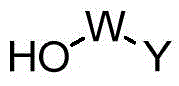 The molar ratio of the compound to 2-g is preferably 1:1 to 3: 1. The reaction temperature of the mitsunobu reaction is preferably 0 ℃ to 30 ℃. The progress of the reaction can be checked by TLC or HPLC, and the end point of the reaction is usually the time when 2-g of the compound disappears, preferably 2-15 hours. After the reaction is finished, the product can be further purified by a post-treatment step, and the post-treatment step preferably comprises the following steps: after diluting the reaction system with an organic solvent, the organic phase was washed with an aqueous ammonium chloride solution and a saturated saline solution, dried, and the solvent was removed under reduced pressure to obtain 2-g of a compound, which was then purified by silica gel column chromatography. The steps and conditions of the silica gel column chromatography purification can be selected according to the steps and conditions of silica gel column chromatography purification which are conventional in the field.
In the second method, step 2), the conditions and steps for the reaction of the deacetylation protecting group can be those conventional in the art, and the preferred conditions of the present invention are the same as those for the reaction of the deacetylation protecting group described in the first method.
In method three, step 1, the compound 3-g can be prepared by methods conventional in the art, for example, reference: WO2011/048148A 2. The solvent may be a solvent commonly used in this type of reaction in the art, and preferably N, N-dimethylformamide solution or dimethyl sulfoxide. The dosage of the solvent does not influence the reaction, and preferably 5-20mL/mmol compound 3-g. The base is preferably cesium carbonate or potassium carbonate. The molar ratio of the alkali to the compound 3-g is preferably 1-2.5. Said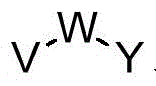 The molar ratio of the compound to 3-g is preferably 1 to 2.5. The temperature of the nucleophilic substitution reaction is preferably 40 ℃ to 65 ℃. The progress of the nucleophilic substitution reaction can be detected by HPLC or TLC, and is generally determined by the end point of the reaction when 3-g of the compound disappears, preferably 2-15 hours. After the reaction is finished, the product can be further purified by post-treatment, and the post-treatment preferably comprises the following steps: after diluting the reaction system with ethyl acetate, the organic phase was washed with an aqueous ammonium chloride solution and a saturated saline solution, dried, and the solvent was removed under reduced pressure to obtain 3-g of a compound, which was then purified by silica gel column chromatography. The steps and conditions of the silica gel column chromatography purification can be selected according to the steps and conditions of silica gel column chromatography purification which are conventional in the field.
In the third method, in step 2, the conditions and steps for the reaction of the deacetylation protecting group can be those conventional in the art, and the preferred conditions of the present invention are the same as those for the reaction of the deacetylation protecting group described in the first method.
In the invention, the related compounds can be prepared by the first method.
The invention further relates to compounds of any of the following structures:
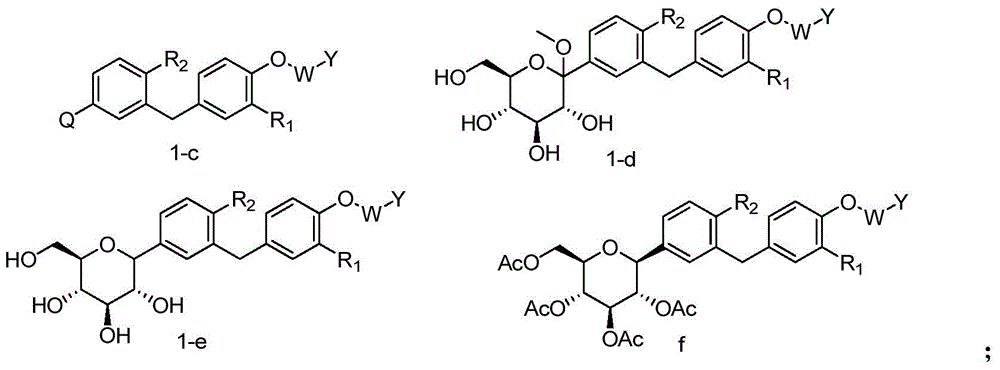
Unless otherwise indicated, the following terms appearing in the present invention have the following meanings:
the term "alkyl" refers to a saturated straight or branched chain hydrocarbon group containing 1 to 20 carbon atoms, preferably 1 to 10 carbon atoms, more preferably 1 to 8 carbon atoms, for example: methyl, ethyl, n-propyl, isopropyl, n-butyl, tert-butyl, isobutyl, pentyl, hexyl, heptyl, octyl, nonyl, decyl, 4-dimethylpentyl, 2, 4-trimethylpentyl, undecyl, dodecyl, and their various isomers, and the like.
The term "cycloalkyl" refers to a saturated or partially unsaturated (containing 1 or 2 double bonds) monocyclic, bicyclic or tricyclic hydrocarbon group containing 3 to 20 carbon atoms, preferably a 3-to 10-membered monocycloalkyl group, more preferably a 5-to 8-membered monocycloalkyl group, for example: cyclopropyl, cyclobutyl, cyclopentyl, cyclohexyl, cycloheptyl, cyclooctyl, cyclodecyl, cyclododecyl, cyclohexenyl, bornyl, decahydronaphthyl, bicyclo [2.2.1 ]]Heptenyl, and the like. The term "C5-8Cycloalkyl "refers to cycloalkyl groups containing from 5 to 8 carbon atoms.
The term "heterocycloalkyl" refers to a saturated or partially unsaturated (containing 1 or 2 double bonds) non-aromatic cyclic group consisting of carbon atoms and heteroatoms selected from nitrogen, oxygen or sulfur, which cyclic group may be a monocyclic, bicyclic or tricyclic group, preferably a 3-to 10-membered heterocycloalkyl group, more preferably a 5-to 8-membered heterocycloalkyl group, most preferably a 5-to 8-membered monocyclic heterocycloalkyl group. In the present invention, the number of hetero atoms in the heterocycloalkyl group is preferably 1 or 2, and nitrogen, carbon or sulfur atoms in the heterocycloalkyl group may be optionally oxidized. The nitrogen atom may optionally be further substituted with other groups to form tertiary amines or quaternary ammonium salts. For example: aziridinyl, tetrahydrofuran-2-yl, morpholin-4-yl, thiomorpholin-S-oxide-4-yl, piperidin-1-yl, N-alkylpiperidin-4-yl, pyrrolidin-1-yl, N-alkylpyrrolidin-2-yl, piperazin-1-yl4-alkylpiperazin-1-yl,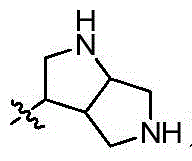 And
And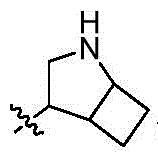 and the like.
The term "C3-7Heterocycloalkyl "refers to a monocyclic heterocycloalkyl group containing 3 to 7 carbon atoms, wherein the number of heteroatoms is 1 to 2. The term "C4-6Heterocycloalkyl "refers to a monocyclic heterocycloalkyl group containing 4 to 6 carbon atoms, where the number of heteroatoms is 1 to 2.
The term "cycloalkylalkyl" refers to a cycloalkyl group attached to the parent nuclear structure through an alkyl group. Thus, "cycloalkylalkyl" encompasses the definitions of alkyl and cycloalkyl above.
The term "heterocycloalkylalkyl" refers to a linkage between a heterocycloalkyi and the parent nuclear structure through an alkyl group. Thus, "heterocycloalkylalkyl" embraces the definitions of alkyl and heterocycloalkyl described above.
The term "alkoxy" refers to a cyclic or acyclic alkyl group having the indicated number of carbon atoms attached through an oxygen bridge, including alkyloxy, cycloalkyloxy, and heterocycloalkyloxy. Thus, "alkoxy" encompasses the above definitions of alkyl, heterocycloalkyl, and cycloalkyl.
The term "cycloalkylalkoxy" refers to a group formed by a cycloalkyl group replacing a hydrogen on an alkyl group in an alkoxy group. Thus, "cycloalkylalkoxy" encompasses the definitions of cycloalkyl and alkoxy as described above.
The term "heterocycloalkylalkoxy" refers to a group formed by a heterocycloalkyl group replacing a hydrogen on an alkyl group in an alkoxy group. Thus, "heterocycloalkylalkoxy" encompasses the above-mentioned definitions of heterocycloalkyl and alkoxy.
The term "alkenyl" refers to a straight, branched, or cyclic non-aromatic hydrocarbon group containing at least 1 carbon-carbon double bond. Wherein 1-3 carbon-carbon double bonds, preferably 1 carbon-carbon double bond, may be present. The term "C2-6Alkenyl "means alkenyl having 2 to 6 carbon atoms and includes ethenyl, propenyl, butenyl, 2-methylbutenyl and cyclohexenyl. The above-mentionedThe alkenyl group of (a) may be substituted.
The term "alkynyl" refers to a straight, branched, or cyclic hydrocarbon group containing at least 1 carbon-carbon triple bond. Wherein 1-3 carbon-carbon triple bonds, preferably 1 carbon-carbon triple bond, may be present. The term "C2-6Alkynyl "refers to alkynyl groups having 2 to 6 carbon atoms and includes ethynyl, propynyl, butynyl, and 3-methylbutynyl.
The term "aryl" refers to any stable 6-10 membered monocyclic or bicyclic aromatic group, for example: phenyl, naphthyl, tetrahydronaphthyl, 2, 3-indanyl, biphenyl, or the like. The term "C6Aryl "refers to a 6 membered monocyclic aryl group, such as phenyl.
The term "heteroaryl" refers to an aromatic ring group formed by replacement of at least 1 ring carbon atom with a heteroatom selected from nitrogen, oxygen or sulfur, which may be a 5-7 membered monocyclic ring structure or a 7-12 membered bicyclic ring structure, preferably a 5-6 membered heteroaryl. In the present invention, the number of hetero atoms is preferably 1 or 2, and includes indazolyl, isoindolyl, indolyl, isoindolyl, benzofuranyl, benzothienyl, benzo [ d ]][1,3]Dioxolanyl, benzothiazolyl, benzoxazolyl, quinolyl, isoquinolyl, quinazolinyl and the like. The term "C3-5Heteroaryl "refers to a monocyclic heteroaryl group containing 3 to 5 carbon atoms, wherein the number of heteroatoms is 1 to 2. The term "C3-4Heteroaryl "refers to a monocyclic heteroaryl group containing 3 to 4 carbon atoms, wherein the number of heteroatoms is 1 to 2.
The term "bicyclic group" refers to a fused ring structure or fused ring structure formed by two cyclic structures sharing two adjacent atoms with each other, and the cyclic structures may include aryl, heteroaryl, cycloalkyl and heterocycloalkyl groups. In the bicyclic structure of the present invention, at least one ring is an aromatic ring. In the present invention, C5-8Cycloalkyl radical and C6Specific examples of aryl groups include, but are not limited to: benzocyclobutene, 2, 3-dihydro-1-H-indene, 1,2,3, 4-tetrahydronaphthalene, 6,7,8, 9-tetrahydro-5H-benzo [7 ]]Rotalene, 6, 9-dihydro-5H-benzo [7 ]]Annulenes or 5,6,7,8,9, 10-hexahydrobenzo [8 ]]A rotalene; c5-8Cycloalkyl radical and C3-5Specific examples of heteroaryl groups include, but are not limited to: 2, 3-cyclopentenopyridine, 5, 6-dihydro-4H-cyclopentyl [ B]Thiophene or 5, 6-dihydro-4H-cyclopentyl [ B]Furan; c4-6Heterocycloalkyl radical C6Specific examples of aryl groups include, but are not limited to: 2, 3-dihydrobenzofuran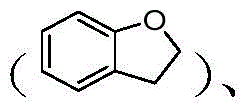 1, 3-dihydroisobenzofuran
 Indoline, 2, 3-dihydrobenzo [ b ]]Thiophene, dihydrobenzopyran, 1,2,3, 4-tetrahydroquinoline, 2, 3-dihydro-1, 4-benzodioxane, 3, 4-dihydro-2H-1, 4-benzoxazine,
 Or
Or C3-7Heterocycloalkyl radical C3-5Specific examples of heteroaryl groups include, but are not limited to: naphthyridine,
 Or
Or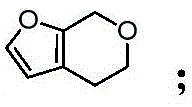 C6Aryl radical and C6Specific examples of aryl groups include, but are not limited to: naphthalene; c3-4Heteroaryl and C6Specific examples of aryl groups include, but are not limited to: benzofuran, benzothiophene, benzopyrrole, benzothiazole, benzoxazole, indazole, benzopyridazine, benzimidazole, indole, quinoline, isoquinoline; c3-5Heteroaryl and C3-5Specific examples of heteroaryl groups include, but are not limited to: a purine or a pteridine;
when one ring of the bicyclic group is a non-aromatic ring, it is preferably connected to the side group W represented by the structure of formula I through any carbon atom on the non-aromatic ring, and the non-aromatic ring is preferably cycloalkyl or heterocycloalkyl. When both rings of the bicyclic group are aromatic, they are preferably linked to the side group W of the structure of formula I through any carbon atom on both rings, and the aromatic ring may be an aryl or heteroaryl group. The "bicyclic group" as referred to herein includes the definitions set forth above for "aryl", "heterocycloalkyl", "cycloalkyl" and "heteroaryl".
The term "halogen" denotes fluorine, chlorine, bromine or iodine.
The term "haloalkyl" refers to an alkyl group optionally substituted with a halogen. Thus, "haloalkyl" encompasses the above definitions of halogen and alkyl.
The term "haloalkoxy" refers to an alkoxy group optionally substituted with a halogen. Thus, "haloalkoxy" encompasses the above definitions of halogen and alkoxy.
The term "amino" refers to the group-NH2The term "alkylamino" refers to an amino group wherein one hydrogen atom is replaced by an alkyl group. Thus, "alkylamino" encompasses the above definitions of alkyl and amino.
The term "sulfonyl" refers to-SO2-。
The term "alkylsulfonyl" refers to the linkage between an alkyl group and the parent nucleus structure through sulfonyl-SO2-connected. Thus, "alkylsulfonyl" embraces the definitions of alkyl and sulfonyl as described above.
The term "arylsulfonyl" refers to a linkage between the aryl group and the parent nucleus structure through sulfonyl-SO2-connected. Thus, "arylsulfonyl" encompasses the definitions of aryl and sulfonyl as described above.
The term "heteroarylsulfonyl" refers to a linkage between the heteroaryl and the parent nucleus structure through sulfonyl-SO2-connected. Thus, "heteroarylsulfonyl" encompasses the above definitions of sulfonyl and heteroaryl.
The invention also relates to a pharmaceutical composition which comprises the C-aryl glucoside derivative shown in the formula I, an isotope substituted derivative, pharmaceutically acceptable salt and/or prodrug thereof and pharmaceutically acceptable auxiliary materials.
The stereoisomers include enantiomers and diastereomers.
The isotopically substituted derivatives include: an isotopically substituted derivative in which any hydrogen atom in formula I is substituted with 1 to 5 deuterium atoms, an isotopically substituted derivative in which any carbon atom in formula I is substituted with 1 to 3 carbon 14 atoms, or an isotopically substituted derivative in which any oxygen atom in formula I is substituted with 1 to 3 oxygen 18 atoms.
The pharmaceutical composition may further contain other kinds of drugs for treating diabetes or other kinds of therapeutic agents.
The prodrug is a prodrug capable of releasing the active compound of the present invention after administration to an organism by various routes. The prodrug includes but is not limited to ester and hydrate of C-aryl glucoside derivatives shown in formula I.
The auxiliary materials can be pharmaceutically acceptable carriers, diluents and/or excipients and the like.
The invention also relates to application of the C-aryl glucoside derivative shown in the formula I, pharmaceutically acceptable salt thereof or the pharmaceutical composition in preparation of SGLT inhibitors.
The invention also relates to application of the C-aryl glycoside derivative shown in the formula I, the pharmaceutically acceptable salt thereof or the pharmaceutical composition in preparing medicines for treating related SGLT mediated diseases.
The SGLT-mediated related diseases generally include: diabetes (including type II and type I), diabetic complications, obesity, hypertensive disorders, and any metabolic disorder associated with diabetes.
In the above application, the C-aryl glycoside derivative represented by formula I, the pharmaceutically acceptable salt thereof, or the pharmaceutical composition may be further combined with a second therapeutic agent.
The second therapeutic agent is preferably one or more of a therapeutic agent for diabetes, a therapeutic agent for diabetic complications, a therapeutic agent for lipid lowering, a therapeutic agent for obesity, and a therapeutic agent for hypertension.
In the present invention, a preferred synthetic route of the method is:
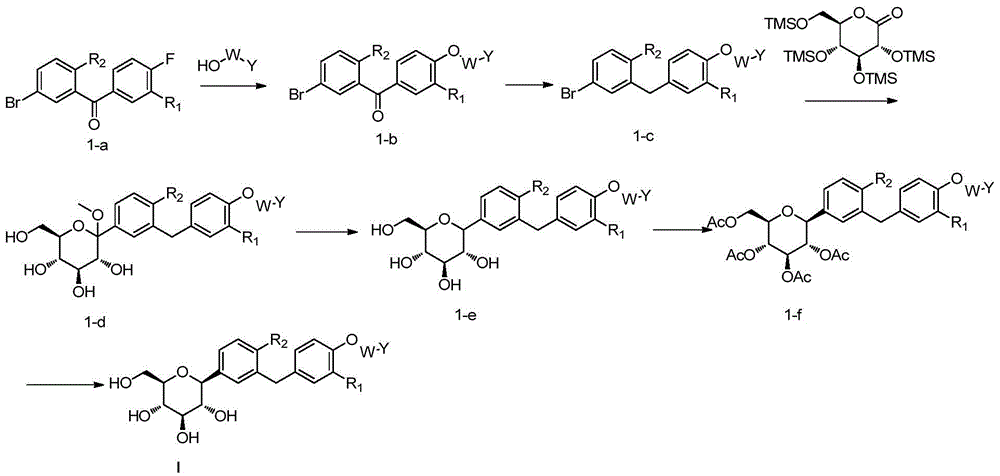
in the present invention, the room temperature is 10 to 30 ℃.
The above preferred conditions can be arbitrarily combined to obtain preferred embodiments of the present invention without departing from the common general knowledge in the art.
The reagents and starting materials used in the present invention are commercially available.
The positive progress effects of the invention are as follows: the aryl glycoside derivative has a very good inhibition effect on SGLT, can effectively treat related diseases mediated by SGLT, and is a novel antidiabetic medicament.
Detailed Description
The invention is further illustrated by the following examples, which are not intended to limit the scope of the invention. The experimental methods without specifying specific conditions in the following examples were selected according to the conventional methods and conditions, or according to the commercial instructions.
The structures of all compounds of the invention can be determined by nuclear magnetic resonance1H NMR) and/or mass spectrometric detection (MS).
1H NMR chemical shifts () recorded in PPM (10)-6). NMR was performed on a Bruker AVANCE-400 spectrometer. A suitable solvent is deuterated chloroform (CDCl)3) Deuterated methanol (CD)3OD), deuterated dimethyl sulfoxide (DMSO-d)6) Tetramethylsilane was used as internal standard (TMS).
Low resolution Mass Spectrometry (MS) determined by an Agilent 1200HPLC/6120 Mass spectrometer using Xbridge C18, 4.6 × 50mm, 3.5 μm, gradient elution conditions one 80-5% solvent A1And 20-95% of solvent B1(1.8 min) and then 95% solvent B1And 5% of solvent A1(over 3 minutes) as a volume percent of a solvent based on the total solvent volume. Solvent A1: 0.01% trifluoroacetic acid (TFA) in water; solvent B1: 0.01% trifluoroacetic acid in acetonitrile; the percentages are the volume percent of solute in solution. Gradient elution conditions two: 80-5% of solvent A2And 20-95% of solvent B2(1.5 min) and then 95% solvent B2And 5% of solvent A2(over 2 minutes) as a volume percent of a solvent based on the total solvent volume. Solvent A2:10 mM ammonium bicarbonate in water;solvent B2: and (3) acetonitrile.
Chiral analysis of the compounds of the invention Using a supercritical fluid chromatograph SFC Method Station (Thar, Waters), there are three analysis conditions in total.
Chiral analysis condition a: using chiral column OJ-H4.6 × 250mm,5um (daicel), mobile phase is carbon dioxide: methanol (containing 0.1% diethylamine, the percentages being by volume) 60: 40, flow rate of 3mL/min, column temperature of 40 ℃);
chiral analysis condition B: using chiral column OZ-H4.6 × 250mm,5um (DAICEL), mobile phase is carbon dioxide: methanol (containing 0.1% diethylamine, the percentages being by volume) 55: 45 at a flow rate of 3mL/min and a column temperature of 40 ℃);
chiral analysis condition C: using chiral column OJ-H4.6 × 250mm,5um (daicel), mobile phase is carbon dioxide: methanol (containing 0.1% diethylamine, the percentages being by volume) 55: 45, flow rate 3mL/min, column temperature 40 ℃).
Chiral preparation of the compounds of the invention employs Chiral high performance liquid chromatography (Chiral HPLC) and Supercritical Fluid Chromatography (SFC), together with the following A, B, and C resolution conditions:
chiral HPLC preparative instrument using HPLC-Gilso GX-281 Method Station, resolution condition a: a chiral column (CHIRALPAK OZ-H30 × 250mm5um (Daicel), wherein the mobile phase is n-hexane (containing 0.1% diethylamine, the percentage is volume percent), ethanol (containing 0.1% diethylamine, the percentage is volume percent) is 30: 70, the flow rate is 30g/min, the column temperature is 25 ℃, the sample concentration is 12.5mg/mL, and the sample introduction amount is 4 mL); splitting condition B: a chiral column (OZ-H30 with 250mm5um (Daicel), methanol (containing 0.5% diethylamine in volume percent) as mobile phase, 50mL/min flow rate, 35 ℃ column temperature, 18mg/mL sample concentration, 1mL sample volume);
supercritical fluid chromatography using SFC-80(Thar, Waters), resolution condition C: using chiral column OJ-H20 × 250mm,5um (daicel), mobile phase is carbon dioxide: methanol (containing 0.5% ammonia water, in volume percent) 45: 55 at a flow rate of 80g/min and a column temperature of 35 ℃);
the optical rotation of the compound of the present invention was measured using a RUDOLPH Automatic Polarimeter, the light source was D light, and the sample cell length was 1 cm.
The thin-layer silica gel plate is a tobacco stage yellow sea HSGF254 or Qingdao GF254 silica gel plate. The column chromatography generally uses 200-mesh and 300-mesh silica gel of the yellow sea of the tobacco Taiwan as a carrier.
Example 1: synthesis of 2,3,4, 6-tetra-O- (trimethylsilyl) -D-glucopyranosone

Dissolving D-glucono-lactone (100.0g, 0.56mol) in tetrahydrofuran (700mL), adding triethylamine (511g, 5.05mol) under ice bath, dropwise adding trimethylchlorosilane (427g, 3.93mol) for about 1 hour, stirring in ice bath for 2 hours after dropwise adding, raising the temperature of the system to room temperature, and stirring overnight. Ethyl acetate (2L) was added, washed with saturated aqueous sodium dihydrogenphosphate (1L. times.2), water (1L) and saturated brine (1L. times.2), respectively, and the organic phase was dried over anhydrous magnesium sulfate, filtered, and the solvent was rotary-distilled under reduced pressure to give a colorless oil, and toluene (100 mL. times.2) was added and distilled under reduced pressure to a constant weight to give 2,3,4, 6-tetra-O- (trimethylsilyl) -D-glucopyranosone (254g, yield 97%) as a colorless liquid.
1H NMR(400MHz,CDCl3):4.17-4.20(m,1H),4.01(d,J=8.0Hz,1H),3.92(t,J=7.2Hz,1H),3.75-3.85(m,3H),0.21(S,9H),0.19(S,9H),0.18(S,9H),0.14(S,9H)。
Method 1
Example 2: synthesis of 5-bromo-2-cyanobenzoic acid

Diisopropylamine (6.67g, 65.9mmol) was dissolved in tetrahydrofuran (30mL) under nitrogen, cooled to-30 deg.C, and a solution of n-butyllithium in n-hexane (2.5M, 26.3mL, 65.9mmol) was slowly added dropwise. The reaction system is stirred at-30 ℃ for 30 minutes and then cooled to-70 ℃, p-bromophenylacetonitrile (10g, 54.9mmol) is slowly added dropwise, and after the reaction is kept at-70 ℃ for 30 minutes, carbon dioxide solid is added. The reaction was slowly warmed to room temperature and stirred overnight. Water (50mL) and ethyl acetate (100mL) were added to separate the organic phase, the aqueous phase was extracted with ethyl acetate (100 mL. times.2), the organic phases were combined, washed with saturated brine, dried over anhydrous magnesium sulfate, filtered, and the solvent was removed by rotary evaporation under reduced pressure to give 5-bromo-2-cyanobenzoic acid (7.25g, yield: 58%) as a white solid.
m/z:[M-H]-225.9
Example 3: synthesis of 5-bromo-2-methoxybenzoic acid
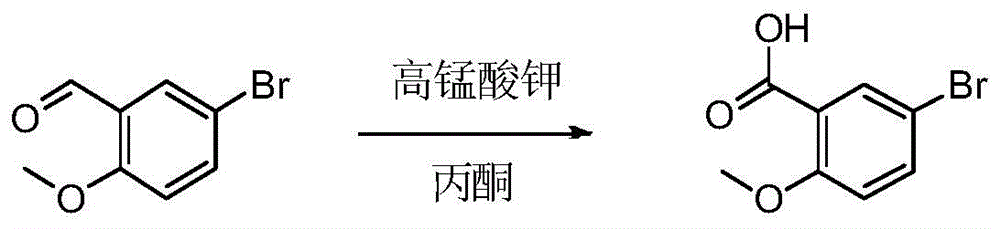
2-methoxy-5-bromobenzaldehyde (20g, 93.0mmol) was dissolved in acetone (100mL) and after cooling to 5 ℃ potassium permanganate solid (14.7g, 93.0mmol) was added portionwise over 2 hours. After the addition was complete, the reaction was stirred overnight at room temperature. The mixture was filtered, and the filtrate was adjusted to pH 1 with 5M hydrochloric acid to precipitate a pale yellow solid, which was filtered. After vacuum drying, 5-bromo-2-methoxybenzoic acid (10.5g, yield: 49%) was obtained.
m/z:[M-H]-228.9
Example 4: synthesis of (5-bromo-2-methoxyphenyl) (4-fluorophenyl) methanone

Step 1: (5-bromo-2-hydroxyphenyl) (4-fluorophenyl) methanone
2-methoxy-5-bromobenzoic acid (1.5g, 6.49mmol) obtained in example 3 was mixed with dichloromethane (20mL) and oxalyl chloride (1.24g, 9.74mmol) was added dropwise. After the reaction system was stirred at room temperature for 2 hours, excess oxalyl chloride was removed by rotary evaporation under reduced pressure, and the residue was dissolved in fluorobenzene (6.24g, 64.9mmol), and aluminum trichloride (0.95g, 7.14mmol) was added at 10 ℃. The reaction mixture was reacted at 75 ℃ for 2 hours, poured into ice water (30g), the aqueous phase was extracted with ethyl acetate (30 mL. times.3), the organic phases were combined, dried over anhydrous sodium sulfate, and rotary-evaporated under reduced pressure to give (5-bromo-2-hydroxyphenyl) (4-fluorophenyl) methanone (1.57g, yield: 82%).
Step 2: (5-bromo-2-methoxyphenyl) (4-fluorophenyl) methanone
(5-bromo-2-hydroxyphenyl) (4-fluorophenyl) methanone prepared in step 1 (920mg, 3.12mmol) was dissolved in acetone (10mL), and potassium carbonate (861mg, 6.24mmol) and iodomethane (663mg, 4.68mmol) were added. The reaction system was stirred at 10 ℃ for 1 hour, the mixture was filtered, and the filtrate was rotovapped under reduced pressure to give (5-bromo-2-methoxyphenyl) (4-fluorophenyl) methanone (930mg, yield: 96.5%).
1H NMR(400MHz,CDCl3):7.82-7.86(m,2H),7.58(dd,J=8.8,2.8Hz,1H),7.46(d,J=2.8Hz,1H),7.13(t,J=8.8Hz,2H),6.90(d,J=8.8Hz,1H),3.74(s,3H)。
Example 5: synthesis of (5-bromo-2-chlorophenyl) (4-fluorophenyl) methanone

2-chloro-5-bromobenzoic acid (100g, 0.42mol) was mixed with dichloromethane (500mL) and oxalyl chloride (107mL, 1.27mol) and DMF (2mL) was added dropwise. After stirring at room temperature for 2 hours, excess oxalyl chloride was distilled off under reduced pressure, the residue was dissolved in fluorobenzene (500mL), and aluminum trichloride (62g, 0.46mol) was added at 10 ℃. The reaction mixture was reacted at 75 ℃ overnight, poured into ice water (2L), concentrated hydrochloric acid (400mL) was added, the aqueous phase was extracted with ethyl acetate (500 mL. times.3), the combined organic phases were washed with a 5% aqueous sodium hydroxide solution, a 2M hydrochloric acid solution and a saturated sodium chloride solution, dried over anhydrous sodium sulfate, and rotary-evaporated under reduced pressure to give (5-bromo-2-chlorophenyl) (4-fluorophenyl) methanone (104g, yield: 78%) as an off-white solid.
1HNMR(400MHz,CDCl3):7.84-7.87(m,2H),7.58(dd,J=8.8,2.4Hz,1H),7.52(d,J=2.4Hz,1H)7.36(d,J=8.8Hz,1H),7.18(t,J=8.4Hz,2H)。
Synthesis of the Compounds of examples 6 to 8 by the Synthesis of example 5
Example 6: (3-bromophenyl) (4-fluorophenyl) methanone
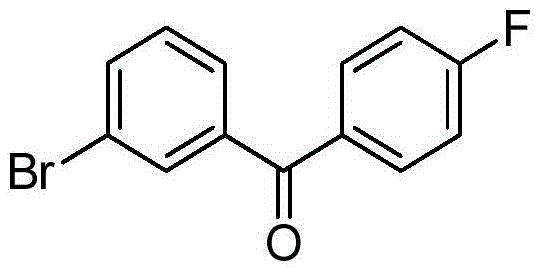
Example 7: 4-bromo-2- (4-fluorophenyl) benzonitrile
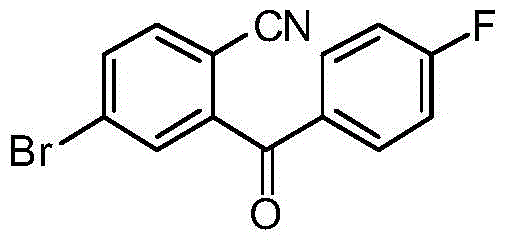
1H NMR(400MHz,CDCl3):7.82-7.85(m,3H),7.66(dd,J=8.0,1.6Hz,1H),7.63(d,J=1.6Hz,1H),7.20(t,J=8.4Hz,2H)。
Example 8: (5-bromo-2-methylphenyl) (4-fluorophenyl) methanone
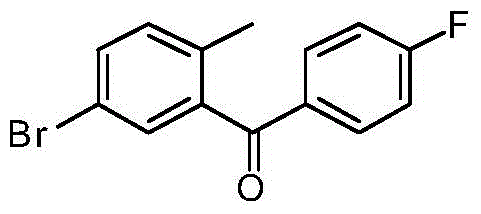
m/z:[M+H]+292.9
Example 9: synthesis of benzofuran-2-ylmethanols

Step 1: benzofuran-2-carbaldehyde
To a solution of benzofuran (10g, 84.7mmol) in dry tetrahydrofuran (100mL) under nitrogen atmosphere at-78 ℃ was added dropwise a solution of N-butyllithium in N-hexane (2.5M, 33.9mL, 84.7mmol), the reaction was stirred at-78 ℃ for 0.5 hour, and N, N-dimethylformamide (19.6mL, 254mmol) was added dropwise. The reaction was stirred at-78 ℃ for 1 hour, quenched by addition of saturated aqueous ammonium chloride (20mL), quenched by addition of ethyl acetate (300mL) and water (100mL), the layers were separated, the aqueous layer was extracted with ethyl acetate (50mL), and the combined organic layers were washed with water and saturated brine and dried over anhydrous sodium sulfate. The solvent was removed by rotary evaporation under reduced pressure, and the crude product was purified by silica gel column chromatography (petroleum ether: ethyl acetate: 10:1) to give benzofuran-2-carbaldehyde (7.5g, yield: 60.6%) as a yellow oil.
1H NMR(400MHz,CDCl3):9.90(s,1H),7.78(d,J=8.8Hz,1H),7.63(d,J=8.2Hz,1H),7.59(s,1H),7.53-7.57(m,1H),7.35-7.39(m,1H)。
Step 2: benzofuran-2-ylmethanols
To a solution of benzofuran-2-carbaldehyde (4.0g, 27.4mmol) obtained in step 1 in methanol (40mL) under ice-bath conditions was added sodium borohydride (1.55g) in portions, and the mixture was stirred for 1 hour. Ethyl acetate (100mL) was added for dilution, and the organic phase was washed with water (50 mL. times.3) and saturated brine and dried over anhydrous sodium sulfate. The solvent was removed by rotary evaporation under reduced pressure to give benzofuran-2-ylmethanol (4g, yield: 98%) as a yellow oily liquid. The product can be directly used for the next reaction.
1H NMR(400MHz,CDCl3):7.57-7.59(m,1H),7.48-7.50(m,1H),7.23-7.33(m,2H),6.66(s,1H),4.78(s,2H),2.03(br s,1H)。
Example 10: synthesis of (3, 3-dimethyl-1, 3-dihydroisobenzofuran-1-yl) methanol

Step 1: 1-bromo-2-vinylbenzene
A solution of n-butyllithium in n-hexane (2.5M, 18mL, 45mmol) was added dropwise to a mixture of methyltriphenylphosphonium bromide (16.2g, 45mmol) in tetrahydrofuran (50mL) under ice-cooling. The reaction was stirred at 0 ℃ for 1 hour, the solid dissolved, 2-bromobenzaldehyde (8g, 43mmol) was added to the reaction, and the reaction was stirred at 0 ℃ for 1 hour. The reaction mixture was poured into water (20ml), the aqueous layer was extracted with ethyl acetate, and the organic phases were combined and dried over anhydrous sodium sulfate. The solvent was removed by distillation under the reduced pressure, and the crude product was purified by silica gel column chromatography (petroleum ether: ethyl acetate: 10:1) to give 1-bromo-2-vinylbenzene (5.2g, yield: 65%).
Step 2: 2- (2-bromophenyl) oxirane
M-chloroperoxybenzoic acid (2g, 10.9mmol) was added in portions to a mixture of 1-bromo-2-vinylbenzene (3.02g, 13.1mmol) prepared in step 1 in dichloromethane (20mL) under ice-bath conditions, and the reaction was stirred at 0 ℃ for 2 hours. The reaction was quenched by the addition of saturated aqueous sodium bicarbonate (30mL), the aqueous layer was extracted with ethyl acetate (50 mL. times.3), and the organic phases were combined and dried over anhydrous sodium sulfate. The solvent was removed by distillation under the reduced pressure, and the crude product was purified using a thin layer preparation plate (petroleum ether: ethyl acetate ═ 10:1) to give 2- (2-bromophenyl) oxirane (1.2g, yield: 54%).
And step 3: (3, 3-dimethyl-1, 3-dihydroisobenzofuran-1-yl) methanol
To a solution of 2- (2-bromophenyl) oxirane (930mg, 4.67mmol) prepared in step 2 in tetrahydrofuran (10mL) was added dropwise a solution of t-butyllithium in n-pentane (1.3M, 7.1mL, 9.34mmol) at-70 ℃. The reaction was stirred for 10 minutes, acetone (542mg, 9.34mmol) was added dropwise, the temperature was slowly raised to 15 ℃ and stirred for 1 hour. The reaction mixture was poured into water (20ml), the aqueous layer was extracted with ethyl acetate, and the organic phases were combined and dried over anhydrous sodium sulfate. The solvent was removed by distillation under the reduced pressure, and the crude product was purified using a thin layer preparative plate (petroleum ether: ethyl acetate ═ 1:1) to give (3, 3-dimethyl-1, 3-dihydroisobenzofuran-1-yl) methanol (670mg, yield: 80%) as a pale yellow oil.
1H NMR(400MHz,CDCl3):7.31-7.34(m,2H),7.15-7.21(m,2H),5.31-5.34(m,1H),3.95-4.00(m,1H),3.77-3.83(m,1H),1.60(s,3H),1.52(s,3H)。
Example 11: synthesis of (1, 3-dihydroisobenzofuran-1-yl) methanol

Step 1: 2-vinyl benzaldehyde
N-butyllithium (2.5M, 7.2mL, 18.0mmol) was added dropwise to a tetrahydrofuran (20mL) solution of 1-bromo-2-vinylbenzene (3g, 16.4mmol) prepared in step 1 of example 10 at-78 deg.C, and after stirring at-70 deg.C for 1 hour, N-dimethylformamide (1.8g, 24.6mmol) was added dropwise, and the reaction was gradually warmed to room temperature and stirred for 30 minutes. The reaction system was poured into water (20mL), extracted with ethyl acetate (20 mL. times.2), and the organic phases were combined and dried over anhydrous sodium sulfate. The solvent was distilled off under reduced pressure to give 2-vinylbenzaldehyde (2.0g, yield: 91%).
Step 2: (2-Vinylbenzene) methanol
2-vinylbenzaldehyde (2.0g, 15.3mmol) prepared in step 1 was dissolved in a mixed solvent of tetrahydrofuran (14mL) and methanol (14mL), sodium borohydride (1.15g, 30.3mmol) was added in portions at 0 ℃, and the reaction system was stirred at room temperature for 2 hours. Ethyl acetate (50mL) was added, and the mixture was washed with a saturated aqueous ammonium chloride solution and a saturated aqueous sodium chloride solution and dried over anhydrous sodium sulfate. The solvent was distilled off under reduced pressure to give (2-vinylbenzyl) methanol (2.0g, yield: 100%).
And step 3: (1, 3-dihydroisobenzofuran-1-yl) methanol
(2-Vinylbenzene) methanol (1g, 7.45mmol) prepared in step 2 was dissolved in dichloromethane (10mL), m-chloroperoxybenzoic acid (1.82g, 8.94mmol) was added thereto at 0 ℃ and the reaction system was stirred overnight at room temperature, diluted with dichloromethane (30mL), washed with saturated aqueous sodium bicarbonate solution and saturated brine, respectively, and dried over anhydrous sodium sulfate. The solvent was removed by distillation under the reduced pressure, and the crude product was purified using a thin layer preparative plate (petroleum ether: ethyl acetate ═ 4:1) to give (1, 3-dihydroisobenzofuran-1-yl) methanol (260mg, yield: 23%) as a yellow oil.
m/z:[M+H]+151.1
Example 12: synthesis of (S) - (1, 3-dihydroisobenzofuran-1-yl) methanol
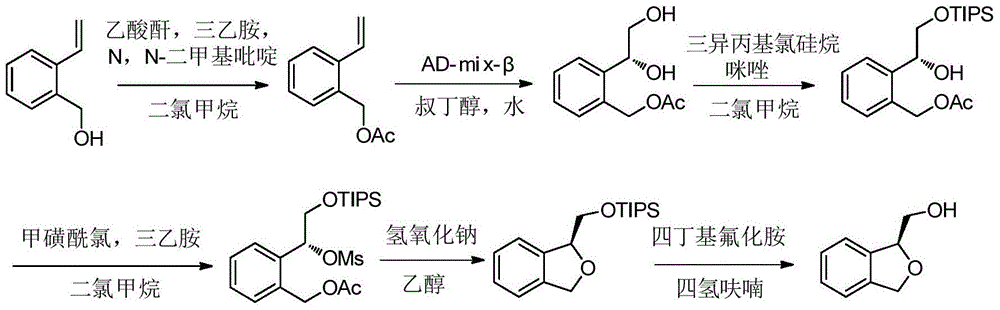
The method comprises the following steps: 2-Vinylacetic acid benzyl ester
(2-Vinylphenyl) methanol (3.0g, 22.4mmol) and triethylamine (4.5g, 44.7mmol) were dissolved in dichloromethane (20mL), acetic anhydride (4.6g, 44.7mmol) and a catalytic amount of N, N-lutidine (50mg) were added, the reaction system was stirred at room temperature overnight, dichloromethane (30mL) was added for dilution, and washing with water and saturated brine in this order, dried over anhydrous sodium sulfate, filtered, concentrated, and purified by silica gel column chromatography to give benzyl 2-vinylacetate (3.9g, yield 96%) as a pale yellow oil.
Step two: (R) -2- (1, 2-diethanol) acetic acid benzyl ester
AD-mix-. beta.4.5 g was mixed with t-butanol (10mL) and water (10mL), cooled to 0 ℃ and 2-vinylacetate benzyl ester (500mg, 3.5mmol) was added dropwise, the reaction was stirred overnight while maintaining 0 ℃, the reaction solution was quenched with sodium sulfite, the aqueous phase was extracted with ethyl acetate (30 mL. times.3), the combined organic phases were washed with saturated brine, dried over anhydrous sodium sulfate, filtered and concentrated, and purified on silica gel plates to give benzyl (R) -2- (1, 2-diethanol) acetate (432mg, 58% yield) as a pale yellow liquid.
1HNMR(CDCl3,400Hz):7.50-7.58(m,1H),7.32-7.42(m,3H),5.18(dd,J=12.0Hz,2H),5.08(m,1H),3.66-3.78(m,2H),3.01(s,1H),2.54(s,1H),2.14(s,3H)。
Step three: (R) -2- (1-hydroxy-2- ((triisopropylsilyloxy) ethyl) acetic acid benzyl ester
(R) -benzyl 2- (1, 2-diethanol) acetate (200mg,0.95mmol) and imidazole (77mg,1.14mmol) were dissolved in dichloromethane (2ml), cooled to 0 ℃, triisopropylchlorosilane (201mg,1.05mmol) was added dropwise, the reaction system was warmed to room temperature overnight, and the reaction solution was concentrated and purified by silica gel column chromatography (petroleum ether: ethyl acetate ═ 4:1) to give benzyl (R) -2- (1-hydroxy-2- ((triisopropylsilyloxy) ethyl) acetate (128mg) as a pale yellow oily liquid.
1HNMR(CDCl3,400Hz):7.61-7.63(m,1H),7.32-7.43(m,3H),5.17(dd,J=12Hz,2H),5.08(m,1H),3.88-3.92(m,1H),3.65-3.69(m,1H),3.20(s,1H),1.14(s,12H),1.12(s,6H)。
Step four: (R) -benzyl 2- (1- (methylsulfonyloxy) -2- ((triisopropylsilyloxy) ethyl) acetate
Benzyl (R) -2- (1-hydroxy-2- ((triisopropylsilyloxy) ethyl) acetate (60mg, 0.16mmol) was dissolved in dichloromethane (2mL), triethylamine (50mg, 0.49mmol) was added, then methanesulfonyl chloride (37mg, 0.32 mmol) was added dropwise (dissolved in 0.5mL dichloromethane). The reaction was stirred at room temperature for 2 hours, diluted with dichloromethane, washed with 2N hydrochloric acid solution and saturated brine, dried over anhydrous sodium sulfate, filtered and concentrated to give a residue which was directly used in the next reaction.
Step five: (S) - ((1, 3-Diisobenzofuran-1-yl) methoxy) triisopropylsilane
The compound obtained in the fourth step (73mg, 0.16mmol) was dissolved in absolute ethanol (1mL), NaOH (13mg, 0.32mmol in 0.5mL ethanol) was added, the reaction was stirred at room temperature for 1 hour, and the reaction solution was directly concentrated to obtain a crude product, which was purified with a silica gel preparation plate (petroleum ether: ethyl acetate ═ 10:1) to obtain compound (S) - ((1, 3-diisohydrophenylfuran-1-yl) methoxy) triisopropylsilane (33mg, 66% yield in2 steps) as a colorless oil.
1HNMR(CDCl3,400Hz):7.22-7.36(m,4H),5.29(t,J=5.2Hz,1H),5.10-5.20(m,2H),3.98(dd,J=5.2,10.0Hz,1H),3.90(dd,J=5.2,10.0Hz,1H),1.02-1.16(m,21H)。
Step six: (S) - (1, 3-dihydroisobenzofuran-1-yl) methanol
(S) - ((1, 3-diisohydrocinnuran-1-yl) methoxy) triisopropylsilane (33mg, 0.11mmol) was dissolved in tetrahydrofuran (2mL), tetrabutylammonium fluoride (14mg, 0.06mmol) was added, the reaction was stirred at room temperature for 5 hours, and the reaction solution was directly purified with a silica gel preparation plate (petroleum ether: ethyl acetate ═ 3:1) to obtain (S) - (1, 3-dihydroisobenzofuran-1-yl) methanol (5mg, yield 30%, e.e. value: 97.16%) as a colorless oil.
1HNMR(CDCl3,400Hz):7.23-7.35(m,4H),5.35-5.36(m,1H),5.13-5.22(m,2H),3.97(dd,J=3.2Hz,12Hz,1H),3.82(dd,J=5.6Hz,11.6Hz,1H)。
[α]D 25=22.11(C=0.502,MeOH)
Example 13: synthesis of (R) - (1, 3-dihydroisobenzofuran-1-yl) methanol

The method comprises the following steps: 1- (chloromethyl) -2-vinylbenzene
(2-vinyl benzene) methanol (3.10g, 23.1mmol) was dissolved in dichloromethane (30mL), cooled to 0 deg.C, thionyl chloride (2.01mL, 27.7mmol) was added dropwise, the reaction stirred at room temperature overnight, diluted with dichloromethane (50mL), washed sequentially with water (30mLx2), saturated sodium bicarbonate solution (20mLx1) and saturated brine, dried over anhydrous sodium sulfate, filtered and concentrated to give 1- (chloromethyl) -2-vinyl benzene (2.92g, 83% yield) as a colorless oil, which was used directly in the next reaction.
Step two: (R) -1- (2- (chloromethyl) phenyl) ethyl-1, 2-diol
AD-mix-. beta.34.6 g was dissolved in t-butanol/water (260mL, 1:1), cooled to 0 deg.C, the compound 1- (chloromethyl) -2-vinylbenzene (4.0g, 26.2mmol, dissolved in 5mL t-butanol) was added dropwise, the reaction was stirred at 0 deg.C for 2 hours, anhydrous sodium sulfite (39g) was added to quench the reaction, ethyl acetate (100mLx2) was extracted, the organic phases were combined, washed with water and saturated brine, dried over anhydrous sodium sulfate, filtered and concentrated to give the compound (3.5g, yield 72%) as a pale yellow solid.
1H NMR(400MHz,CDCl3):7.58(d,J=7.6Hz,1H),7.28-7.43(m,3H),5.21(dd,J=3.2Hz,8.4Hz,1H),4.72(s,2H),3.86(dd,J=3.2Hz,11.2Hz,1H),3.76(dd,J=8.8Hz,11.2Hz,1H),2.70(br,1H),2.23(br,1H)。
Step three: (R) - (1, 3-dihydroisobenzofuran-1-yl) methanol
(R) -1- (2- (chloromethyl) phenyl) ethyl-1, 2-diol (3.5g, 18.8mmol) was dissolved in tetrahydrofuran (35mL), cooled to 0 ℃, added sodium hydride (1.65g, 60%, 41.3mmol) in portions, reacted at room temperature for 2 hours, quenched with ice water, extracted with ethyl acetate (50mLx2), the organic phases combined, washed with water and saturated brine, dried over anhydrous sodium sulfate, filtered, concentrated, and purified by silica gel column chromatography to give (R) - (1, 3-dihydroisobenzofuran-1-yl) methanol (1.8g, yield 64%, e.e. value: 97.01%) as a pale yellow liquid.
1HNMR(CDCl3,400Hz):7.24-7.36(m,4H),5.35-5.36(m,1H),5.14-5.23(m,2H),3.95(dd,J=3.2Hz,12Hz,1H),3.82(dd,J=5.6Hz,11.6Hz,1H)。
[α]D 25=-24.14(C=0.505,MeOH)
Example 14: (S) - (5-methyl-1, 3-dihydroisobenzofuran-1-yl) methanol
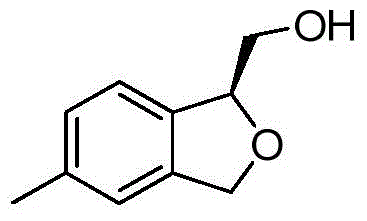
(S) - (5-methyl-1, 3-dihydroisobenzofuran-1-yl) methanol was prepared using the synthesis of the compound of example 13, using AD-mix-alpha as chiral starting material.
1HNMR(CDCl3,400Hz):7.13(s,2H),7.08(s,2H),5.52(s,1H),5.09-5.18(m,2H),3.95(dd,J=3.2,12.0Hz,1H),3.79(dd,J=5.6,12.0Hz,1H),2.39(s,3H)1.78(s,1H)。
Example 15: (S) - (5-fluoro-1, 3-dihydroisobenzofuran-1-yl) methanol
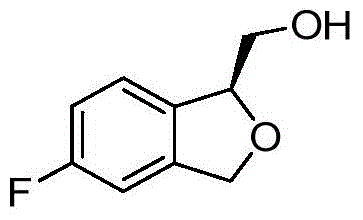
(S) - (5-fluoro-1, 3-dihydroisobenzofuran-1-yl) methanol was prepared using the synthesis of the compound of example 13, using AD-mix-alpha as chiral starting material.
1HNMR(CDCl3,400Hz):7.19(dd,J=4.8,8.4Hz,1H),6.95-7.03(m,2H),5.30(s,1H),5.09-5.19(m,2H),3.94(dd,J=3.2,12.0Hz,1H),3.79(dd,J=6.0,12.0Hz,1H),1.92(s,1H)。
Example 16: synthesis of 2-allyl-3-fluorophenol and 2-allyl-5-fluorophenol

Step 1: 3-fluorophenyl allyl ether
3-fluorophenol (20g, 178mmol) was dissolved in acetone (200mL), cesium carbonate solid (87g, 268mmol) was added, and bromopropene (19mL, 214mmol) was added dropwise under ice bath. After the addition was completed, the mixture was warmed to room temperature and stirred for 4 hours, the solid was filtered, the filtrate was diluted with ethyl acetate (200mL), and the organic phase was washed with water and saturated brine, respectively, and dried over anhydrous sodium sulfate. The solvent was distilled off under reduced pressure to give 3-fluorophenylallyl ether (25g, yield: 92%) as a brown oily liquid. The crude product can be directly used for the next reaction.
Step 2: 2-allyl-3-fluorophenol and 2-allyl-5-fluorophenol
3-fluorophenyl allyl ether (10g, 66mmol) prepared in step 1 and N, N-diethylaniline (15mL) were stirred at 225 ℃ for 2 hours, cooled to room temperature, the reaction mixture was diluted with ethyl acetate (250mL), and the organic phase was washed with 6N hydrochloric acid solution (100mL) and saturated brine and dried over anhydrous sodium sulfate. The solvent was removed by distillation under the reduced pressure, and the obtained residue was purified by silica gel column chromatography (eluent: petroleum ether/ethyl acetate 100: 1 to 20: 1) to obtain 2-allyl-5-fluorophenol (4g, yield: 40%) as a pale yellow oil and 2-allyl-3-fluorophenol (2.2g, yield 22%) as a pale yellow oil.
2-allyl-5-fluorophenol
1H NMR(400MHz,CDCl3):7.06(dd,J=6.8,8.0,1H),6.58-6.65(m,2H),5.97-6.05(m,1H),5.32(br s,1H),5.16-5.21(m,1H),3.39(d,J=6.0,2H).
2-allyl-3-fluorophenol
1H NMR(400 MHz,CDCl3):7.07-7.12(m,1H),6.64-6.71(m,2H),5.96-6.06(m,1H),5.16-5.21(m,2H),5.14(t,J=2.0Hz,1H),3.48(dd,J=1.2,5.6,2H).
Example 17: synthesis of 2- ((4- (5-bromo-2-chlorobenzyl) phenoxy) methyl) -7-fluoro-2, 3-dihydrobenzofuran
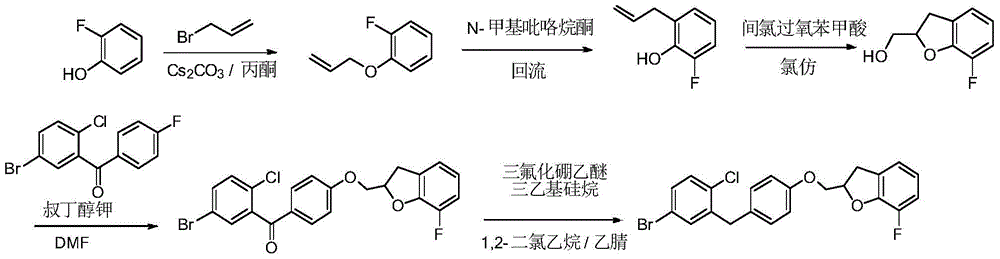
Step 1: 2-fluorophenyl allyl ether
O-fluorophenol (21g, 187mmol) was dissolved in acetone (210mL), cesium carbonate solid (91.5g, 281mmol) was added, and bromopropene (27.1g, 225mmol) was added dropwise under ice bath. After the addition was completed, the mixture was stirred at room temperature overnight, the solid was filtered, the filter cake was washed with ethyl acetate (400mL), and the filtrate was washed with a 10% aqueous solution of sodium hydroxide (100mL), water and saturated brine, respectively, and dried over anhydrous sodium sulfate. Filtration and removal of the solvent by rotary evaporation under reduced pressure gave 2-fluorophenylallyl ether (25g, yield: 87.7%) as a yellow oily liquid.
Step 2: 2-allyl-6-fluorophenol
2-fluorophenyl allyl ether prepared in step 1 (5g, 32mmol) was dissolved in N-methylpyrrolidone (50mL), heated to 225 ℃ and stirred for 3 hours, cooled to room temperature, diluted with ethyl acetate (200mL), washed with water and saturated brine, respectively, and dried over anhydrous sodium sulfate. Filtration and rotary evaporation under reduced pressure were carried out to remove the solvent, whereby 2-allyl-6-fluorophenol (5g, yield: 100%) was obtained as a yellow oily substance, and the crude product was used directly in the next reaction.
And step 3: (7-fluoro-2, 3-dihydrobenzofuran-2-yl) methanol
The 2-allyl-6-fluorophenol prepared in step 2 was dissolved in chloroform (5g, 32.9mmol), and m-chloroperoxybenzoic acid (7.56g, 32.9mmol, 75%) was added. The reaction system was heated under reflux and stirred for 3 hours, cooled to room temperature, and the reaction mixture was washed with saturated sodium hydrogencarbonate, water and saturated brine and dried over anhydrous sodium sulfate. The solvent was removed by distillation under the reduced pressure, and the obtained crude product was purified by silica gel column chromatography (petroleum ether: ethyl acetate ═ 10:1) to give (7-fluoro-2, 3-dihydrobenzofuran-2-yl) methanol (2.1g, yield: 38%) as a pale yellow oil.
1H NMR(400MHz,CDCl3):6.90-6.97(m,2H),6.78-6.83(m,1H),5.00-5.06(m,1H),3.93(dd,J=3.2,12.4Hz,1H),3.79(dd,J=6.0,12.0Hz,1H),3.31(dd,J=9.2,15.6Hz,1H),3.14(dd,J=7.6,16.0Hz,1H)。
And 4, step 4: (5-bromo-2-chlorophenyl) (4- ((7-fluoro-2, 3-dihydrobenzofuran-2-yl) methoxy) phenyl) methanone
To a solution of (7-fluoro-2, 3-dihydrobenzofuran-2-yl) methanol (708mg, 4.21mmol) prepared in step 3 and (5-bromo-2-chloro-phenyl) (4-fluoro-phenyl) methanone (1.10g, 3.51mmol) in N, N-dimethylformamide (10mL) under ice-bath conditions was added potassium tert-butoxide (413mg, 3.68mmol), and the reaction was dark brown, warmed to room temperature and stirred overnight. The reaction was quenched by the addition of water (50mL), the reaction solution was extracted with ethyl acetate (30 mL. times.3), the organic phases were combined, washed with water and saturated brine, and dried over anhydrous sodium sulfate. The solvent was removed by rotary evaporation under reduced pressure, and the resulting residue was purified with a thin layer preparative plate (petroleum ether: ethyl acetate ═ 3:1) to give (5-bromo-2-chloro-phenyl) (4- ((7-fluoro-2, 3-dihydrobenzofuran-2-yl) methoxy) phenyl) methanone (770mg, yield: 47.5%) as a colorless oil.
m/z:[M+H]+461.0
And 5: 2- ((4- (5-bromo-2-chlorobenzyl) phenoxy) methyl) -7-fluoro-2, 3-dihydrobenzofuran
Boron trifluoride diethyl etherate (0.62mL, 5mmol) was added dropwise to a mixture of (5-bromo-2-chloro-phenyl) (4- ((7-fluoro-2, 3-dihydrobenzofuran-2-yl) methoxy) phenyl) methanone (770mg, 1.67mmol) prepared in step 4 and triethylchlorosilane (1.07mL, 6.67mmol) in 1, 2-dichloroethane (3mL) and acetonitrile (3mL) under ice bath and nitrogen protection, and after addition, the reaction was gradually warmed to room temperature and stirred overnight. Water (30mL) and ethyl acetate (50mL) were added to the reaction solution, the layers were separated, the aqueous layer was extracted with ethyl acetate (30mL), the organic layers were combined, and the organic layer was washed with a saturated aqueous sodium bicarbonate solution (20 mL. times.2) and a saturated brine and dried over anhydrous sodium sulfate. The solvent was removed by distillation under the reduced pressure, and the obtained residue was purified with a thin layer preparative plate (petroleum ether: ethyl acetate ═ 5:1) to give 2- ((4- (5-bromo-2-chlorobenzyl) phenoxy) methyl) -7-fluoro-2, 3-dihydrobenzofuran (400mg, yield: 53.6%) as a white solid.
1H NMR(400MHz,CDCl3):7.23-7.31(m,3H),7.10(d,J=11.2Hz,2H),6.88=7.00(m,4H),6.79-6.84(m,1H),5.23-5.29(m,1H),4.24(dd,J=5.6,10Hz,1H),4.14(dd,J=5.2,10Hz,1H),4.01(s,2H),3.442(dd,J=9.2,15.6Hz,1H),3.27(dd,J=7.2,15.6Hz,1H)。
Synthesis of the Compounds of examples 18 to 36 by the Synthesis of the Compound of example 17
Example 18: 2- ((4- (5-bromo-2-chlorobenzyl) phenoxy) methyl) -2, 3-dihydrobenzofuran

1H NMR(400MHz,CDCl3):7.21-7.31(m,4H),7.10-7.17(m,3H),6.84-6.92(m,4H),5.14-5.20(m,1H),4.22(dd,J=6.8,10Hz,1H),4.10(dd,J=4.4,10Hz,1H),4.01(s,2H),3.40(dd,J=9.6,16Hz,1H),3.16(dd,J=7.2,15.6Hz,1H)。
Example 19: 2- ((4- (5-bromo-2-chlorobenzyl) phenoxy) methyl) -4-fluoro-2, 3-dihydrobenzofuran
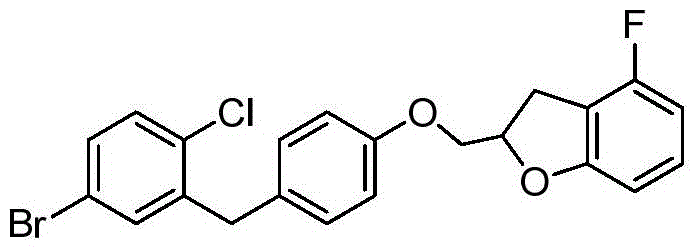
m/z:[M+H]+447.1
Example 20: 2- ((4- (5-bromo-2-chlorobenzyl) phenoxy) methyl) -5-fluoro-2, 3-dihydrobenzofuran
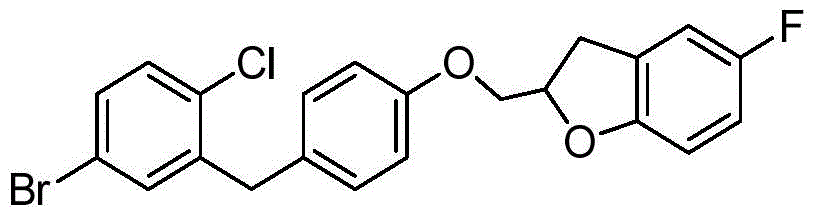
Example 21: 2- ((4- (5-bromo-2-chlorobenzyl) phenoxy) methyl) -6-fluoro-2, 3-dihydrobenzofuran
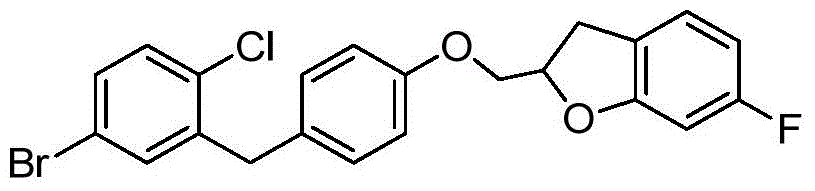
Example 22: 4-bromo-2- (4- ((2, 3-dihydrobenzofuran-2-yl) methoxy) benzyl) benzonitrile

Step 1: 4-bromo-2- ((4- ((2, 3-dihydrobenzofuran-2-yl) methoxy) phenyl) (hydroxy) methyl) benzonitrile
4-bromo-2- (4- ((2, 3-dihydrobenzofuran-2-yl) methoxy) benzoyl) benzonitrile (620mg, 1.43mmol) was dissolved in tetrahydrofuran (6ml) and methanol (6ml), cooled to 0 ℃ and sodium borohydride (81mg, 2.14mmol) was added slowly. After maintaining the reaction at 0 ℃ for 30 minutes, the reaction solution was poured into water (20mL), ethyl acetate (30mL) was added, the aqueous layer was separated, and the organic layer was dried and concentrated under reduced pressure to give 4-bromo-2- ((4- ((2, 3-dihydrobenzofuran-2-yl) methoxy) phenyl) (hydroxy) methyl) benzonitrile (600mg, yield: 96%).
Step 2: 4-bromo-2- (4- ((2, 3-dihydrobenzofuran-2-yl) methoxy) benzyl) benzonitrile
4-bromo-2- ((4- ((2, 3-dihydrobenzofuran-2-yl) methoxy) phenyl) (hydroxy) methyl) benzonitrile prepared in step 1 (600mg, 1.38mmol) and triethylsilane (479mg, 4.13mmol) were dissolved in acetonitrile (3.5mL) and dichloromethane (3.5mL) under nitrogen protection, cooled to 0 ℃ and boron trifluoride diethyl etherate (390mg, 2.75mmol) was added dropwise. After the reaction system was allowed to stand at 0 ℃ for 2 hours, the mixture was poured into water (20mL), the aqueous layer was extracted with ethyl acetate (20mLx3), the organic phases were combined, dried over anhydrous sodium sulfate and concentrated to give a crude product, which was purified with a thin layer plate to give 4-bromo-2- (4- ((2, 3-dihydrobenzofuran-2-yl) methoxy) benzyl) benzonitrile (275mg, yield: 48%).
1H NMR(400MHz,CDCl3):7.70(d,J=8.0Hz,1H),7.37(dd,J=2.0,7.6Hz,1H),7.32(d,J=2.0Hz,1H),7.22(d,J=7.6Hz,1H),7.15(t,J=7.6Hz,1H),7.10(d,J=8.4Hz,2H),6.83-6.93(m,4H),5.14-5.21(m,1H),4.23(dd,J=6.4,10.0Hz,1H),4.12(dd,J=4.8,9.6Hz,1H),4.06(s,2H),3.41(dd,J=9.6,15.6Hz,1H),3.16(dd,J=7.2,15.6Hz,1H)。
Example 23: 2- ((4- (5-bromo-2-methoxybenzyl) phenoxy) methyl) -2, 3-dihydrobenzofuran
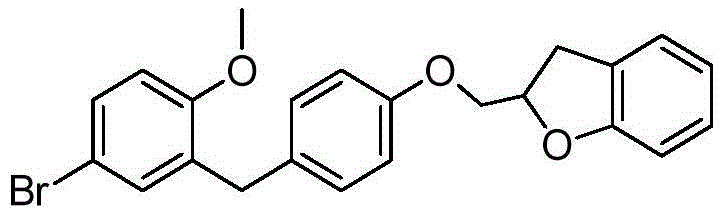
m/z:[M+H]+425.2
Example 24: 2- ((4- (3-bromobenzyl) phenoxy) methyl) -2, 3-dihydrobenzofuran
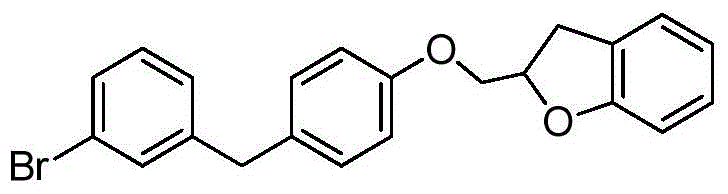
1H NMR(400MHz,CDCl3):7.10-7.35(m,8H),6.84-6.91(m,4H),5.13-5.20(m,1H),4.21(dd,J=6.4,10Hz,1H),4.10(dd,J=4.4,10Hz,1H),3.91(s,2H),3.40(dd,J=9.6,16Hz,1H),3.15(m,J=6.8,16Hz,1H)。
Example 25: 2- ((4- (5-bromo-2-methoxybenzyl) phenyl) methyl) benzofuran

m/z:[M+H]+422.9
Example 26: 3- ((4- (5-bromo-2-chlorobenzyl) phenoxy) methyl) -1, 1-dimethyl-1, 3-dihydroisobenzofuran
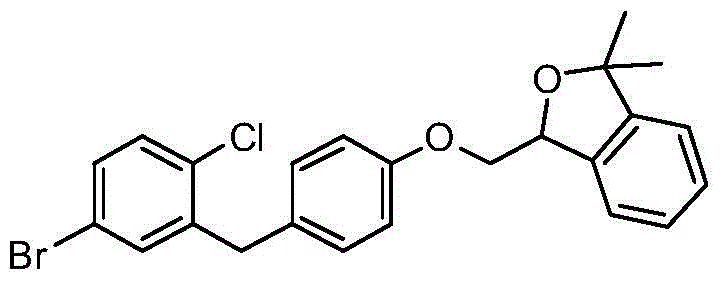
m/z:[M+H]+456.8
Example 27: 1- ((4- (5-bromo-2-chlorobenzyl) phenoxy) methyl) -1, 3-dihydroisobenzofuran
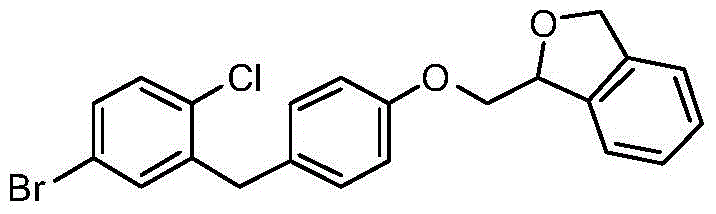
1H NMR(400MHz,CDCl3):7.23-7.37(m,7H),7.09-7.12(m,2H),6.88-6.94(m,2H),5.61(t,J=5.2Hz,1H),5.17-5.27(m,2H),4.20(d,J=5.6Hz,2H),4.01(s,2H)。
Example 28: 1- ((4- (5-bromo-2-methylbenzyl) phenoxy) methyl) -1, 3-dihydroisobenzofuran
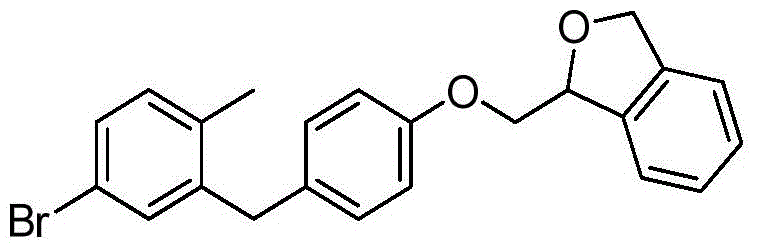
1H NMR(400MHz,CDCl3):7.22-7.38(m,6H),7.03(d,J=8.8Hz,2H),6.87-6.91(m,2H),5.61(t,J=5.2Hz,1H),5.17-5.27(m,2H),4.19(d,J=5.2Hz,2H),3.89(s,2H),2.20(s,3H)。
Example 29: (S) -1- ((4- (5-bromo-2-chlorobenzyl) phenoxy) methyl) -1, 3-dihydroisobenzofuran

m/z:[M+H]+429.4
Example 30: 2- ((4- (5-bromo-2-chlorobenzyl) phenoxy) methyl) -5-methyl-2, 3-dihydrobenzofuran
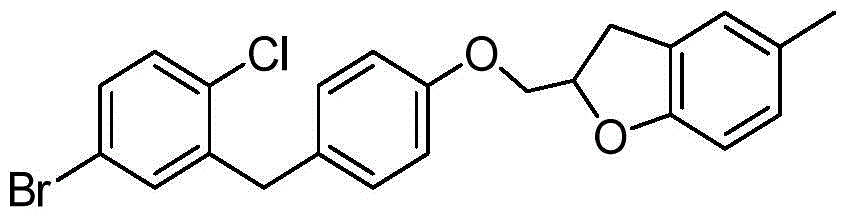
1H NMR(400MHz,CDCl3):7.24-7.32(m,3H),7.03-7.14(m,3H),6.89-6.96(m,3H),6.42(d,J=8.0Hz,1H),5.12-5.18(m,1H),4.21(dd,J=6.8,10.0Hz,1H),4.09(dd,J=5.6,6.0Hz,1H),4.02(s,2H),3.36(dd,J=9.2,16.0Hz,1H),3.12(dd,J=7.2,16.0Hz,1H),2.31(s,3H)。
Example 31: 2- ((4- (5-bromo-2-methylbenzyl) phenoxy) methyl) -2, 3-dihydrobenzofuran

1H NMR(400MHz,CDCl3):7.26-7.28(m,1H),7.20-7.22(m,2H),7.14(t,J=8.0Hz,1H),7.02-7.04(m,3H),6.83-6.90(m,4H),5.13-5.20(m,1H),4.20(dd,J=6.0Hz,10.0Hz,1H),4.10(dd,J=4.8Hz,10Hz,1H),3.88(s,2H),3.40(dd,J=9.2Hz,15.6Hz,1H),3.15(dd,J=6.8Hz,15.6Hz,1H),2.19(s,3H)。
Example 32: (S) -1- ((4- (5-bromo-2-chlorobenzyl) phenoxy) methyl) -5-methyl-1, 3-dihydroisobenzofuran
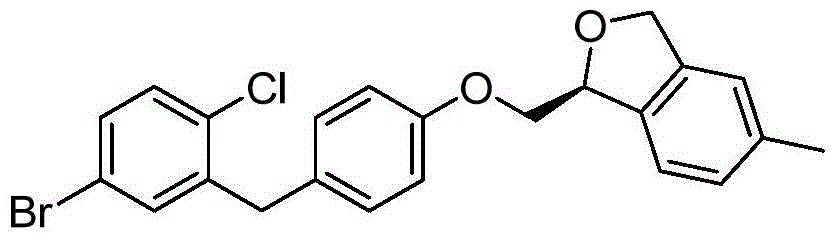
m/z:[M+H]+443.2
Example 33: (S) -1- ((4- (5-bromo-2-chlorobenzyl) phenoxy) methyl) -5-fluoro-1, 3-dihydroisobenzofuran

m/z:[M+H]+447.2
Example 34: (S) -2- ((4- (5-bromo-2-chlorobenzyl) phenoxy) methyl) -2, 3-dihydrobenzofuran
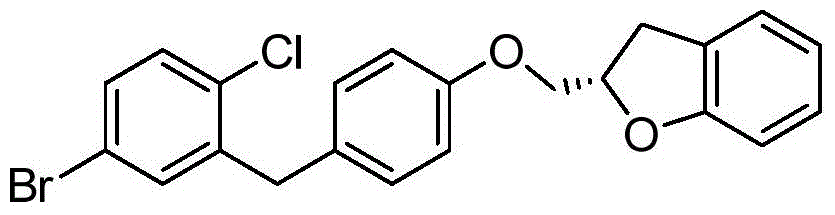
m/z:[M+H]+429.2
Example 35: (R) -1- ((4- (5-bromo-2-chlorobenzyl) phenoxy) methyl) -1, 3-dihydroisobenzofuran

1H NMR(400MHz,CDCl3):7.23-7.38(m,7H),7.10-7.12(m,2H),6.89-6.93(m,2H),5.61(t,J=5.2Hz,1H),5.17-5.27(m,2H),4.20(d,J=6.0Hz,2H),4.01(s,2H)。
Example 36: (S) -2- ((4- (5-bromo-2-methylbenzyl) phenoxy) methyl) -2, 3-dihydrobenzofuran
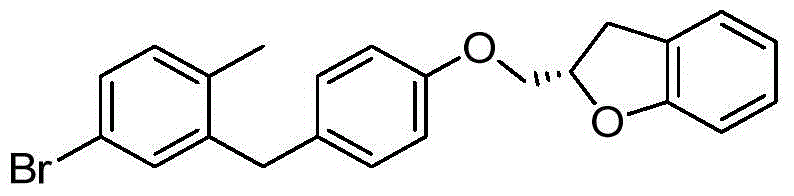
m/z:[M+H]+409.3
Example 37: synthesis of (2S, 3R, 4R, 5S, 6S) -2- (4-chloro-3- (4- ((7-fluoro-2, 3-dihydrobenzofuran-2-yl) methoxy) benzyl) phenyl) -6- (hydroxymethyl) tetrahydro-2H-pyran-3, 4, 5-triol (Compound I-34)
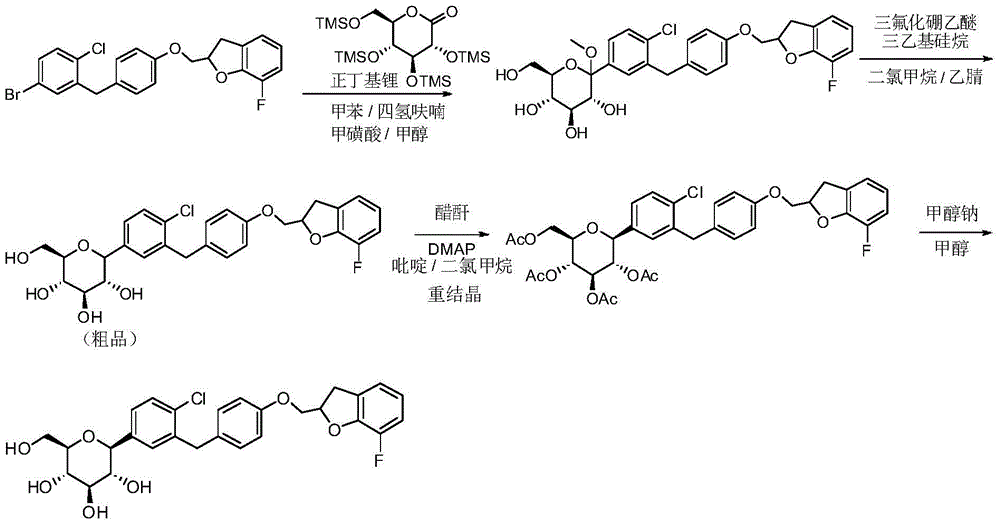
Step 1: (3R, 4S, 5S, 6R) -2- (4-chloro-3- (4- ((7-fluoro-2, 3-dihydrobenzofuran-2-yl) methoxy) benzyl) phenyl) -6- (hydroxymethyl) -2-methoxytetrahydro-2H-pyran-3, 4, 5-triol
2- ((4- (5-bromo-2-chlorobenzyl) phenoxy) methyl) -7-fluoro-2, 3-dihydrobenzofuran (400mg, 0.89mmol) prepared in example 17 was dissolved in dry tetrahydrofuran (2mL) and dry toluene (4mL), dropwise adding n-butyl lithium n-hexane solution (2.5M, 0.35mL, 0.89mmol) at-78 deg.C under nitrogen protection, stirring at-70 deg.C for 30 min when the internal temperature is not more than-60 deg.C, dropwise adding toluene (3mL) solution of 2,3,4, 6-tetra-0- (trimethylsilyl) -D-glucopyranosone, stirring at-70 deg.C for 1 hr, a methanol solution of methanesulfonic acid (103mg/5mL) was added, and the reaction was warmed to room temperature and stirred overnight. The reaction was quenched by the addition of saturated sodium bicarbonate solution (20mL), the mixture was extracted with ethyl acetate (30mLx3), and the organic phases were combined, washed with saturated brine and dried over anhydrous sodium sulfate. The solvent was removed by rotary evaporation under reduced pressure, and the obtained residue was purified by silica gel column chromatography (methanol/dichloromethane ═ 1: 20) to give (3R, 4S, 5S, 6R) -2- (4-chloro-3- (4- ((7-fluoro-2, 3-dihydrofuran-2-yl) methoxy) benzyl) phenyl) -6- (hydroxymethyl) -2-methoxytetrahydro-2H-pyran-3, 4, 5-triol (330mg, yield: 65.84%) as a white foamy solid.
m/z:[M-H]-558.9
Step 2: (3R, 4R, 5S, 6R) -2- (4-chloro-3- (4- ((7-fluoro-2, 3-dihydrobenzofuran-2-yl) methoxy) benzyl) phenyl) -6- (hydroxymethyl) tetrahydro-2H-pyran-3, 4, 5-triol
Boron trifluoride diethyl etherate (0.11mL, 0.88mmol) was added dropwise to a mixture of (3R, 4S, 5S, 6R) -2- (4-chloro-3- (4- ((7-fluoro-2, 3-dihydrofuran-2-yl) methoxy) benzyl) phenyl) -6- (hydroxymethyl) -2-methoxytetrahydro-2H-pyran-3, 4, 5-triol (330mg, 0.59mmol) and triethylchlorosilane (0.17mL, 1.18mmol) in dichloromethane (2mL) and acetonitrile (2mL) at-15 ℃ and stirred for 2 hours while the reaction was gradually raised to 0 ℃. The reaction was quenched by the addition of saturated aqueous sodium bicarbonate (20mL), the reaction was extracted with ethyl acetate (20mLx3), the organic phases were combined, washed with saturated brine and dried over anhydrous sodium sulfate. The solvent was distilled off under reduced pressure to give (3R, 4R, 5S, 6R) -2- (4-chloro-3- (4- ((7-fluoro-2, 3-dihydrobenzofuran-2-yl) methoxy) benzyl) phenyl) -6- (hydroxymethyl) tetrahydro-2H-pyran-3, 4, 5-triol (300mg, yield: 96%) as a pale yellow foamy solid.
m/z:[M+NH4]+547.9
And step 3: (2R, 3R, 4R, 5S, 6S) -2- (acetoxymethyl) -6- (4-chloro-3- (4- ((7-fluoro-2, 3-dihydrobenzofuran) -2-yl) methoxy) benzyl) phenyl) tetrahydro-2H-pyran-3, 4, 5-triyltriacetyl ester
(3R, 4R, 5S, 6R) -2- (4-chloro-3- (4- ((7-fluoro-2, 3-dihydrobenzofuran-2-yl) methoxy) benzyl) phenyl) -6- (hydroxymethyl) tetrahydro-2H-pyran-3, 4, 5-triol (330mg, 0.62mmol) prepared in step 2 was dissolved in dichloromethane (3mL), and acetic anhydride (380mg, 3.73mmol), pyridine (491mg, 6.22mmol) and a catalytic amount of 4-dimethylaminopyridine were added in that order. After stirring at room temperature for 0.5 hour, the mixture was diluted with ethyl acetate (50mL), washed with a 2N hydrochloric acid solution (10mL), water (10mL), a saturated aqueous sodium bicarbonate solution (10mL) and a saturated brine, and dried over anhydrous sodium sulfate. The solvent was removed by distillation under the reduced pressure, and the crude product was recrystallized from anhydrous ethanol to give (2R, 3R, 4R, 5S, 6S) -2- (acetoxymethyl) -6- (4-chloro-3- (4- ((7-fluoro-2, 3-dihydrobenzofuran) -2-yl) methoxy) benzyl) phenyl) tetrahydro-2H-pyran-3, 4, 5-triyltriacetyl ester (210mg, yield: 48%) as a white solid.
m/z:[M+H2O]+716.2
And 4, step 4: (2S, 3R, 4R, 5S, 6S) -2- (4-chloro-3- (4- ((7-fluoro-2, 3-dihydrobenzofuran-2-yl) methoxy) benzyl) phenyl) -6- (hydroxymethyl) tetrahydro-2H-pyran-3, 4, 5-triol
To a solution of (2R, 3R, 4R, 5S, 6S) -2- (acetoxymethyl) -6- (4-chloro-3- (4- ((7-fluoro-2, 3-dihydrobenzofuran) 2-yl) methoxy) benzyl) phenyl) tetrahydro-2H-pyran-3, 4, 5-triyltriacetyl ester (210mg, 0.30mmol) prepared in step 3 in methanol (2mL) was added sodium methoxide (16mg, 0.30mmol), the reaction solution was stirred at room temperature for 2 hours and then neutralized with acetic acid, the solvent was removed by reduced pressure rotary evaporation, and the crude product was directly purified using a thin-layer preparation plate (dichloromethane: methanol 10:1) was purified to give (2S, 3R, 4R, 5S, 6S) -2- (4-chloro-3 (4- ((7-fluoro-2, 3-dihydrobenzofuran-2-yl) methoxy) benzyl) phenyl) -6- (hydroxymethyl) tetrahydro-2H-pyran-3, 4, 5-triol (120mg, yield: 75.2%) as a white solid.
m/z:[M+H2O]+548.2
1H NMR(400MHz,CD3OD):7.28-7.37(m,3H),7.13(d,J=8.8Hz,2H),7.01(d,J=7.6Hz,1H),6.79-6.94(m,4H),5.18-5.24(m,1H),4.17-4.19(m,2H),4.00-4.11(m,3H),3.87-3.90(d,J=11.6Hz,1H),3.68-3.72(m,1H),3.36-3.46(m,4H),3.20-3.29(m,2H)。
Synthesis of the Compounds of examples 38 to 51 Using the Synthesis method of the Compound of example 37 and the corresponding Bromide
Example 38: (2S, 3R, 4R, 5S, 6R) -2- (4-chloro-3- (4- ((4-fluoro-2, 3-dihydrobenzofuran-2-yl) methoxy) benzyl) phenyl) -6- (hydroxymethyl) tetrahydro-2H-pyran-3, 4, 5-triol (Compound I-31)
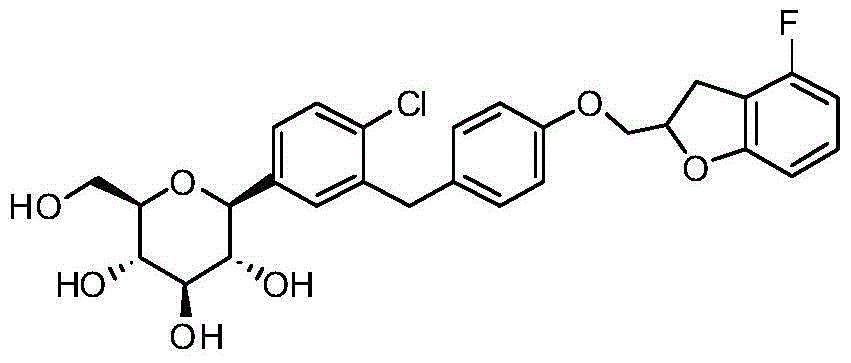
m/z:[M+NH4]+547.9
1H NMR(400MHz,CD3OD):7.28-7.37(m,3H),7.09-7.14(m,3H),6.84-6.88(m,2H),6.57-6.61(m,2H),5.16-5.21(m,1H),4.10-4.20(m,5H),3.87-3.90(m,1H),3.68-3.73(m,1H),3.28-3.49(m,5H),3.18(dd,J=7.2Hz,16.0Hz,1H)。
Example 39: (2S, 3R, 4R, 5S, 6R) -2- (4-chloro-3- (4- ((5-fluoro-2, 3-dihydrobenzofuran-2-yl) methoxy) benzyl) phenyl) -6- (hydroxymethyl) tetrahydro-2H-pyran-3, 4, 5-triol (Compound I-32)
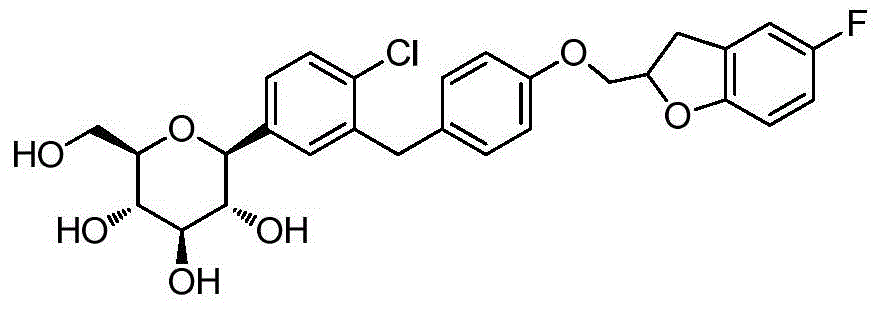
m/z:[M+NH4]+547.9
1H NMR(400MHz,CD3OD):7.28-7.37(m,3H),7.12(d,J=8.8Hz,2H),6.85-6.88(m,1H),6.79-6.87(m,3H),6.66-6.70(m,1H),5.09-5.16(m,1H),4.00-4.14(m,5H),3.68-3.73(m,1H),3.28-3.49(m,5H),3.16(dd,J=7.2Hz,16.0Hz,1H)。
Example 40: (2S, 3R, 4R, 5S, 6R) -2- (4-chloro-3- (4- ((6-fluoro-2, 3-dihydrobenzofuran-2-yl) methoxy) benzyl) phenyl) -6- (hydroxymethyl) tetrahydro-2H-pyran-3, 4, 5-triol (Compound I-33)
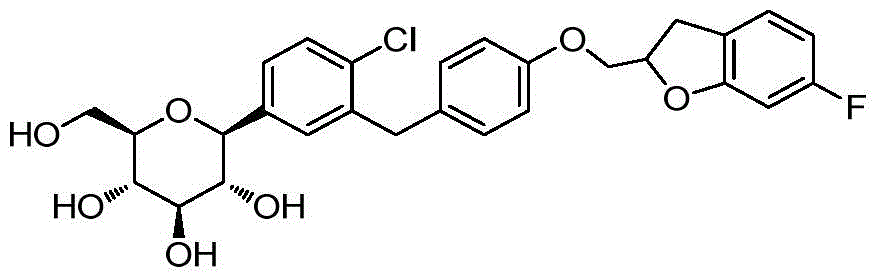
m/z:[M+NH4]+547.9
1H NMR(400MHz,CD3OD):7.28-7.37(m,3H),7.12-7.17(m,3H),6.84-6.87(m,2H),6.49-6.59(m,2H),5.14-5.19(m,1H),4.00-4.18(m,5H),3.87-3.91(m,1H),3.68-3.73(m,1H),3.28-3.49(m,5H),3.11(dd,J=7.2Hz,16.0Hz,1H)。
Example 41: 2- (4- ((2, 3-dihydrobenzofuran-2-yl) methoxy) benzyl) -4- ((2S, 3R, 4R, 5S, 6R) -3, 4, 5-trihydroxy-6- (hydroxymethyl) tetrahydro-2H-pyran-2-yl) benzonitrile (Compound I-28)
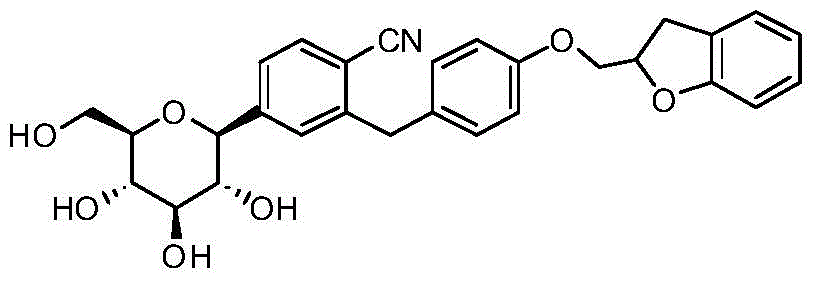
m/z:[M+NH4]+520.9
Example 42: (2S, 3R, 4R, 5S, 6R) -2- (3- (4- ((2, 3-dihydrobenzofuran-2-yl) methoxy) benzyl) -4-methoxyphenyl) -6- (hydroxymethyl) tetrahydro-2H-pyran-3, 4, 5-triol (Compound I-29)

m/z:[M+NH4]+526.0
Example 43: (2S, 3R, 4R, 5S, 6R) -2- (3- (4- ((2, 3-dihydrobenzofuran-2-yl) methoxy) benzyl) phenyl) -6- (hydroxymethyl) tetrahydro-2H-pyran-3, 4, 5-triol (Compound I-30)

m/z:[M+Na]+501.1
Example 44: (2S, 3R, 4R, 5S, 6R) -2- (3- (4- (benzofuran-2-ylmethoxy) benzyl) -4-methoxyphenyl) -6- (hydroxymethyl) tetrahydro-2H-pyran-3, 4, 5-triol (Compound I-5)
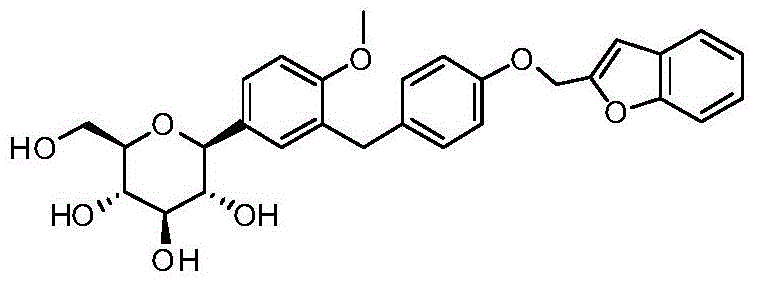
m/z:[M+NH4]+523.9
Example 45: (2S, 3R, 4R, 5S, 6R) -2- (4-chloro-3- (4- ((3, 3-dimethyl-1, 3-dihydroisobenzofuran-1-yl) methoxy) benzyl) phenyl) -6- (hydroxymethyl) tetrahydro-2H-pyran-3, 4, 5-triol (Compound I-63)

m/z:[M+H]+540.9
Example 46: (2S, 3R, 4R, 5S, 6R) -2- (4-chloro-3- (4- ((5-methyl-2, 3-dihydrobenzofuran-2-yl) methoxy) benzyl) phenyl) -6- (hydroxymethyl) tetrahydro-2H-pyran-3, 4, 5-triol (Compound I-85)
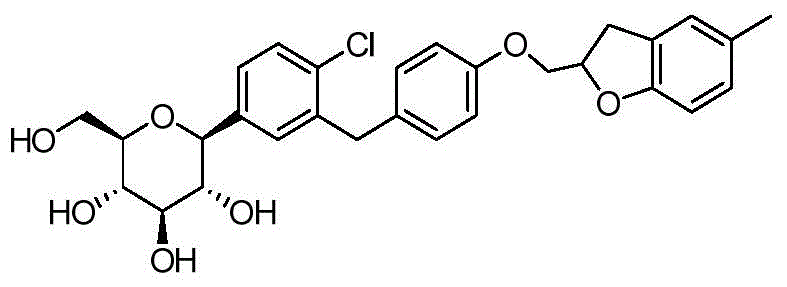
m/z:[M+Na]+549.1
Example 47: (2S, 3R, 4R, 5S, 6R) -2- (4-chloro-3- (4- (((S) -1, 3-dihydroisobenzofuran-1-yl) methoxy) benzyl) phenyl) -6- (hydroxymethyl) tetrahydro-2H-pyran-3, 4, 5-triol (Compound I-37)
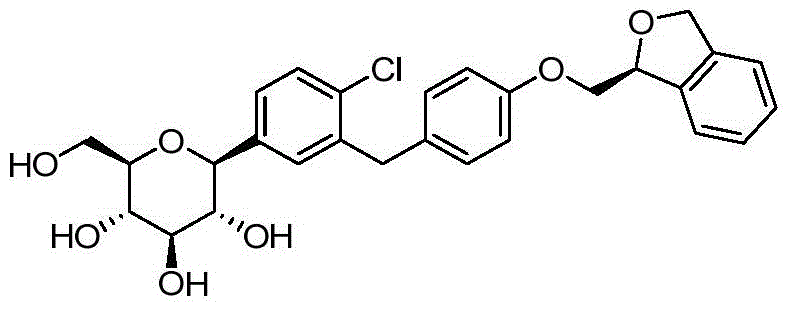
m/z:[M+H]+513.2
I-37 retention time RT was 5.00min (e.e. value: 100%) as determined by manual analysis method C.
Example 48: (2S, 3R, 4R, 5S, 6R) -2- (4-chloro-3- (4- (((S) -5-methyl-1, 3-dihydroisobenzofuran-1-yl) methoxy) benzyl) phenyl) -6- (hydroxymethyl) tetrahydro-2H-pyran-3, 4, 5-triol (Compound I-101)
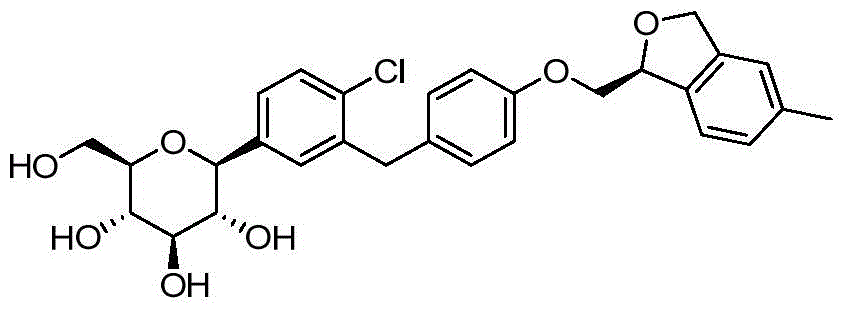
m/z:[M+H]+527.2
Example 49: (2S, 3R, 4R, 5S, 6R) -2- (4-chloro-3- (4- (((S) -5-fluoro-1, 3-dihydroisobenzofuran-1-yl) methoxy) benzyl) phenyl) -6- (hydroxymethyl) tetrahydro-2H-pyran-3, 4, 5-triol (Compound I-103)
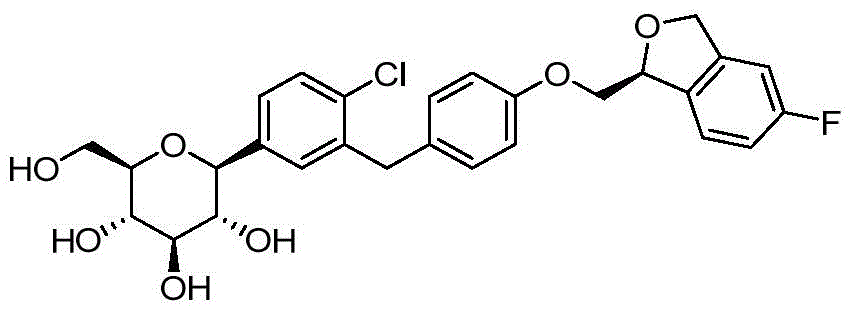
m/z:[M+H]+531.1
Example 50: (2S, 3R, 4R, 5S, 6R) -2- (4-chloro-3- (4- (((R) -1, 3-dihydroisobenzofuran-1-yl) methoxy) benzyl) phenyl) -6- (hydroxymethyl) tetrahydro-2H-pyran-3, 4, 5-triol (Compound I-38)
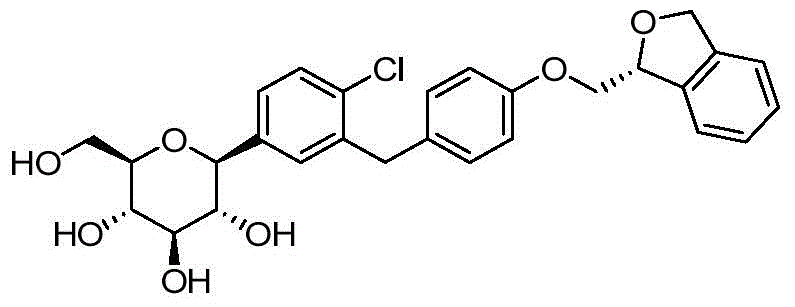
m/z:[M+H]+513.2
The I-38 retention time RT was 3.23min (e.e. value: 100%) as determined using chiral analysis condition C.
Example 51: (2S, 3R, 4R, 5S, 6R) -2- (3- (4- (((S) -2, 3-dihydrobenzofuran-2-yl) methoxy) benzyl) -4-methylphenyl) -6- (hydroxymethyl) tetrahydro-2H-pyran-3, 4, 5-triol (Compound I-26)

m/z:[M+Na]+515.2
[α]D 25=+44.1°(C=0.204%,MeOH)
I-26 retention time RT 9.05min (e.e. value: 100%) was determined according to manual analysis method B.
Example 52: preparation of Compounds I-22, I-23 and I-24
(2S, 3R, 4R, 5S, 6R) -2- (4-chloro-3- (4- ((2, 3-dihydrobenzofuran-2-yl) methoxy) benzyl) phenyl) -6- (hydroxymethyl) tetrahydro-2H-pyran-3, 4, 5-triol (Compound I-22)
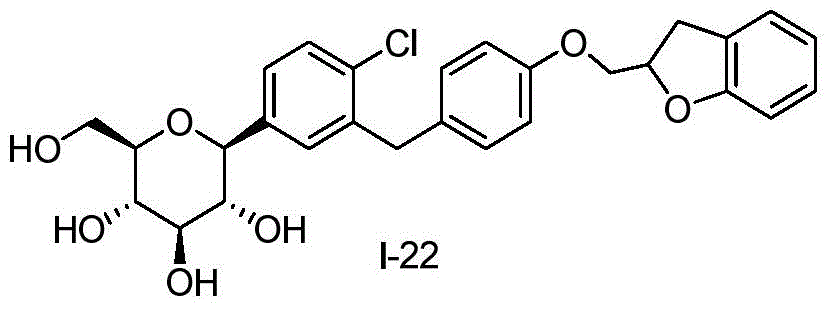
Compound I-22 was synthesized according to the synthesis of the compound of example 37 and I-22(800mg) was resolved into compound I-23(300mg) using chiral resolution method a (RT 4.18min, e.e. value: 99.0% as determined under chiral analysis condition a) and compound I-24(170mg) (RT 4.91min, e.e. value: 98.9% as determined under chiral analysis condition a). After I-23 obtained by splitting in example 52 and I-23 obtained by synthesizing in example 93 were mixed uniformly in a ratio of 1:1, the retention time RT of the mixed sample was measured as 4.27min (e.e. value: 100%) under manual analysis condition a; after I-24 obtained by splitting in example 52 and I-24 obtained by synthesizing in example 94 were mixed uniformly in a ratio of 1:1, the retention time RT of the mixed sample was measured as 4.78min under the manual analysis condition a (e.e. value: 98.2%).
Compound I-22
m/z:[M+Na]+535.2
1H NMR(400MHz,CD3OD):7.28-7.37(m,3H),7.20(dd,J=0.4,7.6Hz,1H),7.07-7.13(m,3H),6.82-6.87(m,3H),6.74(d,J=8.0Hz,1H),5.06-5.13(m,1H),3.99-4.13(m,5H),3.87-3.90(m,1H),3.68-3.72(m,1H),3.27-3.49(m,5H),3.14(dd,J=7.2,16Hz,1H)。
Compound I-23
[α]D 25=+54.3°(C=0.053%,MeOH)
Compound I-24
[α]D 25=-20.0°(C=0.051%,MeOH)
Example 53: preparation of I-25, I-26 and I-27
(2S, 3R, 4R, 5S, 6R) -2- (3- (4- ((2, 3-dihydrobenzofuran-2-yl) methoxy) benzyl) -4-methylphenyl) -6- (hydroxymethyl) tetrahydro-2H-pyran-3, 4, 5-triol (Compound I-25)
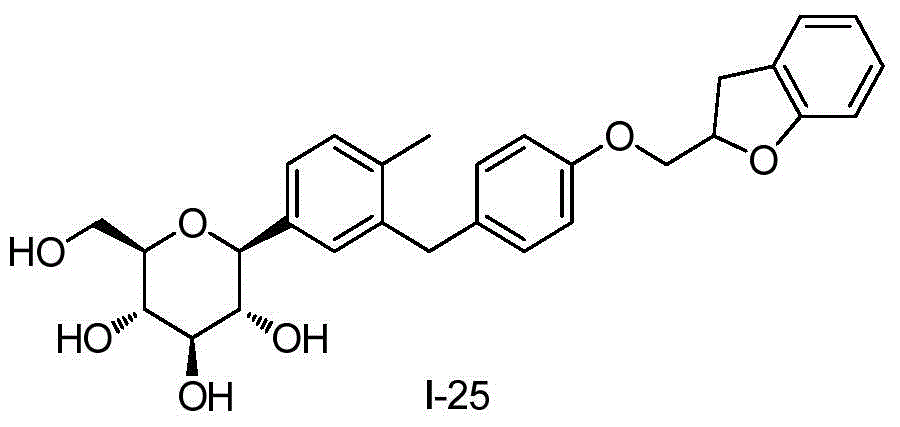
Compound I-25 was synthesized according to the synthesis of the compound of example 37, and compound I-25(1g) was resolved into compound I-26(240mg) (RT ═ 9.28min, e.e. value: 100%, according to chiral analysis condition B) and compound I-27(205mg) (RT ═ 13.37min, e.e. value: 98.7%, according to chiral analysis condition B) using chiral resolution method B. After I-26 obtained by splitting in example 53 and I-26 obtained by synthesizing in example 51 were mixed uniformly in a ratio of 1:1, the retention time RT of the mixed sample was measured as 9.68min (e.e. value: 100%) under manual analysis condition B
Compound I-25
m/z:[M+Na]+515.2
1H NMR(400 MHz,CD3OD):7.04-7.22(m,7H),6.82-6.85(m,3H),6.74(d,J=7.6Hz,1H),5.06-5.12(s,1H),4.08-4.12(m,3H),3.88-3.94(m,3H),3.68-3.72(m,1H)3.35-3.50(m,5H),3.11-3.16(m,1H),2.20(s,3H)。
Compound I-26
[α]D 25=+44.3°(C=0.212%,MeOH)
Compound I-27
[α]D 25=-20.9°(C=0.210%,MeOH)
Example 54: preparation of I-36, I-37 and I-38
(2S, 3R, 4R, 5S, 6R) -2- (4-chloro-3- (4- ((1, 3-dihydroisobenzofuran-1-yl) methoxy) benzyl) phenyl) -6- (hydroxymethyl) tetrahydro-2H-pyran-3, 4, 5-triol (Compound I-36)
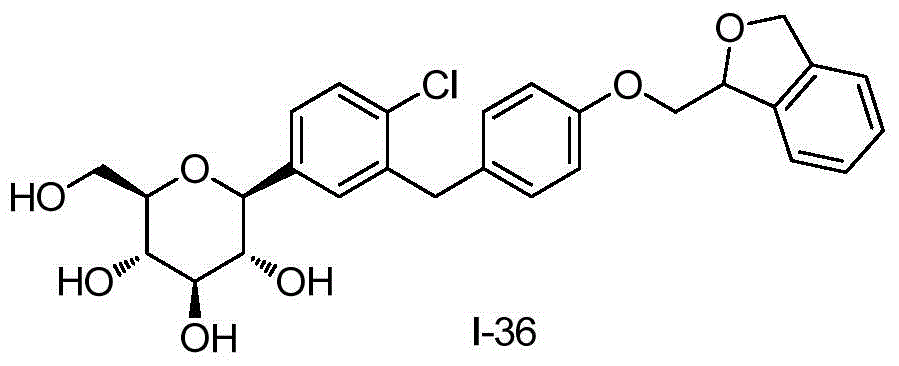
Compound I-36 was synthesized according to the synthesis method for the compound of example 37, and compound I-36(800mg) was resolved into compound I-38(190mg) (RT ═ 3.28min, e.e. value: 100%, according to manual analysis condition C) and compound I-37(100mg) (RT ═ 4.89min, e.e. value: 100%, according to manual analysis condition C) using manual resolution method a. After I-37 obtained by splitting in example 54 and I-37 obtained by synthesizing in example 47 were mixed uniformly in a ratio of 1:1, the retention time RT of the mixed sample was measured as 5.00min under manual analysis condition C (e.e. value: 99.2%). After I-38 obtained by splitting in example 54 and I-38 obtained by synthesizing in example 50 were mixed uniformly in a ratio of 1:1, the retention time RT of the mixed sample was measured as 3.31min (e.e. value: 100%) under manual analysis condition C.
Compound I-36
m/z:[M+H]+513.2
1H NMR(400MHz,CD3OD):7.28-7.39(m,7H),7.11-7.13(m,2H),6.84-6.87(m,2H),5.54(s,1H),5.10-5.22(m,2H),4.23(dd,J=4.0Hz,10.0Hz,1H),4.00-4.16(m,4H),3.87-3.90(m,1H),3.68-3.72(m,1H),3.28-3.49(m,4H)。
Example 55: preparation of I-43, I-75 and I-76
(2S, 3R, 4R, 5S, 6R) -2- (3- (4- ((1, 3-dihydroisobenzofuran-1-yl) methoxy) benzyl) 4-methylphenyl) -6- (hydroxymethyl) tetrahydro-2H-pyran-3, 4, 5-triol (Compound I-43)
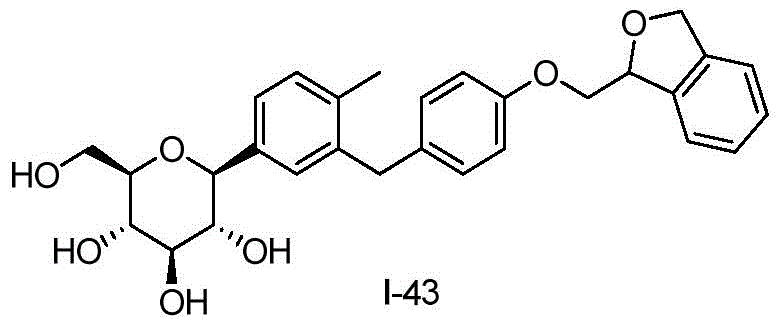
Compound I-43 was synthesized according to the synthesis method for the compound of example 37, and compound I-43(30mg) was resolved into compound I-76(10mg) (RT 3.32min, e.e. value: 100%, according to chiral analysis condition C) and compound I-75(6mg) (RT 5.92min, e.e. value: 100%, according to chiral analysis condition C) using chiral resolution method C.
Compound I-43
m/z:[M+NH4]+510.3
1H NMR(400MHz,CD3OD):7.29-7.39(m,4H),7.12-7.22(m,3H),7.04(d,J=8.4Hz,2H),6.84(m,J=8.4Hz,2H),5.53(s,1H),5.10-5.21(m,2H),4.08-4.24(m,3H),3.88-3.94(m,3H),3.68-3.72(m,1H),3.37-3.50(m,4H),2.20(s,3H)。
Method 2
Example 56: synthesis of 4-bromo-1-chloro-2- (4-ethoxybenzyl) benzene

Step 1: (5-bromo-2-chlorophenyl) (4-ethoxyphenyl) methanone
Oxalyl chloride (8.1mL, 95.6mmol) and N, N-dimethylformamide (0.5mL) were added to a mixture of 5-bromo-2-chlorobenzoic acid (15g, 63.7mmol) in dichloromethane (50mL) and stirred at room temperature overnight. The solvent was distilled off under reduced pressure, the residue was dissolved in dichloromethane (30mL), and aluminum trichloride solid (10.2g, 95.6mmol) was added in portions under ice-bath cooling. The reaction was stirred for 1 hour under ice-bath conditions and quenched directly into a mixture of ice and water (100 g). The mixture was extracted with ethyl acetate (100X 2), and the organic phase was washed with a 1M aqueous sodium hydroxide solution (100X 2), water and saturated brine and dried over anhydrous sodium sulfate. The solvent was removed by distillation under the reduced pressure, and the crude product was recrystallized from anhydrous ethanol to give (5-bromo-2-chlorophenyl) (4-ethoxyphenyl) methanone (20g, yield: 92%) as a white solid.
Step 2: 4-bromo-1-chloro-2- (4-ethoxybenzyl) benzene
To a mixed solution of (5-bromo-2-chlorophenyl) (4-ethoxyphenyl) methanone (20g, 58.9mmol) prepared in step 1 in dichloromethane (40mL) and acetonitrile (20mL) under ice-bath conditions were added triethylsilane (21g, 177mmol) and boron trifluoride diethyl etherate (15g, 106 mmol). The reaction was gradually warmed to room temperature and stirred overnight, the reaction was quenched by the addition of 7M aqueous potassium hydroxide (50mL), the reaction was extracted with dichloromethane (200X 2), and the organic phases were combined, washed with saturated aqueous sodium bicarbonate (100X 2), water and saturated brine, respectively, and dried over anhydrous sodium sulfate. The solvent was removed by rotary evaporation under reduced pressure, and the crude product was recrystallized from anhydrous ethanol to give 4-bromo-1-chloro-2- (4-ethoxybenzyl) benzene (12g, yield: 60%) as a white solid.
1H NMR(400MHz,CDCl3):7.24-7.31(m,3H),7.11(d,J=8.8Hz,2H),6.86(d,J=8.8Hz,2H),4.04(q,J=6.8Hz,2H),4.01(s,2H),1.43(t,J=6.8Hz,3H)。
Synthesis of Compounds of examples 57 to 61 by the Synthesis of Compounds of example 56
Example 57: 4-bromo-2- (4-ethoxybenzyl) -1-methylbenzene
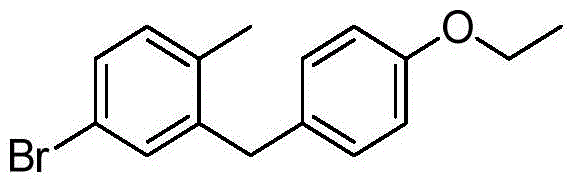
Example 58: 4-bromo-2- (4-ethoxybenzyl) -1-fluorobenzene

1H NMR(400MHz,CDCl3):7.24-7.32(m,2H),7.12(d,J=8.2Hz,2H),6.84-6.96(m,3H),4.03(q,J=6.8Hz,2H),3.91(s,2H),1.42(t,J=6.8Hz,3H)。
Example 59: 4-bromo-1-chloro-2- (3-fluoro-4-methoxybenzyl) benzene
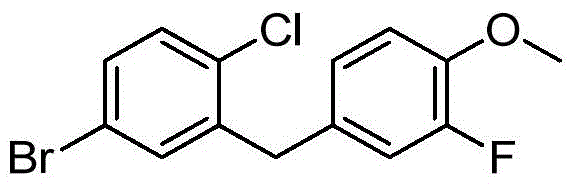
m/z:[M+H]+331.1
Example 60: 1-bromo-3- (4-ethoxybenzyl) benzene

1H NMR(400MHz,CDCl3):7.08-7.35(m,6H),6.84-6.88(m,2H),4.04(q,J=6.8Hz,2H),3.90(s,2H),1.43(t,J=6.8Hz,3H)。
Example 61: 4-bromo-2- (4-ethoxybenzyl) benzonitrile

m/z:[M+NH4]+332.8
Example 62: synthesis of (2R, 3R, 4R, 5S, 6S) -2- (acetoxymethyl) -6- (4-chloro-3- (4-hydroxybenzyl) phenyl) tetrahydro-2H-pyran-3, 4, 5-triyltriacetyl ester
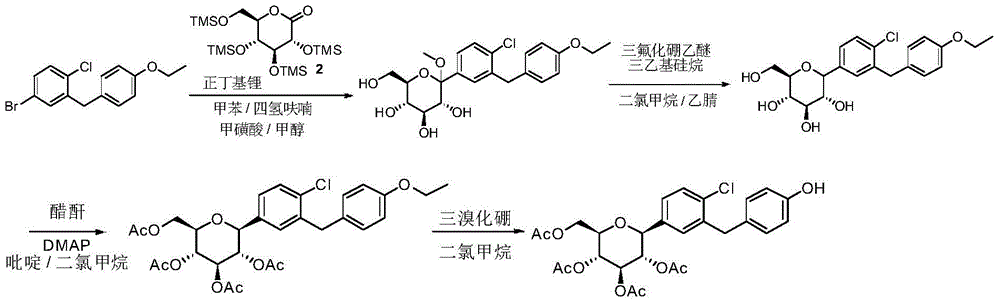
Step 1: (2R, 3R, 4R, 5S, 6S) -2- (acetoxymethyl) -6- (4-chloro-3- (4-ethoxybenzyl) phenyl) tetrahydro-2H-pyran-3, 4, 5-triyltriacetylester
Reference is made to example 37 or J.Med.chem.2008,51, 1145-acetyl ester synthesis of (2R, 3R, 4R, 5S, 6S) -2- (acetoxymethyl) -6- (4-chloro-3- (4-ethoxybenzyl) phenyl) tetrahydro-2H-pyran-3, 4, 5-triyltriacetyl ester.
Step 2: (2R, 3R, 4R, 5S, 6S) -2- (acetoxymethyl) -6- (4-chloro-3- (4-hydroxybenzyl) phenyl) tetrahydro-2H-pyran-3, 4, 5-triyltriacetylester
To a solution of (2R, 3R, 4R, 5S, 6S) -2- (acetoxymethyl) -6- (4-chloro-3- (4-ethoxybenzyl) phenyl) tetrahydro-2H-pyran-3, 4, 5-triyltriacetyl ester (700mg, 1.21mmol) prepared in step 1 in anhydrous dichloromethane (15mL) was added dropwise boron tribromide (0.94mL, 9.71mmol), the reaction was heated to-15 ℃ and stirred for 1 hour, the reaction mixture was diluted with diethyl ether (10mL), stirred for 30 minutes, diluted with water (50mL), extracted with dichloromethane (100X 2), the combined organic phases were dried over anhydrous sodium sulfate, and the solvent was removed by rotary evaporation under reduced pressure to give (2R, 3R, 4R, 5S, 6S) -2- (acetoxymethyl) -6- (4-chloro-3- (4-hydroxybenzyl) -6- (4-acetoxymethyl) -2- (acetoxymethyl) -6- (4-chloro-3- (4-hydroxybenzyl) triacetyl ester ) Phenyl) tetrahydro-2H-pyran-3, 4, 5-triyltriacetyl ester (650mg, yield: 98%) as a white foamy solid.
m/z:[M+NH4]+565.9
Synthesis of Compounds of examples 63 to 67 Using the Synthesis of Compounds of example 62
Example 63: (2R, 3R, 4R, 5S, 6S) -2- (acetoxymethyl) -6- (3- (4-hydroxybenzyl) -4-methylphenyl) tetrahydro-2H-pyran-3, 4, 5-triyltriacetylester
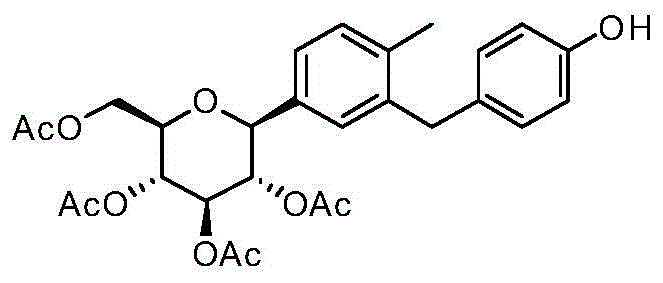
m/z:[M+NH4]+545.9
Example 64: (2R, 3R, 4R, 5S, 6S) -2- (acetoxymethyl) -6- (-4-fluoro-3- (4-hydroxybenzyl) phenyl) tetrahydro-2H-pyran-3, 4, 5-triyltriacetylester
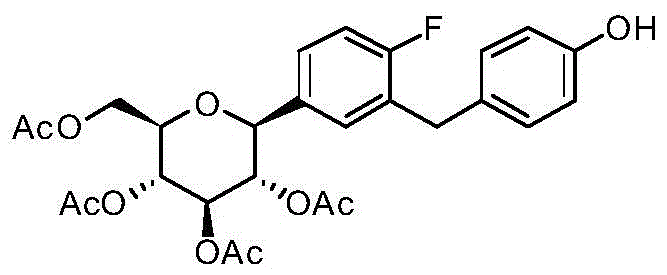
m/z:[M+Na]+555.2
Example 65: (2R, 3R, 4R, 5S, 6S) -2- (acetoxymethyl) -6- (4-chloro-3- (3-fluoro-4-hydroxybenzyl) phenyl) tetrahydro-2H-pyran-3, 4, 5-triyltriacetylester

m/z:[M+Na]+589.2
Example 66: (2R, 3R, 4R, 5S, 6S) -2- (acetoxymethyl) -6- (3- (4-hydroxybenzyl) phenyl) tetrahydro-2H-pyran-3, 4, 5-triyltriacetylester
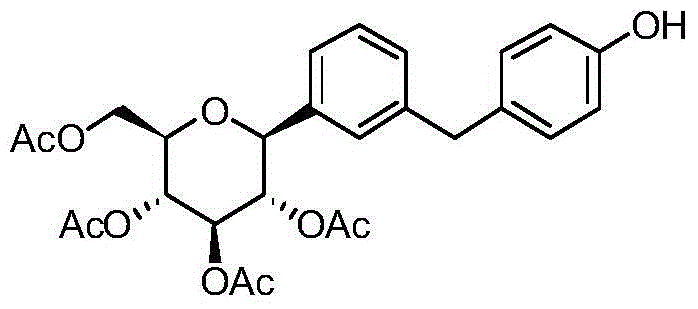
m/z:[M+NH4]+531.9
Example 67: (2R, 3R, 4R, 5S, 6S) -2- (acetoxymethyl) -6- (4-cyano-3- (4-hydroxybenzyl) phenyl) tetrahydro-2H-pyran-3, 4, 5-triyltriacetylester
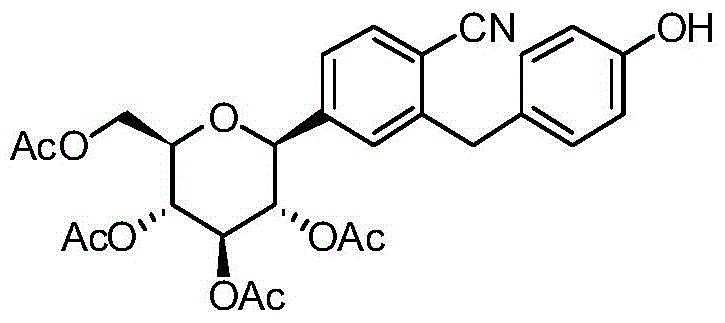
m/z:[M+NH4]+556.9
Example 68: synthesis of (2S, 3R, 4R, 5S, 6R) -2- (3- (4- ((2, 3-dihydrobenzofuran-2-yl) methoxy) benzyl) -4-methylphenyl) -6- (hydroxymethyl) tetrahydro-2H-pyran-3, 4, 5-triol

Step 1: (2R, 3R, 4R, 5S, 6S) -2- (acetoxymethyl) 6- (3- (4- ((2, 3-dihydrobenzofuran-2-yl) methoxy) benzyl) -4-methylphenyl) tetrahydro-2H-pyran-3, 4, 5-triyltriacetylester
To a solution of (2R, 3R, 4R, 5S, 6S) -2- (acetoxymethyl) -6- (4-methyl-3- (4-hydroxybenzyl) phenyl) tetrahydro-2H-pyran-3, 4, 5-triyltriacetyl ester (350mg, 0.66mmol), (2, 3-dihydrobenzofuran-2-yl) methanol (298mg, 1.99mmol) and triphenylphosphine (521mg, 1.99mmol) in tetrahydrofuran (10mL) prepared in example 63 was added dropwise DIAD (0.39mL, 1.99mmol) under ice-bath conditions. The reaction was gradually warmed to room temperature and stirred overnight, diluted with ethyl acetate (50mL), and the organic phase was washed with water and saturated brine and dried over anhydrous sodium sulfate. The solvent was removed by distillation under the reduced pressure, and the crude product was purified with a thin layer preparation plate (developing solvent: petroleum ether/ethyl acetate ═ 2/1) to give (2R, 3R, 4R, 5S, 6S) -2- (acetoxymethyl) 6- (3- (4- ((2, 3-dihydrobenzofuran-2-yl) methoxy) benzyl) -4-methylphenyl) tetrahydro-2H-pyran-3, 4, 5-triyltriacetyl ester (60mg, yield: 14%) as a white solid.
Step 2: (2S, 3R, 4R, 5S, 6R) -2- (3- (4- ((2, 3-dihydrobenzofuran-2-yl) methoxy) benzyl) -4-methylphenyl) -6- (hydroxymethyl) tetrahydro-2H-pyran-3, 4, 5-triol
To a methanol (2mL) solution of ((2R, 3R, 4R, 5S, 6S) -2- (acetoxymethyl) 6- (3- (4- ((2, 3-dihydrobenzofuran-2-yl) methoxy) benzyl) -4-methylphenyl) tetrahydro-2H-pyran-3, 4, 5-triyltriacetyl ester (60mg, 0.09mmol) prepared in step 1 was added sodium methoxide (6mg, 0.10mmol), the reaction solution was stirred at room temperature for 2 hours, neutralized with acetic acid, the solvent was removed by distillation under reduced pressure, and the crude product was directly purified with a thin-layer preparative plate (dichloromethane: methanol ═ 10:1) to give (2S, 3R, 4R, 5S, 6R) -2- (3- (4- ((2, 3-dihydrobenzofuran-2-yl) methoxy) benzyl) -4-methylphenyl) -6- (hydroxymethyl) tetrahydro-2H-pyran-3, 4, 5-triol (34mg, yield: 76%) was a white solid.
m/z:[M+Na]+515.2
Synthesis of Compounds of examples 69 to 70 Using the Synthesis method of the Compound of example 68 and the corresponding alcohol
Example 69: (2S, 3R, 4R, 5S, 6R) -2- (3- (4- ((2, 3-dihydrobenzofuran-2-yl) methoxy) benzyl) -4-fluorophenyl) -6- (hydroxymethyl) tetrahydro-2H-pyran-3, 4, 5-triol (Compound I-21)
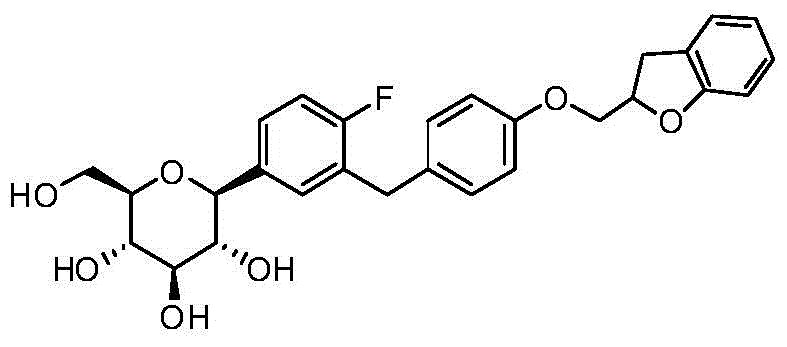
m/z:[M+Na]+519.2
1HNMR(400 MHz,CD3OD):7.29-7.31(m,2H),7.21(d,J=7.2Hz,1H),7.14(d,J=8.8Hz,2H),7.01-7.11(m,2H),6.82-6.87(m,3H),6.73(d,J=8.8Hz,1H),5.06-5.14(m,1H),4.08-4.13(m,3H),3.8-3.94(m,3H),3.67-3.72(m,1H),3.29-3.48(m,5H),3.11-3.16(m,1H)。
Example 70: (2S, 3R, 4R, 5S, 6R) -2- (4-chloro-3- (4- ((2, 3-dihydrobenzofuran-2-yl) methoxy) -3-fluorobenzyl) phenyl) -6- (hydroxymethyl) tetrahydro-2H-pyran-3, 4, 5-triol (Compound I-12)
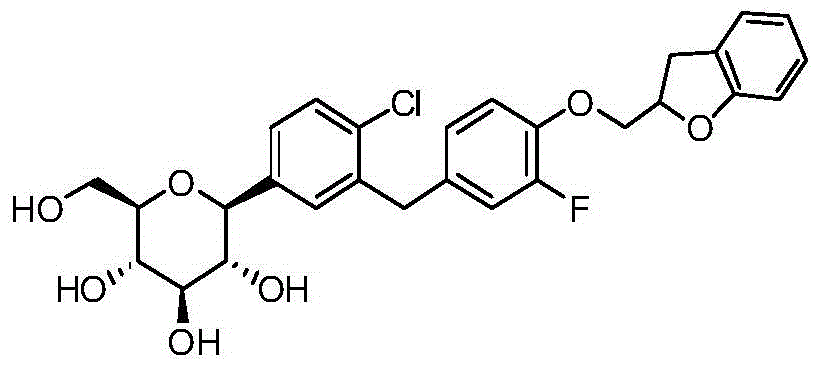
m/z:[M+Na]+553.0
Method 3
Example 71: synthesis of 5-fluoro-2-hydroxybenzaldehyde

To a solution of p-fluorophenol (25g, 223mmol) in ethanol (100mL) and water (75mL) was added a solution of sodium hydroxide (39g, 970mmol) in water (200mL), and the mixture was heated to 70 ℃ to which chloroform (55mL, 691mmol) was added dropwise over about 2 hours. After the addition was completed, the reaction system was stirred at 70 ℃ overnight, the reaction system was cooled to room temperature, and 6N hydrochloric acid solution (100mL) was added to quench the reaction, which was extracted with dichloromethane (250 mL. times.2), and the combined organic phases were washed with water and saturated brine and dried over anhydrous sodium sulfate. The solvent was removed by rotary evaporation under reduced pressure, and the crude product was purified by silica gel column chromatography (petroleum ether: ethyl acetate 25: 1) to give 5-fluoro-2-hydroxybenzaldehyde (6.5g, yield: 21%) as a pale yellow solid.
1HNMR:(400MHz,CDCl3)10.01(s,1H),9.88(s,1H),7.26-7.32(m,2H),7.00(dd,J=4.0,8.8Hz,1H)。
Example 72: synthesis of 4-fluoro-2-hydroxybenzaldehyde

To a mixture of m-fluorophenol (5mL, 55.3mmol), anhydrous magnesium chloride (14.2g, 149mmol) in anhydrous acetonitrile (250mL) was added dry triethylamine (27mL) and paraformaldehyde (11 g). The reaction was refluxed for 5 hours, cooled to room temperature, quenched by the addition of 5% hydrochloric acid solution (250mL), the mixture was extracted with ethyl acetate (100x3), and the combined organic phases were washed with 5% hydrochloric acid solution, water and saturated brine, and dried over anhydrous sodium sulfate. The solvent was removed by distillation under the reduced pressure, and the crude product was purified by silica gel column chromatography (petroleum ether: ethyl acetate: 50: 1 to 20: 1) to give 4-fluoro-2-hydroxybenzaldehyde (5g, yield: 65%) as a pale yellow solid.
1H NMR(CDCl3,400MHz)11.37(d,J=1.6,1H),9.83(s,1H),7.55-7.59(m,1H),6.65-6.75(m,2H)。
Example 73: synthesis of 2-fluoro-6-hydroxybenzaldehyde

Step 1: 2- (3-fluorophenyl) tetrahydro-2H-pyran
A mixed solution of m-fluorophenol (5g, 44.6mmol), 3, 4-dihydro-2H-pyran (11.2mL, 134mmol) and trifluoroacetic acid (0.3mL, 4.0mmol) in methylene chloride (60mL) was stirred at room temperature overnight, and the reaction solution was washed with a saturated aqueous sodium bicarbonate solution and a saturated brine and dried over anhydrous sodium sulfate. The solvent was removed by rotary evaporation under reduced pressure, and the crude product was purified by silica gel column chromatography (petroleum ether: ethyl acetate: 100: 1 to 50: 1) to give 2- (3-fluorophenyl) tetrahydro-2H-pyran (7.5g, yield: 86%) as a pale yellow liquid.
1HNMR(400MHz,CD3OD):7.20-7.26(m,1H),6.80-6.86(m,2H),6.68-6.73(m,1H),5.42(t,J=3.2Hz,1H),3.88-3.94(m,1H),3.62-3.66(m,1H),1.99-2.02(m,1H),1.86-1.90(m,2H),1.57-1.74(m,3H)。
Step 2: 2-fluoro-6- ((tetrahydro-2H-pyran-2-yl) oxy) benzaldehyde
To a tetrahydrofuran solution (60mL) of 2- (3-fluorophenyl) tetrahydro-2H-pyran (6g, 30.6mmol) prepared in step 1, an N-hexane solution (2.5M, 14mL, 36.7mmol) of N-butyllithium was added dropwise at-78 ℃, the reaction system was stirred for 1.5 hours, N-dimethylformamide (6.7g, 91.3mmol) was added dropwise, the reaction system was gradually warmed to room temperature, stirred overnight, and a saturated aqueous ammonium chloride solution (50mL) was added to quench the reaction. Extracted with ethyl acetate (100X 2), the combined organic phases were dried over anhydrous sodium sulfate, and the solvent was distilled off under reduced pressure to give 2-fluoro-6- ((tetrahydro-2H-pyran-2-yl) oxy) benzaldehyde (6.5g, yield: 95%) as a pale yellow oil.
And step 3: 2-fluoro-6-hydroxybenzaldehydes
A solution of 2-fluoro-6- ((tetrahydro-2H-pyran-2-yl) oxy) benzaldehyde (6.5g, 29.0mmol) prepared in step 2 and p-toluenesulfonic acid (2g, 11.6mmol) in dichloromethane (30mL) was stirred at room temperature for 5 hours, and the reaction solution was diluted with dichloromethane (100mL), washed with a saturated aqueous sodium bicarbonate solution and a saturated common salt solution, and dried over anhydrous sodium sulfate. The solvent was removed by rotary evaporation under reduced pressure, and the crude product was purified by silica gel column chromatography (petroleum ether: ethyl acetate: 100: 1 to 20: 1) to give 2-fluoro-6-hydroxybenzaldehyde (3.0g, yield: 74%) as a pale yellow solid.
1HNMR:(CDCl3,400MHz)11.49(s,1H),10.29(s,1H),7.46-7.52(m,1H),6.79(d,J=8.8,1H)6.63-6.68(m,1H)。
Example 74: synthesis of 2- (chloromethyl) -5-fluorobenzofuran

Step 1: 5-Fluorobenzofuran-2-carboxylic acid ethyl ester
A mixture of 5-fluoro-2-hydroxybenzaldehyde (0.85g, 6.07mmol) prepared in example 69 and potassium carbonate (1.68g, 12.1mmol) was heated to 60 deg.C, ethyl bromoacetate (1.27g, 7.58mmol) was added to the mixture, and the mixture was stirred at 60 deg.C for 1 hour, warmed to 60 deg.C, and stirred for 10 hours. The mixture was diluted with ethyl acetate (50mL), washed with a saturated aqueous ammonium chloride solution and water, and dried over anhydrous sodium sulfate. The solvent was removed by rotary evaporation under reduced pressure, and the crude product was purified using a thin layer preparative plate (petroleum ether: ethyl acetate ═ 10:1) to give ethyl 5-fluorobenzofuran-2-carboxylate (450mg, yield: 36%) as a pale yellow solid.
1H NMR(400MHz,CDCl3):7.56(dd,J=4.0,8.8Hz,1H),7.51(s,1H),7.34-7.36(m,1H),7.17-7.23(m,1H),4.47(q,J=7.2Hz,2H),1.45(t,J=7.2Hz,3H)。
Step 2: (5-fluorobenzofuran-2-yl) methanol
Lithium aluminum hydride (82mg, 2.16mmol) was added in portions to a tetrahydrofuran (10mL) solution of ethyl 5-fluorobenzofuran-2-carboxylate (450mg, 2.16mmol) prepared in step 1 under ice bath conditions, the reaction system was reacted at 0 ℃ for half an hour, sodium sulfate decahydrate was added to quench the reaction, the reaction was filtered, the filter cake was washed with ethyl acetate, the solvent was distilled off under reduced pressure from the filtrate, and the crude product was purified with a thin-layer preparation plate (petroleum ether: ethyl acetate ═ 5:1) to give (5-fluorobenzofuran-2-yl) methanol (300mg, yield: 84%) as a colorless oily liquid.
1H NMR(400MHz,CDCl3):7.39(dd,J=4.0,8.8Hz,1H),7.20-7.23(m,1H),6.99-7.04(m,1H),6.64(s,1H),4.78(s,1H),2.24(s,1H)。
And step 3: 2- (chloromethyl) -5-fluorobenzofuran
To a solution of (5-fluorobenzofuran-2-yl) methanol (150mg, 0.90mmol) prepared in step 2 in dichloromethane (5mL) under ice-bath conditions was added dropwise thionyl chloride (0.13mL, 1.81mmol), the reaction was warmed to room temperature and stirred for 1 hour, and the solvent was removed by rotary evaporation under reduced pressure to give 2- (chloromethyl) -5-fluorobenzofuran (165mg, yield: 100%) as a yellow oil which was used in the next reaction without purification.
Synthesis of Compounds of examples 75 to 78 Using the Synthesis of Compounds of example 74
Example 75: 2- (chloromethyl) -7-fluorobenzofuran
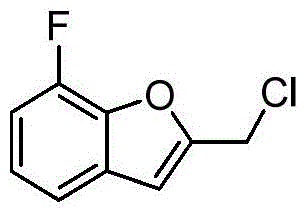
Example 76: 2- (chloromethyl) -6-fluorobenzofuran
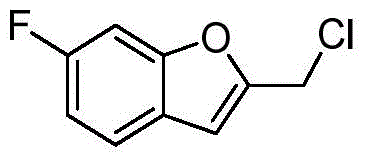
Example 77: 2- (chloromethyl) -4-fluorobenzofuran

Example 78: 2- (chloromethyl) benzofuran
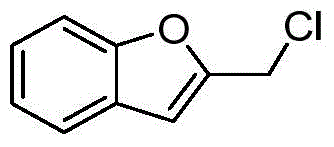
Example 79: synthesis of 2- (2-bromoethyl) -2, 3-dihydrobenzofuran
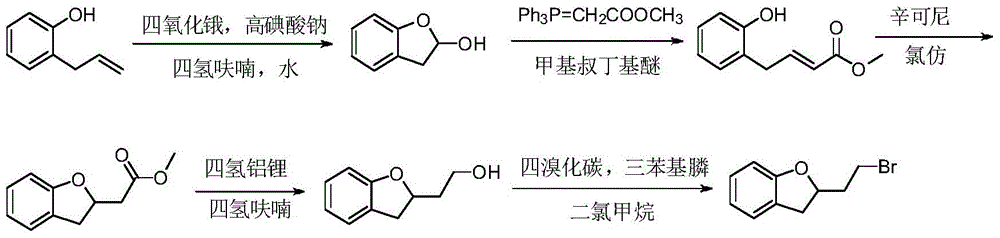
Step 1:2, 3-dihydrobenzofuran-2-ol
2-allylphenol (5g, 37.3mmol) was dissolved in a mixed solvent of tetrahydrofuran (25mL) and water (25mL), sodium periodate (23.9g, 112mmol) and osmium tetroxide (95mg, 0.37mmol) were added under ice bath, and the reaction system was stirred at room temperature overnight. The reaction was quenched by addition of water (100mL), the reaction solution was extracted with ethyl acetate (100 × 2), the combined organic phases were dried over anhydrous sodium sulfate, the solvent was removed by distillation under reduced pressure, and the crude product was purified by silica gel column chromatography (petroleum ether: ethyl acetate: 20:1 to 5:1) to give 2, 3-dihydrobenzofuran-2-ol (3g, yield: 60%) as a pale yellow oil.
1H NMR(400MHz,CDCl3):7.16-7.28(m,2H),6.86-6.95(m,2H),6.07(d,J=5.6,1H),3.85(s,1H),3.36-3.42(m,1H),3.03-3.07(m,1H)。
Step 2: 4- (2-hydroxyphenyl) crotonic acid methyl ester
A mixture of 2, 3-dihydrobenzofuran-2-ol (1.4g, 10.3mmol) prepared in step 1 and methylbut-butylether (30mL) of methoxycarbonylmethylenetriphenylphosphine (3.4g, 10.3mmol) was reacted at 35 ℃ overnight, most of the triphenylphosphine oxide formed was filtered, the filtrate was evaporated under reduced pressure to remove the solvent, and the residue was purified by silica gel column chromatography (petroleum ether: ethyl acetate ═ 10:1) to give methyl 4- (2-hydroxyphenyl) crotonate (1.8g, yield: 91%) as a pale yellow liquid.
m/z:[M+H]+193.1
And step 3: 2- (2, 3-Dihydrobenzofuran-2-yl) acetic acid methyl ester
A mixed solution of methyl 4- (2-hydroxyphenyl) crotonate (1.8g, 9.36mmol) prepared in step 2 and cinchonil (0.83g, 2.81mmol) in chloroform (60mL) was reacted at 35 ℃ for four days, the solvent was removed by rotary evaporation under reduced pressure, and the residue was purified by silica gel column chromatography (petroleum ether: ethyl acetate ═ 20:1 to 10:1) to give methyl 2- (2, 3-dihydrobenzofuran-2-yl) acetate (1.5g, yield 83%) as a colorless liquid.
1HNMR(400MHz,CDCl3):7.12-7.20(m,2H),6.80-6.89(m,2H),5.16-5.24(m,1H)3.76(s,3H),3.44(dd,J=9.2,15.6Hz,1H),2.88-2.99(m,2H),2.71(dd,J=6.4,16.0Hz,1H)。
Step 4: 2- (2, 3-dihydrobenzofuran-2-yl) ethanol
Under ice bath conditions, lithium aluminum hydride (0.37g, 9.75mmol) was added in portions to a tetrahydrofuran (15mL) solution of methyl 2- (2, 3-dihydrobenzofuran-2-yl) acetate (1.5g, 7.80mmol) prepared in step 3, the reaction system was stirred in ice bath for 30 minutes, sodium sulfate decahydrate was added to quench the reaction, the reaction system was filtered with celite, and the solvent was removed by rotary evaporation of the filtrate under reduced pressure to give 2- (2, 3-dihydrobenzofuran-2-yl) ethanol (1.15g, yield: 90%) as a colorless liquid.
m/z:[M+H]+165.1
And 5: 2- (2-bromoethyl) -2, 3-dihydrobenzofuran
2- (2, 3-dihydrobenzofuran-2-yl) ethanol (0.35g, 2.13mmol) prepared in step 4 and triphenylphosphine oxide (0.84g, 3.2mmol) were dissolved in dichloromethane (10mL), carbon tetrabromide (1.1g, 3.2mmol) was added to the reaction solution in portions under ice-bath conditions, the reaction system was stirred at room temperature for 1 hour, a saturated aqueous solution of sodium bicarbonate (10mL) was added to quench the reaction, extraction was performed with dichloromethane (30X 2), the organic phases were combined, dried over anhydrous sodium sulfate and the solvent was removed by rotary evaporation under reduced pressure to obtain a residue, which was purified with a thin-layer preparation plate (petroleum ether: ethyl acetate ═ 10:1) to obtain 2- (2-bromoethyl) -2, 3-dihydrobenzofuran (450mg, yield 93%) as a light yellow oil.
Example 80: synthesis of (S) -2 (bromomethyl) -2, 3-dihydro-benzofuran and (S) - (2, 3-dihydrobenzofuran-2-yl) methanol

The method comprises the following steps: (R) -1- (benzyloxy) -3- (2-methoxyphenyl) propan-2-ol
To a solution of 2-bromoanisole (12g, 64.2mmol) in anhydrous tetrahydrofuran at-78 ℃ was added dropwise n-butyllithium (25.7mL, 64.2mmol, 2.5M n-hexane solution), and after the addition, the reaction mixture was stirred at-78 ℃ for 1 hour. Cuprous bromide dimethylsulfide (6.6g, 32.1mmol) was added to the above solution all at once, the reaction temperature was slowly raised from-78 ℃ to-40 ℃, then cooled again to-60 ℃, and (R) -2-benzyloxymethyloxirane (2.63g, 16.1mmol) was added dropwise, followed by boron trifluoride etherate (109mg, 0.77 mmol). The mixture was warmed to room temperature and stirred overnight. Petroleum ether was added, insoluble matter was removed by filtration, the filter cake was washed with ethyl acetate, the filtrate was concentrated and purified by silica gel chromatography (petroleum ether: ethyl acetate 10:1 to 5:1) to give (R) -1- (benzyloxy) -3- (2-methoxyphenyl) propan-2-ol (2.9g, yield 66.5%) as a colorless oil.
1HNMR(CDCl3,400Hz):7.30-7.40(m,5H),7.17-7.27(m,2H),6.88-6.94(m,2H),4.58(s,2H),4.11-4.16(m,1H),3.84(s,3H),3.54(dd,J=4Hz,9.6Hz,1H),3.44(dd,J=6.8Hz,10Hz,1H),2.83-2.92(m,2H),2.58(br,1H)。
Step two: (R) -1-bromo-3- (2-hydroxyphenyl) propan-2-yl ethyl ester
(R) -1- (benzyloxy) -3- (2-methoxyphenyl) propan-2-ol (2.9g, 10.7mmol) was dissolved in 33% hydrogen bromide in acetic acid (25mL), heated at 70 ℃ with stirring overnight, the solvent was removed in vacuo, and the residue was purified by silica gel chromatography (petroleum ether: ethyl acetate ═ 5:1) to give (R) -1-bromo-3- (2-hydroxyphenyl) propan-2-ylethyl ester (2.2g, 75.6% yield) as a light yellow oil.
1HNMR(CDCl3,400Hz):7.12-7.20(m,2H),6.86-6.89(m,2H),5.09-5.12(m,1H),3.59(dd,J=3.6Hz,7.2Hz,1H),3.48(dd,J=5.6Hz,10.8Hz,1H),3.08(dd,J=5.2Hz,14.0Hz,1H),2.98(dd,J=6.0Hz,14.4Hz,1H),2.15(s,3H)。
Step three: (R) -2- (3-bromo-hydroxypropyl) phenol
To a solution of (R) -1-bromo-3- (2-hydroxyphenyl) propan-2-ylethyl ester (2.2g, 8.05mmol) in methanol (20mL) at room temperature was added a solution of hydrogen chloride in diethyl ether (10mL, 20mmol, 2.0M), and the mixture was stirred at room temperature overnight. The solvent was removed in vacuo and the residue was purified by silica gel chromatography (petroleum ether: ethyl acetate ═ 5:1) to give (R) -2- (3-bromo-hydroxypropyl) phenol (1.7g, 91.3% yield) as a light red oil.
1HNMR(CDCl3,400Hz):7.56(s,1H),7.18-7.22(m,1H),7.07-7.09(m,1H),6.93-6.95(m,1H),6.86-6.90(m,1H),4.22(br,1H),3.54(dd,J=3.6Hz,10.4Hz,1H),3.38(dd,J=8.4Hz,10.4Hz,1H),3.23(brs,1H),3.05(dd,J=3.2Hz,14.4Hz,1H),2.94(dd,J=7.2Hz,14.4Hz,1H)。
Step four: (S) -2- (bromomethyl) -2, 3-dihydrobenzofuran
To a solution of (R) -2- (3-bromo-hydroxypropyl) phenol (1.7g, 7.36mmol) in tetrahydrofuran (20mL) at room temperature was added triphenylphosphine (4.82g, 18.4mmol), followed by dropwise addition of DEAD (3.2g, 18.4mmol), the mixture was stirred at room temperature overnight, and purified directly by silica gel chromatography (petroleum ether) to give (S) -2- (bromomethyl) -2, 3-dihydrobenzofuran (1.1g, yield 70.1%) as a yellow oil.
1HNMR(CDCl3,400Hz):7.13-7.21(m,2H),6.83-6.90(m,1H),6.82(d,J=8.0Hz,1H),4.99-5.06(m,1H),3.63(dd,J=5.2Hz,10.4Hz,1H),3.53(dd,J=6.8Hz,10.4Hz,1H),3.42(dd,J=9.2Hz,16.0Hz,1H),3.15(dd,J=6.4Hz,15.6Hz,1H)。
[α]D 25=+19.3°(C=0.558%,MeOH)
Step five: (S) - (2, 3-dihydrobenzofuran-2-yl) acetic acid methyl ester
(S) -2- (bromomethyl) -2, 3-dihydrobenzofuran (200mg, 0.94mmol) was placed in a round-bottom flask, DMF (2mL) was added, potassium acetate (921mg, 9.39mmol) was added, stirring was carried out at 75 ℃ overnight, ethyl acetate was added for dilution, washing with water (x3) and saturated brine, drying was carried out over anhydrous sodium sulfate, and concentration was purified using silica gel preparation (petroleum ether: ethyl acetate ═ 5:1) to give methyl (S) - (2, 3-dihydrobenzofuran-2-yl) acetate (108mg, yield 54.2%) as a pale yellow oil.
1HNMR(CDCl3,400Hz):7.13-7.20(m,2H),6.83-6.90(m,2H),4.99-5.06(m,1H),4.36(dd,J=3.6Hz,12Hz,1H),4.23(dd,J=7.2Hz,12Hz,1H),3.34(dd,J=10Hz,16Hz,1H),3.00(dd,J=7.6Hz,16Hz,1H),2.12(s,3H)。
Step six: (S) - (2, 3-dihydrobenzofuran-2-yl) methanol
Methyl (S) - (2, 3-dihydrobenzofuran-2-yl) acetate (100mg, 0.52mmol) was placed in a round-bottom flask, methanol (2mL) and 2 drops of water were added, potassium carbonate (54mg, 0.39mmol) was added, stirring was performed at room temperature for 30 minutes, ethyl acetate (10mL) was added, washing was performed with water and saturated brine, dried over anhydrous sodium sulfate, filtered, concentrated, and purified with silica gel prep (petroleum ether: ethyl acetate ═ 3:1) to give (S) - (2, 3-dihydrobenzofuran-2-yl) methanol (60mg, yield 60%, e.e. value: 97.3%) as a light yellow oil.
1HNMR(CDCl3,400Hz):7.12-7.20(m,2H),6.80-6.89(m,2H),4.90-4.97(m,1H),3.86-3.89(m,1H),3.75-3.78(m,1H),3.27(dd,J=9.6Hz,15.6Hz,1H),3.04(dd,J=7.2Hz,15.6Hz,1H),1.99(br,1H)。
Example 81: synthesis of (R) -2 (bromomethyl) -2, 3-dihydro-benzofuran
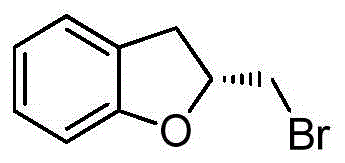
(R) -2 (bromomethyl) -2, 3-dihydro-benzofuran was prepared using (S) -2-benzyloxymethyloxirane as the chiral starting material by the method of synthesis of the compound of example 80.
1HNMR(CDCl3,400Hz):7.13-7.21(m,2H),6.90(m,1H),6.82(d,J=8.0Hz,1H),4.99-5.06(m,1H),3.63(dd,J=5.2Hz,10.4Hz,1H),3.53(dd,J=6.8Hz,10.4Hz,1H),3.42(dd,J=9.2Hz,16.0Hz,1H),3.15(dd,J=6.4Hz,15.6Hz,1H)。
[α]D 25=-33.4°(C=0.515%,MeOH)
Example 82: synthesis of (2S, 3R, 4R, 5S, 6R) -2- (3- (4- (benzofuran-2-ylmethoxy) benzyl) -4-chlorophenyl) -6- (hydroxymethyl) tetrahydro-2H-pyran-3, 4, 5-triol (Compound I-1)

Step 1: (2R, 3R, 4R, 5S, 6S) -2- (acetoxymethyl) 6- (3- (4- (benzofuran-2 ylmethoxy) benzyl) -4-chlorophenyl) tetrahydro-2H-pyran-3, 4, 5-triyltriacetylester
A mixture of (2R, 3R, 4R, 5S, 6S) -2- (acetoxymethyl) -6- (4-chloro-3- (4-hydroxybenzyl) phenyl) tetrahydro-2H-pyran-3, 4, 5-triyltriacetyl ester (150mg, 0.27mmol) prepared in example 62, 2- (chloromethyl) benzofuran (91mg, 0.55mmol) prepared in example 78 and cesium carbonate (107mg, 0.33mmol) in N, N-dimethylformamide (2mL) was heated to 50 ℃ and stirred for 2 hours, diluted with ethyl acetate (50mL), the organic phase was washed with water and saturated brine and dried over anhydrous sodium sulfate. The solvent was removed by rotary evaporation under reduced pressure and the crude product was purified using a thin layer prep. plate (petroleum ether/ethyl acetate ═ 2: 1) to give (2R, 3R, 4R, 5S, 6S) -2- (acetoxymethyl) 6- (3- (4- (benzofuran-2 ylmethoxy) benzyl) -4-chlorophenyl) tetrahydro-2H-pyran-3, 4, 5-triyltriacetyl ester (75mg, yield: 40%) as a white solid.
Step 2: (2S, 3R, 4R, 5S, 6R) -2- (3- (4- (benzofuran-2-ylmethoxy) benzyl) -4-chlorophenyl) -6- (hydroxymethyl) tetrahydro-2H-pyran-3, 4, 5-triol
To a mixed solution of (2R, 3R, 4R, 5S, 6S) -2- (acetoxymethyl) 6- (3- (4- (benzofuran-2 ylmethoxy) benzyl) -4-chlorophenyl) tetrahydro-2H-pyran-3, 4, 5-triyltriacetyl ester (75mg, 0.11mmol) prepared in step 1 in methanol (3mL) and tetrahydrofuran (1mL) was added sodium methoxide (9mg, 0.17mmol), the reaction solution was stirred at room temperature for 2 hours and then neutralized with acetic acid, the solvent was distilled off under reduced pressure, and the crude product was directly purified with a thin-layer preparation plate (developing solvent: dichloromethane/methanol ═ 10:1) to obtain (2S, 3R, 4R, 5S, 6R) -2- (3- (4- (benzofuran-2 ylmethoxy) benzyl) -4-chlorophenyl) -6- (hydroxymethyl) tetrahydro-2 H-pyran-3, 4, 5-triol (48mg, yield: 85%) was a white solid.
m/z:[M+Na]+533.0
Synthesis of Compounds of examples 83 to 94 Using the Synthesis of the Compound of example 82 and the corresponding bromide or chloride
Example 83: (2S, 3R, 4R, 5S, 6R) -2- (3- (4- (benzofuran-2-ylmethoxy) benzyl) -4-methylphenyl) -6- (hydroxymethyl) tetrahydro-2H-pyran-3, 4, 5-triol (Compound I-3)
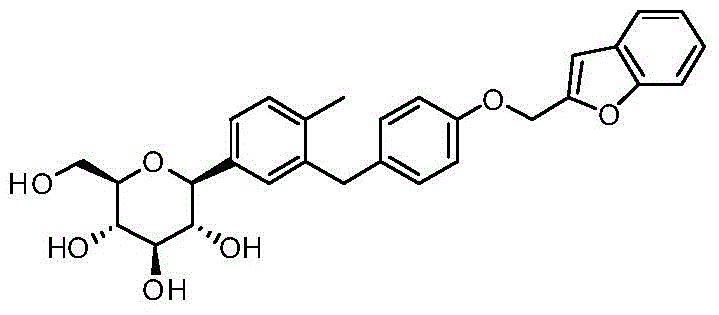
m/z:[M+NH4]+507.9
Example 84: (2S, 3R, 4R, 5S, 6R) -2- (3- (4- (benzofuran-2-ylmethoxy) benzyl) -4-fluorophenyl) -6- (hydroxymethyl) tetrahydro-2H-pyran-3, 4, 5-triol (Compound I-2)
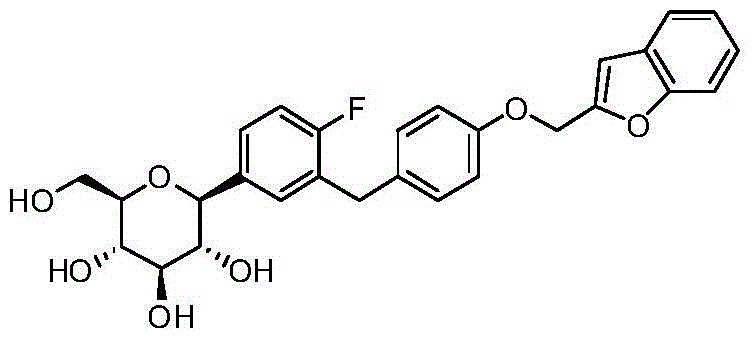
m/z:[M+NH4]+511.9
Example 85: (2S, 3R, 4R, 5S, 6R) -2- (3- (4- (benzofuran-2-ylmethoxy) -3-fluorobenzyl) -4-chlorophenyl) -6- (hydroxymethyl) tetrahydro-2H-pyran-3, 4, 5-triol (Compound I-11)
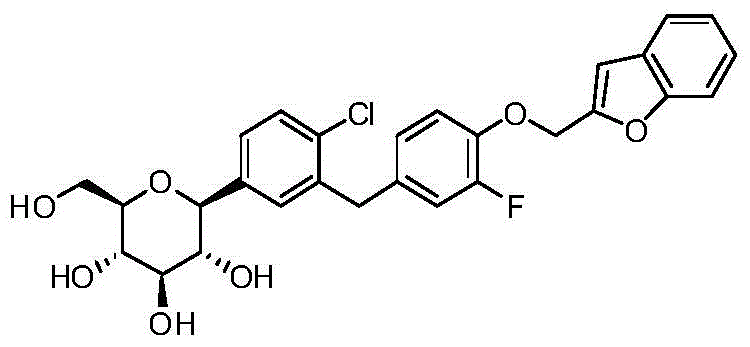
m/z:[M+H2O]+546.2
Example 86: (2S, 3R, 4R, 5S, 6R) -2- (3- (4- (benzofuran-2-ylmethoxy) benzyl) -phenyl) -6- (hydroxymethyl) tetrahydro-2H-pyran-3, 4, 5-triol (Compound I-6)
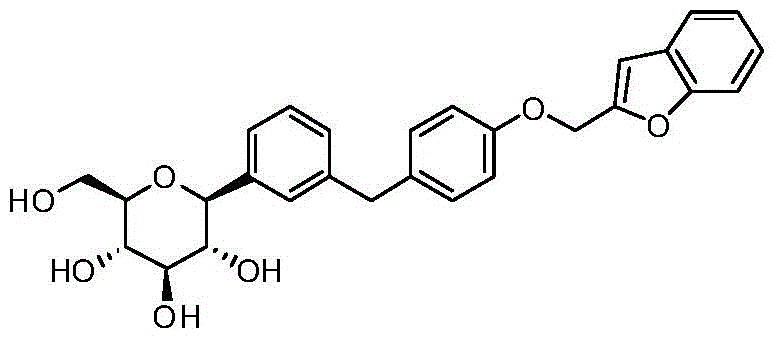
m/z:[M+NH4]+494.0
Example 87: (2S, 3R, 4R, 5S, 6R) -2- (4-chloro-3- (4- ((7-fluorophenylfuran-2-yl) methoxy) benzyl) -phenyl) -6- (hydroxymethyl) tetrahydro-2H-pyran-3, 4, 5-triol (Compound I-10)
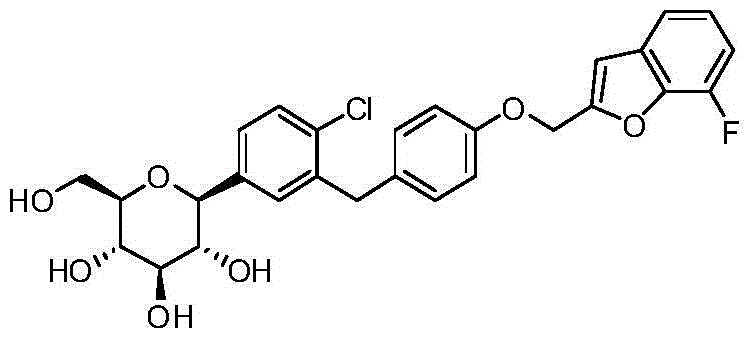
m/z:[M+NH4]+545.8
1HNMR(400MHz,CDCl3):7.35-7.41(m,3H),7.29-7.31(m,1H),7.16-7.23(m,3H),7.07-7.10(m,1H),6.95-6.99(m,3H),5.20(s,2H),4.02-4.12(m,3H),3.88-3.91(m,1H),3.68-3.73(m,1H),3.28-3.49(m,4H)。
Example 88: 2- (4- (benzofuran-2-ylmethoxy) benzyl) -4- ((2S, 3R, 4R, 5S, 6R) -3, 4, 5-trihydroxy-6- (hydroxymethyl) tetrahydro-2H-pyran-2-yl) benzonitrile (Compound I-4)

m/z:[M+NH4]+518.9
Example 89: (2S, 3R, 4R, 5S, 6R) -2- (4-chloro-3- (4- ((6-fluorophenylfuran-2-yl) methoxy) benzyl) phenyl) -6- (hydroxymethyl) tetrahydro-2H-pyran-3, 4, 5-triol (Compound I-9)
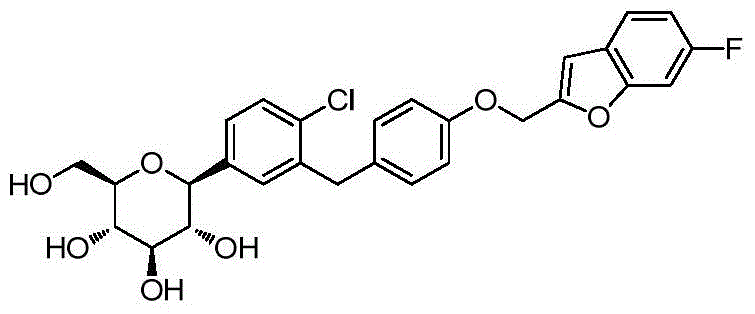
m/z:[M+NH4]+545.9
1HNMR(400MHz,CDCl3):7.57(dd,J=5.6,8.4Hz,1H),7.35-7.38(m,2H),7.28-7.31(m,2H),7.14-7.17(m,2H),7.02-7.07(m,1H),6.94-6.97(m,2H),6.87(s,1H),5.15(s,2H),4.01-4.12(m,3H),3.88-3.91(m,1H),3.69-3.73(m,1H),3.28-3.49(m,4H)。
Example 90: (2S, 3R, 4R, 5S, 6R) -2- (4-chloro-3- (4- ((5-fluorophenylfuran-2-yl) methoxy) benzyl) phenyl) -6- (hydroxymethyl) tetrahydro-2H-pyran-3, 4, 5-triol (Compound I-8)

m/z:[M+NH4]+545.9
1HNMR(400MHz,CDCl3):7.47(dd,J=4.0,8.8Hz,1H),7.35-7.37(m,2H),7.27-7.31(m,2H),7.14-7.16(m,2H),7.03-7.08(m,1H),6.93-6.97(m,2H),6.86(s,1H),5.15(s,2H),4.01-4.12(m,3H),3.88-3.91(m,1H),3.69-3.73(m,1H),3.29-3.50(m,4H)。
Example 91: (2S, 3R, 4R, 5S, 6R) -2- (4-chloro-3- (4- ((4-fluorophenylfuran-2-yl) methoxy) benzyl) phenyl) -6- (hydroxymethyl) tetrahydro-2H-pyran-3, 4, 5-triol (Compound I-7)

m/z:[M+NH4]+545.9
1HNMR(400MHz,CDCl3):7.27-7.38(m,5H),7.15-7.17(m,2H),6.95-6.99(m,4H),5.17(s,2H),4.01-4.12(m,3H),3.87-3.91(m,1H),3.69-3.73(m,1H),3.29-3.50(m,4H)。
Example 92: (2S, 3R, 4R, 5S, 6R) -2- (4-chloro-3- (4- (2- (2, 3-dihydrobenzofuran-2-yl) ethoxy) benzyl) phenyl) -6- (hydroxymethyl) tetrahydro-2H-pyran-3, 4, 5-triol (Compound I-60)
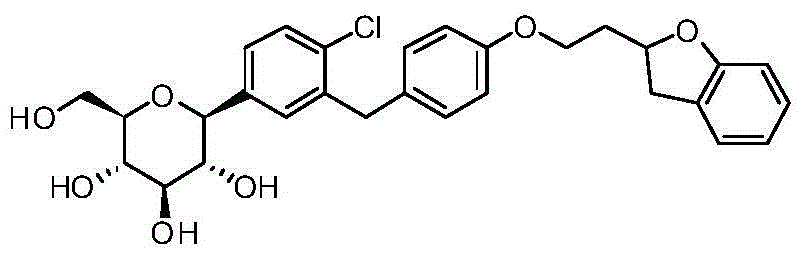
m/z:[M+NH4]+543.9
Example 93: (2S, 3R, 4R, 5S, 6R) -2- (4-chloro-3- (4- (((S) -2, 3-dihydrobenzofuran-2-yl) methoxy) benzyl) phenyl) -6- (hydroxymethyl) tetrahydro-2H-pyran-3, 4, 5-triol (Compound I-23)
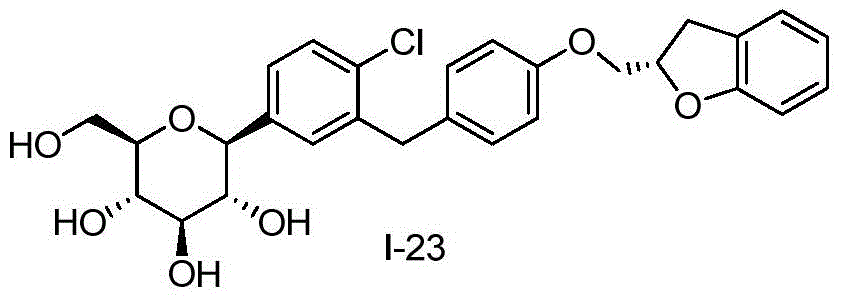
I-23 retention time RT 4.09min (e.e. value: 100%) was determined according to manual analysis method a.
m/z:[M+Na]+535.2
1H NMR(400MHz,CD3OD):7.28-7.37(m,3H),7.20(dd,J=0.4Hz,7.6Hz,1H),7.07-7.14(m,3H),6.82-6.88(m,3H),6.74(d,J=8.0Hz,1H),5.06-5.13(m,1H),4.00-4.14(m,5H),3.87-3.90(m,1H),3.68-3.73(m,1H),3.28-3.49(m,5H),3.14(dd,J=7.2Hz,16Hz,1H)。
[α]D 25=+50.0°(C=0.054%,MeOH)
Compound I-23 was synthesized according to the method of the second method, example 68.
Example 94: (2S, 3R, 4R, 5S, 6R) -2- (4-chloro-3- (4- (((R) -2, 3-dihydrobenzofuran-2-yl) methoxy) benzyl) phenyl) -6- (hydroxymethyl) tetrahydro-2H-pyran-3, 4, 5-triol (Compound I-24)
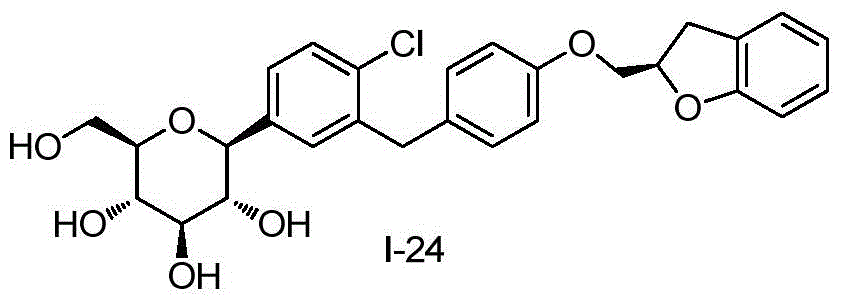
I-24 retention time RT was 4.92min as determined by manual analysis method a (e.e. value: 98.1%).
m/z:[M+Na]+535.2
1H NMR(400MHz,CD3OD):7.28-7.37(m,3H),7.20(dd,J=0.4Hz,7.6Hz,1H),7.07-7.13(m,3H),6.82-6.87(m,3H),6.74(d,J=8.0Hz,1H),5.07-5.11(m,1H),4.00-4.13(m,5H),3.87-3.90(m,1H),3.68-3.73(m,1H),3.28-3.49(m,5H),3.14(dd,J=7.2Hz,16Hz,1H)。
[α]D 25=-21.8°(C=0.055%,MeOH)
Compound I-24 was synthesized according to the method of the second method, example 68.
Biological test example:
effect example 1: [14C]-absorption assay of AMG in Flp-in CHO cells stably expressing human sodium ion-dependent glucose uptake ion channels I and II (SGLT-1 and SGLT-2 Activity screening assay)
cDNA clones of human SGLT-1 and SGLT-2 were purchased from OriGene. After obtaining sequence information, the sequence information is constructed on pcDNA5/FRT vector by using the traditional molecular biology method, and then the expression plasmid is introduced into Flp-in CHO cells by using the Lipofetamin2000 liposome transfection method. The transfected cells were screened for hygromycin resistance and after 4-5 weeks single cell clones were selected by gradient dilution. Then, the expression of SGLT-1 and SGLT-2 is detected by using a method of RT-PCR and a functional test, and a high-absorption signal cell line is selected for a subsequent test.
Culturing Flp-in CHO cell strain stably expressing SGLT-1 and SGLT-2, wherein the culture medium comprises the following components: f12 medium (purchased from Invitrogen), 500. mu.g/ml hygromycin (purchased from Calbiochem) and 10% fetal bovine serum (purchased from Invitrogen). When the cells grew to 80% confluence, the cells in the T75 flask were washed three times with phosphate buffer (purchased from Invitrogen), after which 5mL of pancreatin-EDTA solution (purchased from Invitrogen) was added, the flask was gently shaken to bring all the cells into contact with the digest, after the cells were detached, medium was added and the cells were blown into a single cell suspension with a 10mL pipette. The cell density was adjusted to 3X 10⁵/mL, and the cells were seeded into 96-well WABAI cell culture plates (purchased from Corning Corp.) in an amount of 100. mu.L/well.
The uptake assay was performed after overnight culture of the cells in the well plates to adherence. After at least 12 hours of cell inoculation, the cells were washed once with 150. mu.L/well of an uptake solution KRH-NMG (120mM N-methyl-D-glucosamine (NMG), 4.7mM potassium chloride, 1.2mM magnesium chloride, 2.2mM calcium chloride, 10mM hydroxyethylpiperazine ethanethiosulfonic acid (HEPES), pH7.4 containing 1mM Tris (hydroxymethyl) aminomethane (Tris)). The wells were blotted dry and contained 2.5. mu. Ci/mL14Buffer KRH-Na + (120mM sodium chloride, 4.7mM potassium chloride, 1.2mM magnesium chloride, 2.2mM calcium chloride, 10mM hydroxyethylpiperazine ethiosulfonic acid (HEPES), pH7.4 containing 1mM Tris) was added to Buffer KRH-Na + and KRH-NMG-washed wells at 45. mu.L/well in C-labeled methyl- α -D-glucopyranoside solution (AMG) (purchased by PerkinElmer Co., Ltd.) after that, the corresponding compound I, 5. mu.L/well were immediately added to ensure that the concentration of dimethyl sulfoxide was 1% (volume concentration), the plates to which the compound had been added were incubated in an incubator at 37 ℃ for one hour after that 150. mu.L of ice-cold wash solution (120mM sodium chloride, 4.7mM potassium chloride, 1.2mM magnesium chloride, 2.2mM calcium chloride, 10mM hydroxyethylpiperazine ethiosulfonic acid (ES), 0.5mM magnesium chloride, 0.5mM potassium chloride, 1. mu.5. mu.L of ice-wash solution (120mM sodium chloride, 4.7mM potassium chloride, 1.2mM magnesium chloride, 2mM chloride, 2. mu.5 mM magnesium chloride, 2mM, sodium chloride, sodiumIC 50. The results are shown in Table 1, Table 1 showing the IC50 values for selected compounds for SGLT-1 and SGLT-2.
Table 1:
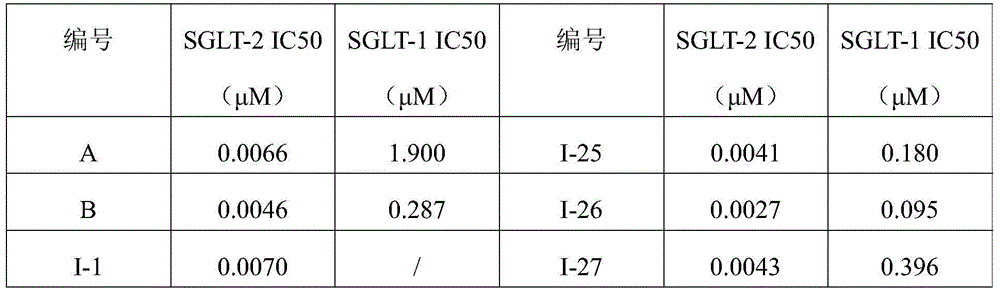
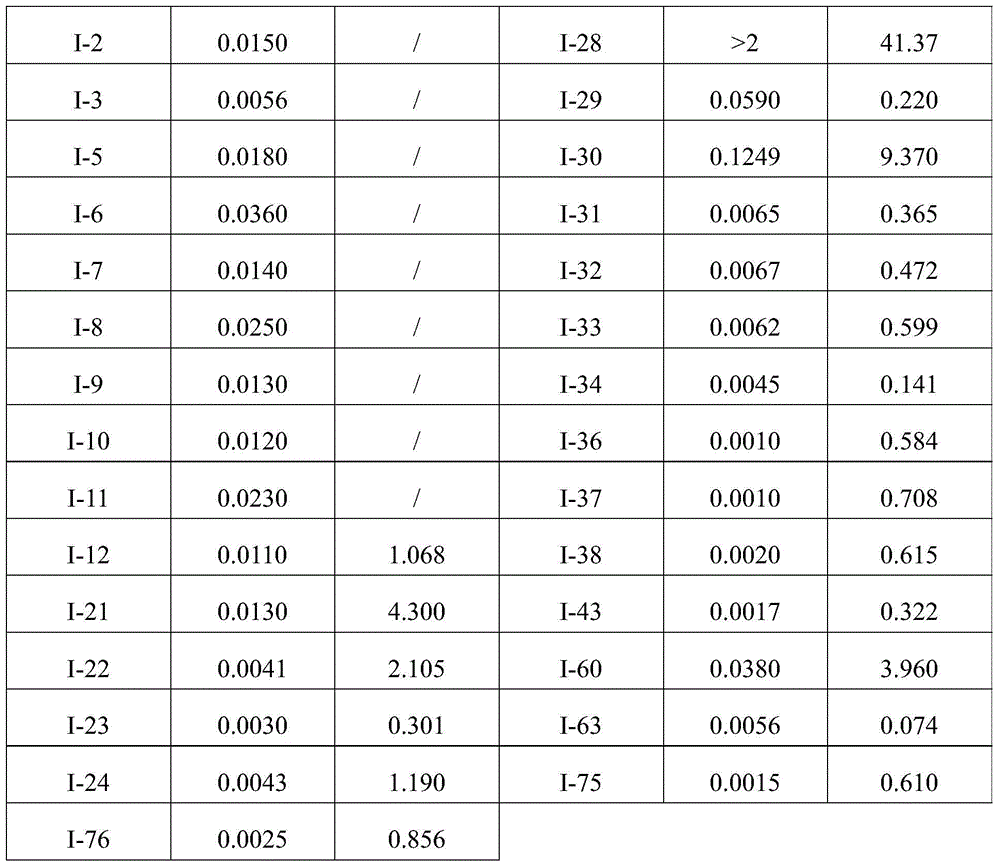
note: table 1 shows that the compounds have not been tested for inhibiting SGLT-1 activity.
Wherein, A: empagliflozin (Chinese name: Rieggliflozin, CAS number: 864070-44-0); b: canagliflozin (Chinese name: Canagliflozin, CAS number: 842133-18-0) is two known aryl glycoside SGLT-2 inhibitors. The structure is as follows:

as can be seen from Table 1, the compounds I-22, I-23, I-24, I-25, I-26, I-27, I-34, I-36, I-37, I-38, I-43, I-75 or I-76 of the present invention have superior effects on the SGLT-2 inhibition over the prior art compounds A (ligrostin) and B (canagliflozin). Among them, the inhibitory effect of the compounds I-36, I-37, I-43 or I-75 was particularly remarkable, and the IC50 values were all less than 0.002. mu.M.
As can be seen from Table 1, the effect of the compounds I-25, I-26, I-29, I-34 or I-63 of the present invention on the inhibition of SGLT-1 is superior to that of the prior art, compound A (Rieggliflozin) and compound B (Canagliflozin). Among them, the inhibitory effect of the compound I-26 or I-63 was particularly prominent, and both had IC50 values of less than 0.1. mu.M.
Among them, the inhibitory effects of the compounds I-25, I-26 or I-34 of the present invention on SGLT-1 and SGLT-2 are superior to those of the prior art, compound A (linagliflozin) and compound B (canagliflozin).
Effect example 2: urine Glucose Excretion Test (Urinary Glucose Excretion in C57 Mice Test)
Adult C57 mice (C57 mice male in sex; supplier: Shanghai Si Laike laboratory animals, Ltd.) (body weight greater than 20g) were given test compound I (10mg/Kg) via the gastrointestinal tract and glucose (5g/Kg) via the gastrointestinal tract, the test C57 mice were placed in a metabolism cage, the total urine output over 24 hours was collected, the metabolism cage was rinsed with 5mL of physiological saline, and the mice had free access to water and food during the collection of urine (24 hours). Immediately after collection of the urine sample, the urine sample is frozen and then the glucose content in the urine sample is measured, and finally the total urine glucose output of the animal is calculated according to the total urine volume and then is changed into the urine glucose output (mg) within 24 hours of 200mg body weight according to the weight of the mouse. The results (average of 6 mice) are shown in Table 2.
Table 2:
| compound numbering | Output of urine glucose (mg/200mg body weight/24 h) |
| A | 1536.5 |
| I-1 | 1646.9 |
| I-22 | 3106.6 |
Wherein, A: empagliflozin (Chinese name: Rieglin, CAS number: 864070-44-0) is a known aryl glycoside SGLT-2 inhibitor, and the specific structure is listed in Effect example 1.
As can be seen from Table 2, the in vivo effect of the compound I-1 and the compound I-22 of the present invention is significantly superior to that of the compound A (Rieglin) of the prior art.
In conclusion, the effect of the compound of the invention on in vivo experiments is remarkably improved compared with the prior art.
Claims (13)
1. A C-aryl glycoside derivative shown as a formula I, a stereoisomer or a pharmaceutically acceptable salt thereof;
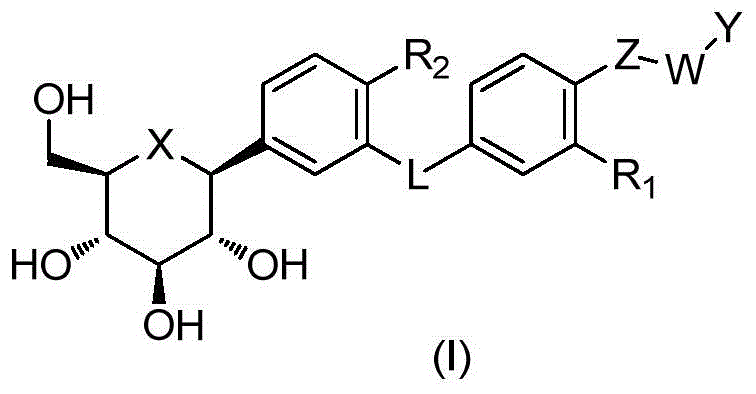
wherein the C-aryl glucoside derivative shown in the formula I is a formula IB or IC,
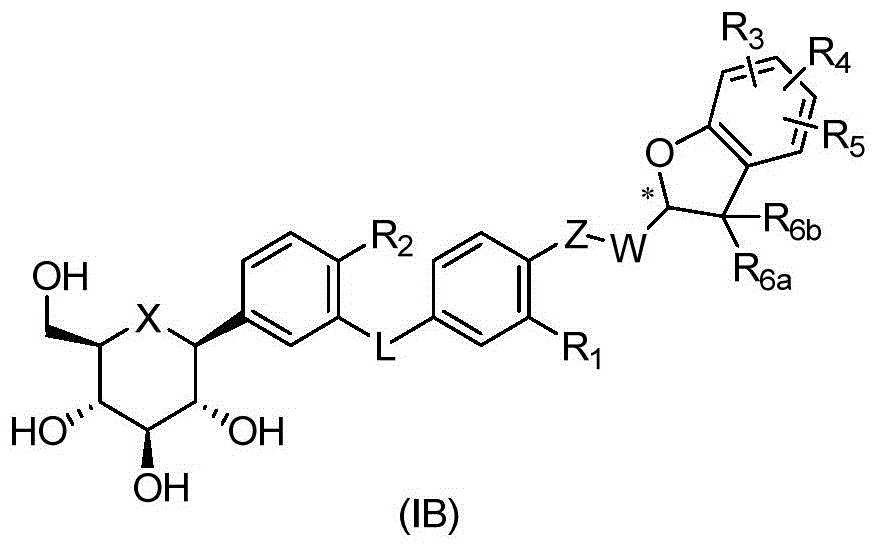
in IB, X is O; l is CH2(ii) a Z is O; w is (CH)2)nN is 1 or 2; the carbon marked is chiral carbon, which includes racemate, S or R;
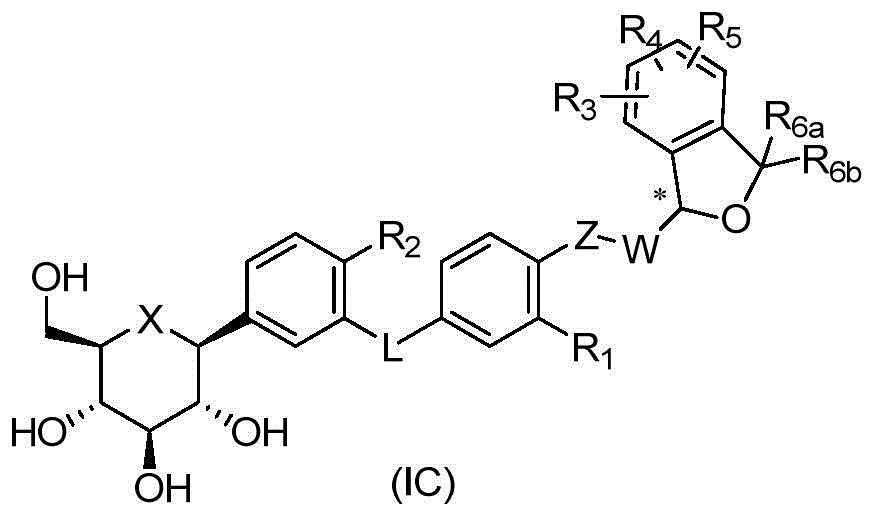
in IC, X is O; l is CH2(ii) a Z is O; w is (CH)2)nN is 1 or 2; the carbon marked is chiral carbon, which includes racemate, S or R;
R3、R4、R5、R6、R6aand R6bEach independently selected from H, alkyl or halogen;
R1is H;
R2is alkyl or halogen;
the alkyl group is a methyl group.
2. The C-aryl glycoside derivative of formula I, a stereoisomer, or a pharmaceutically acceptable salt thereof, as claimed in claim 1, wherein: y is


The carbon labeled is a chiral carbon, which includes racemic, S, or R forms.
3. The C-aryl glycoside derivative of formula I, a stereoisomer, or a pharmaceutically acceptable salt thereof, as claimed in claim 1, wherein:
the C-aryl glycoside derivatives represented by formula IB are:

wherein X is O; l is CH2(ii) a Z is O; w is (CH)2)nN is 1 or 2; r1Is H; r2Is F, Cl or CH3;R3、R4、R5Each independently is H, methyl or F; r6aAnd R6bIs H; the carbon marked is chiral carbon, which includes racemate, S or R;
the C-aryl glycoside derivative represented by formula IC is:

in IC, X is O; l is CH2(ii) a Z is O; w is (CH)2)nN is 1 or 2; r1Is H; r2Is F, Cl or CH3;R3、R4、R5Each independently is H, methyl or F; r6aAnd R6bAre each independently H or CH3(ii) a The carbon labeled is a chiral carbon, which includes racemic, S, or R forms.
4. A compound of any one of the following structures:


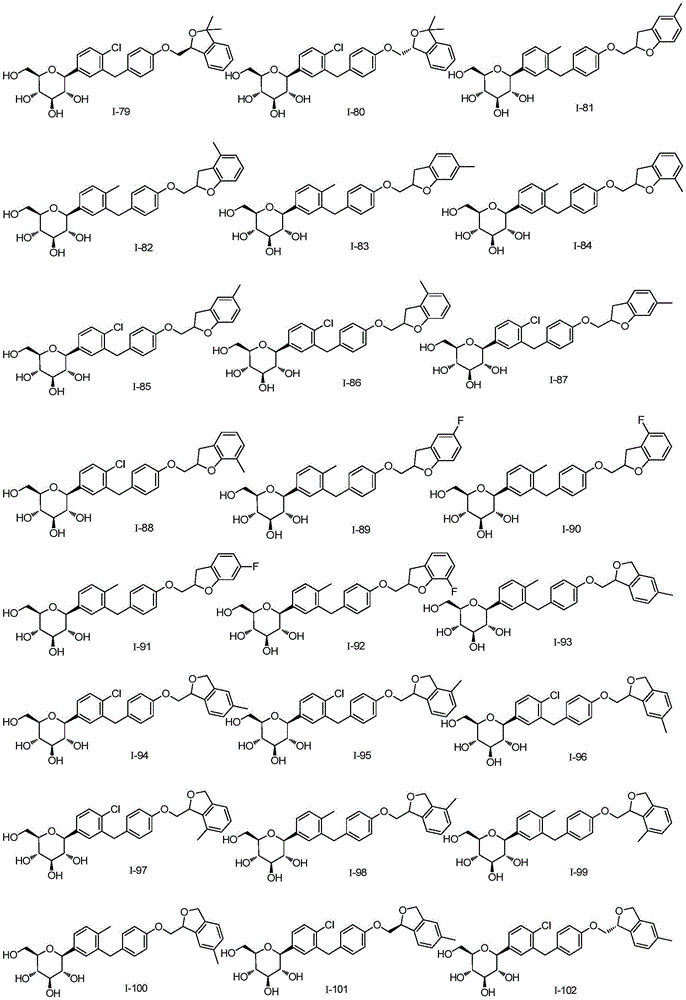
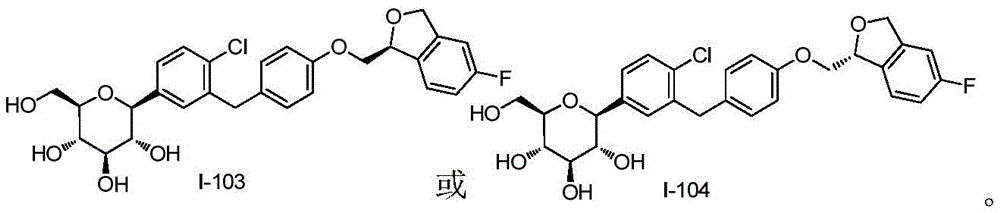
5. a method for producing a C-aryl glycoside derivative, a stereoisomer or pharmaceutically acceptable salt thereof according to any one of claims 1 to 3, which is any one of the following methods:
the method comprises the following steps: the preparation method comprises the following steps: in a solvent, under the action of alkali, performing deacetylation protecting group reaction on the compound 1-f;

the second method comprises the following steps: the preparation method comprises the following steps: 1) in a solvent, under the action of a condensing agent, reacting 2-g of a compound with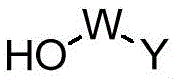 Carrying out mitsunobu reaction; 2) in a solvent, under the action of alkali, performing deacetylation protecting group reaction on the compound 2-f obtained in the step 1);

the third method comprises the following steps: the preparation method comprises the following steps: 1. in a solvent, under the action of alkali, 3-g of a compound is mixed with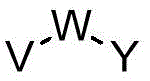 Mixing, and carrying out nucleophilic substitution reaction; 2. in a solvent, under the action of alkali, performing deacetylation protecting group reaction on the compound 3-f obtained in the step 1;

wherein V is chlorine, bromine or iodine.
6. The method of claim 5, wherein: in the first method, the solvent is methanol; the alkali is sodium methoxide.
7. The method of claim 5, wherein: in the first method, the deacetylation protecting group reaction further comprises the following steps: in a solvent, carrying out acetyl protection reaction on the compound 1-e, and then recrystallizing to obtain the compound 1-f;
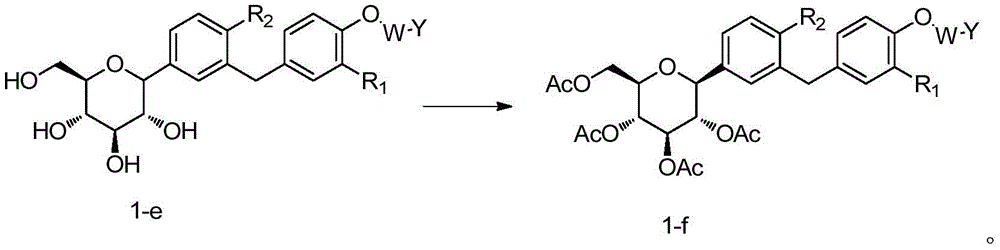
8. the method of claim 7, wherein: in the first method, the deacetylation protecting group reaction further comprises the following steps: in a solvent, mixing a compound 1-d with a triethylsilane and boron trifluoride diethyl etherate system, and carrying out reduction reaction to obtain a compound 1-e;
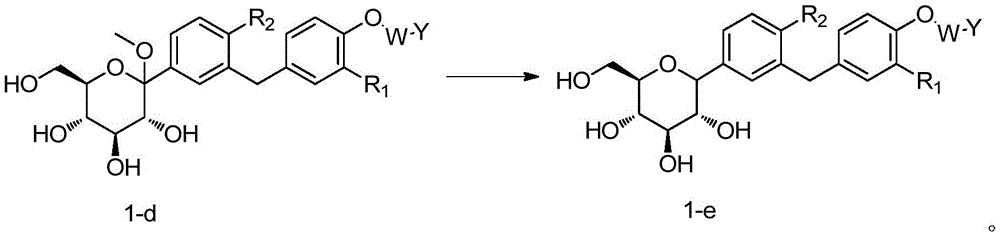
9. the method of claim 8, wherein: in the first method, the deacetylation protecting group reaction further comprises the following steps: in a solvent, mixing and reacting a compound 1-c with an organic lithium reagent for 0.5-1 hour at-78 to-60 ℃, mixing with 2,3,4, 6-tetra-O- (trimethylsilyl) -D-glucopyranosone, mixing with a methanol solution of methanesulfonic acid at 10-30 ℃, and reacting to obtain a compound 1-D;

wherein Q is bromine or iodine.
10. A pharmaceutical composition, which comprises the C-aryl glycoside derivative shown in the formula I or pharmaceutically acceptable salt thereof according to any one of claims 1 to 3, and pharmaceutically acceptable auxiliary materials.
11. The pharmaceutical composition of claim 10, wherein: the pharmaceutical composition further comprises other types of therapeutic agents; the pharmaceutically acceptable auxiliary material is a pharmaceutically acceptable carrier; the other therapeutic agent is one or more of a therapeutic agent for diabetes, a therapeutic agent for lipid lowering, a therapeutic agent for obesity, and a therapeutic agent for hypertension.
12. Use of the C-aryl glycoside derivative represented by formula I or a pharmaceutically acceptable salt thereof according to any one of claims 1 to 3 or the pharmaceutical composition according to claim 10 or 11 for preparing an SGLT inhibitor.
13. Use of a C-aryl glycoside derivative represented by formula I or a pharmaceutically acceptable salt thereof according to any one of claims 1 to 3 or a pharmaceutical composition according to claim 10 or 11 for the preparation of a medicament for the treatment of SGLT-mediated associated diseases.
Priority Applications (5)
| Application Number | Priority Date | Filing Date | Title |
|---|---|---|---|
| CN201410392098.XA CN105001213B (en) | 2014-04-14 | 2014-08-11 | C-aryl glycoside derivative, pharmaceutical composition, preparation method and application thereof |
| JP2017505695A JP6577569B2 (en) | 2014-04-14 | 2015-04-01 | C-aryl glycoside derivative, drug composition thereof, and preparation method |
| EP15780125.9A EP3133071B1 (en) | 2014-04-14 | 2015-04-01 | C-aryl indican derivative, and pharmaceutical composition thereof, preparation method therefor and uses thereof |
| PCT/CN2015/075651 WO2015158206A1 (en) | 2014-04-14 | 2015-04-01 | C-aryl indican derivative, and pharmaceutical composition thereof, preparation method therefor and uses thereof |
| US15/304,493 US9914724B2 (en) | 2014-04-14 | 2015-04-01 | C-aryl glycosid derivatives, pharmaceutical composition, preparation process and uses thereof |
Applications Claiming Priority (3)
| Application Number | Priority Date | Filing Date | Title |
|---|---|---|---|
| CN201410148116 | 2014-04-14 | ||
| CN201410148116X | 2014-04-14 | ||
| CN201410392098.XA CN105001213B (en) | 2014-04-14 | 2014-08-11 | C-aryl glycoside derivative, pharmaceutical composition, preparation method and application thereof |
Publications (2)
| Publication Number | Publication Date |
|---|---|
| CN105001213A CN105001213A (en) | 2015-10-28 |
| CN105001213B true CN105001213B (en) | 2020-08-28 |
Family
ID=54323473
Family Applications (1)
| Application Number | Title | Priority Date | Filing Date |
|---|---|---|---|
| CN201410392098.XA Active CN105001213B (en) | 2014-04-14 | 2014-08-11 | C-aryl glycoside derivative, pharmaceutical composition, preparation method and application thereof |
Country Status (5)
| Country | Link |
|---|---|
| US (1) | US9914724B2 (en) |
| EP (1) | EP3133071B1 (en) |
| JP (1) | JP6577569B2 (en) |
| CN (1) | CN105001213B (en) |
| WO (1) | WO2015158206A1 (en) |
Families Citing this family (13)
| Publication number | Priority date | Publication date | Assignee | Title |
|---|---|---|---|---|
| CN105001213B (en) | 2014-04-14 | 2020-08-28 | 上海迪诺医药科技有限公司 | C-aryl glycoside derivative, pharmaceutical composition, preparation method and application thereof |
| CN105017236A (en) * | 2014-04-14 | 2015-11-04 | 上海迪诺医药科技有限公司 | C-aryl glucoside derivative, as well as medical composition, preparation method and application thereof |
| CN107922396B (en) | 2015-07-20 | 2022-08-05 | 建新公司 | Colony stimulating factor-1 receptor (CSF-1R) inhibitors |
| CN106892948B (en) * | 2015-12-17 | 2022-07-26 | 宜昌东阳光长江药业股份有限公司 | Glucopyranosyl derivative and application thereof in medicine |
| CN106928040A (en) * | 2015-12-31 | 2017-07-07 | 上海医药工业研究院 | The preparation method of SGLT2 inhibitor intermediate |
| CN107720781B (en) * | 2017-11-30 | 2018-07-17 | 五莲森之林海藻有限公司 | A kind of salt crystalline substance particle extraction equipment |
| CN111465598B (en) * | 2018-03-30 | 2023-04-21 | 山东丹红制药有限公司 | Glucoside derivatives as SGLTs inhibitors and their applications |
| CN111471031B (en) * | 2019-01-24 | 2023-05-16 | 北京盈科瑞创新药物研究有限公司 | Glycoside derivative and preparation method and application thereof |
| CN111471032B (en) * | 2019-01-24 | 2023-08-01 | 北京盈科瑞创新药物研究有限公司 | A kind of synthetic method of glycoside derivative and its intermediate and application |
| CN114585358B (en) * | 2019-07-26 | 2023-11-10 | 东宝紫星(杭州)生物医药有限公司 | SGLTs/DPP4 inhibitor and application thereof |
| CN111269205B (en) * | 2020-02-19 | 2023-05-26 | 华侨大学 | Preparation method of C-aryl glycoside compound |
| CN112961196B (en) * | 2021-02-07 | 2022-05-31 | 中国人民大学 | Preparation method of 1,2, 3-triazole compound modified by glycosyl and polypeptide |
| CN115991702B (en) * | 2021-12-09 | 2024-02-02 | 珠海市藤栢医药有限公司 | Aryl C-glucoside derivative, preparation method and application thereof |
Citations (5)
| Publication number | Priority date | Publication date | Assignee | Title |
|---|---|---|---|---|
| CN1407990A (en) * | 1999-10-12 | 2003-04-02 | 布里斯托尔-迈尔斯斯奎布公司 | C-Arylglucoside SGLT2 Inhibitors |
| CN1653075A (en) * | 2002-05-20 | 2005-08-10 | 百时美施贵宝公司 | C-arylglucoside SGLT2 inhibitors and methods |
| CN1275977C (en) * | 2000-03-30 | 2006-09-20 | 布里斯托尔-迈尔斯斯奎布公司 | O-aryl glucoside SGL T2 inhibitors and method |
| CN102643256A (en) * | 2011-02-18 | 2012-08-22 | 上海璎黎科技有限公司 | A kind of aryl glycoside compound and its preparation method and application |
| CN102875503A (en) * | 2011-06-25 | 2013-01-16 | 山东轩竹医药科技有限公司 | C-glucoside derivative |
Family Cites Families (13)
| Publication number | Priority date | Publication date | Assignee | Title |
|---|---|---|---|---|
| US6936590B2 (en) | 2001-03-13 | 2005-08-30 | Bristol Myers Squibb Company | C-aryl glucoside SGLT2 inhibitors and method |
| DE60209343T2 (en) | 2001-04-11 | 2006-10-26 | Bristol-Myers Squibb Co. | AMINO ACID COMPLEXES OF C-ARYL GLYCOSIDES FOR THE TREATMENT OF DIABETES AND METHODS |
| BR0317929A (en) | 2003-01-03 | 2006-04-11 | Bristol Myers Squibb Co | methods of producing c-aryl glycoside sglt2 inhibitors |
| WO2004080990A1 (en) * | 2003-03-14 | 2004-09-23 | Astellas Pharma Inc. | C-glycoside derivatives and salts thereof |
| EA015104B1 (en) | 2003-08-01 | 2011-06-30 | Мицубиси Танабе Фарма Корпорейшн | Novel compounds having inhibitory activity against sodium-dependant transporter |
| JP4181605B2 (en) | 2004-03-16 | 2008-11-19 | ベーリンガー インゲルハイム インターナショナル ゲゼルシャフト ミット ベシュレンクテル ハフツング | Glucopyranosyl-substituted phenyl derivatives, pharmaceuticals containing the compounds, and uses and production methods thereof |
| ATE453656T1 (en) * | 2005-04-15 | 2010-01-15 | Boehringer Ingelheim Int | GLUCOPYRANOSYL-SUBSTITUTED (HETEROARYLOXY-BENZYL)-BENZENE DERIVATIVES AS SGLT INHIBITORS |
| WO2011048148A2 (en) | 2009-10-20 | 2011-04-28 | Novartis Ag | Glycoside derivative and uses thereof |
| WO2012025857A1 (en) | 2010-08-23 | 2012-03-01 | Hetero Research Foundation | Cycloalkyl methoxybenzyl phenyl pyran derivatives as sodium dependent glucose co transporter (sglt2) inhibitors |
| CN102453026A (en) * | 2010-10-27 | 2012-05-16 | 上海艾力斯医药科技有限公司 | C-aryl glucoside derivative, preparation method and application thereof |
| CN104059042B (en) * | 2013-03-22 | 2017-02-08 | 正大天晴药业集团股份有限公司 | C-triaryl glucoside SGLT-2 inhibitor |
| CN105001213B (en) | 2014-04-14 | 2020-08-28 | 上海迪诺医药科技有限公司 | C-aryl glycoside derivative, pharmaceutical composition, preparation method and application thereof |
| CN105017236A (en) | 2014-04-14 | 2015-11-04 | 上海迪诺医药科技有限公司 | C-aryl glucoside derivative, as well as medical composition, preparation method and application thereof |
-
2014
- 2014-08-11 CN CN201410392098.XA patent/CN105001213B/en active Active
-
2015
- 2015-04-01 US US15/304,493 patent/US9914724B2/en not_active Expired - Fee Related
- 2015-04-01 JP JP2017505695A patent/JP6577569B2/en not_active Expired - Fee Related
- 2015-04-01 EP EP15780125.9A patent/EP3133071B1/en active Active
- 2015-04-01 WO PCT/CN2015/075651 patent/WO2015158206A1/en not_active Ceased
Patent Citations (5)
| Publication number | Priority date | Publication date | Assignee | Title |
|---|---|---|---|---|
| CN1407990A (en) * | 1999-10-12 | 2003-04-02 | 布里斯托尔-迈尔斯斯奎布公司 | C-Arylglucoside SGLT2 Inhibitors |
| CN1275977C (en) * | 2000-03-30 | 2006-09-20 | 布里斯托尔-迈尔斯斯奎布公司 | O-aryl glucoside SGL T2 inhibitors and method |
| CN1653075A (en) * | 2002-05-20 | 2005-08-10 | 百时美施贵宝公司 | C-arylglucoside SGLT2 inhibitors and methods |
| CN102643256A (en) * | 2011-02-18 | 2012-08-22 | 上海璎黎科技有限公司 | A kind of aryl glycoside compound and its preparation method and application |
| CN102875503A (en) * | 2011-06-25 | 2013-01-16 | 山东轩竹医药科技有限公司 | C-glucoside derivative |
Also Published As
| Publication number | Publication date |
|---|---|
| EP3133071B1 (en) | 2019-12-18 |
| US9914724B2 (en) | 2018-03-13 |
| JP2017511383A (en) | 2017-04-20 |
| US20170037038A1 (en) | 2017-02-09 |
| EP3133071A4 (en) | 2017-02-22 |
| WO2015158206A1 (en) | 2015-10-22 |
| CN105001213A (en) | 2015-10-28 |
| JP6577569B2 (en) | 2019-09-18 |
| EP3133071A1 (en) | 2017-02-22 |
Similar Documents
| Publication | Publication Date | Title |
|---|---|---|
| CN105001213B (en) | C-aryl glycoside derivative, pharmaceutical composition, preparation method and application thereof | |
| JP7773506B2 (en) | Method for producing diphenylmethane derivatives | |
| TWI588136B (en) | Polycyclic derivatives, preparation process and pharmaceutical use thereof | |
| TWI457122B (en) | 2,3-dihydrobenzo[1,4]dioxin-2-ylmethyl derivatives as alpha2c antagonists for use in the treatment of peripheric and central nervous system diseases | |
| CN102421767B (en) | Benzofuran derivatives | |
| CN113474338A (en) | Pyrazine derivative and application thereof in inhibition of SHP2 | |
| CN104507921B (en) | Benzocyclobutene derivative and preparation method and pharmaceutical application thereof | |
| CN105518014B (en) | C-aryl glucoside derivatives, their preparation method and their application in medicine | |
| RS64259B1 (en) | NEW DERIVATIVES OF PHENYL PROPIONIC ACID AND THEIR APPLICATION | |
| JP7732999B2 (en) | Alpha 1-antitrypsin modulators | |
| CN104513283A (en) | Glucopyranosyl derivative and application thereof in medicine | |
| CN107849049A (en) | Urea derivatives or their pharmaceutically acceptable salts | |
| WO1995005374A1 (en) | Fused heteroaromatic cyclopentene derivative having endothelin-antagonist activity | |
| US5420298A (en) | Pyrrolidine derivatives | |
| CN105017236A (en) | C-aryl glucoside derivative, as well as medical composition, preparation method and application thereof | |
| JP2010502648A (en) | 1H-indole-2-carboxylic acid derivatives useful as PPAR modulators | |
| WO2020224396A1 (en) | Compounds inhibiting tdg activity | |
| CN110418790B (en) | Imidazopyrrolone compounds as p53-MDM2 inhibitors | |
| KR20090101275A (en) | Benzoquinazole derivatives | |
| KR20240109240A (en) | Beta-adrenergic agonists and methods of their use | |
| CN108203432B (en) | Glucopyranosyl derivative and application thereof in medicine | |
| EA009464B1 (en) | Hydroxycarbonylphenyl substituted 4-(aminomethyl)-piperidine benzamides as 5htantagonists | |
| TW202504580A (en) | KAT6 inhibitors | |
| KR20020093965A (en) | Pyrimidinyl methyl indole derivatives with antibacterial activity | |
| Yoshizumi et al. | Potent and orally active ETA selective antagonists with 5, 7-diarylcyclopenteno [1, 2-b] pyridine-6-carboxylic acid structures |
Legal Events
| Date | Code | Title | Description |
|---|---|---|---|
| C06 | Publication | ||
| PB01 | Publication | ||
| SE01 | Entry into force of request for substantive examination | ||
| SE01 | Entry into force of request for substantive examination | ||
| GR01 | Patent grant | ||
| GR01 | Patent grant |