CN104450602B - Non-human mammalian neuropsychiatric disease animal model and preparation method and use thereof - Google Patents
Non-human mammalian neuropsychiatric disease animal model and preparation method and use thereof Download PDFInfo
- Publication number
- CN104450602B CN104450602B CN201310425687.9A CN201310425687A CN104450602B CN 104450602 B CN104450602 B CN 104450602B CN 201310425687 A CN201310425687 A CN 201310425687A CN 104450602 B CN104450602 B CN 104450602B
- Authority
- CN
- China
- Prior art keywords
- crmp2
- gene
- mice
- mouse
- human
- Prior art date
- Legal status (The legal status is an assumption and is not a legal conclusion. Google has not performed a legal analysis and makes no representation as to the accuracy of the status listed.)
- Expired - Fee Related
Links
Images


Landscapes
- Investigating Or Analysing Biological Materials (AREA)
- Medicines That Contain Protein Lipid Enzymes And Other Medicines (AREA)
Abstract
Description
技术领域technical field
本发明涉及生物技术领域。更具体地说,本发明涉及一种非人哺乳动物的神经精神疾病动物模型及其制备方法和用途。The present invention relates to the field of biotechnology. More specifically, the present invention relates to a non-human mammalian neuropsychiatric disease animal model and its preparation method and use.
背景技术Background technique
精神分裂症(Schizophrenia)是一类最常见精神疾病,影响全世界人口的0.5%-1%,以基本个性改变,思维、情感和行为的分裂,精神活动与环境不协调为主要特征。该病在男性中多发生于青春期晚期至25岁,在女性中25-35岁是高发期,自然病程多迁延,多数呈复发和加重,慢性化和衰退的过程,且与其他精神疾病遗传关联性强,重叠率高,最终结局约一半左右患者出现精神残疾并伴随高自杀率。Schizophrenia is one of the most common mental disorders, affecting 0.5%-1% of the world's population. The disease mostly occurs in men from late adolescence to the age of 25, and in women, the high incidence period is 25-35 years old. The natural history of the disease is more protracted, and most of them show a process of recurrence and aggravation, chronicity and decline, and are genetically related to other mental diseases. It has strong sexuality and high overlap rate, and about half of the patients have mental disability and a high suicide rate in the final outcome.
精神分裂症是一种人类复杂疾病,尽管目前对其病因的认识尚不很明确,但个体的易感素质和外部环境的不良因素对疾病的发生发展的作用已被大家所共识。多项研究表明,精神分裂症是在基因与环境相互作用的基础上发生的,但遗传因素在精神分裂症的发生中具有重要作用,其遗传度高达0.70~0.85(Picchioni,M.M.,and Murray,R.M.(2007).Schizophrenia.Bmj335,91-95.)。但其遗传方式不符合经典的孟德尔遗传规律,具有多基因高异质性遗传特征(McGuffin,P.,and Owen,M.(1991).The molecular genetics ofschizophrenia:an overview and forward view.European archives of psychiatryand clinical neuroscience240,169-173.)。精神分裂症的发生还与环境因素有关,通常认为在个体具有遗传易感性背景的基础上,环境有害因素作用于机体可导致疾病的发生。Schizophrenia is a complex human disease. Although the current understanding of its etiology is still unclear, the role of individual susceptibility and adverse factors in the external environment on the occurrence and development of the disease has been recognized by everyone. A number of studies have shown that schizophrenia occurs on the basis of the interaction between genes and the environment, but genetic factors play an important role in the occurrence of schizophrenia, and its heritability is as high as 0.70 to 0.85 (Picchioni, M.M., and Murray, R.M. (2007). Schizophrenia. Bmj 335, 91-95.). However, its inheritance mode does not conform to the classical Mendelian inheritance law, and it has the characteristics of polygenic and high heterogeneity (McGuffin, P., and Owen, M. (1991). The molecular genetics of schizophrenia: an overview and forward view. European archives of psychiatry and clinical neuroscience 240, 169-173.). The occurrence of schizophrenia is also related to environmental factors. It is generally believed that on the basis of the individual's genetic susceptibility background, environmental harmful factors acting on the body can lead to the occurrence of the disease.
精神分裂症的发病机制没有统一定论,各种假说一直处于争论与变化之中。目前有4种学说:神经递质紊乱学说、神经发育障碍学说、神经细胞膜学说和免疫系统障碍学说,但是,迄今为止并无任何一种假说能够十分恰当地阐明精神分裂症的发病机制并被精神医学界广泛接受(Keshavan,M.S.,Tandon,R.,Boutros,N.N.,and Nasrallah,H.A.(2008).Schizophrenia,"just the facts":what we know in2008Part3:neurobiology.Schizophrenia research106,89-107.)。There is no unified conclusion on the pathogenesis of schizophrenia, and various hypotheses have been under debate and changes. At present, there are four theories: neurotransmitter disorder theory, neurodevelopmental disorder theory, nerve cell membrane theory and immune system disorder theory. Widely accepted by the medical community (Keshavan, M.S., Tandon, R., Boutros, N.N., and Nasrallah, H.A. (2008). Schizophrenia, "just the facts": what we know in 2008 Part 3: neurobiology. Schizophrenia research 106, 89-107.).
人类行为的基因控制和小鼠或其他动物模型的行为基因控制有相似性。比如,大多数啮齿类动物焦虑的形式和人类的突发焦虑症类似;人类抑郁症与啮齿类动物行为表现是压力诱导的逃避减弱;模拟精神分裂症啮齿类动物模型可以表现为运动活动性增加、精神兴奋、紧张性刺激、社交退缩、及对多巴胺拮抗剂的应答的抑制和惊反射中弱刺激的抑制作用减弱。所以人类疾病的动物模型为人类深入了解和认识疾病提供了有力的工具。The genetic control of human behavior is similar to that of mice or other animal models. For example, most rodent anxiety forms similar to human burst anxiety; human depression and rodent behavior are characterized by reduced stress-induced avoidance; rodent models that mimic schizophrenia can be characterized by increased motor activity , mental excitation, stressful stimuli, social withdrawal, and the inhibition of the response to dopamine antagonists and the inhibition of weak stimuli in the startle reflex are weakened. Therefore, animal models of human diseases provide a powerful tool for humans to deeply understand and understand diseases.
目前建立精神分裂症的动物模型主要有四种方式,第一种发育造模,包括营养缺乏、隔离饲养和免疫刺激等;第二种药物诱导,包括各种类型的受体激动剂和拮抗剂,常用的有苯环己哌啶(PCP)、MK801和可他命;第三种是基因修饰,包括基因敲除、基因敲入、转基因和突变;第四种是损毁造模,主要是损毁腹侧海马和前额叶(Jones,C.A.,Watson,D.J.,and Fone,K.C.(2011).Animal models of schizophrenia.British journal ofpharmacology164,1162-1194.)。At present, there are four main ways to establish animal models of schizophrenia. The first is developmental modeling, including nutritional deficiency, isolated feeding, and immune stimulation; the second is drug-induced, including various types of receptor agonists and antagonists. , commonly used are phencyclidine (PCP), MK801 and ketamine; the third is gene modification, including gene knockout, gene knock-in, transgene and mutation; the fourth is damage modeling, mainly damage Ventral hippocampus and prefrontal cortex (Jones, C.A., Watson, D.J., and Fone, K.C. (2011). Animal models of schizophrenia. British journal of pharmacology 164, 1162-1194.).
目前已提出的精神分裂症的重要候选基因包括G蛋白信号调节子4(RGS4),dysbindin(DTNBP1),神经调节素1(neuregulin-1,NRG1),G72,儿茶酚-O-甲基转移酶(COMT),精神分裂症断裂基因1(DISC1)和代谢型谷氨酸受体3(GRM3,也被称为mGluR3)等。然而,由于精神分裂症等疾病的成因复杂,因此迄今为止,对所谓的“精神分裂症的重要候选基因”进行导入或敲除等操作,尚未获得令人满意的神经精神疾病动物模型。The proposed important candidate genes for schizophrenia include G protein signaling regulator 4 (RGS4), dysbindin (DTNBP1), neuregulin-1 (NRG1), G72, catechol-O-methyl transfer enzyme (COMT), schizophrenia disruption gene 1 (DISC1), and metabotropic glutamate receptor 3 (GRM3, also known as mGluR3), among others. However, due to the complex causes of diseases such as schizophrenia, so far, so-called "important candidate genes for schizophrenia" have not been introduced or knocked out, and no satisfactory animal models of neuropsychiatric diseases have been obtained.
因此,本领域迫切需要开发非人哺乳动物神经精神疾病动物模型。Therefore, there is an urgent need in the art to develop animal models of non-human mammalian neuropsychiatric diseases.
发明内容SUMMARY OF THE INVENTION
本发明的目的就是提供一种非人哺乳动物的神经精神疾病动物模型,及其制备方法和用途。The purpose of the present invention is to provide a non-human mammalian neuropsychiatric disease animal model, and its preparation method and use.
在第一方面,本发明提供了一种非人哺乳动物的神经精神疾病动物模型的制备方法,该方法包括以下步骤:In a first aspect, the present invention provides a method for preparing a non-human mammalian neuropsychiatric disease animal model, the method comprising the following steps:
(1)提供非人哺乳动物的细胞,将所述细胞中的CRMP2基因失活,得到CRMP2基因失活的细胞;(1) providing a non-human mammalian cell, inactivating the CRMP2 gene in the cell, to obtain a cell in which the CRMP2 gene is inactivated;
(2)利用步骤(1)中得到的CRMP2基因失活的细胞,制备得到CRMP2基因失活的神经精神疾病动物模型。(2) Using the CRMP2 gene-inactivated cells obtained in step (1) to prepare an animal model of neuropsychiatric disease with CRMP2 gene inactivation.
在另一优选例中,所述将CRMP2基因失活包括基因剔除、基因中断或基因插入。In another preferred embodiment, the inactivation of the CRMP2 gene includes gene deletion, gene interruption or gene insertion.
在另一优选例中,所述基因失活包括CRMP2基因不表达,或表达没有活性的CRMP2蛋白。In another preferred embodiment, the gene inactivation includes not expressing CRMP2 gene, or expressing inactive CRMP2 protein.
在另一优选例中,所述非人哺乳动物为啮齿动物或灵长目动物,较佳地包括小鼠、大鼠、兔、猴。In another preferred embodiment, the non-human mammals are rodents or primates, preferably including mice, rats, rabbits, and monkeys.
在另一优选例中,所述方法包括:In another preferred embodiment, the method includes:
(1)利用DNA同源重组技术,将所述CRMP2基因中的外显子1至外显子14中一个或多个外显子剔除或中断,并任选地用筛选标记替换,得到CRMP2基因失活的非人哺乳动物细胞;(1) Using DNA homologous recombination technology, one or more exons from
(2)利用步骤(1)中得到的CRMP2基因失活的非人哺乳动物细胞制备得到嵌合非人哺乳动物;(2) preparing a chimeric non-human mammal using the inactivated non-human mammalian cells of the CRMP2 gene obtained in step (1);
(3)将步骤(2)中得到的嵌合非人哺乳动物和正常野生型非人哺乳动物交配繁育,在后代中筛选获得CRMP2基因失活的杂合子非人哺乳动物;(3) mating and breeding the chimeric non-human mammal obtained in step (2) with a normal wild-type non-human mammal, and screening the offspring to obtain a heterozygous non-human mammal in which the CRMP2 gene is inactivated;
(4)通过将步骤(3)中得到的杂合子非人哺乳动物相互交配获得CRMP2基因失活的纯合子非人哺乳动物,从而得到CRMP2基因失活的非人哺乳动物模型。(4) By mating the heterozygous non-human mammals obtained in step (3) with each other, a homozygous non-human mammal with inactive CRMP2 gene is obtained, thereby obtaining a non-human mammal model with inactive CRMP2 gene.
在另一优选例中,所述CRMP2基因失活是通过缺失或敲除CRMP2的外显子3而失活。In another preferred embodiment, the inactivation of the CRMP2 gene is by deletion or knockout of
在另一优选例中,所述的CRMP2基因失活是大脑特异性的CRMP2基因失活或全身的CRMP2基因失活。In another preferred embodiment, the CRMP2 gene inactivation is brain-specific CRMP2 gene inactivation or systemic CRMP2 gene inactivation.
在另一优选例中,所述的方法还包括步骤(5):将CRMP2基因失活的纯合子非人哺乳动物与同一物种的神经特异性敲除工具非人哺乳动物进行杂交,从而获得大脑特异性的CRMP2基因失活的非人哺乳动物动物模型。In another preferred example, the method further includes step (5): crossbreeding a homozygous non-human mammal with an inactive CRMP2 gene and a non-human mammal of the same species with a neurospecific knockout tool to obtain a brain A non-human mammalian animal model of specific CRMP2 gene inactivation.
在另一优选例中,所述非人哺乳动物是小鼠,并且在步骤(5)中把CRMP2flox/flox小鼠与工具鼠Nestin-Cre交配,得到CRMP2flox/+;Nestin-Cre小鼠。再把CRMP2flox/+;Nestin-Cre小鼠与CRMP2flox/flox小鼠交配,即得到在神经前体细胞特异性CRMP2基因的敲除小鼠简称cKO小鼠(即大脑特异性CRMP2失活小鼠)。In another preferred embodiment, the non-human mammal is a mouse, and in step (5), the CRMP2flox/flox mouse is mated with the tool mouse Nestin-Cre to obtain a CRMP2flox/+; Nestin-Cre mouse. Then, CRMP2flox/+; Nestin-Cre mice were mated with CRMP2flox/flox mice to obtain a knockout mouse of the neural precursor cell-specific CRMP2 gene, referred to as cKO mice (ie, brain-specific CRMP2 inactivated mice). .
在另一优选例中,所述筛选标记为neo基因。In another preferred embodiment, the selection marker is neo gene.
在另一优选例中,所述步骤(2)中得到的CRMP2基因失活的非人哺乳动物模型中,与野生型对照动物相比,具有以下一个或或多个特征:In another preferred embodiment, in the non-human mammalian model of CRMP2 gene inactivation obtained in the step (2), compared with wild-type control animals, it has one or more of the following characteristics:
自发活动水平增加;Increased levels of spontaneous activity;
抑郁样的行为增加;Increased depression-like behavior;
空间学习和记忆能力受损;Impaired spatial learning and memory;
表现出孤独症样和精神分裂症样行为;exhibit autism-like and schizophrenia-like behavior;
海马区突触后致密组分中部分受体亚基的含量减少;The content of some receptor subunits decreased in the postsynaptic dense fraction of hippocampus;
长时程增强受损;和/或Impaired long-term potentiation; and/or
成年新生神经元发生减少。Decreased neonatal neurogenesis in adulthood.
在本发明的第二方面,提供了本发明第一方面所述方法制备的非人哺乳动物模型的用途,将该模型用作研究神经精神疾病的动物模型。In the second aspect of the present invention, the use of the non-human mammalian model prepared by the method described in the first aspect of the present invention is provided, and the model is used as an animal model for studying neuropsychiatric diseases.
在另一优选例中,所述神经精神疾病包括:精神分裂症、躁郁症、重度抑郁症、孤独症、和/或老年痴呆症。In another preferred embodiment, the neuropsychiatric diseases include: schizophrenia, bipolar disorder, major depressive disorder, autism, and/or Alzheimer's disease.
在本发明的第三方面,提供了本发明第一方面所述方法制备的非人哺乳动物模型的用途,其中,将该模型用于筛选或鉴定可减轻或治疗神经精神疾病的物质(治疗剂)。In the third aspect of the present invention, there is provided the use of the non-human mammalian model prepared by the method described in the first aspect of the present invention, wherein the model is used to screen or identify substances (therapeutic agents) that can alleviate or treat neuropsychiatric diseases. ).
在本发明的第四方面,提供了本发明第一方面所述方法制备的非人哺乳动物模型的用途,所述的神经精神疾病是成年新生神经元发生减少相关疾病。In the fourth aspect of the present invention, there is provided the use of the non-human mammalian model prepared by the method of the first aspect of the present invention, wherein the neuropsychiatric disease is a disease related to the reduction of the occurrence of adult neonatal neurons.
在另一优选例中,所述的成年新生神经元发生减少相关疾病是精神分裂症、躁郁症、抑郁症、孤独症、和/或老年痴呆症。In another preferred embodiment, the disease related to the decrease in the occurrence of adult neonatal neurons is schizophrenia, bipolar disorder, depression, autism, and/or Alzheimer's disease.
在本发明的第五方面,提供了用本发明第一方面所述方法制备的非人哺乳动物模型。In the fifth aspect of the present invention, a non-human mammalian model prepared by the method of the first aspect of the present invention is provided.
在另一优选例中,对于CRMP2基因失活而言,所述的非人哺乳动物模型是杂合的或纯合的。In another preferred embodiment, the non-human mammalian model is heterozygous or homozygous for CRMP2 gene inactivation.
在另一优选例中,所述的CRMP2基因失活是大脑特异性的CRMP2基因失活或全身的CRMP2基因失活。In another preferred embodiment, the CRMP2 gene inactivation is brain-specific CRMP2 gene inactivation or systemic CRMP2 gene inactivation.
在本发明的第六方面,提供了一种筛选或鉴定治疗或缓解神经精神疾病的潜在治疗剂的方法,包括以下步骤:In a sixth aspect of the present invention, there is provided a method for screening or identifying potential therapeutic agents for treating or alleviating neuropsychiatric diseases, comprising the steps of:
a.将候选物质施用于本发明第五方面所述的非人哺乳动物模型;和a. administering the candidate substance to the non-human mammalian model of the fifth aspect of the invention; and
b.对所述动物模型的行为进行行为学分析,并与对照组进行比较;b. Behavioral analysis of the behavior of the animal model and comparison with the control group;
其中,与对照相比,如果施用了候选物质的动物模型中表征神经精神疾病行为得到改善,则表明该候选物质是神经精神疾病的潜在治疗剂。Among them, if the behaviors characterizing neuropsychiatric disease are improved in the animal model to which the candidate substance is administered compared to the control, it indicates that the candidate substance is a potential therapeutic agent for neuropsychiatric disease.
在另一优选例中,所述的行为学分析包括:开放场实验、高架十字迷宫实验、强迫游泳实验、悬尾实验、蔗糖偏好实验、水迷宫实验、关联/暗示条件恐惧实验、惊反射前脉冲抑制实验、筑巢实验、或其组合。In another preferred embodiment, the behavioral analysis includes: open field test, elevated plus maze test, forced swimming test, tail suspension test, sucrose preference test, water maze test, association/cue conditioned fear test, pre-startle reflex Pulse suppression experiments, nesting experiments, or a combination thereof.
应理解,在本发明范围内中,本发明的上述各技术特征和在下文(如实施例)中具体描述的各技术特征之间都可以互相组合,从而构成新的或优选的技术方案。限于篇幅,在此不再一一累述。It should be understood that within the scope of the present invention, the above-mentioned technical features of the present invention and the technical features specifically described in the following (eg, the embodiments) can be combined with each other to form new or preferred technical solutions. Due to space limitations, it is not repeated here.
附图说明Description of drawings
图1显示了本发明一个实施例中的CRMP2基因打靶载体构建策略。Figure 1 shows the construction strategy of the CRMP2 gene targeting vector in an embodiment of the present invention.
图2显示了Pop Out载体的示意图Figure 2 shows a schematic diagram of the Pop Out vector
图3显示了CRMP2基因打靶载体及多酶切鉴定。Figure 3 shows the CRMP2 gene targeting vector and identification of multiple restriction enzymes.
图4显示了ES细胞筛选loxP位点、3'端和5'端PCR鉴定结果示意图。Figure 4 shows a schematic diagram of the results of PCR identification of ES cells screening loxP sites, 3' and 5' ends.
图5显示了.CRMP2嵌合体小鼠。Figure 5 shows .CRMP2 chimeric mice.
图6显示了大脑特异性CRMP2敲除小鼠繁殖策略。Figure 6 shows the brain-specific CRMP2 knockout mouse breeding strategy.
图7显示了大脑特异性CRMP2敲除效率验证结果。其中,(A)CRMP2基因敲除小鼠基因型鉴定图示;(B)CRMP2基因敲除小鼠海马中CRMP2的mRNA的表达水平有显著下调,CRMPs家族的其他成员mRNA表达水平没有明显变化;(C)免疫印迹法检测显示CRMP2cKO小鼠各个脑区的CRMP2及p-CRMP2蛋白表达水平明显降低;(D)免疫荧光染色检测CRMP2在cKO小鼠脑片上明显降低。注:OB,嗅球;Cor,皮层;Cere,小脑;Hip,海马;Med,髓质;标尺:200μm。Figure 7 shows the results of brain-specific CRMP2 knockout efficiency validation. Among them, (A) CRMP2 knockout mouse genotype identification diagram; (B) CRMP2 mRNA expression level in the hippocampus of CRMP2 knockout mice was significantly down-regulated, while the mRNA expression levels of other members of the CRMPs family did not change significantly; (C) Western blotting showed that the protein expression levels of CRMP2 and p-CRMP2 in various brain regions of CRMP2cKO mice were significantly decreased; (D) Immunofluorescence staining detected that CRMP2 was significantly decreased in the brain slices of cKO mice. Note: OB, olfactory bulb; Cor, cortex; Cere, cerebellum; Hip, hippocampus; Med, medulla; scale bar: 200 μm.
图8显示了敲除CRMP2可使小鼠体重下降,但皮层分层基本正常。其中,(A)P56小鼠体重的定量分析(雌鼠:对照组n=13,cKO n=8雄鼠:对照组n=13,cKO n=8);(B)出生56天的对照小鼠和CRMP2cKO小鼠(nestin-cre)的大脑形态(比例尺2mm);(C)尼氏染色示出生56天的对照小鼠和CRMP2cKO小鼠大脑结构没有明显异常;(D)NeuN染色显示CRMP2特异敲除小鼠出生56天后皮层各层分布未见明显异常。注:所有数据均为平均值±平均值的标准差(±SEM);t检验,**p<0.01,*p<0.05Figure 8 shows that knockout of CRMP2 results in a loss of body weight in mice, but with essentially normal cortical layering. Among them, (A) quantitative analysis of the body weight of P56 mice (female mice: control group n=13, cKO n=8 male mice: control group n=13, cKO n=8); (B) 56-day-old control mice Brain morphology of mice and CRMP2cKO mice (nestin-cre) (
图9显示了CRMP2敲除小鼠神经元迁移正常。其中,图A-D:TBR1,SATB2,FoxP1,CTIP2染色显示E18.5的CRMP2,表明cKO鼠脑中皮层各层并未出现明显的缺陷及异常。Figure 9 shows that neurons in CRMP2 knockout mice migrate normally. Among them, Figures A-D: TBR1, SATB2, FoxP1, CTIP2 staining showed CRMP2 at E18.5, indicating that there were no obvious defects and abnormalities in the cortical layers of the cKO mouse brain.
图10显示了CRMP2神经特异敲除小鼠自发活动增加但是焦虑样行为正常。其中,(A)旷场实验中小鼠在30分钟内的活动总距离;(B)旷场实验中小鼠在30分钟内停留在中央区域的时间比例;(C)高架十字迷宫实验中小鼠在5分钟的测试时间内停留在开臂区域的时间占总时间的比例。Figure 10 shows that CRMP2 neurospecific knockout mice have increased spontaneous activity but normal anxiety-like behavior. Among them, (A) the total activity distance of mice in the open field test within 30 minutes; (B) the proportion of time that mice stayed in the central area within 30 minutes in the open field test; (C) in the elevated plus maze test, the mice were at 5 The percentage of time spent in the open-arm area during the minute test time.
图11显示了大脑特异性CRMP2敲除小鼠抑郁样行为增加。其中,(A)强迫游泳实验,每6分钟为一测试时段,累计小鼠不活动的时间;(B)悬尾实验,每6分钟为一测试时段,累计小鼠不活动时间;(C)蔗糖偏好实验。比较小鼠对蔗糖溶液和水的偏好程度。Figure 11 shows increased depressive-like behaviors in brain-specific CRMP2 knockout mice. Among them, (A) forced swimming experiment, every 6 minutes is a test period, and the inactivity time of mice is accumulated; (B) tail suspension experiment, every 6 minutes is a test period, and the inactivity time of mice is accumulated; (C) Sucrose preference experiment. Comparison of mice's preference for sucrose solution and water.
图12显示了与孤独症非常类似的CRMP2敲除小鼠。Figure 12 shows CRMP2 knockout mice very similar to autism.
图13显示了大脑特异性CRMP2敲除小鼠学习和空间记忆能力受损。其中,(A)场景恐惧实验中小鼠在5分钟的测试时段内小鼠因恐惧而僵直的时间比例;(B)Morris水迷宫实验,计算5天的训练周期中小鼠到达隐藏平台所需的平均时间;(C)空间探索实验第六天小鼠停留在目标象限内的时间比例。Figure 13 shows that brain-specific CRMP2 knockout mice have impaired learning and spatial memory. Among them, (A) the proportion of time that mice were frozen due to fear in the 5-minute test period in the contextual fear experiment; (B) Morris water maze experiment, the average time required for mice to reach the hidden platform during the 5-day training period was calculated. Time; (C) The proportion of time that mice stayed in the target quadrant on the sixth day of the spatial exploration experiment.
图14显示了CRMP2基因敲除小鼠表现出类精神分裂症行为。其中,(A)不同脉冲强度下对照小鼠和CRMP2基因敲除小鼠的惊吓反应幅度;(B)CRMP2基因敲除小鼠前脉冲抑制效应明显减弱;(C)对照组和CRMP2敲除小鼠做窝的图示;(D)CRMP2敲除小鼠在做窝评分明显低于对照小鼠。Figure 14 shows that CRMP2 knockout mice exhibit schizophrenia-like behavior. Among them, (A) the startle response amplitude of control mice and CRMP2 knockout mice under different pulse intensities; (B) CRMP2 knockout mice significantly weakened the prepulse inhibitory effect; (C) control and CRMP2 knockout mice Illustration of rat litters; (D) CRMP2 knockout mice scored significantly lower on litters than control mice.
图15显示了CRMP2神经细胞特异敲除小鼠海马区突触后致密区受体量选择性下降。其中,(A)免疫印迹显示分离的突触后致密区组分纯,同时表明突触后致密区组分中存在CRMP2;(B)免疫印迹显示敲除小鼠突触后致密区组分中NMDA受体NR1和NR2B的量减少。Figure 15 shows a selective decrease in the amount of receptors in the postsynaptic dense region of the hippocampus of CRMP2 neuron-specific knockout mice. Among them, (A) immunoblotting shows that the isolated postsynaptic dense region fraction is pure, and it also indicates the presence of CRMP2 in the postsynaptic dense region fraction; (B) immunoblotting shows that the knockout mouse postsynaptic dense region fraction Decreased amounts of NMDA receptors NR1 and NR2B.
图16显示了CRMP2神经细胞特异敲除小鼠海马CA1区突触超微结构观察。其中,(A)电子显微例图显示对照小鼠和敲除典型的突触结构突触前囊泡(箭状标记)、突触后致密组分(箭头)及树突棘(星号);(B)CRMP2敲除小鼠的突触间隙与对照组没有差异;(C)CRMP2敲除小鼠在突触致密组分长度与对照组没有差异;(D)CRMP2敲除小鼠突触致密组分面积较对照组小;(E)CRMP2敲除小鼠突触致密组分厚度比明显变薄;(F)通过累积频率图及直方图分布和高斯曲线拟合的方式测绘突触后膜致密组分厚度。注:图B-E均为平均值±SEM。双尾T检验。Figure 16 shows the ultrastructure observation of synapses in the hippocampal CA1 region of CRMP2 neuron-specific knockout mice. Among them, (A) electron micrographs showing typical synaptic structures of control mice and knockout presynaptic vesicles (arrow marks), dense postsynaptic components (arrows), and dendritic spines (asterisk) (B) There is no difference in the synaptic cleft between CRMP2 knockout mice and the control group; (C) CRMP2 knockout mice have no difference in the length of the synaptic dense component from the control group; (D) CRMP2 knockout mice synapse The area of the dense component is smaller than that of the control group; (E) The thickness ratio of the dense component of synapses in CRMP2 knockout mice is significantly thinner; (F) Postsynaptic mapping by means of cumulative frequency map and histogram distribution and Gaussian curve fitting Film densification component thickness. Note: Figures B-E are all mean ± SEM. Two-tailed t-test.
图17显示了大脑特异性CRMP2敲除小鼠LTP受损。其中,(A)输入-输出曲线显示CRMP2cKO小鼠的基础突触传导正常;(B)当间隔为60ms和500ms,对照和cKO小鼠双脉冲易化比例相似;(C)CRMP2神经特异敲除小鼠TBS诱导的LTP明显减弱。Figure 17 shows brain-specific CRMP2 knockout mice have impaired LTP. Among them, (A) input-output curves show normal basal synaptic conduction in CRMP2cKO mice; (B) double-pulse facilitation ratios are similar between control and cKO mice when the interval is 60ms and 500ms; (C) CRMP2 neurospecific knockout TBS-induced LTP in mice was significantly attenuated.
图18显示了大脑特异性CRMP2敲除小鼠成年神经前体细胞增殖减少。其中,(A)Brdu免疫染色脑切片的共聚焦图示,比例尺:50μm;(B)齿状回区BrdU阳性细胞的体式学定量分析;(C)活化的半胱天冬酶-3免疫染色脑切片的共聚焦图示,比例尺:50μm;(D)齿状回颗粒下层及颗粒细胞层内活化的半胱天冬酶-3细胞密度的定量分析。Figure 18 shows reduced proliferation of adult neural precursor cells in brain-specific CRMP2 knockout mice. Among them, (A) confocal representation of Brdu-immunostained brain sections, scale bar: 50 μm; (B) quantitative analysis of BrdU-positive cells in the dentate gyrus; (C) activated caspase-3 immunostaining Confocal representation of brain slices, scale bar: 50 μm; (D) Quantitative analysis of the density of activated caspase-3 cells in the subgranular and granulosa cell layers of the dentate gyrus.
具体实施方式Detailed ways
本发明人经过广泛而深入的研究,建立了一种遗传稳定、表型稳定的神经精神疾病模型,它是CRMP2基因被剔除或失活的小鼠或其他非人哺乳动物。本发明的动物模型是一种有效的神经精神疾病动物模型,可用于研究精神分裂症、躁郁症、抑郁症、孤独症和老年痴呆症等神经精神疾病,并可以用于特定药物的筛选和测试试验。在此基础上完成了本发明。After extensive and in-depth research, the inventors established a genetically stable and phenotypically stable neuropsychiatric disease model, which is a mouse or other non-human mammal in which the CRMP2 gene has been deleted or inactivated. The animal model of the present invention is an effective neuropsychiatric disease animal model, which can be used to study neuropsychiatric diseases such as schizophrenia, bipolar disorder, depression, autism and senile dementia, and can be used for the screening of specific drugs and test test. The present invention has been completed on this basis.
具体地,在本发明中,对大脑特异性CRMP2和全身敲除的小鼠模型的行为学检测证实,该神经精神疾病模型动物的自发活动水平增加,抑郁样行为增加和精神分裂症样的行为学表型,部分小鼠表现出典型的孤独症表型。对海马组织突触后膜致密组分中AMPA受体亚基和NMDA受体亚基的免疫印迹分析表明敲除小鼠中海马PSD组分中NR1和NR2B的量显著降低;通过透射电镜对海马CA1区放射层非对称突触的超微结构进行观察,发现敲除小鼠在该区的PSD面积明显变小,厚度变薄;通过电生理技术发现敲除小鼠海马谢弗侧支CA1区突触的基础传递和突触前膜的递质释放正常,但是TBS诱导产生的长时程增强却明显受损。同时该基因敲除小鼠齿状回中成年神经干细胞增殖明显减少。Specifically, in the present invention, behavioral testing of brain-specific CRMP2 and systemic knockout mouse models confirmed that the neuropsychiatric disease model animals have increased spontaneous activity levels, increased depression-like behaviors, and schizophrenia-like behaviors Some mice showed typical autism phenotype. Immunoblot analysis of AMPA receptor subunits and NMDA receptor subunits in the dense fraction of the postsynaptic membrane of the hippocampus showed significantly reduced amounts of NR1 and NR2B in the hippocampal PSD fraction in knockout mice; The ultrastructure of the asymmetric synapses in the radial layer of the CA1 region was observed, and it was found that the PSD area and thickness of the knockout mice in this region were significantly reduced. Basal synaptic transmission and transmitter release from the presynaptic membrane were normal, but TBS-induced long-term potentiation was significantly impaired. At the same time, the proliferation of adult neural stem cells in the dentate gyrus of the knockout mice was significantly reduced.
CRMP家族和CRMP2CRMP family and CRMP2
CRMPs家族(CRMP1-5)的各个成员在不同的物种被独立发现,其中日本科学家最早发现CRMP2在鸡胚的背根神经节中介导胞外信号Sema3A转导过程具有重要作用(Goshimaet al.,1995;Minturn et al.,1995)。在结构上,CRMP1-4相互之间大约75%氨基酸序列同源,但是CRMP5与其他成员只有50%-51%的氨基酸序列同源。CRMP1-4也与肝脏中的二氢尿嘧啶脱氢酶序列高度同源而且结构与金属依赖的氨基水解酶高度相似,都能形成稳定的四聚体(Hamajima et al.,1996)。但是CRMPs家族中没有一个成员具有酶活性,可能是由于缺少氨基水解酶活化位点结合金属原子所必需关键氨基酸残基组氨酸(Wang andStrittmatter,1996)。Members of the CRMPs family (CRMP1-5) have been independently discovered in different species, among which Japanese scientists were the first to discover that CRMP2 plays an important role in mediating extracellular signal Sema3A transduction in the dorsal root ganglia of chicken embryos (Goshima et al., 1995; Minturn et al., 1995). Structurally, CRMP1-4 share approximately 75% amino acid sequence homology with each other, but CRMP5 shares only 50%-51% amino acid sequence homology with other members. CRMP1-4 are also highly sequence homologous to dihydrouracil dehydrogenase in liver and highly similar in structure to metal-dependent aminohydrolases, all of which can form stable tetramers (Hamajima et al., 1996). However, none of the members of the CRMPs family has enzymatic activity, possibly due to the lack of the key amino acid residue histidine, which is necessary for the binding of metal atoms at the activation site of aminohydrolase (Wang and Strittmatter, 1996).
CRMP2(collapsin response mediator protein-2,也被称为DPYSL2/DRP2,Unc-33,Ulip或TUC2)是CRMPs家族的一员。CRMP2在神经元的极性建立上具有重要作用,研究表明体外培养的海马神经元中过表达CRMP2促进多轴突形成,过表达功能缺失突变体导致轴突变短(Inagaki et al.,2001)。CRMP2通过促进与微管蛋白异源二聚体结合从而促进轴突的外向生长,而在神经突起的生长锥是通过调节极性蛋白Numb介导的内吞作用来调控的神经元极性(Yoshimura et al.,2005)。CRMP2参与极性建立是通过磷酸化与去磷酸化的方式调节与微管蛋白和Numb的亲和力来实现的。CRMP2 (collapsin response mediator protein-2, also known as DPYSL2/DRP2, Unc-33, Ulip or TUC2) is a member of the CRMPs family. CRMP2 plays an important role in the establishment of neuronal polarity, and studies have shown that overexpression of CRMP2 in cultured hippocampal neurons promotes multi-axon formation, and overexpression of loss-of-function mutants leads to axon shortening (Inagaki et al., 2001). CRMP2 promotes axonal outgrowth by promoting its association with tubulin heterodimers, whereas growth cones in neurites regulate neuronal polarity by regulating the polarity protein Numb-mediated endocytosis (Yoshimura et al., 2005). The involvement of CRMP2 in polarity establishment is achieved through phosphorylation and dephosphorylation by modulating its affinity with tubulin and Numb.
CRMP2基因位于人类基因组8p22-p21上,全长150985bp(Genebank登录号:NG_030020.1)。CRMP2的基因组序列包括13个内含子和14个外显子,有8个不同的转录本,其中有三个转录本编码蛋白。这些序列信息可参见文献或Genebank等公共数据库。The CRMP2 gene is located on the human genome 8p22-p21 with a full length of 150985 bp (Genebank accession number: NG_030020.1). The genomic sequence of CRMP2 consists of 13 introns and 14 exons, with 8 different transcripts, three of which encode proteins. These sequence information can be found in the literature or public databases such as Genebank.
小鼠等其他物种的CRMP2基因也可参见文献或Genebank等公共数据库。The CRMP2 gene of other species such as mouse can also be found in the literature or public databases such as Genebank.
应理解,术语“CRMP2”还包括各种天然存在的CRMP2基因的变异形式。代表性的例子包括:因密码子的简并性而编码与野生型相同的CRMP2蛋白的核苷酸序列,编码野生型CRMP2蛋白的保守性变异多肽的核苷酸序列。此外,对于小鼠之外的其他哺乳动物时,该术语指CRMP2基因在该哺乳动物中的同系物。例如对于人而言,该术语指人的CRMP2(已知小鼠CRMP2基因与人类CRMP2的cDNA同源度为86%,氨基酸序列的同源度为99%)。It is to be understood that the term "CRMP2" also includes various naturally occurring variant forms of the CRMP2 gene. Representative examples include: nucleotide sequences encoding the same CRMP2 protein as wild-type due to degeneracy of codons, and nucleotide sequences encoding conservative variant polypeptides of wild-type CRMP2 protein. Furthermore, with respect to mammals other than mice, the term refers to the homolog of the CRMP2 gene in that mammal. For humans, for example, the term refers to human CRMP2 (the mouse CRMP2 gene is known to have 86% cDNA homology and 99% amino acid sequence homology to human CRMP2).
神经精神疾病及成年新生神经元发生(adult neurogenesis)减少相关疾病Neuropsychiatric disorders and disorders associated with reduced adult neurogenesis
神经精神疾病是以表现在神经系统病变、行为、心理活动紊乱的一组疾病,主要分为神经疾病与精神疾病。近年的研究表明,海马是与学习和记忆密切相关的脑区,从功能上看,海马齿状回成年新生神经元发生对神经网络的可塑性和维持上具有重要的作用,也是老年痴呆病早期阶段最容易受损的脑区,在精神分裂症与抑郁症等精神疾病病人中也常伴有海马功能的异常。越来越多的证据提示海马齿状回区成年新生神经元发生(adultneurogenesis)的减少可能是精神分裂症与抑郁症等精神疾病及老年痴呆发病发病的重要原因之一(Ming and Song,2011;Winner et al.,2011;Mu and Gage,2011)。Neuropsychiatric diseases are a group of diseases manifested in nervous system lesions, behavior, and mental activity disorders, and are mainly divided into neurological diseases and mental diseases. Recent studies have shown that the hippocampus is a brain region closely related to learning and memory. From a functional point of view, the generation of new neurons in the dentate gyrus of the hippocampus plays an important role in the plasticity and maintenance of neural networks, and is also an early stage of Alzheimer's disease. The most vulnerable brain area is often accompanied by abnormal hippocampal function in patients with mental disorders such as schizophrenia and depression. More and more evidence suggests that the reduction of adult neurogenesis in the hippocampal dentate gyrus may be one of the important reasons for the pathogenesis of mental diseases such as schizophrenia and depression, as well as Alzheimer's disease (Ming and Song, 2011; Winner et al., 2011; Mu and Gage, 2011).
在本发明中,成年新生神经元发生减少相关疾病包括但不限于情绪类疾病如精神分裂症、躁郁症、抑郁症、孤独症,神经退行性疾病如老年痴呆、帕金森病等,优选地,包括精神分裂症、躁郁症、抑郁症、孤独症、和/或老年痴呆症。In the present invention, diseases related to the reduction in the occurrence of adult newborn neurons include but are not limited to emotional diseases such as schizophrenia, bipolar disorder, depression, autism, neurodegenerative diseases such as Alzheimer's disease, Parkinson's disease, etc., preferably , including schizophrenia, bipolar disorder, depression, autism, and/or Alzheimer's disease.
基因失活gene inactivation
对于功能未知基因的研究可采用许多方法,例如使有待研究的基因失活,分析所得的遗传修饰的表型变化,进而获得该基因的功能信息。这一研究方法的另一优点是可以将基因功能和疾病进行关联,从而在获得基因功能的同时也能获得该基因作为潜在药物或者药物靶点所能治疗的疾病信息和疾病动物模型。基因失活的方法可通过基因剔除、基因中断或基因插入的方式来完成。其中,基因剔除技术是研究人类基因在整体中的功能的非常强有力的手段。For the study of a gene with unknown function, many methods can be used, such as inactivating the gene to be studied, analyzing the phenotypic changes of the resulting genetic modification, and then obtaining the functional information of the gene. Another advantage of this research method is that gene function and disease can be correlated, so that while obtaining gene function, disease information and disease animal models that can be treated by the gene as a potential drug or drug target can be obtained. The method of gene inactivation can be accomplished by means of gene deletion, gene interruption or gene insertion. Among them, gene knockout technology is a very powerful means to study the function of human genes in the whole.
动物模型animal model
在本发明中,提供了一种非常有效的神经精神疾病的非人哺乳动物模型。In the present invention, a very effective non-human mammalian model of neuropsychiatric disease is provided.
在本发明中,非人哺乳动物的例子包括(但并不限于):小鼠、大鼠、兔、猴等,更佳地是大鼠和小鼠。In the present invention, examples of non-human mammals include (but are not limited to): mice, rats, rabbits, monkeys, etc., more preferably rats and mice.
如本文所用,术语“CRMP2基因失活”包括一个或两个CRMP2基因被失活的情况,即包括CRMP2基因杂合地和纯合地失活。例如,CRMP2基因失活的小鼠可以是杂合或纯合的小鼠。As used herein, the term "CRMP2 gene inactivation" includes situations where one or both CRMP2 genes are inactivated, ie, both heterozygous and homozygous inactivation of CRMP2 genes. For example, mice in which the CRMP2 gene is inactivated can be heterozygous or homozygous.
在本发明中,可基因剔除或转入外源基因(或片段)而使CRMP2基因失活等方法制备CRMP2基因失活的非人哺乳动物(如小鼠)。在本领域中,通过基因剔除或转入外源基因而使靶基因失活的技术是已知的,这些常规技术都可用于本发明。In the present invention, non-human mammals (eg, mice) with inactive CRMP2 gene can be prepared by methods such as gene deletion or transfer of foreign genes (or fragments) to inactivate the CRMP2 gene. Techniques for inactivating target genes by gene knockout or transfer of foreign genes are known in the art, and these conventional techniques can be used in the present invention.
在本发明的另一优选例中,CRMP2基因的失活是通过基因剔除实现的。In another preferred embodiment of the present invention, the inactivation of the CRMP2 gene is achieved by gene knockout.
在本发明的另一优选例中,CRMP2基因的失活是通过CRMP2基因中插入外源基因(或片段)而实现的。In another preferred embodiment of the present invention, the inactivation of the CRMP2 gene is achieved by inserting a foreign gene (or fragment) into the CRMP2 gene.
在本发明的一具体实例中,可构建一含有外源插入片段的构建物,该构建物含有与靶基因(CRMP2)的插入位点的两侧的侧翼序列同源的同源臂,从而可以通过同源重组高频地将外源插入片段(或基因)插入至CRMP2基因组序列(尤其是外显子区域),造成小鼠CRMP2基因的移码、提前终止、或敲除,从而导致CRMP2缺失或失活。In an embodiment of the present invention, a construct containing an exogenous insert can be constructed, and the construct contains homology arms that are homologous to flanking sequences on both sides of the insertion site of the target gene (CRMP2), thereby allowing High frequency insertion of exogenous inserts (or genes) into CRMP2 genomic sequences (especially exon regions) by homologous recombination results in frameshift, premature termination, or knockout of the mouse CRMP2 gene, resulting in CRMP2 deletion or deactivated.
用本发明方法获得的纯合或杂合的小鼠可育,发育正常。失活的CRMP2基因可以孟德尔规律遗传给后代小鼠。The homozygous or heterozygous mice obtained by the method of the present invention are fertile and develop normally. The inactive CRMP2 gene can be passed on to offspring mice according to Mendelian law.
在一优选例中,本发明提供了一种缺失CRMP2基因的纯合小鼠模型动物。In a preferred embodiment, the present invention provides a homozygous mouse model animal lacking the CRMP2 gene.
候选药物或治疗剂drug candidate or therapeutic agent
在本发明中,还提供了一种利用本发明的动物模型,筛选治疗神经精神疾病的候选药物或治疗剂的方法。In the present invention, there is also provided a method for screening candidate drugs or therapeutic agents for treating neuropsychiatric diseases using the animal model of the present invention.
在本发明中,候选药物或治疗剂是指已知具有某种药理学活性或正在被检测的可能具有某种药理学活性的物质,包括但不限于核酸、蛋白、化学合成的小分子或大分子化合物、细胞等。候选药物或治疗剂的给药方式可以是口服、静脉注射、腹腔注射、皮下注射、椎管给药或直接脑内注射。In the present invention, a candidate drug or therapeutic agent refers to a substance that is known to have a certain pharmacological activity or is being tested and may have a certain pharmacological activity, including but not limited to nucleic acids, proteins, chemically synthesized small molecules or large Molecular compounds, cells, etc. The drug candidate or therapeutic agent may be administered orally, intravenously, intraperitoneally, subcutaneously, spinally, or by direct intracerebral injection.
本发明的主要优点包括:The main advantages of the present invention include:
(a)本发明神经精神疾病模型的遗传稳定、表型稳定。(a) Genetic stability and phenotypic stability of the neuropsychiatric disease model of the present invention.
(b)用本发明方法获得的纯合或杂合的动物模型可育,发育正常。转基因杂合雄性小鼠具有生殖能力,失活的CRMP2基因可以孟德尔规律遗传给后代小鼠。(b) The homozygous or heterozygous animal model obtained by the method of the present invention is fertile and develops normally. Transgenic heterozygous male mice are reproductively competent, and the inactive CRMP2 gene can be passed on to offspring mice according to Mendelian rules.
(c)所述神经精神疾病动物模型表现出多种神经和精神疾病样的症状,因此可以广泛用于神经精神类疾病的药物筛选和测试,包括精神分裂症、躁郁症、抑郁症、孤独症和老年痴呆等。(c) The neuropsychiatric disease animal model exhibits a variety of neurological and psychiatric disease-like symptoms, so it can be widely used for drug screening and testing of neuropsychiatric diseases, including schizophrenia, bipolar disorder, depression, loneliness disease and dementia.
下面结合具体实施例,进一步阐述本发明。应理解,这些实施例仅用于说明本发明而不用于限制本发明的范围。下列实施例中未注明具体条件的实验方法,通常按照常规条件,例如Sambrook等人,分子克隆:实验室手册(New York:Cold Spring HarborLaboratory Press,1989)中所述的条件,或按照制造厂商所建议的条件。除非另外说明,否则百分比和份数是重量百分比和重量份数。The present invention will be further described below in conjunction with specific embodiments. It should be understood that these examples are only used to illustrate the present invention and not to limit the scope of the present invention. The experimental method of unreceipted specific conditions in the following examples, usually according to normal conditions, such as people such as Sambrook, molecular cloning: conditions described in laboratory manual (New York:Cold Spring Harbor Laboratory Press, 1989), or according to manufacturer the proposed conditions. Percentages and parts are weight percentages and parts unless otherwise specified.
材料Material
1实验材料、主要试剂与实验仪器1 Experimental materials, main reagents and experimental instruments
1.1小鼠、细胞株、菌株和质粒1.1 Mice, cell lines, strains and plasmids
C57BL/6J小鼠购自北京维通利华实验动物技术有限公司;ICR小鼠为中国科学院遗传与发育生物学研究所动物中心繁殖;工具鼠Nestin-Cre(品系名:B6.Cg(SJL)-TgN(Nes-cre)1Kln)/J)购自南京大学模式动物研究所;Thy1-GFP-M由清华大学左毅教授赠送。C57BL/6J mice were purchased from Beijing Weitong Lihua Laboratory Animal Technology Co., Ltd.; ICR mice were bred by the Animal Center of the Institute of Genetics and Developmental Biology, Chinese Academy of Sciences; tool mouse Nestin-Cre (strain name: B6.Cg(SJL) -TgN(Nes-cre)1Kln)/J) was purchased from the Institute of Model Animals, Nanjing University; Thy1-GFP-M was donated by Professor Zuo Yi of Tsinghua University.
ES细胞株(MPI-2,衍生自129SvJ品系)购自北京百奥赛图生物技术有限公司。ES cell line (MPI-2, derived from 129SvJ strain) was purchased from Beijing Biositu Biotechnology Co., Ltd.
G418抗性小鼠原代成纤维细胞(MEF)购自National Cancer Institute atFrederic。G418-resistant mouse primary fibroblasts (MEFs) were purchased from National Cancer Institute at Frederic.
大肠杆菌TOP10菌株(购自北京康为世纪生物技术有限公司)和工程菌EL350(购自National Cancer Institute at Frederic)。Escherichia coli TOP10 strain (purchased from Beijing Kangwei Century Biotechnology Co., Ltd.) and engineered bacteria EL350 (purchased from National Cancer Institute at Frederic).
质粒pBluescript II KS+购自Stratagen公司;打靶载体构建过程中使用的质粒PL253,PL451,PL452购自National Cancer Institute at Frederic。含CRMP2基因全长的BAC克隆(RPCI23-414A17)购自Invitrogen公司。Plasmid pBluescript II KS+ was purchased from Stratagen Company; plasmids PL253, PL451 and PL452 used in the construction of targeting vector were purchased from National Cancer Institute at Frederic. The BAC clone (RPCI23-414A17) containing the full-length CRMP2 gene was purchased from Invitrogen Company.
1.2酶、培养基、试剂盒和生化药品1.2 Enzymes, media, kits and biochemical drugs
所用的各种内切酶、Taq DNA Polymerase、T4DNA ligase、DNA Marker购自NewEngland Biolab或Takara公司;基因型鉴定用的PCR mixture购自北京康为世纪生物科技有限公司;DMEM,Trypsin,Pen-Strep为Hyclone产品;胰蛋白胨(LP0042),酵母抽提粉(LP0021)为OXOID产品;DMSO购自Sigma公司;DNA回收纯化试剂盒购自索莱宝公司;质粒小提试剂盒购自OMEGA公司;质粒中提,大提试剂盒购自Qiagen公司;寡核苷酸引物由上海英骏生物技术有限公司合成。Various endonucleases used, Taq DNA Polymerase, T4DNA ligase, DNA Marker were purchased from NewEngland Biolab or Takara company; PCR mixture used for genotyping was purchased from Beijing Kangwei Century Biotechnology Co., Ltd.; DMEM, Trypsin, Pen-Strep It is Hyclone product; tryptone (LP0042), yeast extract powder (LP0021) is OXOID product; DMSO was purchased from Sigma company; DNA recovery and purification kit was purchased from Solebao company; Medium and large extraction kits were purchased from Qiagen Company; oligonucleotide primers were synthesized by Shanghai Yingjun Biotechnology Co., Ltd.
1.3实验中使用的引物序列1.3 Primer sequences used in the experiments
1.3.1扩增同源臂所用引物序列:1.3.1 Primer sequences used to amplify homology arms:

1.3.2ES细胞筛选所用引物序列:1.3.2 Primer sequences used for ES cell screening:
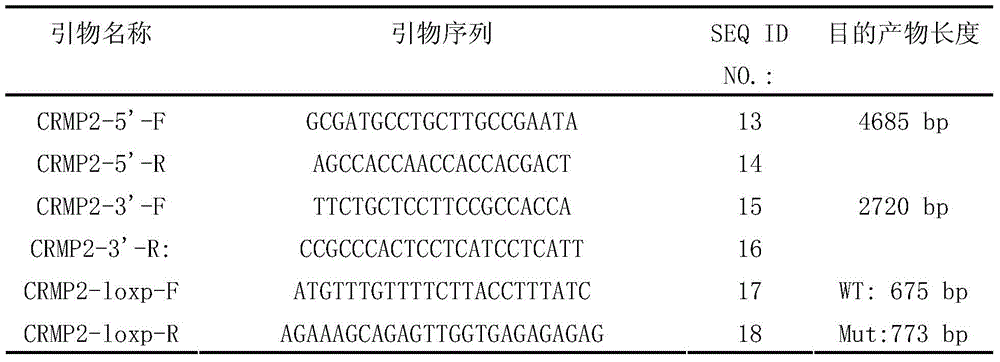
1.3.3小鼠基因型鉴定引物序列:1.3.3 Sequence of primers for mouse genotype identification:
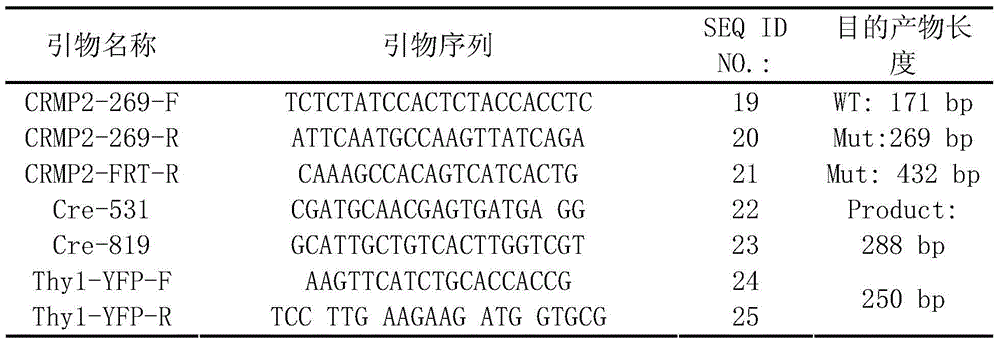
1.3.4CRMPs荧光定量PCR引物序列:1.3.4 CRMPs fluorescence quantitative PCR primer sequence:
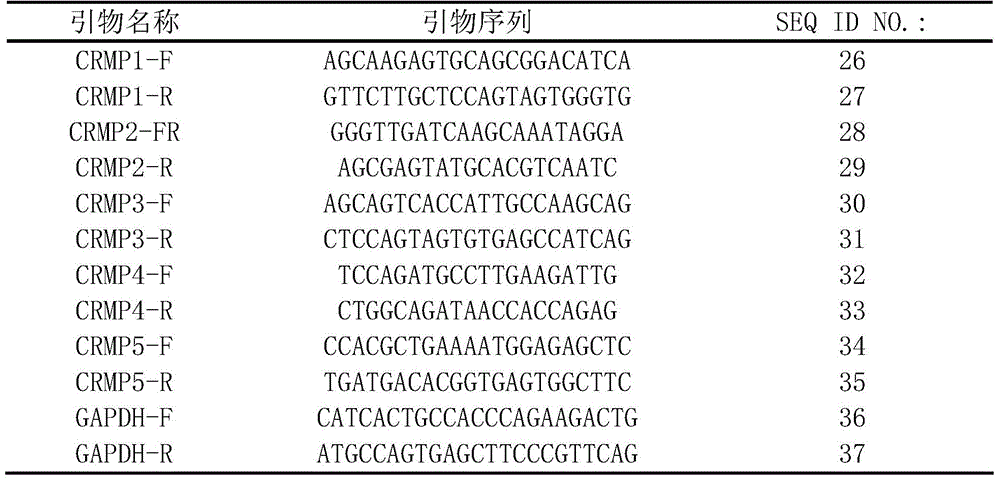
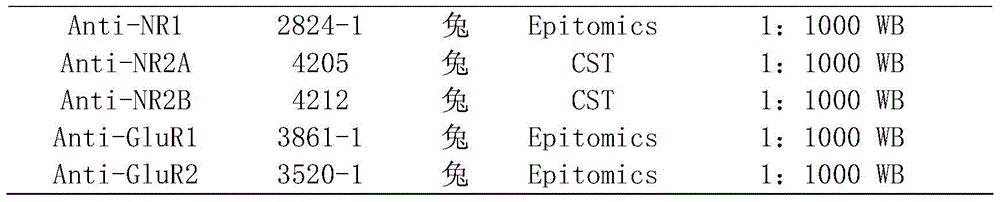
1.4实验中使用的抗体列表1.4 List of antibodies used in experiments
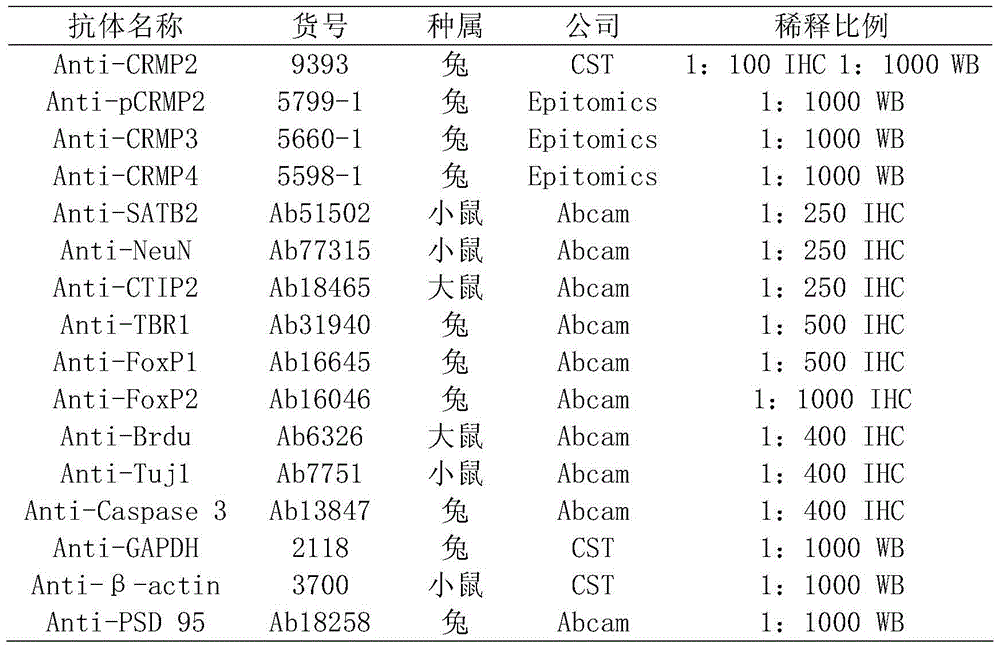
通用方法general approach
1、小鼠行为学分析方法1. Mouse behavior analysis method
1.1开放场实验(open-field test)1.1 Open field test (open-field test)
开放场实验是评价动物自发活动能力、探索行为以及焦虑水平的实验。实验所用操作箱规格为40cm×40cm×49cm(长×宽×高),里面的场地根据面积划分为12个象限,顶盖装有灯、摄像头,及连接装有小鼠行为记录分析系统的电脑。每只小鼠放在开放场的中间,在箱内自由活动30分钟,摄像头全程拍摄。所拍视频用小动物行为记录分析系统分析小鼠活动轨迹,小鼠的焦虑水平由小鼠在中间区域所呆的时间和靠近旷场壁的相对时间来衡量。由两个定量的指标组成:在中间象限时间占总时间的百分比;小鼠在开放场内运动的总距离。定义小鼠在某个象限的标准是小鼠的四肢都进入该象限。The open field experiment is an experiment to evaluate the spontaneous activity ability, exploratory behavior and anxiety level of animals. The size of the operation box used in the experiment is 40cm×40cm×49cm (length×width×height). The field inside is divided into 12 quadrants according to the area. The top cover is equipped with lights, cameras, and a computer equipped with a mouse behavior recording and analysis system. . Each mouse was placed in the middle of the open field and moved freely in the box for 30 minutes, and the camera filmed the whole process. The recorded video was used to analyze the activity trajectories of the mice using the Small Animal Behavior Recording Analysis System. The anxiety level of the mice was measured by the time the mice stayed in the middle area and the relative time near the open field wall. It consists of two quantitative indicators: the percentage of time in the middle quadrant of the total time; and the total distance the mouse travels in the open field. The criterion for defining a mouse in a certain quadrant is that all four limbs of the mouse enter that quadrant.
1.2高架十字迷宫实验(Elevate Plus Maze Test)1.2 Elevate Plus Maze Test
高架十字迷宫由黑色的树脂玻璃制作,离地高70cm,由两个成十字排列的长坂组成,四个臂组成,每个臂长30cm,宽5cm,其中的两个臂被两个高14cm的黑色树脂玻璃隔开,形成两个闭合臂;另外的两个臂称之为开臂。在十字迷宫运动的小鼠由红外感应的追踪系统记录小鼠的运动轨迹。在开始实验时,小鼠放在暗室十字迷宫的中间,头朝开臂方向,每个测试环节中记录小鼠的运动轨迹10min。分析小鼠进入开臂和闭合臂的次数;分别在开臂和闭合臂的总时间;穿过中间区域的频率。小鼠进入开臂和闭合臂的标准是小鼠的四肢都进入该区域。反应焦虑水平的指标:小鼠处在开臂时间占总时间的百分比。The elevated cross labyrinth is made of black plexiglass and is 70cm above the ground. It consists of two nagasakas arranged in a cross. It consists of four arms, each arm is 30cm long and 5cm wide, two of which are surrounded by two 14cm high. The black plexiglass is separated to form two closed arms; the other two arms are called open arms. Mice moving in the plus maze were tracked by an infrared-sensing tracking system. At the beginning of the experiment, the mice were placed in the middle of the dark-room plus maze with their heads facing the open arms, and the mice's movement trajectories were recorded for 10 min in each test session. The number of times the mice entered the open and closed arms; the total time in the open and closed arms, respectively; and the frequency of crossing the intermediate area. The criteria for mouse access to both open and closed arms is that all four limbs of the mouse enter the area. Indices of response anxiety level: the percentage of time that the mouse was in the open arms of the total time.
1.3强迫游泳实验(Forced Swim Test)1.3 Forced Swim Test
强迫游泳实验是一种经典的反应啮齿类动物抑郁相关行为的实验,本实验中用于测试小鼠抑郁样的行为。把小鼠放入装有22℃水的玻璃量筒中(高25cm,直径10cm),水深18cm。每个测试周期为6min,记录6min中小鼠不动所占时间比例。不动的定义标准是小鼠在水中停止挣扎,或呈漂浮状态,仅有细小的肢体运动以保持头部浮在水面。游泳的定义标准是小鼠积极利用前肢在水中向前运动,这个行为不包括小鼠把爪子举出水面,小鼠的身体通常朝向量筒壁的一侧。攀爬定义为小鼠积极利用爪子趴在量筒壁上,同时把爪子举出水面,头朝着量筒壁,身体与量筒侧边垂直。反应抑郁水平的指标:小鼠在水中保持不动的时间。The forced swimming test is a classic reaction to rodent depression-related behaviors, and this experiment was used to test depression-like behaviors in mice. The mice were placed in a glass graduated cylinder (25 cm in height, 10 cm in diameter) filled with water at 22°C, and the water depth was 18 cm. Each test cycle was 6 min, and the proportion of the time when the mouse did not move during the 6 min was recorded. Immobility was defined as a mouse that stopped struggling in the water, or floated, with only small limb movements to keep its head afloat. Swimming was defined as the active use of the forelimbs to move forward in the water, a behavior that did not include raising the paws out of the water, and the mouse's body was usually facing the side of the cylinder wall. Climbing was defined as mice actively using their paws to lie on the wall of the measuring cylinder, while raising their paws out of the water, with their heads facing the wall of the measuring cylinder, and their bodies perpendicular to the sides of the measuring cylinder. An indicator of depression level: the amount of time the mice remained immobile in the water.
1.4悬尾实验(Tail Suspension Test)1.4 Tail Suspension Test
悬尾实验是反应啮齿类动物抑郁相关行为的实验,本实验中用于测试小鼠抑郁样行为。把小鼠的尾巴固定在悬尾测试仪上,使其头部向下悬挂,记录处于该环境中小鼠产生绝望不动状态的时间。反应抑郁水平的指标:小鼠在悬尾时不动的时间。The tail suspension experiment is an experiment that reflects the depression-related behaviors of rodents. In this experiment, it is used to test the depression-like behaviors of mice. The mouse's tail was fixed on the tail suspension tester, and its head was suspended downward, and the time when the mouse was in a state of hopeless immobility in this environment was recorded. An indicator that reflects the level of depression: the amount of time that the mouse does not move while the tail is suspended.
1.5蔗糖偏好实验(Sucrose Preference Test)1.5 Sucrose Preference Test
蔗糖偏好实验用于测试动物是否有快感缺乏的行为学现象,因为快感缺乏是抑郁行为的一个主要症状。实验前三天小鼠喂以1%的蔗糖水代替日常饮用水,以使小鼠习惯于蔗糖水;然后在给小鼠23h禁水之后,喂予小鼠可以自由的饮用两个水瓶,其中一个为日常饮用水,另一个为1%的蔗糖水;1h后称取每个水瓶的重量,计算液体的消耗量;蔗糖偏好实验连续2天,为了避免水瓶的位置效应对结果的影响,第2天变更蔗糖水和日常饮用水瓶放置的位置;蔗糖偏好的计算公式是:蔗糖偏好性(%)=饮用蔗糖水量/(饮用蔗糖水量+饮用日常饮用水量)×100%。The sucrose preference test is used to test whether animals have the behavioral phenomenon of anhedonia, as anhedonia is a major symptom of depressive behavior. Three days before the experiment, the mice were fed with 1% sucrose water instead of the daily drinking water to make the mice accustomed to the sucrose water; then after 23 hours of water deprivation, the mice were given two water bottles that they could drink freely, among which One is daily drinking water, and the other is 1% sucrose water; after 1 h, the weight of each water bottle is weighed to calculate the consumption of liquid; the sucrose preference experiment was carried out for 2 consecutive days, in order to avoid the influence of the position effect of the water bottle on the results, the first The positions of the sucrose water and daily drinking water bottles were changed for 2 days; the formula for sucrose preference was: sucrose preference (%) = drinking sucrose water volume/(drinking sucrose water volume + drinking daily drinking water volume) × 100%.
1.6水迷宫实验(Water Maze test)1.6 Water Maze test
水迷宫实验设备包括一个不锈钢圆形水池(直径120cm,高50cm)、一个平台(直径6cm)、水池上方固定一台摄像机以及与摄像机相连的计算机。池内盛水,深25cm,水温22℃左右。平台置于水下1cm。水面漂浮着一层无毒无味的白色塑料珠以防动物看清水下平台。房间墙壁贴上色彩鲜艳的、形状不同的纸板或塑料板,作为动物空间定位的标记。The water maze experiment equipment includes a stainless steel circular pool (diameter 120cm, height 50cm), a platform (diameter 6cm), a camera fixed above the pool, and a computer connected to the camera. The water in the pool is 25cm deep and the water temperature is about 22°C. The platform is placed 1cm underwater. A layer of non-toxic and odorless white plastic beads floats on the water surface to prevent animals from seeing the underwater platform. The walls of the rooms are plastered with brightly coloured and differently shaped cardboard or plastic panels as markers for the spatial orientation of animals.
实验包括两个阶段定位航行实验(place navigation)和空间探索实验(spatialprobe)。其中定位航行试验历时5天;训练期间,把平台放在水池中的一个象限,每天固定时间将小鼠面向池壁分别从4个入水点放入水中,记录其寻找到隐藏在水面下平台的时间,如果小鼠在60s之内没有找到水下平台则引导其到平台上,小鼠到达平台后让其再呆上10s,然后迅速用毛巾弄干小鼠,放在37℃加热灯下,以保持体温;第6天进行空间探索试验,在定位航行试验后去除平台,然后在之前平台对侧的象限将小鼠放入水池中,记录其在60s内的游泳轨迹,考察小鼠对原平台的记忆。用视频追踪系统记录每只小鼠在水池中的的游泳路径,计算小鼠在60s跨原平台所在象限时间与其它三象限的时间比。The experiment consists of two stages: place navigation and spatial probe. The positioning navigation test lasted 5 days; during the training period, the platform was placed in a quadrant of the pool, and the mice were placed into the water from 4 water entry points facing the pool wall at a fixed time every day, and records were found when they found the platform hidden under the water surface. Time, if the mouse does not find the underwater platform within 60s, guide it to the platform. After the mouse reaches the platform, let it stay for another 10s, then quickly dry the mouse with a towel and place it under a 37°C heating lamp. In order to maintain body temperature; on the 6th day, a space exploration test was performed, the platform was removed after the positioning navigation test, and then the mice were placed in the pool in the quadrant opposite to the previous platform, and their swimming trajectories within 60s were recorded. Platform memory. The swimming path of each mouse in the pool was recorded with a video tracking system, and the time ratio of the time when the mouse crossed the quadrant of the original platform and the other three quadrants in 60s was calculated.
1.7关联/暗示条件恐惧实验(contextual/cued fear conditioning)1.7 Contextual/cued fear conditioning
关联/暗示条件恐惧包括训练和测试两个阶段,具体步骤如下:Associative/cue conditioned fear consists of two phases: training and testing. The specific steps are as follows:
训练阶段(第一天),调试仪器,确保操作箱底部栅板有电流刺激(用备用小鼠测试);将小鼠放入箱内,适应2min;足电击刺激(0.7mA,2s);58s间歇期,无任何刺激;紧跟2s足电击刺激(0.7mA,2s);58s间歇期,无任何刺激;紧跟2s足电击刺激(0.7mA,2s);58s间歇期,无任何刺激;实验终止;将小鼠放回饲养笼,70%乙醇擦拭操作箱。In the training phase (the first day), adjust the instrument to ensure that the grid plate at the bottom of the operation box has current stimulation (test with spare mice); put the mice in the box and adapt to 2min; foot shock stimulation (0.7mA, 2s); 58s Intermittent period, without any stimulation; followed by 2s foot shock stimulation (0.7mA, 2s); 58s intermittent period, without any stimulation; followed by 2s foot shock stimulation (0.7mA, 2s); 58s intermittent period, without any stimulation; experiment Termination; put the mice back into the rearing cage, and wipe the operation box with 70% ethanol.
测试阶段(第二天),关联测试,把动物放入跟第一天实验使用的同一个测试箱,重力感应器记录小鼠5min内的活动状态;记录每分钟小鼠凝滞时间,计算小鼠凝滞的比率。Test phase (the second day), correlation test, put the animals into the same test box used in the experiment on the first day, the gravity sensor records the activity state of the mice within 5 minutes; record the freezing time of the mice every minute, and calculate the mice stagnation ratio.
1.8惊反射的前脉冲抑制实验(Prepulse inhibition,PPI)1.8 Prepulse inhibition experiment of startle reflex (Prepulse inhibition, PPI)
PPI的测试过程,由于小鼠需从北京送到苏州大学进行行为学实验,至少实验前一周把小鼠送到苏州大学实验室。根据文献和预实验,确定实验参数和测试方案,实验当天,将小鼠放入惊反射测试箱。实验步骤如下:During the PPI test, since the mice had to be sent from Beijing to Soochow University for behavioral experiments, the mice were sent to the laboratory of Soochow University at least one week before the experiment. According to the literature and pre-experiment, the experimental parameters and test plan were determined. On the day of the experiment, the mice were put into the startle reflex test box. The experimental steps are as follows:
1)将小鼠置于单纯的背景声音中,适应5min(69dB);1) The mice were placed in a pure background sound and adapted for 5min (69dB);
2)连续5次单独惊反射刺激(120dB,持续40ms),并记录数据;2) 5 consecutive individual startle reflex stimulation (120dB, lasting 40ms), and record the data;
3)共48个trials,4种类型刺激,分别是单独的惊反射刺激(120dB,持续时间40ms,12trials),3种联合刺激(其中前刺激强度分别为背景+4dB,+8dB和+12dB)前刺激持续20ms,惊反射刺激强度120dB,持续40ms,二者间隔100ms,各12trials,所有的trial按假随机的顺序进行,并记录数据;3) A total of 48 trials, 4 types of stimuli, which are a single startle reflex stimulus (120dB, duration 40ms, 12trials), 3 kinds of combined stimuli (where the pre-stimulus intensity is background +4dB, +8dB and +12dB respectively) The pre-stimulus lasted 20ms, the startle reflex stimulus intensity was 120dB, lasted 40ms, the interval between the two was 100ms, and each trial was 12 trials. All trials were performed in a pseudo-random order, and the data were recorded;
4)最后给小鼠4种类型的单独惊反射刺激共20个trial,强度分别为90dB,100dB,110dB和120dB,各个刺激按假随机顺序进行并记录数据。4) Finally, mice were given 4 types of individual startle reflex stimuli for a total of 20 trials with intensities of 90dB, 100dB, 110dB and 120dB respectively. Each stimulus was performed in a pseudo-random order and the data were recorded.
所有试验共73个trial,每个刺激间隔15-20s,每个刺激内含空白期100ms,前刺激或空白刺激持续20ms,间隔100ms,惊反射刺激持续40ms,延迟140ms。All trials consist of 73 trials, each stimulus interval is 15-20s, each stimulus contains a blank period of 100ms, the pre-stimulus or blank stimulus lasts 20ms, the interval is 100ms, the startle reflex stimulus lasts 40ms, and the delay is 140ms.
行为学评价指标:1)惊反射幅度=最后5次单独惊反射刺激反应幅度的均值。用于评价动物的情绪状态。2)PPI=(1-前脉冲联合惊反射刺激的反应幅度/单独惊反射刺激的反应幅度×100%,数值为0表示无前脉冲抑制,数值越大代表抑制程度越强。Behavioral evaluation index: 1) Startle reflex amplitude = the mean value of the last 5 individual startle reflex stimulus response amplitudes. Used to evaluate the emotional state of animals. 2) PPI=(1-response amplitude of prepulse combined with startle reflex stimulus/response amplitude of startle reflex stimulus alone×100%, a value of 0 means no prepulse inhibition, and a larger value represents a stronger degree of inhibition.
1.9筑巢实验(Nest building test)1.9 Nest building test
熄灯前1h将小鼠分笼,单笼单只饲养。将正方形(10cm×10cm)的脱脂棉3.0g放于鼠笼内。12h后观察小鼠的筑巢情况,拍照屏蔽基因型并按照评分标准对其评分。评分标准0-1分:90%脱脂棉保持完好;1-2分:小部分脱脂棉被撕开,大部分保持完好(50%-90%);2-3分:大部分脱脂棉被撕成碎片(50%-90%),但是无窝状;3-4分:90%以上的脱脂棉被撕成碎片,成扁平状鼠窝(高度小于身高的50%);4-5分:90%以上的脱脂棉被撕成碎片,成高质量鼠窝(高度大于身高的50%);鉴于动物实验的复杂性,评分可以用小数,如小鼠的窝做的非常完美,但是还残留10%的脱脂棉没有被撕碎,可以评为4.5分。Mice were divided into cages 1 h before lights out, and housed in a single cage. Place 3.0 g of square (10cm×10cm) absorbent cotton in the rat cage. After 12 hours, the nesting situation of the mice was observed, and the genotypes were screened and scored according to the scoring standard. Scoring standard: 0-1 points: 90% absorbent cotton remains intact; 1-2 points: a small part of absorbent cotton is torn, but most of them remain intact (50%-90%); 2-3 points: most absorbent cotton is torn into pieces ( 50%-90%), but no nest; 3-4 points: more than 90% of the absorbent cotton quilt torn into pieces, into a flat rat nest (height less than 50% of the height); 4-5 points: more than 90% The absorbent cotton was torn into pieces and made into a high-quality rat nest (height is greater than 50% of the height); given the complexity of animal experiments, the score can be in decimals, such as the mouse nest is perfect, but there is still 10% of the absorbent cotton left. It was shredded and could be rated 4.5 points.
2.蛋白水平研究实验方法2. Experimental methods for protein level research
小鼠海马组织突触后致密区组分分离:取小鼠引颈或者断头处死,取出整个大脑组织,预冷的PBS中浸洗一次;然后迅速在冰上取出两侧海马,放入预冷的玻璃匀浆器,加入800μL组织匀浆缓冲液(320mM sucrose,2mM EDTA,20mM Tris-HCl(pH8.0),1mM PMSF)匀浆,单侧海马加400μL H缓冲液,使用匀浆器匀浆;4℃离心,1000g,10min,取上清,作为组分S1;从S1组分中取出45μL,加入5μL10%SDS,混匀,用作全蛋白检测;剩余的S1离心,4℃离心,10000g,20min,弃上清,留沉淀P2作为突触小体组分;加入400μL TET缓冲液(1%TritonX-100,2mM EDTA,20mM Tris-HCl pH7.4,1mM PMSF)重悬P2,4℃,旋转混匀1hr;超速离心,Beckman离心机,Sw41转子,4℃,100000g,1hr;单侧海马的最后沉淀用40μL TET缓冲液和5μLSET缓冲液(1%SDS,2mM EDTA,20mM Tris-HCl pH7.4)重悬,吹打溶解;Bradford法定量蛋白浓度;.取15μg蛋白,8%SDS-PAGE电泳。Separation of components in the post-synaptic dense area of mouse hippocampus: mice were sacrificed by necking or decapitation, the entire brain tissue was removed, and immersed in pre-cooled PBS once; then both hippocampi were quickly removed on ice and placed in pre-cooling glass homogenizer, add 800 μL tissue homogenization buffer (320mM sucrose, 2mM EDTA, 20mM Tris-HCl (pH8.0), 1mM PMSF) to homogenize, add 400 μL H buffer to one side of the hippocampus, use a homogenizer to homogenize slurry; centrifuge at 4°C, 1000g, 10min, take the supernatant as component S1; take 45μL from the S1 fraction, add 5μL of 10% SDS, mix well, and use for total protein detection; centrifuge the remaining S1 at 4°C, 10000g, 20min, discard the supernatant, leave the precipitated P2 as the synaptosome fraction; add 400μL TET buffer (1% TritonX-100, 2mM EDTA, 20mM Tris-HCl pH7.4, 1mM PMSF) to resuspend P2,4 ℃, spin and mix for 1 hr; ultracentrifugation, Beckman centrifuge, Sw41 rotor, 4 ℃, 100000g, 1 hr; 40 μL TET buffer and 5 μL SET buffer (1% SDS, 2 mM EDTA, 20 mM Tris- HCl pH7.4), resuspended and dissolved by pipetting; protein concentration was quantified by Bradford method; 15 μg protein was taken and electrophoresed by 8% SDS-PAGE.
3.形态学研究实验方法3. Experimental methods for morphological research
3.1Nissl染色3.1 Nissl staining
挑取相应的脑片到经铬钒明胶包被过的载玻片上,室温晾干8-12h;把贴有脑片的载玻片于PBS中浸洗1min;后入0.5%的Nissl染色液5-10min;取出流水冲去染色液,入梯度酒精脱水,30%1min,50%1min,70%1min,80%1min,95%1min,100%5min;入100%二甲苯透明3次,每次5min;取出后迅速加上中性树胶,确保片子不干;盖上盖玻片封片,挤出气泡;后置于通风橱中晾干8-12h。Pick the corresponding brain slices onto the slides coated with chrome vanadium gelatin, dry at room temperature for 8-12 hours; soak the slides with the brain slices in PBS for 1 min; then add 0.5% Nissl staining solution 5-10min; take out running water and rinse off the dyeing solution, dehydrate in gradient alcohol, 30% 1min, 50% 1min, 70% 1min, 80% 1min, 95% 1min, 100% 5min; add 100% xylene for 3 times, each time After taking out, quickly add neutral gum to ensure that the slides are not dry; cover the slides with a cover slip, and squeeze out air bubbles; then place them in a fume hood to dry for 8-12 hours.
3.2小鼠脑切片免疫荧光染色3.2 Immunofluorescence staining of mouse brain sections
组织切片用PBS洗3次,每次5min;用封闭液室温封闭1h;吸去封闭液,加入封闭液稀释的一抗4℃过夜(8-12h);收集一抗,PBST洗3次,每次5min;加入相应的荧光二抗避光室温作用1h;PBST洗3次,每次5min;贴片后加入一滴抗淬灭剂,盖上盖玻片,指甲油封片;避光晾干。Tissue sections were washed 3 times with PBS, 5 min each time; blocked with blocking solution at room temperature for 1 h; aspirated off the blocking solution, and the primary antibody diluted in the blocking solution was added at 4°C overnight (8-12 h); the primary antibody was collected and washed 3 times with PBST, each time Add the corresponding fluorescent secondary antibody for 1 h at room temperature in the dark; wash 3 times with PBST for 5 min each time; add a drop of anti-quenching agent after the patch, cover with a coverslip, and seal with nail polish; dry in the dark.
3.3小鼠脑Brdu标记方法及免疫荧光染色3.3 Mouse brain Brdu labeling method and immunofluorescence staining
8周龄成年小鼠腹腔注射Brdu,200mg/Kg,检测增殖情况于2h后灌流取脑,4%PFA固定过夜;后置于30%蔗糖溶液至沉淀;后TFM包埋组织于-80℃速冻;切片之前2h,取出放到切片机的冷冻台;滑动切片,切片厚度50μm,用毛笔将切片挑入到盛有0.01M PBS的培养皿中。也可挑入到防冻液中-20℃保存备用。8-week-old adult mice were intraperitoneally injected with Brdu, 200 mg/Kg, and the proliferation was detected. After 2 hours, the brains were collected by perfusion and fixed with 4% PFA overnight; then placed in 30% sucrose solution to precipitate; the TFM-embedded tissues were then snap-frozen at -80°C ; 2h before slicing, take it out and put it on the freezing stage of the microtome; slide the slice, the slice thickness is 50 μm, and pick the slice into a petri dish containing 0.01M PBS with a writing brush. It can also be picked into antifreeze and stored at -20°C for later use.
组织切片用PBS洗3次,每次5min;后用2N盐酸变性DNA,37℃20min,迅速用0.1M硼酸钠(pH8.5)中和,室温12min;切片用PBS洗3次,每次5min;后用封闭液室温封闭1h;吸去封闭液,加入封闭液稀释的Brdu一抗4℃(24-48h);收集一抗,PBST洗3次,每次10min;加入相应的荧光二抗,避光室温作用2h;PBST洗3次,每次10min;贴片后加入一滴抗淬灭剂,盖上盖玻片,指甲油封片;避光晾干。The tissue sections were washed 3 times with PBS for 5 min each time; the DNA was then denatured with 2N hydrochloric acid, 37°C for 20 min, and quickly neutralized with 0.1 M sodium borate (pH 8.5) for 12 min at room temperature; the sections were washed 3 times with PBS for 5 min each time ; then block with blocking solution for 1 h at room temperature; aspirate the blocking solution, add the Brdu primary antibody diluted in the blocking solution at 4°C (24-48 h); collect the primary antibody, wash 3 times with PBST for 10 min each time; add the corresponding fluorescent secondary antibody, Protect from light at room temperature for 2 h; wash with PBST for 3 times, 10 min each time; add a drop of anti-quenching agent after the patch, cover with a coverslip, and seal with nail polish; dry in the dark.
3.4小鼠海马突触超微结构电镜标本的制备及各指标的测量3.4 Preparation of mouse hippocampal synapse ultrastructural electron microscope specimens and measurement of each index
取8周龄雄性CRMP2Ctrl和cKO小鼠各4只,用数字编号以保证对基因型保密,到所有的测量和计算结束之后,才核对编号对应的基因型,以避免实验人员偏见对结果的客观性造成损害;戊巴比妥钠腹腔麻醉后,用预冷的0.1M PB冲血,后用冰上预冷的2%多聚甲醛/2.5%戊二醛混合灌流液灌流固定;断头剥离全脑置于小鼠脑模上,在距视交叉后缘1mm处向尾侧切取2mm厚的组织切片;在体体视镜载物台上放上冰袋,滴两滴灌流液在冰袋上,将组织浸入灌流液,在解剖镜下去掉皮层,切取含海马CA1区的组织块约1mm3,整个过程保证组织块被灌注液浸润;将组织块放入盛放有2mL2.5%戊二醛的EP管内,4℃过夜前固定;0.1MPB洗三次,每次10min;1%OsO4,避光后固定1h,MilliQ H2O洗三次,每次15min;2%醋酸双氧铀组织块染1h,MilliQ H2O洗三次,每次15min;梯度丙酮脱水,30%5min,50%5min,70%5min,90%10min,100%5min,100%5min,100%10min;环氧树脂Epon-812包埋,丙酮:树脂Epon-812=2:11h,丙酮:树脂Epon-812=2:21h,丙酮:树脂Epon-812=1:21h,100%树脂Epon-8124h,100%树脂Epon-8124-12h,100%树脂Epon-8124h;100%树脂Epon-812包埋,60℃聚合48小时;光学显微镜下修块;2μm厚半超薄切片,甲苯胺兰染色定位;切65nm超薄切片,醋酸双氧铀和柠檬酸铅染色;在JEM-1400透射电子显微镜下观察,以CA1区GrayⅠ型不对称突触为观察对象,分别用CCD采集放大30K的图像。形态计量学分析:用ImageJ软件测量PSD的面积和宽度及厚度,用distance-between Polylines插件突触间隙的距离。Four 8-week-old male CRMP2Ctrl and cKO mice were selected and numbered with numbers to ensure the confidentiality of the genotypes. After all measurements and calculations were completed, the genotypes corresponding to the numbers were checked to avoid biased by the experimenter. The objectiveness of the results After intraperitoneal anesthesia with sodium pentobarbital, the blood was flushed with pre-cooled 0.1M PB, and then fixed by perfusion with a mixed perfusion solution of 2% paraformaldehyde/2.5% glutaraldehyde pre-cooled on ice; decapitation stripped The whole brain was placed on the mouse brain model, and 2 mm thick tissue sections were cut caudally at 1 mm from the posterior edge of the optic chiasm; an ice pack was placed on the stereoscopic stage, and two drops of perfusate were placed on the ice pack. Immerse the tissue in the perfusate, remove the cortex under a dissecting microscope, and cut a tissue block of about 1 mm3 containing the hippocampal CA1 area. The whole process ensures that the tissue block is infiltrated by the perfusate; In an EP tube, fixed overnight at 4°C; washed three times with 0.1 MPB for 10 min each; 1% OsO4, protected from light, fixed for 1 h, washed three times with MilliQ H 2 O for 15 min each; stained with 2% uranyl acetate for 1 h, Wash three times with MilliQ H 2 O, 15 min each; gradient acetone dehydration, 30% 5 min, 50% 5 min, 70% 5 min, 90% 10 min, 100% 5 min, 100% 5 min, 100% 10 min; epoxy resin Epon-812 pack Buried, Acetone: Resin Epon-812=2: 11h, Acetone: Resin Epon-812=2: 21h, Acetone: Resin Epon-812=1: 21h, 100% Resin Epon-8124h, 100% Resin Epon-8124-12h , 100% resin Epon-8124h; 100% resin Epon-812 embedded, polymerized at 60 ℃ for 48 hours; trimmed under light microscope; Stained with uranyl and lead citrate; observed under a JEM-1400 transmission electron microscope, taking Gray type I asymmetric synapses in the CA1 region as the observation object, and using CCD to collect images with a magnification of 30K. Morphometric analysis: ImageJ software was used to measure the area and width and thickness of the PSD, and the distance between the synaptic clefts using the distance-between Polylines plugin.
实施例1打靶载体的构建Example 1 Construction of Targeting Vector
1.1小鼠BAC DNA的提取1.1 Extraction of mouse BAC DNA
将含有CRMP2基因组全长的BAC(RPCI23-414A17)DH10B的菌划线在含有氯霉素的平板上,37℃培养10h,挑取5个单克隆,分别摇5mL菌,12h。13000rpm,1min收菌,加300μL P1(Tris50mM,EDTA10mM,pH8.0)悬菌,然后加300μL P2(0.2M NaOH,1%SDS),混匀,室温放置5min,然后加300μL P3(3M KAC,pH5.5),轻摇放置2-5min,10000rpm,4℃,离心10min。将上清转移到新EP管中,然后加800μL预冷的异丙醇,颠倒混匀冰上放5min,4℃,10000rpm,15min,去上清,沉淀用600μL70%乙醇洗涤两次,晾干,加40μL双蒸水,及1μL RNaseA,37℃溶解30min。The bacteria containing the full-length BAC (RPCI23-414A17) DH10B of the CRMP2 genome were streaked on a plate containing chloramphenicol, cultured at 37°C for 10 hours, and 5 single clones were picked, and 5 mL of bacteria were shaken for 12 hours. 13000rpm, 1min to collect bacteria, add 300μL P1 (Tris 50mM, EDTA 10mM, pH8.0) to suspend the bacteria, then add 300μL P2 (0.2M NaOH, 1% SDS), mix well, leave at room temperature for 5 minutes, then add 300μL P3 (3M KAC, pH5.5), gently shake for 2-5min, 10000rpm, 4°C, centrifuge for 10min. Transfer the supernatant to a new EP tube, then add 800 μL of pre-cooled isopropanol, invert and mix, put on ice for 5 min, 4 °C, 10000 rpm, 15 min, remove the supernatant, wash the precipitate twice with 600 μL of 70% ethanol, and air dry. , add 40 μL of double-distilled water, and 1 μL of RNaseA, dissolve at 37°C for 30 min.
1.2电转感受态的制备及转化1.2 Preparation and transformation of electrocompetent
从-80℃冰箱取出保存的工程菌EL350,在没有抗生素的LB固体平板上划线,32℃过夜培养。挑取单克隆,接入10mL LB液体培养基中,32℃,220rpm,过夜培养。按1:10-20的比例,将菌液转接到50mL LB培养基中,32℃,220rpm,培养2-4h,直至OD600达0.5左右。冰浴10min,收菌至1.5mL EP管中,4℃,4000rpm,1min。用预冷的双蒸水洗菌三次,去除LB中的离子。最后用20-50μL双蒸水悬起菌体。操作过程中保持低温时是关键。可以加15%甘油将菌于液氮中速冻后保存于-80℃。也可直接电转。The stored engineered bacteria EL350 were taken out from the -80°C refrigerator, streaked on LB solid plates without antibiotics, and cultured at 32°C overnight. A single clone was picked and placed in 10 mL of LB liquid medium at 32° C., 220 rpm, and cultured overnight. According to the ratio of 1:10-20, the bacterial liquid was transferred to 50 mL of LB medium, 32 ° C, 220 rpm, and cultivated for 2-4 h until the OD600 reached about 0.5. In an ice bath for 10min, the bacteria were collected into a 1.5mL EP tube, 4°C, 4000rpm, 1min. Wash the bacteria three times with pre-cooled double distilled water to remove ions from the LB. Finally, suspend the cells with 20-50 μL of double-distilled water. The key is to keep the temperature low during operation. 15% glycerol can be added to quickly freeze the bacteria in liquid nitrogen and store at -80°C. It can also be directly transferred.
将制备好的感受态和待转质粒或者DNA片段混匀,冰上放置10min,加入预冷电转杯(0.1cm,Bio-Rad)中,1.75kV,25μF,200Ω,电击完,迅速加入1mL无抗生素LB悬起菌体,吸至EP管中,32℃孵育1h,后涂于相应抗性的平板上。Mix the prepared competent cells with the plasmid or DNA fragment to be transfected, put it on ice for 10 min, add it to a pre-cooled electroporation cup (0.1cm, Bio-Rad), 1.75kV, 25μF, 200Ω, after the electric shock, quickly add 1mL of The bacteria were suspended in LB with antibiotics, sucked into EP tubes, incubated at 32°C for 1 h, and then spread on the corresponding resistant plates.
1.3热击电转感受态的制备及转化1.3 Preparation and transformation of thermal shock electroporation competent cells
从-80℃冰箱取出保存的工程菌El350,在没有抗生素的LB固体平板上划线,32℃过夜培养。挑取单克隆,接入10mL LB液体培养基中,32℃,220rpm,过夜培养。按1:10-20的比例,将菌液转接到50mL LB培养基中,32℃,220rpm,培养2-4h,直至OD600到达0.5之间。将菌放于42℃水浴锅中摇动15min,然后放冰上摇动3min,再置于冰上5min。收菌至1.5mL EP管中,4℃,4000rpm,1min。用预冷的双蒸水洗菌三次,去除LB中的离子。最后用20-50μL双蒸水悬起菌体。可以加15%甘油将菌于液氮中速冻后,保存于-80℃。也可直接用于电转。The stored engineering bacteria El350 were taken out from the -80°C refrigerator, streaked on LB solid plates without antibiotics, and cultured at 32°C overnight. A single clone was picked and placed in 10 mL of LB liquid medium at 32° C., 220 rpm, and cultured overnight. According to the ratio of 1:10-20, the bacterial liquid was transferred to 50 mL of LB medium, 32 ° C, 220 rpm, and cultivated for 2-4 h until the OD600 reached 0.5. The bacteria were placed in a 42°C water bath and shaken for 15 minutes, then placed on ice and shaken for 3 minutes, and then placed on ice for 5 minutes. Collect the bacteria into a 1.5mL EP tube, 4°C, 4000rpm, 1min. Wash the bacteria three times with pre-cooled double distilled water to remove ions from the LB. Finally, suspend the cells with 20-50 μL of double-distilled water. Add 15% glycerol to quickly freeze the bacteria in liquid nitrogen and store at -80°C. It can also be directly used for electric transfer.
1.4打靶载体构建过程1.4 Construction process of targeting vector
1.4.1CRMP2基因打靶载体的构建策略1.4.1 Construction strategy of CRMP2 gene targeting vector
小鼠的CRMP2基因全长65825bp,一共有14个外显子。在本实施例中,计划敲除Exon3,该外显子长185bp,敲除之后会导致移码突变,从而导致CRMP2基因失活。The full-length mouse CRMP2 gene is 65825 bp, with a total of 14 exons. In this example, Exon3 is planned to be knocked out. The exon is 185 bp long. After knocking out, it will cause a frameshift mutation, which will lead to the inactivation of the CRMP2 gene.
首先利用同源重组方式套取一段10Kb左右包含Exon3的CRMP2基因组片段,然后利用同源重组和位点特异性重组,在这段序列的Exon3两侧各加上一个loxP位点和相应的筛选标记。利用Exon3两侧的同源序列做为重组臂,其中5'端重组臂长为3.8Kb,3'端重组臂长为2.1Kb。电转打靶载体到ES细胞中,使得打靶载体和染色体上的CRMP2基因重组,从而完成对ES细胞基因的改造。具体打靶策略设计如图1。First, a CRMP2 genome fragment of about 10Kb containing Exon3 was extracted by homologous recombination, and then a loxP site and a corresponding screening marker were added to each side of Exon3 by homologous recombination and site-specific recombination. . The homologous sequences on both sides of Exon3 were used as recombination arms, of which the length of the recombination arm at the 5' end was 3.8Kb, and the length of the recombination arm at the 3' end was 2.1Kb. Electroporation of the targeting vector into ES cells makes the targeting vector recombine with the CRMP2 gene on the chromosome, thereby completing the genetic transformation of ES cells. The specific target strategy design is shown in Figure 1.
1.4.2CRMP2基因打靶Mini-Targeting载体的构建1.4.2 Construction of CRMP2 gene targeting Mini-Targeting vector
打靶载体的构建需要先构建三个中间载体(Liu et al.,2003),分别命名为Pl253-Retriveval,Mini-Targeting-1,Mini-Targeting-2。以CRMP2-A,CRMP2-B,CRMP2-C,CRMP2-D,CRMP2-E,CRMP2-F,CRMP2-G,CRMP2-H,CRMP2-I,CRMP2-J,CRMP2-Y和CRMP2-Z为引物,以BAC RPCI23-414A17为模板扩增200-500bp的同源臂,分别命名为AB,CD,EF,GH,IJ,YZ。以质粒PL253、PL451、PL452(购自National Cancer Institute at Frederic)及pBluescript(购自Stratagene公司)为基本骨架,利用酶切和连接的方法,分别构建了含AB和YZ同源臂5888bp的PL253-Retrieval,含有CD和EF同源臂5420bp的Mini-Targeting-1及含有GH和IJ同源臂5520bp Mini-Targeting-2中间载体。The construction of targeting vectors requires the construction of three intermediate vectors (Liu et al., 2003), named Pl253-Retriveval, Mini-Targeting-1, and Mini-Targeting-2 respectively. Using CRMP2-A, CRMP2-B, CRMP2-C, CRMP2-D, CRMP2-E, CRMP2-F, CRMP2-G, CRMP2-H, CRMP2-I, CRMP2-J, CRMP2-Y and CRMP2-Z as primers , using BAC RPCI23-414A17 as template to amplify 200-500bp homology arms, named AB, CD, EF, GH, IJ, YZ, respectively. Using plasmids PL253, PL451, PL452 (purchased from National Cancer Institute at Frederic) and pBluescript (purchased from Stratagene) as the basic backbones, the PL253-containing AB and YZ homology arms of 5888 bp were constructed by enzyme digestion and ligation, respectively. Retrieval, Mini-Targeting-1 containing CD and EF homology arms 5420bp and Mini-Targeting-2 intermediate vector containing GH and IJ homology arms 5520bp.
1.4.3CRMP2基因打靶Retrieval载体的构建1.4.3 Construction of CRMP2 gene targeting Retrieval vector
首先从购自Invitrogen公司含BAC RPCI23-414A17的大肠杆菌DH10B中提取BAC质粒,然后将其转入工程菌EL350(E.coli)中,挑取转入成功的克隆做成电转感受态。同时利用Hind III酶切线性化PL253-Retrieval,电泳回收切开的片段,将该片段10-100ng电转入含有RPCI23-414A17的EL350中,将电转后的菌涂于含Amp抗性的平板上,挑选出发生位点特异性重组的克隆,同时提取质粒进一步酶切鉴定。正确的阳性克隆命名为PL253-Retrieval-CRMP2。First, the BAC plasmid was extracted from Escherichia coli DH10B containing BAC RPCI23-414A17 purchased from Invitrogen Company, and then it was transferred into engineering bacteria EL350 (E. At the same time, PL253-Retrieval was linearized with Hind III enzyme digestion, and the cut fragment was recovered by electrophoresis. 10-100 ng of the fragment was electroporated into EL350 containing RPCI23-414A17, and the electroporated bacteria were spread on the plate containing Amp resistance. , select clones with site-specific recombination, and extract plasmids for further digestion and identification. The correct positive clone was named PL253-Retrieval-CRMP2.
1.4.4CRMP2基因打靶First-Targeting载体的构建1.4.4 Construction of CRMP2 gene targeting First-Targeting vector
将已得到的PL253-Retrieval-CRMP2电转到普通EL350菌中,然后将其做成电转感受态。同时用NotⅠ和SalⅠ切Mini-Targeting-1,回收含有Neo基因的片段,将100ng该片段电转入含有PL253-Retrieval-CRMP2的EL350中,利用含Kana和Amp抗性平板筛选同源重组的克隆,经酶切鉴定确认。阳性克隆称为PL253-CRMP2-1sttargeting。The obtained PL253-Retrieval-CRMP2 was electroporated into common EL350 bacteria, which were then made electrocompetent. At the same time, Mini-Targeting-1 was cut with NotI and SalI, and the fragment containing the Neo gene was recovered. 100 ng of the fragment was electroporated into EL350 containing PL253-Retrieval-CRMP2, and the clones of homologous recombination were screened using Kana and Amp resistance plates. , confirmed by enzyme digestion. The positive clone was called PL253-CRMP2-1 st targeting.
1.4.5CRMP2基因打靶Pop Out载体的构建1.4.5 Construction of CRMP2 gene targeting Pop Out vector
将PL253-CRMP2-1stTargeting转入阿拉伯糖诱导的EL350感受态中,诱导两个loxp位点重组,得到PL253-CRMP2-Pop Out,酶切鉴定确认,两个loxP已重组为一个。此时载体上只有一个loxP位点,Neo基因已移除,经鉴定正确的克隆命名为PL253-CRMP2-Pop Out。其图谱如图2所示。The PL253-CRMP2-1stTargeting was transferred into the arabinose-induced EL350 competent, and the two loxP sites were induced to recombine to obtain PL253-CRMP2-Pop Out. At this time, there is only one loxP site on the vector, the Neo gene has been removed, and the correct clone was identified as PL253-CRMP2-Pop Out. Its spectrum is shown in Figure 2.
1.4.6CRMP2基因打靶Second-Targeting载体的构建1.4.6 Construction of Second-Targeting Vector for CRMP2 Gene Targeting
将PL253-CRMP2-Pop Out转入EL350中,做成电转感受态,然后利用NotⅠ和SalⅠ切Mini-targeting-2,回收含有GH-Neo-IJ的片段。取100ng转入含有PL253-CRMP2-Pop Out的EL350中,利用Kana和Amp双抗性平板筛选阳性克隆。PL253-CRMP2-Pop Out was transferred into EL350 to make electrotransformation competent, and then Mini-targeting-2 was cut with NotI and SalI, and the fragment containing GH-Neo-IJ was recovered. 100ng was transferred into EL350 containing PL253-CRMP2-Pop Out, and positive clones were screened using Kana and Amp dual-resistant plates.
多酶切鉴定正确和相应片段测序正确的克隆命名为PL253-CRMP2-2ndTargeting,其图谱和多酶切鉴定结果如图3A和3B所示。The clone that was correctly identified by multiple restriction digestion and the corresponding fragment sequenced correctly was named PL253-CRMP2-2 nd Targeting, and its map and multiple restriction restriction identification results are shown in Figures 3A and 3B.
1.4.7打靶载体PL253-CRMP2-2ndtargeting重组能力检验1.4.7 Targeting vector PL253-CRMP2-2 nd targeting recombination ability test
将构建好的PL253-CRMP2-2ndtargeting载体转入阿拉伯糖诱导的感受态,诱导重组酶产生,引发两个loxP位点重组,切除中间的Exon3。经PCR和测序鉴定与预期结果一致。The constructed PL253-CRMP2-2 nd targeting vector was transferred into arabinose-induced competence, inducing the production of recombinase, triggering the recombination of the two loxP sites, and excising the middle Exon3. The results of PCR and sequencing were consistent with the expected results.
1.4.8打靶载体PL253-CRMP2-2ndtargeting操作片段全测序1.4.8 Full sequencing of targeting vector PL253-CRMP2-2 nd targeting operating fragment
为了确保在各个操作过程中没有引物突变,对操作过的片段AB、CD、EF、GH、IJ、YZ、两个loxP位点和Exon3进行测序验证。测序结果与预期的一致。To ensure that there were no primer mutations during each manipulation, the manipulated fragments AB, CD, EF, GH, IJ, YZ, two loxP sites and Exon3 were sequenced to verify. The sequencing results were as expected.
实施例2CRMP2基因敲除Example 2 CRMP2 gene knockout
2.1基因打靶2.1 Gene targeting
第1天:准备打靶载体,准备100mm滋养层细胞Day 1: Prepare targeting carrier, prepare 100mm trophoblast cells
打靶载体准备:Target carrier preparation:
用NotI线性化打靶载体200μg(质粒提取方式按照QiaGen EndoFree PlasmidMaxi Kit),加两倍体积无水乙醇,-80℃放置30min,12000rpm,30min,离心回收,70%乙醇洗涤两次,晾干,50μL Milli-Q水溶解。Use 200 μg of NotI linearized targeting vector (plasmid extraction method is according to QiaGen EndoFree PlasmidMaxi Kit), add twice the volume of absolute ethanol, place at -80 °C for 30 min, 12000 rpm, 30 min, centrifuge recovery, wash twice with 70% ethanol, air dry, 50 μL Milli-Q dissolves in water.
小鼠原代成纤维(MEF)细胞复苏培养:Mouse primary fibroblast (MEF) cell recovery culture:
液氮中取出冻存的MEF细胞,37℃快速融化MEF滋养层细胞,加MEF培养基至总体积10mL,1000rpm离心,5min收集细胞。用10mL MEF培养基重悬细胞,种到100mm培养皿上。The cryopreserved MEF cells were removed from liquid nitrogen, the MEF trophoblast cells were rapidly thawed at 37°C, MEF medium was added to a total volume of 10 mL, centrifuged at 1000 rpm, and the cells were collected for 5 min. Cells were resuspended in 10 mL of MEF medium and seeded onto 100 mm dishes.
第2天:检查滋养层细胞,复苏ES细胞Day 2: Check trophoblast cells, revive ES cells
将前一日复苏的滋养层细胞培养基换为ES培养基,3小时后复苏ES细胞。融化ES细胞,直接加到含有滋养层细胞的培养皿上,不必离心收集细胞。ES细胞需要每天换新鲜的培养液。The trophoblast medium recovered from the previous day was replaced with ES medium, and ES cells were recovered 3 hours later. Thaw ES cells and add them directly to culture dishes containing trophoblast cells without centrifugation to collect cells. ES cells need to be replaced with fresh culture medium every day.
第3天:培养ES细胞,换液Day 3: Culture ES cells, change medium
第4天:培养ES细胞,换液,如果生长密度大了,需要将ES细胞传代Day 4: Culture ES cells, change the medium, if the growth density is large, the ES cells need to be passaged
ES细胞传代:传代前3个小时换液,之后用PBS洗ES细胞两次,加Trypsin至覆盖过ES细胞,放于37℃,消化8min。之后用Pipette吹打35-40次,将克隆吹打开。加等体积的ES培养基,中和Trypsin,1000rpm,离心3min,收集细胞,ES培养基重悬,加到新的含有滋养层细胞的培养皿上。ES cell passage: Change the medium 3 hours before passage, then wash ES cells twice with PBS, add Trypsin to cover ES cells, place at 37°C, and digest for 8 min. Then blow the clones open by pipetting 35-40 times. Add an equal volume of ES medium, neutralize Trypsin, centrifuge at 1000 rpm for 3 min, collect cells, resuspend in ES medium, and add to a new culture dish containing trophoblast cells.
第5天:培养ES细胞,换液Day 5: Culture ES cells, change medium
第6天:电转Day 6: Electric Transfer
检查ES细胞是否分化,保证电转所用的ES细胞是没有分化的。对于一次电转,需要1×10⁷细胞,质粒需要50-100μg。Check whether the ES cells are differentiated, and ensure that the ES cells used for electroporation are not differentiated. For one electroporation, 1 x 10⁷ cells are required and 50-100 μg of plasmid is required.
电转方法:Electric transfer method:
电转之前3小时换ES培养基;PBS洗细胞两次;Trypsin消化,37℃,8min;Pipette吹打细胞,使得细胞成为单细胞悬液;加等体积ES培养液中和trypsin;1000rpm,离心,5min;去除培养基,用ES培养基重悬ES细胞,计数,调整细胞浓度;取0.9mL含有1×10⁷细胞的培养液,加入质粒,混匀,加入到0.4mmBio-Rad电击杯中,室温放置5min;电击,500μF点亮,240V,电击常数正常时约为6.9-7.9,7.2最好;将电击后的细胞放到冰上2min,然后分到4个100mm含有滋养层细胞的培养皿。Change
第7~14天:加药筛选克隆Days 7-14: Dosing to screen clones
36小时之后,将ES细胞培养基中加入G418和2μM Ganciclovir,前两天用400μg/mLG418,后3-5天加200μg/mL G418,总共约筛选5-7天。After 36 hours, ES cell culture medium was added with G418 and 2 μM Ganciclovir, with 400 μg/mL G418 for the first two days and 200 μg/mL G418 for the last 3-5 days, for a total of about 5-7 days of screening.
第14天:准备96孔板的滋养层细胞Day 14: Prepare 96-well plate of trophoblast cells
种G418抗性的滋养层细胞到96孔板上,用于挑取克隆。G418-resistant trophoblast cells were seeded into 96-well plates for clone picking.
第15~16天:挑取克隆Days 15-16: Picking clones
挑克隆:Pick a clone:
吸除96孔板中的滋养层细胞培养基,加入100μL的ES培养基;准备圆底的96孔板,加入30μL trypsin,一次准备一个;用5mL PBS洗长有ES细胞的培养皿两次;ES培养皿中加入10mL PBS,用200μL的Pipette吸取15μL PBS,然后用此黄色tip挑取ES克隆到含有trypsin的96孔板上;将挑入圆底96孔板的ES克隆放于37℃,消化8min;加70μL ES培养基到消化的ES细胞中,吹打40次,至单细胞;将打散后的ES细胞放入含有滋养层细胞的96孔板中,不加G418;培养96孔板上的ES细胞,每天换液,等细胞长到90%覆盖率。Aspirate the trophoblast medium in the 96-well plate and add 100 μL of ES medium; prepare a round-bottomed 96-well plate, add 30 μL of trypsin, one at a time; wash the dish with ES cells twice with 5 mL of PBS; Add 10 mL of PBS to the ES culture dish,
第17~19天:培养细胞Days 17-19: Culture cells
培养挑取的96孔板的细胞,48小时后加150μg/mLG418。The cells in the picked 96-well plate were cultured, and 150 μg/mL G418 was added after 48 hours.
第20天:冻存以及扩增细胞Day 20: Cryopreservation and expansion of cells
冻存以及扩增细胞:Cryopreservation and expansion of cells:
冻存细胞之前3小时为ES细胞换新鲜培养液;将2×冻存液放到冰上;PBS洗细胞两次;96孔板中每孔加50μL trypsin,37℃消化8min;加50μL ES细胞培养基中和trypsin,吹打40次;转移50μL消化下来的细胞到含有50μL预冷的2×ES细胞冻存液的96孔板上,用封口膜包起来,放冰上20min,然后转移到-80℃;96孔板中剩余的细胞加150μL ES培养液,培养3-4天,不需要滋养层细胞;细胞传代时准备铺Gelatin的平板;加100μL明胶到96孔板的每个孔中,室温放置30min,然后换为ES培养基;将96孔板上的细胞1:2传代到含有明胶的96孔板上,用于基因组DNA的提取。3 hours before cryopreserving cells, replace ES cells with fresh culture medium; put 2× cryopreservation solution on ice; wash cells twice with PBS; add 50 μL trypsin to each well of a 96-well plate, digest at 37°C for 8 min; add 50 μL ES cells Neutralize trypsin in the medium, pipetting 40 times; transfer 50 μL of digested cells to a 96-well plate containing 50 μL of pre-cooled 2× ES cell freezing solution, wrap with parafilm, put on ice for 20 min, and then transfer to - 80°C; add 150 μL of ES medium to the remaining cells in the 96-well plate, culture for 3-4 days, no need for trophoblast cells; prepare a plate for plating Gelatin when the cells are passaged; add 100 μL of gelatin to each well of the 96-well plate, The cells were placed at room temperature for 30 min, and then changed to ES medium; the cells on the 96-well plate were passaged 1:2 to a 96-well plate containing gelatin for the extraction of genomic DNA.
第21~25天:培养细胞Days 21-25: Culture cells
第26天:提取DNADay 26: Extract DNA
2.2ES细胞基因组DNA的提取2.2 Extraction of genomic DNA from ES cells
划线标记96孔板盖子和板子,吸出培养液,PBS洗细胞两次。每孔加50μL DNA裂解液(50mL裂解液配方:Milli-Q Water32.72mL;1M Tris HCl(pH7.5)0.4mL;0.5M EDTA(pH8.0)0.8mL;10%SDS2mL;5M NaCl80μL;10mg/mL proteinase K4mL),放湿盒中,密封,保持内部湿润,56℃,过夜(12-16h)。每孔加100μL无水乙醇,用封口膜封住,室温摇2小时,可见DNA沉淀于皿底,1500rpm,离心15min,轻轻倒去无水乙醇。每孔加200μL70%乙醇,洗涤三次。室温晾干,约15-30min;每孔加40μL双蒸水,湿盒中密封,56℃2小时,后放于4℃保存备用。Streak the lid and plate of the 96-well plate, aspirate the medium, and wash the cells twice with PBS. Add 50μL of DNA lysis solution to each well (50mL lysis solution formula: Milli-Q Water 32.72mL; 1M Tris HCl (pH7.5) 0.4mL; 0.5M EDTA (pH8.0) 0.8mL; 10% SDS 2mL; 5M NaCl 80μL; 10mg /mL proteinase K4mL), put it in a humidified box, seal, keep the interior moist, 56 ℃, overnight (12-16h). Add 100 μL of absolute ethanol to each well, seal with parafilm, shake at room temperature for 2 hours, DNA can be seen to precipitate on the bottom of the dish, centrifuge at 1500 rpm for 15 min, and gently pour off the absolute ethanol. Add 200 μL of 70% ethanol to each well and wash three times. Air dry at room temperature for about 15-30 min; add 40 μL of double-distilled water to each well, seal in a wet box, 56°C for 2 hours, and store at 4°C for later use.
2.3ES阳性细胞鉴定体系与条件2.3 ES-positive cell identification system and conditions
PCR扩增体系:PCR amplification system:


PCR扩增条件:PCR amplification conditions:

2.4ES细胞囊胚显微注射2.4 ES cell blastocyst microinjection
2.4.1ES细胞的准备2.4.1 Preparation of ES cells
自冻存的96孔板上复苏正确同源重组阳性的克隆,挑至含有滋养层细胞的24孔板上扩大培养,并冻存一部分细胞。同时将另一部分ES细胞同MEF cell一起用trypsin消化起来,铺到含有明胶的培养皿上,37℃培养30min后,轻轻吹打ES细胞,此时滋养层基本已经贴壁,所收集的细胞大多为ES细胞。The correct homologous recombination-positive clones were recovered from the cryopreserved 96-well plate, picked to a 24-well plate containing trophoblast cells for expansion and culture, and a part of the cells were cryopreserved. At the same time, another part of ES cells and MEF cells were digested with trypsin and spread on a petri dish containing gelatin. After culturing at 37°C for 30 minutes, the ES cells were gently pipetted. At this time, the trophoblast had basically adhered to the wall, and most of the collected cells for ES cells.
2.4.2注射囊胚准备2.4.2 Preparation of blastocysts for injection
第1天,注射PMSG:On
准备8周大的C57BL/6J小鼠,雌性,20-30只,每只腹腔注射10U PMSG(16:00左右)。Prepare 8-week-old C57BL/6J mice, 20-30 females, and inject 10U PMSG intraperitoneally (around 16:00).
第3天,注射HCG,合笼:On
48小时后腹腔注射HCG,10U每只,注射完即合笼。每笼放1只雌鼠,1只8周以上可交配的C57BL/6J雄鼠。48 hours later, HCG was injected intraperitoneally, 10U per animal, and the cages were closed immediately after the injection. One female mouse and one C57BL/6J male mouse that can be mated over 8 weeks are placed in each cage.
第4天,检栓:
早上8:00-10:00,检栓,可借用弯头镊子,小鼠阴道口处的白色固体样物质为栓,将见栓小鼠挑出,标记。From 8:00 to 10:00 in the morning, check the thrombus, and use elbow tweezers. The white solid-like substance at the vaginal opening of the mouse is a plug. Pick out the mouse that sees the plug and mark it.
第6天,准备M2胚胎操作液,准备假孕母鼠On
将M2操作液分装于1.5ml EP管中,开管口,放到37℃0.5%的CO2培养箱中,过夜。16:00,选发情的ICR雌鼠10只,与结扎的ICR雄鼠合笼。Dispense the M2 operating solution into 1.5ml EP tubes, open the tubes, and place them in a 37°C 0.5% CO2 incubator overnight. At 16:00, 10 ICR female mice in estrus were selected and caged with ligated ICR male mice.
第七天,取E3.5的胚胎On the seventh day, take the embryo of E3.5
早9点以后,取见栓后的小鼠,断颈,酒精喷洗腹部,剪开腹腔,将两侧的子宫连同输卵管的膨大的腹部一起剪下,放到35mm培养皿中,1mL注射器吸取1mLM2胚胎,自子宫下角插针,将胚胎冲出。M2洗两次。待注射ES细胞。After 9 o'clock in the morning, the mice after the embolization were taken, the neck was broken, the abdomen was sprayed with alcohol, the abdominal cavity was cut open, the uterus on both sides together with the swollen abdomen of the fallopian tubes were cut out, placed in a 35mm petri dish, and a 1mL syringe was drawn. For 1 mLM2 embryos, the needles were inserted from the lower horn of the uterus, and the embryos were flushed out. Wash M2 twice. ES cells to be injected.
2.4.3.干细胞囊胚显微注射及胚胎植入2.4.3. Stem cell blastocyst microinjection and embryo implantation
显微操作,用机械手臂操作毛细玻璃吸管,吸取形态圆润的干细胞,注射到胚胎的囊胚腔中,每个胚胎植入干细胞15个左右。注射阿佛丁麻醉代育ICR假孕雌鼠(0.2mL/10g),将注射干细胞后的胚胎植入假孕鼠的子宫中,自小鼠腰部剪开皮肤,用镊子夹出子宫,用1mL注射器刺破一个开口,然后将胚胎放到子宫里。然后将拉出的子宫送回小鼠体内,针线缝合皮肤。小鼠放白炽灯下(利用白炽灯温度,不直接接触)半小时左右苏醒,然后放回鼠房培养,待产仔Micromanipulation, using a mechanical arm to operate a capillary glass pipette, sucking stem cells with a round shape, and injecting them into the blastocoel cavity of the embryo. About 15 stem cells are implanted in each embryo. Inject Avertin to anesthetize and breed ICR pseudopregnant female mice (0.2mL/10g). The embryos injected with stem cells were implanted into the uterus of pseudopregnant mice. The syringe pierces an opening, and the embryo is placed in the uterus. The pulled uterus was then returned to the mouse, and the skin was sutured with needles. The mice were placed under an incandescent lamp (using the temperature of the incandescent lamp, without direct contact) to wake up for about half an hour, and then put back into the mouse room for cultivation, waiting to give birth
2.5反转录及Real-Time PCR2.5 Reverse transcription and Real-Time PCR
25μL反转录体系,取3μL所提取的RNA(500ng/μL),1μL Oligo(dT)15(50μM),13.15μL DEPC处理双蒸水,70℃热击5min,然后立即放冰上;加入下一组分,5μL5×MMLV Buffer,1.25μLdNTP(10mM),0.6μL RNase inhibitor,1μL MMLV,冰上混匀,37℃,1h。结束后,在反应体系中加入75μL DEPC处理双蒸水;之后取2μLcDNA作为Real-Time-PCR模板。25μL reverse transcription system, take 3μL of the extracted RNA (500ng/μL), 1μL Oligo(dT) 15 (50μM), 13.15μL DEPC-treated double-distilled water, heat shock at 70°C for 5min, then immediately put on ice; One component,
荧光定量PCR反应体系:20μLFluorescence quantitative PCR reaction system: 20 μL

反应条件:Reaction conditions:

2.6数据处理:2.6 Data processing:
通过分析产物的溶解曲线确定扩增的特异性,靶基因相对表达量由以下公式算出:2-△△Ct。Ct值反映了目的片段扩增到一定量拷贝数是所需反应循环数的大小。Ct值越大表明参与反应的起始模板量就越小。所以用2-△△Ct可以反应基因的相对表达量。The specificity of amplification was determined by analyzing the melting curve of the product, and the relative expression level of the target gene was calculated by the following formula: 2 -ΔΔCt . The Ct value reflects the number of reaction cycles required to amplify the target fragment to a certain number of copies. The larger the Ct value, the smaller the amount of starting template involved in the reaction. Therefore, 2- △△Ct can be used to reflect the relative expression of genes.
结果result
CRMP2打靶ES细胞的筛选与鉴定Screening and identification of ES cells targeting CRMP2
将经NotⅠ线性化后的打靶载体电转ES细胞,经G418和Ganciclovir正负筛选之后,一共挑取了288个ES细胞克隆。用位于第一个loxP位点左右两侧的引物CRMP2-loxP-F和CRMP2-loxP-R检测loxP位点是否整合进入ES细胞基因组,经PCR确定有60个ES细胞克隆中含有loxP位点。为了进一步排除随机插入用位于打靶载体同源臂3'端外侧的引物CRMP2-3'-F与位于打靶载体Neo上的引物CRMP2-3'-R,组成引物对检测含loxP位点的ES细胞克隆3'是否发生正确的同源重组,经检测有5个ES细胞克隆3'端是正确同源重组。为了确定这5个ES细胞克隆的5'端是否发生正确同源重组,用位于打靶载体同源臂5'端外侧的引物CRMP2-5'-F与位于打靶载体Neo上的引物CRMP2-5'-R,组成引物对检测确定有2个ES细胞克隆5'端同时正确同源重组,即确定筛选出两个正确同源重组的ES细胞克隆。用于后续的囊胚显微注射(图4)。The targeting vector linearized by NotI was electroporated into ES cells, and after positive and negative screening by G418 and Ganciclovir, a total of 288 ES cell clones were picked. The primers CRMP2-loxP-F and CRMP2-loxP-R located on the left and right sides of the first loxP site were used to detect whether the loxP site was integrated into the ES cell genome. It was confirmed by PCR that 60 ES cell clones contained loxP sites. In order to further exclude random insertion, primers CRMP2-3'-F located outside the 3' end of the homology arm of the targeting vector and primer CRMP2-3'-R located on the targeting vector Neo were used to form a primer pair to detect ES cells containing loxP sites Whether the correct homologous recombination occurred at the 3' end of the clone, it was detected that the 3' end of 5 ES cell clones was the correct homologous recombination. In order to determine whether the correct homologous recombination occurred at the 5' end of the five ES cell clones, the primer CRMP2-5'-F located outside the 5' end of the homology arm of the targeting vector and the primer CRMP2-5' located on the targeting vector Neo were used. -R, it is determined that there are two ES cell clones with correct homologous recombination at the 5' end of the composition primer pair, that is, two ES cell clones with correct homologous recombination are determined to be screened. For subsequent blastocyst microinjection (Figure 4).
实施例3动物模型的制备Example 3 Preparation of animal model
3.1CRMP2嵌合小鼠与F1代小鼠的获得3.1 Acquisition of CRMP2 chimeric mice and F1 generation mice
将鉴定为阳性的ES细胞克隆复苏进行囊胚显微注射共注射90个囊胚,每个胚胎注入15个ES细胞,然后将90个胚胎移植入8只ICR假孕母鼠子宫中。19天后产出18只子鼠,存活10只嵌合体,其中6只为雄鼠,如图2-6所示,只有1只的嵌合度为30%左右,其余5只为全身灰。用获得的6只雄鼠分别与C57BL/6J的雌鼠交配。其中有2只全身灰的小鼠不育,另外4只小鼠可育(图5)。The ES cell clones identified as positive were recovered for blastocyst microinjection and a total of 90 blastocysts were injected with 15 ES cells per embryo, and then 90 embryos were transferred into the uterus of 8 ICR pseudopregnant female mice. After 19 days, 18 offspring mice were produced, and 10 chimeras survived, of which 6 were males. As shown in Figure 2-6, only 1 had a chimerism of about 30%, and the remaining 5 were gray all over. The obtained 6 male mice were used for mating with C57BL/6J female mice, respectively. Among them, 2 mice were sterile, and the other 4 mice were fertile (Fig. 5).
3.2CRMP2条件基因敲除小鼠的繁殖策略3.2 Breeding strategy of CRMP2 conditional knockout mice
嵌合体雄性小鼠与C57BL/6J雌鼠交配后生下的阳性CRMP2flox/+,定义为F1代。F1的CRMP2flox/+雌鼠与雄性CRMP2flox/+交配得到纯合的CRMP2flox/flox,出生比例符合孟德尔分离比例,CRMP2flox/flox小鼠形态体重都与同窝的野生型小鼠没有差异。为了特异地在神经细胞中敲除CRMP2基因,把CRMP2flox/flox小鼠与工具鼠Nestin-Cre交配,得到CRMP2flox/+;Nestin-Cre小鼠。再把CRMP2flox/+;Nestin-Cre小鼠与CRMP2flox/flox小鼠交配,即得到在神经细胞中特异敲除CRMP2基因的小鼠简称cKO小鼠(即神经特异性的CRMP2失活小鼠),取同窝出生同性别的CRMP2flox/+;Nestin-Cre和CRMP2flox/flox基因型小鼠作为对照小鼠,用于确定CRMP2基因的生理功能(图6)。The positive CRMP2flox/+ produced by the mating of chimeric male mice with C57BL/6J female mice was defined as the F1 generation. F1 CRMP2flox/+ female mice were mated with male CRMP2flox/+ to obtain homozygous CRMP2flox/flox. The birth ratio was in line with the Mendelian segregation ratio. The morphological weight of CRMP2flox/flox mice was not different from that of littermate wild-type mice. In order to specifically knock out the CRMP2 gene in nerve cells, CRMP2flox/flox mice were mated with the tool mouse Nestin-Cre to obtain CRMP2flox/+; Nestin-Cre mice. Then, CRMP2flox/+; Nestin-Cre mice were mated with CRMP2flox/flox mice to obtain mice with specific knockout of CRMP2 gene in nerve cells, referred to as cKO mice (ie, nerve-specific CRMP2 inactivated mice), The CRMP2flox/+; Nestin-Cre and CRMP2flox/flox genotype mice born in the same littermate were taken as control mice to determine the physiological function of the CRMP2 gene (Figure 6).
3.3CRMP2基因敲除小鼠的鉴定3.3 Identification of CRMP2 knockout mice
CRMP2cKO小鼠与Ctrl小鼠的出生比例符合孟德尔分离比例,说明CRMP2cKO小鼠能出生并且存活。为了证明确实在体内神经系统中把CRMP2敲除,在基因组水平,用CRMP2-269-F和CRMP2-269-R引物检测CRMP2flox/flox小鼠的基因组DNA可得到一条269bp的条带,检测CRMP2flox/+小鼠的基因组DNA可得到一条269bp和一条171bp的条带,而检测CRMP2+/+的基因组DNA则可得到一条171bp条带,如果是条件基因敲除的小鼠的在基因组水平还应该带有Cre基因,用Cre-531和Cre-819这一对引物检测,含有Cre基因的小鼠可以检测到一条288bp的条带(图7A)。为了进一步确认我们确实是只敲除了CRMP2基因,我们用荧光定量PCR方法检测了CRMPs家族的各个基因mRNA的表达情况,结果表明我们确实是特异敲了CRMP2,在转录水平上家族的其他成员并没有受到影响(图7B)。为了确认用nestin-Cre确实可以在蛋白水平上把CRMP2基因的敲除了,分离了小鼠各个脑区的蛋白,通过蛋白免疫印迹方法和免疫荧光的方法检测表达水平,实验结果表明在各个脑区CRMP2都被敲除了(图7C和7D)。The birth ratio of CRMP2cKO mice and Ctrl mice conformed to the Mendelian segregation ratio, indicating that CRMP2cKO mice could be born and survive. In order to prove that CRMP2 is indeed knocked out in the nervous system in vivo, at the genome level, a 269bp band can be obtained by detecting the genomic DNA of CRMP2flox/flox mice with CRMP2-269-F and CRMP2-269-R primers, and the detection of CRMP2flox/ The genomic DNA of + mice can get a 269bp and a 171bp band, and the genomic DNA of CRMP2+/+ can get a 171bp band. If it is a conditional knockout mouse, it should also have a 171bp band at the genome level. Cre gene, detected by the pair of primers Cre-531 and Cre-819, a 288bp band could be detected in mice containing Cre gene (Fig. 7A). In order to further confirm that we really only knocked out the CRMP2 gene, we used fluorescence quantitative PCR to detect the mRNA expression of each gene in the CRMPs family. The results showed that we indeed specifically knocked out CRMP2, and other members of the family did not. affected (Figure 7B). In order to confirm that nestin-Cre can indeed knock out the CRMP2 gene at the protein level, the proteins in various brain regions of mice were isolated, and the expression levels were detected by western blotting and immunofluorescence methods. The experimental results showed that in each brain region Both CRMP2 were knocked out (Figures 7C and 7D).
以上结果说明,在制备的动物模型体内,CRMP2被敲除了。The above results indicated that CRMP2 was knocked out in the prepared animal model.
实施例4对大脑特异性CRMP2敲除小鼠的形态学和行为学分析Example 4 Morphological and behavioral analysis of brain-specific CRMP2 knockout mice
按通用方法中所述的方法,进行常规体重分析,Nissl染色、免疫荧光染色、行为学分析、海马区突触后致密组分分离检测和突触超微结构观察和定量分析。结果如下:Routine body weight analysis, Nissl staining, immunofluorescence staining, behavioral analysis, separation and detection of post-synaptic dense fractions in the hippocampus, and synaptic ultrastructural observation and quantitative analysis were performed as described in General Methods. The result is as follows:
结果result
1.大脑特异性CRMP2敲除小鼠形态学分析1. Morphological analysis of brain-specific CRMP2 knockout mice
1.1大脑特异性CRMP2敲除小鼠体重减轻1.1 Weight loss in brain-specific CRMP2 knockout mice
CRMP2神经特异敲除小鼠的出生比例符合孟德尔定律,形态未见明显异常,通过检测小鼠的体重,结果表明出生后8周cKO小鼠的体重相对于Ctrl大约有10%的减轻(图8A)。为了进一步确认体重的减轻是否会导致脑发育的异常,我们对8周龄的cKO和Ctrl小鼠的大脑形态进行分析,结果表明大脑的重量和周长大小都没有明显差别(图8B)。为了确认小鼠脑的精细结构是否有异常,我们进行了Nissl染色,实验结果表明小鼠的各个脑区未见明显异常(图8C),为了进一步确认小鼠皮层神经元的分层是否异常,我们进行了成熟神经元特异的标志物NeuN染色,结果表明皮层成熟神经元的分布正常(图8D)。综合以上结果表明大脑特异性CRMP2敲除并没有影响成年小鼠大脑皮层的基本形态。The birth ratio of CRMP2 neurospecific knockout mice conformed to Mendel's law, and there was no obvious abnormality in the shape. By detecting the body weight of the mice, the results showed that the body weight of cKO mice at 8 weeks after birth was about 10% lower than that of Ctrl (Fig. 8A). To further confirm whether weight loss could lead to abnormal brain development, we analyzed the brain morphology of 8-week-old cKO and Ctrl mice, and the results showed that there was no significant difference in brain weight and circumference size (Fig. 8B). In order to confirm whether the fine structure of the mouse brain is abnormal, we performed Nissl staining. The experimental results showed that no obvious abnormality was found in each brain region of the mouse (Fig. 8C). In order to further confirm whether the layering of neurons in the mouse cortex was abnormal, We performed staining for NeuN, a marker specific for mature neurons, and the results showed that the distribution of mature neurons in the cortex was normal (Fig. 8D). Taken together, these results indicated that brain-specific CRMP2 knockout did not affect the basic morphology of the adult mouse cerebral cortex.
1.2大脑特异性CRMP2敲除小鼠胚胎期的皮层神经元分层基本正常1.2 Brain-specific CRMP2 knockout mouse embryonic cortical neuron layering is basically normal
因为之前的颅内电转实验表明在胚胎期敲减CRMP2会导致神经元的迁移异常。为了检验在我们的基因敲除系统中是否有同样的表型,我们用各层神经元特异的标记物标记各层的神经元,比较胚胎期E18.5天Ctrl和cKO小鼠皮层的分层情况,其中Tbr1第6层神经元的标记物,免疫荧光染色结果表明其厚度和分布都没有明显异常(图9A),SATB2第2层和第4层的标记物,免疫荧光染色结果表明其厚度和分布都没有明显异常(图9B),FoxP1和CTIP2都为第5层的标记物,染色结果表明第5层神经元的厚度和分布正常(图9C和9D)。综合以上结果表明大脑特异性CRMP2敲除小鼠胚胎期的皮层神经元分布基本正常。Because previous intracranial electroporation experiments showed that knockdown of CRMP2 during embryonic stage resulted in abnormal neuronal migration. To test whether the same phenotype is present in our knockout system, we labeled neurons in each layer with markers specific for each layer of neurons and compared the layering of the cortex of embryonic day E18.5 Ctrl and cKO mice In the case of
2、大脑特异性CRMP2敲除小鼠行为学分析2. Behavioral analysis of brain-specific CRMP2 knockout mice
2.1大脑特异性CRMP2敲除小鼠自发活动水平增加2.1 Brain-specific CRMP2 knockout mice increased spontaneous activity levels
运动行为是动物最基本的行为表现,广泛用于评价基因变化或药物对动物一般性活动的影响。这种活动既不需要学习记忆的参与,也不存在条件或非条件反射,只是在没有外界环境干扰情况下测定到的动物的自主运动。因此也叫自发活动(spontaneouslocomotor activity)。开放场实验是评价动物自发活动广泛使用的方法,评价指标包括动物运动的总路程和在中间区域所占时间比例。Motor behavior is the most basic behavior of animals and is widely used to evaluate the effect of genetic changes or drugs on the general activities of animals. This activity does not require the participation of learning and memory, nor does it have conditioned or unconditioned reflexes, but is only the voluntary movement of animals measured without external environmental interference. Therefore, it is also called spontaneous activity (spontaneouslocomotor activity). The open field experiment is a widely used method to evaluate the spontaneous activity of animals. The evaluation indicators include the total distance of animal movement and the proportion of time spent in the middle area.
开放场仪器包括4个活动箱,每次每个箱内放入一只小鼠进行测试,测试时间5分钟。箱子顶部的摄像头全程录像,所有实验完毕后用软件分析每只小鼠的运动路径,计算总的运动距离。结果显示,CRMP2Ctrl小鼠运动的总路程为32.38±2.49m,CRMP2cKO小鼠运动的总路程为41.92±2.71m。在运动的中距离上cKO小鼠明显高于Ctrl小鼠,经独立样本t-检验P=0.0163,表明Ctrl小鼠和cKO小鼠间在运动的总路程上差异显著(图10A)。我们还分析实验过程中小鼠处在开放场中间区域所占时间的比例,结果显示Ctrl小鼠处在中间区域所占时间比例为14.03±2.421%,cKO小鼠处在中间区域所占时间的比例为15.18±2.203%,经独立样本t-检验P=0.7283,表明Ctrl小鼠和cKO处在中间区域所占时间比例没有显著性差异(图10B)。根据以上的结果说明cKO小鼠在自发活动显著增强,焦虑样行为并没有异常。The open field apparatus includes 4 activity boxes, each time a mouse is placed in each box for testing, and the test time is 5 minutes. The camera on the top of the box records the whole process. After all experiments are completed, the software analyzes the movement path of each mouse and calculates the total movement distance. The results showed that the total movement distance of CRMP2Ctrl mice was 32.38±2.49m, and the total movement distance of CRMP2cKO mice was 41.92±2.71m. The cKO mice were significantly higher than Ctrl mice in the middle distance of exercise, P=0.0163 by independent samples t-test, indicating that there was a significant difference in the total distance of exercise between Ctrl mice and cKO mice ( FIG. 10A ). We also analyzed the proportion of time that mice spent in the middle area of the open field during the experiment. The results showed that the proportion of time Ctrl mice spent in the middle area was 14.03±2.421%, and the proportion of time cKO mice spent in the middle area was 14.03±2.421%. was 15.18±2.203%, and P=0.7283 by independent samples t-test, indicating that there was no significant difference in the proportion of time spent in the middle region between Ctrl mice and cKO (Fig. 10B). According to the above results, cKO mice have significantly enhanced spontaneous activity and no abnormal anxiety-like behavior.
2.2大脑特异性CRMP2敲除小鼠焦虑样行为正常2.2 Normal anxiety-like behavior in brain-specific CRMP2 knockout mice
高架十字迷宫是利用动物对新特异环境的探究特性和对高悬敞开臂的恐惧形成矛盾冲突行为来考察动物的焦虑水平。高架十字迷宫具有一对开臂和一对闭臂,小鼠由于有嗜暗性倾向于在闭臂中活动,但是出于好奇心和探究性又会在开臂中活动,在面对新奇刺激时小鼠同时产生探究的冲动和恐惧,造成了探究与回避的冲突行为,从而产生类似于人类的焦虑样心理。评价的主要指标是在开臂和闭臂的活动时间,计算出在开臂活动的活动时间占观察总时间的比例,在开臂活动的时间比例越低说明小鼠的焦虑情绪越严重。为了考察CRMP2cKO小鼠是否有更严重的焦虑样行为,我们进行了高架十字迷宫实验。实验结果显示cKO小鼠在开臂活动时间的比例为35.25±5.208%,Ctrl小鼠在开臂的活动时间比例为29.24±3.817%,统计分析显示两组小鼠在统计学上没有显著差异(图10C)。在开放场实验中cKO小鼠在中间区域所占时间比例与Ctrl小鼠在中间区域所占时间比例也没有显著差异,综合这两个结果说明cKO小鼠在焦虑样行为上没有异常。The elevated plus maze is to use the animal's exploration characteristics of new and specific environments and the fear of high hanging open arms to form conflicting behaviors to examine the animal's anxiety level. The elevated plus maze has a pair of open arms and a pair of closed arms. Mice tend to move in the closed arms due to their dark addiction, but they move in the open arms out of curiosity and exploration. At the same time, mice have the impulse to explore and fear at the same time, resulting in the conflicting behavior of exploration and avoidance, resulting in an anxiety-like psychology similar to humans. The main index of evaluation is the activity time in the open arm and the closed arm, and the proportion of the open arm activity in the total observation time is calculated. The lower the proportion of the open arm activity time, the more severe the anxiety of the mice. To investigate whether CRMP2cKO mice have more severe anxiety-like behaviors, we performed an elevated plus maze test. The experimental results showed that the proportion of cKO mice in the open arm activity time was 35.25±5.208%, and the Ctrl mice in the open arm activity time proportion was 29.24±3.817%. Statistical analysis showed that there was no statistically significant difference between the two groups of mice ( Figure 10C). In the open field experiment, the proportion of time spent in the middle area of cKO mice was not significantly different from that of Ctrl mice. The combination of these two results indicates that cKO mice have no abnormality in anxiety-like behavior.
2.3大脑特异性CRMP2敲除小鼠抑郁样行为增加2.3 Depression-like behaviors increased in brain-specific CRMP2 knockout mice
强迫游泳实验中小鼠放入盛水的玻璃缸内强迫游泳。小鼠最初在水中拼命游动挣扎试图逃脱,当感到无法逃脱时便放弃挣扎和游动,仅仅将头露出水面,肢体漂浮,维持一种不动的状态,称之为绝望行为。反应绝望行为的指标是小鼠在单位时间内维持绝望行为所占的时间。在我们的实验结果显示在记录的6min中,Ctrl小鼠在水中保持不动的时间为224.1±11.19sec(n=10),而cKO小鼠在水中保持不动的时间为279.1±8.561sec(n=14),统计分析显示两组小鼠在统计学上存在显著差异(P=0.001)(图11A)。同样,反映小鼠抑郁样行为的悬尾实验,结果显示Ctrl小鼠保持不动的时间为128.7±14.84sec(n=9),而cKO小鼠保持不动的时间为232.5±12.19sec(n=12),统计分析显示两组小鼠在统计学上存在显著差异(P<0.0001)(图11B)。又因为正常的啮齿类动物都会偏爱蔗糖水,而具有抑郁样行为的小鼠对蔗糖水的偏好性会降低。蔗糖水的偏好实验结果表明Ctrl小鼠对蔗糖水的偏好率为61.34±5.312%(n=8),而cKO小鼠对蔗糖岁的偏好率为44.08±4.152%(n=12),统计结果显示两组小鼠在这糖水偏好性上存在显著差异(P=0.0227)(图11C)。综合上面的三个实验结果说明cKO小鼠抑郁样的行为增加。In the forced swimming experiment, mice were forced to swim in a glass tank filled with water. At first, the mice struggled desperately in the water to try to escape. When they felt that they could not escape, they gave up their struggle and swimming, and just raised their heads and floated their limbs to maintain a state of motionlessness, which is called desperate behavior. The indicator of response to hopeless behavior is the time that the mouse maintains the hopeless behavior per unit time. In our experimental results, Ctrl mice remained immobile in water for 224.1 ± 11.19 sec (n=10) during the 6 min of recording, while cKO mice remained immobile for 279.1 ± 8.561 sec ( n=14), statistical analysis showed a statistically significant difference between the two groups of mice (P=0.001) (Fig. 11A). Similarly, the tail suspension experiment, reflecting the depression-like behavior of mice, showed that Ctrl mice remained immobile for 128.7 ± 14.84 sec (n=9), while cKO mice remained immobile for 232.5 ± 12.19 sec (n = 9). =12), statistical analysis showed that there was a statistically significant difference between the two groups of mice (P<0.0001) (Fig. 11B). And because normal rodents prefer sucrose water, mice with depression-like behaviors have a reduced preference for sucrose water. The experimental results of preference for sucrose water showed that the preference rate of Ctrl mice to sucrose water was 61.34±5.312% (n=8), while the preference rate of cKO mice to sucrose water was 44.08±4.152% (n=12). Statistical results It was shown that there was a significant difference in the preference of sugar water between the two groups of mice (P=0.0227) ( FIG. 11C ). Taken together, the above three experimental results indicate that the depression-like behaviors of cKO mice are increased.
2.4大脑特异性CRMP2敲除小鼠具有孤独症样行为学表型2.4 Brain-specific CRMP2 knockout mice have an autism-like behavioral phenotype
我们观察了同一窝小鼠(包括父母和不同基因型的后代)的社交行为。一些大脑特异性CRMP2敲除小鼠,如图12右上角的小鼠所示,极力避开与其他家庭成员的接触包括父母在内,与孤独症非常类似。We observed social behavior of mice from the same litter, including parents and offspring of different genotypes. Some brain-specific CRMP2 knockout mice, shown in the upper right corner of Figure 12, shun contact with other family members, including parents, much like autism.
2.5大脑特异性CRMP2敲除小鼠空间学习和记忆能力降低2.5 Brain-specific CRMP2 knockout mice have reduced spatial learning and memory abilities
暗示与关联条件恐惧也叫场景恐惧实验,是基于巴普洛夫条件反射而建立的。它测定动物学习、记忆不悦经历和环境暗示之间关联的能力。在本实验中以厌恶刺激(足点击)作为非条件刺激,通过训练目的使小鼠建立电击与周围环境之间的联系,即所谓的关联条件恐惧。恐惧作为非灵长类动物少有的几种情感反应之一,动物经历条件恐惧后,当再次接触条件刺激时,会产生一系列的生理反应,包括自主神经紧张,应激激素分泌增加以及防御行为增多等等。凝滞即是动物防御行为的一种,是指动物除呼吸之外没有其他的活动。它被认为是评价啮齿动物恐惧的可靠指标。参与条件关联学习过程的脑区主要为杏仁核和海马。前者调节恐惧,后者调节与恐惧事物相关联的学习认知。所以,这一模型主要用于检测杏仁核和海马依赖的学习记忆。Suggestion and association conditioned fear, also called contextual fear experiment, is based on Pavlovian conditioning. It measures an animal's ability to learn, remember the association between unpleasant experiences and environmental cues. In this experiment, the aversive stimulus (foot click) was used as the unconditioned stimulus, and the mice were trained to establish the connection between the electric shock and the surrounding environment, which is the so-called associative conditioned fear. Fear is one of the few emotional responses in non-primate animals. After animals experience conditioned fear, when they are exposed to conditioned stimuli again, they will produce a series of physiological responses, including autonomic nervousness, increased stress hormone secretion, and defense. increased behavior, etc. Stasis is a kind of animal defense behavior, which means that animals have no other activities except breathing. It is considered a reliable indicator of fear in rodents. The brain regions involved in conditional association learning are mainly the amygdala and hippocampus. The former modulates fear and the latter modulates the learned cognition associated with the feared thing. Therefore, this model is mainly used to detect amygdala and hippocampus-dependent learning and memory.
实验的第一阶段,即训练期,目的是让动物建立起环境和厌恶性刺激(足电击)之间的关联。第二阶段,即测试期,目的是观察环境是否能引起动物对足部电击的记忆,以及这种记忆的牢固程度。The first phase of the experiment, the training period, was designed to allow the animals to establish associations between the environment and aversive stimuli (foot shocks). The second phase, the testing period, was designed to see if the environment could evoke the animal's memory of the foot shock, and how strong that memory was.
从训练期的结果看,随着时间和足电击次数的增加,小鼠的凝滞比率逐渐增加。从训练24小时后测试期结果看Ctrl小鼠的凝滞比率为Ctrl79.29±2.184%(n=14)明显高于cKO小鼠67.93±4.097%(n=14),统计学上具有显著差异(P=0.0127)(图13A)。以上结果提示,cKO小鼠恐惧相关的长时程记忆受损。From the results of the training period, with the increase of time and the number of foot shocks, the freezing ratio of mice gradually increased. From the results of the test period after 24 hours of training, the stasis rate of Ctrl mice was 79.29±2.184% (n=14), which was significantly higher than that of cKO mice 67.93±4.097% (n=14), and there was a statistically significant difference ( P=0.0127) (FIG. 13A). These results suggest that fear-related long-term memory is impaired in cKO mice.
在水迷宫实验定位航行训练阶段,随着训练天数的增多,野生型小鼠寻找站台的潜伏期逐渐缩短,但是敲除小鼠在第三天之后寻找站台的潜伏期却未见明显缩短,第一天Ctrl52.806±2.366Vs cKO56.399±1.672sec(P>0.05),第二天Ctrl33.5±6.233sec VscKO42.7222±3.348sec(P>0.05),从第三天Ctrl25.778±2.337sec Vs cKO47.333±4.92sec(P<0.001),第四天Ctrl24.194±1.654sec Vs cKO39.056±4.49sec(P<0.05),第五天Ctrl22.139±2.638Vs cKO39.861±4.978sec(P<0.01),(图13B)。During the positioning and navigation training phase of the water maze experiment, with the increase of the training days, the latency of the wild-type mice to find the platform gradually shortened, but the latency of the knockout mice to find the platform did not shorten significantly after the third day. Ctrl52.806±2.366Vs cKO56.399±1.672sec(P>0.05), the second day Ctrl33.5±6.233sec VscKO42.7222±3.348sec(P>0.05), the third day Ctrl25.778±2.337sec Vs cKO47.333±4.92sec(P<0.001), on the fourth day Ctrl24.194±1.654sec Vs cKO39.056±4.49sec(P<0.05), on the fifth day Ctrl22.139±2.638Vs cKO39.861±4.978sec( P<0.01), (FIG. 13B).
在水迷宫空间探索实验阶段,移去平台,小鼠从原平台所在目标象限的对侧入水,记录小鼠在原平台所在目标象限的停留时间,观察时间为60秒。Ctrl小鼠在原平台象限停留的时间比例为55.48±4.422%(n=9),而cKO小鼠为31.59±6.998%(n=9),统计分析显示存在显著差异(P=0.0108)(图13C)。以上结果说明cKO小鼠空间学习记忆能力受损In the experimental stage of water maze space exploration, the platform was removed, the mice entered the water from the opposite side of the target quadrant where the original platform was located, and the stay time of the mice in the target quadrant where the original platform was located was recorded, and the observation time was 60 seconds. The proportion of time that Ctrl mice stayed in the original platform quadrant was 55.48±4.422% (n=9), while that of cKO mice was 31.59±6.998% (n=9), and statistical analysis showed a significant difference (P=0.0108) (Figure 13C ). The above results indicate that the spatial learning and memory ability of cKO mice is impaired
2.6大脑特异性CRMP2敲除导致精神分裂症样行为2.6 Brain-specific CRMP2 knockout leads to schizophrenia-like behavior
前脉冲抑制(Prepulse inhibition,PPI)是一种神经学上的现象,是指在强的惊反射刺激之前一定时间内的弱刺激会对强刺激的惊反射幅度产生抑制的现象。它是衡量感觉运动门控功能的重要指标。因为精神分裂症的病人存在前脉冲抑制受损的现象,而且前脉冲抑制还是哺乳动物中共有的一种现象,人类和啮齿类动物测量前脉冲抑制时所采用的刺激参数非常相似,所以前脉冲抑制常常作为评判精神分裂症动物模型的重要指标。Prepulse inhibition (PPI) is a neurological phenomenon, which refers to the phenomenon that a weak stimulus within a certain period of time before a strong startle reflex stimulus will inhibit the amplitude of the strong startle reflex. It is an important indicator to measure the function of sensorimotor gating. Because prepulse inhibition is impaired in schizophrenia patients, and prepulse inhibition is a common phenomenon in mammals, the stimulation parameters used to measure prepulse inhibition in humans and rodents are very similar, so prepulse inhibition is Inhibition is often used as an important indicator to judge animal models of schizophrenia.
在单独的惊反射刺激下,Ctrl和cKO小鼠随着惊反射刺激强度的增加,惊反射幅度都逐渐增加,但是两组小鼠在给予相同强度的惊反射刺激时惊反射的幅度并没有显著差异(图14A)。当给予不同强度的前刺激时,cKO小鼠对强刺激的惊反射幅度的抑制作用明显弱于Ctrl小鼠。两两相比结果显示,当前刺激强度分别高于北京4、8和12dB时,cKO小鼠前脉冲抑制率分别为均低于Ctrl小鼠,统计学显示差异显著(+4dB:Ctrl45.746±2.737%VscKO24.384±4.785%,P<0.01;+8dB Ctrl47.171±3.657%Vs cKO24.933±8.491%,P<0.01;+12dBCtrl48.318±3.439%Vs cKO32.927±5.267%,P<0.05;Ctrl n=13,cKO n=13)(图14B),以上结果表明大脑特异性CRMP2敲除小鼠前脉冲抑制明显受损。Under the startle reflex stimulation alone, the startle reflex amplitude of both Ctrl and cKO mice gradually increased with the increase of startle reflex stimulus intensity, but the amplitude of startle reflex was not significant when the two groups of mice were given the same intensity of startle reflex stimulation. difference (FIG. 14A). When given different intensities of prestimulation, cKO mice had significantly weaker inhibitory effect on the startle reflex amplitude of strong stimulation than Ctrl mice. The pairwise comparison results showed that when the current stimulation intensity was 4, 8, and 12 dB higher than that of Beijing, the prepulse inhibition rates of cKO mice were lower than those of Ctrl mice, and the difference was statistically significant (+4dB: Ctrl45.746± 2.737%VscKO24.384±4.785%,P<0.01;+8dBCtrl47.171±3.657%Vs cKO24.933±8.491%,P<0.01;+12dBCtrl48.318±3.439%Vs cKO32.927±5.267%,P<0.01 0.05; Ctrl n=13, cKO n=13) (Fig. 14B), the above results indicated that brain-specific CRMP2 knockout mice were significantly impaired in prepulse inhibition.
筑窝能力是动物为了防止热量丧失和保护自己所需的基本技能,是小鼠社会性行为的表现。当分别给Ctrl和cKO小鼠相等量的棉花和同样的时间,然后对这两组的筑窝能力评分(图14C&14D),结果表明cKO小鼠的筑窝能力明显低于Ctrl小鼠(Ctrl3.829±0.4612n=7Vs cKO2.138±0.4758n=8,P=0.0249),提示cKO小鼠的社会性行为异常。Nesting ability is an essential skill that animals need to prevent heat loss and protect themselves, and is a manifestation of the social behavior of mice. When Ctrl and cKO mice were given equal amounts of cotton and the same time, respectively, and then the nesting ability of these two groups was scored (Fig. 14C & 14D), the results showed that the nesting ability of cKO mice was significantly lower than that of Ctrl mice (Ctrl3. 829±0.4612n=7Vs cKO2.138±0.4758n=8, P=0.0249), suggesting that cKO mice have abnormal social behavior.
综合以上两个结果,提示我们大脑特异性CRMP2敲除小鼠可能存在精神分裂症样的行为。Taken together the above two results suggest that brain-specific CRMP2 knockout mice may have schizophrenia-like behaviors.
3大脑特异性CRMP2敲除小鼠海马突触后致密区中NR2B和NR1量减少3 Decreased amounts of NR2B and NR1 in the postsynaptic dense area of the hippocampus of brain-specific CRMP2 knockout mice
cKO小鼠学习和记忆能力的下降提示海马的突触可塑性可能发生变化,而突触可塑性的变化往往伴随突触后致密区上受体量的变化。AMPA受体介导短时程的可塑性,AMPA受体是由多种亚基组成的四聚体,有4种亚基可以组装成AMPA受体:GluR1、GluR2、GluR3和GluR4,而海马中绝大多数AMPA受体是而海马中绝大多数的AMPA受体是GluR1-GluR1-GluR2-GluR2组合,另有少量的GluR3-GluR3-GluR4-GluR4组合。NMDA受体是离子型谷氨酸受体的一个亚型,功能性的NMDA受体必须含有NR1亚基,多个NR2亚基和NR1共同形成四聚体或五聚体,参与调节神经元的存活、轴突、树突发育及突触可塑性的形成。我们通过超速离心方式分离了海马区突触后致密区组分和免疫印迹的方式,首先检测了分离组分的纯度和确定了CRMP2在该组分中被敲除,其次检测了突触后致密区AMPA受体和NMDA受体各个亚基的含量,结果表明分离的突触后致密区组分是纯的而且CMRP2在敲除小鼠海马的突触后致密区确实被敲除了(图15A),结果还表明NMDA受体的NR1亚基和NR2B亚基在突触后致密区的量明显减少(图15B)。The decline in learning and memory in cKO mice suggests that there may be changes in synaptic plasticity in the hippocampus, and changes in synaptic plasticity are often accompanied by changes in the number of receptors in the postsynaptic dense area. AMPA receptors mediate short-term plasticity. AMPA receptors are tetramers composed of multiple subunits. There are 4 subunits that can be assembled into AMPA receptors: GluR1, GluR2, GluR3, and GluR4. Most AMPA receptors are and the vast majority of AMPA receptors in the hippocampus are GluR1-GluR1-GluR2-GluR2 combinations, with a small number of GluR3-GluR3-GluR4-GluR4 combinations. NMDA receptors are a subtype of ionotropic glutamate receptors. Functional NMDA receptors must contain NR1 subunits. Multiple NR2 subunits and NR1 together form tetramers or pentamers, which are involved in the regulation of neuronal Survival, axonal, dendritic development and formation of synaptic plasticity. We isolated the components of the post-synaptic dense region in the hippocampus by ultracentrifugation and immunoblotting. First, we tested the purity of the separated components and confirmed that CRMP2 was knocked out in this component. Second, we detected the postsynaptic dense region. The content of each subunit of AMPA receptor and NMDA receptor in the region, the results show that the isolated postsynaptic dense region component is pure and CMRP2 is indeed knocked out in the postsynaptic dense region of the knockout mouse hippocampus (Figure 15A). , the results also showed that the NR1 and NR2B subunits of NMDA receptors were significantly reduced in the postsynaptic dense area (Figure 15B).
4大脑特异性CRMP2敲除小鼠海马CA1区突触超微结构观察4. Observation of synaptic ultrastructure in hippocampal CA1 region of brain-specific CRMP2 knockout mice
CRMP2神经特异敲除小鼠学习和记忆能力下降提示海马突触的可塑性发生异常,而可塑性的变化与突触的形态结构密切相关。我们通过透射电镜观察CA1区放射层的不对称突触即兴奋性突触(图16A),该突触的特点是由CA1锥体细胞的树突干或树突棘形成突触后膜,突触前成分主要来自CA3椎体细胞的轴突。我们对CA1区放射层兴奋性突触的各个指标进行量化分析结果表明,CRMP2敲除小鼠突触间隙的宽度没有明显区别(Ctrl:23.10±0.2379nm,n=200vs CRMP2cKO:23.48±0.25nm,n=170)(图16B),突触后致密组分的长度没有明显变化(Ctrl:231.3±3.562nm,n=282vs CRMP2cKO:235.3±4.235nm,n=269)(图16C),突触后致密组分的面积明显变小(Ctrl:7723±193.9nm2,n=282vs CRMP2cKO:7076±193.2nm2,n=269,P=0.0187)(图16D)及突触后致密组分厚度明显变薄(Ctrl:33.07±0.5637nm,n=282vs CRMP2cKO:29.89±0.5116nm,n=269,P<0.0001)(图16E&16F)。The decreased learning and memory abilities of CRMP2 neurospecific knockout mice suggest that the plasticity of hippocampal synapses is abnormal, and the changes of plasticity are closely related to the morphological structure of synapses. We observed asymmetric synapses in the radiatum of CA1 region, namely excitatory synapses, by transmission electron microscopy (Fig. 16A). The pre-haptic components are mainly derived from the axons of CA3 pyramidal cells. Our quantitative analysis of the various indicators of excitatory synapses in the CA1 region showed that there was no significant difference in the width of the synaptic cleft in CRMP2 knockout mice (Ctrl: 23.10±0.2379nm, n=200 vs CRMP2cKO: 23.48±0.25nm, n=170) (Fig. 16B), no significant change in the length of the dense postsynaptic component (Ctrl: 231.3±3.562 nm, n=282 vs CRMP2cKO: 235.3±4.235 nm, n=269) (Fig. 16C), postsynaptic The area of the dense component was significantly smaller (Ctrl: 7723±193.9nm2, n=282 vs CRMP2cKO: 7076±193.2nm2, n=269, P=0.0187) (Fig. 16D) and the thickness of the postsynaptic dense component was significantly thinner (Fig. 16D). Ctrl: 33.07±0.5637 nm, n=282 vs CRMP2cKO: 29.89±0.5116 nm, n=269, P<0.0001) (Figure 16E & 16F).
5CRMP2神经细胞特异敲除小鼠电生理上特性分析5Analysis of electrophysiological characteristics of CRMP2 neuron-specific knockout mice
5.1cKO小鼠海马谢弗侧支CA1区突触的基础突触传递正常5.1cKO mice have normal basal synaptic transmission in the hippocampal Schaeffer collateral CA1 area
突触基本的属性包括突触对神经冲动的传导和反应,可以通过绘制反映fEPSP和刺激强度或突触前纤维群峰(fiber volley)对应关系的刺激-反应曲线(input-outputcurve)来表征。比较同一刺激强度引发的EPSP slope大小,结果表明cKO小鼠与Ctrl小鼠脑片在不同刺激强度下EPSP slope没有显著差异(图17A)。说明cKO小鼠海马谢弗侧支CA1区突触的基础突触传递是正常的。The basic properties of synapses, including synaptic conduction and response to nerve impulses, can be characterized by plotting input-output curves that reflect the correspondence between fEPSP and stimulus intensity or presynaptic fiber volley. Comparing the EPSP slope elicited by the same stimulation intensity, the results showed that there was no significant difference in EPSP slope between cKO mice and Ctrl mouse brain slices under different stimulation intensities (Fig. 17A). This indicates that the basal synaptic transmission at the synapse in the CA1 area of the Schaeffer collateral in the hippocampus of cKO mice is normal.
5.2cKO小鼠海马谢弗侧支CA1突触的双脉冲易化效应正常The double-pulse facilitation effect of the 5.2cKO mouse hippocampal Schaeffer collateral CA1 synapse is normal
双脉冲易化(paired-pulse facilitation,PPF)被定义为间隔一定时间的前后两个刺激所引发的两个反应(EPSP1和EPSP2)中,第二个反应(EPSP2)比第一个反应(EPSP1)增加的程度,被认为是一个表征突触前释放能力变化的电生理指标。比较同一间隔下Ctrl和cKO小鼠EPSP2/EPSP1值,发现两组之间没有显著差异(图17B)。以上结果说明大脑特异性CRMP2敲除并没有影响小鼠海马谢弗侧支CA1突触的突触前短时程可塑性。Paired-pulse facilitation (PPF) is defined as two responses (EPSP1 and EPSP2) elicited by two stimuli before and after a certain time interval, and the second response (EPSP2) is higher than the first response (EPSP1) ) increase, which is considered an electrophysiological indicator of changes in presynaptic release capacity. Comparing EPSP2/EPSP1 values of Ctrl and cKO mice at the same interval, no significant difference was found between the two groups (Figure 17B). These results indicated that brain-specific CRMP2 knockout did not affect the presynaptic short-term plasticity of the mouse hippocampal Schaffer collateral CA1 synapse.
5.3cKO小鼠海马谢弗侧支CA1突触的长时程增强受损Impaired long-term potentiation at the CA1 synapse in the hippocampal Schaeffer collateral of 5.3cKO mice
长时程增强是指给突触前纤维一个短暂的高频刺激后,突触传递效率和强度增加几倍且能持续数小时甚至几天保持这种增强的现象,它是突触可塑性的一种模式,NMDA受体与神经递质结合后,导致细胞内级联反应,触发神经元内一系列生化反应,最终改变突触后膜的性质,建立LTP。使用TBS在海马谢弗侧支CA1诱发LTP,可以明显看出敲除小鼠刺激后的EPSP远低于对照(P<0.001)(图17C)。Long-term potentiation refers to the phenomenon in which synaptic transmission efficiency and strength increase several times after a brief high-frequency stimulation to presynaptic fibers, and this enhancement can last for hours or even days. It is one of synaptic plasticity. In this mode, the binding of NMDA receptors to neurotransmitters leads to an intracellular cascade that triggers a series of biochemical reactions in neurons, and finally changes the properties of the postsynaptic membrane and establishes LTP. Using TBS to induce LTP in the hippocampal Schaeffer collateral CA1, it can be clearly seen that the EPSP of the knockout mice after stimulation is much lower than that of the control (P<0.001) (Fig. 17C).
6大脑特异性CRMP2敲除小鼠海马齿状回成年新生神经元的发生减少6 Brain-specific CRMP2 knockout mice have reduced generation of adult neonatal neurons in the dentate gyrus of the hippocampus
越来越多的证据提示海马齿状回区成年新生神经元发生(adult neurogenesis)的减少可能与多种神经精神疾病密切相关(Ming and Song,2011;Winner et al.,2011;Muand Gage,2011),为此我们用Brdu标记的方法检测了大脑特异性CRMP2敲除小鼠成年神经前体细胞的增殖情况,结果表明敲除小鼠齿状回区神经前体细胞的增殖减少,但是凋亡并没有显著增加(图18A-D)。Increasing evidence suggests that the reduction of adult neurogenesis in the hippocampal dentate gyrus may be closely related to a variety of neuropsychiatric diseases (Ming and Song, 2011; Winner et al., 2011; Muand Gage, 2011 ), we used Brdu labeling method to detect the proliferation of adult neural precursor cells in brain-specific CRMP2 knockout mice. There was no significant increase (Figure 18A-D).
实施例4Example 4
用治疗精神分裂症的药物验证药物筛选平台Validating a drug screening platform with a drug to treat schizophrenia
在本实施例中,给实验小鼠注射当前临床治疗精神分裂症的药物利司培酮或奥氮平,随即进行惊反射前脉冲抑制行为学测试和分析。In this example, the experimental mice were injected with risperidone or olanzapine, the current clinical treatment for schizophrenia, and then the behavioral test and analysis of startle reflex inhibition were performed.
结果表明,利司培酮对模型小鼠惊反射前脉冲抑制作用有不同程度的恢复。The results showed that risperidone could restore the inhibitory effect of the prepulse of startle reflex in model mice to different degrees.
药物奥氮平(Olanzapine)能精神分裂症的症状起到缓解甚至消除的作用。这进一步证明已建立的小鼠模型与人类的精神分裂症确实存在着相关性。The drug Olanzapine can relieve or even eliminate the symptoms of schizophrenia. This further proves that there is indeed a correlation between the established mouse model and human schizophrenia.
实施例5Example 5
利用精神分裂症药物筛选平台筛选候选药物Screening of Drug Candidates Using the Schizophrenia Drug Screening Platform
在本实施例中,计划通过给实验小鼠注射药物候选神经精神疾病的治疗药物,随即进行惊反射前脉冲抑制等行为学测试和分析。通过与给安慰剂的实验小鼠比较惊反射前脉冲抑制作用等行为学指标的差异,能够改善行为学指标的候选药物,即为该神经精神疾病的潜在治疗药物。In this example, it is planned to inject experimental mice with a drug candidate for the treatment of neuropsychiatric diseases, and then conduct behavioral tests and analysis such as prepulse suppression of the startle reflex. By comparing the differences in behavioral indexes such as the inhibitory effect of the startle reflex prepulse with the experimental mice given a placebo, a candidate drug that can improve behavioral indexes is a potential therapeutic drug for this neuropsychiatric disease.
其它神经精神类疾病也可以参照上述方法,采用相应的行为学指标进行候选药物筛选。For other neuropsychiatric diseases, the above method can also be referred to, and the corresponding behavioral indicators can be used for candidate drug screening.
讨论discuss
人类的精神行为是异常复杂的,受许多因素影响,有外因和内因的作用,在人类的基础上直接研究精神疾病,受到伦理、统计和不可操作性等许多因素的影响。用实验动物来建立精神疾病动物模型,将现实疾病的复杂性简化成具体的、可控制的影响因素,对于了解和阐明精神疾病发病机制,量化精神疾病的诊断指标具有重要意义;同时在药物筛选或新药鉴定中也将发挥作用,成为新药开发的重要工具。Human mental behavior is extremely complex, affected by many factors, both external and internal. Direct research on mental illness on the basis of human beings is affected by many factors such as ethics, statistics, and inoperability. The use of experimental animals to establish animal models of mental illness, simplifying the complexity of real diseases into specific and controllable influencing factors is of great significance for understanding and elucidating the pathogenesis of mental illness and quantifying the diagnostic indicators of mental illness; at the same time, in drug screening. Or new drug identification will also play a role, becoming an important tool for new drug development.
实验小鼠因其基因组成研究基础好以及与人类遗传的同源性,特别是中枢神经系统指导的行为与人类的大量神经活动具有高度的可比性,成为这一研究中具有其他实验材料无可比拟优越性的首选实验动物。Because of its good genetic composition research foundation and genetic homology with humans, especially the behaviors guided by the central nervous system are highly comparable to a large number of human neural activities, experimental mice have become unparalleled in other experimental materials in this study. The preferred experimental animal for comparative superiority.
本发明中通过敲除等手段使得CRMP2基因失活后,小鼠都出现了类似精神分裂症症状,得到了类似的实验结果,从而进一步证明了该动物模型的有效性和可重复性。In the present invention, after the CRMP2 gene is inactivated by means such as knockout, the mice have symptoms similar to schizophrenia, and similar experimental results are obtained, thereby further proving the validity and reproducibility of the animal model.
蛋白质组学的研究表明,在精神分裂症病人的脑组织和神经系统中许多蛋白的表达水平存在变化,然而不同研究者报道的情况也不尽相同。Edgar通过比较蛋白质组分析研究在精神分裂症病人的海马中CRMP2的表达上调(Edgar,P.F.(2000).Comparativeproteome analysis.Tissue homogenate from normal human hippocampus subjectedto two-dimensional gel electrophoresis and Coomassie blue proteinstaining.Mol Psychiatry5,8,85-90.),在颞叶内侧癫痫病人的海马组织中CMRP2的表达量下调(Czech,T.,Yang,J.W.,Csaszar,E.,Kappler,J.,Baumgartner,C.,and Lubec,G.(2004).Reduction of hippocampal collapsin response mediated protein-2inpatients with mesial temporal lobe epilepsy.Neurochem Res29,2189-2196.)。Proteomic studies have shown that there are changes in the expression levels of many proteins in the brain tissue and nervous system of schizophrenia patients, but different researchers report the situation is not the same. Edgar studied the upregulation of CRMP2 expression in the hippocampus of schizophrenia patients by comparative proteome analysis (Edgar, P.F. (2000). Comparativeproteome analysis. Tissue homogenate from normal human hippocampus subjected to two-dimensional gel electrophoresis and Coomassie blue proteinstaining. Mol Psychiatry5, 8,85-90.), the expression of CMRP2 was down-regulated in the hippocampus of patients with mesial temporal lobe epilepsy (Czech, T., Yang, J.W., Csaszar, E., Kappler, J., Baumgartner, C., and Lubec , G. (2004). Reduction of hippocampal collapsin response mediated protein-2 inpatients with mesial temporal lobe epilepsy. Neurochem Res 29, 2189-2196.).
CRMP2的表达水平在一些神经退行性疾病(譬如老年痴呆、帕金森氏病和其他神经系统疾病)中发生改变,提示这些蛋白可能在这些疾病病理发生过程中具有重要作用(Johnston-Wilson,N.L.,Sims,C.D.,Hofmann,J.P.,Anderson,L.,Shore,A.D.,Torrey,E.F.,and Yolken,R.H.(2000).Disease-specific alterations in frontal cortexbrain proteins in schizophrenia,bipolar disorder,and major depressivedisorder.The Stanley Neuropathology Consortium.Mol Psychiatry5,142-149)。The expression level of CRMP2 is altered in some neurodegenerative diseases such as Alzheimer's disease, Parkinson's disease and other neurological diseases, suggesting that these proteins may have an important role in the pathogenesis of these diseases (Johnston-Wilson, N.L., Sims, C.D., Hofmann, J.P., Anderson, L., Shore, A.D., Torrey, E.F., and Yolken, R.H. (2000). Disease-specific alterations in frontal cortexbrain proteins in schizophrenia, bipolar disorder, and major depressive disorder. The Stanley Neuropathology Consortium.
本发明动物模型与其他一些现有的精神分裂症候选基因被敲除后的动物模型的比较见下表:The comparison between the animal model of the present invention and some other existing schizophrenia candidate gene knockout animal models is shown in the following table:

+指受损或表现出神经精神相关表型+ means impaired or exhibits neuropsychiatric related phenotypes
-指无表型或未检测- Refers to no phenotype or detection
综上所述,本研究通过基因敲除技术建立了大脑特异性CRMP2和全身敲除的小鼠模型。通过小鼠行为学检测,发现大脑特异性CRMP2敲除小鼠自发活动水平增加,抑郁样行为增加和精神分裂症样的行为学表型,部分小鼠表现出典型的孤独症表型。对海马组织突触后膜致密组分中AMPA受体亚基和NMDA受体亚基的免疫印迹分析表明敲除小鼠中海马PSD组分中NR1和NR2B的量显著降低;通过透射电镜对海马CA1区放射层非对称突触的超微结构进行观察,发现敲除小鼠在该区的PSD面积明显变小,厚度变薄;通过电生理技术发现敲除小鼠海马谢弗侧支CA1区突触的基础传递和突触前膜的递质释放正常,但是TBS诱导产生的长时程增强却明显受损。同时该基因敲除小鼠齿状回中成年神经干细胞增殖明显减少。In conclusion, this study established a mouse model of brain-specific CRMP2 and systemic knockout by gene knockout technology. Through mouse behavioral testing, it was found that brain-specific CRMP2 knockout mice increased spontaneous activity levels, increased depression-like behaviors and schizophrenia-like behavioral phenotypes, and some mice showed typical autism phenotypes. Immunoblot analysis of AMPA receptor subunits and NMDA receptor subunits in the dense fraction of the postsynaptic membrane of the hippocampus showed significantly reduced amounts of NR1 and NR2B in the hippocampal PSD fraction in knockout mice; The ultrastructure of the asymmetric synapses in the radial layer of the CA1 region was observed, and it was found that the PSD area and thickness of the knockout mice in this region were significantly reduced. Basal synaptic transmission and transmitter release from the presynaptic membrane were normal, but TBS-induced long-term potentiation was significantly impaired. At the same time, the proliferation of adult neural stem cells in the dentate gyrus of the knockout mice was significantly reduced.
本发明人在全身CRMP2敲除中发现与一些与大脑特异性CRMP2敲除类似的表型。因此,不同的CRMP2基因敲除小鼠模型可作为一种有效的神经精神疾病动物模型包括精神分裂症、躁郁症、抑郁症、孤独症和老年痴呆,可以广泛用于特定药物的筛选和测试试验。相对于上表中的其它动物模型,CRMP2基因敲除小鼠模型表现出更多的与神经精神疾病相关的表型,更有利于上述疾病的机制研究和筛选相关疾病的分子标记和治疗药物。The inventors found in systemic CRMP2 knockout some phenotypes similar to brain-specific CRMP2 knockout. Therefore, different CRMP2 knockout mouse models can be used as an effective animal model of neuropsychiatric diseases including schizophrenia, bipolar disorder, depression, autism and Alzheimer's disease, and can be widely used for the screening and testing of specific drugs test. Compared with other animal models in the above table, the CRMP2 knockout mouse model shows more phenotypes related to neuropsychiatric diseases, which is more conducive to the mechanism research of the above diseases and the screening of molecular markers and therapeutic drugs for related diseases.
在本发明提及的所有文献都在本申请中引用作为参考,就如同每一篇文献被单独引用作为参考那样。此外应理解,在阅读了本发明的上述讲授内容之后,本领域技术人员可以对本发明作各种改动或修改,这些等价形式同样落于本申请所附权利要求书所限定的范围。All documents mentioned herein are incorporated by reference in this application as if each document were individually incorporated by reference. In addition, it should be understood that after reading the above teaching content of the present invention, those skilled in the art can make various changes or modifications to the present invention, and these equivalent forms also fall within the scope defined by the appended claims of the present application.
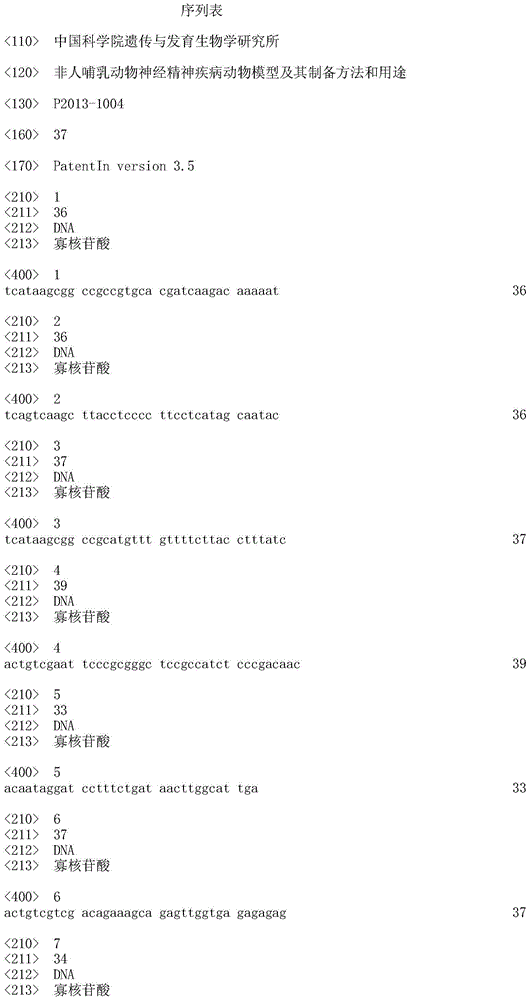


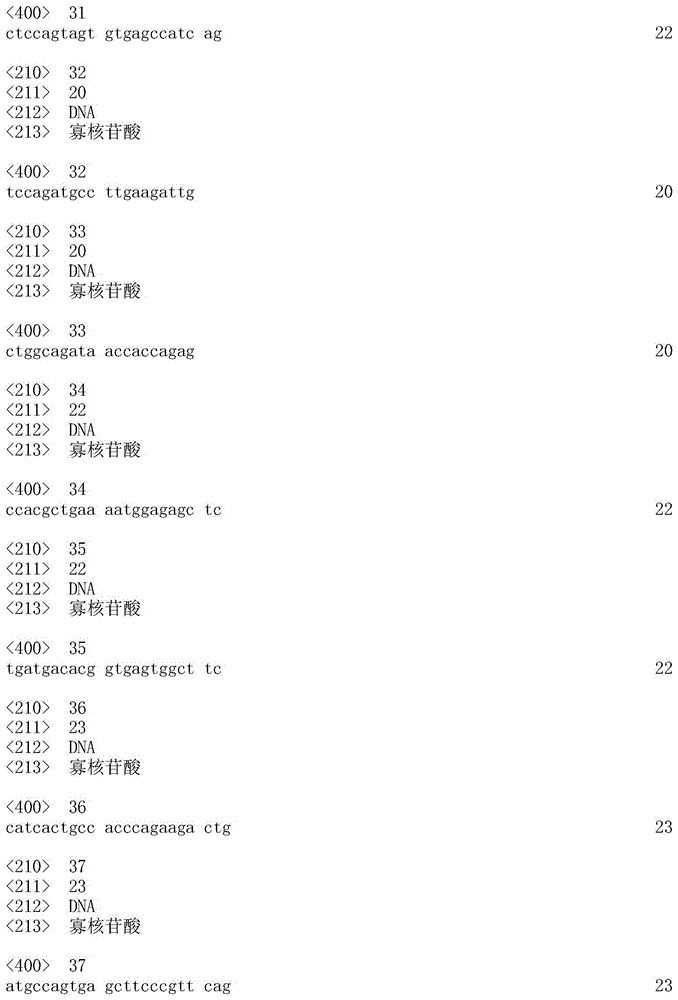
Claims (14)
Priority Applications (1)
| Application Number | Priority Date | Filing Date | Title |
|---|---|---|---|
| CN201310425687.9A CN104450602B (en) | 2013-09-17 | 2013-09-17 | Non-human mammalian neuropsychiatric disease animal model and preparation method and use thereof |
Applications Claiming Priority (1)
| Application Number | Priority Date | Filing Date | Title |
|---|---|---|---|
| CN201310425687.9A CN104450602B (en) | 2013-09-17 | 2013-09-17 | Non-human mammalian neuropsychiatric disease animal model and preparation method and use thereof |
Publications (2)
| Publication Number | Publication Date |
|---|---|
| CN104450602A CN104450602A (en) | 2015-03-25 |
| CN104450602B true CN104450602B (en) | 2020-08-07 |
Family
ID=52897361
Family Applications (1)
| Application Number | Title | Priority Date | Filing Date |
|---|---|---|---|
| CN201310425687.9A Expired - Fee Related CN104450602B (en) | 2013-09-17 | 2013-09-17 | Non-human mammalian neuropsychiatric disease animal model and preparation method and use thereof |
Country Status (1)
| Country | Link |
|---|---|
| CN (1) | CN104450602B (en) |
Families Citing this family (15)
| Publication number | Priority date | Publication date | Assignee | Title |
|---|---|---|---|---|
| CN105039400A (en) * | 2015-05-19 | 2015-11-11 | 上海大学 | Construction method and application of dcf1-knocked-out mouse model |
| CN105112448B (en) * | 2015-08-21 | 2020-06-26 | 同济大学 | Construction method and application of STCH gene knockout animal model |
| CN106139165B (en) * | 2016-08-23 | 2023-10-27 | 中国科学院上海药物研究所 | Method for establishing animal model of non-human mammal obesity or related diseases thereof and application thereof |
| CN107753957B (en) * | 2016-08-23 | 2022-01-18 | 中国科学院上海药物研究所 | Establishing method and application of non-human mammal animal model for apoplexy or relevant diseases thereof |
| CN107760713B (en) * | 2016-08-23 | 2020-05-05 | 中国科学院上海药物研究所 | Method for establishing animal model of neuropsychiatric disease of non-human mammal and application thereof |
| CN106344933B (en) * | 2016-08-23 | 2020-01-17 | 中国科学院上海药物研究所 | A method for establishing an animal model of non-human mammalian anxiety disorder or its related diseases and its use |
| CN106282123B (en) * | 2016-09-29 | 2020-04-17 | 中国科学院上海药物研究所 | Method for establishing non-human mammal cognitive disorder or animal model with related diseases and application thereof |
| CN109528197B (en) | 2018-11-20 | 2022-07-08 | 中国科学院脑科学与智能技术卓越创新中心 | Individual prediction method and system for mental diseases based on brain function map |
| CN111154809B (en) * | 2020-01-09 | 2020-11-27 | 电子科技大学附属医院·四川省人民医院 | Method for constructing glomerular disease model by using gene manipulation technology and application |
| CN111700034B (en) * | 2020-05-22 | 2021-12-14 | 中国人民解放军空军军医大学 | Construction method and application of schizophrenia animal model based on central nervous system myelin sheath function change |
| CN111667480A (en) * | 2020-06-11 | 2020-09-15 | 伯克利南京医学研究有限责任公司 | Multi-parameter fusion behavioral quantitative analysis system and method |
| CN111631190B (en) * | 2020-08-03 | 2021-01-29 | 江苏集萃药康生物科技有限公司 | Application of mouse model in evaluation of intelligence level |
| CN114128672B (en) * | 2021-11-21 | 2023-04-07 | 河南省儿童医院郑州儿童医院 | Construction method of autism rat model |
| CN115247211B (en) * | 2022-08-17 | 2023-05-09 | 山东省科学院生物研究所 | A screening method for mind-boosting drugs and application of pyridoside in mind-boosting |
| CN119498222B (en) * | 2024-10-31 | 2025-10-31 | 天津大学 | Devices and methods for free exploration of different spatial dimensions based on rich information |
Citations (1)
| Publication number | Priority date | Publication date | Assignee | Title |
|---|---|---|---|---|
| CN101874478A (en) * | 2009-04-28 | 2010-11-03 | 法玛智财科技顾问股份有限公司 | A mouse animal model linked to depression, schizophrenia, and Alzheimer's disease |
Family Cites Families (1)
| Publication number | Priority date | Publication date | Assignee | Title |
|---|---|---|---|---|
| CN101361984B (en) * | 2008-09-12 | 2010-08-11 | 清华大学 | Application of Dpys12 gene in preparation of drugs for inhibiting or promoting early neurogenesis |
-
2013
- 2013-09-17 CN CN201310425687.9A patent/CN104450602B/en not_active Expired - Fee Related
Patent Citations (1)
| Publication number | Priority date | Publication date | Assignee | Title |
|---|---|---|---|---|
| CN101874478A (en) * | 2009-04-28 | 2010-11-03 | 法玛智财科技顾问股份有限公司 | A mouse animal model linked to depression, schizophrenia, and Alzheimer's disease |
Non-Patent Citations (2)
| Title |
|---|
| Collapsin Response Mediator Protein-2: An Emerging Pathologic Feature and Therapeutic Target for Neurodisease Indications;Kenneth Hensley等;《Mol Neurobiol》;20110128;180-191 * |
| Conditional gene targeting in the mouse nervous system: Insights into brain function and diseases;Claire Gavériaux-Ruff等;《Pharmacology & Therapeutics》;20070110;619-634 * |
Also Published As
| Publication number | Publication date |
|---|---|
| CN104450602A (en) | 2015-03-25 |
Similar Documents
| Publication | Publication Date | Title |
|---|---|---|
| CN104450602B (en) | Non-human mammalian neuropsychiatric disease animal model and preparation method and use thereof | |
| Jaramillo et al. | Altered striatal synaptic function and abnormal behaviour in Shank3 exon4‐9 deletion mouse model of autism | |
| Sugo et al. | Neonatal lethality with abnormal neurogenesis in mice deficient in DNA polymerase β | |
| Dennis et al. | Mutations in Hedgehog acyltransferase (Hhat) perturb Hedgehog signaling, resulting in severe acrania-holoprosencephaly-agnathia craniofacial defects | |
| Chen et al. | Rescue of the genetically engineered Cul4b mutant mouse as a potential model for human X-linked mental retardation | |
| JP2022125255A (en) | lincRNA deficient non-human animal | |
| CN106282122B (en) | A method for establishing an animal model of non-human mammalian phobia or its related diseases and its use | |
| Inoue et al. | A mouse line expressing Sall1‐driven inducible Cre recombinase in the kidney mesenchyme | |
| CN106139165A (en) | A kind of method for building up of non-human mammal obesity or its relevant disease animal model and application thereof | |
| CN106344933A (en) | Establishment method and application of anxiety disorder or related disease animal model of non-human mammals | |
| CN111700034B (en) | Construction method and application of schizophrenia animal model based on central nervous system myelin sheath function change | |
| Hertveldt et al. | The development of several organs and appendages is impaired in mice lacking Sp6 | |
| Berthod et al. | Study Amyotrophic Lateral Sclerosis | |
| Cacioppo et al. | Generation and characterization of an endothelin‐2 iCre mouse | |
| CN106282123A (en) | A kind of method for building up of non-human mammal cognitive disorder or its relevant disease animal model and application thereof | |
| CN112111529A (en) | Neurodegenerative disease animal model and establishment and application thereof | |
| WO2019227882A1 (en) | Construction of mouse model with idiopathic basal ganglia calcification pathogenic gene mutation | |
| Bolt et al. | A distant downstream enhancer directs essential expression of Tbx18 in urogenital tissues | |
| KR100979438B1 (en) | Anxiety Disorder Therapeutic Effect Verification Models of PLβ4 Mutant Mice | |
| CN118421703B (en) | Method for constructing non-human mammal model with spontaneous emotion abnormal fluctuation and application thereof | |
| JP2015021853A (en) | Screening of medicine using psychiatric symptom model animal | |
| KR100517831B1 (en) | Double Transgenic Alzheimer's mice expressing mutant PS2 gene and APPsw gene | |
| Ran et al. | A mouse model of a novel missense mutation (Gly83Arg) in a Chinese kindred manifesting vitreous amyloidosis only | |
| KR100746585B1 (en) | Mice lacking alpha1G showing enhanced novelty-seeking and alcohol preference and therapeutic methods for mood disorders by modulating alpha1G T-type calcium channels | |
| US20080120731A1 (en) | Transgenic Animal Models for Neurodevelopmental Disorders |
Legal Events
| Date | Code | Title | Description |
|---|---|---|---|
| C06 | Publication | ||
| PB01 | Publication | ||
| C10 | Entry into substantive examination | ||
| SE01 | Entry into force of request for substantive examination | ||
| GR01 | Patent grant | ||
| GR01 | Patent grant | ||
| CF01 | Termination of patent right due to non-payment of annual fee | ||
| CF01 | Termination of patent right due to non-payment of annual fee |
Granted publication date: 20200807 |