CN1039283C - Application of porphyrin - Google Patents
Application of porphyrin Download PDFInfo
- Publication number
- CN1039283C CN1039283C CN90104921A CN90104921A CN1039283C CN 1039283 C CN1039283 C CN 1039283C CN 90104921 A CN90104921 A CN 90104921A CN 90104921 A CN90104921 A CN 90104921A CN 1039283 C CN1039283 C CN 1039283C
- Authority
- CN
- China
- Prior art keywords
- chemical compound
- protoporphyrin
- aryl
- cells
- tumor
- Prior art date
- Legal status (The legal status is an assumption and is not a legal conclusion. Google has not performed a legal analysis and makes no representation as to the accuracy of the status listed.)
- Expired - Fee Related
Links
Classifications
-
- A—HUMAN NECESSITIES
- A61—MEDICAL OR VETERINARY SCIENCE; HYGIENE
- A61K—PREPARATIONS FOR MEDICAL, DENTAL OR TOILETRY PURPOSES
- A61K31/00—Medicinal preparations containing organic active ingredients
- A61K31/33—Heterocyclic compounds
- A61K31/395—Heterocyclic compounds having nitrogen as a ring hetero atom, e.g. guanethidine or rifamycins
- A61K31/41—Heterocyclic compounds having nitrogen as a ring hetero atom, e.g. guanethidine or rifamycins having five-membered rings with two or more ring hetero atoms, at least one of which being nitrogen, e.g. tetrazole
-
- A—HUMAN NECESSITIES
- A61—MEDICAL OR VETERINARY SCIENCE; HYGIENE
- A61K—PREPARATIONS FOR MEDICAL, DENTAL OR TOILETRY PURPOSES
- A61K31/00—Medicinal preparations containing organic active ingredients
- A61K31/21—Esters, e.g. nitroglycerine, selenocyanates
- A61K31/215—Esters, e.g. nitroglycerine, selenocyanates of carboxylic acids
- A61K31/235—Esters, e.g. nitroglycerine, selenocyanates of carboxylic acids having an aromatic ring attached to a carboxyl group
- A61K31/24—Esters, e.g. nitroglycerine, selenocyanates of carboxylic acids having an aromatic ring attached to a carboxyl group having an amino or nitro group
-
- A—HUMAN NECESSITIES
- A61—MEDICAL OR VETERINARY SCIENCE; HYGIENE
- A61K—PREPARATIONS FOR MEDICAL, DENTAL OR TOILETRY PURPOSES
- A61K31/00—Medicinal preparations containing organic active ingredients
- A61K31/33—Heterocyclic compounds
- A61K31/395—Heterocyclic compounds having nitrogen as a ring hetero atom, e.g. guanethidine or rifamycins
- A61K31/40—Heterocyclic compounds having nitrogen as a ring hetero atom, e.g. guanethidine or rifamycins having five-membered rings with one nitrogen as the only ring hetero atom, e.g. sulpiride, succinimide, tolmetin, buflomedil
-
- A—HUMAN NECESSITIES
- A61—MEDICAL OR VETERINARY SCIENCE; HYGIENE
- A61K—PREPARATIONS FOR MEDICAL, DENTAL OR TOILETRY PURPOSES
- A61K31/00—Medicinal preparations containing organic active ingredients
- A61K31/33—Heterocyclic compounds
- A61K31/395—Heterocyclic compounds having nitrogen as a ring hetero atom, e.g. guanethidine or rifamycins
- A61K31/435—Heterocyclic compounds having nitrogen as a ring hetero atom, e.g. guanethidine or rifamycins having six-membered rings with one nitrogen as the only ring hetero atom
- A61K31/44—Non condensed pyridines; Hydrogenated derivatives thereof
-
- A—HUMAN NECESSITIES
- A61—MEDICAL OR VETERINARY SCIENCE; HYGIENE
- A61K—PREPARATIONS FOR MEDICAL, DENTAL OR TOILETRY PURPOSES
- A61K31/00—Medicinal preparations containing organic active ingredients
- A61K31/33—Heterocyclic compounds
- A61K31/395—Heterocyclic compounds having nitrogen as a ring hetero atom, e.g. guanethidine or rifamycins
- A61K31/495—Heterocyclic compounds having nitrogen as a ring hetero atom, e.g. guanethidine or rifamycins having six-membered rings with two or more nitrogen atoms as the only ring heteroatoms, e.g. piperazine or tetrazines
- A61K31/50—Pyridazines; Hydrogenated pyridazines
-
- A—HUMAN NECESSITIES
- A61—MEDICAL OR VETERINARY SCIENCE; HYGIENE
- A61K—PREPARATIONS FOR MEDICAL, DENTAL OR TOILETRY PURPOSES
- A61K31/00—Medicinal preparations containing organic active ingredients
- A61K31/33—Heterocyclic compounds
- A61K31/395—Heterocyclic compounds having nitrogen as a ring hetero atom, e.g. guanethidine or rifamycins
- A61K31/535—Heterocyclic compounds having nitrogen as a ring hetero atom, e.g. guanethidine or rifamycins having six-membered rings with at least one nitrogen and one oxygen as the ring hetero atoms, e.g. 1,2-oxazines
-
- Y—GENERAL TAGGING OF NEW TECHNOLOGICAL DEVELOPMENTS; GENERAL TAGGING OF CROSS-SECTIONAL TECHNOLOGIES SPANNING OVER SEVERAL SECTIONS OF THE IPC; TECHNICAL SUBJECTS COVERED BY FORMER USPC CROSS-REFERENCE ART COLLECTIONS [XRACs] AND DIGESTS
- Y10—TECHNICAL SUBJECTS COVERED BY FORMER USPC
- Y10S—TECHNICAL SUBJECTS COVERED BY FORMER USPC CROSS-REFERENCE ART COLLECTIONS [XRACs] AND DIGESTS
- Y10S436/00—Chemistry: analytical and immunological testing
- Y10S436/811—Test for named disease, body condition or organ function
- Y10S436/813—Cancer
Landscapes
- Health & Medical Sciences (AREA)
- Life Sciences & Earth Sciences (AREA)
- Chemical & Material Sciences (AREA)
- Medicinal Chemistry (AREA)
- Pharmacology & Pharmacy (AREA)
- Epidemiology (AREA)
- Animal Behavior & Ethology (AREA)
- General Health & Medical Sciences (AREA)
- Public Health (AREA)
- Veterinary Medicine (AREA)
- Emergency Medicine (AREA)
- Agricultural Chemicals And Associated Chemicals (AREA)
- Measuring Or Testing Involving Enzymes Or Micro-Organisms (AREA)
Abstract
本发明涉及一种化合物在制备光动力治疗或检查肿瘤中使用的药物组合物中的应用,该化合物在所述细胞中能抑制因原还原卟啉的酶催化转化为原卟啉IX而在所述细胞内产生原卟啉IX的积累。The present invention relates to the application of a compound in the preparation of a pharmaceutical composition used in photodynamic therapy or examination of tumors, the compound can inhibit the enzyme-catalyzed conversion of protoporphyrin into protoporphyrin IX in said cells. Intracellular accumulation of protoporphyrin IX is produced.
Description
本发明涉及一种化合物在制备光动力治疗或检查肿瘤中使用的药物组合物中的应用。The present invention relates to the application of a compound in the preparation of a pharmaceutical composition used in photodynamic therapy or tumor inspection.
众所周知,将血卟啉衍生物或由其衍生的卟啉混合物(如Photofrin II)用于哺乳动物肿瘤细胞,然后对这些细胞进行适当波长的光照,使细胞破坏。有一系列论文的主题涉及这种在光中发荧光的治疗方法,这些论文刊于光化学和光生物学(Photochemistry andphotobiogy)第46卷,5期,1987年11月(下文中以“P & P 46-5”表示)的特刊中。在这些论文中认为,这种在光中发荧光的治疗法已用于处理各种癌症(包括支气管、膀胱、食道、肺、皮肤、头和颈、脑、结肠和眼内以及妇科的癌症)。已经表明,这种卟啉光敏作用的生化效应包括膜蛋白的交联、脂类的过氧化作用、某些基本代谢物的输送的抑制作用、溶菌酶和线粒体膜的溶解、几种酶的失活作用,以及增高卟啉的细胞吸收(P&P 46-5第695页)。一般是使用注射引入卟啉物质(如静脉或腹膜内注射)。常用剂量为每公斤体重约2毫克Photofrin II。It is well known that hematoporphyrin derivatives or porphyrin mixtures derived therefrom (such as Photofrin II ® ) are applied to mammalian tumor cells, and then these cells are illuminated with appropriate wavelengths to destroy the cells. There is a series of papers on the subject of this light-fluorescing treatment, published in Photochemistry and Photobiology, Volume 46, Number 5, November 1987 (hereinafter referred to as "P & P 46- 5” in the special issue. In these papers it is argued that this light-fluorescing therapy has been used to treat a variety of cancers (including those of the bronchi, bladder, esophagus, lung, skin, head and neck, brain, colon, and intraocular, as well as gynecological) . Biochemical effects of this porphyrin photosensitization have been shown to include cross-linking of membrane proteins, lipid peroxidation, inhibition of transport of certain essential metabolites, dissolution of lysozyme and mitochondrial membranes, loss of several enzymes activity, and increased cellular uptake of porphyrins (P&P 46-5 p. 695). Typically, the porphyrin is introduced by injection (eg, intravenous or intraperitoneal). The usual dose is about 2 mg of Photofrin II per kilogram of body weight.
也可以将卟啉物质引入脂质体,而注射(例如腹膜内注射),例如在Spikes等人的“在模型细胞、组织和肿瘤系统中卟啉的在光中发荧光的行为”(在“Photodynamic Therapy of Tumors and other Dis-eases”,由G.Jori和C.A.Perria编辑,45-53页,Libreria Proget-to,Padua(1985))中,而且其中引入了参考文献。Porphyrin substances can also be introduced into liposomes and injected (e.g., intraperitoneally) as described, for example, in Spikes et al. Photodynamic Therapy of Tumors and other Dis-eases", edited by G. Jori and C.A. Perria, pp. 45-53, Libreria Proget-to, Padua (1985)), and references are incorporated therein.
专业文献指出,引入原卟啉于细胞中,如人体红细胞(Dubbel-man等人,Biochimica et Biophysica Acta,511(1978)141-151)或鼠白血病细胞(Kessel,Cancer Research 42,1703-1706,May1982),可以产生明显的光敏化效应。Kessel的文章指出,原卟啉是所测试的最有效的光敏化剂。但是当Kessel和其他人(如Beren-baum)等人,Br.J.Cancer(1982)45,571-581)将原卟啉注射入动物体中时,发现在肿瘤中没有可检出量的原卟啉,他们认为这样引入原卟啉于体内可能容易在循环系统中损失。Professional literature points out that the introduction of protoporphyrin into cells, such as human erythrocytes (Dubbelman et al., Biochimica et Biophysica Acta, 511 (1978) 141-151) or murine leukemia cells (Kessel, Cancer Research 42, 1703-1706, May1982), can produce obvious photosensitization effect. The Kessel article states that protoporphyrin was the most potent photosensitizer tested. But when Kessel and others (such as Beren-baum) et al., Br. J. Cancer (1982) 45, 571-581) injected protoporphyrin into animals, it was found that there was no detectable amount of protoporphyrin in the tumor. Protoporphyrin, they believe that such introduction of protoporphyrin in the body may be easily lost in the circulatory system.
将血卟啉衍生物和类似物质用于肿瘤的检测和定位,如膀胱或肺部癌症(P&P 46-5,759)中,也是熟知的。The use of hematoporphyrin derivatives and similar substances in the detection and localization of tumors, such as bladder or lung cancers (P&P 46-5, 759), is also well known.
本发明的一个目的是提供一种酶抑制剂,它可用来制备光动力治疗或检查肿瘤中使用的药物组合物。An object of the present invention is to provide an enzyme inhibitor which can be used to prepare a pharmaceutical composition used in photodynamic therapy or examination of tumors.
本发明的技术方案涉及一种在这种光中发荧光处理中所用于处理细胞或用于按已知方法检测或定位肿瘤的试剂,这种试剂不是卟啉,或者不单是卟啉。它包括一种酶抑制剂,该抑制剂在所说细胞中抑制原还原卟啉(protoporphyrinogen)的酶催化转化为血红素,从而在所述细胞中产生内生的原卟啉IX的积累。我们已查明,这种试剂,例如某种除草化合物类,它可以在植物细胞中抑制原还原卟啉的酶催化转化为叶绿素,也可以在哺乳动物细胞中抑制还原卟啉的酶催化转化为血红素。我们相信,通过这种试剂的抑制作用,能够影响由酶(原还原卟啉氧化酶,EC1,2,3,4)引起的原还原卟啉的酶转化为原卟啉IX的步骤,这样就能使原还原卟啉不能按正常的酶催化途径转变成原卟啉IX,而是在细胞中(如在血浆中)被氧化,但不按正常酶催化的途径(如在类脂质膜之外),其结果是在不易获得正常转化成血红素的位置积累了原卟啉IX。因此,当细胞受到光照时,这种积累的原卟啉IX具有上文所述的在光中发荧光处理中所显示的破坏细胞的效应。The technical solution of the present invention relates to a reagent which is not a porphyrin, or not only a porphyrin, for the treatment of cells or for the detection or localization of tumors according to known methods in such photofluorescence treatment. It includes an enzyme inhibitor that inhibits the enzymatic conversion of protoporphyrinogen to heme in said cells, thereby producing an accumulation of endogenous protoporphyrin IX in said cells. We have found that such agents, such as certain herbicidal compounds, can inhibit the enzymatic conversion of protoporphyrin to chlorophyll in plant cells, and can also inhibit the enzymatic conversion of protoporphyrin to chlorophyll in mammalian cells. heme. We believe that, by inhibition of this agent, the step of the enzymatic conversion of protoporphyrin to protoporphyrin IX by the enzyme (protoporphyrin oxidase, EC1, 2, 3, 4) can be affected, such that Protoporphyrin can not be converted into protoporphyrin IX by normal enzyme-catalyzed pathway, but is oxidized in cells (such as in blood plasma), but not by normal enzyme-catalyzed pathway (such as between lipid-like membranes) outside), with the result that protoporphyrin IX accumulates at positions where normal conversion to heme is not readily available. Thus, when the cells are exposed to light, this accumulated protoporphyrin IX has the cell-damaging effect shown above in the photofluorescence treatment described above.
本发明的酶抑制剂,在某种意义上来说,是原还原卟啉的酶催化转化为血红素的特异抑制剂,它们不产生通常的酶中毒,例如改性剂或交联剂(如硫氢基试剂),最好它们不是那些影响氧化条件(如电子受体)的物质。因此本发明优选的试剂的氧化还原电位势要更负于约-500mV,如更负于-8.00mV(例如按传统方法,采用循环伏安测量法或极谱法在试剂的非质子传递溶剂中进行测量)。最好该试剂不是四吡咯,而且对原还原卟啉氧化酶的I50要低于10μm(而pI50大于约5),更好的是低于约1μm(而pI 50要大于约6),例如低于约0.3μ m,如I50约为0.1或0.03或0.01 μm或更低。The enzyme inhibitors of the present invention are, in a sense, specific inhibitors of the enzyme-catalyzed conversion of protoporphyrin into heme, and they do not produce the usual enzyme poisoning, such as modifiers or cross-linking agents (such as sulfur Hydrogen-based reagents), preferably they are not those that affect the oxidation conditions (such as electron acceptors). Accordingly, the redox potential of the preferred reagents of the present invention is more negative than about -500 mV, such as more negative than -8.00 mV (for example, by conventional methods, using cyclic voltammetry or polarography in the aprotic solvent of the reagent. to measure). Preferably the reagent is not a tetrapyrrole and has an I50 for protoporphyrin oxidase of less than 10 μm (with a pI50 greater than about 5), more preferably less than about 1 μm (with a pI50 greater than about 6), For example below about 0.3 μm, such as I50 of about 0.1 or 0.03 or 0.01 μm or lower.
优选的酶抑制剂具有高的破坏植物质膜的能力,测试该能力的-种方法是流失实验(Efflux Experiment)描述于Halling和Peters的文章(Plant Physiology,84,1114-5(1987))中。在这种测试(详细描述见下文附录A)中,优选的试剂,在处理率为100μm,最好在处理率1μm或更少,如100nM时,其总流失量至少为50%,高的活性物质,如1-(4-氯-2-氟-5-炔丙基氧苯基)-3-甲基-4-二氟甲基-Δ2-1,2,4-三唑啉-5-酮或乳吩(lactophen)(下文有描述),在100nM浓度下,其总流失百分数超过90%。Preferred enzyme inhibitors have a high ability to disrupt plant plasma membranes, one method of testing this ability is the Efflux Experiment described in the article by Halling and Peters (Plant Physiology, 84, 1114-5 (1987)) . In this test (see Appendix A below for a detailed description), preferred reagents exhibit a total bleed of at least 50% at a treatment rate of 100 μm, preferably at a treatment rate of 1 μm or less, such as 100 nM, with high activity Substances such as 1-(4-chloro-2-fluoro-5-propargyloxyphenyl)-3-methyl-4-difluoromethyl- Δ2-1,2,4 -triazoline-5 - Ketones or lactophens (described below) for which the percent total loss exceeds 90% at a concentration of 100 nM.
另一种测试物质破坏植物质膜能力的方法是光感应变绿抑制试验(Light-Induced Greening Inhibition Test),它详述于下面附录B中。该测试法是测量抑制暗脱色的马舌蝶衣藻(Chlamydomonas reinbardi)突变株Y-1(一种藻类,在黑暗中生长时不产生叶绿素,所以该藻由于存在新的非绿色细胞而成为脱色,但在光照后,重新产生叶绿素)的光-变绿的能力。许多用于本发明的优选化合物(试剂),当所用化合物浓度为10-5M,优选的10-6M或更低(如10-7M)时,具有的抑制光-变绿能力至少50%。但是,在水中电离的化合物,如化合物6C(见下文实施例6),其中运行的离子带负电荷,在本试验中就没有很好反应,显然藻细胞阻止酸性基团进入。另外,有许多优选的化合物,在光-变绿抑制试验中使用所述浓度时,其上清液在约405 nm处的光吸收峰大于叶绿素峰(在约668 nm处),例如,上清液在405nm处的峰高是668nm峰高度的2,3或4倍。Another method for testing the ability of a substance to disrupt plant plasma membranes is the Light-Induced Greening Inhibition Test, which is detailed in Appendix B below. The test measures inhibition of dark depigmented Chlamydomonas reinbardi mutant Y-1 (an algae that does not produce chlorophyll when grown in the dark, so the algae becomes depigmented due to the presence of new non-green cells). , but after light, regenerate chlorophyll) light-greening ability. Many of the preferred compounds (reagents) used in the present invention have an inhibitory photo-greening ability of at least 50 %. However, compounds that ionize in water, such as compound 6C (see Example 6 below), where the operating ions are negatively charged, did not respond well in this assay, apparently the algal cells prevent the entry of acidic groups. In addition, there are many preferred compounds whose supernatants have a light absorption peak at about 405 nm that is greater than the chlorophyll peak (at about 668 nm) at the concentrations used in the photo-greening inhibition assay, e.g., supernatant The peak height at 405nm is 2, 3 or 4 times the peak height at 668nm.
可用于本发明实施的酶抑制剂中有下列A至G类除草化合物:Among the enzyme inhibitors that can be used in the practice of the present invention are the following herbicidal compounds from classes A to G:
A通式为A general formula is
Ph-NHet的芳基杂环除草剂,其中“Ph”是取代的苯基,优选的为2,4-二取代的苯基,更优选的是2,4,5-三取代的苯基,NHet是-个5或6节杂环,并具有1~4个环氮原子,其通式为
化合物I是芳基恶二唑除草剂,即2-叔丁基-4-(2,4-二氯-5-异丙基氧苯基)-Δ2-1,3,4-恶二唑啉-5-酮。其它可用于本发明的2-烷基-4-(2,4,5-三取代苯基)-Δ2-1,3,4-恶二唑啉-5-酮类已公开于,如美国专利3385862;3836539;和3876413中。Compound I is an aryl oxadiazole herbicide, namely 2-tert-butyl-4-(2,4-dichloro-5-isopropyloxyphenyl) -Δ2-1,3,4 -oxadiazole Lin-5-one. Other 2-alkyl-4-(2,4,5-trisubstituted phenyl)-Δ 2 -1,3,4-oxadiazolin-5-ones useful in the present invention have been disclosed in, for example, U.S. Patents 3,385,862; 3,836,539; and 3,876,413.
化合物II是芳基四氢吲唑除草剂,即3-氯-2-(4-氯-2-氟-5-异丙基氧苯基)-4,5,6,7-四氢-2H-吲唑。其它可用于本发明的3-取代-2-(2,4,5-三取代苯)四氢吲唑类已公开于,如美国专利4670043中。Compound II is an aryltetrahydroindazole herbicide, namely 3-chloro-2-(4-chloro-2-fluoro-5-isopropyloxyphenyl)-4,5,6,7-tetrahydro-2H - Indazole. Other 3-substituted-2-(2,4,5-trisubstituted phenyl)tetrahydroindazoles useful in the present invention are disclosed, for example, in US Patent 4,670,043.
化合物III、IV和V是芳基四氢酞亚胺除草剂。其它可用于本发明的芳基四氢酞亚胺类已公开于,如美国专利4431822;4670046;4670042和4439229以及公开的国际申请(PCT)WO 87/07602中。后两篇文献还公开了其它可用于本发明的NHet环,如在US 4439229第4栏第25行至第5栏第20行,以及WO 87/07602中第12至14页中,对这种环进行了说明。Compounds III, IV and V are aryl tetrahydrophthalimide herbicides. Other aryltetrahydrophthalimides useful in the present invention are disclosed, for example, in US Patent Nos. 4,431,822; 4,670,046; 4,670,042 and 4,439,229 and published International Application (PCT) WO 87/07602. The latter two documents also disclose other NHet rings that can be used in the present invention, such as in US 4439229, column 4, line 25 to column 5, line 20, and WO 87/07602, pages 12 to 14, for this The ring is described.
其它合适的PH-NHet型除草剂有:Other suitable herbicides of the PH-NHet type are:
芳基三唑啉酮类,如在美国专利 4318731;4398943;4404019;4702945;4705557;4702763;4761174;和国际申请(PCT)WO85/01637,WO 85/04307,WO 87/00730,WO 87/03782,WO 86/04481和WO 88/01133中所公开的化合物;Aryltriazolinones, such as in U.S. Patents 4318731; 4398943; 4404019; 4702945; 4705557; 4702763; 4761174; , compounds disclosed in WO 86/04481 and WO 88/01133;
芳基四唑啉酮类,如在美国专利 47734124和国际申请(PCT)WO 85/01939和WO 87/03873中所公开的化合物;Aryl tetrazolinones, such as those disclosed in U.S. Patent 47734124 and International Applications (PCT) WO 85/01939 and WO 87/03873;
芳基三嗪二酮类,如在美国专利 4755217和4766233以及国际申请(PCT)WO 86/00072中所公开的化合物;Aryltriazinediones, such as those disclosed in U.S. Patents 4,755,217 and 4,766,233 and International Application (PCT) WO 86/00072;
芳基乙内酰脲类,如在美国专利 4427438中所公开的化合物;Arylhydantoins, such as those disclosed in U.S. Patent 4,427,438;
芳基咪唑嘧啶类,如在西德专利DT 2604989(德温特文摘登记号 65326X)日本公开特许J 60-158147A(德温特文摘登记号85-240363)和欧洲公开专利申请Ep 230874(德温特文摘登记号87-215141)中所公开的化合物;Arylimidazole pyrimidines, such as in West German Patent DT 2604989 (Derwent Abstract Registration No. 65326X) Japanese Open Patent J 60-158147A (Derwent Abstract Registration No. 85-240363) and European Published Patent Application Ep 230874 (Derwent Abstract Registration No. 65326X) Compounds disclosed in Special Abstract Registration No. 87-215141);
芳基吡啶二嗪类,如下面实施例8的化合物8X类型的化合物;Arylpyridinediazines, such as compounds of type 8X in Example 8 below;
芳基二嗪二酮类如下面实施例8的化合物8e和8v类型的化合物;Aryldiazinediones such as compounds of the type 8e and 8v of Example 8 below;
芳基匹拉二嗪酮(aryl pyradiazinones)类,如下面实施例8的化合物8f的化合物;Aryl pyradiazinones (aryl pyrdiazinones), such as the compound of compound 8f of Example 8 below;
芳基恶二唑啉酮类,如在日本公开特许J59-148769(德温特文摘登记号84-246947)或日本公开特许J62-161772(德温特文摘登记号87-238787)中所公开的化合物;Aryloxadiazolinones as disclosed in Japanese Laid-Open Patent J59-148769 (Derwent Abstract Registration No. 84-246947) or Japanese Laid-Open Patent J62-161772 (Derwent Abstract Registration No. 87-238787) compound;
芳基恶二嗪酮类,如下面实施例8的8 k和8 m的化合物类的化合物;Aryl oxadiazinones, such as the compounds of the 8 k and 8 m compounds of Example 8 below;
芳基苯甲酰胺哒唑(aryl benzamidazolos)类,如下面实施例8的8ad化合物类的化合物;Aryl benzamide pyridazoles (aryl benzamidazoles), such as the compounds of the 8ad compound class of the following embodiment 8;
芳基亚氨三唑并哒嗪类,如在美国专利4913723;4906281和4906279中所公开的化合物;Aryliminotriazolopyridazines, such as those disclosed in US Patent Nos. 4,913,723; 4,906,281 and 4,906,279;
芳基噻唑,如下面实施例8的化合物8L、8r和8ah类的化合物;Arylthiazoles, such as compounds 8L, 8r and 8ah of Example 8 below;
芳基吡咯类,如在欧洲公开专利申请EP255601(德温特文摘登记号88-037583)和EP 260288(德温特文摘登记号88-127433)中所公开的化合物;Arylpyrroles such as the compounds disclosed in European Published Patent Applications EP255601 (Derwent Abstract Accession No. 88-037583) and EP 260288 (Derwent Abstract Accession No. 88-127433);
芳基尿唑类,如在美国专利4452981中所公开的化合物;Arylureazoles, such as those disclosed in US Patent 4,452,981;
芳基六氧哒唑类,如在美国专利4619687中所公开的化合物;Arylhexaoxypyridazoles, such as those disclosed in US Pat. No. 4,619,687;
B.芳基杂环尿烷类,如在美国专利4521242中所公开的化合物。B. Arylheterocyclic urethanes such as those disclosed in US Patent 4,521,242.
C.芳基杂环脲类,如在日本公开特许J58-225081(德温特文摘登号84-034261)中所公开的化合物。C. Arylheterocyclic ureas such as those disclosed in Japanese Laid-Open Patent J58-225081 (Derwent Abstract Accession No. 84-034261).
D.芳基酰胺类,如下面实施例8的化合物8aj和8ak类的化合物。D. Aryl amides, such as compounds 8aj and 8ak of Example 8 below.
E.苯醚除草剂类,如具有对一卤素成对一硝基的苯氧基苯结构的那些化合物,如下列可商购的物质:5-(2-氯-4-(三氟甲 甲基5-(2,4-二氯苯氧基)苯氧基)-2-硝基-N、 基)-2-硝基苯甲酸甲酯-甲磺酰苯甲酰胺(fomagafen) (bifenox)


其它合适的可商购的二苯醚除草剂是:Other suitable commercially available diphenyl ether herbicides are:
乳吩(lactophen):1-(乙氧羰基)乙基5-(2-氯-4-三氟甲基苯氧基)-2-硝基苯甲酸酯,Lactophen: 1-(ethoxycarbonyl)ethyl 5-(2-chloro-4-trifluoromethylphenoxy)-2-nitrobenzoate,
氟糖吩(fluoroglycofen):(乙氧羰基)甲基5-(2-氯-4-三氟甲基苯氧基)-2-硝基苯甲酸酯,Fluoroglycofen (fluoroglycofen): (ethoxycarbonyl) methyl 5-(2-chloro-4-trifluoromethylphenoxy)-2-nitrobenzoate,
氯硝吩(chloronitrofen):2,4,6-三氯-(4-硝基苯氧基)-苯,Chloronitrofen: 2,4,6-trichloro-(4-nitrophenoxy)-benzene,
氟二吩(fluorodifen):2-硝基-1-(4-硝基苯氧基)-4-三氟甲基苯,Fluorodiphene (fluorodifen): 2-nitro-1-(4-nitrophenoxy)-4-trifluoromethylbenzene,
硝吩(nitrofen):2.4-二氯-1-(4-硝基苯氧基)苯,Nitrofen: 2.4-dichloro-1-(4-nitrophenoxy)benzene,
氯甲氧吩(chlomethoxyfen):4-(2,4-二氯苯氧基)-2-甲氧基-1-硝基苯。Chlomethoxyfen: 4-(2,4-dichlorophenoxy)-2-methoxy-1-nitrobenzene.
另外合适的二苯醚除草剂还有甲基5-2-氯-4-三氟甲基苯氧基)-2-硝基乙酰苯酮肟-O-乙酸酯。Another suitable diphenyl ether herbicide is also methyl 5-2-chloro-4-trifluoromethylphenoxy)-2-nitroacetophenone oxime-O-acetate.
F.芳基吡唑除草剂类,如在美国专利4563210;4496390和4459150和德国公开专利3520327A1中所公开的化合物。F. Arylpyrazole herbicides such as those disclosed in US Patents 4,563,210; 4,496,390 and 4,459,150 and German Laid Open Patent 3,520,327A1.
G.以下通式的化合物:其中Xb是O或S,“Ph”具有上述的含义,如在欧洲公开专利申请EP 273417或德温德文摘登记号87-040749中所公开的化合物。G. Compounds of the general formula: wherein Xb is O or S, "Ph" has the above meaning, as disclosed in European Published Patent Application EP 273417 or Derwende Abstract Accession No. 87-040749.
有些酶抑制除草剂在Matringe等人(FEBS Letters,Vol 245,No 1,2,35~38页(1989))和Yonase等人(Pesticide Biochemistry andPhysiology,Vol 35,70~80页(1989)的文章中已有公开。Some enzyme-inhibiting herbicides are described in articles by Matringe et al. (FEBS Letters, Vol 245, No 1, 2, pages 35-38 (1989)) and Yonase et al. has been made public.
用本发明试剂的处理,可以通过静脉或腹膜内注射来实施。该试剂可以用作消毒组合物,包括溶解或分散在药物上允许的载体,如水相的等渗压溶液,如盐水(如0.9%NaCl)或Dulbecco的磷酸盐缓冲盐水(PBS),(如浓度约为2.5 mg ml-1)中的试剂,或者包括在脂质体(liposomal)系统中的试剂,如按照Remington′s Pharmaceutical Sciences,1985(17版)1659-1660页(Mack PublishingCompany出版)中所述方法,以磷脂质泡(vesicle)制备的。例如,与Jori等人(Br.J.Cancer(1983).48,307页)所述制剂相类似的方法,将51.4 mg二棕榈酰基二磷脂酰基胆碱溶于10 ml 1mM试剂的氯仿-甲醇(9∶1 v/v)的溶液中,完全混合后,在30℃真空下除去溶剂,得到一种固体,可以将固体重新悬浮在10 ml PH 7.4,含有150 mM NaCl的0.01 M磷酸盐缓冲液中,然后在50℃对混浊的溶液进行声波处理(sonicate)30分钟。Treatment with the agents of the invention can be carried out by intravenous or intraperitoneal injection. The agent can be used as a sanitizing composition comprising dissolved or dispersed in a pharmaceutically acceptable carrier, such as an isotonic solution of an aqueous phase, such as saline (such as 0.9% NaCl) or Dulbecco's phosphate-buffered saline (PBS), (such as concentration About 2.5 mg ml -1 ), or a reagent included in a liposomal system, as described in Remington's Pharmaceutical Sciences, 1985 (17 edition) pp. 1659-1660 (published by Mack Publishing Company) Said method, prepared with phospholipid vesicles (vesicle). For example, 51.4 mg of dipalmitoyldiphosphatidylcholine was dissolved in 10 ml of 1 mM reagent in chloroform-methanol in a manner similar to the formulation described by Jori et al. (Br. J. Cancer (1983). 48, p. 307). (9:1 v/v), after mixing thoroughly, the solvent was removed under vacuum at 30°C to obtain a solid that could be resuspended in 10 ml of 0.01 M phosphate buffer, pH 7.4, containing 150 mM NaCl The cloudy solution was then sonicated at 50°C for 30 minutes.
可用于本发明实施的酶抑制剂可以相互结合或使用现有技术的连接子技术结合到适当的肿瘤特异单克隆抗体(MABs)上,以便引导酶抑制剂到具体的肿瘤位置。Enzyme inhibitors useful in the practice of the present invention can be conjugated to each other or to appropriate tumor-specific monoclonal antibodies (MABs) using prior art linker technology in order to direct the enzyme inhibitor to a specific tumor location.
用于本发明的酶抑制剂也可以通过简单的口服引入而使用,最好是用药物上允许的载体稀释后的形式,如下文实施例6所述的,将它们加到食物中。The enzyme inhibitors used in the present invention may also be administered by simple oral introduction, preferably in diluted form with a pharmaceutically acceptable carrier, by adding them to food as described in Example 6 below.
尤其对于口服,要求所使用的酶抑制剂最好是水溶性盐或是酸性的并形成水溶性钠或钾盐,如国际专利申请(PCT)WO 87/03782(如下文实施例6的试剂6c)或WO 85/001939和WO 87/037873中所述的酸性磺胺类或其水溶性盐,或者羧酸或其水溶性盐,如称为酸氟吩(acifluorfen)的钠盐。Especially for oral administration, it is required that the enzyme inhibitors used are preferably water-soluble salts or acidic and form water-soluble sodium or potassium salts, such as International Patent Application (PCT) WO 87/03782 (as the reagent 6c of the following embodiment 6 ) or acidic sulfonamides or water-soluble salts thereof described in WO 85/001939 and WO 87/037873, or carboxylic acids or water-soluble salts thereof, such as the sodium salt known as acifluorfen (acifluorfen).
本发明所使用的酶抑制剂可以加入到常用的药物制剂中,如片剂(如,可用糖膏和/或糖浆包衣的压片)、栓剂、胶囊(如硬明胶胶囊)、悬浮液、溶液、粉末或安瓿。在这些制剂中,试剂可以是和药物上允许的固体和/或液体载体混合的形式,如果需要,这些载体可以是营养素,例如它可以是如玉米淀粉的固体或是液体稀释剂,如水或食用油或矿物油或如二甲基亚砜的溶剂。也可以使用酶抑制剂的混合物,例如,下面实施例6的试剂6c和酸氟吩,如按约等比例的混合物,所用剂量可以按现有技术中熟知的常规实验测定,如对Photofrin II类的试验,描述于Dougherty的“Photody-namic Theropy(PDT)of Malignant Tumors”(CRC Critical Reviews in Oncology/Hematology vol 2,issue2(1984)83~116页)的文章中。The enzyme inhibitors used in the present invention can be added to commonly used pharmaceutical preparations, such as tablets (such as compressed tablets that can be coated with massecuite and/or syrup), suppositories, capsules (such as hard gelatin capsules), suspensions, solution, powder or ampoule. In these formulations, the agent may be in the form of admixture with pharmaceutically acceptable solid and/or liquid carriers, which may be nutrients if desired, for example it may be a solid such as cornstarch or a liquid diluent such as water or edible Oil or mineral oil or solvents such as dimethylsulfoxide. It is also possible to use a mixture of enzyme inhibitors, for example, the reagent 6c and acid fluorophene in the following example 6, such as a mixture in approximately equal proportions, and the dosage used can be determined by routine experiments well known in the prior art, such as for Photofrin class II The test described in Dougherty's "Photody-namic Theropy (PDT) of Malignant Tumors" (CRC Critical Reviews in Oncology/Hematology vol 2, issue 2 (1984) pp. 83-116).
试剂可以和一些已知能够提高抗癌药物的抗癌细胞敏感性的药物(如戊脉安、环孢菌素、或奎宁)相结合而施用。The agent may be administered in combination with drugs known to increase anticancer drug sensitivity to cancer cells (eg, verapamil, cyclosporine, or quinine).
列出下面实施例以进一步说明本发明。The following examples are set forth to further illustrate the invention.
实施例1Example 1
将在对数生长期(在1升Falcon组织培养瓶中,在37℃保温5天)的海拉(Hela)细胞(一种常用于肿瘤研究的人类肿瘤细胞系,并从美国典型培养物保藏中心得到)在磷酸盐缓冲盐水(PBS)中洗涤。加入0.25%胰蛋白酶的PBS溶液2 ml,几分钟后,轻轻地将细胞从瓶中移出,并放入110ml在最小基本培养基(MEM)中的25 mM Hepes的溶液中,该最小基本培养基中添加有10%v/v的非活性小牛血清、1.1ml 200 mM谷酰胺的0.85%盐水溶液,以及11000单位青霉素/11000mcg链霉素。HeLa cells (a human tumor cell line commonly used in tumor research and obtained from the American Type Culture Collection) in logarithmic phase (incubated at 37°C for 5 days in 1-liter Falcon tissue culture flasks) center) were washed in phosphate-buffered saline (PBS). Add 2 ml of 0.25% trypsin in PBS, and after a few minutes, gently remove the cells from the flask and place in 110 ml of a solution of 25 mM Hepes in minimal essential medium (MEM), which The base was supplemented with 10% v/v inactivated calf serum, 1.1 ml 200 mM glutamine in 0.85% saline solution, and 11000 units penicillin/11000 mcg streptomycin.
将所得的再悬浮的细胞培养物的5ml等分溶液分别装入50mlFalcon组织培养瓶中,并且(除了用于对照外)与处理剂混合。然后将等分液在黑暗中,37℃下保温三天。随后将细胞移出,并按下述方法在绿光下进行萃取:5 ml aliquots of the resulting resuspended cell culture were filled into 50 ml Falcon tissue culture flasks and (except for controls) mixed with treatment agents. Aliquots were then incubated in the dark at 37°C for three days. Cells were then removed and extracted under green light as follows:
通过加入0.8ml 0.25%胰蛋白酶的PBS溶液,将细胞从瓶底移出。在黑暗中培养1小时后,将细胞和介质从瓶中移出,装入园底离心管,然后经过两次冷冻-解冻循环条件,以破裂细胞并进行萃取。Cells were removed from the bottom of the flask by adding 0.8 ml of 0.25% trypsin in PBS. After 1 hour of incubation in the dark, the cells and media were removed from the vials, loaded into round bottom centrifuge tubes, and subjected to two freeze-thaw cycle conditions to disrupt the cells and allow extraction.
在这破裂操作以后,检测细胞悬浮液,没有发现有完整的细胞。然后在各试管中分别加入10ml碱性丙酮(90%丙酮:10%1N NH4OH),离心试管以除去蛋白质和细胞碎片。在上清液中加入0.5ml饱和NaCl水溶液后,再加入5ml水。然后滴加2MKH2PO4以将PH值调到6.8。将含水丙酮提取物装到C8 Baker Prep柱。在柱流干后用2ml水洗涤。用2×1.5ml体积的CH3OH/H2O(90/10)洗脱四吡咯。用分光荧光计定量测定提取物。After this disruption procedure, the cell suspension was examined and no intact cells were found. 10 ml of basic acetone (90% acetone: 10% 1N NH4OH ) was then added to each tube, and the tubes were centrifuged to remove protein and cell debris. After adding 0.5 ml of saturated NaCl aqueous solution to the supernatant, 5 ml of water was added. Then 2M KH 2 PO 4 was added dropwise to adjust the pH to 6.8. The aqueous acetone extract was loaded onto a C8 Baker Prep column. After the column was drained dry it was washed with 2 ml of water. The tetrapyrrole was eluted with CH3OH / H2O (90/10) in a volume of 2 x 1.5 ml. Extracts were quantified using a spectrofluorometer.
在本实验中所用的处理剂是:The treatments used in this experiment were:
A.5-氨基乙酰丙酸,已知它是四吡咯的前体。A. 5-Aminolevulinic acid, which is known as a precursor of tetrapyrroles.
B.具有以下结构式的酸氟吩-甲基 B. Acid fluorophene-methyl having the formula
C.具有以下结构式的除草剂: C. Herbicides having the following structural formula:
D.具有以下结构式的除草剂:
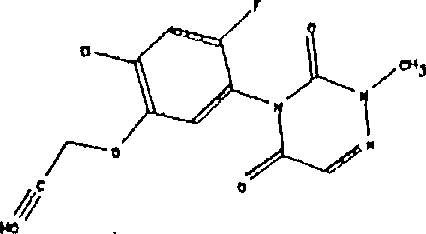
E.具有以下结构式的除草剂: E. Herbicides having the following structural formula:
将试剂A配制成250mM.P且6.5的菌过滤水溶液。将试剂B、C、D和E配制成50mM的丙酮溶液。在对照例中也加入丙酮,使其浓度为0.2%v/v。加到细胞培养物中的试剂量按表1所列的浓度。所产生的四吡咯原卟啉IX(“Proto IX”)的量示于表1。Reagent A was prepared as 250mM.P and 6.5 bacterial filtration aqueous solution. Reagents B, C, D, and E were prepared as 50 mM solutions in acetone. Acetone was also added to the control so that the concentration was 0.2% v/v. The amounts of reagents added to the cell cultures were at the concentrations listed in Table 1. The amount of tetrapyrrole protoporphyrin IX ("Proto IX") produced is shown in Table 1.
表 1 Table 1
在处理过的海拉细胞中的四吡咯积累试剂 试剂浓度 荧光发射 Proto IX含量Tetrapyrrole Accumulation Reagent Reagent Concentration Fluorescence Emission Proto IX Content in Treated HeLa Cells
(μ m) CPS 400/630 (Pmoles)A 5000 41842 4.2B 100 12921 1.3C 100 33477 3.5D 100 10551 1.1E 100 8967 0.9对照 - 2795 0.3(ΜM) CPS 400/630 (PMOLES) A 5000 41842 4.2B 100 12921 1.3C 100 33477 3.5D 100551 1.1E 100 8967 0.9 Comparison-2795 0.3
实施例2Example 2
将在对数生长期(在六个1升Falcon组织培养瓶中,在37℃保温6天)的海拉细胞在磷酸盐缓冲盐水(PBS)中洗涤。加入0.25%胰蛋白酶的PBS溶液,几分钟后,慢慢地将细胞移出,并装入110ml在最小基本培养基(MEM)中的25mM Hepes溶液中,该最小基本培养基中添加有10%v/v非活性小牛血清、1.1ml 200mM谷酰胺的0.85%盐水溶液,11000单位青霉素/11000mcg链霉素。HeLa cells in logarithmic phase (incubated for 6 days at 37° C. in six 1 liter Falcon tissue culture flasks) were washed in phosphate buffered saline (PBS). 0.25% trypsin in PBS was added and after a few minutes, the cells were slowly removed and loaded into 110 ml of 25 mM Hepes solution in minimal essential medium (MEM) supplemented with 10% v /v inactive calf serum, 1.1 ml 200 mM glutamine in 0.85% saline solution, 11000 units penicillin/11000 mcg streptomycin.
将再悬浮的细胞培养物的等分液(每个5ml)分别装入50mlFalcon组织培养瓶中,瓶中加入或不加入除草剂,并在黑暗中,37℃时,培养4天,除草剂按实施例1中的丙酮稀释溶液形式加入。在对照例中也加入丙酮,使其丙酮浓度为0.2%v/v。除草剂加入量按下面表2所指定的浓度。处理剂是:B.如例1C.如例1F.结构式如下的除草剂: The aliquots (5ml each) of the resuspended cell culture were respectively packed into 50ml Falcon tissue culture flasks with or without herbicides added, and cultured for 4 days at 37°C in the dark. The acetone dilute solution in Example 1 was added. Acetone was also added in the control example so that the acetone concentration was 0.2% v/v. The herbicides were added at the concentrations specified in Table 2 below. The treatment agent is: B. as in example 1C. as in example 1F. the herbicide whose structural formula is as follows:
萃取:将各瓶中的培养基装入玻璃圆底管中,通过加入0.5ml0.25%胰蛋白酶的PBS溶液,将粘附在瓶底的细胞打松,然后在37℃保持几分钟后,将其从瓶中洗下并与其培养基合并。然后从各细胞悬浮液中取出100μl等分液以测定细胞密度。接着对剩下的5.4ml细胞悬浮液进行声波处理以破裂细胞。Extraction: Put the medium in each bottle into a glass round-bottom tube, loosen the cells adhered to the bottom of the bottle by adding 0.5ml of 0.25% trypsin in PBS solution, and then keep it at 37°C for several minutes, It was washed from the bottle and combined with its medium. A 100 [mu]l aliquot was then taken from each cell suspension to determine cell density. The remaining 5.4ml of cell suspension was then sonicated to disrupt the cells.
然后在各管中分别加入10ml碱性丙酮(90%丙酮:10%1N NH4OH),离心试管以除去蛋白质和细胞碎片。在上清液中加入0.5ml饱和NaCl水溶液后,再加入5ml水。滴加2MKH2PO4,使PH调到6.8。将含水丙酮提取物加在C8Backer Prep柱上。柱流干后,用2ml水淋洗。用3ml90/10的CH3OH/H2O洗脱四吡咯。和实施例1相同,所有这些提取步骤基本上完全在非原卟啉IX激活的光(如绿光)下或在黑暗(如在不透光的有盖容器中)条件下进行。在SPEX分光荧光计上测定提取物的荧光。使用预定的消光系数定量原卟啉IX(“Proto IX”)的累积量。结果示于表2。Then 10 ml of basic acetone (90% acetone: 10% 1N NH4OH ) was added to each tube and the tubes were centrifuged to remove protein and cell debris. After adding 0.5 ml of saturated NaCl aqueous solution to the supernatant, 5 ml of water was added. 2M KH 2 PO 4 was added dropwise to adjust the pH to 6.8. The aqueous acetone extract was applied to a C8Backer Prep column. After the column was drained, it was rinsed with 2ml of water. The tetrapyrrole was eluted with 3 ml of 90/10 CH3OH / H2O . As in Example 1, all these extraction steps are carried out substantially entirely under non-protoporphyrin IX activated light (such as green light) or under dark conditions (such as in a light-tight container with a lid). Fluorescence of the extracts was measured on a SPEX spectrofluorometer. Accumulation of protoporphyrin IX ("Proto IX") was quantified using a predetermined extinction coefficient. The results are shown in Table 2.
表 2 Table 2
平均生长抑制和Proto IX的积累试剂 试剂浓度 生长抑制 Proto IX量 Proto IX量Average Growth Inhibition and Accumulation of Proto IX Reagent Reagent Concentration Growth Inhibition Proto IX Amount Proto IX Amount
(μm) (%) (Pmoles)** 相对%***B 100 99 5.20 2364F 100 106 2.71 1232C 100 52 4.41 2005C 10 -15* 0.57 259C 1 -26* 0.19 86(μm) (%) (Pmoles) ** Relative % *** B 100 99 5.20 2364F 100 106 2.71 1232C 100 52 4.41 2005C 10 -15 * 0.57 259C 1 -26 * 0.19 86
*“生长抑制”为负值是指发生生长。** 每106细胞的平均量。*** 对照的百分数。 * A negative value for "growth inhibition" means that growth occurred. ** Average amount per 10 6 cells. *** Percentage of control.
本发明的另一方面涉及原卟啉IX(“Proto IX”)的制备。在这方面,在含有上述试剂(该试剂能抑制原还原卟啉酶催化转化为原卟啉IX)的介质中,在黑暗(或在非原卟啉IX激发的光下)中,将真核生物微藻异养地培养。然后处理介质或藻或介质和藻,以萃取原卟啉IX,并从叶绿素、类胡萝卜素和细胞碎片等中分离。分离可以按任何常用的方法,如采用液相色谱法、包括反相液相色谱法,或溶剂萃取,或通过与金属如Fe、Zn或Mg的螯合作用而沉淀原卟啉IX,移出所产生的螯合物,如果需要,按已知的用稀酸处理螯合物的方法再生原卟啉IX。Another aspect of the invention relates to the preparation of protoporphyrin IX ("Proto IX"). In this regard, in the dark (or under non-protoporphyrin IX-exciting light), eukaryotic Biological microalgae cultured heterotrophically. The medium or algae or medium and algae are then treated to extract protoporphyrin IX and separate it from chlorophyll, carotenoids and cell debris etc. Isolation can be by any commonly used method, such as by liquid chromatography, including reversed-phase liquid chromatography, or solvent extraction, or by precipitation of protoporphyrin IX by chelation with metals such as Fe, Zn or Mg, and removal of the protoporphyrin IX. The resulting chelate is, if desired, regenerated with protoporphyrin IX by known treatment of the chelate with dilute acid.
分离步骤是在非原卟啉IX激发的光(如附录A、标题“黑暗”下所述的绿光)下或黑暗中进行。铁的螯合物的光敏性较差,因此在处理这种物质时,更可以光照。Isolation steps were performed under non-protoporphyrin IX excited light (green light as described in Appendix A, under the heading "Darkness") or in the dark. Iron chelates are less photosensitizing, so when handling this material, light is more acceptable.
优选的微藻最好以细胞悬浮液,在15~30℃的温度范围内培养。抑制剂的浓度,例如可以是约10-5~10-7M。所用的微藻实例是栅列藻属种(Scenedesmus sp)、马舌蝶衣藻(Chlamydomonas reinhardi)、裸藻属种(Euglenasp)和线形Bumilleriopsis(Bumilleriopsisfiliformis)。The preferred microalgae are preferably cultured in a cell suspension at a temperature ranging from 15 to 30°C. The concentration of the inhibitor can be, for example, about 10 -5 to 10 -7 M. Examples of microalgae used are Scenedesmus sp, Chlamydomonas reinhardi, Euglenasp and Bumilleriopsis linearis (Bumilleriopsis filiformis).
实施例3Example 3
将马舌蝶衣藻(野生类)的对数期培养物,使用下述培养基,在一个不锈钢桶内(如300升)进行再培养。加入1-(乙酯基)-乙基-5-(2-氯-4-三氟甲基苯氧基)-2-硝基苯甲酸酯(乳吩,一种商购的苯醚除草剂)的丙酮溶液,其浓度为10-5M,丙酮最终浓度为0.1%。使该混合物在黑暗中25℃下,在轻轻搅动和/或通风条件下培养4~7天。在保持黑暗时,过滤桶内所含物并处理其滤液以回收其中的原卟啉IX。A log-phase culture of Chlamydomonas chlamydia (wild type) was recultured in a stainless steel tank (eg 300 liters) using the following medium. Add 1-(carboethoxy)-ethyl-5-(2-chloro-4-trifluoromethylphenoxy)-2-nitrobenzoate (lactophene, a commercially available phenyl ether for herbicidal agent) in acetone solution, its concentration is 10 −5 M, and the final concentration of acetone is 0.1%. The mixture is incubated in the dark at 25°C for 4-7 days with gentle agitation and/or ventilation. While kept in the dark, the barrel contents were filtered and the filtrate was processed to recover protoporphyrin IX therein.
回收原卟啉IX的一种处理方法是过滤反应桶内的所含物(要保持黑暗)并在滤液中加入丙酮。用石油醚萃取混合物。然后用乙醚萃取含水丙酮混合物,通过蒸发除去乙醚,留下残余物。将该残余物溶于甲醇并进行反相色谱以得到原卟啉IX。在实施例1和2中所述的回收方法也可以使用。培养基的组成:One treatment to recover protoporphyrin IX is to filter the contents of the reaction vat (keep dark) and add acetone to the filtrate. The mixture was extracted with petroleum ether. The aqueous acetone mixture was then extracted with ether, which was removed by evaporation to leave a residue. The residue was dissolved in methanol and subjected to reverse phase chromatography to give protoporphyrin IX. The recovery methods described in Examples 1 and 2 can also be used. The composition of the medium:
mlml
原储
盐 摩尔浓度 原储液 液/L柠檬酸钠·6H2O 1.7×10⁻³M 10% 5微量金属 如下 如下 10FeCl3·6H2O 0.37×10⁻³M 1% 1CaCl2·2H2O 0.36×10⁻³M 5.3% 1MgSO4·7H2O 1.2×10⁻³M 10% 3NH4NO3 3.7×10⁻³M 10% 3KH2PO4 2.2×10⁻³M 10% 3K2HPO4 1.7×10⁻³M 10% 3CH3CO2Na 7.5×10⁻³M 10% 10Salt molar concentration Original stock solution/L Sodium citrate 6H 2 O 1.7×10 -3 M 10% 5 Trace metals as follows 10FeCl 3 6H 2 O 0.37×10 -3 M 1% 1CaCl 2 2H 2 O 0.36 ×10 -3 M 5.3% 1MgSO 4 ·7H 2 O 1.2×10 -3 M 10% 3NH 4 NO 3 3.7×10 -3 M 10% 3KH 2 PO 4 2.2×10 -3 M 10% 3K 2 HPO 4 1.7 ×10 -3 M 10% 3CH 3 CO 2 Na 7.5×10 -3 M 10% 10
微量金属混合物的原储液The original stock solution of the trace metal mixture
H3BO3 100mg/LH 3 BO 3 100mg/L
ZnSO4·7H2O 100mg/LZnSO 4 7H 2 O 100mg/L
MnSO4·4H2O 40mg/LMnSO 4 4H 2 O 40mg/L
COCl2·6H2O 20mg/LCOCl 2 6H 2 O 20mg/L
NaMoO4·2H2O 20mg/LNaMoO 4 2H 2 O 20mg/L
CuSO4 4mg/LCuSO4 4mg /L
不用马舌蝶衣藻而使用栅列藻种,在上述培养基上进行培养,但用葡萄糖代替乙酸钠。Scenedesmus species were used instead of Chlamydomina chlamydia, on the above medium, but with glucose instead of sodium acetate.
实施例4Example 4
除了用除草化合物1-(4-氯-2-氟-5-炔丙基氧苯基)-3-甲基-4-二氟甲基-Δ2-1,2,4-三唑啉-5-酮代替乳吩之外,本实施例与实施例3相同。In addition to the herbicidal compound 1-(4-chloro-2-fluoro-5-propargyloxyphenyl)-3-methyl-4-difluoromethyl-Δ 2 -1,2,4-triazoline- This embodiment is the same as Embodiment 3 except that 5-keto replaces milk phene.
实施例5Example 5
I50的测定Determination of I 50
(a)在完整的叶绿体中使用酶:(a) Enzymes used in intact chloroplasts:
原还原卟啉1X(“Protogen 1X”),原卟啉1X是由Porphgrin Products,Logan,UT购得并按T.P.Fuesler等人(Plant Physiol,67,246~249(1981))所述方法纯化。按N.J.Jacobs和J.M.Jacobs(Enzyme,28,206~219(1982))所述方法,用Na/Hg汞齐还原原卟啉1X而新鲜制备原还原卟啉1X,所用的纯化原卟啉1X浓度为300μM。Protoporphyrin 1X ("Protogen 1X") was purchased from Porphgrin Products, Logan, UT and purified as described by T.P. Fuesler et al. (Plant Physiol, 67, 246-249 (1981)). According to the method described by N.J.Jacobs and J.M.Jacobs (Enzyme, 28, 206-219 (1982)), protoporphyrin 1X was freshly prepared by reducing protoporphyrin 1X with Na/Hg amalgam, and the concentration of purified protoporphyrin used was 1X 300 μM.
植物物质,在黑暗培养室中,在蛭石上,用市售(9-45-15)化肥灌溉而培养黄瓜(′Wisconsin SMR18′品种的黄瓜(Cucumis sativus L))。秧苗在25℃、相对湿度80~90%的条件下生长。用光密度为25μE/m-2sec-1(PAR)的光每60分钟的周期照射1分钟,间歇照射,光源是由电子计时器控制的通用电器“亮棒”(General Electric“BrightStick”)所提供。这样能使组织加速叶绿素合成,同时使淀粉储存和最初的叶绿素含量降至最小。Vegetable matter Cucumbers (Cucumis sativus L of the variety 'Wisconsin SMR18') were grown on vermiculite in a darkened growth room, irrigated with commercially available (9-45-15) fertilizers. Seedlings grow under the conditions of 25°C and relative humidity of 80-90%. Irradiation with light at an optical density of 25 μE/m -2 sec -1 (PAR) for 1 minute in a 60-minute cycle with intermittent irradiation, the light source is a General Electric "BrightStick" controlled by an electronic timer Provided. This enables the tissue to accelerate chlorophyll synthesis while minimizing starch storage and initial chlorophyll content.
叶绿体分离按T.P.Fuesler等人(Plant Physiol75,662~664(1984))所述方法分离所生成的叶绿体,除了在最终纯化步骤之外,质体是通过40%而不是45%(v/v)的Percoll缓冲垫层(Percoll cushion )而离心的。将叶绿体重新悬浮在一种检定缓冲液中,至其最终浓度为2ng蛋白质/ml,该缓冲液含有0.5M甘露糖醇、20mM TES、10mMHEPES、PH7.7、1mM EDTA、1mM MgCl2、1%(w/v)小牛血清清蛋白和1mM二硫赤藓糖醇。Chloroplast isolation The generated chloroplasts were isolated according to the method described by TP Fuesler et al. (Plant Physiol75, 662-664 (1984), except that in the final purification step, plastids were purified by 40% instead of 45% (v/v) Percoll cushion layer (Percoll cushion) and centrifugal. Resuspend the chloroplasts to a final concentration of 2ng protein/ml in an assay buffer containing 0.5M mannitol, 20mM TES, 10mM HEPES, pH7.7, 1mM EDTA, 1mM MgCl2, 1% (w/v) bovine serum albumin and 1 mM dithioerythritol.
原还原卟啉氧化酶的检测.按J.M.Jacobs和N.J.Jacobs(Arch.Biochem.Biophys.,229,312~319(1984))所述方法进行检测。用各种浓度的酸氟吩-甲基(acifluorfen-mefhyl)(“AFM”)或0.2%(v/v)丙酮(作为对照),在黑暗中对0.2ml叶绿体悬浮液样品进行予培养15分钟。然后,将50μl新配制的原还原卟啉1X(约15nM)加入到悬浮液以开始反应。通过加入2.75ml N.J.Jacobs和J.M.Jacobs的荧光介质(Enzyme,28,209~219(1982))中止分析,该介质含有1%(v/v)吐温20(聚氧乙烯山梨醇酐-月桂酸酯)、50mM PH 8.5的Tris-HCl、1mM EDTA;以1mM二硫赤藓糖醇(“DTE”)代替5mM谷胱甘肽。在配备有用于混浊生物样品的正面荧光选择的SPEX Fluorolog-2型分光荧光计上对悬浮液直接读数,由在荧光介质中的纯化原卟啉1X所得的标准曲线(在400nm激发,在630nm的发射量对应原卟啉1X的量)中定量所产生的原卟啉1X的量。Detection of protoporphyrin oxidase. The detection was carried out according to the method described by J.M. Jacobs and N.J. Jacobs (Arch. Biochem. Biophys., 229, 312-319 (1984)). A 0.2 ml chloroplast suspension sample was preincubated for 15 minutes in the dark with various concentrations of acifluorfen-mefhyl ("AFM") or 0.2% (v/v) acetone (as a control) . Then, 50 μl of freshly prepared protoporphyrin 1X (about 15 nM) was added to the suspension to start the reaction. The analysis was stopped by adding 2.75 ml of N.J. Jacobs and J.M. Jacobs' fluorescent medium (Enzyme, 28, 209-219 (1982)) containing 1% (v/v) Tween 20 (polyoxyethylene sorbitan-lauric acid ester), 50 mM Tris-HCl pH 8.5, 1 mM EDTA; 5 mM glutathione was replaced by 1 mM dithioerythritol ("DTE"). The suspension was read directly on a SPEX Fluorolog-2 spectrofluorometer equipped with positive fluorescence selection for turbid biological samples, and the standard curve obtained from purified protoporphyrin 1X in a fluorescent medium (excitation at 400nm, excitation at 630nm The amount of emission corresponding to the amount of protoporphyrin 1X) was quantified in the amount of protoporphyrin 1X produced.
为在上述检测中测定非酶催化氧化成的原卟啉1X的量,可以进行同样的分析,但除了采用在85℃加热15分钟已失活的叶绿体悬浮液代替活性叶绿体悬浮液以外。在有活性叶绿体时所生成的原卟啉IX量中减去这样生成的原卟啉IX量就得到酶催化所形成的原卟啉IX的量。结果以图示于图1(按照惯例,其中LSD表示最小有效偏差)。图1表明,I50值(有50%抑制的浓度)低于0.1μM,即Q约0.03μM。To determine the amount of non-enzymatically oxidized protoporphyrin 1X in the above assay, the same assay can be performed, except that instead of the activated chloroplast suspension, a suspension of chloroplasts that has been inactivated by heating at 85°C for 15 minutes is used. Subtracting the amount of protoporphyrin IX generated in this way from the amount of protoporphyrin IX generated when active chloroplasts are present gives the amount of protoporphyrin IX formed by enzyme catalysis. The results are shown graphically in Figure 1 (by convention, where LSD denotes Least Significant Deviation). Figure 1 shows that the I50 value (concentration with 50% inhibition) is lower than 0.1 [mu]M, ie Q is about 0.03 [mu]M.
在叶绿体悬浮液中(在有ATP存在下)10μM AFM对原卟啉IX酶催化转化成原卟啉IX镁的作用的分析表明,AFM对这种转化没有抑制作用。Analysis of the effect of 10 μM AFM in chloroplast suspensions (in the presence of ATP) on the enzymatic conversion of protoporphyrin IX to magnesium protoporphyrin IX showed no inhibitory effect of AFM on this conversion.
(b)使用分离的酶(b) use of isolated enzymes
植物物质和均化作用:将豌豆(碗豆变种(Pism sativumvar.)Little Marvel)在20℃黑暗培养室中发芽10天。光照植物每天1小时,使叶子明显展开同时叶绿素合成降至最小。叶子呈淡黄绿。Vegetable matter and homogenization: Peas (Pism sativum var. Little Marvel) were germinated for 10 days in a dark incubation room at 20°C. The plants were illuminated for 1 hour per day to visibly unfold the leaves while minimizing chlorophyll synthesis. The leaves are pale yellow-green.
然后把叶子放入500ml研磨用介质中进行均化,该介质含有0.5M甘露糖醇、10mM HEPES、20mM TES、1mMEDTA、1mM MgCl2、5mM半胱氨酸和0.2BSA、PH7.7。然后将该浆体通过4层粗平布,再通过43-微米的尼龙筛。然后将匀浆在4000g下离心3分钟。所得沉淀用于质体分离。The leaves were then homogenized in 500 ml grinding medium containing 0.5M mannitol, 10 mM HEPES, 20 mM TES, 1 mM EDTA, 1 mM MgCl2, 5 mM cysteine and 0.2 BSA, pH 7.7. The slurry was then passed through 4 layers of cheesecloth and then through a 43-micron nylon screen. The homogenate was then centrifuged at 4000g for 3 minutes. The resulting precipitate was used for plastid isolation.
白色质体的分离和纯化:将沉淀(质体部分)重新悬浮在40ml测试介质(研磨用介质减去半胱氨酸但含有1mM DTE和1%ESA)中,并在150g下进行离心,以除去细胞碎片。所得上清液在4000g离心,并将重新悬浮的沉淀加在40%Percoll上。在6500g离心3分钟,整体白色质体在管底沉积。Isolation and purification of white plastids: The pellet (plastid fraction) was resuspended in 40 ml of test medium (grinding medium minus cysteine but containing 1 mM DTE and 1% ESA) and centrifuged at 150 g to Remove cellular debris. The resulting supernatant was centrifuged at 4000 g, and the resuspended pellet loaded on 40% Percoll. After centrifugation at 6500g for 3 minutes, the whole white plastid was deposited at the bottom of the tube.
用BioRad方法测定蛋白质含量。Protein content was determined by the BioRad method.
酶增溶作用,按照Jacobs和Jacobs的方法增溶酶。质体沉淀并再悬浮在2.5ml缓冲液中,该缓冲液含有20mM Tris-MCl,30%甘油和1mM DTE PH7.6。在用60mHz的声波处理后,加入洗涤萃取介质,10%Triton 100 X、8%KCl和10mM PMSF,使最终得到:洗涤剂:蛋白为0.7(w/w)在48℃保温3小时后,在Beckman L2-65 B中,100000g下将膜制剂进行超速离心。For enzyme solubilization, enzymes were solubilized following the method of Jacobs and Jacobs. Plastids were pelleted and resuspended in 2.5 ml buffer containing 20 mM Tris-MCl, 30% glycerol and 1 mM DTE pH 7.6. After treating with 60mHz sonication, add washing extraction medium, 10% Triton 100X, 8% KCl and 10mM PMSF, finally get: Detergent: Protein is 0.7 (w/w) After incubation at 48°C for 3 hours, in Membrane preparations were ultracentrifuged at 100,000 g in a Beckman L2-65 B.
凝胶过滤,然后将含有增溶酶的上清液在一个Pharmacia PD-10G-25M Sephad ex柱上进行脱盐。将柱用25ml洗脱缓冲液(20mM Bistris-HCl、20%甘油、0.1%Triton,PH 6.8)洗涤。将试样加在柱上并用3.5ml缓冲液洗脱。弃去第1ml的馏份而收集剩下的2.5ml。然后,在-77℃、N2条件下冷冻这些馏份。After gel filtration, the supernatant containing the solubilized enzyme was desalted on a Pharmacia PD-10G-25M Sephad ex column. The column was washed with 25 ml of elution buffer (20 mM Bistris-HCl, 20% glycerol, 0.1% Triton, pH 6.8). The sample was applied to the column and eluted with 3.5 ml of buffer. The 1 ml fraction was discarded and the remaining 2.5 ml was collected. These fractions were then frozen at -77 °C under N2 conditions.
用DEAE色谱法纯化,将0.75ml体积的质体-增溶的-酶制剂加到一个Waters Protein-Pak DEAE-5pw柱(8mm×7.5cm)上,该柱已用洗脱缓冲液平衡过。用洗脱缓冲液洗涤(1ml/分)60分钟后,用线性0.1M NaCl梯度液在100分钟内洗脱酶。在30分钟内梯度液由0.1M NaCl变到0.8M NaCl。收集4ml馏份,并分析其活性。用Water494紫外检测器(UV detector)在260nm处,灵敏度:1AU时,检测其峰值。For purification by DEAE chromatography, a volume of 0.75 ml of the plastid-solubilized-enzyme preparation was applied to a Waters Protein-Pak DEAE-5pw column (8 mm x 7.5 cm) equilibrated with elution buffer. After washing with elution buffer (1 ml/min) for 60 min, the enzyme was eluted with a linear 0.1 M NaCl gradient over 100 min. The gradient was changed from 0.1M NaCl to 0.8M NaCl within 30 minutes. Fractions of 4 ml were collected and analyzed for activity. Use Water494 ultraviolet detector (UV detector) at 260nm, when sensitivity: 1AU, detect its peak value.
原还原卟啉氧化酶活性:按本实施例5(a)中所述的方法,检测原还原卟啉IX向原卟啉IX的酶催化转化作用。Protoporphyrin oxidase activity: According to the method described in Example 5 (a), the enzymatic conversion of protoporphyrin IX to protoporphyrin IX was detected.
在该试验中,化合物6c(实施例6中的)的I50值为0.8~0.3μM(相当于pI50 6.1~6.5,其中pI50为I50摩尔浓度的负对数);AFM的I50值为0.08μM(pI50为7.1),化合物8v(实施例8中)的I50值为0.08~0.03μM(pI50 7.1~7.5)。In this test, the I 50 value of compound 6c (in Example 6 ) was 0.8-0.3 μM (corresponding to pI 50 6.1-6.5, wherein pI 50 is the negative logarithm of the molar concentration of I 50 ); The value is 0.08 μM (pI 50 is 7.1), and the I 50 value of compound 8v (in Example 8) is 0.08-0.03 μM (pI 50 7.1-7.5).
实施例6Example 6
在本实施例中,将酶抑制剂加入到患有肿瘤的小鼠饲料中;将一些小鼠用作对照,其饲料中不添加抑制剂。然后将小鼠杀死,取出其肾、肠、肾上腺淋巴结、肝和肿瘤并分析它们的原卟啉IX的含量。使用了下列酶抑制剂:
更具体地说,小鼠是DBA/2 Ha小鼠,当天(0天)在右肩给小鼠注射SMT-F皮下肿瘤。分室放置的小鼠,第一天喂以未处理的Purina Rodent Chow 5001混合饲料,随后在第2至10天,小鼠喂以用2000ppm抑制剂处理的同样混合饲料(或者,对对照鼠则喂以同样的未处理混合饲料)。将混合饲料与少量要测试的试剂的丙酮溶液混洽而进行混合饲料的处理。然后在第10天将小鼠杀死,除了用试剂6j处理的小鼠以外,该小鼠在第7天就已杀死。将组织在4℃冷藏过夜,然后吸干,并记录每个组织试样的鲜重。将组织在5ml(对于肠和肝则为10ml)丙酮-0.1 NNH4OH(9∶1,v/v)中均化。将均浆在1500g离心,并在SPEX FA 112型分光荧光计上分析其上清液,对原卟啉1X,选择400nm波长激发,630nm波长发射。测量原卟啉1X的积累,以每克组织的CPS(每秒钟所发射的荧光计数)表示。结果列于下表(对每个处理的结果都是两只小鼠的平均值,除了用试剂6f、6h、6i和6j处理的之外,用它们仅仅处理了一只小鼠)。More specifically, the mice were DBA/2 Ha mice that were injected with SMT-F subcutaneous tumors in the right shoulder on the same day (day 0). Mice housed in compartments were fed untreated Purina Rodent Chow 5001 mixture on day 1, followed by the same mixture treated with 2000 ppm inhibitor on days 2 to 10 (or, for control mice, with the same untreated mixed feed). Treatment of the mixed feed is carried out by mixing the mixed feed with a small amount of the reagent to be tested in acetone. Mice were then sacrificed on day 10, except for mice treated with reagent 6j, which were killed on day 7. Tissues were refrigerated overnight at 4°C, then blotted dry, and the fresh weight of each tissue sample was recorded. Tissue was homogenized in 5 ml (10 ml for intestine and liver) acetone-0.1 NNH4OH (9:1, v/v). The homogenate was centrifuged at 1500 g, and its supernatant was analyzed on a SPEX FA 112 spectrofluorometer. For protoporphyrin 1X, a wavelength of 400 nm was selected for excitation and a wavelength of 630 nm was emitted. Accumulation of protoporphyrin 1X was measured and expressed as CPS (fluorescence counts emitted per second) per gram of tissue. The results are listed in the table below (results for each treatment are the average of two mice, except for those treated with agents 6f, 6h, 6i and 6j, with which only one mouse was treated).
每克的原卟啉1X的平均cps×103* Average cps per gram of protoporphyrin 1X x 10 3*
切除肿瘤试剂 肿 瘤 肝 肾 肾上腺 肠 的重量(mg)6a 1203 4291 10817 6572 5870** 1436b 1520 1261 2441 2529 5577** 906c 14336 2739 16186 13790 9937** 1576d 2006 1581 12865 443 5565** 2946e 837 876 915 1331 2069** 1656f 449 1170 661 5611 1157 696g 166 803 606 1984 466 2506h 298 914 585 2259 584 1926i 932 1510 4014 36940 3454 206j 1251 538 315 491 572 11对照 239 536 494 1504 233 200切除肿瘤试剂 肿 瘤 肝 肾 肾上腺 肠 的重量(mg)6a 1203 4291 10817 6572 5870 ** 1436b 1520 1261 2441 2529 5577 ** 906c 14336 2739 16186 13790 9937 ** 1576d 2006 1581 12865 443 5565 ** 2946e 837 876 915 1331 2069 ** 1656F 449 1170 661 5611 1157 696G 166 803 606 1984 466 2506h 298 585 2259 584 1926i 932 1510 4014 36940 3454 2051 538 315 491 572 Relations 239 536 494 1504 233 200 200
424** 424 **
*表中数值等于原数据×10-3。*The values in the table are equal to the original data×10 -3 .
**测试是在用3份碱性丙酮稀释的试样上进行的。**Test performed on sample diluted with 3 parts alkaline acetone.
这些数据相当于在各自组织中的以下原卟啉1X的浓度,它是以每克组织的原卟啉ng量来表示:试剂 肿瘤 肝 肾 肾上腺 肠6a 11 39 99 60 546b 14 12 22 23 516c 131 25 148 126 916d 18 14 117 4 516e 8 8 8 12 196f 4 11 6 51 116g 2 7 6 18 46h 3 8 5 21 56i 9 14 37 337 326j 11 5 3 4 5对照 2 5 5 14 2These data correspond to the following protoporphyrin 1X concentrations in the respective tissues, expressed as ng of protoporphyrin per gram of tissue: Reagent Tumor Liver Kidney Adrenal Intestine 6a 11 39 99 60 546b 14 12 c 1 5 1 22 6 25 148 126 916D 18 14 117 4 516e 8 8 12 196F 4 11 6 51 116G 2 7 6 18 46h 3 8 56i 9 14 337 326j 11 5 5 5 5 14 2
4
在上面引用的Dougherty文章中,给同样类型(DBA/2Ha)小鼠注射10mg/kg的血卟啉衍生物后,在同样类型(SMT-F)肿瘤中得出的卟啉浓度为3.6μg/g。在其它专业文献(Moan等人,P&P46-5,713~721页;在716页的图2注解)中提出,在给DBA/H2小鼠腹膜内注射25mg/kg Photofrin II(在光中发荧光的处理和瘤症检测中广泛使用的敏化剂)后,在肿瘤(C3H/Tif哺乳动物癌)中的原卟啉浓度达到约12μg/g。In the Dougherty article cited above, after injecting 10 mg/kg hematoporphyrin derivatives to the same type (DBA/2Ha) mice, the porphyrin concentration in the same type (SMT-F) tumor was 3.6 μg/kg. g. In other specialist literature (Moan et al., P&P 46-5, pages 713-721; note to Figure 2 on page 716), it is proposed that DBA/ H2 mice were injected intraperitoneally with 25 mg/kg Photofrin II (light-emitting After treatment with fluorescence and a sensitizer widely used in tumor detection), the concentration of protoporphyrin in the tumor (C 3 H/Tif mammalian carcinoma) reached about 12 μg/g.
小鼠消耗的含试剂饲料的总重量如下:6a,22和35g;6b,37和35g;6c,25和22g;6d,41和32g;6e,40和44g;6f,27g;6g,33和40g;6h,36g;6i,10g;6j,20g 。The total weight of the reagent-containing feed consumed by the mice was as follows: 6a, 22 and 35 g; 6b, 37 and 35 g; 6c, 25 and 22 g; 6d, 41 and 32 g; 6e, 40 and 44 g; 40g; 6h, 36g; 6i, 10g; 6j, 20g.
在本实施例6所述实验的准备中,要进行下列常规步骤,使用在该实施例6c指出的试剂(除非另有注明),并用非患肿瘤的动物:In the preparation of the experiments described in this Example 6, the following general procedures were followed, using the reagents indicated in this Example 6c (unless otherwise noted), and using non-tumorous animals:
(a)对鼠的LD50超过2600mg/kg(即试剂mg/体重k9)(一次口服含15%试剂的玉米油的剂量后,在14天期间内测试)和对小鼠LD50超过700mg/kg(一次口服含5%试剂和玉米油的剂量后,在14天期间内测试)的试剂进行测定。(a) LD 50 to mice exceeds 2600 mg/kg (i.e. agent mg/body weight k9) (tested within 14 days after an oral dose of corn oil containing 15% reagent) and LD 50 to mice exceeds 700 mg/kg kg (tested over a period of 14 days) of reagent in kg (following a single oral dose containing 5% reagent and corn oil).
(b)在腹膜内注射的赋形剂试验中,没有试剂,测试后得知,小鼠能够忍受注射0.5ml剂量的等量DMSO(二甲基亚砜)和水的混合物。(b) In the vehicle test with intraperitoneal injection, without reagent, it was known that mice could tolerate the injection of a 0.5 ml dose of a mixture of equal volumes of DMSO (dimethyl sulfoxide) and water.
(c)在腹膜内注射的试剂试验中,试剂是在60%玉米油和40%DMSO的混合物中,测得结果表明,小鼠可以忍受100mg/kg剂量。(c) In the test of intraperitoneal injection of the reagent in a mixture of 60% corn oil and 40% DMSO, it was determined that mice could tolerate a dose of 100 mg/kg.
(d)用小鼠进行下列试验:(d) The following tests are performed on mice:
(i)每天管饲口服50mg/kg(用1%试剂的丙酮溶液)8天,(i) Oral gavage of 50 mg/kg (with 1% reagent in acetone) per day for 8 days,
(ii)每天腹膜内注射50mg/kg(用1%试剂的矿物油分散液,将试剂溶于1滴DMSO中并与矿物油混合而制成)共8天;(ii) Daily intraperitoneal injection of 50 mg/kg (1% dispersion of reagent in mineral oil, prepared by dissolving reagent in 1 drop of DMSO and mixing with mineral oil) for 8 days;
(iii)每天在皮肤上使用50mg/kg(用1%的DMSO溶液),共8天;(iii) 50 mg/kg (in 1% DMSO solution) per day on the skin for 8 days;
(iv)喂以8天,掺有2000ppm试剂(基于饲料重量)的标准饲料;(iv) feed with 8 days, the standard feed that is mixed with 2000ppm reagent (based on feed weight);
(v)每天静脉注射50mg/kg(用2%DMSO溶液),共四天。(v) Daily intravenous injection of 50 mg/kg (in 2% DMSO solution) for four days.
然后将这些用于试验的小鼠杀死,并测定其组织的原卟啉IX的积累。These experimental mice were then sacrificed and their tissues were assayed for accumulation of protoporphyrin IX.
在另一个试验中,用含5000ppm试剂6c的饲料喂养雄性Fisher 344大鼠27天,然后杀死,该鼠的组织表明,与对照相比,在肾,肠,胃和脑中所增高的原卟啉量增高明显,而在肌肉组织内只有很少增加。In another experiment, male Fisher 344 rats were fed with feed containing 5000ppm reagent 6c for 27 days and then killed. The amount of porphyrin increased significantly, but only a small increase in muscle tissue.
在上面的大鼠和小鼠试验中,动物是保持在标准的12小时黑暗--12小时明亮的循环中。In the rat and mouse experiments above, animals were kept on a standard 12-hour dark-12-hour light cycle.
实施例7Example 7
和实施例1和2的系列一起的一系列实验中,将海拉细胞培养物在有100μM的下列各种处理剂存在下进行培养。几乎每个处理剂给出的百分数都表示,在有处理剂存在下所产生的原卟啉IX量,与相同实验的对照例所产生的量相比,是有增加的。In a series of experiments together with the series of Examples 1 and 2, HeLa cell cultures were grown in the presence of 100 [mu]M of each of the treatments listed below. The percentages given for almost every treatment represent an increase in the amount of protoporphyrin IX produced in the presence of the treatment compared to the amount produced in the control of the same experiment.
实施例6所用的试剂:6a,337%;6b,366%;6c,297%;6d,1200%;6e,1210%;6f,280%6g,326%;6h,431%;6i,544%;6j,469%。其它试剂:
与实施例1和2中一样,本实施例7的数据是基于荧光法测量(例如按每秒计数“cps”)。但是在本例中只对细胞提取物进行测量(与实施例1和2不同,在实施例1和2中,破碎的细胞和培养基是一起被提取的),荧光基质是在实施例5中所描述的那种(含有1%吐温-20,50 mM Tris-Hcl,1mM EDTA和1mM二硫赤藓糖醇,PH 8.5),而且荧光基质本身也进行了cps测量。在计标本例前面数据时,可用下面的公式计算百分增长数:
实施例8Example 8
在本实施例中,分另对处理过的海拉细胞及其培养基的原卟啉1X含量进行分析,证明在处理过程中细胞中所生成的大量原卟啉1X是分泌于培养基中。In this example, the content of protoporphyrin 1X in the treated HeLa cells and their culture medium was separately analyzed, and it was proved that a large amount of protoporphyrin 1X produced in the cells was secreted in the culture medium during the treatment.
按实施例1和2的同样方法,将海拉细胞培养物在有100μM的下面所列各种处理剂存在的条件下进行培养,将处理剂加入到二甲基亚砜(DMSO)的稀释溶液中,而对照例中只含有0.2%DMSOv/v。这样培养后,将培养基倒出以从细胞中分出,通过加入0.25%w/v胰蛋白在37℃浸渍细胞20分钟,使细胞从瓶中松开后,在瓶中再加入荧光介质。荧光介质与实施例7中所述相同,除了其PH值是6.5。此介质也可用作萃取剂,对所得萃取物进行原卟啉1X含量分析。对分离出的培养基也进行原卟啉1X含量的荧光分析。几乎每种处理剂所给出的百分数对,都说明,有处理剂存在下所产生的原卟啉1X量对应于在同样实验中的对照例中所产生的原卟啉1X量;每对数据的第一个值是培养基中原卟啉1X的浓度而第二个值是在细胞中的浓度。




对于化合物8t-8ar,与对照例比较,对细胞生长的粗略观察表明,某些试剂对细胞生长有如下的抑制作用:For compounds 8t-8ar, compared with the control example, a rough observation of cell growth showed that certain reagents had the following inhibitory effects on cell growth:
8aj,ag ar:25%抑制8aj, ar ar: 25% inhibition
t,ac,ai,ak,an,ap:50%抑制t, ac, ai, ak, an, ap: 50% inhibition
u:60%抑制u: 60% suppression
v:90%抑制v: 90% inhibition
ab,ad,ae,af,ah:致死的ab, ad, ae, af, ah: lethal
实施例9Example 9
在本实施例中,用实施例6的酶抑制剂6c喂大鼠,将肿瘤植入大鼠中,对有肿瘤的区域进行光照,使肿瘤消退。In this example, the enzyme inhibitor 6c of Example 6 was used to feed the rats, the tumor was implanted into the rat, and the area with the tumor was illuminated to make the tumor regress.
特别是,对3只平均体重120克的Spraque-Dawley大鼠喂以含2000ppm试剂的食物共6天。在第三天,通过注射0.3ml肿瘤细胞的悬浮液(约一百万个肿瘤细胞)将软骨肉瘤植入每只大鼠的右后肢。在第6天,将每只大鼠的左后肢剃刮并去毛,测量每个肿瘤的大小,使用不致热剂量的630nm的光对肿瘤区域及其周围皮肤进行总量为270J/cm2的光照。第二天发现两只大鼠已明显没有肿瘤(即没有可触及的肿瘤块),第三只大鼠的胞瘤几乎完全消退,周围的皮肤和肌肉组织稍有变白而且有些肿胀,但是与用Photofrin II间接的光中发生荧光的治疗相比,肿胀明显要小。Specifically, 3 Spraque-Dawley rats with an average body weight of 120 g were fed a diet containing 2000 ppm of the reagent for 6 days. On the third day, chondrosarcoma was implanted into the right hind limb of each rat by injecting 0.3 ml of a suspension of tumor cells (approximately one million tumor cells). On day 6, the left hind limb of each rat was shaved and depilated, the size of each tumor was measured, and a total of 270 J/ cm2 of light was applied to the tumor area and its surrounding skin using a non-pyrogenic dose of 630 nm light. illumination. On the second day, two rats were found to be obviously tumor-free (i.e., no palpable tumor mass), and the tumor in the third rat was almost completely regressed, and the surrounding skin and muscle tissue were slightly whitened and swollen, but with Swelling was significantly less compared to treatment with Photofrin II indirect light fluorescence.
在另一套实验中,给20只大鼠在光照处理前10天,任意地喂以上述相同的食物(即含2000ppm试剂的饲料),并在动物喂食7天后,注入肿瘤细胞悬浮液。这样注射在1-2天内会引起生成具有充分确定血管网的肿癌。在用光处理时,肿瘤直径为5~8mm,并且没有明显的坏死。在光处理的下一天,观察到75%受处理的肿瘤有明显消退,这种消退是明显的因没有可触及肿瘤块而且在肿瘤形成处有一些暗黑。但是,在时间过去时,有95%肿瘤重新生长,说明这种特定光处理还留下了一些存活的肿瘤细胞,通过下面一种或多种方法以改变这种处理是合乎需要的:较长的光处理、一种或多种另外的光处理、较高的试剂剂量、使肿瘤细胞进行比3天更长时间的酶抑制剂处理、改变用药方式,例如注射。In another set of experiments, 20 rats were arbitrarily fed with the same food (ie, the feed containing 2000 ppm reagent) 10 days before light treatment, and the tumor cell suspension was injected 7 days after the animals were fed. Such injections result in the development of tumors with a well-defined vascular network within 1-2 days. When treated with light, the tumors were 5-8 mm in diameter, and there was no obvious necrosis. On the day following the light treatment, a marked regression was observed in 75% of the treated tumors, this regression was evident by the absence of palpable tumor mass and some darkness where the tumor had formed. However, over time, 95% of tumors regrow, indicating that this particular light treatment leaves some viable tumor cells behind, and it is desirable to alter this treatment by one or more of the following: Longer light treatment, one or more additional light treatments, higher doses of reagents, subjecting tumor cells to enzyme inhibitor treatment for longer than 3 days, changing the mode of administration, e.g. injection.
所用光处理不会对处理区域引起明显的血流堵塞,这已由在光照后,立即注射Sodium fluoroscin而证实。The light treatment used did not cause significant blockage of blood flow in the treated area, which was confirmed by injection of Sodium fluoroscin immediately after the light exposure.
重复大鼠的予备实验,使用口服 相同剂量的化合物8c(在实施例8的试验中比化合物6c的活性低得多的一种试剂)进行处理,没有产生任何肿瘤消退。Repeating the preparatory experiment in rats, treatment with the same oral dose of compound 8c (an agent that was much less active than compound 6c in the test of Example 8) did not produce any tumor regression.
通过化合物对在海拉细胞培养物中所产生的原卟啉IX的作用的测试(如上述实施例1、2、7和8)可以方便地筛选酶抑制剂(例如已知的“过氧化的除草剂”)。可以用其它细胞系代替海拉细胞,例如未分化的哺乳动物细胞,如淋巴细胞、小鼠白血病细胞、人胎儿肺纤维细胞、中国大田鼠卵巢细胞或任何其它可再生或产生血红素的哺乳动物细胞系。Screening for enzyme inhibitors (e.g. known "peroxidized herbicide"). HeLa cells can be replaced by other cell lines such as undifferentiated mammalian cells such as lymphocytes, mouse leukemia cells, human fetal lung fibroblasts, Chinese rat ovary cells, or any other regenerable or heme-producing mammal cell line.
附录AAppendix A
流失百分数的测试Churn Percentage Test
使用从黄化黄瓜秧收集的子叶进行流失百分数的试验。最初的步骤是用含放射性标记的糖的缓冲水溶液在黑暗中处理子叶片。然后测量被子叶吸收的糖量(按下述方法计数)。然后将子叶片分成两部分,一部分子叶在黑暗中用含有要测试化合物的缓冲水溶液进行处理,而另一部分则在黑暗中用不含要测化合物的另外相同的溶液以相同方法进行处理,作为对照。与水溶液接触的子叶光照16小时后,从水溶液中分出,然后进行测量(通过计数)水溶液以测定其放射性标记物质的含量。结果以流失百分数表示,它可以用下述方法计标,其中S是初始处理时子叶所吸收的放射性标记物质的计数(每个子叶),ST是光照后含要测试化合物的水溶液中放射性标记物质的计数(每个子叶),Sc是光照后对照水溶液中放射性标记物质的计数(每个子叶):
更具体的是,下述物质和条件是在流失百分数试验中所使用的。More specifically, the following materials and conditions were used in the percent bleed test.
植物物质:在蛭石中用市售(9-45-15)化肥浇灌黄瓜子(“Wisconsin SMR 18″品种的黄瓜)而使之发芽和生长。在黑暗的培养室中使秧苗在25℃和80~90RH中生长。由种植后5天的黄化秧苗中收集子叶并用1.0mM CaCl2冲洗,所有操作都是在绿光下进行。Vegetable matter: Cucumber seeds ("Wisconsin SMR 18"variety cucumbers) were germinated and grown in vermiculite by watering them with a commercial (9-45-15) chemical fertilizer. Seedlings were grown at 25°C and 80-90RH in a dark cultivation room. Cotyledons were collected from etiolated seedlings 5 days after planting and rinsed with 1.0 mM CaCl 2 , all under green light.
缓冲溶液:1mM KCl、1mM CaCl2和2.0mM磷酸钾,PH值调至6.5(如用NaOH)。Buffer solution: 1mM KCl, 1mM CaCl 2 and 2.0mM potassium phosphate, adjust the pH value to 6.5 (such as with NaOH).
放射性标记的糖:比放为10.9GBq/mmol的3-0-甲基-3-〔u-14c〕葡萄糖(Amersham Corp.,Arlington Heights IL)。Radiolabeled sugar: 3-O-methyl-3-[u-14c]glucose (Amersham Corp., Arlington Heights IL) with a specific concentration of 10.9 GBq/mmol.
初始处理:将洗好的子叶(180~230)加到含50ml缓冲溶液的250ml广口泡沫塞好(foam-stoppered)的Erlenmeyer瓶中,并加入放射性标记的糖,使其在溶液中的浓度为600nM。在暗处,在转动摇床上将瓶以125rpm的转速振摇24小时。然后将子叶盖在尼龙筛上并用20ml体积的1mMCaCl2冲洗3次。通过在NCS组织增溶剂(Amersham Corp)中消化三份5个子叶的样品而测量所摄取的放射性标记的糖量,并在液体闪烁谱仪中对所得浸渍物计数。(已发现由这些消化液中得出的结果与通过在自氧化器中燃烧样品子叶向所得的同样测定的结果相同。)Initial treatment: Add the washed cotyledons (180-230) to a 250ml wide-mouth foam-stoppered Erlenmeyer bottle containing 50ml of buffer solution, and add radiolabeled sugar to make the concentration in the solution is 600nM. The bottle was shaken at 125 rpm for 24 hours on a rotary shaker in the dark. The cotyledons were then covered on a nylon mesh and rinsed 3 times with 1 mM CaCl in a volume of 20 ml. The amount of radiolabeled sugar uptake was measured by digesting triplicate samples of 5 cotyledons in NCS tissue solubilizer (Amersham Corp) and counting the resulting macerates in a liquid scintillation spectrometer. (The results from these digests were found to be identical to the same assays obtained by burning sample cotyledons in an autooxidizer.)
用要测试化合物处理(和对照处理):Treatment with the compound to be tested (and control treatment):
在一个直径35mm有盖的塑料佩替氏培养皿中,将5个子叶离轴向上地悬浮在3ml缓冲液上,然后加入要测试的化合物(以其丙酮溶液形式),使要测试的化合物在缓冲溶液中达到予定浓度(下面将讨论),与含测试化合物的溶液一样,在对照例中,丙酮在缓冲溶液中的浓度为0.1%(v/v)。在转动摇床面上,以90rpm转速振摇培养皿使悬浮的子叶旋动16小时。In a plastic petri dish with a diameter of 35 mm and a lid, 5 cotyledons were suspended in 3 ml of buffer solution off-axis, and then the compound to be tested (in the form of its acetone solution) was added to make the compound to be tested Acetone was used at a concentration of 0.1% (v/v) in the buffer solution to reach the desired concentration (discussed below) as in the solution containing the test compound. The suspended cotyledons were swirled for 16 hours by shaking the Petri dish at 90 rpm on a rotary shaker surface.
光照:在形态的光合活性区(PAR)用四只GE F20T1-CW荧光灯以150μE m-2 sec-1的测量强度对盛有悬浮于溶液上子叶的培养皿进行光照16小时(在子叶的表面测量),同时振摇培养皿。Illumination: Four GE F20T1-CW fluorescent lamps were used in the morphological photosynthetic active area (PAR) to illuminate the petri dish containing the cotyledon suspended in the solution for 16 hours at a measured intensity of 150 μE m -2 sec -1 (on the surface of the cotyledon measurement), while shaking the Petri dish.
液体中放射性标记物质含量的测定:从子叶中分离全部液体,然后在液体闪烁谱仪中计数。Determination of the radiolabeled substance content in the liquid: the whole liquid is separated from the cotyledon and counted in a liquid scintillation spectrometer.
黑暗:在照明步骤前的全部处理都是在黑暗中或在绿色荧光下进行(即通过一个能使450~600nm的光通过的绿色可塑阈滤光片(plastic cut-off filter)过滤的光)。Darkness: All treatments prior to the illumination step are performed in the dark or under green fluorescence (i.e., light filtered through a green plastic cut-off filter that passes light from 450–600 nm) .
附录BAppendix B
培养基:培养基MMedium: Medium M
盐 摩尔浓度 原储液 ml原Salt Molarity Stock Solution ml Original
储液/L柠檬酸钠·6 H2O 1.7×10⁻³M 10% 5微量金属 如下 如下 10FeCl3·6H2O 0.37×10⁻³M 1% 1CaCl2·2H2O 0.36×10⁻³M 5.3% 1MgSO4·7H2O 1.2×10⁻³M 10% 3NH4NO3 3.7×10⁻³M 10% 3KH2PO4 2.2×10⁻³M 10% 3K2HPO4 1.7×10⁻³M 10% 3Stock solution/L sodium citrate 6 H 2 O 1.7×10 -3 M 10% 5 trace metals as follows 10FeCl 3 6H 2 O 0.37×10 -3 M 1% 1CaCl 2 2H 2 O 0.36×10 -3 M 5.3% 1MgSO 4 7H 2 O 1.2×10 -3 M 10% 3NH 4 NO 3 3.7×10 -3 M 10% 3KH 2 PO 4 2.2×10 -3 M 10% 3K 2 HPO 4 1.7×10 -3 M 10% 3
微量金属混合物的原储液The original stock solution of the trace metal mixture
H3BO3 100mg/LH 3 BO 3 100mg/L
ZnSO4·7H2O 100mg/LZnSO 4 7H 2 O 100mg/L
MnSO4·4H2O 40mg/LMnSO 4 4H 2 O 40mg/L
COCl2·6H2O 20mg/ILCOCl 2 6H 2 O 20mg/IL
NaMoO4·2H2O 20mg/LNaMoO 4 2H 2 O 20mg/L
CuSO4 4mg/LCuSO4 4mg /L
培养基A是由在培养基M中加入10ml/l 10%乙酸钠水溶液(7.5×10⁻³M)而制备的。Medium A was prepared by adding 10 ml/l of 10% sodium acetate aqueous solution (7.5×10 −3 M) to medium M.
按上面所列顺序将各成份加到蒸馏水中,并以15psi(磅/时2)的压力,高压蒸煮15分钟。The ingredients were added to distilled water in the order listed above and autoclaved at 15 psi (pounds per hour 2 ) for 15 minutes.
在光照下储备培养物的培养:Growth of stock cultures in the light:
在25℃,在用聚尿烷塞子塞好的Erlenmeyer瓶中,在14/10小时光照/黑暗的循环过程中使Y-1细胞的储备培养物无污染地保持在液体培养基A或M中,最好在培养基M中。储备培养物在125 rpm转速的转动摇床上,在没有补充通气的条件下进行培养。培养物面上的光照强度是120 μE·m-2·sec-1(PAR)。在这些条件下培养物处于半同步生长模式,直至它们达到2-4×10⁶细胞/ml的稳定期。Stock cultures of Y-1 cells were maintained contamination-free in liquid medium A or M during a 14/10 h light/dark cycle at 25 °C in Erlenmeyer flasks stoppered with polyurethane , preferably in medium M. Stock cultures were grown on a rotary shaker at 125 rpm without supplemental aeration. The light intensity on the culture surface was 120 μE·m −2 ·sec −1 (PAR). Under these conditions the cultures were in a semisynchronous growth mode until they reached a stationary phase of 2-4 x 10⁶ cells/ml.
无光照下培养物的培养(黑暗培养的培养物)Cultivation of cultures without light (dark cultures)
将由光照下培养的稳定期储备培养物的细胞(7.5ml)转入Erlenm8yer瓶中的750ml培养基A中。通过一个水下充气管充气,将细胞在黑暗中,25℃培养3-4天。在此期间,Y-1细胞培养物将进行7-8次细胞分裂,失去所有可见的叶绿素,而浓度为2-3×10⁶细胞/ml。Cells (7.5 ml) from stationary phase stock culture cultured under light were transferred to 750 ml medium A in Erlenm 8yer flasks. The cells were incubated in the dark at 25°C for 3-4 days inflated through a submerged air tube. During this time, the Y-1 cell culture will undergo 7-8 cell divisions, lose all visible chlorophyll, and have a concentration of 2-3 x 10⁶ cells/ml.
用于测试的细胞制备:Cell preparation for testing:
在约20℃低速离心(即约2000rpm)约5分钟,从新鲜制备的黑暗生长的培养物(750ml)中收集细胞。将细胞轻轻地重新悬浮在50ml培养基A中。测定这悬浮样品(约0.25ml)的活动性,并用1%戊二醛水溶液固定后,进行细胞计数以测定细胞/ml值。正常的细胞计数是约5×107细胞/ml。将1ml等分样品(107细胞/ml)加到测试容器(例如,Falcon24-孔组织培养皿)中。此时细胞非常活动并且呈黄色。Cells were harvested from freshly prepared dark-grown cultures (750 ml) by low speed centrifugation (ie, about 2000 rpm) at about 20°C for about 5 minutes. Gently resuspend cells in 50 ml medium A. The mobility of this suspended sample (about 0.25 ml) was measured, and after fixation with 1% glutaraldehyde aqueous solution, the cell count was performed to determine the value of cells/ml. A normal cell count is about 5 x 10 7 cells/ml. A 1 ml aliquot ( 107 cells/ml) was added to a test vessel (eg, Falcon® 24-well tissue culture dish). At this point the cells are very mobile and yellow in color.
将测试化合物溶于溶剂(丙酮、乙醇、二甲基亚砜或水,优选的是丙酮)中,使其浓度为最终浓度的1000倍。用5或10μl微型注射器将1μl该测试液加到每两个孔中。Test compounds are dissolved in a solvent (acetone, ethanol, dimethyl sulfoxide or water, preferably acetone) to a concentration 1000 times the final concentration. 1 μl of this test solution was added to every two wells using a 5 or 10 μl microsyringe.
按上述方式,在每个组织培养血中制备四个没有测试化合物的对照照孔。将组织培养皿用透明塑料盖盖上,并放入25℃、备有70~90μE·m-2·sec-1的光强度的培养箱中保持13~16小时。如果测试孔中的内含物呈现黄色,则按下面结果鉴定一节中所述方法萃取。如果测试孔中的内含物呈现透明或淡绿色,则应在萃取前将其置于125rpm转速的转动床上,并以约600μE·m-2··sec-1的光强度照射2小时。Four control wells without test compound were prepared in each tissue culture blood in the manner described above. Cover the tissue culture dish with a transparent plastic cover and place it in an incubator at 25°C with a light intensity of 70-90 μE·m -2 ·sec -1 for 13-16 hours. If the contents of the test wells appear yellow, extract as described in the Identification of Results section below. If the content in the test well is transparent or light green, it should be placed on a rotating bed at 125rpm and irradiated with a light intensity of about 600μE·m -2 ··sec -1 for 2 hours before extraction.
结果鉴定Result identification
将10%十二烷基硫酸钠的水溶液(250μl)和甲醇(1ml)加至每个测试孔中,并彻底混合。将混合物在黑暗中放置3-4小时。将组织培养皿在室温低速(约2000rpm)离心5分钟。移出上清液,并在Beckman 35型分光光度计上,在350nm和500nm波长之间进行原吓啉IX存在的分析,在668nm处是该溶剂系统的叶绿素吸收峰,在720nm处是用于混浊度本底的读数。A 10% aqueous solution of sodium lauryl sulfate (250 μl) and methanol (1 ml) were added to each test well and mixed thoroughly. Leave the mixture in the dark for 3-4 hours. Tissue culture dishes were centrifuged at low speed (approximately 2000 rpm) for 5 minutes at room temperature. The supernatant was removed and analyzed for the presence of protozoline IX on a Beckman 35 spectrophotometer at wavelengths between 350 nm and 500 nm, with chlorophyll absorption peaks for this solvent system at 668 nm and turbidity at 720 nm. background readings.
数据分析data analysis
对每个孔,从668nm读数中减去720读数就得到绿色值。这些值是每个要测试化合物浓度和对照例的平均值。百分抑制率是:
Claims (7)

Priority Applications (2)
| Application Number | Priority Date | Filing Date | Title |
|---|---|---|---|
| CN90104921A CN1039283C (en) | 1988-12-12 | 1990-06-11 | Application of porphyrin |
| US08/170,467 US5407808A (en) | 1988-12-12 | 1993-12-20 | Method and composition for photodynamic treatment and detection of tumors |
Applications Claiming Priority (7)
| Application Number | Priority Date | Filing Date | Title |
|---|---|---|---|
| US28515188A | 1988-12-12 | 1988-12-12 | |
| US33500789A | 1989-04-07 | 1989-04-07 | |
| US35133189A | 1989-05-03 | 1989-05-03 | |
| US53507690A | 1990-06-08 | 1990-06-08 | |
| CN90104921A CN1039283C (en) | 1988-12-12 | 1990-06-11 | Application of porphyrin |
| US62230390A | 1990-12-05 | 1990-12-05 | |
| US07/814,305 US5298502A (en) | 1988-12-12 | 1991-12-23 | Method and composition for photodynamic treatment and detection of tumors |
Related Child Applications (1)
| Application Number | Title | Priority Date | Filing Date |
|---|---|---|---|
| CN97110392A Division CN1171552A (en) | 1997-04-24 | 1997-04-24 | Use of porphyrins |
Publications (2)
| Publication Number | Publication Date |
|---|---|
| CN1057194A CN1057194A (en) | 1991-12-25 |
| CN1039283C true CN1039283C (en) | 1998-07-29 |
Family
ID=36763283
Family Applications (1)
| Application Number | Title | Priority Date | Filing Date |
|---|---|---|---|
| CN90104921A Expired - Fee Related CN1039283C (en) | 1988-12-12 | 1990-06-11 | Application of porphyrin |
Country Status (2)
| Country | Link |
|---|---|
| US (1) | US5407808A (en) |
| CN (1) | CN1039283C (en) |
Families Citing this family (28)
| Publication number | Priority date | Publication date | Assignee | Title |
|---|---|---|---|---|
| US5767373A (en) | 1994-06-16 | 1998-06-16 | Novartis Finance Corporation | Manipulation of protoporphyrinogen oxidase enzyme activity in eukaryotic organisms |
| US6023012A (en) * | 1996-02-28 | 2000-02-08 | Novartis Finance Corporation | DNA molecules encoding plant protoporphyrinogen oxidase |
| US6808904B2 (en) * | 1994-06-16 | 2004-10-26 | Syngenta Participations Ag | Herbicide-tolerant protox genes produced by DNA shuffling |
| US5939602A (en) * | 1995-06-06 | 1999-08-17 | Novartis Finance Corporation | DNA molecules encoding plant protoporphyrinogen oxidase and inhibitor-resistant mutants thereof |
| US6084155A (en) * | 1995-06-06 | 2000-07-04 | Novartis Ag | Herbicide-tolerant protoporphyrinogen oxidase ("protox") genes |
| AU723016B2 (en) * | 1995-11-06 | 2000-08-17 | New York Blood Center, Inc., The | Viral inactivation treatment of red blood cells using phthalocyanines and red light |
| WO1997032011A1 (en) * | 1996-02-28 | 1997-09-04 | Novartis Ag | Dna molecules encoding plant protoporphyrinogen oxidase and inhibitor-resistant mutants thereof |
| US6159733A (en) * | 1996-06-20 | 2000-12-12 | New York Blood Center, Inc. | Method for photoinactivating malignant cells |
| JPH10330359A (en) * | 1997-03-31 | 1998-12-15 | Nippon Bayeragrochem Kk | Phenylacetylene derivative and herbicide |
| US6010890A (en) * | 1997-04-29 | 2000-01-04 | New York Blood Center, Inc. | Method for viral inactivation and compositions for use in same |
| US6103706A (en) * | 1997-04-29 | 2000-08-15 | New York Blood Center, Inc. | Methods for treating viral infections |
| NO972244L (en) * | 1997-05-15 | 1998-11-16 | Photocure | Device for illumination of a defined area |
| DE19852245A1 (en) * | 1998-11-12 | 2000-05-18 | Asat Ag Applied Science & Tech | 5-aminolevulinic acid nanoemulsion |
| US20040228871A1 (en) * | 1999-06-03 | 2004-11-18 | Tayyaba Hasan | Treatment and analysis of proliferative disorders |
| WO2001026458A2 (en) * | 1999-10-11 | 2001-04-19 | Back Kyoung Whan | Process for increasing crop yield or biomass using protoporphyrinogen oxidase gene |
| AU2002250034A1 (en) * | 2001-02-08 | 2002-08-19 | Sequitur, Inc. | Methods of light activated release 0f ligands from endosomes |
| EP2128248B2 (en) | 2002-02-01 | 2017-01-11 | Life Technologies Corporation | Oligonucleotide compositions with enhanced efficiency |
| US20060009409A1 (en) * | 2002-02-01 | 2006-01-12 | Woolf Tod M | Double-stranded oligonucleotides |
| US20040248094A1 (en) * | 2002-06-12 | 2004-12-09 | Ford Lance P. | Methods and compositions relating to labeled RNA molecules that reduce gene expression |
| US7465312B2 (en) | 2006-05-02 | 2008-12-16 | Green Medical, Inc. | Systems and methods for treating superficial venous malformations like spider veins |
| US20070299431A1 (en) * | 2006-05-02 | 2007-12-27 | Green Medical, Inc. | Systems and methods for treating superficial venous malformations like spider veins |
| US20090326435A1 (en) * | 2006-05-02 | 2009-12-31 | Green Medical, Inc. | Systems and methods for treating superficial venous malformations like varicose or spider veins |
| US9371555B2 (en) | 2012-06-01 | 2016-06-21 | Concordia Laboratories Inc. | Lighting systems and methods of using lighting systems for in vitro potency assay for photofrin |
| US9493810B2 (en) | 2012-06-07 | 2016-11-15 | Pioma, Inc. | 5-ALA for detection of brain tumors |
| JP6635363B2 (en) * | 2014-10-24 | 2020-01-22 | 京都府公立大学法人 | Method for discriminating tumor site, device for discriminating tumor site |
| SG11202104560XA (en) * | 2018-11-08 | 2021-05-28 | Triton Algae Innovations Inc | Methods for overproducing protoporphyrin ix in algae and compositions therefrom |
| CN114965825B (en) * | 2022-05-21 | 2023-01-31 | 厦门大学 | Method for detecting bio-organic molecule protoporphyrin IX in marine water environment ecological system |
| WO2024153134A1 (en) * | 2023-01-18 | 2024-07-25 | 哈尔滨三联药业股份有限公司 | Five-membered heterocyclic compounds and pharmaceutical use thereof |
Family Cites Families (3)
| Publication number | Priority date | Publication date | Assignee | Title |
|---|---|---|---|---|
| US4977177A (en) * | 1985-04-30 | 1990-12-11 | Nippon Petrochemicals Company, Ltd. | Tetrapyrrole polyaminomonocarboxylic acid therapeutic agents |
| US5002962A (en) * | 1988-07-20 | 1991-03-26 | Health Research, Inc. | Photosensitizing agents |
| US5053423A (en) * | 1990-03-22 | 1991-10-01 | Quadra Logic Technologies Inc. | Compositions for photodynamic therapy |
-
1990
- 1990-06-11 CN CN90104921A patent/CN1039283C/en not_active Expired - Fee Related
-
1993
- 1993-12-20 US US08/170,467 patent/US5407808A/en not_active Expired - Fee Related
Non-Patent Citations (4)
| Title |
|---|
| 《PESTICIDE BIOEHEM AND PHYSI》31,74-83 1988.1.1 * |
| 《PESTICIDE BIOEHEM AND PHYSI》31,74-83 1988.1.1;《PESTICIDE BIOEHEM AND PHYSI》32,164-172 1988.1.1;《PLANT PHYSIE》VOL.87 1988.1.1 * |
| 《PESTICIDE BIOEHEM AND PHYSI》32,164-172 1988.1.1 * |
| 《PLANT PHYSIE》VOL.87 1988.1.1 * |
Also Published As
| Publication number | Publication date |
|---|---|
| CN1057194A (en) | 1991-12-25 |
| US5407808A (en) | 1995-04-18 |
Similar Documents
| Publication | Publication Date | Title |
|---|---|---|
| CN1039283C (en) | Application of porphyrin | |
| JP2545000B2 (en) | Production of porphyrin and its use | |
| US5298502A (en) | Method and composition for photodynamic treatment and detection of tumors | |
| CN1152693C (en) | Adhesion Inhibiting Composition | |
| JP4160115B2 (en) | Synthetic catalytic free radical scavengers useful as antioxidants for disease prevention and treatment | |
| CN1088210A (en) | Chlorophyll, bacteriochlorophll derivatives, their preparation and the pharmaceutical composition that contains them | |
| CN1222526C (en) | Chlorophyll and bacteriochlorophyll esters, and their preparation | |
| CN1207741A (en) | Synthetic metal-substituted bacteriochlorophyll derivs. and use thereof | |
| KR20000035992A (en) | Polydithiocarbamate-containing macromolecules and the use thereof for therapeutic and diagnostic applications | |
| CN1606563A (en) | Use of glycosides of mono- and diacylglycerol as anti-inflammatory agents | |
| US4898878A (en) | Antioxidant thiohistidine compounds | |
| CN1152871A (en) | Application method and pharmaceutical composition of peroxynitrite decomposition catalyst | |
| CN1334728A (en) | Palladium-substd. bacteriochlorophll derivatives and use thereof | |
| CN1921827A (en) | Use of a lyophilisate of dedifferentiated plant cells for skin depigmentation and/or lightening | |
| FR2682596A1 (en) | Cosmetic material obtained from a fermentation broth of lactic acid | |
| FR2761606A1 (en) | USE OF AMINOTHIOLESTER DERIVATIVES IN THE PHARMACEUTICAL FIELD | |
| CN1171552A (en) | Use of porphyrins | |
| CN1203853C (en) | The extract of special components of Tetanus and its application | |
| Hagan Jr et al. | Picket-fence porphyrins as potential phototherapeutic agents | |
| CN116496277B (en) | Curcumin 2, 6-diaminopurine derivative compound | |
| CN116444522B (en) | A curcumin adenine derivative compound | |
| CN1074219A (en) | New 10-hydroxyl pheophytin a | |
| HRP930762A2 (en) | Preparation and use of porphyrin | |
| CN1006758B (en) | The manufacture method of antitumor pharmaceutical composition | |
| FR2887249A1 (en) | New D-glucopyranose 1-(3,5-bis(1,1-dimethylethyl))-4-hydroxybenzoate useful to treat and/or prevent infection by the enveloped virus |
Legal Events
| Date | Code | Title | Description |
|---|---|---|---|
| C06 | Publication | ||
| PB01 | Publication | ||
| C10 | Entry into substantive examination | ||
| SE01 | Entry into force of request for substantive examination | ||
| C14 | Grant of patent or utility model | ||
| GR01 | Patent grant | ||
| C19 | Lapse of patent right due to non-payment of the annual fee | ||
| CF01 | Termination of patent right due to non-payment of annual fee |