CN103890006A - Anti-mcsp antibodies - Google Patents
Anti-mcsp antibodies Download PDFInfo
- Publication number
- CN103890006A CN103890006A CN201280050808.XA CN201280050808A CN103890006A CN 103890006 A CN103890006 A CN 103890006A CN 201280050808 A CN201280050808 A CN 201280050808A CN 103890006 A CN103890006 A CN 103890006A
- Authority
- CN
- China
- Prior art keywords
- antibody
- seq
- amino acid
- acid sequence
- mcsp
- Prior art date
- Legal status (The legal status is an assumption and is not a legal conclusion. Google has not performed a legal analysis and makes no representation as to the accuracy of the status listed.)
- Pending
Links
Images


Classifications
-
- C—CHEMISTRY; METALLURGY
- C07—ORGANIC CHEMISTRY
- C07K—PEPTIDES
- C07K16/00—Immunoglobulins [IGs], e.g. monoclonal or polyclonal antibodies
- C07K16/18—Immunoglobulins [IGs], e.g. monoclonal or polyclonal antibodies against material from animals or humans
-
- A—HUMAN NECESSITIES
- A61—MEDICAL OR VETERINARY SCIENCE; HYGIENE
- A61P—SPECIFIC THERAPEUTIC ACTIVITY OF CHEMICAL COMPOUNDS OR MEDICINAL PREPARATIONS
- A61P35/00—Antineoplastic agents
-
- A—HUMAN NECESSITIES
- A61—MEDICAL OR VETERINARY SCIENCE; HYGIENE
- A61P—SPECIFIC THERAPEUTIC ACTIVITY OF CHEMICAL COMPOUNDS OR MEDICINAL PREPARATIONS
- A61P35/00—Antineoplastic agents
- A61P35/02—Antineoplastic agents specific for leukemia
-
- C—CHEMISTRY; METALLURGY
- C07—ORGANIC CHEMISTRY
- C07K—PEPTIDES
- C07K16/00—Immunoglobulins [IGs], e.g. monoclonal or polyclonal antibodies
- C07K16/18—Immunoglobulins [IGs], e.g. monoclonal or polyclonal antibodies against material from animals or humans
- C07K16/28—Immunoglobulins [IGs], e.g. monoclonal or polyclonal antibodies against material from animals or humans against receptors, cell surface antigens or cell surface determinants
- C07K16/30—Immunoglobulins [IGs], e.g. monoclonal or polyclonal antibodies against material from animals or humans against receptors, cell surface antigens or cell surface determinants from tumour cells
- C07K16/3053—Skin, nerves, brain
-
- A—HUMAN NECESSITIES
- A61—MEDICAL OR VETERINARY SCIENCE; HYGIENE
- A61K—PREPARATIONS FOR MEDICAL, DENTAL OR TOILETRY PURPOSES
- A61K39/00—Medicinal preparations containing antigens or antibodies
- A61K2039/505—Medicinal preparations containing antigens or antibodies comprising antibodies
-
- C—CHEMISTRY; METALLURGY
- C07—ORGANIC CHEMISTRY
- C07K—PEPTIDES
- C07K2317/00—Immunoglobulins specific features
- C07K2317/20—Immunoglobulins specific features characterized by taxonomic origin
- C07K2317/24—Immunoglobulins specific features characterized by taxonomic origin containing regions, domains or residues from different species, e.g. chimeric, humanized or veneered
-
- C—CHEMISTRY; METALLURGY
- C07—ORGANIC CHEMISTRY
- C07K—PEPTIDES
- C07K2317/00—Immunoglobulins specific features
- C07K2317/30—Immunoglobulins specific features characterized by aspects of specificity or valency
- C07K2317/33—Crossreactivity, e.g. for species or epitope, or lack of said crossreactivity
-
- C—CHEMISTRY; METALLURGY
- C07—ORGANIC CHEMISTRY
- C07K—PEPTIDES
- C07K2317/00—Immunoglobulins specific features
- C07K2317/40—Immunoglobulins specific features characterized by post-translational modification
- C07K2317/41—Glycosylation, sialylation, or fucosylation
-
- C—CHEMISTRY; METALLURGY
- C07—ORGANIC CHEMISTRY
- C07K—PEPTIDES
- C07K2317/00—Immunoglobulins specific features
- C07K2317/70—Immunoglobulins specific features characterized by effect upon binding to a cell or to an antigen
- C07K2317/73—Inducing cell death, e.g. apoptosis, necrosis or inhibition of cell proliferation
- C07K2317/732—Antibody-dependent cellular cytotoxicity [ADCC]
-
- C—CHEMISTRY; METALLURGY
- C07—ORGANIC CHEMISTRY
- C07K—PEPTIDES
- C07K2317/00—Immunoglobulins specific features
- C07K2317/90—Immunoglobulins specific features characterized by (pharmaco)kinetic aspects or by stability of the immunoglobulin
- C07K2317/92—Affinity (KD), association rate (Ka), dissociation rate (Kd) or EC50 value
Landscapes
- Health & Medical Sciences (AREA)
- Chemical & Material Sciences (AREA)
- Organic Chemistry (AREA)
- Life Sciences & Earth Sciences (AREA)
- Immunology (AREA)
- General Health & Medical Sciences (AREA)
- Medicinal Chemistry (AREA)
- Biochemistry (AREA)
- Biophysics (AREA)
- Genetics & Genomics (AREA)
- Molecular Biology (AREA)
- Proteomics, Peptides & Aminoacids (AREA)
- Engineering & Computer Science (AREA)
- Neurology (AREA)
- Cell Biology (AREA)
- Biomedical Technology (AREA)
- Chemical Kinetics & Catalysis (AREA)
- General Chemical & Material Sciences (AREA)
- Nuclear Medicine, Radiotherapy & Molecular Imaging (AREA)
- Pharmacology & Pharmacy (AREA)
- Animal Behavior & Ethology (AREA)
- Public Health (AREA)
- Veterinary Medicine (AREA)
- Hematology (AREA)
- Oncology (AREA)
- Medicines Containing Antibodies Or Antigens For Use As Internal Diagnostic Agents (AREA)
- Peptides Or Proteins (AREA)
- Micro-Organisms Or Cultivation Processes Thereof (AREA)
- Investigating Or Analysing Biological Materials (AREA)
- Preparation Of Compounds By Using Micro-Organisms (AREA)
Abstract
Description
对相关申请的交叉引用Cross References to Related Applications
本申请要求2011年8月23日提交的欧洲专利申请No.EP11178393.2的优先权,通过述及将其公开内容完整收入本文。This application claims priority from European Patent Application No. EP11178393.2 filed on August 23, 2011, the disclosure of which is hereby incorporated by reference in its entirety.
发明领域field of invention
本发明涉及抗MCSP抗体及在疾病的治疗和诊断中使用它们的方法。The present invention relates to anti-MCSP antibodies and methods of using them in the treatment and diagnosis of disease.
发明背景Background of the invention
MCSPMCSP
黑素瘤硫酸软骨素蛋白聚糖(MCSP)是一种大型跨膜蛋白聚糖,在大多数黑素瘤癌中表达。MCSP也在其它癌上表达,包括成胶质细胞瘤、骨肉瘤、软骨肉瘤、一些类型的ALL和AML、及基底细胞癌。它充当早期细胞表面黑素瘤进展标志物且涉及刺激肿瘤细胞增殖、转移、迁移、侵入、和血管发生(Staube,E.et al.,FEBS Letters,527:114-118(2002);Campoli,M.et al.,Crit.Rev.Immun.,24:267-296(2004);Vergilis,I.J.,J Invest Dermatol,125:526-531(2005);Yang,J.,JCB,165:881-891(2004);Luo,W.,J.Immuno.,176:6046-6054(2006))。Melanoma chondroitin sulfate proteoglycan (MCSP) is a large transmembrane proteoglycan expressed in most melanoma carcinomas. MCSP is also expressed on other cancers, including glioblastoma, osteosarcoma, chondrosarcoma, some types of ALL and AML, and basal cell carcinoma. It acts as an early cell surface melanoma progression marker and is involved in stimulating tumor cell proliferation, metastasis, migration, invasion, and angiogenesis (Staube, E. et al., FEBS Letters, 527:114-118 (2002); Campoli, M. et al., Crit. Rev. Immun., 24:267-296 (2004); Vergilis, I.J., J Invest Dermatol, 125:526-531 (2005); Yang, J., JCB, 165:881- 891 (2004); Luo, W., J. Immuno., 176:6046-6054 (2006)).
抗体糖基化Antibody Glycosylation
寡糖组分可以显著影响与治疗性糖蛋白的功效有关的特性,包括物理稳定性、对蛋白酶攻击的抗性、与免疫系统的相互作用、药动学、和特定生物学活性。此类特性可以不仅取决于寡糖的存在或缺乏,而且还取决于寡糖的特定结构。可以做出寡糖结构与糖蛋白功能间的一些概括。例如,某些寡糖结构经由与特定碳水化合物结合蛋白的相互作用来介导糖蛋白自血流的快速清除,而其它寡糖结构可以被抗体结合,并且触发不想要的免疫反应(Jenkins et al.,Nat Biotechnol,14:975-81(1996))。The oligosaccharide component can significantly affect properties related to the efficacy of therapeutic glycoproteins, including physical stability, resistance to protease attack, interaction with the immune system, pharmacokinetics, and specific biological activities. Such properties may depend not only on the presence or absence of oligosaccharides, but also on the specific structure of the oligosaccharides. Some generalizations can be made between oligosaccharide structure and glycoprotein function. For example, certain oligosaccharide structures mediate rapid clearance of glycoproteins from the bloodstream via interactions with specific carbohydrate-binding proteins, while others can be bound by antibodies and trigger unwanted immune responses (Jenkins et al ., Nat Biotechnol, 14:975-81 (1996)).
IgG1型抗体(即癌症免疫疗法中最常使用的抗体)是在每个CH2域中的Asn297处具有保守的N连接的糖基化位点的糖蛋白。附着于Asn297的两个复合双触角寡糖掩埋于CH2域间,与多肽主链形成广泛的接触,并且其存在对于抗体介导效应器功能诸如抗体依赖性细胞介导的细胞毒性(ADCC)是至关重要的(Lifely et al.,Glycobiology,5:813-822(1995);Jefferis et al.,ImmunolRev,163:59-76(1998);Wright and Morrison,Trends Biotechnol,15:26-32(1997))。IgG1-type antibodies (i.e., antibodies most commonly used in cancer immunotherapy) are glycoproteins with a conserved N-linked glycosylation site at Asn297 in each CH2 domain. Two complex biantennary oligosaccharides attached to Asn297 are buried between the CH2 domains, forming extensive contacts with the polypeptide backbone, and their presence is critical for antibody-mediated effector functions such as antibody-dependent cell-mediated cytotoxicity (ADCC). Vital (Lifely et al., Glycobiology, 5:813-822 (1995); Jefferis et al., ImmunolRev, 163:59-76 (1998); Wright and Morrison, Trends Biotechnol, 15:26-32 ( 1997)).
单克隆抗体的由细胞介导的效应器功能可以通过工程化改造它们的寡糖组分来增强,如记载于Umana et al.,Nat Biotechnol,17:176-180(1999)和美国专利No.6,602,684(WO99/54342)。Umana等显示了β(1,4)-N-乙酰葡糖胺转移酶III(GnTIII)(一种催化两分型寡糖形成的糖基转移酶)在中国仓鼠卵巢(CHO)细胞中的过表达显著提高在那些细胞中生成的抗体的体外ADCC活性。Asn297碳水化合物的组成改变或其消除也影响抗体Fc域对FcγR和C1q蛋白的结合(Umana et al.,Nat Biotechnol,17:176-180(1999);Davies et al.,Biotechnol Bioeng,74:288-294(2001);Mimura et al.,J Biol Chem,276:45539-45547(2001);Radaev et al.,J Biol Chem,276:16478-16483(2001);Shields et al.,J Biol Chem,276:6591-6604(2001);Shields et al.,J Biol Chem,277:26733-26740(2002);Simmons et al.,J Immunol Methods,263:133-147(2002))。The cell-mediated effector functions of monoclonal antibodies can be enhanced by engineering their oligosaccharide components, as described in Umana et al., Nat Biotechnol, 17:176-180 (1999) and U.S. Patent No. 6,602,684 (WO99/54342). Umana et al. showed the overexpression of β(1,4)-N-acetylglucosamine transferase III (GnTIII), a glycosyltransferase that catalyzes the formation of dichotomous oligosaccharides, in Chinese hamster ovary (CHO) cells. Expression significantly enhanced the in vitro ADCC activity of antibodies produced in those cells. Changes in the composition of the Asn297 carbohydrate or its elimination also affects the binding of antibody Fc domains to FcγR and C1q proteins (Umana et al., Nat Biotechnol, 17:176-180 (1999); Davies et al., Biotechnol Bioeng, 74:288 -294 (2001); Mimura et al., J Biol Chem, 276:45539-45547 (2001); Radaev et al., J Biol Chem, 276:16478-16483 (2001); Shields et al., J Biol Chem , 276:6591-6604 (2001); Shields et al., J Biol Chem, 277:26733-26740 (2002); Simmons et al., J Immunol Methods, 263:133-147 (2002)).
发明概述Summary of the invention
本发明提供抗MCSP抗体及其使用方法。本发明的一个方面提供一种分离的结合人MCSP近膜表位的抗体,其中该抗体经过糖工程化改造以修饰Fc区中的寡糖且其中该抗体具有与非糖工程化抗体相比升高的ADCC效应器功能。在一个实施方案中,所述人MCSP近膜表位包含含CSPG重复域。在一个实施方案中,所述含CSPG重复域包含CSPG重复14(SEQ ID NO:3)。在一个实施方案中,所述抗体的Fc区具有与非糖工程化抗体相比减少的岩藻糖残基数目。在一个实施方案中,所述抗体具有与非糖工程化抗体相比升高的Fc区中GlcNAc残基对岩藻糖残基比率。在一个实施方案中,所述抗体的Fc区具有与非糖工程化抗体相比升高的二分型寡糖比例。在某些实施方案中,所述抗体为单克隆抗体。在某些实施方案中,所述抗体为人抗体,人源化抗体,或嵌合抗体。在某些实施方案中,所述抗体为全长IgG类抗体。The present invention provides anti-MCSP antibodies and methods of use thereof. One aspect of the present invention provides an isolated antibody that binds to a membrane-proximal epitope of human MCSP, wherein the antibody has been glycoengineered to modify oligosaccharides in the Fc region and wherein the antibody has an increased High ADCC effector function. In one embodiment, the membrane juxtatope of human MCSP comprises a CSPG repeat-containing domain. In one embodiment, the CSPG repeat-containing domain comprises CSPG repeat 14 (SEQ ID NO: 3). In one embodiment, the Fc region of the antibody has a reduced number of fucose residues compared to a non-glycoengineered antibody. In one embodiment, the antibody has an increased ratio of GlcNAc residues to fucose residues in the Fc region compared to a non-glycoengineered antibody. In one embodiment, the Fc region of the antibody has an increased ratio of bisected oligosaccharides compared to a non-glycoengineered antibody. In certain embodiments, the antibody is a monoclonal antibody. In certain embodiments, the antibody is a human antibody, a humanized antibody, or a chimeric antibody. In certain embodiments, the antibody is a full length IgG class antibody.
在一个实施方案中,所述抗MCSP抗体包含:包含氨基酸序列SEQ IDNO:14的HVR-H1;包含氨基酸序列SEQ ID NO:15的HVR-H2;和包含氨基酸序列SEQ ID NO:16的HVR-H3。在一个实施方案中,所述抗MCSP抗体包含:包含氨基酸序列SEQ ID NO:10的HVR-L1;包含氨基酸序列SEQ IDNO:11的HVR-L2;和包含氨基酸序列SEQ ID NO:12的HVR-L3。在一个实施方案中,所述抗MCSP抗体包含:包含氨基酸序列SEQ ID NO:14的HVR-H1;包含氨基酸序列SEQ ID NO:15的HVR-H2;包含氨基酸序列SEQID NO:16的HVR-H3;包含氨基酸序列SEQ ID NO:10的HVR-L1;包含氨基酸序列SEQ ID NO:11的HVR-L2;和包含氨基酸序列SEQ ID NO:12的HVR-L3。In one embodiment, the anti-MCSP antibody comprises: HVR-H1 comprising the amino acid sequence SEQ ID NO: 14; HVR-H2 comprising the amino acid sequence SEQ ID NO: 15; and HVR-H comprising the amino acid sequence SEQ ID NO: 16 H3. In one embodiment, the anti-MCSP antibody comprises: HVR-L1 comprising the amino acid sequence of SEQ ID NO: 10; HVR-L2 comprising the amino acid sequence of SEQ ID NO: 11; and HVR-L comprising the amino acid sequence of SEQ ID NO: 12 L3. In one embodiment, the anti-MCSP antibody comprises: HVR-H1 comprising the amino acid sequence of SEQ ID NO: 14; HVR-H2 comprising the amino acid sequence of SEQ ID NO: 15; HVR-H3 comprising the amino acid sequence of SEQ ID NO: 16 ; HVR-L1 comprising the amino acid sequence of SEQ ID NO: 10; HVR-L2 comprising the amino acid sequence of SEQ ID NO: 11; and HVR-L3 comprising the amino acid sequence of SEQ ID NO: 12.
在一个实施方案中,所述抗MCSP抗体包含:包含氨基酸序列SEQ IDNO:17的HVR-H1;包含氨基酸序列SEQ ID NO:18的HVR-H2;和包含氨基酸序列SEQ ID NO:16的HVR-H3。在一个实施方案中,所述抗MCSP抗体包含:包含氨基酸序列SEQ ID NO:13的HVR-L1;包含氨基酸序列SEQ IDNO:11的HVR-L2;和包含氨基酸序列SEQ ID NO:12的HVR-L3。在一个实施方案中,所述抗MCSP抗体包含:包含氨基酸序列SEQ ID NO:17的HVR-H1;包含氨基酸序列SEQ ID NO:18的HVR-H2;包含氨基酸序列SEQID NO:16的HVR-H3;包含氨基酸序列SEQ ID NO:13的HVR-L1;包含氨基酸序列SEQ ID NO:11的HVR-L2;和包含氨基酸序列SEQ ID NO:12的HVR-L3。In one embodiment, the anti-MCSP antibody comprises: HVR-H1 comprising the amino acid sequence of SEQ ID NO: 17; HVR-H2 comprising the amino acid sequence of SEQ ID NO: 18; and HVR-H2 comprising the amino acid sequence of SEQ ID NO: 16 H3. In one embodiment, the anti-MCSP antibody comprises: HVR-L1 comprising the amino acid sequence SEQ ID NO: 13; HVR-L2 comprising the amino acid sequence SEQ ID NO: 11; and HVR-L comprising the amino acid sequence SEQ ID NO: 12 L3. In one embodiment, the anti-MCSP antibody comprises: HVR-H1 comprising the amino acid sequence of SEQ ID NO: 17; HVR-H2 comprising the amino acid sequence of SEQ ID NO: 18; HVR-H3 comprising the amino acid sequence of SEQ ID NO: 16 ; HVR-L1 comprising the amino acid sequence of SEQ ID NO: 13; HVR-L2 comprising the amino acid sequence of SEQ ID NO: 11; and HVR-L3 comprising the amino acid sequence of SEQ ID NO: 12.
在一个实施方案中,所述抗MCSP抗体包含:与氨基酸序列SEQ ID NO:29具有至少95%序列同一性的VH序列;与氨基酸序列SEQ ID NO:28具有至少95%序列同一性的VL序列;或与氨基酸序列SEQ ID NO:29具有至少95%序列同一性的VH序列和与氨基酸序列SEQ ID NO:28具有至少95%序列同一性的VL序列。In one embodiment, the anti-MCSP antibody comprises: a VH sequence having at least 95% sequence identity to the amino acid sequence SEQ ID NO: 29; a VL sequence having at least 95% sequence identity to the amino acid sequence SEQ ID NO: 28 or a VH sequence having at least 95% sequence identity to the amino acid sequence SEQ ID NO:29 and a VL sequence having at least 95% sequence identity to the amino acid sequence SEQ ID NO:28.
在一个实施方案中,所述抗MCSP抗体包含VH序列SEQ ID NO:29;VL序列SEQ ID NO:28。在一个实施方案中,所述抗MCSP抗体包含VH序列SEQID NO:29和VL序列SEQ ID NO:28。In one embodiment, the anti-MCSP antibody comprises a VH sequence of SEQ ID NO: 29; a VL sequence of SEQ ID NO: 28. In one embodiment, the anti-MCSP antibody comprises a VH sequence of SEQ ID NO: 29 and a VL sequence of SEQ ID NO: 28.
在一个实施方案中,所述抗MCSP抗体包含:与氨基酸序列SEQ ID NO:32具有至少95%序列同一性的VH序列;与氨基酸序列SEQ ID NO:31具有至少95%序列同一性的VL序列;或与氨基酸序列SEQ ID NO:32具有至少95%序列同一性的VH序列和与氨基酸序列SEQ ID NO:32具有至少95%序列同一性的VL序列。In one embodiment, the anti-MCSP antibody comprises: a VH sequence having at least 95% sequence identity to the amino acid sequence SEQ ID NO: 32; a VL sequence having at least 95% sequence identity to the amino acid sequence SEQ ID NO: 31 or a VH sequence having at least 95% sequence identity to the amino acid sequence SEQ ID NO: 32 and a VL sequence having at least 95% sequence identity to the amino acid sequence SEQ ID NO: 32.
在一个实施方案中,所述抗MCSP抗体包含VH序列SEQ ID NO:29;VL序列SEQ ID NO:28。在一个实施方案中,所述抗MCSP抗体包含VH序列SEQID NO:29和VL序列SEQ ID NO:28。In one embodiment, the anti-MCSP antibody comprises a VH sequence of SEQ ID NO: 29; a VL sequence of SEQ ID NO: 28. In one embodiment, the anti-MCSP antibody comprises a VH sequence of SEQ ID NO: 29 and a VL sequence of SEQ ID NO: 28.
本发明的另一个方面提供一种分离的核酸,其编码上文所述抗MCSP抗体。本发明的另一个方面提供一种宿主细胞,其包含此类核酸。本发明的另一个方面提供一种生成抗体的方法,其包括培养此类宿主细胞,使得所述抗体生成。Another aspect of the invention provides an isolated nucleic acid encoding the anti-MCSP antibody described above. Another aspect of the invention provides a host cell comprising such nucleic acid. Another aspect of the invention provides a method of producing antibodies comprising culturing such host cells such that said antibodies are produced.
本发明的另一个方面提供一种免疫偶联物,其包含上文所述抗MCSP抗体和细胞毒剂。本发明的另一个方面提供一种免疫偶联物,其包含上文所述抗MCSP抗体和药学可接受载体。Another aspect of the present invention provides an immunoconjugate comprising the anti-MCSP antibody described above and a cytotoxic agent. Another aspect of the present invention provides an immunoconjugate comprising the anti-MCSP antibody described above and a pharmaceutically acceptable carrier.
本发明的另一个方面提供包含上文所述抗MCSP抗体的免疫偶联物,其用作药物。本发明的另一个方面提供上文所述抗MCSP抗体或其免疫偶联物,其用于治疗癌症,特别是那些表达MCSP的癌症,包括皮肤癌(包括黑素瘤和基底细胞癌),胶质瘤(包括成胶质细胞瘤),骨癌(诸如骨肉瘤),和白血病(包括ALL和AML)。Another aspect of the invention provides an immunoconjugate comprising an anti-MCSP antibody as described above for use as a medicament. Another aspect of the present invention provides an anti-MCSP antibody or an immunoconjugate thereof as described above for use in the treatment of cancer, particularly those expressing MCSP, including skin cancer (including melanoma and basal cell carcinoma), gum Gliomas (including glioblastoma), bone cancers (such as osteosarcoma), and leukemias (including ALL and AML).
本发明的另一个方面提供上文所述抗MCSP抗体用于诱导细胞裂解的用途。本发明的另一个方面提供上文所述抗MCSP抗体或其免疫偶联物在制备药物诸如用于治疗癌症或用于诱导细胞裂解的药物中的用途。Another aspect of the invention provides the use of an anti-MCSP antibody as described above for inducing cell lysis. Another aspect of the present invention provides the use of the above-mentioned anti-MCSP antibody or immunoconjugate thereof in the preparation of a medicament such as a medicament for treating cancer or for inducing cell lysis.
本发明的另一个方面提供一种治疗具有癌症的个体的方法,其包括对该个体施用有效量的上文所述抗MCSP抗体或其免疫偶联物。例如,所述癌症为表达MCSP的癌症,诸如皮肤癌(包括黑素瘤和基底细胞癌),胶质瘤(包括成胶质细胞瘤),骨癌(诸如骨肉瘤),和白血病(包括ALL和AML)。Another aspect of the invention provides a method of treating an individual having cancer comprising administering to the individual an effective amount of an anti-MCSP antibody or immunoconjugate thereof as described above. For example, the cancer is a cancer expressing MCSP, such as skin cancer (including melanoma and basal cell carcinoma), glioma (including glioblastoma), bone cancer (such as osteosarcoma), and leukemia (including ALL and AML).
本发明的另一个方面提供一种在个体中诱导细胞裂解的方法,其包括对该个体施用有效量的上文所述抗MCSP抗体或其免疫偶联物以诱导细胞裂解。Another aspect of the invention provides a method of inducing cell lysis in an individual comprising administering to the individual an effective amount of the above-described anti-MCSP antibody or immunoconjugate thereof to induce cell lysis.
本发明的另一个方面提供MCSP免疫组织化学测定法,其包括使样品与上文所述抗MCSP抗体接触,该接触在允许该抗体和该样品中存在的MCSP之间形成抗体-MCSP复合物的条件下进行,并通过免疫检测方法检测该复合物的存在或缺失。在一个实施方案中,所述样品为新鲜组织样品。在一个实施方案中,所述样品为冷冻或福尔马林固定、石蜡包埋组织(FFPET)。Another aspect of the invention provides an MCSP immunohistochemical assay comprising contacting a sample with an anti-MCSP antibody as described above, the contacting being at a time that allows formation of an antibody-MCSP complex between the antibody and MCSP present in the sample. conditions, and detect the presence or absence of the complex by immunoassay. In one embodiment, the sample is a fresh tissue sample. In one embodiment, the sample is frozen or formalin-fixed, paraffin-embedded tissue (FFPET).
附图简述Brief description of the drawings
图1是描绘FACs测定之结果的图,显示嵌合抗体LC007对Colo38细胞中表面MCSP的结合亲和力。Figure 1 is a graph depicting the results of FACs assay showing the binding affinity of chimeric antibody LC007 to surface MCSP in Colo38 cells.
图2是描绘FACs测定之结果的图,显示嵌合抗体LC007对A2058和A375癌症细胞中表面MCSP的结合亲和力。Figure 2 is a graph depicting the results of a FACs assay showing the binding affinity of chimeric antibody LC007 to surface MCSP in A2058 and A375 cancer cells.
图3是MCSP的含CSPG重复之结构的示意图。Figure 3 is a schematic diagram of the structure of MCSP containing CSPG repeats.
图4是显示LC007对MCSP CSPG重复构建体之结合特异性的图。Figure 4 is a graph showing the binding specificity of LC007 to MCSP CSPG repeat constructs.
图5是描绘FACs测定之结果的图,显示抗体LC007以与相应人表达构建体结合之亲和力相似的亲和力结合猕猴构建体。Figure 5 is a graph depicting the results of an FACs assay showing that antibody LC007 binds a macaque construct with an affinity similar to that of the corresponding human expression construct.
图6是显示非糖工程化和糖工程化LC007抗体二者的ADCC效应的图。Figure 6 is a graph showing the ADCC effect of both non-glycoengineered and glycoengineered LC007 antibodies.
图7是显示在人U86MG成胶质细胞瘤细胞系中观察到糖工程化LC007抗体之ADCC效应的图。Figure 7 is a graph showing ADCC effects of glycoengineered LC007 antibodies observed in the human U86MG glioblastoma cell line.
图8是显示LC007抗体的数种人源化变体之结合特性的图。Figure 8 is a graph showing the binding properties of several humanized variants of the LC007 antibody.
图9是显示LC007之人源化变体保持亲本糖工程化LC007抗体之ADCC活性的图。Figure 9 is a graph showing that humanized variants of LC007 retain the ADCC activity of the parental glycoengineered LC007 antibody.
图10是显示LC007之人源化变体保持亲本糖工程化LC007抗体之ADCC活性的图。Figure 10 is a graph showing that humanized variants of LC007 retain the ADCC activity of the parental glycoengineered LC007 antibody.
图11描绘存活曲线,显示与媒介对照相比人源化糖工程化抗MCSP抗体显著延长了含有MV3肿瘤细胞系之FcgR3A转基因SCID小鼠之存活时间。Figure 11 depicts survival curves showing that humanized glycoengineered anti-MCSP antibodies significantly prolong the survival of FcgR3A transgenic SCID mice harboring the MV3 tumor cell line compared to vehicle controls.
图12描绘存活曲线,显示与媒介对照相比嵌合糖工程化抗MCSP抗体显著延长了含有MDA-MB-435肿瘤细胞系之FcgR3A转基因SCID小鼠之存活时间。Figure 12 depicts survival curves showing that chimeric glycoengineered anti-MCSP antibodies significantly prolong the survival of FcgR3A transgenic SCID mice harboring the MDA-MB-435 tumor cell line compared to vehicle controls.
图13描绘存活曲线,显示与媒介对照相比嵌合糖工程化抗MCSP抗体及其人源化变体M4-3ML2二者均显著延长了含有MDA-MB-435肿瘤细胞系之FcgR3A转基因SCID小鼠之存活时间。Figure 13 depicts survival curves showing that both the chimeric glycoengineered anti-MCSP antibody and its humanized variant M4-3ML2 significantly prolong the SCID size of the FcgR3A transgenic containing MDA-MB-435 tumor cell line compared to the vehicle control Rat survival time.
发明详述Detailed description of the invention
I.定义I. Definition
出于本文中的目的,“受体人框架”指包含自人免疫球蛋白框架或如下文定义的人共有框架衍生的轻链可变域(VL)框架或重链可变域(VH)框架的氨基酸序列的框架。自人免疫球蛋白框架或人共有框架“衍生”的受体人框架可以包含其相同的氨基酸序列,或者它可以含有氨基酸序列变化。在一些实施方案中,氨基酸变化的数目是10或更少、9或更少、8或更少、7或更少、6或更少、5或更少、4或更少、3或更少、或2或更少。在一些实施方案中,VL受体人框架与VL人免疫球蛋白框架序列或人共有框架序列在序列上相同。For the purposes herein, an "acceptor human framework" refers to a framework comprising a variable light chain (VL) domain or a variable heavy domain (VH) framework derived from a human immunoglobulin framework or a human consensus framework as defined below. frame of the amino acid sequence. An acceptor human framework "derived" from a human immunoglobulin framework or a human consensus framework may comprise its identical amino acid sequence, or it may contain amino acid sequence changes. In some embodiments, the number of amino acid changes is 10 or less, 9 or less, 8 or less, 7 or less, 6 or less, 5 or less, 4 or less, 3 or less , or 2 or less. In some embodiments, the VL acceptor human framework is identical in sequence to a VL human immunoglobulin framework sequence or a human consensus framework sequence.
“亲和力”指分子(例如抗体)的单一结合位点与其结合配偶体(例如抗原)之间全部非共价相互作用总和的强度。除非另有指示,如本文中使用的,“结合亲和力”指反映结合对的成员(例如抗体和抗原)之间1:1相互作用的内在结合亲和力。分子X对其配偶体Y的亲和力通常可以用解离常数(Kd)来表述。亲和力可以通过本领域知道的常用方法来测量,包括本文中所描述的方法。下文描述了用于测量结合亲和力的具体的说明性和例示性的实施方案。"Affinity" refers to the strength of the sum of all non-covalent interactions between a single binding site of a molecule (eg, an antibody) and its binding partner (eg, an antigen). Unless otherwise indicated, as used herein, "binding affinity" refers to intrinsic binding affinity that reflects a 1:1 interaction between members of a binding pair (eg, antibody and antigen). The affinity of a molecule X for its partner Y can generally be expressed in terms of a dissociation constant (Kd). Affinity can be measured by common methods known in the art, including those described herein. Specific illustrative and exemplary embodiments for measuring binding affinity are described below.
“亲和力成熟的”抗体指在一个或多个高变区(HVR)中具有一处或多处改变的抗体,与不拥有此类改变的亲本抗体相比,此类改变导致该抗体对抗原的亲和力改善。An "affinity matured" antibody is one that has one or more alterations in one or more hypervariable regions (HVRs) that result in the antibody being more sensitive to the antigen than a parental antibody that does not possess such alterations. Affinity improved.
“血管发生病症”指血管发生的任何失调,包括非新生物的和新生物的疾患。新生物疾患包括但不限于下文所描述的那些。非新生物病症包括但不限于不想要的或异常的肥大、关节炎、类风湿性关节炎(RA)、银屑病、银屑病斑块、结节病、动脉粥样硬化、动脉粥样硬化斑块、糖尿病性和其它增殖性视网膜病包括早产儿视网膜病、晶状体后纤维组织增生、新血管性青光眼(neovascular glaucoma)、年龄相关黄斑变性、糖尿病性黄斑水肿、角膜新血管形成、角膜移植片新血管形成、角膜移植片排斥、视网膜/脉络膜新血管形成、眼角的新血管形成(发红)、眼新血管疾病、血管再狭窄、动静脉畸形(AVM)、脑脊膜瘤、血管瘤、血管纤维瘤、甲状腺增生(包括格雷夫斯(Grave)氏病)、角膜和其它组织移植、慢性炎症、肺炎、急性肺损伤/ARDS、败血症、原发性肺动脉高压、恶性肺积液(malignant pulmonary effusion)、脑水肿(例如与急性中风/闭合性头部损伤/外伤有关的)、滑膜炎症(synovialinflammation)、RA中的血管翳形成、骨化性肌炎、肥大性骨形成、骨关节炎(OA)、顽固性腹水、多囊卵巢病、子宫内膜异位症、第三空间流体病(3rdspacing of fluid diseases)(胰腺炎、间隔综合征、烧伤、肠病)、子宫纤维瘤(uterine fibroids)、早产、慢性炎症诸如IBD(克罗恩(Crohn)氏病和溃疡性结肠炎)、肾同种异体移植物排斥、炎性肠病、肾病综合征、不想要的或异常的组织块生长(非癌症的)、血友病性关节、肥厚性瘢痕、毛发生长的抑制、奥-韦二氏(Osler-Weber)综合征、脓性肉芽肿晶状体后纤维组织增生、硬皮病、沙眼、血管粘连、滑膜炎、皮炎、先兆子痫、腹水、心包积液(诸如与心包炎有关的)和胸腔积液。"Angiogenic disorder" refers to any disorder of angiogenesis, including non-neoplastic and neoplastic disorders. Neobiotic disorders include, but are not limited to, those described below. Non-neoplastic conditions include, but are not limited to, unwanted or abnormal hypertrophy, arthritis, rheumatoid arthritis (RA), psoriasis, psoriatic plaques, sarcoidosis, atherosclerosis, atherosclerosis Plaque sclerosis, diabetic and other proliferative retinopathy including retinopathy of prematurity, retrolentic fibroplasia, neovascular glaucoma, age-related macular degeneration, diabetic macular edema, corneal neovascularization, corneal transplantation Peel neovascularization, corneal graft rejection, retinal/choroidal neovascularization, neovascularization (redness) of the corner of the eye, ocular neovascular disease, vascular restenosis, arteriovenous malformation (AVM), meningioma, hemangioma , angiofibromas, thyroid hyperplasia (including Graves' disease), corneal and other tissue transplants, chronic inflammation, pneumonia, acute lung injury/ARDS, sepsis, primary pulmonary hypertension, malignant pulmonary effusion pulmonary effusion), cerebral edema (eg, associated with acute stroke/closed head injury/trauma), synovialinflammation, pannus formation in RA, myositis ossificans, hypertrophic bone formation, osteoarthritis Inflammation (OA), refractory ascites, polycystic ovary disease, endometriosis, third space fluid disease (3rdspacing of fluid diseases) (pancreatitis, compartment syndrome, burns, enteropathy), uterine fibroids ( uterine fibroids), premature birth, chronic inflammation such as IBD (Crohn's disease and ulcerative colitis), renal allograft rejection, inflammatory bowel disease, nephrotic syndrome, unwanted or abnormal tissue Mass growth (non-cancerous), hemophilic joints, hypertrophic scars, inhibition of hair growth, Osler-Weber syndrome, pyogenic granulomatous retrolentic fibroplasia, scleroderma, Trachoma, vascular adhesions, synovitis, dermatitis, preeclampsia, ascites, pericardial effusions (such as those associated with pericarditis), and pleural effusions.
术语“抗MCSP抗体”和“结合MCSP的抗体”指能够以足够亲和力结合MCSP,使得该抗体可作为诊断剂和/或治疗剂用于靶向MCSP的抗体。在一个实施方案中,根据例如通过放射免疫测定法(RIA)的测量,抗MCSP抗体结合无关的、非MCSP的蛋白质的程度小于该抗体对MCSP的结合的约10%。在某些实施方案中,结合MCSP的抗体具有≤1μM、≤100nM、≤10nM、≤1nM、≤0.1nM、≤0.01nM、或≤0.001nM(例如10-8M或更少,例如10-8M到10-13M,例如10-9M到10-13M)的解离常数(Kd)。在某些实施方案中,抗MCSP抗体结合在来自不同物种的MCSP中保守的MCSP表位。The terms "anti-MCSP antibody" and "antibody that binds MCSP" refer to an antibody that is capable of binding MCSP with sufficient affinity such that the antibody is useful as a diagnostic and/or therapeutic agent for targeting MCSP. In one embodiment, the extent to which an anti-MCSP antibody binds an unrelated, non-MCSP protein is less than about 10% of the binding of the antibody to MCSP, as measured, eg, by radioimmunoassay (RIA). In certain embodiments, the antibody that binds MCSP has ≤1 μM, ≤100 nM, ≤10 nM, ≤1 nM, ≤0.1 nM, ≤0.01 nM, or ≤0.001 nM (e.g., 10 −8 M or less, such as 10 −8 M to 10 -13 M, such as 10 -9 M to 10 -13 M) dissociation constant (Kd). In certain embodiments, an anti-MCSP antibody binds an epitope of MCSP that is conserved in MCSP from different species.
本文中的术语“抗体”以最广义使用,并且涵盖各种抗体结构,包括但不限于单克隆抗体、多克隆抗体、多特异性抗体(例如双特异性抗体)、和抗体片段,只要它们展现出期望的抗原结合活性。The term "antibody" is used herein in the broadest sense and encompasses various antibody structures, including but not limited to monoclonal antibodies, polyclonal antibodies, multispecific antibodies (such as bispecific antibodies), and antibody fragments, so long as they exhibit expected antigen-binding activity.
“抗体片段”指与完整抗体不同的分子,其包含完整抗体中结合完整抗体结合的抗原的部分。抗体片段的例子包括但不限于Fv、Fab、Fab’、Fab’-SH、F(ab’)2;双抗体;线性抗体;单链抗体分子(例如scFv);和由抗体片段形成的多特异性抗体。"Antibody fragment" refers to a molecule, distinct from an intact antibody, that comprises the portion of the intact antibody that binds the antigen to which the intact antibody binds. Examples of antibody fragments include, but are not limited to, Fv, Fab, Fab', Fab'-SH, F(ab') 2 ; diabodies; linear antibodies; single-chain antibody molecules (such as scFv); Sexual antibodies.
与参照抗体“结合相同表位的抗体”指在竞争测定法中将参照抗体对其抗原的结合阻断50%或更多的抗体,且相反,参照抗体在竞争测定法中将该抗体对其抗原的结合阻断50%或更多。本文中提供了例示性的竞争测定法。An "antibody that binds to the same epitope" as a reference antibody refers to an antibody that blocks the binding of the reference antibody to its antigen by 50% or more in a competition assay, and conversely, the reference antibody blocks the binding of the antibody to its antigen in a competition assay. Antigen binding is blocked by 50% or more. Exemplary competition assays are provided herein.
术语“癌症”和“癌性”指向或描述哺乳动物中特征通常为细胞生长/增殖不受调控的生理疾患。癌症的例子包括但不限于癌瘤、淋巴瘤(例如何杰金(Hodgkin)氏淋巴瘤和非何杰金氏淋巴瘤)、母细胞瘤、肉瘤和白血病。此类癌症的更具体例子包括鳞状细胞癌、小细胞肺癌、非小细胞肺癌、肺的腺癌、肺的鳞癌、腹膜癌、肝细胞癌、骨癌(例如骨肉瘤、软骨肉瘤、尤因(Ewing)氏肉瘤)、胃肠癌、胰腺癌、胶质瘤、宫颈癌、卵巢癌、肝癌(liver cancer)、膀胱癌、肝瘤(hepatoma)、乳腺癌、结肠癌、结肠直肠癌、子宫内膜癌或子宫癌、唾液腺癌、肾癌、前列腺癌、皮肤癌(例如黑素瘤和基底细胞癌)、外阴癌、甲状腺癌、肝癌(hepatic carcinoma)、白血病和其它淋巴增殖性病症、及各种类型的头和颈癌。The terms "cancer" and "cancerous" refer to or describe a physiological disorder in mammals that is typically characterized by unregulated cell growth/proliferation. Examples of cancer include, but are not limited to, carcinoma, lymphoma (eg, Hodgkin's and non-Hodgkin's lymphoma), blastoma, sarcoma, and leukemia. More specific examples of such cancers include squamous cell carcinoma, small cell lung cancer, non-small cell lung cancer, adenocarcinoma of the lung, squamous cell carcinoma of the lung, peritoneal carcinoma, hepatocellular carcinoma, bone cancer (e.g. osteosarcoma, chondrosarcoma, especially Ewing's sarcoma), gastrointestinal cancer, pancreatic cancer, glioma, cervical cancer, ovarian cancer, liver cancer, bladder cancer, hepatoma, breast cancer, colon cancer, colorectal cancer, Endometrial or uterine cancer, salivary gland cancer, kidney cancer, prostate cancer, skin cancer (such as melanoma and basal cell carcinoma), vulvar cancer, thyroid cancer, liver cancer (hepatic carcinoma), leukemia and other lymphoproliferative disorders, and various types of head and neck cancer.
术语“细胞增殖性病症”和“增殖性病症”指与某种程度的异常细胞增殖有关的病症。在一个实施方案中,细胞增殖性病症为癌症。The terms "cell proliferative disorder" and "proliferative disorder" refer to a disorder associated with some degree of abnormal cell proliferation. In one embodiment, the cell proliferative disorder is cancer.
术语“嵌合”抗体指其中的重和/或轻链的一部分自特定的来源或物种衍生,而重和/或轻链的剩余部分自不同来源或物种衍生的抗体。The term "chimeric" antibody refers to an antibody in which a portion of the heavy and/or light chains is derived from a particular source or species, while the remaining portion of the heavy and/or light chains is derived from a different source or species.
抗体的“类”指其重链拥有的恒定域或恒定区的类型。抗体有5大类:IgA、IgD、IgE、IgG、和IgM,并且这些中的几种可以进一步分成亚类(同种型),例如,IgG1、IgG2、IgG3、IgG4、IgA1、和IgA2。与不同类免疫球蛋白对应的重链恒定域分别称作α、δ、ε、γ、和μ。The "class" of an antibody refers to the type of constant domain or region possessed by its heavy chain. There are 5 major classes of antibodies: IgA, IgD, IgE, IgG, and IgM, and several of these can be further divided into subclasses (isotypes), eg, IgG 1 , IgG 2 , IgG 3 , IgG 4 , IgA 1 , and IgA 2 . The heavy-chain constant domains that correspond to the different classes of immunoglobulins are called alpha, delta, epsilon, gamma, and mu, respectively.
在用于本文时,术语“细胞毒剂”指抑制或阻止细胞功能和/或引起细胞死亡或破坏的物质。细胞毒剂包括但不限于:放射性同位素(例如At211、I131、I125、Y90、Re186、Re188、Sm153、Bi212、P32、Pb212和Lu的放射性同位素);化学治疗剂或药物(例如甲氨蝶呤(methotrexate)、阿霉素(adriamicin)、长春花生物碱类(vinca alkaloids)(长春新碱(vincristine)、长春碱(vinblastine)、依托泊苷(etoposide))、多柔比星(doxorubicin)、美法仑(melphalan)、丝裂霉素(mitomycin)C、苯丁酸氮芥(chlorambucil)、柔红霉素(daunorubicin)或其它嵌入剂);生长抑制剂;酶及其片段,诸如溶核酶;抗生素;毒素,诸如小分子毒素或者细菌、真菌、植物或动物起源的酶活性毒素,包括其片段和/或变体;及下文公开的各种抗肿瘤或抗癌剂。As used herein, the term "cytotoxic agent" refers to a substance that inhibits or prevents the function of cells and/or causes cell death or destruction. Cytotoxic agents include, but are not limited to: radioactive isotopes (such as those of At 211 , I 131 , I 125 , Y 90 , Re 186 , Re 188 , Sm 153 , Bi 212 , P 32 , Pb 212 , and Lu); chemotherapeutic agents or drugs (such as methotrexate, adriamicin, vinca alkaloids (vincristine, vinblastine, etoposide), doxorubicin, melphalan, mitomycin C, chlorambucil, daunorubicin, or other intercalating agents); growth inhibitors; Enzymes and fragments thereof, such as nucleolytic enzymes; antibiotics; toxins, such as small molecule toxins or enzymatically active toxins of bacterial, fungal, plant or animal origin, including fragments and/or variants thereof; and various antitumor or anticancer agent.
“效应器功能”指那些可归于抗体Fc区且随抗体同种型而变化的生物学活性。抗体效应器功能的例子包括:C1q结合和补体依赖性细胞毒性(CDC);Fc受体结合;抗体依赖性细胞介导的细胞毒性(ADCC);吞噬作用;细胞表面受体(例如B细胞受体)下调;和B细胞活化。"Effector functions" refer to those biological activities attributable to the Fc region of an antibody that vary with the antibody isotype. Examples of antibody effector functions include: Clq binding and complement-dependent cytotoxicity (CDC); Fc receptor binding; antibody-dependent cell-mediated cytotoxicity (ADCC); phagocytosis; body) downregulation; and B cell activation.
药剂(例如药物配制剂)的“有效量”指在必需的剂量和时段上有效实现期望的治疗或预防结果的量。An "effective amount" of a medicament (eg, a pharmaceutical formulation) refers to an amount effective, at dosages and for periods of time necessary, to achieve the desired therapeutic or prophylactic result.
本文中的术语“Fc区”用于定义免疫球蛋白重链中至少含有恒定区一部分的C端区。该术语包括天然序列Fc区和变体Fc区。在一个实施方案中,人IgG重链Fc区自Cys226,或自Pro230延伸至重链的羧基端。然而,Fc区的C端赖氨酸(Lys447)可以存在或不存在。除非本文中另有规定,Fc区或恒定区中的氨基酸残基的编号方式依照EU编号系统,又称作EU索引,如记载于Kabat et al.,Sequences of Proteins of Immunological Interest,第5版PublicHealth Service,National Institutes of Health,Bethesda,MD,1991。The term "Fc region" is used herein to define the C-terminal region of an immunoglobulin heavy chain comprising at least a portion of the constant region. The term includes native sequence Fc regions and variant Fc regions. In one embodiment, the human IgG heavy chain Fc region extends from Cys226, or from Pro230, to the carboxy-terminus of the heavy chain. However, the C-terminal lysine (Lys447) of the Fc region may or may not be present. Unless otherwise specified herein, the numbering of amino acid residues in the Fc region or constant region is according to the EU numbering system, also known as the EU index, as described in Kabat et al., Sequences of Proteins of Immunological Interest, 5th edition PublicHealth Service, National Institutes of Health, Bethesda, MD, 1991.
“框架”或“FR”指除高变区(HVR)残基外的可变域残基。一般地,可变域的FR由4个FR域组成:FR1、FR2、FR3、和FR4。因而,HVR和FR序列在VH(或VL)中一般以如下的顺序出现:FR1-H1(L1)-FR2-H2(L2)-FR3-H3(L3)-FR4。"Framework" or "FR" refers to variable domain residues other than hypervariable region (HVR) residues. Typically, the FRs of a variable domain consist of four FR domains: FR1, FR2, FR3, and FR4. Thus, HVR and FR sequences generally appear in the following order in VH (or VL): FR1-H1(L1)-FR2-H2(L2)-FR3-H3(L3)-FR4.
术语“全长抗体”、“完整抗体”、和“全抗体”在本文中可互换使用,指与天然抗体结构具有基本上类似的结构或者具有含有如本文中所限定的Fc区的重链的抗体。The terms "full-length antibody", "intact antibody", and "whole antibody" are used interchangeably herein to refer to a heavy chain having a structure substantially similar to that of a native antibody or having an Fc region as defined herein antibodies.
术语“宿主细胞”、“宿主细胞系”、和“宿主细胞培养物”可互换使用,并且指已经导入外源核酸的细胞,包括此类细胞的后代。宿主细胞包括“转化体”和“经转化的细胞”,其包括原代的经转化的细胞及自其衍生的后代而不考虑传代的次数。后代在核酸内容物上可以与亲本细胞不完全相同,而是可以含有突变。本文中包括具有与在初始转化细胞中筛选或选择的相同功能或生物学活性的突变体后代。The terms "host cell", "host cell line", and "host cell culture" are used interchangeably and refer to a cell into which exogenous nucleic acid has been introduced, including the progeny of such cells. Host cells include "transformants" and "transformed cells," which include the primary transformed cell and progeny derived therefrom without regard to the number of passages. Progeny may not be identical to the parental cell in nucleic acid content, but may contain mutations. Mutant progeny having the same function or biological activity as screened or selected for in the originally transformed cell are included herein.
“人抗体”指拥有与由人或人细胞生成的或利用人抗体全集或其它人抗体编码序列自非人来源衍生的抗体的氨基酸序列对应的氨基酸序列的抗体。人抗体的此定义明确排除包含非人抗原结合残基的人源化抗体。A "human antibody" refers to an antibody that possesses an amino acid sequence corresponding to that of an antibody produced by a human or human cell or derived from a non-human source using the human antibody repertoire or other human antibody coding sequences. This definition of a human antibody specifically excludes humanized antibodies comprising non-human antigen-binding residues.
“人共有框架”指代表人免疫球蛋白VL或VH框架序列选集中最常存在的氨基酸残基的框架。通常,人免疫球蛋白VL或VH序列选集来自可变域序列亚组。通常,序列亚组是如Kabat et al.,Sequences of Proteins of ImmunologicalInterest,第5版,NIH Publication91-3242,Bethesda MD(1991),第1-3卷中的亚组。在一个实施方案中,对于VL,亚组是如Kabat等,见上文中的亚组κI。在一个实施方案中,对于VH,亚组是如Kabat等,见上文中的亚组III。"Human consensus framework" refers to a framework representing the most frequently occurring amino acid residues in a selection of human immunoglobulin VL or VH framework sequences. Typically, the selection of human immunoglobulin VL or VH sequences is from a subgroup of variable domain sequences. Typically, a subgroup of sequences is a subgroup as in Kabat et al., Sequences of Proteins of Immunological Interest, 5th ed., NIH Publication 91-3242, Bethesda MD (1991), vol. 1-3. In one embodiment, for VL, the subgroup is subgroup Kappa I as in Kabat et al., supra. In one embodiment, for VH, the subgroup is subgroup III as in Kabat et al., supra.
“人源化”抗体指包含来自非人HVR的氨基酸残基和来自人FR的氨基酸残基的嵌合抗体。在某些实施方案中,人源化抗体会包含至少一个,通常两个基本上整个可变域,其中所有或基本上所有HVR(例如,CDR)对应于非人抗体的那些,且所有或基本上所有FR对应于人抗体的那些。任选地,人源化抗体可以至少包含自人抗体衍生的抗体恒定区的一部分。抗体(例如非人抗体)的“人源化形式”指已经经历人源化的抗体。A "humanized" antibody refers to a chimeric antibody that comprises amino acid residues from non-human HVRs and amino acid residues from human FRs. In certain embodiments, a humanized antibody will comprise at least one, usually two, substantially all variable domains, wherein all or substantially all HVRs (e.g., CDRs) correspond to those of a non-human antibody, and all or substantially all All FRs above correspond to those of human antibodies. Optionally, a humanized antibody can comprise at least a portion of an antibody constant region derived from a human antibody. A "humanized form" of an antibody (eg, a non-human antibody) refers to an antibody that has undergone humanization.
在用于本文时,术语“高变区”或“HVR”指抗体可变域中在序列上高变的和/或形成结构上限定的环(“高变环”)的每个区。一般地,天然的4链抗体包含6个HVR;三个在VH中(H1、H2、H3),且三个在VL中(L1、L2、L3)。HVR一般包含来自高变环和/或来自“互补决定区”(CDR)的氨基酸残基,后者是最高序列变异性的和/或牵涉抗原识别。例示性高变环存在于氨基酸残基26-32(L1)、50-52(L2)、91-96(L3)、26-32(H1)、53-55(H2)、和96-101(H3)(Chothia and Lesk,J.Mol.Biol.196:901-917(1987))。例示性CDR(CDR-L1、CDR-L2、CDR-L3、CDR-H1、CDR-H2和CDR-H3)存在于氨基酸残基24-34(L1)、50-56(L2)、89-97(L3)、31-35B(H1)、50-65(H2)、和95-102(H3)(Kabatet al.,Sequences of Proteins of Immunological Interest,5th Ed.Public HealthService,National Institutes of Health,Bethesda,MD(1991))。除了VH中的CDR1外,CDR一般包含形成高变环的氨基酸残基。CDR还包含“特异性决定残基”,或“SDR”,其是接触抗原的残基。SDR包含在称作缩短的-CDR,或a-CDR的CDR区内。例示性的a-CDR(a-CDR-L1、a-CDR-L2、a-CDR-L3、a-CDR-H1、a-CDR-H2、和a-CDR-H3)存在于L1的氨基酸残基31-34、L2的50-55、L3的89-96、H1的31-35B、H2的50-58、和H3的95-102(见Almagro andFransson,Front.Biosci.13:1619-1633(2008))。除非另有指示,可变域中的HVR残基和其它残基(例如,FR残基)在本文中依照Kabat等,见上文编号。As used herein, the term "hypervariable region" or "HVR" refers to each region of an antibody variable domain that is hypervariable in sequence and/or forms structurally defined loops ("hypervariable loops"). Typically, a native 4-chain antibody contains six HVRs; three in the VH (H1, H2, H3), and three in the VL (L1, L2, L3). HVRs generally comprise amino acid residues from hypervariable loops and/or from "complementarity determining regions" (CDRs), the latter of which are of the highest sequence variability and/or are involved in antigen recognition. Exemplary hypervariable loops are present at amino acid residues 26-32 (L1), 50-52 (L2), 91-96 (L3), 26-32 (H1), 53-55 (H2), and 96-101 ( H3) (Chothia and Lesk, J. Mol. Biol. 196:901-917 (1987)). Exemplary CDRs (CDR-L1, CDR-L2, CDR-L3, CDR-H1, CDR-H2, and CDR-H3) are present at amino acid residues 24-34(L1), 50-56(L2), 89-97 (L3), 31-35B(H1), 50-65(H2), and 95-102(H3) (Kabate et al., Sequences of Proteins of Immunological Interest, 5th Ed. Public Health Service, National Institutes of Health, Bethesda, MD (1991)). With the exception of CDR1 in VH, the CDRs generally contain amino acid residues that form hypervariable loops. CDRs also contain "specificity determining residues", or "SDRs", which are the residues that contact the antigen. The SDR is contained within a CDR region known as the shortened-CDR, or a-CDR. Exemplary a-CDRs (a-CDR-L1, a-CDR-L2, a-CDR-L3, a-CDR-H1, a-CDR-H2, and a-CDR-H3) are present at amino acid residues of L1 Bases 31-34, 50-55 of L2, 89-96 of L3, 31-35B of H1, 50-58 of H2, and 95-102 of H3 (see Almagro and Fransson, Front. Biosci. 13:1619-1633( 2008)). HVR residues and other residues (eg, FR residues) in variable domains are numbered herein according to Kabat et al., supra, unless otherwise indicated.
“免疫缀合物”指与一种或多种异源分子(包括但不限于细胞毒剂)缀合的抗体。"Immunoconjugate" refers to an antibody conjugated to one or more heterologous molecules, including but not limited to cytotoxic agents.
“个体”或“受试者”指哺乳动物。哺乳动物包括但不限于驯养的动物(例如,牛、绵羊、猫、犬、和马)、灵长类(例如,人和非人灵长类诸如猴)、家兔、和啮齿类(例如,小鼠和大鼠)。在某些实施方案中,个体或受试者是人。"Individual" or "subject" refers to a mammal. Mammals include, but are not limited to, domesticated animals (e.g., cattle, sheep, cats, dogs, and horses), primates (e.g., humans and non-human primates such as monkeys), rabbits, and rodents (e.g., mice and rats). In certain embodiments, the individual or subject is a human.
“分离的”抗体指已经与其天然环境的组分分开的抗体。在一些实施方案中,抗体纯化至大于95%或99%的纯度,如通过例如电泳(例如,SDS-PAGE、等电聚焦(IEF)、毛细管电泳)或层析(例如,离子交换或反相HPLC方法)测定的。关于用于评估抗体纯度的方法的综述,见例如Flatman et al.,J.Chromatogr.B848:79-87(2007)。An "isolated" antibody refers to an antibody that has been separated from components of its natural environment. In some embodiments, antibodies are purified to greater than 95% or 99% purity, such as by, for example, electrophoresis (e.g., SDS-PAGE, isoelectric focusing (IEF), capillary electrophoresis) or chromatography (e.g., ion exchange or reverse phase determined by HPLC method). For a review of methods for assessing antibody purity, see, eg, Flatman et al., J. Chromatogr. B848:79-87 (2007).
“分离的”核酸指已经与其天然环境的组分分开的核酸分子。分离的核酸包括通常含有核酸分子的细胞中含有的核酸分子,但是核酸分子在染色体外或在与其天然染色体位置不同的染色体位置处存在。An "isolated" nucleic acid refers to a nucleic acid molecule that has been separated from components of its natural environment. An isolated nucleic acid includes a nucleic acid molecule contained in cells that normally contain the nucleic acid molecule, but the nucleic acid molecule is present extrachromosomally or at a chromosomal location different from its natural chromosomal location.
“编码抗MCSP抗体的分离的核酸”指编码抗体重和轻链(或其片段)的一种或多种核酸分子,包括单一载体或不同载体中的此类核酸分子,和存在于宿主细胞中的一个或多个位置的此类核酸分子。"Isolated nucleic acid encoding an anti-MCSP antibody" refers to one or more nucleic acid molecules encoding the antibody heavy and light chains (or fragments thereof), including such nucleic acid molecules in a single vector or in different vectors, and present in a host cell One or more positions of such nucleic acid molecules.
在用于本文时,术语“单克隆抗体”指从一群基本上同质的抗体获得的抗体,即构成群体的各个抗体是相同的和/或结合相同表位,除了例如含有天然存在的突变或在单克隆抗体制备物的生成期间发生的可能的变体抗体外,此类变体一般以极小量存在。与通常包含针对不同决定簇(表位)的不同抗体的多克隆抗体制备物不同,单克隆抗体制备物的每个单克隆抗体针对抗原上的单一决定簇。如此,修饰语“单克隆”指示抗体自一群基本上同质的抗体获得的特征,而不应解释为要求通过任何特定方法来生成抗体。例如,可以通过多种技术来生成要依照本发明使用的单克隆抗体,包括但不限于杂交瘤方法、重组DNA方法、噬菌体展示方法、和利用含有所有或部分人免疫球蛋白基因座的转基因动物的方法,本文中描述了用于生成单克隆抗体的此类方法和其它例示性方法。As used herein, the term "monoclonal antibody" refers to an antibody obtained from a population of substantially homogeneous antibodies, i.e., the individual antibodies comprising the population are identical and/or bind the same epitope, except, for example, containing naturally occurring mutations or Apart from possible variant antibodies that occur during the production of monoclonal antibody preparations, such variants are generally present in very small amounts. Unlike polyclonal antibody preparations, which generally contain different antibodies directed against different determinants (epitopes), monoclonal antibody preparations have each monoclonal antibody directed against a single determinant on the antigen. As such, the modifier "monoclonal" indicates the characteristics of an antibody acquired from a population of substantially homogeneous antibodies and should not be construed as requiring that the antibody be produced by any particular method. For example, monoclonal antibodies to be used in accordance with the invention can be produced by a variety of techniques including, but not limited to, hybridoma methods, recombinant DNA methods, phage display methods, and the use of transgenic animals containing all or part of the human immunoglobulin loci Such methods and other exemplary methods for generating monoclonal antibodies are described herein.
“裸抗体”指未与异源模块(例如细胞毒性模块)或放射性标记物缀合的抗体。裸抗体可以存在于药物配制剂中。"Naked antibody" refers to an antibody that is not conjugated to a heterologous moiety (eg, a cytotoxic moiety) or a radioactive label. Naked antibodies may be present in pharmaceutical formulations.
“天然抗体”指具有不同结构的天然存在的免疫球蛋白分子。例如,天然IgG抗体是约150,000道尔顿的异四聚糖蛋白,由二硫化物键合的两条相同轻链和两条相同重链构成。从N至C端,每条重链具有一个可变区(VH),又称作可变重域或重链可变域,接着是三个恒定域(CH1、CH2、和CH3)。类似地,从N至C端,每条轻链具有一个可变区(VL),又称作可变轻域或轻链可变域,接着是一个恒定轻(CL)域。根据其恒定域氨基酸序列,抗体轻链可归入两种类型中的一种,称作卡帕(κ)和拉姆达(λ)。"Native antibody" refers to naturally occurring immunoglobulin molecules of varying structure. For example, native IgG antibodies are heterotetrameric glycoproteins of approximately 150,000 Daltons, composed of two identical light chains and two identical heavy chains disulfide-bonded. From N to C-terminus, each heavy chain has a variable region (VH), also called variable heavy domain or heavy chain variable domain, followed by three constant domains (CH1, CH2, and CH3). Similarly, from N to C-terminus, each light chain has a variable region (VL), also called variable light domain or light chain variable domain, followed by a constant light (CL) domain. Depending on the amino acid sequence of their constant domains, antibody light chains can be assigned to one of two types, called kappa (κ) and lambda (λ).
术语“包装插页”用于指治疗产品的商业包装中通常包含的用法说明书,其含有关于涉及此类治疗产品应用的适应症、用法、剂量、施用、联合疗法、禁忌症和/或警告的信息。The term "package insert" is used to refer to the instructions commonly included in commercial packages of therapeutic products that contain information regarding the indications, usage, dosage, administration, combination therapies, contraindications and/or warnings concerning the use of such therapeutic products .
关于参照多肽序列的“百分比(%)氨基酸序列同一性”定义为比对序列并在必要时引入缺口以获取最大百分比序列同一性后,且不将任何保守替代视为序列同一性的一部分时,候选序列中与参照多肽序列中的氨基酸残基相同的氨基酸残基的百分率。为测定百分比氨基酸序列同一性目的的对比可以以本领域技术范围内的多种方式进行,例如使用公众可得到的计算机软件,诸如BLAST、BLAST-2、ALIGN或Megalign(DNASTAR)软件。本领域技术人员可以决定用于比对序列的合适参数,包括对所比较序列全长获得最大对比所需的任何算法。然而,为了本发明的目的,%氨基酸序列同一性值是使用序列比较计算机程序ALIGN-2产生的。ALIGN-2序列比较计算机程序由Genentech,Inc.编写,并且源代码已经连同用户文档一起提交给美国版权局(US Copyright Office,Washington D.C.,20559),其中其以美国版权注册号TXU510087注册。公众自Genentech,Inc.,South San Francisco,California可获得ALIGN-2程序,或者可以从源代码编译。ALIGN-2程序应当编译成在UNIX操作系统,包括数码UNIX V4.0D上使用。所有序列比较参数由ALIGN-2程序设定且不变。"Percent (%) amino acid sequence identity" with respect to a reference polypeptide sequence is defined as after aligning the sequences and introducing gaps, if necessary, to obtain the maximum percent sequence identity, and when any conservative substitutions are not considered part of the sequence identity, The percentage of amino acid residues in a candidate sequence that are identical to those in a reference polypeptide sequence. Alignment for purposes of determining percent amino acid sequence identity can be performed in various ways that are within the skill in the art, for example, using publicly available computer software such as BLAST, BLAST-2, ALIGN or Megalign (DNASTAR) software. Those skilled in the art can determine appropriate parameters for aligning sequences, including any algorithms needed to achieve maximal alignment over the full length of the sequences being compared. However, for the purposes of the present invention, % amino acid sequence identity values are generated using the sequence comparison computer program ALIGN-2. The ALIGN-2 sequence comparison computer program was written by Genentech, Inc., and the source code, along with user documentation, has been filed with the US Copyright Office, Washington D.C., 20559, where it is registered under US Copyright Registration No. TXU510087. The ALIGN-2 program is publicly available from Genentech, Inc., South San Francisco, California, or can be compiled from source. The ALIGN-2 program should be compiled for use on UNIX operating systems, including Digital UNIX V4.0D. All sequence comparison parameters are set by the ALIGN-2 program and do not change.
在采用ALIGN-2来比较氨基酸序列的情况中,给定氨基酸序列A相对于(to)、与(with)、或针对(against)给定氨基酸序列B的%氨基酸序列同一性(或者可表述为具有或包含相对于、与、或针对给定氨基酸序列B的某一%氨基酸序列同一性的给定氨基酸序列A)如下计算:In the case of comparing amino acid sequences using ALIGN-2, the % amino acid sequence identity of a given amino acid sequence A relative to (to), with (with), or against (against) a given amino acid sequence B (or can be expressed as A given amino acid sequence A) having or comprising a certain % amino acid sequence identity to, with, or for a given amino acid sequence B) is calculated as follows:
100乘分数X/Y100 multiplier X/Y
其中X是由序列比对程序ALIGN-2在该程序的A和B比对中评分为相同匹配的氨基酸残基数,且其中Y是B中的氨基酸残基总数。应当领会,若氨基酸序列A的长度与氨基酸序列B的长度不相等,则A相对于B的%氨基酸序列同一性将不等于B相对于A的%氨基酸序列同一性。除非另有明确说明,本文中所使用的所有%氨基酸序列同一性值都是依照上一段所述,使用ALIGN-2计算机程序获得的。where X is the number of amino acid residues scored as identical matches in the alignment of A and B by the sequence alignment program ALIGN-2, and where Y is the total number of amino acid residues in B. It will be appreciated that if the length of amino acid sequence A is not equal to the length of amino acid sequence B, the % amino acid sequence identity of A with respect to B will not be equal to the % amino acid sequence identity of B with respect to A. Unless expressly stated otherwise, all % amino acid sequence identity values used herein were obtained using the ALIGN-2 computer program as described in the preceding paragraph.
术语“药物配制剂”指处于如下形式的制剂,该形式容许其中含有的活性成分的生物学活性是有效的,且不含对会接受配制剂施用的受试者具有不可接受的毒性的别的组分。The term "pharmaceutical formulation" refers to a preparation in a form that allows the biological activity of the active ingredients contained therein to be effective and does not contain other substances that are unacceptably toxic to a subject to whom the formulation will be administered. components.
“药学可接受载体”指药物配制剂中与活性成分不同的,且对受试者无毒的成分。药学可接受载体包括但不限于缓冲剂、赋形剂、稳定剂、或防腐剂。"Pharmaceutically acceptable carrier" refers to an ingredient in a pharmaceutical formulation that is different from the active ingredient and is non-toxic to the subject. Pharmaceutically acceptable carriers include, but are not limited to, buffers, excipients, stabilizers, or preservatives.
如本文中使用的,术语“MCSP”指来自任何脊椎动物来源(包括哺乳动物,诸如灵长类(例如人)和啮齿类(例如小鼠和大鼠))的任何天然MCSP(黑素瘤硫酸软骨素蛋白聚糖),除非另外指明。该术语涵盖“全长”、未加工的MCSP以及MCSP因细胞中的加工所致的任何形式。该术语还涵盖MCSP的天然存在变体,例如剪接变体或等位变体。MCSP也称作硫酸软骨素蛋白聚糖4(CSPG4)、硫酸软骨素蛋白聚糖NG2、高分子量-黑素瘤相关抗原(HMW-MAA)、和黑素瘤硫酸软骨素蛋白聚糖。一种例示性人MCSP的氨基酸序列显示于SEQ ID NO:1。还可见Pluschke G.,et al.,Molecular cloning of ahuman melanoma-associated chondroitin sulfate proteoglycan,Proc.Natl.Acad.Sci.U.S.A.93:9710-9715(1996);Staub E.,et al.,A novel repeat in themelanoma-associated chondroitin sulfate proteoglycan defines a new proteinfamily,FEBS Lett.527:114-118(2002);Genbank登录号NP_001888。As used herein, the term "MCSP" refers to any native MCSP (melanoma sulphate) from any vertebrate source, including mammals such as primates (e.g. humans) and rodents (e.g. chondroitin proteoglycan), unless otherwise indicated. The term encompasses "full length", unprocessed MCSP as well as any form of MCSP that results from processing in the cell. The term also encompasses naturally occurring variants of MCSP, such as splice variants or allelic variants. MCSP is also known as chondroitin sulfate proteoglycan 4 (CSPG4), chondroitin sulfate proteoglycan NG2, high molecular weight-melanoma-associated antigen (HMW-MAA), and melanoma chondroitin sulfate proteoglycan. The amino acid sequence of an exemplary human MCSP is shown in SEQ ID NO: 1. See also Pluschke G., et al., Molecular cloning of ahuman melanoma-associated chondroitin sulfate proteoglycan, Proc. Natl. Acad. Sci. U.S.A. 93:9710-9715 (1996); Staub E., et al., A novel repeat in themelanoma-associated chondroitin sulfate proteoglycan defines a new protein family, FEBS Lett.527:114-118(2002); Genbank accession number NP_001888.
在用于本文时,“治疗/处理”(及其语法变型)指试图改变所治疗个体的天然过程的临床干预,并且可以为了预防或者在临床病理学的过程期间实施。治疗的期望效果包括但不限于预防疾病的发生或再发生、减轻症状、减轻/减少疾病的任何直接或间接病理后果、预防转移、降低疾病进展速率、改善或减轻疾病状态、和消退或改善的预后。在一些实施方案中,使用本发明的抗体来延迟疾病的形成或减缓疾病的进展。As used herein, "treatment" (and grammatical variants thereof) refers to clinical intervention that seeks to alter the natural course of the individual being treated, and may be performed for prophylaxis or during the course of clinical pathology. Desired effects of treatment include, but are not limited to, prevention of occurrence or recurrence of disease, alleviation of symptoms, alleviation/reduction of any direct or indirect pathological consequences of disease, prevention of metastasis, reduction of rate of disease progression, amelioration or palliation of disease state, and regression or amelioration of prognosis. In some embodiments, the antibodies of the invention are used to delay the development of a disease or slow the progression of a disease.
术语“可变区”或“可变域”指抗体重或轻链中牵涉抗体结合抗原的域。天然抗体的重链和轻链可变域(分别为VH和VL)一般具有类似的结构,其中每个域包含4个保守的框架区(FR)和3个高变区(HVR)(见例如Kindt et al.,Kuby Immunology,第6版,W.H.Freeman and Co.,第91页(2007))。单个VH或VL域可以足以赋予抗原结合特异性。此外,可以分别使用来自结合抗原的抗体的VH或VL域筛选互补VL或VH域的文库来分离结合特定抗原的抗体。见例如,Portolano et al.,J.Immunol.150:880-887(1993);Clarkson et al.,Nature352:624-628(1991)。The term "variable region" or "variable domain" refers to the domain of an antibody heavy or light chain that is involved in the binding of the antibody to antigen. The heavy and light chain variable domains (VH and VL, respectively) of native antibodies generally have a similar structure, where each domain contains 4 conserved framework regions (FR) and 3 hypervariable regions (HVR) (see e.g. Kindt et al., Kuby Immunology, 6th ed., W.H. Freeman and Co., p. 91 (2007)). A single VH or VL domain may be sufficient to confer antigen binding specificity. In addition, antibodies that bind a particular antigen can be isolated by screening a library of complementary VL or VH domains using the VH or VL domains, respectively, from the antibody that binds the antigen. See, eg, Portolano et al., J. Immunol. 150:880-887 (1993); Clarkson et al., Nature 352:624-628 (1991).
在用于本文时,术语“载体”指能够增殖与其连接的另一种核酸的核酸分子。该术语包括作为自身复制型核酸结构的载体及整合入接受其导入的宿主细胞的基因组中的载体。某些载体能够指导与其可操作连接的核酸的表达。此类载体在本文中称为“表达载体”。As used herein, the term "vector" refers to a nucleic acid molecule capable of propagating another nucleic acid to which it has been linked. The term includes vectors that are self-replicating nucleic acid structures as well as vectors that integrate into the genome of a host cell into which they are introduced. Certain vectors are capable of directing the expression of nucleic acids to which they are operably linked. Such vectors are referred to herein as "expression vectors."
II.组合物和方法II. Compositions and Methods
本发明提供抗MCSP抗体,其可用于治疗和/或诊断细胞增殖性疾病,诸如癌症。在某些实施方案中,提供结合MCSP的近膜表位的抗体。在某些实施方案中,提供具有增强的效应器功能的结合MCSP的抗体。The present invention provides anti-MCSP antibodies that are useful in the treatment and/or diagnosis of cell proliferative diseases, such as cancer. In certain embodiments, antibodies that bind to a membrane-proximal epitope of MCSP are provided. In certain embodiments, antibodies that bind MCSP with enhanced effector function are provided.
A.例示性抗MCSP抗体A. Exemplary Anti-MCSP Antibodies
一方面,本发明提供分离的结合MCSP的抗体。特别地,本发明中提供的抗MCSP抗体结合人MCSP的近膜表位。如Staub E.,et al.,FEBS Lett.527:114-118(2002)中讨论的,MCSP的近膜区由多个新颖重复域(称作CSPG重复域)构成。图3。本发明的抗MCSP抗体结合人MCSP的近膜域中存在的包含含CSPG重复域的表位。在一个实施方案中,含CSPG重复域包含CSPG重复14,其对应于人MCSP的氨基酸1937-2043。在一个实施方案中,CSPG重复14域具有SEQ ID NO:3所示氨基酸序列。在另一个实施方案中,含CSPG重复域包含CSPG重复14和至少部分CSPG重复15。CSPG重复15域对应于人MCSP的氨基酸2044-2246。在一个实施方案中,CSPG重复15域具有氨基酸序列SEQ ID NO:4。在一个实施方案中,含CSPG重复域包含氨基酸序列SEQID NO:5。在一个实施方案中,含CSPG重复域包含氨基酸序列SEQ ID NO:5但没有天然跨膜域。在一个实施方案中,含CSPG重复域包含CSPG重复13-15。在一个实施方案中,含CSPG重复域包含氨基酸序列SEQ ID NO:6。在一个实施方案中,含CSPG重复域包含氨基酸序列SEQ ID NO:6但没有天然跨膜域。在一个实施方案中,含CSPG重复域包含CSPG重复12-15。在一个实施方案中,含CSPG重复域包含氨基酸序列SEQ ID NO:7。在一个实施方案中,含CSPG重复域包含氨基酸序列SEQ ID NO:7但没有天然跨膜域。在某些实施方案中,天然跨膜域为VIIPMC LVLLLLALIL PLLFY(UniProt条目Q6UVK1)(SEQ ID NO:44)。In one aspect, the invention provides isolated MCSP-binding antibodies. In particular, the anti-MCSP antibodies provided in the present invention bind to a membrane-proximal epitope of human MCSP. As discussed in Staub E., et al., FEBS Lett. 527:114-118 (2002), the membrane-proximal region of MCSP is composed of multiple novel repeat domains, termed CSPG repeat domains.
在一个实施方案中,抗MCSP抗体诱导表达MCSP的细胞裂解。可以通过任何机制来诱导裂解,诸如通过介导效应器功能,诸如C1q结合和补体依赖性细胞毒性(CDC);Fc受体结合;抗体依赖性细胞介导的细胞毒性(ADCC);吞噬作用;细胞表面受体(例如B细胞受体)的下调;和B细胞活化,或通过直接诱导细胞凋亡来诱导裂解。In one embodiment, the anti-MCSP antibody induces lysis of cells expressing MCSP. Lysis may be induced by any mechanism, such as by mediating effector functions, such as Clq binding and complement-dependent cytotoxicity (CDC); Fc receptor binding; antibody-dependent cell-mediated cytotoxicity (ADCC); phagocytosis; Downregulation of cell surface receptors such as B cell receptors; and B cell activation, or induction of lysis by direct induction of apoptosis.
在一个实施方案中,抗MCSP抗体经过糖工程化改造以具有至少一项与非糖工程化亲本抗MCSP抗体相比升高的效应器功能。效应器功能的升高为升高的对Fc受体的结合亲和力;升高的抗体依赖性细胞的细胞毒性(ADCC);升高的对NK细胞的结合;升高的对巨噬细胞的结合;升高的对多形核细胞的结合;升高的对单核细胞的结合;诱导凋亡的直接信号传导;升高的树突细胞成熟;或升高的T细胞引发。与针对相同MCSP表位的非糖工程化抗体相比,糖工程化抗MCSP抗体在患有表达MCSP的癌症的受试者中提供存活好处。In one embodiment, the anti-MCSP antibody is glycoengineered to have at least one effector function that is increased compared to a non-glycoengineered parental anti-MCSP antibody. Increased effector function is increased binding affinity to Fc receptors; increased antibody-dependent cellular cytotoxicity (ADCC); increased binding to NK cells; increased binding to macrophages ; increased binding to polymorphonuclear cells; increased binding to monocytes; direct signaling to induce apoptosis; increased dendritic cell maturation; or increased T cell priming. Glycoengineered anti-MCSP antibodies provide a survival benefit in subjects with MCSP-expressing cancers compared to non-glycoengineered antibodies directed against the same MCSP epitope.
一方面,本发明提供一种抗MCSP抗体,其包含至少一种,两种,三种,四种,五种,或六种选自下述的HVR:(a)包含氨基酸序列SEQ ID NO:14的HVR-H1;(b)包含氨基酸序列SEQ ID NO:15的HVR-H2;(c)包含氨基酸序列SEQ ID NO:16的HVR-H3;(d)包含氨基酸序列SEQ ID NO:10的HVR-L1;(e)包含氨基酸序列SEQ ID NO:11的HVR-L2;和(f)包含氨基酸序列SEQ ID NO:12的HVR-L3。In one aspect, the invention provides an anti-MCSP antibody comprising at least one, two, three, four, five, or six HVRs selected from the group consisting of: (a) comprising the amino acid sequence SEQ ID NO: HVR-H1 of 14; (b) HVR-H2 comprising amino acid sequence SEQ ID NO: 15; (c) HVR-H3 comprising amino acid sequence SEQ ID NO: 16; (d) comprising amino acid sequence SEQ ID NO: 10 HVR-L1; (e) HVR-L2 comprising the amino acid sequence of SEQ ID NO: 11; and (f) HVR-L3 comprising the amino acid sequence of SEQ ID NO: 12.
一方面,本发明提供一种抗MCSP抗体,其包含至少一种,至少两种,或所有三种选自下述的VH HVR序列:(a)包含氨基酸序列SEQ ID NO:14的HVR-H1;(b)包含氨基酸序列SEQ ID NO:15的HVR-H2;和(c)包含氨基酸序列SEQ ID NO:16的HVR-H3。在又一个实施方案中,该抗体包含:(a)包含氨基酸序列SEQ ID NO:14的HVR-H1;(b)包含氨基酸序列SEQ ID NO:15的HVR-H2;和(c)包含氨基酸序列SEQ ID NO:16的HVR-H3。In one aspect, the present invention provides an anti-MCSP antibody comprising at least one, at least two, or all three VH HVR sequences selected from: (a) HVR-H1 comprising the amino acid sequence of SEQ ID NO: 14 (b) HVR-H2 comprising the amino acid sequence SEQ ID NO: 15; and (c) HVR-H3 comprising the amino acid sequence SEQ ID NO: 16. In yet another embodiment, the antibody comprises: (a) HVR-H1 comprising the amino acid sequence of SEQ ID NO: 14; (b) HVR-H2 comprising the amino acid sequence of SEQ ID NO: 15; and (c) comprising the amino acid sequence HVR-H3 of SEQ ID NO:16.
一方面,本发明提供一种抗MCSP抗体,其包含至少一种,至少两种,或所有三种选自下述的VL HVR序列:(a)包含氨基酸序列SEQ ID NO:10的HVR-L1;(b)包含氨基酸序列SEQ ID NO:11的HVR-L2;和(c)包含氨基酸序列SEQ ID NO:12的HVR-L3。在一个实施方案中,该抗体包含:(a)包含氨基酸序列SEQ ID NO:10的HVR-L1;(b)包含氨基酸序列SEQ ID NO:11的HVR-L2;和(c)包含氨基酸序列SEQ ID NO:12的HVR-L3。In one aspect, the present invention provides an anti-MCSP antibody comprising at least one, at least two, or all three VL HVR sequences selected from: (a) HVR-L1 comprising the amino acid sequence of SEQ ID NO: 10 (b) HVR-L2 comprising the amino acid sequence SEQ ID NO: 11; and (c) HVR-L3 comprising the amino acid sequence SEQ ID NO: 12. In one embodiment, the antibody comprises: (a) HVR-L1 comprising the amino acid sequence of SEQ ID NO: 10; (b) HVR-L2 comprising the amino acid sequence of SEQ ID NO: 11; and (c) comprising the amino acid sequence of SEQ ID NO: 11; ID NO: 12 HVR-L3.
另一方面,本发明的抗MCSP抗体包含:(a)VH域,其包含至少一种,至少两种,或所有三种选自下述的VH HVR序列:(i)包含氨基酸序列SEQ IDNO:14的HVR-H1,(ii)包含氨基酸序列SEQ ID NO:15的HVR-H2,和(iii)包含氨基酸序列SEQ ID NO:16的HVR-H3;和(b)VL域,其包含至少一种,至少两种,或所有三种选自下述的VL HVR序列:(i)包含氨基酸序列SEQ IDNO:10的HVR-L1,(ii)包含氨基酸序列SEQ ID NO:11的HVR-L2,和(c)包含氨基酸序列SEQ ID NO:12的HVR-L3。In another aspect, the anti-MCSP antibody of the present invention comprises: (a) a VH domain comprising at least one, at least two, or all three VH HVR sequences selected from: (i) comprising the amino acid sequence SEQ ID NO: HVR-H1 of 14, (ii) HVR-H2 comprising the amino acid sequence of SEQ ID NO: 15, and (iii) HVR-H3 comprising the amino acid sequence of SEQ ID NO: 16; and (b) a VL domain comprising at least one One, at least two, or all three VL HVR sequences selected from the group consisting of: (i) HVR-L1 comprising the amino acid sequence of SEQ ID NO: 10, (ii) HVR-L2 comprising the amino acid sequence of SEQ ID NO: 11, and (c) HVR-L3 comprising the amino acid sequence of SEQ ID NO: 12.
另一方面,本发明提供一种抗MCSP抗体,其包含:(a)包含氨基酸序列SEQ ID NO:14的HVR-H1;(b)包含氨基酸序列SEQ ID NO:15的HVR-H2;(c)包含氨基酸序列SEQ ID NO:16的HVR-H3;(d)包含氨基酸序列SEQ IDNO:10的HVR-L1;(e)包含氨基酸序列SEQ ID NO:11的HVR-L2;和(f)包含氨基酸序列SEQ ID NO:12的HVR-L3。In another aspect, the present invention provides an anti-MCSP antibody comprising: (a) HVR-H1 comprising the amino acid sequence of SEQ ID NO: 14; (b) HVR-H2 comprising the amino acid sequence of SEQ ID NO: 15; (c ) HVR-H3 comprising amino acid sequence SEQ ID NO: 16; (d) HVR-L1 comprising amino acid sequence SEQ ID NO: 10; (e) HVR-L2 comprising amino acid sequence SEQ ID NO: 11; and (f) comprising HVR-L3 of amino acid sequence SEQ ID NO:12.
一方面,本发明提供一种抗MCSP抗体,其包含至少一种,两种,三种,四种,五种,或六种选自下述的HVR:(a)包含氨基酸序列SEQ ID NO:17的HVR-H1;(b)包含氨基酸序列SEQ ID NO:18的HVR-H2;(c)包含氨基酸序列SEQ ID NO:16的HVR-H3;(d)包含氨基酸序列SEQ ID NO:13的HVR-L1;(e)包含氨基酸序列SEQ ID NO:11的HVR-L2;和(f)包含氨基酸序列SEQ ID NO:12的HVR-L3。In one aspect, the invention provides an anti-MCSP antibody comprising at least one, two, three, four, five, or six HVRs selected from the group consisting of: (a) comprising the amino acid sequence SEQ ID NO: HVR-H1 of 17; (b) HVR-H2 comprising amino acid sequence SEQ ID NO: 18; (c) HVR-H3 comprising amino acid sequence SEQ ID NO: 16; (d) comprising amino acid sequence SEQ ID NO: 13 HVR-L1; (e) HVR-L2 comprising the amino acid sequence of SEQ ID NO: 11; and (f) HVR-L3 comprising the amino acid sequence of SEQ ID NO: 12.
一方面,本发明提供一种抗MCSP抗体,其包含至少一种,至少两种,或所有三种选自下述的VH HVR序列:(a)包含氨基酸序列SEQ ID NO:17的HVR-H1;(b)包含氨基酸序列SEQ ID NO:18的HVR-H2;和(c)包含氨基酸序列SEQ ID NO:16的HVR-H3。在又一个实施方案中,该抗体包含:(a)包含氨基酸序列SEQ ID NO:17的HVR-H1;(b)包含氨基酸序列SEQ ID NO:18的HVR-H2;和(c)包含氨基酸序列SEQ ID NO:16的HVR-H3。In one aspect, the present invention provides an anti-MCSP antibody comprising at least one, at least two, or all three VH HVR sequences selected from: (a) HVR-H1 comprising the amino acid sequence of SEQ ID NO: 17 (b) HVR-H2 comprising the amino acid sequence SEQ ID NO: 18; and (c) HVR-H3 comprising the amino acid sequence SEQ ID NO: 16. In yet another embodiment, the antibody comprises: (a) HVR-H1 comprising the amino acid sequence of SEQ ID NO: 17; (b) HVR-H2 comprising the amino acid sequence of SEQ ID NO: 18; and (c) comprising the amino acid sequence HVR-H3 of SEQ ID NO:16.
一方面,本发明提供一种抗MCSP抗体,其包含至少一种,至少两种,或所有三种选自下述的VL HVR序列:(a)包含氨基酸序列SEQ ID NO:13的HVR-L1;(b)包含氨基酸序列SEQ ID NO:11的HVR-L2;和(c)包含氨基酸序列SEQ ID NO:12的HVR-L3。在一个实施方案中,该抗体包含:(a)包含氨基酸序列SEQ ID NO:13的HVR-L1;(b)包含氨基酸序列SEQ ID NO:11的HVR-L2;和(c)包含氨基酸序列SEQ ID NO:12的HVR-L3。In one aspect, the present invention provides an anti-MCSP antibody comprising at least one, at least two, or all three VL HVR sequences selected from: (a) HVR-L1 comprising the amino acid sequence of SEQ ID NO: 13 (b) HVR-L2 comprising the amino acid sequence SEQ ID NO: 11; and (c) HVR-L3 comprising the amino acid sequence SEQ ID NO: 12. In one embodiment, the antibody comprises: (a) HVR-L1 comprising the amino acid sequence of SEQ ID NO: 13; (b) HVR-L2 comprising the amino acid sequence of SEQ ID NO: 11; and (c) comprising the amino acid sequence of SEQ ID NO: 11; ID NO: 12 HVR-L3.
另一方面,本发明的抗MCSP抗体包含:(a)VH域,其包含至少一种,至少两种,或所有三种选自下述的VH HVR序列:(i)包含氨基酸序列SEQ IDNO:17的HVR-H1,(ii)包含氨基酸序列SEQ ID NO:18的HVR-H2,和(iii)包含氨基酸序列SEQ ID NO:16的HVR-H3;和(b)VL域,其包含至少一种,至少两种,或所有三种选自下述的VL HVR序列:(i)包含氨基酸序列SEQ IDNO:13的HVR-L1,(ii)包含氨基酸序列SEQ ID NO:11的HVR-L2,和(iii)包含氨基酸序列SEQ ID NO:12的HVR-L3。In another aspect, the anti-MCSP antibody of the present invention comprises: (a) a VH domain comprising at least one, at least two, or all three VH HVR sequences selected from: (i) comprising the amino acid sequence SEQ ID NO: HVR-H1 of 17, (ii) HVR-H2 comprising the amino acid sequence of SEQ ID NO: 18, and (iii) HVR-H3 comprising the amino acid sequence of SEQ ID NO: 16; and (b) a VL domain comprising at least one One, at least two, or all three VL HVR sequences selected from the group consisting of: (i) HVR-L1 comprising the amino acid sequence of SEQ ID NO: 13, (ii) HVR-L2 comprising the amino acid sequence of SEQ ID NO: 11, and (iii) HVR-L3 comprising the amino acid sequence of SEQ ID NO: 12.
另一方面,本发明提供一种抗MCSP抗体,其包含:(a)包含氨基酸序列SEQ ID NO:17的HVR-H1;(b)包含氨基酸序列SEQ ID NO:18的HVR-H2;(c)包含氨基酸序列SEQ ID NO:16的HVR-H3;(d)包含氨基酸序列SEQ IDNO:13的HVR-L1;(e)包含氨基酸序列SEQ ID NO:11的HVR-L2;和(f)包含氨基酸序列SEQ ID NO:12的HVR-L3。In another aspect, the present invention provides an anti-MCSP antibody comprising: (a) HVR-H1 comprising the amino acid sequence of SEQ ID NO: 17; (b) HVR-H2 comprising the amino acid sequence of SEQ ID NO: 18; (c ) HVR-H3 comprising amino acid sequence SEQ ID NO: 16; (d) HVR-L1 comprising amino acid sequence SEQ ID NO: 13; (e) HVR-L2 comprising amino acid sequence SEQ ID NO: 11; and (f) comprising HVR-L3 of amino acid sequence SEQ ID NO:12.
另一方面,本发明提供一种抗MCSP抗体,其包含:(a)包含氨基酸序列SEQ ID NO:17的HVR-H1;(b)包含氨基酸序列SEQ ID NO:18的HVR-H2;(c)包含氨基酸序列SEQ ID NO:16的HVR-H3;(d)包含氨基酸序列SEQ IDNO:10的HVR-L1;(e)包含氨基酸序列SEQ ID NO:11的HVR-L2;和(f)包含氨基酸序列SEQ ID NO:12的HVR-L3。In another aspect, the present invention provides an anti-MCSP antibody comprising: (a) HVR-H1 comprising the amino acid sequence of SEQ ID NO: 17; (b) HVR-H2 comprising the amino acid sequence of SEQ ID NO: 18; (c ) HVR-H3 comprising amino acid sequence SEQ ID NO: 16; (d) HVR-L1 comprising amino acid sequence SEQ ID NO: 10; (e) HVR-L2 comprising amino acid sequence SEQ ID NO: 11; and (f) comprising HVR-L3 of amino acid sequence SEQ ID NO:12.
另一方面,本发明提供一种抗MCSP抗体,其包含:(a)包含氨基酸序列SEQ ID NO:14的HVR-H1;(b)包含氨基酸序列SEQ ID NO:18的HVR-H2;(c)包含氨基酸序列SEQ ID NO:16的HVR-H3;(d)包含氨基酸序列SEQ IDNO:10的HVR-L1;(e)包含氨基酸序列SEQ ID NO:11的HVR-L2;和(f)包含氨基酸序列SEQ ID NO:12的HVR-L3。In another aspect, the present invention provides an anti-MCSP antibody comprising: (a) HVR-H1 comprising the amino acid sequence of SEQ ID NO: 14; (b) HVR-H2 comprising the amino acid sequence of SEQ ID NO: 18; (c ) HVR-H3 comprising amino acid sequence SEQ ID NO: 16; (d) HVR-L1 comprising amino acid sequence SEQ ID NO: 10; (e) HVR-L2 comprising amino acid sequence SEQ ID NO: 11; and (f) comprising HVR-L3 of amino acid sequence SEQ ID NO:12.
另一方面,本发明提供一种抗MCSP抗体,其包含:(a)包含氨基酸序列SEQ ID NO:14的HVR-H1;(b)包含氨基酸序列SEQ ID NO:18的HVR-H2;(c)包含氨基酸序列SEQ ID NO:16的HVR-H3;(d)包含氨基酸序列SEQ IDNO:13的HVR-L1;(e)包含氨基酸序列SEQ ID NO:11的HVR-L2;和(f)包含氨基酸序列SEQ ID NO:12的HVR-L3。In another aspect, the present invention provides an anti-MCSP antibody comprising: (a) HVR-H1 comprising the amino acid sequence of SEQ ID NO: 14; (b) HVR-H2 comprising the amino acid sequence of SEQ ID NO: 18; (c ) HVR-H3 comprising amino acid sequence SEQ ID NO: 16; (d) HVR-L1 comprising amino acid sequence SEQ ID NO: 13; (e) HVR-L2 comprising amino acid sequence SEQ ID NO: 11; and (f) comprising HVR-L3 of amino acid sequence SEQ ID NO:12.
一方面,抗MCSP抗体包含与氨基酸序列SEQ ID NO:27具有至少90%,91%,92%,93%,94%,95%,96%,97%,98%,99%,或100%序列同一性的VH序列。在某些实施方案中,具有至少90%,91%,92%,93%,94%,95%,96%,97%,98%,或99%同一性的VH序列相对于参照序列含有替代(例如保守替代),插入,或删除,但是包含该序列的抗MCSP抗体保留结合MCSP的能力。在某些实施方案中,在SEQ ID NO:27中替代,插入和/或删除总共1至10个氨基酸。在某些实施方案中,在HVR以外的区域中(即在FR中)发生替代,插入,或删除。任选地,抗MCSP抗体包含VH序列SEQ ID NO:27,包括该序列的翻译后修饰。在一个特别的实施方案中,VH包含一种,两种或三种选自下述的HVR:(a)包含氨基酸序列SEQ ID NO:14的HVR-H1,(b)包含氨基酸序列SEQ ID NO:15的HVR-H2,和(c)包含氨基酸序列SEQ IDNO:16的HVR-H3。In one aspect, an anti-MCSP antibody comprises at least 90%, 91%, 92%, 93%, 94%, 95%, 96%, 97%, 98%, 99%, or 100% of the amino acid sequence of SEQ ID NO: 27 VH sequences of sequence identity. In certain embodiments, a VH sequence having at least 90%, 91%, 92%, 93%, 94%, 95%, 96%, 97%, 98%, or 99% identity contains a substitution relative to a reference sequence (e.g. conservative substitutions), insertions, or deletions, but an anti-MCSP antibody comprising this sequence retains the ability to bind MCSP. In certain embodiments, a total of 1 to 10 amino acids are substituted, inserted and/or deleted in SEQ ID NO:27. In certain embodiments, substitutions, insertions, or deletions occur in regions other than HVRs (ie, in FRs). Optionally, the anti-MCSP antibody comprises the VH sequence of SEQ ID NO: 27, including post-translational modifications of this sequence. In a particular embodiment, the VH comprises one, two or three HVRs selected from: (a) HVR-H1 comprising the amino acid sequence of SEQ ID NO: 14, (b) comprising the amino acid sequence of SEQ ID NO : HVR-H2 of 15, and (c) HVR-H3 comprising the amino acid sequence SEQ ID NO: 16.
另一方面,提供一种抗MCSP抗体,其中该抗体包含与氨基酸序列SEQID NO:26具有至少90%,91%,92%,93%,94%,95%,96%,97%,98%,99%,或100%序列同一性的轻链可变域(VL)。在某些实施方案中,具有至少90%,91%,92%,93%,94%,95%,96%,97%,98%,或99%同一性的VL序列相对于参照序列含有替代(例如保守替代),插入,或删除,但是包含该序列的抗MCSP抗体保留结合MCSP的能力。在某些实施方案中,在SEQID NO:26中替代,插入和/或删除总共1至10个氨基酸。在某些实施方案中,在HVR以外的区域中(即在FR中)发生替代,插入,或删除。任选地,抗MCSP抗体包含VL序列SEQ ID NO:26,包括该序列的翻译后修饰。在一个特别的实施方案中,VL包含一种,两种或三种选自下述的HVR:(a)包含氨基酸序列SEQ ID NO:10的HVR-L1;(b)包含氨基酸序列SEQ ID NO:11的HVR-L2;和(c)包含氨基酸序列SEQ ID NO:12的HVR-L3。In another aspect, an anti-MCSP antibody is provided, wherein the antibody comprises at least 90%, 91%, 92%, 93%, 94%, 95%, 96%, 97%, 98% of the amino acid sequence SEQID NO: 26 , 99%, or 100% sequence identity of the light chain variable domain (VL). In certain embodiments, a VL sequence having at least 90%, 91%, 92%, 93%, 94%, 95%, 96%, 97%, 98%, or 99% identity contains a substitution relative to a reference sequence (e.g. conservative substitutions), insertions, or deletions, but an anti-MCSP antibody comprising this sequence retains the ability to bind MCSP. In certain embodiments, a total of 1 to 10 amino acids are substituted, inserted and/or deleted in SEQ ID NO: 26. In certain embodiments, substitutions, insertions, or deletions occur in regions other than HVRs (ie, in FRs). Optionally, the anti-MCSP antibody comprises the VL sequence of SEQ ID NO: 26, including post-translational modifications of this sequence. In a particular embodiment, the VL comprises one, two or three HVRs selected from: (a) HVR-L1 comprising the amino acid sequence of SEQ ID NO: 10; (b) comprising the amino acid sequence of SEQ ID NO : the HVR-L2 of 11; and (c) the HVR-L3 comprising the amino acid sequence SEQ ID NO: 12.
另一方面,提供一种抗MCSP抗体,其中该抗体包含上文提供的任何实施方案中的VH和上文提供的任何实施方案中的VL。在一个实施方案中,该抗体包含包含氨基酸序列SEQ ID NO:27的VH和SEQ ID NO:26中的VL序列,包括那些序列的翻译后修饰。In another aspect, an anti-MCSP antibody is provided, wherein the antibody comprises the VH of any of the embodiments provided above and the VL of any of the embodiments provided above. In one embodiment, the antibody comprises a VH comprising the amino acid sequence of SEQ ID NO: 27 and a VL sequence of SEQ ID NO: 26, including post-translational modifications of those sequences.
另一方面,抗MCSP抗体包含与氨基酸序列SEQ ID NO:32具有至少90%,91%,92%,93%,94%,95%,96%,97%,98%,99%,或100%序列同一性的VH序列。在某些实施方案中,具有至少90%,91%,92%,93%,94%,95%,96%,97%,98%,或99%同一性的VH序列相对于参照序列含有替代(例如保守替代),插入,或删除,但是包含该序列的抗MCSP抗体保留结合MCSP的能力。在某些实施方案中,在SEQ ID NO:32中替代,插入和/或删除总共1至10个氨基酸。在某些实施方案中,在HVR以外的区域中(即在FR中)发生替代,插入,或删除。任选地,抗MCSP抗体包含VH序列SEQID NO:32,包括该序列的翻译后修饰。在一个特别的实施方案中,VH包含一种,两种或三种选自下述的HVR:(a)包含氨基酸序列SEQ ID NO:17的HVR-H1,(b)包含氨基酸序列SEQ ID NO:18的HVR-H2,和(c)包含氨基酸序列SEQ ID NO:16的HVR-H3。In another aspect, the anti-MCSP antibody comprises at least 90%, 91%, 92%, 93%, 94%, 95%, 96%, 97%, 98%, 99%, or 100% of the amino acid sequence of SEQ ID NO: 32 VH sequences for % sequence identity. In certain embodiments, a VH sequence having at least 90%, 91%, 92%, 93%, 94%, 95%, 96%, 97%, 98%, or 99% identity contains a substitution relative to a reference sequence (e.g. conservative substitutions), insertions, or deletions, but an anti-MCSP antibody comprising this sequence retains the ability to bind MCSP. In certain embodiments, a total of 1 to 10 amino acids are substituted, inserted and/or deleted in SEQ ID NO:32. In certain embodiments, substitutions, insertions, or deletions occur in regions other than HVRs (ie, in FRs). Optionally, the anti-MCSP antibody comprises the VH sequence of SEQ ID NO: 32, including post-translational modifications of this sequence. In a particular embodiment, the VH comprises one, two or three HVRs selected from: (a) HVR-H1 comprising the amino acid sequence of SEQ ID NO: 17, (b) comprising the amino acid sequence of SEQ ID NO : the HVR-H2 of 18, and (c) the HVR-H3 comprising the amino acid sequence SEQ ID NO: 16.
另一方面,抗MCSP抗体包含与氨基酸序列SEQ ID NO:31具有至少90%,91%,92%,93%,94%,95%,96%,97%,98%,99%,或100%序列同一性的VL序列。在某些实施方案中,具有至少90%,91%,92%,93%,94%,95%,96%,97%,98%,或99%同一性的VL序列相对于参照序列含有替代(例如保守替代),插入,或删除,但是包含该序列的抗MCSP抗体保留结合MCSP的能力。在某些实施方案中,在SEQ ID NO:31中替代,插入和/或删除总共1至10个氨基酸。在某些实施方案中,在HVR以外的区域中(即在FR中)发生替代,插入,或删除。任选地,抗MCSP抗体包含VL序列SEQID NO:31,包括该序列的翻译后修饰。在一个特别的实施方案中,VL包含一种,两种或三种选自下述的HVR:(a)包含氨基酸序列SEQ ID NO:13的HVR-L1,(b)包含氨基酸序列SEQ ID NO:11的HVR-L2,和(c)包含氨基酸序列SEQ ID NO:12的HVR-L3。In another aspect, the anti-MCSP antibody comprises at least 90%, 91%, 92%, 93%, 94%, 95%, 96%, 97%, 98%, 99%, or 100% of the amino acid sequence of SEQ ID NO: 31 VL sequences for % sequence identity. In certain embodiments, a VL sequence having at least 90%, 91%, 92%, 93%, 94%, 95%, 96%, 97%, 98%, or 99% identity contains a substitution relative to a reference sequence (e.g. conservative substitutions), insertions, or deletions, but an anti-MCSP antibody comprising this sequence retains the ability to bind MCSP. In certain embodiments, a total of 1 to 10 amino acids are substituted, inserted and/or deleted in SEQ ID NO: 31. In certain embodiments, substitutions, insertions, or deletions occur in regions other than HVRs (ie, in FRs). Optionally, the anti-MCSP antibody comprises the VL sequence of SEQ ID NO: 31, including post-translational modifications of this sequence. In a particular embodiment, the VL comprises one, two or three HVRs selected from: (a) HVR-L1 comprising the amino acid sequence of SEQ ID NO: 13, (b) comprising the amino acid sequence of SEQ ID NO : HVR-L2 of 11, and (c) HVR-L3 comprising the amino acid sequence SEQ ID NO: 12.
另一方面,提供一种抗MCSP抗体,其中该抗体包含上文提供的任何实施方案中的VH和上文提供的任何实施方案中的VL。在一个实施方案中,该抗体包含包含氨基酸序列SEQ ID NO:32的VH和包含氨基酸序列SEQ IDNO:31的VL,包括那些序列的翻译后修饰。In another aspect, an anti-MCSP antibody is provided, wherein the antibody comprises the VH of any of the embodiments provided above and the VL of any of the embodiments provided above. In one embodiment, the antibody comprises a VH comprising the amino acid sequence of SEQ ID NO: 32 and a VL comprising the amino acid sequence of SEQ ID NO: 31, including post-translational modifications of those sequences.
另一方面,抗MCSP抗体包含与氨基酸序列SEQ ID NO:29具有至少90%,91%,92%,93%,94%,95%,96%,97%,98%,99%,或100%序列同一性的VH序列。在某些实施方案中,具有至少90%,91%,92%,93%,94%,95%,96%,97%,98%,或99%同一性的VH序列相对于参照序列含有替代(例如保守替代),插入,或删除,但是包含该序列的抗MCSP抗体保留结合MCSP的能力。在某些实施方案中,在SEQ ID NO:29中替代,插入和/或删除总共1至10个氨基酸。在某些实施方案中,在HVR以外的区域中(即在FR中)发生替代,插入,或删除。任选地,抗MCSP抗体包含VH序列SEQID NO:29,包括该序列的翻译后修饰。在一个特别的实施方案中,VH包含一种,两种或三种选自下述的HVR:(a)包含氨基酸序列SEQ ID NO:14的HVR-H1,(b)包含氨基酸序列SEQ ID NO:18的HVR-H2,和(c)包含氨基酸序列SEQ ID NO:16的HVR-H3。In another aspect, the anti-MCSP antibody comprises at least 90%, 91%, 92%, 93%, 94%, 95%, 96%, 97%, 98%, 99%, or 100% of the amino acid sequence of SEQ ID NO: 29 VH sequences for % sequence identity. In certain embodiments, a VH sequence having at least 90%, 91%, 92%, 93%, 94%, 95%, 96%, 97%, 98%, or 99% identity contains a substitution relative to a reference sequence (e.g. conservative substitutions), insertions, or deletions, but an anti-MCSP antibody comprising this sequence retains the ability to bind MCSP. In certain embodiments, a total of 1 to 10 amino acids are substituted, inserted and/or deleted in SEQ ID NO:29. In certain embodiments, substitutions, insertions, or deletions occur in regions other than HVRs (ie, in FRs). Optionally, the anti-MCSP antibody comprises the VH sequence of SEQ ID NO: 29, including post-translational modifications of this sequence. In a particular embodiment, the VH comprises one, two or three HVRs selected from: (a) HVR-H1 comprising the amino acid sequence of SEQ ID NO: 14, (b) comprising the amino acid sequence of SEQ ID NO : the HVR-H2 of 18, and (c) the HVR-H3 comprising the amino acid sequence SEQ ID NO: 16.
另一方面,抗MCSP抗体包含与氨基酸序列SEQ ID NO:28具有至少90%,91%,92%,93%,94%,95%,96%,97%,98%,99%,或100%序列同一性的VL序列。在某些实施方案中,具有至少90%,91%,92%,93%,94%,95%,96%,97%,98%,或99%同一性的VL序列相对于参照序列含有替代(例如保守替代),插入,或删除,但是包含该序列的抗MCSP抗体保留结合MCSP的能力。在某些实施方案中,在SEQ ID NO:28中替代,插入和/或删除总共1至10个氨基酸。在某些实施方案中,在HVR以外的区域中(即在FR中)发生替代,插入,或删除。任选地,抗MCSP抗体包含VL序列SEQID NO:28,包括该序列的翻译后修饰。在一个特别的实施方案中,VL包含一种,两种或三种选自下述的HVR:(a)包含氨基酸序列SEQ ID NO:10的HVR-L1,(b)包含氨基酸序列SEQ ID NO:11的HVR-L2,和(c)包含氨基酸序列SEQ ID NO:12的HVR-L3。In another aspect, the anti-MCSP antibody comprises at least 90%, 91%, 92%, 93%, 94%, 95%, 96%, 97%, 98%, 99%, or 100% of the amino acid sequence of SEQ ID NO: 28 VL sequences for % sequence identity. In certain embodiments, a VL sequence having at least 90%, 91%, 92%, 93%, 94%, 95%, 96%, 97%, 98%, or 99% identity contains a substitution relative to a reference sequence (e.g. conservative substitutions), insertions, or deletions, but an anti-MCSP antibody comprising this sequence retains the ability to bind MCSP. In certain embodiments, a total of 1 to 10 amino acids are substituted, inserted and/or deleted in SEQ ID NO:28. In certain embodiments, substitutions, insertions, or deletions occur in regions other than HVRs (ie, in FRs). Optionally, the anti-MCSP antibody comprises the VL sequence of SEQ ID NO: 28, including post-translational modifications of this sequence. In a particular embodiment, the VL comprises one, two or three HVRs selected from: (a) HVR-L1 comprising the amino acid sequence of SEQ ID NO: 10, (b) comprising the amino acid sequence of SEQ ID NO : HVR-L2 of 11, and (c) HVR-L3 comprising the amino acid sequence SEQ ID NO: 12.
另一方面,提供一种抗MCSP抗体,其中该抗体包含上文提供的任何实施方案中的VH和上文提供的任何实施方案中的VL。在一个实施方案中,该抗体包含包含氨基酸序列SEQ ID NO:29的VH和包含氨基酸序列SEQ IDNO:28的VL,包括那些序列的翻译后修饰。In another aspect, an anti-MCSP antibody is provided, wherein the antibody comprises the VH of any of the embodiments provided above and the VL of any of the embodiments provided above. In one embodiment, the antibody comprises a VH comprising the amino acid sequence of SEQ ID NO: 29 and a VL comprising the amino acid sequence of SEQ ID NO: 28, including post-translational modifications of those sequences.
另一方面,抗MCSP抗体包含与氨基酸序列SEQ ID NO:35具有至少90%,91%,92%,93%,94%,95%,96%,97%,98%,99%,或100%序列同一性的重链序列。在某些实施方案中,具有至少90%,91%,92%,93%,94%,95%,96%,97%,98%,或99%同一性的重链序列相对于参照序列含有替代(例如保守替代),插入,或删除,但是包含该序列的抗MCSP抗体保留结合MCSP的能力。在某些实施方案中,在SEQ ID NO:35中替代,插入和/或删除总共1至10个氨基酸。在某些实施方案中,在HVR以外的区域中(即在FR中)发生替代,插入,或删除。任选地,抗MCSP抗体包含重链序列SEQID NO:35,包括该序列的翻译后修饰。In another aspect, the anti-MCSP antibody comprises at least 90%, 91%, 92%, 93%, 94%, 95%, 96%, 97%, 98%, 99%, or 100% of the amino acid sequence of SEQ ID NO: 35 % sequence identity of the heavy chain sequence. In certain embodiments, a heavy chain sequence that is at least 90%, 91%, 92%, 93%, 94%, 95%, 96%, 97%, 98%, or 99% identical to a reference sequence contains Substitutions (eg, conservative substitutions), insertions, or deletions, but anti-MCSP antibodies comprising the sequence retain the ability to bind MCSP. In certain embodiments, a total of 1 to 10 amino acids are substituted, inserted and/or deleted in SEQ ID NO: 35. In certain embodiments, substitutions, insertions, or deletions occur in regions other than HVRs (ie, in FRs). Optionally, the anti-MCSP antibody comprises the heavy chain sequence of SEQ ID NO: 35, including post-translational modifications of this sequence.
另一方面,提供一种抗MCSP抗体,其中该抗体包含与氨基酸序列SEQID NO:34具有至少90%,91%,92%,93%,94%,95%,96%,97%,98%,99%,或100%序列同一性的轻链。在某些实施方案中,具有至少90%,91%,92%,93%,94%,95%,96%,97%,98%,或99%同一性的轻链序列相对于参照序列含有替代(例如保守替代),插入,或删除,但是包含该序列的抗MCSP抗体保留结合MCSP的能力。在某些实施方案中,在SEQ ID NO:34中替代,插入和/或删除总共1至10个氨基酸。在某些实施方案中,在HVR以外的区域中(即在FR中)发生替代,插入,或删除。任选地,抗MCSP抗体包含轻链序列SEQ ID NO:34,包括该序列的翻译后修饰。In another aspect, an anti-MCSP antibody is provided, wherein the antibody comprises at least 90%, 91%, 92%, 93%, 94%, 95%, 96%, 97%, 98% of the amino acid sequence SEQID NO: 34 , 99%, or 100% sequence identity light chains. In certain embodiments, a light chain sequence having at least 90%, 91%, 92%, 93%, 94%, 95%, 96%, 97%, 98%, or 99% identity relative to a reference sequence contains Substitutions (eg, conservative substitutions), insertions, or deletions, but anti-MCSP antibodies comprising the sequence retain the ability to bind MCSP. In certain embodiments, a total of 1 to 10 amino acids are substituted, inserted and/or deleted in SEQ ID NO:34. In certain embodiments, substitutions, insertions, or deletions occur in regions other than HVRs (ie, in FRs). Optionally, the anti-MCSP antibody comprises the light chain sequence of SEQ ID NO: 34, including post-translational modifications of this sequence.
另一方面,提供一种抗MCSP抗体,其中该抗体包含上文提供的任何实施方案中的重链和上文提供的任何实施方案中的轻链。在一个实施方案中,抗体包含包含氨基酸序列SEQ ID NO:35的重链和包含氨基酸序列SEQ IDNO:34的轻链序列,包括那些序列的翻译后修饰。In another aspect, an anti-MCSP antibody is provided, wherein the antibody comprises the heavy chain of any of the embodiments provided above and the light chain of any of the embodiments provided above. In one embodiment, the antibody comprises a heavy chain comprising the amino acid sequence of SEQ ID NO: 35 and a light chain comprising the amino acid sequence of SEQ ID NO: 34, including post-translational modifications of those sequences.
另一方面,抗MCSP抗体包含与氨基酸序列SEQ ID NO:37具有至少90%,91%,92%,93%,94%,95%,96%,97%,98%,99%,或100%序列同一性的重链序列。在某些实施方案中,具有至少90%,91%,92%,93%,94%,95%,96%,97%,98%,或99%同一性的重链序列相对于参照序列含有替代(例如保守替代),插入,或删除,但是包含该序列的抗MCSP抗体保留结合MCSP的能力。在某些实施方案中,在SEQ ID NO:37中替代,插入和/或删除总共1至10个氨基酸。在某些实施方案中,在HVR以外的区域中(即在FR中)发生替代,插入,或删除。任选地,抗MCSP抗体包含重链序列SEQID NO:37,包括该序列的翻译后修饰。In another aspect, the anti-MCSP antibody comprises at least 90%, 91%, 92%, 93%, 94%, 95%, 96%, 97%, 98%, 99%, or 100% of the amino acid sequence of SEQ ID NO: 37 % sequence identity of the heavy chain sequence. In certain embodiments, a heavy chain sequence that is at least 90%, 91%, 92%, 93%, 94%, 95%, 96%, 97%, 98%, or 99% identical to a reference sequence contains Substitutions (eg, conservative substitutions), insertions, or deletions, but anti-MCSP antibodies comprising the sequence retain the ability to bind MCSP. In certain embodiments, a total of 1 to 10 amino acids are substituted, inserted and/or deleted in SEQ ID NO:37. In certain embodiments, substitutions, insertions, or deletions occur in regions other than HVRs (ie, in FRs). Optionally, the anti-MCSP antibody comprises the heavy chain sequence of SEQ ID NO: 37, including post-translational modifications of this sequence.
另一方面,提供一种抗MCSP抗体,其中该抗体包含与氨基酸序列SEQID NO:36具有至少90%,91%,92%,93%,94%,95%,96%,97%,98%,99%,或100%序列同一性的轻链。在某些实施方案中,具有至少90%,91%,92%,93%,94%,95%,96%,97%,98%,或99%同一性的轻链序列相对于参照序列含有替代(例如保守替代),插入,或删除,但是包含该序列的抗MCSP抗体保留结合MCSP的能力。在某些实施方案中,在SEQ ID NO:36中替代,插入和/或删除总共1至10个氨基酸。在某些实施方案中,在HVR以外的区域中(即在FR中)发生替代,插入,或删除。任选地,抗MCSP抗体包含轻链序列SEQ ID NO:36,包括该序列的翻译后修饰。In another aspect, an anti-MCSP antibody is provided, wherein the antibody comprises at least 90%, 91%, 92%, 93%, 94%, 95%, 96%, 97%, 98% of the amino acid sequence SEQID NO: 36 , 99%, or 100% sequence identity light chains. In certain embodiments, a light chain sequence having at least 90%, 91%, 92%, 93%, 94%, 95%, 96%, 97%, 98%, or 99% identity relative to a reference sequence contains Substitutions (eg, conservative substitutions), insertions, or deletions, but anti-MCSP antibodies comprising the sequence retain the ability to bind MCSP. In certain embodiments, a total of 1 to 10 amino acids are substituted, inserted and/or deleted in SEQ ID NO:36. In certain embodiments, substitutions, insertions, or deletions occur in regions other than HVRs (ie, in FRs). Optionally, the anti-MCSP antibody comprises the light chain sequence of SEQ ID NO: 36, including post-translational modifications of this sequence.
另一方面,提供一种抗MCSP抗体,其中该抗体包含上文提供的任何实施方案中的重链和上文提供的任何实施方案中的轻链。在一个实施方案中,抗体包含包含氨基酸序列SEQ ID NO:37的重链和包含氨基酸序列SEQ IDNO:36的轻链序列,包括那些序列的翻译后修饰。又一方面,本发明提供与本文中提供的抗MCSP抗体结合相同表位的抗体。In another aspect, an anti-MCSP antibody is provided, wherein the antibody comprises the heavy chain of any of the embodiments provided above and the light chain of any of the embodiments provided above. In one embodiment, the antibody comprises a heavy chain comprising the amino acid sequence of SEQ ID NO: 37 and a light chain comprising the amino acid sequence of SEQ ID NO: 36, including post-translational modifications of those sequences. In yet another aspect, the invention provides antibodies that bind to the same epitope as the anti-MCSP antibodies provided herein.
在一个实施方案中,提供与具有包含氨基酸序列SEQ ID NO:27的VH和包含氨基酸序列SEQ ID NO:26的VL的抗MCSP抗体结合相同表位的抗体。在另一个实施方案中,提供与具有包含氨基酸序列SEQ ID NO:32的VH和包含氨基酸序列SEQ ID NO:31的VL的抗MCSP抗体结合相同表位的抗体。In one embodiment, an antibody is provided that binds to the same epitope as an anti-MCSP antibody having a VH comprising the amino acid sequence of SEQ ID NO: 27 and a VL comprising the amino acid sequence of SEQ ID NO: 26. In another embodiment, an antibody that binds to the same epitope as an anti-MCSP antibody having a VH comprising the amino acid sequence of SEQ ID NO: 32 and a VL comprising the amino acid sequence of SEQ ID NO: 31 is provided.
在其它实施方案中,提供与本文所述抗MCSP抗体竞争结合相同表位的抗体。In other embodiments, antibodies that compete for binding to the same epitope as the anti-MCSP antibodies described herein are provided.
在一个实施方案中,与抗MCSP抗体结合相同表位和/或竞争结合相同表位的抗体展现效应器功能活性,诸如例如Fc介导的细胞的细胞毒性,包括ADCC活性。In one embodiment, an antibody that binds to the same epitope and/or competes for binding to the same epitope as the anti-MCSP antibody exhibits effector function activity, such as, for example, Fc-mediated cytotoxicity of cells, including ADCC activity.
在一个实施方案中,抗MCSP抗体结合人MCSP的近膜表位。在一个实施方案中,抗MCSP抗体结合人MCSP中包含含CSPG重复域的近膜表位。在一个实施方案中,抗MCSP抗体结合人MCSP中来自氨基酸序列SEQ ID NO:5,在氨基酸序列SEQ ID NO:5内,或与氨基酸序列SEQ ID NO:5交叠的近膜表位。在一个实施方案中,抗MCSP抗体结合人MCSP中来自氨基酸序列SEQ ID NO:4,在氨基酸序列SEQ ID NO:4内,或与氨基酸序列SEQ ID NO:4交叠的近膜表位。在一个实施方案中,抗MCSP抗体结合人MCSP中来自氨基酸序列SEQ ID NO:3,在氨基酸序列SEQ ID NO:3内,或与氨基酸序列SEQ ID NO:3交叠的近膜表位。In one embodiment, the anti-MCSP antibody binds a membrane-proximal epitope of human MCSP. In one embodiment, an anti-MCSP antibody binds to a membrane-proximal epitope in human MCSP comprising a CSPG repeat-containing domain. In one embodiment, the anti-MCSP antibody binds to a membrane-proximal epitope in human MCSP from, within, or overlapping the amino acid sequence of SEQ ID NO:5. In one embodiment, the anti-MCSP antibody binds to a membrane-proximal epitope in human MCSP from, within, or overlapping the amino acid sequence of SEQ ID NO: 4. In one embodiment, the anti-MCSP antibody binds to a membrane-proximal epitope in human MCSP from, within, or overlapping the amino acid sequence of SEQ ID NO: 3.
在本发明的又一个方面,依照任何上述实施方案的抗MCSP抗体为单克隆抗体,包括嵌合抗体,人源化抗体或人抗体。在一个实施方案中,抗MCSP抗体为抗体片段,例如Fv,Fab,Fab’,scFv,双抗体,或F(ab’)2片段。在另一个实施方案中,抗体为全长抗体,例如完整IgG1抗体或其它抗体类或同种型,如本文中定义的。In yet another aspect of the invention, the anti-MCSP antibody according to any of the above embodiments is a monoclonal antibody, including chimeric, humanized or human antibodies. In one embodiment, the anti-MCSP antibody is an antibody fragment, such as a Fv, Fab, Fab', scFv, diabody, or F(ab') 2 fragment. In another embodiment, the antibody is a full length antibody, such as a whole IgGl antibody or other antibody class or isotype, as defined herein.
在一个实施方案中,抗MCSP抗体为小鼠单克隆抗体LC007。SEQ IDNO:37和36分别呈现此抗体的重和轻链的核酸序列。在一个实施方案中,抗MSCP抗体为自小鼠单克隆抗体LC007衍生的嵌合抗体。在一个实施方案中,抗MSCP抗体为自小鼠单克隆抗体LC007衍生的人源化抗体。在一个实施方案中,抗MSCP抗体为自小鼠单克隆抗体LC007衍生的人抗体。In one embodiment, the anti-MCSP antibody is mouse monoclonal antibody LC007. SEQ ID NO: 37 and 36 present the nucleic acid sequences of the heavy and light chains of this antibody, respectively. In one embodiment, the anti-MSCP antibody is a chimeric antibody derived from mouse monoclonal antibody LC007. In one embodiment, the anti-MSCP antibody is a humanized antibody derived from mouse monoclonal antibody LC007. In one embodiment, the anti-MSCP antibody is a human antibody derived from mouse monoclonal antibody LC007.
在又一个方面,依照任何上述实施方案的抗MCSP抗体可单一地或组合地并入下文1-7节中描述的任何特征:In yet another aspect, an anti-MCSP antibody according to any of the above embodiments may incorporate, singly or in combination, any of the features described in sections 1-7 below:
1.抗体亲和力1. Antibody affinity
在某些实施方案中,本文中提供的抗体具有≤1μM、≤100nM、≤10nM、≤1nM、≤0.1nM、≤0.01nM、或≤0.001nM(例如10-8M或更少,例如10-8M至10-13M,例如,10-9M至10-13M)的解离常数(Kd)。In certain embodiments, the antibodies provided herein have ≤ 1 μM, ≤ 100 nM, ≤ 10 nM, ≤ 1 nM, ≤ 0.1 nM, ≤ 0.01 nM, or ≤ 0.001 nM (eg, 10 -8 M or less, eg, 10 - 8 M to 10 −13 M, for example, 10 −9 M to 10 −13 M) dissociation constant (Kd).
在一个实施方案中,Kd是通过如下述测定法所述用Fab型式的感兴趣抗体及其抗原实施的放射性标记抗原结合测定法(RIA)来测量的。通过在存在未标记抗原的滴定系列的情况中用最小浓度的(125I)标记抗原平衡Fab,然后用抗Fab抗体包被板捕捉结合的抗原来测量Fab对抗原的溶液结合亲和力(见例如Chen et al.,J.Mol.Biol.293:865-881(1999))。为了建立测定法的条件,将

依照另一个实施方案,Kd是使用表面等离振子共振测定法使用

2.抗体片段2. Antibody fragments
在某些实施方案中,本文中提供的抗体是抗体片段。抗体片段包括但不限于Fab、Fab’、Fab’-SH、F(ab’)2、Fv、和scFv片段,及下文所描述的其它片段。关于某些抗体片段的综述,见Hudson et al.Nat.Med.9:129-134(2003)。关于scFv片段的综述,见例如Pluckthün,于The Pharmacology of MonoclonalAntibodies,第113卷,Rosenburg和Moore编,(Springer-Verlag,New York),第269-315页(1994);还可见WO93/16185;及美国专利No.5,571,894和5,587,458。关于包含补救受体结合表位残基,并且具有延长的体内半衰期的Fab和F(ab’)2片段的讨论,见美国专利No.5,869,046。In certain embodiments, the antibodies provided herein are antibody fragments. Antibody fragments include, but are not limited to, Fab, Fab', Fab'-SH, F(ab') 2 , Fv, and scFv fragments, as well as other fragments described below. For a review of certain antibody fragments, see Hudson et al. Nat. Med. 9:129-134 (2003). For a review of scFv fragments, see e.g. Pluckthün, in The Pharmacology of Monoclonal Antibodies, Vol. 113, Rosenburg and Moore eds., (Springer-Verlag, New York), pp. 269-315 (1994); see also WO93/16185; and US Patent Nos. 5,571,894 and 5,587,458. See US Patent No. 5,869,046 for a discussion of Fab and F(ab') 2 fragments comprising salvage receptor binding epitope residues and having increased in vivo half-lives.
双抗体是具有两个抗原结合位点的抗体片段,其可以是二价的或双特异性的。见例如EP404,097;WO1993/01161;Hudson et al.,Nat.Med.9:129-134(2003);及Hollinger et al.,Proc.Natl.Acad.Sci.USA90:6444-6448(1993)。三抗体和四抗体也记载于Hudson et al.,Nat.Med.9:129-134(2003)。Diabodies are antibody fragments that have two antigen-combining sites, which can be bivalent or bispecific. See e.g. EP404,097; WO1993/01161; Hudson et al., Nat. Med. 9:129-134 (2003); and Hollinger et al., Proc. Natl. Acad. Sci. USA90:6444-6448 (1993) . Triabodies and tetrabodies are also described in Hudson et al., Nat. Med. 9:129-134 (2003).
单域抗体是包含抗体的整个或部分重链可变域或整个或部分轻链可变域的抗体片段。在某些实施方案中,单域抗体是人单域抗体(Domantis,Inc.,Waltham,MA;见例如美国专利No.6,248,516B1)。Single domain antibodies are antibody fragments comprising all or part of the heavy chain variable domain or all or part of the light chain variable domain of an antibody. In certain embodiments, the single domain antibody is a human single domain antibody (Domantis, Inc., Waltham, MA; see eg, US Patent No. 6,248,516 B1 ).
可以通过多种技术来生成抗体片段,包括但不限于对完整抗体的蛋白水解消化及重组宿主细胞(例如大肠杆菌或噬菌体)的生成,如本文中所描述的。Antibody fragments can be produced by a variety of techniques including, but not limited to, proteolytic digestion of intact antibodies and production by recombinant host cells (eg, E. coli or phage), as described herein.
3.嵌合的和人源化的抗体3. Chimeric and Humanized Antibodies
在某些实施方案中,本文中提供的抗体是嵌合抗体。某些嵌合抗体记载于例如美国专利No.4,816,567;及Morrison et al.,Proc.Natl.Acad.Sci.USA,81:6851-6855(1984))。在一个例子中,嵌合抗体包含非人可变区(例如,自小鼠、大鼠、仓鼠、家兔、或非人灵长类,诸如猴衍生的可变区)和人恒定区。在又一个例子中,嵌合抗体是“类转换的”抗体,其中类或亚类已经自亲本抗体的类或亚类改变。嵌合抗体包括其抗原结合片段。In certain embodiments, the antibodies provided herein are chimeric antibodies. Certain chimeric antibodies are described, eg, in US Patent No. 4,816,567; and Morrison et al., Proc. Natl. Acad. Sci. USA, 81:6851-6855 (1984)). In one example, a chimeric antibody comprises non-human variable regions (eg, variable regions derived from a mouse, rat, hamster, rabbit, or non-human primate such as a monkey) and human constant regions. In yet another example, a chimeric antibody is a "class-switched" antibody, wherein the class or subclass has been changed from that of the parent antibody. Chimeric antibodies include antigen-binding fragments thereof.
在某些实施方案中,嵌合抗体是人源化抗体。通常,将非人抗体人源化以降低对人的免疫原性,同时保留亲本非人抗体的特异性和亲和力。一般地,人源化抗体包含一个或多个可变域,其中HVR,例如CDR(或其部分)自非人抗体衍生,而FR(或其部分)自人抗体序列衍生。任选地,人源化抗体还会至少包含人恒定区的一部分。在一些实施方案中,将人源化抗体中的一些FR残基用来自非人抗体(例如衍生HVR残基的抗体)的相应残基替代,例如以恢复或改善抗体特异性或亲和力。In certain embodiments, chimeric antibodies are humanized antibodies. Typically, non-human antibodies are humanized to reduce immunogenicity to humans while retaining the specificity and affinity of the parental non-human antibody. Generally, a humanized antibody comprises one or more variable domains in which HVRs, eg, CDRs (or portions thereof) are derived from non-human antibodies and FRs (or portions thereof) are derived from human antibody sequences. A humanized antibody optionally will also comprise at least a portion of a human constant region. In some embodiments, some FR residues in a humanized antibody are replaced with corresponding residues from a non-human antibody (eg, an antibody from which HVR residues are derived), eg, to restore or improve antibody specificity or affinity.
人源化抗体及其生成方法综述于例如Almagro and Fransson,Front.Biosci.13:1619-1633(2008),并且进一步记载于例如Riechmann et al.,Nature332:323-329(1988);Queen et al.,Proc.Nat’l Acad.Sci.USA86:10029-10033(1989);美国专利No.5,821,337,7,527,791,6,982,321和7,087,409;Kashmiri etal.,Methods36:25-34(2005)(描述了SDR(a-CDR)嫁接);Padlan,Mol.Immunol.28:489-498(1991)(描述了“重修表面”);Dall’Acqua et al.,Methods36:43-60(2005)(描述了“FR改组”);及Osbourn et al.,Methods36:61-68(2005)和Klimka et al.,Br.J.Cancer83:252-260(2000)(描述了FR改组的“引导选择”方法)。Humanized antibodies and methods for their production are reviewed, for example, in Almagro and Fransson, Front. Biosci. 13:1619-1633 (2008), and further described, for example, in Riechmann et al., Nature 332:323-329 (1988); Queen et al ., Proc. Nat'l Acad. Sci. USA86:10029-10033 (1989); US Patent Nos. 5,821,337,7,527,791,6,982,321 and 7,087,409; Kashmiri et al., Methods36:25-34 (2005) (describing SDR (a -CDR) grafting); Padlan, Mol. Immunol.28:489-498 (1991) (describing "resurfacing"); Dall'Acqua et al., Methods 36:43-60 (2005) (describing "FR reshuffling ”); and Osbourn et al., Methods 36:61-68 (2005) and Klimka et al., Br. J. Cancer 83:252-260 (2000) (describing a “guided selection” approach to FR shuffling).
可以用于人源化的人框架区包括但不限于:使用“最佳拟合(best-fit)”方法选择的框架区(见例如Sims et al.,J.Immunol.151:2296(1993));自轻或重链可变区的特定亚组的人抗体的共有序列衍生的框架区(见例如Carter et al.Proc.Natl.Acad.Sci.USA,89:4285(1992);及Presta et al.,J.Immunol.,151:2623(1993));人成熟的(体细胞突变的)框架区或人种系框架区(见例如Almagro and Fransson,Front.Biosci.13:1619-1633(2008));和通过筛选FR文库衍生的框架区(见例如Baca et al.,J.Biol.Chem.272:10678-10684(1997)及Rosok et al.,J.Biol.Chem.271:22611-22618(1996))。Human framework regions that can be used for humanization include, but are not limited to, framework regions selected using "best-fit" methods (see, e.g., Sims et al., J. Immunol. 151:2296 (1993) ); a framework region derived from the consensus sequence of human antibodies of a particular subgroup of light or heavy chain variable regions (see, e.g., Carter et al. Proc. Natl. Acad. Sci. USA, 89:4285 (1992); and Presta et al., J. Immunol., 151:2623 (1993)); human mature (somatically mutated) or human germline framework regions (see, e.g., Almagro and Fransson, Front. Biosci. 13:1619-1633 (2008)); and framework regions derived by screening FR libraries (see e.g. Baca et al., J. Biol. Chem. 272:10678-10684 (1997) and Rosok et al., J. Biol. Chem. 271: 22611-22618 (1996)).
4.人抗体4. Human Antibody
在某些实施方案中,本文中提供的抗体是人抗体。可以使用本领域中已知的多种技术来生成人抗体。一般地,人抗体记载于van Dijk and van deWinkel,Curr.Opin.Pharmacol.5:368-74(2001)及Lonberg,Curr.Opin.Immunol.20:450-459(2008)。In certain embodiments, the antibodies provided herein are human antibodies. Human antibodies can be produced using a variety of techniques known in the art. In general, human antibodies are described in van Dijk and van de Winkel, Curr. Opin. Pharmacol. 5:368-74 (2001) and Lonberg, Curr. Opin. Immunol. 20:450-459 (2008).
可以通过对转基因动物施用免疫原来制备人抗体,所述转基因动物已经修饰为响应抗原性攻击而生成完整人抗体或具有人可变区的完整抗体。此类动物通常含有所有或部分人免疫球蛋白基因座,其替换内源免疫球蛋白基因座,或者其在染色体外存在或随机整合入动物的染色体中。在此类转基因小鼠中,一般已经将内源免疫球蛋白基因座灭活。关于自转基因动物获得人抗体的方法的综述,见Lonberg,Nat.Biotech.23:1117-1125(2005)。还可见例如美国专利No.6,075,181和6,150,584,其描述了XENOMOUSETM技术;美国专利No.5,770,429,其描述了

也可以通过基于杂交瘤的方法生成人抗体。已经描述了用于生成人单克隆抗体的人骨髓瘤和小鼠-人异源骨髓瘤细胞系(见例如Kozbor,J.Immunol.,133:3001(1984);Brodeur et al.,Monoclonal Antibody Production Techniquesand Applications,第51-63页(Marcel Dekker,Inc.,New York,1987);及Boerneret al.,J.Immunol.,147:86(1991))。经由人B细胞杂交瘤技术生成的人抗体也记载于Li et al.,Proc.Natl.Acad.Sci.USA,103:3557-3562(2006)。其它方法包括那些例如记载于美国专利No.7,189,826(其描述了自杂交瘤细胞系生成单克隆人IgM抗体)和Ni,Xiandai Mianyixue,26(4):265-268(2006)(其描述了人-人杂交瘤)的。人杂交瘤技术(Trioma技术)也记载于Vollmers and Brandlein,Histology and Histopathology,20(3):927-937(2005)及Vollmers and Brandlein,Methods and Findings in Experimental and Clinical Pharmacology,27(3):185-91(2005)。Human antibodies can also be produced by hybridoma-based methods. Human myeloma and mouse-human heteromyeloma cell lines have been described for the production of human monoclonal antibodies (see, e.g., Kozbor, J. Immunol., 133:3001 (1984); Brodeur et al., Monoclonal Antibody Production Techniques and Applications, pp. 51-63 (Marcel Dekker, Inc., New York, 1987); and Boerner et al., J. Immunol., 147:86 (1991)). Human antibodies produced via human B-cell hybridoma technology are also described in Li et al., Proc. Natl. Acad. Sci. USA, 103:3557-3562 (2006). Other methods include those described, for example, in U.S. Patent No. 7,189,826 (which describes the production of monoclonal human IgM antibodies from hybridoma cell lines) and Ni, Xiandai Mianyixue, 26(4):265-268 (2006) (which describes the production of human -human hybridoma). Human hybridoma technology (Trioma technology) is also recorded in Vollmers and Brandlein, Histology and Histopathology, 20 (3): 927-937 (2005) and Vollmers and Brandlein, Methods and Findings in Experimental and Clinical Pharmacology, 27 (3): 185 -91 (2005).
也可以通过分离自人衍生的噬菌体展示文库选择的Fv克隆可变域序列生成人抗体。然后,可以将此类可变域序列与期望的人恒定域组合。下文描述了自抗体文库选择人抗体的技术。Human antibodies can also be generated by isolating variable domain sequences of Fv clones selected from human-derived phage display libraries. Such variable domain sequences can then be combined with the desired human constant domains. Techniques for selecting human antibodies from antibody libraries are described below.
5.文库衍生的抗体5. Library-Derived Antibodies
可以通过对组合文库筛选具有期望的一种或多种活性的抗体来分离本发明的抗体。例如,用于生成噬菌体展示文库并对此类文库筛选拥有期望结合特征的抗体的多种方法是本领域中已知的。此类方法综述于例如Hoogenboom et al.,于Methods in Molecular Biology178:1-37(O’Brien等编,Human Press,Totowa,NJ,2001),并且进一步记载于例如McCafferty et al.,Nature348:552-554;Clackson et al.,Nature352:624-628(1991);Marks et al.,J.Mol.Biol.222:581-597(1992);Marks and Bradbury,于Methods in MolecularBiology248:161-175(Lo编,Human Press,Totowa,NJ,2003);Sidhu et al.,J.Mol.Biol.338(2):299-310(2004);Lee et al.,J.Mol.Biol.340(5):1073-1093(2004);Fellouse,Proc.Natl.Acad.Sci.USA101(34):12467-12472(2004);及Lee et al.,J.Immunol.Methods284(1-2):119-132(2004)。Antibodies of the invention can be isolated by screening combinatorial libraries for antibodies possessing the desired activity or activities. For example, various methods are known in the art for generating phage display libraries and screening such libraries for antibodies possessing desired binding characteristics. Such methods are reviewed, e.g., by Hoogenboom et al., in Methods in Molecular Biology 178:1-37 (eds. O'Brien et al., Human Press, Totowa, NJ, 2001), and further described, e.g., by McCafferty et al., Nature 348:552 -554; Clackson et al., Nature352:624-628(1991); Marks et al., J.Mol.Biol.222:581-597(1992); Marks and Bradbury, in Methods in Molecular Biology248:161-175( Lo eds, Human Press, Totowa, NJ, 2003); Sidhu et al., J.Mol.Biol.338(2):299-310(2004); Lee et al., J.Mol.Biol.340(5 ): 1073-1093 (2004); Fellouse, Proc. Natl. Acad. Sci. USA 101 (34): 12467-12472 (2004); and Lee et al., J. Immunol. 132 (2004).
在某些噬菌体展示方法中,将VH和VL基因的全集分别通过聚合酶链式反应(PCR)克隆,并在噬菌体文库中随机重组,然后可以对所述噬菌体文库筛选抗原结合噬菌体,如记载于Winter et al.,Ann.Rev.Immunol.,12:433-455(1994)的。噬菌体通常以单链Fv(scFv)片段或以Fab片段展示抗体片段。来自经免疫的来源的文库提供针对免疫原的高亲和力抗体,而不需要构建杂交瘤。或者,可以(例如自人)克隆未免疫全集以在没有任何免疫接种的情况中提供针对一大批非自身和还有自身抗原的抗体的单一来源,如由Griffithset al.,EMBO J,12:725-734(1993)描述的。最后,也可以通过自干细胞克隆未重排的V基因区段,并使用含有随机序列的PCR引物编码高度可变的CDR3区并在体外实现重排来合成生成未免疫文库,如由Hoogenboom and Winter,J.Mol.Biol.,227:381-388(1992)所描述的。描述人抗体噬菌体文库的专利公开文本包括例如:美国专利No.5,750,373、和美国专利公开文本No.2005/0079574,2005/0119455,2005/0266000,2007/0117126,2007/0160598,2007/0237764,2007/0292936和2009/0002360。In certain phage display methods, repertoires of VH and VL genes are cloned separately by polymerase chain reaction (PCR) and randomly recombined in a phage library that can then be screened for antigen-binding phage, as described in Winter et al., Ann. Rev. Immunol., 12:433-455 (1994). Phage typically display antibody fragments as single-chain Fv (scFv) fragments or as Fab fragments. Libraries from immunized sources provide high affinity antibodies to the immunogen without the need for construction of hybridomas. Alternatively, the naive repertoire can be cloned (e.g. from a human) to provide a single source of antibodies against a large array of non-self and also self antigens in the absence of any immunization, as described by Griffiths et al., EMBO J, 12:725 -734 (1993) described. Finally, naive libraries can also be generated synthetically by cloning unrearranged V gene segments from stem cells and rearranging in vitro using PCR primers containing random sequences encoding the highly variable CDR3 region, as described by Hoogenboom and Winter , J. Mol. Biol., 227:381-388 (1992) described. Patent publications describing human antibody phage libraries include, for example: US Patent No. 5,750,373, and US Patent Publication Nos. /0292936 and 2009/0002360.
认为自人抗体文库分离的抗体或抗体片段是本文中的人抗体或人抗体片段。An antibody or antibody fragment isolated from a human antibody library is considered a human antibody or human antibody fragment herein.
6.多特异性抗体6. Multispecific Antibodies
在某些实施方案中,本文中提供的抗体是多特异性抗体,例如双特异性抗体。多特异性抗体是对至少两种不同位点具有结合特异性的单克隆抗体。在某些实施方案中,结合特异性之一针对MCSP,而另一种针对任何其它抗原。在某些实施方案中,双特异性抗体可以结合MCSP的两种不同表位。也可以使用双特异性抗体来将细胞毒剂定位于表达MCSP的细胞。双特异性抗体可以以全长抗体或抗体片段制备。In certain embodiments, the antibodies provided herein are multispecific antibodies, eg, bispecific antibodies. Multispecific antibodies are monoclonal antibodies that have binding specificities for at least two different sites. In certain embodiments, one of the binding specificities is for MCSP and the other is for any other antigen. In certain embodiments, bispecific antibodies can bind two different epitopes of MCSP. Bispecific antibodies can also be used to localize cytotoxic agents to cells expressing MCSP. Bispecific antibodies can be prepared as full-length antibodies or antibody fragments.
用于生成多特异性抗体的技术包括但不限于具有不同特异性的两对免疫球蛋白重链-轻链的重组共表达(见Milstein and Cuello,Nature305:537(1983)、WO93/08829、和Traunecker et al.,EMBO J.10:3655(1991))、和“结-入-穴”工程化(见例如美国专利No.5,731,168)。也可以通过用于生成抗体Fc-异二聚体分子的工程化静电操纵效应(WO2009/089004A1);交联两种或更多种抗体或片段(见例如美国专利No.4,676,980,及Brennan et al.,Science,229:81(1985));使用亮氨酸拉链来生成双特异性抗体(见例如Kostelny et al.,J.Immunol.,148(5):1547-1553(1992));使用用于生成双特异性抗体片段的“双抗体”技术(见例如Hollinger et al.,Proc.Natl.Acad.Sci.USA,90:6444-6448(1993));及使用单链Fv(sFv)二聚体(见例如Gruber et al.,J.Immunol.,152:5368(1994));及如例如Tutt et al.J.Immunol.147:60(1991)中所描述的,制备三特异性抗体来生成多特异性抗体。Techniques for generating multispecific antibodies include, but are not limited to, recombinant co-expression of two immunoglobulin heavy chain-light chain pairs with different specificities (see Milstein and Cuello, Nature 305:537 (1983), WO93/08829, and Traunecker et al., EMBO J. 10:3655 (1991 )), and "knot-in-hole" engineering (see, eg, US Patent No. 5,731,168). Cross-linking of two or more antibodies or fragments can also be achieved through engineered electrostatic manipulation for generating antibody Fc-heterodimer molecules (WO2009/089004A1) (see e.g. U.S. Pat. No. 4,676,980, and Brennan et al. ., Science, 229:81 (1985)); use leucine zippers to generate bispecific antibodies (see for example Kostelny et al., J. Immunol., 148(5):1547-1553 (1992)); use "Diabody" technology for generating bispecific antibody fragments (see, e.g., Hollinger et al., Proc. Natl. Acad. Sci. USA, 90:6444-6448 (1993)); and the use of single-chain Fv (sFv) Dimers (see, e.g., Gruber et al., J. Immunol., 152:5368 (1994)); and trispecifics as described, e.g., in Tutt et al. J. Immunol. 147:60 (1991) Antibodies to produce multispecific antibodies.
本文中还包括具有三个或更多个功能性抗原结合位点的工程化改造抗体,包括“章鱼抗体”(见例如US2006/0025576A1)。Also included herein are engineered antibodies having three or more functional antigen binding sites, including "octopus antibodies" (see eg US2006/0025576A1).
本文中的抗体或片段还包括包含结合MCSP及另一种不同抗原的抗原结合位点的“双重作用FAb”或“DAF”(见例如US2008/0069820)。Antibodies or fragments herein also include "dual acting FAbs" or "DAFs" comprising an antigen binding site that binds MCSP and another, different antigen (see eg US2008/0069820).
7.抗体变体7. Antibody variants
在某些实施方案中,涵盖本文中提供的抗体的氨基酸序列变体。例如,可以期望改善抗体的结合亲和力和/或其它生物学特性。可以通过将合适的修饰引入编码抗体的核苷酸序列中,或者通过肽合成来制备抗体的氨基酸序列变体。此类修饰包括例如对抗体的氨基酸序列内的残基的删除、和/或插入和/或替代。可以进行删除、插入、和替代的任何组合以得到最终的构建体,只要最终的构建体拥有期望的特征,例如,抗原结合。In certain embodiments, amino acid sequence variants of the antibodies provided herein are contemplated. For example, it may be desirable to improve the binding affinity and/or other biological properties of the antibody. Amino acid sequence variants of antibodies can be prepared by introducing appropriate modifications into the nucleotide sequence encoding the antibody, or by peptide synthesis. Such modifications include, for example, deletions, and/or insertions and/or substitutions of residues within the amino acid sequence of the antibody. Any combination of deletions, insertions, and substitutions can be made to arrive at the final construct so long as the final construct possesses the desired characteristics, eg, antigen binding.
a)替代、插入、和删除变体 a) Substitution, insertion, and deletion variants
在某些实施方案中,提供了具有一处或多处氨基酸替代的抗体变体。替代诱变感兴趣的位点包括HVR和FR。保守替代在表1中在“保守替代”的标题下显示。更实质的变化在表1中在“例示性替代”的标题下提供,并且如下文参照氨基酸侧链类别进一步描述的。可以将氨基酸替代引入感兴趣的抗体中,并且对产物筛选期望的活性,例如保留/改善的抗原结合、降低的免疫原性、或改善的ADCC或CDC。In certain embodiments, antibody variants having one or more amino acid substitutions are provided. Sites of interest for substitution mutagenesis include HVR and FR. Conservative substitutions are shown in Table 1 under the heading "Conservative substitutions". More substantial changes are provided in Table 1 under the heading "Exemplary Substitutions" and are described further below with reference to amino acid side chain classes. Amino acid substitutions can be introduced into an antibody of interest, and the products screened for desired activity, such as retained/improved antigen binding, reduced immunogenicity, or improved ADCC or CDC.
表1Table 1

依照共同的侧链特性,氨基酸可以如下分组:Amino acids can be grouped according to common side chain properties as follows:
(1)疏水性的:正亮氨酸,Met,Ala,Val,Leu,Ile;(1) Hydrophobic: Norleucine, Met, Ala, Val, Leu, Ile;
(2)中性、亲水性的:Cys,Ser,Thr,Asn,Gln;(2) Neutral and hydrophilic: Cys, Ser, Thr, Asn, Gln;
(3)酸性的:Asp,Glu;(3) acidic: Asp, Glu;
(4)碱性的:His,Lys,Arg;(4) Basic: His, Lys, Arg;
(5)影响链取向的残基:Gly,Pro;(5) Residues affecting chain orientation: Gly, Pro;
(6)芳香族的:Trp,Tyr,Phe。(6) Aromatic: Trp, Tyr, Phe.
非保守替代会需要用这些类别之一的成员替换另一个类别的。Non-conservative substitutions would entail substituting a member of one of these classes for another.
一类替代变体牵涉替代亲本抗体(例如人源化或人抗体)的一个或多个高变区残基。一般地,为进一步研究选择的所得变体相对于亲本抗体会具有某些生物学特性的改变(例如改善)(例如升高的亲和力、降低的免疫原性)和/或会基本上保留亲本抗体的某些生物学特性。一种例示性的替代变体是亲和力成熟的抗体,其可以例如使用基于噬菌体展示的亲和力成熟技术诸如本文中所描述的那些技术来方便地生成。简言之,将一个或多个HVR残基突变,并将变体抗体在噬菌体上展示,并对其筛选特定的生物学活性(例如结合亲和力)。One type of substitutional variant involves substituting one or more hypervariable region residues of a parent antibody (eg, a humanized or human antibody). Generally, the resulting variant selected for further study will have some altered (e.g. improved) biological property relative to the parent antibody (e.g. increased affinity, reduced immunogenicity) and/or will substantially retain the parent antibody certain biological properties. An exemplary substitutional variant is an affinity matured antibody, which can be conveniently generated, for example, using phage display-based affinity maturation techniques such as those described herein. Briefly, one or more HVR residues are mutated, and the variant antibodies are displayed on phage and screened for specific biological activity (eg, binding affinity).
可以对HVR做出变化(例如,替代),例如以改善抗体亲和力。可以对HVR“热点”,即由在体细胞成熟过程期间以高频率经历突变的密码子编码的残基(见例如Chowdhury,Methods Mol.Biol.207:179-196(2008)),和/或SDR(a-CDR)做出此类变化,其中对所得的变体VH或VL测试结合亲和力。通过次级文库的构建和再选择进行的亲和力成熟已经记载于例如Hoogenboom et al.,于Methods in Molecular Biology178:1-37(O’Brien等编,Human Press,Totowa,NJ,(2001))。在亲和力成熟的一些实施方案中,通过多种方法(例如,易错PCR、链改组、或寡核苷酸指导的诱变)将多样性引入为成熟选择的可变基因。然后,创建次级文库。然后,筛选文库以鉴定具有期望的亲和力的任何抗体变体。另一种引入多样性的方法牵涉HVR指导的方法,其中将几个HVR残基(例如,一次4-6个残基)随机化。可以例如使用丙氨酸扫描诱变或建模来特异性鉴定牵涉抗原结合的HVR残基。特别地,经常靶向CDR-H3和CDR-L3。Changes (eg, substitutions) can be made to the HVR, eg, to improve antibody affinity. HVR "hotspots", residues encoded by codons that undergo mutation at high frequency during the somatic maturation process (see, e.g., Chowdhury, Methods Mol. Biol. 207:179-196 (2008)), and/or Such changes are made in the SDR (a-CDR), wherein the resulting variant VH or VL is tested for binding affinity. Affinity maturation by construction of secondary libraries and reselection has been described, for example, by Hoogenboom et al., in Methods in Molecular Biology 178:1-37 (eds. O'Brien et al., Human Press, Totowa, NJ, (2001)). In some embodiments of affinity maturation, diversity is introduced into variable genes selected for maturation by a variety of methods (eg, error-prone PCR, strand shuffling, or oligonucleotide-directed mutagenesis). Then, create secondary libraries. The library is then screened to identify any antibody variants with the desired affinity. Another method of introducing diversity involves an HVR-directed approach, in which several HVR residues (eg, 4-6 residues at a time) are randomized. HVR residues involved in antigen binding can be specifically identified, for example, using alanine scanning mutagenesis or modeling. In particular, CDR-H3 and CDR-L3 are often targeted.
在某些实施方案中,可以在一个或多个HVR内发生替代、插入、或删除,只要此类变化不实质性降低抗体结合抗原的能力。例如,可以对HVR做出保守变化(例如,保守替代,如本文中提供的),其不实质性降低结合亲和力。此类变化可以在HVR“热点”或SDR外部。在上文提供的变体VH和VL序列的某些实施方案中,每个HVR是未改变的,或者含有不超过1、2或3处氨基酸替代。In certain embodiments, substitutions, insertions, or deletions may occur within one or more HVRs, so long as such changes do not substantially reduce the ability of the antibody to bind antigen. For example, conservative changes (eg, conservative substitutions, as provided herein) can be made to HVR that do not substantially reduce binding affinity. Such changes may be outside the HVR "hot spot" or SDR. In certain embodiments of the variant VH and VL sequences provided above, each HVR is unchanged, or contains no more than 1, 2 or 3 amino acid substitutions.
一种可用于鉴定抗体中可以作为诱变靶位的残基或区域的方法称作“丙氨酸扫描诱变”,如由Cunningham and Wells(1989)Science,244:1081-1085所描述的。在此方法中,将一个残基或一组靶残基(例如,带电荷的残基诸如Arg、Asp、His、Lys、和Glu)鉴定,并用中性或带负电荷的氨基酸(例如,丙氨酸或多丙氨酸)替换以测定抗体与抗原的相互作用是否受到影响。可以在对初始替代表明功能敏感性的氨基酸位置引入进一步的替代。或者/另外,抗原-抗体复合物的晶体结构来鉴定抗体与抗原间的接触点。作为替代的候选,可以靶向或消除此类接触残基和邻近残基。可以筛选变体以确定它们是否含有期望的特性。One method that can be used to identify residues or regions of an antibody that can be targeted for mutagenesis is called "alanine scanning mutagenesis" as described by Cunningham and Wells (1989) Science, 244:1081-1085. In this method, a residue or a group of target residues (e.g., charged residues such as Arg, Asp, His, Lys, and Glu) are identified and neutralized or negatively charged amino acids (e.g., amino acid or polyalanine) to determine whether the interaction of the antibody with the antigen is affected. Further substitutions may be introduced at amino acid positions showing functional sensitivity to the initial substitution. Alternatively, or additionally, crystal structures of antigen-antibody complexes to identify contact points between antibody and antigen. As an alternative candidate, such contact residues and neighboring residues can be targeted or eliminated. Variants can be screened to determine whether they contain desired properties.
氨基酸序列插入包括长度范围为1个残基至含有100或更多个残基的多肽的氨基和/或羧基端融合,及单个或多个氨基酸残基的序列内插入。末端插入的例子包括具有N端甲硫氨酰基残基的抗体。抗体分子的其它插入变体包括抗体的N或C端与酶(例如对于ADEPT)或延长抗体的血清半衰期的多肽的融合物。Amino acid sequence insertions include amino and/or carboxyl terminal fusions ranging in length from 1 residue to polypeptides containing 100 or more residues, as well as intrasequence insertions of single or multiple amino acid residues. Examples of terminal insertions include antibodies with an N-terminal methionyl residue. Other insertional variants of the antibody molecule include fusions of the N- or C-terminus of the antibody to an enzyme (eg, for ADEPT) or a polypeptide that extends the serum half-life of the antibody.
b)糖基化变体 b) Glycosylation variants
在某些实施方案中,改变本文中提供的抗体以提高或降低抗体糖基化的程度。可以通过改变氨基酸序列,使得创建或消除一个或多个糖基化位点来方便地实现抗体的糖基化位点的添加或删除。In certain embodiments, the antibodies provided herein are altered to increase or decrease the degree of glycosylation of the antibody. Addition or deletion of glycosylation sites to an antibody can be conveniently accomplished by altering the amino acid sequence such that one or more glycosylation sites are created or eliminated.
在抗体包含Fc区的情况中,可以改变附着于它的碳水化合物。由哺乳动物细胞生成的天然抗体通常包含分支的、双触角的寡糖,其一般通过N连接附着于Fc区的CH2域的Asn297。见例如Wright et al.,TIBTECH15:26-32(1997)。寡糖可以包括各种碳水化合物,例如,甘露糖、N-乙酰葡糖胺(GlcNAc)、半乳糖、和唾液酸,以及附着于双触角寡糖结构“主干”中的GlcNAc的岩藻糖。在一些实施方案中,可以对本发明抗体中的寡糖进行修饰以创建具有某些改善的特性的抗体变体。Where the antibody comprises an Fc region, the carbohydrates attached to it can be altered. Native antibodies produced by mammalian cells typically comprise branched, biantennary oligosaccharides attached, typically via an N-linkage, to Asn297 of the CH2 domain of the Fc region. See, eg, Wright et al., TIBTECH 15:26-32 (1997). Oligosaccharides can include various carbohydrates such as mannose, N-acetylglucosamine (GlcNAc), galactose, and sialic acid, as well as fucose attached to the GlcNAc in the "backbone" of the biantennary oligosaccharide structure. In some embodiments, the oligosaccharides in the antibodies of the invention can be modified to create antibody variants with certain improved properties.
在一个实施方案中,提供了抗体变体,其具有缺乏附着(直接或间接)于Fc区的岩藻糖的碳水化合物结构。例如,此类抗体中的岩藻糖量可以是1%至80%、1%至65%、5%至65%或20%至40%。通过相对于附着于Asn297的所有糖结构(例如,复合的、杂合的和高甘露糖的结构)的总和,计算Asn297处糖链内岩藻糖的平均量来测定岩藻糖量,如通过MALDI-TOF质谱术测量的,例如如记载于WO2008/077546的。Asn297指位于Fc区中的约第297位(Fc区残基的Eu编号方式)的天冬酰胺残基;然而,Asn297也可以由于抗体中的微小序列变异而位于第297位上游或下游约±3个氨基酸,即在第294位和第300位之间。此类岩藻糖基化变体可以具有改善的ADCC功能。见例如美国专利公开文本No.US2003/0157108(Presta,L.);US2004/0093621(KyowaHakko Kogyo Co.,Ltd)。涉及“脱岩藻糖基化的”或“岩藻糖缺乏的”抗体变体的出版物的例子包括:US2003/0157108;WO2000/61739;WO2001/29246;US2003/0115614;US2002/0164328;US2004/0093621;US2004/0132140;US2004/0110704;US2004/0110282;US2004/0109865;WO2003/085119;WO2003/084570;WO2005/035586;WO2005/035778;WO2005/053742;WO2002/031140;Okazaki et al.,J.Mol.Biol.336:1239-1249(2004);Yamane-Ohnuki et al.,Biotech.Bioeng.87:614(2004)。能够生成脱岩藻糖基化抗体的细胞系的例子包括蛋白质岩藻糖基化缺陷的Lec13CHO细胞(Ripka etal.,Arch.Biochem.Biophys.249:533-545(1986);美国专利申请No US2003/0157108A1,Presta,L;及WO2004/056312A1,Adams等,尤其在实施例11),和敲除细胞系,诸如α-1,6-岩藻糖基转移酶基因FUT8敲除CHO细胞(见例如Yamane-Ohnuki et al.,Biotech.Bioeng.87:614(2004);Kanda,Y.et al.,Biotechnol.Bioeng.,94(4):680-688(2006);及WO2003/085107)。In one embodiment, antibody variants are provided that have a carbohydrate structure that lacks fucose attached (directly or indirectly) to the Fc region. For example, the amount of fucose in such antibodies may be 1% to 80%, 1% to 65%, 5% to 65%, or 20% to 40%. The amount of fucose is determined by calculating the average amount of fucose within the sugar chain at Asn297 relative to the sum of all sugar structures attached to Asn297 (e.g., complex, hybrid, and high-mannose structures), as determined by Measured by MALDI-TOF mass spectrometry, eg as described in WO2008/077546. Asn297 refers to the asparagine residue located at approximately position 297 (Eu numbering of Fc region residues) in the Fc region; however, Asn297 can also be located approximately ± ± upstream or downstream of position 297 due to minor sequence variations in the
进一步提供了具有两分型寡糖的抗体变体,例如其中附着于抗体Fc区的双触角寡糖是通过GlcNAc两分的。此类抗体变体可以具有降低的岩藻糖基化和/或改善的ADCC功能。此类抗体变体的例子记载于例如WO2003/011878(Jean-Mairet等);美国专利No.6,602,684(Umana等);及US2005/0123546(Umana等)。还提供了在附着于Fc区的寡糖中具有至少一个半乳糖残基的抗体变体。此类抗体变体可以具有改善的CDC功能。此类抗体变体记载于例如WO1997/30087(Patel等);WO1998/58964(Raju,S.);及WO1999/22764(Raju,S.)。Further provided are antibody variants having bisected oligosaccharides, eg, wherein the biantennary oligosaccharide attached to the Fc region of the antibody is bisected by GlcNAc. Such antibody variants may have reduced fucosylation and/or improved ADCC function. Examples of such antibody variants are described, eg, in WO2003/011878 (Jean-Mairet et al); US Patent No. 6,602,684 (Umana et al); and US2005/0123546 (Umana et al). Antibody variants having at least one galactose residue in the oligosaccharide attached to the Fc region are also provided. Such antibody variants may have improved CDC function. Such antibody variants are described, eg, in WO1997/30087 (Patel et al.); WO1998/58964 (Raju, S.); and WO1999/22764 (Raju, S.).
因而,本发明进一步涉及用于修饰由宿主细胞生成的本发明抗MSCP抗体的糖基化概况的方法,包括在所述宿主细胞中表达编码本发明抗MSCP抗体的核酸和编码具有糖基转移酶活性的多肽的核酸,或包含此类核酸的载体。具有糖基转移酶活性的基因包括β(1,4)-N-乙酰葡糖氨基转移酶III(GnTIII)、α-甘露糖苷酶II(ManII)、β(1,4)-半乳糖基转移酶(GalT)、β(1,2)-N-乙酰葡糖氨基转移酶I(GnTI)、和β(1,2)-N-乙酰葡糖氨基转移酶II(GnTII)。在一个实施方案中,在宿主细胞中表达具有糖基转移酶活性的基因的组合(例如,GnTIII和Man II)。同样地,该方法还涵盖在已经破坏或以其它方式灭活糖基转移酶基因的宿主细胞(例如,已经敲除编码α1-6核心岩藻糖基转移酶的基因的活性的宿主细胞)中表达一种或多种编码抗MCSP抗体的多核苷酸。在另一个实施方案中,可以在进一步表达编码具有GnTIII活性的多肽的多核苷酸以修饰糖基化样式的宿主细胞中生成本发明的抗MSCP抗体。在一个具体的实施方案中,具有GnTIII活性的多肽是包含高尔基驻留多肽的高尔基定位域的融合多肽。术语高尔基(Golgi)定位域指高尔基驻留多肽中负责将多肽锚定至高尔基复合体内的某个位置的氨基酸序列。一般地,定位域包含酶的氨基端“尾部”。在另一个优选的实施方案中,在表达编码具有GnTIII活性的多肽的多核苷酸的宿主细胞中表达本发明抗MSCP抗体则生成具有升高的Fc受体结合亲和力和升高的效应器功能的抗MSCP抗体。因而,在一个实施方案中,本发明涉及宿主细胞,其包含(a)包含编码具有GnTIII活性的多肽的序列的分离的核酸;和(b)编码本发明的抗MSCP抗体,诸如结合人MSCP的嵌合的、灵长类化的或人源化的抗体的分离的多核苷酸。在一个优选的实施方案中,具有GnTIII活性的多肽是包含GnTIII催化域的融合多肽,而高尔基定位域是甘露糖苷酶II的定位域。用于生成此类融合多肽及使用它们来生成具有升高的效应器功能的抗体的方法披露于美国临时专利申请No.60/495,142和美国专利申请公开文本No.2004/0241817,通过提及而将其全部内容明确收入本文。在一个具体的实施方案中,由宿主细胞生成的经修饰的抗MSCP抗体具有包含Fc区的IgG恒定区或其片段。在另一个具体的实施方案中,抗MSCP抗体是包含Fc区的人源化抗体或其片段。Thus, the present invention further relates to a method for modifying the glycosylation profile of an anti-MSCP antibody of the invention produced by a host cell comprising expressing in said host cell a nucleic acid encoding an anti-MSCP antibody of the invention and a nucleic acid encoding a glycosyltransferase Nucleic acids of active polypeptides, or vectors comprising such nucleic acids. Genes with glycosyltransferase activity include β(1,4)-N-acetylglucosaminyltransferase III (GnTIII), α-mannosidase II (ManII), β(1,4)-galactosyltransferase enzymes (GalT), β(1,2)-N-acetylglucosaminyltransferase I (GnTI), and β(1,2)-N-acetylglucosaminyltransferase II (GnTII). In one embodiment, a combination of genes having glycosyltransferase activity (eg, GnTIII and Man II) is expressed in the host cell. Likewise, the method also encompasses in host cells in which the glycosyltransferase gene has been disrupted or otherwise inactivated (e.g., a host cell in which the activity of the gene encoding α1-6 core fucosyltransferase has been knocked out) One or more polynucleotides encoding anti-MCSP antibodies are expressed. In another embodiment, the anti-MSCP antibody of the present invention can be produced in a host cell that further expresses a polynucleotide encoding a polypeptide having GnTIII activity to modify the glycosylation pattern. In a specific embodiment, the polypeptide having GnTIII activity is a fusion polypeptide comprising a Golgi localization domain of a Golgi-resident polypeptide. The term Golgi localization domain refers to the amino acid sequence in a Golgi resident polypeptide that is responsible for anchoring the polypeptide to a position within the Golgi complex. Typically, the localization domain comprises the amino-terminal "tail" of the enzyme. In another preferred embodiment, expressing the anti-MSCP antibody of the present invention in a host cell expressing a polynucleotide encoding a polypeptide having GnTIII activity generates a protein with increased Fc receptor binding affinity and increased effector function. Anti-MSCP antibody. Thus, in one embodiment, the present invention relates to a host cell comprising (a) an isolated nucleic acid comprising a sequence encoding a polypeptide having GnTIII activity; and (b) encoding an anti-MSCP antibody of the present invention, such as one that binds to human MSCP Isolated polynucleotides of chimeric, primatized or humanized antibodies. In a preferred embodiment, the polypeptide having GnTIII activity is a fusion polypeptide comprising a GnTIII catalytic domain, and the Golgi localization domain is the localization domain of mannosidase II. Methods for generating such fusion polypeptides and using them to generate antibodies with elevated effector function are disclosed in U.S. Provisional Patent Application No. 60/495,142 and U.S. Patent Application Publication No. 2004/0241817, by reference Its entire content is clearly included in this article. In a specific embodiment, the modified anti-MSCP antibody produced by the host cell has an IgG constant region comprising an Fc region or a fragment thereof. In another specific embodiment, the anti-MSCP antibody is a humanized antibody or fragment thereof comprising an Fc region.
由本发明的宿主细胞生成的具有改变的糖基化的抗MCSP抗体通常由于宿主细胞的修饰(例如,通过表达糖基转移酶基因)而展现出升高的Fc受体结合亲和力和/或升高的效应器功能。优选地,升高的Fc受体结合亲和力是升高的对Fcγ活化受体,诸如FcγRIIIa受体的结合。优选地,升高的效应器功能是下列一项或多项的升高:升高的抗体依赖性细胞的细胞毒性、升高的抗体依赖性细胞的吞噬(ADCP)、升高的细胞因子分泌、升高的免疫复合物介导的抗原呈递细胞的抗原摄取、升高的Fc介导的细胞的细胞毒性、升高的对NK细胞的结合、升高的对巨噬细胞的结合、升高的对多形核细胞(PMN)的结合、升高的对单核细胞的结合、结合了靶物的抗体的交联升高、升高的诱导凋亡的直接信号传导、升高的树突细胞成熟、和升高的T细胞引发。Anti-MCSP antibodies with altered glycosylation produced by host cells of the invention typically exhibit increased Fc receptor binding affinity and/or increased effector function. Preferably, the increased Fc receptor binding affinity is increased binding to an Fcγ activating receptor, such as the FcγRIIIa receptor. Preferably, the increased effector function is an increase in one or more of: increased antibody-dependent cellular cytotoxicity, increased antibody-dependent cellular phagocytosis (ADCP), increased cytokine secretion , increased immune complex-mediated antigen uptake by antigen-presenting cells, increased Fc-mediated cellular cytotoxicity, increased binding to NK cells, increased binding to macrophages, increased increased binding to polymorphonuclear cells (PMNs), increased binding to monocytes, increased crosslinking of target-bound antibodies, increased direct signaling to induce apoptosis, increased dendritic Cell maturation, and elevated T cell priming.
在一方面,本发明提供了与未经糖工程改造的抗MSCP抗体相比,具有升高的效应器功能,包括抗体依赖性细胞的细胞毒性的抗MCSP抗体(例如,变体抗体)的糖化同种型(glycoform)。先前已经描述了抗体的糖基化工程。见例如美国专利No.6,602,684,通过提及而将其完整收入本文。本文中还详细描述了自具有涉及糖基化的基因的改变的活性的宿主细胞生成抗MCSP抗体的方法(见例如前面题目为“表达载体和宿主细胞”的部分)。也通过提高抗体对MCSP的亲和力,例如通过亲和力成熟或其它改善亲和力的方法(见Tang et al.,J.Immunol.2007,179:2815-2823)来实现本发明抗MCSP抗体的ADCC的升高。本发明也涵盖这些办法的组合。In one aspect, the invention provides glycation of anti-MCSP antibodies (e.g., variant antibodies) having increased effector function, including antibody-dependent cellular cytotoxicity, compared to non-glycoengineered anti-MSCP antibodies Isotype (glycoform). Glycosylation engineering of antibodies has been described previously. See, eg, US Patent No. 6,602,684, which is hereby incorporated by reference in its entirety. Methods for generating anti-MCSP antibodies from host cells having altered activity of genes involved in glycosylation are also described in detail herein (see, eg, the section above entitled "Expression Vectors and Host Cells"). The increase of ADCC of the anti-MCSP antibody of the present invention is also achieved by increasing the affinity of the antibody to MCSP, such as by affinity maturation or other methods for improving affinity (see Tang et al., J. Immunol. 2007, 179:2815-2823) . Combinations of these approaches are also covered by the present invention.
未缀合的单克隆抗体(单抗)用于治疗一些类型的癌症的临床试验最近已经产生令人鼓舞的结果。Dillman,Cancer Biother.&Radiopharm.12:223-25(1997);Deo et al.,Immunology Today18:127(1997)。已经批准了一种嵌合的、未缀合的IgG1用于低级或滤泡性B细胞非何杰金(Hodgkin)氏淋巴瘤。Dillman,Cancer Biother.&Radiopharm.12:223-25(1997),而另一种未缀合的单抗,即一种靶向实体乳腺肿瘤的人源化IgG1在III期临床试验中也已经显示了有希望的结果。Deo et al.,Immunology Today18:127(1997)。这两种单抗的抗原在其各自的肿瘤细胞中高度表达,并且抗体在体外和在体内介导效应细胞的有力的肿瘤破坏。相反,具有优良肿瘤特异性的许多其它未缀合单抗不能触发临床上有用的足够效力的效应器功能。Frost et al.,Cancer80:317-33(1997);Surfus et al.,J.Immunother.19:184-91(1996)。对于这些较弱的单抗中的一些,目前在测试辅助性细胞因子疗法。细胞因子的添加可以通过提高循环淋巴细胞的活性和数目来刺激抗体依赖性细胞的细胞毒性(ADCC)。Frost et al.,Cancer80:317-33(1997);Surfus et al.,J.Immunother.19:184-91(1996)。ADCC(即对靶定细胞的裂解攻击)在淋巴细胞受体结合抗体的恒定区(Fc)后触发。Deo et al.,Immunology Today18:127(1997)。Clinical trials of unconjugated monoclonal antibodies (mAbs) for the treatment of some types of cancer have recently yielded encouraging results. Dillman, Cancer Biother. & Radiopharm. 12:223-25 (1997); Deo et al., Immunology Today 18:127 (1997). A chimeric, unconjugated IgGl has been approved for low-grade or follicular B-cell non-Hodgkin's lymphoma. Dillman, Cancer Biother. & Radiopharm.12:223-25 (1997), and another unconjugated mAb, a humanized IgG1 targeting solid breast tumors, has also been shown in phase III clinical trials Promising results. Deo et al., Immunology Today 18:127 (1997). The antigens of these two mAbs are highly expressed in their respective tumor cells, and the antibodies mediate potent tumor destruction of effector cells in vitro and in vivo. In contrast, many other unconjugated mAbs with excellent tumor specificity are unable to trigger effector functions with sufficient potency to be clinically useful. Frost et al., Cancer 80:317-33 (1997); Surfus et al., J. Immunother. 19:184-91 (1996). For some of these weaker mAbs, adjuvant cytokine therapy is currently being tested. The addition of cytokines can stimulate antibody-dependent cellular cytotoxicity (ADCC) by increasing the activity and number of circulating lymphocytes. Frost et al., Cancer 80:317-33 (1997); Surfus et al., J. Immunother. 19:184-91 (1996). ADCC (i.e., lytic attack on targeted cells) is triggered upon binding of the constant region (Fc) of an antibody by the lymphocyte receptor. Deo et al., Immunology Today 18:127 (1997).
一种不同但互补的提高未缀合的IgG1的ADCC活性的办法是工程化改造抗体的Fc区。蛋白质工程研究已经显示了,FcγR与IgG CH2域的较低的铰链区相互作用。Lund et al.,J.Immunol.157:4963-69(1996)。然而,FcγR结合也需要CH2区中保守的Asn297处共价附着的寡糖的存在。Lund et al.,J.Immunol.157:4963-69(1996);Wright and Morrison,Trends Biotech.15:26-31(1997),其提示了寡糖和多肽都直接促成相互作用位点或者寡糖是维持活性CH2多肽构象需要的。因此,可以探索对寡糖结构的修饰作为一种提高相互作用亲和力的手段。A different but complementary approach to enhance the ADCC activity of unconjugated IgGl is to engineer the Fc region of the antibody. Protein engineering studies have shown that FcγRs interact with the lower hinge region of the IgG CH2 domain. Lund et al., J. Immunol. 157:4963-69 (1996). However, FcyR binding also requires the presence of covalently attached oligosaccharides at the conserved Asn297 in the CH2 region. Lund et al., J. Immunol.157:4963-69 (1996); Wright and Morrison, Trends Biotech.15:26-31 (1997), which suggest that both oligosaccharides and polypeptides directly contribute to interaction sites or oligonucleotides The sugar is required to maintain the active CH2 polypeptide conformation. Therefore, modification of the oligosaccharide structure can be explored as a means to increase interaction affinity.
IgG分子在其Fc区中携带两个N连接的寡糖,每个重链上一个。与任何糖蛋白一样,抗体以共享相同多肽主链,但是具有附着于糖基化位点的不同寡糖的糖化同种型群体生成。通常在血清IgG的Fc区中找到的寡糖是复合的双触角型的(Wormald et al.,Biochemistry36:130-38(1997),具有低水平的末端唾液酸和两分型N-乙酰葡糖胺(GlcNAc),和可变程度的末端半乳糖基化和核心岩藻糖基化。一些研究提示了FcγR结合需要的最少碳水化合物结构位于寡糖核心内。Lund et al.,J.Immunol.157:4963-69(1996)。IgG molecules carry two N-linked oligosaccharides in their Fc region, one on each heavy chain. Like any glycoprotein, antibodies are produced as a population of glycated isoforms that share the same polypeptide backbone, but have different oligosaccharides attached to the glycosylation sites. Oligosaccharides commonly found in the Fc region of serum IgG are complex biantennary (Wormald et al., Biochemistry 36:130-38 (1997), with low levels of terminal sialic acid and dichotomous N-acetylglucose amine (GlcNAc), and variable degrees of terminal galactosylation and core fucosylation. Several studies suggest that the minimal carbohydrate structure required for FcγR binding is located within the oligosaccharide core. Lund et al., J. Immunol. 157:4963-69 (1996).
工业和学术界中用于生成未缀合的治疗性单抗的小鼠或仓鼠衍生的细胞系通常将需要的寡糖决定簇附着于Fc位点。然而,这些细胞系中表达的IgG缺乏在血清IgG中以较低的量找到的两分型GlcNAc。Lifely et al.,Glycobiology318:813-22(1995)。相反,最近观察到,大鼠骨髓瘤生成的、人源化的IgG1(CAMPATH-1H)在其一些糖化同种型中携带两分型GlcNAc。Lifely et al.,Glycobiology318:813-22(1995)。大鼠细胞衍生的抗体达到与标准细胞系中生成的CAMPATH-1H抗体相似的最大体外ADCC活性,但是在显著更低的抗体浓度。Mouse- or hamster-derived cell lines used in industry and academia to generate unconjugated therapeutic mAbs typically attach the required oligosaccharide determinants to the Fc site. However, the IgG expressed in these cell lines lacked the dichotomous GlcNAc found in lower amounts in serum IgG. Lifely et al., Glycobiology 318:813-22 (1995). In contrast, it was recently observed that rat myeloma-derived, humanized IgG1 (CAMPATH-1H) carries a dichotomous GlcNAc in some of its glycated isoforms. Lifely et al., Glycobiology 318:813-22 (1995). Rat cell-derived antibodies achieved similar maximal in vitro ADCC activity as CAMPATH-1H antibodies produced in standard cell lines, but at significantly lower antibody concentrations.
CAMPATH抗原通常以高水平存在于淋巴瘤细胞上,并且此嵌合单抗在没有两分型GlcNAc的情况中具有较高的ADCC活性。Lifely et al.,Glycobiology318:813-22(1995)。在N连接的糖基化途径中,通过GnTIII添加两分型GlcNAc。Schachter,Biochem.Cell Biol.64:163-81(1986)。The CAMPATH antigen is usually present at high levels on lymphoma cells, and this chimeric mAb has higher ADCC activity in the absence of dichotomous GlcNAc. Lifely et al., Glycobiology 318:813-22 (1995). In the N-linked glycosylation pathway, a dichotomous GlcNAc is added by GnTIII. Schachter, Biochem. Cell Biol. 64:163-81 (1986).
先前的研究使用单一的抗体生成CHO细胞系,其先前工程化改造成以外部调节方式表达不同水平的克隆GnTIII酶基因(
本发明还涉及用于生成具有经修饰的寡糖的本发明抗MCSP抗体的方法,包括(a)在容许生成依照本发明的抗MCSP抗体的条件下培养宿主细胞,所述宿主细胞工程化改造为表达编码具有糖基转移酶活性的多肽的至少一种核酸,其中所述具有糖基转移酶活性的多肽以足以修饰由所述宿主细胞生成的所述抗MCSP抗体的Fc区中的寡糖的量表达;并(b)分离所述抗MCSP抗体。在一个实施方案中,具有糖基转移酶活性的多肽是GnTIII。在另一个实施方案中,存在两种具有糖基转移酶活性的多肽。在一个具体的实施方案中,两种具有糖基转移酶活性的肽是GnTIII和ManII。在另一个实施方案中,具有糖基转移酶活性的多肽是包含GnTIII的催化域的融合多肽。在一个更具体的实施方案中,融合多肽进一步包含高尔基驻留多肽的高尔基定位域。优选地,高尔基定位域是甘露糖苷酶II或GnTI的定位域。或者,高尔基定位域选自下组:甘露糖苷酶I的定位域、GnTII的定位域、和α1-6核心岩藻糖基转移酶的定位域。通过本发明的方法生成的抗MCSP抗体具有升高的Fc受体结合亲和力和/或升高的效应器功能。一般地,升高的效应器功能是下列一项或多项:升高的Fc介导的细胞的细胞毒性(包括升高的抗体依赖性细胞的细胞毒性)、升高的抗体依赖性细胞的吞噬(ADCP)、升高的细胞因子分泌、升高的免疫复合物介导的抗原呈递细胞的抗原摄取、升高的对NK细胞的结合、升高的对巨噬细胞的结合、升高的对单核细胞的结合、升高的对多形核细胞的结合、升高的诱导凋亡的直接信号传导、结合了靶物的抗体的交联升高、升高的树突细胞成熟、或升高的T细胞引发。优选地,升高的Fc受体结合亲和力是升高的对Fc活化受体诸如FcγRIIIa的结合。在一个特别优选的实施方案中,抗MCSP抗体是人源化抗体或其片段。The invention also relates to a method for producing an anti-MCSP antibody of the invention having a modified oligosaccharide comprising (a) culturing a host cell engineered to produce an anti-MCSP antibody according to the invention To express at least one nucleic acid encoding a polypeptide having glycosyltransferase activity, wherein the polypeptide having glycosyltransferase activity is sufficient to modify the oligosaccharide in the Fc region of the anti-MCSP antibody produced by the host cell and (b) isolating said anti-MCSP antibody. In one embodiment, the polypeptide having glycosyltransferase activity is GnTIII. In another embodiment, there are two polypeptides having glycosyltransferase activity. In a specific embodiment, the two peptides having glycosyltransferase activity are GnTIII and ManII. In another embodiment, the polypeptide having glycosyltransferase activity is a fusion polypeptide comprising the catalytic domain of GnTIII. In a more specific embodiment, the fusion polypeptide further comprises a Golgi localization domain of a Golgi resident polypeptide. Preferably, the Golgi localization domain is that of mannosidase II or GnTI. Alternatively, the Golgi localization domain is selected from the group consisting of the localization domain of mannosidase I, the localization domain of GnTII, and the localization domain of α1-6 core fucosyltransferase. Anti-MCSP antibodies produced by the methods of the invention have increased Fc receptor binding affinity and/or increased effector function. Generally, increased effector function is one or more of the following: increased Fc-mediated cellular cytotoxicity (including increased antibody-dependent cellular cytotoxicity), increased antibody-dependent cellular cytotoxicity, increased Phagocytosis (ADCP), increased cytokine secretion, increased immune complex-mediated antigen uptake by antigen-presenting cells, increased binding to NK cells, increased binding to macrophages, increased Binding to monocytes, increased binding to polymorphonuclear cells, increased direct signaling to induce apoptosis, increased cross-linking of target-bound antibodies, increased dendritic cell maturation, or Elevated T cell priming. Preferably, the increased Fc receptor binding affinity is increased binding to an Fc activating receptor such as FcyRIIIa. In a particularly preferred embodiment, the anti-MCSP antibody is a humanized antibody or fragment thereof.
在一个实施方案中,抗MCSP抗体的Fc区中两分型N连接的寡糖的百分比占总寡糖的至少约10%至约100%,特别地至少约50%、更特别地至少约60%、至少约70%、至少约80%、或至少约90-95%。在又一个实施方案中,通过本发明的方法生成的抗体由于通过本发明的方法对其寡糖的修饰而具有Fc区中比例增加的非岩藻糖基化寡糖。在一个实施方案中,非岩藻糖基化寡糖的百分比是至少约20%至约100%、特别地至少约50%、至少约60%至约70%、且更特别地至少约75%。非岩藻糖基化寡糖可以是杂合或复合类型的。在又一个实施方案中,通过本发明的方法生成的抗体由于通过本发明的方法对其寡糖的修饰而具有Fc区中比例增加的两分型寡糖。在一个实施方案中,两分型寡糖的百分比是至少约20%至约100%、特别地至少约50%、至少约60%至约70%、且更特别地至少约75%。在一个特别优选的实施方案中,通过本发明的宿主细胞和方法生成的抗MCSP抗体具有Fc区中比例增加的两分型、非岩藻糖基化寡糖。两分型、非岩藻糖基化寡糖可以是杂合或复合的。特别地,可以使用本发明的方法来生成如下的抗体,其中抗体的Fc区中至少约10%至约100%,特别地至少约15%,更特别地至少约20%至约50%,更特别地至少约20%至约25%,且更特别地至少约30%至约35%的寡糖是两分型的、非岩藻糖基化的。本发明的抗MCSP抗体也可以包含如下的Fc区,其中抗MCSP抗体的Fc区中至少约10%至约100%,特别地至少约15%,更特别地至少约20%至约25%,且更特别地至少约30%至约35%的寡糖是两分型的、杂合的、非岩藻糖基化的。In one embodiment, the percentage of dichotomous N-linked oligosaccharides in the Fc region of an anti-MCSP antibody is at least about 10% to about 100%, specifically at least about 50%, more specifically at least about 60% of the total oligosaccharides. %, at least about 70%, at least about 80%, or at least about 90-95%. In yet another embodiment, the antibody produced by the method of the invention has an increased proportion of afucosylated oligosaccharides in the Fc region due to modification of its oligosaccharides by the method of the invention. In one embodiment, the percentage of non-fucosylated oligosaccharides is at least about 20% to about 100%, specifically at least about 50%, at least about 60% to about 70%, and more specifically at least about 75% . Afucosylated oligosaccharides may be of the hybrid or complex type. In yet another embodiment, the antibody produced by the method of the invention has an increased proportion of bisected oligosaccharides in the Fc region due to modification of its oligosaccharides by the method of the invention. In one embodiment, the percentage of bisected oligosaccharides is at least about 20% to about 100%, specifically at least about 50%, at least about 60% to about 70%, and more specifically at least about 75%. In a particularly preferred embodiment, anti-MCSP antibodies produced by the host cells and methods of the invention have an increased proportion of bisected, non-fucosylated oligosaccharides in the Fc region. Dichotomous, non-fucosylated oligosaccharides can be hybrid or complex. In particular, the methods of the invention can be used to generate antibodies in which at least about 10% to about 100%, especially at least about 15%, more specifically at least about 20% to about 50%, and more Specifically at least about 20% to about 25%, and more specifically at least about 30% to about 35% of the oligosaccharides are dichotomous, non-fucosylated. The anti-MCSP antibody of the present invention may also comprise an Fc region wherein at least about 10% to about 100%, particularly at least about 15%, more particularly at least about 20% to about 25% of the Fc region of the anti-MCSP antibody, And more specifically at least about 30% to about 35% of the oligosaccharides are bisected, hybrid, non-fucosylated.
在另一个实施方案中,本发明涉及一种抗MCSP抗体,其被工程化改造成具有升高的效应器功能和/或升高的Fc受体结合亲和力,通过本发明的方法生成。升高的效应器功能可以包括但不限于下列一项或多项:升高的Fc介导的细胞的细胞毒性(包括升高的抗体依赖性细胞的细胞毒性)、升高的抗体依赖性细胞的吞噬(ADCP)、升高的细胞因子分泌、升高的免疫复合物介导的抗原呈递细胞的抗原摄取、升高的对NK细胞的结合、升高的对巨噬细胞的结合、升高的对单核细胞的结合、升高的对多形核细胞的结合、升高的诱导凋亡的直接信号传导、结合了靶物的抗体的交联升高、升高的树突细胞成熟、或升高的T细胞引发。在一个优选的实施方案中,升高的Fc受体结合亲和力是升高的对Fc活化受体,最优选地FcγRIIIa的结合。在一个实施方案中,抗体是完整抗体。在一个实施方案中,抗体是含有Fc区的抗体片段、或包括与免疫球蛋白Fc区等同的区域的融合蛋白。In another embodiment, the invention relates to an anti-MCSP antibody engineered to have increased effector function and/or increased Fc receptor binding affinity, produced by the methods of the invention. Increased effector function may include, but is not limited to, one or more of the following: increased Fc-mediated cellular cytotoxicity (including increased antibody-dependent cellular cytotoxicity), increased antibody-dependent cellular cytotoxicity Increased phagocytosis (ADCP), increased cytokine secretion, increased immune complex-mediated antigen uptake by antigen-presenting cells, increased binding to NK cells, increased binding to macrophages, increased increased binding to monocytes, increased binding to polymorphonuclear cells, increased direct signaling to induce apoptosis, increased cross-linking of target-bound antibodies, increased dendritic cell maturation, or elevated T cell priming. In a preferred embodiment, the increased Fc receptor binding affinity is increased binding to an Fc activating receptor, most preferably FcγRIIIa. In one embodiment, the antibody is a whole antibody. In one embodiment, the antibody is an antibody fragment comprising an Fc region, or a fusion protein comprising a region equivalent to an immunoglobulin Fc region.
本发明进一步提供了生成和使用用于生成本发明的抗体的糖化同种型的宿主细胞系统的方法,所述本发明的抗体的糖化同种型具有升高的Fc受体结合亲和力,优选地升高的对Fc活化受体的结合和/或具有升高的效应器功能,包括抗体依赖性细胞的细胞毒性。可以与本发明的抗体一起使用的糖工程方法已经极为详细地记载于美国专利No.6,602,684、美国专利申请公开文本No.2004/0241817A1、美国专利申请公开文本No.2003/0175884A1、临时美国专利申请No.60/441,307和WO2004/065540,通过提及而将每篇的全部内容完整收入本文。或者,可以依照披露于美国专利申请公开文本No.2003/0157108(Genentech)或EP1176195A1、WO03/084570、WO03/085119和美国专利申请公开文本No.2003/0115614、2004/093621、2004/110282、2004/110704、2004/132140(Kyowa)的技术来将本发明的抗体糖工程化改造成在Fc区中具有降低的岩藻糖残基。通过提及而将每篇这些文件的内容完整收入本文。也可以在生成经修饰的糖蛋白的表达系统,诸如美国专利申请公开文本No.60/344,169和WO03/056914(GlycoFi,Inc.)或WO2004/057002和WO2004/024927(Greenovation)(在此通过提及而完整收录每篇的内容)中教导的那些表达系统中生成本发明的糖工程抗体。The invention further provides methods of producing and using host cell systems for producing glycated isoforms of antibodies of the invention having increased Fc receptor binding affinity, preferably Increased binding to Fc-activated receptors and/or increased effector functions, including antibody-dependent cellular cytotoxicity. Glycoengineering methods that can be used with the antibodies of the invention have been described in great detail in U.S. Patent No. 6,602,684, U.S. Patent Application Publication No. 2004/0241817A1, U.S. Patent Application Publication No. 2003/0175884A1, Provisional U.S. Patent Application No. 60/441,307 and WO2004/065540, the entire contents of each are hereby incorporated by reference in their entirety. Alternatively, it may be disclosed in US Patent Application Publication No. 2003/0157108 (Genentech) or EP1176195A1, WO03/084570, WO03/085119 and US Patent Application Publication No. 2003/0115614, 2004/093621, 2004/110282, 2004 /110704, 2004/132140 (Kyowa) to glycoengineer the antibodies of the invention to have reduced fucose residues in the Fc region. The contents of each of these documents are incorporated herein in their entirety by reference. Expression systems that produce modified glycoproteins, such as U.S. Patent Application Publication Nos. 60/344,169 and WO03/056914 (GlycoFi, Inc.) or WO2004/057002 and WO2004/024927 (Grenovation) (hereby referred to Glycoengineered antibodies of the present invention are produced in those expression systems taught in and fully incorporated in each article).
在另一方面,本发明提供了用于生成具有经修饰的糖基化样式的本发明的抗体的宿主细胞表达系统。特别地,本发明提供了用于生成本发明抗体具有改善的治疗价值的糖化同种型的宿主细胞系统。因此,本发明提供了选择或工程化改造成表达具有糖基转移酶活性的多肽的宿主细胞表达系统。在一个具体的实施方案中,糖基转移酶活性是GnTIII活性。在一个实施方案中,具有GnTIII活性的多肽是包含异源高尔基驻留多肽的高尔基定位域的融合多肽。特别地,可以将此类宿主细胞表达系统工程化改造成包含编码具有GnTIII(活性)的多肽的重组核酸分子,其与组成性或调节性启动子系统可操作连接。In another aspect, the invention provides host cell expression systems for producing antibodies of the invention with modified glycosylation patterns. In particular, the invention provides host cell systems for producing glycated isoforms of the antibodies of the invention that have improved therapeutic value. Accordingly, the present invention provides host cell expression systems selected or engineered to express polypeptides having glycosyltransferase activity. In a specific embodiment, the glycosyltransferase activity is GnTIII activity. In one embodiment, the polypeptide having GnTIII activity is a fusion polypeptide comprising the Golgi localization domain of a heterologous Golgi-resident polypeptide. In particular, such host cell expression systems can be engineered to comprise a recombinant nucleic acid molecule encoding a GnTIII (active) polypeptide operably linked to a constitutive or regulated promoter system.
在一个具体的实施方案中,本发明提供了一种已经工程化改造成表达至少一种编码融合多肽的核酸的宿主细胞,所述融合多肽具有GnTIII活性,并且包含异源高尔基驻留多肽的高尔基定位域。在一方面,用包含至少一种编码融合多肽的基因的核酸分子工程化改造宿主细胞,所述融合多肽具有GnTIII活性,并且包含异源高尔基驻留多肽的高尔基定位域。In a specific embodiment, the invention provides a host cell that has been engineered to express at least one nucleic acid encoding a fusion polypeptide having GnTIII activity and comprising the Golgi of a heterologous Golgi-resident polypeptide. targeting domain. In one aspect, a host cell is engineered with a nucleic acid molecule comprising at least one gene encoding a fusion polypeptide having GnTIII activity and comprising the Golgi localization domain of a heterologous Golgi-resident polypeptide.
一般地,可以使用任何类型的培养细胞系,包括上文所讨论的细胞系作为背景来工程化改造本发明的宿主细胞系。在一个优选的实施方案中,使用CHO细胞、BHK细胞、NS0细胞、SP2/0细胞、YO骨髓瘤细胞、P3X63小鼠骨髓瘤细胞、PER细胞、PER.C6细胞或杂交瘤细胞、其它哺乳动物细胞、酵母细胞、昆虫细胞、或植物细胞作为背景细胞系来生成本发明的经工程化改造的宿主细胞。In general, any type of cultured cell line, including the cell lines discussed above, can be used as a background for engineering the host cell lines of the invention. In a preferred embodiment, CHO cells, BHK cells, NSO cells, SP2/0 cells, YO myeloma cells, P3X63 mouse myeloma cells, PER cells, PER.C6 cells or hybridoma cells, other mammalian Cells, yeast cells, insect cells, or plant cells serve as background cell lines to generate the engineered host cells of the invention.
本发明涵盖表达具有糖基转移酶活性,例如GnTIII活性的多肽的任何工程化改造宿主细胞,所述多肽包括包含异源高尔基驻留多肽的高尔基定位域的融合多肽,如本文中限定的。The present invention encompasses any engineered host cell that expresses a polypeptide having glycosyltransferase activity, such as GnTIII activity, including a fusion polypeptide comprising a Golgi localization domain of a heterologous Golgi resident polypeptide, as defined herein.
可以在组成性启动子或备选地调节性表达系统的控制下表达一种或几种编码具有糖基转移酶活性,例如GnTIII活性的多肽的核酸。此类系统是本领域中公知的,并且包括上文所讨论的系统。若编码具有糖基转移酶活性,例如GnTIII活性,并包含异源高尔基驻留多肽的高尔基定位域的融合多肽的几种不同核酸包含在宿主细胞系统内,则它们中的一些可以在组成性启动子的控制下表达,而其它在调节性启动子的控制下表达。通过本领域中普遍知道的方法,包括Western印迹分析、Northern印迹分析、报告基因表达分析或测量糖基转移酶活性,例如GnTIII活性来测定具有糖基转移酶活性,例如GnTIII活性的融合多肽的表达水平。或者,可以采用结合GnTIII的生物合成产物的凝集素,例如,E4-PHA凝集素。或者,可以使用如下的功能性测定法,其测量由用如下核酸工程化改造的细胞生成的抗体介导的升高的Fc受体结合或升高的效应器功能,所述核酸编码具有糖基转移酶活性,例如GnTIII活性的多肽。One or several nucleic acids encoding a polypeptide having glycosyltransferase activity, such as GnTIII activity, may be expressed under the control of a constitutive promoter or alternatively a regulatory expression system. Such systems are well known in the art and include those discussed above. If several different nucleic acids encoding fusion polypeptides having glycosyltransferase activity, such as GnTIII activity, and comprising the Golgi localization domain of a heterologous Golgi-resident polypeptide are included in the host cell system, some of them can be constitutively activated Some are expressed under the control of a promoter, while others are expressed under the control of a regulatory promoter. Expression of a fusion polypeptide having glycosyltransferase activity, such as GnTIII activity, is determined by methods generally known in the art, including Western blot analysis, Northern blot analysis, reporter gene expression analysis, or measuring glycosyltransferase activity, such as GnTIII activity level. Alternatively, lectins that bind biosynthetic products of GnTIII, eg, E4-PHA lectin, can be used. Alternatively, functional assays that measure increased Fc receptor binding or increased effector function mediated by antibodies produced by cells engineered with a nucleic acid encoding a glycosyl Polypeptides with transferase activity, such as GnTIII activity.
可以通过至少四种通用办法来鉴定含有本发明抗体的编码序列及表达生物学活性基因产物的宿主细胞;(a)DNA-DNA或DNA-RNA杂交;(b)“标志物”基因功能的存在或缺乏;(c)评估转录水平,如通过宿主细胞中的各自mRNA转录物的表达测量的;和(d)检测基因产物,如通过免疫测定法或通过其生物学活性测量的。Host cells containing the coding sequences of the antibodies of the invention and expressing biologically active gene products can be identified by at least four general approaches; (a) DNA-DNA or DNA-RNA hybridization; (b) the presence of "marker" gene function or lack thereof; (c) assessing the level of transcription, as measured by the expression of the respective mRNA transcript in the host cell; and (d) detecting the gene product, as measured by an immunoassay or by its biological activity.
在第一种办法中,可以使用包含分别与各自编码序列或其部分或衍生物同源的核苷酸序列的探针通过DNA-DNA或DNA-RNA杂交来检测抗MCSP抗体的编码序列和/或具有糖基转移酶(例如GnTIII)活性的多肽的编码序列的存在。In a first approach, the coding sequences and/or derivatives of anti-MCSP antibodies can be detected by DNA-DNA or DNA-RNA hybridization using probes comprising nucleotide sequences homologous to the respective coding sequences or parts or derivatives thereof or the presence of a coding sequence for a polypeptide having glycosyltransferase (eg GnTIII) activity.
在第二种办法中,可以基于某些“标志物”基因功能(例如,胸苷激酶活性、对抗生素的抗性、对甲氨蝶呤的抗性、转化表型、杆状病毒中的包含体形成等)的存在或缺乏来鉴定和选择重组表达载体/宿主系统。例如,若将本发明的抗体的编码序列,或其片段,和/或具有糖基转移酶(例如GnTIII)活性的多肽的编码序列插入载体的标志物基因序列内,则可以通过标志物基因功能的缺乏来鉴定含有各自编码序列的重组体。或者,可以将标志物基因与编码序列在用于控制编码序列表达的相同或不同启动子控制下串联放置。标志物响应诱导或选择的表达指示本发明的抗体的编码序列和/或具有糖基转移酶(例如GnTIII)活性的多肽的编码序列的表达。In the second approach, certain "marker" gene functions (e.g., thymidine kinase activity, resistance to antibiotics, resistance to methotrexate, transformation phenotype, inclusion in baculovirus Recombinant expression vector/host systems can be identified and selected for the presence or absence of oligosome formation, etc. For example, if the coding sequence of the antibody of the present invention, or a fragment thereof, and/or the coding sequence of a polypeptide having glycosyltransferase (such as GnTIII) activity is inserted into the marker gene sequence of the vector, the marker gene function can be deficiency to identify recombinants containing the respective coding sequences. Alternatively, the marker gene can be placed in tandem with the coding sequence under the control of the same or a different promoter used to control the expression of the coding sequence. Expression of a marker in response to induction or selection is indicative of expression of the coding sequence of an antibody of the invention and/or the coding sequence of a polypeptide having glycosyltransferase (eg, GnTIII) activity.
在第三种办法中,可以通过杂交测定法来评估本发明的抗体的编码区或其片段和/或具有糖基转移酶(例如GnTIII)活性的多肽的编码序列的转录活性。例如,可以将RNA分离,并使用与本发明的抗体的编码序列或其片段和/或具有糖基转移酶(例如GnTIII)活性的多肽的编码序列或其特定部分同源的探针通过Northern印迹来分析。或者,可以将宿主细胞的总核酸提取,并测定与此类探针的杂交。In a third approach, the transcriptional activity of the coding region of an antibody of the invention or a fragment thereof and/or the coding sequence of a polypeptide having glycosyltransferase (eg, GnTIII) activity can be assessed by hybridization assays. For example, RNA can be isolated and subjected to Northern blotting using probes that are homologous to the coding sequence of an antibody of the invention or a fragment thereof and/or to the coding sequence of a polypeptide having glycosyltransferase (eg, GnTIII) activity or a specific portion thereof to analyze. Alternatively, total nucleic acid from the host cells can be extracted and hybridization to such probes determined.
在第四种办法中,可以例如通过Western印迹、免疫测定法诸如放射性免疫沉淀、酶联免疫测定法等来在免疫学上评估蛋白质产物的表达。然而,表达系统成功的最终测试涉及生物学活性基因产物的检测。In a fourth approach, expression of the protein product can be assessed immunologically, eg, by Western blot, immunoassays such as radioimmunoprecipitation, enzyme-linked immunoassays, and the like. However, the ultimate test for the success of an expression system involves the detection of biologically active gene products.
c)Fc区变体 c) Fc region variants
在某些实施方案中,可以将一处或多处氨基酸修饰引入本文中提供的抗体的Fc区中,由此生成Fc区变体。Fc区变体可以包含在一个或多个氨基酸位置包含氨基酸修饰(例如替代)的人Fc区序列(例如,人IgG1、IgG2、IgG3或IgG4Fc区)。In certain embodiments, one or more amino acid modifications can be introduced into the Fc region of the antibodies provided herein, thereby generating Fc region variants. Fc region variants may comprise a human Fc region sequence (eg, a human IgGl, IgG2, IgG3 or IgG4 Fc region) comprising amino acid modifications (eg, substitutions) at one or more amino acid positions.
在某些实施方案中,本发明涵盖拥有一些但不是所有效应器功能的抗体变体,这使其成为如下应用的期望候选物,其中抗体的体内半衰期是重要的,而某些效应器功能(诸如补体和ADCC)是不必要的或有害的。可以进行体外和/或体内细胞毒性测定法以确认CDC和/或ADCC活性的降低/消减。例如,可以进行Fc受体(FcR)结合测定法以确保抗体缺乏FcγR结合(因此有可能缺乏ADCC活性),但是保留FcRn结合能力。介导ADCC的主要细胞NK细胞仅表达FcγRIII,而单核细胞表达FcγRI、FcγRII和FcγRIII。在Ravetch and Kinet,Annu.Rev.Immunol.9:457-492(1991)的第464页上的表3中汇总了造血细胞上的FcR表达。评估感兴趣分子的ADCC活性的体外测定法的非限制性例子记载于美国专利No.5,500,362(见例如Hellstrom,I.et al.,Proc.Nat’l Acad.Sci.USA83:7059-7063(1986))和Hellstrom,I.et al.,Proc.Nat’l Acad.Sci.USA82:1499-1502(1985);5,821,337(见Bruggemann,M.et al.,J.Exp.Med.166:1351-1361(1987))。或者,可以采用非放射性测定方法(见例如用于流式细胞术的ACTITM非放射性细胞毒性测定法(CellTechnology,Inc.Mountain View,CA;和CytoTox
一种公认的体外ADCC测定法如下:One accepted in vitro ADCC assay is as follows:
1)该测定法使用已知表达被抗体的抗原结合区识别的靶抗原的靶细胞;1) the assay uses target cells known to express the target antigen recognized by the antigen binding region of the antibody;
2)该测定法使用自随机选定的健康供体的血液分离的人外周血单个核细胞(PBMC)作为效应细胞;2) The assay uses human peripheral blood mononuclear cells (PBMC) isolated from the blood of randomly selected healthy donors as effector cells;
3)依照如下的方案实施该测定法:3) The assay is carried out according to the following protocol:
i)将PBMC使用标准的密度离心规程来分离,并以5x10⁶个细胞/ml在RPMI细胞培养基中悬浮;i) PBMCs are isolated using standard density centrifugation procedures and suspended in RPMI cell culture medium at 5x10 cells/ml;
ii)将靶细胞通过标准的组织培养方法来培养,自具有高于90%的存活力的指数生长期收获,在RPMI细胞培养基中清洗,用100微居里的51Cr标记,用细胞培养基清洗两次,并以105个细胞/ml的密度在细胞培养基中重悬;ii) Target cells were cultured by standard tissue culture methods, harvested from exponential growth phase with greater than 90% viability, washed in RPMI cell culture medium, labeled with 100 microcuries of 51 Cr, and cultured with Base was washed twice, and resuspended in cell culture medium at a density of 10 5 cells/ml;
iii)将100微升上述最终的靶细胞悬浮液转移至96孔微量滴定板的每孔;iii)
iv)将抗体在细胞培养基中自4000ng/ml至0.04ng/ml连续稀释,并将50微升所得抗体溶液添加至96孔微量滴定板中的靶细胞,一式三份测试覆盖上述整个浓度范围的各个抗体浓度;iv) The antibody was serially diluted in cell culture medium from 4000 ng/ml to 0.04 ng/ml and 50 microliters of the resulting antibody solution was added to the target cells in a 96-well microtiter plate, tested in triplicate covering the entire concentration range above Each antibody concentration;
v)对于最大释放(MR)对照,含有经标记的靶细胞的板中的3个额外的孔接受50微升2%(V/V)非离子型去污剂(Nonidet,Sigma,St.Louis)的水溶液,替代抗体溶液(上述的第iv点);v) For maximal release (MR) controls, 3 additional wells in the plate containing labeled target cells received 50 microliters of 2% (V/V) non-ionic detergent (Nonidet, Sigma, St.Louis ) in an aqueous solution instead of the antibody solution (point iv above);
vi)对于自发释放(SR)对照,含有经标记的靶细胞的板中的3个额外的孔接受50微升RPMI细胞培养基,替代抗体溶液(上述的第iv点);vi) For spontaneous release (SR) controls, 3 additional wells in the plate containing labeled target cells received 50 microliters of RPMI cell culture medium instead of antibody solution (point iv above);
vii)然后,将96孔微量滴定板以50x g离心1分钟,并于4℃温育1小时;vii) Then, centrifuge the 96-well microtiter plate at 50 x g for 1 minute and incubate at 4° C. for 1 hour;
viii)将50微升PBMC悬浮液(上述第i点)添加至每孔以产生效应细胞:靶细胞比率25:1,并将平板在培养箱中在5%CO2气氛下于37℃放置4小时;viii) Add 50 microliters of PBMC suspension (point i above) to each well to create an effector cell:target cell ratio of 25:1 and place the plate in an incubator at 37°C under a 5 % CO atmosphere for 4 Hour;
ix)收获来自每孔的无细胞上清液,并使用伽马计数器来量化实验释放的放射性(ER);ix) Harvest the cell-free supernatant from each well and use a gamma counter to quantify experimentally released radioactivity (ER);
x)依照公式(ER-MR)/(MR-SR)x100对每个抗体浓度计算比裂解的百分比,其中ER是对所述抗体浓度量化(见上述第ix点)的平均放射性,MR是对MR对照(见上述第v点)量化(见上述第ix点)的平均放射性,而SR是对SR对照(见上述第vi点)量化(见上述第ix点)的平均放射性;x) Calculate the percentage of specific lysis for each antibody concentration according to the formula (ER-MR)/(MR-SR)x100, where ER is the mean radioactivity quantified for said antibody concentration (see point ix above) and MR is the The mean radioactivity quantified (see point ix above) for the MR control (see point v above) and SR is the mean radioactivity quantified (see point ix above) for the SR control (see point vi above);
4)“升高的ADCC”定义为上文测试的抗体浓度范围内观察到的比裂解的最大百分比的增加和/或达到上文测试的抗体浓度范围内观察到的比裂解的最大百分比的一半所需要的抗体浓度的降低。ADCC的升高相对于用上述测定法测量的,使用本领域技术人员已知的相同的标准生成、纯化、配制和贮存方法,由相同类型的宿主细胞产生的,但是并非由工程化改造成过表达GnTIII的宿主细胞产生的相同抗体介导的ADCC。4) "Elevated ADCC" is defined as an increase in the maximum percentage of specific lysis observed over the antibody concentration range tested above and/or to half the maximum percentage of specific lysis observed over the antibody concentration range tested above Reduction of antibody concentration required. An increase in ADCC relative to that measured by the assay described above is produced by the same type of host cell, but not engineered, using the same standard methods of production, purification, formulation and storage known to those skilled in the art. The same antibody-mediated ADCC produced by GnTIII-expressing host cells.
具有降低的效应器功能的抗体包括那些具有Fc区残基238,265,269,270,297,327和329中的一个或多个的替代的(美国专利No.6,737,056)。此类Fc突变体包括在氨基酸位置265、269、270、297和327中的两处或更多处具有替代的Fc突变体,包括残基265和297替代成丙氨酸的所谓的“DANA”Fc突变体(美国专利No.7,332,581)。Antibodies with reduced effector function include those with substitutions of one or more of Fc region residues 238, 265, 269, 270, 297, 327, and 329 (US Patent No. 6,737,056). Such Fc mutants include Fc mutants with two or more substitutions in amino acid positions 265, 269, 270, 297 and 327, including the so-called "DANA" in which residues 265 and 297 are replaced by alanine Fc mutants (US Patent No. 7,332,581).
描述了具有改善的或降低的对FcR的结合的某些抗体变体(见例如美国专利No.6,737,056;WO2004/056312,及Shields et al.,J.Biol.Chem.9(2):6591-6604(2001))。Certain antibody variants with improved or reduced binding to FcRs have been described (see, e.g., U.S. Patent No. 6,737,056; WO2004/056312, and Shields et al., J. Biol. Chem. 9(2):6591- 6604 (2001)).
在某些实施方案中,抗体变体包含具有改善ADCC的一处或多处氨基酸替代,例如Fc区的位置298、333、和/或334(残基的EU编号方式)的替代的Fc区。In certain embodiments, the antibody variant comprises an Fc region with one or more amino acid substitutions that improve ADCC, eg, substitutions at positions 298, 333, and/or 334 (EU numbering of residues) of the Fc region.
在一些实施方案中,对Fc区做出改变,其导致改变的(即,改善的或降低的)C1q结合和/或补体依赖性细胞毒性(CDC),例如,如记载于美国专利No.6,194,551、WO99/51642、及Idusogie et al.,J.Immunol.164:4178-4184(2000)的。In some embodiments, changes are made to the Fc region that result in altered (i.e., improved or reduced) C1q binding and/or complement-dependent cytotoxicity (CDC), e.g., as described in U.S. Patent No. 6,194,551 , WO99/51642, and Idusogie et al., J. Immunol. 164:4178-4184 (2000).
具有延长的半衰期和改善的对新生儿Fc受体(FcRn)的结合的抗体记载于US2005/0014934A1(Hinton等),新生儿Fc受体(FcRn)负责将母体IgG转移至胎儿(Guyer et al.,J.Immunol.117:587(1976)及Kim et al.,J.Immunol.24:249(1994))。那些抗体包含其中具有改善Fc区对FcRn结合的一处或多处替代的Fc区。此类Fc变体包括那些在Fc区残基238,256,265,272,286,303,305,307,311,312,317,340,356,360,362,376,378,380,382,413,424或434中的一处或多处具有替代,例如,Fc区残基434的替代的(美国专利No.7,371,826)。Antibodies with prolonged half-life and improved binding to the neonatal Fc receptor (FcRn) responsible for the transfer of maternal IgG to the fetus are described in US2005/0014934A1 (Hinton et al. , J. Immunol. 117:587 (1976) and Kim et al., J. Immunol. 24:249 (1994)). Those antibodies comprise an Fc region with one or more substitutions therein that improve binding of the Fc region to FcRn. Such Fc variants include those having substitutions at one or more of Fc region residues 238, 256, 265, 272, 286, 303, 305, 307, 311, 312, 317, 340, 356, 360, 362, 376, 378, 380, 382, 413, 424, or 434, for example, substitutions of Fc region residues 826, 434 7, 1, 7, 7, 7, 434.
还可见Duncan and Winter,Nature322:738-40(1988);美国专利No.5,648,260;美国专利No.5,624,821;及WO94/29351,它们关注Fc区变体的其它例子。See also Duncan and Winter, Nature 322:738-40 (1988); US Patent No. 5,648,260; US Patent No. 5,624,821; and WO94/29351, which focus on other examples of Fc region variants.
d)经半胱氨酸工程化改造的抗体变体 d) Antibody variants engineered with cysteine
在某些实施方案中,可以期望创建经半胱氨酸工程化改造的抗体,例如,“thioMAb”,其中抗体的一个或多个残基用半胱氨酸残基替代。在具体的实施方案中,替代的残基存在于抗体的可接近位点。通过用半胱氨酸替代那些残基,反应性硫醇基团由此定位于抗体的可接近位点,并且可以用于将抗体与其它模块,诸如药物模块或接头-药物模块缀合,以创建免疫缀合物,如本文中进一步描述的。在某些实施方案中,可以用半胱氨酸替代下列残基之任一个或多个:轻链的V205(Kabat编号方式);重链的A118(EU编号方式);和重链Fc区的S400(EU编号方式)。可以如例如美国专利No.7,521,541所述生成经半胱氨酸工程化改造的抗体。In certain embodiments, it may be desirable to create cysteine-engineered antibodies, eg, "thioMAbs," in which one or more residues of the antibody are replaced with cysteine residues. In specific embodiments, alternative residues are present at accessible sites of the antibody. By replacing those residues with cysteines, reactive thiol groups are thus positioned in accessible sites of the antibody and can be used to conjugate the antibody to other moieties, such as drug moieties or linker-drug moieties, to Immunoconjugates were created as described further herein. In certain embodiments, cysteine may be substituted for any one or more of the following residues: V205 of the light chain (Kabat numbering); A118 of the heavy chain (EU numbering); and of the Fc region of the heavy chain S400 (EU numbering method). Antibodies engineered with cysteine can be produced as described, eg, in US Patent No. 7,521,541.
e)抗体衍生物 e) Antibody Derivatives
在某些实施方案中,可以进一步修饰本文中提供的抗体以含有本领域知道的且易于获得的额外非蛋白质性质模块。适合于抗体衍生化的模块包括但不限于水溶性聚合物。水溶性聚合物的非限制性例子包括但不限于聚乙二醇(PEG)、乙二醇/丙二醇共聚物、羧甲基纤维素、右旋糖苷、聚乙烯醇、聚乙烯吡咯烷酮、聚-1,3-二氧戊环、聚-1,3,6-三口恶烷、乙烯/马来酸酐共聚物、聚氨基酸(均聚物或随机共聚物)、和右旋糖苷或聚(n-乙烯吡咯烷酮)聚乙二醇、丙二醇均聚物、环氧丙烷/环氧乙烷共聚物、聚氧乙烯化多元醇(例如甘油)、聚乙烯醇及其混合物。由于其在水中的稳定性,聚乙二醇丙醛在生产中可能具有优势。聚合物可以是任何分子量,而且可以是分支的或不分支的。附着到抗体上的聚合物数目可以变化,而且如果附着了超过一个聚合物,那么它们可以是相同或不同的分子。一般而言,可根据下列考虑来确定用于衍生化的聚合物的数目和/或类型,包括但不限于抗体要改进的具体特性或功能、抗体衍生物是否将用于指定条件下的治疗等。In certain embodiments, the antibodies provided herein can be further modified to contain additional non-proteinaceous moieties known in the art and readily available. Suitable modules for antibody derivatization include, but are not limited to, water soluble polymers. Non-limiting examples of water-soluble polymers include, but are not limited to, polyethylene glycol (PEG), ethylene glycol/propylene glycol copolymer, carboxymethylcellulose, dextran, polyvinyl alcohol, polyvinylpyrrolidone, poly-1 ,3-dioxolane, poly-1,3,6-trioxane, ethylene/maleic anhydride copolymer, polyamino acid (homopolymer or random copolymer), and dextran or poly(n-ethylene pyrrolidone) polyethylene glycol, propylene glycol homopolymer, propylene oxide/ethylene oxide copolymer, polyoxyethylated polyols (eg glycerol), polyvinyl alcohol and mixtures thereof. Polyethylene glycol propionaldehyde may have advantages in production due to its stability in water. The polymers can be of any molecular weight and can be branched or unbranched. The number of polymers attached to the antibody can vary, and if more than one polymer is attached, they can be the same or different molecules. In general, the number and/or type of polymers used for derivatization can be determined based on considerations including, but not limited to, the specific property or function of the antibody to be improved, whether the antibody derivative will be used therapeutically under a given condition, etc. .
在另一个实施方案中,提供了抗体和可以通过暴露于辐射选择性加热的非蛋白质性质模块的缀合物。在一个实施方案中,非蛋白质性质模块是碳纳米管(Kam et al.,Proc.Natl.Acad.Sci.USA102:11600-11605(2005))。辐射可以是任何波长的,并且包括但不限于对普通细胞没有损害,但是将非蛋白质性质模块加热至抗体-非蛋白质性质模块附近的细胞被杀死的温度的波长。In another embodiment, conjugates of antibodies and non-proteinaceous moieties that can be selectively heated by exposure to radiation are provided. In one embodiment, the non-proteinaceous moieties are carbon nanotubes (Kam et al., Proc. Natl. Acad. Sci. USA 102:11600-11605 (2005)). The radiation can be of any wavelength, and includes, but is not limited to, wavelengths that are not damaging to normal cells, but heat the non-proteinaceous moiety to a temperature at which cells in the vicinity of the antibody-nonproteinaceous moiety are killed.
B.重组方法和组合物B. Recombinant Methods and Compositions
可以使用重组方法和组合物来生成抗体,例如,如记载于美国专利No.4,816,567的。在一个实施方案中,提供了编码本文中所描述的抗MCSP抗体的分离的核酸。此类核酸可以编码包含抗体VL的氨基酸序列和/或包含VH的氨基酸序列(例如,抗体的轻和/或重链)。在又一个实施方案中,提供了包含此类核酸的一种或多种载体(例如,表达载体)。在又一个实施方案中,提供了包含此类核酸的宿主细胞。在一个此类实施方案中,宿主细胞包含(例如,已经用下述各项转化):(1)包含核酸的载体,所述核酸编码包含抗体VL的氨基酸序列和包含抗体VH的氨基酸序列,或(2)第一载体和第二载体,所述第一载体包含编码包含抗体的VL氨基酸序列的核酸,所述第二载体包含编码包含抗体VH的氨基酸序列的核酸。在一个实施方案中,宿主细胞是真核的,例如中国仓鼠卵巢(CHO)细胞或淋巴样细胞(例如,Y0、NS0、Sp20细胞)。在一个实施方案中,提供了生成抗MCSP抗体的方法,其中该方法包括在适合于表达抗体的条件下培养包含编码抗体的核酸的宿主细胞,如上文提供的,并且任选地,自宿主细胞(或宿主细胞培养液)回收抗体。Antibodies can be produced using recombinant methods and compositions, eg, as described in US Patent No. 4,816,567. In one embodiment, an isolated nucleic acid encoding an anti-MCSP antibody described herein is provided. Such nucleic acids may encode amino acid sequences comprising the VL of the antibody and/or amino acid sequences comprising the VH (eg, the light and/or heavy chains of the antibody). In yet another embodiment, one or more vectors (eg, expression vectors) comprising such nucleic acids are provided. In yet another embodiment, host cells comprising such nucleic acids are provided. In one such embodiment, the host cell comprises (e.g., has been transformed with): (1) a vector comprising a nucleic acid encoding an amino acid sequence comprising the VL of the antibody and an amino acid sequence comprising the VH of the antibody, or (2) A first vector comprising a nucleic acid encoding a VL amino acid sequence comprising an antibody and a second vector comprising a nucleic acid encoding an amino acid sequence comprising an antibody VH. In one embodiment, the host cell is eukaryotic, such as Chinese Hamster Ovary (CHO) cells or lymphoid cells (eg, YO, NSO, Sp20 cells). In one embodiment, there is provided a method of producing an anti-MCSP antibody, wherein the method comprises culturing a host cell comprising a nucleic acid encoding the antibody under conditions suitable for expression of the antibody, as provided above, and optionally, from the host cell (or host cell culture medium) to recover the antibody.
对于抗MCSP抗体的重组生成,将编码抗体的核酸(例如如上文所描述的)分离,并插入一种或多种载体中,以在宿主细胞中进一步克隆和/或表达。使用常规规程(例如通过使用能够特异性结合编码抗体重链和轻链的基因的寡核苷酸探针)可以容易地分离和测序此类核酸。For recombinant production of anti-MCSP antibodies, nucleic acid encoding the antibody (eg, as described above) is isolated and inserted into one or more vectors for further cloning and/or expression in host cells. Such nucleic acids are readily isolated and sequenced using conventional procedures, eg, by using oligonucleotide probes that are capable of binding specifically to genes encoding the antibody heavy and light chains.
适合于克隆或表达抗体编码载体的宿主细胞包括本文中所描述的原核或真核细胞。例如,可以在细菌中生成抗体,特别是在不需要糖基化和Fc效应器功能时。对于抗体片段和多肽在细菌中的表达,见例如美国专利No.5,648,237,5,789,199和5,840,523(还可见Charlton,Methods in MolecularBiology,第248卷(B.K.C.Lo编,Humana Press,Totowa,NJ,2003),第245-254页,其描述了抗体片段在大肠杆菌(E.coli.)中的表达)。表达后,可以将抗体在可溶性级分中自细菌细胞团糊分离,并可以进一步纯化。Suitable host cells for cloning or expression of antibody-encoding vectors include prokaryotic or eukaryotic cells as described herein. For example, antibodies can be produced in bacteria, especially when glycosylation and Fc effector functions are not required. For expression of antibody fragments and polypeptides in bacteria, see, e.g., U.S. Pat. 245-254, which describes the expression of antibody fragments in Escherichia coli (E. coli.)). After expression, the antibody can be isolated from the bacterial cell paste in a soluble fraction and can be further purified.
在原核生物外,真核微生物诸如丝状真菌或酵母是适合于抗体编码载体的克隆或表达宿主,包括其糖基化途径已经“人源化”,导致生成具有部分或完全人的糖基化样式的抗体的真菌和酵母菌株。见Gerngross,Nat.Biotech.22:1409-1414(2004);Li et al.,Nat.Biotech.24:210-215(2006)。In addition to prokaryotes, eukaryotic microbes such as filamentous fungi or yeast are suitable cloning or expression hosts for antibody-encoding vectors, including those whose glycosylation pathways have been "humanized", resulting in production with partially or fully human glycosylation Patterns of antibodies against fungal and yeast strains. See Gerngross, Nat. Biotech. 22:1409-1414 (2004); Li et al., Nat. Biotech. 24:210-215 (2006).
适合于表达糖基化抗体的宿主细胞也自多细胞生物体(无脊椎动物和脊椎动物)衍生。无脊椎动物细胞的例子包括植物和昆虫细胞。已经鉴定出许多杆状病毒株,其可以与昆虫细胞一起使用,特别是用于转染草地夜蛾(Spodoptera frugiperda)细胞。Suitable host cells for the expression of glycosylated antibodies are also derived from multicellular organisms (invertebrates and vertebrates). Examples of invertebrate cells include plant and insect cells. A number of baculovirus strains have been identified that can be used with insect cells, in particular for transfecting Spodoptera frugiperda cells.
也可以利用植物细胞培养物作为宿主。见例如美国专利No.5,959,177,6,040,498,6,420,548,7,125,978和6,417,429(其描述了用于在转基因植物中生成抗体的PLANTIBODIESTM技术)。Plant cell cultures can also be used as hosts. See, eg, US Patent Nos. 5,959,177, 6,040,498, 6,420,548, 7,125,978 and 6,417,429 (which describe the PLANTIBODIES ™ technology for producing antibodies in transgenic plants).
也可以使用脊椎动物细胞作为宿主。例如,适应于在悬浮液中生长的哺乳动物细胞系可以是有用的。有用的哺乳动物宿主细胞系的其它例子是经SV40转化的猴肾CV1系(COS-7);人胚肾系(293或293细胞,如记载于例如Graham et al.,J.Gen Virol.36:59(1977)的);幼年仓鼠肾细胞(BHK);小鼠塞托利(sertoli)细胞(TM4细胞,如记载于例如Mather,Biol.Reprod.23:243-251(1980)的);猴肾细胞(CV1);非洲绿猴肾细胞(VERO-76);人宫颈癌细胞(HELA);犬肾细胞(MDCK);牛鼠(buffalo rat)肝细胞(BRL3A);人肺细胞(W138);人肝细胞(Hep G2);小鼠乳房肿瘤(MMT060562);TRI细胞,如记载于例如Mather et al.,Annals N.Y.Acad.Sci.383:44-68(1982)的;MRC5细胞;和FS4细胞。其它有用的哺乳动物宿主细胞系包括中国仓鼠卵巢(CHO)细胞,包括DHFR-CHO细胞(Urlaub et al.,Proc.Natl.Acad.Sci.USA77:4216(1980));和骨髓瘤细胞系诸如Y0、NS0和Sp2/0。关于适合于抗体生成的某些哺乳动物宿主细胞系的综述,见例如Yazaki and Wu,Methods in MolecularBiology,第248卷(B.K.C.Lo编,Humana Press,Totowa,NJ),第255-268页(2003)。Vertebrate cells can also be used as hosts. For example, mammalian cell lines adapted for growth in suspension may be useful. Other examples of useful mammalian host cell lines are the SV40-transformed monkey kidney CV1 line (COS-7); the human embryonic kidney line (293 or 293 cells, as described, e.g., in Graham et al., J. Gen Virol. 36 :59 (1977)); baby hamster kidney cells (BHK); mouse sertoli (sertoli) cells (TM4 cells, as described, e.g., in Mather, Biol. Reprod. 23:243-251 (1980)); Monkey kidney cells (CV1); African green monkey kidney cells (VERO-76); human cervical cancer cells (HELA); canine kidney cells (MDCK); cow mouse (buffalo rat) liver cells (BRL3A); human lung cells (W138 ); human hepatocytes (Hep G2); mouse mammary tumor (MMT060562); TRI cells, as described, for example, in Mather et al., Annals N.Y. Acad. Sci. 383:44-68 (1982); MRC5 cells; and FS4 cells. Other useful mammalian host cell lines include Chinese hamster ovary (CHO) cells, including DHFR-CHO cells (Urlaub et al., Proc. Natl. Acad. Sci. USA 77:4216 (1980)); and myeloma cell lines such as Y0, NS0 and Sp2/0. For a review of certain mammalian host cell lines suitable for antibody production, see, e.g., Yazaki and Wu, Methods in Molecular Biology, Vol. 248 (ed. B.K.C. Lo, Humana Press, Totowa, NJ), pp. 255-268 (2003) .
C.测定法C. Assay
可以通过本领域中已知的多种测定法对本文中提供的抗MCSP抗体鉴定、筛选、或表征其物理/化学特性和/或生物学活性。Anti-MCSP antibodies provided herein can be identified, screened for, or characterized for their physical/chemical properties and/or biological activity by a variety of assays known in the art.
1.结合测定法和其它测定法1. Binding Assays and Other Assays
一方面,对本发明的抗体测试其抗原结合活性,例如通过已知的方法诸如ELISA、Western印迹等来进行。In one aspect, the antibodies of the present invention are tested for their antigen-binding activity, for example, by known methods such as ELISA, Western blotting, and the like.
另一方面,可使用竞争测定法来鉴定与本文所述抗MCSP抗体竞争对MCSP的结合的抗体。在某些实施方案中,此类竞争性抗体结合与本文所述抗MCSP抗体所结合表位相同的表位(例如线性或构象表位)。用于定位抗体所结合表位的详细例示性方法见Morris(1996)“Epitope Mapping Protocols”,Methods in Molecular Biology vol.66(Humana Press,Totowa,NJ)。In another aspect, competition assays can be used to identify antibodies that compete with the anti-MCSP antibodies described herein for binding to MCSP. In certain embodiments, such competing antibodies bind the same epitope (eg, a linear or conformational epitope) as an anti-MCSP antibody described herein. Detailed exemplary methods for mapping epitopes bound by antibodies are found in Morris (1996) "Epitope Mapping Protocols", Methods in Molecular Biology vol. 66 (Humana Press, Totowa, NJ).
在一种例示性竞争测定法中,在包含第一经标记抗体(其结合MCSP)和第二未标记抗体(其要测试与第一抗体竞争对MCSP的结合的能力)的溶液中温育固定化MCSP。第二抗体可存在于杂交瘤上清液中。作为对照,在包含第一经标记抗体但不包含第二未标记抗体的溶液中温育固定化MCSP。在允许第一抗体结合MCSP的条件下温育后,除去过量的未结合抗体,并测量与固定化MCSP联合的标记物的量。如果测试样品中与固定化MCSP联合的标记物的量与对照样品相比实质性降低,那么这指示第二抗体与第一抗体竞争对MCSP的结合。参见Harlow and Lane(1988)Antibodies:A LaboratoryManual ch.14(Cold Spring Harbor Laboratory,Cold Spring Harbor,NY)。In an exemplary competition assay, the immobilized antibody is incubated in a solution comprising a first labeled antibody (which binds MCSP) and a second unlabeled antibody (which is to be tested for its ability to compete with the first antibody for binding to MCSP). MCSP. Secondary antibodies can be present in hybridoma supernatants. As a control, immobilized MCSPs were incubated in a solution containing the first labeled antibody but not the second unlabeled antibody. After incubation under conditions permissive for binding of the primary antibody to MCSP, excess unbound antibody was removed and the amount of label associated with immobilized MCSP was measured. If the amount of label associated with immobilized MCSP is substantially reduced in the test sample compared to the control sample, this indicates that the second antibody competes with the primary antibody for binding to MCSP. See Harlow and Lane (1988) Antibodies: A Laboratory Manual ch. 14 (Cold Spring Harbor Laboratory, Cold Spring Harbor, NY).
2.活性测定法2. Activity Assay
一方面,提供了用于鉴定具有生物学活性的抗MCSP抗体的测定法。还提供了在体内和/或在体外具有此类生物学活性的抗体。In one aspect, assays for identifying biologically active anti-MCSP antibodies are provided. Also provided are antibodies having such biological activity in vivo and/or in vitro.
在某些实施方案中,对本发明的抗体测试此类生物学活性。In certain embodiments, antibodies of the invention are tested for such biological activities.
D.免疫缀合物D. Immunoconjugates
本发明还提供了包含与一种或多种细胞毒剂,诸如化学治疗剂或药物、生长抑制剂、毒素(例如,蛋白质毒素、细菌、真菌、植物、或动物起源的酶活性毒素、或其片段)、或放射性同位素缀合的本文中的抗MCSP抗体的免疫缀合物。The present invention also provides compounds comprising and one or more cytotoxic agents, such as chemotherapeutics or drugs, growth inhibitors, toxins (e.g., protein toxins, enzymatically active toxins of bacterial, fungal, plant, or animal origin, or fragments thereof) ), or a radioisotope-conjugated immunoconjugate of the anti-MCSP antibody herein.
在一个实施方案中,免疫缀合物是抗体-药物缀合物(ADC),其中抗体与一种或多种药物缀合,包括但不限于美登木素生物碱(见美国专利No.5,208,020、5,416,064和欧洲专利EP0425235B1);auristatin诸如单甲基auristatin药物模块DE和DF(MMAE和MMAF)(见美国专利No.5,635,483和5,780,588及7,498,298);多拉司他汀(dolastatin);加利车霉素(calicheamicin)或其衍生物(见美国专利No.5,712,374,5,714,586,5,739,116,5,767,285,5,770,701,5,770,710,5,773,001和5,877,296;Hinman et al.,Cancer Res.53:3336-3342(1993);及Lode et al.,Cancer Res.58:2925-2928(1998));蒽环类抗生素诸如道诺霉素(daunomycin)或多柔比星(doxorubicin)(见Kratz et al.,Current Med.Chem.13:477-523(2006);Jeffrey et al.,Bioorganic&Med.Chem.Letters16:358-362(2006);Torgov et al.,Bioconj.Chem.16:717-721(2005);Nagy et al.,Proc.Natl.Acad.Sci.USA97:829-834(2000);Dubowchik et al.,Bioorg.&Med.Chem.Letters12:1529-1532(2002);King et al.,J.Med.Chem.45:4336-4343(2002);及美国专利No.6,630,579);甲氨蝶呤;长春地辛(vindesine);紫杉烷(taxane)诸如多西他赛(docetaxel)、帕利他塞、larotaxel、tesetaxel、和ortataxel;单端孢霉素(trichothecene);和CC1065。In one embodiment, the immunoconjugate is an antibody-drug conjugate (ADC), wherein the antibody is conjugated to one or more drugs, including but not limited to maytansinoids (see U.S. Patent No. 5,208,020 , 5,416,064 and European Patent EP0425235B1); auristatins such as monomethyl auristatin drug moieties DE and DF (MMAE and MMAF) (see US Patent Nos. 5,635,483 and 5,780,588 and 7,498,298); dolastatin (dolastatin); calicheamicin (calicheamicin) or its derivatives (see U.S. Patent Nos. 5,712,374, 5,714,586, 5,739,116, 5,767,285, 5,770,701, 5,770,710, 5,773,001 and 5,877,296; Hinman et al., Cancer Res. 53:3336-3342; and (19 ., Cancer Res.58:2925-2928 (1998)); anthracyclines such as daunomycin or doxorubicin (see Kratz et al., Current Med. Chem. 13:477 -523 (2006); Jeffrey et al., Bioorganic & Med. Chem. Letters 16: 358-362 (2006); Torgov et al., Bioconj. Chem. 16: 717-721 (2005); Nagy et al., Proc. Natl .Acad.Sci.USA97:829-834(2000);Dubowchik et al.,Bioorg.&Med.Chem.Letters12:1529-1532(2002);King et al.,J.Med.Chem.45:4336-4343 (2002); and U.S. Patent No. 6,630,579); methotrexate; vindesine; taxanes such as docetaxel, paclitaxel, larotaxel, tesetaxel, and ortataxel; trichothecene; and CC1065.
在另一个实施方案中,免疫缀合物包含与酶活性毒素或其片段缀合的如本文中所描述的抗体,所述酶活性毒素包括但不限于白喉A链、白喉毒素的非结合活性片段、外毒素A链(来自铜绿假单胞菌(Pseudomonas aeruginosa))、蓖麻毒蛋白(ricin)A链、相思豆毒蛋白(abrin)A链、蒴莲根毒蛋白(modeccin)A链、α-帚曲霉素(sarcin)、油桐(Aleutites fordii)毒蛋白、香石竹(dianthin)毒蛋白、美洲商陆(Phytolaca americana)蛋白(PAPI、PAPII和PAP-S)、苦瓜(Momordica charantia)抑制物、麻疯树毒蛋白(curcin)、巴豆毒蛋白(crotin)、肥皂草(sapaonaria officinalis)抑制剂、白树毒蛋白(gelonin)、丝林霉素(mitogellin)、局限曲菌素(restrictocin)、酚霉素(phenomycin)、依诺霉素(enomycin)和单端孢菌素(trichothecenes)。In another embodiment, the immunoconjugate comprises an antibody as described herein conjugated to an enzymatically active toxin, or a fragment thereof, including but not limited to diphtheria A chain, non-binding active fragments of diphtheria toxin , exotoxin A chain (from Pseudomonas aeruginosa), ricin A chain, abrin A chain, modeccin A chain, α - Inhibition of sarcin, Aleutites fordii toxin, dianthin toxin, Phytolaca americana proteins (PAPI, PAPII and PAP-S), Momordica charantia Curcin, crotin, sapaonaria officinalis inhibitor, gelonin, mitogellin, restrictocin , phenomycin, enomycin and trichothecenes.
在另一个实施方案中,免疫缀合物包含与放射性原子缀合以形成放射性缀合物的如本文中所描述的抗体。多种放射性同位素可用于生成放射性缀合物。例子包括At211、I131、I125、Y90、Re186、Re188、Sm153、Bi212、P32、Pb212和Lu的放射性同位素。在使用放射性缀合物进行检测时,它可以包含供闪烁法研究用的放射性原子,例如tc99m或I123,或供核磁共振(NMR)成像(又称为磁共振成像,mri)用的自旋标记物,诸如再一次的碘-123、碘-131、铟-111、氟-19、碳-13、氮-15、氧-17、钆、锰或铁。In another embodiment, the immunoconjugate comprises an antibody as described herein conjugated to a radioactive atom to form a radioconjugate. A variety of radioisotopes are available for the generation of radioconjugates. Examples include At 211 , I 131 , I 125 , Y 90 , Re 186 , Re 188 , Sm 153 , Bi 212 , P 32 , Pb 212 , and radioactive isotopes of Lu. When a radioconjugate is used for detection, it can contain a radioactive atom for scintigraphic studies, such as tc 99m or I 123 , or an autonomous atom for nuclear magnetic resonance (NMR) imaging (also known as magnetic resonance imaging, mri). Spin labels such as again iodine-123, iodine-131, indium-111, fluorine-19, carbon-13, nitrogen-15, oxygen-17, gadolinium, manganese or iron.
可以使用多种双功能蛋白质偶联剂来生成抗体和细胞毒剂的缀合物,诸如N-琥珀酰亚氨基3-(2-吡啶基二硫代)丙酸酯(SPDP),琥珀酰亚氨基-4-(N-马来酰亚氨基甲基)环己烷-1-羧酸酯(SMCC),亚氨基硫烷(IT),亚氨酸酯(诸如盐酸己二酰亚氨酸二甲酯)、活性酯类(诸如辛二酸二琥珀酰亚氨基酯)、醛类(诸如戊二醛)、双叠氮化合物(诸如双(对-叠氮苯甲酰基)己二胺)、双重氮衍生物(诸如双(对-重氮苯甲酰基)-乙二胺)、二异硫氰酸酯(诸如甲苯2,6-二异氰酸酯)、和双活性氟化合物(诸如1,5-二氟-2,4-二硝基苯)的双功能衍生物。例如,可以如Vitetta et al.,Science238:1098(1987)中所述制备蓖麻毒蛋白免疫毒素。碳-14标记的1-异硫氰酸苄基-3-甲基二亚乙基三胺五乙酸(MX-DTPA)是用于将放射性核苷酸与抗体偶联的一种例示性螯合剂。参见WO94/11026。接头可以是便于在细胞中释放细胞毒性药物的“可切割接头”。例如,可使用酸不稳定接头、肽酶敏感性接头、光不稳定接头、二甲基接头或含二硫化物接头(Chari et al.,Cancer Res52:127-131(1992);美国专利No.5,208,020)。A variety of bifunctional protein coupling agents can be used to generate conjugates of antibodies and cytotoxic agents, such as N-succinimidyl 3-(2-pyridyldithio)propionate (SPDP), succinimidyl -4-(N-maleimidomethyl)cyclohexane-1-carboxylate (SMCC), iminothiolane (IT), imidate (such as dimethyl adipimidate hydrochloride esters), active esters (such as disuccinimidyl suberate), aldehydes (such as glutaraldehyde), bis-azides (such as bis(p-azidobenzoyl)hexamethylenediamine), double Nitrogen derivatives (such as bis(p-diazobenzoyl)-ethylenediamine), diisothiocyanates (such as
本文中的免疫缀合物或ADC明确涵盖,但不限于用交联试剂制备的此类缀合物,所述交联试剂包括但不限于BMPS、EMCS、GMBS、HBVS、LC-SMCC、MBS、MPBH、SBAP、SIA、SIAB、SMCC、SMPB、SMPH、sulfo-EMCS、sulfo-GMBS、sulfo-KMUS、sulfo-MBS、sulfo-SIAB、sulfo-SMCC、和sulfo-SMPB,及SVSB(琥珀酰亚氨基-(4-乙烯基砜)苯甲酸酯),它们是商品化的(例如,来自Pierce Biotechnology,Inc.,Rockford,IL.,U.S.A)。Immunoconjugates or ADCs herein expressly encompass, but are not limited to, such conjugates prepared with crosslinking reagents including, but not limited to, BMPS, EMCS, GMBS, HBVS, LC-SMCC, MBS, MPBH, SBAP, SIA, SIAB, SMCC, SMPB, SMPH, sulfo-EMCS, sulfo-GMBS, sulfo-KMUS, sulfo-MBS, sulfo-SIAB, sulfo-SMCC, and sulfo-SMPB, and SVSB (succinimidyl -(4-vinylsulfone)benzoate), which are commercially available (for example, from Pierce Biotechnology, Inc., Rockford, IL., U.S.A).
E.用于诊断和检测的方法和组合物E. Methods and Compositions for Diagnosis and Detection
在某些实施方案中,本文中提供的任何抗MCSP抗体可用于检测生物学样品中MCSP的存在。具体而言,确定了LC007抗体在Western印迹上以及在新鲜冷冻的及固定的组织上识别MCSP,指示这种抗体及其与LC007识别相同表位的变体是适合于检测MCSP的存在情况的各种技术的抗体。在用于本文时,术语“检测”涵盖定量或定性检测。In certain embodiments, any of the anti-MCSP antibodies provided herein can be used to detect the presence of MCSP in a biological sample. Specifically, it was determined that the LC007 antibody recognized MCSP on Western blots as well as on fresh frozen and fixed tissues, indicating that this antibody and variants that recognize the same epitope as LC007 are suitable candidates for detecting the presence of MCSP. Antibodies for this technology. As used herein, the term "detection" encompasses quantitative or qualitative detection.
在一个实施方案中,提供了在诊断或检测方法中使用的抗MCSP抗体。在又一方面,提供了检测生物学样品中MCSP的存在的方法。在某些实施方案中,该方法包括在容许抗MCSP抗体结合MCSP的条件下使生物学样品与抗MCSP抗体接触,如本文中所描述的,并检测是否在抗MCSP抗体与MCSP之间形成复合物。此类方法可以是体外或体内方法。在一个实施方案中,该方法是基于免疫组织化学(IHC)的测定法。一般而言,MCSP IHC测定法涉及在允许抗MCSP抗体结合MCSP的条件下使抗MCSP抗体与组织样品接触,并检测抗MCSP抗体和MCSP之间是否形成复合物。抗体-MCSP抗原复合物的存在或缺失可以通过本领域已知的免疫检测方法来检测,包括荧光、免疫金、或酶介导的染色方法。可以对新鲜组织样品或对已经冷冻或固定的样品(例如福尔马林固定、石蜡包埋组织(FFPET))实施分析。参见例如Miller et al.,Fixation and epitope retrieval in diagnostic immunohistochemistry:a concisereview with practical considerations.Appl.Immunohistochem.Mol.Morphol.(2000)8(3):228-235。In one embodiment, an anti-MCSP antibody for use in a method of diagnosis or detection is provided. In yet another aspect, methods of detecting the presence of MCSP in a biological sample are provided. In certain embodiments, the method comprises contacting a biological sample with an anti-MCSP antibody under conditions permissive for binding of the anti-MCSP antibody to MCSP, as described herein, and detecting whether a complex is formed between the anti-MCSP antibody and MCSP things. Such methods can be in vitro or in vivo methods. In one embodiment, the method is an immunohistochemistry (IHC) based assay. In general, MCSP IHC assays involve contacting an anti-MCSP antibody with a tissue sample under conditions that permit binding of the anti-MCSP antibody to MCSP, and detecting whether a complex is formed between the anti-MCSP antibody and MCSP. The presence or absence of antibody-MCSP antigen complexes can be detected by immunodetection methods known in the art, including fluorescence, immunogold, or enzyme-mediated staining methods. Analysis can be performed on fresh tissue samples or on samples that have been frozen or fixed, such as formalin-fixed, paraffin-embedded tissue (FFPET). See, eg, Miller et al., Fixation and epitope retrieval in diagnostic immunohistochemistry: a concise review with practical considerations. Appl. Immunohistochem. Mol. Morphol. (2000) 8(3):228-235.
在一个实施方案中,使用抗MCSP抗体来选择适合用抗MCSP抗体治疗的受试者,例如其中MCSP是用于选择患者的生物标志。In one embodiment, an anti-MCSP antibody is used to select subjects suitable for treatment with an anti-MCSP antibody, eg, where MCSP is the biomarker used to select patients.
可使用本发明的抗体来诊断的例示性病症包括以MCSP表达为特征的病症,包括细胞增殖性病症或血管发生性病症。在一个实施方案中,病症为癌症,诸如皮肤癌(包括黑素瘤和基底细胞癌)、胶质瘤(包括成胶质细胞瘤)、骨癌(诸如骨肉瘤)、和白血病(包括ALL和AML)。Exemplary disorders that can be diagnosed using the antibodies of the invention include disorders characterized by MCSP expression, including cell proliferative disorders or angiogenic disorders. In one embodiment, the disorder is cancer, such as skin cancer (including melanoma and basal cell carcinoma), glioma (including glioblastoma), bone cancer (such as osteosarcoma), and leukemia (including ALL and AML).
在某些实施方案中,提供了经标记的抗MCSP抗体。标记物包括但不限于直接检测的标记物或模块(诸如荧光、发色、电子致密、化学发光、和放射性标记物)、及例如经由酶反应或分子相互作用间接检测的模块,诸如酶或配体。例示性的标记物包括但不限于放射性同位素32P、14C、125I、3H、和131I、荧光团诸如稀土螯合物或荧光素及其衍生物、罗丹明(rhodamine)及其衍生物、丹酰、伞形酮、萤光素酶,例如,萤火虫萤光素酶和细菌萤光素酶(美国专利No.4,737,456)、萤光素、2,3-二氢酞嗪二酮、辣根过氧化物酶(HRP)、碱性磷酸酶、β-半乳糖苷酶、葡糖淀粉酶、溶菌酶、糖类氧化酶,例如,葡萄糖氧化酶、半乳糖氧化酶、和葡萄糖-6-磷酸脱氢酶、杂环氧化酶诸如尿酸酶和黄嘌呤氧化酶(其与采用过氧化氢氧化染料前体的酶诸如HRP偶联)、乳过氧化物酶、或微过氧化物酶、生物素/亲合素、自旋标记物、噬菌体标记物、稳定的自由基、等等。In certain embodiments, labeled anti-MCSP antibodies are provided. Labels include, but are not limited to, labels or moieties for direct detection (such as fluorescent, chromogenic, electron-dense, chemiluminescent, and radioactive labels), and moieties for indirect detection, such as via enzymatic reactions or molecular interactions, such as enzymes or ligands. body. Exemplary labels include, but are not limited to, radioactive isotopes 32 P, 14 C, 125 I, 3 H, and 131 I, fluorophores such as rare earth chelates or fluorescein and its derivatives, rhodamine and its derivatives dansyl, umbelliferone, luciferases such as firefly luciferase and bacterial luciferase (US Patent No. 4,737,456), luciferin, 2,3-dihydrophthalazinedione, Horseradish peroxidase (HRP), alkaline phosphatase, beta-galactosidase, glucoamylase, lysozyme, carbohydrate oxidases such as glucose oxidase, galactose oxidase, and glucose-6 - Phosphate dehydrogenases, heterocyclic oxidases such as uricase and xanthine oxidase (which are coupled to enzymes such as HRP that employ hydrogen peroxide to oxidize dye precursors), lactoperoxidase, or microperoxidase , biotin/avidin, spin tags, phage tags, stable free radicals, and more.
F.药物配制剂F. Pharmaceutical formulations
通过混合具有期望纯度的此类抗体与一种或多种任选的药学可接受载体(Remington’s Pharmaceutical Sciences第16版,Osol,A.编(1980))混合以冻干配制剂或水性溶液形式制备如本文中所描述的抗MCSP抗体的药物配制剂。一般地,药学可接受载体在所采用的剂量和浓度对接受者是无毒的,而且包括但不限于缓冲剂,诸如磷酸盐、柠檬酸盐、和其它有机酸;抗氧化剂,包括抗坏血酸和甲硫氨酸;防腐剂(诸如氯化十八烷基二甲基苄基铵;氯化己烷双胺;苯扎氯铵、苯索氯铵;酚、丁醇或苯甲醇;对羟基苯甲酸烃基酯,诸如对羟基苯甲酸甲酯或丙酯;邻苯二酚;间苯二酚;环己醇;3-戊醇;和间甲酚);低分子量(少于约10个残基)多肽;蛋白质,诸如血清清蛋白、明胶或免疫球蛋白;亲水性聚合物,诸如聚乙烯吡咯烷酮;氨基酸,诸如甘氨酸、谷氨酰胺、天冬酰胺、组氨酸、精氨酸或赖氨酸;单糖、二糖和其它碳水化合物,包括葡萄糖、甘露糖或糊精;螯合剂,诸如EDTA;糖类,诸如蔗糖、甘露醇、海藻糖或山梨醇;成盐相反离子,诸如钠;金属复合物(例如Zn-蛋白质复合物);和/或非离子表面活性剂,诸如聚乙二醇(PEG)。本文中的例示性的药学可接受载体进一步包含间质药物分散剂诸如可溶性中性活性透明质酸酶糖蛋白(sHASEGP),例如人可溶性PH-20透明质酸酶糖蛋白,诸如rHuPH20(
例示性的冻干抗体配制剂记载于美国专利No.6,267,958。水性抗体配制剂包括那些记载于美国专利No.6,171,586和WO2006/044908的,后一种配制剂包含组氨酸-乙酸盐缓冲剂。Exemplary lyophilized antibody formulations are described in US Patent No. 6,267,958. Aqueous antibody formulations include those described in US Patent No. 6,171,586 and WO2006/044908, the latter formulations comprising a histidine-acetate buffer.
本文中的配制剂还可含有超过一种所治疗具体适应症所必需的活性组分,优选那些活性互补且彼此没有不利影响的组分。此类活性组分适于以有效用于所需目的的量而组合存在。The formulations herein may also contain more than one active ingredient as necessary for the particular indication being treated, preferably those with complementary activities that do not adversely affect each other. Such active ingredients are suitably present in combination in amounts effective for the desired purpose.
活性组分可包载于例如通过凝聚技术或通过界面聚合制备的微胶囊中(例如分别是羟甲基纤维素或明胶微胶囊和聚(甲基丙烯酸甲酯)微胶囊),在胶状药物投递系统中(例如脂质体、清蛋白微球体、微乳剂、纳米颗粒和纳米胶囊),或在粗滴乳状液中。此类技术披露于例如Remington'sPharmaceutical Sciences,第16版,Osol,A.编(1980)。The active ingredient can be entrapped, for example, in microcapsules prepared by agglomeration techniques or by interfacial polymerization (for example, hydroxymethylcellulose or gelatin microcapsules and poly(methyl methacrylate) microcapsules, respectively), in the colloidal drug In delivery systems (such as liposomes, albumin microspheres, microemulsions, nanoparticles, and nanocapsules), or in macroemulsions. Such techniques are disclosed, for example, in Remington's Pharmaceutical Sciences, 16th Ed., Osol, A. Ed. (1980).
可以制备持续释放制剂。持续释放制剂的合适的例子包括含有抗体的固体疏水性聚合物的半透性基质,该基质为成形商品形式,例如膜,或微胶囊。Sustained release formulations can be prepared. Suitable examples of sustained release formulations include semipermeable matrices of solid hydrophobic polymers containing the antibody in shaped commercial forms, such as films, or microcapsules.
用于体内施用的配制剂一般是无菌的。无菌性可容易地实现,例如通过穿过无菌滤膜过滤。Formulations for in vivo administration are generally sterile. Sterility is readily achieved, for example, by filtration through sterile filters.
G.治疗性方法和组合物G. Therapeutic Methods and Compositions
可以在治疗性方法中使用本文中提供的任何抗MCSP抗体。Any of the anti-MCSP antibodies provided herein can be used in therapeutic methods.
在一个方面,提供了作为药物使用的抗MCSP抗体。在又一些方面,提供了在治疗癌症中使用的抗MCSP抗体。在某些实施方案中,提供了在治疗方法中使用的抗MCSP抗体。在某些实施方案中,本发明提供了在治疗具有癌症的个体的方法中使用的抗MCSP抗体,所述治疗包括对个体施用有效量的抗MCSP抗体。在一个此类实施方案中,所述方法进一步包括对个体施用有效量的至少一种别的治疗剂,例如如下文所描述的。在又一些实施方案中,本发明提供了在治疗黑素瘤中使用的抗MCSP抗体。依照任何上述实施方案的“个体”优选是人。In one aspect, an anti-MCSP antibody for use as a medicament is provided. In yet other aspects, anti-MCSP antibodies for use in treating cancer are provided. In certain embodiments, anti-MCSP antibodies for use in methods of treatment are provided. In certain embodiments, the invention provides anti-MCSP antibodies for use in a method of treating an individual having cancer, the treatment comprising administering to the individual an effective amount of the anti-MCSP antibody. In one such embodiment, the method further comprises administering to the individual an effective amount of at least one additional therapeutic agent, eg, as described below. In yet other embodiments, the present invention provides anti-MCSP antibodies for use in the treatment of melanoma. An "individual" according to any of the above embodiments is preferably a human.
在又一方面,本发明提供了抗MCSP抗体在制造或制备药物中的用途。在一个实施方案中,所述药物用于治疗癌症。在又一个实施方案中,所述药物用于治疗癌症的方法,包括对具有癌症的个体施用有效量的所述药物。在一个此类实施方案中,所述方法进一步包括对个体施用有效量的至少一种别的治疗剂,例如如下文所描述的。依照任何上述实施方案的“个体”可以是人。In yet another aspect, the present invention provides the use of an anti-MCSP antibody in the manufacture or preparation of a medicament. In one embodiment, the medicament is for the treatment of cancer. In yet another embodiment, the medicament is for use in a method of treating cancer comprising administering an effective amount of the medicament to an individual having cancer. In one such embodiment, the method further comprises administering to the individual an effective amount of at least one additional therapeutic agent, eg, as described below. An "individual" according to any of the above embodiments may be a human.
在又一方面,本发明提供了治疗癌症的方法。在一个实施方案中,所述方法包括对具有此类癌症的个体施用有效量的抗MCSP抗体。在一个此类实施方案中,所述方法进一步包括对个体施用有效量的至少一种别的治疗剂,如下文所描述的。依照任何上述实施方案的“个体”可以是人。In yet another aspect, the invention provides methods of treating cancer. In one embodiment, the method comprises administering to an individual having such cancer an effective amount of an anti-MCSP antibody. In one such embodiment, the method further comprises administering to the individual an effective amount of at least one additional therapeutic agent, as described below. An "individual" according to any of the above embodiments may be a human.
在一个实施方案中,上述方面中的癌症在其组成细胞的表面上表达MCSP。在一个实施方案中,上述方面中的癌症选自皮肤癌(包括黑素瘤和基底细胞癌)、胶质瘤(包括成胶质细胞瘤)、骨癌(诸如骨肉瘤)、和白血病(包括ALL和AML)。在一个实施方案中,上述方面中的癌症为黑素瘤。In one embodiment, the cancer of the above aspect expresses MCSP on the surface of its constituent cells. In one embodiment, the cancer in the above aspect is selected from skin cancer (including melanoma and basal cell carcinoma), glioma (including glioblastoma), bone cancer (such as osteosarcoma), and leukemia (including ALL and AML). In one embodiment, the cancer of the above aspects is melanoma.
在又一方面,本发明提供了药物配制剂,其包含本文中提供的任何抗MCSP抗体,例如在任何上述治疗性方法中使用。在一个实施方案中,药物配制剂包含本文中提供的任何抗MCSP抗体和药学可接受载体。在另一个实施方案中,药物配制剂包含本文中提供的任何抗MCSP抗体和至少一种别的治疗剂,例如如下文所描述的。In yet another aspect, the invention provides a pharmaceutical formulation comprising any of the anti-MCSP antibodies provided herein, eg, for use in any of the aforementioned therapeutic methods. In one embodiment, a pharmaceutical formulation comprises any of the anti-MCSP antibodies provided herein and a pharmaceutically acceptable carrier. In another embodiment, a pharmaceutical formulation comprises any of the anti-MCSP antibodies provided herein and at least one additional therapeutic agent, eg, as described below.
可以单独或与疗法中的其它药剂组合使用本发明的抗体。例如,可以与至少一种别的治疗剂共施用本发明的抗体。Antibodies of the invention may be used alone or in combination with other agents in therapy. For example, an antibody of the invention can be co-administered with at least one additional therapeutic agent.
上文记录的此类联合疗法涵盖联合施用(其中两种或更多种治疗剂包含在相同或不同配制剂中),和分开施用,在该情况中,可以在施用别的治疗剂和/或佐剂之前、同时、和/或之后发生本发明的抗体的施用。也可以与放射疗法组合使用本发明的抗体。Such combination therapy noted above encompasses combined administration (where two or more therapeutic agents are contained in the same or different formulations), and separate administration, in which case it may be administered after the administration of the other therapeutic agent and/or Administration of the antibody of the invention occurs before, simultaneously with, and/or after the adjuvant. Antibodies of the invention may also be used in combination with radiation therapy.
可以通过任何合适的手段,包括胃肠外、肺内、和鼻内,及若期望用于局部治疗的话,损伤内施用来施用本发明的抗体(和任何别的治疗剂)。胃肠外输注包括肌肉内、静脉内、动脉内、腹膜内、或皮下施用。部分根据施用是短暂的还是长期的,剂量给药可以通过任何合适的路径,例如通过注射,诸如静脉内或皮下注射进行。本文中涵盖各种剂量给药日程表,包括但不限于单次施用或在多个时间点里的多次施用、推注施用、和脉冲输注。Antibodies of the invention (and any other therapeutic agent) may be administered by any suitable means, including parenteral, intrapulmonary, and intranasal, and if desired for local treatment, intralesional administration. Parenteral infusions include intramuscular, intravenous, intraarterial, intraperitoneal, or subcutaneous administration. Depending in part on whether the administration is transient or chronic, dosing may be by any suitable route, for example by injection, such as intravenous or subcutaneous injection. Various dosing schedules are contemplated herein, including, but not limited to, single administration or multiple administrations over multiple time points, bolus administration, and pulse infusion.
本发明的抗体应当以符合良好的医学实践的方式配制、确定剂量及给药。关于这一点考虑的因素包括在治疗的特定病症、在治疗的特定哺乳动物、患者个体的临床状态、病因、药物递送部位、给药方法、服药日程以及其它为开业医生所知的因素。抗体无需但可任选地与一种或多种目前用于预防或治疗所述病症的药物一起配制。上述其它药物的有效量取决于配方中所存在的抗体的量、所治疗病症的类型、以及其它上述讨论的因素。这些药物通常以与本文所述相同的剂量和给药途径使用,或以约1-99%的本文所描述的剂量使用,或以任何剂量并通过任何途径使用,所述剂量和途径是凭经验/临床确定合适的。Antibodies of the invention should be formulated, dosed and administered in a manner consistent with good medical practice. Factors to be considered in this regard include the particular condition being treated, the particular mammal being treated, the clinical state of the individual patient, etiology, site of drug delivery, method of administration, dosing schedule, and other factors known to the practitioner. Antibodies need not, but can optionally, be formulated with one or more drugs currently used to prevent or treat the disorder. Effective amounts of the other agents described above depend on the amount of antibody present in the formulation, the type of condition being treated, and other factors discussed above. These agents are generally used at the same dosages and routes of administration as described herein, or at about 1-99% of the dosages described herein, or at any dosage and by any route, which dosages and routes are empirical / Clinically determined appropriate.
为了预防或治疗疾病,本发明的抗体(当单独或与一种或多种其它别的治疗剂联合使用时)的合适剂量会取决于所要治疗的疾病的类型、抗体的种类、疾病的严重性和病程、所给予抗体的预防或治疗目的、之前的治疗、患者的临床史和对抗体的应答、以及主治医师的斟酌决定。抗体适合于在一次或一系列的治疗中给予患者。取决于疾病的类型和严重性,约1μg/kg-15mg/kg(例如0.1mg/kg-10mg/kg)的抗体可作为首次候选用量给予患者,无论是例如通过一次或多次分开的给药或通过连续输注。取决予上述提及的因素,一个典型的日剂量可在约1μg/kg-100mg/kg或更多的范围内。对于几天或更长时间的重复给药,取决于病情,治疗会通常持续直至出现疾病症状得到期望的抑制为止。抗体的一种例示性剂量会在约0.05mg/kg至约10mg/kg的范围中。如此,可以对患者施用约0.5mg/kg、2.0mg/kg、4.0mg/kg或10mg/kg(或它们的任意组合)的一剂或多剂。上述剂量可间歇给予,如每周或每三周给予一次(如使得患者得到约2剂-约20剂,或例如约6剂的抗体)。可给予初始较高的加载剂量,接着给予一个或多个较低的剂量。通过常规技术和测定方法易于监测该治疗的进展。For the prevention or treatment of disease, the appropriate dose of the antibody of the invention (when used alone or in combination with one or more other therapeutic agents) will depend on the type of disease to be treated, the type of antibody, the severity of the disease and the course of the disease, the prophylactic or therapeutic purpose of the antibody administered, previous therapy, the patient's clinical history and response to the antibody, and the discretion of the attending physician. Antibodies are suitable for administration to a patient at one time or in a series of treatments. Depending on the type and severity of the disease, about 1 μg/kg-15 mg/kg (e.g. 0.1 mg/kg-10 mg/kg) of the antibody may be administered to the patient as the first candidate dose, either e.g. by one or more divided administrations or by continuous infusion. A typical daily dosage may range from about 1 μg/kg to 100 mg/kg or more, depending on the factors mentioned above. With repeated administration over several days or longer, depending on the condition, the treatment will generally be continued until the desired suppression of disease symptoms occurs. An exemplary dosage of antibody would be in the range of about 0.05 mg/kg to about 10 mg/kg. Thus, one or more doses of about 0.5 mg/kg, 2.0 mg/kg, 4.0 mg/kg, or 10 mg/kg (or any combination thereof) may be administered to the patient. The above doses may be administered intermittently, such as once every week or every three weeks (eg such that the patient receives from about 2 doses to about 20 doses, or eg about 6 doses of the antibody). An initial higher loading dose, followed by one or more lower doses, may be administered. The progress of this therapy is readily monitored by conventional techniques and assays.
应当理解,可以替换抗MCSP抗体或在抗MCSP抗体外使用本发明的免疫缀合物实施任何上述配制剂或治疗性方法。It will be appreciated that any of the above formulations or therapeutic methods may be practiced using the immunoconjugates of the invention in place of or in addition to anti-MCSP antibodies.
H.制品H. Products
在本发明的另一方面,提供了一种制品,其含有可用于治疗、预防和/或诊断上文所描述的病症的材料。制品包含容器和容器上或与容器联合的标签或包装插页。合适的容器包括例如瓶、管形瓶、注射器、IV溶液袋、等等。容器可以由多种材料诸如玻璃或塑料形成。容器容纳单独或与另一种组合物组合有效治疗、预防和/或诊断状况的组合物,并且可以具有无菌存取口(例如,容器可以是具有由皮下注射针可穿过的塞子的管形瓶或静脉内溶液袋)。组合物中的至少一种活性剂是本发明的抗体。标签或包装插页指示使用组合物来治疗选择的状况。此外,制品可以包含:(a)其中装有组合物的第一容器,其中组合物包含本发明的抗体;和(b)其中装有组合物的第二容器,其中组合物包含别的细胞毒性或其它方面治疗性的药剂。在本发明的此实施方案中的制品可以进一步包含包装插页,其指示可以使用组合物来治疗特定的状况。或者/另外,制品可以进一步包含第二(或第三)容器,其包含药学可接受缓冲液,诸如抑菌性注射用水(BWFI)、磷酸盐缓冲盐水、Ringer氏溶液和右旋糖溶液。它可以进一步包含从商业和用户观点看期望的其它材料,包括其它缓冲液、稀释剂、滤器、针、和注射器。In another aspect of the invention there is provided an article of manufacture comprising materials useful for the treatment, prevention and/or diagnosis of the disorders described above. Articles of manufacture comprising containers and labels or package inserts on or associated with containers. Suitable containers include, for example, bottles, vials, syringes, IV solution bags, and the like. The container can be formed from a variety of materials such as glass or plastic. The container contains a composition effective to treat, prevent, and/or diagnose a condition, alone or in combination with another composition, and can have a sterile access opening (e.g., the container can be a tube with a stopper passable by a hypodermic needle vial or bag of intravenous solution). At least one active agent in the composition is an antibody of the invention. The label or package insert directs use of the composition to treat the condition of choice. Additionally, the article of manufacture may comprise: (a) a first container having a composition therein, wherein the composition comprises an antibody of the invention; and (b) a second container having a composition therein, wherein the composition comprises another cytotoxic or other therapeutic agents. The article of manufacture in this embodiment of the invention may further comprise a package insert indicating that the composition may be used to treat a particular condition. Alternatively, or additionally, the article of manufacture may further comprise a second (or third) container comprising a pharmaceutically acceptable buffer, such as bacteriostatic water for injection (BWFI), phosphate buffered saline, Ringer's solution, and dextrose solution. It may further contain other materials desired from a commercial and user standpoint, including other buffers, diluents, filters, needles, and syringes.
应当理解,任何上述制品可包括本发明的免疫缀合物来代替或补充抗MCSP抗体。It will be appreciated that any of the above articles of manufacture may include an immunoconjugate of the invention in place of or in addition to an anti-MCSP antibody.
实施例Example
下面是本发明的方法和组合物的实施例。要理解,鉴于上文提供的一般描述,可以实施各种其它实施方案。The following are examples of methods and compositions of the invention. It is understood that various other embodiments may be practiced, given the general description provided above.
实施例1:抗MCSP抗体的产生Example 1: Production of anti-MCSP antibodies
免疫和杂交瘤产生Immunization and hybridoma production
用相当于人MCSP序列之第2177-2221位氨基酸且与KLH偶联的合成肽(SVPE AARTEAGKPE SSTPTGEPGPMASSPEPAVA KGGFLSFLEAN(SEQID NO.2))每4周i.p.免疫Balb/c小鼠共4次并随后用表达MCSP的Colo38细胞(Giacomini P,Natali P,Ferrone S,J Immunol.1985Jul;135(1):696-702)免疫两次。初始免疫在CFA中进行,所有随后的加强免疫均在IFA中进行。Balb/c mice were immunized 4 times i.p. every 4 weeks with a synthetic peptide (SVPE AARTEAGKPE SSTPTGEPGPMASSPEPAVA KGGFLSFLEAN (SEQ ID NO.2)) corresponding to amino acids 2177-2221 of the human MCSP sequence and coupled to KLH, and then expressed MCSP Colo38 cells (Giacomini P, Natali P, Ferrone S, J Immunol.1985Jul;135(1):696-702) were immunized twice. Prime immunizations were performed in CFA and all subsequent booster immunizations were performed in IFA.
进行血清测试采血并用与生物素偶联且包被在链霉亲合素ELISA微量滴定板上的MCSP肽第2177-2221位氨基酸测定半最大血清滴度。选择半最大滴度为1:50,000的小鼠用于静脉内加强免疫。在融合前第4天用20μg的MCSP肽和Colo38细胞进行静脉内加强免疫。在静脉内加强免疫之后3天收获脾脏细胞并与Ag8骨髓瘤细胞融合。Serum Tests Blood was drawn and half-maximal serum titers were determined using amino acids 2177-2221 of the MCSP peptide conjugated to biotin and coated on streptavidin ELISA microtiter plates. Mice with a half-maximal titer of 1:50,000 were selected for an intravenous booster immunization. Intravenous booster immunization with 20 μg of MCSP peptide and Colo38 cells was performed 4 days before fusion. Spleen cells were harvested 3 days after the intravenous boost and fused with Ag8 myeloma cells.
筛选和杂交瘤表征Screening and Hybridoma Characterization
通过鉴定与包被于链霉亲合素微量滴定板上的MCSP-生物素肽氨基酸第2177-2221位(SEQ ID NO.2)结合的抗体开始针对MCSP特异性抗体的筛选。然后将与固定化MCSP肽结合的阳性克隆在无血清培养基中(HycloneADCF-Mab-Thermo Scientific,产品目录号SH30349.02)扩充。Screening for MCSP-specific antibodies was initiated by identifying antibodies that bind to amino acids 2177-2221 of the MCSP-biotin peptide (SEQ ID NO. 2) coated on streptavidin microtiter plates. Positive clones binding to the immobilized MCSP peptide were then expanded in serum-free medium (HycloneADCF-Mab-Thermo Scientific, catalog number SH30349.02).
通过在天然过表达高水平人MCSP的Colo38细胞上的FACS分析进行与天然形式MCSP的结合。用不表达可检测水平之MCSP的前列腺癌系PC3作为阴性对照。为了进一步表征引导(lead)抗体的特异性,在Colo38细胞上进行双重免疫细胞化学分析,用已建立之商品化抗MCSP抗体(Invitrogen Corp.,产品目录号41-2000,克隆LHM2)与嵌合引导抗体(表达人Fc)联合进行双重染色。正如免疫荧光标记所显示的,抗体LC007对Colo38细胞中的表面MCSP强染色,但在PC3细胞上是阴性的。Binding to native form MCSP was performed by FACS analysis on Colo38 cells that naturally overexpress high levels of human MCSP. The prostate cancer line PC3, which does not express detectable levels of MCSP, was used as a negative control. To further characterize the specificity of the lead antibody, double immunocytochemical analysis was performed on Colo38 cells with an established commercial anti-MCSP antibody (Invitrogen Corp., catalog number 41-2000, clone LHM2) and chimeric Primer antibody (expressing human Fc) combined for double staining. Antibody LC007 strongly stained surface MCSP in Colo38 cells, but was negative on PC3 cells, as shown by immunofluorescence labeling.
实施例2:嵌合Example 2: Chimerism
用商品化试剂盒从表达抗体克隆LC007的杂交瘤细胞系分离mRNA并转变成cDNA。将重链(SEQ ID NO.39)和轻链(SEQ ID NO.38)的cDNA分离物进行测序并将各个区段与人IgG1和κ的恒定区融合。mRNA was isolated from a hybridoma cell line expressing antibody clone LC007 and converted to cDNA using commercially available kits. cDNA isolates of the heavy chain (SEQ ID NO. 39) and light chain (SEQ ID NO. 38) were sequenced and the individual segments were fused to the constant regions of human IgG1 and kappa.
利用来自人免疫球蛋白的信号肽在HEK-EBNA细胞中表达序列并用常规的蛋白A和大小排阻层析(SEC)进行纯化。Sequences were expressed in HEK-EBNA cells using signal peptides from human immunoglobulins and purified using conventional protein A and size exclusion chromatography (SEC).
用以下方法测定结合活性。用细胞解离缓冲液将靶细胞从培养瓶上脱离下来,计数并检查存活能力。将细胞重悬于PBS-0.1%BSA中并调整至1.111x10⁶个(可存活的)细胞/ml。将180μl的此悬浮液转移至圆底96孔板的各个孔中(200,000个细胞/孔),400g离心4分钟,然后重悬浮。将20μl稀释于PBS-0.1%BSA中的抗体稀释液(从10μg/ml至0.002μg/ml)加入各个孔中。将样品以400g离心4分钟并重悬浮。加入二抗,FITC缀合的AffiniPure F(ab’)2片段,山羊抗人IgG Fcg片段特异性的(Jackson Immuno Research Lab#109-096-098)),然后将样品以400g离心4分钟并重悬。在流式细胞仪(例如FACS Canto II)中检测荧光。滴定结果如图1和2中所示。Morgan AC Jr,Galloway DR,Reisfeld RA.Hybridoma.1981;1(1):27-36中所述的,轻链和重链的GenBank登录号分别为GI:20797193和GI:20797189的抗体9.2.27用作参照(图2)。使用人黑素瘤细胞系Colo38,A2058,和A375(Giacomini et al.1985(Colo38);Marquardt H,Todaro GJ.J Biol Chem.1982May10;257(9):5220-5(A2058);Geiser M,Schultz D,Le Cardinal A,Voshol H,García-Echeverría C.Cancer Res.1999Feb15;59(4):905-10(A375))。Binding activity was measured by the following method. Target cells were detached from the culture flask with cell dissociation buffer, counted and checked for viability. Cells were resuspended in PBS-0.1% BSA and adjusted to 1.111 x 10⁶ (viable) cells/ml. 180 μl of this suspension was transferred to individual wells of a round-bottom 96-well plate (200,000 cells/well), centrifuged at 400 g for 4 minutes, and then resuspended. 20 μl of antibody dilutions (from 10 μg/ml to 0.002 μg/ml) diluted in PBS-0.1% BSA were added to each well. Samples were centrifuged at 400g for 4 minutes and resuspended. Add secondary antibody, FITC-conjugated AffiniPure F(ab') 2 fragment, goat anti-human IgG Fcg fragment specific (Jackson Immuno Research Lab #109-096-098)), then centrifuge sample at 400g for 4 minutes and resuspend . Fluorescence is detected in a flow cytometer (eg FACS Canto II). The titration results are shown in FIGS. 1 and 2 . Antibody 9.2.27 with GenBank accession numbers GI:20797193 and GI:20797189 for the light and heavy chains, respectively, as described in Morgan AC Jr, Galloway DR, Reisfeld RA.Hybridoma.1981;1(1):27-36 Used as a reference (Figure 2). Human melanoma cell lines Colo38, A2058, and A375 were used (Giacomini et al. 1985 (Colo38); Marquardt H, Todaro GJ. J Biol Chem. 1982 May 10;257(9):5220-5 (A2058); Geiser M, Schultz D, Le Cardinal A, Voshol H, García-Echeverría C. Cancer Res. 1999
实施例3:MCSP抗原上LC007抗体的结合表位的测定Example 3: Determination of the Binding Epitope of the LC007 Antibody on the MCSP Antigen
LC007抗体显示出在黑素瘤细胞上有良好的结合,但在最初的免疫原上只有弱结合。因此,为了测定抗原上准确的结合位点,进行了抗体LC007的表位作图。为此产生了数个被截短型式的MCSP抗原,各自包含不同数目的人MCSP之近膜重复区,称作CSPG重复(Staub E.,et al.,FEBS Lett.527:114-118(2002))。The LC007 antibody showed good binding to melanoma cells but only weak binding to the original immunogen. Therefore, in order to determine the exact binding site on the antigen, epitope mapping of antibody LC007 was performed. To this end, several truncated versions of the MCSP antigen were generated, each containing a different number of juxtamembrane repeats of human MCSP, called CSPG repeats (Staub E., et al., FEBS Lett.527:114-118 (2002 )).
构建体1包含CSPG重复15(SEQ ID NO.4),构建体2包含CSPG重复14-15(SEQ ID NO.5),构建体3包含CSPG重复13-15(SEQ ID NO.6),而构建体4包含CSPG重复12-15(SEQ ID NO.7)。图3提供了MCSP的含CSPG重复之结构的示意图。这些构建体包含最初的跨膜区并被表达于HEK-EBNA细胞上以通过FACS检测LC007结合。图4显示了此实验的结果。只包含MCSP重复15和天然跨膜结构域的构建体不显示任何显著的结合。相反,包含结构域14和15的所有构建体均显示了显著的结合。这表明结合表位或是在重复14内,或是仅仅是重建的,此时存在重复14并可能还包含重复15的部分或CSPG重复和跨膜结构域之间的非结构化(unstructured)区域。
还确定了LC007识别Western印迹(变性的,线性表位)上以及新鲜冷冻的及固定的组织上的MCSP。Western印迹分析还显示了LC007识别MCSP片段和糖基化变体,但不识别MCSP阴性细胞系上的蛋白质。因此,LC007抗体是用于检测MCSP存在的各种技术的适合抗体,包括基于免疫组化(IHC)的分析,诸如福尔马林固定、石蜡包埋组织(FFPET)IHC分析。It was also determined that LC007 recognized MCSP on Western blots (denatured, linear epitope) as well as on fresh frozen and fixed tissues. Western blot analysis also showed that LC007 recognized MCSP fragments and glycosylation variants, but not the protein on MCSP negative cell lines. Therefore, the LC007 antibody is a suitable antibody for various techniques to detect the presence of MCSP, including immunohistochemistry (IHC) based assays such as formalin-fixed, paraffin-embedded tissue (FFPET) IHC analysis.
实施例4:与人和猕猴抗原的交叉反应性的测定Example 4: Determination of cross-reactivity with human and macaque antigens
生成了包含猕猴MCSP蛋白C端部分、用于分泌之信号肽以及N端FLAG标签的表达构建体(SEQ ID NO.8),用于测试针对猕猴抗原的交叉反应性。此结构域被称作D3结构域(Tillet,F.等,J.Biol.Chem.272:10769-10776(1997))。人的相应蛋白完成了相似的构建体(SEQ ID NO.9)。将编码这两个构建体的表达质粒电穿孔入HEK-EBNA细胞内,并用抗FLAG抗体证实表达。然后通过流式细胞术测试LC007抗体的结合。图5显示了抗体LC007结合猕猴构建体的亲和力与其结合相应人表达构建体的亲和力相似。An expression construct (SEQ ID NO.8) comprising the C-terminal portion of the cynomolgus MCSP protein, a signal peptide for secretion, and an N-terminal FLAG tag was generated to test cross-reactivity against cynomolgus antigens. This domain is called the D3 domain (Tillet, F. et al., J. Biol. Chem. 272:10769-10776 (1997)). A similar construct was completed for the human corresponding protein (SEQ ID NO.9). Expression plasmids encoding these two constructs were electroporated into HEK-EBNA cells and expression was confirmed with anti-FLAG antibody. Binding of the LC007 antibody was then tested by flow cytometry. Figure 5 shows that antibody LC007 binds the macaque construct with similar affinity to the corresponding human expressed construct.
实施例5:糖工程化LC007抗体Example 5: Glycoengineered LC007 Antibody
通过将抗体表达载体与GnT-III糖基转移酶表达载体一起、或者与GnT-III表达载体加上高尔基体甘露糖苷酶II表达载体一起共转染,产生LC007抗体的糖工程化变体。Glycoengineered variants of the LC007 antibody were generated by co-transfecting the antibody expression vector with a GnT-III glycosyltransferase expression vector, or with a GnT-III expression vector plus a Golgi mannosidase II expression vector.
实施例6:糖工程化LC007抗体的ADCCExample 6: ADCC of Glycoengineered LC007 Antibody
ADCC测定法ADCC assay
在存在不同浓度糖工程化LC007抗体和对照抗体样品的条件下于37℃温育16小时,通过荧光染料的保留测量人淋巴细胞(效应器)对Colo38人恶性黑素瘤细胞(靶)的裂解,靶:效应器比例为1:19(Kolber et al,1988,J.Immunol.Methods108:255-264)。用荧光染料钙黄绿素AM标记IMR-32细胞20分钟(终浓度3.3μM)。将已标记的细胞(80,000个细胞/孔)与不同浓度的糖工程化LC007抗体和对照抗体样品一起温育1小时。然后,加入消减了单核细胞的单个核细胞(1,500,000个细胞/孔)并将细胞混合物在5%CO2的气氛中于37℃温育16小时。弃上清并将细胞用HBSS清洗一次,然后于Triton X-100(0.1%)中裂解。用荧光光度计(Perkin Elmer,Luminscence Spectrometer LS50B,Foster City,Calif.)检测Colo38细胞中荧光染料的保留并计算相对于将靶暴露于去垢剂中(代替暴露于抗体中)所造成的总裂解对照而言的比裂解。将缺失抗体情况下的信号设定为0%细胞毒性。一式三份分析各个抗体浓度,并且此测定法各自重复三次。如图6中所示,非糖工程化LC007抗体(LC007wt)呈现ADCC效应。糖工程化LC007抗体(LC007g2)显示出与非糖工程化LC007相比增加的ADCC。如此,非糖工程化LC007抗体本身显示了一些ADCC活性,它可进一步被糖工程化所加强。与之相反,Buraggi G等,Int J BiolMarkers.1986Jan-Apr;1(1):47-54中所述的抗体225.28S的人源化型式抗MCSP抗体MHLG KV9G2在此测定中未显示出任何显著的ADCC诱发。据测定225.28抗体的结合表位在MCSP抗原的N端部分或者远膜部分中。与在Colo38细胞中缺乏的EGF受体结合的糖工程化GA201抗体作为对照包括在内。用此抗体缺少ADCC表明了NK细胞的活化必须通过肿瘤细胞上靶的存在才发生。Lysis of Colo38 Human Malignant Melanoma Cells (Targets) by Human Lymphocytes (Effectors) Measured by Retention of Fluorescent Dye in the Presence of Different Concentrations of Glycoengineered LC007 Antibody and Control Antibody Samples Incubated at 37°C for 16 Hours , a target:effector ratio of 1:19 (Kolber et al, 1988, J. Immunol. Methods 108:255-264). IMR-32 cells were labeled with the fluorescent dye calcein AM for 20 min (final concentration 3.3 μM). Labeled cells (80,000 cells/well) were incubated with different concentrations of glycoengineered LC007 antibody and control antibody samples for 1 hour. Then, monocyte-depleted mononuclear cells (1,500,000 cells/well) were added and the cell mixture was incubated at 37°C for 16 hours in an atmosphere of 5% CO 2 . The supernatant was discarded and the cells were washed once with HBSS and then lysed in Triton X-100 (0.1%). Fluorescent dye retention in Colo38 cells was measured using a fluorophotometer (Perkin Elmer, Luminscence Spectrometer LS50B, Foster City, Calif.) and total lysis was calculated relative to exposure of the target to detergent (instead of exposure to antibody) Specific lysis for control. The signal in the absence of antibody was set to 0% cytotoxicity. Each antibody concentration was analyzed in triplicate, and this assay was each repeated three times. As shown in Figure 6, the non-glycoengineered LC007 antibody (LC007wt) exhibited ADCC effect. Glycoengineered LC007 antibody (LC007g2) showed increased ADCC compared to non-glycoengineered LC007. Thus, the non-glycoengineered LC007 antibody itself showed some ADCC activity, which could be further enhanced by glycoengineering. In contrast, the anti-MCSP antibody MHLG KV9G2, a humanized version of antibody 225.28S described in Buraggi G et al., Int J BiolMarkers. 1986 Jan-Apr;1(1):47-54, did not show any significant differences in this assay. ADCC induction. It was determined that the binding epitope of the 225.28 antibody is in the N-terminal part or the distal membrane part of the MCSP antigen. A glycoengineered GA201 antibody that binds to the EGF receptor lacking in Colo38 cells was included as a control. The lack of ADCC with this antibody indicates that NK cell activation must occur through the presence of the target on the tumor cells.
图7显示了对于人U86MG成胶质细胞瘤细胞系也观察到糖工程化LC007抗体的ADCC。Figure 7 shows that ADCC of the glycoengineered LC007 antibody was also observed for the human U86MG glioblastoma cell line.
实施例7:糖工程化LC007抗体的人源化Example 7: Humanization of Glycoengineered LC007 Antibody
依照经典的环移植规程完成人源化规程(Jones PT,Dear PH,Foote J,Neuberger MS,Winter G.Nature,1986May29-Jun4;321(6069):522-5;P.Carter等,Proc.Natl.Acad.Sci.USA,Vol.89,pp.4285-4289,May1992)。简而言之,将鼠抗体的CDR(SEQ ID NO:10,11,12,14,15,和16)移植至人的框架序列上:对于轻链而言是IMGT Acc NO.IGKV1D-39*01和IGKJ1,而对于重链而言是IMGT Acc NO.IGHV4-31*02和IGHJ4,产生了具有包含氨基酸序列SEQ ID NO.29之重链和包含氨基酸序列SEQ ID NO.28之轻链的抗体。The humanization protocol was accomplished according to the classic ring grafting protocol (Jones PT, Dear PH, Foote J, Neuberger MS, Winter G. Nature, 1986 May 29-
将抗体构建体优化以保持对靶MCSP抗原的结合亲和力。图8显示了不同人源化变体的结合特性。人残基Val71和Arg94分别被它们相应的鼠对应物精氨酸和天冬氨酸所替换,因为据测定具有人残基的抗体构建体呈现出对抗原的结合减少。如图8中所示,在重链第94位(Kabat编号)具有精氨酸的构建体M4-2ML1(SEQ ID NO.30(在此序列中对应于D98R))和在重链第74位(Kabat编号)具有缬氨酸的M4-6ML1(SEQ ID NO.33(在此序列中对应于R72V))显示出对MCSP抗原的结合减弱,表明这些残基与抗体的结合特异性有关。在那些位置上分别具有相应的鼠对应物(精氨酸和天冬氨酸)的那些构建体保持结合活性,例如具有M4-1(SEQ ID NO.29)和M4-3(SEQ IDNO.32)之重链构建体的那些抗体。Antibody constructs were optimized to maintain binding affinity for the target MCSP antigen. Figure 8 shows the binding properties of different humanized variants. Human residues Val71 and Arg94 were replaced by their corresponding murine counterparts arginine and aspartate, respectively, as antibody constructs with human residues were determined to exhibit reduced binding to antigen. As shown in Figure 8, construct M4-2ML1 (SEQ ID NO.30 (corresponding to D98R in this sequence)) with arginine at heavy chain position 94 (Kabat numbering) and at heavy chain position 74 (Kabat numbering) M4-6ML1 with valine (SEQ ID NO. 33 (corresponds to R72V in this sequence)) showed reduced binding to MCSP antigen, suggesting that these residues are involved in the binding specificity of the antibody. Those constructs that have the corresponding murine counterparts (arginine and aspartic acid) at those positions, respectively, retain binding activity, for example with M4-1 (SEQ ID NO.29) and M4-3 (SEQ ID NO.32 ) of the heavy chain constructs of those antibodies.
CDR-H1残基Asn35替代了相应的人种系丝氨酸残基。如图8中所示,包含此替代的构建体M4-7ML1(SEQ ID NO.25)显示出对靶MCSP抗原的结合减弱,表明此残基也牵涉抗原结合强度的保持。CDR-H1 residue Asn35 replaces the corresponding human germline serine residue. As shown in Figure 8, the construct M4-7ML1 (SEQ ID NO. 25) containing this substitution showed reduced binding to the target MCSP antigen, suggesting that this residue is also involved in the maintenance of antigen binding strength.
另外的构建体表明了其它残基与抗MCSP抗体之结合特性的相关性。在HVR-L1的第7位用丝氨酸替代精氨酸残基(SEQ ID NO.21)导致了对MCSP抗原的结合活性降低。在HVR-L2SEQ ID NO.21的第1位用天冬氨酸替换天冬氨酸酪氨酸以及在第2位用苏氨酸替换丙氨酸也导致了对MCSP抗原的结合活性降低。Additional constructs demonstrate the relevance of other residues to the binding properties of anti-MCSP antibodies. Substitution of arginine residue with serine at
用Biacore测定法测定嵌合LC007和人源化变体M4-3ML2的单价结合亲和力。简而言之,将抗体经由胺偶联固定化于CM5芯片(Biacore)上(用EDC-NHS活化,每种抗体偶联5000RU,用乙醇胺去活化)。将MCSP的重组D3结构域用作分析物。该实验于25℃和37℃用HBS-EP+运行缓冲液在BiacoreT100上进行。将1:2系列稀释的MCSP D3(50nM降至1.56nM)注射在芯片表面上240秒(结合),随后是运行缓冲液300秒(解离)。在注射之间用10mM甘氨酸pH2将表面再生30秒。将传感图用1:1结合模型拟合(用RI=0和Rmax=局部)以确定Kd。The monovalent binding affinities of chimeric LC007 and humanized variant M4-3ML2 were determined by Biacore assay. Briefly, antibodies were immobilized on CM5 chips (Biacore) via amine coupling (activated with EDC-NHS, conjugated 5000 RU per antibody, deactivated with ethanolamine). The recombinant D3 domain of MCSP was used as analyte. The experiment was performed on a BiacoreT100 at 25°C and 37°C with HBS-EP+running buffer. Serial 1:2 dilutions of MCSP D3 (50 nM down to 1.56 nM) were injected on the chip surface for 240 s (association), followed by running buffer for 300 s (dissociation). Surfaces were regenerated with 10
嵌合LC007抗体的Kd被确定为25℃的9.8nM和37℃的10.8nM。M4-3ML2抗体的Kd被确定为25℃的11.4nM和37℃的16.6nM。The Kd of the chimeric LC007 antibody was determined to be 9.8 nM at 25°C and 10.8 nM at 37°C. The Kd of the M4-3ML2 antibody was determined to be 11.4 nM at 25°C and 16.6 nM at 37°C.
实施例8:糖工程化LC007抗体之人源化变体的ADCCExample 8: ADCC of Humanized Variants of Glycoengineered LC007 Antibodies
用Colo38细胞作为靶细胞通过乳酸脱氢酶测量糖工程化LC007抗体之人源化变体的ADCC活性。将人外周血单个核细胞(PBMC)用作效应器细胞并基本上依照制造商的说明书用Histopaque-1077(Sigma Diagnostics Inc.,St.Louis,Mo.63178USA)进行制备。简而言之,用肝素化注射器从健康志愿者中采静脉血。将血液用PBS(不含Ca++或Mg++)1:0.75-1.3稀释并分层于Histopaque-1077上。将梯度不间断地以400xg于室温(RT)离心30分钟。收集包含PBMC的中间相并用PBS清洗(每份来自两个梯度的细胞用50ml),然后以300xg于室温离心10分钟。将团粒用PBS重悬浮后,对PBMC进行计数并通过以200xg于室温离心10分钟进行第二次清洗。然后将细胞重悬浮在恰当的培养基中,用于随后的规程。ADCC activity of humanized variants of the glycoengineered LC007 antibody was measured by lactate dehydrogenase using Colo38 cells as target cells. Human peripheral blood mononuclear cells (PBMC) were used as effector cells and were prepared with Histopaque-1077 (Sigma Diagnostics Inc., St. Louis, Mo. 63178 USA) essentially according to the manufacturer's instructions. Briefly, venous blood was collected from healthy volunteers with a heparinized syringe. Blood was diluted 1:0.75-1.3 with PBS (without Ca ++ or Mg ++ ) and layered on Histopaque-1077. The gradient was centrifuged at 400xg for 30 minutes at room temperature (RT) without interruption. The interphase containing PBMCs was collected and washed with PBS (50ml per aliquot of cells from the two gradients), then centrifuged at 300xg for 10 minutes at room temperature. After resuspending the pellet with PBS, PBMCs were counted and washed a second time by centrifugation at 200 xg for 10 minutes at room temperature. Cells were then resuspended in appropriate media for subsequent procedures.
对于PBMC和NK细胞而言,ADCC测定法中效应器与靶的比例分别是25:1和10:1。将效应器细胞以适当的浓度制备于AIM-V培养基中以便在圆底96孔板中每孔加入50μl。靶细胞是Colo30细胞。将靶细胞用PBS清洗、计数并以每毫升30万重悬浮于AIM-V中以便在每个微量孔加入的100μl中有30,000个细胞。将抗体稀释于AIM-V中,取50μl加入预先铺好的靶细胞中并使其室温结合靶10分钟。然后加入效应器细胞并将平板在含5%CO2的潮湿气氛中于37℃温育4小时。利用细胞毒性检测试剂盒(Roche Diagnostics,Rotkreuz,Switzerland)通过测量释放自受损细胞的乳酸脱氢酶(LDH)来评估靶细胞的杀伤情况。经4小时温育后将平板以800xg离心。将来自各个孔的100μl上清转移至新的透明平底96孔板中。在每个孔中加入100μl来自试剂盒的显色底物缓冲液。用SOFTmax PRO软件(Molecular Devices,Sunnyvale,Calif.94089,USA)在ELISA读数仪中于490nm测定颜色反应的Vmax值至少10分钟。从只含靶和效应器细胞但无抗体的孔中测量自发LDH释放。从只含靶细胞和1%Triton X-100的孔中测定最大释放。抗体介导比杀死的百分率计算如下:((x-SR)/(MR-SR))*100,其中x是特定抗体浓度时Vmax的均值,SR是自发释放的Vmax的均值,而MR是最大释放的Vmax的均值。The ratio of effector to target in the ADCC assay was 25:1 and 10:1 for PBMC and NK cells, respectively. Effector cells were prepared in AIM-V medium at an appropriate concentration to add 50 μl per well in a round bottom 96-well plate. Target cells are Colo30 cells. Target cells were washed with PBS, counted and resuspended in AIM-V at 300,000 per milliliter so that 30,000 cells were added in 100 μl per microwell. The antibody was diluted in AIM-V, 50 μl was added to the pre-plated target cells and allowed to bind to the target at room temperature for 10 minutes. Effector cells were then added and the plates were incubated for 4 hours at 37°C in a humidified atmosphere containing 5% CO2 . Killing of target cells was assessed by measuring lactate dehydrogenase (LDH) released from damaged cells using a cytotoxicity assay kit (Roche Diagnostics, Rotkreuz, Switzerland). After a 4 hour incubation the plates were centrifuged at 800xg.
图9显示了此测定法的结果并证实了人源化变体保持了亲本糖工程化LC007抗体的ADCC活性。Figure 9 shows the results of this assay and demonstrates that the humanized variants retain the ADCC activity of the parental glycoengineered LC007 antibody.
存活的靶细胞在清洗和用含0.1%Triton X-100的5mM硼酸盐缓冲液进行细胞裂解后进一步通过钙黄绿素测量(Wallac Victor31420MultilabelCounter)进行定量,如实施例6中所述。此测定法的结果如图10中所示。Surviving target cells were further quantified by calcein measurement (Wallac Victor 31420 Multilabel Counter) after washing and cell lysis with 0.1% Triton X-100 in 5 mM borate buffer, as described in Example 6. The results of this assay are shown in FIG. 10 .
实施例9:小鼠异种移植物测定法Example 9: Mouse Xenograft Assay
9.1FcgR3转基因SCID小鼠中的MV3细胞9.1 MV3 cells in FcgR3 transgenic SCID mice
将20只FcgR3A tg SCID小鼠(购自Charles River,Lyon,France)依照承诺的指南(GV-Solas;Felasa;TierschG)以12小时光照/12小时黑暗的日循环维持于IVC(独立换气笼)条件中。实验研究方案经当地政府审阅并批准(P2005086)。动物在到达后维持一周以使其适应新环境并进行观察。在常规基础上进行连续的健康监测。Twenty FcgR3A tg SCID mice (purchased from Charles River, Lyon, France) were maintained in IVC (independently ventilated cages) with a 12-h light/12-h dark daily cycle according to committed guidelines (GV-Solas; Felasa; TierschG). ) condition. The experimental research protocol was reviewed and approved by the local government (P2005086). Animals were maintained for one week after arrival to acclimatize and observe. Continuous health monitoring is performed on a routine basis.
将MV3肿瘤细胞系(van Muijen GN,et al.,Int J Cancer.48(1):85-91(1991))例行地在含5%CO2的水饱和气氛中于37℃培养于补充有10%胎牛血清(Invitrogen,Switzerland)的DMEM培养基(GIBCO,Switzerland)中。每三天用胰蛋白酶/EDTA1x(GIBCO,Switzerland)分瓶进行培养物传代。在注射当日,用胰蛋白酶-EDTA(Gibco,Switzerland)从培养瓶(GreinerBio-One)收获肿瘤细胞并转移入50ml培养基中,清洗一次并重悬浮于AIM V(Gibco,Switzerland)中。在用AIM V又一次清洗后,用细胞计时器测定细胞浓度。将200ul Aim V培养基中的0.2x10⁶个细胞注入各只FcgR3A tg SCID小鼠的尾静脉中。The MV3 tumor cell line (van Muijen GN, et al., Int J Cancer.48(1):85-91(1991)) was routinely cultured at 37°C in a water-saturated atmosphere containing 5% CO 2 in supplemented in DMEM medium (GIBCO, Switzerland) with 10% fetal bovine serum (Invitrogen, Switzerland). Cultures were passaged every three days in split flasks with trypsin/EDTA1x (GIBCO, Switzerland). On the day of injection, tumor cells were harvested from culture flasks (GreinerBio-One) with trypsin-EDTA (Gibco, Switzerland) and transferred into 50 ml medium, washed once and resuspended in AIM V (Gibco, Switzerland). After another wash with AIM V, the cell concentration was measured with a cell timer. Inject 0.2x10⁶ cells in 200ul Aim V medium into the tail vein of each FcgR3A tg SCID mouse.
治疗treat
将异种移植物小鼠分配入治疗组或媒介对照组,每组由9只小鼠组成。对治疗组静脉内施用25mg/kg的人源化糖工程化抗MCSP mAb M4-3ML2。对媒介对照组只静脉内施用媒介。两组均接受三剂,在第7、14和21天。Xenograft mice were assigned to treatment or vehicle control groups, each consisting of 9 mice. Humanized glycoengineered anti-MCSP mAb M4-3ML2 was administered intravenously at 25 mg/kg to the treatment group. Vehicle alone was administered intravenously to the vehicle control group. Both groups received three doses, on
用时序(Mantel-Cox)检验:p=0.0033和Gehan-Breslow-Wilcoxon检验:p=0.0039对治疗所获得的数据进行统计分析。Statistical analysis of the data obtained by treatment was performed with the log-rank (Mantel-Cox) test: p=0.0033 and the Gehan-Breslow-Wilcoxon test: p=0.0039.
结果result
如图11中所示,与媒介对照相比,人源化糖工程化抗MCSP抗体在此模型中显著延长存活时间。As shown in Figure 11, humanized glycoengineered anti-MCSP antibodies significantly prolonged survival in this model compared to vehicle controls.
9.2FcgR3转基因SCID小鼠中的MDA-MB-435细胞9.2 MDA-MB-435 cells in FcgR3 transgenic SCID mice
MDA-MB435细胞最初获自ATCC并在扩充后贮存于Glycart内部细胞库。MDA-MB435肿瘤细胞系例行地在含5%CO2的水饱和气氛中于37℃培养于补充有10%胎牛血清(Invitrogen,Switzerland)和1%Glutamax的RPMI培养基(GIBCO,Switzerland)中。每三天用胰蛋白酶/EDTA1x(GIBCO,Switzerland)分瓶进行培养物传代。MDA-MB435 cells were originally obtained from ATCC and stored in Glycart internal cell bank after expansion. The MDA-MB435 tumor cell line was routinely cultured in RPMI medium (GIBCO, Switzerland) supplemented with 10% fetal bovine serum (Invitrogen, Switzerland) and 1% Glutamax at 37 °C in a water-saturated atmosphere containing 5% CO2 middle. Cultures were passaged every three days in split flasks with trypsin/EDTA1x (GIBCO, Switzerland).
将FcgR3A tg SCID小鼠(购自Charles River,Lyon,France)依照提交指南(GV-Solas;Felasa;TierschG)以12小时光照/12小时黑暗的日循环维持于IVC(独立换气笼)条件中。实验研究方案经当地政府审阅并批准(P2005086)。动物在到达后维持一周以使其适应新环境并进行观察。在常规基础上进行连续的健康监测。FcgR3A tg SCID mice (purchased from Charles River, Lyon, France) were maintained in IVC (Independently Ventilated Cage) conditions on a 12-h light/12-h dark daily cycle according to submission guidelines (GV-Solas; Felasa; TierschG) . The experimental research protocol was reviewed and approved by the local government (P2005086). Animals were maintained for one week after arrival to acclimatize and observe. Continuous health monitoring is performed on a routine basis.
在注射当日,用胰蛋白酶-EDTA(Gibco,Switzerland)从培养瓶(GreinerBio-One)收获肿瘤细胞并转移入50ml培养基中,清洗一次并重悬浮于AIM V(Gibco,Switzerland)中。在用AIM V又一次清洗后,用细胞计时器测定细胞浓度。将200ul Aim V培养基中的0.2x10⁶个细胞注入各只FcgR3A tg SCID小鼠的尾静脉中。On the day of injection, tumor cells were harvested from culture flasks (GreinerBio-One) with trypsin-EDTA (Gibco, Switzerland) and transferred into 50 ml medium, washed once and resuspended in AIM V (Gibco, Switzerland). After another wash with AIM V, the cell concentration was measured with a cell timer. Inject 0.2x10⁶ cells in 200ul Aim V medium into the tail vein of each FcgR3A tg SCID mouse.
治疗treat
将异种移植物小鼠分配入治疗组或媒介对照组。对治疗组静脉内施用25mg/kg的嵌合糖工程化抗MCSP mAb。对媒介对照组只静脉内施用媒介。两组均接受三剂,在第7、14和21天。Xenograft mice were assigned to treatment or vehicle control groups. Chimeric glycoengineered anti-MCSP mAb was administered intravenously at 25 mg/kg to the treatment group. Vehicle alone was administered intravenously to the vehicle control group. Both groups received three doses, on
结果result
如图12中所示,与媒介对照相比,嵌合糖工程化抗MCSP抗体在此模型中显著延长存活时间。As shown in Figure 12, chimeric glycoengineered anti-MCSP antibodies significantly prolonged survival in this model compared to vehicle controls.
9.3FcgR3转基因SCID小鼠中的MDA-MB-435细胞9.3 MDA-MB-435 cells in FcgR3 transgenic SCID mice
采用与实施例9.2中相同的方案,只是将人源化抗体M4-3ML2(包含SEQID NO.32的VH和SEQ ID NO.31的VL)与其亲本嵌合抗体LC007进行了比较。这两种抗体均已糖工程化。The same protocol as in Example 9.2 was used except that the humanized antibody M4-3ML2 (comprising the VH of SEQ ID NO.32 and the VL of SEQ ID NO.31) was compared with its parental chimeric antibody LC007. Both antibodies have been glycoengineered.
结果result
如图13中所示,与媒介对照相比,亲本嵌合抗体LC007及其人源化糖工程化变体二者在此模型中均显著延长存活时间。As shown in Figure 13, both the parental chimeric antibody LC007 and its humanized glycoengineered variants significantly prolonged survival in this model compared to the vehicle control.
表A:序列表描述Table A: Sequence Listing Description


虽然出于清楚理解的目的,前述发明已经作为例示和例子相当详细地进行了描述,但是说明书和实施例不应解释为限制本发明的范围。通过提及而明确将本文中引用的所有专利和科学文献的公开内容完整收录。While the foregoing invention has been described in some detail by way of illustration and example for purposes of clarity of understanding, the description and examples should not be construed as limiting the scope of the invention. The disclosures of all patent and scientific documents cited herein are expressly incorporated by reference in their entirety.


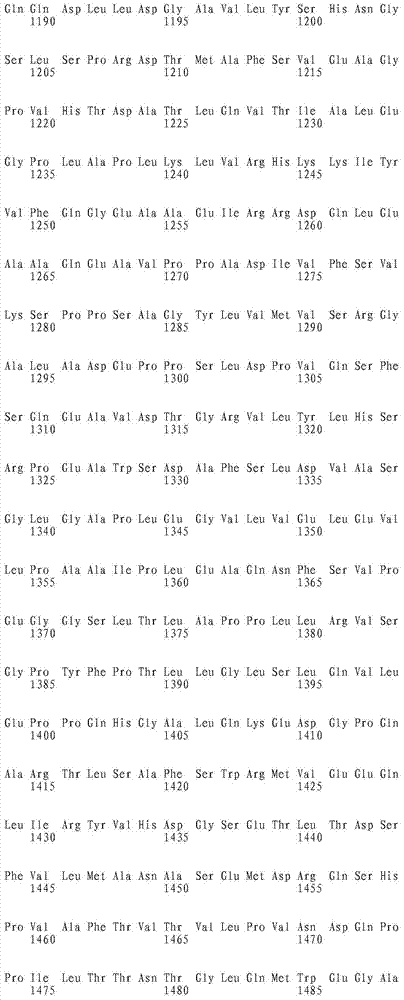


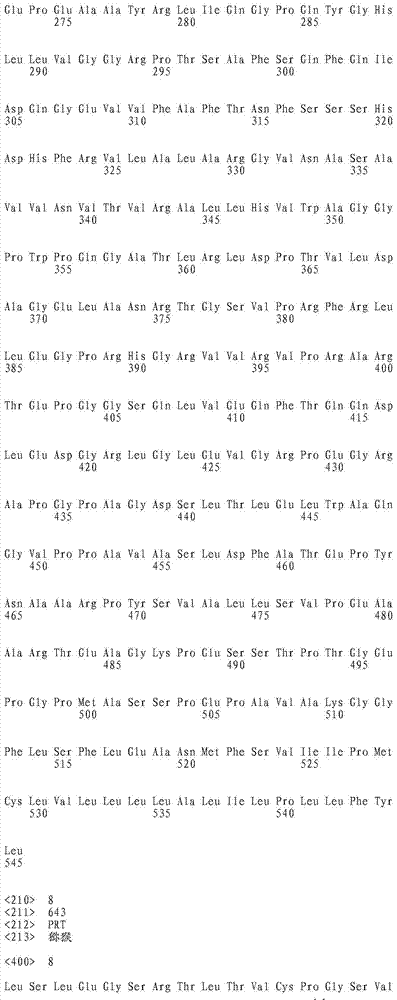
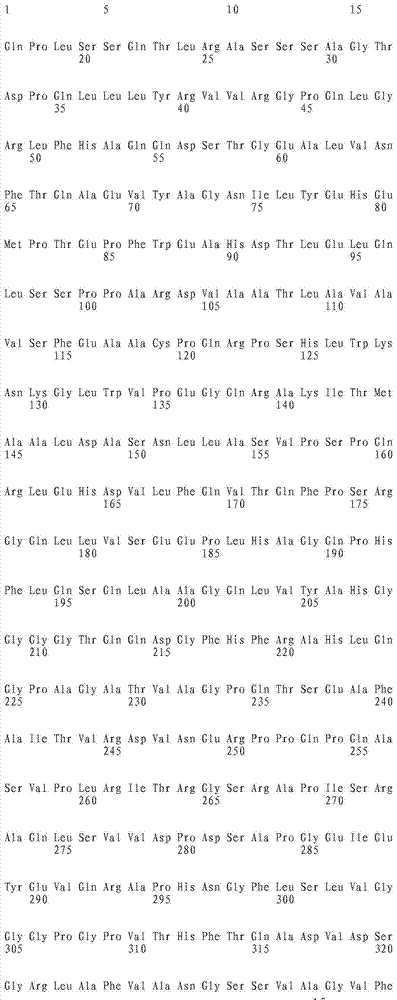


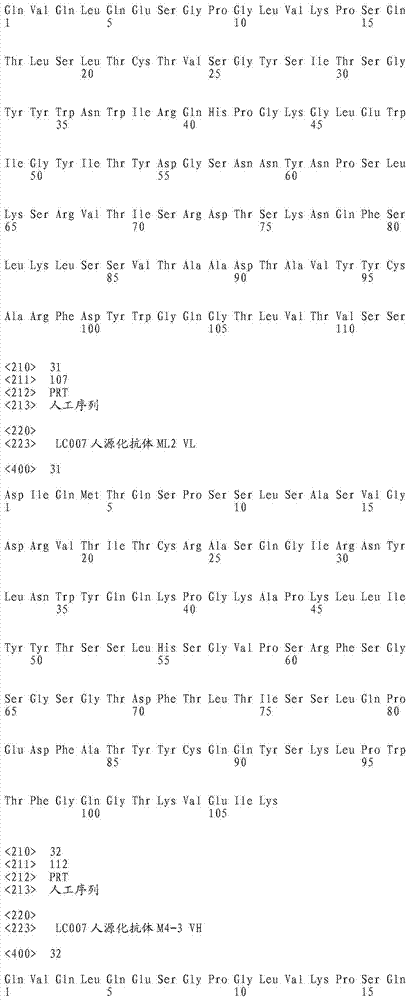
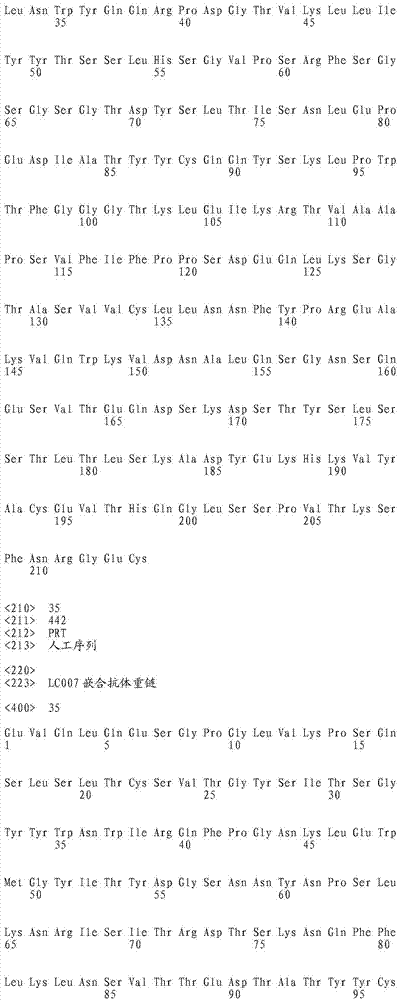


Claims (41)
Applications Claiming Priority (3)
| Application Number | Priority Date | Filing Date | Title |
|---|---|---|---|
| EP11178393 | 2011-08-23 | ||
| EP11178393.2 | 2011-08-23 | ||
| PCT/EP2012/066214 WO2013026832A1 (en) | 2011-08-23 | 2012-08-21 | Anti-mcsp antibodies |
Publications (1)
| Publication Number | Publication Date |
|---|---|
| CN103890006A true CN103890006A (en) | 2014-06-25 |
Family
ID=46704672
Family Applications (1)
| Application Number | Title | Priority Date | Filing Date |
|---|---|---|---|
| CN201280050808.XA Pending CN103890006A (en) | 2011-08-23 | 2012-08-21 | Anti-mcsp antibodies |
Country Status (11)
| Country | Link |
|---|---|
| US (1) | US9309306B2 (en) |
| EP (1) | EP2748195A1 (en) |
| JP (1) | JP2014534806A (en) |
| KR (1) | KR20140048292A (en) |
| CN (1) | CN103890006A (en) |
| AR (1) | AR087634A1 (en) |
| BR (1) | BR112014003999A2 (en) |
| CA (1) | CA2844141A1 (en) |
| MX (1) | MX2014002053A (en) |
| RU (1) | RU2014109038A (en) |
| WO (1) | WO2013026832A1 (en) |
Cited By (2)
| Publication number | Priority date | Publication date | Assignee | Title |
|---|---|---|---|---|
| CN107001485A (en) * | 2014-11-24 | 2017-08-01 | 苏州丁孚靶点生物技术有限公司 | Protein heterodimer and application thereof |
| CN116782955A (en) * | 2020-10-18 | 2023-09-19 | 艾迪健公司 | Anti-CSPG4 binding agents, conjugates thereof, and methods of use |
Families Citing this family (22)
| Publication number | Priority date | Publication date | Assignee | Title |
|---|---|---|---|---|
| US9676845B2 (en) | 2009-06-16 | 2017-06-13 | Hoffmann-La Roche, Inc. | Bispecific antigen binding proteins |
| WO2012116927A1 (en) | 2011-02-28 | 2012-09-07 | F. Hoffmann-La Roche Ag | Monovalent antigen binding proteins |
| MX341921B (en) | 2011-02-28 | 2016-09-07 | Hoffmann La Roche | Antigen binding proteins. |
| EP2961771B1 (en) | 2013-02-26 | 2020-01-01 | Roche Glycart AG | Bispecific t cell activating antigen binding molecules specific to cd3 and cea |
| EP2961772A1 (en) * | 2013-02-26 | 2016-01-06 | Roche Glycart AG | Anti-mcsp antibodies |
| KR20160044060A (en) | 2013-10-11 | 2016-04-22 | 에프. 호프만-라 로슈 아게 | Multispecific domain exchanged common variable light chain antibodies |
| EP3074025A1 (en) * | 2013-11-27 | 2016-10-05 | Baylor College Of Medicine | Csgp4-specific chimeric antigen receptor for cancer |
| PE20170263A1 (en) | 2014-08-04 | 2017-03-30 | Hoffmann La Roche | T-CELL ACTIVATING ANTIGEN-BINDING BI-SPECIFIC MOLECULES |
| CN107849137B (en) | 2015-10-02 | 2021-11-26 | 豪夫迈·罗氏有限公司 | Bispecific anti-CEAXCD 3T cell activating antigen binding molecules |
| IL313608A (en) | 2015-12-09 | 2024-08-01 | Hoffmann La Roche | Type ii anti-cd20 antibody for reducing formation of anti-drug antibodies |
| EP3400246B1 (en) | 2016-01-08 | 2020-10-21 | H. Hoffnabb-La Roche Ag | Methods of treating cea-positive cancers using pd-1 axis binding antagonists and anti-cea/anti-cd3 bispecific antibodies |
| US10550184B2 (en) | 2016-04-11 | 2020-02-04 | The Trustees Of Columbia University In The City Of New York | Humanized anti-rage antibody |
| KR102706743B1 (en) * | 2016-12-21 | 2024-09-19 | 세파론 엘엘씨 | Antibodies that specifically bind to human il-15 and uses thereof |
| SG11202100934PA (en) | 2018-08-02 | 2021-02-25 | Dyne Therapeutics Inc | Muscle targeting complexes and uses thereof for treating dystrophinopathies |
| US11168141B2 (en) | 2018-08-02 | 2021-11-09 | Dyne Therapeutics, Inc. | Muscle targeting complexes and uses thereof for treating dystrophinopathies |
| KR20220119143A (en) * | 2019-12-24 | 2022-08-26 | 디잘 (지앙수) 파마슈티칼 씨오., 리미티드 | Novel anti-FGFR2B antibody |
| CA3213632A1 (en) | 2021-04-30 | 2022-11-03 | F. Hoffmann-La Roche Ag | Dosing for combination treatment with anti-cd20/anti-cd3 bispecific antibody and anti-cd79b antibody drug conjugate |
| US11969475B2 (en) | 2021-07-09 | 2024-04-30 | Dyne Therapeutics, Inc. | Muscle targeting complexes and uses thereof for treating facioscapulohumeral muscular dystrophy |
| KR20240035824A (en) * | 2021-07-09 | 2024-03-18 | 다인 세라퓨틱스, 인크. | Muscle targeting complex and its use to treat dystrophinopathy |
| US11771776B2 (en) | 2021-07-09 | 2023-10-03 | Dyne Therapeutics, Inc. | Muscle targeting complexes and uses thereof for treating dystrophinopathies |
| AU2022309028A1 (en) | 2021-07-09 | 2024-01-25 | Dyne Therapeutics, Inc. | Muscle targeting complexes and formulations for treating dystrophinopathies |
| EP4367147A1 (en) * | 2021-07-09 | 2024-05-15 | Dyne Therapeutics, Inc. | Muscle targeting complexes and uses thereof for treating dystrophinopathies |
Citations (3)
| Publication number | Priority date | Publication date | Assignee | Title |
|---|---|---|---|---|
| WO2006032127A1 (en) * | 2004-09-24 | 2006-03-30 | Arius Research, Inc. | Cytotoxicity mediation of cells evidencing surface expression of mcsp |
| WO2008030625A2 (en) * | 2006-09-08 | 2008-03-13 | Celldex Therapeutics Inc. | Antibodies against human melanoma-associated chondroitin sulphate proteoglycan (mcsp) |
| US20080095785A2 (en) * | 2001-11-30 | 2008-04-24 | Soldano Ferrone | Monoclonal antibodies to human high molecular weight-melanoma associated antigen |
Family Cites Families (97)
| Publication number | Priority date | Publication date | Assignee | Title |
|---|---|---|---|---|
| US4816567A (en) | 1983-04-08 | 1989-03-28 | Genentech, Inc. | Recombinant immunoglobin preparations |
| US4737456A (en) | 1985-05-09 | 1988-04-12 | Syntex (U.S.A.) Inc. | Reducing interference in ligand-receptor binding assays |
| US4676980A (en) | 1985-09-23 | 1987-06-30 | The United States Of America As Represented By The Secretary Of The Department Of Health And Human Services | Target specific cross-linked heteroantibodies |
| US6548640B1 (en) | 1986-03-27 | 2003-04-15 | Btg International Limited | Altered antibodies |
| IL85035A0 (en) | 1987-01-08 | 1988-06-30 | Int Genetic Eng | Polynucleotide molecule,a chimeric antibody with specificity for human b cell surface antigen,a process for the preparation and methods utilizing the same |
| WO1988007089A1 (en) | 1987-03-18 | 1988-09-22 | Medical Research Council | Altered antibodies |
| WO1990005144A1 (en) | 1988-11-11 | 1990-05-17 | Medical Research Council | Single domain ligands, receptors comprising said ligands, methods for their production, and use of said ligands and receptors |
| DE3920358A1 (en) | 1989-06-22 | 1991-01-17 | Behringwerke Ag | BISPECIFIC AND OLIGO-SPECIFIC, MONO- AND OLIGOVALENT ANTI-BODY CONSTRUCTS, THEIR PRODUCTION AND USE |
| US5208020A (en) | 1989-10-25 | 1993-05-04 | Immunogen Inc. | Cytotoxic agents comprising maytansinoids and their therapeutic use |
| US5959177A (en) | 1989-10-27 | 1999-09-28 | The Scripps Research Institute | Transgenic plants expressing assembled secretory antibodies |
| US6150584A (en) | 1990-01-12 | 2000-11-21 | Abgenix, Inc. | Human antibodies derived from immunized xenomice |
| US6075181A (en) | 1990-01-12 | 2000-06-13 | Abgenix, Inc. | Human antibodies derived from immunized xenomice |
| US5770429A (en) | 1990-08-29 | 1998-06-23 | Genpharm International, Inc. | Transgenic non-human animals capable of producing heterologous antibodies |
| DE69129154T2 (en) | 1990-12-03 | 1998-08-20 | Genentech, Inc., South San Francisco, Calif. | METHOD FOR ENRICHING PROTEIN VARIANTS WITH CHANGED BINDING PROPERTIES |
| US5571894A (en) | 1991-02-05 | 1996-11-05 | Ciba-Geigy Corporation | Recombinant antibodies specific for a growth factor receptor |
| JP4124480B2 (en) | 1991-06-14 | 2008-07-23 | ジェネンテック・インコーポレーテッド | Immunoglobulin variants |
| GB9114948D0 (en) | 1991-07-11 | 1991-08-28 | Pfizer Ltd | Process for preparing sertraline intermediates |
| WO1993006217A1 (en) | 1991-09-19 | 1993-04-01 | Genentech, Inc. | EXPRESSION IN E. COLI OF ANTIBODY FRAGMENTS HAVING AT LEAST A CYSTEINE PRESENT AS A FREE THIOL, USE FOR THE PRODUCTION OF BIFUNCTIONAL F(ab')2 ANTIBODIES |
| FI941572L (en) | 1991-10-07 | 1994-05-27 | Oncologix Inc | Combination and method of use of anti-erbB-2 monoclonal antibodies |
| WO1993008829A1 (en) | 1991-11-04 | 1993-05-13 | The Regents Of The University Of California | Compositions that mediate killing of hiv-infected cells |
| ATE503496T1 (en) | 1992-02-06 | 2011-04-15 | Novartis Vaccines & Diagnostic | BIOSYNTHETIC BINDING PROTEIN FOR TUMOR MARKERS |
| ATE139900T1 (en) | 1992-11-13 | 1996-07-15 | Idec Pharma Corp | THERAPEUTIC USE OF CHIMERIC AND LABELED ANTIBODIES AGAINST HUMAN B LYMPHOCYTE RESTRICTED DIFFERENTIATION ANTIGEN FOR THE TREATMENT OF B CELL LYMPHOMA |
| CA2163345A1 (en) | 1993-06-16 | 1994-12-22 | Susan Adrienne Morgan | Antibodies |
| US5789199A (en) | 1994-11-03 | 1998-08-04 | Genentech, Inc. | Process for bacterial production of polypeptides |
| US5840523A (en) | 1995-03-01 | 1998-11-24 | Genetech, Inc. | Methods and compositions for secretion of heterologous polypeptides |
| US5731168A (en) | 1995-03-01 | 1998-03-24 | Genentech, Inc. | Method for making heteromultimeric polypeptides |
| US5869046A (en) | 1995-04-14 | 1999-02-09 | Genentech, Inc. | Altered polypeptides with increased half-life |
| US6267958B1 (en) | 1995-07-27 | 2001-07-31 | Genentech, Inc. | Protein formulation |
| WO1997013855A1 (en) | 1995-10-10 | 1997-04-17 | Novartis Ag | Melanoma-associated protein |
| GB9603256D0 (en) | 1996-02-16 | 1996-04-17 | Wellcome Found | Antibodies |
| US6171586B1 (en) | 1997-06-13 | 2001-01-09 | Genentech, Inc. | Antibody formulation |
| ES2244066T3 (en) | 1997-06-24 | 2005-12-01 | Genentech, Inc. | PROCEDURE AND COMPOSITIONS OF GALACTOSILATED GLICOPROTEINS. |
| US6040498A (en) | 1998-08-11 | 2000-03-21 | North Caroline State University | Genetically engineered duckweed |
| WO1999022764A1 (en) | 1997-10-31 | 1999-05-14 | Genentech, Inc. | Methods and compositions comprising glycoprotein glycoforms |
| US6610833B1 (en) | 1997-11-24 | 2003-08-26 | The Institute For Human Genetics And Biochemistry | Monoclonal human natural antibodies |
| WO1999029888A1 (en) | 1997-12-05 | 1999-06-17 | The Scripps Research Institute | Humanization of murine antibody |
| ATE375365T1 (en) | 1998-04-02 | 2007-10-15 | Genentech Inc | ANTIBODIES VARIANTS AND FRAGMENTS THEREOF |
| US6194551B1 (en) | 1998-04-02 | 2001-02-27 | Genentech, Inc. | Polypeptide variants |
| PT1071700E (en) | 1998-04-20 | 2010-04-23 | Glycart Biotechnology Ag | Glycosylation engineering of antibodies for improving antibody-dependent cellular cytotoxicity |
| EP1141024B1 (en) | 1999-01-15 | 2018-08-08 | Genentech, Inc. | POLYPEPTIDE COMPRISING A VARIANT HUMAN IgG1 Fc REGION |
| US6737056B1 (en) | 1999-01-15 | 2004-05-18 | Genentech, Inc. | Polypeptide variants with altered effector function |
| CA2360106C (en) | 1999-02-12 | 2012-10-30 | The Scripps Research Institute | Methods for treatment of tumors and metastases using a combination of anti-angiogenic and immuno therapies |
| ES2601882T5 (en) | 1999-04-09 | 2021-06-07 | Kyowa Kirin Co Ltd | Procedure to monitor the activity of an immunofunctional molecule |
| KR100797667B1 (en) | 1999-10-04 | 2008-01-23 | 메디카고 인코포레이티드 | How to regulate transcription of foreign genes |
| US7125978B1 (en) | 1999-10-04 | 2006-10-24 | Medicago Inc. | Promoter for regulating expression of foreign genes |
| CA2388245C (en) | 1999-10-19 | 2012-01-10 | Tatsuya Ogawa | The use of serum-free adapted rat cells for producing heterologous polypeptides |
| AU784983B2 (en) | 1999-12-15 | 2006-08-17 | Genentech Inc. | Shotgun scanning, a combinatorial method for mapping functional protein epitopes |
| DK2857516T3 (en) | 2000-04-11 | 2017-08-07 | Genentech Inc | Multivalent antibodies and uses thereof |
| HU231090B1 (en) | 2000-10-06 | 2020-07-28 | Kyowa Kirin Co., Ltd. | Cells producing antibody compositions |
| US6946292B2 (en) | 2000-10-06 | 2005-09-20 | Kyowa Hakko Kogyo Co., Ltd. | Cells producing antibody compositions with increased antibody dependent cytotoxic activity |
| US7064191B2 (en) | 2000-10-06 | 2006-06-20 | Kyowa Hakko Kogyo Co., Ltd. | Process for purifying antibody |
| US6596541B2 (en) | 2000-10-31 | 2003-07-22 | Regeneron Pharmaceuticals, Inc. | Methods of modifying eukaryotic cells |
| US7009040B2 (en) | 2003-01-21 | 2006-03-07 | Arius Research, Inc. | Cancerous disease modifying antibodies |
| EP1916303B1 (en) | 2000-11-30 | 2013-02-27 | Medarex, Inc. | Nucleic acids encoding rearranged human immunoglobulin sequences from transgenic transchromosomal mice |
| JP2005500018A (en) * | 2001-04-02 | 2005-01-06 | アイデック ファーマスーティカルズ コーポレイション | Recombinant antibody coexpressed with GnTIII |
| EP1423510A4 (en) | 2001-08-03 | 2005-06-01 | Glycart Biotechnology Ag | ANTIBODY GLYCOSYLATION VARIANTS WITH INCREASED CELL CYTOTOXICITY DEPENDENT OF ANTIBODIES |
| HUP0600342A3 (en) | 2001-10-25 | 2011-03-28 | Genentech Inc | Glycoprotein compositions |
| US20040093621A1 (en) | 2001-12-25 | 2004-05-13 | Kyowa Hakko Kogyo Co., Ltd | Antibody composition which specifically binds to CD20 |
| NZ569490A (en) | 2001-12-27 | 2008-11-28 | Glycofi Inc | Methods to engineer mammalian-type carbohydrate structures |
| WO2003084569A1 (en) | 2002-04-09 | 2003-10-16 | Kyowa Hakko Kogyo Co., Ltd. | Drug containing antibody composition |
| US20050031613A1 (en) | 2002-04-09 | 2005-02-10 | Kazuyasu Nakamura | Therapeutic agent for patients having human FcgammaRIIIa |
| WO2003085119A1 (en) | 2002-04-09 | 2003-10-16 | Kyowa Hakko Kogyo Co., Ltd. | METHOD OF ENHANCING ACTIVITY OF ANTIBODY COMPOSITION OF BINDING TO FcϜ RECEPTOR IIIa |
| CN102911987B (en) | 2002-04-09 | 2015-09-30 | 协和发酵麒麟株式会社 | The adorned cell of genome |
| CA2481837A1 (en) | 2002-04-09 | 2003-10-16 | Kyowa Hakko Kogyo Co., Ltd. | Production process for antibody composition |
| CA2481656A1 (en) | 2002-04-09 | 2003-10-16 | Kyowa Hakko Kogyo Co., Ltd. | Cells in which activity of the protein involved in transportation of gdp-fucose is reduced or lost |
| CA2488441C (en) | 2002-06-03 | 2015-01-27 | Genentech, Inc. | Synthetic antibody phage libraries |
| ATE472604T1 (en) | 2002-09-12 | 2010-07-15 | Greenovation Biotech Gmbh | METHOD FOR PRODUCING PROTEINS |
| US7361740B2 (en) | 2002-10-15 | 2008-04-22 | Pdl Biopharma, Inc. | Alteration of FcRn binding affinities or serum half-lives of antibodies by mutagenesis |
| DK2289936T3 (en) | 2002-12-16 | 2017-07-31 | Genentech Inc | IMMUNGLOBULIN VARIATIONS AND APPLICATIONS THEREOF |
| WO2004057002A2 (en) | 2002-12-20 | 2004-07-08 | Greenovation Biotech Gmbh | Production of heterologous glycosylated proteins in bryophyte cells |
| EP1585767A2 (en) | 2003-01-16 | 2005-10-19 | Genentech, Inc. | Synthetic antibody phage libraries |
| US7393531B2 (en) | 2003-01-21 | 2008-07-01 | Arius Research Inc. | Cytotoxicity mediation of cells evidencing surface expression of MCSP |
| NZ582315A (en) | 2003-01-22 | 2011-01-28 | Glycart Biotechnology Ag | Fusion constructs and use of same to produce antibodies with increased Fc receptor binding affinity and effector function |
| WO2005035586A1 (en) | 2003-10-08 | 2005-04-21 | Kyowa Hakko Kogyo Co., Ltd. | Fused protein composition |
| WO2005035778A1 (en) | 2003-10-09 | 2005-04-21 | Kyowa Hakko Kogyo Co., Ltd. | PROCESS FOR PRODUCING ANTIBODY COMPOSITION BY USING RNA INHIBITING THE FUNCTION OF α1,6-FUCOSYLTRANSFERASE |
| DK2380910T3 (en) | 2003-11-05 | 2015-10-19 | Roche Glycart Ag | Antigen binding molecules with increased Fc receptor binding affinity and effector function |
| WO2005053742A1 (en) | 2003-12-04 | 2005-06-16 | Kyowa Hakko Kogyo Co., Ltd. | Medicine containing antibody composition |
| MXPA06011199A (en) | 2004-03-31 | 2007-04-16 | Genentech Inc | Humanized anti-tgf-beta antibodies. |
| US7785903B2 (en) | 2004-04-09 | 2010-08-31 | Genentech, Inc. | Variable domain library and uses |
| PL1737891T3 (en) | 2004-04-13 | 2013-08-30 | Hoffmann La Roche | Anti-p-selectin antibodies |
| TWI380996B (en) | 2004-09-17 | 2013-01-01 | Hoffmann La Roche | Anti-ox40l antibodies |
| NZ553500A (en) | 2004-09-23 | 2009-11-27 | Genentech Inc Genentech Inc | Cysteine engineered antibodies and conjugates withCysteine engineered antibodies and conjugates with a free cysteine amino acid in the heavy chain a free cysteine amino acid in the heavy chain |
| JO3000B1 (en) | 2004-10-20 | 2016-09-05 | Genentech Inc | Antibody Formulations. |
| AU2006226060A1 (en) * | 2005-03-25 | 2006-09-28 | Glycart Biotechnology Ag | Antigen binding molecules directed to MCSP and having increased Fc receptor binding affinity and effector function |
| EP1957531B1 (en) | 2005-11-07 | 2016-04-13 | Genentech, Inc. | Binding polypeptides with diversified and consensus vh/vl hypervariable sequences |
| US20070237764A1 (en) | 2005-12-02 | 2007-10-11 | Genentech, Inc. | Binding polypeptides with restricted diversity sequences |
| AR060871A1 (en) | 2006-05-09 | 2008-07-16 | Genentech Inc | UNION OF POLYPEPTIDES WITH OPTIMIZED SUPERCONTIGES |
| WO2008027236A2 (en) | 2006-08-30 | 2008-03-06 | Genentech, Inc. | Multispecific antibodies |
| US20080226635A1 (en) | 2006-12-22 | 2008-09-18 | Hans Koll | Antibodies against insulin-like growth factor I receptor and uses thereof |
| FR2911876B1 (en) | 2007-01-29 | 2009-03-06 | Rhodia Recherches & Tech | NOVEL ORGANOMETALLIC MIXED COMPLEXES BASED ON ALKYLLAMINOCYCLICALLY BASED CARBENES. |
| PT2520590T (en) | 2007-04-03 | 2018-11-14 | Amgen Res Munich Gmbh | CROSS-SPECIFIC CONNECTION DOMAIN |
| CN100592373C (en) | 2007-05-25 | 2010-02-24 | 群康科技(深圳)有限公司 | Liquid crystal display panel driving device and driving method thereof |
| SI2235064T1 (en) | 2008-01-07 | 2016-04-29 | Amgen Inc. | Method for making antibody fc-heterodimeric molecules using electrostatic steering effects |
| JP5764127B2 (en) | 2009-08-17 | 2015-08-12 | ロシュ グリクアート アーゲー | Targeted immunoconjugate |
| CA2844540C (en) | 2011-08-23 | 2018-10-16 | Roche Glycart Ag | Bispecific antibodies specific for t-cell activating antigens and a tumor antigen and methods of use |
| WO2013026837A1 (en) | 2011-08-23 | 2013-02-28 | Roche Glycart Ag | Bispecific t cell activating antigen binding molecules |
| RS56879B1 (en) | 2011-08-23 | 2018-04-30 | Roche Glycart Ag | Bispecific t cell activating antigen binding molecules |
-
2012
- 2012-08-21 CN CN201280050808.XA patent/CN103890006A/en active Pending
- 2012-08-21 MX MX2014002053A patent/MX2014002053A/en not_active Application Discontinuation
- 2012-08-21 BR BR112014003999A patent/BR112014003999A2/en unknown
- 2012-08-21 JP JP2014526468A patent/JP2014534806A/en active Pending
- 2012-08-21 KR KR1020147004344A patent/KR20140048292A/en not_active Withdrawn
- 2012-08-21 EP EP12748487.1A patent/EP2748195A1/en not_active Withdrawn
- 2012-08-21 US US13/590,904 patent/US9309306B2/en not_active Expired - Fee Related
- 2012-08-21 WO PCT/EP2012/066214 patent/WO2013026832A1/en not_active Ceased
- 2012-08-21 RU RU2014109038/10A patent/RU2014109038A/en unknown
- 2012-08-21 CA CA2844141A patent/CA2844141A1/en not_active Abandoned
- 2012-08-22 AR ARP120103092A patent/AR087634A1/en not_active Application Discontinuation
Patent Citations (3)
| Publication number | Priority date | Publication date | Assignee | Title |
|---|---|---|---|---|
| US20080095785A2 (en) * | 2001-11-30 | 2008-04-24 | Soldano Ferrone | Monoclonal antibodies to human high molecular weight-melanoma associated antigen |
| WO2006032127A1 (en) * | 2004-09-24 | 2006-03-30 | Arius Research, Inc. | Cytotoxicity mediation of cells evidencing surface expression of mcsp |
| WO2008030625A2 (en) * | 2006-09-08 | 2008-03-13 | Celldex Therapeutics Inc. | Antibodies against human melanoma-associated chondroitin sulphate proteoglycan (mcsp) |
Cited By (3)
| Publication number | Priority date | Publication date | Assignee | Title |
|---|---|---|---|---|
| CN107001485A (en) * | 2014-11-24 | 2017-08-01 | 苏州丁孚靶点生物技术有限公司 | Protein heterodimer and application thereof |
| CN107001485B (en) * | 2014-11-24 | 2022-03-22 | 苏州丁孚靶点生物技术有限公司 | Protein heterodimers and uses thereof |
| CN116782955A (en) * | 2020-10-18 | 2023-09-19 | 艾迪健公司 | Anti-CSPG4 binding agents, conjugates thereof, and methods of use |
Also Published As
| Publication number | Publication date |
|---|---|
| CA2844141A1 (en) | 2013-02-28 |
| AR087634A1 (en) | 2014-04-09 |
| MX2014002053A (en) | 2014-04-25 |
| KR20140048292A (en) | 2014-04-23 |
| EP2748195A1 (en) | 2014-07-02 |
| US20130078251A1 (en) | 2013-03-28 |
| US9309306B2 (en) | 2016-04-12 |
| JP2014534806A (en) | 2014-12-25 |
| RU2014109038A (en) | 2015-09-27 |
| WO2013026832A1 (en) | 2013-02-28 |
| BR112014003999A2 (en) | 2017-06-13 |
Similar Documents
| Publication | Publication Date | Title |
|---|---|---|
| JP7017599B2 (en) | Anti-FAP antibody and method of use | |
| US9309306B2 (en) | Anti-MCSP antibodies | |
| CN103168049B (en) | Anti-tenascin-C A2 antibody and using method | |
| KR102030891B1 (en) | Anti-jagged1 antibodies and methods of use | |
| CN107074938A (en) | Anti-alpha-synuclein antibodies and methods of use | |
| JP2013542714A5 (en) | ||
| MX2014008157A (en) | Anti-lrp5 antibodies and methods of use. | |
| CN104520328A (en) | Anti-jagged anitbodies and methods of use | |
| US20180100022A1 (en) | Her1 antigen binding proteins binding to the beta-hairpin of her1 | |
| TW201326212A (en) | Anti-MCSP antibodies | |
| CN104936987A (en) | Anti-MCSP antibodies | |
| HK1194081A (en) | Anti-mcsp antibodies | |
| HK1227041B (en) | Anti-jagged1 antibodies and methods of use | |
| HK1209432B (en) | Anti-jagged antibodies and methods of use | |
| HK1181402B (en) | Anti-fap antibodies and methods of use |
Legal Events
| Date | Code | Title | Description |
|---|---|---|---|
| C06 | Publication | ||
| PB01 | Publication | ||
| C10 | Entry into substantive examination | ||
| SE01 | Entry into force of request for substantive examination | ||
| REG | Reference to a national code |
Ref country code: HK Ref legal event code: DE Ref document number: 1194081 Country of ref document: HK |
|
| WD01 | Invention patent application deemed withdrawn after publication |
Application publication date: 20140625 |
|
| WD01 | Invention patent application deemed withdrawn after publication | ||
| REG | Reference to a national code |
Ref country code: HK Ref legal event code: WD Ref document number: 1194081 Country of ref document: HK |