CN103848810A - Bruton's tyrosine kinases inhibitor - Google Patents
Bruton's tyrosine kinases inhibitor Download PDFInfo
- Publication number
- CN103848810A CN103848810A CN201210505930.3A CN201210505930A CN103848810A CN 103848810 A CN103848810 A CN 103848810A CN 201210505930 A CN201210505930 A CN 201210505930A CN 103848810 A CN103848810 A CN 103848810A
- Authority
- CN
- China
- Prior art keywords
- alkyl
- substituted
- unsubstituted
- phenyl
- heteroaryl
- Prior art date
- Legal status (The legal status is an assumption and is not a legal conclusion. Google has not performed a legal analysis and makes no representation as to the accuracy of the status listed.)
- Pending
Links
- 0 C*(C)CC=CC(N*)=O Chemical compound C*(C)CC=CC(N*)=O 0.000 description 8
- KJFQXQQAKOOBJK-UHFFFAOYSA-N C=CC(N(CCC1)CC1[n]1c(N)c(C2(N)OC2)c(-c(cc2)ccc2Oc2ccccc2)c1)=O Chemical compound C=CC(N(CCC1)CC1[n]1c(N)c(C2(N)OC2)c(-c(cc2)ccc2Oc2ccccc2)c1)=O KJFQXQQAKOOBJK-UHFFFAOYSA-N 0.000 description 1
- ZVTCYDWSXKCUHU-UHFFFAOYSA-N CC(N(C)CC[n](c(N)c1C(N)=O)nc1-c(cc1)ccc1Oc1ccccc1)=O Chemical compound CC(N(C)CC[n](c(N)c1C(N)=O)nc1-c(cc1)ccc1Oc1ccccc1)=O ZVTCYDWSXKCUHU-UHFFFAOYSA-N 0.000 description 1
- YPFRUDDFUYJJKW-UHFFFAOYSA-N CCNc1c(C(N)=O)c(-c(cc2)ccc2Oc2ccccc2)n[n]1C(CCC1)CN1C(C=C)=O Chemical compound CCNc1c(C(N)=O)c(-c(cc2)ccc2Oc2ccccc2)n[n]1C(CCC1)CN1C(C=C)=O YPFRUDDFUYJJKW-UHFFFAOYSA-N 0.000 description 1
- SQKUGZLWFQSJJP-UHFFFAOYSA-N CNc1c(C(N)=O)c(-c(cc2)ccc2Oc2ccccc2)c[n]1CCN(C)C(C=C)=O Chemical compound CNc1c(C(N)=O)c(-c(cc2)ccc2Oc2ccccc2)c[n]1CCN(C)C(C=C)=O SQKUGZLWFQSJJP-UHFFFAOYSA-N 0.000 description 1
- FAWKYEFAYPOQLB-MRXNPFEDSA-N CNc1c(C(N)=O)c(-c(cc2)ccc2Oc2ccccc2)n[n]1[C@H]1CNCCC1 Chemical compound CNc1c(C(N)=O)c(-c(cc2)ccc2Oc2ccccc2)n[n]1[C@H]1CNCCC1 FAWKYEFAYPOQLB-MRXNPFEDSA-N 0.000 description 1
- BKQKDAFQPLUASY-UHFFFAOYSA-N CNc1c(C(N)O)c(-c(cc2)ccc2Oc2ccccc2)n[n]1C(CCC1)CN1C(C=C)=O Chemical compound CNc1c(C(N)O)c(-c(cc2)ccc2Oc2ccccc2)n[n]1C(CCC1)CN1C(C=C)=O BKQKDAFQPLUASY-UHFFFAOYSA-N 0.000 description 1
- VRKKIZZRPORAQC-UHFFFAOYSA-N COC[IH]CC(C#N)C#N Chemical compound COC[IH]CC(C#N)C#N VRKKIZZRPORAQC-UHFFFAOYSA-N 0.000 description 1
Classifications
-
- C—CHEMISTRY; METALLURGY
- C07—ORGANIC CHEMISTRY
- C07D—HETEROCYCLIC COMPOUNDS
- C07D403/00—Heterocyclic compounds containing two or more hetero rings, having nitrogen atoms as the only ring hetero atoms, not provided for by group C07D401/00
- C07D403/02—Heterocyclic compounds containing two or more hetero rings, having nitrogen atoms as the only ring hetero atoms, not provided for by group C07D401/00 containing two hetero rings
- C07D403/04—Heterocyclic compounds containing two or more hetero rings, having nitrogen atoms as the only ring hetero atoms, not provided for by group C07D401/00 containing two hetero rings directly linked by a ring-member-to-ring-member bond
-
- A—HUMAN NECESSITIES
- A61—MEDICAL OR VETERINARY SCIENCE; HYGIENE
- A61K—PREPARATIONS FOR MEDICAL, DENTAL OR TOILETRY PURPOSES
- A61K31/00—Medicinal preparations containing organic active ingredients
- A61K31/33—Heterocyclic compounds
- A61K31/395—Heterocyclic compounds having nitrogen as a ring hetero atom, e.g. guanethidine or rifamycins
- A61K31/41—Heterocyclic compounds having nitrogen as a ring hetero atom, e.g. guanethidine or rifamycins having five-membered rings with two or more ring hetero atoms, at least one of which being nitrogen, e.g. tetrazole
- A61K31/415—1,2-Diazoles
- A61K31/4155—1,2-Diazoles non condensed and containing further heterocyclic rings
-
- A—HUMAN NECESSITIES
- A61—MEDICAL OR VETERINARY SCIENCE; HYGIENE
- A61K—PREPARATIONS FOR MEDICAL, DENTAL OR TOILETRY PURPOSES
- A61K31/00—Medicinal preparations containing organic active ingredients
- A61K31/33—Heterocyclic compounds
- A61K31/395—Heterocyclic compounds having nitrogen as a ring hetero atom, e.g. guanethidine or rifamycins
- A61K31/435—Heterocyclic compounds having nitrogen as a ring hetero atom, e.g. guanethidine or rifamycins having six-membered rings with one nitrogen as the only ring hetero atom
- A61K31/44—Non condensed pyridines; Hydrogenated derivatives thereof
- A61K31/445—Non condensed piperidines, e.g. piperocaine
- A61K31/4523—Non condensed piperidines, e.g. piperocaine containing further heterocyclic ring systems
- A61K31/454—Non condensed piperidines, e.g. piperocaine containing further heterocyclic ring systems containing a five-membered ring with nitrogen as a ring hetero atom, e.g. pimozide, domperidone
-
- A—HUMAN NECESSITIES
- A61—MEDICAL OR VETERINARY SCIENCE; HYGIENE
- A61K—PREPARATIONS FOR MEDICAL, DENTAL OR TOILETRY PURPOSES
- A61K31/00—Medicinal preparations containing organic active ingredients
- A61K31/33—Heterocyclic compounds
- A61K31/395—Heterocyclic compounds having nitrogen as a ring hetero atom, e.g. guanethidine or rifamycins
- A61K31/495—Heterocyclic compounds having nitrogen as a ring hetero atom, e.g. guanethidine or rifamycins having six-membered rings with two or more nitrogen atoms as the only ring heteroatoms, e.g. piperazine or tetrazines
- A61K31/496—Non-condensed piperazines containing further heterocyclic rings, e.g. rifampin, thiothixene or sparfloxacin
-
- A—HUMAN NECESSITIES
- A61—MEDICAL OR VETERINARY SCIENCE; HYGIENE
- A61K—PREPARATIONS FOR MEDICAL, DENTAL OR TOILETRY PURPOSES
- A61K31/00—Medicinal preparations containing organic active ingredients
- A61K31/33—Heterocyclic compounds
- A61K31/395—Heterocyclic compounds having nitrogen as a ring hetero atom, e.g. guanethidine or rifamycins
- A61K31/535—Heterocyclic compounds having nitrogen as a ring hetero atom, e.g. guanethidine or rifamycins having six-membered rings with at least one nitrogen and one oxygen as the ring hetero atoms, e.g. 1,2-oxazines
- A61K31/5375—1,4-Oxazines, e.g. morpholine
- A61K31/5377—1,4-Oxazines, e.g. morpholine not condensed and containing further heterocyclic rings, e.g. timolol
-
- A—HUMAN NECESSITIES
- A61—MEDICAL OR VETERINARY SCIENCE; HYGIENE
- A61P—SPECIFIC THERAPEUTIC ACTIVITY OF CHEMICAL COMPOUNDS OR MEDICINAL PREPARATIONS
- A61P11/00—Drugs for disorders of the respiratory system
- A61P11/06—Antiasthmatics
-
- A—HUMAN NECESSITIES
- A61—MEDICAL OR VETERINARY SCIENCE; HYGIENE
- A61P—SPECIFIC THERAPEUTIC ACTIVITY OF CHEMICAL COMPOUNDS OR MEDICINAL PREPARATIONS
- A61P17/00—Drugs for dermatological disorders
-
- A—HUMAN NECESSITIES
- A61—MEDICAL OR VETERINARY SCIENCE; HYGIENE
- A61P—SPECIFIC THERAPEUTIC ACTIVITY OF CHEMICAL COMPOUNDS OR MEDICINAL PREPARATIONS
- A61P19/00—Drugs for skeletal disorders
- A61P19/02—Drugs for skeletal disorders for joint disorders, e.g. arthritis, arthrosis
-
- A—HUMAN NECESSITIES
- A61—MEDICAL OR VETERINARY SCIENCE; HYGIENE
- A61P—SPECIFIC THERAPEUTIC ACTIVITY OF CHEMICAL COMPOUNDS OR MEDICINAL PREPARATIONS
- A61P19/00—Drugs for skeletal disorders
- A61P19/04—Drugs for skeletal disorders for non-specific disorders of the connective tissue
-
- A—HUMAN NECESSITIES
- A61—MEDICAL OR VETERINARY SCIENCE; HYGIENE
- A61P—SPECIFIC THERAPEUTIC ACTIVITY OF CHEMICAL COMPOUNDS OR MEDICINAL PREPARATIONS
- A61P29/00—Non-central analgesic, antipyretic or antiinflammatory agents, e.g. antirheumatic agents; Non-steroidal antiinflammatory drugs [NSAID]
-
- A—HUMAN NECESSITIES
- A61—MEDICAL OR VETERINARY SCIENCE; HYGIENE
- A61P—SPECIFIC THERAPEUTIC ACTIVITY OF CHEMICAL COMPOUNDS OR MEDICINAL PREPARATIONS
- A61P35/00—Antineoplastic agents
-
- A—HUMAN NECESSITIES
- A61—MEDICAL OR VETERINARY SCIENCE; HYGIENE
- A61P—SPECIFIC THERAPEUTIC ACTIVITY OF CHEMICAL COMPOUNDS OR MEDICINAL PREPARATIONS
- A61P35/00—Antineoplastic agents
- A61P35/02—Antineoplastic agents specific for leukemia
-
- A—HUMAN NECESSITIES
- A61—MEDICAL OR VETERINARY SCIENCE; HYGIENE
- A61P—SPECIFIC THERAPEUTIC ACTIVITY OF CHEMICAL COMPOUNDS OR MEDICINAL PREPARATIONS
- A61P37/00—Drugs for immunological or allergic disorders
- A61P37/02—Immunomodulators
-
- A—HUMAN NECESSITIES
- A61—MEDICAL OR VETERINARY SCIENCE; HYGIENE
- A61P—SPECIFIC THERAPEUTIC ACTIVITY OF CHEMICAL COMPOUNDS OR MEDICINAL PREPARATIONS
- A61P43/00—Drugs for specific purposes, not provided for in groups A61P1/00-A61P41/00
-
- C—CHEMISTRY; METALLURGY
- C07—ORGANIC CHEMISTRY
- C07D—HETEROCYCLIC COMPOUNDS
- C07D231/00—Heterocyclic compounds containing 1,2-diazole or hydrogenated 1,2-diazole rings
- C07D231/02—Heterocyclic compounds containing 1,2-diazole or hydrogenated 1,2-diazole rings not condensed with other rings
- C07D231/10—Heterocyclic compounds containing 1,2-diazole or hydrogenated 1,2-diazole rings not condensed with other rings having two or three double bonds between ring members or between ring members and non-ring members
- C07D231/14—Heterocyclic compounds containing 1,2-diazole or hydrogenated 1,2-diazole rings not condensed with other rings having two or three double bonds between ring members or between ring members and non-ring members with hetero atoms or with carbon atoms having three bonds to hetero atoms with at the most one bond to halogen, e.g. ester or nitrile radicals, directly attached to ring carbon atoms
- C07D231/38—Nitrogen atoms
-
- C—CHEMISTRY; METALLURGY
- C07—ORGANIC CHEMISTRY
- C07D—HETEROCYCLIC COMPOUNDS
- C07D401/00—Heterocyclic compounds containing two or more hetero rings, having nitrogen atoms as the only ring hetero atoms, at least one ring being a six-membered ring with only one nitrogen atom
- C07D401/02—Heterocyclic compounds containing two or more hetero rings, having nitrogen atoms as the only ring hetero atoms, at least one ring being a six-membered ring with only one nitrogen atom containing two hetero rings
- C07D401/04—Heterocyclic compounds containing two or more hetero rings, having nitrogen atoms as the only ring hetero atoms, at least one ring being a six-membered ring with only one nitrogen atom containing two hetero rings directly linked by a ring-member-to-ring-member bond
Landscapes
- Chemical & Material Sciences (AREA)
- Organic Chemistry (AREA)
- Health & Medical Sciences (AREA)
- Life Sciences & Earth Sciences (AREA)
- Veterinary Medicine (AREA)
- Public Health (AREA)
- General Health & Medical Sciences (AREA)
- Medicinal Chemistry (AREA)
- Animal Behavior & Ethology (AREA)
- Pharmacology & Pharmacy (AREA)
- Nuclear Medicine, Radiotherapy & Molecular Imaging (AREA)
- General Chemical & Material Sciences (AREA)
- Chemical Kinetics & Catalysis (AREA)
- Engineering & Computer Science (AREA)
- Bioinformatics & Cheminformatics (AREA)
- Epidemiology (AREA)
- Immunology (AREA)
- Physical Education & Sports Medicine (AREA)
- Pulmonology (AREA)
- Rheumatology (AREA)
- Hematology (AREA)
- Pain & Pain Management (AREA)
- Dermatology (AREA)
- Orthopedic Medicine & Surgery (AREA)
- Oncology (AREA)
- Biomedical Technology (AREA)
- Pharmaceuticals Containing Other Organic And Inorganic Compounds (AREA)
- Plural Heterocyclic Compounds (AREA)
- Heterocyclic Carbon Compounds Containing A Hetero Ring Having Nitrogen And Oxygen As The Only Ring Hetero Atoms (AREA)
Abstract
The invention relates to compounds of formula (IV), pharmaceutically acceptable salts, solvates, active metabolites, polymorphs, esters, isomers or prodrugs of the compounds, pharmaceutical compositions containing the compounds of the formula (IV), and application of the pharmaceutical compositions as selective inreversible inhibitors for Bruton's tyrosine kinases to prevent or treat inflammation, autoimmune diseases (such as rheumatoid arthritis) correlated to abnormal B cell proliferation, and cancers. The formula (IV) is shown in the specification.
Description
Technical Field
The invention relates to a series of polysubstituted five-membered heterocyclic compounds, which can be used as irreversible inhibitors of selective Bruton's tyrosine kinase (Btk) alone or in combination with other therapeutic agents to treat inflammation, autoimmune diseases associated with abnormal B cell proliferation (such as rheumatoid arthritis), cancer, and the like. The invention also relates to a pharmaceutical composition containing the compound shown in the formula (IV) and a preparation method thereof, application of the compound in pharmacy and a method for preventing or treating diseases related to excessive Btk activity in mammals (particularly human beings) by using the compound.
Background
Protein kinases, the largest family of human enzymes, include well over 500 proteins. In particular, tyrosine kinases phosphorylate proteins on the phenol portion of tyrosine residues. The tyrosine kinase family includes members that control cell growth, migration, and differentiation. Abnormal kinase activity has been implicated in a number of human diseases including cancer, autoimmune and inflammatory diseases.
Btk is a member of the Tec family of tyrosine kinases and has been shown to be a key regulator of early B-cell formation and mature B-cell activation and survival (Khan et al, Immunity19953: 283; Ellmeier et al, J.exp.Med.2000192: 1611). The signaling of B cells through the B Cell Receptor (BCR) leads to a wide range of biological outcomes, and these outcomes depend on the developmental stage of the B cell. The magnitude and duration of the BCR signal must be precisely adjusted. Aberrant BCR-mediated signal transduction can lead to misregulated (deregulated) B cell activation and/or the formation of pathogenic autoantibodies, which lead to a variety of autoimmune and/or inflammatory diseases.
Evidence for a role for Btk in autoimmune and inflammatory diseases has been provided by Btk-deficient mouse models. In a preclinical murine model of Systemic Lupus Erythematosus (SLE), Btk-deficient mice show significant improvement in disease progression. Furthermore, Btk-deficient mice are resistant to collagen-induced arthritis (Jansson and Holmdahl, Clin. exp. Immunol.199394: 459). Dose-dependent efficacy of selective Btk inhibitors in mouse models of arthritis has been demonstrated (Pan et al, chem.med.chem.20072: 58-61).
Btk is also expressed by cells other than B cells that may be involved in disease processes. For example, Btk is expressed by mast cells and Btk-deficient bone marrow-derived mast cells display damaged antigen-decoy granules (Iwaki et al, j.biol.chem.2005280: 40261). This shows that Btk can be effectively used to treat pathological mast cell responses, such as allergy and asthma. Furthermore, monocytes from XLA patients in which Btk activity is absent show reduced TNF α production following stimulation (Horwood et al, j.exp. med.2003197: 1603). Thus, TNF α -mediated inflammation can be inhibited by small molecule inhibitors of Btk. In addition, Btk has been reported to play a role in apoptosis (Islam and Smith, Immunol Rev.2000178:49) and therefore Btk inhibitors would be effective for the treatment of certain B-cell lymphomas and leukemias (Feldhahn et al, J.Exp. Med.2005201: 1837).
On day 16/6 2012, Pharmacyclics biopharmaceutical company published the results of 2 recent phase Ib/II clinical trials (PCYC-1102 and PCYC-1108) of bruton's tyrosine kinase (Btk) inhibitor Ibrutinib (PCI-32765) for the treatment of chronic lymphocytic leukemia/small lymphocytic lymphoma (CLL/SLL). The experimental results show that: highly active and well tolerated in 61 relapsed/refractory and 31 untreated CLL patients, and no patients withheld from adverse events during the trial.
Obviously, the excellent clinical test result of Ibrutinib shows that the high-selectivity small-molecule inhibitor of Btk kinase will become another hot spot in the field of new drug development in the world.
Summary of The Invention
The invention provides a series of compounds represented by a general formula (I), a general formula (II), a general formula (III) or a general formula (IV) and pharmaceutically acceptable salts, solvates, esters, acids and prodrugs thereof, a pharmaceutical composition containing the compounds, and a method for treating diseases and symptoms related to the excessive activity of Btk by using the compounds.
The present invention provides in a first aspect a compound of formula (I), a pharmaceutically acceptable salt, solvate, active metabolite, polymorph, ester, isomer or prodrug thereof,

Wherein,
X0selected from O, CH2NH or S;
X1and X3Each independently selected from C or N;
X2selected from the group consisting of CR5Or N;
R1selected from H, L2- (unsubstituted or substituted alkyl),L2- (unsubstituted or substituted cycloalkyl), L2- (unsubstituted or substituted alkenyl), L2- (unsubstituted or substituted cycloalkenyl), L2- (unsubstituted or substituted heterocyclic), L2- (unsubstituted or substituted aryl) or L2- (unsubstituted or substituted heteroaryl),
wherein,
L2selected from the group consisting of a bond, O, S, -S (= O) -, -S (= O)2-, -C (= O) -, - (unsubstituted or substituted C)1-6Alkylene) -or- (unsubstituted or substituted C2-6Alkenylene) -;
R2and R3Each independently selected from H, unsubstituted or substituted lower alkyl;
or, R2、R3Taken together with the N to which they are attached to form a 3 to 8 membered heterocyclic ring;
R4is L3-X-L4-G,
Wherein,
L3selected from the group consisting of a bond, optionally unsubstituted or substituted alkyl, optionally unsubstituted or substituted cycloalkyl, optionally unsubstituted or substituted alkenyl, optionally unsubstituted or substituted alkynyl;
x is selected from the group consisting of a bond, O, -C (= O) -, S, -S (= O) -, -S (= O)2-、-NR10-、-NHC(O)-、-NR10C(O)-、-C(O)NR10-、-NHS(=O)2-、-S(=O)2NR10-、-NR10S(=O)2-、-NHC(O)O-、-OC(O)NR10-、-NR10C(O)O-、-CH=NO-、-ON=CH-、-NR11C(O)NR11-, heteroaryl, aryl, -NR11C(=NR12)NR11-、-NR11C(=NR12)-、-C(=NR12)NR11-、-OC(=NR12) -or-C (= NR)12)O-,
Wherein,
R10and R11Each independently selected from H, unsubstituted or substituted lower alkane, unsubstituted or substituted lower cycloalkane, or taken together to form a 5 to 8 membered heterocyclic ring;
R12independently selected from H, -S (= O)2R9、-S(=O)2NH2、-C(O)R9、-CN、-NO2Heteroaryl or heteroalkyl, or two R12The groups are combined together to form a 5-to 8-membered heterocyclic ring;
L4selected from the group consisting of a bond, unsubstituted or substituted alkyl, unsubstituted or substituted cycloalkyl, unsubstituted or substituted heterocycloalkyl, unsubstituted or substituted alkenyl, unsubstituted or substituted alkynyl, unsubstituted or substituted aryl, unsubstituted or substituted heteroaryl;
or,
L3x and L4Taken together to form a nitrogen-containing heterocycle;
g is selected from the group consisting of H,

wherein,
R7、R8and R9Each independently selected from the group consisting of H, halogen, unsubstituted or substituted lower alkyl, unsubstituted or substituted lower heteroalkyl, unsubstituted or substituted lower cycloalkyl, unsubstituted or substituted lower heterocycloalkyl;
R5selected from H, halogen, -L6- (unsubstituted or substituted C)1-3Alkyl), -L6- (unsubstituted or substituted C)2-4Alkenyl), -L6- (unsubstituted or substituted aryl) or-L6- (unsubstituted or substituted heteroaryl),
wherein,
L6selected from the group consisting of bond, O, S, -S (= O)2NH, C (= O), -NHC (O) O, -OC (O) NH, -NHC (O), -C (O) NH or with R4The same;
w is selected from the group consisting of a bond, O, NH, S, - (CH)2)m-、-(CH2)mC2-6Heterocycloalkyl-, - (CH)2)nC2-6Heterocycloalkyl- (CH)2)n-NR13-、-NR13-(CH2)nC3-6Cycloalkyl- (CH)2)n-NR13-、-(CH2)mNR13-、-NR13-(CH2)m-、-(CH2)n-NR13-(CH2)m-NR13-、-NR13-C2-6Alkenylene-, -NR13-C2-6Alkynylene-, -NR13-phenyl-, -NR13-phenyl-NR13-、-NR13-(CH2)n-heteroaryl-, -NR13-(CH2)n-C2-6heterocycloalkyl-and-NR13-heteroaryl-NR13-,
Wherein alkenyl, alkynyl, cycloalkyl, heterocycloalkyl, phenyl, heteroaryl and (CH) are as defined above2) Optionally substituted with one or more of the following substituents: hydroxy, halogen, methoxy and C1-4An alkyl group;
R6selected from H, halogen, amino, -C1-8Alkyl radical, -C2-8Alkenyl, -C2-8Alkynyl, - (CH)2)nC3-7Cycloalkyl, - (CH)2)nC2-9Heterocycloalkyl, - (CH)2)n-phenyl, - (CH)2)n-naphthyl, - (CH)2)n-heteroaryl, - (CH)2)nCO2H、-(CH2)n-(CHOH)nCH2OH、-SR13、-OR13、-COR13、=CH-N(R13)2、-(CH2)n-N(R13)2、-(CH2)n-N(R13)CO2C1-8Alkyl, -C (O) (CH)2)nAryl, -C (O) C1-8Alkyl, -C (O) C3-7Cycloalkyl, -C (O) C2-9Heterocycloalkyl, -C (O) (CH)2)n-heteroaryl, -C (O) CF3、-C(O)(CH2)n-N(R13)2、-C(O)N(R13)C1-8Alkyl, -CO2(CH2)nC3-7Cycloalkyl, -C (O) N (R)13)(CH2)nC3-7Cycloalkyl, -C (O) N (R)13)(CH2)nC2-7Heterocycloalkyl, -CO2(CH2)n-heteroaryl, -CO2(CH2)n-phenyl, -C (O) N (R)13)(CH2)n-phenyl, -CO2(CH2)n-naphthyl, -C (O) N (R)13)(CH2)n-naphthyl, -C (O) N (R)13)(CH2)n-heteroaryl, -CO2C1-8Alkyl, -SO2C1-8Alkyl, -C (S) N (R)13)(CH2)n-phenyl, -CO2(CH2)nC2-9Heterocycloalkyl, -SO2C3-7Cycloalkyl, -SO2C2-9Heterocycloalkyl, -SO2-phenyl, -SO2-naphthyl, -SO2-heteroaryl, -S (O) N (R)13) Phenyl, -S-C1-8Alkyl, -S-C3-7Cycloalkyl, -S-C2-9Heterocycloalkyl, -S-phenyl, -S-naphthyl and-S-heteroaryl,
wherein the above-mentioned alkyl, alkenyl, alkynyl, cycloalkyl, heterocycloalkyl, aryl, phenyl, naphthyl, heteroaryl and (CH)2) Optionally substituted with one or more R14Substituted with various substituent groups in (1);
R6and L4May be joined together to form a 3 to 12 membered heterocyclic ring;
R13selected from H, -C1-8Alkyl radical, -C2-8Alkenyl, -C2-8Alkynyl, - (CH)2)n-phenyl, -C2-8Alkenyl-phenyl and- (CH)2)nCO2H. Wherein,
alkyl, alkenyl, alkynyl and (CH) as described above2) Optionally substituted with one or more of the following substituents: -OC1-4Alkyl and-C1-4An alkyl group, a carboxyl group,
and,
the above-mentioned phenyl group may be substituted with one or more of the following substituents: -OC1-4Alkyl and-C1-4An alkyl group;
R14selected from H, oxo, = NH, -CN, -CF3、-OCF3、-C1-6Alkyl, -C2-6Alkenyl, -C2-6Alkynyl, - (CH)2)nC3-6Cycloalkyl, - (CH)2)nC2-9Heterocycloalkyl, - (CH)2)nOR13、-(CH2)nCO2R13、-(CH2)nCO2(CH2)n-phenyl, - (CH)2)n-phenyl, - (CH)2)n-O-phenyl, - (CH)2)n-naphthyl, - (CH)2)n-heteroaryl, -N (R)13)2、-NR13C(O)R13、-NR13CO2R13-C (O) phenyl, -C (O) heteroaryl, -SR13、-SO2C1-6Alkyl and-SO2N(R13)2,
Wherein the above-mentioned alkyl, alkenyl, alkynyl, phenyl, heteroaryl, heterocycloalkyl, naphthyl, Cycloalkyl and (CH)2) Optionally substituted with one or more of the following substituents: hydroxy, halogen, methoxy and C1-4An alkyl group;
n is 0, 1,2,3,4, 5, 6, 7 or 8;
m is 1,2,3,4, 5, 6, 7 or 8.
The second aspect of the present invention relates to a compound represented by formula (II), a pharmaceutically acceptable salt, solvate, active metabolite, polymorph, ester, isomer or prodrug thereof,

Wherein,
y is selected from unsubstituted or substituted alkylene, or a 4-, 5-, 6-membered cycloalkyl ring;
Raindependently selected from H, halogen, -CF3、-CN、-NO2、-OH、-NH2、-La- (unsubstituted or substituted alkyl), -La- (unsubstituted or substituted alkenyl), -La- (unsubstituted or substituted aryl) or-La- (unsubstituted or substituted heteroaryl),
wherein,
Laselected from the group consisting of a bond, O, S, -S (= O) -, -S (= O)2-,-NH-、-C(=O)-、CH2-NHC (O) O-, -NHC (O) -or-C (O) NH-;
g is selected from the group consisting of H,

wherein R is7、R8And R9Each independently selected from the group consisting of H, halogen, unsubstituted or substituted lower alkyl, unsubstituted or substituted lower heteroalkyl, unsubstituted or substituted lower cycloalkyl, unsubstituted or substituted lower heterocycloalkyl;
R15selected from H or lower alkyl;
y and R15May be joined together to form a 4-, 5-or 6-membered heterocyclic ring;
R6selected from H, halogen, amino, -C1-8Alkyl radical, -C2-8Alkenyl, -C2-8Alkynyl, - (CH)2)nC3-7Cycloalkyl, - (CH)2)nC2-9Heterocycloalkyl, - (CH)2)n-phenyl, - (CH)2)n-naphthyl, - (CH)2)n-heteroaryl, - (CH)2)nCO2H、-(CH2)n-(CHOH)n-(CH2OH)、-COR13、-(CH2)n-N(R13)2、-(CH2)n-N(R13)CO2C1-8Alkyl, -C (O) (CH)2)nAryl, -C (O) C1-8Alkyl, -C (O) C3-7Cycloalkyl, -C (O) C2-9Heterocycloalkyl, -C (O) (CH)2)n-heteroaryl, -C (O) CF3、-C(O)(CH2)n-N(R13)2、-C(O)N(R13)C1-8Alkyl, -CO2(CH2)nC3-7Cycloalkyl, -C (O) N (R)13)(CH2)nC3-7Cycloalkyl, -C (O) N (R)13)(CH2)nC2-7Heterocycloalkyl, -CO2(CH2)n-heteroaryl, -CO2(CH2)n-phenyl, -C (O) N (R)13)(CH2)n-phenyl, -CO2(CH2)n-naphthyl, -C (O) N (R)13)(CH2)n-naphthyl, -C (O) N (R)13)(CH2)n-heteroaryl, -CO2C1-8Alkyl, -SO2C1-8Alkyl, -C (S) N (R)13)(CH2)n-phenyl, -CO2(CH2)nC2-9Heterocycloalkyl, -SO2C3-7Cycloalkyl, -SO2C2-9Heterocycloalkyl, -SO2-phenyl, -SO2-naphthyl, -SO2-heteroaryl, -S (O) N (R)13) A phenyl group,
wherein,
alkyl, alkenyl, alkynyl, cycloalkyl, heterocycloalkyl, aryl, phenyl, naphthalene as described above
Radical, heteroaryl and (CH)2) Optionally substituted with one or more R141 to 4 of
Substituted by substituent groups;
R6and R15May be joined together to form a 3 to 12 membered heterocyclic ring;
R13selected from H, -C1-8Alkyl, -C2-8Alkenyl, -C2-8Alkynyl, - (CH)2)n-phenyl, -C2-8Alkenyl-phenyl and- (CH)2)nCO2H,
Wherein the above-mentioned alkyl, alkenyl, alkynyl and (CH)2) Optionally one of
Or a plurality of the following substituents: -OC1-4Alkyl and-C1-4An alkyl group, a carboxyl group,
and, the above-mentioned phenyl group may be substituted with one or more of the following substituents: -OC1-4
Alkyl and-C1-4An alkyl group;
R14selected from H, oxo, = NH, -CN, -CF3、-OCF3、-C1-6Alkyl, -C2-6Alkenyl, -C2-6Alkynyl, - (CH)2)nC3-6Cycloalkyl, - (CH)2)nC2-9Heterocycloalkyl, - (CH)2)nOR13、-(CH2)nCO2R13、-(CH2)nCO2(CH2)n-phenyl, - (CH)2)n-phenyl, - (CH)2)n-O-phenyl, - (CH)2)n-naphthyl, - (CH)2)n-heteroaryl, -N (R)13)2、-NR13C(O)R13、-NR13CO2R13-C (O) phenyl, -C (O) heteroaryl, -SR13、-SO2C1-6Alkyl and-SO2N(R13)2,
Wherein the above-mentioned alkyl, alkenyl, alkynyl, phenyl, heteroaryl, heterocycloalkyl, or heteroaryl group,
Naphthyl, Cycloalkyl and (CH)2) Optionally substituted with one or more of the following substituents:
hydroxy, halogen, methoxy and C1-4An alkyl group;
n is 0, 1,2,3,4, 5, 6, 7 or 8;
m is 1,2,3,4, 5, 6, 7 or 8.
Preferably, G is selected from
Preferably, the first and second electrodes are formed of a metal, is selected fromAnd
preferably, R6Selected from H, Me, Et,

The third aspect of the present invention relates to a compound represented by formula (III), a pharmaceutically acceptable salt, solvate, active metabolite, polymorph, ester, isomer or prodrug thereof,

Wherein,
y is selected from unsubstituted or substituted alkyl, or a 4-, 5-, 6-membered cycloalkyl ring;
R15selected from H or lower alkyl;
y and R15May be joined together to form a 4-, 5-or 6-membered heterocyclic ring;
g is selected from H, Or
Or
Wherein,
R7、R8and R9Each independently selected from H, halogen, unsubstituted or substituted lower alkyl, unsubstituted or substituted lower heteroalkyl;
R6selected from H, -C1-8Alkyl, - (CH)2)nC3-7Cycloalkyl, - (CH)2)nC2-9Heterocycloalkyl, - (CH)2)n-OH、-(CH2)n-(CHOH)n-H、-(CH2)n-O-(CH2)nCH3、-(CH2)n-S-(CH2)nCH3、-(CH2)n-NH2、-(CH2)n-NH(C1-8Alkyl), - (CH)2)n-N(C1-8Alkyl radical)2、-C(O)C1-8An alkyl group;
n is 0, 1,2,3 or 4;
or a pharmaceutically acceptable salt, solvate, active metabolite, polymorph, ester, isomer or prodrug.
Preferably, the first and second electrodes are formed of a metal,is selected fromAnd
preferably, G is selected from
Preferably, R6Selected from H, Me, Et,

A fourth aspect of the present invention relates to a compound of formula (IV) or a pharmaceutically acceptable salt, solvate, active metabolite, polymorph, ester, isomer or prodrug thereof,

Wherein,
Laselected from the group consisting of a single bond, O, S, NH, S (= O)2、C(=O)、CH2NHC (O) O, NHC (O) or C (O) NH;
X0is selected from CH2O, NH or S;
X1and X3Each independently selected from C or N;
X2selected from the group consisting of CR5Or NR5;
R2And R3Each independently selected from H, unsubstituted or substituted lower alkyl;
or, R2And R3Taken together to form a 3 to 8 membered heterocyclic ring;
ar is selected from unsubstituted or substituted aryl and unsubstituted or substituted heteroaryl;
y is selected from the group consisting of alkyl, heteroalkyl, cycloalkyl, heterocycloalkyl, aryl, and heteroaryl;
z is selected from C (= O), OC (= O), NHC (= O), C (= S), S (= O)x、OS(=O)x、NHS(=O)x,
Wherein x is 1 or 2.
R5Selected from H, halogen, -L6- (unsubstituted or substituted C)1-3Alkyl), -L6- (unsubstituted or substituted C)2-4Alkenyl), -L6- (unsubstituted or substituted aryl) or-L6- (unsubstituted or substituted heteroaryl),
wherein,
L6selected from the bonds O, S, -S (= O) -2NH, -C (= O) -, -NHC (O) O-, -OC (O) NH-, -NHC (O) -, -C (O) NH-or
R6Selected from H, halogen, amino, -C1-8Alkyl radical, -C2-8Alkenyl, -C2-8Alkynyl, - (CH)2)nC3-7Cycloalkyl, - (CH)2)nC2-9Heterocycloalkyl, - (CH)2)n-phenyl, - (CH)2)n-naphthyl, - (CH)2)n-heteroaryl, - (CH)2)nCO2H、-(CH2)n-(CH2OH)n、-SR13、-OR13、-COR13、=CH-N(R13)2、-(CH2)n-N(R13)2、-(CH2)n-N(R13)CO2C1-8Alkyl, -C (O) (CH)2)nAryl, -C (O) C1-8Alkyl, -C (O) C3-7Cycloalkyl, -C (O) C2-9Heterocycloalkyl, -C (O) (CH)2)n-heteroaryl, -C (O) CF3、-C(O)(CH2)n-N(R13)2、-C(O)N(R13)C1-8Alkyl, -CO2(CH2)nC3-7Cycloalkyl, -C (O) N (R)13)(CH2)nC3-7Cycloalkyl, -C (O) N (R)13)(CH2)nC2-7Heterocycloalkyl, -CO2(CH2)n-heteroaryl, -CO2(CH2)n-phenyl, -C (O) N (R)13)(CH2)n-phenyl, -CO2(CH2)n-naphthyl, -C (O) N (R)13)(CH2)n-naphthyl, -C (O) N (R)13)(CH2)n-heteroaryl, -CO2C1-8Alkyl, -SO2C1-8Alkyl, -C (S) N (R)13)(CH2)n-phenyl, -CO2(CH2)nC2-9Heterocycloalkyl, -SO2C3-7Cycloalkyl, -SO2C2-9Heterocycloalkyl, -SO2-phenyl, -SO2-naphthyl, -SO2-heteroaryl, -S (O) N (R)13) Phenyl, -S-C1-8Alkyl, -S-C3-7Cycloalkyl, -S-C2-9Heterocycloalkyl, -S-phenyl, -S-naphthyl and-S-heteroaryl,
wherein,
alkyl as described aboveAlkyl, alkenyl, alkynyl, cycloalkyl, heterocycloalkyl, aryl, phenyl, naphthyl, heteroaryl and (CH)2) Optionally substituted with one or more R141 to 4 of various substituent groups;
R6and Y may be taken together to form a 3 to 12 membered heterocyclic ring;
R7selected from H, unsubstituted or substituted C1-4Alkyl, unsubstituted or substituted C1-4Heteroalkyl group, C1-6Alkoxyalkyl radical, C1-8Alkylaminoalkyl, unsubstituted or substituted C3-6Cycloalkyl, unsubstituted or substituted aryl, unsubstituted or substituted C2-8Heterocycloalkyl, unsubstituted or substituted heteroaryl, C1-4Alkyl (aryl), C1-4Alkyl (heteroaryl), C1-4Alkyl radical (C)3-8Cycloalkyl) or C1-4Alkyl radical (C)2-8Heterocycloalkyl);
R8and R9Each independently selected from H, unsubstituted or substituted C1-4Alkyl, unsubstituted or substituted C1-4Heteroalkyl, unsubstituted or substituted C3-6Cycloalkyl and unsubstituted or substituted C2-6A heterocycloalkyl group, a heterocyclic alkyl group,
or,
R8and R9Combined to directly form a chemical bond;
R13selected from H, -C1-8Alkyl radical, -C2-8Alkenyl, -C2-8Alkynyl, - (CH)2)n-phenyl, -C2-8Alkenyl-phenyl and- (CH)2)nCO2H,
Wherein,
alkyl, alkenyl, alkynyl and (CH) as described above2) Optionally substituted with one or more of the following substituents: -OC1-4Alkyl and-C1-4An alkyl group, a carboxyl group,
and,
the above-mentioned phenyl group may be substituted with one or more of the following substituents: -OC1-4Alkyl and-C1-4An alkyl group;
R14selected from H, oxo, = NH, -CN, -CF3、-OCF3、-C1-6Alkyl, -C2-6Alkenyl, -C2-6Alkynyl, - (CH)2)nC3-6Cycloalkyl, - (CH)2)nC2-9Heterocycloalkyl, - (CH)2)nOR13、-(CH2)nCO2R13、-(CH2)nCO2(CH2)n-phenyl, - (CH)2)n-phenyl, - (CH)2)n-O-phenyl, - (CH)2)n-naphthyl, - (CH)2)n-heteroaryl, -N (R)13)2、-NR13C(O)R13、-NR13CO2R13-C (O) phenyl, -C (O) heteroaryl, -SR13、-SO2C1-6Alkyl and-SO2N(R13)2,
Wherein,
alkyl, alkenyl, alkynyl, phenyl, heteroaryl, heterocycloalkyl, naphthyl, Cycloalkyl and (CH) as described above2) Optionally substituted with one or more of the following substituents: hydroxy, halogen, methoxy and C1-4An alkyl group;
n is 0, 1,2,3,4, 5, 6, 7 or 8;
m is 1,2,3,4, 5, 6, 7 or 8.
Preferably, R8And R9May be independently selected from H, unsubstituted or substituted C1-4Alkyl radical, C1-4Heteroalkyl radicals or R8And R9The direct linkage forms a chemical bond. More preferably, R8And R9Are both H or R8And R9The direct linkage forms a chemical bond.
Preferably, R7Selected from H, unsubstituted or substituted C1-4Alkyl radical, C1-4Heteroalkyl group and C1-8An alkylaminoalkyl group. More preferably, R7 is H.
Preferably, Z is C (= O), S (= O)2Or S (= O). More preferably, Z is C (= O) or S (= O)2。
Preferably, Y is selected from unsubstituted or substituted C1-8Alkyl radical, C2-9Heteroalkyl, aryl, heteroaryl, 4 to 7 membered aliphatic ring or 4 to 7 membered heterocycloalkyl ring. More preferably, Y is selected from unsubstituted or substituted C1-8 alkyl, 4-, 5-, 6-and 7-membered aliphatic or heteroatomic rings. More preferably, Y is selected from
Preferably, X1Is C, X2And X3Are both N; or X1Is N, X2And X3Is C; or X1And X2Is C, X3Is N. More preferably, X1Is C, X2And X3Are all N.
Preferably, La is O, S or NH. More preferably, La is O.
Preferably, Ar is aryl or heteroaryl. More preferably, Ar is phenyl.
Preferably, X0Is O, S or NH. More preferably, X0Is O.
Preferably, R2And R3Are all H; or R2Is H, R3Is C1-4An alkyl group; or R2Is C1-4Alkyl radical, R3Is H; or R2And R3Are all C1-4An alkyl group; or R2And R3Taken together to form a 3 to 8 membered heterocyclic ring. More preferably, R2And R3Are all H; or R2Is H, R3Is C1-4An alkyl group; or R2Is C1-4Alkyl radical, R3Is H.
Preferably, R6Is H, -C1-8Alkyl, - (CH)2)nC3-7Cycloalkyl, - (CH)2)nC2-9Heterocycloalkyl, - (CH)2)n-OH、-(CH2)n-(CHOH)n-H、-(CH2)n-O-(CH2)nCH3、-(CH2)n-S-(CH2)nCH3、-(CH2)n-NH2、-(CH2)n-NH(C1-8Alkyl), - (CH)2)n-N(C1-8Alkyl radical)2、-C(O)CF3,-C(O)C1-8Alkyl, - (CH)2) n-phenyl, - (CH)2)n-a heteroaryl group. Preferably, R6Is H, -C1-8Alkyl, - (CH)2)nC3-7Cycloalkyl, - (CH)2)nC2-9Heterocycloalkyl, - (CH)2)n-OH、-(CH2)n-(CHOH)n-H、-(CH2)n-O-(CH2)nCH3、-(CH2)n-S-(CH2)nCH3、-(CH2)n-NH2、-(CH2)n-NH(C1-8Alkyl), - (CH)2)n-N(C1-8Alkyl radical)2、-C(O)C1-8An alkyl group. More preferably, R6Selected from H, Me, Et,

Preferably, n is 0, 1,2,3,4, 5, 6, 7, 8. More preferably, n is 0, 1,2,3, 4.
A fifth aspect of the present invention relates to a compound of the first to fourth aspects above, or a pharmaceutically acceptable salt, solvate, active metabolite, polymorph, ester, isomer or prodrug thereof, for use as a medicament.
A sixth aspect of the present invention relates to a pharmaceutical composition comprising a therapeutically effective amount of a compound of any one of the preceding first to fourth aspects, or a pharmaceutically acceptable salt, solvate, active metabolite, polymorph, ester, isomer or prodrug thereof, and optionally a pharmaceutically acceptable excipient.
A seventh aspect of the present invention relates to a method of treatment of a heteroimmune disease, an inflammatory disease, asthma, arthritis, rheumatoid arthritis, lupus erythematosus, cancer such as B cell proliferative disorder, preferably chronic lymphocytic lymphoma, diffuse large cell lymphoma, follicular lymphoma or chronic lymphocytic leukemia, said method comprising administering to a mammal (particularly a human) in need of treatment a therapeutically effective amount of a compound of any one of the foregoing first to fourth aspects, a pharmaceutically acceptable salt, solvate, active metabolite, polymorph, ester, isomer or prodrug thereof.
An eighth aspect of the present invention is directed to a method of treatment of a disease associated with excessive Btk activity in a mammal (particularly a human), said method comprising administering to a patient in need thereof a therapeutically effective amount of a compound of any one of the preceding first to fourth aspects, a pharmaceutically acceptable salt, solvate, active metabolite, polymorph, ester, isomer or prodrug thereof.
A ninth aspect of the present invention relates to the use of a compound of any one of the preceding first to fourth aspects, a pharmaceutically acceptable salt, solvate, active metabolite, polymorph, ester, isomer or prodrug thereof, for the manufacture of a medicament for the treatment or prophylaxis of a heteroimmune disease, an inflammatory disease, asthma, arthritis, rheumatoid arthritis, lupus erythematosus, a cancer such as B-cell proliferative disorder, preferably chronic lymphocytic lymphoma, diffuse large cell lymphoma, follicular lymphoma or chronic lymphocytic leukemia.
A tenth aspect of the present invention is directed to the use of a compound of any one of the first to fourth aspects, pharmaceutically acceptable salts, solvates, active metabolites, polymorphs, esters, isomers or prodrugs thereof in the manufacture of a medicament for the prevention or treatment of a disease associated with excessive Btk activity in a mammal, particularly a human.
An eleventh aspect of the present invention is directed to a method of inhibiting Btk activity comprising the step of contacting a compound of any one of the preceding first to fourth aspects, pharmaceutically acceptable salts, solvates, active metabolites, polymorphs, esters, isomers or prodrugs Btk thereof. The contacting step comprises an in vitro or in vivo assay.
A twelfth aspect of the invention relates to an inhibited tyrosine kinase comprising a bruton's tyrosine kinase, a bruton's tyrosine kinase homolog, or a BTK tyrosine kinase cysteine homolog, in combination with an inhibitor having the structure:


Specifically, according to one aspect of the present invention, there is provided a compound of formula (I) or a pharmaceutically acceptable salt, solvate, ester, acid and prodrug thereof,

Wherein,
X0selected from O, CH2NH or S;
X1and X3Each independently selected from C or N;
X2selected from the group consisting of CR5Or NR5;
R1Selected from H, L2- (unsubstituted or substituted alkyl), L2- (unsubstituted or substituted cycloalkyl), L2- (unsubstituted or substituted alkenyl), L2- (unsubstituted or substituted cycloalkenyl), L2- (unsubstituted or substituted heterocyclic), L2- (unsubstituted or substituted aryl) or L2- (unsubstituted or substituted heteroaryl),
wherein,
L2selected from the group consisting of a bond, O, S, -S (= O) -, -S (= O)2-, C (= O) -, - (unsubstituted or substituted C)1-6Alkylene) -or- (unsubstituted or substituted C2-6Alkenylene) -;
R2and R3Each independently selected from H, unsubstituted or substituted lower alkyl; or,
R2and R3Taken together with the N to which they are attached to form a 3-to 8-membered heterocyclic ring;
R4is L3-X-L4-G,
Wherein,
L3selected from the group consisting of a bond, optionally unsubstituted or substituted alkyl, optionally unsubstituted or substituted cycloalkyl, optionally unsubstituted or substituted alkenyl, optionally unsubstituted or substituted alkynyl;
x is selected from the group consisting of a bond, O, -C (= O) -, S, -S (= O) -, -S (= O)2-、-NR10-、-NHC(O)-、--NR10C(O)-、-C(O)NR10-、-NHS(=O)2-、-S(=O)2NR10-、-NR10S(=O)2-、-OC(O)NH-、-NHC(O)O-、-OC(O)NR10-、-NR10C(O)O-、-CH=NO-、-ON=CH-、-NR11C(O)NR11-, heteroaryl, aryl, -NR11C(=NR12)NR11-、-NR11C(=NR12)-、-C(=NR12)NR11-、-OC(=NR12) -or-C (= NR)12)O-,
Wherein,
R10and R11Each independently selected from H, unsubstituted or substituted lower alkane, unsubstituted or substituted lower cycloalkane, or taken together to form a 5 to 8 membered heterocyclic ring;
R12independently selected from H, -S (= O)2R9、-S(=O)2NH2、-C(O)R9、-CN、-NO2Heteroaryl or heteroalkyl, or two R12The groups are combined together to form a 5-to 8-membered heterocyclic ring;
L4selected from the group consisting of a bond, unsubstituted or substituted alkyl, unsubstituted or substituted cycloalkyl, unsubstituted or substituted heterocycloalkyl, unsubstituted or substituted alkenyl, unsubstituted or substituted alkynyl, unsubstituted or substituted aryl, unsubstituted or substituted heteroaryl;
or,
L3x and L4Taken together to form a nitrogen-containing heterocycle;
g is selected from H,

Wherein,
R7、R8and R9Each independently selected from the group consisting of H, halogen, unsubstituted or substituted lower alkyl, unsubstituted or substituted lower heteroalkyl, unsubstituted or substituted lower cycloalkyl, unsubstituted or substituted lower heterocycloalkyl;
R5selected from H, halogen, -L6- (unsubstituted or substituted C)1-3Alkyl), -L6- (unsubstituted or substituted C)2-4Alkenyl), -L6- (unsubstituted or substituted aryl) or-L6- (unsubstituted or substituted heteroaryl),
wherein,
L6selected from the group consisting of bond, O, S, -S (= O)2NH, C (= O), -NHC (O) O, -OC (O) NH, -NHC (O), -C (O) NH or with R4The same;
w is selected from the group consisting of a bond, O, NH, S, - (CH)2)m-、-(CH2)mC2-6Heterocycloalkyl-, - (CH)2)nC2-6Heterocycloalkyl- (CH)2)n-NR13-、-NR13-(CH2)nC3-6Cycloalkyl- (CH)2)n-NR13-、-(CH2)mNR13-、-NR13-(CH2)m-、-(CH2)n-NR13-(CH2)m-NR13-、-NR13-C2-6Alkenylene-, -NR13-C2-6Alkynylene-, -NR13-phenyl-, -NR13-phenyl-NR13-、-NR13-(CH2)n-heteroaryl-, -NR13-(CH2)n-C2-6heterocycloalkyl-and-NR13-heteroaryl-NR13-,
Wherein,
alkenyl, alkynyl, cycloalkyl, heterocycloalkyl, phenyl, heteroaryl and (CH) as described above2) Optionally substituted with one or more of the following substituents: hydroxy, halogen, methoxy and C1-4An alkyl group;
R6selected from H, halogen, amino, -C1-8Alkyl radical, -C2-8Alkenyl, -C2-8Alkynyl, - (CH)2)nC3-7Cycloalkyl, - (CH)2)nC2-9Heterocycloalkyl, - (CH)2)n-phenyl, - (CH)2)n-naphthyl, - (CH)2)n-heteroaryl, - (CH)2)nCO2H、-(CH2)n-(CHOH)n-CH2OH、-SR13、-OR13、-COR13、=CH-N(R13)2、-(CH2)n-N(R13)2、-(CH2)n-N(R13)CO2C1-8Alkyl, -C (O) (CH)2)nAryl, -C (O) C1-8Alkyl, -C (O) C3-7Cycloalkyl, -C (O) C2-9Heterocycloalkyl, -C (O) (CH)2)n-heteroaryl, -C (O) CF3、-C(O)(CH2)n-N(R13)2、-C(O)N(R13)C1-8Alkyl, -CO2(CH2)nC3-7Cycloalkyl, -C (O) N (R)13)(CH2)nC3-7Cycloalkyl, -C (O) N (R)13)(CH2)nC2-7Heterocycloalkyl, -CO2(CH2)n-heteroaryl, -CO2(CH2)n-phenyl, -C (O) N (R)13)(CH2)n-phenyl, -CO2(CH2)n-naphthyl, -C (O) N (R)13)(CH2)n-naphthyl, -C (O) N (R)13)(CH2)n-heteroaryl, -CO2C1-8Alkyl, -SO2C1-8Alkyl, -C (S) N (R)13)(CH2)n-phenyl, -CO2(CH2)nC2-9Heterocycloalkyl, -SO2C3-7Cycloalkyl, -SO2C2-9Heterocycloalkyl, -SO2-phenyl, -SO2-naphthyl, -SO2-heteroaryl, -S (O) N (R)13) Phenyl, -S-C1-8Alkyl, -S-C3-7Cycloalkyl, -S-C2-9Heterocycloalkyl, -S-phenyl, -S-naphthyl and-S-heteroaryl,
wherein,
alkyl, alkenyl, alkynyl, cycloalkyl, heterocycloalkyl, aryl, phenyl, naphthyl, heteroaryl and (CH) as described above2) Optionally substituted with one or more R14Substituted with various substituent groups in (1);
R6and L4May be joined together to form a 3 to 12 membered heterocyclic ring;
R13selected from H, -C1-8Alkyl, -C2-8Alkenyl, -C2-8Alkynyl, - (CH)2)n-phenyl, -C2-8Alkenyl-phenyl and- (CH)2)nCO2H,
Wherein,
alkyl, alkenyl, alkynyl and (CH) as described above2) Optionally substituted with one or more of the following substituents: -OC1-4Alkyl and-C1-4An alkyl group, a carboxyl group,
and,
the above-mentioned phenyl group may be substituted with one or more of the following substituents: -OC1-4Alkyl and-C1-4An alkyl group;
R14selected from H, oxo, = NH, -CN, -CF3、-OCF3、-C1-6Alkyl, -C2-6Alkenyl, -C2-6Alkynyl, - (CH)2)nC3-6Cycloalkyl, - (CH)2)nC2-9Heterocycloalkyl, - (CH)2)nOR13、-(CH2)nCO2R13、-(CH2)nCO2(CH2)n-phenyl, - (CH)2)n-phenyl, - (CH)2)n-O-phenyl, - (CH)2)n-naphthyl, - (CH)2)n-heteroaryl, -N (R)13)2、-NR13C(O)R13、-NR13CO2R13-C (O) phenyl, -C (O) heteroaryl, -SR13、-SO2C1-6Alkyl and-SO2N(R13)2,
Wherein,
alkyl, alkenyl, alkynyl, phenyl, heteroaryl, heterocycloalkyl, naphthyl, Cycloalkyl and (CH) as described above2) Can renOptionally substituted with one or more of the following substituents: hydroxy, halogen, methoxy and C1-4An alkyl group;
n is 0, 1,2,3,4, 5, 6, 7, or 8;
m is 1,2,3,4, 5, 6, 7, or 8.
The present invention also provides compounds of formula (II), or pharmaceutically acceptable salts, solvates, esters, acids and prodrugs thereof,

Wherein,
y is selected from unsubstituted or substituted alkylene, or a 4-, 5-, 6-membered cycloalkyl ring;
Raindependently selected from H, halogen, -CF3、-CN、-NO2、-OH、-NH2、-La- (unsubstituted or substituted alkyl), -La- (unsubstituted or substituted alkenyl), -La- (unsubstituted or substituted aryl) or-La- (unsubstituted or substituted heteroaryl),
wherein,
Laselected from the group consisting of a bond, O, S, -S (= O) -, -S (= O)2-、-NH-、C(=O)-、CH2-NHC (O) O-, -NHC (O) -or-C (O) NH-;
g is selected from H,

Wherein,
R7、R8and R9Each independently selected from H, halogen, unsubstituted or substitutedUnsubstituted or substituted lower heteroalkyl, unsubstituted or substituted lower cycloalkyl, unsubstituted or substituted lower heterocycloalkyl;
R15selected from H or lower alkyl;
y and R15May be joined together to form a 4-, 5-or 6-membered heterocyclic ring;
R6selected from H, halogen, amino, -C1-8Alkyl, -C2-8Alkenyl, -C2-8Alkynyl, - (CH)2)nC3-7Cycloalkyl, - (CH)2)nC2-9Heterocycloalkyl, - (CH)2)n-phenyl, - (CH)2)n-naphthyl, - (CH)2)n-heteroaryl, - (CH)2)nCO2H、-(CH2)n-(CHOH)n-(CH2OH)、-COR13、-(CH2)n-N(R13)2、-(CH2)n-N(R13)CO2C1-8Alkyl, -C (O) (CH)2)nAryl, -C (O) C1-8Alkyl, -C (O) C3-7Cycloalkyl, -C (O) C2-9Heterocycloalkyl, -C (O) (CH)2)n-heteroaryl, -C (O) CF3、-C(O)(CH2)n-N(R13)2、-C(O)N(R13)C1-8Alkyl, -CO2(CH2)nC3-7Cycloalkyl, -C (O) N (R)13)(CH2)nC3-7Cycloalkyl, -C (O) N (R)13)(CH2)nC2-7Heterocycloalkyl, -CO2(CH2)n-heteroaryl, -CO2(CH2)n-phenyl, -C (O) N (R)13)(CH2)n-phenyl, -CO2(CH2)n-naphthyl, -C (O) N (R)13)(CH2)n-naphthyl, -C (O) N (R)13)(CH2)n-heteroaryl, -CO2C1-8Alkyl, -SO2C1-8Alkyl, -C (S) N (R)13)(CH2)n-phenyl, -CO2(CH2)nC2-9Heterocycloalkyl, -SO2C3-7Cycloalkyl, -SO2C2-9Heterocycloalkyl, -SO2-phenyl, -SO2-naphthyl, -SO2-heteroaryl, -S (O) N (R)13) A phenyl group,
wherein,
alkyl, alkenyl, alkynyl, cycloalkyl, heterocycloalkyl, aryl, phenyl, naphthyl, heteroaryl and (CH) as described above2) Optionally substituted with one or more R14Is substituted with 1 to 4 arbitrary substituent groups;
R6and R15May be joined together to form a 3 to 12 membered heterocyclic ring;
R13selected from H, -C1-8Alkyl, -C2-8Alkenyl, -C2-8Alkynyl, - (CH)2)n-phenyl, -C2-8Alkenyl-phenyl and- (CH)2)nCO2H,
Wherein,
alkyl, alkenyl, alkynyl and (CH) as described above2) Optionally substituted with one or more of the following substituents: -OC1-4Alkyl and-C1-4An alkyl group, a carboxyl group,
and,
the above-mentioned phenyl group may be substituted with one or more of the following substituents: -OC1-4Alkyl and-C1-4An alkyl group;
R14selected from H, oxo, = NH, -CN, -CF3、-OCF3、-C1-6Alkyl, -C2-6Alkenyl, -C2-6Alkynyl, - (CH)2)nC3-6Cycloalkyl, - (CH)2)nC2-9Heterocycloalkyl, - (CH)2)nOR13、-(CH2)nCO2R13、-(CH2)nCO2(CH2)n-phenyl, - (CH)2)n-phenyl, - (CH)2)n-O-phenyl, - (CH)2)n-naphthyl, - (CH)2)n-heteroaryl, -N (R)13)2、-NR13C(O)R13、-NR13CO2R13-C (O) phenyl, -C (O) heteroaryl, -SR13、-SO2C1-6Alkyl and-SO2N(R13)2,
Wherein,
alkyl, alkenyl, alkynyl, phenyl, heteroaryl, heterocycloalkyl, naphthyl, Cycloalkyl and (CH) as described above2) Optionally substituted with one or more of the following substituents: hydroxy, halogen, methoxy and C1-4An alkyl group;
n is 0, 1,2,3,4, 5, 6, 7 or 8;
m is 1,2,3,4, 5, 6, 7 or 8.
In a further or alternative embodiment, G is selected from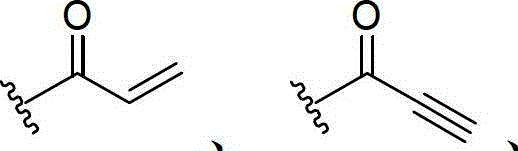

In a further or alternative embodiment the first and second, is selected from

The present invention also provides compounds of formula (III) or pharmaceutically acceptable salts, solvates, esters, acids and prodrugs thereof,
formula (III)
Wherein,
y is selected from unsubstituted or substituted alkyl, or a 4-, 5-, 6-membered cycloalkyl ring;
in a further or alternative embodiment the first and second, is selected from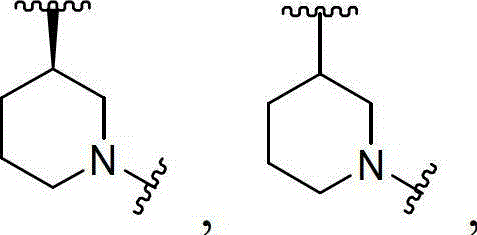

R15Selected from H or lower alkyl;
y and R15May be joined together to form a 4-, 5-or 6-membered heterocyclic ring;
g is selected from the group consisting of H,or
Wherein,
R7,R8and R9Each independently selected from H, halogen, unsubstituted or substituted lower alkyl, unsubstituted or substituted lower heteroalkyl;
in a further or alternative embodiment, G is selected from
R6Selected from H, -C1-8Alkyl, - (CH)2)nC3-7Cycloalkyl, - (CH)2)nC2-9Heterocycloalkyl, - (CH)2)n-OH、-(CH2)n-(CHOH)n-H、-(CH2)n-O-(CH2)nCH3、-(CH2)n-S-(CH2)nCH3、-(CH2)n-NH2、-(CH2)n-NH(C1-8Alkyl), - (CH)2)n-N(C1-8Alkyl radical)2、-C(O)C1-8An alkyl group;
in further or alternative embodiments, R6Selected from the group consisting of H, Me, Et,
n is 0, 1,2,3 or 4.
The present invention also provides a compound of formula (IV) or a pharmaceutically acceptable salt, solvate, active metabolite, polymorph, ester, isomer or prodrug thereof,

Wherein,
Laselected from the group consisting of a single bond, O, S, NH, S (= O)2、C(=O)、CH2NHC (O) O, NHC (O) or C (O) NH;
X0is selected from CH2O, NH or S;
X1and X3Each independently selected from C or N;
X2selected from the group consisting of CR5Or NR5;
R2And R3Each independently selected from H, unsubstituted or substituted lower alkyl;
or, R2And R3Taken together to form a 3 to 8 membered heterocyclic ring;
ar is selected from unsubstituted or substituted aryl and unsubstituted or substituted heteroaryl;
y is selected from the group consisting of a bond, alkyl, heteroalkyl, cycloalkyl, heterocycloalkyl, aryl, and heteroaryl;
z is selected from C (= O), OC (= O), NHC (= O), C (= S), S (= O)x、OS(=O)x、NHS(=O)x,
Wherein x is 1 or 2.
R5Selected from H, halogen, -L6- (unsubstituted or substituted C)1-3Alkyl), -L6- (unsubstituted or substituted C)2-4Alkenyl), -L6- (unsubstituted or substituted aryl) or-L6- (unsubstituted or substituted heteroaryl),
wherein,
L6selected from the group consisting of bonds, O, S, -S (= O)2NH, C (= O), -NHC (O) O, -OC (O) NH, -NHC (O), -C (O) NH or
R6Selected from H, halogen, amino, -C1-8Alkyl radical, -C2-8Alkenyl, -C2-8Alkynyl, - (CH)2)nC3-7Cycloalkyl, - (CH)2)nC2-9Heterocycloalkyl, - (CH)2)n-phenyl, - (CH)2)n-naphthyl, - (CH)2)n-a heteroaryl group,-(CH2)nCO2H、-(CH2)n-(CH2OH)n、-SR13、-OR13、-COR13、=CH-N(R13)2、-(CH2)n-N(R13)2、-(CH2)n-N(R13)CO2C1-8Alkyl, -C (O) (CH)2)nAryl, -C (O) C1-8Alkyl, -C (O) C3-7Cycloalkyl, -C (O) C2-9Heterocycloalkyl, -C (O) (CH)2)n-heteroaryl, -C (O) CF3、-C(O)(CH2)n-N(R13)2、-C(O)N(R13)C1-8Alkyl, -CO2(CH2)nC3-7Cycloalkyl, -C (O) N (R)13)(CH2)nC3-7Cycloalkyl, -C (O) N (R)13)(CH2)nC2-7Heterocycloalkyl, -CO2(CH2)n-heteroaryl, -CO2(CH2)n-phenyl, -C (O) N (R)13)(CH2)n-phenyl, -CO2(CH2)n-naphthyl, -C (O) N (R)13)(CH2)n-naphthyl, -C (O) N (R)13)(CH2)n-heteroaryl, -CO2C1-8Alkyl, -SO2C1-8Alkyl, -C (S) N (R)13)(CH2)n-phenyl, -CO2(CH2)nC2-9Heterocycloalkyl, -SO2C3-7Cycloalkyl, -SO2C2-9Heterocycloalkyl, -SO2-phenyl, -SO2-naphthyl, -SO2-heteroaryl, -S (O) N (R)13) Phenyl, -S-C1-8Alkyl, -S-C3-7Cycloalkyl, -S-C2-9Heterocycloalkyl, -S-phenyl, -S-naphthyl and-S-heteroaryl,
wherein,
alkyl, alkenyl, alkynyl, cycloalkyl, heterocycloalkyl, aryl, phenyl, naphthyl, heteroaryl and (CH) as described above2) Optionally one or moreR141 to 4 of various substituent groups;
R6and Y may be taken together to form a 3 to 12 membered heterocyclic ring;
R7selected from H, unsubstituted or substituted C1-4Alkyl, unsubstituted or substituted C1-4Heteroalkyl group, C1-6Alkoxyalkyl group, C1-8Alkylaminoalkyl, unsubstituted or substituted C3-6Cycloalkyl, unsubstituted or substituted aryl, unsubstituted or substituted C2-8Heterocycloalkyl, unsubstituted or substituted heteroaryl, C1-4Alkyl (aryl), C1-4Alkyl (heteroaryl), C1-4Alkyl radical (C)3-8Cycloalkyl) or C1-4Alkyl radical (C)2-8Heterocycloalkyl);
R8and R9Each independently selected from H, unsubstituted or substituted C1-4Alkyl, unsubstituted or substituted C1-4Heteroalkyl, unsubstituted or substituted C3-6Cycloalkyl and unsubstituted or substituted C2-6A heterocycloalkyl group, a heterocyclic alkyl group,
or,
R8and R9Combined to directly form a chemical bond;
R13selected from H, -C1-8Alkyl, -C2-8Alkenyl, -C2-8Alkynyl, - (CH)2)n-phenyl, -C2-8Alkenyl-phenyl and- (CH)2)nCO2H,
Wherein,
alkyl, alkenyl, alkynyl and (CH) as described above2) Optionally substituted with one or more of the following substituents: -OC1-4Alkyl and-C1-4An alkyl group, a carboxyl group,
and,
the above-mentioned phenyl group may be substituted with one or more of the following substituents: -OC1-4Alkyl and-C1-4An alkyl group;
R14selected from H, oxo, = NH, -CN, -CF3、-OCF3、-C1-6Alkyl, -C2-6Alkenyl, -C2-6Alkynyl, - (CH)2)nC3-6Cycloalkyl, - (CH)2)nC2-9Heterocycloalkyl, - (CH)2)nOR13、-(CH2)nCO2R13、-(CH2)nCO2(CH2)n-phenyl, - (CH)2)n-phenyl, - (CH)2)n-O-phenyl, - (CH)2)n-naphthyl, - (CH)2)n-heteroaryl, -N (R)13)2、-NR13C(O)R13、-NR13CO2R13-C (O) phenyl, -C (O) heteroaryl, -SR13、-SO2C1-6Alkyl and-SO2N(R13)2,
Wherein,
alkyl, alkenyl, alkynyl, phenyl, heteroaryl, heterocycloalkyl, naphthyl, Cycloalkyl and (CH) as described above2) Optionally substituted with one or more of the following substituents: hydroxy, halogen, methoxy and C1-4An alkyl group;
n is 0, 1,2,3,4, 5, 6, 7 or 8;
m is 1,2,3,4, 5, 6, 7 or 8;
or a pharmaceutically acceptable salt, solvate, active metabolite, polymorph, ester, isomer or prodrug.
In a variant of formula (IV), R8And R9May be independently selected from H, unsubstituted or substituted C1-4Alkyl radical, C1-4Heteroalkyl radicals or R8And R9The direct linkage forms a chemical bond.
In a variant of formula (IV), R8And R9Are both H or R8And R9The direct linkage forms a chemical bond.
In a variant of formula (IV), R7Selected from H, unsubstituted or substituted C1-4Alkyl radical, C1-4Heteroalkyl group and C1-8An alkylaminoalkyl group.
In a variant of formula (IV), R7Is H.
In a variant of formula (IV), Z is C (= O), S (= O)2Or S (= O).
In a variant of formula (IV), Z is C (= O) or S (= O)2。
In one variation of formula (IV), Y is selected from unsubstituted or substituted C1-8Alkyl radical, C2-9Heteroalkyl, aryl, heteroaryl, a 4 to 7 membered aliphatic ring or a 4 to 7 membered heterocycloalkyl ring.
In one variation of formula (IV), Y is selected from unsubstituted or substituted C1-8Alkyl, 4-, 5-, 6-and 7-membered aliphatic or heteroatomic rings.
In a variant of formula (IV), X1Is C, X2And X3Are both N; or X1Is N, X2And X3Is C; or X1And X2Is C, X3Is N.
In a variant of formula (IV), X1Is C, X2And X3Are all N.
In a variant of formula (IV), LaIs O, S or NH.
In a variant of formula (IV), LaIs O.
In one variation of formula (IV), Ar is aryl or heteroaryl.
In one variation of formula (IV), Ar is phenyl.
In a variant of formula (IV), X0Is O, S or NH。
In a variant of formula (IV), X0Is O.
In a variant of formula (IV), R2And R3Are all H; or R2Is H, R3Is C1-4An alkyl group; or R2Is C1-4Alkyl radical, R3Is H; or R2And R3Are all C1-4An alkyl group; or R2And R3Taken together to form a 3 to 8 membered heterocyclic ring.
In a variant of formula (IV), R2And R3Are all H; or R2Is H, R3Is C1-4An alkyl group; or R2Is C1-4Alkyl radical, R3Is H.
In a variant of formula (IV), R6Is H, -C1-8Alkyl, - (CH)2)nC3-7Cycloalkyl, - (CH)2)nC2-9Heterocycloalkyl, - (CH)2)n-OH、-(CH2)n-(CHOH)n-H、-(CH2)n-O-(CH2)nCH3、-(CH2)n-S-(CH2)nCH3、-(CH2)n-NH2、-(CH2)n-NH(C1-8Alkyl), - (CH)2)n-N(C1-8Alkyl radical)2、-C(O)CF3,-C(O)C1-8Alkyl, - (CH)2)n-phenyl, - (CH)2)n-a heteroaryl group.
In a variant of formula (IV), R6Is H, -C1-8Alkyl, - (CH)2)nC3-7Cycloalkyl, - (CH)2)nC2-9Heterocycloalkyl, - (CH)2)n-OH、-(CH2)n-(CHOH)n-H、-(CH2)n-O-(CH2)nCH3、-(CH2)n-S-(CH2)nCH3、-(CH2)n-NH2、-(CH2)n-NH(C1-8Alkyl), - (CH)2)n-N(C1-8Alkyl radical)2、-C(O)C1-8An alkyl group.
In a variant of formula (IV), n is 0, 1,2,3,4, 5, 6, 7, 8.
In a variant of formula (IV), n is 0, 1,2,3, 4.
According to some embodiments of the invention, there is provided a compound of formula (IV):

in another aspect, the present invention provides a pharmaceutical composition comprising a therapeutically effective amount of at least any one of the compounds provided herein, or a pharmaceutically acceptable salt, pharmaceutically active metabolite, pharmaceutically acceptable prodrug, or pharmaceutically acceptable solvate thereof. In certain embodiments, the compositions provided herein further comprise a pharmaceutically acceptable diluent, excipient, and/or binder.
In a further aspect, the invention provides methods of treating a patient by administering a compound provided herein. In some embodiments, the present invention also provides a method for inhibiting the activity of a tyrosine kinase, e.g., BTK, in a patient or for treating a disease, disorder or condition in a patient that would benefit from inhibition of a tyrosine kinase, e.g., BTK, comprising administering to the patient a therapeutically effective dose of at least any one of the compounds provided herein, or a pharmaceutically acceptable salt, pharmaceutically active metabolite, pharmaceutically acceptable prodrug or pharmaceutically acceptable solvate thereof.
In a further aspect, the present invention provides a method of inhibiting bruton's tyrosine kinase in a subject in need thereof by administering to said subject a composition comprising a therapeutically effective amount of at least one compound having the structure of any one of formula (I), formula (II), formula (III) or formula (IV). In some embodiments, a subject in need thereof suffers from an autoimmune disease, such as lupus erythematosus and inflammatory bowel disease; a subject in need thereof suffering from a heteroimmune condition or disease, such as graft versus host disease; a subject in need thereof is suffering from an inflammatory disease, such as asthma; a subject in need thereof suffers from cancer, such as diffuse large B-cell lymphoma; a subject in need thereof can also be suffering from a thromboembolic disorder, such as myocardial infarction.
In another aspect, the compounds of the present invention have the structure of any one of formula (I), formula (II), formula (III) or formula (IV) can form a covalent bond with a cysteine residue on bruton's tyrosine kinase.
In another aspect, is a method of modulating (including irreversibly inhibiting) BTK or other tyrosine kinase activity in a mammal, wherein the other tyrosine kinase shares homology with BTK in that it has a cysteine residue (including a Cys481 residue) and can form a covalent bond with at least one irreversible inhibitor described herein, the method comprising administering to the mammal at least once an effective amount of at least one compound having the structure of any one of formula (I), formula (II), formula (III), or formula (IV). In another aspect, is a method for treating a BTK dependent or BTK mediated condition or disease, the method comprising administering to a mammal at least one effective dose of at least one compound having a structure of any one of formula (I), formula (II), formula (III), or formula (IV).
Detailed Description
The present invention provides a method of inhibiting bruton's tyrosine kinase in a subject in need thereof by administering to the subject a composition comprising a therapeutically effective amount of at least one compound having the structure of any one of formula (I), formula (II), formula (III), or formula (IV). In some embodiments, a subject in need thereof suffers from an autoimmune disease, such as lupus erythematosus and inflammatory bowel disease; a subject in need thereof suffering from a heteroimmune condition or disease, such as graft versus host disease; a subject in need thereof is suffering from an inflammatory disease, such as asthma; a subject in need thereof suffers from cancer, such as diffuse large B-cell lymphoma; a subject in need thereof can also be suffering from a thromboembolic disorder, such as myocardial infarction.
In some embodiments, the compounds of the present invention have the structure of any of formula (I), formula (II), formula (III), or formula (IV) can form a covalent bond with a cysteine residue on bruton's tyrosine kinase.
In some embodiments, the irreversible BTK inhibitor compounds used in the methods described herein inhibit BTK or BTK homolog kinase activity, its in vitro IC50Less than 10. mu.M. (e.g., less than 1. mu.M, less than 100nM, less than 10nM, less than 1nM, less than 0.5 nM).
Described herein are compounds of any of formula (I), formula (II), formula (III), or formula (IV). Also described herein are pharmaceutically acceptable salts, pharmaceutically acceptable solvates, pharmaceutically active metabolites and pharmaceutically acceptable prodrugs of such compounds. Pharmaceutical compositions are provided that include at least one of the described compounds or a pharmaceutically acceptable salt, pharmaceutically acceptable solvate, pharmaceutically active metabolite, or pharmaceutically acceptable prodrug thereof. In some embodiments, when the presently disclosed compounds contain an oxidizable nitrogen atom, the nitrogen atom may be converted to an N-oxide by methods well known in the art. In some embodiments, compounds are also provided in isomeric and chemically protected forms having a structure represented by any one of formula (I), formula (II), formula (III), or formula (IV).
Certain chemical terms
Unless defined otherwise, all technical and scientific terms used herein have the same meaning as commonly understood by one of ordinary skill in the art to which the claimed subject matter belongs. All patents, patent applications, and publications cited herein are incorporated by reference in their entirety unless otherwise indicated. If there are multiple definitions of terms herein, the definition in this section controls. When referring to a URL or other such identifier or address, it is understood that such identifier can be transformed and exchanged with specific information on the internet, and equivalent information can be obtained through internet retrieval or other suitable reference data channels. The obtained reference demonstrates the availability and public dissemination of such information.
It is to be understood that both the foregoing general description and the following detailed description are exemplary and explanatory only and are not restrictive of the subject matter claimed. In this application, the use of the singular also includes the plural unless specifically stated otherwise. It must be noted that, as used in this specification and the appended claims, the singular forms "a," "an," and "the" include plural referents unless the context clearly dictates otherwise. It should also be noted that the use of "or", "or" means "and/or" unless stated otherwise. Furthermore, the term "comprising" as well as other forms, such as "includes," "including," and "containing," are not limiting.
Definitions of standardized chemical terms can be found in literature work, including "ADVANCED ORGANIC CHEMISTRY4 by Carey and SundbergTHED "Vols.A (2000) and B (2001), Plenum Press, New York. Unless otherwise indicated, conventional methods within the skill of the art are employed, such as mass spectrometry, NMR, HPLC, protein chemistry, biochemistry, recombinant DNA techniques, and pharmacological methods. Unless a specific definition is set forth, the nomenclature and laboratory procedures and techniques described herein that are related in chemistry, such as analytical chemistry, organic synthetic chemistry, and medical and pharmaceutical chemistry, are well known to those skilled in the art. Standard techniques can be used for chemical synthesis, chemical analysis, pharmaceutical preparation, formulation, drug delivery, and treatment of patients. Standard techniques can be used for recombinant DNA, oligonucleotide synthesis, and tissue culture and transformation (e.g., electroporation, lipofection). For example, the reaction and purification can be carried out using a kit with instructions provided by the manufacturer, or according to methods known in the art, or according to the methods described hereinProvided is a technique. In general, the foregoing techniques and procedures can be practiced by conventional methods well known in the art and described in various general and more specific references that are cited and discussed in this disclosure.
When a substituent is described by a general formula written from left to right, the substituent also includes chemically equivalent substituents obtained when the formula is written from right to left. For example, CH2O is equivalent to OCH2。
Unless otherwise indicated, the use of general chemical terms such as, but not limited to, "alkyl", "amine", "aryl" is equivalent to their optionally substituted forms. For example, "alkyl" as used herein includes optionally substituted alkyl.
The compounds described herein may have one or more stereogenic centers, and each stereogenic center may exist in the R or S configuration or a combination thereof. Similarly, the compounds described herein may have one or more double bonds, and each double bond may exist in either the E (trans) or Z (cis) configuration, or a combination thereof. A particular stereoisomer, structural isomer (regioisomer), diastereoisomer, enantiomer or epimer is understood to include all possible stereoisomers, structural isomers, diastereomers, enantiomers or epimers and mixtures thereof. Thus, the compounds described herein include all configurationally different stereoisomers, structural isomers, diastereomers, enantiomers, or epimers, as well as the corresponding mixtures thereof. Techniques for converting or leaving intact a particular stereoisomer, as well as techniques for resolving mixtures of stereoisomers, are well known in the art and those skilled in the art will be able to select appropriate methods for a particular situation. See, e.g., Fumisset al (eds.), VOGEL' S ENCYCOPEDIA OF PRACTICAL ORGANICCHEMISTRY5. TH ED., Longman Scientific and Technical Ltd., Essex,1991, 809-816; and Heller, acc, chem, res, 1990,23,128.
It is to be understood that the methods and compositions described herein are not limited to the particular methods, protocols, cell lines, constructs, and reagents described herein as such may vary. It is also to be understood that the terminology used herein is for the purpose of describing particular embodiments only, and is not intended to limit the scope of the methods and compositions described herein, which will be limited only by the appended claims.
All publications and patents mentioned herein are incorporated herein by reference in their entirety for the purpose of description and disclosure, e.g., the constructs and methods described in the publications, which can be used in combination with the methods, compositions, and compounds described herein. The disclosure of the publications discussed herein is provided solely for their disclosure prior to the filing date of the present application. It is not to be construed herein as an admission that the inventors are not entitled to antedate such disclosure by virtue of prior invention or for any other reason.
The terms "moiety," "structural moiety," "chemical moiety," "group," "chemical group" as used herein refer to a specific fragment or functional group in a molecule. Chemical moieties are generally considered to be chemical entities that are embedded in or attached to a molecule.
The term "bond" or "single bond" refers to a chemical bond that connects two atoms or two moieties by a bond resulting in a larger moiety.
The term "catalytic group" refers to a chemical functional group that, through its action, lowers the activation energy barrier of a reaction, thereby aiding catalysis.
The terms "optionally/any" or "optionally/optionally" mean that the subsequently described event or circumstance may or may not occur, and that the description includes instances where the event or circumstance occurs and instances where it does not. For example, an "optionally substituted alkyl" refers to an "unsubstituted alkyl" (alkyl unsubstituted by a substituent) or a "substituted alkyl" (alkyl substituted by a substituent), as defined below. Furthermore, the optionally substituted group may be unsubstituted (e.g. CH)2CH3) Completely substituted (e.g. CF)2CF3) Monosubstituted (CH)2CH2F) Or the degree of substitution between fully and mono-substituted (e.g. CH)2CHF2、CF2CH3、CFHCHF2Etc.). It will be understood by those skilled in the art that, for any group containing one or more substituents, no substitution or substitution pattern is introduced that is sterically impossible and/or cannot be synthesized (e.g., substituted alkyl includes optionally substituted cycloalkyl, whereas cycloalkyl is defined to include optionally substituted alkyl, and so forth). Thus, the substituent is generally understood to mean a maximum molecular weight of about 1,000 daltons, more typically, up to about 500 daltons (except where macromolecular substituents are obviously required, e.g., polypeptides, polysaccharides, polyethylene glycols, DNA and RNA, etc.).
C as used herein1-xComprising C1-2,C1-3……C1-x。
"alkyl" has the meaning customary in the art.
The term "heteroalkyl" refers to an optionally substituted alkyl group in which one or more backbone chain carbon atoms (also including attached hydrogen atoms where appropriate) are each independently replaced with a heteroatom (i.e., an atom other than carbon, such as, but not limited to, oxygen, nitrogen, sulfur, silicon, phosphorus, tin, or combinations thereof).
The "lower" in the term "lower heteroalkyl group" means said heteroalkyl group having 1 to 8, preferably 1 to 6, or 1 to 5, or 1 to 4, or 1 to 3, or 1 to 2 carbon atoms.
The alkyl group of the compounds described herein may be designated as "C1-4Alkyl "or the like. By way of example only, "C1-4Alkyl "indicates 1 to 4 carbon atoms in the alkyl chain, i.e. the alkyl chain is selected from the group consisting of methyl, ethyl, propyl, isopropyl, n-butyl, isobutyl, sec-butyl and tert-butyl. Thus, C1-4The alkyl group comprising C1-2Alkyl and C1-3An alkyl group. The alkyl group may be unsubstituted or substituted. Examples of the inventionIncluding but not limited to methyl, ethyl, n-propyl, isopropyl, 2-methyl-l-propyl, 2-methyl-2-propyl, 2-methyl-1-butyl, 3-methyl-l-butyl, 2-methyl-3-butyl, 2-dimethyl-1-propyl, 2-methyl-1-pentyl, 3-methyl-1-pentyl, 4-methyl-l-pentyl, 2-methyl-2-pentyl, 3-methyl-2-pentyl, 4-methyl-2-pentyl, 2-dimethyl-l-butyl, 3-dimethyl-1-butyl, 2-ethyl-1-butyl, 2-methyl-2-pentyl, 2-dimethyl-l-butyl, 2-methyl-1-butyl, 2-methyl-2-pentyl, 2-methyl-1-pentyl, n-butyl, isobutyl, sec-butyl, tert-butyl, n-pentyl, isopentyl, neopentyl, tert-pentyl and hexyl, and also longer alkyl groups such as heptyl and octyl, etc. When a group as defined herein, such as "alkyl" appears in a numerical range, e.g. "C1-C6Alkyl "or" C1-6Alkyl "means an alkyl group that can be composed of 1 carbon atom, 2 carbon atoms, 3 carbon atoms, 4 carbon atoms, 5 carbon atoms, or 6 carbon atoms, and the alkyl group herein also encompasses instances where no numerical range is specified. The alkyl group may also be a "lower alkyl" group having 1 to 6 carbon atoms, i.e., C1-6An alkyl group.
The term "non-cycloalkyl" refers to an alkyl group that is not cyclic, i.e., is a straight or branched chain alkyl group containing at least one carbon atom. The acyclic alkyl group can be fully saturated or can comprise acyclic olefins and/or alkynes. The non-cycloalkyl group may be optionally substituted.
The term "alkylene" refers to a divalent group derived from a monovalent alkyl group as defined above. Examples include, but are not limited to, methylene (-CH)2) Ethylene (-CH)2CH2) Propylene (-CH)2CH2CH2) And isopropylidene (-CH (CH)3)CH2) And the like.
The term "alkenyl" refers to a class of alkyl groups in which the first two atoms of the alkyl group form a double bond that is not part of an aromatic group. That is, the alkenyl group begins with the atom c (R) = c (R) -R, where R refers to the remainder of the alkenyl group, and each R may be the same or different. The alkenyl group may have 2 to 10 carbon atoms. The alkenyl group may also be a "lower alkenyl group" having 2 to 6 carbon atoms.
The term "AAlkenyl "refers to a divalent radical derived from a monovalent alkenyl group as defined above. Examples include, but are not limited to, ethenylene (CH = CH) and propenylene isomers (e.g., CH)2CH = CH and C (CH)3) = CH), and the like.
The term "alkynyl" refers to a class of alkyl groups in which the first two atoms of the alkyl group form a triple bond. That is, alkynyl groups begin with the atom-C.ident.C-R, where R refers to the remainder of the alkynyl group and each R may be the same or different. The "R" moiety in the alkynyl moiety may be branched, straight chain or cyclic. The alkynyl group may have 2 to 10 carbon atoms. Alkynyl groups may also be "lower alkyl" groups having 2 to 6 carbon atoms.
The term "alkynylene" refers to a divalent group derived from a monovalent alkynyl group as defined above. Examples include, but are not limited to, ethynylene (-C ≡ C-) and propynyl (-CH)2C.ident.C-), and the like.
The term "alkoxy" refers to a (alkyl) O-group, wherein alkyl is as defined herein.
The term "amide" refers to a chemical moiety having the formula-C (O) NHR or-NHC (O) R, wherein R is selected from the group consisting of alkyl, cycloalkyl, aryl, heteroaryl, and heteroalicyclic. The amide moiety may form a bond between an amino acid or peptide molecule and a compound described herein, thereby forming a prodrug.
The term "ester" refers to a chemical moiety having the formula-COOR, wherein R is selected from the group consisting of alkyl, cycloalkyl, aryl, heteroaryl, and heteroalicyclic groups. Any of the hydroxyl or carboxyl side chains on the compounds described herein may be esterified.
The term "ring" refers to any covalently closed structure. Rings include, for example, carbocyclic, heterocyclic, aromatic, and non-aromatic groups. The ring may be optionally substituted. The ring may be monocyclic or polycyclic.
The term "membered ring" may comprise any ring structure. The term "member" is intended to mean the number of skeleton atoms constituting a ring. Thus, for example, pyridine and thiopyran are 6-membered rings; cyclopentyl and pyrrole are 5 membered rings.
The term "carbocyclyl" or "carbocycle" refers to a ring in which each of the atoms making up the ring is a carbon atom. Carbocycles include aryl and cycloalkyl. The term thus distinguishes carbocyclic from heterocyclic rings in which the ring backbone contains at least one atom other than carbon. Heterocycles include heteroaryl and heterocycloalkyl. The carbocycle and heterocycle may be optionally substituted.
The term "aryl" refers to a planar ring having a delocalized pi-electron system and containing 4n + pi electrons, where n is an integer. An aryl ring may be composed of five, six, seven, eight, nine or more than nine atoms. The aryl group may be optionally substituted. The term "aryl" includes carbocyclic aryl and heterocyclic aryl groups. The term includes monocyclic or fused ring polycyclic groups.
The term "aryl" means that each of the ring-forming atoms in the aromatic ring is a carbon atom. The aryl ring may be composed of five, six, seven, eight, nine or more than nine atoms. The aryl group may be optionally substituted. Examples of aryl groups include, but are not limited to, phenyl, naphthyl, phenanthryl, anthracyl, fluorenyl, and indenyl. Depending on the structure, the aryl group may be a monovalent group or a divalent group, i.e., an arylene group.
The term "cycloalkyl" refers to a monocyclic or polycyclic group that contains only carbon and hydrogen, and can be saturated, partially unsaturated, or fully unsaturated. Cycloalkyl groups include groups having 3 to 10 ring atoms. Illustrative examples of cycloalkyl groups include the following moieties: 
 and the like. Depending on the structure, the cycloalkyl group can be a monovalent group or a divalent group. Cycloalkyl groups may also be "lower cycloalkyl" groups having 3 to 8 carbon atoms.
The term "heterocycle"Refers to heteroaryl and heteroalicyclic groups containing 1 to 4 heteroatoms each selected from O, S and N, wherein each heterocyclic group has 4 to 10 atoms in its ring system, with the proviso that: the group does not contain two adjacent O or S atoms in the ring. Herein, whenever the number of carbon atoms in a heterocycle is specified, at least one other heteroatom must be present in the ring. "C1-6The expressions "heterocyclic ring" and the like refer only to the number of carbon atoms in the ring, and not to the total number of atoms in the ring. It is understood that the heterocyclic ring may have additional heteroatoms in the ring. The expression "4-to 6-membered heterocyclic ring" and the like means the total number of atoms contained in the ring. In a heterocycle having two or more heteroatoms, those two or more heteroatoms may be the same as or different from each other. The heterocyclic ring may be optionally substituted. The attachment of the heterocycle may be at a heteroatom or via a carbon atom. Non-aromatic heterocyclic groups include groups having only 4 atoms in their ring system, however, aromatic heterocyclic groups must have at least 5 atoms in their ring system. The heterocyclic group includes a benzene-fused ring system. An example of a 4-membered heterocyclic group is azetidinyl (derived from azetidine). An example of a 5-membered heterocyclic group is thiazolyl. An example of a 6-membered heterocyclyl is pyridyl. An example of a 10-membered heterocyclic group is quinolinyl. Examples of non-aromatic heterocyclic groups are pyrrolidinyl, tetrahydrofuryl, dihydrofuranyl, tetrahydrothienyl, tetrahydropyranyl, dihydropyranyl, dihydrothiopyranyl, piperidino, morpholino, thiomorpholino, thiepinyl, piperazinyl, azetidinyl, oxetanyl, thietanyl, homopiperidinyl, oxepinyl, thiepinyl, oxonitronyl, oxazapinyl, diazepinyl, thiazapinyl, 1,2,3, 4-tetrahydropyridinyl, 2-pyrrolinyl, 3-pyrrolinyl, indolinyl, 2H-pyranyl, 4H-pyranyl, dioxanyl, 1, 3-dioxolane, pyrazolinyl, dithianyl, dihydropyranyl, dihydrothienyl, tetrahydrothienyl, piperidino, dihydrothienyl, piperidino, dihydropyranyl, dihydrothienyl, and the like, Pyrazolidinyl, imidazolinyl, imidazolidinyl, 3-azabicyclo [3.1.0]Hexane radical, 3-azabicyclo [4.1.0 ]]Heptenyl, 3H-indolyl and quinolizinyl. Fragrance compositionExamples of heterocycles are pyridyl, imidazolyl, pyrimidinyl, pyrazolyl, triazolyl, pyrazinyl, tetrazolyl, furyl, thienyl, isoxazolyl, thiazolyl, oxazolyl, isothiazolyl, pyrrolyl, quinolyl, isoquinolyl, indolyl, benzimidazolyl, benzofuranyl, indolinyl, indazolyl, indolizinyl, phthalazinyl, pyridazinyl, triazinyl, isoindolyl, pteridinyl, purinyl, oxadiazolyl, thiadiazolyl, furazanyl (furazanyl), benzofurazanyl, benzothienyl, benzothiazolyl, benzoxazolyl, quinazolinyl, quinoxalinyl, naphthyridinyl and furopyridyl.
The term "heteroaryl" refers to an optionally substituted monovalent aryl group comprising from about 5 to about 20 backbone ring-forming atoms, wherein one or more of the ring-forming atoms is a heteroatom independently selected from the group consisting of heteroatoms of oxygen, nitrogen, sulfur, phosphorus, silicon, selenium, and tin, but is not limited thereto; with the proviso that the ring of the group does not contain two adjacent O or S atoms. In embodiments where two or more heteroatoms are present in the ring, the two or more heteroatoms may be the same as each other, or some or all of the two or more heteroatoms may be different from each other. The term heteroaryl includes optionally substituted monovalent fused or non-fused heteroaryl groups having at least one heteroatom. In addition, the term heteroaryl also includes fused and non-fused heteroaryl groups containing from 5 to about 12 backbone ring atoms, and fused and non-fused heteroaryl groups containing from 5 to about 10 backbone ring atoms. The heteroaryl group may be bonded through a carbon atom or a heteroatom. Thus, for example, an imidazole may be attached to the parent molecule through any of its carbon atoms (imidazol-2-yl, imidazol-4-yl, or imidazol-5-yl) or its nitrogen atom (imidazol-1-yl or imidazol-3-yl). Similarly, heteroaryl groups may be further substituted by any or all of their carbon atoms and/or any or all of their heteroatoms. The fused heteroaryl group may comprise 2 to 4 fused rings fused with aromatic heterocycles, and the other individual rings may be alicyclic, heterocyclic, aromatic, heteroaromatic, or any combination thereof. Non-limiting examples of monocyclic heteroaryl groups include pyridyl; fused ring heteroaryls include benzimidazolyl (benzimidazolyl), quinolyl (quinolyl), acridinyl (acridinyl), and non-fused bis-heteroaryls include bipyridyl (bipyridinyl). Other examples of heteroaryl groups include, but are not limited to: furyl (furanyl), thienyl (thienyl), oxazolyl (oxazolyl), acridinyl (acridinyl), phenazinyl (phenazinyl), benzimidazolyl (benzimidazolyl), benzofuranyl (benzofuranyl), benzoxazolyl (benzoxazolyl), benzothiazolyl (benzothiazolyl), benzothiadiazolyl (benzothiazolyl), benzothiophenyl (benzothiophenyl), benzoxadiazolyl (benzoxadiazolyl), benzotriazolyl (triazolyl), imidazolyl (imidiazolyl), indolyl (indolyl), isoxazolyl (isoxazolyl), isoquinolyl (isoquinolinyl), indolizinyl (indolizinyl), isothiazolyl (isothiazolyl), isoindolinyl (isoindolinyl), quinazolinyl (pyrazolinyl), quinazolinyl (pyrazinyl), quinazolinyl (pyridyl), pyrazinyl (pyridyl), quinazolinyl (pyridyl), benzothiazolyl (pyridyl), benzoxazolyl (pyridyl) (pyridyl) (pyridyl), pyridyl) (pyridyl) (pyridyl), pyridyl) (quinolyl), quinazolinyl) (pyridyl) (pyridyl), triazolyl (triazolyl), tetrazolyl (tetrazolyl), thiazolyl (thiazoyl), triazinyl (triazinyl), and thiadiazolyl (thiadiazolyl), and the like, and oxides thereof, such as pyridyl-N-oxide (pyridil-N-oxide).
The term "non-aromatic heterocycle", "heterocycloalkyl" or "heteroalicyclic" means that one or more of the ring-forming atoms in the non-aromatic ring is a heteroatom. "non-aromatic heterocycle" or "heterocycloalkyl" refers to a cycloalkyl group that includes at least one heteroatom selected from nitrogen, oxygen, and sulfur. The groups may be fused to aryl or heteroaryl groups. Heterocycloalkyl groups may be composed of three, four, five, six, seven, eight, nine, or more than nine atoms. The heterocycloalkyl ring may be optionally substituted. In certain embodiments, the non-aromatic heterocyclic ring contains one or more carbonyl or thiocarbonyl groups, such as oxo or thioxo containing groups, and the like. Examples of heterocycloalkyl groups include, but are not limited to, lactams, lactones, cyclic imines, cyclic thioimines, cyclic carbamates, tetrahydrothiopyrans, 4H-pyrans, tetrahydropyrans, piperidines, 1, 3-dioxins, 1, 3-dioxanes, 1, 4-dioxins1, 4-dioxane, piperazine, 1, 3-oxathiane, 1, 4-oxathiane, tetrahydro-1, 4-thiazine, 2H-1, 2-oxazine, maleimide, hexahydro-1, 3, 5-triazine, tetrahydrothiophene, tetrahydrofuran, pyrroline, pyrrolidine, pyrrolidone (pyrrolidone), pyrrolidinedione (pyrrolidione), pyrazoline, pyrazolidine, imidazoline, imidazolidine, 1, 3-dioxole, 1, 3-dioxolane, 1, 3-dithiolane, isoxazoline, oxazoline, oxazolidine, oxazolidinone, thiazoline, thiazolidine, and 1, 3-oxathiolane. Illustrative examples of heterocycloalkyl, also referred to as non-aromatic heterocycles, include:
 and the like.
The terms "halogen", "halo" or "halide" refer to fluorine, chlorine, bromine and iodine.
The term "sulfinyl" refers to the divalent group-S (= O) -R.
The term "sulfonyl" refers to a divalent group-S (= O)2-R。
The terms "sulfonamide" and "sulfonamido" refer to the group-S (O)2NH-and-NHS (= O)2-。
The term "cyano" refers to the group-CN.
Certain pharmaceutical terms
The term "bruton's tyrosine kinase" refers to bruton's tyrosine kinase from Homo sapiens, which has been disclosed in, for example, U.S. patent No. 6326469 (GenBank accession No. NP _ 000052).
The term "bruton's tyrosine kinase homolog" refers to an ortholog of bruton's tyrosine kinase, such as an ortholog from mouse (GenBank accession No. AAB47246), dog (GenBank accession No. XP _549139), rat (GenBank accession No. NP _001007799), chicken (GenBank accession No. NP _989564), or zebrafish (GenBank accession No. XP _698117), and fusion proteins of any of the foregoing, which exhibit kinase activity on one or more bruton's tyrosine kinase substrates (e.g., a peptide substrate having the amino acid sequence "AVLESEEELYSSARQ").
The terms "preventing", "prevention" and "prevention" include reducing the likelihood that a patient will develop or deteriorate autoimmune disorders, heteroimmune disorders, inflammatory disorders, thromboembolic disorders, and cancers (e.g., diffuse large B-cell lymphoma, chronic lymphocytic lymphoma, and B-cell prolymphocytic leukemia, etc.).
The terms "subject", "patient" or "individual" refer to an individual suffering from a disease, disorder or condition, and the like, including mammals and non-mammals. Examples of mammals include, but are not limited to, any member of the class mammalia: humans, non-human primates (e.g., chimpanzees and other apes and monkeys); livestock, such as cattle, horses, sheep, goats, pigs; domestic animals such as rabbits, dogs, and cats; laboratory animals, including rodents, such as rats, mice, and guinea pigs, and the like. Examples of non-human mammals include, but are not limited to, birds, fish, and the like. In one embodiment related to the methods and compositions provided herein, the mammal is a human.
The term "treating" and other similar synonyms include alleviating, alleviating or ameliorating a symptom of a disease or disorder, preventing other symptoms, ameliorating or preventing the underlying metabolic cause of the symptom, inhibiting the disease or disorder, e.g., arresting the development of the disease or disorder, alleviating the disease or disorder, ameliorating the disease or disorder, alleviating a symptom caused by the disease or disorder, or discontinuing a symptom of the disease or disorder, and further, the term includes prophylactic purposes. The term also includes obtaining a therapeutic effect and/or a prophylactic effect. The therapeutic effect refers to curing or ameliorating the underlying disease being treated. In addition, a cure or amelioration of one or more physiological symptoms associated with the underlying disease is also a therapeutic effect, e.g., an improvement in the condition of the patient is observed, although the patient may still be affected by the underlying disease. For prophylactic effect, the composition can be administered to a patient at risk of developing a particular disease, or to a patient presenting with one or more physiological symptoms of the disease, even if a diagnosis of the disease has not yet been made.
The terms "effective amount," "therapeutically effective amount," or "pharmaceutically effective amount" refer to the amount of at least one agent or compound that is sufficient to alleviate, to some extent, one or more of the symptoms of the disease or condition being treated upon administration. The result may be a reduction and/or alleviation of signs, symptoms, or causes, or any other desired change in a biological system. For example, an "effective amount" for treatment is the amount of a composition comprising a compound disclosed herein that is clinically necessary to provide a significant remission effect of the condition. An effective amount suitable in any individual case can be determined using techniques such as a dose escalation assay.
The terms "administering", and the like refer to a method capable of delivering a compound or composition to a desired site for biological action. These methods include, but are not limited to, oral routes, via the duodenal route, parenteral injection (including intravenous, subcutaneous, intraperitoneal, intramuscular, intraarterial injection or infusion), topical administration, and rectal administration. Administration techniques useful for The compounds and methods described herein are well known to those skilled in The art, for example, in Goodman and Gilman, The pharmaceutical basic of therapeutics, currented; pergamon; and those discussed in Remington's, Pharmaceutical Sciences (current edition), Mack Publishing co. In preferred embodiments, the compounds and compositions discussed herein are administered orally.
The term "acceptable" means that there is no long-term detrimental effect on the general health of the subject being treated.
The term "pharmaceutically acceptable" refers to a substance (e.g., carrier or diluent) that does not affect the biological activity or properties of the compounds of the present invention, and is relatively non-toxic, i.e., the substance can be administered to an individual without causing an adverse biological response or interacting in an adverse manner with any of the components contained in the composition.
The term "pharmaceutical composition" refers to a biologically active compound optionally mixed with at least one pharmaceutically acceptable chemical ingredient including, but not limited to, carriers, stabilizers, diluents, dispersing agents, suspending agents, thickening agents, and/or excipients.
The term "carrier" refers to a relatively non-toxic chemical compound or agent that facilitates the introduction of the compound into a cell or tissue.
The term "agonist" refers to a molecule that enhances the activity of other molecules or receptor sites, such as a compound, a drug, an enzyme activator, or a hormone modulator.
The term "antagonist" refers to a molecule that abrogates or inhibits the activity of other molecules or receptor sites, such as a compound, drug, enzyme inhibitor, or hormone modulator.
The term "modulate" refers to interacting with a target directly or indirectly to alter the activity of the target, including, for example, enhancing target activity, inhibiting target activity, limiting target activity, or prolonging target activity.
The term "modulator" refers to a molecule that interacts directly or indirectly with a target. The interaction includes, but is not limited to, an agonist and antagonist interaction.
The term "pharmaceutically acceptable salt" refers to salts that retain the biological potency of the free acid and free base of the specified compound, and that are biologically or otherwise not adversely affected. The compounds described herein may have acidic or basic groups and thus may react with any of a variety of inorganic or organic bases and inorganic and organic acids to form pharmaceutically acceptable salts. These salts may bePrepared by the following method: prepared in situ during the final isolation and purification of the compounds of the invention, or by separately reacting the free base form of the compounds of the invention with a suitable organic or inorganic acid and isolating the salt thus formed. Examples of pharmaceutically acceptable salts include salts prepared by reaction between a compound described herein and an inorganic or organic acid or base. These salts include acetate, acrylate, adipate, alginate, aspartate, benzoate, benzenesulfonate, bisulfate, bisulfite, bromide, butyrate, butyne-1, 4-dioate, camphorate, camphorsulfonate, caprylate, chlorobenzoate, chloride, citrate, cyclopentanepropionate, caprate, gluconate, dihydrogenphosphate, dinitrobenzoate, dodecylsulfate, ethanesulfonate, formate, fumarate, glucoheptonate, glycerophosphate, glycolate, hemisulfate, heptanoate, hexyne-1,6-dioate (hexyne-1,6-dioate), hydroxybenzoate, y-hydroxybutyrate, hydrochloride, hydrobromide, hydroiodide, 2-isethionate, iodide, di-acetate, di, Isobutyrate, lactate, maleate, malonate, methanesulfonate, mandelate, metaphosphate, methoxybenzoate, methylbenzoate, monohydrogenphosphate, 1-naphthalenesulfonate, 2-naphthalenesulfonate, nicotinate, nitrate, pamoate, jellylate, persulfate, 3-phenylpropionate, phosphate, picrate, pivalate, propionate, pyrosulfate, pyrophosphate, propiolic acid, phthalate, phenylacetate, phenylbutyrate, propanesulfonate, salicylate, succinate, sulfate, sulfite, suberate, sebacate, sulfonate, tartrate, thiocyanate, p-toluenesulfonate, undecanoate (undeconate), and xylenesulfonate. Other acids (such as oxalic acid), although not pharmaceutically acceptable per se, may be used as intermediates in the preparation of the salts to obtain the compounds of the invention and their pharmaceutically acceptable acid addition salts (see examples in bergetea l., j. pharm. sci.1977,66, 1-19). Further, compounds described herein that can include free acid groups can be reacted withSuitable bases are reacted (e.g. hydroxides, carbonates or bicarbonates of pharmaceutically acceptable metal cations), with ammonia, or with pharmaceutically acceptable organic primary, secondary or tertiary amines. Representative alkali metal salts or alkaline earth metal salts include lithium, sodium, potassium, calcium, magnesium, and aluminum salts and the like. Illustrative examples of bases include sodium hydroxide, potassium hydroxide, hydroxyethyltrimethylamine hydroxide, sodium carbonate and IV' (C)1-4Alkyl radical)4And the like. Representative organic amines useful for the formation of base addition salts include ethylamine, diethylamine, ethylenediamine, ethanolamine, diethanolamine, piperazine and the like. It is to be understood that the compounds described herein also include quats of any basic nitrogen-containing group that they may contain. Water-or oil-soluble or dispersible products can be obtained by quaternization. See, e.g., Berge et al, supra.
The term "solvate" refers to a solvate formed by combining a compound of the present invention with a solvent molecule. In some embodiments, the solvate is a monohydrate, e.g., the solvent is water, and the compound of the invention forms a monohydrate with water.
The term "polymorph" or "polymorphism" means that the compounds of the present invention exist in different crystal lattice forms.
The term "ester" means that a derivative of a compound of the present invention is derived from a compound containing a carboxylic acid and a hydroxyl group. Any of these compounds may be a compound of the present invention.
The term "tautomer" refers to the evolution of a compound of the invention from another compound by the migration of one hydrogen atom or proton.
The term "pharmaceutically acceptable derivative or prodrug" refers to any pharmaceutically acceptable salt, ester or ester salt of the compound of the present invention. And pharmaceutically active metabolites or residues that can be administered directly or indirectly to a patient to achieve a therapeutic effect. Particularly attractive pharmaceutical derivatives and prodrugs are those which enhance the pharmaceutical activity of the compounds of the invention when administered to a patient (e.g., by orally administering the compounds more readily to the blood) or by enhancing the metabolic absorption of the compounds in the body (e.g., the brain or lymphatic system).
The term "enhance/enhance" and the like refer to increasing the effectiveness of a desired effect or extending the duration of a desired effect. Thus, in referring to enhancing the effect of a therapeutic agent, the term "enhance" refers to the ability to increase or prolong the efficacy or duration of the effect of the other therapeutic agent on the system.
The term "effect-enhancing amount (an amount effective to enhance effect)" refers to an amount sufficient to enhance the effect of the other therapeutic agent in the desired system.
The terms "pharmaceutical combination", "administering other treatment", "administering other therapeutic agent" and the like refer to a pharmaceutical treatment obtained by mixing or combining more than one active ingredient, which includes both fixed and unfixed combinations of active ingredients. The term "fixed combination" refers to the simultaneous administration of at least one compound described herein and at least one synergistic agent to a patient in the form of a single entity or a single dosage form. The term "non-fixed combination" refers to the administration of at least one compound described herein and at least one synergistic formulation to a patient simultaneously, in combination, or sequentially at variable intervals as separate entities, wherein such administration provides effective levels of the two or more compounds in the body of the patient. These also apply to cocktail therapy, for example the administration of three or more active ingredients.
The terms "co-administration," "administration in combination with … …," and synonyms thereof, and the like, refer to the administration of a selected therapeutic agent to the same patient and are intended to encompass therapeutic strategies in which the agents are administered by the same or different routes of administration, or the same or different numbers of administrations. In some embodiments, the compounds described herein are administered in combination with other agents. These terms encompass the administration of two or more agents to an animal such that the agents and/or metabolites thereof are present simultaneously within the animal. These terms include the simultaneous administration of different compositions, the administration of different compositions at different times and/or the administration of one composition containing different active ingredients. Thus, in some embodiments, the compounds of the present invention and other agents are administered in admixture in one composition.
The term "metabolite" refers to a derivative of a compound that is formed upon metabolism of the compound.
The term "active metabolite" refers to an active derivative of a compound that is formed upon metabolism of the compound.
The term "metabolic" refers to all processes (including but not limited to hydrolysis reactions and enzyme-catalyzed reactions) in which an organism converts a particular substance. Thus, enzymes can produce specific structural changes to a compound. For example, cytochrome P450 catalyzes a variety of redox reactions, while uridine diphosphate glucuronosyltransferase catalyzes the transfer of activated glucuronic acid molecules to aromatic alcohols, aliphatic alcohols, carboxylic acids, amines and free sulfhydryl groups. For more information on metabolism, see The Pharmacological Basis of Therapeutics,9th Edition, McGraw-Hill (1996).
The term "Michael (Michael) acceptor moiety" refers to a functional group capable of participating in a Michael reaction in which a new covalent bond is formed between a portion of the Michael acceptor moiety and a donor moiety. The Michael acceptor moiety is electrophilic, while the "donor moiety" is nucleophilic. The "G" group present in any of formula (I), formula (II), formula (III) or formula (IV) is a non-limiting example of a Michael acceptor moiety.
The term "nucleophile" or "nucleophilic" refers to an electron-rich compound or a portion thereof. Examples of nucleophiles include, but are in no way limited to, cysteine residues of the molecule, such as Cys481 of BTK.
The term "electrophile" or "electrophilic" refers to an electron poor or electron deficient molecule or portion thereof. Examples of electrophiles include, but are in no way limited to, Michael acceptor moieties.
The term "bioavailability" refers to a compound disclosed herein, for example, any of formula (I), formula (II), formula (III), or formula (IV)Is delivered to the systemic circulation of the animal or human being studied as a percentage by weight after administration. Total Exposure of drug when administered intravenously (AUC)(0-∞)) Is usually defined as 100% bioavailability (F%).
The term "oral bioavailability" refers to the degree to which a compound disclosed herein, e.g., a compound of any of formula (I), formula (II), formula (III), or formula (IV), is absorbed into the systemic circulation when the pharmaceutical composition is administered orally versus intravenously.
The term "plasma concentration" refers to the concentration of a compound disclosed herein, e.g., a compound of any one of formula (I), formula (II), formula (III), or formula (IV), in the plasma component of the subject's blood. It is understood that the plasma concentration of a compound of any of formula (I), formula (II), formula (III) or formula (IV) may vary significantly between subjects due to variability in metabolism and/or possible interactions with other therapeutic agents. According to one embodiment of the present disclosure, the plasma concentration of the compound of any one of formula (I), formula (II), formula (III), or formula (IV) may vary between subjects. Similarly, values such as maximum plasma concentration (C)max) Or to achieve maximum plasma concentration (T)max) Time of (d), or total area under plasma concentration time curve (AUC)(0-∞)) May vary between subjects. Because of this availability, the amount of the compound of any of formula (I), formula (II), formula (III) or formula (IV) necessary to make up a "therapeutically effective amount" will vary from subject to subject.
The term "target activity" refers to a biological activity that can be selectively modulated by a modulator. Certain exemplary target activities include, but are not limited to, binding affinity, signal transduction, enzymatic activity, tumor growth, inflammation or inflammation-related processes, and amelioration of one or more symptoms associated with a disease or disorder.
The term "target protein" refers to a protein molecule or portion of a protein that can be bound by a selective binding compound. In certain embodiments, the target protein is BTK.
The term "IC50By "is meant the amount, concentration or dose of a particular test compound that achieves 50% inhibition of the maximal effect, e.g., inhibition of BTK, in an assay that measures such effect.
Compound (I)
The BTK inhibitors of the present invention are those kinases that have selective inhibition of bruton's tyrosine kinase and have a fragment of cysteine 481 residue in the amino acid sequence. Irreversible bruton's tyrosine kinase inhibitors can selectively and irreversibly inhibit the active site of a target tyrosine kinase, e.g., the form that phosphorylates tyrosine kinases.
Compounds of the irreversible bruton's tyrosine kinase inhibitor class can be used for the manufacture of a variety of medicaments for treating a variety of conditions from that individual, such as autoimmune diseases, inflammatory diseases, allergic diseases, B-cell proliferative diseases, thrombotic diseases, and the like. The inhibitor compounds of the present invention comprise michael acceptor moieties.
The present invention provides compounds of formula (IV), comprising pharmaceutically acceptable salts, solvates, active metabolites, polymorphs, esters, isomers or prodrugs.

Wherein,
Laselected from the group consisting of a single bond, O, S, NH, S (= O)2、C(=O)、CH2NHC (O) O, NHC (O) or C (O) NH;
X0is selected from CH2O, NH or S;
X1and X3Each independently selected from C or N;
X2selected from the group consisting of CR5Or NR5;
R2And R3Each independently selected from H, unsubstituted or substituted lower alkyl;
or, R2And R3Taken together to form a 3 to 8 membered heterocyclic ring;
ar is selected from unsubstituted or substituted aryl and unsubstituted or substituted heteroaryl;
y is optional, when present, is alkyl, heteroalkyl, cycloalkyl, heterocycloalkyl, aryl, and heteroaryl;
z is C (= O), OC (= O), NHC (= O), C (= S), S (= O)x、OS(=O)x、NHS(=O)x,
Wherein x is 1 or 2.
R5Is H, halogen, -L6- (unsubstituted or substituted C)1-3Alkyl), -L6- (unsubstituted or substituted C)2-4Alkenyl), -L6- (unsubstituted or substituted aryl) or-L6- (unsubstituted or substituted heteroaryl),
wherein,
L6is a bond, O, S, -S (= O)2NH, C (= O), -NHC (O) O, -OC (O) NH, -NHC (O), -C (O) NH or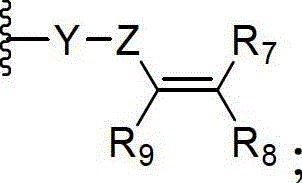
R6Is H, halogen, amino, -C1-8Alkyl radical, -C2-8Alkenyl, -C2-8Alkynyl, - (CH)2)nC3-7Cycloalkyl, - (CH)2)nC2-9Heterocycloalkyl, - (CH)2)n-phenyl, - (CH)2)n-naphthyl, - (CH)2)n-heteroaryl, - (CH)2)nCO2H、-(CH2)n-(CH2OH)n、-SR13、-OR13、-COR13、=CH-N(R13)2、-(CH2)n-N(R13)2、-(CH2)n-N(R13)CO2C1-8Alkyl, -C (O) (CH)2)nAryl, -C (O) C1-8Alkyl, -C (O) C3-7Cycloalkyl, -C (O) C2-9Heterocycloalkyl, -C (O) (CH)2)n-heteroaryl, -C (O) CF3、-C(O)(CH2)n-N(R13)2、-C(O)N(R13)C1-8Alkyl, -CO2(CH2)nC3-7Cycloalkyl, -C (O) N (R)13)(CH2)nC3-7Cycloalkyl, -C (O) N (R)13)(CH2)nC2-7Heterocycloalkyl, -CO2(CH2)n-heteroaryl, -CO2(CH2)n-phenyl, -C (O) N (R)13)(CH2)n-phenyl, -CO2(CH2)n-naphthyl, -C (O) N (R)13)(CH2)n-naphthyl, -C (O) N (R)13)(CH2)n-heteroaryl, -CO2C1-8Alkyl, -SO2C1-8Alkyl, -C (S) N (R)13)(CH2)n-phenyl, -CO2(CH2)nC2-9Heterocycloalkyl, -SO2C3-7Cycloalkyl, -SO2C2-9Heterocycloalkyl, -SO2-phenyl, -SO2-naphthyl, -SO2-heteroaryl, -S (O) N (R)13) Phenyl, -S-C1-8Alkyl, -S-C3-7Cycloalkyl, -S-C2-9Heterocycloalkyl, -S-phenyl, -S-naphthyl and-S-heteroaryl,
wherein,
alkyl, alkenyl, alkynyl, cycloalkyl, heterocycloalkyl, aryl, phenyl, naphthyl, heteroaryl and (CH)2) May independently be unsubstituted or substituted by R141 to 4 of various substituent groups;
R6and Y may be taken together to form a 3-to 12-membered heterocyclic ring;
R7Is H, unsubstituted or substituted C1-4Alkyl, unsubstituted or substituted C1-4Heteroalkyl group, C1-6Alkoxyalkyl radical, C1-8Alkylaminoalkyl, unsubstituted or substituted C3-6Cycloalkyl, unsubstituted or substituted aryl, unsubstituted or substituted C2-8Heterocycloalkyl, unsubstituted or substituted heteroaryl, C1-4Alkyl (aryl), C1-4Alkyl (heteroaryl), C1-4Alkyl radical (C)3-8Cycloalkyl) or C1-4Alkyl radical (C)2-8Heterocycloalkyl);
R8and R9Each independently selected from H, unsubstituted or substituted C1-4Alkyl, unsubstituted or substituted C1-4Heteroalkyl, unsubstituted or substituted C3-6Cycloalkyl and unsubstituted or substituted C2-6A heterocycloalkyl group, a heterocyclic alkyl group,
or,
R8and R9Combined to directly form a chemical bond;
R13is H, -C1-8Alkyl, -C2-8Alkenyl, -C2-8Alkynyl, - (CH)2)n-phenyl, -C2-8Alkenyl-phenyl and- (CH)2)nCO2H,
Wherein,
alkyl, alkenyl, alkynyl and (CH)2) May be independently substituted with 1 to 2 substituents as follows: -OC1-4Alkyl and-C1-4An alkyl group, a carboxyl group,
and,
the phenyl group may be independently unsubstituted or substituted with 1 to 3 substituent groups as follows: -OC1-4Alkyl and-C1-4An alkyl group;
R14is H, oxo, = NH, -CN, -CF3、-OCF3、-C1-6Alkyl, -C2-6Alkenyl, -C2-6Alkynyl, - (CH)2)nC3-6Cycloalkyl, - (CH)2)nC2-9Heterocycloalkyl, - (CH)2)nOR13、-(CH2)nCO2R13、-(CH2)nCO2(CH2)n-phenyl, - (CH)2)n-phenyl, - (CH)2)n-O-phenyl, - (CH)2)n-naphthyl, - (CH)2)n-heteroaryl, -N (R)13)2、-NR13C(O)R13、-NR13CO2R13-C (O) phenyl, -C (O) heteroaryl, -SR13、-SO2C1-6Alkyl and-SO2N(R13)2,
Wherein,
alkyl, alkenyl, alkynyl, phenyl, heteroaryl, heterocycloalkyl, naphthyl, Cycloalkyl and (CH)2) May be independently unsubstituted or substituted with 1 to 3 substituent groups as follows: hydroxy, halogen, methoxy and C1-4An alkyl group;
n is 0, 1,2,3,4, 5, 6, 7, 8;
m is 1,2,3,4, 5, 6, 7, 8.
The invention provides a synthetic method of the compound. In some embodiments, the compounds described herein can be prepared by the following methods. The following methods and examples are intended to illustrate these methods. These schemes and examples should not be construed as limiting the invention in any way. The compounds described herein can also be synthesized using standard synthetic techniques known to those skilled in the art, or using methods known in the art in combination with those described herein.
Synthetic methods and examples
Scheme 1
The compounds of formula (I), formula (II), formula (III) and formula (IV) of the present invention can be prepared according to the routes described in scheme 1. Each of the products of the reaction of scheme 1 may be obtained by conventional separation techniques including, but not limited to, filtration, distillation, crystallization, chromatographic separation, and the like. The starting materials required for synthesis may be synthesized by themselves or purchased from commercial establishments, such as, but not limited to, Adrich or Sigma. These materials can be characterized using conventional means, such as physical constants and spectral data. The compounds described herein may be synthesized as a single isomer or as a mixture of isomers.
The starting material 1 may be purchased directly from commercial sources or obtained by organic synthesis. Hydrolysis of the starting material 1 with a base such as sodium hydroxide in a mixed solution of ethanol and water at 70 ℃ for 1 hour affords an intermediate 2. The intermediate 2 is directly refluxed in thionyl chloride to obtain an intermediate 3 which is directly used for the next synthesis. Reaction of propionitrile with intermediate 3 in tetrahydrofuran solution with a base, such as sodium hydride in an ice water bath, gives intermediate 4, methylation with dimethyl sulfate gives intermediate 5, reaction of hydrazine hydrate with intermediate 5 gives important intermediate 6, which is an important entry point for the synthesis of the compounds of the invention of formula (I), formula (II), formula (III) and formula (IV). In some embodiments, intermediate 6 is interrupted with the S configuration p-toluenesulfonyl protected N-Boc piperidinol in base (e.g., cesium carbonate in DMF) with SN2The reaction can obtain the pure R configuration intermediate 7 and the pure S configuration 7'. Intermediate 7 is reacted with Boc anhydride in base, e.g., pyridine, to afford compound 8. Compound 9 can be prepared from intermediate 8 and halo R by the action of a base, such as potassium carbonate in DMF6(e.g. R)6F,R6Cl,R6Br or R6I) By SN2And (3) reacting to obtain the compound. Hydrolysis (e.g., concentrated sulfuric acid/alkali/hydrogen peroxide, or DEPO) of compound 9 can yield compound 10 in higher yield. Finally, deprotection with trifluoroacetic acid, coupling with acryloyl chloride, etc. provides the final product 11.
To obtain the necessary therapeutic effect, the compounds of the invention are conveniently administered intravenously in a dose of from 0.01 to 3 mg/kg of body weight, preferably from 0.1 to 1 mg/kg, and orally in a dose of from 0.1 to 8 mg/kg of body weight, preferably from 0.5 to 3 mg/kg, in each case 1 to 3 times daily. The compounds prepared according to the invention can be administered intravenously, subcutaneously, intramuscularly, rectally, nasally, by inhalation, transdermally or orally, aerosols being particularly suitable for administration by inhalation. They may also be formulated in conventional pharmaceutical preparations, for example as tablets, enteric tablets, capsules, powders, suspensions, solutions, metered dose aerosols or suppositories, if appropriate with the addition of one or more conventional inert carriers and/or diluents, for example corn starch, lactose, sucrose, microcrystalline cellulose, magnesium stearate, polyvinylpyrrolidone, citric acid, tartaric acid, water/ethanol, water/glycerol, water/sorbitol, water/polyethylene glycol, propylene glycol, cetylstearyl alcohol, carboxymethylcellulose or fatty substances, such as hardened fats, or suitable mixtures thereof.
Example 1
(R) -1- (1-acryloylpiperidin-3-yl) -5- (methylamino) -3- (4-phenoxyphenyl) -1H-pyrazole-4-carboxamide

Step A: 4-phenoxy-benzoic acid methyl ester
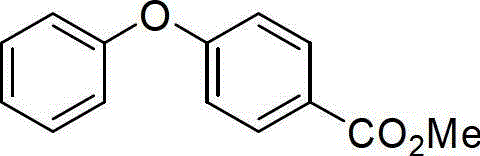
4-iodo-benzoic acid methyl ester (80g,1.0eq) and phenol (34.5g,1.2eq) were added to a flask containing 200ml of DMF at room temperature, followed by addition of K to the reaction mixture2CO3(84g,2.0eq), cuprous iodide (11.6g,20%) and N, N-dimethylglycine(12.6g, 40%). After the addition was complete, the reaction mixture was stirred at 110 ℃ overnight. After the reaction was completed, the reaction mixture was cooled to room temperature, water was added thereto, and the mixture was extracted with ethyl acetate. The organic phase solution was washed with water and saturated brine, dried over anhydrous sodium sulfate, and subjected to column chromatography on a silica gel column to obtain a white solid product (45g, 65%).
1H NMR(400MHz,CDCl3)δ7.99-8.01(m,2H),7.37-7.41(m,2H),7.17-7.21(m,1H),7.05-7.08(m,2H),6.97-7.00(m,2H),3.90(s,3H)。
And B: 4-phenoxy-benzoic acid
To a flask containing 100mL of ethanol solution was added 4-phenoxy-benzoic acid methyl ester (20g,1.0eq) followed by a slow addition of a mixed solution of sodium hydroxide (7g,2.0eq) in 50mL of water at ambient temperature. After the addition was complete, the reaction mixture was stirred at 70 ℃ for 15 minutes. After the reaction was completed, the reaction mixture was cooled to room temperature, the ethanol solution was evaporated by rotation, the pH was adjusted to 2-3 with dilute hydrochloric acid, the mixture was stirred at room temperature for 5 minutes, and the precipitated white solid was collected and dried to obtain a product (16g, 85%).
1H NMR(400MHz,CDCl3)δ8.06-8.09(m,2H),7.39-7.43(m,2H),7.19-7.23(m,1H),7.07-7.10(m,2H),7.00-7.03(m,2H)。
And C: 4-phenoxy-benzoyl chloride

After the addition of 4-phenoxy-benzoic acid (8g,1.0eq) was slowly added to a flask containing 50mL of thionyl chloride under ice-bath, the reaction mixture was refluxed at 70 ℃ for 3 hours. After the reaction was completed, it was cooled to room temperature. Rotary steamerThe thionyl chloride solvent was stripped off and toluene solution was added and the solvent was again rotary evaporated off, and this was repeated 2 times to give an oil which was used directly in the next reaction without further purification (8.65g, 98%).1H NMR(400MHz,CDCl3)δ8.07-8.09(m,2H),7.41-7.45(m,2H),7.23-7.27(m,1H),7.08-7.11(m,2H),7.00-7.02(m,2H)。
Step D: 2- (hydroxy (4-phenoxyphenyl) methylene) propanedinitrile
Sodium hydride (1.64g,60%,1.1eq) was slowly added to a three-necked flask containing 250mL of dry tetrahydrofuran solution of propionitrile (2.7g,1.1eq) under ice-cooling. After the addition was complete, the mixture was warmed to room temperature and stirred for 10 minutes. Subsequently, it was cooled to 0 ℃ and a solution of 4-phenoxy-benzoyl chloride (8.65g,1.0eq) in tetrahydrofuran was added to the reaction mixture. After the addition was complete, the reaction mixture was stirred at room temperature overnight. After the reaction was completed, a small amount of water was added to quench the reaction, the tetrahydrofuran solution was rotary evaporated, extracted with ethyl acetate, and the organic phase was washed with water and saturated brine, dried over anhydrous sodium sulfate, and subjected to silica gel column chromatography to give a gray solid product (3.6g, 37%).1H NMR(400MHz,DMSO)δ7.60-7.64(m,2H),7.40-7.44(m,2H),7.16-7.20(m,1H),7.05-7.07(m,2H),6.92-6.96(m,2H)。
Step E: 2- (methoxy (4-phenoxyphenyl) methylene) propanedinitrile

2- (hydroxy (4-phenoxyphenyl) methylene) propanedinitrile (3.6g,1.0eq) is added at room temperature to a 50mL solution of dioxane and water in a 1:1 volume ratio, followed by slow addition of dimethyl sulfate solution (2.6g,1.5 eq). After the addition, the reaction mixture was heated to 80 ℃ and stirredThe reaction was carried out for 3 hours. After the reaction, the reaction solution was evaporated by rotation, water was added thereto, and extraction was performed with ethyl acetate. The organic phase was washed with water and saturated brine, dried over anhydrous sodium sulfate, and chromatographed on a silica gel column to give the product as a colorless oil (2.7g, 72%).1H NMR(400MHz,CDCl3)δ7.48-7.51(m,2H),7.41-7.45(m,2H),7.25-7.27(m,1H),7.07-7.11(m,4H),3.99(s,3H)。
Step F: 5-amino-3- (4-phenoxyphenyl) -1H-pyrazole-4-acetonitrile

2- (methoxy (4-phenoxyphenyl) methylene) propanedinitrile (1g,1.0eq) is added to 50mL of ethanol solution at room temperature, followed by slow addition of hydrazine hydrate (0.5g,85%,2.0 eq). After the addition was complete, the reaction mixture was heated to 90 ℃ and refluxed for 4 hours. After the reaction was completed, it was cooled to room temperature. The solvent was rotary evaporated. 50mL of water was added to the reaction solution, and the mixture was stirred at room temperature for 5 minutes. The white solid that separated out was collected and dried to give the desired product (1.0g, 99%).
1H NMR(400MHz,DMSO)δ7.78-7.81(m,2H),7.40-7.44(m,2H),7.16-7.20(m,1H),7.06-7.11(m,4H),6.26(brs,2H)。
Step G: (R) -tert-butyl-3- (5-amino-4-cyano-3- (4-phenoxyphenyl) -1H-pyrazol-1-yl) piperidine-1-carboxylate and (S) -tert-butyl-3- (3-amino-4-cyano-5- (4-phenoxyphenyl) -1H-pyrazol-1-yl) piperidine-1-carboxylate

(S) -tert-butyl-3- (p-toluenesulfonyloxy) piperidine-1-carboxylic acid ester: to a 50mL solution of dichloromethane was added (S) -tert-butyl-3-hydroxypiperidine-1-carboxylate (3g,1.0eq) under ice bath followed by slow addition of p-toluenesulfonyl chloride (3.4g,1.2eq), 4-dimethylaminopyridine (0.1g,10%) and triethylamine (3g,2.0 eq). After the addition was complete, the reaction mixture was allowed to warm to room temperature and stirred overnight. The organic phase was washed with water and saturated aqueous sodium chloride solution, dried over anhydrous sodium sulfate, and chromatographed on silica gel to give the product as a white solid (4.9g, 93%).
1H NMR(400MHz,CDCl3)δ7.80(d,J=8.0Hz,2H),7.34(d,J=8.0Hz,2H),4.46(brs,1H),3.54-3.58(m,1H),3.31-3.40(m,3H),2.45(s,3H),1.80-1.88(m,1H),1.65-1.79(m,2H),1.47-1.52(m,1H),1.43(s,9H)。
To 30mL of dry DMF solution at room temperature were added (S) -tert-butyl-3- (p-toluenesulfonyloxy) piperidine-1-carboxylate (0.77g,1.2eq) and 5-amino-3- (4-phenoxyphenyl) -1H-pyrazole-4-acetonitrile (0.5g,1.0eq), followed by addition of cesium carbonate solid (1.18g,2.0eq) to the reaction mixture. After the end of the addition, the reaction was warmed to 80 ℃ and stirred for 5 hours. After the reaction was completed, the reaction mixture was cooled to room temperature, water was added thereto, and the mixture was extracted with ethyl acetate. The organic phase was washed with water and saturated brine, dried over anhydrous sodium sulfate, and chromatographed on a silica gel column to give product 7(0.25g,30%) as a white solid.
1H NMR(400MHz,CDCl3) δ 7.85-7.88(m,2H),7.33-7.37(m,2H),7.09-7.14(m,1H),7.03-7.06(m,4H),4.52(brs,2H),4.19-4.29(m,1H),4.01-4.18(m,1H),3.80-3.89(m,1H),3.02-3.19(m,1H),2.81(t, J =12.8Hz,1H),2.20-2.31(m,1H),2.07-2.18(m,1H),1.83-1.92(m,1H),1.76-1.81(m,1H),1.44(s,9H) and a pale yellow solid product 7' (0.06g, 8%).1H NMR(400MHz,CDCl3)δ7.39-7.42(m,4H),7.18-7.22(m,1H),7.09-7.12(m,4H),3.97-4.10(m,5H),3.17(t,J=12.4Hz,1H),2.69(t,J=12.4Hz,1H),2.14-2.18(m,1H),1.90-1.98(m,1H),1.72-1.81(m,1H),1.51-1.59(m,1H),1.41(s,9H)。
Step H: (R) -tert-butyl-3- (5- (tert-butyl-butoxyacetannium) -4-cyano-3- (4-phenoxyphenyl) -1H-pyrazol-1-yl) piperidine-1-carboxylic acid ester

To a 50mL solution of dichloromethane were added (R) -tert-butyl-3- (5-amino-4-cyano-3- (4-phenoxyphenyl) -1H-pyrazol-1-yl) piperidine-1-carboxylate (1g,1.0eq) and triethylamine (0.24g,1.1eq) under ice-bath, followed by slow addition of Boc anhydride (0.5g,1.1 eq). After the addition was complete, the reaction was allowed to warm to room temperature and stirred overnight. Adding water, washing the organic phase with water and saturated salt water, drying with anhydrous sodium sulfate, and separating with chromatographic silica gel column to obtain white solid product. M/z =560[ M +1 ]]+。
Step I: (R) -tert-butyl-3- (5- (tert-butyl-butoxyacetic acid methylammonium) -4-cyano-3- (4-phenoxyphenyl) -1H-pyrazol-1-yl) piperidine-1-carboxylic acid ester

To a 20mL solution of DMF was added (R) -tert-butyl-3- (5- (tert-butyl-butoxyacetic acid ammonia) -4-cyano-3- (4-phenoxyphenyl) -1H-pyrazol-1-yl) piperidine-1-carboxylate (0.1g,1.0eq) and iodomethane (0.05g,1.5eq) at room temperature. Solid potassium carbonate (0.07g,3.0eq) was then added. After the addition was complete, the temperature of the reaction mixture was raised to 100 ℃ and the reaction was stirred overnight. After the reaction, cooling to room temperature, adding water, extracting with dichloromethane, washing the organic phase with water and saturated salt water, drying with anhydrous sodium sulfate, and separating with chromatographic silica gel column to obtain white solid product. M/z =574[ M +1 ]]+。
Step J: (R) -tert-butyl-3- (5- (tert-butyl-butoxyacetic acid methylammonium) -4-carboxamide-3- (4-phenoxyphenyl) -1H-pyrazol-1-yl) piperidine-1-carboxylic acid ester

To a 5mL DMSO solution was added (R) -tert-butyl-3- (5- (tert-butyl-butoxyacetic acid methylammonium) -4-cyano-3- (4-phenoxyphenyl) -1H-pyrazol-1-yl) piperidine-1-carboxylate (0.1g,1.0eq) and potassium carbonate solids (0.07g,3.0eq) at room temperature. Hydrogen peroxide (4mL,30%) was then added to the reaction. After the end of the addition, the reaction system was warmed to 60 ℃ and stirred for 5 hours. After the reaction was completed, it was cooled to room temperature. Adding water, extracting with dichloromethane, washing the organic phase with water and saturated salt solution, drying with anhydrous sodium sulfate, and separating with chromatographic silica gel column to obtain white solid product. M/z =592[ M +1 ]]+。
Step K: (R) -5- (methylamino) -3- (4-phenoxyphenyl) -1- (piperidin-3-yl) -1H-pyrazole-4-carboxylic acid ester

To a solution of 20mL of dichloromethane at room temperature was added (R) -tert-butyl-3- (5- (tert-butyl-butoxyacetic acid methylammonium) -4-carboxamide-3- (4-phenoxyphenyl) -1H-pyrazol-1-yl) piperidine-1-carboxylic acid ester (0.1g,1.0eq), followed by the slow addition of trifluoroacetic acid (0.5 mL). After the addition, the reaction mixture was stirred at room temperature for 2 hours. Water was added, extraction was performed with dichloromethane, the organic phase was washed with water and saturated brine, dried over anhydrous sodium sulfate, and the organic solvent was rotary evaporated to directly obtain a solid product for the next reaction without further purification. M/z =392[ M + 1%]+。
Step L: (R) -1- (1-acryloylpiperidin-3-yl) -5- (methylamino) -3- (4-phenoxyphenyl) -1H-pyrazole-4-carboxamide

(R) -5- (methylamino) -3- (4-phenoxyphenyl) -1- (piperidine-) -was added to a 10mL dichloromethane solution under ice bath3-yl) -1H-pyrazole-4-carboxylic acid ester (0.05g,1.0eq) and triethylamine (25mg,2.0eq), followed by the slow dropwise addition of acryloyl chloride (12mg,1.0 eq). After the addition was complete, the reaction mixture was stirred directly for 5 minutes in an ice bath. After the reaction, water is added, dichloromethane is used for extraction, an organic phase is washed by water and saturated salt solution, anhydrous sodium sulfate is dried, and a white solid product is obtained by chromatographic silica gel column separation. M/z =446[ M +1 ]]+。
Example 2
1- (1-acryloylpiperidin-3-yl) -5- (methylamino) -3- (4-phenoxyphenyl) -1H-pyrazole-4-carboxamide

The synthesis of example 2 was accomplished by using tert-butyl-3- (p-toluenesulfonyloxy) -piperidine-1-carboxylate, in analogy to the procedure described in example 1. M/z =446[ M +1 ]]+。
Example 3
1- (1-acryloylpyrrol-3-yl) -5- (methylamino) -3- (4-phenoxyphenyl) -1H-pyrazole-4-carboxamide

The synthesis of example 3 was accomplished by using tert-butyl-3- (p-toluenesulfonyloxy) -pyrrole-1-carboxylate, in analogy to the procedure described in example 1. M/z =432[ M + 1%]+。
Example 4
1- (2- (N-Methacryloylamino) ethyl) -5- (methylamino) -3- (4-phenoxyphenyl) -1H-pyrazole-4-carboxamide

The synthesis of example 4 was accomplished by using tert-butyl-2-chloroethane (methyl) carboxylate, in analogy to the procedure described in example 1. M/z =420[ M + 1%]+。
Example 5
1- (2-Acrylamidoethyl) -5- (methylamino) -3- (4-phenoxyphenyl) -1H-pyrazole-4-carboxamide

The synthesis of example 5 was accomplished by using tert-butyl-2-chloroethanecarboxylate, in analogy to the procedure described in example 1. M/z =406[ M + 1%]+。
Example 6
1- (1-acryloylpiperidin-3-yl) -5- (ethylamino) -3- (4-phenoxyphenyl) -1H-pyrazole-4-carboxamide

The synthesis of example 6 was accomplished by using iodoethane, similar to the procedure described in example 1. M/z =460[ M +1 ]]+。
Example 7
1- (1-Acrylopiperidin-3-yl) -5- (isopropylamino) -3- (4-phenoxyphenyl) -1H-pyrazole-4-carboxamide

The synthesis of example 7 was carried out by using 2-bromopropane, analogouslyThis was done according to the procedure described in example 1. M/z =474[ M +1]+。
Example 8
1- (1-Acrylopiperidin-3-yl) -5- (cyclopropylamino) -3- (4-phenoxyphenyl) -1H-pyrazole-4-carboxamide

The synthesis of example 8 was accomplished by using p-toluenesulfonyl protected cyclopropanol, in analogy to the procedure described in example 1. M/z =472[ M + 1%]+。
Example 9
1- (1-Acrylopiperidin-3-yl) -5- (2-methoxyethylamino) -3- (4-phenoxyphenyl) -1H-pyrazole-4-carboxamide

The synthesis of example 9 was accomplished by using 1-bromo-2-methoxyethane, in analogy to the procedure described in example 1. M/z =490[ M + 1%]+。
Example 10
1- (1-Acrylopiperidin-3-yl) -5- (2-aminoethylamino) -3- (4-phenoxyphenyl) -1H-pyrazole-4-carboxamide

The synthesis of example 10 was accomplished by using N-Boc-2-chloroethane, similar to the procedure described in example 1. M/z =475[ M +1 ]]+。
Example 11
1- (1-Acryloylpiperidin-3-yl) -5- (2- (methylamino) ethylamino) -3- (4-phenoxyphenyl) -1H-pyrazole-4-carboxamide
The synthesis of example 11 was accomplished by using N-Boc-2-chloro (methyl) ethane, similar to the procedure described in example 1. M/z =489[ M +1 ]]+。
Example 12
1- (1-Acrylopiperidin-3-yl) -5- (2- (dimethylamino) ethylamino) -3- (4-phenoxyphenyl) -1H-pyrazole-4-carboxamide

The synthesis of example 12 was accomplished by using N, N-dimethyl-2-chloroethane, in analogy to the procedure described in example 1. M/z =503[ M +1 ]]+。
Example 13
1- (1-Acryloylpiperidin-3-yl) -5- (2-morpholinoethylamino) -3- (4-phenoxyphenyl) -1H-pyrazole-4-carboxamide

The synthesis of example 13 was accomplished by using 4- (2-chloroethane) morpholine, in analogy to the procedure described in example 1. M/z =545[ M + 1%]+。
Example 14
1- (1-acryloylpiperidin-3-yl) -3- (4-phenoxyphenyl) -5- (2- (piperazin-1-yl) ethylamino) -1H-pyrazole-4-carboxamide

The synthesis of example 14 was accomplished by using tert-butyl 4- (2-chloroethane) -piperazine-1-carboxylate, in analogy to the procedure described in example 1. M/z =544[ M +1]+。
Example 15
1- (1-Acrylopiperidin-3-yl) -5- (2- (4-methylpiperazin-1-yl) ethylamino) -3- (4-phenoxyphenyl) -1H-pyrazole-4-carboxamide

The synthesis of example 15 was accomplished by using 1- (2-chloroethane) -4-methylpiperazine in analogy to the procedure described in example 1. M/z =558[ M +1 ]]+。
Example 16
1- (1-Acrylopiperidin-3-yl) -5- (2, 3-dihydroxypropylamino) -3- (4-phenoxyphenyl) -1H-pyrazole-4-carboxamide

The synthesis of example 16 was accomplished by using allyl bromide, similar to the procedure described in example 1. M/z =506[ M + 1%]+。
Example 17
5-acetamide-1- (1-acryloylpiperidin-3-yl) -3- (4-phenoxyphenyl) -1H-pyrazole-4-carboxamide

The synthesis of example 17 was accomplished by using acetyl chloride, similar to the procedure described in example 1. M/z =474[ M +1]+。
Example 18
(R) -1- (1-acryloylpiperidin-3-yl) -5-amino-3- (4-phenoxyphenyl) -1H-pyrazole-4-carboxamide

Scheme 2

Step A: (R) -tert-butyl-3- (5-amino-4-cyano-3- (4-phenoxyphenyl) -1H-pyrazol-1-yl) piperidine-1-carboxylic acid ester

(S) -tert-butyl-3- (p-toluenesulfonyloxy) piperidine-1-carboxylic acid ester: to a 50mL solution of dichloromethane was added (S) -tert-butyl-3-hydroxypiperidine-1-carboxylate (3g,1.0eq) under ice bath followed by slow addition of p-toluenesulfonyl chloride (3.4g,1.2eq), 4-dimethylaminopyridine (0.1g,10%) and triethylamine (3g,2.0 eq). After the addition was complete, the reaction mixture was allowed to warm to room temperature and stirred overnight. The organic phase was washed with water and saturated aqueous sodium chloride solution, dried over anhydrous sodium sulfate, and chromatographed on silica gel to give the product as a white solid (4.9g, 93%).
1H NMR(400MHz,CDCl3)δ7.80(d,J=8.0Hz,2H),7.34(d,J=8.0Hz,2H),4.46(brs,1H),3.54-3.58(m,1H),3.31-3.40(m,3H),2.45(s,3H),1.80-1.88(m,1H),1.65-1.79(m,2H),1.47-1.52(m,1H),1.43(s,9H)。
To 30mL of dry DMF solution at room temperature were added (S) -tert-butyl-3- (p-toluenesulfonyloxy) piperidine-1-carboxylate (0.77g,1.2eq) and 5-amino-3- (4-phenoxyphenyl) -1H-pyrazole-4-acetonitrile (0.5g,1.0eq), followed by addition of cesium carbonate solid (1.18g,2.0eq) to the reaction mixture. After the end of the addition, the reaction was warmed to 80 ℃ and stirred for 5 hours. After the reaction was completed, the reaction mixture was cooled to room temperature, water was added thereto, and the mixture was extracted with ethyl acetate. The organic phase was washed with water and saturated brine, dried over anhydrous sodium sulfate, and chromatographed on a silica gel column to give product 7(0.25g,30%) as a white solid.
1H NMR(400MHz,CDCl3)δ7.85-7.88(m,2H),7.33-7.37(m,2H),7.09-7.14(m,1H),7.03-7.06(m,4H),4.52(brs,2H),4.19-4.29(m,1H),4.01-4.18(m,1H),3.80-3.89(m,1H),3.02-3.19(m,1H),2.81(t,J=12.8Hz,1H),2.20-2.31(m,1H),2.07-2.18(m,1H),1.83-1.92(m,1H),1.76-1.81(m,1H),1.44(s,9H)。
And B: (R) -tert-butyl-3- (5-amino-4-carboxamide-3- (4-phenoxyphenyl) -1H-pyrazol-1-yl) piperidine-1-carboxylic acid ester

To 5mL of DMSO solution at room temperature were added (R) -tert-butyl-3- (5-amino-4-cyano-3- (4-phenoxyphenyl) -1H-pyrazol-1-yl) piperidine-1-carboxylate (0.2g,1.0eq) and potassium carbonate solids (0.18g,3.0 eq). Hydrogen peroxide (8mL,30%) was then added to the reaction. After the end of the addition, the reaction system was warmed to 60 ℃ and stirred for 5 hours. After the reaction was completed, it was cooled to room temperature. Adding water, extracting with dichloromethane, washing the organic phase with water and saturated salt solution, drying with anhydrous sodium sulfate, and separating with chromatographic silica gel column to obtain white solid product. (0.2g, 97%).1H NMR(400MHz,CDCl3)δ7.48-7.52(m,2H),7.35-7.39(m,2H),7.13-7.17(m,1H),7.04-7.08(m,4H),5.54(s,2H),5.19(brs,2H),4.19-4.28(m,1H),4.07-4.15(m,1H),3.81-3.90(m,1H),3.03-3.21(m,1H),2.75(t,J=11.6Hz,1H),2.09-2.29(m,2H),1.81-1.92(m,1H),1.51-1.68(m,1H),1.45(s,9H)。
And C: (R) -5-amino-3- (4-phenoxyphenyl) -1- (piperidin-3-yl) -1H-pyrazole-4-carboxylic acid ester
To a solution of 20mL of dichloromethane at room temperature was added (R) -tert-butyl-3- (5-amino-4-carboxamide-3- (4-phenoxyphenyl) -1H-pyrazol-1-yl) piperidine-1-carboxylate (0.2g,1.0eq) followed by slow addition of trifluoroacetic acid (1 mL). After the addition, the reaction mixture was stirred at room temperature for 2 hours. Water was added, extraction was performed with dichloromethane, the organic phase was washed with water and saturated brine, dried over anhydrous sodium sulfate, and subjected to silica gel column chromatography to give the product as a white solid (0.1g, 63%).
1H NMR(400MHz,CDCl3)δ7.26-7.34(m,4H),7.10-7.13(m,1H),6.93-7.01(m,4H),6.49(s,2H),5.25(brs,2H),4.65-4.72(m,1H),3.71-3.82(m,1H),3.42-3.51(m,1H),3.21-3.29(m,1H),2.80-2.91(m,1H),1.91-2.06(m,4H)。m/z=378[M+1]+。
Step D: (R) -1- (1-acryloylpiperidin-3-yl) -5-amino 3- (4-phenoxyphenyl) -1H-pyrazole-4-carboxylic acid ester
(R) -5-amino-3- (4-phenoxyphenyl) -1- (piperidin-3-yl) -1H-pyrazole-4-carboxylic acid ester (0.85g,1.0eq) and triethylamine (45mg,2.0eq) were added to a 10mL dichloromethane solution under ice bath, followed by slowly adding acryloyl chloride (20mg,1.0eq) dropwise. After the addition was complete, the reaction mixture was stirred directly for 5 minutes in an ice bath. After the reaction was completed, water was added, extraction was performed with dichloromethane, the organic phase was washed with water and saturated brine, dried over anhydrous sodium sulfate, and subjected to silica gel column chromatography to obtain a white solid product (0.08g, 85%).
1H NMR(400MHz,CDCl3)δ7.49-7.52(m,2H),7.35-7.39(m,2H),7.14-7.18(m,1H),7.04-7.09(m,4H),6.58-6.62(m,1H),6.35(d,J=16.4Hz,1H),5.70-5.77(m,2.5H),5.48(s,0.5H),5.20(brs,2H),4.82(d,J=12.8Hz,0.5H),4.61-4.68(m,0.5H),4.11-4.19(m,0.5H),4.01(d,J=12.8Hz,0.5H),3.82-3.94(m,1H),3.55-3.68(m,0.5H),3.00-3.19(m,1H),2.64-2.78(m,0.5H),2.30-2.42(m,1H),2.14-2.22(m,1H),1.91-2.01(m,1H),1.60-1.69(m,1H)。m/z=432[M+1]+。
Example 19
(S) -1- (1-acryloylpiperidin-3-yl) -3-amino-5- (4-phenoxyphenyl) -1H-pyrazole-4-carboxamide

Scheme 3

Step A: (S) -tert-butyl-3- (3-amino-4-cyano-5- (4-phenoxyphenyl) -1H-pyrazol-1-yl) piperidine-1-carboxylic acid ester

(S) -tert-butyl-3- (p-toluenesulfonyloxy) piperidine-1-carboxylic acid ester: to a 50mL solution of dichloromethane was added (S) -tert-butyl-3-hydroxypiperidine-1-carboxylate (3g,1.0eq) under ice bath followed by slow addition of p-toluenesulfonyl chloride (3.4g,1.2eq), 4-dimethylaminopyridine (0.1g,10%) and triethylamine (3g,2.0 eq). After the addition was complete, the reaction mixture was allowed to warm to room temperature and stirred overnight. The organic phase was washed with water and saturated aqueous sodium chloride solution, dried over anhydrous sodium sulfate, and chromatographed on silica gel to give the product as a white solid (4.9g, 93%).
1H NMR(400MHz,CDCl3)δ7.80(d,J=8.0Hz,2H),7.34(d,J=8.0Hz,2H),4.46(brs,1H),3.54-3.58(m,1H),3.31-3.40(m,3H),2.45(s,3H),1.80-1.88(m,1H),1.65-1.79(m,2H),1.47-1.52(m,1H),1.43(s,9H)。
To 30mL of dry DMF solution at room temperature were added (S) -tert-butyl-3- (p-toluenesulfonyloxy) piperidine-1-carboxylate (0.77g,1.2eq) and 5-amino-3- (4-phenoxyphenyl) -1H-pyrazole-4-acetonitrile (0.5g,1.0eq), followed by addition of cesium carbonate solid (1.18g,2.0eq) to the reaction mixture. After the end of the addition, the reaction was warmed to 80 ℃ and stirred for 5 hours. After the reaction was completed, the reaction mixture was cooled to room temperature, water was added thereto, and the mixture was extracted with ethyl acetate. The organic phase was washed with water and saturated brine, dried over anhydrous sodium sulfate, and chromatographed on a silica gel column to give the product 7' (0.06g,8%) as a pale yellow solid.
1H NMR(400MHz,CDCl3)δ7.39-7.42(m,4H),7.18-7.22(m,1H),7.09-7.12(m,4H),3.97-4.10(m,5H),3.17(t,J=12.4Hz,1H),2.69(t,J=12.4Hz,1H),2.14-2.18(m,1H),1.90-1.98(m,1H),1.72-1.81(m,1H),1.51-1.59(m,1H),1.41(s,9H)。
And B: (S) -tert-butyl-3- (3-amino-4-carboxamide-5- (4-phenoxyphenyl) -1H-pyrazol-1-yl) piperidine-1-carboxylic acid ester

To 5mL of DMSO solution were added (S) -tert-butyl-3- (3-amino-4-cyano-5- (4-phenoxyphenyl) -1H-pyrazol-1-yl) piperidine-1-carboxylate (0.05g,1.0eq) and potassium carbonate solids (0.05g,3.0eq) at room temperature. Hydrogen peroxide (2mL,30%) was then added to the reaction. After the end of the addition, the reaction system was warmed to 60 ℃ and stirred for 5 hours. After the reaction was completed, it was cooled to room temperature. Water was added, extraction was performed with dichloromethane, the organic phase was washed with water and saturated brine, dried over anhydrous sodium sulfate, and subjected to silica gel column chromatography to give the product as a white solid (0.05g, 96%).
1H NMR(400MHz,CDCl3)δ7.40-7.44(m,2H),7.31-7.35(m,2H),7.21-7.25(m,1H),7.10-7.14(m,4H),5.07(s,2H),4.95(s,2H),3.96-4.15(m,2H),3.95-3.68(m,1H),3.16(t,J=12.4Hz,1H),2.66(t,J=12.4Hz,1H),2.05-2.22(m,1H),1.85-1.92(m,1H),1.70-1.79(m,1H),1.50-1.55(m,1H),1.42(s,9H)。
And C: (S) -3-amino-5- (4-phenoxyphenyl) -1- (piperidin-3-yl) -1H-pyrazole-4-carboxylic acid ester
To a solution of 20mL of dichloromethane at room temperature was added (S) -tert-butyl-3- (3-amino-4-carboxamide-5- (4-phenoxyphenyl) -1H-pyrazol-1-yl) piperidine-1-carboxylate (0.05g,1.0eq) followed by slow addition of trifluoroacetic acid (1 mL). After the addition, the reaction mixture was stirred at room temperature for 2 hours. Water was added, extraction was performed with dichloromethane, the organic phase was washed with water and saturated brine, dried over anhydrous sodium sulfate, and subjected to silica gel column chromatography to give the product as a white solid (0.02g, 51%).
1H NMR(400MHz,CDCl3)δ7.41-7.45(m,2H),7.29-7.32(m,2H),7.21-7.25(m,1H),7.10-7.14(m,4H),5.10(s,2H),4.95(brs,2H),3.79-3.88(m,1H),3.15-3.26(m,1H),3.04-3.12(m,1H),2.90-3.01(m,1H),2.70-2.81(m,1H),1.61-2.02(m,4H)。m/z=378[M+1]+。
Step D: (S) -1- (1-acryloylpiperidin-3-yl) -3-amino-5- (4-phenoxyphenyl) -1H-pyrazole-4-carboxamide

(S) -3-amino-5- (4-phenoxyphenyl) -1- (piperidin-3-yl) -1H-pyrazole-4-carboxylic acid ester (0.01g,1.0eq) and triethylamine (20mg,2.0eq) were added to a 10mL dichloromethane solution under ice bath, followed by slowly adding acryloyl chloride (5mg,1.0eq) dropwise. After the addition was complete, the reaction mixture was stirred directly for 5 minutes in an ice bath. After the reaction was completed, water was added, extraction was performed with dichloromethane, the organic phase was washed with water and saturated brine, dried over anhydrous sodium sulfate, and subjected to silica gel column chromatography to obtain a white solid product (0.003g, 70%).
1H NMR(400MHz,CDCl3)δ7.20-7.46(m,5H),7.10-7.19(m,4H),6.45-6.59(m,0.5H),6.10-6.38(m,1.5H),5.56-5.70(m,1H),5.09(s,2H),5.02(s,2H),4.70(d,J=12.4Hz,0.5H),4.62(d,J=12.4Hz,0.5H),3.81-3.98(m,1H),3.59-3.75(m,1H),3.42-3.57(m,0.5H),3.00-3.19(m,1H),2.58-2.68(m,0.5H),2.19-2.31(m,1H),1.90-2.01(m,1H),1.80-1.89(m,1H),1.60-1.65(m,1H)。m/z=432[M+1]+。
Example 20
5-amino-1-cyclohexane-3- (4-phenoxyphenyl) -1H-pyrazole-4-carboxamide

Scheme 4

Step A: tert-butyl 2-cyclohexanedicarboxylic acid ester

Cyclohexanone (5g,1.0eq) was added to 90mL of n-hexane solution at room temperature, followed by the slow dropwise addition of Boc anhydride (8.7g,1.0 eq). After the addition, the reaction mixture was heated to 75 ℃ and stirred for 2 hours. After the reaction was complete, cooled to room temperature, filtered, and washed with cold n-hexane, the product was collected and dried as a white solid (10.2g, 95%).
1H NMR(400MHz,CDCl3)δ7.47(brs,1H),2.36(t,J=6.8Hz,2H),2.21(t,J=6.8Hz,2H),1.62-1.72(m,6H),1.51(s,9H)。
And B: tert-butyl 2-cyclohexanedicarboxylate

Tert-butyl 2-cyclohexanedicarboximidic ester (5.6g,1.0eq) was added to 100mL of methanol solution at room temperature, followed by the slow addition of palladium on carbon (0.6g, 10%). After the addition was complete, the reaction mixture was warmed to 50 ℃ and stirred under hydrogen overnight. After the reaction was complete, palladium on carbon was filtered off with celite and the solvent was rotary evaporated to directly give the product as a white solid (5.1g, 92%).
1H NMR(400MHz,CDCl3)δ6.05(s,1H),3.89(brs,1H),2.76-2.81(m,1H),1.81-1.84(m,2H),1.71-1.75(m,2H),1.58-1.62(m,1H),1.46(s,9H),1.08-1.28(5H,m)。
And C: cyclohexane hydrazine hydrochloride

At room temperature, tert-butyl 2-cyclohexane hydrazine carboxylic acid is added into 40mL of ether solutionAcid ester (2.7g,1.0eq), followed by slow addition of hydrochloric acid solution (5mL, 12N). After the addition, the reaction mixture was stirred at room temperature for 3 hours. The solvent was rotary evaporated, 4mL ethanol was added followed by 40mL ether, filtered and the resulting white solid was collected by drying as the product (1.6g, 85%).1H NMR(400MHz,CDCl3)δ2.83-2.88(m,1H),1.98-2.00(m,2H),1.73-1.74(m,2H),1.56-1.60(m,1H),1.05-1.27(m,5H)。
Step D: 5-amino-1-cyclohexane-3- (4-phenoxyphenyl) -1H-pyrazole-4-acetonitrile

2- (methoxy (4-phenoxyphenyl) methylene) propanedinitrile (0.225g,1.0eq) and triethylamine (0.165g, 2.0eq) were added to 20mL of ethanol solution at room temperature followed by the slow addition of cyclohexane hydrazine hydrochloride (0.123g,1.0 eq). After the addition was complete, the reaction mixture was warmed to 90 ℃ and refluxed overnight. After the reaction was completed, it was cooled to room temperature. The solvent was rotary evaporated. Water was added to the reaction solution, which was extracted with ethyl acetate, and the product was isolated by column chromatography on silica gel to give a white solid (0.15g, 50%).
1HNMR(400MHz,CDCl3)δ7.89-7.91(m,2H),7.34-7.38(m,2H),7.12-7.15(m,1H),7.04-7.07(m,4H),4.22(s,2H),3.79-3.83(m,1H),1.95-2.00(m,5H),1.74-1.78(m,1H),1.28-1.44(m,4H)。m/z=359[M+1]+。
Step E: 5-amino-1-cyclohexane-3- (4-phenoxyphenyl) -1H-pyrazole-4-carboxamide

5-amino-1-cyclohexane-3- (4-phenoxyphenyl) -1H-pyrazole-4-acetonitrile (0.12g,1.0eq) and potassium carbonate solids (0.14g,3.0eq) were added to 10mL of DMSO solution at room temperature. Hydrogen peroxide (8mL,30%) was then added to the reaction. After the end of the addition, the reaction system was warmed to 60 ℃ and stirred for reaction for 1 hour. After the reaction was completed, it was cooled to room temperature. Water was added thereto, and the mixture was filtered to give a white solid, and the solid was dissolved in ethyl acetate, and the ethyl acetate organic solution was washed with water and saturated brine, dried over anhydrous sodium sulfate, and subjected to silica gel column chromatography to give the product as a white solid (91mg, 72%).
1H NMR(400MHz,CDCl3)δ7.48-7.50(m,2H),7.34(t,J=7.6Hz,2H),7.12(t,J=7.2Hz,1H),7.01-7.06(m.4H),5.38(s,2H),5.16(brs,2H),3.76-3.82(m,1H),1.88-2.02(m,5H),1.67-1.71(m,1H),1.22-1.40(m,4H)。m/z=377[M+1]+。
Example 21
5-amino-3- (4-phenoxyphenyl) -1- (piperidin-3-yl) -1H-pyrazole-4-carboxamide

The synthesis of example 21 was accomplished by a procedure similar to that described in example 20.1H NMR(400MHz,CDCl3)δ7.38-7.52(m,2H),7.34-7.36(m,2H),7.13-7.17(m,1H),7.03-7.09(m,4H),6.03(s,2H),5.21(brs,2H),4.01-4.07(m,1H),3.20-3.22(m,2H),2.90-3.01(m,1H),2.74-2.84(m,1H),2.12-2.26(m,1H),1.95-2.08(m,1H),1.80-1.90(m,1H),1.60-1.65(m,1H)。m/z=378[M+1]+。
Example 22
1- (1-acryloylpiperidin-3-yl) -5-amino-3- (4-phenoxyphenyl) -1H-pyrazole-4-carboxamide

The synthesis of example 22 was accomplished by a procedure similar to that described in example 20.
1H NMR(400MHz,CDCl3)δ7.48-7.54(m,2H),7.32-7.40(m,2H),7.10-7.19(m,1H),7.01-7.09(m,4H),6.52-6.68(m,1H),6.34(d,J=16.4Hz,1H),5.60-5.79(m,2.5H),5.57(s,0.5H),5.25(brs,2H),4.82(d,J=11.6Hz,0.5H),4.60-4.68(m,0.5H),4.08-4.20(m,0.5H),4.02(d,J=14.0Hz,0.5H),3.89-3.94(m,1H),3.54-3.66(m,0.5H),2.99-3.20(m,1H),2.63-2.76(m,0.5H),2.22-2.40(m,1H),2.10-2.21(m,1H),1.91-1.99(m,1H),1.52-1.68(m,1H)。m/z=432[M+1]+。
Example 23
(S) -1- (1-acryloylpiperidin-3-yl) -5-amino-3- (4-phenoxyphenyl) -1H-pyrazole-4-carboxamide
The synthesis of example 23 was accomplished by using (R) -tert-butyl-3- (p-toluenesulfonyloxy) piperidine-1-carboxylate in analogy to the procedure described in example 18. M/z =432[ M + 1%]+。
Example 24
1- (1-acryloylpiperidin-4-yl) -5-amino-3- (4-phenoxyphenyl) -1H-pyrazole-4-carboxamide

The synthesis of example 24 was accomplished by using tert-butyl 4- (p-toluenesulfonyloxy) piperidine-1-carboxylate, in analogy to the procedure described in example 18.1H NMR(400MHz,CDCl3)δ7.48-7.54(m,2H),7.34-7.39(m,2H),7.13-7.18(m,1H),7.03-7.08(m,4H),6.54-6.61(m,1H),6.57(d,J=14.8Hz,1H),5.69(d,J=8.8Hz,1H),5.46(s,2H),5.22(brs,2H),4.71-4.82(m,1H),4.07-4.22(m,2H),3.19-3.24(m,1H),2.80-2.91(m,1H),2.10-2.31(m,2H),1.99-2.07(m,2H)。m/z=432[M+1]+。
Example 25
1- (1-acryloylpyrrol-3-yl) -5-amino-3- (4-phenoxyphenyl) -1H-pyrazole-4-carboxamide

The synthesis of example 25 was accomplished by using tert-butyl 3- (p-toluenesulfonyloxy) pyrrole-1-carboxylate, in analogy to the procedure described in example 18.
1H NMR(400MHz,CDCl3)δ7.42-7.50(m,2H),7.31-7.41(m,2H),7.10-7.19(m,1H),7.02-7.09(m,4H),6.38-6.48(m,2H),5.64-5.70(m,1H),5.50-5.60(m,2H),5.26(brs,2H),4.60-4.76(m,1H),3.90-4.08(m,2H),3.60-3.71(m,1H),2.68-2.76(m,1H),2.48-2.54(m,1H),2.29-2.42(m,1H)。m/z=418[M+1]+。
Example 26
5-amino-3- (4-phenoxyphenyl) -1- (1-acryloylpiperidin-3-yl) -1H-pyrazole-4-carboxamide

The synthesis of example 26 was accomplished using ethynyl chloride analogous to the procedure described in example 18. M/z =430[ M + 1%]+。
Example 27
5-amino-3- (4-phenoxyphenyl) -1- (1- (ethenesulfonyl) piperidin-3-yl) -1H-pyrazole-4-carboxamide

The synthesis of example 27 was accomplished by using vinylsulfonyl chloride, in analogy to the procedure described in example 18. M/z =468[ M + 1%]+。
Example 28
5-amino-1- (1- (2-chloroacetyl) piperidin-3-yl) -3- (4-phenoxyphenyl) -1H-pyrazole-4-carboxamide

The synthesis of example 28 was accomplished by using 2-chloroacetyl chloride, in analogy to the procedure described in example 18. M/z =454[ M + 1%]+。
Example 29
(E) -5-amino-1- (1- (4- (dimethylethylamine) -2-enoyl) piperidin-3-yl) -3- (4-phenoxyphenyl) -1H-pyrazole-4-carboxamide
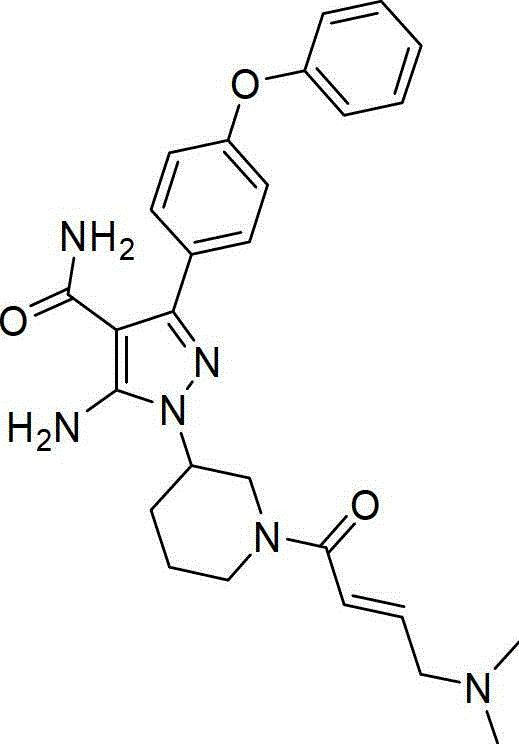
The synthesis of example 29 was accomplished using (E) -4- (dimethylethylamino) -2-vinyl chloride in analogy to the procedure described in example 18. M/z =489[ M +1 ]]+。
Example 30
5-amino-1- (2- (N-methylacrylamide) ethyl) -3- (4-phenoxyphenyl) -1H-pyrazole-4-carboxamide

The synthesis of example 30 was performed by using tert-butyl 2-chloroEthane (methyl) carboxylate, in analogy to the procedure described in example 18. M/z =406[ M + 1%]+。
Example 31
1- (2-acrylamidoethyl) -5-amino-3- (4-phenoxyphenyl) -1H-pyrazole-4-carboxamide

The synthesis of example 31 was accomplished by using tert-butyl 2-chloroethanecarboxylate in analogy to the procedure described in example 18. M/z =392[ M + 1%]+。
Example 32
5-amino-1- (2- (N-methylacetyleneamide) ethyl) -3- (4-phenoxyphenyl) -1H-pyrazole-4-carboxamide
The synthesis of example 32 was accomplished by using tert-butyl 2-chloroethane (methyl) carboxylate and ethynyl chloride in analogy to the procedure described in example 18. M/z =404[ M + 1%]+。
Example 33
5-amino-1- (2- (N-methylethenesulfonamide) ethyl) -3- (4-phenoxyphenyl) -1H-pyrazole-4-carboxamide

The synthesis of example 33 was accomplished by using tert-butyl 2-chloroethane (methyl) carboxylate and vinylsulfonyl chloride, in analogy to the procedure described in example 18. M/z =442[ M + 1%]+。
Example 34
5-amino-1- (2- (2-chloro-N-methylacetamide) ethyl) -3- (4-phenoxyphenyl) -1H-pyrazole-4-carboxamide

The synthesis of example 34 was accomplished using tert-butyl 2-chloroethane (methyl) carboxylate and 2-chloroacetyl chloride in analogy to the procedure described in example 18. M/z =428[ M +1]+。
Example 35
(E) -5-amino-1- (2- (4- (dimethylethylamine) -N-methyl-2-alkenylamino) ethyl) -3- (4-phenoxyphenyl) -1H-pyrazole-4-carboxamide

The synthesis of example 35 was accomplished by using tert-butyl 2-chloroethane (methyl) carboxylate and (E) -4- (dimethylethylamino) -2-vinyl acid chloride in analogy to the procedure described in example 18. M/z =463[ M + 1%]+。
Example 36
1- (1-Vinylpiperidin-3-yl) -5-amino-3- (4-phenoxyphenyl) -1H-pyrazole-4-carboxamidine

The synthesis of example 36 was accomplished using a procedure similar to that described in example 18. M/z =431[ M +1 ]]+。
Example 37
1- (1-Vinylpiperidin-3-yl) -5-amino-3- (4-phenoxyphenyl) -1H-pyrazole-4-thioamide

The synthesis of example 37 was accomplished using DEDPO similar to the procedure described in example 18. M/z =448[ M +1 ]]+。
Example 38
1- (1-Vinylpiperidin-3-yl) -2-amino-4- (4-phenoxyphenyl) -1H-pyrrole-3-carboxamide

Scheme 5

The synthesis of example 38 was performed according to scheme 4. M/z =431[ M +1 ]]+。
Example 39
4- (1-Vinylpiperidin-3-yl) -3-amino-1- (4-phenoxyphenyl) -1H-pyrrole-2-carboxamide
Scheme 6

The synthesis of example 39 was performed according to scheme 5. M/z =431[ M +1 ]]+。
Example 40
1- (1-Vinylpiperidin-3-yl) -5-amino-N-methyl-3- (4-phenoxyphenyl) -1H-pyrazole-4-carboxamide

The synthesis of example 40 was accomplished by using a procedure similar to that described in example 18. M/z =446[ M +1 ]]+。
Biological Activity assay
Biological Activity of Compounds
In vitro inhibitory Activity (IC) against BTK50Determination of value)
The half Inhibitory Concentration (IC) of the compound on BTK in this patent50Values) were determined at both the enzymatic and cytological levels: the inhibition ability of the compound on the activity of BTK kinase is measured in enzyme activity reaction, and the inhibition effect of the compound on BCR-induced calcium flow in cells is measured in cytological functional analysis.
A homogeneous time-resolved fluorescence (HTRF) method is adopted to establish a kinase activity detection platform of BTK, and the activity of the compound is measured. Compounds were diluted 3-fold in 100% DMSO starting at 1mM (11 concentrations in total), and 4. mu.L of each concentration was added to 96. mu.L of reaction buffer (50mM HEPES, pH7.4, 10mM MgCl)21mM EGTA, 0.01% Tween-20, 0.005% BAS, 2mM DTT), 2.5. mu.L was added to a 384 well plate (Optiplate-384, available from PerkinElmer), 5. mu.L of BTK kinase (available from Millipore) was added, the mixture was centrifuged and mixed, and 2.5. mu.L of ATP (final concentration K) was addedmValue) and TK petide: ( KinEASETMTK, purchased from Cisbio) mixture the reaction was started (total reaction volume 10. mu.L). The 384 well plates were placed in an incubator at 23 ℃ for 120 minutes, and then 5. mu.L of Eu3+ cryptate-labledant-phosphotyrosine antibody (purchased from Cisbio), 5. mu.L of Streptavidin-XL-665 were added
 KinEASETMTK, purchased from Cisbio) stop reaction. After 1 hour incubation in the incubator, fluorescence values (320nm excitation, detecting 665nm and 615nm emission, ratio for enzyme activity) were read on Envision (purchased from PerkinElmer). The activity of the enzyme was measured at 11 concentrations for each compound and the data calculated using GraFit6.0 Software (Erithocus Software) to obtain the IC of the compound50The value is obtained.
Calcium flux test Using Fluo-4DirectTMCalcium Assay Kits (purchased from Invitrogen) test Kits were used to determine the inhibitory ability of compounds on intracellular Calcium pool release. The procedure was performed on FlexStation III (purchased from Molecular Devices) according to the instructions of the test kit, and the specific procedures were as follows. Ramos cells were cultured with RPMI-1640 (purchased from Invitrogen) plus 10% fetal bovine serum (purchased from Hyclone), washed centrifugally and replated with low serum medium into 96-well plates (purchased from Corning) (1X 10)5Cells/45 μ L/well) and then incubated for 1 hour at 37 ℃ with 45 μ L of fluorescent dye (purchased from Invitrogen). The compounds to be tested were diluted 3-fold in gradient with DMSO, then 100-fold in low serum medium, 10. mu.L was added to a 96-well plate (purchased from Corning) (final DMSO concentration: 0.1%), and the 96-well plate (purchased from Corning) was placed in an incubator (37 ℃ C., 5% CO)2) Incubate for 30 minutes. Compound-treated cells were stimulated with a coat anti-human IgM antibody (10. mu.g/ml; purchased from southern Biotech) and then fluorescence values were read on FlexStation III (494nm excitation, 516nm detection for 90 sec). Data for each compound was processed using GraphPad Prism5(GraphPad Software) fitting and calculated to give the corresponding IC50The value is obtained.
Biological data of selected partial compounds
Selected compounds prepared as described above were analyzed according to the biological methods described herein. The results are shown in the following table:


Claims (18)
1. A compound of formula (IV), a pharmaceutically acceptable salt, solvate, active metabolite, polymorph, ester, isomer or prodrug thereof,

Wherein,
Laselected from the group consisting of a single bond, O, S, NH, S (= O)2、C(=O)、CH2、NHC(O)O、NHC(O) Or C (O) NH;
X0is selected from CH2O, NH or S;
X1and X3Each independently selected from C or N;
X2selected from the group consisting of CR5Or NR5;
R2And R3Each independently selected from H, unsubstituted or substituted lower alkyl; or,
R2and R3Taken together to form a 3 to 8 membered heterocyclic ring;
ar is selected from unsubstituted or substituted aryl and unsubstituted or substituted heteroaryl;
y is selected from the group consisting of alkyl, heteroalkyl, cycloalkyl, heterocycloalkyl, aryl, and heteroaryl;
z is selected from C (= O), OC (= O), NHC (= O), C (= S), S (= O)x、OS(=O)xNHS (= O), wherein x is 1 or 2;
R5selected from H, halogen, -L6- (unsubstituted or substituted C)1-3Alkyl), -L6- (unsubstituted or substituted C)2-4Alkenyl), -L6- (unsubstituted or substituted aryl) or-L6- (unsubstituted or substituted heteroaryl),
wherein,
L6selected from the group consisting of bonds O, S, -S (= O) -2NH, -C (= O) -, -NHC (O) O-, -OC (O) NH-, -NHC (O) -, -C (O) NH-or
R6Selected from H, halogen, amino, -C1-8Alkyl radical, -C2-8Alkenyl, -C2-8Alkynyl, - (CH)2)nC3-7Cycloalkyl, - (CH)2)nC2-9Heterocycloalkyl, - (CH)2)n-phenyl, - (CH)2)n-naphthyl, - (CH)2)n-heteroaryl, - (CH)2)nCO2H、-(CH2)n-(CH2OH)n、-SR13、-OR13、-COR13、=CH-N(R13)2、-(CH2)n-N(R13)2、-(CH2)n-N(R13)CO2C18Alkyl, -C (O) (CH)2)nAryl, -C (O) C1-8Alkyl, -C (O) C3-7Cycloalkyl, -C (O) C2-9Heterocycloalkyl, -C (O) (CH)2)n-heteroaryl, -C (O) CF3、-C(O)(CH2)n-N(R13)2、-C(O)N(R13)C18Alkyl, -CO2(CH2)nC3-7Cycloalkyl, -C (O) N (R)13)(CH2)nC3-7Cycloalkyl, -C (O) N (R)13)(CH2)nC2-7Heterocycloalkyl, -CO2(CH2)n-heteroaryl, -CO2(CH2)n-phenyl, -C (O) N (R)13)(CH2)n-phenyl, -CO2(CH2)n-naphthyl, -C (O) N (R)13)(CH2)n-naphthyl, -C (O) N (R)13)(CH2)n-heteroaryl, -CO2C1-8Alkyl, -SO2C1-8Alkyl, -C (S) N (R)13)(CH2)n-phenyl, -CO2(CH2)nC2-9Heterocycloalkyl, -SO2C3-7Cycloalkyl, -SO2C2-9Heterocycloalkyl, -SO2-phenyl, -SO2-naphthyl, -SO2-heteroaryl, -S (O) N (R)13) Phenyl, -S-C1-8Alkyl, -S-C3-7Cycloalkyl, -S-C2-9Heterocycloalkyl, -S-phenyl, -S-naphthyl and-S-heteroaryl,
wherein the above-mentioned alkyl, alkenyl, alkynyl, cycloalkyl, heterocycloalkyl, aryl,
phenyl, naphthyl, heteroaryl and (CH)2) Optionally substituted with one or more R141 to
4 various substituent groups;
R6and Y may be taken together to form a 3 to 12 membered heterocyclic ring;
R7selected from H, unsubstituted or substituted C1-4Alkyl, unsubstituted or substituted C1-4Heteroalkyl group, C1-6Alkoxyalkyl group, C1-8Alkylaminoalkyl, unsubstituted or substituted C3-6Cycloalkyl, unsubstituted or substituted aryl, unsubstituted or substituted C2-8Heterocycloalkyl, unsubstituted or substituted heteroaryl, C1-4Alkyl (aryl), C1-4Alkyl (heteroaryl), C1-4Alkyl radical (C)3-8Cycloalkyl) or C1-4Alkyl radical (C)2-8Heterocycloalkyl);
R8and R9Each independently selected from H, unsubstituted or substituted C1-4Alkyl, unsubstituted or substituted C1-4Heteroalkyl, unsubstituted or substituted C3-6Cycloalkyl and unsubstituted or substituted C2-6A heterocycloalkyl group, a heterocyclic alkyl group,
or,
R8and R9Together form a direct chemical bond;
R13selected from H, -C1-8Alkyl, -C2-8Alkenyl, -C2-8Alkynyl, - (CH)2)n-phenyl, -C2-8Alkenyl-phenyl and- (CH)2)nCO2H,
Wherein the above-mentioned alkyl, alkenyl, alkynyl and (CH)2) Optionally one or more
The substituent is substituted: -OC1-4Alkyl and-C1-4An alkyl group, a carboxyl group,
and, the above-mentioned phenyl group may be substituted with one or more of the following substituents: -OC1-4Alkyl and-C1-4An alkyl group;
R14selected from H, oxo, = NH, -CN, -CF3、-OCF3、-C1-6Alkyl, -C2-6Alkenyl, -C2-6Alkynyl, - (CH)2)nC3-6Cycloalkyl, - (CH)2)nC2-9Heterocycloalkyl, - (CH)2)nOR13、-(CH2)nCO2R13、-(CH2)nCO2(CH2)n-phenyl, - (CH)2)n-phenyl, - (CH)2)n-O-phenyl, - (CH)2)n-naphthyl, - (CH)2)n-heteroaryl, -N (R)13)2、-NR13C(O)R13、-NR13CO2R13-C (O) phenyl, -C (O) heteroaryl, -SR13、-SO2C1-6Alkyl and-SO2N(R13)2,
Wherein, the above-mentioned alkyl, alkenyl, alkynyl, phenyl, heteroaryl, heterocycloalkyl, naphthyl, Cycloalkyl and (CH)2) Optionally substituted with one or more of the following substituents: hydroxy, halogen, methoxy and C1-4An alkyl group;
n is 0, 1,2,3,4, 5, 6, 7 or 8;
m is 1,2,3,4, 5, 6, 7 or 8.
2. The compound of claim 1, a pharmaceutically acceptable salt, solvate, active metabolite, polymorph, ester, isomer, or prodrug thereof, wherein R8And R9May be independently selected from H, unsubstituted or substituted C1-4Alkyl radical, C1-4Heteroalkyl, or R8And R9Direct linkage to form a chemical bond; preferably, R8And R9Are all H; more preferably R8And R9The direct linkage forms a chemical bond.
3. The compound, pharmaceutically acceptable salt, solvate, active metabolite, polymorph, ester, isomer or prodrug thereof of any of the preceding claims, wherein R7Is H.
4. The compound, pharmaceutically acceptable salt, solvate, active metabolite, polymorph, ester, isomer or prodrug thereof of any of the preceding claims, wherein Z is C (= O), S (= O)2Or S (= O).
5. A compound, pharmaceutically acceptable salt, solvate, active metabolite, polymorph, ester, isomer or prodrug thereof according to any preceding claim, wherein Y is selected from unsubstituted or substituted C1-8Alkyl radical, C2-9Heteroalkyl, aryl, heteroaryl, 4 to 7 membered aliphatic ring or 4 to 7 membered heterocycloalkyl ring; more preferably, Y is selected from And
And
6. a compound according to any one of the preceding claims, or a pharmaceutically acceptable salt, solvate, active metabolite, polymorph, ester, isomer or prodrug thereof, wherein X1Is C, X2And X3Are both N; or X1Is N, X2And X3Is C; or X1And X2Is C, X3Is N.
7. The compound, pharmaceutically acceptable salt, solvate, active metabolite, polymorph, ester, isomer or prodrug thereof of any of the preceding claims, wherein La is O, S or NH.
8. The compound, pharmaceutically acceptable salt, solvate, active metabolite, polymorph, ester, isomer or prodrug thereof of any of the preceding claims, wherein Ar is phenyl.
9. A compound according to any one of the preceding claims, or a pharmaceutically acceptable salt, solvate, active metabolite, polymorph, ester, isomer or prodrug thereof, wherein X0Is O, S or NH.
10. A compound according to any one of the preceding claims, or a pharmaceutically acceptable salt, solvate, active metabolite, polymorph, ester, isomer or prodrug thereof, wherein R2And R3Are all H; or R2Is H, R3Is C1-4An alkyl group; or R2Is C1-4Alkyl radical, R3Is H; or R2And R3Are all C1-4An alkyl group.
11. The compound, pharmaceutically acceptable salt, solvate, active metabolite, polymorph, ester, isomer or prodrug thereof of any of the preceding claims, wherein R6Is H, -C1-8Alkyl, - (CH)2)nC3-7Cycloalkyl, - (CH)2)nC2-9Heterocycloalkyl, - (CH)2)n-OH、-(CH2)n-(CHOH)n-H、-(CH2)n-O-(CH2)nCH3、-(CH2)n-S-(CH2)nCH3、-(CH2)n-NH2、-(CH2)n-NH(C1-8Alkyl), - (CH)2)n-N(C1-8Alkyl radical)2、-C(O)CF3,-C(O)C1-8Alkyl, - (CH)2) n-phenyl, - (CH)2) n-heteroaryl; preferably, wherein n is 0, 1,2,3, 4; more preferably, R6Selected from H, Me,
12. A compound selected from:

or a pharmaceutically acceptable salt, solvate, active metabolite, polymorph, ester, isomer or prodrug thereof.
13. A compound according to any one of claims 1 to 12, or a pharmaceutically acceptable salt, solvate, active metabolite, polymorph, ester, isomer or prodrug thereof, for use as a medicament.
14. A pharmaceutical composition comprising a therapeutically effective amount of a compound of any one of claims 1-12, or a pharmaceutically acceptable salt, solvate, active metabolite, polymorph, ester, isomer or prodrug thereof, and optionally a pharmaceutically acceptable excipient.
15. A method of treatment of a heteroimmune disease, an inflammatory disease, asthma, arthritis, rheumatoid arthritis, lupus erythematosus, cancer such as B cell proliferative disorder, preferably chronic lymphocytic lymphoma, diffuse large cell lymphoma, follicular lymphoma or chronic lymphocytic leukemia, said method comprising administering to a mammal (particularly a human) in need of treatment a therapeutically effective amount of a compound of any one of claims 1-12, a pharmaceutically acceptable salt, solvate, active metabolite, polymorph, ester, isomer or prodrug thereof.
16. A method of treatment of a disease associated with excessive Btk activity in a mammal (particularly a human) comprising administering to a patient in need thereof a therapeutically effective amount of a compound of any one of claims 1-12, a pharmaceutically acceptable salt, solvate, active metabolite, polymorph, ester, isomer or prodrug thereof.
17. Use of a compound according to any one of claims 1 to 12, a pharmaceutically acceptable salt, solvate, active metabolite, polymorph, ester, isomer or prodrug thereof, for the manufacture of a medicament for the treatment or prophylaxis of a heteroimmune disease, an inflammatory disease, asthma, arthritis, rheumatoid arthritis, lupus erythematosus, a cancer such as B cell proliferative disorder, preferably chronic lymphocytic lymphoma, diffuse large cell lymphoma, follicular lymphoma or chronic lymphocytic leukemia.
18. Use of a compound of any one of claims 1-12, a pharmaceutically acceptable salt, solvate, active metabolite, polymorph, ester, isomer or prodrug thereof, for the manufacture of a medicament for the prevention or treatment of a disease associated with excessive Btk activity in a mammal (particularly a human).
Priority Applications (9)
| Application Number | Priority Date | Filing Date | Title |
|---|---|---|---|
| CN201210505930.3A CN103848810A (en) | 2012-11-30 | 2012-11-30 | Bruton's tyrosine kinases inhibitor |
| KR1020157017472A KR20160046756A (en) | 2012-11-30 | 2013-11-29 | Inhibitors of bruton's tyrosine kinase |
| PCT/CN2013/088177 WO2014082598A1 (en) | 2012-11-30 | 2013-11-29 | Inhibitors of bruton's tyrosine kinase |
| US14/648,265 US9926299B2 (en) | 2012-11-30 | 2013-11-29 | Inhibitors of bruton's tyrosine kinase |
| AU2013351642A AU2013351642A1 (en) | 2012-11-30 | 2013-11-29 | Inhibitors of bruton's tyrosine kinase |
| EP13858966.8A EP2925740A4 (en) | 2012-11-30 | 2013-11-29 | Inhibitors of bruton's tyrosine kinase |
| JP2015544342A JP2016500119A (en) | 2012-11-30 | 2013-11-29 | Breton tyrosine kinase inhibitor |
| CA2892924A CA2892924A1 (en) | 2012-11-30 | 2013-11-29 | Inhibitors of bruton's tyrosine kinase |
| CN201380062736.5A CN104837825B (en) | 2012-11-30 | 2013-11-29 | Shandong tyrosine kinase inhibitor |
Applications Claiming Priority (1)
| Application Number | Priority Date | Filing Date | Title |
|---|---|---|---|
| CN201210505930.3A CN103848810A (en) | 2012-11-30 | 2012-11-30 | Bruton's tyrosine kinases inhibitor |
Publications (1)
| Publication Number | Publication Date |
|---|---|
| CN103848810A true CN103848810A (en) | 2014-06-11 |
Family
ID=50827198
Family Applications (2)
| Application Number | Title | Priority Date | Filing Date |
|---|---|---|---|
| CN201210505930.3A Pending CN103848810A (en) | 2012-11-30 | 2012-11-30 | Bruton's tyrosine kinases inhibitor |
| CN201380062736.5A Active CN104837825B (en) | 2012-11-30 | 2013-11-29 | Shandong tyrosine kinase inhibitor |
Family Applications After (1)
| Application Number | Title | Priority Date | Filing Date |
|---|---|---|---|
| CN201380062736.5A Active CN104837825B (en) | 2012-11-30 | 2013-11-29 | Shandong tyrosine kinase inhibitor |
Country Status (8)
| Country | Link |
|---|---|
| US (1) | US9926299B2 (en) |
| EP (1) | EP2925740A4 (en) |
| JP (1) | JP2016500119A (en) |
| KR (1) | KR20160046756A (en) |
| CN (2) | CN103848810A (en) |
| AU (1) | AU2013351642A1 (en) |
| CA (1) | CA2892924A1 (en) |
| WO (1) | WO2014082598A1 (en) |
Cited By (16)
| Publication number | Priority date | Publication date | Assignee | Title |
|---|---|---|---|---|
| CN104341388A (en) * | 2013-10-16 | 2015-02-11 | 上海润诺生物科技有限公司 | Aromatic amide derivative as well as preparation method and medicinal application thereof |
| CN104592116A (en) * | 2014-11-28 | 2015-05-06 | 山东大学 | 1,3,5-trisubstituted pyrazole compounds, and preparation method and application thereof |
| CN104837825A (en) * | 2012-11-30 | 2015-08-12 | 北京赛林泰医药技术有限公司 | Inhibitors of bruton's tyrosine kinase |
| WO2015169233A1 (en) * | 2014-05-07 | 2015-11-12 | 北京赛林泰医药技术有限公司 | Inhibitor of bruton's tyrosine kinase |
| CN105541607A (en) * | 2016-01-18 | 2016-05-04 | 江苏禾之润生物科技有限公司 | Method for synthesizing 4-phenoxybenzoyl chloride, important intermediate of ibrutinib |
| CN105884747A (en) * | 2014-08-28 | 2016-08-24 | 北京赛林泰医药技术有限公司 | Preparation method for preparing Bruton's tyrosine kinase (BTK) inhibitor |
| CN106146482A (en) * | 2015-04-14 | 2016-11-23 | 宁波文达医药科技有限公司 | Bruton's tyrosine kinase inhibitor |
| CN106687446A (en) * | 2014-07-18 | 2017-05-17 | 百济神州有限公司 | 5-amino-4-carbamoyl-pyrazole compounds as selective and irreversible kinase inhibitors of T790M/WT-EGFR and uses thereof |
| WO2017198050A1 (en) * | 2016-05-16 | 2017-11-23 | 浙江予川医药科技有限公司 | 5-aminopyrazole carboxamide derivative as btk inhibitor and preparation method and pharmaceutical composition thereof |
| CN108473481A (en) * | 2015-12-16 | 2018-08-31 | 洛克索肿瘤学股份有限公司 | Compounds useful as kinase inhibitors |
| CN108530436A (en) * | 2018-05-17 | 2018-09-14 | 黄传满 | A kind of pyrazole compound and its preparation method and application |
| CN108570036A (en) * | 2017-03-09 | 2018-09-25 | 北京赛林泰医药技术有限公司 | A kind of polymorph and preparation method thereof of BTK inhibitor |
| WO2019091441A1 (en) * | 2017-11-10 | 2019-05-16 | 苏州信诺维医药科技有限公司 | 5-amino pyrazole carboxamide compound as btk inhibitor and preparation method thereof |
| CN111094274A (en) * | 2018-04-13 | 2020-05-01 | 江苏恒瑞医药股份有限公司 | Preparation method and intermediate of pyrroloaminopyridazinone compound |
| CN111909133A (en) * | 2019-05-10 | 2020-11-10 | 河南师范大学 | Substituted 1-amino-1H-imidazole-5-carboxamides as brunauer tyrosine kinase inhibitors |
| US11180475B2 (en) | 2017-11-10 | 2021-11-23 | Sinomab Bioscience Limited | Crystal form I of a 5-aminopyrazole carboxamide compound as BTK inhibitor |
Families Citing this family (53)
| Publication number | Priority date | Publication date | Assignee | Title |
|---|---|---|---|---|
| EP2882741B1 (en) | 2012-08-10 | 2018-10-24 | Boehringer Ingelheim International GmbH | Heteroaromatic compounds as bruton's tyrosine kinase (btk) inhibitors |
| CA2888960C (en) * | 2012-11-02 | 2017-08-15 | Pfizer Inc. | Bruton's tyrosine kinase inhibitors |
| EP2970163B1 (en) | 2013-03-14 | 2018-02-28 | Boehringer Ingelheim International GmbH | 5-thiazolecarboxamide dervatives and their use as btk inhibitors |
| KR102377688B1 (en) * | 2013-03-15 | 2022-03-22 | 얀센 파마슈티카 엔.브이. | Methods and intermediates for the manufacture of pharmaceuticals |
| EP4163387A1 (en) | 2013-03-15 | 2023-04-12 | The University of Chicago | Methods and compositions related to t-cell activity |
| US9156847B2 (en) * | 2013-03-15 | 2015-10-13 | Janssen Pharmaceutica Nv | Processes and intermediates for preparing a medicament |
| JP6495886B2 (en) | 2013-03-15 | 2019-04-03 | ベーリンガー インゲルハイム インターナショナル ゲゼルシャフト ミット ベシュレンクテル ハフツング | Heteroaromatic compounds as BTK inhibitors |
| EP3099674B1 (en) * | 2014-01-29 | 2018-10-24 | Boehringer Ingelheim International Gmbh | Pyrazole compounds as btk inhibitors |
| GB201410430D0 (en) | 2014-06-11 | 2014-07-23 | Redx Pharma Ltd | Compounds |
| WO2016004280A2 (en) * | 2014-07-02 | 2016-01-07 | Pharmacyclics Llc | Inhibitors of bruton's tyrosine kinase |
| WO2017046604A1 (en) | 2015-09-16 | 2017-03-23 | Redx Pharma Plc | Pyrazolopyrimidine derivatives as btk inhibitors for the treatment of cancer |
| WO2017055320A1 (en) | 2015-09-29 | 2017-04-06 | INSERM (Institut National de la Santé et de la Recherche Médicale) | Methods for quantifying the population of cytotoxic lymphocytes in a tissue sample |
| WO2017055326A1 (en) | 2015-09-29 | 2017-04-06 | INSERM (Institut National de la Santé et de la Recherche Médicale) | Methods for quantifying the population of myeloid dendritic cells in a tissue sample |
| WO2017055322A1 (en) | 2015-09-29 | 2017-04-06 | INSERM (Institut National de la Santé et de la Recherche Médicale) | Methods for quantifying the population of neutrophils in a tissue sample |
| PL3390390T3 (en) | 2015-12-16 | 2022-01-24 | Boehringer Ingelheim International Gmbh | Bipyrazolyl derivatives useful for the treatment of autoimmune diseases |
| EP3402789B1 (en) | 2016-01-13 | 2020-03-18 | Boehringer Ingelheim International Gmbh | Isoquinolones as btk inhibitors |
| WO2017163257A1 (en) * | 2016-03-21 | 2017-09-28 | Ind-Swift Laboratories Limited | Process for preparing pure lh-pyrazolo[3,4-d] pyrimidine derivative |
| CN107226805A (en) * | 2016-03-24 | 2017-10-03 | 北京天诚医药科技有限公司 | Aromatic amides analog derivative, its preparation method and its in application pharmaceutically |
| WO2017182834A1 (en) | 2016-04-19 | 2017-10-26 | INSERM (Institut National de la Santé et de la Recherche Médicale) | New method for treating resistant glioblastoma |
| CN107513069A (en) * | 2016-06-16 | 2017-12-26 | 正大天晴药业集团股份有限公司 | The preparation method of chiral Pyrrolopyrimidine compounds |
| WO2018011107A1 (en) | 2016-07-11 | 2018-01-18 | INSERM (Institut National de la Santé et de la Recherche Médicale) | Use of er-alpha 46 in methods and kits for assessing the status of breast cancer |
| WO2018046736A1 (en) | 2016-09-12 | 2018-03-15 | INSERM (Institut National de la Santé et de la Recherche Médicale) | Methods for predicting the survival time of patients suffering from cancer |
| CN107840842A (en) * | 2016-09-19 | 2018-03-27 | 北京天诚医药科技有限公司 | Alkynes is for heterocyclic compound, its preparation method and its in application pharmaceutically |
| WO2018172540A1 (en) | 2017-03-24 | 2018-09-27 | INSERM (Institut National de la Santé et de la Recherche Médicale) | Method to predict the progression of alzheimer's disease |
| WO2019043138A1 (en) | 2017-09-01 | 2019-03-07 | INSERM (Institut National de la Santé et de la Recherche Médicale) | Method for predicting the outcome of a cancer |
| US12109193B2 (en) | 2018-07-31 | 2024-10-08 | Loxo Oncology Inc. | Spray-dried dispersions, formulations, and polymorphs of (s)-5-amino-3-(4-((5-fluoro-2-methoxybenzamido)methyl)phenyl)-1-(1,1,1-trifluoropropan-2-yl)-1H-pyrazole-4-carboxamide |
| CA3121202A1 (en) | 2018-11-30 | 2020-06-04 | Nuvation Bio Inc. | Pyrrole and pyrazole compounds and methods of use thereof |
| US20220098674A1 (en) | 2019-02-13 | 2022-03-31 | Inserm (Institut National De La Santé Et Dr La Recherch Médicale) | Methods and compositions for selecting a cancer treatment in a subject suffering from cancer |
| JP2022526713A (en) | 2019-03-21 | 2022-05-26 | オンクセオ | Dbait molecule in combination with a kinase inhibitor for the treatment of cancer |
| WO2020201362A2 (en) | 2019-04-02 | 2020-10-08 | INSERM (Institut National de la Santé et de la Recherche Médicale) | Methods of predicting and preventing cancer in patients having premalignant lesions |
| WO2020216832A1 (en) | 2019-04-24 | 2020-10-29 | INSERM (Institut National de la Santé et de la Recherche Médicale) | Method for predicting the response of antipsychotic drugs |
| CN110606848A (en) * | 2019-08-27 | 2019-12-24 | 药雅科技(上海)有限公司 | 5-azaindole derivative Bruton's tyrosine kinase inhibitor and preparation method and application thereof |
| SI4036095T1 (en) * | 2019-09-26 | 2024-04-30 | Jumbo Drug Bank Co., Ltd. | 4-fluoro-1h-pyrazolo(3,4-c)pyridine derivatives as selective bruton's tyrosine kinase (btk) inhibitors for the treatment of b-cell lymphoma and autoimmune diseases |
| JP2023500906A (en) | 2019-11-08 | 2023-01-11 | インサーム(インスティテュ ナシオナル ドゥ ラ サンテ エ ドゥ ラ ルシェルシェ メディカル) | Methods of treating cancers with acquired resistance to kinase inhibitors |
| WO2021148581A1 (en) | 2020-01-22 | 2021-07-29 | Onxeo | Novel dbait molecule and its use |
| WO2022012550A1 (en) * | 2020-07-13 | 2022-01-20 | Henan Normal University | Substituted 1h-imidazo [1, 2-b] pyrazole-3-carboxamide as bruton's tyrosine kinase inhibitors |
| WO2022018163A1 (en) | 2020-07-22 | 2022-01-27 | INSERM (Institut National de la Santé et de la Recherche Médicale) | Method for predicting survival time in patients suffering from cancer |
| EP4232603A1 (en) | 2020-10-20 | 2023-08-30 | Institut National de la Santé et de la Recherche Médicale (INSERM) | Method for predicting the response to tnf inhibitors |
| WO2022136252A1 (en) | 2020-12-21 | 2022-06-30 | INSERM (Institut National de la Santé et de la Recherche Médicale) | Methods for prognosis the humoral response of a subject prior to vaccination |
| EP4291897A1 (en) | 2021-02-09 | 2023-12-20 | Institut National de la Santé et de la Recherche Médicale (INSERM) | New method to pronostic lung cancer |
| WO2022207566A1 (en) | 2021-03-29 | 2022-10-06 | INSERM (Institut National de la Santé et de la Recherche Médicale) | New method to evaluate pancreatic cancer prognosis |
| EP4326903A1 (en) | 2021-04-23 | 2024-02-28 | Inserm (Institut National De La Sante Et De La Recherche Medicale) | Methods and compositions for treating cell senescence accumulation related disease |
| CN113845443A (en) * | 2021-09-27 | 2021-12-28 | 江苏省农药研究所股份有限公司 | Preparation method and intermediate of 2-cyano-3-amino acrylate compound |
| WO2023110936A1 (en) | 2021-12-14 | 2023-06-22 | Netherlands Translational Research Center Holding B.V | Reversible macrocyclic kinase inhibitors |
| AU2022409472A1 (en) | 2021-12-14 | 2024-06-27 | Crossfire Oncology Holding B.V. | Macrocyclic btk inhibitors |
| EP4472740A1 (en) | 2022-01-31 | 2024-12-11 | INSERM (Institut National de la Santé et de la Recherche Médicale) | Cd38 as a biomarker and biotarget in t-cell lymphomas |
| WO2023152133A1 (en) | 2022-02-08 | 2023-08-17 | INSERM (Institut National de la Santé et de la Recherche Médicale) | Method for diagnosing colorectal cancer |
| WO2024115935A1 (en) | 2022-11-29 | 2024-06-06 | Inserm | Methods for the treatment of b-cell lymphoma using cd39 inhibitors |
| WO2025045894A1 (en) | 2023-08-28 | 2025-03-06 | Institut National de la Santé et de la Recherche Médicale | Methods and kits for diagnosing cause of nephrotic syndrome and guiding therapy |
| WO2025073765A1 (en) | 2023-10-03 | 2025-04-10 | Institut National de la Santé et de la Recherche Médicale | Methods of prognosis and treatment of patients suffering from melanoma |
| WO2025109147A1 (en) | 2023-11-24 | 2025-05-30 | Institut National de la Santé et de la Recherche Médicale | Method to predict the risk of a cardiovascular event in a patient with type 2 diabetes |
| WO2025114473A1 (en) | 2023-11-29 | 2025-06-05 | Institut National de la Santé et de la Recherche Médicale | Method for assessing diseases associated with a loss of p53 function in subjects in need thereof |
| WO2026013153A1 (en) | 2024-07-10 | 2026-01-15 | Institut National de la Santé et de la Recherche Médicale | Methods of prognosis and treatment of patients suffering from myc-high tumors |
Citations (8)
| Publication number | Priority date | Publication date | Assignee | Title |
|---|---|---|---|---|
| WO2009011880A2 (en) * | 2007-07-17 | 2009-01-22 | Amgen Inc. | Heterocyclic modulators of pkb |
| CN101421269A (en) * | 2006-01-13 | 2009-04-29 | 环状药物公司 | Inhibitors of tyrosine kinases and uses thereof |
| CN101460466A (en) * | 2006-04-11 | 2009-06-17 | 沃泰克斯药物股份有限公司 | Thiazoles, imidazoles, and pyrazoles useful as inhibitors of protein kinases |
| CN101610676A (en) * | 2006-09-22 | 2009-12-23 | 药品循环公司 | Inhibitors of Bruton's tyrosine kinase |
| CN101674834A (en) * | 2007-03-28 | 2010-03-17 | 环状药物公司 | Bruton's tyrosine kinase inhibitor |
| WO2010055304A2 (en) * | 2008-11-13 | 2010-05-20 | Sareum Limited | Pharmaceutical compounds |
| CN102159214A (en) * | 2008-07-16 | 2011-08-17 | 药品循环公司 | Inhibitors of Bruton's tyrosine kinase for the treatment of solid tumors |
| US20120157443A1 (en) * | 2009-09-04 | 2012-06-21 | Sunesis Pharmaceuticals, Inc. | Bruton's tyrosine kinase inhibitors |
Family Cites Families (6)
| Publication number | Priority date | Publication date | Assignee | Title |
|---|---|---|---|---|
| US20120101114A1 (en) | 2007-03-28 | 2012-04-26 | Pharmacyclics, Inc. | Inhibitors of bruton's tyrosine kinase |
| US7718662B1 (en) | 2009-10-12 | 2010-05-18 | Pharmacyclics, Inc. | Pyrazolo-pyrimidine inhibitors of bruton's tyrosine kinase |
| NZ702485A (en) | 2010-06-03 | 2016-04-29 | Pharmacyclics Llc | The use of inhibitors of bruton’s tyrosine kinase (btk) |
| EP2882741B1 (en) | 2012-08-10 | 2018-10-24 | Boehringer Ingelheim International GmbH | Heteroaromatic compounds as bruton's tyrosine kinase (btk) inhibitors |
| CA2888960C (en) * | 2012-11-02 | 2017-08-15 | Pfizer Inc. | Bruton's tyrosine kinase inhibitors |
| CN103848810A (en) * | 2012-11-30 | 2014-06-11 | 北京赛林泰医药技术有限公司 | Bruton's tyrosine kinases inhibitor |
-
2012
- 2012-11-30 CN CN201210505930.3A patent/CN103848810A/en active Pending
-
2013
- 2013-11-29 WO PCT/CN2013/088177 patent/WO2014082598A1/en not_active Ceased
- 2013-11-29 EP EP13858966.8A patent/EP2925740A4/en not_active Withdrawn
- 2013-11-29 KR KR1020157017472A patent/KR20160046756A/en not_active Withdrawn
- 2013-11-29 CN CN201380062736.5A patent/CN104837825B/en active Active
- 2013-11-29 AU AU2013351642A patent/AU2013351642A1/en not_active Abandoned
- 2013-11-29 JP JP2015544342A patent/JP2016500119A/en active Pending
- 2013-11-29 CA CA2892924A patent/CA2892924A1/en not_active Abandoned
- 2013-11-29 US US14/648,265 patent/US9926299B2/en not_active Expired - Fee Related
Patent Citations (8)
| Publication number | Priority date | Publication date | Assignee | Title |
|---|---|---|---|---|
| CN101421269A (en) * | 2006-01-13 | 2009-04-29 | 环状药物公司 | Inhibitors of tyrosine kinases and uses thereof |
| CN101460466A (en) * | 2006-04-11 | 2009-06-17 | 沃泰克斯药物股份有限公司 | Thiazoles, imidazoles, and pyrazoles useful as inhibitors of protein kinases |
| CN101610676A (en) * | 2006-09-22 | 2009-12-23 | 药品循环公司 | Inhibitors of Bruton's tyrosine kinase |
| CN101674834A (en) * | 2007-03-28 | 2010-03-17 | 环状药物公司 | Bruton's tyrosine kinase inhibitor |
| WO2009011880A2 (en) * | 2007-07-17 | 2009-01-22 | Amgen Inc. | Heterocyclic modulators of pkb |
| CN102159214A (en) * | 2008-07-16 | 2011-08-17 | 药品循环公司 | Inhibitors of Bruton's tyrosine kinase for the treatment of solid tumors |
| WO2010055304A2 (en) * | 2008-11-13 | 2010-05-20 | Sareum Limited | Pharmaceutical compounds |
| US20120157443A1 (en) * | 2009-09-04 | 2012-06-21 | Sunesis Pharmaceuticals, Inc. | Bruton's tyrosine kinase inhibitors |
Cited By (42)
| Publication number | Priority date | Publication date | Assignee | Title |
|---|---|---|---|---|
| CN104837825A (en) * | 2012-11-30 | 2015-08-12 | 北京赛林泰医药技术有限公司 | Inhibitors of bruton's tyrosine kinase |
| CN104837825B (en) * | 2012-11-30 | 2018-11-27 | 北京赛林泰医药技术有限公司 | Shandong tyrosine kinase inhibitor |
| US10301297B2 (en) | 2013-09-30 | 2019-05-28 | Guangzhou Innocare Pharma Tech Co., Ltd. | Substituted nicotinimide inhibitors of BTK and their preparation and use in the treatment of cancer, inflammation and autoimmune disease |
| US11840513B2 (en) | 2013-09-30 | 2023-12-12 | Guangzhou Innocare Pharma Tech Co., Ltd | Substituted nicotinimide inhibitors of BTK for treating cancer |
| US9951056B2 (en) | 2013-09-30 | 2018-04-24 | Beijing Innocare Pharma Tech Co., Ltd. | Substituted nicotinamide inhibitors of BTK and their preparation and use in the treatment of cancer, inflammation and autoimmune disease |
| US11345695B2 (en) | 2013-09-30 | 2022-05-31 | Guangzhou Innocare Pharma Tech Co., Ltd. | Substituted nicotinimide inhibitors of BTK and their preparation and use in the treatment of cancer, inflammation and autoimmune disease |
| CN104341388A (en) * | 2013-10-16 | 2015-02-11 | 上海润诺生物科技有限公司 | Aromatic amide derivative as well as preparation method and medicinal application thereof |
| CN104341388B (en) * | 2013-10-16 | 2017-03-22 | 北京诺诚健华医药科技有限公司 | Aromatic amide derivative as well as preparation method and medicinal application thereof |
| WO2015169233A1 (en) * | 2014-05-07 | 2015-11-12 | 北京赛林泰医药技术有限公司 | Inhibitor of bruton's tyrosine kinase |
| EP3141546A4 (en) * | 2014-05-07 | 2018-01-10 | Centaurus Biopharma Co., Ltd. | Inhibitor of bruton's tyrosine kinase |
| US10112922B2 (en) | 2014-05-07 | 2018-10-30 | Centaurus Biopharma Co., Ltd. | Inhibitor of bruton's tyrosine kinase |
| CN106687446A (en) * | 2014-07-18 | 2017-05-17 | 百济神州有限公司 | 5-amino-4-carbamoyl-pyrazole compounds as selective and irreversible kinase inhibitors of T790M/WT-EGFR and uses thereof |
| CN106687446B (en) * | 2014-07-18 | 2020-04-28 | 百济神州(北京)生物科技有限公司 | 5-amino-4-carbamoyl-pyrazole compounds as selective and irreversible kinase inhibitors of T790M/WT-EGFR and uses thereof |
| CN105884747B (en) * | 2014-08-28 | 2021-01-05 | 首药控股(北京)有限公司 | Preparation method for preparing Bruton's Tyrosine Kinase (BTK) kinase inhibitor |
| CN105884747A (en) * | 2014-08-28 | 2016-08-24 | 北京赛林泰医药技术有限公司 | Preparation method for preparing Bruton's tyrosine kinase (BTK) inhibitor |
| CN104592116A (en) * | 2014-11-28 | 2015-05-06 | 山东大学 | 1,3,5-trisubstituted pyrazole compounds, and preparation method and application thereof |
| CN106146482A (en) * | 2015-04-14 | 2016-11-23 | 宁波文达医药科技有限公司 | Bruton's tyrosine kinase inhibitor |
| CN106146482B (en) * | 2015-04-14 | 2020-06-23 | 宁波文达医药科技有限公司 | Bruton's tyrosine kinase inhibitors |
| CN114573510A (en) * | 2015-12-16 | 2022-06-03 | 洛克索肿瘤学股份有限公司 | Compounds useful as kinase inhibitors |
| CN108473481A (en) * | 2015-12-16 | 2018-08-31 | 洛克索肿瘤学股份有限公司 | Compounds useful as kinase inhibitors |
| CN114716381A (en) * | 2015-12-16 | 2022-07-08 | 洛克索肿瘤学股份有限公司 | Compounds useful as kinase inhibitors |
| CN114605327A (en) * | 2015-12-16 | 2022-06-10 | 洛克索肿瘤学股份有限公司 | Compounds useful as kinase inhibitors |
| CN114591242A (en) * | 2015-12-16 | 2022-06-07 | 洛克索肿瘤学股份有限公司 | Compounds useful as kinase inhibitors |
| CN108473481B (en) * | 2015-12-16 | 2022-04-19 | 洛克索肿瘤学股份有限公司 | Compounds useful as kinase inhibitors |
| CN105541607A (en) * | 2016-01-18 | 2016-05-04 | 江苏禾之润生物科技有限公司 | Method for synthesizing 4-phenoxybenzoyl chloride, important intermediate of ibrutinib |
| CN107382973A (en) * | 2016-05-16 | 2017-11-24 | 浙江予川医药科技有限公司 | 5 amino-pyrazol carboxamides derivatives as BTK inhibitor and preparation method thereof and pharmaceutical composition |
| WO2017198050A1 (en) * | 2016-05-16 | 2017-11-23 | 浙江予川医药科技有限公司 | 5-aminopyrazole carboxamide derivative as btk inhibitor and preparation method and pharmaceutical composition thereof |
| KR20190039672A (en) * | 2016-05-16 | 2019-04-15 | 쑤저우 시노벤트 파마슈티칼즈 씨오., 엘티디. | 5-aminopyrazolecarboxamide derivatives as BTK inhibitors, methods for their preparation and pharmaceutical compositions |
| KR102404759B1 (en) | 2016-05-16 | 2022-05-31 | 쑤저우 시노벤트 파마슈티칼즈 씨오., 엘티디. | 5-Aminopyrazole carboxamide derivatives as BK inhibitors and methods for their preparation and pharmaceutical compositions |
| US10882843B2 (en) | 2016-05-16 | 2021-01-05 | Suzhou Sinovent Pharmaceuticals Co., Ltd. | 5-aminopyrazole carboxamide derivative as BTK inhibitor and preparation method and pharmaceutical composition thereof |
| CN107382973B (en) * | 2016-05-16 | 2020-08-07 | 苏州信诺维医药科技有限公司 | 5-Aminopyrazolecarboxamide derivatives as BTK inhibitors and their preparation methods and pharmaceutical compositions |
| CN108570036A (en) * | 2017-03-09 | 2018-09-25 | 北京赛林泰医药技术有限公司 | A kind of polymorph and preparation method thereof of BTK inhibitor |
| US11180475B2 (en) | 2017-11-10 | 2021-11-23 | Sinomab Bioscience Limited | Crystal form I of a 5-aminopyrazole carboxamide compound as BTK inhibitor |
| WO2019091441A1 (en) * | 2017-11-10 | 2019-05-16 | 苏州信诺维医药科技有限公司 | 5-amino pyrazole carboxamide compound as btk inhibitor and preparation method thereof |
| CN111225912A (en) * | 2017-11-10 | 2020-06-02 | 苏州信诺维医药科技有限公司 | 5-Aminopyrazolecarboxamide compound as BTK inhibitor and preparation method thereof |
| CN111094274A (en) * | 2018-04-13 | 2020-05-01 | 江苏恒瑞医药股份有限公司 | Preparation method and intermediate of pyrroloaminopyridazinone compound |
| CN108530436B (en) * | 2018-05-17 | 2020-12-29 | 黄传满 | Pyrazole compound and preparation method and application thereof |
| CN108530436A (en) * | 2018-05-17 | 2018-09-14 | 黄传满 | A kind of pyrazole compound and its preparation method and application |
| WO2020228637A1 (en) | 2019-05-10 | 2020-11-19 | Henan Normal University | Substituted 1-amino-1h-imidazole-5-carboxamide as bruton's tyrosine kinase inhibitors |
| CN111909133A (en) * | 2019-05-10 | 2020-11-10 | 河南师范大学 | Substituted 1-amino-1H-imidazole-5-carboxamides as brunauer tyrosine kinase inhibitors |
| CN111909133B (en) * | 2019-05-10 | 2023-07-14 | 河南知微生物医药有限公司 | Substituted 1-amino-1H-imidazole-5-carboxamides as inhibitors of brunauer tyrosine kinase |
| US12291516B2 (en) | 2019-05-10 | 2025-05-06 | Henan Zhiwei Biomedicine Co., Ltd. | Substituted 1-amino-1H-imidazole-5-carboxamide as Bruton's tyrosine kinase inhibitors |
Also Published As
| Publication number | Publication date |
|---|---|
| US20150299171A1 (en) | 2015-10-22 |
| CA2892924A1 (en) | 2014-06-05 |
| KR20160046756A (en) | 2016-04-29 |
| WO2014082598A1 (en) | 2014-06-05 |
| EP2925740A4 (en) | 2016-06-08 |
| US9926299B2 (en) | 2018-03-27 |
| EP2925740A1 (en) | 2015-10-07 |
| CN104837825B (en) | 2018-11-27 |
| JP2016500119A (en) | 2016-01-07 |
| CN104837825A (en) | 2015-08-12 |
| AU2013351642A1 (en) | 2015-07-16 |
Similar Documents
| Publication | Publication Date | Title |
|---|---|---|
| CN103848810A (en) | Bruton's tyrosine kinases inhibitor | |
| CN105085474B (en) | Shandong tyrosine kinase inhibitor | |
| KR102849047B1 (en) | Pyrrolopyrimidine ITK inhibitors | |
| CN106536520B (en) | Aryl receptor modulators and methods of making and using the same | |
| CN103038229B (en) | Heteroaryl compounds and methods of use thereof | |
| JP2020045347A (en) | FLT3 receptor antagonist | |
| CA2971024A1 (en) | Fused ring heteroaryl compounds and their use as trk inhibitors | |
| BR112015009168B1 (en) | COMPOUND OF STRUCTURAL FORMULA XI OR A SALT THEREOF, USE OF A COMPOUND AND PHARMACEUTICAL COMPOSITION | |
| WO2006070943A1 (en) | Condensed imidazole compound and use thereof | |
| EP3630748A1 (en) | Ire1 small molecule inhibitors | |
| RS56111B1 (en) | LEGANDS OF OPIOID RECEPTORS AND PROCEDURES FOR THEIR USE AND PREPARATION | |
| CN110914253B (en) | Isoindolone-imide ring-1,3-diketone-2-alkene compounds, and composition and application thereof | |
| TW200815414A (en) | Inhibitors of C-FMS kinase | |
| CN103619841A (en) | Heteroaryl compounds and methods of use thereof | |
| CN108368127A (en) | 1,2,3,4- tetrahydrochysene -1,7- naphthyridines -8- the amine derivatives of 1- substitutions and its purposes as EP4 receptor antagonists | |
| TW201217362A (en) | Heteroaryls and uses thereof | |
| CN107108627A (en) | It is used as the substituted bridged ring urea analog of Sirtuin conditioning agent | |
| CN111032630B (en) | A compound, its pharmaceutical composition and its use and application | |
| KR20160148679A (en) | Naphthyridinedione derivatives | |
| WO2014181813A1 (en) | Heterocyclic compound | |
| WO2020187292A1 (en) | 2-substituted pyrazoleamino-4-substituted amino-5-pyrimidine formamide compound, composition and use thereof | |
| KR20200060404A (en) | Novel salt | |
| BR112017004868B1 (en) | PYRROLOPYRIMIDINE DERIVATIVES AS NMDA NR2B RECEPTOR ANTAGONISTS AND PHARMACEUTICAL COMPOSITION COMPRISING THEM |
Legal Events
| Date | Code | Title | Description |
|---|---|---|---|
| C06 | Publication | ||
| PB01 | Publication | ||
| C10 | Entry into substantive examination | ||
| SE01 | Entry into force of request for substantive examination | ||
| C02 | Deemed withdrawal of patent application after publication (patent law 2001) | ||
| WD01 | Invention patent application deemed withdrawn after publication |
Application publication date: 20140611 |