CN103649765A - MR imaging with B1 rendering - Google Patents
MR imaging with B1 rendering Download PDFInfo
- Publication number
- CN103649765A CN103649765A CN201280028166.3A CN201280028166A CN103649765A CN 103649765 A CN103649765 A CN 103649765A CN 201280028166 A CN201280028166 A CN 201280028166A CN 103649765 A CN103649765 A CN 103649765A
- Authority
- CN
- China
- Prior art keywords
- pulse
- health
- signal data
- imaging sequence
- imaging
- Prior art date
- Legal status (The legal status is an assumption and is not a legal conclusion. Google has not performed a legal analysis and makes no representation as to the accuracy of the status listed.)
- Pending
Links
Images


Classifications
-
- G—PHYSICS
- G01—MEASURING; TESTING
- G01R—MEASURING ELECTRIC VARIABLES; MEASURING MAGNETIC VARIABLES
- G01R33/00—Arrangements or instruments for measuring magnetic variables
- G01R33/20—Arrangements or instruments for measuring magnetic variables involving magnetic resonance
- G01R33/28—Details of apparatus provided for in groups G01R33/44 - G01R33/64
- G01R33/288—Provisions within MR facilities for enhancing safety during MR, e.g. reduction of the specific absorption rate [SAR], detection of ferromagnetic objects in the scanner room
-
- G—PHYSICS
- G01—MEASURING; TESTING
- G01R—MEASURING ELECTRIC VARIABLES; MEASURING MAGNETIC VARIABLES
- G01R33/00—Arrangements or instruments for measuring magnetic variables
- G01R33/20—Arrangements or instruments for measuring magnetic variables involving magnetic resonance
- G01R33/24—Arrangements or instruments for measuring magnetic variables involving magnetic resonance for measuring direction or magnitude of magnetic fields or magnetic flux
- G01R33/246—Spatial mapping of the RF magnetic field B1
Landscapes
- Physics & Mathematics (AREA)
- Condensed Matter Physics & Semiconductors (AREA)
- General Physics & Mathematics (AREA)
- Magnetic Resonance Imaging Apparatus (AREA)
Abstract
Description
技术领域technical field
本发明涉及磁共振(MR)成像领域。其涉及对身体的至少一部分进行MR成像的方法。本发明还涉及一种MR设备和一种运行于MR设备上的计算机程序。The present invention relates to the field of magnetic resonance (MR) imaging. It relates to a method of MR imaging of at least a part of the body. The invention also relates to an MR device and a computer program running on the MR device.
当前,尤其是在医疗诊断领域中广泛使用了MR成像方法,该方法利用磁场和核自旋之间的相互作用,以便形成二维或三维图像,因为对于软组织成像,它们在很多方面优于其他成像方法,它们不需要电离辐射,且通常是无创的。Currently, MR imaging methods are widely used, especially in the field of medical diagnosis, which utilize the interaction between magnetic fields and nuclear spins in order to form two-dimensional or three-dimensional images, because for soft tissue imaging, they are in many ways superior to other Imaging methods, which do not require ionizing radiation and are usually noninvasive.
背景技术Background technique
根据一般的MR方法,待检查的患者的身体被布置在强均匀磁场(B0场)中,磁场的方向同时定义测量所基于的坐标系的轴(通常为z轴)。磁场针对依赖于磁场强度的个体核自旋产生不同的能级,个体核自旋能够通过施加定义频率(所谓的拉莫尔频率或MR频率)的交变电磁场(RF场,也称为B1场)被激励(自旋共振)。从宏观角度讲,个体核自旋的分布产生总体磁化,通过施加适当频率的电磁脉冲(RF脉冲)能够使总体磁化偏离平衡状态,同时磁场垂直于z轴延伸,使得磁化绕z轴进行进动。进动运动描绘出锥形表面,其孔径角称为翻转角。翻转角的大小依赖于所施加的电磁脉冲的强度和持续时间。在所谓的90°脉冲的情况中,自旋从z轴偏斜到横平面(翻转角90°)。According to the general MR method, the body of the patient to be examined is arranged in a strong homogeneous magnetic field (B 0 field), the direction of which simultaneously defines the axis of the coordinate system on which the measurements are based (usually the z-axis). The magnetic field generates different energy levels for individual nuclear spins that depend on the strength of the magnetic field, and the individual nuclear spins can be activated by applying an alternating electromagnetic field (RF field, also called B 1 field) is excited (spin resonance). From a macroscopic point of view, the distribution of individual nuclear spins produces an overall magnetization, which can be deviated from the equilibrium state by applying an electromagnetic pulse (RF pulse) of appropriate frequency, while the magnetic field extends perpendicular to the z-axis, causing the magnetization to precess around the z-axis . The precession motion describes a cone-shaped surface whose aperture angle is called the flip angle. The magnitude of the flip angle depends on the strength and duration of the applied electromagnetic pulse. In the case of so-called 90° pulses, the spins are deflected from the z-axis into the transverse plane (flip angle 90°).
在终止RF脉冲之后,磁化弛豫回原始平衡状态,在该状态中再次以第一时间常数T1(自旋晶格或纵向弛豫时间)建立z方向的磁化,并且垂直于z方向的方向上的磁化以第二时间常数T2(自旋-自旋或横弛豫时间)弛豫。能够借助探测磁化的变化,一个或多个接收RF线圈以这样的方式被布置并取向在MR设备的检查体积之内,即在垂直于z轴的方向上测量磁化的变化。在施加例如90°脉冲之后,横向磁化的衰减伴随着(局部磁场不均匀诱发的)核自旋从具有相同相位的有序状态到所有相位角均匀分布的状态的转变(移相)。能够借助重新聚焦脉冲(例如180°脉冲)补偿移相。这样在接收线圈中产生回波信号(自旋回波)。After terminating the RF pulse, the magnetization relaxes back to the original equilibrium state, in which the magnetization in the z direction is established again with a first time constant T1 (spin-lattice or longitudinal relaxation time), and the direction perpendicular to the z direction The magnetization on relaxes with a second time constant T 2 (spin-spin or transverse relaxation time). One or more receiving RF coils are arranged and oriented within the examination volume of the MR device in such a way that changes in magnetization are measured in a direction perpendicular to the z-axis, by means of detecting changes in magnetization. After application of, for example, a 90° pulse, the decay of the transverse magnetization is accompanied by a transition (phase shift) of the (local magnetic field inhomogeneity-induced) nuclear spins from an ordered state with the same phase to a state in which all phase angles are uniformly distributed. The phase shift can be compensated by means of refocusing pulses (eg 180° pulses). This produces an echo signal (spin echo) in the receiving coil.
为了在身体中实现空间分辨,在均匀磁场上叠加沿三个主轴延伸的线性磁场梯度,导致自旋共振频率的线性空间依赖性。之后接收线圈拾取的信号包含能够与身体中不同位置相关联的不同频率分量。经由RF线圈获得的MR信号数据对应于空间频率域,并被称为k空间数据。k空间数据通常包括利用不同相位编码采集的多条线。通过收集多个样本对每条线进行数字化。借助傅里叶变换将一组k空间数据转换为MR图像。To achieve spatial resolution in the body, linear magnetic field gradients extending along the three principal axes are superimposed on the uniform magnetic field, resulting in a linear spatial dependence of the spin resonance frequency. The signal picked up by the receiving coil then contains different frequency components that can be associated with different locations in the body. The MR signal data obtained via the RF coil corresponds to the spatial frequency domain and is called k-space data. k-space data typically includes multiple lines acquired with different phase encodings. Digitize each line by collecting multiple samples. Convert a set of k-space data into MR images with the help of Fourier transform.
一般期望生成的RF场(B1场)具有相对均匀的均匀性,以在患者身体的被成像部分的整个截面内激励磁共振。然而,因为MR频率随着主磁场强度增大而增大,由于患者身体之内的传导损耗和波长效应,这变得更加困难。针对这种背景,对于很多MR成像应用而言,准确测量所发射RF场的空间分布都是重要的。这需要鲁棒而快速的B1绘制技术。It is generally desired that the generated RF field (B 1 field) has a relatively uniform homogeneity to excite magnetic resonance throughout the cross-section of the imaged portion of the patient's body. However, because the MR frequency increases with increasing main magnetic field strength, this becomes more difficult due to conduction losses and wavelength effects within the patient's body. Against this background, accurate measurement of the spatial distribution of the emitted RF field is important for many MR imaging applications. This requires a robust and fast B1 rendering technique.
近来,已经提出了一种基于所谓的布洛赫-西格特位移的B1绘制技术(Sacolick等人:《B1mapping by Bloch-Siegert shift》(Magnetic Resonancein Medicine,2010年,第63卷,第1315-1322页))。与常规应用的基于双角度或其他信号量值的方法不同,这种方法将B1信息编码成MR信号相位,这在采集速度、准确度和鲁棒性方面带来重要的优点。布洛赫-西格特移频是通过继用于自旋激励的常规(共振)RF脉冲之后辐照失共振RF脉冲导致的。当施加失共振布洛赫-西格特RF脉冲时,观察到自旋进动频移。这种频移与B1大小的平方成比例。借助适当的梯度编码,失共振布洛赫-西格特脉冲允许采集空间分辨的B1图。使用(利用以关于MR共振频率对称的两个频率施加的失共振的布洛赫-西格特RF脉冲的)两次MR图像采集的逐个像素的相位差消除由于主磁场不均匀性和化学位移导致的不期望的失共振效应。Recently, a B1 mapping technique based on the so-called Bloch-Siegert shift has been proposed (Sacolick et al.: B1 mapping by Bloch-Siegert shift (Magnetic Resonance in Medicine, 2010, Vol. 63, pp. 1315-1322)). Unlike conventionally applied methods based on dual angles or other signal magnitudes, this method encodes B1 information into the MR signal phase, which brings important advantages in terms of acquisition speed, accuracy and robustness. The Bloch-Siegert frequency shift is induced by irradiating an off-resonance RF pulse following the conventional (resonant) RF pulse used for spin excitation. When an off-resonance Bloch-Siegert RF pulse is applied, a spin precession frequency shift is observed. This frequency shift is proportional to the square of the magnitude of B1 . With appropriate gradient encoding, off-resonance Bloch-Siegert pulses allow the acquisition of spatially resolved B1 maps. Pixel-by-pixel phase difference cancellation using two MR image acquisitions (with off-resonance Bloch-Siegert RF pulses applied at two frequencies symmetrical about the MR resonance frequency) due to main magnetic field inhomogeneity and chemical shift resulting in undesired off-resonance effects.
通过布洛赫-西格特位移实现的上述B1绘制技术的缺点源自如下事实:为了诱发显著的相位差以进行准确B1绘制,需要较长且强烈失共振的布洛赫-西格特RF脉冲。这样导致高的SAR(比吸收率),其能够轻易地超过生理容许极限。因此,增加了允许的重复时间,因此增加了扫描时间,且该方法变得容易生成运动诱发的伪影。The disadvantage of the above B1 mapping technique via Bloch-Siegert shift stems from the fact that in order to induce significant phase differences for accurate B1 mapping, a long and strongly deresonant Bloch-Sieger special RF pulses. This results in a high SAR (Specific Absorption Rate), which can easily exceed physiological tolerable limits. Consequently, the allowable repetition time is increased, thus increasing the scan time, and the method becomes prone to motion-induced artifacts.
从上文容易认识到,需要一种改进的B1绘制方法。It is readily appreciated from the above that there is a need for an improved B1 rendering method.
发明内容Contents of the invention
根据本发明,公开了一种对患者身体的至少一部分进行MR成像的方法。所述方法包括如下步骤:In accordance with the present invention, a method of MR imaging of at least a portion of a patient's body is disclosed. The method comprises the steps of:
-使所述身体的所述部分经受RF脉冲和切换的磁场梯度的成像序列,所述成像序列是受激回波序列,所述受激回波序列包括:- an imaging sequence of subjecting said portion of said body to RF pulses and switched magnetic field gradients, said imaging sequence being a stimulated echo sequence comprising:
i)在准备阶段期间向所述身体的所述部分辐射的至少两个准备RF脉冲,i) at least two preparation RF pulses radiated to said part of said body during a preparation phase,
ii)在所述至少两个准备RF脉冲之间的时间间隔之内的所述准备阶段期间向所述身体的所述部分辐射的失共振布洛赫-西格特RF脉冲,以及ii) off-resonance Bloch-Siegert RF pulses radiated to said portion of said body during said preparation phase within the time interval between said at least two preparation RF pulses, and
iii)时间上在所述准备阶段之后的采集阶段期间向所述身体的所述部分辐射的一个或多个重新聚焦RF脉冲;iii) one or more refocusing RF pulses radiated to said portion of said body during an acquisition phase temporally subsequent to said preparation phase;
-在所述采集阶段期间采集一个或多个受激回波MR信号;- acquiring one or more stimulated echo MR signals during said acquisition phase;
-根据所采集的受激回波MR信号导出B1图,所述B1图指示所述RF脉冲的RF场在所述身体的所述部分之内的空间分布。- deriving a B1 map from the acquired stimulated echo MR signals, said B1 map indicating the spatial distribution of the RF field of said RF pulses within said part of said body.
根据本发明,将已知的布洛赫-西格特B1绘制方法与MR成像的受激回波序列组合。在受激回波序列的准备阶段期间,即在两个(共振)准备RF脉冲之间施加失共振布洛赫-西格特RF脉冲。According to the invention, the known Bloch-Siegert B1 mapping method is combined with the stimulated echo sequence of MR imaging. During the preparation phase of the stimulated echo sequence, ie between two (resonant) preparation RF pulses, an off-resonance Bloch-Siegert RF pulse is applied.
通常,受激回波序列包括三个90°RF脉冲,其中,前两个RF脉冲是准备脉冲。第一准备RF脉冲激励磁共振,并将纵向核磁化强度变换成横向核磁化。第二准备RF脉冲“存储”沿纵轴的移相的横向核磁化的一半。时间上在准备阶段之后的采集阶段期间施加第三RF脉冲。第三RF脉冲是重新聚焦脉冲,其再次将纵向核磁化变换成横向核磁化,由此生成所谓的受激回波。这种受激回波MR信号备采集并用于成像。能够通过由一系列低翻转角的重新聚焦RF脉冲替代90°重新聚焦RF脉冲,来加速基于受激回波的MR成像,其中,每个重新聚焦RF脉冲仅重新聚焦在准备阶段之后存储的纵向核磁化的一小部分。Typically, a stimulated echo sequence includes three 90° RF pulses, where the first two RF pulses are preparation pulses. A first preparation RF pulse excites magnetic resonance and transforms the longitudinal nuclear magnetization into a transverse nuclear magnetization. The second preparation RF pulse "stores" half of the phase-shifted transverse nuclear magnetization along the longitudinal axis. A third RF pulse is applied during the acquisition phase temporally following the preparation phase. The third RF pulse is a refocusing pulse, which again transforms the longitudinal nuclear magnetization into a transverse nuclear magnetization, thereby generating a so-called stimulated echo. This stimulated echo MR signal is ready to be acquired and used for imaging. Can accelerate stimulated echo-based MR imaging by replacing 90° refocusing RF pulses by a series of low flip angle refocusing RF pulses, where each refocusing RF pulse refocuses only the longitudinal A fraction of the nuclear magnetization.
根据本发明,在受激回波序列中的两个准备RF脉冲之间引入失共振的布洛赫-西格特RF脉冲。通过这种方式,沿纵轴存储由于B1不均匀性导致的布洛赫-西格特相移。在采集阶段期间借助重新聚焦RF脉冲实现多个受激回波的快速读出。本发明方法的主要优点是能够显著降低SAR水平。此外,受激回波序列相对于化学位移和磁化率伪影是固有鲁棒的,从而方便了像EPI(回波平面成像)的先进采集方案。According to the invention, an off-resonance Bloch-Siegert RF pulse is introduced between two preparation RF pulses in the stimulated echo sequence. In this way, the Bloch-Siggert phase shift due to B1 inhomogeneity is stored along the vertical axis. Fast readout of multiple stimulated echoes is achieved by means of refocusing RF pulses during the acquisition phase. A major advantage of the method of the present invention is the ability to significantly reduce SAR levels. Furthermore, stimulated echo sequences are inherently robust against chemical shift and susceptibility artifacts, thereby facilitating advanced acquisition schemes like EPI (echo planar imaging).
根据本发明的优选实施例,所述至少两个准备RF脉冲均具有基本为90°的翻转角。通过这种方式,使所采集的受激回波MR信号的幅度最大化,这对于精确确定所采集的受激回波MR信号的相位是有利的。准备RF脉冲中的至少一个可以是复合脉冲。例如,(β)0°(2β)90°的复合90°块脉冲能够用于磁共振的空间非选择性激励,以便增大操作性B1范围。使用这样的准备RF脉冲进一步提高了本发明方法在小B1场区域中的准确度,在小B1场区域中标称B1场不足以实现90°的翻转角。According to a preferred embodiment of the invention, said at least two preparation RF pulses each have a flip angle of substantially 90°. In this way, the amplitude of the acquired stimulated echo MR signal is maximized, which is advantageous for an accurate determination of the phase of the acquired stimulated echo MR signal. At least one of the preparation RF pulses may be a composite pulse. For example, a composite 90° block pulse of (β) 0° (2β) 90° can be used for spatially non-selective excitation of magnetic resonance in order to increase the operational Bi range. The use of such preparatory RF pulses further improves the accuracy of the inventive method in the small Bi field region where the nominal Bi field is insufficient to achieve a flip angle of 90°.
根据本发明的另一优选实施例,借助多个连续的重新聚焦RF脉冲生成多个受激回波MR信号,多个连续的重新聚焦RF脉冲中的每个都具有小于90°,优选小于45°,最优选小于30°的翻转角。如上所述,能够使用一系列具有小翻转角的重新聚焦RF脉冲,以便实现多个受激回波MR信号的快速读出。与常规的布洛赫-西格特方法相比,通过这种方式能够显著减小SAR负担。此外,能够使用尽可能短的回波时间,以便使T2 *弛豫最小化。According to another preferred embodiment of the present invention, a plurality of stimulated echo MR signals are generated by means of a plurality of consecutive refocusing RF pulses, each of which has an angle of less than 90°, preferably less than 45° °, most preferably a flip angle of less than 30°. As mentioned above, a series of refocusing RF pulses with small flip angles can be used in order to achieve fast readout of multiple stimulated echo MR signals. In this way the SAR burden can be significantly reduced compared to the conventional Bloch-Siegert method. Furthermore, echo times as short as possible can be used in order to minimize the T 2 * relaxation.
根据本发明的另一优选实施例,在所述成像序列的不同重复期间以两个不同频率辐射布洛赫-西格特RF脉冲,所述两个频率关于共振频率对称。这对应于常规的布洛赫-西格特技术,其中,如上所述,根据(利用关于MR共振频率对称的两个频率的布洛赫-西格特RF脉冲的)两次采集的相位差导出B1图。通过这种方式,消除了由于B0不均匀性和化学位移导致的不期望的失共振效应。According to another preferred embodiment of the invention, Bloch-Siegert RF pulses are irradiated during different repetitions of said imaging sequence at two different frequencies, said two frequencies being symmetrical about the resonance frequency. This corresponds to the conventional Bloch-Siegert technique, where, as described above, the phase difference of the two acquisitions (with Bloch-Siegert RF pulses of two frequencies symmetrical about the MR resonance frequency) Export the B1 map. In this way, undesired off-resonance effects due to B inhomogeneity and chemical shifts are eliminated.
根据本发明的另一优选实施例,在辐射布洛赫-西格特RF脉冲之前和/或之后的准备阶段期间施加切换的磁场梯度。例如,能够在准备阶段之内的布洛赫-西格特RF脉冲附近使用双极性抑制信号梯度(crusher gradient),以在布洛赫-西格特RF脉冲之后破坏残余核磁化,或使得受激回波序列对流动敏感。能够定制对流动的灵敏度以抑制流动的血液对所采集的受激回波MR信号的贡献。这使得本发明的方法可适用于心脏应用。According to another preferred embodiment of the invention, a switched magnetic field gradient is applied during a preparation phase before and/or after the irradiation of the Bloch-Siegert RF pulse. For example, a bipolar crushing signal gradient (crusher gradient) can be used around the Bloch-Siegert RF pulse within the preparation phase to destroy the residual nuclear magnetization after the Bloch-Siegert RF pulse, or to make Stimulated echo sequences are sensitive to flow. The sensitivity to flow can be tailored to suppress the contribution of flowing blood to the acquired stimulated echo MR signal. This makes the method of the invention suitable for cardiac applications.
任选地,能够通过频率选择性方式施加两个准备RF脉冲中的至少一个,例如,以在脂肪或水区域中选择性地激励磁共振。Optionally, at least one of the two preparation RF pulses can be applied in a frequency-selective manner, eg, to selectively excite magnetic resonance in fat or water regions.
根据本发明的另一方面,公开了一种对身体的至少一部分进行MR成像的方法,其中所述方法包括如下步骤:According to another aspect of the present invention, a method of MR imaging of at least a portion of a body is disclosed, wherein the method comprises the steps of:
-使所述身体的所述部分经受第一成像序列,所述第一成像序列包括第一复合激励RF脉冲,所述第一复合激励RF脉冲包括具有基本相等的翻转角且相位相差基本90°的两个RF脉冲分量;- subjecting said portion of said body to a first imaging sequence comprising first composite excitation RF pulses comprising substantially equal flip angles and substantially 90° out of phase The two RF pulse components of ;
-采集第一MR信号数据;- collecting first MR signal data;
-使所述身体的所述部分经受第二成像序列;- subjecting said part of said body to a second imaging sequence;
-采集第二MR信号数据;- collecting second MR signal data;
-根据所述第一信号数据和所述第二信号数据导出B1图,所述B1图指示所述RF脉冲的RF场在所述身体的所述部分之内的空间分布。- deriving a B1 map from said first signal data and said second signal data, said B1 map indicating the spatial distribution of the RF field of said RF pulses within said part of said body.
所提出的方法特征在于空间复合激励RF脉冲,并能够与用于采集MR信号数据的任何快速成像技术组合。根据所采集MR信号数据的相位的逐个体素评估导出B1图。复合激励RF脉冲αxαy生成横向核磁化,其相位
根据本发明的方法借助复合激励RF脉冲生成的横向核磁化的相位

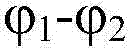
能够通过用于空间编码的多种成像技术施加上述第一复合激励RF脉冲和第二复合激励RF脉冲,第一成像序列和/或第二成像序列例如可以是3D径向序列、快速场回波(FFE)序列、平衡快速场回波(bFFE)序列、快速自旋回波(TSE)序列、回波平面成像(EPI)序列等。因此,能够将本发明的方法与允许快速准确进行B1绘制的任何快速扫描技术组合。能够以这样的方式设计第一成像序列和第二成像序列,即使得身体的被检查部分中的共振频率位移(尤其是水-脂肪位移)将不会影响用于B1绘制的相位差。快速成像序列还能够使该方法对运动不敏感。The first and second composite excitation RF pulses described above can be applied by various imaging techniques for spatial encoding, the first imaging sequence and/or the second imaging sequence can be, for example, a 3D radial sequence, a fast field echo (FFE) sequence, balanced fast field echo (bFFE) sequence, fast spin echo (TSE) sequence, echo planar imaging (EPI) sequence, etc. Thus, the method of the present invention can be combined with any fast scanning technique that allows fast and accurate B1 rendering. The first and second imaging sequences can be designed in such a way that resonance frequency shifts (especially water-fat shifts) in the examined part of the body will not affect the phase difference for B1 mapping. Fast imaging sequences also make the method insensitive to motion.
根据本发明的另一优选实施例,所述第一复合激励RF脉冲和/或所述第二复合激励RF脉冲是切片选择性的,其中,所述B1图指示RF脉冲的RF场在由所述第一第二复合激励RF脉冲和/或所述第二复合激励RF脉冲选择的切片之内的空间分布。例如,在存在正切片选择磁场梯度的情况下发射第一复合激励RF脉冲,并在负切片选择磁场梯度期间发射第二复合激励RF脉冲。应当将第一复合激励RF脉冲和第二复合激励RF脉冲成形,以便产生良好定义的切片轮廓。由于在这种情况下,B1场将在切片轮廓上变化,所采集的信号数据的所得相位将受到这种分布的影响。为了计算例如选定切片中心的B1场,能够确定适当的校正因数集合。According to another preferred embodiment of the present invention, said first composite excitation RF pulse and/or said second composite excitation RF pulse are slice selective, wherein said B1 map indicates that the RF field of the RF pulse is defined by The first and second composite excitation RF pulses and/or the spatial distribution within a selected slice of the second composite excitation RF pulses. For example, a first composite excitation RF pulse is transmitted in the presence of a positive slice-selective magnetic field gradient, and a second composite excitation RF pulse is transmitted during a negative slice-selective magnetic field gradient. The first composite excitation RF pulse and the second composite excitation RF pulse should be shaped so as to produce a well-defined slice profile. Since in this case the B1 field will vary across the slice profile, the resulting phase of the acquired signal data will be affected by this distribution. In order to calculate eg the Bi field at the center of a selected slice, an appropriate set of correction factors can be determined.
在本发明方法的非切片选择性版本中,第一激励RF脉冲和第二激励RF脉冲将激励被检查身体的整个部分。由于所施加的翻转角通常不小(例如30-150°范围中),所以需要一些延迟时间以允许T1弛豫。在切片选择性激励的情况中,这种延迟时间能够用于激励其他切片,并导出对应的B1图。这种多切片方法实现了快速B1绘制技术。在将多发射系统用于MR成像的情况下,需要确定若干不同RF发射天线的B1场分布。上述多切片方法能够应用于激励一组平行的非交叠切片,其中,每个切片用于确定一个RF发射天线配置(例如,个体发射天线或发射天线整个阵列的子集)的B1图。能够选择切片取向,使得B1场不强烈依赖于切片位置。多切片方法的另一种应用是增大了B1绘制的动态范围。如果施加的翻转角在特定范围中,例如介于30°和150°之间,上述绘制技术将特别有效。如果B1变化大或难以做出初始估计,多切片技术能够用于快速采集来自一系列不同(平行)切片的信号,一系列不同(平行)切片中的每个均是利用不同的RF功率(即翻转角)设置来采集的。In a non-slice-selective version of the method of the invention, the first and second excitation RF pulses will excite the entire part of the body being examined. Since the applied flip angle is usually not small (eg in the range of 30-150°), some delay time is required to allow T 1 to relax. In the case of slice-selective excitation, this delay time can be used to excite other slices and derive the corresponding B1 map. This multi-slice approach implements a fast B1 rendering technique. In the case of using a multi-transmit system for MR imaging, the B 1 field distribution needs to be determined for several different RF transmit antennas. The multi-slice approach described above can be applied to excite a set of parallel non-overlapping slices, where each slice is used to determine the B1 map of an RF transmit antenna configuration (eg, individual transmit antennas or a subset of the entire array of transmit antennas). The slice orientation can be chosen such that the B 1 field does not depend strongly on the slice position. Another application of the multi-slice method is to increase the dynamic range of B1 rendering. The rendering technique described above will be particularly effective if the applied flip angle is in a certain range, for example between 30° and 150°. If B 1 varies widely or is difficult to make an initial estimate, multi-slice techniques can be used to quickly acquire signals from a series of different (parallel) slices, each with a different RF power ( That is, the flip angle) is set to collect.
随着主磁场强度增大,B0不均匀性导致的失共振效应也变得更严重,并影响所有MR应用。常规上使用公知的B0匀场方法来补偿这些不均匀性。为了找到最优的匀场方案,需要一种准确而有效的B0绘制技术。根据本发明的优选实施例,所述第一成像序列和所述第二成像序列包括用于生成梯度回波信号的切换的磁场梯度,其中,从第一MR信号数据和第二MR信号数据导出B0图,所述B0图指示所述身体的所述部分之内的主磁场的空间分布。本发明的本实施例实现了组合式B1和B0绘制。梯度回波信号的相位依赖于因B0不均匀性导致的移相。因此,梯度回波信号的逐个体素的相移能够用于导出B1图和B0图。The off-resonance effect caused by B0 inhomogeneity also becomes more severe with increasing main magnetic field strength and affects all MR applications. These inhomogeneities are conventionally compensated using the well-known B0 shimming method. To find the optimal shimming scheme, an accurate and efficient B0 mapping technique is needed. According to a preferred embodiment of the invention, said first imaging sequence and said second imaging sequence comprise switched magnetic field gradients for generating gradient echo signals, wherein from the first MR signal data and the second MR signal data is derived A B0 map indicating the spatial distribution of the main magnetic field within the part of the body. The present embodiment of the present invention realizes combined B 1 and B 0 rendering. The phase of the gradient echo signal depends on the phase shift due to B0 inhomogeneity. Thus, the voxel-by-voxel phase shift of the gradient echo signal can be used to derive the B 1 map and the B 0 map.
根据本发明的又一优选实施例,所述第一MR信号数据和所述第二MR信号数据是经由所述MR设备的两个或更多RF接收天线采集的,所述RF接收天线具有不同的空间灵敏度曲线,其中,无需切换磁场梯度以进行相位和/或频率编码而采集所述第一MR信号数据和所述第二MR信号数据。在本发明的这一实施例中,使用多元件RF接收系统,其中,通过仅采用RF接收天线的空间灵敏度曲线实现用于B1绘制的非常快的大致空间编码。获得的信号相位将允许估计各自RF接收天线的灵敏度区域中B1值的积分,该积分由这种RF接收天线的空间灵敏度曲线加权。任选地,可以施加(小)频率编码磁场梯度,以用于改进的空间选择性。According to yet another preferred embodiment of the present invention, said first MR signal data and said second MR signal data are collected via two or more RF receiving antennas of said MR device, said RF receiving antennas having different , wherein the first MR signal data and the second MR signal data are acquired without switching magnetic field gradients for phase and/or frequency encoding. In this embodiment of the invention, a multi-element RF receive system is used in which very fast approximate spatial encoding for B1 mapping is achieved by employing only the spatial sensitivity curves of the RF receive antennas. The obtained signal phase will allow to estimate the integral of the B1 value in the sensitivity region of the respective RF receive antenna, weighted by the spatial sensitivity curve of such RF receive antenna. Optionally, a (small) frequency-encoded magnetic field gradient can be applied for improved spatial selectivity.
能够借助一种MR设备执行至此描述的本发明的方法,该MR设备包括:至少一个主磁体线圈,其用于在检查体积之内生成均匀稳定的磁场;多个梯度线圈,其用于在检查体积之内不同空间方向上生成切换的磁场梯度;至少一个RF线圈,其用于在检查体积之内生成RF脉冲并用于接收来自位于检查体积中的患者的身体的MR信号;控制单元,其用于控制RF脉冲和切换的磁场梯度的时间接连;重建单元;以及可视化单元。优选通过所述MR设备的重建单元、可视化单元和/或控制单元的对应程序来实施本发明的方法。The method of the invention described up to now can be carried out by means of an MR device comprising: at least one main magnet coil for generating a homogeneous and stable magnetic field within the examination volume; a plurality of gradient coils for Generating switched magnetic field gradients in different spatial directions within the volume; at least one RF coil for generating RF pulses within the examination volume and for receiving MR signals from the body of a patient located in the examination volume; a control unit with time series for controlling RF pulses and switched magnetic field gradients; a reconstruction unit; and a visualization unit. The method according to the invention is preferably carried out by corresponding programs of the reconstruction unit, the visualization unit and/or the control unit of the MR system.
能够在当前临床使用的大多数MR设备中有利地执行本发明的方法。为此目的,仅需要利用控制MR设备的计算机程序,使其执行本发明的上述方法步骤。计算机程序可以存在于数据载体上,或存在于数据网络中以便被下载安装在MR设备的控制单元中。The method of the invention can be advantageously performed in most MR devices currently in clinical use. For this purpose, it is only necessary to utilize a computer program controlling the MR device such that it performs the above-described method steps of the invention. The computer program can be present on a data carrier or in a data network in order to be downloaded and installed in the control unit of the MR device.
附图说明Description of drawings
附图公开了本发明的优选实施例。然而应理解,附图仅出于说明的目的被设计,而并不作为本发明限制的定义。在附图中:The accompanying drawings disclose preferred embodiments of the invention. It should be understood, however, that the drawings are designed for purposes of illustration only and not as a definition of the limits of the invention. In the attached picture:
图1示意性示出了用于执行本发明方法的MR设备;Fig. 1 schematically shows an MR device for carrying out the method of the present invention;
图2示出了示意图,其图示了根据本发明第一实施例的成像序列;Figure 2 shows a schematic diagram illustrating an imaging sequence according to a first embodiment of the invention;
图3示出了示意图,其图示了根据本发明第二实施例的成像序列;Figure 3 shows a schematic diagram illustrating an imaging sequence according to a second embodiment of the invention;
图4示出了根据图3的成像序列的示意图,其具有额外的切换的磁场梯度;Fig. 4 shows a schematic diagram of the imaging sequence according to Fig. 3 with an additional switched magnetic field gradient;
图5示出了示意图,其图示了所采集的MR信号数据的相位差对RF场的依赖性。Fig. 5 shows a schematic diagram illustrating the dependence of the phase difference of acquired MR signal data on the RF field.
具体实施方式Detailed ways
参考图1,示出了MR设备1。该设备包括超导或常导主磁体线圈2,从而沿着通过检查体积的z轴生成基本均匀,时间上恒定的主磁场B0。该设备还包括(一阶、二阶,以及适当时候的三阶)匀场线圈的集合2',其中,通过所述集合2'的个体匀场线圈的电流是可控的,以便使检查体积之内的B0偏差最小化。Referring to Fig. 1, an MR apparatus 1 is shown. The device comprises a superconducting or normally conducting main magnet coil 2 to generate a substantially uniform, temporally constant main magnetic field B0 along the z-axis through the examination volume. The device also comprises a set 2' of (first order, second order, and where appropriate third order) shim coils, wherein the current through the individual shim coils of said set 2' is controllable so that the examination volume The deviation within B 0 is minimized.
磁共振发生和操纵系统施加一系列RF脉冲和切换的磁场梯度、以反转或激励核磁自旋、诱发磁共振、对磁共振重新聚焦、操纵磁共振、对磁共振进行空间和其他编码、使自旋饱和等,以执行MR重新聚焦。Magnetic resonance generation and manipulation systems apply a series of RF pulses and switched magnetic field gradients to invert or excite nuclear magnetic spins, induce magnetic resonance, refocus magnetic resonance, manipulate magnetic resonance, spatially and otherwise encode magnetic resonance, enable Spin saturation etc. to perform MR refocusing.
更具体而言,梯度脉冲放大器3施加电流脉冲至沿检查体积的x、y和z轴的全身梯度线圈4、5和6中所选择的。数字RF频率发射器7经由发送/接收开关8向身体RF线圈9发射RF脉冲或脉冲群,以向检查体积中发射RF脉冲。典型的MR成像序列包括一组短持续时间的RF脉冲片段,它们彼此一起被获取,并且任何施加的磁场梯度实现核磁共振的选定操纵。RF脉冲用于饱和、激励共振,反转磁化,对共振重新聚焦或操纵共振,并选择位于检查体积中的身体10的一部分。MR信号还由身体RF线圈9拾取。More specifically, the gradient pulse amplifier 3 applies current pulses to selected ones of the whole body gradient coils 4, 5 and 6 along the x, y and z axes of the examination volume. A digital RF frequency transmitter 7 transmits RF pulses or bursts via a send/receive switch 8 to a body RF coil 9 to transmit RF pulses into the examination volume. A typical MR imaging sequence consists of a set of short-duration RF pulse segments that are acquired together with each other, and any applied magnetic field gradients achieve selected manipulations of nuclear magnetic resonance. RF pulses are used to saturate, excite the resonance, reverse the magnetization, refocus or manipulate the resonance, and select a portion of the
为了借助并行成像来生成身体10的有限区域的MR图像,邻接针对成像选定的区域放置一组局部阵列RF线圈11、12和13。阵列线圈11、12、13能够用于接收身体线圈RF发射诱发的MR信号。In order to generate MR images of a limited region of the
所得的MR信号被身体RF线圈9和/或阵列RF线圈11、12和13的阵列拾取并被接收器14解调,接收器14优选包括前置放大器(未示出)。接收器14经由发送/接收开关8连接到RF线圈9、11、12和13。The resulting MR signals are picked up by the body RF coil 9 and/or the array of array RF coils 11 , 12 and 13 and demodulated by a
主计算机15控制通过匀场线圈2'以及梯度脉冲放大器3和发射器7的电流,以生成多种MR成像序列中的任意序列,多种MR成像序列例如为回波平面成像(EPI)、回波体积成像、梯度和自旋回波成像、快速自旋回波成像等。对于选定的序列,接收器14在每个RF激励脉冲之后迅速连续地接收单个或多个MR数据线。数据采集系统16执行所接收信号的模数转换,并将每个MR数据线转换成适于进一步处理的数字格式。在现代MR设备中,数据采集系统16是专用于采集原始图像数据的独立计算机。The
最后,通过重建处理器17将数字原始图像数据重建成图像表示,重建处理器17应用傅里叶变换或其他适当的重建算法,例如SENSE或SMASH。MR图像可以表示通过患者的平面切片、平行平面切片的阵列、三维体积等。之后在图像存储器中存储图像,在那里可以访问图像以将图像表示的切片、投影或其他部分转换成用于可视化的适当格式,可视化例如经由视频监视器18,视频监视器18提供了所得MR图像的人类可读显示。Finally, the digital raw image data is reconstructed into an image representation by a
图2示出了示意图,其图示了根据本发明第一实施例的成像序列。描绘的成像序列为受激回波序列,其被细分成准备阶段21和采集阶段22。在准备阶段21期间施加具有90°翻转角的两个准备RF脉冲。在两个90°准备RF脉冲之间的时间间隔之内辐射失共振布洛赫-西格特RF脉冲BS。布洛赫-西格特RF脉冲BS是所谓的费米脉冲,其具有如图2中所示的包络线(要获得关于布洛赫-西格特RF脉冲的脉冲形状的更多信息,请参考上文引用的Sacolick等人的文章)。准备阶段21的RF脉冲存储与B1不均匀性相关的沿纵轴的核磁化的布洛赫-西格特相移。在采集阶段22期间,施加多个具有小翻转角α的重新聚焦RF脉冲,以便能够快速读出多个受激回波MR信号。梯度回波串(例如EPI)可以跟随每个重新聚焦RF脉冲(在图2的示意图中省略了序列的相位编码梯度)。在准备阶段的末端切换梯度23,以便在第二准备RF脉冲之后破坏残余的横向核磁化。必须注意,梯度回波序列的重新定相梯度(图2中的虚线框)被反转并移动到准备RF脉冲,以便破坏来自纵向核磁化的没有在受激回波序列的准备阶段期间准备的虚假MR信号贡献。Fig. 2 shows a schematic diagram illustrating an imaging sequence according to a first embodiment of the invention. The depicted imaging sequence is a stimulated echo sequence, which is subdivided into a
在图2中所示的实施例中,准备RF脉冲是空间非选择性的。在准备阶段期间,特殊的(β)0°(2β)90°复合90°准备RF脉冲能够用于激励。这样增大了操作性B1范围,并进一步改善了B1绘制的准确度。此外,使采集阶段期间采集的受激回波MR信号的幅度最大化,以便能够尽可能精确地进行信号相位测量。In the embodiment shown in Figure 2, the preparation RF pulses are spatially non-selective. During the preparation phase, special (β) 0° (2β) 90° composite 90° preparation RF pulses can be used for excitation. This increases the operational B1 range and further improves the accuracy of B1 drawing. Furthermore, the amplitude of the stimulated echo MR signal acquired during the acquisition phase is maximized in order to be able to make signal phase measurements as accurate as possible.
在本发明的实际实施例中,3D EPI序列可以用于在采集阶段22期间采集受激回波MR信号(示范性参数:扫描矩阵尺寸:128×32×5个体素,EPI因子5,重新聚焦RF脉冲的翻转角:15°,回波时间:6ms,重复时间:10ms,布洛赫-西格特RF脉冲(费米脉冲)的持续时间:5ms)。5-10s的总扫描持续时间能够足以采集完整的B1图。根据利用布洛赫-西格特RF脉冲BS的+/-4kHz频率偏置通过前述方式采集的两幅MR图像的逐个体素的相位差导出B1图。In a practical embodiment of the invention, a 3D EPI sequence can be used to acquire stimulated echo MR signals during the acquisition phase 22 (exemplary parameters: scan matrix size: 128×32×5 voxels, EPI factor 5, refocus Flip angle of the RF pulse: 15°, echo time: 6 ms, repetition time: 10 ms, duration of the Bloch-Siegert RF pulse (Fermi pulse): 5 ms). A total scan duration of 5-10 s can be sufficient to acquire a complete B1 map. The Bi map was derived from the voxel-by-voxel phase difference of the two MR images acquired in the previously described manner with a +/- 4 kHz frequency offset of the Bloch-Siegert RF pulse BS.
图3a示出了示意图,其图示了根据本发明另一方面的成像序列。身体10的一部分经受第一成像序列,所述第一成像序列包括第一复合激励RF脉冲αxαy。这种第一复合激励RF脉冲生成横向核磁化,其相位


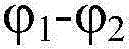
为了减少扫描时间,可以施加复位脉冲,以在施加第二复合激励RF脉冲之前,消除第一复合激励RF脉冲的效果。在描绘的情况中,复位脉冲是α-yα-x。与第二复合激励RF脉冲(αxα-y)组合,这获得有效的RF脉冲2α-y。在图3b中描绘了这种情况。To reduce scan time, a reset pulse can be applied to cancel the effect of the first composite excitation RF pulse before applying the second composite excitation RF pulse. In the depicted case, the reset pulse is α -y α -x . Combined with the second composite excitation RF pulse (α x α -y ), this obtains an effective RF pulse 2α -y . This situation is depicted in Figure 3b.
在图5的示意图中图示了差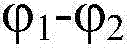
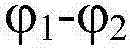
图4图示了组合式B1和B0绘制的情况。第一成像序列和第二成像序列包括用于生成梯度回波信号的切换的磁场梯度。例如,能够在径向采集方案中使用图4中所示的序列。如上所述,能够将信号S1和S'1的相位用于B1绘制。梯度回波信号S2和S'2的相位还依赖于由于B0不均匀性以及化学位移导致的移相。如果适当选择回波时间Te,则能够消除水-脂肪位移的影响,并且S2和S'2的相位差能够用于导出B0图。这种额外信息能够用于校正B1计算,因为激励RF脉冲的有效翻转角α和相位轻微依赖于B0不均匀性诱发的偏置频率。Figure 4 illustrates the situation where the combined formulas B 1 and B 0 are drawn. The first imaging sequence and the second imaging sequence include switched magnetic field gradients for generating gradient echo signals. For example, the sequence shown in Figure 4 can be used in a radial acquisition scheme. As mentioned above, the phases of signals S1 and S'1 can be used for B1 plotting. The phases of the gradient echo signals S2 and S'2 also depend on the phase shift due to B0 inhomogeneity as well as the chemical shift. If the echo time Te is chosen properly, the effect of the water-fat shift can be eliminated and the phase difference of S2 and S'2 can be used to derive the Bo map. This additional information can be used to correct the B1 calculation, since the effective flip angle α and phase of the excitation RF pulse depend slightly on the bias frequency induced by the B0 inhomogeneity.
Claims (17)
Applications Claiming Priority (3)
| Application Number | Priority Date | Filing Date | Title |
|---|---|---|---|
| EP11161806.2 | 2011-04-11 | ||
| EP11161806 | 2011-04-11 | ||
| PCT/IB2012/051590 WO2012140536A1 (en) | 2011-04-11 | 2012-04-02 | Mr imaging with b1mapping |
Publications (1)
| Publication Number | Publication Date |
|---|---|
| CN103649765A true CN103649765A (en) | 2014-03-19 |
Family
ID=45976464
Family Applications (1)
| Application Number | Title | Priority Date | Filing Date |
|---|---|---|---|
| CN201280028166.3A Pending CN103649765A (en) | 2011-04-11 | 2012-04-02 | MR imaging with B1 rendering |
Country Status (5)
| Country | Link |
|---|---|
| US (1) | US20140070805A1 (en) |
| EP (1) | EP2710395A1 (en) |
| CN (1) | CN103649765A (en) |
| RU (1) | RU2013150082A (en) |
| WO (1) | WO2012140536A1 (en) |
Cited By (8)
| Publication number | Priority date | Publication date | Assignee | Title |
|---|---|---|---|---|
| CN107110942A (en) * | 2014-12-12 | 2017-08-29 | 皇家飞利浦有限公司 | Quiet MR imagings |
| CN107110943A (en) * | 2014-12-11 | 2017-08-29 | 三星电子株式会社 | Magnetic resonance imaging apparatus and image processing method thereof |
| CN107592912A (en) * | 2015-05-13 | 2018-01-16 | 皇家飞利浦有限公司 | Parallel MR Imaging Using RF Coil Sensitivity Mapping |
| CN107810425A (en) * | 2015-04-22 | 2018-03-16 | 皇家飞利浦有限公司 | T2-weighted MR imaging to eliminate non-T2-weighted signal contributions |
| CN110353681A (en) * | 2018-03-26 | 2019-10-22 | 西门子医疗有限公司 | Method and device for correcting B0 inhomogeneity by means of high-frequency signals |
| US10677872B2 (en) | 2017-05-22 | 2020-06-09 | Siemens Healthcare Gmbh | Magnetic resonance apparatus and method for vascular imaging |
| CN114236442A (en) * | 2021-12-14 | 2022-03-25 | 无锡鸣石峻致医疗科技有限公司 | Method and device for motion-insensitive acquisition of nuclear magnetic resonance signals, computer equipment and nuclear magnetic resonance detection system |
| CN114325525A (en) * | 2020-09-29 | 2022-04-12 | 西门子医疗有限公司 | Time-saving B based on a double echo sequence with excited echoes0Generation of graphs |
Families Citing this family (13)
| Publication number | Priority date | Publication date | Assignee | Title |
|---|---|---|---|---|
| EP2741096A1 (en) * | 2012-12-04 | 2014-06-11 | Samsung Electronics Co., Ltd | Fast B1 mapping based on interleaved three flip angle excitation |
| DE102013201670B3 (en) * | 2013-02-01 | 2014-07-03 | Siemens Aktiengesellschaft | Method for acquiring magnetic resonance (MR) data within volume section, involves applying second gradient after high frequency pulse and selecting MR data such that first and second gradients at subsequent sequences are different |
| DE102013201671B3 (en) * | 2013-02-01 | 2014-07-31 | Siemens Aktiengesellschaft | Method for acquiring MR data and for determining a B1 magnetic field and correspondingly designed magnetic resonance system |
| RU2016134896A (en) * | 2014-01-28 | 2018-03-12 | Конинклейке Филипс Н.В. | MR TOMOGRAPHY WITH ZERO TIME OF DELAY OF THE ECHO SIGNAL WITH DISCRETIZATION OF THE CENTER OF k-SPACE |
| CN104856676B (en) * | 2014-02-26 | 2017-10-03 | 西门子(深圳)磁共振有限公司 | MR imaging method and device |
| US9995808B2 (en) * | 2014-03-10 | 2018-06-12 | Vanderbilt University | MRI using RF gradients for spatial encoding |
| WO2016143460A1 (en) * | 2015-03-06 | 2016-09-15 | 株式会社日立製作所 | Magnetic resonance imaging apparatus and method for setting rf shimming parameters |
| US11047935B2 (en) | 2015-05-14 | 2021-06-29 | Ohio State Innovation Foundation | Systems and methods for estimating complex B1+ fields of transmit coils of a magnetic resonance imaging (MRI) system |
| DE102016202617A1 (en) * | 2016-02-19 | 2017-08-24 | Siemens Healthcare Gmbh | Method for determining a B1 field map |
| KR101771220B1 (en) * | 2016-05-02 | 2017-08-24 | 가천대학교 산학협력단 | Magnetic resonance imaging system |
| US10890631B2 (en) | 2017-01-19 | 2021-01-12 | Ohio State Innovation Foundation | Estimating absolute phase of radio frequency fields of transmit and receive coils in a magnetic resonance |
| DE102020202830A1 (en) * | 2020-03-05 | 2021-09-09 | Siemens Healthcare Gmbh | Magnetic resonance tomograph and method for operation with dynamic B0 compensation |
| WO2022182885A1 (en) * | 2021-02-24 | 2022-09-01 | Case Western Reserve University | System and method for b1-selective excitation for spatial localization in magnetic resonance imaging |
Citations (1)
| Publication number | Priority date | Publication date | Assignee | Title |
|---|---|---|---|---|
| CN101088021A (en) * | 2004-12-21 | 2007-12-12 | 皇家飞利浦电子股份有限公司 | Magnetic resonance device and method |
Family Cites Families (5)
| Publication number | Priority date | Publication date | Assignee | Title |
|---|---|---|---|---|
| US4672319A (en) * | 1984-09-19 | 1987-06-09 | Stanford University | Multiple pulse excitation in NMR imaging |
| DE10318990B4 (en) * | 2003-04-25 | 2008-04-03 | Siemens Ag | Imaging method for magnetic resonance tomography |
| DE102004053777B4 (en) * | 2003-11-19 | 2010-09-02 | Siemens Ag | Method for determining a setting parameter of a radio-frequency transmission arrangement for a magnetic resonance system |
| US8406849B2 (en) * | 2006-03-31 | 2013-03-26 | University Of Utah Research Foundation | Systems and methods for magnetic resonance imaging |
| US8700127B2 (en) * | 2009-01-29 | 2014-04-15 | University Of Virginia Patent Foundation | Motion-attenuated contrast-enhanced cardiac magnetic resonance imaging system and method |
-
2012
- 2012-04-02 CN CN201280028166.3A patent/CN103649765A/en active Pending
- 2012-04-02 US US14/008,126 patent/US20140070805A1/en not_active Abandoned
- 2012-04-02 EP EP12715204.9A patent/EP2710395A1/en not_active Withdrawn
- 2012-04-02 RU RU2013150082/14A patent/RU2013150082A/en not_active Application Discontinuation
- 2012-04-02 WO PCT/IB2012/051590 patent/WO2012140536A1/en not_active Ceased
Patent Citations (1)
| Publication number | Priority date | Publication date | Assignee | Title |
|---|---|---|---|---|
| CN101088021A (en) * | 2004-12-21 | 2007-12-12 | 皇家飞利浦电子股份有限公司 | Magnetic resonance device and method |
Non-Patent Citations (7)
| Title |
|---|
| C.J.R.COUNSELL: "Stimulated Echoes and Spin Echoes. Simultaneous Determination of T2,Diffusion Coefficient,and RF Homogeneity", 《JOURNAL OF MAGNETIC RESONANCE B》, vol. 101, 1 January 1993 (1993-01-01), pages 28 - 34, XP055028209 * |
| GUNTHER HELMS: "Rapid radiofrequency field mapping in vivo using single-shot STEAM MRI", 《MAGNETIC RESONANCE IN MEDICINE》, vol. 60, no. 3, 1 September 2008 (2008-09-01), pages 739 - 743, XP055027990, DOI: doi:10.1002/mrm.21676 * |
| HSU J J: "Encoding to the longitudinal magnetization for MR imaging and flow velocity mapping", 《JOURNAL OF MAGNETIC RESONANCE》, vol. 183, no. 1, 1 November 2006 (2006-11-01), pages 41 - 49, XP024919413, DOI: doi:10.1016/j.jmr.2006.07.016 * |
| LAURA I.SACOLICK: "B1 mapping by Bloch-Siegert shift", 《MAGNETIC RESONANCE IN MEDICINE》, vol. 63, no. 5, 1 May 2010 (2010-05-01), pages 1315 - 1322, XP055027998, DOI: doi:10.1002/mrm.22357 * |
| LEVITT M H: "NMR population inversion using a composite pulse", 《JOURNAL OF MAGNETIC RESONANCE》, vol. 33, no. 2, 1 February 1979 (1979-02-01), pages 473 - 476, XP027365736 * |
| MORRELL G R: "A Phase-Sensitive Method of Flip Angle Mapping", 《MAGNETIC RESONANCE IN MEDICINE》, vol. 60, no. 4, 1 October 2008 (2008-10-01), pages 889 - 894, XP002541570, DOI: doi:10.1002/mrm.21729 * |
| WADE T: "Comparison of Current B1-Mapping Techniques", 《INTERNATIONAL SOCIETY FOR MAGNETIC RESONANCE IN MEDICINE》, no. 15, 1 January 2007 (2007-01-01), pages 354, XP002555032 * |
Cited By (13)
| Publication number | Priority date | Publication date | Assignee | Title |
|---|---|---|---|---|
| US10254365B2 (en) | 2014-12-11 | 2019-04-09 | Samsung Electronics Co., Ltd. | Magnetic resonance imaging apparatus and image processing method thereof |
| CN107110943A (en) * | 2014-12-11 | 2017-08-29 | 三星电子株式会社 | Magnetic resonance imaging apparatus and image processing method thereof |
| CN107110942B (en) * | 2014-12-12 | 2020-06-16 | 皇家飞利浦有限公司 | MR imaging method and MR device |
| CN107110942A (en) * | 2014-12-12 | 2017-08-29 | 皇家飞利浦有限公司 | Quiet MR imagings |
| CN107810425B (en) * | 2015-04-22 | 2020-05-01 | 皇家飞利浦有限公司 | Eliminating non-T2Weighting the T of the signal contribution2Weighted MR imaging |
| CN107810425A (en) * | 2015-04-22 | 2018-03-16 | 皇家飞利浦有限公司 | T2-weighted MR imaging to eliminate non-T2-weighted signal contributions |
| CN107592912A (en) * | 2015-05-13 | 2018-01-16 | 皇家飞利浦有限公司 | Parallel MR Imaging Using RF Coil Sensitivity Mapping |
| US10677872B2 (en) | 2017-05-22 | 2020-06-09 | Siemens Healthcare Gmbh | Magnetic resonance apparatus and method for vascular imaging |
| CN110353681A (en) * | 2018-03-26 | 2019-10-22 | 西门子医疗有限公司 | Method and device for correcting B0 inhomogeneity by means of high-frequency signals |
| CN110353681B (en) * | 2018-03-26 | 2023-09-01 | 西门子医疗有限公司 | Method and device for correcting B0 inhomogeneity by means of high-frequency signals |
| CN114325525A (en) * | 2020-09-29 | 2022-04-12 | 西门子医疗有限公司 | Time-saving B based on a double echo sequence with excited echoes0Generation of graphs |
| CN114325525B (en) * | 2020-09-29 | 2024-04-19 | 西门子医疗有限公司 | For generating B for magnetic resonance examination0Method of mapping and magnetic resonance apparatus |
| CN114236442A (en) * | 2021-12-14 | 2022-03-25 | 无锡鸣石峻致医疗科技有限公司 | Method and device for motion-insensitive acquisition of nuclear magnetic resonance signals, computer equipment and nuclear magnetic resonance detection system |
Also Published As
| Publication number | Publication date |
|---|---|
| EP2710395A1 (en) | 2014-03-26 |
| RU2013150082A (en) | 2015-05-20 |
| US20140070805A1 (en) | 2014-03-13 |
| WO2012140536A1 (en) | 2012-10-18 |
Similar Documents
| Publication | Publication Date | Title |
|---|---|---|
| CN103649765A (en) | MR imaging with B1 rendering | |
| US9766313B2 (en) | MR imaging using apt contrast enhancement and sampling at multiple echo times | |
| US9977106B2 (en) | MR imaging with B1 mapping | |
| US9977108B2 (en) | Metal resistant MR imaging reference scan | |
| JP6458170B2 (en) | Parallel MR imaging using RF coil sensitivity mapping | |
| JP6469703B2 (en) | MR imaging using Dixon water / fat separation | |
| EP2992351B1 (en) | Dixon-type water/fat separation mri using high-snr in-phase image and lower-snr at least partially out-of-phase image | |
| EP3060116B1 (en) | Mr imaging with temperature mapping | |
| US20150042335A1 (en) | Mr imaging with b1 mapping | |
| US20190212404A1 (en) | Mr imaging with dixon-type water/fat seperation | |
| US20190277934A1 (en) | Parallel mr imaging with spectral fat suppression | |
| CN111868543B (en) | MR imaging method, apparatus and computer program using helical acquisition | |
| EP3736593A1 (en) | Dual echo steady state mr imaging using bipolar diffusion gradients | |
| WO2016124397A1 (en) | Mr imaging with b1 mapping |
Legal Events
| Date | Code | Title | Description |
|---|---|---|---|
| PB01 | Publication | ||
| PB01 | Publication | ||
| C10 | Entry into substantive examination | ||
| SE01 | Entry into force of request for substantive examination | ||
| C02 | Deemed withdrawal of patent application after publication (patent law 2001) | ||
| WD01 | Invention patent application deemed withdrawn after publication |
Application publication date: 20140319 |