CN103339137A - A metal complex comprising a ligand having a combination of donor-acceptor substituents - Google Patents
A metal complex comprising a ligand having a combination of donor-acceptor substituents Download PDFInfo
- Publication number
- CN103339137A CN103339137A CN2011800656814A CN201180065681A CN103339137A CN 103339137 A CN103339137 A CN 103339137A CN 2011800656814 A CN2011800656814 A CN 2011800656814A CN 201180065681 A CN201180065681 A CN 201180065681A CN 103339137 A CN103339137 A CN 103339137A
- Authority
- CN
- China
- Prior art keywords
- metal complex
- mmol
- aromatic
- ring
- ligand
- Prior art date
- Legal status (The legal status is an assumption and is not a legal conclusion. Google has not performed a legal analysis and makes no representation as to the accuracy of the status listed.)
- Pending
Links
- 0 CCC=C[C@@](C)C(C(C)=*)C1=CCCC=*1C Chemical compound CCC=C[C@@](C)C(C(C)=*)C1=CCCC=*1C 0.000 description 1
Images


Classifications
-
- H—ELECTRICITY
- H10—SEMICONDUCTOR DEVICES; ELECTRIC SOLID-STATE DEVICES NOT OTHERWISE PROVIDED FOR
- H10K—ORGANIC ELECTRIC SOLID-STATE DEVICES
- H10K85/00—Organic materials used in the body or electrodes of devices covered by this subclass
- H10K85/30—Coordination compounds
- H10K85/341—Transition metal complexes, e.g. Ru(II)polypyridine complexes
- H10K85/342—Transition metal complexes, e.g. Ru(II)polypyridine complexes comprising iridium
-
- C—CHEMISTRY; METALLURGY
- C09—DYES; PAINTS; POLISHES; NATURAL RESINS; ADHESIVES; COMPOSITIONS NOT OTHERWISE PROVIDED FOR; APPLICATIONS OF MATERIALS NOT OTHERWISE PROVIDED FOR
- C09K—MATERIALS FOR MISCELLANEOUS APPLICATIONS, NOT PROVIDED FOR ELSEWHERE
- C09K11/00—Luminescent, e.g. electroluminescent, chemiluminescent materials
- C09K11/06—Luminescent, e.g. electroluminescent, chemiluminescent materials containing organic luminescent materials
-
- C—CHEMISTRY; METALLURGY
- C07—ORGANIC CHEMISTRY
- C07F—ACYCLIC, CARBOCYCLIC OR HETEROCYCLIC COMPOUNDS CONTAINING ELEMENTS OTHER THAN CARBON, HYDROGEN, HALOGEN, OXYGEN, NITROGEN, SULFUR, SELENIUM OR TELLURIUM
- C07F15/00—Compounds containing elements of Groups 8, 9, 10 or 18 of the Periodic Table
-
- C—CHEMISTRY; METALLURGY
- C07—ORGANIC CHEMISTRY
- C07F—ACYCLIC, CARBOCYCLIC OR HETEROCYCLIC COMPOUNDS CONTAINING ELEMENTS OTHER THAN CARBON, HYDROGEN, HALOGEN, OXYGEN, NITROGEN, SULFUR, SELENIUM OR TELLURIUM
- C07F15/00—Compounds containing elements of Groups 8, 9, 10 or 18 of the Periodic Table
- C07F15/0006—Compounds containing elements of Groups 8, 9, 10 or 18 of the Periodic Table compounds of the platinum group
- C07F15/0033—Iridium compounds
-
- H—ELECTRICITY
- H10—SEMICONDUCTOR DEVICES; ELECTRIC SOLID-STATE DEVICES NOT OTHERWISE PROVIDED FOR
- H10K—ORGANIC ELECTRIC SOLID-STATE DEVICES
- H10K85/00—Organic materials used in the body or electrodes of devices covered by this subclass
- H10K85/30—Coordination compounds
- H10K85/361—Polynuclear complexes, i.e. complexes comprising two or more metal centers
Landscapes
- Chemical & Material Sciences (AREA)
- Organic Chemistry (AREA)
- Engineering & Computer Science (AREA)
- Materials Engineering (AREA)
- Inorganic Chemistry (AREA)
- Physics & Mathematics (AREA)
- High Energy & Nuclear Physics (AREA)
- Crystallography & Structural Chemistry (AREA)
- Pyridine Compounds (AREA)
- Electroluminescent Light Sources (AREA)
- Plural Heterocyclic Compounds (AREA)
Abstract
Description
技术领域technical field
本发明涉及一种所含配体具有供体-受体取代基的组合的金属络合物以及包括所述络合物的发光器件。The present invention relates to a metal complex comprising a ligand having a combination of donor-acceptor substituents and a light-emitting device comprising said complex.
背景技术Background technique
有机发光二极管(OLED)包含一个有机发射层(EML),该发射层通过荧光或磷光发光。展现出最高的亮度效率和功率变换效率的OLED是使用含重金属原子的电致发光材料制造的。因此,基于过渡金属络合物的电致发光材料引起了广泛关注并且在世界范围内进行了大量研究以改进现有的器件。例如,包含铂族金属(如铂(Pt)、锇(Os)、钌(Ru)和铱(Ir))的络合物的电致发光材料可以用来形成OLED中的一个电致发光层,其中铱络合物展现了最高的效率以及最宽的颜色调谐能力。展现出高的亮度效率的铱络合物典型地具有一种八面体结构,具有处于+3氧化态的铱中心。这些铱络合物的发光机理是基于该金属与配体之间的三线态金属至配体电荷传递(3MLCT)跃迁、或一种三线态的配体为中心的(3π-π*)跃迁。更经常,对过渡金属络合物的光发射负责的跃迁具有混合的LC-MLCT特征。由该重金属中心诱导的强的自旋轨道耦合通过有效地混合单线态和三线钛而产生高的磷光效率,从而使从三线激发态到单线基态的通常禁止的跃迁是可能且有效的。Organic light-emitting diodes (OLEDs) contain an organic emissive layer (EML) that emits light by fluorescence or phosphorescence. OLEDs exhibiting the highest luminance efficiency and power conversion efficiency are fabricated using electroluminescent materials containing heavy metal atoms. Therefore, electroluminescent materials based on transition metal complexes have attracted extensive attention and extensive research has been conducted worldwide to improve existing devices. For example, electroluminescent materials comprising complexes of platinum group metals such as platinum (Pt), osmium (Os), ruthenium (Ru) and iridium (Ir) can be used to form an electroluminescent layer in an OLED, Among them, the iridium complex exhibits the highest efficiency and the widest color tuning ability. Iridium complexes exhibiting high luminance efficiency typically have an octahedral structure with the iridium center in the +3 oxidation state. The luminescence mechanism of these iridium complexes is based on a triplet metal-to-ligand charge transfer ( 3 MLCT) transition between the metal and the ligand, or a triplet ligand-centered ( 3 π-π*) jump. More often, the transitions responsible for the light emission of transition metal complexes have a mixed LC-MLCT character. The strong spin-orbit coupling induced by this heavy metal center produces high phosphorescence efficiency by effectively mixing singlet and triplet titanium, thus making the normally forbidden transition from the triplet excited state to the singlet ground state possible and efficient.
最清楚知道的三线态蓝色磷光络合物之一是铱(III)络合物双(4,6-二氟苯基吡啶-N,C2)甲基吡啶铱(FIrpic),已经描述于不同的现有参考文献中,如WO02/15645and Appl.Phys.Lett.2001,79,2082。然而,FIrPic在典型OLED器件的允许实际商业应用的可操作条件下不够稳定。One of the best known triplet blue phosphorescent complexes is the iridium(III) complex bis(4,6-difluorophenylpyridine-N,C2)picoline iridium (FIrpic), which has been described in various In the existing references, such as WO02/15645 and Appl.Phys.Lett.2001,79,2082. However, FIrPic is not stable enough under the operable conditions of typical OLED devices to allow real commercial applications.
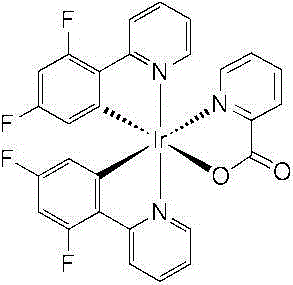
一些参考文件披露了FIrpic的衍生物。在PCT公开号WO05097943A1的说明书中,披露了几种铱络合物,例如该参考文献第32页的络合物I-74至I-78。美国专利号US7534506和EP公开号EP2036907A1也涉及有机电致发光器件的金属络合物,这些金属络合物被不同的供电子和吸电子基团所取代。Several references disclose derivatives of FIrpic. In the specification of PCT Publication No. WO05097943A1 several iridium complexes are disclosed, for example complexes I-74 to I-78 on page 32 of this reference. US Patent No. US7534506 and EP Publication No. EP2036907A1 also relate to metal complexes for organic electroluminescent devices, which are substituted with different electron donating and electron withdrawing groups.
US2006/0014047涉及包括一个有机化合物层的发光器件,该层包括具有以下化学式的一种金属配位化合物US2006/0014047 relates to a light-emitting device comprising an organic compound layer comprising a metal coordination compound having the formula
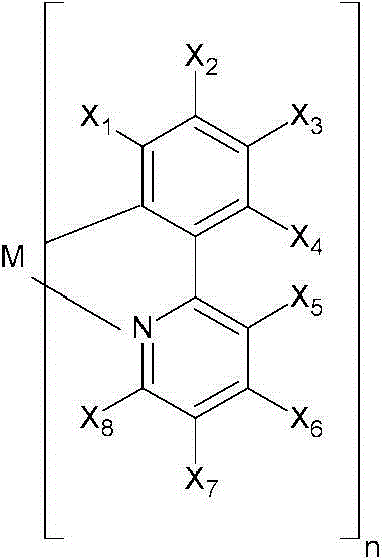
其中M可以是Ir、Rh或Pd。Where M can be Ir, Rh or Pd.
EP2036907涉及有机发光器件并且披露了具有以下化学式的Pt-络合物EP2036907 relates to organic light emitting devices and discloses a Pt-complex having the formula

然而,以上披露的材料都不满足OLED应用所必须的所有要求,特别是可能影响OLED器件的总寿命以及高的磷光效率的热/环境稳定性。因此,对开发能够满足以上指出的所有要求的新的发射材料一直存在需要。However, none of the materials disclosed above fulfills all the requirements necessary for OLED applications, especially thermal/environmental stability which may affect the overall lifetime of the OLED device and high phosphorescent efficiency. Therefore, there is an ongoing need to develop new emissive materials capable of meeting all the requirements indicated above.
发明概述Summary of the invention
已发现在发光器件中使用时可以通过一种新的取代方式使用不同的供体和受体基团来改进金属络合物的稳定性。此外,由以上途径来精细调谐金属络合物的HOMO和LUMO能级也是有可能的。It has been found that the stability of metal complexes can be improved by using different donor and acceptor groups in a novel substitution pattern when used in light emitting devices. In addition, it is also possible to fine-tune the HOMO and LUMO energy levels of metal complexes by the above approach.
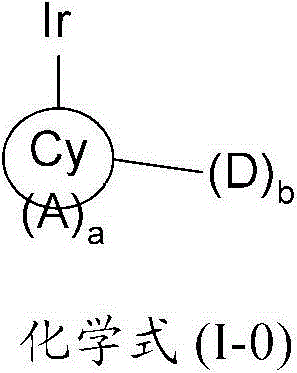
在本发明的一个方面,提供了一种金属络合物,该络合物具有由以下化学式(I-0)所代表的一个部分结构或其互变异构体:In one aspect of the present invention, a kind of metal complex is provided, and this complex has a partial structure represented by the following chemical formula (I-0) or its tautomer:
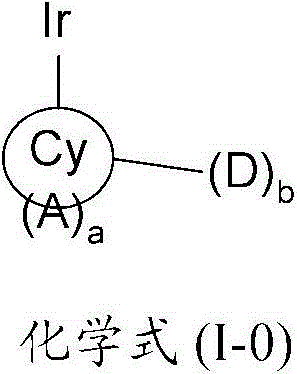
其中Cy是一个5至7元环,优选是一个6元环,该环可以是芳香族的、非芳香族的、或部分芳香族的,并且通过一个碳原子配位到该金属原子上;Wherein Cy is a 5 to 7-membered ring, preferably a 6-membered ring, which can be aromatic, non-aromatic, or partially aromatic, and is coordinated to the metal atom through a carbon atom;
A是一个氮原子;A is a nitrogen atom;
a是一个等于或大于1的整数;a is an integer equal to or greater than 1;
D是一个电子供体基团;并且D is an electron donor group; and
b是一个等于或大于1的整数。b is an integer equal to or greater than 1.
在本发明的另一个方面,如下提供了一种金属络合物,其包括由化学式(I)所代表的一个有机配体或其互变异构体:In another aspect of the present invention, a metal complex is provided as follows, which includes an organic ligand represented by formula (I) or a tautomer thereof:
其中in
A是一个氮原子A is a nitrogen atom
D1和D2是电子供体基团、在每次出现时相同或不同,优选是选自下组中的任何一个,该组由以下各项组成:氨基、C1-C20烷氧基、以及C1-C20烷基的基团,D 1 and D 2 are electron donor groups, the same or different at each occurrence, preferably any one selected from the group consisting of: amino, C 1 -C 20 alkoxy , and C 1 -C 20 alkyl groups,
Ca是一个能够配位到该金属原子上的中性环,Ca is a neutral ring capable of coordinating to the metal atom,
X独立地选自多个取代基,前提是至少一个取代基X是氢X is independently selected from a plurality of substituents, provided that at least one substituent X is hydrogen
n是从1到2的一个整数,y是从1到2的一个整数,其条件是n+y不大于3,n is an integer from 1 to 2, y is an integer from 1 to 2, the condition is that n+y is not greater than 3,
L是选自以下各项中的任何一种:一个单键、-S-、-O-、-Se-、>CR2、>NR、>BR、>C=O、>S=O、>S(=O)2、>PR、>SiR2、>GeR2、>P(=O)R以及>BR2,所述R是氢、卤素、烷基、芳基、烷氧基、羧酸、酯、酰胺、一个芳香族的、杂芳香族的或非芳香族的环,或可以与一个Ca或该环金属化环一起形成一个稠环。优选地,L是一个单键。L is any one selected from the following: a single bond, -S-, -O-, -Se-, >CR 2 , >NR, >BR, >C=O, >S=O, > S(=O) 2 , >PR, >SiR 2 , >GeR 2 , >P(=O)R, and >BR 2 , where R is hydrogen, halogen, alkyl, aryl, alkoxy, carboxylic acid , ester, amide, an aromatic, heteroaromatic or non-aromatic ring, or can form a fused ring together with a Ca or the cyclometallated ring. Preferably, L is a single bond.
本发明的金属化合物可以用于不同的应用中,包括在OLED、光电池、传感、标签或有机半导体装置中。具体地,这些化合物可以作为用于OLED的有效且稳定的磷光发射物。The metal compounds of the invention can be used in different applications, including in OLEDs, photovoltaic cells, sensing, labels or organic semiconductor devices. In particular, these compounds can serve as efficient and stable phosphorescent emitters for OLEDs.
本发明还提供了一种装置,优选是一种发光装置,该装置包括所披露的金属络合物。The present invention also provides a device, preferably a light emitting device, comprising the disclosed metal complex.
附图简要说明Brief description of the drawings
图1示出了本发明的金属络合物在CH2Cl2中在λexc=400nm处受激发时的光致发光光谱。Fig. 1 shows the photoluminescence spectrum of the metal complex of the present invention when excited at λexc=400nm in CH2Cl2 .
图2示出了实例和对比实例中这些金属络合物的HOMO和LUMO能级的示意图。FIG. 2 shows schematic diagrams of HOMO and LUMO energy levels of these metal complexes in Examples and Comparative Examples.
实施方案的说明Description of the implementation
普遍接受的是FIrpic络合物的不稳定性可能归因于以下原因:(1)氟与芳香族碳的键稳定性差,并且(2)两个氟原子之间的质子由于这两个氟原子的强烈受体特征而变为高酸性的。因为这两个原因都直接与氟原子的存在相关,所以高度寻求的是通过更稳定的取代基来替换这些取代基而同时保持高的发光性和可加工性的解决方案。然而,迄今为止,进行的主要研究是针对选择与FIrPic中使用的苯基-吡啶不同的主要配体。这种途径预期会与广泛研究并且优化的FIrPic相比在根本上修饰磷光掺杂剂的电化学和光物理特性。It is generally accepted that the instability of the FIrpic complex may be attributed to the following reasons: (1) the poor bond stability of fluorine to the aromatic carbon, and (2) the proton between the two fluorine atoms due to the strong receptor characteristics and become highly acidic. Since both of these reasons are directly related to the presence of fluorine atoms, a solution to replace these substituents by more stable substituents while maintaining high luminescence and processability is highly sought. However, to date, the main studies performed have been directed towards the selection of primary ligands different from the phenyl-pyridine used in FIrPic. This approach is expected to fundamentally modify the electrochemical and photophysical properties of phosphorescent dopants compared to the extensively studied and optimized FIrPic.
本发明是基于以下技术概念:用一种新的取代方式使用不同的供体和受体基团来替换这两个氟原子以便调谐金属络合物的HOMO和LUMO能级而得到类似于的FIrPic的能级,从而容易保持已经开发和优化的材料及装置构造以保持该这种的高效率、并且改进其稳定性,这主要是由于不存在氟取代基。The present invention is based on the following technical concept: Use different donor and acceptor groups to replace these two fluorine atoms in order to tune the HOMO and LUMO energy levels of metal complexes with a new substitution method to obtain similar FIrPic , thus easily maintaining the materials and device configurations that have been developed and optimized to maintain this high efficiency and improve its stability, mainly due to the absence of fluorine substituents.
通常仅有受体基团附接在邻位金属化的(orthometallated)苯环上以得到蓝色发射。这是因为这些取代基的受体特征强烈稳定了HOMO能级,多于它稳定LUMO能级。然而,由于越来越多的受体基团附接到邻位金属化的苯环上,HOMO和LUMO能级越来越被稳定,这要求开发具有适合于保持高装置效率的HOMO和LUMO等级的新颖的主体和电荷载体材料。尽管有这样的公知常识,诸位发明人发现当邻位金属化的苯环上的供体基团被引入时它可以诱导发射颜色上的蓝色偏移,例如通过使LUMO能级比HOMO能量轨道更加失稳,从而导致一个增大的HOMO-LUMO间隙,这个间隙转变成与氢取代的配体相比的蓝色偏移。具有与FIrpic类似的电化学和光物理特性并且具有更好的稳定性的金属络合物可以通过最终在这两个供体基团之间附接一个强受体基团而得到。Usually only acceptor groups are attached to orthometallated benzene rings to give blue emission. This is because the acceptor character of these substituents strongly stabilizes the HOMO level more than it stabilizes the LUMO level. However, as more and more acceptor groups are attached to the ortho-metallated benzene rings, the HOMO and LUMO levels are increasingly stabilized, requiring the development of HOMO and LUMO levels with properties suitable for maintaining high device efficiencies. novel host and charge carrier materials. Despite this common knowledge, the inventors found that when a donor group on an ortho-metallated benzene ring is introduced it can induce a blue shift in the emission color, e.g. by making the LUMO energy level higher than the HOMO energy orbital more destabilized, resulting in an enlarged HOMO-LUMO gap that translates into a blue shift compared to the hydrogen-substituted ligand. Metal complexes with similar electrochemical and photophysical properties to FIrpic and better stability can be obtained by finally attaching a strong acceptor group between these two donor groups.
本发明提供了一种金属络合物,该络合物具有由以下化学式(I-0)所代表的一个部分结构或其互变异构体:The present invention provides a metal complex having a partial structure represented by the following chemical formula (I-0) or a tautomer thereof:
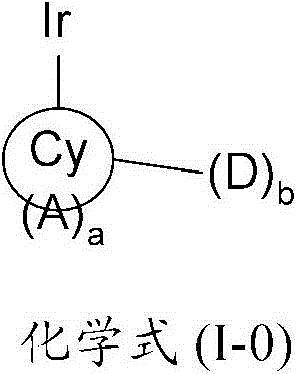
其中in
Cy是一个5至7元环,优选是一个6元环,该环可以是芳香族的、非芳香族的、或部分芳香族的,并且通过一个碳原子配位到该金属原子上;Cy is a 5 to 7-membered ring, preferably a 6-membered ring, which can be aromatic, non-aromatic, or partially aromatic, and is coordinated to the metal atom through a carbon atom;
A是一个氮原子;A is a nitrogen atom;
a是一个等于或大于1的整数;a is an integer equal to or greater than 1;
D是一个电子供体基团;并且D is an electron donor group; and
b是一个等于或大于1的整数。b is an integer equal to or greater than 1.
在一些具体实施方案中,本发明的金属络合物的配体是由以下化学式(I)所代表的或是其互变异构体:In some embodiments, the ligand of the metal complex of the present invention is represented by the following chemical formula (I) or a tautomer thereof:

其中in
A是一个氮原子,A is a nitrogen atom,
D1和D2是电子供体基团、在每次出现时相同或不同,优选是选自下组中的任何一个,该组由以下各项组成:氨基、C1-C20烷氧基、以及C1-C20烷基基团,D 1 and D 2 are electron donor groups, the same or different at each occurrence, preferably any one selected from the group consisting of: amino, C 1 -C 20 alkoxy , and a C 1 -C 20 alkyl group,
Ca是一个能够配位到该金属原子上的中性环,Ca is a neutral ring capable of coordinating to the metal atom,
X独立地选自多个取代基,其中至少一个取代基X是氢,X is independently selected from a plurality of substituents, wherein at least one substituent X is hydrogen,
n是从1至2的一个整数,n is an integer from 1 to 2,
y是1至2之间的一个整数,其条件是n+y不大于3,y is an integer between 1 and 2, the condition is that n+y is not greater than 3,
L是选自以下各项中的任何一种:一个单键、-S-、-O-、-Se-、>CR2、>NR、>BR、>C=O、>S=O、>S(=O)2、>PR、>SiR2、>GeR2、>P(=O)R以及>BR2,所述R是氢、卤素、烷基、烷氧基、羧酸、酯、酰胺、一个芳香族的、杂芳香族的或非芳香族的环,或可以与一个Ca或该环金属化的环一起形成一个稠环。优选地,L是一个单键。L is any one selected from the following: a single bond, -S-, -O-, -Se-, >CR 2 , >NR, >BR, >C=O, >S=O, > S(=O) 2 , >PR, >SiR 2 , >GeR 2 , >P(=O)R, and >BR 2 , where R is hydrogen, halogen, alkyl, alkoxy, carboxylic acid, ester, Amide, an aromatic, heteroaromatic or non-aromatic ring, or can form a fused ring together with a Ca or the ring metallated ring. Preferably, L is a single bond.
在更特别的实施方案中,Ca包括一个取代的或未取代的杂环。此杂环包括但不限于吡啶、咪唑、吡唑、呋喃、吲哚、嘧啶、吡咯等。In more particular embodiments, Ca includes a substituted or unsubstituted heterocycle. Such heterocycles include, but are not limited to, pyridine, imidazole, pyrazole, furan, indole, pyrimidine, pyrrole, and the like.
如在此使用的术语“电子供体”是具有一个负的Hammett参数的一个原子或一组原子。用于本发明中的电子供体包括但不限于氨基、C1-C20烷氧基以及C1-C20烷基基团。The term "electron donor" as used herein is an atom or group of atoms having a negative Hammett parameter. Electron donors useful in the present invention include, but are not limited to, amino, C 1 -C 20 alkoxy, and C 1 -C 20 alkyl groups.
在一个更具体的实施方案中,包括了使用以下配体的化合物:In a more specific embodiment, compounds using the following ligands are included:

在以上这些化学式中,R1至R6可以是相同或不同的,单独地是指来自氢、烷基、烷氧基、芳香族的、杂芳香族的或非芳香族的环中的任何取代基,Y是独立地选自除氢外的取代基并且p是一个从0至4的整数,其条件是R1和R2可以不同时是氢。In these above chemical formulas, R1 to R6 may be the same or different, and individually refer to any substitution in the ring from hydrogen, alkyl, alkoxy, aromatic, heteroaromatic or non-aromatic group, Y is independently selected from substituents other than hydrogen and p is an integer from 0 to 4, with the proviso that R and R may not be hydrogen at the same time.
在其他实施方案,这些金属络合物任选地包括一个辅助配体。该辅助配体可以是本领域已知的任何一种,但优选是单齿或二齿的配体。适当的二齿配体包括但不限于乙酰丙酮化物(acac)、吡啶甲酸盐(pic)、取代的吡啶甲酸盐、六氟乙酰丙酮化物、亚水杨基、8-羟基喹啉盐;氨基酸,水杨醛,以及亚氨基丙酮酸盐、亚乙基二胺衍生物、脒基(amidinate)、联苯基、联吡啶基、苯基吡啶基、2-(1-萘基)苯并噁唑、2-苯基苯并噁唑、2-苯基苯并噻唑、香豆素、噻吩基吡啶、苯并噻吩基吡啶、噻吩基吡啶、甲苯基吡啶、苯基亚胺、乙烯吡啶、芳基喹啉、吡啶基萘、吡啶基吡咯、吡啶基咪唑、苯基吲哚、以及它们的衍生物、和它们的混合物。In other embodiments, the metal complexes optionally include an ancillary ligand. The auxiliary ligand can be any one known in the art, but is preferably a monodentate or bidentate ligand. Suitable bidentate ligands include, but are not limited to, acetylacetonate (acac), picolinate (pic), substituted picolinate, hexafluoroacetylacetonate, salicylidene, 8-hydroxyquinolinate; Amino acids, salicylaldehyde, and iminopyruvate, ethylenediamine derivatives, amidinate, biphenyl, bipyridyl, phenylpyridyl, 2-(1-naphthyl)benzo Oxazole, 2-phenylbenzoxazole, 2-phenylbenzothiazole, coumarin, thienylpyridine, benzothienylpyridine, thienylpyridine, tolylpyridine, phenylimine, vinylpyridine, Arylquinolines, pyridylnaphthalene, pyridylpyrrole, pyridylimidazole, phenylindole, and their derivatives, and mixtures thereof.
在另一个实施方案中,该辅助配体可以分别是一个单齿配体,即,能够与一个金属原子通过一个原子进行配位的任何配体。大量单齿配体是本领域所熟知的,并且适当的例子包括卤素如氯原子(Cl)、卤素离子,氰化物、氰酸酯、异氰酸酯、硫氰酸酯、腈、异氰酸酯、吡啶、咪唑、吡唑、亚硫酸盐离子或硫代硫酸盐。In another embodiment, the auxiliary ligand may each be a monodentate ligand, ie any ligand capable of coordinating a metal atom through one atom. A large number of monodentate ligands are well known in the art, and suitable examples include halogens such as chlorine atoms (Cl), halide ions, cyanides, cyanates, isocyanates, thiocyanates, nitriles, isocyanates, pyridines, imidazoles, Pyrazole, sulfite ion, or thiosulfate.
在本发明的另一个方面,该金属络合物可以是由以下化学式中任何一个所表示的:In another aspect of the present invention, the metal complex may be represented by any one of the following chemical formulae:
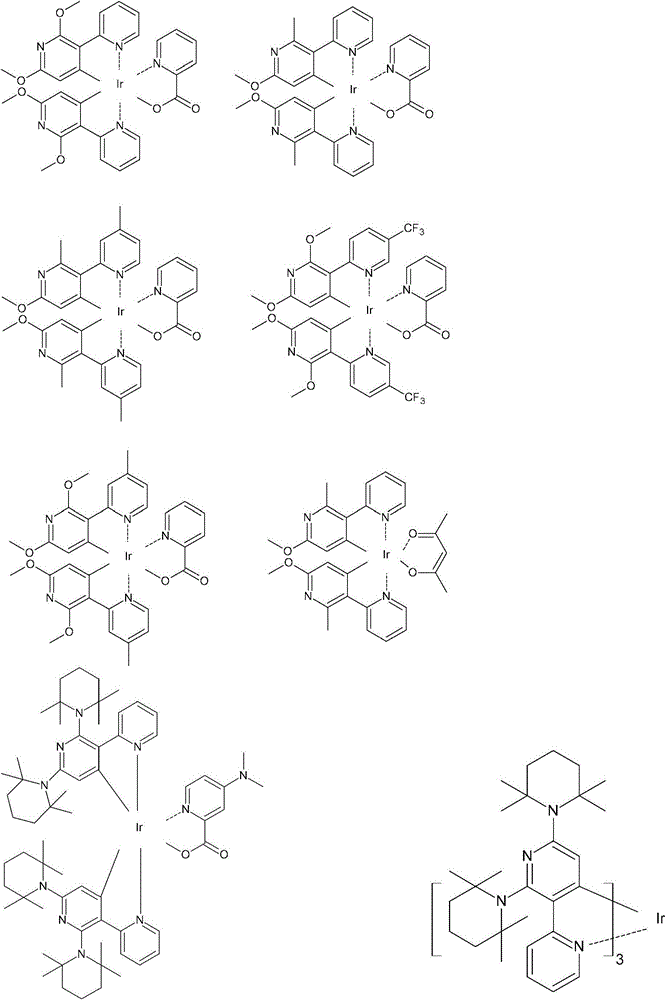
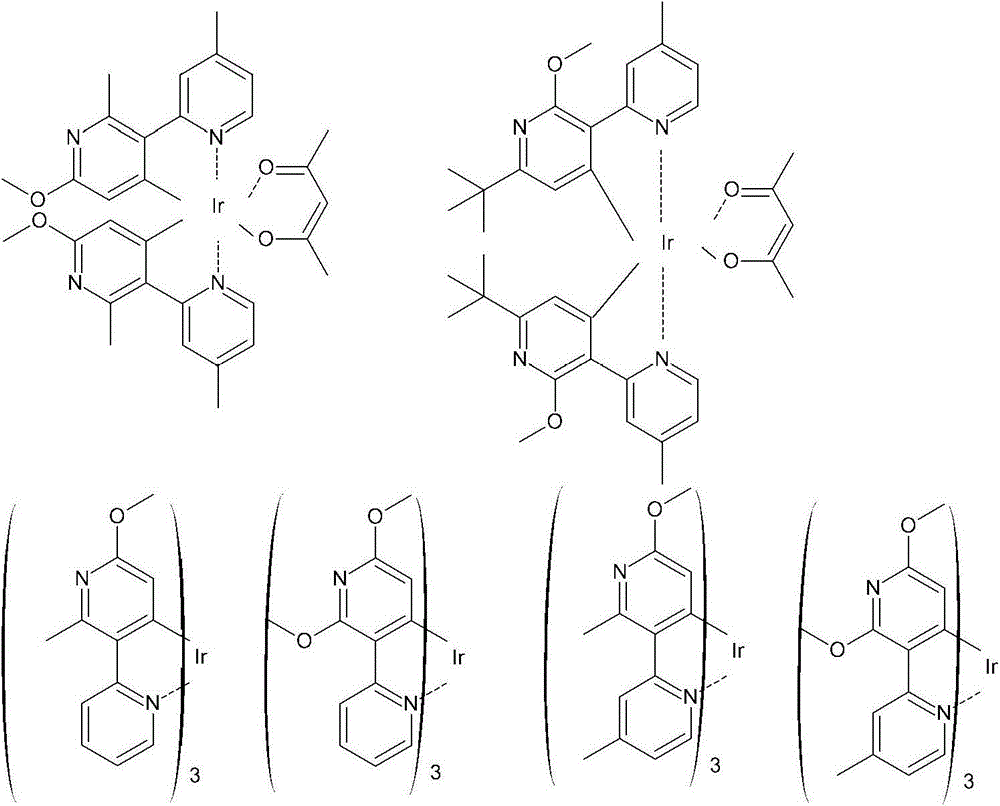
上述铱络合物在光谱的可见区域中可以呈现出一种磷光发射。在具体实施方案中,该发射络合物在光谱的蓝色区域中呈现出一种磷光发射。The abovementioned iridium complexes can exhibit a phosphorescent emission in the visible region of the spectrum. In particular embodiments, the emissive complex exhibits a phosphorescent emission in the blue region of the spectrum.
本发明的另一个方面涉及一种OLED,它包括该具有化学式(I)的配体的金属络合物。本发明的其他方面涉及该具有化学式(I)的配体的金属络合物在OLED中的用途。Another aspect of the invention relates to an OLED comprising the metal complex of the ligand of formula (I). A further aspect of the invention relates to the use of the metal complex of the ligand of formula (I) in OLEDs.
该OLED器件总体上包括:The OLED device generally includes:
一个玻璃基板;a glass substrate;
一个总体上透明的阳极,例如铟锡氧化物(ITO)阳极;a generally transparent anode, such as an indium tin oxide (ITO) anode;
一个空穴传输层(HTL);a hole transport layer (HTL);
一个发射层(EML);an emission layer (EML);
一般有一个空穴和激发阻挡层;Generally there is a hole and excitation blocking layer;
一个电子传输层(ETL);以及an electron transport layer (ETL); and
一个总体上金属的阴极,如一个Al层。该发射层通常包括发射材料(它包括本发明的金属络合物)并且还包括一种主体材料(在这里该发射材料作为掺杂剂存在)。主体材料是本领域中已知的,如描述于US2010/0190984中,其披露内容通过引用以其整体结合在此。A generally metallic cathode, such as an Al layer. The emissive layer generally comprises an emissive material (which includes the metal complex of the invention) and also a host material (where the emissive material is present as a dopant). Host materials are known in the art as described in US2010/0190984, the disclosure of which is incorporated herein by reference in its entirety.
如果本发明的金属络合物被用作现有技术中已知的一个主体层中的掺杂剂,那么相对于该主体层和该掺杂剂的总重量,它总体上的使用量为至少1wt%、确切地至少3wt%、并且更确切地至少5wt%。此外,它总体上的使用量为最多30wt%、确切地至多25wt%。If the metal complex according to the invention is used as a dopant in a host layer known in the prior art, it is generally used in an amount of at least 1 wt%, specifically at least 3 wt%, and more specifically at least 5 wt%. Furthermore, it is generally used in an amount of at most 30 wt%, exactly at most 25 wt%.
在一个磷光发射器件中,来自该空穴传输层中的空穴在该发射层中与来自该电子传输层中的电子重新组合而形成基于三线态的激发子。随着这些基于三线态的激发子在发光之前在该发射层中的较长距离上扩散,这些激发子中的一些可能扩散至阴极并且被阴极淬灭,从而造成非辐射性激发延迟。为了降低这种阴极的淬灭,将一个空穴阻挡层置于阴极与发射层之间。该阻挡层可以由例如N,N′-二苯基-N,N′-双-α-萘基联苯胺(NPD)、CBP、铝三(8-羟基喹啉)(Alq3)和浴铜灵(BCP)制造。这样的其他层的细节描述于许多参考文献中,如US2010/0190984。In a phosphorescent emissive device, holes from the hole transport layer recombine with electrons from the electron transport layer in the emissive layer to form triplet-based excitons. As the triplet-based excitons diffuse over longer distances in the emissive layer before emitting light, some of these excitons may diffuse to and be quenched by the cathode, causing a delay in non-radiative excitation. In order to reduce this cathode quenching, a hole blocking layer is placed between the cathode and the emissive layer. The barrier layer can be made of, for example, N,N'-diphenyl-N,N'-bis-α-naphthylbenzidine (NPD), CBP, aluminum tris(8-hydroxyquinoline) (Alq 3 ) and bath copper Manufactured by Ling (BCP). Details of such other layers are described in many references, eg US2010/0190984.
本发明还涉及根据本发明的金属络合物在光电池、传感器件、标签、或有机半导体装置中的用途。The invention also relates to the use of the metal complexes according to the invention in photovoltaic cells, sensor devices, labels, or organic semiconductor devices.
实例example
以下将参考各实例以及对比实例对本发明进行详细说明。然而这些实例不应在任何意义上解释为限制本发明的范围。此外,除非另外说明,单位是以按重量计表达的。Hereinafter, the present invention will be described in detail with reference to Examples and Comparative Examples. However, these examples should not be construed as limiting the scope of the invention in any sense. In addition, units are expressed by weight unless otherwise specified.
合成方法resolve resolution
合成实例:Synthetic example:
实例1:EB288的程序Example 1: Program of EB288
配体2’,6’-二甲氧基-2,3’-联吡啶[作为0.2H2O溶剂化物]Ligand 2',6'-dimethoxy-2,3'-bipyridine [as 0.2H2O solvate]
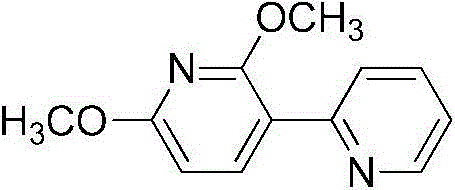
将2-溴吡啶(0.475mL,0.78g,4.9mmol)和2,6-二甲氧基-3-吡啶硼酸(1.09g,6.0mmol,过量)在室温下溶解在THF(25mL)中。加入K2CO3水溶液(1.65g在10mL水中,12mmol,过量)接着是Pd(PPh3)4(295mg,0.25mmol)。将该混合物在氩气下于90℃搅拌20h以给出黄色溶液。在减压下去除有机溶剂并用二氯甲烷和水萃取残余物。有机相的蒸发提供了红色的油,将该油通过色谱法在硅胶上用0至0.2%的CH2Cl2/MeOH洗脱来进行纯化。将含有纯产物的分量收集,而将含杂质的那些通过使用相同条件的色谱法再次纯化。在三次色谱法纯化之后,总产率为965mg(4.39mmol;90%)的黄色油,该油在静置时结晶为黄色固体。C12H12N2O2·0.2H2O(MW219.84)的计算分析:C,65.56;H,5.69;N,12.74。发现是:C,65.74;H,5.63;N,12.53。1H NMR(400MHz,CD2Cl2):8.64(d,J4.0,1H),8.32(d,J8.0,1H),8.03(d,J8.0,1H),7.74(t,J8.0,1H),7.19(m,1H),6.47(d,J8.0,1H),4.06(s,3H),4.00(s,3H)。13C NMR(100MHz,CD2Cl2):163.24,160.16,154.36,149.44,142.44,136.01,123.97,121.38,114.30,102.02,53.75,53.52。2-Bromopyridine (0.475 mL, 0.78 g, 4.9 mmol) and 2,6-dimethoxy-3-pyridineboronic acid (1.09 g, 6.0 mmol, excess) were dissolved in THF (25 mL) at room temperature. Aqueous K2CO3 (1.65 g in 10 mL of water, 12 mmol, excess) was added followed by Pd( PPh3 ) 4 (295 mg, 0.25 mmol). The mixture was stirred at 90 °C under argon for 20 h to give a yellow solution. The organic solvent was removed under reduced pressure and the residue was extracted with dichloromethane and water. Evaporation of the organic phase provided a red oil which was purified by chromatography on silica gel eluting with 0 to 0.2% CH2Cl2 / MeOH . Fractions containing pure product were collected, while those containing impurities were repurified by chromatography using the same conditions. After three chromatographic purifications, the overall yield was 965 mg (4.39 mmol; 90%) of a yellow oil which crystallized on standing as a yellow solid. Anal . Calc. for C12H12N2O2 · 0.2H2O (MW 219.84): C , 65.56 ; H, 5.69; N, 12.74. Found: C, 65.74; H, 5.63; N, 12.53. 1 H NMR (400MHz, CD 2 Cl 2 ): 8.64(d, J4.0, 1H), 8.32(d, J8.0, 1H), 8.03(d, J8.0, 1H), 7.74(t, J8 .0, 1H), 7.19 (m, 1H), 6.47 (d, J8.0, 1H), 4.06 (s, 3H), 4.00 (s, 3H). 13 C NMR (100 MHz, CD 2 Cl 2 ): 163.24, 160.16, 154.36, 149.44, 142.44, 136.01, 123.97, 121.38, 114.30, 102.02, 53.75, 53.52.
前体络合物[Ir(C^N)2Cl]2 Precursor complex [Ir(C^N) 2 Cl] 2

在氩气下与溶剂进行反应,这些溶剂是脱氧合的(通过鼓入Ar)但未干燥。将IrCl3·3H2O(281mg,0.80mmol)完全溶解在2-乙氧乙醇(25mL)中以给出紫色溶液。加入水(7.5mL);将溶液升温至60℃后加入配体2’,6’-二甲氧基-2,3’-联吡啶(用作0.2H2O溶剂化物;431mg,1.96mmol,过量)。该溶液的颜色立即变为棕色。将其在80℃搅拌过夜以给出一个暗红色溶液以及灰色沉淀物。将反应混合物冷却至室温并过滤。将该固体用水和醚彻底洗涤。灰色固体:33mg(0.025mmol;6%;C48H44Cl2Ir2N8O8;MW1316.25);可溶于CH2Cl2中;不溶于甲醇。1H NMR(400MHz,CD2Cl2):9.07(dd,J5.6,J0.8,4H),8.57(d,J7.6,4H),7.83-7.73(m,4H),6.76-6.67(m,4H),4.79(s,4H),4.03(s,12H),3.66(s,12H)。Reactions were performed under argon with solvents that were deoxygenated (by bubbling Ar) but not dried. IrCl 3 ·3H 2 O (281 mg, 0.80 mmol) was completely dissolved in 2-ethoxyethanol (25 mL) to give a purple solution. Water (7.5 mL) was added; the solution was warmed to 60°C and the ligand 2',6'-dimethoxy-2,3'-bipyridine (used as 0.2H 2 O solvate; 431 mg, 1.96 mmol, excess). The color of the solution turned brown immediately. This was stirred overnight at 80°C to give a dark red solution and gray precipitate. The reaction mixture was cooled to room temperature and filtered. The solid was washed thoroughly with water and ether. Gray solid : 33 mg (0.025 mmol; 6% ; C48H44Cl2Ir2N8O8 ; MW1316.25 ) ; soluble in CH2Cl2 ; insoluble in methanol . 1 H NMR (400MHz, CD 2 Cl 2 ): 9.07 (dd, J5.6, J0.8, 4H), 8.57 (d, J7.6, 4H), 7.83-7.73 (m, 4H), 6.76-6.67 (m, 4H), 4.79 (s, 4H), 4.03 (s, 12H), 3.66 (s, 12H).
EB288EB288
向该前体二聚体络合物(22mg,0.0167mmol)在二氯甲烷(DCM,30mL)中的一个溶液中加入吡啶甲酸(14mg,0.11mmol)和四丁基氢氧化铵(TBAOH,48mg,0.06mmol)。将该混合物在氩气中于35℃下加热过夜。将所得溶液的体积在减压下减小至约1/3并使之穿过用二氯甲烷/甲醇进行洗脱的硅胶塞。收集黄色带,蒸干、并溶解在最少量的二氯甲烷中、并用己烷进行沉淀。将该固体过滤、用己烷洗涤并且干燥。得到EB238为淡黄色固体(21mg,84%)。To a solution of the precursor dimer complex (22 mg, 0.0167 mmol) in dichloromethane (DCM, 30 mL) was added picolinic acid (14 mg, 0.11 mmol) and tetrabutylammonium hydroxide (TBAOH, 48 mg, 0.06 mmol). The mixture was heated at 35 °C overnight under argon. The volume of the resulting solution was reduced to about 1/3 under reduced pressure and passed through a plug of silica gel eluting with dichloromethane/methanol. The yellow band was collected, evaporated to dryness, dissolved in a minimum of dichloromethane and precipitated with hexane. The solid was filtered, washed with hexanes and dried. EB238 was obtained as a light yellow solid (21 mg, 84%).
1H NMR(CDCl3,400MHz):d8.68(dd,1H);8.54(dd,1H);8.45(dd,1H);8.32(dd,1H);7.92(dt,1H);7.88(dd,1H);7.67(ddd,2H);7.38(dd,1H);7.36(dd,1H);7.02(dt,1H);6.80(dt,1H);5.44(s,1H);5.20(s,1H);4.09(s,3H);4.03(s,3H);3.82(s,3H);3.75(s,3H)。 1 H NMR (CDCl 3 , 400MHz): d8.68(dd, 1H); 8.54(dd, 1H); 8.45(dd, 1H); 8.32(dd, 1H); 7.92(dt, 1H); 7.88(dd , 1H); 7.67(ddd, 2H); 7.38(dd, 1H); 7.36(dd, 1H); 7.02(dt, 1H); 6.80(dt, 1H); 5.44(s, 1H); 1H); 4.09(s, 3H); 4.03(s, 3H); 3.82(s, 3H); 3.75(s, 3H).
实例2:EB318的程序Example 2: Program of EB318
2,6-双(2,2,6,6-四甲基哌啶-1-基)吡啶2,6-bis(2,2,6,6-tetramethylpiperidin-1-yl)pyridine

向2,2,6,6-四甲基哌啶(3.11g,22.0mmol)和钾-双(三甲基硅烷基)酰胺(4.39g,22.0mmol)的一个1,4-二噁烷溶液(30ml)中加入2,6-二溴吡啶(2.37g,10.0mmol)。将该混合物在100℃剧烈搅拌下过夜。冷却到室温之后,将反应用水淬灭并且用二乙醚/THF(1∶1)混合物萃取。将合并后的萃取液用1M Na2CO3洗涤、用MgSO4干燥、过滤并蒸干。通过快速色谱法在硅胶上纯化该产物而得到无色的油(在乙酸乙基酯∶己烷=1∶20中Rf=0.5,产率=1.13g(31.6%))。To a 1,4-dioxane solution of 2,2,6,6-tetramethylpiperidine (3.11g, 22.0mmol) and potassium-bis(trimethylsilyl)amide (4.39g, 22.0mmol) (30ml) was added 2,6-dibromopyridine (2.37g, 10.0mmol). The mixture was stirred vigorously at 100°C overnight. After cooling to room temperature, the reaction was quenched with water and extracted with diethyl ether/THF (1:1) mixture. The combined extracts were washed with 1M Na2CO3 , dried over MgSO4 , filtered and evaporated to dryness. The product was purified by flash chromatography on silica gel to give a colorless oil ( Rf = 0.5, Yield = 1.13 g (31.6%) in ethyl acetate: hexane = 1:20).
1H NMR(400MHz,CDCl3):7.39(t,J=7.6Hz,1H),6.79(d,J=8.0Hz,2H),1.74(m,4H),1.52(t,J=6Hz,8H),1.13(s,24H)。13C NMR(100MHz,CDCl3):159.24,135.95,126.20,54.29,41.94,29.72,18.50。 1 H NMR (400MHz, CDCl 3 ): 7.39(t, J=7.6Hz, 1H), 6.79(d, J=8.0Hz, 2H), 1.74(m, 4H), 1.52(t, J=6Hz, 8H ), 1.13(s, 24H). 13 C NMR (100 MHz, CDCl 3 ): 159.24, 135.95, 126.20, 54.29, 41.94, 29.72, 18.50.
3-溴-2,6-双(2,2,6,6-四甲基哌啶-1-基)吡啶3-Bromo-2,6-bis(2,2,6,6-tetramethylpiperidin-1-yl)pyridine
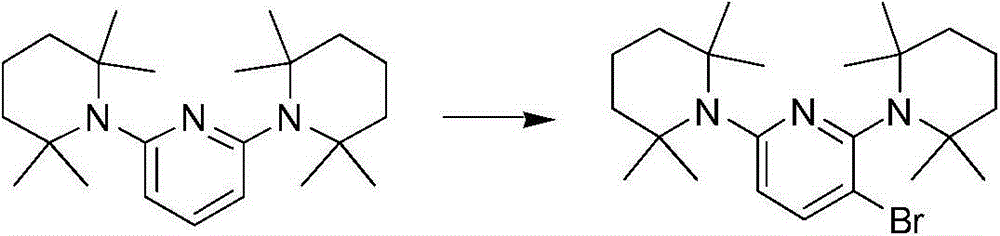
反应在空气中进行。向2,6-双(2,2,6,6-四甲基哌啶-1-基)吡啶(1g,2.8mmol)在乙腈(100ml)中的一个冰冷却的溶液中在30分钟内分部分地加入NBS(0.45g,2.5mmol)。将反应混合物在-0℃搅拌2小时,直到溶液的颜色消失,然后在室温下搅拌过夜。用水(100mL)使该反应淬灭,并且用乙酸乙酯来萃取产物。通过柱色谱法在硅胶上纯化该产物并且得到白色固体(在乙酸乙基酯∶己烷=1∶20中Rf=0.6,产率=0.53g(43.4%))。The reaction was carried out in air. To an ice-cooled solution of 2,6-bis(2,2,6,6-tetramethylpiperidin-1-yl)pyridine (1 g, 2.8 mmol) in acetonitrile (100 ml) was partitioned over 30 min. NBS (0.45 g, 2.5 mmol) was added in portions. The reaction mixture was stirred at -0°C for 2 hours until the color of the solution disappeared, then at room temperature overnight. The reaction was quenched with water (100 mL), and the product was extracted with ethyl acetate. The product was purified by column chromatography on silica gel and gave a white solid ( Rf = 0.6 in ethyl acetate:hexane = 1:20, yield = 0.53 g (43.4%)).
1H NMR(400MHz,CDCl3):7.76(d,J=8.0Hz,1H),6.72(d,J=8.0Hz,1H),1.98-1.50(m,12H),1.45(s,6H),1.16(s,12H),0.93(s,6H).13C NMR(100MHz,CDCl3):158.76,156.91,141.20,127.86,124.53,55.67,54.44,41.73,40.97,31.20,25.48,18.72,18.39。 1 H NMR (400MHz, CDCl 3 ): 7.76(d, J=8.0Hz, 1H), 6.72(d, J=8.0Hz, 1H), 1.98-1.50(m, 12H), 1.45(s, 6H), 1.16(s, 12H), 0.93(s, 6H). 13 C NMR (100MHz, CDCl 3 ): 158.76, 156.91, 141.20, 127.86, 124.53, 55.67, 54.44, 41.73, 40.97, 31.20, 25.48, 18.72, 18.39.
2′,6′-双(2,2,6,6-四甲基哌啶-1-基)-2,3′-联吡啶2',6'-bis(2,2,6,6-tetramethylpiperidin-1-yl)-2,3'-bipyridine

将3-溴-2,6-双(2,2,6,6-四甲基哌啶-1-基)吡啶(0.4g,0.92mmol)、2-(三丁基甲锡烷)吡啶(0.4g,1.10mmol)、Pd(PPh3)4(0.053g,0.046mmol)、以及氟化铯(0.28g,1.83mmol)在甲苯(30ml)中的一个混合物在回流下搅拌2天。冷却到室温之后,将反应用饱和的CsF水溶液(100mL)淬灭。用乙酸乙酯萃取产物。通过柱色谱法在硅胶上纯化该产物并且得到白色固体(在乙酸乙基酯∶己烷=1∶4中Rf=0.5,产率=50mg(12.5%))。3-bromo-2,6-bis(2,2,6,6-tetramethylpiperidin-1-yl)pyridine (0.4g, 0.92mmol), 2-(tributylstannane)pyridine (0.4g , 1.10 mmol), Pd(PPh 3 ) 4 (0.053 g, 0.046 mmol), and cesium fluoride (0.28 g, 1.83 mmol) in toluene (30 ml) were stirred at reflux for 2 days. After cooling to room temperature, the reaction was quenched with saturated aqueous CsF (100 mL). The product was extracted with ethyl acetate. The product was purified by column chromatography on silica gel and a white solid was obtained ( Rf = 0.5 in ethyl acetate:hexane = 1:4, yield = 50 mg (12.5%)).
1H NMR(400MHz,CDCl3):8.68-8.64(m,2H),8.24(d,J=8.0Hz,1H),7.67(td,J=8.0,2.0Hz,1H),7.16(dd,J=6.8,4.8Hz,1H),6.97(d,J=8.0Hz,1H),2.00-1.52(m,12H),1.47(s,6H),1.18(s,12H),0.77(s,6H).13C NMR(100MHz,CDCl3):159.52,158.15,156.81,149.28,139.37,135.07,133.35,127.18,124.84,121.55,56.03,54.36,41.87,40.43,31.61,26.35,18.69,18.44。 1 H NMR (400MHz, CDCl 3 ): 8.68-8.64 (m, 2H), 8.24 (d, J = 8.0Hz, 1H), 7.67 (td, J = 8.0, 2.0Hz, 1H), 7.16 (dd, J =6.8, 4.8Hz, 1H), 6.97(d, J=8.0Hz, 1H), 2.00-1.52(m, 12H), 1.47(s, 6H), 1.18(s, 12H), 0.77(s, 6H) . 13 C NMR (100MHz, CDCl 3 ): 159.52, 158.15, 156.81, 149.28, 139.37, 135.07, 133.35, 127.18, 124.84, 121.55, 56.03, 54.36, 41.87, 40.43, 31.61, 284.6, 4, 4.
实例3:EP317的程序Example 3: Program of EP317

作为其他二聚体,反应温度为95℃,得到的是一种黄色固体。As other dimers, the reaction temperature was 95°C, and a yellow solid was obtained.
实例4:EB318的程序Example 4: Program of EB318
以类似于EB288的方式使用4-二甲氨基吡啶甲酸代替吡啶甲酸得到EB318。EB318 was obtained using 4-dimethylaminopicolinic acid instead of picolinic acid in a similar manner to EB288.
实例5:EB321的程序Example 5: Program of EB321

将[Ir(COD)Cl]2二聚体(2.098g,3.12mmol)悬浮于一个50mL烧瓶中的10mL的2-乙氧乙醇中。对该悬浮液充入氩气,进行三个周期的真空/氩气。加入C^N配体(2.52g,12.58mmol)并使用10mL2-乙氧乙醇进行漂洗。该悬浮液几乎立即变为黄色溶液并且对它充入氩气,进行3个周期的真空/氩气。将该烧瓶封闭并在125℃下加热4小时。经加热,该溶液变暗至深橙红色。在半小时内出现一种黄色沉淀物。4小时后,将悬浮液冷却到室温并加入30mL甲醇,并过滤出沉淀物、用甲醇洗涤并且干燥。得到EB321为淡黄色固体(2.48g,1.98mmol,产率=64%)。[Ir(COD)Cl] 2 dimer (2.098 g, 3.12 mmol) was suspended in 10 mL of 2-ethoxyethanol in a 50 mL flask. The suspension was purged with argon for three cycles of vacuum/argon. C^N ligand (2.52 g, 12.58 mmol) was added and rinsed with 10 mL of 2-ethoxyethanol. The suspension turned to a yellow solution almost immediately and it was flushed with argon for 3 cycles of vacuum/argon. The flask was closed and heated at 125°C for 4 hours. Upon heating, the solution darkened to a deep orange-red. A yellow precipitate appeared within half an hour. After 4 hours, the suspension was cooled to room temperature and 30 mL of methanol was added, and the precipitate was filtered off, washed with methanol and dried. EB321 was obtained as a pale yellow solid (2.48 g, 1.98 mmol, yield = 64%).
当在纯CDCl3中进行1H-NMR时,除至少两个图案(<10%强度)之外还观察到两个主信号图案(100%和40%)。When 1H-NMR was performed in pure CDCl3 , two main signal patterns (100% and 40%) were observed in addition to at least two patterns (<10% intensity).
1H NMR(CDCl3,400MHz),主图案100%:δ9.91(dd,1H,J=5.6,0.8Hz);8.04(d,1H,J=8.4Hz);7.90(dt,1H,J=8.4,1.6Hz);7.39(dt,1H,J=6.0,1.2Hz);5.33(s,1H);3.74(s,3H);2.77(s,3H)。 1 H NMR (CDCl 3 , 400MHz), main pattern 100%: δ9.91(dd, 1H, J=5.6, 0.8Hz); 8.04(d, 1H, J=8.4Hz); 7.90(dt, 1H, J = 8.4, 1.6 Hz); 7.39 (dt, 1H, J = 6.0, 1.2 Hz); 5.33 (s, 1H); 3.74 (s, 3H); 2.77 (s, 3H).
1H NMR(CDCl3,400MHz),次图案40%:δ9.21(dd,1H,J=5.6,0.8Hz);8.04(d,1H,J=8.4Hz);7.80(dt,1H,J=8.4,1.6Hz);6.78(dt,1H,J=6.0,1.2Hz);5.04(s,1H);3.66(s,3H);2.79(s,3H)。 1 H NMR (CDCl 3 , 400MHz), subpattern 40%: δ9.21 (dd, 1H, J = 5.6, 0.8Hz); 8.04 (d, 1H, J = 8.4Hz); 7.80 (dt, 1H, J = 8.4, 1.6 Hz); 6.78 (dt, 1H, J = 6.0, 1.2 Hz); 5.04 (s, 1H); 3.66 (s, 3H); 2.79 (s, 3H).
当加入少数几滴DMSO-d6(氘化的二甲亚砜)时,光谱变得非常清楚,因为只观察到一个图案,并且显示了一种一氯/一dmso双环金属化的络合物的预期的不对称图案:When a few drops of DMSO-d6 (deuterated dimethyl sulfoxide) were added, the spectrum became very clear as only one pattern was observed and showed a monochloro/mono-DMSO bicyclometalated complex Expected asymmetric pattern:
1H NMR(CDCl3,400MHz):δ9.89(d,1H,J=5.2Hz);9.84(d,1H,J=5.2Hz);8.04(d,1H,J=8.4Hz);8.01(d,1H,J=8.4Hz);7.92(t,1H,J=8.0Hz);7.82(t,1H,J=8.0Hz);7.29(t,1H,J=6.0Hz);7.23(t,1H,J=6.0Hz);5.66(s,1H);4.94(s,1H);3.74(s,3H);3.68(s,3H);2.76(s,3H);2.73(s,3H)。 1 H NMR (CDCl 3 , 400MHz): δ9.89 (d, 1H, J = 5.2Hz); 9.84 (d, 1H, J = 5.2Hz); 8.04 (d, 1H, J = 8.4Hz); 8.01 ( d, 1H, J=8.4Hz); 7.92(t, 1H, J=8.0Hz); 7.82(t, 1H, J=8.0Hz); 7.29(t, 1H, J=6.0Hz); 7.23(t, 1H, J = 6.0 Hz); 5.66 (s, 1H); 4.94 (s, 1H); 3.74 (s, 3H); 3.68 (s, 3H); 2.76 (s, 3H); 2.73 (s, 3H).
实例6:EB343的程序Example 6: Program of EB343
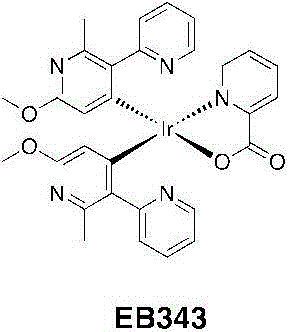
EB343:将DCM(5mL)中的吡啶甲酸(0.413g,3.35mmol)加入甲醇(5mL)中的TBAOH(2.8g,3.50mmol)之中。一旦每种都溶解并得到一个澄清溶液,则将其分部分地加入EB321(1.50g,1.20mmol)在二氯甲烷(150mL)中的一个悬浮液中。将该混合物回流(45℃)过夜。将挥发物蒸发并且将粗制的残留物溶解在甲醇中并且加入水。在冰箱中2小时后,将沉淀物过滤出并用水和冷甲醇洗涤并干燥。得到了EB343为亮黄色固体(1.105g,1.55mmol,产率=%)。EB343: Picolinic acid (0.413 g, 3.35 mmol) in DCM (5 mL) was added to TBAOH (2.8 g, 3.50 mmol) in methanol (5 mL). Once each was dissolved and a clear solution was obtained, it was added in portions to a suspension of EB321 (1.50 g, 1.20 mmol) in dichloromethane (150 mL). The mixture was refluxed (45°C) overnight. The volatiles were evaporated and the crude residue was dissolved in methanol and water was added. After 2 hours in the refrigerator, the precipitate was filtered off and washed with water and cold methanol and dried. EB343 was obtained as a bright yellow solid (1.105 g, 1.55 mmol, yield = %).
1H NMR(CDCl3,400MHz):δ8.82(dd,1H,J=6.0,1.2Hz);8.34(dd,1H,J=8.0,0.8Hz);8.06(d,1H,J=8.4Hz);8.02(d,1H,J=8.4Hz);7.94(dt,1H,J=8.0,1.2Hz);7.77(m,3H);7.50(dd,1H,J=6.0,1.2Hz);7.39(ddd,1H,J=7.6,5.6,1.6Hz);7.13(ddd,1H,J=8.8,6.0,1.6Hz);6.90(ddd,1H,J=8.8,6.0,1.6Hz);5.64(s,1H);5.35(s,1H);3.83(s,3H);3.76(s,3H);2.84(s,3H);2.79(s,3H)。 1 H NMR (CDCl 3 , 400MHz): δ8.82(dd, 1H, J=6.0, 1.2Hz); 8.34(dd, 1H, J=8.0, 0.8Hz); 8.06(d, 1H, J=8.4Hz ); 8.02 (d, 1H, J = 8.4Hz); 7.94 (dt, 1H, J = 8.0, 1.2Hz); 7.77 (m, 3H); 7.50 (dd, 1H, J = 6.0, 1.2Hz); 7.39 (ddd, 1H, J=7.6, 5.6, 1.6Hz); 7.13(ddd, 1H, J=8.8, 6.0, 1.6Hz); 6.90(ddd, 1H, J=8.8, 6.0, 1.6Hz); 5.64(s , 1H); 5.35(s, 1H); 3.83(s, 3H); 3.76(s, 3H); 2.84(s, 3H); 2.79(s, 3H).
13C NMR(CDCl3,100MHz):δ172.81,167.62,166.05,163.58,162.95,161.96,161.57,153.41,153.13,151.85,149.48,148.72,148.17,138.32,137.58,137.54,135.17,134.95,128.64,128.44,122.65,122.12,121.64,121.39,111.04,110.93,53.16,53.09,26.61,26.46。 13 C NMR(CDCl 3 ,100MHz):δ172.81,167.62,166.05,163.58,162.95,161.96,161.57,153.41,153.13,151.85,149.48,148.72,148.17,138.32,137.58,137.54,135.17,134.95,128.64, 128.44, 122.65, 122.12, 121.64, 121.39, 111.04, 110.93, 53.16, 53.09, 26.61, 26.46.
HR-MS(ES):m/z=714.1712[M+H]+(calc.714.1694)。HR-MS (ES): m/z = 714.1712 [M+H] + (calc. 714.1694).
实例7:EB370的程序Example 7: Program of EB370
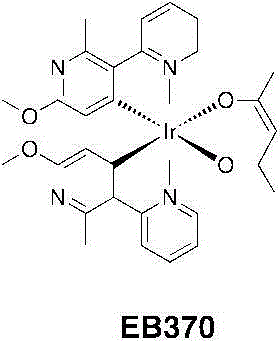
EB370:将DCM(5mL)中的乙酰丙酮(0.267g,2.67mmol)加入甲醇(5mL)中的TBAOH(1.9g,2.37mmol)之中。一旦每种都溶解并得到一个澄清的淡黄色溶液,则将其分部分地加入EB321(0.833g,0.66mmol)在二氯甲烷(80mL)中的一个悬浮液中。将该混合物回流(45℃)过夜。将挥发物蒸发并且将粗制的残留物悬浮物在甲醇中。在冰箱中2小时后,将沉淀物过滤出并用冷甲醇洗涤并干燥。该产物进一步通过硅胶柱色谱法使用DCM/乙酸乙酯/MeOH(100/15/2;v/v/v)作为洗脱液进行纯化。将含有产物的分量蒸干、溶解在最少量的DCM中并加入己烷(约为DCM体积的三倍)将DCM缓慢在真空下蒸发并将剩余悬浮物在冰箱中保存过夜。然后将其过滤、用己烷洗涤并干燥而给出EB343为亮黄色固体(0.812g,1.18mmol,产率=88%)。EB370: Acetylacetone (0.267 g, 2.67 mmol) in DCM (5 mL) was added to TBAOH (1.9 g, 2.37 mmol) in methanol (5 mL). Once each dissolved and a clear pale yellow solution was obtained, it was added in portions to a suspension of EB321 (0.833 g, 0.66 mmol) in dichloromethane (80 mL). The mixture was refluxed (45°C) overnight. The volatiles were evaporated and the crude residue was suspended in methanol. After 2 hours in the refrigerator, the precipitate was filtered off and washed with cold methanol and dried. The product was further purified by column chromatography on silica gel using DCM/ethyl acetate/MeOH (100/15/2; v/v/v) as eluent. Fractions containing product were evaporated to dryness, dissolved in a minimum amount of DCM and added hexane (approximately three times the volume of DCM). The DCM was slowly evaporated under vacuum and the remaining suspension was kept in the refrigerator overnight. It was then filtered, washed with hexanes and dried to give EB343 as a bright yellow solid (0.812 g, 1.18 mmol, yield = 88%).
1H NMR(CDCl3,400MHz):δ8.52(ddd,2H,J=5.7,1.7,0.7Hz);8.02(dd,2H,J=8.4,0.5Hz);7.79(ddd,2H,J=8.4,7.4,1.7Hz);7.13(ddd,2H,J=7.3,5.8,1.4Hz);5.47(s,2H);5.24(s,1H);3.75(s,6H);2.78(s,6H);1.81(s,6H)。 1 H NMR (CDCl 3 , 400MHz): δ8.52 (ddd, 2H, J=5.7, 1.7, 0.7Hz); 8.02 (dd, 2H, J=8.4, 0.5Hz); 7.79 (ddd, 2H, J= 8.4, 7.4, 1.7Hz); 7.13(ddd, 2H, J=7.3, 5.8, 1.4Hz); 5.47(s, 2H); 5.24(s, 1H); 3.75(s, 6H); ); 1.81(s, 6H).
实例8:EB323的程序Example 8: Program of EB323
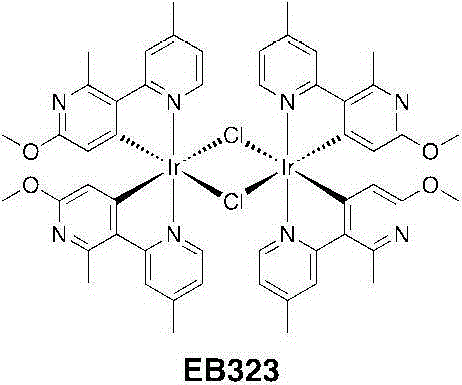
将[Ir(COD)Cl]2二聚体(2.00g,2.98mmol)悬浮于一个50mL烧瓶中的9mL2-乙氧乙醇中。对该悬浮液充入氩气,进行3个周期的真空/氩气。加入C^N配体(2.56g,11.95mmol)并使用1mL2-乙氧乙醇进行漂洗。该悬浮液几乎立即变为黄色溶液并且对它充入氩气,进行3个周期的真空/氩气。将该烧瓶封闭并在125℃下加热4小时。经加热,该溶液变暗至深橙红色。在半小时内出现一种黄色沉淀物。4小时后,将悬浮液冷却到室温并加入30mL甲醇,并过滤出沉淀物、用甲醇洗涤并且干燥。得到EB323为淡黄色固体(3.084g,2.36mmol,产率=79%)。[Ir(COD)Cl] 2 dimer (2.00 g, 2.98 mmol) was suspended in 9 mL of 2-ethoxyethanol in a 50 mL flask. The suspension was purged with argon for 3 cycles of vacuum/argon. C^N ligand (2.56 g, 11.95 mmol) was added and rinsed with 1 mL of 2-ethoxyethanol. The suspension turned to a yellow solution almost immediately and it was flushed with argon for 3 cycles of vacuum/argon. The flask was closed and heated at 125°C for 4 hours. Upon heating, the solution darkened to a deep orange-red. A yellow precipitate appeared within half an hour. After 4 hours, the suspension was cooled to room temperature and 30 mL of methanol was added, and the precipitate was filtered off, washed with methanol and dried. EB323 was obtained as a pale yellow solid (3.084 g, 2.36 mmol, yield = 79%).
1H NMR(CDCl3,400MHz):δ9.02(d,4H,J=6.0Hz);7.84(bs,4H);6.55(dd,4H,J=6.0,1.6Hz);5.09(s,4H);3.67(s,12H);2.78(s,12H);2.66(s,12H)。 1 H NMR (CDCl 3 , 400MHz): δ9.02(d, 4H, J=6.0Hz); 7.84(bs, 4H); 6.55(dd, 4H, J=6.0, 1.6Hz); 5.09(s, 4H ); 3.67(s, 12H); 2.78(s, 12H); 2.66(s, 12H).
实例9:EB332的程序Example 9: Program of EB332
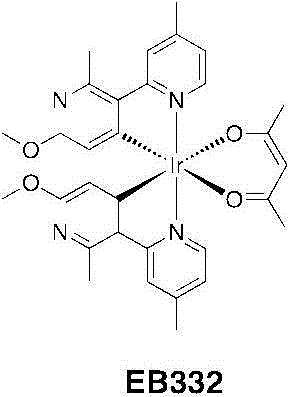
EB332:将DCM(5mL)中的乙酰丙酮(0.445g,4.44mmol)加入甲醇(5mL)中的TBAOH(3.19g,3.99mmol)之中。一旦每种都溶解并得到一个澄清的淡黄色溶液,则将其分部分地加入EB332(1.45g,1.11mmol)在二氯甲烷(150mL)中的一个悬浮液中。将该混合物回流(45℃)过夜。将挥发物蒸发并且将粗制的残留物悬浮物在甲醇中。在冰箱中2小时后,将沉淀物过滤出并用冷甲醇洗涤并干燥。该产物进一步通过硅胶柱色谱法使用DCM/乙酸乙酯/MeOH(100/15/2;v/v/v)作为洗脱液进行纯化。将含有产物的分量蒸干、溶解在最少量的DCM中并加入己烷(约为DCM体积的三倍)将DCM缓慢在真空下蒸发并将剩余悬浮物在冰箱中保存过夜。然后将其过滤、用己烷洗涤并干燥而给出EB332为亮黄色固体(1.355g,1.89mmol,产率=85%)。EB332: Acetylacetone (0.445 g, 4.44 mmol) in DCM (5 mL) was added to TBAOH (3.19 g, 3.99 mmol) in methanol (5 mL). Once each dissolved and a clear pale yellow solution was obtained, it was added in portions to a suspension of EB332 (1.45 g, 1.11 mmol) in dichloromethane (150 mL). The mixture was refluxed (45°C) overnight. The volatiles were evaporated and the crude residue was suspended in methanol. After 2 hours in the refrigerator, the precipitate was filtered off and washed with cold methanol and dried. The product was further purified by column chromatography on silica gel using DCM/ethyl acetate/MeOH (100/15/2; v/v/v) as eluent. Fractions containing product were evaporated to dryness, dissolved in a minimum amount of DCM and added hexane (approximately three times the volume of DCM). The DCM was slowly evaporated under vacuum and the remaining suspension was kept in the refrigerator overnight. It was then filtered, washed with hexanes and dried to give EB332 as a bright yellow solid (1.355 g, 1.89 mmol, yield = 85%).
1H NMR(CDCl3,400MHz):δ8.34(d,2H,J=6.0Hz);7.82(bs,2H);6.96(dd,2H,J=6.0,1.2Hz);5.49(s,2H);5.22(s,1H);3.75(s,6H);2.78(s,6H);2.59(s,6H);1.79(s,6H)。 1 H NMR (CDCl 3 , 400MHz): δ8.34(d, 2H, J=6.0Hz); 7.82(bs, 2H); 6.96(dd, 2H, J=6.0, 1.2Hz); 5.49(s, 2H ); 5.22(s, 1H); 3.75(s, 6H); 2.78(s, 6H); 2.59(s, 6H); 1.79(s, 6H).
13C NMR(CDCl3,100MHz):δ184.88,166.44,162.89,160.91,152.02,148.52,148.05,135.93,122.92,121.88,111.82,100.64,52.87,28.98,26.49,22.02。 13 C NMR (CDCl3, 100MHz): δ184.88, 166.44, 162.89, 160.91, 152.02, 148.52, 148.05, 135.93, 122.92, 121.88, 111.82, 100.64, 52.87, 28.98, 26.49, 22.02.
HR-MS(ES):m/z=719.2202[M+H]+(calc.719.2211)。HR-MS (ES): m/z = 719.2202 [M+H] + (calc. 719.2211).
按C31H33IrN4O4的计算分析:C,51.87;H,4.63;N,7.80。发现是:C,51.07;H,4.63;N,7.70。Anal. Calcd . for C31H33IrN4O4 : C, 51.87; H , 4.63; N, 7.80. Found: C, 51.07; H, 4.63; N, 7.70.
实例10:EB346的程序Example 10: Program of EB346
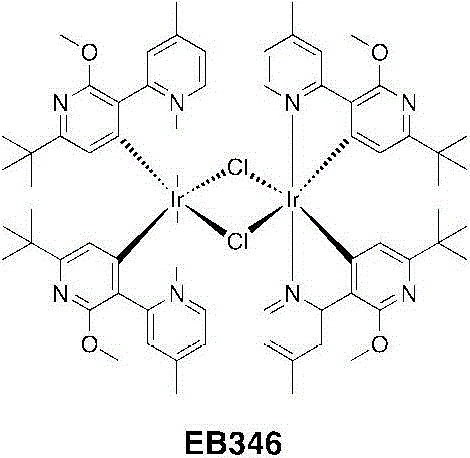
将[Ir(COD)Cl]2二聚体(0.526g,0.78mmol)悬浮于一个25mL烧瓶中的4mL2-乙氧乙醇中。对该悬浮液充入氩气,进行3个周期的真空/氩气。加入C^N配体(0.803g,3.13mmol)并使用1mL2-乙氧乙醇进行漂洗。该淡红色悬浮液几乎立即变为无色并且对它充入氩气,进行3个周期的真空/氩气。将该烧瓶封闭并在125℃下加热4小时。经加热,该溶液变暗至深橙红色。在半小时内出现一种黄色沉淀物。4小时后,将悬浮液冷却到室温并加入30mL甲醇,并过滤出沉淀物、用甲醇洗涤并且干燥。得到EB346为淡黄色固体(1.149g,0.78mmol,产率=99%)。[Ir(COD)Cl] 2 dimer (0.526 g, 0.78 mmol) was suspended in 4 mL of 2-ethoxyethanol in a 25 mL flask. The suspension was purged with argon for 3 cycles of vacuum/argon. C^N ligand (0.803 g, 3.13 mmol) was added and rinsed with 1 mL of 2-ethoxyethanol. The reddish suspension became colorless almost immediately and it was filled with argon for 3 cycles of vacuum/argon. The flask was closed and heated at 125°C for 4 hours. Upon heating, the solution darkened to a deep orange-red. A yellow precipitate appeared within half an hour. After 4 hours, the suspension was cooled to room temperature and 30 mL of methanol was added, and the precipitate was filtered off, washed with methanol and dried. EB346 was obtained as a pale yellow solid (1.149 g, 0.78 mmol, yield = 99%).
1H NMR(CDCl3,400MHz):δ9.02(d,4H,J=5.6Hz);8.44(s,4H);6.54(dd,4H,J=6.0,1.2Hz);5.55(s,4H);4.00(s,12H);2.65(s,12H);0.97(s,36H)。 1 H NMR (CDCl 3 , 400MHz): δ9.02(d, 4H, J=5.6Hz); 8.44(s, 4H); 6.54(dd, 4H, J=6.0, 1.2Hz); 5.55(s, 4H ); 4.00 (s, 12H); 2.65 (s, 12H); 0.97 (s, 36H).
实例11:EB349的程序Example 11: Program of EB349
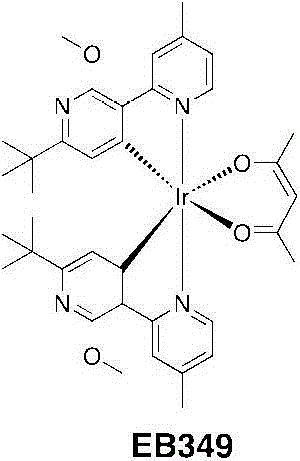
EB349:将DCM(5mL)中的乙酰丙酮(0.224g,2.24mmol)加入甲醇(5mL)中的TBAOH(1.8g,2.25mmol)之中。一旦每种都溶解并得到一个澄清的淡黄色溶液,则将其分部分地加入EB346(1.1g,0.75mmol)在二氯甲烷(100mI)中的一个悬浮液中。将该混合物回流(45℃)过夜。将挥发物蒸发并且将粗制的残留物悬浮物在甲醇中。在冰箱中2小时后,将沉淀物过滤出并用冷甲醇洗涤并干燥。得到了EB346为亮黄色固体(1.028g,1.28mmol,产率=86%)。EB349: Acetylacetone (0.224 g, 2.24 mmol) in DCM (5 mL) was added to TBAOH (1.8 g, 2.25 mmol) in methanol (5 mL). Once each had dissolved and a clear pale yellow solution was obtained, it was added in portions to a suspension of EB346 (1.1 g, 0.75 mmol) in dichloromethane (100 ml). The mixture was refluxed (45°C) overnight. The volatiles were evaporated and the crude residue was suspended in methanol. After 2 hours in the refrigerator, the precipitate was filtered off and washed with cold methanol and dried. EB346 was obtained as a bright yellow solid (1.028 g, 1.28 mmol, yield = 86%).
1H NMR(CDCl3,400MHz):δ8.38(d,2H,J=0.8Hz);8.30(d,2H,J=5.6Hz);6.94(ddd,2H,J=6.0,2.0,0.4Hz);5.81(s,2H);5.20(s,1H);4.02(s,6H);2.61(s,6H);1.80(s,6H);1.09(s,18H)。 1 H NMR (CDCl 3 , 400MHz): δ8.38 (d, 2H, J=0.8Hz); 8.30 (d, 2H, J=5.6Hz); 6.94 (ddd, 2H, J=6.0, 2.0, 0.4Hz ); 5.81 (s, 2H); 5.20 (s, 1H); 4.02 (s, 6H); 2.61 (s, 6H); 1.80 (s, 6H); 1.09 (s, 18H).
13C NMR(CDCl3,100MHz):δ184.65,166.41,164.09,164.01,158.78,148.62,147.46,125.87,123.46,121.31,117.78,100.55,52.49,36.72,30.07,28.95,21.83. 13 C NMR (CDCl 3 , 100MHz): δ184.65, 166.41, 164.09, 164.01, 158.78, 148.62, 147.46, 125.87, 123.46, 121.31, 117.78, 100.55, 52.49, 36.72, 30.07, 21.85
HR-MS(ES):m/z=803.3158[M+H]+(calc.803.3151)。HR-MS (ES): m/z = 803.3158 [M+H] + (calc. 803.3151).
按C37H45IrN4O4的计算分析:C,55.41;H,5.66;N,6.99。发现是:C,55.17;H,5.75;N,7.14。Anal. Calcd . for C37H45IrN4O4 : C, 55.41; H, 5.66 ; N, 6.99. Found: C, 55.17; H, 5.75; N, 7.14.
实例12:EB348的程序Example 12: Program of EB348

将[Ir(COD)Cl]2二聚体(1.30g,1.93mmol)悬浮于一个50mL烧瓶中的10mL2-乙氧乙醇中。对该悬浮液充入氩气,进行3个周期的真空/氩气。加入C^N配体(2.08g,7.75mmol)并使用5mL2-乙氧乙醇进行漂洗。该淡红色悬浮液几乎立即变为无色并且对它充入氩气,进行3个周期的真空/氩气。将该烧瓶封闭并在125℃下加热4小时。经加热,该溶液变暗至深橙红色。在半小时内出现一种黄色沉淀物。4小时后,将悬浮液冷却到室温并加入30mL甲醇,并过滤出沉淀物、用冷甲醇洗涤并且干燥。得到EB348为黄色固体(1.64g,1.076mmol,产率=56%)。[Ir(COD)Cl] 2 dimer (1.30 g, 1.93 mmol) was suspended in 10 mL of 2-ethoxyethanol in a 50 mL flask. The suspension was purged with argon for 3 cycles of vacuum/argon. C^N ligand (2.08 g, 7.75 mmol) was added and rinsed with 5 mL of 2-ethoxyethanol. The reddish suspension became colorless almost immediately and it was filled with argon for 3 cycles of vacuum/argon. The flask was closed and heated at 125°C for 4 hours. Upon heating, the solution darkened to a deep orange-red. A yellow precipitate appeared within half an hour. After 4 hours, the suspension was cooled to room temperature and 30 mL of methanol was added, and the precipitate was filtered off, washed with cold methanol and dried. EB348 was obtained as a yellow solid (1.64 g, 1.076 mmol, yield = 56%).
1H NMR(CDCl3,400MHz):δ9.61(s,4H);8.17(d,4H,J=9.2Hz);7.99(dd,4H,J=8.8,2.0Hz);4.83(s,4H);3.68(s,12H);2.82(s,12H). 1 H NMR (CDCl 3 , 400MHz): δ9.61(s, 4H); 8.17(d, 4H, J=9.2Hz); 7.99(dd, 4H, J=8.8, 2.0Hz); 4.83(s, 4H ); 3.68(s, 12H); 2.82(s, 12H).
实例13:EB351的程序Example 13: Program of EB351

EB351:将DCM(5mL)中的吡啶甲酸(0.260g,2.11mmol)加入甲醇(5mL)中的TBAOH(1.65g,2.06mmol)之中。一旦每种都溶解并得到一个澄清溶液,则将其分部分地加入EB348(1.20g,0.79mmol)在二氯甲烷(100mL)中的一个悬浮液中。将该混合物回流(45℃)过夜。将挥发物蒸发并且将粗制的残留物溶解在甲醇中并且加入水(约其体积的1/10)。经超声处理而形成大的黄色沉淀物。在冰箱中2小时后,将沉淀物过滤出并且用水以及简单地用冷甲醇洗涤并干燥。得到了EB351为亮黄色固体(1.152g,1.36mmol,产率=%%)。EB351: Picolinic acid (0.260 g, 2.11 mmol) in DCM (5 mL) was added to TBAOH (1.65 g, 2.06 mmol) in methanol (5 mL). Once each was dissolved and a clear solution was obtained, it was added in portions to a suspension of EB348 (1.20 g, 0.79 mmol) in dichloromethane (100 mL). The mixture was refluxed (45°C) overnight. The volatiles were evaporated and the crude residue was dissolved in methanol and water was added (about 1/10 of its volume). A large yellow precipitate formed on sonication. After 2 hours in the refrigerator, the precipitate was filtered off and washed with water and briefly with cold methanol and dried. EB351 was obtained as a bright yellow solid (1.152 g, 1.36 mmol, yield = %%).
1H NMR(CDCl3,400MHz):δ9.06(s,1H);8.39(d,1H,J=7.6Hz);8.17(m,2H);8.05-7.94(m,3H);7.79(d,1H,J=4.8Hz);7.54(s,1H);7.48(ddd,1H,J=7.6,5.6,1.6Hz);5.60(s,1H);5.31(s,1H);3.86(s,3H);3.80(s,3H);2.89(s,3H);2.81(s,3H)。 1 H NMR (CDCl 3 , 400MHz): δ9.06(s, 1H); 8.39(d, 1H, J=7.6Hz); 8.17(m, 2H); 8.05-7.94(m, 3H); 7.79(d , 1H, J=4.8Hz); 7.54(s, 1H); 7.48(ddd, 1H, J=7.6, 5.6, 1.6Hz); 5.60(s, 1H); 5.31(s, 1H); 3.86(s, 3H); 3.80(s, 3H); 2.89(s, 3H); 2.81(s, 3H).
HR-MS(ES):m/z=850.1439[M+H]+(calc.850.1442)。HR-MS (ES): m/z = 850.1439 [M+H] + (calc. 850.1442).
按C32H24F6IrN5O4的计算分析:C,45.28;H,2.85;N,8.25。发现是:C,45.07;H,2.43;N,8.27。Anal . Calcd . for C32H24F6IrN5O4 : C, 45.28; H, 2.85; N, 8.25 . Found: C, 45.07; H, 2.43; N, 8.27.
实例14:EB344的程序Example 14: Program of EB344
将[Ir(COD)Cl]2二聚体(1.097g,1.63mmol)悬浮于一个50mL烧瓶中的9mL2-乙氧乙醇中。对该悬浮液充入氩气,进行3个周期的真空/氩气。加入C^N配体(1.505g,6.54mmol)并使用1mL2-乙氧乙醇进行漂洗。该淡红色悬浮液几乎立即变为无色并且对它充入氩气,进行3个周期的真空/氩气。将该烧瓶封闭并在125℃下加热3小时。经加热,该溶液变暗至深橙色。在半小时内出现一种黄色沉淀物。3小时后,将悬浮液冷却到室温并加入30mL甲醇,并过滤出沉淀物、用冷甲醇洗涤并且干燥。得到EB344为淡黄色固体(2.00g,1.46mmol,产率=89%)。[Ir(COD)Cl] 2 dimer (1.097 g, 1.63 mmol) was suspended in 9 mL of 2-ethoxyethanol in a 50 mL flask. The suspension was purged with argon for 3 cycles of vacuum/argon. C^N ligand (1.505 g, 6.54 mmol) was added and rinsed with 1 mL of 2-ethoxyethanol. The reddish suspension became colorless almost immediately and it was filled with argon for 3 cycles of vacuum/argon. The flask was closed and heated at 125°C for 3 hours. Upon heating, the solution darkened to dark orange. A yellow precipitate appeared within half an hour. After 3 hours, the suspension was cooled to room temperature and 30 mL of methanol was added, and the precipitate was filtered off, washed with cold methanol and dried. EB344 was obtained as a pale yellow solid (2.00 g, 1.46 mmol, yield = 89%).
1H NMR(CDCl3,400MHz):δ8.89(d,4H,J=6.0Hz);8.32(s,4H);6.45(dd,4H,J=5.6,1,6Hz);4.94(s,4H);4.01(s,12H);3.64(s,12H);2.62(s,12H)。 1 H NMR (CDCl 3 , 400MHz): δ8.89(d, 4H, J=6.0Hz); 8.32(s, 4H); 6.45(dd, 4H, J=5.6, 1, 6Hz); 4.94(s, 4H); 4.01(s, 12H); 3.64(s, 12H); 2.62(s, 12H).
实例15:EB353的程序Example 15: Program of EB353

EB353:将DCM(5mL)中的3-甲基吡啶甲酸(0.464g,3.38mmol)加入甲醇(5mL)中的TBAOH(2.40g,3.00mmol)之中。一旦每种都溶解并得到一个澄清溶液,则将其分部分地加入EB344(1.402g,1.094mmol)在二氯甲烷(150mL)中的一个悬浮液中。将该混合物回流(45℃)过夜。将挥发物蒸发并且将粗制的残留物悬浮物在甲醇中。在冰箱中2小时后,将沉淀物过滤出并用甲醇洗涤并干燥。得到EB351为淡黄色固体(1.568g,1.99mmol,产率=91%)。EB353: 3-Picolinic acid (0.464 g, 3.38 mmol) in DCM (5 mL) was added to TBAOH (2.40 g, 3.00 mmol) in methanol (5 mL). Once each was dissolved and a clear solution was obtained, it was added in portions to a suspension of EB344 (1.402 g, 1.094 mmol) in dichloromethane (150 mL). The mixture was refluxed (45°C) overnight. The volatiles were evaporated and the crude residue was suspended in methanol. After 2 hours in the refrigerator, the precipitate was filtered off and washed with methanol and dried. EB351 was obtained as a light yellow solid (1.568 g, 1.99 mmol, yield = 91%).
1H NMR(CDCl3,400MHz):δ8.52(d,1H,J=6.0Hz);8.32(d,1H,J=0.8Hz);8.24(d,1H,J=0.8Hz);7.74(d,1H,5.2Hz);7.65(d,1H,J=7.6Hz);7.18(m,2H);6.86(dd,1H,J=6.0,1.6Hz);6.63(dd,1H,J=6.0,1.6Hz);5.43(s,1H);5.21(s,1H);4.08(s,3H);4.02(s,3H);3.80(s,3H);3.74(s,3H);2.86(s,3H);2.50(s,6H)。 1 H NMR (CDCl 3 , 400MHz): δ8.52 (d, 1H, J = 6.0Hz); 8.32 (d, 1H, J = 0.8Hz); 8.24 (d, 1H, J = 0.8Hz); 7.74 ( d, 1H, 5.2Hz); 7.65(d, 1H, J=7.6Hz); 7.18(m, 2H); 6.86(dd, 1H, J=6.0, 1.6Hz); 6.63(dd, 1H, J=6.0 , 1.6Hz); 5.43(s, 1H); 5.21(s, 1H); 4.08(s, 3H); 4.02(s, 3H); 3.80(s, 3H); 3.74(s, 3H); 2.86(s , 3H); 2.50(s, 6H).
13C NMR(CDCl3,100MHz):δ173.36,167.13,166.94,166.08,164.67,162.11,161.65,159.76,159.61,148.97,148.92,148.77,147,78,147.08,146.89,141.76,141.08,127.27,123.61,123.01,121.84,121.70,121.04,120.74,105.71,105.63,53.23,53.22,53.16,53.14,21.82,21.75,20.88。 13 C NMR (CDCl 3 , 100MHz): δ173.36, 167.13, 166.94, 166.08, 164.67, 162.11, 161.65, 159.76, 159.61, 148.97, 148.92, 148.77, 147, 78, 147.08, 141.70, 8, 17 123.61, 123.01, 121.84, 121.70, 121.04, 120.74, 105.71, 105.63, 53.23, 53.22, 53.16, 53.14, 21.82, 21.75, 20.88.
HR-MS(ES):m/z=788.2040[M+H]+(calc.788.2062)。HR-MS (ES): m/z = 788.2040 [M+H] + (calc. 788.2062).
实例16:EB356的程序Example 16: Program of EB356
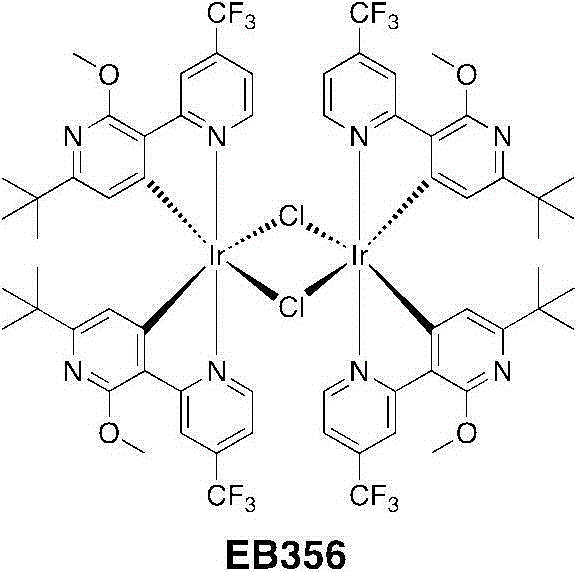
将[Ir(COD)Cl]2二聚体(0.83g,1.23mmol)悬浮于一个50mL烧瓶中的8mL2-乙氧乙醇中。对该悬浮液充入氩气,进行3个周期的真空/氩气。加入C^N配体(1.54g,4.96mmol)并使用3mL2-乙氧乙醇进行漂洗。该淡红色悬浮液几乎立即变为无色并且对它充入氩气,进行3个周期的真空/氩气。将该烧瓶关闭并在125℃下加热4小时。经加热,该溶液变暗至深橙红色。在半小时内出现一种黄色沉淀物。4小时后,将悬浮液冷却到室温并加入30mL甲醇,并过滤出沉淀物、用冷甲醇洗涤并且干燥。得到了EB356为橙黄色固体(1.811g,1.07mmol,产率=86%)。[Ir(COD)Cl] 2 dimer (0.83 g, 1.23 mmol) was suspended in 8 mL of 2-ethoxyethanol in a 50 mL flask. The suspension was purged with argon for 3 cycles of vacuum/argon. C^N ligand (1.54 g, 4.96 mmol) was added and rinsed with 3 mL of 2-ethoxyethanol. The reddish suspension became colorless almost immediately and it was filled with argon for 3 cycles of vacuum/argon. The flask was closed and heated at 125°C for 4 hours. Upon heating, the solution darkened to a deep orange-red. A yellow precipitate appeared within half an hour. After 4 hours, the suspension was cooled to room temperature and 30 mL of methanol was added, and the precipitate was filtered off, washed with cold methanol and dried. EB356 was obtained as an orange-yellow solid (1.811 g, 1.07 mmol, yield = 86%).
1H NMR(CDCl3,400MHz):δ9.24(d,4H,J=6.1Hz);8.89(d,4H,J=1.8Hz);6.88(dd,4H,J=6.1,2.0Hz);5.46(s,4H);4.04(s,12H);0.97(s,36H)。 1 H NMR (CDCl 3 , 400MHz): δ9.24 (d, 4H, J=6.1Hz); 8.89 (d, 4H, J=1.8Hz); 6.88 (dd, 4H, J=6.1, 2.0Hz); 5.46(s, 4H); 4.04(s, 12H); 0.97(s, 36H).
实例17:EB367的程序Example 17: Program of EB367
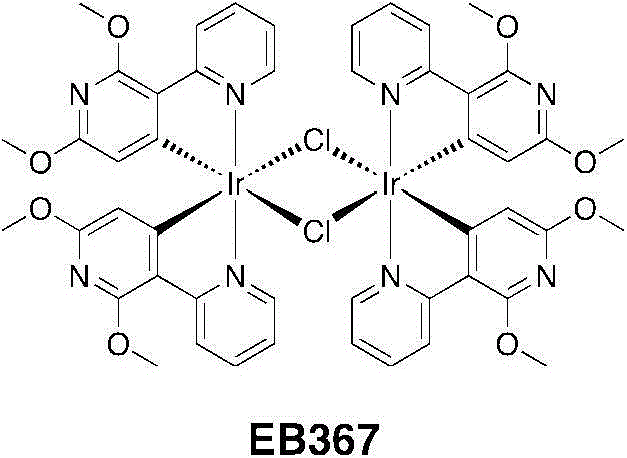
将[Ir(COD)Cl]2二聚体(1.8g,2.67mmol)悬浮于一个50mL烧瓶中的10mL2-乙氧乙醇中。对该悬浮液充入氩气,进行3个周期的真空/氩气。加入C^N配体(2.32g,10.7mmol)并使用5mL2-乙氧乙醇进行漂洗。该淡红色悬浮液几乎立即变为无色并且对它充入氩气,进行3个周期的真空/氩气。将该烧瓶关闭并在125℃下加热4小时。经加热,该溶液变暗至深橙红色。在半小时内出现一种黄色沉淀物。4小时后,将悬浮液冷却到室温并加入30mL甲醇,并过滤出沉淀物、用冷甲醇洗涤并且干燥。得到EB367为黄色固体(3.41g,2.59mmol,产率=96%)。[Ir(COD)Cl] 2 dimer (1.8 g, 2.67 mmol) was suspended in 10 mL of 2-ethoxyethanol in a 50 mL flask. The suspension was purged with argon for 3 cycles of vacuum/argon. C^N ligand (2.32 g, 10.7 mmol) was added and rinsed with 5 mL of 2-ethoxyethanol. The reddish suspension became colorless almost immediately and it was filled with argon for 3 cycles of vacuum/argon. The flask was closed and heated at 125°C for 4 hours. Upon heating, the solution darkened to a deep orange-red. A yellow precipitate appeared within half an hour. After 4 hours, the suspension was cooled to room temperature and 30 mL of methanol was added, and the precipitate was filtered off, washed with cold methanol and dried. EB367 was obtained as a yellow solid (3.41 g, 2.59 mmol, yield = 96%).
1H NMR(CD2Cl2,400MHz):δ9.07(dd,4H,J=5.6,0.8Hz),8.57(d,4H,J=7.6Hz),7.83-7.73(m,4H),6.76-6.67(m,4H),4.79(s,4H),4.03(s,12H),3.66(s,12H)。 1 H NMR (CD 2 Cl 2 , 400MHz): δ9.07 (dd, 4H, J=5.6, 0.8Hz), 8.57 (d, 4H, J=7.6Hz), 7.83-7.73 (m, 4H), 6.76 -6.67 (m, 4H), 4.79 (s, 4H), 4.03 (s, 12H), 3.66 (s, 12H).
实例18:mer-EB410的程序Example 18: Program of mer-EB410

将[Ir(COD)(μ-OMe)]2二聚体(501mg,0.75mmol)悬浮于一个50mL烧瓶中的5mL2-乙氧乙醇中。对该悬浮液充入氩气,进行3个周期的真空/氩气。加入C^N配体(1.74g,7.57mmol,10当量)并使用3mL2-乙氧乙醇进行漂洗。立即形成了一种深色沉淀物。将该烧瓶封闭并在140℃下加热70小时。经加热该溶液变澄清。将悬浮液冷却到室温并加入30mL甲醇,并过滤出沉淀物、用冷甲醇洗涤并且干燥。将该化合物通过硅胶柱色谱法使用CH2Cl2/MeOH作为洗脱液进一步纯化。得到Mer-EB410为黄色固体(884mg,1.06mmol,产率=71%)。[Ir(COD)(μ-OMe)] 2 dimer (501 mg, 0.75 mmol) was suspended in 5 mL of 2-ethoxyethanol in a 50 mL flask. The suspension was purged with argon for 3 cycles of vacuum/argon. C^N ligand (1.74 g, 7.57 mmol, 10 equiv) was added and rinsed with 3 mL of 2-ethoxyethanol. A dark precipitate formed immediately. The flask was closed and heated at 140°C for 70 hours. The solution became clear upon heating. The suspension was cooled to room temperature and 30 mL of methanol was added, and the precipitate was filtered off, washed with cold methanol and dried. The compound was further purified by silica gel column chromatography using CH2Cl2 /MeOH as eluent. Mer-EB410 was obtained as a yellow solid (884 mg, 1.06 mmol, yield = 71%).
1H NMR(CDCl3,400MHz):δ8.39(dd,1H,J=1.3,0.7Hz),8.25(dd,1H,J=1.3,0.7Hz),8.21(dd,1H,J=1.3,0.7Hz),7.84(d,1H,J=5.9Hz),7.74(d,1H,J=5.9Hz),7.26(d,1H,J=5.9Hz),6.59(m,1H),6.43(m,2H),6.06(s,1H),5.57(s,1H),5.39(s,1H),4.04(s,3H),4.03(s,3H),4.02(s,3H),3.78(s,6H),3.73(s,3H),2.39(s,3H),2.37(s,3H),2.36(s,3H)。 1 H NMR (CDCl 3 , 400MHz): δ8.39(dd, 1H, J=1.3, 0.7Hz), 8.25(dd, 1H, J=1.3, 0.7Hz), 8.21(dd, 1H, J=1.3, 0.7Hz), 7.84(d, 1H, J=5.9Hz), 7.74(d, 1H, J=5.9Hz), 7.26(d, 1H, J=5.9Hz), 6.59(m, 1H), 6.43(m , 2H), 6.06(s, 1H), 5.57(s, 1H), 5.39(s, 1H), 4.04(s, 3H), 4.03(s, 3H), 4.02(s, 3H), 3.78(s, 6H), 3.73(s, 3H), 2.39(s, 3H), 2.37(s, 3H), 2.36(s, 3H).
实例19:fac-EB410的程序Example 19: Program of fac-EB410

将mer-EB410(50mg,0.06mmol)悬浮于一个250mL烧瓶中的10mL DMSO中。对该悬浮液充入氩气,进行3个周期的真空/氩气,并用一个UV手持灯照射6小时。加水并且将该固体过滤并用水洗涤。将该化合物通过硅胶柱色谱法使用CH2Cl2/MeOH作为洗脱液进一步纯化。得到Fac-EB410为黄色固体(42mg,0.051mmol,产率=84%)。mer-EB410 (50 mg, 0.06 mmol) was suspended in 10 mL DMSO in a 250 mL flask. The suspension was flushed with argon, subjected to 3 cycles of vacuum/argon, and irradiated with a UV hand lamp for 6 hours. Water was added and the solid was filtered and washed with water. The compound was further purified by silica gel column chromatography using CH2Cl2 /MeOH as eluent. Fac-EB410 was obtained as a yellow solid (42 mg, 0.051 mmol, yield = 84%).
1H NMR(CDCl3,400MHz):δ8.35(dd,3H,J=1.8,0.6Hz),7.23(d,3H,J=5.6Hz),6.59(ddd,3H,J=5.7,1.4,0.6Hz),5.99(s,3H),4.05(s,9H),3.76(s,9H),2.40(s,9H)。 1 H NMR (CDCl 3 , 400MHz): δ8.35 (dd, 3H, J=1.8, 0.6Hz), 7.23 (d, 3H, J=5.6Hz), 6.59 (ddd, 3H, J=5.7, 1.4, 0.6Hz), 5.99(s, 3H), 4.05(s, 9H), 3.76(s, 9H), 2.40(s, 9H).
来自循环伏安测量的电化学分析Electrochemical analysis from cyclic voltammetry
表1.络合物的HOMO和LUMO的对比Table 1. Comparison of HOMO and LUMO of complexes
*HOMO=-1.4*Eox-4.6*HOMO=-1.4*Eox-4.6
**LUMO=HOMO+E0-0 **LUMO=HOMO+E 0-0
光致发光测量Photoluminescence measurement
如表1所示,与FIrPic相比,对于本发明的金属络合物就其发射最大值而言观察到了在光致发光光谱中的轻微的蓝色偏移。进一步,如表2中所示,本发明的络合物展示了与FIrPi相当的CIE坐标。As shown in Table 1, a slight blue shift in the photoluminescence spectrum was observed for the metal complexes according to the invention for their emission maxima compared to FIrPic. Further, as shown in Table 2, the complexes of the present invention exhibited comparable CIE coordinates to FIrPi.
表2.实例与对比实例的金属络合物的CIE坐标Table 2. CIE coordinates of metal complexes of examples and comparative examples
Claims (10)


Applications Claiming Priority (3)
| Application Number | Priority Date | Filing Date | Title |
|---|---|---|---|
| EP10192027 | 2010-11-22 | ||
| EP10192027 | 2010-11-22 | ||
| PCT/EP2011/005851 WO2012069170A1 (en) | 2010-11-22 | 2011-11-21 | A metal complex comprising a ligand having a combination of donor-acceptor substituents |
Publications (1)
| Publication Number | Publication Date |
|---|---|
| CN103339137A true CN103339137A (en) | 2013-10-02 |
Family
ID=43742381
Family Applications (1)
| Application Number | Title | Priority Date | Filing Date |
|---|---|---|---|
| CN2011800656814A Pending CN103339137A (en) | 2010-11-22 | 2011-11-21 | A metal complex comprising a ligand having a combination of donor-acceptor substituents |
Country Status (7)
| Country | Link |
|---|---|
| US (1) | US9269912B2 (en) |
| EP (1) | EP2643334A1 (en) |
| JP (1) | JP2013545754A (en) |
| KR (1) | KR20130143611A (en) |
| CN (1) | CN103339137A (en) |
| TW (1) | TW201235354A (en) |
| WO (1) | WO2012069170A1 (en) |
Cited By (1)
| Publication number | Priority date | Publication date | Assignee | Title |
|---|---|---|---|---|
| US11925041B2 (en) | 2015-09-30 | 2024-03-05 | Semiconductor Energy Laboratory Co., Ltd. | Light-emitting element, display device, electronic device, and lighting device |
Families Citing this family (1)
| Publication number | Priority date | Publication date | Assignee | Title |
|---|---|---|---|---|
| US9978961B2 (en) | 2014-01-08 | 2018-05-22 | Universal Display Corporation | Organic electroluminescent materials and devices |
Citations (10)
| Publication number | Priority date | Publication date | Assignee | Title |
|---|---|---|---|---|
| EP1191613A2 (en) * | 2000-09-26 | 2002-03-27 | Canon Kabushiki Kaisha | Luminescence device, display apparatus and metal coordination compound |
| WO2005097943A1 (en) * | 2004-03-31 | 2005-10-20 | Konica Minolta Holdings, Inc. | Organic electroluminescent device material, organic electroluminescent device, display and illuminating device |
| CN1816525A (en) * | 2003-07-02 | 2006-08-09 | 出光兴产株式会社 | Metal complex compound and organic electroluminescent device using the same |
| CN101094860A (en) * | 2005-01-07 | 2007-12-26 | 出光兴产株式会社 | Metal complex and organic electroluminescent device using same |
| CN101146814A (en) * | 2005-03-01 | 2008-03-19 | 新加坡科技研究局 | Solution-processed organometallic complexes and their use in electroluminescent devices |
| JP2008074831A (en) * | 2006-08-22 | 2008-04-03 | Chemiprokasei Kaisha Ltd | Novel pyrimidinyl group-containing iridium complex, light emitting material comprising the same, and organic EL device using the same |
| JP2009001742A (en) * | 2007-06-25 | 2009-01-08 | Konica Minolta Holdings Inc | ORGANIC ELECTROLUMINESCENT ELEMENT MATERIAL, ORGANIC ELECTROLUMINESCENT ELEMENT, DISPLAY DEVICE AND LIGHTING DEVICE |
| US20090039776A1 (en) * | 2007-08-09 | 2009-02-12 | Canon Kabushiki Kaisha | Organometallic complex and organic light-emitting element using same |
| CN101386630A (en) * | 2007-09-14 | 2009-03-18 | 富士胶片株式会社 | Organic electroluminescence device |
| JP2010185068A (en) * | 2009-08-31 | 2010-08-26 | Fujifilm Corp | Organic electroluminescent device |
Family Cites Families (15)
| Publication number | Priority date | Publication date | Assignee | Title |
|---|---|---|---|---|
| CN101924190B (en) | 2000-08-11 | 2012-07-04 | 普林斯顿大学理事会 | Organometallic compounds and emission-shifting organic electrophosphorescence |
| KR100537621B1 (en) * | 2004-02-02 | 2005-12-19 | 삼성에스디아이 주식회사 | Iridium compound and organic electroluminescent display device using the same |
| JPWO2006008976A1 (en) * | 2004-07-16 | 2008-05-01 | コニカミノルタホールディングス株式会社 | White light-emitting organic electroluminescence element, display device, and illumination device |
| DE102004057072A1 (en) * | 2004-11-25 | 2006-06-01 | Basf Ag | Use of Transition Metal Carbene Complexes in Organic Light Emitting Diodes (OLEDs) |
| JP2006182921A (en) * | 2004-12-28 | 2006-07-13 | Konica Minolta Holdings Inc | Material for organic el element, organic el element, display device and lighting device |
| JP4928867B2 (en) * | 2005-08-15 | 2012-05-09 | 富士フイルム株式会社 | Organic electroluminescence device |
| JP4811643B2 (en) * | 2005-12-16 | 2011-11-09 | 独立行政法人産業技術総合研究所 | Fluorine-substituted iridium complex and luminescent material using the same |
| JP5245105B2 (en) * | 2006-10-19 | 2013-07-24 | コニカミノルタ株式会社 | ORGANIC ELECTROLUMINESCENT ELEMENT MATERIAL, ORGANIC ELECTROLUMINESCENT ELEMENT, DISPLAY DEVICE AND LIGHTING DEVICE |
| JP5202864B2 (en) * | 2007-03-29 | 2013-06-05 | コニカミノルタホールディングス株式会社 | Organic electroluminescence element and display device using the same |
| TW200911821A (en) | 2007-06-08 | 2009-03-16 | Solvay | Light emitting material |
| JP5194596B2 (en) * | 2007-07-11 | 2013-05-08 | コニカミノルタホールディングス株式会社 | Organic electroluminescence element, display device and lighting device |
| KR101548382B1 (en) | 2007-09-14 | 2015-08-28 | 유디씨 아일랜드 리미티드 | Organic electroluminescence device |
| WO2009107497A1 (en) * | 2008-02-27 | 2009-09-03 | コニカミノルタホールディングス株式会社 | Organic electroluminescent device material, organic electroluminescent device, method of manufacturing organic electroluminescent device, illuminating device and display |
| KR100901888B1 (en) * | 2008-11-13 | 2009-06-09 | (주)그라쎌 | Novel Electroluminescent Metal Compounds and Electroluminescent Devices Employing the Same as Light Emitting Materials |
| JP4551480B1 (en) * | 2009-08-31 | 2010-09-29 | 富士フイルム株式会社 | Organic electroluminescence device |
-
2011
- 2011-11-21 JP JP2013539171A patent/JP2013545754A/en active Pending
- 2011-11-21 EP EP11785611.2A patent/EP2643334A1/en not_active Withdrawn
- 2011-11-21 WO PCT/EP2011/005851 patent/WO2012069170A1/en not_active Ceased
- 2011-11-21 CN CN2011800656814A patent/CN103339137A/en active Pending
- 2011-11-21 KR KR1020137016129A patent/KR20130143611A/en not_active Withdrawn
- 2011-11-21 US US13/988,267 patent/US9269912B2/en not_active Expired - Fee Related
- 2011-11-22 TW TW100142744A patent/TW201235354A/en unknown
Patent Citations (10)
| Publication number | Priority date | Publication date | Assignee | Title |
|---|---|---|---|---|
| EP1191613A2 (en) * | 2000-09-26 | 2002-03-27 | Canon Kabushiki Kaisha | Luminescence device, display apparatus and metal coordination compound |
| CN1816525A (en) * | 2003-07-02 | 2006-08-09 | 出光兴产株式会社 | Metal complex compound and organic electroluminescent device using the same |
| WO2005097943A1 (en) * | 2004-03-31 | 2005-10-20 | Konica Minolta Holdings, Inc. | Organic electroluminescent device material, organic electroluminescent device, display and illuminating device |
| CN101094860A (en) * | 2005-01-07 | 2007-12-26 | 出光兴产株式会社 | Metal complex and organic electroluminescent device using same |
| CN101146814A (en) * | 2005-03-01 | 2008-03-19 | 新加坡科技研究局 | Solution-processed organometallic complexes and their use in electroluminescent devices |
| JP2008074831A (en) * | 2006-08-22 | 2008-04-03 | Chemiprokasei Kaisha Ltd | Novel pyrimidinyl group-containing iridium complex, light emitting material comprising the same, and organic EL device using the same |
| JP2009001742A (en) * | 2007-06-25 | 2009-01-08 | Konica Minolta Holdings Inc | ORGANIC ELECTROLUMINESCENT ELEMENT MATERIAL, ORGANIC ELECTROLUMINESCENT ELEMENT, DISPLAY DEVICE AND LIGHTING DEVICE |
| US20090039776A1 (en) * | 2007-08-09 | 2009-02-12 | Canon Kabushiki Kaisha | Organometallic complex and organic light-emitting element using same |
| CN101386630A (en) * | 2007-09-14 | 2009-03-18 | 富士胶片株式会社 | Organic electroluminescence device |
| JP2010185068A (en) * | 2009-08-31 | 2010-08-26 | Fujifilm Corp | Organic electroluminescent device |
Non-Patent Citations (4)
| Title |
|---|
| ANITA M. BARTHRAM等: "Spectroscopic, luminescence and electrochemical studies on a pair of isomeric complexes [ (bipy)2Ru(AB)PtCl2 and [Cl2Pt(AB)Ru(bipy)2 where AB is the bis-bipyridyl bridging ligand 2,2" :3",2" :6"",2"""-quaterpyridine", 《NEW JOURNAL OF CHEMISTRY》 * |
| GUOYONG SONG等: "Hydrogen bonding-assisted tautomerization of pyridine moieties in the coordination sphere of an Ir(I) complex", 《CHEMICAL COMMUNICATIONS》 * |
| GUOYONG SONG等: "Hydrogen bonding-assisted tautomerization of pyridine moieties in the coordination sphere of an Ir(I) complex", 《DALTON TRANSACTIONS》 * |
| SEOK JONG LEE等: "Blue Phosphorescent Ir(III) Complex with High Color Purity: fac -Tris(2′,6′-difluoro-2,3′-bipyridinato-N,C4′)iridium(III)", 《INORGANIC CHEMISTRY》 * |
Cited By (1)
| Publication number | Priority date | Publication date | Assignee | Title |
|---|---|---|---|---|
| US11925041B2 (en) | 2015-09-30 | 2024-03-05 | Semiconductor Energy Laboratory Co., Ltd. | Light-emitting element, display device, electronic device, and lighting device |
Also Published As
| Publication number | Publication date |
|---|---|
| TW201235354A (en) | 2012-09-01 |
| US9269912B2 (en) | 2016-02-23 |
| KR20130143611A (en) | 2013-12-31 |
| US20140005397A1 (en) | 2014-01-02 |
| WO2012069170A1 (en) | 2012-05-31 |
| JP2013545754A (en) | 2013-12-26 |
| EP2643334A1 (en) | 2013-10-02 |
Similar Documents
| Publication | Publication Date | Title |
|---|---|---|
| KR102739343B1 (en) | Organic electroluminescent materials and devices | |
| KR102822635B1 (en) | Organic electroluminescent materials and devices | |
| KR102855100B1 (en) | 5-substituted 2-phenylquinoline complexes materials for light emitting diode | |
| TWI466980B (en) | Organic electroluminescent elements | |
| EP2007780B1 (en) | Light-emitting material | |
| US11765971B2 (en) | Luminescent tetradentate gold(III) compounds for organic light-emitting devices and their preparation | |
| KR20180118253A (en) | Pyridyl carbene phosphorescent emitters | |
| JP5416098B2 (en) | Bipyridine metal complexes used as luminescent materials | |
| Li et al. | Multifunctional phosphorescent iridium (III) complexes based on 2-phenylbenzothiazole derivative for highly efficient organic light-emitting diodes | |
| CA2624927A1 (en) | Light-emitting material | |
| Chen et al. | The facile synthesis of homoleptic phenylpyridazine iridium (III) complexes and their application in high efficiency OLEDs | |
| Liu et al. | Substituent effects on the photophysical and electrochemical properties of iridium (III) complexes containing an arylcarbazolyl moiety | |
| CN103339137A (en) | A metal complex comprising a ligand having a combination of donor-acceptor substituents | |
| JP5416097B2 (en) | Luminescent substance | |
| Lv et al. | High efficiency and stable-yellow phosphorescence from OLEDs with a novel fluorinated heteroleptic iridium complex | |
| Li et al. | A promising phosphorescent heteroleptic iridium complex with carbazole-functionalized substituent: Synthesis, photophysical and electroluminescent performances | |
| Giridhar et al. | Highly efficient bluish green phosphorescent organic light-emitting diodes based on heteroleptic iridium (III) complexes with phenylpyridine main skeleton | |
| Lee et al. | Pyridine/isoquinoline-carbazole containing bipolar host materials for green phosphorescent organic light-emitting diodes | |
| Hu et al. | Synthesis and luminescent properties of Ir complexes with fluorine substituted phenylpyridine derivative ligands | |
| HK1147760A (en) | Bipyridine metal complexes for use as light-emitting material |
Legal Events
| Date | Code | Title | Description |
|---|---|---|---|
| C06 | Publication | ||
| PB01 | Publication | ||
| C10 | Entry into substantive examination | ||
| SE01 | Entry into force of request for substantive examination | ||
| C02 | Deemed withdrawal of patent application after publication (patent law 2001) | ||
| WD01 | Invention patent application deemed withdrawn after publication |
Application publication date: 20131002 |