[go: up one dir, main page]

CN103279638A - Large power grid overall situation on-line integrated quantitative evaluation method based on response - Google Patents

Large power grid overall situation on-line integrated quantitative evaluation method based on response Download PDF

Info

Publication number
CN103279638A
CN103279638A CN2013101420710A CN201310142071A CN103279638A CN 103279638 A CN103279638 A CN 103279638A CN 2013101420710 A CN2013101420710 A CN 2013101420710A CN 201310142071 A CN201310142071 A CN 201310142071A CN 103279638 A CN103279638 A CN 103279638A
Authority
CN
China
Prior art keywords
power
power grid
node
stability
transient
Prior art date
Legal status (The legal status is an assumption and is not a legal conclusion. Google has not performed a legal analysis and makes no representation as to the accuracy of the status listed.)
Granted
Application number
CN2013101420710A
Other languages
Chinese (zh)
Other versions
CN103279638B (en
Inventor
李道伟
李柏青
马世英
侯俊贤
孙华东
王虹富
董毅峰
王毅
张志强
Current Assignee (The listed assignees may be inaccurate. Google has not performed a legal analysis and makes no representation or warranty as to the accuracy of the list.)
China Electric Power Research Institute Co Ltd CEPRI
State Grid Corp of China SGCC
Original Assignee
China Electric Power Research Institute Co Ltd CEPRI
State Grid Corp of China SGCC
Priority date (The priority date is an assumption and is not a legal conclusion. Google has not performed a legal analysis and makes no representation as to the accuracy of the date listed.)
Filing date
Publication date
Application filed by China Electric Power Research Institute Co Ltd CEPRI, State Grid Corp of China SGCC filed Critical China Electric Power Research Institute Co Ltd CEPRI
Priority to CN201310142071.0A priority Critical patent/CN103279638B/en
Publication of CN103279638A publication Critical patent/CN103279638A/en
Priority to PCT/CN2013/088404 priority patent/WO2014173131A1/en
Application granted granted Critical
Publication of CN103279638B publication Critical patent/CN103279638B/en
Active legal-status Critical Current
Anticipated expiration legal-status Critical

Links

Images

Classifications

    • H02J13/12
    • H02J13/10
    • H02J3/00144
    • H02J2103/30
    • YGENERAL TAGGING OF NEW TECHNOLOGICAL DEVELOPMENTS; GENERAL TAGGING OF CROSS-SECTIONAL TECHNOLOGIES SPANNING OVER SEVERAL SECTIONS OF THE IPC; TECHNICAL SUBJECTS COVERED BY FORMER USPC CROSS-REFERENCE ART COLLECTIONS [XRACs] AND DIGESTS
    • Y02TECHNOLOGIES OR APPLICATIONS FOR MITIGATION OR ADAPTATION AGAINST CLIMATE CHANGE
    • Y02EREDUCTION OF GREENHOUSE GAS [GHG] EMISSIONS, RELATED TO ENERGY GENERATION, TRANSMISSION OR DISTRIBUTION
    • Y02E40/00Technologies for an efficient electrical power generation, transmission or distribution
    • Y02E40/70Smart grids as climate change mitigation technology in the energy generation sector
    • YGENERAL TAGGING OF NEW TECHNOLOGICAL DEVELOPMENTS; GENERAL TAGGING OF CROSS-SECTIONAL TECHNOLOGIES SPANNING OVER SEVERAL SECTIONS OF THE IPC; TECHNICAL SUBJECTS COVERED BY FORMER USPC CROSS-REFERENCE ART COLLECTIONS [XRACs] AND DIGESTS
    • Y02TECHNOLOGIES OR APPLICATIONS FOR MITIGATION OR ADAPTATION AGAINST CLIMATE CHANGE
    • Y02EREDUCTION OF GREENHOUSE GAS [GHG] EMISSIONS, RELATED TO ENERGY GENERATION, TRANSMISSION OR DISTRIBUTION
    • Y02E60/00Enabling technologies; Technologies with a potential or indirect contribution to GHG emissions mitigation
    • YGENERAL TAGGING OF NEW TECHNOLOGICAL DEVELOPMENTS; GENERAL TAGGING OF CROSS-SECTIONAL TECHNOLOGIES SPANNING OVER SEVERAL SECTIONS OF THE IPC; TECHNICAL SUBJECTS COVERED BY FORMER USPC CROSS-REFERENCE ART COLLECTIONS [XRACs] AND DIGESTS
    • Y04INFORMATION OR COMMUNICATION TECHNOLOGIES HAVING AN IMPACT ON OTHER TECHNOLOGY AREAS
    • Y04SSYSTEMS INTEGRATING TECHNOLOGIES RELATED TO POWER NETWORK OPERATION, COMMUNICATION OR INFORMATION TECHNOLOGIES FOR IMPROVING THE ELECTRICAL POWER GENERATION, TRANSMISSION, DISTRIBUTION, MANAGEMENT OR USAGE, i.e. SMART GRIDS
    • Y04S10/00Systems supporting electrical power generation, transmission or distribution
    • YGENERAL TAGGING OF NEW TECHNOLOGICAL DEVELOPMENTS; GENERAL TAGGING OF CROSS-SECTIONAL TECHNOLOGIES SPANNING OVER SEVERAL SECTIONS OF THE IPC; TECHNICAL SUBJECTS COVERED BY FORMER USPC CROSS-REFERENCE ART COLLECTIONS [XRACs] AND DIGESTS
    • Y04INFORMATION OR COMMUNICATION TECHNOLOGIES HAVING AN IMPACT ON OTHER TECHNOLOGY AREAS
    • Y04SSYSTEMS INTEGRATING TECHNOLOGIES RELATED TO POWER NETWORK OPERATION, COMMUNICATION OR INFORMATION TECHNOLOGIES FOR IMPROVING THE ELECTRICAL POWER GENERATION, TRANSMISSION, DISTRIBUTION, MANAGEMENT OR USAGE, i.e. SMART GRIDS
    • Y04S10/00Systems supporting electrical power generation, transmission or distribution
    • Y04S10/22Flexible AC transmission systems [FACTS] or power factor or reactive power compensating or correcting units
    • YGENERAL TAGGING OF NEW TECHNOLOGICAL DEVELOPMENTS; GENERAL TAGGING OF CROSS-SECTIONAL TECHNOLOGIES SPANNING OVER SEVERAL SECTIONS OF THE IPC; TECHNICAL SUBJECTS COVERED BY FORMER USPC CROSS-REFERENCE ART COLLECTIONS [XRACs] AND DIGESTS
    • Y04INFORMATION OR COMMUNICATION TECHNOLOGIES HAVING AN IMPACT ON OTHER TECHNOLOGY AREAS
    • Y04SSYSTEMS INTEGRATING TECHNOLOGIES RELATED TO POWER NETWORK OPERATION, COMMUNICATION OR INFORMATION TECHNOLOGIES FOR IMPROVING THE ELECTRICAL POWER GENERATION, TRANSMISSION, DISTRIBUTION, MANAGEMENT OR USAGE, i.e. SMART GRIDS
    • Y04S10/00Systems supporting electrical power generation, transmission or distribution
    • Y04S10/30State monitoring, e.g. fault, temperature monitoring, insulator monitoring, corona discharge
    • YGENERAL TAGGING OF NEW TECHNOLOGICAL DEVELOPMENTS; GENERAL TAGGING OF CROSS-SECTIONAL TECHNOLOGIES SPANNING OVER SEVERAL SECTIONS OF THE IPC; TECHNICAL SUBJECTS COVERED BY FORMER USPC CROSS-REFERENCE ART COLLECTIONS [XRACs] AND DIGESTS
    • Y04INFORMATION OR COMMUNICATION TECHNOLOGIES HAVING AN IMPACT ON OTHER TECHNOLOGY AREAS
    • Y04SSYSTEMS INTEGRATING TECHNOLOGIES RELATED TO POWER NETWORK OPERATION, COMMUNICATION OR INFORMATION TECHNOLOGIES FOR IMPROVING THE ELECTRICAL POWER GENERATION, TRANSMISSION, DISTRIBUTION, MANAGEMENT OR USAGE, i.e. SMART GRIDS
    • Y04S10/00Systems supporting electrical power generation, transmission or distribution
    • Y04S10/40Display of information, e.g. of data or controls
    • YGENERAL TAGGING OF NEW TECHNOLOGICAL DEVELOPMENTS; GENERAL TAGGING OF CROSS-SECTIONAL TECHNOLOGIES SPANNING OVER SEVERAL SECTIONS OF THE IPC; TECHNICAL SUBJECTS COVERED BY FORMER USPC CROSS-REFERENCE ART COLLECTIONS [XRACs] AND DIGESTS
    • Y04INFORMATION OR COMMUNICATION TECHNOLOGIES HAVING AN IMPACT ON OTHER TECHNOLOGY AREAS
    • Y04SSYSTEMS INTEGRATING TECHNOLOGIES RELATED TO POWER NETWORK OPERATION, COMMUNICATION OR INFORMATION TECHNOLOGIES FOR IMPROVING THE ELECTRICAL POWER GENERATION, TRANSMISSION, DISTRIBUTION, MANAGEMENT OR USAGE, i.e. SMART GRIDS
    • Y04S40/00Systems for electrical power generation, transmission, distribution or end-user application management characterised by the use of communication or information technologies, or communication or information technology specific aspects supporting them
    • Y04S40/20Information technology specific aspects, e.g. CAD, simulation, modelling, system security

Landscapes

  • Supply And Distribution Of Alternating Current (AREA)

Abstract

本发明提供一种基于响应的大电网全态势在线一体化量化评估方法,包括:S1,从SCADA系统、EMS系统获取电网拓扑结构信息,并建立与WAMS系统电网元件的对应关系;S2,从SCADA系统、EMS系统或者WAMS系统获取电网当前运行方式潮流数据或者从DSA系统中获得各种预想的潮流或者暂态故障时域数据;S3,从轨迹角度出发将响应数据宏观分为稳态(或准稳态)和暂态(或动态)两种运行场景,以在线面向节点的方式对电网进行静态稳定态势评估,以在线面向机组对的方式对电网进行暂态稳定态势评估。构造静态和暂态综合评估指标时都从元件级热稳定、电气量合格范围及系统级稳定三个角度出发,提高全态势评估指标的全面性及合理性;采用任务并行的方法提高全态势一体化评估效率。
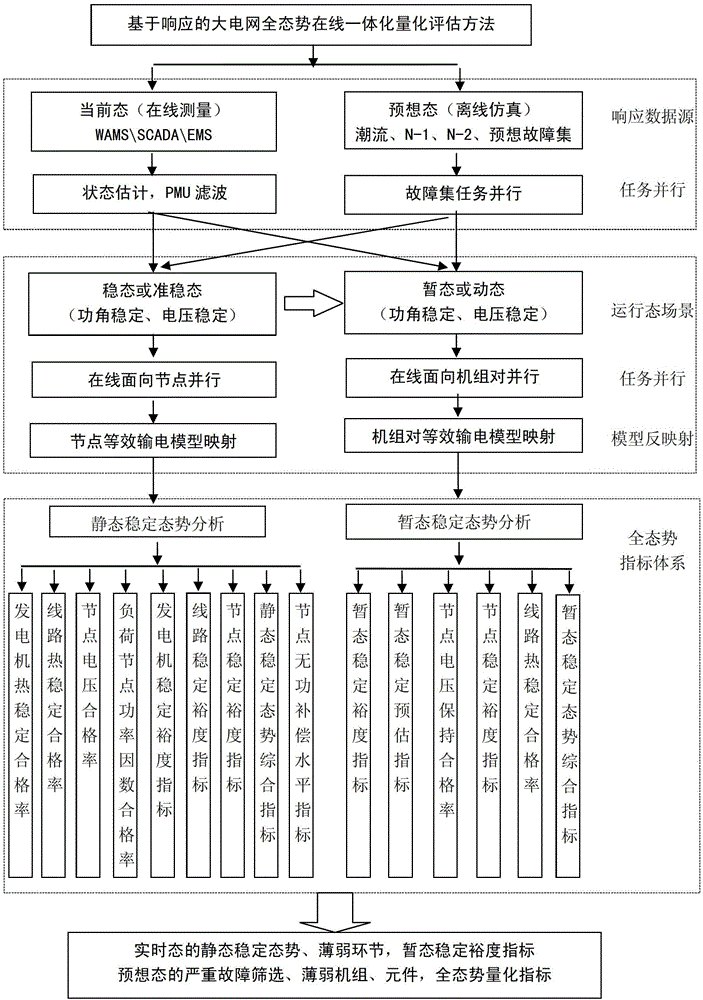
Figure 201310142071

The present invention provides a response-based online integrated quantitative evaluation method for the whole situation of a large power grid, including: S1, obtaining the topological structure information of the power grid from the SCADA system and the EMS system, and establishing a corresponding relationship with the power grid components of the WAMS system; S2, from the SCADA system system, EMS system or WAMS system obtains the power flow data of the current operation mode of the power grid or obtains various expected power flow or transient fault time domain data from the DSA system; S3, macroscopically divides the response data into steady state (or quasi-state) Steady state) and transient (or dynamic) two operating scenarios, the static stability situation assessment of the power grid is performed in an online node-oriented manner, and the transient stability situation assessment of the power grid is performed in an online unit-oriented manner. When constructing static and transient comprehensive evaluation indicators, we start from the three perspectives of component-level thermal stability, electrical quantity qualified range, and system-level stability to improve the comprehensiveness and rationality of the overall situation evaluation indicators; use the task parallel method to improve the overall situation integration. Evaluate efficiency.

Figure 201310142071

Description

Large power grid full situation online integrated quantitative evaluation method based on response
Technical Field
The invention relates to the field of online safety monitoring and early warning of a large power grid, in particular to a response-based full-situation online integrated quantitative evaluation method for the large power grid.
Background
Ensuring safe and economic operation of large power grids is a goal that power workers have pursued over the years. With the continuous expansion of the interconnection range of the power grid, the continuous deepening of the reformation of the electric power industry marketization system and the continuous access of the ultra-high voltage power transmission and the renewable energy power generation, the uncertainty of the operation of the power grid is increased, the operation environment and the dynamic behavior of the power grid are more complicated, and the difficulty of stably analyzing and controlling the power grid is higher. Once an accident happens to a modern large power grid, if the accident is not processed in time, the consequence is very serious. Since 2000 years, a plurality of major power failure accidents occur in the world, wherein the major power failure of 8.14 is the largest historical one-time power failure accident, the economic loss per day during the power failure reaches 300 billion dollars, and the frequently occurring major power failure accidents provide more urgent requirements for the safety and stability analysis and control of a power grid and the real-time monitoring of the running state of the power grid.
Currently, the following 4 problems mainly exist in the field of online safety assessment and early warning of a large power grid: firstly, the online safety assessment of the power grid mainly adopts the traditional network modeling and simulation mode, although the power grid safety assessment mainly based on modeling simulation is an essential important tool in power grid planning and operation, the method is limited by factors such as power grid models, parameters, numerical value calculation and the like, is difficult to adapt to the requirements of real-time monitoring of the power grid in the aspects of application scale, speed, matching degree with real power grid working conditions and the like, and a new concept and a faster solution must be sought; secondly, the major power failure accident is often caused by unforeseen cascading failures or random disturbance, the existing ' offline pre-decision based on an expected accident set is matched with ' a power grid security control mode ' on line, the real working condition of a power grid cannot be matched, the scheme is influenced by a model and parameters, the obtained scheme is sometimes over conservative (or optimistic), and especially the problem of combined explosion of the fault set severely limits the number of possible considered working conditions. When a large power grid monitors and prevents a large power failure accident in real time, the method may be unconscious; the existing online security assessment system for the power grid has strong independence when aiming at specific problems, and often splits the power grid angle stability and synchronization stability for processing, or specifically divides the problems into static problems and transient problems. However, in practice, grid stabilization is a uniform nonlinear power system stabilization problem, from the perspective of grid response, power angle and voltage are only external expressions, and static problems and transient problems have a dialectical idea of "there is still and moving in motion" in motion. Therefore, many existing evaluation methods and indexes have great overlap, and an evaluation index system which is more effective and can truly reflect the operation situation of the power grid is needed in a real-time operation environment; one of the main reasons of major blackouts is that the power grid online monitoring system which is put into operation does not give visual and effective quantitative assessment and early warning information of the power grid operation situation at the stage of slow deterioration of the power grid state, and does not give corresponding control measures according to changes of the real working conditions of the power grid, so that the best opportunity of taking care of the blast is missed. Therefore, a brand-new online safety assessment method system needs to be established for the power grid, and highly-automatic and intelligent online safety assessment and early warning of the large power grid are achieved.
With the development of computer, communication and network technologies, the WAMS (Wide Area Measurement System) is widely applied to power grid dispatching automation, and a new opportunity is brought to the power grid operation full situation online quantitative evaluation and real-time adaptive control research based on the WAMS. In the face of the above opportunities and challenges, Smart grids (Smart grids) which incorporate various advanced measurement sensing technologies, control technologies, communication technologies, computer technologies and other leading-edge technologies become the necessary route for the development of the modern power industry. One of the important functions of the smart grid is to improve the visualization and early warning capability of the grid, and finally realize intelligent closed-loop control, so that the grid is safer, more reliable and more economic to operate. The intelligent scheduling is the core content of intelligent power grid construction, and the intelligent scheduling technical support system has the functions of taking a dispatcher thinking mode as a framework, taking a visual interface as a functional module and taking interactive computation as a system core.
The smart grid is a macro System engineering to realize the online security assessment And early warning of the large grid, And in combination with the current mature WAMS System And the DSA (Dynamic security assessment) System based on SCADA (Supervisory Control And Data Acquisition, Data Acquisition And monitoring) \ EMS (Energy Management System) And expected fault set simulation, for different grid operation scenarios, a response information-based large grid full situation quantitative assessment method And a Data fusion processing mechanism need to be comprehensively And deeply researched, And an online security assessment System based on the combination of the current state And the expected state of the large grid based on a multi-response information source is established.
Disclosure of Invention
The invention relates to a response-based large power grid full situation online integrated quantitative evaluation method, which comprises the following steps of:
step S1, acquiring power grid topological structure information from the SCADA system and the EMS system, and establishing a corresponding relation with power grid elements of the WAMS system;
step S2, obtaining the current operation mode power flow data of the power grid from the SCADA system, the EMS system or the WAMS system or obtaining various anticipated power flow or transient fault time domain data from the DSA system;
step S3, performing static stability situation evaluation on the power grid in an online node-oriented mode, and performing transient stability situation evaluation on the power grid in an online unit-oriented mode;
wherein, the content of carrying out the static stable situation aassessment to the electric wire netting includes: the method comprises the following steps of (1) generating a generator stability margin index, a line stability margin index, a node stability margin index, a generator thermal stability qualification rate, a line thermal stability qualification rate, a node voltage qualification rate, a load node power factor qualification rate, a static stability situation comprehensive index and a node reactive power compensation level index;
the content of transient stability situation assessment on the power grid comprises the following steps: transient stability margin index, transient stability estimation index, node voltage holding qualification rate, node stability margin index, line thermal stability qualification rate and transient stability situation comprehensive index.
The invention provides a first preferred embodiment: various power grid static response data comprise expected state offline power flow, calculation results after convergence of N-1 and N-2 power flows, state estimation results of a SCADA \ EMS system and PMU measurement information;
the response data of various power grid transient transition processes comprise various expected transient fault set time domain simulation results and power grid disturbance process information measured by the WAMS in real time;
carrying out rationality prejudgment or filtering processing on PMU measurement information according to previous time or peripheral PMU measurement data change;
and (4) allocating the expected faults of N-1 and N-2 according to the number of the parallel machines.
In a second preferred embodiment of the present invention: when the static stable situation evaluation and the transient stable situation evaluation are performed on the power grid in the step S3, distributing all nodes of the power grid according to the number of parallel machines;
according to the power grid operation tide section information and in combination with the power grid topological structure, the equivalent transmission power P of each node is obtained according to the active flow directionE+jQE
Identifying equivalent power transmission model parameters of each node of a power grid in the current state on line by adopting a tracking parameter identification method based on local measurement, wherein the equivalent power transmission model parameters comprise equivalent power source potential EEEquivalent branch impedance mode ZEAnd the impedance angle alpha is used for realizing node equivalent power transmission model inverse mapping based on the current running state of the power grid.
In a third preferred embodiment of the present invention: the method for obtaining the generator stability margin index, the line stability margin index and the node stability margin index of the power grid in the step S3 includes:
according to the maximum transmission power thought, aiming at equivalent transmission models of a generator branch, a tie line branch and a node, respectively, the static stability margin index S corresponding to the current operation mode of the generator branch, the tie line branch or the node is obtainedLi,SLiThe calculation formula is as follows: S Li = Z L - Z E Z L ;
wherein ZLAnd the equivalent load impedance representing the branch circuit, the connecting line or the node of the generator is obtained according to the terminal voltage and the power.
In a fourth preferred embodiment of the present invention: the method for obtaining the generator thermal stability qualification rate and the tie line thermal stability qualification rate of the power grid in the step S3 includes:
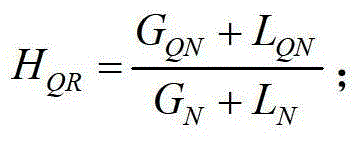
according to the thermal stability operation constraint of each generator and each tie lineCalculating the thermal stability qualification rate G of the generatorPRAnd line thermal stability yield LPRRespectively as follows: G PR = G QN G N ; L PR = L QN L N ;
wherein G isN、LNThe total generator number, the total tie line number and G of the power gridQN、LQNThe number of the generators and the number of the connecting lines which meet the respective operation thermal stability constraint are respectively;
the method for obtaining the node voltage qualification rate and the load node power factor qualification rate of the power grid in the step S3 includes:
according to the node voltage given by the normal operation mode of the power grid and the upper and lower limits of the qualified range of the power factor of the load node, the qualified rate of the node voltage of the power grid is counted
Figure BDA00003086678000033
Load node power factor qualification rate
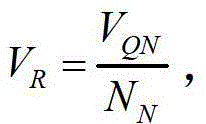
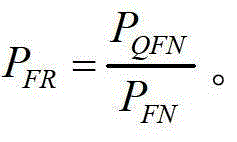
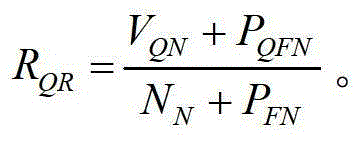
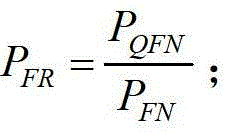
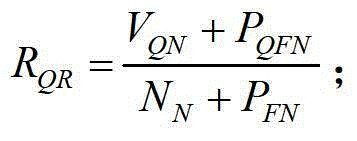
Wherein N isN、PFNRespectively the total node number and the load node number of the power grid, VQN、PQFNThe number of nodes satisfying the voltage range and the number of load nodes satisfying the power factor range, respectively.
The method for obtaining the power grid static stability out-of-limit rate comprises the following steps:
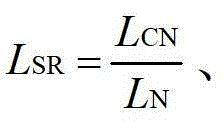
setting SLiCertain early warning threshold value SLCCounting that all tie line branches and node equivalent branches of the power grid are greater than SLCThe nodes comprise a generator node, a middle contact node and a load node, and the static stability qualification rate of the line is respectively calculated
Figure BDA00003086678000041
Yield of node statically stable N SR = N CN N N ;
Wherein L isN、NNRespectively the number of system bus lines and the number of nodes, LCN、NCNAre each greater than SLCThe number of connections and the number of nodes.
In a fifth preferred embodiment of the present invention: the method for obtaining the comprehensive index of the overall static stable situation of the power grid in the step S3 comprises the following steps:
integrated static stable situation index S of power gridSI=α1HQR1RQR1SSR
Wherein alpha is1、β1、χ1The weight coefficients of the power grid according to thermal stability constraint, operation electric quantity constraint and static stability constraint are flexibly configured according to experience or analysis requirements, and alpha is1、β1、χ1Satisfies the following conditions:
0 ≤ α 1 ≤ 1 0 ≤ β 1 ≤ 1 0 ≤ χ 1 ≤ 1 0 ≤ α 1 + β 1 + χ 1 ≤ 1
HQRthe overall thermal stability qualification rate of the power grid HQRThe calculation formula is as follows:
Figure BDA00003086678000044
RQRfor the qualification rate of the electric quantity, R, of the whole operation of the power gridQRThe calculation formula is as follows:
SSRthe qualification rate of the whole static stability of the power grid, SSRThe calculation formula is as follows:
Figure BDA00003086678000046
in a sixth preferred embodiment of the present invention: in step S3, the method for obtaining the reactive power required by the equivalent power transmission model when the corresponding active loss is minimum by using the virtual reactive power variation method is to obtain the reactive power compensation level index of each node in the current operation mode:
combining the equivalent power transmission model of each node and the equivalent power transmission active power P thereofEAnd calculating the circulation P under the node equivalent modelECorresponding reactive value Q required for minimum active lossminThen comparing said QminEquivalent transmission reactive power Q with the obtained nodeEAnd solving the reactive compensation shortage index Q under the current operation mode of each nodeIComprises the following steps:
Q I = Q E - Q min Q E
wherein Q isI>0 hour represents reactive under-compensation, QIWhen =0, Q represents the optimal reactive powerI<And 0 represents the power failure over-compensation.
In a seventh preferred embodiment of the present invention: in the step S3, the transient process trajectory time domain data of the power grid is obtained from the WAMS system or various anticipated transient faults in a centralized manner, and the transient stability margin index of the power grid is obtained by analyzing the transient behavior of the power grid by directly using a method of a disturbed severe unit group, which includes steps S101 to S103:
step S101, according to inertia time constant M of each generator, angular speed omega, power angle delta, terminal bus voltage phase angle theta and terminal electromagnetic active power PGEQuickly identifying the x power generators which are interfered relatively most ahead and the x power generators most behind according to the change conditions of the front time and the rear time to form a relatively most serious unit set omega;
the number x can be set manually according to needs, and the range of x is more than or equal to 5 and less than or equal to 10;
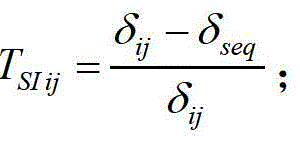
step S102, for any one of the lead and lag generator sets in the set omega, calculating a transient stability margin index between the generator set i and the generator set j
Figure BDA00003086678000051
Wherein, deltaijRepresenting a power angle delta between the generator set i and the generator set jiAnd deltajDifference of (d)ij=δij;δseqAs a function P of the mechanical power between the generator sets i and jMeqAnd electromagnetic active power PEeqThe intersection point of the two points is a virtual stable balance operation point;
step S103, calculating the transient stability margin indexes T between any leading generator set i and any lagging generator set j in the set omega in sequenceSIijWith minimum unit pair TSIijTransient stability margin index S as current time domain dataTSII.e. STSI=min{TSIij,i,j∈Ω}。
In an eighth preferred embodiment of the present invention: calculating said deltaseqThe method of (1) comprises steps S1021 to S1023:
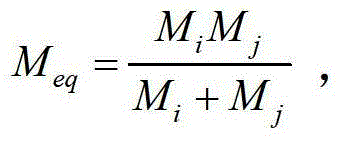
step S1021, the equivalent single-machine rotor inertia time constant between the generator set i and the generator set j is
Figure BDA000030866780000510
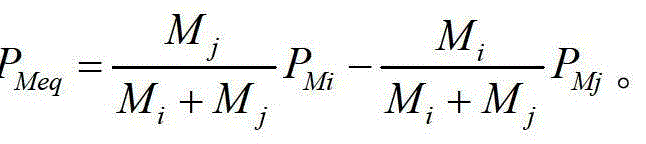
Calculating a mechanical power function between the generator set i and the generator set j P Meq = M j M i + M j P Mi - M i M i + M j P Mj ;
Wherein M isiAnd MjThe inertia time constants, P, of the generator set i and the generator set j respectivelyMiAnd PMjThe mechanical injection power of the generator set i and the generator set j and the mechanical injection power of the generator set
Figure BDA00003086678000054
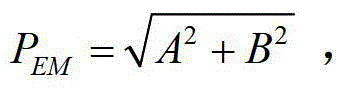
Step S1022, calculating the electromagnetic active power between the generator set i and the generator set j P Eeq = M j M i + M j P Ei - M i M i + M j P Ej = P EM sin ( &delta; ij + C ) ;
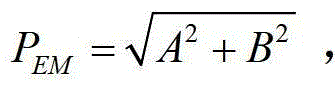
Wherein,
Figure BDA00003086678000056
A=Dcos(δji)+Ecos(δij),B=Dsin(δji)-Esin(δij),C=tan-1(B/A),
Figure BDA00003086678000057
Figure BDA00003086678000058
Ui、Uj、θi、θj、Xi、Xjrespectively representing the voltage amplitude, the phase angle and the equivalent internal reactance of generator terminal buses of a generator set i and a generator set j;
step S1023, calculating &delta; seq = a sin ( P Meq P EM ) - C .
In a ninth preferred embodiment of the present invention: for any lead and lag unit pair in the set omega, according to the calculated equivalent mechanical power P of the unit pairMeqAnd electromagnetic active power PEeqChanging the trajectory, constructing a transient stability estimation index from an energy angle by using a curve fitting technology, and specifically comprising the following steps of S201-S203:
step S201, assume thatEquivalent mechanical power P of generator groupMeqThe equivalent electromagnetic active power P of the generator group is not changed in the transient processEeqThe varying trajectory was fitted with a sine function as follows: y is x0sin(δij+x1)+x2
Wherein x is0,x1,x2For the fitted sine function coefficient to be solved, y represents the equivalent P of the generator groupEeq
Step S202, calculating transient stability estimation index T between the generator set i and the generator set jSEIij
Step S203, calculating T of any lead and lag unit pair in the set omega in sequenceSEIijWith minimum unit pair TSEIijTransient stability estimation index S as time domain data of this timeTEI,STEI=min{TSEIij,i,j∈Ω};
The step S202 of calculating the transient stability estimation indicator between the generator set i and the generator set j includes steps S2021 to S2023:
step S2021, according to PEeqChanging the trajectory fitting function y to obtain the unstable equilibrium point delta after fault removalijuThe unstable balance point is equivalent mechanical power P of the generator setMeqAnd electromagnetic active power PEeqIntersection of the varying trajectories, δijuThe calculation formula is as follows: &delta; iju = &pi; - arctan P Meq - x 2 x 0 - x 1 ;
step S2022, transient kinetic energy V of unit set at fault clearing timeTAComprises the following steps:
V TA = &Integral; &delta; ij 0 &delta; ijc [ P Meq - x 0 sin ( &delta; ij + x 1 ) - x 2 ] d &delta; ij
= ( P Meq - x 2 ) ( &delta; ijc - &delta; ij 0 ) + x 0 [ cos ( &delta; ijc + x 1 ) - cos ( &delta; ij 0 + x 1 ) ]
critical potential energy (deceleration area) V absorbed by the system after fault removalTBComprises the following steps:
V TB = &Integral; &delta; ijc &delta; iju [ x 0 sin ( &delta; ij + x 1 ) + x 2 - P Meq ] d &delta; ij
= ( x 2 - P Meq ) ( &delta; iju - &delta; ijc ) - x 0 [ cos ( &delta; iju + x 1 ) - cos ( &delta; ijc + x 1 ) ]
wherein, deltaij0And deltaijcAnd respectively representing the power angle difference of the unit at the fault occurrence time and the fault removal time.
Step S2023, calculating the transient stability estimation index T between the generator set i and the generator set jSEIij T SEIij = 1 - V TA V TB ;
Wherein, TSEIijThe transient stability of the index has the following significance: t isSEIij>0 transient stability, TSEIijCritical transient stability of =0, TSEIij<0, transient instability.
In a tenth preferred embodiment of the present invention: the method for obtaining the power grid node voltage holding qualification rate in the step S3 includes:
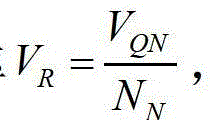
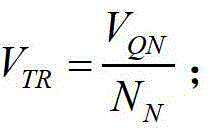
the node voltage holding capability investigation range in the given transient process is as follows: lower limit of voltage drop VLAnd duration VCCounting the number V of nodes meeting the acceptable range of the voltage level of all the nodes of the power grid in the transient processQNCalculating the qualification rate of the node voltage meeting the retention capacity in the transient process
Figure BDA00003086678000071
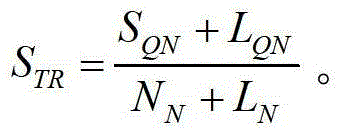
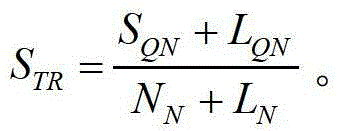
The method for obtaining the line thermal stability qualification rate in the power grid in the step S3 includes: and (3) giving a node static stability margin index and a line thermal stability investigation range in the transient process: node static margin limit SICLine thermal stability limit value LPRAnd duration TCCounting the number S of nodes of the power grid meeting the steady sustainable rangeQNNumber of lines L satisfying thermally stable sustainable rangeQNAnd calculating the qualification rate S of node stationarity and line heat stability in the transient processTR,STRThe calculation formula is as follows:
Figure BDA00003086678000072
in an eleventh preferred embodiment of the present invention: obtaining the power grid integral transient stability situation comprehensive index in the step S3 S TI = &alpha; 2 S T SEI + &beta; 2 V TR + &chi; 2 S TR ;
Wherein alpha is2、β2、χ2Weight coefficients of the power grid according to thermal stability constraint, operation electric quantity constraint and static stability constraintFlexibly configured according to experience or analytical requirements, alpha2、β2、χ2Satisfies the following conditions:
0 &le; &alpha; 2 &le; 1 0 &le; &beta; 2 &le; 1 0 &le; &chi; 2 &le; 1 0 &le; &alpha; 2 + &beta; 2 + &chi; 2 &le; 1
the response-based large power grid full-situation online integrated quantitative evaluation method provided by the invention has the beneficial effects that:
1. the response-based online integrated quantitative evaluation method for the full-situation of the large power grid can realize online integrated quantitative evaluation of the full-situation of two typical operation scenes, namely static and transient states of the large power grid aiming at real-time measurement of the current state of the power grid or various simulation data in an expected state. The situation assessment of the power grid in the current state is realized, the situation assessment of the envisioned state is realized by fully combining the advantages of the existing DSA envisioned simulation, and scheduling and operating personnel can know the current operating situation of the power grid and potential system risks of the power grid in time. And the method can also be indirectly applied to the post-stage intelligent evaluation of various off-line forecast modes or fault set time domain simulation data, so that the workload of planners or mode making personnel is greatly reduced. The core methods used by the method are all based on power grid response data, have strong independence, and the full situation assessment method and algorithm are direct and simple, can quickly identify weak nodes or weak areas of the power grid in any operation mode so as to be convenient for operation or planning personnel to refer, prevent the trouble in the bud, reduce or avoid voltage stabilization accidents, and are suitable for online engineering application. The invention can gradually transit the former 'modeling simulation' prevention and control mode to the 'track mining' response control mode, is an extension of the traditional power grid prevention and control idea and method, and can effectively improve the online intelligent evaluation and early warning level of the large power grid.
2. And the power grid topological structure relationship is obtained from the EMS system, so that the power grid full situation quantitative evaluation and statistical analysis are favorably carried out aiming at various response data in the later period.
3. From a response perspective, simple statistical analysis is performed directly from the qualifying range for the grid elements and voltage levels. And when the power angle stability and the voltage stability situation are quantitatively evaluated in the traditional sense, the static stability focuses on the power transmission capacity of the power grid, the transient stability focuses on the energy conservation, and the response-based online unified quantitative evaluation idea of the full situation of the large power grid is established.
4. And performing static stable form situation assessment aiming at any real-time measurement of a power grid or various expected fault form power flow sections, and improving comprehensive assessment efficiency by adopting a task parallel method when analyzing specific node stable situations or fault sets.
5. According to the current tide current distribution and topological relation, all nodes of the power grid count the actual circulating (or transferring) power of the nodes, the nodes are equivalent to a simplified single-power single-load simplified power transmission model on the basis, equivalent power transmission parameters are identified by adopting local measurement information in an online tracking mode, equivalent virtual model mapping of all the nodes of the power grid is realized, and a foundation is laid for next static stable situation evaluation.
6. And uniformly adopting an impedance model index capable of expressing the idea of maximum power transmission capacity to evaluate the static stability situation, and applying an impedance model method to an equivalent power transmission model of a generator branch, a power transmission line and a node. The impedance model method is suitable for online rapid calculation, and can effectively identify weak units, key lines and weak nodes in the current operation mode.
7. From the perspective of the qualified range of the thermal stability operation of the generator and the line, the thermal stability qualification rate of the power grid in the current operation mode is counted, the overload elements can be quickly and effectively screened, and the habit of visual evaluation of the conventional trend mode is also met.
8. The qualification rate of the electrical quantity in the current operation mode of the power grid is counted from the aspects of node voltage level and load node power factor, the qualification levels of the voltage and the power factor in the current operation mode can be quickly and effectively evaluated, and the electric energy quality assessment requirement of the conventional tide mode is met.
9. And (3) the static stable qualification rate statistics is realized by using the impedance model indexes facing to the node equivalent power transmission model and the line.
10. The comprehensive static-over-stable situation assessment from the component-level thermal stability, the qualified range of the operation amount to the system static stability is realized by fully combining the statistical result, and the weights of the three can be flexibly selected according to the actual operation state and the assessment focus point.
11. By means of the constructed node equivalent power transmission model and parameters thereof, the virtual reactive power required by the node to minimize the active power loss when the node currently circulates active power can be obtained, and then the reactive power compensation level evaluation of all nodes of the power grid in the current operation mode is realized
12. When transient stability margin and transient stability are estimated aiming at transient time domain process information, the dynamic behavior envelope of the disturbed most serious unit set is directly adopted to reflect the overall dynamic behavior of the power grid, processing such as clustering equivalence is not needed, the physical significance is clear and intuitive, and the accuracy of the estimation result is high.
13. In order to reduce the selection error of the most disturbed set pair, a relatively most disturbed set omega is selected from multiple angles, and then the most serious set pair is selected from the set omega, so that the misjudgment of the actual situation of the power grid caused by the selection error of the weakest set pair is reduced.
14. For the lead and lag unit groups in any set omega, transient stability margin index T of the unit group is obtained through simple algebraic calculation according to the electrical quantity information of each unit groupSIAnd T of the minimum unit pair in the set omegaSITransient stability margin index S as current time domain dataTSIAnd further realizing the quantitative evaluation of the transient stability margin of the current transient trajectory.
15. The characteristic of the equivalent power-angle function curve of the unit is fitted in a trigonometric function form to better reflect the transient transition trajectory of the power grid, and the energy-type transient stability pre-estimation index T can be conveniently calculated by means of the fitted curveSEIThe physical significance is clear and visual, and the T of the minimum unit pair in the set omega is usedSEITransient stability estimation index S as time domain data of this timeTEIAnd further realizing the quantitative estimation of the transient stability of the current transient trajectory.
16. By taking the reference of a transient voltage stability habitual judgment method, the node voltage holding capacity and the qualification rate level in a given transient process are measured by adopting a certain limit and duration of voltage drop.
17. The qualification rate S of node stationarity and line heat stability in the transient process is obtained by adopting a limit value + duration method and combining methods in the stationarityTRThe static stability margin of the node and the line load level condition in the given transient process are convenient to evaluate.
18. Full binding statisticsAs a result, the comprehensive transient stability situation evaluation index S from the power system energy conservation, the transient voltage holding capacity, the node static stability and the line thermal stability is realizedTIFlexibly selecting weights according to actual dynamic tracks and evaluation emphasis points, and calculating S corresponding to different faultsTIAnd realizing the sequencing of the severity of the faults, and improving the online analysis efficiency of the expected fault set STIThe method can effectively quantitatively evaluate the stable situation of various transient faults and is convenient for screening serious transient faults.
19. And performing transient stability situation analysis on a large number of expected faults in the transient fault set by adopting a task parallel method.
Drawings
Fig. 1 shows a data flow diagram for response-based online integrated quantitative evaluation of the full situation of a large power grid;
FIG. 2 is a diagram of the elements of the comprehensive index system provided by the present invention;
fig. 3 is a schematic diagram of a local node of a power grid according to the present invention;
fig. 4 is a schematic diagram of a node equivalent power transmission model provided by the present invention;
fig. 5 is a schematic diagram of a boundary impedance mode of maximum transmission power provided by the present invention;
fig. 6 is a schematic diagram illustrating the evaluation of node reactive compensation level provided by the present invention;
fig. 7 is a schematic diagram of a power grid unit pair provided by the present invention;
fig. 8 is a schematic diagram illustrating curve fitting of equivalent power angles of the unit provided by the present invention;
FIG. 9 is a schematic diagram of an energy-based transient stability estimation indicator according to the present invention;
fig. 10 shows a flow chart of response-based online integrated quantitative evaluation of the full situation of the large power grid.
Detailed Description
The following describes embodiments of the present invention in further detail with reference to the accompanying drawings.
The invention provides a response-based large power grid full-situation online integrated quantitative evaluation method, and provides a response-based large power grid full-situation online integrated quantitative evaluation data flow diagram as shown in fig. 1. As can be seen from fig. 1, the evaluation method includes:
and step S1, acquiring the power grid topological structure information from the SCADA system and the EMS system, and establishing a corresponding relation with the power grid element of the WAMS system.
Step S2, obtaining current operation mode power flow data of the power grid from the SCADA system, the EMS system or the WAMS system, or obtaining various anticipated power flow or transient fault time domain data from the DSA system.
And step S3, performing static stability situation evaluation on the power grid in an online node-oriented mode, and performing transient stability situation evaluation on the power grid in an online unit-oriented mode.
When a situation comprehensive evaluation index system is constructed, three factors of power grid element-level thermal stability, operation electric quantity qualification and system-level stability are comprehensively considered, and as shown in fig. 2, the element diagram of the comprehensive index system provided by the invention is provided.
Wherein, the content of carrying out the static stable situation aassessment to the electric wire netting includes: the method comprises the following steps of generating a generator stability margin index, a line stability margin index, a node stability margin index, a generator thermal stability qualification rate, a line thermal stability qualification rate, a node voltage qualification rate, a load node power factor qualification rate, a static stability situation comprehensive index and a node reactive compensation level index.
The content of transient stability situation assessment on the power grid comprises the following steps: transient stability margin index, transient stability estimation index, node voltage holding qualification rate, node stability margin index, line thermal stability qualification rate and transient stability situation comprehensive index.
Various power grid static response data comprise expected state offline power flow, calculation results after convergence of N-1 and N-2 power flows, state estimation results of a SCADA \ EMS system and PMU measurement information; the response data of various power grid transient transition processes comprise various expected transient fault set time domain simulation results and power grid disturbance process information measured by the WAMS in real time; carrying out rationality prejudgment or filtering processing on PMU measurement information according to previous time or peripheral PMU measurement data change; and (4) allocating the expected faults of N-1 and N-2 according to the number of the parallel machines.
When the static stability situation and the transient stability situation of the power grid are evaluated in step S3, all nodes of the power grid are distributed according to the number of parallel machines, as shown in fig. 3, which is a schematic diagram of a local node of the power grid provided by the present invention, and the nodes may be connected to various elements such as a generator, a load, a capacitor, and a line.
According to the power grid operation tide section information and in combination with the power grid topological structure, the equivalent transmission power P of each node is obtained according to the active flow directionE+jQEFig. 4 is a schematic diagram of a node equivalent power transmission model. The method for identifying tracking parameters based on local measurement is adopted to identify equivalent power transmission model parameters of each node of a power grid in the current state on line, and the equivalent power transmission model parameters mainly comprise equivalent power source potential EEEquivalent branch impedance mode ZEAnd the impedance angle alpha is used for realizing node equivalent power transmission model inverse mapping based on the current running state of the power grid.
In the method for obtaining the generator stability margin index, the line stability margin index, and the node stability margin index of the power grid in step S3, the method for obtaining the generator stability margin index, the line stability margin index, and the node stability margin index of the power grid uses the impedance mode index of the maximum transmission power concept shown in fig. 5 as a static stability margin index, and includes:
aiming at a generator branch, a tie line branch and a node respectively according to the thought of maximum transmission powerA point equivalent power transmission model is used for solving the static stability margin index S corresponding to the current operation mode of the generator branch, the tie line branch or the nodeLi,SLiThe calculation formula is as follows:
S Li = Z L - Z E Z L
ZLthe equivalent load impedance of the branch circuit, the connecting line or the node of the generator can be respectively represented and can be obtained according to the terminal voltage and the power. SLiThe load of each generator branch, power transmission line and the static stability margin of the node are measured, and the method can be used for positioning weak units, key lines and weak nodes.
Specifically, the static stability margin index S of all nodes is usedLiAveraging to obtain the average static stability margin index S of the power grid in the current operation modeAIThe calculation formula is as follows:
S AI = &Sigma; i = 1 N S Li N N
the method for obtaining the generator thermal stability qualification rate and the tie line thermal stability qualification rate of the power grid in the step S3 includes:
according to the self thermal stability operation constraint of each generator and the connecting line, the thermal stability qualification rate G of the generator is countedPRAnd line thermal stability yield LPRRespectively as follows: G PR = G QN G N ; L PR = L QN L N .
wherein G isN、LNThe total generator number, the total tie line number and G of the power gridQN、LQNThe number of the generators and the number of the connecting lines which meet the thermal stability constraint of the operation of each generator and the connecting lines.
The method for obtaining the node voltage qualification rate and the load node power factor qualification rate of the power grid in the step S3 includes:
according to the node voltage given by the normal operation mode of the power grid and the upper and lower limits of the qualified range of the power factor of the load node, the qualified rate of the node voltage of the power grid is counted
Figure BDA00003086678000115
Load node power factor qualification rate
Figure BDA00003086678000116
Wherein N isN、PFNRespectively the total node number and the load node number of the power grid, VQN、PQFNThe number of nodes satisfying the voltage range and the power factorNumber range of load nodes.
The method for obtaining the power grid static stability out-of-limit rate comprises the following steps:
setting SLiCertain early warning threshold value SLCCounting that all tie line branches and nodes (generator nodes, intermediate tie nodes and load nodes) of the power grid are equivalent to be greater than SLCRespectively calculating the steady qualification rate of the line
Figure BDA00003086678000117
Yield of node statically stable N SR = N CN N N ;
Wherein L isN、NNRespectively the number of system bus lines and the number of nodes, LCN、NCNAre each greater than SLCThe number of connections and the number of nodes.
The method for obtaining the comprehensive index of the overall static stable situation of the power grid in the step S3 comprises the following steps: integrated static stable situation index S of power gridI=α1HQR1RQR1SSR
Wherein alpha is1、β1、χ1The weight coefficients of the power grid according to thermal stability constraint, operation electric quantity constraint and static stability constraint can be flexibly configured according to experience or analysis requirements. Alpha is alpha1、β1、χ1The following conditions are satisfied:
0 &le; &alpha; 1 &le; 1 0 &le; &beta; 1 &le; 1 0 &le; &chi; 1 &le; 1 0 &le; &alpha; 1 + &beta; 1 + &chi; 1 &le; 1
HQRthe overall thermal stability qualification rate of the power grid HQRThe calculation formula is as follows:
Figure BDA00003086678000122
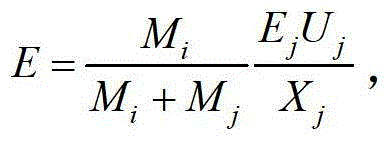
RQRfor the qualification rate of the electric quantity, R, of the whole operation of the power gridQRThe calculation formula is as follows:
Figure BDA00003086678000123
SSRthe qualification rate of the whole static stability of the power grid, SSRThe calculation formula is as follows:
Figure BDA00003086678000124
SSIcomprehensively measure the static stable situation level of the power grid in the current tidal current stateAnd effectively and quantitatively evaluating the static stable situation of various trend modes.
In step S3, the virtual reactive power variation method is used to obtain the reactive power required by the equivalent power transmission model when the corresponding active loss is minimum, a schematic diagram of node reactive power compensation level evaluation is shown in fig. 6, and the method for obtaining the reactive power compensation level index of each node in the current operation mode includes:
equivalent power transmission model combined with nodes and equivalent power transmission active power P thereofEThe circulation P under the node equivalent model can be calculatedECorresponding reactive value Q required for minimum active lossminThen compare QminEquivalent transmission reactive power Q with calculated nodeEAnd the reactive compensation shortage index Q of each node under the current operation mode can be obtainedIComprises the following steps:
Q I = Q E - Q min Q E
wherein Q isI>0 hour represents reactive under-compensation, QIWhen =0, Q represents the optimal reactive powerI<And 0 represents the power failure over-compensation.
In step S3, the method includes steps of obtaining time domain data of a power grid transient process trajectory from the WAMS system or various anticipated transient faults in a centralized manner, analyzing transient behavior of the power grid by directly using a method of a disturbed severe unit pair, and obtaining a transient stability margin index of the power grid, as shown in fig. 7, the method includes the following steps:
step S101, according to inertia time constant M of each generator, angular velocity omega, power angle delta and generator end bus voltage phase angleTheta and terminal electromagnetic active power PGEAnd (3) rapidly identifying the x generators which are interfered relatively most ahead and the x generators most behind according to the change conditions of the front moment and the rear moment, and forming a set omega which is interfered relatively most seriously.
The number x can be set manually according to requirements, and the range of x is more than or equal to 5 and less than or equal to 10.
Step S102, for any one of the lead and lag generator sets in the set omega, calculating a transient stability margin index between the generator set i and the generator set j
Wherein, deltaijRepresenting the power angle delta between genset i and genset jiAnd deltajDifference of (d)ij=δij
δseqAs a function P of the mechanical power between genset i and genset jMeqAnd electromagnetic active power PEeqThe cross point of (a) is a virtual stable balanced operating point, and delta is calculatedseqThe method of (1) comprises steps S1021 to S1023:
step S1021, the equivalent single-machine rotor inertia time constant between the generator set i and the generator set j isCalculating a mechanical power function between genset i and genset j
Figure BDA00003086678000133
Wherein M isiAnd MjInertia time constants, P, of generator set i and generator set j, respectivelyMiAnd PMjThe mechanical injection power of the generator set i and the generator set j and the mechanical injection power of the generator set
Figure BDA00003086678000134
Step S1022, calculating the electromagnetic active power between the generator set i and the generator set j P Eeq = M j M i + M j P Ei - M i M i + M j P Ej = P EM sin ( &delta; ij + C ) .
Wherein,
Figure BDA00003086678000136
A=Dcos(δji)+Ecos(δij),B=Dsin(δji)-Esin(δij),C=tan-1(B/A),
Figure BDA00003086678000137
Figure BDA00003086678000138
θiand thetajRespectively representing generator set i and generator set j terminal bus voltage phase angle Ui、Uj、θi、θj、Xi、XjAnd respectively representing the voltage amplitude, the phase angle and the equivalent internal reactance of the generator terminal buses of the generator set i and the generator set j.
Step S1023, calculating &delta; seq = a sin ( P Meq P EM ) - C .
Step S103, calculating the transient stability margin indexes T between any leading generator set i and any lagging generator set j in the set omega in sequenceSIijWith minimum unit pair TSIijTransient stability margin index S as current time domain dataTSII.e. STSI=min{TSIijI, j ∈ Ω }. S by minimum unit pairTSIThe positioning of the weak unit can be realized.
The method for obtaining the transient stability estimation index of the power grid in the step S3 includes: for any lead and lag generator set pair in the set omega, according to the calculated equivalent mechanical power P of the generator set pairMeqAnd electromagnetic active power PEeqAnd (3) changing the trajectory, constructing a transient stability prediction index from an energy angle by using a curve fitting technology, and obtaining a curve fitting diagram of equivalent power angles of the unit as shown in fig. 8. The method for obtaining the transient stability estimation index of the power grid specifically comprises the following steps of S201-S203:
step S201, the generator set is paired with an equivalent mechanical power PMeqIn the transient process, the equivalent electromagnetic active power P of the generator set can be assumed to be unchangedEeqThe varying trajectory may be fitted with a sine function as follows: y is x0sin(δij+x1)+x2
Wherein x is0,x1,x2For the fitted sine function coefficient to be solved, y represents the equivalent P of the generator groupEeq
Step S202, calculating transient stability estimation index T between generator set i and generator set jSEIijComprising the steps of S2021-S2023:
step S2021, according to PEeqChanging the trajectory fitting function y to obtain the unstable equilibrium point delta after fault removaliju,δijuThe calculation formula is as follows: &delta; iju = &pi; - arctan P Meq - x 2 x 0 - x 1 .
step S2022, transient kinetic energy (acceleration area) V of the unit set at the time of fault removalTAComprises the following steps:
V TA = &Integral; &delta; ij 0 &delta; ijc [ P Meq - x 0 sin ( &delta; ij + x 1 ) - x 2 ] d &delta; ij
= ( P Meq - x 2 ) ( &delta; ijc - &delta; ij 0 ) + x 0 [ cos ( &delta; ijc + x 1 ) - cos ( &delta; ij 0 + x 1 ) ]
critical potential energy (deceleration area) V absorbed by the system after fault removalTBComprises the following steps:
V TB = &Integral; &delta; ijc &delta;iju [ x 0 sin ( &delta; ij + x 1 ) + x 2 - P Meq ] d &delta; ij
= ( x 2 - P Meq ) ( &delta; iju - &delta; ijc ) - x 0 [ cos ( &delta; iju + x 1 ) - cos ( &delta; ijc + x 1 ) ]
wherein, deltaij0And deltaijcAnd respectively representing the power angle difference of the unit at the fault occurrence time and the fault removal time.
Step S2023, as shown in the schematic diagram of energy-type transient stability estimation indicator shown in fig. 9, calculate the transient stability estimation indicator T between the generator set i and the generator set jSEIij
Wherein, TSEIijThe transient stability of the index is defined as follows, TSEIij>0 transient stability, TSEIijCritical transient stability of =0, TSEIij<0, transient instability.
Step S203, calculating T of any lead and lag unit pair in the set omega in sequenceSEIijWith minimum unit pair TSEIijTransient stability estimation index S as time domain data of this timeTEI,STEIThe calculation formula is as follows: sTEI=min{TSEIij,i,j∈Ω}。
The method for obtaining the power grid node voltage holding qualification rate in the step S3 includes:
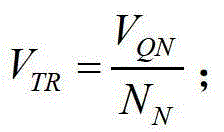
the node voltage holding capability inspection range (voltage drop lower limit V) in the transient process is givenLAnd duration VC) Counting the number V of nodes meeting the acceptable range of the voltage level of all the nodes of the power grid in the transient processQNAnd calculating the qualification rate V of the node voltage meeting the retention capacity in the transient processTR,VTRThe calculation formula is as follows:
the method for obtaining the line thermal stability qualification rate in the power grid in the step S3 comprises the following steps: and (3) giving a node static stability margin index and a line thermal stability investigation range in the transient process: node static margin limit SICLine thermal stability limit value LPRAnd duration TCCounting the number S of nodes of the power grid meeting the steady sustainable rangeQNNumber of lines L satisfying thermally stable sustainable rangeQNCalculating the transient statePass rate S of node static stability and line thermal stability in processTR,STRThe calculation formula is as follows:
Figure BDA00003086678000148
step S3 is carried out to obtain the comprehensive index S of the integral transient stability situation of the power gridTI=α2STEi2VTR2STR
Wherein alpha is2、β2、χ2The weight coefficients of the power grid according to thermal stability constraint, operation electric quantity constraint and static stability constraint can be flexibly configured according to experience or analysis requirements. Alpha is alpha2、β2、χ2The following conditions are satisfied:
0 &le; &alpha; 2 &le; 1 0 &le; &beta; 2 &le; 1 0 &le; &chi; 2 &le; 1 0 &le; &alpha; 2 + &beta; 2 + &chi; 2 &le; 1
STIthe power grid transient stability situation level of the current transient process information can be comprehensively measured, and the stability situations of various transient faults can be effectively quantitatively evaluated.
Finally, it should be noted that: the above embodiments are only for illustrating the technical solutions of the present invention and not for limiting the same, and although the present invention is described in detail with reference to the above embodiments, those of ordinary skill in the art should understand that: modifications and equivalents may be made to the embodiments of the invention without departing from the spirit and scope of the invention, which is to be covered by the claims.

Claims (12)
1. A response-based large power grid full-situation online integrated quantitative evaluation method is characterized by comprising the following steps:
step S1, acquiring power grid topological structure information from the SCADA system and the EMS system, and establishing a corresponding relation with power grid elements of the WAMS system;
step S2, obtaining the current operation mode power flow data of the power grid from the SCADA system, the EMS system or the WAMS system or obtaining various anticipated power flow or transient fault time domain data from the DSA system;
step S3, performing static stability situation evaluation on the power grid in an online node-oriented mode, and performing transient stability situation evaluation on the power grid in an online unit-oriented mode;
wherein, the content of carrying out the static stable situation aassessment to the electric wire netting includes: the method comprises the following steps of (1) generating a generator stability margin index, a line stability margin index, a node stability margin index, a generator thermal stability qualification rate, a line thermal stability qualification rate, a node voltage qualification rate, a load node power factor qualification rate, a static stability situation comprehensive index and a node reactive power compensation level index;
the content of transient stability situation assessment on the power grid comprises the following steps: transient stability margin index, transient stability estimation index, node voltage holding qualification rate, node stability margin index, line thermal stability qualification rate and transient stability situation comprehensive index.
2. The method of claim 1, wherein the various power grid static response data include expected state offline power flow, calculation results after convergence of N-1 and N-2 power flows, SCADA \ EMS system state estimation results, and PMU measurement information;
the response data of various power grid transient transition processes comprise various expected transient fault set time domain simulation results and power grid disturbance process information measured by the WAMS in real time;
carrying out rationality prejudgment or filtering processing on PMU measurement information according to previous time or peripheral PMU measurement data change;
and (4) allocating the expected faults of N-1 and N-2 according to the number of the parallel machines.
3. The method according to claim 1, wherein in the step S3, when the static stability situation and the transient stability situation of the power grid are evaluated, all nodes of the power grid are distributed according to the number of parallel machines;
according to the power grid operation tide section information and in combination with the power grid topological structure, the equivalent transmission power P of each node is obtained according to the active flow directionE+jQE
Tracking parameter identification method based on local measurementIdentifying equivalent power transmission model parameters of each node of the power grid in the current state on line, wherein the equivalent power transmission model parameters comprise equivalent power source potential EEEquivalent branch impedance mode ZEAnd the impedance angle alpha is used for realizing node equivalent power transmission model inverse mapping based on the current running state of the power grid.
4. The method of claim 3, wherein the generator stability margin indicator, the line stability margin indicator and the node stability margin indicator of the power grid obtained in the step S3 are obtained by:
according to the maximum transmission power thought, aiming at equivalent transmission models of a generator branch, a tie line branch and a node, respectively, the static stability margin index S corresponding to the current operation mode of the generator branch, the tie line branch or the node is obtainedLi,SLiThe calculation formula is as follows: S Li = Z L - Z E Z L ;
wherein ZLAnd the equivalent load impedance representing the branch circuit, the connecting line or the node of the generator is obtained according to the terminal voltage and the power.
5. The method of claim 3, wherein the step S3 of obtaining the generator and tie line thermal stability qualification rates of the power grid comprises:
according to the self thermal stability operation constraint of each generator and the connecting line, the thermal stability qualification rate G of the generator is countedPRAnd line thermal stability yield LPRRespectively as follows: G PR = G QN G N ; L PR = L QN L N ;
wherein G isN、LNThe total generator number, the total tie line number and G of the power gridQN、LQNThe number of the generators and the number of the connecting lines which meet the respective operation thermal stability constraint are respectively;
the method for obtaining the node voltage qualification rate and the load node power factor qualification rate of the power grid in the step S3 includes:
according to the node voltage given by the normal operation mode of the power grid and the upper and lower limits of the qualified range of the power factor of the load node, the qualified rate of the node voltage of the power grid is countedLoad node power factor qualification rate
Figure FDA00003086677900025
Wherein N isN、PFNRespectively the total node number and the load node number of the power grid, VQN、PQFNThe number of nodes meeting the voltage range and the number of load nodes meeting the power factor range are respectively;
the method for obtaining the power grid static stability out-of-limit rate comprises the following steps:
setting SLiCertain early warning threshold value SLCCounting that all tie line branches and node equivalent branches of the power grid are greater than SLCThe nodes comprise a generator node, a middle contact node and a load node, and the static stability qualification rate of the line is respectively calculated
Figure FDA00003086677900026
Yield of node statically stable N SR = N CN N N ;
Wherein L isN、NNRespectively the number of system bus lines and the number of nodes, LCN、NCNAre each greater than SLCThe number of connections and the number of nodes.
6. The method according to claim 5, wherein the step S3 of obtaining the comprehensive index of the overall static stable situation of the power grid comprises:
integrated static stable situation index S of power gridSI=α1HQR1RQR1SSR
Wherein alpha is1、β1、χ1The weight coefficients of the power grid according to thermal stability constraint, operation electric quantity constraint and static stability constraint are flexibly configured according to experience or analysis requirements, and alpha is1、β1、χ1Satisfies the following conditions:
0 &le; &alpha; 1 &le; 1 0 &le; &beta; 1 &le; 1 0 &le; &chi; 1 &le; 1 0 &le; &alpha; 1 + &beta; 1 + &chi; 1 &le; 1
HQRthe overall thermal stability qualification rate of the power grid HQRThe calculation formula is as follows:
Figure FDA00003086677900032
RQRfor the qualification rate of the electric quantity, R, of the whole operation of the power gridQRThe calculation formula is as follows:
Figure FDA00003086677900033
SSRthe qualification rate of the whole static stability of the power grid, SSRThe calculation formula is as follows:
Figure FDA00003086677900034
7. the method according to claim 3, wherein the step S3 of obtaining the reactive power required for minimizing the corresponding active loss of the equivalent power transmission model by using the virtual reactive power variation method comprises the following steps:
combining the equivalent power transmission model of each node and the equivalent power transmission active power P thereofEAnd calculating the circulation P under the node equivalent modelECorresponding reactive value Q required for minimum active lossminThen is aligned withTo said QminEquivalent transmission reactive power Q with the obtained nodeEAnd solving the reactive compensation shortage index Q under the current operation mode of each nodeIComprises the following steps:
Q I = Q E - Q min Q E
wherein Q isI>0 hour represents reactive under-compensation, QIWhen =0, Q represents the optimal reactive powerI<And 0 represents the power failure over-compensation.
8. The method according to claim 3, wherein the step S3 of obtaining time domain data of the transient process trajectory of the power grid from the WAMS system or various expected transient fault sets, and directly enveloping the transient behavior analysis of the power grid by using a method of a disturbed severe unit group to obtain the transient stability margin index of the power grid comprises the steps S101-S103:
step S101, according to inertia time constant M of each generator, angular speed omega, power angle delta, terminal bus voltage phase angle theta and terminal electromagnetic active power PGEQuickly identifying the x power generators which are interfered relatively most ahead and the x power generators most behind according to the change conditions of the front time and the rear time to form a relatively most serious unit set omega;
the number x can be set manually according to needs, and the range of x is more than or equal to 5 and less than or equal to 10;
step S102, for any one of the lead and lag generator sets in the set omega, calculating a transient stability margin index between the generator set i and the generator set j
Wherein, deltaijRepresenting a power angle delta between the generator set i and the generator set jiAnd deltajDifference of (d)ij=δij;δseqAs a function P of the mechanical power between the generator sets i and jMeqAnd electromagnetic active power PEeqThe intersection point of the two points is a virtual stable balance operation point;
step S103, calculating the transient stability margin indexes T between any leading generator set i and any lagging generator set j in the set omega in sequenceSIijWith minimum unit pair TSIijTransient stability margin index S as current time domain dataTSII.e. STSI=min{TSIij,i,j∈Ω}。
9. The method of claim 8, wherein the δ is calculatedseqThe method of (1) comprises steps S1021 to S1023:
step S1021, the equivalent single-machine rotor inertia time constant between the generator set i and the generator set j is
Figure FDA00003086677900041
Calculating a mechanical power function between the generator set i and the generator set j P Meq = M j M i + M j P Mi - M i M i + M j P Mj ;
Wherein M isiAnd MjThe inertia time constants, P, of the generator set i and the generator set j respectivelyMiAnd PMjThe mechanical injection power of the generator set i and the generator set j and the mechanical injection power of the generator set
Figure FDA00003086677900043
Step S1022, calculating the electromagnetic active power between the generator set i and the generator set j P Eeq = M j M i + M j P Ei - M i M i + M j P Ej = P EM sin ( &delta; ij + C ) ;
Wherein,
Figure FDA00003086677900045
A=Dcos(δji)+Ecos(δij),B=Dsin(δji)-Esin(δij),C=tan-1(B/A), Ui、Uj、θi、θj、Xi、Xjrespectively representing the voltage amplitude, the phase angle and the equivalent internal reactance of generator terminal buses of a generator set i and a generator set j;
step S1023, calculating &delta; seq = a sin ( P Meq P EM ) - C .
10. The method of claim 8, wherein the equivalent mechanical power P is calculated as a function of the calculated crew to equivalent mechanical power P for any pair of lead and lag crew within the set ΩMeqAnd electromagnetic active power PEeqChanging the trajectory, constructing a transient stability estimation index from an energy angle by using a curve fitting technology, and specifically comprising the following steps of S201-S203:
step S201, the generator set is assumed to generate equivalent mechanical power PMeqThe equivalent electromagnetic active power P of the generator group is not changed in the transient processEeqThe varying trajectory was fitted with a sine function as follows: y is x0sin(δij+x1)+x2
Wherein x is0,x1,x2For the fitted sine function coefficient to be solved, y represents the equivalent P of the generator groupEeq
Step S202, calculating transient stability estimation index T between the generator set i and the generator set jSEIij
Step S203, calculating T of any lead and lag unit pair in the set omega in sequenceSEIijWith minimum unit pair TSEIijTransient stability estimation index S as time domain data of this timeTEI,STEI=min{TSEIij,i,j∈Ω};
The step S202 of calculating the transient stability estimation indicator between the generator set i and the generator set j includes steps S2021 to S2023:
step S2021, according to PEeqChanging the trajectory fitting function y to obtain the unstable equilibrium point delta after fault removalijuThe unstable balance point is equivalent mechanical power P of the generator setMeqAnd electromagnetic active power PEeqIntersection of the varying trajectories, δijuThe calculation formula is as follows: &delta; iju = &pi; - arctan P Meq - x 2 x 0 - x 1 ;
step S2022, transient kinetic energy V of unit set at fault clearing timeTAComprises the following steps:
V TA = &Integral; &delta; ij 0 &delta; ijc [ P Meq - x 0 sin ( &delta; ij + x 1 ) - x 2 ] d &delta; ij
= ( P Meq - x 2 ) ( &delta; ijc - &delta; ij 0 ) + x 0 [ cos ( &delta; ijc + x 1 ) - cos ( &delta; ij 0 + x 1 ) ] A
critical potential energy (deceleration area) V absorbed by the system after fault removalTBComprises the following steps:
V TB = &Integral; &delta; ijc &delta;iju [ x 0 sin ( &delta; ij + x 1 ) + x 2 - P Meq ] d &delta; ij
= ( x 2 - P Meq ) ( &delta; iju - &delta; ijc ) - x 0 [ cos ( &delta; iju + x 1 ) - cos ( &delta; ijc + x 1 ) ]
wherein, deltaij0And deltaijcRespectively representing the power angle difference of the unit at the fault occurrence time and the fault removal time;
step S2023, calculating the transient stability estimation index T between the generator set i and the generator set jSEIij T SEIij = 1 - V TA V TB ;
Wherein, TSEIijThe transient stability of the index has the following significance: t isSEIij>0 transient stability, TSEIijCritical transient stability of =0, TSEIij<0, transient instability.
11. The method of claim 10, wherein the step S3 of obtaining the grid node voltage holding yield includes:
the node voltage holding capability investigation range in the given transient process is as follows: lower limit of voltage drop VLAnd duration VCCounting the number V of nodes meeting the acceptable range of the voltage level of all the nodes of the power grid in the transient processQNCalculating the qualification rate of the node voltage meeting the retention capacity in the transient process
Figure FDA00003086677900057
The method for obtaining the line thermal stability qualification rate in the power grid in the step S3 includes: and (3) giving a node static stability margin index and a line thermal stability investigation range in the transient process: node static margin limit SICLine thermal stability limit value LPRAnd duration TCCounting the number S of nodes of the power grid meeting the steady sustainable rangeQNNumber of lines L satisfying thermally stable sustainable rangeQNCalculatingThe qualification rate S of node static stability and line thermal stability in the transient processTR,STRThe calculation formula is as follows:
Figure FDA00003086677900058
12. the method according to claim 11, wherein the step S3 is performed to obtain a comprehensive index S of transient stability situation of the whole power gridTI=α2STEi2VTR2STR
Wherein alpha is2、β2、χ2The weight coefficients of the power grid according to thermal stability constraint, operation electric quantity constraint and static stability constraint are flexibly configured according to experience or analysis requirements, and alpha is2、β2、χ2Satisfies the following conditions:
0 &le; &alpha; 2 &le; 1 0 &le; &beta; 2 &le; 1 0 &le; &chi; 2 &le; 1 0 &le; &alpha; 2 + &beta; 2 + &chi; 2 &le; 1 .
CN201310142071.0A 2013-04-23 2013-04-23 Large power grid overall situation on-line integrated quantitative evaluation method based on response Active CN103279638B (en)

Priority Applications (2)

Application Number Priority Date Filing Date Title
CN201310142071.0A CN103279638B (en) 2013-04-23 2013-04-23 Large power grid overall situation on-line integrated quantitative evaluation method based on response
PCT/CN2013/088404 WO2014173131A1 (en) 2013-04-23 2013-12-03 Large power grid overall situation on-line integrated quantitative evaluation method based on response

Applications Claiming Priority (1)

Application Number Priority Date Filing Date Title
CN201310142071.0A CN103279638B (en) 2013-04-23 2013-04-23 Large power grid overall situation on-line integrated quantitative evaluation method based on response

Publications (2)

Publication Number Publication Date
CN103279638A true CN103279638A (en) 2013-09-04
CN103279638B CN103279638B (en) 2017-02-08

Family

ID=49062153

Family Applications (1)

Application Number Title Priority Date Filing Date
CN201310142071.0A Active CN103279638B (en) 2013-04-23 2013-04-23 Large power grid overall situation on-line integrated quantitative evaluation method based on response

Country Status (2)

Country Link
CN (1) CN103279638B (en)
WO (1) WO2014173131A1 (en)

Cited By (21)

* Cited by examiner, † Cited by third party
Publication number Priority date Publication date Assignee Title
CN103997041A (en) * 2013-11-13 2014-08-20 国家电网公司 On-line voltage stability determination system of alternating current and direct current mixing connection system
WO2014173131A1 (en) * 2013-04-23 2014-10-30 国家电网公司 Large power grid overall situation on-line integrated quantitative evaluation method based on response
CN104156543A (en) * 2014-08-28 2014-11-19 国家电网公司 Major power grid failure successive on-off disturbance setting method for whole-process simulation
CN105098763A (en) * 2014-05-16 2015-11-25 国家电网公司 Transient voltage stable on-line assessment method based on WAMS and EMS
US9829880B2 (en) 2014-11-20 2017-11-28 General Electric Company System and method for modelling load in an electrical power network
CN108268670A (en) * 2016-12-30 2018-07-10 中国电力科学研究院 A kind of stabilization of power grids method for situation assessment for not depending on system disturbance track and system
CN108400588A (en) * 2018-03-06 2018-08-14 竺炜 A kind of acquisition methods of major network safety on line situation and operating experience
CN108471147A (en) * 2018-03-30 2018-08-31 天津大学 The Dynamic Security Region optimization algorithm of the wind turbine containing double-fed
CN109004679A (en) * 2018-09-06 2018-12-14 国网安徽省电力有限公司芜湖供电公司 A kind of method for monitoring safety and stability of electric network of renewable energy access
CN109034653A (en) * 2018-08-16 2018-12-18 广东电网有限责任公司 A kind of power source planning schemes synthesis evaluation method
CN109301842A (en) * 2018-10-23 2019-02-01 国网吉林省电力有限公司 A method for removing subsynchronous oscillations in wind farms based on negative damping contribution
CN109412147A (en) * 2018-10-17 2019-03-01 中国电力科学研究院有限公司 The method and system of the power grid weakness section after multiple failure is envisioned in a kind of identification
CN109473996A (en) * 2018-11-30 2019-03-15 中国电力科学研究院有限公司 A method and system for obtaining stability margin of transmission section in planning mode
CN109885361A (en) * 2017-12-26 2019-06-14 广东电网有限责任公司电力调度控制中心 A kind of set state statistics timing diagram visual presentation method
CN110059356A (en) * 2019-03-18 2019-07-26 中国电力科学研究院有限公司 A kind of bulk power grid intelligent control system and method based on big data and artificial intelligence
CN111125880A (en) * 2019-11-25 2020-05-08 国网四川省电力公司电力科学研究院 A method for generating power system simulation data from the perspective of transient stability
US11169189B2 (en) 2017-04-10 2021-11-09 General Electric Company Systems and methods for operating generators based on generator steady state stability limits
CN113837625A (en) * 2021-09-27 2021-12-24 内蒙古电力(集团)有限责任公司电力调度控制分公司 Method, device and equipment for quantitatively evaluating risks of cascading failures of power grid
CN114239262A (en) * 2021-12-13 2022-03-25 广东电网有限责任公司 500kV single-phase autotransformer replacement operation evaluation method and system
CN114784873A (en) * 2022-05-23 2022-07-22 国网浙江省电力有限公司经济技术研究院 Method and device for quantifying and optimizing power grid strength of multi-feed-in system containing direct-drive wind power
CN117952441A (en) * 2024-03-27 2024-04-30 国网上海市电力公司 A situation awareness method for integrated energy systems

Families Citing this family (106)

* Cited by examiner, † Cited by third party
Publication number Priority date Publication date Assignee Title
CN106777597A (en) * 2016-12-01 2017-05-31 国家电网公司 A kind of channel-style electromagnetic looped network unlinks criterion method
CN106777701B (en) * 2016-12-19 2023-11-14 中国电力科学研究院 Simulation analysis method for phase-shifting transformer applied to multiple scenes
CN108268671A (en) * 2016-12-30 2018-07-10 中国电力科学研究院 A kind of safety on line analysis model quality testing system and its evaluation method
CN107503805B (en) * 2017-07-25 2023-06-30 杭州华电半山发电有限公司 Economic index analysis method based on F-level single-shaft gas-steam combined cycle generator set
CN107895947B (en) * 2017-12-20 2023-07-07 广东电网有限责任公司惠州供电局 A Method for Identification of Vulnerable Lines in Distribution Network
CN108256178A (en) * 2017-12-29 2018-07-06 国网天津市电力公司电力科学研究院 A kind of closed loop network electric current on-line calculation method
CN109711563A (en) * 2018-12-06 2019-05-03 安徽凯川电力保护设备有限公司 A kind of operating status appraisal procedure for power equipment
CN110083644B (en) * 2019-03-04 2023-04-28 广东电网有限责任公司 A method and system for early warning of major power outages in distribution network lines
CN110020506B (en) * 2019-03-08 2023-04-07 东南大学 Differential format selection method based on operation optimization of electric heating type comprehensive energy system
CN109934284A (en) * 2019-03-11 2019-06-25 长沙理工大学 A method for generating interactive characteristics of load safety domain of integrated energy system based on fault coupling propagation process
CN109858842B (en) * 2019-03-19 2023-08-08 广东电网有限责任公司 Regional power grid loop closing feasibility assessment method, device and equipment
CN110165664B (en) * 2019-05-14 2023-01-03 武汉理工大学 Decision method for segmented investment construction of distributed power flow controller
CN110276558A (en) * 2019-06-27 2019-09-24 广东电网有限责任公司 A kind of maintaining method of power grid, system and computer readable storage medium
CN110429583B (en) * 2019-07-08 2023-01-31 三峡大学 An Optimal Configuration Method of Traveling Wave Location Unit in Regional Power Network Based on Virtual Fault Domain
CN110598970A (en) * 2019-07-24 2019-12-20 中国电力科学研究院有限公司 Evaluation method and device for historical operating state of power grid
CN110489729B (en) * 2019-08-08 2022-12-06 国网湖南省电力有限公司 D5000-matpower automatic conversion method and system for multi-disaster coupling cascading failure model of power grid
CN110460116B (en) * 2019-08-29 2022-08-19 国电南瑞科技股份有限公司 Method and system for participating in transient power angle stabilization emergency control by new energy
CN110555786B (en) * 2019-09-10 2023-08-11 国网安徽省电力公司滁州供电公司 Evaluation method of power grid network source carrying capacity based on data-driven and scenario analysis
CN110739728B (en) * 2019-11-30 2024-10-01 中国南方电网有限责任公司 A method for determining the operation mode of power grid units based on the inertia power ratio of the units
CN111242420B (en) * 2019-12-30 2023-11-28 湖南大学 A comprehensive performance multi-dimensional evaluation method
CN111242802A (en) * 2019-12-31 2020-06-05 国网北京市电力公司 Method and apparatus for evaluating power supply capability
CN111276967B (en) * 2020-02-20 2022-07-01 中国电力科学研究院有限公司 Elasticity capability evaluation method and device of power system
CN111476455A (en) * 2020-03-03 2020-07-31 中国南方电网有限责任公司 Power grid operation section feature selection and online generation method based on two-stage structure
CN111369388B (en) * 2020-03-09 2024-01-26 华北电力大学 Anti-vulnerability assessment method and system for urban power grid
CN113406537B (en) * 2020-03-16 2024-05-07 上海长庚信息技术股份有限公司 Quantitative evaluation method for fault degree of power equipment
CN111488695A (en) * 2020-04-16 2020-08-04 中国南方电网有限责任公司 Optimal probability setting calculation method for power grid line protection
CN111523245B (en) * 2020-04-30 2023-08-01 广东电网有限责任公司东莞供电局 Method, device and equipment for establishing high-voltage distribution network short-circuit current calculation model
CN116561573A (en) * 2020-05-19 2023-08-08 三峡大学 A cyclic split training method of training set for voltage stability evaluation
CN111680894B (en) * 2020-05-26 2023-04-07 国网宁夏电力有限公司 Power grid safety and stability evaluation method, device and system
CN111651878B (en) * 2020-05-28 2023-05-23 山东大学 Large power grid static voltage stability optimization decision-making method and system considering situation assessment
CN111628501B (en) * 2020-06-18 2023-04-18 国网山东省电力公司济南供电公司 AC/DC large power grid transient voltage stability assessment method and system
CN111967736A (en) * 2020-07-30 2020-11-20 许继集团有限公司 Transformer substation load shedding control method and system based on big data platform
CN111985068B (en) * 2020-08-10 2022-07-12 国网湖北省电力有限公司电力科学研究院 PI link-based generator state initialization method for EMTDC/PSCAD simulation environment
CN111934317B (en) * 2020-08-11 2024-06-14 广东电网有限责任公司 A method for optimizing the power grid bottom line in key areas under severe typhoon conditions
CN112115582A (en) * 2020-08-14 2020-12-22 国网宁夏电力有限公司中卫供电公司 Method, medium and system for evaluating influence of voltage sag on coal-to-liquid production line
CN112234598B (en) * 2020-08-28 2024-04-23 国网天津市电力公司电力科学研究院 A method for initializing electromagnetic transient simulation
CN112072715B (en) * 2020-09-17 2022-06-24 国电南瑞科技股份有限公司 Method and device for determining new energy acceptance of power grid in consideration of transient voltage constraint
CN112329231B (en) * 2020-11-03 2024-05-31 江苏省电力试验研究院有限公司 A voltage elasticity assessment method for AC/DC hybrid receiving-end power grid
CN112436502B (en) * 2020-11-19 2022-06-24 华北电力大学(保定) A DC Grid Voltage Stability Control Method Based on Transient Electricity
CN112434936B (en) * 2020-11-23 2023-07-25 湖南大学 Power system inertia security domain assessment method, system and readable storage medium
CN112600260B (en) * 2020-12-21 2024-08-23 国网上海市电力公司 Method and equipment for optimizing unit regulation coefficient based on transient voltage sensitivity sorting
CN112668875B (en) * 2020-12-25 2024-05-28 国家电网公司东北分部 Evaluation method of maximum power receiving ratio of multi-channel power receiving system based on reactive power margin
CN112784475B (en) * 2020-12-28 2023-08-18 云南电网有限责任公司瑞丽供电局 Multi-agent technology-based multi-stage voltage coordination control method for power distribution network
CN112819648B (en) * 2020-12-29 2024-02-13 湖南大学 Power dispatching operation instruction safety verification method and system
CN112751418A (en) * 2020-12-31 2021-05-04 国网山东省电力公司青岛供电公司 Intelligent power distribution network regional situation element sensing method and system
CN112800683B (en) * 2021-03-10 2023-02-07 广东电网有限责任公司电力调度控制中心 System short-circuit current level evaluation method and system based on convolutional neural network
CN113193598B (en) * 2021-05-31 2022-09-30 重庆大学 New energy grid-connected inverter transient stability margin evaluation method
CN113221375B (en) * 2021-05-31 2023-08-04 山东建筑大学 Power system simulation method considering line icing and insulator flashover
CN113381432B (en) * 2021-06-01 2022-07-08 国网山东省电力公司电力科学研究院 Method for evaluating influence of synchronous phase modulator fault on extra-high voltage direct current transmission
CN113392536B (en) * 2021-06-30 2024-01-30 中国南方电网有限责任公司 Power communication network simulation evaluation method, device, computer equipment and medium
CN113708368A (en) * 2021-08-25 2021-11-26 华东交通大学 Smart power grid transient stability control method based on bee-congestion algorithm
CN113705138A (en) * 2021-08-30 2021-11-26 国网上海市电力公司 Online safety assessment method for large-scale alternating current and direct current power grid
CN113725877B (en) * 2021-08-30 2024-01-30 国网江苏省电力有限公司 Regional autonomous power grid mode guarantee reliable power supply economy evaluation analysis method
CN113746104B (en) * 2021-09-02 2023-08-22 云南电网有限责任公司 Power distribution network coordination control method and system for diesel storage power supply mode
CN113629733B (en) * 2021-09-13 2024-10-01 国网辽宁省电力有限公司经济技术研究院 A fast frequency response reserve capacity planning method considering risk preference
CN113937762B (en) * 2021-10-12 2023-06-27 湖南大学 Micro-grid transient stability evaluation method based on long-short-term memory network
CN114142456B (en) * 2021-10-19 2024-07-02 国网内蒙古东部电力有限公司经济技术研究院 Extra-high voltage alternating current/direct current power grid stability homogenization assessment method
CN113988558B (en) * 2021-10-20 2022-08-19 山东大学 Power grid dynamic security assessment method based on blind area identification and electric coordinate system expansion
CN114172165B (en) * 2021-12-06 2023-10-20 国网浙江省电力有限公司舟山供电公司 Distribution network loss reduction method based on configuring SVG in the scenario of cables entering the ground
CN114219264B (en) * 2021-12-09 2025-09-23 国网上海市电力公司 A power emergency online deduction optimization method and system based on EMD method
CN114243711B (en) * 2021-12-23 2022-11-08 福州大学 Large-scale power grid voltage sag evaluation method based on change branch influence domain
CN114614470B (en) * 2022-01-10 2024-09-24 国网内蒙古东部电力有限公司检修分公司 Operation control method of UHV AC/DC power grid based on parameter identification
CN114662651B (en) * 2022-01-24 2025-04-11 贵州大学 Two-stage transient stability prediction method based on improved convolutional residual memory network and gated recurrent unit
CN114493258A (en) * 2022-01-25 2022-05-13 南京东博智慧能源研究院有限公司 A power grid carbon footprint tracking method based on electrical dissection
CN115099545B (en) * 2022-02-24 2025-03-04 上海电力大学 A method for evaluating the operating health status of medium voltage distribution networks
CN114611889B (en) * 2022-02-25 2025-04-04 河南九域恩湃电力技术有限公司 Reliability estimation method for grid-connected power supply coordination performance
CN114881390B (en) * 2022-03-03 2024-05-14 国网湖北省电力有限公司电力科学研究院 Substation main wiring risk assessment method considering power grid security constraint
CN114937994B (en) * 2022-03-24 2024-06-25 南瑞集团有限公司 A method and device for controlling the stability of an AC/DC hybrid power grid after DC blocking
CN114725931B (en) * 2022-04-07 2024-10-22 湖南大学 A method for coal-fired power plant retirement and phase-converter configuration considering grid support capacity constraints
CN114741660B (en) * 2022-04-28 2024-10-25 国网浙江省电力有限公司 Method, system, device and storage medium for calculating DC carrying capacity of receiving power grid
CN114825337A (en) * 2022-05-15 2022-07-29 国网山东省电力公司营销服务中心(计量中心) Power grid distributed voltage control distributed power supply optimization system
CN115048857B (en) * 2022-05-24 2025-06-13 大连理工大学 A method for determining the temporary stable limit transmission power based on CNN
CN115081313B (en) * 2022-06-01 2024-10-11 东南大学溧阳研究院 A dynamic reactive power demand assessment method for weak grid areas considering large-scale wind power access
CN114971063B (en) * 2022-06-13 2024-07-05 浙江大学 A frequency selection method for multi-terminal low-frequency interconnection system in urban power supply area
CN115081857B (en) * 2022-06-15 2024-05-31 国网湖南省电力有限公司 Calculation method for maximum AC external power receiving capability of UHV DC receiving-end power grid
CN115310586A (en) * 2022-07-05 2022-11-08 武汉大学 Method and system for predicting operation situation of active power distribution network information physical system aiming at network attack
CN115333124B (en) * 2022-08-17 2025-07-22 中国电力科学研究院有限公司 Method and system for determining system frequency stability
CN115333103B (en) * 2022-10-17 2023-01-31 国网浙江省电力有限公司宁波供电公司 Power grid voltage control parameter self-adaptive setting method based on meteorological features
CN115660471A (en) * 2022-10-20 2023-01-31 国网福建省电力有限公司经济技术研究院 A method and system for evaluating grid planning schemes for multi-regional new energy grid-connected
CN115642591A (en) * 2022-11-01 2023-01-24 深圳供电局有限公司 A method and device for evaluating power system reliability
CN115689361B (en) * 2022-11-07 2025-12-30 中铁第四勘察设计院集团有限公司 A data-driven traction power supply capability situational awareness system and method
CN116050701B (en) * 2022-11-16 2023-12-15 华北电力大学 Power system node importance evaluation method considering carbon flow
CN116050819B (en) * 2022-12-05 2025-10-21 云南电网有限责任公司昭通供电局 An anti-electricity theft system based on embedded intelligent online detection and situational awareness technology
CN116186979B (en) * 2022-12-08 2025-08-19 国电南瑞科技股份有限公司 Transient power angle stability influence degree calculation method and system based on energy deviation rate
CN115952917B (en) * 2023-01-31 2024-10-18 国网江苏省电力有限公司南京供电分公司 A method and system for sensing security situation of active distribution network
CN116029618B (en) * 2023-03-28 2023-06-16 山东大学 Dynamic safety partition assessment method and system for power system
CN116545039B (en) * 2023-07-03 2023-09-22 华北电力大学 A direct drive fan equivalent comprehensive inertia determination method, system and electronic equipment
CN117200460B (en) * 2023-11-06 2024-01-23 国网湖北省电力有限公司经济技术研究院 An active distribution network measurement optimization configuration method and system
CN117791635B (en) * 2023-11-29 2024-11-05 国电南瑞科技股份有限公司 Dominant oscillation risk quantification method and system for power electronic equipment of power distribution network
CN117574116B (en) * 2024-01-15 2024-04-19 湖南大学 Mixed feature selection method for transient stability evaluation of seabed direct current system
CN118100304B (en) * 2024-01-18 2024-07-30 国网湖北省电力有限公司经济技术研究院 Power distribution network producer and consumer energy management method, device and equipment considering network constraint
CN117595331B (en) * 2024-01-18 2024-03-22 中国科学院电工研究所 Gravity energy storage multi-unit power flexible compensation method
CN118037129B (en) * 2024-03-08 2024-09-24 交通运输部规划研究院 Evaluation method and system for comprehensive transportation hub city development level
CN117875574B (en) * 2024-03-12 2024-07-19 中国铁路设计集团有限公司 Performance evaluation method and system for traction power supply system
CN118673728B (en) * 2024-08-05 2024-11-15 北京航空航天大学 A comprehensive margin evaluation method for electromechanical equipment with steady excitation based on attractor
CN118801399B (en) * 2024-09-12 2024-11-26 中国电力科学研究院有限公司 Real-time control method and device for voltage response of high-proportion new energy power system
CN118839866B (en) * 2024-09-20 2025-01-14 国网湖北省电力有限公司武汉供电公司 Power line state evaluation method and system based on artificial intelligence
CN119253597B (en) * 2024-09-26 2026-01-13 山东大学 Transient stability limit evaluation method and system for new energy through flexible direct delivery system
CN119720478B (en) * 2024-10-29 2025-10-03 西安交通大学 Electromechanical transient simulation method and system for voltage stability of power system
CN120277828B (en) * 2025-03-20 2025-09-30 长沙理工大学 Method and system for determining the impact of transient system frequency changes on thermal effects of thermal power units
CN120389515B (en) * 2025-04-22 2026-01-23 郑州曼顿物联科技有限公司 Explosion-proof power distribution control system and control method based on Internet of things
CN120087849A (en) * 2025-05-06 2025-06-03 清华四川能源互联网研究院 Dynamic partitioning method and system for distribution network considering network topology and resource time-varying properties
CN120522515B (en) * 2025-07-25 2025-09-16 天津天电瑞联能源科技有限公司 A smart grid anomaly detection method and system based on deep learning
CN120728584B (en) * 2025-08-19 2025-11-18 国网浙江省电力有限公司丽水供电公司 Grid operation optimization methods and systems for changes in transmission capacity caused by grid structure modifications
CN120749878B (en) * 2025-09-02 2025-11-14 中船(邯郸)派瑞氢能科技有限公司 A high-precision method for optimizing transient characteristics and fast grid-connected frequency of photovoltaic power generation systems
CN121192752A (en) * 2025-11-24 2025-12-23 中国电力科学研究院有限公司 Method and system for discriminating transient voltage instability of new energy

Citations (3)

* Cited by examiner, † Cited by third party
Publication number Priority date Publication date Assignee Title
CN101299539A (en) * 2007-11-08 2008-11-05 国网南京自动化研究院 On-line preventive control method for large power grid based on static and transient security and stability modes
CN102684187A (en) * 2012-04-24 2012-09-19 南京南瑞集团公司 Power grid static stability analysis method on basis of WAMS and online simulation data
CN102709953A (en) * 2012-05-17 2012-10-03 中国电力科学研究院 Online quantization evaluation method of transient state stability of power grid based on WAMS (wide area measurement system) and unit pair

Family Cites Families (2)

* Cited by examiner, † Cited by third party
Publication number Priority date Publication date Assignee Title
CN102521677B (en) * 2011-12-15 2014-02-12 中国电力科学研究院 Optimal identification method of node equivalent transmission parameters based on single PMU measurement section
CN103279638B (en) * 2013-04-23 2017-02-08 国家电网公司 Large power grid overall situation on-line integrated quantitative evaluation method based on response

Patent Citations (3)

* Cited by examiner, † Cited by third party
Publication number Priority date Publication date Assignee Title
CN101299539A (en) * 2007-11-08 2008-11-05 国网南京自动化研究院 On-line preventive control method for large power grid based on static and transient security and stability modes
CN102684187A (en) * 2012-04-24 2012-09-19 南京南瑞集团公司 Power grid static stability analysis method on basis of WAMS and online simulation data
CN102709953A (en) * 2012-05-17 2012-10-03 中国电力科学研究院 Online quantization evaluation method of transient state stability of power grid based on WAMS (wide area measurement system) and unit pair

Non-Patent Citations (3)

* Cited by examiner, † Cited by third party
Title
刘道伟 等: "基于响应的电网暂态稳定态势在线量化评估方法", 《中国电机工程学报》 *
刘道伟: "广域环境下的电网静态稳定性能态势评估研究", 《中国博士学位论文全文数据库(工程科技Ⅱ辑)》 *
汤涌 等: "大电网安全分析、预警及控制系统的研发", 《电网技术》 *

Cited By (32)

* Cited by examiner, † Cited by third party
Publication number Priority date Publication date Assignee Title
WO2014173131A1 (en) * 2013-04-23 2014-10-30 国家电网公司 Large power grid overall situation on-line integrated quantitative evaluation method based on response
CN103997041A (en) * 2013-11-13 2014-08-20 国家电网公司 On-line voltage stability determination system of alternating current and direct current mixing connection system
CN103997041B (en) * 2013-11-13 2016-03-02 国家电网公司 A kind of on-Line Voltage stabilizing determination system of alternating current-direct current combined hybrid system
CN105098763A (en) * 2014-05-16 2015-11-25 国家电网公司 Transient voltage stable on-line assessment method based on WAMS and EMS
CN105098763B (en) * 2014-05-16 2018-01-19 国家电网公司 A kind of Transient Voltage Stability online evaluation method based on WAMS and EMS
CN104156543A (en) * 2014-08-28 2014-11-19 国家电网公司 Major power grid failure successive on-off disturbance setting method for whole-process simulation
CN104156543B (en) * 2014-08-28 2017-02-22 国家电网公司 Major power grid failure successive on-off disturbance setting method for whole-process simulation
US9829880B2 (en) 2014-11-20 2017-11-28 General Electric Company System and method for modelling load in an electrical power network
CN108268670A (en) * 2016-12-30 2018-07-10 中国电力科学研究院 A kind of stabilization of power grids method for situation assessment for not depending on system disturbance track and system
US11169189B2 (en) 2017-04-10 2021-11-09 General Electric Company Systems and methods for operating generators based on generator steady state stability limits
CN109885361A (en) * 2017-12-26 2019-06-14 广东电网有限责任公司电力调度控制中心 A kind of set state statistics timing diagram visual presentation method
CN109885361B (en) * 2017-12-26 2020-09-25 广东电网有限责任公司电力调度控制中心 Visual display method for unit state statistical timing chart
CN108400588A (en) * 2018-03-06 2018-08-14 竺炜 A kind of acquisition methods of major network safety on line situation and operating experience
CN108471147A (en) * 2018-03-30 2018-08-31 天津大学 The Dynamic Security Region optimization algorithm of the wind turbine containing double-fed
CN109034653A (en) * 2018-08-16 2018-12-18 广东电网有限责任公司 A kind of power source planning schemes synthesis evaluation method
CN109034653B (en) * 2018-08-16 2022-02-15 广东电网有限责任公司 A comprehensive evaluation method of power planning scheme
CN109004679A (en) * 2018-09-06 2018-12-14 国网安徽省电力有限公司芜湖供电公司 A kind of method for monitoring safety and stability of electric network of renewable energy access
CN109004679B (en) * 2018-09-06 2021-08-20 国网安徽省电力有限公司芜湖供电公司 A kind of grid security and stability monitoring method for renewable energy access
CN109412147B (en) * 2018-10-17 2021-10-22 中国电力科学研究院有限公司 A method and system for identifying weak cross-sections of power grids after anticipated multiple faults
CN109412147A (en) * 2018-10-17 2019-03-01 中国电力科学研究院有限公司 The method and system of the power grid weakness section after multiple failure is envisioned in a kind of identification
CN109301842B (en) * 2018-10-23 2022-04-22 国网吉林省电力有限公司 Wind power plant subsynchronous oscillation cutting method based on negative damping contribution
CN109301842A (en) * 2018-10-23 2019-02-01 国网吉林省电力有限公司 A method for removing subsynchronous oscillations in wind farms based on negative damping contribution
CN109473996A (en) * 2018-11-30 2019-03-15 中国电力科学研究院有限公司 A method and system for obtaining stability margin of transmission section in planning mode
CN110059356A (en) * 2019-03-18 2019-07-26 中国电力科学研究院有限公司 A kind of bulk power grid intelligent control system and method based on big data and artificial intelligence
CN111125880A (en) * 2019-11-25 2020-05-08 国网四川省电力公司电力科学研究院 A method for generating power system simulation data from the perspective of transient stability
CN113837625B (en) * 2021-09-27 2024-04-02 内蒙古电力(集团)有限责任公司电力调度控制分公司 Risk quantitative assessment method, device and equipment for grid cascading failure
CN113837625A (en) * 2021-09-27 2021-12-24 内蒙古电力(集团)有限责任公司电力调度控制分公司 Method, device and equipment for quantitatively evaluating risks of cascading failures of power grid
CN114239262A (en) * 2021-12-13 2022-03-25 广东电网有限责任公司 500kV single-phase autotransformer replacement operation evaluation method and system
CN114784873A (en) * 2022-05-23 2022-07-22 国网浙江省电力有限公司经济技术研究院 Method and device for quantifying and optimizing power grid strength of multi-feed-in system containing direct-drive wind power
CN114784873B (en) * 2022-05-23 2024-10-08 国网浙江省电力有限公司经济技术研究院 Method and device for quantifying and optimizing power grid strength of multi-feed-in system containing direct-drive wind power
CN117952441A (en) * 2024-03-27 2024-04-30 国网上海市电力公司 A situation awareness method for integrated energy systems
CN117952441B (en) * 2024-03-27 2025-03-14 国网上海市电力公司 Situation awareness method of comprehensive energy system

Also Published As

Publication number Publication date
WO2014173131A1 (en) 2014-10-30
CN103279638B (en) 2017-02-08

Similar Documents

Publication Publication Date Title
CN103279638B (en) Large power grid overall situation on-line integrated quantitative evaluation method based on response
CN103279639A (en) Receiving-end network voltage stabilization overall process situation assessment and prevention and control method based on responses
CN102521677B (en) Optimal identification method of node equivalent transmission parameters based on single PMU measurement section
CN102709953A (en) Online quantization evaluation method of transient state stability of power grid based on WAMS (wide area measurement system) and unit pair
CN105610192A (en) On-line risk assessment method considering large-scale wind power integration
CN104218569A (en) Evaluative analysis method for static security check of large-scaled power grid
Liu et al. Probabilistic steady-state and dynamic security assessment of power transmission system
Liu et al. Online short-term reliability evaluation using a fast sorting technique
CN101685964B (en) Online scheduling aid decision method and system based on large-scale parallel processing
CN107919728A (en) Substation&#39;s electric energy balance online awareness monitoring method and system based on Scada Yu Electric Energy Acquisition System data fusion
CN104484728B (en) A kind of power grid security comprehensive index system framework method
Zelensky et al. Development of a distributed multi-agent system monitoring and control networks of 0.4–35 kV
Bo et al. Substation cloud computing for secondary auxiliary equipment
Xue Some viewpoints and experiences on wide area measurement systems and wide area control systems
CN115907526A (en) A grid voltage sag evaluation method, system, storage medium and computing device
Zhou et al. An overview of self-healing control in smart distribution grid
Kerin et al. Dynamic security assessment in system operation and planning—First experiences
Saha et al. Smart grid and WAMS in Indian context-A review
Lu et al. Smart power systems and smart grids: toward multi-objective optimization in dispatching
Sarmin et al. Revolutionizing the Grid of the Future With a Wide-Area Monitoring and Control System: Phasor Measurement Unit Applications in Grid Control, Protection, and Event Analysis at Tenaga Nasional Berhad
Wu et al. A power flow tracing based load curtailment technique
Zhang et al. Research on characterization method of power grid operation mode based on electrical distance sensitivity
Balasubramaniam et al. Cellular neural network based situational awareness system for power grids
CN104021268B (en) A kind of transmission cross-section economic electric transmission power based on risk analyses determines method online
Tian et al. Situation Forecasting Method for Distribution Network Based on Phasor Measurement Unit

Legal Events

Date Code Title Description
C06 Publication
PB01 Publication
C10 Entry into substantive examination
SE01 Entry into force of request for substantive examination
C53 Correction of patent of invention or patent application
CB03 Change of inventor or designer information

Inventor after: Liu Daowei

Inventor after: Li Baiqing

Inventor after: Ma Shiying

Inventor after: Hou Junxian

Inventor after: Sun Huadong

Inventor after: Wang Hongfu

Inventor after: Dong Yifeng

Inventor after: Wang Yi

Inventor after: Zhang Zhiqiang

Inventor before: Li Daowei

Inventor before: Li Baiqing

Inventor before: Ma Shiying

Inventor before: Hou Junxian

Inventor before: Sun Huadong

Inventor before: Wang Hongfu

Inventor before: Dong Yifeng

Inventor before: Wang Yi

Inventor before: Zhang Zhiqiang

COR Change of bibliographic data

Free format text: CORRECT: INVENTOR; FROM: LI DAOWEI LI BAIQING MA SHIYING HOU JUNXIAN SUN HUADONG WANG HONGFU DONG YIFENG WANG YI ZHANG ZHIQIANG TO: LIU DAOWEI LI BAIQING MA SHIYING HOU JUNXIAN SUN HUADONG WANG HONGFU DONG YIFENG WANG YI ZHANG ZHIQIANG

C14 Grant of patent or utility model
GR01 Patent grant