CN103269519A - Method and system for allocating processing resources in a centralized base station architecture - Google Patents
Method and system for allocating processing resources in a centralized base station architecture Download PDFInfo
- Publication number
- CN103269519A CN103269519A CN201310241691XA CN201310241691A CN103269519A CN 103269519 A CN103269519 A CN 103269519A CN 201310241691X A CN201310241691X A CN 201310241691XA CN 201310241691 A CN201310241691 A CN 201310241691A CN 103269519 A CN103269519 A CN 103269519A
- Authority
- CN
- China
- Prior art keywords
- base station
- processing
- resource
- processing resource
- unallocated
- Prior art date
- Legal status (The legal status is an assumption and is not a legal conclusion. Google has not performed a legal analysis and makes no representation as to the accuracy of the status listed.)
- Granted
Links
- 238000012545 processing Methods 0.000 title claims abstract description 336
- 238000000034 method Methods 0.000 title claims abstract description 44
- 230000000295 complement effect Effects 0.000 claims abstract description 67
- 238000007726 management method Methods 0.000 claims description 24
- 238000013468 resource allocation Methods 0.000 claims description 23
- 230000000694 effects Effects 0.000 abstract description 8
- 238000013508 migration Methods 0.000 description 7
- 230000005012 migration Effects 0.000 description 7
- 238000005516 engineering process Methods 0.000 description 4
- 230000008569 process Effects 0.000 description 4
- 230000006854 communication Effects 0.000 description 3
- 230000008859 change Effects 0.000 description 2
- 238000004891 communication Methods 0.000 description 2
- 238000010276 construction Methods 0.000 description 2
- 238000010586 diagram Methods 0.000 description 2
- 238000012423 maintenance Methods 0.000 description 2
- 238000013507 mapping Methods 0.000 description 2
- 230000009286 beneficial effect Effects 0.000 description 1
- 230000007423 decrease Effects 0.000 description 1
- 238000011161 development Methods 0.000 description 1
- 235000019800 disodium phosphate Nutrition 0.000 description 1
- 238000002474 experimental method Methods 0.000 description 1
- 230000007246 mechanism Effects 0.000 description 1
- 238000010295 mobile communication Methods 0.000 description 1
- 238000012986 modification Methods 0.000 description 1
- 230000004048 modification Effects 0.000 description 1
- 230000004044 response Effects 0.000 description 1
- 238000010187 selection method Methods 0.000 description 1
- 230000002123 temporal effect Effects 0.000 description 1
Images


Landscapes
- Mobile Radio Communication Systems (AREA)
Abstract
本发明提供一种集中式基站架构中的处理资源分配方法与系统,所述方法包括:随机选择一个处理实体;针对该处理实体选择未分配处理资源的互补基站对进行分配,其中所述互补基站对由负载需求具有互补性的基站构成。所述方法将负载需求互补的基站进行配对且配对后的基站使用同一处理实体,有效解决了潮汐效应的问题,提高了处理资源的利用率。
The present invention provides a method and system for allocating processing resources in a centralized base station architecture. The method includes: randomly selecting a processing entity; Pairs consist of base stations with complementary load requirements. In the method, base stations with complementary load requirements are paired and the paired base stations use the same processing entity, which effectively solves the problem of tidal effect and improves the utilization rate of processing resources.
Description
技术领域technical field
本发明涉及移动通信技术,特别涉及一种集中式基站架构中的处理资源分配方法与系统。The present invention relates to mobile communication technology, in particular to a processing resource allocation method and system in a centralized base station architecture.
背景技术Background technique
随着无线通信技术的发展以及终端、业务流量的高速增加,传统网络体系架构的劣势和局限性逐步体现出来。在传统架构下,部署大量的基站需要高额的建设成本、维护费用并且面临巨大的电能消耗。此外,由于网络的空闲负载和忙时负载相比差异明显,而不同的基站之间无法共享处理能力,因此很难将各个基站的处理资源有效组织起来,导致各个基站资源利用率较低。另外,在通信技术的兼容性方面,也需要更高的成本来完成相应的升级操作。针对这些问题,中国移动等单位提出基于集中式基带处理、由远端天线射频单元和天线组成的协作式无线网络和基于开放平台的实时云型基础设施的无线接入网(C-RAN)的概念。基于云计算平台构建基站系统的核心是将原来分布式的基站资源统一到云计算平台上,形成集中式RAN架构,对基站资源进行集中处理和管控,从而提高资源利用率,并且同时降低运营商的网络建设、维护以及升级的成本。With the development of wireless communication technology and the rapid increase of terminals and business traffic, the disadvantages and limitations of traditional network architecture are gradually revealed. Under the traditional architecture, deploying a large number of base stations requires high construction costs, maintenance costs, and huge power consumption. In addition, since the idle load of the network is significantly different from the busy load, and different base stations cannot share processing capabilities, it is difficult to effectively organize the processing resources of each base station, resulting in low resource utilization of each base station. In addition, in terms of communication technology compatibility, higher costs are also required to complete corresponding upgrade operations. In response to these problems, China Mobile and other units have proposed a radio access network (C-RAN) based on centralized baseband processing, a cooperative wireless network composed of remote antenna radio frequency units and antennas, and a real-time cloud-based infrastructure based on an open platform. concept. The core of building a base station system based on the cloud computing platform is to unify the original distributed base station resources on the cloud computing platform, form a centralized RAN architecture, and centrally process and control the base station resources, thereby improving resource utilization and reducing operator The cost of network construction, maintenance and upgrade.
在集中式RAN架构下,基站处理资源(即用于基站的基带信号处理、协议处理、系统管理等处理的有限且可用的任何物理或虚拟的资源,可以是基带处理板、CPU、DSP、内存、磁盘等物理资源,或者是CPU时间片、虚拟内存等虚拟资源)可以构成处理资源池,进行灵活的调配,从而使得现有基站处理设施实体,如基带处理板,可以比传统架构下发挥出更高的处理效率。基站实体可以虚拟化管理,每个基站并不限制于必须独占单独的基站处理资源实体,而是可以根据基站对应的负载情况,将一到多个不同的基站设置于这个处理实体运行。Under the centralized RAN architecture, base station processing resources (that is, any limited and available physical or virtual resources used for baseband signal processing, protocol processing, system management, etc. of the base station can be baseband processing boards, CPUs, DSPs, memory , disk and other physical resources, or CPU time slices, virtual memory and other virtual resources) can form a processing resource pool for flexible deployment, so that the existing base station processing facility entities, such as baseband processing boards, can play a better role than traditional architectures. Higher processing efficiency. The base station entity can be managed in a virtualized manner. Each base station is not limited to monopolizing a separate base station processing resource entity, but can set one or more different base stations to run on this processing entity according to the corresponding load conditions of the base station.
目前,通常采用基于基站平均负载或最大负载的分配方法来调配处理资源,即对于每一个资源服务器,随机选择尚未分配的基站加入,根据其平均负载或最大负载进行判断,若未超过资源服务器的处理能力,则可以将该基站映射到该资源服务器上,否则就不能映射到该资源服务器上。研究表明,实际运行中各个基站的负载可能受到潮汐效应等影响从而具有时间和地域的差异性,然而现有的技术方案没有过多考虑这种差异性对处理资源利用率造成的影响,因而具有效率低下的问题。因此,如何减小潮汐效应的影响并且提高处理资源的利用率已成为当前亟待解决的问题。At present, the allocation method based on the average load or maximum load of the base station is usually used to allocate processing resources, that is, for each resource server, a base station that has not been allocated is randomly selected to join, and the judgment is made according to its average load or maximum load. processing capability, the base station can be mapped to the resource server, otherwise it cannot be mapped to the resource server. Studies have shown that in actual operation, the load of each base station may be affected by tidal effects and have time and geographical differences. The problem of inefficiency. Therefore, how to reduce the influence of the tidal effect and improve the utilization rate of processing resources has become an urgent problem to be solved.
发明内容Contents of the invention
根据本发明的一个实施例,提供一种集中式基站架构中的处理资源分配方法,包括:According to an embodiment of the present invention, a processing resource allocation method in a centralized base station architecture is provided, including:
步骤1)、随机选择一个处理实体,所述处理实体具有处理能力且支持多个基站;Step 1), randomly select a processing entity, the processing entity has processing capability and supports multiple base stations;
步骤2)、选择未分配处理资源的互补基站对,且当所述处理实体能够提供所选互补基站对实际使用的处理资源时将其分配到所述处理实体,直到所述处理实体不能够提供未分配处理资源的互补基站对实际使用的处理资源;其中,所述互补基站对由负载需求具有互补性的基站构成。Step 2), select a pair of complementary base stations that have not allocated processing resources, and allocate them to the processing entity when the processing entity can provide the processing resources actually used by the selected pair of complementary base stations, until the processing entity cannot provide Processing resources actually used by complementary base station pairs that have not allocated processing resources; wherein, the complementary base station pairs are composed of base stations with complementary load requirements.
在一个实施例中,步骤2)之后还包括:In one embodiment, after step 2) also includes:
步骤3)、搜索未分配处理资源的基站,且当所述处理实体能够提供搜索到的基站实际使用的处理资源时将其分配到所述处理实体,直到所述处理实体不能够提供未分配处理资源的基站实际使用的处理资源。Step 3), search for base stations with unallocated processing resources, and allocate them to the processing entity when the processing entity can provide the processing resources actually used by the searched base stations, until the processing entity cannot provide unallocated processing resources The processing resource actually used by the base station of the resource.
在进一步的实施例中,步骤3)之后还包括:In a further embodiment, after step 3) also includes:
步骤4)、如果存在未分配处理资源的基站,则从未被选择过的处理实体中随机选择一个,针对该处理实体重复执行步骤2)和步骤3);否则结束分配。Step 4), if there is a base station that has not allocated processing resources, randomly select one of the unselected processing entities, and repeat steps 2) and 3) for this processing entity; otherwise, end the allocation.
在一个实施例中,所述互补基站对由处于办公区域的基站和处于居住区域的基站构成。In an embodiment, the pair of complementary base stations consists of a base station in an office area and a base station in a residential area.
在一个实施例中,步骤2)包括:In one embodiment, step 2) includes:
步骤21)、判断办公区域和居住区域是否均包含未分配处理资源的基站,如果均包含则执行步骤22),否则执行步骤3);Step 21), judging whether both the office area and the residential area contain base stations that have not been allocated processing resources, if they both include, execute step 22), otherwise execute step 3);
步骤22)、分别从办公区域和居住区域中选择未分配处理资源的基站构成互补基站对;如果针对当前处理实体已选择过该互补基站对则重新进行选择,若找到针对当前处理实体未选择过的互补基站对则执行步骤23),若无法找到则执行步骤3);Step 22), respectively select the base stations that have not allocated processing resources from the office area and the residential area to form a complementary base station pair; if the complementary base station pair has been selected for the current processing entity, re-select, if it is found that it has not been selected for the current processing entity Complementary base station pair, execute step 23), if it cannot be found, execute step 3);
步骤23)、判断所选互补基站对实际使用的处理资源是否不超过所述处理实体所提供的最大处理资源,如果不超过则将该互补基站对分配到所述处理实体;重新执行步骤21)。Step 23), judging whether the processing resource actually used by the selected complementary base station pair does not exceed the maximum processing resource provided by the processing entity, and if not, allocate the complementary base station pair to the processing entity; re-execute step 21) .
在进一步的实施例中,步骤21)之前还包括:In a further embodiment, step 21) also includes:
步骤20)、如果不存在未分配处理资源的基站,则结束分配。Step 20), if there is no base station that has not allocated processing resources, the allocation ends.
在一个实施例中,步骤22)中分别从办公区域和居住区域中选择未分配处理资源的基站构成互补基站对包括:In one embodiment, in step 22), selecting base stations that have not allocated processing resources from the office area and the residential area to form a complementary base station pair includes:
分别从办公区域和居住区域中选择距离在预定范围内的、未分配处理资源的基站构成互补基站对。Base stations with a distance within a predetermined range and without allocation of processing resources are selected from the office area and the residential area respectively to form a complementary base station pair.
在另一个实施例中,步骤22)中分别从办公区域和居住区域中选择未分配处理资源的基站构成互补基站对包括:In another embodiment, in step 22), selecting base stations that have not allocated processing resources from the office area and the residential area to form a complementary base station pair includes:
按预定顺序分别从办公区域和居住区域中选择未分配处理资源的基站构成互补基站对。Base stations that have not allocated processing resources are selected from the office area and the residential area in a predetermined order to form a complementary base station pair.
在一个实施例中,互补基站对实际使用的处理资源为该互补基站对中包括的所有基站实际使用的处理资源之和。In an embodiment, the processing resource actually used by the complementary base station pair is the sum of the processing resources actually used by all the base stations included in the complementary base station pair.
在进一步的实施例中,根据基站先前的运行状况统计该基站在每个时间段内的平均负载,作为基站实际使用的处理资源。In a further embodiment, the average load of the base station in each time period is counted according to the previous operation status of the base station, and used as the processing resource actually used by the base station.
在一个实施例中,步骤3)包括:In one embodiment, step 3) includes:
步骤31)、在工作区域和居住区域之外的区域中搜索未分配处理资源的基站,且当该基站实际使用的处理资源不超过所述处理实体所提供的最大处理资源时将其分配到所述处理实体,直到在工作区域和居住区域之外的区域中的未分配处理资源的基站均被搜索到;Step 31), search for base stations that have not allocated processing resources in areas other than the working area and residential area, and allocate them to the base station when the processing resources actually used by the base station do not exceed the maximum processing resources provided by the processing entity The above-mentioned processing entities are searched until the base stations that have not allocated processing resources in areas other than the working area and the living area are found;
步骤32)、从工作区域和居住区域中选择包含未分配处理资源的基站数目较多的区域,如果数目相等则从工作区域或居住区域中随机选择一个区域;Step 32), select an area containing a large number of base stations with unallocated processing resources from the working area and the living area, and if the numbers are equal, randomly select an area from the working area or the living area;
步骤33)、在所选区域中搜索未分配处理资源的基站,且当该基站实际使用的处理资源不超过所述处理实体所提供的最大处理资源时将其分配到所述处理实体,直到在所选区域中的未分配处理资源的基站均被搜索到;Step 33), searching for a base station in the selected area that has not allocated processing resources, and assigning it to the processing entity when the processing resource actually used by the base station does not exceed the maximum processing resource provided by the processing entity, until All base stations in the selected area that have not allocated processing resources are searched;
步骤34)、当所选区域是工作区域时,则在居住区域中搜索未分配处理资源的基站,且当该基站实际使用的处理资源不超过所述处理实体所提供的最大处理资源时将其分配到所述处理实体,直到在居住区域中的未分配处理资源的基站均被搜索到;Step 34), when the selected area is a working area, search for a base station that has not allocated processing resources in the residential area, and when the actual processing resources used by the base station do not exceed the maximum processing resources provided by the processing entity assigned to said processing entity until all base stations in the residential area that have not been assigned processing resources are found;
当所选区域是居住区域时,则在工作区域中搜索未分配处理资源的基站,且当该基站实际使用的处理资源不超过所述处理实体所提供的最大处理资源时将其分配到所述处理实体,直到在工作区域中的未分配处理资源的基站均被搜索到。When the selected area is a residential area, search for a base station that has no processing resources allocated in the working area, and allocate it to the base station when the processing resources actually used by the base station do not exceed the maximum processing resources provided by the processing entity The processing entity until the base stations in the working area that have not allocated processing resources are all searched.
在一个实施例中,所述处理实体为资源服务器;在另一个实施例中,所述处理实体为资源服务器中的处理器核心。In one embodiment, the processing entity is a resource server; in another embodiment, the processing entity is a processor core in the resource server.
根据本发明的一个实施例,还提供一种集中式基站架构中的处理资源分配系统,所述系统包括:基站;处理实体,具有处理能力且支持多个基站;以及处理资源管控设备,用于随机选择一个处理实体;选择未分配处理资源的互补基站对,且当所述处理实体能够提供所选互补基站对实际使用的处理资源时将其分配到所述处理实体,直到所述处理实体不能够提供未分配处理资源的互补基站对实际使用的处理资源。其中,所述互补基站对由负载需求具有互补性的基站构成。According to an embodiment of the present invention, there is also provided a system for allocating processing resources in a centralized base station architecture, the system comprising: a base station; a processing entity having processing capabilities and supporting multiple base stations; and a processing resource management and control device for Randomly select a processing entity; select a pair of complementary base stations that have not been assigned processing resources, and assign it to the processing entity when the processing entity can provide the processing resources actually used by the selected pair of complementary base stations, until the processing entity does not Complementary base station pairs that have not been allocated processing resources can be provided with actually used processing resources. Wherein, the complementary base station pair is composed of base stations with complementary load requirements.
在一个实施例中,所述系统还包括负载统计设备,用于统计各个基站的实时负载和一段时间的平均负载,并且向所述处理资源管控设备提供基站在各个时间段内的平均负载。In one embodiment, the system further includes a load statistics device, configured to count the real-time load of each base station and the average load of a period of time, and provide the processing resource management and control device with the average load of the base station within each time period.
采用本发明可以达到如下有益效果:Adopt the present invention can reach following beneficial effect:
考虑了处于不同地理位置的基站其负载需求可能具有互补性,将分别处于负载互补性区域中的基站进行配对,使其共同使用同一处理实体。该方法复杂度较低,并且有效解决了潮汐效应问题,同时提高了处理资源的利用率。Considering that the load requirements of the base stations in different geographic locations may be complementary, the base stations in the load complementarity areas are paired so that they share the same processing entity. The method has low complexity, effectively solves the tidal effect problem, and improves the utilization rate of processing resources at the same time.
附图说明Description of drawings
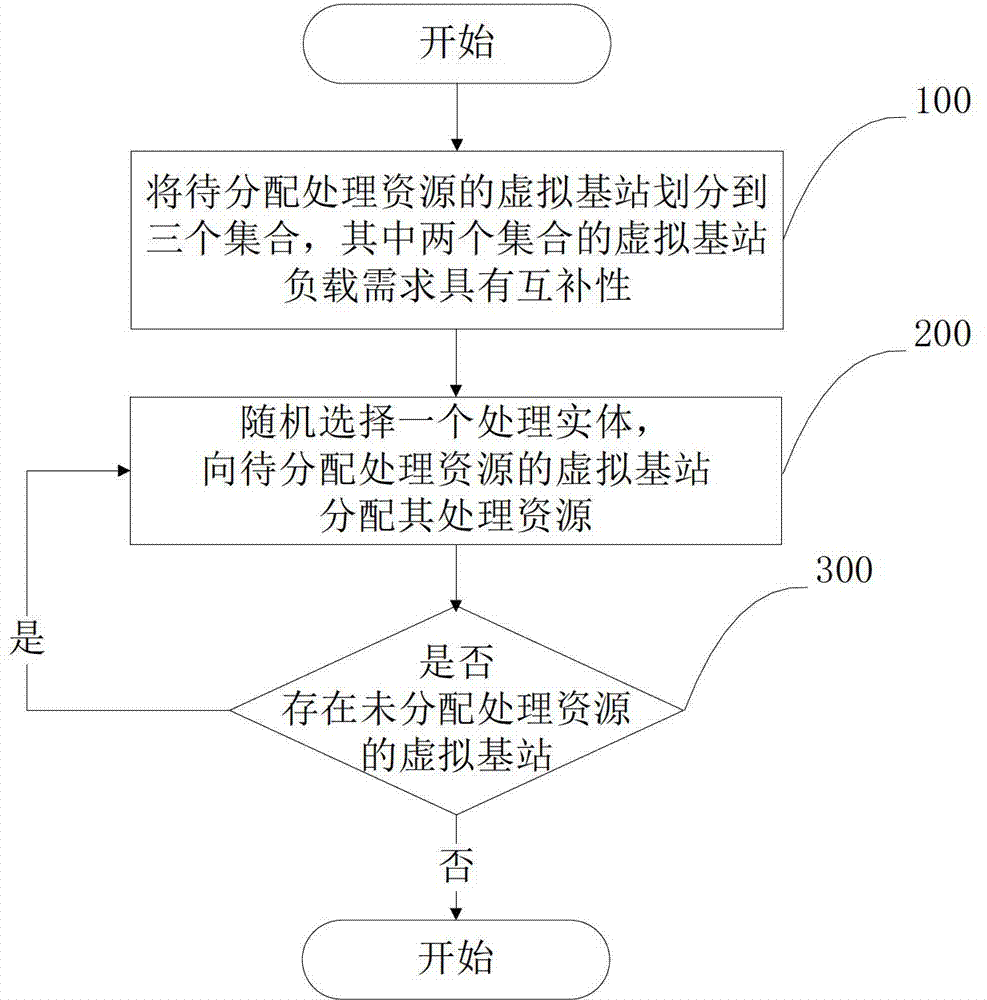
图1是根据本发明一个实施例的集中式基站架构中的处理资源分配方法流程图;FIG. 1 is a flowchart of a processing resource allocation method in a centralized base station architecture according to an embodiment of the present invention;
图2是根据本发明一个实施例的集中式基站架构中的处理资源分配系统的框图;以及2 is a block diagram of a processing resource allocation system in a centralized base station architecture according to an embodiment of the present invention; and
图3是分别采用本发明提供的处理资源分配方法与现有方法对基站进行处理资源分配的资源利用率结果示意图。FIG. 3 is a schematic diagram of resource utilization results of processing resource allocation for base stations using the processing resource allocation method provided by the present invention and the existing method respectively.
具体实施方式Detailed ways
下面结合附图和具体实施方式对本发明加以说明。The present invention will be described below in conjunction with the accompanying drawings and specific embodiments.
根据本发明的一个实施例,提供一种集中式基站架构中的处理资源分配方法,图1示出了该分配方法的实施步骤。According to an embodiment of the present invention, a processing resource allocation method in a centralized base station architecture is provided, and FIG. 1 shows the implementation steps of the allocation method.
步骤100、首先将待分配处理资源的基站划分到三个集合中,这三个集合分别以O、H和R表示。划分后,集合O中的基站与集合H中的基站的负载需求具有互补性,集合R为剩余的基站所组成的集合。
其中,负载需求具有互补性是指在某些时间段内,集合O中的基站的负载需求可能都很小而集合H中的基站的负载需求可能都很大;而在其他时间段内,集合O中的负载需求可能较大而集合H中的基站的负载需求可能较小。可以将集合O和集合H称作互补集合,集合O和集合H中的基站可共用同一个资源服务器或者资源服务器上的处理器核心。Among them, the load requirements are complementary means that in some time periods, the load requirements of the base stations in the set O may be very small and the load requirements of the base stations in the set H may be large; and in other time periods, the set The load demand in O may be larger and the load demand of base stations in set H may be smaller. The set O and the set H may be called complementary sets, and the base stations in the set O and the set H may share the same resource server or the processor core on the resource server.
在一个实施例中,可以按地理位置来划分基站。例如,当集中式基带池所负责的区域包括办公区域和居住区域时,可将负责办公区域的基站划分到集合O中,并且将这些基站称作处于办公区域的基站;可以将负责居住区域的基站划分到集合H中,并且将这些基站称作处于居住区域的基站。可以这样划分是因为:办公区域和居住区域是具有明显负载互补性的区域,中国移动曾在其C-RAN白皮书中指出,移动网络的一个固有特性就是其用户处于运动状态,在通信过程中经常会从一个地点移动到另一个地点。通过对实际运营网络的观察发现,用户的移动在二十四小时内通常呈现出很强的时间规律性。例如在上班时间段,大量的用户从居住区域移动到办公区域;而当工作时间结束后,大量用户又从办公区域返回到居住区域。随着这些用户的移动,移动网络的负载也呈现出随着时间而在网络中迁徙的现象,即所谓的“潮汐效应”。在工作时间段,办公区域的移动网络负载最高;而在非工作时间段,居住区域的移动网络负载最高。In one embodiment, base stations may be divided by geographic location. For example, when the area responsible for the centralized baseband pool includes an office area and a residential area, the base stations in charge of the office area can be divided into a set O, and these base stations are called base stations in the office area; The base stations are divided into a set H and these base stations are called base stations in residential areas. It can be divided in this way because: the office area and the residential area are areas with obvious load complementarity. China Mobile once pointed out in its C-RAN white paper that an inherent characteristic of the mobile network is that its users are in a state of motion. During the communication process, they often will move from one location to another. Through the observation of the actual operating network, it is found that the movement of users usually shows a strong temporal regularity within 24 hours. For example, during working hours, a large number of users move from the living area to the office area; and when the working hours are over, a large number of users return from the office area to the living area. As these users move, the load of the mobile network also shows a phenomenon of migration in the network over time, which is the so-called "tidal effect". During working hours, the mobile network load in the office area is the highest; while in non-working hours, the mobile network load in the residential area is the highest.
在上述实施例中,考虑了负责不同地理位置的基站在两个时间段(工作时间段和非工作时间段)的负载需求具有互补性,从而构成一对互补集合(O,H),分别代表在工作时间段负载需求高以及在工作时间段负载需求低(同样的,代表在非工作时间段负载需求低以及在非工作时间段负载需求高)的两类基站。在进一步的实施例中,可以将一天(24小时)划分为更多时间段(例如每1个小时为一个时间段),根据每个时间段内所有基站的负载需求可以确定哪些基站之间的负载需求具有互补性。在这种情况下,可能出现互补集合不止一对的情况,即待分配处理资源的基站可细划为集合O、O’、H、H’、R等,其中集合O和H互为互补集合,集合O’和H’互为互补集合,以此类推。In the above-mentioned embodiment, it is considered that the load requirements of the base stations in charge of different geographic locations in two time periods (working time period and non-working time period) are complementary, thus forming a pair of complementary sets (O, H), representing Two types of base stations with high load demand during working hours and low load demand during working hours (similarly, representing low load demand during non-working hours and high load demand during non-working hours). In a further embodiment, one day (24 hours) can be divided into more time periods (for example, every hour is a time period), and which base stations can be determined according to the load requirements of all base stations in each time period Load requirements are complementary. In this case, there may be more than one pair of complementary sets, that is, the base stations to be allocated processing resources can be subdivided into sets O, O', H, H', R, etc., where sets O and H are complementary sets , the sets O' and H' are complementary sets, and so on.
在进一步的实施例中,由于待分配处理资源的基站均可以分配到集合O和H中,因而集合R可能为空。In a further embodiment, since the base stations to be allocated processing resources can all be allocated to sets O and H, set R may be empty.
步骤200、随机选择一个处理实体m,向待分配处理资源的基站(或称未分配处理资源的基站)分配该处理实体的处理资源。处理实体可以是一个资源服务器,也可以是资源服务器上的一个处理器核心。
继续以上文中基于办公区域和居住区域划分的互补集合(O,H)为例,分配处理实体m提供的处理资源可包括以下几个子步骤:Continuing to take the complementary set (O, H) based on the division of office areas and residential areas as an example above, the allocation of processing resources provided by the processing entity m may include the following sub-steps:
步骤2001、检查是否有剩余的基站未分配处理资源,如果有则进行步骤2002,否则结束分配。Step 2001, check whether there are remaining base stations that have not allocated processing resources, if yes, proceed to step 2002, otherwise end the allocation.
步骤2002、如果集合O和集合H中均包含不少于一个基站,则进行步骤2003,否则进行步骤2006。Step 2002, if both set O and set H contain not less than one base station, go to step 2003, otherwise go to step 2006.
步骤2003、从集合O和集合H中分别选择一个基站(例如集合O中的基站a和集合H中的基站b)进行配对,作为互补基站对,记为{a,b}。其中,互补基站对{a,b}应该为没有尝试在处理实体m上分配过的一对基站,如果找到这样一对基站则进行步骤2004,如果无法找到,则进行步骤2006。Step 2003: Select a base station from set O and set H (for example, base station a in set O and base station b in set H) for pairing as a pair of complementary base stations, denoted as {a, b}. Wherein, the pair of complementary base stations {a, b} should be a pair of base stations that have not been tried to be allocated on the processing entity m. If such a pair of base stations is found, go to step 2004; if not, go to step 2006.
尽管在本实施例中,处理资源分配的粒度为一个基站。本领域技术人员应理解,处理资源分配的粒度可以是一组基站(例如物理上的小区簇)。该一组基站可以是物理上相邻的基站,将它们作为整体进行处理资源分配,从而可以降低分配方法的复杂度。此外,潮汐效应通常也指一个较大区域内的负载整体向另一较大区域移动(如本实施例),所以分配粒度也可以是一组基站。Although in this embodiment, the granularity for processing resource allocation is one base station. Those skilled in the art should understand that the granularity for processing resource allocation may be a group of base stations (for example, a physical cell cluster). The group of base stations may be physically adjacent base stations, and processing resource allocation is performed on them as a whole, so that the complexity of the allocation method can be reduced. In addition, the tidal effect usually means that the load in one larger area moves to another larger area as a whole (as in this embodiment), so the allocation granularity may also be a group of base stations.
在一个实施例中,本步骤可以采用随机选择的方法来选择基站。在一个实施例中,可以采用基于距离的方法来选择基站,即根据预先设置的一个值或者范围,选择基站之间的距离等于该预定值或者在预定范围之内的基站。在另一个实施例中,还可以按一定的顺序来选择基站,例如采用遍历的方法来选择基站。In an embodiment, this step may use a random selection method to select a base station. In an embodiment, a distance-based method may be used to select base stations, that is, according to a preset value or range, base stations whose distance between base stations is equal to the predetermined value or within a predetermined range are selected. In another embodiment, the base stations may also be selected in a certain order, for example, a traversal method is used to select the base stations.
以下以遍历方法为例,给出选择基站的详细说明。在步骤2003中,假设集合O={a1,a2,a3,……,aj},集合H={b1,b2,b3,……,bi},i和j为正整数。不失一般性,可以从a1开始,选择b1进行配对,若互补基站对{a1,b1}可以分配到处理实体上(该过程具体参见步骤2004),则在下一次选择时(再次执行步骤2003)就选择a2和b2;若不能分配到处理实体上,即互补基站对{a1,b1}是已经尝试了在处理实体m上分配的一对基站,则在下一次选择时将a1与b2进行配对,以此类推。The following takes the traversal method as an example to give a detailed description of selecting a base station. In step 2003, it is assumed that the set O={a 1 , a 2 , a 3 ,..., a j }, the set H={b 1 , b 2 , b 3 ,..., b i }, i and j are positive integer. Without loss of generality, one can start from a 1 and select b 1 for pairing. If the complementary base station pair {a 1 , b 1 } can be allocated to the processing entity (see step 2004 for details of the process), then in the next selection (again Execute step 2003) to select a 2 and b 2 ; if they cannot be allocated to the processing entity, that is, the complementary base station pair {a 1 , b 1 } is a pair of base stations that have already tried to be allocated on the processing entity m, then select When pairing a 1 with b 2 , and so on.
步骤2004、计算在基站a、b加入后,处理实体m上实际使用的处理资源,即基站a、b实际使用的处理资源。如果基站a、b实际使用的处理资源不超过处理实体m所能提供的最大处理资源,则进行步骤2005;否则返回步骤2001。Step 2004, calculate the processing resources actually used by the processing entity m after the base stations a and b join, that is, the processing resources actually used by the base stations a and b. If the processing resources actually used by the base stations a and b do not exceed the maximum processing resources that the processing entity m can provide, proceed to step 2005; otherwise, return to step 2001.
该步骤中,在判断基站a、b实际使用的处理资源是否超过处理实体m所能提供的最大处理资源时,可判断在一天内的不同时间段中,基站a、b实际使用的处理资源是否均超过处理实体m所能提供的最大处理资源。如上文所述,由于潮汐效应,一天内基站的负载变化呈现出一定的规律性,每个时间段中基站的负载需求很可能不相同。一天内具体划分为几个时间段可根据精度大小确定,划分的时间段个数越多,每个时间段越短,则越精确。此外,每个基站的时间段划分方式还需保持一致。In this step, when judging whether the processing resources actually used by base stations a and b exceed the maximum processing resources that processing entity m can provide, it can be judged whether the processing resources actually used by base stations a and b in different time periods of the day Both exceed the maximum processing resources that the processing entity m can provide. As mentioned above, due to the tidal effect, the load change of the base station within a day presents a certain regularity, and the load demand of the base station in each time period is likely to be different. How many time periods are divided into one day can be determined according to the accuracy. The more time periods are divided and the shorter each time period is, the more accurate it is. In addition, the time segment division method of each base station needs to be consistent.
要计算基站a、b实际使用的处理资源,在一个实施例中,可根据基站之前的运行状况,通过一定的统计和预测机制得到。例如,统计出基站a、b在之前每个时间段内的平均负载。例如,可将基站a对应的负载序列表示为:To calculate the processing resources actually used by the base stations a and b, in one embodiment, it can be obtained through a certain statistics and prediction mechanism according to the previous operation status of the base stations. For example, the average loads of base stations a and b in each previous time period are calculated. For example, the load sequence corresponding to base station a can be expressed as:
Wa,1,Wa,2,Wa,3,…Wa,N W a,1 ,W a,2 ,W a,3 ,…W a,N
即总共分N个时间段,Wa,i表示在第i个时间段内的基站a的总负载,这一时间段内的负载大小等于基站协议实体需要处理的对应的所有归属用户上行和下行数据量大小的总和。That is, it is divided into N time periods in total, W a , i represent the total load of base station a in the i-th time period, and the load size in this time period is equal to the uplink and downlink of all the corresponding home users that the protocol entity of the base station needs to process The sum of the size of the data volume.
步骤2005、将基站a、b分配到处理实体m上运行、标志基站a、b已经分配到处理实体m,并且将基站a、b从相应的集合(O和H)中删除,重新进行步骤2001。Step 2005: Assign base stations a and b to processing entity m for operation, mark that base stations a and b have been assigned to processing entity m, and delete base stations a and b from the corresponding sets (O and H), and repeat step 2001 .
应理解,如果已将某一基站分配到处理实体m,则处理实体m当前所能提供的最大处理资源应该是分配该基站前所能提供的最大处理资源减去该基站实际使用的处理资源。It should be understood that if a certain base station has been allocated to the processing entity m, the maximum processing resource that the processing entity m can currently provide should be the maximum processing resource that can be provided before the base station is allocated minus the processing resource actually used by the base station.
步骤2006、从尚未分配处理资源的基站中寻找一个基站,其在处理实体m上运行可以满足实际使用的处理资源不超过处理实体m所能提供的最大处理资源的条件。若找到这样一个基站,则标志其已经分配到处理实体m,将该基站从相应的集合中删除,重新进行步骤2006;若不存在这样的基站,则结束分配。Step 2006: Find a base station from the base stations that have not allocated processing resources, which can run on the processing entity m and meet the condition that the actual processing resources used do not exceed the maximum processing resources that the processing entity m can provide. If such a base station is found, mark that it has been allocated to the processing entity m, delete the base station from the corresponding set, and perform step 2006 again; if there is no such base station, end the allocation.
在一个实施例中,可以采用任何顺序从尚未分配的基站中搜索基站。在进一步的实施例中,要从尚未分配处理资源的基站中寻找一个基站,可以先从不属于集合O和集合H的基站R中进行搜索,然后才从集合O或集合H中选择,选择的原则是先从基站数目多的集合开始,如果数目相等,则从这两个集合中随机选择一个集合进行搜索。In one embodiment, any order may be used to search for base stations from base stations that have not been assigned. In a further embodiment, to find a base station from the base stations that have not yet allocated processing resources, you can first search from the base stations R that do not belong to the set O and the set H, and then select from the set O or the set H, the selected The principle is to start with the set with the largest number of base stations, and if the numbers are equal, randomly select a set from the two sets to search.
本领域技术人员应理解,上述步骤(2001-2006)仅示例性地描述了分配处理资源的一种方式,还可以通过其他方式来实现处理资源的分配。例如,在一个实施例中,针对当前处理实体,可以仅进行互补基站对(由负载需求具有互补性的基站构成)的处理资源分配,在处理实体无法提供剩余的(未分配处理资源的)互补基站对所需的处理资源(即实际使用的处理资源)时,不再为不属于集合O和H的基站分配处理资源,将剩下的互补基站对和未分配处理资源的基站分配到其他处理实体。Those skilled in the art should understand that the above steps (2001-2006) are only exemplary descriptions of a manner of allocating processing resources, and the allocation of processing resources may also be implemented in other manners. For example, in one embodiment, for the current processing entity, only the processing resource allocation of complementary base station pairs (consisting of base stations with complementary load requirements) can be performed, and when the processing entity cannot provide the remaining complementary base stations (without allocation of processing resources), When the base station pairs the required processing resources (that is, the actually used processing resources), it no longer allocates processing resources for the base stations that do not belong to the sets O and H, and allocates the remaining complementary base station pairs and base stations that have not allocated processing resources to other processing resources. entity.
步骤300、如果仍存在未分配处理资源的基站,则返回步骤200,重新从未选择过的处理实体中选择一个处理实体,并且向未分配处理资源的基站分配其处理资源,具体步骤与子步骤2001-2006相同。
上述方法仅示例性地描述了一种集中式基站架构中的处理资源分配方法,本领域技术人员应理解,对于不同的处理实体,可以在处理完互补基站对之后处理集合O和H之外的基站,也可以仅处理互补基站对。The above method only exemplarily describes a method for allocating processing resources in a centralized base station architecture. Those skilled in the art should understand that for different processing entities, processing resources other than sets O and H can be processed after processing complementary base station pairs. base stations, or only complementary base station pairs can be processed.
一般而言,可以在集中化管理的处理资源设备(如资源服务器等)部署完成后、在各个基站还未开始实际运行之前,或者周期性地为各个基站分配相应的处理资源。在进一步的实施例中,可以在分配完处理资源后、在下一次分配处理资源前,动态地调整基站的处理资源。本领域技术人员应理解,该动态调整可以采用现有的所有可用的处理资源动态调整技术。Generally speaking, each base station may be allocated corresponding processing resources after the centralized management of processing resource devices (such as resource servers, etc.) is deployed and before each base station starts actual operation, or periodically. In a further embodiment, the processing resources of the base station may be dynamically adjusted after the processing resources are allocated and before the processing resources are allocated next time. Those skilled in the art should understand that the dynamic adjustment may use all existing dynamic adjustment technologies for processing resources available.
例如,可以在遇到以下情况时进行基站的处理资源动态调整:1)某个基站负载增加后当前处理实体的处理能力不能完全满足其负载增加后的需求;2)在处理实体上创建新的基站,该新的基站可能是从其他资源服务器迁移而来。For example, the processing resources of the base station can be dynamically adjusted when the following situations are encountered: 1) After the load of a certain base station increases, the processing capacity of the current processing entity cannot fully meet the demand after the load increases; 2) Create a new one on the processing entity Base station, the new base station may be migrated from other resource servers.
根据本发明一个实施例,还提供一种集中式基站架构中的处理资源分配系统。如图2所示,该系统包括处理实体、基站、负载统计设备以及处理资源管控设备。According to an embodiment of the present invention, a system for allocating processing resources in a centralized base station architecture is also provided. As shown in Figure 2, the system includes a processing entity, a base station, a load statistics device, and a processing resource management and control device.
如上文所述,处理实体可以是资源服务器和其中的处理器核心的总称,其具有一定处理能力,并且可以支持多个基站在其中运行。资源服务器可以是基于开放平台,可支持多个基站在其中运行的设备,例如,一个具有较强处理能力的通用服务器。一组资源服务器可组成资源服务器群,用于支持较大区域内的所有基站。在进行处理资源分配与管理时,每个资源服务器有一个处理资源能力值。不失一般性,可以暂不考虑资源服务器内部各个CPU核心或处理进程组成的处理资源分布结构而只考虑整体处理能力值(即所能提供的处理资源,例如可以用支持多少用户负载来衡量),则每个资源服务器可看作一个负载容器,容纳每个基站实体所需要处理的用户负载。每个资源服务器具体可以支持的基站个数、基站类型(例如宏基站,家庭基站)和基站制式(例如GSM、TD-SCDMA、TD-LTE)并不是固定的,而是根据基站的负载、资源服务器的处理能力按需分配的。基站之间的资源可以动态共享。As mentioned above, the processing entity may be a general term for the resource server and the processor core therein, which has a certain processing capability and can support multiple base stations to run in it. The resource server may be a device based on an open platform that can support multiple base stations running therein, for example, a general server with strong processing capability. A group of resource servers can form a resource server farm to support all base stations in a larger area. When processing resource allocation and management, each resource server has a processing resource capability value. Without loss of generality, the processing resource distribution structure composed of each CPU core or processing process inside the resource server can be temporarily ignored, and only the overall processing capability value (that is, the processing resources that can be provided, for example, can be measured by how many user loads it supports) , each resource server can be regarded as a load container to accommodate the user load that each base station entity needs to handle. The number of base stations, base station types (such as macro base stations, home base stations) and base station standards (such as GSM, TD-SCDMA, TD-LTE) that each resource server can support are not fixed, but are based on the load and resources of the base station. The processing power of the server is allocated on demand. Resources between base stations can be dynamically shared.
负载统计设备用于统计各个基站的实时负载和一段时间的平均负载,计算基站在每个时间段实际使用的处理资源,并且将结果提供给处理资源管控设备,供处理资源管控设备进行决策和处理。在一个实施例中,由于潮汐效应,各个基站对应的负载及负载变化通常在一天的时间内保持一定的规律性,因此可以将一天分为N个时间段,负载统计设备可以统计出每个时间段内的平均负载,N的值决定统计的精确程度。The load statistics device is used to count the real-time load of each base station and the average load for a period of time, calculate the processing resources actually used by the base station in each time period, and provide the results to the processing resource management and control equipment for decision-making and processing by the processing resource management and control equipment . In one embodiment, due to the tidal effect, the loads and load changes corresponding to each base station usually maintain a certain regularity within a day, so a day can be divided into N time periods, and the load statistics device can count each time period The average load in the segment, the value of N determines the accuracy of the statistics.
处理资源管控设备包括处理资源整体管控设备和内部处理资源管控设备。前者负责分配和管理资源服务器群内的各个资源服务器的处理资源;后者负责分配和管理资源服务器中的处理器核的处理资源。处理资源整体管控设备和内部处理资源管控设备均包含可以处理资源分配装置以及处理资源调整和迁移装置。Processing resource management and control equipment includes processing resource overall management and control equipment and internal processing resource management and control equipment. The former is responsible for allocating and managing the processing resources of each resource server in the resource server group; the latter is responsible for allocating and managing the processing resources of the processor cores in the resource servers. Both the overall processing resource management and control device and the internal processing resource management and control device include processing resource allocation devices and processing resource adjustment and migration devices.
在一个实施例中,可以由处理资源管控设备中的处理资源分配装置根据负载统计设备提供的每个基站实际使用的处理资源以及资源服务器的处理能力,来为基站分配处理实体。例如,由处理资源整体管控设备中的处理资源分配装置来确定基站与资源服务器的映射关系;由内部处理资源管控设备中的处理资源分配装置来确定基站与资源服务器中各个处理器核心的映射关系。In one embodiment, the processing resource allocating means in the processing resource management and control device may allocate processing entities to the base stations according to the processing resources actually used by each base station provided by the load statistics device and the processing capability of the resource server. For example, the processing resource allocation device in the overall processing resource management and control device determines the mapping relationship between the base station and the resource server; the processing resource allocation device in the internal processing resource management and control device determines the mapping relationship between the base station and each processor core in the resource server .
在一个实施例中,处理资源分配装置可用于随机选择一个处理实体。以及用于选择未分配处理资源的互补基站对,且当所述处理实体能够提供所选互补基站对实际使用的处理资源时将其分配到所述处理实体,直到所述处理实体不能够提供任何未分配处理资源的互补基站对实际使用的处理资源。In one embodiment, the processing resource allocating means is configured to randomly select a processing entity. and for selecting a complementary base station pair that has not allocated processing resources, and assigning it to the processing entity when the processing entity can provide the processing resources actually used by the selected complementary base station pair, until the processing entity cannot provide any Processing resources actually used by complementary base station pairs that have not been allocated processing resources.
在进一步的实施例中,处理资源管控设备还用于搜索未分配处理资源的基站,且当所述处理实体能够提供搜索到的基站实际使用的处理资源时将其分配到所述处理实体,直到所述处理实体不能够提供任何未分配处理资源的基站实际使用的处理资源。In a further embodiment, the processing resource management and control device is also used to search for base stations that have not allocated processing resources, and when the processing entity can provide the processing resources actually used by the searched base stations, allocate them to the processing entity until The processing entity is not able to provide processing resources actually used by any base station that has not been allocated processing resources.
由于处理实体可以是资源服务器或资源服务器中的处理器核心。对于资源服务器来说,可以使用上述处理资源整体管控设备中的处理资源分配装置来分配处理资源;对于处理器核心来说,可以使用上述内部处理资源管控设备中的处理资源分配装置来分配处理资源。Since the processing entity may be a resource server or a processor core in the resource server. For the resource server, the processing resource allocation device in the above-mentioned overall processing resource management and control device can be used to allocate processing resources; for the processor core, the processing resource allocation device in the above-mentioned internal processing resource management and control device can be used to allocate processing resources .
处理资源整体管控设备中的处理资源调整和迁移装置负责完成当基站负载变化后,在资源服务器之间进行的迁移,并重新分配新的处理资源。内部处理资源管控设备中的处理资源调整和迁移装置负责完成当基站负载变化后,在资源服务器内各个处理器核心之间进行的迁移,并重新分配新的处理资源。例如,当一个基站对应部分用户的业务负载发生变化,或用户实体的数目增加或减少,导致基站负载的组成结构发生变化(例如处理资源不足时),需要进行处理资源在基站间的调整来保证基站的正常运行以及保证处理资源的利用率。在一个实施例中,先考虑将负载增加的基站从原来的处理器核心迁移到空闲处理资源足够的处理器核心上去执行,并将另外的负载相对较小的基站迁移到原来的处理器核心,保证处理资源可满足需求,若不能满足要求则将该基站迁移到其他资源服务器。资源服务器间基站迁移只是作为辅助方式处理极端突发情形。The processing resource adjustment and migration device in the processing resource overall management and control device is responsible for completing the migration between resource servers when the load of the base station changes, and reallocating new processing resources. The processing resource adjustment and migration device in the internal processing resource management and control device is responsible for completing the migration between processor cores in the resource server when the load of the base station changes, and reallocating new processing resources. For example, when the service load of some users corresponding to a base station changes, or the number of user entities increases or decreases, resulting in a change in the structure of the base station load (for example, when processing resources are insufficient), processing resources need to be adjusted between base stations to ensure The normal operation of the base station and the utilization rate of processing resources are guaranteed. In one embodiment, it is first considered to migrate the base station with increased load from the original processor core to a processor core with sufficient idle processing resources for execution, and migrate other base stations with relatively small load to the original processor core, Ensure that the processing resources can meet the requirements, and if the requirements cannot be met, the base station will be migrated to other resource servers. Base station migration between resource servers is only used as an auxiliary way to deal with extreme emergencies.
为验证本发明提供的集中式基站架构中的处理资源分配方法的有效性,发明人针对不同个数的基站采用不同的处理资源分配方法进行了实验,统计了不同方法下的处理资源利用率,实验结果如图3所示。从图3可知,在多个基站参与处理资源分配时,本发明提出的分配方法在处理资源利用率方面要明显高于其他两种方法。此外,在基站数量较多、整体网络规模较大时,其优势更为明显。In order to verify the effectiveness of the processing resource allocation method in the centralized base station architecture provided by the present invention, the inventor conducted experiments using different processing resource allocation methods for different numbers of base stations, and counted the processing resource utilization under different methods. The experimental results are shown in Figure 3. It can be seen from FIG. 3 that when multiple base stations participate in processing resource allocation, the resource allocation method proposed by the present invention is obviously higher than the other two methods in terms of processing resource utilization. In addition, its advantages are more obvious when the number of base stations is large and the overall network scale is large.
应该注意到并理解,在不脱离后附的权利要求所要求的本发明的精神和范围的情况下,能够对上述详细描述的本发明做出各种修改和改进。因此,要求保护的技术方案的范围不受所给出的任何特定示范教导的限制。It should be noted and understood that various modifications and improvements can be made to the invention described in detail above without departing from the spirit and scope of the invention as claimed in the appended claims. Accordingly, the scope of the claimed technical solution is not limited by any particular exemplary teaching given.
Claims (18)
Priority Applications (1)
| Application Number | Priority Date | Filing Date | Title |
|---|---|---|---|
| CN201310241691.XA CN103269519B (en) | 2013-06-18 | 2013-06-18 | A kind of processing resource allocation method and system in centralized base station framework |
Applications Claiming Priority (1)
| Application Number | Priority Date | Filing Date | Title |
|---|---|---|---|
| CN201310241691.XA CN103269519B (en) | 2013-06-18 | 2013-06-18 | A kind of processing resource allocation method and system in centralized base station framework |
Publications (2)
| Publication Number | Publication Date |
|---|---|
| CN103269519A true CN103269519A (en) | 2013-08-28 |
| CN103269519B CN103269519B (en) | 2016-09-28 |
Family
ID=49013120
Family Applications (1)
| Application Number | Title | Priority Date | Filing Date |
|---|---|---|---|
| CN201310241691.XA Active CN103269519B (en) | 2013-06-18 | 2013-06-18 | A kind of processing resource allocation method and system in centralized base station framework |
Country Status (1)
| Country | Link |
|---|---|
| CN (1) | CN103269519B (en) |
Cited By (3)
| Publication number | Priority date | Publication date | Assignee | Title |
|---|---|---|---|---|
| CN104619029A (en) * | 2015-01-22 | 2015-05-13 | 中国科学院计算技术研究所 | Method and device for allocating baseband pool resources under integrated cellular network architecture |
| CN104812002A (en) * | 2014-01-23 | 2015-07-29 | 中国科学院计算技术研究所 | Method, device and system for dynamically adjusting processing resources under centralized RAN framework |
| CN110138838A (en) * | 2019-04-16 | 2019-08-16 | 中国科学院计算技术研究所 | A kind of computational resource allocation method and device |
Citations (7)
| Publication number | Priority date | Publication date | Assignee | Title |
|---|---|---|---|---|
| CN1842180A (en) * | 2005-03-31 | 2006-10-04 | 上海华为技术有限公司 | Allocation method of baseband channel processing resource in base station of mobile communication system |
| US20080045226A1 (en) * | 2004-07-28 | 2008-02-21 | Sheng Liu | Method for Allocating Channel Processing Resources and Centralized Base Stations for Implementing the Same |
| CN101163316A (en) * | 2007-11-14 | 2008-04-16 | 中兴通讯股份有限公司 | Method, system and baseband unit for processing system messages in baseband resource allocation |
| US20080134194A1 (en) * | 2004-08-13 | 2008-06-05 | Utstarcim Telecom Co., Ltd. | Method for Dynamic Resource Allocation in Centrailized Base Stations |
| CN102083077A (en) * | 2010-12-24 | 2011-06-01 | 大唐移动通信设备有限公司 | Baseband pool shared resource distribution method and device |
| CN102547719A (en) * | 2011-12-12 | 2012-07-04 | 大唐移动通信设备有限公司 | Method and device for configuring tidal effect |
| CN103108334A (en) * | 2011-11-10 | 2013-05-15 | 中兴通讯股份有限公司 | System loading dynamic regulation method of radio-frequency remote system |
-
2013
- 2013-06-18 CN CN201310241691.XA patent/CN103269519B/en active Active
Patent Citations (7)
| Publication number | Priority date | Publication date | Assignee | Title |
|---|---|---|---|---|
| US20080045226A1 (en) * | 2004-07-28 | 2008-02-21 | Sheng Liu | Method for Allocating Channel Processing Resources and Centralized Base Stations for Implementing the Same |
| US20080134194A1 (en) * | 2004-08-13 | 2008-06-05 | Utstarcim Telecom Co., Ltd. | Method for Dynamic Resource Allocation in Centrailized Base Stations |
| CN1842180A (en) * | 2005-03-31 | 2006-10-04 | 上海华为技术有限公司 | Allocation method of baseband channel processing resource in base station of mobile communication system |
| CN101163316A (en) * | 2007-11-14 | 2008-04-16 | 中兴通讯股份有限公司 | Method, system and baseband unit for processing system messages in baseband resource allocation |
| CN102083077A (en) * | 2010-12-24 | 2011-06-01 | 大唐移动通信设备有限公司 | Baseband pool shared resource distribution method and device |
| CN103108334A (en) * | 2011-11-10 | 2013-05-15 | 中兴通讯股份有限公司 | System loading dynamic regulation method of radio-frequency remote system |
| CN102547719A (en) * | 2011-12-12 | 2012-07-04 | 大唐移动通信设备有限公司 | Method and device for configuring tidal effect |
Cited By (6)
| Publication number | Priority date | Publication date | Assignee | Title |
|---|---|---|---|---|
| CN104812002A (en) * | 2014-01-23 | 2015-07-29 | 中国科学院计算技术研究所 | Method, device and system for dynamically adjusting processing resources under centralized RAN framework |
| CN104812002B (en) * | 2014-01-23 | 2019-02-01 | 中国科学院计算技术研究所 | Process resource dynamic adjusting method, equipment and system under centralized RAN framework |
| CN104619029A (en) * | 2015-01-22 | 2015-05-13 | 中国科学院计算技术研究所 | Method and device for allocating baseband pool resources under integrated cellular network architecture |
| CN104619029B (en) * | 2015-01-22 | 2018-09-07 | 中国科学院计算技术研究所 | It is a kind of centralization cellular network architecture under baseband pool resource allocation methods and device |
| CN110138838A (en) * | 2019-04-16 | 2019-08-16 | 中国科学院计算技术研究所 | A kind of computational resource allocation method and device |
| CN110138838B (en) * | 2019-04-16 | 2020-07-31 | 中国科学院计算技术研究所 | A computing resource allocation method and device |
Also Published As
| Publication number | Publication date |
|---|---|
| CN103269519B (en) | 2016-09-28 |
Similar Documents
| Publication | Publication Date | Title |
|---|---|---|
| CN104619029B (en) | It is a kind of centralization cellular network architecture under baseband pool resource allocation methods and device | |
| EP3698247B1 (en) | An apparatus and method for providing a performance based packet scheduler | |
| CN104270421B (en) | A kind of multi-tenant cloud platform method for scheduling task for supporting Bandwidth guaranteed | |
| CN108684075B (en) | Processing resource allocation method under centralized base station architecture | |
| CN104484233B (en) | A kind of resource allocation methods | |
| WO2015165095A1 (en) | Method for creating virtual base station, and base station cloud device | |
| CN104601664A (en) | Cloud computing platform resource management and virtual machine dispatching control system | |
| CN103297499A (en) | Scheduling method and system based on cloud platform | |
| CN109614223A (en) | Hardware resource dispatching method, device and hardware resource controlling equipment | |
| CN103687034A (en) | Group scheduling method and device | |
| CN103945549B (en) | Baseband processing resource allocation system under C-RAN architecture | |
| CN103269519B (en) | A kind of processing resource allocation method and system in centralized base station framework | |
| CN105530650B (en) | A kind of method and device of network resource planning | |
| WO2024151764A1 (en) | Systems and methods for mapping, migrating, and/or processing data over a network | |
| CN107203256B (en) | Energy-saving distribution method and device under network function virtualization scene | |
| KR102056894B1 (en) | Dynamic resource orchestration for fog-enabled industrial internet of things networks | |
| CN105517176B (en) | The method of dynamic dispatching virtualization base station resource | |
| CN105101234B (en) | Device, method and base station for clustering small cells in time division duplex network | |
| CN103501509B (en) | A kind of method and device equalizing radio network controller load | |
| CN105302628B (en) | The moving method and device of a kind of virtual machine in base station resource pond | |
| CN104954417B (en) | Method and apparatus for handling data | |
| CN104378310B (en) | A kind of resource regulating method and device | |
| CN109348511B (en) | Method and device for allocating baseband resources | |
| CN104812002A (en) | Method, device and system for dynamically adjusting processing resources under centralized RAN framework | |
| CN112601257B (en) | Radio access network RAN slice resource allocation method and related equipment |
Legal Events
| Date | Code | Title | Description |
|---|---|---|---|
| C06 | Publication | ||
| PB01 | Publication | ||
| C10 | Entry into substantive examination | ||
| SE01 | Entry into force of request for substantive examination | ||
| C14 | Grant of patent or utility model | ||
| GR01 | Patent grant |