CN103189599A - Prevention of biomass aggregation at injection wells - Google Patents
Prevention of biomass aggregation at injection wells Download PDFInfo
- Publication number
- CN103189599A CN103189599A CN2011800525273A CN201180052527A CN103189599A CN 103189599 A CN103189599 A CN 103189599A CN 2011800525273 A CN2011800525273 A CN 2011800525273A CN 201180052527 A CN201180052527 A CN 201180052527A CN 103189599 A CN103189599 A CN 103189599A
- Authority
- CN
- China
- Prior art keywords
- nutrient solution
- injection well
- parts
- biomass
- target site
- Prior art date
- Legal status (The legal status is an assumption and is not a legal conclusion. Google has not performed a legal analysis and makes no representation as to the accuracy of the status listed.)
- Pending
Links
Classifications
-
- C—CHEMISTRY; METALLURGY
- C09—DYES; PAINTS; POLISHES; NATURAL RESINS; ADHESIVES; COMPOSITIONS NOT OTHERWISE PROVIDED FOR; APPLICATIONS OF MATERIALS NOT OTHERWISE PROVIDED FOR
- C09K—MATERIALS FOR MISCELLANEOUS APPLICATIONS, NOT PROVIDED FOR ELSEWHERE
- C09K8/00—Compositions for drilling of boreholes or wells; Compositions for treating boreholes or wells, e.g. for completion or for remedial operations
- C09K8/52—Compositions for preventing, limiting or eliminating depositions, e.g. for cleaning
- C09K8/524—Compositions for preventing, limiting or eliminating depositions, e.g. for cleaning organic depositions, e.g. paraffins or asphaltenes
-
- C—CHEMISTRY; METALLURGY
- C09—DYES; PAINTS; POLISHES; NATURAL RESINS; ADHESIVES; COMPOSITIONS NOT OTHERWISE PROVIDED FOR; APPLICATIONS OF MATERIALS NOT OTHERWISE PROVIDED FOR
- C09K—MATERIALS FOR MISCELLANEOUS APPLICATIONS, NOT PROVIDED FOR ELSEWHERE
- C09K8/00—Compositions for drilling of boreholes or wells; Compositions for treating boreholes or wells, e.g. for completion or for remedial operations
- C09K8/58—Compositions for enhanced recovery methods for obtaining hydrocarbons, i.e. for improving the mobility of the oil, e.g. displacing fluids
- C09K8/582—Compositions for enhanced recovery methods for obtaining hydrocarbons, i.e. for improving the mobility of the oil, e.g. displacing fluids characterised by the use of bacteria
Landscapes
- Chemical & Material Sciences (AREA)
- Life Sciences & Earth Sciences (AREA)
- General Life Sciences & Earth Sciences (AREA)
- Engineering & Computer Science (AREA)
- Materials Engineering (AREA)
- Organic Chemistry (AREA)
- Oil, Petroleum & Natural Gas (AREA)
- Processing Of Solid Wastes (AREA)
- Micro-Organisms Or Cultivation Processes Thereof (AREA)
- Apparatus Associated With Microorganisms And Enzymes (AREA)
Abstract
Description
本专利申请要求2010年11月1日提交的美国临时申请61/408731的优先权,该临时申请全文以引用方式并入本文。This patent application claims priority to US Provisional Application 61/408731, filed November 1, 2010, which is hereby incorporated by reference in its entirety.
技术领域technical field
本公开涉及环境微生物学领域。具体地,其涉及微生物增强的采油和生物整治领域。更具体地,其涉及在微生物增强的采油和生物整治过程中,注入井钻孔处微生物的聚集和生物膜的形成的防止。The present disclosure relates to the field of environmental microbiology. In particular, it relates to the fields of microbial enhanced oil recovery and bioremediation. More specifically, it relates to the prevention of microbial accumulation and biofilm formation at injection well boreholes during microbial enhanced oil recovery and bioremediation.
背景技术Background technique
在从油层采油的过程中,含油地下岩层中的原油通常仅有小部分被仅利用了油层中存在的自然力的初级开采方法所回收。二次采油方法如注水法(即,通过注入井将水注入油层)已被用于迫使油通过地下岩层流向生产井,并从而改善了油的开采(Hyne,N.J.,2001,“Non-technical guideto petroleum geology,exploration,drilling,and production”,第2版,PenWell Corp.,Tulsa,OK,USA)。注水操作经常遇到的一个问题是地下岩层异质性能够导致注水过程中降低的波及效率。换句话讲,在水从注入井行进至生产井时,它优先通过油层的更多孔洞的岩层,并形成水淹的岩层,而绕过其他含油地下岩层,即未被水淹的,从而降低了从未被水淹的岩层的采油效率。In the process of recovering oil from an oil reservoir, only a small fraction of the crude oil in an oil-bearing subterranean formation is usually recovered by primary recovery methods that only utilize the natural forces present in the oil reservoir. Secondary oil recovery methods such as waterflooding (i.e., injecting water into oil formations through injection wells) have been used to force oil through subterranean formations to production wells and thereby improve oil recovery (Hyne, N.J., 2001, “Non-technical guide to Petroleum geology, exploration, drilling, and production", 2nd ed., PenWell Corp., Tulsa, OK, USA). A problem frequently encountered with water injection operations is that subsurface formation heterogeneity can lead to reduced sweep efficiency during water injection. In other words, as water travels from the injection well to the production well, it preferentially passes through the more porous formations of the oil reservoir and forms the water-flooded formation, while bypassing other oil-bearing subterranean formations that are not flooded, thereby Reduced oil recovery efficiency in rock formations that have never been flooded.
使用微生物强化采油(MEOR)来帮助采油是已知的(Brown,L.R.,Vadie,A.A.,Stephen,O.J.SPE59306,SPE/DOE Improved OilRecovery Symposium,Oklahoma,3-5,2000,4月)。活的微生物能够被注入油层,它们在油层处能够粘附至水淹的区域中的岩石或沙土基质中的孔洞和通道的表面,并将它们堵塞,以在注水过程中阻止水流向水淹的区域,这使得水流靶向尚未被水淹的含油地下岩层的更大的区域(Ramkrishna,S.,Prog.Energy Com.Sci.,34:714-724,2008)。The use of microbial enhanced oil recovery (MEOR) to aid oil recovery is known (Brown, L.R., Vadie, A.A., Stephen, O.J. SPE59306, SPE/DOE Improved Oil Recovery Symposium, Oklahoma, 3-5, 2000, April). Live microorganisms can be injected into oil formations where they can adhere to the surfaces of pores and channels in rock or sandy soil matrices in flooded areas and plug them to prevent water flow to flooded areas during flooding. area, which allows water flow to be targeted to larger areas of oil-bearing subsurface formations that have not been flooded (Ramkrishna, S., Prog. Energy Com. Sci., 34:714-724, 2008).
与MEOR相关的一个问题是外源性地引入的微生物、或天然微生物过早的活性,一旦营养物质溶液被加入注入井,它就会导致生物堵塞的过早形成,并堵塞靠近注入井钻孔的孔洞。在这种情况下,被引入注入井的组分不能够移动至含油地下岩层中去促进MEOR。A problem associated with MEOR is the premature activity of exogenously introduced microorganisms, or natural microorganisms, once the nutrient solution is added to the injection well, which can lead to the premature formation of bioplugs and plugging of the borehole near the injection well holes. In this case, the components introduced into the injection well are unable to migrate into the oil-bearing subterranean formation to facilitate MEOR.
WO2009017810A1描述了从含油岩层强化采油的一种方法。该方法涉及将微生物的聚生体和营养物质溶液引入注入井。聚生体被维持一段足够所述微生物在油层中生长和定植的时间以置换油。WO2009017810A1 describes a method for enhanced oil recovery from oil-bearing rock formations. The method involves introducing a consortium of microorganisms and a solution of nutrients into an injection well. The consortium is maintained for a period of time sufficient for the microorganisms to grow and colonize the oil reservoir to displace the oil.
共同拥有和共同未决的美国专利申请公布US20100081585A1(该文献全文以引用方式并入本文)描述了在MEOR和生物整治过程中控制微生物的活化,并且依赖于在被施用至所述位点时,在所应用的浓度对天然的和所引入的微生物均为抑制性的制剂。这些制剂防止了微生物的生长和活化,直到该抑制剂被耗散。Commonly owned and co-pending U.S. Patent Application Publication US20100081585A1, which is hereby incorporated by reference in its entirety, describes controlling the activation of microorganisms during MEOR and bioremediation and relies on, when applied to the site, Inhibitory agents against both natural and introduced microorganisms at the concentrations used. These formulations prevent the growth and activation of microorganisms until the inhibitor is dissipated.
美国专利4,947,923公开了一种用于MEOR的方法,该方法包括将细菌注入井孔和注入营养物质源,以导致细菌生长和选择性地堵塞岩层。所使用的营养物质能够在井下流动并提供磷酸盐如三聚磷酸盐的营养源,而不会在与原生水接触时沉淀。US Patent 4,947,923 discloses a method for MEOR that includes injecting bacteria into a wellbore and injecting a nutrient source to cause bacterial growth and selectively plug the formation. The nutrients used are able to flow downhole and provide a nutrient source of phosphates, such as tripolyphosphate, without settling out on contact with connate water.
对于成功的MEOR和生物整治操作,防止生物堵塞的过早形成和靠近注入井钻孔的孔洞的堵塞仍然是有待解决的问题。For successful MEOR and bioremediation operations, preventing premature formation of bioplugs and plugging of pores drilled close to injection wells remains an unresolved problem.
发明内容Contents of the invention
在一个方面,本发明是处理地下目标位点的方法,所述方法按顺序包括以下步骤:In one aspect, the invention is a method of treating a subterranean target site, said method comprising, in sequence, the steps of:
a)制备包含一种或多种微生物菌种的生物质悬浮液;a) preparing a biomass suspension comprising one or more microbial strains;
b)将(a)的悬浮液引入所述地下目标位点的注入井钻孔;b) introducing the suspension of (a) into an injection well borehole at said subterranean target site;
c)任选地将一种或多种流体引入所述注入井钻孔;c) optionally introducing one or more fluids into said injection well borehole;
d)将第一营养物质溶液制剂引入所述注入井钻孔,其中所述第一营养物质溶液在所述地下目标位点处支持(a)的一种或多种微生物的生长而不会促进生物质的聚集和生物膜的产生;以及d) introducing a first nutrient solution formulation into said injection well borehole, wherein said first nutrient solution supports growth of one or more microorganisms of (a) at said subterranean target site without promoting Aggregation of biomass and production of biofilms; and
e)将第二营养物质溶液制剂引入所述注入井钻孔,其中所述第二营养物质溶液制剂促进所述地下目标位点中的孔洞和通道的生物堵塞。e) introducing a second nutrient solution formulation into the injection well borehole, wherein the second nutrient solution formulation promotes bioplugging of pores and channels in the subterranean target site.
本发明的另一个方面是处理地下目标位点的方法,所述方法按顺序包括以下步骤:Another aspect of the invention is a method of treating a subterranean target site, said method comprising the following steps in sequence:
a)制备包含一种或多种施氏假单胞菌(Pseudomonas stutzeri)菌株的生物质悬浮液;a) preparing a biomass suspension comprising one or more strains of Pseudomonas stutzeri;
b)将(a)的悬浮液引入所述地下目标位点的注入井钻孔;b) introducing the suspension of (a) into an injection well borehole at said subterranean target site;
c)将一种或多种流体引入所述注入井钻孔;c) introducing one or more fluids into said injection well borehole;
d)将第一营养物质溶液制剂引入所述注入井钻孔,其中所述第一营养物质溶液包含乳酸盐并且不含乙酸盐,并且其中所述乳酸盐促进施氏假单胞菌的生长并且在悬浮液中维持施氏假单胞菌;以及d) introducing a first nutrient solution formulation into the injection well borehole, wherein the first nutrient solution comprises lactate and does not contain acetate, and wherein the lactate promotes Pseudomonas stutzeri growth and maintenance of Pseudomonas stutzeri in suspension; and
e)将第二营养物质溶液制剂引入所述注入井钻孔,其中所述第二营养物质溶液包含乙酸盐,并且其中所述乙酸盐通过(a)的施氏假单胞菌菌株促进生物堵塞的形成。e) introducing a second nutrient solution formulation into the injection well borehole, wherein the second nutrient solution comprises acetate, and wherein the acetate is promoted by the Pseudomonas stutzeri strain of (a) Formation of biological clogs.
附图说明Description of drawings
图1是井孔和邻近它的地下位点的示意图。下列全部粗体数字均是指图1。(1)是进入井管(7)的注射水的流,(2和3)是岩石层,(4)是管中的孔眼,(5)是井孔,(6)是注入井钻孔的生产层表面,(8)是井孔在岩石层(2)中的底部。Figure 1 is a schematic diagram of a wellbore and the subterranean site adjacent to it. All numbers in bold below refer to Figure 1. (1) is the flow of injected water into the well pipe (7), (2 and 3) are the rock formations, (4) are the perforations in the pipe, (5) are the wellbore, and (6) are the holes drilled in the injection well The production surface, (8) is the bottom of the wellbore in the rock layer (2).
申请人按照国际承认的用于专利程序目的的微生物保藏的布达佩斯条约的有关条款进行了以下生物保藏:The applicant has made the following biological deposits in accordance with the relevant provisions of the Budapest Treaty on the International Recognition of the Deposit of Microorganisms for the Purposes of Patent Procedure:
保藏菌株信息Deposited strain information
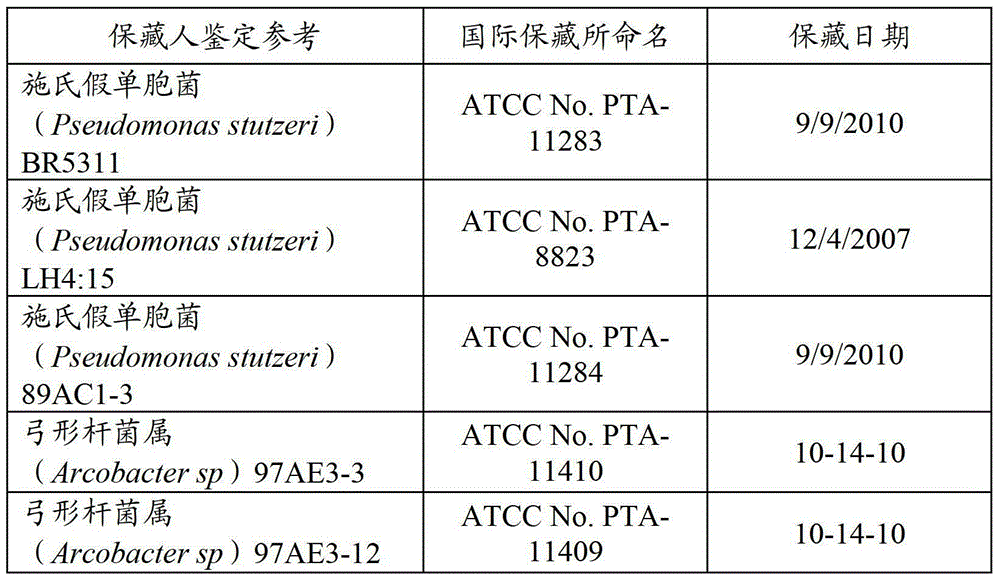
具体实施方式Detailed ways
申请人特别在本公开中加入了所有引用的参考文献的全部内容。除非另外指明,否则所有百分数、份数、比率等均按重量计。商标以大写体标示。此外,当数量、浓度或其它数值或参数以范围、优选范围或优选上限数值和优选下限数值的列表形式给出时,其应理解为具体地公开由任何范围上限或优选数值和任何范围下限或优选数值的任何一对所构成的所有范围,而不管所述范围是否被单独地公开。除非另行指出,凡在本文中给出某一数值范围之处,该范围均旨在包含其端点,以及位于该范围内的所有整数和分数。不旨在将本发明的范围限制为限定范围时详述的具体值。Applicants specifically incorporate in this disclosure the entire contents of all cited references. All percentages, parts, ratios, etc. are by weight unless otherwise indicated. Trademarks are shown in upper case. Furthermore, when amounts, concentrations or other values or parameters are given in the form of a list of ranges, preferred ranges or preferred upper and preferred lower values, it is to be understood that any range upper or preferred value and any range lower or All ranges formed by any pair of numerical values are preferred, regardless of whether said ranges are individually disclosed. Where a numerical range is given herein, that range is intended to be inclusive of its endpoints, and all integers and fractions lying within the range, unless otherwise indicated. It is not intended that the scope of the invention be limited to the specific values recited when defining the range.
提供了下列定义,用于本专利申请中所使用的特定术语和缩写:The following definitions are provided for certain terms and abbreviations used in this patent application:
缩写“ATCC”是指美国典型培养物保藏中心国际保藏(AmericanType Culture Collection International Depository,Manassas,VA,USA)。“ATCC No.”是指培养物保藏于ATCC的登录编号。The abbreviation "ATCC" refers to the American Type Culture Collection International Depository (Manassas, VA, USA). "ATCC No." means the accession number of the culture deposited with ATCC.
术语“生物膜”是指微生物的膜或“生物质层”。生物膜通常嵌入细胞外聚合物中,其粘附至淹没在水环境中或经受过水环境的表面。生物膜由具有结构异质性的微生物的致密团块基质组成,其可以具有遗传多样性、复杂的群体互动、和聚合物质细胞外基质。The term "biofilm" refers to a film or "layer of biomass" of microorganisms. Biofilms are often embedded in extracellular polymers that adhere to surfaces submerged in or subjected to aqueous environments. Biofilms consist of a dense mass matrix of microbes with structural heterogeneity, which can have genetic diversity, complex population interactions, and a polymeric extracellular matrix.
术语“堵塞生物膜”或“生物堵塞物”是指能够改变多孔材料的渗透性,并从而延迟流体通过与所述生物膜或生物堵塞物相关联的多孔材料的移动。The term "plugging a biofilm" or "bioclug" refers to the ability to alter the permeability of a porous material and thereby retard the movement of fluids through a porous material associated with said biofilm or bioplug.
本发明涉及在MEOR或生物整治应用过程中,通过引入流体和选择性的营养物质制剂,防止注入井钻孔的生产层表面和靠近注入井钻孔的孔洞堵塞的方法。在本发明所公开的方法中,在微生物生物质悬浮液向注入井的引入之后,任选地,流体被加入以将所述生物质从所引入的位点移除。然后接着是将第一营养物质溶液制剂引入注入井,其提供了营养物质供地下目标位点中微生物的生长,而不会促进生物质的聚集和生物膜的形成。然后引入第二营养物质溶液制剂,其促进微生物粘附至地下目标位点中的孔洞和通道,和产生用于形成生物堵塞的生物膜。The present invention relates to a method of preventing clogging of the production surface of an injection well borehole and cavities adjacent to the injection well borehole by introducing fluids and selective nutrient formulations during MEOR or bioremediation applications. In the methods disclosed herein, following the introduction of the microbial biomass suspension to the injection well, optionally, a fluid is added to remove the biomass from the site of introduction. This is then followed by introduction of a first nutrient solution formulation into the injection well, which provides nutrients for microbial growth in the subterranean target site without promoting biomass accumulation and biofilm formation. A second nutrient solution formulation is then introduced, which promotes the adhesion of microorganisms to pores and channels in the subterranean target site, and creates a biofilm for the formation of bioplugs.
在一个实施例中,所述微生物生物质悬浮液被制备在所述第一营养物质溶液制剂中,并且该悬浮液制剂被引入注入井钻孔中。当使用在第一营养物质溶液中制备的生物质悬浮液时,附加的第一营养物质溶液制剂可以在任选的流体的引入之后被引入,或者该步骤可以被省略。In one embodiment, said microbial biomass suspension is prepared in said first nutrient solution formulation, and this suspension formulation is introduced into an injection well borehole. When using a biomass suspension prepared in a first nutrient solution, additional first nutrient solution formulations may be introduced after the optional fluid introduction, or this step may be omitted.
“注入井钻孔生产层表面”面向通过井管(图1:4)中的穿孔与注入井连通的地下岩层的岩石层(图1:2,3)。本发明的方法改变了地下目标位点的渗透性并因此有助于采油或生物整治。如本文所用,短语“地下目标位点”是指在地表以下的由砂岩、非胶结砂岩、或石灰岩构成的区域,在其中MEOR或生物整治被应用。如本文所用,短语“改变目标位点渗透性”是指导致水淹的区域的堵塞,并从而使水流重新流向未被水淹的区域的过程。这些过程包括生物膜的形成和所述地下目标位点中砂土和岩石的孔洞通过微生物的堵塞。The "injection well bored production surface" faces the rock layer of the subterranean formation that communicates with the injection well through perforations in the well tubing (fig. 1: 4) (fig. 1: 2, 3). The method of the present invention alters the permeability of subterranean target sites and thus facilitates oil recovery or bioremediation. As used herein, the phrase "subterranean target site" refers to an area of sandstone, unconsolidated sandstone, or limestone below the earth's surface where MEOR or bioremediation is applied. As used herein, the phrase "altering target site permeability" refers to a process that results in blockage of a flooded area and thereby redirects water flow to non-flooded areas. These processes include the formation of biofilms and the plugging of pores in sand and rock in the subterranean target site by microorganisms.
在附加的实施例中,附加的步骤可以被包括在所述方法中。例如在一个实施例中,在步骤(d)之后,注入井被关井一段时间。在这段时间中,井被关闭,使得没有东西被引入井中,并且微生物将在它们的新环境中生长。在另一个实施例中,在步骤(d)之后,一种或多种流体被引入注入井钻孔中。上述流体被用于将微生物更深地带入地下目标位点。在另一个实施例中,在步骤(d)之后引入一种或多种流体之后,注入井被关井一段时间。在另一个实施例中,在步骤(d)之后,一种或多种流体被引入注入井钻孔中。流体的急流流经未被堵塞的孔洞和通道,移除了供开采的油或用于生物整治的其他物质。在另一个实施例中,在步骤(d)之后,附加的第二营养物质溶液制剂被引入注入井钻孔中,以促进进一步的生物膜形成。所述附加的第二营养物质溶液制剂通常在流体的引入之间被分批地间歇加入。这些其他步骤的任何组合可以被用于本发明的方法中。In additional embodiments, additional steps may be included in the methods. For example, in one embodiment, after step (d), the injection well is shut in for a period of time. During this time, the well is closed so that nothing is introduced into the well and the microorganisms will grow in their new environment. In another embodiment, after step (d), one or more fluids are introduced into the injection well bore. The aforementioned fluids are used to bring the microorganisms deeper into the subsurface to the target site. In another embodiment, after step (d) the one or more fluids are introduced, the injection well is shut in for a period of time. In another embodiment, after step (d), one or more fluids are introduced into the injection well bore. The rapid flow of fluid through unplugged pores and channels removes oil for recovery or other material for bioremediation. In another embodiment, after step (d), an additional second nutrient solution formulation is introduced into the injection well borehole to promote further biofilm formation. The additional second nutrient solution formulation is typically added intermittently in batches between introductions of fluids. Any combination of these other steps may be used in the methods of the invention.
注入井钻孔和邻近它的地下位点的示意图显示于图1中。当流体(1)被引入注入井时,其流入井管(7)中,井管位于钻穿了岩石层(2,3)的井孔(5)内部。在井管(7)和由井孔(5)造成的岩石层的注入井钻孔生产层表面(6)之间存在间隙。岩石层(2)表示在储藏或保留油的可渗透岩石层(3)上方或下方的不可渗透的岩石。被引入井孔的任何流体(1)沿井管(7)流下,并通过管中的穿孔(5)和进入含油地下岩层(3)的岩石基体中的孔眼(4)。然后,上述流体流经含油地下岩层(3)并置换来自这些岩层的油。上述区域放射状地从井孔(5)向各个方向在含油岩层(3)中扩展。A schematic diagram of the injection well borehole and the subterranean site adjacent to it is shown in FIG. 1 . When the fluid (1) is introduced into the injection well, it flows into the well pipe (7) inside the wellbore (5) drilled through the rock formations (2, 3). There is a gap between the well pipe (7) and the injection well bored production layer surface (6) of the rock formation caused by the wellbore (5). A rock layer (2) means impermeable rock above or below a permeable rock layer (3) that stores or retains oil. Any fluid (1) introduced into the wellbore flows down the well tubing (7) and through the perforations (5) in the tubing and into the perforations (4) in the rock matrix of the oil-bearing subterranean formation (3). The fluid then flows through oil-bearing subterranean formations (3) and displaces oil from these formations. The above-mentioned area expands radially from the wellbore (5) in all directions in the oil-bearing rock formation (3).
在本发明的方法中,当微生物生物质被引入注入井钻孔时,其任选地接着是加入一种或多种流体,以帮助将微生物移入邻近的地下目标位点。适合用于本文的流体能够包括,例如,MEOR操作过程中所使用的注入和生产水。在本发明的方法中有用的流体包括水。水能够从任何适合的来源被提供,并且能够包括,例如:海水、盐水、生产水、从地下含水层(包括与地下位点中的油接触的那些含水层)开采的水、或来自溪、河、池或湖的地表水。如本领域中已知的,在注入一个或多个井孔之前,可能需要从所述水移除颗粒物,包括尘土、岩石或砂土的小块以及侵蚀副产物如锈。移除此类颗粒物的方法,例如过滤、沉淀和离心,是本领域中为人们所熟知的。In the methods of the invention, when the microbial biomass is introduced into the injection well borehole, it is optionally followed by the addition of one or more fluids to help move the microorganisms into the adjacent subterranean target site. Fluids suitable for use herein can include, for example, injection and production water used during MEOR operations. Fluids useful in the methods of the present invention include water. Water can be provided from any suitable source, and can include, for example: seawater, brine, produced water, water extracted from underground aquifers (including those in contact with oil in subsurface sites), or from streams, Surface water of a river, pond or lake. As is known in the art, it may be necessary to remove particulate matter, including dust, small pieces of rock or sand, and erosion by-products such as rust, from the water prior to injection into one or more wellbores. Methods for removing such particulates, such as filtration, sedimentation and centrifugation, are well known in the art.
在本发明所公开的方法的一个实施例中,来自油层的注入或生产水,在微生物生物质悬浮液的引入之后被引入注入井钻孔,以将被引入所述注入井的微生物更深地带入邻近的地下目标位点。In one embodiment of the method disclosed herein, injection or production water from the oil reservoir is introduced into the injection well borehole after the introduction of the microbial biomass suspension to bring the microorganisms introduced into the injection well deeper into the Adjacent underground target sites.
来自此类井的注入水或生产水能够包含多种浓度的包含例如氯、钠、钾、溴、镁、钡、钙的混合盐类(在下文中称为“盐”)。注入或生产井水的盐度能够是约0至约100份每一千份(ppt)。Injection or production water from such wells can contain various concentrations of mixed salts including, for example, chlorine, sodium, potassium, bromine, magnesium, barium, calcium (hereinafter "salts"). The salinity of injection or production well water can be from about 0 to about 100 parts per thousand (ppt).
即使是制备了充分分散的生物质悬浮液时,在其被引入井孔之后,其也能够聚集并导致注入井钻孔的工作层表面的堵塞,从而降低到达采油或生物整治将在其中发生的地下目标位点的生物质的量,或者在更差的情况实际上堵塞井孔时,使将流体泵入井孔所需的压力升高。本发明的方法通过引入本文所公开的流体和营养物质溶液制剂(它们允许生物质更深的渗透进地下目标位点),减少了在注入井钻孔的生产层表面处微生物生物质的聚集和生物膜与生物堵塞物的形成。Even when a well-dispersed suspension of biomass is prepared, after it is introduced into the wellbore, it can accumulate and cause plugging of the working layer surface of the injection well borehole, thereby reducing the potential for oil recovery or bioremediation to occur within it. The amount of biomass at the subterranean target site, or in worse cases actually plugging the wellbore, raises the pressure required to pump fluids into the wellbore. The methods of the present invention reduce the accumulation of microbial biomass and the growth of microbial biomass at the surface of the production zone of the injection well borehole by introducing the fluid and nutrient solution formulations disclosed herein, which allow deeper penetration of the biomass into the subterranean target site. Membrane and bioplug formation.
营养物质溶液制剂Nutrient Solution Preparation
在本发明中有用的营养物质溶液制剂可以包括生长基质(为细胞的生长提供物质和能量的化合物);电子受体;氮和磷源,以及多种微量成分,例如除生长基质和氮源之外微生物的生长和活性所通常还需要的维生素和金属。Nutrient solution formulations useful in the present invention may include growth substrates (compounds that provide matter and energy for the growth of cells); electron acceptors; sources of nitrogen and phosphorus, and various trace ingredients, such as Vitamins and metals are also usually required for the growth and activity of exogenous microorganisms.
在本发明中有用的营养物质溶液制剂单独地或以组合形式包含下列物质:碳源,以大于0.01%w/v加入;用于微生物生长的电子受体(就厌氧生长条件而言),以大于0.01%w/v加入;氮源,以大于0.001%w/v加入;磷源,以大于0.001%w/v加入;微量营养物质(例如维生素和金属)的源,以大于0.0001%w/v加入。Nutrient solution formulations useful in the present invention comprise the following alone or in combination: a carbon source, added at greater than 0.01% w/v; an electron acceptor for microbial growth (in terms of anaerobic growth conditions), Added at greater than 0.01% w/v; nitrogen source, added at greater than 0.001% w/v; phosphorus source, added at greater than 0.001% w/v; source of micronutrients (such as vitamins and metals), added at greater than 0.0001% w/v /v Join.
本文预期的有用的营养物质溶液制剂包括至少一种下列元素的那些:C、H、O、P、N、S、Mg、Fe、或Ca。包含至少一种上述元素的有用的无机自由基的非限制性例子包括,例如:PO4 2-、NH4 +、NO2 -、NO3 -和SO4 2-。生长基质能够包括糖、有机酸、醇、蛋白质、多糖、脂肪、烃、或其他在微生物学领域已知被微生物分解的有机物质。主要营养物质包括氮和磷(非限制性例子能够包括NaNO3、KNO3、NH4NO3、Na2HPO4、K2HPO4、NH4Cl);维生素(非限制性例子可以包括叶酸、抗坏血酸、和核黄素);微量元素(非限制性例子可以包括B、Zn、Cu、Co、Mg、Mn、Fe、Mo、W、Ni和Se);用于环境控制的缓冲剂;催化剂,包括酶;以及天然的和人工的电子受体(非限制性例子可以包括SO4 2-、NO3 -、Fe+3、腐殖酸、金属氧化物、醌化合物、CO2、O2、以及它们的组合)。复合成分例如酵母提取物可以被用于提供多种营养物质,例如维生素和氨基酸。Useful nutrient solution formulations contemplated herein are those that include at least one of the following elements: C, H, O, P, N, S, Mg, Fe, or Ca. Non-limiting examples of useful inorganic radicals comprising at least one of the above elements include, for example: PO 4 2− , NH 4 + , NO 2 − , NO 3 − and SO 4 2− . Growth substrates can include sugars, organic acids, alcohols, proteins, polysaccharides, fats, hydrocarbons, or other organic substances known in the art of microbiology to be broken down by microorganisms. Key nutrients include nitrogen and phosphorus (non-limiting examples can include NaNO3 , KNO3 , NH4NO3 , Na2HPO4 , K2HPO4 , NH4Cl ); vitamins (non-limiting examples can include folic acid, ascorbic acid, and riboflavin); trace elements (non-limiting examples may include B, Zn, Cu, Co, Mg, Mn, Fe, Mo, W, Ni, and Se); buffers for environmental control; catalysts, including enzymes; and natural and artificial electron acceptors (non-limiting examples may include SO 4 2− , NO 3 − , Fe +3 , humic acids, metal oxides, quinone compounds, CO 2 , O 2 , and their combination). Complex ingredients such as yeast extract can be used to provide various nutrients such as vitamins and amino acids.
在本发明的方法中,对所引入的一种或多种微生物具有不同效应的分别的营养物质溶液制剂在对地下目标位点的处理过程中被使用。在生物质悬浮液以及任选的一种或多种流体的引入之后,所述营养物质溶液制剂被引入地下目标位点的注入井钻孔中。第一营养物质溶液提供支持所引入的一种或多种微生物生长的营养物质,但它不促进生物质的聚集和生物膜的形成。在第一营养物质溶液制剂的存在下,可能有一些生物膜的形成,但其与在第二营养物质溶液制剂的存在下,由微生物产生的生物膜的形成的量相比是降低的。因此,第一营养物质溶液制剂没有促进生物膜的形成。第一营养物质溶液还可以维持悬浮液中的微生物,而不是促进聚集。因此,随着第一营养物质溶液的引入,所引入的微生物能够散布并遍及地下目标位点地生长,而不会堵塞注入井钻孔的工作层表面和靠近井孔的孔洞。In the methods of the invention, separate formulations of nutrient solutions having different effects on the introduced microorganism(s) are used during the treatment of the subterranean target site. Following the introduction of the biomass suspension and optionally one or more fluids, the nutrient solution formulation is introduced into the injection well borehole at the subterranean target site. The first nutrient solution provides nutrients that support the growth of the introduced one or more microorganisms, but it does not promote biomass aggregation and biofilm formation. There may be some biofilm formation in the presence of the first nutrient solution formulation, but it is reduced compared to the amount of biofilm formation produced by the microorganisms in the presence of the second nutrient solution formulation. Thus, the first nutrient solution formulation did not promote biofilm formation. The first nutrient solution also maintains the microorganisms in suspension rather than promoting aggregation. Thus, following the introduction of the first nutrient solution, the introduced microorganisms are able to spread and grow throughout the subterranean target site without plugging the working surface of the injection well borehole and the pores adjacent the wellbore.
在第一营养物质溶液之后被引入的第二营养物质溶液,促进导致地下目标位点中孔洞和通道的生物堵塞的微生物中的效应。所述效应可以包括聚集、粘附、和生物膜的产生。因此,随着第二营养物质溶液的引入,地下目标位点中孔洞和通道被堵塞,导致改善的采油或生物整治。The second nutrient solution, introduced after the first nutrient solution, promotes the effect in microorganisms leading to bio-clogging of pores and channels in the subterranean target site. Such effects may include aggregation, adhesion, and biofilm production. Thus, with the introduction of the second nutrient solution, the pores and channels in the subterranean target site are plugged, resulting in improved oil recovery or bioremediation.
所述第一和第二营养物质溶液制剂的组成的差异可以是促进以上所述的不同效应的任何一种或多种组分的差异。例如,在生长基质中可以存在差异。在本发明的方法的一个实施例中,在生物质悬浮液和任选的至少一种流体的引入之后被引入的第一营养物质制剂包含乳酸盐而不含乙酸盐。乳酸盐在所述第一营养物质溶液制剂中的浓度为25份每一百万份至约10,000份每一百万份。这之后接着是引入包含乙酸盐的第二营养物质溶液制剂。乙酸盐在所述第二营养物质溶液制剂中的浓度能够是至多30%重量。所述第一和第二营养物质溶液制剂包含至多30%重量的硝酸盐。The difference in composition of the first and second nutrient solution formulations may be a difference in any one or more components that contribute to the different effects described above. For example, there may be differences in growth substrates. In one embodiment of the method of the invention, the first nutrient formulation introduced after the introduction of the biomass suspension and optionally at least one fluid comprises lactate and no acetate. The concentration of lactate in the first nutrient solution formulation is from 25 parts per million to about 10,000 parts per million. This was followed by the introduction of a second nutrient solution formulation comprising acetate. The concentration of acetate in said second nutrient solution formulation can be up to 30% by weight. The first and second nutrient solution formulations comprise up to 30% by weight nitrate.
不同的营养物质溶液制剂对不同的微生物的效应,在不同的盐浓度的存在下也可以变化。例如,包含乳酸盐或乙酸盐的营养物质溶液制剂之间,在高盐的存在下与低盐相比,可以发生生物膜形成的更大差异。高盐浓度可以是至少约30ppt、35ppt、40ppt、45ppt、50ppt、55ppt、60ppt、65ppt、70ppt、或75ppt,或者更高。The effect of different nutrient solution formulations on different microorganisms may also vary in the presence of different salt concentrations. For example, greater differences in biofilm formation may occur in the presence of high salt compared to low salt between nutrient solution formulations containing lactate or acetate. The high salt concentration can be at least about 30 ppt, 35 ppt, 40 ppt, 45 ppt, 50 ppt, 55 ppt, 60 ppt, 65 ppt, 70 ppt, or 75 ppt, or higher.
在本发明的方法中,在包含微生物的生物质悬浮液的引入之后,分别含有乳酸盐和乙酸盐的第一和第二营养物质溶液,能够被用于在包含乙酸盐的培养基中与在包含乳酸盐的培养基中相比具有提高的生物堵塞的任何微生物。In the method of the present invention, after the introduction of the biomass suspension containing microorganisms, the first and second nutrient solutions containing lactate and acetate, respectively, can be used in the culture medium containing acetate Any microorganism that has increased bioclogging compared to that in lactate-containing medium.
通过在如本文的一般方法部分所述的生物膜试验中进行测试,微生物能够被鉴定为在不同的营养物质溶液制剂中具有不同的性质。例如,施氏假单胞菌菌株BR5311(ATCC No.PTA-11283)和LH4:15(ATCC No.PTA-8823)在本文中被显示在包含乙酸盐的营养物质溶液中比在包含乳酸盐的营养物质溶液中形成更有效的生物堵塞。生物堵塞反应可以随所使用的营养物质溶液的盐度变化,并且能够由本领域技术人员使用本文所述的检测法容易地评估。Microorganisms can be identified as having different properties in different nutrient solution formulations by testing in a biofilm assay as described in the General Methods section herein. For example, Pseudomonas stutzeri strains BR5311 (ATCC No. PTA-11283) and LH4:15 (ATCC No. PTA-8823) were shown herein to be more effective in nutrient solutions containing acetate than in lactic acid containing Salt nutrients in solution form a more effective bio-plug. Bioclogging responses may vary with the salinity of the nutrient solution used and can be readily assessed by one skilled in the art using the assays described herein.
在另一个实施例中,其他微生物可以被用于堵塞,其可以需要其他特定的营养物质用于生物膜的形成和堵塞。第一和第二营养物质溶液所需要的组分,可以由本领域技术人员采用本文的一般方法部分所描述的检测法,基于将要在生物质悬浮液中被引入的微生物的堵塞反应容易地确定。In another example, other microorganisms may be used for plugging, which may require other specific nutrients for biofilm formation and plugging. The required components of the first and second nutrient solutions can be readily determined by one skilled in the art based on the plugging reaction of the microorganisms to be introduced into the biomass suspension using the assays described in the General Methods section herein.
生物质biomass
对于本文所公开的方法有用的用于形成生物膜和堵塞地下目标位点的孔洞的生物质悬浮液,能够包含兼性厌氧菌、专性厌氧菌和反硝化菌的种类。用于生物膜的形成和聚集,以改善波及效率和强化采油的多种微生物(细菌和真菌)菌种可以包括但不限于下列的属:假单胞菌属(Pseudomonas)、芽孢杆菌属(Bacillus)、放线菌纲(Actinomycetes)、不动杆菌属(Acinetobacter)、节杆菌属(Arthrobacter)、裂殖菌纲(Schizomycetes)、棒状杆菌属(Corynebacteria)、无色小杆菌属(Achromobacteria)、弓形杆菌属(Arcobacter)、肠杆菌属(Enterobacteria)、诺卡氏菌属(Nocardia)、酵母纲(Saccharomycetes)、裂殖酵母属(Schizosaccharomyces)、弧菌属(Vibrio)、希瓦氏菌属(Shewanella)、索氏菌属(Thauera)、石袍菌属(Petrotoga)、微球茎菌属(Microbulbifer)、海杆菌属(Marinobacteria)、梭杆菌属(Fusibacteria)和红酵母属(Rhodotorula)。如本文所用,术语“属”是指在微生物的分类学分类层级中,低于“科”而高于“菌种”的微生物分类。如本文所用,“菌种”是指具有高度的表型、生物化学和基因型相似性的微生物群体。Biomass suspensions useful for the methods disclosed herein to form biofilms and plug pores at subterranean target sites can contain species of facultative anaerobes, obligate anaerobes, and denitrifiers. Various microbial (bacterial and fungal) species used for biofilm formation and accumulation to improve sweep efficiency and enhance oil recovery may include but are not limited to the following genera: Pseudomonas, Bacillus ), Actinomycetes, Acinetobacter, Arthrobacter, Schizomycetes, Corynebacteria, Achromobacteria, Arcobacteria Arcobacter, Enterobacteria, Nocardia, Saccharomycetes, Schizosaccharomyces, Vibrio, Shewanella ), Thauera, Petrotoga, Microbulbifer, Marinobacteria, Fusibacteria and Rhodotorula. As used herein, the term "genus" refers to the classification of microorganisms lower than "family" and higher than "species" in the taxonomic classification hierarchy of microorganisms. As used herein, "species" refers to a population of microorganisms with a high degree of phenotypic, biochemical and genotypic similarity.
所述生物质悬浮液能够包含仅一个特定菌种、相同属的两种或更多种菌种、不同属的组合、或多个属的多个菌种的组合的微生物。在一个实施例中,用于实施本发明的方法的生物质悬浮液,是使用在共同拥有和共同未决的美国专利申请公布20090263887中描述的施氏假单胞菌LH4:15(ATCC No.PTA-8823)获得的,该文献的内容全文以引用方式并入本文。在另一个实施例中,用于实施本发明的方法的生物质悬浮液,是使用施氏假单胞菌菌株BR5311(ATCC PTA-11283)获得的,其公开于共同拥有和共同未决的美国专利申请61/408734中,该文献以引用方式并入本文。在另一个实施例中,所述生物质悬浮液这两种菌株均包含。The biomass suspension can contain microorganisms of only one particular species, two or more species of the same genus, a combination of different genera, or a combination of multiple species of multiple genera. In one embodiment, the biomass suspension used to practice the methods of the invention is Pseudomonas stutzeri LH4:15 (ATCC No. PTA-8823), the contents of which are incorporated herein by reference in their entirety. In another embodiment, the biomass suspension used to practice the methods of the invention is obtained using Pseudomonas stutzeri strain BR5311 (ATCC PTA-11283), which is disclosed in commonly owned and co-pending U.S. Patent application 61/408734, which is incorporated herein by reference. In another embodiment, the biomass suspension contains both strains.
生物质悬浮液、流体、和营养物质溶液能够通过多种方式被引入井孔,例如离心泵、活塞泵、齿轮泵或任何其他装置,或者通过本领域所熟知的任何其他方法。Biomass suspensions, fluids, and nutrient solutions can be introduced into the wellbore by various means, such as centrifugal pumps, piston pumps, gear pumps, or any other means, or by any other method known in the art.
生物质的制备Biomass preparation
对于本发明的方法有用的生物质悬浮液是通过使所选择的一种或多种微生物在适当的培养基中生长制备的。本领域技术人员熟悉能够被用于所期望的微生物的生物质制备的适合的培养基。当使用施氏假单胞菌时,适合的培养基能够包含乳酸盐,其将不会支持生物堵塞的形成。生物质可以被浓缩,例如通过过滤或离心。生物质能够按要求被制备用于立即引入注入井而没有被储存。作为另外一种选择,生物质能够被提前制备,并能够作为糊料被冷冻储存。从冷冻的生物质制备生物质需要特别小心,并且可能需要应用一种或多种类型的混合器,以确保生物质的彻底重悬浮和任何细胞团块的不存在。例如,包括流经生物质分散装置的用于递送生物质群体的方法公开于美国专利申请公布20110244554中,该文献以引用方式并入本文。Biomass suspensions useful for the methods of the invention are prepared by growing a selected microorganism or microorganisms in a suitable medium. Those skilled in the art are familiar with suitable media that can be used for the biomass production of the desired microorganism. When using Pseudomonas stutzeri, a suitable medium can contain lactate, which will not support the formation of bioplugs. Biomass can be concentrated, for example by filtration or centrifugation. Biomass can be prepared on demand for immediate introduction into injection wells without being stored. Alternatively, biomass can be prepared ahead of time and can be stored frozen as a paste. Preparation of biomass from frozen biomass requires special care and may require the application of one or more types of mixers to ensure thorough resuspension of the biomass and absence of any cell clumps. For example, a method for delivering a population of biomass comprising flow through a biomass dispersion device is disclosed in US Patent Application Publication 20110244554, which is incorporated herein by reference.
本发明所公开的方法也能够被用于污染地点的生物整治。The method disclosed in the present invention can also be used for bioremediation of contaminated sites.
实例example
本发明将在下面的实例中得到进一步阐述。应该理解,这些实例尽管说明了本发明的优选实施例,但仅是以例证的方式给出的。根据上面的论述和这些实例,本领域的技术人员能够确定本发明的基本特征,并且在不脱离其范围的情况下,能够对本发明做出各种变化和修改以使其适用于各种用法和条件。The invention will be further illustrated in the following examples. It should be understood, that these Examples, while indicating preferred embodiments of the invention, are given by way of illustration only. From the above discussion and these Examples, one skilled in the art can ascertain the essential characteristics of this invention, and without departing from its scope, can make various changes and modifications of the invention to adapt it to various usages and condition.
一般方法general method
生物质的生长growth of biomass
用于厌氧微生物的生长和维持的技术是本领域中为人们所熟知的。厌氧生长通过硝酸盐随着时间从生长营养物质溶液的消耗和亚硝酸盐的积累被测量。Techniques for the growth and maintenance of anaerobic microorganisms are well known in the art. Anaerobic growth was measured by depletion of nitrate from the growth nutrient solution and accumulation of nitrite over time.
生物质能够如共同未决的美国专利申请公布20090263887中所描述的生长和储存,该文献的内容全文以引用方式并入本文。Biomass can be grown and stored as described in co-pending US Patent Application Publication 20090263887, the contents of which are incorporated herein by reference in their entirety.
PPGAS培养基包含:20毫摩尔每升(mM)NH4Cl、20mM KCl、120mM Tris-Cl、1.6mM MgSO4、1%蛋白胨、0.5%葡萄糖、pH7.5。PPGAS medium contains: 20 millimolar per liter (mM) NH 4 Cl, 20 mM KCl, 120 mM Tris-Cl, 1.6 mM MgSO 4 , 1% peptone, 0.5% glucose, pH 7.5.
在下文的实例中使用的基本盐营养物质溶液制剂的组成显示于表1中。The composition of the basic salt nutrient solution formulation used in the examples below is shown in Table 1.
表1Table 1
基本盐营养物质溶液制剂的组成Composition of Basic Salt Nutrient Solution Preparation

购买的营养物质溶液制剂Purchased Nutrient Solution Preparations
Millers LB生长培养基是购买的(MediTech,Inc,Manassas,VA)。Millers LB growth medium was purchased (MediTech, Inc, Manassas, VA).
注入水样品inject water sample
注入水取样自各自位于两个不同的石油生产场地的两个分别的场地。井1位于加拿大Saskatchewan和Alberta省边界上的Senlac油田。该井在生产和注入水中均具有30-35份每一千份(ppt)之间的盐度。井2位于加拿大Alberta省的Wainwright油田。该井具有约两倍于海水的盐度,在65ppt范围内。Injection water was sampled from two separate sites each located at two different oil production sites. Well 1 is located in the Senlac field on the border of Saskatchewan and Alberta, Canada. The well had a salinity between 30-35 parts per thousand (ppt) in both production and injection water. Well 2 is located in the Wainwright oil field in Alberta, Canada. The well has about twice the salinity of seawater, in the 65ppt range.
来自油层生产和注入水的样品Samples from reservoir production and injection water
从生产和注入井(井1和井2)获取了混合的油/水液体形式的水样,水样取在玻璃的1.0升(L)棕色瓶中,充至顶部,加盖并用胶带密封以防止气体泄漏。内在的厌氧过程中产生的气体足以在运输过程中维持厌氧条件。在取样后48小时内,瓶子在充满了大冰块的大型塑料冷却器中被运输至测试装置。Water samples in the form of mixed oil/water liquids were obtained from production and injection wells (well 1 and well 2) in glass 1.0 liter (L) brown bottles, filled to the top, capped and sealed with tape to Prevent gas leakage. The gas produced during the intrinsic anaerobic process is sufficient to maintain anaerobic conditions during transport. Within 48 hours of sampling, the bottles were transported to the testing facility in large plastic coolers filled with large ice cubes.
总溶解盐(盐度)的测量Measurement of total dissolved salts (salinity)
使用手持型折射计(型号RHS10ATC,Huake Instrument Co.,Ltd,Shenzhen,China)测量了总溶解盐。Total dissolved salts were measured using a hand-held refractometer (model RHS10ATC, Huake Instrument Co., Ltd, Shenzhen, China).
在烧结玻璃过滤器上的生物膜形成Biofilm formation on sintered glass filters
使用烧结玻璃过滤器开发了检测方法来就微生物在二氧化硅表面上形成生物膜和防止水流过~10微米孔隙(堵塞)的能力对微生物进行评估。25毫米(mm)中等粗度烧结玻璃过滤器(stock15254,Adams andChittenden Scientific Glass,Berkeley CA)被粘在设计用于膜过滤的塑料支持器基座中。在固化后,用高压灭菌法对过滤器组件进行灭菌。各个过滤器在支持器中被置于无菌的皮氏培养皿中,并且包含了来自各种菌株的过夜培养物的种菌的营养物质溶液制剂被添加在玻璃过滤器的顶部。上述生物膜形成/堵塞检测中的营养物质溶液制剂是基本盐培养基(表1)或是补充了氮、磷酸盐、微量元素、维生素、碳源和作为电子受体的硝酸盐的注入或生产水样品。盖上皮氏培养皿,并于室温在厌氧条件下孵育一至2星期。然后将过滤器从营养物质溶液制剂移走,并将塑料支持器的顶件固定在适当位置。将十厘米长度的管子附接到过滤器支持器的入口,并用水充满。测量了管中的水流干的时间(以秒计)。没有任何微生物的对照过滤器花了约10秒流干。花了大于10秒流干的过滤器被认为是“堵塞的”。Assays were developed using sintered glass filters to evaluate microorganisms for their ability to form biofilms on silica surfaces and prevent water flow through ~10 micron pores (clogging). A 25 millimeter (mm) medium coarse sintered glass filter (stock 15254, Adams and Chittenden Scientific Glass, Berkeley CA) was glued into a plastic holder base designed for membrane filtration. After curing, the filter assembly is sterilized by autoclaving. Individual filters were placed in sterile petri dishes in holders, and nutrient solution formulations containing inoculum from overnight cultures of the various strains were added on top of the glass filters. Nutrient solution preparations in the above biofilm formation/clogging assays were minimal salt media (Table 1) or supplemented with infusion or production of nitrogen, phosphate, trace elements, vitamins, carbon source and nitrate as electron acceptor. water sample. Cover the Petri dish and incubate under anaerobic conditions at room temperature for one to two weeks. The filter is then removed from the nutrient solution formulation and the top piece of the plastic holder is held in place. Attach a ten centimeter length of tubing to the inlet of the filter holder and fill it with water. The time (in seconds) for the water in the tube to dry up was measured. The control filter without any microorganisms took about 10 seconds to drain. Filters that took greater than 10 seconds to drain were considered "clogged".
在替代性的堵塞测定法中,在使用前用流体浸润了烧结玻璃过滤器,在添加微生物之前就流速进行了预筛,并在实验结束时测定了孵育之后流速的百分比变化。In an alternative clogging assay, sintered glass filters were infiltrated with fluid prior to use, pre-screened for flow rate prior to addition of microorganisms, and the percent change in flow rate after incubation was determined at the end of the experiment.
实例1Example 1
施氏假单胞菌(LH4:15)在二氧化硅表面上形成生物膜的能力Ability of Pseudomonas stutzeri (LH4:15) to form biofilms on silica surfaces
为了评估施氏假单胞菌菌株LH4:15(ATCC PTA-8823)在二氧化硅表面上产生稳定的生物膜的能力,无菌玻璃珠(3mm,11-312A,FisherScientific,Hampton,NH)被置于24孔微量滴定板(353047,BDBiosciences)的孔中,并加入注入水或PPGAS培养基的等分试样(1.0mL)。0.6%乙酸盐或0.6%乳酸盐被添加至每一孔,然后加入已经以200转每分钟(rpm)并且于室温在PPGAS培养基中有氧生长的菌株LH4:15的过夜培养物10ml。然后在室温孵育平板至约一个星期。通过目测评估了生物膜的形成。To assess the ability of Pseudomonas stutzeri strain LH4:15 (ATCC PTA-8823) to produce stable biofilms on silica surfaces, sterile glass beads (3 mm, 11-312A, Fisher Scientific, Hampton, NH) were Place in the wells of a 24-well microtiter plate (353047, BD Biosciences) and add an aliquot (1.0 mL) filled with water or PPGAS medium. 0.6% acetate or 0.6% lactate was added to each well followed by 10 ml of an overnight culture of strain LH4:15 that had been grown aerobically in PPGAS medium at 200 revolutions per minute (rpm) at room temperature . The plates were then incubated at room temperature for up to about one week. Biofilm formation was assessed by visual inspection.
结果表明在玻璃珠上形成了不同类型的生物膜。在包含注入水的孔中,大多数的生物膜在玻璃珠上形成,而在孔的侧面和底部上仅有少量的生物膜被观察到。然而,当PPGAS培养基被用作营养物质溶液制剂时,生物膜遍及整个孔地形成。在包含乙酸盐作为附加的碳源的孔中,所形成的生物膜是更为颗粒状的,而在包含乳酸盐的孔中,所形成的生物膜是更平滑的。这些结果表明,施氏假单胞菌菌株LH4:15具有在二氧化硅表面上容易地形成生物膜和根据可用的碳源产生不同类型的生物膜的能力。The results indicated that different types of biofilms formed on the glass beads. In the wells containing the injected water, most of the biofilm formed on the glass beads, while only a small amount of biofilm was observed on the sides and bottom of the wells. However, when PPGAS medium was used as the nutrient solution formulation, biofilms formed throughout the wells. In wells containing acetate as an additional carbon source, the formed biofilm was more granular, whereas in wells containing lactate the formed biofilm was smoother. These results indicate that P. stutzeri strain LH4:15 has the ability to readily form biofilms on silica surfaces and to produce different types of biofilms depending on the carbon source available.
实例2Example 2
碳源对施氏假单胞菌菌株BR5311形成生物膜的能力的影响Effect of carbon sources on the ability of Pseudomonas stutzeri strain BR5311 to form biofilms
在本实例中,检测了营养物质溶液制剂中的碳源对通过施氏假单胞菌菌株BR5311(ATCC PTA-11283)的生物膜形成的影响。菌株BR5311是作为能够在反硝化条件下在水/油界面生长的微生物从位于加拿大中部Saskatchewan和Alberta省边界上的Senlac油田的井1的注入水分离的。其通过16S rDNA分析被鉴定为施氏假单胞菌菌株,这描述于共同拥有和共同未决的美国专利申请61/408734中。In this example, the effect of a carbon source in a nutrient solution formulation on biofilm formation by Pseudomonas stutzeri strain BR5311 (ATCC PTA-11283) was examined. Strain BR5311 was isolated as a microorganism capable of growing at the water/oil interface under denitrifying conditions from the injection water of Well 1 in the Senlac oil field located on the border of Saskatchewan and Alberta provinces in central Canada. It was identified as a Pseudomonas stutzeri strain by 16S rDNA analysis, as described in commonly owned and co-pending US patent application 61/408734.
如“一般方法”中所述进行了生物膜形成测试。所使用的培养基是表1中显示的基本盐培养基,并且补充了乙酸盐或乳酸盐作为唯一的碳源和硝酸盐作为电子受体,如表2中所列的。通过将混合物置于包含抗坏血酸盐氧气涤气系统(Becton,Dickinson Co,Sparks,Maryland)的塑料室中,使混合物成为厌氧的。该检测中使用的营养物质溶液制剂包含乙酸盐或乳酸盐作为唯一的碳源和硝酸盐作为电子受体,如表2中所显示的。Biofilm formation assays were performed as described in General Methods. The medium used was the minimal salt medium shown in Table 1 and supplemented with acetate or lactate as the sole carbon source and nitrate as the electron acceptor, as listed in Table 2. The mixture was made anaerobic by placing it in a plastic chamber containing an ascorbate oxygen scrubbing system (Becton, Dickinson Co, Sparks, Maryland). The nutrient solution formulations used in this assay contained acetate or lactate as the sole carbon source and nitrate as the electron acceptor, as shown in Table 2.
来自井2的高盐注入水(67ppt)被过滤除菌,并向其加入了下列附加的营养物质:0.5g/L NH4Cl;0.69g/L NaH2PO4;1.4g/L KH2PO4;维生素和微量元素如表1中所示。硝酸钠和乙酸钠或乳酸钠被添加至测试样品,以得到表2的e列中显示的可用的供体/受体电子比率。25mL的上述营养物质溶液制剂和1.0mL的过夜生长微生物(如实例1中所述制备)被添加至每一玻璃过滤器支持器。在培养箱/摇动器中以28℃和100rpm在厌氧箱中孵育1星期后,移出过滤器,并如“一般方法”中所述针对堵塞进行了测量。每一过滤器被测量了3次。表2中给出了每一测试样品的流动时间的结果。High saline injection water (67ppt) from Well 2 was filter sterilized and the following additional nutrients were added: 0.5g/L NH 4 Cl; 0.69g/L NaH 2 PO 4 ; 1.4g/L KH 2 PO 4 ; vitamins and trace elements are shown in Table 1. Sodium nitrate and sodium acetate or sodium lactate were added to the test samples to obtain the available donor/acceptor electron ratios shown in Table 2, column e. 25 mL of the above nutrient solution formulation and 1.0 mL of overnight grown microorganisms (prepared as described in Example 1) were added to each glass filter holder. After 1 week of incubation in an anaerobic chamber at 28 °C and 100 rpm in an incubator/shaker, filters were removed and measured for clogging as described in General Methods. Each filter was measured 3 times. Table 2 gives the results for the flow time of each test sample.
表2Table 2
添加至用于进行生物膜形成的施氏假单胞菌菌株BR5311的营养物质Nutrients added to Pseudomonas stutzeri strain BR5311 for biofilm formation 溶液制剂的碳源和相关的流动时间Carbon sources and associated flow times for solution formulations
如表2所显示的,无论碳对硝酸盐的比率如何,当乙酸盐被用作碳源时(测试1和3)观察到了显著的堵塞。在具有4:1的供体/受体电子比率的井2水的高盐(67ppt)培养基中观察到了最低的堵塞。As shown in Table 2, regardless of the ratio of carbon to nitrate, significant clogging was observed when acetate was used as the carbon source (tests 1 and 3). The lowest clogging was observed in high salt (67 ppt) medium of well 2 water with a donor/acceptor electron ratio of 4:1.
实例3Example 3
在含有乙酸盐或乳酸盐的低盐中采用施氏假单胞菌BR5311的生物膜Biofilms using Pseudomonas stutzeri BR5311 in low salt containing acetate or lactate 形成form
针对其在低盐中形成烧结玻璃过滤器的生物膜的能力测试了施氏假单胞菌菌株BR5311,如“一般方法”中所述。使菌株BR5311在你MillersLB生长培养基中于30℃以200rpm摇动生长过夜。为了开始实验,一式三份地将1.0mL过夜生长的微生物添加至25mL下文所述的营养物质溶液制剂,并加入玻璃过滤器支持器。这些培养物在培养箱/摇动器中以28℃/100rpm厌氧生长2星期。此外,采用相同的营养物质溶液制剂,但没有菌株种菌的一式三份的未接种的对照物,与接种过的测试处理平行地进行。Pseudomonas stutzeri strain BR5311 was tested for its ability to form biofilms on sintered glass filters in low salt as described in "General Methods". Strain BR5311 was grown overnight in Millers LB growth medium at 30°C with shaking at 200 rpm. To start the experiment, 1.0 mL of overnight grown microorganisms was added in triplicate to 25 mL of the nutrient solution formulation described below and added to a glass filter holder. These cultures were grown anaerobically in an incubator/shaker at 28°C/100 rpm for 2 weeks. In addition, triplicate uninoculated controls using the same nutrient solution formulation, but without strain inoculum, were performed in parallel to the inoculated test treatments.
低盐营养物质溶液制剂组成:NaCl10g/L、NaHCO30.25g/L、NaNO32g/L、维生素溶液1mL/L B12100mg/L、对氨基苯甲酸80mg/L、D(+)-生物素20mg/L、烟酸200mg/L、泛酸钙100mg/L、盐酸吡哆醇300mg/L、硫胺素-HCl.2H2O200mg/L、α-硫辛酸50mg/L]、亚硒酸盐/钨酸盐溶液1mL/L[NaOH0.5g/L、Na2SeO3.5H2O6.0mg/L、Na2WO4.2H2O8.0mg/L]、SL-10微量金属1mL/L[25%HCl10mL/L、FeCl2.4H2O1.5g/L、ZnCl270mg/L、MnCl2.4H2O100mg/L、H3BO36mg/L、CoCl2.6H2O190mg/L、CuCl2.2H2O2mg/L、NiCl2.6H2O24mg/L、Na2MoO4.2H2O36mg/L]、KH2PO40.02g/L、NH4Cl0.1g/L、MgSO4.7H2O0.1g/L、酵母提取物0.1g/L。The composition of low-salt nutrient solution preparation: NaCl 10g/L, NaHCO 3 0.25g/L, NaNO 3 2g/L, vitamin solution 1mL/L B12100mg/L, p-aminobenzoic acid 80mg/L, D(+)-biotin 20mg /L, niacin 200mg/L, calcium pantothenate 100mg/L, pyridoxine hydrochloride 300mg/L, thiamine-HCl.2H 2 O200mg/L, α-lipoic acid 50mg/L], selenite/tungsten Salt solution 1mL/L [NaOH0.5g/L, Na 2 SeO 3 .5H 2 O6.0mg/L, Na 2 WO 4 .2H 2 O8.0mg/L], SL-10 trace metal 1mL/L [25 %HCl10mL/L, FeCl2.4H2O1.5g / L, ZnCl270mg / L, MnCl2.4H2O100mg/L , H3BO36mg /L , CoCl2.6H2O190mg / L , CuCl2 .2H 2 O2mg/L, NiCl 2 .6H 2 O24mg/L, Na 2 MoO 4 .2H 2 O36mg/L], KH 2 PO 4 0.02g/L, NH 4 Cl0.1g/L, MgSO 4 .7H 2 O0.1g/L, yeast extract 0.1g/L.
上述营养物质溶液制剂中的碳源是乙酸钠或乳酸钠(1.0g/L)。盐度为20ppt。The carbon source in the above nutrient solution preparation is sodium acetate or sodium lactate (1.0 g/L). The salinity is 20ppt.
两个星期后,如“一般方法”中所述检测了流速。对每一个测试和对照过滤器记录了水通过的时间,每一过滤器测试了3次。计算了流速,并对每一过滤器将孵育后的值与孵育前的值进行了比较。表3中的结果显示,在两个星期的孵育后,施氏假单胞菌菌株BR5311相对于对照处理导致了流速的显著降低。在乙酸盐和乳酸盐对照处理中,流速均是升高的。升高的流速是因为在两个星期的浸没孵育后,过滤器的孔洞有更好的水饱和度。包含施氏假单胞菌菌株BR5311种菌的测试处理表现出流速的降低。低盐条件下,在乙酸盐测试处理中,流速降低了约42%,而在乳酸盐测试处理中,流速降低了约27%。After two weeks, flow rates were measured as described in "General Methods". The time to water passage was recorded for each test and control filter, and each filter was tested 3 times. Flow rates were calculated and post-incubation values compared to pre-incubation values for each filter. The results in Table 3 show that Pseudomonas stutzeri strain BR5311 caused a significant decrease in flow rate relative to the control treatment after two weeks of incubation. Flow rates were elevated in both acetate and lactate control treatments. The elevated flow rate is due to better water saturation of the pores of the filter after two weeks of submerged incubation. A test treatment comprising Pseudomonas stutzeri strain BR5311 inoculum showed a reduction in flow rate. Under low-salt conditions, the flow rate was reduced by about 42% in the acetate test treatment and by about 27% in the lactate test treatment.
表3table 3
在两个星期的孵育后通过中等孔隙度玻璃过滤器的流速的变化Changes in flow rate through medium-porosity glass filters after two weeks of incubation

*3连续的测量/平行测定*3 continuous measurement/parallel measurement
1按照((孵育后平均值,毫升/秒/孵育前,毫升/秒)-1)×100计算1 Calculated according to ((average after incubation, ml/s/before incubation, ml/s) -1 )×100
实例4Example 4
在含有乙酸盐的高盐中使用施氏假单胞菌菌株BR5311的堵塞检测Blockage detection using Pseudomonas stutzeri strain BR5311 in high salt containing acetate
针对其在烧结玻璃过滤器上形成生物膜的能力测试了施氏假单胞菌菌株BR5311,如“一般方法”中所述,使用了高盐培养基。营养物质溶液制剂的盐度为70ppt。使菌株BR5311在下列组成的营养物质溶液制剂中厌氧生长:NaCl40.5g/L、NH4Cl0.1g/L、KH2PO40.02g/L、Na2SO40.1g/L、亚硒酸盐-钨酸盐溶液[NaOH0.5g/L、Na2SeO3.5H2O6.0mg/L、Na2WO4.2H2O8.0mg/L]1mL/L、NaHCO30.2g/L、维生素溶液[维生素B12100mg/L、对氨基苯甲酸80mg/L、D(+)-生物素20mg/L、烟酸200mg/L、泛酸钙100mg/L、盐酸吡哆醇300mg/L、硫胺素-HCl.2H2O200mg/L、α-硫辛酸50mg/L]1mL/L、SL-10微量金属溶液[25%HCl10mL/L、FeCl2.4H2O1.50g/L、ZnCl270mg/L、MnCl2.4H2O100mg/L、H3BO36mg/L、CoCl2.6H2O190mg/L、CuCl2.2H2O2mg/L、NiCl2.6H2O24mg/L、Na2MoO4.2H2O36mg/L]1mL/L、CaCl2.2H208.8g/L、酵母提取物0.025g/L、NaNO32.4g/L、乙酸钠1.2g/L、KCl0.86g/L、MgCl2.6H2O6.4g/L、溴百里酚蓝溶液0.4%3mL。Pseudomonas stutzeri strain BR5311 was tested for its ability to form biofilms on sintered glass filters using high salt medium as described in "General Methods". The salinity of the nutrient solution formulation was 70 ppt. Make bacterial strain BR5311 grow anaerobically in the nutrient substance solution preparation of following composition : NaCl40.5g/L, NH4Cl0.1g /L, KH2PO40.02g /L, Na2SO40.1g /L, selenous Salt-tungstate solution [NaOH0.5g/L, Na2SeO3.5H2O6.0mg / L , Na2WO4.2H2O8.0mg / L]1mL/L, NaHCO3 0.2g / L , vitamin solution [vitamin B12 100mg/L, p-aminobenzoic acid 80mg/L, D(+)-biotin 20mg/L, niacin 200mg/L, calcium pantothenate 100mg/L, pyridoxine hydrochloride 300mg/L, thiamine Su-HCl.2H 2 O200mg/L, α-lipoic acid 50mg/L] 1mL/L, SL-10 trace metal solution [25%HCl10mL/L, FeCl 2 .4H 2 O1.50g/L, ZnCl 2 70mg/L L, MnCl 2 .4H 2 O 100mg/L, H 3 BO 3 6mg/L, CoCl 2 .6H 2 O 190mg/L, CuCl 2 .2H 2 O 2mg/L, NiCl 2 .6H 2 O 24mg/L, Na 2 MoO 4 .2H 2 O36mg/L]1mL/L, CaCl 2 .2H 2 08.8g/L, yeast extract 0.025g/L, NaNO 3 2.4g/L, sodium acetate 1.2g/L, KCl0.86g/L, MgCl 2 .6H 2 O 6.4g/L, bromothymol blue solution 0.4% 3mL.
实验以及在2星期的孵育后的流速测试如实例3中所述进行。如同实例3中一样,流速在对照中升高,而菌株BR5311导致了流速的显著降低(表4)。对照处理中的流速平均升高了20%。包含菌株BR5311的测试处理表现出平均55%的流速降低,显示了施氏假单胞菌菌株BR5311在包含乙酸盐的高盐营养物质溶液制剂中堵塞孔洞的能力。Experiments and flow rate tests after 2 weeks of incubation were performed as described in Example 3. As in Example 3, the flow rate was increased in the control, whereas strain BR5311 caused a significant decrease in flow rate (Table 4). Flow rates in the control treatments were increased by an average of 20%. Test treatments comprising strain BR5311 exhibited an average 55% reduction in flow rate, demonstrating the ability of Pseudomonas stutzeri strain BR5311 to plug pores in high-salt nutrient solution formulations containing acetate.
表4Table 4
在两个星期的孵育后通过中等孔隙度玻璃过滤器的流速的变化。 Changes in flow rate through medium-porosity glass filters after two weeks of incubation .
*3连续的测量*3 continuous measurement
1按照((孵育后平均值,毫升/秒/孵育前,毫升/秒)-1)×100计算。1 Calculated according to ((average value after incubation, ml/s/pre-incubation, ml/s)-1)×100.
实例5(预测的)Example 5 (predicted)
使用乳酸盐制备施氏假单胞菌(菌株LH4:15)的非生物膜形成种菌Preparation of non-biofilm-forming inoculum of Pseudomonas stutzeri (strain LH4:15) using lactate
如上文所述制备了施氏假单胞菌(菌株LH4:15)的过夜生长的生物质。然后将上述生物质添加至200升容积的发酵器,以制备大量的生物质。生长的生物质被过滤并储存在-80℃,直到需要使用。Overnight grown biomass of Pseudomonas stutzeri (strain LH4:15) was prepared as described above. The above biomass was then added to a 200 liter volume fermenter to produce a large amount of biomass. The grown biomass was filtered and stored at -80 °C until required for use.
使用了包含6,000L含乳酸盐的第一营养物质溶液制剂的9,000升(L)容量罐车,其包含:氯化钠:10,000ppm;乳酸钠:1,000ppm;硝酸钠:2,000ppm;酵母提取物:100ppm;氯化铵:100ppm;磷酸二氢钠:20ppm;pH(根据需要用NaOH或HCl调节)至6.5至7.0。通过循环罐内的内容物,将第一营养物质溶液制剂的成分混合。当罐的内容物循环时,罐车能够停放在加热的车库内,以在必要时帮助将罐加热至所期望的温度。A 9,000 liter (L) capacity tank truck containing 6,000 L of the lactate-containing first nutrient solution formulation containing: Sodium Chloride: 10,000 ppm; Sodium Lactate: 1,000 ppm; Sodium Nitrate: 2,000 ppm; Yeast Extract: 100ppm; ammonium chloride: 100ppm; sodium dihydrogen phosphate: 20ppm; pH (adjust with NaOH or HCl as needed) to 6.5 to 7.0. The ingredients of the first nutrient solution formulation are mixed by circulating the contents of the tank. While the contents of the tank are being circulated, the tanker can be parked in the heated garage to help heat the tank to the desired temperature if necessary.
一块冷冻储存的施氏假单胞菌(菌株LH4:15)被添加至罐中。罐的内容物的循环持续进行,以提供第一营养物质溶液制剂在冷冻块周围和上方的混合,以加速解冻过程。通过对所述块的目测(如果它漂浮的话),或者通过监测悬浮液光密度(OD600纳米,nm)的浊度,确定解冻过程的完成。如此获得的施氏假单胞菌(菌株LH4:15)的悬浮液或者被立即使用,或者被储存一段时间再使用。A piece of frozen stored Pseudomonas stutzeri (strain LH4:15) was added to the tank. Circulation of the contents of the tank continues to provide mixing of the first nutrient solution formulation around and over the frozen block to speed up the thawing process. Determine completion of the thawing process by visual inspection of the block (if it floats), or by monitoring the turbidity of the suspension optical density (OD 600 nanometers, nm). The suspension of Pseudomonas stutzeri (strain LH4:15) thus obtained was either used immediately or stored for a period of time before use.
包含施氏假单胞菌(菌株LH4:15)在第一营养物质溶液制剂中的悬浮液的罐车被开至注入井。然后,将罐直接地或通过过滤装置(设计为防止任何大的生物质块通过(例如美国专利申请公布20110244554中所描述的生物质分散装置)连接至高压注入泵,以对井进行接种。然后,上述高压泵被用于将生物质从罐车转移至注入井内,用于沉积至地下目标位点。注入的速率由进入油层的最大可允许注入压力确定。该注入压力必须维持在低于包含油的岩层的破裂压力。A tanker truck containing a suspension of Pseudomonas stutzeri (strain LH4:15) in the first nutrient solution formulation was driven to the injection well. The tank was then connected to a high pressure injection pump either directly or through a filter device (designed to prevent the passage of any large biomass clumps such as the biomass dispersion device described in US Patent Application Publication 20110244554) to inoculate the well. Then , the above-mentioned high-pressure pump is used to transfer the biomass from the tanker to the injection well for deposition to the subsurface target site. The rate of injection is determined by the maximum allowable injection pressure into the oil reservoir. This injection pressure must be maintained below the containing oil. fracture pressure of the rock formation.
实例6(预测的)Example 6 (predicted)
使用乙酸盐触发通过施氏假单胞菌(菌株LH4:15)的生物膜形成Using acetate to trigger biofilm formation by Pseudomonas stutzeri (strain LH4:15)
在如实例5中所述将生物质注入注入井之后,通过注入水或如实例5所说明的包含乳酸盐的第一营养物质溶液制剂,将生物质挤往地下岩层的更深处。该步骤之后是注入1,000至6,000L的第二营养物质溶液制剂,所述第二营养物质溶液制剂包含1,000ppm乙酸盐并且包含:氯化钠:10,000ppm;硝酸钠:2,000ppm;酵母提取物:100ppm;氯化铵:100ppm;磷酸二氢钠:20ppm;pH(根据需要用NaOH或HCl调节)至6.5至7.0。当加入的第二营养物质溶液制剂到达施氏假单胞菌所沉积的地下位点,所述假单胞菌细胞开始生长和消耗第二营养物质溶液制剂中的乙酸盐,并在所述地下目标位点的孔洞中产生生物膜和生物堵塞物,从而改变该目标位点的渗透性。After the biomass was injected into the injection well as described in Example 5, the biomass was forced deeper into the subterranean formation by injection of water or the first nutrient solution formulation comprising lactate as described in Example 5. This step is followed by injection of 1,000 to 6,000 L of a second nutrient solution formulation comprising 1,000 ppm acetate and comprising: Sodium Chloride: 10,000 ppm; Sodium Nitrate: 2,000 ppm; Yeast Extract : 100ppm; ammonium chloride: 100ppm; sodium dihydrogen phosphate: 20ppm; pH (adjust with NaOH or HCl as needed) to 6.5 to 7.0. When the added second nutrient solution formulation reaches the subterranean site where Pseudomonas stutzeri has deposited, the Pseudomonas cells begin to grow and consume the acetate in the second nutrient solution formulation, and in the Biofilms and bioplugs develop in the pores of a subterranean target site, altering the permeability of that target site.
实例7Example 7
使用乳酸盐制备施氏假单胞菌(菌株BR5311)的非生物膜形成种菌Preparation of non-biofilm-forming inoculum of Pseudomonas stutzeri (strain BR5311) using lactate
使施氏假单胞菌菌株BR5311(ATCC No.PTA-11283)的生物质生长过夜并进行了制备,如上文所述。然后将上述生物质添加至200升容量的发酵器中,以制备大量的生物质。生长的生物质被过滤并浓缩为~5X,储存在-80℃直到需要使用。Biomass of Pseudomonas stutzeri strain BR5311 (ATCC No. PTA-11283) was grown overnight and prepared as described above. The above-mentioned biomass was then added to a 200-liter capacity fermenter to prepare a large amount of biomass. The grown biomass was filtered and concentrated ~5X and stored at -80°C until required for use.
准备了包含6,000L含乳酸盐的营养物质溶液制剂的9,000升(L)容量罐车,其包含:氯化钠:10,000ppm;乳酸钠:1,000ppm;硝酸钠:2,000ppm;酵母提取物:100ppm;氯化铵:100ppm;磷酸二氢钠:20ppm;pH(根据需要用NaOH或HCl调节)至6.5至7.0。通过循环上述罐的内容物将上述成分混合,产生了第一营养物质溶液制剂。Prepared a 9,000 liter (L) capacity tanker containing 6,000 L of lactate-containing nutrient solution formulation containing: sodium chloride: 10,000 ppm; sodium lactate: 1,000 ppm; sodium nitrate: 2,000 ppm; yeast extract: 100 ppm; Ammonium chloride: 100ppm; Sodium dihydrogen phosphate: 20ppm; pH (adjust with NaOH or HCl as needed) to 6.5 to 7.0. The ingredients are mixed by circulating the contents of the tank to produce a first nutrient solution formulation.
一块冷冻储存的施氏假单胞菌菌株BR5311生物质被添加至罐中。罐的内容物的循环持续进行,以提供第一营养物质溶液制剂在冷冻块周围和上方的混合,以加速解冻过程。通过对所述块的目测(如果它漂浮的话),或者通过光密度(OD600纳米,nm)监测悬浮液的浊度,确定解冻过程的完成。A block of frozen stored Pseudomonas stutzeri strain BR5311 biomass was added to the tank. Circulation of the contents of the tank continues to provide mixing of the first nutrient solution formulation around and over the frozen block to speed up the thawing process. The completion of the thawing process was determined by visual inspection of the block if it floated, or by monitoring the turbidity of the suspension by optical density (OD 600 nanometers, nm).
包含施氏假单胞菌BR5311生物质在第一营养物质溶液制剂中的悬浮液的罐车被开至注入井。将罐通过过滤装置(设计为防止任何大的生物质块通过,它是美国专利申请公布20110244554中所描述的生物质分散装置)连接至高压注入泵,以对井进行接种。然后,上述高压泵被用于将生物质从罐车转移至注入井内,用于沉积至地下目标位点。注入的速率由进入油层的最大可允许注入压力确定。在泵送种菌时,注入压力维持在低于包含油的岩层的破裂压力。事实上,在将种菌泵入注入井时没有观察到注入压力的升高,表明微生物没有在井孔的表面形成生物膜。A tank truck containing a suspension of Pseudomonas stutzeri BR5311 biomass in the first nutrient solution formulation was driven to the injection well. The well was inoculated by connecting the tank through a filter unit (designed to prevent the passage of any large biomass clumps, which is a biomass dispersion unit described in US Patent Application Publication 20110244554) to a high pressure injection pump. The high pressure pumps described above are then used to transfer the biomass from the tank trucks into injection wells for deposition to subterranean target sites. The rate of injection is determined by the maximum allowable injection pressure into the reservoir. While pumping the inoculum, the injection pressure is maintained below the fracture pressure of the formation containing the oil. In fact, no increase in injection pressure was observed when the inoculum was pumped into the injection well, indicating that the microorganisms did not form a biofilm on the surface of the wellbore.
实例8Example 8
使用乙酸盐触发通过施氏假单胞菌(菌株BR5311)的生物膜形成Using acetate to trigger biofilm formation by Pseudomonas stutzeri (strain BR5311)
如实例7中所述将生物质注入井中之后,通过将注入盐水过夜泵入注入井,将生物质挤往地下岩层的更深处,进行16个小时。然后是注入6立方米如实例5中所说明的包含乳酸盐的第一营养物质溶液制剂。在泵送盐水和第一营养物质溶液过程中,注入压力没有升高,表明微生物尚未在油层中形成任何生物膜。将注入井关闭5天。然后将1,000L第二营养物质溶液制剂泵入注入井。所述第二营养物质溶液包含:乙酸钠:9重量%;硝酸钠:18重量%;酵母提取物:4500ppm;氯化铵:13500ppm;磷酸二氢钠:500ppm。上述第二营养物质溶液的添加每隔一周重复一次,进行了6个月。这时,该井的注入压力已升高了150psi。在与该注入井连通的生产井的生产水中没有观察到乙酸盐或乳酸盐。这些结果清楚地显示,施氏假单胞菌细胞在生长和消耗第二营养物质溶液制剂中的乙酸盐,并且在该地下目标位点的孔洞中产生生物膜和生物堵塞物,从而改变着该目标位点的渗透性。After the biomass was injected into the well as described in Example 7, the biomass was squeezed deeper into the subterranean formation by pumping injection brine into the injection well overnight for 16 hours. This was followed by injection of 6 cubic meters of the first nutrient solution formulation comprising lactate as described in Example 5. During the pumping of the brine and first nutrient solutions, the injection pressure did not increase, indicating that the microorganisms had not yet formed any biofilm in the reservoir. The injection well was shut down for 5 days. 1,000 L of the second nutrient solution formulation was then pumped into the injection well. The second nutrient solution comprises: sodium acetate: 9% by weight; sodium nitrate: 18% by weight; yeast extract: 4500ppm; ammonium chloride: 13500ppm; sodium dihydrogen phosphate: 500ppm. The above-mentioned addition of the second nutrient solution was repeated every other week for 6 months. At this point, the injection pressure of the well had increased by 150 psi. No acetate or lactate was observed in the production water of the production well communicating with this injection well. These results clearly show that Pseudomonas stutzeri cells are growing and consuming acetate in the second nutrient solution formulation and creating biofilms and bioplugs in the pores of the subterranean target site, thereby altering the The permeability of the target site.
Claims (17)
Applications Claiming Priority (3)
| Application Number | Priority Date | Filing Date | Title |
|---|---|---|---|
| US40873110P | 2010-11-01 | 2010-11-01 | |
| US61/408731 | 2010-11-01 | ||
| PCT/US2011/058754 WO2012061364A2 (en) | 2010-11-01 | 2011-11-01 | Prevention of biomass aggregation at injection wells |
Publications (1)
| Publication Number | Publication Date |
|---|---|
| CN103189599A true CN103189599A (en) | 2013-07-03 |
Family
ID=46025058
Family Applications (1)
| Application Number | Title | Priority Date | Filing Date |
|---|---|---|---|
| CN2011800525273A Pending CN103189599A (en) | 2010-11-01 | 2011-11-01 | Prevention of biomass aggregation at injection wells |
Country Status (9)
| Country | Link |
|---|---|
| US (1) | US8720546B2 (en) |
| EP (1) | EP2635653A4 (en) |
| CN (1) | CN103189599A (en) |
| BR (1) | BR112013010680A2 (en) |
| CA (1) | CA2814400C (en) |
| CO (1) | CO6781482A2 (en) |
| MX (1) | MX2013004661A (en) |
| RU (1) | RU2013125493A (en) |
| WO (1) | WO2012061364A2 (en) |
Cited By (3)
| Publication number | Priority date | Publication date | Assignee | Title |
|---|---|---|---|---|
| CN106929454A (en) * | 2017-04-12 | 2017-07-07 | 大连民族大学 | One plant of bacterial strain CS07 and its application with oil degradation and cohesion performance |
| CN108040483A (en) * | 2015-06-25 | 2018-05-15 | 全球有机能源股份有限公司 | Reservoir processing |
| CN110905495A (en) * | 2019-11-26 | 2020-03-24 | 青海九0六工程勘察设计院 | A method for judging the critical water velocity of formation clogging |
Families Citing this family (13)
| Publication number | Priority date | Publication date | Assignee | Title |
|---|---|---|---|---|
| US8826975B2 (en) | 2011-04-12 | 2014-09-09 | Glori Energy Inc. | Systems and methods of microbial enhanced oil recovery |
| CA2910477C (en) | 2013-04-26 | 2021-03-30 | Andrew Desbarats | A proppant immobilized enzyme and a viscofied fracture fluid |
| US10077393B2 (en) * | 2013-06-18 | 2018-09-18 | Titan Oil Recovery, Inc. | Biological augmentation of low salinity water flooding to improve oil release using nutrient supplementation of injected low salinity water |
| EP3044281A1 (en) | 2013-09-12 | 2016-07-20 | Geo Fossil Fuels, LLC | Microbial enhanced oil recovery method |
| CN105626014A (en) * | 2015-07-29 | 2016-06-01 | 中国石油化工股份有限公司 | Method for improving oil well production through microorganism single well processing |
| CN108350733A (en) | 2015-09-22 | 2018-07-31 | 9668241加拿大公司 | By the steam assisted gravity drainage (MiSAGD) of microbiological effect |
| CN105735953B (en) * | 2016-04-21 | 2018-06-29 | 烟台智本知识产权运营管理有限公司 | A kind of method that heavy oil wells compound throughput improves well yield |
| CN105927186B (en) * | 2016-04-29 | 2018-04-17 | 烟台智本知识产权运营管理有限公司 | A kind of method that high temperature and high salt high-content wax oil well compound throughput recovers the oil |
| CN105888612B (en) * | 2016-04-29 | 2018-06-29 | 烟台智本知识产权运营管理有限公司 | A kind of method that high temperature and high salt high-content wax oil well single well stimulation recovers the oil |
| CN105927185B (en) * | 2016-04-29 | 2018-07-31 | 烟台智本知识产权运营管理有限公司 | A kind of method of high temperature and high salt high-content wax oil well single well stimulation volume increase |
| CN105927199B (en) * | 2016-05-30 | 2018-03-23 | 重庆交通大学 | A kind of method for strengthening weak seam hydraulic fracture flow conductivity |
| WO2018031333A1 (en) | 2016-08-10 | 2018-02-15 | Geo Fossil Fuels, Llc | Compositions comprising and methods of making bio-polymers |
| FR3121452A1 (en) | 2021-03-31 | 2022-10-07 | IFP Energies Nouvelles | Biofilm analysis process with flow rate and pressure gradient control in an enclosure |
Citations (6)
| Publication number | Priority date | Publication date | Assignee | Title |
|---|---|---|---|---|
| US4799545A (en) * | 1987-03-06 | 1989-01-24 | Chevron Research Company | Bacteria and its use in a microbial profile modification process |
| US4905761A (en) * | 1988-07-29 | 1990-03-06 | Iit Research Institute | Microbial enhanced oil recovery and compositions therefor |
| US5327967A (en) * | 1992-12-22 | 1994-07-12 | Phillips Petroleum Company | Utilization of phosphite salts as nutrients for subterranean microbial processes |
| WO2001033040A1 (en) * | 1999-11-04 | 2001-05-10 | Statoil Asa | Method of microbial enhanced oil recovery |
| CN101699026A (en) * | 2009-10-30 | 2010-04-28 | 华东理工大学 | Hyposmosis oil pool microbial oil recovery method |
| CN102168047A (en) * | 2010-12-28 | 2011-08-31 | 黑龙江大学 | Bacterium capable of reducing crude oil viscosity |
Family Cites Families (11)
| Publication number | Priority date | Publication date | Assignee | Title |
|---|---|---|---|---|
| US4947923A (en) | 1988-04-14 | 1990-08-14 | Rikker Leslie D | Method and apparatus for evaporative pattern casting |
| US5083611A (en) * | 1991-01-18 | 1992-01-28 | Phillips Petroleum Company | Nutrient injection method for subterranean microbial processes |
| US5368099A (en) * | 1992-11-04 | 1994-11-29 | Phillips Petroleum Company | Injection of dextrins for subterranean microbial processes |
| US5360064A (en) * | 1992-12-22 | 1994-11-01 | Phillips Petroleum Company | Injection of organic phosphates for subterranean microbial processes |
| US5363913A (en) * | 1993-08-30 | 1994-11-15 | Phillips Petroleum Company | Injection of sequestering agents for subterranean microbial processes |
| US5531895A (en) * | 1995-01-18 | 1996-07-02 | Alford; George | Method and apparatus for installing and removing biologically structured wall systems |
| US20090029879A1 (en) * | 2007-07-12 | 2009-01-29 | Glori Oil Limited | Process for enhanced oil recovery using a microbial consortium |
| US7472747B1 (en) | 2007-08-01 | 2009-01-06 | Savannah River Nuclear Solutions, Llc | Biological enhancement of hydrocarbon extraction |
| US8357526B2 (en) * | 2008-04-18 | 2013-01-22 | E.I. Du Pont De Nemours And Company | Identification, characterization, and application of Pseudomonas stutzeri (LH4:15), useful in microbially enhanced oil release |
| US8889601B2 (en) | 2008-09-29 | 2014-11-18 | E I Du Pont De Nemours And Company | Controlling bioavailability of nutrient additions in subsurface formations |
| US20110244554A1 (en) | 2010-04-02 | 2011-10-06 | E. I. Du Pont De Nemours And Company | Mechanical device for dispersing biomass populations |
-
2011
- 2011-10-25 US US13/280,760 patent/US8720546B2/en not_active Expired - Fee Related
- 2011-11-01 CA CA2814400A patent/CA2814400C/en not_active Expired - Fee Related
- 2011-11-01 WO PCT/US2011/058754 patent/WO2012061364A2/en not_active Ceased
- 2011-11-01 BR BR112013010680A patent/BR112013010680A2/en not_active IP Right Cessation
- 2011-11-01 CN CN2011800525273A patent/CN103189599A/en active Pending
- 2011-11-01 RU RU2013125493/03A patent/RU2013125493A/en not_active Application Discontinuation
- 2011-11-01 MX MX2013004661A patent/MX2013004661A/en not_active Application Discontinuation
- 2011-11-01 EP EP11838666.3A patent/EP2635653A4/en not_active Withdrawn
-
2013
- 2013-05-31 CO CO13133429A patent/CO6781482A2/en not_active Application Discontinuation
Patent Citations (6)
| Publication number | Priority date | Publication date | Assignee | Title |
|---|---|---|---|---|
| US4799545A (en) * | 1987-03-06 | 1989-01-24 | Chevron Research Company | Bacteria and its use in a microbial profile modification process |
| US4905761A (en) * | 1988-07-29 | 1990-03-06 | Iit Research Institute | Microbial enhanced oil recovery and compositions therefor |
| US5327967A (en) * | 1992-12-22 | 1994-07-12 | Phillips Petroleum Company | Utilization of phosphite salts as nutrients for subterranean microbial processes |
| WO2001033040A1 (en) * | 1999-11-04 | 2001-05-10 | Statoil Asa | Method of microbial enhanced oil recovery |
| CN101699026A (en) * | 2009-10-30 | 2010-04-28 | 华东理工大学 | Hyposmosis oil pool microbial oil recovery method |
| CN102168047A (en) * | 2010-12-28 | 2011-08-31 | 黑龙江大学 | Bacterium capable of reducing crude oil viscosity |
Cited By (6)
| Publication number | Priority date | Publication date | Assignee | Title |
|---|---|---|---|---|
| CN108040483A (en) * | 2015-06-25 | 2018-05-15 | 全球有机能源股份有限公司 | Reservoir processing |
| US10876375B2 (en) | 2015-06-25 | 2020-12-29 | Goe-Ip As | Reservoir treatments |
| CN106929454A (en) * | 2017-04-12 | 2017-07-07 | 大连民族大学 | One plant of bacterial strain CS07 and its application with oil degradation and cohesion performance |
| CN106929454B (en) * | 2017-04-12 | 2020-07-31 | 大连民族大学 | Strain CS07 with petroleum degradation and condensation performance and application thereof |
| CN110905495A (en) * | 2019-11-26 | 2020-03-24 | 青海九0六工程勘察设计院 | A method for judging the critical water velocity of formation clogging |
| CN110905495B (en) * | 2019-11-26 | 2021-05-25 | 青海九0六工程勘察设计院 | Method for judging critical water flow rate of stratum blockage |
Also Published As
| Publication number | Publication date |
|---|---|
| EP2635653A4 (en) | 2014-04-02 |
| CA2814400C (en) | 2016-12-20 |
| BR112013010680A2 (en) | 2016-08-09 |
| US20120273189A1 (en) | 2012-11-01 |
| RU2013125493A (en) | 2014-12-10 |
| WO2012061364A2 (en) | 2012-05-10 |
| MX2013004661A (en) | 2013-06-07 |
| CO6781482A2 (en) | 2013-10-31 |
| EP2635653A2 (en) | 2013-09-11 |
| WO2012061364A3 (en) | 2012-07-12 |
| US8720546B2 (en) | 2014-05-13 |
| CA2814400A1 (en) | 2012-05-10 |
Similar Documents
| Publication | Publication Date | Title |
|---|---|---|
| US8720546B2 (en) | Prevention of biomass aggregation at injection wells | |
| US8658412B2 (en) | Altering the interface of hydrocarbon-coated surfaces | |
| US7681638B2 (en) | Wellbore treatment for reducing wax deposits | |
| Bryant | Potential uses of microorganisms in petroleum recovery technology | |
| US20120277126A1 (en) | Methods, strains, and compositions useful for microbially enhanced oil recovery: pseudomonas stutzeri | |
| US20120241148A1 (en) | Control of fluid flow during treatment of subterranean sites using well fluid injection | |
| Yernazarova et al. | Microbial enhanced oil recovery | |
| Sarkar et al. | A critical evaluation of MEOR processes | |
| Tanner et al. | Microbially enhanced oil recovery from carbonate reservoirs | |
| Sheng | Introduction to MEOR and its field applications in China | |
| Jenneman | The potential for in-situ microbial applications | |
| CN103814105A (en) | Use of glutamate for microbial enhanced oil recovery | |
| US9376610B2 (en) | Methods, strains, and compositions useful for microbially enhanced oil recovery: Arcobacter clade 1 | |
| Bryant et al. | Microbial enhanced oil recovery | |
| Jack | MORE to MEOR: an overview of microbially enhanced oil recovery | |
| Barika et al. | Microorganisms: A Tool for Technological Advancement with Focus on Enhanced Oil Recovery in the Oil and Gas Industry. A Review | |
| Springham | Microbiological methods for the enhancement of oil recovery | |
| Ramjan et al. | An Overview of Microbial Enhanced Oil Recovery. | |
| Al-Wahaibi et al. | Microbial technology applications in wellbore stimulation and oil recovery enhancement: a review | |
| WO2012006483A2 (en) | A method for pre-treatment of subterranean sites adjacent to water injection wells | |
| Osunde et al. | Micro-organisms in enhanced oil recovery | |
| Hitzman et al. | Innovative MIOR process utilizing indigenous reservoir constituents | |
| Amarjit et al. | A review on anaerobic microorganisms isolated from oil reservoirs | |
| An et al. | Microbial Communities Involved in High Salinity Souring in Shale Oilfields | |
| Ali | Microbial Enhancement of Oil Recovery |
Legal Events
| Date | Code | Title | Description |
|---|---|---|---|
| C06 | Publication | ||
| PB01 | Publication | ||
| C10 | Entry into substantive examination | ||
| SE01 | Entry into force of request for substantive examination | ||
| C02 | Deemed withdrawal of patent application after publication (patent law 2001) | ||
| WD01 | Invention patent application deemed withdrawn after publication |
Application publication date: 20130703 |