CN103119846A - Mix audio streams with dialogue level normalization - Google Patents
Mix audio streams with dialogue level normalization Download PDFInfo
- Publication number
- CN103119846A CN103119846A CN2011800459233A CN201180045923A CN103119846A CN 103119846 A CN103119846 A CN 103119846A CN 2011800459233 A CN2011800459233 A CN 2011800459233A CN 201180045923 A CN201180045923 A CN 201180045923A CN 103119846 A CN103119846 A CN 103119846A
- Authority
- CN
- China
- Prior art keywords
- signal
- metadata
- main
- channel
- input
- Prior art date
- Legal status (The legal status is an assumption and is not a legal conclusion. Google has not performed a legal analysis and makes no representation as to the accuracy of the status listed.)
- Granted
Links
Images


Classifications
-
- H—ELECTRICITY
- H04—ELECTRIC COMMUNICATION TECHNIQUE
- H04B—TRANSMISSION
- H04B1/00—Details of transmission systems, not covered by a single one of groups H04B3/00 - H04B13/00; Details of transmission systems not characterised by the medium used for transmission
-
- H—ELECTRICITY
- H03—ELECTRONIC CIRCUITRY
- H03G—CONTROL OF AMPLIFICATION
- H03G3/00—Gain control in amplifiers or frequency changers
-
- H—ELECTRICITY
- H03—ELECTRONIC CIRCUITRY
- H03G—CONTROL OF AMPLIFICATION
- H03G3/00—Gain control in amplifiers or frequency changers
- H03G3/20—Automatic control
- H03G3/30—Automatic control in amplifiers having semiconductor devices
- H03G3/3005—Automatic control in amplifiers having semiconductor devices in amplifiers suitable for low-frequencies, e.g. audio amplifiers
-
- H—ELECTRICITY
- H03—ELECTRONIC CIRCUITRY
- H03G—CONTROL OF AMPLIFICATION
- H03G3/00—Gain control in amplifiers or frequency changers
- H03G3/20—Automatic control
- H03G3/30—Automatic control in amplifiers having semiconductor devices
- H03G3/3089—Control of digital or coded signals
Landscapes
- Engineering & Computer Science (AREA)
- Multimedia (AREA)
- Computer Networks & Wireless Communication (AREA)
- Signal Processing (AREA)
- Stereophonic System (AREA)
- Circuit For Audible Band Transducer (AREA)
Abstract
A method for mixing audio signals maintains the sound level of a dominant signal constant in the mixing by adjusting the sound level of a non-dominant signal relative to the dominant signal to maintain a consistent perceived sound level of the mixed signal. The method also includes receiving a hybrid balance input indicative of an adjustable balance between the main signal and the associated signal. The method further comprises identifying the dominant signal from the mixing balance input and the mixing metadata, from which mixing metadata an appropriate scaling factor for the non-dominant signal may also be determined directly from the scaling information without any analysis or measurement of the audio signals to be mixed. The method also includes scaling the non-dominant signal relative to the dominant signal and combining the scaled non-dominant signal with the dominant signal into a mixed signal.
Description
The cross reference of related application
The application requires the priority of No. the 61/385th, 428, the United States Patent (USP) provisional application submitted on September 22nd, 2010, and its full content merges to herein by reference.
Technical field
The application relates to the audio signal field.Particularly, relate to the mixing of audio signal.
Background technology
Metadata is included in to make with audio signal the user is listened to the experience aspect significant lifting has been arranged.Experience for comfortable user, expect that generally general sound levels (sound level) or the loudness of different programs is consistent.Yet the audio signal of different programs usually comes from different sources, is controlled and can be comprised various content by different producers: from the voice dialogue to music again to the film sound tracks with low-frequency effect.This possibility of the variation of sound levels makes at during playback and crosses over these various programs and to keep identical general sound levels challenging.In fact, the listener does not expect to feel to have following needs: when switching to another program from a program, regulate the playback volume because the perceives sound level of different programs is different a program is adjusted to more loudly with respect to another program or quieter.Change audio signal and be commonly referred to as signal smoothing (signal leveling) with the technology of keeping the consistent sound levels between program.In the context of dialogue track, be called as white level about the measurement of perceives sound level, it is based on the weighted average level of audio signal.Usually utilize indication to specify white level with respect to dialogue normalization (dialnorm) parameter of the full-scale decibel of numeral (dB) level.
In the past, there is special problem in the broadcaster of audio signal for the following audio signal of dubbing (soundtrack) such as film, the audio level of this audio signal fluctuates in the audio level of other programs, especially As time goes on the audio frequency of marked change, for example dialogue can occur in those.Along with digital audio, multichannel audio and particularly with the development of the ability of metadata together with audio signal is included in, producer and audio engineer have now selects to specify setting widely, this setting can be used as metadata and is embedded in signal, accurately to specify the playback level of various playback systems.These settings even can provide in the postproduction phase, so broadcaster can be transmitted very consistent audio signal and guarantee that most important audio element is communicated to the end user.
Similarly, when audio signal is mixed, experience for comfortable user, also be desirably in the perceives sound level that also keeps identical when audio input signal is mixed into individual signals.A kind of technology that realizes this target is to make input signal comprise to specify when signal is mixed how to carry out the mixing metadata of convergent-divergent to signal.
A lot of current audio standards allow contents producer to be included with the associated audio signal of audio signal coupling, comprise the time-varying element data with the associated audio signal.For example, contents producer can use this associated audio signal to provide to have the track that the director explains orally.The metadata of following correlation signal accurately given content producer wishes how the audio signal of main orbit is regulated between the mixing period of combination playback.For example, the E-AC-3(Dolby Digital+) and efficient Advanced Audio Coding (HE-AAC) be to provide two examples of the standard of this mixing metadata.For details, referring to " the ETSI TS102366v1.2.1 (2008-08): Digital Audio Compression (AC-3; Enhanced-AC-3) Standard " that describe E-AC-3, or referring to describe efficient Advanced Audio Coding (HE-AAC) " ETSI TS101154V1.9.1 (2009-09): Digital Video Broadcasting (DVB); Specification for the use of Video and Audio Coding in Broadcasting Applications based on the MPEG-2Transport Stream ".Both full contents all merge to herein by reference.
Yet the user may wish to depart from the setting that the specified producer of metadata that sends with correlation signal provides.Activate user that the director explains orally when for example, seeing a film and to determine that on some point of during playback it would rather hear the original dialogue that the producer may will be attenuated at the metadata indicating in order not cover the director and to explain orally in mixed process.
Thereby, need to provide following adjusting: also provide comfortable user to experience by the perceives sound level of keeping mixed signal when making the user can regulate the mixing of input audio signal.In addition, also need to provide following adjusting: even under scalability information and the time dependent situation of external user input possibility from metadata, keep the consistent perceives sound level of mixed signal when input audio signal is mixed, making does not need mixed signal is carried out other smoothing.
Summary of the invention
Make contents producer can accurately control and specify in how composite signal of during playback to the use that mixes metadata.Thereby, can be before mixing by the scalability information that is provided by metadata to the sound levels of input audio signal or white level is carried out normalization, realize consistent perceives sound level suitably each signal that is input to blender is carried out convergent-divergent.By this way, come during mixing the relative level of each input signal of consisting of mixed signal is controlled by the scalability information that comprises in the metadata that provides together with signal.In fact, this technology is usually directed to wanting a mixed main signal and the identification of one or more correlation signal.As its name suggests, main signal is standard signal, and correlation signal is the signal relevant in some way with its main signal separately.Therefore, when main signal and correlation signal were mixed, metadata provided the scalability information of main signal with respect to correlation signal.
For example, usually as specific function, the producer can comprise " director explains orally " track as the correlation signal together with film, and the user can hear that the director who covers in real time on film explains orally therein.Thereby, the user can watch have simultaneously director solution mediate a settlement with the film of original audio.At during playback, this correlation signal often for example mixes with the audio signal of original film on as terminal use's device of set-top box.Yet, thereby other dialogues, effect and the music of the audio signal of film may have been covered associated audio very loudly.Thereby common expectation sometimes reduces or the audio signal of the film of decaying can surpass main audio and correctly be understood so that the director explains orally.For example, can be by the decay that provides the metadata of following the additional association audio signal to complete audio signal, accurately mode and the degree of specified attenuation main signal of metadata wherein.
In addition, become in the time of may needing this decay to be.For example, in action movie, during very loud scene, the audio signal that decays significantly when signal is mixed may be essential, above-mentioned very loud scene may comprise that this audio signal can comprise such as with aspects such as the aircraft of the automobile of running at high speed of ear-piercing tire sound or blast and guided missiles, in above-mentioned scene, the terminal use is difficult to catch the director and explains orally from correlation signal.For example, the director may want to illustrate how the huge explosion in action scene is completed, and comprises wire and special-purpose remote camera, and how synchronous each side be, all explanations are all carried out when scene is moved in background.In this case, contents producer may even be wished the low-frequency effect that decays by a larger margin when still keeping the general sound levels of dialogue.In other words, the high sound level of the main audio of some kind can hinder director's explanation sometimes.Other the time, quiet intimate scene in film for example, the director can wish to keep the full sound levels of film, for example makes the terminal use can hear exactly the whisper in sb.'s ear of important messages in the crucial scene of film.
Yet the user may want to regulate the ability of the setting that is provided by contents producer.For example, watch the user of the film that explains orally with the director who activates to determine that at some point of during playback it would rather more pay attention to a tin original dialogue, music, sound and effect rather than the director explains orally.Yet, main signal should be decayed not cover director's explanation significantly in mixed process because producer's metadata setting may be indicated, mixing setting that so the user does not have direct method to revise to be provided by contents producer (user can increase volume certainly better hearing the sound that is attenuated, and is more loud but the impact that the thing followed is not the expected unbated sound that is other also can become).Thereby, a kind of method that customizes the mixing of input signal need to be provided.
In order to realize this function, can provide input control to adjust the balance between main signal and correlation signal for the user.Yet, affect significantly sound levels because mix, so can easily not go to regulate (de-adjust) sound levels in processing procedure in the situation that not further do not measure, thereby cause when from having the loudness saltus step when switching to the program with unmixing audio signal of the program of inputting the mixed signal of adjustment by the user.In addition, because inputting in the time of may being, metadata and user become, if careless the processing becomes when the perceives sound level of mixed signal may be also.Thereby, also need during mixing the primary input signal to be carried out convergent-divergent with related input signal, constant so that the perceives sound level of the mixed signal of program keeps.
According to an aspect, a kind of method is disclosed, the method can keep constant in mixing and regulate the non-dominant signal and keep the consistent perceives sound level of mixed signal with respect to the sound levels of led signal by the sound levels with led signal.The method also comprises the combined balance system input that receives balance-adjustable between indication main signal and correlation signal.The method also comprises based on the combined balance system input and mixes metadata and identify led signal.The method can further include in the situation that do not need to want mixed audio signal carry out any analysis or the suitable zoom factor of non-dominant signal is directly determined in measurement according to scalability information.Because these technology do not require any analysis or the measurement of audio signal, thus with must sample or the hardware system of carrying out the calculating of computation-intensive is compared to signal, realize that the desired hardware of this technology can be simply too much.Similarly, just can obtain total data because needn't dynamically sample or analyze mass data, so can relatively easily realize real-time mixing.
According to this first aspect, provide the method that two input audio signals is mixed into the single mixed audio signal with consistent perceives sound level.The first step of this mixed method relates to the combined balance system input that receives the primary input audio signal, receives related input audio signal, receives the mixing metadata that comprises scalability information and receive the balance-adjustable between indication main signal and correlation signal.According to these inputs, identify led signal based on scalability information and combined balance system input that the mixing metadata provides.Then with respect to led signal, the non-dominant signal is carried out convergent-divergent.Finally, with led signal be mixed signal through the non-dominant signal combination of convergent-divergent.Thereby, by using the combined balance system input, the method is by making the user can select led signal and non-dominant signal to make the user can affect mixing with respect to the zoom level of led signal, by with respect to led signal, the non-dominant signal being carried out convergent-divergent, the perceives sound level of mixed signal kept constant simultaneously.
According to another aspect, can represent sound levels by the weighted average level of signal.Sound levels can also be expressed as signal to white level.Thereby the method can relate to two input audio signals are mixed into and has consistent perception to the single mixed audio signal of white level.In addition, can be by measuring white level with the dialogue normalized value of each signal correction connection.Usually dialogue normalization is set to for the metadata parameters of controlling the decoder gain.According to normative document ETSI TS102366v1.2.1, to be scope keep 0 value from 1 to 31(to " dialogue normalization " metadata parameters) 5 bit codes.This yard should be interpreted as with respect to the level of full-scale scope from-1dB to-31dB.According to dialogue normalization metadata parameters, can determine zoom factor.This zoom factor is equivalent to (normalization of 31-dialogue) dB.Thereby, when dialogue normalized value 1 indication zoom factor be-during 30dB, it is 0dB that dialogue normalized value 31 is indicated zoom factors.In brief, dialogue normalization is from 31 to 1 integer value, and its intermediate value 31 indication decoder gains remain 1, the decoder gain will be reduced 30dB and be worth 1 indication.
The sound levels of supposing led signal is consistent, and any variation of the level of non-dominant signal is less obvious, and the perceives sound level of mixed signal and perception should be consistent to white level.Preferably, should suitably carry out normalization to input signal.In addition, when mixing, the content dialogue normalization that should pay close attention to input signal with the perception that is consistent to white level.For obtaining optimum, the content dialogue normalization of input signal should suitably be set, usually be set to indicate the dialogue normalized value 31 of unit gain.Yet, do not need always dialogue normalization to be set to 31, and preferably, dialogue normalization should be applied to two input signals.During mixing, usually led signal is not carried out convergent-divergent, and by determined zoom factor, the non-dominant input signal is carried out convergent-divergent.Therefore, in the situation that provide from the scalability information of mixing metadata and combined balance system input, after according to the method, the dialogue audio frequency being mixed, will being consistent but not led signal will be suitable with respect to led signal to white level to white level of led signal.
According to another aspect, combined balance system input can also comprise provide from very large negative value to very large on the occasion of the external user input of value, thereby make amount preference correlation signal or the main signal of mixing with expectation during mixed processing.Usually, the combined balance system input can be arithmetic number or negative real number.This combined balance system input makes the user can regulate as expected the desired signal of paying close attention to when mixing two input signals.In addition, combined balance system input makes the user can accurately specify in mixed process the non-dominant signal with respect to the decay of led signal, usually makes the user can never decay in the full breadth of complete attenuation and selects.The application of method described herein makes the user mixing resultant can be switched to the complete attenuation of correlation signal smoothly from the complete attenuation of main signal.
According to an aspect, the method can also comprise the step that is identified for the non-dominant signal is carried out the zoom factor of convergent-divergent, wherein, directly determines this zoom factor according to mixing the scalability information and the combined balance system input that comprise in metadata.So can also comprising, the method utilize determined zoom factor to carry out convergent-divergent to the non-dominant signal.In addition, mix the metadata zoom factor that metadata can comprise the main signal of indicating the zoom factor that with respect to correlation signal, main signal is carried out convergent-divergent, and the mixing metadata can comprise alternatively that indication is for the metadata zoom factor of the correlation signal of the zoom factor that with respect to main signal, correlation signal is carried out convergent-divergent.Zoom factor can also comprise the dB value.Because the reference voice level of signal generally designates as dialogue normalization arranges 31, institute thinks and obtains optimum, and input signal also should have dialogue normalization and arrange 31.
The method also can also comprise by relatively identifying the step of led signal below carrying out, suppose not have the metadata zoom factor of correlation signal: in the situation that the value of combined balance system input is defined as led signal greater than the metadata zoom factor from the main signal of mixing metadata with correlation signal; Otherwise main signal is defined as led signal.If correlation signal is identified as led signal, the method also comprises the zoom factor of determining main signal, and this zoom factor is calculated as poor from the metadata zoom factor of the main signal of mixing metadata and combined balance system input.Alternately, if main signal is identified as led signal, the method also comprises the zoom factor of determining correlation signal, and this zoom factor is calculated as poor from mixing Metadata about metadata zoom factor of combined balance system input and main signal.
In the situation that also there is the metadata zoom factor of correlation signal, the method also can also comprise by relatively identifying the step of led signal below carrying out.Can come by the metadata zoom factor that deducts correlation signal from the metadata zoom factor of main signal by from the metadata scale factor adjustments of the correlation signal that the mixes metadata metadata zoom factor from the main signal of mixing metadata.In the situation that the value of combined balance system input is defined as correlation signal led signal greater than through regulating zoom factor; Otherwise main signal is defined as led signal.If correlation signal is identified as led signal, the method can also comprise the zoom factor of determining main signal, and this zoom factor is calculated as through regulating poor between the input of zoom factor and combined balance system.Alternately, if main signal is identified as led signal, the method can also comprise the zoom factor of determining correlation signal, and this zoom factor is calculated as the combined balance system input and through regulating poor between zoom factor.
Determine the zoom factor of non-dominant signal and input signal mixed by which signal to be confirmed as led signal based on, can remain in the perceives sound level with mixed signal still allow in constant to the corresponding convergent-divergent of the adjusting of attention signal and non-dominant signal both.In other words, be one of at least led signal as attention signal all the time in signal.Because the general tree led signal carries out convergent-divergent, so the combination of the mixing zoom factor that no matter provides based on combined balance system input and metadata with respect to led signal with non-dominant signal attenuation how much, for other programs, kept the sound levels of mixed signal.
In some cases, input signal can be comprised of the voice data of a plurality of sound channels.In the execution mode that substitutes, can determine independent zoom factor for each sound channel of primary input signal.So corresponding definite zoom factor of each sound channel that during mixing can be by the non-dominant signal carries out convergent-divergent to each sound channel of non-dominant signal, and as in last execution mode, keeps led signal to be not scaled.Thereby signal can also comprise a plurality of sound channels, can also comprise that main signal is with respect to the metadata zoom factor about correlation signal of each sound channel of the main metadata zoom factor of correlation signal and main signal so wherein mix metadata.
A plurality of sound channels of signal can comprise have left and right, mid-, left around, right around and the surround channel of low-frequency effect (LFE) sound channel.For example, a plurality of sound channels can comprise 5.1 multi-channel signals, 3.1 multi-channel signals, 13.1 multi-channel signals or other multi-channel signals.
For the multi-channel signal that comprises low-frequency effect (LFE) sound channel, the method can also comprise that the zoom factor with the LFE sound channel is calculated as the minimum value in the greastest element data zooming factor of other sound channels of LFE metadata zoom factor and main signal.This feature is intended to stop LFE sound channel leading mixed signal too consumingly.
Useful especiallyly for the input signal that comprises a plurality of sound channels be that the method can also comprise followingly identifies led signal according to combined balance system input and the metadata zoom factor of main signal and the metadata zoom factor of correlation signal.The method relates to the less important metadata zoom factor of maximum is defined as maximum in whole metadata zoom factors of the whole sound channels except low-frequency effect (LFE) sound channel of main signal.Thereby, if the LFE sound channel exists, also be not used in and determine maximum less important metadata zoom factor.The method also comprise the main metadata zoom factor that calculates the less important metadata zoom factor of this maximum and main signal and.Then, if the combined balance system input value greater than this and, correlation signal is defined as led signal; Otherwise, main signal is defined as led signal.Alternately, in the situation that the metadata zoom factor of correlation signal also exists, whether the above determines by combined balance system input relatively greater than this and and determines less than the metadata zoom factor of correlation signal led signal.
In addition, in the situation that correlation signal is defined as led signal, the method also comprises the zoom factor of each sound channel of calculating main signal, and the main metadata zoom factor that this zoom factor is calculated as main signal adds that the metadata zoom factor of corresponding main sound channel deducts the combined balance system input.
In the situation that the metadata zoom factor that main signal is defined as led signal and there is no correlation signal, the method can also comprise the zoom factor of determining correlation signal, the main metadata zoom factor that the value that this zoom factor is calculated as combined balance system input deducts main signal and maximum less important metadata zoom factor with, the less important metadata zoom factor of this maximum be maximum in whole metadata zoom factors of the whole sound channels except low-frequency effect (LFE) sound channel (if having the LFE sound channel) of main signal.
In the situation that the metadata zoom factor that main signal is defined as led signal and has correlation signal, the method can also comprise the zoom factor of determining correlation signal, the value that this zoom factor is calculated as combined balance system input add the metadata zoom factor of correlation signal deduct the main metadata zoom factor of main signal and maximum less important metadata zoom factor and, the less important metadata zoom factor of this maximum is the maximum in whole metadata zoom factors of the whole sound channels except low-frequency effect (LFE) sound channel (if having the LFE sound channel) of main signal.
The method can also comprise the zoom factor of each sound channel of determining main signal, the main zoom factor that this zoom factor is calculated as main sound channel add the zoom factor of main sound channel deduct main main zoom factor and maximum less important metadata zoom factor and, the described less important greastest element data zooming factor is the maximum in whole metadata zoom factors of the whole sound channels except low-frequency effect (LFE) sound channel (if having the LFE sound channel) of main signal.
According to other aspect, signal can comprise Dolby Digital+(DD+) or Doby pulse signal.Similarly, signal can be encoded as any derivation signal or other similar audio coding forms of E-AC-3, MPEG-4HE-AAC, aacPlus, AC-3, MPEG-1Layer2, MPEG-4AAC, MPEG-4 audio signal.Thereby metadata can comprise for the ES(Basic Flow that mixes the DD+ signal) level mixes metadata, for example according to the mixing metadata of ETSI TS102366V1.2.1Ch.E.1.2.2..The horizontal metadata of this ES can also comprise the zoom factor of each sound channel of multi-channel signal: extpgmscl, extpgmlscl, extpgmrscl, extpgmcscl, extpgmlsscl, extpgmrsscl, extpgmlfescl correspond respectively to the zoom factor of the zoom factor of main zoom factor and L channel, the zoom factor of R channel, the zoom factor of center channels, the zoom factor of left surround channel, right surround channel and the zoom factor of low-frequency effect (LFE) sound channel.Alternatively, the horizontal metadata of ES can also comprise the panmean value.Alternatively, the horizontal metadata of ES can also comprise the pgmscl value corresponding to the zoom factor of correlation signal.In a lot of situations relevant with the DD+ signal, although various metadata standard and be implemented in variation can be used correlation signal that the mixing metadata is encoded and maybe will mix metadata and be embedded in correlation signal.For example, blended data is propagated together with MPEG-4HE-AAC but is not strictly to be positioned at this voice data.Therefore, the application of above-mentioned technology should not only limit to mix metadata and be comprised in situation in correlation signal.
According to another aspect, metadata can comprise the PES(Packet Elementary Stream that any derivation signal for paired pulses/HE-AAC signal and E-AC-3 audio signal, MPEG-4HE-AAC audio signal, aacPlus audio signal, AC-3 audio signal, MPEG-1Layer2 audio signal, MPEG-4AAC audio signal or MPEG-4 audio signal mixes) level mixes metadata, for example, according to the mixing metadata of ETSI TS101154V1.9.1Annex E2.The horizontal metadata of this PES can also comprise the zoom factor of each sound channel of multi-channel signal: AD-fade-byte, AD-gain-byte-center, AD-gain-byte-front, AD-gain-byte-surround or AD-pan-byte, correspond respectively to the zoom factor at main zoom factor and center, preposition zoom factor, around zoom factor and translation (pan).Relating in a lot of situations of pulse signal, mixing metadata can directly be associated with correlation signal.For example, mixing metadata and correlation signal can transmission together in same flow or in related streams.Yet the application of technology described herein should not be limited to these situations by any way, and described technology only requires that reception provides the mixing metadata of main signal with respect to the scalability information of correlation signal.
According to another aspect, the method can also comprise following restriction: unless correlation signal is monophony, otherwise correlation signal does not comprise the sound channel that does not appear in main signal.For example, monophonic signal can be indicated by " audio coding pattern " or the acmod value 1 of indicating this signal only to have center channel.However, correlation signal can also comprise monophony and LFE sound channel, wherein the LFE sound channel of correlation signal is mixed with the LFE sound channel of main signal, and the monophony of correlation signal is carried out translation on the main sound channel of main signal, wherein translation relates to according to the value of specifying distributing signal how " panmean " value for example, with division of signal or be dispensed on a plurality of sound channels.
According to another aspect, thus when main sound channel be not monophony and have L channel and R channel and correlation signal be monophony (that is, and do not have solid, around or the left and right composition) time, the metadata of correlation signal can also comprise the translation metadata information.For example, this translation metadata information can be provided by the metadata key " panmean " that mixes in metadata.The monophony correlation signal is moved on the L channel and R channel of corresponding mixed signal so the method comprises with shift value, wherein the panmean value is specified and can be calculated according to it direction of the zoom factor of each sound channel.The chapters and sections " E.4.3.5Panning " of ETSI TS102366v1.2.1 standard also provide the details of using the panmean value.According to this specification, panmean determines that the sound channel correlation signal will appear at the effective angle in " space " of main signal of decoding, centered by 0 degree, and on the left of positive and negative 90 degree indications move to fully or right side.Translation can be applied to as the various multi-channel signals such as 3.1,5.1 and 13.1.The accurate scope of panmean is 0 to 239, and expression is from 0 to 358.5 degree take 1.5 degree as step-length, and wherein 0 degree is the direction of central loudspeakers.For example, can use following zoom factor to use a panmean value 121:0.078 left side to the non-LFE sound channels of 5 of 5.1 multi-channel signals, 0.997 center, 0 right side, 0.734 left side around and 0.679 right side around.
In another execution mode that substitutes, other zoom factor can be applied to led signal.Can be according to metadata, determine this zoom factor according to other input control or according to the fixed value in mixing arrangement.Yet, also can be according to the real-time analysis of input signal is determined that this zoom factor is further to improve the maintenance to the constant perceptual sound levels.Another kind of replacement scheme is for example to utilize dialogue normalization to draw other zoom factor according to the bit stream metadata.In some cases, zoom factor is 1, and this makes identical with the output of previous execution mode according to the mixed signal output of present embodiment.Yet in other cases, zoom factor is not 1, and can be different from the output of previous execution mode according to the mixed signal output of present embodiment.Yet, no matter use which kind of execution mode, can being consistent to white level of major flow is consistent to white level with the perception of guaranteeing mixed signal.Thereby, according to another aspect, can also carry out convergent-divergent to led signal by led signal is used zoom factor.For example, this other convergent-divergent of led signal can be used for considering during not by normalization before mixing when input signal integrated normalization to input audio signal in mixing arrangement.
According to another aspect, the method can also comprise that the content dialogue normalization of verifying input signal is suitably arranged and in the situation that do not satisfy the step that this condition may provide indication.
According to another aspect, also provide the signal mixer unit of using the above-mentioned method that signal is mixed.Similarly, also provide the decoder of using the above-mentioned method that signal is mixed.
According to another aspect, also provide the processor readable storage medium of storing the computer-readable instruction of the step of carrying out any said method.Similarly, also provide a kind of processor readable program product that comprises executable instruction, when carrying out above-mentioned executable instruction on processor, above-mentioned executable instruction is used for carrying out above-mentioned any method.
According to another aspect, also provide to be used for input audio signal is mixed into the single mixed audio signal with consistent perceives sound level.This device comprises for receiving primary input audio signal, related input audio signal and with the receiver of the mixing metadata of scalability information.This device also comprises the combined balance system input of the adjustable and balancing between indication main signal and correlation signal.This device also comprises and is configured to identify led signal, input signal is carried out convergent-divergent and is the blender of mixed signal with signal combination.Identify led signal by scalability information and combined balance system input that analysis mixes metadata and provides, and with respect to led signal, the non-dominant signal is carried out convergent-divergent.In addition, the device that is used for the audio signal of input is mixed into the single mixed audio signal with consistent perceives sound level also is provided, and wherein direct basis is from the scalability information of mixing metadata and the zoom factor that combined balance system input is determined the non-dominant signal.Utilize determined zoom factor to carry out convergent-divergent to the non-dominant signal, and with led signal be mixed signal through the non-dominant signal combination of convergent-divergent.
According to another aspect, the device that input audio signal is mixed into the single mixed audio signal with consistent perceives sound level is provided, this device also is configured to receive the mixing metadata that integrates with related input audio signal.The input of the combined balance system of this device can also comprise provide from very large negative value to very large on the occasion of the external user input of value.The receiver of this device can also be configured to receive multi-channel signal, and wherein mixed cell is configured to multi-channel signal is mixed.
Design above-mentioned technology to keep the consistent perceives sound level of mixed signal.Because these technology also can be described to signal smoothing, so the above-mentioned technology that signal is carried out convergent-divergent can also be regarded as smoothing and the adjusting of signal level.Therefore, the theme of summarizing the method that signal is mixed for the result that realizes based on above-mentioned technology should carry out convergent-divergent so that the resultant scaled level error between the convergent-divergent of the convergent-divergent of main signal and correlation signal is the mixing metadata zoom factor of main signal and the summation of combined balance system input value in essence to input signal.Equally, if there is the mixing metadata zoom factor of correlation signal, the resultant scaled level error between the convergent-divergent of the convergent-divergent of main signal and correlation signal is the difference of mixing metadata zoom factor of the mixing metadata zoom factor of main signal and correlation signal and the summation of combined balance system input value in essence so.
Utilize said method, the content author can affect the level error between main signal and correlation signal at any time.Therefore, the terminal use also can affect the level error between main signal and correlation signal at any time.In addition, when combined balance system input is in neutrality and arranges 0, accurately signal is mixed according to specified the coming of content author.The scope that technology described herein runs through combined balance system input provides level and smooth control, above-mentioned scope from as the main signal (wherein correlation signal is by complete attenuation) of unique signal until correlation signal is another extreme (wherein main signal is by complete attenuation) of unique signal of occurring playback.However, led signal is leveling, and means regardless of the value of mixing the input of metadata or combined balance system, and the listener should not perceive the marked change of sound levels when switching to another program or switch from another program.Thereby, for the dialogue audio frequency, because leading dialogue is associated with led signal, so the user can select to pay close attention to dialogue and leading dialogue always is leveling.
Comprise that method and apparatus as the example summarized in present patent application and execution mode can independently use or be combined with disclosed additive method and device in the literature.And combination in any can be carried out in whole aspects of the method and apparatus of summarizing in present patent application.Particularly, it will be apparent to those skilled in the art that ground, the feature of claim can make up mutually in mode arbitrarily.
Description of drawings
The present invention will be described by usage example with reference to the accompanying drawings, and wherein example is illustrated by the following drawings:
Figure 1A: the sound levels that different audio programs are shown.
Figure 1B: the sound levels of different audio programs after smoothing is shown.
Fig. 2: the block diagram that the set-top box with blender is shown.
Fig. 3: the procedure chart that led signal is identified and input signal is mixed is shown.
Fig. 4: the flow chart that led signal is identified and mixed is shown.
Fig. 5 A: illustrate and mix the metadata zoom factor and be the curve chart of the zoom factor of main signal and correlation signal in the situation of-10dB.
Fig. 5 B: be illustrated in combined balance system to be input as+example that the mixing metadata zoom factor of Fig. 5 A read for the zoom factor of the main signal in-10dB situation and correlation signal in the situation of 5dB.
Fig. 5 C: be illustrated in combined balance system to be input as-situation of 15dB under to the mixing metadata zoom factor of Fig. 5 A=-example that the main signal in the 10dB situation and the zoom factor of correlation signal read.
Fig. 6: the signal diagram that the mixing of 5.1 multi-channel signals is shown.
Fig. 7 A: the flow chart that the example that 5.1 multi-channel signals are mixed is shown.
Fig. 7 B: the flow chart for the zoom factor of determining the LFE sound channel for the step 703 of Fig. 7 is shown.
Fig. 8: illustrate for to 5.1 multichannel main signals and the 1.1 correlation signals (signal diagram of monophony+LFE) mix.
Embodiment
It is for example a common concepts in digital broadcasting environment that audio metadata is embedded into digital audio stream.This metadata is " about the data of data ", namely about the data of digital audio in stream.Metadata can provide about how reproducing the information of audio frequency to audio decoder.This metadata sends together with the digital audio bit stream usually.This metadata for contents producer provide unprecedented ability with the Audio delivery of first water to a series of consumers in listening to environment.Also provide and allowed the consumer to regulate the selection that its setting is listened to environment to adapt to best it.
Technology described herein can be applied to large-scale audio signal form and encoding scheme.In order to use the method, signal only need have the metadata that mixed information is provided of the audio signal of being accompanied by.Input signal can be monophony, but usually can have a plurality of sound channels, and for example, known 5.1 multi-channel signals have 6 sound channels: left and right, center, left around, right around and the LFE(low-frequency effect).Two examples that allow such audio signal form of such mixing metadata are Dolby Digital+(DD+ or E-AC-3(strengthen AC-3)) and efficient Advanced Audio Coding (HE-AAC).
Dolby Digital+(DD+ or E-AC-3(strengthen AC-3)) be a kind of digital audio compression scheme of the enhancing coded system based on the AC-3 codec.Be 13 gamut audio tracks at 6.144Mbit/s peak value place to coding bit rate in the E-AC-3 support.For example, document ETSI TS 102 366v1.2.1 describe the DD+ metadata in detail, and for example, " E1.3.1.17extpgmscl: outside program zoom factor-6: in some applications, two bit streams can be decoded together and mix.This field is specified the zoom factor that during mixing should be applied to outside program (that is the program that, carries in independent bit stream or independent sub-streams).This field is used the convergent-divergent identical with pgmscl ".Maximally related mixing metadata comprises following metadata key: extpgmscl, extpgmlscl, extpgmrscl, extpgmcscl, extpgmlsscl, extpgmrsscl, extpgmlfescl, pgmscl.In some cases, for example when the associated audio signal is monophony, can also use metadata key panmean.
Efficient Advanced Audio Coding (HE-AAC) be defined as the MPEG-4 audio configuration file (audio profile) in ISO/IEC14496-3 digital audio diminish data compression scheme.This scheme is the low complex degree AAC(AAC LC that optimizes for the low bit-rate applications of for example streaming audio) expansion.HE-AAC version 1 configuration file (HE-AAC v1) uses spectral band replication (SBR) to strengthen the compression efficiency of frequency domain.HE-AAC version 2 configuration file (HE-AAC v2) strengthens SBR and parametric stereo (PS) combination the compression efficiency of stereophonic signal.This scheme is the standardization of AACplus codec and improves version.Maximally related mixing metadata comprises following metadata key: AD_fade_byte, AD_gain_byte_center, AD_gain_byte_front, AD_gain_byte_surround and AD_pan_byte.HE-AAC is used for the digital radio standard of for example DAB+ and digital radio amplitude modulation alliance.
In order to take full advantage of its ability, content author or producer should grasp in a down-to-earth manner the audio metadata that usually adds during making or post-production.
Described in the background technology part, in order to keep the consistent sound levels of different programs, most of contemporary audio signals comprise the metadata for the scalable audio signal, for example to white level.The form that this convergent-divergent makes each signal can also keep identical sound levels when allowing high-quality and good compression suitably represents.Fig. 1 a illustrates does not have this smoothing or to the example of the normalized different programs of white level.As we can see from the figure, the sound levels of program is different, makes the listener can the different sound levels of perception when switching to another program from a program.Fig. 1 a for example illustrates in the situation that user's switching channels or constantly send new program at t0, t1, t2 and t3, the sound levels of 4 different program S1, S2, S3 and S4.Front and then the longitudinal axis that transverse axis illustrates the time illustrates sound levels.Horizontal line A1 illustrates the sound levels that moves to the program S1 of time t1 from time t0.Horizontal line A2, A3 and A4 illustrate respectively similarly and move to from time t1 that t2, t2 move to t3 and t3 moves to program S2, the S3 of t4 and the sound levels of S4.Can find out, sound levels A1 is higher than sound levels A2, A3 and A4.
For proofreading and correct this species diversity of sound levels, with the programme signal smoothing, or be scaled the common reference level.Thereby Fig. 1 b illustrates the programme signal of smoothing as after the common reference sound levels.The base sound level of signal is typically expressed as usually to be appointed as dialogue normalization 31 weighted average level is set in metadata.As finding out in Fig. 1 b, sound levels Al', A2', A3' and A4' are all identical.Thereby when the user is switched between program, impression changes less than significant sound levels.
A lot of new audio signal forms are also considered one or more correlation signal is divided into groups together with main signal now.Can arrange or the user for example selects and activates these audio signals at during playback based on device.Usually, this activation relates to its corresponding main signal of correlation signal is made up.Become this combination of a signal to be called as mixing signal combination.For example, the producer can the film on DVD video for example dubs and the director is set explains orally track.So the listener can activate this association track with set-top box or DVD player, thereby should superpose with main signal and mix by the association track.In order to keep the perceives sound level identical with other programs, this correlation signal comprises the how metadata of mixed signal of appointment usually.This mixing metadata usually also comprises the option of specifying the details that multi-channel signal is mixed, so that the accurately mixing of control signal of producer by the detail of how signal being mixed is provided.
Although the mixed-level of producer's anticipation that mixed metadata description, listener's difference that may have a mixed signal about how is wished sometimes.Thereby the listener can determine that it wants other signals as " concern dialogue ".Thereby, " concern dialogue " be should be in mixed signal prevailing signal.Yet this " concern dialogue " has certain subjectivity.The content author has the idea which signal should be concerned, but the user also expects to which signal should be concerned and carries out certain control.According to the application teaching, the combined balance system control inputs of mixing that can be by being provided for regulating main signal and correlation signal is realized the indication of " user's concern ".
Thereby, want to regulate to depart from signal weighting by the metadata appointment with in the situation of having a preference for a signal or another signal by regulating mixed signal for the user, execution mode comprises provides the combined balance system input so that can carry out the input of combined balance system input.This combined balance system is controlled and is made the user one of can index signal should be present in more in mixed signal and which kind of degree this signal should be dominant with.In addition, this combined balance system has inputed to the instant control of user to attention signal.In normal place, it is neutral that combined balance system is controlled, and its indication should be according to specified the mixing of metadata.When combined balance system control is rotated to a direction (in this execution mode, to negative direction), make main signal more loud with respect to correlation signal.When balance control is rotated to other direction (in this execution mode, to positive direction), make correlation signal more loud with respect to main signal.
Yet, when controlling with this combined balance system or combined balance system input when increasing or reducing the level of main signal and correlation signal, therefore change possibly the sound levels of mixed signal or perception to white level.Thereby, the sort of situation of not expecting that the switching between the program of the correlation signal that has and do not have activation is described in probably again causing as Fig. 1 a.Thereby, need to provide a kind of technology of under the impact of combined balance system input, correlation signal and main signal being mixed, so that the perceives sound level of mixed signal can also be kept constant.
Technology described herein can realize with a lot of execution modes, for example set-top box, portable or non-portable audio player, mixing arrangement, DVD player, TV, smart mobile phone or be used for the TV receiving system of computer system.In addition, can realize various aspects with the combination of hardware system and software systems.Will be based on comprising each parts of describing in further detail an embodiment according to the set-top box of the blender of technology described herein.Should specialize set-top box shown in Fig. 2.Set-top box 200 comprises receiver 209, blender 204 and processor 205.Although this example illustrates with these parts, the application of technology described herein should not be limited to this definite configuration.For example, receiver 209 can be integrated in blender 204; In addition, set-top box 200 does not need processor, and this is because this function can be carried out by traditional electronic circuit.In this example, the receiver 209 of set-top box 200 is configured to receive primary input signal 201 and related input audio signal 202, comprises corresponding metadata.In some cases, may need the further adaptive receiver can individual transmission or the mixing metadata of coding to receive.If necessary, can further configure receiver 209 with according to the coding of signal to input signal 201,202 and mix accordingly metadata 202a and decode.In addition, set-top box 200 and blender 204 also are configured to receive combined balance system control inputs 203.Alternatively, receiver 209 also can be configured to combined balance system control inputs 203 is carried out special decoding.Other feature and accurate realization for combined balance system control inputs 203 have multiple choices.For example, set-top box 200 can link this input and remote control so that the user can arrange this combined balance system level via the menu of accessing by remote control.Certainly, set-top box 200 or its remote controller can use professional component, and for example input dial dish, add-substract key or similar input unit are realized the combined balance system control inputs.Set-top box 200 and blender 204 can certainly be configured to receive conduct from the combined balance system input 203 of the signal of another system or device.Under any circumstance, led signal 206 is input signals of being identified based on primary input signal 201, related input audio signal 202, mixing metadata 202a and combined balance system control inputs 203 by the processor 204 of blender 205.Thereby non-dominant signal 207 is another input signals that are not confirmed as led signal 206.So non-dominant signal 207 after convergent-divergent non-dominant signal 207s is convergent-divergent.At last, led signal 206 and be mixed into mixed signal 208 through convergent-divergent non-dominant signal 207s.
The example solution of target that configuration based on Fig. 2 realizes the mixing of audio signal has been shown in Fig. 3.Thereby input is comprised of primary input signal 201, related input signal 202 and combined balance system control inputs 203.At first, in step 301, receive primary input signal 201 by blender 204, set-top box 200 and/or receiver 209.In step 302, receive the related input signal 202 that comprises mixing metadata 202a.It should be noted, comprise that at correlation signal 202 mixing metadata 202a only is used for this example, and should not be interpreted as limiting the application of this technology, because other standards and Signal coding form can be different with it.In step 303, receive combined balance system input 203.These steps comprise any special decoding that the form of signal may require.Next, in step 304, be used for identifying led signal 206 according to the input signal 201,202 that will mix from the scalability information of mixing metadata 202a and combined balance system control inputs 203.Because without any need for high performance calculating, measurement, in-depth analysis or to the sampling of input signal, this step can be carried out by common electronic installation or circuit.Then, in optional step 305, can be directly according to the zoom factor that mixes metadata 202a and combined balance system input 203 and determine non-dominant signal 207.In step 306, non-dominant signal 207 is carried out convergent-divergent.In the situation that in step 305 based on the zoom factor that mixes metadata 202a and combined balance system input 203 and determine the non-dominant signals, step 306 comprises according to the convergent-divergent of the zoom factor of determining in step 305 to non-dominant signal 207.Finally, in step 307, be combined as the mixed signal of ending step 308 through convergent-divergent non-dominant signal 207s and led signal 206.
Other execution mode comprises optional step 305, is used for directly based on the zoom factor that mixes metadata 202a and combined balance system input 203 and determine non-dominant signal 207.Fig. 4 illustrates the flow chart that should determine of this other execution mode.The identification of led signal 206 is based on combined balance system input 203 and mixes metadata 202a and carry out.In some cases, mix the zoom factor that metadata can also comprise correlation signal.If there is this metadata values, it can be used for so regulating the metadata factor for signal is mixed.Thereby, in optional step 401, can regulate the zoom factor of main signal by the zoom factor that deducts correlation signal from the zoom factor of main signal.In step 402, relatively combined balance system is inputted 203 value and the metadata zoom factor through regulating.In the situation that do not regulate zoom factor in step 401, the value of combined balance system input 203 and from the zoom factor of the main signal of mixing metadata 202a relatively.Main signal 201 is non-dominant signal 207 in the situation that combined balance system input 203 greater than the "Yes" of mixing metadata zoom factor 202a, is defined as led signal 206 with correlation signal 202 in step 403y.Otherwise correlation signal 202 is non-dominant signal 207 in the situation that combined balance system input 203 less than or equal to the "No" of mixing metadata zoom factor 202a, is defined as led signal 207 with main signal 201 in step 403n.There is the step 404 of then non-dominant signal 207 being carried out convergent-divergent step 403y and step 403n back.In step 405, with led signal 206 with make up to form the mixed signal 208 of step 406 through convergent-divergent non-dominant signal 207s.
Fig. 5 is illustrated in when correlation signal 202 and main signal 201 mixed, and be applied to the curve chart of concrete example of the zoom factor of main signal 201 and correlation signal 202.In this example, the appointment of the zoom factor of the mixing metadata 202a of correlation signal 202 should be with main signal 201 convergent-divergents-10dB.When main signal 201 is mixed with correlation signal 202, be used for convergent-divergent main signal 201 this-expectation mixed relationship that the zoom factor indication of 10dB arranges in the control period contents producer.The transverse axis of Fig. 5 illustrates from bearing the infinite just infinite combined balance system input 203 that is changed to.The longitudinal axis is indicated from bottom to top take dB as unit the zoom factor from-∞ dB to 0dB.Two curve charts of Fig. 5 illustrate the zoom factor of two input signals drawing for the combined balance system input whole values (value of combined balance system input is on transverse axis) from-∞ dB to+∞ dB.A with dashed lines and another two line charts with dotted line represent respectively the zoom factor of main signal 201 and the zoom factor of correlation signal 202.Thereby curve chart 501a, the 501b of with dashed lines illustrates main signal and with curve chart 502a, the 502b of dotted line, correlation signal is shown.Can find out, when combined balance system input 203 is in its neutral setting when being 0dB, invalid and the zoom factor of balance input 203 is as specified in metadata 202a: in this example, the metadata zoom factor of appointment is-10dB, its indication main signal is with respect to the attenuation of correlation signal, therefore correlation signal 202 is taken signal 206 as the leading factor and is not scaled, and main signal 201 is carried out convergent-divergent according to metadata zoom factor-10dB.Yet as can be seen from Figure, if balance input 203 is than mixing more negative sense of metadata zoom factors, namely less than-10dB, main signal 201 becomes led signal 206 so.In addition, coming further which in Fig. 5 indicating input signal by label 501a, 501b and 502a, 502b is led signal, wherein horizontal line 501a represents primary input signal 201 when primary input signal 201 is taken signal 206 as the leading factor, diagonal 501b represents primary input signal 201 when primary input signal 201 is non-dominant signal 207, horizontal line 502b represents related input signal 202 when related input signal 202 is taken signal 206 as the leading factor, and diagonal 502a represents related input signal 202 when related input signal 202 is non-dominant signal 207.
For the concrete example of the zoom factor that reads the situation in Fig. 5, Fig. 5 a illustrates for the value of combined balance system input 203 and is the zoom factor in the situation of+5dB, and as shown in Figure 5, the mixing metadata zoom factor of main signal is-10dB.According to this figure, can find out that the zoom factor 501a of main signal 201 is-15dB, namely-10dB-5dB=-15dB.The zoom factor 502a of correlation signal 202 is 0dB.Because correlation signal 202 is taken signal 206 as the leading factor, so the zoom factor of expection correlation signal 202 is 1.Therefore, if balance input 203 increases to have a preference for correlation signal 202, correlation signal 202 is still taken signal 206 as the leading factor so, correlation signal 202 is not carried out convergent-divergent and only main signal 201 is carried out convergent-divergent.
On the other hand, the value that Fig. 5 b illustrates combined balance system input 203 is the zoom factor in the situation of-15dB, and as shown in Figure 5, the mixing metadata zoom factor of main signal is-10dB.According to this figure, therefore the zoom factor 501b that can find out main signal is that 0dB does not carry out convergent-divergent to main signal 201, this be because main signal take as the leading factor signal 206 and by-5dB be-15dB-(10db)=-the related zoom factor 502b of 5dB carries out convergent-divergent to correlation signal 202.
In addition, according to Fig. 5 A, 5B and 5C, can find out to be set to when just infinite when combined balance system input 203, main signal 201 is attenuated fully and correlation signal 202 does not have scaled.On the contrary, when combined balance system input 203 is set to when negative infinite, main signal 201 do not have scaled and correlation signal 202 by complete attenuation.
Method described herein can also be applied to multi-channel signal is mixed.Because the mixing metadata of multi-channel signal can have a lot of different forms, this is because common multi-channel signal (for example 2 sound channels of stereosonic 2 sound channels, monophony+LFE, 4 sound channels of 3.1,6 sound channels of 5.1 and 14 sound channels of 13.1) can have 2 to 14 different sound channels, so here will be by describing the method with the universal element data key.In fact, those skilled in the art need to below the universal element data that are suitable for the specific coding that signal uses listed replace.Thereby, below will use generic term " sclmain ", " scl[ch] " and " pan ", wherein " sclmain " is main zoom factor; " scl[ch] " be that wherein [ch] is the zoom factor of each independent sound channel of the index of sound channel, and " pan " how be indication should be applied to each sound channel have different numbers sound channel mixture optional value (for example, how monophonic signal is applied to 5.1 signals, for example, with monophonic signal 50% on L channel, 50% on R channel or 0% on other sound channels; Or monophonic signal 60% on L channel, 40% on center channel and 0% on R channel, LFE sound channel and each surround channel).
Table 1 illustrates the broad sense of mixing metadata and represents (being common for ES and PES), wherein first row illustrates the universal element data key, secondary series for example illustrates ES(, Dolby Digital+or DD+) the corresponding element data, and the 3rd row PES(is shown for example, Doby pulse or DVB) the corresponding element data:
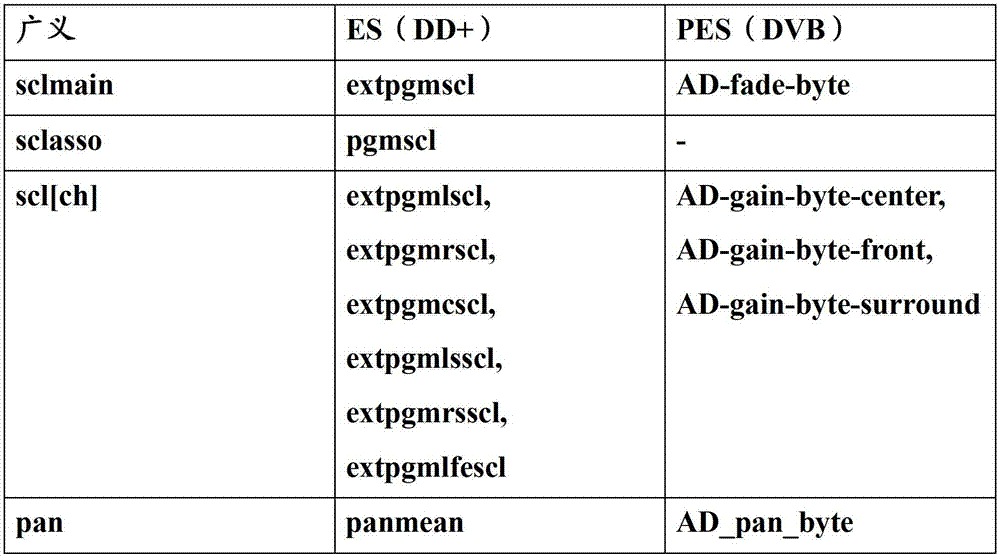
Table 1
For following paragraph and following false code, the combined balance system input value 203 of the balance between main signal 201 and correlation signal 202 is regulated in expression formula " pref " indication.Combined balance system control inputs 203 values should be at [∞ ... + ∞] scope in, wherein-∞ causes the complete attenuation of correlation signal 202; Cause mixing according to mixing metadata 202a as 0 of neutral value, and+∞ causes the complete attenuation of main signal 201.
To relate to 5.1 multichannel main signals 201 and 5.1 multichannel correlation signals 202 as example, the application of the technology of multi-channel signal produces following false code, wherein gainA and gainM[ch] be respectively the actual gain that is applied to correlation signal 202 or each sound channel of zoom factor and main signal 201.
Following false code is in dB territory operation.

Each sound channel to input signal is carried out this false code.
Thereby during in its maximum+∞ dB, correlation signal 201 is taken signal 206 as the leading factor when combined balance system, so main signal 201 is by complete attenuation, and mixed signal 208 is the correlation signal 202 of not convergent-divergent basically.In contrast, during in its minimum value-∞ dB, main signal 201 is taken signal 206 as the leading factor when combined balance system, so correlation signal 202 is by complete attenuation, and mixed signal 208 is the main signal 201 of not convergent-divergent basically.
It should be noted, in this detailed example, in the situation that main signal is taken signal as the leading factor, also convergent-divergent led signal (the capable gainM[ch in else clause]=sclmain+scl[ch] – mainscltotal) a little.This makes this algorithm be avoided postiive gain is applied to have the main signal of DD+ metadata.Final result should be that the most loud main sound channel is limited to 0dB, and this result should have gain 1 rule with led signal roughly and be complementary.
For this false code is applied to concrete metadata standard, must come with suitable metadata item alternative such as scl[ch] common variable.Thereby, based on the concrete form of signal, comprising available metadata in number, type of coding and the signal of sound channel, those skilled in the art can be shone upon the suitably metadata key of broad sense in light of the circumstances.For some concrete condition, inwhole metadata keys listed above can be all to be correlated with.For example, for two 5.1 multi-channel signals are mixed, those skilled in the art can be defined as the translation metadata not exist maybe and should be left in the basket, because correlation signal has comprised and the identical sound channel of main signal.
Be not monaural situation for correlation signal 202 for monophony main signal 201, the translation gain may need to be applied to correlation signal 201.In this case, if correlation signal 201 has the LFE sound channel, this LFE sound channel can be mixed into scl[lfe as described in above-mentioned false code so].
Mix DD+ for utilizing the ES level to mix metadata, should use following ES level to mix the metadata key: extpgmscl, panmean, extpgmlscl, extpgmrscl, extpgmcscl, extpgmlsscl, extpgmrsscl, extpgmlfescl, pgmscl.
Generally speaking, not needing all in mixed process, other mix metadata.Metadata key dmxscl can additionally be used for lower mixing, and wherein lower the mixing is to be the form with different sound channel numbers with signal map.The metadata key pgmscl of the zoom factor of expression correlation signal can be used for regulating in mixed process the metadata zoom factor of main sound channel in addition.For above-mentioned false code, variable sclasso represents pgmscl.Row according to false code: if (pref〉mainscltotal-sclasso) can find out, the sclasso of the metadata key pgmscl of expression in DD+ therefore impact determine led signal if relatively, this is because deducting sclasso from mainscltotal with pref before relatively.Yet, be optional to the use of sclasso, and if sclasso does not exist or do not expect to use this value, pref only compares with mainscltotal so.
Mix Doby pulse/HE-AAC for utilizing the PES level to mix metadata, for example in DVB, should use following ES level to mix the metadata key:
AD-gain-byte-center,AD-gain-byte-front,AD-gain-byte-surround。
For obtaining optimum,
[AD-gain-byte-center+AD-fade-byte],
[AD-gain-byte-front+AD-fade-byte],
[AD-gain-byte-surround+AD-fade-byte]
In each maximum result gain should be higher than+12dB, and should carry out normalization in the mode that highest-gain is no more than 12dB to these actual gains, simultaneously should keep AD-gain-byte-center, AD-gain-byte-front, relation between AD-gain-byte-surround, namely
AD-fade-byte=min(l2dB,AD-fade-byte+max(AD-gain-byte-center,AD-gain-byte-front,AD-gain-byte-surround))。
Fig. 6 illustrate with 5.1 multichannel main signals 610 with comprise the 5.1 multichannel correlation signals 620 that mix metadata 640, Dolby Digital+(DD+ or E-AC-3(strengthen AC-3) for example) signal, the further execution mode of the blender 600 that mixes.Input comprises combined balance system input 601, main signal 610 and with the correlation signal 620 that mixes metadata 640.In this example, incoming host signal 610 and output mixed signal 630 are all 5.1 multi-channel signals, and it comprises 6 sound channels: left and right, center, left around, right around and the LFE(low-frequency effect).Thereby primary input signal 610 comprises 6 sound channels: left 611, right 612, center 613, left around 614, right around 615 and the LFE(low-frequency effect) 616.Correlation signal 620 also comprises 6 sound channels: left 621, right 622, center 623, left around 624, right around 625 and the LFE(low-frequency effect) 626.Mix the zoom factor that metadata 640 also comprises main zoom factor 647 and 6 sound channels: left 641, right 642, center 643, left around 644, right around 645 and the LFE(low-frequency effect) 646.In some cases, mix the zoom factor 648 that metadata can also comprise correlation signal.If this zoom factor of correlation signal does not exist, ignore so this zoom factor or with 1 or 0dB treat.Blender 600 also is configured to receive the input from combined balance system input 601.Based on mixing metadata 640 and combined balance system input 601, the zoom factor 651,652,653,654,655 of each sound channel, 656 is determined based on the logic in above false code, this logic is also shown in Fig. 7 A, and Fig. 7 A is the flow chart of describing the zoom factor of each sound channel of how to confirm.According to each sound channel of mixing zoom factor 651,652,653,654,655,656 and come the convergent-divergent input signal, wherein main convergent-divergent occurs on the non-dominant signal, and led signal is only carried out MIN convergent-divergent or convergent-divergent not.Finally, the corresponding sound channel through convergent-divergent sound channel signal 660 and 670 is combined into mixed layer sound channel, so 6 mixed layer sound channels 631,632,633,634,635,636 comprise 5.1 mixed output signals 630.Thereby output mixes 5.1 signals 630 and also comprises 6 sound channels: left 631, right 632, center 633, left around 634, right around 635 and the LFE(low-frequency effect) 616, wherein each sound channel is calculated according to the logic of Fig. 7 A.
Fig. 7 A illustrates and describes the flow chart of 5.1 multichannel incoming host signals 610 and 5.1 multichannels being inputted the example of Fig. 6 that correlation signals 620 mix, if wherein main signal 610 is taken signal 206 as the leading factor, and so also convergent-divergent led signal 206 a little.As shown in Figure 6, input comprises combined balance system input 601, main signal 610 and with the correlation signal 620 that mixes metadata 640, wherein input signal and are 5.1 multi-channel signals through mixed output signal 630.Thereby signal 610,620,630 comprises 6 sound channels and mixes the zoom factor that metadata 640 comprises main zoom factor 647 and 6 sound channels: left 641, right 642, center 643, left around 644, right around 654 and the LFE(low-frequency effect) 646.In some cases, mix the zoom factor sclasso648 that metadata 640 can also comprise correlation signal.Use sclasso648 in mixed process if sclasso648 does not exist or is not desirably in, the sclasso648 value is 0dB and other zoom factors is not done any adjusting.In step 701, with 5 " normal sound channels ": left 641, right 642, center 643, left around 644 and the right maximum zoom factor around 645 be defined as " maxscl ".Then in step 702, calculate sclmain647 and maxscl sum as mainscltotal, wherein sclmain647 is the main zoom factor that mixes metadata, and maxscl is the zoom factor of normal sound channel: 641,642,643,644,645 maximum.In Fig. 7 A, the step 703 of determining the LFE zoom factor has been carried out more detailed description.
Fig. 7 B illustrates the flow chart of details of step 703 of Fig. 7 A of the zoom factor of the definite LFE sound channel that provides relevant with the example of Fig. 7 A that mixes two 5.1 multi-channel signals.In step 703a, the maximum zoom factor maxscl of other sound channels of determining in the step 701 with the mixing metadata 646 of LFE sound channel and Fig. 7 A compares.If LFE zoom factor 646 is more than or equal to maxscl, so in step 703y, with the zoom factor gain[lfe of LFE sound channel] 656 be defined as maxscl.Otherwise, in the situation that no, in step 703n, with the zoom factor gain[lfe of LFE sound channel] and 656 be defined as the zoom factor 646 from the mixing metadata of LFE sound channel.Then in step 703c, determine gain[lfe according to the value of calculating in step 703y or step 703n] 656.Then will be applied to the zoom factor gain[lfe that data are mixed of being used for of LFE sound channel] 656 be used for step 707n and the step 707y of Fig. 7 A.
Then, continue to describe Fig. 7 A, in step 704, the value pref of combined balance system control inputs 601 and mainscltotal are deducted sclasso648 compare, wherein sclasso648 is the zoom factor of correlation signal.It should be noted, sclasso648 can not exist or be left in the basket, and in this case, pref is only compared with mainscltotal.For example, for the DD+ signal, metadata key pgmscl is corresponding with sclasso648.If pref602 deducts sclasso648 greater than mainscltotal, so in step 705y, determine that correlation signal 620 takes signal 206 as the leading factor.So in step 706y, because correlation signal is taken signal as the leading factor, thus there is no the gain of correlation signal, so the gain of correlation signal is 1, or 0dB, the indication correlation signal does not have scaled.Then in step 707y, all sound channels (left and right, center, left around, right around and LFE) the gain gainM[ch of each sound channel of main signal] 651,653,653,654,655 be confirmed as the zoom factor scl[ch of main zoom factor sclmain647 and normal sound channel] 641,642,643,644,645 summation deducts pref602 and deducts sclasso.Whole 6 sound channels of main signal are repeated calculating in step 707y.
If in step 704, the determination result is NO, namely pref602 is not more than mainscltotal, so in step 705n, determines that main signal takes signal as the leading factor.Then in step 706n, the gain factor gainA of correlation signal is defined as pref602 deducts mainscltotal and add sclasso648.In this concrete example in particular cases, also can carry out convergent-divergent to main signal 610 even main signal 610 is confirmed as led signal, and the zoom factor 651,652,653,654,655,656 of each sound channel of main signal 620 is calculated as the zoom factor scl[ch that sclmain647 adds corresponding sound channel] 641,642,643,644,645 deduct mainscltotal.Thereby, in step 707n, all sound channels (left and right, center, left around, right around and LFE) the gain gainM[ch of each sound channel of main signal] 651,652,653,654,655 be confirmed as sclmain647 and scl[ch] 641,642,643,644,645 summation deducts mainscltotal.Whole 6 sound channels are repeated calculating in step 707n.From being admitted to step 708 after the gain of step 706y, 707y, 706n and 707n and input signal 620,610, step 708 according to determined zoom factor 651,652,653,654,655, the 656 pairs of main signals 611,612,613,614,615,616 and correlation signal 621,622,623,624,625,626 carry out convergent-divergent.It should be noted, under normal conditions, only led signal is carried out convergent-divergent, and at this in particular cases, also can carry out convergent-divergent to the non-dominant signal.Then in step 709, with each sound channel be mixed into 6 mixed layer sound channels 631,632,633,634,635,636 through convergent-divergent correlation signal 670 with through convergent-divergent main signal 660, wherein to each repeated execution of steps 709 in 6 sound channels.Finally, in step 710,6 mixed layer sound channels 631,632,633,634,635,636 are combined into individual signals to comprise 5.1 mixed output signals 630 of step 711.
Fig. 8 illustrates 5.1 multichannel main signals 810 and for example Dolby Digital+(DD+ or E-AC-3(strengthen AC-3)) signal comprise 2 sound channels of mixing metadata 840 (the further execution mode of the blender 800 that the correlation signal 820 of monophony+LFE) mixes.Input comprises combined balance system input 801, main signal 810 and with the correlation signal 820 that mixes metadata 840.In this example, the mixed signal 830 of the main signal 810 of input and output is all to comprise 6 sound channels: left and right, center, left around, right around and the LFE(low-frequency effect) 5.1 multi-channel signals.Thereby primary input signal 810 comprises 6 sound channels: left 811, right 812, center 813, left around 814, right around 815 and the LFE(low-frequency effect) 816.Monophony+LFE correlation signal 820 includes only two sound channels: center 823 and LFE(low-frequency effect) 826.Mix metadata 840 and also comprise following metadata, this metadata is with the scale value of main zoom factor 847 and the scale value of 6 sound channels: left 841, right 842, center 843, left around 844, right around 845 and the LFE(low-frequency effect) 846.Blender 800 also is configured to receive input from combined balance system input 801.Based on mixing metadata 840 and combined balance system control inputs 801, the zoom factor of each sound channel: 851,852,853,854,855,856 determine based on the logic in above false code, this logic is also shown in Figure 7, and Fig. 7 is the flow chart of describing the zoom factor of each sound channel of how to confirm.According to mixing zoom factor, each sound channel of non-dominant input signal 207 is carried out convergent-divergent, wherein, usually can not carry out convergent-divergent or under special circumstances to carrying out MIN convergent-divergent to led signal 206.The monophony translation that the Panmean value is used for the monophony of correlation signal+LFE sound channel is 5.1 sound channels.Panmean means 0 degree take 1.5 degree as step-length to from 0 to 239 value of 358.5 degree, and wherein 0 degree is the direction of central loudspeakers.About using the more detailed description of panmean, " E.4.3.5Panning " part of seeing ETSI TS 102 366v1.2.1.Finally, for each sound channel with two 6 sound channels through the convergent-divergent input signal to being combined as in twos 6 mixed layer sound channels 831,832,833,834,835,836.So these 6 mixed layer sound channels 831,832,833,834,835,836 comprise 5.1 mixed output signals 830.Thereby output mixes 5.1 signals 830 and also comprises 6 sound channels: left 831, right 832, center 833, left around 834, right around 835 and the LFE(low-frequency effect) 836, wherein each sound channel is calculated according to the logic of Fig. 7.
Usually, although the sound channel mode of mixed signal for example can change in the lower subsequent step that mixes certainly, for obtaining best result, the sound channel mode of mixed signal should be identical with the audio signal of decoding.Although this technical support arbitrarily large (with little) value, for most applications, the value of expectation combined balance system input is little, common maximum 10dB.
In some cases, the sound channel number of main signal and correlation signal can be different.In this case, still can use technology described herein, wherein some in input sound channel can be mapped to the sound channel of mixed signal, the sound channel of this mixed signal can exist or not be present in input signal.For obtaining best result, correlation signal should only comprise the sound channel location that also exists in main signal, unless correlation signal is monophony (acmod1), perhaps the sound channel of correlation signal can suitably be mapped to the sound channel of main signal.Equally, preferably, when only having main signal also to comprise low-frequency effect sound channel (LFE), the LFE sound channel just should be present in correlation signal.Otherwise, should ignore the LFE sound channel of correlation signal in mixed process.Equally, if correlation signal is monophony+LFE, preferably, this LFE should be blended on main audio LFE, and preferably this monophony should be moved on each main sound channel of audio signal.
Usually, for mixed process preferably: input signal is carried out normalization.Can be determining to use normalization before or after led signal, because come to the same thing.In fact, preferred, guarantee that the content dialogue normalized value of input signal is set correctly, and main signal and correlation signal are in all to white level 31 before mixing.Then, the level that is regarded as the led signal of " attention signal " also should be exported from blender with dialogue normalization 31 ideally.If input signal not by normalization, so usually carried out normalization before mixing, and in case of necessity mixed signal is carried out normalization, yet this technology also can be used in not normalized situation.
When multi-channel signal is mixed, preferably, the sch[ch in output signal] between relation should be held.Yet, if scl[lfe] have than whole other scl[ch] higher value (be defaulted as send or 0), so should be to other scl[ch] maximum modify.
It should be noted, " E.2 " part and ETSI TS 102 366 V 1.2.1 as ETSI TS 101 154 V1.9.1, Annex E.(also sees DVB blue book A0001r8) defined, for the Doby pulse signal, mix metadata and be usually included in sub-audio stream.Do not consider how metadata sends or grouping, can use as long as mix metadata, and technology described herein still can be used in the stream signal.Thereby described execution mode and example can suitably be adapted for this kind situation of processing.
Above-mentioned example with the related track that comprises director's explanation is only an example.Yet irrelevant with the content that comprises in signal, this technology can be applied to any mixture of main signal and correlation signal.For example, first signal can comprise live sports cast and secondary signal provides local and explains orally and/or the explanation of alternative language.Here a plurality of possibilities that have signal how to be distributed.For example, first signal can be there is no the conventional acoustic rail that explains orally and secondary signal can be local the explanation.
The further operating position of technology described herein can relate to the independent track for dysaudia, and wherein correlation signal comprises special enhancing to promote the intelligibility of dialogue.Similarly, as the help to beholder visually impaired, correlation signal can comprise the speech sound eeplaining of scene content.
Yet technology described herein is not limited only to dialogue, and also can be applied to for example audio signal of all kinds of music, and this is because this technology is based on the perceives sound level.For example, about music, related track can comprise the stack musical instrument track of voice or additional music; In other words, main orbit can be the basic musical instrument track that only records piano and acoustic guitar, the first related track can comprise the voice stack, the second related track comprises rock music and electric guitar and bass guitar, and the 3rd track has electronics dance music (techno) stack of the hard bass beat fast of band.In this case, can the have an opportunity expectation composite character of specifying each related track how to be mixed of content author, and technology described herein can allow the listener to customize these settings by the balance input of adjusting mixed signal.As another example, this technology can also be applied to music signal, wherein different sound channels comprises different connection musics, for example as string instrument or idiophonic musical instrument and vocal music, wherein via metadata and combined balance system input, different sound channels is mixed.
Determining of led signal in technology dependence mixed signal described herein.Thereby the signal that will be confirmed as led signal receives the highest synthetic gain.Except by keep the constant perceptual sound levels of mixed signal with the combined balance system input control, the user can also control combined balance system at any time.In addition, change in gain also runs through gamut.
Although show technology described herein by concrete example, the mixing multi-channel signal that for example comprises the dialogue track, but these technology are not limited to these examples or execution mode, as long as this is that this technology just can be applied to comparably main signal and correlation signal has the situation of very different compositions because can determine the led signal of mixed signal with mixing metadata and combined balance system input.
In this document, the several different methods and the configuration that are used for mixed audio signal have been described.Utilize these methods and/or the device of signal mixer for example, in the situation that allow to regulate the balance between main signal and correlation signal, can keep the consistent perceives sound level of mixed signal.Because can follow the metadata of input signal to carry out in real time calculating by relatively simple and basic electronic installation utilization, thus can not carry out high-performance treatments input signal is not sampled or situation about analyzing under carry out the method.
It should be noted, describe and accompanying drawing only is illustrated the principle of the method and system that proposes.Thereby, be understandable that, although clearly do not describe herein or illustrate, those skilled in the art can design various configurations, these configurations are implemented the principle of the method and system propose and are counted as the part of the disclosure of this document.In addition, whole statements of enumerating the method and apparatus principle, aspect and the execution mode that propose and concrete example thereof herein are intended to comprise its equivalent.
In addition, main the having a definite purpose of whole examples that this paper enumerates only is intended to be used for the theory of the teaching purpose proposes with the principle that helps the method and apparatus that the reader understanding was proposed and inventor promotion this area, and should be interpreted as being not limited to these example of specifically enumerating and conditions.
In addition, it should be noted, any block representation is implemented the conceptual view of the illustrative apparatus of principle of the present invention herein.Similarly, be understandable that, the various processes of the expression such as any flow chart, flowchart illustrations, state transition diagram, false code, these processes can represent in computer-readable medium basically, therefore no matter whether these computers or processor are clearly illustrated, and all carry out these processes by this computer or processor.
Claims (43)
Applications Claiming Priority (3)
| Application Number | Priority Date | Filing Date | Title |
|---|---|---|---|
| US38542810P | 2010-09-22 | 2010-09-22 | |
| US61/385,428 | 2010-09-22 | ||
| PCT/US2011/050482 WO2012039918A1 (en) | 2010-09-22 | 2011-09-06 | Audio stream mixing with dialog level normalization |
Publications (2)
| Publication Number | Publication Date |
|---|---|
| CN103119846A true CN103119846A (en) | 2013-05-22 |
| CN103119846B CN103119846B (en) | 2016-03-30 |
Family
ID=44652005
Family Applications (1)
| Application Number | Title | Priority Date | Filing Date |
|---|---|---|---|
| CN201180045923.3A Active CN103119846B (en) | 2010-09-22 | 2011-09-06 | Mix audio streams with dialogue level normalization |
Country Status (16)
| Country | Link |
|---|---|
| US (1) | US9136881B2 (en) |
| EP (1) | EP2619904B1 (en) |
| JP (1) | JP5603499B2 (en) |
| KR (1) | KR101538623B1 (en) |
| CN (1) | CN103119846B (en) |
| AU (1) | AU2011305913B2 (en) |
| BR (1) | BR112013005958B1 (en) |
| CA (1) | CA2809040C (en) |
| ES (1) | ES2502468T3 (en) |
| IL (1) | IL224868A (en) |
| MX (1) | MX2013002878A (en) |
| MY (1) | MY168735A (en) |
| RU (1) | RU2526746C1 (en) |
| SG (1) | SG188470A1 (en) |
| UA (1) | UA105590C2 (en) |
| WO (1) | WO2012039918A1 (en) |
Cited By (2)
| Publication number | Priority date | Publication date | Assignee | Title |
|---|---|---|---|---|
| CN108432130A (en) * | 2015-10-28 | 2018-08-21 | Dts(英属维尔京群岛)有限公司 | Object-based audio signal balance |
| CN112513981A (en) * | 2018-05-31 | 2021-03-16 | 诺基亚技术有限公司 | Spatial audio parameter merging |
Families Citing this family (15)
| Publication number | Priority date | Publication date | Assignee | Title |
|---|---|---|---|---|
| WO2014151092A1 (en) | 2013-03-15 | 2014-09-25 | Dts, Inc. | Automatic multi-channel music mix from multiple audio stems |
| US9654076B2 (en) | 2014-03-25 | 2017-05-16 | Apple Inc. | Metadata for ducking control |
| ES3036395T3 (en) | 2014-10-10 | 2025-09-18 | Dolby Laboratories Licensing Corp | Transmission-agnostic presentation-based program loudness |
| KR101653236B1 (en) * | 2015-01-13 | 2016-09-01 | 인하대학교 산학협력단 | Tube Hybrid Headphone Amplifier |
| CN109310525B (en) | 2016-06-14 | 2021-12-28 | 杜比实验室特许公司 | Media compensation pass-through and mode switching |
| US20180069910A1 (en) * | 2016-09-07 | 2018-03-08 | Sonic Ip, Inc. | Systems and Methods for Live Voice-Over Solutions |
| WO2018231185A1 (en) * | 2017-06-16 | 2018-12-20 | Василий Васильевич ДУМА | Method of synchronizing sound signals |
| US11102255B2 (en) * | 2018-04-27 | 2021-08-24 | Filmio, Inc. | Project creation and distribution system |
| EP3921756A1 (en) | 2019-02-08 | 2021-12-15 | Starkey Laboratories, Inc. | Assistive listening device systems, devices and methods for providing audio streams within sound fields |
| WO2021041522A1 (en) | 2019-08-26 | 2021-03-04 | Starkey Laboratories, Inc. | Hearing assistance devices with control of other devices |
| KR102287497B1 (en) * | 2019-12-11 | 2021-08-09 | 네이버 주식회사 | Platform adaptive audio normalization method and system |
| EP4664933A2 (en) | 2019-12-17 | 2025-12-17 | Starkey Laboratories, Inc. | Audio system with ear-worn device and remote audio stream management |
| US11380344B2 (en) | 2019-12-23 | 2022-07-05 | Motorola Solutions, Inc. | Device and method for controlling a speaker according to priority data |
| CN112750444B (en) * | 2020-06-30 | 2023-12-12 | 腾讯科技(深圳)有限公司 | Sound mixing method and device and electronic equipment |
| US11812213B2 (en) | 2020-09-30 | 2023-11-07 | Starkey Laboratories, Inc. | Ear-wearable devices for control of other devices and related methods |
Citations (4)
| Publication number | Priority date | Publication date | Assignee | Title |
|---|---|---|---|---|
| CN1305661A (en) * | 1998-04-14 | 2001-07-25 | 听觉增强有限公司 | User-adjustable hearing-adaptive volume control |
| US20040008851A1 (en) * | 2002-07-09 | 2004-01-15 | Yamaha Corporation | Digital compressor for multi-channel audio system |
| US6985594B1 (en) * | 1999-06-15 | 2006-01-10 | Hearing Enhancement Co., Llc. | Voice-to-remaining audio (VRA) interactive hearing aid and auxiliary equipment |
| US20100014692A1 (en) * | 2008-07-17 | 2010-01-21 | Fraunhofer-Gesellschaft Zur Foerderung Der Angewandten Forschung E.V. | Apparatus and method for generating audio output signals using object based metadata |
Family Cites Families (18)
| Publication number | Priority date | Publication date | Assignee | Title |
|---|---|---|---|---|
| JPH08102687A (en) * | 1994-09-29 | 1996-04-16 | Yamaha Corp | Aural transmission/reception system |
| US6011851A (en) | 1997-06-23 | 2000-01-04 | Cisco Technology, Inc. | Spatial audio processing method and apparatus for context switching between telephony applications |
| US6230130B1 (en) | 1998-05-18 | 2001-05-08 | U.S. Philips Corporation | Scalable mixing for speech streaming |
| JP2001268700A (en) * | 2000-03-17 | 2001-09-28 | Fujitsu Ten Ltd | Sound device |
| US7180997B2 (en) | 2002-09-06 | 2007-02-20 | Cisco Technology, Inc. | Method and system for improving the intelligibility of a moderator during a multiparty communication session |
| US20050058307A1 (en) * | 2003-07-12 | 2005-03-17 | Samsung Electronics Co., Ltd. | Method and apparatus for constructing audio stream for mixing, and information storage medium |
| US20060023900A1 (en) | 2004-07-28 | 2006-02-02 | Erhart George W | Method and apparatus for priority based audio mixing |
| US7254243B2 (en) * | 2004-08-10 | 2007-08-07 | Anthony Bongiovi | Processing of an audio signal for presentation in a high noise environment |
| GB2430319B (en) | 2005-09-15 | 2008-09-17 | Beaumont Freidman & Co | Audio dosage control |
| US7653543B1 (en) | 2006-03-24 | 2010-01-26 | Avaya Inc. | Automatic signal adjustment based on intelligibility |
| EP2367343B1 (en) | 2006-05-11 | 2017-03-22 | Google, Inc. | Audio mixing |
| US8670537B2 (en) | 2006-07-31 | 2014-03-11 | Cisco Technology, Inc. | Adjusting audio volume in a conference call environment |
| US7853649B2 (en) | 2006-09-21 | 2010-12-14 | Apple Inc. | Audio processing for improved user experience |
| MX2008012315A (en) * | 2006-09-29 | 2008-10-10 | Lg Electronics Inc | Methods and apparatuses for encoding and decoding object-based audio signals. |
| US8078188B2 (en) | 2007-01-16 | 2011-12-13 | Qualcomm Incorporated | User selectable audio mixing |
| US8515106B2 (en) | 2007-11-28 | 2013-08-20 | Qualcomm Incorporated | Methods and apparatus for providing an interface to a processing engine that utilizes intelligent audio mixing techniques |
| MY159890A (en) * | 2008-04-18 | 2017-02-15 | Dolby Laboratories Licensing Corp | Method and apparatus for maintaining speech audibiliy in multi-channel audio with minimal impact on surround experience |
| JP5564803B2 (en) | 2009-03-06 | 2014-08-06 | ソニー株式会社 | Acoustic device and acoustic processing method |
-
2011
- 2011-09-06 ES ES11757498.8T patent/ES2502468T3/en active Active
- 2011-09-06 KR KR1020137009856A patent/KR101538623B1/en active Active
- 2011-09-06 CN CN201180045923.3A patent/CN103119846B/en active Active
- 2011-09-06 BR BR112013005958-3A patent/BR112013005958B1/en active IP Right Grant
- 2011-09-06 EP EP11757498.8A patent/EP2619904B1/en active Active
- 2011-09-06 JP JP2013530164A patent/JP5603499B2/en active Active
- 2011-09-06 AU AU2011305913A patent/AU2011305913B2/en active Active
- 2011-09-06 SG SG2013017397A patent/SG188470A1/en unknown
- 2011-09-06 UA UAA201305204A patent/UA105590C2/en unknown
- 2011-09-06 US US13/823,482 patent/US9136881B2/en active Active
- 2011-09-06 RU RU2013118472/08A patent/RU2526746C1/en active
- 2011-09-06 MX MX2013002878A patent/MX2013002878A/en active IP Right Grant
- 2011-09-06 CA CA2809040A patent/CA2809040C/en active Active
- 2011-09-06 WO PCT/US2011/050482 patent/WO2012039918A1/en not_active Ceased
- 2011-09-06 MY MYPI2013000784A patent/MY168735A/en unknown
-
2013
- 2013-02-21 IL IL224868A patent/IL224868A/en active IP Right Grant
Patent Citations (4)
| Publication number | Priority date | Publication date | Assignee | Title |
|---|---|---|---|---|
| CN1305661A (en) * | 1998-04-14 | 2001-07-25 | 听觉增强有限公司 | User-adjustable hearing-adaptive volume control |
| US6985594B1 (en) * | 1999-06-15 | 2006-01-10 | Hearing Enhancement Co., Llc. | Voice-to-remaining audio (VRA) interactive hearing aid and auxiliary equipment |
| US20040008851A1 (en) * | 2002-07-09 | 2004-01-15 | Yamaha Corporation | Digital compressor for multi-channel audio system |
| US20100014692A1 (en) * | 2008-07-17 | 2010-01-21 | Fraunhofer-Gesellschaft Zur Foerderung Der Angewandten Forschung E.V. | Apparatus and method for generating audio output signals using object based metadata |
Cited By (4)
| Publication number | Priority date | Publication date | Assignee | Title |
|---|---|---|---|---|
| CN108432130A (en) * | 2015-10-28 | 2018-08-21 | Dts(英属维尔京群岛)有限公司 | Object-based audio signal balance |
| CN108432130B (en) * | 2015-10-28 | 2022-04-01 | Dts(英属维尔京群岛)有限公司 | Object-based audio signal balancing |
| CN112513981A (en) * | 2018-05-31 | 2021-03-16 | 诺基亚技术有限公司 | Spatial audio parameter merging |
| US12014743B2 (en) | 2018-05-31 | 2024-06-18 | Nokia Technogies Oy | Spatial audio parameter merging |
Also Published As
| Publication number | Publication date |
|---|---|
| BR112013005958A2 (en) | 2016-05-17 |
| AU2011305913B2 (en) | 2014-10-30 |
| CA2809040A1 (en) | 2012-03-29 |
| JP2013543599A (en) | 2013-12-05 |
| US20130170672A1 (en) | 2013-07-04 |
| MX2013002878A (en) | 2013-04-08 |
| AU2011305913A1 (en) | 2013-03-07 |
| BR112013005958B1 (en) | 2021-04-20 |
| CN103119846B (en) | 2016-03-30 |
| MY168735A (en) | 2018-11-29 |
| US9136881B2 (en) | 2015-09-15 |
| SG188470A1 (en) | 2013-04-30 |
| HK1186585A1 (en) | 2014-03-14 |
| IL224868A (en) | 2016-05-31 |
| EP2619904B1 (en) | 2014-07-30 |
| KR20130060334A (en) | 2013-06-07 |
| JP5603499B2 (en) | 2014-10-08 |
| EP2619904A1 (en) | 2013-07-31 |
| UA105590C2 (en) | 2014-05-26 |
| KR101538623B1 (en) | 2015-07-22 |
| RU2526746C1 (en) | 2014-08-27 |
| WO2012039918A1 (en) | 2012-03-29 |
| CA2809040C (en) | 2016-05-24 |
| ES2502468T3 (en) | 2014-10-03 |
Similar Documents
| Publication | Publication Date | Title |
|---|---|---|
| CN103119846A (en) | Mix audio streams with dialogue level normalization | |
| US11563411B2 (en) | Metadata for loudness and dynamic range control | |
| JP2025000845A (en) | Loudness control for user interaction in audio encoding system | |
| CN105556837A (en) | Dynamic range control for various playback environments | |
| CN102100088A (en) | Apparatus and method for generating an audio output signal using object-based metadata | |
| HK40032389B (en) | Metadata for loudness and dynamic range control | |
| HK40032389A (en) | Metadata for loudness and dynamic range control | |
| HK1186585B (en) | Audio stream mixing with dialog level normalization | |
| HK1215489B (en) | Metadata for loudness and dynamic range control | |
| HK1190554B (en) | Apparatus and method for generating audio output signals using object based metadata |
Legal Events
| Date | Code | Title | Description |
|---|---|---|---|
| C06 | Publication | ||
| PB01 | Publication | ||
| C10 | Entry into substantive examination | ||
| SE01 | Entry into force of request for substantive examination | ||
| C14 | Grant of patent or utility model | ||
| GR01 | Patent grant | ||
| EE01 | Entry into force of recordation of patent licensing contract | ||
| EE01 | Entry into force of recordation of patent licensing contract |
Application publication date: 20130522 Assignee: Micro whale Technology Co., Ltd.|Suzhou Industrial Park purple cat Information Consulting Co., Ltd. Assignor: Dolby Laboratories Licensing Corp,|Dolby International AB Contract record no.: 2017990000214 Denomination of invention: Audio stream mixing with dialog level normalization Granted publication date: 20160330 License type: Common License Record date: 20170606 |