CN103119611A - Method and apparatus for image-based positioning - Google Patents
Method and apparatus for image-based positioning Download PDFInfo
- Publication number
- CN103119611A CN103119611A CN2011800314431A CN201180031443A CN103119611A CN 103119611 A CN103119611 A CN 103119611A CN 2011800314431 A CN2011800314431 A CN 2011800314431A CN 201180031443 A CN201180031443 A CN 201180031443A CN 103119611 A CN103119611 A CN 103119611A
- Authority
- CN
- China
- Prior art keywords
- image
- capture device
- platform
- image capture
- tracking
- Prior art date
- Legal status (The legal status is an assumption and is not a legal conclusion. Google has not performed a legal analysis and makes no representation as to the accuracy of the status listed.)
- Granted
Links
Images


Classifications
-
- G—PHYSICS
- G01—MEASURING; TESTING
- G01B—MEASURING LENGTH, THICKNESS OR SIMILAR LINEAR DIMENSIONS; MEASURING ANGLES; MEASURING AREAS; MEASURING IRREGULARITIES OF SURFACES OR CONTOURS
- G01B11/00—Measuring arrangements characterised by the use of optical techniques
- G01B11/14—Measuring arrangements characterised by the use of optical techniques for measuring distance or clearance between spaced objects or spaced apertures
-
- G—PHYSICS
- G01—MEASURING; TESTING
- G01C—MEASURING DISTANCES, LEVELS OR BEARINGS; SURVEYING; NAVIGATION; GYROSCOPIC INSTRUMENTS; PHOTOGRAMMETRY OR VIDEOGRAMMETRY
- G01C15/00—Surveying instruments or accessories not provided for in groups G01C1/00 - G01C13/00
-
- G—PHYSICS
- G01—MEASURING; TESTING
- G01C—MEASURING DISTANCES, LEVELS OR BEARINGS; SURVEYING; NAVIGATION; GYROSCOPIC INSTRUMENTS; PHOTOGRAMMETRY OR VIDEOGRAMMETRY
- G01C15/00—Surveying instruments or accessories not provided for in groups G01C1/00 - G01C13/00
- G01C15/02—Means for marking measuring points
- G01C15/06—Surveyors' staffs; Movable markers
-
- G—PHYSICS
- G01—MEASURING; TESTING
- G01S—RADIO DIRECTION-FINDING; RADIO NAVIGATION; DETERMINING DISTANCE OR VELOCITY BY USE OF RADIO WAVES; LOCATING OR PRESENCE-DETECTING BY USE OF THE REFLECTION OR RERADIATION OF RADIO WAVES; ANALOGOUS ARRANGEMENTS USING OTHER WAVES
- G01S19/00—Satellite radio beacon positioning systems; Determining position, velocity or attitude using signals transmitted by such systems
- G01S19/38—Determining a navigation solution using signals transmitted by a satellite radio beacon positioning system
- G01S19/39—Determining a navigation solution using signals transmitted by a satellite radio beacon positioning system the satellite radio beacon positioning system transmitting time-stamped messages, e.g. GPS [Global Positioning System], GLONASS [Global Orbiting Navigation Satellite System] or GALILEO
- G01S19/42—Determining position
- G01S19/48—Determining position by combining or switching between position solutions derived from the satellite radio beacon positioning system and position solutions derived from a further system
- G01S19/485—Determining position by combining or switching between position solutions derived from the satellite radio beacon positioning system and position solutions derived from a further system whereby the further system is an optical system or imaging system
-
- G—PHYSICS
- G01—MEASURING; TESTING
- G01S—RADIO DIRECTION-FINDING; RADIO NAVIGATION; DETERMINING DISTANCE OR VELOCITY BY USE OF RADIO WAVES; LOCATING OR PRESENCE-DETECTING BY USE OF THE REFLECTION OR RERADIATION OF RADIO WAVES; ANALOGOUS ARRANGEMENTS USING OTHER WAVES
- G01S19/00—Satellite radio beacon positioning systems; Determining position, velocity or attitude using signals transmitted by such systems
- G01S19/38—Determining a navigation solution using signals transmitted by a satellite radio beacon positioning system
- G01S19/39—Determining a navigation solution using signals transmitted by a satellite radio beacon positioning system the satellite radio beacon positioning system transmitting time-stamped messages, e.g. GPS [Global Positioning System], GLONASS [Global Orbiting Navigation Satellite System] or GALILEO
- G01S19/42—Determining position
- G01S19/51—Relative positioning
-
- G—PHYSICS
- G06—COMPUTING OR CALCULATING; COUNTING
- G06T—IMAGE DATA PROCESSING OR GENERATION, IN GENERAL
- G06T7/00—Image analysis
- G06T7/70—Determining position or orientation of objects or cameras
- G06T7/73—Determining position or orientation of objects or cameras using feature-based methods
-
- G—PHYSICS
- G06—COMPUTING OR CALCULATING; COUNTING
- G06V—IMAGE OR VIDEO RECOGNITION OR UNDERSTANDING
- G06V20/00—Scenes; Scene-specific elements
- G06V20/10—Terrestrial scenes
-
- G—PHYSICS
- G01—MEASURING; TESTING
- G01S—RADIO DIRECTION-FINDING; RADIO NAVIGATION; DETERMINING DISTANCE OR VELOCITY BY USE OF RADIO WAVES; LOCATING OR PRESENCE-DETECTING BY USE OF THE REFLECTION OR RERADIATION OF RADIO WAVES; ANALOGOUS ARRANGEMENTS USING OTHER WAVES
- G01S19/00—Satellite radio beacon positioning systems; Determining position, velocity or attitude using signals transmitted by such systems
- G01S19/38—Determining a navigation solution using signals transmitted by a satellite radio beacon positioning system
- G01S19/39—Determining a navigation solution using signals transmitted by a satellite radio beacon positioning system the satellite radio beacon positioning system transmitting time-stamped messages, e.g. GPS [Global Positioning System], GLONASS [Global Orbiting Navigation Satellite System] or GALILEO
- G01S19/42—Determining position
- G01S19/48—Determining position by combining or switching between position solutions derived from the satellite radio beacon positioning system and position solutions derived from a further system
- G01S19/49—Determining position by combining or switching between position solutions derived from the satellite radio beacon positioning system and position solutions derived from a further system whereby the further system is an inertial position system, e.g. loosely-coupled
Landscapes
- Engineering & Computer Science (AREA)
- Radar, Positioning & Navigation (AREA)
- Remote Sensing (AREA)
- Physics & Mathematics (AREA)
- General Physics & Mathematics (AREA)
- Computer Networks & Wireless Communication (AREA)
- Theoretical Computer Science (AREA)
- Computer Vision & Pattern Recognition (AREA)
- Multimedia (AREA)
- Image Analysis (AREA)
- Image Processing (AREA)
- Length Measuring Devices By Optical Means (AREA)
Abstract
提供用于基于图像的定位的方法和设备,其包括用图像捕获装置(34)捕获第一图像(126),其中所述第一图像包括至少一个对象。移动平台,并用所述图像捕获装置捕获第二图像,所述第二图像包括所述至少一个对象。在所述第一图像中捕获表面的图像;在所述第二图像中捕获所述表面的第二图像。使用组合的基于特征的过程和表面追踪过程处理所述对象和所述表面的多个图像,以追踪所述表面的位置(134)。最后,通过处理所述组合的基于特征的过程和基于表面的过程而确定所述平台的位置(138)。
A method and apparatus for image-based localization are provided, comprising capturing a first image (126) with an image capturing device (34), wherein the first image includes at least one object. A platform is moved, and a second image is captured with the image capturing device, the second image including the at least one object. An image of a surface is captured in the first image; a second image of the surface is captured in the second image. Multiple images of the object and the surface are processed using a combined feature-based process and a surface tracking process to track the position of the surface (134). Finally, the position of the platform is determined (138) by processing the combined feature-based process and the surface-based process.
Description
技术领域technical field
本技术涉及导航领域。This technology relates to the field of navigation.
发明背景Background of the invention
本原始美国专利申请第12/313,560号(在下文中称为“Scherzinger”)是针对用于获得精确测量级定位数据的系统和方法。This original US Patent Application Serial No. 12/313,560 (hereinafter "Scherzinger") is directed to systems and methods for obtaining precise survey-grade positioning data.
发明概要Summary of the invention
提供本概要来介绍在下文详细描述中进一步描述的概念精选。本概要并非旨在识别所主张的主题的关键或基本特征,也并非旨在用作帮助确定所主张的主题的范围。This Summary is provided to introduce a selection of concepts that are further described below in the Detailed Description. This summary is not intended to identify key or essential features of the claimed subject matter, nor is it intended to be used as an aid in determining the scope of the claimed subject matter.
提供一种克服现有技术中的限制的基于图像的定位方法。An image-based localization method that overcomes the limitations of the prior art is provided.
附图简述Brief description of the drawings
整合于本说明书中,并形成本说明书的一部分的附图图示了本技术的实施方案,并与描述一起用于解释原理,如下:The accompanying drawings, which are incorporated in and form a part of this specification, illustrate embodiments of the technology and together with the description serve to explain the principles as follows:
图1示出“Scherzinger”中公开的GIE测量仪器。FIG. 1 shows the GIE measuring instrument disclosed in "Scherzinger".
图2图示了本技术的基于图像的定位设备,其包括被配置来捕获包括至少一个对象的至少一个图像的图像捕获装置,基于特征的过程和定位确定过程。Figure 2 illustrates an image-based localization apparatus of the present technology comprising an image capture device configured to capture at least one image including at least one object, a feature-based process and a position determination process.
图3描绘了通过使用基于地理参考图像的过程实施的本技术的图2的基于特征的过程。FIG. 3 depicts the feature-based process of FIG. 2 of the present technology implemented using a geo-referenced image-based process.
图4图示摄影测量方法,以从2点之间的已知距离(比例因数),和至对向角的像素转换而找到至相机的距离。Figure 4 illustrates the photogrammetry method to find the distance to the camera from the known distance between 2 points (scale factor), and the pixel conversion to the subtended angle.
图5图示了描述通过使用图3的地理参考对象图像数据库和图像处理引擎而实施图2的基于特征的过程的步骤的流程图。5 illustrates a flowchart describing the steps of implementing the feature-based process of FIG. 2 using the georeferenced object image database and image processing engine of FIG. 3 .
图6示出出于本技术的目的而用于基于地理参考图像的定位的装置,其包括安装在杆上的GPS接收器,其中相机安装在相同杆上,其光学中心与杆轴对准,以及GIS/测量数据收集器。Figure 6 shows an apparatus for geo-referenced image based positioning for the purposes of the present technique comprising a GPS receiver mounted on a pole with a camera mounted on the same pole with its optical center aligned with the pole axis, and GIS/Survey Data Collector.
图7图示出于本技术的目的而被配置来启用图3的图像处理引擎的计算机系统。FIG. 7 illustrates a computer system configured to enable the image processing engine of FIG. 3 for purposes of the present technology.
图8示出出于本技术的目的的基于图像的定位设备,其包括双重特征追踪过程。Figure 8 illustrates an image-based localization device for the purposes of the present technique that includes a dual feature tracking process.
图9图示出于本技术的目的的基于图像的定位设备,其包括特征和表面追踪过程。FIG. 9 illustrates an image-based positioning device, including a feature and surface tracking process, for the purposes of the present technique.
具体实施方式Detailed ways
现在对本技术的实施方案进行详细参考,其实施例图示于附图中。虽然本技术将结合各种实施方案描述,但是应理解,其并非旨在将本技术限制于这些实施方案。相反,本技术旨在覆盖可包括在如由随附权利要求所定义的各种实施方案的精神和范围内的替代、修改和等效物。Reference will now be made in detail to embodiments of the present technology, examples of which are illustrated in the accompanying drawings. While the technology will be described in conjunction with various implementations, it will be understood that they are not intended to limit the technology to those implementations. On the contrary, the technology is intended to cover alternatives, modifications and equivalents, which may be included within the spirit and scope of various embodiments as defined by the appended claims.
此外,在下文详细的描述中,阐述许多特定细节以提供对所呈现的实施方案的彻底理解。然而,所属领域一般技术人员显然了解,可在没有这些特定细节的情况下实践所呈现的实施方案。在其它情况中,没有详细描述熟知的方法、程序、组件和电路,以便不会不必要地模糊所呈现的实施方案的方面。Furthermore, in the following detailed description, numerous specific details are set forth in order to provide a thorough understanding of the presented embodiments. It will be apparent, however, to one of ordinary skill in the art that the presented embodiments may be practiced without these specific details. In other instances, well-known methods, procedures, components, and circuits have not been described in detail so as not to unnecessarily obscure aspects of the presented embodiments.
I.“Scherzinger”I. "Scherzinger"
图1示出“Scherzinger”中公开的GIE测量仪器10。FIG. 1 shows a
II.单个对象追踪过程。II. Single object tracking process.
在本技术的一个实施方案中,图2图示基于图像的定位设备30,其包括被配置来捕获包括至少一个对象的至少一个图像的图像捕获装置34;定位确定过程38,和基于特征的过程36,其被配置来处理至少一个图像以追踪至少一个捕获对象的位置。In one embodiment of the present technology, FIG. 2 illustrates an image-based localization device 30 comprising an image capture device 34 configured to capture at least one image comprising at least one object; a localization determination process 38, and a feature-based process 36 configured to process at least one image to track the position of at least one captured object.
在本技术的一个实施方案中,对象可含有一个或多个特征;特征本质上是可通过算法检测的图像的一部分。其可以是点,或区域,或轮廓,或纹理的抽象区,或任何其它特征。在本文中讨论的许多算法中,也具有特征可跨图像识别的假设(找到对应),但这不是特征的定义的一部分。对应寻找是对特征执行的操作,而不是其特性。In one embodiment of the present technology, an object may contain one or more features; a feature is essentially a portion of an image that can be detected by an algorithm. It could be points, or regions, or contours, or abstract regions of texture, or any other feature. In many of the algorithms discussed in this paper there is also an assumption that features are recognizable across images (find correspondences), but this is not part of the definition of a feature. Correspondence finding is an operation performed on features, not their properties.
在本技术的一个实施方案中,图像捕获装置34可来自由以下项组成的组:数码相机;数码摄像机;数码摄录机;立体数码相机;立体摄像机;电影摄像机;深度相机和电视摄像机或类似物。In one embodiment of the present technology, the image capture device 34 may be from the group consisting of: a digital camera; a digital video camera; a digital camcorder; a stereo digital camera; a stereo camera; a movie camera; a depth camera and a television camera or the like thing.
仍然参考图2,在本技术的一个实施方案中,基于图像的定位设备30还包括平台32。Still referring to FIG. 2 , in one embodiment of the present technology, the image-based positioning device 30 also includes a platform 32 .
在本技术的一个实施方案中,平台32还包括移动站。In one embodiment of the present technology, platform 32 also includes a mobile station.
在本技术的一个实施方案中,平台32还包括移动站RTK系统。In one embodiment of the present technology, platform 32 also includes a mobile station RTK system.
在本技术的一个实施方案中,平台32还包括GIS/地图创建手持设备。In one embodiment of the present technology, platform 32 also includes a GIS/map creation handheld.
仍然参考图2,在本技术的一个实施方案中,由GNSS定位过程38确定图像捕获装置34(或平台32)的参考定位的坐标。Still referring to FIG. 2 , in one embodiment of the present technology, the coordinates of the reference location of image capture device 34 (or platform 32 ) are determined by GNSS positioning process 38 .
全球导航卫星系统(GNSS)过程可选自由以下项组成的组:GPS过程;GLONASS过程;组合的GPS/GLONASS过程;GALILEO过程和COMPASS(北斗导航系统)过程,基于陆地的伪卫星过程或类似过程。The Global Navigation Satellite System (GNSS) process may be selected from the group consisting of: GPS process; GLONASS process; combined GPS/GLONASS process; GALILEO process and COMPASS (Beidou Navigation System) process, land-based pseudolite process or similar process .
全球定位系统(GPS)是发射信息的卫星信号发射器系统,可从所述信息中确定观测者的当前位置和/或观测时间。GPS由美国国防部(DOD)在其NAVSTAR卫星计划项目下开发。The Global Positioning System (GPS) is a system of satellite signal transmitters that transmit information from which an observer's current location and/or time of observation can be determined. GPS was developed by the US Department of Defense (DOD) under its NAVSTAR satellite program project.
仍然参考图2,在本技术的一个实施方案中,作为GNSS过程的替代,或如果卫星信号无法获得或不完整,那么通过选自由以下项组成的组的基于特征的过程而确定图像捕获装置34(或平台32)的参考定位坐标:惯性航位推算;同时定位与地图创建(SLAM)过程;匹配移动过程或类似的图像处理算法;和摄影测量过程。Still referring to FIG. 2, in one embodiment of the present technology, instead of the GNSS process, or if satellite signals are unavailable or incomplete, the image capture device 34 is determined by a feature-based process selected from the group consisting of (or platform 32) reference positioning coordinates: inertial dead reckoning; simultaneous localization and mapping (SLAM) process; matching movement process or similar image processing algorithm; and photogrammetry process.
在本技术的一个实施方案中,由同时定位与地图创建(SLAM)过程实施基于特征的过程36。In one embodiment of the present technology, the feature-based process 36 is implemented by a Simultaneous Localization and Mapping (SLAM) process.
同时定位与地图创建(SLAM)过程使用来自一个或多个摄像机的图像序列以识别固定特征,并且接着建立这些固定特征的地图。可应用两种图像处理技术。The simultaneous localization and mapping (SLAM) process uses a sequence of images from one or more cameras to identify fixed features, and then builds a map of these fixed features. Two image processing techniques can be applied.
同时定位与地图创建(SLAM)方法中应用的第一种图像处理技术是图像分割和特征提取。SLAM使用这来识别已知是静止的特定对象,以及因此在三维(3D)空间中的有效参考点。典型选择是具有合理精确定义的特性的对象,通常是户外环境中的角落或室内环境中的各种壁装器具(灯、开关、窗台或角落)。可接着在软件中处理这些特性以在算法内产生特征。The first image processing techniques applied in simultaneous localization and mapping (SLAM) methods are image segmentation and feature extraction. SLAM uses this to identify specific objects known to be stationary, and thus valid reference points in three-dimensional (3D) space. Typical choices are objects with reasonably precisely defined properties, usually corners in outdoor environments or various wall fixtures (lamps, switches, window sills or corners) in indoor environments. These properties can then be processed in software to generate features within the algorithm.
同时定位与地图创建(SLAM)方法中应用的第二种图像处理技术是用于提取深度以及因此范围至对象信息的立体成像方法。SLAM在从不同机器人位置使特征成像时在三维(3D)坐标网格中建立特征的地图,并且从而在所述网格中确定其自身的定位。在估计所有变量的卡尔曼(Kalman)滤波器中实施地图创建和自定位过程。在这个情况中,通过使用从多个重叠的二维(2D)图像立体成像而完成范围提取。The second image processing technique applied in the Simultaneous Localization and Mapping (SLAM) method is a stereo imaging method for extracting depth and thus range-to-object information. SLAM maps features in a three-dimensional (3D) coordinate grid as they are imaged from different robot positions, and thereby determines its own location in the grid. The map creation and self-localization process is implemented in a Kalman filter estimating all variables. In this case, range extraction is accomplished using stereo imaging from multiple overlapping two-dimensional (2D) images.
在本技术的一个实施方案中,同时定位与地图创建(SLAM)方法利用摄像机。In one embodiment of the present technology, a simultaneous localization and mapping (SLAM) method utilizes a camera.
在本技术的一个实施方案中,同时定位与地图创建(SLAM)方法利用电荷耦合装置(CCD)。CCD是电荷通常从装置内至可操纵电荷(例如,转换成数字值)的区的移动的装置。这通过在装置内的级之间一次“移位”一个信号而实现。技术上,CCD实施为在装置中的电容箱之间移动电荷的移位寄存器,其中所述移位允许在箱之间的电荷传递。通常CCD与图像传感器(诸如光电装置)整合以产生正被读取的电荷,因此使CCD成为数字成像的主要技术。In one embodiment of the present technology, a simultaneous localization and mapping (SLAM) method utilizes a charge-coupled device (CCD). A CCD is a device for the movement of charge, typically from within the device, to a region where the charge can be manipulated (eg, converted into a digital value). This is accomplished by "shifting" one signal at a time between stages within the device. Technically, a CCD is implemented as a shift register that moves charge between capacitive bins in the device, where the shifting allows charge transfer between the bins. Often a CCD is integrated with an image sensor (such as a photoelectric device) to generate the charges that are being read, thus making the CCD the primary technology for digital imaging.
在本技术的一个实施方案中,同时定位与地图创建(SLAM)方法利用具有CMOS传感器的摄像机。In one embodiment of the present technology, a simultaneous localization and mapping (SLAM) method utilizes a camera with a CMOS sensor.
在本技术的一个实施方案中,同时定位与地图创建(SLAM)方法利用窄视场(FOV)。对于给定的传感器大小,这将提供可见世界的更小总面积的更高分辨率视图,并且将容许更小的对象的检测。宽FOV允许相机捕获更大对象,或对象在更大空间域内传播,但对于给定传感器将不会给出相同分辨率。仪器将包括SLAM处理算法,其以固定帧速率或以由仪器动态所规定的可变帧速率接收图像,且接着都在适于所述应用的坐标系中输出其已识别的特征的定位和仪器定位。相对于仪器初始方位的笛卡尔坐标,从定义的原点、纬度-经度-海拔和地心地固绝对测量的笛卡尔坐标;相对于仪器初始方位的球面坐标。为进一步参考,请参见:(i)ThomasLemaire,Cyrille Berger,Il-Kyun Jung和Simon Lacroix,“Vision-BasedSLAM:Stereo and Monocular Approaches”,International J ournal ofComputer Vision 74(3),第343至364页,2007年;和(ii)Moritz Kohler,Shwetak N.Patel,Jay W.Smrnnet,Erich P.Stuntebeck和Gregory D.Abowd,Institute for Pervasive Computing,Department of ComputerScience ETH Zurich,8092Zurich,Switzerland,“TrackSense:Infrastructure Free Precise Indoor Positioning Using Projected Patterns”。In one embodiment of the present technology, a simultaneous localization and mapping (SLAM) method utilizes a narrow field of view (FOV). For a given sensor size, this will provide a higher resolution view of a smaller total area of the visible world, and will allow detection of smaller objects. A wide FOV allows the camera to capture larger objects, or objects spread over a larger spatial domain, but will not give the same resolution for a given sensor. The instrument will include a SLAM processing algorithm that receives images at a fixed frame rate or at a variable frame rate dictated by instrument dynamics, and then outputs the location and instrumentation of its identified features, both in a coordinate system appropriate to the application in question. position. Cartesian coordinates relative to the initial orientation of the instrument, Cartesian coordinates measured from a defined origin, latitude-longitude-elevation, and geocentric ground-fixed; spherical coordinates relative to the initial orientation of the instrument. For further reference, see: (i) Thomas Lemaire, Cyrille Berger, Il-Kyun Jung, and Simon Lacroix, "Vision-BasedSLAM: Stereo and Monocular Approaches", International Journal of Computer Vision 74(3), pp. 343-364, 2007; and (ii) Moritz Kohler, Shwetak N. Patel, Jay W. Smrnnet, Erich P. Stuntebeck, and Gregory D. Abowd, Institute for Pervasive Computing, Department of ComputerScience ETH Zurich, 8092 Zurich, Switzerland, “FreeTrackSense: Infrastructure Precise Indoor Positioning Using Projected Patterns".
在本技术的一个实施方案中,通过使用匹配移动过程而实施基于特征的过程36。所述匹配移动过程包括若干个步骤。第一步骤是识别并追踪对象。In one embodiment of the present technology, the feature-based process 36 is implemented by using a matching move process. The matching move process includes several steps. The first step is to identify and track the object.
在本技术的一个实施方案中,特征追踪过程由两个步骤组成。第一步骤是从图像特征中导出定位和方位参考。这个步骤通常称为“特征检测”。In one embodiment of the present technology, the feature tracking process consists of two steps. The first step is to derive localization and orientation references from image features. This step is often called "feature detection".
第二步骤涉及三维(3D)运动求解。这个过程尝试通过对图像特征中检测到的从2D图像平面至图像捕获装置34的3D运动的估计的变换的反投影进行求解而导出(图2的)图像捕获装置34的运动。更明确而言,何时在二维(2D)坐标系中拍摄到三维对象的表面上的一点的定位可通过三维(3D)投影函数来计算。The second step involves three-dimensional (3D) motion solving. This process attempts to derive the motion of the image capture device 34 (of FIG. 2 ) by solving the backprojection of the transformation detected in the image features from the 2D image plane to the estimated 3D motion of the image capture device 34 . More specifically, the location of a point on the surface of a three-dimensional object when photographed in a two-dimensional (2D) coordinate system may be calculated by a three-dimensional (3D) projection function.
可以介绍抽象相机的概念。这种抽象相机在定义上是持有在真实或虚拟世界中对图像捕获装置34建模所必需的所有参数的抽象化。The concept of an abstract camera can be introduced. This abstract camera is by definition an abstraction that holds all the parameters necessary to model the image capture device 34 in the real or virtual world.
因此,抽象相机基本上是相机矢量,其包括作为其元素的图像捕获装置34的定位,其方位、焦距和定义图像捕获装置34如何将光聚焦于胶片平面上的其它可能参数。只要具有兼容的投影函数P,这个相机矢量究竟如何构造并不重要。Thus, an abstract camera is basically a camera vector which includes as its elements the position of the image capture device 34, its orientation, focal length and possibly other parameters defining how the image capture device 34 focuses light on the film plane. Exactly how this camera vector is constructed is not important as long as there is a compatible projection function P.
投影函数P采用相机矢量(指示为相机)和另一矢量(空间中三维(3D)点的定位)(指示为xyz)作为其输入,并返回已投影于相机前的平面上的二维(2D)点(指示为XY)。表达为如下:The projection function P takes a camera vector (indicated as camera) and another vector (the location of a three-dimensional (3D) point in space) (indicated as xyz) as its input and returns a two-dimensional (2D) that has been projected onto the plane in front of the camera. ) points (indicated as XY). Expressed as follows:
XY=P(相机,xyz). (方程式1)XY=P(camera,xyz). (Equation 1)
例如,在特征投影的情况中,相机在帧i和j上取决于相机参数而将视图投影至平面上。以这种方式,二维(2D)空间中追踪的特征对应于三维(3D)空间中的真实特征。For example, in the case of feature projections, the camera projects the view onto a plane at frames i and j depending on the camera parameters. In this way, features tracked in two-dimensional (2D) space correspond to real features in three-dimensional (3D) space.
然而,投影函数变换真实3D的特征,并减少其含有的信息量。在不知道组件的全部信息内容的情况下,反投影函数P’可能只返回可能的3D点集,其形成从相机中心放射并经过所投影的2D点的线。类似的模糊性出现在包含在投影特征中的任何方位信息的解译上。反投影表达为:However, the projection function transforms the real 3D features and reduces the amount of information it contains. Without knowing the full information content of the components, the backprojection function P' may only return the set of possible 3D points forming lines radiating from the camera center and passing through the projected 2D points. Similar ambiguities arise in the interpretation of any orientation information contained in projected features. Back projection is expressed as:
xyz∈P’(相机,XY). (方程式2)xyz ∈ P’(camera, XY). (Equation 2)
或or
{xyz:P(相机,xyz)=XY}. (方程式3){xyz:P(camera, xyz)=XY}. (Equation 3)
在本技术的一个实施方案中,如果特征在刚性对象表面上,诸如建筑物,那么真实点xyz将在真实空间中从图像的一帧至下一帧保持在相同位置:In one embodiment of the technique, if the feature is on a rigid object surface, such as a building, then the true point xyz will remain at the same position in real space from one frame of the image to the next:
(xyz)i=(xyz)j; (方程式4)(xyz) i = (xyz) j ; (Equation 4)
其中下标i和j指正在被分析的拍摄中的任意帧。由此可知:where the subscripts i and j refer to any frame in the shot being analyzed. From this we can see:
P’(相机i,XYi)∩P’(相机j,XYj)≠{} (方程式5)P'(camera i , XY i )∩P'(camera j , XY j )≠{} (Equation 5)
因为已对特征通过追踪程序追踪的所有帧确定了XYi的值,所以只要P’(相机i,XYi)∩P’(相机j,XYj)是在i和j上解出方程式的可能相机矢量的较小集合,就可以解出任何两个帧之间的反投影函数(指示为Cij)。Since the values of XY i have been determined for all frames in which the feature is tracked by the tracking procedure, it is possible to solve the equation on i and j as long as P'(camera i , XY i ) ∩ P'(camera j , XY j ) With a smaller set of camera vectors, the backprojection function (denoted C ij ) between any two frames can be solved.
Cij=((相机i,相机j):P’(相机i,XYi)∩P’(相机j,XYj)≠{});(方程式6)C ij =((camera i , camera j ): P'(camera i , XY i )∩P'(camera j , XY j )≠{}); (Equation 6)
由(方程式6)可知,具有相机矢量对Cij的集合,其两个点XYi和XYj的反投影的交集是以静止点xyz为中心的非空集合。It can be known from (Equation 6) that there is a set of camera vector pairs C ij , the intersection of the back projections of two points XY i and XY j is a non-empty set centered at the stationary point xyz.
由(方程式6)还可知,对于图像捕获装置34在空间中的任何定位,具有将以完整相同方式拍摄单点特征的对应参数(方位、焦距,等等)集。然而,因为相机矢量对Cij的集合具有无穷数量的元素,所以单点特征不足以确定图像捕获装置34的实际定位。It also follows from (Equation 6) that for any positioning of the image capture device 34 in space, there is a corresponding set of parameters (orientation, focal length, etc.) that will capture a single-point feature in exactly the same way. However, since the set of camera vector pairs C ij has an infinite number of elements, single-point features are insufficient to determine the actual position of the image capture device 34 .
附加点特征或附加方位信息形式的追踪信息越多,可越精确地确定图像捕获装置34的实际定位。The more tracking information in the form of additional point features or additional orientation information, the more precisely the actual location of the image capture device 34 can be determined.
对于点集{(xyz)i,0,…,(xyz)i,n}和{(xyz)j,0,…,(xyz)j,n},其中i和j仍然指帧,且n是正在被跟踪的许多追踪特征的一个的指标,可导出相机矢量对集合的一个集合{Ci,j,0,…,Ci,j,n}.For point sets {(xyz) i,0 ,…,(xyz) i,n } and {(xyz) j,0 ,…,(xyz) j,n }, where i and j still refer to frames, and n is An index of one of many tracked features being tracked, leading to a set of camera vector pairs {C i,j,0 ,...,C i,j,n }.
使用这种多重追踪法将减少相机的可能参数数量。合适的可能相机参数的集合F是所有集合的交集:Using this multiple tracking method will reduce the number of possible parameters for the camera. The set F of suitable possible camera parameters is the intersection of all sets:
F=Ci,j,0∩…∩Ci,j,n (方程式7)F=C i,j,0 ∩…∩C i,j,n (Equation 7)
这个集合F中的元素数量越少,越可得以提取图像捕获装置34的实际参数。The smaller the number of elements in this set F, the more actual parameters of the image capture device 34 can be extracted.
由于引入追踪过程的误差,需要统计法以确定每个帧的相机矢量。可利用最优化算法和光束法区域网平差(bundle block adjustment)以缩小对相机运动的可能解的范围。Due to errors introduced into the tracking process, statistical methods are required to determine the camera vector for each frame. Optimization algorithms and bundle block adjustments can be utilized to narrow down the range of possible solutions to camera motion.
三维匹配移动工具使得可从二维摄影推断三维信息。能够3D匹配移动的程序包括但不限于:The 3D Matching mobile tool makes it possible to infer 3D information from 2D photography. Programs capable of 3D matching movements include, but are not limited to:
Voodoo(免费软件;Scenespector VooCAT);Voodoo (freeware; Scenespector VooCAT);
Icarus(曼彻斯特大学);Icarus (University of Manchester);
Maya Live;Maya Live;
The Pixel Farm PFTrack;The Pixel Farm PFTrack;
PFHoe(基于PFTrack算法);PFHoe (based on PFTrack algorithm);
REAL VIZ MatchMover;REAL VIZ MatchMover;
Science.D.Visions 3DEqualizer(其获得奥斯卡技术成就奖);Science.D.Visions 3DEqualizer (which won the Academy Award for Technical Achievement);
Andersson Technologies SynthEyes;和Andersson Technologies SynthEyes; and
Boujou(其在2002年获得艾美奖)Boujou (which won an Emmy in 2002)
在本技术的一个实施方案中,通过使用摄影测量过程而实施基于特征的过程36。In one embodiment of the present technique, the feature-based process 36 is implemented by using a photogrammetry process.
摄影测量是从摄影图像确定对象的几何属性的实践。在最简单的实施例中,如果已知图像的比例s,那么位于平行于摄影图像平面的平面上的两点之间的距离可通过测量其在图像上的距离而确定。这通过将所测量的距离乘以1/s而完成。Photogrammetry is the practice of determining geometric properties of objects from photographic images. In the simplest embodiment, if the scale s of the image is known, the distance between two points lying on a plane parallel to the plane of the photographic image can be determined by measuring their distance on the image. This is done by multiplying the measured distance by 1/s.
一种称为立体摄影测量的更复杂的技术涉及估计对象上的点的三维坐标。其通过在从不同定位拍摄的两个或多个摄影图像中进行的测量来确定(参见立体学)。在每个图像上识别公共点。可从相机位置至对象上的所述点构造视线(或光线)。正是这些光线的交点(三角测量)确定了所述点的三维位置。更复杂的算法可利用事先已知的关于场景的其它信息,例如对称性,在一些情况中允许仅从一个相机定位重构3D坐标。A more sophisticated technique called stereophotogrammetry involves estimating the three-dimensional coordinates of points on an object. It is determined by measurements made in two or more photographic images taken from different positions (see Stereology). Common points are identified on each image. A line of sight (or ray) may be constructed from the camera position to the point on the object. It is the intersection of these rays (triangulation) that determines the 3D position of said point. More sophisticated algorithms may exploit other information about the scene known a priori, such as symmetries, allowing in some cases to reconstruct 3D coordinates from only one camera position.
摄影测量的算法通常将问题表达成使误差集合的平方和最小化。这种最小化被称作光束法平差,并且通常使用Levenberg-Marquardt算法(LMA)而执行,其对在函数参数空间内最小化函数(一般是非线性的)的问题提供数值解。这些最小化问题尤其出现在最小二乘曲线拟合和非线性规划中。Algorithms for photogrammetry usually formulate the problem as minimizing the sum of squares of a set of errors. This minimization is known as bundle adjustment and is usually performed using the Levenberg-Marquardt algorithm (LMA), which provides a numerical solution to the problem of minimizing a function (generally non-linear) in the function parameter space. These minimization problems arise especially in least squares curve fitting and nonlinear programming.
Levenberg-Marquardt算法(LMA)在高斯-牛顿算法(GNA)与梯度下降方法之间内插。Levenberg-Marquardt算法(LMA)比高斯-牛顿算法(GNA)更可靠,这意味着在许多情况中,即使其开始时离最终最小值很远,其还是能找到解。The Levenberg-Marquardt algorithm (LMA) interpolates between the Gauss-Newton algorithm (GNA) and the gradient descent method. The Levenberg-Marquardt Algorithm (LMA) is more reliable than the Gauss-Newton Algorithm (GNA), meaning that in many cases it will find a solution even though it starts off far from the final minimum.
3D坐标定义了3D空间中对象点的位置。图像坐标定义胶片或电子成像装置上的对象点图像的位置。相机的外部方位定义其在空间中的位置和其观看方向。内部方位定义成像过程的几何参数。这主要是镜头的焦距,但也可以包括镜头失真的描述。更多的附加观测起到重要作用:使用比例尺,基本上空间中两点的已知距离或已知固定点,建立与基本测量单位的联系。3D coordinates define the position of an object point in 3D space. Image coordinates define the location of an object point image on the film or electronic imaging device. The camera's external orientation defines its position in space and its viewing direction. The internal orientation defines the geometric parameters of the imaging process. This is primarily the focal length of the lens, but can also include a description of lens distortion. More additional observations play an important role: using a scale, basically a known distance between two points in space or a known fixed point, to establish a connection to the basic unit of measurement.
摄影测量数据与来自扫描仪的密集范围数据彼此互补。摄影测量在接近平行于图像平面的维度中更准确,而范围数据一般在垂直于图像平面的维度中更准确。这个范围数据可由像激光雷达(LiDAR)、激光扫描仪(使用飞行时间、三角测量或干涉测量)、白光数字化仪的技术和扫描一个区并返回多个离散点(通常称为“点云”)的x,y,z坐标的任何其它技术提供。Photogrammetry data and dense range data from scanners complement each other. Photogrammetry is more accurate in dimensions that are closer to parallel to the image plane, while range data is generally more accurate in dimensions perpendicular to the image plane. This range data can be generated by technologies like LiDAR, laser scanners (using time-of-flight, triangulation or interferometry), white light digitizers and scan an area and return multiple discrete points (often referred to as a "point cloud") The x,y,z coordinates of any other technique are provided.
可通过在相同参考系中地理参考照片和激光雷达数据来建立3D可视化。接着使用诸如自适应最小二乘立体匹配的技术以产生密集对应数组,其通过相机模型变换以产生x,y,z数据的密集数组。3D visualizations can be built by georeferencing photographs and lidar data in the same frame of reference. Techniques such as adaptive least squares stereo matching are then used to produce dense correspondence arrays, which are transformed by the camera model to produce dense arrays of x,y,z data.
仍然参考图2,在本技术的一个实施方案中,通过使用基于地理参考图像的过程而实施基于特征的过程36,如图3中所图示。基于地理参考图像的过程36使用“Image-Based Georeferencing”方法,其在由James M.Janky等人在2009年9月14日申请的专利申请案第12/559,322号中公开。标题为“Image-Based Georeferencing”的本原始专利申请案的全部内容并入本文中。Still referring to FIG. 2 , in one embodiment of the present technology, the feature-based process 36 is implemented by using a geo-referenced image-based process, as illustrated in FIG. 3 . The georeferenced image-based process 36 uses the "Image-Based Georeferencing" method disclosed in patent application Ser. No. 12/559,322 filed September 14, 2009 by James M. Janky et al. The entire contents of this original patent application, entitled "Image-Based Georeferencing," are hereby incorporated herein.
更明确而言,(图3的)图像处理引擎62基本上是一系列计算机程序,其从图像图像捕获装置64取得图像,通过使用图像轮廓器68而在视图中建立对象的轮廓,通过在地理参考对象图像本地数据库66中搜索而搜索类似轮廓,识别相机图像70中的特征,并(通过使用图案识别轮廓匹配过程72)寻找与数据库中的特征的匹配,并且测试看由匹配过程找到的特征是否具有地理参考位置坐标。More specifically, image processing engine 62 (of FIG. 3 ) is basically a series of computer programs that take images from
仍然参考图3,在本技术的一个实施方案中,如果具有与地理参考坐标的匹配,那么地理参考检索程序74从数据库提取这些坐标,且位置确定器76通过使用基于特征的处理方法,如摄影测量、匹配移动等等而确定图像捕获装置64的位置坐标。请参见上文的讨论。Still referring to FIG. 3 , in one embodiment of the present technology, if there is a match with georeferenced coordinates, the
仍然参考图3,在本技术的一个实施方案中,图像捕获装置64的初始位置可经由方框78以任何精确级键入,例如:(a)经由GNSS接收器;或(b)手动,如对交点使用两个名称;或(c)近似的横坐标/纵坐标。在本技术的这个实施方案中,这种输入图像捕获装置64的初始定位确定的方法可通过径直到所关注的区域而加速搜索过程。Still referring to FIG. 3 , in one embodiment of the present technology, the initial position of
仍然参考图3,在本技术的一个实施方案中,手动定位输入可经由手持装置完成,如Trimble TSC2(Trimble测量控制器型号2)。Still referring to FIG. 3 , in one embodiment of the present technology, manual positioning input can be accomplished via a handheld device, such as a Trimble TSC2 (Trimble Survey Controller Model 2).
仍然参考图3,在本技术的一个实施方案中,图像处理引擎62可被配置成驻留在便携式计算装置中,诸如TSC2数据收集器,或笔记本电脑,或个人数字助理,或苹果iPad。可经由这些装置进行图像捕获装置64的初始(种子)位置的输入。Still referring to FIG. 3 , in one embodiment of the present technology,
仍然参考图3,在本技术的一个实施方案中,可利用通信装置80以提供图像捕获装置64的种子(初始)位置。Still referring to FIG. 3 , in one embodiment of the present technology,
在本技术的一个实施方案中,可使用无线系统,包括Wi-Fi、蜂窝、ZigBee或类似系统来将通信装置80与外部数据库连接。In one embodiment of the present technology, wireless systems, including Wi-Fi, cellular, ZigBee, or similar systems may be used to interface the
在本技术的一个实施方案中,远程通用地理参考对象图像数据库82代表适当填充的数据库,其中本地对象,诸如建筑屋顶边角、前门、窗台、路牌、消防栓,等等,几乎地面上的一切都被地理定位,且具有来自某个任意有利点的图像。In one embodiment of the present technology, remote universal georeferenced
因此,远程通用地理参考对象图像数据库82可用于输入图像捕获装置64的种子位置。Thus, the remote universal geo-referenced
如果是这种情况,那么可从远程通用地理参考对象图像数据库82下载对于本地存储地理参考对象图像数据库66的更本地化更新。使用图案识别轮廓匹配程序72中的特征,可执行图像旋转和平移作为搜索与本地捕获的图像的匹配的一部分。If this is the case, then a more localized update to the locally stored georeferenced
在本技术的一个实施方案中,更明确而言,如果通过使用来自GPS/GNSS接收器的GPS定位或从其它器件获得的位置信息而获得种子定位,那么其可通过使用可交换图像文件格式(Exif)而与相机图像组合。Exif是数码相机所使用的图像文件格式的一种规范。所述规范使用现有JPEG,TIFF Rev.6.0和RIFF WAV文件格式,添加了特定元数据标签。In one embodiment of the present technology, more specifically, if the seed location is obtained by using GPS location from a GPS/GNSS receiver or location information obtained from other devices, it can be obtained by using the Exchangeable Image File Format ( Exif) and combined with the camera image. Exif is a specification for the image file format used by digital cameras. The specification uses the existing JPEG, TIFF Rev.6.0 and RIFF WAV file formats, with specific metadata tags added.
在本技术的一个实施方案中,其中通过使用来自GPS/GNSS接收器的GPS定位而获得种子定位,种子定位的准确度完全取决于GPS接收器的复杂性和性能水平。在配有相机的手机中使用的简单的GPS芯片组接收器在地球上任何位置提供以4至7米数量级的绝对准确度。In one embodiment of the present technology, where the seed fix is obtained by using GPS fixes from a GPS/GNSS receiver, the accuracy of the seed fix is entirely dependent on the complexity and performance level of the GPS receiver. Simple GPS chipset receivers used in camera-equipped cell phones provide absolute accuracy on the order of 4 to 7 meters anywhere on Earth.
另一方面,更复杂的接收器利用可极大地改进准确度的多种校正技术。例如,由美国联邦航空管理局提供的广域增强服务从2个同步卫星以与GPS信号相同的频率发送信号(其具有特殊代码)并且在全国范围内将准确度改进至约1米。其它差异化服务提供至约20cm的改进。最后,实时动态测量方法与虚拟参考站服务可相对于已知参考点提供至约2cm至5cm的准确度。On the other hand, more complex receivers utilize various correction techniques that can greatly improve accuracy. For example, the Wide Area Augmentation service provided by the FAA sends signals from 2 geostationary satellites at the same frequency as GPS signals (which have a special code) and improves accuracy to about 1 meter nationwide. Other differentiated services provide improvements to about 20 cm. Finally, real-time kinematic surveying methods and virtual reference station services can provide an accuracy of about 2cm to 5cm relative to known reference points.
在本技术的一个实施方案中,仍然参考图3,将相机图像提供至便携式图像处理引擎62,以与使用简单GPS接收器的完成情况相比更准确地确定相机定位。相机图像实时提供,或可根据同时待审的申请案“Image-Based Georeferencing”中解释的原理后期处理。In one embodiment of the present technology, still referring to FIG. 3 , camera images are provided to a portable
在本技术的一个实施方案中,仍然参考图3,便携式图像处理引擎62提供有本地地理参考对象图像数据库66,其含有建筑物和其它对象的图像,以及数据库中识别的地理参考特征。所述地理参考数据可由经度、纬度和海拔信息组成,或可按照从本地参考点的“向北和向东”存储,诸如由美国地质调查局安装和维护的测量标记。也可以使用其它坐标系。In one embodiment of the present technology, still referring to FIG. 3 , portable
在本技术的一个实施方案中,本地地理参考对象图像数据库66通过启用适当标签而被配置成可搜索的。In one embodiment of the present technology, the local geo-referenced
在本技术的一个实施方案中,可通过使用谷歌街景视图或类似类型的服务而实施本地地理参考对象图像数据库66。本地地理参考对象图像数据库66将位置信息与经度/纬度坐标中的位置标签关联,所述经度/纬度坐标与图片的每个部分相关联,因此启用了搜索引擎。因此,用户可基于其地址或基于其在经度/纬度坐标中的位置而找到街景视图的图像。街道十字路口也可用于搜索。In one embodiment of the present technology, a local geo-referenced
在本技术的一个实施方案中,可通过使用地理参考对象图像而实施本地地理参考对象图像数据库66。地理参考对象图像数据库含有多个涉及建筑物特征和边缘、停车标志、路牌、消防栓和类似物的精确定位数据。地理参考对象图像数据库还包括配有适当分析软件的图像处理引擎,所述分析软件被配置来从给定对象上的已知特征定位推导至可能在捕获用户的图像中的特征。可通过使用内插法执行这种推导,其利用适当几何变换以调整图像并寻找从已知地理参考特征至未知但更适当特征的几何关系(距离和方向)。In one embodiment of the present technology, a local georeferenced
在本技术的一个实施方案中,通过使用摄影测量方法而完成从图像中的数据确定相机定位,且在本领域中是熟知的。请参见上文的讨论。In one embodiment of the present technology, determining the camera position from the data in the image is accomplished by using photogrammetry methods, and is well known in the art. See discussion above.
在本技术的一个实施方案中,可从处理与捕获的图像中所关注的对象相关的地理参考数据而找到执行摄影测量解决方案所需的距离比例因数。两个或多个点的地理参考数据立即使得能够通过使用熟知公式简单地计算两个选定点之间的三维距离而建立距离比例因数:In one embodiment of the present technique, the distance scaling factor needed to perform a photogrammetric solution may be found from processing geo-referenced data related to objects of interest in captured images. Georeferencing data of two or more points immediately enables the establishment of a distance scaling factor by simply calculating the three-dimensional distance between two selected points using the well-known formula:
距离=√((x1-x2)2+(y1-y2)2+(z1-z2)2), (方程式8)Distance = √((x1-x2) 2 +(y1-y2) 2 +(z1-z2) 2 ), (Equation 8)
其中x,y和z是与所关注对象相关的点的地理参考坐标。where x, y and z are the georeferenced coordinates of the point relative to the object of interest.
在本技术的一个实施方案中,图像处理引擎(图3的62)提供现成的摄影测量图像处理算法,其接着能够基于使用所捕获图像中的选定参考点而计算相机位置。选择过程利用在所捕获图像中寻找边缘(两条线的交点)或角的搜索程序。自动选择具有最尖锐的角或点的边缘或角。如果选定的边缘/角与地理参考数据点不相关,那么内插算法用于估计所选定点的地理参考数据(请参见上文的讨论)。In one embodiment of the present technology, the image processing engine ( 62 of FIG. 3 ) provides an off-the-shelf photogrammetric image processing algorithm that is then able to calculate the camera position based on the use of selected reference points in the captured image. The selection process utilizes a search procedure that finds edges (the intersection of two lines) or corners in the captured image. Automatically selects the edge or corner with the sharpest corner or point. If the selected edge/corner does not correlate to a georeferenced data point, an interpolation algorithm is used to estimate the georeferenced data for the selected point (see discussion above).
在本技术的一个实施方案中,所捕获图像中的选定参考点接着用于计算相机64的定位。如果选定三个或多个点,那么计算过程通过一系列步骤进行以直接计算所述定位。In one embodiment of the present technology, selected reference points in the captured images are then used to calculate the position of
经由选定参考点之间的可计算距离,按照其地理参考位置数据而确定比例因数。按照以米或英尺计的物理距离,或在地表的对向角而找到比例因数。The scale factor is determined according to its geo-referenced location data via the calculable distance between the selected reference points. Find scale factors in terms of physical distances in meters or feet, or subtended angles at the surface of the earth.
接着,如图4中所示,确定前两个地理参考点之间的角度。更明确而言,图4图示摄影测量方法以从2个点P196与P298之间的已知距离D1101(比例因数),和至对向角的像素转换而找到至相机92的距离106。在几何上,由弧所对的角度是其两条射线经过所述弧的端点的角度。Next, as shown in Figure 4, the angle between the first two georeferenced points is determined. More specifically, FIG. 4 illustrates a photogrammetric method to find the distance to camera 92 from a known distance D1101 (scale factor) between 2
在数码相机92中,这通过测量两点P196与P298之间的距离,且接着取该数值对相机视场中像素100的总数的比而完成。使用一半的这个角度A 102,和2个地理参考点之间的一半距离1/2D 104而计算从2个选定地理参考点之间的线的中点107至相机入射光瞳94的距离106,因为两个选定点之间的半角的正切是由与相机的距离对一种类型的问题解的两个点之间的已知距离的一半的比而给出。In digital camera 92, this is done by measuring the distance between two points P1 96 and P2 98, and then taking the ratio of this value to the total number of
Tan(A)=D1/2D2 (方程式9)Tan(A)=D 1 /2D 2 (Equation 9)
在本技术的一个实施方案中,可实行从连接所捕获图像中的对象上的任何两个地理参考点的线的中点确定更多距离估计的这个过程。现在,也可以按照地理参考坐标系而计算任何两个已知地理参考点之间的中点。In one embodiment of the present technique, this process of determining further distance estimates from the midpoint of a line connecting any two geo-referenced points on the object in the captured image may be performed. Now, the midpoint between any two known georeferenced points can also be calculated in terms of georeferenced coordinate systems.
刚才描述的距离不是确定相机定位所需的距离。但是使用这个信息,针对一种类型的问题解,作为从点P196至相机入射光瞳94的实际距离的斜边(长边)108(和作为从点P298至相机入射光瞳94的实际距离的斜边110)可计算如下:The distance just described is not the distance needed to determine camera positioning. But using this information, for one type of problem solution, as the hypotenuse (long side) 108 of the actual distance from
距离(P1-相机)=1/2D.sin(A); (方程式10)Distance(P1-Camera)=1/2D.sin(A); (Equation 10)
其中1/2D是P1与P2之间的一半距离,且A是两个点P1和P2的总角位移的半角。where 1/2D is half the distance between P1 and P2 , and A is the half angle of the total angular displacement of the two points P1 and P2 .
在本技术的一个实施方案中,仍然参考图4,作为对理解接下来步骤的帮助,地理参考点P196和P298现在用作球体的中心,且从每个点至相机入射光瞳94的距离提供每个球体的半径。因此,用三个已知地理参考点的最小值,三条线与三个点提供表示至相机的距离的三个方程式。即,三个球体将将在相机入射光瞳处相交,存在一些误差。现在这个相交位置的解(三个未知量的三个方程式)给出了入射光瞳的地理参考点。这是所谓的三角测量法。In one embodiment of the present technique, still referring to FIG. 4 , as an aid in understanding the next steps, geographic
在本技术的一个实施方案中,如果具有多于三个已知点,那么方程组是超定的。大多数摄影测量程序使用多得多的点以帮助减小误差。In one embodiment of the present technique, the system of equations is overdetermined if there are more than three known points. Most photogrammetry programs use many more points to help reduce errors.
最小二乘法是针对超定方程组(即,其中方程式比未知量更多的方程组)的近似解的标准法。“最小二乘”意味着整个解使在解每个单个方程式时造成的误差的平方和最小化。The method of least squares is the standard method for approximate solutions to overdetermined systems of equations (that is, systems of equations in which there are more equations than unknowns). "Least squares" means that the overall solution minimizes the sum of squares of the errors made in solving each individual equation.
最重要的应用是数据拟合。最小二乘意义上的最佳拟合使残差平方和最小化,残差是所观测的值与由模型提供的值之间的差。最小二乘问题取决于所有未知量中的残差是否为线性而分为两类,线性最小二乘和非线性最小二乘。线性最小二乘问题出现在统计回归分析中;其具有封闭形式解。非线性问题没有封闭解,且通常通过迭代加细而求解;在每次迭代时,方程组由线性方程组近似,因此在两种情况中,核心计算是类似的。如果实验误差具有正态分布,那么最小二乘对应于最大似然准则,并且也可以衍生为矩估计法。另外,通过对似然迭代地应用局部二次逼近,最小二乘法可用于拟合广义线性模型。The most important application is data fitting. A best fit in the least squares sense minimizes the residual sum of squares, which is the difference between the observed value and the value provided by the model. Least squares problems fall into two categories, linear least squares and nonlinear least squares, depending on whether the residuals in all unknowns are linear. The linear least squares problem arises in statistical regression analysis; it has a closed-form solution. Nonlinear problems have no closed solution, and are usually solved by iterative refinement; at each iteration, the system of equations is approximated by a system of linear equations, so the core calculations are similar in both cases. If the experimental errors have a normal distribution, then least squares corresponds to the maximum likelihood criterion and can also be derived as the method of moments. In addition, the method of least squares can be used to fit generalized linear models by iteratively applying local quadratic approximations to the likelihoods.
具有许多执行上文步骤的可用摄影测量程序。此外,也考虑确定两个拍照相机相对于地理参考点的确切方位的过程,以补偿线系中存在倾斜的事实。具有多个参考点或来自两个不同相机位置的至少两个图像,提供充分数据以确定相机定位。There are many photogrammetry programs available that perform the steps above. Additionally, the process of determining the exact orientation of the two camera cameras relative to a geo-referenced point is considered to compensate for the fact that there is a tilt in the line system. Having multiple reference points or at least two images from two different camera positions provides sufficient data to determine camera positioning.
在用户选择拍摄多张含有所关注对象的场景图片的情况中,附加处理也随时可用于处理这些其它主要情况。这个过程可经由被称作“光束法平差”的方法一次全部完成。Additional processing is also readily available to handle these other primary cases where the user chooses to take multiple pictures of the scene containing the object of interest. This process can be done all at once by a method called "bundle adjustment".
给出从不同视角描绘许多3D点的图像,根据涉及所有点的对应图像投影的最优性准则,光束法平差可定义为同时细化描述场景几何以及用于获取图像的相机的相对运动和光学特性的参数的3D坐标的问题。Given an image depicting many 3D points from different viewpoints, according to an optimality criterion involving the corresponding image projections of all points, bundle adjustment can be defined as simultaneously refining the description of the scene geometry and the relative motion and The problem of the 3D coordinates of the parameters of the optical properties.
光束法平差几乎总是用作每个基于特征的3D重构算法的最后步骤。其相当于是有关3D结构和观看参数(即,相机姿势和可能的内部校准和径向失真)的最优化问题,以获得在关于有关于所观测到的图像特征的噪声的某些假设情况下是最优的重构。Bundle adjustment is almost always used as the last step in every feature-based 3D reconstruction algorithm. It amounts to an optimization problem with respect to the 3D structure and viewing parameters (i.e., camera pose and possible internal calibration and radial distortions) to obtain the optimal refactoring.
如果图像误差是零均值高斯,那么光束法平差是最大似然估计。其名称指源自每个3D特征且会聚于每个相机的光学中心的光线“束”,其相对于结构和观看参数两者而最优调整。If the image error is a zero-mean Gaussian, then the bundle adjustment is a maximum likelihood estimate. Its name refers to the "bundle" of light rays originating from each 3D feature and converging at the optical center of each camera, optimally adjusted with respect to both structural and viewing parameters.
在光束法平差过程期间,所观测到的图像位置与预测图像点之间的重投影误差被最小化,其表达为大量非线性、实值函数的平方和。因此,使用非线性最小二乘算法实现最小化。通过使在当前估计的附近将被最小化的函数迭代地线性化,Levenberg-Marquardt算法涉及被称作正规方程的线性方程组的解。当解决光束法平差的框架中引起的最小化问题时,由于不同3D点和相机的参数之间缺乏相互作用,因此正规方程具有稀疏分组结构。这可通过利用Levenberg-Marquardt算法的稀疏变量而用于获取计算上的益处,其明确利用正规方程的零模式,避免有关零元素的存储和操作。During the bundle adjustment process, the reprojection error between observed image positions and predicted image points is minimized, expressed as the sum of squares of a large number of nonlinear, real-valued functions. Therefore, the minimization is achieved using a non-linear least squares algorithm. The Levenberg-Marquardt algorithm involves the solution of a system of linear equations called the normal equations by iteratively linearizing the function to be minimized in the vicinity of the current estimate. When solving the minimization problem arising in the framework of bundle adjustment, the normal equations have a sparsely grouped structure due to the lack of interaction between the parameters of the different 3D points and cameras. This can be used to gain computational benefit by exploiting the sparse variant of the Levenberg-Marquardt algorithm, which explicitly exploits the zero pattern of the normal equation, avoiding storage and manipulation on zero elements.
在本技术的一个实施方案中,图5图示了描述通过使用地理参考对象图像数据库66和(图3的)图像处理引擎62实施(图2的)基于特征的过程36的步骤的流程图120。In one embodiment of the present technology, FIG. 5 illustrates a
更明确而言在一个实施方案中,在步骤124,图像处理引擎62可用与预期位置区域有关的数据集初始化(图3的)。接着,在步骤126,图像捕获装置64捕获所关注区域中所关注对象的至少一个图像,且(在步骤128)将至少一个所关注的捕获图像提供至(图3的)图像处理引擎62。执行图案匹配过程(步骤130)以寻找捕获图像中的对象与地理参考对象图像数据库66中的对象的轮廓之间的匹配。在所关注对象的捕获图像中的至少一个特征被识别之后(步骤132),在地理参考对象图像数据库66中对所捕获图像中的选定特征与数据库66中的地理参考特征之间的匹配执行搜索(步骤134)。对选定数量的特征匹配重复搜索过程(步骤136)。在步骤138,应用摄影测量图像处理算法以在从地理参考对象图像数据库导出的地理参考坐标系中确定相机入射光瞳定位的位置(图4的94)。视需要,(步骤140),此外,初始化图像处理引擎的步骤124还包括输入由街道地址、两条街的交叉口、地标或地理参考数据定义的本地参考定位。More specifically, in one embodiment, at
在本技术的一个实施方案中,图6示出基于图像的定位装置150,其包括安装在杆154上的GNSS接收器152,其中相机156安装在相同杆154上。其也示出GIS/测量数据控制器162,如TSC2。In one embodiment of the present technology, FIG. 6 shows an image-based
在本技术的一个实施方案中,图7图示了被配置来启用图3的图像处理引擎62的计算机系统170。硬件部分包括处理器172、计算机可用非易失性存储器(ROM)174、计算机可用易失性存储器176、数据存储单元178、总线180、图像数据库管理系统(IDMS)182、显示装置183、字母数字输入184、光标控制186、I/O装置188和周边计算机可读存储媒体190。软件模块192包括操作系统194、应用程序196、模块198和数据模块200。这仅仅意在作为这种计算机系统的实施例。不包括所有列出的组件,或其包括没有列出的部分的实际计算机系统仍然可以适于启用图像处理引擎。In one embodiment of the present technology, FIG. 7 illustrates a
III.包括双重对象追踪过程的基于图像的定位设备III. Image-based localization device including dual object tracking process
在本技术的一个实施方案中,图8示出包括双重特征追踪过程212的基于图像的定位设备210。可通过使用通用处理器或通过使用专用处理器(ASIC、FPGA、PLD等等)而实施过程212。In one embodiment of the present technology, FIG. 8 illustrates an image-based
在本技术的一个实施方案中,基于图像的定位设备210还包括安装在平台211上的至少两个图像捕获装置214和216(第三装置218是选用的)。In one embodiment of the present technology, the image-based
在本技术的一个实施方案中,图像捕获装置214和216具有重叠视场。In one embodiment of the present technology,
在本技术的一个实施方案中,图像捕获装置214和216具有不重叠视场。In one embodiment of the present technology,
在本技术的一个实施方案中,平台211包括移动站。In one embodiment of the present technology,
在本技术的一个实施方案中,平台211包括移动站RTK系统。In one embodiment of the present technology,
在本技术的一个实施方案中,平台211包括GIS/地图创建手持设备。In one embodiment of the present technology,
在本技术的一个实施方案中,每个图像捕获装置214和216(和选用的218)被配置来捕获包括在平台211的第一定位处和平台211的第二定位处的至少一个特征的图像。In one embodiment of the present technology, each
在本技术的一个实施方案中,基于图像的定位设备210还包括同步模块226,其被配置来同步第一图像捕获装置214和第二图像捕获装置216(和选用的第三图像捕获装置218)。请参见下文的讨论。In one embodiment of the present technology, the image-based
在本技术的一个实施方案中,通过使用由控制器(没有示出)产生的控制信号而实施同步模块226。In one embodiment of the present technology,
在本技术的一个实施方案中,基于图像的定位设备210还包括定位过程220,其选自由以下项组成的组:GNSS过程;图像匹配摄影测量过程;基于地理参考图像的过程;匹配移动过程;表面追踪过程;和SLAM过程。In one embodiment of the present technology, the image-based
GNSS过程;图像匹配摄影测量过程;基于地理参考图像的过程;匹配移动过程;表面追踪过程;和SLAM过程的操作在上文给出的讨论中详细公开。定位过程220被配置来获得平台211的定位。The operation of the GNSS process; the image matching photogrammetry process; the georeferenced image based process; the matching movement process; the surface tracking process; and the SLAM process are disclosed in detail in the discussion given above.
在本技术的一个实施方案中,基于双重特征的过程212被配置来处理在平台211的第一定位和第二定位处获得的每个图像,以提取至少两个特征的追踪数据集。基于双重特征的过程212也被配置来通过使用对于每至少两个捕获的特征而获得的追踪数据集而确定平台212的第二定位的位置。In one embodiment of the present technology, the dual signature-based
在本技术的一个实施方案中,过程212也被配置来由第三图像捕获装置218处理包括在平台211的第一定位和第二定位处获得的至少一个特征的图像,以提取对于至少一个捕获特征的追踪数据集。在本技术的这个实施方案中,过程212也被配置来通过使用对于每至少一个捕获特征而获得的追踪数据集而确定平台212的第二定位的位置。In one embodiment of the present technology, the
在本技术的一个实施方案中,基于图像的定位设备210还包括卡尔曼滤波器222。卡尔曼滤波器222被配置来通过将作为第一噪声测量值的至少一个第一捕获特征的追踪数据集和作为第二噪声测量值的至少一个第二捕获特征的追踪数据集组合而获得平台211的第二定位的卡尔曼估计。视需要,卡尔曼滤波器222被配置来通过将作为第一噪声测量值的至少一个第一捕获特征的追踪数据集、作为第二噪声测量值的至少一个第二捕获特征的追踪数据集和作为第三噪声测量值的至少一个第三捕获特征的追踪数据集组合而获得平台211的第二定位的卡尔曼估计。In one embodiment of the present technology, the image-based
在本技术的一个实施方案中,基于图像的定位设备210还包括外部存储器模块224,其被配置来存储平台的基于至少一个特征的三维(3D)定位坐标,以进一步处理。In one embodiment of the present technology, the image-based
在本技术的一个实施方案中,基于图像的定位设备210还包括无线调制解调器228,其被配置来对外部存储器模块224提供远程互联网访问。In one embodiment of the present technology, the image-based
IV.包括双重对象追踪过程的基于图像的定位设备的操作模式IV. MODES OF OPERATION OF IMAGE-BASED LOCATION DEVICE INCLUDING DUAL OBJECT TRACKING PROCESS
A.同步操作A. synchronous operation
在本技术的一个实施方案中,图8的基于图像的定位设备210的同步操作包括通过使用第一图像捕获装置214在平台211的第一定位处捕获第一图像(第一-第一图像),其中所述第一-第一图像包括至少一个第一对象。In one embodiment of the present technology, the simultaneous operation of the image-based
在本技术的一个实施方案中,通过使用(图8的)定位过程220而确定平台211的定位,所述定位过程220选自由以下项组成的组:GNSS过程;表面追踪过程;基于特征的过程;和基于地理参考图像的过程。In one embodiment of the present technology, the location of the
在本技术的一个实施方案中,预先确定平台211的定位。In one embodiment of the present technology, the positioning of
接着,通过使用第一图像捕获装置214在平台211的第二定位处捕获第二图像(第二-第一图像),其中所述第二-第一图像包括至少一个相同第一捕获对象。Next, a second image (second-first image) is captured at a second location of the
通过使用过程212以锁定和追踪至少一个第一捕获对象的位置而处理第一-第一图像和第二-第一图像。过程212被配置来从处理提供第一捕获对象的追踪数据集的第一-第一集和第二-第一图像而获得对于至少一个第一捕获对象的二维定位集。The first-first image and the second-first image are processed by using
在本技术的一个实施方案中,追踪算法可用于锁定至少一个捕获的第一对象,并通过一系列多个帧而跟踪所述锁定的第一对象。请参见上文的讨论和方程式(1至7)。In one embodiment of the present technology, a tracking algorithm is operable to lock onto at least one captured first object and track the locked first object through a series of multiple frames. See discussion above and equations (1 to 7).
类似地,通过使用(图8的)第二图像捕获装置216而在平台211的第一定位处捕获第一图像(第一-第二图像),其中所述第一-第二图像包括至少一个第二对象。Similarly, a first image (first-second image) is captured at a first location of
在本技术的一个实施方案中,同步模块226可用于同步(图8的)第一图像捕获装置214和(图8的)第二图像捕获装置216的操作,使得两个装置同时捕获(分别)位于每个装置的对应FOV中的第一对象和第二对象,其中平台211位于相同定位处。In one embodiment of the present technology,
通过使用(图8的)第二图像捕获装置216而在平台211的第二定位处捕获第二图像(第二-第二图像);其中所述第二-第二图像包括至少一个相同的第二捕获对象。A second image (second-second image) is captured at a second location of
在本技术的一个实施方案中,同步模块226可用于同步(图8的)第一图像捕获装置214和(图8的)第二图像捕获装置216的操作,使得两个装置同时捕获(分别)位于每个装置的对应FOV中的第一对象和第二对象,其中平台211位于相同的第二定位处。In one embodiment of the present technology,
通过使用过程212追踪至少一个第二捕获对象的位置而处理第一-第二图像和第二-第二图像。过程212被配置来从处理提供第二捕获对象的追踪数据集的第一-第二集和第二-第二图像而获得对于至少一个第二捕获对象的二维定位集。The first-second image and the second-second image are processed by tracking the position of at least one second captured
在本技术的一个实施方案中,追踪算法可用于追踪至少一个捕获的第二对象,并通过一系列多个帧而跟踪第一特征。请参见上文的讨论和方程式(1至7)。In one embodiment of the present technology, a tracking algorithm is operable to track at least one captured second object and track the first feature through a series of multiple frames. See discussion above and equations (1 to 7).
通过使用至少一个第一对象的追踪数据集和至少一个第二对象的追踪数据集而由双重特征过程212确定平台211的位置。The position of the
更明确而言,在本技术的一个实施方案中,过程212对至少一个第一捕获对象的二维(2D)追踪数据集应用反投影函数以解平台211的定位的三维(3D)坐标集。More specifically, in one embodiment of the present technology,
更明确而言,在本技术的一个实施方案中,过程212对至少一个第二捕获对象的二维(2D)追踪数据集应用反投影函数以解平台211的定位的三维(3D)坐标集。请参见上文的讨论和方程式(1至7)。More specifically, in one embodiment of the present technology,
在本技术的一个实施方案中,将第一权重分配给至少一个第一捕获对象的追踪数据集,且将第二权重分配给至少一个第二捕获对象的追踪数据集。在本技术的这个实施方案中,由过程212通过使用至少一个第一捕获对象的加权追踪数据集和至少一个第二捕获对象的加权追踪数据集而完成平台211的定位的位置确定。In one embodiment of the present technology, a first weight is assigned to the tracking data set of at least one first captured object, and a second weight is assigned to the tracking data set of at least one second captured object. In this embodiment of the present technology, position determination of the position of
在本技术的一个实施方案中,卡尔曼滤波器222用于通过将作为第一噪声测量值的至少一个第一捕获对象的追踪数据集和作为第二噪声测量值的至少一个第二捕获对象的追踪数据集组合而获得平台211的定位的卡尔曼估计。In one embodiment of the present technology, the
B.异步操作B. Asynchronous operation
在本技术的一个实施方案中,图8的基于图像的定位设备210的异步操作是基于第一图像捕获装置214和第二图像捕获装置216在不同时间(非同步)捕获对应图像。In one embodiment of the present technology, the asynchronous operation of the image-based
在本技术的一个实施方案中,图8的基于图像的定位设备210的异步操作包括以下步骤:通过使用第一图像捕获装置214在平台211的第一定位处捕获第一图像(第一-第一图像);其中所述第一-第一图像包括至少一个第一对象;通过使用第一图像捕获装置214在平台211的第二定位处捕获第二图像(第二-第一图像);其中所述第二-第一图像包括至少一个捕获的第一对象;处理所述第一-第一图像和所述第二-第一图像以追踪至少一个捕获的第一对象的位置;其中从处理提供捕获的第一对象的追踪数据集的第一-第一图像和第二-第一图像而获得对于至少一个捕获的第一对象的二维定位集。In one embodiment of the present technology, the asynchronous operation of the image-based
在本技术的一个实施方案中,图8的基于图像的定位设备210的异步操作还包括以下步骤:通过使用第二图像捕获装置216在平台211的第三定位处捕获第一图像(第一-第二图像);其中所述第一-第二图像包括至少一个第二对象;通过使用第二图像捕获装置216在平台211的第四定位处捕获第二图像(第二-第二图像);其中所述第二-第二图像包括至少一个第二捕获对象;处理所述第一-第二图像和所述第二-第二图像以追踪至少一个第二对象的位置;其中从处理提供第二对象的追踪数据集的第一-第二图像和第二-第二图像而获得对于至少一个第二捕获对象的二维定位集。In one embodiment of the present technology, the asynchronous operation of the image-based
在本技术的一个实施方案中,图8的基于图像的定位设备210的异步操作还包括通过使用至少一个第一捕获对象的追踪数据集而确定平台211的定位。在本技术的这个实施方案中,可通过定位过程220确定平台211的定位。In one embodiment of the present technology, the asynchronous operation of the image-based
在本技术的一个实施方案中,图8的基于图像的定位设备210的异步操作还通过使用至少一个第二捕获对象的追踪数据集而确定平台211的第四定位的位置。在本技术的这个实施方案中,可由定位过程220确定平台211的另一定位。In one embodiment of the present technology, the asynchronous operation of the image-based
在本技术的这个“异步”实施方案中,可在实际上没有由装置214和216捕获任何新图像的情况下通过执行平台211的先前定位的线性内插而获得平台211的另一定位。In this "asynchronous" implementation of the present technology, another position of
进一步举例而言,移动平台211可简单地进入“暗”区,此处第一图像捕获装置214和第二图像捕获装置216两者不接收产生可用图像的充分光。因此,可在实际上没有由装置214和216捕获所述“暗”区中的任何新图像的情况下,通过执行平台211的前面两个(进入“暗”区)定位的线性内插而获得移动平台211在这个暗区中的至少一个定位(通过使用装置214和216两者而获得)。内插可简单依赖于可用定位之间的线的时间分割,或其可整合已知关于速度、加速度和运动的更高阶导数的信息以及方位和旋转信息。用于内插的信息可从双重特征过程212或定位过程220导出。As a further example,
V.包括对象和表面追踪过程的基于图像的定位设备V. Image-based positioning device including object and surface tracking process
在本技术的一个实施方案中,图9图示包括特征和表面追踪过程270的基于图像的定位设备260。可通过使用通用处理器,或通过使用专用处理器(ASIC、FPGA、PLD等等)而实施过程270。In one embodiment of the present technology, FIG. 9 illustrates an image-based
在本技术的一个实施方案中,过程270包括两个子过程:被配置来执行表面追踪处理的子过程270-1(请参见下文的讨论),和被配置来执行特征追踪处理的子过程270-2(请参见上文的讨论)。In one embodiment of the present technology,
在本技术的一个实施方案中,基于图像的定位设备210还包括安装在平台262上的两个图像捕获装置264和266。在本技术的一个实施方案中,两个图像捕获装置的视场重叠。在本技术的一个实施方案中,两个图像捕获装置的视场不重叠。In one embodiment of the present technology, image-based
在本技术的一个实施方案中,平台262包括移动站。In one embodiment of the present technology,
在本技术的一个实施方案中,平台262包括移动站RTK系统。In one embodiment of the present technology,
在本技术的一个实施方案中,平台262包括GIS/地图创建手持设备。In one embodiment of the present technology,
在本技术的一个实施方案中,第一图像捕获装置264被配置来在平台262的第一定位处捕获表面的图像。In one embodiment of the present technology, first
在本技术的一个实施方案中,所述表面可选自由以下项组成的组:地表面;顶表面;侧表面;和以任意角倾斜的表面或类似表面。In one embodiment of the present technology, the surface may be selected from the group consisting of: a ground surface; a top surface; a side surface; and a surface inclined at an arbitrary angle or the like.
在本技术的一个实施方案中,基于图像的定位设备260还包括范围测量装置280,其被配置来获得选定表面的深度数据集。In one embodiment of the present technology, the image-based
在本技术的一个实施方案中,范围测量装置280可选自由以下项组成的组:点激光束;声纳;雷达;激光扫描仪;和深度相机或类似物。In one embodiment of the present technology, range measuring
可通过使用可持续照射激光的蓝色固态激光器、红色二极管激光器、IR激光器,或脉冲激光器,或测序激光器或类似装置而实施点激光束范围测量装置280。The point laser beam
可通过使用包括声音发射器和接收器的主动声纳而实施声纳范围测量装置280。The sonar
可通过使用发射器而实施雷达范围测量装置280,所述发射器发射由表面反射且由通常在与发射器相同的位置中的接收器检测的微波或无线电波。The radar
可通过使用可捕获具有深度信息的视频的摄像机而实施深度相机。A depth camera can be implemented by using a video camera that can capture video with depth information.
这个相机具有能够使用叫做飞行时间的原理而测量每个所捕获像素的深度的传感器。其通过发射脉冲光(通常是红外线)至场景中的所有对象,并感测从每个对象表面反射的光而得到3D信息。通过计算光线在其离开源并由表面上的对象反射时的飞行时间而测量深度。往返时间使用熟知的光速而被转换成距离信息。This camera has a sensor capable of measuring the depth of each captured pixel using a principle called time-of-flight. It obtains 3D information by emitting pulses of light (usually infrared) to all objects in the scene and sensing the light reflected from the surface of each object. Depth is measured by calculating the time of flight of light rays as they leave the source and are reflected by objects on the surface. The round trip time is converted into distance information using the well-known speed of light.
仍然参考图9,在本技术的一个实施方案中,第二图像捕获装置266被配置来捕获包括在平台262的第一定位和第二定位处的至少一个对象的图像。Still referring to FIG. 9 , in one embodiment of the present technology, second
在本技术的一个实施方案中,基于图像的定位设备260还包括同步模块268,其被配置来同步第一图像捕获装置264和第二图像捕获装置266。In one embodiment of the present technology, the image-based
在本技术的一个实施方案中,通过使用由控制器产生的控制信号而实施同步模块266。In one embodiment of the present technology,
在本技术的一个实施方案中,基于图像的定位设备260还包括定位过程274,其可选自由以下项组成的组:GNSS过程;图像匹配摄影测量过程;基于地理参考图像的过程;SLAM过程;匹配移动过程;表面追踪过程;或类似装置。GNSS过程;图像匹配摄影测量过程;基于地理参考图像的过程;SLAM过程;匹配移动过程;表面追踪过程的操作在上文给出的讨论中详细公开。定位过程274被配置来获得平台262的定位。In one embodiment of the present technology, the image-based
在本技术的一个实施方案中,表面追踪子过程270-1被配置来处理由第一图像捕获装置264在平台262的第一定位处获得的选定表面的图像。In one embodiment of the present technology, surface tracking subprocess 270 - 1 is configured to process an image of a selected surface obtained by first
表面追踪的方法和设备在由Hongbo Teng,Gregory C.Best和Sy BorWang的专利申请案第12/459,843号“IMAGE-BASED TRACKING”中公开,该案的全部内容并入本文中。Methods and apparatus for surface tracking are disclosed in patent application Ser. No. 12/459,843 "IMAGE-BASED TRACKING," by Hongbo Teng, Gregory C. Best, and Sy Bor Wang, which is incorporated herein in its entirety.
更明确而言,仍然参考图9,根据美国专利申请案“IMAGE-BASEDTRACKING”,图像捕获装置264被配置来执行选定表面的图像捕获,且范围测量装置280被配置来获得选定表面上的深度数据集。通过使用被配置来通过使用图像处理算法282而分析图像的表面追踪过程270-1而执行平台262的追踪。More specifically, still referring to FIG. 9,
在本技术的一个实施方案中,图像处理算法282假设全局刚性运动。通过用图像捕获装置264的六个自由度而使全局光学流参数化,可通过解非线性最小二乘问题而找到两个连续帧之间的最优全局变换。In one embodiment of the present technique,
在本技术的一个实施方案中,图像处理算法282通过使用帧函数而匹配像素的光学属性。In one embodiment of the present technique, the
在本技术的一个实施方案中,在深度信息可获得的情况下,图像处理算法282通过重新定义帧函数而匹配两个帧的深度(而不是像素的光学属性)。In one embodiment of the present technique, the
在本技术的一个实施方案中,可通过匹配像素光学属性和深度信息的组合而改进图像处理算法282。如在下文完全地公开,这可通过使用组合的成本函数,或用另一过程帮助一个过程而完成。In one embodiment of the present technique, the
在本技术的一个实施方案中,图像处理算法282利用若干个坐标系:静止参考系;附至图像捕获装置264的参考系;和图像捕获装置的传感器平面上的2D参考系。In one embodiment of the present technology,
在静止参考系中,表面上的点具有坐标x=(x,y,z),图像捕获装置264通过6个矢量描述,其包括对于每个第i帧的装置的定位坐标xci=(xci,yci,zci)和装置的方位坐标(ψi,θi,φi)(偏转,俯仰和侧倾)。In a stationary frame of reference, a point on the surface has coordinates x = (x, y, z), the
在附至图像捕获装置264的参考系中,表面上的相同点具有相对于图像捕获装置264的坐标xi=(xi,yi,zi)。In the frame of reference attached to the
在附至图像捕获装置的传感器平面32的2D参考系中,第i帧中的点的2D像素坐标是:ui=(ui,vi)。In a 2D frame of reference attached to the sensor plane 32 of the image capture device, the 2D pixel coordinates of a point in the i-th frame are: u i =(u i , vi ) .
静止3D坐标系与图像捕获装置所附的3D坐标系之间的关系如下:The relationship between the stationary 3D coordinate system and the 3D coordinate system attached to the image capture device is as follows:
xi=(x-xci)Ri, (方程式11)x i =(xx ci )R i , (Equation 11)
其中
是两个坐标系之间的旋转矩阵。is the rotation matrix between the two coordinate systems.
图像捕获装置所附的3D坐标与2D像素坐标之间的关系取决于图像捕获装置264的映射函数m。映射函数采用第i帧的图像捕获装置所附的坐标系中的3D坐标xi,并映射至第i帧的2D像素坐标中:The relationship between the 3D coordinates attached to the image capture device and the 2D pixel coordinates depends on the mapping function m of the
ui=m(xi). (方程式13)u i =m(x i ). (Equation 13)
映射函数的形成取决于镜头的类型。在本技术的一个实施方案中,其中镜头包括常规直线性镜头(在倒置针孔型号),可从以下方程式导出映射函数m:The formation of the mapping function depends on the type of lens. In one embodiment of the present technology, where the lens comprises a conventional linear lens (in an inverted pinhole model), the mapping function m can be derived from the following equation:
其中f是图像捕获装置264的焦距,Su,Sv是像素宽度和高度。u0,v0是光学中心与传感器中心之间的偏移。where f is the focal length of the
在本技术的一个实施方案中,其中镜头16包括正投影鱼眼镜头,可从以下方程式导出映射函数m:In one embodiment of the present technology, where
其中r是点与光学中心之间的距离
在本技术的一个实施方案中,映射函数m可被校准并以数值形式存储。In one embodiment of the present technique, the mapping function m may be calibrated and stored in numerical form.
为找出映射函数的反函数:To find the inverse of the mapping function:
xi=m-1(ui), (方程式16)x i =m -1 (u i ), (Equation 16)
需要知道对象点的深度。Need to know the depth of the object point.
在本技术的一个实施方案中,场景对象点的深度作为每个帧中的像素位置的函数zi=zi(ui)而获得。在图像捕获装置所附的3D参考系中进行这些测量。In one embodiment of the present technique, the depth of a scene object point is obtained as a function z i = z i (u i ) of the pixel position in each frame. These measurements are made in a 3D frame of reference attached to the image capture device.
在表面上的相同点在两帧中产生相同强度的两个像素的假设的基础上建立两个连续帧fi与fj之间的关系。The relationship between two consecutive frames fi and fj is established on the basis of the assumption that the same point on the surface produces two pixels of the same intensity in two frames.
即,如果ui和uj是相同对象点的fi和fj中的像素位置,那么fi(ui)=fj(uj)。此处fi(ui)指在帧fi中处于ui的像素强度。在这个假设下,两帧之间的关系纯粹是源自图像捕获装置的运动的几何变换。That is, if u i and u j are pixel locations in f i and f j of the same object point, then f i (u i )=f j (u j ). Here f i (u i ) refers to the pixel intensity at u i in frame f i . Under this assumption, the relationship between two frames is purely a geometric transformation resulting from the motion of the image capture device.
可由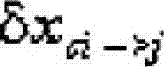

在帧fi的参考系中具有坐标xi的相同对象点在帧fj的参考系中具有坐标xj,且:The same object point with coordinate x i in the frame of reference of frame f i has coordinate x j in the frame of reference of frame f j , and:
xj=(xi-δxc)δR (方程式17)x j = ( xi -δx c )δR (Equation 17)
因此在2D像素坐标系中,ui与uj之间的关系如下:
其中m是映射函数。或简单地为where m is the mapping function. or simply for
uj=δP(ui) (方程式19)u j = δP(u i ) (Equation 19)
其中δP=moξom-1表示三个操作的组合。where δP=moξom -1 represents the combination of three operations.
现在的任务是找出最优ξ,使得成本函数The task now is to find the optimal ξ such that the cost function
∫|fi(u)-fj(δP(u))|2du (方程式20)∫|f i (u)-f j (δP(u))| 2 du (Equation 20)
被最小化。这是精心研究过的非线性最小二乘问题。解它通常涉及线性逼近和迭代。不同线性逼近得到不同的收敛方法,诸如高斯一牛顿、最陡下降、Levenberg-Marquar下降等等。is minimized. This is a well-studied nonlinear least squares problem. Solving it usually involves linear approximation and iteration. Different linear approximations lead to different convergence methods, such as Gauss-Newton, steepest descent, Levenberg-Marquar descent, and so on.
在本技术的一个实施方案中,仍然参考图9,第二图像捕获装置266被配置来捕获包括在平台262的第一定位和第二定位处的至少一个对象的图像。In one embodiment of the present technology, still referring to FIG. 9 , second
在本技术的一个实施方案中,特征追踪子过程270—2被配置来处理由第二图像捕获装置266在平台262的第一定位和第二定位处获得的每个图像,并被配置来提取至少一个捕获对象的追踪数据集。In one embodiment of the present technology, the feature tracking subprocess 270-2 is configured to process each image acquired by the second
在本技术的一个实施方案中,仍然参考图9,特征追踪子过程270-2也被配置来通过使用对于至少一个捕获对象所获得的追踪数据集而确定平台262的定位的位置。In one embodiment of the present technology, still referring to FIG. 9 , the feature tracking subprocess 270 - 2 is also configured to determine the position of the location of the
在本技术的一个实施方案中,仍然参考图9,基于图像的定位设备260还包括卡尔曼滤波器272。卡尔曼滤波器272被配置来通过将作为第一噪声测量值的平台262的第二定位的基于表面追踪的坐标与作为第二噪声测量值的平台262的第二定位的基于特征的坐标组合而获得平台262的定位的卡尔曼估计。In one embodiment of the present technology, still referring to FIG. 9 , the image-based
在本技术的一个实施方案中,基于图像的定位设备260还包括被配置来存储平台262的至少一个基于表面追踪和特征的三维(3D)定位坐标以供进一步处理的外部存储器模块276。In one embodiment of the present technology, the image-based
在本技术的一个实施方案中,基于图像的定位设备260还包括无线调制解调器278,其被配置来对外部存储器模块276提供远程互联网访问。In one embodiment of the present technology, the image-based
VI.包括对象和表面追踪过程的基于图像的定位设备的操作。VI. Operation of image-based localization devices including object and surface tracking processes.
在本技术的一个实施方案中,仍然参考图9,基于图像的定位设备260的操作包括特征和表面追踪过程270,其包括以下步骤。In one embodiment of the present technology, still referring to FIG. 9 , the operation of the image-based
通过使用第一图像捕获装置264而在平台262的第一定位处捕获选定表面的图像。通过使用范围测量装置280而计算选定表面的深度数据集。通过使用图像处理算法282而执行将捕获图像数据集和选定表面深度数据集刚性全局变换至6个坐标数据集;其中6个坐标数据集表示平台262的移动。通过使用图像处理算法282而处理6个坐标数据集以获得平台262的定位的位置。An image of the selected surface is captured at the first location of the
在本技术的一个实施方案中,仍然参考图9,基于图像的定位设备260的操作包括特征和表面追踪过程270,其进一步包括以下步骤。In one embodiment of the present technology, still referring to FIG. 9 , the operation of the image-based
通过使用第二图像捕获装置266而在平台262的第一定位处捕获第一图像;其中所述第一图像包括至少一个对象。通过使用第二图像捕获装置266而在平台262的第二定位处捕获第二图像;其中所述第二图像包括至少一个捕获对象。A first image is captured at a first location of
第一图像和第二图像被处理以追踪至少一个捕获对象的位置;其中从处理的第一图像和第二图像而获得对于至少一个捕获对象的二维定位集,提供所捕获对象的追踪数据集。请参见方程式(1至7)。The first image and the second image are processed to track the position of the at least one captured object; wherein a set of two-dimensional positions for the at least one captured object is obtained from the processed first image and the second image, providing a tracking data set of the captured object . See equations (1 to 7).
通过使用至少一个捕获对象的追踪数据集而确定平台262的第二定位的位置。请参见方程式(1至7)。The location of the second location of
最后,通过将平台262的定位的基于表面追踪的坐标和平台262的定位的基于特征的坐标组合而确定平台262的定位。Finally, the position of
在本技术的一个实施方案中,仍然参考图9,卡尔曼滤波器272用于通过将作为第一噪声测量值的平台262的定位的基于表面追踪的坐标与作为第二噪声测量值的平台262的定位的基于特征的坐标组合而获得平台262的定位的卡尔曼估计。In one embodiment of the present technology, still referring to FIG. 9 , a
在本技术的一个实施方案中,作为组合两个位置估计以提出对于平台改进的位置估计的替代,原始对象追踪数据和原始表面追踪数据可在共同估计器中组合,且可获得平台位置的单个估计。方法包括使用来自任何估计方法(诸如SLAM、移动匹配、表面追踪或摄影测量)的元素。可利用卡尔曼滤波器以与最小二乘解决方案可利用的相同的方式进行估计。In one embodiment of the present technique, instead of combining the two position estimates to come up with an improved position estimate for the platform, the raw object tracking data and the raw surface tracking data can be combined in a common estimator and a single estimate of the platform position can be obtained. estimate. Methods include using elements from any estimation method such as SLAM, motion matching, surface tracking or photogrammetry. Estimation can be done using a Kalman filter in the same way that a least squares solution can be used.
上文的讨论已阐述各种示例性系统和装置的操作,以及有关于操作这些系统和装置的示例性方法的各种实施方案。在各种实施方案中,在计算机可读和计算机可执行指令的控制下通过过程实行方法的一个或多个步骤的实施。因此,在一些实施方案中,这些方法经由计算机实施。The foregoing discussion has set forth the operation of various exemplary systems and devices, as well as various embodiments pertaining to exemplary methods of operating these systems and devices. In various embodiments, the performance of one or more steps of a method is carried out by a process under the control of computer-readable and computer-executable instructions. Thus, in some embodiments, the methods are implemented via computer.
在一个实施方案中,计算机可读和计算机可执行指令可驻留在计算机可用/可读媒体上。In one embodiment, computer readable and computer executable instructions may reside on a computer usable/readable medium.
因此,可使用计算机可执行指令(诸如由计算机执行的程序模块)而控制或实施各种实施方案的一个或多个操作。一般而言,程序模块包括例程、程序、对象、组件、数据结构等等,其执行特定任务或实施特定抽象数据类型。此外,本技术也可以在分布式计算环境中实践,其中任务通过透过通信网络链接的远程处理装置执行。在分布式计算环境中,程序模块可位于本地和远程计算机存储媒体中,包括存储器存储装置。Accordingly, one or more operations of the various embodiments may be controlled or carried out using computer-executable instructions, such as program modules executed by a computer. Generally, program modules include routines, programs, objects, components, data structures, etc. that perform particular tasks or implement particular abstract data types. Additionally, the technology can also be practiced in distributed computing environments where tasks are performed by remote processing devices that are linked through a communications network. In a distributed computing environment, program modules may be located in both local and remote computer storage media including memory storage devices.
虽然在本文中公开了实施示例性方法的特定步骤,但是这些步骤是可根据各种示例性实施方案执行的步骤实施例。即,本文中公开的实施方案非常适于执行所叙述的各种其它步骤或步骤变动。此外,本文中公开的步骤可以与所呈现的不同的顺序执行,且在特定实施方案中不必执行所有所述步骤。While specific steps for implementing exemplary methods are disclosed herein, these steps are example steps that may be performed in accordance with various exemplary embodiments. That is, the embodiments disclosed herein are well suited for carrying out the various other steps or variations of the steps described. Furthermore, the steps disclosed herein may be performed in an order different from that presented, and in a particular embodiment all described steps do not have to be performed.
虽然在本文中讨论了各种基于电子和软件的系统,但是这些系统仅是可被利用的环境的实施例,且并不旨在暗示对本技术的使用或功能范畴的任何限制。这些系统也不应诠释为对所公开实施例中图示的组件或功能的任何一个或组合具有任何依赖性或联系。While various electronic and software-based systems are discussed herein, these systems are only examples of environments in which they may be utilized, and are not intended to suggest any limitation as to the scope of use or functionality of the technology. Neither should these systems be interpreted as having any dependency or relationship as having any one or combination of components or functions illustrated in the disclosed embodiments.
虽然已经用结构特征和/或方法行为的专门语言描述了主题,但是随附权利要求中定义的主题不一定限于上文所述的特定特征或行为。相反,上文所述的特定特征和行为作为实施权利要求的示例性形式而公开。Although the subject matter has been described in specific language of structural features and/or methodological acts, the subject matter defined in the appended claims is not necessarily limited to the specific features or acts described above. Rather, the specific features and acts described above are disclosed as example forms of implementing the claims.
Claims (26)
Applications Claiming Priority (3)
| Application Number | Priority Date | Filing Date | Title |
|---|---|---|---|
| US35842310P | 2010-06-25 | 2010-06-25 | |
| US61/358,423 | 2010-06-25 | ||
| PCT/US2011/041590 WO2011163454A1 (en) | 2010-06-25 | 2011-06-23 | Method and apparatus for image-based positioning |
Publications (2)
| Publication Number | Publication Date |
|---|---|
| CN103119611A true CN103119611A (en) | 2013-05-22 |
| CN103119611B CN103119611B (en) | 2016-05-11 |
Family
ID=45371815
Family Applications (1)
| Application Number | Title | Priority Date | Filing Date |
|---|---|---|---|
| CN201180031443.1A Active CN103119611B (en) | 2010-06-25 | 2011-06-23 | The method and apparatus of the location based on image |
Country Status (5)
| Country | Link |
|---|---|
| US (2) | US8754805B2 (en) |
| JP (1) | JP6002126B2 (en) |
| CN (1) | CN103119611B (en) |
| DE (1) | DE112011102132T5 (en) |
| WO (1) | WO2011163454A1 (en) |
Cited By (19)
| Publication number | Priority date | Publication date | Assignee | Title |
|---|---|---|---|---|
| CN104297762A (en) * | 2014-10-17 | 2015-01-21 | 安徽三联交通应用技术股份有限公司 | Driving-test third-subject map surveying instrument and surveying method of driving-test third-subject map surveying instrument |
| CN104881860A (en) * | 2014-02-28 | 2015-09-02 | 国际商业机器公司 | Positioning method and apparatus based on photographs |
| CN105580029A (en) * | 2013-10-04 | 2016-05-11 | 高通股份有限公司 | Dynamic extension of map data for object detection and tracking |
| CN105825498A (en) * | 2015-01-27 | 2016-08-03 | 株式会社拓普康 | Survey data processing device, survey data processing method, and program therefor |
| CN105989586A (en) * | 2015-03-04 | 2016-10-05 | 北京雷动云合智能技术有限公司 | SLAM method based on semantic bundle adjustment method |
| CN106605236A (en) * | 2014-09-15 | 2017-04-26 | 三星电子株式会社 | Method for capturing image and image capturing apparatus |
| CN106707287A (en) * | 2016-12-23 | 2017-05-24 | 浙江大学 | Fish school quantity estimation method based on extended Kalman filtering combined with nearest neighbor clustering algorithm |
| CN106959102A (en) * | 2014-05-05 | 2017-07-18 | 赫克斯冈技术中心 | Measure subsystem and measuring system |
| CN106997055A (en) * | 2017-05-27 | 2017-08-01 | 金华航大北斗应用技术有限公司 | Big Dipper MEO satellite signal fitting method based on least square and gradient descent method |
| CN107272727A (en) * | 2016-04-01 | 2017-10-20 | 松下电器(美国)知识产权公司 | Autonomous body |
| CN107796384A (en) * | 2016-08-30 | 2018-03-13 | 波音公司 | Positioned using the 2D vehicles of geographical arc |
| CN109059941A (en) * | 2018-07-06 | 2018-12-21 | 禾多科技(北京)有限公司 | Characteristics map construction method, vision positioning method and corresponding intrument |
| CN109099889A (en) * | 2018-07-10 | 2018-12-28 | 广州市中海达测绘仪器有限公司 | Close range photogrammetric system and method |
| WO2019153855A1 (en) * | 2018-02-07 | 2019-08-15 | 迎刃而解有限公司 | Object information acquisition system capable of 360-degree panoramic orientation and position sensing, and application thereof |
| CN110770758A (en) * | 2017-01-23 | 2020-02-07 | 牛津大学创新有限公司 | Determining the location of removable equipment |
| CN111167052A (en) * | 2020-03-18 | 2020-05-19 | 沈阳天目科技有限公司 | Automatic fire monitor target longitude and latitude calculation method based on camera positioning |
| CN112348884A (en) * | 2019-08-09 | 2021-02-09 | 华为技术有限公司 | Positioning method, terminal device and server |
| CN112924978A (en) * | 2014-12-26 | 2021-06-08 | 赫尔环球有限公司 | Method and apparatus for positioning of a device |
| CN113820735A (en) * | 2021-08-31 | 2021-12-21 | 上海华测导航技术股份有限公司 | Method for determining location information, location measuring device, terminal and storage medium |
Families Citing this family (176)
| Publication number | Priority date | Publication date | Assignee | Title |
|---|---|---|---|---|
| US8503720B2 (en) | 2009-05-01 | 2013-08-06 | Microsoft Corporation | Human body pose estimation |
| DE112011102132T5 (en) | 2010-06-25 | 2013-05-23 | Trimble Navigation Ltd. | Method and device for image-based positioning |
| US20160349057A1 (en) * | 2010-10-13 | 2016-12-01 | Elbit Systems Ltd. | Multiple data sources pedestrian navigation system |
| US9182229B2 (en) | 2010-12-23 | 2015-11-10 | Trimble Navigation Limited | Enhanced position measurement systems and methods |
| US10168153B2 (en) | 2010-12-23 | 2019-01-01 | Trimble Inc. | Enhanced position measurement systems and methods |
| US9879993B2 (en) | 2010-12-23 | 2018-01-30 | Trimble Inc. | Enhanced bundle adjustment techniques |
| US8942917B2 (en) | 2011-02-14 | 2015-01-27 | Microsoft Corporation | Change invariant scene recognition by an agent |
| US9134127B2 (en) | 2011-06-24 | 2015-09-15 | Trimble Navigation Limited | Determining tilt angle and tilt direction using image processing |
| US9109889B2 (en) | 2011-06-24 | 2015-08-18 | Trimble Navigation Limited | Determining tilt angle and tilt direction using image processing |
| US20140218358A1 (en) * | 2011-12-01 | 2014-08-07 | Lightcraft Technology, Llc | Automatic tracking matte system |
| WO2013126877A1 (en) * | 2012-02-25 | 2013-08-29 | Massachusetts Institute Of Technology | Personal skin scanner system |
| US9093047B2 (en) | 2012-04-15 | 2015-07-28 | Trimble Navigation Limited | Displaying arrays of image data |
| US9214021B2 (en) * | 2012-10-09 | 2015-12-15 | The Boeing Company | Distributed position identification |
| US9235763B2 (en) | 2012-11-26 | 2016-01-12 | Trimble Navigation Limited | Integrated aerial photogrammetry surveys |
| US9645248B2 (en) | 2012-12-28 | 2017-05-09 | Trimble Inc. | Vehicle-based global navigation satellite system receiver system with radio frequency hardware component |
| US9467814B2 (en) | 2012-12-28 | 2016-10-11 | Trimble Navigation Limited | Collecting external accessory data at a mobile data collection platform that obtains raw observables from an external GNSS raw observable provider |
| US9821999B2 (en) | 2012-12-28 | 2017-11-21 | Trimble Inc. | External GNSS receiver module with motion sensor suite for contextual inference of user activity |
| US9544737B2 (en) | 2012-12-28 | 2017-01-10 | Trimble Inc. | Performing data collection based on external raw observables using a mobile data collection platform |
| US9639941B2 (en) | 2012-12-28 | 2017-05-02 | Trimble Inc. | Scene documentation |
| US9177384B2 (en) | 2013-07-31 | 2015-11-03 | Trimble Navigation Limited | Sequential rolling bundle adjustment |
| US9910158B2 (en) | 2012-12-28 | 2018-03-06 | Trimble Inc. | Position determination of a cellular device using carrier phase smoothing |
| US9945959B2 (en) | 2012-12-28 | 2018-04-17 | Trimble Inc. | Global navigation satellite system receiver system with radio frequency hardware component |
| US9857470B2 (en) | 2012-12-28 | 2018-01-02 | Microsoft Technology Licensing, Llc | Using photometric stereo for 3D environment modeling |
| US9462446B2 (en) | 2012-12-28 | 2016-10-04 | Trimble Navigation Limited | Collecting external accessory data at a mobile data collection platform that obtains raw observables from an internal chipset |
| US9488736B2 (en) | 2012-12-28 | 2016-11-08 | Trimble Navigation Limited | Locally measured movement smoothing of GNSS position fixes |
| US9880286B2 (en) | 2012-12-28 | 2018-01-30 | Trimble Inc. | Locally measured movement smoothing of position fixes based on extracted pseudoranges |
| US9429640B2 (en) | 2012-12-28 | 2016-08-30 | Trimble Navigation Limited | Obtaining pseudorange information using a cellular device |
| US9538336B2 (en) | 2012-12-28 | 2017-01-03 | Trimble Inc. | Performing data collection based on internal raw observables using a mobile data collection platform |
| US9835729B2 (en) | 2012-12-28 | 2017-12-05 | Trimble Inc. | Global navigation satellite system receiver system with radio frequency hardware component |
| US9456067B2 (en) | 2012-12-28 | 2016-09-27 | Trimble Navigation Limited | External electronic distance measurement accessory for a mobile data collection platform |
| US9369843B2 (en) | 2012-12-28 | 2016-06-14 | Trimble Navigation Limited | Extracting pseudorange information using a cellular device |
| US10101465B2 (en) | 2012-12-28 | 2018-10-16 | Trimble Inc. | Electronic tape measure on a cellphone |
| US9612341B2 (en) | 2012-12-28 | 2017-04-04 | Trimble Inc. | GNSS receiver positioning system |
| US9743373B2 (en) | 2012-12-28 | 2017-08-22 | Trimble Inc. | Concurrent dual processing of pseudoranges with corrections |
| US9903957B2 (en) | 2012-12-28 | 2018-02-27 | Trimble Inc. | Global navigation satellite system receiver system with radio frequency hardware component |
| US9940553B2 (en) | 2013-02-22 | 2018-04-10 | Microsoft Technology Licensing, Llc | Camera/object pose from predicted coordinates |
| US9208382B2 (en) | 2013-03-08 | 2015-12-08 | Trimble Navigation Limited | Methods and systems for associating a keyphrase with an image |
| US9043028B2 (en) | 2013-03-13 | 2015-05-26 | Trimble Navigation Limited | Method of determining the orientation of a machine |
| US20140267686A1 (en) * | 2013-03-15 | 2014-09-18 | Novatel Inc. | System and method for augmenting a gnss/ins navigation system of a low dynamic vessel using a vision system |
| JP2014185996A (en) * | 2013-03-25 | 2014-10-02 | Toshiba Corp | Measurement device |
| US9558559B2 (en) | 2013-04-05 | 2017-01-31 | Nokia Technologies Oy | Method and apparatus for determining camera location information and/or camera pose information according to a global coordinate system |
| US9699375B2 (en) | 2013-04-05 | 2017-07-04 | Nokia Technology Oy | Method and apparatus for determining camera location information and/or camera pose information according to a global coordinate system |
| US9999038B2 (en) | 2013-05-31 | 2018-06-12 | At&T Intellectual Property I, L.P. | Remote distributed antenna system |
| US9247239B2 (en) | 2013-06-20 | 2016-01-26 | Trimble Navigation Limited | Use of overlap areas to optimize bundle adjustment |
| DE102013011969A1 (en) | 2013-07-18 | 2015-01-22 | GM Global Technology Operations LLC (n. d. Gesetzen des Staates Delaware) | Method for operating a motor vehicle and motor vehicle |
| JP2016540230A (en) | 2013-09-20 | 2016-12-22 | キャタピラー インコーポレイテッドCaterpillar Incorporated | Positioning system |
| WO2015041687A1 (en) | 2013-09-20 | 2015-03-26 | Caterpillar Inc. | Positioning system using radio frequency signals |
| US20150098079A1 (en) * | 2013-10-09 | 2015-04-09 | Hilti Aktiengesellschaft | System and method for camera based position and orientation measurement |
| US11004259B2 (en) * | 2013-10-25 | 2021-05-11 | Hover Inc. | Estimating dimensions of geo-referenced ground level imagery using orthogonal imagery |
| US9470511B2 (en) | 2013-11-12 | 2016-10-18 | Trimble Navigation Limited | Point-to-point measurements using a handheld device |
| TWI537580B (en) | 2013-11-26 | 2016-06-11 | 財團法人資訊工業策進會 | Positioning control method |
| DE102013020307A1 (en) | 2013-12-04 | 2014-08-14 | Daimler Ag | Method for determining the position of mobile object in multi-dimensional space, involves decoding emitted encoded signal with movement of object in transmitter unit and determining received positional information of object |
| US10037469B2 (en) * | 2013-12-10 | 2018-07-31 | Google Llc | Image location through large object detection |
| EP2913796B1 (en) * | 2014-02-26 | 2019-03-27 | NavVis GmbH | Method of generating panorama views on a mobile mapping system |
| US10288738B1 (en) * | 2014-04-01 | 2019-05-14 | Rockwell Collins, Inc. | Precision mobile baseline determination device and related method |
| US9923626B2 (en) | 2014-06-13 | 2018-03-20 | Trimble Inc. | Mobile ionospheric data capture system |
| US9420737B2 (en) | 2014-08-27 | 2016-08-23 | Trimble Navigation Limited | Three-dimensional elevation modeling for use in operating agricultural vehicles |
| US10063280B2 (en) | 2014-09-17 | 2018-08-28 | At&T Intellectual Property I, L.P. | Monitoring and mitigating conditions in a communication network |
| WO2016054060A1 (en) | 2014-09-30 | 2016-04-07 | University Of Virginia Patent Foundation | Intrafractional motion reduction system using audiovisual-aided interactive guidance and related methods thereof |
| US9615269B2 (en) | 2014-10-02 | 2017-04-04 | At&T Intellectual Property I, L.P. | Method and apparatus that provides fault tolerance in a communication network |
| US9503189B2 (en) | 2014-10-10 | 2016-11-22 | At&T Intellectual Property I, L.P. | Method and apparatus for arranging communication sessions in a communication system |
| US9973299B2 (en) | 2014-10-14 | 2018-05-15 | At&T Intellectual Property I, L.P. | Method and apparatus for adjusting a mode of communication in a communication network |
| US9312919B1 (en) | 2014-10-21 | 2016-04-12 | At&T Intellectual Property I, Lp | Transmission device with impairment compensation and methods for use therewith |
| US9769020B2 (en) | 2014-10-21 | 2017-09-19 | At&T Intellectual Property I, L.P. | Method and apparatus for responding to events affecting communications in a communication network |
| US10243784B2 (en) | 2014-11-20 | 2019-03-26 | At&T Intellectual Property I, L.P. | System for generating topology information and methods thereof |
| US9800327B2 (en) | 2014-11-20 | 2017-10-24 | At&T Intellectual Property I, L.P. | Apparatus for controlling operations of a communication device and methods thereof |
| US10009067B2 (en) | 2014-12-04 | 2018-06-26 | At&T Intellectual Property I, L.P. | Method and apparatus for configuring a communication interface |
| US9544006B2 (en) | 2014-11-20 | 2017-01-10 | At&T Intellectual Property I, L.P. | Transmission device with mode division multiplexing and methods for use therewith |
| US9461706B1 (en) | 2015-07-31 | 2016-10-04 | At&T Intellectual Property I, Lp | Method and apparatus for exchanging communication signals |
| US9997819B2 (en) | 2015-06-09 | 2018-06-12 | At&T Intellectual Property I, L.P. | Transmission medium and method for facilitating propagation of electromagnetic waves via a core |
| US9954287B2 (en) | 2014-11-20 | 2018-04-24 | At&T Intellectual Property I, L.P. | Apparatus for converting wireless signals and electromagnetic waves and methods thereof |
| US9876570B2 (en) | 2015-02-20 | 2018-01-23 | At&T Intellectual Property I, Lp | Guided-wave transmission device with non-fundamental mode propagation and methods for use therewith |
| US9705561B2 (en) | 2015-04-24 | 2017-07-11 | At&T Intellectual Property I, L.P. | Directional coupling device and methods for use therewith |
| US10224981B2 (en) | 2015-04-24 | 2019-03-05 | At&T Intellectual Property I, Lp | Passive electrical coupling device and methods for use therewith |
| US9793954B2 (en) | 2015-04-28 | 2017-10-17 | At&T Intellectual Property I, L.P. | Magnetic coupling device and methods for use therewith |
| US9871282B2 (en) | 2015-05-14 | 2018-01-16 | At&T Intellectual Property I, L.P. | At least one transmission medium having a dielectric surface that is covered at least in part by a second dielectric |
| US9490869B1 (en) | 2015-05-14 | 2016-11-08 | At&T Intellectual Property I, L.P. | Transmission medium having multiple cores and methods for use therewith |
| US10650940B2 (en) | 2015-05-15 | 2020-05-12 | At&T Intellectual Property I, L.P. | Transmission medium having a conductive material and methods for use therewith |
| US9917341B2 (en) | 2015-05-27 | 2018-03-13 | At&T Intellectual Property I, L.P. | Apparatus and method for launching electromagnetic waves and for modifying radial dimensions of the propagating electromagnetic waves |
| US9866309B2 (en) | 2015-06-03 | 2018-01-09 | At&T Intellectual Property I, Lp | Host node device and methods for use therewith |
| US9912381B2 (en) | 2015-06-03 | 2018-03-06 | At&T Intellectual Property I, Lp | Network termination and methods for use therewith |
| US10812174B2 (en) | 2015-06-03 | 2020-10-20 | At&T Intellectual Property I, L.P. | Client node device and methods for use therewith |
| US9913139B2 (en) | 2015-06-09 | 2018-03-06 | At&T Intellectual Property I, L.P. | Signal fingerprinting for authentication of communicating devices |
| US9820146B2 (en) | 2015-06-12 | 2017-11-14 | At&T Intellectual Property I, L.P. | Method and apparatus for authentication and identity management of communicating devices |
| US9640850B2 (en) | 2015-06-25 | 2017-05-02 | At&T Intellectual Property I, L.P. | Methods and apparatus for inducing a non-fundamental wave mode on a transmission medium |
| US9509415B1 (en) | 2015-06-25 | 2016-11-29 | At&T Intellectual Property I, L.P. | Methods and apparatus for inducing a fundamental wave mode on a transmission medium |
| US9865911B2 (en) | 2015-06-25 | 2018-01-09 | At&T Intellectual Property I, L.P. | Waveguide system for slot radiating first electromagnetic waves that are combined into a non-fundamental wave mode second electromagnetic wave on a transmission medium |
| US9628116B2 (en) | 2015-07-14 | 2017-04-18 | At&T Intellectual Property I, L.P. | Apparatus and methods for transmitting wireless signals |
| US10148016B2 (en) | 2015-07-14 | 2018-12-04 | At&T Intellectual Property I, L.P. | Apparatus and methods for communicating utilizing an antenna array |
| US9847566B2 (en) | 2015-07-14 | 2017-12-19 | At&T Intellectual Property I, L.P. | Method and apparatus for adjusting a field of a signal to mitigate interference |
| US9882257B2 (en) | 2015-07-14 | 2018-01-30 | At&T Intellectual Property I, L.P. | Method and apparatus for launching a wave mode that mitigates interference |
| US10205655B2 (en) | 2015-07-14 | 2019-02-12 | At&T Intellectual Property I, L.P. | Apparatus and methods for communicating utilizing an antenna array and multiple communication paths |
| US9853342B2 (en) | 2015-07-14 | 2017-12-26 | At&T Intellectual Property I, L.P. | Dielectric transmission medium connector and methods for use therewith |
| US10044409B2 (en) | 2015-07-14 | 2018-08-07 | At&T Intellectual Property I, L.P. | Transmission medium and methods for use therewith |
| US10090606B2 (en) | 2015-07-15 | 2018-10-02 | At&T Intellectual Property I, L.P. | Antenna system with dielectric array and methods for use therewith |
| US9871283B2 (en) | 2015-07-23 | 2018-01-16 | At&T Intellectual Property I, Lp | Transmission medium having a dielectric core comprised of plural members connected by a ball and socket configuration |
| US9749053B2 (en) | 2015-07-23 | 2017-08-29 | At&T Intellectual Property I, L.P. | Node device, repeater and methods for use therewith |
| US9948333B2 (en) | 2015-07-23 | 2018-04-17 | At&T Intellectual Property I, L.P. | Method and apparatus for wireless communications to mitigate interference |
| US9912027B2 (en) | 2015-07-23 | 2018-03-06 | At&T Intellectual Property I, L.P. | Method and apparatus for exchanging communication signals |
| US9967173B2 (en) | 2015-07-31 | 2018-05-08 | At&T Intellectual Property I, L.P. | Method and apparatus for authentication and identity management of communicating devices |
| US9904535B2 (en) | 2015-09-14 | 2018-02-27 | At&T Intellectual Property I, L.P. | Method and apparatus for distributing software |
| US9769128B2 (en) | 2015-09-28 | 2017-09-19 | At&T Intellectual Property I, L.P. | Method and apparatus for encryption of communications over a network |
| US9876264B2 (en) | 2015-10-02 | 2018-01-23 | At&T Intellectual Property I, Lp | Communication system, guided wave switch and methods for use therewith |
| CN105371827A (en) * | 2015-10-13 | 2016-03-02 | 同创智慧空间(北京)科技有限公司 | Full-functional GNSS stereo camera surveying instrument |
| JP6332699B2 (en) * | 2015-10-13 | 2018-05-30 | 株式会社amuse oneself | Surveying equipment |
| US10355367B2 (en) | 2015-10-16 | 2019-07-16 | At&T Intellectual Property I, L.P. | Antenna structure for exchanging wireless signals |
| US9918204B1 (en) | 2015-12-08 | 2018-03-13 | Bentley Systems, Incorporated | High accuracy indoor tracking |
| ES2742894T3 (en) * | 2015-12-30 | 2020-02-17 | Fund Centre Tecnologic De Telecomunicacions De Catalunya Cttc | Improved prospecting rod |
| US10072934B2 (en) | 2016-01-15 | 2018-09-11 | Abl Ip Holding Llc | Passive marking on light fixture detected for position estimation |
| US11313684B2 (en) * | 2016-03-28 | 2022-04-26 | Sri International | Collaborative navigation and mapping |
| US9860075B1 (en) | 2016-08-26 | 2018-01-02 | At&T Intellectual Property I, L.P. | Method and communication node for broadband distribution |
| CN106485785B (en) * | 2016-09-30 | 2023-09-26 | 李娜 | Scene generation method and system based on indoor three-dimensional modeling and positioning |
| US10811767B2 (en) | 2016-10-21 | 2020-10-20 | At&T Intellectual Property I, L.P. | System and dielectric antenna with convex dielectric radome |
| US10312567B2 (en) | 2016-10-26 | 2019-06-04 | At&T Intellectual Property I, L.P. | Launcher with planar strip antenna and methods for use therewith |
| US10225025B2 (en) | 2016-11-03 | 2019-03-05 | At&T Intellectual Property I, L.P. | Method and apparatus for detecting a fault in a communication system |
| US10178445B2 (en) | 2016-11-23 | 2019-01-08 | At&T Intellectual Property I, L.P. | Methods, devices, and systems for load balancing between a plurality of waveguides |
| US10637149B2 (en) | 2016-12-06 | 2020-04-28 | At&T Intellectual Property I, L.P. | Injection molded dielectric antenna and methods for use therewith |
| US10694379B2 (en) | 2016-12-06 | 2020-06-23 | At&T Intellectual Property I, L.P. | Waveguide system with device-based authentication and methods for use therewith |
| US10727599B2 (en) | 2016-12-06 | 2020-07-28 | At&T Intellectual Property I, L.P. | Launcher with slot antenna and methods for use therewith |
| US10819035B2 (en) | 2016-12-06 | 2020-10-27 | At&T Intellectual Property I, L.P. | Launcher with helical antenna and methods for use therewith |
| US9893795B1 (en) | 2016-12-07 | 2018-02-13 | At&T Intellectual Property I, Lp | Method and repeater for broadband distribution |
| US10139820B2 (en) | 2016-12-07 | 2018-11-27 | At&T Intellectual Property I, L.P. | Method and apparatus for deploying equipment of a communication system |
| US10547348B2 (en) | 2016-12-07 | 2020-01-28 | At&T Intellectual Property I, L.P. | Method and apparatus for switching transmission mediums in a communication system |
| US10168695B2 (en) | 2016-12-07 | 2019-01-01 | At&T Intellectual Property I, L.P. | Method and apparatus for controlling an unmanned aircraft |
| US10243270B2 (en) | 2016-12-07 | 2019-03-26 | At&T Intellectual Property I, L.P. | Beam adaptive multi-feed dielectric antenna system and methods for use therewith |
| US10359749B2 (en) | 2016-12-07 | 2019-07-23 | At&T Intellectual Property I, L.P. | Method and apparatus for utilities management via guided wave communication |
| US10446936B2 (en) | 2016-12-07 | 2019-10-15 | At&T Intellectual Property I, L.P. | Multi-feed dielectric antenna system and methods for use therewith |
| US10389029B2 (en) | 2016-12-07 | 2019-08-20 | At&T Intellectual Property I, L.P. | Multi-feed dielectric antenna system with core selection and methods for use therewith |
| US10069535B2 (en) | 2016-12-08 | 2018-09-04 | At&T Intellectual Property I, L.P. | Apparatus and methods for launching electromagnetic waves having a certain electric field structure |
| US9998870B1 (en) | 2016-12-08 | 2018-06-12 | At&T Intellectual Property I, L.P. | Method and apparatus for proximity sensing |
| US10530505B2 (en) | 2016-12-08 | 2020-01-07 | At&T Intellectual Property I, L.P. | Apparatus and methods for launching electromagnetic waves along a transmission medium |
| US10389037B2 (en) | 2016-12-08 | 2019-08-20 | At&T Intellectual Property I, L.P. | Apparatus and methods for selecting sections of an antenna array and use therewith |
| US10601494B2 (en) | 2016-12-08 | 2020-03-24 | At&T Intellectual Property I, L.P. | Dual-band communication device and method for use therewith |
| US10103422B2 (en) | 2016-12-08 | 2018-10-16 | At&T Intellectual Property I, L.P. | Method and apparatus for mounting network devices |
| US10777873B2 (en) | 2016-12-08 | 2020-09-15 | At&T Intellectual Property I, L.P. | Method and apparatus for mounting network devices |
| US10938108B2 (en) | 2016-12-08 | 2021-03-02 | At&T Intellectual Property I, L.P. | Frequency selective multi-feed dielectric antenna system and methods for use therewith |
| US10326689B2 (en) | 2016-12-08 | 2019-06-18 | At&T Intellectual Property I, L.P. | Method and system for providing alternative communication paths |
| US9911020B1 (en) | 2016-12-08 | 2018-03-06 | At&T Intellectual Property I, L.P. | Method and apparatus for tracking via a radio frequency identification device |
| US10264586B2 (en) | 2016-12-09 | 2019-04-16 | At&T Mobility Ii Llc | Cloud-based packet controller and methods for use therewith |
| US10340983B2 (en) | 2016-12-09 | 2019-07-02 | At&T Intellectual Property I, L.P. | Method and apparatus for surveying remote sites via guided wave communications |
| US9838896B1 (en) | 2016-12-09 | 2017-12-05 | At&T Intellectual Property I, L.P. | Method and apparatus for assessing network coverage |
| US10458792B2 (en) * | 2016-12-15 | 2019-10-29 | Novatel Inc. | Remote survey system |
| US10563980B2 (en) * | 2016-12-23 | 2020-02-18 | Topcon Positioning Systems, Inc. | Enhanced remote surveying systems and methods |
| KR102647351B1 (en) | 2017-01-26 | 2024-03-13 | 삼성전자주식회사 | Modeling method and modeling apparatus using 3d point cloud |
| US9973940B1 (en) | 2017-02-27 | 2018-05-15 | At&T Intellectual Property I, L.P. | Apparatus and methods for dynamic impedance matching of a guided wave launcher |
| US10298293B2 (en) | 2017-03-13 | 2019-05-21 | At&T Intellectual Property I, L.P. | Apparatus of communication utilizing wireless network devices |
| US10097241B1 (en) | 2017-04-11 | 2018-10-09 | At&T Intellectual Property I, L.P. | Machine assisted development of deployment site inventory |
| CN107295227A (en) * | 2017-05-27 | 2017-10-24 | 欧阳聪星 | Specula in a kind of oral cavity |
| WO2018235923A1 (en) * | 2017-06-21 | 2018-12-27 | 国立大学法人 東京大学 | Position estimation device, position estimation method, and program |
| CN107727104B (en) * | 2017-08-16 | 2019-04-30 | 北京极智嘉科技有限公司 | Navigation method, device and system combined with simultaneous positioning and map creation |
| US10586349B2 (en) | 2017-08-24 | 2020-03-10 | Trimble Inc. | Excavator bucket positioning via mobile device |
| KR101836926B1 (en) * | 2017-12-05 | 2018-04-19 | 한국지질자원연구원 | Trench section baseline setting device and trench section analysis method using the same |
| DE102018100738A1 (en) | 2018-01-15 | 2019-07-18 | Dr. Ing. H.C. F. Porsche Aktiengesellschaft | Selective feature extraction |
| JP6478305B1 (en) * | 2018-07-04 | 2019-03-06 | 有限会社ネットライズ | Method and apparatus for measuring underground position of sheet pile applying SLAM method |
| JP7183017B2 (en) * | 2018-12-11 | 2022-12-05 | 株式会社トプコン | Surveying instruments and photogrammetric methods |
| CN109754408B (en) * | 2019-01-07 | 2020-12-01 | 合肥泰禾光电科技股份有限公司 | Trajectory tracking method and device |
| WO2020180424A1 (en) | 2019-03-04 | 2020-09-10 | Iocurrents, Inc. | Data compression and communication using machine learning |
| US11727646B2 (en) * | 2019-04-10 | 2023-08-15 | Trimble Inc. | Augmented reality image occlusion |
| US11693126B2 (en) * | 2019-04-10 | 2023-07-04 | Trimble Inc. | Augmented reality distance measurement |
| US11039118B2 (en) * | 2019-04-17 | 2021-06-15 | XRSpace CO., LTD. | Interactive image processing system using infrared cameras |
| US10885671B2 (en) | 2019-04-17 | 2021-01-05 | XRSpace CO., LTD. | Method, apparatus, and non-transitory computer-readable medium for interactive image processing using depth engine and digital signal processor |
| US11566896B2 (en) | 2019-08-22 | 2023-01-31 | Leica Geosystems Ag | Surveying system with image-based measuring |
| JP7036783B2 (en) * | 2019-10-09 | 2022-03-15 | 株式会社 ミックウェア | Position estimation system, position estimation method, and position estimation program |
| WO2021075967A1 (en) * | 2019-10-18 | 2021-04-22 | Xnr B.V. | Method and apparatus for optical measurement of environments |
| US10943360B1 (en) | 2019-10-24 | 2021-03-09 | Trimble Inc. | Photogrammetric machine measure up |
| DE102019216548A1 (en) * | 2019-10-28 | 2021-04-29 | DeepUp GmbH | Method and mobile detection device for the detection of infrastructure elements of an underground line network |
| US11536857B2 (en) | 2019-12-19 | 2022-12-27 | Trimble Inc. | Surface tracking on a survey pole |
| WO2022067836A1 (en) * | 2020-10-01 | 2022-04-07 | Qualcomm Incorporated | Simultaneous localization and mapping using cameras capturing multiple spectra of light |
| JP6976537B1 (en) * | 2020-10-08 | 2021-12-08 | 株式会社Fronteo | Information retrieval device, information retrieval method and information retrieval program |
| KR102398839B1 (en) * | 2020-12-01 | 2022-05-17 | 서울과학기술대학교 산학협력단 | Device for projecting video on surface of object |
| EP4012335B1 (en) * | 2020-12-11 | 2025-04-30 | Leica Geosystems AG | Method for distance error correction |
| US12169917B2 (en) | 2021-05-17 | 2024-12-17 | Samsung Electronics Co., Ltd. | Method and device with data processing using neural network |
| US12505675B2 (en) | 2022-06-28 | 2025-12-23 | Trimble Inc. | Automatic optimization of obstacle detection |
| CN115979231B (en) * | 2023-03-20 | 2023-07-18 | 广东工业大学 | A Dimensionless Kinematics Calibration Method Based on Virtual Points and Related Devices |
| JP2025017076A (en) * | 2023-07-24 | 2025-02-05 | パナソニックIpマネジメント株式会社 | Measuring device and measuring method |
| CN119687796A (en) * | 2024-08-29 | 2025-03-25 | 重庆大学 | Slope displacement monitoring system and method combining GNSS and binocular vision |
Citations (2)
| Publication number | Priority date | Publication date | Assignee | Title |
|---|---|---|---|---|
| US20040168148A1 (en) * | 2002-12-17 | 2004-08-26 | Goncalves Luis Filipe Domingues | Systems and methods for landmark generation for visual simultaneous localization and mapping |
| US20100063733A1 (en) * | 2008-09-09 | 2010-03-11 | Thomas Patrick Yunck | Cellular Interferometer for Continuous Earth Remote Observation (CICERO) |
Family Cites Families (47)
| Publication number | Priority date | Publication date | Assignee | Title |
|---|---|---|---|---|
| US6195609B1 (en) * | 1993-09-07 | 2001-02-27 | Harold Robert Pilley | Method and system for the control and management of an airport |
| US5642285A (en) | 1995-01-31 | 1997-06-24 | Trimble Navigation Limited | Outdoor movie camera GPS-position and time code data-logging for special effects production |
| US6282362B1 (en) | 1995-11-07 | 2001-08-28 | Trimble Navigation Limited | Geographical position/image digital recording and display system |
| US6147598A (en) | 1997-07-03 | 2000-11-14 | Trimble Navigation Limited | Vehicle theft system including a handheld computing device |
| DE10025110C2 (en) | 2000-05-20 | 2003-01-16 | Zsp Geodaetische Sys Gmbh | Method and device for realizing an information and data flow for geodetic devices |
| JP4672175B2 (en) * | 2000-05-26 | 2011-04-20 | 本田技研工業株式会社 | Position detection apparatus, position detection method, and position detection program |
| US7227526B2 (en) * | 2000-07-24 | 2007-06-05 | Gesturetek, Inc. | Video-based image control system |
| US7248285B2 (en) | 2001-03-30 | 2007-07-24 | Intel Corporation | Method and apparatus for automatic photograph annotation |
| JP4004316B2 (en) | 2002-03-20 | 2007-11-07 | 株式会社トプコン | Surveying device and method for acquiring image data using surveying device |
| US7009561B2 (en) * | 2003-03-11 | 2006-03-07 | Menache, Llp | Radio frequency motion tracking system and method |
| US7204596B2 (en) | 2003-09-19 | 2007-04-17 | Nec Corporation | Projector with tilt angle measuring device |
| JP4253239B2 (en) | 2003-10-07 | 2009-04-08 | 富士重工業株式会社 | Navigation system using image recognition |
| US20050209815A1 (en) | 2004-03-02 | 2005-09-22 | Russon Virgil K | Method, system, and computer-readable medium for user-assignment of geographic data to an image file |
| US7650013B2 (en) | 2004-11-15 | 2010-01-19 | Mobilerobots Inc. | System and method for map and position-determination enhancement |
| WO2006084385A1 (en) * | 2005-02-11 | 2006-08-17 | Macdonald Dettwiler & Associates Inc. | 3d imaging system |
| US7526384B2 (en) | 2005-03-10 | 2009-04-28 | Witten Technologies Inc. | Method for correcting a 3D location measured by a tracking system assuming a vertical offset |
| US7541974B2 (en) | 2005-12-15 | 2009-06-02 | Trimble Navigation Limited | Managed traverse system and method to acquire accurate survey data in absence of precise GPS data |
| CN101957195B (en) | 2005-09-12 | 2014-11-26 | 特里伯耶拿有限公司 | Surveying instrument and method of providing survey data of a target region using a surveying instrument |
| US8229166B2 (en) | 2009-07-07 | 2012-07-24 | Trimble Navigation, Ltd | Image-based tracking |
| JP4984650B2 (en) * | 2006-05-30 | 2012-07-25 | トヨタ自動車株式会社 | Mobile device and self-position estimation method of mobile device |
| CN100451543C (en) | 2006-08-22 | 2009-01-14 | 邓业灿 | Test method of pile skew simulation of straight pile |
| JP4800163B2 (en) * | 2006-09-29 | 2011-10-26 | 株式会社トプコン | Position measuring apparatus and method |
| CN101196395A (en) | 2006-12-04 | 2008-06-11 | 李正才 | Measurer for tiny inclination angle |
| US7719467B2 (en) * | 2007-03-08 | 2010-05-18 | Trimble Navigation Limited | Digital camera with GNSS picture location determination |
| EP1970005B1 (en) * | 2007-03-15 | 2012-10-03 | Xsens Holding B.V. | A system and a method for motion tracking using a calibration unit |
| JP2008261755A (en) | 2007-04-12 | 2008-10-30 | Canon Inc | Information processing apparatus and information processing method |
| JP2008304269A (en) * | 2007-06-06 | 2008-12-18 | Sony Corp | Information processing apparatus, information processing method, and computer program |
| JP5380789B2 (en) * | 2007-06-06 | 2014-01-08 | ソニー株式会社 | Information processing apparatus, information processing method, and computer program |
| JP5184830B2 (en) * | 2007-07-06 | 2013-04-17 | 株式会社トプコン | Position measuring apparatus and position measuring method |
| US20090024325A1 (en) | 2007-07-19 | 2009-01-22 | Scherzinger Bruno M | AINS enhanced survey instrument |
| US20090093959A1 (en) * | 2007-10-04 | 2009-04-09 | Trimble Navigation Limited | Real-time high accuracy position and orientation system |
| EP2240740B1 (en) | 2008-02-12 | 2014-10-08 | Trimble AB | Localization of a surveying instrument in relation to a ground mark |
| US8345928B2 (en) | 2008-02-12 | 2013-01-01 | Trimble Ab | Localizing a surveying instrument in relation to a ground mark |
| DE112008003711B4 (en) | 2008-02-22 | 2024-01-25 | Trimble Jena Gmbh | Angle measuring device and method |
| EP2247922B1 (en) | 2008-02-29 | 2015-03-25 | Trimble AB | Determining coordinates of a target in relation to a survey instrument having at least two cameras |
| JP4930443B2 (en) * | 2008-04-10 | 2012-05-16 | トヨタ自動車株式会社 | Map data generation apparatus and map data generation method |
| US20090262974A1 (en) | 2008-04-18 | 2009-10-22 | Erik Lithopoulos | System and method for obtaining georeferenced mapping data |
| CN101567121A (en) | 2008-04-24 | 2009-10-28 | 深圳富泰宏精密工业有限公司 | Hand-hold mobile electronic device loss detecting system and method |
| KR101538775B1 (en) * | 2008-09-12 | 2015-07-30 | 삼성전자 주식회사 | Apparatus and method for localization using forward images |
| US8442304B2 (en) * | 2008-12-29 | 2013-05-14 | Cognex Corporation | System and method for three-dimensional alignment of objects using machine vision |
| US8379929B2 (en) | 2009-01-08 | 2013-02-19 | Trimble Navigation Limited | Methods and apparatus for performing angular measurements |
| US8351686B2 (en) | 2009-01-08 | 2013-01-08 | Trimble Navigation Limited | Methods and systems for determining angles and locations of points |
| US7991575B2 (en) | 2009-01-08 | 2011-08-02 | Trimble Navigation Limited | Method and system for measuring angles based on 360 degree images |
| TWI418210B (en) | 2010-04-23 | 2013-12-01 | Alpha Imaging Technology Corp | Image capture module and image capture method for avoiding shutter delay |
| DE112011102132T5 (en) | 2010-06-25 | 2013-05-23 | Trimble Navigation Ltd. | Method and device for image-based positioning |
| US9134127B2 (en) | 2011-06-24 | 2015-09-15 | Trimble Navigation Limited | Determining tilt angle and tilt direction using image processing |
| US9109889B2 (en) | 2011-06-24 | 2015-08-18 | Trimble Navigation Limited | Determining tilt angle and tilt direction using image processing |
-
2011
- 2011-06-23 DE DE112011102132T patent/DE112011102132T5/en active Pending
- 2011-06-23 JP JP2013516762A patent/JP6002126B2/en active Active
- 2011-06-23 CN CN201180031443.1A patent/CN103119611B/en active Active
- 2011-06-23 WO PCT/US2011/041590 patent/WO2011163454A1/en not_active Ceased
- 2011-06-24 US US13/167,733 patent/US8754805B2/en active Active
-
2014
- 2014-05-30 US US14/292,355 patent/US9683832B2/en active Active
Patent Citations (2)
| Publication number | Priority date | Publication date | Assignee | Title |
|---|---|---|---|---|
| US20040168148A1 (en) * | 2002-12-17 | 2004-08-26 | Goncalves Luis Filipe Domingues | Systems and methods for landmark generation for visual simultaneous localization and mapping |
| US20100063733A1 (en) * | 2008-09-09 | 2010-03-11 | Thomas Patrick Yunck | Cellular Interferometer for Continuous Earth Remote Observation (CICERO) |
Cited By (41)
| Publication number | Priority date | Publication date | Assignee | Title |
|---|---|---|---|---|
| CN105580029A (en) * | 2013-10-04 | 2016-05-11 | 高通股份有限公司 | Dynamic extension of map data for object detection and tracking |
| CN105580029B (en) * | 2013-10-04 | 2018-11-23 | 高通股份有限公司 | Dynamic expansion map datum is to carry out object detection and tracking |
| US10074180B2 (en) | 2014-02-28 | 2018-09-11 | International Business Machines Corporation | Photo-based positioning |
| CN104881860A (en) * | 2014-02-28 | 2015-09-02 | 国际商业机器公司 | Positioning method and apparatus based on photographs |
| CN104881860B (en) * | 2014-02-28 | 2019-01-08 | 国际商业机器公司 | The method and apparatus positioned based on photo |
| CN109945844A (en) * | 2014-05-05 | 2019-06-28 | 赫克斯冈技术中心 | Measure subsystem and measuring system |
| CN107655461B (en) * | 2014-05-05 | 2020-07-24 | 赫克斯冈技术中心 | Measurement subsystem and measurement system |
| CN109945844B (en) * | 2014-05-05 | 2021-03-12 | 赫克斯冈技术中心 | Measurement subsystem and measurement system |
| CN106959102A (en) * | 2014-05-05 | 2017-07-18 | 赫克斯冈技术中心 | Measure subsystem and measuring system |
| CN107084710B (en) * | 2014-05-05 | 2020-06-12 | 赫克斯冈技术中心 | Camera module and measurement subsystem |
| CN107084710A (en) * | 2014-05-05 | 2017-08-22 | 赫克斯冈技术中心 | Camera model and measurement subsystem |
| CN107101620A (en) * | 2014-05-05 | 2017-08-29 | 赫克斯冈技术中心 | Measure subsystem and measuring system |
| CN106959102B (en) * | 2014-05-05 | 2019-11-15 | 赫克斯冈技术中心 | Measure subsystem and measuring system |
| CN107655461A (en) * | 2014-05-05 | 2018-02-02 | 赫克斯冈技术中心 | Measure subsystem and measuring system |
| CN107101620B (en) * | 2014-05-05 | 2019-09-06 | 赫克斯冈技术中心 | Measure subsystem and measuring system |
| CN106605236A (en) * | 2014-09-15 | 2017-04-26 | 三星电子株式会社 | Method for capturing image and image capturing apparatus |
| CN106605236B (en) * | 2014-09-15 | 2020-05-15 | 三星电子株式会社 | Method and image capture device for capturing images |
| US10477093B2 (en) | 2014-09-15 | 2019-11-12 | Samsung Electronics Co., Ltd. | Method for capturing image and image capturing apparatus for capturing still images of an object at a desired time point |
| CN104297762A (en) * | 2014-10-17 | 2015-01-21 | 安徽三联交通应用技术股份有限公司 | Driving-test third-subject map surveying instrument and surveying method of driving-test third-subject map surveying instrument |
| CN104297762B (en) * | 2014-10-17 | 2016-08-24 | 安徽三联交通应用技术股份有限公司 | A kind of drive the mapping method examining subject three ground mapping instrument |
| CN112924978A (en) * | 2014-12-26 | 2021-06-08 | 赫尔环球有限公司 | Method and apparatus for positioning of a device |
| CN105825498A (en) * | 2015-01-27 | 2016-08-03 | 株式会社拓普康 | Survey data processing device, survey data processing method, and program therefor |
| CN105825498B (en) * | 2015-01-27 | 2021-10-19 | 株式会社拓普康 | Measurement data processing device, measurement data processing method, and program |
| CN105989586A (en) * | 2015-03-04 | 2016-10-05 | 北京雷动云合智能技术有限公司 | SLAM method based on semantic bundle adjustment method |
| CN107272727A (en) * | 2016-04-01 | 2017-10-20 | 松下电器(美国)知识产权公司 | Autonomous body |
| CN107272727B (en) * | 2016-04-01 | 2022-02-01 | 松下电器(美国)知识产权公司 | Autonomous moving body |
| CN107796384A (en) * | 2016-08-30 | 2018-03-13 | 波音公司 | Positioned using the 2D vehicles of geographical arc |
| CN107796384B (en) * | 2016-08-30 | 2023-06-09 | 波音公司 | 2D Vehicle Localization Using Geographic Arcs |
| CN106707287A (en) * | 2016-12-23 | 2017-05-24 | 浙江大学 | Fish school quantity estimation method based on extended Kalman filtering combined with nearest neighbor clustering algorithm |
| CN110770758A (en) * | 2017-01-23 | 2020-02-07 | 牛津大学创新有限公司 | Determining the location of removable equipment |
| CN110770758B (en) * | 2017-01-23 | 2024-06-04 | 牛津大学创新有限公司 | Determine the location of movable equipment |
| CN106997055A (en) * | 2017-05-27 | 2017-08-01 | 金华航大北斗应用技术有限公司 | Big Dipper MEO satellite signal fitting method based on least square and gradient descent method |
| CN106997055B (en) * | 2017-05-27 | 2019-09-24 | 金华航大北斗应用技术有限公司 | Beidou MEO satellite signal fitting method based on least square and gradient descent method |
| WO2019153855A1 (en) * | 2018-02-07 | 2019-08-15 | 迎刃而解有限公司 | Object information acquisition system capable of 360-degree panoramic orientation and position sensing, and application thereof |
| CN109059941A (en) * | 2018-07-06 | 2018-12-21 | 禾多科技(北京)有限公司 | Characteristics map construction method, vision positioning method and corresponding intrument |
| CN109099889A (en) * | 2018-07-10 | 2018-12-28 | 广州市中海达测绘仪器有限公司 | Close range photogrammetric system and method |
| CN112348884A (en) * | 2019-08-09 | 2021-02-09 | 华为技术有限公司 | Positioning method, terminal device and server |
| CN112348884B (en) * | 2019-08-09 | 2024-06-04 | 华为技术有限公司 | Positioning method, terminal equipment and server |
| CN111167052A (en) * | 2020-03-18 | 2020-05-19 | 沈阳天目科技有限公司 | Automatic fire monitor target longitude and latitude calculation method based on camera positioning |
| CN113820735A (en) * | 2021-08-31 | 2021-12-21 | 上海华测导航技术股份有限公司 | Method for determining location information, location measuring device, terminal and storage medium |
| CN113820735B (en) * | 2021-08-31 | 2023-12-01 | 上海华测导航技术股份有限公司 | Determination method of position information, position measurement device, terminal and storage medium |
Also Published As
| Publication number | Publication date |
|---|---|
| US20140267700A1 (en) | 2014-09-18 |
| US9683832B2 (en) | 2017-06-20 |
| WO2011163454A1 (en) | 2011-12-29 |
| DE112011102132T5 (en) | 2013-05-23 |
| JP6002126B2 (en) | 2016-10-05 |
| US8754805B2 (en) | 2014-06-17 |
| US20120163656A1 (en) | 2012-06-28 |
| CN103119611B (en) | 2016-05-11 |
| JP2013535013A (en) | 2013-09-09 |
Similar Documents
| Publication | Publication Date | Title |
|---|---|---|
| CN103119611B (en) | The method and apparatus of the location based on image | |
| US9947100B2 (en) | Exterior hybrid photo mapping | |
| US9324003B2 (en) | Location of image capture device and object features in a captured image | |
| US10060739B2 (en) | Method for determining a position and orientation offset of a geodetic surveying device and such a surveying device | |
| EP2510379B1 (en) | System and method for determining geo-location(s) in images | |
| JP2012533222A (en) | Image-based surface tracking | |
| Bruno et al. | Accuracy assessment of 3d models generated from google street view imagery | |
| Wu et al. | Feature-constrained registration of building point clouds acquired by terrestrial and airborne laser scanners | |
| Arth et al. | Full 6dof pose estimation from geo-located images | |
| Rodarmel et al. | Rigorous error modeling for sUAS acquired image-derived point clouds | |
| Masiero et al. | Aiding indoor photogrammetry with UWB sensors | |
| Snehith et al. | Revolutionizing spatial data collection: The advancements and applications of 3D mapping with drone technology (photogrammetry) | |
| Madeira et al. | Accurate DTM generation in sand beaches using mobile mapping | |
| Barazzetti et al. | Stitching and processing gnomonic projections for close-range photogrammetry | |
| Meguro et al. | Omni-directional Motion Stereo Vision based on Accurate GPS/INS Navigation System | |
| Böhm et al. | Automated appearance-based building detection in terrestrial images | |
| Alsubaie et al. | The feasibility of 3D point cloud generation from smartphones | |
| Jariwala et al. | Feasibility of Mobile Mapping System by Integrating Structure from Motion (SfM) Approach with Global Navigation Satellite System | |
| Sharma et al. | A framework to Georeference Point Cloud in GPS Shadowed Urban Environment by Integrating Computer Vision Algorithms and Photogrammetric Techniques | |
| Elaksher | Automatic line matching across multiple views based on geometric and radiometric properties | |
| Tonini et al. | Defining Aerial Camera Pose and Solving Scale Ambiguities for Features’ Positioning and Dimensioning | |
| Lee et al. | Automatic building reconstruction with satellite images and digital maps | |
| Li | Vision-based navigation with reality-based 3D maps | |
| Nguyen et al. | A hybrid positioning system for indoor navigation on mobile phones using panoramic images | |
| Dawar | Computer Vision based Indoor Navigation Utilizing Information from Planar Surfaces |
Legal Events
| Date | Code | Title | Description |
|---|---|---|---|
| C06 | Publication | ||
| PB01 | Publication | ||
| C10 | Entry into substantive examination | ||
| SE01 | Entry into force of request for substantive examination | ||
| C14 | Grant of patent or utility model | ||
| GR01 | Patent grant | ||
| TR01 | Transfer of patent right |
Effective date of registration: 20171124 Address after: Delaware Patentee after: Trimble Address before: American California Patentee before: Trimble Navigation Ltd. |
|
| TR01 | Transfer of patent right |