CN103074281A - Enterococcus faecalis FJL19 and application thereof - Google Patents
Enterococcus faecalis FJL19 and application thereof Download PDFInfo
- Publication number
- CN103074281A CN103074281A CN2013100204339A CN201310020433A CN103074281A CN 103074281 A CN103074281 A CN 103074281A CN 2013100204339 A CN2013100204339 A CN 2013100204339A CN 201310020433 A CN201310020433 A CN 201310020433A CN 103074281 A CN103074281 A CN 103074281A
- Authority
- CN
- China
- Prior art keywords
- lactic acid
- enterococcus faecalis
- bacteria
- acid bacteria
- fjl19
- Prior art date
- Legal status (The legal status is an assumption and is not a legal conclusion. Google has not performed a legal analysis and makes no representation as to the accuracy of the status listed.)
- Pending
Links
- 241000194032 Enterococcus faecalis Species 0.000 title claims abstract description 32
- 229940032049 enterococcus faecalis Drugs 0.000 title claims abstract description 31
- 241000588724 Escherichia coli Species 0.000 claims abstract description 15
- 241000287828 Gallus gallus Species 0.000 claims abstract description 12
- 230000000694 effects Effects 0.000 claims abstract description 10
- 210000000936 intestine Anatomy 0.000 claims abstract description 6
- 230000002401 inhibitory effect Effects 0.000 claims abstract description 4
- 238000004321 preservation Methods 0.000 claims abstract description 4
- 230000001737 promoting effect Effects 0.000 claims abstract description 3
- JVTAAEKCZFNVCJ-UHFFFAOYSA-N lactic acid Chemical compound CC(O)C(O)=O JVTAAEKCZFNVCJ-UHFFFAOYSA-N 0.000 abstract description 144
- 241000894006 Bacteria Species 0.000 abstract description 112
- 239000004310 lactic acid Substances 0.000 abstract description 72
- 235000014655 lactic acid Nutrition 0.000 abstract description 72
- 238000002360 preparation method Methods 0.000 abstract description 44
- 230000000844 anti-bacterial effect Effects 0.000 abstract description 17
- 230000003115 biocidal effect Effects 0.000 abstract description 16
- 241001465754 Metazoa Species 0.000 abstract description 15
- 108090000623 proteins and genes Proteins 0.000 abstract description 8
- 102000004169 proteins and genes Human genes 0.000 abstract description 6
- 238000011160 research Methods 0.000 abstract description 6
- 230000000968 intestinal effect Effects 0.000 abstract description 4
- 238000011161 development Methods 0.000 abstract description 3
- 239000003674 animal food additive Substances 0.000 abstract description 2
- 210000001630 jejunum Anatomy 0.000 abstract description 2
- 244000144977 poultry Species 0.000 abstract description 2
- 238000012360 testing method Methods 0.000 description 43
- 239000000243 solution Substances 0.000 description 35
- 239000007788 liquid Substances 0.000 description 33
- XLYOFNOQVPJJNP-UHFFFAOYSA-N water Chemical compound O XLYOFNOQVPJJNP-UHFFFAOYSA-N 0.000 description 28
- 239000002609 medium Substances 0.000 description 25
- LFQSCWFLJHTTHZ-UHFFFAOYSA-N Ethanol Chemical compound CCO LFQSCWFLJHTTHZ-UHFFFAOYSA-N 0.000 description 21
- 230000001580 bacterial effect Effects 0.000 description 19
- NLKNQRATVPKPDG-UHFFFAOYSA-M potassium iodide Chemical compound [K+].[I-] NLKNQRATVPKPDG-UHFFFAOYSA-M 0.000 description 19
- 238000012216 screening Methods 0.000 description 17
- 238000000855 fermentation Methods 0.000 description 16
- 230000004151 fermentation Effects 0.000 description 16
- 238000000034 method Methods 0.000 description 15
- 230000003385 bacteriostatic effect Effects 0.000 description 14
- 239000001963 growth medium Substances 0.000 description 14
- 239000002253 acid Substances 0.000 description 13
- 239000012153 distilled water Substances 0.000 description 13
- 238000004519 manufacturing process Methods 0.000 description 11
- ZCYVEMRRCGMTRW-UHFFFAOYSA-N 7553-56-2 Chemical compound [I] ZCYVEMRRCGMTRW-UHFFFAOYSA-N 0.000 description 10
- 238000006243 chemical reaction Methods 0.000 description 10
- 238000010790 dilution Methods 0.000 description 10
- 239000012895 dilution Substances 0.000 description 10
- 229910052740 iodine Inorganic materials 0.000 description 10
- 239000011630 iodine Substances 0.000 description 10
- 108010062877 Bacteriocins Proteins 0.000 description 8
- CSNNHWWHGAXBCP-UHFFFAOYSA-L Magnesium sulfate Chemical compound [Mg+2].[O-][S+2]([O-])([O-])[O-] CSNNHWWHGAXBCP-UHFFFAOYSA-L 0.000 description 8
- 210000004534 cecum Anatomy 0.000 description 8
- FAPWRFPIFSIZLT-UHFFFAOYSA-M Sodium chloride Chemical compound [Na+].[Cl-] FAPWRFPIFSIZLT-UHFFFAOYSA-M 0.000 description 7
- 238000011081 inoculation Methods 0.000 description 7
- HEMHJVSKTPXQMS-UHFFFAOYSA-M Sodium hydroxide Chemical compound [OH-].[Na+] HEMHJVSKTPXQMS-UHFFFAOYSA-M 0.000 description 6
- VBIXEXWLHSRNKB-UHFFFAOYSA-N ammonium oxalate Chemical compound [NH4+].[NH4+].[O-]C(=O)C([O-])=O VBIXEXWLHSRNKB-UHFFFAOYSA-N 0.000 description 6
- 235000013330 chicken meat Nutrition 0.000 description 6
- 239000011521 glass Substances 0.000 description 6
- 239000002054 inoculum Substances 0.000 description 6
- 239000006041 probiotic Substances 0.000 description 6
- 235000018291 probiotics Nutrition 0.000 description 6
- 239000012192 staining solution Substances 0.000 description 6
- 238000011282 treatment Methods 0.000 description 6
- 229920001817 Agar Polymers 0.000 description 5
- 239000004475 Arginine Substances 0.000 description 5
- WQZGKKKJIJFFOK-GASJEMHNSA-N Glucose Natural products OC[C@H]1OC(O)[C@H](O)[C@@H](O)[C@@H]1O WQZGKKKJIJFFOK-GASJEMHNSA-N 0.000 description 5
- 238000003794 Gram staining Methods 0.000 description 5
- 230000003213 activating effect Effects 0.000 description 5
- 239000008272 agar Substances 0.000 description 5
- 239000003242 anti bacterial agent Substances 0.000 description 5
- 229940088710 antibiotic agent Drugs 0.000 description 5
- ODKSFYDXXFIFQN-UHFFFAOYSA-N arginine Natural products OC(=O)C(N)CCCNC(N)=N ODKSFYDXXFIFQN-UHFFFAOYSA-N 0.000 description 5
- 235000009697 arginine Nutrition 0.000 description 5
- 235000021052 average daily weight gain Nutrition 0.000 description 5
- 235000015278 beef Nutrition 0.000 description 5
- 229940041514 candida albicans extract Drugs 0.000 description 5
- 239000003153 chemical reaction reagent Substances 0.000 description 5
- 238000010227 cup method (microbiological evaluation) Methods 0.000 description 5
- 239000000284 extract Substances 0.000 description 5
- 239000008103 glucose Substances 0.000 description 5
- 235000018102 proteins Nutrition 0.000 description 5
- 239000012137 tryptone Substances 0.000 description 5
- 239000012138 yeast extract Substances 0.000 description 5
- QGZKDVFQNNGYKY-UHFFFAOYSA-N Ammonia Chemical compound N QGZKDVFQNNGYKY-UHFFFAOYSA-N 0.000 description 4
- SIKJAQJRHWYJAI-UHFFFAOYSA-N Indole Chemical compound C1=CC=C2NC=CC2=C1 SIKJAQJRHWYJAI-UHFFFAOYSA-N 0.000 description 4
- 241000186660 Lactobacillus Species 0.000 description 4
- 239000004365 Protease Substances 0.000 description 4
- VMHLLURERBWHNL-UHFFFAOYSA-M Sodium acetate Chemical compound [Na+].CC([O-])=O VMHLLURERBWHNL-UHFFFAOYSA-M 0.000 description 4
- 238000003235 crystal violet staining Methods 0.000 description 4
- 230000007062 hydrolysis Effects 0.000 description 4
- 238000006460 hydrolysis reaction Methods 0.000 description 4
- 229940039696 lactobacillus Drugs 0.000 description 4
- 238000009630 liquid culture Methods 0.000 description 4
- 229910052943 magnesium sulfate Inorganic materials 0.000 description 4
- 235000019341 magnesium sulphate Nutrition 0.000 description 4
- 229940099596 manganese sulfate Drugs 0.000 description 4
- 239000011702 manganese sulphate Substances 0.000 description 4
- 235000007079 manganese sulphate Nutrition 0.000 description 4
- SQQMAOCOWKFBNP-UHFFFAOYSA-L manganese(II) sulfate Chemical compound [Mn+2].[O-]S([O-])(=O)=O SQQMAOCOWKFBNP-UHFFFAOYSA-L 0.000 description 4
- 239000000203 mixture Substances 0.000 description 4
- 229910000402 monopotassium phosphate Inorganic materials 0.000 description 4
- 235000019796 monopotassium phosphate Nutrition 0.000 description 4
- 239000006872 mrs medium Substances 0.000 description 4
- PJNZPQUBCPKICU-UHFFFAOYSA-N phosphoric acid;potassium Chemical compound [K].OP(O)(O)=O PJNZPQUBCPKICU-UHFFFAOYSA-N 0.000 description 4
- OARRHUQTFTUEOS-UHFFFAOYSA-N safranin Chemical compound [Cl-].C=12C=C(N)C(C)=CC2=NC2=CC(C)=C(N)C=C2[N+]=1C1=CC=CC=C1 OARRHUQTFTUEOS-UHFFFAOYSA-N 0.000 description 4
- 239000001632 sodium acetate Substances 0.000 description 4
- 235000017281 sodium acetate Nutrition 0.000 description 4
- 239000008223 sterile water Substances 0.000 description 4
- YWYZEGXAUVWDED-UHFFFAOYSA-N triammonium citrate Chemical compound [NH4+].[NH4+].[NH4+].[O-]C(=O)CC(O)(CC([O-])=O)C([O-])=O YWYZEGXAUVWDED-UHFFFAOYSA-N 0.000 description 4
- 102000016938 Catalase Human genes 0.000 description 3
- 108010053835 Catalase Proteins 0.000 description 3
- RWSOTUBLDIXVET-UHFFFAOYSA-N Dihydrogen sulfide Chemical compound S RWSOTUBLDIXVET-UHFFFAOYSA-N 0.000 description 3
- 108091005804 Peptidases Proteins 0.000 description 3
- 102100037486 Reverse transcriptase/ribonuclease H Human genes 0.000 description 3
- 235000014590 basal diet Nutrition 0.000 description 3
- 238000000576 coating method Methods 0.000 description 3
- 210000001035 gastrointestinal tract Anatomy 0.000 description 3
- 229910000037 hydrogen sulfide Inorganic materials 0.000 description 3
- 235000015097 nutrients Nutrition 0.000 description 3
- 235000019419 proteases Nutrition 0.000 description 3
- 108020004465 16S ribosomal RNA Proteins 0.000 description 2
- GUBGYTABKSRVRQ-XLOQQCSPSA-N Alpha-Lactose Chemical compound O[C@@H]1[C@@H](O)[C@@H](O)[C@@H](CO)O[C@H]1O[C@@H]1[C@@H](CO)O[C@H](O)[C@H](O)[C@H]1O GUBGYTABKSRVRQ-XLOQQCSPSA-N 0.000 description 2
- 229920000742 Cotton Polymers 0.000 description 2
- 244000124209 Crocus sativus Species 0.000 description 2
- 235000015655 Crocus sativus Nutrition 0.000 description 2
- FBPFZTCFMRRESA-FSIIMWSLSA-N D-Glucitol Natural products OC[C@H](O)[C@H](O)[C@@H](O)[C@H](O)CO FBPFZTCFMRRESA-FSIIMWSLSA-N 0.000 description 2
- FBPFZTCFMRRESA-KVTDHHQDSA-N D-Mannitol Chemical compound OC[C@@H](O)[C@@H](O)[C@H](O)[C@H](O)CO FBPFZTCFMRRESA-KVTDHHQDSA-N 0.000 description 2
- FBPFZTCFMRRESA-JGWLITMVSA-N D-glucitol Chemical compound OC[C@H](O)[C@@H](O)[C@H](O)[C@H](O)CO FBPFZTCFMRRESA-JGWLITMVSA-N 0.000 description 2
- QWIZNVHXZXRPDR-UHFFFAOYSA-N D-melezitose Natural products O1C(CO)C(O)C(O)C(O)C1OC1C(O)C(CO)OC1(CO)OC1OC(CO)C(O)C(O)C1O QWIZNVHXZXRPDR-UHFFFAOYSA-N 0.000 description 2
- SRBFZHDQGSBBOR-IOVATXLUSA-N D-xylopyranose Chemical compound O[C@@H]1COC(O)[C@H](O)[C@H]1O SRBFZHDQGSBBOR-IOVATXLUSA-N 0.000 description 2
- 239000004181 Flavomycin Substances 0.000 description 2
- 108010010803 Gelatin Proteins 0.000 description 2
- VEXZGXHMUGYJMC-UHFFFAOYSA-N Hydrochloric acid Chemical compound Cl VEXZGXHMUGYJMC-UHFFFAOYSA-N 0.000 description 2
- GUBGYTABKSRVRQ-QKKXKWKRSA-N Lactose Natural products OC[C@H]1O[C@@H](O[C@H]2[C@H](O)[C@@H](O)C(O)O[C@@H]2CO)[C@H](O)[C@@H](O)[C@H]1O GUBGYTABKSRVRQ-QKKXKWKRSA-N 0.000 description 2
- 229930195725 Mannitol Natural products 0.000 description 2
- 241000192041 Micrococcus Species 0.000 description 2
- QIAFMBKCNZACKA-UHFFFAOYSA-N N-benzoylglycine Chemical compound OC(=O)CNC(=O)C1=CC=CC=C1 QIAFMBKCNZACKA-UHFFFAOYSA-N 0.000 description 2
- 229910002651 NO3 Inorganic materials 0.000 description 2
- NHNBFGGVMKEFGY-UHFFFAOYSA-N Nitrate Chemical compound [O-][N+]([O-])=O NHNBFGGVMKEFGY-UHFFFAOYSA-N 0.000 description 2
- CTQNGGLPUBDAKN-UHFFFAOYSA-N O-Xylene Chemical compound CC1=CC=CC=C1C CTQNGGLPUBDAKN-UHFFFAOYSA-N 0.000 description 2
- 238000012408 PCR amplification Methods 0.000 description 2
- MUPFEKGTMRGPLJ-RMMQSMQOSA-N Raffinose Natural products O(C[C@H]1[C@@H](O)[C@H](O)[C@@H](O)[C@@H](O[C@@]2(CO)[C@H](O)[C@@H](O)[C@@H](CO)O2)O1)[C@@H]1[C@H](O)[C@@H](O)[C@@H](O)[C@@H](CO)O1 MUPFEKGTMRGPLJ-RMMQSMQOSA-N 0.000 description 2
- JVWLUVNSQYXYBE-UHFFFAOYSA-N Ribitol Natural products OCC(C)C(O)C(O)CO JVWLUVNSQYXYBE-UHFFFAOYSA-N 0.000 description 2
- CZMRCDWAGMRECN-UGDNZRGBSA-N Sucrose Chemical compound O[C@H]1[C@H](O)[C@@H](CO)O[C@@]1(CO)O[C@@H]1[C@H](O)[C@@H](O)[C@H](O)[C@@H](CO)O1 CZMRCDWAGMRECN-UGDNZRGBSA-N 0.000 description 2
- 229930006000 Sucrose Natural products 0.000 description 2
- MUPFEKGTMRGPLJ-UHFFFAOYSA-N UNPD196149 Natural products OC1C(O)C(CO)OC1(CO)OC1C(O)C(O)C(O)C(COC2C(C(O)C(O)C(CO)O2)O)O1 MUPFEKGTMRGPLJ-UHFFFAOYSA-N 0.000 description 2
- 102000011759 adducin Human genes 0.000 description 2
- 108010076723 adducin Proteins 0.000 description 2
- 229910021529 ammonia Inorganic materials 0.000 description 2
- 230000003321 amplification Effects 0.000 description 2
- PERZMHJGZKHNGU-JGYWJTCASA-N bambermycin Chemical compound O([C@H]1[C@H](NC(C)=O)[C@@H](O)[C@@H]([C@H](O1)CO[C@H]1[C@@H]([C@@H](O)[C@H](O)[C@@H](CO)O1)O)O[C@@H]1O[C@@H]([C@H]([C@H](O)[C@H]1NC(C)=O)O[C@H]1[C@@H]([C@@H](O)[C@@H](O)[C@H](O1)C(=O)NC=1C(CCC=1O)=O)O)C)[C@H]1[C@@H](OP(O)(=O)OC[C@@H](OC\C=C(/C)CC\C=C\C(C)(C)CCC(=C)C\C=C(/C)CCC=C(C)C)C(O)=O)O[C@H](C(O)=O)[C@@](C)(O)[C@@H]1OC(N)=O PERZMHJGZKHNGU-JGYWJTCASA-N 0.000 description 2
- SRBFZHDQGSBBOR-UHFFFAOYSA-N beta-D-Pyranose-Lyxose Natural products OC1COC(O)C(O)C1O SRBFZHDQGSBBOR-UHFFFAOYSA-N 0.000 description 2
- DLRVVLDZNNYCBX-ZZFZYMBESA-N beta-melibiose Chemical compound O[C@@H]1[C@@H](O)[C@@H](O)[C@@H](CO)O[C@@H]1OC[C@@H]1[C@@H](O)[C@H](O)[C@@H](O)[C@H](O)O1 DLRVVLDZNNYCBX-ZZFZYMBESA-N 0.000 description 2
- 239000011248 coating agent Substances 0.000 description 2
- 239000013078 crystal Substances 0.000 description 2
- 238000012136 culture method Methods 0.000 description 2
- XUJNEKJLAYXESH-UHFFFAOYSA-N cysteine Natural products SCC(N)C(O)=O XUJNEKJLAYXESH-UHFFFAOYSA-N 0.000 description 2
- 235000018417 cysteine Nutrition 0.000 description 2
- 238000001035 drying Methods 0.000 description 2
- 238000001962 electrophoresis Methods 0.000 description 2
- 230000008030 elimination Effects 0.000 description 2
- 238000003379 elimination reaction Methods 0.000 description 2
- 238000002474 experimental method Methods 0.000 description 2
- 235000021050 feed intake Nutrition 0.000 description 2
- 235000019374 flavomycin Nutrition 0.000 description 2
- 239000008273 gelatin Substances 0.000 description 2
- 229920000159 gelatin Polymers 0.000 description 2
- 235000019322 gelatine Nutrition 0.000 description 2
- 235000011852 gelatine desserts Nutrition 0.000 description 2
- PZOUSPYUWWUPPK-UHFFFAOYSA-N indole Natural products CC1=CC=CC2=C1C=CN2 PZOUSPYUWWUPPK-UHFFFAOYSA-N 0.000 description 2
- 238000009654 indole test Methods 0.000 description 2
- RKJUIXBNRJVNHR-UHFFFAOYSA-N indolenine Natural products C1=CC=C2CC=NC2=C1 RKJUIXBNRJVNHR-UHFFFAOYSA-N 0.000 description 2
- 230000005764 inhibitory process Effects 0.000 description 2
- 238000007689 inspection Methods 0.000 description 2
- 239000008101 lactose Substances 0.000 description 2
- 239000000594 mannitol Substances 0.000 description 2
- 235000010355 mannitol Nutrition 0.000 description 2
- QWIZNVHXZXRPDR-WSCXOGSTSA-N melezitose Chemical compound O([C@@]1(O[C@@H]([C@H]([C@@H]1O[C@@H]1[C@@H]([C@@H](O)[C@H](O)[C@@H](CO)O1)O)O)CO)CO)[C@H]1O[C@H](CO)[C@@H](O)[C@H](O)[C@H]1O QWIZNVHXZXRPDR-WSCXOGSTSA-N 0.000 description 2
- HEBKCHPVOIAQTA-UHFFFAOYSA-N meso ribitol Natural products OCC(O)C(O)C(O)CO HEBKCHPVOIAQTA-UHFFFAOYSA-N 0.000 description 2
- 239000011259 mixed solution Substances 0.000 description 2
- 238000003199 nucleic acid amplification method Methods 0.000 description 2
- 238000005192 partition Methods 0.000 description 2
- 238000000746 purification Methods 0.000 description 2
- MUPFEKGTMRGPLJ-ZQSKZDJDSA-N raffinose Chemical compound O[C@H]1[C@H](O)[C@@H](CO)O[C@@]1(CO)O[C@@H]1[C@H](O)[C@@H](O)[C@H](O)[C@@H](CO[C@@H]2[C@@H]([C@@H](O)[C@@H](O)[C@@H](CO)O2)O)O1 MUPFEKGTMRGPLJ-ZQSKZDJDSA-N 0.000 description 2
- HEBKCHPVOIAQTA-ZXFHETKHSA-N ribitol Chemical compound OC[C@H](O)[C@H](O)[C@H](O)CO HEBKCHPVOIAQTA-ZXFHETKHSA-N 0.000 description 2
- 235000013974 saffron Nutrition 0.000 description 2
- 239000004248 saffron Substances 0.000 description 2
- 238000000926 separation method Methods 0.000 description 2
- 239000007787 solid Substances 0.000 description 2
- 239000000600 sorbitol Substances 0.000 description 2
- 239000012128 staining reagent Substances 0.000 description 2
- 239000005720 sucrose Substances 0.000 description 2
- 239000006228 supernatant Substances 0.000 description 2
- 239000008096 xylene Substances 0.000 description 2
- BGNGWHSBYQYVRX-UHFFFAOYSA-N 4-(dimethylamino)benzaldehyde Chemical compound CN(C)C1=CC=C(C=O)C=C1 BGNGWHSBYQYVRX-UHFFFAOYSA-N 0.000 description 1
- SHZGCJCMOBCMKK-UHFFFAOYSA-N D-mannomethylose Natural products CC1OC(O)C(O)C(O)C1O SHZGCJCMOBCMKK-UHFFFAOYSA-N 0.000 description 1
- 206010059866 Drug resistance Diseases 0.000 description 1
- 108010067770 Endopeptidase K Proteins 0.000 description 1
- ODKSFYDXXFIFQN-BYPYZUCNSA-N L-arginine Chemical compound OC(=O)[C@@H](N)CCCN=C(N)N ODKSFYDXXFIFQN-BYPYZUCNSA-N 0.000 description 1
- 229930064664 L-arginine Natural products 0.000 description 1
- 235000014852 L-arginine Nutrition 0.000 description 1
- SHZGCJCMOBCMKK-JFNONXLTSA-N L-rhamnopyranose Chemical compound C[C@@H]1OC(O)[C@H](O)[C@H](O)[C@H]1O SHZGCJCMOBCMKK-JFNONXLTSA-N 0.000 description 1
- PNNNRSAQSRJVSB-UHFFFAOYSA-N L-rhamnose Natural products CC(O)C(O)C(O)C(O)C=O PNNNRSAQSRJVSB-UHFFFAOYSA-N 0.000 description 1
- 240000006024 Lactobacillus plantarum Species 0.000 description 1
- 235000013965 Lactobacillus plantarum Nutrition 0.000 description 1
- 108090000526 Papain Proteins 0.000 description 1
- 241000220317 Rosa Species 0.000 description 1
- 108090000631 Trypsin Proteins 0.000 description 1
- 102000004142 Trypsin Human genes 0.000 description 1
- 238000009825 accumulation Methods 0.000 description 1
- 230000002378 acidificating effect Effects 0.000 description 1
- 238000010171 animal model Methods 0.000 description 1
- 230000003042 antagnostic effect Effects 0.000 description 1
- 244000052616 bacterial pathogen Species 0.000 description 1
- 239000003833 bile salt Substances 0.000 description 1
- 229940093761 bile salts Drugs 0.000 description 1
- 239000012620 biological material Substances 0.000 description 1
- 230000037396 body weight Effects 0.000 description 1
- 238000010367 cloning Methods 0.000 description 1
- 239000002299 complementary DNA Substances 0.000 description 1
- 230000007423 decrease Effects 0.000 description 1
- 230000003247 decreasing effect Effects 0.000 description 1
- 230000029087 digestion Effects 0.000 description 1
- 238000007865 diluting Methods 0.000 description 1
- 238000005516 engineering process Methods 0.000 description 1
- 238000013401 experimental design Methods 0.000 description 1
- 239000007789 gas Substances 0.000 description 1
- 210000004211 gastric acid Anatomy 0.000 description 1
- 238000003306 harvesting Methods 0.000 description 1
- 229910052739 hydrogen Inorganic materials 0.000 description 1
- 238000002955 isolation Methods 0.000 description 1
- 210000004731 jugular vein Anatomy 0.000 description 1
- 235000021109 kimchi Nutrition 0.000 description 1
- 229940072205 lactobacillus plantarum Drugs 0.000 description 1
- 229940046892 lead acetate Drugs 0.000 description 1
- 239000000463 material Substances 0.000 description 1
- YFDLHELOZYVNJE-UHFFFAOYSA-L mercury diiodide Chemical compound I[Hg]I YFDLHELOZYVNJE-UHFFFAOYSA-L 0.000 description 1
- 239000002207 metabolite Substances 0.000 description 1
- 244000005700 microbiome Species 0.000 description 1
- 231100000957 no side effect Toxicity 0.000 description 1
- 231100000956 nontoxicity Toxicity 0.000 description 1
- 235000016709 nutrition Nutrition 0.000 description 1
- 230000008520 organization Effects 0.000 description 1
- 235000019834 papain Nutrition 0.000 description 1
- 229940055729 papain Drugs 0.000 description 1
- 239000002245 particle Substances 0.000 description 1
- 230000008092 positive effect Effects 0.000 description 1
- 235000013594 poultry meat Nutrition 0.000 description 1
- 239000002244 precipitate Substances 0.000 description 1
- 102000004196 processed proteins & peptides Human genes 0.000 description 1
- 108090000765 processed proteins & peptides Proteins 0.000 description 1
- 229920006395 saturated elastomer Polymers 0.000 description 1
- 238000012163 sequencing technique Methods 0.000 description 1
- 239000011780 sodium chloride Substances 0.000 description 1
- 239000002689 soil Substances 0.000 description 1
- 241000894007 species Species 0.000 description 1
- 230000001954 sterilising effect Effects 0.000 description 1
- 238000004659 sterilization and disinfection Methods 0.000 description 1
- 238000012546 transfer Methods 0.000 description 1
- 230000014616 translation Effects 0.000 description 1
- 239000012588 trypsin Substances 0.000 description 1
- 238000011144 upstream manufacturing Methods 0.000 description 1
- 235000013618 yogurt Nutrition 0.000 description 1
Images


Landscapes
- Micro-Organisms Or Cultivation Processes Thereof (AREA)
- Medicines Containing Material From Animals Or Micro-Organisms (AREA)
- Measuring Or Testing Involving Enzymes Or Micro-Organisms (AREA)
Abstract
本发明涉及一株粪肠球菌(Enterococcus faecalis)FJL19,其保藏编号为CGMCC No.6995。本发明还提供了上述粪肠球菌FJL19具有抑制鸡肠道中大肠杆菌生长、促进雏鸡生长的作用。本发明从笼养成年蛋鸡空肠中分离出粪肠球菌FJL19,此菌株生长旺盛,18小时培养菌数就可达5.1×10⁹cfu/ml,且具有抑菌作用,可以利用培养基生产抑菌蛋白,降低雏鸡肠道大肠杆菌数量;通过此乳酸菌制备菌制剂饲喂雏鸡,可以提高雏鸡的生长;因此粪肠球菌FJL19在动物饲养尤其是家禽新型饲料添加剂开发和抗生素替代品研究上具有重大的社会意义和经济价值。The invention relates to a strain of Enterococcus faecalis (Enterococcus faecalis) FJL19, the preservation number of which is CGMCC No.6995. The invention also provides that the enterococcus faecalis FJL19 has the effect of inhibiting the growth of Escherichia coli in chicken intestines and promoting the growth of chicks. The present invention isolates Enterococcus faecalis FJL19 from the jejunum of caged adult laying hens. The strain grows vigorously, and the number of cultured bacteria can reach 5.1×10 9 cfu/ml in 18 hours, and has antibacterial effect, and can be produced by using the medium Antibacterial protein can reduce the number of intestinal E. coli in chicks; feeding the chicks with the preparation of lactic acid bacteria can improve the growth of the chicks; therefore, Enterococcus faecalis FJL19 has great potential in animal feeding, especially in the development of new feed additives for poultry and the research of antibiotic substitutes. Great social significance and economic value.
Description
技术领域 technical field
本发明属于动物微生物领域,涉及一株粪肠球菌FJL19及其应用,特别涉及一株从鸡肠道中分离出来的粪肠球菌FJL19及其应用。 The invention belongs to the field of animal microorganisms, and relates to a strain of Enterococcus faecalis FJL19 and its application, in particular to a strain of Enterococcus faecalis FJL19 isolated from chicken intestines and its application. the
背景技术 Background technique
乳酸菌是一类重要的益生菌,是动物肠道中一类重要的优势菌群。乳酸菌制剂作为一种新型的绿色动物微生态制剂,因其无毒、无抗药性、无残留、无副作用而备受饲料界的广泛关注。 Lactic acid bacteria are an important class of probiotics and an important class of dominant bacteria in the intestinal tract of animals. As a new type of green animal micro-ecological preparation, lactic acid bacteria preparation has attracted widespread attention in the feed industry because of its non-toxicity, no drug resistance, no residue, and no side effects. the
采用乳酸菌作为益生菌饲喂动物,除了由于乳酸菌具有一定的营养作用和对肠道的粘附作用外,主要在于乳酸菌对于一些腐败菌和有害菌具有抑制作用。第一,乳酸菌可以产生乳酸,创造酸性环境抑制有害菌及不耐酸的腐败菌生长;第二,乳酸菌产生H2O2,激活过氧化氢酶—硫氰酸系统,抑制和杀灭革兰氏阴性菌、过氧化氢酶阳性细菌等;第三,部分乳酸菌可以产生抑菌性的细小蛋白质或肽类,称为细菌素,对大肠杆菌等致病菌有拮抗作用。而且,有了产生抑菌蛋白的乳酸菌,就可以生产细菌素,可以替代抗生素,使动物生产更安全。分离筛选可以产生细菌素的乳酸菌成为现在益生菌开发的研究热点。 The use of lactic acid bacteria as probiotics to feed animals is mainly due to the fact that lactic acid bacteria have an inhibitory effect on some spoilage bacteria and harmful bacteria, in addition to their nutritional effect and adhesion to the intestinal tract. First, lactic acid bacteria can produce lactic acid, create an acidic environment to inhibit the growth of harmful bacteria and acid-resistant spoilage bacteria; second, lactic acid bacteria can produce H 2 O 2 , activate the catalase-thiocyanate system, inhibit and kill Gram Negative bacteria, catalase-positive bacteria, etc.; third, some lactic acid bacteria can produce small antibacterial proteins or peptides, called bacteriocins, which have antagonistic effects on pathogenic bacteria such as Escherichia coli. Moreover, with lactic acid bacteria producing antibacterial proteins, bacteriocins can be produced, which can replace antibiotics and make animal production safer. Isolation and screening of bacteriocin-producing lactic acid bacteria has become a research hotspot in the development of probiotics.
产生细菌素的乳酸菌来源很多,购买的工业菌株和标准菌株,有很多也可以产生细菌素,环境、土壤、泡菜、酸奶中都可以分离乳酸菌。然而益生菌最后要饲喂动物,那么相对于其他来源的菌株,动物无疑是乳酸菌的最好来源。来自动物肠道的乳酸菌可以适应动物肠道环境,耐受动物的胃酸和胆盐的消化,无疑是最好的益生菌来源。可见,通过从动物肠道分离和筛选能够产生细菌素的乳酸菌将是动物用益生菌筛选的重要研究方向。 There are many sources of bacteriocin-producing lactic acid bacteria. Many purchased industrial strains and standard strains can also produce bacteriocins. Lactic acid bacteria can be isolated from the environment, soil, kimchi, and yogurt. However, probiotics are ultimately fed to animals, so compared to strains from other sources, animals are undoubtedly the best source of lactic acid bacteria. Lactic acid bacteria from animal intestines can adapt to the intestinal environment of animals and tolerate the digestion of gastric acid and bile salts of animals, which is undoubtedly the best source of probiotics. It can be seen that isolating and screening lactic acid bacteria capable of producing bacteriocins from animal intestines will be an important research direction for screening probiotics for animals. the
发明内容 Contents of the invention
本发明的目的是提供一株粪肠球菌(Enterococcus faecalis)FJL19,其保藏编号为CGMCC No.6995。 The purpose of the present invention is to provide a strain of Enterococcus faecalis (Enterococcus faecalis) FJL19, the preservation number of which is CGMCC No.6995. the
本发明的第二个目的是提供上述粪肠球菌FJL19具有抑制鸡肠道中大肠杆菌生长、促进雏鸡生长的作用。 The second object of the present invention is to provide that the above-mentioned Enterococcus faecalis FJL19 has the effect of inhibiting the growth of Escherichia coli in chicken intestines and promoting the growth of chicks. the
本发明通过以下技术方案来实现: The present invention is realized through the following technical solutions:
一、一株粪肠球菌(Enterococcus faecalis)FJL19,其保藏编号为CGMCC No.6995。 1. A strain of Enterococcus faecalis FJL19, the preservation number of which is CGMCC No.6995. the
本发明中粪肠球菌FJL19为革兰氏阳性,形态为球形,是从笼养成年蛋鸡盲肠内容物中分离的乳酸菌菌株,经过产抑菌蛋白等特性测定筛选得到的目标菌株。 In the present invention, Enterococcus faecalis FJL19 is Gram-positive and spherical in shape. It is a lactic acid bacteria strain isolated from the cecum contents of caged adult laying hens, and is a target strain obtained by measuring and screening properties such as antibacterial protein production. the
筛选的具体步骤如下: The specific steps of screening are as follows:
1、乳酸菌分离纯化: 1. Separation and purification of lactic acid bacteria:
采用无菌操作,用载玻片刮取笼养成年蛋鸡盲肠内容物1g,置于盛有9mL无菌生理盐水的玻璃试管中,充分震荡摇匀,然后吸取0.5mL混合液于盛有4.5mL无菌生理盐水的试管中,此稀释度为10-1,重复以上过程作10倍比稀释,至10-6稀释浓度,选择10-4、10-5、10-6三个稀释度,吸取0.lmL菌液滴于MRS培养基平板上,平板涂布后采用厌氧培养法(5%CO2)将涂好的培养皿置37℃培养箱培养48h。采用四分区划线法,用接种环挑取形态不同的菌落在MRS琼脂培养基上进行划线分离培养,经48h培养后,在四分区中挑取分离效果好的菌落用接种环接种于MRS斜面培养基上作纯培养,重复传代纯培养3次,而后置于4℃冰箱保存备用。 Using aseptic operation, use a glass slide to scrape 1g of the cecum content of cage-grown adult laying hens, put it in a glass test tube filled with 9mL sterile normal saline, shake it well, and then draw 0.5mL of the mixed solution into the glass test tube. In a test tube of 4.5mL sterile normal saline, the dilution is 10 -1 , repeat the above process for 10-fold dilution, to a dilution concentration of 10 -6 , choose three dilutions of 10 -4 , 10 -5 , and 10 -6 , absorb 0.1mL bacterial liquid and drop it on the MRS medium plate. After the plate is coated, use the anaerobic culture method (5% CO 2 ) to culture the coated petri dish in a 37°C incubator for 48h. Using the four-partition marking method, use an inoculation loop to pick colonies with different shapes and separate them on the MRS agar medium. Pure culture was carried out on the slant medium, and the subculture was repeated for 3 times, and then stored in a refrigerator at 4°C for later use.
2、菌体形态的观察 2. Observation of bacterial morphology
取干净玻片,用接种环取一环无菌水于玻片上,而后挑取少量细菌,涂匀,待干燥后,固定。革兰氏染色:先用草酸铵结晶紫染液染色1min,用水冲洗,接着滴加卢氏碘液覆盖1min,用水冲洗,然后滴加95%乙醇至乙醇液不呈现紫色时停止约0.5min,最后用番红染液复染1min,水洗。油镜镜检(16×100),选取革兰氏染色为阳性、形态为杆状或球状的菌株做后备菌株留用。 Take a clean slide, use an inoculation loop to take a ring of sterile water on the slide, then pick a small amount of bacteria, spread it evenly, and fix it after drying. Gram staining: first stain with ammonium oxalate crystal violet staining solution for 1min, rinse with water, then dropwise add Lushi's iodine solution to cover for 1min, rinse with water, then add 95% ethanol dropwise until the ethanol solution does not appear purple, stop for about 0.5min, Finally, counterstain with safranin staining solution for 1 min, and wash with water. Oil microscope inspection (16×100), select Gram-positive strains with rod-shaped or spherical shape as backup strains for use. the
革兰氏染色试剂配制: Gram staining reagent preparation:
①草酸铵结晶紫染色液的配制 ① Preparation of ammonium oxalate crystal violet staining solution
A液结晶紫2g 95%酒精20mL Liquid A crystal violet 2g 95% alcohol 20mL
B液草酸铵0.8g 蒸馏水80mL B liquid ammonium oxalate 0.8g distilled water 80mL
混合A、B液,静置48h之后使用。 Mix liquid A and liquid B, and use it after standing for 48 hours. the
②卢氏碘液 ②Lushi's iodine solution
碘片1g 碘化钾2g 蒸馏水300mL Iodine tablet 1g Potassium iodide 2g Distilled water 300mL
先将碘化钾溶解在少量水中,再将碘片溶解在碘化钾溶液中,待碘全溶后加足水即可。 Dissolve potassium iodide in a small amount of water first, then dissolve iodine tablets in potassium iodide solution, and add enough water after the iodine is completely dissolved. the
③95%酒精 ③95% alcohol
④番红复染液 ④Safranin counterstain solution
番红2.5g 95%酒精100mL Saffron 2.5g 95% alcohol 100mL
取上述配好的番红酒精10mL与80mL蒸馏水混匀而成。 Take the above prepared 10mL of safranin alcohol and mix with 80mL of distilled water. the
3、抑菌性乳酸菌的筛选: 3. Screening of bacteriostatic lactic acid bacteria:
(1)菌液的制备:将分离纯化出的乳酸菌活化2-3代后,按2%(v/v)的接种量各自接至新鲜MRS液体培养基中,37℃厌氧培养24h,使其菌液浓度达到108cfu/mL,测定其抑菌活性。将黄色微球菌接种于肉汤培养基中,于37℃摇床培养2代,用无菌水作10倍比稀释,使其菌液浓度达到105cfu/mL,作为指示菌备用。 (1) Preparation of bacteria liquid: After activating the isolated and purified lactic acid bacteria for 2-3 generations, they were respectively inoculated into fresh MRS liquid medium at an inoculum size of 2% (v/v), and cultured anaerobically at 37°C for 24 hours to make The concentration of the bacterial solution reached 10 8 cfu/mL, and its antibacterial activity was determined. Micrococcus xanthus was inoculated in broth medium, cultured on a shaker at 37°C for 2 generations, and diluted 10 times with sterile water to make the concentration of bacteria liquid reach 10 5 cfu/mL, which was used as indicator bacteria for future use.
(2)产酸能力测定:将分离纯化出的乳酸菌活化2-3代后,按2%(v/v)的接种量接至各自新鲜MRS液体培养基中,37℃厌氧培养,分别于0h、48h两个时间点用酸度计测定各实验菌株5mL发酵液的pH值。每个试验菌株发酵液作3个重复,取平均数。用0h、48h两个时间点各实验菌株发酵液的pH值变化,即△pH值来衡量乳酸菌的产酸能力。选取产酸能力高的菌株进行下一步测定。 (2) Determination of acid production ability: After activating the separated and purified lactic acid bacteria for 2-3 generations, they were inoculated into their respective fresh MRS liquid medium at an inoculum size of 2% (v/v), cultured anaerobically at 37°C, and respectively in At two time points of 0h and 48h, the pH value of 5mL fermentation broth of each experimental strain was measured with a pH meter. The fermentation broth of each test strain was repeated three times, and the average number was taken. The acid-producing ability of lactic acid bacteria was measured by the change of pH value of the fermentation broth of each experimental strain at two time points of 0h and 48h, that is, △pH value. The strains with high acid production ability were selected for the next step of determination. the
(3)抑菌实验:采用牛津杯法对分离纯化出的乳酸菌进行抑菌效果测定。 (3) Bacteriostasis experiment: The bacteriostasis effect of the isolated and purified lactic acid bacteria was measured by the Oxford cup method. the
取100μL指示菌液分别滴加到已凝固好的培养基中,用涂布棒涂布均匀。在无菌条件下用无菌镊子夹取4个牛津杯对称放在平皿上,然后分别吸取200μL乳酸菌发酵液于3个牛津杯中,另一个牛津杯中加入等量的MRS培养液作对照,于37℃下恒温培养16-18h。每个乳酸菌发酵液做2个重复,用游标卡尺测其抑菌圈直径的大小,取平均数,选择抑菌环大的乳酸菌。 Take 100 μL of the indicator bacteria solution and add it dropwise to the solidified medium, and spread evenly with a coating rod. Under sterile conditions, use sterile tweezers to pick up 4 Oxford cups and put them symmetrically on the plate, then draw 200 μL of lactic acid bacteria fermentation broth into 3 Oxford cups, and add the same amount of MRS culture solution to the other Oxford cup as a control. Incubate at a constant temperature of 37°C for 16-18h. Each lactic acid bacteria fermented liquid was done 2 repetitions, measured the size of its antibacterial zone diameter with a vernier caliper, got the average number, and selected the lactic acid bacteria with a large antibacterial zone. the
为了尽快筛选出所需菌种,初步筛选采用了抑菌和产酸能力2项基本指标加和淘汰法。每项指标中,排在首位的加100分,位居第二的加99分,以此类推,排在最后的加1分。对初筛试验的2项结果各自进行加和并排序,选出总分较高的前10名菌株进行下一步研究。 In order to screen out the required strains as soon as possible, the preliminary screening adopted the addition and elimination method of two basic indicators of antibacterial and acid production ability. In each indicator, the first place gets 100 points, the second place gets 99 points, and so on, and the last place gets 1 point. The two results of the primary screening test were summed and sorted, and the top 10 strains with higher total scores were selected for further research. the
4、产细菌素乳酸菌的筛选 4. Screening of bacteriocin-producing lactic acid bacteria
将步骤2中筛选到的乳酸菌进行液体培养,为了减少酸的抑菌效果,对培养液用1mol/L NaOH溶液调整pH值至6.8,然后进行牛津杯法测定抑菌环,方法同上,选择抑菌环最大的乳酸菌。再进行液体培养后,在培养液中加入0.1mg/L的蛋白酶37℃作用2h,取菌液做抑菌试验,筛选没有抑菌环的菌株,为产生抑菌蛋白的目标乳酸菌。
The lactic acid bacteria screened in
在上述筛选方法中,培养基为MRS培养基: In the above screening method, the culture medium is MRS medium:
固体平板或斜面培养基:胰蛋白胨10g,牛肉膏10g,酵母膏5g,柠檬酸铵2g,葡萄糖20g,磷酸二氢钾2g,乙酸钠5g,吐温-801g,硫酸镁0.5g,硫酸锰0.2g,琼脂20g,蒸馏水1000mL,pH6.8。 Solid plate or slant medium: tryptone 10g, beef extract 10g, yeast extract 5g, ammonium citrate 2g, glucose 20g, potassium dihydrogen phosphate 2g, sodium acetate 5g, Tween-801g, magnesium sulfate 0.5g, manganese sulfate 0.2 g, agar 20g, distilled water 1000mL, pH6.8. the
液体培养基:胰蛋白胨10g,牛肉膏10g,酵母膏5g,柠檬酸铵2g,葡萄糖20g,磷酸二氢钾2g,乙酸钠5g,吐温-801g,硫酸镁0.5g,硫酸锰0.2g,蒸馏水1000mL,pH6.8。 Liquid medium: tryptone 10g, beef extract 10g, yeast extract 5g, ammonium citrate 2g, glucose 20g, potassium dihydrogen phosphate 2g, sodium acetate 5g, Tween-801g, magnesium sulfate 0.5g, manganese sulfate 0.2g, distilled water 1000mL, pH6.8. the
采用上述技术方案的积极效果:本发明从笼养成年蛋鸡空肠中分离出粪肠球菌FJL19,此菌株生长旺盛,18小时培养菌数就可达5.1×10⁹cfu/mL,且具有抑菌作用,可以利用培养基生产抑菌蛋白,降低雏鸡肠道大肠杆菌数量;通过此乳酸菌制备菌制剂饲喂雏鸡,可以提高雏鸡的生长;因此粪肠球菌FJL19在动物饲养尤其是家禽新型饲料添加剂开发和抗生素替代品研究上具有重大的社会意义和经济价值。 Positive effects of adopting the above - mentioned technical scheme: the present invention isolates Enterococcus faecalis FJL19 from the jejunum of caged adult laying hens. Bacteria effect, can use the culture medium to produce antibacterial protein, reduce the number of intestinal E. coli in chicks; feed the chicks with preparations prepared by this lactic acid bacteria, can improve the growth of chicks; therefore, Enterococcus faecalis FJL19 is used in animal feeding, especially in new poultry feed additives It has great social significance and economic value in the development and research of antibiotic substitutes.
附图说明 Description of drawings
图1是粪肠球菌的革兰氏染色镜检结果; Figure 1 is the Gram staining microscopic examination result of Enterococcus faecalis;
图2是粪肠球菌菌液的抑菌效果对比; Fig. 2 is the antibacterial effect contrast of enterococcus faecalis bacterial liquid;
图中,1、2为目的菌株的抑菌圈,3、4为其他分离菌株的抑菌圈; In the figure, 1 and 2 are the inhibition zones of the target strain, and 3 and 4 are the inhibition zones of other isolated strains;
图3是蛋白酶处理后粪肠球菌菌液的抑菌效果; Fig. 3 is the antibacterial effect of Enterococcus faecalis bacterium liquid after protease treatment;
图中,1为未处理的菌液,2、3和4分别为蛋白酶K,胰蛋白和木瓜蛋白酶处理的菌液; Among the figure, 1 is the untreated bacterial liquid, and 2, 3 and 4 are respectively proteinase K, trypsin and papain-treated bacterial liquid;
图4是粪肠球菌的PCR扩增结果; Fig. 4 is the PCR amplification result of Enterococcus faecalis;
图中,1Marker,2植物乳杆菌; In the figure, 1Marker, 2 Lactobacillus plantarum;
图5是粪肠球菌的生长曲线图。 Figure 5 is a growth curve graph of Enterococcus faecalis. the
本发明所涉及的粪肠球菌(Enterococcus faecalis)FJL19,于2012年12月17日在中国专利局或国际专利组织承认的保藏中心进行了专利程序保藏,保藏单位全称为中国微生物菌种保藏管理委员会普通微生物中心,简称为CGMCC,保藏单位地址:北京市朝阳区北辰西路1号院3号,中国科学院微生物研究所,保藏编号:CGMCC No.6995。 Enterococcus faecalis (Enterococcus faecalis) FJL19 involved in the present invention was preserved in a patent procedure on December 17, 2012 at a depository recognized by the China Patent Office or the International Patent Organization. General Microbiology Center, referred to as CGMCC, address of depository unit: No. 3, No. 1, Beichen West Road, Chaoyang District, Beijing, Institute of Microbiology, Chinese Academy of Sciences, deposit number: CGMCC No.6995. the
具体实施方式Detailed ways
下面结合实施例、试验例对本发明的技术方案做进一步的说明,但不应理解为对本发明的限制: Below in conjunction with embodiment, test example technical scheme of the present invention is described further, but should not be interpreted as limitation of the present invention:
本发明中生物材料的来源: The source of biological material in the present invention:
1、细菌通用引物购自上海博亚生物技术有限公司。 1. Bacterial universal primers were purchased from Shanghai Boya Biotechnology Co., Ltd. the
实施例1 Example 1
本实施例用于说明粪肠球菌FJL19的筛选。 This example is used to illustrate the screening of Enterococcus faecalis FJL19. the
1、乳酸菌分离纯化: 1. Separation and purification of lactic acid bacteria:
采用无菌操作,用载玻片刮取笼养成年蛋鸡盲肠内容物1g,置于盛有9mL无菌生理盐水的玻璃试管中,充分震荡摇匀,然后吸取0.5mL混合液于盛有4.5mL无菌生理盐水的试管中,此稀释度为10-1,重复以上过程作10倍比稀释,至10-6稀释浓度,选择10-4、10-5、10-6三个稀释度,吸取0.lmL菌液滴于MRS培养基平板上,平板涂布后采用厌氧培养法(5%CO2)将涂好的培养皿置37℃培养箱培养48h。采用四分区划线法,用接种环挑取形态不同的菌落在MRS琼脂培养基上进行划线分离培养,经48h培养后,在四分区中挑取分离效果好的菌落用接种环接种于MRS斜面培养基上作纯培养,重复传代纯培养3次,而后置于4℃冰箱保存备用。 Using aseptic operation, use a glass slide to scrape 1g of the cecum content of cage-grown adult laying hens, put it in a glass test tube filled with 9mL sterile normal saline, shake it well, and then draw 0.5mL of the mixed solution into the glass test tube. In a test tube of 4.5mL sterile normal saline, the dilution is 10 -1 , repeat the above process for 10-fold dilution, to a dilution concentration of 10 -6 , choose three dilutions of 10 -4 , 10 -5 , and 10 -6 , absorb 0.1mL bacterial liquid and drop it on the MRS medium plate. After the plate is coated, use the anaerobic culture method (5% CO 2 ) to culture the coated petri dish in a 37°C incubator for 48h. Using the four-partition marking method, use an inoculation loop to pick colonies with different shapes and separate them on the MRS agar medium. Pure culture was carried out on the slant medium, and the subculture was repeated for 3 times, and then stored in a refrigerator at 4°C for later use.
2、菌体形态的观察 2. Observation of bacterial morphology
取干净玻片,用接种环取一环无菌水于玻片上,而后挑取少量细菌,涂匀,待干燥后,固定。革兰氏染色:先用草酸铵结晶紫染液染色1min,用水冲洗,接着滴加卢氏碘液覆盖1min,用水冲洗,然后滴加95%乙醇至乙醇液不呈现紫色时停止约0.5min,最后用番红染液复染1min,水洗。油镜镜检(16×100),选取革兰氏染色为阳性、形态为杆状或球状的菌株做后备菌株留用。结果如图1所示。 Take a clean slide, use an inoculation loop to take a ring of sterile water on the slide, then pick a small amount of bacteria, spread it evenly, and fix it after drying. Gram staining: first stain with ammonium oxalate crystal violet staining solution for 1min, rinse with water, then dropwise add Lushi's iodine solution to cover for 1min, rinse with water, then add 95% ethanol dropwise until the ethanol solution does not appear purple, stop for about 0.5min, Finally, counterstain with safranin staining solution for 1 min, and wash with water. Oil microscope inspection (16×100), select Gram-positive strains with rod-shaped or spherical shape as backup strains for use. The result is shown in Figure 1. the
革兰氏染色试剂配制: Gram staining reagent preparation:
①草酸铵结晶紫染色液的配制 ① Preparation of ammonium oxalate crystal violet staining solution
A液结晶紫2g 95%酒精20mL Liquid A crystal violet 2g 95% alcohol 20mL
B液草酸铵0.8g 蒸馏水80mL B liquid ammonium oxalate 0.8g distilled water 80mL
混合A、B液,静置48h之后使用。 Mix liquid A and liquid B, and use it after standing for 48 hours. the
②卢氏碘液 ②Lushi's iodine solution
碘片1g 碘化钾2g 蒸馏水300mL Iodine tablet 1g Potassium iodide 2g Distilled water 300mL
先将碘化钾溶解在少量水中,再将碘片溶解在碘化钾溶液中,待碘全溶后加足水即可。 Dissolve potassium iodide in a small amount of water first, then dissolve iodine tablets in potassium iodide solution, and add enough water after the iodine is completely dissolved. the
③95%酒精 ③95% alcohol
④番红复染液 ④Safranin counterstain solution
番红2.5g 95%酒精100mL Saffron 2.5g 95% alcohol 100mL
取上述配好的番红酒精10mL与80mL蒸馏水混匀而成。 Take the above prepared 10mL of safranin alcohol and mix with 80mL of distilled water. the
3、抑菌性乳酸菌的筛选: 3. Screening of bacteriostatic lactic acid bacteria:
(1)菌液的制备:将分离纯化出的乳酸菌活化2-3代后,按2%(v/v)的接种量各自接至新鲜MRS液体培养基中,37℃厌氧培养24h,使其菌液浓度达到108cfu/mL,测定其抑菌活性。将黄色微球菌接种于肉汤培养基中,于37℃摇床培养2代,用无菌水作10倍比稀释,使其菌液浓度达到105cfu/mL,作为指示菌备用。 (1) Preparation of bacteria liquid: After activating the isolated and purified lactic acid bacteria for 2-3 generations, they were respectively inoculated into fresh MRS liquid medium at an inoculum size of 2% (v/v), and cultured anaerobically at 37°C for 24 hours to make The concentration of the bacterial solution reached 10 8 cfu/mL, and its antibacterial activity was determined. Micrococcus xanthus was inoculated in broth medium, cultured on a shaker at 37°C for 2 generations, and diluted 10 times with sterile water to make the concentration of bacteria liquid reach 10 5 cfu/mL, which was used as indicator bacteria for future use.
(2)产酸能力测定:将分离纯化出的乳酸菌活化2-3代后,按2%(v/v)的接种量接至各自新鲜MRS液体培养基中,37℃厌氧培养,分别于0h、48h两个时间点用酸度计测定各实验菌株5mL发酵液的pH值。每个试验菌株发酵液作3个重复,取平均数。用0h、48h两个时间点各实验菌株发酵液的pH值变化,即△pH值来衡量乳酸菌的产酸能力。选取产酸能力高的菌株进行下一步测定。 (2) Determination of acid production ability: After activating the separated and purified lactic acid bacteria for 2-3 generations, they were inoculated into their respective fresh MRS liquid medium at an inoculum size of 2% (v/v), cultured anaerobically at 37°C, and respectively in At two time points of 0h and 48h, the pH value of 5mL fermentation broth of each experimental strain was measured with a pH meter. The fermentation broth of each test strain was repeated three times, and the average number was taken. The acid-producing ability of lactic acid bacteria was measured by the change of pH value of the fermentation broth of each experimental strain at two time points of 0h and 48h, that is, △pH value. The strains with high acid production ability were selected for the next step of determination. the
(3)抑菌实验:采用牛津杯法对分离纯化出的乳酸菌进行抑菌效果测定。 (3) Bacteriostasis experiment: The bacteriostasis effect of the isolated and purified lactic acid bacteria was measured by the Oxford cup method. the
取100μL指示菌液分别滴加到已凝固好的培养基中,用涂布棒涂布均匀。在无菌条件下用无菌镊子夹取4个牛津杯对称放在平皿上,然后分别吸取200μL乳酸菌发酵液于3个牛津杯中,另一个牛津杯中加入等量的MRS培养液作对照,于37℃下恒温培养16-18h。每个乳酸菌发酵液做2个重复,用游标卡尺测其抑菌圈直径的大小,取平均数,选择抑菌环大的乳酸菌。 Take 100 μL of the indicator bacteria solution and add it dropwise to the solidified medium, and spread evenly with a coating rod. Under sterile conditions, use sterile tweezers to pick up 4 Oxford cups and put them symmetrically on the plate, then draw 200 μL of lactic acid bacteria fermentation broth into 3 Oxford cups, and add the same amount of MRS culture solution to the other Oxford cup as a control. Incubate at a constant temperature of 37°C for 16-18h. Each lactic acid bacteria fermented liquid was done 2 repetitions, measured the size of its antibacterial zone diameter with a vernier caliper, got the average number, and selected the lactic acid bacteria with a large antibacterial zone. the
为了尽快筛选出所需菌种,初步筛选采用了抑菌和产酸能力2项基本指标加和淘汰法。每项指标中,排在首位的加100分,位居第二的加99分,以此类推,排在最后的加1分。对初筛试验的2项结果各自进行加和并排序,选出总分较高的前10名菌株进行下一步研究。 In order to screen out the required strains as soon as possible, the preliminary screening adopted the addition and elimination method of two basic indicators of antibacterial and acid production ability. In each indicator, the first place gets 100 points, the second place gets 99 points, and so on, and the last place gets 1 point. The two results of the primary screening test were summed and sorted, and the top 10 strains with higher total scores were selected for further research. the
4、产细菌素乳酸菌的筛选 4. Screening of bacteriocin-producing lactic acid bacteria
将步骤2中筛选到的乳酸菌进行液体培养,为了减少酸的抑菌效果,对培养液用1mol/L NaOH溶液调整pH值至6.8,然后进行牛津杯法测定抑菌环,方法同上,选择抑菌环最大的乳酸菌。结果如图2所示。再进行液体培养后,在培养液中加入0.1mg/L的蛋白酶37℃作用2h,取菌液做抑菌试验,筛选没有抑菌环的菌株,为产生抑菌蛋白的目标乳酸菌。结果如图3所示。
The lactic acid bacteria screened in
在上述筛选方法中,培养基为MRS培养基: In the above screening method, the culture medium is MRS medium:
固体平板或斜面培养基:胰蛋白胨10g,牛肉膏10g,酵母膏5g,柠檬酸铵2g,葡萄糖20g,磷酸二氢钾2g,乙酸钠5g,吐温-801g,硫酸镁0.5g,硫酸锰0.2g,琼脂20g,蒸馏水1000mL,pH6.8。 Solid plate or slant medium: tryptone 10g, beef extract 10g, yeast extract 5g, ammonium citrate 2g, glucose 20g, potassium dihydrogen phosphate 2g, sodium acetate 5g, Tween-801g, magnesium sulfate 0.5g, manganese sulfate 0.2 g, agar 20g, distilled water 1000mL, pH6.8. the
液体培养基:胰蛋白胨10g,牛肉膏10g,酵母膏5g,柠檬酸铵2g,葡萄糖20g,磷酸二氢钾2g,乙酸钠5g,吐温-801g,硫酸镁0.5g,硫酸锰0.2g,蒸馏水1000mL,pH6.8。 Liquid medium: tryptone 10g, beef extract 10g, yeast extract 5g, ammonium citrate 2g, glucose 20g, potassium dihydrogen phosphate 2g, sodium acetate 5g, Tween-801g, magnesium sulfate 0.5g, manganese sulfate 0.2g, distilled water 1000mL, pH6.8. the
实施例2 Example 2
本实施例用于说明粪肠球菌FJL19的鉴定。 This example is used to illustrate the identification of Enterococcus faecalis FJL19. the
1、菌株属的鉴定 1. Identification of strain genus
过氧化氢酶试验:将3%H2O2直接加到斜面的菌苔上,观察是否有气泡的产生。若有气泡产生则为阳性反应。 Catalase test: Add 3% H 2 O 2 directly to the bacterial lawn on the slope, and observe whether there are bubbles. If bubbles are generated, it is a positive reaction.
硝酸盐还原试验:将细菌接种到培养基上,37℃培养48h,沿管壁加入甲液和乙液,观察。立刻呈现红色、橙红色为阳性反应。 Nitrate reduction test: Inoculate the bacteria on the culture medium, incubate at 37°C for 48 hours, add solution A and solution B along the tube wall, and observe. Immediately showing red, orange red is a positive reaction. the
明胶液化试验:将细菌接种到培养基上,20℃培养48h,观察。接种管液化为阳性反应。 Gelatin liquefaction test: Inoculate the bacteria on the culture medium, incubate at 20°C for 48 hours, and observe. Liquefaction of the inoculum is a positive reaction. the
吲哚试验:接种细菌于MRS培养液中,37℃培养48h。于培养液中加入二甲苯2-3mL,摇匀,静置片刻后,沿管壁加入吲哚试剂2mL,二甲苯下层液体变玫瑰红色者为阳性反应。 Indole test: Inoculate the bacteria in the MRS culture medium and incubate at 37°C for 48h. Add 2-3mL of xylene to the culture medium, shake well, let it stand for a while, then add 2mL of indole reagent along the tube wall, if the liquid in the lower layer of xylene turns rose red, it is a positive reaction. the
硫化氢试验:将细菌接种于MRS培养液后,用无菌的镊子夹取一乙酸铅纸条悬挂于接种管内。下端接近培养基表面而不接触液面。上端用棉塞塞进。置于37℃培养48h,观察。纸条变黑为阳性反应。 Hydrogen sulfide test: After the bacteria are inoculated in the MRS culture medium, use sterile tweezers to pick up a lead acetate paper strip and hang it in the inoculation tube. The lower end is close to the surface of the medium without touching the liquid surface. Insert the top end with a cotton plug. Incubate at 37°C for 48h and observe. The paper strip turns black as a positive reaction. the
通过过氧化氢酶试验、硝酸盐还原试验、明胶液化试验、吲哚试验和硫化氢试验,结果显示均为阴性,说明粪肠球菌FJL19为乳酸菌属。 Through catalase test, nitrate reduction test, gelatin liquefaction test, indole test and hydrogen sulfide test, the results were all negative, indicating that Enterococcus faecalis FJL19 belonged to the genus of lactic acid bacteria. the
2、菌株种的鉴定 2. Identification of strain species
发酵糖产酸产气试验:用接种针分别挑取少量细菌接种于乳糖、D-木糖、蔗糖、蜜二糖、棉籽糖、松三糖、核糖醇、山梨醇和甘露醇生化发酵管中,37℃培养48h。生化管中紫色变成黄色表示产酸,为阳性反应。 Acid and gas production test of fermented sugar: Pick a small amount of bacteria with an inoculation needle and inoculate them into lactose, D-xylose, sucrose, melibiose, raffinose, melezitose, ribitol, sorbitol and mannitol biochemical fermentation tubes, Incubate at 37°C for 48h. Violet in the biochemical tube turns yellow to indicate acid production, which is a positive reaction. the
15℃和45℃生长试验:挑取几环细菌接种于MRS斜面培养基上,15℃和45℃培养48h,观察细菌是否在斜面上生长。 Growth test at 15°C and 45°C: Pick a few rings of bacteria and inoculate them on the MRS slant medium, culture at 15°C and 45°C for 48 hours, and observe whether the bacteria grow on the slant. the
精氨酸水解试验:将细菌接种到培养基上,37℃培养48h,观察,呈现红色、橙红色为阳性反应。 Arginine hydrolysis test: inoculate the bacteria on the culture medium, incubate at 37°C for 48 hours, observe, red and orange red are positive reactions. the
马尿酸盐水解试验:将细菌接种到培养基上,37℃培养48h,观察。呈现红色、橙红色为阳性反应。 Hippurate hydrolysis test: Inoculate the bacteria on the culture medium, culture at 37°C for 48 hours, and observe. Red and orange are positive reactions. the
精氨酸产氨试验:接种细菌于含精氨酸的培养基中,37℃培养48h。向培养液中加奈氏试剂数滴,当产氨时出现橙黄或黄褐色沉淀,即为阳性反应。 Arginine ammonia production test: inoculate bacteria in medium containing arginine, and culture at 37°C for 48h. Add a few drops of Ganesh's reagent to the culture medium, and when ammonia is produced, an orange or yellow-brown precipitate appears, which is a positive reaction. the
通过马尿酸盐水解试验、精氨酸水解试验、15℃和45℃生长试验,及各类糖发酵试验,结果与《常见细菌系统鉴定手册》和《乳酸细菌的分类鉴定》对照。鉴定结果显示该菌株为粪肠球菌。 Through hippurate hydrolysis test, arginine hydrolysis test, growth test at 15°C and 45°C, and various sugar fermentation tests, the results were compared with "Common Bacteria System Identification Manual" and "Classification and Identification of Lactic Acid Bacteria". The identification results showed that the strain was Enterococcus faecalis. the
在上述筛选方法中,生化培养基及相关试剂配制如下: In the above screening method, the preparation of biochemical medium and related reagents is as follows:
硫化氢试验培养基:胰胨10g;牛肉膏3g;酵母提取物5g;NaCl 5g;半胱氨酸0.4g;葡萄糖2g;蒸馏水1000mL。调pH值于7.2,115℃高压灭菌20min。 Hydrogen sulfide test medium: tryptone 10g; beef extract 3g; yeast extract 5g; NaCl 5g; cysteine 0.4g; glucose 2g; distilled water 1000mL. Adjust the pH to 7.2, and autoclave at 115°C for 20 minutes. the
乳糖、D-木糖、鼠李糖、蔗糖、蜜二糖、棉籽糖、松三糖、核糖醇、山梨醇和甘露醇糖发酵鉴定生化管,为海博生物购买。 Lactose, D-xylose, rhamnose, sucrose, melibiose, raffinose, melezitose, ribitol, sorbitol and mannitol sugar fermentation identification biochemical tubes were purchased from Haibo Biological. the
吲哚试剂:对二甲基氨基苯甲醛1g,无水乙醇95mL,浓盐酸20mL。 Indole reagent: p-dimethylaminobenzaldehyde 1g, absolute ethanol 95mL, concentrated hydrochloric acid 20mL. the
精氨酸液:L-精氨酸1.5g,半胱氨酸(1g/mL H2O)0.05mL,蒸馏水10mL,调pH至7.0,灭菌后加3滴至PY基础培养液中。奈氏试剂:将20g KI溶于50mL蒸馏水,并在此溶液中加HgI2小颗粒,至溶液达饱和为止(约32g),然后再加460mL水和134gKOH。将上清液贮存于暗色瓶中备用。 Arginine solution: 1.5g of L-arginine, 0.05mL of cysteine (1g/mL H 2 O), 10mL of distilled water, adjust the pH to 7.0, add 3 drops to the PY basic culture medium after sterilization. Nestle's reagent: Dissolve 20g KI in 50mL distilled water, and add HgI2 small particles to the solution until the solution is saturated (about 32g), then add 460mL water and 134gKOH. Store the supernatant in a dark bottle for later use.
糖发酵的实验结果如表1: The experimental results of sugar fermentation are shown in Table 1:
表1糖发酵试验结果 Table 1 Sugar Fermentation Test Results
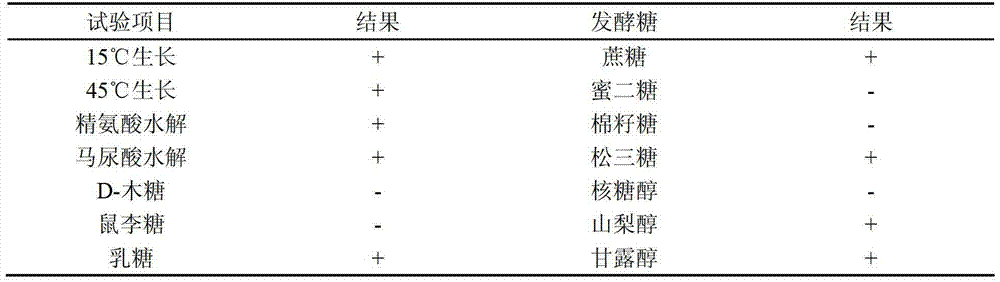
3.16S rDNA测序鉴定 3.16S rDNA sequencing identification
采用本领域技术人员公知的方法,用试剂盒提取细菌基因组DNA,反转录为cDNA,根据乳酸杆菌的16S rDNA基因序列的保守区域,采用细菌通用引物,进行基 因常规PCR扩增,其中, Using a method known to those skilled in the art, use a kit to extract bacterial genomic DNA, reverse transcribe it into cDNA, and use bacterial universal primers to carry out routine PCR amplification of the gene according to the conserved region of the 16S rDNA gene sequence of Lactobacillus.
上游引物5'-AGAGTTTGATCCTGGCTCAG-3' Upstream primer 5'-AGAGTTTGATCCTGGCTCAG-3'
下游引物5'-ACGGCTACCTTGTTACGACTT3' Downstream primer 5'-ACGGCTACCTTGTTACGACTT3'
扩增结果电泳检测,电泳显示条带清楚单一,说明扩增成功,结果如图4,同时条带提纯,TA-克隆技术,测序后,在Gene bank的BLAST上进行序列比对,确定为粪肠球菌(Enterococcus faecalis)。 The amplification results were detected by electrophoresis. The electrophoresis showed that the bands were clear and single, indicating that the amplification was successful. The results were shown in Figure 4. At the same time, the bands were purified, TA-cloning technology, and sequenced. Enterococcus faecalis. the
试验例1 Test example 1
本试验例用于说明粪肠球菌FJL19的作用。 This test example is used to illustrate the role of Enterococcus faecalis FJL19. the
1、乳酸菌全菌液制剂制备 1. Preparation of whole lactic acid bacteria liquid preparation
(1)乳酸菌发酵时间测定:将活化后的乳杆菌作为发酵种子液1%(v/v)接种于MRS液体培养基中,37℃,170r/min摇床培养,在前24h每隔2h,24h后在第36和48h取样,按10倍法用0.9%的生理盐水进行梯度稀释后,取10-4-10-6稀释度100μl稀释液在MRS琼脂培养基均匀涂布,每个梯度做3个重复,平皿在37℃,5%CO2条件下培养24h。取菌落数在30-300的稀释度值计算菌液浓度,同时取样,采用牛津杯法测定各时间点菌液的抑菌效果,确定最适发酵时间。
(1) Determination of the fermentation time of lactic acid bacteria: inoculate the activated Lactobacillus as a
如图5所示,图中横坐标代表时间,纵坐标代表活菌数,粪肠球菌在接种后10h内活菌数缓慢上升,从10h后则呈现迅速上升的状态,而在18h时即达到了活菌数109以上,此时达到了最高值。而到了36h时活菌数已经下降到108,并呈现逐渐下降状态。主要原因是培养基营养物质的消耗,有害代谢产物积累增加等原因导致菌体生长环境的变化,从而使活菌数量减少。从生长曲线可以看出,粪肠球菌在16-20h时活菌数维持在109数量级,并且比较稳定,所以选择18h这一时间段收获菌体。 As shown in Figure 5, the abscissa in the figure represents the time, and the ordinate represents the number of viable bacteria. The number of viable bacteria of Enterococcus faecalis increases slowly within 10 hours after inoculation, and then shows a state of rapid increase after 10 hours, and reaches the level at 18 hours. The number of viable bacteria reached more than 10 9 , which reached the highest value at this time. However, the number of viable bacteria had dropped to 10 8 at 36 hours, and showed a gradual decline. The main reason is that the consumption of nutrients in the medium and the accumulation of harmful metabolites lead to changes in the growth environment of the bacteria, thereby reducing the number of viable bacteria. It can be seen from the growth curve that the number of viable bacteria of Enterococcus faecalis is maintained at the order of 10 9 at 16-20 hours, and is relatively stable, so the time period of 18 hours is selected to harvest the bacteria.
(2)全菌液制备:将试验菌株活化2-3代后,按1%(v/v)的接种量接至经优化的液体培养基中,37℃,170r/min摇床培养18h,4℃,3500rpm离心30min,用一定体积的上清液悬浮菌体,4℃保存备用。 (2) Preparation of whole bacterial solution: After activating the test strain for 2-3 generations, transfer it to the optimized liquid medium at an inoculum amount of 1% (v/v), culture it on a shaker at 37°C and 170r/min for 18h, Centrifuge at 3500 rpm for 30 min at 4°C, suspend the cells with a certain volume of supernatant, and store at 4°C for later use. the
2、乳酸菌制剂在雏鸡饲养的应用效果 2. The application effect of lactic acid bacteria preparation in chick feeding
(1)试验材料:上述全菌液制剂,活菌数为5.1×10⁹cfu/mL(菌个数);抗生素为4%黄霉素。 (1) Test materials: the above-mentioned whole bacteria liquid preparation, the number of viable bacteria is 5.1×10 9 cfu/mL (number of bacteria); the antibiotic is 4% flavomycin.
(2)试验动物和试验设计:选用240只1日龄健康的AA肉仔鸡,公母各半,平均体重40.55±0.67g,随机分为4组,Ⅰ组(对照组,基础日粮),Ⅱ组(抗生素组,基 础日粮+0.01%黄霉素),Ⅲ(全菌液制剂组,基础日粮+0.5%的全菌液制剂)、Ⅳ组(全菌液制剂组,基础日粮+1%的全菌液制剂),每组5个重复,每个重复12只鸡,试验期28天。 (2) Experimental animals and experimental design: Select 240 1-day-old healthy AA broilers, half male and half female, with an average body weight of 40.55±0.67g, and randomly divide them into 4 groups, Group I (control group, basal diet), Group Ⅱ (antibiotic group, basal diet + 0.01% flavomycin), Ⅲ (whole-bacteria solution group, basal diet + 0.5% whole-bacteria solution), group Ⅳ (whole-bacteria solution group, basic day grain + 1% whole bacterial liquid preparation), 5 repetitions in each group, 12 chickens in each repetition, and the test period was 28 days. the
(3)测定指标: (3) Measuring indicators:
A、生产性能指标:分别于试验第1天、15天、29天早8:00时称量各重复空腹重(禁食12h),并准确记录各重复采食量。计算各组鸡的平均日增重(ADG)、平均日采食量(ADFI)和饲料转化比(FCR)。结果如表2: A. Production performance index: Weigh the fasting weight of each repetition (fasting for 12 hours) at 8:00 am on the first day, the 15th day, and the 29th day of the test respectively, and accurately record the feed intake of each repetition. The average daily gain (ADG), average daily feed intake (ADFI) and feed conversion ratio (FCR) of chickens in each group were calculated. The results are shown in Table 2:
表2乳酸菌制剂对雏鸡日增重和料重比的影响 Table 2 Effects of lactic acid bacteria preparations on daily gain and feed-to-weight ratio of chicks

注:同行比较,不同小写字母表示差异显著(p<0.05),不同大写字母表示差异极显著(p<0.01),无标记或字母相同者表示差异不显著(p>0.05)。 Note: Compared with peers, different lowercase letters indicate significant differences (p<0.05), different uppercase letters indicate extremely significant differences (p<0.01), and those with no marks or the same letters indicate no significant differences (p>0.05). the
试验结果显示,1~14d和15~28d,1.0%乳酸菌制剂组肉仔鸡平均日增重显著高于对照组(p<0.05),0.5%乳酸菌制剂组平均日增重稍高于对照组,但差异不显著(p>0.05),制剂组间平均日增重差异不显著(p>0.05),1~14d,抗生素组与其它各处理间平均日增重无显著差异(p>0.05);15~28d,抗生素组平均日增重显著高于对照组(p<0.05),但与其它处理组间差异均不显著(p>0.05)。试验全期,乳酸菌制剂组平均日增重均显著高于对照组(p<0.05),1.0%制剂组显著高于0.5%制剂组(p<0.05),抗生素组平均日增重显著高于对照组和0.5%乳酸菌制剂组(p<0.05),与1%乳酸菌制剂组差异不显著(p>0.05)。 The test results showed that from 1 to 14 days and 15 to 28 days, the average daily gain of broilers in the 1.0% lactic acid bacteria preparation group was significantly higher than that in the control group (p<0.05), and the average daily gain in the 0.5% lactic acid bacteria preparation group was slightly higher than that in the control group, but The difference was not significant (p>0.05), the average daily weight gain between the preparation groups was not significant (p>0.05), from 1 to 14 days, the average daily weight gain was not significantly different between the antibiotic group and other treatments (p>0.05); 15 On day 28, the average daily weight gain of the antibiotic group was significantly higher than that of the control group (p<0.05), but there was no significant difference with other treatment groups (p>0.05). During the whole test period, the average daily weight gain of the lactic acid bacteria preparation group was significantly higher than that of the control group (p<0.05), the 1.0% preparation group was significantly higher than the 0.5% preparation group (p<0.05), and the average daily weight gain of the antibiotic group was significantly higher than that of the control group group and 0.5% lactic acid bacteria preparation group (p<0.05), and there was no significant difference with 1% lactic acid bacteria preparation group (p>0.05). the
15~28d,1.0%乳酸菌制剂组料肉比均显著低于对照组(p<0.05),与抗生素组和0.5%制剂组间无显著差异(p>0.05),0.5%制剂组、抗生素与对照组之间料肉比差异均不显著(p>0.05)。试验全期,制剂组料肉比均显著低于对照组(p<0.05),1.0%制剂组料肉比显著低于0.5%制剂组(p<0.05),抗生素组料肉比显著低于对照组(p<0.05),与其它处理组之间差异不显著(p>0.05)。 From 15 to 28 days, the feed-to-meat ratio of the 1.0% lactic acid bacteria preparation group was significantly lower than that of the control group (p<0.05), and there was no significant difference between the antibiotic group and the 0.5% preparation group (p>0.05). There was no significant difference in feed-to-meat ratio between groups (p>0.05). During the whole test period, the feed-to-meat ratio of the preparation group was significantly lower than that of the control group (p<0.05), the feed-to-meat ratio of the 1.0% preparation group was significantly lower than that of the 0.5% preparation group (p<0.05), and the feed-to-meat ratio of the antibiotic group was significantly lower than that of the control group group (p<0.05), there was no significant difference with other treatment groups (p>0.05). the
总体而言,乳酸菌制剂和抗生素均能改善肉仔鸡的生长性能,且1.0%制剂组优于0.5%制剂组和抗生素组。 Overall, both lactic acid bacteria preparations and antibiotics can improve the growth performance of broilers, and the 1.0% preparation group is better than the 0.5% preparation group and antibiotics group. the
B、盲肠菌群数量:于试验第15、29日,随机在各重复取一只接近平均体重的试鸡,颈静脉放血处死,立即解剖,用无菌棉线结扎盲肠后取出,无菌条件下称取盲肠内容物0.5g,10倍稀释,平板涂布法测定盲肠内乳酸菌和大肠杆菌数量。结果如表3: B. The number of cecal flora: On the 15th and 29th day of the test, a test chicken with a weight close to the average weight was randomly taken from each repetition, sacrificed by bloodletting from the jugular vein, dissected immediately, and taken out after ligating the cecum with sterile cotton thread, under aseptic conditions Weigh 0.5 g of the cecal content, dilute it 10 times, and determine the number of lactic acid bacteria and E. coli in the cecum by the plate coating method. The results are shown in Table 3:
表3乳酸菌制剂对雏鸡盲肠中乳酸菌和大肠杆菌数量的影响(log10cfu/g) Table 3 Effect of lactic acid bacteria preparations on the number of lactic acid bacteria and E. coli in chick cecum (log 10 cfu/g)

注:同行比较,不同小写字母表示差异显著(p<0.05),不同大写字母表示差异极显著(p<0.01),无标记或字母相同者表示差异不显著(p>0.05)。 Note: Compared with peers, different lowercase letters indicate significant differences (p<0.05), different uppercase letters indicate extremely significant differences (p<0.01), and those with no marks or the same letters indicate no significant differences (p>0.05). the
2w时,1.0%乳酸菌制剂组肉仔鸡盲肠内乳酸菌菌数显著高于对照组和抗生素组(p<0.05),但与其0.5%乳酸菌制剂组相比,差异不显著(p>0.05);0.5%乳酸菌制剂组乳酸菌菌数显著高于抗生素组(p<0.05),但与对照组相比无显著差异(p>0.05);对照组乳酸菌数显著高于抗生素组(p<0.05)。1.0%乳酸菌制剂组大肠杆菌数显著低于其它所有处理组(p<0.05);0.5%制剂组大肠杆菌数与对照组相比差异不显著(p>0.05),抗生素组大肠杆菌数显著低于对照组(p<0.05),0.5%制剂组和抗生素组间大肠杆菌数差异不显著(p>0.05)。 At 2w, the number of lactic acid bacteria in the cecum of broilers in the 1.0% lactic acid bacteria preparation group was significantly higher than that in the control group and the antibiotic group (p<0.05), but compared with the 0.5% lactic acid bacteria preparation group, the difference was not significant (p>0.05); 0.5% The number of lactic acid bacteria in the lactic acid bacteria preparation group was significantly higher than that in the antibiotic group (p<0.05), but there was no significant difference compared with the control group (p>0.05); the number of lactic acid bacteria in the control group was significantly higher than that in the antibiotic group (p<0.05). The number of E. coli in the 1.0% lactic acid bacteria preparation group was significantly lower than that of all other treatment groups (p<0.05); the number of E. coli in the 0.5% preparation group was not significantly different from that in the control group (p>0.05), and the number of E. coli in the antibiotic group was significantly lower than that in the control group. There was no significant difference in the number of Escherichia coli between the control group (p<0.05), the 0.5% preparation group and the antibiotic group (p>0.05). the
4w时,1%和0.5%乳酸菌制剂组乳酸菌数显著高于抗生素组(p<0.05),除抗生素组外,其余各组间乳酸菌数无显著差异(p>0.05);0.5%和1.0%乳酸菌制剂组大肠杆菌数显著低于其它处理组(p<0.05)。随着乳酸菌制剂添加量的增加,盲肠内乳酸菌数增加,大肠杆菌数减少,这表明,乳酸菌能够优化肠道菌群结构。 At 4w, the number of lactic acid bacteria in the 1% and 0.5% lactic acid bacteria preparation groups was significantly higher than that in the antibiotic group (p<0.05), except for the antibiotic group, there was no significant difference in the number of lactic acid bacteria among the other groups (p>0.05); 0.5% and 1.0% lactic acid bacteria The number of Escherichia coli in the preparation group was significantly lower than that in other treatment groups (p<0.05). With the increase of lactic acid bacteria preparation, the number of lactic acid bacteria in the cecum increased, and the number of Escherichia coli decreased, which indicated that lactic acid bacteria can optimize the structure of intestinal flora. the
综上,该菌株能够显著抑制鸡肠道内的大肠杆菌数量,同时促进雏鸡生长,可替代传统的抗生素,减少抗生素在动物饲养上的应用,大大提高了生物安全性。 In summary, the strain can significantly inhibit the number of Escherichia coli in the intestinal tract of chickens, and at the same time promote the growth of chicks. It can replace traditional antibiotics, reduce the application of antibiotics in animal feeding, and greatly improve biological safety. the
Claims (2)
Priority Applications (1)
| Application Number | Priority Date | Filing Date | Title |
|---|---|---|---|
| CN2013100204339A CN103074281A (en) | 2013-01-21 | 2013-01-21 | Enterococcus faecalis FJL19 and application thereof |
Applications Claiming Priority (1)
| Application Number | Priority Date | Filing Date | Title |
|---|---|---|---|
| CN2013100204339A CN103074281A (en) | 2013-01-21 | 2013-01-21 | Enterococcus faecalis FJL19 and application thereof |
Publications (1)
| Publication Number | Publication Date |
|---|---|
| CN103074281A true CN103074281A (en) | 2013-05-01 |
Family
ID=48150980
Family Applications (1)
| Application Number | Title | Priority Date | Filing Date |
|---|---|---|---|
| CN2013100204339A Pending CN103074281A (en) | 2013-01-21 | 2013-01-21 | Enterococcus faecalis FJL19 and application thereof |
Country Status (1)
| Country | Link |
|---|---|
| CN (1) | CN103074281A (en) |
Cited By (3)
| Publication number | Priority date | Publication date | Assignee | Title |
|---|---|---|---|---|
| CN104774782A (en) * | 2014-12-25 | 2015-07-15 | 东北农业大学 | Chicken-sourced enterococcus faecalis separating strain and application thereof |
| CN119242534A (en) * | 2024-11-29 | 2025-01-03 | 吉林农业大学 | A strain of Enterococcus faecalis YL-EF25 and its application |
| CN119464121A (en) * | 2024-10-29 | 2025-02-18 | 江苏月鹏科技集团有限公司 | A strain of Enterococcus faecalis and its application in aquatic fermented feed and laying hen premix |
Citations (6)
| Publication number | Priority date | Publication date | Assignee | Title |
|---|---|---|---|---|
| CN1771831A (en) * | 2004-11-12 | 2006-05-17 | 浙江大舜恒益生物技术有限公司 | Feed-grade microbial additive and preparation and application thereof |
| CN101220342A (en) * | 2007-11-14 | 2008-07-16 | 大连三仪动物药品有限公司 | FQ15 enterococcus faecalis and method for producing growth-promoting feed additive by using same |
| CN101810247A (en) * | 2009-12-30 | 2010-08-25 | 沈阳科丰牧业科技有限公司 | Complex microbial chicken feed additive |
| CN102031235A (en) * | 2010-11-09 | 2011-04-27 | 中国农业大学 | Enterococcus faecium ANSE228 and application thereof |
| CN102657288A (en) * | 2012-03-12 | 2012-09-12 | 北京大北农科技集团股份有限公司 | Formula feed for chickens and preparation method thereof |
| CN102732468A (en) * | 2012-07-06 | 2012-10-17 | 北京农学院 | Enterococcus faecalis and broad-spectrum antibacterial action thereof |
-
2013
- 2013-01-21 CN CN2013100204339A patent/CN103074281A/en active Pending
Patent Citations (6)
| Publication number | Priority date | Publication date | Assignee | Title |
|---|---|---|---|---|
| CN1771831A (en) * | 2004-11-12 | 2006-05-17 | 浙江大舜恒益生物技术有限公司 | Feed-grade microbial additive and preparation and application thereof |
| CN101220342A (en) * | 2007-11-14 | 2008-07-16 | 大连三仪动物药品有限公司 | FQ15 enterococcus faecalis and method for producing growth-promoting feed additive by using same |
| CN101810247A (en) * | 2009-12-30 | 2010-08-25 | 沈阳科丰牧业科技有限公司 | Complex microbial chicken feed additive |
| CN102031235A (en) * | 2010-11-09 | 2011-04-27 | 中国农业大学 | Enterococcus faecium ANSE228 and application thereof |
| CN102657288A (en) * | 2012-03-12 | 2012-09-12 | 北京大北农科技集团股份有限公司 | Formula feed for chickens and preparation method thereof |
| CN102732468A (en) * | 2012-07-06 | 2012-10-17 | 北京农学院 | Enterococcus faecalis and broad-spectrum antibacterial action thereof |
Cited By (3)
| Publication number | Priority date | Publication date | Assignee | Title |
|---|---|---|---|---|
| CN104774782A (en) * | 2014-12-25 | 2015-07-15 | 东北农业大学 | Chicken-sourced enterococcus faecalis separating strain and application thereof |
| CN119464121A (en) * | 2024-10-29 | 2025-02-18 | 江苏月鹏科技集团有限公司 | A strain of Enterococcus faecalis and its application in aquatic fermented feed and laying hen premix |
| CN119242534A (en) * | 2024-11-29 | 2025-01-03 | 吉林农业大学 | A strain of Enterococcus faecalis YL-EF25 and its application |
Similar Documents
| Publication | Publication Date | Title |
|---|---|---|
| CN109504619B (en) | Lactobacillus plantarum and application thereof | |
| CN110029074B (en) | A kind of Bacillus subtilis and its application in the prevention and control of fish and shrimp farming diseases | |
| CN109749957B (en) | Preparation and application of lactobacillus gasseri preparation with aquatic pathogenic bacteria antagonistic property | |
| CN110734879A (en) | Lactobacillus reuteri LR-CO21 and its application | |
| CN109182165B (en) | A strain of Lactobacillus helveticus and its application in bee breeding | |
| CN103060222A (en) | Bacillus subtilis B27 with probiotic effect and application thereof | |
| WO2021248440A1 (en) | Lactobacillus plantarum from breast milk and use thereof | |
| CN111996139B (en) | Composite microecological preparation for improving production benefit of meat calves and application thereof | |
| CN111690574A (en) | Weissella mesenteroides and application thereof | |
| CN103013893A (en) | Lactobacillus plantarum CCL67 and application of same | |
| CN107964524B (en) | Lactococcus lactis HKS2 with lactic acid activity and its separation and screening method and application | |
| CN117736898A (en) | A duck-derived Lactobacillus plantarum and its application | |
| CN102517227A (en) | Enterococcus faecalis and applications and feed additive and leavening agent thereof | |
| CN117925447A (en) | Microbial co-culture preparation and application thereof | |
| CN108179122B (en) | A kind of high adhesion probiotic enterococcus faecium and its application | |
| CN103074281A (en) | Enterococcus faecalis FJL19 and application thereof | |
| CN104263683A (en) | Bacillus pumilus 315 with probiotic effect and application thereof | |
| CN116496929A (en) | Bacillus suis and application thereof | |
| CN118853503B (en) | Bacillus cereus 13 and its application | |
| CN105062922B (en) | It is a kind of inhibit uropathogenic Escherichia coli Bacillus acidi lactici and its application | |
| CN107974418B (en) | Marine bdellovibrio bacteriovorus and application thereof in promoting formation of bdelloplast under ampicillin | |
| CN115851541B (en) | Probiotic microecological preparation and preparation method and application thereof | |
| CN115466693B (en) | Stokes Bei Jisi Rumex bacillus CY2 strain and application thereof | |
| CN113621539B (en) | Screening and application of enzyme-producing antibacterial bacillus subtilis with vomitoxin detoxification function | |
| CN119020204A (en) | A kind of feed bacillus coagulans expressing bacteriocin and its application |
Legal Events
| Date | Code | Title | Description |
|---|---|---|---|
| C06 | Publication | ||
| PB01 | Publication | ||
| C10 | Entry into substantive examination | ||
| SE01 | Entry into force of request for substantive examination | ||
| C02 | Deemed withdrawal of patent application after publication (patent law 2001) | ||
| WD01 | Invention patent application deemed withdrawn after publication |
Application publication date: 20130501 |