CN103067127A - Distributed decoding forwarding bidirectional relay selection method under dissymmetrical speeds - Google Patents
Distributed decoding forwarding bidirectional relay selection method under dissymmetrical speeds Download PDFInfo
- Publication number
- CN103067127A CN103067127A CN2012105662042A CN201210566204A CN103067127A CN 103067127 A CN103067127 A CN 103067127A CN 2012105662042 A CN2012105662042 A CN 2012105662042A CN 201210566204 A CN201210566204 A CN 201210566204A CN 103067127 A CN103067127 A CN 103067127A
- Authority
- CN
- China
- Prior art keywords
- relay
- information
- nodes
- source
- source node
- Prior art date
- Legal status (The legal status is an assumption and is not a legal conclusion. Google has not performed a legal analysis and makes no representation as to the accuracy of the status listed.)
- Granted
Links
- 238000010187 selection method Methods 0.000 title claims abstract description 9
- 230000002457 bidirectional effect Effects 0.000 title claims description 5
- 238000000034 method Methods 0.000 claims abstract description 9
- 238000005516 engineering process Methods 0.000 claims abstract description 8
- 230000005540 biological transmission Effects 0.000 claims description 7
- 238000005457 optimization Methods 0.000 abstract description 3
- 238000004422 calculation algorithm Methods 0.000 description 26
- 238000004891 communication Methods 0.000 description 11
- 238000004088 simulation Methods 0.000 description 4
- 230000001413 cellular effect Effects 0.000 description 2
- 238000005562 fading Methods 0.000 description 2
- 238000001228 spectrum Methods 0.000 description 2
- 230000009286 beneficial effect Effects 0.000 description 1
- 238000004364 calculation method Methods 0.000 description 1
- 238000011161 development Methods 0.000 description 1
- 238000010586 diagram Methods 0.000 description 1
- 230000002708 enhancing effect Effects 0.000 description 1
- 238000010295 mobile communication Methods 0.000 description 1
- 238000011160 research Methods 0.000 description 1
Images


Landscapes
- Mobile Radio Communication Systems (AREA)
- Radio Relay Systems (AREA)
Abstract
一种非对称速率下的分布式解码转发双向中继选择方法,适用于采用叠加编码(superpositioncoding)的解码转发双向中继系统,该方法基于源节点发送数据之后进行中继选择的被动式选择方法,综合考虑网络中两个源节点目标速率的不对称性,利用平衡技术,根据信道状态信息,进行最佳双向中继选择,能够达到任意业务类型和链路特性下的系统性能优化。

A distributed decoding and forwarding two-way relay selection method at an asymmetric rate, suitable for a decoding and forwarding two-way relay system using superposition coding (superposition coding), the method is based on a passive selection method for relay selection after the source node sends data, Considering the asymmetry of the target rates of the two source nodes in the network, the best two-way relay selection can be made based on the channel state information by using the balancing technology, which can achieve system performance optimization under any service type and link characteristics.
Description
技术领域technical field
本发明涉及一种非对称速率下的解码转发双向中继通信系统机会中继选择方法,属于无线通信技术领域。The invention relates to an opportunistic relay selection method for a decode-and-forward two-way relay communication system at an asymmetric rate, and belongs to the technical field of wireless communication.
背景技术Background technique
本世纪初研究人员针对小型移动终端无法配置多天线的难题,提出协作分集(中继)技术。不同于传统的点到点通信,协作分集技术允许无线网络中不同用户节点共享彼此的天线和其它网络资源,有望大大提高无线网络容量和复用增益。同时在抗信道衰落、覆盖阴影区域、扩大无线蜂窝系统的有效覆盖半径,增强特定区域数据速率等方面也有很大的发展潜力,已经成为4G系统演进的重点方向。然而,由于实际中继通信系统的半双工限制,使得传统的单向协作中继术在提高无线通信性能的同时也带来了频谱效率的损失。为此,科研人员针对经典的三节点网络,基于放大转发(Amplify-and-Forward,AF)和解码转发(Decode-and-Forward,DF)协议提出了一种称之为双向中继的协作中继机制。双向中继作为一种特殊的协作传输形式,能够显著提升网络吞吐量和提高频谱利用率,为无线通信网络(如蜂窝移动通信网络和无线传感器网络)中的高效数据通信提供了一种有效的技术手段,已经得到学术界和产业界的高度重视。At the beginning of this century, researchers proposed a cooperative diversity (relay) technology to solve the problem that small mobile terminals cannot be equipped with multiple antennas. Different from traditional point-to-point communication, cooperative diversity technology allows different user nodes in a wireless network to share each other's antennas and other network resources, which is expected to greatly increase the capacity and multiplexing gain of wireless networks. At the same time, it also has great development potential in anti-channel fading, covering shadow areas, expanding the effective coverage radius of wireless cellular systems, and enhancing data rates in specific areas. It has become the key direction of 4G system evolution. However, due to the half-duplex limitation of the actual relay communication system, the traditional one-way cooperative relay technology also brings the loss of spectrum efficiency while improving the performance of wireless communication. For this reason, for the classic three-node network, researchers have proposed a cooperative process called two-way relay based on the Amplify-and-Forward (AF) and Decode-and-Forward (DF) protocols. Succession mechanism. As a special form of cooperative transmission, two-way relay can significantly improve network throughput and spectrum utilization, and provides an effective way for efficient data communication in wireless communication networks (such as cellular mobile communication networks and wireless sensor networks). Technical means have been highly valued by academia and industry.
在实际无线中继通信系统中,中继节点一般不是唯一的,往往系统中同时存在着多个可供选择的中继用户。此时,分布式空时码(Space-Time Coding,STC),分布式波束成型(beamforming)和中继选择技术均能够有效地处理多中继问题,来提高系统传输性能。然而,相对于分布式STC和分布式波束成形要求中继之间具有理想的时间或频率同步,中继选择技术简单、实用,并且能够获得满分集增益,从而吸引了科技人员更多的关注。In an actual wireless relay communication system, the relay node is generally not unique, and often there are multiple relay users to choose from in the system at the same time. At this time, distributed space-time coding (Space-Time Coding, STC), distributed beamforming (beamforming) and relay selection technologies can effectively deal with the multi-relay problem to improve system transmission performance. However, compared to distributed STC and distributed beamforming, which require ideal time or frequency synchronization between relays, relay selection technology is simple, practical, and can obtain full diversity gain, thus attracting more attention from scientific and technological personnel.
目前,中继选择算法按执行方式可分为:中心式和分布式;按算法执行时间可分为:主动式(proactive)和被动式(reactive)。对于中心式算法需要某一中心节点(例如:基站、AP等)利用接收或反馈信息执行节点选择并将结果反馈给源节点和相应的中继节点。分布式算法则是依赖节点间的信息交换和协调,由节点自行判断是否协作和与谁协作。中心式算法的优点在于从全局角度统筹规划,使得系统工作在全局最优状态,然而由于需要搜集相关的信息以及计算全局最优解,因此会引入较大的通信开销和计算开销。分布式算法往往获得的是局部最优解,但是分布式算法分散了通信开销和计算复杂度,而且分布式算法更加适用于无固定支持的网络(如Ad Hoc网络)。所谓主动式算法,即在源节点发送数据之前进行中继选择;被动式算法,即在源节点发送数据之后进行中继选择。对于主动式算法,由于中继选择发生在源节点信息发送前,因而所有中继节点均在可选集合中。相反对于被动式算法,由于中继选择发生在源节点信息发送后,所以可以设定相应的条件,让满足条件的中继节点组成可选中继集合参与中继选择。例如多中继DF双向中继系统中,只有能够正确解码信号的中继才是可选中继节点。At present, the relay selection algorithm can be divided into: central and distributed according to the execution mode; it can be divided into proactive and reactive according to the execution time of the algorithm. For the central algorithm, a certain central node (for example: base station, AP, etc.) needs to use the received or feedback information to perform node selection and feed back the result to the source node and the corresponding relay node. Distributed algorithms rely on information exchange and coordination between nodes, and nodes decide whether to cooperate and with whom to cooperate. The advantage of the central algorithm lies in the overall planning from a global perspective, so that the system works in the global optimal state. However, due to the need to collect relevant information and calculate the global optimal solution, it will introduce a large communication overhead and computing overhead. Distributed algorithms often obtain local optimal solutions, but distributed algorithms disperse communication overhead and computational complexity, and distributed algorithms are more suitable for networks without fixed support (such as Ad Hoc networks). The so-called active algorithm is to select a relay before the source node sends data; the passive algorithm is to select a relay after the source node sends data. For the active algorithm, since the relay selection occurs before the source node information is sent, all relay nodes are in the optional set. On the contrary, for the passive algorithm, since the relay selection occurs after the source node information is sent, corresponding conditions can be set so that the relay nodes that meet the conditions form an optional relay set to participate in relay selection. For example, in a multi-relay DF two-way relay system, only relays that can correctly decode signals are optional relay nodes.
虽然,目前关于DF双向中继系统的中继选择研究取得了一定的成果,但都均未考虑系统业务特性(现有的算法均假设源节点目标速率始终是对称的)。实际上,由于通信系统中用户业务类型的不同,节点的目标速率也不尽相同。另外,研究人员也指出业务的不对称性对双向中继系统中的许多性能指标,如:系统吞吐量、误码率等,均有不同程度的影响。因此,现有的双向中继选择方法实用性并不强,有待改进,以便具体应用。Although some achievements have been made in the research on the relay selection of the DF two-way relay system, none of them consider the system service characteristics (the existing algorithms all assume that the target rate of the source node is always symmetrical). In fact, due to the different types of user services in the communication system, the target rate of the nodes is also different. In addition, the researchers also pointed out that the asymmetry of the business has different degrees of impact on many performance indicators in the two-way relay system, such as: system throughput, bit error rate, etc. Therefore, the existing two-way relay selection method is not very practical and needs to be improved for specific applications.
发明内容Contents of the invention
本发明提供一种非对称速率下的分布式DF双向中继选择方法。本方法利用系统业务知识以及平衡技术(balance technique),根据信道状态信息,来进行最佳双向中继选择,以达到任意业务类型和链路特性下的系统性能优化,本方法适用于采用叠加编码(superposition coding)的解码转发双向中继系统。The invention provides a distributed DF bidirectional relay selection method under asymmetric rate. This method uses system service knowledge and balance technique (balance technique) to select the best two-way relay according to channel state information, so as to achieve system performance optimization under any service type and link characteristics. This method is applicable to the use of superposition coding (superposition coding) decoding and forwarding two-way relay system.
本发明具体步骤是:Concrete steps of the present invention are:
对于DF双向中继系统,两个源节点A和B通过位于两者之间的中继节点Ri(网络中有N个待选中继,i∈{1,2,…,N})进行信息的互换。源节点A和B之间的一次信息交互分两个时隙完成。第一个时隙源节点A和B将各自的二进制信息mA和mB,通过编码调制为发送信号sA和sB,并同时向N个中继节点进行发送,则中继Ri接收的两路合并信号为For the DF two-way relay system, two source nodes A and B transmit information through the relay node R i (there are N candidate relays in the network, i∈{1,2,…,N}) between them exchange. An information exchange between source nodes A and B is completed in two time slots. In the first time slot, source nodes A and B encode and modulate their respective binary information m A and m B into transmission signals s A and s B , and send them to N relay nodes at the same time, then relay R i receives The two combined signals of
其中hAR,i和hBR,i分别为源节点A到Ri和源节点B到Ri的信道增益;wR,i为中继节点Ri处的高斯白噪声。在第一时隙末,中继Ri将对接收信号yR,i进行联合解码,即解码源节点发送的二进制信息mA和mB。当中继Ri能够正确解码mA和mB时,中继Ri将解码信息进行编码调制,并进行叠加编码后得where h AR,i and h BR,i are the channel gains from source node A to R i and source node B to R i respectively; w R,i is Gaussian white noise at relay node R i . At the end of the first time slot, the relay R i will jointly decode the received signal y R, i , that is, decode the binary information m A and m B sent by the source node. When relay R i can correctly decode m A and m B , relay R i encodes and modulates the decoded information, and performs superposition coding to obtain
这里αi和βi是中继Ri端的叠加编码功率分配因子,有0<αi,βi<1,αi+βi=1,以满足中继端的发射功率限制。与此同时,中继Ri将启动一个定时器,其时长与|hAR,i|2|hBR,i 2/(zA|hAR,i|2+zB|LBR,i|2)成反比,这里
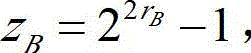
其中Dt为第一时隙末能够正确解码源节点信息mA和mA的中继节点集合。Where D t is the set of relay nodes that can correctly decode the source node information m A and m A at the end of the first time slot.
在第二个时隙,中继Rk将sR,k广播给源节点A和B,则A和B在第二时隙末的接收信号分别为In the second time slot, relay R k broadcasts s R,k to source nodes A and B, then the received signals of A and B at the end of the second time slot are respectively
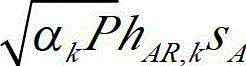
这里wA和wB分别为源节点A和B处的高斯白噪声,αk和βk分别由式(6)和式(7)给出。Here w A and w B are Gaussian white noise at source nodes A and B respectively, and α k and β k are given by formula (6) and formula (7), respectively.
最后,源节点A和B将分别对接收信号yA和yB进行干扰自消除,再解码得到对方的发送信息,完成信息的互换。Finally, the source nodes A and B will perform interference self-cancellation on the received signals y A and y B respectively, and then decode to obtain the sent information of the other party, and complete the exchange of information.
本发明的优点及有益效果:Advantage of the present invention and beneficial effect:
本发明利用系统业务知识以及平衡技术,根据信道状态信息,进行分布式双向中继选择。由于中继选择发生在源节点发送信息后,即被动式选择,因此,只有能够正确解码原节点信息的中继才参与中继选择。另外,中继选择还考虑了源节点目标速率的不对称性,因此,该算法能够实现任意业务类型和链路特性下的系统性能优化。仿真实验也表明,该中继选择算法在系统中断性能上具有优势。The invention utilizes system service knowledge and balance technology to perform distributed bidirectional relay selection according to channel state information. Since relay selection occurs after the source node sends information, that is, passive selection, only relays that can correctly decode the information of the original node participate in relay selection. In addition, relay selection also takes into account the asymmetry of the target rate of the source node, so this algorithm can realize system performance optimization under any traffic type and link characteristics. Simulation experiments also show that the relay selection algorithm has advantages in system interruption performance.
附图说明:Description of drawings:
图1为本发明方法示意图;Fig. 1 is a schematic diagram of the method of the present invention;
图2为对称速率下双向中继系统在不同待选中继数情况下的中断概率比较;Figure 2 is a comparison of outage probabilities of a two-way relay system at a symmetrical rate under different numbers of relays to be selected;
图3为非对称速率下双向中继系统在不同待选中继数情况下的中断概率比较;Figure 3 is a comparison of outage probabilities of two-way relay systems at asymmetric rates under different numbers of relays to be selected;
图4为源节点A目标速率固定而源节点B目标速率变化情况下的双向中继系统中断概率比较;Figure 4 is a comparison of the outage probability of the two-way relay system under the condition that the target rate of source node A is fixed and the target rate of source node B changes;
图5为对称速率下双向中继系统在不同中继位置情况下的中断概率比较;Figure 5 is a comparison of outage probabilities of two-way relay systems at different relay positions at symmetrical rates;
图6为非对称速率下双向中继系统在不同中继位置情况下的中断概率比较。Fig. 6 is a comparison of outage probabilities of a two-way relay system at different relay positions at an asymmetric rate.
具体实施方式Detailed ways
如图1所示,假设解码转发双向中继系统中的所有待选中继Ri,i∈{1,2,…,N},均能够通过信道估计得到它与源节点之间的信道状态信息。当中继Ri接收到源节点发送的合并信号后,将解码源节点发送的二进制信息。当解码成功,中继Ri将解码信息进行编码调制,并进行叠加编码后得As shown in Figure 1, it is assumed that all candidate relays R i , i∈{1,2,…,N} in the decoding and forwarding two-way relay system can obtain the channel state information between it and the source node through channel estimation . After receiving the combined signal sent by the source node, the relay R i will decode the binary information sent by the source node. When the decoding is successful, the relay R i codes and modulates the decoded information, and performs superposition coding to obtain
这里αi和βi是中继Ri端的叠加编码功率分配因子,有0<αi,βi<1,αi+βi=1,以满足中继端的发射功率限制。与此同时,中继Ri将启动一个定时器,其时长与|hAR,i|2|hBR,i 2/(zA|hAR,i|2+zB|hBR,i|2)成反比,这里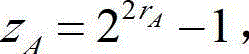

其中Dt为第一时隙末能够正确解码源节点信息的中继节点集合。Where D t is the set of relay nodes that can correctly decode the source node information at the end of the first time slot.
对本发明提出的分布式解码转发双向中继选择方法,我们对不同待选中继数、不同源节点速率和不同中继位置情况下的系统中断性能进行了仿真实验,并且与传统的最大最小算法和最大和算法进行了比较,实验环境为Matlab环境,以中断概率为指标,来衡量所提算法的性能。这里中断和中断概率的定义是:中断是指接收端不能够正确解码发送端的事件;中断概率是指系统中两个源节点至少有一个源节点发生中断的概率。For the distributed decoding and forwarding bidirectional relay selection method proposed by the present invention, we have carried out simulation experiments on the system interruption performance under the conditions of different relay numbers to be selected, different source node speeds and different relay positions, and compared with the traditional maximum-minimum algorithm and The maximum sum algorithm is compared, the experimental environment is Matlab environment, and the performance of the proposed algorithm is measured with the outage probability as the index. The definitions of outage and outage probability here are: outage means that the receiving end cannot correctly decode the event at the sending end; outage probability means the probability that at least one of the two source nodes in the system is interrupted.
从图2和图3可以看出,无论是对称速率还是非对称速率,所提算法的性能均优于传统的最大最小和最大和准则,并且随着待选中继数的增加,性能优势越加明显。It can be seen from Figure 2 and Figure 3 that the performance of the proposed algorithm is better than the traditional maximum-minimum and maximum-sum criteria, whether it is a symmetric rate or an asymmetric rate, and with the increase of the number of relays to be selected, the performance advantage increases obvious.
为了说明系统工作在任意业务类型下所提算法的性能,我们固定其中一个源节点的目标速率,另一源节点的目标速率动态的在某一区间上变化,并进行了仿真实验。由图4可以看出在任何业务情况下所提算法均优于传统的最大最小和最大和准则。In order to illustrate the performance of the proposed algorithm when the system works under any type of business, we fixed the target rate of one of the source nodes, and dynamically changed the target rate of the other source node in a certain interval, and carried out simulation experiments. It can be seen from Fig. 4 that the proposed algorithm is superior to the traditional maximum-minimum and maximum-sum criteria in any business situation.
为了进一步说明所提算法的性能,线面考虑中继节点位置变动情况下的系统性能仿真实验。假设中继R的位置在源节点A和B的连线上变动。因此,源节点A和B的距离等于中继R与两源节点距离的和。假设源节点A和B的距离等于1,则中继R到源节点A和B的距离dAR和dBR满足0<dAR,dBR<1,dAR+dBR=1。进一步,假设
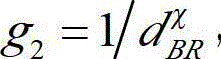
图5说明,在对称速率下所提算优于传统的最大最小和最大和准则。图6说明,在非对称速率下所提算法始终优于最大和准则;当中继靠近具有大速率的节点时,所提算法也优于最大最小准则;当中继位置向小速率节点靠近时,所提算法的性能与传统的最大最小准则性能接近。Figure 5 shows that the proposed calculation outperforms the traditional max-min and max-sum criteria at symmetric rates. Figure 6 shows that the proposed algorithm is always better than the maximum-sum criterion under asymmetric rates; when the relay is close to a node with a high rate, the proposed algorithm is also better than the maximum-min criterion; when the relay is close to a node with a low rate, the proposed algorithm is The performance of the proposed algorithm is close to that of the traditional max-min criterion.
Claims (1)



Priority Applications (1)
| Application Number | Priority Date | Filing Date | Title |
|---|---|---|---|
| CN201210566204.2A CN103067127B (en) | 2012-12-24 | 2012-12-24 | Distributed decoding under asymmetric speed forwards bi-directional relaying system of selection |
Applications Claiming Priority (1)
| Application Number | Priority Date | Filing Date | Title |
|---|---|---|---|
| CN201210566204.2A CN103067127B (en) | 2012-12-24 | 2012-12-24 | Distributed decoding under asymmetric speed forwards bi-directional relaying system of selection |
Publications (2)
| Publication Number | Publication Date |
|---|---|
| CN103067127A true CN103067127A (en) | 2013-04-24 |
| CN103067127B CN103067127B (en) | 2015-09-23 |
Family
ID=48109603
Family Applications (1)
| Application Number | Title | Priority Date | Filing Date |
|---|---|---|---|
| CN201210566204.2A Expired - Fee Related CN103067127B (en) | 2012-12-24 | 2012-12-24 | Distributed decoding under asymmetric speed forwards bi-directional relaying system of selection |
Country Status (1)
| Country | Link |
|---|---|
| CN (1) | CN103067127B (en) |
Cited By (8)
| Publication number | Priority date | Publication date | Assignee | Title |
|---|---|---|---|---|
| CN103795479A (en) * | 2014-01-28 | 2014-05-14 | 南京邮电大学 | Cooperative spectrum sensing method based on characteristic values |
| CN104093200A (en) * | 2014-07-25 | 2014-10-08 | 哈尔滨工业大学 | Dual-jump full-duplex DF relay system optimization power distribution method for single-node power limitation |
| CN104202790A (en) * | 2014-09-01 | 2014-12-10 | 西安电子科技大学 | Power self-adaptation based MIMO-CCRN bottleneck effect elimination method |
| CN106559127A (en) * | 2015-09-24 | 2017-04-05 | 中国移动通信集团公司 | A kind of two-way communication and equipment based on relaying |
| WO2017194017A1 (en) * | 2016-05-13 | 2017-11-16 | 中兴通讯股份有限公司 | Information modulation method and apparatus |
| CN107529227A (en) * | 2017-09-16 | 2017-12-29 | 南通大学 | A kind of denoising forwards bi-directional relaying slot allocation method |
| CN108512585A (en) * | 2018-04-04 | 2018-09-07 | 哈尔滨工业大学 | Dynamic cooperative relay transmission method based on power domain non-orthogonal multiple access technology |
| CN110121160A (en) * | 2019-03-15 | 2019-08-13 | 北京邮电大学 | A kind of adaptive beamforming truck traffic method based on relaying |
-
2012
- 2012-12-24 CN CN201210566204.2A patent/CN103067127B/en not_active Expired - Fee Related
Non-Patent Citations (6)
| Title |
|---|
| S. TALWAR等: "Joint relay selection and power allocation for two-way relay networks", 《IEEE SIGNAL PROC. LETT.》 * |
| XIAODONG JI 等: "A study of half-duplex two-way decode-and-forward relay transmission with asymmetric traffic using superposition coding", 《PERSONAL INDOOR AND MOBILE RADIO COMMUNICATIONS (PIMRC), 2012 IEEE 23RD INTERNATIONAL SYMPOSIUM ON》 * |
| XIAODONG JI 等: "On the Study of Half-Duplex Asymmetric Two-Way Relay Transmission Using an Amplify-and-Forward Relay", 《VEHICULAR TECHNOLOGY, IEEE TRANSACTIONS ON》 * |
| XIAODONG JI 等: "Opportunistic relaying for two-way relay transmission with analog network coding", 《WIRELESS COMMUNICATIONS AND SIGNAL PROCESSING (WCSP), 2011 INTERNATIONAL CONFERENCE ON》 * |
| 吉晓东 等: "不对称放大转发双向中继功率分配及中继位置选择", 《电子与信息学报》 * |
| 吉晓东 等: "基于网络编码的双向中继系统中断性能分析", 《南京邮电大学学报(自然科学版)》 * |
Cited By (16)
| Publication number | Priority date | Publication date | Assignee | Title |
|---|---|---|---|---|
| CN103795479B (en) * | 2014-01-28 | 2016-03-09 | 南京邮电大学 | A kind of cooperative frequency spectrum sensing method of feature based value |
| CN103795479A (en) * | 2014-01-28 | 2014-05-14 | 南京邮电大学 | Cooperative spectrum sensing method based on characteristic values |
| CN104093200A (en) * | 2014-07-25 | 2014-10-08 | 哈尔滨工业大学 | Dual-jump full-duplex DF relay system optimization power distribution method for single-node power limitation |
| CN104093200B (en) * | 2014-07-25 | 2017-06-23 | 哈尔滨工业大学 | For the double jump full duplex DF relay system optimal power allocation methods of individual node power limited |
| CN104202790B (en) * | 2014-09-01 | 2018-07-10 | 西安电子科技大学 | A kind of MIMO-CCRN bottleneck effect removing methods based on power adaptive |
| CN104202790A (en) * | 2014-09-01 | 2014-12-10 | 西安电子科技大学 | Power self-adaptation based MIMO-CCRN bottleneck effect elimination method |
| CN106559127B (en) * | 2015-09-24 | 2019-11-26 | 中国移动通信集团公司 | A kind of two-way communication and equipment based on relaying |
| CN106559127A (en) * | 2015-09-24 | 2017-04-05 | 中国移动通信集团公司 | A kind of two-way communication and equipment based on relaying |
| CN107370708A (en) * | 2016-05-13 | 2017-11-21 | 中兴通讯股份有限公司 | Information modulation method and device |
| WO2017194017A1 (en) * | 2016-05-13 | 2017-11-16 | 中兴通讯股份有限公司 | Information modulation method and apparatus |
| CN107370708B (en) * | 2016-05-13 | 2022-04-29 | 中兴通讯股份有限公司 | Information modulation method and device |
| CN107529227A (en) * | 2017-09-16 | 2017-12-29 | 南通大学 | A kind of denoising forwards bi-directional relaying slot allocation method |
| CN107529227B (en) * | 2017-09-16 | 2020-04-07 | 南通大学 | Denoising forwarding bidirectional relay time slot allocation method |
| CN108512585A (en) * | 2018-04-04 | 2018-09-07 | 哈尔滨工业大学 | Dynamic cooperative relay transmission method based on power domain non-orthogonal multiple access technology |
| CN108512585B (en) * | 2018-04-04 | 2020-07-24 | 哈尔滨工业大学 | Dynamic cooperative relay transmission method based on power domain non-orthogonal multiple access technology |
| CN110121160A (en) * | 2019-03-15 | 2019-08-13 | 北京邮电大学 | A kind of adaptive beamforming truck traffic method based on relaying |
Also Published As
| Publication number | Publication date |
|---|---|
| CN103067127B (en) | 2015-09-23 |
Similar Documents
| Publication | Publication Date | Title |
|---|---|---|
| CN103067127B (en) | Distributed decoding under asymmetric speed forwards bi-directional relaying system of selection | |
| CN103561447B (en) | Increment based on opportunistic relay hybrid decoding amplification forward collaboration method | |
| CN101682915A (en) | Cooperative multiple access in wireless networks | |
| CN101291197A (en) | Distributing and transmitting scheme with amplified forwarding power for wireless sensor network of two-hops | |
| CN114024640B (en) | Robust relay node selection method in full-duplex energy harvesting relay system | |
| CN105071840B (en) | A kind of joint implementation method of the control of AF bidirectional relay systems node transmitting power and intermediate position deployment | |
| CN101997647A (en) | Network coding transmission method | |
| Khoueiry et al. | A novel machine-to-machine communication strategy using rateless coding for the Internet of Things | |
| CN106936555A (en) | The distribution of bidirectional relay system bit and Poewr control method based on OFDM | |
| CN105591678A (en) | Multi-user multi-relay selection method based on system frequency spectrum efficiency | |
| Ning et al. | A channel estimation based opportunistic scheduling scheme in wireless bidirectional networks | |
| CN109561470B (en) | Method for cooperation of network coding and edge cache in chain communication network | |
| CN102394733B (en) | Double-base station single-relay multi-user data packet retransmission method based on network coding | |
| CN104837194B (en) | A kind of bidirectional relay system power distribution method based on AF mechanism | |
| CN102123490B (en) | Power distribution method of two-way multi-hop network based on physical layer network coding | |
| Cheng et al. | A high-reliability relay algorithm based on network coding in multi-hop wireless networks | |
| Khoueiry et al. | A novel coding strategy for device-to-device communications | |
| CN101656560B (en) | Collaboration communication method of high-efficiency frequency spectrum utilization ratio | |
| Phuoc et al. | Exact outage probability of two-way decode-and-forward NOMA scheme with digital network coding | |
| Kadhim et al. | Proposed different relay selection schemes for improving the performance of cooperative wireless networks | |
| CN110830078A (en) | Mode selection method based on cache assistance and user pairing | |
| CN101951641B (en) | Ad hoc network cooperative relay method based on distributed space-time coding | |
| Kumar et al. | Physical-layer network coding with multiple antennas: An enabling technology for smart cities | |
| CN106028455B (en) | Resource Allocation Method in Bidirectional Relay Cognitive Radio System Based on DF Protocol | |
| CN114567921B (en) | A full-duplex cooperative backhaul method that optimizes transmit power |
Legal Events
| Date | Code | Title | Description |
|---|---|---|---|
| C06 | Publication | ||
| PB01 | Publication | ||
| C10 | Entry into substantive examination | ||
| SE01 | Entry into force of request for substantive examination | ||
| C14 | Grant of patent or utility model | ||
| GR01 | Patent grant | ||
| EE01 | Entry into force of recordation of patent licensing contract |
Application publication date: 20130424 Assignee: Jiangsu Nanyou IOT Technology Park Ltd. Assignor: NANJING University OF POSTS AND TELECOMMUNICATIONS Contract record no.: 2016320000215 Denomination of invention: Distributed decoding forwarding bidirectional relay selection method under dissymmetrical speeds Granted publication date: 20150923 License type: Common License Record date: 20161118 |
|
| LICC | Enforcement, change and cancellation of record of contracts on the licence for exploitation of a patent or utility model | ||
| EC01 | Cancellation of recordation of patent licensing contract |
Assignee: Jiangsu Nanyou IOT Technology Park Ltd. Assignor: NANJING University OF POSTS AND TELECOMMUNICATIONS Contract record no.: 2016320000215 Date of cancellation: 20180116 |
|
| EC01 | Cancellation of recordation of patent licensing contract | ||
| CF01 | Termination of patent right due to non-payment of annual fee |
Granted publication date: 20150923 |
|
| CF01 | Termination of patent right due to non-payment of annual fee |