CN102918064A - A method for immobilizing streptavidin on a self-assembled monolayer - Google Patents
A method for immobilizing streptavidin on a self-assembled monolayer Download PDFInfo
- Publication number
- CN102918064A CN102918064A CN2011800269510A CN201180026951A CN102918064A CN 102918064 A CN102918064 A CN 102918064A CN 2011800269510 A CN2011800269510 A CN 2011800269510A CN 201180026951 A CN201180026951 A CN 201180026951A CN 102918064 A CN102918064 A CN 102918064A
- Authority
- CN
- China
- Prior art keywords
- molecule
- amino acid
- acid
- chemical formula
- glycine
- Prior art date
- Legal status (The legal status is an assumption and is not a legal conclusion. Google has not performed a legal analysis and makes no representation as to the accuracy of the status listed.)
- Granted
Links
Images


Classifications
-
- G—PHYSICS
- G01—MEASURING; TESTING
- G01N—INVESTIGATING OR ANALYSING MATERIALS BY DETERMINING THEIR CHEMICAL OR PHYSICAL PROPERTIES
- G01N33/00—Investigating or analysing materials by specific methods not covered by groups G01N1/00 - G01N31/00
- G01N33/48—Biological material, e.g. blood, urine; Haemocytometers
- G01N33/50—Chemical analysis of biological material, e.g. blood, urine; Testing involving biospecific ligand binding methods; Immunological testing
- G01N33/53—Immunoassay; Biospecific binding assay; Materials therefor
- G01N33/543—Immunoassay; Biospecific binding assay; Materials therefor with an insoluble carrier for immobilising immunochemicals
- G01N33/54353—Immunoassay; Biospecific binding assay; Materials therefor with an insoluble carrier for immobilising immunochemicals with ligand attached to the carrier via a chemical coupling agent
-
- C—CHEMISTRY; METALLURGY
- C07—ORGANIC CHEMISTRY
- C07K—PEPTIDES
- C07K17/00—Carrier-bound or immobilised peptides; Preparation thereof
- C07K17/14—Peptides being immobilised on, or in, an inorganic carrier
-
- A—HUMAN NECESSITIES
- A61—MEDICAL OR VETERINARY SCIENCE; HYGIENE
- A61K—PREPARATIONS FOR MEDICAL, DENTAL OR TOILETRY PURPOSES
- A61K39/00—Medicinal preparations containing antigens or antibodies
- A61K2039/62—Medicinal preparations containing antigens or antibodies characterised by the link between antigen and carrier
- A61K2039/625—Medicinal preparations containing antigens or antibodies characterised by the link between antigen and carrier binding through the biotin-streptavidin system or similar
-
- C—CHEMISTRY; METALLURGY
- C07—ORGANIC CHEMISTRY
- C07K—PEPTIDES
- C07K2319/00—Fusion polypeptide
- C07K2319/20—Fusion polypeptide containing a tag with affinity for a non-protein ligand
-
- G—PHYSICS
- G01—MEASURING; TESTING
- G01N—INVESTIGATING OR ANALYSING MATERIALS BY DETERMINING THEIR CHEMICAL OR PHYSICAL PROPERTIES
- G01N2610/00—Assays involving self-assembled monolayers [SAMs]
-
- G—PHYSICS
- G01—MEASURING; TESTING
- G01N—INVESTIGATING OR ANALYSING MATERIALS BY DETERMINING THEIR CHEMICAL OR PHYSICAL PROPERTIES
- G01N33/00—Investigating or analysing materials by specific methods not covered by groups G01N1/00 - G01N31/00
- G01N33/48—Biological material, e.g. blood, urine; Haemocytometers
- G01N33/50—Chemical analysis of biological material, e.g. blood, urine; Testing involving biospecific ligand binding methods; Immunological testing
- G01N33/53—Immunoassay; Biospecific binding assay; Materials therefor
-
- G—PHYSICS
- G01—MEASURING; TESTING
- G01N—INVESTIGATING OR ANALYSING MATERIALS BY DETERMINING THEIR CHEMICAL OR PHYSICAL PROPERTIES
- G01N33/00—Investigating or analysing materials by specific methods not covered by groups G01N1/00 - G01N31/00
- G01N33/48—Biological material, e.g. blood, urine; Haemocytometers
- G01N33/50—Chemical analysis of biological material, e.g. blood, urine; Testing involving biospecific ligand binding methods; Immunological testing
- G01N33/53—Immunoassay; Biospecific binding assay; Materials therefor
- G01N33/543—Immunoassay; Biospecific binding assay; Materials therefor with an insoluble carrier for immobilising immunochemicals
- G01N33/54306—Solid-phase reaction mechanisms
Landscapes
- Chemical & Material Sciences (AREA)
- Health & Medical Sciences (AREA)
- Life Sciences & Earth Sciences (AREA)
- Immunology (AREA)
- Molecular Biology (AREA)
- Organic Chemistry (AREA)
- Engineering & Computer Science (AREA)
- General Health & Medical Sciences (AREA)
- Biochemistry (AREA)
- Medicinal Chemistry (AREA)
- Hematology (AREA)
- Biomedical Technology (AREA)
- Urology & Nephrology (AREA)
- Genetics & Genomics (AREA)
- Proteomics, Peptides & Aminoacids (AREA)
- Biophysics (AREA)
- Inorganic Chemistry (AREA)
- Cell Biology (AREA)
- Microbiology (AREA)
- Biotechnology (AREA)
- Food Science & Technology (AREA)
- Physics & Mathematics (AREA)
- Analytical Chemistry (AREA)
- General Physics & Mathematics (AREA)
- Pathology (AREA)
- Peptides Or Proteins (AREA)
- Investigating Or Analysing Materials By Optical Means (AREA)
Abstract
Description
技术领域 technical field
本发明涉及在自组装单层上固定链霉亲和素的方法。 The present invention relates to methods for immobilizing streptavidin on self-assembled monolayers. the
背景技术 Background technique
生物传感器用于检测或定量样品中的靶物质。抗原与抗体、链霉亲和素与抗体之间的高亲和力可用于生物传感器之中。具体来说,将链霉亲和素固定在生物传感器上。靶物质用生物素修饰。当向生物传感器提供靶物质时,靶物质就会由于链霉亲和素与生物素之间的高亲和力被固定在生物传感器上。 Biosensors are used to detect or quantify target substances in a sample. The high affinity between antigen and antibody and streptavidin and antibody can be used in biosensors. Specifically, streptavidin was immobilized on the biosensor. The target substance is modified with biotin. When a target substance is supplied to the biosensor, the target substance is immobilized on the biosensor due to the high affinity between streptavidin and biotin. the
专利文件1公开了现有的利用链霉亲和素与生物素之间高亲和力的生物传感器。图2显示公开于专利文件1图7的生物传感器。 Patent Document 1 discloses an existing biosensor utilizing the high affinity between streptavidin and biotin. FIG. 2 shows the biosensor disclosed in FIG. 7 of Patent Document 1. Referring to FIG. the
根据专利文件1图7的描述,该传感器用于筛选活体分子的活性。该传感器包含单层7、亲和标签8、接头分子9和蛋白质10。单层7包含化学式:X-R-Y所示的自组装单层(见专利文件1的第24页的23至26行、第25页的3至20行,第25页的27行至第26页的13行、第26页的14至22行)。X、R和Y的实例分别为HS-、烷烃和羧基(见专利文件1的第25页的3至20行,第25页的27行至第26页的13行、第28页的21至23行)。
According to the description in Figure 7 of Patent Document 1, the sensor is used to screen the activity of living molecules. The sensor comprises a
引用列表 reference list
专利文献 Patent Documents
PTL1:WO00/04382,对应于日本公开特许公报No.2002-520618(见第[0080]、[0082]、[0084]、[0085]、[0095]和[0109]、[0119]段) PTL1: WO00/04382, corresponding to Japanese Laid-Open Patent Publication No. 2002-520618 (see paragraphs [0080], [0082], [0084], [0085], [0095] and [0109], [0119])
发明内容 Contents of the invention
技术问题 technical problem
为了提高对靶物质的检测灵敏度或定量准确性,需要增加固定于生物 传感器的链霉亲和素的量。 In order to improve the detection sensitivity or quantitative accuracy of the target substance, it is necessary to increase the amount of streptavidin immobilized on the biosensor. the
本发明的发明人已发现,使自组装单层与一分子氨基酸结合之后再固定链霉亲和素,可以使得每单位面积固定的链霉亲和素的量显著增加。以此发现为基础提供本发明。 The inventors of the present invention have found that immobilizing streptavidin after binding a self-assembled monolayer to one molecule of amino acid results in a significant increase in the amount of immobilized streptavidin per unit area. The present invention is provided based on this finding. the
本发明的目的是提供一种增加固定在自组装单层上的链霉亲和素的方法,以及提供具有使用此方法固定的链霉亲和素的传感器。 The object of the present invention is to provide a method for increasing streptavidin immobilized on a self-assembled monolayer, and to provide a sensor with streptavidin immobilized using this method. the
解决方案 solution
以下的[1]至[22]项用于解决以上问题。 The following items [1] to [22] are used to solve the above problems. the
[1]:在自组装单层上固定链霉亲和素的方法,包含以下步骤(a)和步骤(b),其顺序为: [1]: A method for immobilizing streptavidin on a self-assembled monolayer, comprising the following steps (a) and (b), in the order:
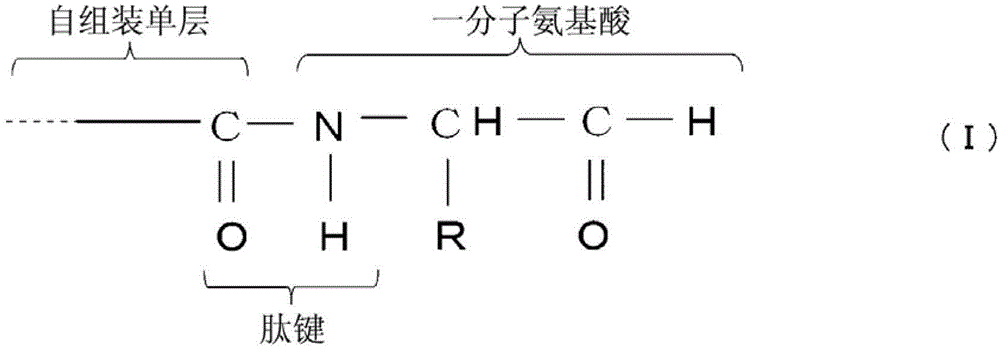
步骤(a),制备包含一分子氨基酸和自组装单层的基材,其中所述一分子氨基酸通过如下化学式(I)所示肽键与所述自组装单层结合: Step (a), preparing a substrate comprising a molecule of amino acid and a self-assembled monolayer, wherein the molecule of amino acid is combined with the self-assembled monolayer through a peptide bond shown in the following chemical formula (I):
[化学式1] [chemical formula 1]

(其中R代表所述一分子氨基酸的侧链) (Wherein R represents the side chain of said molecule of amino acid)
所述一分子氨基酸选自以下二十种氨基酸:半胱氨酸、赖氨酸、组氨酸、苯丙氨酸、酪氨酸、甘氨酸、天冬酰胺、甲硫氨酸、丝氨酸、色氨酸、亮氨酸、谷氨酰胺、丙氨酸、异亮氨酸、苏氨酸、脯氨酸、谷氨酸、天冬氨酸、精氨酸和缬氨酸;和 The amino acid molecule is selected from the following twenty amino acids: cysteine, lysine, histidine, phenylalanine, tyrosine, glycine, asparagine, methionine, serine, tryptophan acid, leucine, glutamine, alanine, isoleucine, threonine, proline, glutamic acid, aspartic acid, arginine, and valine; and
步骤(b),向所述基材提供链霉亲和素,通过所述一分子氨基酸的羧基与链霉亲和素的氨基之间的反应形成如下化学式(II)所示的肽键 Step (b), providing streptavidin to the base material, forming a peptide bond shown in the following chemical formula (II) through the reaction between the carboxyl group of one molecule of amino acid and the amino group of streptavidin
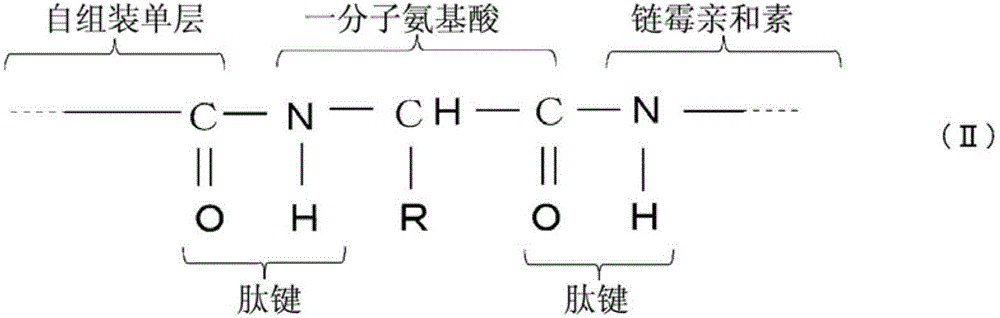
[化学式2] [chemical formula 2]

(其中R代表所述一分子氨基酸的侧链)。 (wherein R represents the side chain of said one molecule of amino acid). the
[2]:根据[1]的方法,其中步骤(a)包含以下步骤(a1)和步骤(a2): [2]: The method according to [1], wherein step (a) comprises the following steps (a1) and (a2):
步骤(a1),制备在其表面包含自组装单层的基材,所述自组装单层在一端具有羧酸;和 Step (a1), preparing a substrate comprising a self-assembled monolayer on its surface, the self-assembled monolayer having a carboxylic acid at one end; and
步骤(a2),提供所述一分子氨基酸,通过所述自组装单层一端的羧基与所述一分子氨基酸的氨基之间的反应形成化学式(I)所示的肽键。 Step (a2), providing the one molecule of amino acid, and forming a peptide bond represented by chemical formula (I) through the reaction between the carboxyl group at one end of the self-assembled monolayer and the amino group of the one molecule of amino acid. the
[3]:根据[1]的方法,还包含在步骤(a)和(b)之间的如下步骤(ab): [3]: According to the method of [1], the following steps (ab) are also included between steps (a) and (b):
步骤(ab),使用N-羟基琥珀酰亚胺和1-乙基-3-(3-二甲基氨基丙基)碳二亚胺盐酸盐的混合物活化所述一分子氨基酸的羧基。 Step (ab), using a mixture of N-hydroxysuccinimide and 1-ethyl-3-(3-dimethylaminopropyl)carbodiimide hydrochloride to activate the carboxyl group of one molecule of amino acid. the
[4]:根据[2]的方法,还包含在步骤(a1)和(a2)之间的以下步骤(a1a): [4]: The method according to [2], further comprising the following step (a1a) between steps (a1) and (a2):
步骤(a1a),使用N-羟基琥珀酰亚胺和1-乙基-3-(3-二甲基氨基丙基)碳二亚胺盐酸盐的混合物活化所述自组装单层的羧基。 Step (a1a), activating the carboxyl groups of the self-assembled monolayer using a mixture of N-hydroxysuccinimide and 1-ethyl-3-(3-dimethylaminopropyl)carbodiimide hydrochloride. the
[5]:根据[1]的方法,其中化学式(II)以如下化学式(III)表示 [5]: according to the method of [1], wherein chemical formula (II) is represented by following chemical formula (III)
[化学式3] [chemical formula 3]
(其中R代表所述一分子氨基酸的侧链)。 (wherein R represents the side chain of said one molecule of amino acid). the
[6]:根据[1]的方法,其中所述一分子氨基酸选自赖氨酸、组氨酸、苯丙氨酸、半胱氨酸、甘氨酸、甲硫氨酸、谷氨酸、酪氨酸、丙氨酸、丝氨酸、天冬氨酸、天冬酰胺、亮氨酸、色氨酸、苏氨酸、异亮氨酸和缬氨酸。 [6]: The method according to [1], wherein the amino acid molecule is selected from lysine, histidine, phenylalanine, cysteine, glycine, methionine, glutamic acid, tyrosine acid, alanine, serine, aspartic acid, asparagine, leucine, tryptophan, threonine, isoleucine and valine. the
[7]:根据[1]的方法,其中所述一分子氨基酸选自赖氨酸、组氨酸、苯丙氨酸、半胱氨酸、甘氨酸、甲硫氨酸、谷氨酸、酪氨酸、丙氨酸、丝氨酸、天冬氨酸、天冬酰胺、亮氨酸和色氨酸。 [7]: The method according to [1], wherein the amino acid molecule is selected from lysine, histidine, phenylalanine, cysteine, glycine, methionine, glutamic acid, tyrosine acid, alanine, serine, aspartic acid, asparagine, leucine, and tryptophan. the
[8]:根据[1]的方法,其中所述一分子氨基酸选自赖氨酸、组氨酸、苯丙氨酸、半胱氨酸、甘氨酸、甲硫氨酸、谷氨酸、酪氨酸、丙氨酸、丝氨酸、天冬氨酸和天冬酰胺。 [8]: The method according to [1], wherein the amino acid molecule is selected from lysine, histidine, phenylalanine, cysteine, glycine, methionine, glutamic acid, tyrosine acid, alanine, serine, aspartic acid and asparagine. the
[9]:根据[1]的方法,其中所述一分子氨基酸选自赖氨酸、组氨酸、苯丙氨酸、半胱氨酸、甘氨酸、甲硫氨酸、谷氨酸、酪氨酸、丙氨酸和丝氨酸。 [9]: The method according to [1], wherein the amino acid molecule is selected from lysine, histidine, phenylalanine, cysteine, glycine, methionine, glutamic acid, tyrosine acid, alanine and serine. the
[10]:包含自组装单层、一分子氨基酸和链霉亲和素的传感器,其中 [10]: A sensor comprising a self-assembled monolayer, a molecule of amino acid and streptavidin, where
所述一分子氨基酸位于所述自组装单层和链霉亲和素之间, The one molecule of amino acid is located between the self-assembled monolayer and streptavidin,
所述链霉亲和素通过如下化学式(II)所示的两个肽键与所述自组装单层结合, The streptavidin is combined with the self-assembled monolayer through two peptide bonds shown in the following chemical formula (II),
[化学式2] [chemical formula 2]

(其中R代表所述一分子氨基酸的侧链) (Wherein R represents the side chain of said molecule of amino acid)
所述一分子氨基酸选自以下二十种氨基酸:半胱氨酸、赖氨酸、组氨酸、苯丙氨酸、酪氨酸、甘氨酸、天冬酰胺、甲硫氨酸、丝氨酸、色氨酸、亮氨酸、谷氨酰胺、丙氨酸、异亮氨酸、苏氨酸、脯氨酸、谷氨酸、天冬氨酸、精氨酸和缬氨酸。 The amino acid molecule is selected from the following twenty amino acids: cysteine, lysine, histidine, phenylalanine, tyrosine, glycine, asparagine, methionine, serine, tryptophan acid, leucine, glutamine, alanine, isoleucine, threonine, proline, glutamic acid, aspartic acid, arginine and valine. the
[11]:根据[10]的方法,其中化学式(II)以如下化学式(III)表示 [11]: The method according to [10], wherein the chemical formula (II) is represented by the following chemical formula (III)
[化学式3] [chemical formula 3]

(其中R代表所述一分子氨基酸的侧链)。 (wherein R represents the side chain of said one molecule of amino acid). the
[12]:根据[10]的传感器,其中所述一分子氨基酸选自赖氨酸、组氨酸、苯丙氨酸、半胱氨酸、甘氨酸、甲硫氨酸、谷氨酸、酪氨酸、丙氨酸、丝氨酸、天冬氨酸、天冬酰胺、亮氨酸、色氨酸、苏氨酸、异亮氨酸和缬氨酸。 [12]: The sensor according to [10], wherein the one molecule of amino acid is selected from the group consisting of lysine, histidine, phenylalanine, cysteine, glycine, methionine, glutamic acid, tyrosine acid, alanine, serine, aspartic acid, asparagine, leucine, tryptophan, threonine, isoleucine and valine. the
[13]:根据[10]的传感器,其中所述一分子氨基酸选自赖氨酸、组氨酸、苯丙氨酸、半胱氨酸、甘氨酸、甲硫氨酸、谷氨酸、酪氨酸、丙氨酸、丝氨酸、天冬氨酸、天冬酰胺、亮氨酸和色氨酸。 [13]: The sensor according to [10], wherein the one molecule of amino acid is selected from the group consisting of lysine, histidine, phenylalanine, cysteine, glycine, methionine, glutamic acid, tyrosine acid, alanine, serine, aspartic acid, asparagine, leucine, and tryptophan. the
[14]:根据[10]的传感器,其中所述一分子氨基酸选自赖氨酸、组氨酸、苯丙氨酸、半胱氨酸、甘氨酸、甲硫氨酸、谷氨酸、酪氨酸、丙氨酸、丝氨酸、天冬氨酸和天冬酰胺。 [14]: The sensor according to [10], wherein the one molecule of amino acid is selected from the group consisting of lysine, histidine, phenylalanine, cysteine, glycine, methionine, glutamic acid, tyrosine acid, alanine, serine, aspartic acid and asparagine. the
[15]:根据[10]的传感器,其中所述一分子氨基酸选自赖氨酸、组氨酸、苯丙氨酸、半胱氨酸、甘氨酸、甲硫氨酸、谷氨酸、酪氨酸、丙氨酸和丝氨酸。 [15]: The sensor according to [10], wherein the one molecule of amino acid is selected from the group consisting of lysine, histidine, phenylalanine, cysteine, glycine, methionine, glutamic acid, tyrosine acid, alanine and serine. the
[16]:使用传感器检测或定量样品中含有的靶物质的方法,包含以下步骤(a)至(c),其顺序为: [16]: A method for detecting or quantifying a target substance contained in a sample using a sensor, comprising the following steps (a) to (c), in order:
步骤(a),制备包含自组装单层、一分子氨基酸和链霉亲和素的传感器,其中 Step (a), preparing a sensor comprising a self-assembled monolayer, a molecule of amino acid and streptavidin, wherein
所述一分子氨基酸位于所述自组装单层和链霉亲和素之间, The one molecule of amino acid is located between the self-assembled monolayer and streptavidin,
所述链霉亲和素通过如下化学式(II)所示的两个肽键与所述自组装单层结合, The streptavidin is combined with the self-assembled monolayer through two peptide bonds shown in the following chemical formula (II),
[化学式2] [chemical formula 2]
(其中R代表所述一分子氨基酸的侧链) (Wherein R represents the side chain of said molecule of amino acid)
所述一分子氨基酸选自以下二十种氨基酸:半胱氨酸、赖氨酸、组氨酸、苯丙氨酸、酪氨酸、甘氨酸、天冬酰胺、甲硫氨酸、丝氨酸、色氨酸、亮氨酸、谷氨酰胺、丙氨酸、异亮氨酸、苏氨酸、脯氨酸、谷氨酸、天冬氨酸、精氨酸和缬氨酸; The amino acid molecule is selected from the following twenty amino acids: cysteine, lysine, histidine, phenylalanine, tyrosine, glycine, asparagine, methionine, serine, tryptophan acid, leucine, glutamine, alanine, isoleucine, threonine, proline, glutamic acid, aspartic acid, arginine, and valine;
步骤(b),向传感器提供样品,使靶物质与链霉亲和素结合; Step (b), providing a sample to the sensor to bind the target substance to streptavidin;
步骤(c),从所捕获的靶物质或其量检测或定量所述样品中含有的靶物质。 Step (c), detecting or quantifying the target substance contained in the sample from the captured target substance or its amount. the
[17]:根据[16]的方法,其中步骤(b)包括以下步骤(b1)和步骤(b2): [17]: The method according to [16], wherein step (b) comprises the following steps (b1) and (b2):
步骤[b1],使所述链霉亲和素与抗体结合,所述抗体用生物素修饰,和 step [b1], binding said streptavidin to an antibody, said antibody being modified with biotin, and
步骤[b2],使所述靶物质与所述抗体结合。 Step [b2], binding the target substance to the antibody. the
[18]:根据[16]的方法,其中化学式(II)以如下化学式(III)表示 [18]: The method according to [16], wherein the chemical formula (II) is represented by the following chemical formula (III)
[化学式3] [chemical formula 3]

(其中R代表所述一分子氨基酸的侧链)。 (wherein R represents the side chain of said one molecule of amino acid). the
[19]:根据[16]的方法,其中所述一分子氨基酸选自赖氨酸、组氨酸、苯丙氨酸、半胱氨酸、甘氨酸、甲硫氨酸、谷氨酸、酪氨酸、丙氨酸、丝氨酸、天冬氨酸、天冬酰胺、亮氨酸、色氨酸、苏氨酸、异亮氨酸和缬氨酸。 [19]: The method according to [16], wherein the amino acid molecule is selected from lysine, histidine, phenylalanine, cysteine, glycine, methionine, glutamic acid, tyrosine acid, alanine, serine, aspartic acid, asparagine, leucine, tryptophan, threonine, isoleucine and valine. the
[20]:根据[16]的方法,其中所述一分子氨基酸选自赖氨酸、组氨酸、苯丙氨酸、半胱氨酸、甘氨酸、甲硫氨酸、谷氨酸、酪氨酸、丙氨酸、丝氨酸、天冬氨酸、天冬酰胺、亮氨酸和色氨酸。 [20]: The method according to [16], wherein the amino acid molecule is selected from lysine, histidine, phenylalanine, cysteine, glycine, methionine, glutamic acid, tyrosine acid, alanine, serine, aspartic acid, asparagine, leucine, and tryptophan. the
[21]:根据[16]的方法,其中所述一分子氨基酸选自赖氨酸、组氨酸、苯丙氨酸、半胱氨酸、甘氨酸、甲硫氨酸、谷氨酸、酪氨酸、丙氨酸、丝氨酸、天冬氨酸和天冬酰胺。 [21]: The method according to [16], wherein the amino acid molecule is selected from lysine, histidine, phenylalanine, cysteine, glycine, methionine, glutamic acid, tyrosine acid, alanine, serine, aspartic acid and asparagine. the
[22]:根据[16]的方法,其中所述一分子氨基酸选自赖氨酸、组氨酸、苯丙氨酸、半胱氨酸、甘氨酸、甲硫氨酸、谷氨酸、酪氨酸、丙氨酸和丝氨酸。 [22]: The method according to [16], wherein the amino acid molecule is selected from the group consisting of lysine, histidine, phenylalanine, cysteine, glycine, methionine, glutamic acid, and tyrosine acid, alanine and serine. the
发明的有益效果 Beneficial effects of the invention
本发明可以极大地提高每单位面积固定的链霉亲和素的量。 The present invention can greatly increase the amount of immobilized streptavidin per unit area. the
附图简述Brief description of the drawings
图1显示本发明的方法的示意图。 Figure 1 shows a schematic diagram of the process of the present invention. the
图2是专利文件1的图7。 FIG. 2 is FIG. 7 of Patent Document 1. FIG. the
图3显示根据现有技术的方法的示意图。 Figure 3 shows a schematic diagram of a method according to the prior art. the
具体实施方式 Detailed ways
本发明实施方案参考图1描述如下。 An embodiment of the present invention is described below with reference to FIG. 1 . the
(实施方案1) (implementation plan 1)
图1显示根据本发明的在自组装单层上固定链霉亲和素的方法。 Figure 1 shows a method for immobilizing streptavidin on a self-assembled monolayer according to the present invention. the
基材1优选是金基材。金基材的实例为表面包含金的基材。具体来说,金基材可以通过在玻璃、塑料或二氧化硅(SiO2)表面喷镀金形成。 The substrate 1 is preferably a gold substrate. An example of a gold substrate is a substrate whose surface contains gold. Specifically, the gold substrate can be formed by sputtering gold on the surface of glass, plastic or silicon dioxide (SiO 2 ).
首先,将基材1浸入含有烷基硫醇(alkanethiol)的溶剂当中。在浸泡之前,优选清洗所述基材。所述烷基硫醇在其末端带有羧基。对于烷基硫醇, 优选地可采用碳原子数在6至18之间的一级(primary)烷基硫醇。这样,在基材1上形成自组装单层2。
First, the substrate 1 is immersed in a solvent containing alkanethiol. Prior to soaking, the substrate is preferably rinsed. The alkylthiol has a carboxyl group at its terminal. As for the alkyl mercaptan, primary (primary) alkyl mercaptan having between 6 and 18 carbon atoms can be preferably used. In this way, a self-assembled
烷基硫醇的优选浓度大约为1至10mM。溶剂不受限制,只要溶解所述烷基硫醇即可。优选的溶剂例如乙醇、DMSO(二甲基亚砜)和二噁烷。优选浸泡时间大约为12至48小时。 The preferred concentration of alkylthiol is about 1 to 10 mM. The solvent is not limited as long as the alkylthiol is dissolved. Preferred solvents are ethanol, DMSO (dimethylsulfoxide) and dioxane. A preferred soaking time is approximately 12 to 48 hours. the
然后,向自组装单层2提供氨基酸3。位于自组装单层2上端的羧基(-COOH)与氨基酸3的氨基(-NH2)反应,形成如下化学式(I)所示的肽键
Then,
[化学式1] [chemical formula 1]

(其中R代表所述一分子氨基酸的侧链)。 (wherein R represents the side chain of said one molecule of amino acid). the
在化学式(I)中,一分子氨基酸3与自组装单层2结合。
In the chemical formula (I), one molecule of
氨基酸3选自以下二十种氨基酸:半胱氨酸、赖氨酸、组氨酸、苯丙氨酸、酪氨酸、甘氨酸、天冬酰胺、甲硫氨酸、丝氨酸、色氨酸、亮氨酸、谷氨酰胺、丙氨酸、异亮氨酸、苏氨酸、脯氨酸、谷氨酸、天冬氨酸、精氨酸和缬氨酸。也就是说,在化学式(I)中,R是这二十种氨基酸的侧链。
在向自组装单层2提供氨基酸3时,可以同时提供不少于两种的氨基酸。也就是说,在向自组装单层2提供含有氨基酸3的溶液时,所述溶液中可以含有两种或超过两种的氨基酸3。为了使链霉亲和素与氨基酸3结合均匀(后文介绍),优选所述溶液含有单一的一种氨基酸。
When supplying the
随后,提供链霉亲和素4。链霉亲和素4的5'-末端氨基与氨基酸3的羧基反应。链霉亲和素所含有的赖氨酸的氨基也与氨基酸3的羧基反应。所以,形成了如下化学式(II)所示的两个肽键来获得传感器
Subsequently,
[化学式2] [chemical formula 2]
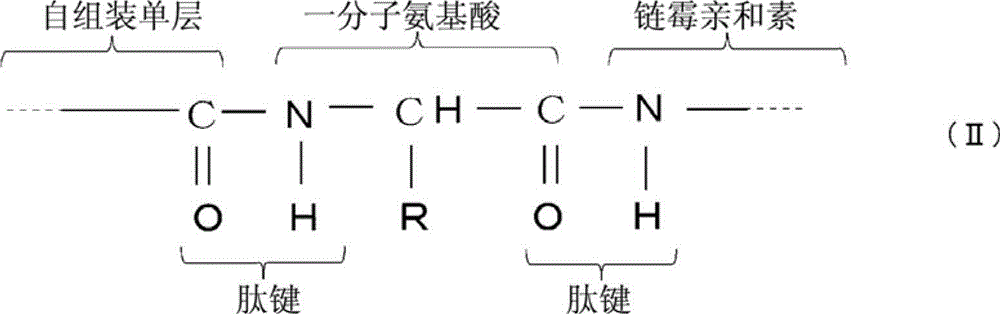
(其中R代表所述一分子氨基酸的侧链)。 (wherein R represents the side chain of said one molecule of amino acid). the
一分子链霉亲和素4只有一个5'-末端,但是一分子链霉亲和素4含有大量的赖氨酸基团。因此,几乎所有的化学式(II)都特别地与如下的化学式(III)相关
One molecule of
[化学式3] [chemical formula 3]
(其中R代表所述一分子氨基酸的侧链)。 (wherein R represents the side chain of said one molecule of amino acid). the
所获得的传感器用于检测或定量样品中含有的靶物质。 The obtained sensor is used to detect or quantify a target substance contained in a sample. the
具体来说,向传感器中提供可以特异性结合靶物质的抗体,使所述抗体与链霉亲和素结合。也就是说,链霉亲和素捕获所述抗体。优选所述靶物质用生物素修饰,因为链霉亲和素与生物素具有高亲和力。接下来,向传感器提供样品,使样品中的靶物质,即抗原,与抗体结合。 Specifically, an antibody capable of specifically binding a target substance is provided to the sensor, and the antibody is bound to streptavidin. That is, streptavidin captures the antibody. Preferably the target substance is modified with biotin, since streptavidin has a high affinity for biotin. Next, a sample is supplied to the sensor, and the target substance in the sample, that is, the antigen, binds to the antibody. the
最后,利用常规的分析方法,如表面等离子体共振分析法(SPR),检测或定量靶物质。也可以使用其它分析方法,如石英晶体微天平(QCM)。 Finally, the target substance is detected or quantified using conventional analytical methods, such as surface plasmon resonance analysis (SPR). Other analytical methods such as Quartz Crystal Microbalance (QCM) can also be used. the
实施例 Example
通过以下的实施例和比较例,对本发明进行详细描述。 The present invention will be described in detail by the following examples and comparative examples. the
比较例 comparative example
如图3所示,链霉亲和素通过酰胺偶联反应与在金基材上形成的自组装烷基硫醇上端的羧基直接结合,从而固定所述链霉亲和素。步骤与结果描述如下。 As shown in FIG. 3 , streptavidin is directly bound to the carboxyl group on the upper end of the self-assembled alkylthiol formed on the gold substrate through an amide coupling reaction, thereby immobilizing the streptavidin. The steps and results are described below. the
(样品溶液的制备) (Preparation of sample solution)
制备终浓度为10mM的16-巯基十六烷基酸样品溶液。其溶剂为乙醇。(自组装单层的形成) Prepare a 16-mercaptohexadecanoic acid sample solution with a final concentration of 10 mM. Its solvent is ethanol. (formation of self-assembled monolayer)
使用金基材(其中金被蒸镀在玻璃上,可从GE healthcare公司获得,BR-1004-05)作为基材1。基材1使用含有浓硫酸和30%过氧化氢水溶液的食人鱼溶液(piranha solution)洗涤10分钟。组成食人鱼溶液的浓硫酸与30%过氧化氢水溶液的体积比是3:1。 A gold substrate (in which gold is evaporated on glass, available from GE healthcare, BR-1004-05) was used as substrate 1. Substrate 1 was washed with a piranha solution containing concentrated sulfuric acid and 30% aqueous hydrogen peroxide for 10 minutes. The volume ratio of concentrated sulfuric acid to 30% aqueous hydrogen peroxide solution to make up the piranha solution is 3:1. the
随后,将金基材在样品溶液中浸泡18小时以在金基材表面形成自组装单层。最后,用纯水清洗基材1并干燥。 Subsequently, the gold substrate was soaked in the sample solution for 18 hours to form a self-assembled monolayer on the surface of the gold substrate. Finally, the substrate 1 was washed with pure water and dried. the
(链霉亲和素的固定) (fixation of streptavidin)
使链霉亲和素与位于形成自组装单层的16-巯基十六烷基酸的上端的羧基结合,从而固定链霉亲和素。 Streptavidin was bound to the carboxyl group located at the upper end of 16-mercaptohexadecanoic acid forming the self-assembled monolayer, thereby immobilizing streptavidin. the
具体来说,使用35微升的0.1M NHS(N-羟基琥珀酰亚胺)和0.4MEDC(1-乙基-3-(3-二甲基氨基丙基)碳二亚胺盐酸盐)的混合物活化位于16-巯基十六烷基酸上端的羧基。接下来,以5微升/分钟的流速,加入35微升的链霉亲和素(250微克/毫升)。这样,16-巯基十六烷基酸的羧基与链霉亲和素的氨基偶联。 Specifically, 35 μl of 0.1 M NHS (N-hydroxysuccinimide) and 0.4 MEDC (1-ethyl-3-(3-dimethylaminopropyl)carbodiimide hydrochloride) The mixture activates the carboxyl group located at the upper end of 16-mercaptohexadecanoic acid. Next, 35 μl of streptavidin (250 μg/ml) was added at a flow rate of 5 μl/min. In this way, the carboxyl group of 16-mercaptohexadecanoic acid is coupled to the amino group of streptavidin. the
实施例1 Example 1
与比较例类似地进行实验,只是在自组装单层的形成和链霉亲和素的固定中间提供甘氨酸作为所述一分子氨基酸。步骤与结果描述如下。 An experiment was performed similarly to Comparative Example, except that glycine was provided as the one molecule of amino acid in the middle of the formation of the self-assembled monolayer and the immobilization of streptavidin. The steps and results are described below. the
(氨基酸(甘氨酸)的固定) (fixation of amino acid (glycine))
使甘氨酸与位于形成自组装单层2的16-巯基十六烷基酸上端的羧基结合,从而固定甘氨酸。具体来说,在与比较例1类似地活化羧基之后,以5微升/分钟的流速加入35微升0.1M的甘氨酸(pH值8.9)。这样,16-巯基十六烷基酸的羧基与甘氨酸的氨基偶联。
Glycine was bonded to the carboxyl group located at the upper end of 16-mercaptohexadecanoic acid forming the self-assembled
(链霉亲和素的固定) (fixation of streptavidin)
随后,使链霉亲和素与甘氨酸的羧基结合来固定链霉亲和素。具体来说,在与上面类似地活化甘氨酸羧基之后,以5微升/分钟的流速加入35微升的链霉亲和素(浓度:250微克/毫升)。这样,所述羧基与链霉亲和素的5'-末端氨基酸或者链霉亲和素中的赖氨酸的氨基偶联。 Subsequently, streptavidin was bound to the carboxyl group of glycine to immobilize streptavidin. Specifically, after activation of the glycine carboxyl group similarly to the above, 35 µl of streptavidin (concentration: 250 µg/ml) was added at a flow rate of 5 µl/min. In this way, the carboxyl group is coupled to the 5'-terminal amino acid of streptavidin or to the amino group of lysine in streptavidin. the
(固定量的比较) (comparison of fixed quantities)
使用表面等离子体共振设备Biacore3000(可从GE healthcare公司获得)测定实施例1和比较例的固定量。 The fixed amounts of Example 1 and Comparative Example were determined using a surface plasmon resonance device Biacore3000 (available from GE healthcare). the
“固定量”一词,是指每单位面积固定的链霉亲和素的量。 The term "immobilized amount" refers to the amount of streptavidin immobilized per unit area. the
实施例1中测定的固定量与比较例中测定的固定量的比值约为25.6:1。 The ratio of the fixed amount determined in Example 1 to that determined in Comparative Example is about 25.6:1. the
实施例2-20 Example 2-20
分别使用苏氨酸、甲硫氨酸、异亮氨酸、脯氨酸、丝氨酸、谷氨酰胺、天冬酰胺、苯丙氨酸、色氨酸、半胱氨酸、组氨酸、丙氨酸、赖氨酸、亮氨酸、谷氨酸、缬氨酸、天冬氨酸、精氨酸和酪氨酸替代甘氨酸,与实施例1类似地测定各自的固定量。这些氨基酸是20种天然氨基酸。 Use threonine, methionine, isoleucine, proline, serine, glutamine, asparagine, phenylalanine, tryptophan, cysteine, histidine, alanine, respectively Acid, lysine, leucine, glutamic acid, valine, aspartic acid, arginine and tyrosine were substituted for glycine, and the respective fixed amounts were determined similarly to Example 1. These amino acids are the 20 natural amino acids. the
表1显示所测量的固定量。 Table 1 shows the amount of fixation measured. the
表1 Table 1
技术人员可以明白以下来自表1的内容。 The skilled person will appreciate the following from Table 1. the
当使用二十种氨基酸时,固定量都相对比较例有所提高。另外,固定量的变化取决于氨基酸。 When twenty kinds of amino acids were used, the fixed amounts were all increased compared to the comparative example. In addition, the fixed amount varies depending on the amino acid. the
优选赖氨酸、组氨酸、苯丙氨酸、半胱氨酸、甘氨酸、甲硫氨酸、谷氨酸、酪氨酸、丙氨酸、丝氨酸、天冬氨酸、天冬酰胺、亮氨酸、色氨酸、苏氨酸、异亮氨酸和缬氨酸,因为在使用这些氨基酸其中一种的情况下,测定的固定量都等于或者大于5。 Lysine, histidine, phenylalanine, cysteine, glycine, methionine, glutamic acid, tyrosine, alanine, serine, aspartic acid, asparagine, leucine are preferred amino acid, tryptophan, threonine, isoleucine, and valine, since the fixed amount determined was equal to or greater than 5 with one of these amino acids. the
更优选赖氨酸、组氨酸、苯丙氨酸、半胱氨酸、甘氨酸、甲硫氨酸、谷氨酸、酪氨酸、丙氨酸、丝氨酸、天冬氨酸、天冬酰胺、亮氨酸和色氨酸,因为在使用这些氨基酸其中一种的情况下,测定的固定量都等于或者大于10。 More preferably lysine, histidine, phenylalanine, cysteine, glycine, methionine, glutamic acid, tyrosine, alanine, serine, aspartic acid, asparagine, Leucine and tryptophan, since the fixed amounts determined were equal to or greater than 10 with one of these amino acids. the
更加优选赖氨酸、组氨酸、苯丙氨酸、半胱氨酸、甘氨酸、甲硫氨酸、谷氨酸、酪氨酸、丙氨酸、丝氨酸、天冬氨酸和天冬酰胺,因为在使用这些氨基酸其中一种的情况下,测定的固定量都大于平均值(17.8%)。 More preferably lysine, histidine, phenylalanine, cysteine, glycine, methionine, glutamic acid, tyrosine, alanine, serine, aspartic acid and asparagine, Because in the case of using one of these amino acids, the fixed amount determined was greater than the average value (17.8%). the
最优选赖氨酸、组氨酸、苯丙氨酸、半胱氨酸、甘氨酸、甲硫氨酸、 谷氨酸、酪氨酸、丙氨酸和丝氨酸,因为在使用这些氨基酸其中一种的情况下,测定的固定量都等于或者大于20。 Most preferred are lysine, histidine, phenylalanine, cysteine, glycine, methionine, glutamic acid, tyrosine, alanine and serine, because in the use of one of these amino acids In all cases, the fixed amount determined was equal to or greater than 20. the
工业实用性 Industrial applicability
本发明实现了每单位面积固定的链霉亲和素的量的极大提高。这使得传感器的灵敏度或准确度得以提高。所述传感器在临床实践中用于需要对患者活体样品中抗原或抗体进行检测或定量的检查或诊断。 The present invention achieves a tremendous increase in the amount of immobilized streptavidin per unit area. This allows for increased sensitivity or accuracy of the sensor. The sensor is used in clinical practice for inspection or diagnosis that requires detection or quantification of antigens or antibodies in living samples of patients. the
附图标记列表 List of reference signs
1:金基材 1: Gold substrate
2:烷基硫醇 2: Alkylthiol
3:氨基酸 3: amino acid
4:链霉亲和素 。 4: Streptavidin.
Claims (22)




Applications Claiming Priority (3)
| Application Number | Priority Date | Filing Date | Title |
|---|---|---|---|
| JP2010191796 | 2010-08-30 | ||
| JP2010-191796 | 2010-08-30 | ||
| PCT/JP2011/001185 WO2012029202A1 (en) | 2010-08-30 | 2011-03-01 | A method for immobilizing streptavidin on a self-assembled monolayer |
Publications (2)
| Publication Number | Publication Date |
|---|---|
| CN102918064A true CN102918064A (en) | 2013-02-06 |
| CN102918064B CN102918064B (en) | 2015-03-11 |
Family
ID=45772330
Family Applications (1)
| Application Number | Title | Priority Date | Filing Date |
|---|---|---|---|
| CN201180026951.0A Expired - Fee Related CN102918064B (en) | 2010-08-30 | 2011-03-01 | A method for immobilizing streptavidin on a self-assembled monolayer |
Country Status (4)
| Country | Link |
|---|---|
| US (1) | US8785143B2 (en) |
| JP (1) | JP5149992B2 (en) |
| CN (1) | CN102918064B (en) |
| WO (1) | WO2012029202A1 (en) |
Cited By (1)
| Publication number | Priority date | Publication date | Assignee | Title |
|---|---|---|---|---|
| CN103534592A (en) * | 2011-07-08 | 2014-01-22 | 松下电器产业株式会社 | Method for immobilizing protein on self-assembled film |
Families Citing this family (6)
| Publication number | Priority date | Publication date | Assignee | Title |
|---|---|---|---|---|
| JP4921615B2 (en) | 2010-01-25 | 2012-04-25 | パナソニック株式会社 | Method for immobilizing protein A on a self-assembled membrane |
| CN102918064B (en) | 2010-08-30 | 2015-03-11 | 松下健康医疗控股株式会社 | A method for immobilizing streptavidin on a self-assembled monolayer |
| CN103124786A (en) | 2010-10-19 | 2013-05-29 | 松下电器产业株式会社 | Method for immobilizing glucose oxidase on self-assembled film |
| WO2012168988A1 (en) * | 2011-06-10 | 2012-12-13 | パナソニック株式会社 | Method for affixing antibodies to self-assembled monolayer |
| EP2796859A1 (en) * | 2013-04-25 | 2014-10-29 | Biocartis SA | Quantification of a functionalized surface |
| US20220026386A1 (en) * | 2020-07-21 | 2022-01-27 | Medtronic, Inc. | Diffusion control layer for use in electrochemical sensors |
Citations (2)
| Publication number | Priority date | Publication date | Assignee | Title |
|---|---|---|---|---|
| US6406921B1 (en) * | 1998-07-14 | 2002-06-18 | Zyomyx, Incorporated | Protein arrays for high-throughput screening |
| US20100113476A1 (en) * | 2007-02-21 | 2010-05-06 | Liang Chen | Chemical linkers with single amino acids and conjugates thereof |
Family Cites Families (53)
| Publication number | Priority date | Publication date | Assignee | Title |
|---|---|---|---|---|
| DE3804244A1 (en) | 1987-12-24 | 1989-07-06 | Boehringer Mannheim Gmbh | METHOD FOR DETERMINING AN IMMUNOLOGICALLY ACTIVE SUBSTANCE |
| US5137804A (en) | 1988-05-10 | 1992-08-11 | E. I. Du Pont De Nemours And Company | Assay device and immunoassay |
| JPH07255013A (en) | 1994-01-31 | 1995-10-03 | Sony Corp | Solid-state imaging device |
| JP3385760B2 (en) | 1994-02-21 | 2003-03-10 | ソニー株式会社 | Solid-state imaging device and driving method thereof |
| JP3695827B2 (en) | 1996-03-13 | 2005-09-14 | 株式会社東芝 | Solid-state imaging device |
| FI102922B1 (en) | 1996-06-28 | 1999-03-15 | Valtion Teknillinen | Fluorescence based immunoassay method |
| JP3579194B2 (en) | 1996-09-17 | 2004-10-20 | 株式会社東芝 | Driving method of solid-state imaging device |
| US6037577A (en) | 1997-03-11 | 2000-03-14 | Kabushiki Kaisha Toshiba | Amplifying solid-state image pickup device and operating method of the same |
| JPH10257392A (en) | 1997-03-14 | 1998-09-25 | Matsushita Electron Corp | Physical quantity distribution detecting semiconductor device, method of driving the same, and method of manufacturing the same |
| US5969758A (en) | 1997-06-02 | 1999-10-19 | Sarnoff Corporation | DC offset and gain correction for CMOS image sensor |
| US6344877B1 (en) | 1997-06-12 | 2002-02-05 | International Business Machines Corporation | Image sensor with dummy pixel or dummy pixel array |
| US6115066A (en) | 1997-06-12 | 2000-09-05 | International Business Machines Corporation | Image sensor with direct digital correlated sampling |
| JPH1114627A (en) | 1997-06-24 | 1999-01-22 | Sekisui Chem Co Ltd | Immunological diagnostic reagent |
| JP3466886B2 (en) | 1997-10-06 | 2003-11-17 | キヤノン株式会社 | Solid-state imaging device |
| JPH11261046A (en) | 1998-03-12 | 1999-09-24 | Canon Inc | Solid-state imaging device |
| JP4200545B2 (en) | 1998-06-08 | 2008-12-24 | ソニー株式会社 | Solid-state imaging device, driving method thereof, and camera system |
| US6794197B1 (en) | 1998-07-14 | 2004-09-21 | Zyomyx, Inc. | Microdevice and method for detecting a characteristic of a fluid |
| US6576478B1 (en) | 1998-07-14 | 2003-06-10 | Zyomyx, Inc. | Microdevices for high-throughput screening of biomolecules |
| US20030138973A1 (en) | 1998-07-14 | 2003-07-24 | Peter Wagner | Microdevices for screening biomolecules |
| US6682942B1 (en) | 1998-07-14 | 2004-01-27 | Zyomyx, Inc. | Microdevices for screening biomolecules |
| US7820393B2 (en) * | 1999-01-14 | 2010-10-26 | Scantibodies Laboratory, Inc. | Methods, kits and antibodies for detecting parathyroid hormone |
| JP3621844B2 (en) | 1999-02-24 | 2005-02-16 | シャープ株式会社 | Amplification type solid-state imaging device |
| JP2001045375A (en) | 1999-08-03 | 2001-02-16 | Canon Inc | Imaging device and readout method thereof |
| JP2001305139A (en) | 2000-01-24 | 2001-10-31 | Nitto Denko Corp | Specific conjugate |
| JP3667186B2 (en) | 2000-02-29 | 2005-07-06 | キヤノン株式会社 | Signal transfer device and solid-state imaging device using the same |
| JP3628970B2 (en) | 2001-02-08 | 2005-03-16 | 松下電器産業株式会社 | Solid-state imaging device and driving method thereof |
| JP4681767B2 (en) | 2001-07-17 | 2011-05-11 | キヤノン株式会社 | Imaging device and camera |
| AU2002329864B2 (en) | 2001-08-27 | 2008-07-31 | Surface Logix, Inc. | Immobilization of biological molecules onto surfaces coated with monolayers |
| WO2003054922A2 (en) | 2001-12-21 | 2003-07-03 | Koninklijke Philips Electronics N.V. | Image pick-up device and camera system comprising an image pick-up device |
| JP3921093B2 (en) | 2002-01-29 | 2007-05-30 | シャープ株式会社 | Amplification type solid-state imaging device |
| JP4164733B2 (en) | 2002-02-05 | 2008-10-15 | ソニー株式会社 | Solid-state imaging device and driving method thereof |
| KR100940637B1 (en) | 2002-02-12 | 2010-02-05 | 소니 주식회사 | Solid State Imaging Device and Camera System |
| JP2003264745A (en) | 2002-03-08 | 2003-09-19 | Sanyo Electric Co Ltd | Charge transfer device |
| JP3969190B2 (en) | 2002-05-30 | 2007-09-05 | ソニー株式会社 | Imaging signal processing method, imaging signal processing apparatus, and imaging apparatus |
| PT1408114E (en) * | 2002-10-11 | 2007-04-30 | Imvision Gmbh | Modular antigen-transporter-molecules (mat-molecules) for modulating immune responses, corresponding constructs and methods and uses thereof |
| JP3988189B2 (en) | 2002-11-20 | 2007-10-10 | ソニー株式会社 | Solid-state imaging device |
| JP4355148B2 (en) | 2003-02-28 | 2009-10-28 | パナソニック株式会社 | Driving method of solid-state imaging device |
| JP4297416B2 (en) | 2003-06-10 | 2009-07-15 | シャープ株式会社 | Solid-state imaging device, driving method thereof and camera |
| JP2006166837A (en) | 2004-12-17 | 2006-06-29 | Toyobo Co Ltd | Array for detection of phosphorylation |
| JP4736439B2 (en) | 2005-01-25 | 2011-07-27 | 東レ株式会社 | Nucleic acid immobilization carrier |
| JP2006266707A (en) | 2005-03-22 | 2006-10-05 | Fuji Photo Film Co Ltd | Biosensor |
| EP1956372A4 (en) | 2005-11-30 | 2008-12-31 | Univ Nihon | ULTRASENSITIVE REAGENT FOR DETECTION OF C-REACTIVE PROTEIN AND DETECTION METHOD THEREOF |
| JP2007298334A (en) | 2006-04-28 | 2007-11-15 | Mitsubishi Chemicals Corp | Saccharide immobilized body and use thereof |
| US8329635B2 (en) | 2006-06-20 | 2012-12-11 | Bracco Imaging S.P.A. | Method for the preparation of specific antibodies against saccharidic antigens |
| EP2171461A4 (en) | 2007-07-02 | 2010-07-28 | Genefluidics Inc | Chip assay having improved efficiency |
| JP5175584B2 (en) | 2008-03-13 | 2013-04-03 | 地方独立行政法人 東京都立産業技術研究センター | Local surface plasmon resonance imaging system |
| JP2010117140A (en) * | 2008-11-11 | 2010-05-27 | Panasonic Corp | Analyte analyzing method |
| JP5342421B2 (en) | 2009-03-11 | 2013-11-13 | 信越化学工業株式会社 | Method for producing molecular immobilization substrate |
| JP4921615B2 (en) | 2010-01-25 | 2012-04-25 | パナソニック株式会社 | Method for immobilizing protein A on a self-assembled membrane |
| CN102918064B (en) | 2010-08-30 | 2015-03-11 | 松下健康医疗控股株式会社 | A method for immobilizing streptavidin on a self-assembled monolayer |
| CN103124786A (en) | 2010-10-19 | 2013-05-29 | 松下电器产业株式会社 | Method for immobilizing glucose oxidase on self-assembled film |
| WO2012168988A1 (en) | 2011-06-10 | 2012-12-13 | パナソニック株式会社 | Method for affixing antibodies to self-assembled monolayer |
| WO2013005269A1 (en) | 2011-07-05 | 2013-01-10 | パナソニック株式会社 | Method for immobilizing albumin on self-assembled monolayer |
-
2011
- 2011-03-01 CN CN201180026951.0A patent/CN102918064B/en not_active Expired - Fee Related
- 2011-03-01 WO PCT/JP2011/001185 patent/WO2012029202A1/en not_active Ceased
- 2011-03-01 JP JP2011517140A patent/JP5149992B2/en not_active Expired - Fee Related
-
2012
- 2012-09-27 US US13/629,121 patent/US8785143B2/en not_active Expired - Fee Related
Patent Citations (2)
| Publication number | Priority date | Publication date | Assignee | Title |
|---|---|---|---|---|
| US6406921B1 (en) * | 1998-07-14 | 2002-06-18 | Zyomyx, Incorporated | Protein arrays for high-throughput screening |
| US20100113476A1 (en) * | 2007-02-21 | 2010-05-06 | Liang Chen | Chemical linkers with single amino acids and conjugates thereof |
Non-Patent Citations (1)
| Title |
|---|
| ELEFTHERIOS P. DIAMANDIS等: "The Biotin-(strept)Avidin System: Principles and Applications in Biotechnology", 《CLINICAL CHEMISTRY》, vol. 37, no. 5, 31 December 1991 (1991-12-31), XP002905855 * |
Cited By (1)
| Publication number | Priority date | Publication date | Assignee | Title |
|---|---|---|---|---|
| CN103534592A (en) * | 2011-07-08 | 2014-01-22 | 松下电器产业株式会社 | Method for immobilizing protein on self-assembled film |
Also Published As
| Publication number | Publication date |
|---|---|
| CN102918064B (en) | 2015-03-11 |
| JP2012526725A (en) | 2012-11-01 |
| JP5149992B2 (en) | 2013-02-20 |
| WO2012029202A1 (en) | 2012-03-08 |
| US20130023059A1 (en) | 2013-01-24 |
| US8785143B2 (en) | 2014-07-22 |
Similar Documents
| Publication | Publication Date | Title |
|---|---|---|
| CN102725637B (en) | Method for Immobilizing Protein A on Self-Assembled Monolayers | |
| CN102918064B (en) | A method for immobilizing streptavidin on a self-assembled monolayer | |
| Baldoneschi et al. | Norepinephrine as new functional monomer for molecular imprinting: An applicative study for the optical sensing of cardiac biomarkers | |
| CN103492879B (en) | Method for Immobilizing Antibodies to Self-Assembled Membranes | |
| CN104379724B (en) | Method and apparatus for detection and the measurement of analyte | |
| WO2012053138A1 (en) | Method for immobilizing glucose oxidase on self-assembled film | |
| TWI321569B (en) | Peptide and method for detecting amine using the same | |
| Wen et al. | Specific antibody immobilization with biotin-poly (l-lysine)-g-poly (ethylene glycol) and protein A on microfluidic chips | |
| JP5202762B2 (en) | Method for immobilizing albumin on self-assembled membrane | |
| Kim et al. | Protein kinase assay on peptide-conjugated gold nanoparticles | |
| TW201124721A (en) | Molecular probe chip with covalent bonding organoconductive anchoring compound | |
| US8680233B2 (en) | Heteropeptides useful for reducing nonspecific adsorption | |
| Chiu et al. | Highly sensitive carboxyl-graphene oxide-based SPR immunosensor for the detection of CA19-9 biomarker | |
| CN106124770A (en) | A kind of recyclable nano biological sensor of high sensitivity and preparation method and application | |
| Morales | Progress on the use of surface-immobilized elastin-like polymers as a stimuli-responsive biosensor for interleukin-6 detection | |
| CN103534592A (en) | Method for immobilizing protein on self-assembled film | |
| CN101221185A (en) | A biosensor for detecting human beta interferon and its special polypeptide | |
| TWI322818B (en) | Peptide and method for dectecing amine using the same |
Legal Events
| Date | Code | Title | Description |
|---|---|---|---|
| C06 | Publication | ||
| PB01 | Publication | ||
| C10 | Entry into substantive examination | ||
| SE01 | Entry into force of request for substantive examination | ||
| ASS | Succession or assignment of patent right |
Owner name: PANASONIC HEALTHCARE + MEDICAL EQUIPMENT CO., LTD. Free format text: FORMER OWNER: MATSUSHITA ELECTRIC INDUSTRIAL CO, LTD. Effective date: 20140422 |
|
| C41 | Transfer of patent application or patent right or utility model | ||
| TA01 | Transfer of patent application right |
Effective date of registration: 20140422 Address after: Japan Ehime Applicant after: Panasonic Healthcare Co., Ltd Address before: Osaka Japan Applicant before: Matsushita Electric Industrial Co., Ltd. |
|
| ASS | Succession or assignment of patent right |
Owner name: PANASONIC HEALTHCARE HOLDINGS CO., LTD. Free format text: FORMER OWNER: PANASONIC HEALTHCARE + MEDICAL EQUIPMENT CO., LTD. Effective date: 20150123 |
|
| C41 | Transfer of patent application or patent right or utility model | ||
| TA01 | Transfer of patent application right |
Effective date of registration: 20150123 Address after: Tokyo, Japan Applicant after: Panasonic's health medical treatment is controlled interest Co., Ltd. Address before: Japan Ehime Applicant before: Panasonic Healthcare Co., Ltd |
|
| C14 | Grant of patent or utility model | ||
| GR01 | Patent grant | ||
| CF01 | Termination of patent right due to non-payment of annual fee |
Granted publication date: 20150311 Termination date: 20170301 |
|
| CF01 | Termination of patent right due to non-payment of annual fee |