CN102821784A - Aminoacyl tRNA synthetases for modulating inflammation - Google Patents
Aminoacyl tRNA synthetases for modulating inflammation Download PDFInfo
- Publication number
- CN102821784A CN102821784A CN2010800619897A CN201080061989A CN102821784A CN 102821784 A CN102821784 A CN 102821784A CN 2010800619897 A CN2010800619897 A CN 2010800619897A CN 201080061989 A CN201080061989 A CN 201080061989A CN 102821784 A CN102821784 A CN 102821784A
- Authority
- CN
- China
- Prior art keywords
- polypeptide
- seq
- amino acid
- cell
- inflammation
- Prior art date
- Legal status (The legal status is an assumption and is not a legal conclusion. Google has not performed a legal analysis and makes no representation as to the accuracy of the status listed.)
- Granted
Links
Images


Classifications
-
- A—HUMAN NECESSITIES
- A61—MEDICAL OR VETERINARY SCIENCE; HYGIENE
- A61K—PREPARATIONS FOR MEDICAL, DENTAL OR TOILETRY PURPOSES
- A61K38/00—Medicinal preparations containing peptides
- A61K38/16—Peptides having more than 20 amino acids; Gastrins; Somatostatins; Melanotropins; Derivatives thereof
- A61K38/43—Enzymes; Proenzymes; Derivatives thereof
- A61K38/53—Ligases (6)
-
- A—HUMAN NECESSITIES
- A61—MEDICAL OR VETERINARY SCIENCE; HYGIENE
- A61K—PREPARATIONS FOR MEDICAL, DENTAL OR TOILETRY PURPOSES
- A61K39/00—Medicinal preparations containing antigens or antibodies
- A61K39/395—Antibodies; Immunoglobulins; Immune serum, e.g. antilymphocytic serum
- A61K39/39533—Antibodies; Immunoglobulins; Immune serum, e.g. antilymphocytic serum against materials from animals
- A61K39/39541—Antibodies; Immunoglobulins; Immune serum, e.g. antilymphocytic serum against materials from animals against normal tissues, cells
-
- A—HUMAN NECESSITIES
- A61—MEDICAL OR VETERINARY SCIENCE; HYGIENE
- A61K—PREPARATIONS FOR MEDICAL, DENTAL OR TOILETRY PURPOSES
- A61K45/00—Medicinal preparations containing active ingredients not provided for in groups A61K31/00 - A61K41/00
- A61K45/06—Mixtures of active ingredients without chemical characterisation, e.g. antiphlogistics and cardiaca
-
- A—HUMAN NECESSITIES
- A61—MEDICAL OR VETERINARY SCIENCE; HYGIENE
- A61P—SPECIFIC THERAPEUTIC ACTIVITY OF CHEMICAL COMPOUNDS OR MEDICINAL PREPARATIONS
- A61P1/00—Drugs for disorders of the alimentary tract or the digestive system
-
- A—HUMAN NECESSITIES
- A61—MEDICAL OR VETERINARY SCIENCE; HYGIENE
- A61P—SPECIFIC THERAPEUTIC ACTIVITY OF CHEMICAL COMPOUNDS OR MEDICINAL PREPARATIONS
- A61P1/00—Drugs for disorders of the alimentary tract or the digestive system
- A61P1/04—Drugs for disorders of the alimentary tract or the digestive system for ulcers, gastritis or reflux esophagitis, e.g. antacids, inhibitors of acid secretion, mucosal protectants
-
- A—HUMAN NECESSITIES
- A61—MEDICAL OR VETERINARY SCIENCE; HYGIENE
- A61P—SPECIFIC THERAPEUTIC ACTIVITY OF CHEMICAL COMPOUNDS OR MEDICINAL PREPARATIONS
- A61P11/00—Drugs for disorders of the respiratory system
-
- A—HUMAN NECESSITIES
- A61—MEDICAL OR VETERINARY SCIENCE; HYGIENE
- A61P—SPECIFIC THERAPEUTIC ACTIVITY OF CHEMICAL COMPOUNDS OR MEDICINAL PREPARATIONS
- A61P11/00—Drugs for disorders of the respiratory system
- A61P11/08—Bronchodilators
-
- A—HUMAN NECESSITIES
- A61—MEDICAL OR VETERINARY SCIENCE; HYGIENE
- A61P—SPECIFIC THERAPEUTIC ACTIVITY OF CHEMICAL COMPOUNDS OR MEDICINAL PREPARATIONS
- A61P17/00—Drugs for dermatological disorders
-
- A—HUMAN NECESSITIES
- A61—MEDICAL OR VETERINARY SCIENCE; HYGIENE
- A61P—SPECIFIC THERAPEUTIC ACTIVITY OF CHEMICAL COMPOUNDS OR MEDICINAL PREPARATIONS
- A61P17/00—Drugs for dermatological disorders
- A61P17/02—Drugs for dermatological disorders for treating wounds, ulcers, burns, scars, keloids, or the like
-
- A—HUMAN NECESSITIES
- A61—MEDICAL OR VETERINARY SCIENCE; HYGIENE
- A61P—SPECIFIC THERAPEUTIC ACTIVITY OF CHEMICAL COMPOUNDS OR MEDICINAL PREPARATIONS
- A61P17/00—Drugs for dermatological disorders
- A61P17/04—Antipruritics
-
- A—HUMAN NECESSITIES
- A61—MEDICAL OR VETERINARY SCIENCE; HYGIENE
- A61P—SPECIFIC THERAPEUTIC ACTIVITY OF CHEMICAL COMPOUNDS OR MEDICINAL PREPARATIONS
- A61P17/00—Drugs for dermatological disorders
- A61P17/12—Keratolytics, e.g. wart or anti-corn preparations
-
- A—HUMAN NECESSITIES
- A61—MEDICAL OR VETERINARY SCIENCE; HYGIENE
- A61P—SPECIFIC THERAPEUTIC ACTIVITY OF CHEMICAL COMPOUNDS OR MEDICINAL PREPARATIONS
- A61P19/00—Drugs for skeletal disorders
-
- A—HUMAN NECESSITIES
- A61—MEDICAL OR VETERINARY SCIENCE; HYGIENE
- A61P—SPECIFIC THERAPEUTIC ACTIVITY OF CHEMICAL COMPOUNDS OR MEDICINAL PREPARATIONS
- A61P19/00—Drugs for skeletal disorders
- A61P19/02—Drugs for skeletal disorders for joint disorders, e.g. arthritis, arthrosis
-
- A—HUMAN NECESSITIES
- A61—MEDICAL OR VETERINARY SCIENCE; HYGIENE
- A61P—SPECIFIC THERAPEUTIC ACTIVITY OF CHEMICAL COMPOUNDS OR MEDICINAL PREPARATIONS
- A61P21/00—Drugs for disorders of the muscular or neuromuscular system
-
- A—HUMAN NECESSITIES
- A61—MEDICAL OR VETERINARY SCIENCE; HYGIENE
- A61P—SPECIFIC THERAPEUTIC ACTIVITY OF CHEMICAL COMPOUNDS OR MEDICINAL PREPARATIONS
- A61P25/00—Drugs for disorders of the nervous system
-
- A—HUMAN NECESSITIES
- A61—MEDICAL OR VETERINARY SCIENCE; HYGIENE
- A61P—SPECIFIC THERAPEUTIC ACTIVITY OF CHEMICAL COMPOUNDS OR MEDICINAL PREPARATIONS
- A61P29/00—Non-central analgesic, antipyretic or antiinflammatory agents, e.g. antirheumatic agents; Non-steroidal antiinflammatory drugs [NSAID]
-
- A—HUMAN NECESSITIES
- A61—MEDICAL OR VETERINARY SCIENCE; HYGIENE
- A61P—SPECIFIC THERAPEUTIC ACTIVITY OF CHEMICAL COMPOUNDS OR MEDICINAL PREPARATIONS
- A61P3/00—Drugs for disorders of the metabolism
-
- A—HUMAN NECESSITIES
- A61—MEDICAL OR VETERINARY SCIENCE; HYGIENE
- A61P—SPECIFIC THERAPEUTIC ACTIVITY OF CHEMICAL COMPOUNDS OR MEDICINAL PREPARATIONS
- A61P3/00—Drugs for disorders of the metabolism
- A61P3/08—Drugs for disorders of the metabolism for glucose homeostasis
- A61P3/10—Drugs for disorders of the metabolism for glucose homeostasis for hyperglycaemia, e.g. antidiabetics
-
- A—HUMAN NECESSITIES
- A61—MEDICAL OR VETERINARY SCIENCE; HYGIENE
- A61P—SPECIFIC THERAPEUTIC ACTIVITY OF CHEMICAL COMPOUNDS OR MEDICINAL PREPARATIONS
- A61P31/00—Antiinfectives, i.e. antibiotics, antiseptics, chemotherapeutics
-
- A—HUMAN NECESSITIES
- A61—MEDICAL OR VETERINARY SCIENCE; HYGIENE
- A61P—SPECIFIC THERAPEUTIC ACTIVITY OF CHEMICAL COMPOUNDS OR MEDICINAL PREPARATIONS
- A61P35/00—Antineoplastic agents
-
- A—HUMAN NECESSITIES
- A61—MEDICAL OR VETERINARY SCIENCE; HYGIENE
- A61P—SPECIFIC THERAPEUTIC ACTIVITY OF CHEMICAL COMPOUNDS OR MEDICINAL PREPARATIONS
- A61P35/00—Antineoplastic agents
- A61P35/02—Antineoplastic agents specific for leukemia
-
- A—HUMAN NECESSITIES
- A61—MEDICAL OR VETERINARY SCIENCE; HYGIENE
- A61P—SPECIFIC THERAPEUTIC ACTIVITY OF CHEMICAL COMPOUNDS OR MEDICINAL PREPARATIONS
- A61P37/00—Drugs for immunological or allergic disorders
-
- A—HUMAN NECESSITIES
- A61—MEDICAL OR VETERINARY SCIENCE; HYGIENE
- A61P—SPECIFIC THERAPEUTIC ACTIVITY OF CHEMICAL COMPOUNDS OR MEDICINAL PREPARATIONS
- A61P37/00—Drugs for immunological or allergic disorders
- A61P37/02—Immunomodulators
-
- A—HUMAN NECESSITIES
- A61—MEDICAL OR VETERINARY SCIENCE; HYGIENE
- A61P—SPECIFIC THERAPEUTIC ACTIVITY OF CHEMICAL COMPOUNDS OR MEDICINAL PREPARATIONS
- A61P37/00—Drugs for immunological or allergic disorders
- A61P37/02—Immunomodulators
- A61P37/04—Immunostimulants
-
- A—HUMAN NECESSITIES
- A61—MEDICAL OR VETERINARY SCIENCE; HYGIENE
- A61P—SPECIFIC THERAPEUTIC ACTIVITY OF CHEMICAL COMPOUNDS OR MEDICINAL PREPARATIONS
- A61P37/00—Drugs for immunological or allergic disorders
- A61P37/02—Immunomodulators
- A61P37/06—Immunosuppressants, e.g. drugs for graft rejection
-
- A—HUMAN NECESSITIES
- A61—MEDICAL OR VETERINARY SCIENCE; HYGIENE
- A61P—SPECIFIC THERAPEUTIC ACTIVITY OF CHEMICAL COMPOUNDS OR MEDICINAL PREPARATIONS
- A61P39/00—General protective or antinoxious agents
- A61P39/06—Free radical scavengers or antioxidants
-
- A—HUMAN NECESSITIES
- A61—MEDICAL OR VETERINARY SCIENCE; HYGIENE
- A61P—SPECIFIC THERAPEUTIC ACTIVITY OF CHEMICAL COMPOUNDS OR MEDICINAL PREPARATIONS
- A61P43/00—Drugs for specific purposes, not provided for in groups A61P1/00-A61P41/00
-
- A—HUMAN NECESSITIES
- A61—MEDICAL OR VETERINARY SCIENCE; HYGIENE
- A61P—SPECIFIC THERAPEUTIC ACTIVITY OF CHEMICAL COMPOUNDS OR MEDICINAL PREPARATIONS
- A61P5/00—Drugs for disorders of the endocrine system
- A61P5/38—Drugs for disorders of the endocrine system of the suprarenal hormones
- A61P5/44—Glucocorticosteroids; Drugs increasing or potentiating the activity of glucocorticosteroids
-
- A—HUMAN NECESSITIES
- A61—MEDICAL OR VETERINARY SCIENCE; HYGIENE
- A61P—SPECIFIC THERAPEUTIC ACTIVITY OF CHEMICAL COMPOUNDS OR MEDICINAL PREPARATIONS
- A61P9/00—Drugs for disorders of the cardiovascular system
-
- A—HUMAN NECESSITIES
- A61—MEDICAL OR VETERINARY SCIENCE; HYGIENE
- A61P—SPECIFIC THERAPEUTIC ACTIVITY OF CHEMICAL COMPOUNDS OR MEDICINAL PREPARATIONS
- A61P9/00—Drugs for disorders of the cardiovascular system
- A61P9/10—Drugs for disorders of the cardiovascular system for treating ischaemic or atherosclerotic diseases, e.g. antianginal drugs, coronary vasodilators, drugs for myocardial infarction, retinopathy, cerebrovascula insufficiency, renal arteriosclerosis
-
- C—CHEMISTRY; METALLURGY
- C12—BIOCHEMISTRY; BEER; SPIRITS; WINE; VINEGAR; MICROBIOLOGY; ENZYMOLOGY; MUTATION OR GENETIC ENGINEERING
- C12N—MICROORGANISMS OR ENZYMES; COMPOSITIONS THEREOF; PROPAGATING, PRESERVING, OR MAINTAINING MICROORGANISMS; MUTATION OR GENETIC ENGINEERING; CULTURE MEDIA
- C12N9/00—Enzymes; Proenzymes; Compositions thereof; Processes for preparing, activating, inhibiting, separating or purifying enzymes
- C12N9/93—Ligases (6)
-
- C—CHEMISTRY; METALLURGY
- C12—BIOCHEMISTRY; BEER; SPIRITS; WINE; VINEGAR; MICROBIOLOGY; ENZYMOLOGY; MUTATION OR GENETIC ENGINEERING
- C12Y—ENZYMES
- C12Y601/00—Ligases forming carbon-oxygen bonds (6.1)
- C12Y601/01—Ligases forming aminoacyl-tRNA and related compounds (6.1.1)
- C12Y601/01021—Histidine-tRNA ligase (6.1.1.21)
-
- C—CHEMISTRY; METALLURGY
- C07—ORGANIC CHEMISTRY
- C07K—PEPTIDES
- C07K2319/00—Fusion polypeptide
Landscapes
- Health & Medical Sciences (AREA)
- Life Sciences & Earth Sciences (AREA)
- Chemical & Material Sciences (AREA)
- Engineering & Computer Science (AREA)
- Organic Chemistry (AREA)
- General Health & Medical Sciences (AREA)
- Bioinformatics & Cheminformatics (AREA)
- Medicinal Chemistry (AREA)
- Veterinary Medicine (AREA)
- Public Health (AREA)
- Animal Behavior & Ethology (AREA)
- Pharmacology & Pharmacy (AREA)
- Nuclear Medicine, Radiotherapy & Molecular Imaging (AREA)
- General Chemical & Material Sciences (AREA)
- Chemical Kinetics & Catalysis (AREA)
- Immunology (AREA)
- Zoology (AREA)
- Wood Science & Technology (AREA)
- Genetics & Genomics (AREA)
- Biochemistry (AREA)
- General Engineering & Computer Science (AREA)
- Epidemiology (AREA)
- Biomedical Technology (AREA)
- Diabetes (AREA)
- Microbiology (AREA)
- Dermatology (AREA)
- Proteomics, Peptides & Aminoacids (AREA)
- Gastroenterology & Hepatology (AREA)
- Molecular Biology (AREA)
- Biotechnology (AREA)
- Hematology (AREA)
- Physical Education & Sports Medicine (AREA)
- Neurology (AREA)
- Oncology (AREA)
- Obesity (AREA)
- Endocrinology (AREA)
- Rheumatology (AREA)
- Orthopedic Medicine & Surgery (AREA)
- Pulmonology (AREA)
- Cardiology (AREA)
Abstract
Description
相关申请的交叉引用Cross References to Related Applications
本申请在35U.S.C.§119(E)下要求2009年12月11日提交的美国临时申请号61/285,913、2009年12月11日提交的美国临时申请号61/285,923和2009年12月11日提交的美国临时申请号61/285,919的权益,它们通过引用整体并入。This application claims under 35 U.S.C. § 119(E) U.S. Provisional Application No. 61/285,913 filed December 11, 2009, U.S. Provisional Application No. 61/285,923 filed December 11, 2009, and December 11, 2009 The benefit of U.S. Provisional Application No. 61/285,919, filed on 1999, which is incorporated by reference in its entirety.
关于序列表的声明Statement Regarding Sequence Listing
以文本格式替代纸件拷贝提供与本申请有关的序列表,并特此通过引用并入说明书中。含有序列表的文本文件的名称是120161_420PC_SEQUENCE_LISTING.txt。该文本文件是115KB,于2010年12月10日建立,并通过EFS-Web电子地提交。The Sequence Listing pertaining to this application is provided in text format instead of a paper copy and is hereby incorporated by reference into the specification. The name of the text file containing the sequence listing is 120161_420PC_SEQUENCE_LISTING.txt. This text file is 115KB, was created on December 10, 2010, and was submitted electronically via EFS-Web.
背景background
技术领域 technical field
本发明一般地涉及包含氨酰-tRNA合成酶多肽(包括其截短体、蛋白水解片段和/或变体)的组合物,以及使用这样的组合物调节炎症和其它细胞应答的方法。The present invention relates generally to compositions comprising aminoacyl-tRNA synthetase polypeptides, including truncations, proteolytic fragments and/or variants thereof, and methods of using such compositions to modulate inflammation and other cellular responses.
背景技术 Background technique
氨酰-tRNA合成酶(其催化tRNA分子的氨酰化)是在翻译过程中解码遗传信息所必需的。在高等真核生物中,氨酰-tRNA合成酶与其它多肽结合,以形成超分子多酶复合物。每种真核tRNA合成酶由核心酶(其与tRNA合成酶的原核副本密切相关)和附着在核心酶的氨基端或羧基端末端上的一个或多个额外结构域组成。例如,人酪氨酰-tRNA合成酶(YRS)具有不是原核和低等真核YRS分子的一部分的羧基端结构域。Aminoacyl-tRNA synthetases, which catalyze the aminoacylation of tRNA molecules, are required for decoding genetic information during translation. In higher eukaryotes, aminoacyl-tRNA synthetases associate with other polypeptides to form supramolecular multienzyme complexes. Each eukaryotic tRNA synthetase consists of a core enzyme (which is closely related to the prokaryotic copy of the tRNA synthetase) and one or more additional domains attached to the amino-terminal or carboxy-terminal end of the core enzyme. For example, human tyrosyl-tRNA synthetase (YRS) has a carboxy-terminal domain that is not part of the prokaryotic and lower eukaryotic YRS molecule.
氨酰tRNA合成酶(诸如酪氨酰-tRNA合成酶、色氨酸-tRNA合成酶和其它合成酶)与哺乳动物细胞中扩展的功能(包括在信号转导途径中的活性以及其它)有关。Aminoacyl tRNA synthetases, such as tyrosyl-tRNA synthetase, tryptophan-tRNA synthetase, and others, are associated with expanded functions in mammalian cells, including activity in signal transduction pathways, among others.
发明内容 Contents of the invention
本发明的实施方案源自下述意外的发现,即包含氨酰-tRNA合成酶(AARS)多肽(包括其截短片段、蛋白水解片段和变体)的组合物会调节炎症应答,并从而调节炎症。这些AARS多肽因此可用于治疗多种炎性疾病或病症。Embodiments of the present invention arise from the unexpected discovery that compositions comprising aminoacyl-tRNA synthetase (AARS) polypeptides, including truncated fragments, proteolytic fragments and variants thereof, modulate inflammatory responses and thereby modulate inflammation. These AARS polypeptides are thus useful in the treatment of a variety of inflammatory diseases or conditions.
因此,本发明的实施方案一般地涉及用于调节炎症的组合物,所述组合物包含一种或多种分离的氨酰-tRNA合成酶(AARS)多肽或其生物活性片段或变体,其中所述多肽会调节炎症。在某些实施方案中,所述AARS多肽是酪氨酰-tRNA合成酶(YRS)、色氨酰-tRNA合成酶(WRS)、谷氨酰胺酰-tRNA合成酶(QRS)、甘氨酰-tRNA合成酶(GlyRS)、组氨酰-tRNA合成酶(HisRS)、丝氨酰-tRNA合成酶、苯丙氨酰-tRNA合成酶、丙氨酰-tRNA合成酶、天冬酰胺酰-tRNA合成酶(AsnRS)、天冬氨酰-tRNA合成酶(AspRS)、半胱氨酰-tRNA合成酶(CysRS)、谷氨酰-tRNA合成酶、脯氨酰-tRNA合成酶(ProRS)、精氨酰-tRNA合成酶、异亮氨酰-tRNA合成酶、亮氨酰-tRNA合成酶、赖氨酰-tRNA合成酶、苏氨酰-tRNA合成酶、甲硫氨酰-tRNA合成酶或缬氨酰-tRNA合成酶。Accordingly, embodiments of the invention generally relate to compositions for modulating inflammation comprising one or more isolated aminoacyl-tRNA synthetase (AARS) polypeptides or biologically active fragments or variants thereof, wherein The polypeptides modulate inflammation. In certain embodiments, the AARS polypeptide is tyrosyl-tRNA synthetase (YRS), tryptophanyl-tRNA synthetase (WRS), glutaminyl-tRNA synthetase (QRS), glycyl-tRNA tRNA synthetase (GlyRS), histidyl-tRNA synthetase (HisRS), seryl-tRNA synthetase, phenylalanyl-tRNA synthetase, alanyl-tRNA synthetase, asparaginyl-tRNA synthesis enzyme (AsnRS), aspartyl-tRNA synthetase (AspRS), cysteinyl-tRNA synthetase (CysRS), glutamyl-tRNA synthetase, prolyl-tRNA synthetase (ProRS), arginine Acyl-tRNA synthetase, isoleucyl-tRNA synthetase, leucyl-tRNA synthetase, lysyl-tRNA synthetase, threonyl-tRNA synthetase, methionyl-tRNA synthetase, or valline Acyl-tRNA synthetase.
某些实施方案包括,AARS多肽的蛋白水解片段。在某些实施方案中,通过在体外用蛋白酶温育所述多肽,衍生出蛋白水解片段的序列。在某些实施方案中,通过在细胞中重组表达AARS多肽,衍生出蛋白水解片段的序列,其中所述细胞包含一种或多种重组的或内源的蛋白酶。在某些实施方案中,所述蛋白水解片段包含内源性的、天然存在的人或小鼠AARS蛋白水解片段的序列。Certain embodiments include, proteolytic fragments of AARS polypeptides. In certain embodiments, the sequences of the proteolytic fragments are derived by incubating the polypeptide with a protease in vitro. In certain embodiments, the sequence of the proteolytic fragment is derived by recombinantly expressing the AARS polypeptide in a cell comprising one or more recombinant or endogenous proteases. In certain embodiments, the proteolytic fragment comprises the sequence of an endogenous, naturally occurring human or mouse AARS proteolytic fragment.
在某些实施方案中,所述氨酰-tRNA合成酶是YRS多肽。在某些实施方案中,所述YRS多肽在它的C-端处被截短。在某些实施方案中,所述YRS多肽包含SEQ ID NO:1、2、3、6、8、10、12或14的氨基酸序列,其中至少约1-50、50-100、100-150、150-200或约200-250个氨基酸残基从其C-端被截掉。In certain embodiments, the aminoacyl-tRNA synthetase is a YRS polypeptide. In certain embodiments, the YRS polypeptide is truncated at its C-terminus. In certain embodiments, the YRS polypeptide comprises the amino acid sequence of SEQ ID NO: 1, 2, 3, 6, 8, 10, 12 or 14, wherein at least about 1-50, 50-100, 100-150, 150-200 or about 200-250 amino acid residues are truncated from its C-terminus.
在某些实施方案中,所述YRS多肽在它的N-端处被截短。在某些实施方案中,所述YRS多肽包含SEQ ID NO:1、2、3、6、8、10、12或14的氨基酸序列,其中至少约1-50、50-100、50-100、100-150、150-200或约200-250个氨基酸残基从其N-端被截掉。In certain embodiments, the YRS polypeptide is truncated at its N-terminus. In certain embodiments, the YRS polypeptide comprises the amino acid sequence of SEQ ID NO: 1, 2, 3, 6, 8, 10, 12 or 14, wherein at least about 1-50, 50-100, 50-100, 100-150, 150-200 or about 200-250 amino acid residues are truncated from its N-terminus.
在某些实施方案中,所述YRS多肽包含与SEQ ID NO:2所示的氨基酸序列具有至少80%、90%、95%、98%或100%同一性的氨基酸序列,其中在位置341处的丙氨酸没有被酪氨酸置换。在某些实施方案中,所述YRS多肽包含与SEQID NO:1、2、3、6、8、10、12或14所示的氨基酸序列具有至少80%、90%、95%、98%或100%同一性的氨基酸序列。In certain embodiments, the YRS polypeptide comprises an amino acid sequence having at least 80%, 90%, 95%, 98% or 100% identity to the amino acid sequence set forth in SEQ ID NO: 2, wherein at position 341 The alanines are not replaced by tyrosines. In certain embodiments, the YRS polypeptide comprises at least 80%, 90%, 95%, 98% or 100% identical amino acid sequence.
在某些实施方案中,所述氨酰-tRNA合成酶是GlyRS多肽。在某些实施方案中,所述GlyRS多肽是在SEQ ID NO:16中所示的全长人甘氨酰-tRNA合成酶序列的片段。在某些实施方案中,所述片段包含SEQ ID NO:16的氨基酸残基367-438或其活性变体。在某些实施方案中,所述GlyRS多肽包含与SEQ IDNO:16所示的氨基酸序列具有至少80%、90%、95%、98%或100%同一性的氨基酸序列。在某些实施方案中,所述GlyRS多肽包含SEQ ID NO:16的氨基酸残基57-685、214-685、239-685、311-685、439-685、511-658、214-438、367-438、214-420、214-338、85-127、1-213、1-61、85-214、333-685、128-685、265-685、483-685或25-56或其活性片段。In certain embodiments, the aminoacyl-tRNA synthetase is a GlyRS polypeptide. In certain embodiments, the GlyRS polypeptide is a fragment of the full-length human glycyl-tRNA synthetase sequence set forth in SEQ ID NO: 16. In certain embodiments, the fragment comprises amino acid residues 367-438 of SEQ ID NO: 16, or an active variant thereof. In certain embodiments, the GlyRS polypeptide comprises an amino acid sequence at least 80%, 90%, 95%, 98%, or 100% identical to the amino acid sequence set forth in SEQ ID NO: 16. In certain embodiments, the GlyRS polypeptide comprises amino acid residues 57-685, 214-685, 239-685, 311-685, 439-685, 511-658, 214-438, 367 of SEQ ID NO: 16 -438, 214-420, 214-338, 85-127, 1-213, 1-61, 85-214, 333-685, 128-685, 265-685, 483-685 or 25-56 or active fragments thereof .
在某些实施方案中,所述氨酰-tRNA合成酶是QRS多肽。在某些实施方案中,所述QRS多肽包含与SEQ ID NO:25所示的氨基酸序列具有至少80%、90%、95%、98%或100%同一性的氨基酸序列。在某些实施方案中,所述QRS多肽在它的C-端处被截短。在某些实施方案中,所述QRS多肽包含SEQ ID NO:25的氨基酸序列,其中至少约1-50、50-100、50-100、100-150、150-200、200-250、250-300、300-350、350-400、400-450、450-500或约500-550个氨基酸残基从其C-端被截掉。在某些实施方案中,所述QRS多肽包含SEQ ID NO:25的氨基酸残基1-183、1-220、1-249或1-200,或SEQ ID NO:36-103或109-115中的任意一个或多个。In certain embodiments, the aminoacyl-tRNA synthetase is a QRS polypeptide. In certain embodiments, the QRS polypeptide comprises an amino acid sequence having at least 80%, 90%, 95%, 98% or 100% identity with the amino acid sequence shown in SEQ ID NO:25. In certain embodiments, the QRS polypeptide is truncated at its C-terminus. In certain embodiments, described QRS polypeptide comprises the aminoacid sequence of SEQ ID NO:25, wherein at least about 1-50,50-100,50-100,100-150,150-200,200-250,250- 300, 300-350, 350-400, 400-450, 450-500 or about 500-550 amino acid residues are truncated from their C-terminus. In some embodiments, the QRS polypeptide comprises amino acid residues 1-183, 1-220, 1-249 or 1-200 of SEQ ID NO:25, or among SEQ ID NO:36-103 or 109-115 any one or more of .
在某些实施方案中,所述氨酰-tRNA合成酶是HisRS多肽。某些实施方案包含HisRS剪接变体多肽。在某些实施方案中,所述HisRS多肽至少包含HisRS的WHEP结构域。在某些实施方案中,所述HisRS多肽至少包含HisRS的反密码子结合结构域。在某些实施方案中,所述HisRS多肽缺少功能性的氨酰化结构域。在某些实施方案中,所述HisRS多肽至少包含HisRS的WHEP结构域和HisRS的反密码子结合结构域,但是缺少功能性的氨酰化结构域。在某些实施方案中,所述HisRS多肽包含在SEQ ID NO:28、30或32中所示的序列。在某些实施方案中,所述HisRS多肽包含与SEQ ID NO:28、30或32所示的氨基酸序列具有至少80%、90%、95%、98%或100%同一性的氨基酸序列。在某些实施方案中,所述HisRS多肽包含在SEQ ID NO:28、30或32中所示的序列的至少20个连续的氨基酸残基。In certain embodiments, the aminoacyl-tRNA synthetase is a HisRS polypeptide. Certain embodiments comprise HisRS splice variant polypeptides. In certain embodiments, the HisRS polypeptide comprises at least the WHEP domain of HisRS. In certain embodiments, the HisRS polypeptide comprises at least the anticodon binding domain of HisRS. In certain embodiments, the HisRS polypeptide lacks a functional aminoacylation domain. In certain embodiments, the HisRS polypeptide comprises at least the WHEP domain of HisRS and the anticodon binding domain of HisRS, but lacks a functional aminoacylation domain. In certain embodiments, the HisRS polypeptide comprises the sequence set forth in SEQ ID NO: 28, 30 or 32. In certain embodiments, the HisRS polypeptide comprises an amino acid sequence at least 80%, 90%, 95%, 98%, or 100% identical to the amino acid sequence set forth in SEQ ID NO: 28, 30, or 32. In certain embodiments, the HisRS polypeptide comprises at least 20 contiguous amino acid residues of the sequence set forth in SEQ ID NO: 28, 30 or 32.
在某些实施方案中,所述氨酰-tRNA合成酶是WRS多肽。在某些实施方案中,所述WRS多肽包含与SEQ ID NO:33-35中的任意一个或多个所示的氨基酸序列具有至少80%、90%、95%、98%或100%同一性的氨基酸序列。在某些实施方案中,所述WRS多肽包含SEQ ID NO:33-35中的任意一个或多个的生物活性片段。In certain embodiments, the aminoacyl-tRNA synthetase is a WRS polypeptide. In certain embodiments, the WRS polypeptide comprises at least 80%, 90%, 95%, 98%, or 100% identity to any one or more of the amino acid sequences set forth in SEQ ID NOs: 33-35 amino acid sequence. In certain embodiments, the WRS polypeptide comprises a biologically active fragment of any one or more of SEQ ID NOs: 33-35.
在某些实施方案中,所述AARS多肽是天冬氨酰-tRNA合成酶(AspRS)。在某些实施方案中,所述AspRS多肽包含与SEQ ID NO:105所示的氨基酸序列具有至少80%、90%、95%、98%或100%同一性的氨基酸序列。在某些实施方案中,所述AspRS多肽基本上由SEQ ID NO:105的氨基酸1-154组成。In certain embodiments, the AARS polypeptide is aspartyl-tRNA synthetase (AspRS). In certain embodiments, the AspRS polypeptide comprises an amino acid sequence at least 80%, 90%, 95%, 98%, or 100% identical to the amino acid sequence set forth in SEQ ID NO: 105. In certain embodiments, the AspRS polypeptide consists essentially of amino acids 1-154 of SEQ ID NO: 105.
某些实施方案包括,用于调节受试者中的炎症应答的药物组合物,所述药物组合物包含权利要求1-54中任一项所述的氨酰-tRNA合成酶(AARS)多肽和药学上可接受的载体。Certain embodiments include a pharmaceutical composition for modulating an inflammatory response in a subject comprising the aminoacyl-tRNA synthetase (AARS) polypeptide of any one of claims 1-54 and pharmaceutically acceptable carrier.
某些实施方案包括,调节炎症应答的方法,所述方法包括:使细胞接触有效浓度的具有炎症应答调节活性的氨酰-tRNA合成酶(AARS)多肽,从而调节炎症应答。Certain embodiments include a method of modulating an inflammatory response, the method comprising: contacting a cell with an effective concentration of an aminoacyl-tRNA synthetase (AARS) polypeptide having inflammatory response modulating activity, thereby modulating the inflammatory response.
在某些实施方案中,所述细胞是免疫细胞或血管细胞。在某些实施方案中,所述免疫细胞是粒细胞、淋巴细胞、单核细胞/巨噬细胞、树突细胞或肥大细胞。在某些实施方案中,所述粒细胞是嗜中性粒细胞、嗜酸性粒细胞或嗜碱性粒细胞。在某些实施方案中,所述淋巴细胞是B-细胞、CD8+T-细胞、CD4+T-细胞、天然杀伤细胞或γδT-细胞。在某些实施方案中,所述血管细胞是平滑肌细胞、内皮细胞或成纤维细胞。In certain embodiments, the cells are immune cells or vascular cells. In certain embodiments, the immune cells are granulocytes, lymphocytes, monocytes/macrophages, dendritic cells, or mast cells. In certain embodiments, the granulocytes are neutrophils, eosinophils, or basophils. In certain embodiments, the lymphocytes are B-cells, CD8+ T-cells, CD4+ T-cells, natural killer cells or γδ T-cells. In certain embodiments, the vascular cells are smooth muscle cells, endothelial cells, or fibroblasts.
某些实施方案包括,在体外或离体地使细胞接触。某些实施方案包括,给受试者施用细胞。某些实施方案包括,通过给受试者直接地施用AARS多肽,使受试者中的细胞接触。Certain embodiments include contacting cells in vitro or ex vivo. Certain embodiments include administering cells to a subject. Certain embodiments include contacting cells in a subject by directly administering an AARS polypeptide to the subject.
某些实施方案包括,减少急性炎症应答、减少慢性炎症应答或二者。某些实施方案包括,增加急性炎症应答、增加慢性炎症应答或二者。某些实施方案包括,调节一种或多种免疫细胞或血管细胞的活化、炎症分子分泌、增殖、活性、迁移或附着。某些实施方案包括,调节一种或多种炎症分子的水平或活性。Certain embodiments include reducing the acute inflammatory response, reducing the chronic inflammatory response, or both. Certain embodiments include increasing an acute inflammatory response, increasing a chronic inflammatory response, or both. Certain embodiments include modulating the activation, secretion, proliferation, activity, migration or attachment of one or more immune cells or vascular cells of inflammatory molecules. Certain embodiments include modulating the level or activity of one or more inflammatory molecules.
在某些实施方案中,所述一种或多种炎症分子包括:补体系统、激肽系统、凝固系统或纤维蛋白溶解系统中的任意一种或多种的血浆衍生的炎症分子。在某些实施方案中,所述一种或多种炎症分子包括:溶酶体颗粒、血管活性胺、类花生酸、细胞因子、急性期蛋白或一氧化氮中的任意一个或多个的细胞衍生的炎症分子。在某些实施方案中,所述一种或多种细胞因子选自:在表J和K中的细胞因子。某些实施方案包括,调节TNF-α、IL-2、MIP-1β、IL-12(p40)、KC、MIP-2或IL-10中的任意一种或多种的水平或活性。In certain embodiments, the one or more inflammatory molecules include plasma-derived inflammatory molecules of any one or more of the complement system, the kinin system, the coagulation system, or the fibrinolytic system. In certain embodiments, the one or more inflammatory molecules include: cells of any one or more of lysosomal granules, vasoactive amines, eicosanoids, cytokines, acute phase proteins, or nitric oxide Derived inflammatory molecules. In certain embodiments, the one or more cytokines are selected from: the cytokines in Tables J and K. Certain embodiments include modulating the level or activity of any one or more of TNF-α, IL-2, MIP-1β, IL-12(p40), KC, MIP-2, or IL-10.
某些实施方案包括,调节与选自下述的一种或多种组织、组织系统或器官有关的炎症应答或炎性病症:皮肤、毛囊、神经系统、听觉系统或平衡器官、呼吸系统、胃食管组织、胃肠道系统、血管系统、肝脏、胆囊、淋巴/免疫系统、泌尿生殖系统、肌肉骨骼系统、脂肪组织、乳房和内分泌系统。Certain embodiments include, modulating an inflammatory response or an inflammatory condition associated with one or more tissues, tissue systems or organs selected from the group consisting of skin, hair follicles, nervous system, auditory system or balance organs, respiratory system, gastric Esophageal tissue, gastrointestinal system, vascular system, liver, gallbladder, lymphatic/immune system, urogenital system, musculoskeletal system, adipose tissue, breast and endocrine system.
某些实施方案包括,治疗选自下述的超敏反应:I型超敏反应、II型超敏反应、III型超敏反应、IV型超敏反应、立即超敏反应、抗体介导的超敏反应、免疫复合物介导的超敏反应、T-淋巴细胞介导的超敏反应和迟发型超敏反应。Certain embodiments include treating a hypersensitivity reaction selected from the group consisting of Type I hypersensitivity, Type II hypersensitivity, Type III hypersensitivity, Type IV hypersensitivity, immediate hypersensitivity, antibody-mediated hypersensitivity Allergy, immune complex-mediated hypersensitivity, T-lymphocyte-mediated hypersensitivity, and delayed-type hypersensitivity.
某些实施方案包括,治疗选自下述的自身炎性病症:家族性地中海热、TNF受体有关的周期性综合征(TRAPS)、超-IgD综合征(HIDS)、CIAS1有关的疾病诸如穆-韦二氏综合征、家族性寒冷自身炎症性综合征和新生儿发作的多系统炎性疾病、PAPA综合征(化脓性无菌关节炎、坏疽性脓皮病、痤疮)和Blau综合征。Certain embodiments include treating an autoinflammatory disorder selected from the group consisting of familial Mediterranean fever, TNF receptor-associated periodic syndrome (TRAPS), hyper-IgD syndrome (HIDS), CIAS1-associated diseases such as Mu - Webster syndrome, familial cold autoinflammatory syndrome and neonatal-onset multisystem inflammatory disease, PAPA syndrome (suppurative aseptic arthritis, pyoderma gangrenosum, acne) and Blau syndrome.
某些实施方案包括,治疗与选自下述的癌症有关的炎症:前列腺癌、乳腺癌、结肠癌、直肠癌、肺癌、卵巢癌、睾丸癌、胃癌、膀胱癌、胰腺癌、肝癌、肾癌、脑癌、黑素瘤、非黑素瘤皮肤癌、骨癌、淋巴瘤、白血病、甲状腺癌、子宫内膜癌、多发性骨髓瘤、急性髓样白血病、神经母细胞瘤、胶质母细胞瘤和非霍奇金淋巴瘤。Certain embodiments include treating inflammation associated with a cancer selected from the group consisting of: prostate cancer, breast cancer, colon cancer, rectal cancer, lung cancer, ovarian cancer, testicular cancer, gastric cancer, bladder cancer, pancreatic cancer, liver cancer, kidney cancer , brain cancer, melanoma, non-melanoma skin cancer, bone cancer, lymphoma, leukemia, thyroid cancer, endometrial cancer, multiple myeloma, acute myeloid leukemia, neuroblastoma, glioblastoma tumors and non-Hodgkin's lymphoma.
某些实施方案包括,治疗与全身性炎症反应综合征(SIRS)有关的炎症。某些实施方案包括,治疗与细胞因子暴发有关的炎症。某些实施方案包括,治疗与下述的任意一种或多种有关的炎症:肉芽肿性炎症、纤维蛋白性炎症、化脓性炎症、浆液性炎症或溃疡性炎症。某些实施方案包括,治疗与一种或多种伤口有关的炎症。某些实施方案包括,治疗与慢性阻塞性肺病(COPD)有关的炎症。Certain embodiments include treating inflammation associated with systemic inflammatory response syndrome (SIRS). Certain embodiments include treating inflammation associated with a cytokine burst. Certain embodiments include treating inflammation associated with any one or more of: granulomatous inflammation, fibrinous inflammation, suppurative inflammation, serous inflammation, or ulcerative inflammation. Certain embodiments include treating inflammation associated with one or more wounds. Certain embodiments include treating inflammation associated with chronic obstructive pulmonary disease (COPD).
某些实施方案包括,增加炎症应答,以治疗原发性或继发性免疫缺陷。在某些实施方案中,所述原发性免疫缺陷是混合的T-细胞和B-细胞免疫缺陷、抗体缺乏、定义明确的综合征、免疫调节异常疾病、吞噬细胞障碍、先天性免疫障碍或补体缺乏。Certain embodiments include increasing the inflammatory response to treat primary or secondary immunodeficiency. In certain embodiments, the primary immunodeficiency is mixed T-cell and B-cell immunodeficiency, antibody deficiency, well-defined syndrome, immunoregulatory disorder, phagocyte disorder, innate immune disorder, or Complement deficiency.
某些实施方案包括,调节与一种或多种免疫细胞或血管细胞的活性有关的炎性病症。在某些实施方案中,所述免疫细胞是粒细胞、淋巴细胞、单核细胞/巨噬细胞、树突细胞或肥大细胞。在某些实施方案中,所述粒细胞是嗜中性粒细胞、嗜酸性粒细胞或嗜碱性粒细胞。在某些实施方案中,所述淋巴细胞是B-细胞、T-细胞、天然杀伤细胞。在某些实施方案中,所述血管细胞是平滑肌细胞、内皮细胞或成纤维细胞。在某些实施方案中,所述炎性病症是嗜中性粒细胞介导的病症、巨噬细胞介导的病症或淋巴细胞介导的病症。Certain embodiments include modulating an inflammatory condition associated with the activity of one or more immune cells or vascular cells. In certain embodiments, the immune cells are granulocytes, lymphocytes, monocytes/macrophages, dendritic cells, or mast cells. In certain embodiments, the granulocytes are neutrophils, eosinophils, or basophils. In certain embodiments, the lymphocytes are B-cells, T-cells, natural killer cells. In certain embodiments, the vascular cells are smooth muscle cells, endothelial cells, or fibroblasts. In certain embodiments, the inflammatory disorder is a neutrophil-mediated disorder, a macrophage-mediated disorder, or a lymphocyte-mediated disorder.
本发明的某些方面源自下述发现,即某些谷氨酰胺酰-tRNA合成酶(QRS)多肽具有治疗相关的非规范生物活性。因此,根据一个方面,本发明提供了具有至少一种非规范生物活性的、分离的QRS多肽,以及它们的基本上保留所述非规范活性的活性片段和变体。本文所用的“非规范”活性”通常是指,本发明的QRS多肽具有的、除了氨酰化以外(更具体地,除了将谷氨酰胺添加到tRNAGln分子上以外)的活性。如本文详述的,在某些实施方案中,本发明的QRS多肽表现出的非规范生物活性可以包括、但不限于,调节细胞增殖、调节细胞凋亡、调节细胞信号传递(例如,经由Akt)、调节血管生成、调节细胞迁移、调节细胞结合、调节细胞代谢、调节细胞因子产生(例如,IL-12、TNF-α)等。Certain aspects of the invention arise from the discovery that certain glutaminyl-tRNA synthetase (QRS) polypeptides possess therapeutically relevant non-canonical biological activities. Thus, according to one aspect, the invention provides isolated QRS polypeptides having at least one non-canonical biological activity, as well as active fragments and variants thereof that substantially retain said non-canonical activity. As used herein, "non-canonical" activity" generally refers to the activity that the QRS polypeptide of the present invention has, except aminoacylation (more specifically, except that glutamine is added to the tRNAGln molecule). As described in detail herein Yes, in certain embodiments, the non-canonical biological activities exhibited by the QRS polypeptides of the present invention may include, but are not limited to, regulating cell proliferation, regulating cell apoptosis, regulating cell signaling (e.g., via Akt), regulating vascular Production, modulation of cell migration, modulation of cell binding, modulation of cell metabolism, modulation of cytokine production (eg, IL-12, TNF-α), etc.
在某些实施方案中,本发明的QRS多肽是全长哺乳动物QRS蛋白的邻接片段。在一个更具体的实施方案中,所述QRS多肽是在SEQ ID NO:25、36-103或109-115中所示的人或小鼠QRS蛋白序列的邻接片段。示例性地,所述片段可以具有基本上任意的长度,只要它们不是全长的,且另外只要它们保留至少一种感兴趣的非规范生物活性。在某些示例性的实施方案中,本发明的QRS多肽的大小范围是约10-50、10-100、10-150、10-200、10-250、10-300、10-350、10-400、10-450、10-500、10-550、10-600、10-650、10-700或10-750个氨基酸长度。在某些示例性的实施方案中,本发明的QRS多肽的大小范围是约20-50、20-100、20-150、20-200、20-250、20-300、20-350、20-400、20-450、20-500、20-550、20-600、20-650、20-700或20-750个氨基酸长度。在其它实施方案中,本发明的QRS多肽的大小范围是约50-100、50-150、50-200、50-250、50-300、50-350、50-400、50-450、50-500、50-550、50-600、50-650、50-700或50-750个氨基酸长度。在其它实施方案中,本发明的QRS多肽的大小范围是约100-150、100-200、100-250、100-300、100-350、100-400、100-450、100-500、100-550、100-600、100-650、100-700或100-750个氨基酸长度。在其它示例性的实施方案中,本发明的QRS多肽的大小范围是约200-250、200-300、200-350、200-400、200-450、200-500、200-550、200-600、200-650、200-700或200-750个氨基酸长度。In certain embodiments, a QRS polypeptide of the invention is a contiguous fragment of a full-length mammalian QRS protein. In a more specific embodiment, the QRS polypeptide is a contiguous fragment of the human or mouse QRS protein sequence shown in SEQ ID NO: 25, 36-103 or 109-115. Exemplarily, the fragments can be of essentially any length, so long as they are not full-length, and further so long as they retain at least one non-canonical biological activity of interest. In certain exemplary embodiments, the size range of the QRS polypeptide of the present invention is about 10-50, 10-100, 10-150, 10-200, 10-250, 10-300, 10-350, 10- 400, 10-450, 10-500, 10-550, 10-600, 10-650, 10-700, or 10-750 amino acids in length. In certain exemplary embodiments, the size range of the QRS polypeptide of the present invention is about 20-50, 20-100, 20-150, 20-200, 20-250, 20-300, 20-350, 20- 400, 20-450, 20-500, 20-550, 20-600, 20-650, 20-700, or 20-750 amino acids in length. In other embodiments, the size range of the QRS polypeptides of the present invention is about 50-100, 50-150, 50-200, 50-250, 50-300, 50-350, 50-400, 50-450, 50- 500, 50-550, 50-600, 50-650, 50-700, or 50-750 amino acids in length. In other embodiments, the size range of the QRS polypeptides of the present invention is about 100-150, 100-200, 100-250, 100-300, 100-350, 100-400, 100-450, 100-500, 100- 550, 100-600, 100-650, 100-700 or 100-750 amino acids in length. In other exemplary embodiments, the QRS polypeptides of the invention range in size from about 200-250, 200-300, 200-350, 200-400, 200-450, 200-500, 200-550, 200-600 , 200-650, 200-700, or 200-750 amino acids in length.
在本发明的其它实施方案中,QRS多肽包含QRS蛋白序列的片段的活性变体(即,保留至少一种感兴趣的非规范生物活性),诸如在SEQ ID NO:25中所示的人QRS蛋白序列。在一个更具体的实施方案中,所述活性变体是沿其长度与在SEQ ID NO:25、36-103或109-115中所示的人或小鼠QRS序列具有至少70%、80%、90%、95%、98%或99%同一性的多肽。In other embodiments of the invention, the QRS polypeptide comprises an active variant (that is, retaining at least one non-canonical biological activity of interest) of a fragment of the QRS protein sequence, such as the human QRS shown in SEQ ID NO:25 protein sequence. In a more specific embodiment, said active variant is at least 70%, 80% along its length with the human or mouse QRS sequence shown in SEQ ID NO: 25, 36-103 or 109-115 , 90%, 95%, 98% or 99% identical polypeptides.
本发明的其它实施方案提供了具有一种或多种非规范活性的QRS剪接变体和点突变体,无论所述变体是天然地还是非天然地存在的。本发明的其它实施方案提供了具有一种或多种非规范活性的QRS蛋白水解片段,无论是内源地(即,在细胞中)还是在体外生产的。在某些实施方案中,通过在体外用蛋白酶温育QRS多肽,鉴定蛋白水解片段的序列。在某些实施方案中,通过在细胞中重组表达QRS多肽,其中所述细胞包含一种或多种重组的或内源的蛋白酶,鉴定蛋白水解片段的序列。在某些实施方案中,所述蛋白水解片段包含内源的、天然存在的人或小鼠QRS蛋白水解片段的序列。Other embodiments of the invention provide QRS splice variants and point mutants having one or more non-canonical activities, whether the variants occur naturally or non-naturally. Other embodiments of the invention provide QRS proteolytic fragments having one or more non-canonical activities, whether produced endogenously (ie, in a cell) or in vitro. In certain embodiments, the sequence of the proteolytic fragment is identified by incubating the QRS polypeptide with a protease in vitro. In certain embodiments, the sequence of the proteolytic fragment is identified by recombinantly expressing the QRS polypeptide in a cell comprising one or more recombinant or endogenous proteases. In certain embodiments, the proteolytic fragment comprises the sequence of an endogenous, naturally occurring human or mouse QRS proteolytic fragment.
在本发明的一个更具体的实施方案中,QRS多肽包含SEQ ID NO:25的人QRS序列的片段,所述片段包含氨基酸残基1-183(Q1)、1-220(Q2)、1-249(Q3)或1-200(Q4)或基本上由其组成,或它们的基本上保留至少一种感兴趣的非规范生物活性的活性片段或变体。在某些实施方案中,QRS多肽片段包含SEQ IDNO:36-103或109-115中的任一个或基本上由其组成。In a more specific embodiment of the present invention, QRS polypeptide comprises the fragment of the people QRS sequence of SEQ ID NO:25, and described fragment comprises amino acid residue 1-183 (Q1), 1-220 (Q2), 1- or consist essentially of 249(Q3) or 1-200(Q4), or an active fragment or variant thereof which substantially retains at least one non-canonical biological activity of interest. In certain embodiments, the QRS polypeptide fragment comprises or consists essentially of any one of SEQ ID NO: 36-103 or 109-115.
根据本发明的另一个方面,提供了融合蛋白,其包含本文所述的至少一种QRS多肽和异源融合伴侣。According to another aspect of the present invention, there is provided a fusion protein comprising at least one QRS polypeptide described herein and a heterologous fusion partner.
根据本发明的另一个方面,提供了编码本文所述的多肽和融合蛋白的分离的多核苷酸,以及包含这种多核苷酸的表达载体和包含这种表达载体的宿主细胞。According to another aspect of the present invention, there are provided isolated polynucleotides encoding the polypeptides and fusion proteins described herein, as well as expression vectors comprising such polynucleotides and host cells comprising such expression vectors.
根据本发明的另一个方面,提供了组合物,例如,药物组合物,其包含生理上可接受的载体和本文所述的本发明的至少一种分离的多肽、融合蛋白、抗体、分离的多核苷酸、表达载体、宿主细胞等。According to another aspect of the present invention there is provided a composition, e.g., a pharmaceutical composition, comprising a physiologically acceptable carrier and at least one isolated polypeptide, fusion protein, antibody, isolated multinuclear Nucleotides, expression vectors, host cells, etc.
在其它方面,本发明也提供了通过使细胞或组织接触本文所述的本发明组合物来调节细胞活性的方法,其中要调节的细胞活性选自:细胞增殖、细胞凋亡、细胞信号传递、细胞代谢、血管生成、细胞迁移、细胞结合、细胞因子产生等。In other aspects, the present invention also provides a method of modulating cellular activity by contacting a cell or tissue with a composition of the invention described herein, wherein the cellular activity to be modulated is selected from the group consisting of: cell proliferation, apoptosis, cell signaling, Cell metabolism, angiogenesis, cell migration, cell binding, cytokine production, etc.
在其它方面,本发明提供了通过施用根据本发明的组合物来治疗有此需要的受试者的疾病、障碍或其它病症的方法。作为实例,这样的疾病、障碍或病症可以包括、但不限于:癌症、炎性疾病或病症、免疫疾病(包括自身免疫病)和/或与异常的血管生成有关的病症。In other aspects, the invention provides methods of treating a disease, disorder, or other condition in a subject in need thereof by administering a composition according to the invention. As examples, such diseases, disorders or conditions may include, but are not limited to, cancer, inflammatory diseases or conditions, immune diseases (including autoimmune diseases), and/or conditions associated with aberrant angiogenesis.
序列表sequence listing
SEQ ID NO:1是人酪氨酰-tRNA合成酶(YRS)的全长氨基酸序列。SEQ ID NO: 1 is the full-length amino acid sequence of human tyrosyl-tRNA synthetase (YRS).
SEQ ID NO:2是全长人YRS的Y341A变体的氨基酸序列。SEQ ID NO: 2 is the amino acid sequence of the Y341A variant of full-length human YRS.
SEQ ID NO:3是C-端截短的(氨基酸1-364)人YRS的氨基酸序列。SEQ ID NO: 3 is the amino acid sequence of a C-terminally truncated (amino acid 1-364) human YRS.
SEQ ID NO:4是编码人YRS的全长氨基酸序列的多核苷酸序列(SEQ IDNO:1)。SEQ ID NO: 4 is a polynucleotide sequence (SEQ ID NO: 1) encoding the full-length amino acid sequence of human YRS.
SEQ ID NO:5显示了8氨基酸标签的序列。SEQ ID NO:5 shows the sequence of the 8 amino acid tag.
SEQ ID NO:6是SP1人YRS剪接变体的氨基酸序列。SEQ ID NO: 6 is the amino acid sequence of the SP1 human YRS splice variant.
SEQ ID NO:7是编码SP1人YRS剪接变体(SEQ ID NO:6)的多核苷酸序列。SEQ ID NO: 7 is the polynucleotide sequence encoding the SP1 human YRS splice variant (SEQ ID NO: 6).
SEQ ID NO:8是SP2人YRS剪接变体的氨基酸序列。SEQ ID NO: 8 is the amino acid sequence of the SP2 human YRS splice variant.
SEQ ID NO:9是编码SP2人YRS剪接变体(SEQ ID NO:8)的多核苷酸序列。SEQ ID NO: 9 is the polynucleotide sequence encoding the SP2 human YRS splice variant (SEQ ID NO: 8).
SEQ ID NO:10是SP3人YRS剪接变体的氨基酸序列。SEQ ID NO: 10 is the amino acid sequence of the SP3 human YRS splice variant.
SEQ ID NO:11是编码SP3人YRS剪接变体(SEQ ID NO:10)的多核苷酸序列。SEQ ID NO: 11 is the polynucleotide sequence encoding the SP3 human YRS splice variant (SEQ ID NO: 10).
SEQ ID NO:12是SP4人YRS剪接变体的氨基酸序列。SEQ ID NO: 12 is the amino acid sequence of the SP4 human YRS splice variant.
SEQ ID NO:13是编码SP4人YRS剪接变体(SEQ ID NO:12)的多核苷酸序列。SEQ ID NO: 13 is the polynucleotide sequence encoding the SP4 human YRS splice variant (SEQ ID NO: 12).
SEQ ID NO:14是SP5人YRS剪接变体的氨基酸序列。SEQ ID NO: 14 is the amino acid sequence of the SP5 human YRS splice variant.
SEQ ID NO:15是编码SP5人YRS剪接变体(SEQ ID NO:14)的多核苷酸序列。SEQ ID NO: 15 is the polynucleotide sequence encoding the SP5 human YRS splice variant (SEQ ID NO: 14).
SEQ ID NO:16是人细胞质甘氨酰-tRNA合成酶(GlyRS)的全长氨基酸序列。SEQ ID NO: 16 is the full-length amino acid sequence of human cytoplasmic glycyl-tRNA synthetase (GlyRS).
SEQ ID NO:17是编码SEQ ID NO:16的GlyRS多肽的核酸序列。SEQ ID NO:17 is the nucleic acid sequence of the GlyRS polypeptide of encoding SEQ ID NO:16.
SEQ ID NO:18-24代表在测定GlyRS片段边界时分析的示例性的肽序列。SEQ ID NOs: 18-24 represent exemplary peptide sequences analyzed when determining GlyRS fragment boundaries.
SEQ ID NO:25是人谷氨酰胺酰-tRNA合成酶(QRS)的全长氨基酸序列。SEQ ID NO:25 is the full-length amino acid sequence of human glutaminyl-tRNA synthetase (QRS).
SEQ ID NO:26和27代表在测定QRS片段边界时分析的示例性的肽序列。SEQ ID NOs: 26 and 27 represent exemplary peptide sequences analyzed when determining QRS fragment boundaries.
SEQ ID NO:28是组氨酰-tRNA合成酶(HisRS)蛋白(NP_002100.2)的全长氨基酸序列。SEQ ID NO:28 is the full-length amino acid sequence of histidyl-tRNA synthetase (HisRS) protein (NP_002100.2).
SEQ ID NO:29是HisRS-SV9剪接变体的核酸编码序列。SEQ ID NO:29 is the nucleic acid coding sequence of the HisRS-SV9 splice variant.
SEQ ID NO:30是由SEQ ID NO:29编码的HisRS-SV9剪接变体多肽的氨基酸序列。SEQ ID NO:30 is the amino acid sequence of the HisRS-SV9 splice variant polypeptide encoded by SEQ ID NO:29.
SEQ ID NO:31是HisRS-SV11剪接变体的核酸编码序列。SEQ ID NO: 31 is the nucleic acid coding sequence of the HisRS-SV11 splice variant.
SEQ ID NO:32是由SEQ ID NO:31编码的HisRS-SV11剪接变体多肽的氨基酸序列。SEQ ID NO:32 is the amino acid sequence of the HisRS-SV11 splice variant polypeptide encoded by SEQ ID NO:31.
SEQ ID NO:33是人色氨酰-tRNA合成酶(WRS)的主要同种型的氨基酸序列。SEQ ID NO: 33 is the amino acid sequence of the major isoform of human tryptophanyl-tRNA synthetase (WRS).
SEQ ID NO:34是人WRS的截短变体(T2)的氨基酸序列。SEQ ID NO: 34 is the amino acid sequence of a truncated variant (T2) of human WRS.
SEQ ID NO:35是人WRS的截短变体(Toltrup)的氨基酸序列。SEQ ID NO: 35 is the amino acid sequence of a truncated variant (Toltrup) of human WRS.
SEQ ID NO:36-103代表人QRS的不同的内源的肽片段。SEQ ID NO:36-103 represent different endogenous peptide fragments of human QRS.
SEQ ID NO:104是人苯丙氨酰-tRNA合成酶(PheRS)剪接变体(PheRS_SV1P)的氨基酸序列。SEQ ID NO: 104 is the amino acid sequence of the human phenylalanyl-tRNA synthetase (PheRS) splice variant (PheRS_SV1P).
SEQ ID NO:105是全长人天冬氨酰-tRNA合成酶(AspRS)多肽的氨基酸序列。SEQ ID NO: 105 is the amino acid sequence of a full-length human aspartyl-tRNA synthetase (AspRS) polypeptide.
SEQ ID NO:106是人WRS的N-端片段(F1;氨基酸1-471)的氨基酸序列。SEQ ID NO: 106 is the amino acid sequence of the N-terminal fragment (F1; amino acids 1-471) of human WRS.
SEQ ID NO:107是人WRS的剪接变体(微-WRS;氨基酸48-471)的氨基酸序列。SEQ ID NO: 107 is the amino acid sequence of a splice variant of human WRS (micro-WRS; amino acids 48-471).
SEQ ID NO:108是人WRS的片段(T1;氨基酸71-471)的氨基酸序列。SEQ ID NO: 108 is the amino acid sequence of a fragment (T1; amino acids 71-471) of human WRS.
SEQ ID NO:109-115是从人Jurkat T-细胞得到的天然存在的、内源的人QRS蛋白水解片段。SEQ ID NOs: 109-115 are naturally occurring, endogenous human QRS proteolytic fragments obtained from human Jurkat T-cells.
SEQ ID NO:116是小鼠谷氨酰胺酰-tRNA合成酶(mQRS)的全长氨基酸序列。SEQ ID NO: 116 is the full-length amino acid sequence of mouse glutaminyl-tRNA synthetase (mQRS).
SEQ ID NO:117是编码SEQ ID NO:25的人QRS多肽的核酸序列。SEQ ID NO:117 is the nucleotide sequence of the people's QRS polypeptide of coding SEQ ID NO:25.
附图说明 Description of drawings
图1显示了酪氨酰-tRNA合成酶多肽对嗜中性粒细胞向肺中的迁移的影响。图1A显示了Y341A的影响,图1B显示了微-YRS的影响,它们与地塞米松治疗的阳性对照细胞和未治疗的对照细胞相对比(参见实施例1)。Figure 1 shows the effect of tyrosyl-tRNA synthetase polypeptides on the migration of neutrophils into the lung. Figure 1A shows the effect of Y341A and Figure 1B shows the effect of micro-YRS compared to dexamethasone treated positive control cells and untreated control cells (see Example 1).
图2显示了组氨酰-tRNA合成酶多肽对粒细胞向肺中的迁移的影响。图2A显示了嗜中性粒细胞的减少的迁移,图2B显示了嗜酸性粒细胞的减少的迁移(参见实施例1)。Figure 2 shows the effect of histidyl-tRNA synthetase polypeptides on the migration of granulocytes into the lung. Figure 2A shows reduced migration of neutrophils and Figure 2B shows reduced migration of eosinophils (see Example 1).
图3表明,酪氨酰-tRNA合成酶多肽会刺激被CXCR-2受体转染的293和CHO细胞系的迁移(参见实施例2)。在图24中的左图显示了293/CXCR-2细胞的结果,在图24中的右图显示了CHO/CXCR-2细胞的结果。Figure 3 demonstrates that tyrosyl-tRNA synthetase polypeptides stimulate the migration of 293 and CHO cell lines transfected with the CXCR-2 receptor (see Example 2). The left panel in Figure 24 shows the results for 293/CXCR-2 cells, and the right panel in Figure 24 shows the results for CHO/CXCR-2 cells.
图4显示了YRS多肽对多形核(PMN)细胞迁移的刺激作用(参见实施例3)。Figure 4 shows the stimulating effect of YRS polypeptide on the migration of polymorphonuclear (PMN) cells (see Example 3).
图5显示了响应于D1AspRS多肽(SEQ ID NO:105的氨基酸1-154)的体内和体外细胞因子释放。图5A显示了在静脉内地注射10mg/kg D1的小鼠中TNF-α和IL-10的循环血清水平。TNF-α在早期的时间点增加,但是被快速地清除,而抗炎细胞因子IL-10显示出延长的时程。图5B显示了来自注射D1的小鼠的5种细胞因子的体内血清水平。图5C显示了用D1刺激的PBMC的体外分析,在4小时处的TNF-α增加显著高于全长DRS。图5D表明,在PBMC的D1治疗以后24小时,分泌的IL-10水平显著增加。Figure 5 shows in vivo and in vitro cytokine release in response to the D1AspRS polypeptide (amino acids 1-154 of SEQ ID NO: 105). Figure 5A shows circulating serum levels of TNF-α and IL-10 in mice injected iv with 10 mg/kg D1. TNF-α increased at early time points but was rapidly cleared, whereas the anti-inflammatory cytokine IL-10 showed a prolonged time course. Figure 5B shows the in vivo serum levels of five cytokines from D1-injected mice. Figure 5C shows in vitro analysis of PBMCs stimulated with D1, the increase in TNF-α at 4 hours was significantly higher than that of full-length DRS. Figure 5D demonstrates that secreted IL-10 levels were significantly increased 24 hours after D1 treatment of PBMCs.
图6表明,重组的HRS-SV9和HRS-SV11剪接变体多肽会增强活化的JurkatT细胞中的IL-2分泌。在有或没有HRS-SV9或HRS-SV11存在下,用PMA(25ng/ml)+离子霉素(250ng/ml)处理细胞,并在48小时以后通过ELISA来分析培养基。Figure 6 shows that recombinant HRS-SV9 and HRS-SV11 splice variant polypeptides enhance IL-2 secretion in activated Jurkat T cells. Cells were treated with PMA (25 ng/ml) + ionomycin (250 ng/ml) in the presence or absence of HRS-SV9 or HRS-SV11, and the culture medium was analyzed by ELISA after 48 hours.
图7表明,HRS-SV9刺激PBMC以剂量依赖性的方式分泌TNF-α。Figure 7 shows that HRS-SV9 stimulates PBMCs to secrete TNF-α in a dose-dependent manner.
图8A-8C显示了QRS的结构域结构和氨基酸序列(SEQ ID NO:25),并解释了由全长QRS的内源蛋白酶解产生的QRS片段(SEQ ID NO:116和117)的SDS-PAGE分离。Figures 8A-8C show the domain structure and amino acid sequence (SEQ ID NO:25) of QRS, and explain the SDS- PAGE separation.
图9显示了被克隆进大肠杆菌蛋白表达载体中进行过表达和纯化的QRS片段(命名为Q1、Q2、Q3和Q4)。Figure 9 shows QRS fragments (named Q1, Q2, Q3 and Q4) cloned into an E. coli protein expression vector for overexpression and purification.
图10表明,使用所有4种QRS片段(Q1、Q2、Q3和Q4)的预处理会抑制在0.5EU/ml LPS刺激以后从PBMC释放出的TNF-α的量。Figure 10 shows that pretreatment with all 4 QRS fragments (Q1, Q2, Q3 and Q4) inhibits the amount of TNF-α released from PBMCs following 0.5 EU/ml LPS stimulation.
图11表明,使用Q4片段的预处理会在4和24小时以后抑制在0.5EU/mlLPS刺激以后从PBMC释放出的TNF-α的量。Figure 11 shows that pretreatment with Q4 fragments inhibits the amount of TNF-α released from PBMC after 0.5 EU/ml LPS stimulation after 4 and 24 hours.
图12表明,使用QRS的Q4片段的预处理会抑制在LPS刺激以后从PBMC释放出的IL-12(p40)的量。Figure 12 shows that pretreatment with the Q4 segment of the QRS inhibits the amount of IL-12(p40) released from PBMCs following LPS stimulation.
图13A-13C显示了AARS多肽对THP-1细胞的迁移的抑制作用。图13A显示了HisRS对THP-1向化学引诱物CCL-23的迁移的抑制作用,图13B显示了AspRS对THP-1向化学引诱物CCL-23的迁移的抑制作用,图13C显示了p43多肽对THP-1向化学引诱物CCL-5的迁移的抑制作用。Figures 13A-13C show the inhibitory effect of AARS polypeptides on the migration of THP-1 cells. Figure 13A shows the inhibitory effect of HisRS on the migration of THP-1 to the chemoattractant CCL-23, Figure 13B shows the inhibitory effect of AspRS on the migration of THP-1 to the chemoattractant CCL-23, Figure 13C shows the p43 polypeptide Inhibition of THP-1 migration to the chemoattractant CCL-5.
图14显示了来自巨噬细胞的细胞溶质(蓝色)和条件培养基(红色)QRS肽级分的蛋白形貌和迁移分析平台(PROTOMAP),以及QRS多肽序列的表示;(紫色)指示,在细胞溶质级分和条件培养基级分中发现了所述肽。参见实施例5。Figure 14 shows the protein profile and migration analysis platform (PROTOMAP) of the cytosolic (blue) and conditioned medium (red) QRS peptide fractions from macrophages, and the representation of the QRS peptide sequence; (purple) indicates, The peptides were found in the cytosolic and conditioned medium fractions. See Example 5.
图15A-15D显示了与图14的PROTOMAP相对应的天然存在的、内源的QRS肽片段的氨基酸序列。在这些图中,(蓝色;斜体)对应着在胞质溶胶中检测到的肽,(红色;带有下划线)对应着在条件培养基中检测到的肽,(紫色;斜体且带有下划线)对应着在两种样品中检测到的肽。图15A显示了带6的肽片段(全长QRS),图15B显示了带9的肽片段(C-端QRS片段),图15C-D显示了带19和20的肽片段(N-端QRS片段)。15A-15D show the amino acid sequences of naturally occurring, endogenous QRS peptide fragments corresponding to the PROTOMAPs of FIG. 14 . In these figures, (blue; italics) corresponds to peptides detected in the cytosol, (red; underlined) corresponds to peptides detected in conditioned medium, (purple; italics and underlines ) correspond to peptides detected in both samples. Figure 15A shows a peptide fragment with band 6 (full-length QRS), Figure 15B shows a peptide fragment with band 9 (C-terminal QRS fragment), and Figure 15C-D shows peptide fragments with
图16A-16C显示了从用星状孢子素处理的人Jurkat T-细胞得到的内源的QRS肽(蓝色;斜体)的氨基酸序列。图18A和18B分别显示了带18和19的肽,所述肽从用星状孢子素(STS)处理4小时的Jurkat T-细胞得到。图18C显示了带18的肽,所述肽从用STS处理6小时的Jurkat T-细胞得到。Figures 16A-16C show the amino acid sequence of the endogenous QRS peptide (blue; italics) obtained from human Jurkat T-cells treated with staurosporine. Figures 18A and 18B show peptides with
详细描述A detailed description
本发明源自下述发现,即氨酰-tRNA合成酶(AARS)和源自它们的某些多肽具有治疗相关的非规范生物活性。因此,根据一个方面,本发明提供了具有至少一种非规范生物活性的分离的AARS多肽及其基本上保留所述非规范活性的活性片段和变体。The present invention arose from the discovery that aminoacyl-tRNA synthetases (AARS) and certain polypeptides derived therefrom possess therapeutically relevant non-canonical biological activities. Thus, according to one aspect, the invention provides isolated AARS polypeptides having at least one non-canonical biological activity, and active fragments and variants thereof that substantially retain said non-canonical activity.
本文所用的“非规范活性”通常是指,本发明的AARS多肽具有的、除了将氨基酸添加到tRNA分子上以外的活性。如本文详述的,在某些实施方案中,本发明的AARS多肽表现出的非规范生物活性可以包括、但不限于,调节炎症应答,包括急性和慢性炎症应答、全身性炎症应答、局部炎症应答和在细胞水平的炎症应答,无论是在体内、离体还是在体外。炎症应答调节活性的实例包括、但不限于:调节不同的免疫细胞的生长、活性或运输,和调节不同的细胞因子的生产或分泌。因此,本发明的实施方案包括AARS多肽,包括它们的截短体、剪接变体、蛋白水解片段和变体,它们通过例如增加或减少炎症应答来调节炎症,并由此在与炎症有关的疾病或病症的治疗和预防中具有治疗上有益的活性。As used herein, "non-canonical activity" generally refers to an activity possessed by an AARS polypeptide of the invention other than adding amino acids to tRNA molecules. As detailed herein, in certain embodiments, the non-canonical biological activities exhibited by the AARS polypeptides of the invention may include, but are not limited to, modulation of inflammatory responses, including acute and chronic inflammatory responses, systemic inflammatory responses, local inflammatory responses responses and inflammatory responses at the cellular level, whether in vivo, ex vivo or in vitro. Examples of inflammatory response modulating activities include, but are not limited to: modulating the growth, activity or trafficking of various immune cells, and modulating the production or secretion of various cytokines. Accordingly, embodiments of the invention include AARS polypeptides, including truncations, splice variants, proteolytic fragments, and variants thereof, that modulate inflammation by, for example, increasing or decreasing the inflammatory response, and thereby play a role in diseases associated with inflammation. therapeutically beneficial activity in the treatment and prophylaxis of or disorders.
使用AARS多肽胜过其它治疗的优点包括,例如,不同于传统治疗的作用机理,与基于炎症的信号传递的协同作用,更高的效能,和与使用去免疫化的分子有关的益处。本领域技术人员会明白其它优点。Advantages of using AARS polypeptides over other treatments include, for example, different mechanisms of action than traditional treatments, synergy with inflammation-based signaling, higher potency, and benefits associated with the use of deimmunized molecules. Other advantages will be apparent to those skilled in the art.
除非特别地相反地指出,本发明的实践将采用属于本领域技能的分子生物学和重组DNA技术的常规方法,它们中的许多为了例证目的描述在下面。这样的技术在文献中得到充分解释。参见,例如,Sambrook,等人,Molecular Cloning:ALaboratory Manual(第3版,2000);DNA Cloning:A Practical Approach,第I和II卷(D.Glover,编);Oligonucleotide Synthesis(N.Gait,编,1984);Oligonucleotide Synthesis:Methods and Applications(P.Herdewijn,编,2004);Nucleic Acid Hybridization(B.Hames&S.Higgins,编,1985);Nucleic AcidHybridization:Modern Applications(Buzdin和Lukyanov,编,2009);Transcriptionand Translation(B.Hames和S.Higgins,编,1984);Animal Cell Culture(R.Freshney,编,1986);Freshney,R.I.(2005)Culture of Animal Cells,a Manual ofBasic Technique,第5版.Hoboken NJ,John Wiley&Sons;B.Perbal,A PracticalGuide to Molecular Cloning(2010年第3版);Farrell,R.,RNA Methodologies:ALaboratory Guide for Isolation and Characterization(2005年第3版)。Unless specifically indicated to the contrary, the practice of the present invention will employ conventional methods of molecular biology and recombinant DNA techniques, within the skill of the art, many of which are described below for purposes of illustration. Such techniques are explained fully in the literature. See, e.g., Sambrook, et al., Molecular Cloning: A Laboratory Manual (3rd Edition, 2000); DNA Cloning: A Practical Approach, Volumes I and II (D. Glover, Eds.); Oligonucleotide Synthesis (N. Gait, Eds. , 1984); Oligonucleotide Synthesis: Methods and Applications (P.Herdewijn, Ed., 2004); Nucleic Acid Hybridization (B.Hames&S.Higgins, Ed., 1985); Nucleic Acid Hybridization: Modern Applications (Buzdin and Lukyanov, Ed., 2009); Transcription and Translation (B.Hames and S.Higgins, Ed., 1984); Animal Cell Culture (R.Freshney, Ed., 1986); Freshney, R.I. (2005) Culture of Animal Cells, a Manual of Basic Technique, 5th edition. Hoboken NJ, John Wiley &Sons; B. Perbal, A Practical Guide to Molecular Cloning (3rd Edition 2010); Farrell, R., RNA Methods: A Laboratory Guide for Isolation and Characterization (3rd Edition 2005).
在本文中引用的所有出版物、专利和专利申请通过引用整体并入本文。All publications, patents, and patent applications cited herein are hereby incorporated by reference in their entirety.
定义definition
除非另外定义,本文所用的所有科技术语具有本发明所属领域的普通技术人员所通常理解的相同含义。虽然在实施或测试本发明时可采用与本文所述的那些相似或等效的任何方法和材料,但是本文描述了优选的方法和材料。为了本发明的目的,下面对下述术语进行定义。Unless defined otherwise, all technical and scientific terms used herein have the same meaning as commonly understood by one of ordinary skill in the art to which this invention belongs. Although any methods and materials similar or equivalent to those described herein can be used in the practice or testing of the present invention, the preferred methods and materials are described herein. For the purposes of the present invention, the following terms are defined below.
本文所用的冠词“一”表示一个或超过一个(即至少一个)所述冠词的语法对象。作为实例,“一个元件”表示一个元件或超过一个元件。The article "a" or "a" as used herein denotes one or more than one (ie at least one) of the grammatical object of said article. By way of example, "an element" means one element or more than one element.
“约”是指这样的数量、水平、值、数目、频率、百分比、尺寸、大小、量、重量或长度:其相对于参照数量、水平、值、数目、频率、百分比、尺寸、大小、量、重量或长度,变化多达30、25、20、25、10、9、8、7、6、5、4、3、2或1%。"About" means an amount, level, value, number, frequency, percentage, dimension, size, amount, weight, or length that is relative to a reference amount, level, value, number, frequency, percentage, size, size, amount , weight or length, varying by as much as 30, 25, 20, 25, 10, 9, 8, 7, 6, 5, 4, 3, 2 or 1%.
应用于参照多核苷酸或多肽序列的片段的术语“生物活性片段”表示这样的片段:其具有参照序列的活性的至少约0.1、0.5、1、2、5、10、12、14、16、18、20、22、24、26、28、30、35、40、45、50、55、60、65、70、75、80、85、90、95、96、97、98、99、100、110、120、150、200、300、400、500、600、700、800、900、1000%或更多。在本发明的范围内包括其长度为至少约18、19、20、21、22、23、24、25、26、27、28、29、30、40、50、60、70、80、90、100、120、140、160、180、200、220、240、260、280、300、320、340、360、380、400、420、440、460、480、500或更多(包括之间的所有整数)个连续核苷酸或氨基酸残基的生物活性片段,其包含或编码参照氨基-酰tRNA转移酶多核苷酸或多肽的炎症应答调节活性,诸如SEQ ID NO:1、2、3、6、8、10、12、14、16、25、28、30、32-108和109-115的示例性的参照多肽序列,或SEQ ID NO:4、7、9、11、13、15、17、19和31的示例性的参照核苷酸序列。The term "biologically active fragment" applied to a fragment of a reference polynucleotide or polypeptide sequence means a fragment having at least about 0.1, 0.5, 1, 2, 5, 10, 12, 14, 16, 18, 20, 22, 24, 26, 28, 30, 35, 40, 45, 50, 55, 60, 65, 70, 75, 80, 85, 90, 95, 96, 97, 98, 99, 100, 110, 120, 150, 200, 300, 400, 500, 600, 700, 800, 900, 1000% or more. Included within the scope of this invention are lengths of at least about 18, 19, 20, 21, 22, 23, 24, 25, 26, 27, 28, 29, 30, 40, 50, 60, 70, 80, 90, 100, 120, 140, 160, 180, 200, 220, 240, 260, 280, 300, 320, 340, 360, 380, 400, 420, 440, 460, 480, 500 or more (including all Integer) biologically active fragments of consecutive nucleotides or amino acid residues comprising or encoding the inflammatory response regulating activity of a reference amino-acyl tRNA transferase polynucleotide or polypeptide, such as SEQ ID NO: 1, 2, 3, 6 , 8, 10, 12, 14, 16, 25, 28, 30, 32-108 and 109-115 exemplary reference polypeptide sequences, or SEQ ID NO: 4, 7, 9, 11, 13, 15, 17 , 19 and 31 exemplary reference nucleotide sequences.
生物活性片段也包括参照AARS序列的天然存在的剪接变体以及AARS多肽的蛋白水解片段。Biologically active fragments also include naturally occurring splice variants of the reference AARS sequence as well as proteolytic fragments of the AARS polypeptide.
根据多种技术,可以鉴别或衍生出“蛋白水解片段”或蛋白水解片段的序列。例如,如本文所例证的,可以在体外鉴别蛋白水解片段,诸如通过用选择的蛋白酶温育AARS多肽,或可以内源地(即,在体内)鉴别它们。在某些实施方案中,可以制备或鉴别内源的蛋白水解片段,例如,通过在选择的微生物或真核细胞中重组表达AARS多肽,所述细胞已经被修饰成含有一种或多种选择的蛋白酶,或天然地含有一种或多种能够作用于AARS多肽的蛋白酶,并分离和表征从其内源地生产的蛋白水解片段。这样的蛋白水解片段的实例包括本文所述的Q1-Q4以及在表C-I中例证的蛋白水解片段(包括其变体)。A "proteolytic fragment" or the sequence of a proteolytic fragment can be identified or derived according to a variety of techniques. For example, as exemplified herein, proteolytic fragments can be identified in vitro, such as by incubating the AARS polypeptide with a selected protease, or they can be identified endogenously (ie, in vivo). In certain embodiments, endogenous proteolytic fragments can be produced or identified, for example, by recombinant expression of an AARS polypeptide in selected microbial or eukaryotic cells that have been modified to contain one or more selected proteases, or naturally contain one or more proteases capable of acting on AARS polypeptides, and the proteolytic fragments produced endogenously therefrom are isolated and characterized. Examples of such proteolytic fragments include Q1-Q4 described herein and the proteolytic fragments (including variants thereof) exemplified in Table C-I.
在某些实施方案中,可以制备或鉴别天然存在的内源的蛋白水解片段,例如,从不同的细胞级分(例如,细胞溶质的、膜、细胞核的)和/或不同细胞类型的生长培养基,所述细胞包括、例如,巨噬细胞诸如RAW巨噬细胞(例如,RAW264.7巨噬细胞;参见实施例5),T-细胞,包括原代T-细胞和T-细胞系诸如Jurkats和天然杀伤(NK)细胞以及其它。在某些实施方案中,通过诸如质谱法等技术或等效技术,可以鉴别内源的蛋白水解片段(无论如何产生)。一旦已经制备或鉴别出在体外或内源地鉴别的蛋白水解片段,则可以对它测序,并克隆进用于重组生产的表达载体中,或合成地生产。In certain embodiments, naturally occurring endogenous proteolytic fragments can be prepared or identified, e.g., from different cell fractions (e.g., cytosolic, membrane, nuclear) and/or growth cultures of different cell types Such cells include, for example, macrophages such as RAW macrophages (e.g., RAW264.7 macrophages; see Example 5), T-cells, including primary T-cells and T-cell lines such as Jurkats and natural killer (NK) cells, among others. In certain embodiments, endogenous proteolytic fragments (however produced) can be identified by techniques such as mass spectrometry, or equivalent techniques. Once a proteolytic fragment identified in vitro or endogenously has been prepared or identified, it can be sequenced and cloned into an expression vector for recombinant production, or produced synthetically.
代表性的生物活性片段通常参与相互作用,例如,分子内或分子间相互作用。分子间相互作用可以是特异性的结合相互作用或酶促相互作用。分子间相互作用可以是在AARS多肽和靶分子(诸如参与调节炎症过程(例如,细胞因子产生或分泌、免疫细胞迁移或募集、免疫细胞对自身抗原或外来抗原的应答、附着)的另一种AARS多肽或靶分子)之间。AARS多肽的生物活性片段包括这样的多肽片段:其氨基酸序列与SEQ ID NO:1、2、3、6、8、10、12、14、16、25、28、30、32-108或109-115中的任一个的氨基酸序列(包括它们的生物活性部分)具有足够的相似性或同一性,或源自它们,或由SEQ ID NO:4、7、9、11、13、15、17、19或31的核苷酸序列编码。Representative biologically active fragments typically participate in interactions, eg, intramolecular or intermolecular interactions. Intermolecular interactions may be specific binding interactions or enzymatic interactions. The intermolecular interaction can be between an AARS polypeptide and a target molecule, such as another that is involved in regulating inflammatory processes (e.g., cytokine production or secretion, immune cell migration or recruitment, immune cell response to self or foreign antigens, attachment). AARS polypeptide or target molecule). Biologically active fragments of AARS polypeptides include polypeptide fragments whose amino acid sequence is identical to that of SEQ ID NO: 1, 2, 3, 6, 8, 10, 12, 14, 16, 25, 28, 30, 32-108 or 109- The amino acid sequences of any of 115 (including their biologically active parts) have sufficient similarity or identity, or are derived from them, or are derived from SEQ ID NO: 4, 7, 9, 11, 13, 15, 17, 19 or 31 nucleotide sequence codes.
“编码序列”是指,起基因的多肽产物的代码作用的任意核酸序列。相反,术语“非编码序列”是指,不会起基因的多肽产物的代码作用的任意核酸序列。"Coding sequence" refers to any nucleic acid sequence that functions as the code for the polypeptide product of a gene. In contrast, the term "non-coding sequence" refers to any nucleic acid sequence that does not function as the code for the polypeptide product of a gene.
在本说明书中,除非上下文另有需要,词语“包含”将被理解为暗示包括所述的步骤或元件或一组步骤或元件,但不排除任何其它的步骤或元件或一组步骤或元件。In this specification, unless the context requires otherwise, the word "comprising" will be understood to imply the inclusion of a stated step or element or group of steps or elements, but not the exclusion of any other step or element or group of steps or elements.
“由……组成”是指,包括且限于跟随在短语“由(……组成)”之后的所有对象。因而,短语“由……组成”是指,列出的要素是必需的或强制性的,且不可能存在其它要素。“基本上由……组成”是指,包括在该短语之后列出的任意要素,且限于不会干扰或促成在关于列出的要素的公开内容中指出的活性或作用的其它要素。因而,短语“基本上由……组成”是指,列出的要素是必需的或强制性的,但是其它要素是任选的,且可以取决于它们是否实质上影响列出的要素的活性或作用而存在或不存在。"Consisting of" means, including and limited to, everything that follows the phrase "consisting of." Thus, the phrase "consisting of" means that the listed elements are required or mandatory and that no other elements can be present. "Consisting essentially of" means including any element listed after the phrase, and is limited to other elements that do not interfere with or contribute to the activity or action indicated in the disclosure regarding the listed element. Thus, the phrase "consisting essentially of" means that the listed elements are required or mandatory, but other elements are optional and may depend on whether they substantially affect the activity of the listed elements or function to exist or not to exist.
术语“互补的”和“互补性”表示通过碱基配对规则相关联的多核苷酸(即,核苷酸序列)。例如,序列“A-G-T”与序列“T-C-A”互补。互补性可以是“部分的”,其中仅一些核酸碱基根据碱基配对规则相匹配。或者,在所述核酸之间可能存在“完全的”或“总的”互补性。核酸链之间的互补性程度对核酸链之间的杂交的效率和强度具有显著影响。The terms "complementary" and "complementarity" denote polynucleotides (ie, nucleotide sequences) that are related by the rules of base pairing. For example, the sequence "A-G-T" is complementary to the sequence "T-C-A". Complementarity can be "partial," wherein only some of the nucleic acid bases match according to the base pairing rules. Alternatively, there may be "complete" or "total" complementarity between the nucleic acids. The degree of complementarity between nucleic acid strands has a significant effect on the efficiency and strength of hybridization between nucleic acid strands.
“对应”是指:(a)多核苷酸具有的核苷酸序列与参照多核苷酸序列的全部或一部分基本上相同或互补,或多核苷酸编码的氨基酸序列与肽或蛋白质中的氨基酸序列相同;或(b)肽或多肽具有的氨基酸序列与参照肽或蛋白质中的氨基酸序列基本相同。"Corresponding" means: (a) the nucleotide sequence of the polynucleotide is substantially identical or complementary to all or part of the reference polynucleotide sequence, or the amino acid sequence encoded by the polynucleotide is identical to the amino acid sequence in a peptide or protein identical; or (b) the peptide or polypeptide has an amino acid sequence substantially identical to the amino acid sequence in a reference peptide or protein.
“衍生物”是指,通过修饰已经从基础序列衍生出的多肽,所述修饰例如通过与其它化学部分的缀合或络合(例如,聚乙二醇化),或通过本领域理解的翻译后修饰技术。术语“衍生物”的范围还包括已经对亲代序列所作的变动,包括提供功能性等价分子的添加或缺失。"Derivative" refers to a polypeptide that has been derived from a base sequence by modification, such as by conjugation or complexation with other chemical moieties (eg, pegylation), or by post-translational retouching techniques. The term "derivative" also includes within its scope changes that have been made to the parent sequence, including additions or deletions to provide functionally equivalent molecules.
本文所用的术语“功能”和“有功能的”等表示,生物功能、酶功能或治疗功能。As used herein, the terms "function" and "functional" and the like mean biological function, enzymatic function or therapeutic function.
“基因”是指这样的遗传单位:其占据染色体上的特定基因座,且由转录和/或翻译调节序列和/或编码区和/或不翻译序列(即,内含子、5’和3’非翻译序列)组成。"Gene" refers to a unit of heredity that occupies a specific locus on a chromosome and is composed of transcriptional and/or translational regulatory sequences and/or coding regions and/or untranslated sequences (i.e., introns, 5' and 3' 'untranslated sequence) composition.
“同源性”表示,相同的或构成保守置换的氨基酸的数目的百分比。使用序列对比程序诸如GAP(Deveraux等人,1984,Nucleic Acids Research 12,387-395)(其通过引用并入本文),可以测定同源性。以此方式,可以如下对比具有与本文所述那些类似的或基本上不同的长度的序列:在比对中插入缺口,这样的缺口通过例如GAP所用的对比算法来测定。"Homology" indicates the percentage of the number of amino acids that are identical or constitute conservative substitutions. Homology can be determined using sequence alignment programs such as GAP (Deveraux et al., 1984, Nucleic Acids Research 12, 387-395), which is incorporated herein by reference. In this way, sequences having similar or substantially different lengths to those described herein can be aligned by inserting gaps in the alignment, such gaps being determined by, for example, an alignment algorithm used by GAP.
术语“宿主细胞”包括这样的单个的细胞或细胞培养物:其可以是或已经成为本发明的任意重组载体或分离的多核苷酸的受体。宿主细胞包括单个宿主细胞的后代,且所述后代可能由于天然的、偶然的或故意的突变和/或变化而不一定与原始母代细胞完全相同(在形态学上或在总DNA补体方面)。宿主细胞包括在体内或在体外用本发明的重组载体或多核苷酸转染或感染的细胞。包含本发明的重组载体的宿主细胞是重组宿主细胞。The term "host cell" includes a single cell or cell culture that can be or has become a recipient of any of the recombinant vectors or isolated polynucleotides of the invention. Host cells include progeny of a single host cell, and the progeny may not necessarily be identical (morphologically or in terms of total DNA complement) to the original parent cell, which may be due to natural, accidental, or deliberate mutations and/or changes . Host cells include cells transfected or infected with a recombinant vector or polynucleotide of the present invention in vivo or in vitro. A host cell comprising a recombinant vector of the present invention is a recombinant host cell.
“分离的”是指这样的物质:其实质上或基本上不含有该物质在天然状态时通常伴随的组分。例如,本文所用的“分离的多核苷酸”包括已经从其天然状态下侧接的序列中纯化出的多核苷酸,例如已经从通常邻接该片段的序列中取出的DNA片段。或者,本文所用的“分离的肽”或“分离的多肽”等包括:从其天然细胞环境中和从与其它细胞组分的结合中体外分离和/或纯化出的肽或多肽分子,即,它不显著地伴有体内物质。"Isolated"refers to a material that is substantially or essentially free of components that normally accompany the material in its native state. For example, an "isolated polynucleotide" as used herein includes a polynucleotide that has been purified from the sequences flanking it in its natural state, eg, a DNA fragment that has been removed from sequences normally adjacent to the fragment. Alternatively, "isolated peptide" or "isolated polypeptide" or the like as used herein includes: a peptide or polypeptide molecule isolated and/or purified in vitro from its natural cellular environment and from association with other cellular components, i.e., It is not significantly accompanied by bodily substances.
“从……得到”是指,从特定受试者来源分离或衍生出样品,例如多核苷酸提取物或多肽提取物。例如,可以从直接分离自受试者的组织或生物流体得到提取物。"Derived from" means that a sample, such as a polynucleotide extract or a polypeptide extract, is isolated or derived from a source of a particular subject. For example, extracts can be obtained from tissues or biological fluids isolated directly from a subject.
本文所用的术语“寡核苷酸”表示,由多个核苷酸残基(脱氧核糖核苷酸或核糖核苷酸或其有关的结构变体或合成类似物)通过磷酸二酯键连接组成的聚合物(或其有关的结构变体或合成类似物)。因此,尽管术语“寡核苷酸”通常表示具有天然存在的核苷酸残基和所述残基之间的连接的核苷酸聚合物,应当理解,该术语的范围也包括各种类似物,包括但不限于肽核酸(PNA)、氨基磷酸酯、硫代磷酸酯、膦酸甲酯、2-O-甲基核糖核酸等。该分子的确切大小可以随具体用途而异。寡核苷酸的长度通常较短,通常约10-30个核苷酸残基,尽管通常用术语“多核苷酸”或“核酸”表示大的寡核苷酸,但是该术语可以表示具有任何长度的分子。The term "oligonucleotide" as used herein means a oligonucleotide consisting of multiple nucleotide residues (deoxyribonucleotides or ribonucleotides or related structural variants or synthetic analogs thereof) linked by phosphodiester bonds polymers (or their related structural variants or synthetic analogues). Thus, while the term "oligonucleotide" generally refers to a polymer of nucleotides having naturally occurring nucleotide residues and linkages between said residues, it is to be understood that the term also includes within the scope of the term various analogues. , including but not limited to peptide nucleic acid (PNA), phosphoramidate, phosphorothioate, methyl phosphonate, 2-O-methyl ribonucleic acid, and the like. The exact size of the molecule can vary with the particular use. Oligonucleotides are usually relatively short in length, usually about 10-30 nucleotide residues, and although the terms "polynucleotide" or "nucleic acid" are often used to denote large oligonucleotides, the term can mean any length of the numerator.
本文所用的术语“可操作地连接”是指,将结构基因置于启动子的调节控制下,所述启动子然后控制所述基因的转录和任选的翻译。在异源的启动子/结构基因组合的构建中,通常优选地使遗传序列或启动子所在位置离基因转录起始位点的距离与下述距离大约相同:遗传序列或启动子与在它的天然环境(即,遗传序列或启动子的来源基因)中它控制的基因之间的距离。如本领域已知的,可以调节该距离的一些变化,而不丧失功能。类似地,通过将元件置于它的天然的环境(即,它的来源基因)中,确定调节序列元件相对于要置于它控制下的异源基因的优选位置。As used herein, the term "operably linked" means that a structural gene is placed under the regulatory control of a promoter which then controls the transcription and optionally translation of the gene. In the construction of a heterologous promoter/structural gene combination, it is generally preferred that the genetic sequence or promoter is located at approximately the same distance from the gene transcription start site as the distance between the genetic sequence or promoter and its The distance between the genes it controls in its natural environment (ie, the gene of origin of a genetic sequence or promoter). Some variation in this distance can be accommodated without loss of function, as is known in the art. Similarly, the preferred location of a regulatory sequence element relative to a heterologous gene to be placed under its control is determined by placing the element in its natural environment (ie, its gene of origin).
本文所用的术语“多核苷酸”或“核酸”指mRNA、RNA、cRNA、cDNA或DNA。该术语通常表示长度为至少10个碱基的核苷酸的聚合形式,所述核苷酸无论是核糖核苷酸还是脱氧核苷酸,还是任一类核苷酸的修饰形式。该术语包括单链和双链形式的DNA。The term "polynucleotide" or "nucleic acid" as used herein refers to mRNA, RNA, cRNA, cDNA or DNA. The term generally refers to a polymeric form of nucleotides, whether ribonucleotides or deoxynucleotides, or modified forms of either class of nucleotides, at least 10 bases in length. The term includes both single- and double-stranded forms of DNA.
术语“多核苷酸变体”和“变体”等表示:表现出与参照AARS多核苷酸序列实质的序列同一性的多核苷酸,或在下文定义的严紧性条件下与AARS参照序列杂交的多核苷酸。这些术语还包括这样的多核苷酸:其与参照多核苷酸的区别在于至少一个核苷酸的添加、缺失或置换。因此,术语“多核苷酸变体”和“变体”包括这样的多核苷酸:其中一个或多个核苷酸已经加入或缺失,或被不同核苷酸替换。在这点上,本领域熟知,可对参照多核苷酸作某些改动(包括突变、添加、缺失和置换),但改变的多核苷酸保留参照多核苷酸的生物功能或活性。多核苷酸变体包括,例如,与在SEQ ID NO:4、7、9、11、13、15、17、19或31中所示的序列具有至少50%(和至少51%到至少99%以及之间的所有整数百分比)序列同一性的多核苷酸,或它们的编码AARS多肽的生物活性片段的部分。术语“多核苷酸变体”和“变体”还包括天然存在的等位基因变体。The terms "polynucleotide variant" and "variant" and the like mean a polynucleotide that exhibits substantial sequence identity to a reference AARS polynucleotide sequence, or that hybridizes to an AARS reference sequence under stringent conditions as defined below. polynucleotide. These terms also include polynucleotides that differ from a reference polynucleotide by the addition, deletion or substitution of at least one nucleotide. Thus, the terms "polynucleotide variant" and "variant" include polynucleotides in which one or more nucleotides have been added or deleted, or replaced by different nucleotides. In this regard, it is well known in the art that certain changes (including mutations, additions, deletions and substitutions) can be made to a reference polynucleotide, but the altered polynucleotide retains the biological function or activity of the reference polynucleotide. Polynucleotide variants include, for example, at least 50% (and at least 51% to at least 99% and all integer percentages in between) sequence identity polynucleotides, or portions thereof encoding biologically active fragments of AARS polypeptides. The terms "polynucleotide variant" and "variant" also include naturally occurring allelic variants.
“多肽”、“多肽片段”、“肽”和“蛋白”在本文中互换地用于表示氨基酸残基的聚合物及其变体和合成类似物。因此,这些术语也适用于这样的氨基酸聚合物:其中一个或多个氨基酸残基是合成的非天然存在的氨基酸,例如对应的天然存在的氨基酸的化学类似物以及天然存在的氨基酸聚合物。"Polypeptide", "polypeptide fragment", "peptide" and "protein" are used interchangeably herein to refer to polymers of amino acid residues and variants and synthetic analogs thereof. Accordingly, these terms also apply to amino acid polymers in which one or more amino acid residues are synthetic, non-naturally occurring amino acids, such as chemical analogs of the corresponding naturally occurring amino acids, as well as naturally occurring amino acid polymers.
术语“氨酰-tRNA合成酶”(AARS)通常是指,这样的处于它们的天然形式或野生型形式的酶:所述酶能够催化特定氨基酸或它的前体酯化成所有它的相容同源tRNA之一,以形成氨酰-tRNA。在该“规范”活性中,氨酰-tRNA合成酶催化一个2步反应:首先,它们通过形成氨酰-腺苷酸来活化它们各自的氨基酸,其中通过置换焦磷酸盐,使氨基酸的羧基与ATP的α-磷酸相连,然后,当结合正确的tRNA时,氨酰-腺苷酸的氨酰被转移至tRNA的2’或3’末端OH上。The term "aminoacyl-tRNA synthetase" (AARS) generally refers to enzymes in their native or wild-type form that are capable of catalyzing the esterification of a specific amino acid or its precursors to all its compatible One of the source tRNAs to form aminoacyl-tRNAs. In this "canonical" activity, aminoacyl-tRNA synthetases catalyze a 2-step reaction: first, they activate their respective amino acids by forming aminoacyl-adenylic acid, in which the carboxyl group of the amino acid is aligned with The α-phosphate of ATP is linked, and then, when the correct tRNA is bound, the aminoacyl-adenylic acid is transferred to the 2' or 3' terminal OH of the tRNA.
I类氨酰-tRNA合成酶通常具有2个高度保守的序列基序。这些酶会在腺苷核苷酸的2’-OH处氨酰化,且通常是单体的或二聚的。II类氨酰-tRNA合成酶通常具有3个高度保守的序列基序。这些酶会在相同腺苷的3’-OH处氨酰化,且通常是二聚的或四聚的。II类酶的活性部位主要由侧接α-螺旋的7条链的反向平行的β-折叠组成。尽管苯丙氨酸-tRNA合成酶是II类,它在2’-OH处氨酰化。Class I aminoacyl-tRNA synthetases generally have two highly conserved sequence motifs. These enzymes aminoacylate at the 2'-OH of adenosine nucleotides and are usually monomeric or dimeric. Class II aminoacyl-tRNA synthetases usually have three highly conserved sequence motifs. These enzymes aminoacylate at the 3'-OH of the same adenosine and are usually dimeric or tetrameric. The active site of class II enzymes consists mainly of 7-strand antiparallel β-sheets flanked by α-helices. Although phenylalanine-tRNA synthetase is class II, it aminoacylates at the 2'-OH.
AARS多肽包括:酪氨酰-tRNA合成酶(YRS)、色氨酰-tRNA合成酶(WRS)、谷氨酰胺酰-tRNA合成酶(QRS)、甘氨酰-tRNA合成酶(GlyRS)、组氨酰-tRNA合成酶、丝氨酰-tRNA合成酶、苯丙氨酰-tRNA合成酶、丙氨酰-tRNA合成酶、天冬酰胺酰-tRNA合成酶(AsnRS)、天冬氨酰-tRNA合成酶(AspRS)、半胱氨酰-tRNA合成酶(CysRS)、谷氨酰-tRNA合成酶、脯氨酰-tRNA合成酶(ProRS)、精氨酰-tRNA合成酶、异亮氨酰-tRNA合成酶、亮氨酰-tRNA合成酶、赖氨酰-tRNA合成酶、苏氨酰-tRNA合成酶、甲硫氨酰-tRNA合成酶和缬氨酰-tRNA合成酶。这些AARS多肽的全长野生型序列是本领域已知的。在AARS多肽的含义内也包括:与氨酰tRNA合成酶相互作用的多功能蛋白(AIMP),包括AIMP-1(或p43)、AIMP-2(或p38)和AIMP-3(或p18)。AARS polypeptides include: tyrosyl-tRNA synthetase (YRS), tryptophanyl-tRNA synthetase (WRS), glutaminyl-tRNA synthetase (QRS), glycyl-tRNA synthetase (GlyRS), group Aminoacyl-tRNA synthetase, seryl-tRNA synthetase, phenylalanyl-tRNA synthetase, alanyl-tRNA synthetase, asparaginyl-tRNA synthetase (AsnRS), aspartyl-tRNA Synthetase (AspRS), Cysteinyl-tRNA Synthetase (CysRS), Glutamyl-tRNA Synthetase, Prolyl-tRNA Synthetase (ProRS), Arginyl-tRNA Synthetase, Isoleucyl-tRNA Synthetase tRNA synthetase, leucyl-tRNA synthetase, lysyl-tRNA synthetase, threonyl-tRNA synthetase, methionyl-tRNA synthetase, and valyl-tRNA synthetase. The full-length wild-type sequences of these AARS polypeptides are known in the art. Also included within the meaning of AARS polypeptides are aminoacyl-tRNA synthetase-interacting multifunctional proteins (AIMPs), including AIMP-1 (or p43), AIMP-2 (or p38) and AIMP-3 (or p18).
术语“多肽”、“多肽片段”、“截短的多肽”或“其变体”包括、但不限于这样的多肽:所述多肽的氨基酸序列与参照AARS序列具有至少50%(和至少51%到至少99%,以及之间的所有整数百分比)序列同一性,例如人或小鼠AARS多肽的氨基酸序列,包括其生物活性片段,诸如具有参照序列的至少约10、20、30、40、50、60、70、80、90、100、120、140、160、180、200、220、240、260、280、300、350、400、450、500、550、600、650、700或更多(包括之间的所有整数)个连续氨基酸的片段。这些术语另外包括AARS多肽的天然等位基因变化,所述变化可以从一个属或种至另一个属或种存在和发生。示例性的参照序列包括在SEQ ID NO:1、2、3、6、8、10、12、14、16、25、28、30、32-108和109-115中的任一个中所示的那些。The terms "polypeptide", "polypeptide fragment", "truncated polypeptide" or "variant thereof" include, but are not limited to, polypeptides whose amino acid sequence is at least 50% (and at least 51% identical) to a reference AARS sequence to at least 99%, and all integer percentages in between) sequence identity, e.g., the amino acid sequence of a human or mouse AARS polypeptide, including biologically active fragments thereof, such as at least about 10, 20, 30, 40, 50 with a reference sequence , 60, 70, 80, 90, 100, 120, 140, 160, 180, 200, 220, 240, 260, 280, 300, 350, 400, 450, 500, 550, 600, 650, 700 or more ( All integer) stretches of contiguous amino acids in between are included. These terms additionally include natural allelic variations of AARS polypeptides that may exist and occur from one genus or species to another. Exemplary reference sequences include those shown in any of SEQ ID NOS: 1, 2, 3, 6, 8, 10, 12, 14, 16, 25, 28, 30, 32-108, and 109-115 Those ones.
AARS多肽(包括其截短体、片段和/或变体)包括这样的多肽:其表现出参照AARS多肽的特异性生物活性(例如,在受试者中或在体外的炎症应答调节活性)的至少约10%、20%、30%、40%、50%、60%、70%、80%、90%、100%、110%、120%、130%、140%、150%、200%、300%、400%、500%、600%、700%、800%、900%、1000%或更多。仅仅作为实例,可以定量AARS有关的非规范生物活性,例如,通过测量AARS多肽的减少免疫细胞(诸如粒细胞)向炎症部位(包括肺)的迁移的能力,或通过测量AARS多肽对免疫细胞针对给定抗原(自身抗原或外来抗原)的应答的影响。在某些实施方案中,AARS多肽会使免疫细胞(诸如嗜中性粒细胞)对抗原脱敏,并从而减少这些细胞向炎症部位的募集。在某些实施方案中,AARS多肽会调节免疫细胞的炎症应答,或调节不同的炎症分子的水平或活性,以及其它。用于测定免疫细胞的合适的体外模型如本文所述(参见实施例1),且是本领域已知的。与参照AARS多肽相比具有实质上降低的生物活性的AARS多肽(包括其截短体和/或变体)是,表现出生物活性的参照AARS多肽的比活的小于约25%、10%、5%或1%(即,具有非规范活性)的那些多肽。AARS polypeptides (including truncations, fragments and/or variants thereof) include polypeptides that exhibit the specific biological activity (e.g., inflammatory response modulating activity in a subject or in vitro) of a reference AARS polypeptide At least about 10%, 20%, 30%, 40%, 50%, 60%, 70%, 80%, 90%, 100%, 110%, 120%, 130%, 140%, 150%, 200%, 300%, 400%, 500%, 600%, 700%, 800%, 900%, 1000% or more. By way of example only, non-canonical biological activities associated with AARS can be quantified, e.g., by measuring the ability of an AARS polypeptide to reduce the migration of immune cells, such as granulocytes, to sites of inflammation, including the lung, or by measuring the effect of an AARS polypeptide on immune cells targeting Influence on the response to a given antigen (self or foreign). In certain embodiments, the AARS polypeptides desensitize immune cells, such as neutrophils, to antigens and thereby reduce the recruitment of these cells to sites of inflammation. In certain embodiments, an AARS polypeptide modulates the inflammatory response of immune cells, or modulates the level or activity of various inflammatory molecules, among others. Suitable in vitro models for assaying immune cells are described herein (see Example 1) and are known in the art. An AARS polypeptide (including truncations and/or variants thereof) having substantially reduced biological activity compared to a reference AARS polypeptide is one that exhibits biological activity of less than about 25%, 10%, or less than the specific activity of the reference AARS polypeptide exhibiting biological activity. 5% or 1% (ie, those polypeptides with non-canonical activity).
术语多肽“变体”表示这样的多肽:其与参照多肽的差别在于至少一个氨基酸残基的添加、缺失或置换。在某些实施方案中,多肽变体与参照多肽的差别在于一个或多个保守的或非保守的置换。在某些实施方案中,所述多肽变体包含保守置换,在这点上,本领域熟知,有些氨基酸可改变为具有大概相似性质的其它氨基酸,而不改变多肽的活性本质。多肽变体还包括这样的多肽:其中一个或多个氨基酸已经添加或缺失,或被不同氨基酸残基替代。The term polypeptide "variant" denotes a polypeptide that differs from a reference polypeptide by the addition, deletion or substitution of at least one amino acid residue. In certain embodiments, a polypeptide variant differs from a reference polypeptide by one or more conservative or non-conservative substitutions. In certain embodiments, the polypeptide variants comprise conservative substitutions, in this regard, it is well known in the art that some amino acids may be changed to other amino acids with approximately similar properties without altering the nature of the activity of the polypeptide. Polypeptide variants also include polypeptides in which one or more amino acids have been added or deleted, or replaced by different amino acid residues.
本发明预见到,全长AARS多肽的变体(例如,具有Y341A置换的全长YRS多肽)、全长AARS多肽的截短片段、剪接变体、蛋白水解片段(包括内源的蛋白水解片段)和这种片段的变体以及它们的有关生物活性片段在本文所述的方法中的用途。AARS多肽的生物活性片段包括这样的肽:所述肽的氨基酸序列与(推定的)全长AARS多肽序列(诸如SEQ ID NO:1或其部分,或SEQ ID NO:2、3、6、8、10、12、14、16、25、28、30、32-108或109-115的多肽)的氨基酸序列充分类似或源自后者。The invention contemplates that variants of a full-length AARS polypeptide (e.g., a full-length YRS polypeptide with a Y341A substitution), truncated fragments, splice variants, proteolytic fragments (including endogenous proteolytic fragments) of a full-length AARS polypeptide and variants of such fragments and their related biologically active fragments for use in the methods described herein. Biologically active fragments of AARS polypeptides include peptides whose amino acid sequence is identical to a (presumed) full-length AARS polypeptide sequence (such as SEQ ID NO: 1 or a portion thereof, or SEQ ID NO: 2, 3, 6, 8 , 10, 12, 14, 16, 25, 28, 30, 32-108 or 109-115 polypeptides) are sufficiently similar in amino acid sequence to or derived from the latter.
通常,生物活性片段包括具有AARS多肽的至少一种活性的结构域或基序,且可以包括一种或多种(和在有些情况下,所有)不同的活性结构域,包括具有炎症应答调节活性的片段。在某些情况下,AARS多肽的生物活性片段具有特定截短片段独有的生物活性(例如,调节细胞因子分泌、调节免疫细胞的迁移),所以全长AARS多肽可能不具有该活性。在某些情况下,通过使生物活性的AARS多肽片段与其它全长AARS多肽序列分离,或通过改变全长AARS野生型多肽序列的某些残基(例如,YRS多肽的Y341A)来显露生物活性的结构域,可以揭示生物活性。截短的AARS多肽的生物活性片段可以是这样的多肽片段:它是,例如,在SEQ ID NO:1、2、3、6、8、10、12、14、16、25、28、30、32-108或109-115中的任一个中所述的氨基酸序列或不同的人AARS多肽的已知氨基酸序列的10、11、12、13、14、15、16、17、18、19、20、21、22、23、24、25、26、27、28、29、30、40、50、60、70、80、90、100、110、120、130、140、150、160、170、180、190、200、220、240、260、280、300、320、340、360、380、400、450、500、550、600、650、700、750或更多(包括之间的所有整数)个连续的或非连续的(例如,剪接变体有时是非连续的)氨基酸。在某些实施方案中,生物活性片段包括炎症应答调节序列、结构域或基序。合适地,所述生物活性片段具有它的来源生物活性(即,非规范生物活性)多肽的活性的不小于约1%、10%、25%或50%。Typically, biologically active fragments include a domain or motif that has at least one activity of an AARS polypeptide, and may include one or more (and in some cases, all) different active domains, including domains that have inflammatory response modulating activity. fragments. In some cases, biologically active fragments of AARS polypeptides have biological activities unique to specific truncated fragments (eg, regulating cytokine secretion, regulating immune cell migration), so full-length AARS polypeptides may not have this activity. In certain instances, biological activity is revealed by isolating biologically active AARS polypeptide fragments from other full-length AARS polypeptide sequences, or by altering certain residues of the full-length AARS wild-type polypeptide sequence (e.g., Y341A of a YRS polypeptide) domains that can reveal biological activity. A biologically active fragment of a truncated AARS polypeptide can be a fragment of a polypeptide that is, for example, a sequence in SEQ ID NO: 1, 2, 3, 6, 8, 10, 12, 14, 16, 25, 28, 30, 10, 11, 12, 13, 14, 15, 16, 17, 18, 19, 20 of the amino acid sequence described in any one of 32-108 or 109-115 or the known amino acid sequence of a different human AARS polypeptide ,21,22,23,24,25,26,27,28,29,30,40,50,60,70,80,90,100,110,120,130,140,150,160,170,180 , 190, 200, 220, 240, 260, 280, 300, 320, 340, 360, 380, 400, 450, 500, 550, 600, 650, 700, 750 or more (including all integers in between) Contiguous or non-contiguous (eg, splice variants are sometimes non-contiguous) amino acids. In certain embodiments, biologically active fragments include inflammatory response modulating sequences, domains or motifs. Suitably, the biologically active fragment has not less than about 1%, 10%, 25% or 50% of the activity of its derived biologically active (ie, non-canonical biologically active) polypeptide.
本文所用的术语“序列同一性”(或例如,与……具有“50%序列同一性”)表示,序列在比较窗口内的核苷酸与核苷酸或氨基酸与氨基酸的相同程度。因此,可以如下计算“序列同一性百分比”:在比较窗口内比较两个最佳对齐的序列,确定在两个序列中存在相同核酸碱基(例如,A、T、C、G、I)或相同氨基酸残基(例如,Ala、Pro、Ser、Thr、Gly、Val、Leu、Ile、Phe、Tyr、Trp、Lys、Arg、His、Asp、Glu、Asn、Gln、Cys和Met)的位置的数目,以产生匹配位置的数目,将所述匹配位置的数目除以比较窗口内的位置总数(即窗口大小),并将结果乘以100,以得到序列同一性百分比。The term "sequence identity" (or, for example, "50% sequence identity" to) as used herein means the degree to which sequences are identical nucleotide-to-nucleotide or amino-acid-amino acid over the window of comparison. Thus, "percent sequence identity" can be calculated by comparing two optimally aligned sequences within a comparison window, determining the presence of identical nucleic acid bases (e.g., A, T, C, G, I) or Positions of identical amino acid residues (e.g., Ala, Pro, Ser, Thr, Gly, Val, Leu, Ile, Phe, Tyr, Trp, Lys, Arg, His, Asp, Glu, Asn, Gln, Cys, and Met) Number, to yield the number of matching positions, was divided by the total number of positions within the comparison window (ie, window size), and the result was multiplied by 100 to obtain the percent sequence identity.
用于描述两个或多个多核苷酸或多肽之间的序列关系的术语包括“参照序列”、“比较窗口”、“序列同一性”、“序列同一性百分比”和“实质同一性”。“参照序列”的长度是至少12个、有时15-18个、通常至少25个单体单元,包括核苷酸和氨基酸残基。因为两个多核苷酸可以各自包含:(1)在两个多核苷酸之间相似的序列(即只是完整多核苷酸序列的一部分),和(2)两个多核苷酸之间不同的序列,通常通过在“比较窗口”内比较两个多核苷酸的序列,在两个(或多个)多核苷酸之间进行序列比较,以鉴定和比较序列相似性的局部区域。“比较窗口”指这样的概念区段:其具有至少6个、通常约50至约100个、更通常约100至约150个邻接位置,在两个序列以最佳方式对齐后,将序列与相同数目的邻接位置的参照序列相比较。对于两个序列的最佳比对,比较窗口可包含与参照序列(其不包含添加或删除)相比大约20%或更少的添加或删除(即,间隙)。用于对齐比较窗口的序列最佳比对,可用计算机执行的算法(GAP、BESTFIT、FASTA和TFASTA,在Wisconsin Genetics Software Package Release 7.0中,Genetics Computer Group,575ScienceDrive Madison,WI,USA)或通过目检来进行,并选择由多种方法中的任一种产生的最佳比对(即导致在比较窗口内的最高百分比同源性)。另外可参见例如由Altschul等人,1997,Nucl.Acids Res.25:3389公开的BLAST系列程序。关于序列分析的详细讨论,可以参见:Ausubel等人,“Current Protocols in Molecular Biology,”John Wiley&Sons Inc,1994-1998,第15章第19.3单元。Terms used to describe the sequence relationship between two or more polynucleotides or polypeptides include "reference sequence", "comparison window", "sequence identity", "percent sequence identity" and "substantial identity". A "reference sequence" is at least 12, sometimes 15-18, usually at least 25 monomeric units, including nucleotides and amino acid residues, in length. Because two polynucleotides can each contain: (1) sequences that are similar between the two polynucleotides (i.e., only a portion of the complete polynucleotide sequence), and (2) sequences that differ between the two polynucleotides , typically between two (or more) polynucleotides by comparing the sequences of the two polynucleotides over a "comparison window" to identify and compare local regions of sequence similarity. "Comparison window" refers to the conceptual segment of at least 6, usually about 50 to about 100, more usually about 100 to about 150 contiguous positions, after the two sequences are optimally aligned, the sequences are compared with The same number of adjacent reference sequences are compared. For optimal alignment of two sequences, the comparison window may contain about 20% or fewer additions or deletions (ie, gaps) compared to the reference sequence (which contains no additions or deletions). Optimal alignment of sequences for aligned comparison windows, using computer-implemented algorithms (GAP, BESTFIT, FASTA, and TFASTA, in Wisconsin Genetics Software Package Release 7.0, Genetics Computer Group, 575 ScienceDrive Madison, WI, USA) or by visual inspection , and select the best alignment (ie, resulting in the highest percent homology within the comparison window) produced by any of a variety of methods. See also, eg, the BLAST series of programs published by Altschul et al., 1997, Nucl. Acids Res. 25:3389. For a detailed discussion of sequence analysis, see: Ausubel et al., "Current Protocols in Molecular Biology," John Wiley & Sons Inc, 1994-1998,
本文所用的“受试者”包括:可以用本发明的AARS多肽进行治疗的、表现出征状或处于表现出征状的风险中的任意动物,已经离体或在体外用AARS多肽治疗的细胞(例如,干细胞),或二者。合适的受试者(患者)包括实验室动物(诸如小鼠、大鼠、兔或豚鼠)、耕作动物和家养动物或宠物(诸如猫或狗)。包括非人灵长类动物,和优选的人患者。某些实施方案包括这样的受试者:其表现出增加的或病理学的炎症应答或不足的炎症应答,或处于表现出所述炎症应答的风险中。As used herein, "subject" includes: any animal that can be treated with the AARS polypeptides of the present invention, exhibits symptoms or is at risk of exhibiting symptoms, cells that have been treated with AARS polypeptides ex vivo or in vitro (such as , stem cells), or both. Suitable subjects (patients) include laboratory animals (such as mice, rats, rabbits or guinea pigs), farm animals and domestic animals or pets (such as cats or dogs). Included are non-human primates, and preferably human patients. Certain embodiments include subjects who exhibit, or are at risk of exhibiting, an increased or pathological inflammatory response or an insufficient inflammatory response.
氨酰-tRNA合成酶多肽的“有效浓度”表示这样的量:与对照多肽或无多肽相比,其能够以任何希望的方式调整或调节炎症应答或炎症,无论是在细胞中、在体外或离体,在组织中,还是在受试者中。炎症应答调节活性的一个实例包括:减少免疫细胞诸如粒细胞(例如,嗜中性粒细胞、嗜酸性粒细胞)或淋巴细胞向选择的组织(诸如肺)的迁移。另一个实例包括:使免疫细胞对抗原脱敏。炎症应答调节活性的另一个实例包括:调节细胞因子产生。从本文提供的描述和本领域的理解,会明白其它实例。An "effective concentration" of an aminoacyl-tRNA synthetase polypeptide means an amount that is capable of modulating or modulating an inflammatory response or inflammation in any desired manner, whether in a cell, in vitro or in comparison to a control polypeptide or no polypeptide. Ex vivo, in a tissue, or in a subject. An example of inflammatory response modulating activity includes reducing migration of immune cells such as granulocytes (eg, neutrophils, eosinophils) or lymphocytes to a selected tissue (such as the lung). Another example includes desensitizing immune cells to antigens. Another example of inflammatory response modulating activity includes modulating cytokine production. Other examples will be apparent from the description provided herein and understanding in the art.
“免疫细胞”包括脊椎动物免疫系统的任意细胞,包括淋巴细胞诸如B-细胞、杀伤T-细胞(即,CD8+T-细胞)、辅助T-细胞(即,CD4+T-细胞,包括Th1和Th2细胞)、天然杀伤细胞和γδT-细胞、单核细胞、巨噬细胞、嗜中性粒细胞、树突细胞、肥大细胞、嗜酸性粒细胞和嗜碱性粒细胞。"Immune cells" include any cell of the vertebrate immune system, including lymphocytes such as B-cells, killer T-cells (ie, CD8+ T-cells), helper T-cells (ie, CD4+ T-cells, including Th1 and Th2 cells), natural killer cells and γδT-cells, monocytes, macrophages, neutrophils, dendritic cells, mast cells, eosinophils and basophils.
“巨核细胞”通常是指,负责生产正常凝血所必需的血液凝血细胞(即,血小板)的骨髓细胞。巨核细胞通常占骨髓细胞的1/10,000。巨核细胞源自骨髓中的多能造血干细胞前体细胞。血小板生成素(TPO)是巨核细胞生产的初期信号,即,TPO足以诱导骨髓中的祖细胞向最终的巨核细胞表型分化,但不是绝对必要的。巨核细胞分化的其它分子信号包括:GM-CSF、IL-3、IL-6、IL-11、趋化因子(SDF-1;FGF-4)和促红细胞生成素。"Megakaryocytes" generally refer to bone marrow cells responsible for producing the blood clotting cells (ie, platelets) necessary for normal coagulation. Megakaryocytes typically make up 1/10,000 of bone marrow cells. Megakaryocytes are derived from pluripotent hematopoietic stem cell precursors in the bone marrow. Thrombopoietin (TPO) is an initial signal for megakaryocyte production, ie, TPO is sufficient to induce differentiation of progenitor cells in the bone marrow to the final megakaryocyte phenotype, but is not absolutely necessary. Other molecular signals of megakaryocyte differentiation include: GM-CSF, IL-3, IL-6, IL-11, chemokines (SDF-1; FGF-4) and erythropoietin.
认为通过下述谱系形成巨核细胞:CFU-Me(多能造血干细胞或成血细胞)->原巨核细胞->前巨核细胞->巨核细胞。在原巨核细胞阶段,所述细胞丧失它的分裂能力,但是仍然能够复制它的DNA,并继续发育,变成多倍体。在成熟以后,巨核细胞开始生产血小板或凝血细胞的过程。血小板生成素在诱导巨核细胞形成小原血小板突块或细胞质内部膜(用于储存释放之前的血小板)中起作用。在释放后,这些原血小板突块中的每一个可以产生2000-5000个新的血小板。共约2/3的新释放的血小板会保留在循环中,约1/3被脾隔离。在释放血小板以后,剩余的细胞核通常穿过骨髓屏障到达血液,并在肺中被肺泡巨噬细胞消耗。巨核细胞减少(Megakaryocytopenia,也称作megakaryophthisis)是骨髓中的巨核细胞缺少。Megakaryocytes are thought to be formed through the following lineage: CFU-Me (pluripotent hematopoietic stem cells or hematoblasts) -> promegakaryocytes -> promegakaryocytes -> megakaryocytes. At the promegakaryocyte stage, the cell loses its ability to divide, but is still able to replicate its DNA, and continues to develop, becoming polyploid. After maturation, megakaryocytes begin the process of producing platelets or blood clotting cells. Thrombopoietin plays a role in inducing megakaryocytes to form small proplatelet protrusions, or inner cytoplasmic membranes that store platelets until they are released. After release, each of these proplatelet protrusions can generate 2000-5000 new platelets. A total of about 2/3 of the newly released platelets remain in circulation and about 1/3 are sequestered by the spleen. After platelet release, the remaining nuclei typically cross the bone marrow barrier to the blood, where they are consumed by alveolar macrophages in the lung. Megakaryocytopenia (also known as megakaryophthisis) is the absence of megakaryocytes in the bone marrow.
“红细胞”表示主要由血红蛋白组成的红血细胞,所述血红蛋白是含有血红素基团的复杂的金属蛋白,它们的铁原子暂时连接至肺中的氧分子(O2)上。通过称作红细胞生成的过程,生成红细胞,其中它们在约7天内通过网织红细胞从定向干细胞发育成成熟的红细胞,并存活共约100-120天。“红细胞增多症”(或红血球增多)是特征在于红细胞过剩的疾病,其中增加的血液粘度可以造成许多征状。“贫血”是特征在于血液的低氧运输能力(由于低红细胞计数,或红血细胞或血红蛋白的某种异常)的疾病。"Red blood cells" means red blood cells composed primarily of hemoglobin, a complex metalloprotein containing heme groups, whose iron atoms are temporarily attached to oxygen molecules ( O2 ) in the lungs. Red blood cells are produced by a process called erythropoiesis, in which they develop from committed stem cells through reticulocytes to mature red blood cells in about 7 days and survive for a total of about 100-120 days. "Polycythemia" (or polycythemia) is a disorder characterized by an excess of red blood cells in which increased blood viscosity can cause a number of symptoms. "Anemia" is a disease characterized by a low oxygen transport capacity of the blood (due to a low red blood cell count, or some abnormality in red blood cells or hemoglobin).
“粒细胞”表示,特征在于在它的细胞质中存在颗粒的白血细胞。粒细胞也称作多形核白细胞(PMN或PML),这是因为变化的核形状。粒细胞的实例包括:嗜中性粒细胞、嗜酸性粒细胞和嗜碱性粒细胞。"Granulocyte"means a white blood cell characterized by the presence of granules in its cytoplasm. Granulocytes are also called polymorphonuclear leukocytes (PMN or PML) because of the varying nuclear shape. Examples of granulocytes include: neutrophils, eosinophils and basophils.
“嗜中性粒细胞”或中性粒细胞通常是指,在人类中丰富类型的白血细胞,其与嗜碱性粒细胞和嗜酸性粒细胞一起,形成多形核细胞家族(PMN)的一部分。根据它们在苏木素和曙红(H&E)组织学或细胞学制品上的独特染色特征,可以容易地鉴别嗜中性粒细胞。嗜中性粒细胞通常存在于血流中,但是是在炎症的开始(即,急性)阶段最先向炎症部位迁移炎症细胞群体之一,主要是作为感染或癌症的结果。通常,嗜中性粒细胞首先通过血管迁移,然后通过间质组织迁移,跟随源自炎症部位的化学信号(例如,白介素-8(IL-8)、干扰素-γ(IFN-γ)和C5a)。“嗜中性粒细胞减少症”表示低嗜中性粒细胞计数的存在,其可能源自先天性的(遗传的)障碍,或可能由于其它病症而形成,如在再生障碍性贫血或一些类型的白血病的情况下。“嗜中性粒细胞增多症”表示异常高的嗜中性粒细胞计数。"Neutrophil" or neutrophil generally refers to a type of white blood cell that is abundant in humans and which, along with basophils and eosinophils, forms part of the polymorphonuclear cell family (PMN) . Neutrophils can be easily identified by their distinctive staining features on hematoxylin and eosin (H&E) histological or cytological preparations. Neutrophils are normally present in the bloodstream, but are one of the first inflammatory cell populations to migrate to sites of inflammation during the initial (ie, acute) phase of inflammation, mainly as a result of infection or cancer. Typically, neutrophils migrate first through blood vessels and then through the interstitium, following chemical signals originating at sites of inflammation (eg, interleukin-8 (IL-8), interferon-γ (IFN-γ), and C5a ). "Neutropenia" denotes the presence of a low neutrophil count, which may result from a congenital (genetic) disorder, or may develop as a result of other conditions, as in aplastic anemia or some types cases of leukemia. "Neutropenia" means an abnormally high neutrophil count.
“嗜酸性粒细胞”也称作嗜酸性白细胞,表示这样的白细胞:其在它们的细胞质内具有均匀大小的粗糙的圆形颗粒,且通常具有二裂片的(双叶的)核。嗜酸性粒细胞的细胞质颗粒被染料曙红染成红色。嗜酸性粒细胞通常占外周血白细胞的约1%至约3%,具有约350-650计数/立方毫米。在变态反应和寄生物感染(诸如蠕虫)过程中,在血液中的嗜酸性粒细胞计数经常升高到超过正常范围。“嗜酸性粒细胞减少症”表示粒细胞缺乏的一种形式,其中嗜酸性粒细胞的数目低于预期值。“嗜酸性粒细胞增多症”表示血液中异常高的嗜酸性粒细胞数目。例如,嗜酸性粒细胞增多症可以分类为轻度的(小于约1500个嗜酸性粒细胞/立方毫米)、中度的(约1500至约5000个/立方毫米)或严重的(超过约5000个/立方毫米)。在原发性的嗜酸性粒细胞增多症中,增加的嗜酸性粒细胞生产通常是由于造血干细胞的异常,诸如在嗜酸性白血病中。在继发性的嗜酸性粒细胞增多症中,增加的嗜酸性粒细胞生产通常是由于细胞因子驱动的反应过程。"Eosinophils" also known as eosinophils, denote white blood cells that have within their cytoplasm uniformly sized, rough, round granules, and usually have a bilobed (two-lobed) nucleus. The cytoplasmic granules of eosinophils are stained red with the dye eosin. Eosinophils typically make up about 1% to about 3% of peripheral blood leukocytes, with about 350-650 counts/mm3. During allergies and parasitic infections (such as worms), eosinophil counts in the blood often rise above the normal range. "Eosinophilia" means a form of granulocytosis in which the number of eosinophils is lower than expected. "Eosinophilia" means an abnormally high number of eosinophils in the blood. For example, hypereosinophilia can be classified as mild (less than about 1500 eosinophils/mm3), moderate (about 1500 to about 5000 eosinophils/mm3), or severe (more than about 5000 / cubic millimeter). In primary hypereosinophilia, increased eosinophil production is usually due to abnormalities in hematopoietic stem cells, such as in eosinophilic leukemia. In secondary hypereosinophilia, increased eosinophil production is usually due to a cytokine-driven process.
嗜碱性粒细胞也称作嗜碱性白细胞,表示这样的白细胞:其在细胞质内具有均匀大小的粗糙的淡蓝色-黑色颗粒,且通常具有二裂片的(双叶的)核。嗜碱性粒细胞的细胞质颗粒被碱性染料染色。嗜碱性粒细胞通常占外周血白细胞的约0.5%至约3%。嗜碱性粒细胞储存和释放组胺和5-羟色胺,以及其它化学试剂。嗜碱性粒细胞能够摄取外来颗粒,并也生产、储存和释放肝素、5-羟色胺和组胺。炎症性的化学试剂(诸如肝素和组胺)的释放经常与哮喘和变态反应有关。骨髓中的干细胞不断地生产嗜碱性粒细胞。“嗜碱性粒细胞减少症”表示低嗜碱性粒细胞计数(例如,小于约0.01x10⁹/升血液),“嗜碱性粒细胞增多症”表示高嗜碱性粒细胞计数(例如,超过约1010/升血液)。Basophils, also known as basophils, refer to white blood cells that have uniformly sized, coarse bluish-black granules within the cytoplasm and usually have a bilobed (two-lobed) nucleus. Cytoplasmic granules of basophils are stained with basic dyes. Basophils typically make up about 0.5% to about 3% of peripheral blood white blood cells. Basophils store and release histamine and serotonin, among other chemical agents. Basophils are capable of ingesting foreign particles and also produce, store and release heparin, serotonin and histamine. The release of inflammatory chemical agents such as heparin and histamine is often associated with asthma and allergies. Stem cells in the bone marrow are constantly producing basophils. "Basophilia" means a low basophil count (eg, less than about 0.01x10⁹ /liter of blood), and "basophilia" means a high basophil count (eg, more than about 10 10 / liter of blood).
“淋巴细胞”通常表示脊椎动物免疫系统的白血细胞,包括B-细胞、T-细胞(例如,辅助T-细胞、细胞毒性的T-细胞、γδT-细胞)和天然杀伤(NK)细胞。通常,且仅仅为了例证目的,B-细胞生产和分泌抗体,T-辅助细胞释放调节其它免疫细胞的细胞因子和生长因子,细胞毒性的T-细胞(CTL)裂解病毒感染的细胞、肿瘤细胞和同种异体移植物,NK细胞裂解病毒感染的细胞和肿瘤细胞。“淋巴细胞减少症”的特征在于,在血液中异常低水平的淋巴细胞。在成年人中的正常的总淋巴细胞计数通常是约1000-4800/μL,在小于2岁的儿童中是约3000-9500/μL。在6岁时,正常的总淋巴细胞计数的下限是约1500/μL。淋巴细胞减少症经常特征在于,在成年人中<1000/μL的总淋巴细胞计数,或在小于2岁的儿童中<3000/μL。淋巴细胞减少症的具体实例包括:T-淋巴细胞减少症,其中存在太少的T-细胞(例如,CD4+T-细胞计数小于约300细胞/μL),但是经常具有正常数目的其它淋巴细胞;B淋巴细胞减少症,其中存在太少的B细胞,但是经常具有正常数目的其它淋巴细胞;和NK淋巴细胞减少症,其中存在太少的天然杀伤细胞,但是经常具有正常数目的其它淋巴细胞。"Lymphocyte" generally refers to the white blood cells of the vertebrate immune system, including B-cells, T-cells (eg, helper T-cells, cytotoxic T-cells, γδT-cells), and natural killer (NK) cells. Typically, and for purposes of illustration only, B-cells produce and secrete antibodies, T-helper cells release cytokines and growth factors that regulate other immune cells, and cytotoxic T-cells (CTLs) lyse virus-infected cells, tumor cells and Allografts, NK cells lyse virus-infected cells and tumor cells. "Lymphopenia" is characterized by abnormally low levels of lymphocytes in the blood. Normal total lymphocyte counts are usually about 1000-4800/μL in adults and about 3000-9500/μL in children less than 2 years of age. At 6 years of age, the lower limit of normal total lymphocyte count is about 1500/μL. Lymphopenia is often characterized by a total lymphocyte count <1000/μL in adults or <3000/μL in children younger than 2 years. Specific examples of lymphopenia include: T-lymphopenia, in which too few T-cells are present (eg, CD4+ T-cell count less than about 300 cells/μL), but there are often normal numbers of other lymphocytes B lymphopenia, in which there are too few B cells, but often a normal number of other lymphocytes; and NK lymphopenia, in which there are too few natural killer cells, but often a normal number of other lymphocytes .
“淋巴细胞增多”表示异常高的淋巴细胞计数,经常特征在于高于正常值超过40%的总淋巴细胞计数。绝对的淋巴细胞增多通常存在于下述情况下:在成年人中,绝对淋巴细胞计数大于4000/微升;在大龄儿童中,大于7000/微升;在婴儿中,大于9000/微升。相对的淋巴细胞增多可能发生在下述情况下:在白血细胞中存在更高比例(大于40%)的淋巴细胞,且淋巴细胞计数(ALC)是正常的(小于约4000/微升)。"Lymphocytosis" means an abnormally high lymphocyte count, often characterized by a total lymphocyte count greater than 40% above normal. Absolute lymphocytosis is usually present with an absolute lymphocyte count greater than 4000/microliter in adults, greater than 7000/microliter in older children, and greater than 9000/microliter in infants. Relative lymphocytosis may occur when a higher proportion (greater than 40%) of lymphocytes is present among white blood cells and the lymphocyte count (ALC) is normal (less than about 4000/microliter).
术语“调整”包括“增加”或“刺激”以及“减少”或“降低”,通常是以统计上显著的或生理上显著的量。The term "modulate" includes "increase" or "stimulate" as well as "decrease" or "decrease", usually by a statistically or physiologically significant amount.
术语“增强”或“增加”或“刺激”通常表示,与没有AARS多肽或由对照分子/组合物造成的应答相比,一种或多种试剂或组合物在细胞中生成或造成更大生理应答(即,下游效应)的能力。可测量的生理应答可以包括更大的细胞生长、繁殖、附着或迁移以及从本领域的理解和本文的描述显而易见的其它应答。在本领域已知的其它方法中,体外菌落形成试验代表用于测量细胞对本文提供的试剂的应答的一种方法。可测量的生理应答还可以包括临床应答,诸如改变的炎症,这通过例如体温、发红、肿胀或炎症的其它临床标志来测量。“增加的”或“增强的”量通常是“统计上显著的”量,且可以包括这样的增加:所述增加是没有AARS多肽(没有试剂)或由对照组合物生成的量的1.1、1.2、2、3、4、5、6、7、8、9、10、15、20、30或更多倍(例如,500、1000倍)(包括之间的所有整数和小数点,以及高于1,例如,1.5、1.6、1.7、1.8等)。The terms "enhance" or "increase" or "stimulate" generally mean that one or more agents or compositions generate or cause a greater physiological Ability to respond (ie, downstream effects). Measurable physiological responses may include greater cell growth, proliferation, attachment or migration and other responses apparent from understanding in the art and from the description herein. In vitro colony formation assays represent, among other methods known in the art, one method for measuring cellular responses to the reagents provided herein. Measurable physiological responses can also include clinical responses, such as altered inflammation, as measured by, for example, body temperature, redness, swelling, or other clinical markers of inflammation. An "increased" or "enhanced" amount is typically a "statistically significant" amount, and may include an increase of 1.1, 1.2 of the amount produced without the AARS polypeptide (no reagent) or by a control composition , 2, 3, 4, 5, 6, 7, 8, 9, 10, 15, 20, 30 or more times (for example, 500, 1000 times) (including all integers and decimal points in between, and higher than 1 , for example, 1.5, 1.6, 1.7, 1.8, etc.).
术语“减少”可以一般地涉及本发明的一种或多种AARS多肽的“减少”有关的生理应答或细胞应答的能力,所述应答诸如本文所述的疾病或病症的征状,这根据诊断领域的常规技术测得。实例包括减少的免疫细胞(诸如粒细胞)向肺的迁移和减少的肺炎症。可测量的生理应答可以包括减轻的炎症,这通过例如体温、发红、肿胀或炎症的其它临床标志来测量。本领域技术人员会明白有关的生理或细胞应答(体内或体外)。与没有AARS多肽或由对照组合物产生的应答相比,应答的“减轻”可以是统计上显著的,且可以包括,例如,1%、2%、3%、4%、5%、6%、7%、8%、9%、10%、11%、12%、13%、14%、15%、16%、17%、18%、19%、20%、25%、30%、35%、40%、45%、50%、55%、60%、65%、70%、75%、80%、85%、90%、95%或100%(包括之间的所有整数)减轻。The term "reduce" may generally relate to the ability of one or more AARS polypeptides of the invention to "reduce" a relevant physiological or cellular response, such as a symptom of a disease or disorder as described herein, based on a diagnosis measured by conventional techniques in the field. Examples include reduced migration of immune cells such as granulocytes to the lung and reduced pneumonia. A measurable physiological response may include reduced inflammation as measured by, for example, body temperature, redness, swelling, or other clinical signs of inflammation. Those skilled in the art will appreciate the relevant physiological or cellular responses (in vivo or in vitro). A "relief" of the response can be statistically significant and can include, for example, 1%, 2%, 3%, 4%, 5%, 6% compared to the response produced in the absence of the AARS polypeptide or by a control composition , 7%, 8%, 9%, 10%, 11%, 12%, 13%, 14%, 15%, 16%, 17%, 18%, 19%, 20%, 25%, 30%, 35% %, 40%, 45%, 50%, 55%, 60%, 65%, 70%, 75%, 80%, 85%, 90%, 95% or 100% (including all integers in between) relief.
“迁移”表示细胞的迁移,即根据本文所述的和本领域已知的常规体外试验可以测量的过程(参见,例如,实施例8)。迁移也表示体内迁移,诸如细胞从一个组织迁移至另一个组织(例如,从骨髓迁移至外周血,或从外周血迁移至肺组织),或从在一个组织内的部位迁移至在相同组织内的另一个部位。体内迁移(例如,趋化性)经常响应于感染或损伤的/刺激的组织而发生。"Migration" means migration of cells, a process that can be measured according to routine in vitro assays described herein and known in the art (see, eg, Example 8). Migration also refers to migration in vivo, such as the migration of cells from one tissue to another (eg, from bone marrow to peripheral blood, or from peripheral blood to lung tissue), or from a site in one tissue to a cell in the same tissue. another part of . In vivo migration (eg, chemotaxis) often occurs in response to infection or damaged/irritated tissue.
“分化”表示,专门化程度更低的(例如,多能性的、全能的、多能的等)细胞变为更专门化的细胞类型的过程。"Differentiation"refers to the process by which less specialized (eg, pluripotent, totipotent, multipotent, etc.) cells become more specialized cell types.
本文所用的“治疗”包括:对与炎症调节有关的疾病或病症的征状或病理学的任何希望的作用,或对可能受益于炎症调节的其它初步治疗(例如,感染、变态反应)的结果的任何希望的作用,且可能包括要治疗的疾病或病症的一种或多种可测量的标志物的甚至轻微的变化或改善。“治疗”不一定指示,完全根除或治愈疾病或病症或其有关的征状。接受该治疗的受试者是有此需要的任意动物,包括灵长类动物,尤其是人类和其它哺乳动物,诸如马、牛、猪和绵羊;和家禽和一般宠物。也包括“预防性的”治疗,其会减少发展有关的疾病或病症的风险,或减少发展与所述疾病或病症有关的征状的风险。临床改善的示例性标志包括、但不限于:体温的改变、免疫细胞计数的改变和细菌计数的改变,无论是在施用AARS多肽以后,还是在施用已经离体或在体外用AARS多肽治疗的细胞以后,还是二者。"Treatment" as used herein includes any desired effect on the symptoms or pathology of a disease or disorder associated with modulation of inflammation, or as a result of other initial treatment (e.g., infection, allergy) that may benefit from modulation of inflammation Any desired effect, and may include even slight changes or improvements in one or more measurable markers of the disease or condition being treated. "Treatment" does not necessarily indicate, complete eradication or cure of a disease or disorder or symptoms associated with it. Subjects receiving such treatment are any animal in need thereof, including primates, especially humans, and other mammals such as horses, cows, pigs, and sheep; and poultry and pets in general. Also included is "prophylactic" treatment, which reduces the risk of developing an associated disease or condition, or reduces the risk of developing symptoms associated with said disease or condition. Exemplary markers of clinical improvement include, but are not limited to, changes in body temperature, changes in immune cell counts, and changes in bacterial counts, whether following administration of an AARS polypeptide or after administration of cells that have been treated ex vivo or in vitro with an AARS polypeptide In the future, it will be both.
“载体”是指从例如质粒、噬菌体、酵母或病毒衍生出的多核苷酸分子,优选DNA分子,其中可插入或克隆入多核苷酸。载体优选地含有一个或多个独特的限制位点,并能在确定的宿主细胞(包括靶细胞或组织或祖细胞或其组织)中自主复制,或可整合入确定的宿主的基因组中,从而使克隆的序列可复制。因此,载体可以是自主复制型载体,即所述载体作为染色体外的实体而存在,其复制独立于染色体复制,例如,线性的或闭合的圆形质粒、染色体外元件、微染色体或人造染色体。载体可含有确保自身复制的任何装置。或者,载体在导入宿主细胞后可整合到基因组中,并与它已经整合的染色体一起复制。载体系统可包含单个载体或质粒、两个或多个载体或质粒(它们合起来含有要导入宿主细胞基因组中的总DNA)或转座子。载体的选择通常取决于载体与所述载体要导入的宿主细胞的相容性。在本案中,载体优选地为在细菌细胞中可操作地有功能的载体。载体还可包括选择标志物,例如可用于选择合适转化体的抗生素抗性基因。"Vector" refers to a polynucleotide molecule, preferably a DNA molecule, derived from, for example, a plasmid, bacteriophage, yeast or virus, into which a polynucleotide may be inserted or cloned. The vector preferably contains one or more unique restriction sites and is capable of autonomous replication in a defined host cell, including target cells or tissues or progenitor cells or tissues thereof, or can integrate into the genome of a defined host, thereby Make cloned sequences reproducible. Thus, the vector may be an autonomously replicating vector, ie the vector exists as an extrachromosomal entity that replicates independently of chromosomal replication, eg, a linear or closed circular plasmid, extrachromosomal element, minichromosome or artificial chromosome. A vector may contain any means for ensuring its own replication. Alternatively, the vector can integrate into the genome after introduction into the host cell and replicate with the chromosome into which it has integrated. A vector system may comprise a single vector or plasmid, two or more vectors or plasmids (which together contain the total DNA to be introduced into the genome of the host cell), or a transposon. The choice of vector generally depends on the compatibility of the vector with the host cell into which the vector is to be introduced. In the present case, the vector is preferably a vector operable to function in bacterial cells. The vector may also include a selectable marker, such as an antibiotic resistance gene, which can be used to select for suitable transformants.
术语“野生型”和“天然存在的”可互换地用于表示这样的基因或基因产物:当从天然存在的来源分离出时,其具有该基因或基因产物的特征。野生型基因或基因产物(例如,多肽)是在群体中最经常观察到的,且因而是该基因的任意设计的“正常”或“野生型”形式。The terms "wild-type" and "naturally occurring" are used interchangeably to denote a gene or gene product that has the characteristics of that gene or gene product when isolated from a naturally occurring source. A wild-type gene or gene product (eg, a polypeptide) is most frequently observed in a population, and thus is any designed "normal" or "wild-type" form of that gene.
氨酰-tRNA多肽及其变体Aminoacyl-tRNA polypeptides and variants thereof
本发明部分地涉及下述观察结果:氨酰-tRNA合成酶多肽(包括其截短体和变体)会在体内和离体(或在体外)调节炎症应答。因此,本发明的多肽包括全长氨酰-tRNA合成酶多肽,以及氨酰-tRNA合成酶多肽的任意生物活性片段或其变体或修饰,其中所述多肽能够在受试者中、在体外或离体地调节炎症应答。The present invention is related, in part, to the observation that aminoacyl-tRNA synthetase polypeptides, including truncations and variants thereof, modulate inflammatory responses both in vivo and ex vivo (or in vitro). Accordingly, polypeptides of the present invention include full-length aminoacyl-tRNA synthetase polypeptides, as well as any biologically active fragments of aminoacyl-tRNA synthetase polypeptides, or variants or modifications thereof, wherein said polypeptides are capable of producing in a subject, in vitro or modulate inflammatory responses ex vivo.
氨酰-tRNA合成酶通常催化tRNA的同源氨基酸对tRNA的氨酰化。因为它们在连接氨基酸和tRNA所含有的核苷酸三联体中的重要作用,认为氨酰-tRNA合成酶是在进化中出现的第一种蛋白。Aminoacyl-tRNA synthetases generally catalyze the aminoacylation of tRNAs by their cognate amino acids. Aminoacyl-tRNA synthetases are thought to be the first proteins to arise in evolution because of their important role in linking amino acids and nucleotide triplets contained in tRNAs.
如上面所指出的,氨酰-tRNA合成酶的实例包括:酪氨酰-tRNA合成酶(YRS)、色氨酰-tRNA合成酶(WRS)、谷氨酰胺酰-tRNA合成酶(QRS)、甘氨酰-tRNA合成酶(GlyRS)、组氨酰-tRNA合成酶(HisRS)、丝氨酰-tRNA合成酶(SRS)、苯丙氨酰-tRNA合成酶(PheRS)、丙氨酰-tRNA合成酶(AlaRS)、天冬酰胺酰-tRNA合成酶(AsnRS)、天冬氨酰-tRNA合成酶(AspRS)、半胱氨酰-tRNA合成酶(CysRS)、谷氨酰-tRNA合成酶(ERS)、脯氨酰-tRNA合成酶(ProRS)、精氨酰-tRNA合成酶(RRS)、异亮氨酰-tRNA合成酶(IRS)、亮氨酰-tRNA合成酶(LRS)、赖氨酰-tRNA合成酶(KRS)、苏氨酰-tRNA合成酶(TRS)、甲硫氨酰-tRNA合成酶(MRS)和缬氨酰-tRNA合成酶(VRS)。As noted above, examples of aminoacyl-tRNA synthetases include: tyrosyl-tRNA synthetase (YRS), tryptophanyl-tRNA synthetase (WRS), glutaminyl-tRNA synthetase (QRS), Glycyl-tRNA synthetase (GlyRS), histidyl-tRNA synthetase (HisRS), seryl-tRNA synthetase (SRS), phenylalanyl-tRNA synthetase (PheRS), alanyl-tRNA Synthetase (AlaRS), asparagyl-tRNA synthetase (AsnRS), aspartyl-tRNA synthetase (AspRS), cysteinyl-tRNA synthetase (CysRS), glutamyl-tRNA synthetase ( ERS), prolyl-tRNA synthetase (ProRS), arginyl-tRNA synthetase (RRS), isoleucyl-tRNA synthetase (IRS), leucyl-tRNA synthetase (LRS), lysine Acyl-tRNA synthetase (KRS), threonyl-tRNA synthetase (TRS), methionyl-tRNA synthetase (MRS) and valyl-tRNA synthetase (VRS).
酪氨酰-tRNA合成酶(YRS)属于I类tRNA合成酶家族,其在活性部位处具有2个高度保守的序列基序HIGH和KMSKS。I类tRNA合成酶会在腺苷核苷酸的2’-OH处氨酰化,且通常是单体的或二聚的(分别1或2个亚基)。Tyrosyl-tRNA synthetase (YRS) belongs to the class I tRNA synthetase family, which has two highly conserved sequence motifs HIGH and KMSKS at the active site. Class I tRNA synthetases aminoacylate at the 2'-OH of adenosine nucleotides and are usually monomeric or dimeric (1 or 2 subunits, respectively).
人酪氨酰-tRNA合成酶由3个结构域组成:1)氨基端罗斯曼褶结构域,其负责活化的E·Tyr-AMP中间体的形成,且在细菌、古细菌和真核生物中是保守的;2)tRNA反密码子识别结构域,其在细菌和真核生物之间尚未是保守的;和3)人酪氨酰-tRNA合成酶独有的羧基端结构域,且其一级结构与假定的人细胞因子内皮单核细胞活化蛋白II具有49%同一性,与来自漂亮新小杆线虫(Caenorhabditis elegans)的甲硫氨酰-tRNA合成酶的羧基端结构域具有50%同一性,且与来自酿酒酵母(Saccharomyces cerevisiae)的Arc1p的羧基端结构域具有43%同一性。Human tyrosyl-tRNA synthetase consists of 3 domains: 1) the amino-terminal Rossmann fold domain, which is responsible for the formation of the activated E Tyr-AMP intermediate and is expressed in bacteria, archaea and eukaryotes is conserved; 2) the tRNA anticodon recognition domain, which has not been conserved between bacteria and eukaryotes; and 3) the carboxy-terminal domain unique to human tyrosyl-tRNA synthetase, and one of The secondary structure is 49% identical to the putative human cytokine endothelial monocyte-activating protein II and 50% identical to the carboxy-terminal domain of methionyl-tRNA synthetase from Caenorhabditis elegans and has 43% identity with the carboxy-terminal domain of Arc1p from Saccharomyces cerevisiae.
人酪氨酰-tRNA合成酶的前2个结构域分别与来自酿酒酵母、詹氏甲烷球菌(Methanococcus jannaschii)和嗜热脂肪芽孢杆菌(Bacillus stearothermophilus)的酪氨酰-tRNA合成酶具有52、36和16%同一性。已知参与嗜热脂肪芽孢杆菌中的酪氨酰-腺苷酸复合物的形成的15种氨基酸中的9种在所有生物体中是保守的,而参与识别tRNATyr的氨基酸不是保守的。在大肠杆菌中表达的重组人和嗜热脂肪芽孢杆菌酪氨酰-tRNA合成酶的动力学分析指示,人酪氨酰-tRNA合成酶会氨酰化人的tRNATyr,但是不会氨酰化嗜热脂肪芽孢杆菌tRNATyr,反之亦然。据信,人酪氨酰-tRNA合成酶的羧基端结构域从甲硫氨酰-tRNA合成酶的羧基端结构域的基因副本演化而来,且可能指导tRNA至该酶的活性部位。The first two domains of human tyrosyl-tRNA synthetase are identical to tyrosyl-tRNA synthetases from Saccharomyces cerevisiae, Methanococcus jannaschii, and Bacillus stearothermophilus, respectively52,36 and 16% identity. Nine of the 15 amino acids known to be involved in the formation of the tyrosyl-adenylate complex in Bacillus stearothermophilus are conserved in all organisms, whereas the amino acids involved in the recognition of tRNA Tyr are not conserved. Kinetic analysis of recombinant human and B. stearothermophilus tyrosyl-tRNA synthetase expressed in E. coli indicates that human tyrosyl-tRNA synthetase aminoacylates human tRNA Tyr but not Bacillus stearothermophilus tRNA Tyr and vice versa. The carboxy-terminal domain of human tyrosyl-tRNA synthetase is believed to have evolved from a gene copy of the carboxy-terminal domain of methionyl-tRNA synthetase and likely directs the tRNA to the active site of the enzyme.
真核酪氨酰-tRNA合成酶的生物片段会将蛋白合成与细胞-信号传递途径相联系。这些片段可以通过选择性剪接或蛋白酶解而天然地产生,或通过人工蛋白水解处理而产生。例如,如在本发明中提供的,N-端片段微-YRS能够在体内调节炎症应答。另外,全长YRS多肽序列中的某些突变会赋予参照序列(例如,Y341A)增加的炎症应答调节活性。全长YRS多肽序列的截短的剪接变体的实例包括SP1-SP5多肽。Biological fragments of eukaryotic tyrosyl-tRNA synthetases link protein synthesis to cell-signaling pathways. These fragments can be produced naturally by alternative splicing or proteolysis, or by artificial proteolytic treatment. For example, as provided in the present invention, the N-terminal fragment micro-YRS is capable of modulating inflammatory responses in vivo. Additionally, certain mutations in the full-length YRS polypeptide sequence confer increased inflammatory response modulating activity on the reference sequence (eg, Y341A). Examples of truncated splice variants of the full-length YRS polypeptide sequence include SP1-SP5 polypeptides.
人酪氨酰-tRNA合成酶的全长氨基酸序列如在SEQ ID NO:1中所示。含有催化结构域和反密码子识别结构域的人微-YRS(即,SEQ ID NO:3;或微-Tyr)的结构已经被报道至的分辨率。由于人和细菌酶的催化结构域重叠,在微-YRS中的反密码子识别结构域相对于催化结构域的空间布置与细菌直系同源物相比是独特的。不希望被任一种理论约束,反密码子-识别结构域的独特方向可能解释为什么片段微-YRS在不同的细胞-信号传递途径中更有活性。The full-length amino acid sequence of human tyrosyl-tRNA synthetase is shown in SEQ ID NO:1. The structure of the human micro-YRS (i.e., SEQ ID NO:3; or micro-Tyr) containing catalytic domain and anticodon recognition domain has been reported to resolution. Due to overlapping catalytic domains of human and bacterial enzymes, the spatial arrangement of the anticodon recognition domain relative to the catalytic domain in micro-YRS is unique compared to bacterial orthologs. Without wishing to be bound by any one theory, the unique orientation of the anticodon-recognition domain may explain why fragmented micro-YRS are more active in different cell-signaling pathways.
YRS多肽变体的具体实例包括:全长YRS多肽或其截短体或剪接变体,其具有一个或多个选自下述的氨基酸置换:R93Q置换、I14L置换、N17G置换、L271置换、A85S置换和V156L置换,以及它们的组合。YRS多肽变体的具体实例包括、但不限于:具有SEQ ID NO:1的氨基酸1-364的、具有R93Q置换的YRS多肽,具有SEQ ID NO:1的氨基酸1-353的、具有I14L置换的YRS多肽,具有SEQ ID NO:1的氨基酸1-353的、具有N17G置换的YRS多肽,具有SEQID NO:1的氨基酸1-353的、具有L27I置换的YRS多肽,具有SEQ ID NO:1的氨基酸1-353的、具有A85S置换的YRS多肽,和具有SEQ ID NO:1的氨基酸1-353的、具有V156L置换的YRS多肽。Specific examples of YRS polypeptide variants include: full-length YRS polypeptides or truncations or splice variants thereof, which have one or more amino acid substitutions selected from the group consisting of: R93Q substitution, I14L substitution, N17G substitution, L271 substitution, A85S Substitutions and V156L substitutions, and combinations thereof. Specific examples of YRS polypeptide variants include, but are not limited to: YRS polypeptides having amino acids 1-364 of SEQ ID NO: 1 with an R93Q substitution, those having amino acids 1-353 of SEQ ID NO: 1 having an I14L substitution YRS polypeptides having amino acids 1-353 of SEQ ID NO:1, YRS polypeptides having N17G substitutions, YRS polypeptides having amino acids 1-353 of SEQ ID NO:1, having L27I substitutions, having amino acids of SEQ ID NO:1 1-353, a YRS polypeptide with an A85S substitution, and a YRS polypeptide with a V156L substitution of amino acids 1-353 of SEQ ID NO:1.
生物活性的YRS片段的具体实例包括、但不限于C-端截短的酪氨酰-tRNA合成酶多肽,其包含:在SEQ ID NO:1中所示的氨基酸序列的氨基酸1-343、氨基酸1-344、氨基酸1-350、氨基酸1-353或氨基酸1-364以及SEQ ID NO:3和6的多肽,或由它们组成。生物活性片段的其它实例包括、但不限于N-端截短的酪氨酰-tRNA合成酶多肽,其包含:在SEQ ID NO:6、10、12和14中所示的氨基酸序列,或由它们组成。这些和其它YRS多肽被包括在本发明的AARS多肽中。Specific examples of biologically active YRS fragments include, but are not limited to, C-terminal truncated tyrosyl-tRNA synthetase polypeptides comprising: amino acids 1-343, amino acids 1-343 of the amino acid sequence shown in SEQ ID NO: 1 1-344, amino acid 1-350, amino acid 1-353 or amino acid 1-364 and the polypeptide of SEQ ID NO: 3 and 6, or consists of them. Other examples of biologically active fragments include, but are not limited to, N-terminal truncated tyrosyl-tRNA synthetase polypeptides comprising: the amino acid sequences shown in SEQ ID NO: 6, 10, 12 and 14, or derived from They make up. These and other YRS polypeptides are included in the AARS polypeptides of the invention.
组氨酰-tRNA合成酶(HRS或HisRS)是属于IIa类tRNA合成酶家族的α2二聚体。HisRSs的一级结构的编译表明,这些同型二聚酶的亚基由420-550个氨基酸残基组成。这代表在AARS中相对短的链长度,其肽链大小范围是约300-1100个氨基酸残基。SEQ ID NO:28是全长HisRS蛋白(NP_002100.2)的氨基酸序列。SEQ ID NO:30是HRS-SV9剪接变体的氨基酸序列,SEQ ID NO:32是HRS-SV11剪接变体的氨基酸序列。Histidyl-tRNA synthetase (HRS or HisRS) is an α2 dimer belonging to the class IIa tRNA synthetase family. Compilation of the primary structures of HisRSs revealed that the subunits of these homodimerases consist of 420–550 amino acid residues. This represents a relatively short chain length in AARS, with peptide chain sizes ranging from about 300-1100 amino acid residues. SEQ ID NO:28 is the amino acid sequence of the full-length HisRS protein (NP_002100.2). SEQ ID NO:30 is the amino acid sequence of the HRS-SV9 splice variant, and SEQ ID NO:32 is the amino acid sequence of the HRS-SV11 splice variant.
组氨酰-tRNA合成酶多肽及其变体或截短体的实例包括:至少包含HisRS的WHEP结构域(例如,人全长HisRS蛋白的氨基酸残基3-43)的HisRS片段,和至少包含HisRS的反密码子结合结构域(例如,全长人HisRS蛋白的氨基酸残基406-501)的HisRS片段。其它实例包括:缺少功能性的氨酰化结构域(例如,人全长HisRS蛋白的氨基酸残基54-398)的HisRS片段,或至少包含WHEP结构域和反密码子结合结构域、但是缺少功能性的氨酰化结构域的HisRS剪接变体多肽。Examples of histidyl-tRNA synthetase polypeptides and variants or truncations thereof include: HisRS fragments comprising at least the WHEP domain of HisRS (e.g., amino acid residues 3-43 of a human full-length HisRS protein), and comprising at least A HisRS fragment of the anticodon-binding domain of the HisRS (eg, amino acid residues 406-501 of the full-length human HisRS protein). Other examples include: HisRS fragments lacking a functional aminoacylation domain (e.g., amino acid residues 54-398 of human full-length HisRS protein), or comprising at least a WHEP domain and an anticodon binding domain, but lacking functionality A HisRS splice variant polypeptide with a non-specific aminoacylation domain.
在某些实施方案中,本发明的HisRS多肽包含在SEQ ID NO:28、30或32中所示的序列,或是在SEQ ID NO:28、30或32中所示的多肽的连续的或非连续的(例如,剪接变体可以是非连续的)片段。示例性地,所述片段可以具有基本上任意的长度,只要它们保留至少一种感兴趣的非规范生物活性。例如,如本文进一步描述的,这样的片段可能包含SEQ ID NO:28、30或32的至少约5、10、15、20、25、50、75或80或更多个连续的氨基酸残基。In certain embodiments, the HisRS polypeptide of the present invention comprises the sequence shown in SEQ ID NO: 28, 30 or 32, or a contiguous sequence or sequence of a polypeptide shown in SEQ ID NO: 28, 30 or 32 Non-contiguous (eg, splice variants can be non-contiguous) fragments. Exemplarily, the fragments can be of substantially any length so long as they retain at least one non-canonical biological activity of interest. For example, such fragments may comprise at least about 5, 10, 15, 20, 25, 50, 75 or 80 or more contiguous amino acid residues of SEQ ID NO: 28, 30 or 32, as described further herein.
在本发明的其它实施方案中,HisRS多肽包含在SEQ ID NO:28、30或32中所示的序列的活性变体(即,保留至少一种感兴趣的非规范生物活性)。在某些实施方案中,所述活性变体是这样的多肽:所述多肽沿其长度,与在SEQ IDNO:28、30或32中所示的序列具有至少70%、80%、90%、95%或99%同一性。在某些实施方案中,本发明的HisRS多肽不是由全长人HisRS蛋白的残基1-48组成的多肽。这些和其它HisRS多肽被包括在本发明的AARS多肽内。In other embodiments of the invention, the HisRS polypeptide comprises an active variant (i.e., retains at least one non-canonical biological activity of interest) of the sequence set forth in SEQ ID NO: 28, 30 or 32. In certain embodiments, the active variant is a polypeptide that, along its length, shares at least 70%, 80%, 90%, 95% or 99% identity. In certain embodiments, a HisRS polypeptide of the invention is not a polypeptide consisting of residues 1-48 of a full-length human HisRS protein. These and other HisRS polypeptides are included within the AARS polypeptides of the invention.
色氨酰-tRNA合成酶(WRS)也称作色氨酸-tRNA连接酶,属于I类tRNA合成酶家族。色氨酰-tRNA合成酶会催化色氨酸对tRNAtrp的氨酰化,即在蛋白合成中的基本功能。人WRS具有在N-端区域中的激酶结构域和在C-端附近的丝氨酸磷酸化位点。Tryptophanyl-tRNA synthetase (WRS), also known as tryptophan-tRNA ligase, belongs to the class I tRNA synthetase family. Tryptophanyl-tRNA synthetase catalyzes the aminoacylation of tRNA trp by tryptophan, an essential function in protein synthesis. Human WRS has a kinase domain in the N-terminal region and a serine phosphorylation site near the C-terminus.
通过交替的mRNA剪接,在体内生成2种主要形式的人色氨酰-tRNA合成酶,以产生全长蛋白(SEQ ID NO:33)和其片段,经常命名为微-WRS(SEQ IDNO:107)。也包括人T1-WRS(SEQ ID NO:108)和T2-WRS(SEQ ID NO:34)(它们是从IFN-γ-敏感的启动子生成的交替剪接变体,后者是WRS的N-端截短片段)以及N-端片段(F1;SEQ ID NO:106)和称作“Tolstrup”的WRS片段(SEQ IDNO:35)。人WRS的其它剪接变体是本领域已知的(参见,例如,Liu等人,NucleicAcids Research,32(2):719-27,2004,通过引用并入本文)。Two major forms of human tryptophanyl-tRNA synthetase are produced in vivo by alternate mRNA splicing to produce the full-length protein (SEQ ID NO:33) and its fragment, often named micro-WRS (SEQ ID NO:107 ). Also included are human T1-WRS (SEQ ID NO:108) and T2-WRS (SEQ ID NO:34) (which are alternate splice variants generated from an IFN-γ-sensitive promoter, the latter being the N- terminal truncated fragment) as well as the N-terminal fragment (F1; SEQ ID NO:106) and the WRS fragment called "Tolstrup" (SEQ ID NO:35). Other splice variants of human WRS are known in the art (see, eg, Liu et al., Nucleic Acids Research, 32(2):719-27, 2004, incorporated herein by reference).
在结构上,全长WRS含有3个部分,即:规范的二核苷酸结合折叠、二聚体界面和螺旋结构域。该酶与酪氨酰-tRNA合成酶(YRS)具有足够的结构同源性,使得所述两种酶可以被描述为构象异构体。与活化的氨基酸色氨酰-5’AMP相互作用的结构元件与在酪氨酰-5’AMP复合物中看到的几乎完全相同。另外,识别吲哚的侧链也是高度保守的,并需要含有保守天冬氨酸的“决定特异性的”螺旋的重新定向,以确保色氨酸相对于酪氨酸的选择。羧基端(其是混乱的,因此在YRS中没有见到)形成在WRS中的二聚体界面的一部分(参见Doublie等人,Structure.3:17-31,1995)。Structurally, the full-length WRS contains three parts, namely: the canonical dinucleotide-binding fold, the dimer interface, and the helical domain. This enzyme shares sufficient structural homology with tyrosyl-tRNA synthetase (YRS) such that the two enzymes can be described as conformers. The structural elements that interact with the activated amino acid tryptophanyl-5'AMP are nearly identical to those seen in the tyrosyl-5'AMP complex. In addition, the side chain that recognizes indole is also highly conserved and requires reorientation of the "specificity determining" helix containing the conserved aspartic acid to ensure selection of tryptophan over tyrosine. The carboxyl terminus (which is scrambled and therefore not seen in YRS) forms part of the dimer interface in WRS (see Doublie et al., Structure. 3:17-31, 1995).
人T2-WRS的晶体结构已经被报道至
全长WRS多肽(或主要剪接变体)的氨基酸序列如SEQ ID NO:33所示。不同的剪接变体或片段的氨基酸序列如SEQ ID NO:34和35所示。因此,WRS多肽的这些和其它变体或片段被包括在本发明的AARS多肽内。The amino acid sequence of the full-length WRS polypeptide (or the main splice variant) is shown in SEQ ID NO:33. The amino acid sequences of the different splice variants or fragments are shown in SEQ ID NO: 34 and 35. Accordingly, these and other variants or fragments of WRS polypeptides are included within the AARS polypeptides of the invention.
谷氨酰胺酰-tRNA合成酶(QRS)属于I类tRNA合成酶家族,人蛋白是形成大分子蛋白复合物的几种哺乳动物氨酰-tRNA合成酶之一。QRS的真核生物特异性的N-端附属物似乎会稳定化多-ARS复合物中的其它组分的结合,而C-端催化结构域是QRS与多-AARS复合物的结合所必需的。Glutamyl-tRNA synthetase (QRS) belongs to the class I tRNA synthetase family, and human protein is one of several mammalian aminoacyl-tRNA synthetases that form macromolecular protein complexes. The eukaryotic-specific N-terminal appendage of QRS appears to stabilize the association of other components in the multi-ARS complex, whereas the C-terminal catalytic domain is required for the association of QRS with the multi-AARS complex .
人QRS酶不同于细菌和酵母酶,这提示,人QRS的大量部分已经进化,以执行除了tRNA的加载以外的功能。例如,在真核QRS(EC 6.1.1.18)N-端区域内的至少2个独特的区域(部分I和部分II)在大肠杆菌中不具有副本。尽管认为这些区域以非特异性的方式结合RNA,增强tRNA和酶之间的相互作用,它们不是酶功能所必需的(参见,例如,Wang等人,J.Biol.Chem.274:16508-12,1999)。此外,人和小鼠细胞会表达至少一种QRS变体,所述变体含有在N-端区域的部分1中的缺失,这可能是由于交替起始密码子或交替剪接。但是,可得到的酵母的序列数据提示,这些微生物不表达这样的QRS变体,相反仅表达含有N-端区域的部分I和部分II的QRS多肽。Human QRS enzymes differ from bacterial and yeast enzymes, suggesting that large portions of human QRS have evolved to perform functions other than tRNA loading. For example, at least 2 unique regions (Part I and Part II) within the N-terminal region of the eukaryotic QRS (EC 6.1.1.18) have no duplicates in E. coli. Although these regions are thought to bind RNA in a non-specific manner, enhancing the interaction between tRNA and enzyme, they are not required for enzyme function (see, e.g., Wang et al., J. Biol. Chem. 274:16508-12, 1999). In addition, human and mouse cells express at least one QRS variant containing a deletion in
QRS的分子系统发生研究提示,它相对最近地已经从密切相关的酶谷氨酰胺酰-tRNA合成酶进化。作为证据,选择的谷氨酰-tRNA合成酶突变体显示出增强的谷氨酸识别。例如,在活性部位近端的2个残基(Phe-90和Tyr-240)的诱变会在体外提高谷氨酸识别3-5倍,并导致谷氨酸对tRNAgln的错误酰化。Molecular phylogenetic studies of QRS suggest that it has evolved relatively recently from the closely related enzyme glutaminyl-tRNA synthetase. As evidence, selected glutamyl-tRNA synthetase mutants showed enhanced glutamate recognition. For example, mutagenesis of 2 residues proximal to the active site (Phe-90 and Tyr-240) increases glutamate recognition by 3-5 fold in vitro and leads to misacylation of tRNA gln by glutamate.
QRS已经在多种复合物中结晶,最重要的是与它的同源tRNAgln一起。该酶与tRNA的凹面产生广泛接触,并在位置34-36处与CUG反密码子发生特异性的相互作用,在tRNA的5’末端和3’末端之间形成碱基对,刚好在氨酰受体之前。QRS has crystallized in multiple complexes, most importantly with its cognate tRNA gln . The enzyme makes extensive contacts with the concave surface of the tRNA and specifically interacts with the CUG anticodon at positions 34-36, forming a base pair between the 5' and 3' ends of the tRNA, just at the aminoacyl before the receptor.
某些QRS多肽具有抗细胞凋亡活性。例如,人QRS以谷氨酰胺依赖性的方式与Fas连接活化的细胞凋亡信号调节激酶1(ASK1)相互作用。该相互作用涉及2种酶的催化结构域,且被Fas配体分离。该相互作用也抑制ASK1活性(通过体外激酶和转录试验测得)和由ASK1诱导的细胞死亡(被谷氨酰胺剥夺弱化的作用)。因此,谷氨酰胺的细胞浓度会增强QRS与ASK1的抗细胞凋亡相互作用,Fas连接会减少该相互作用。认为该抗细胞凋亡活性位于人QRS的C-端539个氨基酸中。Certain QRS polypeptides have anti-apoptotic activity. For example, human QRS interacts with Fas-linked activated apoptosis signal-regulated kinase 1 (ASK1 ) in a glutamine-dependent manner. This interaction involves the catalytic domains of the two enzymes and is separated by the Fas ligand. This interaction also inhibited ASK1 activity (measured by in vitro kinase and transcription assays) and cell death induced by ASK1 (an effect attenuated by glutamine deprivation). Thus, cellular concentrations of glutamine enhance the anti-apoptotic interaction of QRS with ASK1 and Fas ligation reduces this interaction. This anti-apoptotic activity is thought to be located in the C-terminal 539 amino acids of human QRS.
全长QRS多肽的氨基酸序列显示在SEQ ID NO:25中。QRS变体、截短体或片段的某些具体实例包括这样的QRS多肽:其包含SEQ ID NO:25的氨基酸1-183(QRS1或Q1)、1-220(QRS2或Q2)、1-249(QRS3或Q3)、1-200(QRS4或Q4)、1-(181-293),例如,1-180、1-181、1-182、1-183、1-184、1-185、1-186、1-187、1-188、1-189、1-190、1-191、1-192、1-193、1-194、1-195、1-196、1-197、1-198、1-199、1-200等,或基本上由它们组成(参见表2)。也包括SEQ IDNO:36-103和109-115的肽。因此,QRS多肽的这些和其它变体被包括在本发明的AARS多肽内。The amino acid sequence of the full-length QRS polypeptide is shown in SEQ ID NO:25. Some specific examples of QRS variants, truncations or fragments include QRS polypeptides comprising amino acids 1-183 (QRS1 or Q1), 1-220 (QRS2 or Q2), 1-249 of SEQ ID NO: 25 (QRS3 or Q3), 1-200 (QRS4 or Q4), 1-(181-293), for example, 1-180, 1-181, 1-182, 1-183, 1-184, 1-185, 1 -186, 1-187, 1-188, 1-189, 1-190, 1-191, 1-192, 1-193, 1-194, 1-195, 1-196, 1-197, 1-198 , 1-199, 1-200, etc., or consist essentially of them (see Table 2). Also included are peptides of SEQ ID NO: 36-103 and 109-115. Accordingly, these and other variants of QRS polypeptides are included within the AARS polypeptides of the invention.
甘氨酰-tRNA合成酶(GlyRS)是属于tRNA合成酶的II类家族的α2二聚体(参见,例如,美国申请号12/492,925,通过引用并入本文)。该基因的大约2462个碱基对的cDNA含有编码685个氨基酸(其具有预测的分子量=77,507Da)的大开放读码框(ORF)。人GlyRS的蛋白序列与B.mori GlyRS具有大约60%同一性,与酿酒酵母GlyRS具有45%同一性,且含有II类tRNA合成酶特有的基序2和3。Glycyl-tRNA synthetase (GlyRS) is an α2 dimer belonging to the class II family of tRNA synthetases (see, eg, US Application No. 12/492,925, incorporated herein by reference). The cDNA of approximately 2462 base pairs for this gene contains a large open reading frame (ORF) encoding 685 amino acids with a predicted molecular weight = 77,507 Da. The protein sequence of human GlyRS shares approximately 60% identity with B.mori GlyRS and 45% identity with Saccharomyces cerevisiae GlyRS, and contains
全长GlyRS多肽的氨基酸序列显示在SEQ ID NO:16中。SEQ ID NO:18-24代表在测定GlyRS片段边界中分析的示例性的肽序列。The amino acid sequence of the full-length GlyRS polypeptide is shown in SEQ ID NO: 16. SEQ ID NOs: 18-24 represent exemplary peptide sequences analyzed in determining GlyRS fragment boundaries.
GlyRS蛋白水解片段的某些实例包括这样的多肽:所述多肽包含SEQ IDNO:16的氨基酸残基57-685、214-685、239-685、311-685、439-685、511-658、214-438、367-438、214-420、214-338、85-127、1-213、1-61、85-214、333-685、128-685、265-685、483-685或25-56(包括它们的基本上保留至少一种感兴趣的非规范生物活性的生物活性的截短体或变体,例如,与所述片段具有约80%、85%、90%、95%、98%序列同一性的变体),或基本上由它们组成,或由它们组成。在某些具体实施方案中,所述GlyRS多肽不是在NCBI#CR594947、U09587和/或U09510中的任一个中所述的多肽。因此,GlyRS多肽的这些和其它变体被包括在本发明的AARS多肽内。Some examples of GlyRS proteolytic fragments include polypeptides comprising amino acid residues 57-685, 214-685, 239-685, 311-685, 439-685, 511-658, 214 of SEQ ID NO: 16 -438, 367-438, 214-420, 214-338, 85-127, 1-213, 1-61, 85-214, 333-685, 128-685, 265-685, 483-685, or 25-56 (including their biologically active truncations or variants that substantially retain at least one non-canonical biological activity of interest, for example, having about 80%, 85%, 90%, 95%, 98% of the fragment sequence identity variants), or consist essentially of, or consist of. In certain specific embodiments, said GlyRS polypeptide is not a polypeptide described in any one of NCBI #CR594947, U09587, and/or U09510. Accordingly, these and other variants of GlyRS polypeptides are included within the AARS polypeptides of the invention.
具有非规范活性的AARS多肽的其它实例包括:苯丙氨酰-tRNA合成酶(PheRS)剪接变体多肽(PheRS_SV1P)(SEQ ID NO:104),其在C-端末端中具有不同于全长人PheRS蛋白序列(包括那些PheRS多肽的变体和片段)的独特氨基酸序列;和天冬氨酰-tRNA合成酶(AspRS)多肽(SEQ ID NO:105),包括它们的基本上由SEQ ID NO:105的氨基酸残基1-154、1-174、1-31、399-425、413-476或397-425组成的片段。Other examples of AARS polypeptides with non-canonical activity include: phenylalanyl-tRNA synthetase (PheRS) splice variant polypeptide (PheRS_SV1P) (SEQ ID NO: 104), which has a different C-terminal end than full-length The unique amino acid sequences of human PheRS protein sequences (including variants and fragments of those PheRS polypeptides); and Aspartyl-tRNA synthetase (AspRS) polypeptides (SEQ ID NO: 105), including their sequences consisting essentially of SEQ ID NO A fragment consisting of amino acid residues 1-154, 1-174, 1-31, 399-425, 413-476 or 397-425 of :105.
本发明的实施方案预见到,包含AARS多肽(包括它们的截短片段、剪接变体、蛋白水解片段和变体和/或修饰的多肽)的组合物用于调节受试者的炎症的用途。包括这样的AARS多肽:其减少免疫细胞(诸如粒细胞)向肺的迁移,使免疫细胞(诸如粒细胞)对给定的抗原或刺激物脱敏,或二者,并具有本文所述的和本领域已知的其它炎症性调节活性。本申请包括的变体蛋白是生物学上有活性的,也就是说,它们继续具有参照AARS多肽序列(例如,SEQ ID NO:1、2、3、6、8、10、12、14、16、25、28、30和32-108、109-115等)的炎症应答调节活性。这样的变体可能源自,例如,遗传多态性或人工操作。Embodiments of the invention foresee the use of compositions comprising AARS polypeptides (including truncated fragments, splice variants, proteolytic fragments and variants and/or modified polypeptides thereof) for modulating inflammation in a subject. Included are AARS polypeptides that reduce migration of immune cells (such as granulocytes) to the lung, desensitize immune cells (such as granulocytes) to a given antigen or stimulus, or both, and have the and Other inflammatory modulatory activities known in the art. Variant proteins encompassed by this application are biologically active, that is, they continue to have the reference AARS polypeptide sequence (e.g., SEQ ID NO: 1, 2, 3, 6, 8, 10, 12, 14, 16 , 25, 28, 30 and 32-108, 109-115, etc.) inflammatory response regulatory activity. Such variants may arise, for example, from genetic polymorphisms or human manipulation.
参照AARS多肽片段的生物活性的变体与参照蛋白的氨基酸序列具有至少40%、50%、60%、70%、一般至少75%、80%、85%、经常约90%-95%或更多、典型地约98%或更多的序列相似性或同一性,这通过本文别处所述的序列比对程序使用默认参数测得。参照AARS多肽的生物活性的变体通常可能与该蛋白相差多达200、100、50或20个氨基酸残基,或适当地相差少至1-15个氨基酸残基、少至1-10个(诸如6-10个)、少至5个、少至4、3、2或甚至1个氨基酸残基。在有些实施方案中,AARS多肽与在SEQ ID NO:1、2、3、6、8、10、12、14、16、25、28、30、32-108或109-115中的参照序列相差至少1个、但是小于15、10或5个氨基酸残基。在其它实施方案中,它与在SEQ ID NO:1、2、3、6、8、10、12、14、16、25、28、30、32-108或109-115中的参照序列相差至少1个残基,但是小于20%、15%、10%或5%的残基。A biologically active variant of a reference AARS polypeptide fragment has at least 40%, 50%, 60%, 70%, typically at least 75%, 80%, 85%, often about 90%-95% or more of the amino acid sequence of the reference protein More, typically about 98% or more sequence similarity or identity as measured by the sequence alignment programs described elsewhere herein using default parameters. Biologically active variants of a reference AARS polypeptide may generally differ from the protein by as many as 200, 100, 50 or 20 amino acid residues, or suitably by as few as 1-15 amino acid residues, as few as 1-10 ( Such as 6-10), as few as 5, as few as 4, 3, 2 or even 1 amino acid residues. In some embodiments, the AARS polypeptide differs from a reference sequence in SEQ ID NO: 1, 2, 3, 6, 8, 10, 12, 14, 16, 25, 28, 30, 32-108, or 109-115 At least 1, but less than 15, 10 or 5 amino acid residues. In other embodiments, it differs from the reference sequence in SEQ ID NO: 1, 2, 3, 6, 8, 10, 12, 14, 16, 25, 28, 30, 32-108 or 109-115 by at least 1 residue, but less than 20%, 15%, 10%, or 5% of residues.
可以以不同的方法改变AARS多肽,所述方法包括氨基酸置换、缺失、截短和插入。这样的操作方法通常是本领域已知的。例如,通过DNA中的突变,可以制备截短的和/或变体AARS多肽的氨基酸序列变体。用于诱变和核苷酸序列改变的方法是本领域众所周知的。参见,例如,Kunkel(1985,Proc.Natl.Acad.Sci.USA.82:488-492)、Kunkel等人(1987,Methods in Enzymol,154:367-382)、美国专利号4,873,192、Watson,J.D.等人(“Molecular Biology ofthe Gene”,第4版,Benjamin/Cummings,Menlo Park,Calif.,1987)和其中引用的参考文献。关于不会影响目标蛋白的生物活性的适当氨基酸置换的指南,可以参见Dayhoff等人(1978)Atlas of Protein Sequence and Structure(Natl.Biomed.Res.Found.,Washington,D.C.)的模型。用于筛选通过点突变或截短产生的组合文库的基因产物的方法,和用于筛选具有选定性能的基因产物的cDNA文库的方法,是本领域已知的。这样的方法适用于快速筛选通过AARS多肽的组合诱变产生的基因文库。递归系统诱变(REM,一种增强文库中的功能突变体的频率的技术)可以与筛选试验联合使用,以鉴别AARS多肽变体(Arkin和Yourvan(1992)Proc.Natl.Acad.Sci.USA 89:7811-7815;Delgrave等人(1993)Protein Engineering,6:327-331)。如在下面更详细地讨论的,保守置换(诸如将一个氨基酸替换为另一个具有类似性质的氨基酸)可能是合乎需要的。AARS polypeptides can be altered in various ways, including amino acid substitutions, deletions, truncations, and insertions. Methods of such manipulations are generally known in the art. Amino acid sequence variants of truncated and/or variant AARS polypeptides can be prepared, for example, by mutations in the DNA. Methods for mutagenesis and nucleotide sequence alterations are well known in the art. See, e.g., Kunkel (1985, Proc. Natl. Acad. Sci. USA. 82:488-492), Kunkel et al. (1987, Methods in Enzymol, 154:367-382), U.S. Pat. No. 4,873,192, Watson, J.D. ("Molecular Biology of the Gene", 4th Ed., Benjamin/Cummings, Menlo Park, Calif., 1987) and references cited therein. Guidance on appropriate amino acid substitutions that do not affect the biological activity of the protein of interest can be found in the model of Dayhoff et al. (1978) Atlas of Protein Sequence and Structure (Natl. Biomed. Res. Found., Washington, D.C.). Methods for screening gene products of combinatorial libraries produced by point mutations or truncations, and methods for screening cDNA libraries for gene products with selected properties, are known in the art. Such methods are suitable for rapid screening of gene libraries generated by combinatorial mutagenesis of AARS polypeptides. Recursive systematic mutagenesis (REM, a technique to increase the frequency of functional mutants in a library) can be used in conjunction with screening assays to identify AARS polypeptide variants (Arkin and Yourvan (1992) Proc.Natl.Acad.Sci.USA 89:7811-7815; Delgrave et al. (1993) Protein Engineering, 6:327-331). As discussed in more detail below, conservative substitutions, such as exchanging one amino acid for another with similar properties, may be desirable.
与参照AARS氨基酸序列(例如,SEQ ID NO:1、2、3、6、8、10、12、14、16、25、28、30、32-108和109-115)相比,生物活性的截短的和/或变体AARS多肽可能沿着它们的序列含有在不同位置处的保守氨基酸置换。“保守氨基酸置换”是这样的置换:其中一个氨基酸残基被替换为具有类似侧链的氨基酸残基。在本领域中已经确定了具有类似侧链的氨基酸残基的家族,它们通常如下细分类:The biologically active Truncated and/or variant AARS polypeptides may contain conservative amino acid substitutions at various positions along their sequence. "Conservative amino acid substitutions" are substitutions in which one amino acid residue is replaced with an amino acid residue having a similar side chain. Families of amino acid residues with similar side chains have been identified in the art and are generally subdivided as follows:
酸性的:由于在生理pH时丢失H离子,其残基具有负电荷,该残基被水溶液吸引,因而当含有它的肽在生理pH的水性介质中时,该残基在该肽的构象中力图处于表面位置。具有酸性侧链的氨基酸包括谷氨酸和门冬氨酸。Acidic: due to the loss of H ions at physiological pH, its residue has a negative charge, the residue is attracted to aqueous solutions, and thus is in the conformation of the peptide containing it when it is in an aqueous medium at physiological pH Try to be in the surface position. Amino acids with acidic side chains include glutamic acid and aspartic acid.
碱性的:由于在生理pH时或在生理pH上下1或2个pH单位内(如组氨酸)与H离子结合,其残基具有正电荷,该残基被水溶液吸引,因此当含有它的肽在生理pH的水性介质中时,该残基在该肽的构象中力图力图处于表面位置。具有碱性侧链的氨基酸包括精氨酸、赖氨酸和组氨酸。Basic: Due to the binding of H ions at or within 1 or 2 pH units above or below physiological pH (such as histidine), its residue has a positive charge, which is attracted to aqueous solutions, so when it contains When the peptide is in an aqueous medium at physiological pH, the residue strives to be in a surface position in the conformation of the peptide. Amino acids with basic side chains include arginine, lysine and histidine.
带电荷的:残基在生理pH时带电荷,因此包括具有酸性或碱性侧链的氨基酸(即,谷氨酸、门冬氨酸、精氨酸、赖氨酸和组氨酸)。Charged: The residue is charged at physiological pH, and thus includes amino acids with acidic or basic side chains (ie, glutamic acid, aspartic acid, arginine, lysine, and histidine).
疏水的:残基在生理pH时不带电荷,因此残基被水溶液排斥,当含有它的肽在水性介质中时,该残基在该肽的构象中力图处于内部位置。具有疏水侧链的氨基酸包括酪氨酸、缬氨酸、异亮氨酸、亮氨酸、蛋氨酸、苯丙氨酸和色氨酸。Hydrophobic: The residue is uncharged at physiological pH, so the residue is repelled by aqueous solutions and tends to be in an internal position in the conformation of the peptide containing it when the peptide it is in is in aqueous medium. Amino acids with hydrophobic side chains include tyrosine, valine, isoleucine, leucine, methionine, phenylalanine, and tryptophan.
中性的/极性的:残基在生理pH时不带电荷,但是残基不被水溶液充分排斥,因此当含有它的肽在水性介质中时,该残基在该肽的构象中力图处于内部位置。具有中性/极性侧链的氨基酸包括天冬酰胺、谷氨酰胺、半胱氨酸、组氨酸、丝氨酸和苏氨酸。Neutral/polar: The residue is uncharged at physiological pH, but the residue is not sufficiently repelled by aqueous solutions, so when the peptide containing it is in aqueous medium, the residue tries to be in the internal location. Amino acids with neutral/polar side chains include asparagine, glutamine, cysteine, histidine, serine, and threonine.
本说明书还将某些氨基酸表征为“小的”氨基酸,因为它们的侧链并不大得足以赋予疏水性,即便是没有极性基团。除了脯氨酸外,“小的”氨基酸是:当至少一个极性基团在侧链上时具有四个或更少碳的那些氨基酸,以及当在侧链上没有极性基团时具有三个或更少碳的那些氨基酸。具有小侧链的氨基酸包括甘氨酸、丝氨酸、丙氨酸和苏氨酸。基因编码的次级氨基酸脯氨酸是一个特殊的情况,因为已知其对肽链的二级构象的影响。脯氨酸的结构与所有其它天然存在的氨基酸的差别在于,它的侧链键合α-氨基的氮以及α-碳。然而,一些氨基酸相似性矩阵是本领域已知的(参见例如,在例如Dayhoff等人,1978,A model ofevolutionary change in proteins中公开的PAM120矩阵和PAM250矩阵)。但是,在M.O.Dayhoff,(编),Atlas of protein sequence and structure,第5卷,第345-358页,National Biomedical Research Foundation,Washington DC;和Gonnet等人(Science,256:14430-1445,1992)中的用于测定距离关系的矩阵包括在与甘氨酸、丝氨酸、丙氨酸和苏氨酸相同组中的脯氨酸。因此,为了本发明的目的,将脯氨酸分类为“小的”氨基酸。This specification also characterizes certain amino acids as "small" amino acids because their side chains are not large enough to confer hydrophobicity, even without polar groups. With the exception of proline, "small" amino acids are: those with four or fewer carbons when at least one polar group is on the side chain, and three carbons when no polar group is on the side chain. Those amino acids with one or fewer carbons. Amino acids with small side chains include glycine, serine, alanine, and threonine. The genetically encoded secondary amino acid proline is a special case because of its known effect on the secondary conformation of the peptide chain. The structure of proline differs from all other naturally occurring amino acids in that its side chain is bonded to the nitrogen of the α-amino group as well as to the α-carbon. However, some amino acid similarity matrices are known in the art (see, e.g., the PAM120 matrix and the PAM250 matrix disclosed in, e.g., Dayhoff et al., 1978, A model of evolutionary change in proteins). However, in M.O. Dayhoff, (ed.), Atlas of protein sequence and structure, Vol. 5, pp. 345-358, National Biomedical Research Foundation, Washington DC; and Gonnet et al. (Science, 256:14430-1445, 1992) The matrix used to determine the distance relationship in includes proline in the same group as glycine, serine, alanine, and threonine. Therefore, for the purposes of the present invention, proline is classified as a "small" amino acid.
分类为极性或非极性所需的吸引或排斥程度是任意的,因此本发明具体预见到的氨基酸已被分类为一类或另一类。大多数没有具体提到的氨基酸可基于已知的行为进行分类。The degree of attraction or repulsion required to be classified as polar or non-polar is arbitrary, and thus amino acids specifically envisioned by the present invention have been classified into one class or the other. Most amino acids not specifically mentioned can be classified based on known behavior.
氨基酸残基可进一步细分为环状或非环状、以及芳族或非芳族(这显然是根据残基的侧链取代基所作的分类)以及小的或大的。如果残基含有总共4个或更少碳原子(包括羧基碳)且存在额外的极性取代基,或含有总共3个或更少碳原子且没有额外的极性取代基,则认为该残基是小的残基。当然,小的残基总是非芳族的。根据它们的结构性质,氨基酸残基可分为两类或更多类。对于天然存在的蛋白质氨基酸,在下表A中显示了根据该方案的亚分类。Amino acid residues can be further subdivided as cyclic or acyclic, and aromatic or nonaromatic (this is obviously a classification based on the side chain substituents of the residue), and small or large. A residue is considered if it contains a total of 4 or fewer carbon atoms (including the carboxyl carbon) with additional polar substituents present, or a total of 3 or fewer carbon atoms with no additional polar substituents are small residues. Of course, small residues are always non-aromatic. According to their structural properties, amino acid residues can be divided into two or more classes. For naturally occurring protein amino acids, the subclassification according to this scheme is shown in Table A below.
表ATable A
氨基酸亚分类Amino acid subclassification


保守的氨基酸置换还包括基于侧链的分组。例如,具有脂族侧链的一组氨基酸是甘氨酸、丙氨酸、缬氨酸、亮氨酸和异亮氨酸;具有脂族-羟基侧链的一组氨基酸是丝氨酸和苏氨酸;具有含酰胺侧链的一组氨基酸是天冬酰胺和谷氨酰胺;具有芳族侧链的一组氨基酸是苯丙氨酸、酪氨酸和色氨酸;具有碱性侧链的一组氨基酸是赖氨酸、精氨酸和组氨酸;具有含硫侧链的一组氨基酸是半胱氨酸和蛋氨酸。例如,合理地预见到,用异亮氨酸或缬氨酸替代亮氨酸,用谷氨酸替代天冬氨酸,用丝氨酸替代苏氨酸,或用结构相关的氨基酸替代相似氨基酸,不会对得到的变体多肽的性质具有重大影响。氨基酸变化是否产生有功能的截短的和/或变体AARS多肽,可以通过测定它的活性来容易地确定,如本文所述(参见,例如,实施例1、2、10和11)。在表B中在示例性置换的标题下面,显示了保守置换。一般而言,通过选择它们的下述作用没有显著差异的置换,实现在本发明范围内的氨基酸置换:维持(a)置换区域中的肽骨架的结构,(b)分子在靶位点的电荷或疏水性,(c)侧链大小,或(d)生物功能。在导入置换后,筛选变体的生物活性。Conservative amino acid substitutions also include groupings based on side chains. For example, a group of amino acids with aliphatic side chains is glycine, alanine, valine, leucine, and isoleucine; a group of amino acids with aliphatic-hydroxyl side chains is serine and threonine; A group of amino acids with amide side chains is asparagine and glutamine; a group of amino acids with aromatic side chains is phenylalanine, tyrosine, and tryptophan; a group of amino acids with basic side chains is Lysine, arginine, and histidine; a group of amino acids with sulfur-containing side chains are cysteine and methionine. For example, it is reasonably foreseeable that substituting isoleucine or valine for leucine, glutamic acid for aspartic acid, serine for threonine, or a structurally related amino acid for a similar amino acid, would not have a significant impact on the properties of the resulting variant polypeptide. Whether an amino acid change results in a functional truncated and/or variant AARS polypeptide can readily be determined by assaying its activity, as described herein (see, eg, Examples 1, 2, 10, and 11). Conservative substitutions are shown in Table B under the headings of exemplary substitutions. In general, amino acid substitutions within the scope of the invention are achieved by selecting substitutions that do not differ significantly in their effect on maintaining (a) the structure of the peptide backbone in the region of the substitution, (b) the charge of the molecule at the target site or hydrophobicity, (c) side chain size, or (d) biological function. After introducing the substitutions, the variants are screened for biological activity.
表BForm B
示例性的氨基酸置换Exemplary Amino Acid Substitutions

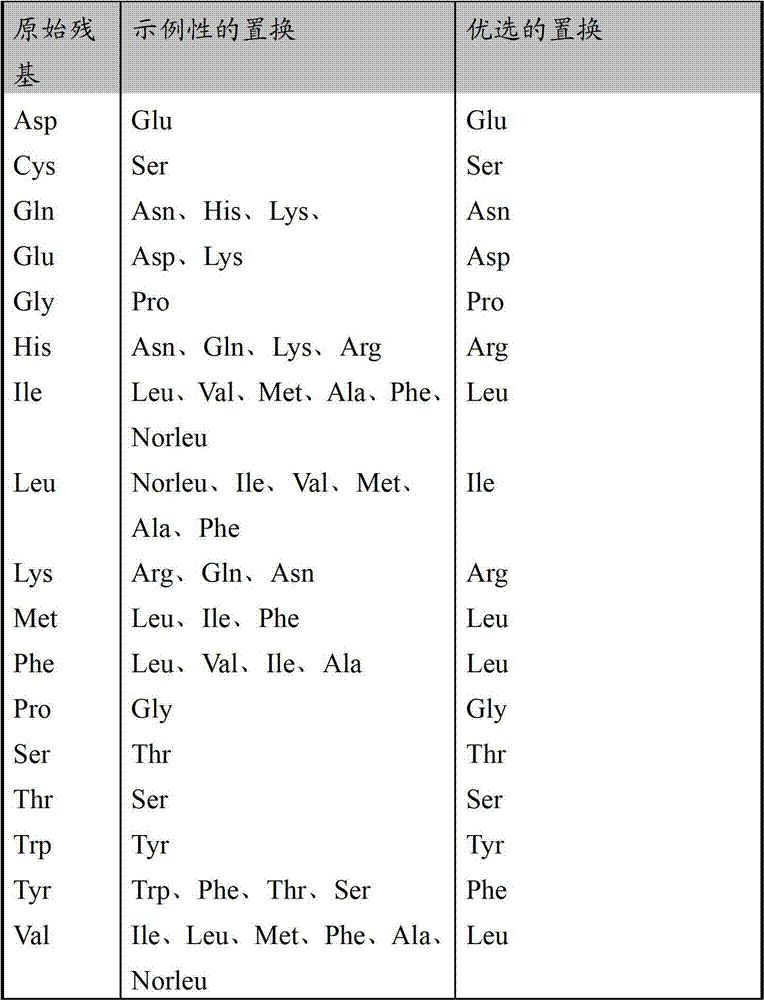
或者,用于产生保守置换的相似氨基酸可以基于侧链的同一性分为三类。第一组包括谷氨酸、门冬氨酸、精氨酸、赖氨酸、组氨酸,它们都具有带电荷侧链;第二组包括甘氨酸、丝氨酸、苏氨酸、半胱氨酸、酪氨酸、谷氨酰胺、天冬酰胺;第三组包括亮氨酸、异亮氨酸、缬氨酸、丙氨酸、脯氨酸、苯丙氨酸、色氨酸、蛋氨酸,参见Zubay,G.,Biochemistry,third edition,Wm.C.BrownPublishers(1993)。Alternatively, similar amino acids used to make conservative substitutions can be grouped into three categories based on side chain identity. The first group includes glutamic acid, aspartic acid, arginine, lysine, histidine, all of which have charged side chains; the second group includes glycine, serine, threonine, cysteine, Tyrosine, glutamine, asparagine; group III includes leucine, isoleucine, valine, alanine, proline, phenylalanine, tryptophan, methionine, see Zubay , G., Biochemistry, third edition, Wm. C. Brown Publishers (1993).
因此,截短的和/或变体AARS多肽中的预测的非必需氨基酸残基通常被相同侧链家族的另一氨基酸残基置换。或者,可以沿着AARS编码序列的全部或部分随机地引入突变(例如通过饱和诱变),并可以筛选所得的突变体的亲本多肽活性,以鉴别保留该活性的突变体。在诱变该编码序列后,可以重组表达编码的肽,并可以测定该肽的活性。“非必需的”氨基酸残基是这样的残基:其可以从实施方案多肽的参照序列改成,且不会消除或实质上改变它的一种或多种活性。合适地,所述改变不会实质上消除这些活性之一,例如,所述活性是参照AARS多肽的至少20%、40%、60%、70%或80%100%、500%、1000%或更多。“必需的”氨基酸残基是这样的残基:当从参照AARS多肽改成时,其导致母体分子的活性的消失,使得存在小于20%的参照活性。例如,这样的必需的氨基酸残基包括:AARS多肽的在不同物种之间保守的那些残基,包括在来自不同来源的AARS多肽的活性结合位点或基序中保守的那些序列。Thus, a predicted nonessential amino acid residue in a truncated and/or variant AARS polypeptide is typically replaced with another amino acid residue from the same side chain family. Alternatively, mutations can be introduced randomly along all or part of the AARS coding sequence (eg, by saturation mutagenesis), and the resulting mutants can be screened for the activity of the parent polypeptide to identify mutants that retain that activity. Following mutagenesis of the coding sequence, the encoded peptide can be expressed recombinantly and the activity of the peptide can be assayed. A "non-essential" amino acid residue is one that can be altered from the reference sequence of an embodiment polypeptide without abrogating or substantially altering one or more of its activities. Suitably, the alteration does not substantially eliminate one of these activities, for example, the activity is at least 20%, 40%, 60%, 70% or 80% 100%, 500%, 1000% or More. An "essential" amino acid residue is one that, when changed from a reference AARS polypeptide, results in the abolition of the activity of the parent molecule such that less than 20% of the reference activity is present. Such essential amino acid residues include, for example, those residues of AARS polypeptides that are conserved between different species, including those sequences that are conserved in active binding sites or motifs of AARS polypeptides from different sources.
因此,本发明也预见到天然存在的AARS多肽序列的变体或它们的生物活性片段,其中所述变体与天然存在的序列的差别在于一个或多个氨基酸残基的添加、缺失或置换。一般而言,变体会表现出与参照AARS多肽序列(例如,在SEQ ID NO:1、2、3、6、8、10、12、14、16、25、28、30、32-108和109-115中所述)的至少约30、40、50、55、60、65、70、75、80、85、90、91、92、93、94、95、96、97、98、99%相似性或序列同一性。此外,预见到这样的序列:所述序列与天然或母体序列相差1、2、3、4、5、6、7、8、9、10、11、12、13、14、15、16、17、18、19、20、30、40、50、60、70、80、90、100、110、120、130、140、150或更多个氨基酸的添加、缺失或置换,但是它们保留母体或参照AARS多肽序列的性质。在某些实施方案中,任意AARS多肽(包括SEQ ID NO:1、2、3、6、8、10、12、14、16、25、28、30、32-108或109-115的AARS多肽)的C-端或N-端区域可以被截短约1、2、3、4、5、6、7、8、9、10、15、20、25、30、35、40、45、50、60、70、80、90、100、110、120、130、140、150、160、170、180、190、200、250、300、350、400、450、500、550、600、650或700或更多个氨基酸,或约10-50、20-50、50-100、100-150、150-200、200-250、250-300、300-350、350-400、400-450、450-500、500-550、550-600、600-650、650-700或更多个氨基酸,包括之间的所有整数和范围(例如,101、102、103、104、105),只要截短的AARS多肽能够在体内、在体外或离体地调节炎症应答(例如,减少免疫细胞(诸如粒细胞,包括嗜中性粒细胞和嗜酸性粒细胞)的迁移)。Accordingly, the present invention also envisions variants of naturally occurring AARS polypeptide sequences, or biologically active fragments thereof, wherein the variants differ from the naturally occurring sequence by the addition, deletion or substitution of one or more amino acid residues. Generally, variants will exhibit the same expression as a reference AARS polypeptide sequence (e.g., at SEQ ID NOS: 1, 2, 3, 6, 8, 10, 12, 14, 16, 25, 28, 30, 32-108, and 109 - at least about 30, 40, 50, 55, 60, 65, 70, 75, 80, 85, 90, 91, 92, 93, 94, 95, 96, 97, 98, 99% similar to those described in -115 sex or sequence identity. Furthermore, sequences that differ from the native or parental sequence by 1, 2, 3, 4, 5, 6, 7, 8, 9, 10, 11, 12, 13, 14, 15, 16, 17 are envisioned , 18, 19, 20, 30, 40, 50, 60, 70, 80, 90, 100, 110, 120, 130, 140, 150 or more amino acid additions, deletions or substitutions, but they retain the parent or reference Properties of AARS polypeptide sequences. In certain embodiments, any AARS polypeptide (including the AARS polypeptide of SEQ ID NO: 1, 2, 3, 6, 8, 10, 12, 14, 16, 25, 28, 30, 32-108, or 109-115 ) can be truncated by about 1, 2, 3, 4, 5, 6, 7, 8, 9, 10, 15, 20, 25, 30, 35, 40, 45, 50 ,60,70,80,90,100,110,120,130,140,150,160,170,180,190,200,250,300,350,400,450,500,550,600,650 or 700 or more amino acids, or about 10-50, 20-50, 50-100, 100-150, 150-200, 200-250, 250-300, 300-350, 350-400, 400-450, 450- 500, 500-550, 550-600, 600-650, 650-700 or more amino acids, including all integers and ranges in between (e.g., 101, 102, 103, 104, 105), as long as the truncated AARS Polypeptides are capable of modulating an inflammatory response (eg, reducing migration of immune cells such as granulocytes, including neutrophils and eosinophils) in vivo, in vitro, or ex vivo.
在有些实施方案中,变体多肽与参照AARS序列相差至少1个、但是小于50、40、30、20、15、10、8、6、5、4、3或2个氨基酸残基。在其它实施方案中,变体多肽与SEQ ID NO:1、2、3、6、8、10、12、14、16、25、28、30、32-108或109-115的对应序列相差至少1%、但是小于20%、15%、10%或5%的残基(如果该对比需要比对,应当比对序列的最大相似性。由缺失或插入或错配导致的“环出的”序列被视作差异)。所述差异合适地是在非必需残基处的差异或变化或保守置换。In some embodiments, a variant polypeptide differs from a reference AARS sequence by at least 1, but less than 50, 40, 30, 20, 15, 10, 8, 6, 5, 4, 3, or 2 amino acid residues. In other embodiments, the variant polypeptide differs by at least 1%, but less than 20%, 15%, 10%, or 5% of residues (if the alignment requires alignment, the sequences should be aligned for maximum similarity. "Looped out" by deletion or insertion or mismatch sequences are treated as differences). The differences are suitably differences or changes at non-essential residues or conservative substitutions.
在某些实施方案中,变体多肽包括这样的氨基酸序列:所述序列与AARS多肽的对应序列(例如,在SEQ ID NO:1、2、3、6、8、10、12、14、16、25、28、30、32-108或109-115中所述)具有至少约50%、55%、60%、65%、70%、75%、80%、85%、90%、91%、92%、93%、94%95%、96%、97%、98%或更多序列同一性或相似性,且具有减少受试者的肺炎的能力,诸如通过减少嗜中性粒细胞或嗜酸性粒细胞向肺的迁移或募集。In certain embodiments, the variant polypeptide comprises an amino acid sequence that corresponds to the corresponding sequence of an AARS polypeptide (e.g., in SEQ ID NO: 1, 2, 3, 6, 8, 10, 12, 14, 16 , 25, 28, 30, 32-108, or 109-115) have at least about 50%, 55%, 60%, 65%, 70%, 75%, 80%, 85%, 90%, 91% , 92%, 93%, 94%, 95%, 96%, 97%, 98% or more sequence identity or similarity and has the ability to reduce pneumonia in a subject, such as by reducing neutrophils or Migration or recruitment of eosinophils to the lung.
如下进行序列之间的序列相似性或序列同一性(所述术语在本文中可互换地使用)的计算。为了测定2个氨基酸序列或2个核酸序列的同一性百分比,将所述序列进行比对,用于最佳对比目的(例如可以在用于最佳比对的第一个和第二个氨基酸或核酸序列的一个或两个中引入缺口,并且为了对比目的可以不考虑非同源序列)。在某些实施方案中,为了对比目的而比对的参照序列长度是,所述参照序列长度的至少30%、优选至少40%、更优选至少50%、60%、甚至更优选至少70%、80%、90%、100%。然后对比在相应的氨基酸位置或核苷酸位置处的氨基酸残基或核苷酸。当第一个序列中的一个位置被与第二个序列中的相应位置相同的氨基酸残基或核苷酸占据时,则所述分子在该位置是相同的。Calculations of sequence similarity or sequence identity (the terms are used interchangeably herein) between sequences are performed as follows. To determine the percent identity of two amino acid sequences or two nucleic acid sequences, the sequences are aligned for optimal alignment purposes (e.g., between the first and second amino acid or gaps are introduced in one or both of the nucleic acid sequences, and non-homologous sequences may be disregarded for comparison purposes). In certain embodiments, the length of the reference sequence aligned for comparison purposes is at least 30%, preferably at least 40%, more preferably at least 50%, 60%, even more preferably at least 70%, 80%, 90%, 100%. The amino acid residues or nucleotides at corresponding amino acid positions or nucleotide positions are then compared. When a position in the first sequence is occupied by the same amino acid residue or nucleotide as the corresponding position in the second sequence, then the molecules are identical at that position.
两个序列之间的同一性百分比随所述序列共享的相同位置的数目而变化,并考虑了缺口的数目和每个缺口的长度,所述两个序列的最佳比对需要引入所述缺口。The percent identity between two sequences varies with the number of identical positions shared by the sequences and takes into account the number of gaps and the length of each gap that need to be introduced for optimal alignment of the two sequences .
使用数学算法,可以完成序列的对比以及两个序列之间的同一性百分比测定。在一个优选的实施方案中,使用Needleman和Wunsch(1970,J.Mol.Biol.48:444-453)算法,测定两个氨基酸序列之间的同一性百分比,所述算法已经整合进GCG软件包中的GAP程序中(可在http://www.gcg.com得到),其中使用Blossum62矩阵或PAM250矩阵以及16、14、12、10、8、6或4的缺口权重和1、2、3、4、5或6的长度权重。在另一个优选的实施方案中,使用在GCG软件包中的GAP程序(可在http://www.gcg.com得到),测定两个核苷酸序列之间的同一性百分比,其中使用NWSgapdna.CMP矩阵以及40、50、60、70或80的缺口权重和1、2、3、4、5或6的长度权重。一个特别优选的参数集合(和除非另外指出否则应当使用的参数集合)是具有下述参数的Blossum 62评分矩阵:缺口罚分为12,缺口延伸罚分为4,移码缺口罚分为5。The alignment of sequences and the determination of percent identity between two sequences can be accomplished using a mathematical algorithm. In a preferred embodiment, the percent identity between two amino acid sequences is determined using the Needleman and Wunsch (1970, J. Mol. Biol. 48:444-453) algorithm, which has been incorporated into the GCG software package In the GAP program in (available at http://www.gcg.com), where a Blossum62 matrix or a PAM250 matrix and gap weights of 16, 14, 12, 10, 8, 6 or 4 and 1, 2, 3 , 4, 5 or 6 length weights. In another preferred embodiment, the percent identity between two nucleotide sequences is determined using the GAP program in the GCG software package (available at http://www.gcg.com), wherein NWSgapdna is used .CMP matrix with gap weights of 40, 50, 60, 70 or 80 and length weights of 1, 2, 3, 4, 5 or 6. A particularly preferred parameter set (and one that should be used unless otherwise indicated) is the Blossum 62 scoring matrix with the following parameters: Gap Penalty 12, Gap Extension Penalty 4, Frameshift Gap Penalty 5.
使用E.Meyers和W.Miller(1989,Cabios,4:11-17)的算法,可以测定两个氨基酸或核苷酸序列之间的同一性百分比,所述算法已经整合进ALIGN程序(2.0版)中,其中使用PAM120权重残基表,缺口长度罚分为12,缺口罚分为4。The percent identity between two amino acid or nucleotide sequences can be determined using the algorithm of E. Meyers and W. Miller (1989, Cabios, 4:11-17), which has been incorporated into the ALIGN program (version 2.0 ), where the PAM120 weight residue table is used, the gap length penalty is 12, and the gap penalty is 4.
本文所述的核酸和蛋白序列可以用作“查询序列”,以针对公共数据库进行检索,例如鉴定出其它家族成员或相关序列。使用Altschul等人(1990,J.Mol.Biol,215:403-10)的NBLAST和XBLAST程序(2.0版),可以进行这样的检索。可以用NBLAST程序,分值=100,字长=12,进行BLAST核苷酸检索,以获得与本发明的核酸分子同源的核苷酸序列。可以用XBLAST程序,分值=50,字长=3,进行BLAST蛋白质检索,以获得与本发明的蛋白分子同源的氨基酸序列。为了获得用于对比目的的加缺口的比对,可以如Altschul等人(1997,NucleicAcids Res,25:3389-3402)所述,使用Gapped BLAST。当使用BLAST和GappedBLAST程序时,可以使用各个程序(例如XBLAST和NBLAST)的缺省参数。The nucleic acid and protein sequences described herein can be used as "query sequences" to search against public databases, eg, to identify other family members or related sequences. Such searches can be performed using the NBLAST and XBLAST programs (version 2.0) of Altschul et al. (1990, J. Mol. Biol, 215:403-10). BLAST nucleotide searches can be performed with the NBLAST program, score=100, wordlength=12, to obtain nucleotide sequences homologous to nucleic acid molecules of the invention. BLAST protein searches can be performed with the XBLAST program, score=50, wordlength=3, to obtain amino acid sequences homologous to protein molecules of the invention. To obtain gapped alignments for comparison purposes, Gapped BLAST can be used as described by Altschul et al. (1997, Nucleic Acids Res, 25:3389-3402). When utilizing BLAST and GappedBLAST programs, the default parameters of the respective programs (eg, XBLAST and NBLAST) can be used.
通过筛选AARS多肽的突变体的组合文库,可以鉴别AARS多肽的变体。AARS蛋白编码序列的文库或片段(例如,N末端、C末端或内部片段)可以用于制备变化多端的片段群体,用于筛选和随后选择AARS多肽的变体。Variants of an AARS polypeptide can be identified by screening combinatorial libraries of mutants of the AARS polypeptide. Libraries or fragments (eg, N-terminal, C-terminal or internal fragments) of AARS protein coding sequences can be used to generate diverse populations of fragments for screening and subsequent selection of variants of AARS polypeptides.
用于筛选通过点突变或截短产生的组合文库的基因产物的方法,和用于筛选具有选定性能的基因产物的cDNA文库的方法,是本领域已知的。这样的方法适用于快速筛选通过AARS多肽的组合诱变产生的基因文库。Methods for screening gene products of combinatorial libraries produced by point mutations or truncations, and methods for screening cDNA libraries for gene products with selected properties, are known in the art. Such methods are suitable for rapid screening of gene libraries generated by combinatorial mutagenesis of AARS polypeptides.
也包括AARS多肽的蛋白水解片段。在某些示例性的实施方案中,根据本领域已知的和可利用的技术,使用多种蛋白水解酶或蛋白水解性的化学试剂,可以生产AARS多肽的蛋白水解片段。可以在体外生产蛋白水解片段,诸如通过在受控条件下用一种或多种蛋白酶(如本文所述,且本领域已知的)温育AARS多肽,并分离和表征从它们生成的片段。也可以在体内或内源地生产蛋白水解片段,诸如通过在选择的细胞(例如,细菌细胞、真核细胞)中重组表达AARS多肽,并分离和表征从它们生成的内源片段(参见,例如,实施例10)。Proteolytic fragments of AARS polypeptides are also included. In certain exemplary embodiments, proteolytic fragments of AARS polypeptides can be produced using various proteolytic enzymes or proteolytic chemicals according to techniques known and available in the art. Proteolytic fragments can be produced in vitro, such as by incubating AARS polypeptides with one or more proteases (as described herein and known in the art) under controlled conditions, and isolating and characterizing the fragments generated therefrom. Proteolytic fragments can also be produced in vivo or endogenously, such as by recombinantly expressing AARS polypeptides in selected cells (e.g., bacterial cells, eukaryotic cells), and isolating and characterizing the endogenous fragments produced therefrom (see, e.g., , embodiment 10).
通常根据3个主要标准将蛋白酶分类:(i)催化的反应,(ii)催化位点的化学性质,和(iii)通过结构揭示的进化关系。通过催化机理分类的蛋白酶或蛋白水解酶的一般实例包括:天冬氨酸蛋白酶、丝氨酸蛋白酶、半胱氨酸蛋白酶和金属蛋白酶。Proteases are generally classified according to 3 main criteria: (i) the reaction catalyzed, (ii) the chemical nature of the catalytic site, and (iii) the evolutionary relationship revealed by structure. General examples of proteases or proteolytic enzymes classified by catalytic mechanism include: aspartic proteases, serine proteases, cysteine proteases and metalloproteases.
大多数天冬氨酸蛋白酶属于胃蛋白酶家族。该家族包括:消化酶(诸如胃蛋白酶和凝乳酶)以及溶酶体组织蛋白酶D和加工酶(诸如肾素)和某些真菌蛋白酶(例如,青霉胃蛋白酶、根霉胃蛋白酶(rhizopuspepsin)、(endothiapepsin)。天冬氨酸蛋白酶的第二个家族包括病毒蛋白水解酶,诸如来自AIDS病毒(HIV)的蛋白酶,也称作retropepsin。Most aspartic proteases belong to the pepsin family. This family includes: digestive enzymes (such as pepsin and chymosin) as well as lysosomal cathepsin D and processing enzymes (such as renin) and certain fungal proteases (eg, Penicillium pepsin, rhizopus pepsin) , (endothiapepsin).The second family of aspartic proteases includes viral proteolytic enzymes, such as the protease from AIDS virus (HIV), also known as retropepsins.
丝氨酸蛋白酶包括2个不同的家族。首先,糜蛋白酶家族,其包括哺乳动物酶诸如糜蛋白酶、胰蛋白酶、弹性酶和激肽释放酶,其次,枯草杆菌蛋白酶家族,其包括细菌酶诸如枯草杆菌蛋白酶。这2个家族之间的一般3D结构是不同的,但是它们具有相同的活性部位几何形状,且催化经由相同机理进行。丝氨酸蛋白酶表现出不同的底物特异性,该差异主要与不同酶亚位点(底物残基相互作用位点)中的氨基酸置换有关。有些丝氨酸蛋白酶具有延长的与底物的相互作用位点,而其它丝氨酸蛋白酶具有限于P1底物残基的特异性。Serine proteases comprise 2 distinct families. Firstly, the chymotrypsin family, which includes mammalian enzymes such as chymotrypsin, trypsin, elastase and kallikrein, and secondly, the subtilisin family, which includes bacterial enzymes such as subtilisins. The general 3D structure is different between these 2 families, but they have the same active site geometry and catalysis proceeds via the same mechanism. Serine proteases exhibit different substrate specificities, which differences are mainly related to amino acid substitutions in different enzyme subsites (substrate residue interaction sites). Some serine proteases have extended interaction sites with substrates, while others have specificity restricted to P1 substrate residues.
半胱氨酸蛋白酶家族包括:植物蛋白酶诸如木瓜蛋白酶、猕猴桃蛋白酶(actinidin)和菠萝蛋白酶,几种哺乳动物溶酶体组织蛋白酶,细胞溶质的卡配因(钙活化的),以及几种寄生物蛋白酶(例如,锥虫属、血吸虫属)。木瓜蛋白酶是该家族中的原型和最佳研究的成员。白介素-1-β转换酶的X-射线结构的最近阐述已经揭示半胱氨酸蛋白水解酶的新颖折叠类型。The cysteine protease family includes: plant proteases such as papain, actinidin, and bromelain, several mammalian lysosomal cathepsins, cytosolic cathepsins (calcium-activated), and several parasitic Proteases (eg, Trypanosoma, Schistosoma). Papain is the archetypal and best researched member of this family. The recent elucidation of the X-ray structure of interleukin-1-beta converting enzyme has revealed a novel fold type of the cysteine proteolytic enzyme.
金属蛋白酶是更老类别的蛋白酶之一,存在于细菌、真菌和高等生物中。它们在它们的序列和它们的3D结构方面广泛地不同,但是大多数酶含有催化活性的锌原子。在某些情况下,锌可以替换为另一种金属诸如钴或镍,而不丧失蛋白水解活性。细菌嗜热菌蛋白酶已经被确定地表征,它的结晶结构指示,锌被2个组氨酸和1个谷氨酸结合。许多金属蛋白酶含有序列基序HEXXH,该序列基序会提供锌的2个组氨酸配体。第三个配体是谷氨酸(嗜热菌蛋白酶、肾胰岛素残基溶酶、丙氨酰氨基肽酶)或组氨酸(虾红素、沙雷氏菌溶素)。Metalloproteases are one of the older classes of proteases, found in bacteria, fungi and higher organisms. They differ widely in their sequences and their 3D structures, but most enzymes contain catalytically active zinc atoms. In some cases, zinc can be replaced by another metal such as cobalt or nickel without loss of proteolytic activity. Bacterial thermolysin has been definitively characterized and its crystal structure indicates that zinc is bound by 2 histidines and 1 glutamic acid. Many metalloproteases contain the sequence motif HEXXH, which provides 2 histidine ligands for zinc. The third ligand is glutamic acid (thermolysin, renolysin, alanyl aminopeptidase) or histidine (astaxanthin, serratialysin).
示例性的蛋白酶包括,例如,无色肽酶、氨基肽酶、安克洛酶、血管紧张素转换酶、菠萝蛋白酶、卡配因、卡配因I、卡配因II、羧肽酶A、羧肽酶B、羧肽酶G、羧肽酶P、羧肽酶W、羧肽酶Y、天冬氨酸特异性半胱氨酸蛋白酶1、天冬氨酸特异性半胱氨酸蛋白酶2、天冬氨酸特异性半胱氨酸蛋白酶3、天冬氨酸特异性半胱氨酸蛋白酶4、天冬氨酸特异性半胱氨酸蛋白酶5、天冬氨酸特异性半胱氨酸蛋白酶6、天冬氨酸特异性半胱氨酸蛋白酶7、天冬氨酸特异性半胱氨酸蛋白酶8、天冬氨酸特异性半胱氨酸蛋白酶9、天冬氨酸特异性半胱氨酸蛋白酶10、天冬氨酸特异性半胱氨酸蛋白酶11、天冬氨酸特异性半胱氨酸蛋白酶12、天冬氨酸特异性半胱氨酸蛋白酶13、组织蛋白酶B、组织蛋白酶C、组织蛋白酶D、组织蛋白酶E、组织蛋白酶G、组织蛋白酶H、组织蛋白酶L、糜木瓜酶、胰凝乳蛋白酶、糜蛋白酶、梭菌蛋白酶、胶原酶、补体C1r、补体C1s、补体因子D、补体因子I、姜黄蛋白酶、二肽基肽酶IV、弹性酶(白细胞)、弹性酶(胰腺)、内蛋白酶Arg-C、内蛋白酶Asp-N、内蛋白酶Glu-C、内蛋白酶Lys-C、肠激酶、因子Xa、无花果蛋白酶、弗林蛋白酶、颗粒蛋白酶A、颗粒蛋白酶B、HIV蛋白酶、IGase、激肽释放酶组织、亮氨酸氨基肽酶(一般的)、亮氨酸氨基肽酶(胞质溶胶的)、亮氨酸氨基肽酶(微粒体的)、基质金属蛋白酶、蛋氨酸氨基肽酶、中性蛋白酶、木瓜蛋白酶、胃蛋白酶、纤溶酶、氨酰脯氨酸二肽酶、链霉蛋白酶E、前列腺特异性的抗原、来自灰色链霉菌的嗜碱蛋白酶、来自曲霉菌的蛋白酶、来自佐氏曲霉(Aspergillus saitoi)的蛋白酶、来自酱油曲霉(Aspergillussojae)的蛋白酶、蛋白酶(地衣芽孢杆菌)(碱性的,或碱性蛋白酶)、来自多粘芽孢杆菌(Bacillus polymyxa)的蛋白酶、来自芽孢杆菌属的蛋白酶、来自根霉菌属的蛋白酶、蛋白酶S、蛋白酶体、来自米曲霉(Aspergillus oryzae)的蛋白水解酶、蛋白水解酶3、蛋白水解酶A、蛋白水解酶K、蛋白C、焦谷氨酸氨基肽酶、凝乳酶、凝乳酶、链激酶、枯草杆菌蛋白酶、嗜热菌蛋白酶、凝血酶、组织纤溶酶原活化剂、胰蛋白酶、类胰蛋白酶和尿激酶。Exemplary proteases include, for example, leucopeptidase, aminopeptidase, ancrodase, angiotensin-converting enzyme, bromelain, capine, capine I, capine II, carboxypeptidase A, Carboxypeptidase B, Carboxypeptidase G, Carboxypeptidase P, Carboxypeptidase W, Carboxypeptidase Y, Caspase 1, Caspase 2 , caspase 3, caspase 4, caspase 5, caspase Protease 6, caspase 7, caspase 8, caspase 9, caspase Caspase 10, Caspase 11, Caspase 12, Caspase 13, Cathepsin B, Cathepsin C. Cathepsin D, Cathepsin E, Cathepsin G, Cathepsin H, Cathepsin L, Chymopapain, Chymotrypsin, Chymotrypsin, Clostripain, Collagenase, Complement C1r, Complement C1s, Complement Factor D , complement factor I, curcuminase, dipeptidyl peptidase IV, elastase (leukocytes), elastase (pancreas), endoproteinase Arg-C, endoproteinase Asp-N, endoproteinase Glu-C, endoproteinase Lys-C , enterokinase, factor Xa, ficin, furin, granase A, granase B, HIV protease, IGase, kallikrein tissue, leucine aminopeptidase (general), leucine aminopeptidase (cytosolic), leucine aminopeptidase (microsomal), matrix metalloproteinase, methionine aminopeptidase, neutral protease, papain, pepsin, plasmin, aminoacylproline dipeptidase , pronase E, prostate-specific antigen, basophilic protease from Streptomyces griseus, protease from Aspergillus, protease from Aspergillus saitoi, protease from Aspergillus sojae, protease (Lichen Bacillus) (alkaline, or alkaline protease), protease from Bacillus polymyxa, protease from Bacillus, protease from Rhizopus, protease S, proteasome, from Aspergillus oryzae ( Aspergillus oryzae) proteolytic enzyme, proteolytic enzyme 3, proteolytic enzyme A, proteolytic enzyme K, protein C, pyroglutamate aminopeptidase, chymosin, chymosin, streptokinase, subtilisin, protease Thermolysin, thrombin, tissue plasminogen activator, trypsin, tryptase, and urokinase.
表C-G显示了通过用不同的蛋白酶温育AARS多肽可以在体外生产的蛋白水解片段的类型。在某些实施方案中,可以控制温育条件,使得仅某些切割位点被指定的蛋白酶切割,以实现仅部分切割,随后根据本领域已知的技术(例如,色谱法)分离希望的蛋白水解片段。一旦已经根据本领域的常规技术分离和表征(例如,测序)希望的片段,可以克隆并重组地生产它,或合成地生产它,视需要而定。Tables C-G show the types of proteolytic fragments that can be produced in vitro by incubating AARS polypeptides with different proteases. In certain embodiments, incubation conditions can be controlled such that only certain cleavage sites are cleaved by a given protease to achieve only partial cleavage, followed by isolation of the desired protein according to techniques known in the art (e.g., chromatography) Hydrolyzed fragments. Once the desired fragment has been isolated and characterized (eg, sequenced) according to routine techniques in the art, it can be cloned and produced recombinantly, or synthetically, as desired.
因此,本发明的AARS多肽包括:可以由表C-G中的示例性蛋白酶(除了本文别处列出的蛋白酶以外)生产的任意蛋白水解片段,包括蛋白酶的任意组合(例如,天冬氨酸特异性半胱氨酸蛋白酶1和羟胺),或单个切割位点的任意组合。另外,切割位点的残基位置可以是近似的。仅仅作为实例,AARS蛋白水解片段可以包括GlyRS的约残基1-165、约残基166-445、约残基166-455、约残基166-716、约残基445-716或约残基455-716,所述GlyRS已经通过氧碘代苯甲酸温育进行切割或部分地切割(参见表C)。作为另一个实例,AARS蛋白水解片段可以包括QRS的约残基1-98、约残基1-135、约残基98-135、约残基1-234、约残基98-234、约残基1-379、约残基234-674或约残基135-737,所述QRS已经被脯氨酸-内肽酶切割或部分地切割(参见表D)。作为另一个示例性的实例,AARS多肽可以包括QRS的约残基1-210、约残基1-273、约残基1-295、约残基210-273、约残基210-295、约残基273-295,所述QRS已经被羟胺切割或部分地切割。类似的模式可以应用于任意的AARS多肽和在表C-G中的任意蛋白酶,或应用于本文列出的或本领域已知的其它蛋白酶。Accordingly, the AARS polypeptides of the invention include any proteolytic fragment that can be produced by the exemplary proteases in Tables C-G (in addition to those listed elsewhere herein), including any combination of proteases (e.g., aspartic acid-
表C:甘氨酰-tRNA合成酶(EC 6.1.1.14)(甘氨酸-tRNA连接酶)(GlyRS)Table C: Glycyl-tRNA Synthetase (EC 6.1.1.14) (Glycine-tRNA Ligase) (GlyRS)


表D:谷氨酰胺酰-tRNA合成酶(EC 6.1.1.18)(谷氨酰胺-tRNA连接酶)(QRS)Table D: Glutaminyl-tRNA synthetase (EC 6.1.1.18) (glutamine-tRNA ligase) (QRS)
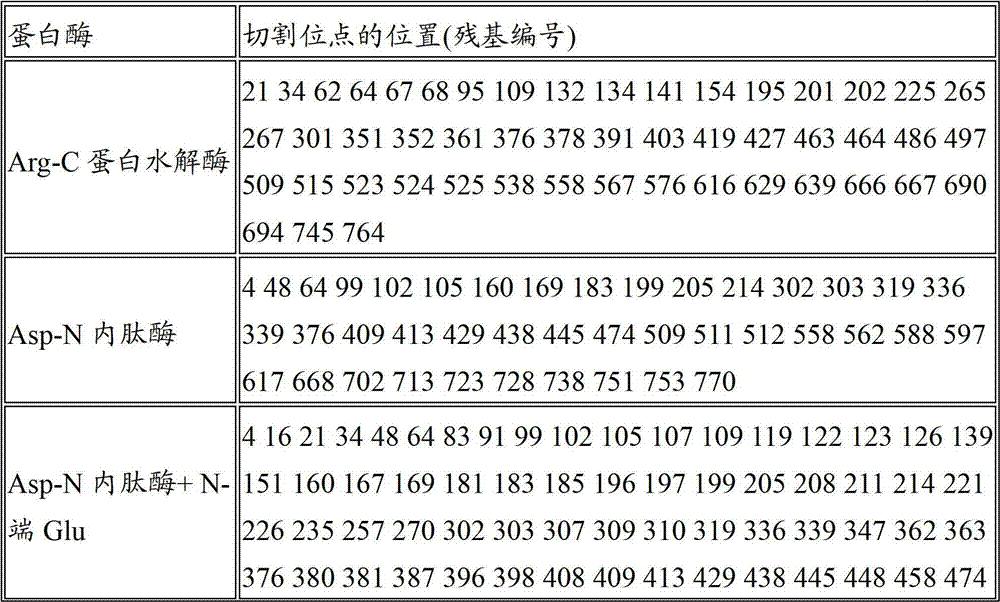
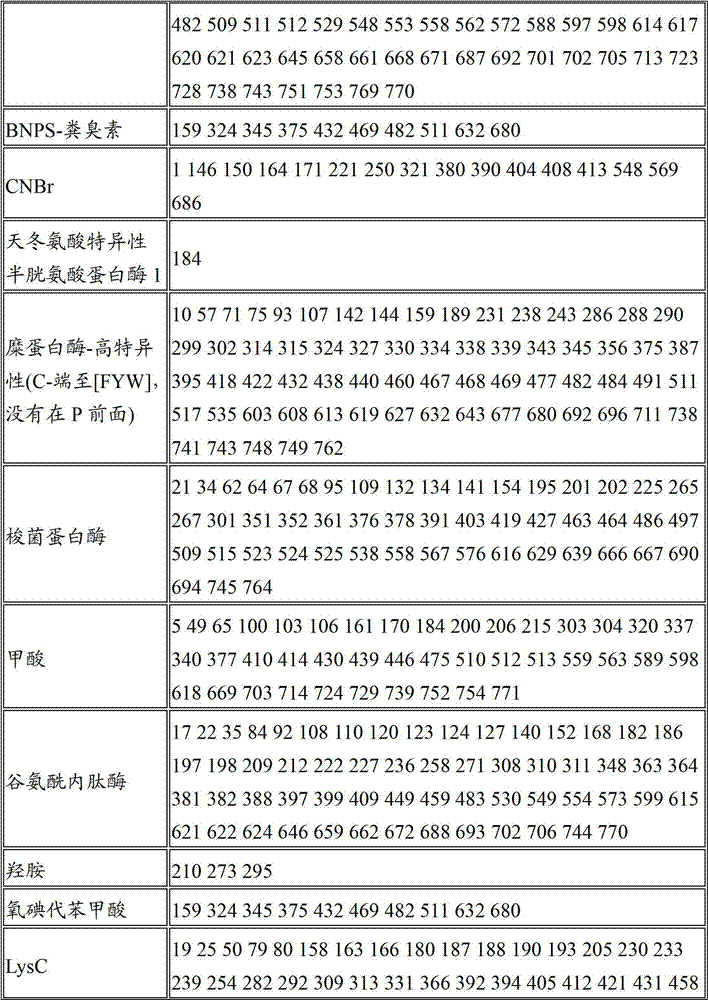

表E:色氨酰-tRNA合成酶,细胞质(EC 6.1.1.2)(色氨酸-tRNA连接酶)(WRS)(干扰素诱导的蛋白53)(IFP53)(hWRS)Table E: Tryptophanyl-tRNA Synthetase, Cytoplasmic (EC 6.1.1.2) (Tryptophan-tRNA Ligase) (WRS) (Interferon-Inducible Protein 53) (IFP53) (hWRS)


表F:酪氨酰-tRNA合成酶(EC 6.1.1.1)(酪氨酰-tRNA连接酶)(YRS)Table F: Tyrosyl-tRNA Synthetase (EC 6.1.1.1) (Tyrosyl-tRNA Ligase) (YRS)

表G:组氨酰-tRNA合成酶(EC 6.1.1.21)(组氨酸-tRNA连接酶)(HisRS)Table G: Histidyl-tRNA synthetase (EC 6.1.1.21) (histidine-tRNA ligase) (HisRS)


某些实施方案涉及分离的AARS多肽,所述AARS多肽包含已经从内源的、天然存在的AARS多肽片段衍生出的氨基酸序列,基本上由它们组成,或由它们组成,以及包含所述片段的药物组合物和它们的使用方法。在某些实施方案中,如上面所指出的,可以制备或鉴别天然存在的内源的蛋白水解片段的序列,例如,从不同的细胞级分(例如,细胞溶质的、膜、细胞核的)和/或不同细胞类型的条件培养基,所述细胞包括原代细胞和细胞系。这样的细胞类型的实例包括、但不限于:免疫细胞诸如单核细胞、树突细胞、巨噬细胞(例如,RAW 264.7巨噬细胞;参见实施例5)、嗜中性粒细胞、嗜酸性粒细胞、嗜碱性粒细胞和淋巴细胞诸如B-细胞和T-细胞(例如,CD4+辅助细胞和CD8+杀伤细胞),包括原代T-细胞和T-细胞系诸如Jurkat T-细胞以及天然杀伤(NK)细胞。Certain embodiments relate to isolated AARS polypeptides comprising, consisting essentially of, or consisting of an amino acid sequence that has been derived from an endogenous, naturally occurring AARS polypeptide fragment, and comprising said fragment Pharmaceutical compositions and their methods of use. In certain embodiments, as noted above, the sequences of naturally occurring endogenous proteolytic fragments can be prepared or identified, e.g., from different cellular fractions (e.g., cytosolic, membrane, nuclear) and and/or conditioned media of different cell types, including primary cells and cell lines. Examples of such cell types include, but are not limited to: immune cells such as monocytes, dendritic cells, macrophages (e.g., RAW 264.7 macrophages; see Example 5), neutrophils, eosinophils cells, basophils and lymphocytes such as B-cells and T-cells (e.g., CD4+ helper cells and CD8+ killer cells), including primary T-cells and T-cell lines such as Jurkat T-cells and natural killer ( NK) cells.
在某些实施方案中,通过诸如质谱法等技术或等效技术,可以鉴别内源的蛋白水解片段。仅仅作为实例且不限制,在某些实施方案中,通过1D SDS-PAGE,可以分离出来自不同细胞类型的蛋白质组或其级分,并以固定的间隔将凝胶泳道切成带;此后可以任选地用适当的蛋白酶(诸如胰蛋白酶)消化所述带,以释放出肽,然后可以通过1D反相LC-MS/MS分析所述肽。可以将得到的蛋白质组数据整合成所谓的肽图(peptograph),该图在左边图板中描绘了:给定的蛋白在水平维的序列覆盖(N端至C端,从左到右),以及在垂直维的SDS-PAGE迁移(高分子量至低分子量,从上到下)。然后可以对具体的肽片段测序或绘制图谱。表H提供了一组示例性的小鼠QRS多肽片段,所述片段根据这些示例性的技术从RAW巨噬细胞中鉴别出。表I提供了人QRS多肽片段的对应集合。表J提供了从人Jurkat T-细胞鉴别出的一组示例性的人QRS多肽片段。In certain embodiments, endogenous proteolytic fragments can be identified by techniques such as mass spectrometry, or equivalent techniques. By way of example only and not limitation, in certain embodiments, by 1D SDS-PAGE, proteomes or fractions thereof from different cell types can be separated and the gel lanes cut into bands at regular intervals; thereafter can be The band is optionally digested with an appropriate protease, such as trypsin, to release the peptides, which can then be analyzed by 1D reverse phase LC-MS/MS. The resulting proteomic data can be integrated into a so-called peptograph, which is depicted in the left panel: the sequence coverage of a given protein in the horizontal dimension (N-terminal to C-terminal, left to right), and SDS-PAGE migration in the vertical dimension (high molecular weight to low molecular weight, top to bottom). Specific peptide fragments can then be sequenced or mapped. Table H provides an exemplary set of mouse QRS polypeptide fragments identified from RAW macrophages according to these exemplary techniques. Table I provides a corresponding collection of human QRS polypeptide fragments. Table J provides a set of exemplary human QRS polypeptide fragments identified from human Jurkat T-cells.
表H:小鼠QRS多肽片段Table H: Mouse QRS polypeptide fragments
*小鼠和人序列是相同的。*Mouse and human sequences are identical.
表I:人QRS多肽片段Table 1: Human QRS polypeptide fragments
表J:来自Jurkat T-细胞的人QRS多肽片段Table J: People's QRS polypeptide fragments from Jurkat T-cells
因此,某些具体实施方案包括分离的QRS多肽,所述QRS多肽包含SEQ IDNO:36-103或109-115(在上面的表H、I和J中)中的任意一个或多个,基本上由它们组成,或由它们组成,所述QRS多肽调节炎症,诸如通过减轻肺炎,包括它们的变体。在某些实施方案中,这些分离的QRS多肽片段可以另外包含1、2、3、4、5、6、7、8、9、10、11、12、13、14、15、16、17、18、19或20或更多个在它们周围的C-端和/或N-端残基,这通过它们在全长QRS多肽内的位置来表征。在某些实施方案中,可以截短这些分离的QRS多肽片段,以缺失1、2、3、4、5、6、7、8、9、10、11、12、13、14、15、16、17、18、19或20个它们的C-端和/或N-端残基。也包括:含有这种QRS多肽片段的药物组合物,和使用所述多肽或组合物来治疗有此需要的受试者的方法。Accordingly, certain embodiments include an isolated QRS polypeptide comprising any one or more of SEQ ID NO: 36-103 or 109-115 (in Tables H, I and J above), substantially Consisting of, or consisting of, the QRS polypeptides modulate inflammation, such as by alleviating pneumonia, including variants thereof. In certain embodiments, these isolated QRS polypeptide fragments may additionally comprise 1, 2, 3, 4, 5, 6, 7, 8, 9, 10, 11, 12, 13, 14, 15, 16, 17, 18, 19 or 20 or more C-terminal and/or N-terminal residues around them, characterized by their position within the full-length QRS polypeptide. In certain embodiments, these isolated QRS polypeptide fragments can be truncated to delete 1, 2, 3, 4, 5, 6, 7, 8, 9, 10, 11, 12, 13, 14, 15, 16 , 17, 18, 19 or 20 of their C-terminal and/or N-terminal residues. Also included are pharmaceutical compositions comprising such QRS polypeptide fragments, and methods of using said polypeptides or compositions to treat a subject in need thereof.
本发明也预见到AARS嵌合蛋白或融合蛋白用于调节炎症的用途。本文所用的AARS“嵌合蛋白”或“融合蛋白”包括这样的AARS多肽或多肽片段:其与另一种AARS-多肽(例如,以建立多个片段)相连,或与非-AARS多肽相连,或与二者相连。“非-AARS多肽”表示具有与特定蛋白相对应的氨基酸序列的“异源多肽”,所述特定蛋白不同于AARS蛋白,且其源自相同或不同的生物体。融合蛋白的AARS多肽可以对应着生物活性的AARS氨基酸序列的全部或一部分。在某些实施方案中,AARS融合蛋白包括AARS蛋白的至少一个(或两个)生物活性部分。形成所述融合蛋白的多肽通常是C-端与N-端连接,尽管它们也可以是C-端与C-端、N-端与N-端或N-端与C-端连接。融合蛋白的多肽可以是任何顺序。The present invention also envisions the use of AARS chimeric or fusion proteins for modulating inflammation. As used herein, an AARS "chimeric protein" or "fusion protein" includes an AARS polypeptide or polypeptide fragment that is linked to another AARS-polypeptide (e.g., to create multiple fragments), or to a non-AARS polypeptide, Or connect to both. "Non-AARS polypeptide" means a "heterologous polypeptide" having an amino acid sequence corresponding to a specific protein that is different from the AARS protein and that is derived from the same or a different organism. The AARS polypeptide of the fusion protein may correspond to all or part of the amino acid sequence of the biologically active AARS. In certain embodiments, an AARS fusion protein includes at least one (or two) biologically active portion of an AARS protein. The polypeptides forming the fusion protein are usually linked C-terminally to N-terminally, although they may also be linked C-terminally to C-terminally, N-terminally to N-terminally or N-terminally to C-termally. The polypeptides of the fusion protein can be in any order.
可以为基本上任意的希望的目的而设计和包括融合伴侣,只要它们不会不利地影响所述多肽的炎症调节活性。例如,在一个实施方案中,融合伴侣可以包含这样的序列:所述序列有助于以比天然重组蛋白更高的产量表达所述蛋白(表达增强子)。可以选择其它融合伴侣,从而增加蛋白的溶解度,或使蛋白能够靶向希望的细胞内隔室。Fusion partners can be designed and included for essentially any desired purpose, so long as they do not adversely affect the inflammation-modulating activity of the polypeptide. For example, in one embodiment, the fusion partner may contain sequences that facilitate expression of the protein in higher yields than the native recombinant protein (expression enhancer). Additional fusion partners can be chosen to increase the solubility of the protein, or to enable targeting of the protein to desired intracellular compartments.
所述融合蛋白可以包括对配体具有高亲和力的部分。例如,所述融合蛋白可以是GST-AARS融合蛋白,其中所述AARS序列与所述GST序列的C-端融合。作为另一个实例,AARS多肽可以在C-端与8氨基酸标签融合,诸如L-E-H-H-H-H-H-H(SEQ ID NO:5)标签。在某些具体实施方案中,YRS多肽的氨基酸1-364在C-端与365-L-E-H-H-H-H-H-H-372(SEQ ID NO:5)标签融合。这样的融合蛋白可以促进AARS多肽的纯化和/或鉴别。或者,所述融合蛋白可以是在它的N-端处含有异源信号序列的AARS蛋白。在某些宿主细胞中,通过使用异源信号序列,可以增加AARS蛋白的表达和/或分泌。The fusion protein may include a moiety with high affinity for the ligand. For example, the fusion protein may be a GST-AARS fusion protein, wherein the AARS sequence is fused to the C-terminus of the GST sequence. As another example, an AARS polypeptide can be fused at the C-terminus to an 8 amino acid tag, such as the L-E-H-H-H-H-H-H (SEQ ID NO: 5) tag. In certain embodiments, amino acids 1-364 of the YRS polypeptide are fused at the C-terminus to a 365-L-E-H-H-H-H-H-H-H-372 (SEQ ID NO:5) tag. Such fusion proteins can facilitate the purification and/or identification of AARS polypeptides. Alternatively, the fusion protein may be an AARS protein containing a heterologous signal sequence at its N-terminus. In certain host cells, the expression and/or secretion of AARS proteins can be increased through the use of a heterologous signal sequence.
更一般地,与异源序列(诸如Fc片段)的融合,可以用于去除AARS多肽的不希望的特征,或改善希望的特征(例如,药代动力学性质)。例如,与异源序列的融合,可能增加AARS多肽的化学稳定性、降低免疫原性、改善体内靶向和/或增加在循环中的半衰期。More generally, fusions to heterologous sequences, such as Fc fragments, can be used to remove undesired characteristics of AARS polypeptides, or to improve desirable characteristics (eg, pharmacokinetic properties). For example, fusions to heterologous sequences may increase the chemical stability of AARS polypeptides, reduce immunogenicity, improve in vivo targeting, and/or increase half-life in circulation.
与异源序列的融合,也可以用于建立双功能的融合蛋白,诸如这样的双功能蛋白:其不仅能够通过AARS多肽来减轻肺炎,而且也能够通过异源多肽来修饰(即,刺激或抑制)其它途径。这样的途径的实例包括、但不限于:不同的免疫系统相关途径,诸如先天性或适应性免疫活化途径或细胞生长调节途径,诸如血管生成或血细胞生成。在某些方面,所述异源多肽可以与AARS多肽协同地起作用,以调节受试者中的炎症相关途径。可以用于建立双功能融合蛋白的异源多肽的实例包括、但不限于:血小板生成素、细胞因子(例如,IL-11)、趋化因子和不同的造血生长因子,以及它们的生物活性片段和/或变体。Fusions to heterologous sequences can also be used to create bifunctional fusion proteins, such as bifunctional proteins that not only alleviate pneumonia through the AARS polypeptide, but are also modified (i.e., stimulate or inhibit) by the heterologous polypeptide. ) other ways. Examples of such pathways include, but are not limited to, various immune system related pathways such as innate or adaptive immune activation pathways or cell growth regulation pathways such as angiogenesis or hematopoiesis. In certain aspects, the heterologous polypeptide can act synergistically with the AARS polypeptide to modulate an inflammation-related pathway in the subject. Examples of heterologous polypeptides that can be used to create bifunctional fusion proteins include, but are not limited to: thrombopoietin, cytokines (e.g., IL-11), chemokines, and various hematopoietic growth factors, and biologically active fragments thereof and/or variants.
通常可以使用标准技术来制备融合蛋白。例如,可以单独地装配编码希望的融合体的多肽组分的DNA序列,并连接进适当的表达载体中。使用或不使用肽接头,将编码一种多肽组分的DNA序列的3’末端连接至编码第二种多肽组分的DNA序列的5’末端,使得所述序列的读码框同相(in phase)。这允许翻译成保留两种组分多肽的生物活性的单个融合蛋白。Fusion proteins can generally be prepared using standard techniques. For example, DNA sequences encoding the polypeptide components of the desired fusion can be assembled separately and ligated into an appropriate expression vector. The 3' end of a DNA sequence encoding one polypeptide component is ligated to the 5' end of a DNA sequence encoding a second polypeptide component, with or without the use of a peptide linker, such that the reading frames of the sequences are in phase ). This allows translation into a single fusion protein that retains the biological activity of the two component polypeptides.
如果需要的话,可以采用肽接头序列,以使第一种和第二种多肽组分隔开这样的距离:所述距离足以确保,每种多肽折叠成它的二级结构和三级结构。使用本领域众所周知的标准技术,将这样的肽接头序列掺入融合蛋白中。基于下述因素,可以选择某些肽接头序列:(1)它们的采取柔软的延伸构象的能力;(2)它们的不采取与第一种和第二种多肽上的功能性表位相互作用的二级结构的能力;和(3)缺乏可能与多肽功能性表位反应的疏水残基或带电残基。优选的肽接头序列含有Gly、Asn和Ser残基。其它接近中性的氨基酸(例如Thr和Ala)也可以用于接头序列中。可以有用地用作接头的氨基酸序列包括在下述文献中公开的那些:Maratea等人,Gene 40:39-46(1985);Murphy等人,Proc.Natl.Acad.Sci.USA 83:82588262(1986);美国专利号4,935,233和美国专利号4,751,180。接头序列的长度通常可以是1至约50个氨基酸。当第一种和第二种多肽具有可用于分隔功能结构域并防止空间干扰的非必需N-端氨基酸区域时,不需要接头序列。If desired, a peptide linker sequence can be employed to separate the first and second sets of polypeptides by a distance sufficient to ensure that each polypeptide folds into its secondary and tertiary structures. Such peptide linker sequences are incorporated into fusion proteins using standard techniques well known in the art. Certain peptide linker sequences can be selected based on: (1) their ability to adopt a soft, extended conformation; (2) their inability to adopt interactions with functional epitopes on the first and second polypeptides and (3) lack of hydrophobic or charged residues that might react with a functional epitope of the polypeptide. Preferred peptide linker sequences contain Gly, Asn and Ser residues. Other near-neutral amino acids such as Thr and Ala can also be used in the linker sequence. Amino acid sequences that can be usefully used as linkers include those disclosed in: Maratea et al., Gene 40:39-46 (1985); Murphy et al., Proc.Natl.Acad.Sci.USA 83:82588262 (1986 ); US Patent No. 4,935,233 and US Patent No. 4,751,180. Linker sequences can generally be 1 to about 50 amino acids in length. A linker sequence is not required when the first and second polypeptides have non-essential N-terminal amino acid regions that can be used to separate functional domains and prevent steric interference.
可以将连接的DNA序列可操作地连接至合适的转录或翻译调节元件。负责DNA的表达的调控元件通常位于编码第一种多肽的DNA序列的5'侧。类似地,停止翻译所需的终止密码子和转录终止信号存在于编码第二种多肽的DNA序列的3'侧。The linked DNA sequence can be operably linked to suitable transcriptional or translational regulatory elements. The regulatory elements responsible for the expression of the DNA are usually located 5' to the DNA sequence encoding the first polypeptide. Similarly, stop codons and transcription termination signals required to stop translation are present 3' to the DNA sequence encoding the second polypeptide.
一般而言,多肽和融合多肽(以及它们的编码多核苷酸)是分离的。“分离的”多肽或多核苷酸是从它的原始环境中取出的多肽或多核苷酸。例如,如果从天然系统中的某些或所有共存物质中分离出天然存在的蛋白质,则所述蛋白质是分离的。优选地,这类多肽的纯度为至少约90%,更优选至少约95%,最优选至少约99%。例如,如果多核苷酸被克隆到载体中,所述载体并非天然环境的一部分,则所述多核苷酸视作分离的。Generally, polypeptides and fusion polypeptides (and their encoding polynucleotides) are isolated. An "isolated" polypeptide or polynucleotide is one that has been removed from its original environment. For example, a naturally occurring protein is isolated if it is separated from some or all of the coexisting materials in the natural system. Preferably, such polypeptides are at least about 90% pure, more preferably at least about 95% pure, and most preferably at least about 99% pure. For example, a polynucleotide is considered isolated if it is cloned into a vector that is not part of its natural environment.
某些实施方案也包括AARS多肽的二聚体。二聚体可以包括,例如,在2个相同的AARS多肽之间的同源二聚体,在2个不同的AARS多肽(例如,全长YRS多肽和截短的YRS多肽;截短的YRS多肽和截短的WRS多肽)之间的异源二聚体,和/或在AARS多肽和异源多肽之间的异源二聚体。某些异源二聚体(诸如在AARS多肽和异源多肽之间的那些)可以是双功能的,如本文所述。也包括AARS多肽的单体,包括基本上不会与第二种AARS多肽二聚化的分离的AARS多肽单体,无论是由于一种或多种置换、截短、缺失、添加、化学修饰,还是由于这些改变的组合。在某些实施方案中,单体的AARS多肽具有二聚的或多聚的AARS多肽复合物所不具有的生物活性,包括炎症应答调节活性。Certain embodiments also include dimers of AARS polypeptides. Dimers can include, for example, homodimers between two identical AARS polypeptides, between two different AARS polypeptides (e.g., a full-length YRS polypeptide and a truncated YRS polypeptide; a truncated YRS polypeptide and a truncated WRS polypeptide), and/or a heterodimer between an AARS polypeptide and a heterologous polypeptide. Certain heterodimers, such as those between an AARS polypeptide and a heterologous polypeptide, can be bifunctional, as described herein. Also included are monomers of an AARS polypeptide, including isolated AARS polypeptide monomers that do not substantially dimerize with a second AARS polypeptide, whether due to one or more substitutions, truncations, deletions, additions, chemical modifications, Or due to a combination of these changes. In certain embodiments, monomeric AARS polypeptides have biological activities not possessed by dimeric or multimeric AARS polypeptide complexes, including inflammatory response modulating activity.
本发明的某些实施方案也预见到修饰的AARS多肽的用途,所述修饰包括本文所述的改善AARS多肽的希望特征的修饰。本发明的AARS多肽的修饰包括在一个或多个组分氨基酸处的化学和/或酶衍生化,包括侧链修饰、主链修饰和N-和C-端修饰,包括乙酰化、羟基化、甲基化、酰胺化以及碳水化合物或脂质部分、辅因子等的连接。示例性的修饰也包括AARS-多肽的聚乙二醇化(参见,例如,Veronese和Harris,Advanced Drug Delivery Reviews 54:453-456,2002,通过引用并入本文)。Certain embodiments of the invention also envision the use of modified AARS polypeptides, including modifications described herein that improve desirable characteristics of the AARS polypeptides. Modifications of the AARS polypeptides of the invention include chemical and/or enzymatic derivatization at one or more component amino acids, including side chain modifications, backbone modifications, and N- and C-terminal modifications, including acetylation, hydroxylation, Methylation, amidation, and attachment of carbohydrate or lipid moieties, cofactors, etc. Exemplary modifications also include pegylation of AARS-polypeptides (see, eg, Veronese and Harris, Advanced Drug Delivery Reviews 54:453-456, 2002, incorporated herein by reference).
在某些方面,化学选择性的连接技术可以用于修饰本发明的截短的AARS多肽,诸如通过以位点特异性的和受控的方式连接聚合物。这样的技术通常依赖于化学选择性的锚通过化学或重组方式向蛋白主链中的掺入,随后用携带互补接头的聚合物进行修饰。结果,可以控制装配过程和得到的蛋白-聚合物缀合物的共价结构,从而合理地优化药物性质,诸如效力和药代动力学性质(参见,例如,Kochendoerfer,Current Opinion in Chemical Biology 9:555-560,2005)。In certain aspects, chemoselective ligation techniques can be used to modify truncated AARS polypeptides of the invention, such as by linking polymers in a site-specific and controlled manner. Such techniques typically rely on the chemical or recombinant incorporation of chemoselective anchors into the protein backbone, followed by modification with polymers carrying complementary linkers. As a result, the assembly process and the resulting covalent structure of the protein-polymer conjugate can be controlled to rationally optimize drug properties, such as potency and pharmacokinetic properties (see, e.g., Kochendoerfer, Current Opinion in Chemical Biology 9: 555-560, 2005).
通过本领域技术人员已知的任意合适的方法,诸如通过重组技术,可以制备本发明的截短的和/或变体AARS多肽。例如,通过包括下述步骤的方法,可以制备AARS多肽:(a)制备构建体,所述构建体包含编码截短的AARS多肽并与调控元件可操作地连接的多核苷酸序列;(b)将所述构建体导入宿主细胞中;(c)培养所述宿主细胞,以表达截短的AARS多肽;和(d)从所述宿主细胞分离出截短的和/或变体AARS多肽。在示例性的实例中,所述核苷酸序列至少编码在SEQ ID NO:1、2、3、6、8、10、12或14中所述的或源自它们的多肽序列的生物活性部分,或它们的生物活性变体或片段。使用例如在下述文献中描述的标准方案,可以方便地制备重组AARS多肽:Sambrook,等人(1989,同上),尤其是第16和17部分;Ausubel等人(1994,同上),尤其是第10和16章;和Coligan等人,Current Protocols in Protein Science(John Wiley&Sons,Inc.1995-1997),尤其是第1、5和6章。Truncated and/or variant AARS polypeptides of the invention may be prepared by any suitable method known to those of skill in the art, such as by recombinant techniques. For example, an AARS polypeptide can be prepared by a method comprising: (a) preparing a construct comprising a polynucleotide sequence encoding a truncated AARS polypeptide operably linked to a regulatory element; (b) introducing the construct into a host cell; (c) culturing the host cell to express the truncated AARS polypeptide; and (d) isolating the truncated and/or variant AARS polypeptide from the host cell. In an illustrative example, the nucleotide sequence encodes at least the biologically active portion of the polypeptide sequence described in SEQ ID NO: 1, 2, 3, 6, 8, 10, 12 or 14 or derived from them , or their biologically active variants or fragments. Recombinant AARS polypeptides can be conveniently prepared using standard protocols such as those described in: Sambrook, et al. (1989, supra), especially Sections 16 and 17; Ausubel et al. (1994, supra), especially
除了重组生产方法之外,通过使用固相技术的直接肽合成(Merrifield,J.Am.Chem.Soc.85:2149-2154(1963)),可以生产本发明的多肽和其片段。可以利用人工技术或通过自动化,进行蛋白质合成。例如,使用Applied Biosystems 431A肽合成仪(Perkin Elmer),可以实现自动化的合成。或者,可以单独地化学合成不同的片段,并使用化学方法进行组合,以产生希望的分子。In addition to recombinant production methods, the polypeptides of the present invention and fragments thereof can be produced by direct peptide synthesis using solid phase techniques (Merrifield, J. Am. Chem. Soc. 85:2149-2154 (1963)). Protein synthesis can be performed using manual techniques or by automation. Automated synthesis can be achieved, for example, using an Applied Biosystems 431A Peptide Synthesizer (Perkin Elmer). Alternatively, the different fragments can be chemically synthesized individually and combined using chemical methods to produce the desired molecule.
多核苷酸组合物polynucleotide composition
本发明也提供了编码本发明的氨酰-tRNA合成酶多肽的分离的多核苷酸,包括其截短体和/或变体,以及包含这种多核苷酸的组合物。The invention also provides isolated polynucleotides encoding the aminoacyl-tRNA synthetase polypeptides of the invention, including truncations and/or variants thereof, and compositions comprising such polynucleotides.
本文所用的术语“DNA”和“多核苷酸”和“核酸”表示已经从特定物种的总基因组DNA分离的DNA分子。因而,编码多肽的DNA区段是指这样的DNA区段:其含有一个或多个编码序列,且从获取该DNA区段的物种的总基因组DNA中基本上分离出或纯化出。在术语“DNA区段”和“多核苷酸”内包括DNA区段和这些区段的更小的片段以及重组载体,包括例如质粒、粘粒、噬粒、噬菌体、病毒等。The terms "DNA" and "polynucleotide" and "nucleic acid" as used herein denote a DNA molecule that has been isolated from the total genomic DNA of a particular species. Thus, a DNA segment encoding a polypeptide refers to a DNA segment that contains one or more coding sequences and that has been substantially isolated or purified from the total genomic DNA of the species from which the DNA segment was obtained. Included within the terms "DNA segment" and "polynucleotide" are DNA segments and smaller fragments of these segments as well as recombinant vectors including, for example, plasmids, cosmids, phagemids, phage, viruses, and the like.
本领域技术人员会理解,本发明的多核苷酸序列可以包括基因组序列、基因组外的序列和质粒编码的序列以及更小的工程化的基因区段,它们表达或适合表达蛋白质、多肽、肽等。这类区段可以是天然分离的,或通过人工合成地修饰。Those skilled in the art will understand that the polynucleotide sequences of the present invention may include genomic sequences, extragenomic sequences and plasmid-encoded sequences as well as smaller engineered gene segments that express or are adapted to express proteins, polypeptides, peptides, etc. . Such segments may be isolated in nature, or modified synthetically.
技术人员公认,多核苷酸可以是单链的(编码或反义)或双链的,可以是DNA(基因组的、cDNA或合成的)或RNA分子。其它的编码序列或非编码序列可以但不一定存在于本发明的多核苷酸内,多核苷酸可以但不一定与其它分子和/或支持材料连接。The skilled artisan recognizes that polynucleotides can be single-stranded (coding or antisense) or double-stranded, and can be DNA (genomic, cDNA or synthetic) or RNA molecules. Additional coding or non-coding sequences may, but need not, be present within the polynucleotides of the invention, and the polynucleotides can, but need not, be linked to other molecules and/or support materials.
多核苷酸可以包含天然序列(即编码氨酰-tRNA合成酶或其部分的内源序列),或可以包含这种序列的变体或生物学功能等效物。如下文所述,多核苷酸变体可以含有一个或多个置换、添加、缺失和/或插入,从而优选地相对于未修饰的多肽,所编码的多肽的炎症应答调节活性没有大幅降低。通常如本文所述,评估对所编码的多肽的炎症应答调节活性的影响。A polynucleotide may comprise native sequences (ie, endogenous sequences encoding aminoacyl-tRNA synthetases or portions thereof), or may comprise variants or biologically functional equivalents of such sequences. As described below, polynucleotide variants may contain one or more substitutions, additions, deletions and/or insertions such that the inflammatory response modulating activity of the encoded polypeptide is preferably not substantially reduced relative to the unmodified polypeptide. The effect on the inflammatory response modulating activity of the encoded polypeptide is assessed generally as described herein.
在其它实施方案中,本发明提供了分离的多核苷酸,其包含与氨酰-tRNA合成酶相同或互补的不同长度的连续序列段,其中所述分离的多核苷酸编码本文所述的截短的氨酰tRNA合成酶。In other embodiments, the invention provides isolated polynucleotides comprising contiguous stretches of varying lengths that are identical or complementary to aminoacyl-tRNA synthetases, wherein said isolated polynucleotides encode a truncation as described herein. Short aminoacyl tRNA synthetase.
编码本申请的AARS多肽的示例性的核苷酸序列包括:编码序列,诸如SEQID NO:4、7、9、11、13、15、17、19和31的多核苷酸序列,以及AARS基因的全长或基本上全长核苷酸序列的部分,或它们的转录物或这些转录物的DNA拷贝。Exemplary nucleotide sequences encoding the AARS polypeptides of the present application include: coding sequences, polynucleotide sequences such as SEQ ID NO: 4, 7, 9, 11, 13, 15, 17, 19 and 31, and AARS gene Parts of full-length or substantially full-length nucleotide sequences, or transcripts thereof or DNA copies of these transcripts.
AARS核苷酸序列的部分可以编码:保留参照多肽的生物活性的多肽部分或区段,包括SEQ ID NO:1、2、3、6、8、10、12、14、16、25、28、30、32-108和109-115的多肽,或其氨基酸序列与这些序列具有至少80%、85%、90%、95%、97%或98%同一性的多肽。编码AARS多肽的生物活性片段的AARS核苷酸序列的部分可以编码至少约20、21、22、23、24、25、30、40、50、60、70、80、90、100、120、150、300或400个连续的氨基酸残基,或几乎多达在全长AARS多肽中存在的氨基酸总数。应当容易地理解,在该背景下和在本文使用的所有其它背景下,“中间长度”是指在列举的值之间的任意长度,诸如101、102、103等;151、152、153等;201、202、203等。Portions of the AARS nucleotide sequence may encode: polypeptide portions or segments that retain the biological activity of a reference polypeptide, including SEQ ID NO: 1, 2, 3, 6, 8, 10, 12, 14, 16, 25, 28, The polypeptides of 30, 32-108, and 109-115, or polypeptides whose amino acid sequences are at least 80%, 85%, 90%, 95%, 97%, or 98% identical to these sequences. The portion of the AARS nucleotide sequence encoding a biologically active fragment of an AARS polypeptide may encode at least about 20, 21, 22, 23, 24, 25, 30, 40, 50, 60, 70, 80, 90, 100, 120, 150 , 300 or 400 contiguous amino acid residues, or nearly as many as the total number of amino acids present in a full-length AARS polypeptide. It should be readily understood that in this context and in all other contexts used herein, "intermediate length" means any length between the recited values, such as 101, 102, 103, etc.; 151, 152, 153, etc.; 201, 202, 203, etc.
不管编码序列自身的长度如何,本发明的多核苷酸可以与其它DNA序列(例如启动子、聚腺苷酸化信号、其它限制性酶位点、多克隆位点、其它编码区段等)相组合,因此它们的总长度可以显著地变化。因而预见到,可以采用几乎任何长度的多核苷酸片段,总长度优选受限于在拟采用的重组DNA方案中易于制备和使用。Regardless of the length of the coding sequence itself, the polynucleotides of the invention may be combined with other DNA sequences (e.g., promoters, polyadenylation signals, other restriction enzyme sites, multiple cloning sites, other coding segments, etc.) , so their total length can vary significantly. It is thus envisioned that polynucleotide fragments of virtually any length may be employed, the total length preferably being limited by ease of preparation and use in the recombinant DNA protocol to be employed.
本发明也预见到AARS核苷酸序列的变体。核酸变体可以是天然存在的,诸如等位基因变体(相同的基因座)、同系物(不同的基因座)和直系同源物(不同的生物体),或可以是非天然存在的。天然存在的变体诸如使用众所周知的分子生物学技术可以鉴别的这些变体,例如,使用本领域已知的聚合酶链式反应(PCR)和杂交技术。通过诱变技术,包括应用于多核苷酸、细胞或生物体的那些,可以制备非天然存在的变体。所述变体可以含有核苷酸置换、缺失、反转和插入。变化可以发生在编码区和非编码区中的任一个或两个中。所述变化可以产生保守的和非保守的氨基酸置换(在编码的产物中进行对比)。对于核苷酸序列,保守的变体包括这样的序列:由于遗传密码的简并性,其编码参照AARS多肽的氨基酸序列,诸如在SEQ ID NO:1、2、3、6、8、10、12、14、16、25、28、30、32-108或109-115中所示的序列。变体核苷酸序列也包括合成地衍生的核苷酸序列,诸如通过例如使用定位诱变产生的那些,但是它们仍然编码AARS多肽。通常,特定AARS核苷酸序列的变体与该特定核苷酸序列具有至少约30%、40%50%、55%、60%、65%、70%、通常至少约75%、80%、85%、希望地约90%-95%或更高和更合适地约98%或更高的序列同一性,这通过本文别处所述的序列比对程序使用默认参数测得。The present invention also contemplates variants of the AARS nucleotide sequence. Nucleic acid variants can be naturally occurring, such as allelic variants (same genetic locus), homologs (different genetic loci), and orthologs (different organisms), or can be non-naturally occurring. Naturally occurring variants such as these can be identified using well known techniques of molecular biology, eg, using polymerase chain reaction (PCR) and hybridization techniques known in the art. Non-naturally occurring variants may be prepared by mutagenesis techniques, including those applied to polynucleotides, cells or organisms. The variants may contain nucleotide substitutions, deletions, inversions and insertions. Changes can occur in either or both coding and non-coding regions. The changes can result in conservative and non-conservative amino acid substitutions (compared in the encoded product). For nucleotide sequences, conservative variants include sequences that, due to the degeneracy of the genetic code, encode the amino acid sequence of a reference AARS polypeptide, such as in SEQ ID NO: 1, 2, 3, 6, 8, 10, The sequences shown in 12, 14, 16, 25, 28, 30, 32-108 or 109-115. Variant nucleotide sequences also include synthetically derived nucleotide sequences, such as those produced by, for example, using site-directed mutagenesis, but which still encode an AARS polypeptide. Typically, variants of a particular AARS nucleotide sequence have at least about 30%, 40%, 50%, 55%, 60%, 65%, 70%, usually at least about 75%, 80%, 85%, desirably about 90%-95% or higher and more suitably about 98% or higher sequence identity as measured by the sequence alignment programs described elsewhere herein using default parameters.
AARS核苷酸序列可以用于从其它生物体(特别是其它生物体或微生物)中分离出对应的序列和等位基因。在本领域中可容易地得到用于核酸序列杂交的方法。根据众所周知的技术,基于它们与本文所述的编码序列的序列同一性,可以分离来自其它生物体的编码序列。在这些技术中,已知的编码序列的全部或部分被用作探针,所述探针与存在于来自选择的生物体的克隆的基因组DNA片段或cDNA片段群体(即,基因组的或cDNA文库)中的其它AARS编码序列选择性地杂交。AARS nucleotide sequences can be used to isolate corresponding sequences and alleles from other organisms, especially other organisms or microorganisms. Methods for hybridization of nucleic acid sequences are readily available in the art. Coding sequences from other organisms can be isolated based on their sequence identity to the coding sequences described herein according to well known techniques. In these techniques, all or part of a known coding sequence is used as a probe to a population of genomic DNA fragments or cDNA fragments present in a clone (i.e., a genomic or cDNA library) from a selected organism. ) selectively hybridizes to other AARS coding sequences.
因此,本发明也预见到,在下述的严紧性条件下,与参照AARS核苷酸序列或它们的补体杂交的多核苷酸。本文所用的术语“在低严紧性、中等严紧性、高严紧性或极高严紧性条件下杂交”描述了杂交和洗涤的条件。关于进行杂交反应的指南,可以参见Ausubel等人(1998,同上),第6.3.1-6.3.6部分。在该文献中描述了水性和非水性的方法,可以使用任一种。本文的低严紧性条件包括且涵盖:至少约1%v/v到至少约15%v/v甲酰胺,和至少约1M到至少约2M盐,用于在42°C杂交,和至少约1M到至少约2M盐,用于在42°C洗涤。低严紧性条件还可以包括:1%牛血清白蛋白(BSA)、1mM EDTA、0.5M NaHPO4(pH7.2)、7%SDS,用于在65°C杂交,和(i)2×SSC、0.1%SDS;或(ii)0.5%BSA、1mMEDTA、40mM NaHPO4(pH 7.2)、5%SDS,用于在室温洗涤。低严紧性条件的一个实施方案包括:在6×氯化钠/柠檬酸钠(SSC)中在约45°C杂交,然后在0.2×SSC、0.1%SDS中在至少50°C洗涤两次(对于低严紧性条件,洗涤温度可升高至55°C)。中等严紧性条件包括且涵盖:至少约16%v/v到至少约30%v/v甲酰胺,和至少约0.5M到至少约0.9M盐,用于在42°C杂交,和至少约0.1M到至少约0.2M盐,用于在55°C洗涤。中等严紧性条件还可以包括:1%牛血清白蛋白(BSA)、1mM EDTA、0.5M NaHPO4(pH 7.2)、7%SDS,用于在65°C杂交,和(i)2×SSC、0.1%SDS;或(ii)0.5%BSA、1mM EDTA、40mM NaHPO4(pH7.2)、5%SDS,用于在60-65°C洗涤。中等严紧性条件的一个实施方案包括:在6X SSC中约45°C杂交,然后在0.2×SSC、0.1%SDS中在60°C洗涤一次或多次。高严紧性条件包括且涵盖:至少约31%v/v到至少约50%v/v甲酰胺,和约0.01M至约0.15M盐,用于在42°C杂交,和约0.01M至约0.02M盐,用于在55°C洗涤。高严紧性条件还可以包括:1%BSA、1mM EDTA、0.5MNaHPO4(pH 7.2)、7%SDS,用于在65°C杂交,和(i)0.2×SSC、0.1%SDS;或(ii)0.5%BSA、1mM EDTA、40mM NaHPO4(pH 7.2)、1%SDS,用于在65°C以上的温度洗涤。高严紧性条件的一个实施方案包括:在6X SSC中在约45°C杂交,然后在0.2×SSC、0.1%SDS中在65°C洗涤一次或多次。Accordingly, the present invention also envisions polynucleotides that hybridize to a reference AARS nucleotide sequence or their complement under the stringency conditions described below. The term "hybridizes under conditions of low stringency, medium stringency, high stringency or very high stringency" as used herein describes the conditions of hybridization and washing. Guidance on performing hybridization reactions can be found in Ausubel et al. (1998, supra), Sections 6.3.1-6.3.6. Aqueous and non-aqueous methods are described in this document, either can be used. Low stringency conditions herein include and encompass: at least about 1% v/v to at least about 15% v/v formamide, and at least about 1M to at least about 2M salt for hybridization at 42°C, and at least about 1M to at least about 2M salt for washing at 42°C. Low stringency conditions may also include: 1% bovine serum albumin (BSA), 1 mM EDTA, 0.5M NaHPO4 (pH 7.2), 7% SDS for hybridization at 65°C, and (i) 2×SSC , 0.1% SDS; or (ii) 0.5% BSA, 1 mM EDTA, 40 mM NaHPO 4 (pH 7.2), 5% SDS for washing at room temperature. One embodiment of low stringency conditions includes hybridization in 6× sodium chloride/sodium citrate (SSC) at about 45° C., followed by two washes in 0.2× SSC, 0.1% SDS at at least 50° C. ( For low stringency conditions, the wash temperature can be increased to 55 °C). Moderate stringency conditions include and encompass: at least about 16% v/v to at least about 30% v/v formamide, and at least about 0.5M to at least about 0.9M salt for hybridization at 42°C, and at least about 0.1 M to at least about 0.2M salt for washing at 55°C. Moderate stringency conditions may also include: 1% bovine serum albumin (BSA), 1 mM EDTA, 0.5M NaHPO 4 (pH 7.2), 7% SDS for hybridization at 65°C, and (i) 2×SSC, 0.1% SDS; or (ii) 0.5% BSA, 1 mM EDTA, 40 mM NaHPO 4 (pH 7.2), 5% SDS for washing at 60-65°C. One embodiment of moderate stringency conditions includes hybridization in 6X SSC at about 45°C, followed by one or more washes in 0.2X SSC, 0.1% SDS at 60°C. High stringency conditions include and encompass: at least about 31% v/v to at least about 50% v/v formamide, and about 0.01M to about 0.15M salt for hybridization at 42°C, and about 0.01M to about 0.02M salt for washing at 55°C. High stringency conditions may also include: 1% BSA, 1 mM EDTA, 0.5M NaHPO 4 (pH 7.2), 7% SDS for hybridization at 65°C, and (i) 0.2×SSC, 0.1% SDS; or (ii) ) 0.5% BSA, 1 mM EDTA, 40 mM NaHPO 4 (pH 7.2), 1% SDS for washing at temperatures above 65°C. One embodiment of high stringency conditions includes hybridization in 6X SSC at about 45°C, followed by one or more washes in 0.2X SSC, 0.1% SDS at 65°C.
在某些实施方案中,AARS多肽由在极高严紧性条件下与公开的核苷酸序列杂交的多核苷酸编码。极高严紧性条件的一个实施方案包括:在0.5M磷酸钠、7%SDS中在65°C杂交,然后在0.2×SSC、1%SDS中在65°C洗涤一次或多次。In certain embodiments, an AARS polypeptide is encoded by a polynucleotide that hybridizes to a disclosed nucleotide sequence under very high stringency conditions. One embodiment of very high stringency conditions includes hybridization in 0.5M sodium phosphate, 7% SDS at 65°C, followed by one or more washes in 0.2X SSC, 1% SDS at 65°C.
其它严紧性条件是本领域众所周知的,技术人员会认识到,可以控制不同的因素来优化杂交的特异性。最终洗涤的严紧性的优化可以用于确保高杂交度。关于详细实施例,参见Ausubel等人(同上)第2.10.1至2.10.16页,和Sambrook等人(1989,同上)第1.101至1.104部分。Other stringency conditions are well known in the art, and the skilled artisan will recognize that various factors can be manipulated to optimize the specificity of hybridization. Optimization of the stringency of the final wash can be used to ensure a high degree of hybridization. For detailed examples see pages 2.10.1 to 2.10.16 of Ausubel et al. (supra), and sections 1.101 to 1.104 of Sambrook et al. (1989 supra).
尽管严紧洗涤通常在约42°C至68°C的温度进行,本领域技术人员会理解,其它温度可能适用于严紧性条件。对于DNA-DNA杂合体的形成,最大杂交率通常发生在低于Tm大约20-25°C。本领域众所周知,Tm是解链温度,或两个互补多核苷酸序列发生解离的温度。估计Tm的方法是本领域众所周知的(参见Ausubel等人,同上,第2.10.8页)。Although stringent washes are typically performed at temperatures of about 42°C to 68°C, those skilled in the art will appreciate that other temperatures may be suitable for stringent conditions. For the formation of DNA-DNA hybrids, the maximum rate of hybridization usually occurs at about 20-25°C below the Tm . As is well known in the art, Tm is the melting temperature, or the temperature at which dissociation occurs between two complementary polynucleotide sequences. Methods for estimating Tm are well known in the art (see Ausubel et al., supra, p. 2.10.8).
一般而言,可近似地用下式来预测完美匹配的DNA双链体的Tm:In general, the Tm of a perfectly matched DNA duplex can be predicted approximately by the equation:
Tm=81.5+16.6(log10M)+0.41(%G+C)-0.63(%甲酰胺)-600/长度)T m =81.5+16.6(log 10 M)+0.41(%G+C)-0.63(%formamide)-600/length)
其中:M是Na+的浓度,优选地在0.01摩尔至0.4摩尔范围内;%G+C是鸟苷和胞嘧啶碱基之和在碱基总数中的百分比,其在30%至75%G+C范围内;%甲酰胺是甲酰胺体积浓度的百分比;长度是DNA双链体中的碱基对的数目。双链DNA的Tm每降低约1°C,随机错配的碱基对的数目增加1%。洗涤通常在Tm-15°C进行(对于高严紧性而言),或在Tm-30°C进行(对于中等严紧性而言)。Where: M is the concentration of Na + , preferably in the range of 0.01 molar to 0.4 molar; %G+C is the percentage of the sum of guanosine and cytosine bases in the total number of bases, which is between 30% and 75%G +C range; % formamide is the percentage of formamide volume concentration; length is the number of base pairs in the DNA duplex. For every approximately 1°C decrease in the Tm of double-stranded DNA, the number of randomly mismatched base pairs increases by 1%. Washing is typically performed at Tm - 15°C for high stringency, or Tm - 30°C for medium stringency.
在杂交程序的一个实例中,在含有标记探针的杂交缓冲液(50%去离子甲酰胺、5×SSC、5×登哈特溶液(0.1%蔗聚糖、0.1%聚乙烯吡咯烷酮和0.1%牛血清白蛋白)、0.1%SDS和200mg/mL变性鲑鱼精DNA)中,使含有固定化的DNA的膜(例如硝酸纤维素膜或尼龙膜)在42°C杂交过夜。然后对膜进行连续两次中等严紧性洗涤(即,用2×SSC、0.1%SDS在45°C洗涤15分钟,然后用2×SSC、0.1%SDS在50°C洗涤15分钟),然后进行连续两次更高严紧性洗涤(即用0.2×SSC、0.1%SDS在55°C洗涤12分钟,然后用0.2×SSC和0.1%SDS溶液在65-68°C洗涤12分钟。In one example of a hybridization procedure, labeled probes were mixed in hybridization buffer (50% deionized formamide, 5×SSC, 5×Denhardt’s solution (0.1% sucrose, 0.1% polyvinylpyrrolidone and 0.1% Bovine serum albumin), 0.1% SDS, and 200 mg/mL denatured salmon sperm DNA), hybridize a membrane (eg, nitrocellulose or nylon membrane) containing immobilized DNA at 42° C. overnight. The membrane was then subjected to two consecutive medium-stringency washes (i.e., 2×SSC, 0.1% SDS at 45°C for 15 minutes, followed by 2×SSC, 0.1% SDS at 50°C for 15 minutes), followed by Two consecutive higher stringency washes (i.e., 0.2×SSC, 0.1% SDS at 55°C for 12 minutes, followed by 0.2×SSC and 0.1% SDS at 65–68°C for 12 minutes.
使用本领域已知的和可利用的多种非常确定的技术中的任一种,可以制备、操作和/或表达多核苷酸及其融合体。例如,编码本发明的多肽、或其融合蛋白或功能等效物的多核苷酸序列可以用于重组DNA分子中,以指导截短的和/或变体氨酰-tRNA合成酶多肽在适合的宿主细胞中的表达。由于遗传密码的固有简并性,可以产生编码基本上相同的或功能上等效的氨基酸序列的其它DNA序列,这些序列可以用于克隆和表达给定的多肽。Polynucleotides and fusions thereof may be prepared, manipulated and/or expressed using any of a number of well-established techniques known and available in the art. For example, polynucleotide sequences encoding polypeptides of the present invention, or fusion proteins or functional equivalents thereof, can be used in recombinant DNA molecules to direct truncated and/or variant aminoacyl-tRNA synthetase polypeptides in suitable Expression in host cells. Due to the inherent degeneracy of the genetic code, other DNA sequences encoding substantially identical or functionally equivalent amino acid sequences can be generated which can be used for cloning and expression of a given polypeptide.
本领域技术人员会理解,在某些情况下可能有益的是,产生具有非天然存在的密码子的编码多肽的核苷酸序列。例如,可以选择特定原核或真核宿主偏爱的密码子,以提高蛋白质表达的速度,或产生具有期望性质(例如具有比从天然存在的序列产生的转录物更长的半衰期)的重组RNA转录物。Those skilled in the art will appreciate that in certain circumstances it may be beneficial to generate a nucleotide sequence encoding a polypeptide with non-naturally occurring codons. For example, codons favored by a particular prokaryotic or eukaryotic host can be selected to increase the rate of protein expression, or to produce recombinant RNA transcripts with desirable properties, such as having a longer half-life than transcripts produced from naturally occurring sequences .
此外,使用本领域通常已知的方法,可以工程化本发明的多核苷酸序列,以便基于各种理由改变多肽编码序列,所述方法包括、但不限于:修饰基因产物的克隆、加工、表达和/或活性的改变。In addition, polynucleotide sequences of the invention can be engineered to alter polypeptide coding sequences for various reasons using methods generally known in the art, including, but not limited to, cloning, processing, expression of modified gene products and/or changes in activity.
为了表达所需的多肽,可将编码该多肽或功能等同物的核苷酸序列插入适当的表达载体(即含有该插入的编码序列的转录和翻译所必需的元件的载体)中。可以使用本领域技术人员众所周知的方法,构建含有编码目标多肽的序列和适当的转录和翻译控制元件的表达载体。这些方法包括体外重组DNA技术、合成技术和体内基因重组。这样的技术描述在:Sambrook等人,Molecular Cloning,ALaboratory Manual(1989),和Ausubel等人,Current Protocols in MolecularBiology(1989)。In order to express a desired polypeptide, the nucleotide sequence encoding the polypeptide or a functional equivalent may be inserted into an appropriate expression vector (ie, a vector containing elements necessary for the transcription and translation of the inserted coding sequence). Expression vectors containing a sequence encoding a polypeptide of interest and appropriate transcriptional and translational control elements can be constructed using methods well known to those skilled in the art. These methods include in vitro recombinant DNA techniques, synthetic techniques and in vivo genetic recombination. Such techniques are described in: Sambrook et al., Molecular Cloning, A Laboratory Manual (1989), and Ausubel et al., Current Protocols in Molecular Biology (1989).
多种表达载体/宿主系统是已知的,且可以用于包含和表达多核苷酸序列。这些包括、但不限于:微生物,例如用重组噬菌体、质粒或粘粒DNA表达载体转化的细菌;用酵母表达载体转化的酵母;用病毒表达载体(例如杆状病毒)感染的昆虫细胞系统;用病毒表达载体(例如,花椰菜花叶病毒,CaMV;烟草花叶病毒,TMV)或用细菌表达载体(例如Ti或pBR322质粒)转化的植物细胞系统;或动物细胞系统。A variety of expression vector/host systems are known and can be used to contain and express polynucleotide sequences. These include, but are not limited to: microorganisms, such as bacteria transformed with recombinant phage, plasmid or cosmid DNA expression vectors; yeast transformed with yeast expression vectors; insect cell systems infected with viral expression vectors (such as baculovirus); Viral expression vectors (eg, cauliflower mosaic virus, CaMV; tobacco mosaic virus, TMV) or plant cell systems transformed with bacterial expression vectors (eg, Ti or pBR322 plasmids); or animal cell systems.
在表达载体中存在的“控制元件”或“调节序列”是载体的那些非翻译区域——增强子、启动子、5’和3’非翻译区——它们与宿主细胞蛋白质相互作用,以进行转录和翻译。这些元件可以在它们的强度和特异性方面存在差异。取决于使用的载体系统和宿主,可以使用任何数量的适合的转录和翻译元件,包括组成型和诱导型启动子。例如,当在细菌系统中克隆时,可以使用诱导型启动子,例如pBLUESCRIPT噬粒(Stratagene,La Jolla,Calif.)或PSPORT 1质粒(GibcoBRL,Gaithersburg,Md.)的杂合lacZ启动子等。在哺乳动物细胞系统中,来自哺乳动物基因或来自哺乳动物病毒的启动子一般是优选的。如果必须产生含有编码多肽的序列的多个拷贝的细胞系,可以有利地与适当的选择标记一起使用基于SV40或EBV的载体。"Control elements" or "regulatory sequences" present in expression vectors are those untranslated regions of the vector - enhancers, promoters, 5' and 3' untranslated regions - which interact with host cell proteins to carry out Transcription and translation. These elements can vary in their strength and specificity. Depending on the vector system and host used, any number of suitable transcription and translation elements, including constitutive and inducible promoters, may be used. For example, when cloning in a bacterial system, an inducible promoter such as the hybrid lacZ promoter of the pBLUESCRIPT phagemid (Stratagene, La Jolla, Calif.) or the
在细菌系统中,取决于表达的多肽的预定用途,可以选择许多表达载体。例如,当需要大数量时,可以使用指导易于纯化的融合蛋白的高水平表达的载体。这种载体包括、但不限于:多功能大肠杆菌克隆和表达载体,诸如BLUESCRIPT(Stratagene),其中编码目标多肽的序列可以与氨基末端Met和随后的β-半乳糖苷酶的7个残基在框架内连接到载体中,从而产生杂化蛋白;pIN载体(Van Heeke&Schuster,J.Biol.Chem.264:55035509(1989));等。pGEX载体(Promega,Madison,Wis.)也可以用于表达外源多肽,作为与谷胱甘肽S-转移酶(GST)的融合蛋白。一般而言,这种融合蛋白是可溶的,且可以如下容易地从裂解的细胞中纯化:吸附到谷胱甘肽-琼脂糖珠子上,随后在游离谷胱甘肽存在下洗脱。在这种系统中制备的蛋白质可以被设计成包括肝素、凝血酶或因子XA蛋白酶切割位点,使得克隆的目标多肽可以按意愿从GST部分释放出。In bacterial systems, a number of expression vectors can be chosen depending on the intended use of the expressed polypeptide. For example, vectors that direct high-level expression of fusion proteins that are readily purified can be used when large quantities are required. Such vectors include, but are not limited to: multifunctional E. coli cloning and expression vectors, such as BLUESCRIPT (Stratagene), in which the sequence encoding the polypeptide of interest can be combined with the seven residues of the amino-terminal Met followed by β-galactosidase In-frame ligation into a vector to produce a hybrid protein; pIN vector (Van Heeke & Schuster, J. Biol. Chem. 264:55035509 (1989)); etc. The pGEX vector (Promega, Madison, Wis.) can also be used to express foreign polypeptides as fusion proteins with glutathione S-transferase (GST). In general, such fusion proteins are soluble and can be readily purified from lysed cells by adsorption to glutathione-agarose beads followed by elution in the presence of free glutathione. Proteins produced in this system can be designed to include heparin, thrombin, or factor XA protease cleavage sites, allowing the desired release of the cloned polypeptide of interest from the GST moiety.
在酵母酿酒酵母(Saccharomyces cerevisiae)中,可以使用含有组成型或诱导型启动子的许多载体,例如α因子、醇氧化酶和PGH。关于综述,参见Ausubel等人(同上)和Grant等人,Methods Enzymol.153:516-544(1987)。In the yeast Saccharomyces cerevisiae, a number of vectors containing constitutive or inducible promoters, such as alpha factor, alcohol oxidase and PGH, can be used. For reviews, see Ausubel et al. (supra) and Grant et al., Methods Enzymol. 153:516-544 (1987).
在使用植物表达载体的情况下,编码多肽的序列的表达可以由许多启动子中的任一种驱动。例如,病毒启动子(例如CaMV的35S和19S启动子)可以单独使用,或与来自TMV的ω前导序列组合使用(Takamatsu,EMBO J.6:307-311(1987))。或者,可以使用植物启动子,例如RUBISCO的小亚基或热激启动子(Coruzzi等人,EMBO J.3:1671-1680(1984);Broglie等人,Science224:838-843(1984);和Winter等人,Results Probl.Cell Differ.17:85-105(1991))。通过直接的DNA转化或病原体介导的转染,可以将这些构建体导入植物细胞。在许多通常可获得的综述中描述了这样的技术(参见,例如,Hobbs in McGrawHill,Yearbook of Science and Technology,第191-196页(1992))。Where plant expression vectors are used, expression of the sequence encoding the polypeptide can be driven by any of a number of promoters. For example, viral promoters (such as the 35S and 19S promoters of CaMV) can be used alone or in combination with the ω leader sequence from TMV (Takamatsu, EMBO J. 6:307-311 (1987)). Alternatively, a plant promoter can be used, such as the small subunit of RUBISCO or the heat shock promoter (Coruzzi et al., EMBO J. 3:1671-1680 (1984); Broglie et al., Science 224:838-843 (1984); and Winter et al., Results Probl. Cell Differ. 17:85-105 (1991 )). These constructs can be introduced into plant cells by direct DNA transformation or pathogen-mediated transfection. Such techniques are described in a number of generally available reviews (see, eg, Hobbs in McGrawHill, Yearbook of Science and Technology, pp. 191-196 (1992)).
也可以使用昆虫系统来表达目标多肽。例如,在一个这样的系统中,将苜蓿银纹夜蛾(Autographa californica)核型多角体病毒(AcNPV)用作载体,以在草地贪夜蛾(Spodoptera frugiperda)细胞或粉蚊夜蛾(Trichoplusia larvae)中表达外源基因。可以将编码多肽的序列克隆到病毒的非必需区域(例如多角体蛋白基因)中,并置于多角体蛋白启动子的控制下。多肽编码序列的成功插入将使得多角体蛋白基因失活,并产生缺乏外壳蛋白的重组病毒。然后可以使用所述重组病毒来感染例如草地贪夜蛾细胞或粉蚊夜蛾,可以在其中表达目标多肽(Engelhard等人,Proc.Natl.Acad.Sci.U.S.A.91:3224-3227(1994))。Insect systems can also be used to express polypeptides of interest. For example, in one such system, Autographa californica nuclear polyhedrosis virus (AcNPV) was used as a vector to induce infection in Spodoptera frugiperda cells or Trichoplusia larvae ) to express foreign genes. The sequence encoding the polypeptide can be cloned into a non-essential region of the virus (eg, the polyhedrin gene) and placed under the control of the polyhedrin promoter. Successful insertion of the polypeptide coding sequence will render the polyhedrin gene inactive and produce a recombinant virus lacking coat protein. The recombinant virus can then be used to infect, for example, Spodoptera frugiperda cells or Trichoplusiae cells, in which the polypeptide of interest can be expressed (Engelhard et al., Proc. Natl. Acad. Sci. U.S.A. 91:3224-3227 (1994)) .
在哺乳动物宿主细胞中,许多基于病毒的表达系统是通常可用的。例如,在腺病毒用作表达载体的情况下,编码目标多肽的序列可以连接到由晚期启动子和三联前导序列组成的腺病毒转录/翻译复合物上。可以使用在病毒基因组的非必需的E1或E3区域中的插入,获得能在受感染宿主细胞中表达所述多肽的活病毒(Logan&Shenk,Proc.Natl.Acad.Sci.U.S.A.81:3655-3659(1984))。此外,转录增强子(诸如劳氏肉瘤病毒(RSV)增强子或立即/早期巨细胞病毒(CMV)增强子/启动子区域)可以用来增加在哺乳动物宿主细胞中的表达。In mammalian host cells, a number of viral-based expression systems are commonly available. For example, where adenovirus is used as the expression vector, the sequence encoding the polypeptide of interest can be linked to an adenoviral transcription/translation complex consisting of a late promoter and a tripartite leader sequence. Insertions in the non-essential El or E3 regions of the viral genome can be used to obtain live viruses capable of expressing the polypeptide in infected host cells (Logan & Shenk, Proc. Natl. Acad. Sci. U.S.A. 81:3655-3659( 1984)). In addition, transcriptional enhancers such as the Rous sarcoma virus (RSV) enhancer or immediate/early cytomegalovirus (CMV) enhancer/promoter regions can be used to increase expression in mammalian host cells.
也可以使用特异性起始信号来实现编码目标多肽的序列的更有效翻译。这种信号包括ATG起始密码子和邻近的序列。在编码多肽的序列、它的起始密码子和上游序列被插入合适的表达载体的情况下,不需要其它的转录或翻译控制信号。然而,在仅插入编码序列或其部分的情况下,应当提供外源的翻译控制信号,包括ATG起始密码子。此外,起始密码子应该处在正确的读码框中,以确保整个插入序列的翻译。外源的翻译元件和起始密码子可以具有各种天然的和合成的起源。通过包含适用于所使用的特定细胞系统的增强子,例如在文献中描述的那些,可以增强表达的效力(Scharf.等人,Results Probl.Cell Differ.20:125-162(1994))。Specific initiation signals can also be used to achieve more efficient translation of sequences encoding polypeptides of interest. Such signals include the ATG initiation codon and adjacent sequences. Where the sequence encoding the polypeptide, its initiation codon and upstream sequences are inserted into a suitable expression vector, no other transcriptional or translational control signals are required. However, in cases where only the coding sequence or part thereof is inserted, exogenous translational control signals, including the ATG initiation codon, should be provided. In addition, the initiation codon should be in the correct reading frame to ensure translation of the entire inserted sequence. Exogenous translation elements and initiation codons can be of various natural and synthetic origins. The potency of expression can be enhanced by including enhancers appropriate for the particular cell system used, such as those described in the literature (Scharf. et al., Results Probl. Cell Differ. 20:125-162 (1994)).
此外,可以针对它的以期望的方式调节插入的序列的表达或加工表达的蛋白质的能力,选择宿主细胞株。多肽的这种修饰包括、但不限于:乙酰化、羧基化、糖基化、磷酸化、脂质化和酰化。也可以使用裂解蛋白质的“前原(prepro)”形式的翻译后加工,以促进正确的插入、折叠和/或功能。可以选择具有这种翻译后活性的特定细胞机构和特征性机制的不同宿主细胞(诸如CHO、HeLa、MDCK、HEK293和W138),以确保外源蛋白的正确修饰和加工。Furthermore, the host cell strain can be selected for its ability to modulate expression of the inserted sequence or process the expressed protein in the desired manner. Such modifications of polypeptides include, but are not limited to, acetylation, carboxylation, glycosylation, phosphorylation, lipidation, and acylation. Post-translational processing of the "prepro" form of the cleaved protein may also be used to facilitate proper insertion, folding and/or function. Different host cells (such as CHO, HeLa, MDCK, HEK293 and W138) with specific cellular machinery and characteristic mechanisms of this post-translational activity can be selected to ensure correct modification and processing of foreign proteins.
对于长期的、高产量的重组蛋白质生产,稳定的表达通常是优选的。例如,使用在同一个或分开的载体上可能含有病毒复制起点和/或内源表达元件和选择标记基因的表达载体,可以转化稳定表达目标多核苷酸的细胞系。在导入载体之后,可以允许细胞在滋养培养基中生长1-2天,然后将它们转移到选择性培养基。选择标记的目的是,赋予对选择的抗性,它的存在允许成功地表达导入的序列的细胞的生长和回收。使用适合所述细胞类型的组织培养技术,可以繁殖稳定地转化的细胞的抗性克隆。For long-term, high-yield recombinant protein production, stable expression is generally preferred. For example, cell lines stably expressing a polynucleotide of interest can be transformed using expression vectors that may contain a viral origin of replication and/or endogenous expression elements and a selectable marker gene on the same or separate vectors. Following introduction of the vector, the cells can be allowed to grow for 1-2 days in a nourishing medium before they are transferred to a selective medium. The purpose of the selectable marker is to confer resistance to selection, the presence of which allows the growth and recovery of cells that successfully express the introduced sequence. Resistant clones of stably transformed cells can be propagated using tissue culture techniques appropriate to the cell type.
可以使用任意数目的选择系统来回收转化的细胞系。这些包括、但不限于:单纯疱疹病毒胸苷激酶(Wigler等人,Cell 11:223-32(1977))和腺嘌呤磷酸核糖转移酶(Lowy等人,Cell 22:817-23(1990))基因,它们可分别用于tk-或aprt-细胞中。并且,抗代谢物、抗生素或除草剂抗性可以用作选择的基础;例如,赋予对甲氨蝶呤的抗性的dhfr(Wigler等人,Proc.Natl.Acad.Sci.U.S.A.77:3567-70(1980));赋予对氨基糖苷类、新霉素和G-418的抗性的npt(Colbere-Garapin等人,J.Mol.Biol.150:1-14(1981));和分别赋予对氯磺隆(chlorsulfuron)和草铵膦乙酰转移酶(phosphinotricin acetyltransferase)的抗性的als或pat(Murry,同上)。已经描述了其它的可选择基因,例如允许细胞利用吲哚代替色氨酸的trpB,或允许细胞利用组氨醇(histinol)代替组氨酸的hisD(Hartman&Mulligan,Proc.Natl.Acad.Sci.U.S.A.85:8047-51(1988))。可见标志物的使用已经变得流行,这类标志物为花青苷、β-葡糖醛酸糖苷酶和它的底物GUS、以及萤光素酶和它的底物萤光素,不仅广泛地用于鉴定转化体,还用于定量可归因于特定载体系统的短暂或稳定的蛋白质表达的量(Rhodes等人,Methods Mol.Biol.55:121-131(1995))。Transformed cell lines can be recovered using any number of selection systems. These include, but are not limited to: herpes simplex virus thymidine kinase (Wigler et al., Cell 11:223-32 (1977)) and adenine phosphoribosyltransferase (Lowy et al., Cell 22:817-23 (1990)) genes, which can be used in tk- or aprt- cells, respectively. Also, antimetabolite, antibiotic or herbicide resistance can be used as the basis for selection; for example, dhfr, which confers resistance to methotrexate (Wigler et al., Proc. Natl. Acad. Sci. U.S.A. 77:3567- 70(1980)); npt (Colbere-Garapin et al., J.Mol.Biol.150:1-14(1981)) conferring resistance to aminoglycosides, neomycin and G-418; and conferring als or pat for resistance to chlorsulfuron and phosphinotricin acetyltransferase (Murry, supra). Other selectable genes have been described, such as trpB, which allows cells to utilize indole instead of tryptophan, or hisD, which allows cells to utilize histinol instead of histidine (Hartman & Mulligan, Proc. Natl. Acad. Sci. U.S.A. 85:8047-51 (1988)). The use of visible markers such as anthocyanins, β-glucuronidase and its substrate GUS, and luciferase and its substrate luciferin has become popular, not only widely It is useful for identifying transformants and also for quantifying the amount of transient or stable protein expression attributable to a particular vector system (Rhodes et al., Methods Mol. Biol. 55:121-131 (1995)).
使用对产物特异性的多克隆或单克隆抗体的、用于检测和测量多核苷酸编码的产物的表达的多种方案是本领域已知的。实例包括:酶联免疫吸附测定(ELISA)、放射免疫测定(RIA)和荧光活化细胞分选(FACS)。除其它地方外,在Hampton等人,Serological Methods,a Laboratory Manual(1990)和Maddox等人,J.Exp.Med.158:1211-1216(1983)中描述了这些和其它的测定。Various protocols are known in the art for detecting and measuring expression of polynucleotide-encoded products using polyclonal or monoclonal antibodies specific for the products. Examples include: enzyme-linked immunosorbent assay (ELISA), radioimmunoassay (RIA), and fluorescence-activated cell sorting (FACS). These and other assays are described, inter alia, in Hampton et al., Serological Methods, a Laboratory Manual (1990) and Maddox et al., J. Exp. Med. 158:1211-1216 (1983).
多种标记和缀合技术是本领域技术人员已知的,且可以用于多种核酸和氨基酸测定中。产生用于检测与多核苷酸相关的序列的标记杂合体或PCR探针的方法包括:寡物标记、缺口翻译、末端标记或使用标记的核苷酸的PCR扩增。或者,可以将序列或其任何部分克隆到载体中,用于产生mRNA探针。这些载体是本领域已知的,是商业上可获得的,可以用于通过添加适当的RNA聚合酶(例如T7、T3或SP6和标记的核苷酸)来在体外合成RNA探针。使用多种可商业得到的试剂盒,可以进行这些方法。可以使用的合适的报告分子或标记包括:放射性核素、酶、荧光剂、化学发光剂或显色剂,以及底物、辅因子、抑制物、磁性粒子等。A variety of labels and conjugation techniques are known to those skilled in the art and can be used in a variety of nucleic acid and amino acid assays. Methods for generating labeled hybrids or PCR probes for detection of sequences associated with polynucleotides include oligo labeling, nick translation, end labeling, or PCR amplification using labeled nucleotides. Alternatively, the sequence, or any portion thereof, can be cloned into a vector for use in the production of mRNA probes. These vectors are known in the art, are commercially available, and can be used to synthesize RNA probes in vitro by adding an appropriate RNA polymerase (eg T7, T3 or SP6 and labeled nucleotides). These methods can be performed using a variety of commercially available kits. Suitable reporter molecules or labels that may be used include: radionuclides, enzymes, fluorescent agents, chemiluminescent or chromogenic agents, as well as substrates, cofactors, inhibitors, magnetic particles, and the like.
可以在适合从细胞培养物表达和回收蛋白质的条件下,培养用目标多核苷酸序列转化的宿主细胞。取决于使用的序列和/或载体,可以分泌或在细胞内包含由重组细胞产生的蛋白质。本领域技术人员会理解,含有本发明的多核苷酸的表达载体可以设计成含有信号序列,所述信号序列指导编码的多肽穿过原核或真核细胞膜的分泌。可以使用其它重组构建体将编码目标多肽的序列连接到编码多肽结构域的核苷酸序列上,所述多肽结构域将便利可溶蛋白质的纯化。Host cells transformed with the polynucleotide sequence of interest can be grown under conditions suitable for expression and recovery of the protein from cell culture. Depending on the sequence and/or vector used, proteins produced by recombinant cells can be secreted or contained intracellularly. Those skilled in the art will appreciate that expression vectors containing polynucleotides of the invention can be designed to contain signal sequences that direct the secretion of the encoded polypeptide across prokaryotic or eukaryotic cell membranes. Other recombinant constructs can be used to link a sequence encoding a polypeptide of interest to a nucleotide sequence encoding a polypeptide domain that will facilitate the purification of soluble proteins.
抗体组合物、其片段和其它结合剂Antibody compositions, fragments thereof and other binding agents
根据另一个方面,本发明另外提供了结合剂,诸如抗体和其抗原结合片段,它们表现出对本文公开的多肽、或对它们的部分、变体或衍生物的免疫结合,以及使用它们的方法。优选地,这样的结合剂可有效地:调节由本发明的AARS多肽介导的一种或多种非规范活性,或检测选择的AARS多肽(例如,截短体、交替剪接变体、突变体)在样品(诸如从受试者得到的生物样品)中的存在与否。According to another aspect, the present invention additionally provides binding agents, such as antibodies and antigen-binding fragments thereof, which exhibit immunological binding to the polypeptides disclosed herein, or to parts, variants or derivatives thereof, and methods of using them . Preferably, such binding agents are effective to: modulate one or more non-canonical activities mediated by the AARS polypeptides of the invention, or detect selected AARS polypeptides (e.g., truncations, alternative splice variants, mutants) Presence or absence in a sample, such as a biological sample obtained from a subject.
例如,某些实施方案预见到鉴别或表征受试者中的AARS多肽的方法,所述方法包括:从所述受试者得到生物样品,使所述生物样品接触抗体或其抗原结合片段,其中所述抗体或抗原结合片段特异性地结合本发明的AARS多肽,并检测结合的抗体或其抗原结合片段的存在与否,由此鉴别或表征受试者中的AARS多肽。在某些方面,所述抗体或其抗原结合片段特异性地结合某种变体或截短的AARS多肽(诸如选择的AARS突变体或交替剪接变体),但是不会特异性地结合其它AARS多肽(诸如全长野生型AARS多肽)。For example, certain embodiments contemplate a method of identifying or characterizing an AARS polypeptide in a subject, the method comprising: obtaining a biological sample from the subject, contacting the biological sample with an antibody or antigen-binding fragment thereof, wherein The antibody or antigen-binding fragment specifically binds an AARS polypeptide of the invention and detects the presence or absence of bound antibody or antigen-binding fragment thereof, thereby identifying or characterizing the AARS polypeptide in a subject. In certain aspects, the antibody or antigen-binding fragment thereof specifically binds a variant or truncated AARS polypeptide (such as a selected AARS mutant or alternative splice variant), but does not specifically bind other AARS A polypeptide (such as a full-length wild-type AARS polypeptide).
如果抗体或其抗原结合片段在可检测的水平(例如,在ELISA试验中)与本发明的多肽反应,且不会在类似条件下可检测地与无关的多肽反应,则将其称作与本发明的多肽“特异性地结合”、“免疫学地结合”和/或“免疫学反应性的”。An antibody or antigen-binding fragment thereof is said to be reactive with a polypeptide of the invention if it reacts at a detectable level (e.g., in an ELISA assay) and does not detectably react with an unrelated polypeptide under similar conditions. Inventive polypeptides "specifically bind", "immunologically bind" and/or "immunologically reactive".
在该背景下使用的“免疫学结合”通常表示,在免疫球蛋白分子和所述免疫球蛋白特异性的抗原之间发生的非共价相互作用类型。可以以相互作用的解离常数(Kd)的方式,表达免疫学结合相互作用的强度或亲和力,其中更小的Kd代表更大的亲和力。使用本领域众所周知的方法,可以定量选择的多肽的免疫学结合性质。一种这样的方法能够测量抗原结合位点/抗原复合物形成和解离的速率,其中那些速率取决于复合物配偶体的浓度、相互作用的亲和力和几何参数,它们同样地影响在两个方向的速率。因而,通过计算浓度和实际的结合和解离速率,可以测定“结合速率常数”(kon)和“解离速率常数”(koff)。koff/kon之比能够消除与亲和力无关的所有参数,因而等于解离常数Kd。通常,参见,Davies等人(1990)Annual Rev.Biochem.59:439-473。"Immunological binding" as used in this context generally refers to the type of non-covalent interaction that occurs between an immunoglobulin molecule and the antigen for which said immunoglobulin is specific. The strength or affinity of an immunological binding interaction can be expressed in terms of the dissociation constant ( Kd ) of the interaction, where a smaller Kd represents a greater affinity. The immunological binding properties of selected polypeptides can be quantified using methods well known in the art. One such method is capable of measuring the rates of antigen binding site/antigen complex formation and dissociation, where those rates depend on the concentration of the complex partners, the affinity of the interaction and geometric parameters, which equally affect the rate. Thus, by calculating the concentrations and the actual association and dissociation rates, the "on rate constant" (k on ) and the "dissociation rate constant" (k off ) can be determined. The ratio k off /k on is able to eliminate all parameters not related to affinity and is thus equal to the dissociation constant K d . See generally, Davies et al. (1990) Annual Rev. Biochem. 59:439-473.
抗体的“抗原结合位点”或“结合部分”表示,免疫球蛋白分子的参与抗原结合的部分。抗原结合位点由重(“H”)和轻(“L”)链的N-端可变(“V”)区的氨基酸残基形成。在重和轻链的V区内的3个高度不同的区段被称作“高变区”,它们插入在更保守的侧接区段(称作“框架区”或“FR”)之间。因而,术语“FR”表示这样的氨基酸序列:其天然地存在于免疫球蛋白的高变区之间和附近。在抗体分子中,轻链的3个高变区和重链的3个高变区在三维空间中彼此相对排列,以形成抗原结合表面。所述抗原结合表面与结合的抗原的三维表面互补,且重链和轻链各自的3个高变区称作“互补性决定区”或“CDR”。An "antigen-binding site" or "binding portion" of an antibody means that portion of an immunoglobulin molecule that is involved in antigen-binding. The antigen binding site is formed by the amino acid residues of the N-terminal variable ("V") regions of the heavy ("H") and light ("L") chains. Within the V regions of the heavy and light chains are three highly distinct segments called "hypervariable regions" that are inserted between more conserved flanking segments called "framework regions" or "FRs" . Thus, the term "FR" denotes amino acid sequences that naturally occur between and near hypervariable regions of immunoglobulins. In an antibody molecule, the three hypervariable regions of the light chain and the three hypervariable regions of the heavy chain are arranged relative to each other in three-dimensional space to form an antigen-binding surface. The antigen binding surface is complementary to the three-dimensional surface of the bound antigen, and the three hypervariable regions of each of the heavy and light chains are called "complementarity determining regions" or "CDRs".
结合剂可以是例如,含或不含肽组分的核糖体、RNA分子或多肽。在一个优选的实施方案中,结合剂是抗体或其抗原结合片段。通过本领域普通技术人员已知的多种技术中的任一种,可以制备抗体。参见,例如,Harlow和Lane,Antibodies:A Laboratory Manual,Cold Spring Harbor Laboratory,1988。一般而言,可通过细胞培养技术产生抗体,包括产生本文所述的单克隆抗体,或通过将抗体基因转染进适当的细菌或哺乳动物细胞宿主中以允许产生重组抗体。在一种技术中,最初将包含多肽的免疫原注射入多种动物(例如,小鼠、大鼠、兔、绵羊或山羊)中的任一个中。在该步骤中,本发明的多肽可充当未经修饰的免疫原。或者,特别对于相对较短的多肽,如果将所述多肽连接于载体蛋白(诸如牛血清白蛋白或钥孔戚血蓝素)上,可能引起高免疫应答。优选地根据预定的时间表,给动物宿主注射免疫原,增加一次或多次加强免疫,并定期给动物采血。然后可以从这样的抗血清中纯化对所述多肽特异性的多克隆抗体,例如,通过亲和色谱法,其中使用与合适的固体支持物偶联的多肽。A binding agent can be, for example, a ribosome, RNA molecule or polypeptide with or without a peptide component. In a preferred embodiment, the binding agent is an antibody or antigen-binding fragment thereof. Antibodies can be prepared by any of a variety of techniques known to those of ordinary skill in the art. See, e.g., Harlow and Lane, Antibodies: A Laboratory Manual, Cold Spring Harbor Laboratory, 1988. In general, antibodies can be produced by cell culture techniques, including production of the monoclonal antibodies described herein, or by transfection of antibody genes into appropriate bacterial or mammalian cell hosts to allow for the production of recombinant antibodies. In one technique, an immunogen comprising a polypeptide is initially injected into any of a variety of animals (eg, mice, rats, rabbits, sheep, or goats). In this step, the polypeptides of the invention can serve as unmodified immunogens. Alternatively, particularly for relatively short polypeptides, a hyperimmune response may be elicited if the polypeptide is linked to a carrier protein such as bovine serum albumin or keyhole limpet hemocyanin. The animal host is injected with the immunogen, one or more booster immunizations are added, and the animal is periodically bled, preferably according to a predetermined schedule. Polyclonal antibodies specific for the polypeptide may then be purified from such antisera, for example, by affinity chromatography using the polypeptide coupled to a suitable solid support.
使用Kohler和Milstein,Eur.J.Immunol.6:511-519,1976的技术和对该技术的改进,可以制备对目标多肽特异性的单克隆抗体。简而言之,这些方法包括:制备永生细胞系,所述细胞系能够产生具有所需特异性(如与目标多肽的反应性)的抗体。例如,可从上述免疫的动物获得的脾细胞产生这种细胞系。然后将所述脾细胞永生化,例如,通过与骨髓瘤细胞融合伴侣(优选与免疫的动物同源的配偶体)融合。可以采用各种融合技术。例如,可以将脾细胞和骨髓瘤细胞与非离子去污剂混合几分钟,然后以低密度铺板在支持杂交细胞生长而不支持骨髓瘤细胞生长的选择性培养液上。优选的选择技术采用HAT(次黄嘌呤、氨基蝶呤、胸苷)选择。充分的时间(通常1-2周)后,可见杂合体的菌落。选择单个菌落,并测试它们的培养上清液的针对所述多肽的结合活性。具有高反应性和特异性的杂交瘤是优选的。Monoclonal antibodies specific for a polypeptide of interest can be prepared using the technique of Kohler and Milstein, Eur. J. Immunol. 6:511-519, 1976 and modifications thereof. Briefly, these methods involve the preparation of immortal cell lines capable of producing antibodies with a desired specificity (eg, reactivity with a polypeptide of interest). For example, such cell lines can be generated from spleen cells obtained from animals immunized as described above. The spleen cells are then immortalized, for example, by fusion with a myeloma cell fusion partner, preferably a partner that is homologous to the immunized animal. Various fusion techniques may be employed. For example, splenocytes and myeloma cells can be mixed with a non-ionic detergent for several minutes and then plated at low density on a selective medium that supports the growth of hybrid cells but not myeloma cells. A preferred selection technique employs HAT (hypoxanthine, aminopterin, thymidine) selection. After sufficient time (usually 1-2 weeks), colonies of heterozygotes are visible. Individual colonies were selected and their culture supernatants were tested for binding activity against the polypeptide. Hybridomas with high reactivity and specificity are preferred.
可从生长的杂交瘤菌落的上清液中分离出单克隆抗体。此外,可用不同的技术来提高产量,诸如将杂交瘤细胞系注射入合适的脊椎动物宿主(如小鼠)的腹腔中。然后可以从腹水或血液中收获单克隆抗体。通过常规技术,诸如层析、凝胶过滤、沉淀和提取,可以从抗体去除污染物。本发明的多肽可用于纯化工艺中,例如在亲和层析步骤中。Monoclonal antibodies can be isolated from the supernatant of growing hybridoma colonies. In addition, different techniques can be used to increase yields, such as intraperitoneal injection of the hybridoma cell lines into a suitable vertebrate host, such as a mouse. Monoclonal antibodies can then be harvested from ascitic fluid or blood. Contaminants can be removed from antibodies by conventional techniques, such as chromatography, gel filtration, precipitation and extraction. The polypeptides of the invention can be used in purification processes, for example in affinity chromatography steps.
许多治疗上有用的分子是本领域已知的,其包含能够表现出抗体分子的免疫学结合性质的抗原结合位点。蛋白水解酶木瓜蛋白酶优选地切割IgG分子以产生若干片段,其中两个(“F(ab)”片段)各自包含共价异源二聚体,该异源二聚体包括完整的抗原结合位点。酶胃蛋白酶能够切割IgG分子,以得到若干片段,包括“F(ab')2”片段,该片段包含两个抗原结合位点。通过优先对IgM、很少情况下对IgG或IgA免疫球蛋白分子的蛋白水解性裂解,可以产生“Fv”片段。但是,Fv片段更常见地利用本领域已知的重组技术衍生出。Fv片段包括非共价的VH::VL异源二聚体,该异源二聚体包括保留天然抗体分子的大部分抗原识别和结合能力的抗原结合位点。Inbar等人(1972)Proc.Nat.Acad.Sci.USA69:2659-2662;Hochman等人(1976)Biochem 15:2706-2710;和Ehrlich等人(1980)Biochem 19:4091-4096。Many therapeutically useful molecules are known in the art that contain an antigen binding site capable of exhibiting the immunological binding properties of an antibody molecule. The proteolytic enzyme papain preferentially cleaves IgG molecules to generate several fragments, two of which ("F(ab)" fragments) each comprise a covalent heterodimer that includes the complete antigen binding site . The enzyme pepsin is able to cleave IgG molecules to yield several fragments, including the "F(ab') 2 " fragment, which contains two antigen-binding sites. "Fv" fragments can be produced by the proteolytic cleavage of preferentially IgM, and less frequently IgG or IgA immunoglobulin molecules. However, Fv fragments are more commonly derived using recombinant techniques known in the art. Fv fragments comprise non-covalent VH :: VL heterodimers that include an antigen-binding site that retains most of the antigen recognition and binding capabilities of native antibody molecules. USA 69:2659-2662; Hochman et al. (1976) Biochem 15:2706-2710; and Ehrlich et al. (1980) Biochem 19:4091-4096.
单链Fv(“sFv”)多肽是共价连接的VH::VL异源二聚体,其由通过肽编码接头连接的包括VH和VL编码基因的基因融合物表达。Huston等人(1988)Proc.Nat.Acad.Sci.USA 85(16):5879-5883。已经描述了许多识别特定化学结构的方法,所述化学结构用于将来自抗体V区域的天然聚集的、但化学分离的轻和重多肽链转化成sFv分子,该sFv分子会折叠成与抗原结合位点的结构基本上类似的三维结构。参见,例如,Huston等人的美国专利号5,091,513和5,132,405;和Ladner等人的美国专利号4,946,778。Single-chain Fv ("sFv") polypeptides are covalently linked VH :: VL heterodimers expressed from a gene fusion comprising VH and VL- encoding genes linked by a peptide-encoding linker. Huston et al. (1988) Proc. Nat. Acad. Sci. USA 85(16):5879-5883. A number of methods have been described to identify the specific chemical structures used to convert naturally aggregated but chemically separated light and heavy polypeptide chains from antibody V regions into sFv molecules that fold to bind antigen The structure of the sites is basically similar to the three-dimensional structure. See, eg, US Patent Nos. 5,091,513 and 5,132,405 to Huston et al; and US Patent No. 4,946,778 to Ladner et al.
上述分子各自包括分别插入在重链与轻链FR集合之间的重链和轻链CDR集合,所述的重链与轻链FR集合提供对CDR的支持,且确定CDR彼此之间的空间关系。本文所用的术语“CDR集合”表示重链或轻链V区的三个高变区。从重链或轻链的N-端开始,这些区域分别表示为“CDR1”、“CDR2、”和“CDR3”。因此,抗原结合位点包括6个CDR,它们含有来自重链或轻链V区各自的CDR集合。含有单个CDR(例如,CDR1、CDR2或CDR3)的多肽在本文中称作“分子识别单位”。对大量抗原-抗体复合物的结晶分析已经证实,CDR的氨基酸残基形成与结合的抗原的广泛接触,其中最广泛的抗原接触是与重链CDR3的接触。因此,分子识别单位主要负责抗原结合位点的特异性。Each of the above molecules includes a set of heavy and light chain CDRs inserted between sets of heavy and light chain FRs, respectively, which provide support for the CDRs and determine the spatial relationship of the CDRs to each other . The term "CDR set" as used herein refers to the three hypervariable regions of a heavy or light chain V region. Starting from the N-terminus of the heavy or light chain, these regions are denoted "CDR1", "CDR2," and "CDR3", respectively. Thus, the antigen binding site comprises 6 CDRs containing sets of CDRs from each of the heavy or light chain V regions. A polypeptide containing a single CDR (eg, CDR1, CDR2, or CDR3) is referred to herein as a "molecular recognition unit." Crystallographic analysis of a large number of antigen-antibody complexes has demonstrated that the amino acid residues of the CDRs form extensive contacts with the bound antigen, with the most extensive antigen contacts being with the heavy chain CDR3. Thus, the molecular recognition unit is primarily responsible for the specificity of the antigen-binding site.
本文所用的术语“FR集合”表示,框定出重链或轻链V区的CDR集合的CDR的4个侧翼氨基酸序列。某些FR残基可以接触结合的抗原;不过,FR主要负责将V区折叠成抗原结合位点,特别是直接与CDR相邻的FR残基。在FR内,某些氨基残基和某些结构特征是非常高度保守的。在这点上,所有的V区序列均含有90个左右氨基酸残基的内部二硫化物环。当V区折叠成结合位点时,CDR显示为形成抗原结合表面的突出环基序。普遍认识到,存在FR的保守结构区域,所述区域影响CDR环的形状折叠成某种“规范”结构——与精确的CDR氨基酸序列无关。此外,已知某些FR残基参与非共价的结构域间接触,所述接触会稳定化抗体重链与轻链的相互作用。The term "FR set" as used herein means the 4 flanking amino acid sequences of the CDRs that frame the set of CDRs of the heavy or light chain V region. Certain FR residues can contact the bound antigen; however, the FRs are primarily responsible for folding the V region into the antigen-binding site, especially the FR residues directly adjacent to the CDRs. Within FRs, certain amino residues and certain structural features are very highly conserved. In this regard, all V region sequences contain an internal disulfide loop of around 90 amino acid residues. When the V region folds into the binding site, the CDRs appear as protruding loop motifs that form the antigen-binding surface. It is generally recognized that there are conserved structural regions of FRs that influence the folding of the shape of the CDR loops into a certain "canonical" structure—independent of the precise CDR amino acid sequence. Furthermore, certain FR residues are known to participate in non-covalent interdomain contacts that stabilize the interaction of antibody heavy and light chains.
已经描述了含有来源于非人免疫球蛋白的抗原结合位点的许多“人源化的”抗体分子,包括:具有啮齿动物V区和它们的与人恒定结构域融合的结合的CDR的嵌合抗体(Winter等人(1991)Nature 349:293-299;Lobuglio等人(1989)Proc.Nat.Acad.Sci.USA 86:4220-4224;Shaw等人(1987)J Immunol.138:4534-4538;和Brown等人(1987)Cancer Res.47:3577-3583),在与适当的人抗体恒定结构域融合前嫁接到人支持FR中的啮齿动物CDR(Riechmann等人(1988)Nature332:323-327;Verhoeyen等人(1988)Science 239:1534-1536;和Jones等人(1986)Nature 321:522-525),和由重组地表面重塑的啮齿动物FR支持的啮齿动物CDR(欧洲专利公开号519,596,1992年12月23日公开)。设计这些“人源化的”分子,以将不希望的针对啮齿动物抗人抗体分子的免疫应答最小化,所述免疫应答会限制那些部分在人受体中的治疗应用的持续时间和有效性。A number of "humanized" antibody molecules have been described that contain antigen-binding sites derived from non-human immunoglobulins, including: chimeras with rodent V regions and their associated CDRs fused to human constant domains Antibodies (Winter et al. (1991) Nature 349:293-299; Lobuglio et al. (1989) Proc. Nat. Acad. Sci. USA 86:4220-4224; Shaw et al. (1987) J Immunol.138:4534-4538 and Brown et al. (1987) Cancer Res.47:3577-3583), rodent CDRs grafted into human support FRs prior to fusion with appropriate human antibody constant domains (Riechmann et al. (1988) Nature 332:323- 327; Verhoeyen et al. (1988) Science 239:1534-1536; and Jones et al. (1986) Nature 321:522-525), and rodent CDRs supported by recombinant ground-resurfacing rodent FRs (European Patent Publication No. 519,596, published December 23, 1992). These "humanized" molecules are designed to minimize undesired immune responses against rodent anti-human antibody molecules that would limit the duration and effectiveness of therapeutic applications of those moieties in human recipients .
本文所用的术语“表面重塑的FR”和“重组地表面重塑的FR”表示,用人FR残基选择性地置换来自例如啮齿动物重链或轻链V区的FR残基,以便提供异种分子,其含有保留基本上所有天然FR多肽折叠结构的抗原结合位点。表面重塑技术基于下述的理解:即抗原结合位点的配体结合特征主要由在抗原结合表面内的重链和轻链CDR集合的结构和相对排列决定。Davies等人(1990)Ann.Rev.Biochem.59:439-473。因此,仅在其中CDR结构、它们彼此之间的相互作用以及它们与V区结构域的其余部分的相互作用得到谨慎维持的人源化抗体中,抗原结合特异性得以维持。通过使用表面重塑技术,用人残基选择性地替换免疫系统易于遇到的外部(例如溶剂易接近的)FR残基,以得到杂交分子,其含有弱免疫原性的或基本上无免疫原性的重塑过的表面。The terms "resurfaced FR" and "recombinantly resurfaced FR" as used herein mean the selective replacement of FR residues from, for example, a rodent heavy or light chain V region, with human FR residues in order to provide a heterologous Molecules that contain an antigen binding site that retains substantially all of the native FR polypeptide fold structure. Resurfacing techniques are based on the understanding that the ligand binding characteristics of an antigen binding site are primarily determined by the structure and relative arrangement of the heavy and light chain CDR sets within the antigen binding surface. Davies et al. (1990) Ann. Rev. Biochem. 59:439-473. Thus, antigen-binding specificity is maintained only in humanized antibodies in which the structure of the CDRs, their interaction with each other, and their interaction with the rest of the V region domain is carefully maintained. Selectively replace external (e.g., solvent accessible) FR residues that are easily encountered by the immune system with human residues by using resurfacing techniques to obtain hybrid molecules that contain weakly or substantially no immunogen Sexually reshaped surfaces.
在本发明的另一个实施方案中,本发明的单克隆抗体可以偶联至一种或多种目标试剂上。例如,可以将治疗剂直接地或间接地(例如,经由接头基团)偶联(例如,共价地键合)至合适的单克隆抗体上。在试剂和抗体之间的直接反应在下述情况下是可能的:当它们各自具有能够彼此反应的取代基时。例如,一种试剂上的亲核基团(如氨基或巯基)可能能够与含羰基的基团(如酸酐或酰卤)反应,或与另一种试剂上的含有良好离去基团(例如,卤化物)的烷基反应。In another embodiment of the invention, the monoclonal antibodies of the invention can be conjugated to one or more agents of interest. For example, a therapeutic agent can be coupled (eg, covalently bonded) directly or indirectly (eg, via a linker group) to a suitable monoclonal antibody. Direct reactions between reagents and antibodies are possible when they each have substituents capable of reacting with each other. For example, a nucleophilic group on one reagent (such as an amino or sulfhydryl group) might be able to react with a carbonyl-containing group (such as an anhydride or acid halide), or with a good leaving group on another reagent (such as , halide) alkyl reaction.
或者,可能需要将治疗剂和抗体经由接头基团相连。接头基团的功能是作为隔离物来分隔抗体与试剂,以避免干扰结合能力。接头基团也可用于增加试剂或抗体上的取代基的化学反应性,从而提高偶联效率。化学反应性的增加还可促进否则不可能的试剂或试剂上的官能团的应用。Alternatively, it may be desirable to link the therapeutic agent and antibody via a linker group. The function of the linker group is to act as a spacer to separate the antibody from the reagent so as not to interfere with the binding ability. Linker groups can also be used to increase the chemical reactivity of substituents on reagents or antibodies, thereby increasing coupling efficiency. Increased chemical reactivity may also facilitate the use of otherwise impossible reagents or functional groups on reagents.
本领域技术人员显而易见,多种双功能的或多功能的(同功能的和不同功能的)试剂(诸如在Pierce Chemical Co.,Rockford,IL的目录中描述的那些),可用作接头基团。例如,通过氨基、羧基、巯基或氧化的碳水化合物残基,可以实现偶联。许多参考文献描述了这类方法,例如,Rodwell等人的美国专利号4,671,958。It will be apparent to those skilled in the art that a variety of bifunctional or multifunctional (same and different functions) reagents, such as those described in the catalog of Pierce Chemical Co., Rockford, IL, can be used as linker groups . For example, coupling can be achieved via amino, carboxyl, sulfhydryl or oxidized carbohydrate residues. A number of references describe such methods, eg, US Patent No. 4,671,958 to Rodwell et al.
当治疗剂从本发明的免疫缀合物的抗体部分游离出来时,治疗剂更有效,因此可能希望采用在细胞内化过程中或以后可被切断的接头基团。已描述了许多不同的可切断的接头基团。在细胞内从这些接头基团释放试剂的机制包括如下实现的切割:还原二硫键(例如,Spitler的美国专利号4,489,710),辐照光敏不稳定的键(例如,Senter等人的美国专利号4,625,014),水解衍生的氨基酸侧链(例如,Kohn等人的美国专利号4,638,045),血清补体介导的水解(例如,Rodwell等人的美国专利号4,671,958),和酸催化的水解(例如,Blattler等人的美国专利号4,569,789)。Therapeutic agents are more effective when they are free from the antibody portion of the immunoconjugates of the invention, so it may be desirable to employ linker groups that can be cleaved during or after cellular internalization. A number of different cleavable linker groups have been described. Mechanisms for release of reagents from these linker groups in the cell include cleavage by reduction of disulfide bonds (e.g., U.S. Patent No. 4,489,710 to Spitler), bonds that are photosensitive to irradiation (e.g., U.S. Patent No. 4,625,014), hydrolysis-derived amino acid side chains (e.g., Kohn et al., U.S. Pat. No. 4,638,045), serum complement-mediated hydrolysis (e.g., Rodwell et al., U.S. Pat. et al., US Patent No. 4,569,789).
可能希望将超过一个试剂与抗体偶联。在一个实施方案中,将多个试剂分子与一个抗体分子偶联。在另一个实施方案中,可能将超过一类试剂与一种抗体偶联。不论具体的实施方案,可以以多种方法制备含有超过一种试剂的免疫缀合物。例如,可将超过一种试剂直接与抗体分子偶联,或者可以使用提供多个连接位点的接头。It may be desirable to couple more than one reagent to the antibody. In one embodiment, multiple reagent molecules are coupled to one antibody molecule. In another embodiment, it is possible to couple more than one type of reagent to one antibody. Regardless of the particular embodiment, immunoconjugates containing more than one agent can be prepared in a variety of ways. For example, more than one reagent can be coupled directly to the antibody molecule, or linkers that provide multiple attachment sites can be used.
炎症应答的调节和使用方法Modulation of the inflammatory response and methods of use
本发明的实施方案涉及下述发现:氨酰-tRNA合成酶(AARS)多肽及其变体会以多种有用的方式在体外和在体内调节炎症。例如,在某些实施方案中,本发明的AARS多肽会减少炎症应答,诸如通过减少免疫细胞向选定组织中的迁移或渗入、增加抗炎细胞因子的生产或减少促炎症细胞因子的生产,以及其它机理。在某些实施方案中,本发明的AARS多肽会增加或刺激炎症应答,诸如通过增加免疫细胞向选定组织中的迁移或渗入、增加促炎症细胞因子的生产或减少抗炎细胞因子的生产,以及其它机理。Embodiments of the present invention relate to the discovery that aminoacyl-tRNA synthetase (AARS) polypeptides and variants thereof modulate inflammation in vitro and in vivo in a number of useful ways. For example, in certain embodiments, the AARS polypeptides of the invention reduce the inflammatory response, such as by reducing the migration or infiltration of immune cells into selected tissues, increasing the production of anti-inflammatory cytokines, or reducing the production of pro-inflammatory cytokines, and other mechanisms. In certain embodiments, the AARS polypeptides of the invention increase or stimulate an inflammatory response, such as by increasing the migration or infiltration of immune cells into selected tissues, increasing the production of pro-inflammatory cytokines, or decreasing the production of anti-inflammatory cytokines, and other mechanisms.
“炎症”通常是指,组织对有害刺激(诸如病原体、受损的细胞(例如,伤口)和刺激物)的生物应答。术语“炎症应答”表示,实现和调节炎症的具体机理,包括:仅仅作为实例,免疫细胞活化或迁移、细胞因子产生、血管舒张,包括激肽释放、纤维蛋白溶解和凝固,以及本文所述的和本领域已知的其它机理。理想地,炎症是身体的下述保护性尝试:去除有害刺激,并启动受累的一种或多种组织的愈合过程。在没有炎症存在下,伤口和感染不会愈合,造成这样的情形:其中组织的渐进性破坏会危及生存。另一方面,过度的或慢性的炎症可能与多种疾病有关,诸如花粉热、动脉粥样硬化和类风湿性关节炎以及本文所述的和本领域已知的其它疾病。"Inflammation" generally refers to the biological response of tissue to harmful stimuli, such as pathogens, damaged cells (eg, wounds), and irritants. The term "inflammatory response" refers to specific mechanisms by which inflammation is effected and modulated, including, by way of example only, immune cell activation or migration, cytokine production, vasodilation, including kallikrein, fibrinolysis, and coagulation, and as described herein and other mechanisms known in the art. Ideally, inflammation is the body's protective attempt to remove harmful stimuli and initiate the healing process of the affected tissue or tissues. In the absence of inflammation, wounds and infections do not heal, creating a situation in which progressive destruction of tissue endangers survival. Excessive or chronic inflammation, on the other hand, may be associated with a variety of diseases, such as hay fever, atherosclerosis, and rheumatoid arthritis, among others described herein and known in the art.
本发明的AARS多肽可能调节急性炎症、慢性炎症或二者。某些实施方案涉及增加急性炎症或急性炎症应答,某些实施方案涉及增加慢性炎症或慢性炎症应答。根据受试者的需要,某些实施方案涉及减少急性炎症或炎症应答,某些实施方案涉及减少慢性炎症或慢性炎症应答。AARS polypeptides of the invention may modulate acute inflammation, chronic inflammation, or both. Certain embodiments relate to increasing acute inflammation or an acute inflammatory response, and certain embodiments relate to increasing chronic inflammation or a chronic inflammatory response. Certain embodiments relate to reducing acute inflammation or an inflammatory response, and certain embodiments relate to reducing chronic inflammation or a chronic inflammatory response, depending on the needs of the subject.
急性炎症是指身体对假定有害的刺激的最初应答,且包含血浆和白细胞从血液向受伤组织的移动增加。它是一个短期的过程,通常在数分钟或小时内开始,并在有害刺激去除后结束。急性炎症的特征可能在于发红、高热、肿胀、疼痛和功能丧失中的任意一个或多个。发红和热主要是由于处于体中心温度的血液向炎症部位的流量增加,肿胀由流体的积累造成,疼痛通常是由于刺激神经末梢的化学试剂的释放,功能丧失具有多种原因。Acute inflammation refers to the body's initial response to a presumed noxious stimulus and involves increased movement of plasma and leukocytes from the blood to injured tissue. It is a short-term process that usually begins within minutes or hours and ends when the noxious stimulus is removed. Acute inflammation may be characterized by any one or more of redness, high fever, swelling, pain, and loss of function. Redness and heat are primarily due to increased flow of blood at core temperature to the site of inflammation, swelling is caused by fluid accumulation, pain is often due to the release of chemical agents that stimulate nerve endings, and loss of function has a variety of causes.
急性炎症应答主要由局部免疫细胞(诸如定居巨噬细胞、树突细胞、组织细胞、Kuppfer细胞和肥大细胞)启动。在感染、烧伤或其它损伤开始时,这些细胞发生活化,并释放出可引起炎症的临床征象的炎症介质,诸如血管活性胺和类花生酸。血管舒张和它引起的增加的血流量会造成发红和高热。增加的血管通透性会导致血浆蛋白和流体向组织中的渗出或渗漏,这会造成肿胀。某些释放的介质(诸如缓激肽)会增加对疼痛的敏感性,并改变血管,以允许白细胞(诸如嗜中性粒细胞)的迁移或外渗,所述白细胞通常沿着由局部免疫细胞造成的趋化梯度而迁移。The acute inflammatory response is primarily initiated by local immune cells such as resident macrophages, dendritic cells, histiocytes, Kuppfer cells and mast cells. At the onset of infection, burn, or other injury, these cells become activated and release inflammatory mediators, such as vasoactive amines and eicosanoids, that cause the clinical signs of inflammation. Vasodilation and the increased blood flow it causes causes redness and high fever. Increased vascular permeability results in exudation or leakage of plasma proteins and fluid into the tissue, which causes swelling. Certain released mediators, such as bradykinin, increase sensitivity to pain and alter blood vessels to allow migration or extravasation of leukocytes, such as neutrophils, which are often migration due to the chemotactic gradient.
急性炎症应答也包括一个或多个无细胞的生化级联系统,所述系统由完成的血浆蛋白组成,所述血浆蛋白调节(它们平行地起作用来启动和扩散)炎症应答。这些系统包括补体系统(其主要由细菌活化)和凝固和纤维蛋白溶解系统(它们主要由坏死活化,所述坏死诸如由某些感染、烧伤或其它创伤造成的组织损伤类型)。因此,AARS多肽可以用于调节急性炎症或一种或多种个体急性炎症应答中的任一种。The acute inflammatory response also includes one or more cell-free biochemical cascade systems composed of completed plasma proteins that mediate (they act in parallel to initiate and spread) the inflammatory response. These systems include the complement system (which is primarily activated by bacteria) and the coagulation and fibrinolysis systems (which are primarily activated by necrosis, such as the type of tissue damage resulting from certain infections, burns, or other trauma). Accordingly, AARS polypeptides can be used to modulate acute inflammation or any of one or more acute inflammatory responses in an individual.
慢性炎症(延长的和延迟的炎症应答)的特征在于,在炎症部位处存在的细胞类型的渐进性转换,且经常导致组织的同时的或接近同时的破坏和从炎症过程愈合。在细胞水平,慢性炎症应答包含多种免疫细胞,诸如单核细胞、巨噬细胞、淋巴细胞、血浆细胞和成纤维细胞,尽管不同于主要由粒细胞介导的急性炎症、主要由单核细胞(诸如单核细胞和淋巴细胞)介导的慢性炎症。慢性炎症也包含多种炎症介质,诸如IFN-γ和其它细胞因子、生长因子、活性氧和水解酶。慢性炎症可能持续许多月或年,且可能导致不希望的组织破坏和纤维化。Chronic inflammation (prolonged and delayed inflammatory responses) is characterized by progressive switching of cell types present at the site of inflammation and often results in simultaneous or near simultaneous destruction of tissue and healing from the inflammatory process. At the cellular level, chronic inflammatory responses involve a variety of immune cells, such as monocytes, macrophages, lymphocytes, plasma cells, and fibroblasts, although unlike acute inflammation, which is primarily mediated by granulocytes, which is predominantly monocytes Chronic inflammation mediated by cells such as monocytes and lymphocytes. Chronic inflammation also involves various inflammatory mediators, such as IFN-γ and other cytokines, growth factors, reactive oxygen species and hydrolytic enzymes. Chronic inflammation may persist for many months or years and may lead to undesired tissue destruction and fibrosis.
慢性炎症的临床征象取决于疾病的持续时间、炎性病变、原因和受累的解剖学区域(参见,例如,Kumar等人,Robbins Basic Pathology-第8版,2009Elsevier,London;Miller,LM,Pathology Lecture Notes,Atlantic Veterinary College,Charlottetown,PEI,Canada)。慢性炎症与多种病理学状况或疾病有关,包括、例如,变态反应、阿尔茨海默氏病、贫血、主动脉瓣狭窄、关节炎(诸如类风湿性关节炎和骨关节炎)、癌症、充血性心力衰竭、纤维肌痛、纤维化、心脏病发作、肾功能衰竭、狼疮、胰腺炎、中风、手术并发症、炎性肺病、炎性肠病、动脉粥样硬化和银屑病以及本文所述的和本领域已知的其它病症。因此,AARS多肽可以用于:治疗或控制慢性炎症,调节一种或多种个体慢性炎症应答中的任一种,或治疗与慢性炎症有关的一种或多种疾病或病症中的任一种。Clinical signs of chronic inflammation depend on the duration of the disease, the inflammatory lesion, the cause, and the anatomical area involved (see, e.g., Kumar et al, Robbins Basic Pathology - 8th Edition, 2009 Elsevier, London; Miller, LM, Pathology Lecture Notes, Atlantic Veterinary College, Charlottetown, PEI, Canada). Chronic inflammation is associated with a variety of pathological conditions or diseases including, for example, allergies, Alzheimer's disease, anemia, aortic stenosis, arthritis (such as rheumatoid arthritis and osteoarthritis), cancer, Congestive heart failure, fibromyalgia, fibrosis, heart attack, renal failure, lupus, pancreatitis, stroke, surgical complications, inflammatory lung disease, inflammatory bowel disease, atherosclerosis, and psoriasis and this article described and other conditions known in the art. Accordingly, AARS polypeptides can be used to: treat or manage chronic inflammation, modulate any of one or more chronic inflammatory responses in an individual, or treat any of one or more diseases or conditions associated with chronic inflammation .
AARS多肽也可以调节增生性炎症,即特征在于组织细胞数目增加的炎症过程。这些炎症可以包括皮肤病症诸如银屑病、皮脂溢或湿疹,或也可以以癌症和异常生长的方式考虑,特别是考虑到积累基于更有效的分子方法的证据来记载甚至低级慢性炎症。AARS polypeptides can also modulate proliferative inflammation, an inflammatory process characterized by an increase in the number of tissue cells. These inflammations may include skin conditions such as psoriasis, seborrhea or eczema, or may also be considered in the manner of cancer and abnormal growth, especially in light of accumulating evidence based on more effective molecular approaches documenting even low-grade chronic inflammation.
在某些实施方案中,AARS多肽可以在细胞水平调节炎症应答,诸如通过调节在炎症中涉及的不同细胞的活化、炎症分子分泌(例如,细胞因子或激肽分泌)、增殖、活性、迁移或附着。这样的细胞的实例包括免疫细胞和血管细胞。免疫细胞包括,例如,粒细胞(诸如嗜中性粒细胞、嗜酸性粒细胞和嗜碱性粒细胞)、巨噬细胞/单核细胞、淋巴细胞诸如B-细胞、杀伤T-细胞(即,CD8+T-细胞)、辅助T-细胞(即,CD4+T-细胞,包括Th1和Th2细胞)、天然杀伤细胞、γδT-细胞、树突细胞和肥大细胞。血管细胞的实例包括平滑肌细胞、内皮细胞和成纤维细胞。也包括调节与一种或多种免疫细胞或血管细胞有关的炎性病症的方法,所述炎症包括嗜中性粒细胞介导的、巨噬细胞介导的和淋巴细胞介导的炎性病症。In certain embodiments, an AARS polypeptide can modulate an inflammatory response at the cellular level, such as by modulating activation of various cells involved in inflammation, secretion of inflammatory molecules (e.g., cytokine or kinin secretion), proliferation, activity, migration, or attached. Examples of such cells include immune cells and vascular cells. Immune cells include, for example, granulocytes (such as neutrophils, eosinophils, and basophils), macrophages/monocytes, lymphocytes such as B-cells, killer T-cells (i.e., CD8+ T-cells), helper T-cells (ie, CD4+ T-cells, including Th 1 and Th 2 cells), natural killer cells, γδ T-cells, dendritic cells and mast cells. Examples of vascular cells include smooth muscle cells, endothelial cells, and fibroblasts. Also included are methods of modulating inflammatory conditions associated with one or more immune cells or vascular cells, including neutrophil-mediated, macrophage-mediated, and lymphocyte-mediated inflammatory conditions .
在某些实施方案中,AARS多肽可以调节炎症分子的水平或活性,所述炎症分子包括血浆衍生的炎症分子和细胞衍生的炎症分子。包括促炎症分子和抗炎分子。血浆衍生的炎症分子的实例包括、但不限于:补体系统、激肽系统、凝固系统和纤维蛋白溶解系统中的任意一个或多个的蛋白或分子。补体系统的成员的实例包括:C1(其作为含有约6个C1q分子、2个C1r分子和2个C1s分子的分子复合物存在于血清中),C2(a和b),C3(a和B),C4(a和b),C5和C5a、C5b的膜攻击复合物,C6,C7,C8,和C9。激肽系统的实例包括:缓激肽、胰激肽、胰激肽释放酶、羧肽酶、血管紧张素-转换酶和中性内肽酶。In certain embodiments, an AARS polypeptide can modulate the level or activity of inflammatory molecules, including plasma-derived inflammatory molecules and cell-derived inflammatory molecules. Including pro-inflammatory and anti-inflammatory molecules. Examples of plasma-derived inflammatory molecules include, but are not limited to, proteins or molecules of any one or more of the complement system, the kinin system, the coagulation system, and the fibrinolytic system. Examples of members of the complement system include: C1 (which is present in serum as a molecular complex containing about 6 C1q molecules, 2 C1r molecules, and 2 C1s molecules), C2 (a and b), C3 (a and B ), C4 (a and b), C5 and the membrane attack complexes of C5a, C5b, C6, C7, C8, and C9. Examples of kinin systems include: bradykinin, pancreatic kinin, pancreatic kallikrein, carboxypeptidase, angiotensin-converting enzyme, and neutral endopeptidase.
细胞衍生的炎症分子的实例包括、但不限于:在溶酶体颗粒内包含的酶、血管活性胺、类花生酸、细胞因子、急性期蛋白和可溶性的气体诸如一氧化氮。血管活性胺含有至少一个氨基,并靶向血管以改变它们的通透性或造成血管舒张。血管活性胺的实例包括组胺和5-羟色胺。类花生酸表示通过氧化20碳必需脂肪酸而制成的信号传递分子,包括前列腺素类、前列环素类、血栓烷类和白三烯类。Examples of cell-derived inflammatory molecules include, but are not limited to, enzymes contained within lysosomal granules, vasoactive amines, eicosanoids, cytokines, acute phase proteins, and soluble gases such as nitric oxide. Vasoactive amines contain at least one amino group and target blood vessels to alter their permeability or cause vasodilation. Examples of vasoactive amines include histamine and serotonin. Eicosanoids represent signaling molecules made by oxidation of 20-carbon essential fatty acids, including prostaglandins, prostacyclins, thromboxanes, and leukotrienes.
细胞因子表示由免疫细胞分泌的多种物质,包括多肽和糖蛋白。通常,将细胞因子分类为自分泌细胞因子(它们作用于与分泌该细胞因子相同类型的细胞)或旁分泌细胞因子(它们限于作用于与分泌该细胞因子不同类型的细胞)。在下面的表J和K中包括细胞因子的实例、它们的生产细胞的实例、它们的靶细胞的实例和示例性的活性。Cytokines refer to a variety of substances secreted by immune cells, including polypeptides and glycoproteins. In general, cytokines are classified as either autocrine cytokines (they act on the same type of cell that secretes the cytokine) or paracrine cytokines (they restrict their action to a different type of cell than the one from which the cytokine is secreted). Examples of cytokines, examples of their producing cells, examples of their target cells and exemplary activities are included in Tables J and K below.
表K:细胞因子Table K: Cytokines


表L:细胞因子Table L: Cytokines



在某些实施方案中,AARS多肽会增加TNF-α、MIP-1b、IL-12(p40)、KC、MIP-2或IL-10中的任意一种或多种的水平。在某些实施方案中,AARS多肽会增加外周血单核细胞(PBMC)(包括单核细胞、淋巴细胞或二者)对TNF-α和IL-10中的至少一种的分泌。在某些实施方案中,AARS多肽会增加淋巴细胞(诸如活化的T-细胞)对IL-2的分泌。在某些实施方案中,AARS多肽会减少免疫细胞(诸如PBMC)的TNF-α分泌,在某些实施方案中,减少这些细胞和其它细胞的脂多糖诱导的TNF-α分泌。在某些实施方案中,AARS多肽会减少免疫细胞(诸如PBMC)的IL-12分泌,在某些实施方案中,减少这些细胞和其它细胞的脂多糖诱导的IL-12分泌。In certain embodiments, the AARS polypeptide increases the level of any one or more of TNF-α, MIP-1b, IL-12(p40), KC, MIP-2, or IL-10. In certain embodiments, the AARS polypeptide increases secretion of at least one of TNF-alpha and IL-10 by peripheral blood mononuclear cells (PBMCs), including monocytes, lymphocytes, or both. In certain embodiments, the AARS polypeptide increases IL-2 secretion by lymphocytes, such as activated T-cells. In certain embodiments, an AARS polypeptide reduces TNF-α secretion from immune cells, such as PBMCs, and in certain embodiments, reduces lipopolysaccharide-induced TNF-α secretion from these cells and other cells. In certain embodiments, an AARS polypeptide reduces IL-12 secretion by immune cells, such as PBMCs, and in certain embodiments, reduces lipopolysaccharide-induced IL-12 secretion by these cells and other cells.
每种细胞因子通常具有对应的细胞因子受体。细胞因子受体的类别的实例包括、但不限于:来自免疫球蛋白(Ig)超家族的受体(诸如IL-1受体类型,其与免疫球蛋白(抗体)、细胞附着分子和甚至某些细胞因子具有结构同源性),和来自造血生长因子家族(诸如IL-2受体家族)的受体,以及GM-CSF、IL-3和IL-5的受体,来自干扰素(第2类)家族的受体(包括IFNβ和γ的受体)。其它实例包括:来自肿瘤坏死因子(TNF)(第3类)家族的受体(它们具有富含半胱氨酸的共同胞外结合域,并与几种其它的非细胞因子配体(诸如CD40、CD27和CD30)相互作用),来自7个跨膜螺旋家族的受体(包括G-蛋白偶联的受体和趋化因子受体(诸如CXCR4和CCR5)以及IL-8、MIP-1和RANTES的受体)。因此,在某些实施方案中,AARS多肽可以调节一种或多种选择的细胞因子(诸如在表J和K中的那些)的水平或活性、一种或多种选择的细胞因子受体的水平或活性、细胞因子和它们的受体之间的相互作用或它们的任意组合。Each cytokine usually has a corresponding cytokine receptor. Examples of classes of cytokine receptors include, but are not limited to: receptors from the immunoglobulin (Ig) superfamily (such as IL-1 receptor types, which associate with immunoglobulins (antibodies), cell attachment molecules, and even certain cytokines have structural homology), and receptors from the hematopoietic growth factor family, such as the IL-2 receptor family, and receptors for GM-CSF, IL-3, and IL-5, from interferon (p. 2) family of receptors (including receptors for IFN beta and gamma). Other examples include: receptors from the tumor necrosis factor (TNF) (class 3) family, which share a common cysteine-rich extracellular binding domain, and bind to several other non-cytokine ligands such as CD40 , CD27 and CD30) interactions), receptors from seven transmembrane helix families (including G-protein coupled receptors and chemokine receptors (such as CXCR4 and CCR5) as well as IL-8, MIP-1 and RANTES receptor). Thus, in certain embodiments, an AARS polypeptide can modulate the level or activity of one or more selected cytokines (such as those in Tables J and K), the activity of one or more selected cytokine receptors, Levels or activities, interactions between cytokines and their receptors, or any combination thereof.
AARS多肽也可以调节急性期蛋白的水平或活性。急性期蛋白的实例包括C-反应蛋白、血清淀粉样蛋白A、血清淀粉样蛋白P和加压素。在某些情况下,急性期蛋白的表达可以造成多种不希望的全身性效应,包括淀粉样变性、发热、血压升高、出汗减少、全身乏力、食欲缺乏和嗜睡。因此,AARS多肽可以调节急性期蛋白的水平或活性、它们的全身性效应或二者。AARS polypeptides can also modulate the level or activity of acute phase proteins. Examples of acute phase proteins include C-reactive protein, serum amyloid A, serum amyloid P, and vasopressin. In certain instances, expression of acute phase proteins can cause a variety of unwanted systemic effects, including amyloidosis, fever, increased blood pressure, decreased sweating, malaise, anorexia, and lethargy. Thus, AARS polypeptides can modulate the level or activity of acute phase proteins, their systemic effects, or both.
在某些实施方案中,AARS多肽会调节局部炎症、全身性炎症或二者。在某些实施方案中,AARS多肽可以减少或维持(即,防止进一步增加)局部炎症或局部炎症应答。在某些实施方案中,根据受试者的需要,AARS多肽可以增加局部炎症或局部炎症应答。在某些实施方案中,AARS多肽可以减少或维持(即,防止进一步增加)全身性炎症或全身性炎症应答。在某些实施方案中,根据受试者的需要,AARS多肽可以增加全身性炎症或全身性炎症应答。In certain embodiments, an AARS polypeptide modulates local inflammation, systemic inflammation, or both. In certain embodiments, an AARS polypeptide can reduce or maintain (ie, prevent a further increase in) local inflammation or a local inflammatory response. In certain embodiments, the AARS polypeptides can increase local inflammation or a local inflammatory response, depending on the needs of the subject. In certain embodiments, an AARS polypeptide can reduce or maintain (ie, prevent a further increase in) systemic inflammation or a systemic inflammatory response. In certain embodiments, the AARS polypeptide increases systemic inflammation or systemic inflammatory response, depending on the needs of the subject.
在某些实施方案中,炎症或炎症应答的调节可以与一种或多种组织或器官有关。这样的组织或器官的非限制性实例包括:皮肤(例如,真皮、表皮、皮下层)、毛囊、神经系统(例如,脑、脊髓、周围神经)、听觉系统或平衡器官(例如,内耳、中耳、外耳)、呼吸系统(例如,鼻、气管、肺)、胃食管组织、胃肠道系统(例如,嘴、食道、胃、小肠、大肠、直肠)、血管系统(例如,心脏、血管和动脉)、肝、胆囊、淋巴/免疫系统(例如,淋巴结、淋巴样滤泡、脾、胸腺、骨髓)、泌尿生殖系统(例如,肾、输尿管、膀胱、尿道、子宫颈、输卵管、卵巢、子宫、外阴、前列腺、尿道球腺、附睾、前列腺、精囊、睾丸)、肌肉骨骼系统(例如,骨骼肌、平滑肌、骨、软骨、腱、韧带)、脂肪组织、乳房和内分泌系统(例如,下丘脑、垂体、甲状腺、胰腺、肾上腺)。因此,AARS多肽可以用于调节与这些组织或器官中的任一种有关的炎症,诸如用于治疗与这些组织或器官的炎症有关的病症或疾病。In certain embodiments, inflammation or modulation of an inflammatory response can be associated with one or more tissues or organs. Non-limiting examples of such tissues or organs include: skin (e.g., dermis, epidermis, subcutaneous layer), hair follicles, nervous system (e.g., brain, spinal cord, peripheral nerves), auditory system, or organs of balance (e.g., inner ear, middle ear, outer ear), respiratory system (e.g., nose, trachea, lungs), gastroesophageal tissue, gastrointestinal system (e.g., mouth, esophagus, stomach, small intestine, large intestine, rectum), vascular system (e.g., heart, blood vessels, and arteries), liver, gallbladder, lymphatic/immune system (eg, lymph nodes, lymphoid follicles, spleen, thymus, bone marrow), urogenital system (eg, kidneys, ureters, bladder, urethra, cervix, fallopian tubes, ovaries, uterus , vulva, prostate, bulbourethral gland, epididymis, prostate, seminal vesicle, testis), musculoskeletal system (eg, skeletal muscle, smooth muscle, bone, cartilage, tendon, ligament), adipose tissue, breast, and endocrine system (eg, hypothalamus , pituitary, thyroid, pancreas, adrenals). Accordingly, AARS polypeptides can be used to modulate inflammation associated with any of these tissues or organs, such as for treating disorders or diseases associated with inflammation of these tissues or organs.
如上面所指出的,某些实施方案可能采用AARS多肽来减少或控制(即,防止进一步增加)与特定组织或器官有关的炎症或炎症应答。包括与皮肤有关的炎症应答和病症,包括与皮肤的真皮、表皮和皮下层有关的炎症、感染和癌症。皮肤相关的炎性病症的实例包括、但不限于:皮炎诸如银屑病、刺激性皮炎、脂溢性皮炎、特应性皮炎(湿疹)、变应性接触性皮炎、热诱发的皮炎、药物诱发的皮炎、出汗障碍性皮炎、荨麻疹、自身免疫性皮炎,皮肤癌诸如黑素瘤和大疱性皮炎。也包括细菌、病毒和寄生物感染、多形红斑、结节性红斑、环状肉芽肿、毒橡树/毒葛和中毒性表皮坏死松解症。As noted above, certain embodiments may employ AARS polypeptides to reduce or control (ie, prevent further increases in) inflammation or inflammatory responses associated with particular tissues or organs. Included are inflammatory responses and disorders associated with the skin, including inflammation, infection, and cancer associated with the dermal, epidermal, and subcutaneous layers of the skin. Examples of skin-related inflammatory disorders include, but are not limited to: dermatitis such as psoriasis, irritant dermatitis, seborrheic dermatitis, atopic dermatitis (eczema), allergic contact dermatitis, heat-induced dermatitis, drug Induced dermatitis, dyshidrotic dermatitis, urticaria, autoimmune dermatitis, skin cancers such as melanoma and bullous dermatitis. Also includes bacterial, viral, and parasitic infections, erythema multiforme, erythema nodosum, granuloma annulare, poison oak/poison ivy, and toxic epidermal necrolysis.
某些实施方案涉及减少与神经系统有关的炎症应答和病症,包括与中枢神经系统的脑和脊髓、周围神经系统和脑膜有关的炎症、感染和癌症。在实验的和临床的神经变性疾病中,包括补体、附着分子、环加氧酶酶和它们的产物和细胞因子在内的炎症介质的表达增加,在实验动物中的干预研究提示,几种这样的因子会直接促成神经元损伤。例如,特定的细胞因子诸如白介素-1(IL-1)已经在很大程度上涉入急性神经变性,诸如中风和头损伤。Certain embodiments relate to reducing inflammatory responses and disorders related to the nervous system, including inflammation, infection and cancer related to the brain and spinal cord of the central nervous system, peripheral nervous system and meninges. Expression of inflammatory mediators including complement, attachment molecules, cyclooxygenase enzymes and their products, and cytokines is increased in experimental and clinical neurodegenerative diseases, and intervention studies in experimental animals suggest that several such Factors that directly contribute to neuronal damage. For example, certain cytokines such as interleukin-1 (IL-1) have been largely implicated in acute neurodegeneration, such as stroke and head injury.
神经系统相关的炎性病症的实例包括、但不限于:脑膜炎(即,覆盖脑和脊髓的保护膜的炎症)、脊髓炎、脑脊髓炎(例如,肌痛脑脊髓炎、急性播散性脑脊髓炎、播散性脑脊髓炎或多发性硬化、自身免疫性脑脊髓炎)、蛛网膜炎(即,蛛网膜的炎症,所述蛛网膜是围绕和保护中枢神经系统的神经的膜之一)、肉芽肿、药物诱发的炎症或脑膜炎、神经变性疾病诸如阿尔茨海默氏病、中风、HIV-痴呆、脑炎诸如病毒性脑炎和细菌性脑炎、寄生物感染、炎症性脱髓鞘障碍和自身免疫障碍诸如CD8+T细胞介导的CNS的自身免疫病。其它实例包括:帕金森病、重症肌无力、运动神经病、格-巴二氏综合征、自身免疫性神经病、朗-爱二氏肌无力综合征、类肿瘤性神经学疾病、类肿瘤性小脑萎缩、非类肿瘤性僵人综合征、渐进性小脑萎缩、Rasmussen氏脑炎、肌萎缩侧索硬化、西德纳姆舞蹈病、抽动秽语综合征、自身免疫性多内分泌腺病、免疫障碍性神经病、获得性神经性肌强直、多关节弯曲、视神经炎和僵人综合征。Examples of nervous system-related inflammatory disorders include, but are not limited to: meningitis (i.e., inflammation of the protective membrane covering the brain and spinal cord), myelitis, encephalomyelitis (e.g., myalgic encephalomyelitis, acute disseminated encephalomyelitis, disseminated encephalomyelitis or multiple sclerosis, autoimmune encephalomyelitis), arachnoiditis (ie, inflammation of the arachnoid, one of the membranes that surround and protect the nerves of the central nervous system a), granulomas, drug-induced inflammation or meningitis, neurodegenerative diseases such as Alzheimer's disease, stroke, HIV-dementia, encephalitis such as viral encephalitis and bacterial encephalitis, parasitic infections, inflammatory Demyelinating disorders and autoimmune disorders such as CD8+ T cell mediated autoimmune diseases of the CNS. Other examples include: Parkinson's disease, myasthenia gravis, motor neuropathy, Guillain-Barr syndrome, autoimmune neuropathy, Langer-Else myasthenic syndrome, neoplastic neurological disease, neoplastic cerebellar atrophy , nonneoplastic stiff-man syndrome, progressive cerebellar atrophy, Rasmussen's encephalitis, amyotrophic lateral sclerosis, Sydenham chorea, Tourette's syndrome, autoimmune polyendocrine disease, immunological neuropathy , acquired neuromyotonia, polyarthrosis, optic neuritis, and stiff-man syndrome.
如上面所指出的,也包括与神经系统的感染有关的炎症。与神经系统的炎症有关的细菌感染的具体实例包括、但不限于:链球菌感染诸如B组链球菌(例如,亚型III)和肺炎链球菌(例如,血清型6、9、14、18和23)、大肠杆菌(例如,携带K1抗原)、单核细胞增生李斯特菌(例如,血清型IVb)、奈瑟球菌感染诸如脑膜炎奈瑟球菌(脑膜炎双球菌)、葡萄球菌感染、嗜血菌感染诸如B型流感嗜血菌、克雷伯菌和结核分枝杆菌。也包括由葡萄球菌和假单胞菌和其它革兰氏阴性芽孢杆菌的感染,主要是关于对头骨的创伤,所述创伤会造成鼻腔中的细菌进入脑膜空间中的可能性,或在大脑分流器或有关装置(例如,心室外排出装置、奥马耶贮器)的人中。与神经系统的炎症有关的病毒感染的具体实例包括、但不限于:肠道病毒、1和2型单纯疱疹病毒,人T-淋巴营养性病毒,水痘带状疱疹病毒(水痘和带状疱疹),腮腺炎病毒,人免疫缺陷病毒(HIV),和淋巴细胞性脉络丛脑膜炎病毒(LCMV)。脑膜炎也可以源自下述生物的感染:螺旋菌诸如苍白密螺旋体(梅毒)和伯氏疏螺旋体(莱姆病)、寄生物诸如疟疾(例如,脑型疟疾)、真菌诸如新型隐球菌(Cryptococcus neoformans)和变形虫属诸如福氏耐格里原虫(Naegleria fowleri)。As noted above, inflammation associated with infection of the nervous system is also included. Specific examples of bacterial infections associated with inflammation of the nervous system include, but are not limited to: Streptococcal infections such as Group B Streptococcus (e.g., subtype III) and Streptococcus pneumoniae (e.g., serotypes 6, 9, 14, 18, and 23), Escherichia coli (eg, carrying the K1 antigen), Listeria monocytogenes (eg, serotype IVb), Neisserial infections such as Neisseria meningitidis (N. meningitidis), Staphylococcus infections, Blood bacteria infections such as Haemophilus influenzae type B, Klebsiella and Mycobacterium tuberculosis. Also includes infections by Staphylococcus and Pseudomonas and other Gram-negative bacilli, primarily in relation to trauma to the skull that creates the possibility of bacteria in the nasal passages entering the meningeal space, or shunting in the brain In people with a ventilator or related devices (eg, extraventricular outflow device, Omaye reservoir). Specific examples of viral infections associated with inflammation of the nervous system include, but are not limited to: enteroviruses, herpes
脑膜炎或其它形式的神经系统炎症也可以与下述因素有关:癌症向脑膜的扩散(恶性脑膜炎),某些药物诸如非甾体类抗炎药、抗生素和静脉内的免疫球蛋白,结节病(或神经类肉瘤病),结缔组织障碍诸如系统性红斑狼疮,和某些形式的脉管炎(血管壁的炎性病症)诸如贝切特病。表皮样囊肿和皮样囊肿可能通过向蛛网膜下空间中释放刺激物来造成脑膜炎。因此,AARS多肽可以用于治疗或控制这些病症中的任意一种或多种。Meningitis or other forms of nervous system inflammation can also be associated with the spread of cancer to the meninges (malignant meningitis), certain drugs such as NSAIDs, antibiotics, and intravenous immunoglobulins, ganglion disease (or neurosarcomatosis), connective tissue disorders such as systemic lupus erythematosus, and certain forms of vasculitis (inflammatory disorder of blood vessel walls) such as Behcet's disease. Epidermoid and dermoid cysts may cause meningitis by releasing irritants into the subarachnoid space. Accordingly, AARS polypeptides can be used to treat or manage any one or more of these conditions.
某些实施方案涉及减少与听觉系统或平衡器官(诸如内耳、中耳和外耳)有关的炎症应答和病症。与炎性病症有关的听觉系统或平衡器官的实例包括、但不限于:外耳炎(例如,耳感染)、中耳炎(其可能导致流体在通常空气填充的空间中积累和有关的传导性听觉丧失)、迷路炎、造成头晕(眩晕)和听力损失的内耳感染或炎症、前庭神经元炎(即前庭神经的感染,通常被病毒感染,造成眩晕)和耳蜗神经元炎(即耳蜗神经的感染,通常被病毒感染,造成突发性聋,但是不造成眩晕)。因为听力损失而接受耳蜗植入物的受体处于肺炎球菌性脑膜炎和它的有关炎症的高危中。Certain embodiments relate to reducing inflammatory responses and disorders associated with the auditory system or organs of balance such as the inner ear, middle ear, and outer ear. Examples of auditory system or balance organs associated with inflammatory conditions include, but are not limited to: otitis externa (e.g., ear infection), otitis media (which can lead to fluid accumulation in normally air-filled spaces and associated conductive hearing loss) , labyrinthitis, inner ear infection or inflammation causing dizziness (vertigo) and hearing loss, vestibular neuronitis (infection of the vestibular nerve, usually with a Infected by a virus, causing sudden deafness, but not vertigo). Recipients who receive cochlear implants for hearing loss are at high risk for pneumococcal meningitis and its associated inflammation.
某些实施方案涉及减少与呼吸系统有关的炎症应答和病症,包括与鼻、气管和肺有关的炎症、感染和癌症。与炎性病症有关的呼吸系统的实例包括、但不限于:特应性哮喘,非特应性哮喘,变应性哮喘,特应性的支气管的IgE介导的哮喘,支气管哮喘,特发性哮喘,真哮喘,由病理生理性紊乱造成的内源性哮喘,由环境因素造成的外源性哮喘,由未知的或隐性的原因造成的特发性哮喘,非特应性哮喘,支气管炎性哮喘,气肿性哮喘,运动诱发的哮喘,变应原诱发的哮喘,冷空气诱发的哮喘,职业性哮喘,由细菌、真菌、原生动物或病毒感染造成的感染性哮喘,非变应性哮喘,初期哮喘,喘鸣婴儿综合征和细支气管炎,慢性或急性支气管收缩,慢性支气管炎,小气道阻塞,和肺气肿。其它实例包括阻塞性的或炎症性的气道疾病诸如慢性嗜酸性粒细胞性肺炎,慢性阻塞性肺疾病(COPD),包括与COPD有关或无关的慢性支气管炎、肺气肿或呼吸困难的COPD,特征在于不可逆的、渐进性的气道阻塞的COPD,和成年人呼吸窘迫综合征(ARDS)。Certain embodiments relate to reducing inflammatory responses and disorders associated with the respiratory system, including inflammation, infection, and cancer associated with the nose, trachea, and lungs. Examples of respiratory systems associated with inflammatory disorders include, but are not limited to: atopic asthma, non-atopic asthma, allergic asthma, atopic bronchial IgE-mediated asthma, bronchial asthma, idiopathic asthma , true asthma, endogenous asthma caused by pathophysiological disorders, exogenous asthma caused by environmental factors, idiopathic asthma caused by unknown or hidden causes, non-atopic asthma, bronchitis asthma , emphysematous asthma, exercise-induced asthma, allergen-induced asthma, cold air-induced asthma, occupational asthma, infectious asthma caused by bacterial, fungal, protozoan or viral infection, non-allergic asthma, Incipient asthma, wheezing baby syndrome and bronchiolitis, chronic or acute bronchoconstriction, chronic bronchitis, small airway obstruction, and emphysema. Other examples include obstructive or inflammatory airway diseases such as chronic eosinophilic pneumonia, chronic obstructive pulmonary disease (COPD), including chronic bronchitis, emphysema, or dyspnea associated with or unrelated to COPD , COPD characterized by irreversible, progressive airway obstruction, and adult respiratory distress syndrome (ARDS).
与肺炎有关的病症的其它实例包括:与其它药物治疗引起的气道高反应性恶化有关的病症,与肺性高血压有关的气道疾病,支气管炎诸如急性支气管炎、急性喉气管支气管炎、花生仁吸入性支气管炎、卡他性支气管炎、格鲁布性支气管炎、干性支气管炎、传染性哮喘性支气管炎、增生性支气管炎、葡萄球菌性或链球菌性支气管炎及肺泡性支气管炎,急性肺损伤,和支气管扩张诸如柱状支气管扩张、囊肿状支气管扩张、纺锤状支气管扩张、细支气管扩张、囊状支气管扩张、干性支气管扩张及滤泡性支气管扩张。Other examples of conditions associated with pneumonia include: conditions associated with exacerbation of airway hyperresponsiveness with other drug therapy, airway disease associated with pulmonary hypertension, bronchitis such as acute bronchitis, acute laryngotracheobronchitis, Peanut aspiration bronchitis, catarrhal bronchitis, Grubb's bronchitis, dry bronchitis, infectious asthmatic bronchitis, proliferative bronchitis, staphylococcal or streptococcal bronchitis, and alveolar bronchitis inflammation, acute lung injury, and bronchiectasis such as columnar, cystic, fusiform, bronchiectasis, cystic, dry, and follicular bronchiectasis.
COPD具体地表示一组肺病,所述肺病阻塞气流,并使得受累个体的正常呼吸日益困难。肺气肿和慢性支气管炎是在COPD疾病组内的2种主要病症,但是COPD也可以表示慢性哮喘性支气管炎造成的损伤,以及本领域已知的其它病症。在大多数情况下,对气道的损伤最终会干扰肺中的氧和二氧化碳的交换。标准的治疗主要聚焦于控制征状和使进一步的损伤最小化。COPD specifically refers to a group of lung diseases that obstruct airflow and make normal breathing increasingly difficult for affected individuals. Emphysema and chronic bronchitis are two major conditions within the COPD disease group, but COPD can also represent damage from chronic asthmatic bronchitis, as well as other conditions known in the art. In most cases, damage to the airways eventually interferes with the exchange of oxygen and carbon dioxide in the lungs. Standard treatment focuses primarily on controlling symptoms and minimizing further damage.
肺气肿代表COPD的一个方面。肺气肿会导致肺泡的脆性壁内的炎症,所述炎症可能破坏一些壁和弹性纤维,造成小气道在呼气后塌陷,并减少肺的呼出气流。肺气肿的征象和征状包括,例如,呼吸短促、特别是在体育活动过程中、喘鸣和胸部紧迫感。Emphysema represents one aspect of COPD. Emphysema causes inflammation within the fragile walls of the alveoli, which can damage some of the walls and elastic fibers, causing the small airways to collapse after expiration and reducing the expiratory airflow of the lungs. Signs and symptoms of emphysema include, for example, shortness of breath, especially during physical activity, wheezing, and chest tightness.
慢性支气管炎代表COPD的另一个方面。慢性支气管炎的特征在于进行中的咳嗽,并导致小支气管的炎症和狭窄。该病症也会造成增加的粘液生成,所述粘液可以进一步阻断变窄的小支气管。慢性支气管炎主要发生在吸烟者中,且通常定义为:在1年中的至少3个月中持续咳嗽,并连续2年。慢性支气管炎的征象和征状包括,例如,在早晨的第一件事情是必须清洁喉咙,特别是对于吸烟者而言,产生微黄色痰的长期咳嗽,在最近阶段的呼吸短促,和频繁的呼吸道感染。Chronic bronchitis represents another aspect of COPD. Chronic bronchitis is characterized by an ongoing cough and causes inflammation and narrowing of the small bronchi. The condition also causes increased mucus production, which can further block narrowed small bronchi. Chronic bronchitis occurs mainly in smokers and is usually defined as a persistent cough for at least 3 months of 1 year for 2 consecutive years. Signs and symptoms of chronic bronchitis include, for example, having to clear the throat first thing in the morning, especially in smokers, a prolonged cough producing yellowish phlegm, shortness of breath in the most recent stages, and frequent Respiratory infection.
如上面所指出的,COPD主要是指,由上述2种慢性肺病症引起的肺中的阻塞。但是,许多具有COPD的个体具有这2种病症。As noted above, COPD refers primarily to obstructions in the lungs caused by the 2 chronic lung disorders mentioned above. However, many individuals with COPD have both conditions.
慢性哮喘性支气管炎代表COPD的另一个方面。慢性哮喘性支气管炎经常被表征为,与哮喘相组合的慢性支气管炎(支气管痉挛)。当发炎的和感染的分泌物刺激气道中的平滑肌时,可能发生哮喘。征状与慢性支气管炎的那些征状类似,但是也包括间歇的或甚至每天的喘鸣发作。Chronic asthmatic bronchitis represents another aspect of COPD. Chronic asthmatic bronchitis is often characterized as chronic bronchitis (bronchospasm) in combination with asthma. Asthma can occur when inflammatory and infected secretions irritate the smooth muscles in the airways. Symptoms are similar to those of chronic bronchitis, but also include intermittent or even daily episodes of wheezing.
在某些实施方案中,COPD最终由香烟烟雾和其它刺激物造成。在绝大多数情况下,导致COPD的肺损伤是由长期吸烟造成。但是,其它刺激物可能造成COPD,包括雪茄烟雾,二手烟雾,烟斗烟雾,空气污染和某些职业性烟尘。当胃酸向上返回食道中时发生的胃食管回流病(GERD)不仅会加重COPD,而且甚至可能在有些个体中造成COPD。在罕见的情况下,COPD源自遗传性障碍,所述遗传性障碍造成低水平的称作α-1-抗胰蛋白酶的蛋白。因此,COPD的危险因素包括:暴露于烟草烟雾,向粉尘和化学试剂的职业性暴露(长期暴露于化学烟尘、蒸汽和粉尘会刺激肺并引起肺的炎症),胃食管回流病(酸回流的一种严重形式—酸和其它胃内容物回流进食道中),年龄(COPD随着年龄缓慢地发展,所以当征状开始时,大多数人是至少40岁),和遗传学(一种称作α-1-抗胰蛋白酶缺乏的罕见遗传性障碍是少数COPD病例的根源)。In certain embodiments, COPD is ultimately caused by cigarette smoke and other irritants. In the vast majority of cases, the lung damage that leads to COPD is caused by long-term smoking. However, other irritants can cause COPD, including cigar smoke, secondhand smoke, pipe smoke, air pollution, and certain occupational fumes. Gastroesophageal reflux disease (GERD), which occurs when stomach acid travels up the esophagus, not only exacerbates COPD, but may even cause COPD in some individuals. In rare cases, COPD arises from a genetic disorder that causes low levels of a protein called alpha-1-antitrypsin. Thus, risk factors for COPD include: exposure to tobacco smoke, occupational exposure to dust and chemical agents (prolonged exposure to chemical fumes, vapors, and dust can irritate and cause inflammation of the lungs), gastroesophageal reflux disease (acid reflux a severe form—reflux of acid and other stomach contents into the esophagus), age (COPD progresses slowly with age, so most people are at least 40 years old when symptoms begin), and genetics (a condition called The rare genetic disorder of alpha-1-antitrypsin deficiency is at the root of a small number of COPD cases).
在某些实施方案中,COPD也可以具有自身免疫组分。例如,当在体外用弹性蛋白肽刺激时,具有严重肺气肿的患者中的肺和外周血T细胞会分泌Th1细胞因子和趋化因子,并且这些患者具有与对照相比增加的抗-弹性蛋白抗体(参见Goswami等人,The Journal of Immunology.178:130.41,2007)。另外,具有对肺上皮的亲合力和介导细胞毒性的潜力的IgG自身抗体在COPD患者中普遍存在(参见Feghali-Bostwick等人,Am J Respir Crit Care Med.177:156-63,2008)。由于自体反应性的免疫应答(包括、例如,对诸如弹性蛋白等自体抗原的自体反应性应答)在该疾病的病原学中可能是重要的,可能在COPD中起作用,使用AARS多肽来使免疫细胞对这些抗原脱敏,可能减少肺炎。In certain embodiments, COPD can also have an autoimmune component. For example, lung and peripheral blood T cells in patients with severe emphysema secrete Th1 cytokines and chemokines when stimulated with elastin peptides in vitro, and these patients have increased anti-elasticity compared with controls. Protein antibodies (see Goswami et al., The Journal of Immunology. 178:130.41, 2007). In addition, IgG autoantibodies with affinity for the lung epithelium and potential to mediate cytotoxicity are prevalent in COPD patients (see Feghali-Bostwick et al., Am J Respir Crit Care Med. 177:156-63, 2008). Since self-reactive immune responses (including, for example, self-reactive responses to self-antigens such as elastin) may be important in the etiology of the disease and may play a role in COPD, the use of AARS polypeptides to enable immune Desensitization of cells to these antigens may reduce pneumonia.
如上面所指出的,某些实施方案涉及AARS多肽用于使免疫细胞对选定的抗原脱敏的用途,所述抗原包括自体抗原和外来抗原、刺激物、变应原或与肺炎有关的传染性病原体。通过使这些免疫细胞对选定的抗原脱敏,AARS多肽可以减少这些细胞向肺的迁移或募集,并从而减少炎症。免疫细胞的实例包括:淋巴细胞、单核细胞、巨噬细胞、树突细胞和粒细胞,诸如嗜中性粒细胞、嗜酸性粒细胞和嗜碱性粒细胞。抗原的实例包括、但不限于:烟雾诸如香烟烟雾,空气污染,烟尘诸如来自焊接的烟尘,粉尘,包括二氧化硅粉尘和工作场所粉尘诸如在采煤和采金中发现的那些粉尘,化学试剂诸如镉和异氰酸盐。也包括已知的变应原和传染性病原体,诸如细菌和病毒或抗原,包括脂多糖(LPS),它们可能加重敏感个体中的COPD。As noted above, certain embodiments relate to the use of AARS polypeptides for desensitizing immune cells to selected antigens, including self and foreign antigens, irritants, allergens, or infections associated with pneumonia sexual pathogens. By desensitizing these immune cells to selected antigens, AARS polypeptides can reduce the migration or recruitment of these cells to the lung and thereby reduce inflammation. Examples of immune cells include: lymphocytes, monocytes, macrophages, dendritic cells and granulocytes such as neutrophils, eosinophils and basophils. Examples of antigens include, but are not limited to: smoke such as cigarette smoke, air pollution, fume such as from welding, dust, including silica dust and workplace dust such as those found in coal and gold mining, chemical agents Such as cadmium and isocyanates. Also included are known allergens and infectious agents, such as bacteria and viruses or antigens, including lipopolysaccharide (LPS), which may exacerbate COPD in susceptible individuals.
除了本文所述的其它实例以外,自体抗原的实例包括、但不限于:受体配体、化学引诱物和信号传递分子。在某些实施方案中,对抗原或自体抗原的应答经由CXCR-2受体发出信号。不希望被任一种理论约束,某些AARS多肽可能结合它们在嗜中性粒细胞表面上的假定受体,诸如CXCR2受体,这随后导致所述受体的脱敏(即,所述受体被内化,且不再存在于细胞表面处)。在这些和类似的情况下,此外存在循环的嗜中性粒细胞群体,它们不再对CXCR-2配体(诸如IL-8)做出应答。由于IL-8在COPD中由香烟烟雾引起产生,例如,某些嗜中性粒细胞对CXCR-2配体(诸如IL-8)的脱敏会减少它们向肺的迁移,并从而减少与COPD(特别是由香烟烟雾造成的COPD)有关的炎症。Examples of autoantigens include, but are not limited to, receptor ligands, chemoattractants, and signaling molecules, among other examples described herein. In certain embodiments, the response to the antigen or self-antigen is signaled via the CXCR-2 receptor. Without wishing to be bound by any one theory, certain AARS polypeptides may bind to their putative receptors on the surface of neutrophils, such as the CXCR2 receptor, which in turn leads to desensitization of the receptors (i.e., the affected body is internalized and is no longer present at the cell surface). In these and similar cases there is also a circulating neutrophil population which no longer responds to CXCR-2 ligands such as IL-8. As IL-8 is produced in COPD by cigarette smoke, for example, desensitization of certain neutrophils to CXCR-2 ligands such as IL-8 reduces their migration to the lung and thus reduces the association with COPD. (especially COPD caused by cigarette smoke).
COPD的并发症或有关的征状可以包括增加的下述风险:呼吸道感染,高血压,心脏问题(例如,心脏病发作、心律失常、肺源性心脏病),肺癌(具有慢性支气管炎的吸烟者处于比不具有慢性支气管炎的吸烟者更高的发展肺癌的风险中),肺炎,气胸,和抑郁症以及本领域已知的其它病症。其它实例包括产生粘液的咳嗽,并可能通过下述因素来表征:血液,疲劳,频繁的呼吸道感染,头痛,轻微活动就恶化的呼吸短促(呼吸困难),影响身体两侧的踝、脚或腿的肿胀,和喘鸣。AARS多肽可以用于减少或控制与COPD有关的并发症或征状或与炎症有关的其它肺病症。Complications or associated symptoms of COPD can include increased risk of: respiratory infections, high blood pressure, heart problems (eg, heart attack, arrhythmia, cor pulmonale), lung cancer (smoking with chronic bronchitis smokers are at a higher risk of developing lung cancer than smokers without chronic bronchitis), pneumonia, pneumothorax, and depression, among other conditions known in the art. Other examples include a cough that produces mucus and may be characterized by blood, fatigue, frequent respiratory infections, headaches, shortness of breath (dyspnea) that worsens with light activity, affects the ankles, feet, or legs on both sides of the body swelling, and wheezing. AARS polypeptides can be used to reduce or manage complications or symptoms associated with COPD or other pulmonary disorders associated with inflammation.
根据本领域已知的常规诊断技术,可以鉴别具有COPD的受试者。例如,肺功能试验(诸如肺量测定法)测量肺可以容纳多少空气和个体可以如何快速地将空气吹出他们的肺。肺量测定法可以在征状出现之前检测COPD,且也可以用于跟踪疾病进展和监测治疗。另外,胸部X射线会显示肺气肿(COPD的主要原因之一),且也可以排除其它肺问题或心力衰竭。另外,动脉血气体分析测量肺如何有效地将氧携带进血液中并去除二氧化碳,从而提供COPD的指征。痰检查(即,分析痰中的细胞)可以鉴别某些肺问题的原因,并辅助排除某些肺癌。另外,计算机化断层摄影(CT)扫描会产生内部器官的非常详细的图像,所述图像可以辅助检测肺气肿,并从而检测COPD。Subjects with COPD can be identified according to routine diagnostic techniques known in the art. For example, lung function tests such as spirometry measure how much air the lungs can hold and how quickly an individual can blow air out of their lungs. Spirometry can detect COPD before symptoms appear and can also be used to track disease progression and monitor treatment. In addition, a chest x-ray will show emphysema, one of the leading causes of COPD, and may also rule out other lung problems or heart failure. In addition, arterial blood gas analysis measures how effectively the lungs carry oxygen into the blood and remove carbon dioxide, thus providing an indication of COPD. A sputum test (ie, analysis of the cells in the sputum) can identify the cause of some lung problems and help rule out some lung cancers. Additionally, computerized tomography (CT) scans produce very detailed images of internal organs that can aid in the detection of emphysema, and thus COPD.
象本文别处一样,给具有COPD(或处于COPD的风险中)的受试者施用的AARS多肽的量取决于该受试者的特征,诸如一般健康、年龄、性别、体重和对药物的耐受性,以及针对所述多肽的反应的程度、严重性和类型。例如,在脱敏的免疫细胞(诸如循环的嗜中性粒细胞)中,可以使用多次给药(1、2、3、4、5、6、7、8、9、10等),通常以确定的频率(每天、每周、每月等的给药数目)。As elsewhere herein, the amount of AARS polypeptide administered to a subject with (or at risk of) COPD depends on characteristics of the subject, such as general health, age, sex, body weight, and tolerance to drugs nature, and the extent, severity and type of reaction to the polypeptide. For example, in desensitized immune cells (such as circulating neutrophils), multiple doses (1, 2, 3, 4, 5, 6, 7, 8, 9, 10, etc.) can be used, typically At a defined frequency (number of doses per day, week, month, etc.).
也包括联合治疗。例如,可以与肺炎或COPD的其它治疗联合使用一种或多种AARS多肽。这样的治疗的实例包括、但不限于:生活方式变化,诸如放弃或减少吸烟或向肺刺激物的其它暴露,肺康复,使用支气管扩张剂(例如,异丙托铵、噻托溴铵、沙美特罗、福莫特罗)、类固醇诸如皮质类固醇、抗生素、计量剂量吸入器(MDI)和干粉吸入器(DPI)、喷雾器,α-1-抗胰蛋白酶缺乏的替代基因疗法,氧疗法,和外科手术,包括大疱切除术(bullectomy)、肺减容积手术和肺移植。Combination therapy is also included. For example, one or more AARS polypeptides may be used in conjunction with other treatments for pneumonia or COPD. Examples of such treatments include, but are not limited to: lifestyle changes such as giving up or reducing smoking or other exposures to lung irritants, pulmonary rehabilitation, use of bronchodilators (e.g., ipratropium, tiotropium, salmet formoterol), steroids such as corticosteroids, antibiotics, metered dose inhalers (MDIs) and dry powder inhalers (DPIs), nebulizers, alternative gene therapy for alpha-1-antitrypsin deficiency, oxygen therapy, and Surgery, including bullectomy, lung volume reduction surgery, and lung transplantation.
某些实施方案涉及减少与胃肠道系统有关的炎症应答和病症,包括与嘴、食道、胃、小肠、大肠和直肠有关的炎症、感染和癌症。本文所用的“胃肠道炎症”表示胃肠道的粘膜层的炎症,且包括急性和慢性炎性病症。急性炎症通常特征在于短时间的嗜中性粒细胞的发作和渗入或流入。慢性炎症通常特征在于相对更长时段的单核细胞的发作和渗入或流入。通常也可以通过自发减轻和自发出现的时段来表征慢性炎症。“胃肠道的粘膜层”意在包括肠(包括小肠和大肠)、直肠、胃(胃的)衬里、口腔等的粘膜层。Certain embodiments relate to reducing inflammatory responses and disorders associated with the gastrointestinal system, including inflammation, infection, and cancer associated with the mouth, esophagus, stomach, small intestine, large intestine, and rectum. As used herein, "gastrointestinal inflammation" means inflammation of the mucosal layer of the gastrointestinal tract, and includes both acute and chronic inflammatory conditions. Acute inflammation is usually characterized by brief episodes and infiltration or influx of neutrophils. Chronic inflammation is often characterized by a relatively longer period of onset and infiltration or influx of monocytes. Chronic inflammation can also often be characterized by periods of spontaneous remission and spontaneous emergence. "Mucosa of the gastrointestinal tract" is intended to include the mucosa of the intestine (including the small and large intestine), rectum, gastric (gastric) lining, oral cavity, and the like.
“慢性胃肠道炎症”表示,特征在于相对更长的发作时段的胃肠道粘膜炎症,是持久的(例如,从几天、几周、几个月或几年和多达受试者终生),且经常与单核细胞的渗入或流入有关,且可以进一步与自发减轻和自发出现的时段有关。具有这种慢性炎症的“慢性胃肠道炎性病症”(也称作“慢性胃肠道炎性疾病”)包括、但不限于:炎性肠病(IBD),由环境损伤诱发的大肠炎(例如,与诸如化学疗法、辐射疗法等治疗方案有关的胃肠道炎症),在诸如慢性肉芽肿病等病症中的大肠炎(参见,例如,Schappi等人,Arch Dis Child.84:147-151,2001),乳糜泻,口炎性腹泻(即,一种遗传病,其中肠衬里响应于称作谷蛋白的蛋白的摄入而发炎),食物变态反应,胃炎,感染性胃炎或小肠结肠炎(例如,幽门螺杆菌感染的慢性活动性胃炎),和由传染性病原体造成的其它形式的胃肠道炎症,以及其它类似的病症。"Chronic gastrointestinal inflammation" means inflammation of the gastrointestinal mucosa characterized by relatively longer periods of ), and is often associated with infiltration or influx of monocytes, and can further be associated with spontaneous remission and the period of spontaneous appearance. "Chronic gastrointestinal inflammatory disorders" (also called "chronic gastrointestinal inflammatory diseases") with such chronic inflammation include, but are not limited to: inflammatory bowel disease (IBD), colitis induced by environmental insults (e.g., gastrointestinal inflammation associated with treatment regimens such as chemotherapy, radiation therapy), colitis in conditions such as chronic granulomatous disease (see, e.g., Schappi et al., Arch Dis Child. 84:147- 151, 2001), celiac disease, sprue (ie, a genetic disorder in which the intestinal lining becomes inflamed in response to ingestion of a protein called gluten), food allergy, gastritis, infectious gastritis, or small bowel colon Inflammation (eg, chronic active gastritis with Helicobacter pylori infection), and other forms of gastrointestinal inflammation caused by infectious agents, and other similar conditions.
本文所用的“炎性肠病”或“IBD”表示,特征在于肠的全部或部分的炎症的多种疾病中的任一种。炎性肠病的实例包括、但不限于:克罗恩氏病和溃疡性结肠炎。术语IBD包括假膜性大肠炎、出血性大肠炎、溶血性尿毒症综合征大肠炎、胶原性大肠炎、缺血性大肠炎、放射性结肠炎、药物和化学诱发的大肠炎、改道性结肠炎、溃疡性结肠炎、肠易激综合征、过敏性结肠综合征和克罗恩氏病;且在克罗恩氏病内,所有亚型包括活动性亚型、难治的亚型和造瘘亚型和克罗恩氏病。因此,AARS多肽可以用于治疗或控制这些病症中的任意一种或多种。"Inflammatory bowel disease" or "IBD" as used herein means any of a variety of diseases characterized by inflammation of all or part of the intestine. Examples of inflammatory bowel disease include, but are not limited to: Crohn's disease and ulcerative colitis. The term IBD includes pseudomembranous colitis, hemorrhagic colitis, hemolytic uremic syndrome colitis, collagenous colitis, ischemic colitis, radiation colitis, drug- and chemical-induced colitis, diversion colitis , ulcerative colitis, irritable bowel syndrome, irritable colon syndrome, and Crohn's disease; and within Crohn's disease, all subtypes including active subtype, refractory subtype, and ostomy Subtypes and Crohn's disease. Accordingly, AARS polypeptides can be used to treat or manage any one or more of these conditions.
某些实施方案涉及减少与血管系统有关的炎症应答和病症,或血管炎症,诸如与血管和心脏有关的炎症。血管系统有关的炎性病症的实例包括、但不限于:心肌炎、心包炎、闭塞性疾病、动脉粥样硬化、心肌梗塞、血栓形成、韦格纳氏肉芽肿病、高安动脉炎、川崎综合征、抗-因子VIII自身免疫病、坏死性小血管脉管炎、显微镜下多血管炎、Churg和Strauss综合征、微量免疫病灶的坏死性肾小球肾炎、新月体性肾小球肾炎、抗磷脂综合征、抗体诱发的心力衰竭、血小板减少性紫癜、自身免疫性溶血性贫血、在恰加斯病中的心脏自身免疫、和抗-辅助T淋巴细胞自身免疫。也包括:心内膜炎,或小簇细菌通过血流传播对心脏瓣膜的感染,静脉炎或脉管炎,一条或多条静脉的炎症,和血栓性静脉炎,与血栓有关的静脉炎症。血栓性静脉炎可能重复地出现在不同的位置,所以被称作血栓性静脉炎迁移或迁移性血栓性静脉炎。静脉炎可能与多种原因有关,所述原因诸如:细菌感染,向化学试剂(诸如刺激性溶液或发泡性溶液)的暴露,由皮肤刺穿(诸如插管在插入过程中在静脉中的移动)、药物(诸如西乐葆、Olanzepine、抗抑郁药和其它药物)和酒精滥用引起的身体创伤。某些实施方案可能涉及治疗或控制由下述病症中的任意一种或多种造成的心脏炎症:急性风湿热、先天性弓形虫病、肠道病毒出生前感染、莱姆病和风湿热。Certain embodiments relate to reducing inflammatory responses and disorders associated with the vasculature, or vascular inflammation, such as that associated with blood vessels and the heart. Examples of inflammatory disorders involving the vasculature include, but are not limited to: myocarditis, pericarditis, occlusive disease, atherosclerosis, myocardial infarction, thrombosis, Wegener's granulomatosis, Takayasu arteritis, Kawasaki syndrome , anti-factor VIII autoimmune disease, necrotizing small vessel vasculitis, microscopic polyangiitis, Churg and Strauss syndrome, necrotizing glomerulonephritis with minimal immune focus, crescentic glomerulonephritis, anti Phospholipid syndrome, antibody-induced heart failure, thrombocytopenic purpura, autoimmune hemolytic anemia, cardiac autoimmunity in Chagas disease, and anti-helper T lymphocyte autoimmunity. Also includes: endocarditis, or infection of heart valves by small clusters of bacteria that spread through the bloodstream, phlebitis or vasculitis, inflammation of one or more veins, and thrombophlebitis, inflammation of a vein associated with blood clots. Thrombophlebitis may appear repeatedly in different locations, so it is called migratory thrombophlebitis or migratory thrombophlebitis. Phlebitis may be associated with a variety of causes such as: bacterial infection, exposure to chemical agents such as irritating or foaming solutions, skin puncture such as a cannula in the vein during insertion Physical trauma from moving), drugs (such as Celebrex, Olanzepine, antidepressants, and others), and alcohol abuse. Certain embodiments may relate to the treatment or management of cardiac inflammation caused by any one or more of the following conditions: acute rheumatic fever, congenital toxoplasmosis, enteroviral prenatal infection, Lyme disease, and rheumatic fever.
某些实施方案涉及减少与肝或胆囊有关的炎症应答和病症,包括急性和慢性肝炎症,以及急性和慢性胆囊炎。肝或胆囊有关的炎性病症的实例包括、但不限于:自身免疫性肝炎、病毒性肝炎(例如,甲型肝炎病毒、乙型肝炎病毒、丙型肝炎病毒、丁型肝炎病毒、戊型肝炎病毒、单核细胞增多症、风疹、爱泼斯坦-巴尔病毒和巨细胞病毒)、其它肝炎原因诸如严重的细菌感染、阿米巴感染、药物(例如,阿戈美拉汀、别嘌醇、阿米替林、胺碘酮、硫唑嘌呤、对乙酰氨基酚、氟烷、布洛芬、吲哚美辛、异烟肼、利福平、吡嗪酰胺、酮康唑、氯雷他定、甲氨蝶呤、甲基多巴、米诺环素、硝苯地平、呋喃妥因、苯妥英、丙戊酸、曲格列酮、齐多夫定)、毒素(例如,酒精、真菌毒素)和代谢障碍(例如,Wilson氏病、身体的铜代谢障碍、血色病、身体的铁代谢障碍、非酒精性脂肪性肝炎、α1-抗胰蛋白酶缺乏)。其它实例包括非酒精性脂肪肝病、肝硬化诸如原发性胆汁性肝硬化、梗阻性黄疸、缺血性肝炎和胆囊疾病。Certain embodiments relate to reducing inflammatory responses and conditions associated with the liver or gallbladder, including acute and chronic liver inflammation, and acute and chronic cholecystitis. Examples of liver or gallbladder-related inflammatory disorders include, but are not limited to: autoimmune hepatitis, viral hepatitis (e.g., hepatitis A virus, hepatitis B virus, hepatitis C virus, hepatitis D virus, hepatitis E mononucleosis, rubella, Epstein-Barr virus, and cytomegalovirus), other causes of hepatitis such as severe bacterial infection, amebic infection, drugs (eg, agomelatine, allopurinol, Amitriptyline, amiodarone, azathioprine, acetaminophen, halothane, ibuprofen, indomethacin, isoniazid, rifampin, pyrazinamide, ketoconazole, loratadine , methotrexate, methyldopa, minocycline, nifedipine, nitrofurantoin, phenytoin, valproic acid, troglitazone, zidovudine), toxins (eg, alcohol, mycotoxins), and metabolic Disorders (eg, Wilson's disease, disorders of copper metabolism of the body, hemochromatosis, disorders of iron metabolism of the body, nonalcoholic steatohepatitis, alpha 1 -antitrypsin deficiency). Other examples include nonalcoholic fatty liver disease, cirrhosis such as primary biliary cirrhosis, obstructive jaundice, ischemic hepatitis, and gallbladder disease.
某些实施方案涉及减少与淋巴/免疫系统有关的炎症应答和病症。淋巴/免疫系统有关的炎性病症的实例包括、但不限于:自身免疫性疾病,诸如恰加斯病、慢性阻塞性肺病(COPD)、克罗恩氏病、皮肌炎、I型糖尿病、子宫内膜异位症、肺出血肾炎综合征、格雷夫斯病、格-巴二氏综合征、淋巴细胞性甲状腺炎(Hachimoto disease)、化脓性汗腺炎、川崎病、IgA肾病、特发性血小板减少性紫癜、间质性膀胱炎、红斑狼疮、混合性结缔组织病、硬斑病、重症肌无力、发作性睡病、神经性肌强直、寻常型天疱疮、恶性贫血、银屑病、银屑病关节炎、多肌炎、原发性胆汁性肝硬化、类风湿性关节炎、精神分裂症、硬皮病、干燥综合征、僵人综合征、颞动脉炎、溃疡性结肠炎、白癫风和韦格纳氏肉芽肿病、以及自身免疫性溶血性贫血和不同的淋巴结病。Certain embodiments relate to reducing inflammatory responses and disorders associated with the lymphatic/immune system. Examples of lymphoid/immune system related inflammatory disorders include, but are not limited to: autoimmune diseases such as Chagas disease, chronic obstructive pulmonary disease (COPD), Crohn's disease, dermatomyositis,
也包括与移植物、组织、细胞或器官的移植有关的免疫相关的炎性病症,诸如移植物排斥、慢性移植物排斥、亚急性移植物排斥、过急性移植物排斥、急性移植物排斥和移植物抗宿主病。在某些实施方案中,可以在组织取出之前或过程中,将AARS多肽施用给移植物供体。在某些实施方案中,可以在移植疗法之前、过程中和/或之后,将AARS多肽施用给移植物受体,以减少移植疗法的炎症有关的并发症。移植疗法的实例包括骨髓、干细胞、外周血、肝、肺、心脏、皮肤和肾以及本领域已知的其它器官。其它实例包括:与变态反应有关的炎性病症,诸如哮喘、荨麻疹(hives)、荨麻疹(urticaria)、花粉变态反应、尘螨变态反应、毒液变态反应、化妆品变态反应、胶乳变态反应、化学变态反应、药物变态反应、昆虫叮咬变态反应、动物皮毛变态反应、刺人植物变态反应、毒葛变态反应和食物变态反应。Also included are immune-related inflammatory disorders associated with transplantation of grafts, tissues, cells, or organs, such as graft rejection, chronic graft rejection, subacute graft rejection, hyperacute graft rejection, acute graft rejection, and transplantation Anti-host disease. In certain embodiments, an AARS polypeptide can be administered to a graft donor prior to or during tissue removal. In certain embodiments, an AARS polypeptide can be administered to a graft recipient before, during, and/or after transplant therapy to reduce inflammation-related complications of transplant therapy. Examples of transplant therapy include bone marrow, stem cells, peripheral blood, liver, lung, heart, skin, and kidney, as well as other organs known in the art. Other examples include: inflammatory conditions associated with allergies such as asthma, hives, urticaria, pollen allergy, dust mite allergy, venom allergy, cosmetic allergy, latex allergy, chemical Allergies, drug allergies, insect sting allergies, animal fur allergies, stinging plant allergies, poison ivy allergies, and food allergies.
某些实施方案涉及减少与泌尿生殖系统有关的炎症应答和病症。泌尿生殖系统有关的炎性病症的实例包括、但不限于:输尿管、膀胱、尿道、子宫颈、输卵管、卵巢、子宫(uterus)、子宫(womb)、外阴、前列腺、尿道球腺、附睾、前列腺、精囊、睾丸或肾的炎症、感染或癌症。也包括自身免疫性间质性肾炎、肾脓肿(肾内的或肾外的)、急性前列腺炎、血尿、尿道炎(例如,衣原体属和其它性传播疾病)、盆腔炎性疾病(PID)和前列腺脓肿。也包括与下述病症中的一种或多种有关的肾炎:肾小球肾炎、狼疮肾炎、肾病、痛风、毒物或化学试剂(例如,醚、硫酸铊)、某些药物(例如,吡罗昔康、candyl、费啶凝胶、fensaid、pirox)、Herrmann综合征、黄热病、免疫复合物疾病、伤寒、尿道狭窄、肾结核和链球菌感染后肾小球肾炎。Certain embodiments relate to reducing inflammatory responses and disorders associated with the genitourinary system. Examples of inflammatory disorders related to the genitourinary system include, but are not limited to: ureters, bladder, urethra, cervix, fallopian tubes, ovaries, uterus, womb, vulva, prostate, bulbourethral glands, epididymis, prostate , inflammation, infection or cancer of the seminal vesicles, testicles or kidneys. Also includes autoimmune interstitial nephritis, renal abscess (intrarenal or extrarenal), acute prostatitis, hematuria, urethritis (eg, Chlamydia and other sexually transmitted diseases), pelvic inflammatory disease (PID), and Prostatic abscess. Also includes nephritis associated with one or more of the following conditions: glomerulonephritis, lupus nephritis, nephropathy, gout, poisons or chemical agents (e.g., ether, thallium sulfate), certain drugs (e.g., piroxicam , candyl, fensaid gel, fensaid, pirox), Herrmann syndrome, yellow fever, immune complex disease, typhoid, urethral stricture, renal tuberculosis, and poststreptococcal glomerulonephritis.
某些实施方案涉及减少与肌肉骨骼系统有关的炎症应答和病症。肌肉骨骼系统有关的炎性病症包括、但不限于:关节炎诸如类风湿性关节炎和银屑病关节炎、强直性脊柱炎、自身免疫性肌炎、原发性干燥综合征、平滑肌自身免疫性疾病、肌炎、多肌炎、肌腱炎、韧带炎症、软骨炎症、关节炎症、滑液炎症、腕管综合征、慢性肌肉炎症和骨炎症,包括与骨质疏松症和骨关节炎有关的骨炎症。也包括提策综合征(肋胸骨的、胸锁骨的或肋软骨的关节的良性的、疼痛的、非化脓性的局部肿胀)、肋软骨炎、胸骨肌综合征、剑突痛、自发性胸锁骨不全脱位、胸肋锁骨骨肥厚、纤维肌痛、肩肌腱炎或滑囊炎、痛风性关节炎、风湿性多肌痛、红斑狼疮、骨刺和骨折诸如应力性骨折。Certain embodiments relate to reducing inflammatory responses and disorders associated with the musculoskeletal system. Inflammatory disorders related to the musculoskeletal system include, but are not limited to: arthritis such as rheumatoid arthritis and psoriatic arthritis, ankylosing spondylitis, autoimmune myositis, primary Sjogren's syndrome, smooth muscle autoimmunity diseases, myositis, polymyositis, tendinitis, ligament inflammation, cartilage inflammation, joint inflammation, synovial fluid inflammation, carpal tunnel syndrome, chronic muscle inflammation, and bone inflammation, including those associated with osteoporosis and osteoarthritis Bone inflammation. Also includes Tieter's syndrome (benign, painful, nonsuppurative localized swelling of the costofsternal, sternoclavicular, or costochondral joints), costochondritis, sternomus syndrome, xiphoid pain, spontaneous chest pain Clavicular subluxation, sternocostal clavicle hyperostosis, fibromyalgia, shoulder tendinitis or bursitis, gouty arthritis, polymyalgia rheumatica, lupus erythematosus, bone spurs, and fractures such as stress fractures.
某些实施方案涉及减少与内分泌系统有关的炎症应答和病症。内分泌系统有关的炎性病症包括、但不限于:与下丘脑、垂体、甲状腺、胰腺或肾上腺有关的炎症、感染或癌症,腺病诸如胰腺疾病,糖尿病诸如I型糖尿病,甲状腺疾病,格雷夫斯病,甲状腺炎,自发自身免疫性甲状腺炎,桥本甲状腺炎,特发性粘液性水肿,卵巢自身免疫,自身免疫性抗精子不育,自身免疫性前列腺炎和I型自身免疫性多腺性综合征。Certain embodiments relate to reducing inflammatory responses and disorders associated with the endocrine system. Inflammatory conditions related to the endocrine system include, but are not limited to: inflammation, infection or cancer related to the hypothalamus, pituitary, thyroid, pancreas or adrenal glands, adenopathies such as pancreatic disease, diabetes such as type I diabetes, thyroid disease, Graves thyroiditis, autoimmune thyroiditis, Hashimoto's thyroiditis, idiopathic myxedema, ovarian autoimmunity, autoimmune antisperm infertility, autoimmune prostatitis, and type I autoimmune polyglandularity syndrome.
某些实施方案涉及减少与脂肪组织(调节生理和病理过程中的主参与者)有关的炎症应答和病症,包括免疫和炎症。巨噬细胞是脂肪组织的组分,且主动参与它的活动。此外,淋巴细胞和脂肪细胞之间的交叉干扰可以导致免疫调节。脂肪组织产生和释放多种促炎症的和抗炎症的因子,包括脂肪因子瘦素、脂联素、抵抗素和内脏脂肪素,以及细胞因子和趋化因子,诸如TNF-α、IL-6、单核细胞化学引诱物蛋白1和其它。由脂肪组织生产的促炎分子已经作为主参与者涉入胰岛素抗性的发展和增加的与肥胖有关的心血管疾病风险。相比而言,减少的瘦素水平可能在营养不良的个体中诱发由T-细胞应答减少造成的感染的易感性增加。已经在多种炎性病症中观察到改变的脂肪因子水平(参见,例如,Fantuzzi,J Allergy Clin Immunol.115:911-19,2005;和Berg等人,CirculationResearch.96:939,2005)。Certain embodiments relate to reducing inflammatory responses and disorders, including immunity and inflammation, associated with adipose tissue, a major player in regulating physiological and pathological processes. Macrophages are components of adipose tissue and actively participate in its activities. Furthermore, crosstalk between lymphocytes and adipocytes can lead to immune modulation. Adipose tissue produces and releases a variety of pro-inflammatory and anti-inflammatory factors, including the adipokines leptin, adiponectin, resistin, and visfatin, as well as cytokines and chemokines, such as TNF-α, IL-6,
AARS多肽也可以用于治疗或控制与超敏反应有关的炎症。这种病症的实例包括:I型超敏反应、II型超敏反应、III型超敏反应、IV型超敏反应、立即超敏反应、抗体介导的超敏反应、免疫复合物介导的超敏反应、T-淋巴细胞介导的超敏反应和迟发型超敏反应。AARS polypeptides can also be used to treat or manage inflammation associated with hypersensitivity. Examples of such conditions include: Type I hypersensitivity, Type II hypersensitivity, Type III hypersensitivity, Type IV hypersensitivity, immediate hypersensitivity, antibody-mediated hypersensitivity, immune complex-mediated Hypersensitivity, T-lymphocyte-mediated hypersensitivity, and delayed-type hypersensitivity.
AARS多肽也可以用于治疗或控制自身炎性病症。自身炎性病症的实例包括:家族性地中海热、TNF受体有关的周期性综合征(TRAPS)、超-IgD综合征(HIDS)、CIAS1有关的疾病诸如穆-韦二氏综合征、家族性寒冷自身炎症性综合征和新生儿发作的多系统炎性疾病、PAPA综合征(化脓性无菌关节炎、坏疽性脓皮病、痤疮)和Blau综合征。AARS polypeptides can also be used to treat or manage autoinflammatory disorders. Examples of autoinflammatory disorders include: familial Mediterranean fever, TNF receptor-associated periodic syndrome (TRAPS), hyper-IgD syndrome (HIDS), CIAS1-associated diseases such as Muwell syndrome, familial Cold autoinflammatory syndrome and neonatal-onset multisystem inflammatory disease, PAPA syndrome (suppurative aseptic arthritis, pyoderma gangrenosum, acne) and Blau syndrome.
AARS多肽可以用于治疗或控制与多种癌症有关的炎症。这样的癌症的实例包括、但不限于:前列腺癌、乳腺癌、结肠癌、直肠癌、肺癌、卵巢癌、睾丸癌、胃癌、膀胱癌、胰腺癌、肝癌、肾癌、脑癌、黑素瘤、非黑素瘤皮肤癌、骨癌、淋巴瘤、白血病、甲状腺癌、子宫内膜癌、多发性骨髓瘤、急性髓样白血病、神经母细胞瘤、胶质母细胞瘤和非霍奇金淋巴瘤。AARS polypeptides can be used to treat or control inflammation associated with various cancers. Examples of such cancers include, but are not limited to: prostate cancer, breast cancer, colon cancer, rectal cancer, lung cancer, ovarian cancer, testicular cancer, stomach cancer, bladder cancer, pancreatic cancer, liver cancer, kidney cancer, brain cancer, melanoma , non-melanoma skin cancer, bone cancer, lymphoma, leukemia, thyroid cancer, endometrial cancer, multiple myeloma, acute myeloid leukemia, neuroblastoma, glioblastoma, and non-Hodgkin's lymphoma tumor.
如上面所指出的,某些实施方案可以使用AARS多肽来调节全身性炎症,诸如减少或控制全身性炎症。在某些实施方案中,全身性炎症可能与全身性炎症反应综合征(SIRS)有关,所述SIRS是具有多种潜在原因的全身炎性病症。根据常规的诊断技术,可以表征或鉴别SIRS。作为一个非限制性实例,通过下述2项或更多项的存在,可以鉴别SIRS:(i)体温小于36°C或大于38°C,(ii)心率大于90次搏动/分钟,(iii)呼吸急促(高呼吸速率),大于20次呼吸/分钟;或者,二氧化碳的动脉分压小于4.3kPa(32mmHg),和(iv)白血细胞计数小于4000细胞/mm3(4x109细胞/L)或大于12,000细胞/mm3(12x109细胞/L);或存在大于10%的未成熟的嗜中性粒细胞(带型)。As noted above, certain embodiments may use AARS polypeptides to modulate systemic inflammation, such as to reduce or control systemic inflammation. In certain embodiments, systemic inflammation may be associated with systemic inflammatory response syndrome (SIRS), a systemic inflammatory disorder with multiple underlying causes. SIRS can be characterized or differentiated according to conventional diagnostic techniques. As a non-limiting example, SIRS can be identified by the presence of 2 or more of the following: (i) body temperature less than 36°C or greater than 38°C, (ii) heart rate greater than 90 beats per minute, (iii) ) tachypnea (high respiratory rate) greater than 20 breaths/min; or, arterial partial pressure of carbon dioxide less than 4.3 kPa (32 mmHg), and (iv) white blood cell count less than 4000 cells/mm 3 (4x10 9 cells/L) or greater than 12,000 cells/mm 3 (12x10 9 cells/L); or the presence of greater than 10% immature neutrophils (band pattern).
SIRS被概括地分类为传染性的或非传染性的。最一般地,传染性的SIRS与脓毒症有关,所述脓毒症是与已知的或疑似的感染相混合的全身炎症性状态,其包括菌血症、病毒血症、寄生物血症和中毒性休克综合征。脓毒症可能与多种传染性病原体有关,所述传染性病原体包括、但不限于:细菌诸如无乳链球菌、大肠杆菌、流感嗜血杆菌、单核细胞增生李斯特菌、凝固酶阴性的葡萄球菌、金黄色葡萄球菌、克雷伯菌属各种、铜绿假单孢菌、肠杆菌属各种、无乳链球菌、沙雷菌属各种、不动杆菌属各种、肺炎链球菌、沙门菌属各种和脑膜炎奈瑟球菌;病毒诸如风疹、巨细胞病毒、单纯疱疹和鸡痘病毒;寄生物诸如在疟疾感染(例如,恶性疟原虫)、锥虫病和丝虫病中;和真菌诸如念珠菌属各种、曲霉菌属各种、组织胞浆菌属各种、新型隐球菌、粗球孢子菌、皮炎芽生菌和卡氏肺囊虫。在某些情况下,在肺(例如,肺炎)、膀胱和肾(例如,泌尿道感染)、皮肤(例如,蜂窝织炎)、腹部(例如,阑尾炎)和其它区域(例如,脑膜炎)中的感染可以传播并导致脓毒症。AARS多肽可以用于调节与这些传染性病原体中的任一种有关的炎症,无论脓毒症是否存在。SIRS is broadly classified as either infectious or non-infectious. Most commonly, infectious SIRS is associated with sepsis, a systemic inflammatory state mixed with known or suspected infection that includes bacteremia, viremia, parasitemia and toxic shock syndrome. Sepsis may be associated with a variety of infectious agents including, but not limited to: bacteria such as Streptococcus agalactiae, Escherichia coli, Haemophilus influenzae, Listeria monocytogenes, coagulase-negative Staphylococcus, Staphylococcus aureus, Klebsiella species, Pseudomonas aeruginosa, Enterobacter species, Streptococcus agalactiae, Serratia species, Acinetobacter species species, Streptococcus pneumoniae , Salmonella species, and Neisseria meningitidis; viruses such as rubella, cytomegalovirus, herpes simplex, and fowlpox; parasites such as in malarial infections (eg, P. falciparum), trypanosomiasis, and filariasis and fungi such as Candida sp., Aspergillus sp., Histoplasma sp., Cryptococcus neoformans, Coccidioides immobilis, Blastomyces dermatitidis and Pneumocystis carinii. In certain instances, in lungs (eg, pneumonia), bladder and kidneys (eg, urinary tract infection), skin (eg, cellulitis), abdomen (eg, appendicitis), and other areas (eg, meningitis) The infection can spread and cause sepsis. AARS polypeptides can be used to modulate inflammation associated with any of these infectious pathogens, whether or not sepsis is present.
非传染性的SIRS可能与创伤、烧伤、胰腺炎、缺血、出血、手术并发症、肾上腺功能减退、肺栓塞、主动脉瘤、心脏压塞、过敏反应和药物过量以及其它因素有关。SIRS经常伴有一个或多个器官或器官系统的衰竭,包括本文所述的那些。具体实例包括:急性肺损伤、急性肾损伤、休克和多器官功能障碍综合征以及其它。通常,通过聚焦于根本问题来治疗SIRS(例如,对于血容量不足,施用足够的补液,对于胰腺炎,施用IVF/NPO,对于过敏反应,施用肾上腺素/类固醇/苯海拉明)。在某些情况下,硒、谷氨酰胺和二十碳五烯酸已经在改善SIRS的征状方面表现出有效性,诸如维生素E等抗氧化剂也可以是有用的。因此,AARS多肽可以单独地或与其它疗法组合地用于治疗或控制SIRS和SIRS并发症。Noninfectious SIRS may be associated with trauma, burns, pancreatitis, ischemia, hemorrhage, surgical complications, adrenal insufficiency, pulmonary embolism, aortic aneurysm, cardiac tamponade, anaphylaxis and drug overdose, among other factors. SIRS is often accompanied by failure of one or more organs or organ systems, including those described herein. Specific examples include: acute lung injury, acute kidney injury, shock and multiple organ dysfunction syndrome, among others. Typically, SIRS is treated by focusing on the underlying problem (eg, administration of adequate fluids for hypovolemia, IVF/NPO for pancreatitis, epinephrine/steroids/diphenhydramine for anaphylaxis). In some cases, selenium, glutamine, and eicosapentaenoic acid have shown effectiveness in improving the symptoms of SIRS, and antioxidants such as vitamin E may also be useful. Accordingly, AARS polypeptides can be used alone or in combination with other therapies to treat or manage SIRS and SIRS complications.
全身性炎症也可能与“细胞因子暴发”有关,所述“细胞因子暴发”是由细胞因子和免疫细胞之间的正反馈回路造成的危险的免疫反应,其导致非常高水平的各种细胞因子。在某些情况下,细胞因子暴发(高细胞因子血症)包括众多已知的炎症介质(诸如细胞因子、氧自由基和凝血因子)的全身性释放。包括高水平的促炎症细胞因子(诸如TNF-α、IL-1和IL-6)和抗炎细胞因子(诸如IL-10和IL-1受体拮抗剂)。细胞因子暴发可以发生在许多传染性的和非感染性的疾病中,包括移植物抗宿主病(GVHD)、急性呼吸窘迫综合征(ARDS)、脓毒症、禽流感、天花和SIRS。细胞因子暴发也可以由某些药物诱发。治疗包括OX40IG(其减少T-细胞应答)、ACE抑制剂、血管紧张素II受体阻滞剂、皮质类固醇、吉非贝齐、自由基清除剂和TNF-α阻滞剂。因此,AARS多肽可以单独地或与其它疗法组合地用于治疗或控制细胞因子暴发。Systemic inflammation may also be associated with "cytokine bursts," which are dangerous immune responses caused by positive feedback loops between cytokines and immune cells that result in very high levels of various cytokines . In certain instances, a cytokine burst (hypercytokineemia) involves the systemic release of numerous known inflammatory mediators, such as cytokines, oxygen free radicals, and coagulation factors. Include high levels of pro-inflammatory cytokines (such as TNF-alpha, IL-1 and IL-6) and anti-inflammatory cytokines (such as IL-10 and IL-1 receptor antagonists). Cytokine outbreaks can occur in many infectious and noninfectious diseases, including graft-versus-host disease (GVHD), acute respiratory distress syndrome (ARDS), sepsis, avian influenza, smallpox, and SIRS. Cytokine bursts can also be induced by certain drugs. Treatment includes OX40IG (which reduces T-cell responses), ACE inhibitors, angiotensin II receptor blockers, corticosteroids, gemfibrozil, free radical scavengers and TNF-alpha blockers. Accordingly, AARS polypeptides can be used alone or in combination with other therapies to treat or manage cytokine outbreaks.
某些实施方案可能采用AARS多肽来减少下述病症中的任意一种或多种:肉芽肿性炎症、纤维蛋白性炎症、化脓性炎症、浆液性炎症或溃疡性炎症。肉芽肿性炎症的特征在于肉芽肿的形成,通常源自对传染性病原体(诸如肺结核、麻风和梅毒)的应答。纤维蛋白性炎症源自血管通透性的大量增加,这允许纤维蛋白穿过血管。如果存在适当的促凝固刺激(诸如癌细胞),会沉积纤维蛋白性渗出物。该过程常见于浆膜腔中,其中在浆膜之间可以发生纤维蛋白性渗出物向瘢痕的转化,限制它们的功能。化脓性炎症源自大量脓的形成,所述脓由嗜中性粒细胞、死亡的细胞和流体组成。诸如葡萄球菌等化脓性细菌的感染,是这类炎症的特征。被周围组织包围的大量局部脓集合称作脓肿。浆液性炎症的特征在于无粘性的浆液的大量溢出,所述浆液通常由浆膜的间皮细胞生成,但是也可以源自血浆。这类炎症的实例包括皮肤水泡。溃疡性炎症(通常发生在上皮附近)会导致表面组织的坏死性损失,由此暴露出底层组织。上皮的随后陷凹被称作溃疡。Certain embodiments may employ AARS polypeptides to reduce any one or more of the following conditions: granulomatous inflammation, fibrinous inflammation, suppurative inflammation, serous inflammation, or ulcerative inflammation. Granulomatous inflammation is characterized by the formation of granulomas, often arising in response to infectious agents such as tuberculosis, leprosy and syphilis. Fibrinous inflammation results from a massive increase in vascular permeability, which allows fibrin to pass through blood vessels. If an appropriate procoagulant stimulus such as cancer cells is present, a fibrinous exudate will be deposited. This process is common in serosal cavities, where transformation of fibrinous exudates into scars can occur between the serosas, limiting their function. Purulent inflammation results from the formation of massive pus consisting of neutrophils, dead cells and fluid. Infection with pyogenic bacteria, such as staphylococcus, is characteristic of this type of inflammation. A large localized collection of pus surrounded by surrounding tissue is called an abscess. Serous inflammation is characterized by a profuse exudation of non-viscous serous fluid, which is usually produced by the mesothelial cells of the serosa, but can also be derived from plasma. Examples of this type of inflammation include skin blisters. Ulcerative inflammation, which usually occurs adjacent to the epithelium, results in necrotic loss of superficial tissue, thereby exposing underlying tissue. The subsequent depression of the epithelium is called an ulcer.
AARS多肽也可以用于治疗物理性损伤或伤口。实例包括:擦破、擦伤、切伤、刺伤、撕裂伤、冲击伤、脑震荡、挫伤、热烧伤、冻伤、化学烧伤、灼伤、坏疽、坏死、脱水、辐射烧伤、放射性烧伤、烟雾吸入、肌肉撕裂、肌肉拉伤、肌腱撕裂、韧带拉伤、韧带撕裂、伸展过度、软骨撕裂、骨折、神经挟捏、溃疡和枪击或其它创伤性伤口.AARS polypeptides can also be used to treat physical injuries or wounds. Examples include: Abrasions, abrasions, cuts, punctures, lacerations, concussions, contusions, thermal burns, frostbite, chemical burns, burns, gangrene, necrosis, dehydration, radiation burns, radiation burns, smoke Aspiration, muscle tears, muscle strains, tendon tears, ligament strains, ligament tears, hyperextension, cartilage tears, fractures, pinched nerves, ulcers, and gunshot or other traumatic wounds.
AARS多肽也可以用于治疗或控制特发性炎症或未知病原学的炎症。也包括联合治疗,其中与本文所述的任一种炎性疾病或病症的一种或多种其它疗法(包括本领域通常可得到的和已知的那些疗法)相组合地施用或使用一种或多种AARS多肽。联合治疗的实例包括:使用标准的抗炎剂诸如非甾体类抗炎药(NSAIDs)、免疫选择性的抗炎衍生物(ImSAIDs)和类固醇(例如,皮质类固醇)、抗感染药诸如抗生素和抗病毒剂、抗氧化剂、细胞因子、化学治疗剂和其它抗癌疗法和免疫抑制疗法。AARS polypeptides can also be used to treat or manage idiopathic inflammation or inflammation of unknown etiology. Also included is combination therapy wherein one or more of the inflammatory diseases or disorders described herein is administered or used in combination with one or more other therapies, including those generally available and known in the art. or a plurality of AARS polypeptides. Examples of combination therapy include: use of standard anti-inflammatory agents such as non-steroidal anti-inflammatory drugs (NSAIDs), immunoselective anti-inflammatory derivatives (ImSAIDs) and steroids (e.g., corticosteroids), anti-infectives such as antibiotics and Antiviral agents, antioxidants, cytokines, chemotherapeutics and other anticancer and immunosuppressive therapies.
本领域技术人员会明白用于评估炎性病症和其它病症的征象和征状的标准,包括为了做出差别诊断和用于监测治疗的目的,诸如确定在治疗过程中是否已经施用了治疗有效剂量,例如,通过根据接受的临床标准来测定改善,并且所述标准由下述文献的教导来例证:例如,Berkow等人,编,The Merck Manual,第16版,Merck and Co.,Rahway,N.J.,1992;Goodman等人,编,Goodman和Gilman的The Pharmacological Basis of Therapeutics,第10版,Pergamon Press,Inc.,Elmsford,N.Y.,(2001);Avery’s Drug Treatment:Principles and Practice ofClinical Pharmacology and Therapeutics,第3版,ADIS Press,Ltd.,Williams和Wilkins,Baltimore,MD.(1987);Ebadi,Pharmacology,Little,Brown and Co.,Boston,(1985);Osolci等人,编,Remington’s Pharmaceutical Sciences,第18版,Mack Publishing Co.,Easton,PA(1990);Katzung,Basic and Clinical Pharmacology,Appleton and Lange,Norwalk,CT(1992)。Those skilled in the art will appreciate the criteria for evaluating signs and symptoms of inflammatory disorders and other conditions, including for differential diagnosis and for purposes of monitoring treatment, such as determining whether a therapeutically effective dose has been administered during treatment , for example, by measuring improvement according to accepted clinical criteria, and said criteria are exemplified by the teachings of, for example, Berkow et al., eds., The Merck Manual, 16th ed., Merck and Co., Rahway, N.J. , 1992; Goodman et al., eds., The Pharmacological Basis of Therapeutics by Goodman and Gilman, 10th ed., Pergamon Press, Inc., Elmsford, N.Y., (2001); Avery's Drug Treatment: Principles and Practice of Clinical Pharmacology and Therapeutics, vol. 3rd edition, ADIS Press, Ltd., Williams and Wilkins, Baltimore, MD. (1987); Ebadi, Pharmacology, Little, Brown and Co., Boston, (1985); Osolci et al., eds., Remington's Pharmaceutical Sciences, pp. 18 Ed., Mack Publishing Co., Easton, PA (1990); Katzung, Basic and Clinical Pharmacology, Appleton and Lange, Norwalk, CT (1992).
某些实施方案可能采用AARS多肽来增加炎症。例如,根据受试者的需要,某些实施方案可以增加急性炎症或增加急性炎症应答或二者。某些实施方案可以增加慢性炎症或慢性炎症应答或二者。某些实施方案可以增加急性和慢性炎症。某些实施方案可以增加局部或全身炎症或二者。Certain embodiments may employ AARS polypeptides to increase inflammation. For example, certain embodiments may increase acute inflammation or increase acute inflammatory response or both, depending on the needs of the subject. Certain embodiments may increase chronic inflammation or chronic inflammatory response or both. Certain embodiments can increase acute and chronic inflammation. Certain embodiments may increase local or systemic inflammation, or both.
在某些实施方案中,AARS多肽可以用于治疗或控制免疫缺陷,包括原发性免疫缺陷和继发性免疫缺陷,其中身体不能产生足够的炎症应答。原发性免疫缺陷的实例包括:不同的常染色体隐性的和X-连接的遗传病症诸如T-细胞和B-细胞免疫缺陷(包括混合的T-细胞和B-细胞免疫缺陷)、抗体缺乏、定义明确的综合征、免疫失调疾病、吞噬细胞障碍、先天性免疫障碍和补体缺乏。In certain embodiments, AARS polypeptides can be used to treat or manage immunodeficiency, including primary immunodeficiency and secondary immunodeficiency, in which the body fails to mount an adequate inflammatory response. Examples of primary immunodeficiencies include: various autosomal recessive and X-linked genetic disorders such as T-cell and B-cell immunodeficiencies (including mixed T-cell and B-cell immunodeficiencies), antibody deficiencies , well-defined syndromes, immune dysregulated diseases, phagocyte disorders, innate immune disorders, and complement deficiencies.
T-细胞和B-细胞免疫缺陷的实例包括:T-/B+缺乏诸如γc缺乏、JAK3缺乏、白介素7受体链α缺乏、CD45缺乏、CD3δ/CD3ε缺乏;和T-/B-缺乏诸如RAG 1/2缺乏、DCLRE1C缺乏、腺苷脱氨酶(ADA)缺乏、网状组织发育不全。其它实例包括:Omenn综合征、DNA连接酶IV类缺乏、CD40配体缺乏、CD40缺乏、嘌呤核苷磷酸化酶(PNP)缺乏、MHC II类缺乏、CD3γ缺乏、CD8缺乏、ZAP-70缺乏、TAP-1/2缺乏和有翅螺旋缺乏。Examples of T-cell and B-cell immune deficiencies include: T-/B+ deficiencies such as γc deficiency, JAK3 deficiency, interleukin 7 receptor chain alpha deficiency, CD45 deficiency, CD3δ/CD3ε deficiency; and T-/B-deficiencies such as
抗体缺乏的实例包括:X-连接的无丙种球蛋白血症(btk缺乏或布鲁顿无丙种球蛋白血症)、μ-重链缺乏、l-5缺乏、Igα缺乏、BLNK缺乏、具有免疫缺陷的胸腺瘤、普通可变型免疫缺陷(CVID)、ICOS缺乏、CD19缺乏、TACI(TNFRSF13B)缺乏和BAFF受体缺乏。其它实例包括:AID缺乏、UNG缺乏、重链缺失、κ链缺乏、分离的IgG亚类缺乏、具有IgG亚类缺乏的IgA、选择性的免疫球蛋白A缺乏和婴幼儿短暂性低丙种球蛋白血症(THI)。Examples of antibody deficiencies include: X-linked agammaglobulinemia (BTK deficiency or Bruton's agammaglobulinemia), μ-heavy chain deficiency, 1-5 deficiency, Igα deficiency, BLNK deficiency, with immune Deficient thymoma, common variable immunodeficiency (CVID), ICOS deficiency, CD19 deficiency, TACI (TNFRSF13B) deficiency and BAFF receptor deficiency. Other examples include: AID deficiency, UNG deficiency, heavy chain deficiency, kappa chain deficiency, isolated IgG subclass deficiency, IgA with IgG subclass deficiency, selective immunoglobulin A deficiency, and transient hypogammaglobulinemia in infants hyperemia (THI).
“定义明确的综合征”的实例包括:Wiskott-Aldrich综合征,共济失调性毛细血管扩张,共济失调-样综合征,Nijmegen染色体断裂综合征,布卢姆综合征,迪格奥尔格综合征,骨免疫发育不良诸如软骨-毛发育不全,Schimke综合征,2型Hermansky-Pudlak综合征,高-IgE综合征,慢性皮肤粘膜念珠菌病。Examples of "well-defined syndromes" include: Wiskott-Aldrich syndrome, ataxia telangiectasia, ataxia-like syndrome, Nijmegen chromosome breakage syndrome, Bloom syndrome, DiGeorg syndrome syndrome, osteoimmune dysplasia such as chondro-hair dysplasia, Schimke syndrome,
免疫失调疾病的实例包括:具有色素沉着不足或白化病的免疫缺陷,诸如Chediak-Higashi综合征和2型格里塞利综合征、家族性嗜血细胞性淋巴组织细胞增多症(诸如穿孔蛋白缺乏、MUNC13D缺乏和突触融合蛋白11缺乏)、X-连接的淋巴细胞增生综合征、自身免疫性淋巴细胞增生综合征诸如1a型(CD95缺陷)、1b型(Fas配体缺陷)、2a型(CASP10缺陷)和2b型(CASP8缺陷)、具有念珠菌病和外胚层营养不良的自身免疫性多内分泌腺病以及免疫失调多内分泌腺病肠病X-连接的综合征。另外,影响骨髓的疾病可能导致异常的或罕见的白细胞,诸如白细胞减少。白细胞减少可以由某些感染和疾病诱发,包括病毒感染、立克次体属感染、有些原生动物、肺结核和某些癌症。Examples of immune dysregulation diseases include: immunodeficiency with hypopigmentation or albinism, such as Chediak-Higashi syndrome and
吞噬细胞障碍的实例包括:严重的先天性中性白细胞减少症诸如ELA2缺乏(例如,具有脊髓发育不良)、GFI1缺乏(具有T/B淋巴细胞减少)或G-CSFR缺乏(G-CSF-无应答)、科斯特曼综合征、周期性中性粒细胞减少症、X-连接的嗜中性粒细胞减少症/脊髓发育不良、1、2和3型白细胞粘附缺陷、RAC2缺乏、β-肌动蛋白缺乏、局限型青少年牙周炎、Papillon-Lefèvre综合征、特殊颗粒缺乏、Shwachman-Diamond综合征、慢性肉芽肿病(包括X-连接的和常染色体的形式)、嗜中性粒细胞葡萄糖-6-磷酸脱氢酶缺乏、IL-12和IL-23β1链缺乏、IL-12p40缺乏、干扰素γ受体1缺乏、干扰素γ受体2缺乏和STAT1缺乏。Examples of phagocytic disorders include: severe congenital neutropenia such as ELA2 deficiency (eg, with myelodysplasia), GFI1 deficiency (with T/B lymphopenia), or G-CSFR deficiency (G-CSF-null response), Kosterman syndrome, cyclic neutropenia, X-linked neutropenia/myelodysplasia,
先天性免疫缺乏的实例包括:少汗性外胚层发育不良诸如NEMO缺乏和IKBA缺乏、IRAK-4缺乏、WHIM综合征(疣、低丙种球蛋白血症、感染、先天性骨髓粒细胞缺乏症)和疣状表皮发育不良。补体缺乏的实例和示例性的有关病症包括:C1q缺乏(例如,狼疮样综合征、类风湿病、感染)、C1r缺乏、C4缺乏、C2缺乏(例如,狼疮样综合征、脉管炎、多肌炎、化脓性感染)、C3缺乏(例如,复发性化脓性感染)、C5缺乏(例如,奈瑟球菌感染)、C6缺乏、C7缺乏(例如,脉管炎)、C8a和C8b缺乏、C9缺乏(例如,奈瑟球菌感染)、C1-抑制剂缺乏(例如,遗传性血管性水肿)、因子I缺乏(化脓性感染)、因子H缺乏(例如,溶血性-尿毒症综合征、膜性增生性肾小球肾炎)、因子D缺乏(例如,奈瑟球菌感染)、备解素缺陷症(例如,奈瑟球菌感染)、MBP缺乏(例如,化脓性感染)和MASP2缺乏。Examples of innate immune deficiencies include: hypohidrotic ectodermal dysplasia such as NEMO deficiency and IKBA deficiency, IRAK-4 deficiency, WHIM syndrome (warts, hypogammaglobulinemia, infection, congenital myelogranulocytosis) and verrucous epidermal dysplasia. Examples of complement deficiencies and exemplary related conditions include: C1q deficiency (e.g., lupus-like syndrome, rheumatoid disease, infection), C1r deficiency, C4 deficiency, C2 deficiency (e.g., lupus-like syndrome, vasculitis, multiple Myositis, pyogenic infection), C3 deficiency (eg, recurrent pyogenic infection), C5 deficiency (eg, Neisserial infection), C6 deficiency, C7 deficiency (eg, vasculitis), C8a and C8b deficiency, C9 Deficiency (eg, Neisserial infection), C1-inhibitor deficiency (eg, hereditary angioedema), factor I deficiency (pyogenic infection), factor H deficiency (eg, hemolytic-uremic syndrome, membranous proliferative glomerulonephritis), factor D deficiency (eg, Neisserial infection), properdin deficiency (eg, Neisserial infection), MBP deficiency (eg, pyogenic infection), and MASP2 deficiency.
根据本领域的常规技术,可以诊断原发性免疫缺乏。示例性的诊断试验包括、但不限于:执行血液中的不同类型的单核细胞(例如,淋巴细胞和单核细胞,包括淋巴细胞、不同组的B淋巴细胞诸如CD19+、CD20+和CD21+淋巴细胞、天然杀伤细胞和CD15+阳性的单核细胞)的计数,测量活化标志物(例如,HLA-DR、CD25、CD80)的存在,执行T细胞功能试验(诸如延迟型超敏反应的皮肤试验)、针对促分裂原和同种异基因细胞的细胞应答试验、细胞的细胞因子产生试验,执行B细胞功能试验(诸如通过鉴别针对常规免疫和通常获得性感染的抗体,和通过定量IgG亚类),和执行吞噬细胞功能试验(诸如通过测量氯化硝基四氮唑蓝的减少),和执行趋化性和杀菌活性试验。因此,可以使用AARS多肽来在具有原发性免疫缺陷的受试者中刺激或维持急性炎症或急性炎症应答,如本文所述的和本领域已知的。Primary immunodeficiency can be diagnosed according to routine techniques in the art. Exemplary diagnostic tests include, but are not limited to: performing different types of monocytes in the blood (e.g., lymphocytes and monocytes, including lymphocytes, different groups of B lymphocytes such as CD19+, CD20+ and CD21+ lymphocytes, Natural killer cells and CD15+ positive monocytes), measure the presence of markers of activation (eg, HLA-DR, CD25, CD80), perform T cell function tests (such as delayed-type hypersensitivity skin test), Assays for cellular responses to mitogens and allogeneic cells, assays for cytokine production by cells, perform assays for B cell function (such as by identifying antibodies against conventional immunization and commonly acquired infections, and by quantifying IgG subclasses), and Phagocytic function assays (such as by measuring the reduction of nitroblue tetrazolium chloride), and chemotaxis and bactericidal activity assays are performed. Accordingly, AARS polypeptides can be used to stimulate or maintain acute inflammation or an acute inflammatory response in a subject with primary immunodeficiency, as described herein and known in the art.
继发性免疫缺陷的原因的实例包括:营养不良、老化和用药(例如,化学疗法、调节疾病的抗风湿性药物、器官移植以后的免疫抑制性药物、糖皮质激素)。其它原因包括:不同的癌症,包括骨髓和血细胞的癌症(例如,白血病、淋巴瘤、多发性骨髓瘤),和某些慢性感染,诸如由人免疫缺陷病毒(HIV)造成的获得性免疫缺陷综合征(AIDS)。AARS多肽可以用于在具有免疫缺陷的受试者中刺激或维持急性炎症或急性炎症应答,如本文所述的和本领域已知的。AARS多肽也可以用于在具有继发性免疫缺陷的受试者中刺激或维持慢性炎症或慢性炎症应答,如本文所述的和本领域已知的。Examples of causes of secondary immunodeficiency include: malnutrition, aging, and medications (eg, chemotherapy, disease-modifying antirheumatic drugs, immunosuppressive drugs after organ transplantation, glucocorticoids). Other causes include: various cancers, including cancers of the bone marrow and blood cells (eg, leukemia, lymphoma, multiple myeloma), and certain chronic infections, such as acquired immunodeficiency syndrome caused by the human immunodeficiency virus (HIV) syndrome (AIDS). AARS polypeptides can be used to stimulate or maintain acute inflammation or an acute inflammatory response in a subject with immunodeficiency, as described herein and known in the art. AARS polypeptides can also be used to stimulate or maintain chronic inflammation or a chronic inflammatory response in a subject with secondary immunodeficiency, as described herein and known in the art.
在某些实施方案中,例如,提供了用于调节治疗有关的细胞活动的方法,所述细胞活动包括、但不限于:细胞代谢、细胞分化、细胞增殖、细胞死亡、细胞活动化、细胞迁移、基因转录、mRNA翻译、细胞阻抗、细胞因子产生等,所述方法包括:使细胞接触本文所述的AARS组合物。在某些实施方案中,所述AARS多肽(例如,QRS多肽)或其组合物会调节细胞对免疫刺激抗原的细胞因子应答,所述抗原包括自身免疫障碍相关抗原和外来抗原诸如脂多糖(LPS)。在某些实施方案中,所述AARS多肽(例如,QRS多肽)或其组合物会抑制细胞对上述免疫刺激抗原的细胞因子应答。在某些实施方案中,所述细胞是外周血单核细胞(PBMC)。In certain embodiments, for example, methods are provided for modulating therapeutically relevant cellular events including, but not limited to: cell metabolism, cell differentiation, cell proliferation, cell death, cell mobilization, cell migration , gene transcription, mRNA translation, cellular resistance, cytokine production, etc., the method comprising: contacting a cell with an AARS composition described herein. In certain embodiments, the AARS polypeptide (e.g., QRS polypeptide) or composition thereof modulates the cytokine response of cells to immunostimulatory antigens, including autoimmune disorder-associated antigens and foreign antigens such as lipopolysaccharide (LPS ). In certain embodiments, the AARS polypeptide (eg, QRS polypeptide) or composition thereof inhibits a cellular cytokine response to an immunostimulatory antigen as described above. In certain embodiments, the cells are peripheral blood mononuclear cells (PBMCs).
在某些具体实施方案中,提供了AARS多肽(例如,QRS多肽)或其组合物,其用于在体内或在体外抑制哺乳动物细胞(诸如PBMC)中的TNF-α生产或分泌。在某些具体实施方案中,提供了QRS多肽或其组合物,其用于在体内或在体外抑制哺乳动物细胞(诸如PBMC)中的IL-12生产或分泌。在某些实施方案中,QRS多肽会抑制细胞对免疫刺激抗原的、基于TNF-α或IL-12的分泌应答,所述抗原包括自身免疫障碍相关抗原和外来抗原诸如脂多糖(LPS)。因此,AARS多肽(例如,QRS多肽)可以用于治疗基本上任意的、会从一种或多种这种活性的调节中获益的细胞或组织或受试者。In certain embodiments, provided are AARS polypeptides (eg, QRS polypeptides) or compositions thereof for inhibiting TNF-alpha production or secretion in mammalian cells, such as PBMCs, in vivo or in vitro. In certain embodiments, QRS polypeptides or compositions thereof are provided for inhibiting IL-12 production or secretion in mammalian cells, such as PBMCs, in vivo or in vitro. In certain embodiments, a QRS polypeptide inhibits a secretory cellular response to immunostimulatory antigens, including autoimmune disorder-associated antigens and foreign antigens such as lipopolysaccharide (LPS), based on TNF-alpha or IL-12. Accordingly, AARS polypeptides (eg, QRS polypeptides) can be used to treat essentially any cell or tissue or subject that would benefit from modulation of one or more such activities.
AARS多肽(例如,QRS多肽)和组合物也可以用于许多治疗背景中的任一种,所述治疗背景包括例如与下述病症的治疗或预防有关的那些:肿瘤病、免疫系统疾病(例如,自身免疫病和炎症)、感染性疾病、代谢疾病、神经元的/神经学的疾病、肌肉的/心血管的疾病、与异常的血细胞生成有关的疾病、与异常的血管生成有关的疾病、与异常的细胞存活有关的疾病和其它疾病。AARS polypeptides (e.g., QRS polypeptides) and compositions can also be used in any of a number of therapeutic settings, including, for example, those associated with the treatment or prevention of: neoplastic disease, immune system disease (e.g., , autoimmune disease and inflammation), infectious disease, metabolic disease, neuronal/neurological disease, muscular/cardiovascular disease, disease associated with abnormal hematopoiesis, disease associated with abnormal angiogenesis, Diseases and other diseases associated with abnormal cell survival.
例如,在某些示例性的实施方案中,本发明的AARS多肽(例如,QRS多肽)和组合物可以用于调节血管生成,例如,经由内皮细胞增殖和/或信号传递的调节。使用适当的细胞系(例如,人微血管内皮肺细胞(HMVEC-L)和人脐静脉内皮细胞(HUVEC)),并使用适当的试验(例如,内皮细胞迁移试验、内皮细胞增殖试验、管形成试验、基质胶塞试验等),可以监测内皮细胞增殖和/或细胞信号传递,所述试验中的许多是本领域已知的和可得到的。For example, in certain exemplary embodiments, AARS polypeptides (eg, QRS polypeptides) and compositions of the invention can be used to modulate angiogenesis, eg, via modulation of endothelial cell proliferation and/or signaling. Use appropriate cell lines (e.g., human microvascular endothelial lung cells (HMVEC-L) and human umbilical vein endothelial cells (HUVEC)) and use appropriate assays (e.g., endothelial cell migration assay, endothelial cell proliferation assay, tube formation assay , Matrigel plug assay, etc.), many of which are known and available in the art, can monitor endothelial cell proliferation and/or cell signaling.
因此,在有关的实施方案中,本发明的组合物可以用于治疗基本上任意的、会从血管生成的调节中获益的细胞或组织或受试者。例如,在有些实施方案中,可以使经历或易感血管生成(例如,血管生成病症)的细胞或组织或受试者接触本发明的合适组合物,以抑制血管生成病症。在其它实施方案中,可以使经历或易感血管生成不足(例如,血管抑制病症)的细胞或组织接触本发明的合适组合物,以便干扰血管抑制活性和/或促进血管生成。Thus, in related embodiments, the compositions of the invention may be used to treat essentially any cell or tissue or subject that would benefit from modulation of angiogenesis. For example, in some embodiments, cells or tissues or subjects undergoing or susceptible to angiogenesis (eg, an angiogenic disorder) can be contacted with a suitable composition of the invention to inhibit the angiogenic disorder. In other embodiments, cells or tissues that experience or are susceptible to insufficient angiogenesis (eg, an angioinhibitory disorder) can be contacted with a suitable composition of the invention in order to interfere with angiostatic activity and/or promote angiogenesis.
血管生成病症的示例性实例包括、但不限于:年龄有关的黄斑变性(AMD)、癌症(实体癌和血液学癌)、发育异常(器官发生)、糖尿病性失明、子宫内膜异位症、眼的新生血管形成、银屑病、类风湿性关节炎(RA)和皮肤变色(例如,血管瘤、焰色痣或单纯痣)。抗血管生成病症的实例包括、但不限于:心血管疾病、再狭窄、缺血性组织的再灌注或心力衰竭以后的组织损伤、慢性炎症和伤口愈合。Illustrative examples of angiogenic disorders include, but are not limited to: age-related macular degeneration (AMD), cancer (solid and hematologic), dysplasia (organogenesis), diabetic blindness, endometriosis, Ocular neovascularization, psoriasis, rheumatoid arthritis (RA), and skin discoloration (eg, hemangioma, nevus flamingo, or simple nevus). Examples of anti-angiogenic disorders include, but are not limited to, cardiovascular disease, restenosis, reperfusion of ischemic tissue or tissue injury following heart failure, chronic inflammation, and wound healing.
本发明的组合物也可以用作免疫调节剂,用于通过调节细胞来治疗抗炎症或促炎症的适应症,所述细胞直接地或间接地介导自身免疫性和/或炎性疾病、病症和障碍。使用许多本领域已知的和可得到的技术中的任一种,可以监测本发明的组合物作为免疫调节剂的效用,所述技术包括、例如:迁移试验(例如,使用白细胞或淋巴细胞)、细胞因子产生试验(例如,TNF-α、IL-12)或细胞生存试验(例如,使用B-细胞、T-细胞、单核细胞或NK细胞)。The compositions of the present invention may also be used as immunomodulators for the treatment of anti-inflammatory or pro-inflammatory indications by modulating cells that directly or indirectly mediate autoimmune and/or inflammatory diseases, disorders and obstacles. The effectiveness of the compositions of the invention as immunomodulators can be monitored using any of a number of techniques known and available in the art, including, for example, migration assays (e.g., using leukocytes or lymphocytes) , cytokine production assays (eg TNF-α, IL-12) or cell survival assays (eg using B-cells, T-cells, monocytes or NK cells).
根据本发明可以治疗的示例性的免疫系统疾病、障碍或病症包括、但不限于:原发性免疫缺陷、免疫介导的血小板减少症、川崎综合征、骨髓移植(例如,在成年人或儿童中的新近的骨髓移植)、慢性B细胞淋巴细胞白血病、HIV感染(例如,成年人或儿童的HIV感染)、慢性炎症性的脱髓鞘多神经病、输血后紫癜等。Exemplary immune system diseases, disorders or conditions that may be treated in accordance with the present invention include, but are not limited to: primary immunodeficiency, immune-mediated thrombocytopenia, Kawasaki syndrome, bone marrow transplantation (e.g., in adults or children recent bone marrow transplantation), chronic B-cell lymphocytic leukemia, HIV infection (eg, in adults or children), chronic inflammatory demyelinating polyneuropathy, post-transfusion purpura, etc.
另外,其它疾病、障碍和病症包括:格-巴二氏综合征、贫血(例如,与细小病毒B19有关的贫血、处于感染(例如,复发感染)高危中的、具有稳定的多发性骨髓瘤的患者、自身免疫性溶血性贫血(例如,温型自身免疫性溶血性贫血)、血小板减少症(例如,新生儿血小板减少症)和免疫介导的嗜中性粒细胞减少症)、移植(例如,CMV阳性器官的巨细胞病毒(CMV)阴性的受体)、低丙种球蛋白血症(例如,具有感染或发病的危险因素的低丙种球蛋白血的初生婴儿)、癫痫(例如,顽固性癫痫)、全身性血管炎综合征、重症肌无力(例如,在重症肌无力中的代偿失调)、皮肌炎和多肌炎。Additionally, other diseases, disorders, and conditions include: Guillain-Barr syndrome, anemia (e.g., anemia associated with parvovirus B19), at high risk of infection (e.g., recurrent infection), with stable multiple myeloma patients, autoimmune hemolytic anemia (eg, warm autoimmune hemolytic anemia), thrombocytopenia (eg, neonatal thrombocytopenia), and immune-mediated neutropenia), transplantation (eg, , cytomegalovirus (CMV)-negative receptors in CMV-positive organs), hypogammaglobulinemia (eg, hypogammaglobulinemic neonates with risk factors for infection or morbidity), epilepsy (eg, intractable epilepsy), systemic vasculitic syndrome, myasthenia gravis (eg, decompensation in myasthenia gravis), dermatomyositis, and polymyositis.
其它自身免疫性疾病、障碍和病症包括、但不限于:自身免疫性溶血性贫血、自身免疫性新生儿血小板减少症、特发性血小板减少性紫癜、自身免疫性血细胞减少、溶血性贫血、抗磷脂综合征、皮炎、变应性脑脊髓炎、心肌炎、复发性多软骨炎、风湿性心脏病、肾小球肾炎(例如,IgA肾病)、多发性硬化、神经炎、葡萄膜炎眼炎、多内分泌腺病、紫癜(例如,Henloch-Scoenlein紫癜)、Reiter氏病、僵人综合征、自身免疫性肺炎、格-巴二氏综合征、胰岛素依赖性糖尿病和自身免疫性炎性眼病。Other autoimmune diseases, disorders, and conditions include, but are not limited to: autoimmune hemolytic anemia, autoimmune neonatal thrombocytopenia, idiopathic thrombocytopenic purpura, autoimmune cytopenia, hemolytic anemia, Phospholipid syndrome, dermatitis, allergic encephalomyelitis, myocarditis, relapsing polychondritis, rheumatic heart disease, glomerulonephritis (eg, IgA nephropathy), multiple sclerosis, neuritis, uveitis, ophthalmia, Polyendocrine disease, purpura (eg, Henloch-Scoenlein purpura), Reiter's disease, stiff-man syndrome, autoimmune pneumonia, Guillain-Barr syndrome, insulin-dependent diabetes mellitus, and autoimmune inflammatory eye disease.
其它自身免疫性疾病、障碍和病症包括、但不限于:自身免疫性甲状腺炎;甲状腺功能减退,包括桥本甲状腺炎和特征在于例如细胞介导的和体液的甲状腺细胞毒性的甲状腺炎;SLE(其经常特征在于,例如,循环的和局部产生的免疫复合物);肺出血肾炎综合征(其经常特征在于,例如,抗-基膜抗体);天疱疮(其经常特征在于,例如,表皮皮肤棘层松解的抗体);受体自身免疫,例如,格雷夫斯病(其经常特征在于,例如,针对刺激甲状腺的激素受体的抗体;重症肌无力(其经常特征在于,例如,乙酰胆碱受体抗体);胰岛素抗性(其经常特征在于,例如,胰岛素受体抗体);自身免疫性溶血性贫血(其经常特征在于,例如,抗体敏化的红血细胞的吞噬作用);和自身免疫性血小板减少性紫癜(其经常特征在于,例如,抗体敏化的血小板的吞噬作用)。Other autoimmune diseases, disorders and conditions include, but are not limited to: autoimmune thyroiditis; hypothyroidism, including Hashimoto's thyroiditis and thyroiditis characterized by, for example, cell-mediated and humoral thyroid cytotoxicity; SLE ( which is often characterized, for example, by circulating and locally produced immune complexes); pulmonary hemorrhage nephritic syndrome (which is often characterized, for example, by anti-basement membrane antibodies); pemphigus (which is often characterized by, for example, epidermal antibodies to acantholysis); receptor autoimmunity, e.g., Graves' disease (often characterized by, for example, antibodies to thyroid-stimulating hormone receptors; myasthenia gravis (often characterized by, for example, acetylcholine receptor antibodies); insulin resistance (often characterized by, for example, insulin receptor antibodies); autoimmune hemolytic anemia (often characterized by, for example, phagocytosis of antibody-sensitized red blood cells); and autoimmunity Thrombocytopenic purpura (which is often characterized, for example, by phagocytosis of antibody-sensitized platelets).
其它自身免疫性疾病、障碍和病症包括、但不限于:类风湿性关节炎(其经常特征在于,例如,在关节中的免疫复合物);具有抗胶原抗体的硬皮病(其经常特征在于,例如,核仁和其它核抗体);混合性结缔组织疾病(其经常特征在于,例如,针对可提取核抗原(例如核糖核蛋白)的抗体);多肌炎/皮肌炎(其经常特征在于,例如,非组蛋白抗核抗体);恶性贫血(其经常特征在于,例如,抗周缘细胞、抗微粒体和抗内在因子的抗体);特发性阿狄森氏病(其经常特征在于,例如,体液的和细胞介导的肾上腺细胞毒性);不育症(其经常特征在于,例如,抗精子抗体);肾小球肾炎(其经常特征在于,例如,肾小球基底膜抗体或免疫复合物)、原发性肾小球肾炎、IgA肾病;大泡性类天疱疮(其经常特征在于,例如,基底膜中的IgG和补体);干燥综合征(其经常特征在于,例如,多组织抗体和/或特异性非组蛋白抗抗体(SS-B));糖尿病(其经常特征在于,例如,细胞介导的和体液的胰岛细胞抗体);和肾上腺素能药物抗性(包括伴随哮喘或囊性纤维化的肾上腺素能药物抗性)(其经常特征在于,例如,β-肾上腺素能受体抗体)。Other autoimmune diseases, disorders and conditions include, but are not limited to: rheumatoid arthritis (which is often characterized by, for example, immune complexes in the joints); scleroderma with anti-collagen antibodies (which is often characterized by , for example, nucleolar and other nuclear antibodies); mixed connective tissue disease (which is often characterized, for example, by antibodies against extractable nuclear antigens such as ribonucleoproteins); polymyositis/dermatomyositis (which is often characterized by , for example, non-histone antinuclear antibodies); pernicious anemia (which is often characterized, for example, by antibodies against peripheral cells, anti-microsomal and anti-intrinsic factor); idiopathic Addison's disease (which is often characterized by, For example, humoral and cell-mediated adrenal cytotoxicity); infertility (often characterized by, for example, antisperm antibodies); glomerulonephritis (often characterized by, for example, glomerular basement membrane antibodies or immune complex), primary glomerulonephritis, IgA nephropathy; bullous pemphigoid (which is often characterized by, for example, IgG and complement in the basement membrane); Sjogren's syndrome (which is often characterized by, for example, multitissue antibodies and/or specific non-histone anti-antibodies (SS-B)); diabetes (which is often characterized, for example, by cell-mediated and humoral islet cell antibodies); and adrenergic drug resistance (including Adrenergic drug resistance with asthma or cystic fibrosis (which is often characterized, for example, by beta-adrenergic receptor antibodies).
其它自身免疫性疾病、障碍和病症包括,但不限于:慢性活动性肝炎(其经常特征在于,例如,平滑肌抗体);原发性胆汁性肝硬化(其经常特征在于,例如,抗-线粒体抗体);其它内分泌腺衰竭(在有些情况下,其经常特征在于,例如,特异性的组织抗体);白癜风(其经常特征在于,例如,抗-黑素细胞抗体);脉管炎(其经常特征在于,例如,血管壁中的免疫球蛋白和补体和/或低血清补体);心肌梗塞后病症(其经常特征在于,例如,抗-心肌抗体);心切开术综合症(其经常特征在于,例如,抗-心肌抗体);荨麻疹(其经常特征在于,例如,针对IgE的IgG和IgM抗体);特应性皮炎(其经常特征在于,例如,针对IgE的IgG和IgM抗体);哮喘(其经常特征在于,例如,针对IgE的IgG和IgM抗体);炎症性的肌病;和其它炎症性的、肉芽肿性的、退化性的和萎缩性的障碍。Other autoimmune diseases, disorders and conditions include, but are not limited to: chronic active hepatitis (often characterized by, for example, smooth muscle antibodies); primary biliary cirrhosis (often characterized by, for example, anti-mitochondrial antibodies ); other endocrine gland failure (which in some cases is often characterized by, for example, specific tissue antibodies); vitiligo (which is often characterized by, for example, anti-melanocyte antibodies); vasculitis (which is often characterized by in, for example, immunoglobulins and complement in vessel walls and/or low serum complement); post-myocardial infarction disorders (which are often characterized, for example, by anti-myocardial antibodies); cardiotomy syndrome (which are often characterized by , for example, anti-cardiac antibodies); urticaria (which is often characterized by, for example, IgG and IgM antibodies to IgE); atopic dermatitis (which is often characterized by, for example, IgG and IgM antibodies to IgE); asthma (which are often characterized by, for example, IgG and IgM antibodies to IgE); inflammatory myopathies; and other inflammatory, granulomatous, degenerative and atrophic disorders.
在其它实施方案中,本发明的AARS多肽(例如,QRS多肽)和组合物可以用于调节细胞增殖和/或存活,并因此用于治疗或预防特征在于细胞增殖和/或存活的异常的疾病、障碍或病症。例如,在某些实施方案中,所述QRS组合物可以用于调节细胞凋亡和/或治疗与异常的细胞凋亡有关的疾病或病症。细胞凋亡是用于描述称作程序化细胞死亡的细胞信号传递级联的术语。对于诱导细胞凋亡(例如癌症)的分子以及抑制细胞凋亡(即中风、心肌梗塞、脓毒症等)的那些分子而言,存在不同的治疗适应症。通过许多可得到的技术(本领域已知的和可得到的)中的任一种,可以监测细胞凋亡,所述技术包括、例如测量下述项目的试验:DNA的片段化,膜不对称的改变,细胞凋亡的天冬氨酸特异性半胱氨酸蛋白酶的活化,和/或细胞色素C和AIF的释放。In other embodiments, the AARS polypeptides (e.g., QRS polypeptides) and compositions of the invention can be used to modulate cell proliferation and/or survival, and thus to treat or prevent diseases characterized by abnormalities in cell proliferation and/or survival , disorder or condition. For example, in certain embodiments, the QRS compositions can be used to modulate apoptosis and/or treat diseases or conditions associated with aberrant apoptosis. Apoptosis is a term used to describe the cell signaling cascade known as programmed cell death. There are different therapeutic indications for molecules that induce apoptosis (eg, cancer) and those that inhibit apoptosis (ie, stroke, myocardial infarction, sepsis, etc.). Apoptosis can be monitored by any of a number of available techniques (known and available in the art), including, for example, assays that measure: fragmentation of DNA, membrane asymmetry Changes in apoptosis, activation of caspases, and/or release of cytochrome c and AIF.
与增加的细胞存活或细胞凋亡的抑制有关的示例性疾病包括、但不限于:癌症(诸如滤泡性淋巴瘤、癌和激素依赖性的肿瘤,包括、但不限于:结肠癌、心脏肿瘤、胰腺癌、黑素瘤、视网膜母细胞瘤、胶质母细胞瘤、肺癌、肠癌、睾丸癌、胃癌、神经母细胞瘤、粘液瘤、肌瘤、淋巴瘤、内皮瘤、成骨细胞瘤、破骨细胞瘤、骨肉瘤、软骨肉瘤、腺瘤、乳腺癌、前列腺癌、卡波西肉瘤、和卵巢癌)、自身免疫性障碍(例如,多发性硬化、干燥综合征、格雷夫斯病、桥本甲状腺炎、自身免疫性糖尿病、胆汁性肝硬化、贝切特、克罗恩氏病、多肌炎、系统性红斑狼疮和免疫有关的肾小球肾炎、自身免疫性胃炎、自身免疫性血小板减少性紫癜和类风湿性关节炎)和病毒感染(诸如疱疹病毒、痘病毒、和腺病毒)、炎症、移植物抗宿主病(急性和/或慢性)、急性移植物排斥和慢性移植物排斥。Exemplary diseases associated with increased cell survival or inhibition of apoptosis include, but are not limited to: cancers (such as follicular lymphoma, carcinoma and hormone-dependent tumors, including, but not limited to: colon cancer, cardiac tumors , pancreatic cancer, melanoma, retinoblastoma, glioblastoma, lung cancer, bowel cancer, testicular cancer, gastric cancer, neuroblastoma, myxoma, myoma, lymphoma, endothelioma, osteoblastoma , osteoclastoma, osteosarcoma, chondrosarcoma, adenoma, breast cancer, prostate cancer, Kaposi's sarcoma, and ovarian cancer), autoimmune disorders (eg, multiple sclerosis, Sjogren's syndrome, Graves' disease , Hashimoto's thyroiditis, autoimmune diabetes, biliary cirrhosis, Behcet's, Crohn's disease, polymyositis, systemic lupus erythematosus and immune-related glomerulonephritis, autoimmune gastritis, autoimmune thrombocytopenic purpura and rheumatoid arthritis) and viral infections (such as herpesviruses, poxviruses, and adenoviruses), inflammation, graft-versus-host disease (acute and/or chronic), acute graft rejection, and chronic transplantation object repulsion.
与增加的细胞存活有关的其它示例性的疾病或病症包括、但不限于:恶性肿瘤和有关障碍的进展和/或转移,诸如白血病(包括急性白血病(例如,急性淋巴细胞白血病、急性髓细胞白血病,包括成髓细胞白血病、前髓细胞性白血病、粒单核细胞白血病、单核细胞性白血病和红白血病))和慢性白血病(例如,慢性髓细胞(粒细胞)白血病和慢性淋巴细胞白血病)、骨髓增生异常综合征、真性红细胞增多症、淋巴瘤(例如,霍奇金病和非霍奇金病)、多发性骨髓瘤、瓦尔登斯特伦氏巨球蛋白血症、重链病和实体瘤,包括、但不限于:肉瘤和癌,诸如纤维肉瘤、粘液肉瘤、脂肪肉瘤、软骨肉瘤、成骨性肉瘤、脊索瘤、血管肉瘤、内皮肉瘤、淋巴管肉瘤、淋巴管内皮肉瘤、滑膜瘤、间皮瘤、尤因瘤、平滑肌肉瘤、横纹肌肉瘤、结肠癌、胰腺癌、乳腺癌、卵巢癌、前列腺癌、鳞状细胞癌、基底细胞癌、腺癌、汗腺癌、皮脂腺癌、乳头状癌、乳头状腺癌、囊腺癌、髓样癌、支气管原癌、肾细胞癌、肝细胞瘤、胆管癌、绒毛膜癌、精原细胞瘤、胚胎性癌、威尔曼瘤、宫颈癌、睾丸肿瘤、肺癌、小细胞肺癌、膀胱癌、上皮癌、神经胶质瘤、星形细胞瘤、髓母细胞瘤、颅咽管瘤、室管膜瘤、松果体瘤、血管母细胞瘤、听神经瘤、少突神经胶质瘤、脑膜瘤、黑素瘤、神经母细胞瘤和视网膜母细胞瘤。Other exemplary diseases or conditions associated with increased cell survival include, but are not limited to, progression and/or metastasis of malignancies and related disorders, such as leukemias (including acute leukemias (e.g., acute lymphoblastic leukemia, acute myeloid leukemia, , including myeloblastic leukemia, promyelocytic leukemia, myelomonocytic leukemia, monocytic leukemia, and erythroleukemia)) and chronic leukemias (e.g., chronic myeloid (granulocytic) leukemia and chronic lymphocytic leukemia), Myelodysplastic syndromes, polycythemia vera, lymphomas (eg, Hodgkin's disease and non-Hodgkin's disease), multiple myeloma, Waldenstrom's macroglobulinemia, heavy chain disease, and solid Tumors, including, but not limited to: sarcomas and carcinomas such as fibrosarcoma, myxosarcoma, liposarcoma, chondrosarcoma, osteogenic sarcoma, chordoma, angiosarcoma, endothelial sarcoma, lymphangiosarcoma, lymphangioendothelial sarcoma, synovial Tumor, mesothelioma, Ewing's tumor, leiomyosarcoma, rhabdomyosarcoma, colon cancer, pancreatic cancer, breast cancer, ovarian cancer, prostate cancer, squamous cell carcinoma, basal cell carcinoma, adenocarcinoma, sweat gland carcinoma, sebaceous gland carcinoma, nipple carcinoma papillary adenocarcinoma, cystadenocarcinoma, medullary carcinoma, bronchial carcinoma, renal cell carcinoma, hepatocellular carcinoma, cholangiocarcinoma, choriocarcinoma, seminoma, embryonal carcinoma, Welman's tumor, cervical carcinoma Carcinoma, testicular tumor, lung cancer, small cell lung cancer, bladder cancer, epithelial carcinoma, glioma, astrocytoma, medulloblastoma, craniopharyngioma, ependymoma, pineal tumor, angioblastoma Acoustic neuroma, oligodendroglioma, meningioma, melanoma, neuroblastoma, and retinoblastoma.
与增加的细胞凋亡有关的示例性疾病包括、但不限于:AIDS (诸如HIV诱导的肾病和HIV脑炎)、神经变性障碍(诸如阿尔茨海默氏病、帕金森病、肌萎缩侧索硬化、色素性视网膜炎、小脑变性和脑瘤或前述相关疾病);自身免疫性障碍(诸如多发性硬化、干燥综合征、格雷夫斯病、桥本甲状腺炎、自身免疫性糖尿病、胆汁性肝硬化、贝切特氏病、克罗恩氏病、多肌炎、系统性红斑狼疮、免疫有关的肾小球肾炎、自身免疫性胃炎、血小板减少性紫癜和类风湿性关节炎);骨髓发育异常综合症(诸如再生障碍性贫血)、移植物抗宿主病(急性和/或慢性)、缺血性损伤(诸如由心肌梗死、中风和再灌注损伤引起)、肝损伤或疾病(例如,肝炎相关的肝损伤、肝硬化、缺血性/再灌注损伤、胆汁淤积(胆管损伤)和肝癌);毒素诱导的肝病(诸如由酒精引起)、脓毒性休克、溃疡性结肠炎、恶病质和厌食。Exemplary diseases associated with increased apoptosis include, but are not limited to: AIDS (such as HIV-induced nephropathy and HIV encephalitis), neurodegenerative disorders (such as Alzheimer's disease, Parkinson's disease, amyotrophic lateral sclerosis, retinitis pigmentosa, cerebellar degeneration, and brain tumors, or related diseases of the foregoing); autoimmune disorders (such as multiple sclerosis, Sjogren's syndrome, Graves' disease, Hashimoto's thyroiditis, autoimmune diabetes, biliary liver sclerosis, Behcet's disease, Crohn's disease, polymyositis, systemic lupus erythematosus, immune-related glomerulonephritis, autoimmune gastritis, thrombocytopenic purpura, and rheumatoid arthritis); bone marrow development Abnormal syndromes (such as aplastic anemia), graft-versus-host disease (acute and/or chronic), ischemic injury (such as caused by myocardial infarction, stroke, and reperfusion injury), liver injury or disease (for example, hepatitis associated liver injury, cirrhosis, ischemia/reperfusion injury, cholestasis (injury to the bile ducts), and liver cancer); toxin-induced liver disease (such as that caused by alcohol), septic shock, ulcerative colitis, cachexia, and anorexia.
在其它实施方案中,本发明的组合物可以用于治疗神经元的/神经学的疾病或障碍,其中的示例性实例包括:帕金森病、阿尔茨海默氏病、皮克病、克-雅二氏病、亨廷顿舞蹈病、交替性偏瘫、肌萎缩侧索硬化、共济失调、脑性瘫痪、慢性疲劳综合征、慢性疼痛综合征、先天性神经学异常、颅神经疾病、谵妄、痴呆、脱髓鞘疾病、自主神经机能异常、癫痫、头痛、亨廷顿病、脑积水、脑膜炎、运动障碍、肌肉疾病、神经系统肿瘤、神经皮肤综合征、神经变性疾病、神经中毒综合征、眼能动力障碍、周围神经系统障碍、垂体障碍、脑穿通畸形、R综合征、睡眠障碍、脊髓障碍、中风、西登哈姆舞蹈病、多动秽语综合征、神经系统创伤和损伤等。In other embodiments, the compositions of the present invention may be used to treat neuronal/neurological diseases or disorders, illustrative examples of which include: Parkinson's disease, Alzheimer's disease, Pick's disease, Ke- Jacobs disease, Huntington's disease, alternating hemiplegia, amyotrophic lateral sclerosis, ataxia, cerebral palsy, chronic fatigue syndrome, chronic pain syndrome, congenital neurological abnormalities, cranial nerve disorders, delirium, dementia , demyelinating disease, autonomic dysfunction, epilepsy, headache, Huntington's disease, hydrocephalus, meningitis, movement disorders, muscle disorders, nervous system tumors, neurocutaneous syndrome, neurodegenerative disease, neurotoxic syndrome, ocular Motility disorders, peripheral nervous system disorders, pituitary disorders, penetrating brain deformities, R syndrome, sleep disorders, spinal cord disorders, stroke, Sidenham chorea, hyperactive Tourette syndrome, nervous system trauma and injury, etc.
此外,其它实施方案涉及本发明的组合物在治疗代谢障碍中的用途,诸如肾上腺脑白质营养不良、克拉伯病(球样细胞脑白质营养不良)、异染性脑白质营养不良、亚历山大病、卡纳万病(海绵组织克拉贝病)、佩-梅二氏病、Cockayne氏综合征、胡尔勒病、Lowe氏综合征、利氏病、Wilson氏病、哈-斯二氏病、泰-萨克斯病等。使用本领域已知的和可得到的多种技术中的任一种,可以监测本发明的组合物在调节代谢过程中的效用,所述技术包括、例如:测量脂肪细胞脂肪生成或脂肪细胞脂解的试验。Furthermore, other embodiments relate to the use of the compositions of the present invention in the treatment of metabolic disorders such as adrenoleukodystrophy, Krabbe disease (globoid cell leukodystrophy), metachromatic leukodystrophy, Alexander disease, Canavan's disease (Krabe's disease of spongy tissue), Pey-Meyer's disease, Cockayne's syndrome, Huerler's disease, Lowe's syndrome, Leigh's disease, Wilson's disease, Hay-Sachs' disease, Tay- Sachs disease, etc. The effectiveness of the compositions of the invention in modulating metabolic processes can be monitored using any of a variety of techniques known and available in the art, including, for example, measuring adipocyte adipogenesis or adipocyte lipogenesis solution test.
在本发明的更具体的实施方案中,本发明的AARS多肽(例如,QRS多肽)和组合物可以用于调节细胞信号传递,例如,经由细胞信号传递蛋白(例如,Akt)。使用许多众所周知的试验中的任一种,可以监测细胞信号传递。例如,通过多种靶蛋白的改变的磷酸化模式,可以监测一般的细胞信号传递事件的诱导。因此,响应于QRS多肽对细胞的处理的细胞信号传递活性的检测,可以充当不同的生物学效应指示。可以选择用于该试验的靶蛋白,从而包括主要细胞信号传递级联的关键组分,由此提供细胞信号传递状况(landscape)和它的治疗相关性的宽广描绘(broad picture)。通常,这样的试验包括:用QRS多肽处理细胞,随后用抗体进行免疫检测,所述抗体特异性地检测磷酸化的(活化的)形式的靶蛋白。In more specific embodiments of the invention, AARS polypeptides (eg, QRS polypeptides) and compositions of the invention can be used to modulate cell signaling, eg, via cell signaling proteins (eg, Akt). Cell signaling can be monitored using any of a number of well known assays. For example, induction of general cell signaling events can be monitored by altered phosphorylation patterns of various target proteins. Thus, detection of cell signaling activity in response to treatment of cells with QRS polypeptides can serve as indicators of various biological effects. Target proteins for this assay can be chosen to include key components of major cell signaling cascades, thereby providing a broad picture of the cellular signaling landscape and its therapeutic relevance. Typically, such assays involve treatment of cells with a QRS polypeptide, followed by immunodetection with antibodies that specifically detect phosphorylated (activated) forms of the target protein.
用于监测治疗有关的细胞信号传递事件的示例性靶蛋白可以包括,但不限于:p38MAPK(促分裂原活化的蛋白激酶;被细胞应激和炎症性细胞因子活化;参与细胞分化和细胞凋亡);SAPK/JNK(应激活化的蛋白激酶/Jun-氨基端激酶;被细胞应激和炎症性细胞因子活化);Erk1/2、p44/42MAPK (促分裂原活化的蛋白激酶Erk1和Erk2;被多种胞外信号活化;参与细胞生长和分化的调节);和Akt(被胰岛素和不同的生长因子或存活因子活化;参与细胞凋亡的抑制、糖原合成的调节、细胞周期调节和细胞生长)。也可以监测酪氨酸残基的一般磷酸化,作为磷酸化介导的细胞信号传递的变化的一般指示。Exemplary target proteins for monitoring therapy-related cell signaling events may include, but are not limited to: p38MAPK (mitogen-activated protein kinase; activated by cellular stress and inflammatory cytokines; involved in cell differentiation and apoptosis ); SAPK/JNK (stress-activated protein kinase/Jun-amino-terminal kinase; activated by cellular stress and inflammatory cytokines); Erk1/2, p44/42MAPK (mitogen-activated protein kinases Erk1 and Erk2; Activated by a variety of extracellular signals; involved in the regulation of cell growth and differentiation); and Akt (activated by insulin and different growth factors or survival factors; involved in the inhibition of apoptosis, regulation of glycogen synthesis, cell cycle regulation and cell growth). General phosphorylation of tyrosine residues can also be monitored as a general indicator of phosphorylation-mediated changes in cellular signaling.
当然,应当认识到,也可以测定其它类型的蛋白诸如细胞附着分子(例如,钙粘着蛋白、整联蛋白、封闭蛋白、连环蛋白、选择素等)和/或离子通道蛋白,用于监测由本发明的组合物调节的细胞事件或活性。Of course, it should be appreciated that other types of proteins such as cell attachment molecules (e.g., cadherins, integrins, occludins, catenins, selectins, etc.) and/or ion channel proteins can also be assayed for monitoring The composition modulates a cellular event or activity.
在本发明的其它具体实施方案中,本发明的AARS多肽(例如,QRS多肽)和组合物可以用于调节细胞(例如,白细胞)的细胞因子产生。使用本领域已知的多种试验(即,RT-PCR、ELISA、ELISpot、流式细胞术等)中的任一种,可以监测细胞因子产生。通常,这样的试验包括:用AARS多肽(例如,QRS多肽)多肽处理细胞,随后检测细胞因子mRNA或多肽,以测量细胞因子产生的变化。因此,由AARS多肽(例如,QRS多肽)对细胞的处理引起的细胞因子产生的增加和/或减少的检测,可以充当不同的生物学效应的指示。本发明的QRS多肽通过调节细胞因子产生,可以诱导、增强和/或抑制免疫或炎症应答。例如,本发明的AARS多肽(例如,QRS多肽)多肽和组合物可以用于改变受试者中的细胞因子分布(即,1型相对于2型)。为了监测QRS组合物的生物学效应而可以测量的示例性细胞因子包括,但不限于:IL-1α、IL-1β、IL-2、IL-3、IL-4、IL-5、IL-6、IL-7、IL-10、IL-12、IL-15、IL-18、IL-23TGF-β、TNF-α、IFN-α、IFN-β、IFN-γ、RANTES、MIP-1α、MIP-1β、MCP-1、GM-CSF、G-CSF等。In other specific embodiments of the invention, AARS polypeptides (eg, QRS polypeptides) and compositions of the invention can be used to modulate cytokine production by cells (eg, leukocytes). Cytokine production can be monitored using any of a variety of assays known in the art (ie, RT-PCR, ELISA, ELISpot, flow cytometry, etc.). Typically, such assays involve treatment of cells with an AARS polypeptide (eg, QRS polypeptide) polypeptide, followed by detection of cytokine mRNA or polypeptide to measure changes in cytokine production. Thus, detection of increased and/or decreased cytokine production resulting from treatment of cells with an AARS polypeptide (eg, a QRS polypeptide) can serve as an indicator of a different biological effect. The QRS polypeptide of the present invention can induce, enhance and/or inhibit immune or inflammatory responses by regulating cytokine production. For example, AARS polypeptides (eg, QRS polypeptides) polypeptides and compositions of the invention can be used to alter the cytokine profile (ie,
通常,将治疗有效量的多肽施用给受试者或患者。在具体实施方案中,施用的多肽的量通常是在约0.1μg/kg至约0.1mg/kg至约50mg/kg患者体重的范围内。取决于疾病的类型和严重性,约0.1μg/kg至约0.1mg/kg至约50mg/kg体重(例如,约0.1-15mg/kg/剂)的多肽可以是用于施用给患者的初始候选剂量,例如,这是通过一次或多次分开的给药,或通过连续输注。例如,给药方案可以包括:施用约4mg/kg的初始负荷剂量,随后是约2mg/kg多肽的每周维持剂量,或负荷剂量的大约一半。但是,其它剂量方案可能是有用的。典型的每日剂量可能在约0.1μg/kg至约1μg/kg至100mg/kg或更多的范围内,取决于上述因素。对于在几天或更久时间内的重复给药,取决于病症,持续进行治疗,直到发生希望的疾病征状的抑制。通过常规方法和试验,并基于医师或本领域的其它技术人员已知的标准,可以容易地监测这些和其它疗法(例如,离体疗法)的进展。Typically, a therapeutically effective amount of a polypeptide is administered to a subject or patient. In specific embodiments, the amount of polypeptide administered generally ranges from about 0.1 μg/kg to about 0.1 mg/kg to about 50 mg/kg of patient body weight. Depending on the type and severity of the disease, polypeptides at about 0.1 μg/kg to about 0.1 mg/kg to about 50 mg/kg body weight (e.g., about 0.1-15 mg/kg/dose) may be initial candidates for administration to patients Dosing, for example, is by one or more divided administrations, or by continuous infusion. For example, a dosing regimen can include administering an initial loading dose of about 4 mg/kg, followed by a weekly maintenance dose of about 2 mg/kg of polypeptide, or about half of the loading dose. However, other dosage regimens may be useful. A typical daily dosage might range from about 0.1 μg/kg to about 1 μg/kg to 100 mg/kg or more, depending on the factors mentioned above. For repeated administration over several days or longer, depending on the condition, the treatment is continued until the desired suppression of disease symptoms occurs. The progress of these and other therapies (eg, ex vivo therapy) can be readily monitored by routine methods and assays, and based on criteria known to the physician or others skilled in the art.
制剂和药物组合物Formulations and pharmaceutical compositions
本发明的组合物包含氨酰-tRNA合成酶多肽,包括其截短体和/或变体,其配制在药学上可接受的或生理学上可接受的溶液中,用于单独地或与一种或多种其它的治疗形式组合地施用给细胞或动物。还应当理解,如果需要的话,本发明的组合物还可以与其它试剂(例如其它蛋白质或多肽或不同的药学活性剂)组合施用。对于也可能包括在所述组合物中的其它组分基本上没有限制,只要所述其它试剂不会不利地影响炎症应答调节活性或希望实现的其它作用。The compositions of the present invention comprise aminoacyl-tRNA synthetase polypeptides, including truncations and/or variants thereof, formulated in pharmaceutically or physiologically acceptable solutions for use alone or in combination with a or multiple other therapeutic modalities administered to cells or animals in combination. It should also be understood that the compositions of the present invention may also be administered in combination with other agents, such as other proteins or polypeptides or different pharmaceutically active agents, if desired. There are essentially no limitations on the other components that may also be included in the composition, so long as the other agents do not adversely affect inflammatory response modulating activity or other desired effects.
在本发明的药物组合物中,药学上可接受的赋形剂和载体溶液的制剂是本领域技术人员公知的,在多种治疗方案(包括例如口服施用、胃肠外施用、静脉内施用、鼻内施用和肌内施用和制剂)中使用本文所述的特定组合物的合适给药方式和治疗方案的开发,也是本领域技术人员公知的。在某些用途中,本文公开的药物组合物可以经由口服施用递送给受试者。因而,这些组合物可以与惰性稀释剂或与可同化的可食用载体一起配制,或者它们可被装入硬壳或软壳明胶胶囊中,或者它们可被压制成片剂,或者它们可被直接掺入膳食的食物中。In the pharmaceutical composition of the present invention, the preparation of pharmaceutically acceptable excipients and carrier solutions is well known to those skilled in the art, in various treatment regimens (including, for example, oral administration, parenteral administration, intravenous administration, The development of suitable dosing regimens and treatment regimens using the particular compositions described herein for intranasal and intramuscular administration and formulations) is also well known to those skilled in the art. In certain uses, the pharmaceutical compositions disclosed herein can be delivered to a subject via oral administration. Thus, these compositions may be formulated with an inert diluent or with an assimilable edible carrier, or they may be enclosed in hard or soft shell gelatin capsules, or they may be compressed into tablets, or they may be directly Incorporate into food with meals.
在某些情况下,希望肠胃外地、静脉内地、肌肉内地或甚至腹膜内地递送本文公开的药物组合物,如例如在美国专利号5,543,158、美国专利号5,641,515和美国专利号5,399,363中所述(每一篇通过引用整体并入本文)。可以在与表面活性剂(例如羟丙基纤维素)适当地混合的水中,制备作为游离碱或药学上可接受的盐的活性化合物的溶液。也可在甘油、液体聚乙二醇和它们的混合物中以及在油中制备分散液。在普通的储存和使用条件下,这些制品含有防腐剂,以防止微生物的生长。In certain instances, it may be desirable to deliver the pharmaceutical compositions disclosed herein parenterally, intravenously, intramuscularly, or even intraperitoneally, as described, for example, in U.S. Pat. No. 5,543,158, U.S. Pat. No. 5,641,515, and U.S. Pat. article is incorporated herein by reference in its entirety). Solutions of the active compounds as free base or pharmaceutically acceptable salts can be prepared in water suitably mixed with a surfactant such as hydroxypropylcellulose. Dispersions can also be prepared in glycerol, liquid polyethylene glycols, and mixtures thereof and in oils. Under ordinary conditions of storage and use, these products contain a preservative to prevent the growth of microorganisms.
适合注射使用的药物形式包括无菌水溶液或分散液,以及用于临时制备无菌可注射溶液或分散液的无菌粉剂(美国专利号5,466,468,通过引用整体并入本文)。在所有情况下,所述形式应当是无菌的,并且应当是可方便注射的流体。在制造和储存条件下应当是稳定的,并且应当免受微生物(例如细菌和真菌)的污染作用。载体可以是含有下述物质的溶剂或分散介质:例如,水、乙醇、多元醇(例如甘油、丙二醇和液体聚乙二醇等),它们的合适的混合物和/或植物油。例如,通过使用包衣剂(例如卵磷脂),在分散液的情况下通过维持所需的粒度,以及通过使用表面活性剂,可以维持适当的流动性。各种抗细菌剂和抗真菌剂(例如,对羟基苯甲酸酯、三氯叔丁醇、苯酚、山梨酸、硫柳汞等)可以促进防止微生物的作用。在许多情况下,优选地包括等渗剂,例如糖类或氯化钠。通过在组合物中使用延迟吸收的试剂(例如单硬脂酸铝和明胶),可以实现可注射组合物的延长吸收。The pharmaceutical forms suitable for injectable use include sterile aqueous solutions or dispersions and sterile powders for the extemporaneous preparation of sterile injectable solutions or dispersion (US Patent No. 5,466,468, herein incorporated by reference in its entirety). In all cases, the form should be sterile and should be a conveniently injectable fluid. It should be stable under the conditions of manufacture and storage and should be free from the contaminating action of microorganisms such as bacteria and fungi. The carrier can be a solvent or dispersion medium containing, for example, water, ethanol, polyol (eg, glycerol, propylene glycol, and liquid polyethylene glycol, and the like), suitable mixtures thereof, and/or vegetable oils. Proper fluidity can be maintained, for example, by the use of coatings such as lecithin, by the maintenance of the desired particle size in the case of dispersions, and by the use of surfactants. Various antibacterial and antifungal agents (eg, parabens, chlorobutanol, phenol, sorbic acid, thimerosal, and the like) can help prevent the action of microorganisms. In many cases, it will be preferable to include isotonic agents, such as sugars or sodium chloride. Prolonged absorption of the injectable compositions can be brought about by the use in the compositions of agents which delay absorption, for example aluminum monostearate and gelatin.
对于在水溶液中的肠胃外施用,例如,如果必要的话,适当地缓冲溶液,并首先用足够的盐水或葡萄糖使液体稀释剂等渗。这些特别的水溶液特别适合于静脉内施用、肌内施用、皮下施用和腹膜内施用。在这方面,可以采用的无菌水介质是本领域技术人员考虑到本公开内容而已知的。例如,可以将一个剂量溶解于1ml等渗的NaCl溶液中,并添加到1000ml皮下灌注液体中,或在建议的输注位点注射(参见,例如,Remington’s Pharmaceutical Sciences,第15版,第1035-1038和1570-1580页)。取决于要治疗的受试者的状况,一些剂量改变的出现是有必要的。在任何情况下,负责给药的人将确定单个受试者的合适剂量。此外,对于人类施用,制品应当满足美国食品药品管理局(FDA)生物制品标准办公室所要求的无菌性、致热原性和一般的安全性和纯度标准。For parenteral administration in an aqueous solution, for example, the solution is suitably buffered if necessary and the liquid diluent first rendered isotonic with sufficient saline or glucose. These particular aqueous solutions are particularly suitable for intravenous, intramuscular, subcutaneous and intraperitoneal administration. In this regard, sterile aqueous media that may be employed are known to those skilled in the art in view of this disclosure. For example, one dose can be dissolved in 1 ml of isotonic NaCl solution and added to 1000 ml of subcutaneous infusion fluid, or injected at the suggested infusion site (see, e.g., Remington's Pharmaceutical Sciences, 15th Edition, pp. 1035- 1038 and 1570-1580). Depending on the condition of the subject to be treated, some variation in dosage may be necessary. In any case, the person responsible for administering will determine the appropriate dosage for the individual subject. Moreover, for human administration, preparations should meet sterility, pyrogenicity, and general safety and purity standards as required by the Office of Biologics Standards of the United States Food and Drug Administration (FDA).
可以如下制备无菌注射溶液:将活性化合物以所需的量掺入到具有各种以上列举的其它成分的合适溶剂中,根据需要,继之以过滤除菌。一般地,通过将各种灭菌的活性成分掺入到含有基础分散介质以及来自以上列举那些的其它所需成分的无菌媒介物中,制备分散液。在用于制备无菌可注射溶液的无菌粉剂的情况下,优选的制备方法是真空干燥和冷冻干燥技术,它们产生活性成分和来自其早先无菌过滤溶液的任何其它期望成分的粉剂。Sterile injectable solutions can be prepared by incorporating the active compound in the required amount in an appropriate solvent with various other ingredients enumerated above, as required, followed by filtered sterilization. Generally, dispersions are prepared by incorporating the various sterilized active ingredients into a sterile vehicle that contains the basic dispersion medium and the required other ingredients from those enumerated above. In the case of sterile powders for the preparation of sterile injectable solutions, the preferred methods of preparation are vacuum drying and the freeze-drying techniques which yield a powder of the active ingredient plus any other desired ingredient from a previously sterile-filtered solution thereof.
本文公开的组合物可以以中性形成或盐形成来配制。药学上可接受的盐包括酸加成盐(与蛋白质的游离氨基形成),它们与无机酸(例如盐酸或磷酸)或有机酸(诸如乙酸、草酸、酒石酸、扁桃酸等)形成。与游离羧基形成的盐也可以源自无机碱,例如氢氧化钠、氢氧化钾、氢氧化铵、氢氧化钙或氢氧化铁,诸如异丙胺、三甲胺、组氨酸、普鲁卡因等有机碱。在配制后,以与制剂相容的方式和以诸如治疗有效的量来施用溶液。制剂可以以多种剂型(例如可注射溶液、药物释放胶囊等)容易地施用。The compositions disclosed herein can be formulated in neutral or salt formation. Pharmaceutically acceptable salts include acid addition salts (formed with free amino groups of proteins) which are formed with inorganic acids such as hydrochloric acid or phosphoric acid or organic acids such as acetic acid, oxalic acid, tartaric acid, mandelic acid and the like. Salts formed with the free carboxyl groups can also be derived from inorganic bases such as sodium, potassium, ammonium, calcium, or ferric hydroxides, such as isopropylamine, trimethylamine, histidine, procaine, and the like. organic base. After formulation, the solutions are administered in a manner compatible with the formulation and in such amounts as are therapeutically effective. The formulations are readily administered in a variety of dosage forms (eg, injectable solutions, drug release capsules, etc.).
本文所用的“载体”包括任意和所有的溶剂、分散介质、媒介物、包衣剂、稀释剂、抗细菌剂和抗真菌剂、等渗剂和吸收延迟剂、缓冲剂、载体溶液、悬浮液、胶质等。这样的介质和试剂用于药学活性物质的使用是本领域众所周知的。除非达到任何常规的介质或试剂与活性成分不相容的程度,否则预见到它在治疗组合物中的使用。补充的活性成分也可以掺入到组合物中。As used herein, "carrier" includes any and all solvents, dispersion media, vehicles, coatings, diluents, antibacterial and antifungal agents, isotonic and absorption delaying agents, buffers, carrier solutions, suspensions , colloid, etc. The use of such media and agents for pharmaceutically active substances is well known in the art. Its use in therapeutic compositions is contemplated unless to the extent that any conventional media or agent is incompatible with the active ingredient. Supplementary active ingredients can also be incorporated into the compositions.
短语“药学上可接受的”表示这样的分子实体和组合物:当给人类施用时,其不会产生变应性或类似的不良反应。含有蛋白质作为活性成分的水性组合物的制备是本领域公知的。一般地,这种组合物被制备为可注射的液体溶液或悬浮液;也可以制备为在注射之前适合溶解于或悬浮于液体中的固体形式。也可以乳化所述制品。The phrase "pharmaceutically acceptable" refers to molecular entities and compositions that do not produce allergic or similar adverse effects when administered to a human. The preparation of aqueous compositions containing proteins as active ingredients is well known in the art. Typically, such compositions are prepared as injectables, either as liquid solutions or suspensions; solid forms suitable for solution in, or suspension in, liquid prior to injection can also be prepared. It is also possible to emulsify the preparation.
在某些实施方案中,药物组合物可以通过鼻内喷雾、吸入和/或其它气雾剂递送媒介物来递送。经由鼻气雾剂喷雾向肺直接递送基因、多核苷酸和肽组合物的方法已经描述在例如美国专利号5,756,353和美国专利号5,804,212中(每篇具体地通过引用整体并入本文)。同样地,使用鼻内的微粒树脂(Takenaga等人,1998)和溶血磷脂酰甘油化合物(美国专利号5,725,871,具体地通过引用整体并入本文)的药物递送也是药物领域公知的。同样地,聚四氟乙烯支持基质形式的透粘膜药物递送描述在美国专利号5,780,045中(具体地通过引用整体并入本文)。In certain embodiments, pharmaceutical compositions can be delivered by intranasal spray, inhalation, and/or other aerosol delivery vehicles. Methods of delivering genes, polynucleotides, and peptide compositions directly to the lung via nasal aerosol sprays have been described, for example, in US Patent No. 5,756,353 and US Patent No. 5,804,212 (each specifically incorporated herein by reference in its entirety). Likewise, drug delivery using intranasal microparticulate resins (Takenaga et al., 1998) and lysophosphatidylglycerol compounds (US Pat. No. 5,725,871, specifically incorporated herein by reference in its entirety) are also well known in the pharmaceutical art. Likewise, transmucosal drug delivery in the form of a polytetrafluoroethylene support matrix is described in US Pat. No. 5,780,045 (specifically incorporated herein by reference in its entirety).
也包括局部制剂。局部制剂的实例包括:乳膏剂、软膏剂、糊剂、洗剂和凝胶。Topical formulations are also included. Examples of topical formulations include: creams, ointments, pastes, lotions and gels.
在某些实施方案中,通过使用脂质体、纳米胶囊、微粒、微球、脂质颗粒、囊泡等,可以进行递送,用于将本发明的组合物导入合适的宿主细胞中。具体地,用于递送的本发明组合物可以被配制成包囊在脂质颗粒、脂质体、囊泡、纳米球、纳米颗粒等中。使用已知的和常规的技术,可以进行这样的递送媒介物的配制和使用。In certain embodiments, delivery can be performed through the use of liposomes, nanocapsules, microparticles, microspheres, lipid particles, vesicles, etc., for introducing the compositions of the invention into suitable host cells. In particular, compositions of the invention for delivery may be formulated to be encapsulated in lipid particles, liposomes, vesicles, nanospheres, nanoparticles, and the like. The formulation and use of such delivery vehicles can be carried out using known and conventional techniques.
在本说明书中引用的所有出版物、专利申请和授权的专利都通过引用并入本文,如同特别地和单独地指示每篇单独的出版物、专利申请或授权的专利通过引用并入。All publications, patent applications, and issued patents cited in this specification are herein incorporated by reference as if each individual publication, patent application, or issued patent was specifically and individually indicated to be incorporated by reference.
尽管为了清楚理解的目的已经通过例证和实施例较详细地描述了本发明,但是,依据本发明的教导,本领域普通技术人员容易理解,在不背离附随的权利要求的精神或范围的情况下,可以对其做出某些变化和修改。仅作为例证,且不是作为限制,提供以下实施例。本领域技术人员将容易认识到,可以改变或修改多种非关键参数,以产生基本上相似的结果。Although the present invention has been described in some detail by way of illustration and example for purposes of clarity of understanding, it will be readily understood by those of ordinary skill in the art based on the teachings of the present invention that, without departing from the spirit or scope of the appended claims, , certain changes and modifications may be made thereto. The following examples are offered by way of illustration only, and not by way of limitation. Those skilled in the art will readily recognize that various noncritical parameters can be changed or modified to produce substantially similar results.
实施例 Example
实施例1Example 1
氨酰-tRNA合成酶多肽会减少在脂多糖(LPS)挑战以后嗜中性粒细胞向肺中的迁移和渗入Aminoacyl-tRNA synthetase polypeptides reduce neutrophil migration and infiltration into the lung after lipopolysaccharide (LPS) challenge
在慢性阻塞性肺病(COPD)中,涉及嗜中性粒细胞从循环系统向肺的迁移(参见,例如,R.A.Stockley,Chest 121:151S-155S,2002)。CXCR-2表达可以在嗜中性粒细胞迁移中起作用(参见,例如,Rios-Santos等人,American Journal ofRespiratory and Critical Care Medicine 175:490-497,2007)。为了确定酪氨酰-tRNA合成酶(YRS)多肽和组氨酰-tRNA合成酶(HisRS)多肽是否可以用于治疗嗜中性粒细胞介导的障碍,麻醉雄性C57BL/6小鼠,鼻内地注射50μl 200μg/ml脂多糖(LPS,Sigma-Aldrich目录号L2880),并在LPS施用以后大约8小时处死。在暴露于LPS之前,用YRS多肽、HisRS多肽或对照处理小鼠。插入气管导管,以收集支气管肺泡灌洗(BAL)样品,其中用1ml冰冷的盐水溶液冲洗肺5次。收集灌洗液,用于以后的细胞染色和计数。In chronic obstructive pulmonary disease (COPD), migration of neutrophils from the circulatory system to the lung is involved (see, eg, R.A. Stockley, Chest 121:151S-155S, 2002). CXCR-2 expression may play a role in neutrophil migration (see, e.g., Rios-Santos et al., American Journal of Respiratory and Critical Care Medicine 175:490-497, 2007). To determine whether tyrosyl-tRNA synthetase (YRS) polypeptides and histidyl-tRNA synthetase (HisRS) polypeptides can be used to treat neutrophil-mediated disorders, male C57BL/6 mice were anesthetized intranasally 50 μl of 200 μg/ml lipopolysaccharide (LPS, Sigma-Aldrich cat# L2880) was injected and sacrificed approximately 8 hours after LPS administration. Mice are treated with YRS polypeptides, HisRS polypeptides, or controls prior to exposure to LPS. A tracheal tube was inserted to collect bronchoalveolar lavage (BAL) samples in which the lungs were irrigated 5 times with 1 ml of ice-cold saline solution. The lavage fluid was collected for later staining and counting of cells.
如图1A所示,从健康的、未处理的动物回收的BAL流体通常不含有嗜中性粒细胞。鼻内LPS施用会导致循环的嗜中性粒细胞向肺中的渗入以及BAL嗜中性粒细胞的显著增加(图1A,LPS组)。用地塞米松(在该实验中用作阳性对照的合成的皮质类固醇)进行腹膜内预处理,会导致嗜中性粒细胞在LPS挑战以后减少的重新定位至肺的能力(图1A,Dex组)。类似地,分别在LPS施用之前7-8小时和1.5小时静脉内施用2个剂量的YRS和HisRS合成酶多肽,会导致BAL嗜中性粒细胞的急剧减少。YRS的结果显示在图1中(图1A,Y341A组;和图1B,微-YRS组)。全长HisRS多肽对嗜中性粒细胞发挥类似的作用(图2A),且也能够减少嗜酸性粒细胞向肺的迁移(图2B)。对于色氨酰-tRNA合成酶(WRS)多肽,观察到类似的结果。As shown in Figure 1A, BAL fluid recovered from healthy, untreated animals generally does not contain neutrophils. Intranasal LPS administration resulted in infiltration of circulating neutrophils into the lung and a significant increase in BAL neutrophils (Fig. 1A, LPS group). Intraperitoneal pretreatment with dexamethasone (a synthetic corticosteroid used as a positive control in this experiment) resulted in a reduced ability of neutrophils to relocate to the lung after LPS challenge (Fig. 1A, Dex group) . Similarly, 2 doses of YRS and HisRS synthetase polypeptides administered intravenously 7-8 hours and 1.5 hours before LPS administration, respectively, resulted in a dramatic decrease in BAL neutrophils. The results of YRS are shown in Figure 1 (Figure 1A, Y341A group; and Figure 1B, micro-YRS group). The full-length HisRS polypeptide exerted similar effects on neutrophils (Fig. 2A) and was also able to reduce the migration of eosinophils to the lung (Fig. 2B). Similar results were observed for tryptophanyl-tRNA synthetase (WRS) polypeptides.
实施例2Example 2
酪氨酰-tRNA合成酶多肽会刺激用CXCR-2受体转染的293和CHO细胞系的迁移Tyrosyl-tRNA synthetase polypeptides stimulate migration of 293 and CHO cell lines transfected with the CXCR-2 receptor
通过测量表达CXCR-2的细胞响应于所述多肽的迁移,测试酪氨酰-tRNA合成酶多肽对CXCR-2信号传递的影响。在补充了10%热灭活的FBS、1%青霉素-链霉素和800μg/ml遗传霉素(都购自Invitrogen、Carlsbad、CA)的DMEM培养基中,维持293/CXCR-2细胞。使用含有0.1%BSA的DMEM培养基作为迁移缓冲液。在迁移试验之前,在迁移缓冲液中使细胞饥饿血清30分钟,在200g离心5分钟,并以1x106细胞/ml的终密度,重新悬浮于迁移缓冲液中。将100μl加入6.5mm透明孔(transwell)滤器插入物(Costar,Cambridge,MA),并将600μl含有对照趋化因子、酪氨酰-tRNA合成酶多肽的迁移缓冲液或仅缓冲液加入平板下室中。允许细胞迁移4小时,并用棉花拭子取出在上室(透明孔滤器插入物)中的剩余细胞。然后将滤器插入物转移至含有500μl细胞解离缓冲液(Invitrogen,Carlsbad,CA)和12μg/ml钙黄绿素AM(Invitrogen,Carlsbad,CA)的新的24-孔板。在37°C温育1小时以后,收集细胞,并重新悬浮于100μl PBS中,转移至384-孔不透明的Greiner平板,并在平板读数器中通过荧光计数。The effect of the tyrosyl-tRNA synthetase polypeptide on CXCR-2 signaling is tested by measuring the migration of CXCR-2 expressing cells in response to the polypeptide. 293/CXCR-2 cells were maintained in DMEM medium supplemented with 10% heat-inactivated FBS, 1% penicillin-streptomycin, and 800 μg/ml geneticin (both purchased from Invitrogen, Carlsbad, CA). Use DMEM medium containing 0.1% BSA as migration buffer. Prior to the migration assay, cells were serum starved for 30 min in migration buffer, centrifuged at 200 g for 5 min, and resuspended in migration buffer at a final density of 1x10 cells/ml. 100 μl was added to a 6.5 mm transwell filter insert (Costar, Cambridge, MA) and 600 μl migration buffer containing control chemokine, tyrosyl-tRNA synthetase polypeptide or buffer alone was added to the lower chamber of the plate middle. The cells were allowed to migrate for 4 hours and the remaining cells in the upper chamber (clear pore filter insert) were removed with a cotton swab. The filter inserts were then transferred to a new 24-well plate containing 500 μl of Cell Dissociation Buffer (Invitrogen, Carlsbad, CA) and 12 μg/ml Calcein AM (Invitrogen, Carlsbad, CA). After incubation for 1 hour at 37°C, cells were harvested and resuspended in 100 μl PBS, transferred to 384-well opaque Greiner plates, and counted by fluorescence in a plate reader.
在补充了10%热灭活的FBS、1%青霉素-链霉素-谷氨酰胺和800μg/ml遗传霉素的F12培养基中,维持CHO-K1/CXCR-2细胞。使用含有0.5%BSA的F12培养基作为迁移缓冲液。在迁移之前,在迁移缓冲液中使细胞饥饿血清30分钟,使用细胞解离缓冲液收集,在200g离心5分钟,并以1x106细胞/ml的终密度,重新悬浮于迁移缓冲液中。将100μl加入6.5mm透明孔滤器插入物,并将600μl含有对照趋化因子、酪氨酰-tRNA合成酶多肽的迁移缓冲液或仅缓冲液加入平板下室中。允许细胞迁移3小时,并用棉花拭子取出在上室(透明孔滤器插入物)中的剩余细胞。然后将滤器插入物转移至含有500μl PBS和12μg/ml钙黄绿素AM的新的24-孔板。在37°C温育30分钟以后,再次将滤器转移进含有500μl无苯酚/红的胰蛋白酶的新的24-孔板中。在温育2-5分钟以后,收集分离的细胞,并重新悬浮于100μl PBS中,转移进384-孔不透明的Greiner平板中,并在平板读数器中通过荧光计数。Maintain CHO-K1/CXCR-2 cells in F12 medium supplemented with 10% heat-inactivated FBS, 1% penicillin-streptomycin-glutamine, and 800 μg/ml geneticin. Use F12 medium containing 0.5% BSA as migration buffer. Prior to migration, cells were serum-starved for 30 min in migration buffer, collected using cell dissociation buffer, centrifuged at 200 g for 5 min, and resuspended in migration buffer at a final density of 1x10 cells/ml. 100 μl was added to a 6.5 mm clear pore filter insert and 600 μl migration buffer containing control chemokine, tyrosyl-tRNA synthetase polypeptide or buffer alone was added to the lower chamber of the plate. The cells were allowed to migrate for 3 hours and the remaining cells in the upper chamber (clear pore filter insert) were removed with a cotton swab. The filter inserts were then transferred to a new 24-well plate containing 500 μl PBS and 12 μg/ml Calcein AM. After incubation for 30 minutes at 37°C, the filters were again transferred into a new 24-well plate containing 500 μl phenol/red-free trypsin. After 2-5 minutes of incubation, detached cells were harvested and resuspended in 100 μl PBS, transferred into 384-well opaque Greiner plates, and counted by fluorescence in a plate reader.
图3显示了酪氨酰-tRNA合成酶多肽的诱导CXCR-2转染的细胞的迁移的能力。Figure 3 shows the ability of tyrosyl-tRNA synthetase polypeptides to induce migration of CXCR-2 transfected cells.
实施例3Example 3
酪氨酰-tRNA合成酶多肽会刺激多形核(PMN)细胞迁移Tyrosyl-tRNA synthetase polypeptides stimulate polymorphonuclear (PMN) cell migration
为了测试YRS多肽对PMN细胞迁移的影响,使用人粒细胞富集试剂盒(StemCell Technologies,Vancouver,BC),根据生产商的说明书,从新鲜的人外周血中纯化人粒细胞细胞。使用补充了0.5%FBS的、无血清的RPMI培养基作为迁移缓冲液。将4x10⁷细胞重新悬浮于1ml迁移缓冲液中,并用8μl1mg/ml钙黄绿素AM溶液(Invitrogen,Carlsbad,CA)温育30分钟。收集细胞,在没有制动下在200g离心5分钟,用迁移缓冲液洗涤1次,并在1x107/ml的终密度重新悬浮于相同的缓冲液中。In order to test the effect of YRS polypeptide on PMN cell migration, use Human granulocyte enrichment kit (StemCell Technologies, Vancouver, BC), human granulocyte cells were purified from fresh human peripheral blood according to the manufacturer's instructions. Serum-free RPMI medium supplemented with 0.5% FBS was used as migration buffer. 4×10 7 cells were resuspended in 1 ml migration buffer and incubated with 8
将100μl加入6.5mm透明孔滤器插入物(Costar,Cambridge,MA)中,并加入600μl含有对照趋化因子、酪氨酰-tRNA合成酶多肽的迁移缓冲液或仅缓冲液加入平板下室中。允许细胞在培养箱中迁移45分钟,收集迁移至下室的细胞,重新悬浮于100μl PBS中,转移至384-孔不透明的Greiner平板,并在平板读数器中通过荧光计数。100 μl was added to a 6.5 mm clear pore filter insert (Costar, Cambridge, MA) and 600 μl migration buffer containing control chemokine, tyrosyl-tRNA synthetase polypeptide or buffer alone was added to the lower chamber of the plate. Cells were allowed to migrate for 45 minutes in the incubator, and cells that had migrated to the lower chamber were collected, resuspended in 100 μl PBS, transferred to 384-well opaque Greiner plates, and counted by fluorescence in a plate reader.
图4显示了使用趋化因子通常观察到的钟形迁移曲线。酪氨酰-tRNA合成酶多肽在低pM和在更高的μM浓度都会诱导PMN的双相迁移。Figure 4 shows the bell-shaped migration curves commonly observed with chemokines. Tyrosyl-tRNA synthetase polypeptides induced biphasic migration of PMNs both at low pM and at higher μM concentrations.
实施例4Example 4
天冬氨酰-tRNA合成酶多肽D1会诱导促炎症和抗炎症细胞因子的分泌Aspartyl-tRNA synthetase polypeptide D1 induces secretion of pro- and anti-inflammatory cytokines
为了探测全长AspRS的D1片段(残基1-154)和炎症之间的可能联系,将重组蛋白静脉内地注射进健康的小鼠中,并观察分泌进血流中的炎症性细胞因子(促炎细胞因子和抗炎细胞因子)与媒介物对照相比的变化。在注射后2和6小时,收获血清,并通过ELISA测量TNF-α和IL-10水平。To probe a possible link between the D1 fragment of full-length AspRS (residues 1-154) and inflammation, the recombinant protein was injected intravenously into healthy mice and the secretion of inflammatory cytokines (promotive Inflammatory cytokines and anti-inflammatory cytokines) compared to vehicle control. At 2 and 6 hours post injection, serum was harvested and TNF-α and IL-10 levels were measured by ELISA.
在D1的注射后2小时检查时,观察到促炎症细胞因子(TNF-α、MIP-1b、IL-12(p40)、KC、MIP-2)和IL-10(抗炎症细胞因子)的增加的分泌(图5A和5B)。在D1的注射后6小时时,促炎症细胞因子不再可检测到,但是血清中的抗炎症的IL-10的水平继续增高(参见图5A和B)。When examined 2 hours post-injection in D1, increases in pro-inflammatory cytokines (TNF-α, MIP-1b, IL-12(p40), KC, MIP-2) and IL-10 (anti-inflammatory cytokines) were observed The secretion of (Figure 5A and 5B). At 6 hours after the injection of D1, pro-inflammatory cytokines were no longer detectable, but levels of anti-inflammatory IL-10 in serum continued to increase (see Figure 5A and B).
为了证实这些结果,将外周血单核细胞(PBMC)(其代表从人供体分离出的单核细胞和淋巴细胞的混合物)在体外暴露于D1蛋白(以及全长AspRS蛋白),并测试培养基中TNF-α或IL-10响应于处理的分泌。与在体内观察到的效果类似地,用D1处理导致混合的细胞群体对TNF-α(在4小时处理以后)和IL-10(在24小时处理以后)的分泌(参见图5C和D)。To confirm these results, peripheral blood mononuclear cells (PBMCs), which represent a mixture of monocytes and lymphocytes isolated from human donors, were exposed to D1 protein (along with full-length AspRS protein) in vitro, and cultured Secretion of TNF-α or IL-10 in response to treatment. Similar to the effects observed in vivo, treatment with Dl resulted in the secretion of TNF-α (after 4 hours of treatment) and IL-10 (after 24 hours of treatment) by mixed cell populations (see Figure 5C and D).
实施例5Example 5
剪接变体HRS-SV9和HRS-SV11会增加活化的T-细胞的IL-2分泌Splice variants HRS-SV9 and HRS-SV11 increase IL-2 secretion by activated T-cells
当抗原呈递细胞(APC)呈递抗原时,T细胞活化的最早可检测的应答是细胞因子(诸如IL-2)的分泌。通过自回分泌,IL-2触发T细胞增殖,从而产生消除抗原所需的细胞。因而,IL-2分泌的调节剂可以充当T淋巴细胞介导的免疫应答的免疫调节剂。The earliest detectable response to T cell activation is the secretion of cytokines, such as IL-2, when antigen presenting cells (APCs) present antigens. Through autocrine, IL-2 triggers T cell proliferation, which produces the cells required for antigen elimination. Thus, modulators of IL-2 secretion may act as immunomodulators of T lymphocyte-mediated immune responses.
白血病Jurkat T细胞(ATCC No:TIB-152)被广泛地用于T细胞活化研究,其中使用IL-2表达和释放作为活化的指示。对于T细胞活化,用佛波醇酯(PMA)和离子霉素(IOM)刺激Jurkat T细胞。通过ELISA,评价IL-2向培养基中的分泌。如预期的,PMA和离子霉素以剂量依赖性的方式刺激Jurkat T细胞释放IL-2。Leukemic Jurkat T cells (ATCC No:TIB-152) are widely used in T cell activation studies using IL-2 expression and release as an indicator of activation. For T cell activation, Jurkat T cells were stimulated with phorbol ester (PMA) and ionomycin (IOM). The secretion of IL-2 into the culture medium was evaluated by ELISA. As expected, PMA and ionomycin stimulated Jurkat T cells to release IL-2 in a dose-dependent manner.
如图6所示,当与PMA和IOM共同施用时,HRS-SV9和HRS-SV11显著地增加IL-2分泌。因而,HRS-SV9和HRS-SV11都表现出免疫调节活性。As shown in Figure 6, HRS-SV9 and HRS-SV11 significantly increased IL-2 secretion when co-administered with PMA and IOM. Thus, both HRS-SV9 and HRS-SV11 exhibit immunomodulatory activity.
实施例6Example 6
剪接变体HRS-SV9会刺激PBMC中的TNF-α分泌The splice variant HRS-SV9 stimulates TNF-α secretion in PBMCs
从人血中分离出外周血单核细胞(PBMC)。将所述细胞重新悬浮于含有10%FBS的RPMI培养基中,至1X10⁶细胞/mL。用6.25、12.5、25、50、100和250nM的HRS-SV9,处理100万细胞24小时。还用1EU/mL的脂多糖(LP S)、PBS、或100nM阴性对照蛋白1或2处理PBMC。在24小时以后,通过在2000xg离心10min,收集细胞上清液,并在TNF-αELISA试验(R&D Systems;Cat.DTA00C)中进行评价。Peripheral blood mononuclear cells (PBMCs) were isolated from human blood. The cells were resuspended in RPMI medium containing 10% FBS to 1×10 6 cells/mL. One million cells were treated with 6.25, 12.5, 25, 50, 100 and 250 nM of HRS-SV9 for 24 hours. PBMCs were also treated with 1 EU/mL of lipopolysaccharide (LPS), PBS, or 100 nM
如图7所示,HRS-SV9以剂量依赖性的方式刺激PBMC分泌TNF-α。相比而言,用PBS或阴性对照蛋白处理过的细胞分泌极微少的TNF-α或不分泌TNF-α(PBS、阴性对照1和阴性对照2)。在1EU/ml的LPS(一种已知的TNF-α分泌诱导物)产生阳性信号。尽管极微量的LPS存在于HRS-SV9蛋白(约0.11EU/mL,在250nM)中,关于HRS-SV9观察到的TNF-α信号高于可能归因于LPS的信号。因而,该实施例的结果证实,HRS-SV9会起TNF-α分泌的调节剂的作用。As shown in Figure 7, HRS-SV9 stimulated PBMCs to secrete TNF-α in a dose-dependent manner. In contrast, cells treated with PBS or negative control protein secreted little or no TNF-α (PBS,
实施例7Example 7
内源的人谷氨酰胺酰-tRNA合成酶(QRS)片段的制备和鉴别Preparation and Identification of Endogenous Human Glutaminyl-tRNA Synthetase (QRS) Fragment
使用镍IMAC色谱法,从大肠杆菌表达和纯化全长重组人QRS(SEQ IDNO:25)。通过纯化工艺,制备内源的蛋白水解片段,并随后使用LC/MS/MS进行表征不希望被任一种理论约束,据信,这些片段会指示通过天然蛋白酶解方法可以在人细胞中产生的那些。Full-length recombinant human QRS (SEQ ID NO:25) was expressed and purified from E. coli using nickel IMAC chromatography. Through a purification process, endogenous proteolytic fragments are prepared and subsequently characterized using LC/MS/MS. Without wishing to be bound by any one theory, it is believed that these fragments will be indicative of what can be produced in human cells by natural proteolytic methods. Those ones.
为了鉴别人QRS的发生蛋白酶解的残基,TG通过在4-12%MOPS中运行的SDS-PAGE,分离出蛋白,切离含有所述片段的凝胶切片,并进行凝胶内胰蛋白酶消化,随后进行LC/MS/MS分析。该方法允许鉴别:全长蛋白的产生所述片段的部分,可以归因于内源的蛋白水解性裂解的非胰蛋白酶切割位点。鉴别出的所有蛋白片段代表QRS的N-端部分。参见下面的表1和图8(A-C)。To identify the proteolytic residues of human QRS, TG separated the protein by SDS-PAGE run in 4-12% MOPS, excised the gel slice containing the fragment, and subjected to in-gel trypsinization , followed by LC/MS/MS analysis. This method allows the identification of non-trypsin cleavage sites attributable to endogenous proteolytic cleavage of the portion of the full-length protein from which the fragments are derived. All protein fragments identified represent the N-terminal portion of the QRS. See Table 1 below and Figure 8 (A-C).
表1:内源的QRS蛋白水解片段Table 1: Endogenous QRS proteolytic fragments

将与上面表1中的通过LC/MS/MS鉴别出的那些紧密地匹配的QRS片段克隆进大肠杆菌蛋白表达载体中,用于过表达和纯化。使用镍IMAC色谱法,纯化蛋白,并使用Sartobind Q膜(Sartorius),去除污染物。参见图9。QRS fragments that closely matched those identified by LC/MS/MS in Table 1 above were cloned into E. coli protein expression vectors for overexpression and purification. Proteins were purified using nickel IMAC chromatography and contaminants were removed using Sartobind Q membranes (Sartorius). See Figure 9.
实施例8Example 8
QRS的N-端蛋白水解片段会抑制LPS诱导的PBMC的TNF-α分泌N-terminal proteolytic fragment of QRS inhibits LPS-induced TNF-α secretion from PBMC
为了测量QRS多肽对TNF-α分泌的影响,从获得自健康供体的人血中分离出外周血单核细胞(PBMC),并用QRS多肽处理。将所述细胞重新悬浮于含有10%FBS的RPMI培养基中,至1X10⁶细胞/mL。用每种Q片段的63nM、125nM、250nM和500nM(对于Q3,463nM)的剂量响应,预处理100万细胞30分钟。在30分钟后,将脂多糖(LPS,0.5EU/mL)加给预处理的和未处理的细胞。在24小时以后,通过在2000xg离心10分钟,收集细胞上清液,并按照试剂盒说明书在TNF-αELISA(R&D Systems;Cat.DTA00C)中进行评价。To measure the effect of QRS polypeptides on TNF-α secretion, peripheral blood mononuclear cells (PBMCs) were isolated from human blood obtained from healthy donors and treated with QRS polypeptides. The cells were resuspended in RPMI medium containing 10% FBS to 1×10 6 cells/mL. One million cells were pretreated for 30 min with dose responses of 63 nM, 125 nM, 250 nM and 500 nM (463 nM for Q3) of each Q fragment. After 30 minutes, lipopolysaccharide (LPS, 0.5 EU/mL) was added to pretreated and untreated cells. After 24 hours, cell supernatants were collected by centrifugation at 2000 xg for 10 minutes and evaluated in a TNF-α ELISA (R&D Systems; Cat. DTA00C) according to the kit instructions.
如图10所示,使用所有4种QRS片段的预处理,会抑制在用0.5EU/ml LPS刺激以后从PBMC释放出的TNF-α的量。As shown in Figure 10, pretreatment with all four QRS segments inhibited the amount of TNF-α released from PBMCs after stimulation with 0.5 EU/ml LPS.
实施例9Example 9
QRS的N-端蛋白水解片段在4和24小时时会抑制LPS诱导的PBMC的TNF-α分泌The N-terminal proteolytic fragment of QRS inhibits LPS-induced TNF-α secretion from PBMCs at 4 and 24 hours
为了测量QRS多肽对TNF-α分泌的更长期影响,从获得自健康供体的人血中分离出外周血单核细胞(PBMC),并用QRS多肽处理。将所述细胞重新悬浮于含有10%FBS的RPMI培养基中,至1X10⁶细胞/mL。用500nM Q4预处理100万细胞30分钟。在30分钟后,将脂多糖(LPS,0.5EU/mL)加给Q4预处理的和未处理的细胞。在4小时和24小时以后,通过在2000xg离心10分钟,收集细胞上清液,并按照试剂盒说明书在TNF-αELISA(R&D Systems;Cat.DTA00C)中进行评价。To measure the longer-term effects of QRS polypeptides on TNF-α secretion, peripheral blood mononuclear cells (PBMCs) were isolated from human blood obtained from healthy donors and treated with QRS polypeptides. The cells were resuspended in RPMI medium containing 10% FBS to 1×10 6 cells/mL. One million cells were pretreated with 500 nM Q4 for 30 minutes. After 30 minutes, lipopolysaccharide (LPS, 0.5 EU/mL) was added to Q4 pretreated and untreated cells. After 4 hours and 24 hours, cell supernatants were collected by centrifugation at 2000 xg for 10 minutes and evaluated in a TNF-α ELISA (R&D Systems; Cat. DTA00C) according to the kit instructions.
如图11所示,使用Q4片段的预处理,甚至在4-24小时以后抑制在用0.5EU/ml LPS刺激以后从PBMC释放出的TNF-α的量。As shown in Figure 11, pretreatment with the Q4 fragment inhibited the amount of TNF-α released from PBMCs after stimulation with 0.5 EU/ml LPS even after 4-24 hours.
实施例10Example 10
QRS的N-端蛋白水解片段会抑制LPS诱导的PBMC的IL-12(p40)分泌The N-terminal proteolytic fragment of QRS inhibits LPS-induced IL-12(p40) secretion from PBMC
为了测量QRS多肽对IL-12分泌的影响,从获得自健康供体的人血中分离出外周血单核细胞(PBMC),并用QRS多肽处理。将所述细胞重新悬浮于含有10%FBS的RPMI培养基中,至1X 10⁶细胞/mL。用500nM Q4预处理100万细胞30分钟。在30分钟后,将脂多糖(LPS,0.5EU/mL)加给Q4预处理的和未处理的细胞。在温育24小时以后,收集细胞上清液,并在液氮中快速冷冻。将样品冷冻运输至MD Biosciences(St.Paul,MN)进行多路细胞因子分析,以检测IL-12(p40)水平。To measure the effect of QRS polypeptides on IL-12 secretion, peripheral blood mononuclear cells (PBMCs) were isolated from human blood obtained from healthy donors and treated with QRS polypeptides. The cells were resuspended in RPMI medium containing 10% FBS to 1×10 6 cells/mL. One million cells were pretreated with 500 nM Q4 for 30 minutes. After 30 minutes, lipopolysaccharide (LPS, 0.5 EU/mL) was added to Q4 pretreated and untreated cells. After 24 hours of incubation, cell supernatants were collected and snap frozen in liquid nitrogen. Samples were shipped frozen to MD Biosciences (St. Paul, MN) for multiplex cytokine analysis to measure IL-12 (p40) levels.
如图12所示,使用QRS的Q4片段的预处理,会抑制在用LPS刺激以后从PBMC释放出的IL-12(p40)的量。As shown in Figure 12, pretreatment with the Q4 segment of the QRS inhibited the amount of IL-12(p40) released from PBMCs following stimulation with LPS.
实施例11Example 11
组氨酰-tRNA合成酶、天冬氨酰-tRNA合成酶和p43多肽会减少THP-1迁移Histidyl-tRNA synthetase, aspartyl-tRNA synthetase, and p43 polypeptide reduce THP-1 migration
在补充了10%热灭活的FBS(Invitrogen,目录号10082147)和0.05mM 2-巯基乙醇的RPMI-1640培养基(ATCC目录号30-2001)中,培养THP-1细胞(ATCC目录号TIB-202)。保持细胞密度≤1x10⁶细胞/ml。在24-孔平板(6.5mm直径;8.0μm孔径;Fisher Scientific目录号07-200-150)中,在Corning TranswellPermeable Supports中进行迁移。THP-1 cells (ATCC Cat. No. TIB) were cultured in RPMI-1640 medium (ATCC Cat. -202). Keep the cell density ≤ 1x10 6 cells/ml. Migration was performed in Corning Transwell Permeable Supports in 24-well plates (6.5 mm diameter; 8.0 μm pore size; Fisher Scientific cat# 07-200-150).
在迁移试验之前,通过在300g离心10分钟,收集细胞,用PBS洗涤,并以6x10⁶细胞/ml的密度重新悬浮于迁移培养基(RPMI-1640培养基,0.1%BSA)中,所述迁移培养基补充了希望浓度的组氨酰-tRNA合成酶(HisRS)、天冬氨酰-tRNA合成酶(AspRS)、p43多肽,或含有PBS作为对照。用6μg/ml钙黄绿素AM(Invitrogen,目录号C3099)荧光地标记所述细胞,并在组织培养箱中在37°C、在5%CO2下培养45分钟。然后将100μl细胞(含有6x105细胞)加入迁移装置的上室,将600μl含有化学引诱物CCL-5或CCL-23(R&D Systems,目录号分别为278-RN-010和131-M1-025)的迁移培养基或仅缓冲液(作为阴性对照)加入每个下室中,并使细胞在培养箱中在37°C、在5%CO2下迁移2小时。Prior to the migration assay, cells were harvested by centrifugation at 300g for 10 minutes, washed with PBS, and resuspended in migration medium (RPMI-1640 medium, 0.1% BSA) at a density of 6x10⁶ cells/ml, which Medium was supplemented with desired concentrations of histidyl-tRNA synthetase (HisRS), aspartyl-tRNA synthetase (AspRS), p43 polypeptide, or contained PBS as a control. The cells were fluorescently labeled with 6 μg/ml Calcein AM (Invitrogen, cat# C3099) and incubated in a tissue culture incubator at 37°C, 5% CO2 for 45 minutes. Then 100 μl of cells (containing 6x10⁵ cells) were added to the upper chamber of the migration device, and 600 μl containing chemoattractant CCL-5 or CCL-23 (R&D Systems, catalog numbers 278-RN-010 and 131-M1-025, respectively) Migration medium or buffer alone (as a negative control) was added to each lower chamber and cells were allowed to migrate for 2 h in an incubator at 37°C under 5% CO.
收集迁移至下室的细胞,重新悬浮于100μl PBS中,转移至384-孔不透明的Greiner平板,并在平板读数器中定量荧光(485/538/530)。结果如图13A-13C所示。图13A显示了HisRS对THP-1向CCL-23的迁移的抑制作用,图13B显示了AspRS对THP-1向CCL-23的迁移的抑制作用,图13C显示了p43多肽对THP-1向CCL-5的迁移的抑制作用。Cells that migrated to the lower chamber were collected, resuspended in 100 μl PBS, transferred to 384-well opaque Greiner plates, and fluorescence (485/538/530) quantified in a plate reader. The results are shown in Figures 13A-13C. Figure 13A shows the inhibitory effect of HisRS on the migration of THP-1 to CCL-23, Figure 13B shows the inhibitory effect of AspRS on the migration of THP-1 to CCL-23, and Figure 13C shows the effect of p43 polypeptide on THP-1 to CCL Inhibition of migration by -5.
实施例12Example 12
巨噬细胞中的内源QRS片段的LC/MS/MS鉴别LC/MS/MS Identification of Endogenous QRS Fragments in Macrophages
为了鉴别具有非规范活性的内源的蛋白水解的QRS片段,以15x106细胞/烧瓶的密度,用无血清的DMEM培养基处理巨噬细胞(RAW 264.7)细胞系。在48小时以后,收集培养基和细胞沉淀物,并处理。通过SDS-PAGE,分离200μg来自分泌的和细胞溶质的蛋白质组级分的蛋白,并制备凝胶切片用于质谱法分析。To identify endogenous proteolytic QRS fragments with non-canonical activity, macrophage (RAW 264.7) cell line was treated with serum-free DMEM medium at a density of 15x106 cells/flask. After 48 hours, media and cell pellets were collected and processed. By SDS-PAGE, 200 μg of proteins from secreted and cytosolic proteome fractions were separated and gel slices were prepared for mass spectrometry analysis.
通过配有最后的3000μLC系统(Dionex)的LTQ XL离子阱质谱仪(ThermoFisher),分析凝胶中消化。首先,使用Dionex自动采样器,用在0.1%甲酸中的5%乙腈,将样品加载上PepTrap(michrom)10min。然后,使用含有10cm的C18树脂(michrom)的100μm(内径)熔化的二氧化硅毛细管柱,分析样品。使用在0.1%甲酸中的5-33.5%乙腈的线性梯度,以0.45μl/min的流速,在110min内将肽从柱洗脱进质谱仪中。In-gel digestion was analyzed by an LTQ XL ion trap mass spectrometer (ThermoFisher) equipped with a final 3000 μLC system (Dionex). First, samples were loaded on a PepTrap (michrom) for 10 min using a Dionex autosampler with 5% acetonitrile in 0.1% formic acid. Samples were then analyzed using a 100 [mu]m (inner diameter) fused silica capillary column containing 10 cm of C18 resin (michrom). The peptide was eluted from the column into the mass spectrometer over 110 min using a linear gradient of 5-33.5% acetonitrile in 0.1% formic acid at a flow rate of 0.45 μl/min.
以数据依赖性的扫描模式运行LTQ,使得在一次完全MS扫描后进行7种最丰富的离子的7次MS/MS扫描。进行动态排除,重复计数等于1,重复持续时间等于20秒,排除列表大小是300,排除持续时间是60秒。LTQ was run in data-dependent scan mode such that 7 MS/MS scans of the 7 most abundant ions were performed after one full MS scan. For dynamic exclusion, the repeat count is equal to 1, the repeat duration is equal to 20 seconds, the exclude list size is 300, and the exclude duration is 60 seconds.
在LC-MS/MS分析以后,使用小鼠IPI数据库的链状结合的靶物/诱饵变量,用BioWorks 3.3.1(SEQUEST)检索原始数据。过滤SEQUEST数据,并用DTASelect分选。使用在Benjamin Cravatt教授的实验室(位于Scripps研究所)中设计的PROTOMAP脚本(参见,例如,Dix等人,Cell.134:679-691,2008,通过引用并入本文),组织过滤的蛋白质组数据,并组合成肽图(peptograph)。After LC-MS/MS analysis, raw data were retrieved with BioWorks 3.3.1 (SEQUEST) using the chain-bound target/bait variant of the mouse IPI database. Filter the SEQUEST data and sort with DTASelect. Using the PROTOMAP script devised in the laboratory of Prof. Benjamin Cravatt at the Scripps Research Institute (see, e.g., Dix et al., Cell. 134:679-691, 2008, incorporated herein by reference), the tissue-filtered proteome data, and combined into a peptide map (peptograph).
图14显示了细胞溶质级分(蓝色)和条件培养基级分(红色)的蛋白形貌和迁移分析平台(PROTOMAP),以及QRS多肽序列的表示;(紫色)指示,在细胞溶质级分和条件培养基级分中发现了所述肽。图15A-15D显示了与图14的PROTOMAP相对应的肽片段。在这些图中,(蓝色;斜体)对应着在胞质溶胶中检测到的肽,(红色;带有下划线)对应着在条件培养基中检测到的肽,(紫色;斜体且带有下划线)对应着在两种样品中检测到的肽。图15A显示了带6的肽片段(全长QRS),图15B显示了带9的肽片段(C-端QRS片段),图15C-D显示了带19和20的肽(N-端QRS片段)。Figure 14 shows the protein profile and migration analysis platform (PROTOMAP) of the cytosolic fraction (blue) and the conditioned medium fraction (red), and the representation of the QRS polypeptide sequence; (purple) indicates that in the cytosolic fraction and conditioned medium fractions. 15A-15D show peptide fragments corresponding to the PROTOMAP of FIG. 14 . In these figures, (blue; italics) corresponds to peptides detected in the cytosol, (red; underlined) corresponds to peptides detected in conditioned media, (purple; italics and underlines ) correspond to peptides detected in both samples. Figure 15A shows a peptide fragment with band 6 (full-length QRS), Figure 15B shows a peptide fragment with band 9 (C-terminal QRS fragment), and Figure 15C-D shows peptides with
如指出的,上面的公开内容是描述性的、例证性的和示例性的,不应用于限制以后随附的权利要求书所定义的范围。As noted, the above disclosure is descriptive, illustrative and exemplary and should not be used to limit the scope defined by the claims appended hereafter.

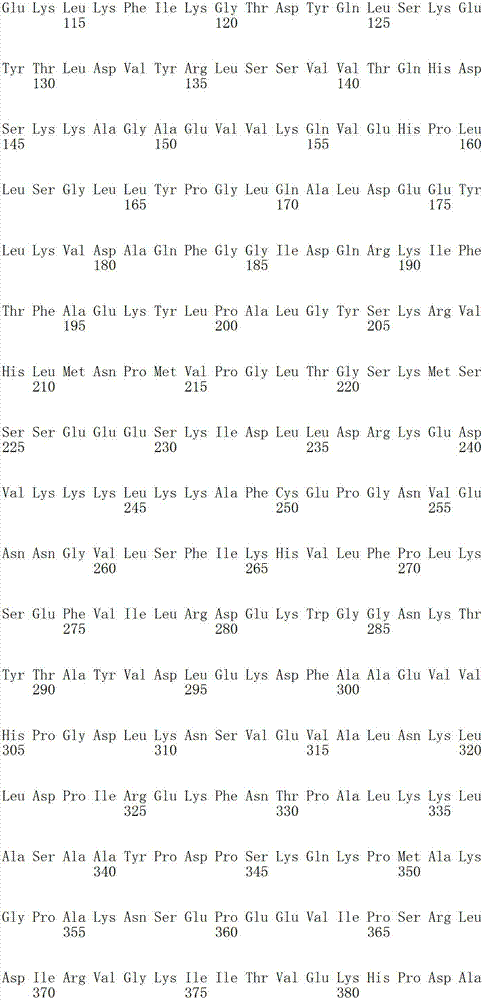


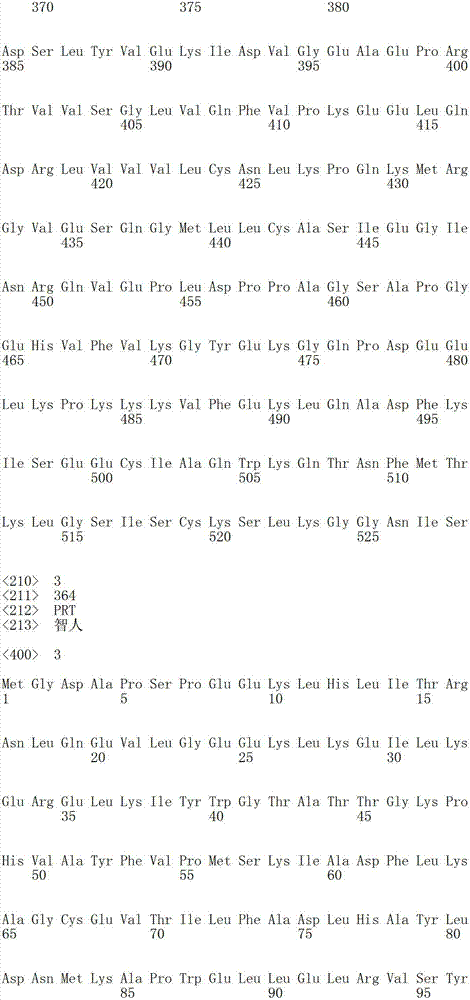



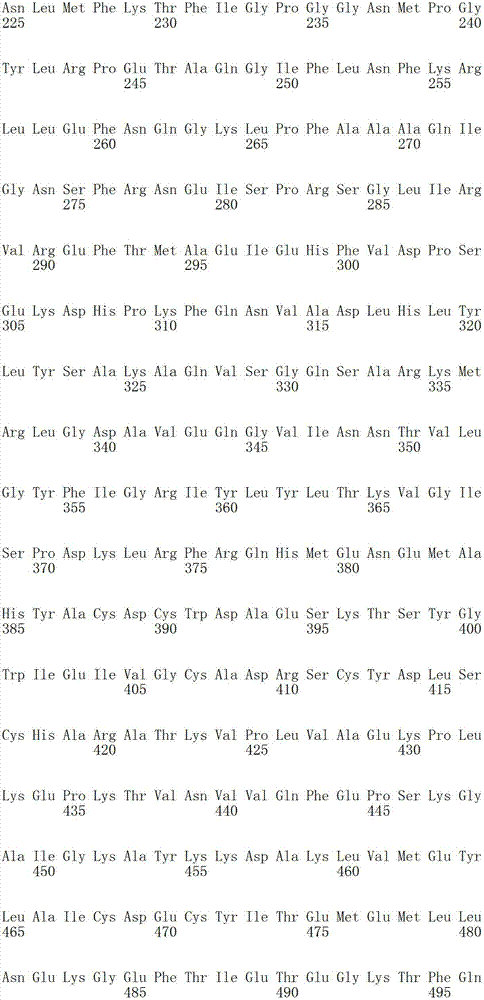


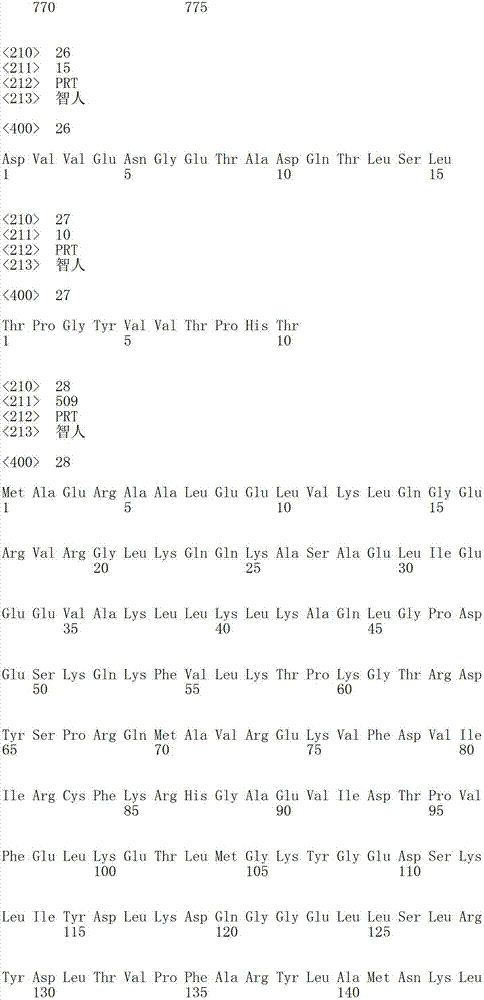
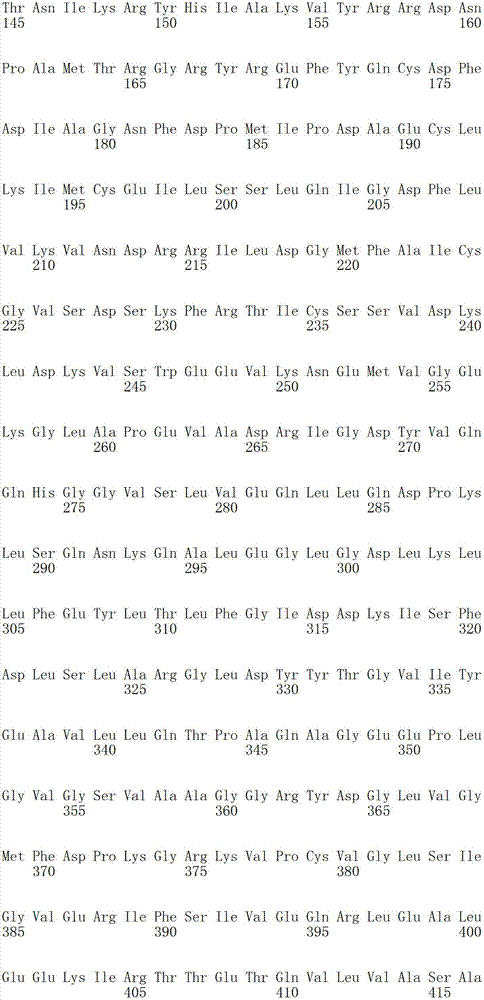


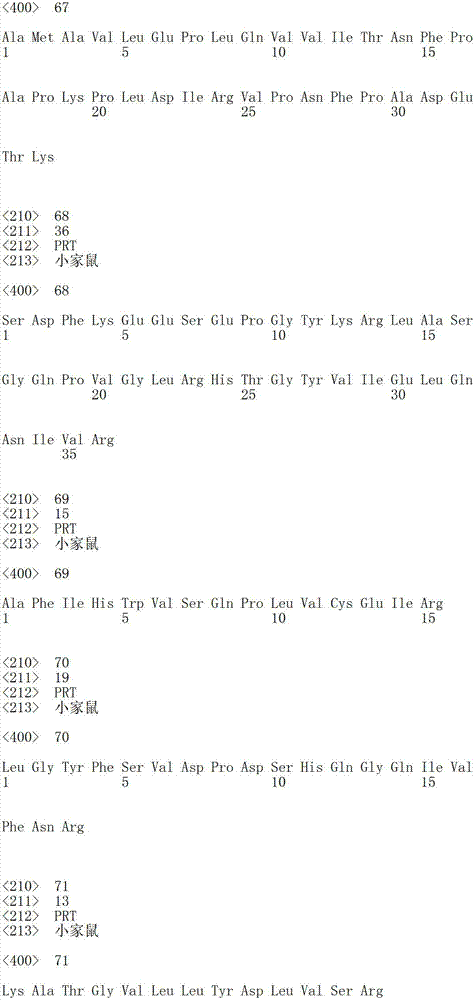


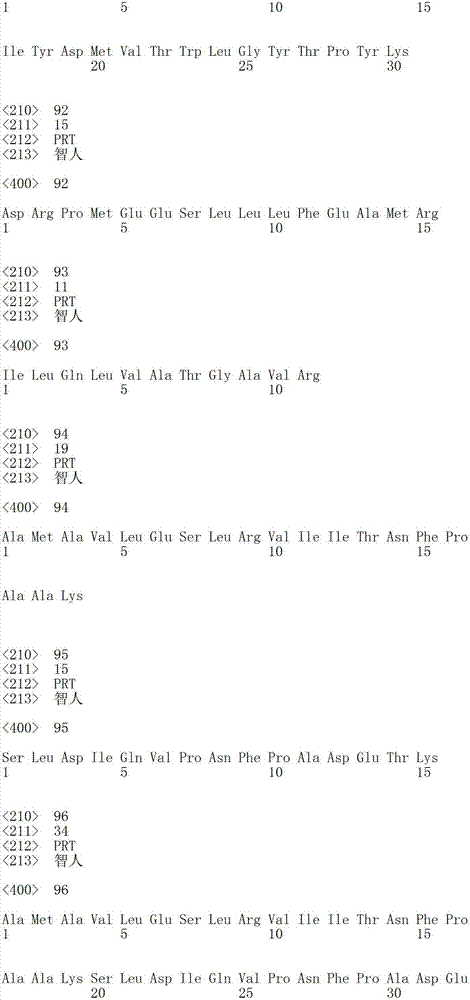
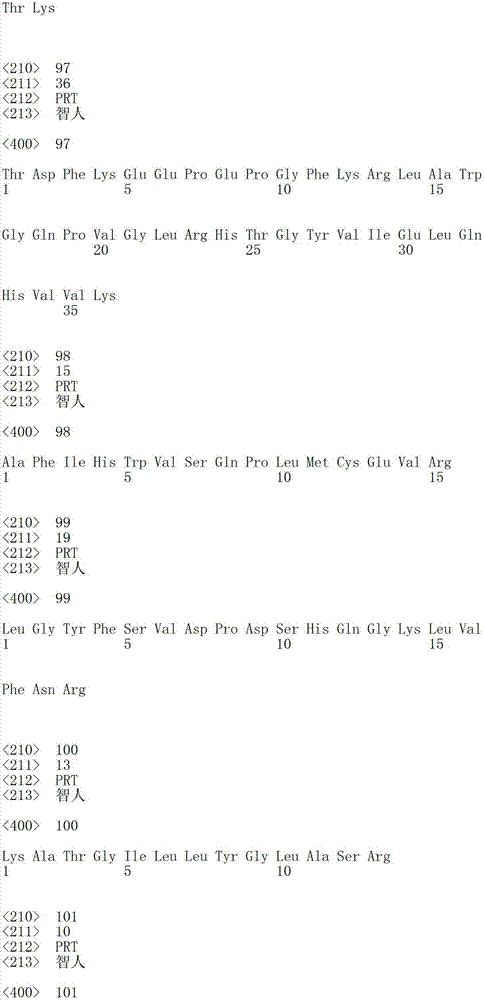
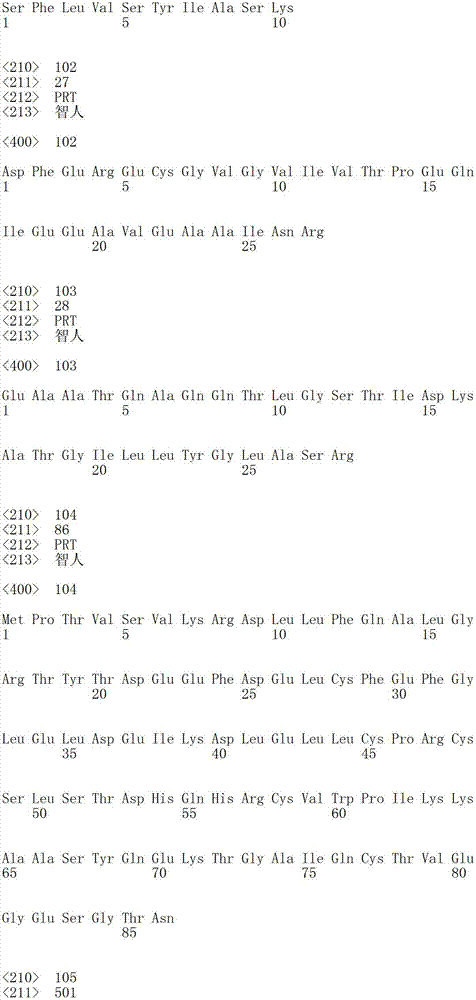
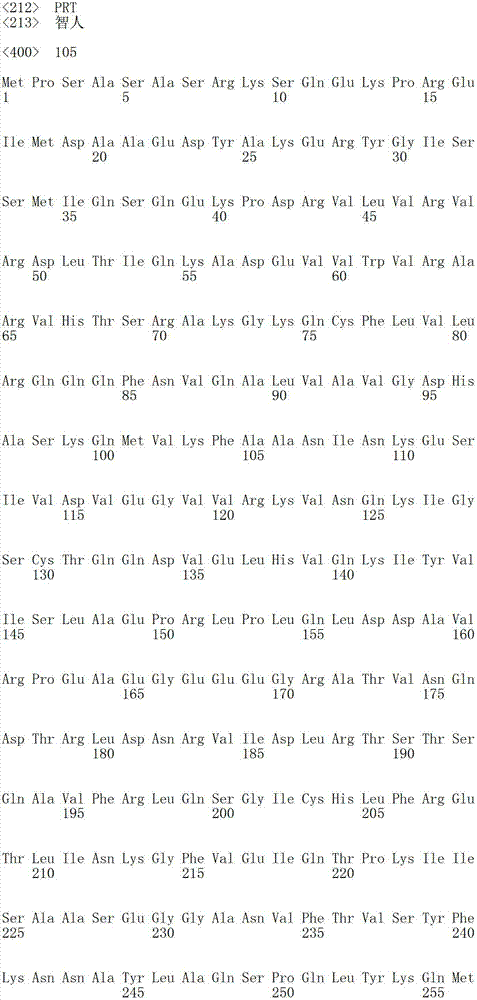


Claims (114)
Priority Applications (1)
| Application Number | Priority Date | Filing Date | Title |
|---|---|---|---|
| CN201610693924.3A CN106474462A (en) | 2009-12-11 | 2010-12-10 | For adjusting the aminoacyl tRNA synthetase of inflammation |
Applications Claiming Priority (7)
| Application Number | Priority Date | Filing Date | Title |
|---|---|---|---|
| US28591909P | 2009-12-11 | 2009-12-11 | |
| US28592309P | 2009-12-11 | 2009-12-11 | |
| US28591309P | 2009-12-11 | 2009-12-11 | |
| US61/285,923 | 2009-12-11 | ||
| US61/285,919 | 2009-12-11 | ||
| US61/285,913 | 2009-12-11 | ||
| PCT/US2010/059963 WO2011072265A1 (en) | 2009-12-11 | 2010-12-10 | Aminoacyl trna synthetases for modulating inflammation |
Related Child Applications (1)
| Application Number | Title | Priority Date | Filing Date |
|---|---|---|---|
| CN201610693924.3A Division CN106474462A (en) | 2009-12-11 | 2010-12-10 | For adjusting the aminoacyl tRNA synthetase of inflammation |
Publications (2)
| Publication Number | Publication Date |
|---|---|
| CN102821784A true CN102821784A (en) | 2012-12-12 |
| CN102821784B CN102821784B (en) | 2016-09-21 |
Family
ID=43617978
Family Applications (2)
| Application Number | Title | Priority Date | Filing Date |
|---|---|---|---|
| CN201080061989.7A Expired - Fee Related CN102821784B (en) | 2009-12-11 | 2010-12-10 | Aminoacyl tRNA synthetases for regulation of inflammation |
| CN201610693924.3A Pending CN106474462A (en) | 2009-12-11 | 2010-12-10 | For adjusting the aminoacyl tRNA synthetase of inflammation |
Family Applications After (1)
| Application Number | Title | Priority Date | Filing Date |
|---|---|---|---|
| CN201610693924.3A Pending CN106474462A (en) | 2009-12-11 | 2010-12-10 | For adjusting the aminoacyl tRNA synthetase of inflammation |
Country Status (9)
| Country | Link |
|---|---|
| US (4) | US9127268B2 (en) |
| EP (2) | EP2939689B1 (en) |
| JP (4) | JP5819314B2 (en) |
| CN (2) | CN102821784B (en) |
| AU (3) | AU2010327926B2 (en) |
| CA (1) | CA2783731C (en) |
| DK (1) | DK2509625T3 (en) |
| ES (1) | ES2535951T3 (en) |
| WO (1) | WO2011072265A1 (en) |
Cited By (8)
| Publication number | Priority date | Publication date | Assignee | Title |
|---|---|---|---|---|
| CN105378075A (en) * | 2013-03-15 | 2016-03-02 | Atyr医药公司 | Histidyl-TRNA synthetase-FC conjugates |
| CN105431739A (en) * | 2013-05-15 | 2016-03-23 | 医药生命融合研究团 | Method for screening cancer metastasis inhibitor using culture of cells or spheroidically aggregated cells in which lysyl-trna synthetase is regulated to be expressed or unexpressed |
| CN106062005A (en) * | 2013-12-30 | 2016-10-26 | 医药生命融合研究团 | Anti-krs monoclonal antibody and use thereof |
| CN108449999A (en) * | 2015-09-01 | 2018-08-24 | Jw生物科学股份有限公司 | The method for infecting disease or the composition and checkout and diagnosis marker of its complication using color amide-tRNA synthesis enzymatic diagnosis |
| CN109161528A (en) * | 2013-01-03 | 2019-01-08 | 特兰西穆内有限公司 | Method for adaptive immune irritation dendritic cells |
| CN110536694A (en) * | 2017-04-20 | 2019-12-03 | Atyr 医药公司 | Compositions and methods for treating pulmonary inflammation |
| CN110891603A (en) * | 2016-09-13 | 2020-03-17 | Ev71(香港)有限公司 | Compositions and methods for treating enterovirus infections |
| US12497466B2 (en) | 2009-03-16 | 2025-12-16 | Atyr Pharma, Inc. | Compositions and methods comprising histidyl-tRNA synthetase splice variants having non-canonical biological activities |
Families Citing this family (46)
| Publication number | Priority date | Publication date | Assignee | Title |
|---|---|---|---|---|
| US20100092434A1 (en) | 2008-06-11 | 2010-04-15 | Atyr Pharma, Inc. | Thrombopoietic activity of tyrosyl-trna synthetase polypeptides |
| US8404471B2 (en) | 2008-06-26 | 2013-03-26 | Atyr Pharma, Inc. | Compositions and methods comprising glycyl-tRNA synthetases having non-canonical biological activities |
| ES2552773T3 (en) | 2009-02-27 | 2015-12-02 | Atyr Pharma, Inc. | Structural reasons for polypeptides associated with cell signaling activity |
| JP5848236B2 (en) | 2009-03-31 | 2016-01-27 | エータイアー ファーマ, インコーポレイテッド | Compositions and methods comprising aspartyl tRNA synthetase with non-standard biological activity |
| EP2939689B1 (en) | 2009-12-11 | 2017-09-13 | aTyr Pharma, Inc. | Glutaminyl tRNA synthetases for use in the treatment of inflammatory disorders |
| US8828685B2 (en) | 2010-02-04 | 2014-09-09 | The Scripps Research Institute | Monomeric forms of human aminoacyl-t-RNA synthetases having non-canonical biological activities |
| AU2011248625B2 (en) | 2010-04-26 | 2017-01-05 | Pangu Biopharma Limited | Innovative discovery of therapeutic, diagnostic, and antibody compositions related to protein fragments of cysteinyl-tRNA synthetase |
| CA2797259C (en) | 2010-04-27 | 2020-09-29 | Atyr Pharma, Inc. | Innovative discovery of therapeutic, diagnostic, and antibody compositions related to protein fragments of threonyl trna synthetases |
| WO2011139799A2 (en) | 2010-04-27 | 2011-11-10 | Atyr Pharma, Inc. | Innovative discovery of therapeutic, diagnostic, and antibody compositions related to protein fragments of isoleucyl trna synthetases |
| CN103097524B (en) | 2010-04-28 | 2016-08-03 | Atyr医药公司 | The innovation for the treatment of, diagnosis and the antibody compositions relevant to the protein fragments of Alanyl-tRNA synthetase finds |
| CN103097523B (en) | 2010-04-29 | 2016-09-28 | Atyr医药公司 | The innovation for the treatment of, diagnosis and the antibody compositions relevant to the protein fragments of Asparaginyl-tRNA synthetase finds |
| CA2797393C (en) * | 2010-04-29 | 2020-03-10 | Atyr Pharma, Inc. | Innovative discovery of therapeutic, diagnostic, and antibody compositions related to protein fragments of valyl trna synthetases |
| US9068177B2 (en) | 2010-04-29 | 2015-06-30 | Atyr Pharma, Inc | Innovative discovery of therapeutic, diagnostic, and antibody compositions related to protein fragments of glutaminyl-tRNA synthetases |
| CN103096925A (en) | 2010-05-03 | 2013-05-08 | Atyr医药公司 | Innovative discovery of therapeutic, diagnostic, and antibody compositions related to protein fragments of arginyl-tRNA synthetases |
| AU2011248357B2 (en) | 2010-05-03 | 2017-02-23 | Pangu Biopharma Limited | Innovative discovery of therapeutic, diagnostic, and antibody compositions related to protein fragments of seryl-tRNA synthetases |
| WO2011140132A2 (en) | 2010-05-03 | 2011-11-10 | Atyr Pharma, Inc. | Innovative discovery of therapeutic, diagnostic, and antibody compositions related to protein fragments of phenylalanyl-alpha-trna synthetases |
| JP6008841B2 (en) | 2010-05-03 | 2016-10-19 | エータイアー ファーマ, インコーポレイテッド | Innovative discovery of therapeutic, diagnostic and antibody compositions related to protein fragments of methionyl tRNA synthetase |
| CN102985103A (en) | 2010-05-04 | 2013-03-20 | Atyr医药公司 | Innovative discovery of therapeutic, diagnostic, and antibody compositions related to protein fragments of p38 multi-tRNA synthetase complex |
| US9062301B2 (en) | 2010-05-04 | 2015-06-23 | Atyr Pharma, Inc. | Innovative discovery of therapeutic, diagnostic, and antibody compositions related to protein fragments of glutamyl-prolyl-tRNA synthetases |
| US8945541B2 (en) | 2010-05-14 | 2015-02-03 | Atyr Pharma, Inc. | Innovative discovery of therapeutic, diagnostic, and antibody compositions related to protein fragments of phenylalanyl-beta-tRNA synthetases |
| JP6027965B2 (en) | 2010-05-17 | 2016-11-16 | エータイアー ファーマ, インコーポレイテッド | Innovative discovery of therapeutic, diagnostic and antibody compositions related to protein fragments of leucyl-tRNA synthetase |
| JP5906237B2 (en) | 2010-06-01 | 2016-04-20 | エータイアー ファーマ, インコーポレイテッド | Innovative discovery of therapeutic, diagnostic and antibody compositions related to protein fragments of lysyl tRNA synthetase |
| US8999321B2 (en) | 2010-07-12 | 2015-04-07 | Atyr Pharma, Inc. | Innovative discovery of therapeutic, diagnostic, and antibody compositions related to protein fragments of glycyl-tRNA synthetases |
| CN103118695B (en) | 2010-07-12 | 2016-08-03 | Atyr医药公司 | Discovery of therapeutic, diagnostic and antibody compositions related to protein fragments of glycyl-tRNA synthetase |
| CA2804278C (en) | 2010-07-12 | 2021-07-13 | Atyr Pharma, Inc. | Innovative discovery of therapeutic, diagnostic, and antibody compositions related to protein fragments of aspartyl-trna synthetases |
| WO2012021249A2 (en) | 2010-07-12 | 2012-02-16 | Atyr Pharma, Inc. | Innovative discovery of therapeutic, diagnostic, and antibody compositions related to protein fragments of histidyl-trna synthetases |
| WO2012027611A2 (en) | 2010-08-25 | 2012-03-01 | Atyr Pharma, Inc. | INNOVATIVE DISCOVERY OF THERAPEUTIC, DIAGNOSTIC, AND ANTIBODY COMPOSITIONS RELATED TO PROTEIN FRAGMENTS OF TYROSYL-tRNA SYNTHETASES |
| AU2011311956C1 (en) * | 2010-10-06 | 2017-06-15 | Pangu Biopharma Limited | Innovative discovery of therapeutic, diagnostic, and antibody compositions related protein fragments of tryptophanyl tRNA synthetases |
| US20160144003A1 (en) * | 2011-05-19 | 2016-05-26 | The Scripps Research Institute | Compositions and methods for treating charcot-marie-tooth diseases and related neuronal diseases |
| WO2013022982A2 (en) | 2011-08-09 | 2013-02-14 | Atyr Pharma, Inc. | Pegylated tyrosyl-trna synthetase polypeptides |
| WO2013086228A1 (en) | 2011-12-06 | 2013-06-13 | Atyr Pharma, Inc. | Pegylated aspartyl-trna synthetase polypeptides |
| WO2013086216A1 (en) | 2011-12-06 | 2013-06-13 | Atyr Pharma, Inc. | Improved aspartyl-trna synthetases |
| JP6169608B2 (en) | 2011-12-29 | 2017-07-26 | エータイアー ファーマ, インコーポレイテッド | Aspartyl tRNA synthetase-Fc conjugate |
| US8835387B2 (en) | 2012-02-16 | 2014-09-16 | Atyr Pharma, Inc. | Histidyl-tRNA synthetases for treating autoimmune and inflammatory diseases |
| DE112013006947T5 (en) * | 2013-04-15 | 2015-12-31 | Mitsubishi Electric Corporation | Rotor support structure of a rotary electric machine for hybrid vehicles |
| CN103409378B (en) * | 2013-04-25 | 2016-04-20 | 复旦大学 | A kind of preparation method of tyrosyl-t RNA synthetase mutant and application |
| WO2015183019A1 (en) | 2014-05-28 | 2015-12-03 | 재단법인 의약바이오컨버젼스연구단 | Novel lycyl trna synthetase fragment and microvesicles comprising same |
| EP3292872B9 (en) | 2015-02-26 | 2023-08-09 | MirimGENE Co., Ltd. | Composition for treatment or prevention of infectious inflammatory disease, or composition for immune enhancement, comprising tryptophanyl-trna synthetase as active ingredient |
| KR101917677B1 (en) * | 2016-06-01 | 2018-11-12 | 연세대학교 산학협력단 | Usefulness of Methionyl-tRNA synthetase (MRS) as a prognostic biomarker of lung cancer |
| US10767164B2 (en) | 2017-03-30 | 2020-09-08 | The Research Foundation For The State University Of New York | Microenvironments for self-assembly of islet organoids from stem cells differentiation |
| CN110998327A (en) * | 2017-05-12 | 2020-04-10 | 温口特 | Method for diagnosing cholangiocarcinoma by using methionyl-tRNA synthetase in cholangiocytes |
| KR102111681B1 (en) * | 2017-09-05 | 2020-05-15 | (주)온코태그디아그노스틱 | Method for diagnosing pancreatic cancer using methionyl-tRNA synthetase and pancreatic acinar cell-specific marker |
| KR101886415B1 (en) * | 2017-09-15 | 2018-08-08 | 충남대학교산학협력단 | Recombinant vector comprising tryptophanyl-tRNA synthetase gene and uses thereof |
| RU2749591C1 (en) * | 2017-09-15 | 2021-06-15 | БайоконТАК Ко., Лтд. | Pharmaceutical composition containing an antibody specifically binding with the n-terminal of lysyl-trna synthetase as an effective ingredient for the prevention or treatment of diseases caused by cell migration |
| CN112512559B (en) * | 2018-07-26 | 2025-02-28 | Atyr医药公司 | Compositions and methods for treating NRP2-related diseases |
| WO2025079943A1 (en) * | 2023-10-10 | 2025-04-17 | 한국생명공학연구원 | Phenylalanyl-trna synthase, subunit thereof, and uses of fragments and variants of synthase and subunit |
Citations (4)
| Publication number | Priority date | Publication date | Assignee | Title |
|---|---|---|---|---|
| US20030215827A1 (en) * | 2001-05-22 | 2003-11-20 | Henry Yue | Aminoacyl trna synthetases |
| US20040018505A1 (en) * | 2001-06-29 | 2004-01-29 | Lee Ernestine A. | Aminoacyl trna synthetases |
| US20040048290A1 (en) * | 2001-12-13 | 2004-03-11 | Lee Ernestine A | Aminoacyl trna synthetases |
| WO2009114623A2 (en) * | 2008-03-11 | 2009-09-17 | University Of North Carolina At Chapel Hill | Angiostatic compositions comprising truncated tyrosyl-trna synthetase polypeptides and methods of using same |
Family Cites Families (124)
| Publication number | Priority date | Publication date | Assignee | Title |
|---|---|---|---|---|
| US4489710A (en) | 1981-06-23 | 1984-12-25 | Xoma Corporation | Composition and method for transplantation therapy |
| US4671958A (en) | 1982-03-09 | 1987-06-09 | Cytogen Corporation | Antibody conjugates for the delivery of compounds to target sites |
| US5155214A (en) | 1984-03-05 | 1992-10-13 | The Salk Institute For Biological Studies | Basic fibroblast growth factor |
| US4625014A (en) | 1984-07-10 | 1986-11-25 | Dana-Farber Cancer Institute, Inc. | Cell-delivery agent |
| US4542225A (en) | 1984-08-29 | 1985-09-17 | Dana-Farber Cancer Institute, Inc. | Acid-cleavable compound |
| US4638045A (en) | 1985-02-19 | 1987-01-20 | Massachusetts Institute Of Technology | Non-peptide polyamino acid bioerodible polymers |
| US4751180A (en) | 1985-03-28 | 1988-06-14 | Chiron Corporation | Expression using fused genes providing for protein product |
| US4935233A (en) | 1985-12-02 | 1990-06-19 | G. D. Searle And Company | Covalently linked polypeptide cell modulators |
| US4946778A (en) | 1987-09-21 | 1990-08-07 | Genex Corporation | Single polypeptide chain binding molecules |
| US4873192A (en) | 1987-02-17 | 1989-10-10 | The United States Of America As Represented By The Department Of Health And Human Services | Process for site specific mutagenesis without phenotypic selection |
| US5132405A (en) | 1987-05-21 | 1992-07-21 | Creative Biomolecules, Inc. | Biosynthetic antibody binding sites |
| US5091513A (en) | 1987-05-21 | 1992-02-25 | Creative Biomolecules, Inc. | Biosynthetic antibody binding sites |
| US5725871A (en) | 1989-08-18 | 1998-03-10 | Danbiosyst Uk Limited | Drug delivery compositions comprising lysophosphoglycerolipid |
| US5707644A (en) | 1989-11-04 | 1998-01-13 | Danbiosyst Uk Limited | Small particle compositions for intranasal drug delivery |
| US5556645A (en) | 1990-01-12 | 1996-09-17 | Bockman; Richard | Methods of enhancing wound healing and tissue repair |
| US5466468A (en) | 1990-04-03 | 1995-11-14 | Ciba-Geigy Corporation | Parenterally administrable liposome formulation comprising synthetic lipids |
| US5399363A (en) | 1991-01-25 | 1995-03-21 | Eastman Kodak Company | Surface modified anticancer nanoparticles |
| US5981606A (en) | 1991-03-01 | 1999-11-09 | Warner-Lambert Company | Therapeutic TGF-beta-wound healing compositions and methods for preparing and using same |
| EP0519596B1 (en) | 1991-05-17 | 2005-02-23 | Merck & Co. Inc. | A method for reducing the immunogenicity of antibody variable domains |
| US5756353A (en) | 1991-12-17 | 1998-05-26 | The Regents Of The University Of California | Expression of cloned genes in the lung by aerosol-and liposome-based delivery |
| ES2105262T3 (en) | 1992-05-18 | 1997-10-16 | Minnesota Mining & Mfg | PHARMACY SUPPLY DEVICE THROUGH THE MUCOSAS. |
| US5484703A (en) | 1993-04-22 | 1996-01-16 | United States Of America | Assay using recombinant histidyl-tRNA synthetase |
| US5543158A (en) | 1993-07-23 | 1996-08-06 | Massachusetts Institute Of Technology | Biodegradable injectable nanoparticles |
| US5641867A (en) | 1993-09-29 | 1997-06-24 | The Trustees Of Columbia University In The City Of New York | Antibody which specifically binds to endothelial-monocyte activating polypeptide II |
| IE80468B1 (en) | 1995-04-04 | 1998-07-29 | Elan Corp Plc | Controlled release biodegradable nanoparticles containing insulin |
| US6013483A (en) | 1995-06-07 | 2000-01-11 | Human Genome Sciences, Inc. | DNA encoding endothelial monocyte activating polypeptide III |
| EP1288299A3 (en) | 1996-01-19 | 2003-12-17 | Smithkline Beecham Plc | TRNA synthetase |
| JPH11504524A (en) | 1996-01-19 | 1999-04-27 | スミスクライン・ビーチャム・パブリック・リミテッド・カンパニー | Histidyl-tRNA synthetase of Staphylococcus aureus |
| GB9601067D0 (en) | 1996-01-19 | 1996-03-20 | Smithkline Beecham Plc | Novel compounds |
| GB9607993D0 (en) | 1996-04-18 | 1996-06-19 | Smithkline Beecham Plc | Novel compounds |
| US5795758A (en) * | 1997-04-18 | 1998-08-18 | Smithkline Beecham Corporation | DNA encoding histidyl tRNA synthetase variant from Streptococcus pneumoniae |
| US5882892A (en) * | 1997-07-23 | 1999-03-16 | Smithkline Beecham Corporation | Asps |
| US5858720A (en) | 1997-07-23 | 1999-01-12 | Smithkline Beecham Corporation | Hiss |
| US6391311B1 (en) | 1998-03-17 | 2002-05-21 | Genentech, Inc. | Polypeptides having homology to vascular endothelial cell growth factor and bone morphogenetic protein 1 |
| US6428960B1 (en) | 1998-03-04 | 2002-08-06 | Onyx Pharmaceuticals, Inc. | Selection method for producing recombinant baculovirus |
| AU2898299A (en) | 1998-03-04 | 1999-09-20 | Onyx Pharmaceuticals, Inc. | Baculovirus expression system and method for high throughput expression of genetic material |
| US6800286B1 (en) | 1998-08-19 | 2004-10-05 | The Regents Of The University Of Colorado | Chimeric fibroblast growth factor proteins, nucleic acid molecules, and uses thereof |
| CA2340468A1 (en) | 1998-11-13 | 2000-05-25 | Children's Hospital Of Los Angeles | Methods of facilitating vascular growth |
| US6548060B1 (en) * | 1999-11-18 | 2003-04-15 | Sunghoon Kim | Anti-apoptotic use of human glutaminyl-tRNA synthetase with two consecutive pro-apoptotic mediators |
| US20030165921A1 (en) | 2000-02-03 | 2003-09-04 | Tang Y. Tom | Novel nucleic acids and polypeptides |
| WO2001057190A2 (en) | 2000-02-03 | 2001-08-09 | Hyseq, Inc. | Novel nucleic acids and polypeptides |
| US20070042392A1 (en) | 2000-02-03 | 2007-02-22 | Nuvelo, Inc. | Novel nucleic acids and polypeptides |
| US20020128187A1 (en) | 2000-02-03 | 2002-09-12 | Tang Y. Tom | Novel nucleic acids and polypeptides |
| US20030158400A1 (en) | 2000-02-03 | 2003-08-21 | Tang Y. Tom | Novel nucleic acids and polypeptides |
| CN1314486A (en) * | 2000-03-17 | 2001-09-26 | 上海博德基因开发有限公司 | New polypeptide-human histidinacyl-tRNA sythetase 85 and polynucleotide for coding such polypeptide |
| US6436703B1 (en) | 2000-03-31 | 2002-08-20 | Hyseq, Inc. | Nucleic acids and polypeptides |
| US7144984B2 (en) | 2000-03-31 | 2006-12-05 | The Scripps Research Institute | Human aminoacyl-tRNA synthetase polypeptides useful for the regulation of angiogenesis |
| EP2258834B1 (en) | 2000-03-31 | 2015-09-23 | The Scripps Research Institute | Human aminoacyl-tRNA synthetase polypeptides useful for the regulation of angiogenesis |
| US7273844B2 (en) | 2000-03-31 | 2007-09-25 | The Scripps Research Institute | Tryptophanyl-tRNA synthetase-derived polypeptides useful for the regulation of angiogenesis |
| US20040181830A1 (en) | 2001-05-07 | 2004-09-16 | Kovalic David K. | Nucleic acid molecules and other molecules associated with plants and uses thereof for plant improvement |
| CN1322818A (en) | 2000-05-09 | 2001-11-21 | 上海博德基因开发有限公司 | New polypeptide human class-II aminoacyl-tRNA synthetase 10 and encoding polynucleotide of the same polypeptide |
| JP2004512014A (en) | 2000-05-18 | 2004-04-22 | 学校法人日本大学 | Testing method for ischemic condition |
| JP2004510407A (en) | 2000-05-25 | 2004-04-08 | インサイト・ゲノミックス・インコーポレイテッド | Aminoacyl-tRNA synthetase |
| CN1341727A (en) | 2000-09-07 | 2002-03-27 | 上海博德基因开发有限公司 | A novel polypeptide-methionyl tRNA conjugated enzyme 35.09 and polynucleotide for coding said polypeptide |
| CN1341725A (en) | 2000-09-07 | 2002-03-27 | 上海博德基因开发有限公司 | A novel polypeptide-human threonyl-tRNA synthetase 48.73 and polynucleotide for coding said polypeptide |
| US20070037165A1 (en) | 2000-09-08 | 2007-02-15 | Applera Corporation | Polymorphisms in known genes associated with human disease, methods of detection and uses thereof |
| US6812339B1 (en) | 2000-09-08 | 2004-11-02 | Applera Corporation | Polymorphisms in known genes associated with human disease, methods of detection and uses thereof |
| CN1352242A (en) | 2000-11-02 | 2002-06-05 | 上海博德基因开发有限公司 | New polypeptide-human glutamyl tRNA synthetase 12.65 and polynucleotide for encoding such polypeptide |
| CN1352252A (en) | 2000-11-06 | 2002-06-05 | 上海博德基因开发有限公司 | New polypeptide-human II aminoacyl-tRNA synthetase 11.77 and polynucleotide for encoding such polypeptide |
| WO2002059323A2 (en) | 2000-12-15 | 2002-08-01 | Incyte Genomics, Inc. | Aminoacyl trna synthetases |
| WO2002068579A2 (en) | 2001-01-10 | 2002-09-06 | Pe Corporation (Ny) | Kits, such as nucleic acid arrays, comprising a majority of human exons or transcripts, for detecting expression and other uses thereof |
| WO2002055663A2 (en) | 2001-01-12 | 2002-07-18 | Exelixis, Inc. | Srebp pathway modulation through targeting hisrs |
| NZ528193A (en) | 2001-02-23 | 2006-02-24 | Scripps Research Inst | Tryptophanyl-tRNA synthetase derived polypeptides useful for the regulation of angiogenesis |
| US6903189B2 (en) | 2001-03-21 | 2005-06-07 | The Scripps Research Institute | Human aminoacyl-tRNA synthetase polypeptides useful for the regulation of angiogenesis |
| KR100405919B1 (en) | 2001-06-05 | 2003-11-14 | 주식회사 이매진 | Pharmaceutical composition for immunological enhancement comprising N-terminal peptide of p43 as an effective component |
| AU2002332430A1 (en) | 2001-07-26 | 2003-02-17 | Novartis Ag | Methods of treating neuropilin-mediated diseases |
| US20040142325A1 (en) | 2001-09-14 | 2004-07-22 | Liat Mintz | Methods and systems for annotating biomolecular sequences |
| US20040101879A1 (en) | 2002-01-11 | 2004-05-27 | Cynthia Seidel-Dugan | Srebp pathway modulation through targeting hisrs |
| CA2479167A1 (en) | 2002-03-20 | 2003-10-02 | University Of Florida Research Foundation, Inc. | Raav vector compositions and methods for the treatment of choroidal neovascularization |
| AU2003232086A1 (en) | 2002-05-10 | 2003-11-11 | Incyte Corporation | Nucleic acid-associated proteins |
| WO2003094862A2 (en) | 2002-05-13 | 2003-11-20 | Rigel Pharmaceuticals, Inc. | tRNA SYNTHASE: MODULATORS OF ANGIOGENESIS |
| KR100515016B1 (en) | 2002-07-22 | 2005-09-15 | 재단법인서울대학교산학협력재단 | Pharmaceutical composition for wound treatment containing p43 as an effective component |
| AU2003289716A1 (en) | 2002-09-12 | 2004-04-30 | Incyte Corporation | Molecules for diagnostics and therapeutics |
| WO2004060262A2 (en) | 2003-01-07 | 2004-07-22 | Lorantis Limited | Modulators of notch signalling for use in immunotherpapy |
| WO2004063355A2 (en) | 2003-01-10 | 2004-07-29 | Protein Design Labs, Inc. | Novel methods of diagnosis of metastatic cancer, compositions and methods of screening for modulators of matastatic cancer |
| CN1519315A (en) * | 2003-01-21 | 2004-08-11 | 上海博德基因开发有限公司 | Polypeptide human histidyl tRNA synzyme 13.09 and polynucleotide for encoding polypeptide |
| WO2004064863A1 (en) | 2003-01-23 | 2004-08-05 | Lorantis Limited | Treatment of autoimmune diseases using an activator for the notch signaling pathway |
| KR100575251B1 (en) | 2003-03-03 | 2006-05-02 | 재단법인서울대학교산학협력재단 | Pharmaceutical composition for treatment of cancer containing p38/JTV-1 as an effective component and screening method for pharmaceutical composition for treatment of cancer |
| US20070054278A1 (en) | 2003-11-18 | 2007-03-08 | Applera Corporation | Polymorphisms in nucleic acid molecules encoding human enzyme proteins, methods of detection and uses thereof |
| EP1713914A2 (en) | 2004-01-28 | 2006-10-25 | Celldex Therapeutics Limited | MEDICAL TREATMENT USING AN RNAi AGENT TARGETING A HUMAN NOTCH SIGNALLING PATHWAY MEMBER |
| WO2005087953A2 (en) | 2004-03-05 | 2005-09-22 | Applera Corporation | Genetic polymorphisms associated with coronary heart disease, methods of detection and uses thereof |
| WO2005113812A2 (en) | 2004-04-23 | 2005-12-01 | Invitrogen Corporation | Collections of matched biological reagents and methods for identifying matched reagents |
| KR100599454B1 (en) | 2004-04-27 | 2006-07-12 | 재단법인서울대학교산학협력재단 | New Uses of AIM3 to Act as Tumor Suppressor |
| EP2484364B1 (en) | 2004-06-04 | 2014-02-19 | The Scripps Research Institute | Compositions for treatment of neovascular diseases |
| US20060024288A1 (en) | 2004-08-02 | 2006-02-02 | Pfizer Inc. | tRNA synthetase fragments |
| US8282921B2 (en) | 2004-08-02 | 2012-10-09 | Paul Glidden | tRNA synthetase fragments |
| US20060078553A1 (en) | 2004-10-07 | 2006-04-13 | Paul Glidden | Diverse multi-unit complexes including a tRNA synthetase fragment |
| US20060079673A1 (en) | 2004-08-02 | 2006-04-13 | Paul Glidden | Polynucleotides encoding tRNA synthetase fragments and uses thereof |
| JP2008518610A (en) | 2004-11-03 | 2008-06-05 | アルマック ダイアグノスティックス リミテッド | Transcriptome microarray technique and method of using the same |
| EP1657232A1 (en) | 2004-11-05 | 2006-05-17 | Cellzome Ag | Use of S-enantiomers of alpha-sustituted aryl acetic acids for the prevention of Alzheimer's disease |
| US7459529B2 (en) | 2004-11-24 | 2008-12-02 | Seoul National University Industry Foundation | AIMP2-DX2 and its uses |
| US8003780B2 (en) | 2004-11-24 | 2011-08-23 | Neomics Co., Ltd. | AIMP2-DX2 gene and SiRNA targeting AIMP2-DX2 |
| JP2008528577A (en) | 2005-02-01 | 2008-07-31 | イマジェネ カンパニー リミテッド | Method for promoting collagen synthesis and / or KGF expression |
| US20060275794A1 (en) | 2005-03-07 | 2006-12-07 | Invitrogen Corporation | Collections of matched biological reagents and methods for identifying matched reagents |
| KR100689274B1 (en) | 2005-03-30 | 2007-03-08 | 김현기 | Human primary cancer gene, protein encoded thereby |
| US7842467B1 (en) | 2005-05-12 | 2010-11-30 | Celera Corporation | Breast disease targets and uses thereof |
| US20070072175A1 (en) | 2005-05-13 | 2007-03-29 | Biogen Idec Ma Inc. | Nucleotide array containing polynucleotide probes complementary to, or fragments of, cynomolgus monkey genes and the use thereof |
| US7514229B2 (en) | 2005-09-29 | 2009-04-07 | The Board Of Trustees Of The Leland Stanford Junior University | Methods for diagnosing and evaluating treatment of blood disorders |
| US8026088B2 (en) | 2005-12-02 | 2011-09-27 | The Scripps Research Institute | Angiogenic tyrosyl tRNA synthetase compositions and methods |
| US8014957B2 (en) | 2005-12-15 | 2011-09-06 | Fred Hutchinson Cancer Research Center | Genes associated with progression and response in chronic myeloid leukemia and uses thereof |
| AU2006335748A1 (en) | 2006-01-23 | 2007-07-26 | Imagene Co., Ltd. | Novel peptide and use thereof |
| EP2029620B1 (en) | 2006-05-26 | 2016-05-25 | Waikatolink Limited | Ob fold domains |
| WO2008007818A1 (en) | 2006-07-13 | 2008-01-17 | Seoul National University Industry Foundation | Novel use of aimp1 for controlling glucose level |
| EP2052088A2 (en) | 2006-08-02 | 2009-04-29 | Genizon Biosciences | Genemap of the human genes associated with psoriasis |
| US8586006B2 (en) | 2006-08-09 | 2013-11-19 | Institute For Systems Biology | Organ-specific proteins and methods of their use |
| JP2010526527A (en) | 2007-02-01 | 2010-08-05 | イマジーン・カンパニー・リミテッド | Novel polypeptide having antitumor activity |
| JP2010525362A (en) | 2007-04-27 | 2010-07-22 | アイマジーン カンパニー リミテッド | Screening method for immunomodulators |
| US20100092434A1 (en) | 2008-06-11 | 2010-04-15 | Atyr Pharma, Inc. | Thrombopoietic activity of tyrosyl-trna synthetase polypeptides |
| US8404471B2 (en) | 2008-06-26 | 2013-03-26 | Atyr Pharma, Inc. | Compositions and methods comprising glycyl-tRNA synthetases having non-canonical biological activities |
| EP2334791B1 (en) | 2008-08-18 | 2016-07-13 | Medicinal Bioconvergence Research Center | Method for controlling cancer metastasis or cancer cell migration by modulating the cellular level of lysyl trna synthetase |
| US8901081B2 (en) | 2008-10-10 | 2014-12-02 | Snu R&Db Foundation | Uses of GRS proteins or fragments thereof |
| KR101067817B1 (en) | 2008-10-10 | 2011-09-27 | 서울대학교산학협력단 | A composition for diagnosing arthritis, comprising an antibody against an AIMP1 polypeptide |
| KR101067815B1 (en) | 2009-02-05 | 2011-09-27 | 서울대학교산학협력단 | New Diagnostic Markers of Type 1 Diabetes |
| US20120058133A1 (en) | 2009-02-19 | 2012-03-08 | President And Fellows Of Harvard College | Inhibition of trna synthetases and therapeutic applications thereof |
| ES2552773T3 (en) | 2009-02-27 | 2015-12-02 | Atyr Pharma, Inc. | Structural reasons for polypeptides associated with cell signaling activity |
| WO2010107825A2 (en) * | 2009-03-16 | 2010-09-23 | Pangu Biopharma Limited | Compositions and methods comprising histidyl-trna synthetase splice variants having non-canonical biological activities |
| JP5848236B2 (en) | 2009-03-31 | 2016-01-27 | エータイアー ファーマ, インコーポレイテッド | Compositions and methods comprising aspartyl tRNA synthetase with non-standard biological activity |
| JP5590540B2 (en) * | 2009-05-13 | 2014-09-17 | 国立大学法人東北大学 | Method for synthesizing positron labeled protein |
| US20110150885A1 (en) | 2009-12-11 | 2011-06-23 | Atyr Pharma, Inc. | Aminoacyl trna synthetases for modulating hematopoiesis |
| EP2939689B1 (en) | 2009-12-11 | 2017-09-13 | aTyr Pharma, Inc. | Glutaminyl tRNA synthetases for use in the treatment of inflammatory disorders |
| US8828395B2 (en) | 2009-12-11 | 2014-09-09 | Atyr Pharma, Inc. | Antibodies that bind tyrosyl-tRNA synthetases |
| US8828685B2 (en) | 2010-02-04 | 2014-09-09 | The Scripps Research Institute | Monomeric forms of human aminoacyl-t-RNA synthetases having non-canonical biological activities |
| US9068177B2 (en) * | 2010-04-29 | 2015-06-30 | Atyr Pharma, Inc | Innovative discovery of therapeutic, diagnostic, and antibody compositions related to protein fragments of glutaminyl-tRNA synthetases |
| WO2012021249A2 (en) | 2010-07-12 | 2012-02-16 | Atyr Pharma, Inc. | Innovative discovery of therapeutic, diagnostic, and antibody compositions related to protein fragments of histidyl-trna synthetases |
-
2010
- 2010-12-10 EP EP15152652.2A patent/EP2939689B1/en not_active Not-in-force
- 2010-12-10 CN CN201080061989.7A patent/CN102821784B/en not_active Expired - Fee Related
- 2010-12-10 US US13/514,952 patent/US9127268B2/en not_active Expired - Fee Related
- 2010-12-10 CN CN201610693924.3A patent/CN106474462A/en active Pending
- 2010-12-10 WO PCT/US2010/059963 patent/WO2011072265A1/en not_active Ceased
- 2010-12-10 AU AU2010327926A patent/AU2010327926B2/en not_active Ceased
- 2010-12-10 DK DK10793402.8T patent/DK2509625T3/en active
- 2010-12-10 EP EP10793402.8A patent/EP2509625B1/en not_active Not-in-force
- 2010-12-10 ES ES10793402.8T patent/ES2535951T3/en active Active
- 2010-12-10 CA CA2783731A patent/CA2783731C/en not_active Expired - Fee Related
- 2010-12-10 JP JP2012543321A patent/JP5819314B2/en not_active Expired - Fee Related
-
2013
- 2013-02-07 US US13/762,151 patent/US9328340B2/en not_active Expired - Fee Related
-
2014
- 2014-08-08 AU AU2014210626A patent/AU2014210626B2/en not_active Ceased
- 2014-11-14 US US14/541,792 patent/US9540628B2/en not_active Expired - Fee Related
-
2015
- 2015-05-13 JP JP2015098145A patent/JP2015145425A/en not_active Withdrawn
-
2016
- 2016-11-30 US US15/365,079 patent/US9943577B2/en not_active Expired - Fee Related
-
2017
- 2017-01-26 JP JP2017012111A patent/JP6248218B2/en not_active Expired - Fee Related
- 2017-01-26 JP JP2017012112A patent/JP2017070313A/en not_active Withdrawn
- 2017-05-16 AU AU2017203261A patent/AU2017203261A1/en not_active Abandoned
Patent Citations (4)
| Publication number | Priority date | Publication date | Assignee | Title |
|---|---|---|---|---|
| US20030215827A1 (en) * | 2001-05-22 | 2003-11-20 | Henry Yue | Aminoacyl trna synthetases |
| US20040018505A1 (en) * | 2001-06-29 | 2004-01-29 | Lee Ernestine A. | Aminoacyl trna synthetases |
| US20040048290A1 (en) * | 2001-12-13 | 2004-03-11 | Lee Ernestine A | Aminoacyl trna synthetases |
| WO2009114623A2 (en) * | 2008-03-11 | 2009-09-17 | University Of North Carolina At Chapel Hill | Angiostatic compositions comprising truncated tyrosyl-trna synthetase polypeptides and methods of using same |
Cited By (12)
| Publication number | Priority date | Publication date | Assignee | Title |
|---|---|---|---|---|
| US12497466B2 (en) | 2009-03-16 | 2025-12-16 | Atyr Pharma, Inc. | Compositions and methods comprising histidyl-tRNA synthetase splice variants having non-canonical biological activities |
| CN109161528A (en) * | 2013-01-03 | 2019-01-08 | 特兰西穆内有限公司 | Method for adaptive immune irritation dendritic cells |
| CN105378075A (en) * | 2013-03-15 | 2016-03-02 | Atyr医药公司 | Histidyl-TRNA synthetase-FC conjugates |
| CN105378075B (en) * | 2013-03-15 | 2022-04-05 | Atyr 医药公司 | Histidyl-TRNA synthetase-FC conjugate |
| US12492392B2 (en) | 2013-03-15 | 2025-12-09 | Atyr Pharma, Inc. | Histidyl-tRNA synthetase-Fc conjugates and therapeutics using the same |
| CN105431739A (en) * | 2013-05-15 | 2016-03-23 | 医药生命融合研究团 | Method for screening cancer metastasis inhibitor using culture of cells or spheroidically aggregated cells in which lysyl-trna synthetase is regulated to be expressed or unexpressed |
| CN106062005A (en) * | 2013-12-30 | 2016-10-26 | 医药生命融合研究团 | Anti-krs monoclonal antibody and use thereof |
| CN108449999A (en) * | 2015-09-01 | 2018-08-24 | Jw生物科学股份有限公司 | The method for infecting disease or the composition and checkout and diagnosis marker of its complication using color amide-tRNA synthesis enzymatic diagnosis |
| CN108449999B (en) * | 2015-09-01 | 2021-08-13 | Jw生物科学股份有限公司 | Composition for diagnosing infectious disease or its complications using tryptophan-tRNA synthetase and method for detecting diagnostic marker |
| CN110891603A (en) * | 2016-09-13 | 2020-03-17 | Ev71(香港)有限公司 | Compositions and methods for treating enterovirus infections |
| CN110536694A (en) * | 2017-04-20 | 2019-12-03 | Atyr 医药公司 | Compositions and methods for treating pulmonary inflammation |
| US11767520B2 (en) | 2017-04-20 | 2023-09-26 | Atyr Pharma, Inc. | Compositions and methods for treating lung inflammation |
Also Published As
| Publication number | Publication date |
|---|---|
| CN106474462A (en) | 2017-03-08 |
| US9540628B2 (en) | 2017-01-10 |
| AU2010327926B2 (en) | 2014-05-08 |
| EP2939689B1 (en) | 2017-09-13 |
| JP2017071651A (en) | 2017-04-13 |
| JP2013513390A (en) | 2013-04-22 |
| EP2509625A1 (en) | 2012-10-17 |
| US20130108630A1 (en) | 2013-05-02 |
| DK2509625T3 (en) | 2015-04-27 |
| US20150140072A1 (en) | 2015-05-21 |
| US20170202933A1 (en) | 2017-07-20 |
| WO2011072265A1 (en) | 2011-06-16 |
| JP6248218B2 (en) | 2017-12-13 |
| CA2783731A1 (en) | 2011-06-16 |
| AU2014210626A1 (en) | 2014-08-28 |
| US9943577B2 (en) | 2018-04-17 |
| AU2017203261A1 (en) | 2017-06-08 |
| JP2015145425A (en) | 2015-08-13 |
| AU2010327926A1 (en) | 2012-06-21 |
| ES2535951T3 (en) | 2015-05-19 |
| EP2939689A1 (en) | 2015-11-04 |
| US20130273045A1 (en) | 2013-10-17 |
| JP2017070313A (en) | 2017-04-13 |
| US9127268B2 (en) | 2015-09-08 |
| AU2014210626B2 (en) | 2017-02-16 |
| EP2509625B1 (en) | 2015-01-28 |
| US9328340B2 (en) | 2016-05-03 |
| HK1176288A1 (en) | 2013-07-26 |
| CA2783731C (en) | 2018-03-27 |
| CN102821784B (en) | 2016-09-21 |
| JP5819314B2 (en) | 2015-11-24 |
Similar Documents
| Publication | Publication Date | Title |
|---|---|---|
| CN102821784B (en) | Aminoacyl tRNA synthetases for regulation of inflammation | |
| US9499810B2 (en) | Thrombopoietic activity of tyrosyl-tRNA synthetase polypeptides | |
| US8828395B2 (en) | Antibodies that bind tyrosyl-tRNA synthetases | |
| US20110150885A1 (en) | Aminoacyl trna synthetases for modulating hematopoiesis | |
| HK1176288B (en) | Histidyl trna synthetases for reducing inflammation | |
| HK1156527B (en) | Thrombopoietic activity of tyrosyl-trna synthetase polypeptides | |
| HK1156527A (en) | Thrombopoietic activity of tyrosyl-trna synthetase polypeptides |
Legal Events
| Date | Code | Title | Description |
|---|---|---|---|
| C06 | Publication | ||
| PB01 | Publication | ||
| C10 | Entry into substantive examination | ||
| SE01 | Entry into force of request for substantive examination | ||
| C14 | Grant of patent or utility model | ||
| GR01 | Patent grant | ||
| CF01 | Termination of patent right due to non-payment of annual fee | ||
| CF01 | Termination of patent right due to non-payment of annual fee |
Granted publication date: 20160921 Termination date: 20191210 |