CN102786585B - Insecticidal protein, coding gene of insecticidal protein and purpose of insecticidal protein - Google Patents
Insecticidal protein, coding gene of insecticidal protein and purpose of insecticidal protein Download PDFInfo
- Publication number
- CN102786585B CN102786585B CN201210273515XA CN201210273515A CN102786585B CN 102786585 B CN102786585 B CN 102786585B CN 201210273515X A CN201210273515X A CN 201210273515XA CN 201210273515 A CN201210273515 A CN 201210273515A CN 102786585 B CN102786585 B CN 102786585B
- Authority
- CN
- China
- Prior art keywords
- protein
- insecticidal
- pic9
- nucleotide sequence
- plants
- Prior art date
- Legal status (The legal status is an assumption and is not a legal conclusion. Google has not performed a legal analysis and makes no representation as to the accuracy of the status listed.)
- Active
Links
- QIGBMWPGJMHNHN-FPLPWBNLSA-N CC(/C=C\NC)C1=CC(C)CCC1C Chemical compound CC(/C=C\NC)C1=CC(C)CCC1C QIGBMWPGJMHNHN-FPLPWBNLSA-N 0.000 description 1
- RIRARCHMRDHZAR-UHFFFAOYSA-N CC1C(C)CCC1 Chemical compound CC1C(C)CCC1 RIRARCHMRDHZAR-UHFFFAOYSA-N 0.000 description 1
- SLIQDUOVSYKJRP-UHFFFAOYSA-N CC1CC(C)C(C2)C2C1 Chemical compound CC1CC(C)C(C2)C2C1 SLIQDUOVSYKJRP-UHFFFAOYSA-N 0.000 description 1
- JHVNAMYDHIZUPY-UHFFFAOYSA-N CCC1C2CCCC1C2 Chemical compound CCC1C2CCCC1C2 JHVNAMYDHIZUPY-UHFFFAOYSA-N 0.000 description 1
Images


Classifications
-
- A—HUMAN NECESSITIES
- A01—AGRICULTURE; FORESTRY; ANIMAL HUSBANDRY; HUNTING; TRAPPING; FISHING
- A01N—PRESERVATION OF BODIES OF HUMANS OR ANIMALS OR PLANTS OR PARTS THEREOF; BIOCIDES, e.g. AS DISINFECTANTS, AS PESTICIDES OR AS HERBICIDES; PEST REPELLANTS OR ATTRACTANTS; PLANT GROWTH REGULATORS
- A01N63/00—Biocides, pest repellants or attractants, or plant growth regulators containing microorganisms, viruses, microbial fungi, animals or substances produced by, or obtained from, microorganisms, viruses, microbial fungi or animals, e.g. enzymes or fermentates
- A01N63/50—Isolated enzymes; Isolated proteins
-
- A—HUMAN NECESSITIES
- A01—AGRICULTURE; FORESTRY; ANIMAL HUSBANDRY; HUNTING; TRAPPING; FISHING
- A01N—PRESERVATION OF BODIES OF HUMANS OR ANIMALS OR PLANTS OR PARTS THEREOF; BIOCIDES, e.g. AS DISINFECTANTS, AS PESTICIDES OR AS HERBICIDES; PEST REPELLANTS OR ATTRACTANTS; PLANT GROWTH REGULATORS
- A01N37/00—Biocides, pest repellants or attractants, or plant growth regulators containing organic compounds containing a carbon atom having three bonds to hetero atoms with at the most two bonds to halogen, e.g. carboxylic acids
- A01N37/44—Biocides, pest repellants or attractants, or plant growth regulators containing organic compounds containing a carbon atom having three bonds to hetero atoms with at the most two bonds to halogen, e.g. carboxylic acids containing at least one carboxylic group or a thio analogue, or a derivative thereof, and a nitrogen atom attached to the same carbon skeleton by a single or double bond, this nitrogen atom not being a member of a derivative or of a thio analogue of a carboxylic group, e.g. amino-carboxylic acids
-
- A—HUMAN NECESSITIES
- A01—AGRICULTURE; FORESTRY; ANIMAL HUSBANDRY; HUNTING; TRAPPING; FISHING
- A01N—PRESERVATION OF BODIES OF HUMANS OR ANIMALS OR PLANTS OR PARTS THEREOF; BIOCIDES, e.g. AS DISINFECTANTS, AS PESTICIDES OR AS HERBICIDES; PEST REPELLANTS OR ATTRACTANTS; PLANT GROWTH REGULATORS
- A01N37/00—Biocides, pest repellants or attractants, or plant growth regulators containing organic compounds containing a carbon atom having three bonds to hetero atoms with at the most two bonds to halogen, e.g. carboxylic acids
- A01N37/44—Biocides, pest repellants or attractants, or plant growth regulators containing organic compounds containing a carbon atom having three bonds to hetero atoms with at the most two bonds to halogen, e.g. carboxylic acids containing at least one carboxylic group or a thio analogue, or a derivative thereof, and a nitrogen atom attached to the same carbon skeleton by a single or double bond, this nitrogen atom not being a member of a derivative or of a thio analogue of a carboxylic group, e.g. amino-carboxylic acids
- A01N37/46—N-acyl derivatives
-
- C—CHEMISTRY; METALLURGY
- C07—ORGANIC CHEMISTRY
- C07K—PEPTIDES
- C07K14/00—Peptides having more than 20 amino acids; Gastrins; Somatostatins; Melanotropins; Derivatives thereof
- C07K14/195—Peptides having more than 20 amino acids; Gastrins; Somatostatins; Melanotropins; Derivatives thereof from bacteria
- C07K14/32—Peptides having more than 20 amino acids; Gastrins; Somatostatins; Melanotropins; Derivatives thereof from bacteria from Bacillus (G)
- C07K14/325—Bacillus thuringiensis crystal peptides, i.e. delta-endotoxins
-
- C—CHEMISTRY; METALLURGY
- C12—BIOCHEMISTRY; BEER; SPIRITS; WINE; VINEGAR; MICROBIOLOGY; ENZYMOLOGY; MUTATION OR GENETIC ENGINEERING
- C12N—MICROORGANISMS OR ENZYMES; COMPOSITIONS THEREOF; PROPAGATING, PRESERVING, OR MAINTAINING MICROORGANISMS; MUTATION OR GENETIC ENGINEERING; CULTURE MEDIA
- C12N15/00—Mutation or genetic engineering; DNA or RNA concerning genetic engineering, vectors, e.g. plasmids, or their isolation, preparation or purification; Use of hosts therefor
- C12N15/09—Recombinant DNA-technology
- C12N15/63—Introduction of foreign genetic material using vectors; Vectors; Use of hosts therefor; Regulation of expression
- C12N15/79—Vectors or expression systems specially adapted for eukaryotic hosts
- C12N15/82—Vectors or expression systems specially adapted for eukaryotic hosts for plant cells, e.g. plant artificial chromosomes (PACs)
- C12N15/8241—Phenotypically and genetically modified plants via recombinant DNA technology
- C12N15/8261—Phenotypically and genetically modified plants via recombinant DNA technology with agronomic (input) traits, e.g. crop yield
- C12N15/8271—Phenotypically and genetically modified plants via recombinant DNA technology with agronomic (input) traits, e.g. crop yield for stress resistance, e.g. heavy metal resistance
- C12N15/8279—Phenotypically and genetically modified plants via recombinant DNA technology with agronomic (input) traits, e.g. crop yield for stress resistance, e.g. heavy metal resistance for biotic stress resistance, pathogen resistance, disease resistance
- C12N15/8286—Phenotypically and genetically modified plants via recombinant DNA technology with agronomic (input) traits, e.g. crop yield for stress resistance, e.g. heavy metal resistance for biotic stress resistance, pathogen resistance, disease resistance for insect resistance
-
- Y—GENERAL TAGGING OF NEW TECHNOLOGICAL DEVELOPMENTS; GENERAL TAGGING OF CROSS-SECTIONAL TECHNOLOGIES SPANNING OVER SEVERAL SECTIONS OF THE IPC; TECHNICAL SUBJECTS COVERED BY FORMER USPC CROSS-REFERENCE ART COLLECTIONS [XRACs] AND DIGESTS
- Y02—TECHNOLOGIES OR APPLICATIONS FOR MITIGATION OR ADAPTATION AGAINST CLIMATE CHANGE
- Y02A—TECHNOLOGIES FOR ADAPTATION TO CLIMATE CHANGE
- Y02A40/00—Adaptation technologies in agriculture, forestry, livestock or agroalimentary production
- Y02A40/10—Adaptation technologies in agriculture, forestry, livestock or agroalimentary production in agriculture
- Y02A40/146—Genetically Modified [GMO] plants, e.g. transgenic plants
Landscapes
- Life Sciences & Earth Sciences (AREA)
- Health & Medical Sciences (AREA)
- Genetics & Genomics (AREA)
- Engineering & Computer Science (AREA)
- Chemical & Material Sciences (AREA)
- General Health & Medical Sciences (AREA)
- Zoology (AREA)
- Wood Science & Technology (AREA)
- Organic Chemistry (AREA)
- Plant Pathology (AREA)
- Pest Control & Pesticides (AREA)
- Biotechnology (AREA)
- Molecular Biology (AREA)
- Environmental Sciences (AREA)
- Dentistry (AREA)
- Agronomy & Crop Science (AREA)
- Microbiology (AREA)
- Biochemistry (AREA)
- Biomedical Technology (AREA)
- Biophysics (AREA)
- Bioinformatics & Cheminformatics (AREA)
- General Engineering & Computer Science (AREA)
- Proteomics, Peptides & Aminoacids (AREA)
- Virology (AREA)
- Cell Biology (AREA)
- Gastroenterology & Hepatology (AREA)
- Physics & Mathematics (AREA)
- Medicinal Chemistry (AREA)
- Crystallography & Structural Chemistry (AREA)
- Insects & Arthropods (AREA)
- Micro-Organisms Or Cultivation Processes Thereof (AREA)
- Breeding Of Plants And Reproduction By Means Of Culturing (AREA)
- Peptides Or Proteins (AREA)
- Agricultural Chemicals And Associated Chemicals (AREA)
Abstract
Description
技术领域 technical field
本发明涉及一种杀虫蛋白质、其编码基因及用途,特别是涉及一种改造的PIC9杀虫蛋白质、其编码基因及用途。 The present invention relates to an insecticidal protein, its encoding gene and application, in particular to a transformed PIC9 insecticidal protein, its encoding gene and application. the
背景技术Background technique
植物虫害是导致农作物损失的主要因素,给农民造成重大的经济损失,甚至影响到当地人口的生存状况。为了防治植物虫害,人们通常使用广谱化学杀虫剂和生物杀虫制剂,但二者在实际应用中都具有局限性:化学杀虫剂会带来环境污染的问题,并导致抗药性昆虫的出现;而生物杀虫制剂在环境中容易降解,在生产上需要重复施用,大大增加了生产成本。 Plant pests are the main factor leading to the loss of crops, causing significant economic losses to farmers, and even affecting the living conditions of the local population. In order to control plant pests, people usually use broad-spectrum chemical insecticides and biological insecticides, but both have limitations in practical application: chemical insecticides will cause environmental pollution problems and lead to the emergence of resistant insects. However, biopesticides are easily degraded in the environment and require repeated application in production, which greatly increases production costs. the
为了解决化学杀虫剂和生物杀虫制剂在实际应用中的局限性,科学家们经过研究发现将编码杀虫蛋白的抗虫基因转入植物中,可获得一些抗虫转基因植物以防治植物虫害。PIC9杀虫蛋白是一种伴孢不溶性晶体蛋白。 In order to solve the limitations in the practical application of chemical insecticides and biological insecticides, scientists have discovered through research that by transferring insect-resistant genes encoding insecticidal proteins into plants, some insect-resistant transgenic plants can be obtained to control plant pests. PIC9 insecticidal protein is a parasporal insoluble crystal protein. the
PIC9蛋白被昆虫摄入进入中肠,毒蛋白原毒素被溶解在昆虫中肠的碱性PH环境下。蛋白N-和C-末端被碱性蛋白酶消化,将原毒素转变成活性片段;活性片段和昆虫中肠上皮细胞膜上表面上受体结合,插入肠膜,导致细胞膜出现穿孔病灶,破坏细胞膜内外的渗透压变化及PH平衡等,扰乱昆虫的消化过程,最终导致其死亡。 The PIC9 protein is ingested into the midgut by insects, and the protoxin is dissolved in the alkaline pH environment of the insect midgut. The N- and C-terminals of the protein are digested by alkaline protease, and the protoxin is converted into an active fragment; the active fragment binds to the receptor on the upper surface of the insect midgut epithelial cell membrane, and inserts into the intestinal membrane, resulting in perforated lesions in the cell membrane, destroying the inner and outer membranes. Changes in osmotic pressure and pH balance, etc., disturb the digestive process of insects and eventually lead to their death. the
每年因植物虫害造成的粮食损失巨大,例如玉米螟、小地老虎、玉米夜蛾或棉铃虫等。目前未发现PIC9杀虫蛋白在植物中的表达水平和毒力的报道。 The annual food loss caused by plant pests, such as corn borer, cutworm, corn armyworm or cotton bollworm, is huge. There is currently no report on the expression level and toxicity of PIC9 insecticidal protein in plants. the
发明内容Contents of the invention
本发明的目的是提供一种杀虫蛋白质、其编码基因及用途,所述PIC9-02杀虫蛋白在植物中(尤其为玉米)具有较高的表达量和毒力。 The object of the present invention is to provide an insecticidal protein, its coding gene and its use. The PIC9-02 insecticidal protein has a relatively high expression level and toxicity in plants (especially corn). the
为实现上述目的,本发明提供了一种杀虫蛋白质,包括: To achieve the above object, the invention provides a kind of insecticidal protein, comprising:
(a)具有SEQ ID NO:2所示的氨基酸序列组成的蛋白质;或 (a) a protein having the amino acid sequence composition shown in SEQ ID NO: 2; or
(b)在(a)中的氨基酸序列经过取代、缺失或添加一个或几个氨基酸且具有杀虫活性的由(a)衍生的蛋白质;或 or
(c)通过包含SEQ ID NO:1的核苷酸序列的核酸分子的表达产生的蛋白质;或 (c) a protein produced by expression of a nucleic acid molecule comprising the nucleotide sequence of SEQ ID NO: 1; or
(d)通过包含核苷酸序列的核酸分子的表达产生的蛋白质,所述核苷酸序列具有在严格条件下与SEQ ID NO:1的核苷酸序列杂交的互补序列;或 (d) a protein produced by expression of a nucleic acid molecule comprising a nucleotide sequence having a complementary sequence that hybridizes under stringent conditions to the nucleotide sequence of SEQ ID NO: 1; or
(e)通过包含核苷酸序列的核酸分子的表达产生的蛋白质,所述核苷酸序列与(d)的核苷酸序列同类编码。 (e) A protein produced by the expression of a nucleic acid molecule comprising a nucleotide sequence that is cognate to the nucleotide sequence of (d). the
所述严格条件可为在6×SSC(柠檬酸钠)、0.5%SDS(十二烷基硫酸钠)溶液中,在65℃下杂交,然后用2×SSC、0.1%SDS和1×SSC、0.1%SDS各洗膜1次。 The stringent conditions can be hybridized at 65°C in 6×SSC (sodium citrate), 0.5% SDS (sodium dodecyl sulfate) solution, and then mixed with 2×SSC, 0.1% SDS and 1×SSC, Wash each membrane once with 0.1% SDS. the
为实现上述目的,本发明提供了一种杀虫基因,包括: To achieve the above object, the invention provides a kind of insecticidal gene, comprising:
(a)编码具有SEQ ID NO:2所示的氨基酸序列组成的蛋白质的核苷酸序列;或 (a) a nucleotide sequence encoding a protein having the amino acid sequence composition shown in SEQ ID NO: 2; or
(b)编码氨基酸序列的核苷酸序列,所述氨基酸序列为在(a)中的氨基酸序列经过取代、缺失或添加一个或几个氨基酸且具有杀虫活性的由(a)衍生的蛋白质;或 (b) A nucleotide sequence encoding an amino acid sequence, which is a protein derived from (a) with insecticidal activity after the amino acid sequence in (a) has been substituted, deleted or added with one or several amino acids; or
(c)具有SEQ ID NO:1所示的核苷酸序列;或 (c) has the nucleotide sequence shown in SEQ ID NO: 1; or
(d)在严格条件下与(c)限定的核苷酸序列杂交且编码具有杀虫活性的蛋白质的核苷酸序列;或 (d) a nucleotide sequence that hybridizes to the nucleotide sequence defined in (c) under stringent conditions and encodes a protein with pesticidal activity; or
(e)与(d)的核苷酸序列同类编码。 (e) and (d) are encoded in the same nucleotide sequence. the
所述严格条件可为在6×SSC(柠檬酸钠)、0.5%SDS(十二烷基硫酸钠)溶液中,在65℃下杂交,然后用2×SSC、0.1%SDS和1×SSC、0.1%SDS各洗膜1次。 The stringent conditions can be hybridized at 65°C in 6×SSC (sodium citrate), 0.5% SDS (sodium dodecyl sulfate) solution, and then mixed with 2×SSC, 0.1% SDS and 1×SSC, Wash each membrane once with 0.1% SDS. the
为实现上述目的,本发明还提供了一种表达盒,包含在有效连接的调控序列调控下的所述杀虫基因。 To achieve the above object, the present invention also provides an expression cassette, comprising the insecticidal gene under the control of an operably linked regulatory sequence. the
为实现上述目的,本发明还提供了一种包含所述表达盒的重组载体。 To achieve the above purpose, the present invention also provides a recombinant vector comprising the expression cassette. the
为实现上述目的,本发明还提供了一种包含所述杀虫基因的转基因宿主生物,包括植物细胞、动物细胞、细菌、酵母、杆状病毒、线虫或藻类。 To achieve the above purpose, the present invention also provides a transgenic host organism containing the insecticidal gene, including plant cells, animal cells, bacteria, yeast, baculovirus, nematodes or algae. the
进一步地,所述植物为玉米、大豆、棉花、水稻或小麦。 Further, the plant is corn, soybean, cotton, rice or wheat. the
为实现上述目的,本发明还提供了一种产生杀虫蛋白质的方法,包括: To achieve the above object, the present invention also provides a method for producing insecticidal protein, comprising:
获得所述转基因宿主生物的细胞; obtaining cells of said transgenic host organism;
在允许产生杀虫蛋白质的条件下培养所述转基因宿主生物的细胞; culturing cells of said transgenic host organism under conditions that permit production of the pesticidal protein;
回收所述杀虫蛋白质。 The pesticidal protein is recovered. the
为实现上述目的,本发明还提供了一种用于增加昆虫靶范围的方法,包括:将所述表达盒在植物中与至少一种不同于所述表达盒编码的杀虫蛋白质的第二种杀虫蛋白质一起表达。 To achieve the above object, the present invention also provides a method for increasing the range of insect targets, comprising: combining the expression cassette with at least one second insecticidal protein different from the insecticidal protein encoded by the expression cassette in plants. Insecticidal proteins are expressed together. the
进一步地,所述第二种杀虫蛋白质为Vip类杀虫蛋白质、蛋白酶抑制剂、凝集素、α-淀粉酶或过氧化物酶。 Further, the second insecticidal protein is Vip insecticidal protein, protease inhibitor, lectin, α-amylase or peroxidase. the
在本发明中,PIC9-02杀虫蛋白在一种转基因植物中的表达可以伴随着一个或多个Vip类杀虫蛋白质的表达。这种超过一种的杀虫毒素在同一株转基因植物中共同表达可以通过遗传工程使植物包含并表达所需的基因来实现。另外,一种植物(第1亲本)可以通过遗传工程操作表达PIC9-02杀虫蛋白,第二种植物(第2 亲本)可以通过遗传工程操作表达Vip类杀虫蛋白质。通过第1亲本和第2亲本杂交获得表达引入第1亲本和第2亲本的所有基因的后代植物。 In the present invention, the expression of PIC9-02 insecticidal protein in a transgenic plant may be accompanied by the expression of one or more Vip-like insecticidal proteins. Such co-expression of more than one insecticidal toxin in the same transgenic plant can be achieved by genetically engineering the plant to contain and express the desired gene. In addition, one plant (the first parent) can express the PIC9-02 insecticidal protein through genetic engineering, and the second plant (the second parent) can express the Vip-like insecticidal protein through genetic engineering. Progeny plants expressing all the genes introduced into the first parent and the second parent are obtained by crossing the first parent and the second parent. the
为实现上述目的,本发明还提供了一种产生抗虫植物的方法,包括:将所述杀虫基因或所述表达盒或所述重组载体导入植物。 To achieve the above object, the present invention also provides a method for producing insect-resistant plants, comprising: introducing the insecticidal gene or the expression cassette or the recombinant vector into plants. the
优选地,所述植物为玉米、大豆、棉花、水稻或小麦。 Preferably, the plant is corn, soybean, cotton, rice or wheat. the
为实现上述目的,本发明还提供了一种用于保护植物免受由昆虫害虫引起的损伤的方法,包括:将所述的杀虫基因或所述的表达盒或所述的重组载体导入植物,使导入后的植物产生足够保护其免受昆虫害虫侵害量的杀虫蛋白质。 To achieve the above object, the present invention also provides a method for protecting plants from damage caused by insect pests, comprising: introducing the insecticidal gene or the expression cassette or the recombinant vector into the plant , causing the introduced plant to produce an amount of the insecticidal protein sufficient to protect it from insect pests. the
优选地,所述植物为玉米、大豆、棉花、水稻或小麦。 Preferably, the plant is corn, soybean, cotton, rice or wheat. the
为实现上述目的,本发明还提供了一种控制昆虫害虫的方法,包括:使昆虫害虫与抑制量的所述杀虫蛋白质或由所述杀虫基因编码的昆虫抑制性蛋白接触。 To achieve the above object, the present invention also provides a method for controlling insect pests, comprising: contacting insect pests with an inhibitory amount of the insecticidal protein or the insect inhibitory protein encoded by the insecticidal gene. the
优选地,所述昆虫害虫是鳞翅目昆虫害虫。 Preferably, the insect pests are insect pests of the order Lepidoptera. the
将所述的杀虫基因或所述的表达盒或所述的重组载体导入植物,在本发明中为将外源DNA 导入植物细胞,常规转化方法包括但不限于,农杆菌介导的转化、微量发射轰击、直接将DNA摄入原生质体、电穿孔或晶须硅介导的DNA导入。 The insecticidal gene or the expression cassette or the recombinant vector is introduced into the plant. In the present invention, the exogenous DNA is introduced into the plant cell. Conventional transformation methods include, but are not limited to, Agrobacterium-mediated transformation, Microshot bombardment, direct DNA uptake into protoplasts, electroporation, or silicon whisker-mediated DNA introduction. the
本发明中所述的植物、植物组织或植物细胞的基因组,是指植物、植物组织或植物细胞内的任何遗传物质,且包括细胞核和质体和线粒体基因组。 The genome of a plant, plant tissue or plant cell in the present invention refers to any genetic material in a plant, plant tissue or plant cell, and includes nucleus, plastid and mitochondrial genome. the
本发明中所述的DNA分子或蛋白序列的“片段”或“截短”是指涉及的原始DNA或蛋白序列(核苷酸或氨基酸)的一部分或其人工改造形式(例如适合植物表达的序列),前述序列的长度可存在变化,但长度足以确保(编码)蛋白质为昆虫毒素。 The "fragment" or "truncation" of a DNA molecule or protein sequence in the present invention refers to a part of the original DNA or protein sequence (nucleotide or amino acid) or its artificially modified form (such as a sequence suitable for plant expression) ), the aforementioned sequences may vary in length, but are long enough to ensure that the (encoded) protein is an insect toxin. the
本发明中氨基酸序列的取代、缺失或添加是本领域的常规技术,优选这种氨基酸变化为:小的特性改变,即不显著影响蛋白的折叠和/或活性的保守氨基酸取代;小的缺失,通常约1-30个氨基酸的缺失;小的氨基或羧基端延伸,例如氨基端延伸一个甲硫氨酸残基;小的连接肽,例如约20-25个残基长。 The substitution, deletion or addition of the amino acid sequence in the present invention is a routine technique in the art, and such amino acid changes are preferably: small characteristic changes, that is, conservative amino acid substitutions that do not significantly affect the folding and/or activity of the protein; small deletions, Typically deletions of about 1-30 amino acids; small amino- or carboxy-terminal extensions, eg, amino-terminal extensions of a methionine residue; small linker peptides, eg, about 20-25 residues in length. the
保守取代的实例是在下列氨基酸组内发生的取代:碱性氨基酸(如精氨酸、赖氨酸和组氨酸)、酸性氨基酸(如谷氨酸和天冬氨酸)、极性氨基酸(如谷氨酰胺、天冬酰胺)、疏水性氨基酸(如亮氨酸、异亮氨酸和缬氨酸)、芳香氨基酸(如苯丙氨酸、色氨酸和酪氨酸),以及小分子氨基酸(如甘氨酸、丙 氨酸、丝氨酸、苏氨酸和甲硫氨酸)。通常不改变特定活性的那些氨基酸取代在本领域内是众所周知的,并且已由,例如,N. Neurath和R. L. Hill在1979年纽约学术出版社(Academic Press)出版的《Protein》中进行了描述。最常见的互换有Ala/Ser,Val/Ile,Asp/Glu,Thu/Ser,Ala/Thr,Ser/Asn,Ala/Val,Ser/Gly,Tyr/Phe,Ala/Pro,Lys/Arg,Asp/Asn,Leu/Ile,Leu/Val,Ala/Glu和Asp/Gly,以及它们相反的互换。 Examples of conservative substitutions are those that occur within the following groups of amino acids: basic amino acids (such as arginine, lysine, and histidine), acidic amino acids (such as glutamic acid and aspartic acid), polar amino acids ( such as glutamine, asparagine), hydrophobic amino acids (such as leucine, isoleucine, and valine), aromatic amino acids (such as phenylalanine, tryptophan, and tyrosine), and small molecules Amino acids (such as glycine, alanine, serine, threonine, and methionine). Those amino acid substitutions that generally do not alter a particular activity are well known in the art and have been performed, for example, by N. Neurath and R. L. Hill in "Protein", New York Academic Press (Academic Press), 1979 described. The most common interchanges are Ala/Ser, Val/Ile, Asp/Glu, Thu/Ser, Ala/Thr, Ser/Asn, Ala/Val, Ser/Gly, Tyr/Phe, Ala/Pro, Lys/Arg, Asp/Asn, Leu/Ile, Leu/Val, Ala/Glu and Asp/Gly, and their opposite interchanges. the
对于本领域的技术人员而言显而易见地,这种取代可以在对分子功能起重要作用的区域之外发生,而且仍产生活性多肽。对于由本发明的多肽,其活性必需的并因此选择不被取代的氨基酸残基,可以根据本领域已知的方法,如定点诱变或丙氨酸扫描诱变进行鉴定(如参见,Cunningham和Wells,1989,Science 244:1081-1085)。后一技术是在分子中每一个带正电荷的残基处引入突变,检测所得突变分子的抗虫活性,从而确定对该分子活性而言重要的氨基酸残基。底物-酶相互作用位点也可以通过其三维结构的分析来测定,这种三维结构可由核磁共振分析、结晶学或光亲和标记等技术测定(参见,如de Vos等,1992,Science 255:306-312;Smith等,1992,J. Mol. Biol 224:899-904;Wlodaver等,1992,FEBS Letters 309:59-64)。 It will be apparent to those skilled in the art that such substitutions can be made outside of regions important to the function of the molecule and still result in an active polypeptide. Amino acid residues essential for the activity of the polypeptides of the present invention and thus selected not to be substituted can be identified according to methods known in the art, such as site-directed mutagenesis or alanine scanning mutagenesis (see, for example, Cunningham and Wells , 1989, Science 244:1081-1085). The latter technique introduces mutations at every positively charged residue in the molecule, and detects the anti-insect activity of the resulting mutant molecules, so as to determine the amino acid residues that are important for the activity of the molecule. Substrate-enzyme interaction sites can also be determined by analysis of their three-dimensional structure by techniques such as nuclear magnetic resonance analysis, crystallography or photoaffinity labeling (see, e.g., de Vos et al., 1992, Science 255 : 306-312; Smith et al., 1992, J. Mol. Biol 224:899-904; Wlodaver et al., 1992, FEBS Letters 309:59-64). the
因此,与序列2所示的氨基酸序列具有一定同源性的氨基酸序列也包括在本发明中。这些序列与本发明序列至少大约40%-50%同源,大约60%、65%或70%同源,甚至至少大约75%、80%、85%、90%、91%、92%、93%、94%、95%、96%、97%、98%、99%或更多同源。即序列同一性的范围分布在至少大约40%-50%、大约60%、65%或70%同源,甚至至少大约75%、80%、85%、90%、91%、92%、93%、94%、95%、96%、97%、98%、99%或更大的序列同源性。 Therefore, amino acid sequences having certain homology with the amino acid sequence shown in Sequence 2 are also included in the present invention. These sequences are at least about 40%-50% homologous, about 60%, 65% or 70% homologous, even at least about 75%, 80%, 85%, 90%, 91%, 92%, 93% homologous to the sequences of the invention %, 94%, 95%, 96%, 97%, 98%, 99% or more homology. That is, the sequence identity ranges from at least about 40%-50%, about 60%, 65% or 70% homology, even at least about 75%, 80%, 85%, 90%, 91%, 92%, 93% %, 94%, 95%, 96%, 97%, 98%, 99% or greater sequence identity. the
本发明中核酸分子或其片段在严格条件下与本发明杀虫基因杂交。任何常规的核酸杂交或扩增方法都可以用于鉴定本发明杀虫基因的存在。核酸分子或其片段在一定情况下能够与其他核酸分子进行特异性杂交。本发明中,如果两个核酸分子能形成反平行的双链核酸结构,就可以说这两个核酸分子彼此间能够进行特异性杂交。如果两个核酸分子显示出完全的互补性,则称其中一个核酸分子是另一个核酸分子的“互补物”。本发明中,当一个核酸分子的每一个核苷酸都与另一个核酸分子的对应核苷酸互补时,则称这两个核酸分子显示出“完全互补性”。如果两个核酸分子能够以足够的稳定性相互杂交从而使它们在至少常规的“低度严格”条件下退火且彼此结合,则称这两个核酸分子为“最低程度互补”。类似地,如果两个核酸分子能够以足够的稳定性相互杂交从而使它们在常规的“高度严格”条件下退火且彼此结合,则称这两个核酸分子具有“互补性”。从完全互补性中偏离是可以允许的,只要这种偏离不完全阻止两个分子形成双链结构。为了使一个核酸分子能够作为引物或探针,仅需保证 其在序列上具有充分的互补性,以使得在所采用的特定溶剂和盐浓度下能形成稳定的双链结构。 In the present invention, the nucleic acid molecules or fragments thereof are hybridized with the insecticidal gene of the present invention under stringent conditions. Any conventional nucleic acid hybridization or amplification method can be used to identify the presence of the pesticidal gene of the present invention. Nucleic acid molecules or fragments thereof are capable of specifically hybridizing to other nucleic acid molecules under certain circumstances. In the present invention, if two nucleic acid molecules can form an antiparallel double-stranded nucleic acid structure, it can be said that the two nucleic acid molecules can specifically hybridize to each other. A nucleic acid molecule is said to be the "complement" of another nucleic acid molecule if two nucleic acid molecules exhibit perfect complementarity. In the present invention, two nucleic acid molecules are said to exhibit "complete complementarity" when every nucleotide of one nucleic acid molecule is complementary to the corresponding nucleotide of the other nucleic acid molecule. Two nucleic acid molecules are said to be "minimally complementary" if they are capable of hybridizing to each other with sufficient stability such that they anneal and bind to each other under at least conventional "low stringency" conditions. Similarly, two nucleic acid molecules are said to be "complementary" if they are capable of hybridizing to each other with sufficient stability such that they anneal and bind to each other under conventional "high stringency" conditions. Deviations from perfect complementarity are permissible as long as the deviation does not completely prevent the two molecules from forming a double-stranded structure. In order for a nucleic acid molecule to serve as a primer or probe, it only needs to be sufficiently complementary in sequence to form a stable double-stranded structure under the particular solvent and salt concentration employed. the
本发明中,基本同源的序列是一段核酸分子,该核酸分子在高度严格条件下能够和相匹配的另一段核酸分子的互补链发生特异性杂交。促进DNA杂交的适合的严格条件,例如,大约在45℃条件下用6.0×氯化钠/柠檬酸钠(SSC)处理,然后在50℃条件下用2.0×SSC洗涤,这些条件对本领域技术人员是公知的。例如,在洗涤步骤中的盐浓度可以选自低度严格条件的约2.0×SSC、50℃到高度严格条件的约0.2×SSC、50℃。此外,洗涤步骤中的温度条件可以从低度严格条件的室温约22℃,升高到高度严格条件的约65 ℃。温度条件和盐浓度可以都发生改变,也可以其中一个保持不变而另一个变量发生改变。优选地,本发明所述严格条件可为在6×SSC、0.5%SDS溶液中,在65℃下与SEQ ID NO:1发生特异性杂交,然后用2×SSC、0.1%SDS和1×SSC、0.1%SDS各洗膜1次。 In the present invention, a substantially homologous sequence is a nucleic acid molecule that can specifically hybridize to a complementary strand of another matched nucleic acid molecule under highly stringent conditions. Appropriate stringent conditions to promote DNA hybridization, for example, treatment with 6.0× sodium chloride/sodium citrate (SSC) at approximately 45°C, followed by washing with 2.0×SSC at 50°C, are known to those skilled in the art. is well known. For example, the salt concentration in the washing step can be selected from about 2.0×SSC, 50°C for low stringency conditions to about 0.2×SSC, 50°C for high stringency conditions. In addition, the temperature conditions in the washing steps can be raised from room temperature of about 22°C for low stringency conditions to about 65°C for high stringency conditions. Both the temperature condition and the salt concentration can be changed, or one can be kept constant while the other variable is changed. Preferably, the stringent conditions of the present invention can be in 6 × SSC, 0.5% SDS solution, at 65 ° C with SEQ ID NO: 1 specific hybridization, and then use 2 × SSC, 0.1% SDS and 1 × SSC , 0.1% SDS each washed once. the
因此,具有抗虫活性并在严格条件下与本发明序列1杂交的序列包括在本发明中。这些序列与本发明序列至少大约40%-50%同源,大约60%、65%或70%同源,甚至至少大约75%、80%、85%、90%、91%、92%、93%、94%、95%、96%、97%、98%、99%或更多同源。即序列同一性的范围分布在至少大约40%-50%、大约60%、65%或70%同源,甚至至少大约75%、80%、85%、90%、91%、92%、93%、94%、95%、96%、97%、98%、99%或更大的序列同源性。 Therefore, a sequence having insect-resistant activity and hybridizing to sequence 1 of the present invention under stringent conditions is included in the present invention. These sequences are at least about 40%-50% homologous, about 60%, 65% or 70% homologous, even at least about 75%, 80%, 85%, 90%, 91%, 92%, 93% homologous to the sequences of the invention %, 94%, 95%, 96%, 97%, 98%, 99% or more homology. That is, the sequence identity ranges from at least about 40%-50%, about 60%, 65% or 70% homology, even at least about 75%, 80%, 85%, 90%, 91%, 92%, 93% %, 94%, 95%, 96%, 97%, 98%, 99% or greater sequence identity. the
当核酸序列编码的多肽与参照核酸序列编码的多肽有相同的氨基酸序列时,该核酸序列与参照核酸序列是本发明所述的“同类编码”。 When the polypeptide encoded by the nucleic acid sequence has the same amino acid sequence as the polypeptide encoded by the reference nucleic acid sequence, the nucleic acid sequence and the reference nucleic acid sequence are "identically encoded" in the present invention. the
本发明中所述调控序列包括但不限于启动子、转运肽、终止子,增强子,前导序列,内含子以及其它可操作地连接到所述杀虫基因的调节序列。 The regulatory sequences in the present invention include but not limited to promoters, transit peptides, terminators, enhancers, leader sequences, introns and other regulatory sequences operably linked to the insecticidal gene. the
所述启动子为植物中可表达的启动子,所述的“植物中可表达的启动子”是指确保与其连接的编码序列在植物细胞内进行表达的启动子。植物中可表达的启动子可为组成型启动子。指导植物内组成型表达的启动子的示例包括但不限于,来源于花椰菜花叶病毒的35S启动子、ubi启动子、水稻GOS2基因的启动子等。备选地,植物中可表达的启动子可为组织特异的启动子,即该启动子在植物的一些组织内如在绿色组织中指导编码序列的表达水平高于植物的其他组织(可通过常规RNA试验进行测定),如PEP羧化酶启动子。备选地,植物中可表达的启动子可为创伤诱导启动子。创伤诱导启动子或指导创伤诱导的表达模式的启动子是指当植物经受机械或由昆虫啃食引起的创伤时,启动子调控下的编码序列的表达较正常生长条件下有显著提高。创伤诱导启动子的示例包括但不限于,马铃薯和西红柿的蛋白酶抑制基因(pinⅠ和pinⅡ)和玉米蛋白酶抑制基因(MPI)的启动子。 The promoter is a promoter that can be expressed in plants, and the "promoter that can be expressed in plants" refers to a promoter that ensures the expression of the coding sequence linked to it in plant cells. A promoter expressible in plants may be a constitutive promoter. Examples of promoters directing constitutive expression in plants include, but are not limited to, 35S promoter derived from cauliflower mosaic virus, ubi promoter, promoter of rice GOS2 gene, and the like. Alternatively, the promoter expressible in plants may be a tissue-specific promoter, i.e., the promoter directs expression of the coding sequence at higher levels in some tissues of the plant, such as in green tissues, than in other tissues of the plant (which can be determined by routine RNA assays), such as the PEP carboxylase promoter. Alternatively, the promoter expressible in plants may be a wound-inducible promoter. A wound-inducible promoter or a promoter directing a wound-induced expression pattern means that when a plant is subjected to mechanical or insect-induced wounds, the expression of the coding sequence under the regulation of the promoter is significantly increased compared with normal growth conditions. Examples of wound-inducible promoters include, but are not limited to, the promoters of the potato and tomato protease inhibitors (pinI and pinII) and the maize proteinase inhibitor (MPI). the
所述转运肽(又称分泌信号序列或导向序列)是指导转基因产物到特定的 细胞器或细胞区室,对受体蛋白质来说,所述转运肽可以是异源的,例如,利用编码叶绿体转运肽序列靶向叶绿体,或者利用‘KDEL’保留序列靶向内质网,或者利用大麦植物凝集素基因的CTPP靶向液泡。 The transit peptide (also known as secretion signal sequence or targeting sequence) is to direct the transgene product to a specific organelle or cell compartment. For the receptor protein, the transit peptide can be heterologous, for example, using the encoding chloroplast transport The peptide sequences target the chloroplast, or the endoplasmic reticulum using the 'KDEL' retention sequence, or the vacuole using the CTPP of the barley lectin gene. the
所述前导序列包含但不限于,小RNA病毒前导序列,如EMCV前导序列(脑心肌炎病毒5’非编码区);马铃薯Y病毒组前导序列,如MDMV(玉米矮缩花叶病毒)前导序列;人类免疫球蛋白质重链结合蛋白质(BiP);苜蓿花叶病毒的外壳蛋白质mRNA的不翻译前导序列(AMV RNA4);烟草花叶病毒(TMV)前导序列。 The leader sequence includes, but is not limited to, a picornavirus leader sequence, such as an EMCV leader sequence (5' non-coding region of encephalomyocarditis virus); a potyvirus leader sequence, such as a MDMV (maize dwarf mosaic virus) leader sequence; Human immunoglobulin heavy chain binding protein (BiP); untranslated leader of coat protein mRNA of alfalfa mosaic virus (AMV RNA4); tobacco mosaic virus (TMV) leader. the
所述增强子包含但不限于,花椰菜花叶病毒(CaMV)增强子、玄参花叶病毒(FMV)增强子、康乃馨风化环病毒(CERV)增强子、木薯脉花叶病毒(CsVMV)增强子、紫茉莉花叶病毒(MMV)增强子、夜香树黄化曲叶病毒(CmYLCV)增强子、木尔坦棉花曲叶病毒(CLCuMV)、鸭跖草黄斑驳病毒(CoYMV)和花生褪绿线条花叶病毒(PCLSV)增强子。 The enhancers include, but are not limited to, cauliflower mosaic virus (CaMV) enhancers, Scrophulariaceae mosaic virus (FMV) enhancers, carnation weathering ring virus (CERV) enhancers, cassava vein mosaic virus (CsVMV) enhancers , Mirabilis Mosaic Virus (MMV) Enhancer, Night Scent Yellow Leaf Curl Virus (CmYLCV) Enhancer, Multan Cotton Leaf Curl Virus (CLCuMV), Commelina Yellow Mottle Virus (CoYMV) and Peanut Chlorotic Streak Flower Leaf virus (PCLSV) enhancer. the
对于单子叶植物应用而言,所述内含子包含但不限于,玉米hsp70内含子、玉米泛素内含子、Adh内含子1、蔗糖合酶内含子或水稻Act1 内含子。对于双子叶植物应用而言,所述内含子包含但不限于, CAT-1内含子、pKANNIBAL内含子、PIV2内含子和“超级泛素”内含子。 For monocot applications, the introns include, but are not limited to, the maize hsp70 intron, the maize ubiquitin intron, the Adh intron 1, the sucrose synthase intron, or the rice Act1 intron. For dicot applications, the introns include, but are not limited to, the CAT-1 intron, the pKANNIBAL intron, the PIV2 intron, and the "super ubiquitin" intron. the
所述终止子可以为在植物中起作用的适合多聚腺苷酸化信号序列,包括但不限于,来源于农杆菌(Agrobacterium tumefaciens)胭脂碱合成酶(NOS)基因的多聚腺苷酸化信号序列、来源于蛋白酶抑制剂Ⅱ(pinⅡ)基因的多聚腺苷酸化信号序列、来源于豌豆ssRUBISCO E9基因的多聚腺苷酸化信号序列和来源于α-微管蛋白(α-tubulin)基因的多聚腺苷酸化信号序列。 The terminator may be a suitable polyadenylation signal sequence that functions in plants, including but not limited to, the polyadenylation signal sequence derived from the nopaline synthase (NOS) gene of Agrobacterium tumefaciens , the polyadenylation signal sequence from the protease inhibitor Ⅱ (pinⅡ) gene, the polyadenylation signal sequence from the pea ssRUBISCO E9 gene and the polyadenylation signal sequence from the α-tubulin gene Polyadenylation signal sequence. the
本发明中所述“有效连接”表示核酸序列的联结,所述联结使得一条序列可提供对相连序列来说需要的功能。在本发明中所述“有效连接”可以为将启动子与感兴趣的序列相连,使得该感兴趣的序列的转录受到该启动子控制和调控。当感兴趣的序列编码蛋白并且想要获得该蛋白的表达时“有效连接”表示:启动子与所述序列相连,相连的方式使得得到的转录物高效翻译。如果启动子与编码序列的连接是转录物融合并且想要实现编码的蛋白的表达时,制造这样的连接,使得得到的转录物中第一翻译起始密码子是编码序列的起始密码子。备选地,如果启动子与编码序列的连接是翻译融合并且想要实现编码的蛋白的表达时,制造这样的连接,使得5’非翻译序列中含有的第一翻译起始密码子与启动子相连结,并且连接方式使得得到的翻译产物与编码想要的蛋白的翻译开放读码框的关系是符合读码框的。可以“有效连接”的核酸序列包括但不限于:提供基因表达功能的序列(即基因表达元件,例如启动子、5’非翻译区域、内含子、蛋白编码区域、3’非翻译区域、聚腺苷化位点和/或转录终止子)、提供 DNA转移和/或整合功能的序列(即T-DNA边界序列、位点特异性重组酶识别位点、整合酶识别位点)、提供选择性功能的序列(即抗生素抗性标记物、生物合成基因)、提供可计分标记物功能的序列、体外或体内协助序列操作的序列(即多接头序列、位点特异性重组序列)和提供复制功能的序列(即细菌的复制起点、自主复制序列、着丝粒序列)。 The "operably linked" in the present invention refers to the linkage of nucleic acid sequences, which allows one sequence to provide the required function for the linked sequence. The "operably linked" in the present invention can be linking a promoter with a sequence of interest, so that the transcription of the sequence of interest is controlled and regulated by the promoter. "Operably linked" when a sequence of interest encodes a protein and expression of that protein is desired means that a promoter is linked to said sequence in such a way that the resulting transcript is efficiently translated. If the junction of the promoter and coding sequence is a transcript fusion and expression of the encoded protein is desired, the junction is made such that the first translation initiation codon in the resulting transcript is that of the coding sequence. Alternatively, if the junction of the promoter and coding sequence is a translational fusion and expression of the encoded protein is to be achieved, the junction is made such that the first translation initiation codon contained in the 5' untranslated sequence is fused with the promoter linked in such a way that the resulting translation product is in-frame with the translational open reading frame encoding the desired protein. Nucleic acid sequences that may be "operably linked" include, but are not limited to: sequences that provide gene expression function (i.e., gene expression elements such as promoters, 5' untranslated regions, introns, protein coding regions, 3' untranslated regions, polynucleotides adenylation sites and/or transcription terminators), sequences that provide DNA transfer and/or integration functions (i.e. T-DNA border sequences, site-specific recombinase recognition sites, integrase recognition sites), provide selection Sequences for sexual function (i.e., antibiotic resistance markers, biosynthetic genes), sequences that provide scoreable marker function, sequences that facilitate sequence manipulation in vitro or in vivo (i.e., polylinker sequences, site-specific recombination sequences), and sequences that provide Sequences that are functional for replication (i.e., bacterial origins of replication, autonomously replicating sequences, centromere sequences). the
本发明中所述的“杀虫”是指对农作物害虫是有毒的。更具体地,目标昆虫是害虫,例如,但不限于,大部分鳞翅目害虫,如玉米螟、小地老虎、玉米夜蛾、棉铃虫或水稻二化螟等。 The term "insecticide" in the present invention means that it is toxic to crop pests. More specifically, the target insects are pests, for example, but not limited to, most of the Lepidoptera pests, such as corn borer, cutworm, corn armyworm, cotton bollworm or rice stem borer, etc. the
本发明中,所述杀虫蛋白质具有PIC9-02氨基酸序列,如序列表中SEQ ID NO:2所示。所述杀虫基因具有PIC9-02核苷酸序列,如序列表中SEQ ID NO:1所示。所述杀虫基因为用于植物,特别是玉米转化的DNA序列,除了包含由PIC9-02核苷酸序列编码的蛋白质的编码区外,也可包含其他元件,例如编码转运肽的编码区、编码选择性标记的蛋白质或赋予除草剂抗性的蛋白质的编码区。 In the present invention, the insecticidal protein has a PIC9-02 amino acid sequence, as shown in SEQ ID NO: 2 in the sequence listing. The insecticidal gene has a PIC9-02 nucleotide sequence, as shown in SEQ ID NO:1 in the sequence listing. The insecticidal gene is a DNA sequence used for transformation of plants, especially maize, except for the coding region of the protein encoded by the PIC9-02 nucleotide sequence, it may also include other elements, such as the coding region of the transit peptide, The coding region of a protein encoding a selectable marker or a protein that confers herbicide resistance. the
本发明中PIC9-02杀虫蛋白质对危害玉米的大多数鳞翅目害虫具有毒性。本发明中的植物,特别是玉米,在其基因组中含有外源DNA,所述外源DNA包含PIC9-02核苷酸序列,通过表达抑制量的该蛋白而保护其免受害虫的威胁。抑制量是指致死的或亚致死的剂量。同时,植物在形态上应是正常的,且可在常规方法下培养以用于产物的消耗和/或生成。此外,该植物可基本消除对化学或生物杀虫剂的需要(所述化学或生物杀虫剂为针对由PIC9-02核苷酸序列编码的蛋白质所靶向的昆虫的杀虫剂)。 The PIC9-02 insecticidal protein of the present invention is toxic to most Lepidoptera pests that harm corn. The plants of the present invention, especially maize, contain exogenous DNA in their genome, said exogenous DNA contains PIC9-02 nucleotide sequence, and protect it from the threat of pests by expressing an inhibitory amount of this protein. An inhibitory amount refers to a lethal or sublethal dose. At the same time, the plants should be normal in morphology and can be cultivated for consumption and/or production of the product under conventional methods. Furthermore, the plants can substantially eliminate the need for chemical or biological insecticides against insects targeted by the protein encoded by the PIC9-02 nucleotide sequence. the
植物材料中杀虫晶体蛋白(ICP)的表达水平可通过本领域内所描述的多种方法进行检测,例如通过应用特异引物对组织内产生的编码杀虫蛋白质的mRNA进行定量,或直接特异性检测产生的杀虫蛋白质的量。 Expression levels of insecticidal crystal proteins (ICPs) in plant material can be detected by a variety of methods described in the art, such as by application of specific primers to quantify mRNA encoding insecticidal proteins produced in tissues, or by direct specificity. The amount of pesticidal protein produced was measured. the
可以应用不同的试验测定植物中ICP的杀虫效果。本发明中目标昆虫主要为鳞翅目害虫,更具体地为亚洲玉米螟、东方黏虫、棉铃虫、水稻二化螟或大螟等。 Different assays can be used to determine the insecticidal efficacy of ICPs in plants. In the present invention, the target insects are mainly Lepidoptera pests, more specifically, Asian corn borer, Oriental armyworm, cotton bollworm, rice stem borer or S. the
此外,包含本发明杀虫基因(PIC9-02基因)序列的表达盒在植物中还可以与至少一种编码除草剂抗性基因的蛋白质一起表达,所述除草剂抗性基因包括但不限于,草胺膦抗性基因(如bar基因、pat基因)、苯敌草抗性基因(如pmph基因)、草甘膦抗性基因(如EPSPS基因)、溴苯腈(bromoxynil)抗性基因、磺酰脲抗性基因、对除草剂茅草枯的抗性基因、对氨腈的抗性基因或谷氨酰胺合成酶抑制剂(如PPT)的抗性基因,从而获得既具有高杀虫活性、又具有除草剂抗性的转基因植物。 In addition, the expression cassette comprising the sequence of the insecticidal gene (PIC9-02 gene) of the present invention can also be expressed in plants together with at least one protein encoding a herbicide resistance gene, and the herbicide resistance gene includes but not limited to, Glufosinate resistance genes (e.g. bar gene, pat gene), bendichlor resistance gene (e.g. pmph gene), glyphosate resistance gene (e.g. EPSPS gene), bromoxynil (bromoxynil) resistance gene, sulfonate ureide resistance gene, resistance gene to herbicide palapat, resistance gene to cyanamide or resistance gene to glutamine synthetase inhibitors (such as PPT), so as to obtain both high insecticidal activity and Genetically modified plants for herbicide resistance. the
本发明提供了一种杀虫蛋白质、其编码基因及用途,具有以下优点: The present invention provides a kind of insecticidal protein, its coding gene and application, which has the following advantages:
1、毒力强。本发明杀虫蛋白质PIC9-02的杀虫毒力强,尤其是针对为害玉 米的鳞翅目害虫。 1. Strong toxicity. The insecticidal protein PIC9-02 of the present invention has strong insecticidal toxicity, especially for Lepidoptera pests that damage corn. the
2、表达量高。本发明杀虫基因PIC9-02采用玉米的偏好密码子,完全符合玉米基因的特性,使得本发明杀虫基因特别适合在单子叶植物中表达,尤其是玉米,其表达量高且稳定性好。 2. High expression level. The insecticidal gene PIC9-02 of the present invention adopts the preferred codons of maize, which fully conforms to the characteristics of maize genes, so that the insecticidal gene of the present invention is particularly suitable for expression in monocotyledonous plants, especially maize, which has a high expression level and good stability. the
下面通过附图和实施例,对本发明的技术方案做进一步的详细描述。 The technical solutions of the present invention will be described in further detail below with reference to the accompanying drawings and embodiments. the
附图说明 Description of drawings
图1为本发明杀虫蛋白质、其编码基因及用途的含有PIC9-02核苷酸序列的重组克隆载体DBN01-T构建流程图; Fig. 1 is the construction flow diagram of the recombinant cloning vector DBN01-T containing the PIC9-02 nucleotide sequence of the insecticidal protein of the present invention, its coding gene and purposes;
图2为本发明杀虫蛋白质、其编码基因及用途的含有PIC9-02核苷酸序列的重组表达载体DBN100146构建流程图; Fig. 2 is the construction flowchart of the recombinant expression vector DBN100146 containing the PIC9-02 nucleotide sequence of the insecticidal protein of the present invention, its coding gene and its use;
图3为本发明杀虫蛋白质、其编码基因及用途的含有已知序列的重组表达载体DBN100146R构建流程图; Fig. 3 is the construction flowchart of the recombinant expression vector DBN100146R containing the known sequence of the insecticidal protein of the present invention, its coding gene and its application;
图4为本发明杀虫蛋白质、其编码基因及用途的转基因玉米植株接种亚洲玉米螟的抗虫效果图; Fig. 4 is the anti-insect effect diagram of the transgenic corn plant inoculated with the insecticidal protein of the present invention, its coding gene and purposes;
图5为本发明杀虫蛋白质、其编码基因及用途的转基因玉米植株接种东方黏虫的抗虫效果图。 Fig. 5 is a graph showing the anti-insect effects of transgenic corn plants inoculated with oriental armyworm of the present invention, the insecticidal protein, its coding gene and its application. the
具体实施方式 Detailed ways
下面通过具体实施例进一步说明本发明杀虫蛋白质、其编码基因及用途的技术方案。 The technical scheme of the insecticidal protein, its coding gene and application of the present invention will be further illustrated below through specific examples. the
第一实施例、PIC9-02基因序列的获得和合成 The first embodiment, the acquisition and synthesis of PIC9-02 gene sequence
1、获得PIC9-02基因序列 1. Obtain the PIC9-02 gene sequence
PIC9-02杀虫蛋白质的氨基酸序列(699个氨基酸),如序列表中SEQ ID NO:2所示;依据玉米偏好性密码子获得编码相应于所述PIC9-02杀虫蛋白质的氨基酸序列(699个氨基酸)的核苷酸序列(2100个核苷酸),如序列表中SEQ ID NO:1所示。玉米的密码子使用偏好性可参考http://www.kazusa.or.jp/codon/cgi-bin/showcodon.cgi?species=381124。 The amino acid sequence (699 amino acids) of the PIC9-02 insecticidal protein is shown in SEQ ID NO: 2 in the sequence listing; the amino acid sequence (699 amino acids) corresponding to the PIC9-02 insecticidal protein is encoded according to the maize preference codon amino acids) nucleotide sequence (2100 nucleotides), as shown in SEQ ID NO:1 in the sequence listing. For maize codon usage bias, please refer to http://www.kazusa.or.jp/codon/cgi-bin/showcodon.cgi?species=381124. the
2、合成上述PIC9-02核苷酸序列 2. Synthesize the above-mentioned PIC9-02 nucleotide sequence
所述PIC9-02核苷酸序列(如序列表中SEQ ID NO:1所示)由南京金斯瑞生物科技公司合成;合成的所述PIC9-02核苷酸序列(SEQ ID NO:1)的5’端还连接有AscI酶切位点,所述PIC9-02核苷酸序列(SEQ ID NO:1)的3’端还连接有SpeI酶切位点。 The PIC9-02 nucleotide sequence (shown as SEQ ID NO: 1 in the sequence listing) was synthesized by Nanjing GenScript Biotechnology Co., Ltd.; the synthesized PIC9-02 nucleotide sequence (SEQ ID NO: 1) The 5' end of the PIC9-02 nucleotide sequence (SEQ ID NO: 1) is also connected with a SpeI restriction site at the 3' end. the
同时,合成PIC9-02取代核苷酸序列(如序列表中SEQ ID NO:3所示),其为所述PIC9-02氨基酸序列(如序列表中SEQ ID NO:2所示)中第674位Cys 替换为Tyr;合成的所述PIC9-02取代核苷酸序列(SEQ ID NO:3)的5’端还连接有AscI酶切位点,所述PIC9-02取代核苷酸序列(SEQ ID NO:3)的3’端还连接有SpeI酶切位点。 At the same time, the synthetic PIC9-02 substituted nucleotide sequence (as shown in SEQ ID NO: 3 in the sequence listing), which is the 674th in the amino acid sequence of PIC9-02 (as shown in SEQ ID NO: 2 in the sequence listing) Cys is replaced by Tyr; the 5' end of the synthesized PIC9-02 substituted nucleotide sequence (SEQ ID NO: 3) is also connected with an AscI restriction site, and the PIC9-02 substituted nucleotide sequence (SEQ ID NO:3) ID NO: 3) is also connected to a SpeI restriction site at the 3' end. the
同时,合成PIC9-02缺失核苷酸序列(如序列表中SEQ ID NO:4所示),其为所述PIC9-02氨基酸序列(如序列表中SEQ ID NO:2所示)中缺失第641至650位氨基酸;合成的所述PIC9-02缺失核苷酸序列(SEQ ID NO:4)的5’端还连接有AscI酶切位点,所述PIC9-02缺失核苷酸序列(SEQ ID NO:4)的3’端还连接有SpeI酶切位点。 At the same time, the PIC9-02 deletion nucleotide sequence (as shown in SEQ ID NO: 4 in the sequence listing) was synthesized, which was the deletion No. 641 to 650 amino acids; the 5' end of the synthetic PIC9-02 deletion nucleotide sequence (SEQ ID NO: 4) is also connected with an AscI restriction site, and the PIC9-02 deletion nucleotide sequence (SEQ ID NO: 4) ID NO: 4) is also connected to a SpeI restriction site at the 3' end. the
同时,合成PIC9-02添加核苷酸序列(如序列表中SEQ ID NO:5所示),其为所述PIC9-02氨基酸序列(如序列表中SEQ ID NO:2所示)中在第699位后添加5个氨基酸Asp、Glu、Arg、Asn、Leu;合成的所述PIC9-02添加核苷酸序列(SEQ ID NO:5)的5’端还连接有AscI酶切位点,所述PIC9-02添加核苷酸序列(SEQ ID NO:5)的3’端还连接有SpeI酶切位点。 At the same time, the synthetic PIC9-02 added nucleotide sequence (as shown in SEQ ID NO: 5 in the sequence listing), which is the PIC9-02 amino acid sequence (as shown in SEQ ID NO: 2 in the sequence listing) in the Add 5 amino acids Asp, Glu, Arg, Asn, and Leu after position 699; the 5' end of the synthesized PIC9-02 added nucleotide sequence (SEQ ID NO: 5) is also connected with an AscI restriction site, so The 3' end of the PIC9-02 added nucleotide sequence (SEQ ID NO: 5) is also connected with a SpeI restriction site. the
第二实施例、重组表达载体的构建及重组表达载体转化农杆菌 The second embodiment, construction of recombinant expression vector and transformation of recombinant expression vector into Agrobacterium
1、构建含有PIC9-02核苷酸序列的重组克隆载体DBN01-T 1. Construction of recombinant cloning vector DBN01-T containing PIC9-02 nucleotide sequence
将合成的PIC9-02核苷酸序列连入克隆载体pGEM-T(Promega,Madison,USA,CAT:A3600)上,操作步骤按Promega公司产品pGEM-T载体说明书进行,得到重组克隆载体DBN01-T,其构建流程如图1所示(其中,Amp表示氨苄青霉素抗性基因;f1表示噬菌体f1的复制起点;LacZ为LacZ起始密码子;SP6为SP6 RNA聚合酶启动子;T7为T7 RNA 聚合酶启动子;PIC9-02为PIC9-02核苷酸序列(SEQ ID NO:1);MCS为多克隆位点)。 The synthesized PIC9-02 nucleotide sequence was connected to the cloning vector pGEM-T (Promega, Madison, USA, CAT: A3600), and the operation steps were carried out according to the instructions of the pGEM-T vector produced by Promega Company to obtain the recombinant cloning vector DBN01-T , its construction process is shown in Figure 1 (among them, Amp represents the ampicillin resistance gene; f1 represents the replication origin of phage f1; LacZ is the LacZ initiation codon; SP6 is the SP6 RNA polymerase promoter; T7 is the T7 RNA polymerase Enzyme promoter; PIC9-02 is PIC9-02 nucleotide sequence (SEQ ID NO: 1); MCS is multiple cloning site). the
然后将重组克隆载体DBN01-T用热激方法转化大肠杆菌T1感受态细胞(Transgen,Beijing,China;Cat. No:CD501),其热激条件为:50μl大肠杆菌T1感受态细胞、10μl质粒DNA(重组克隆载体DBN01-T),42℃水浴30秒;37℃水浴1小时(100rpm转速下摇床摇动),在表面涂有X-gal(5-溴-4-氯-3-吲哚-β-D-半乳糖苷)的氨苄青霉素(100毫克/升)的LB平板(胰蛋白胨10g/L,酵母提取物5g/L,NaCl 10g/L,琼脂15g/L,用NaOH调pH至7.5)上生长过夜。挑取白色菌落,在LB液体培养基(胰蛋白胨10g/L,酵母提取物5g/L,NaCl 10g/L,氨苄青霉素100mg/L,用NaOH调pH至7.5)中于温度37℃条件下培养过夜。碱法提取其质粒:将菌液在12000rpm转速下离心1min,去上清液,沉淀菌体用100μl冰预冷的溶液I(25mM Tris-HCl,10mM EDTA(乙二胺四乙酸),50mM葡萄糖,pH8.0)悬浮;加入150μl新配制的溶液II(0.2M NaOH,1% SDS(十二烷基硫酸钠)),将管子颠倒4次,混合,置冰上3-5min;加入150μl冰冷的溶液III(4M 醋酸钾,2M 醋酸),立即充分混匀,冰上放置5-10min;于温度4℃、转速12000rpm条件下离心5min,在上清液中加入2倍体积无水乙 醇,混匀后室温放置5min;于温度4℃、转速12000rpm条件下离心5min,弃上清液,沉淀用质量浓度为70%的乙醇洗涤后晾干;加入30μl含Rnase(20μg/ml)的TE(10mM Tris-HCl,1mM EDTA,PH8.0)溶解沉淀;于温度37℃下水浴30min,消化RNA;于温度-20℃保存备用。 Then, the recombinant cloning vector DBN01-T was transformed into Escherichia coli T1 competent cells (Transgen, Beijing, China; Cat. No: CD501) by heat shock method. The heat shock conditions were: 50 μl E. coli T1 competent cells, 10 μl plasmid DNA (recombinant cloning vector DBN01-T), 42 ° C water bath for 30 seconds; 37 ° C water bath for 1 hour (shaking at 100 rpm), coated with X-gal (5-bromo-4-chloro-3-indole- β-D-galactoside) ampicillin (100 mg/L) on LB plate (tryptone 10g/L, yeast extract 5g/L, NaCl 10g/L, agar 15g/L, adjust pH to 7.5 with NaOH ) grown overnight. Pick white colonies and culture them in LB liquid medium (tryptone 10g/L, yeast extract 5g/L, NaCl 10g/L, ampicillin 100mg/L, adjust pH to 7.5 with NaOH) at 37°C overnight. Extract the plasmid by alkaline method: centrifuge the bacterial solution at 12000rpm for 1min, remove the supernatant, and use 100μl ice-precooled solution I (25mM Tris-HCl, 10mM EDTA (ethylenediaminetetraacetic acid), 50mM glucose , pH8.0) suspension; add 150μl freshly prepared solution II (0.2M NaOH, 1% SDS (sodium dodecyl sulfate)), invert the tube 4 times, mix, put on ice for 3-5min; add 150μl ice cold Mix solution III (4M potassium acetate, 2M acetic acid) immediately and thoroughly, place on ice for 5-10min; centrifuge at 4°C and 12000rpm for 5min, add 2 times the volume of absolute ethanol to the supernatant, After mixing, place at room temperature for 5 minutes; centrifuge at 4°C and 12,000 rpm for 5 minutes, discard the supernatant, wash the precipitate with 70% ethanol and dry it; add 30 μl of RNase (20 μg/ml) TE ( 10mM Tris-HCl, 1mM EDTA, pH8.0) to dissolve the precipitate; bathe in water at 37°C for 30min to digest RNA; store at -20°C for later use. the
提取的质粒经AscI和SpeI酶切鉴定后,对阳性克隆进行测序验证,结果表明重组克隆载体DBN01-T中插入的所述PIC9-02核苷酸序列为序列表中SEQ ID NO:1所示的核苷酸序列,即PIC9-02核苷酸序列正确插入。 After the extracted plasmid was identified by AscI and SpeI digestion, the positive clones were sequenced and verified, and the results showed that the PIC9-02 nucleotide sequence inserted in the recombinant cloning vector DBN01-T was shown in SEQ ID NO:1 in the sequence table The nucleotide sequence, that is, the PIC9-02 nucleotide sequence is correctly inserted. the
按照上述构建重组克隆载体DBN01-T的方法,将合成的所述PIC9-02取代核苷酸序列连入克隆载体pGEM-T上,得到重组克隆载体DBN02-T,其中,miPIC9-02为PIC9-02取代核苷酸序列(SEQ ID NO:3)。酶切和测序验证重组克隆载体DBN02-T中所述PIC9-02取代核苷酸序列正确插入。 According to the above-mentioned method for constructing the recombinant cloning vector DBN01-T, the synthetic PIC9-02 substituted nucleotide sequence was connected into the cloning vector pGEM-T to obtain the recombinant cloning vector DBN02-T, wherein miPIC9-02 was PIC9- 02 substituted nucleotide sequence (SEQ ID NO: 3). Enzyme digestion and sequencing verified the correct insertion of the PIC9-02 substituted nucleotide sequence in the recombinant cloning vector DBN02-T. the
按照上述构建重组克隆载体DBN01-T的方法,将合成的所述PIC9-02缺失核苷酸序列连入克隆载体pGEM-T上,得到重组克隆载体DBN03-T,其中,mdPIC9-02为PIC9-02缺失核苷酸序列(SEQ ID NO:4)。酶切和测序验证重组克隆载体DBN03-T中所述PIC9-02缺失核苷酸序列正确插入。 According to the above-mentioned method for constructing the recombinant cloning vector DBN01-T, the synthetic PIC9-02 deletion nucleotide sequence was connected into the cloning vector pGEM-T to obtain the recombinant cloning vector DBN03-T, wherein mdPIC9-02 was PIC9- 02 Deletion nucleotide sequence (SEQ ID NO: 4). Enzyme digestion and sequencing verified the correct insertion of the PIC9-02 deletion nucleotide sequence in the recombinant cloning vector DBN03-T. the
按照上述构建重组克隆载体DBN01-T的方法,将合成的所述PIC9-02添加核苷酸序列连入克隆载体pGEM-T上,得到重组克隆载体DBN04-T,其中,maPIC9-02为PIC9-02添加核苷酸序列(SEQ ID NO:5)。酶切和测序验证重组克隆载体DBN04-T中所述PIC9-02添加核苷酸序列正确插入。 According to the above-mentioned method for constructing the recombinant cloning vector DBN01-T, the synthetic PIC9-02 added nucleotide sequence was connected to the cloning vector pGEM-T to obtain the recombinant cloning vector DBN04-T, wherein maPIC9-02 was PIC9- 02 Added nucleotide sequence (SEQ ID NO:5). Enzyme digestion and sequencing verified the correct insertion of the added nucleotide sequence of PIC9-02 in the recombinant cloning vector DBN04-T. the
2、构建含有PIC9-02核苷酸序列的重组表达载体DBN100146 2. Construction of recombinant expression vector DBN100146 containing PIC9-02 nucleotide sequence
用限制性内切酶AscI和SpeI分别酶切重组克隆载体DBN01-T和表达载体DBNBC-01(载体骨架:pCAMBIA2301(CAMBIA机构可以提供)),将切下的PIC9-02核苷酸序列片段插到表达载体DBNBC-01的AscI和SpeI位点之间,利用常规的酶切方法构建载体是本领域技术人员所熟知的,表达载体DBNBC-01中的AscI和SpeI酶切位点也是利用常规的酶切方法引入的,构建成重组表达载体DBN100146,其构建流程如图2所示(Kan:卡那霉素基因;RB:右边界;Ubi:玉米Ubiquitin(泛素)基因启动子(SEQ ID NO:6);PIC9-02: PIC9-02核苷酸序列(SEQ ID NO:1);Nos:胭脂碱合成酶的终止子(SEQ ID NO:7);PMI:磷酸甘露糖异构酶基因(SEQ ID NO:8);LB:左边界)。 Recombinant cloning vector DBN01-T and expression vector DBNBC-01 (vector backbone: pCAMBIA2301 (available from CAMBIA institutions)) were digested with restriction endonucleases AscI and SpeI respectively, and the excised PIC9-02 nucleotide sequence fragment was inserted into Between the AscI and SpeI sites of the expression vector DBNBC-01, it is well known to those skilled in the art to construct vectors using conventional restriction enzyme digestion methods, and the AscI and SpeI restriction sites in the expression vector DBNBC-01 are also utilized conventional introduced by restriction enzyme digestion method, and constructed into recombinant expression vector DBN100146, its construction process is shown in Figure 2 (Kan: kanamycin gene; RB: right border; Ubi: maize Ubiquitin (ubiquitin) gene promoter (SEQ ID NO :6); PIC9-02: PIC9-02 nucleotide sequence (SEQ ID NO: 1); Nos: terminator of nopaline synthase (SEQ ID NO: 7); PMI: phosphomannose isomerase gene ( SEQ ID NO:8); LB: left border). the
将重组表达载体DBN100146用热激方法转化大肠杆菌T1感受态细胞,其热激条件为:50μl大肠杆菌T1感受态细胞、10μl质粒DNA(重组表达载体DBN100146),42℃水浴30秒;37℃水浴1小时(100rpm转速下摇床摇动);然后在含50mg/L卡那霉素(Kanamycin)的LB固体平板(胰蛋白胨10g/L,酵母提取物5g/L,NaCl 10g/L,琼脂15g/L,用NaOH调pH至7.5)上于温度37℃条件下培养12小时,挑取白色菌落,在LB液体培养基(胰蛋白胨10g/L,酵母 提取物5g/L,NaCl 10g/L,卡那霉素50mg/L,用NaOH调pH至7.5)中于温度37℃条件下培养过夜。碱法提取其质粒。将提取的质粒用限制性内切酶AscI和SpeI酶切后鉴定,并将阳性克隆进行测序鉴定,结果表明重组表达载体DBN100146在AscI和SpeI位点间的核苷酸序列为序列表中SEQ ID NO:1所示核苷酸序列,即PIC9-02核苷酸序列。 The recombinant expression vector DBN100146 was transformed into Escherichia coli T1 competent cells by heat shock method. The heat shock conditions were: 50 μl E. coli T1 competent cells, 10 μl plasmid DNA (recombinant expression vector DBN100146), 42°C water bath for 30 seconds; 37°C water bath 1 hour (shaking on a shaker at 100rpm); and then on LB solid plates containing 50mg/L Kanamycin (Tryptone 10g/L, yeast extract 5g/L, NaCl 10g/L, agar 15g/L L, adjust the pH to 7.5 with NaOH) and culture at 37°C for 12 hours, pick white colonies, and in LB liquid medium (tryptone 10g/L, yeast extract 5g/L, NaCl 10g/L, card Namycin 50 mg/L, adjust the pH to 7.5 with NaOH) and cultivate overnight at a temperature of 37°C. The plasmid was extracted by alkaline method. The extracted plasmid was identified after digestion with restriction endonucleases AscI and SpeI, and the positive clones were sequenced and identified. The results showed that the nucleotide sequence between the AscI and SpeI sites of the recombinant expression vector DBN100146 was SEQ ID in the sequence table The nucleotide sequence shown in NO:1 is the PIC9-02 nucleotide sequence. the
按照上述构建重组表达载体DBN100146的方法,将AscI和SpeI酶切重组克隆载体DBN02-T切下的所述PIC9-02取代核苷酸序列插入表达载体DBNBC-01,得到重组表达载体DBN100146-i。酶切和测序验证重组表达载体DBN100146-i在AscI和SpeI位点间即为所述PIC9-02取代核苷酸序列。 According to the above method for constructing the recombinant expression vector DBN100146, the PIC9-02 substituted nucleotide sequence excised from the recombinant cloning vector DBN02-T by AscI and SpeI was inserted into the expression vector DBNBC-01 to obtain the recombinant expression vector DBN100146-i. Restriction digestion and sequencing verified that the recombinant expression vector DBN100146-i had the PIC9-02 substituted nucleotide sequence between the AscI and SpeI sites. the
按照上述构建重组表达载体DBN100146的方法,将AscI和SpeI酶切重组克隆载体DBN03-T切下的所述PIC9-02缺失核苷酸序列插入表达载体DBNBC-01,得到重组表达载体DBN100146-d。酶切和测序验证重组表达载体DBN100146-d在AscI和SpeI位点间即为所述PIC9-02缺失核苷酸序列。 According to the method for constructing the recombinant expression vector DBN100146 described above, the PIC9-02 deleted nucleotide sequence excised from the recombinant cloning vector DBN03-T by AscI and SpeI was inserted into the expression vector DBNBC-01 to obtain the recombinant expression vector DBN100146-d. Restriction digestion and sequencing verified that the recombinant expression vector DBN100146-d was the PIC9-02 deletion nucleotide sequence between the AscI and SpeI sites. the
按照上述构建重组表达载体DBN100146的方法,将AscI和SpeI酶切重组克隆载体DBN04-T切下的所述PIC9-02添加核苷酸序列插入表达载体DBNBC-01,得到重组表达载体DBN100146-a。酶切和测序验证重组表达载体DBN100146-a在AscI和SpeI位点间即为所述PIC9-02添加核苷酸序列。 According to the above method for constructing the recombinant expression vector DBN100146, the PIC9-02 added nucleotide sequence excised from the recombinant cloning vector DBN04-T by AscI and SpeI was inserted into the expression vector DBNBC-01 to obtain the recombinant expression vector DBN100146-a. Enzyme digestion and sequencing verified that the recombinant expression vector DBN100146-a added a nucleotide sequence to the PIC9-02 between the AscI and SpeI sites. the
3、构建含有已知序列的重组表达载体DBN100146R(正对照) 3. Construct a recombinant expression vector DBN100146R containing a known sequence (positive control)
按照本发明第二实施例中1所述的构建含有PIC9-02核苷酸序列的重组克隆载体DBN01-T的方法,利用已知序列(SEQ ID NO:9)构建含有已知序列的重组克隆载体DBN01R-T。对阳性克隆进行测序验证,结果表明重组克隆载体DBN01R-T中插入的已知序列为序列表中SEQ ID NO:9所示的核苷酸序列,即已知序列正确插入。 According to the method of constructing the recombinant cloning vector DBN01-T containing the PIC9-02 nucleotide sequence described in 1 of the second embodiment of the present invention, a known sequence (SEQ ID NO: 9) was used to construct a recombinant clone containing a known sequence Vector DBN01R-T. The positive clones were sequenced and verified, and the results showed that the known sequence inserted into the recombinant cloning vector DBN01R-T was the nucleotide sequence shown in SEQ ID NO: 9 in the sequence listing, that is, the known sequence was inserted correctly. the
按照本发明第二实施例中2所述的构建含有PIC9-02核苷酸序列的重组表达载体DBN100146的方法,利用已知序列构建含有已知序列的重组表达载体DBN100146R,其构建流程如图3所示(载体骨架:pCAMBIA2301(CAMBIA机构可以提供);Kan:卡那霉素基因;RB:右边界;Ubi:玉米Ubiquitin(泛素)基因启动子(SEQ ID NO:6);mR:已知序列(SEQ ID NO:9);Nos:胭脂碱合成酶的终止子(SEQ ID NO:7);PMI:磷酸甘露糖异构酶基因(SEQ ID NO:8);LB:左边界)。对阳性克隆进行测序验证,结果表明重组表达载体DBN100146R中插入的已知序列为序列表中SEQ ID NO:9所示的核苷酸序列,即已知序列正确插入。 According to the method for constructing the recombinant expression vector DBN100146 containing the PIC9-02 nucleotide sequence described in 2 of the second embodiment of the present invention, the known sequence is used to construct the recombinant expression vector DBN100146R containing the known sequence, and its construction process is shown in Figure 3 Shown (vector backbone: pCAMBIA2301 (CAMBIA institutions can provide); Kan: kanamycin gene; RB: right border; Ubi: maize Ubiquitin (ubiquitin) gene promoter (SEQ ID NO: 6); mR: known Sequence (SEQ ID NO:9); Nos: terminator of nopaline synthase (SEQ ID NO:7); PMI: phosphomannose isomerase gene (SEQ ID NO:8); LB: left border). The positive clones were sequenced and verified, and the results showed that the known sequence inserted into the recombinant expression vector DBN100146R was the nucleotide sequence shown in SEQ ID NO: 9 in the sequence listing, that is, the known sequence was inserted correctly. the
4、重组表达载体转化农杆菌 4. Transformation of Agrobacterium with recombinant expression vector
对己经构建正确的重组表达载体DBN100146、DBN100146-i、DBN100146-d、DBN100146-a和DBN100146R(已知序列)用液氮法转化到农杆菌LBA4404 (Invitrgen,Chicago,USA;Cat.No:18313-015)中,其转化条件为:100μL农杆菌LBA4404、3μL质粒DNA(重组表达载体);置于液氮中10分钟,37℃温水浴10分钟;将转化后的农杆菌LBA4404接种于LB试管中于温度28℃、转速为200rpm条件下培养2小时,涂于含50mg/L的利福平(Rifampicin)和100mg/L的卡那霉素(Kanamycin)的LB平板上直至长出阳性单克隆,挑取单克隆培养并提取其质粒,用限制性内切酶BglII和 AatII酶切后进行酶切验证,结果表明重组表达载体DBN100146、DBN100146-i、DBN100146-d、DBN100146-a和DBN100146R(已知序列)结构完全正确。 The constructed recombinant expression vectors DBN100146, DBN100146-i, DBN100146-d, DBN100146-a and DBN100146R (known sequence) were transformed into Agrobacterium LBA4404 (Invitrgen, Chicago, USA; Cat.No: 18313 -015), the transformation conditions are: 100 μL Agrobacterium LBA4404, 3 μL plasmid DNA (recombinant expression vector); placed in liquid nitrogen for 10 minutes, 37 ° C warm water bath for 10 minutes; inoculate transformed Agrobacterium LBA4404 in LB test tube Incubate at 28°C and 200rpm for 2 hours, spread on LB plates containing 50mg/L Rifampicin and 100mg/L Kanamycin until positive single clones grow , picked a single clone and cultured it, extracted its plasmid, digested it with restriction endonucleases BglII and AatII, and carried out enzyme digestion verification. Known sequence) structure is completely correct. the
第三实施例、转入PIC9-02核苷酸序列的玉米植株的获得及验证 The third embodiment, the acquisition and verification of corn plants transferred to the PIC9-02 nucleotide sequence
1、获得转入PIC9-02核苷酸序列的玉米植株 1. Obtain corn plants transferred to PIC9-02 nucleotide sequence
按照常规采用的农杆菌侵染法,将无菌培养的玉米品种综31(Z31)的幼胚与第二实施例中4所述的农杆菌共培养,以将第二实施例中2和3构建的重组表达载体DBN100146、DBN100146-i、DBN100146-d、DBN100146-a和DBN100146R(已知序列)中的T-DNA(包括玉米Ubiquitin基因的启动子序列、PIC9-02核苷酸序列、PIC9-02取代核苷酸序列、PIC9-02缺失核苷酸序列、PIC9-02添加核苷酸序列、已知序列、PMI基因和Nos终止子序列)转入到玉米染色体组中,获得了转入PIC9-02核苷酸序列的玉米植株、转入PIC9-02取代核苷酸序列的玉米植株、转入PIC9-02缺失核苷酸序列的玉米植株、转入PIC9-02添加核苷酸序列的玉米植株和转入已知序列的玉米植株(正对照);同时以野生型玉米植株作为负对照。 According to the routinely used Agrobacterium infection method, the immature embryos of the aseptically cultivated corn variety Zong 31 (Z31) were co-cultured with the Agrobacterium described in 4 in the second example, so as to infect 2 and 3 in the second example. T-DNA (including the promoter sequence of corn Ubiquitin gene, PIC9-02 nucleotide sequence, PIC9- 02 substituted nucleotide sequence, PIC9-02 deleted nucleotide sequence, PIC9-02 added nucleotide sequence, known sequence, PMI gene and Nos terminator sequence) were transferred into the maize genome, and the transferred PIC9 -02 nucleotide sequence corn plant, corn plant transferred to PIC9-02 substituted nucleotide sequence, corn plant transferred to PIC9-02 deleted nucleotide sequence, corn plant transferred to PIC9-02 added nucleotide sequence plants and maize plants transformed with known sequences (positive control); at the same time, wild-type maize plants were used as negative control. the
对于农杆菌介导的玉米转化,简要地,从玉米中分离未成熟的幼胚,用农杆菌悬浮液接触幼胚,其中农杆菌能够将PIC9-02核苷酸序列传递至幼胚之一的至少一个细胞(步骤1:侵染步骤),所述启动子可操作地与PIC9-02核苷酸序列相连。在此步骤中,幼胚优选地浸入农杆菌悬浮液(OD660=0.4-0.6,侵染培养基(MS盐4.3g/L、MS维他命、干酪素300mg/L、蔗糖68.5g/L、葡萄糖36g/L、乙酰丁香酮(AS)40mg/L、2,4-二氯苯氧乙酸(2,4-D)1mg/L,pH5.3))中以启动接种。幼胚与农杆菌共培养一段时期(3天)(步骤2:共培养步骤)。优选地,幼胚在侵染步骤后在固体培养基(MS盐4.3g/L、MS维他命、干酪素300mg/L、蔗糖20g/L、葡萄糖10g/L、乙酰丁香酮(AS)100mg/L、2,4-二氯苯氧乙酸(2,4-D)1mg/L、琼脂8g/L,pH5.8)上培养。在此共培养阶段后,可以有一个选择性的“恢复”步骤。在“恢复”步骤中,恢复培养基(MS盐4.3g/L、MS维他命、干酪素300mg/L、蔗糖30g/L、2,4-二氯苯氧乙酸(2,4-D)1mg/L、琼脂8g/L,pH5.8)中至少存在一种己知抑制农杆菌生长的抗生素(头孢霉素),不添加植物转化体的选择剂(步骤3:恢复步骤)。优选地,幼胚在有抗生素但没有选择剂的固体培养基上培养,以消除农杆菌并为侵染细胞提供恢复期。接 着,接种的幼胚在含选择剂(甘露糖)的培养基上培养并选择生长着的转化愈伤组织(步骤4:选择步骤)。优选地,幼胚在有选择剂的筛选固体培养基(MS盐4.3g/L、MS维他命、干酪素300mg/L、蔗糖5g/L、甘露糖12.5g/L、2,4-二氯苯氧乙酸(2,4-D)1mg/L、琼脂8g/L,pH5.8)上培养,导致转化的细胞选择性生长。然后,愈伤组织再生成植物(步骤5:再生步骤),优选地,在含选择剂的培养基上生长的愈伤组织在固体培养基(MS分化培养基和MS生根培养基)上培养以再生植物。 For Agrobacterium-mediated maize transformation, briefly, immature immature embryos were isolated from maize and the immature embryos were contacted with a suspension of Agrobacterium capable of delivering the PIC9-02 nucleotide sequence to one of the immature embryos. In at least one cell (step 1: infection step), the promoter is operably linked to the PIC9-02 nucleotide sequence. In this step, the immature embryos are preferably immersed in Agrobacterium suspension (OD 660 =0.4-0.6, infection medium (MS salt 4.3g/L, MS vitamin, casein 300mg/L, sucrose 68.5g/L, glucose 36g/L, acetosyringone (AS) 40mg/L, 2,4-dichlorophenoxyacetic acid (2,4-D) 1mg/L, pH5.3)) to initiate inoculation. The immature embryos were co-cultured with Agrobacterium for a period of time (3 days) (step 2: co-cultivation step). Preferably, immature embryos are cultured on solid medium (MS salts 4.3g/L, MS vitamins, casein 300mg/L, sucrose 20g/L, glucose 10g/L, acetosyringone (AS) 100mg/L after the infection step , 2,4-dichlorophenoxyacetic acid (2,4-D) 1mg/L, agar 8g/L, pH5.8). After this co-cultivation phase, there can be an optional "recovery" step. In the "recovery" step, recovery medium (MS salts 4.3g/L, MS vitamins, casein 300mg/L, sucrose 30g/L, 2,4-dichlorophenoxyacetic acid (2,4-D) 1mg/ L, agar 8g/L, pH 5.8), there is at least one antibiotic (cephalosporin) known to inhibit the growth of Agrobacterium, and no selection agent for plant transformants is added (step 3: recovery step). Preferably, immature embryos are cultured on solid medium with antibiotics but no selection agent to eliminate Agrobacterium and provide a recovery period for infected cells. Next, the inoculated immature embryos are cultured on a medium containing a selection agent (mannose) and selected for growing transformed calli (step 4: selection step). Preferably, the immature embryos are cultured on a selective solid medium (MS salt 4.3g/L, MS vitamin, casein 300mg/L, sucrose 5g/L, mannose 12.5g/L, 2,4-dichlorobenzene Oxyacetic acid (2,4-D) 1mg/L, agar 8g/L, pH 5.8) resulted in selective growth of transformed cells. Then, the callus regenerates into plants (step 5: regeneration step), preferably, the callus grown on the medium containing the selection agent is cultured on solid medium (MS differentiation medium and MS rooting medium) to regenerated plants.
筛选得到的抗性愈伤组织转移到所述MS分化培养基(MS盐4.3g/L、MS维他命、干酪素300mg/L、蔗糖30g/L、6-苄基腺嘌呤2mg/L、甘露糖5g/L、琼脂8g/L,pH5.8)上,25℃下培养分化。分化出来的小苗转移到所述MS生根培养基(MS盐2.15g/L、MS维他命、干酪素300mg/L、蔗糖30g/L、吲哚-3-乙酸1mg/L、琼脂8g/L,pH5.8)上,25℃下培养至约10cm高,移至温室培养至结实。在温室中,每天于28℃下培养16小时,再于20℃下培养8小时。 The resistant callus obtained by screening was transferred to the MS differentiation medium (MS salt 4.3g/L, MS vitamin, casein 300mg/L, sucrose 30g/L, 6-benzyl adenine 2mg/L, mannose 5g/L, agar 8g/L, pH5.8), cultured and differentiated at 25°C. Differentiated seedlings were transferred to the MS rooting medium (MS salt 2.15g/L, MS vitamins, casein 300mg/L, sucrose 30g/L, indole-3-acetic acid 1mg/L, agar 8g/L, pH5 .8) above, cultivate at 25°C to a height of about 10cm, and move to the greenhouse to cultivate until firm. In the greenhouse, culture was carried out at 28°C for 16 hours and at 20°C for 8 hours every day. the
2、用TaqMan验证转入PIC9-02核苷酸序列的玉米植株 2. Use TaqMan to verify the maize plants transferred to the PIC9-02 nucleotide sequence
分别取转入PIC9-02核苷酸序列的玉米植株、转入PIC9-02取代核苷酸序列的玉米植株、转入PIC9-02缺失核苷酸序列的玉米植株、转入PIC9-02添加核苷酸序列的玉米植株和转入已知序列的玉米植株的叶片约100mg作为样品,用Qiagen的DNeasy Plant Maxi Kit提取其基因组DNA,通过Taqman探针荧光定量PCR方法检测PIC9基因的拷贝数。同时以野生型玉米植株作为负对照,按照上述方法进行检测分析。实验设3次重复,取平均值。 The maize plants transferred to the PIC9-02 nucleotide sequence, the maize plants transferred to the PIC9-02 substituted nucleotide sequence, the maize plants transferred to the PIC9-02 deleted nucleotide sequence, and the PIC9-02 added nuclear About 100 mg of leaves of corn plants with nucleotide sequences and corn plants with known sequences were used as samples, and the genomic DNA was extracted with Qiagen's DNeasy Plant Maxi Kit, and the copy number of PIC9 gene was detected by Taqman probe fluorescence quantitative PCR method. At the same time, wild-type maize plants were used as a negative control, and detection and analysis were carried out according to the above method. The experiment was repeated 3 times, and the average value was taken. the
检测PIC9基因拷贝数的具体方法如下: The specific method for detecting the copy number of PIC9 gene is as follows:
步骤11、分别取转入PIC9-02核苷酸序列的玉米植株、转入PIC9-02取代核苷酸序列的玉米植株、转入PIC9-02缺失核苷酸序列的玉米植株、转入PIC9-02添加核苷酸序列的玉米植株、转入已知序列的玉米植株和野生型玉米植株的叶片各100mg,分别在研钵中用液氮研成匀浆,每个样品取3个重复; Step 11, respectively take the corn plant transferred to the PIC9-02 nucleotide sequence, the corn plant transferred to the PIC9-02 substituted nucleotide sequence, the corn plant transferred to the PIC9-02 deleted nucleotide sequence, and the transferred PIC9-02 02 Take 100 mg of leaves of corn plants with added nucleotide sequences, corn plants with known sequences and wild-type corn plants, grind them into a homogenate with liquid nitrogen in a mortar, and take 3 replicates for each sample;
步骤12、使用Qiagen的DNeasy Plant Mini Kit提取上述样品的基因组DNA,具体方法参考其产品说明书; Step 12, use Qiagen's DNeasy Plant Mini Kit to extract the genomic DNA of the above sample, and refer to its product manual for specific methods;
步骤13、用NanoDrop 2000(Thermo Scientific)测定上述样品的基因组DNA浓度; Step 13, use NanoDrop 2000 (Thermo Scientific) to measure the genomic DNA concentration of the above sample;
步骤14、调整上述样品的基因组DNA浓度至同一浓度值,所述浓度值的范围为80-100ng/μl; Step 14, adjusting the genomic DNA concentration of the above sample to the same concentration value, the range of the concentration value is 80-100ng/μl;
步骤15、采用Taqman探针荧光定量PCR方法鉴定样品的拷贝数,以经过鉴定已知拷贝数的样品作为标准品,以野生型玉米植株的样品作为负对照,每个样品3个重复,取其平均值;荧光定量PCR引物和探针序列分别是: Step 15, using the Taqman probe fluorescent quantitative PCR method to identify the copy number of the sample, using the sample of known copy number as the standard through identification, and using the sample of the wild-type corn plant as the negative control, each sample is repeated 3 times, whichever Average value; Fluorescence quantitative PCR primer and probe sequences are respectively:
以下引物和探针用来检测PIC9-02核苷酸序列、PIC9-02取代核苷酸序列、 PIC9-02缺失核苷酸序列和PIC9-02添加核苷酸序列: The following primers and probes were used to detect PIC9-02 nucleotide sequence, PIC9-02 substituted nucleotide sequence, PIC9-02 deleted nucleotide sequence and PIC9-02 added nucleotide sequence:
引物1(CF1):TCATTTGGGGCTTCGTCG如序列表中SEQ ID NO:10所示; Primer 1 (CF1): TCATTTGGGGCTTCGTCG as shown in SEQ ID NO: 10 in the sequence listing;
引物2(CR1):TGATTGATCAGCTGCTCAACCT如序列表中SEQ ID NO:11所示; Primer 2 (CR1): TGATTGATCAGCTGCTCAACCT as shown in SEQ ID NO: 11 in the sequence listing;
探针1(CP1):CCAGTGGGATGCGTTCCTCGCTC如序列表中SEQ ID NO:12所示; Probe 1 (CP1): CCAGTGGGATGCGTTCCTCGCTC as shown in SEQ ID NO: 12 in the sequence listing;
以下引物和探针用来检测已知序列: The following primers and probes were used to detect known sequences:
引物3(CF2):CGACTATGCTGTTCGCTGGTAC如序列表中SEQ ID NO:13所示; Primer 3 (CF2): CGACTATGCTGTTCGCTGGTAC as shown in SEQ ID NO: 13 in the sequence listing;
引物4(CR2):GTTGTACCTGACCCAATCACGAG如序列表中SEQ ID NO:14所示; Primer 4 (CR2): GTTGTACCTGACCCAATCACGAG as shown in SEQ ID NO: 14 in the sequence listing;
探针2(CP2):CGGTCCCCAAACACGTTCGAGTCC如序列表中SEQ ID NO:15所示; Probe 2 (CP2): CGGTCCCCAAACACGTTCGAGTCC as shown in SEQ ID NO: 15 in the sequence listing;
PCR反应体系为: The PCR reaction system is:

所述50×引物/探针混合物包含1mM浓度的每种引物各45μl,100μM浓度的探针50μl和860μl 1×TE缓冲液,并且在4℃,贮藏在琥珀试管中。 The 50× primer/probe mix contained 45 μl of each primer at a concentration of 1 mM, 50 μl of a probe at a concentration of 100 μM and 860 μl of 1×TE buffer, and was stored at 4° C. in amber tubes. the
PCR 反应条件为: The PCR reaction conditions are:
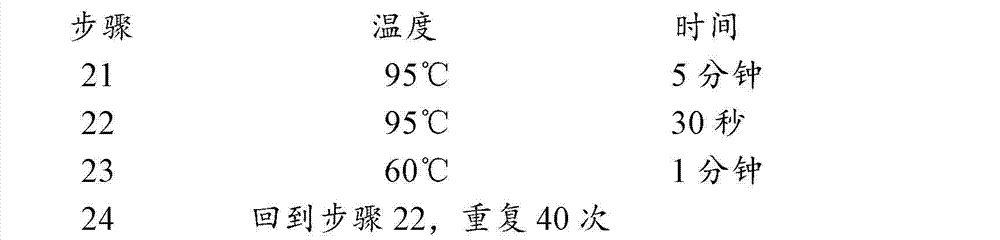
利用SDS2. 3软件(Applied Biosystems)分析数据。 Data were analyzed using SDS2.3 software (Applied Biosystems). the
实验结果表明, PIC9-02核苷酸序列、PIC9-02取代核苷酸序列、PIC9-02缺失核苷酸序列、PIC9-02添加核苷酸序列和已知序列均己整合到所检测的玉米植株的染色体组中,而且转入PIC9-02核苷酸序列的玉米植株、转入PIC9-02取代核苷酸序列的玉米植株、转入PIC9-02缺失核苷酸序列的玉米植株、转入PIC9-02添加核苷酸序列的玉米植株和转入已知序列的玉米植株均获得了含有单拷贝PIC9基因和已知序列的转基因玉米植株。 The experimental results show that the PIC9-02 nucleotide sequence, PIC9-02 substituted nucleotide sequence, PIC9-02 deleted nucleotide sequence, PIC9-02 added nucleotide sequence and known sequences have all been integrated into the detected maize In the genome of the plant, the maize plant that is transferred to the PIC9-02 nucleotide sequence, the maize plant that is transferred to the PIC9-02 substitution nucleotide sequence, the maize plant that is transferred to the PIC9-02 deletion nucleotide sequence, and the Both the PIC9-02 nucleotide sequence added maize plant and the maize plant transformed with the known sequence obtained transgenic maize plants containing a single copy of the PIC9 gene and the known sequence. the
第四实施例、转基因玉米植株的杀虫蛋白质检测 The fourth embodiment, detection of insecticidal protein of transgenic corn plants
1、转基因玉米植株的杀虫蛋白质(PIC9蛋白)的含量检测 1. Content detection of insecticidal protein (PIC9 protein) in transgenic corn plants
本实验中涉及的溶液如下: The solutions involved in this experiment are as follows:
萃取缓冲液:8g/L NaCl,0.2g/L KH2PO4,2.9g/L Na2HPO412H 2O,0.2g/L KCl,5.5ml/L吐温20(Tween-20),pH 7.4; Extraction buffer: 8g/L NaCl, 0.2g/L KH 2 PO 4 , 2.9g/L Na 2 HPO 4 12H 2 O, 0.2g/L KCl, 5.5ml/L Tween-20, pH 7.4;
洗涤缓冲液PBST:8g/L NaCl,0.2g/L KH2PO4,2.9g/L Na2HPO412H2O,0.2g/L KCl,0.5ml/L吐温20(Tween-20),pH 7.4; Wash buffer PBST: 8g/L NaCl, 0.2g/L KH 2 PO 4 , 2.9g/L Na 2 HPO 4 12H 2 O, 0.2g/L KCl, 0.5ml/L Tween-20, pH 7.4;
终止液:1M HCl。 Stop solution: 1M HCl. the
分别取3mg转入PIC9-02核苷酸序列的玉米植株、转入PIC9-02取代核苷酸序列的玉米植株、转入PIC9-02缺失核苷酸序列的玉米植株、转入PIC9-02添加核苷酸序列的玉米植株和转入已知序列的玉米植株(正对照)的新鲜叶片作为样品,液氮研磨后加入800μl所述萃取缓冲液,4000rpm的转速下离心10min,取上清液用所述萃取缓冲液稀释40倍,取80μl稀释后的上清液用于ELISA检测。鉴于所述PIC9-02的氨基酸序列第650至699位来自于Cry1Ab,且在所述PIC9-02氨基酸序列的DomainⅡ处(即第300至500位)也与Cry1Ab具有较高一致性,使得Cry1Ab的抗体可用于检测所述PIC9-02杀虫蛋白质。用ELISA(酶联免疫吸附测定法)试剂盒(ENVIRLOGIX公司,Cry1Ab/Cry1Ac试剂盒)对样品中杀虫蛋白质(PIC9蛋白)量占叶片鲜重的比例进行检测分析,具体方法参考其产品说明书。 Take 3 mg of corn plants transferred to PIC9-02 nucleotide sequence, corn plants transferred to PIC9-02 substituted nucleotide sequence, corn plants transferred to PIC9-02 deleted nucleotide sequence, and PIC9-02 added Corn plants with nucleotide sequences and fresh leaves of corn plants with known sequences (positive control) were used as samples. After grinding with liquid nitrogen, 800 μl of the extraction buffer was added, centrifuged at 4000 rpm for 10 min, and the supernatant was taken for use The extraction buffer was diluted 40 times, and 80 μl of the diluted supernatant was used for ELISA detection. In view of the fact that the 650th to 699th positions of the amino acid sequence of the PIC9-02 are from Cry1Ab, and the Domain II of the amino acid sequence of the PIC9-02 (that is, the 300th to 500th positions) also has a high degree of consistency with the Cry1Ab, so that the Cry1Ab Antibodies can be used to detect the PIC9-02 pesticidal protein. ELISA (enzyme-linked immunosorbent assay) kit (ENVIRLOGIX company, Cry1Ab/Cry1Ac kit) was used to detect and analyze the proportion of insecticidal protein (PIC9 protein) in the sample to the fresh weight of leaves. For specific methods, refer to its product manual. the
同时以野生型玉米植株和经荧光定量PCR鉴定为非转基因的玉米植株作为负对照,按照上述方法进行检测分析。转入PIC9-02核苷酸序列的共20株转化事件(即event),转入PIC9-02取代核苷酸序列的共10株转化事件(即event),转入PIC9-02缺失核苷酸序列的共10株转化事件(即event),转入PIC9-02添加核苷酸序列的共10株转化事件(即event),转入已知序列的共5株转化事件(即event),经荧光定量PCR鉴定为非转基因的(NGM)共3株,野生型的(CK)共3株;每株重复3次。 At the same time, wild-type corn plants and non-transgenic corn plants identified by fluorescent quantitative PCR were used as negative controls, and detection and analysis were carried out according to the above method. A total of 20 transformation events (events) that were transferred to PIC9-02 nucleotide sequences, a total of 10 transformation events (that is, events) that were transferred to PIC9-02 substituted nucleotide sequences, and PIC9-02 deletion nucleotides A total of 10 transformation events (events) of sequences, a total of 10 transformation events (events) of PIC9-02 added nucleotide sequences, and a total of 5 transformation events (events) of known sequences. Fluorescent quantitative PCR identified 3 non-transgenic (NGM) strains and 3 wild-type (CK) strains; each strain was repeated 3 times. the
转基因玉米植株的杀虫蛋白质(PIC9-02蛋白)含量的实验结果如表1所示。分别测得转入PIC9-02核苷酸序列的玉米植株、转入PIC9-02取代核苷酸序列的玉米植株、转入PIC9-02缺失核苷酸序列的玉米植株、转入PIC9-02添加核苷酸序列的玉米植株、转入已知序列的玉米植株、野生型玉米植株和经荧光定量PCR鉴定为非转基因的玉米植株的新鲜叶片中杀虫蛋白(PIC9-02蛋白)平均表达量占叶片鲜重的比例(ng/g)分别为5444.67、5304.12、4976.46、5397.71、2560.48、0和0。 The experimental results of the insecticidal protein (PIC9-02 protein) content of the transgenic maize plants are shown in Table 1. The maize plants transferred to the PIC9-02 nucleotide sequence, the maize plants transferred to the PIC9-02 substituted nucleotide sequence, the maize plants transferred to the PIC9-02 deleted nucleotide sequence, and the PIC9-02 added The average expression level of insecticidal protein (PIC9-02 protein) in the fresh leaves of maize plants with nucleotide sequences, maize plants with known sequences, wild-type maize plants and non-transgenic maize plants identified by fluorescent quantitative PCR The proportions (ng/g) of leaf fresh weight were 5444.67, 5304.12, 4976.46, 5397.71, 2560.48, 0 and 0, respectively. the
表1、转基因玉米植株的PIC9-02蛋白表达量测定平均结果 Table 1. Average results of PIC9-02 protein expression measurement of transgenic maize plants
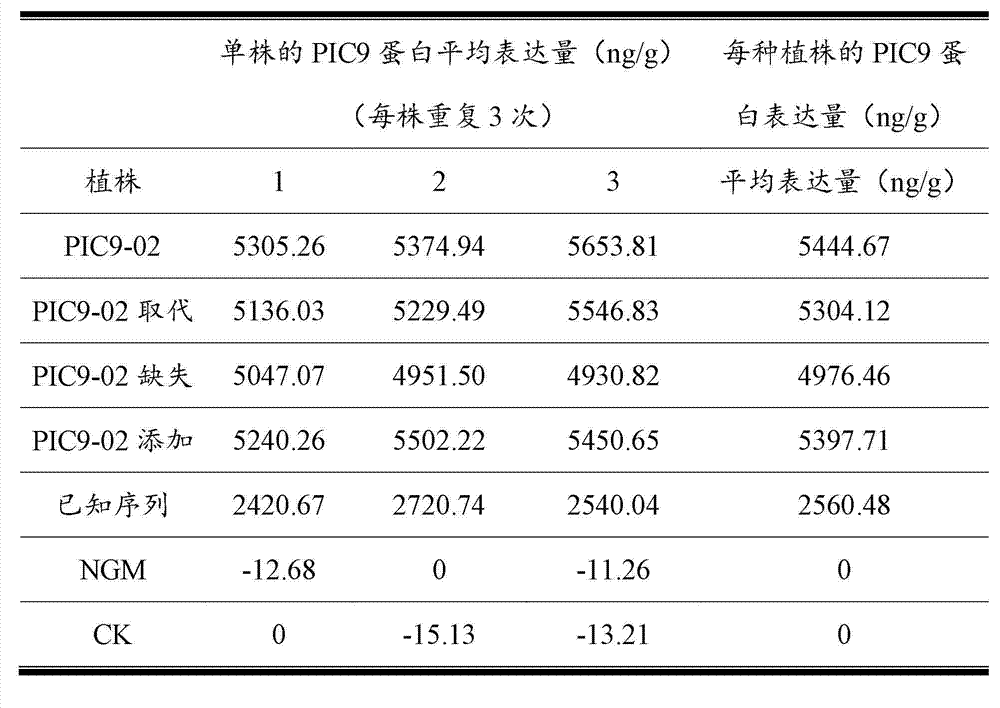
上述结果表明,转入已知序列的玉米植株中的杀虫蛋白平均表达量占叶片鲜重的比例(ng/g)为2560.48,而转入PIC9-02核苷酸序列的玉米植株中的杀虫蛋白平均表达量占叶片鲜重的比例(ng/g)为5444.67,为前者的2倍,这一结果表明本发明杀虫蛋白质在玉米中具有较好的稳定性,且依据玉米的偏好密码子优化的PIC9-02核苷酸序列显著地增加了PIC9-02蛋白在玉米中的表达量。与转入PIC9-02核苷酸序列的玉米植株的相比,转入PIC9-02取代核苷酸序列的玉米植株、转入PIC9-02缺失核苷酸序列的玉米植株和转入PIC9-02添加核苷酸序列的玉米植株中PIC9-02蛋白的表达量无显著差异。 The above results showed that the ratio of the average expression level of the insecticidal protein to the fresh weight of leaves (ng/g) in the maize plants with the known sequence was 2560.48, while the insecticidal protein in the maize plants with the PIC9-02 nucleotide sequence was 2560.48. The ratio (ng/g) of the average expression level of the insecticidal protein to the fresh weight of the leaves was 5444.67, twice that of the former. This result shows that the insecticidal protein of the present invention has good stability in corn, and according to the preference code of corn The sub-optimized PIC9-02 nucleotide sequence significantly increases the expression level of PIC9-02 protein in maize. Compared with the maize plants transferred to the PIC9-02 nucleotide sequence, the maize plant transferred to the PIC9-02 substituted nucleotide sequence, the maize plant transferred to the PIC9-02 deleted nucleotide sequence and the PIC9-02 There was no significant difference in the expression of PIC9-02 protein in maize plants with added nucleotide sequence. the
2、转基因玉米植株的抗虫效果检测 2. Detection of insect resistance effect of transgenic corn plants
将转入PIC9-02核苷酸序列的玉米植株、转入PIC9-02取代核苷酸序列的玉米植株、转入PIC9-02缺失核苷酸序列的玉米植株、转入PIC9-02添加核苷酸序列的玉米植株、转入已知序列的玉米植株、野生型玉米植株和经荧光定量PCR鉴定为非转基因的玉米植株分别对亚洲玉米螟、棉铃虫和东方黏虫进行抗虫效果检测。 Corn plants transferred to PIC9-02 nucleotide sequence, corn plants transferred to PIC9-02 substituted nucleotide sequence, corn plants transferred to PIC9-02 deleted nucleotide sequence, PIC9-02 added nucleoside The anti-insect effects of corn plants with acid sequences, corn plants with known sequences, wild-type corn plants and non-transgenic corn plants identified by fluorescent quantitative PCR against Asian corn borer, cotton bollworm and Oriental Armyworm were tested respectively. the
(1)亚洲玉米螟:分别取转入PIC9-02核苷酸序列的玉米植株、转入PIC9-02取代核苷酸序列的玉米植株、转入PIC9-02缺失核苷酸序列的玉米植株、转入 PIC9-02添加核苷酸序列的玉米植株、转入已知序列的玉米植株、野生型玉米植株和经荧光定量PCR鉴定为非转基因的玉米植株的新鲜叶片,用无菌水冲洗干净并用纱布将叶片上的水吸干,然后将玉米叶片去除叶脉,同时剪成约1cm×2cm的长条状,取1片剪后的长条状叶片放入圆形塑料培养皿底部的滤纸上,所述滤纸用蒸馏水润湿,每个培养皿中放10头人工饲养的亚洲玉米螟(初孵幼虫),虫试培养皿加盖后,在温度26-28℃、相对湿度70%-80%、光周期(光/暗)16:8的条件下放置3-5天后统计幼虫死亡情况,计算各样品中亚洲玉米螟的平均死亡率。转入PIC9-02核苷酸序列的共20株转化事件(即event),转入PIC9-02取代核苷酸序列的共10株转化事件(即event),转入PIC9-02缺失核苷酸序列的共10株转化事件(即event),转入PIC9-02添加核苷酸序列的共10株转化事件(即event),转入已知序列的共5株转化事件(即event),经荧光定量PCR鉴定为非转基因的(NGM)共3株,野生型的(CK)共3株;每株重复3次。结果如表2和图4所示。 (1) Corn borer: Corn plants transferred to PIC9-02 nucleotide sequence, corn plants transferred to PIC9-02 substituted nucleotide sequence, corn plants transferred to PIC9-02 deleted nucleotide sequence, The fresh leaves of corn plants with added nucleotide sequences added to PIC9-02, corn plants with known sequences, wild-type corn plants, and non-transgenic corn plants identified by fluorescent quantitative PCR were rinsed with sterile water and washed with Gauze absorbs the water on the leaves, then removes the veins from the corn leaves, and cuts them into strips of about 1 cm × 2 cm at the same time. Take 1 cut strip of leaves and put them on the filter paper at the bottom of a round plastic petri dish. The filter paper was wetted with distilled water, and 10 artificially raised Asian corn borers (incubated larvae) were placed in each petri dish. 1. Place the larvae under the condition of photoperiod (light/dark) 16:8 for 3-5 days and count the larval mortality, and calculate the average mortality rate of the Asian corn borer in each sample. A total of 20 transformation events (events) that were transferred to PIC9-02 nucleotide sequences, a total of 10 transformation events (that is, events) that were transferred to PIC9-02 substituted nucleotide sequences, and PIC9-02 deletion nucleotides A total of 10 transformation events (events) of sequences, a total of 10 transformation events (events) of PIC9-02 added nucleotide sequences, and a total of 5 transformation events (events) of known sequences. Fluorescent quantitative PCR identified 3 non-transgenic (NGM) strains and 3 wild-type (CK) strains; each strain was repeated 3 times. The results are shown in Table 2 and Figure 4. the
表2、转基因玉米植株接种亚洲玉米螟的抗虫实验结果 Table 2. Insect resistance experiment results of transgenic corn plants inoculated with O. corn borer
结果表明:转入PIC9-02核苷酸序列的玉米植株和转入已知序列的玉米植株中都可选到对亚洲玉米螟具有一定抗性的植株,但转入PIC9-02核苷酸序列的玉米植株的试虫死亡率显著高于转入已知序列的玉米植株。转入PIC9-02核苷酸序列的玉米植株的试虫死亡率在90%以上;而转入已知序列的玉米植株的试虫死 亡率在70%左右。 The results showed that plants with certain resistance to O. The mortality rate of the tested maize plants was significantly higher than that of the maize plants transformed with known sequences. The mortality rate of the test insects of the corn plants transferred to the PIC9-02 nucleotide sequence was more than 90%; while the death rate of the test insects of the corn plants transferred to the known sequence was about 70%. the
(2)棉铃虫:分别取转入PIC9-02核苷酸序列的玉米植株、转入PIC9-02取代核苷酸序列的玉米植株、转入PIC9-02缺失核苷酸序列的玉米植株、转入PIC9-02添加核苷酸序列的玉米植株、转入已知序列的玉米植株、野生型玉米植株和经荧光定量PCR鉴定为非转基因的玉米植株的幼嫩花丝,然后将20-30根花丝放入圆形塑料培养皿底部的滤纸上,所述滤纸用蒸馏水润湿,每个培养皿中放10头人工饲养的棉铃虫(初孵幼虫),虫试培养皿加盖后,在温度26-28℃、相对湿度80%-90%、光周期(光/暗)14:10的条件下放置3-5天后统计幼虫死亡情况,根据幼虫发育进度和死亡率两项指标进行抗性总分计算:总分=100×死亡率+90×(初孵虫数/接虫总数)+60×(初孵-阴性对照虫数/接虫总数)+10×(阴性对照虫数/接虫总数)。转入PIC9-02核苷酸序列的共20株转化事件(即event),转入PIC9-02取代核苷酸序列的共10株转化事件(即event),转入PIC9-02缺失核苷酸序列的共10株转化事件(即event),转入PIC9-02添加核苷酸序列的共10株转化事件(即event),转入已知序列的共5株转化事件(即event),经荧光定量PCR鉴定为非转基因的(NGM)共3株,野生型的(CK)共3株;每株重复3次。结果如表3所示。 (2) Cotton bollworm: maize plants transferred with PIC9-02 nucleotide sequence, maize plants transferred with PIC9-02 substituted nucleotide sequence, maize plants transferred with PIC9-02 deleted nucleotide sequence, transgenic The young filaments of corn plants with added nucleotide sequence into PIC9-02, corn plants with known sequences, wild-type corn plants, and non-transgenic corn plants identified by fluorescent quantitative PCR, and then 20-30 filaments Put it on the filter paper at the bottom of the circular plastic petri dish, and the filter paper is moistened with distilled water. Put 10 artificially raised cotton bollworms (incubating larvae) in each petri dish. -28°C, relative humidity 80%-90%, and photoperiod (light/dark) 14:10, place it for 3-5 days and count the larvae death, and calculate the total resistance score according to the two indicators of larval development progress and mortality Calculation: total score=100×mortality+90×(number of newly hatched worms/total number of worms received)+60×(number of newly hatched-negative control worms/total number of worms received)+10×(number of negative control worms/total number of worms received ). A total of 20 transformation events (events) that were transferred to PIC9-02 nucleotide sequences, a total of 10 transformation events (that is, events) that were transferred to PIC9-02 substituted nucleotide sequences, and PIC9-02 deletion nucleotides A total of 10 transformation events (events) of sequences, a total of 10 transformation events (events) of PIC9-02 added nucleotide sequences, and a total of 5 transformation events (events) of known sequences. Fluorescent quantitative PCR identified 3 non-transgenic (NGM) strains and 3 wild-type (CK) strains; each strain was repeated 3 times. The results are shown in Table 3. the
表3、转基因玉米植株接种棉铃虫的抗虫实验结果 Table 3. Insect resistance experiment results of transgenic corn plants inoculated with cotton bollworm
结果表明,转入PIC9-02核苷酸序列的玉米植株和转入已知序列的玉米植株中都可选到对棉铃虫具有一定抗性的植株,但转入PIC9-02核苷酸序列的玉米植株的生测总分显著高于转入已知序列的玉米植株。转入PIC9-02核苷酸序列的玉米植株的生测总分在75分以上;而转入已知序列的玉米植株的生测总分在40分左右。这一结果还说明转入PIC9-02核苷酸序列的玉米植株虽然不会造成初孵幼虫的大量死亡,但是却对幼虫发育进度造成极大的抑制,3-5天后幼虫基本仍处于初孵状态或介于初孵-阴性对照状态之间。 The results showed that plants with certain resistance to cotton bollworm could be selected from the corn plants transferred with PIC9-02 nucleotide sequence and the corn plants transferred with known sequence, but the plants transferred with PIC9-02 nucleotide sequence The total bioassay score of maize plants was significantly higher than that of maize plants transferred into known sequences. The total biometric score of the maize plants transferred with the PIC9-02 nucleotide sequence was above 75 points; while the total bioassay score of the maize plants transferred with the known sequence was about 40 points. This result also shows that although the maize plants transformed with the PIC9-02 nucleotide sequence will not cause a large number of deaths of newly hatched larvae, it will greatly inhibit the progress of larval development, and after 3-5 days, the larvae are basically still in the newly hatched state state or between the hatch-negative control state. the
(3)东方黏虫:分别取转入PIC9-02核苷酸序列的玉米植株、转入PIC9-02取代核苷酸序列的玉米植株、转入PIC9-02缺失核苷酸序列的玉米植株、转入PIC9-02添加核苷酸序列的玉米植株、转入已知序列的玉米植株、野生型玉米植株和经荧光定量PCR鉴定为非转基因的玉米植株的新鲜叶片,用无菌水冲洗干净并用纱布将叶片上的水吸干,然后将玉米叶片去除叶脉,同时剪成约1cm×2cm的长条状,取3片剪后的长条状叶片放入圆形塑料培养皿底部的滤纸上,所述滤纸用蒸馏水润湿,每个培养皿中放10头人工饲养的东方黏虫(初孵幼虫),虫试培养皿加盖后,在温度26-28℃、相对湿度80%-90%、光周期(光/暗)14:10的条件下放置3-5天后,根据东方黏虫幼虫发育进度、死亡率和叶片损伤率三项指标,获得抗性总分:总分=100×死亡率+90×(初孵虫数/接虫总数)+60×(初孵-阴性对照虫数/接虫总数)+10×(阴性对照虫数/接虫总数)+100×(1-叶片损伤率)。转入PIC9-02核苷酸序列的共20株转化事件(即event),转入PIC9-02取代核苷酸序列的共10株转化事件(即event),转入PIC9-02缺失核苷酸序列的共10株转化事件(即event),转入PIC9-02添加核苷酸序列的共10株转化事件(即event),转入已知序列的共5株转化事件(即event),经荧光定量PCR鉴定为非转基因的(NGM)共3株,野生型的(CK)共3株;每株重复3次。结果如表4和图5所示。 (3) Orient armyworm: corn plants transformed with PIC9-02 nucleotide sequence, corn plants transformed with PIC9-02 substituted nucleotide sequence, corn plants transformed with PIC9-02 deleted nucleotide sequence, The fresh leaves of maize plants transferred to PIC9-02 with added nucleotide sequences, maize plants with known sequences, wild-type maize plants, and non-transgenic maize plants identified by fluorescent quantitative PCR were washed with sterile water and washed with Gauze absorbs the water on the leaves, then removes the veins from the corn leaves, and cuts them into strips of about 1 cm × 2 cm at the same time. Take 3 strips of cut leaves and put them on the filter paper at the bottom of the round plastic petri dish. The filter paper is wetted with distilled water, and 10 artificially reared oriental armyworms (incubated larvae) are placed in each petri dish. 1. After placing it under the condition of photoperiod (light/dark) 14:10 for 3-5 days, according to the three indicators of the developmental progress of oriental armyworm larvae, mortality rate and leaf damage rate, the total resistance score was obtained: total score=100×death Rate+90×(number of newly hatched worms/total number of worms inoculated)+60×(number of newly hatched-negative control worms/total number of worms inoculated)+10×(number of negative control worms/total number of worms inoculated)+100×(1-leaf damage rate). A total of 20 transformation events (events) that were transferred to PIC9-02 nucleotide sequences, a total of 10 transformation events (that is, events) that were transferred to PIC9-02 substituted nucleotide sequences, and PIC9-02 deletion nucleotides A total of 10 transformation events (events) of sequences, a total of 10 transformation events (events) of PIC9-02 added nucleotide sequences, and a total of 5 transformation events (events) of known sequences. Fluorescent quantitative PCR identified 3 non-transgenic (NGM) strains and 3 wild-type (CK) strains; each strain was repeated 3 times. The results are shown in Table 4 and Figure 5. the
结果表明,转入PIC9-02核苷酸序列的玉米植株和转入已知序列的玉米植株中都可选到对东方黏虫具有一定抗性的植株,但转入PIC9-02核苷酸序列的玉米植株的生测总分显著高于转入已知序列的玉米植株。转入PIC9-02核苷酸序列的玉米植株的生测总分在150分以上;而转入已知序列的玉米植株的生测总分在90分左右。这一结果还说明转入PIC9-02核苷酸序列的玉米植株虽然不会造成初孵幼虫的大量死亡,但是却对幼虫发育进度造成极大的抑制,3-5天后幼虫基本仍处于初孵状态或介于初孵-阴性对照状态之间,且其叶片损伤率在30%以下。 The results showed that both the PIC9-02 nucleotide sequence-transferred maize plants and the known-sequence-transferred maize plants could be selected to have certain resistance to oriental armyworm, but the PIC9-02 nucleotide sequence The total bioassay score of the maize plants was significantly higher than that of the maize plants with known sequences. The total biometric score of the maize plants transferred with the PIC9-02 nucleotide sequence is above 150 points; while the total bioassay score of the maize plants transferred with the known sequence is about 90 points. This result also shows that although the maize plants transformed with the PIC9-02 nucleotide sequence will not cause a large number of deaths of newly hatched larvae, it will greatly inhibit the progress of larval development, and after 3-5 days, the larvae are basically still in the newly hatched state state or between the newly hatched-negative control state, and its leaf damage rate is below 30%. the
由此证明转入PIC9-02核苷酸序列的玉米植株具有较高抗虫能力,即表达PIC9-02蛋白水平高的转入PIC9-02核苷酸序列的玉米植株也具有较高的毒力,因此依据玉米的偏好密码子优化的PIC9-02核苷酸序列显著地增加了PIC9-02蛋白在玉米中表达的毒力。此外,与转入PIC9-02核苷酸序列的玉米植株的相比, 转入PIC9-02取代核苷酸序列的玉米植株、转入PIC9-02缺失核苷酸序列的玉米植株和转入PIC9-02添加核苷酸序列的玉米植株中PIC9-02蛋白的毒力无显著差异。 This proves that the maize plants transferred to the PIC9-02 nucleotide sequence have higher insect resistance, that is, the maize plants transferred to the PIC9-02 nucleotide sequence that express the high level of PIC9-02 protein also have higher virulence Therefore, the optimized PIC9-02 nucleotide sequence according to the preferred codons of maize significantly increases the virulence of the PIC9-02 protein expressed in maize. In addition, compared with the maize plants transferred to the PIC9-02 nucleotide sequence, the maize plants transferred to the PIC9-02 substitution nucleotide sequence, the maize plants transferred to the PIC9-02 deletion nucleotide sequence, and the maize plants transferred to the PIC9 There was no significant difference in the virulence of PIC9-02 protein in maize plants with -02 added nucleotide sequence. the
表4、转基因玉米植株接种东方黏虫的抗虫实验结果 Table 4. Insect resistance experiment results of transgenic corn plants inoculated with oriental armyworm
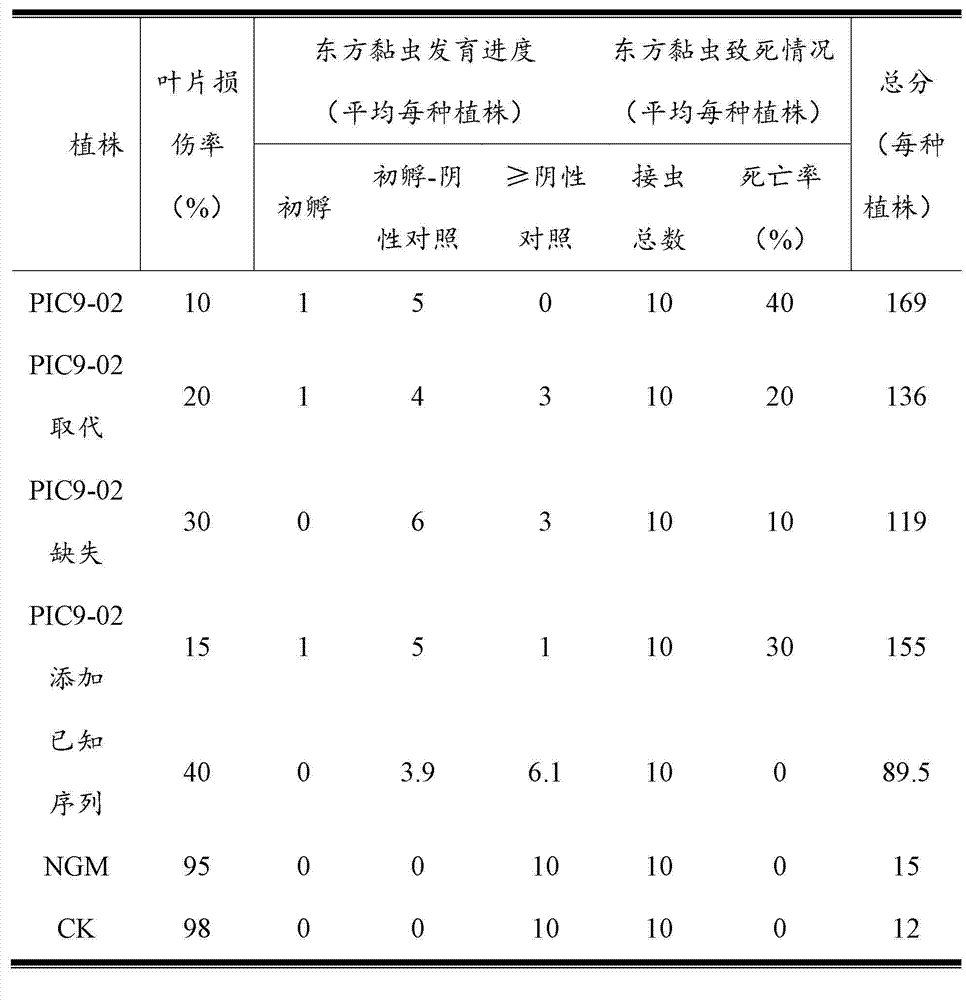
综上所述,本发明杀虫基因采用玉米的偏好密码子,完全符合玉米基因的特性,使得本发明杀虫基因特别适合在单子叶植物中表达,尤其是玉米,本发明PIC9-02杀虫蛋白不仅表达量高且稳定性好,而且对昆虫害虫的毒力强,尤其是鳞翅目昆虫害虫。 In summary, the insecticidal gene of the present invention adopts the preferred codons of corn, which fully conforms to the characteristics of corn genes, making the insecticidal gene of the present invention particularly suitable for expression in monocotyledonous plants, especially corn. The PIC9-02 insecticidal gene of the present invention The protein not only has high expression level and good stability, but also has strong toxicity to insect pests, especially insect pests of Lepidoptera. the
最后所应说明的是,以上实施例仅用以说明本发明的技术方案而非限制,尽管参照较佳实施例对本发明进行了详细说明,本领域的普通技术人员应当理解,可以对本发明的技术方案进行修改或者等同替换,而不脱离本发明技术方 案的精神和范围。 Finally, it should be noted that the above embodiments are only used to illustrate the technical solutions of the present invention without limitation. Although the present invention has been described in detail with reference to the preferred embodiments, those of ordinary skill in the art should understand that the technical solutions of the present invention can be The scheme is modified or equivalently replaced without departing from the spirit and scope of the technical scheme of the present invention. the
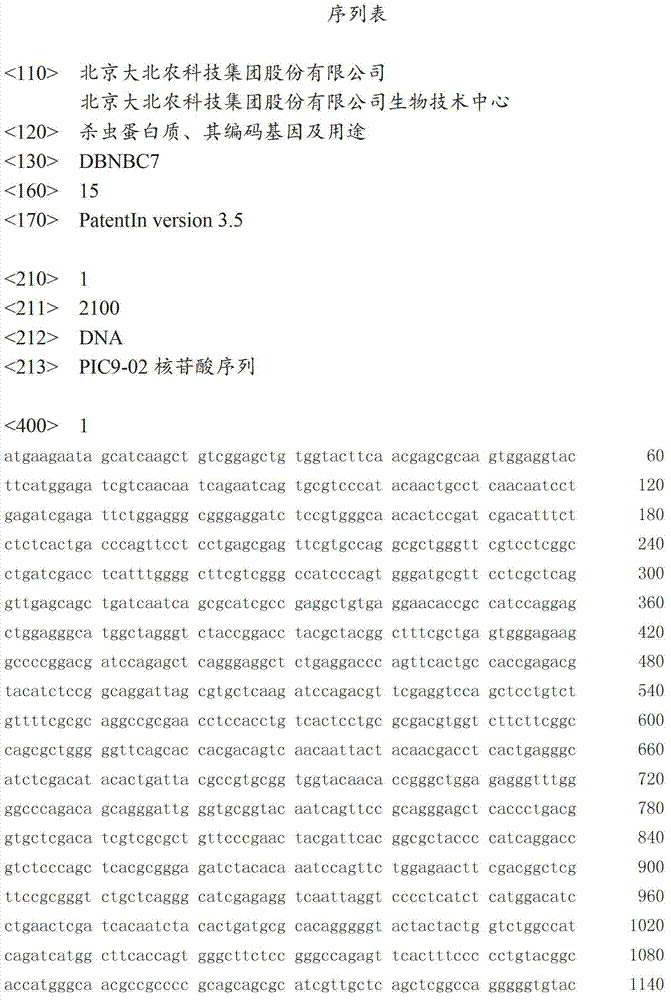

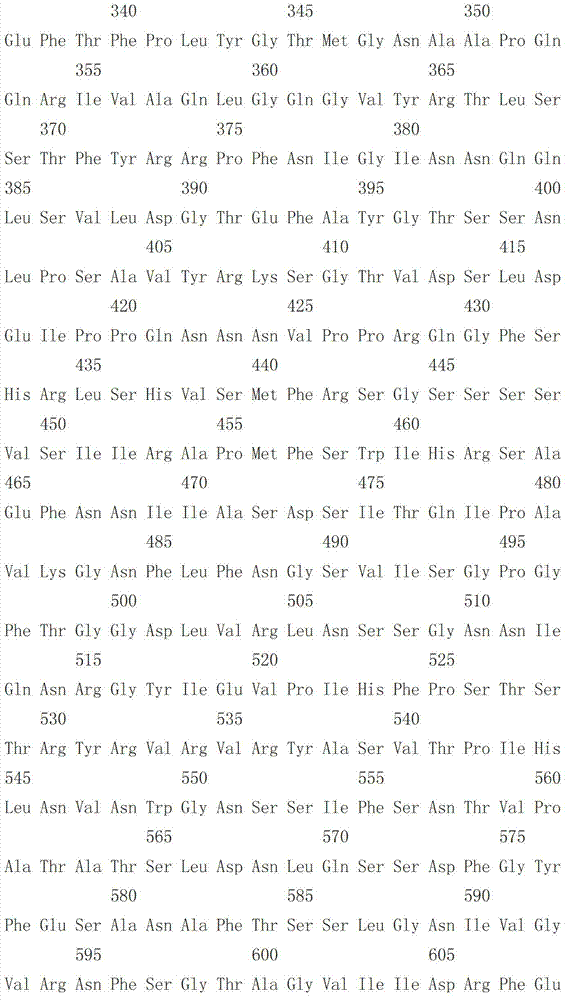

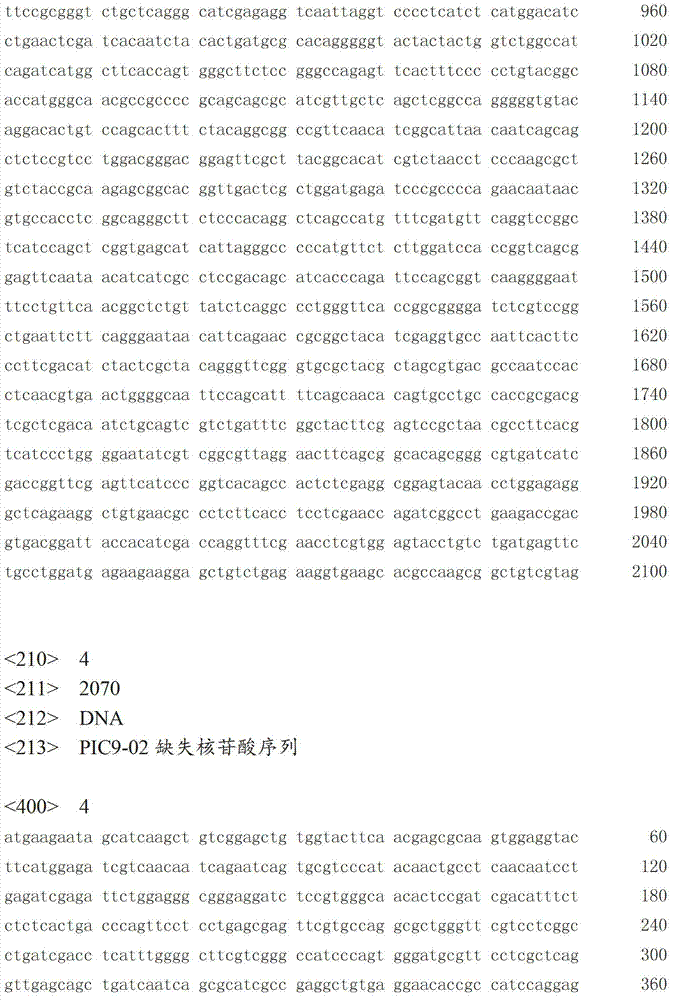
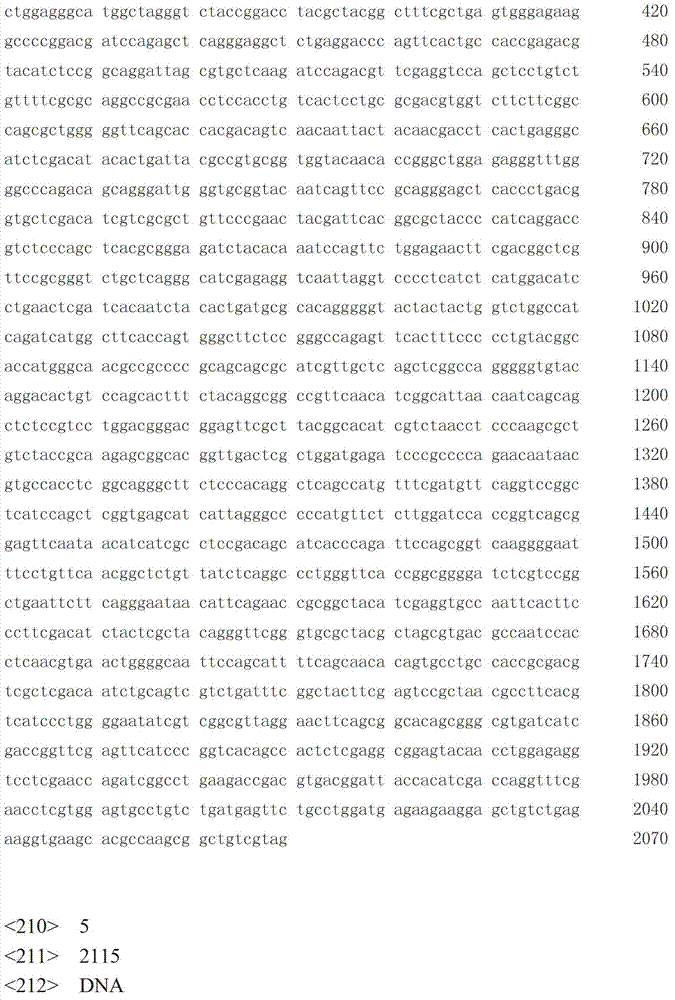


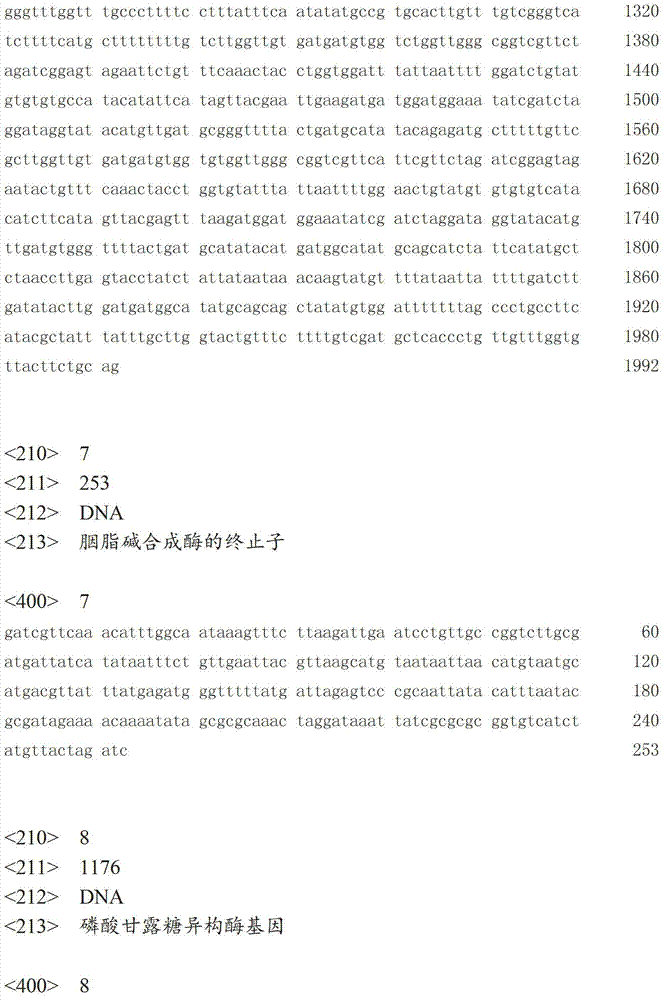

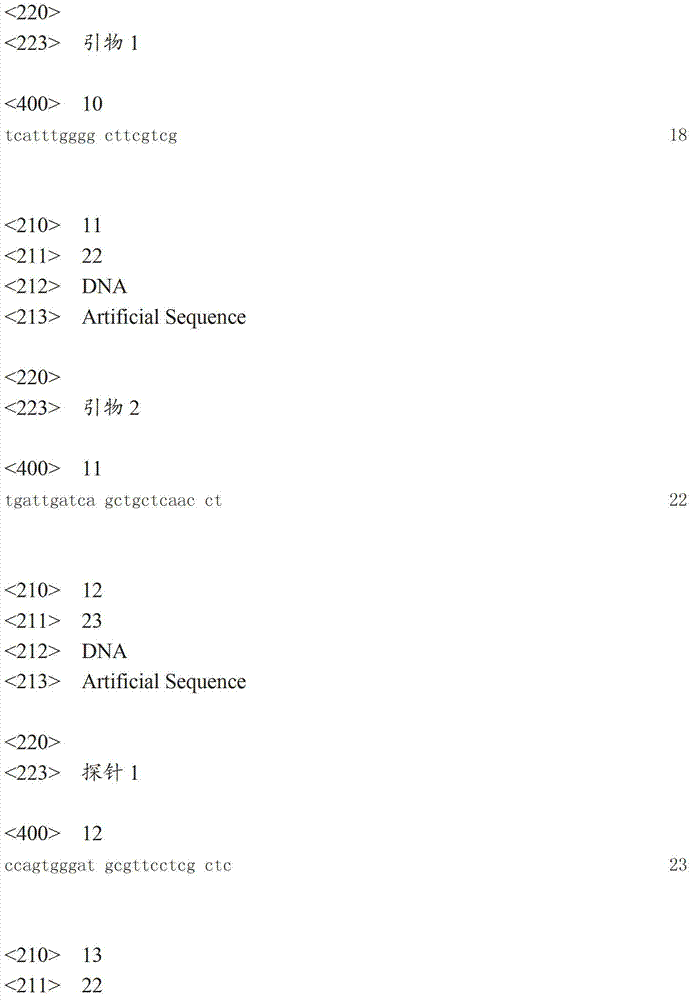

Claims (16)
Priority Applications (4)
| Application Number | Priority Date | Filing Date | Title |
|---|---|---|---|
| CN201210273515XA CN102786585B (en) | 2012-08-02 | 2012-08-02 | Insecticidal protein, coding gene of insecticidal protein and purpose of insecticidal protein |
| US13/846,510 US8916687B2 (en) | 2012-08-02 | 2013-03-18 | Insecticidal protein, gene encoding the same and uses thereof |
| BR102013018436-5A BR102013018436B1 (en) | 2012-08-02 | 2013-07-19 | INSECTICIDE PROTEIN, INSECTICIDE GENE, EXPRESSION CASSETTE, RECOMBINANT VECTOR, TRANSGENIC MICRO-ORGANISM, AND METHODS FOR THE PRODUCTION OF INSECTICIDE PROTEINS, EXPANDING THE REACH OF TARGET INSECTS, PRODUCTION OF INSECT-RESISTANT PLANTS, PROTECTION OF PLANTS FROM DAMAGE CAUSED BY INSECT PESTS, AND CONTROL INSECT PESTS |
| ARP130102740A AR091963A1 (en) | 2012-08-02 | 2013-08-01 | PROTEIN INSECTICIDE, GEN THAT CODIFIES AND ITS USES |
Applications Claiming Priority (1)
| Application Number | Priority Date | Filing Date | Title |
|---|---|---|---|
| CN201210273515XA CN102786585B (en) | 2012-08-02 | 2012-08-02 | Insecticidal protein, coding gene of insecticidal protein and purpose of insecticidal protein |
Publications (2)
| Publication Number | Publication Date |
|---|---|
| CN102786585A CN102786585A (en) | 2012-11-21 |
| CN102786585B true CN102786585B (en) | 2013-12-18 |
Family
ID=47152189
Family Applications (1)
| Application Number | Title | Priority Date | Filing Date |
|---|---|---|---|
| CN201210273515XA Active CN102786585B (en) | 2012-08-02 | 2012-08-02 | Insecticidal protein, coding gene of insecticidal protein and purpose of insecticidal protein |
Country Status (4)
| Country | Link |
|---|---|
| US (1) | US8916687B2 (en) |
| CN (1) | CN102786585B (en) |
| AR (1) | AR091963A1 (en) |
| BR (1) | BR102013018436B1 (en) |
Families Citing this family (4)
| Publication number | Priority date | Publication date | Assignee | Title |
|---|---|---|---|---|
| CN103053480B (en) * | 2013-01-25 | 2014-04-16 | 中国农业科学院柑桔研究所 | Method for RNA (ribonucleic acid) interference of panonychus citri mites |
| CA2950947A1 (en) | 2014-06-20 | 2015-12-23 | Dow Agrosciences Llc | Vegetative insecticidal proteins useful for control of insect pests |
| CN106146628B (en) * | 2015-03-27 | 2019-07-09 | 中国农业科学院棉花研究所 | A kind of artificial synthesized insect resistance protein and its relevant biological material and application |
| CN115437189A (en) * | 2017-06-16 | 2022-12-06 | 伊英克公司 | variable transmission electrophoresis device |
Citations (4)
| Publication number | Priority date | Publication date | Assignee | Title |
|---|---|---|---|---|
| CN1059760A (en) * | 1990-05-03 | 1992-03-25 | 加州大学评议会 | Methods and means for expanding the host range of insecticidal proteins |
| CN1810976A (en) * | 2006-02-27 | 2006-08-02 | 浙江大学 | Pesticidal gene and its use |
| CN101679491A (en) * | 2007-03-28 | 2010-03-24 | 先正达参股股份有限公司 | insecticidal proteins |
| CN102796182A (en) * | 2012-08-02 | 2012-11-28 | 北京大北农科技集团股份有限公司 | Insecticidal protein, as well as coding gene and application thereof |
-
2012
- 2012-08-02 CN CN201210273515XA patent/CN102786585B/en active Active
-
2013
- 2013-03-18 US US13/846,510 patent/US8916687B2/en active Active
- 2013-07-19 BR BR102013018436-5A patent/BR102013018436B1/en active IP Right Grant
- 2013-08-01 AR ARP130102740A patent/AR091963A1/en active IP Right Grant
Patent Citations (4)
| Publication number | Priority date | Publication date | Assignee | Title |
|---|---|---|---|---|
| CN1059760A (en) * | 1990-05-03 | 1992-03-25 | 加州大学评议会 | Methods and means for expanding the host range of insecticidal proteins |
| CN1810976A (en) * | 2006-02-27 | 2006-08-02 | 浙江大学 | Pesticidal gene and its use |
| CN101679491A (en) * | 2007-03-28 | 2010-03-24 | 先正达参股股份有限公司 | insecticidal proteins |
| CN102796182A (en) * | 2012-08-02 | 2012-11-28 | 北京大北农科技集团股份有限公司 | Insecticidal protein, as well as coding gene and application thereof |
Also Published As
| Publication number | Publication date |
|---|---|
| US8916687B2 (en) | 2014-12-23 |
| US20140037608A1 (en) | 2014-02-06 |
| BR102013018436B1 (en) | 2022-09-06 |
| CN102786585A (en) | 2012-11-21 |
| BR102013018436A2 (en) | 2015-01-06 |
| AR091963A1 (en) | 2015-03-11 |
Similar Documents
| Publication | Publication Date | Title |
|---|---|---|
| CN103509808B (en) | Insecticidal gene and applications thereof | |
| CN103718896B (en) | The method of Control pests | |
| CN104621172B (en) | Application of insecticidal protein | |
| CN104522056B (en) | The purposes of insecticidal proteins | |
| CN106497966B (en) | Use of insecticidal proteins | |
| WO2015070780A1 (en) | Method for controlling pests | |
| CN103688974A (en) | Method for controlling injurious insect | |
| CN102972426A (en) | Pest control method | |
| CN102786584B (en) | Insecticidal protein, coding gene of insecticidal protein and purpose of insecticidal protein | |
| CN104920425B (en) | The purposes of insecticidal proteins | |
| CN102786585B (en) | Insecticidal protein, coding gene of insecticidal protein and purpose of insecticidal protein | |
| CN103739683B (en) | Insecticidal protein, and encoding gene and use thereof | |
| CN103757049B (en) | Control structure body and the method thereof of insect | |
| CN102796182B (en) | Insecticidal protein, as well as coding gene and application thereof | |
| CN102796183B (en) | Insecticidal protein, and coding gene and purposes thereof | |
| CN103145814B (en) | Insecticidal protein, and coding gene and use thereof | |
| CN104621171B (en) | The purposes of insecticidal proteins | |
| CN102533793B (en) | Insecticide gene and application thereof | |
| CN103725704B (en) | The construct of Control pests and method thereof | |
| CN103725696B (en) | Killing gene and uses thereof | |
| WO2016101684A1 (en) | Uses of insecticidal protein | |
| CN104604924B (en) | The use of insecticidal protein | |
| CN102993280B (en) | Insecticidal protein, its coding gene and application | |
| CN102993281B (en) | Insecticidal protein, its coding gene and application | |
| CN102993279B (en) | Insecticidal protein and coding gene and application thereof |
Legal Events
| Date | Code | Title | Description |
|---|---|---|---|
| C06 | Publication | ||
| PB01 | Publication | ||
| C10 | Entry into substantive examination | ||
| SE01 | Entry into force of request for substantive examination | ||
| C14 | Grant of patent or utility model | ||
| GR01 | Patent grant | ||
| C56 | Change in the name or address of the patentee | ||
| CP01 | Change in the name or title of a patent holder |
Address after: 100080 Zhongguancun street, Beijing, No. 14, layer 27, Patentee after: Beijing Dabeinong Technology Group Co., Ltd. Patentee after: BEIJING DBN BIOTECH CO., LTD. Address before: 100080 Zhongguancun street, Beijing, No. 14, layer 27, Patentee before: Beijing Dabeinong Technology Group Co., Ltd. Patentee before: Biotechnology Center of Beijing Dabeinong Technology Group Co., Ltd. |
|
| TR01 | Transfer of patent right | ||
| TR01 | Transfer of patent right |
Effective date of registration: 20200810 Address after: 100193 No. 2, West Old Summer Palace Road, Beijing, Haidian District, Institute of atomic energy, Chinese Academy of Agricultural Sciences, building 49 Patentee after: BEIJING DABEINONG BIOTECHNOLOGY Co.,Ltd. Address before: 100080, 14, Zhongguancun Avenue, 27, Beijing, Haidian District Co-patentee before: BEIJING DABEINONG BIOTECHNOLOGY Co.,Ltd. Patentee before: BEIJING DABEINONG TECHNOLOGY GROUP Co.,Ltd. |