CN102763048A - Methods and apparatuses for utilizing adaptive predictive algorithms and determining when to use the adaptive predictive algorithms for virtual metrology - Google Patents
Methods and apparatuses for utilizing adaptive predictive algorithms and determining when to use the adaptive predictive algorithms for virtual metrology Download PDFInfo
- Publication number
- CN102763048A CN102763048A CN2011800099651A CN201180009965A CN102763048A CN 102763048 A CN102763048 A CN 102763048A CN 2011800099651 A CN2011800099651 A CN 2011800099651A CN 201180009965 A CN201180009965 A CN 201180009965A CN 102763048 A CN102763048 A CN 102763048A
- Authority
- CN
- China
- Prior art keywords
- quality
- error
- measurement data
- algorithm
- prediction
- Prior art date
- Legal status (The legal status is an assumption and is not a legal conclusion. Google has not performed a legal analysis and makes no representation as to the accuracy of the status listed.)
- Granted
Links
Images


Classifications
-
- G—PHYSICS
- G06—COMPUTING OR CALCULATING; COUNTING
- G06N—COMPUTING ARRANGEMENTS BASED ON SPECIFIC COMPUTATIONAL MODELS
- G06N5/00—Computing arrangements using knowledge-based models
- G06N5/04—Inference or reasoning models
-
- G—PHYSICS
- G05—CONTROLLING; REGULATING
- G05B—CONTROL OR REGULATING SYSTEMS IN GENERAL; FUNCTIONAL ELEMENTS OF SUCH SYSTEMS; MONITORING OR TESTING ARRANGEMENTS FOR SUCH SYSTEMS OR ELEMENTS
- G05B13/00—Adaptive control systems, i.e. systems automatically adjusting themselves to have a performance which is optimum according to some preassigned criterion
- G05B13/02—Adaptive control systems, i.e. systems automatically adjusting themselves to have a performance which is optimum according to some preassigned criterion electric
- G05B13/0205—Adaptive control systems, i.e. systems automatically adjusting themselves to have a performance which is optimum according to some preassigned criterion electric not using a model or a simulator of the controlled system
- G05B13/026—Adaptive control systems, i.e. systems automatically adjusting themselves to have a performance which is optimum according to some preassigned criterion electric not using a model or a simulator of the controlled system using a predictor
-
- G—PHYSICS
- G05—CONTROLLING; REGULATING
- G05B—CONTROL OR REGULATING SYSTEMS IN GENERAL; FUNCTIONAL ELEMENTS OF SUCH SYSTEMS; MONITORING OR TESTING ARRANGEMENTS FOR SUCH SYSTEMS OR ELEMENTS
- G05B23/00—Testing or monitoring of control systems or parts thereof
- G05B23/02—Electric testing or monitoring
- G05B23/0205—Electric testing or monitoring by means of a monitoring system capable of detecting and responding to faults
- G05B23/0259—Electric testing or monitoring by means of a monitoring system capable of detecting and responding to faults characterized by the response to fault detection
- G05B23/0297—Reconfiguration of monitoring system, e.g. use of virtual sensors; change monitoring method as a response to monitoring results
-
- G—PHYSICS
- G06—COMPUTING OR CALCULATING; COUNTING
- G06Q—INFORMATION AND COMMUNICATION TECHNOLOGY [ICT] SPECIALLY ADAPTED FOR ADMINISTRATIVE, COMMERCIAL, FINANCIAL, MANAGERIAL OR SUPERVISORY PURPOSES; SYSTEMS OR METHODS SPECIALLY ADAPTED FOR ADMINISTRATIVE, COMMERCIAL, FINANCIAL, MANAGERIAL OR SUPERVISORY PURPOSES, NOT OTHERWISE PROVIDED FOR
- G06Q50/00—Information and communication technology [ICT] specially adapted for implementation of business processes of specific business sectors, e.g. utilities or tourism
- G06Q50/04—Manufacturing
-
- G—PHYSICS
- G05—CONTROLLING; REGULATING
- G05B—CONTROL OR REGULATING SYSTEMS IN GENERAL; FUNCTIONAL ELEMENTS OF SUCH SYSTEMS; MONITORING OR TESTING ARRANGEMENTS FOR SUCH SYSTEMS OR ELEMENTS
- G05B2219/00—Program-control systems
- G05B2219/30—Nc systems
- G05B2219/31—From computer integrated manufacturing till monitoring
- G05B2219/31459—Library with metrology plan for different type of workpieces
-
- G—PHYSICS
- G05—CONTROLLING; REGULATING
- G05B—CONTROL OR REGULATING SYSTEMS IN GENERAL; FUNCTIONAL ELEMENTS OF SUCH SYSTEMS; MONITORING OR TESTING ARRANGEMENTS FOR SUCH SYSTEMS OR ELEMENTS
- G05B2219/00—Program-control systems
- G05B2219/30—Nc systems
- G05B2219/31—From computer integrated manufacturing till monitoring
- G05B2219/31465—Determine which variables of the system to be monitored
-
- G—PHYSICS
- G05—CONTROLLING; REGULATING
- G05B—CONTROL OR REGULATING SYSTEMS IN GENERAL; FUNCTIONAL ELEMENTS OF SUCH SYSTEMS; MONITORING OR TESTING ARRANGEMENTS FOR SUCH SYSTEMS OR ELEMENTS
- G05B2219/00—Program-control systems
- G05B2219/30—Nc systems
- G05B2219/31—From computer integrated manufacturing till monitoring
- G05B2219/31483—Verify monitored data if valid or not by comparing with reference value
-
- Y—GENERAL TAGGING OF NEW TECHNOLOGICAL DEVELOPMENTS; GENERAL TAGGING OF CROSS-SECTIONAL TECHNOLOGIES SPANNING OVER SEVERAL SECTIONS OF THE IPC; TECHNICAL SUBJECTS COVERED BY FORMER USPC CROSS-REFERENCE ART COLLECTIONS [XRACs] AND DIGESTS
- Y02—TECHNOLOGIES OR APPLICATIONS FOR MITIGATION OR ADAPTATION AGAINST CLIMATE CHANGE
- Y02P—CLIMATE CHANGE MITIGATION TECHNOLOGIES IN THE PRODUCTION OR PROCESSING OF GOODS
- Y02P90/00—Enabling technologies with a potential contribution to greenhouse gas [GHG] emissions mitigation
- Y02P90/80—Management or planning
Landscapes
- Engineering & Computer Science (AREA)
- Physics & Mathematics (AREA)
- General Physics & Mathematics (AREA)
- Automation & Control Theory (AREA)
- Theoretical Computer Science (AREA)
- Artificial Intelligence (AREA)
- Evolutionary Computation (AREA)
- Software Systems (AREA)
- Health & Medical Sciences (AREA)
- Mathematical Physics (AREA)
- Data Mining & Analysis (AREA)
- Computing Systems (AREA)
- General Engineering & Computer Science (AREA)
- Medical Informatics (AREA)
- Computer Vision & Pattern Recognition (AREA)
- Computational Linguistics (AREA)
- Business, Economics & Management (AREA)
- Human Resources & Organizations (AREA)
- Tourism & Hospitality (AREA)
- General Health & Medical Sciences (AREA)
- Manufacturing & Machinery (AREA)
- Marketing (AREA)
- Primary Health Care (AREA)
- Strategic Management (AREA)
- Economics (AREA)
- General Business, Economics & Management (AREA)
- General Factory Administration (AREA)
- Management, Administration, Business Operations System, And Electronic Commerce (AREA)
- Testing And Monitoring For Control Systems (AREA)
- Testing Or Measuring Of Semiconductors Or The Like (AREA)
- Apparatus For Radiation Diagnosis (AREA)
Abstract
本文在此描述用于决定虚拟量测的适应性预测算法的方法、装置和系统。在一些具体实施例中,一种计算机可实施方法识别多个预测算法。该方法决定:何时使用多个预测算法的一个或多个来预测在制造设备(manufacturing facility)中的一或多个虚拟量测变量。
This document describes methods, apparatus, and systems for determining adaptive prediction algorithms for virtual measurements. In some specific embodiments, a computer-implementable method identifies multiple prediction algorithms. This method determines when to use one or more of the multiple prediction algorithms to predict one or more virtual measurement variables in a manufacturing facility.
Description
关联申请的交叉引用Cross-References to Associated Applications
本专利申请案在35 U.S.C.§119(e)下主张美国临时申请号61/305,089的优先权,其于2010年2月16日提出申请,在此通过引用将其内容引入。This patent application claims priority under 35 U.S.C. §119(e) to U.S. Provisional Application No. 61/305,089, filed February 16, 2010, the contents of which are hereby incorporated by reference.
技术领域 technical field
本发明的具体实施例涉及用于虚拟量测的预测算法,具体涉及使用和决定预测算法。Particular embodiments of the invention relate to predictive algorithms for virtual metrology, in particular to using and deciding on predictive algorithms.
背景技术 Background technique
设备工程系统(EES)管理由制造机器生产的程序。良率管理系统(YMS)利用参数和e-test数据以分析良率异常。当分析良率时,一些传统的良率管理系统利用来自传统设备工程系统的故障侦测和分类(FDC)系统的数据以提供良率工程师额外的数据。在有限数目的传统良率管理系统,来自FDC系统的数据可用于预测良率。此良率预测可促使良率工程师在完成产品之前侦测潜在的良率问题。An Equipment Engineering System (EES) manages the programs produced by manufacturing machines. Yield Management System (YMS) utilizes parameters and e-test data to analyze yield anomalies. When analyzing yield, some conventional yield management systems utilize data from fault detection and classification (FDC) systems of conventional device engineering systems to provide yield engineers with additional data. In a limited number of traditional yield management systems, data from the FDC system can be used to predict yield. This yield prediction enables yield engineers to detect potential yield issues before finalizing the product.
利用预测作为基础能力的技术的最大问题之一,例如虚拟量测(VM)和良率管理辅助先进制程控制(YMeAPC),系预测的质量,特别是在动态预测环境中。具有数个可获用的预测技术和预测适应技术。时常,不同的预测适应技术在不同的环境中可较佳地运作。目前,尚未有已界定的方式能采取共同合作的趋势来发挥多种预测适应能力的优点,以改善预测质量。One of the biggest issues with technologies that use forecasting as a foundational capability, such as virtual metrology (VM) and yield management-assisted advanced process control (YMeAPC), is the quality of the forecast, especially in a dynamic forecast environment. There are several predictive and predictive adaptation techniques available. Oftentimes, different predictive adaptation techniques work better in different environments. Currently, there is no defined way to take advantage of multiple predictive adaptation capabilities to take advantage of trends that work together to improve forecast quality.
制造过程受扰动和飘移影响。飘移程序的逐片(W2W)控制需要行内量测(inline metrology),其增加量测站的成本、增加周期时间、及减少生产量。在测量速度和精确度之间存在折衷。虚拟量测包含:使用关于每个晶圆的制程的状态的信息的量测变量的预测。虚拟量测利用FDC数据和上游量测信息以用于预测算法。虚拟量测根据制程及/或产品的状态,预测量测变量(可测量或不可测量)。Manufacturing processes are subject to disturbances and drift. Wafer-to-wafer (W2W) control of the drift process requires inline metrology, which increases the cost of the metrology station, increases cycle time, and reduces throughput. There is a tradeoff between measurement speed and accuracy. Virtual metrology involves prediction of metrology variables using information about the state of the process for each wafer. Virtual metrology utilizes FDC data and upstream metrology information for predictive algorithms. Virtual metrology predicts measurement variables (measurable or non-measurable) based on the state of the process and/or product.
利用虚拟量测的工厂内的控制的方法描述于文献“Fab-wide ControlUtilizing Virtual Metrology,”IEEE Transactions on SemiconductorManufacturing,Vol.20,No.4,November 2007 by Aftab A.Khan,James R.Moyne,and Dawn M.Tilbury。此文献“Fab-wide Control Utilizing VirtualMetrology”,在此通过参考方式在此引入,揭露经常使用于半导体制造过程的偏最小平方(PLS)技术和双指数加权移动平均(dEWMA)的控制器。A method for control within a factory utilizing virtual metrology is described in the document "Fab-wide Control Utilizing Virtual Metrology," IEEE Transactions on Semiconductor Manufacturing, Vol.20, No.4, November 2007 by Aftab A.Khan, James R.Moyne, and Dawn M. Tilbury. This document "Fab-wide Control Utilizing Virtual Metrology", which is hereby incorporated by reference, discloses controllers for partial least squares (PLS) techniques and double exponentially weighted moving average (dEWMA) often used in semiconductor manufacturing processes.
然而,先前的虚拟量测方法无法提供稳定可重复使用的虚拟量测技术方案。目前虚拟量测的目前现有技术包含:多个“一次性(one-off)”高度客制化、非可重复使用的技术方案。这些方法随时间演进而变为非强健的。由于缺乏对数据质量的了解,使用是受限制的。现有方法无法提供高质量适应性虚拟量测的模型化。However, previous virtual metrology methods cannot provide a stable and reusable virtual metrology technical solution. The current existing technologies of virtual measurement include: multiple "one-off" highly customized and non-reusable technical solutions. These methods evolve over time to become non-robust. Use is limited due to lack of knowledge about data quality. Existing methods fail to provide high-quality modeling of adaptive virtual metrology.
附图说明 Description of drawings
本发明通过实例方式在附图中示例说明(而非限制),其中:The invention is illustrated, not limited, by way of example in the accompanying drawings, in which:
图1说明制造环境中的示例性架构,本发明的具体实施例可于其中操作;Figure 1 illustrates an exemplary architecture in a manufacturing environment in which embodiments of the invention may operate;
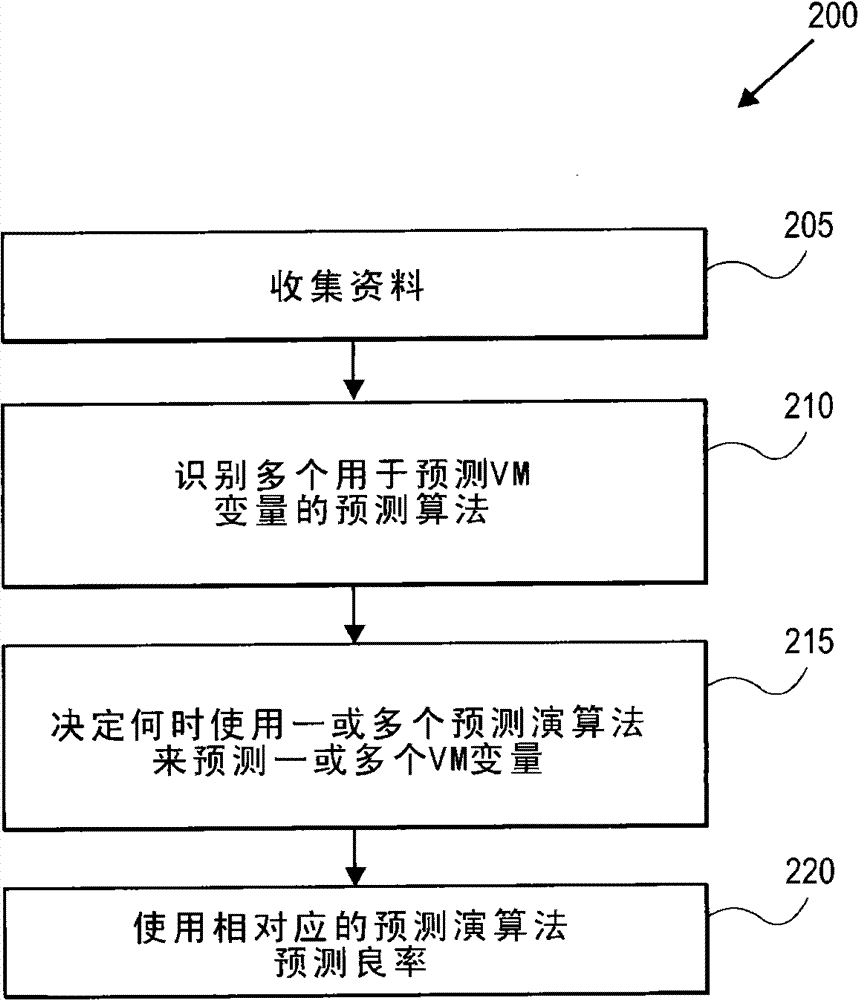
图2说明利用多个预测算法的方法的一个具体实施例的流程图;Figure 2 illustrates a flow diagram of one embodiment of a method utilizing multiple predictive algorithms;
图3说明在预测算法之间切换的方法的一个具体实施例的流程图;Figure 3 illustrates a flowchart of one embodiment of a method of switching between predictive algorithms;
图4说明在预测算法之间切换的方法的另一个具体实施例的流程图;Figure 4 illustrates a flowchart of another embodiment of a method of switching between predictive algorithms;
图5说明决定具有权重预测的预测算法的方法的一个具体实施例之流程图;Figure 5 illustrates a flowchart of an embodiment of a method of determining a forecasting algorithm with weighted forecasts;
图6说明设备工程系统(EES)的一个示例性架构,本发明的具体实施例可在其中操作;及Figure 6 illustrates an exemplary architecture of an Equipment Engineering System (EES) in which embodiments of the invention may operate; and
图7根据本发明的具体实施例示例说明一个示例性计算机系统的方块图。Figure 7 illustrates a block diagram of an exemplary computer system in accordance with a specific embodiment of the present invention.
具体实施方式 Detailed ways
在此描述用于决定虚拟量测的适应性预测算法的方法、装置、和系统。在一些具体实施例中,系统收集数据和利用多个预测算法。该系统决定何时使用多个预测算法以预测在制造设备中的虚拟量测变量(可测量或不可测量)。虚拟量测变量包含(例如)程序执行的终点的输出的预测值、来自上游程序的相关的预处理量测数据等等。特定的实例包含:在化学气相沈积(CVD)程序之后的膜厚度和非均匀性,及在蚀刻程序之后的临界尺度(CD)数据(例如平均和变动)。在其它具体实施例中,该系统根据误差临界值在多个预测算法之间切换。该临界值可取决于实际的量测数据。若实际的量测数据可获得,该系统可使用该误差切换临界值在预测算法之间切换。此外,该系统可使用质量临界值以决定何时在预测算法之间切换。在另一些具体实施例中,该系统同时利用多个预测算法。可根据其它预测算法的加权平均调用预测算法。Methods, apparatus, and systems for determining adaptive prediction algorithms for virtual measurements are described herein. In some embodiments, the system collects data and utilizes multiple predictive algorithms. The system determines when to use multiple forecasting algorithms to predict virtual measured variables (measurable or non-measurable) in a manufacturing facility. Virtual metrics include, for example, predicted values of output at the end of program execution, associated preprocessed metrics from upstream programs, and so on. Specific examples include: film thickness and non-uniformity after chemical vapor deposition (CVD) procedures, and critical dimension (CD) data (eg, mean and variation) after etch procedures. In other embodiments, the system switches between multiple predictive algorithms based on error thresholds. The critical value may depend on actual measurement data. If actual measurement data is available, the system can use the error switching threshold to switch between predictive algorithms. Additionally, the system can use quality thresholds to decide when to switch between predictive algorithms. In other embodiments, the system utilizes multiple predictive algorithms simultaneously. The prediction algorithm may be invoked based on a weighted average of other prediction algorithms.
如上所述,先前的方法无法提供高质量适应性VM。本发明的VM可提供多算法适应性偏最小平方(PLS),其考虑在故障侦测(FD)输出和量测预测之间的关系的时间变化。此外或可替代性地,本发明的VM可提供数据质量预测,其可避免误判为正(false positives)和允许用于例如为W2W控制的应用的VM数据的定量使用。本发明的VM亦可决定为最佳VM预测器的FD因子,和发展可重复使用的VM能力。As mentioned above, previous methods cannot provide high-quality adaptive VMs. The VM of the present invention can provide a multi-algorithm adaptive partial least squares (PLS) that takes into account temporal variations in the relationship between fault detection (FD) output and measurement predictions. Additionally or alternatively, the VM of the present invention can provide data quality predictions, which can avoid false positives and allow quantitative use of VM data for eg W2W controlled applications. The VM of the present invention can also determine the FD factor as the best VM predictor, and develop reusable VM capabilities.
VM数据预测是对VM的许多应用很重要的能力。对于逐片控制而言,此能力允许根据反馈数据质量的控制器增益的适当设定。对使用于工具关闭的量测FD而言,此能力减少误判为正的发生率。对预测和预防的维修而言,此能力减少误判为正的发生率。一般而言,此能力允许VM更为有效率,这是因为结果可被“信任”。VM data prediction is a capability that is important to many applications of VMs. For slice-by-slice control, this capability allows appropriate setting of controller gains according to feedback data quality. This capability reduces the incidence of false positives for gauge FDs used for tool shutdown. This capability reduces the incidence of false positives for predictive and preventive maintenance. In general, this capability allows VMs to be more efficient because the results can be "trusted".
本发明的VM提供例如改善的逐片控制、良率预测、辅助预测和预防的维修(PPM)、及对现存量测方式更为有效使用的优点。The VM of the present invention provides advantages such as improved wafer-by-wafer control, yield prediction, assisting predictive and preventive maintenance (PPM), and more efficient use of existing metrology methods.
在后续的描述中,叙述各种细节。然而,显然地,对本领域的普通技术人员而言,本发明无需这些特定细节来加以实施。在一些实例中,现有的结构和装置以框图形式显示(并非详细地),以避免混淆本发明。In the ensuing description, various details are described. It will be apparent, however, to one skilled in the art that the present invention may be practiced without these specific details. In some instances, existing structures and devices are shown in block diagram form (not in detail) in order to avoid obscuring the present invention.
后续的实施方式的一部份以算法和在计算机内存内的数据位操作的符号表示来呈现。除非另外特别声明,从后续的讨论中可知,可了解到在全文说明书中,使用例如为“收集”、“预测”、“执行”、“调整”、“比较”、或其类似的词汇的讨论意指:计算机系统的动作和程序、或类似的电子计算装置,其操作和转换表示为在计算机系统的缓存器和内存内的物理量(电子)的数据为类似地表示为在计算机系统内存或缓存器,或其它此类信息储存、传输或显示装置内的物理量的资料。Portions of the embodiments that follow are presented in terms of algorithms and symbolic representations of operations on data bits within a computer memory. Unless specifically stated otherwise, it will be appreciated from the ensuing discussion that throughout the specification, discussions using words such as "collect," "forecast," "execute," "adjust," "comparison," or similar terms Means: the actions and programs of a computer system, or similar electronic computing devices, which operate and convert data expressed as physical quantities (electronics) within the computer system's buffers and memories to similarly expressed as stored in the computer system's memory or cache device, or other such information storage, transmission or display of physical quantity data in the device.
本发明的具体实施例亦关于用于执行在此操作的装置。此装置可为了达成所需目的而特别地建构,或其可包含:可选择性地由储存于计算机中的计算机程序启动或重组态的一般性目的计算机。此计算机程序可储存于计算机可读取储存介质中,例如(但不限于)任何类型的盘片,其包含:软盘、光盘、CD-ROM、和磁性光学盘片、只读存储器(ROM)、随机存取内存、EPROM、EEPROM、磁性或光学卡、或适用于储存电子指令的任何类型的介质,每一者耦合至系统总线。Embodiments of the invention also relate to apparatus for performing the operations herein. This apparatus may be specially constructed for the required purposes, or it may comprise a general purpose computer selectively activated or reconfigured by a computer program stored in the computer. The computer program may be stored on a computer readable storage medium such as, but not limited to, any type of disc including: floppy discs, compact discs, CD-ROM, and magneto-optical discs, read-only memory (ROM), Random access memory, EPROM, EEPROM, magnetic or optical cards, or any type of media suitable for storing electronic instructions are each coupled to the system bus.
在此呈现的算法和显示并不固有地关于任何特定计算机或其它装置。根据在此的技术,各种一般性目的计算机可与程序使用,或其可视为方便于建构更为特定的装置以执行所需的方法步骤。各种这些系统的所需的结构将呈现为如后续的描述中所描述的情况。此外,本发明并不参照任何特定程序语言来描述。应可了解到:可使用各种程序化语言来实施在此描述的本发明的技术。The algorithms and displays presented herein are not inherently related to any particular computer or other apparatus. Various general purpose computers may be used with programs in accordance with the techniques herein, or it may be considered convenient to construct more specific apparatus to perform the required method steps. The required structure for a variety of these systems will appear as presented in the description that follows. Furthermore, the present invention is not described with reference to any particular programming language. It should be appreciated that various programming languages may be used to implement the inventive techniques described herein.
本发明可经提供作为计算机程序产品、或软件,其可包含:具有储存于其上的指令的机器可读取介质,其可根据本发明使用于可程序化的计算机系统(或其它电子装置)以执行程序。一种机器可读取介质包含:用于以可由机器(例如计算机)读取的形式储存信息的任何机制。举例而言,机器(例如计算机)可读取储存介质包含:只读存储器(“ROM”)、随机存取内存(“RAM”)、磁盘储存介质、光学储存介质、闪存装置等等。The present invention may be provided as a computer program product, or software, which may comprise: a machine-readable medium having instructions stored thereon for use in a programmable computer system (or other electronic device) in accordance with the present invention to execute the program. A machine-readable medium includes any mechanism for storing information in a form readable by a machine, such as a computer. Machine (eg, computer) readable storage media include, for example, read only memory (“ROM”), random access memory (“RAM”), magnetic disk storage media, optical storage media, flash memory devices, and the like.
图1说明制造环境100的示例性架构,本发明的具体实施例可在其中操作。该制造环境100可为半导体制造环境,汔车制造环境、航空设备制造环境、医学设备制造环境、显示和太阳能制造环境等等。在具体实施例中,该制造环境100包含:设备工程系统(EES)105、在EES系统105内的VM多算法预测子系统107、或一些通过网络耦合至EES的其它系统、制造执行系统(MES)110、良率管理系统(YMS)120、合并数据储存库115。EES 105、MES 110、YMS 120和合并数据储存库115可通过网络(未示出)连接,例如公众网络(例如因特网)、私用网络(例如以太网、或局域网络(LAN))、或其组合者。Figure 1 illustrates an exemplary architecture of a
该制造执行系统(MES)110使用于测量和控制在制造环境中的生产活动的系统。MES 110可控制一组制造设备(例如所有在半导体制造工厂中的光微影设备)、制造工厂(例如汔车制造工厂)、整个公司等的一些生产活动(例如重要的生产活动)或所有生产活动。MES 110可包含:手动和计算机化离线及/或在线交易处理系统。此系统可包含:制造机器、量测装置、客户端计算装置、服务器计算装置、数据库等等,其可执行关于制程的函数。The Manufacturing Execution System (MES) 110 is a system for measuring and controlling production activities in a manufacturing environment. MES 110 can control some production activities (such as important production activities) or all production activities of a group of manufacturing equipment (such as all photolithography equipment in a semiconductor manufacturing plant), a manufacturing plant (such as a car manufacturing plant), an entire company, etc. Activity. MES 110 may include: manual and computerized offline and/or online transaction processing systems. The system may include: manufacturing machines, metrology devices, client computing devices, server computing devices, databases, etc., which may perform functions related to the process.
在具体实施例中,MES 110使用合并的数据储存库115连接。该合并的数据储存库115可包含:数据库、档案系统、或在非挥发性内存(例如硬盘驱动、磁带驱动、光学驱动等等)上的数据的其它排置、挥发性内存(例如随机存取内存(RAM))、或其组合者。在具体实施例中,该合并的数据储存库115包含:来自互相连接的多个数据储存库(例如YMS数据储存库、维修数据储存库、量测数据储存库、处理数据储存库等等)的数据。该合并的数据储存库115可储存(例如)制造方法的历史处理信息(例如温度、压力、所使用的化学品、处理时间等等)、设备维修历史、库存等等。该合并的数据储存库115亦可储存由MES 110、YMS 120及/或EES 105所产生的数据。举例而言,EES 195可储存故障侦测和特性数据于该合并的数据储存库115中,YMS 120亦可储存良率分析数据于该合并的数据储存库115中、及MES 110可储存历史程序数据于该合并的数据储存库115中。由此允许YMS 120、EES 105、及MES 110的每一者利用由其它系统产生的数据。该合并的数据储存库115可驻留于主控MES110、YMS 120、和EES 105的任何一个或多个计算装置上,或一个或多个不同的计算装置上。In a particular embodiment, the MES 110 connects using a
EES 105系管理制造环境(例如工厂)的一些或所有操作的系统。EES 105可包含:手动和计算机化离线及/或在线交易处理系统,该处理系统可包含:客户端计算装置、服务器计算装置、数据库等等,其可执行设备追踪、派送(例如决定何种材料进入何种程序)、生产溯源、劳力追踪(例如人员排程)、库存管理、成本、电子签章捕捉、缺陷和解析监控、关键效能指示器监控及警示、维修排程等等的功能。
EES 105根据收集或储存于该合并的数据储存库115的组合信息及/或量测数据和由MES 110所报告的处理数据进行推论、作出报告、及/或采取动作。举例而言,EES可用作早期预警系统(例如预测废料、启始产品再制等等),提供瓶项分析、提供资产管理(例如减少未排程的停机时间)、改善低产量等等。EES 105可使用于增进制造环境100的了解,及可促使使用者决定制造环境100的效率,及/或如何改善制造环境100的所有组件。在一具体实施例中,EES 105包含:促使EES 105利用和决定用于适应性虚拟量测的预测算法的组件(例如VM多算法预测子系统,其具有VM模块、预测算法切换模块等等)。此能力于后文将参照图2-图7更为详细地解释。The
良率管理系统(YMS)120分析行结束处数据(end-of-line data),例如e-test数据,以决定产品良率。该行结束处数据可包含:晶圆接受度测试(WAT)、晶圆排序结果及/或最后测试操作。该良率管理系统120可提供产品良率趋势、产品良率的批量层级(lot-level)分析、关于制造程序的良率、良率的统计分析等等。在具体实施例中,YMS 120使用集成电路设计、可视缺陷、参数和e-test数据以识别低良率的原因。The yield management system (YMS) 120 analyzes end-of-line data, such as e-test data, to determine product yield. The data at the end of the row may include: Wafer Acceptance Test (WAT), Wafer Sorting Results and/or Last Test Operations. The yield management system 120 can provide product yield trends, lot-level analysis of product yields, yields about manufacturing processes, statistical analysis of yields, and the like. In a particular embodiment, the YMS 120 uses integrated circuit design, visual defect, parameter, and e-test data to identify causes of low yield.
具有数个利用真实输出测量数据的回馈的预测算法的延伸,例如量测或良率分析,以持续地改善或“调整(“tune”)”该预测模型。作为一实例,NIPALS和EWMA(指数加权移动平均)是二个文献上潜在性结构方案(Project on Latent Structure)预测机制的适应性延伸。这些用于处理动态的各种延伸根据预测和适应性环境而不同地执行。进一步的许多延伸也代表在计算复杂度或时间、和精确度之间的折衷。There are several extensions of the predictive algorithm, such as metrology or yield analysis, that utilize feedback from real output measurement data to continuously improve or "tune" the predictive model. As an example, NIPALS and EWMA (exponentially weighted moving average) are two adaptive extensions of the Project on Latent Structure prediction mechanism in the literature. These various extensions for handling dynamics perform differently depending on the predictive and adaptive environments. Many further extensions also represent a tradeoff between computational complexity, or time, and accuracy.
具有适应性的虚拟量测的现有方法通常使用具有NIPALS(非反复偏最小平方(Non-Iterative Partial Least Squares))或EWMA的PLS。具有NIPALS的PLS方法是PLS模型的增加的再形成,及当条件上大幅变化时需要该方法。需要一些形式的PLS适应性以追踪飘移的程序。此方法较难以实施且可需要显着数量的数据以再形成此模型。该方法一般性地产生相较于例如具有EWMA的PLS的模型调整方法的较为精确的结果。由于在EWMA和NIPALS之间的算法的飘移-移动(drift-shift)/复杂度和精确度/稳定性,具有在计算速度和反应速度之间的一般性的折衷。结果显示:若该程序运作良好,具有EWMA过滤的PLS在提供高质量适应性VM预测可更为有效,但在应使用PLS+NIPALS模型的情况特定模型的情境中产生不满意的结果。这些方法无法提供利用多个预测方法以改善用于虚拟量测的预测的方法。Existing methods of virtual metrology with adaptation typically use PLS with NIPALS (Non-Iterative Partial Least Squares) or EWMA. The PLS method with NIPALS is an incremental reformulation of the PLS model, and is required when there are large changes in conditions. Some form of PLS adaptation is required to track drifting procedures. This approach is more difficult to implement and may require a significant amount of data to reformulate the model. This method generally yields more accurate results compared to model adjustment methods such as PLS with EWMA. Due to the drift-shift/complexity and accuracy/stability of the algorithms between EWMA and NIPALS, there is a general trade-off between computation speed and reaction speed. The results show that PLS with EWMA filtering can be more effective in providing high quality adaptive VM predictions if the procedure works well, but produces unsatisfactory results in the context of a situation-specific model where the PLS+NIPALS model should be used. These methods fail to provide a method for utilizing multiple prediction methods to improve prediction for virtual metrology.
当制造环境持续从操作的反应模式移至预测模式,预测质量的重要性持续地增加。影响预测质量的主要因素之一是预测机制的能力,该预测机制用于适应存在有程序飘移和移动、及影响该预测的外部因素的进入或去除的工厂环境的动态变化。As the manufacturing environment continues to move from a reactive mode of operation to a predictive mode, the importance of predictive quality continues to increase. One of the main factors affecting the quality of predictions is the ability of the prediction mechanism to adapt to the dynamics of the plant environment with program drift and movement, and the entry or removal of external factors that affect the predictions.
该VM多算法预测子系统107通过促使在预测算法之间切换或运用来自多个适应性延伸的输出的加权组合至预测模型来克服前述缺陷。当真实的输出测量数据为可获用时,可使用例如为最小平方误差的技术以确定预测质量。The VM
用于决定一预测算法的后续方法可假设一VM预测方程式:Subsequent methods for determining a prediction algorithm may assume a VM prediction equation:
S=B*t+cS=B*t+c
在一些具体实施例中,S是预测的输出,B代表矩阵,t是输入因子,而c是第零阶项。S、B、及t是元素向量或矩阵。既定二个预测算法EWMA和NIPALS,EWMA是快速和简易的,而当VM方程式改变时为不精确的。EWMA可利用VM方程式的第零阶适应性(例如更新“c”向量)。NIPALS是复杂的,但较为精确。NIPALS再形成VM方程式(例如更新“B”和“c”二者)。该VM多算法预测子系统107可将量测数据(Y’)的预测与差异恰为E的真实量测数据(Y)作比较。In some embodiments, S is the predicted output, B represents the matrix, t is the input factor, and c is the zeroth order term. S, B, and t are element vectors or matrices. Given two forecasting algorithms, EWMA and NIPALS, EWMA is fast and easy, but inaccurate when the VM equation changes. EWMA can take advantage of the zeroth order adaptation of the VM equations (eg, updating the "c" vector). NIPALS is complex, but more precise. NIPALS reformulates the VM equations (eg updates both "B" and "c"). The VM
第2图示例说明用于利用多个预测算法的计算机可实施方法的具体实施例的流程图。该方法可由处理逻辑执行,该处理逻辑包含:硬件(例如电路、专用逻辑、可程序逻辑、微代码等等)、软件(例如在处理装置上执行的指令)、或其组合者。在具体实施例中,计算机可实施方法200由设备工程系统105或一些其它系统来执行(例如主控VM多算法预测子系统107和通过网络耦合至EES 105的系统)。Figure 2 illustrates a flowchart of a specific embodiment of a computer-implemented method for utilizing multiple predictive algorithms. The method can be performed by processing logic comprising: hardware (eg, circuitry, dedicated logic, programmable logic, microcode, etc.), software (eg, instructions executing on a processing device), or a combination thereof. In particular embodiments, the computer-implemented
参阅至第2图,该计算机可实施方法200包含以下步骤:通过设备工程系统收集数据(方块205)。该收集的资料包含:关联于制造程序的数据、制造工具及/或制造产品。该方法200包含以下步骤:识别可使用以预测在制造设备中的VM变量的多个预测算法(方块210)。在一既定时间可使用一个或多个预测算法。该方法200包含以下步骤:决定何时使用一或多个预测算法以预测在制造设备中的虚拟量测变量(方块215)。举例而言,该方法可基于误差切换临界值在多个预测算法之间切换。此临界值可以实际的量测数据为基础。可替代性地,该方法可使用质量临界值以决定何时在预测算法之间切换。在另一实例中,该方法可同时利用多个预测算法,和可根据这些算法的权重平均调用预测算法。在方块220中,可使用一或多个相对应的预测算法来预测良率。Referring to FIG. 2 , the computer-implemented
图3说明用于在预测算法之间切换的计算机可实施方法的具体实施例的流程图。该方法可由处理逻辑执行,该处理逻辑包含:硬件(例如电路、专用逻辑、可程序逻辑、微代码等等)、软件(例如在处理装置上执行的指令)、或其组合者。在具体实施例中,计算机可实施方法300由设备工程系统105或一些其它系统来执行(例如主控VM多算法预测子系统107和通过网络耦合至EES 105的系统)。3 illustrates a flow diagram of a specific embodiment of a computer-implemented method for switching between predictive algorithms. The method can be performed by processing logic comprising: hardware (eg, circuitry, dedicated logic, programmable logic, microcode, etc.), software (eg, instructions executing on a processing device), or a combination thereof. In particular embodiments, the computer-implemented
参照第3图,该计算机可实施方法300包含以下步骤:利用设备工程系统收集数据(方块305)。该收集的资料包含:关联于制造程序的数据、制造工具及/或制造产品。这些数据可在处理产品期间从制造机器接收、在量测产品期间从量测工具接收、或通过存取数据库来接收。该方法300包含以下步骤:识别误差切换临界值(方块310)。在具体实施例中,切换临界值可根据以量测资料(Y’)的预测和实际量测数据(Y)之间的比较为基础的误差值来设定。该误差切换临界值Et针对|Y-Y’|来识别或决定。最小平方距离可使用以折迭上述误差至单一数目。可替代性地,Yn可视为分别的元素。假设Y可获得(例如可获得的实际量测测量),及可随时间滤除此误差(E)以最小化噪声影响,而后运用该误差切换临界值(方块315)。该预测误差是量测数据的预测与实际的量测数据之间的差异。若该误差(E)大于设定的临界值Et,调用简易的适应性技术(例如EWMA)以供“快速地”调整VM“c”项(方块320),随后调用较为复杂的适应性技术(例如NIPALS)以在较长的时间区段再形成VM方程式(方块325)。否则,则调用简易的适应性技术(例如EWMA)以供调整VM“c”项(方块330)。可选择性地,可持续地评估该简易适应性的技术,即使调用较为复杂的适应技术以允许复杂的技术以获得足够的数据来提供将产生高质量预测的构成方式。一旦使用由复杂的技术提供的信息,此技术方案可使用新的构成方式,“关闭”重形成程序,及一旦误差(E)低于Et时切换返至简易的适应性技术。Referring to FIG. 3, the computer-implemented
图4说明用于在预测算法之间切换的计算机可实施方法的另一具体实施例之流程图。该方法可由处理逻辑执行,该处理逻辑包含:硬件(例如电路、专用逻辑、可程序逻辑、微代码等等)、软件(例如在处理装置上执行的指令)、或其组合者。在具体实施例中,计算机可实施方法400系由设备工程系统105或一些其它系统来执行(例如主控VM多算法预测子系统107和通过网络耦合至EES 105的系统)。4 illustrates a flow diagram of another embodiment of a computer-implemented method for switching between predictive algorithms. The method can be performed by processing logic comprising: hardware (eg, circuitry, dedicated logic, programmable logic, microcode, etc.), software (eg, instructions executing on a processing device), or a combination thereof. In particular embodiments, the computer-implemented
参阅至第4图,该计算机可实施方法400包含以下步骤:通过设备工程系统收集数据(方块405)。该收集的资料包含:关联于制造程序的数据、制造工具及/或制造产品。这些数据可在处理产品期间从制造机器接收、在量测产品期间从量测工具接收数据、或通过存取数据库来接收数据。该方法400包含以下步骤:以类似于方块310所讨论的方式,识别误差切换临界值Et(方块410)。该方法400包含以下步骤:识别品质临界值Qt(方块412)。预测的质量Qn与每一预测算法相关联(例如Q1,Q2等等)。当在目前的预测周期实际的量测数据为不可获得时,可使用预测质量来决定VM适应性方法。在此情况中,在文献中估计预测器的质量的技术定义(例如直接与Y比较,预测质量的最小均方误差近似)。这些估计可与Qt作比较。Referring to FIG. 4 , the computer-implemented
举例而言,与实际的量测技术的直接比较通过对数个读取作平均使用预测误差的统计平均。历史数据可使用于初始预测误差(E),及而后每次获得新的Y时更新E。过滤机制(例如EWMA)可利用于加权平均。若随时间决定预测质量例如为来自先前预测的变量的因子的函数,而后第一阶影响可模型化至预测误差。举例而言,对于给定的量测取样(m),E可为在Y和Y’之间的差的函数,并且是在Y’m和Y’m-1之间的差的函数。可使用例如为用于批次间(run-to-run)控制的技术来建立在E和Y之间的关系的模型(例如EWMA、模型预测控制等等)。For example, direct comparison with actual metrology techniques uses statistical averaging of prediction errors by averaging over several readings. Historical data can be used for the initial forecast error (E), and then to update E each time a new Y is obtained. Filtering mechanisms such as EWMA can be utilized for weighted averaging. If the prediction quality is determined over time, eg, as a function of factors from previously predicted variables, then first order effects can be modeled to the prediction error. For example, for a given measurement sample (m), E may be a function of the difference between Y and Y', and a function of the difference between Y'm and Y'm-1 . The relationship between E and Y can be modeled using techniques such as those used for run-to-run control (eg, EWMA, model predictive control, etc.).
若Y为可获得(例如实际的量测测量为可获用)(方块414)且误差可随时间滤除以最小化噪声的影响时,而后可运用该误差切换临界值(方块415)。若E>Et,调用简易的适应性技术(例如EWMA)以“快速地”调整VM“c”项(方块420),而后调用较为复杂的适应性技术(例如NIPALS)以在一较长的时间区段再形成VM方程式(方块425)。否则,若E不大于Et时,则调用简易的适应性技术(例如EWMA)以供调整VM“c”项(方块430)。可选择性地,可持续地评估该简易的技术,即使调用较为复杂的适应技术以允许复杂的技术以获得足够的数据来提供将产生高质量预测的构成方式。一旦使用由复杂的技术提供的信息,此技术方案可使用新的形成,“关闭”重形成程序,并且一旦误差(E)低于Et时切换返至简易的适应性技术。If Y is available (eg, the actual measurement measurement is available) (block 414) and the error can be filtered out over time to minimize the effect of noise, then the error switching threshold can be applied (block 415). If E>Et, invoke simple adaptive techniques (e.g. EWMA) to "quickly" adjust VM "c" term (block 420), then invoke more complex adaptive techniques (e.g. NIPALS) to adjust over a longer period of time The segments are reformulated into VM equations (block 425). Otherwise, if E is not greater than Et, an easy adaptive technique (eg, EWMA) is invoked for adjusting the VM "c" term (block 430). Alternatively, this simple technique can be continuously evaluated even if more complex adaptation techniques are invoked to allow the complex technique to obtain enough data to provide a compositional approach that will produce high quality predictions. Once using the information provided by the sophisticated technique, this technical solution can use the new formation, "turn off" the reformulation procedure, and switch back to the simple adaptive technique once the error (E) is below Et.
若Y为不可获得(例如真实的量测测量为不可获得时)且Q>Qt(方块426)时,而后调用较为复杂的适应性技术(例如NIPALS)以重形成VM方程式,其可能地使用历史数据,及Y’被决定(方块435)。否则,若具有估测如何调整此模型的能力,可调用简易的适应性技术(例如EWMA)以供调整VM“c”项,及Y’被决定(方块440)。If Y is not available (e.g. when the true metrology measurement is not available) and Q>Qt (block 426), then more sophisticated adaptive techniques (e.g. NIPALS) are invoked to reformulate the VM equations, possibly using history Data, and Y' are determined (block 435). Otherwise, with the ability to estimate how to adjust the model, a simple adaptive technique (such as EWMA) can be invoked for adjusting the VM "c" term, and Y' is determined (block 440).
图5说明决定具有加权预测的预测算法的计算机可实施方法的具体实施例的流程图。该方法可由处理逻辑执行,该处理逻辑包含:硬件(例如电路、专用逻辑、可程序逻辑、微代码等等)、软件(例如在处理装置上执行的指令)、或其组合者。在具体实施例中,方法500由设备工程系统105或一些其它系统来执行(例如主控VM多算法预测子系统107和通过网络耦合至EES 105的系统)。5 illustrates a flowchart of a particular embodiment of a computer-implemented method of determining a forecasting algorithm with weighted forecasts. The method can be performed by processing logic comprising: hardware (eg, circuitry, dedicated logic, programmable logic, microcode, etc.), software (eg, instructions executing on a processing device), or a combination thereof. In a particular embodiment, the
参阅图5,该计算机可实施方法500包含以下步骤:通过设备工程系统收集数据(方块505)。该收集的资料包含:关联于制造程序、制造工具及/或制造产品的数据。这些数据可在产品的处理期间从制造机器接收、在测量产品期间从量测工具接收、或从数据储存库接收。以类似于方块310所讨论的方式,该方法包含以下步骤:识别误差切换临界值Et(方块510)。Referring to FIG. 5 , the computer-implemented
该方法500包含以下步骤:识别预测品质Qn(方块512)。预测的质量Qn与每一预测算法相关联(例如Q1,Q2等等)。可定义此量度以使得;较高的Q值代表较高的质量。预测质量的可获用性是该预测方法和关联于预测器的使用的历史数据的函数。该方法500包含以下步骤:识别关联于量测数据的每一预测(Y’1,Y’2,…Y’n)的预测品质Y’n(方块514)。若Y为可获用(例如实际的量测测量为可获用)(方块516)并可随时间滤除此误差(E)以最小化噪声影响时,而后运用该误差切换临界值(方块515)。若E>Et,调用简易的适应性技术(例如EWMA)以“快速地”调整VM“c”项(方块520)。而后,调用NIPALS以在较长的时间区间重形成VM方程式(方块525)。否则,若E不大于Et时,则调用简易的适应性技术(例如EWMA)以供调整VM“c”项(方块530),而后设定Y’=Y(方块535)。The
若Y为不可获在得时(例如实际的量测测量为可获用),而后该方法执行预测的规一化加权计算(方块540),其中权重是每一预测的质量的函数。规一化的权重计算为下式:If Y is not available (eg, actual metrology measurements are available), then the method performs a normalized weight calculation of the predictions (block 540), where the weights are a function of the quality of each prediction. The normalized weights are calculated as follows:
Y’={[(Q1)/(Q1+Q2+…Qn)]·Y’1}+{[(Q2)/(Q1+Q2+…Qn)]·Y’2}+…{[(Qn)/(Q1+Q2+…Qn)]·Y’n}Y'={[(Q 1 )/(Q 1 +Q 2 +...Qn)]·Y' 1 }+{[(Q 2 )/(Q 1 +Q 2 +... Qn )]·Y' 2 }+…{[(Q n )/(Q 1 +Q 2 +…Q n )]·Y' n }
图6是设备工程系统(EES)的示例性架构,本发明的具体实施例可在其中操作。在具体实施例中,设备工程系统(EES)600可利用本发明揭露的方法可整合于其中的Applied E3TM APC Infrastructure来实施。EES600利用提供界面至Web服务的E3应用适配器610。VM模块620通过Web服务整合。此VM模块620整合方法促使快速的原型化、客制化、及技术转移。VM模块620包含:预测算法切换模块622,其促使EES 600利用和决定用于适应性虚拟量测的预测算法。Figure 6 is an exemplary architecture of an Equipment Engineering System (EES) within which embodiments of the invention may operate. In a specific embodiment, the Equipment Engineering System (EES) 600 may be implemented using an Applied E3 ™ APC Infrastructure into which the methods disclosed herein may be integrated. EES 600 utilizes E3 application adapter 610 that provides an interface to web services. The VM module 620 is integrated through web services. This VM module 620 integration approach facilitates rapid prototyping, customization, and technology transfer. The VM module 620 includes a predictive algorithm switching module 622 that causes the EES 600 to utilize and determine a predictive algorithm for adaptive virtual measurements.
适配器610与策略引擎630、客户端处理器640、资料服务提供者650、和登入服务器660进行通讯。该策略引擎630包含:一般性的方块631、批次间方块632、FD方块633、EPT方块634、及客制化方块635。FD方块633获得FD数据。批次间(run-to-run,R2R)方块632包含:预组态的R2R模型。EPT方块634获得追踪信息的设备效能。数据存取层670提供对一数据库680的存取(例如Oracle数据库)。数据库680包含:处理数据、FDC/EPT/R2R数据、控制规则、及数据收集计划。发现管理器690提供整合至系统的识别能力之发现特征。策略引擎可使用以就“策略”来管理方块的互动,而达到特定目的以响应所接收到的事件。Adapter 610 communicates with policy engine 630 , client processor 640 , data service provider 650 , and login server 660 . The policy engine 630 includes: a general block 631 , an inter-batch block 632 , an FD block 633 , an EPT block 634 , and a custom block 635 . FD block 633 obtains FD data. Run-to-run (R2R) block 632 contains: pre-configured R2R models. EPT block 634 obtains device performance tracking information. Data access layer 670 provides access to a database 680 (eg, Oracle database). Database 680 contains: process data, FDC/EPT/R2R data, control rules, and data collection plans. Discovery manager 690 provides discovery features integrated into the recognition capabilities of the system. The policy engine can use "policies" to manage the interaction of blocks for specific purposes in response to received events.
举例而言,对逐片(Wafer to Wafer)的控制,可想象包含于策略引擎630的策略,其捕捉来自利用FD方块633形成的FD实施和储存于数据库680的FD输出、传送此信息至在VM模块620中的VM构成方式(通过web-服务适配器610整合),以计算VM输出、撷取储存于数据库中的VM形成输出、及路由此者至利用R2R方块632实现的W2W实施。收集的量测数据可使用于更新VM模型。For example, for the control of Wafer to Wafer, it is conceivable to include a strategy in the strategy engine 630, which captures the FD output from the implementation of the FD formed using the FD block 633 and stores it in the database 680, and sends this information to the The VMs in the VM module 620 are constructed (integrated via the web-service adapter 610 ) to compute VM outputs, retrieve the VM-formed outputs stored in the database, and route this to the W2W implementation implemented using the R2R block 632 . The collected measurement data can be used to update the VM model.
在一些具体实施例中,VM可使用于“填满空隙(Fill in the Gaps)”以供W2W控制。在具体实施例中的量测表格A仅具有两个可获用的数据值(例如在一晶圆匣中的二个晶圆)。每一数值编号代表在一组晶圆或基材中的既定晶圆或基材的资料。对其它晶圆或基材并无可获用的数值。In some embodiments, VMs can be used to "Fill in the Gaps" for W2W control. Measurement table A in a specific embodiment has only two available data values (eg, two wafers in a cassette). Each numeric designation represents data for a given wafer or substrate within a set of wafers or substrates. No values available for other wafers or substrates.

量测表格AMeasurement Form A
在具体实施例中的量测表格B包含:如同表格A的相同的两个数值(加上阴影之数值),及当量测数据对其它晶圆或基材系不可获用时,额外地包含:预测的数值(未加上阴影之数值)。Measurement Table B in an embodiment contains: the same two values (shaded values) as Table A, and when measurement data is not available for other wafers or substrates, additionally contains: Predicted values (values not shaded).

量测表格BMeasurement Form B
质量指示器表格C指示:每一晶圆或基材的预测品质。举例而言,真实数据值具有1的质量数值(若吾人假设就消耗此信息的应用,量测测量工具精确度系高的),而预测数据值具有低于1的质量数值。Quality Indicator Table C indicates: the predicted quality of each wafer or substrate. For example, real data values have a quality value of 1 (if we assume that the accuracy of measurement tools is high for applications consuming this information), while predicted data values have a quality value of less than 1.

量测表格CMeasurement Form C
本发明揭露提供用于在多个适应性预测算法间切换、或决定具有多个适应性预测算法的加权应用的预测算法的方法和装置,以改善预测质量切换技术方案,及加权应用技术方案可独立地使用。The present invention discloses a method and device for switching among multiple adaptive prediction algorithms, or determining a weighted application prediction algorithm with multiple adaptive prediction algorithms, so as to improve the prediction quality switching technical solution, and the weighted application technical solution can be used independently.
切换方案提供具有较为精确、稳定及可靠预测的较为稳定的预测技术方案。针对切换和加权应用二者,可导入作为新的预测算法的用于改善预测的延伸技术方案。The switching scheme provides a more stable prediction technique solution with more accurate, stable and reliable predictions. For both switching and weighting applications, extended technical solutions for improved prediction can be introduced as new prediction algorithms.
图3和图4示例说明具有多个算法的方法,其可当实际的资料为可获用时根据其预测的实际精确度以一种切换方式来运用。对量测向量、或个别地对每一量测属性,以最小平方误差距离的方式,或以由使用者认为适当的其它方式来计算精确度。图5说明这些方法的增进,其中当量测数据为不可获用时,共同利用多个算法以预测量测数据。图5当量测资料为可获用时,调用图3或图4的切换方法,而图5的当量测数据为不可获用亦可使用。图5的方法需要计算个别方法预测的质量的计算,其以常见的量度表示。此方法以来自每一算法的贡献的规一化来表示,然而这是不需要的。Figures 3 and 4 illustrate a method with multiple algorithms that can be employed in a switched manner according to the actual accuracy of their predictions when actual data is available. Accuracy is calculated as the least squared error distance for the measurement vectors, or individually for each measurement attribute, or as deemed appropriate by the user. Figure 5 illustrates an enhancement of these methods in which multiple algorithms are jointly utilized to predict measurement data when measurement data is not available. In FIG. 5 , when the measurement data is available, the switching method in FIG. 3 or FIG. 4 is invoked, and in FIG. 5 , it can also be used when the measurement data is not available. The method of Figure 5 requires calculations to calculate the quality of individual method predictions, expressed in common metrics. This approach expresses the normalization of the contributions from each algorithm, however this is not required.
图7示例说明在示例性形式的计算机系统700的机器的图表显示,在该计算机系统内具有一组经执行时使得该机器进行在此讨论的任何一或多个方法的指令。在替代性的具体实施例中,机器可连接(例如网络化)至在局域网络(LAN)、企业内网络、外部网络、或因特网的其它机器。机器在客户端-服务器端网络环境中可操作为服务器或客户端机器,或作为在点对点(或分布式)网络环境的端点机器。机器可为个人计算机(PC)、平板PC、机上盒(STB)、个人数字助理(PDA)、行动电话、Web装置、服务器、网络路由器、切换器或桥接器、或任何可执行一组指令(循序或其它者)的机器,上述指令可指定可由此机器进行的动作。再者,当示例说明单一机器时,亦可使用词汇”机器”以包含:任何集合的机器(例如计算机),其个别地或联合地执行一组(或多组)指令以执行在此讨论的任何一或多种方法。FIG. 7 illustrates a diagrammatic representation of a machine in an exemplary form of a computer system 700 having within the computer system a set of instructions that, when executed, cause the machine to perform any one or more of the methods discussed herein. In alternative embodiments, the machine may be connected (eg, networked) to other machines on a local area network (LAN), an intranet, an external network, or the Internet. A machine may operate as a server or client machine in a client-server networking environment, or as an endpoint machine in a peer-to-peer (or distributed) networking environment. The machine can be a personal computer (PC), tablet PC, set-top box (STB), personal digital assistant (PDA), mobile phone, web appliance, server, network router, switch or bridge, or any executable set of instructions ( Sequential or otherwise), the instructions may specify actions that may be performed by the machine. Furthermore, when a single machine is illustrated, the term "machine" may also be used to include: any collection of machines (such as computers) that individually or jointly execute a set (or sets) of instructions to perform the Any one or more methods.
示例性计算机系统700包含:处理器702、主要内存704(或只读存储器(ROM))、闪存、动态随机存机内存(DRAM),例如同步DRAM(SDRAM)或Rambus DRAM(RDRAM)等等、静态内存706(例如闪存、静态随机存取内存(SRAM)等等)、次要的内存718(例如数据储存装置),其通过总线730与其它者进行通讯。Exemplary computer system 700 includes: processor 702, main memory 704 (or read only memory (ROM)), flash memory, dynamic random access memory (DRAM), such as synchronous DRAM (SDRAM) or Rambus DRAM (RDRAM), etc., Static memory 706 (such as flash memory, static random access memory (SRAM), etc.), secondary memory 718 (such as a data storage device), which communicate with others through a bus 730 .
处理器702代表一或多个一般性目的处理装置,例如微处理器、中央处理单元、或其类似者。特定而言,处理器702可为复杂的指令集计算装置(CISC)微处理器、减少的指令集(RISC)微处理器、超长指令字(VLIW)微处理器、处理器实施的其它指令集、或处理器实施的指令集之组合。处理器702亦可为一或多个特殊目的处理装置,例如特定应用集成电路(ASIC)、场可程序逻辑门阵列(FPGA)、数字讯号处理器(DSP)、网络处理器、或其类似者。处理器702经组态以执行处理逻辑726而执行在此讨论的操作和步骤。Processor 702 represents one or more general purpose processing devices, such as microprocessors, central processing units, or the like. In particular, processor 702 may be a Complex Instruction Set Computing Set (CISC) microprocessor, a Reduced Instruction Set (RISC) microprocessor, a Very Long Instruction Word (VLIW) microprocessor, other processor-implemented instruction set, or a combination of instruction sets implemented by a processor. Processor 702 may also be one or more special purpose processing devices, such as application specific integrated circuits (ASICs), field programmable gate arrays (FPGAs), digital signal processors (DSPs), network processors, or the like . Processor 702 is configured to execute processing logic 726 to perform the operations and steps discussed herein.
计算机系统700可进一步包含:网络界面装置708。计算机系统700亦包含:视频显示单元710(例如液晶显示器(LCD)或阴极射线管(CRT))、字母与数字的输入装置712(例如键盘)、光标控制装置714(例如鼠标)、及单一产生装置716(例如扬声器)。The computer system 700 may further include: a network interface device 708 . Computer system 700 also includes: a video display unit 710 (such as a liquid crystal display (LCD) or a cathode ray tube (CRT)), an alphanumeric input device 712 (such as a keyboard), a cursor control device 714 (such as a mouse), and a single generator Device 716 (eg, speaker).
次要内存718可包含:机器可读取储存介质(或更特定为计算机可读取储存介质)731,在其上储存有体现在此描述的任何一或多个方法和功能的一或多组指令(例如软件722)。在计算机系统700执行期间,软件722亦可完全地或至少部份地驻留在主存储器704及/或在处理装置702内,主存储器704和处理装置702亦组成机器可读取储存介质。软件722更可通过网络界面装置708通过网络720传送或接收。Secondary memory 718 may include: a machine-readable storage medium (or more specifically a computer-readable storage medium) 731 having stored thereon one or more sets of Instructions (eg, software 722). During execution of the computer system 700, the software 722 may also reside completely or at least partially in the main memory 704 and/or within the processing device 702, the main memory 704 and the processing device 702 also constituting a machine-readable storage medium. The software 722 can also be transmitted or received via the network 720 through the network interface device 708 .
机器可读取储存介质731亦可使用以储存良率管理系统(YMS)120的一或多个子系统、设备工程系统(EES)105、及/或制造执行系统(MES)110(如参照至第1图描述者)、及/或包含呼叫YMS、EES及/或MES的子系统的方法的软件数据库。机器可读取储存介质731可进一步使用以储存制造信息和控制系统(MICS)的一或多个额外组件,例如决策支持逻辑组件、实时监视器、及/或执行逻辑组件。当机器可读取介质731在示例性具体实施例中显示为单一介质,应采用词汇“机器可读取介质”以包含储存一或多组指令的单一介质或多个介质(例如集中式或分布式数据库、及/或相关的快取和服务器)。可采用词汇“机器可读取储存介质”以包含能够储存或编码可由机器执行和使得机器执行本发明的任何一或多个方法的一组指令。从而采用词汇“机器可读取储存介质”以包含(但不限于)固态内存、及光学和磁性介质。Machine-readable storage medium 731 may also be used to store one or more subsystems of yield management system (YMS) 120, equipment engineering system (EES) 105, and/or manufacturing execution system (MES) 110 (as referenced at 1 Figure Descriptor), and/or a software database containing methods to call subsystems of the YMS, EES and/or MES. The machine-readable storage medium 731 may further be used to store one or more additional components of a manufacturing information and control system (MICS), such as decision support logic components, real-time monitors, and/or execution logic components. While machine-readable medium 731 is shown as a single medium in an exemplary embodiment, the term "machine-readable medium" shall be used to include a single medium or multiple media (e.g., centralized or distributed) that store one or more sets of instructions. database, and/or associated caches and servers). The term "machine-readable storage medium" may be employed to encompass a set of instructions capable of storing or encoding a set of instructions executable by a machine and causing the machine to perform any one or more methods of the present invention. The term "machine-readable storage medium" is thus employed to include, but is not limited to, solid-state memory, and optical and magnetic media.
应可了解到前文描述意欲为示例说明性的,而非限制性的。许多其它具体实施例对本领域普通技术人员基于阅读和理解前文描述而为显见的。虽然本发明参照特定的示例性具体实施例来描述,可识别出本发明并不限于在此描述的具体实施例,在所附专利要求的精神和范畴内加上修正和改变来加以实施。此外,说明书和图式为说明性的,而非限制性的。本发明的范围可参照所附专利要求和其全部等同范围来决定。It should be understood that the foregoing description is intended to be illustrative rather than restrictive. Many other specific embodiments will be apparent to those of ordinary skill in the art upon reading and understanding the foregoing description. Although the invention has been described with reference to certain exemplary embodiments, it will be recognized that the invention is not limited to the embodiments described herein, but can be practiced with modification and alteration within the spirit and scope of the appended claims. Furthermore, the description and drawings are illustrative rather than restrictive. The scope of the invention can be determined by reference to the appended claims and all equivalents thereof.
Claims (15)
Applications Claiming Priority (5)
| Application Number | Priority Date | Filing Date | Title |
|---|---|---|---|
| US30508910P | 2010-02-16 | 2010-02-16 | |
| US61/305,089 | 2010-02-16 | ||
| US13/027,072 | 2011-02-14 | ||
| US13/027,072 US9002492B2 (en) | 2010-02-16 | 2011-02-14 | Methods and apparatuses for utilizing adaptive predictive algorithms and determining when to use the adaptive predictive algorithms for virtual metrology |
| PCT/US2011/024872 WO2011103085A2 (en) | 2010-02-16 | 2011-02-15 | Methods and apparatuses for utilizing adaptive predictive algorithms and determining when to use the adaptive predictive algorithms for virtual metrology |
Publications (2)
| Publication Number | Publication Date |
|---|---|
| CN102763048A true CN102763048A (en) | 2012-10-31 |
| CN102763048B CN102763048B (en) | 2016-05-04 |
Family
ID=44370199
Family Applications (1)
| Application Number | Title | Priority Date | Filing Date |
|---|---|---|---|
| CN201180009965.1A Expired - Fee Related CN102763048B (en) | 2010-02-16 | 2011-02-15 | Using adaptability prediction algorithm and when determine the method and apparatus of using adaptability prediction algorithm in virtual measurement |
Country Status (5)
| Country | Link |
|---|---|
| US (3) | US9002492B2 (en) |
| KR (1) | KR101769064B1 (en) |
| CN (1) | CN102763048B (en) |
| TW (1) | TWI509550B (en) |
| WO (1) | WO2011103085A2 (en) |
Cited By (2)
| Publication number | Priority date | Publication date | Assignee | Title |
|---|---|---|---|---|
| CN104238491A (en) * | 2013-06-20 | 2014-12-24 | 洛克威尔自动控制技术股份有限公司 | Information platform for industrial automation stream-based data processing |
| CN105074706A (en) * | 2013-01-17 | 2015-11-18 | 应用材料公司 | Deviation Classification Using Radial Basis Function Networks with Hypercubes in Semiconductor Processing Equipment |
Families Citing this family (28)
| Publication number | Priority date | Publication date | Assignee | Title |
|---|---|---|---|---|
| US9002492B2 (en) | 2010-02-16 | 2015-04-07 | Applied Materials, Inc. | Methods and apparatuses for utilizing adaptive predictive algorithms and determining when to use the adaptive predictive algorithms for virtual metrology |
| TWI427722B (en) * | 2010-08-02 | 2014-02-21 | Univ Nat Cheng Kung | Advanced process control system and method using virtual measurement with confidence index and computer program product thereof |
| US9531990B1 (en) * | 2012-01-21 | 2016-12-27 | Google Inc. | Compound prediction using multiple sources or prediction modes |
| US8737824B1 (en) | 2012-03-09 | 2014-05-27 | Google Inc. | Adaptively encoding a media stream with compound prediction |
| US9185414B1 (en) | 2012-06-29 | 2015-11-10 | Google Inc. | Video encoding using variance |
| US9176183B2 (en) | 2012-10-15 | 2015-11-03 | GlobalFoundries, Inc. | Method and system for wafer quality predictive modeling based on multi-source information with heterogeneous relatedness |
| TWI484353B (en) * | 2012-12-10 | 2015-05-11 | Chunghwa Telecom Co Ltd | Methods and Systems for Calculating Random Errors |
| US9628790B1 (en) | 2013-01-03 | 2017-04-18 | Google Inc. | Adaptive composite intra prediction for image and video compression |
| US9374578B1 (en) | 2013-05-23 | 2016-06-21 | Google Inc. | Video coding using combined inter and intra predictors |
| EP3008633A4 (en) * | 2013-06-14 | 2016-06-29 | Microsoft Technology Licensing Llc | Fast grouping of time series |
| US9609343B1 (en) | 2013-12-20 | 2017-03-28 | Google Inc. | Video coding using compound prediction |
| US20160342147A1 (en) * | 2015-05-19 | 2016-11-24 | Applied Materials, Inc. | Methods and systems for applying run-to-run control and virtual metrology to reduce equipment recovery time |
| US10234401B2 (en) * | 2016-02-22 | 2019-03-19 | Qoniac Gmbh | Method of manufacturing semiconductor devices by using sampling plans |
| TWI625615B (en) * | 2016-11-29 | 2018-06-01 | 財團法人工業技術研究院 | Prediction model building method and associated predicting method and computer software product |
| US10995650B2 (en) | 2017-03-03 | 2021-05-04 | Cummins Inc. | Heat shield for bellows |
| US10482382B2 (en) * | 2017-05-09 | 2019-11-19 | Palantir Technologies Inc. | Systems and methods for reducing manufacturing failure rates |
| JP7023062B2 (en) * | 2017-07-24 | 2022-02-21 | 株式会社荏原製作所 | Substrate polishing equipment and method |
| EP3435295A1 (en) * | 2017-07-26 | 2019-01-30 | Siemens Aktiengesellschaft | Preprocessing for a classification algorithm |
| US10627787B2 (en) | 2017-11-01 | 2020-04-21 | International Business Machines Corporation | Manufacturing process control based on multi-modality and multi-resolution time series data |
| DE102018105322A1 (en) | 2018-03-08 | 2019-09-12 | Carl Zeiss Smt Gmbh | Method for operating an industrial machine |
| TWI734059B (en) | 2018-12-10 | 2021-07-21 | 財團法人工業技術研究院 | Dynamic prediction model establishment method, electric device, and user interface |
| JP7119978B2 (en) * | 2018-12-20 | 2022-08-17 | オムロン株式会社 | controller and program |
| TWI742709B (en) * | 2020-06-04 | 2021-10-11 | 國立成功大學 | Method for predicting occurrence of tool processing event and virtual metrology application and computer program product thereof |
| CN111984513A (en) * | 2020-08-25 | 2020-11-24 | 浙江天垂科技有限公司 | Predictive maintenance method, device, equipment and storage medium |
| US12112107B2 (en) | 2020-09-18 | 2024-10-08 | Tokyo Electron Limited | Virtual metrology for wafer result prediction |
| TWI801921B (en) * | 2021-07-05 | 2023-05-11 | 力晶積成電子製造股份有限公司 | Yield correlation-driven in-line tool matching management method |
| US12061458B2 (en) | 2021-08-27 | 2024-08-13 | Applied Materials, Inc. | Systems and methods for adaptive troubleshooting of semiconductor manufacturing equipment |
| US12314032B2 (en) * | 2022-05-03 | 2025-05-27 | Nanya Technology Corporation | Method for controlling deposition tool |
Citations (4)
| Publication number | Priority date | Publication date | Assignee | Title |
|---|---|---|---|---|
| TW200745974A (en) * | 2006-06-09 | 2007-12-16 | Powerchip Semiconductor Corp | Selection method and system for virtual metrology prediction model for quality control in semiconductor manufacture |
| US20080275586A1 (en) * | 2007-05-04 | 2008-11-06 | Taiwan Semiconductor Manufacturing Company, Ltd. | Novel Methodology To Realize Automatic Virtual Metrology |
| US7558771B2 (en) * | 2006-06-07 | 2009-07-07 | Gm Global Technology Operations, Inc. | System and method for selection of prediction tools |
| US8095484B2 (en) * | 2008-05-20 | 2012-01-10 | National Cheng Kung University | System and method for automatic virtual metrology |
Family Cites Families (17)
| Publication number | Priority date | Publication date | Assignee | Title |
|---|---|---|---|---|
| US6965895B2 (en) * | 2001-07-16 | 2005-11-15 | Applied Materials, Inc. | Method and apparatus for analyzing manufacturing data |
| US20030033263A1 (en) * | 2001-07-31 | 2003-02-13 | Reel Two Limited | Automated learning system |
| TWI267012B (en) * | 2004-06-03 | 2006-11-21 | Univ Nat Cheng Kung | Quality prognostics system and method for manufacturing processes |
| US20060129257A1 (en) * | 2004-12-13 | 2006-06-15 | Taiwan Semiconductor Manufacturing Co., Ltd. | Novel method and apparatus for integrating fault detection and real-time virtual metrology in an advanced process control framework |
| US7477960B2 (en) * | 2005-02-16 | 2009-01-13 | Tokyo Electron Limited | Fault detection and classification (FDC) using a run-to-run controller |
| US7359759B2 (en) * | 2005-10-31 | 2008-04-15 | Taiwan Semiconductor Manufacturing Company | Method and system for virtual metrology in semiconductor manufacturing |
| TWI315054B (en) * | 2006-05-10 | 2009-09-21 | Nat Cheng Kung Universit | Method for evaluating reliance level of a virtual metrology system in product manufacturing |
| US7642100B2 (en) * | 2006-09-13 | 2010-01-05 | Taiwan Semiconductor Manufacturing Co., Ltd. | Method and system for yield and productivity improvements in semiconductor processing |
| US8145337B2 (en) * | 2007-05-04 | 2012-03-27 | Taiwan Semiconductor Manufacturing Company, Ltd. | Methodology to enable wafer result prediction of semiconductor wafer batch processing equipment |
| TWI338916B (en) * | 2007-06-08 | 2011-03-11 | Univ Nat Cheng Kung | Dual-phase virtual metrology method |
| KR20090001148A (en) | 2007-06-29 | 2009-01-08 | 삼성전자주식회사 | Virtual Instrumentation System and Virtual Instrumentation Methods |
| US8295966B2 (en) * | 2009-06-30 | 2012-10-23 | Lam Research Corporation | Methods and apparatus to predict etch rate uniformity for qualification of a plasma chamber |
| US8433434B2 (en) * | 2009-07-09 | 2013-04-30 | Taiwan Semiconductor Manufacturing Company, Ltd. | Near non-adaptive virtual metrology and chamber control |
| US8805630B2 (en) * | 2009-08-25 | 2014-08-12 | Taiwan Semiconductor Manufacturing Company, Ltd. | Method and system for modeling in semiconductor fabrication |
| US9037279B2 (en) * | 2009-09-09 | 2015-05-19 | Taiwan Semiconductor Manufacturing Company, Ltd. | Clustering for prediction models in process control and for optimal dispatching |
| US9002492B2 (en) | 2010-02-16 | 2015-04-07 | Applied Materials, Inc. | Methods and apparatuses for utilizing adaptive predictive algorithms and determining when to use the adaptive predictive algorithms for virtual metrology |
| TWI412906B (en) * | 2010-04-13 | 2013-10-21 | Univ Nat Cheng Kung | Manufacturing execution system with virtual-metrology capabilities and manufacturing system including the same |
-
2011
- 2011-02-14 US US13/027,072 patent/US9002492B2/en active Active
- 2011-02-15 CN CN201180009965.1A patent/CN102763048B/en not_active Expired - Fee Related
- 2011-02-15 KR KR1020127024292A patent/KR101769064B1/en active Active
- 2011-02-15 WO PCT/US2011/024872 patent/WO2011103085A2/en not_active Ceased
- 2011-02-16 TW TW100105128A patent/TWI509550B/en active
-
2015
- 2015-03-30 US US14/673,228 patent/US9886009B2/en active Active
-
2018
- 2018-02-06 US US15/889,906 patent/US10409231B2/en active Active
Patent Citations (4)
| Publication number | Priority date | Publication date | Assignee | Title |
|---|---|---|---|---|
| US7558771B2 (en) * | 2006-06-07 | 2009-07-07 | Gm Global Technology Operations, Inc. | System and method for selection of prediction tools |
| TW200745974A (en) * | 2006-06-09 | 2007-12-16 | Powerchip Semiconductor Corp | Selection method and system for virtual metrology prediction model for quality control in semiconductor manufacture |
| US20080275586A1 (en) * | 2007-05-04 | 2008-11-06 | Taiwan Semiconductor Manufacturing Company, Ltd. | Novel Methodology To Realize Automatic Virtual Metrology |
| US8095484B2 (en) * | 2008-05-20 | 2012-01-10 | National Cheng Kung University | System and method for automatic virtual metrology |
Cited By (6)
| Publication number | Priority date | Publication date | Assignee | Title |
|---|---|---|---|---|
| CN105074706A (en) * | 2013-01-17 | 2015-11-18 | 应用材料公司 | Deviation Classification Using Radial Basis Function Networks with Hypercubes in Semiconductor Processing Equipment |
| US9852371B2 (en) | 2013-01-17 | 2017-12-26 | Applied Materials, Inc. | Using radial basis function networks and hyper-cubes for excursion classification in semi-conductor processing equipment |
| CN105074706B (en) * | 2013-01-17 | 2018-01-30 | 应用材料公司 | Deviation Classification Using Radial Basis Function Networks with Hypercubes in Semiconductor Processing Equipment |
| CN108229689A (en) * | 2013-01-17 | 2018-06-29 | 应用材料公司 | In semiconductor processing equipment deviation classification is carried out using radial primary function network and hypercube |
| CN108229689B (en) * | 2013-01-17 | 2022-04-05 | 应用材料公司 | Deviation Classification Using Radial Basis Function Networks with Hypercubes in Semiconductor Processing Equipment |
| CN104238491A (en) * | 2013-06-20 | 2014-12-24 | 洛克威尔自动控制技术股份有限公司 | Information platform for industrial automation stream-based data processing |
Also Published As
| Publication number | Publication date |
|---|---|
| US9886009B2 (en) | 2018-02-06 |
| WO2011103085A3 (en) | 2011-11-17 |
| US20180217566A1 (en) | 2018-08-02 |
| US9002492B2 (en) | 2015-04-07 |
| US10409231B2 (en) | 2019-09-10 |
| TW201203163A (en) | 2012-01-16 |
| US20150205270A1 (en) | 2015-07-23 |
| US20110202160A1 (en) | 2011-08-18 |
| KR20130006455A (en) | 2013-01-16 |
| TWI509550B (en) | 2015-11-21 |
| CN102763048B (en) | 2016-05-04 |
| WO2011103085A2 (en) | 2011-08-25 |
| KR101769064B1 (en) | 2017-08-30 |
Similar Documents
| Publication | Publication Date | Title |
|---|---|---|
| CN102763048B (en) | Using adaptability prediction algorithm and when determine the method and apparatus of using adaptability prediction algorithm in virtual measurement | |
| TWI459169B (en) | Method and system foryield prediction feedback for controlling an equipment engineering system, and non-transitory computer readable medium for recording related instructions thereon | |
| US11022968B2 (en) | Methods and systems for applying run-to-run control and virtual metrology to reduce equipment recovery time | |
| Kim et al. | Wafer edge yield prediction using a combined long short-term memory and feed-forward neural network model for semiconductor manufacturing | |
| US20140236515A1 (en) | Cloud-based architecture for analysis and prediction of integrated tool-related and material-related data and methods therefor | |
| US12141230B2 (en) | Process abnormality identification using measurement violation analysis | |
| TW202333080A (en) | Machine learning model generation and updating for manufacturing equipment | |
| TW202347063A (en) | Process control knob estimation | |
| JP2023546905A (en) | Improved process and hardware architecture for real-time product board detection and compensation | |
| Okusa et al. | A statistical study on highly accurate quality prediction for high-mix low-volume semiconductor products | |
| TWI876290B (en) | Communication node and method to interface between evaluation systems and a manufacturing system, and electronic device manufacturing system comprising the communication node | |
| CN102254788A (en) | Manufacturing execution system and manufacturing system having virtual measuring function | |
| TW202518629A (en) | Integrated hybrid predictive monitoring of manufacturing systems | |
| Hsuan-Yu et al. | Reviews of the Static, Adoptive, and Dynamic Sampling in Wafer Manufacturing |
Legal Events
| Date | Code | Title | Description |
|---|---|---|---|
| C06 | Publication | ||
| PB01 | Publication | ||
| C10 | Entry into substantive examination | ||
| SE01 | Entry into force of request for substantive examination | ||
| C14 | Grant of patent or utility model | ||
| GR01 | Patent grant | ||
| CF01 | Termination of patent right due to non-payment of annual fee |
Granted publication date: 20160504 |
|
| CF01 | Termination of patent right due to non-payment of annual fee |