CN102762228A - Human anti-ngf neutralizing antibodies as selective ngf pathway inhibitors - Google Patents
Human anti-ngf neutralizing antibodies as selective ngf pathway inhibitors Download PDFInfo
- Publication number
- CN102762228A CN102762228A CN2010800558997A CN201080055899A CN102762228A CN 102762228 A CN102762228 A CN 102762228A CN 2010800558997 A CN2010800558997 A CN 2010800558997A CN 201080055899 A CN201080055899 A CN 201080055899A CN 102762228 A CN102762228 A CN 102762228A
- Authority
- CN
- China
- Prior art keywords
- ngf
- antibody
- seq
- amino acid
- human
- Prior art date
- Legal status (The legal status is an assumption and is not a legal conclusion. Google has not performed a legal analysis and makes no representation as to the accuracy of the status listed.)
- Pending
Links
Images


Classifications
-
- C—CHEMISTRY; METALLURGY
- C07—ORGANIC CHEMISTRY
- C07K—PEPTIDES
- C07K16/00—Immunoglobulins [IGs], e.g. monoclonal or polyclonal antibodies
- C07K16/18—Immunoglobulins [IGs], e.g. monoclonal or polyclonal antibodies against material from animals or humans
- C07K16/22—Immunoglobulins [IGs], e.g. monoclonal or polyclonal antibodies against material from animals or humans against growth factors ; against growth regulators
-
- A—HUMAN NECESSITIES
- A61—MEDICAL OR VETERINARY SCIENCE; HYGIENE
- A61K—PREPARATIONS FOR MEDICAL, DENTAL OR TOILETRY PURPOSES
- A61K39/00—Medicinal preparations containing antigens or antibodies
- A61K39/395—Antibodies; Immunoglobulins; Immune serum, e.g. antilymphocytic serum
-
- A—HUMAN NECESSITIES
- A61—MEDICAL OR VETERINARY SCIENCE; HYGIENE
- A61K—PREPARATIONS FOR MEDICAL, DENTAL OR TOILETRY PURPOSES
- A61K39/00—Medicinal preparations containing antigens or antibodies
-
- A—HUMAN NECESSITIES
- A61—MEDICAL OR VETERINARY SCIENCE; HYGIENE
- A61K—PREPARATIONS FOR MEDICAL, DENTAL OR TOILETRY PURPOSES
- A61K39/00—Medicinal preparations containing antigens or antibodies
- A61K39/395—Antibodies; Immunoglobulins; Immune serum, e.g. antilymphocytic serum
- A61K39/39533—Antibodies; Immunoglobulins; Immune serum, e.g. antilymphocytic serum against materials from animals
- A61K39/3955—Antibodies; Immunoglobulins; Immune serum, e.g. antilymphocytic serum against materials from animals against proteinaceous materials, e.g. enzymes, hormones, lymphokines
-
- A—HUMAN NECESSITIES
- A61—MEDICAL OR VETERINARY SCIENCE; HYGIENE
- A61P—SPECIFIC THERAPEUTIC ACTIVITY OF CHEMICAL COMPOUNDS OR MEDICINAL PREPARATIONS
- A61P1/00—Drugs for disorders of the alimentary tract or the digestive system
- A61P1/04—Drugs for disorders of the alimentary tract or the digestive system for ulcers, gastritis or reflux esophagitis, e.g. antacids, inhibitors of acid secretion, mucosal protectants
-
- A—HUMAN NECESSITIES
- A61—MEDICAL OR VETERINARY SCIENCE; HYGIENE
- A61P—SPECIFIC THERAPEUTIC ACTIVITY OF CHEMICAL COMPOUNDS OR MEDICINAL PREPARATIONS
- A61P1/00—Drugs for disorders of the alimentary tract or the digestive system
- A61P1/14—Prodigestives, e.g. acids, enzymes, appetite stimulants, antidyspeptics, tonics, antiflatulents
-
- A—HUMAN NECESSITIES
- A61—MEDICAL OR VETERINARY SCIENCE; HYGIENE
- A61P—SPECIFIC THERAPEUTIC ACTIVITY OF CHEMICAL COMPOUNDS OR MEDICINAL PREPARATIONS
- A61P1/00—Drugs for disorders of the alimentary tract or the digestive system
- A61P1/18—Drugs for disorders of the alimentary tract or the digestive system for pancreatic disorders, e.g. pancreatic enzymes
-
- A—HUMAN NECESSITIES
- A61—MEDICAL OR VETERINARY SCIENCE; HYGIENE
- A61P—SPECIFIC THERAPEUTIC ACTIVITY OF CHEMICAL COMPOUNDS OR MEDICINAL PREPARATIONS
- A61P11/00—Drugs for disorders of the respiratory system
-
- A—HUMAN NECESSITIES
- A61—MEDICAL OR VETERINARY SCIENCE; HYGIENE
- A61P—SPECIFIC THERAPEUTIC ACTIVITY OF CHEMICAL COMPOUNDS OR MEDICINAL PREPARATIONS
- A61P11/00—Drugs for disorders of the respiratory system
- A61P11/02—Nasal agents, e.g. decongestants
-
- A—HUMAN NECESSITIES
- A61—MEDICAL OR VETERINARY SCIENCE; HYGIENE
- A61P—SPECIFIC THERAPEUTIC ACTIVITY OF CHEMICAL COMPOUNDS OR MEDICINAL PREPARATIONS
- A61P11/00—Drugs for disorders of the respiratory system
- A61P11/06—Antiasthmatics
-
- A—HUMAN NECESSITIES
- A61—MEDICAL OR VETERINARY SCIENCE; HYGIENE
- A61P—SPECIFIC THERAPEUTIC ACTIVITY OF CHEMICAL COMPOUNDS OR MEDICINAL PREPARATIONS
- A61P13/00—Drugs for disorders of the urinary system
-
- A—HUMAN NECESSITIES
- A61—MEDICAL OR VETERINARY SCIENCE; HYGIENE
- A61P—SPECIFIC THERAPEUTIC ACTIVITY OF CHEMICAL COMPOUNDS OR MEDICINAL PREPARATIONS
- A61P13/00—Drugs for disorders of the urinary system
- A61P13/10—Drugs for disorders of the urinary system of the bladder
-
- A—HUMAN NECESSITIES
- A61—MEDICAL OR VETERINARY SCIENCE; HYGIENE
- A61P—SPECIFIC THERAPEUTIC ACTIVITY OF CHEMICAL COMPOUNDS OR MEDICINAL PREPARATIONS
- A61P15/00—Drugs for genital or sexual disorders; Contraceptives
-
- A—HUMAN NECESSITIES
- A61—MEDICAL OR VETERINARY SCIENCE; HYGIENE
- A61P—SPECIFIC THERAPEUTIC ACTIVITY OF CHEMICAL COMPOUNDS OR MEDICINAL PREPARATIONS
- A61P15/00—Drugs for genital or sexual disorders; Contraceptives
- A61P15/08—Drugs for genital or sexual disorders; Contraceptives for gonadal disorders or for enhancing fertility, e.g. inducers of ovulation or of spermatogenesis
-
- A—HUMAN NECESSITIES
- A61—MEDICAL OR VETERINARY SCIENCE; HYGIENE
- A61P—SPECIFIC THERAPEUTIC ACTIVITY OF CHEMICAL COMPOUNDS OR MEDICINAL PREPARATIONS
- A61P17/00—Drugs for dermatological disorders
- A61P17/02—Drugs for dermatological disorders for treating wounds, ulcers, burns, scars, keloids, or the like
-
- A—HUMAN NECESSITIES
- A61—MEDICAL OR VETERINARY SCIENCE; HYGIENE
- A61P—SPECIFIC THERAPEUTIC ACTIVITY OF CHEMICAL COMPOUNDS OR MEDICINAL PREPARATIONS
- A61P17/00—Drugs for dermatological disorders
- A61P17/04—Antipruritics
-
- A—HUMAN NECESSITIES
- A61—MEDICAL OR VETERINARY SCIENCE; HYGIENE
- A61P—SPECIFIC THERAPEUTIC ACTIVITY OF CHEMICAL COMPOUNDS OR MEDICINAL PREPARATIONS
- A61P17/00—Drugs for dermatological disorders
- A61P17/06—Antipsoriatics
-
- A—HUMAN NECESSITIES
- A61—MEDICAL OR VETERINARY SCIENCE; HYGIENE
- A61P—SPECIFIC THERAPEUTIC ACTIVITY OF CHEMICAL COMPOUNDS OR MEDICINAL PREPARATIONS
- A61P19/00—Drugs for skeletal disorders
- A61P19/02—Drugs for skeletal disorders for joint disorders, e.g. arthritis, arthrosis
-
- A—HUMAN NECESSITIES
- A61—MEDICAL OR VETERINARY SCIENCE; HYGIENE
- A61P—SPECIFIC THERAPEUTIC ACTIVITY OF CHEMICAL COMPOUNDS OR MEDICINAL PREPARATIONS
- A61P21/00—Drugs for disorders of the muscular or neuromuscular system
-
- A—HUMAN NECESSITIES
- A61—MEDICAL OR VETERINARY SCIENCE; HYGIENE
- A61P—SPECIFIC THERAPEUTIC ACTIVITY OF CHEMICAL COMPOUNDS OR MEDICINAL PREPARATIONS
- A61P25/00—Drugs for disorders of the nervous system
-
- A—HUMAN NECESSITIES
- A61—MEDICAL OR VETERINARY SCIENCE; HYGIENE
- A61P—SPECIFIC THERAPEUTIC ACTIVITY OF CHEMICAL COMPOUNDS OR MEDICINAL PREPARATIONS
- A61P25/00—Drugs for disorders of the nervous system
- A61P25/04—Centrally acting analgesics, e.g. opioids
-
- A—HUMAN NECESSITIES
- A61—MEDICAL OR VETERINARY SCIENCE; HYGIENE
- A61P—SPECIFIC THERAPEUTIC ACTIVITY OF CHEMICAL COMPOUNDS OR MEDICINAL PREPARATIONS
- A61P25/00—Drugs for disorders of the nervous system
- A61P25/06—Antimigraine agents
-
- A—HUMAN NECESSITIES
- A61—MEDICAL OR VETERINARY SCIENCE; HYGIENE
- A61P—SPECIFIC THERAPEUTIC ACTIVITY OF CHEMICAL COMPOUNDS OR MEDICINAL PREPARATIONS
- A61P25/00—Drugs for disorders of the nervous system
- A61P25/30—Drugs for disorders of the nervous system for treating abuse or dependence
- A61P25/32—Alcohol-abuse
-
- A—HUMAN NECESSITIES
- A61—MEDICAL OR VETERINARY SCIENCE; HYGIENE
- A61P—SPECIFIC THERAPEUTIC ACTIVITY OF CHEMICAL COMPOUNDS OR MEDICINAL PREPARATIONS
- A61P27/00—Drugs for disorders of the senses
- A61P27/02—Ophthalmic agents
-
- A—HUMAN NECESSITIES
- A61—MEDICAL OR VETERINARY SCIENCE; HYGIENE
- A61P—SPECIFIC THERAPEUTIC ACTIVITY OF CHEMICAL COMPOUNDS OR MEDICINAL PREPARATIONS
- A61P29/00—Non-central analgesic, antipyretic or antiinflammatory agents, e.g. antirheumatic agents; Non-steroidal antiinflammatory drugs [NSAID]
-
- A—HUMAN NECESSITIES
- A61—MEDICAL OR VETERINARY SCIENCE; HYGIENE
- A61P—SPECIFIC THERAPEUTIC ACTIVITY OF CHEMICAL COMPOUNDS OR MEDICINAL PREPARATIONS
- A61P29/00—Non-central analgesic, antipyretic or antiinflammatory agents, e.g. antirheumatic agents; Non-steroidal antiinflammatory drugs [NSAID]
- A61P29/02—Non-central analgesic, antipyretic or antiinflammatory agents, e.g. antirheumatic agents; Non-steroidal antiinflammatory drugs [NSAID] without antiinflammatory effect
-
- A—HUMAN NECESSITIES
- A61—MEDICAL OR VETERINARY SCIENCE; HYGIENE
- A61P—SPECIFIC THERAPEUTIC ACTIVITY OF CHEMICAL COMPOUNDS OR MEDICINAL PREPARATIONS
- A61P3/00—Drugs for disorders of the metabolism
- A61P3/08—Drugs for disorders of the metabolism for glucose homeostasis
- A61P3/10—Drugs for disorders of the metabolism for glucose homeostasis for hyperglycaemia, e.g. antidiabetics
-
- A—HUMAN NECESSITIES
- A61—MEDICAL OR VETERINARY SCIENCE; HYGIENE
- A61P—SPECIFIC THERAPEUTIC ACTIVITY OF CHEMICAL COMPOUNDS OR MEDICINAL PREPARATIONS
- A61P31/00—Antiinfectives, i.e. antibiotics, antiseptics, chemotherapeutics
- A61P31/12—Antivirals
- A61P31/14—Antivirals for RNA viruses
- A61P31/18—Antivirals for RNA viruses for HIV
-
- A—HUMAN NECESSITIES
- A61—MEDICAL OR VETERINARY SCIENCE; HYGIENE
- A61P—SPECIFIC THERAPEUTIC ACTIVITY OF CHEMICAL COMPOUNDS OR MEDICINAL PREPARATIONS
- A61P31/00—Antiinfectives, i.e. antibiotics, antiseptics, chemotherapeutics
- A61P31/12—Antivirals
- A61P31/20—Antivirals for DNA viruses
-
- A—HUMAN NECESSITIES
- A61—MEDICAL OR VETERINARY SCIENCE; HYGIENE
- A61P—SPECIFIC THERAPEUTIC ACTIVITY OF CHEMICAL COMPOUNDS OR MEDICINAL PREPARATIONS
- A61P31/00—Antiinfectives, i.e. antibiotics, antiseptics, chemotherapeutics
- A61P31/12—Antivirals
- A61P31/20—Antivirals for DNA viruses
- A61P31/22—Antivirals for DNA viruses for herpes viruses
-
- A—HUMAN NECESSITIES
- A61—MEDICAL OR VETERINARY SCIENCE; HYGIENE
- A61P—SPECIFIC THERAPEUTIC ACTIVITY OF CHEMICAL COMPOUNDS OR MEDICINAL PREPARATIONS
- A61P35/00—Antineoplastic agents
-
- A—HUMAN NECESSITIES
- A61—MEDICAL OR VETERINARY SCIENCE; HYGIENE
- A61P—SPECIFIC THERAPEUTIC ACTIVITY OF CHEMICAL COMPOUNDS OR MEDICINAL PREPARATIONS
- A61P37/00—Drugs for immunological or allergic disorders
- A61P37/08—Antiallergic agents
-
- A—HUMAN NECESSITIES
- A61—MEDICAL OR VETERINARY SCIENCE; HYGIENE
- A61P—SPECIFIC THERAPEUTIC ACTIVITY OF CHEMICAL COMPOUNDS OR MEDICINAL PREPARATIONS
- A61P9/00—Drugs for disorders of the cardiovascular system
-
- A—HUMAN NECESSITIES
- A61—MEDICAL OR VETERINARY SCIENCE; HYGIENE
- A61P—SPECIFIC THERAPEUTIC ACTIVITY OF CHEMICAL COMPOUNDS OR MEDICINAL PREPARATIONS
- A61P9/00—Drugs for disorders of the cardiovascular system
- A61P9/10—Drugs for disorders of the cardiovascular system for treating ischaemic or atherosclerotic diseases, e.g. antianginal drugs, coronary vasodilators, drugs for myocardial infarction, retinopathy, cerebrovascula insufficiency, renal arteriosclerosis
-
- C—CHEMISTRY; METALLURGY
- C12—BIOCHEMISTRY; BEER; SPIRITS; WINE; VINEGAR; MICROBIOLOGY; ENZYMOLOGY; MUTATION OR GENETIC ENGINEERING
- C12N—MICROORGANISMS OR ENZYMES; COMPOSITIONS THEREOF; PROPAGATING, PRESERVING, OR MAINTAINING MICROORGANISMS; MUTATION OR GENETIC ENGINEERING; CULTURE MEDIA
- C12N15/00—Mutation or genetic engineering; DNA or RNA concerning genetic engineering, vectors, e.g. plasmids, or their isolation, preparation or purification; Use of hosts therefor
- C12N15/09—Recombinant DNA-technology
- C12N15/63—Introduction of foreign genetic material using vectors; Vectors; Use of hosts therefor; Regulation of expression
- C12N15/67—General methods for enhancing the expression
- C12N15/68—Stabilisation of the vector
-
- G—PHYSICS
- G01—MEASURING; TESTING
- G01N—INVESTIGATING OR ANALYSING MATERIALS BY DETERMINING THEIR CHEMICAL OR PHYSICAL PROPERTIES
- G01N33/00—Investigating or analysing materials by specific methods not covered by groups G01N1/00 - G01N31/00
- G01N33/48—Biological material, e.g. blood, urine; Haemocytometers
- G01N33/50—Chemical analysis of biological material, e.g. blood, urine; Testing involving biospecific ligand binding methods; Immunological testing
- G01N33/53—Immunoassay; Biospecific binding assay; Materials therefor
-
- G—PHYSICS
- G03—PHOTOGRAPHY; CINEMATOGRAPHY; ANALOGOUS TECHNIQUES USING WAVES OTHER THAN OPTICAL WAVES; ELECTROGRAPHY; HOLOGRAPHY
- G03F—PHOTOMECHANICAL PRODUCTION OF TEXTURED OR PATTERNED SURFACES, e.g. FOR PRINTING, FOR PROCESSING OF SEMICONDUCTOR DEVICES; MATERIALS THEREFOR; ORIGINALS THEREFOR; APPARATUS SPECIALLY ADAPTED THEREFOR
- G03F7/00—Photomechanical, e.g. photolithographic, production of textured or patterned surfaces, e.g. printing surfaces; Materials therefor, e.g. comprising photoresists; Apparatus specially adapted therefor
- G03F7/004—Photosensitive materials
- G03F7/09—Photosensitive materials characterised by structural details, e.g. supports, auxiliary layers
- G03F7/091—Photosensitive materials characterised by structural details, e.g. supports, auxiliary layers characterised by antireflection means or light filtering or absorbing means, e.g. anti-halation, contrast enhancement
-
- A—HUMAN NECESSITIES
- A61—MEDICAL OR VETERINARY SCIENCE; HYGIENE
- A61K—PREPARATIONS FOR MEDICAL, DENTAL OR TOILETRY PURPOSES
- A61K39/00—Medicinal preparations containing antigens or antibodies
- A61K2039/505—Medicinal preparations containing antigens or antibodies comprising antibodies
-
- A—HUMAN NECESSITIES
- A61—MEDICAL OR VETERINARY SCIENCE; HYGIENE
- A61K—PREPARATIONS FOR MEDICAL, DENTAL OR TOILETRY PURPOSES
- A61K39/00—Medicinal preparations containing antigens or antibodies
- A61K2039/54—Medicinal preparations containing antigens or antibodies characterised by the route of administration
-
- C—CHEMISTRY; METALLURGY
- C07—ORGANIC CHEMISTRY
- C07K—PEPTIDES
- C07K2317/00—Immunoglobulins specific features
- C07K2317/20—Immunoglobulins specific features characterized by taxonomic origin
- C07K2317/21—Immunoglobulins specific features characterized by taxonomic origin from primates, e.g. man
-
- C—CHEMISTRY; METALLURGY
- C07—ORGANIC CHEMISTRY
- C07K—PEPTIDES
- C07K2317/00—Immunoglobulins specific features
- C07K2317/50—Immunoglobulins specific features characterized by immunoglobulin fragments
- C07K2317/56—Immunoglobulins specific features characterized by immunoglobulin fragments variable (Fv) region, i.e. VH and/or VL
-
- C—CHEMISTRY; METALLURGY
- C07—ORGANIC CHEMISTRY
- C07K—PEPTIDES
- C07K2317/00—Immunoglobulins specific features
- C07K2317/70—Immunoglobulins specific features characterized by effect upon binding to a cell or to an antigen
- C07K2317/76—Antagonist effect on antigen, e.g. neutralization or inhibition of binding
Landscapes
- Health & Medical Sciences (AREA)
- Life Sciences & Earth Sciences (AREA)
- Chemical & Material Sciences (AREA)
- Medicinal Chemistry (AREA)
- General Health & Medical Sciences (AREA)
- Organic Chemistry (AREA)
- Engineering & Computer Science (AREA)
- Veterinary Medicine (AREA)
- Public Health (AREA)
- Animal Behavior & Ethology (AREA)
- Pharmacology & Pharmacy (AREA)
- General Chemical & Material Sciences (AREA)
- Nuclear Medicine, Radiotherapy & Molecular Imaging (AREA)
- Chemical Kinetics & Catalysis (AREA)
- Bioinformatics & Cheminformatics (AREA)
- Immunology (AREA)
- Molecular Biology (AREA)
- Biomedical Technology (AREA)
- Microbiology (AREA)
- Genetics & Genomics (AREA)
- Virology (AREA)
- Mycology (AREA)
- Epidemiology (AREA)
- Biochemistry (AREA)
- Pulmonology (AREA)
- Biotechnology (AREA)
- Neurology (AREA)
- Urology & Nephrology (AREA)
- Endocrinology (AREA)
- Biophysics (AREA)
- Pain & Pain Management (AREA)
- Neurosurgery (AREA)
- Physics & Mathematics (AREA)
- Proteomics, Peptides & Aminoacids (AREA)
- Hematology (AREA)
- Diabetes (AREA)
- Oncology (AREA)
- Communicable Diseases (AREA)
- General Physics & Mathematics (AREA)
- Rheumatology (AREA)
Abstract
Description
本申请要求2009年10月9日提交的美国专利申请序列号(U.S.S.N.)12/576,522的优先权,并且要求2003年7月15日提交的美国临时申请序列号60/487,431的优先权的权益,12/576,522是2008年11月25日提交的美国专利申请序列号(U.S.S.N.)12/277,919的部分继续申请,12/277,919是2004年7月15日提交的美国专利申请序列号(U.S.S.N.)10/891,658的继续申请。本申请还涉及2007年6月22日提交的美国专利申请序列号11/767,326,其是U.S.S.N.10/891,658的分案申请。所有这些申请的公开内容均通过引用结合到本文中。This application claims the benefit of priority of U.S. Patent Application Serial No. (U.S.S.N.) 12/576,522, filed October 9, 2009, and claims the benefit of priority of U.S. Provisional Application Serial No. 60/487,431, filed July 15, 2003, 12/576,522 is a continuation-in-part of U.S. Patent Application Serial No. (U.S.S.N.) 12/277,919 filed November 25, 2008, and 12/277,919 is a U.S. Patent Application Serial No. (U.S.S.N.) 10/ filed July 15, 2004 891,658 Continuing Applications. This application is also related to US Patent Application Serial No. 11/767,326, filed June 22, 2007, which is a divisional application of U.S.S.N. 10/891,658. The disclosures of all of these applications are incorporated herein by reference.
序列表仅以电子格式随本申请一起提交,并通过引用结合到本文中。序列表文本文件“02-1240-F-CIP.SeqList.txt”于2008年11月25日创立,大小为79,116字节。The Sequence Listing is submitted with this application in electronic format only and is incorporated herein by reference. The sequence listing text file "02-1240-F-CIP.SeqList.txt" was created on November 25, 2008 and has a size of 79,116 bytes.
发明领域 field of invention
本发明涉及结合神经生长因子(NGF)的人单克隆抗体。本文还描述了用于治疗疼痛和疼痛相关病症的组合物和方法。The present invention relates to human monoclonal antibodies that bind nerve growth factor (NGF). Also described herein are compositions and methods for treating pain and pain-related conditions.
发明背景Background of the invention
每天,美国有超过200万人因慢性疼痛而丧失能力(Jessell和Kelly,1991,“Pain and Analgesia”载于PRINCIPLES OF NEURALSCIENCE,第3版(Kandel、Schwartz和Jessell主编),Elsevier,NewYork)。遗憾的是,疼痛的现行治疗仅部分有效,而且许多这类治疗本身引起衰弱性或危险的副作用。例如,尽管非甾体抗炎药(“NSAID”)例如阿司匹林、布洛芬和吲哚美辛针对炎症性疼痛适度有效,但是它们也是肾毒素,而且高剂量趋于引起胃肠刺激、溃疡、出血和精神错乱。用阿片样物质治疗的患者也常常经历精神错乱,长期使用阿片样物质与耐受性和依赖有关。局部麻醉剂例如利多卡因和美西律同时抑制疼痛和引起失去正常感觉。Every day, more than 2 million people in the United States are incapacitated by chronic pain (Jessell and Kelly, 1991, "Pain and Analgesia" in PRINCIPLES OF NEURALSCIENCE, 3rd Edition (Eds. Kandel, Schwartz, and Jessell), Elsevier, New York). Unfortunately, current treatments for pain are only partially effective, and many of these treatments themselves cause debilitating or dangerous side effects. For example, while nonsteroidal anti-inflammatory drugs ("NSAIDs") such as aspirin, ibuprofen, and indomethacin are moderately effective against inflammatory pain, they are also nephrotoxins, and high doses tend to cause gastrointestinal irritation, ulcers, Bleeding and confusion. Patients treated with opioids also often experience confusion, and long-term opioid use has been associated with tolerance and dependence. Local anesthetics such as lidocaine and mexiletine both suppress pain and cause loss of normal sensation.
疼痛是在基于从环境接收并通过神经系统传送和解读的信号的知觉(有关综述参见Millan,1999,Prog.Neurobiol.57:1-164)。伤害性刺激例如热和触碰引起皮肤中的特化感受器将信号发送至中枢神经系统(“CNS”)。这个过程称为伤害感受,介导伤害感受的外周感觉神经元是伤害性感受器。根据来自伤害性感受器的信号强度及通过CNS对信号提取和加工,人便可将或不将伤害性刺激感受为疼痛。当一个人的疼痛知觉恰当对准于刺激强度时,疼痛便起其预期的保护功能。然而,某些组织损害类型引起称为痛觉过敏或促伤害感受(pronociception)的现象,其中相对无害的刺激被感知为极度疼痛,因为人的疼痛阈值被降低。炎症和神经损伤两者均可诱导痛觉过敏。受累于例如晒伤、骨关节炎、结肠炎、心脏炎、皮炎、肌炎、神经炎、胶原血管病(其包括类风湿性关节炎和狼疮)等炎性病况的人,常常感受到疼痛感增强。类似地,创伤、手术、截肢术、脓肿、灼痛、胶原血管病、脱髓鞘病、三叉神经痛、癌症、慢性酒精中毒、中风、丘脑性疼痛综合征、糖尿病、疱疹感染、获得性免疫缺陷综合征(“AIDS”)、毒素和化学治疗引起导致过度疼痛的神经损伤。Pain is a perception based on signals received from the environment, transmitted and interpreted by the nervous system (for review see Millan, 1999, Prog. Neurobiol. 57 : 1-164). Noxious stimuli such as heat and touch cause specialized receptors in the skin to send signals to the central nervous system ("CNS"). This process is called nociception, and the peripheral sensory neurons that mediate nociception are nociceptors. Depending on the strength of the signal from the nociceptor and the extraction and processing of the signal by the CNS, a person may or may not perceive noxious stimuli as pain. When a person's pain perception is properly aligned to stimulus intensity, pain serves its intended protective function. However, certain types of tissue damage cause a phenomenon known as hyperalgesia or pronociception, in which relatively innocuous stimuli are perceived as excruciatingly painful because a person's pain threshold is lowered. Both inflammation and nerve injury can induce hyperalgesia. People suffering from inflammatory conditions such as sunburn, osteoarthritis, colitis, carditis, dermatitis, myositis, neuritis, collagen vascular disease (which includes rheumatoid arthritis and lupus) often experience pain enhanced. Similarly, trauma, surgery, amputation, abscess, causalgia, collagen vascular disease, demyelinating disease, trigeminal neuralgia, cancer, chronic alcoholism, stroke, thalamic pain syndrome, diabetes, herpetic infection, acquired immunity Deficiency Syndrome ("AIDS"), toxins and chemotherapy cause nerve damage leading to excessive pain.
由于已较好地理解在正常和痛觉过敏的情况下伤害性感受器赖以转导外部信号的机制,因此可靶向涉及痛觉过敏的过程以抑制疼痛阈值的降低,并因此降低所感受到的疼痛程度。Now that the mechanisms by which nociceptors transduce external signals in normal and hyperalgesic conditions are better understood, it is possible to target processes involved in hyperalgesia to inhibit the lowering of the pain threshold and thus reduce the level of pain experienced .
已经表明神经营养因子在生理性疼痛和病理性疼痛的传递中起重要作用。神经生长因子(NGF)似乎特别重要(有关综述参见McMahon,1996,Phil.Trans.R.Soc.Lond.351:431-40;以及Apfel,2000,The Clinical Journal of Pain 16:S7-S11)。已经表明局部和全身给予NGF两者诱发痛觉过敏和异常性疼痛(Lewin等,1994,Eur.J.Neurosci.6:1903-1912)。在人中静脉内输注NGF产生全身肌痛,而局部给药除全身效应外,还引起注射部位痛觉过敏和异常性疼痛(Apfel等,1998,Neurology 51:695-702)。在其中疼痛是突出特征的病况中,还有相当多的涉及内源性NGF的证据。例如,在外周神经损伤后至少2个月,NGF在背根神经节(DRG)神经鞘细胞中增量调节,而且据报道,在患有各种关节炎的动物模型的关节中NGF水平升高(例如Aloe等,1993,Growth Factors 9:149-155)。在人中,NGF水平在患有类风湿关节炎或其它类型的关节炎的患者滑液中升高(例如Aloe等,1992,Arthritis and Rheumatism 35:351-355)。此外,已经证实NGF功能的拮抗作用在神经性疼痛和慢性炎症性疼痛模型中防止痛觉过敏和异常性疼痛。例如,在神经性疼痛动物模型(例如神经干或脊神经结扎)中,全身性注射抗NGF中和抗体既防止异常性疼痛又防止痛觉过敏(Ramer等,1999,Eur.J.Neurosci.11:837-846;以及Ro等,1999,Pain 79:265-274)。本领域已知的抗NGF抗体的实例包括例如PCT公开号WO 01/78698、WO 01/64247、WO 02/096458和WO 2004/032870;美国专利号5,844,092、5,877,016和6,153,189;Hongo等,2000,Hybridoma 19:215-227;Hongo等,1993,Cell.Mol.Biol.13:559-568;以及GenBank检索号U39608、U39609、L17078或L17077。Neurotrophic factors have been shown to play an important role in the transmission of physiological and pathological pain. Nerve growth factor (NGF) appears to be particularly important (for review see McMahon, 1996, Phil. Trans. R. Soc. Lond. 351 :431-40; and Apfel, 2000, The Clinical Journal of Pain 16 :S7-S11). Both topical and systemic administration of NGF have been shown to induce hyperalgesia and allodynia (Lewin et al., 1994, Eur. J. Neurosci. 6 :1903-1912). Intravenous infusion of NGF in humans produces generalized myalgia, whereas topical administration causes hyperalgesia and allodynia at the injection site in addition to systemic effects (Apfel et al., 1998, Neurology 51 :695-702). In conditions where pain is a prominent feature, there is also considerable evidence of involvement of endogenous NGF. For example, NGF is upregulated in dorsal root ganglion (DRG) nerve sheath cells at least 2 months after peripheral nerve injury, and elevated NGF levels have been reported in joints of animal models with various arthritis (eg Aloe et al., 1993, Growth Factors 9 : 149-155). In humans, NGF levels are elevated in the synovial fluid of patients with rheumatoid arthritis or other types of arthritis (eg, Aloe et al., 1992, Arthritis and Rheumatism 35 :351-355). Furthermore, antagonism of NGF function has been shown to prevent hyperalgesia and allodynia in models of neuropathic pain and chronic inflammatory pain. For example, in animal models of neuropathic pain (such as nerve trunk or spinal nerve ligation), systemic injection of anti-NGF neutralizing antibodies prevents both allodynia and hyperalgesia (Ramer et al., 1999, Eur. J. Neurosci. 11 :837 -846; and Ro et al., 1999, Pain 79 :265-274). Examples of anti-NGF antibodies known in the art include, for example, PCT Publication Nos. WO 01/78698, WO 01/64247, WO 02/096458 and WO 2004/032870; U.S. Patent Nos. 5,844,092, 5,877,016 and 6,153,189; Hongo et al., 2000, Hybridoma 19 :215-227; Hongo et al., 1993, Cell. Mol. Biol. 13 :559-568; and GenBank Accession Nos. U39608, U39609, L17078 or L17077.
显然,存在对特别是通过靶向疼痛的小分子介体或恶化因子(exacerbator)(例如NGF)而用于疼痛的新的安全和有效治疗的需要。Clearly, there is a need for new safe and effective treatments for pain, especially by targeting small molecule mediators or exacerbators of pain, such as NGF.
发明概述Summary of the invention
本发明提供在治疗上可用于控制疼痛的新的人单克隆抗体。准确地讲,本发明提供与神经生长因子(NGF)结合的单克隆抗体。优选单克隆抗体是人单克隆抗体,中和NGF的生物活性,并可用于改善NGF介导的疼痛反应的作用。本发明还提供产生本发明的单克隆抗体、最优选将所述抗体分泌至细胞培养基中的细胞。除其治疗和控制疼痛的应用以外,本发明的抗体还可用于治疗神经性和炎症性疼痛相关反应。The present invention provides novel human monoclonal antibodies that are therapeutically useful for pain management. Specifically, the present invention provides monoclonal antibodies that bind nerve growth factor (NGF). Preferably, the monoclonal antibody is a human monoclonal antibody that neutralizes the biological activity of NGF and can be used to ameliorate the effects of NGF-mediated pain responses. The invention also provides cells that produce a monoclonal antibody of the invention, most preferably secrete said antibody into the culture medium of the cell. In addition to their use in the treatment and management of pain, the antibodies of the invention can also be used in the treatment of neuropathic and inflammatory pain-related responses.
本发明还提供包含抗体Fc区的序列和一个或多个以下序列的融合蛋白,所述序列鉴定为:SEQ ID NO:10、SEQ ID NO:12、SEQ IDNO:14、SEQ ID NO:16、SEQ ID NO:18、SEQ ID NO:20、SEQ ID NO:22和SEQ ID NO:79-130。这类分子可采用例如描述于国际专利申请公开号WO 00/24782中的方法制备,该申请通过引用予以结合。这类分子可在例如哺乳动物细胞(例如中国仓鼠卵巢细胞)或细菌细胞(例如大肠杆菌细胞)中表达。The invention also provides a fusion protein comprising the sequence of the Fc region of an antibody and one or more of the following sequences identified as: SEQ ID NO: 10, SEQ ID NO: 12, SEQ ID NO: 14, SEQ ID NO: 16, SEQ ID NO: 18, SEQ ID NO: 20, SEQ ID NO: 22 and SEQ ID NO: 79-130. Such molecules can be prepared, for example, as described in International Patent Application Publication No. WO 00/24782, which is incorporated by reference. Such molecules can be expressed, for example, in mammalian cells (eg, Chinese hamster ovary cells) or bacterial cells (eg, E. coli cells).
在某些方面,本发明提供包含重链和轻链的抗体、优选单克隆抗体、最优选人抗体和人单克隆抗体,其中重链包含如SEQ ID NO:2、SEQ ID NO:4或SEQ ID NO:6所示氨基酸序列或其抗原结合片段或免疫功能性免疫球蛋白片段,重链可变区包含如SEQ ID NO:10所示氨基酸序列或其抗原结合片段或免疫功能性免疫球蛋白片段。优选重链包含如SEQ ID NO:4所示氨基酸序列。In certain aspects, the invention provides antibodies, preferably monoclonal antibodies, most preferably human antibodies and human monoclonal antibodies, comprising a heavy chain and a light chain, wherein the heavy chain comprises such as SEQ ID NO: 2, SEQ ID NO: 4 or SEQ ID NO: 4 or SEQ ID NO: The amino acid sequence shown in ID NO: 6 or its antigen-binding fragment or immune functional immunoglobulin fragment, the heavy chain variable region includes the amino acid sequence shown in SEQ ID NO: 10 or its antigen-binding fragment or immune functional immunoglobulin fragment. Preferably the heavy chain comprises the amino acid sequence shown in SEQ ID NO:4.
在某些方面,本发明提供包含重链和轻链的抗体、优选人抗体、更优选单克隆抗体、最优选人单克隆抗体,其中重链包含选自IgG1、IgG2、IgG3、IgG4、IgM、IgA和IgE重链恒定区的重链恒定区或其任何等位基因变体(如Kabat等,1991,Sequences of Proteins ofImmunological Interest,第5版,美国卫生与公众服务部(U.S.Department of Health and Human Services),NIH出版号91-3242中所论述,其通过引用包括在本文中),而重链可变区包含如SEQ ID NO:10所示氨基酸序列或其抗原结合片段或免疫功能性免疫球蛋白片段。优选本发明的抗体包含如SEQ ID NO:4所示的IgG2重链恒定区的氨基酸序列或其抗原结合片段或免疫功能性免疫球蛋白片段。In certain aspects, the invention provides antibodies, preferably human antibodies, more preferably monoclonal antibodies, most preferably human monoclonal antibodies, comprising a heavy chain and a light chain, wherein the heavy chain comprises an antibody selected from the group consisting of IgG1, IgG2, IgG3, IgG4, IgM, The heavy chain constant region of the IgA and IgE heavy chain constant region or any allelic variant thereof (e.g. Kabat et al., 1991, Sequences of Proteins of Immunological Interest, 5th ed., U.S. Department of Health and Human Services Services), NIH Publication No. 91-3242, which is incorporated herein by reference), and the heavy chain variable region comprises an amino acid sequence as shown in SEQ ID NO: 10 or an antigen-binding fragment thereof or an immunofunctional immunoglobulin protein fragments. Preferably, the antibody of the present invention comprises the amino acid sequence of the IgG2 heavy chain constant region as shown in SEQ ID NO: 4 or an antigen-binding fragment or an immunologically functional immunoglobulin fragment.
在某些方面,本发明提供包含重链和轻链的抗体、优选人抗体、更优选单克隆抗体、最优选人单克隆抗体,其中轻链包含如SEQ IDNO:8所示氨基酸序列或其抗原结合片段或免疫功能性免疫球蛋白片段,轻链可变区包含如SEQ ID NO:12所示氨基酸序列或其抗原结合片段或免疫功能性免疫球蛋白片段。In certain aspects, the invention provides an antibody, preferably a human antibody, more preferably a monoclonal antibody, most preferably a human monoclonal antibody, comprising a heavy chain and a light chain, wherein the light chain comprises an amino acid sequence as shown in SEQ ID NO: 8 or an antigen thereof A binding fragment or an immunofunctional immunoglobulin fragment, the light chain variable region comprises the amino acid sequence shown in SEQ ID NO: 12 or an antigen-binding fragment or an immunofunctional immunoglobulin fragment.
在某些方面,本发明的抗体包含重链和轻链,其中重链可变区包含如SEQ ID NO:10所示氨基酸序列或其抗原结合片段或免疫功能性免疫球蛋白片段。在其它方面,轻链可变区包含如SEQ ID NO:12所示氨基酸序列或其抗原结合片段或免疫功能性免疫球蛋白片段。在另外的方面,重链包含如SEQ ID NO:14、SEQ ID NO:18或SEQ ID NO:20中任一个所示氨基酸序列或其抗原结合片段或免疫功能性免疫球蛋白片段。在又一些方面,轻链包含如SEQ ID NO:16、20、24中任一个所示氨基酸序列或其抗原结合片段或免疫功能性免疫球蛋白片段。In some aspects, the antibody of the present invention comprises a heavy chain and a light chain, wherein the variable region of the heavy chain comprises the amino acid sequence shown in SEQ ID NO: 10 or an antigen-binding fragment or an immunologically functional immunoglobulin fragment thereof. In other aspects, the light chain variable region comprises an amino acid sequence as set forth in SEQ ID NO: 12, or an antigen-binding or immunofunctional immunoglobulin fragment thereof. In a further aspect, the heavy chain comprises an amino acid sequence as set forth in any one of SEQ ID NO: 14, SEQ ID NO: 18, or SEQ ID NO: 20, or an antigen-binding or immunofunctional immunoglobulin fragment thereof. In yet other aspects, the light chain comprises an amino acid sequence as set forth in any one of SEQ ID NO: 16, 20, 24, or an antigen-binding or immunofunctional immunoglobulin fragment thereof.
本发明还提供与NGF特异性结合的抗体,其中重链包含可变区,所述可变区包含如SEQ ID NO:10所示氨基酸序列或其抗原结合片段或免疫功能性免疫球蛋白片段,轻链包含可变区,所述可变区包含如SEQ ID NO:12所示氨基酸序列或其抗原结合片段或免疫功能性免疫球蛋白片段。The present invention also provides an antibody specifically binding to NGF, wherein the heavy chain comprises a variable region, and the variable region comprises an amino acid sequence as shown in SEQ ID NO: 10 or an antigen-binding fragment thereof or an immunofunctional immunoglobulin fragment, The light chain comprises a variable region comprising the amino acid sequence shown in SEQ ID NO: 12 or an antigen-binding or immunofunctional immunoglobulin fragment thereof.
本发明还提供与NGF特异性结合的分离人抗体,其中所述抗体包含:The invention also provides an isolated human antibody that specifically binds to NGF, wherein the antibody comprises:
(a)重链和轻链,所述重链具有包含如SEQ ID NO:79所示氨基酸序列或其抗原结合片段或免疫功能性免疫球蛋白片段的重链可变区,所述轻链具有包含如SEQ ID NO:80所示氨基酸序列或其抗原结合片段或免疫功能性免疫球蛋白片段的轻链可变区;(a) a heavy chain and a light chain, the heavy chain has a heavy chain variable region comprising an amino acid sequence as shown in SEQ ID NO: 79 or an antigen-binding fragment thereof or an immunologically functional immunoglobulin fragment, the light chain has A light chain variable region comprising an amino acid sequence as shown in SEQ ID NO: 80 or an antigen-binding fragment thereof or an immunofunctional immunoglobulin fragment;
(b)重链和轻链,所述重链具有包含如SEQ ID NO:81所示氨基酸序列或其抗原结合片段或免疫功能性免疫球蛋白片段的重链可变区,所述轻链具有包含如SEQ ID NO:82所示氨基酸序列或其抗原结合片段或免疫功能性免疫球蛋白片段的轻链可变区;(b) a heavy chain and a light chain, the heavy chain has a heavy chain variable region comprising an amino acid sequence as shown in SEQ ID NO: 81 or an antigen-binding fragment thereof or an immunofunctional immunoglobulin fragment, the light chain has A light chain variable region comprising an amino acid sequence as shown in SEQ ID NO: 82 or an antigen-binding fragment thereof or an immunofunctional immunoglobulin fragment;
(c)重链和轻链,所述重链具有包含如SEQ ID NO:83所示氨基酸序列或其抗原结合片段或免疫功能性免疫球蛋白片段的重链可变区,所述轻链具有包含如SEQ ID NO:84所示氨基酸序列或其抗原结合片段或免疫功能性免疫球蛋白片段的轻链可变区;或(c) a heavy chain and a light chain, the heavy chain has a heavy chain variable region comprising an amino acid sequence as shown in SEQ ID NO: 83 or an antigen-binding fragment thereof or an immunofunctional immunoglobulin fragment, the light chain has A light chain variable region comprising an amino acid sequence as set forth in SEQ ID NO: 84 or an antigen-binding fragment thereof or an immunofunctional immunoglobulin fragment; or
(d)重链和轻链,所述重链具有包含如SEQ ID NO:86所示氨基酸序列或其抗原结合片段或免疫功能性免疫球蛋白片段的重链可变区,所述轻链具有包含如SEQ ID NO:87所示氨基酸序列或其抗原结合片段或免疫功能性免疫球蛋白片段的轻链可变区。(d) a heavy chain and a light chain, the heavy chain has a heavy chain variable region comprising an amino acid sequence as shown in SEQ ID NO: 86 or an antigen-binding fragment thereof or an immunofunctional immunoglobulin fragment, the light chain has A light chain variable region comprising an amino acid sequence as shown in SEQ ID NO: 87 or an antigen-binding fragment thereof or an immunofunctional immunoglobulin fragment.
在某些方面,本发明还提供包含重链和轻链的抗体,其中重链包含重链可变区,其中重链可变区包含与如SEQ ID NO:10所示氨基酸序列有以下同一性的序列:至少75%、优选80%、更优选至少85%、甚至更优选至少90%、91%、92%、93%、94%、95%、96%、97%、98%、最优选约99%;其中轻链包含轻链可变区,其中轻链可变区包含与如SEQ ID NO:12所示氨基酸序列有以下同一性的序列:至少80%、优选至少85%、更优选至少90%、91%、92%、93%、94%、95%、96%、97%、98%、最优选约99%,其中所述抗体与NGF特异性结合。In certain aspects, the present invention also provides antibodies comprising a heavy chain and a light chain, wherein the heavy chain comprises a heavy chain variable region, wherein the heavy chain variable region comprises the following identity with the amino acid sequence shown in SEQ ID NO: 10 Sequence: at least 75%, preferably 80%, more preferably at least 85%, even more preferably at least 90%, 91%, 92%, 93%, 94%, 95%, 96%, 97%, 98%, most preferably About 99%; wherein the light chain comprises a light chain variable region, wherein the light chain variable region comprises a sequence having the following identity with the amino acid sequence shown in SEQ ID NO: 12: at least 80%, preferably at least 85%, more preferably At least 90%, 91%, 92%, 93%, 94%, 95%, 96%, 97%, 98%, most preferably about 99%, wherein the antibody specifically binds to NGF.
本发明还提供与NGF特异性结合的抗体,其中重链包含如SEQID NO:14所示氨基酸序列或其抗原结合片段或免疫功能性免疫球蛋白片段,轻链包含如SEQ ID NO:16所示氨基酸序列或其抗原结合片段或免疫功能性免疫球蛋白片段。The present invention also provides an antibody specifically binding to NGF, wherein the heavy chain comprises the amino acid sequence shown in SEQ ID NO: 14 or an antigen-binding fragment thereof or an immune functional immunoglobulin fragment, and the light chain comprises the amino acid sequence shown in SEQ ID NO: 16 An amino acid sequence or an antigen-binding fragment thereof or an immunologically functional immunoglobulin fragment.
在某些方面,本发明提供包含重链和轻链的抗体,其中重链包含重链可变区,其中重链可变区包含与如SEQ ID NO:14、SEQ ID NO:18或SEQ ID NO:22中任一个所示的氨基酸序列有以下同一性的序列:至少75%、优选80%、更优选至少85%、甚至更优选至少90%、91%、92%、93%、94%、95%、96%、97%、98%、最优选约99%;其中轻链包含轻链可变区,其中轻链可变区包含与如SEQ ID NO:16所示氨基酸序列有以下同一性的氨基酸序列:至少80%、优选至少85%、更优选至少90%、91%、92%、93%、94%、95%、96%、97%、98%、最优选约99%,其中抗体与NGF特异性结合。In certain aspects, the invention provides antibodies comprising a heavy chain and a light chain, wherein the heavy chain comprises a heavy chain variable region, wherein the heavy chain variable region comprises an antibody associated with, for example, SEQ ID NO: 14, SEQ ID NO: 18, or SEQ ID The amino acid sequence shown in any one of NO: 22 has the following identity sequence: at least 75%, preferably 80%, more preferably at least 85%, even more preferably at least 90%, 91%, 92%, 93%, 94% , 95%, 96%, 97%, 98%, most preferably about 99%; wherein the light chain comprises a light chain variable region, wherein the light chain variable region comprises the following identity with the amino acid sequence shown in SEQ ID NO: 16 Amino acid sequence: at least 80%, preferably at least 85%, more preferably at least 90%, 91%, 92%, 93%, 94%, 95%, 96%, 97%, 98%, most preferably about 99%, Wherein the antibody specifically binds to NGF.
本发明还提供单链抗体、单链Fv抗体、F(ab)抗体、F(ab)’抗体和(Fab’)2抗体。The present invention also provides single chain antibodies, single chain Fv antibodies, F(ab) antibodies, F(ab)' antibodies and (Fab') 2 antibodies.
在具体方面,本发明提供包含如SEQ ID NO:16所示氨基酸序列或其抗原结合片段或免疫功能性免疫球蛋白片段的轻链。In a particular aspect, the invention provides a light chain comprising the amino acid sequence shown in SEQ ID NO: 16 or an antigen-binding fragment or an immunofunctional immunoglobulin fragment thereof.
另外,本发明提供包含如SEQ ID NO:14、SEQ ID NO:18或SEQID NO:22中任一个所示的氨基酸序列或其抗原结合片段或免疫功能性免疫球蛋白片段的重链。In addition, the present invention provides a heavy chain comprising an amino acid sequence as shown in any one of SEQ ID NO: 14, SEQ ID NO: 18 or SEQ ID NO: 22 or an antigen-binding fragment or an immunologically functional immunoglobulin fragment.
本发明还涉及与NGF特异性结合的分离人抗体,其中所述抗体包含:(a)人重链构架区、人重链CDR1区、人重链CDR2区和人重链CDR3区;和(b)人轻链构架区、人轻链CDR1区、人轻链CDR2区和人轻链CDR3区。在某些方面,人重链CDR1区可以是如SEQ ID NO:22所示命名为4D4的单克隆抗体(mAb)的重链CDR1区,人轻链CDR1区可以是如SEQ ID NO:24所示的mAb 4D4的轻链CDR1区。在其它方面,人重链CDR2区可以是如SEQ ID NO:18所示的mAb 4D4的重链CDR2区,人轻链CDR2区可以是如SEQ ID NO:20所示的mAb 4D4的轻链CDR2区。在另外的其它方面,人重链CDR3区是如SEQ IDNO:14所示的mAb 4D4的重链CDR3区,人轻链CDR3区是SEQ IDNO:16所示的mAb 4D4的轻链CDR3区。The present invention also relates to an isolated human antibody specifically binding to NGF, wherein the antibody comprises: (a) a human heavy chain framework region, a human heavy chain CDR1 region, a human heavy chain CDR2 region, and a human heavy chain CDR3 region; and (b) ) human light chain framework region, human light chain CDR1 region, human light chain CDR2 region and human light chain CDR3 region. In certain aspects, the human heavy chain CDR1 region can be the heavy chain CDR1 region of a monoclonal antibody (mAb) designated 4D4 as set forth in SEQ ID NO:22, and the human light chain CDR1 region can be as set forth in SEQ ID NO:24 The light chain CDR1 region of mAb 4D4 is shown. In other aspects, the human heavy chain CDR2 region can be the heavy chain CDR2 region of mAb 4D4 as set forth in SEQ ID NO: 18, and the human light chain CDR2 region can be the light chain CDR2 of mAb 4D4 as set forth in SEQ ID NO: 20 district. In still other aspects, the human heavy chain CDR3 region is the heavy chain CDR3 region of mAb 4D4 set forth in SEQ ID NO: 14, and the human light chain CDR3 region is the light chain CDR3 region of mAb 4D4 set forth in SEQ ID NO: 16.
本发明还提供与神经生长因子特异性结合的包含重链和轻链的分离人抗体,其中重链包含重链可变区,重链可变区包含如SEQ IDNO:10、SEQ ID NO:79、SEQ ID NO:81、SEQ ID NO:83、SEQ ID NO:85或SEQ ID NO:87所示氨基酸序列或其抗原结合片段或免疫功能性免疫球蛋白片段。The present invention also provides an isolated human antibody comprising a heavy chain and a light chain specifically binding to nerve growth factor, wherein the heavy chain comprises a heavy chain variable region, and the heavy chain variable region comprises such as SEQ ID NO: 10, SEQ ID NO: 79 , SEQ ID NO: 81, SEQ ID NO: 83, SEQ ID NO: 85 or the amino acid sequence shown in SEQ ID NO: 87 or its antigen-binding fragment or immune functional immunoglobulin fragment.
本发明还提供与NGF特异性结合的包含重链和轻链的分离人抗体,其中轻链包含轻链可变区,轻链可变区包含如SEQ ID NO:12、SEQ ID NO:80、SEQ ID NO:82、SEQ ID NO:84、SEQ ID NO:86、SEQ ID NO:88、SEQ ID NO:89、SEQ ID NO:90、SEQ ID NO:91或SEQ ID NO:131所示氨基酸序列或其抗原结合片段或免疫功能性免疫球蛋白片段。The present invention also provides an isolated human antibody comprising a heavy chain and a light chain specifically binding to NGF, wherein the light chain comprises a light chain variable region, and the light chain variable region comprises such as SEQ ID NO: 12, SEQ ID NO: 80, Amino acids shown in SEQ ID NO: 82, SEQ ID NO: 84, SEQ ID NO: 86, SEQ ID NO: 88, SEQ ID NO: 89, SEQ ID NO: 90, SEQ ID NO: 91 or SEQ ID NO: 131 sequence or an antigen-binding fragment thereof or an immunologically functional immunoglobulin fragment.
本发明的抗体的特征在于拮抗与NGF多肽相关的至少一种体外和/或体内活性的能力。优选本发明提供以高亲和力与NGF多肽结合的分离抗人NGF人抗体,其中抗体与人NGF多肽结合并以约50x10-12M或更低的解离常数(KD)从人NGF多肽上解离(如用KinExA所测定),或其在体外中和测定中以约1x10-8M或更低的IC50抑制NGF诱导的存活。Antibodies of the invention are characterized by the ability to antagonize at least one in vitro and/or in vivo activity associated with a NGF polypeptide. Preferably, the invention provides an isolated anti-human NGF human antibody that binds to a NGF polypeptide with high affinity, wherein the antibody binds to the human NGF polypeptide and dissociates from the human NGF polypeptide with a dissociation constant (K D ) of about 50×10 −12 M or less. or inhibit NGF-induced survival with an IC 50 of about 1×10 −8 M or lower in an in vitro neutralization assay.
在一个优选的实施方案中,本发明提供具有下列特征的分离抗人NGF人抗体:In a preferred embodiment, the present invention provides an isolated anti-human NGF human antibody having the following characteristics:
a)在体外中和测定中以约1x10⁻⁹M或更低的IC50抑制NGF诱导的存活;a) inhibit NGF-induced survival with an IC 50 of about 1×10 −9 M or lower in an in vitro neutralization assay;
b)具有包含SEQ ID NO:14的氨基酸序列的重链CDR3;和b) has a heavy chain CDR3 comprising the amino acid sequence of SEQ ID NO: 14; and
c)具有包含SEQ ID NO:16的氨基酸序列的轻链CDR3。c) has a light chain CDR3 comprising the amino acid sequence of SEQ ID NO: 16.
本发明还提供以高亲和力与NGF特异性结合的分离人抗体或其抗原结合片段或免疫功能性免疫球蛋白片段,其中所述抗体或片段以约1x10⁻⁹或更低的KD从人NGF多肽解离,且在标准体外测定中以约1x10⁻⁸M或更低的IC50中和人NGF生物活性,且其中所述抗体或片段包含重链可变区,重链可变区包含:The present invention also provides isolated human antibodies or antigen-binding fragments thereof or immunologically functional immunoglobulin fragments that specifically bind to NGF with high affinity, wherein the antibodies or fragments are separated from human NGF with a K of about 1 x 10 -9 or less The polypeptide dissociates and neutralizes human NGF biological activity with an IC50 of about 1x10⁻⁸ M or lower in a standard in vitro assay, and wherein the antibody or fragment comprises a heavy chain variable region comprising:
a)CDR1区,CDR1区包含下式氨基酸序列:a) CDR1 region, the CDR1 region comprises an amino acid sequence of the following formula:
a1a2a3a4a5 a 1 a 2 a 3 a 4 a 5
其中:in:
a1为极性亲水氨基酸残基;a2为芳族氨基酸残基;a3为脂族、极性疏水性、芳族氨基酸残基;a4为中性疏水或脂族氨基酸残基;a5为脂族或极性亲水氨基酸残基;a 1 is a polar hydrophilic amino acid residue; a 2 is an aromatic amino acid residue; a 3 is an aliphatic, polar hydrophobic, aromatic amino acid residue; a 4 is a neutral hydrophobic or aliphatic amino acid residue; a 5 is an aliphatic or polar hydrophilic amino acid residue;
b)CDR2区,CDR2区包含下式氨基酸序列:b) CDR2 region, the CDR2 region comprises an amino acid sequence of the following formula:
b1b2b3b4b5b6b7b8b9b10b11b12b13b14b15b16b17 b 1 b 2 b 3 b 4 b 5 b 6 b 7 b 8 b 9 b 10 b 11 b 12 b 13 b 14 b 15 b 16 b 17
其中:in:
b1为脂族、极性疏水或芳族氨基酸残基;b2为脂族疏水氨基酸残基;b3为极性亲水或芳族氨基酸残基;b4为极性亲水、疏水或芳族氨基酸残基;b5-b9独立地为极性亲水或脂族氨基酸残基;b10为极性亲水、芳族或脂族氨基酸残基;b11为芳族或疏水氨基酸残基;b12为脂族疏水或极性亲水氨基酸残基;b13为脂族、疏水或极性亲水氨基酸残基;b14和b16独立地为极性亲水氨基酸残基;b15为脂族或芳族疏水氨基酸残基;b17为脂族酸性氨基酸残基;和 b1 is aliphatic, polar hydrophobic or aromatic amino acid residue; b2 is aliphatic hydrophobic amino acid residue; b3 is polar hydrophilic or aromatic amino acid residue; b4 is polar hydrophilic, hydrophobic or Aromatic amino acid residues; b 5 -b 9 are independently polar hydrophilic or aliphatic amino acid residues; b 10 is polar hydrophilic, aromatic or aliphatic amino acid residues; b 11 is aromatic or hydrophobic amino acid residues b12 is an aliphatic hydrophobic or polar hydrophilic amino acid residue; b13 is an aliphatic, hydrophobic or polar hydrophilic amino acid residue; b14 and b16 are independently polar hydrophilic amino acid residues; b15 is an aliphatic or aromatic hydrophobic amino acid residue; b17 is an aliphatic acidic amino acid residue; and
c)CDR3区,CDR3区包含下式氨基酸序列:c) CDR3 region, the CDR3 region comprises the amino acid sequence of the following formula:
c1c2c3c4c5c6c7c8c9c10c11c12c13c14c15c16c17 c 1 c 2 c 3 c 4 c 5 c 6 c 7 c 8 c 9 c 10 c 11 c 12 c 13 c 14 c 15 c 16 c 17
其中:in:
c1不存在或为脂族氨基酸残基;c2不存在或为极性亲水或芳族疏水氨基酸残基;c3和c4独立地为不存在的或极性亲水、芳族疏水或脂族氨基酸残基;c5不存在或为极性亲水、脂族或芳族氨基酸残基;c6不存在或为极性亲水或脂族氨基酸残基;c7为极性亲水或脂族氨基酸残基;c8为极性亲水、疏水或芳族氨基酸残基;c9为极性亲水、脂族或芳族疏水氨基酸残基;c10为极性亲水、芳族疏水或脂族疏水氨基酸残基;c11-c13独立地为极性亲水或芳族疏水氨基酸残基;c14为脂族或芳族疏水氨基酸残基;c15为极性亲水或中性疏水氨基酸残基;c16不存在或为极性亲水氨基酸残基;c17为芳族疏水或脂族疏水氨基酸残基。 c1 is absent or is an aliphatic amino acid residue; c2 is absent or is a polar hydrophilic or aromatic hydrophobic amino acid residue; c3 and c4 are independently absent or polar hydrophilic or aromatic hydrophobic or aliphatic amino acid residue; c 5 does not exist or is a polar hydrophilic, aliphatic or aromatic amino acid residue; c 6 does not exist or is a polar hydrophilic or aliphatic amino acid residue; c 7 is a polar hydrophilic Water or aliphatic amino acid residue; c 8 is polar hydrophilic, hydrophobic or aromatic amino acid residue; c 9 is polar hydrophilic, aliphatic or aromatic hydrophobic amino acid residue; c 10 is polar hydrophilic, Aromatic hydrophobic or aliphatic hydrophobic amino acid residues; c 11 -c 13 are independently polar hydrophilic or aromatic hydrophobic amino acid residues; c 14 is aliphatic or aromatic hydrophobic amino acid residues; c 15 is polar hydrophilic Water or neutral hydrophobic amino acid residue; c 16 does not exist or is a polar hydrophilic amino acid residue; c 17 is an aromatic hydrophobic or aliphatic hydrophobic amino acid residue.
在一个方面,a1为极性亲水氨基酸残基;a2为芳族疏水氨基酸残基;a3为脂族疏水氨基酸残基;a4为中性疏水的;a5为极性亲水氨基酸残基;b1为脂族或芳族氨基酸残基;b2为Ile;b3为极性亲水氨基酸残基;b4为极性亲水或芳族氨基酸残基;b5-b9独立地为极性亲水或脂族氨基酸残基;b10为脂族氨基酸残基;b11为Tyr;b12为脂族疏水氨基酸残基;b13为脂族或极性亲水氨基酸残基;b14和b16独立地为极性亲水氨基酸残基;b15为脂族疏水氨基酸残基;b17为脂族酸性氨基酸残基;c1不存在或为脂族氨基酸残基;c2不存在或为极性亲水或芳族疏水氨基酸残基;c3和c4独立地为不存在的或极性亲水、芳族疏水或脂族氨基酸残基;c5不存在或为极性亲水氨基酸残基;c6不存在或为极性亲水或脂族氨基酸残基;c7为极性亲水或脂族氨基酸残基;c8为极性亲水、疏水或芳族氨基酸残基;c9为极性亲水、脂族或芳族疏水氨基酸残基;c10为极性亲水、芳族疏水或脂族疏水氨基酸残基;c11-c13独立地为极性亲水或芳族疏水氨基酸残基;c14为脂族或芳族疏水氨基酸残基;c15为极性亲水或中性疏水氨基酸残基;c16不存在或为极性亲水氨基酸残基;c17为芳族疏水或脂族疏水氨基酸残基。In one aspect, a 1 is a polar hydrophilic amino acid residue; a 2 is an aromatic hydrophobic amino acid residue; a 3 is an aliphatic hydrophobic amino acid residue; a 4 is neutral hydrophobic; a 5 is a polar hydrophilic Amino acid residue; b 1 is an aliphatic or aromatic amino acid residue; b 2 is Ile; b 3 is a polar hydrophilic amino acid residue; b 4 is a polar hydrophilic or aromatic amino acid residue; 9 are independently polar hydrophilic or aliphatic amino acid residues; b 10 is an aliphatic amino acid residue; b 11 is Tyr; b 12 is an aliphatic hydrophobic amino acid residue; b 13 is an aliphatic or polar hydrophilic amino acid residue b14 and b16 are independently polar hydrophilic amino acid residues; b15 is an aliphatic hydrophobic amino acid residue; b17 is an aliphatic acidic amino acid residue; c1 is absent or is an aliphatic amino acid residue ; c 2 is absent or is a polar hydrophilic or aromatic hydrophobic amino acid residue; c 3 and c 4 are independently absent or polar hydrophilic, aromatic hydrophobic or aliphatic amino acid residue; c 5 is absent or a polar hydrophilic amino acid residue; c 6 does not exist or is a polar hydrophilic or aliphatic amino acid residue; c 7 is a polar hydrophilic or aliphatic amino acid residue; c 8 is a polar hydrophilic or hydrophobic or aromatic amino acid residue; c 9 is a polar hydrophilic, aliphatic or aromatic hydrophobic amino acid residue; c 10 is a polar hydrophilic, aromatic hydrophobic or aliphatic hydrophobic amino acid residue; c 11 -c 13 are independent Ground is a polar hydrophilic or aromatic hydrophobic amino acid residue; c 14 is an aliphatic or aromatic hydrophobic amino acid residue; c 15 is a polar hydrophilic or neutral hydrophobic amino acid residue; c 16 is absent or polar Hydrophilic amino acid residue; c17 is an aromatic hydrophobic or aliphatic hydrophobic amino acid residue.
在一个具体方面,a1为Ser、Asp或Thr;a2为Tyr;a3为Ala、Ser、Trp或Gly;a4为Met或Ile;a5为His、Gly或Asn;b1为Tyr、Gly、Ile或Asp;b2为Ile;b3为Ser、Thr、Tyr或Asn;b4为Trp、Arg或Pro;b5为Ser、Asn或Gly;b6为Ser、Arg、Asp或Gly;b7为Ser、His或Gly;b8为Ser、Ile、Asp或Thr;b9为Leu、Ile或Thr;b10为Gly、Lys或Phe;b11为Tyr;b12为Ala或Ser;b13为Asp、Gly或Pro;b14为Ser;b15为Val或Phe;b16为Lys或Gln;b17为Gly;c1不存在或为脂族氨基酸残基;c2不存在或为Tyr;c3和c4独立地为不存在的、Tyr、Asn、Val或Glu;c5为不存在的、Ser、Gly或Trp;c6为不存在的、Ser、Gly、Glu或Leu;c7为Gly、Arg或Asp;c8为Trp、Pro、Ser或Thr;c9为His、Gly或Tyr;c10为Val、Tyr或Arg;c11-c13独立地为Ser、Phe、Tyr、Asp或Asn;c14为Phe、Val或Gly;c15为Met或Asp;c16为不存在的、Asp或Asn;c17为Tyr或Val。In a specific aspect, a 1 is Ser, Asp or Thr; a 2 is Tyr; a 3 is Ala, Ser, Trp or Gly; a 4 is Met or Ile; a 5 is His, Gly or Asn; b 1 is Tyr , Gly, Ile or Asp; b2 is Ile; b3 is Ser, Thr, Tyr or Asn; b4 is Trp, Arg or Pro; b5 is Ser, Asn or Gly; b6 is Ser, Arg, Asp or Gly; b 7 is Ser, His or Gly; b 8 is Ser, Ile, Asp or Thr; b 9 is Leu, Ile or Thr; b 10 is Gly, Lys or Phe; b 11 is Tyr; b 12 is Ala or Ser; b 13 is Asp, Gly or Pro; b 14 is Ser; b 15 is Val or Phe; b 16 is Lys or Gln; b 17 is Gly; c 1 does not exist or is an aliphatic amino acid residue; c 2 does not present or Tyr; c 3 and c 4 are independently absent, Tyr, Asn, Val or Glu; c 5 is absent, Ser, Gly or Trp; c 6 is absent, Ser, Gly, Glu or Leu; c 7 is Gly, Arg or Asp; c 8 is Trp, Pro, Ser or Thr; c 9 is His, Gly or Tyr; c 10 is Val, Tyr or Arg; c 11 -c 13 are independently Ser , Phe, Tyr, Asp or Asn; c 14 is Phe, Val or Gly; c 15 is Met or Asp; c 16 is absent, Asp or Asn; c 17 is Tyr or Val.
在另一个具体方面,a1为Ser或Asp;a2为Tyr;a3为Ala或Ser;a4为Met或Ile;a5为His或Asn;b1为Tyr或Gly;b2为Ile;b3为Ser、Thr、Tyr或Asn;b4为Trp、Arg或Pro;b5为Ser或Asn;b6为Ser或Arg;b7为His或Gly;b8为Ile或Thr;b9为Leu、Ile或Thr;b10为Gly或Phe;b11为Tyr;b12为Ala或Ser;b13为Asp或Gly;b14为Ser;b15为Val或Phe;b16为Lys或Gln;b17为Gly;c1不存在或为Gly;c2不存在或为Tyr;c3和c4独立地为不存在的、Tyr、Gly或Val;c5不存在或为Ser;c6为Ser或Gly;c7为Gly或Arg;c8为Trp或Pro;c9为His、Gly或Tyr;c10为Val或Tyr;c11-c13独立地为Ser、Tyr、Phe或Asp;c14为Phe或Val;c15为Met或Asp;c16不存在或为Asp;c17为Tyr或Val。In another specific aspect, a 1 is Ser or Asp; a 2 is Tyr; a 3 is Ala or Ser; a 4 is Met or Ile; a 5 is His or Asn; b 1 is Tyr or Gly; b 2 is Ile b 3 is Ser, Thr, Tyr or Asn; b 4 is Trp, Arg or Pro; b 5 is Ser or Asn; b 6 is Ser or Arg; b 7 is His or Gly; b 8 is Ile or Thr; 9 is Leu, Ile or Thr; b 10 is Gly or Phe; b 11 is Tyr; b 12 is Ala or Ser; b 13 is Asp or Gly; b 14 is Ser; b 15 is Val or Phe; b 16 is Lys or Gln; b 17 is Gly; c 1 does not exist or is Gly; c 2 does not exist or is Tyr; c 3 and c 4 are independently absent, Tyr, Gly or Val; c 5 does not exist or is Ser; c 6 is Ser or Gly; c 7 is Gly or Arg; c 8 is Trp or Pro; c 9 is His, Gly or Tyr; c 10 is Val or Tyr; c 11 -c 13 are independently Ser, Tyr, Phe or Asp; c 14 is Phe or Val; c 15 is Met or Asp; c 16 does not exist or is Asp; c 17 is Tyr or Val.
在其它的具体方面:Among other specific aspects:
a)重链CDR1具有如SEQ ID NO:22所示氨基酸序列,重链CDR2具有如SEQ ID NO:18所示氨基酸序列,重链CDR3具有如SEQID NO:14所示氨基酸序列;a) The heavy chain CDR1 has the amino acid sequence shown in SEQ ID NO: 22, the heavy chain CDR2 has the amino acid sequence shown in SEQ ID NO: 18, and the heavy chain CDR3 has the amino acid sequence shown in SEQ ID NO: 14;
b)重链CDR1具有如SEQ ID NO:92所示氨基酸序列,重链CDR2具有如SEQ ID NO:93所示氨基酸序列,重链CDR3具有如SEQID NO:94所示氨基酸序列;b) the heavy chain CDR1 has the amino acid sequence shown in SEQ ID NO: 92, the heavy chain CDR2 has the amino acid sequence shown in SEQ ID NO: 93, and the heavy chain CDR3 has the amino acid sequence shown in SEQ ID NO: 94;
c)重链CDR1具有如SEQ ID NO:98所示氨基酸序列,重链CDR2具有如SEQ ID NO:99所示氨基酸序列,重链CDR3具有如SEQID NO:100所示氨基酸序列;c) The heavy chain CDR1 has the amino acid sequence shown in SEQ ID NO: 98, the heavy chain CDR2 has the amino acid sequence shown in SEQ ID NO: 99, and the heavy chain CDR3 has the amino acid sequence shown in SEQ ID NO: 100;
d)重链CDR1具有如SEQ ID NO:104所示氨基酸序列,重链CDR2具有如SEQ ID NO:105所示氨基酸序列,重链CDR3具有如SEQ ID NO:106所示氨基酸序列;d) The heavy chain CDR1 has the amino acid sequence shown in SEQ ID NO: 104, the heavy chain CDR2 has the amino acid sequence shown in SEQ ID NO: 105, and the heavy chain CDR3 has the amino acid sequence shown in SEQ ID NO: 106;
e)重链CDR1具有如SEQ ID NO:110所示氨基酸序列,重链CDR2具有如SEQ ID NO:111所示氨基酸序列,重链CDR3具有如SEQ ID NO:112所示氨基酸序列;和e) the heavy chain CDR1 has the amino acid sequence shown in SEQ ID NO: 110, the heavy chain CDR2 has the amino acid sequence shown in SEQ ID NO: 111, and the heavy chain CDR3 has the amino acid sequence shown in SEQ ID NO: 112; and
f)重链CDR1具有如SEQ ID NO:116所示氨基酸序列,重链CDR2具有如SEQ ID NO:117所示氨基酸序列,重链CDR3具有如SEQ ID NO:118所示氨基酸序列。f) The heavy chain CDR1 has the amino acid sequence shown in SEQ ID NO: 116, the heavy chain CDR2 has the amino acid sequence shown in SEQ ID NO: 117, and the heavy chain CDR3 has the amino acid sequence shown in SEQ ID NO: 118.
本发明还提供与NGF特异性结合的分离人抗体或其抗原结合片段或免疫功能性免疫球蛋白片段,其中所述抗体或片段包含轻链可变区,轻链可变区包含:The present invention also provides an isolated human antibody or an antigen-binding fragment thereof or an immunologically functional immunoglobulin fragment that specifically binds to NGF, wherein the antibody or fragment comprises a light chain variable region comprising:
a)CDR1区,CDR1区包含下式氨基酸序列:a) CDR1 region, the CDR1 region comprises an amino acid sequence of the following formula:
a1a2a3a4a5a6a7a8a9a10a11a12 a 1 a 2 a 3 a 4 a 5 a 6 a 7 a 8 a 9 a 10 a 11 a 12
其中:in:
a1为极性亲水氨基酸残基;a2、a11和a12独立地为脂族或疏水氨基酸残基;a3、a5、a7和a8独立地为脂族、极性亲水或疏水氨基酸残基;a4为极性亲水氨基酸残基;a6为脂族或疏水氨基酸残基;a9不存在或为脂族或极性亲水氨基酸残基;a10为脂族、芳族或疏水氨基酸残基;a 1 is a polar hydrophilic amino acid residue; a 2 , a 11 and a 12 are independently aliphatic or hydrophobic amino acid residues; a 3 , a 5 , a 7 and a 8 are independently aliphatic, polar hydrophilic water or hydrophobic amino acid residue; a 4 is a polar hydrophilic amino acid residue; a 6 is an aliphatic or hydrophobic amino acid residue; a 9 is absent or is an aliphatic or polar hydrophilic amino acid residue; a 10 is a lipid aromatic, aromatic or hydrophobic amino acid residues;
b)CDR2区,CDR2区包含下式氨基酸序列:b) CDR2 region, the CDR2 region comprises an amino acid sequence of the following formula:
b1b2b3b4b5b6b7 b 1 b 2 b 3 b 4 b 5 b 6 b 7
其中:in:
b1为脂族、极性疏水或疏水氨基酸残基;b2为脂族或疏水氨基酸残基;b3和b4独立地为极性亲水、脂族或疏水氨基酸残基;b5为极性亲水或脂族疏水氨基酸残基;b6为极性亲水或脂族疏水氨基酸残基;b7为极性亲水氨基酸残基;和b 1 is an aliphatic, polar hydrophobic or hydrophobic amino acid residue; b 2 is an aliphatic or hydrophobic amino acid residue; b 3 and b 4 are independently polar hydrophilic, aliphatic or hydrophobic amino acid residues; b 5 is a polar hydrophilic or aliphatic hydrophobic amino acid residue; b6 is a polar hydrophilic or aliphatic hydrophobic amino acid residue; b7 is a polar hydrophilic amino acid residue; and
c)CDR3区,CDR3区包含下式氨基酸序列:c) CDR3 region, the CDR3 region comprises the amino acid sequence of the following formula:
c1c2c3c4c5c6c7c8c9c10c11c12c13c14c15c16c17 c 1 c 2 c 3 c 4 c 5 c 6 c 7 c 8 c 9 c 10 c 11 c 12 c 13 c 14 c 15 c 16 c 17
其中:in:
c1和c2独立地为极性亲水氨基酸残基;c3为极性亲水、脂族或疏水氨基酸残基;c4、c5和c6独立地为脂族、极性亲水或疏水氨基酸残基;c7不存在或为极性亲水或脂族疏水氨基酸残基;c8为极性亲水或疏水氨基酸残基;c9为极性亲水氨基酸残基,且其中所述抗体或片段以约1x10⁻⁹或更低的KD从人NGF多肽上解离,且在标准体外测定中以约1x10⁻⁸M或更低的IC50中和人NGF生物活性。 c1 and c2 are independently polar hydrophilic amino acid residues; c3 is polar hydrophilic, aliphatic or hydrophobic amino acid residues; c4 , c5 and c6 are independently aliphatic, polar hydrophilic or hydrophobic amino acid residue; c 7 does not exist or is a polar hydrophilic or aliphatic hydrophobic amino acid residue; c 8 is a polar hydrophilic or hydrophobic amino acid residue; c 9 is a polar hydrophilic amino acid residue, and wherein The antibodies or fragments dissociate from human NGF polypeptide with a KD of about 1x10⁻⁹ or less and neutralize human NGF biological activity with an IC50 of about 1x10⁻⁸ M or less in standard in vitro assays.
在一个方面,a1、a3、a4、a7和a8独立地为极性亲水氨基酸残基;a2、a6、a11和a12独立地为脂族疏水氨基酸残基;a5为极性亲水或脂族氨基酸残基;a9不存在或为脂族或极性亲水氨基酸残基;a10为脂族或芳族氨基酸残基;b1为脂族、极性疏水或疏水氨基酸残基;b2为脂族疏水氨基酸残基;b3、b4和b7独立地为极性亲水氨基酸残基;b5和b6独立地为极性亲水或脂族疏水氨基酸残基;c1和c2独立地为极性亲水氨基酸残基;c3为极性亲水、脂族或疏水氨基酸残基;c4、c5和c6独立地为脂族、极性亲水或疏水氨基酸残基;c7不存在或为脂族疏水氨基酸残基;c8为疏水氨基酸残基;c9为极性亲水氨基酸残基。In one aspect, a 1 , a 3 , a 4 , a 7 and a 8 are independently polar hydrophilic amino acid residues; a 2 , a 6 , a 11 and a 12 are independently aliphatic hydrophobic amino acid residues; a 5 is a polar hydrophilic or aliphatic amino acid residue; a 9 does not exist or is an aliphatic or polar hydrophilic amino acid residue; a 10 is an aliphatic or aromatic amino acid residue; b 1 is an aliphatic, polar amino acid residue b 2 is an aliphatic hydrophobic amino acid residue; b 3 , b 4 and b 7 are independently polar hydrophilic amino acid residues; b 5 and b 6 are independently polar hydrophilic or aliphatic hydrophobic amino acid residues; c 1 and c 2 are independently polar hydrophilic amino acid residues; c 3 are polar hydrophilic, aliphatic or hydrophobic amino acid residues; c 4 , c 5 and c 6 are independently Aliphatic, polar hydrophilic or hydrophobic amino acid residues; c 7 does not exist or is an aliphatic hydrophobic amino acid residue; c 8 is a hydrophobic amino acid residue; c 9 is a polar hydrophilic amino acid residue.
在一个具体方面,a1、a3、a4和a7分别为Arg、Ser、Gln和Ser;a2为Ala;a5为Gly或Ser;a8为Ser或Ile;a9为不存在的、Ser或Gly;a10为Ala、Tyr、Trp或Phe;b1为Asp、Gly、Ala或Val;b2和b3分别为Ala和Ser;b4为Ser或Asn;b5为Leu或Arg;b6为Glu、Ala或Gln;b7为Ser或Thr;c1和c2为Gln;c3为Phe、Tyr、Arg或Ala;c4为Asn、Gly或Ser;c5为Ser或Asn;c6为Tyr、Ser、Trp或Phe;c7为不存在的、Pro或His;c8为Leu、Trp、Tyr或Arg;和c9为Thr。In a specific aspect, a 1 , a 3 , a 4 and a 7 are Arg, Ser, Gln and Ser respectively; a 2 is Ala; a 5 is Gly or Ser; a 8 is Ser or Ile; a 10 is Ala, Tyr, Trp or Phe; b 1 is Asp, Gly, Ala or Val; b 2 and b 3 are Ala and Ser respectively; b 4 is Ser or Asn; b 5 is Leu or Arg; b 6 is Glu, Ala or Gln; b 7 is Ser or Thr; c 1 and c 2 are Gln; c 3 is Phe, Tyr, Arg or Ala; c 4 is Asn, Gly or Ser; c 5 is Ser or Asn; c 6 is Tyr, Ser, Trp or Phe; c 7 is absent, Pro or His; c 8 is Leu, Trp, Tyr or Arg; and c 9 is Thr.
在另一个具体方面,a1、a2、a3、a4和a7分别为Arg、Ala、Ser、Gln和Ser;a5为Gly或Ser;a8为Ser或Ile;a9为不存的在、Ser或Gly;a10为Ala或Tyr;b1为Asp或Gly;b2和b3分别为Ala和Ser;b4为Ser或Asn;b5为Leu或Arg;b6为Glu、Ala或Gln;b7为Ser或Thr;c1和c2为Gln;c3为Phe、Tyr、Arg或Ala;c4为Asn、Gly或Ser;c5为Ser或Asn;c6为Tyr、Ser、Trp或Phe;c7为不存在的、Pro或His;c8为Leu、Trp、Tyr或Arg;c9为Thr。In another specific aspect, a 1 , a 2 , a 3 , a 4 and a 7 are Arg, Ala, Ser, Gln and Ser, respectively; a 5 is Gly or Ser; a 8 is Ser or Ile; a 9 is not In, Ser or Gly; a 10 is Ala or Tyr; b 1 is Asp or Gly; b 2 and b 3 are Ala and Ser respectively; b 4 is Ser or Asn; b 5 is Leu or Arg; b 6 is Glu, Ala or Gln; b 7 is Ser or Thr; c 1 and c 2 are Gln; c 3 is Phe, Tyr, Arg or Ala; c 4 is Asn, Gly or Ser; c 5 is Ser or Asn; c 6 is Tyr, Ser, Trp or Phe; c 7 is absent, Pro or His; c 8 is Leu, Trp, Tyr or Arg; c 9 is Thr.
在其它的具体方面:Among other specific aspects:
a)轻链CDR1具有如SEQ ID NO:24所示氨基酸序列,轻链CDR2具有如SEQ ID NO:20所示氨基酸序列,轻链CDR3具有如SEQID NO:16所示氨基酸序列;a) The light chain CDR1 has the amino acid sequence shown in SEQ ID NO: 24, the light chain CDR2 has the amino acid sequence shown in SEQ ID NO: 20, and the light chain CDR3 has the amino acid sequence shown in SEQ ID NO: 16;
b)轻链CDR1具有如SEQ ID NO:95所示氨基酸序列,轻链CDR2具有如SEQ ID NO:96所示氨基酸序列,轻链CDR3具有如SEQID NO:97所示氨基酸序列;b) the light chain CDR1 has the amino acid sequence shown in SEQ ID NO: 95, the light chain CDR2 has the amino acid sequence shown in SEQ ID NO: 96, and the light chain CDR3 has the amino acid sequence shown in SEQ ID NO: 97;
c)轻链CDR1具有如SEQ ID NO:101所示氨基酸序列,轻链CDR2具有如SEQ ID NO:102所示氨基酸序列,轻链CDR3具有如SEQ ID NO:103所示氨基酸序列;c) The light chain CDR1 has the amino acid sequence shown in SEQ ID NO: 101, the light chain CDR2 has the amino acid sequence shown in SEQ ID NO: 102, and the light chain CDR3 has the amino acid sequence shown in SEQ ID NO: 103;
d)轻链CDR1具有如SEQ ID NO:107所示氨基酸序列,轻链CDR2具有如SEQ ID NO:108所示氨基酸序列,轻链CDR3具有如SEQ ID NO:109所示氨基酸序列;d) The light chain CDR1 has the amino acid sequence shown in SEQ ID NO: 107, the light chain CDR2 has the amino acid sequence shown in SEQ ID NO: 108, and the light chain CDR3 has the amino acid sequence shown in SEQ ID NO: 109;
e)轻链CDR1具有如SEQ ID NO:113所示氨基酸序列,轻链CDR2具有如SEQ ID NO:114所示氨基酸序列,轻链CDR3具有如SEQ ID NO:115所示氨基酸序列;e) the light chain CDR1 has the amino acid sequence shown in SEQ ID NO: 113, the light chain CDR2 has the amino acid sequence shown in SEQ ID NO: 114, and the light chain CDR3 has the amino acid sequence shown in SEQ ID NO: 115;
f)轻链CDR1具有如SEQ ID NO:119所示氨基酸序列,轻链CDR2具有如SEQ ID NO:120所示氨基酸序列,轻链CDR3具有如SEQ ID NO:121所示氨基酸序列;f) The light chain CDR1 has the amino acid sequence shown in SEQ ID NO: 119, the light chain CDR2 has the amino acid sequence shown in SEQ ID NO: 120, and the light chain CDR3 has the amino acid sequence shown in SEQ ID NO: 121;
g)轻链CDR1具有如SEQ ID NO:122所示氨基酸序列,轻链CDR2具有如SEQ ID NO:123所示氨基酸序列,轻链CDR3具有如SEQ ID NO:124所示氨基酸序列;g) the light chain CDR1 has the amino acid sequence shown in SEQ ID NO: 122, the light chain CDR2 has the amino acid sequence shown in SEQ ID NO: 123, and the light chain CDR3 has the amino acid sequence shown in SEQ ID NO: 124;
h)轻链CDR1具有如SEQ ID NO:125所示氨基酸序列,轻链CDR2具有如SEQ ID NO:126所示氨基酸序列,轻链CDR3具有如SEQ ID NO:127所示氨基酸序列;h) The light chain CDR1 has the amino acid sequence shown in SEQ ID NO: 125, the light chain CDR2 has the amino acid sequence shown in SEQ ID NO: 126, and the light chain CDR3 has the amino acid sequence shown in SEQ ID NO: 127;
i)轻链CDR1具有如SEQ ID NO:128所示氨基酸序列,轻链CDR2具有如SEQ ID NO:129所示氨基酸序列,轻链CDR3具有如SEQ ID NO:130所示氨基酸序列;和i) the light chain CDR1 has the amino acid sequence shown in SEQ ID NO: 128, the light chain CDR2 has the amino acid sequence shown in SEQ ID NO: 129, and the light chain CDR3 has the amino acid sequence shown in SEQ ID NO: 130; and
j)轻链CDR1具有如SEQ ID NO:132所示氨基酸序列,轻链CDR2具有如SEQ ID NO:133所示氨基酸序列,轻链CDR3具有如SEQ ID NO:134所示氨基酸序列。j) The light chain CDR1 has the amino acid sequence shown in SEQ ID NO: 132, the light chain CDR2 has the amino acid sequence shown in SEQ ID NO: 133, and the light chain CDR3 has the amino acid sequence shown in SEQ ID NO: 134.
本发明的组成部分还有编码新的抗人NGF人抗体的多核苷酸序列、包含编码抗人NGF人抗体的多核苷酸序列的载体、用掺入编码抗人NGF人抗体的多核苷酸的载体转化的宿主细胞、包含抗人NGF人抗体的制剂以及制备和使用所述制剂的方法。Also part of the present invention is a polynucleotide sequence encoding a novel anti-human NGF human antibody, a vector comprising a polynucleotide sequence encoding an anti-human NGF human antibody, a polynucleotide that incorporates a polynucleotide encoding an anti-human NGF human antibody Vector-transformed host cells, formulations comprising anti-human NGF human antibodies, and methods of making and using the formulations.
本发明还提供用于检测生物样品中的NGF水平的方法,所述方法包括使样品与本发明的抗体或其抗原结合片段接触的步骤。本发明的抗NGF抗体可应用于任何已知的测定方法中以检测和定量测定NGF,所述测定方法为例如竞争结合测定法、直接和间接夹心测定法、免疫沉淀测定法和酶联免疫吸附测定法(ELISA)(参见Sola,1987,Monoclonal Antibodies:A Manual of Techniques,第147-158页,CRCPress,Inc.)。抗体可以适于所采用的测定方法的亲和力结合NGF。The invention also provides a method for detecting NGF levels in a biological sample, the method comprising the step of contacting the sample with an antibody or antigen-binding fragment thereof of the invention. The anti-NGF antibodies of the invention can be used in any known assay for the detection and quantification of NGF, such as competitive binding assays, direct and indirect sandwich assays, immunoprecipitation assays, and enzyme-linked immunosorbent assays Assay (ELISA) (see Sola, 1987, Monoclonal Antibodies: A Manual of Techniques , pp. 147-158, CRCPress, Inc.). Antibodies can bind NGF with an affinity suitable for the assay method employed.
另外,本发明提供用于治疗与NGF产生增加或对NGF的敏感性增强有关的疾病的方法,所述方法包括将药学上有效量的药物组合物给予有需要的个体的步骤,所述药物组合物包含至少一种本发明的抗体或其抗原结合片段或免疫功能性免疫球蛋白片段。In addition, the present invention provides a method for treating a disease associated with increased NGF production or increased sensitivity to NGF, said method comprising the step of administering to an individual in need thereof a pharmaceutically effective amount of a pharmaceutical composition, said pharmaceutical combination The composition comprises at least one antibody or antigen-binding fragment thereof or immunologically functional immunoglobulin fragment of the invention.
在某些实施方案中,本发明涉及治疗由神经生长因子(NGF)的表达增加或对NGF的敏感性增强引起的病况的方法,其包括口服;经由静脉内、腹膜内、脑内(实质内)、脑室内、肌内、眼内、动脉内、门静脉内、损害内或皮下途径注射;通过缓释系统或通过植入装置将药学上有效量的NGF抗体给予患者,其中所述病况为急性疼痛、牙痛、创伤疼痛、手术疼痛、由截肢术或脓肿引起的疼痛、灼痛、脱髓鞘病、三叉神经痛、癌症、慢性酒精中毒、中风、丘脑性疼痛综合征、糖尿病、获得性免疫缺陷综合征(“AIDS”)、毒素、化学治疗、普通头痛、偏头痛、丛集性头痛、混合型血管综合征或非血管综合征、紧张性头痛、普通炎症、关节炎、风湿性疾病、狼疮、骨关节炎、纤维肌痛、炎症性肠病症、肠易激综合征、炎症性眼病、炎症性或不稳定性膀胱病、银屑病、具有炎性组分的皮肤疾病、晒伤、心脏炎、皮炎、肌炎、神经炎、胶原血管病、慢性炎性病况、炎症性疼痛和相关痛觉过敏和异常性疼痛、神经性疼痛和相关痛觉过敏或异常性疼痛、糖尿病神经病变性疼痛、灼痛、交感神经维持性疼痛、传入神经阻滞综合征、哮喘、上皮组织损伤或功能障碍、单纯疱疹、呼吸区、泌尿生殖区、胃肠区或血管区的内脏运动失调、创伤、烧伤、变应性皮肤反应、瘙痒、白癜风、普通胃肠病症、结肠炎、胃溃疡、十二指肠溃疡、血管运动性鼻炎或变应性鼻炎或支气管病症、痛经、消化不良、胃食管反流、胰腺炎或内脏痛。In certain embodiments, the present invention is directed to methods of treating conditions caused by increased expression of nerve growth factor (NGF) or increased sensitivity to NGF, including oral; intravenous, intraperitoneal, intracerebral (intraparenchymal ), intracerebroventricular, intramuscular, intraocular, intraarterial, intraportal, intralesional or subcutaneous route injection; administering a pharmaceutically effective amount of NGF antibody to a patient via a sustained release system or via an implanted device, wherein the condition is acute Pain, toothache, trauma pain, surgical pain, pain caused by amputation or abscess, causalgia, demyelinating disease, trigeminal neuralgia, cancer, chronic alcoholism, stroke, thalamic pain syndrome, diabetes, acquired immunity Deficiency syndrome ("AIDS"), toxins, chemotherapy, general headache, migraine, cluster headache, mixed vascular syndrome or nonvascular syndrome, tension headache, general inflammation, arthritis, rheumatic disease, lupus , osteoarthritis, fibromyalgia, inflammatory bowel disease, irritable bowel syndrome, inflammatory eye disease, inflammatory or unstable bladder disease, psoriasis, skin diseases with an inflammatory component, sunburn, cardiac Inflammation, dermatitis, myositis, neuritis, collagen vascular disease, chronic inflammatory conditions, inflammatory pain and associated hyperalgesia and allodynia, neuropathic pain and associated hyperalgesia or allodynia, diabetic neuropathic pain, causalgia , sympathetic maintenance pain, deafferentation syndrome, asthma, epithelial tissue damage or dysfunction, herpes simplex, visceral ataxia in the respiratory, genitourinary, gastrointestinal or vascular areas, trauma, burns, degeneration Allergic skin reactions, pruritus, vitiligo, general gastrointestinal disorders, colitis, gastric ulcer, duodenal ulcer, vasomotor rhinitis or allergic rhinitis or bronchial disorders, dysmenorrhea, dyspepsia, gastroesophageal reflux, pancreas inflammation or visceral pain.
在某些实施方案中,方法包括药学上有效量的NGF抗体,并可用于治疗或预防骨关节炎膝痛。在某些实施方案中,药学上有效量的NGF抗体为约3mg/皮下注射-约30mg/皮下注射。在某些实施方案中,给药包括多次皮下注射。在实施方案中,给药包括单次皮下注射。在某些实施方案中,本发明的组合物和方法包括NGF的抗体,所述抗体包含含有SEQ ID NO.44的轻链。在某些实施方案中,NGF抗体包含含有SEQ ID.NO.40的重链。在其它实施方案中,NGF抗体包含含有SEQ ID NO.44的轻链和含有SEQ ID.NO.40的重链。In certain embodiments, the methods include a pharmaceutically effective amount of an NGF antibody and are useful for treating or preventing osteoarthritic knee pain. In certain embodiments, the pharmaceutically effective amount of NGF antibody is about 3 mg/sc injection to about 30 mg/sc injection. In certain embodiments, administering comprises multiple subcutaneous injections. In an embodiment, administering comprises a single subcutaneous injection. In certain embodiments, the compositions and methods of the invention include an antibody to NGF comprising a light chain comprising SEQ ID NO. 44. In certain embodiments, the NGF antibody comprises a heavy chain comprising SEQ ID. NO.40. In other embodiments, the NGF antibody comprises a light chain comprising SEQ ID NO. 44 and a heavy chain comprising SEQ ID. NO. 40.
因此,按照本发明上面的描述,本发明在多个方面涉及包含NGF抗体的方法和组合物,所述抗体包含含有SEQ ID NO:44的轻链和含有SEQ ID NO:40的重链,其中抗体的重链和轻链通过柔性接头连接形成单链抗体。在这个方面的一些实施方案中,NGF抗体包括单链Fv抗体、Fab′抗体、(Fab’)2抗体、完全人抗体和/或人源化抗体。在这个方面的一些实施方案中,NGF抗体抑制NGF信号转导。Thus, in accordance with the invention described above, the present invention relates in various aspects to methods and compositions comprising an NGF antibody comprising a light chain comprising SEQ ID NO: 44 and a heavy chain comprising SEQ ID NO: 40, wherein The heavy and light chains of an antibody are linked by a flexible linker to form a single-chain antibody. In some embodiments of this aspect, the NGF antibody comprises a single chain Fv antibody, a Fab' antibody, a (Fab') 2 antibody, a fully human antibody and/or a humanized antibody. In some embodiments of this aspect, the NGF antibody inhibits NGF signaling.
在这个方面的某些实施方案中,NGF抗体从人NGF多肽上解离的KD为约1x10⁻⁹或更低、约1x10⁻¹⁰或更低或约1x10-11或更低。在这个方面的某些实施方案中,在标准体外测定中,NGF抗体中和人NGF生物活性的IC50为约1x10⁻⁸或更低、约1x10⁻⁹或更低或约0.2x10⁻⁹或更低。在某些实施方案中,NGF抗体以上述KD值从人NGF多肽上解离,并且在标准体外测定中以上述IC50值中和人NGF生物活性。In certain embodiments of this aspect, the NGF antibody dissociates from a human NGF polypeptide with a KD of about 1×10 −9 or less, about 1×10 −10 or less, or about 1×10 −11 or less. In certain embodiments of this aspect, the NGF antibody neutralizes the biological activity of human NGF with an IC50 of about 1x10⁻⁸ or less, about 1x10⁻⁹ or less, or about 0.2x10⁻⁹ or less in a standard in vitro assay. lower. In certain embodiments, the NGF antibody dissociates from human NGF polypeptide with the aforementioned KD values and neutralizes the biological activity of human NGF with the aforementioned IC50 values in standard in vitro assays.
根据下面对某些优选实施方案和权利要求书的更详尽描述,本发明具体的优选实施方案将是显而易见的。Specific preferred embodiments of the invention will be apparent from the following more detailed description of certain preferred embodiments and the claims.
附图简述Brief description of the drawings
图1描述以下图,其表明在基于DRG神经元的中和生物测定中,通过自杂交瘤条件培养基中纯化的4D4单克隆抗体对NGF活性的中和。Figure 1 depicts a graph demonstrating neutralization of NGF activity by 4D4 monoclonal antibody purified from hybridoma conditioned medium in a DRG neuron-based neutralization bioassay.
图2描述以下图,其表明受人NGF活性刺激的VR1表达和在基于DRG神经元的中和生物测定中通过自杂交瘤条件培养基中纯化的抗NGF单克隆抗体(4D4)对NGF活性的中和。Figure 2 depicts a graph showing VR1 expression stimulated by human NGF activity and the effect of NGF activity by an anti-NGF monoclonal antibody (4D4) purified from hybridoma conditioned media in a DRG neuron-based neutralization bioassay neutralize.
图3描述以下图,其表明当作为IgG1或IgG2表达并在生长于滚瓶培养(R)或转瓶(S)中的细胞中时,在基于DRG神经元的中和生物测定中通过瞬时表达的重组抗NGF 4D4单克隆抗体对NGF活性的中和。Figure 3 depicts a graph showing that, when expressed as IgG1 or IgG2 and grown in cells in roller bottle culture (R) or spinner bottle (S), neutralization bioassays based on DRG neurons are neutralized by transient expression Neutralization of NGF activity by recombinant anti-NGF 4D4 monoclonal antibody.
图4描述神经营养蛋白的序列比对。序列上的编号和二级结构元件是指成熟的人NGF。保守残基用星号标记,具有低序列同源性的区加上阴影。NGF人为SEQ ID NO:135;NGF小鼠为SEQ ID NO:136;BDNF为SEQ ID NO:137;NT3为SEQ ID NO:138。Figure 4 depicts a sequence alignment of neurotrophins. Numbering and secondary structure elements on the sequence refer to mature human NGF. Conserved residues are marked with an asterisk, regions with low sequence homology are shaded. NGF human is SEQ ID NO: 135; NGF mouse is SEQ ID NO: 136; BDNF is SEQ ID NO: 137; NT3 is SEQ ID NO: 138.
图5表示以下抗体的抗NGF CDR1重链比对和百分比同一性:14D10(SEQ ID NO:98)、6H9(SEQ ID NO:104)、7H2(SEQ ID NO:110)、4G6(SEQ ID NO:116)、14D11(SEQ ID NO:92)和4D4(SEQ IDNO:22)。Figure 5 shows the alignment and percent identity of the anti-NGF CDR1 heavy chains of the following antibodies: 14D10 (SEQ ID NO: 98), 6H9 (SEQ ID NO: 104), 7H2 (SEQ ID NO: 110), 4G6 (SEQ ID NO : 116), 14D11 (SEQ ID NO: 92) and 4D4 (SEQ ID NO: 22).
图6表示以下抗体的抗NGF CDR2重链比对和百分比同一性:14D10(SEQ ID NO:99)、6H9(SEQ ID NO:105)、7H2(SEQ ID NO:111)、4G6(SEQ ID NO:117)、14D11(SEQ ID NO:93)和4D4(SEQ IDNO:18)。Figure 6 shows the alignment and percent identity of the anti-NGF CDR2 heavy chains of the following antibodies: 14D10 (SEQ ID NO: 99), 6H9 (SEQ ID NO: 105), 7H2 (SEQ ID NO: 111), 4G6 (SEQ ID NO : 117), 14D11 (SEQ ID NO: 93) and 4D4 (SEQ ID NO: 18).
图7表示以下抗体的抗NGF CDR3重链比对和百分比同一性:14D10(SEQ ID NO:100)、6H9(SEQ ID NO:106)、7H2(SEQ ID NO:112)、4G6(SEQ ID NO:118)、14D11(SEQ ID NO:94)和4D4(SEQ IDNO:14)。Figure 7 shows the alignment and percent identity of the anti-NGF CDR3 heavy chains of the following antibodies: 14D10 (SEQ ID NO: 100), 6H9 (SEQ ID NO: 106), 7H2 (SEQ ID NO: 112), 4G6 (SEQ ID NO : 118), 14D11 (SEQ ID NO: 94) and 4D4 (SEQ ID NO: 14).
图8表示以下抗体的抗NGF CDR1轻链比对和百分比同一性:14D10(SEQ ID NO:95)、6H9(SEQ ID NO:107)、7H2(SEQ ID NO:113)、4G6a(SEQ ID NO:119)、4G6b(SEQ ID NO:122)、4G6c(SEQ IDNO:125)、4G6d(SEQ ID NO:128)、4G6e(SEQ ID NO:132)、14D11(SEQ ID NO:95)和4D4(SEQ ID NO:24)(4G6a在不同图中称为20031028340;4G6b在不同图中称为20031028351;4G6c在不同图中称为20031071526;4G6d在不同图中称为20031028344;4G6e在不同图中称为20031000528)。Figure 8 shows the alignment and percent identity of the anti-NGF CDR1 light chains of the following antibodies: 14D10 (SEQ ID NO: 95), 6H9 (SEQ ID NO: 107), 7H2 (SEQ ID NO: 113), 4G6a (SEQ ID NO : 119), 4G6b (SEQ ID NO: 122), 4G6c (SEQ ID NO: 125), 4G6d (SEQ ID NO: 128), 4G6e (SEQ ID NO: 132), 14D11 (SEQ ID NO: 95) and 4D4 ( SEQ ID NO: 24) (4G6a is called 20031028340 in different figures; 4G6b is called 20031028351 in different figures; 4G6c is called 20031071526 in different figures; 4G6d is called 20031028344 in different figures; 4G6e is called in different figures 20031000528).
图9表示以下抗体的抗NGF CDR2轻链比对和百分比同一性14D10(SEQ ID NO:96)、6H9(SEQ ID NO:108)、7H2(SEQ ID NO:114)、4G6a(SEQ ID NO:120)、4G6b(SEQ ID NO:123)、4G6c(SEQ IDNO:126)、4G6d(SEQ ID NO:129)、4G6e(SEQ ID NO:133)、14D11(SEQ ID NO:96)和4D4(SEQ ID NO:20)(4G6a在不同图中称为20031028340;4G6b在不同图中称为20031028351;4G6c在不同图中称为20031071526;4G6d在不同图中称为20031028344;4G6e在不同图中称为20031000528)。Figure 9 shows the alignment and percent identity of the anti-NGF CDR2 light chains of the following antibodies 14D10 (SEQ ID NO: 96), 6H9 (SEQ ID NO: 108), 7H2 (SEQ ID NO: 114), 4G6a (SEQ ID NO: 120), 4G6b (SEQ ID NO: 123), 4G6c (SEQ ID NO: 126), 4G6d (SEQ ID NO: 129), 4G6e (SEQ ID NO: 133), 14D11 (SEQ ID NO: 96) and 4D4 (SEQ ID NO: 96) and 4D4 (SEQ ID NO: 129). ID NO: 20) (4G6a is called 20031028340 in different drawings; 4G6b is called 20031028351 in different drawings; 4G6c is called 20031071526 in different drawings; 4G6d is called 20031028344 in different drawings; 4G6e is called 20031000528 in different drawings ).
图10表示以下抗体的抗NGF CDR3轻链比对和百分比同一性:14D10(SEQ ID NO:97)、6H9(SEQ ID NO:109)、7H2(SEQ ID NO:115)、4G6a(SEQ ID NO:121)、4G6b(SEQ ID NO:124)、4G6c(SEQ IDNO:127)、4G6d(SEQ ID NO:130)、4G6e(SEQ ID NO:134)、14D11(SEQ ID NO:97)和4D4(SEQ ID NO:16)(4G6a在不同图中称为20031028340;4G6b在不同图中称为20031028351;4G6c在不同图中称为20031071526;4G6d在不同图中称为20031028344;4G6e在不同图中称为20031000528)。Figure 10 represents the alignment and percent identity of the anti-NGF CDR3 light chains of the following antibodies: 14D10 (SEQ ID NO: 97), 6H9 (SEQ ID NO: 109), 7H2 (SEQ ID NO: 115), 4G6a (SEQ ID NO : 121), 4G6b (SEQ ID NO: 124), 4G6c (SEQ ID NO: 127), 4G6d (SEQ ID NO: 130), 4G6e (SEQ ID NO: 134), 14D11 (SEQ ID NO: 97) and 4D4 ( SEQ ID NO: 16) (4G6a is called 20031028340 in different figures; 4G6b is called 20031028351 in different figures; 4G6c is called 20031071526 in different figures; 4G6d is called 20031028344 in different figures; 20031000528).
图11表示以下抗体的抗NGF轻链比对和在百分比同一性:14D10(SEQ ID NO:82)、6H9(SEQ ID NO:84)、7H2(SEQ ID NO:86)、4G6a(SEQ ID NO:88)、4G6b(SEQ ID NO:89)、4G6c(SEQ ID NO:90)、4G6d(SEQ ID NO:91)、4G6e(SEQ ID NO:131)、14D11(SEQ ID NO:80)和4D4(SEQ ID NO:12)(4G6a在不同图中称为20031028340;4G6b在不同图中称为20031028351;4G6c在不同图中称为20031071526;4G6d在不同图中称为20031028344;4G6e在不同图中称为20031000528)。Figure 11 shows the alignment and percent identity of the anti-NGF light chains of the following antibodies: 14D10 (SEQ ID NO: 82), 6H9 (SEQ ID NO: 84), 7H2 (SEQ ID NO: 86), 4G6a (SEQ ID NO : 88), 4G6b (SEQ ID NO: 89), 4G6c (SEQ ID NO: 90), 4G6d (SEQ ID NO: 91), 4G6e (SEQ ID NO: 131), 14D11 (SEQ ID NO: 80) and 4D4 (SEQ ID NO: 12) (4G6a is called 20031028340 in different figures; 4G6b is called 20031028351 in different figures; 4G6c is called 20031071526 in different figures; 4G6d is called 20031028344 in different figures; for 20031000528).
图12表示以下抗体的抗NGF重链比对和百分比同一性:4D4(SEQ ID NO:10)、4G6(SEQ ID NO:87)、14D10(SEQ ID NO:81)、14D11(SEQ ID NO:79)、7H2(SEQ ID NO:85)和6H9(SEQ ID NO:83)。Figure 12 represents the anti-NGF heavy chain alignment and percent identity of the following antibodies: 4D4 (SEQ ID NO: 10), 4G6 (SEQ ID NO: 87), 14D10 (SEQ ID NO: 81), 14D11 (SEQ ID NO: 79), 7H2 (SEQ ID NO: 85) and 6H9 (SEQ ID NO: 83).
某些优选实施方案的详细说明Detailed Description of Certain Preferred Embodiments
本文所用章节标题仅用于组织目的,不得解释为限制所述主题。本申请引用的全部参考文献均通过引用明确结合到本文中用于任何目的。The section headings used herein are for organizational purposes only and should not be construed as limiting the subject matter described. All references cited in this application are expressly incorporated herein by reference for any purpose.
定义definition
常规技术可用于重组DNA、寡核苷酸合成及组织培养和转化(例如电穿孔、脂转染)。酶促反应和纯化技术可按照生产商说明书或者按本领域通常实施的或本文描述的方法进行。前述技术和方法一般可按照本领域众所周知的方法和按照整个本说明书中引用和论述的各个通用的和更具体的参考文献中描述的方法进行。参见例如Sambrook等,2001,MOLECULAR CLONING:A LABORATORY MANUAL,第3版,Cold Spring Harbor Laboratory Press,Cold Spring Harbor,N.Y.,该文献通过引用结合到本文用于任何目的。除非提供明确定义,否则与本文所述分析化学、合成有机化学和医学与制药化学的实验室方法和技术联用的术语是本领域众所周知和通常使用的术语。类似地,常规技术可用于化学合成、化学分析、药物制备、制剂和递送及患者治疗。Conventional techniques are available for recombinant DNA, oligonucleotide synthesis, and tissue culture and transformation (eg, electroporation, lipofection). Enzymatic reactions and purification techniques may be performed according to manufacturer's specifications or as commonly practiced in the art or as described herein. The foregoing techniques and methods can generally be performed by methods well known in the art and as described in various general and more specific references that are cited and discussed throughout the present specification. See, e.g., Sambrook et al., 2001, MOLECULAR CLONING: A LABORATORY MANUAL, 3rd Edition, Cold Spring Harbor Laboratory Press, Cold Spring Harbor, N.Y., which is incorporated herein by reference for any purpose. Unless an explicit definition is provided, terms used in connection with the laboratory methods and techniques of analytical chemistry, synthetic organic chemistry, and medical and pharmaceutical chemistry described herein are those well known and commonly used in the art. Similarly, conventional techniques are available for chemical syntheses, chemical analyses, pharmaceutical preparation, formulation and delivery, and patient treatment.
正如按照本公开内容所使用的一样,下列术语除非另有说明,否则应理解为具有下列含义:有关本发明抗体的措词“生物性质”、“生物特征”和术语“活性”在本文可互换使用,包括但不限于表位亲和力和特异性(例如与人NGF结合的抗人NGF人抗体)、拮抗靶定多肽的活性(例如NGF活性)的能力、抗体的体内稳定性和抗体的免疫原性性质。本领域公认的抗体的其它已确定的生物性质或特征包括例如交叉反应性(概括地讲,即与靶定多肽的非人同源物或者与其它蛋白质或组织的交叉反应性)和在哺乳动物细胞中保持高的蛋白质表达水平的能力。可采用本领域公认的技术,包括但不限于ELISA、竞争ELISA、表面等离振子共振分析、体外和体内中和测定(例如实施例2)以及对不同来源(包括人、灵长类或可以是需要的任何其它来源)的组织切片进行的免疫组织化学,观察或测定前述性质或特征。在下面的实施例中对抗人NGF人抗体的特定活性和生物性质作更详尽地描述。As used in accordance with the present disclosure, the following terms, unless otherwise stated, should be understood to have the following meanings: The terms "biological property", "biological characteristic" and the term "activity" are interchangeable herein with respect to the antibodies of the present invention Uses include, but are not limited to, epitope affinity and specificity (e.g., anti-human NGF human antibody that binds to human NGF), ability to antagonize the activity of the targeted polypeptide (e.g., NGF activity), in vivo stability of the antibody, and immunity of the antibody original nature. Other established biological properties or characteristics of antibodies recognized in the art include, for example, cross-reactivity (broadly speaking, cross-reactivity with non-human homologues of the targeting polypeptide or with other proteins or tissues) and in mammalian The ability of cells to maintain high levels of protein expression. Art-recognized techniques can be employed, including but not limited to ELISA, competition ELISA, surface plasmon resonance analysis, in vitro and in vivo neutralization assays (e.g., Example 2) and assays of different origins (including human, primate or can be Immunohistochemistry performed on tissue sections from any other source) to observe or measure the aforementioned properties or characteristics. Specific activities and biological properties of anti-human NGF human antibodies are described in more detail in the Examples below.
本文所用术语“分离多核苷酸”应意指基因组、cDNA或合成来源或其某种组合的多核苷酸,由于其来源,分离多核苷酸(1)不与分离多核苷酸天然存在于其中的多核苷酸的全部或部分缔合,(2)与分离多核苷酸天然不与之连接的多核苷酸连接,或(3)天然不作为较长序列的部分出现。The term "isolated polynucleotide" as used herein shall mean a polynucleotide of genomic, cDNA or synthetic origin, or some combination thereof, which, by virtue of its origin, is not related to the polynucleotide in which it naturally occurs. A polynucleotide is associated in whole or in part, (2) with a polynucleotide to which the isolated polynucleotide is not naturally linked, or (3) does not naturally occur as part of a longer sequence.
本文提及的术语“分离蛋白质”意指主题蛋白质(1)不含至少一些可正常与之一起存在的其它蛋白质,(2)基本不含来自相同来源(例如来自相同物种)的其它蛋白质,(3)由来自不同物种的细胞表达,(4)已与至少约50%的天然与之缔合的多核苷酸、脂质、糖或其它物质相分离,(5)不与“分离蛋白质”天然与之缔合的蛋白质的部分缔合(通过共价或非共价相互作用),(6)与分离蛋白质天然不与之缔合的多肽有效缔合(通过共价或非共价相互作用),或(7)天然不存在。这类分离蛋白质可由基因组DNA、合成来源的cDNA、mRNA或其它RNA或其任何组合编码。优选分离蛋白质基本上不含存在于其自然环境中的可干扰其应用(治疗、诊断、预防、研究或其它方面的应用)的蛋白质或多肽或其它污染物。The term "isolated protein" as referred to herein means that the subject protein is (1) free of at least some other proteins with which it would normally exist, (2) substantially free of other proteins from the same source (e.g., from the same species), ( 3) is expressed by cells from a different species, (4) has been separated from at least about 50% of the polynucleotides, lipids, sugars or other substances with which it is naturally associated, (5) is not naturally associated with "isolated proteins" Partial association (by covalent or non-covalent interactions) of proteins with which it is associated, (6) efficient association (by covalent or non-covalent interactions) of polypeptides with which the isolated protein is not naturally associated , or (7) does not occur naturally. Such isolated proteins may be encoded by genomic DNA, cDNA of synthetic origin, mRNA or other RNA, or any combination thereof. Preferably, an isolated protein is substantially free of proteins or polypeptides or other contaminants present in its natural environment that could interfere with its use (therapeutic, diagnostic, prophylactic, research or otherwise).
“分离的”抗体是从其自然环境的成分中鉴定和分离和/或回收的抗体。其自然环境中的污染物成分是可能干扰抗体的诊断或治疗应用的物质,可包括酶、激素和其它蛋白质性或非蛋白质性溶质。在优选的实施方案中,抗体可纯化至:(1)通过Lowry方法所测定的大于95%抗体重量,最优选超过99%重量,(2)足以通过使用旋杯式测序仪获得N端或内部氨基酸序列的至少15个残基的程度,或(3)通过在还原或非还原条件下使用考马斯蓝或优选银染色的SDS-PAGE所测得的同质性。分离抗体包括重组细胞内的原位抗体,因为抗体自然环境中的至少一种成分可不存在。An "isolated" antibody is one that has been identified and separated and/or recovered from a component of its natural environment. Contaminant components in their natural environment are substances that may interfere with the diagnostic or therapeutic application of antibodies and may include enzymes, hormones and other proteinaceous or nonproteinaceous solutes. In a preferred embodiment, the antibody can be purified to: (1) greater than 95% by weight of the antibody as determined by the Lowry method, most preferably greater than 99% by weight, (2) sufficient to obtain N-terminal or internal The degree of at least 15 residues of the amino acid sequence, or (3) the homogeneity as measured by SDS-PAGE under reducing or non-reducing conditions using Coomassie blue or preferably silver staining. Isolated antibody includes the antibody in situ within recombinant cells since at least one component of the antibody's natural environment will not be present.
术语“多肽”或“蛋白质”意指具有天然蛋白质的序列的分子,也就是说由天然存在的细胞、明确讲是非重组细胞产生的蛋白质、或由遗传工程改造的细胞或重组细胞产生的蛋白质;并包括具有天然蛋白质的氨基酸序列的分子,或者已自天然序列缺失一个或多个氨基酸、添加一个或多个氨基酸至天然序列和/或已取代天然序列的一个或多个氨基酸的分子。术语“多肽”和“蛋白质”特别包括抗NGF抗体或已自抗NGF抗体缺失一个或多个氨基酸、添加一个或多个氨基酸至抗NGF抗体和/或已取代抗NGF抗体的一个或多个氨基酸的序列。The term "polypeptide" or "protein" means a molecule having the sequence of a native protein, that is to say a protein produced by a naturally occurring cell, specifically a non-recombinant cell, or a protein produced by a genetically engineered or recombinant cell; And includes molecules that have the amino acid sequence of the native protein, or that have one or more amino acids deleted from, added to, and/or substituted for one or more amino acids of the native sequence. The terms "polypeptide" and "protein" specifically include anti-NGF antibodies or one or more amino acids that have been deleted from anti-NGF antibodies, added to anti-NGF antibodies and/or have substituted one or more amino acids of anti-NGF antibodies the sequence of.
术语“多肽片段”是指具有氨基端缺失、羧基端缺失和/或内部缺失的多肽。在某些实施方案中,片段长为至少5个-约500个氨基酸。应理解的是在某些实施方案中,片段长为至少5、6、8、10、14、20、50、70、100、110、150、200、250、300、350、400或450个氨基酸。特别有用的多肽片段包括包括结合域在内的功能域。在抗NGF抗体的情况下,有用的片段包括但不限于CDR区、重链或轻链的可变结构域、抗体链的一部分或正好其包括两个CDR的可变区等。The term "polypeptide fragment" refers to a polypeptide having amino-terminal deletions, carboxy-terminal deletions and/or internal deletions. In certain embodiments, fragments are at least 5 to about 500 amino acids in length. It is understood that in certain embodiments, fragments are at least 5, 6, 8, 10, 14, 20, 50, 70, 100, 110, 150, 200, 250, 300, 350, 400, or 450 amino acids in length . Particularly useful polypeptide fragments include functional domains including binding domains. In the case of anti-NGF antibodies, useful fragments include, but are not limited to, CDR regions, variable domains of heavy or light chains, a portion of an antibody chain or just the variable region that includes both CDRs, etc.
术语“特异性结合剂”是指与靶标特异性结合的天然或非天然分子。特异性结合剂的实例包括但不限于蛋白质、肽、核酸、糖和脂质。在某些实施方案中,特异性结合剂为抗体。The term "specific binding agent" refers to a natural or non-natural molecule that specifically binds to a target. Examples of specific binding agents include, but are not limited to, proteins, peptides, nucleic acids, sugars, and lipids. In certain embodiments, a specific binding agent is an antibody.
术语“NGF的特异性结合剂”是指与NGF的任何部分特异性结合的特异性结合剂。在某些实施方案中,NGF的特异性结合剂为与NGF特异性结合的抗体。The term "specific binding agent to NGF" refers to a specific binding agent that specifically binds to any part of NGF. In certain embodiments, the specific binding agent to NGF is an antibody that specifically binds to NGF.
本文所用术语“免疫功能性免疫球蛋白片段”是指至少含有免疫球蛋白重链和轻链的CDR的多肽片段。本发明的免疫功能性免疫球蛋白片段能够与抗原结合。在优选的实施方案中,抗原为与受体特异性结合的配体。在这些实施方案中,本发明的免疫功能性免疫球蛋白片段的结合防止配体与其受体结合,中断因配体与受体结合而产生的生物应答。优选本发明的免疫功能性免疫球蛋白片段与NGF特异性结合。最优选片段与人NGF特异性结合。The term "immunofunctional immunoglobulin fragment" as used herein refers to a fragment of a polypeptide comprising at least the CDRs of the heavy and light chains of an immunoglobulin. The immunologically functional immunoglobulin fragments of the invention are capable of binding to an antigen. In preferred embodiments, the antigen is a ligand that specifically binds to the receptor. In these embodiments, binding of the immunologically functional immunoglobulin fragments of the invention prevents binding of the ligand to its receptor, interrupting the biological response resulting from ligand binding to the receptor. Preferably, the immunologically functional immunoglobulin fragments of the present invention specifically bind to NGF. Most preferably the fragments specifically bind human NGF.
本文所用的和应用于一个对象的术语“天然存在的”是指该对象可天然存在的事实。例如,以下多肽或多核苷酸序列是天然存在的:它存在于生物(包括病毒)中,可从天然来源分离并且未经人为有意修饰。The term "naturally occurring" as used herein and applied to a subject refers to the fact that the subject can occur naturally. For example, a polypeptide or polynucleotide sequence that is naturally occurring: it occurs in organisms (including viruses), can be isolated from natural sources and has not been intentionally modified by man.
术语“有效连接的”意指该术语所应用于的成分处于允许它们在合适条件下实现其内在功能的关系之中。例如,与蛋白质编码序列“有效连接”的控制序列与之连接使得在与控制序列的转录活性相容的条件下实现蛋白质编码序列的表达。The term "operably linked" means that the components to which the term is applied are in a relationship allowing them to perform their intrinsic function under suitable conditions. For example, a control sequence "operably linked" to a protein coding sequence is ligated such that expression of the protein coding sequence is achieved under conditions compatible with the transcriptional activity of the control sequences.
本文所用术语“控制序列”是指可实现与之连接的编码序列的表达、加工或胞内定位的多核苷酸序列。这类控制序列的性质可取决于宿主生物。在具体的实施方案中,原核生物的控制序列可包括启动子、核糖体结合位点和转录终止序列。在其它具体实施方案中,真核生物的控制序列可包括启动子(包含转录因子的一个或多个识别位点)、转录增强子序列、转录终止序列和聚腺苷酸化序列。在某些实施方案中,“控制序列”可包括前导序列和/或融合配偶体序列。The term "control sequence" as used herein refers to a polynucleotide sequence that enables the expression, processing, or intracellular localization of a coding sequence to which it is linked. The nature of such control sequences may depend on the host organism. In specific embodiments, control sequences for prokaryotes may include promoters, ribosomal binding sites, and transcription termination sequences. In other embodiments, control sequences for eukaryotes may include a promoter (comprising one or more recognition sites for a transcription factor), a transcriptional enhancer sequence, a transcriptional termination sequence, and a polyadenylation sequence. In certain embodiments, "control sequences" may include leader sequences and/or fusion partner sequences.
本文提及的术语“多核苷酸”意指长度为至少10个核苷酸的单链或双链核酸聚合物。在某些实施方案中,包含核苷酸的多核苷酸可以是核糖核苷酸或脱氧核糖核苷酸或任一核苷酸类型的修饰形式。所述修饰包括碱基修饰,例如溴尿苷(bromuridine);核糖修饰,例如阿拉伯糖苷和2’,3’-双脱氧核糖以及核苷酸间键修饰,例如硫代磷酸酯、二硫代磷酸酯、硒代磷酸酯(phosphoroselenoate)、二硒代磷酸酯(phosphorodiselenoate)、苯胺基硫代磷酸酯(phosphoroanilothioate)、苯胺基磷酸酯(phoshoraniladate)和氨基磷酸酯(phosphoroamidate)。术语“多核苷酸”特别包括DNA的单链和双链形式。The term "polynucleotide" referred to herein means a single- or double-stranded nucleic acid polymer of at least 10 nucleotides in length. In certain embodiments, polynucleotides comprising nucleotides may be ribonucleotides or deoxyribonucleotides or modified forms of either nucleotide type. The modifications include base modifications such as bromuridine; ribose modifications such as arabinoside and 2',3'-dideoxyribose and internucleotide linkage modifications such as phosphorothioate, phosphorodithioate ester, phosphoroselenoate, phosphorodiselenoate, phosphoroanilothioate, phosphoroshoraniladate, and phosphoroamidate. The term "polynucleotide" specifically includes both single- and double-stranded forms of DNA.
本文提及的术语“寡核苷酸”包括通过天然存在的和/或非天然存在的寡核苷酸键连接在一起的天然存在的和修饰的核苷酸。寡核苷酸是包含一般是单链且长为200个核苷酸或更少的成员的多核苷酸子集。在某些实施方案中,寡核苷酸长度为10-60个核苷酸。在某些实施方案中,寡核苷酸长度为12、13、14、15、16、17、18、19或20-40个核苷酸。寡核苷酸可以是例如用于构建遗传突变体的单链或双链寡核苷酸。对于蛋白质编码序列,本发明的寡核苷酸可以是有义或反义寡核苷酸。The term "oligonucleotide" as referred to herein includes naturally occurring and modified nucleotides linked together by naturally occurring and/or non-naturally occurring oligonucleotide bonds. Oligonucleotides are a subset of polynucleotides comprising members that are generally single stranded and 200 nucleotides or fewer in length. In certain embodiments, oligonucleotides are 10-60 nucleotides in length. In certain embodiments, the oligonucleotides are 12, 13, 14, 15, 16, 17, 18, 19, or 20-40 nucleotides in length. The oligonucleotides may be, for example, single- or double-stranded oligonucleotides used in the construction of genetic mutants. For protein coding sequences, the oligonucleotides of the invention may be sense or antisense oligonucleotides.
术语“天然存在的核苷酸”包括脱氧核糖核苷酸和核糖核苷酸。术语“修饰核苷酸”包括具有修饰或取代糖基等的核苷酸。术语“寡核苷酸键”包括例如硫代磷酸酯、二硫代磷酸酯、硒代磷酸酯、二硒代磷酸酯、苯胺基硫代磷酸酯、苯胺基磷酸酯、氨基磷酸酯等寡核苷酸键。参见例如LaPlanche等,1986,Nucl.Acids Res.,14:9081;Stec等,1984,J.Am.Chem.Soc.,106:6077;Stein等,1988,Nucl.Acids Res.,16:3209;Zon等,1991,Anti-Cancer Drug Design,6:539;Zon等,1991,OLIGONUCLEOTIDES AND ANALOGUES:A PRACTICALAPPROACH,第87-108页(F.Eckstein,主编),Oxford University Press,Oxford England;Stec等,美国专利号5,151,510;Uhlmann和Peyman,1990,Chemical Reviews,90:543,所述文献的公开内容通过引用结合到本文中用于任何目的。寡核苷酸可包含能够检测寡核苷酸或其杂交的可检测标记。The term "naturally occurring nucleotides" includes deoxyribonucleotides and ribonucleotides. The term "modified nucleotide" includes nucleotides having modified or substituted sugar groups and the like. The term "oligonucleotide linkage" includes oligonucleotides such as phosphorothioate, phosphorodithioate, phosphoroselenoate, phosphorodiselenoate, phosphoroanilinothioate, phosphoroanilino, phosphoramidate, etc. nucleotide bond. See, for example, LaPlanche et al., 1986, Nucl. Acids Res., 14 :9081; Stec et al., 1984, J.Am.Chem.Soc., 106 :6077; Stein et al., 1988, Nucl.Acids Res., 16 :3209; Zon et al., 1991, Anti-Cancer Drug Design, 6 :539; Zon et al., 1991, OLIGONUCLEOTIDES AND ANALOGUES: A PRACTICALAPPROACH, pp. 87-108 (F. Eckstein, editor), Oxford University Press, Oxford England; Stec et al., US Patent No. 5,151,510; Uhlmann and Peyman, 1990, Chemical Reviews, 90 :543, the disclosures of which are incorporated herein by reference for any purpose. An oligonucleotide may comprise a detectable label capable of detecting the oligonucleotide or hybridization thereof.
术语“载体”包括能够转运其已连接的另一个核酸的核酸分子。载体的一种类型是“质粒”,其是指额外的DNA区段可连接至其中的环状双链DNA环。载体的另一种类型为病毒载体,其中额外的DNA区段可连接至病毒基因组。某些载体能够在其所导入的宿主细胞中自主复制(例如具有细菌复制起点的细菌载体和附加型哺乳动物载体)。其它载体(例如非附加型哺乳动物载体)可在导入宿主细胞后整合到宿主细胞的基因组中,从而与宿主基因组一起复制。此外,某些载体能够指导与其有效连接的基因表达。这类载体在本文称为“重组表达载体”(或简称“表达载体”)。总体来说,在重组DNA技术中使用的表达载体常常呈质粒的形式。在本说明书中,“质粒”和“载体”可互换使用,因为质粒是最常使用的载体形式。然而,本发明欲包括提供等同功能的表达载体的这类其它形式,例如病毒载体(例如复制缺陷型反转录病毒、腺病毒和腺伴随病毒)。The term "vector" includes a nucleic acid molecule capable of transporting another nucleic acid to which it has been linked. One type of vector is a "plasmid," which refers to a circular double-stranded DNA loop into which additional DNA segments can be ligated. Another type of vector is a viral vector, in which additional DNA segments can be ligated into the viral genome. Certain vectors are capable of autonomous replication in the host cell into which they are introduced (eg bacterial vectors with a bacterial origin of replication and episomal mammalian vectors). Other vectors (eg, non-episomal mammalian vectors) can integrate into the genome of the host cell after introduction into the host cell, thereby replicating along with the host genome. In addition, certain vectors are capable of directing the expression of genes to which they are operably linked. Such vectors are referred to herein as "recombinant expression vectors" (or simply "expression vectors"). In general, expression vectors used in recombinant DNA techniques often take the form of plasmids. In this specification, "plasmid" and "vector" are used interchangeably, since plasmids are the most commonly used form of vectors. However, the invention is intended to include such other forms of expression vectors, such as viral vectors (eg, replication defective retroviruses, adenoviruses and adeno-associated viruses), which serve equivalent functions.
措词“重组宿主细胞”(或简称“宿主细胞”)包括重组表达载体被导入其中的细胞。本领域技术人员应了解的是,这类术语旨在不仅仅是指特定的主题细胞,而且还指这类细胞的子代。因为某些修饰可因突变或环境影响所致而发生在后代中,所以这类子代实际上可能不同于亲本细胞,但仍包括在本文所用术语“宿主细胞”的范围内。多种宿主表达系统可用来表达本发明的抗体,包括细菌、酵母、杆状病毒和哺乳动物表达系统(以及噬菌体展示表达系统)。合适细菌表达载体的实例是pUC19。为了重组表达抗体,宿主细胞用一个或多个重组表达载体(其携带编码抗体的免疫球蛋白轻链和重链的DNA片段)转染,使得轻链和重链在宿主细胞表达,优选分泌到培养宿主细胞的培养基中,可从该培养基中回收抗体。应用标准重组DNA方法获得抗体重链和轻链基因,将这些基因整合到重组表达载体中,并将载体导入宿主细胞中,例如下列文献描述的方法:Sambrook等,2001,MOLECULARCLONING,LABORATORY MANUAL,Cold Spring HarborLaboratories,Ausubel,F.M.等(主编)Current Protocols in MolecularBiology,Greene Publishing Associates,(1989)和Boss等人的美国专利号4,816,397。The term "recombinant host cell" (or simply "host cell") includes a cell into which a recombinant expression vector has been introduced. It will be understood by those skilled in the art that such terms are intended to refer not only to the particular subject cell, but also to the progeny of such cells. Such progeny may actually differ from the parental cells because certain modifications may occur in the progeny due to mutations or environmental influences, but are still included within the scope of the term "host cell" as used herein. A variety of host expression systems can be used to express the antibodies of the invention, including bacterial, yeast, baculovirus, and mammalian expression systems (as well as phage display expression systems). An example of a suitable bacterial expression vector is pUC19. For recombinant expression of antibodies, host cells are transfected with one or more recombinant expression vectors carrying DNA fragments encoding the immunoglobulin light and heavy chains of the antibody, such that the light and heavy chains are expressed in the host cell, preferably secreted into The medium in which the host cells are cultured, from which the antibody can be recovered. Obtain antibody heavy and light chain genes using standard recombinant DNA methods, integrate these genes into recombinant expression vectors, and introduce the vectors into host cells, for example as described in the following literature: Sambrook et al., 2001, MOLECULARCLONING, LABORATORY MANUAL, Cold Spring Harbor Laboratories, Ausubel, F.M. et al. (eds.) Current Protocols in Molecular Biology, Greene Publishing Associates, (1989) and U.S. Patent No. 4,816,397 to Boss et al.
术语“宿主细胞”用来指已用核酸序列转化或能够用核酸序列转化然后表达选定的目标基因的细胞。该术语包括亲代细胞的子代,不管子代在形态学或在遗传组成方面是否与原始亲代相同,只要选定基因存在即可。The term "host cell" is used to refer to a cell that has been transformed or is capable of being transformed with a nucleic acid sequence and then expresses a selected gene of interest. The term includes progeny of a parental cell, regardless of whether the progeny are identical in morphology or in genetic makeup to the original parent, so long as the selected gene is present.
术语“转导”用来指基因通常通过噬菌体从一个细菌转移到另一个细菌中。“转导”还指通过反转录病毒获得和转移真核细胞序列。The term "transduction" is used to refer to the transfer of genes from one bacterium to another, usually by bacteriophage. "Transduction" also refers to the acquisition and transfer of eukaryotic sequences by retroviruses.
术语“转染”用来指外来或外源DNA被细胞摄取,且当外源DNA被导入细胞膜内时,细胞被“转染”。许多转染技术是本领域众所周知的并公开于本文中。参见例如Graham等,1973,Virology 52:456;Sambrook等,2001,MOLECULAR CLONING,A LABORATORYMANUAL,Cold Spring Harbor Laboratories;Davis等,1986,BASICMETHODS IN MOLECULAR BIOLOGY,Elsevier;以及Chu等,1981,Gene 13:197。这类技术可用来将一个或多个外源DNA部分导入合适的宿主细胞中。The term "transfection" is used to refer to the uptake of foreign or exogenous DNA by a cell, and a cell is "transfected" when the exogenous DNA is introduced into the cell membrane. Many transfection techniques are well known in the art and disclosed herein. See, eg, Graham et al., 1973, Virology 52 :456; Sambrook et al., 2001, MOLECULAR CLONING, A LABORATORYMANUAL, Cold Spring Harbor Laboratories; Davis et al., 1986, BASICMETHODS IN MOLECULAR BIOLOGY, Elsevier; and Chu et al., 1981, Gene 13 :197 . Such techniques can be used to introduce one or more exogenous DNA moieties into suitable host cells.
本文所用术语“转化”是指细胞遗传特征的改变,且当细胞被修饰以含有新的DNA时,细胞被转化。例如,当细胞从其天然状态被遗传修饰时便被转化。在转染或转导后,转化的DNA可通过物理整合至细胞的染色体中而与细胞的DNA重组,或者可作为不被复制的附加型元件暂时保持,或者可作为质粒独立地复制。当DNA随细胞分裂复制时,细胞被视为稳定转化。The term "transformation" as used herein refers to a change in the genetic characteristics of a cell, and a cell is transformed when it is modified to contain new DNA. For example, a cell is transformed when it is genetically modified from its native state. Following transfection or transduction, the transforming DNA can recombine with the cell's DNA by physically integrating into the cell's chromosome, or can be maintained transiently as an episomal element that is not replicated, or can replicate independently as a plasmid. A cell is considered stably transformed when DNA replicates as the cell divides.
术语“天然存在的”或“天然的”当与例如核酸分子、多肽、宿主细胞等生物材料联用时,是指存在于自然中的且不被人操纵的材料。类似地,本文所用的“非天然存在的”或“非天然的”是指不存在于自然中的或已被人进行结构修饰或合成的材料。The term "naturally occurring" or "native" when used in conjunction with biological material such as nucleic acid molecules, polypeptides, host cells, etc., refers to material that exists in nature and is not manipulated by man. Similarly, "non-naturally occurring" or "non-natural" as used herein refers to materials that do not occur in nature or that have been structurally modified or synthesized by man.
术语“抗原”是指能够被选择性结合剂(例如抗体)结合,且另外地能够用于动物中产生能够与该抗原表位结合的抗体的分子或分子的一部分。抗原可具有一个或多个表位。The term "antigen" refers to a molecule or part of a molecule capable of being bound by a selective binding agent (eg, an antibody) and which can additionally be used in an animal to generate antibodies capable of binding to the antigenic epitope. An antigen can have one or more epitopes.
本领域已知的术语“同一性”是指两个或更多个多肽分子或者两个或更多个核酸分子的序列之间的关系,正如通过比较其序列所确定的一样。在本领域中,“同一性”还意指核酸分子或多肽(视情况而定)之间的序列相关性的程度,正如通过两个或更多个核苷酸或者两个或更多个氨基酸序列链间的匹配所确定的一样。“同一性”衡量由特定数学模型或计算机程序(即“算法”)得出的具有空位比对(如有的话)的两个或更多个序列的较小者之间相同匹配的百分比。The term "identity" as known in the art refers to the relationship between the sequences of two or more polypeptide molecules or two or more nucleic acid molecules, as determined by comparing their sequences. In the art, "identity" also means the degree of sequence relatedness between nucleic acid molecules or polypeptides, as the case may be, as defined by two or more nucleotides or two or more amino acids. As determined by the match between sequence strands. "Identity" measures the percentage of identical matches between the smaller of two or more sequences with a gap alignment, if any, derived from a particular mathematical model or computer program (ie, an "algorithm").
术语“相似性”用于本领域相关概念,但与“同一性”不同,“相似性”是指相关性的衡量,其包括相同匹配和保守取代匹配两者。如果两个多肽序列具有例如10/20相同的氨基酸,且其余氨基酸全为非保守取代,则百分比同一性和相似性两者皆为50%。如果在同一实例中,还有5个其中存在保守取代的位置,则百分比同一性仍为50%,但百分比相似性为75%(15/20)。因此,在其中有保守取代的情况下,2个多肽之间的百分比相似性高于这2个多肽之间的百分比同一性。The term "similarity" is used for related concepts in the art, but unlike "identity", "similarity" refers to a measure of relatedness that includes both identical matches and conservative substitution matches. If two polypeptide sequences have, for example, 10/20 identical amino acids, and the remaining amino acids are all non-conservative substitutions, then the percent identity and similarity are both 50%. If, in the same instance, there are also 5 positions where conservative substitutions occur, the percent identity is still 50%, but the percent similarity is 75% (15/20). Thus, the percent similarity between two polypeptides is higher than the percent identity between two polypeptides where there are conservative substitutions.
可通过已知方法容易地计算相关核酸和多肽的同一性和相似性。这类方法包括但不限于以下文献中描述的方法:COMPUTATIONALMOLECULAR BIOLOGY,(Lesk,A.M.,主编),1988,Oxford UniversityPress,New York;BIOCOMPUTING:INFORMATICS AND GENOMEPROJECTS,(Smith,D.W.,主编),1993,Academic Press,New York;COMPUTER ANALYSIS OF SEQUENCE DATA,第1部分(Griffin,A.M.和Griffin,H.G.,主编),1994,Humana Press,New Jersey;vonHeinje,G.,SEQUENCE ANALYSIS IN MOLECULAR BIOLOGY,1987,Academic Press;SEQUENCE ANALYSIS PRIMER,(Gribskov,M.和Devereux,J.,主编),1991,M.Stockton Press,New York;Carillo等,1988,SIAM J.Applied Math.,48:1073;以及Durbin等,1998,BIOLOGICAL SEQUENCE ANALYSIS,Cambridge University Press。Identity and similarity of related nucleic acids and polypeptides can be readily calculated by known methods. Such methods include, but are not limited to, those described in the following documents: COMPUTATIONALMOLECULAR BIOLOGY, (Lesk, AM, editor in chief), 1988, Oxford University Press, New York; BIOCOMPUTING: INFORMATICS AND GENOMEPROJECTS, (Smith, DW, editor in chief), 1993, Academic Press, New York; COMPUTER ANALYSIS OF SEQUENCE DATA, Part 1 (Griffin, AM and Griffin, HG, eds.), 1994, Humana Press, New Jersey; von Heinje, G., SEQUENCE ANALYSIS IN MOLECULAR BIOLOGY, 1987, Academic Press; SEQUENCE ANALYSIS PRIMER, (Gribskov, M. and Devereux, J., eds.), 1991, M. Stockton Press, New York; Carillo et al., 1988, SIAM J. Applied Math., 48 :1073; and Durbin et al., 1998, BIOLOGICAL SEQUENCE ANALYSIS, Cambridge University Press.
设计确定同一性的优选方法,以给出所测序列之间的最大匹配。在可公开获取的计算机程序中描述了确定同一性的方法。确定2个序列之间的同一性的优选计算机程序方法包括但不限于GCG程序包,包括GAP(Devereux等,1984,Nucl.Acid.Res.,12:387;GeneticsComputer Group,University of Wisconsin,Madison,WI)、BLASTP、BLASTN和FASTA(Altschul等,1990,J.Mol.Biol.,215:403-410)。BLASTX程序可公开获自国立生物技术信息中心(NCBI)和其它来源(BLAST Manual,Altschul等,NCB/NLM/NIH Bethesda,MD 20894;Altschul等,1990,同上)。众所周知的Smith Waterman算法也可用来确定同一性。Preferred methods of determining identity are designed to give the largest match between the sequences tested. Methods to determine identity are described in publicly available computer programs. Preferred computer program methods for determining the identity between two sequences include, but are not limited to, the GCG package, including GAP (Devereux et al., 1984, Nucl. Acid. Res., 12 :387; Genetics Computer Group, University of Wisconsin, Madison, WI), BLASTP, BLASTN and FASTA (Altschul et al., 1990, J. Mol. Biol., 215 :403-410). The BLASTX programs are publicly available from the National Center for Biotechnology Information (NCBI) and other sources (BLAST Manual, Altschul et al., NCB/NLM/NIH Bethesda, MD 20894; Altschul et al., 1990, supra). The well known Smith Waterman algorithm can also be used to determine identity.
用于比对2个氨基酸序列的某些比对方案可导致仅2个序列的短区域的匹配,即使在2个全长序列之间没有显著关系,该个小的比对区域也可具有非常高的序列同一性。因此,在某些实施方案中,所选择的比对方法(GAP程序)产生跨越靶多肽的至少50个连续氨基酸的比对。Certain alignment schemes for aligning 2 amino acid sequences can result in a match of only a short region of the 2 sequences, and even if there is no significant relationship between the 2 full-length sequences, this small aligned region can have very high sequence identity. Thus, in certain embodiments, the selected alignment method (GAP program) produces an alignment spanning at least 50 contiguous amino acids of the target polypeptide.
例如,应用计算机算法GAP(Genetics Computer Group,Universityof Wisconsin,Madison,WI),针对其各自氨基酸的最佳匹配(通过算法测定的“匹配跨距(matched span)”),对要确定其百分比序列同一性的2个多肽进行比对。在某些实施方案中,空位开放罚分(其计算为3乘以平均对角线(average diagonal);其中“平均对角线”是所采用的比较矩阵的对角线的平均值;“对角线”是通过特定比较矩阵指派给各完美氨基酸匹配的分值或数值)和空位延伸罚分(通常是空位开放罚分的1/10)以及比较矩阵例如PAM250或BLOSUM 62与算法联用。在某些实施方案中,算法也采用标准比较矩阵(对于PAM 250比较矩阵参见Dayhoff等,1978,Atlas of Protein Sequence and Structure,5:345-352;对于BLOSUM 62比较矩阵参见Henikoff等,1992,Proc.Natl.Acad.Sci USA,89:10915-10919)。For example, using the computer algorithm GAP (Genetics Computer Group, University of Wisconsin, Madison, WI), for the best match ("matched span" determined by the algorithm) for their respective amino acids, the percent sequence identity of the pair is to be determined The two peptides were compared. In certain embodiments, the gap opening penalty (which is calculated as 3 times the average diagonal; wherein "average diagonal" is the average of the diagonals of the comparison matrix employed; "for Corner" is the score or value assigned to each perfect amino acid match by a specific comparison matrix) and a gap extension penalty (usually 1/10 of the gap opening penalty) and a comparison matrix such as PAM250 or BLOSUM 62 is used in conjunction with the algorithm. In some embodiments, the algorithm also employs standard comparison matrices (see Dayhoff et al., 1978, Atlas of Protein Sequence and Structure, 5 :345-352 for the PAM 250 comparison matrix; see Henikoff et al., 1992, Proc. . Natl. Acad. Sci USA, 89 : 10915-10919).
在某些实施方案中,用于多肽序列比较的参数包括下列参数:In certain embodiments, parameters used for comparison of polypeptide sequences include the following parameters:
算法:Needleman等,1970,J.Mol.Biol.,48:443-453;Algorithm: Needleman et al., 1970, J. Mol. Biol., 48 : 443-453;
比较矩阵:Henikoff等,1992,同上的BLOSUM 62;Comparison Matrix: Henikoff et al., 1992, BLOSUM 62 ibid;
空位罚分:12Gap Penalty: 12
空位长度罚分:4Gap Length Penalty: 4
相似性阈值:0Similarity Threshold: 0
GAP程序可与上述参数一起使用。在某些实施方案中,前述参数是应用GAP算法用于多肽比较的默认参数(以及对末端空位无罚分)。The GAP program can be used with the above parameters. In certain embodiments, the aforementioned parameters are the default parameters (and no penalty for terminal gaps) when applying the GAP algorithm for polypeptide comparisons.
术语“同源性”是指蛋白质或核酸序列之间的相似性程度。同源性信息可用于了解某些蛋白质或核酸物类的遗传相关性。同源性可通过比对和比较序列确定。通常为了确定氨基酸同源性,将蛋白质序列与已知蛋白质序列的数据库进行比较。同源序列沿其序列在某处具有共同的功能特性。高度相似性或同一性通常表明同源性,然而低度相似性或同一性不一定表明缺乏同源性。The term "homology" refers to the degree of similarity between protein or nucleic acid sequences. Homology information can be used to understand the genetic relatedness of certain protein or nucleic acid species. Homology can be determined by aligning and comparing sequences. Typically, to determine amino acid homology, the protein sequence is compared to a database of known protein sequences. Homologous sequences share a common functional property somewhere along their sequence. A high degree of similarity or identity generally indicates homology, whereas a low degree of similarity or identity does not necessarily indicate a lack of homology.
可采用若干方法将一个序列的氨基酸与另一个序列的氨基酸进行比较以确定同源性。方法一般分成两类:(1)物理性质(例如极性、电荷和范德瓦尔斯体积)的比较以产生相似性矩阵;和(2)序列中氨基酸被任何其它氨基酸的可能取代的比较,其基于来自已知同源蛋白质的许多蛋白质序列的观察结果,以产生可接受点突变矩阵(PointAccepted Mutation Matrix,PAM)。Amino acids of one sequence can be compared to amino acids of another sequence to determine homology using several methods. Methods generally fall into two categories: (1) comparisons of physical properties (e.g., polarity, charge, and van der Waals volume) to generate a similarity matrix; and (2) comparisons of possible substitutions of an amino acid in a sequence by any other amino acid, which A PointAccepted Mutation Matrix (PAM) is generated based on observations from many protein sequences of known homologous proteins.
还可通过使用程序针(program needle)(EMBOSS包)或程序扩展器(program stretcher)(EMBOSS包)或程序比对X,作为载体NTI套件9.0.0软件包的模块,使用默认参数(例如空位罚分5,空位开放罚分15,空位延伸罚分6.6),来计算同一性百分比。It can also be used as a module of the carrier NTI Suite 9.0.0 software package by using the program needle (EMBOSS package) or the program extender (program stretcher) (EMBOSS package) or program comparison X, using default parameters (such as
本文所用20种常规氨基酸及其缩写遵照常规用法。参见IMMUNOLOGY--A SYNTHESIS,第2版(E.S.Golub和D.R.Gren,主编),Sinauer Associates:Sunderland,MA,1991,其通过引用结合到本文中用于任何目的。20种常规氨基酸的立体异构体(例如D-氨基酸);非天然氨基酸例如α-,α-二取代氨基酸、N-烷基氨基酸、乳酸和其它非常规氨基酸也可适于本发明多肽的成分。非常规氨基酸的实例包括:4-羟脯氨酸、γ-羧基谷氨酸、ε-N,N,N-三甲基赖氨酸、ε-N-乙酰赖氨酸、O-磷酸丝氨酸、N-乙酰丝氨酸、N-甲酰甲硫氨酸、3-甲基组氨酸、5-羟赖氨酸、σ-N-甲基精氨酸和其它类似的氨基酸和亚氨基酸(例如4-羟脯氨酸)。在本文所用的多肽记号中,按照标准用法和惯例,左手方向为氨基端方向,右手方向是羧基端方向。The 20 conventional amino acids and their abbreviations used herein follow conventional usage. See IMMUNOLOGY--A SYNTHESIS, 2nd Edition (E.S. Golub and D.R. Gren, Editors), Sinauer Associates: Sunderland, MA, 1991, which is incorporated herein by reference for any purpose. Stereoisomers of the 20 conventional amino acids (e.g., D-amino acids); unnatural amino acids such as α-, α-disubstituted amino acids, N-alkyl amino acids, lactic acid and other unconventional amino acids may also be suitable for use as components of polypeptides of the invention . Examples of unconventional amino acids include: 4-hydroxyproline, γ-carboxyglutamic acid, ε-N,N,N-trimethyllysine, ε-N-acetyllysine, O-phosphoserine, N-acetylserine, N-formylmethionine, 3-methylhistidine, 5-hydroxylysine, σ-N-methylarginine and other similar amino acids and imino acids (such as 4- hydroxyproline). In polypeptide notation as used herein, the left-hand direction is the amino-terminal direction and the right-hand direction is the carboxy-terminal direction, according to standard usage and convention.
可根据常见的侧链性质将天然存在的残基分类:Naturally occurring residues can be classified according to common side chain properties:
1)疏水的:正亮氨酸(Nor)、Met、Ala、Val、Leu、Ile、Phe、Trp、Tyr、Pro;1) Hydrophobic: norleucine (Nor), Met, Ala, Val, Leu, Ile, Phe, Trp, Tyr, Pro;
2)极性亲水的:Arg、Asn、Asp、Gln、Glu、His、Lys、Ser、Thr;2) Polar hydrophilic: Arg, Asn, Asp, Gln, Glu, His, Lys, Ser, Thr;
3)脂族的:Ala、Gly、Ile、Leu、Val、Pro;3) Aliphatic: Ala, Gly, Ile, Leu, Val, Pro;
4)脂族疏水的:Ala、Ile、Leu、Val、Pro;4) Aliphatic hydrophobic: Ala, Ile, Leu, Val, Pro;
5)中性亲水的:Cys、Ser、Thr、Asn、Gln;5) Neutral hydrophilic: Cys, Ser, Thr, Asn, Gln;
6)酸性:Asp、Glu;6) Acidity: Asp, Glu;
7)碱性:His、Lys、Arg;7) Basic: His, Lys, Arg;
8)影响链取向的残基:Gly、Pro;8) Residues affecting chain orientation: Gly, Pro;
9)芳族的:His、Trp、Tyr、Phe;和9) Aromatic: His, Trp, Tyr, Phe; and
10)芳族疏水的:Phe、Trp、Tyr。10) Aromatic hydrophobic: Phe, Trp, Tyr.
保守氨基酸取代可包括这些类别之一的成员与同一类别的另一个成员的交换。保守氨基酸取代可包括非天然存在的氨基酸残基,其通常通过化学肽合成而不是通过生物系统中的合成而掺入。这些包括模拟肽和氨基酸部分的其它反转或反向形式。Conservative amino acid substitutions may involve the exchange of a member of one of these classes for another member of the same class. Conservative amino acid substitutions may include non-naturally occurring amino acid residues that are normally incorporated by chemical peptide synthesis rather than by synthesis in biological systems. These include peptidomimetics and other inverted or inverted versions of amino acid moieties.
非保守取代可包括这些类别之一的成员与另一类别的成员的交换。这类取代残基可导入与非人抗体同源的人抗体区中,或者导入该分子的非同源区。Non-conservative substitutions may involve the exchange of a member of one of these classes for a member of another class. Such substituted residues can be introduced into regions of the human antibody that are homologous to the non-human antibody, or into nonhomologous regions of the molecule.
按照某些实施方案,在进行这类变化时,可考虑氨基酸的亲水指数。根据每个氨基酸的疏水性和电荷特性为其指定亲水指数。它们为:异亮氨酸(+4.5)、缬氨酸(+4.2)、亮氨酸(+3.8)、苯丙氨酸(+2.8)、半胱氨酸/胱氨酸(+2.5)、甲硫氨酸(+1.9)、丙氨酸(+1.8)、甘氨酸(-0.4)、苏氨酸(-0.7)、丝氨酸(-0.8)、色氨酸(-0.9)、酪氨酸(-1.3)、脯氨酸(-1.6)、组氨酸(-3.2)、谷氨酸(-3.5)、谷氨酰胺(-3.5)、天冬氨酸(-3.5)、天冬酰胺(-3.5)、赖氨酸(-3.9)和精氨酸(-4.5)。According to certain embodiments, the hydropathic index of amino acids may be considered in making such changes. Each amino acid is assigned a hydropathic index based on its hydrophobicity and charge properties. They are: Isoleucine (+4.5), Valine (+4.2), Leucine (+3.8), Phenylalanine (+2.8), Cysteine/Cystine (+2.5), Methionine (+1.9), Alanine (+1.8), Glycine (-0.4), Threonine (-0.7), Serine (-0.8), Tryptophan (-0.9), Tyrosine (- 1.3), proline (-1.6), histidine (-3.2), glutamic acid (-3.5), glutamine (-3.5), aspartic acid (-3.5), asparagine (-3.5 ), lysine (-3.9) and arginine (-4.5).
亲水氨基酸指数在赋予蛋白质交互生物功能方面的重要性为本领域所了解(参见例如Kyte等,1982,J.Mol.Biol.157:105-131)。已知某些氨基酸可用具有类似亲水指数或分值的其它氨基酸取代并仍保持类似的生物活性。在某些实施方案中,在根据亲水指数进行改变时,包括其亲水指数在±2的范围内的氨基酸的取代。在某些实施方案中,包括在±1范围内的氨基酸的取代,而在某些实施方案中,包括在±0.5范围内的氨基酸的取代。The importance of the Hydrophilic Amino Acid Index in conferring interactive biological function on proteins is understood in the art (see, eg, Kyte et al., 1982, J. Mol. Biol. 157 :105-131). It is known that certain amino acids can be substituted with other amino acids having similar hydropathic indices or scores and still retain similar biological activity. In certain embodiments, when making changes according to the hydropathic index, substitutions of amino acids whose hydropathic index is within ±2 are included. In certain embodiments, substitutions of amino acids within ±1 are included, and in certain embodiments, substitutions of amino acids within ±0.5 are included.
本领域还要理解的是,可根据亲水性有效地进行类似氨基酸的取代,特别是预期将由此产生的生物功能性蛋白质或肽用于本文公开的免疫学实施方案时。在某些实施方案中,受其邻近氨基酸亲水性控制的蛋白质的最大局部平均亲水性与其免疫原性和抗原性(即具有蛋白质的生物性质)相关。It is also understood in the art that similar amino acid substitutions can be made efficiently on the basis of hydrophilicity, particularly when the resulting biofunctional protein or peptide is intended for use in the immunological embodiments disclosed herein. In certain embodiments, the maximum local average hydrophilicity of a protein governed by the hydrophilicity of its neighboring amino acids correlates with its immunogenicity and antigenicity (ie, possesses the biological properties of the protein).
下列亲水性值被指派给这些氨基酸残基:精氨酸(+3.0)、赖氨酸(+3.0)、天冬氨酸(+3.0±1)、谷氨酸(+3.0±1)、丝氨酸(+0.3)、天冬酰胺(+0.2)、谷氨酰胺(+0.2)、甘氨酸(0)、苏氨酸(-0.4)、脯氨酸(-0.5±1)、丙氨酸(-0.5)、组氨酸(-0.5)、半胱氨酸(-1.0)、甲硫氨酸(-1.3)、缬氨酸(-1.5)、亮氨酸(-1.8)、异亮氨酸(-1.8)、酪氨酸(-2.3)、苯丙氨酸(-2.5)和色氨酸(-3.4)。在某些实施方案中,在根据类似亲水性值进行改变时,包括其亲水性值在±2范围内的氨基酸的取代,在某些实施方案中,包括在±1范围内的氨基酸的取代,而在某些实施方案中,包括在±0.5范围内的氨基酸的取代。还可根据亲水性由一级氨基酸序列鉴定表位。这些区域亦称为“表位核心区”。The following hydrophilicity values were assigned to these amino acid residues: arginine (+3.0), lysine (+3.0), aspartic acid (+3.0±1), glutamic acid (+3.0±1), Serine (+0.3), Asparagine (+0.2), Glutamine (+0.2), Glycine (0), Threonine (-0.4), Proline (-0.5±1), Alanine (- 0.5), histidine (-0.5), cysteine (-1.0), methionine (-1.3), valine (-1.5), leucine (-1.8), isoleucine ( -1.8), tyrosine (-2.3), phenylalanine (-2.5) and tryptophan (-3.4). In certain embodiments, when making changes based on similar hydrophilicity values, substitutions of amino acids whose hydrophilicity values are within ±2 are included, and in certain embodiments, amino acid substitutions within ±1 are included. Substitutions, and in certain embodiments, include amino acid substitutions within ±0.5. Epitopes can also be identified from primary amino acid sequence on the basis of hydrophilicity. These regions are also referred to as "epitope core regions".
表1给出示例性的氨基酸取代。Table 1 gives exemplary amino acid substitutions.
表1Table 1
氨基酸取代amino acid substitution

技术人员能够采用众所周知的技术测定本文给出的多肽的合适变体。在某些实施方案中,本领域的技术人员可鉴定可通过靶向被认为对活性不重要的区域而被改变却又不破坏活性的分子的合适区域。在其它实施方案中,技术人员可鉴定在类似的多肽之间保守的分子的残基和部分。在其它实施方案中,甚至对生物活性或结构可以是重要的区域也可进行保守氨基酸取代而又不破坏生物活性或不会不利地影响多肽结构。The skilled artisan is able to determine suitable variants of the polypeptides presented herein using well known techniques. In certain embodiments, one skilled in the art can identify suitable regions of the molecule that can be altered without destroying activity by targeting regions not thought to be essential for activity. In other embodiments, the skilled artisan can identify residues and portions of molecules that are conserved among similar polypeptides. In other embodiments, conservative amino acid substitutions may be made even in regions that may be important to biological activity or structure without destroying biological activity or adversely affecting polypeptide structure.
另外,本领域的技术人员可回顾鉴定对活性或结构重要的类似多肽中的残基的结构-功能研究。鉴于这类比较,技术人员可预测与在类似蛋白质中对活性或结构重要的氨基酸残基相应的蛋白质中的氨基酸残基的重要性。本领域的技术人员可针对这类预测的重要氨基酸残基选择化学上类似的氨基酸取代。Additionally, one skilled in the art can review structure-function studies that identify residues in similar polypeptides that are important for activity or structure. Given such comparisons, one of skill can predict the importance of amino acid residues in proteins corresponding to amino acid residues important for activity or structure in similar proteins. One skilled in the art can select chemically similar amino acid substitutions for such predicted important amino acid residues.
本领域的技术人员还可分析三维结构和与类似多肽中的三维结构有关的氨基酸序列。鉴于这类信息,本领域的技术人员可根据其三维结构预测抗体的氨基酸残基的排列。在某些实施方案中,本领域的技术人员可选择不对预测位于蛋白质表面的氨基酸残基进行重大改变,因为这类残基可参与与其它分子的重要相互作用。此外,本领域的技术人员可产生在各个所需氨基酸残基上含有单个氨基酸取代的试验变体。然后可采用本领域技术人员已知的活性测定法筛选变体。这类变体可用于收集有关合适变体的信息。例如,如果发现特定氨基酸残基的改变导致活性破坏、不当降低或不适宜,则可避免具有这类改变的变体。换句话说,根据从这类例行试验收集的信息,本领域的技术人员可容易地确定其中单独的或与其它突变组合的进一步取代应予以避免的氨基酸。Those skilled in the art can also analyze the three-dimensional structure and the amino acid sequence related to the three-dimensional structure in similar polypeptides. Given such information, one skilled in the art can predict the arrangement of amino acid residues of an antibody based on its three-dimensional structure. In certain embodiments, one skilled in the art may choose not to make substantial changes to amino acid residues predicted to be on the surface of a protein, since such residues may be involved in important interactions with other molecules. In addition, one skilled in the art can generate experimental variants containing single amino acid substitutions at each desired amino acid residue. The variants can then be screened using activity assays known to those skilled in the art. Such variants can be used to gather information about suitable variants. For example, if a change in a particular amino acid residue is found to result in disrupted, unduly reduced or undesired activity, then variants with such changes may be avoided. In other words, from information gleaned from such routine experiments, one skilled in the art can readily determine amino acids in which further substitutions, alone or in combination with other mutations, should be avoided.
许多科技出版物致力于预测二级结构。参见Moult,1996,Curr.Op.in Biotech.7:422-427;Chou等,1974,Biochemistry 13:222-245;Chou等,1974,Biochemistry 113:211-222;Chou等,1978,Adv.Enzymol.Relat.Areas Mol.Biol.47:45-148;Chou等,1979,Ann.Rev.Biochem.47:251-276;以及Chou等,1979,Biophys.J.26:367-384。此外,目前可获得辅助预测二级结构的计算机程序。预测二级结构的一种方法基于同源性建模。例如,序列同一性大于30%或相似性大于40%的2个多肽或蛋白质通常具有相似的拓扑结构。蛋白质结构数据库(PDB)的最新增长,提高二级结构的可预测性,包括多肽或蛋白质结构内折叠的可能数目。参见Holm等,1999,Nucl.Acid.Res.27:244-247。研究表明(Brenner等,1997,Curr.Op.Struct.Biol.Biol.7:369-376),在给定多肽或蛋白质中存在有限数目的折叠,一旦解析出结构的临界值,则结构预测将变得明显更准确。Many scientific publications are devoted to predicting secondary structure. See Moult, 1996, Curr. Op. in Biotech. 7 : 422-427; Chou et al., 1974, Biochemistry 13 : 222-245; Chou et al., 1974, Biochemistry 113 : 211-222; Chou et al., 1978, Adv. Enzymol 47 : 45-148; Chou et al., 1979, Ann. Rev. Biochem. 47 : 251-276; and Chou et al., 1979, Biophys. J. 26 : 367-384. In addition, computer programs are currently available to assist in the prediction of secondary structure. One approach to predicting secondary structure is based on homology modeling. For example, two polypeptides or proteins with greater than 30% sequence identity or greater than 40% similarity typically have similar topologies. Recent additions to the Protein Structure Database (PDB) improve the predictability of secondary structure, including the possible number of folds within a polypeptide or protein structure. See Holm et al., 1999, Nucl. Acid. Res. 27 :244-247. Studies have shown (Brenner et al., 1997, Curr.Op.Struct.Biol.Biol. 7 :369-376), there is a limited number of folds in a given polypeptide or protein, once the critical value of the structure is resolved, the structure prediction will becomes significantly more accurate.
预测二级结构的其它方法包括“穿线法(threading)”(Jones,1997,Curr.Opin.Struct.Biol.7:377-87;Sippl等,1996,Structure 4:15-19);“概况分析(profile analysis)”(Bowie等,1991,Science 253:164-170;Gribskov等,1990,Meth.Enzym.183:146-159;Gribskov等,1987,Proc.Nat.Acad.Sci.84:4355-4358)和“进化连锁(evolutionary linkage)”(参见Holm,1999,同上;以及Brenner,1997,同上)。Other methods for predicting secondary structure include "threading" (Jones, 1997, Curr. Opin. Struct. Biol. 7 :377-87; Sippl et al., 1996, Structure 4 :15-19); (profile analysis)" (Bowie et al., 1991, Science 253 : 164-170; Gribskov et al., 1990, Meth.Enzym. 183 : 146-159; Gribskov et al., 1987, Proc.Nat.Acad.Sci. 84 : 4355- 4358) and "evolutionary linkage" (see Holm, 1999, supra; and Brenner, 1997, supra).
在某些实施方案中,抗体变体包括糖基化变体,其中糖基化位点的数目和/或类型与亲本多肽的氨基酸序列相比发生改变。在某些实施方案中,蛋白质变体包含数目比天然蛋白质多或少的N联糖基化位点。N联糖基化位点的特征在于序列:Asn-X-Ser或Asn-X-Thr,其中命名为X的氨基酸残基可以是脯氨酸以外的任何氨基酸残基。产生该序列的氨基酸残基取代提供加入N联糖链的潜在新位点。或者,清除该序列的取代可除去现有的N联糖链。还提供N联糖链重排,其中一个或多个N联糖基化位点(通常是天然存在的N联糖基化位点)被清除,并产生一个或多个新的N联位点。其它优选的抗体变体包括半胱氨酸变体,其中与亲本氨基酸序列相比,一个或多个半胱氨酸残基缺失或被另一个氨基酸(例如丝氨酸)取代。当抗体必需再折叠成生物活性构象(例如在分离不可溶包含体之后)时,半胱氨酸变体可以是有用的。半胱氨酸变体一般具有比天然蛋白质少的半胱氨酸残基,并且通常具有偶数以使因非配对半胱氨酸引起的相互作用降到最小。In certain embodiments, antibody variants include glycosylation variants in which the number and/or type of glycosylation sites are altered compared to the amino acid sequence of the parent polypeptide. In certain embodiments, the protein variant comprises a greater or lesser number of N-linked glycosylation sites than the native protein. An N-linked glycosylation site is characterized by the sequence: Asn-X-Ser or Asn-X-Thr, wherein the amino acid residue named X can be any amino acid residue except proline. Amino acid residue substitutions that generate this sequence provide potential new sites for the addition of N-linked sugar chains. Alternatively, substitutions that clear this sequence can remove existing N-linked sugar chains. Also provided are N-linked glycan rearrangements in which one or more N-linked glycosylation sites (usually naturally occurring N-linked glycosylation sites) are eliminated and one or more new N-linked sites are created . Other preferred antibody variants include cysteine variants in which one or more cysteine residues are deleted or substituted with another amino acid (eg, serine) compared to the parental amino acid sequence. Cysteine variants may be useful when the antibody must refold into a biologically active conformation (eg, after isolation of insoluble inclusion bodies). Cysteine variants generally have fewer cysteine residues than the native protein, and usually have an even number to minimize interactions due to unpaired cysteines.
在其它的实施方案中,抗体变体可包括包含修饰Fc片段或修饰重链恒定区的抗体。表示“结晶的片段”的Fc片段或重链恒定区,可通过突变进行修饰以为抗体提供变化的结合性质。参见例如Burton和Woof,1992,Advances in Immunology 51:1-84;Ravetch和Bolland,2001,Annu.Rev.Immunol.19:275-90;Shields等,2001,Journal of Biol.Chem 276:6591-6604;Telleman和Junghans,2000,Immunology 100:245-251;Medesan等,1998,Eur.J.Immunol.28:2092-2100;所述全部文献均通过引用结合到本文中)。这类突变可包括取代、添加、缺失或其任何组合,通常按照本文所述方法以及按照本领域已知方法使用一个或多个诱变的寡核苷酸,通过位点定向诱变来产生(参见例如Sambrook等,MOLECULAR CLONING:A LABORATORYMANUAL,第3版,2001,Cold Spring Harbor,N.Y.及Berger和Kimmel,METHODS IN ENZYMOLOGY,第152卷,Guide toMolecular Cloning Techniques,1987,Academic Press,Inc.,SanDiego,CA.,所述文献通过引用结合到本文中)。In other embodiments, antibody variants may include antibodies comprising modified Fc fragments or modified heavy chain constant regions. The Fc fragment, or the heavy chain constant region, denoting "crystallized fragment", can be modified by mutations to provide varying binding properties to the antibody. See, e.g., Burton and Woof, 1992, Advances in Immunology 51 :1-84; Ravetch and Bolland, 2001, Annu. Rev. Immunol. 19 :275-90; Shields et al., 2001, Journal of Biol. Chem 276 :6591-6604 ; Telleman and Junghans, 2000, Immunology 100 : 245-251; Medesan et al., 1998, Eur. J. Immunol. 28 : 2092-2100; all of which are incorporated herein by reference). Such mutations may include substitutions, additions, deletions, or any combination thereof, and are typically generated by site-directed mutagenesis according to methods described herein and using one or more mutagenic oligonucleotides according to methods known in the art ( See, e.g., Sambrook et al., MOLECULAR CLONING: A LABORATORY MANUAL, 3rd Edition, 2001, Cold Spring Harbor, NY and Berger and Kimmel, METHODS IN ENZYMOLOGY, Vol. 152, Guide to Molecular Cloning Techniques, 1987, Academic Press, Inc., San Diego, CA., which is incorporated herein by reference).
按照某些实施方案,氨基酸取代是以下氨基酸取代,其:(1)降低对蛋白酶解的敏感性,(2)降低对氧化的敏感性,(3)改变形成蛋白质复合物的结合亲和力,(4)改变结合亲和力和/或(5)赋予这类多肽其它物理化学性质或功能性质,或者改变这类多肽的其它物理化学性质或功能性质。按照某些实施方案,可在天然存在的序列(在某些实施方案中,在形成分子间接触的一个或多个结构域以外的多肽部分)中进行单个或多个氨基酸取代(在某些实施方案中为保守氨基酸取代)。在优选的实施方案中,保守氨基酸取代通常基本不改变亲本序列的结构特征(例如置换氨基酸不应趋于断开出现在亲本序列中的螺旋,或破坏表征亲本序列的二级结构的其它类型)。本领域公认的多肽二级结构和三级结构的实例描述于PROTEINS,STRUCTURES AND MOLECULARPRINCIPLES,(Creighton,主编),1984,W.H.Freeman and Company,New York;INTRODUCTION TO PROTEIN STRUCTURE(C.Branden和J.Tooze,主编),1991,Garland Publishing,New York,N.Y.;以及Thornton等,1991,Nature 354:105,所述各文献均通过引用结合到本文中。According to certain embodiments, the amino acid substitution is an amino acid substitution that: (1) reduces susceptibility to proteolysis, (2) reduces susceptibility to oxidation, (3) alters binding affinity for forming protein complexes, (4) ) alter binding affinity and/or (5) impart other physicochemical or functional properties to such polypeptides, or alter other physicochemical or functional properties of such polypeptides. According to certain embodiments, single or multiple amino acid substitutions (in some embodiments, in portions of the polypeptide other than the domain or domains that form intermolecular contacts) may be made in the naturally occurring sequence (in some embodiments Conservative amino acid substitutions in the scheme). In preferred embodiments, conservative amino acid substitutions generally do not substantially alter the structural characteristics of the parental sequence (e.g., the substituting amino acid should not tend to break helices present in the parental sequence, or disrupt other types of secondary structure that characterize the parental sequence) . Examples of art-recognized polypeptide secondary and tertiary structures are described in PROTEINS, STRUCTURES AND MOLECULAPRINCIPLES, (Creighton, ed.), 1984, WH Freeman and Company, New York; INTRODUCTION TO PROTEIN STRUCTURE (C. Branden and J. Tooze, Editors), 1991, Garland Publishing, New York, NY; and Thornton et al., 1991, Nature 354 :105, each of which is incorporated herein by reference.
肽类似物常用于制药工业作为具有类似于模板肽的性质的非肽药物。非肽化合物的这些类型称为“肽模拟物”或“模拟肽”。参见Fauchere,1986,Adv.Drug Res.15:29;Veber & Freidinger,1985,TINS第392页;以及Evans等,1987,J.Med.Chem.30:1229,所述文献通过引用结合到本文中用于任何目的。常常借助计算机化分子建模开发这类化合物。在结构上类似于治疗有用的肽的肽模拟物可用来产生类似的治疗或预防效果。一般而言,模拟肽在结构上类似于范例多肽(即具有生化性质或药理活性的多肽),例如人抗体,但是通过本领域众所周知的方法,将一个或多个肽键用选自以下的键任选取代:-CH2-NH-、-CH2-S-、-CH2-CH2-、-CH=CH-(顺式和反式)、-COCH2-、-CH(OH)CH2-和-CH2SO-。共有序列的一个或多个氨基酸用同一类型的D-氨基酸的系统取代(例如D-赖氨酸替换L-赖氨酸)可用于某些实施方案中以产生更稳定的肽。另外,包含共有序列或基本相同的共有序列变异的约束肽可通过本领域已知方法产生(Rizo和Gierasch,1992,Ann.Rev.Biochem.61:387,通过引用结合到本文中用于任何目的);例如,通过加入能够形成使肽环化的分子间二硫桥的内部半胱氨酸残基。Peptide analogs are commonly used in the pharmaceutical industry as non-peptide drugs with properties similar to those of the template peptide. These types of non-peptidic compounds are called "peptidomimetics" or "peptidomimetics". See Fauchere, 1986, Adv. Drug Res. 15 : 29; Veber & Freidinger, 1985, TINS p. 392; and Evans et al., 1987, J. Med. Chem. 30 : 1229, which are incorporated herein by reference for any purpose. Such compounds are often developed with the aid of computerized molecular modeling. Peptide mimetics that are structurally similar to therapeutically useful peptides can be used to produce similar therapeutic or prophylactic effects. Generally, a peptidomimetic is structurally similar to an exemplary polypeptide (i.e., a polypeptide having biochemical properties or pharmacological activity), such as a human antibody, but by methods well known in the art, one or more peptide bonds are replaced by a bond selected from Optionally substituted: -CH 2 -NH-, -CH 2 -S-, -CH 2 -CH 2 -, -CH=CH- (cis and trans), -COCH 2 -, -CH(OH)CH 2 - and -CH 2 SO-. Systematic substitution of one or more amino acids of a consensus sequence with a D-amino acid of the same type (eg, D-lysine for L-lysine) can be used in certain embodiments to generate more stable peptides. Additionally, constrained peptides comprising a consensus sequence or substantially identical consensus sequence variations can be generated by methods known in the art (Rizo and Gierasch, 1992, Ann. Rev. Biochem. 61 :387, incorporated herein by reference for any purpose ); for example, by adding an internal cysteine residue capable of forming an intermolecular disulfide bridge that cyclizes the peptide.
“抗体”或“抗体肽”是指完整抗体或其与完整抗体竞争特异性结合的结合片段。在某些实施方案中,结合片段通过重组DNA技术产生。在另外的实施方案中,结合片段通过酶促切割或化学切割完整抗体而产生。结合片段包括但不限于F(ab)、F(ab′)、F(ab′)2、Fv和单链抗体。"Antibody" or "antibody peptide" refers to an intact antibody or a binding fragment thereof that competes with the intact antibody for specific binding. In certain embodiments, binding fragments are produced by recombinant DNA techniques. In additional embodiments, binding fragments are produced by enzymatic or chemical cleavage of intact antibodies. Binding fragments include, but are not limited to, F(ab), F(ab'), F(ab') 2 , Fv, and single chain antibodies.
术语“重链”包括具有足够可变区序列以赋予对NGF的特异性的任何免疫球蛋白多肽。术语“轻链”包括具有足够可变区序列以赋予对NGF的特异性的任何免疫球蛋白多肽。全长重链包括可变区结构域VH和3个恒定区结构域CH1、CH2和CH3。VH结构域位于多肽的氨基端,CH3结构域位于羧基端。本文所用术语“重链”包括全长重链及其片段。全长轻链包括可变区结构域VL和恒定区结构域CL。像重链一样,轻链可变区结构域位于多肽的氨基端。本文所用术语“轻链”包括全长轻链及其片段。F(ab)片段由一条轻链及一条重链的CH1和可变区组成。F(ab)分子的重链不能与另一个重链分子形成二硫键。F(ab’)片段含有一条轻链和一条重链,所述重链在CH1与CH2结构域之间含有更多的恒定区,使得可在两条重链之间形成链间二硫键以形成F(ab’)2分子。Fv区包含来自重链和轻链两者的可变区,但是缺乏恒定区。单链抗体为Fv分子,其中重链和轻链可变区被柔性接头连接形成单一多肽链,单一多肽链形成抗原结合区。在国际专利申请公开号WO88/01649和美国专利号4,946,778和5,260,203中详细论述了单链抗体。The term "heavy chain" includes any immunoglobulin polypeptide having sufficient variable region sequence to confer specificity for NGF. The term "light chain" includes any immunoglobulin polypeptide having sufficient variable region sequence to confer specificity for NGF. The full-length heavy chain includes a variable region domain VH and three constant region domains CH1 , CH2 and CH3 . The VH domain is located at the amino-terminus of the polypeptide, and the CH3 domain is located at the carboxy-terminus. The term "heavy chain" as used herein includes full-length heavy chains and fragments thereof. A full-length light chain includes a variable region domain, VL , and a constant region domain, CL . Like the heavy chain, the light chain variable region domain is located at the amino terminus of the polypeptide. The term "light chain" as used herein includes full-length light chains and fragments thereof. The F(ab) fragment consists of a light chain and the CH1 and variable regions of a heavy chain. The heavy chain of an F(ab) molecule cannot form a disulfide bond with another heavy chain molecule. The F(ab') fragment contains one light chain and one heavy chain containing more constant regions between the CH1 and CH2 domains, allowing the formation of an interchain chain between the two heavy chains. Disulfide bonds to form F(ab') 2 molecules. The Fv region contains variable regions from both the heavy and light chains, but lacks constant regions. Single-chain antibodies are Fv molecules, in which the variable regions of the heavy and light chains are connected by a flexible linker to form a single polypeptide chain, and the single polypeptide chain forms the antigen-binding region. Single chain antibodies are discussed in detail in International Patent Application Publication No. WO 88/01649 and US Patent Nos. 4,946,778 and 5,260,203.
在某些实施方案中,除“多特异性”或“多功能”抗体以外,二价抗体要理解为包含具有相同抗原特异性的结合部位。In certain embodiments, bivalent antibodies, other than "multispecific" or "multifunctional" antibodies, are understood to comprise binding sites having the same antigen specificity.
在评价本发明的抗体结合和特异性方面,当过量抗体降低与受体结合的配体的量达至少约20%、40%、60%、80%、85%或更多(正如特别采用体外竞争结合测定法所测定的)时,抗体基本抑制配体与受体的粘附。In assessing antibody binding and specificity of the invention, when excess antibody reduces the amount of ligand bound to the receptor by at least about 20%, 40%, 60%, 80%, 85% or more (as specifically employed in vitro The antibody substantially inhibits the adhesion of the ligand to the receptor as determined by a competition binding assay).
所谓“中和抗体”意指能够阻断或显著降低抗体与之结合的靶抗原的效应子功能的抗体分子。因此,“中和”抗NGF抗体能够阻断或显著降低NGF的效应子功能,例如NGF的受体结合和/或NGF细胞反应的诱导。“显著降低”意指靶抗原(例如人NGF)的效应子功能降低至少约60%、优选至少约70%、更优选至少约75%、甚至更优选至少约80%、还更优选至少约85%、最优选至少约90%。By "neutralizing antibody" is meant an antibody molecule capable of blocking or significantly reducing the effector function of the target antigen to which the antibody binds. Thus, "neutralizing" anti-NGF antibodies are capable of blocking or significantly reducing effector functions of NGF, such as receptor binding of NGF and/or induction of cellular responses to NGF. "Significantly reduced" means that the effector function of the target antigen (e.g. human NGF) is reduced by at least about 60%, preferably at least about 70%, more preferably at least about 75%, even more preferably at least about 80%, still more preferably at least about 85%. %, most preferably at least about 90%.
术语“表位”包括能够与免疫球蛋白或T细胞受体特异性结合的任何决定簇、优选多肽决定簇。在某些实施方案中,表位决定簇包括分子的化学活性表面聚簇(grouping),例如氨基酸、糖侧链、磷酰基或磺酰基,而在某些实施方案中,可具有特定的三维结构特性和/或特定的电荷特性。表位是被抗体结合的抗原区。在某些实施方案中,当抗体在蛋白质和/或大分子的复杂混合物中优先识别其靶抗原时被称为特异性结合抗原。在优选的实施方案中,当平衡解离常数≤10-8M时、更优选当平衡解离常数≤10-9M时、最优选当解离常数≤10-10M时,抗体被称为特异性结合抗原。The term "epitope" includes any determinant, preferably a polypeptide determinant, capable of specifically binding to an immunoglobulin or T cell receptor. In certain embodiments, epitopic determinants include chemically active surface groupings of molecules, such as amino acids, sugar side chains, phosphoryl or sulfonyl groups, and in certain embodiments, may have specific three-dimensional structures characteristics and/or specific charge characteristics. An epitope is a region of an antigen bound by an antibody. In certain embodiments, an antibody is said to specifically bind an antigen when it preferentially recognizes its target antigen in a complex mixture of proteins and/or macromolecules. In a preferred embodiment, the antibody is referred to when the equilibrium dissociation constant is ≤ 10 -8 M, more preferably when the equilibrium dissociation constant is ≤ 10 -9 M, most preferably when the dissociation constant is ≤ 10 -10 M specific antigen binding.
当2个抗体识别相同表位或空间上重叠的表位时,抗体结合“基本相同的表位”作为参比抗体。确定2个抗体是否与相同的表位或空间上重叠的表位结合的最广泛使用的和快捷的方法是竞争测定法,该方法可使用标记的抗原或标记的抗体,以多种不同方式进行配置。抗原通常被固定在基质上,并且使用放射性标记或酶标记测定未标记的抗体阻断经标记的抗体的结合的能力。When 2 antibodies recognize the same epitope or spatially overlapping epitopes, the antibodies bind "substantially the same epitope" as a reference antibody. The most widely used and rapid method of determining whether 2 antibodies bind to the same epitope or to spatially overlapping epitopes is the competition assay, which can be performed in a number of different ways using labeled antigen or labeled antibody configuration. The antigen is typically immobilized on a matrix, and the ability of the unlabeled antibody to block the binding of the labeled antibody is determined using radiolabeling or enzymatic labeling.
术语“作用剂”在本文中用于指化学化合物、化学化合物的混合物、生物大分子或从生物材料中制备的提取物。The term "agent" is used herein to refer to a chemical compound, a mixture of chemical compounds, a biological macromolecule, or an extract prepared from a biological material.
本文所用术语“标记”或“标记的”是指掺入可检测标记,例如通过掺入放射性同位素标记的氨基酸或与可通过标记的抗生物素蛋白(例如链霉抗生物素,优选包含可检测标记例如荧光标记、化学发光标记或可通过光学或比色方法检测的酶活性)检测的生物素部分的多肽连接。在某些实施方案中,标记还可以是治疗性的。标记多肽和糖蛋白的各种方法是本领域已知的,并可有利地用于本文公开的方法中。多肽的标记的实例包括但不限于以下标记:放射性同位素或放射性核素(例如3H、14C、15N、35S、90Y、99mTc、111In、125I、131I)、荧光标记(例如异硫氰酸荧光素或FITC、罗丹明或镧系元素磷光体)、酶标记(例如辣根过氧化物酶、β-半乳糖苷酶、萤光素酶、碱性磷酸酶)、化学发光标记、半抗原标记例如生物素基和被第二报道分子识别的预先确定的多肽表位(例如亮氨酸拉链对序列、第二抗体的结合部位、金属结合域或表位标签)。在某些实施方案中,标记被各种长度的间隔臂(例如(CH2)n,其中n<约20)连接以降低可能的位阻。The term "label" or "labelled" as used herein refers to the incorporation of a detectable label, for example by incorporation of a radioisotope-labeled amino acid or by incorporation of a labeled avidin (such as streptavidin, preferably comprising a detectable label). Polypeptide attachment of a biotin moiety detectable by a label such as a fluorescent label, a chemiluminescent label, or an enzymatic activity detectable by optical or colorimetric methods. In certain embodiments, markers can also be therapeutic. Various methods of labeling polypeptides and glycoproteins are known in the art and can be used to advantage in the methods disclosed herein. Examples of labels for polypeptides include, but are not limited to, the following labels: radioactive isotopes or radionuclides (eg, 3 H, 14 C, 15 N, 35 S, 90 Y, 99 mTc, 111 In, 125 I, 131 I), fluorescent labels (eg, fluorescein isothiocyanate or FITC, rhodamine, or lanthanide phosphors), enzyme labels (eg, horseradish peroxidase, β-galactosidase, luciferase, alkaline phosphatase), Chemiluminescent labels, hapten labels such as biotin groups, and predetermined polypeptide epitopes (eg, leucine zipper pair sequences, binding sites for secondary antibodies, metal binding domains, or epitope tags) recognized by the second reporter. In certain embodiments, labels are attached by spacers of various lengths (eg, ( CH2 )n, where n<about 20) to reduce possible steric hindrance.
本文所用术语“生物样品”包括但不限于来源于活的生物或之前是活的生物的任意量的物质。这类活的生物包括但不限于人、小鼠、猴、大鼠、兔和其它动物。这类物质包括但不限于血液、血清、尿液、细胞、器官、组织、骨、骨髓、淋巴结和皮肤。The term "biological sample" as used herein includes, but is not limited to, any quantity of material derived from a living or previously living organism. Such living organisms include, but are not limited to, humans, mice, monkeys, rats, rabbits and other animals. Such substances include, but are not limited to, blood, serum, urine, cells, organs, tissues, bone, bone marrow, lymph nodes, and skin.
本文所用术语“药剂或药物”是指当适当给予患者时能够诱导所需治疗效果的化学化合物或组合物。按照本发明,关于包含一种或多种本发明的抗体的药物组合物的表述“药学上有效量”要理解为意指能够在所述患者中终止对外部刺激的敏感性阈值的降低、使该敏感性阈值回复到与在健康受试者中观察到敏感性阈值相当的水平的所述药物组合物的量。The term "agent or drug" as used herein refers to a chemical compound or composition capable of inducing a desired therapeutic effect when properly administered to a patient. According to the present invention, the expression "pharmaceutically effective amount" with respect to a pharmaceutical composition comprising one or more antibodies of the invention is understood to mean capable of terminating in said patient the lowering of the sensitivity threshold to external stimuli, rendering This sensitivity threshold is restored to an amount of the pharmaceutical composition at a level comparable to that observed in healthy subjects.
“病症”是可获益于本发明的治疗的任何病况。“病症”和“病况”在本文可互换使用,包括慢性和急性NGF介导的病症或NGF介导的疾病,包括使哺乳动物易患所述病症的病理状况。A "disorder" is any condition that would benefit from treatment of the present invention. "Disorder" and "condition" are used interchangeably herein and include chronic and acute NGF-mediated disorders or NGF-mediated diseases, including pathological conditions that predispose a mammal to the disorder.
术语“NGF介导的疾病”和“NGF介导的病况”包括与NGF的水平升高或对NGF的敏感性增强有关的任何医学病况或病症,包括但不限于急性疼痛、牙痛、创伤疼痛、手术疼痛、由截肢术或脓肿引起的疼痛、灼痛、脱髓鞘病、三叉神经痛、癌症、慢性酒精中毒、中风、丘脑性疼痛综合征、糖尿病、获得性免疫缺陷综合征(“AIDS”)、毒素和化学治疗、普通头痛、偏头痛、丛集性头痛、混合型血管综合征和非血管综合征、紧张性头痛、普通炎症、关节炎、风湿性疾病、狼疮、骨关节炎、炎症性肠病症、肠易激综合征、炎症性眼病、炎症性或不稳定性膀胱病、银屑病、具有炎性组分的皮肤疾病、晒伤、心脏炎、皮炎、肌炎、神经炎、胶原血管病、慢性炎性病况、炎症性疼痛和相关痛觉过敏和异常性疼痛、神经性疼痛和相关痛觉过敏和异常性疼痛、糖尿病神经病变性疼痛、灼痛、交感神经维持性疼痛、传入神经阻滞综合征、哮喘、上皮组织损伤或功能障碍、单纯疱疹、呼吸区、泌尿生殖区、胃肠区或血管区内脏运动失调、创伤、烧伤、变应性皮肤反应、瘙痒、白癜风、普通胃肠病症、结肠炎、胃溃疡、十二指肠溃疡、血管运动性鼻炎或变应性鼻炎或支气管病症、痛经、消化不良、胃食管反流、胰腺炎和内脏痛。The terms "NGF-mediated disease" and "NGF-mediated condition" include any medical condition or disorder associated with elevated levels of NGF or increased sensitivity to NGF, including, but not limited to, acute pain, dental pain, trauma pain, Surgical pain, pain from amputation or abscess, causalgia, demyelinating disease, trigeminal neuralgia, cancer, chronic alcoholism, stroke, thalamic pain syndrome, diabetes, acquired immunodeficiency syndrome ("AIDS") ), toxins and chemotherapy, general headache, migraine, cluster headache, mixed vascular and nonvascular syndrome, tension headache, general inflammation, arthritis, rheumatic disease, lupus, osteoarthritis, inflammatory Bowel disorders, irritable bowel syndrome, inflammatory eye disease, inflammatory or unstable bladder disease, psoriasis, skin disease with inflammatory component, sunburn, carditis, dermatitis, myositis, neuritis, collagen Vascular disease, chronic inflammatory conditions, inflammatory pain and associated hyperalgesia and allodynia, neuropathic pain and associated hyperalgesia and allodynia, diabetic neuropathic pain, causalgia, sympathetic maintenance pain, afferent blockade stagnation syndrome, asthma, epithelial injury or dysfunction, herpes simplex, respiratory, genitourinary, gastrointestinal or vascular visceral ataxia, trauma, burns, allergic skin reactions, pruritus, vitiligo, general gastrointestinal disorders, colitis, gastric ulcer, duodenal ulcer, vasomotor or allergic rhinitis or bronchial disorders, dysmenorrhea, dyspepsia, gastroesophageal reflux, pancreatitis and visceral pain.
当用于包含一种或多种抗人NGF人抗体的溶媒-或者药物组合物时,本文所用术语“有效量”和“治疗有效量”是指足以产生所需结果(即如果用本发明的溶媒-或抗-人NGF人抗体治疗,则所需结果是例如理想地减轻炎症和/或疼痛)或支持可观察到地降低NGF的一种或多种生物活性水平的量或剂量。更准确地讲,治疗有效量为一种或多种抗人NGF人抗体足以抑制体内用作用剂治疗的受试者的与所述病况(例如炎症或疼痛)有关的一个或多个临床上界定的病理过程达一段时间的量。在本发明中,抗NGF抗体的“有效量”可预防、终止、控制或减轻与任何疼痛医学病况有关的疼痛知觉。在本发明的方法中,术语“控制”及其语法变体用来指预防、部分或完全抑制、减轻、延迟或减慢不良事件,例如疼痛。有效量可随所选择的具体溶媒-或者抗-人NGF人抗体而变化,并且还取决于与待治疗的受试者有关的各种因素和状况以及病症的严重程度。例如,如果体内给予溶媒-或者抗-人NGF人抗体,则例如患者的年龄、体重和健康状况以及在临床前动物研究获得的剂量反应曲线和毒性数据等因素在要考虑的因素之中。如果该作用剂与细胞体外接触,则还可设计各种临床前体外研究以评价例如摄取、半寿期、剂量、毒性等这类参数。对给定作用剂的有效量或治疗有效量的确定尽在本领域技术人员的能力之内。The terms "effective amount" and "therapeutically effective amount" as used herein, when used in a vehicle- or pharmaceutical composition comprising one or more anti-human NGF human antibodies, mean sufficient to produce the desired result (i.e. Vehicle- or anti-human NGF human antibody treatment, the desired result is, for example, ideally a reduction in inflammation and/or pain) or an amount or dose that supports an observable reduction in the level or levels of one or more biological activities of NGF. More specifically, a therapeutically effective amount is one or more anti-human NGF human antibodies sufficient to inhibit one or more clinically defined symptoms associated with the condition (such as inflammation or pain) in vivo in a subject treated with the agent. The amount of the pathological process for a period of time. In the present invention, an "effective amount" of an anti-NGF antibody prevents, terminates, manages or reduces pain perception associated with any painful medical condition. In the methods of the invention, the term "control" and its grammatical variants are used to mean preventing, partially or completely inhibiting, alleviating, delaying or slowing down an adverse event, such as pain. The effective amount may vary with the particular vehicle- or anti-human NGF human antibody chosen, and also depends on various factors and conditions associated with the subject to be treated and the severity of the disorder. For example, if vehicle- or anti-human NGF human antibody is administered in vivo, factors such as the age, weight and health of the patient, as well as dose response curves and toxicity data obtained in preclinical animal studies are among the factors to be considered. If the agent is contacted with cells in vitro, various preclinical in vitro studies can also be designed to evaluate such parameters as uptake, half-life, dosage, toxicity, and the like. Determination of an effective or therapeutically effective amount of a given agent is well within the capabilities of those skilled in the art.
本文所用术语“神经生长因子”和“NGF”定义为所有哺乳动物种类的天然序列NGF,包括如SEQ ID NO:30所示的重组人NGF 1-120。The terms "nerve growth factor" and "NGF" as used herein are defined as native sequence NGF of all mammalian species, including recombinant human NGF 1-120 as shown in SEQ ID NO:30.
本文所用的“基本纯的”或“基本纯化的”意指作为存在的主要物类的化合物或物类(即以摩尔浓度计,它比组合物中的任何其它各种物类更丰富)。在某些实施方案中,基本纯化的部分是这样的组合物,其中该物类占存在的全部大分子物类的至少约50%(以摩尔浓度计)。在某些实施方案中,基本纯的组合物可包含组合物中存在的全部大分子物类的超过约80%、85%、90%、95%或99%。在某些实施方案中,该物类被纯化至基本同质性(无法通过常规检测方法检测组合物中的污染物物类),其中该组合物基本上由单一大分子物类组成。As used herein, "substantially pure" or "substantially purified" means a compound or species that is the predominant species present (ie, on a molar basis, it is more abundant than any other species in the composition). In certain embodiments, the substantially purified fraction is a composition wherein the species comprises at least about 50% (on a molar basis) of all macromolecular species present. In certain embodiments, a substantially pure composition may comprise greater than about 80%, 85%, 90%, 95%, or 99% of all macromolecular species present in the composition. In certain embodiments, the species is purified to substantial homogeneity (contaminant species in the composition cannot be detected by conventional detection methods), wherein the composition consists essentially of a single macromolecular species.
术语“患者”包括人和动物受试者。The term "patient" includes human and animal subjects.
“治疗”是指治疗性治疗和预防用或预防性措施。需要治疗的受试者包括已患病症的受试者以及易患病症的受试者或其中要预防病症的受试者。"Treatment" refers to both therapeutic treatment and prophylactic or preventive measures. Those in need of treatment include those already with the disorder as well as those prone to have the disorder or those in which the disorder is to be prevented.
除非文中另有要求,否则单数术语应包括复数,复数术语应包括单数。Unless otherwise required by the context, singular terms shall include pluralities and plural terms shall include the singular.
按照本发明的某些实施方案,针对NGF的抗体可用来治疗神经性疼痛和炎症性疼痛及NGF介导的疾病,包括但不限于上述疾病。According to certain embodiments of the invention, antibodies directed against NGF can be used to treat neuropathic and inflammatory pain and NGF-mediated diseases, including but not limited to the diseases described above.
在本发明的一个方面,提供针对人NGF产生的并且对与人NGF的结合具有生物特异性和免疫特异性的完全人单克隆抗体。在另一个方面,本发明提供包含编码重链和轻链免疫球蛋白分子氨基酸序列、特别是与其可变区相应的序列的核苷酸序列的核酸。本发明这个方面的具体实施方案是相当于本发明提供的重链和轻链的互补决定区(CDR)、具体来说是从CDR1到CDR3的序列。在又一个方面,本发明提供表达本发明的免疫球蛋白分子和抗体、优选单克隆抗体的杂交瘤细胞和细胞系。本发明还提供生物学上和免疫学上纯化的抗体(优选针对人NGF产生的并且对于与人NGF的结合具有生物特异性和免疫特异性的单克隆抗体)的制剂。In one aspect of the invention, fully human monoclonal antibodies raised against human NGF and having biospecific and immunospecific binding to human NGF are provided. In another aspect, the invention provides nucleic acids comprising nucleotide sequences encoding the amino acid sequences of heavy and light chain immunoglobulin molecules, in particular sequences corresponding to their variable regions. A particular embodiment of this aspect of the invention is the sequence corresponding to the complementarity determining regions (CDRs) of the heavy and light chains provided by the invention, in particular from CDR1 to CDR3. In yet another aspect, the invention provides hybridoma cells and cell lines expressing the immunoglobulin molecules and antibodies, preferably monoclonal antibodies, of the invention. The present invention also provides preparations of biologically and immunologically purified antibodies, preferably monoclonal antibodies raised against human NGF and having biospecific and immunospecific binding to human NGF.
酵母人工染色体(YAC)中克隆和重建兆碱基(megabase)大小的人基因座并将其导入小鼠种系的能力,为阐明非常大的或粗略制图的基因座的功能成分以及产生人类疾病的有用模型提供了有利方法。此外,利用用小鼠基因座人等同物取代小鼠基因座的这类技术,为了解发育期间人基因产物的表达和调节、其与其它系统的连通及其在疾病诱导和进展方面的参与提供了独特的见解。The ability to clone and reconstruct megabase-sized human loci in yeast artificial chromosomes (YACs) and introduce them into the mouse germline provides an opportunity to elucidate the functional components of very large or poorly mapped loci and generate human disease The useful model of provides a favorable method. Furthermore, using such techniques to replace mouse loci with their human equivalents provides insight into the expression and regulation of human gene products during development, their connectivity to other systems, and their involvement in disease induction and progression. unique insights.
这类策略的一个重要实际应用是小鼠体液免疫系统的“人源化”。将人免疫球蛋白(Ig)基因座导入其中内源性Ig基因已失活的小鼠中,为研究抗体的程序化表达和装配的基础机制及其在B细胞发育中的作用提供了机会。此外,这类策略为产生完全人单克隆抗体(MAb)提供了来源。An important practical application of such strategies is the "humanization" of the mouse humoral immune system. Introduction of human immunoglobulin (Ig) loci into mice in which endogenous Ig genes have been inactivated provides the opportunity to study the mechanisms underlying programmed expression and assembly of antibodies and their role in B-cell development. Furthermore, such strategies provide a source for the generation of fully human monoclonal antibodies (MAbs).
术语“人抗体”包括具有基本上相当于人种系免疫球蛋白序列的可变区和恒定区的抗体。在某些实施方案中,人抗体在非人类哺乳动物中产生,所述动物包括但不限于啮齿动物(例如小鼠和大鼠)和兔形目动物(例如兔)。在某些实施方案中,人抗体在杂交瘤细胞中产生。在某些实施方案中,人抗体经重组产生。The term "human antibody" includes antibodies having variable and constant regions that correspond substantially to human germline immunoglobulin sequences. In certain embodiments, human antibodies are produced in non-human mammals, including, but not limited to, rodents (eg, mice and rats) and lagomorphs (eg, rabbits). In certain embodiments, human antibodies are produced in hybridoma cells. In certain embodiments, human antibodies are produced recombinantly.
有关抗体的术语“重组”包括通过重组方法制备、表达、产生或分离的抗体。代表性实例包括使用转染至宿主细胞中的重组表达载体表达的抗体、从重组的组合人抗体文库中分离的抗体、从对于人免疫球蛋白基因而言是转基因的动物(例如小鼠)中分离的抗体(参见例如Taylor,L.D.等,Nucl.Acids Res.20:6287-6295,(1992);或通过包括将人免疫球蛋白基因序列剪接至其它DNA序列的任何方法制备、表达、产生或分离的抗体。这类重组人抗体具有来源于人种系免疫球蛋白序列的可变区和恒定区。The term "recombinant" with reference to antibodies includes antibodies prepared, expressed, produced or isolated by recombinant means. Representative examples include antibodies expressed using recombinant expression vectors transfected into host cells, antibodies isolated from recombinant combinatorial human antibody libraries, antibodies obtained from animals transgenic for human immunoglobulin genes, such as mice, Isolated antibodies (see, e.g., Taylor, L.D. et al., Nucl. Acids Res. 20:6287-6295, (1992); or prepared, expressed, produced or produced by any method involving splicing of human immunoglobulin gene sequences to other DNA sequences Isolated antibodies. Such recombinant human antibodies have variable and constant regions derived from human germline immunoglobulin sequences.
对用于人治疗而言,人抗体具有至少3个优于非人抗体和嵌合抗体的优势:Human antibodies have at least three advantages over non-human and chimeric antibodies for use in human therapy:
1)由于抗体的效应子部分是人的,因此它可与人免疫系统的其它组成部分更好地相互作用(例如通过补体依赖性细胞毒性(CDC)或抗体依赖性细胞毒性(ADCC)更有效地破坏靶细胞);1) Since the effector portion of an antibody is human, it interacts better with other components of the human immune system (e.g. more efficiently through complement-dependent cytotoxicity (CDC) or antibody-dependent cellular cytotoxicity (ADCC) to destroy target cells);
2)人免疫系统不会视人抗体为外源,因此针对这类注射的抗体的抗体应答应小于针对完全外源的非人抗体或部分外源的嵌合抗体的抗体应答;2) The human immune system does not regard human antibodies as foreign, so the antibody response to such injected antibodies should be smaller than the antibody response to completely foreign non-human antibodies or partially foreign chimeric antibodies;
3)据报道,注射的非人抗体在人循环中的半寿期比人抗体的半寿期短很多。注射的人抗体可具有基本等同于天然存在的人抗体的半寿期,允许给予较少的剂量和较不频繁的剂量。3) It has been reported that the half-life of injected non-human antibodies in human circulation is much shorter than that of human antibodies. Injected human antibodies can have a half-life substantially equivalent to naturally occurring human antibodies, allowing for smaller and less frequent doses to be administered.
因此,预期完全人抗体使对小鼠MAb或小鼠衍生化MAb固有的免疫原性和变应性反应最小化,从而提高所给予的抗体的功效和安全性。因此,本发明的完全人抗体可用于治疗慢性和复发性疼痛,其治疗需要重复给予抗体。因此,本发明的抗NGF抗体的一个具体优势在于抗体是完全人类的,并且可以非急性方式给予患者,同时使通常与人抗小鼠抗体或得自非人类物种的其它前述非完全人抗体有关的有害反应降到最低。Thus, fully human antibodies are expected to minimize the inherent immunogenic and allergic responses to mouse MAbs or mouse derivatized MAbs, thereby improving the efficacy and safety of the administered antibodies. Thus, the fully human antibodies of the invention are useful in the treatment of chronic and recurrent pain, the treatment of which requires repeated administration of the antibody. Thus, a particular advantage of the anti-NGF antibodies of the invention is that the antibodies are fully human and can be administered to patients in a non-acute manner, while disabling the effects normally associated with human anti-mouse antibodies or other aforementioned non-fully human antibodies from non-human species. harmful reactions are minimized.
本领域的技术人员可将小鼠品系改造成在小鼠抗体产生方面是缺陷型的并具有人Ig基因座的大片段,使得这类小鼠在缺乏小鼠抗体的情况下产生人抗体。大的人Ig片段可保持大可变基因多样性以及适当调节抗体产生和表达。通过针对抗体多样化和选择及对人蛋白质缺乏免疫耐受性开发小鼠细胞机构,在这些小鼠品系中再生的人抗体库产生针对任何目标抗原(包括人抗原)的高亲和力抗体。采用杂交瘤技术,可产生和选择具有所需特异性的抗原特异性人MAb。One of skill in the art can engineer mouse strains to be deficient in mouse antibody production and to have large fragments of the human Ig locus such that such mice produce human antibodies in the absence of mouse antibodies. Large human Ig fragments allow for the maintenance of large variable gene diversity and proper regulation of antibody production and expression. By developing mouse cellular repertoires for antibody diversification and selection and lack of immune tolerance to human proteins, human antibody repertoires regenerated in these mouse strains generate high-affinity antibodies against any antigen of interest, including human antigens. Using hybridoma technology, antigen-specific human MAbs with the desired specificity can be generated and selected.
可以利用免疫后能够在缺乏内源性免疫球蛋白产生的情况下产生人抗体的完整库的转基因动物(例如小鼠)。在这类种系突变体小鼠中人种系免疫球蛋白基因阵列的转移可导致在抗原攻击时产生人抗体(参见例如Jakobovits等,Proc.Natl.Acad.Sci.USA,90:2551-2555,(1993);Jakobovits等,Nature,362:255-258,(1993;Bruggemann等,Year in Immun.,7:33(1993);Nature 148:1547-1553(1994),NatureBiotechnology 14:826(1996);Gross,J.A.等,Nature,404:995-999(2000);以及美国专利号5,877,397、5,874,299、5,814,318、5,789,650、5,770,429、5,661,016、5,633,425、5,625,126、5,569,825和5,545,806(所述各文献均通过引用以其整体结合到本文中用于所有目的))。人抗体还可在噬菌体展示文库中产生(Hoogenboom和Winter,J.Mol.Biol.,227:381(1992);Marks等,J.Mol.Biol.,222:581(1991))。Cole等人和Boerner等人的技术也可用于制备人单克隆抗体(Cole等,MonoclonalAntibodies and Cancer Therap,Alan R.Liss,第77页(1985)和Boerner等,J.Immunol.,147(1):86-95(1991))。Transgenic animals (eg, mice) capable of producing a complete repertoire of human antibodies following immunization in the absence of endogenous immunoglobulin production can be used. Transfer of the human germline immunoglobulin gene array in such germline mutant mice can result in the production of human antibodies upon antigen challenge (see, e.g., Jakobovits et al., Proc. Natl. Acad. Sci. USA, 90:2551-2555 , (1993); Jakobovits et al., Nature, 362: 255-258, (1993; Bruggemann et al., Year in Immun., 7: 33 (1993); Nature 148: 1547-1553 (1994), Nature Biotechnology 14: 826 (1996 ); Gross, J.A. et al., Nature, 404:995-999 (2000); and U.S. Pat. It is incorporated herein in its entirety for all purposes)). Human antibodies can also be produced in phage display libraries (Hoogenboom and Winter, J. Mol. Biol., 227:381 (1992); Marks et al., J. Mol. Biol. ., 222:581 (1991)). The technology of people such as Cole and Boerner etc. can also be used for preparing human monoclonal antibody (Cole etc., Monoclonal Antibodies and Cancer Therap, Alan R.Liss, the 77th page (1985) and Boerner etc. , J. Immunol., 147(1):86-95 (1991)).
还可对重组人抗体进行体外诱变(或当使用人Ig序列转基因的动物时,进行体内体细胞诱变),因此,重组抗体VH区和VL区的氨基酸序列是这样的序列,其虽然衍生自与人种系VH和VL序列相关的序列,但可能在体内并不天然存在于人抗体种系库内。Recombinant human antibodies can also be subjected to in vitro mutagenesis (or when using animals transgenic for human Ig sequences, in vivo somatic mutagenesis), so that the amino acid sequences of the VH and VL regions of recombinant antibodies are sequences that, although derived from From sequences that are related to human germline VH and VL sequences, but may not naturally occur in vivo within the human antibody germline repertoire.
在某些实施方案中,技术人员可在这类小鼠中使用来自非人物种的恒定区连同人可变区,以产生嵌合抗体。In certain embodiments, the skilled artisan can use constant regions from non-human species along with human variable regions in such mice to generate chimeric antibodies.
天然存在的抗体结构Naturally Occurring Antibody Structures
天然存在的抗体结构单元通常包含四聚体。这类四聚体的每一个通常由两对相同的多肽链对组成,每对具有一条全长“轻”链(通常分子量约为25kDa)和一条全长“重”链(通常分子量约为50-70kDa)。每条轻链和重链的氨基端部分通常包括约100-110个或更多个氨基酸的可变区,可变区通常负责抗原识别。每条链的羧基端部分通常界定负责效应子功能的恒定区。人轻链通常被归类为κ和λ轻链。重链通常被归类为μ、δ、γ、α或ε,并限定抗体的同种型分别为IgM、IgD、IgG、IgA和IgE。IgG有几个亚类,包括但不限于IgG1、IgG2、IgG3和IgG4。IgM具有包括但不限于IgM1和IgM2的亚类。类似地将IgA再分为亚类,包括但不限于IgA1和IgA2。在全长轻链和重链内,可变区和恒定区通常被约12个或更多个氨基酸的“J”区连接,其中重链还包括约10多个氨基酸的“D”区。参见例如FUNDAMENTAL IMMUNOLOGY,第7章,第2版(Paul,W.,主编),1989,Raven Press,N.Y.(通过引用以其整体结合用于所有目的)。每对轻链/重链对的可变区通常形成抗原结合部位。Naturally occurring antibody structural units generally comprise tetramers. Each of these tetramers typically consists of two identical pairs of polypeptide chains, each pair having one full-length "light" chain (usually with a molecular weight of about 25 kDa) and one full-length "heavy" chain (usually with a molecular weight of about 50 -70kDa). The amino-terminal portion of each light and heavy chain typically includes a variable region of about 100-110 or more amino acids, which is typically responsible for antigen recognition. The carboxy-terminal portion of each chain generally defines the constant region responsible for effector function. Human light chains are generally classified as kappa and lambda light chains. Heavy chains are generally classified as mu, delta, gamma, alpha, or epsilon, and define the antibody's isotype as IgM, IgD, IgG, IgA, and IgE, respectively. IgG has several subclasses, including but not limited to IgGl, IgG2, IgG3, and IgG4. IgM has subclasses including, but not limited to, IgM1 and IgM2. IgA is similarly subdivided into subclasses including, but not limited to, IgAl and IgA2. Within full-length light and heavy chains, the variable and constant regions are generally joined by a "J" region of about 12 or more amino acids, with the heavy chain also including a "D" region of about 10 more amino acids. See, eg, FUNDAMENTAL IMMUNOLOGY,
可变区通常具有相同的通用结构,相对保守的构架区(FR)由3个超变区(亦称互补决定区或CDR)连接。来自每对的两条链的CDR通常通过构架区对准,这可使得能够与特定表位结合。从N端到C端,链和重链可变区二者通常包含结构域FRi、CDR1、FR2、CDR2、FR3、CDR3和FR4。各个结构域氨基酸的分配通常按照以下文献的定义:Kabat Sequences of Proteins of Immunological Interest(1987和1991,National Institutes of Health,Bethesda,Md.);或Chothia和Lesk,1987,J.Mol.Biol.196:901-917;Chothia等,1989,Nature 342:878-883。The variable regions usually have the same general structure, and the relatively conservative framework regions (FR) are connected by three hypervariable regions (also known as complementarity determining regions or CDRs). The CDRs from the two chains of each pair are usually aligned by the framework regions, which can enable binding to a particular epitope. From N-terminus to C-terminus, both chain and heavy chain variable regions generally comprise the domains FRi, CDR1, FR2, CDR2, FR3, CDR3 and FR4. The assignment of amino acids to the individual domains is generally defined in the following literature: Kabat Sequences of Proteins of Immunological Interest (1987 and 1991, National Institutes of Health, Bethesda, Md.); or Chothia and Lesk, 1987, J.Mol.Biol. 196 : 901-917; Chothia et al., 1989, Nature 342 : 878-883.
双特异性或双功能抗体Bispecific or bifunctional antibodies
双特异性或双功能抗体通常为具有两对不同的重链/轻链对和两个不同结合部位的人工杂合抗体。双特异性抗体可通过各种方法产生,包括但不限于杂交瘤的融合或F(ab′)片段的连接。参见例如Songsivilai和Lachmann,1990,Clin.Exp.Immunol.79:315-321;Kostelny等,1992,J.Immunol.148:1547-1553.Bispecific or bifunctional antibodies are typically artificial hybrid antibodies with two different heavy chain/light chain pairs and two different binding sites. Bispecific antibodies can be produced by various methods including, but not limited to, fusion of hybridomas or linking of F(ab') fragments. See, eg, Songsivilai and Lachmann, 1990, Clin. Exp. Immunol. 79 :315-321; Kostelny et al., 1992, J. Immunol. 148 :1547-1553.
抗体制备Antibody preparation
本发明提供与人NGF结合的抗体。这些抗体可通过用全长NGF或其片段免疫产生。本发明的抗体可以是多克隆或单克隆抗体和/或可以是重组抗体。在优选的实施方案中,本发明的抗体是通过例如免疫能够产生人抗体的转基因动物制备的人抗体(参见例如国际专利申请公布W0 93/12227)。The invention provides antibodies that bind to human NGF. These antibodies can be raised by immunization with full length NGF or fragments thereof. Antibodies of the invention may be polyclonal or monoclonal antibodies and/or may be recombinant antibodies. In preferred embodiments, the antibodies of the invention are human antibodies prepared, for example, by immunizing transgenic animals capable of producing human antibodies (see, for example, International Patent Application Publication WO 93/12227).
本发明抗NGF抗体的轻链和重链可变区的互补决定区(CDR)可移植至相同物种或另一种物种的构架区(FR)。在某些实施方案中,抗NGF抗体轻链和重链可变区的CDR可移植至共有人FR中。为了产生共有人FR,对若干人重链或轻链氨基酸序列的FR进行比对以鉴定共有氨基酸序列。抗NGF抗体重链或轻链的FR可用不同重链或轻链的FR置换。抗NGF抗体重链和轻链的FR中的稀有氨基酸通常不被置换,而FR氨基酸其余部分可被置换。稀有氨基酸是特定氨基酸,其在FR的其所不常存在于的位置上。来自本发明抗NGF抗体的移植可变区可与不同于抗NGF抗体恒定区的恒定区一起使用。或者,移植可变区是单链Fv抗体的组成部分。CDR移植描述于例如美国专利号6,180,370、5,693,762、5,693,761、5,585,089和5,530,101,所述专利通过引用结合到本文用于任何目的。The complementarity determining regions (CDRs) of the light and heavy chain variable regions of the anti-NGF antibody of the present invention can be grafted to the framework regions (FRs) of the same species or another species. In certain embodiments, the CDRs of the variable regions of the light and heavy chains of the anti-NGF antibody may be grafted into consensus human FRs. To generate consensus human FRs, the FRs of several human heavy or light chain amino acid sequences are aligned to identify consensus amino acid sequences. The FRs of the anti-NGF antibody heavy or light chain can be replaced with FRs of a different heavy or light chain. Rare amino acids in the FRs of the heavy and light chains of anti-NGF antibodies are generally not substituted, while the rest of the FR amino acids can be substituted. A rare amino acid is a specific amino acid at a position in a FR where it is not normally found. Grafted variable regions from anti-NGF antibodies of the invention can be used with constant regions that are different from the constant regions of the anti-NGF antibodies. Alternatively, the grafted variable region is part of a single chain Fv antibody. CDR grafting is described, eg, in US Patent Nos. 6,180,370, 5,693,762, 5,693,761, 5,585,089, and 5,530,101, which are incorporated herein by reference for any purpose.
本发明的抗体优选使用转基因小鼠制备,该转基因小鼠具有插入小鼠产抗体细胞中的相当部分的产人抗体的基因座,并被进一步工程改造成在产内源鼠抗体方面的缺陷型。这类小鼠能够产生人免疫球蛋白分子和抗体,且不产生鼠免疫球蛋白分子和抗体,或者产生鼠免疫球蛋白分子和抗体的量显著降低。用于实现这个结果的技术公开于本文说明书中公开的专利、申请和参考文献中。在优选的实施方案中,技术人员可采用国际专利申请公开号WO 98/24893中公开的方法,所述申请通过引用结合到本文用于任何目的。另参见Mendez等,1997,Nature Genetics 15:146-156,所述文献通过引用结合到本文用于任何目的。The antibodies of the invention are preferably prepared using transgenic mice having a substantial portion of the human antibody-producing loci inserted into the mouse antibody-producing cells and further engineered to be deficient in the production of endogenous murine antibodies . Such mice are capable of producing human immunoglobulin molecules and antibodies, and do not produce, or produce significantly reduced amounts of, murine immunoglobulin molecules and antibodies. Techniques for achieving this result are disclosed in the patents, applications and references disclosed in the specification herein. In a preferred embodiment, the skilled artisan may employ the methods disclosed in International Patent Application Publication No. WO 98/24893, which is incorporated herein by reference for any purpose. See also Mendez et al., 1997, Nature Genetics 15 :146-156, which is hereby incorporated by reference for any purpose.
本发明的单克隆抗体(mAb)可通过包括常规单克隆抗体方法在内的各种技术产生,例如Kohler和Milstein(1975,Nature 256:495)的标准体细胞杂交技术。虽然原则上优选体细胞杂交方法,但是可采用用于产生单克隆抗体的其它技术,例如B淋巴细胞的病毒或致癌性转化。Monoclonal antibodies (mAbs) of the invention can be produced by various techniques including conventional monoclonal antibody methods, such as the standard somatic cell hybridization technique of Kohler and Milstein (1975, Nature 256 :495). Although somatic cell hybridization methods are preferred in principle, other techniques for the production of monoclonal antibodies may be employed, such as viral or oncogenic transformation of B lymphocytes.
用于制备杂交瘤的优选动物系统是小鼠。在小鼠中产生杂交瘤是极完善的,分离经免疫的脾细胞用于融合的免疫方案和技术是本领域众所周知的。融合配偶体(例如鼠骨髓瘤细胞)和融合方法也是已知的。A preferred animal system for preparing hybridomas is the mouse. The generation of hybridomas in mice is well established, and immunization protocols and techniques for isolating immunized splenocytes for fusion are well known in the art. Fusion partners (eg, murine myeloma cells) and fusion methods are also known.
在一个优选的实施方案中,针对NGF的人单克隆抗体可用携带部分非小鼠系统的人免疫系统的转基因小鼠产生。这些转基因小鼠,本文称为“HuMab”小鼠,含有编码未重排人重(μ和γ)链和κ轻链免疫球蛋白序列的人免疫球蛋白基因微型基因座,以及钝化内源μ和κ链基因座的靶向突变(Lonberg等,1994,Nature 368:856-859)。因此,小鼠显示小鼠IgM或κ的表达降低,且在响应免疫时,导入的人重链和轻链转基因经历类别转换和体细胞突变以产生高亲和力人IgGκ单克隆抗体(Lonberg等,同上;Lonberg和Huszar,1995,Intern.Rev.Immunol.13:65-93;Harding和Lonberg,1995,Ann.N.Y.Acad.Sci.764:536-546)。HuMab小鼠的制备详细描述于Taylor等,1992,Nucleic Acids Res.20:6287-6295;Chen等,1993,International Immunology 5:647-656;Tuaillon等,1994,J.Immunol.152:2912-2920;Lonberg等,1994,Nature 368:856-859;Lonberg,1994,Handbook of Exp.Pharmacology113:49-101;Taylor等,1994,International Immunology 6:579-591;Lonberg和Huszar,1995,Intern.Rev.Immunol.13:65-93;Harding和Lonberg,1995,Ann.N.Y.Acad.Sci 764:536-546;Fishwild等,1996,Nature Biotechnology 14:845-851,所述全部参考文献的内容均通过引用以其整体结合到本文中。另参见皆为Lonberg和Kay的美国专利号5,545,806、5,569,825、5,625,126、5,633,425、5,789,650、5,877,397、5,661,016、5,814,318、5,874,299和5,770,429以及Surani等人的美国专利号5,545,807;1993年6月24日公布的国际专利申请公开号WO93/1227;1992年12月23日公布的WO 92/22646;以及1992年3月19日公布的WO 92/03918,所述全部专利的公开内容均通过引用以其整体结合到本文中。或者,下面实施例中描述的HCo7、HCo12和KM转基因小鼠品系可用来产生人抗NGF抗体。In a preferred embodiment, human monoclonal antibodies directed against NGF can be generated using transgenic mice carrying a portion of the human immune system other than the mouse system. These transgenic mice, referred to herein as "HuMab" mice, contain human immunoglobulin gene miniloci encoding unrearranged human heavy (μ and γ) chain and kappa light chain immunoglobulin sequences, as well as blunted endogenous Targeted mutagenesis of the mu and kappa chain loci (Lonberg et al., 1994, Nature 368 :856-859). Thus, mice display reduced expression of mouse IgM or kappa, and in response to immunization, the introduced human heavy and light chain transgenes undergo class switching and somatic mutation to produce high affinity human IgG kappa monoclonal antibodies (Lonberg et al., supra ; Lonberg and Huszar, 1995, Intern. Rev. Immunol. 13 : 65-93; Harding and Lonberg, 1995, Ann. NYAcad. Sci. 764 : 536-546). The preparation of HuMab mice is described in detail in Taylor et al., 1992, Nucleic Acids Res. 20 : 6287-6295; Chen et al., 1993, International Immunology 5 : 647-656; Tuaillon et al., 1994, J. Immunol. 152 : 2912-2920 ; Lonberg et al., 1994, Nature 368 :856-859; Lonberg, 1994, Handbook of Exp.Pharmacology 113 :49-101; Taylor et al., 1994, International Immunology 6 :579-591; Lonberg and Huszar, 1995, Intern.Rev .Immunol.13 : 65-93; Harding and Lonberg, 1995, Ann.NYAcad.Sci 764 : 536-546; Fishwild et al., 1996, Nature Biotechnology 14 : 845-851, the content of said all references is all by reference. It is incorporated herein in its entirety. See also US Pat. Application Publication Nos. WO 93/1227; WO 92/22646, published December 23, 1992; and WO 92/03918, published March 19, 1992, the disclosures of all of which are hereby incorporated by reference in their entirety middle. Alternatively, the HCo7, HCo12 and KM transgenic mouse strains described in the Examples below can be used to generate human anti-NGF antibodies.
本发明提供对有生物活性的人NGF多肽有特异性并中和有生物活性的人NGF多肽的人单克隆抗体。还提供对NGF多肽有高特异性并且与其结合时中和NGF多肽的抗体重链和轻链氨基酸序列。这种高特异性能够使抗人NGF人抗体和具有类似特异性的人单克隆抗体成为NGF相关疾病的有效免疫疗法。The present invention provides human monoclonal antibodies specific for and neutralizing biologically active human NGF polypeptides. Antibody heavy and light chain amino acid sequences that are highly specific for NGF polypeptides and that neutralize NGF polypeptides when bound thereto are also provided. This high specificity enables anti-human NGF human antibodies and human monoclonal antibodies of similar specificity to be effective immunotherapies for NGF-associated diseases.
在一个方面,本发明提供结合与本文提供的4D4抗体相同或基本相同的表位的分离人抗体。In one aspect, the invention provides isolated human antibodies that bind the same or substantially the same epitope as the 4D4 antibodies provided herein.
在一个方面,本发明提供包含SEQ ID NO:10、12、14、16、18、20、22、24和79-130所示的至少一个氨基酸序列的分离人抗体,所述抗体以高亲和力结合NGF多肽表位,并且具有拮抗NGF多肽活性的能力。优选这些抗体结合与本文提供的4D4抗体相同或基本相同的表位。In one aspect, the invention provides an isolated human antibody comprising at least one amino acid sequence set forth in SEQ ID NO: 10, 12, 14, 16, 18, 20, 22, 24, and 79-130, which antibody binds with high affinity NGF polypeptide epitope, and has the ability to antagonize the activity of NGF polypeptide. Preferably, these antibodies bind the same or substantially the same epitope as the 4D4 antibodies provided herein.
在优选的实施方案中,分离人抗体以1x10⁻⁹M或更低的解离常数(KD)与NGF多肽结合,并在体外中和测定中以1x10⁻⁷M或更低的IC50抑制NGF诱导的存活的。在更优选的实施方案中,分离人抗体以1x10⁻¹⁰M或更低的解离常数(KD)与NGF多肽结合,并在体外中和测定中以1x10⁻⁸M或更低的IC50抑制NGF诱导的存活。在甚至更优选的实施方案中,分离抗NGF人抗体以1x10-11M或更低的解离常数(KD)与人NGF多肽结合,并在体外测定中以1x10⁻⁹M或更低的IC50抑制NGF诱导的存活。本文提供符合前述结合与中和标准的抗人NGF人抗体的实例。In a preferred embodiment, the isolated human antibody binds to the NGF polypeptide with a dissociation constant (K D ) of 1×10 −9 M or lower, and inhibits it with an IC 50 of 1×10 −7 M or lower in an in vitro neutralization assay. NGF-induced survival. In a more preferred embodiment, the isolated human antibody binds to the NGF polypeptide with a dissociation constant (K D ) of 1×10 −10 M or lower and an IC 50 of 1×10 −8 M or lower in an in vitro neutralization assay. Inhibition of NGF-induced survival. In an even more preferred embodiment, the isolated anti-NGF human antibody binds to human NGF polypeptide with a dissociation constant (K D ) of 1×10 −11 M or lower, and binds to human NGF polypeptide with a dissociation constant (K D ) of 1×10 −9 M or lower in an in vitro assay. IC50 inhibits NGF-induced survival. Examples of anti-human NGF human antibodies that meet the aforementioned binding and neutralization criteria are provided herein.
本发明最优选的抗人NGF人抗体本文亦称4D4,并具有分别在SEQ ID NO:12和SEQ ID NO:10中所示的VL和VH多肽序列。编码4D4的VL和VH的多核苷酸序列分别如SEQ ID NO:11和SEQ ID NO:9所示。在实施例中特别公开了本发明的抗人NGF人抗体的性质。特别值得注意的是本文证实的对NGF多肽的高亲和力和拮抗NGF多肽活性的强大能力。The most preferred anti-human NGF human antibody of the invention, also referred to herein as 4D4, has the VL and VH polypeptide sequences shown in SEQ ID NO: 12 and SEQ ID NO: 10, respectively. The polynucleotide sequences encoding the VL and VH of 4D4 are shown in SEQ ID NO: 11 and SEQ ID NO: 9, respectively. The properties of the anti-human NGF human antibody of the present invention are particularly disclosed in the Examples. Of particular note are the high affinity for NGF polypeptides and the strong ability to antagonize the activity of NGF polypeptides demonstrated herein.
抗人NGF人抗体的解离常数(KD)可通过实施例9中概述的表面等离振子共振来测定。总的来讲,表面等离振子共振分析采用BIAcore系统(Pharmacia Biosensor,Piscataway,NJ),通过表面等离振子共振(SPR)测量配体(固定在生物传感器矩阵上的重组NGF多肽)和分析物(溶液中的抗体)之间的实时结合相互作用。表面等离振子分析还可通过固定分析物(生物传感器矩阵上的抗体)并提供配体(溶液中的重组V)来进行。还可采用KinExA方法测定抗人NGF人抗体的解离常数(KD)。在本发明的某些实施方案中,与NGF结合的抗体的KD介于约10-8M和10-12M之间。本文所用术语“KD”意思是指特定抗体-抗原相互作用的解离常数。对于本发明的目的,如实施例9中所述测定KD。The dissociation constant ( KD ) of the anti-human NGF human antibody can be determined by surface plasmon resonance as outlined in Example 9. In general, surface plasmon resonance analysis employs a BIAcore system (Pharmacia Biosensor, Piscataway, NJ) to measure ligands (recombinant NGF peptides immobilized on a biosensor matrix) and analytes by surface plasmon resonance (SPR). Real-time binding interactions between (antibodies in solution). Surface plasmon analysis can also be performed by immobilizing the analyte (antibody on the biosensor matrix) and providing the ligand (reconstituted V in solution). The dissociation constant (K D ) of the anti-human NGF human antibody can also be determined by the KinExA method. In certain embodiments of the invention, the KD of the antibody that binds NGF is between about 10 −8 M and 10 −12 M. The term " KD " as used herein is meant to refer to the dissociation constant for a particular antibody-antigen interaction. For the purposes of the present invention, KD was determined as described in Example 9.
在优选的实施方案中,本发明的抗体是IgG1、IgG2、IgG3或IgG4同种型抗体。优选抗体是IgG3同种型抗体。更优选抗体是IgG1同种型抗体。最优选抗体是IgG2同种型抗体。在其它实施方案中,本发明的抗体是IgM、IgA、IgE或IgD同种型抗体。在本发明优选的实施方案中,抗体包含人κ轻链和人IgG1、IgG2、IgG3或IgG4重链。在下列实施例中描述了包含IgG1或IgG2重链恒定区的本发明抗体的表达。在具体的实施方案中,抗体可变区与非IgG1、IgG2、IgG3或IgG4同种型的恒定区的恒定区连接。在某些实施方案中,对本发明的抗体进行克隆以在哺乳动物细胞中表达。In preferred embodiments, the antibodies of the invention are IgG1, IgG2, IgG3 or IgG4 isotype antibodies. Preferably the antibody is an IgG3 isotype antibody. More preferably the antibody is an IgG1 isotype antibody. Most preferably the antibody is an IgG2 isotype antibody. In other embodiments, the antibodies of the invention are IgM, IgA, IgE or IgD isotype antibodies. In a preferred embodiment of the invention, the antibody comprises a human kappa light chain and a human IgGl, IgG2, IgG3 or IgG4 heavy chain. Expression of antibodies of the invention comprising an IgGl or IgG2 heavy chain constant region is described in the following Examples. In specific embodiments, the antibody variable region is linked to a constant region other than the constant region of an IgGl, IgG2, IgG3 or IgG4 isotype. In certain embodiments, antibodies of the invention are cloned for expression in mammalian cells.
在某些实施方案中,抗NGF抗体的重链和轻链的保守修饰(和对编码核苷酸的相应修饰)可产生具有类似于本文公开的抗NGF抗体的功能和化学特性的抗NGF抗体。相比之下,抗NGF抗体的功能和/或化学特性的大量修饰可通过选择其对保持以下方面的作用中有显著不同的在重链和轻链的氨基酸序列中的取代来实现:(a)在取代区域中的分子骨架的结构,例如片层构象或螺旋构象,(b)靶位点上分子的电荷或疏水性,或(c)侧链大小(bulk)。In certain embodiments, conservative modifications of the heavy and light chains of an anti-NGF antibody (and corresponding modifications to the encoding nucleotides) can result in an anti-NGF antibody having functional and chemical properties similar to the anti-NGF antibodies disclosed herein . In contrast, extensive modification of the functional and/or chemical properties of an anti-NGF antibody can be achieved by selecting substitutions in the amino acid sequences of the heavy and light chains that are significantly different in their effect on maintaining: (a ) the structure of the molecular backbone in the substituted region, such as sheet or helical conformation, (b) the charge or hydrophobicity of the molecule at the target site, or (c) the side chain size (bulk).
例如,“保守氨基酸取代”可包括天然氨基酸残基被非天然残基取代,使得对该位置上的氨基酸残基的极性或电荷几乎无作用或无作用。此外,多肽中的任何天然残基还可被丙氨酸取代,正如之前对“丙氨酸扫描诱变”的描述一样。For example, "conservative amino acid substitutions" may include the substitution of a natural amino acid residue with a non-natural residue such that there is little or no effect on the polarity or charge of the amino acid residue at that position. In addition, any native residue in the polypeptide can also be substituted by alanine, as previously described for "alanine scanning mutagenesis".
在需要这类取代时,可由本领域技术人员测定所需要的氨基酸取代(不论是保守还是非保守取代)。在某些实施方案中,氨基酸取代可用来鉴定抗NGF抗体的重要残基,或增加或降低本文所述抗NGF抗体的亲和力。Where such substitutions are desired, the desired amino acid substitutions (whether conservative or non-conservative) can be determined by one skilled in the art. In certain embodiments, amino acid substitutions can be used to identify important residues of the anti-NGF antibodies, or to increase or decrease the affinity of the anti-NGF antibodies described herein.
正如众所周知的一样,氨基酸序列中的较小变化例如一个、几个或甚至若干个氨基酸的缺失、添加或取代可导致具有基本相同性质的原始蛋白质的等位基因形式。因此,除本文具体描述的抗体以外,可采用本领域技术人员熟知的各种重组DNA技术,容易地设计并制备其它“基本同源的”抗体。总体来说,基因的修饰可容易地通过各种众所周知的技术实现,例如位点定向诱变。因此,本发明预期具有与本文公开的抗NGF人抗体基本类似的特征的“变体”或“突变体”抗NGF人抗体(参见例如WO 00/56772,其全部内容在此通过引用结合到本文中)。因此,有关抗NGF人抗体的术语“变体”或“突变体”意指任何结合分子(分子X),(i)其中总的来说重链的超变区CDR1、CDR2和CDR3或轻链的超变区CDR1、CDR2和CDR3分别与SEQ ID NO:14、18和22或SEQ ID NO:16、20和24所示超变区有至少80%同源性、优选至少90%同源性、更优选至少95%同源性,和(ii)其中变体或突变体能够抑制人NGF的活性至与具有与分子X相同的构架区的参比抗NGF人抗体的相同程度。As is well known, minor changes in amino acid sequence such as deletions, additions or substitutions of one, several or even several amino acids may result in allelic forms of the original protein having essentially the same properties. Thus, in addition to the antibodies specifically described herein, other "substantially homologous" antibodies can be readily designed and produced using various recombinant DNA techniques well known to those skilled in the art. In general, modification of genes can be readily achieved by various well-known techniques, such as site-directed mutagenesis. Accordingly, the present invention contemplates "variant" or "mutant" anti-NGF human antibodies having substantially similar characteristics to the anti-NGF human antibodies disclosed herein (see, e.g., WO 00/56772, the entire contents of which are hereby incorporated by reference herein) middle). Accordingly, the term "variant" or "mutant" with respect to an anti-NGF human antibody means any binding molecule (molecule X) in which (i) the hypervariable regions CDR1, CDR2 and CDR3 of the heavy chain or the light chain in general The hypervariable region CDR1, CDR2 and CDR3 have at least 80% homology, preferably at least 90% homology with the hypervariable region shown in SEQ ID NO: 14, 18 and 22 or SEQ ID NO: 16, 20 and 24, respectively , more preferably at least 95% homology, and (ii) wherein the variant or mutant is capable of inhibiting the activity of human NGF to the same extent as a reference anti-NGF human antibody having the same framework regions as molecule X.
通常,抗NGF人抗体变体具有轻链CDR和/或重链CDR,其从整体而言分别与SEQ ID NO:14、18和22和/或SEQ ID NO:16、20和24所示氨基酸序列有至少约80%氨基酸序列同一性、优选至少约85%序列同一性、甚至更优选至少约90%序列同一性、甚至更优选至少约91%序列同一性、甚至更优选至少约92%序列同一性、甚至更优选至少约93%序列同一性、甚至更优选至少约94%序列同一性、甚至更优选至少约95%序列同一性、甚至更优选至少约96%序列同一性、甚至更优选至少约97%序列同一性、甚至更优选至少约98%序列同一性、甚至更优选至少约99%氨基酸序列同一性。Typically, the anti-NGF human antibody variants have light chain CDRs and/or heavy chain CDRs which, as a whole, correspond to amino acids set forth in SEQ ID NOs: 14, 18, and 22 and/or SEQ ID NOs: 16, 20, and 24, respectively. The sequences have at least about 80% amino acid sequence identity, preferably at least about 85% sequence identity, even more preferably at least about 90% sequence identity, even more preferably at least about 91% sequence identity, even more preferably at least about 92% sequence identity Identity, even more preferably at least about 93% sequence identity, even more preferably at least about 94% sequence identity, even more preferably at least about 95% sequence identity, even more preferably at least about 96% sequence identity, even more preferably At least about 97% sequence identity, even more preferably at least about 98% sequence identity, even more preferably at least about 99% amino acid sequence identity.
更优选抗NGF人抗体变体具有轻链可变区和/或重链可变区,所述轻链可变区从整体而言与SEQ ID NO:12、80、82、84、86、88、89、90或91所示氨基酸序列有至少约80%氨基酸序列同一性、甚至更优选至少约81%序列同一性、甚至更优选至少约82%序列同一性、甚至更优选至少约83%序列同一性、甚至更优选至少约84%序列同一性、甚至更优选至少约85%序列同一性、甚至更优选至少约86%序列同一性、甚至更优选至少约87%序列同一性、甚至更优选至少约88%序列同一性、甚至更优选至少约89%序列同一性、甚至更优选至少约90%序列同一性、甚至更优选至少约91%序列同一性、甚至更优选至少约92%序列同一性、甚至更优选至少约93%序列同一性、甚至更优选至少约94%序列同一性、甚至更优选至少约95%序列同一性、甚至更优选至少约96%序列同一性、甚至更优选至少约97%序列同一性、甚至更优选至少约98%序列同一性、甚至更优选至少约99%氨基酸序列同一性;从整体而言,所述重链可变区与SEQ ID NO:10、81、83、85或87所示氨基酸序列有至少约70%氨基酸序列同一性、优选至少约75%序列同一性、甚至更优选至少约80%序列同一性、甚至更优选至少约81%序列同一性、甚至更优选至少约82%序列同一性、甚至更优选至少约83%序列同一性、甚至更优选至少约84%序列同一性、甚至更优选至少约85%序列同一性、甚至更优选至少约86%序列同一性、甚至更优选至少约87%序列同一性、甚至更优选至少约88%序列同一性、甚至更优选至少约89%序列同一性、甚至更优选至少约90%序列同一性、甚至更优选至少约91%序列同一性、甚至更优选至少约92%序列同一性、甚至更优选至少约93%序列同一性、甚至更优选至少约94%序列同一性、甚至更优选至少约95%序列同一性、甚至更优选至少约96%序列同一性、甚至更优选至少约97%序列同一性、甚至更优选至少约98%序列同一性、甚至更优选至少约99%氨基酸序列同一性。More preferably, the anti-NGF human antibody variant has a light chain variable region and/or a heavy chain variable region which, as a whole, is identical to SEQ ID NO: 12, 80, 82, 84, 86, 88 , 89, 90 or 91 have at least about 80% amino acid sequence identity, even more preferably at least about 81% sequence identity, even more preferably at least about 82% sequence identity, even more preferably at least about 83% sequence identity Identity, even more preferably at least about 84% sequence identity, even more preferably at least about 85% sequence identity, even more preferably at least about 86% sequence identity, even more preferably at least about 87% sequence identity, even more preferably At least about 88% sequence identity, even more preferably at least about 89% sequence identity, even more preferably at least about 90% sequence identity, even more preferably at least about 91% sequence identity, even more preferably at least about 92% sequence identity Even more preferably at least about 93% sequence identity, even more preferably at least about 94% sequence identity, even more preferably at least about 95% sequence identity, even more preferably at least about 96% sequence identity, even more preferably at least about 97% sequence identity, even more preferably at least about 98% sequence identity, even more preferably at least about 99% amino acid sequence identity; , 83, 85 or 87 have at least about 70% amino acid sequence identity, preferably at least about 75% sequence identity, even more preferably at least about 80% sequence identity, even more preferably at least about 81% sequence identity , even more preferably at least about 82% sequence identity, even more preferably at least about 83% sequence identity, even more preferably at least about 84% sequence identity, even more preferably at least about 85% sequence identity, even more preferably at least about 86% sequence identity, even more preferably at least about 87% sequence identity, even more preferably at least about 88% sequence identity, even more preferably at least about 89% sequence identity, even more preferably at least about 90% sequence identity, Even more preferably at least about 91% sequence identity, even more preferably at least about 92% sequence identity, even more preferably at least about 93% sequence identity, even more preferably at least about 94% sequence identity, even more preferably at least about 95% sequence identity % sequence identity, even more preferably at least about 96% sequence identity, even more preferably at least about 97% sequence identity, even more preferably at least about 98% sequence identity, even more preferably at least about 99% amino acid sequence identity.
有关多核苷酸的“变体”意思是指与本发明的多核苷酸序列有至少约75%核酸序列同一性的核酸分子。通常,多核苷酸变体与本文公开的新的核酸序列有至少约75%核酸序列同一性、更优选至少约80%核酸序列同一性、甚至更优选至少约81%核酸序列同一性、甚至更优选至少约82%核酸序列同一性、甚至更优选至少约83%核酸序列同一性、甚至更优选至少约84%核酸序列同一性、甚至更优选至少约85%核酸序列同一性、甚至更优选至少约86%核酸序列同一性、甚至更优选至少约87%核酸序列同一性、甚至更优选至少约88%核酸序列同一性、甚至更优选至少约89%核酸序列同一性、甚至更优选至少约90%核酸序列同一性、甚至更优选至少约91%核酸序列同一性、甚至更优选至少约92%核酸序列同一性、甚至更优选至少约93%核酸序列同一性、甚至更优选至少约94%核酸序列同一性、甚至更优选至少约95%核酸序列同一性、甚至更优选至少约96%核酸序列同一性、甚至更优选至少约97%核酸序列同一性、甚至更优选至少约98%核酸序列同一性、甚至更优选至少约99%核酸序列同一性。"Variant" with reference to a polynucleotide is meant to refer to a nucleic acid molecule having at least about 75% nucleic acid sequence identity to a polynucleotide sequence of the present invention. Typically, polynucleotide variants have at least about 75% nucleic acid sequence identity, more preferably at least about 80% nucleic acid sequence identity, even more preferably at least about 81% nucleic acid sequence identity, and even more preferably at least about 81% nucleic acid sequence identity to the novel nucleic acid sequences disclosed herein. Preferably at least about 82% nucleic acid sequence identity, even more preferably at least about 83% nucleic acid sequence identity, even more preferably at least about 84% nucleic acid sequence identity, even more preferably at least about 85% nucleic acid sequence identity, even more preferably at least About 86% nucleic acid sequence identity, even more preferably at least about 87% nucleic acid sequence identity, even more preferably at least about 88% nucleic acid sequence identity, even more preferably at least about 89% nucleic acid sequence identity, even more preferably at least about 90% % nucleic acid sequence identity, even more preferably at least about 91% nucleic acid sequence identity, even more preferably at least about 92% nucleic acid sequence identity, even more preferably at least about 93% nucleic acid sequence identity, even more preferably at least about 94% nucleic acid sequence identity Sequence identity, even more preferably at least about 95% nucleic acid sequence identity, even more preferably at least about 96% nucleic acid sequence identity, even more preferably at least about 97% nucleic acid sequence identity, even more preferably at least about 98% nucleic acid sequence identity identity, even more preferably at least about 99% nucleic acid sequence identity.
在具体的实施方案中,本发明提供与本发明的抗体具有同一性百分比的抗体,或以下抗体,其包含与如本文实施例10和图5-10所示的本发明的重链可变区、轻链可变区、CDR1、CDR2或CDR3区有同一性百分比的重链可变区、轻链可变区、CDR1、CDR2或CDR3区。In specific embodiments, the invention provides an antibody having a percent identity to an antibody of the invention, or an antibody comprising a heavy chain variable region of the invention as shown in Example 10 and Figures 5-10 herein , light chain variable region, CDR1 , CDR2 or CDR3 region have a percent identity to the heavy chain variable region, light chain variable region, CDR1 , CDR2 or CDR3 region.
在某些实施方案中,本发明提供特异性结合神经生长因子并包含重链和轻链的分离人抗体,其中重链包含重链可变区,重链可变区包含以下氨基酸序列,其:与如SEQ ID NO:10所示氨基酸序列或其抗原结合片段或免疫功能性免疫球蛋白片段有至少70%或75%同一性;与如SEQ ID NO:81所示氨基酸序列或其抗原结合片段或免疫功能性免疫球蛋白片段有至少70%、80%、85%或95%同源性;与如SEQ IDNO:83所示氨基酸序列或其抗原结合片段或免疫功能性免疫球蛋白片段有至少70%、80%、85%或95%同一性;与如SEQ ID NO:85所示氨基酸序列或其抗原结合片段或免疫功能性免疫球蛋白片段有至少75%、80%或85%同一性;与如SEQ ID NO:87所示氨基酸序列或其抗原结合片段或免疫功能性免疫球蛋白片段有至少70%、75%或80%同一性;与如SEQ ID NO:79所示氨基酸序列或其抗原结合片段或免疫功能性免疫球蛋白片段有至少56%同一性。In certain embodiments, the invention provides an isolated human antibody that specifically binds nerve growth factor and comprises a heavy chain and a light chain, wherein the heavy chain comprises a heavy chain variable region comprising the amino acid sequence of: At least 70% or 75% identity with the amino acid sequence shown in SEQ ID NO: 10 or an antigen-binding fragment thereof or an immunologically functional immunoglobulin fragment; with an amino acid sequence shown in SEQ ID NO: 81 or an antigen-binding fragment thereof Or immunological functional immunoglobulin fragments have at least 70%, 80%, 85% or 95% homology; 70%, 80%, 85% or 95% identity; at least 75%, 80% or 85% identity to an amino acid sequence as shown in SEQ ID NO: 85 or an antigen-binding fragment thereof or an immunologically functional immunoglobulin fragment having at least 70%, 75% or 80% identity with the amino acid sequence shown in SEQ ID NO: 87 or an antigen-binding fragment thereof or an immunologically functional immunoglobulin fragment; with the amino acid sequence shown in SEQ ID NO: 79 or The antigen-binding or immunologically functional immunoglobulin fragments thereof are at least 56% identical.
在某些实施方案中,本发明提供特异性结合神经生长因子并包含重链和轻链的分离人抗体,其中轻链包含轻链可变区,轻链可变区包含以下氨基酸序列,其:与如SEQ ID NO:12所示氨基酸序列或其抗原结合片段或免疫功能性免疫球蛋白片段有至少70%、75%、80%或90%同一性;与如SEQ ID NO:80所示氨基酸序列或其抗原结合片段或免疫功能性免疫球蛋白片段有至少70%、85%或90%同一性;与如SEQ ID NO:88所示氨基酸序列或其抗原结合片段或免疫功能性免疫球蛋白片段有至少70%、74%、90%或94%同一性;与如SEQ ID NO:89所示氨基酸序列或其抗原结合片段或免疫功能性免疫球蛋白片段有至少70%、80%、85%或87%同一性;与如SEQ ID NO:90所示氨基酸序列或其抗原结合片段或免疫功能性免疫球蛋白片段有至少70%、85%、90%或94%同一性;与如SEQ ID NO:91所示氨基酸序列或其抗原结合片段或免疫功能性免疫球蛋白片段有至少70%、85%、90%、95%或99%同一性;与如SEQ ID NO:82所示氨基酸序列或其抗原结合片段或免疫功能性免疫球蛋白片段有至少70%、80%、90%、95%或96%同一性;与如SEQ ID NO:84所示氨基酸序列或其抗原结合片段或免疫功能性免疫球蛋白片段有至少70%、85%、90%、95%、98%或99%同一性;或与如SEQ ID NO:86所示氨基酸序列或其抗原结合片段或免疫功能性免疫球蛋白片段有至少70%、85%、90%、95%、98%或99%同一性。In certain embodiments, the invention provides an isolated human antibody that specifically binds nerve growth factor and comprises a heavy chain and a light chain, wherein the light chain comprises a light chain variable region comprising the amino acid sequence of: At least 70%, 75%, 80% or 90% identity with the amino acid sequence shown in SEQ ID NO: 12 or an antigen-binding fragment thereof or an immunologically functional immunoglobulin fragment; with the amino acid sequence shown in SEQ ID NO: 80 The sequence or an antigen-binding fragment thereof or an immunofunctional immunoglobulin fragment thereof has at least 70%, 85% or 90% identity; with the amino acid sequence shown in SEQ ID NO: 88 or an antigen-binding fragment thereof or an immunofunctional immunoglobulin The fragment has at least 70%, 74%, 90% or 94% identity; it has at least 70%, 80%, 85% identity with the amino acid sequence shown in SEQ ID NO: 89 or an antigen-binding fragment thereof or an immunologically functional immunoglobulin fragment % or 87% identity; at least 70%, 85%, 90% or 94% identity with the amino acid sequence shown in SEQ ID NO: 90 or an antigen-binding fragment thereof or an immunologically functional immunoglobulin fragment; The amino acid sequence shown in ID NO: 91 or its antigen-binding fragment or immune function immunoglobulin fragment has at least 70%, 85%, 90%, 95% or 99% identity; and the amino acid shown in SEQ ID NO: 82 The sequence or antigen-binding fragment thereof or an immunologically functional immunoglobulin fragment thereof has at least 70%, 80%, 90%, 95% or 96% identity; with an amino acid sequence as shown in SEQ ID NO: 84 or an antigen-binding fragment thereof or Immunofunctional immunoglobulin fragments have at least 70%, 85%, 90%, 95%, 98% or 99% identity; Immunoglobulin fragments are at least 70%, 85%, 90%, 95%, 98% or 99% identical.
在某些其它实施方案中,本发明提供特异性结合神经生长因子并包含人重链CDR1的分离人抗体,其中重链CDR1是以下氨基酸序列,其与如SEQ ID NO:98、SEQ ID NO:105、SEQ ID NO:110或SEQ IDNO:22所示氨基酸序列或其抗原结合片段或免疫功能性免疫球蛋白片段有至少40%或60%同一性。In certain other embodiments, the invention provides an isolated human antibody that specifically binds nerve growth factor and comprises a human heavy chain CDR1, wherein the heavy chain CDR1 is the following amino acid sequence, which is identical to, for example, SEQ ID NO: 98, SEQ ID NO: 105. The amino acid sequence shown in SEQ ID NO: 110 or SEQ ID NO: 22 or an antigen-binding fragment or an immunologically functional immunoglobulin fragment thereof has at least 40% or 60% identity.
在其它实施方案中,本发明提供特异性结合神经生长因子并包含人重链CDR2的分离人抗体,其中重链CDR2是以下氨基酸序列,其:与如SEQ ID NO:99所示氨基酸序列或其抗原结合片段或免疫功能性免疫球蛋白片段有至少70%、82%或94%同一性;与如SEQ ID NO:106所示氨基酸序列或其抗原结合片段或免疫功能性免疫球蛋白片段有至少70%或76%同一性;与如SEQ ID NO:18所示氨基酸序列或其抗原结合片段或免疫功能性免疫球蛋白片段有至少59%同一性;与如SEQ ID NO:117所示氨基酸序列或其抗原结合片段或免疫功能性免疫球蛋白片段有至少70%同一性;或与如SEQ ID NO:111所示氨基酸序列或其抗原结合片段或免疫功能性免疫球蛋白片段有至少70%、75%或80%同一性。In other embodiments, the present invention provides an isolated human antibody that specifically binds nerve growth factor and comprises a human heavy chain CDR2, wherein the heavy chain CDR2 is an amino acid sequence that is identical to the amino acid sequence shown in SEQ ID NO: 99 or Antigen-binding fragments or immunologically functional immunoglobulin fragments have at least 70%, 82% or 94% identity; 70% or 76% identity; at least 59% identity to an amino acid sequence as set forth in SEQ ID NO: 18 or an antigen-binding fragment thereof or an immunologically functional immunoglobulin fragment; to an amino acid sequence as set forth in SEQ ID NO: 117 or an antigen-binding fragment thereof or an immunofunctional immunoglobulin fragment thereof has at least 70% identity; or has at least 70% identity with the amino acid sequence shown in SEQ ID NO: 111 or an antigen-binding fragment thereof or an immunofunctional immunoglobulin fragment 75% or 80% identity.
在另外其它的实施方案中,本发明提供特异性结合神经生长因子并包含人轻链CDR1的分离人抗体,其中CDR1是以下氨基酸序列,其:与如SEQ ID NO:101所示氨基酸序列或其抗原结合片段或免疫功能性免疫球蛋白片段有至少70%或80%同一性;与如SEQ ID NO:95所示氨基酸序列或其抗原结合片段或免疫功能性免疫球蛋白片段有至少70%、75%、80%或90%同一性;与如SEQ ID NO:119所示氨基酸序列或其抗原结合片段或免疫功能性免疫球蛋白片段有至少75%、80%或90%同一性;与如SEQ ID NO:122所示氨基酸序列或其抗原结合片段或免疫功能性免疫球蛋白片段有至少75%、80%或90%同一性;与如SEQ ID NO:125所示氨基酸序列或其抗原结合片段或免疫功能性免疫球蛋白片段有至少80%同一性;与如SEQ ID NO:24所示氨基酸序列或其抗原结合片段或免疫功能性免疫球蛋白片段有至少75%、80%或90%同一性;与如SEQ ID NO:107所示氨基酸序列或其抗原结合片段或免疫功能性免疫球蛋白片段有至少70%或80%同一性;或与如SEQ ID NO:113所示氨基酸序列或其抗原结合片段或免疫功能性免疫球蛋白片段有至少70%或80%同一性。In still other embodiments, the present invention provides an isolated human antibody that specifically binds to nerve growth factor and comprises a human light chain CDR1, wherein CDR1 is an amino acid sequence that is identical to the amino acid sequence shown in SEQ ID NO: 101 or Antigen-binding fragments or immunologically functional immunoglobulin fragments have at least 70% or 80% identity; and at least 70%, 75%, 80% or 90% identity; at least 75%, 80% or 90% identity with the amino acid sequence shown in SEQ ID NO: 119 or an antigen-binding fragment thereof or an immunologically functional immunoglobulin fragment; The amino acid sequence shown in SEQ ID NO: 122 or an antigen-binding fragment thereof or an immunologically functional immunoglobulin fragment thereof has at least 75%, 80% or 90% identity; binds to the amino acid sequence shown in SEQ ID NO: 125 or an antigen thereof Fragments or immunologically functional immunoglobulin fragments having at least 80% identity; having at least 75%, 80% or 90% identity with the amino acid sequence shown in SEQ ID NO: 24 or an antigen-binding fragment thereof or an immunologically functional immunoglobulin fragment Identity; at least 70% or 80% identity to an amino acid sequence as set forth in SEQ ID NO: 107 or an antigen-binding fragment thereof or an immunologically functional immunoglobulin fragment; or to an amino acid sequence as set forth in SEQ ID NO: 113 or The antigen-binding or immunologically functional immunoglobulin fragments thereof are at least 70% or 80% identical.
在另外的实施方案中,本发明提供特异性结合神经生长因子并包含人轻链CDR2的分离人抗体,其中CDR2是以下氨基酸序列,其:与如SEQ ID NO:102所示氨基酸序列或其抗原结合片段或免疫功能性免疫球蛋白片段有至少70%或85%同一性;与如SEQ ID NO:96所示氨基酸序列或其抗原结合片段或免疫功能性免疫球蛋白片段有至少70%同一性;与如SEQ ID NO:120所示氨基酸序列或其抗原结合片段或免疫功能性免疫球蛋白片段有至少70%同一性;与如SEQ IDNO:123所示氨基酸序列或其抗原结合片段或免疫功能性免疫球蛋白片段有至少70%同一性;与如SEQ ID NO:126所示氨基酸序列或其抗原结合片段或免疫功能性免疫球蛋白片段有至少70%或85%同一性;与如SEQ ID NO:129所示氨基酸序列或其抗原结合片段或免疫功能性免疫球蛋白片段有至少70%或85%同一性;与如SEQ ID NO:20所示氨基酸序列或其抗原结合片段或免疫功能性免疫球蛋白片段有至少70%同一性;与如SEQ ID NO:108所示氨基酸序列或其抗原结合片段或免疫功能性免疫球蛋白片段有至少70%或85%同一性;与如SEQ ID NO:133所示氨基酸序列或其抗原结合片段或免疫功能性免疫球蛋白片段有至少70%同一性;或与如SEQ ID NO:114所示氨基酸序列或其抗原结合片段或免疫功能性免疫球蛋白片段有至少70%或85%同一性。In another embodiment, the present invention provides an isolated human antibody that specifically binds to nerve growth factor and comprises human light chain CDR2, wherein CDR2 is the following amino acid sequence: the amino acid sequence as shown in SEQ ID NO: 102 or its antigen A binding fragment or an immunologically functional immunoglobulin fragment having at least 70% or 85% identity; having at least 70% identity to an amino acid sequence as shown in SEQ ID NO: 96 or an antigen-binding fragment thereof or an immunologically functional immunoglobulin fragment ; At least 70% identity with the amino acid sequence shown in SEQ ID NO: 120 or its antigen-binding fragment or immune function immunoglobulin fragment; with the amino acid sequence shown in SEQ ID NO: 123 or its antigen-binding fragment or immune function There is at least 70% identity to a sex immunoglobulin fragment; There is at least 70% or 85% identity to an amino acid sequence shown in SEQ ID NO: 126 or an antigen-binding fragment thereof or an immunologically functional immunoglobulin fragment; The amino acid sequence shown in NO: 129 or its antigen-binding fragment or immune functional immunoglobulin fragment has at least 70% or 85% identity; with the amino acid sequence shown in SEQ ID NO: 20 or its antigen-binding fragment or immune functional immunoglobulin fragment The immunoglobulin fragment has at least 70% identity; it has at least 70% or 85% identity with the amino acid sequence shown in SEQ ID NO: 108 or its antigen-binding fragment or immunofunctional immunoglobulin fragment; with such as SEQ ID NO : The amino acid sequence shown in 133 or its antigen-binding fragment or immune functional immunoglobulin fragment has at least 70% identity; or with the amino acid sequence shown in SEQ ID NO: 114 or its antigen-binding fragment or immune functional immunoglobulin Fragments are at least 70% or 85% identical.
在其它实施方案中,本发明提供特异性结合神经生长因子并包含人轻链CDR3的分离人抗体,其中CDR3是以下氨基酸序列,其:与如SEQ ID NO:103所示氨基酸序列或其抗原结合片段或免疫功能性免疫球蛋白片段有至少70%或85%同一性;与如SEQ ID NO:97所示氨基酸序列或其抗原结合片段或免疫功能性免疫球蛋白片段有至少70%或85%同一性;与如SEQ ID NO:121所示氨基酸序列或其抗原结合片段或免疫功能性免疫球蛋白片段有至少70%或78%同一性;与如SEQ ID NO:127所示氨基酸序列或其抗原结合片段或免疫功能性免疫球蛋白片段有至少70%或78%同一性;与如SEQ ID NO:130所示氨基酸序列或其抗原结合片段或免疫功能性免疫球蛋白片段有至少70%或78%同一性;与如SEQ ID NO:16所示氨基酸序列或其抗原结合片段或免疫功能性免疫球蛋白片段有至少70%或78%同一性;与如SEQ ID NO:109所示氨基酸序列或其抗原结合片段或免疫功能性免疫球蛋白片段有至少70%或85%同一性;与如SEQ ID NO:134所示氨基酸序列或其抗原结合片段或免疫功能性免疫球蛋白片段有至少78%同一性;或与如SEQ ID NO:115所示氨基酸序列或其抗原结合片段或免疫功能性免疫球蛋白片段有至少85%同一性。In other embodiments, the present invention provides an isolated human antibody that specifically binds nerve growth factor and comprises human light chain CDR3, wherein CDR3 is an amino acid sequence that binds to the amino acid sequence shown in SEQ ID NO: 103 or its antigen The fragment or immunologically functional immunoglobulin fragment has at least 70% or 85% identity; and has at least 70% or 85% identity with the amino acid sequence shown in SEQ ID NO: 97 or an antigen-binding fragment thereof or an immunologically functional immunoglobulin fragment Identity; at least 70% or 78% identity with the amino acid sequence shown in SEQ ID NO: 121 or an antigen-binding fragment thereof or an immunologically functional immunoglobulin fragment; with the amino acid sequence shown in SEQ ID NO: 127 or its An antigen-binding fragment or an immunologically functional immunoglobulin fragment has at least 70% or 78% identity; it has at least 70% or 78% identity; at least 70% or 78% identity to an amino acid sequence as set forth in SEQ ID NO: 16 or an antigen-binding fragment thereof or an immunologically functional immunoglobulin fragment; to an amino acid sequence as set forth in SEQ ID NO: 109 or an antigen-binding fragment thereof or an immunologically functional immunoglobulin fragment thereof having at least 70% or 85% identity; with at least 78 % identity; or at least 85% identity with the amino acid sequence shown in SEQ ID NO: 115 or an antigen-binding fragment thereof or an immunologically functional immunoglobulin fragment.
4D4抗体重链和轻链可变区的序列分别如SEQ ID NO:10和12中所示。然而,许多可能的CDR接触残基经受得起被其它氨基酸取代,并仍允许抗体保留对抗原的基本亲和力。同样地,重链和轻链中不与CDR接触的许多构架残基可容纳来自其它人抗体相应位置的氨基酸的取代、被人共有氨基酸取代或来自其它小鼠抗体的相应位置的氨基酸取代,而又不显著丧失人抗体的亲和力或非免疫原性。各种备选氨基酸的选择可用来产生所公开的抗NGF抗体及其片段的以下形式,其具有亲和力、特异性、非免疫原性、易于制备和其它所需性质的可变组合。The sequences of the heavy and light chain variable regions of the 4D4 antibody are shown in SEQ ID NO: 10 and 12, respectively. However, many possible CDR contact residues are amenable to substitution by other amino acids and still allow the antibody to retain substantial affinity for the antigen. Likewise, many of the framework residues in the heavy and light chains that are not in contact with the CDRs can accommodate amino acid substitutions from corresponding positions in other human antibodies, by human consensus amino acid substitutions, or amino acid substitutions from corresponding positions in other mouse antibodies, whereas Without significant loss of affinity or non-immunogenicity of human antibodies. Selection of various alternative amino acids can be used to generate forms of the disclosed anti-NGF antibodies and fragments thereof that possess variable combinations of affinity, specificity, non-immunogenicity, ease of preparation, and other desirable properties.
在备选实施方案中,本发明的抗体可在杂交瘤细胞系以外的细胞系中表达。在这些实施方案中,编码特定抗体的序列可用来转化合适的哺乳动物宿主细胞。按照这些实施方案,可利用将多核苷酸导入宿主细胞的任何已知方法(包括例如将多核苷酸包装在病毒(或病毒载体)中,并用病毒(或载体)转导宿主细胞)或者通过本领域已知转染方法(如美国专利号4,399,216、4,912,040、4,740,461和4,959,455列举的方法(其全部内容在此通过引用结合到本文中用于任何目的)),实现转化。所用转化方法一般可取决于待转化的宿主。用于将异源多核苷酸导入哺乳动物细胞的方法是本领域众所周知的,包括但不限于葡聚糖介导的转染、磷酸钙沉淀、polybrene介导的转染、原生质体融合、电穿孔、多核苷酸在脂质体中的包囊化和DNA直接显微注射入核中。In alternative embodiments, antibodies of the invention may be expressed in cell lines other than hybridoma cell lines. In these embodiments, sequences encoding specific antibodies can be used to transform suitable mammalian host cells. According to these embodiments, any known method for introducing a polynucleotide into a host cell (including, for example, packaging the polynucleotide in a virus (or viral vector) and transducing the host cell with the virus (or vector)) or by present Transfection methods are known in the art, such as those enumerated in US Pat. Nos. 4,399,216, 4,912,040, 4,740,461, and 4,959,455 (the entire contents of which are hereby incorporated by reference herein for any purpose) to effect transformation. The method of transformation used may generally depend on the host to be transformed. Methods for introducing heterologous polynucleotides into mammalian cells are well known in the art and include, but are not limited to, dextran-mediated transfection, calcium phosphate precipitation, polybrene-mediated transfection, protoplast fusion, electroporation , Encapsulation of polynucleotides in liposomes and microinjection of DNA directly into nuclei.
采用标准连接技术,将编码本发明的NGF抗体的重链恒定区、重链可变区、轻链恒定区或轻链可变区的氨基酸序列的核酸分子插入适当的表达载体中。在一个优选的实施方案中,抗NGF抗体重链或轻链恒定区附加在合适可变区的C端,并与表达载体连接。通常选择在所用的具体宿主细胞中有功能的载体(即载体与宿主细胞机构相容,使得可进行基因的扩增和/或基因的表达)。有关表达载体的综述参见METH.ENZ.185(Goeddel主编),1990,Academic Press。Using standard ligation techniques, nucleic acid molecules encoding the amino acid sequences of the heavy chain constant region, heavy chain variable region, light chain constant region or light chain variable region of the NGF antibody of the present invention are inserted into appropriate expression vectors. In a preferred embodiment, the heavy chain or light chain constant region of the anti-NGF antibody is appended to the C-terminus of the appropriate variable region and linked to the expression vector. The vector is generally chosen to be functional in the particular host cell used (ie, the vector is compatible with the host cell machinery such that amplification of the gene and/or expression of the gene can occur). For a review of expression vectors see METH. ENZ. 185 (Goeddel ed.), 1990, Academic Press.
用于任何宿主细胞的表达载体通常可含有用于质粒维持和用于外源核苷酸序列的克隆和表达的序列。在某些实施方案中,统称为“侧翼序列”的这类序列通常包括一个或多个下列核苷酸序列:启动子、一个或多个增强子序列、复制起点、转录终止序列、含有剪接供体位点和剪接受体位点的完全内含子序列、编码用于多肽分泌的前导序列的序列、核糖体结合位点、聚腺苷酸化序列、用于插入编码待表达的多肽的核酸的多接头区和选择标记元件。下面论述了这些序列的每一种。Expression vectors for any host cell may generally contain sequences for plasmid maintenance and for cloning and expression of foreign nucleotide sequences. In certain embodiments, such sequences, collectively referred to as "flanking sequences," typically include one or more of the following nucleotide sequences: a promoter, one or more enhancer sequences, an origin of replication, a transcription termination sequence, Complete intron sequences of somatic and splice acceptor sites, sequences encoding leader sequences for polypeptide secretion, ribosomal binding sites, polyadenylation sequences, polylinkers for insertion of nucleic acids encoding polypeptides to be expressed area and select marker components. Each of these sequences is discussed below.
载体任选可含有“标签”编码序列,即位于抗NGF抗体多肽编码序列5’端或3’端的寡核苷酸分子;寡核苷酸序列编码聚His(例如六聚His)或另一“标签”例如FLAG、HA(血凝素流感病毒(hemaglutinininfluenza virus))或myc(存在针对其的市售抗体)。这种标签通常在多肽表达时与多肽融合,并且可用作从宿主细胞中亲和纯化或检测NGF抗体的手段。亲和纯化可通过例如用抗标签的抗体作为亲和基质的柱层析法来实现。任选随后可通过各种方法(例如使用用于切割的某些肽酶),从纯化的抗NGF抗体多肽除去标签。The vector may optionally contain a "tag" coding sequence, an oligonucleotide molecule located at the 5' or 3' end of the anti-NGF antibody polypeptide coding sequence; the oligonucleotide sequence encodes a poly-His (eg, hexa-His) or another "tag" Tags" such as FLAG, HA (hemaglutinin influenza virus) or myc (for which there are commercially available antibodies). This tag is usually fused to the polypeptide when it is expressed and can be used as a means of affinity purification or detection of NGF antibodies from host cells. Affinity purification can be achieved, for example, by column chromatography using an anti-tag antibody as an affinity matrix. Optionally, the tag can then be removed from the purified anti-NGF antibody polypeptide by various methods (eg, using certain peptidases for cleavage).
侧翼序列可以是同源的(即来自与宿主细胞相同的物种和/或品系)、异源的(即来自非宿主细胞物种或品系的物种)、杂合的(即来自不止一种来源的侧翼序列的组合)、合成的或天然的。因此,侧翼序列的来源可以是任何原核生物或真核生物、任何脊椎生物或无脊椎生物或任何植物,条件是侧翼序列在宿主细胞机构中是有功能的,并可被宿主细胞机构激活。Flanking sequences can be homologous (i.e. from the same species and/or strain as the host cell), heterologous (i.e. from a species other than the host cell species or strain), heterozygous (i.e. from more than one origin of the flanking combinations of sequences), synthetic or natural. Thus, the source of the flanking sequences may be any prokaryote or eukaryote, any vertebrate or invertebrate or any plant, provided the flanking sequences are functional in and can be activated by the host cell machinery.
可用于本发明载体的侧翼序列可通过本领域众所周知的若干方法的任一种获得。通常,先前已通过作图和/或通过限制性内切核酸酶消化来鉴定本文可用的侧翼序列,因此可使用合适的限制性内切核酸酶将其从合适的组织来源中分离出来。在一些情况下,侧翼序列的完全核苷酸序列可以是已知的。在此,侧翼序列可采用本文描述的用于核酸合成或克隆的方法来合成。Flanking sequences useful in the vectors of the invention can be obtained by any of several methods well known in the art. Typically, flanking sequences useful herein have been previously identified by mapping and/or by restriction endonuclease digestion and can thus be isolated from a suitable tissue source using a suitable restriction endonuclease. In some cases, the full nucleotide sequence of the flanking sequences may be known. Here, the flanking sequences can be synthesized using the methods described herein for nucleic acid synthesis or cloning.
不论侧翼序列的全部是已知的还是仅一部分是已知的,都可使用聚合酶链式反应(PCR)和/或通过用合适的探针(例如来自相同物种或另一物种的寡核苷酸和/或侧翼序列片段)筛选基因组文库获得。如果侧翼序列是未知的,则可从可含有例如编码序列或甚至从另一种或多种基因的较大片DNA中分离含有侧翼序列的DNA片段。可通过限制性内切核酸酶消化以产生合适的DNA片段,接着采用琼脂糖凝胶纯化、
复制起点通常是市面上购买的那些原核表达载体的一部分,该复制起点有助于载体在宿主细胞中扩增。如果选定的载体不含复制起点位点,则可根据已知序列以化学法合成一个,并与载体连接。例如,质粒pBR322(New England Biolabs,Beverly,MA)的复制起点适于大多数革兰氏阴性菌,而各种病毒起点(例如SV40、多瘤病毒、腺病毒、水泡性口炎病毒(VSV)或乳头瘤病毒例如HPV或BPV)可用于在哺乳动物细胞中克隆载体。对于哺乳动物表达载体,一般不需要复制起点成分(例如常常使用SV40起点,因为它还含有病毒早期启动子)。The origin of replication is usually part of those prokaryotic expression vectors that are commercially available, which facilitates the amplification of the vector in the host cell. If the selected vector does not contain an origin of replication site, one can be chemically synthesized based on the known sequence and ligated to the vector. For example, the origin of replication of plasmid pBR322 (New England Biolabs, Beverly, MA) is suitable for most Gram-negative bacteria, while various viral origins (e.g., SV40, polyoma, adenovirus, vesicular stomatitis virus (VSV) or papillomaviruses such as HPV or BPV) can be used to clone vectors in mammalian cells. For mammalian expression vectors, an origin of replication component is generally not required (eg the SV40 origin is often used since it also contains the viral early promoter).
转录终止序列通常位于多肽编码区的3’端,并用于终止转录。原核细胞中的转录终止序列通常是富含G-C的片段接着是聚T序列。虽然该序列易从文库克隆或甚至在市面上购买作为载体的部分,但是它还可容易采用核酸合成方法例如本文描述的核酸合成方法合成。A transcription termination sequence is usually located 3' to the polypeptide coding region and serves to terminate transcription. The transcription termination sequence in prokaryotic cells is usually a G-C rich fragment followed by a poly-T sequence. While this sequence is readily cloned from a library or even purchased commercially as part of a vector, it can also be readily synthesized using nucleic acid synthesis methods such as those described herein.
选择标记基因编码生长在选择性培养基中的宿主细胞存活和生长所必需的蛋白质。典型的选择标记基因编码以下蛋白质,其:(a)赋予原核宿主细胞对抗生素或其它毒素(例如氨苄西林、四环素或卡那霉素)的抗性;(b)补充细胞的营养缺陷;或(c)供给从复合培养基或确定成分培养基中不可得到的关键营养物。优选的选择标记为卡那霉素抗性基因、氨苄西林抗性基因和四环素抗性基因。有利的是,新霉素抗性基因也可用于在原核和真核宿主细胞两者中进行选择。Selectable marker genes encode proteins necessary for the survival and growth of host cells grown in selective media. A typical selectable marker gene encodes a protein that: (a) confers resistance to antibiotics or other toxins (such as ampicillin, tetracycline, or kanamycin) in prokaryotic host cells; (b) complements the auxotrophy of the cells; or ( c) Supply key nutrients not available from complex or defined media. Preferred selectable markers are kanamycin resistance gene, ampicillin resistance gene and tetracycline resistance gene. Advantageously, the neomycin resistance gene can also be used for selection in both prokaryotic and eukaryotic host cells.
其它选择基因可用来扩增将要表达的基因。扩增是其中基因在重组细胞连续世代的染色体内前后重复的过程,所述基因是产生对生长或细胞存活至关重要的蛋白质所必需的。用于哺乳动物细胞的合适选择标记的实例包括二氢叶酸还原酶(DHFR)和无启动子的胸苷激酶基因。将哺乳动物细胞转化体置于选择压力下,其中仅转化体由于存在于载体中的选择基因而唯一适于存活。通过在培养基中选择剂的浓度逐步增加的条件下,培养转化细胞,来施加选择压力,从而导致选择基因和编码另一基因(例如与NGF多肽结合的抗体)的DNA两者扩增。结果,从扩增的DNA中合成增加量的多肽(例如抗NGF抗体)。Other selection genes can be used to amplify the gene to be expressed. Amplification is the process in which genes necessary for the production of proteins critical for growth or cell survival are repeated back and forth within the chromosomes of successive generations of recombinant cells. Examples of suitable selectable markers for use in mammalian cells include dihydrofolate reductase (DHFR) and the promoterless thymidine kinase gene. Mammalian cell transformants are placed under selection pressure wherein only transformants are uniquely adapted to survive due to the selection gene present in the vector. Selective pressure is applied by culturing the transformed cells under conditions of increasing concentrations of the selective agent in the medium, resulting in amplification of both the selected gene and DNA encoding another gene (eg, an antibody that binds an NGF polypeptide). As a result, increased amounts of polypeptides (such as anti-NGF antibodies) are synthesized from the amplified DNA.
核糖体结合位点通常是mRNA翻译起始所必需的,且特征在于Shine-Dalgarno序列(原核生物)或Kozak序列(真核生物)。该元件通常位于启动子的3’和待表达多肽的编码序列的5’。Ribosome binding sites are generally required for initiation of mRNA translation and are characterized by Shine-Dalgarno sequences (prokaryotes) or Kozak sequences (eukaryotes). This element is usually located 3' of the promoter and 5' of the coding sequence of the polypeptide to be expressed.
在一些情况下,例如在真核宿主细胞表达系统中需要糖基化时,可操作各种前序列(presequence)或序列原(prosequence)以改进糖基化或产量。例如,可以改变特定信号肽的肽酶切割位点,或加入还可影响糖基化的序列原。最终的蛋白质产物可在-1位置(相当于成熟蛋白质的第一氨基酸)上具有易发生表达的一个或多个额外氨基酸,其可不被完全除去。例如,最终的蛋白质产物可具有与氨基端连接的存在于肽酶切割位点上的一个或两个氨基酸残基。或者,如果酶在成熟多肽内切割这类区域,则一些酶切割位点的使用可产生所需多肽的稍微截短的形式。In some cases, such as when glycosylation is desired in eukaryotic host cell expression systems, various presequences or prosequences can be manipulated to improve glycosylation or yield. For example, the peptidase cleavage site of a particular signal peptide can be altered, or a prosequence added that also affects glycosylation. The final protein product may have one or more additional amino acids at the -1 position (corresponding to the first amino acid of the mature protein) prone to expression, which may not be completely removed. For example, the final protein product may have one or two amino acid residues attached to the amino terminus present at a peptidase cleavage site. Alternatively, if the enzyme cleaves such regions within the mature polypeptide, the use of some enzyme cleavage sites may result in a slightly truncated form of the desired polypeptide.
本发明的表达和克隆载体通常可含有被宿主生物识别并与编码抗NGF抗体的分子有效连接的启动子。启动子是非转录序列,位于控制结构基因转录的结构基因(一般在约100-1000bp的范围内)的起始密码子的上游(即5’)。按惯例将启动子归类为两类中的一种:诱导型启动子和组成型启动子。诱导型启动子在响应培养条件的一些变化(例如存在或缺乏营养物或温度改变)时,启动在其控制下的自DNA的增加水平的转录。另一方面,组成型启动子一致转录与之有效连接的基因,也就是说,对基因表达几乎没有控制或没有控制。被各种潜在宿主细胞识别的很多启动子是众所周知的。通过用限制性内切酶消化移出来源DNA的启动子,并将所需启动子序列插入载体,使合适的启动子与编码构成本发明抗NGF抗体的重链或轻链的DNA有效连接。Expression and cloning vectors of the invention will generally contain a promoter recognized by the host organism and operably linked to a molecule encoding an anti-NGF antibody. A promoter is a non-transcribed sequence located upstream (ie, 5') of the initiation codon of a structural gene (typically in the range of about 100-1000 bp) that controls transcription of the structural gene. Promoters are conventionally classified into one of two categories: inducible promoters and constitutive promoters. An inducible promoter initiates increased levels of transcription from DNA under its control in response to some change in culture conditions, such as the presence or absence of nutrients or a change in temperature. A constitutive promoter, on the other hand, consistently transcribes the gene to which it is operably linked, that is, exerts little or no control over gene expression. Many promoters recognized by various potential host cells are well known. A suitable promoter is operably linked to the DNA encoding the heavy or light chain constituting the anti-NGF antibody of the present invention by digesting the promoter from the source DNA with restriction enzymes and inserting the desired promoter sequence into a vector.
与酵母宿主一起使用的合适启动子也是本领域众所周知的。酵母增强子有利地与酵母启动子一起使用。与哺乳动物宿主细胞一起使用的合适启动子是众所周知的,包括但不限于得自病毒基因组的启动子,所述病毒为例如多瘤病毒、禽痘病毒、腺病毒(例如腺病毒2)、牛乳头瘤病毒、禽肉瘤病毒、巨细胞病毒、反转录病毒、乙型肝炎病毒,最优选猿猴病毒40(SV40)。其它合适的哺乳动物启动子包括异源哺乳动物启动子,例如热激启动子和肌动蛋白启动子。Suitable promoters for use with yeast hosts are also well known in the art. Yeast enhancers are advantageously used with yeast promoters. Suitable promoters for use with mammalian host cells are well known and include, but are not limited to, promoters derived from viral genomes such as polyoma virus, fowl pox virus, adenovirus (e.g. adenovirus 2), bovine milk Head tumor virus, avian sarcoma virus, cytomegalovirus, retrovirus, hepatitis B virus, most preferably Simian virus 40 (SV40). Other suitable mammalian promoters include heterologous mammalian promoters such as the heat shock promoter and the actin promoter.
可感兴趣的其它启动子包括但不限于:SV40早期启动子(Bernoist和Chambon,1981,Nature 290:304-10);CMV启动子(Thomsen等,1984,Proc.Natl.Acad.USA 81:659-663);包含在劳斯肉瘤病毒的3’长末端重复序列中的启动子(Yamamoto等,1980,Cell 22:787-97);疱疹胸苷激酶启动子(Wagner等,1981,Proc.Natl.Acad.Sci.U.S.A.78:1444-45);金属硫蛋白(metallothionine)基因的启动子和调节序列(Brinster等,1982,Nature 296:39-42);以及原核启动子,例如β-内酰胺酶启动子(Villa-Kamaroff等,1978,Proc.Natl.Acad.Sci.U.S.A.,75:3727-31);或tac启动子(DeBoer等,1983,Proc.Natl.Acad.Sci.U.S.A.,80:21-25)。同样感兴趣的是具有组织特异性并已用于转基因动物的下列动物转录调控区:在胰腺腺泡细胞中有活性的弹性蛋白酶I基因调控区(Swift等,1984,Cell 38:639-46;Ornitz等,1986,ColdSpring HarborSymp.Quant.Biol.50:399-409(1986);MacDonald,1987,Hepatology 7:425-515);在胰β细胞中有活性的胰岛素基因调控区(Hanahan,1985,Nature 315:115-22);在淋巴样细胞中有活性的免疫球蛋白基因调控区(Grosschedl等,1984,Cell 38:647-58;Adames等,1985,Nature 318:533-38;Alexander等,1987,Mol.Cell.Biol.,7:1436-44);在睾丸细胞、乳腺细胞、淋巴样细胞和肥大细胞中有活性的小鼠乳腺肿瘤病毒调控区(Leder等,1986,Cell 45:485-95);在肝中有活性的白蛋白基因调控区(Pinkert等,1987,Genes and Devel.1:268-76);在肝中有活性的甲胎蛋白基因调控区(Krumlauf等,1985,Mol.Cell.Biol.,5:1639-48;Hammer等,1987,Science 235:53-58);在肝中有活性的α1-抗胰蛋白酶基因调控区(Kelsey等,1987,Genes andDevel.1:161-71);在髓样细胞中有活性的β-珠蛋白基因调控区(Mogram等,1985,Nature 315:338-40;Kollias等,1986,Cell 46:89-94);在脑少突胶质细胞中有活性的髓磷脂碱性蛋白质基因调控区(Readhead等,1987,Cell 48:703-12);在骨髓肌中有活性的肌球蛋白轻链-2基因调控区(Sani,1985,Nature 314:283-86);以及在丘脑下部有活性的促性腺素释放素基因调控区(Mason等,1986,Science234:1372-78)。Other promoters that may be of interest include, but are not limited to: the SV40 early promoter (Bernoist and Chambon, 1981, Nature 290 :304-10); the CMV promoter (Thomsen et al., 1984, Proc. Natl. Acad. USA 81 :659 -663); the promoter contained in the 3' long terminal repeat of Rous sarcoma virus (Yamamoto et al., 1980, Cell 22 :787-97); the herpes thymidine kinase promoter (Wagner et al., 1981, Proc.Natl .Acad.Sci.USA 78 :1444-45); the promoter and regulatory sequence of metallothionein (metallothionine) gene (Brinster et al., 1982, Nature 296 :39-42); and prokaryotic promoters, such as β-lactam Enzyme promoter (Villa-Kamaroff et al., 1978, Proc.Natl.Acad.Sci.USA, 75 :3727-31); or tac promoter (DeBoer et al., 1983, Proc.Natl.Acad.Sci.USA, 80 : 21-25). Also of interest are the following animal transcriptional regulatory regions that are tissue specific and have been used in transgenic animals: Elastase I gene regulatory region active in pancreatic acinar cells (Swift et al., 1984, Cell 38 :639-46; Ornitz et al., 1986, ColdSpring HarborSymp.Quant.Biol.50 :399-409 (1986); MacDonald, 1987, Hepatology 7 :425-515); Active insulin gene regulatory region (Hanahan, 1985, Nature 315 : 115-22); Active immunoglobulin gene regulatory regions in lymphoid cells (Grosschedl et al., 1984, Cell 38 : 647-58; Adames et al., 1985, Nature 318 : 533-38; Alexander et al., 1987, Mol.Cell.Biol., 7 :1436-44); Active mouse mammary tumor virus regulatory region (Leder et al., 1986, Cell 45 :485 in testis cells, mammary gland cells, lymphoid cells and mast cells -95); active albumin gene regulatory region in liver (Pinkert et al., 1987, Genes and Devel. 1 :268-76); active alpha-fetoprotein gene regulatory region in liver (Krumlauf et al., 1985, Mol.Cell.Biol., 5 : 1639-48; Hammer et al., 1987, Science 235 : 53-58); Active α1-antitrypsin gene regulatory region in the liver (Kelsey et al., 1987, Genes and Devel. 1 : 161-71); active β-globin gene regulatory region in myeloid cells (Mogram et al., 1985, Nature 315 : 338-40; Kollias et al., 1986, Cell 46 : 89-94); Active myelin basic protein gene regulatory region in dendritic glial cells (Readhead et al., 1987, Cell 48 : 703-12); active myosin light chain-2 gene regulatory region in bone marrow muscle (Sani, 1985, Nature 314 :283-86); and the gonadotropin-releasing hormone gene regulatory region active in the hypothalamus (Mason et al., 1986, Science 234 :1372-78).
可将增强子序列插入载体中以通过高等真核生物增加编码构成本发明抗NGF抗体的轻链或重链的DNA的转录。增强子是作用于启动子以增加转录的DNA的顺式作用元件,长度通常约为10-300bp。增强子是相对的方向和位置独立性的,已在转录单元的5’和3’位置二者发现增强子。已知可获自哺乳动物基因的若干增强子序列(例如珠蛋白、弹性蛋白酶、白蛋白、甲胎蛋白和胰岛素)。然而,通常使用来自病毒的增强子。本领域已知的SV40增强子、巨细胞病毒早期启动子增强子、多瘤病毒增强子和腺病毒增强子是真核启动子活化的示例性增强元件。虽然增强子在载体中可定位于编码序列的5’或3’,但通常位于启动子的位点5’上。An enhancer sequence can be inserted into the vector to increase transcription by higher eukaryotes of the DNA encoding the light or heavy chain constituting the anti-NGF antibody of the invention. An enhancer is a cis-acting element of DNA that acts on a promoter to increase transcription, usually about 10-300 bp in length. Enhancers are relatively orientation- and position-independent, and enhancers have been found at both 5' and 3' positions of the transcription unit. Several enhancer sequences are known to be available from mammalian genes (eg globin, elastase, albumin, alpha-fetoprotein and insulin). Typically, however, enhancers from viruses are used. The SV40 enhancer, cytomegalovirus early promoter enhancer, polyomavirus enhancer, and adenovirus enhancer known in the art are exemplary enhancing elements for eukaryotic promoter activation. Although enhancers can be located 5' or 3' to the coding sequence in the vector, they are usually located 5' to the site of the promoter.
本发明的表达载体可从起始载体(例如市售载体)构建。这类载体可含有或可不含所有所需的侧翼序列。如果本文所述侧翼序列的一个或多个并非已存在于载体中,则可将其单独获得并与载体连接。本领域技术人员熟知用于获得各个侧翼序列的方法。The expression vector of the present invention can be constructed from starting vectors (such as commercially available vectors). Such vectors may or may not contain all desired flanking sequences. If one or more of the flanking sequences described herein is not already present in the vector, it can be obtained separately and ligated to the vector. Methods for obtaining the respective flanking sequences are well known to those skilled in the art.
在构建载体以及将编码构成抗NGF抗体的轻链、重链或轻链和重链的核酸分子插入载体的适当位点后,可将已完成的载体插入合适的宿主细胞中用于扩增和/或多肽表达。将抗NGF抗体的表达载体转化至所选宿主细胞中可通过众所周知的方法实现,包括转染、感染、磷酸钙共沉淀、电穿孔、显微注射、脂转染、DEAE-葡聚糖介导的转染或其它已知的技术。所选方法部分可随待使用的宿主细胞的类型而变化。这些方法和其它合适方法为技术人员所熟知,参见例如Sambrook等,同上。After constructing the vector and inserting the nucleic acid molecules encoding the light chain, heavy chain, or light chain and heavy chain of the anti-NGF antibody into the appropriate site of the vector, the completed vector can be inserted into a suitable host cell for amplification and /or polypeptide expression. The transformation of the expression vector of anti-NGF antibody into the host cell of choice can be achieved by well-known methods, including transfection, infection, calcium phosphate co-precipitation, electroporation, microinjection, lipofection, DEAE-dextran mediation transfection or other known techniques. The method chosen may in part vary with the type of host cell to be used. These methods and other suitable methods are well known to the skilled person, see eg Sambrook et al., supra.
宿主细胞当培养在适当条件下时合成抗NGF抗体,抗NGF抗体随后可从培养基收集(如果宿主细胞将其分泌到培养基中)或直接从其生产宿主细胞中收集(如果不分泌的话)。合适宿主细胞的选择可取决于各种因素,例如所需表达水平、活性所需要或必需的多肽修饰(例如糖基化或磷酸化)和折叠成生物活性分子的容易程度。Host cells synthesize anti-NGF antibodies when cultured under appropriate conditions, and anti-NGF antibodies can then be harvested from the culture medium (if the host cells secrete them into the medium) or directly from their producing host cells (if not secreted) . Selection of a suitable host cell may depend on factors such as desired expression levels, polypeptide modifications desired or necessary for activity (eg, glycosylation or phosphorylation), and ease of folding into biologically active molecules.
可用作用于表达的宿主的哺乳动物细胞系是本领域众所周知的,包括但不限于可获自美国典型培养物保藏中心(ATCC)的永生化细胞系,包括但不限于中国仓鼠卵巢(CHO)细胞、HeLa细胞、幼仓鼠肾(BHK)细胞、猴肾细胞(COS)、人肝细胞癌细胞(例如Hep G2)和多种其它细胞系。在某些实施方案中,可通过测定哪些细胞系具有高的表达水平和组成型产生具有NGF结合性质的抗体来选择细胞系。在另一个实施方案中,可选择来自不产生自身抗体但却具有产生和分泌异源抗体的B细胞谱系的细胞系。Mammalian cell lines useful as hosts for expression are well known in the art, including but not limited to immortalized cell lines available from the American Type Culture Collection (ATCC), including but not limited to Chinese Hamster Ovary (CHO) cells , HeLa cells, baby hamster kidney (BHK) cells, monkey kidney cells (COS), human hepatocellular carcinoma cells (eg Hep G2) and various other cell lines. In certain embodiments, cell lines can be selected by determining which cell lines have high expression levels and constitutively produce antibodies with NGF binding properties. In another embodiment, a cell line from a B cell lineage that does not produce autoantibodies but that does produce and secrete heterologous antibodies may be selected.
本发明的抗体可用于检测生物样品中的NGF,并鉴定产生NGF蛋白的细胞或组织。与NGF特异性结合的本发明抗体可用于治疗NGF介导的疾病。所述抗体可用于结合测定法以检测NGF并防止NGF与NGF受体形成复合物。与NGF结合并阻断与其它结合化合物相互作用的所述抗体可在调节NGF介导的疾病中具有治疗用途。在优选的实施方案中,抗NGF抗体可阻断NGF与其受体结合,这可导致NGF诱导的信号转导级联中断。The antibody of the present invention can be used to detect NGF in biological samples and identify cells or tissues that produce NGF protein. Antibodies of the invention that specifically bind to NGF are useful in the treatment of NGF-mediated diseases. The antibodies can be used in binding assays to detect NGF and prevent NGF from forming complexes with NGF receptors. Such antibodies that bind to NGF and block interactions with other binding compounds may have therapeutic use in modulating NGF-mediated diseases. In a preferred embodiment, an anti-NGF antibody blocks the binding of NGF to its receptor, which leads to disruption of the NGF-induced signal transduction cascade.
本发明还涉及一种或多种本发明的抗体在制备用于治疗患者的由NGF表达增加或对NGF的敏感性增强引起的疼痛病症或病况(例如本文公开的任一种病症或病况)的药物中的用途。The invention also relates to the use of one or more antibodies of the invention in the preparation of a pain disorder or condition (such as any of the disorders or conditions disclosed herein) caused by increased expression of NGF or increased sensitivity to NGF in a patient. Uses in medicine.
在优选的实施方案中,本发明提供包含治疗有效量的一种或多种本发明的抗体以及药学上可接受的稀释剂、载体、增溶剂、乳化剂、防腐剂和/或佐剂的药物组合物。优选可接受的制剂材料在所采用的剂量和浓度下对接受者无毒。在优选的实施方案中,提供包含治疗有效量的抗NGF抗体的药物组合物。In a preferred embodiment, the invention provides a medicament comprising a therapeutically effective amount of one or more antibodies of the invention together with a pharmaceutically acceptable diluent, carrier, solubilizer, emulsifier, preservative and/or adjuvant combination. Acceptable formulation materials are preferably nontoxic to recipients at the dosages and concentrations employed. In a preferred embodiment, a pharmaceutical composition comprising a therapeutically effective amount of an anti-NGF antibody is provided.
在某些实施方案中,可接受的制剂材料优选在所采用的剂量和浓度下对接受者无毒。In certain embodiments, acceptable formulation materials are preferably nontoxic to recipients at the dosages and concentrations employed.
在某些实施方案中,药物组合物可含有用于改进、保持或维持例如pH、摩尔渗透压浓度、粘度、澄清度、颜色、等渗性、气味、无菌度、稳定性、溶出速率或释放速率、组合物的吸收或渗透的制剂材料。在这类实施方案中,合适的制剂材料包括但不限于氨基酸(例如甘氨酸、谷氨酰胺、天冬酰胺、精氨酸或赖氨酸);抗微生物剂;抗氧化剂(例如抗坏血酸、亚硫酸钠或亚硫酸氢钠);缓冲剂(例如硼酸盐、碳酸氢盐、Tris-HCl、柠檬酸盐、磷酸盐或其它有机酸);膨胀剂(例如甘露醇或甘氨酸);螯合剂(例如乙二胺四乙酸(EDTA));络合剂(例如咖啡因、聚乙烯吡咯烷酮、β-环糊精或羟丙基-β-环糊精);填充剂;单糖、双糖和其它糖(例如葡萄糖、甘露糖或糊精);蛋白质(例如血清白蛋白、明胶或免疫球蛋白);着色剂、矫味剂和稀释剂;乳化剂;亲水聚合物(例如聚乙烯吡咯烷酮);低分子量多肽;成盐反荷离子(例如钠);防腐剂(例如苯扎氯铵、苯甲酸、水杨酸、硫柳汞、苯乙醇、对羟基苯甲酸甲酯、对羟基苯甲酸丙酯、氯己定、山梨酸或过氧化氢);溶剂(例如甘油、丙二醇或聚乙二醇);糖醇(例如甘露醇或山梨糖醇);助悬剂;表面活性剂或润湿剂(例如pluronic、PEG、脱水山梨糖醇酯、聚山梨酯例如聚山梨酯20、聚山梨酯80、triton、氨丁三醇、卵磷脂、胆固醇、四丁酚醛);稳定性提高剂(例如蔗糖或山梨糖醇);张力增强剂(例如碱金属卤化物,优选氯化钠或氯化钾、甘露醇、山梨糖醇);递送溶媒;稀释剂;赋形剂和/或药用佐剂。参见REMINGTON′SPHARMACEUTICAL SCIENCES,第18版,(A.R.Gennaro,主编),1990,Mack Publishing Company。In certain embodiments, the pharmaceutical composition may contain ingredients for improving, maintaining or maintaining, for example, pH, osmolarity, viscosity, clarity, color, isotonicity, odor, sterility, stability, dissolution rate or The formulation material for the rate of release, absorption or penetration of the composition. In such embodiments, suitable formulation materials include, but are not limited to, amino acids (such as glycine, glutamine, asparagine, arginine, or lysine); antimicrobial agents; antioxidants (such as ascorbic acid, sodium sulfite, or sodium bisulfate); buffering agents (such as borates, bicarbonates, Tris-HCl, citrates, phosphates, or other organic acids); bulking agents (such as mannitol or glycine); chelating agents (such as ethylenediamine Tetraacetic acid (EDTA)); complexing agents (such as caffeine, polyvinylpyrrolidone, β-cyclodextrin, or hydroxypropyl-β-cyclodextrin); bulking agents; monosaccharides, disaccharides, and other sugars (such as glucose , mannose or dextrin); proteins (such as serum albumin, gelatin or immunoglobulins); coloring agents, flavoring agents and diluents; emulsifiers; hydrophilic polymers (such as polyvinylpyrrolidone); low molecular weight polypeptides; Salt-forming counterions (e.g., sodium); preservatives (e.g., benzalkonium chloride, benzoic acid, salicylic acid, thimerosal, phenylethyl alcohol, methylparaben, propylparaben, chlorhexidine, sorbitol acid or hydrogen peroxide); solvents (such as glycerol, propylene glycol, or polyethylene glycol); sugar alcohols (such as mannitol or sorbitol); suspending agents; surfactants or wetting agents (such as pluronic, PEG, dehydrating Sorbitan esters, polysorbates such as polysorbate 20, polysorbate 80, triton, tromethamine, lecithin, cholesterol, tyloxapol); stability enhancers (such as sucrose or sorbitol); tonicity Enhancers (eg alkali metal halides, preferably sodium or potassium chloride, mannitol, sorbitol); delivery vehicles; diluents; excipients and/or pharmaceutically acceptable adjuvants. See REMINGTON'SPHARMACEUTICAL SCIENCES, 18th Edition, (A.R. Gennaro, Ed.), 1990, Mack Publishing Company.
在某些实施方案中,本领域的技术人员可根据例如预期给药途径、递送方式和所需剂量,确定最佳的药物组合物。参见例如REMINGTON′S PHARMACEUTICAL SCIENCES,同上。在某些实施方案中,这类组合物可影响本发明抗体的物理状态、稳定性、体内释放速率和体内清除率。In certain embodiments, one skilled in the art can determine the optimal pharmaceutical composition based on, for example, the intended route of administration, mode of delivery, and desired dosage. See, eg, REMINGTON'S PHARMACEUTICAL SCIENCES, supra. In certain embodiments, such compositions can affect the physical state, stability, rate of in vivo release, and in vivo clearance of the antibodies of the invention.
在某些实施方案中,药物组合物中的主要溶媒或载体在性质上可以是含水或无水的。例如,合适的溶媒或载体可以是注射用水、生理盐水溶液或人工脑脊液,可能补充了胃肠外给予的组合物中常用的其它物质。中性缓冲盐水或与血清白蛋白混合的盐水也是示例性溶媒。在优选的实施方案中,本发明的药物组合物包含约pH 7.0-8.5的Tris缓冲剂或约pH 4.0-5.5的乙酸盐缓冲剂,并且还可包含山梨糖醇、蔗糖、Tween-20和/或其合适的代用品。在本发明的某些实施方案中,可通过将选定的具有所需纯度的组合物与任选的调配剂(formulationagent)(REMINGTON′S PHARMACEUTICAL SCIENCES,同上)混合,以冻干饼或水溶液形式制备抗NGF抗体组合物用于贮存。此外,在某些实施方案中,可使用合适的赋形剂(例如蔗糖),将抗NGF抗体制品配制成冻干物。In certain embodiments, the primary vehicle or carrier in the pharmaceutical composition can be aqueous or anhydrous in nature. For example, a suitable vehicle or carrier may be water for injection, physiological saline solution or artificial cerebrospinal fluid, possibly supplemented with other substances commonly used in compositions for parenteral administration. Neutral buffered saline or saline mixed with serum albumin are also exemplary vehicles. In a preferred embodiment, the pharmaceutical composition of the present invention comprises a Tris buffer of about pH 7.0-8.5 or an acetate buffer of about pH 4.0-5.5, and may further comprise sorbitol, sucrose, Tween-20 and / or a suitable substitute thereof. In certain embodiments of the present invention, the selected composition with the desired purity can be mixed with an optional formulation agent (REMINGTON'S PHARMACEUTICAL SCIENCES, supra), in the form of a lyophilized cake or an aqueous solution. Anti-NGF antibody compositions are prepared for storage. Additionally, in certain embodiments, anti-NGF antibody preparations can be formulated as a lyophilizate using suitable excipients such as sucrose.
可选择用于胃肠外递送的本发明的药物组合物。或者,可选择用于吸入或通过消化道递送(例如口服)的组合物。这类药学上可接受的组合物的制备属于本领域的技术。Pharmaceutical compositions of the invention may be selected for parenteral delivery. Alternatively, compositions may be selected for inhalation or delivery through the alimentary canal (eg, oral administration). The preparation of such pharmaceutically acceptable compositions is within the skill of the art.
制剂成分优选以给药部位可接受的浓度存在。在某些实施方案中,使用缓冲剂以保持组合物在生理pH或略微较低的pH下,通常在约5-约8的pH范围内。The ingredients of the formulation are preferably present in concentrations acceptable to the site of administration. In certain embodiments, buffering agents are used to maintain the composition at physiological pH or slightly lower pH, typically in the pH range of about 5 to about 8.
预期胃肠外给予时,用于本发明的治疗组合物可以在药学可接受的溶媒中包含所需抗NGF抗体的无热原、胃肠外可接受的水溶液形式提供。胃肠外注射的特别合适的溶媒是无菌蒸馏水,其中抗NGF抗体配成无菌的适当防腐的等渗溶液。在某些实施方案中,制备可包括所需分子与以下物质一起配制:例如可注射微球、可生物蚀解的颗粒、聚合物(例如聚乳酸或聚乙醇酸)、珠粒或脂质体,其可提供可通过积存注射递送的制品的控释或缓释。在某些实施方案中,还可使用具有在循环中延长持续时间的作用的透明质酸。在某些实施方案中,可使用可植入药物递送装置以引入所需的抗体分子。Where parenteral administration is contemplated, the therapeutic compositions for use in the present invention may be provided in the form of pyrogen-free, parenterally acceptable aqueous solutions comprising the desired anti-NGF antibody in a pharmaceutically acceptable vehicle. A particularly suitable vehicle for parenteral injection is sterile distilled water in which the anti-NGF antibody is formulated as a sterile, suitably preserved isotonic solution. In certain embodiments, manufacturing can include formulating the desired molecule with, for example, injectable microspheres, bioerodible particles, polymers (such as polylactic acid or polyglycolic acid), beads, or liposomes , which can provide controlled or sustained release of a product that can be delivered by depot injection. In certain embodiments, hyaluronic acid, which has prolonged duration effects in circulation, may also be used. In certain embodiments, implantable drug delivery devices can be used to introduce desired antibody molecules.
可配制用于吸入的本发明的药物组合物。在这些实施方案中,抗NGF抗体有利地配成干的可吸入粉末。在优选的实施方案中,抗NGF抗体吸入溶液还可与抛射剂一起配制用于气雾剂递送。在某些实施方案中,可使溶液雾化。在国际专利申请号PCT/US94/001875中进一步描述了肺部给予和为此的配制方法,所述申请通过引用予以结合并描述了化学修饰蛋白质的肺部递送。Pharmaceutical compositions of the invention may be formulated for inhalation. In these embodiments, the anti-NGF antibody is advantageously formulated as a dry inhalable powder. In a preferred embodiment, the anti-NGF antibody inhalation solution can also be formulated for aerosol delivery with a propellant. In certain embodiments, the solution can be nebulized. Pulmonary administration and formulation methods therefor are further described in International Patent Application No. PCT/US94/001875, which is incorporated by reference and describes pulmonary delivery of chemically modified proteins.
还预期可口服给予制剂。可与或不与通常用于固体剂型(例如片剂和胶囊剂)的复合中的载体一起配制以这种方式给予的抗NGF抗体。在某些实施方案中,胶囊可设计成在胃肠道的当生物利用度最大化且系统前降解最小化的点上释放制剂的活性部分。可包括促进抗NGF抗体吸收的其它物质。还可使用稀释剂、矫味剂、低熔点蜡、植物油、润滑剂、助悬剂、片剂崩解剂和粘合剂。Orally administered formulations are also contemplated. Anti-NGF antibodies administered in this manner may be formulated with or without carriers commonly used in compounding solid dosage forms such as tablets and capsules. In certain embodiments, capsules can be designed to release the active portion of the formulation at the point in the gastrointestinal tract where bioavailability is maximized and presystemic degradation is minimized. Other substances that facilitate absorption of anti-NGF antibodies may be included. Diluents, flavoring agents, low melting waxes, vegetable oils, lubricants, suspending agents, tablet disintegrating agents and binders may also be used.
优选提供包含有效量的一种或多种抗NGF抗体与适于制备片剂的无毒赋形剂的混合物的本发明药物组合物。可通过将片剂溶于无菌水或另一种合适的溶媒中,制备呈单位剂型的溶液剂。合适的赋形剂包括但不限于惰性稀释剂,例如碳酸钙、碳酸钠或碳酸氢钠、乳糖或磷酸钙;或粘合剂,例如淀粉、明胶或阿拉伯树胶;或润滑剂,例如硬脂酸镁、硬脂酸或滑石粉。It is preferred to provide a pharmaceutical composition of the invention comprising an effective amount of one or more anti-NGF antibodies in admixture with non-toxic excipients suitable for the manufacture of tablets. Solutions in unit dosage form can be prepared by dissolving the tablet in sterile water or another suitable vehicle. Suitable excipients include, but are not limited to, inert diluents such as calcium carbonate, sodium carbonate or bicarbonate, lactose or calcium phosphate; or binders such as starch, gelatin or acacia; or lubricants such as stearic acid Magnesium, stearic acid or talc.
其它药物组合物对于本领域技术人员而言是显然的,包括呈持续递送或受控递送制剂的含有抗NGF抗体的制剂。用于配制各种其它持续递送或受控递送手段(例如脂质体载体、可生物蚀解的微粒或多孔珠粒和长效注射剂)的技术,也是本领域技术人员已知的。参见例如国际专利申请号PCT/US93/00829,所述专利通过引用予以结合并描述了用于递送药物组合物的多孔聚合物微粒的控释。缓释制剂可包括呈成型制品形式的半渗透聚合物基质,例如膜剂或微囊剂。缓释基质可包括聚酯、水凝胶、聚丙交酯(如美国专利号3,773,919和欧洲专利申请公开号EP 058481所公开的,所述各专利通过引用予以结合)、L-谷氨酸和L-谷氨酸γ乙酯的共聚物(Sidman等,1983,Biopolymers22:547-556)、聚(2-羟乙基-甲基丙烯酸酯)(Langer等,1981,J.Biomed.Mater.Res.15:167-277和Langer,1982,Chem.Tech.12:98-105)、乙烯乙酸乙烯酯(Langer等,同上)或聚-D(-)-3-羟基丁酸(欧洲专利申请公开号EP 133,988)。缓释组合物还可包括可通过本领域已知的若干方法的任一种制备的脂质体。参见例如Eppstein等,1985,Proc.Natl.Acad.Sci.USA 82:3688-3692;欧洲专利申请公开号EP 036,676、EP 088,046和EP 143,949,其通过引用予以结合。Other pharmaceutical compositions will be apparent to those skilled in the art, including formulations containing anti-NGF antibodies in sustained or controlled delivery formulations. Techniques for formulating various other sustained or controlled delivery means, such as liposome vehicles, bioerodible microparticles or porous beads and depot injections, are also known to those skilled in the art. See, eg, International Patent Application No. PCT/US93/00829, which is incorporated by reference and describes controlled release of porous polymer particles for the delivery of pharmaceutical compositions. Sustained release formulations may comprise semipermeable polymer matrices in the form of shaped articles, such as films or microcapsules. Sustained release matrices may include polyesters, hydrogels, polylactide (as disclosed in U.S. Patent No. 3,773,919 and European Patent Application Publication No. EP 058481, each of which is incorporated by reference), L-glutamic acid and L -copolymers of gamma ethyl glutamate (Sidman et al., 1983, Biopolymers 22 :547-556), poly(2-hydroxyethyl-methacrylate) (Langer et al., 1981, J.Biomed.Mater.Res 15 :167-277 and Langer, 1982, Chem.Tech.12: 98-105 ), ethylene vinyl acetate (Langer et al., supra) or poly-D(-)-3-hydroxybutyric acid (European Patent Application Publication No. EP 133,988). Sustained release compositions may also include liposomes, which may be prepared by any of several methods known in the art. See, eg, Eppstein et al., 1985, Proc. Natl. Acad. Sci. USA 82 :3688-3692; European Patent Application Publication Nos. EP 036,676, EP 088,046 and EP 143,949, which are incorporated by reference.
用于体内给予的药物组合物通常作为无菌制剂提供。可通过无菌滤膜过滤实现灭菌。在组合物为冻干的时,采用这种方法的灭菌可在冻干和复溶之前或之后进行。用于胃肠外给予的组合物可以冻干形式或以溶液剂保存。一般将胃肠外组合物放置在有无菌入口的容器中,例如具有可被皮下注射针刺穿的塞子的静脉注射溶液袋或小瓶。Pharmaceutical compositions for in vivo administration are generally presented as sterile preparations. Sterilization can be achieved by filtration through a sterile filter membrane. When the composition is lyophilized, sterilization by this method can be performed before or after lyophilization and reconstitution. Compositions for parenteral administration can be stored in lyophilized form or in solution. Parenteral compositions are generally presented in a container with a sterile access port, such as an intravenous solution bag or vial with a stopper piercable by a hypodermic needle.
一旦配成药物组合物,则可将其作为溶液剂、混悬剂、凝胶剂、乳剂、固体剂或脱水粉末或冻干粉末保存在无菌小瓶中。这类制剂可以随时可用的形式或以在给予前复溶的形式(例如冻干形式)保存。Once formulated into a pharmaceutical composition, it can be stored in sterile vials as a solution, suspension, gel, emulsion, solid, or dehydrated or lyophilized powder. Such formulations may be stored in a ready-to-use form or in a form for reconstitution (eg, lyophilized form) prior to administration.
本发明还提供用于生产单剂量给药单位的药盒。本发明的药盒可各自包括装有干燥蛋白质的第一容器和装有含水制剂的第二容器两者。在本发明的某些实施方案中,提供包括单室和多室预灌装注射器(例如液体注射器和lyosyringe)的药盒。The invention also provides kits for the manufacture of single dosage administration units. The kits of the invention may each comprise both a first container containing a dry protein and a second container containing an aqueous formulation. In certain embodiments of the invention, kits comprising single and multi-chambered prefilled syringes (eg, liquid syringes and lyosyringes) are provided.
治疗上要使用的含有抗NGF抗体的药物组合物的有效量可取决于例如治疗背景和治疗目的。本领域的技术人员应理解的是,用于治疗的适当剂量水平将部分随所递送的分子、使用抗NGF抗体所针对的适应症、给药途径和患者尺寸(体重、体表面或器官大小)和/或状况(年龄和一般健康状况)而变化。在某些实施方案中,临床医生可滴定剂量,并修改给药途径以获得最佳治疗效果。典型剂量的范围可为约0.1μg/kg至最高约30mg/kg或更高,这取决于上述因素。在优选的实施方案中,剂量的范围可为0.1μg/kg至最高约30mg/kg;更优选为1μg/kg至最高约30mg/kg;或甚至更优选5μg/kg至最高约30mg/kg。The effective amount of the anti-NGF antibody-containing pharmaceutical composition to be used therapeutically may depend, for example, on the therapeutic context and the purpose of the therapy. It will be appreciated by those skilled in the art that appropriate dosage levels for therapy will depend in part on the molecule being delivered, the indication for which the anti-NGF antibody is being used, the route of administration, and the size of the patient (body weight, body surface or organ size) and and/or condition (age and general health). In certain embodiments, the clinician can titrate the dose and modify the route of administration for optimal therapeutic effect. Typical dosages may range from about 0.1 μg/kg up to about 30 mg/kg or more, depending on the factors mentioned above. In preferred embodiments, dosages may range from 0.1 μg/kg up to about 30 mg/kg; more preferably 1 μg/kg up to about 30 mg/kg; or even more preferably 5 μg/kg up to about 30 mg/kg.
在某些实施方案中,组合物可通过皮下注射给予。如上所述,剂量可由临床医生确定,然而,在某些实施方案中,待通过皮下注射给予的组合物中的NGF抗体的药学上有效量为约0.1μg/kg至最高约30mg/kg。在某些实施方案中,NGF抗体的药学上有效量为约3mg/皮下注射-约30mg/皮下注射。在某些实施方案中,给药包括多次皮下注射。在另外其它的实施方案中,给药包括单次皮下注射。In certain embodiments, the compositions are administered by subcutaneous injection. As noted above, the dosage can be determined by the clinician, however, in certain embodiments, the pharmaceutically effective amount of the NGF antibody in the composition to be administered by subcutaneous injection is from about 0.1 μg/kg up to about 30 mg/kg. In certain embodiments, the pharmaceutically effective amount of the NGF antibody is about 3 mg/sc to about 30 mg/sc. In certain embodiments, administering comprises multiple subcutaneous injections. In yet other embodiments, the administering comprises a single subcutaneous injection.
给药频率将取决于所用制剂中具体抗NGF抗体的药代动力学参数。通常,临床医生给予组合物直到达到获得所需效果的剂量。因此,可按单剂量、或者随时间按两剂或更多剂(其可含或不含相同量的所需分子)、或者按通过植入装置或导管连续输注,来给予组合物。合适剂量的进一步精细化由本领域普通技术人员常规进行,并属于他们日常进行的工作范围。可通过使用合适的剂量反应数据来确定合适的剂量。在某些实施方案中,可在整个延长时期内给予患者本发明的抗体。本发明抗体的长期给予使常与在非人动物中针对人抗原产生的抗体(例如非人物种中产生的非完全人抗体)有关的不良免疫应答或变应性应答降到最小。The frequency of dosing will depend on the pharmacokinetic parameters of the particular anti-NGF antibody in the formulation used. Typically, the clinician administers the composition until a dosage is reached to achieve the desired effect. Thus, the compositions may be administered in a single dose, or in two or more doses (which may or may not contain the same amount of the desired molecule) over time, or by continuous infusion through an implanted device or catheter. Further refinement of appropriate dosages is routinely performed by those of ordinary skill in the art and is within the purview of their routine practice. Appropriate dosages can be ascertained through use of appropriate dose-response data. In certain embodiments, antibodies of the invention may be administered to a patient throughout an extended period of time. Chronic administration of antibodies of the invention minimizes adverse immune or allergic responses often associated with antibodies raised against human antigens in non-human animals (eg, non-fully human antibodies raised in non-human species).
药物组合物的给药途径与已知方法一致,例如口服;通过经静脉内、腹膜内、脑内(实质内)、脑室内、肌内、眼内、动脉内、门静脉内或损害内途径注射;通过缓释系统或通过植入装置。在某些实施方案中,组合物可通过推注给予或通过输注或通过植入装置连续给予。The route of administration of the pharmaceutical composition is in accordance with known methods, such as oral; injection by intravenous, intraperitoneal, intracerebral (intraparenchymal), intracerebroventricular, intramuscular, intraocular, intraarterial, intraportal or intralesional routes ; by a sustained release system or by an implanted device. In certain embodiments, the composition may be administered by bolus injection or continuously by infusion or by implanted device.
还可通过植入在其上已吸收或包封所需分子的膜、海绵或另一合适材料,局部给予组合物。在其中使用植入装置的某些实施方案中,可将该装置植入任何合适的组织或器官中,并可通过扩散、定时释药推注或连续给予递送所需分子。The composition may also be administered topically by implantation of a membrane, sponge, or another suitable material onto which the desired molecule has been absorbed or encapsulated. In certain embodiments where implantable devices are used, the device can be implanted in any suitable tissue or organ and can deliver the desired molecule by diffusion, time-release bolus injection, or continuous administration.
在某些实施方案中,本发明涉及治疗由神经生长因子(NGF)的表达增加或对NGF的敏感性增强引起的病况的方法,所述方法包括口服;通过静脉内、腹膜内、脑内(实质内)、脑室内、肌内、眼内、动脉内、门静脉内、损害内或皮下途径注射;通过缓释系统或通过植入装置给予患者药学上有效量的NGF抗体,其中所述病况为急性疼痛、牙痛、创伤疼痛、手术疼痛、由截肢术或脓肿引起的疼痛、灼痛、脱髓鞘病、三叉神经痛、癌症、慢性酒精中毒、中风、丘脑性疼痛综合征、糖尿病、获得性免疫缺陷综合征(“AIDS”)、毒素、化学治疗、普通头痛、偏头痛、丛集性头痛、混合型血管综合征或非血管综合征、紧张性头痛、全身炎症、关节炎、风湿性疾病、狼疮、骨关节炎、纤维肌痛、炎症性肠病症、肠易激综合征、炎症性眼病、炎症性或不稳定性膀胱病、银屑病、具有炎性组分的皮肤疾病、晒伤、心脏炎、皮炎、肌炎、神经炎、胶原血管病、慢性炎性病况、炎症性疼痛和相关痛觉过敏和异常性疼痛、神经性疼痛和相关痛觉过敏或异常性疼痛、糖尿病神经病变性疼痛、灼痛、交感神经维持性疼痛、传入神经阻滞综合征、哮喘、上皮组织损伤或功能障碍、单纯疱疹、呼吸区、泌尿生殖区、胃肠区或血管区内脏运动失调、创伤、烧伤、变应性皮肤反应、瘙痒、白癜风、普通胃肠病症、结肠炎、胃溃疡、十二指肠溃疡、血管运动性鼻炎或变应性鼻炎或支气管病症、痛经、消化不良、胃食管反流、胰腺炎或内脏痛。In certain embodiments, the present invention is directed to a method of treating a condition caused by increased expression of nerve growth factor (NGF) or increased sensitivity to NGF, said method comprising oral; intravenous, intraperitoneal, intracerebral ( intraparenchymal), intracerebroventricular, intramuscular, intraocular, intraarterial, portal vein, intralesional or subcutaneous routes; administering a pharmaceutically effective amount of an NGF antibody to a patient via a sustained release system or via an implanted device, wherein the condition is Acute pain, toothache, trauma pain, surgical pain, pain from amputation or abscess, causalgia, demyelinating disease, trigeminal neuralgia, cancer, chronic alcoholism, stroke, thalamic pain syndrome, diabetes, acquired Immunodeficiency syndrome ("AIDS"), toxins, chemotherapy, general headache, migraine, cluster headache, mixed vascular syndrome or nonvascular syndrome, tension headache, systemic inflammation, arthritis, rheumatic disease, Lupus, osteoarthritis, fibromyalgia, inflammatory bowel disease, irritable bowel syndrome, inflammatory eye disease, inflammatory or unstable bladder disease, psoriasis, skin disease with an inflammatory component, sunburn, Carditis, dermatitis, myositis, neuritis, collagen vascular disease, chronic inflammatory conditions, inflammatory pain and associated hyperalgesia and allodynia, neuropathic pain and associated hyperalgesia or allodynia, diabetic neuropathic pain, causalgia pain, sympathetic maintenance pain, deafferentation syndrome, asthma, epithelial tissue injury or dysfunction, herpes simplex, respiratory, genitourinary, gastrointestinal or vascular visceral ataxia, trauma, burns, degeneration Allergic skin reactions, pruritus, vitiligo, general gastrointestinal disorders, colitis, gastric ulcer, duodenal ulcer, vasomotor rhinitis or allergic rhinitis or bronchial disorders, dysmenorrhea, dyspepsia, gastroesophageal reflux, pancreas inflammation or visceral pain.
在某些实施方案中,方法包括药学上有效量的NGF抗体并可用于治疗或预防骨关节炎膝痛。在某些实施方案中,NGF抗体的药学上有效量为约3mg/皮下注射-约30mg/皮下注射。在某些实施方案中,给药包括多次皮下注射。在实施方案中,给药包括单次皮下注射。在某些实施方案中,本发明的组合物和方法包含NGF抗体,其包含含有SEQ ID NO.44的轻链。在某些实施方案中,NGF抗体包含含有SEQID.NO.40的重链。在其它实施方案中,NGF抗体包含含有SEQ ID NO.44的轻链和含有SEQ ID.NO.40的重链。In certain embodiments, the methods include a pharmaceutically effective amount of an NGF antibody and are useful for treating or preventing osteoarthritic knee pain. In certain embodiments, the pharmaceutically effective amount of the NGF antibody is about 3 mg/sc to about 30 mg/sc. In certain embodiments, administering comprises multiple subcutaneous injections. In an embodiment, administering comprises a single subcutaneous injection. In certain embodiments, the compositions and methods of the invention comprise an NGF antibody comprising a light chain comprising SEQ ID NO. 44. In certain embodiments, the NGF antibody comprises a heavy chain comprising SEQ ID. NO.40. In other embodiments, the NGF antibody comprises a light chain comprising SEQ ID NO. 44 and a heavy chain comprising SEQ ID. NO. 40.
因此,按照本发明上面的描述,本发明在各个方面涉及包含NGF抗体的方法和组合物,所述抗体包含含有SEQ ID NO:44的轻链和含有SEQ ID NO:40的重链,其中抗体的重链和轻链通过柔性接头连接形成单链抗体。在这个方面的一些实施方案中,NGF抗体包含单链Fv抗体、Fab′抗体、(Fab’)2抗体、完全人抗体和/或人源化抗体。在这个方面的一些实施方案中,NGF抗体抑制NGF信号转导。Thus, in accordance with the invention described above, the present invention relates in various aspects to methods and compositions comprising an NGF antibody comprising a light chain comprising SEQ ID NO: 44 and a heavy chain comprising SEQ ID NO: 40, wherein the antibody The heavy and light chains are joined by a flexible linker to form a single-chain antibody. In some embodiments of this aspect, the NGF antibody comprises a single chain Fv antibody, a Fab' antibody, a (Fab') 2 antibody, a fully human antibody and/or a humanized antibody. In some embodiments of this aspect, the NGF antibody inhibits NGF signaling.
在这个方面的某些实施方案中,NGF抗体从人NGF多肽上解离的KD为约1x10⁻⁹或更低、约1x10⁻¹⁰或更低或者约1x10-11或更低。在这个方面的某些实施方案中,在标准体外测定中,NGF抗体中和人NGF生物活性的IC50为约1x10⁻⁸或更低、约1x10⁻⁹或更低或者约0.2x10⁻⁹或更低。在某些实施方案中,NGF抗体以上述KD值从人NGF多肽上解离,并且在标准体外测定中以上述IC50值中和人NGF生物活性。In certain embodiments of this aspect, the NGF antibody dissociates from a human NGF polypeptide with a KD of about 1×10 −9 or less, about 1×10 −10 or less, or about 1×10 −11 or less. In certain embodiments of this aspect, the NGF antibody neutralizes the biological activity of human NGF with an IC50 of about 1x10⁻⁸ or less, about 1x10⁻⁹ or less, or about 0.2x10⁻⁹ or less in a standard in vitro assay. lower. In certain embodiments, the NGF antibody dissociates from human NGF polypeptide with the aforementioned KD values and neutralizes the biological activity of human NGF with the aforementioned IC50 values in standard in vitro assays.
离体使用本发明的抗NGF抗体药物组合物也可以是适宜的。在这种情况下,将取自患者的细胞、组织或器官暴露于抗NGF抗体药物组合物,随后将细胞、组织和/或器官植入回到患者中。It may also be desirable to use the anti-NGF antibody pharmaceutical compositions of the invention ex vivo. In this case, cells, tissues or organs taken from the patient are exposed to the anti-NGF antibody pharmaceutical composition, and the cells, tissues and/or organs are subsequently implanted back into the patient.
具体地讲,可通过植入已采用诸如本文描述的方法等方法遗传工程改造以表达和分泌多肽的某些细胞,来递送抗NGF抗体。在某些实施方案中,这类细胞可以是动物或人细胞,且可为自体的、异源的或异种的。在某些实施方案中,可使细胞永生化。在其它实施方案中,为了降低免疫应答的可能性,可将细胞包封以避免浸润周围组织。在另外的实施方案中,包封材料通常是生物相容性的半渗透高分子封装物或膜,其允许释放蛋白质产物但防止通过患者免疫系统或通过周围组织的其它有害因子破坏细胞。In particular, anti-NGF antibodies can be delivered by implanting certain cells that have been genetically engineered to express and secrete the polypeptide using methods such as those described herein. In certain embodiments, such cells may be animal or human cells, and may be autologous, allogenic, or xenogeneic. In certain embodiments, cells can be immortalized. In other embodiments, to reduce the likelihood of an immune response, cells can be encapsulated to avoid infiltration of surrounding tissue. In additional embodiments, the encapsulating material is typically a biocompatible semi-permeable polymeric encapsulate or membrane that allows release of the protein product but prevents cell destruction by the patient's immune system or by other deleterious agents of surrounding tissues.
实施例 Example
下列实施例(包括所进行的实验和得到的结果)仅供说明目的,并不得解释为限制本发明。The following examples, including experiments performed and results obtained, are for illustrative purposes only and are not to be construed as limiting the invention.
实施例1Example 1
自大肠杆菌细胞产生人NGF蛋白Production of human NGF protein from E. coli cells
rHu-NGF(1-120)的克隆Cloning of rHu-NGF(1-120)
采用具有如SEQ ID NO:27和SEQ ID NO:28所示序列的寡核苷酸引物和标准PCR技术,由cDNA扩增编码人NGF的核苷酸序列。5′引物产生NdeI限制位点和紧接成熟序列密码子1(丝氨酸)之前的甲硫氨酸起始密码子。3′引物产生紧接终止密码子后的BamHI限制位点。所得PCR产物经凝胶纯化,用限制性内切核酸酶NdeI和BamHI消化,然后连接至同样用NdeI和BamHI消化的载体pCFM1656中。连接的DNA转化至大肠杆菌菌株657的感受态宿主细胞。根据产生重组蛋白产物及具有有正确核苷酸序列(即SEQ ID NO:29)的质粒的能力筛选克隆。重组人NGF 1-120的氨基酸序列如SEQ ID NO:30所示。The nucleotide sequence encoding human NGF was amplified from cDNA using oligonucleotide primers having the sequences shown in SEQ ID NO: 27 and SEQ ID NO: 28 and standard PCR techniques. The 5' primer creates an Ndel restriction site and a methionine initiation codon immediately preceding codon 1 (serine) of the mature sequence. The 3' primer creates a BamHI restriction site immediately following the stop codon. The resulting PCR product was gel purified, digested with restriction endonucleases NdeI and BamHI, and then ligated into vector pCFM1656 which was also digested with NdeI and BamHI. The ligated DNA was transformed into competent host cells of E. coli strain 657. Clones were screened based on their ability to produce recombinant protein products and to have a plasmid with the correct nucleotide sequence (i.e., SEQ ID NO: 29). The amino acid sequence of recombinant human NGF 1-120 is shown in SEQ ID NO: 30.
表达载体pCFM1656(ATCC #69576)来源于美国专利号4,710,473描述的表达载体系统。pCFM1656质粒可通过以下步骤自所述pCFM836质粒(专利号4,710,473)衍生:(a)通过用T4聚合酶末端补平,接着通过平端连接破坏2个内源性NdeI限制位点;(b)含有合成PL启动子的独特的AatII和ClaI限制位点之间的DNA序列用获自含有PL启动子的pCFM636(专利号4,710,473)的类似片段置换,然后(c)独特的ClaI和KpnI限制位点之间的小DNA序列用由具有如SEQ ID NO:31和SEQ ID NO:32所示核苷酸序列的两个探针退火产生的寡核苷酸替换。The expression vector pCFM1656 (ATCC #69576) is derived from the expression vector system described in US Patent No. 4,710,473. The pCFM1656 plasmid can be derived from the pCFM836 plasmid (Patent No. 4,710,473) by: (a) end-filling with T4 polymerase followed by destruction of the two endogenous NdeI restriction sites by blunt-end ligation; (b) containing a synthetic The DNA sequence between the unique AatII and ClaI restriction sites of the PL promoter was replaced with a similar fragment obtained from pCFM636 (Patent No. 4,710,473) containing the PL promoter, then (c) between the unique ClaI and KpnI restriction sites The small DNA sequence is replaced by an oligonucleotide produced by annealing two probes having the nucleotide sequences shown in SEQ ID NO: 31 and SEQ ID NO: 32.
大肠杆菌K12宿主菌株(Amgen菌株657)为获自大肠杆菌品种中心(E.coli Genetic Stock Center),Yale University,New Haven,CT(CGSC菌株6159)的大肠杆菌W1485(K12菌株)的衍生株。The E. coli K12 host strain (Amgen strain 657) was a derivative of E. coli W1485 (K12 strain) obtained from the E. coli Genetic Stock Center, Yale University, New Haven, CT (CGSC strain 6159).
rHu-NGF(1-120)的表达Expression of rHu-NGF(1-120)
将含有NGF表达构建体的大肠杆菌细胞(如上所述)以补料分批方式在丰富的培养基中发酵。使细胞在30℃下生长至600nm的OD为49,然后通过改变温度至42℃诱导。诱导后4小时通过离心收获细胞。最终的OD为75。测定表达产量约为0.15g/L。E. coli cells (as described above) containing NGF expression constructs were fermented in rich media in a fed-batch manner. Cells were grown at 30°C to an OD of 49 at 600nm and then induced by changing the temperature to 42°C. Cells were harvested by
rHu-NGF(1-120)的重折叠和纯化Refolding and Purification of rHu-NGF(1-120)
将细胞糊在微流化器(Microfluidizer)中裂解,以10,000Xg离心30分钟,沉淀用1%脱氧胆酸洗涤,如上所述进行离心,所得沉淀然后用冷水洗涤后,再离心。将所得沉淀(WIB-经洗涤的包含体)重新悬于含有10mM DTT的变性剂8M胍HCl、50mM Tris pH 8.5中,在室温下增溶1小时,以10,000xg离心30分钟,小心地倾析上清液,然后在4℃下在含有氧化还原偶的水性缓冲液中稀释25倍达5天。然后滴定所得重折叠物至pH 3.0,经0.45uM过滤器过滤。使用标准NaCl梯度,用Sp-Sepharose快流速柱纯化重折叠物。随后对阳离子交换柱的合并物进行浓缩,将等分试验在-80℃下冷冻。蛋白质的纯化用SDS-聚丙烯酰胺凝胶电泳(SDS-PAGE)评价,用考马斯蓝染色分析。通过该方法,纯化的蛋白质多于90%主带。The cell paste was lysed in a Microfluidizer and centrifuged at 10,000×g for 30 minutes. The pellet was washed with 1% deoxycholic acid and centrifuged as described above. The resulting pellet was then washed with cold water and centrifuged again. The resulting pellet (WIB-washed inclusion bodies) was resuspended in denaturant 8M guanidine HCl, 50mM Tris pH 8.5 containing 10mM DTT, solubilized for 1 hour at room temperature, centrifuged at 10,000xg for 30 minutes, and decanted carefully The supernatant was then diluted 25-fold in aqueous buffer containing redox couples for up to 5 days at 4°C. The resulting refold was then titrated to pH 3.0 and filtered through a 0.45uM filter. Refolds were purified on a Sp-Sepharose fast flow column using a standard NaCl gradient. The pool of the cation exchange column was then concentrated and aliquots were frozen at -80°C. Protein purification was assessed by SDS-polyacrylamide gel electrophoresis (SDS-PAGE) and analyzed by Coomassie blue staining. By this method, more than 90% of the main band of protein is purified.
实施例2Example 2
抗神经生长因子(NGF)的人单克隆抗体的产生Production of Human Monoclonal Antibody Against Nerve Growth Factor (NGF)
转基因HuMab和KM小鼠Transgenic HuMab and KM mice
使用各自表达人抗体基因的转基因小鼠HCo7、HCo12、HCo7+HCo12和KM品系,制备抗NGF的完全人单克隆抗体。在这些小鼠品系的每个中,按照Chen等人(1993,EMBO J.12:811-820)所述,以纯合子方式破坏内源性小鼠κ轻链基因,并且按照国际专利申请公开号WO 01/09187的实施例1(通过引用予以结合)中所述,以纯合子方式破坏内源性小鼠重链基因。这些小鼠品系每个都携带如Fishwild等人(1996,Nature Biotechnology 14:845-851)描述的人κ轻链转基因KCo5。HCo7品系携带美国专利号5,545,806、5,625,825和5,545,807(通过引用予以结合)中描述的HCo7人重链转基因。HCo12品系携带国际专利申请公开号WO 01/09187的实施例2(通过引用予以结合)中描述的HCo12人重链转基因。HCo7+HCo12品系既携带HCo7又携带HCo12重链转基因,且对于各转基因都是半合子的。KM小鼠包含Tomizuka等人(1997,Nature Genet.16,133-143和2000,Proc.Natl.Acad.Sci,97,722-727)描述的SC20重链转基因。该转基因不整合至小鼠染色体,而是作为独立的染色体片段增殖。该片段包括约15MB的人染色体14。它含有包括全部VH、D和JH基因区段及全部重链恒定区同种型的完整人重链基因座。所有这些品系在本文皆称为HuMab小鼠。Fully human monoclonal antibodies against NGF were prepared using transgenic mouse HCo7, HCo12, HCo7+HCol2 and KM strains each expressing human antibody genes. In each of these mouse strains, the endogenous mouse kappa light chain gene was homozygously disrupted as described by Chen et al. (1993, EMBO J. 12 :811-820), and the Homozygous disruption of the endogenous mouse heavy chain gene was described in Example 1 of WO 01/09187 (incorporated by reference). Each of these mouse strains carries the human kappa light chain transgene KCo5 as described by Fishwild et al. (1996, Nature Biotechnology 14 :845-851). The HCo7 strain carries the HCo7 human heavy chain transgene described in US Patent Nos. 5,545,806, 5,625,825, and 5,545,807 (incorporated by reference). The HCo12 strain carries the HCo12 human heavy chain transgene described in Example 2 of International Patent Application Publication No. WO 01/09187 (incorporated by reference). The HCo7+HCol2 line carries both the HCo7 and the HCo12 heavy chain transgenes and is hemizygous for each transgene. KM mice contain the SC20 heavy chain transgene described by Tomizuka et al. (1997, Nature Genet. 16, 133-143 and 2000, Proc. Natl. Acad. Sci, 97, 722-727). The transgene does not integrate into the mouse chromosome, but propagates as a separate chromosomal segment. This fragment includes approximately 15MB of human chromosome 14. It contains the complete human heavy chain locus including all VH, D and JH gene segments and all heavy chain constant region isotypes. All of these strains are referred to herein as HuMab mice.
HuMab免疫:HuMab immunization:
为了产生抗NGF的完全人单克隆抗体,用来源于大肠杆菌细胞的纯化的重组NGF作为抗原免疫HuMab小鼠(实施例1)。HuMab小鼠的通用免疫方案参见Lonberg等(1994,Nature 368:856-859;Fishwild等,同上;以及国际专利申请公开号WO 98/24884,各文献的教导通过引用予以结合)。小鼠在第一次抗原输注时为6-16周龄。NGF抗原的纯化的重组制剂(25-100μg)用来腹膜内(IP)或皮下(SC)免疫HuMab小鼠。To generate fully human monoclonal antibodies against NGF, HuMab mice were immunized with purified recombinant NGF derived from E. coli cells as antigen (Example 1). A general immunization protocol for HuMab mice is described in Lonberg et al. (1994, Nature 368 :856-859; Fishwild et al., supra; and International Patent Application Publication No. WO 98/24884, the teachings of each of which are incorporated by reference). Mice were 6-16 weeks old at the time of the first antigen infusion. Purified recombinant preparations (25-100 μg) of NGF antigen were used to immunize HuMab mice intraperitoneally (IP) or subcutaneously (SC).
使用弗氏完全佐剂中的抗原和2次注射,接下来的2-4周用弗氏不完全佐剂中的抗原IP免疫(多达共9次免疫),来完成HuMab转基因小鼠的免疫。对于各抗原,免疫数打小鼠。HCo7、HCo12、HCo7+HCo12和KM品系共118只小鼠用NGF抗原免疫。通过眶后放血监测免疫应答。Immunization of HuMab transgenic mice was accomplished with antigen in complete Freund's adjuvant and 2 injections followed by IP immunization over the next 2-4 weeks with antigen in incomplete Freund's adjuvant (up to a total of 9 immunizations) . For each antigen, several dozen mice were immunized. A total of 118 mice of HCo7, HCo12, HCo7+HCo12 and KM strains were immunized with NGF antigen. The immune response was monitored by retro-orbital bleeds.
为了选择产生结合人NGF的抗体的HuMab小鼠,按照Fishwild等人(同上)所述,通过ELISA检测免疫小鼠的血清。简而言之,微量滴定板用1-2μg/mL PBS中的大肠杆菌的纯化的重组NGF(实施例1)包被,以50μL/孔在4℃下温育过夜,然后用200μL/孔PBS/Tween(0.05%)中的5%鸡血清封闭。将NGF免疫小鼠的血浆稀释物加到各孔中,在环境温度下温育1-2小时。各板用PBS/Tween洗涤,然后同与辣根过氧化物酶(HRP)缀合的山羊-抗人IgG Fc特异性多克隆试剂一起在室温下温育1小时。板用PBS/Tween洗涤,同与辣根过氧化物酶(HR)缀合的山羊抗人IgG Fc特异性多克隆试剂在室温下一起温育1小时。洗涤后,板用ABTS底物(Sigma Chemical Co.,St.Louis,MO,目录号A-1888,0.22mg/mL)显色,通过在415-495nm波长下测定光密度(OD),以分光光度法进行分析。如下所述,使用具有充分效价的抗NGF人免疫球蛋白的小鼠产生单克隆抗体。To select for HuMab mice producing antibodies that bind human NGF, sera from immunized mice were tested by ELISA as described by Fishwild et al. (supra). Briefly, microtiter plates were coated with 1-2 μg/mL of purified recombinant NGF from E. coli (Example 1) in PBS, incubated overnight at 4°C at 50 μL/well, and then washed with 200 μL/well PBS. Blocked with 5% chicken serum in /Tween (0.05%). Dilutions of plasma from NGF-immunized mice were added to the wells and incubated for 1-2 hours at ambient temperature. Plates were washed with PBS/Tween and incubated with goat-anti-human IgG Fc-specific polyclonal reagent conjugated to horseradish peroxidase (HRP) for 1 hour at room temperature. Plates were washed with PBS/Tween and incubated with goat anti-human IgG Fc-specific polyclonal reagent conjugated to horseradish peroxidase (HR) for 1 hour at room temperature. After washing, the plate was developed with ABTS substrate (Sigma Chemical Co., St. Louis, MO, Cat. No. A-1888, 0.22 mg/mL), and the optical density (OD) was measured at a wavelength of 415-495 nm to measure analyzed by photometry. Mice with sufficient titers of anti-NGF human immunoglobulin were used to generate monoclonal antibodies as described below.
产抗NGF的人单克隆抗体的杂交瘤的产生Production of hybridomas producing human monoclonal antibodies against NGF
在处死前,通过用抗原静脉内加强免疫2天,来制备用于产生单克隆抗体的小鼠,然后取出脾。将小鼠脾细胞自HuMab小鼠分离,并采用标准方案,用PEG与小鼠骨髓瘤细胞系融合。通常每种抗原进行10-20次融合。Mice for monoclonal antibody production were prepared by boosting intravenously with antigen for 2 days before sacrifice, and spleens were removed. Mouse splenocytes were isolated from HuMab mice and fused with PEG to a mouse myeloma cell line using standard protocols. Usually 10-20 fusions are performed for each antigen.
简而言之,用50%PEG(Sigma)将免疫小鼠脾淋巴细胞的单细胞悬液与四分之一数目的P3X63-Ag8.653非分泌性小鼠骨髓瘤细胞(ATCC,检索号CRL 1580)融合。将细胞按约1x10⁵/孔铺到平底微量滴定板,接着在选择性培养基中温育2周左右,所述培养基含有10%胎牛血清、10%P388D1-(ATCC,检索号CRL TIB-63)条件培养基、DMEM(Mediatech,目录号CRL 10013,具有高葡萄糖、L-谷氨酰胺和丙酮酸钠)中的3-5%origen(IGEN)加上5mM HEPES、0.055mM 2-巯基乙醇、50mg/mL庆大霉素和1xHAT(Sigma,目录号CRL P-7185)。在1-2周后,将细胞培养在其中HAT被HT替换的培养基中。Briefly, single-cell suspensions of splenic lymphocytes from immunized mice were mixed with one-fourth the number of P3X63-Ag8.653 non-secreting mouse myeloma cells (ATCC, accession number CRL) with 50% PEG (Sigma). 1580) Fusion. Cells were plated at approximately 1x10⁵/well into flat-bottomed microtiter plates, followed by incubation for approximately 2 weeks in selective media containing 10% fetal bovine serum, 10% P388D1-(ATCC, accession number CRL TIB-63 ) conditioned medium, 3-5% origen (IGEN) in DMEM (Mediatech, catalog number CRL 10013 with high glucose, L-glutamine and sodium pyruvate) plus 5 mM HEPES, 0.055 mM 2-mercaptoethanol, 50mg/mL Gentamicin and 1xHAT (Sigma, Cat# CRL P-7185). After 1-2 weeks, cells were cultured in medium in which HAT was replaced by HT.
针对抗原特异性抗体的产生筛选所得杂交瘤。通过ELISA(见上)针对人抗NGF单克隆IgG抗体筛选各孔。一旦出现大量杂交瘤生长,便监测培养基,通常在10-14天后。重新将分泌抗体的杂交瘤铺板,再次筛选,如果仍对人IgG呈阳性,则通过有限稀释将抗NGF单克隆抗体亚克隆至少两次。然后体外培养稳定的亚克隆以在组织培养基中产生少量抗体用于表征。The resulting hybridomas are screened for the production of antigen-specific antibodies. Wells were screened for human anti-NGF monoclonal IgG antibodies by ELISA (see above). The medium was monitored once substantial hybridoma growth appeared, usually after 10-14 days. Antibody-secreting hybridomas were replated, screened again, and if still positive for human IgG, anti-NGF monoclonal antibodies were subcloned at least twice by limiting dilution. Stable subclones were then cultured in vitro to produce small amounts of antibody in tissue culture medium for characterization.
与NGF结合的人单克隆抗体的选择Selection of human monoclonal antibodies that bind to NGF
采用如上所述的ELISA测定以筛选与NGF免疫原具有阳性反应性的杂交瘤。对分泌以高亲合力结合NGF的单克隆抗体的杂交瘤进行亚克隆,并进一步表征。选出保持亲本细胞反应性(通过ELISA测定)的各个杂交瘤的一个克隆,用于制备5-10小瓶细胞库,保存在液氮中。Hybridomas were screened for positive reactivity with the NGF immunogen using the ELISA assay as described above. Hybridomas secreting monoclonal antibodies that bind NGF with high affinity were subcloned and further characterized. One clone of each hybridoma that maintained the reactivity (as determined by ELISA) of the parental cells was selected for the preparation of cell banks of 5-10 vials, stored in liquid nitrogen.
进行同种型特异性ELISA以确定按照本文公开方法产生的的单克隆抗体的同种型。在这些实验中,微量滴定板孔用50μL/孔的含1μg/mL小鼠抗人κ轻链的PBS溶液包被,并在4℃下温育过夜。在用5%鸡血清封闭后,将板与来自各经测试的单克隆抗体的上清液和纯化的同种型对照反应。在环境温度下使板温育1-2小时。然后使各孔与各种人IgG特异性辣根过氧化物酶缀合的山羊抗人多克隆抗血清反应,如上所述使板显影,并进行分析。Isotype-specific ELISAs were performed to determine the isotype of monoclonal antibodies produced according to the methods disclosed herein. In these experiments, microtiter plate wells were coated with 50 μL/well of 1 μg/mL mouse anti-human kappa light chain in PBS and incubated overnight at 4°C. After blocking with 5% chicken serum, plates were reacted with supernatants from each tested mAb and purified isotype controls. Plates were incubated for 1-2 hours at ambient temperature. The wells were then reacted with various human IgG-specific horseradish peroxidase-conjugated goat anti-human polyclonal antisera, the plates were developed and analyzed as described above.
采用下述各种生物测定法,进一步测定自杂交瘤上清液纯化的单克隆抗体的生物活性,所述上清液通过ELISA检测显示与NGF显著结合。The biological activity of the monoclonal antibodies purified from hybridoma supernatants that showed significant binding to NGF by ELISA was further assayed using various bioassays described below.
实施例3Example 3
选择和克隆具有强效NGF中和活性的抗NGF抗体Selection and cloning of anti-NGF antibodies with potent NGF neutralizing activity
通过测定各修饰肽阻断NGF对香草素受体-1(VR1)表达的诱导的能力,对最初在实施例2中鉴定为NGF活性的抑制剂(即NGF“中和”)的抗体的功效进行评价。The efficacy of the antibodies initially identified in Example 2 as inhibitors of NGF activity (i.e., NGF "neutralization") was determined by the ability of each modified peptide to block the induction of vanilloid receptor-1 (VR1) expression by NGF Make an evaluation.
背根神经节神经元培养dorsal root ganglion neuron culture
经手术从定时妊娠、终末麻醉的Sprague-Dawley大鼠(CharlesRiver,Wilmington,MA)子宫中取出19日胚龄(E19)大鼠的全部脊髓节段,在无菌条件下,逐一解剖脊髓节段的背根神经节(DRG)。将DRG收集到冰冷的含有5%热灭活的马血清(GibcoBRL)的L-15培养基(GibcoBRL,Grand Island,NY)中,除去任何松散的结缔组织和血管。将DRG在不含Ca2+和Mg2+的Dulbecco磷酸缓冲盐水(DPBS),pH 7.4(GibcoBRL)中漂洗两次。然后使用木瓜蛋白酶解离系统(WorthingtonBiochemical Corp.,Freehold,NJ),将DRG解离为单细胞悬液。简而言之,将DRG在于Earle平衡盐溶液(EBSS)中含有20U/ml木瓜蛋白酶的消化溶液中于37℃温育50分钟。在由MEM/Ham’s F12(1∶1)、1mg/ml卵类黏蛋白抑制剂和1mg/ml卵清蛋白和0.005%脱氧核糖核酸酶I(DNase)组成的解离培养基中,经由通过火琢巴斯德移液管(fire-polished Pasteur pipette)研磨解离细胞。All the spinal cord segments of 19-day embryonic (E19) rats were surgically removed from the uterus of Sprague-Dawley rats (Charles River, Wilmington, MA) with timed pregnancy and terminal anesthesia, and the spinal cord segments were dissected one by one under sterile conditions. segment of the dorsal root ganglion (DRG). DRGs were collected into ice-cold L-15 medium (GibcoBRL, Grand Island, NY) containing 5% heat-inactivated horse serum (GibcoBRL), and any loose connective tissue and blood vessels were removed. DRGs were rinsed twice in Ca2 +- and Mg2 + -free Dulbecco's phosphate-buffered saline (DPBS), pH 7.4 (GibcoBRL). DRG were then dissociated into a single cell suspension using the papain dissociation system (Worthington Biochemical Corp., Freehold, NJ). Briefly, DRG were incubated in a digestion solution containing 20 U/ml papain in Earle's balanced salt solution (EBSS) at 37°C for 50 minutes. In a dissociation medium consisting of MEM/Ham's F12 (1:1), 1 mg/ml ovomucoid inhibitor, 1 mg/ml ovalbumin, and 0.005% deoxyribonuclease I (DNase), the Dissociate cells by triturating with a fire-polished Pasteur pipette.
将解离细胞以200xg离心沉淀5分钟后,重新悬浮于含有1mg/ml卵类黏蛋白抑制剂、1mg/ml卵清蛋白和0.005%DNase的EBSS中。使细胞悬液通过含有10mg/ml卵类黏蛋白抑制剂、10mg/ml卵清蛋白的梯度溶液以200xg离心6分钟除去细胞碎片,然后通过88-μm尼龙网(Fisher Scientific,Pittsburgh,PA)过滤除去任何团块。用血细胞计数器测定细胞数,将细胞以10x103个细胞/孔接种到多聚鸟氨酸100μg/ml(Sigma,St.Louis,MO)和小鼠层粘连蛋白1μg/ml(GibcoBRL)包被的96孔板的完全培养基中。完全培养基由最小必需培养基(MEM)和Ham’s F12(1∶1)、青霉素(100U/ml)、链霉素(100μg/ml)和10%热灭活马血清(GibcoBRL)组成。将培养物保持在37℃、5%CO2和100%湿度下。为了控制非神经元细胞的生长,将5-氟-2’-脱氧尿苷(75μM)和尿苷(180μM)包括在培养基中。After the dissociated cells were pelleted by centrifugation at 200xg for 5 minutes, they were resuspended in EBSS containing 1 mg/ml ovomucoid inhibitor, 1 mg/ml ovalbumin and 0.005% DNase. The cell suspension was passed through a gradient containing 10 mg/ml ovomucoid inhibitor, 10 mg/ml ovalbumin, centrifuged at 200 x g for 6 min to remove cell debris, and then filtered through an 88-μm nylon mesh (Fisher Scientific, Pittsburgh, PA). Remove any clumps. The number of cells was measured with a hemocytometer, and the cells were seeded at 10x103 cells/well on
用NGF和抗NGF进行处理Treatment with NGF and anti-NGF
铺板后2小时,细胞用重组人β-NGF(Amgen)或重组大鼠β-NGF(R&D Systems,Minneapolis,MN)以10ng/ml(0.38nM)的浓度处理。将包含连续稀释的抗NGF抗体(R&D Systems)的阳性对照加到各个培养板中。利用3.16倍连续稀释,以10个浓度加入试验抗体。所有样品在完全培养基中稀释后,加到培养物中。温育时间为40小时,之后测定VR1表达。Two hours after plating, cells were treated with recombinant human β-NGF (Amgen) or recombinant rat β-NGF (R&D Systems, Minneapolis, MN) at a concentration of 10 ng/ml (0.38 nM). A positive control containing serially diluted anti-NGF antibody (R&D Systems) was added to each plate. Using 3.16-fold serial dilution, the test antibody was added at 10 concentrations. All samples were added to the cultures after dilution in complete medium. The incubation time was 40 hours, after which VR1 expression was measured.
测定DRG神经元中的VR1表达Determination of VR1 expression in DRG neurons
培养物在Hank平衡盐溶液中用4%低聚甲醛固定15分钟,用Superblock(Pierce,Rockford,IL)封闭,并在室温下在Tris-HCl(Sigma)缓冲盐水(TBS)中用0.25%Nonidet P-40(Sigma)透化1小时。培养物用含有0.1%Tween 20(Sigma)的TBS漂洗一次,在室温下与兔抗VR1IgG一起温育1小时和1.5小时,接着在室温下与Eu标记的抗兔第二抗体(Wallac Oy,Turku,Finland)一起温育1小时。在各个抗体温育后,用TBS进行洗涤(3x5分钟,同时缓慢振荡)。将增强溶液(Enhancesolution)(150μl/孔,Wallac Oy)加到培养物中。然后在时间分辨荧光计(Wallac Oy)中测量荧光信号。通过与从0至1000ng/ml的NGF滴定的标准曲线进行比较,测定用修饰肽处理的样品中的VR1表达。通过与不用NGF处理的对照进行比较,测定NGF对DRG神经元中VR1表达的作用的百分比抑制(与最大可能抑制相比)。表2和表5中给出了结果。Cultures were fixed with 4% paraformaldehyde in Hank's balanced salt solution for 15 min, blocked with Superblock (Pierce, Rockford, IL) and incubated with 0.25% Nonidet in Tris-HCl (Sigma) buffered saline (TBS) at room temperature. P-40 (Sigma) permeabilized for 1 hour. The culture was washed once with TBS containing 0.1% Tween 20 (Sigma), incubated with rabbit anti-VR1 IgG for 1 hour and 1.5 hours at room temperature, and then incubated with Eu-labeled anti-rabbit secondary antibody (Wallac Oy, Turku) at room temperature. , Finland) were incubated together for 1 hour. After each antibody incubation, washes were performed with TBS (3 x 5 min with slow shaking). Enhance solution (150 μl/well, Wallac Oy) was added to the culture. Fluorescent signals were then measured in a time-resolved fluorometer (Wallac Oy). VR1 expression in samples treated with the modified peptide was determined by comparison with a standard curve titrated with NGF from 0 to 1000 ng/ml. The percent inhibition of the effect of NGF on VR1 expression in DRG neurons (compared to the maximum possible inhibition) was determined by comparison to controls not treated with NGF. The results are given in Table 2 and Table 5.
细胞系标为#110-#129。得自细胞系#119、#124和#125的抗体显示出极有效的NGF中和活性(图1)。#124细胞系是亲本细胞系,亦称为4D4。#119和#125细胞系是4D4亲本的亚克隆。使来自包含杂交瘤#124(4D4)的最初小瓶的另一样品生长并标为#167(4D4)。Cell lines are designated #110-#129. Antibodies from cell lines #119, #124 and #125 showed very potent NGF neutralizing activity (Fig. 1). Cell line #124 is the parent cell line, also known as 4D4. The #119 and #125 cell lines are subclones of the 4D4 parent. Another sample from the original vial containing hybridoma #124(4D4) was grown and designated #167(4D4).
对由杂交瘤#167(4D4)产生的抗体进行与之前样品相同的基于DRG神经元的NGF中和测定。抗体#167(4D4)表明强的抗NGF活性,其IC50为0.50nM(图2),与#119、#124和#125的样品活性一致。4个样品的活性如表2中所示。Antibodies produced by hybridoma #167 (4D4) were subjected to the same DRG neuron-based NGF neutralization assay as the previous samples. Antibody #167 (4D4) showed strong anti-NGF activity with an IC50 of 0.50 nM (Figure 2), consistent with the activities of samples #119, #124 and #125. The activities of the 4 samples are shown in Table 2.
表2Table 2

N端测序和质谱法N-terminal sequencing and mass spectrometry
制备用于蛋白质测序和LC/MS分析的纯化的抗NGF杂交瘤抗体样品。通过使用Amicon centriprep-30浓缩培养基直到体积小于15ml,从条件培养基纯化抗体。一批rProA(Pharmacia)树脂用PBS洗涤4次,在最后一次洗涤后,在PBS中制成50%浆状物。将适量的rProA树脂(约5ug抗体/ul树脂,但使用不少于50ul树脂)加入抗体样品中,在4℃下温育过夜。将Ab-树脂混合物离心,收集未结合的部分。加入0.5ml PBS并转移到0.45um Spin-X(CoStar)管中后,将样品以10000rpm离心3分钟。树脂接着用0.5ml PBS洗涤至少3次,然后以1.5x树脂体积加入0.1M甘氨酸(pH 2.7),在室温下温育10分钟,接着再以10000rpm离心3分钟,收集上清液。再重复该洗脱步骤两次,然后合并的上清液用1/25体积的1.0M tris(pH 9.2)中和。Preparation of purified anti-NGF hybridoma antibody samples for protein sequencing and LC/MS analysis. Antibodies were purified from conditioned media by concentrating the media using Amicon centriprep-30 until the volume was less than 15 ml. A batch of rProA (Pharmacia) resin was washed 4 times with PBS and after the last wash was slurried 50% in PBS. Add an appropriate amount of rProA resin (about 5ug antibody/ul resin, but use no less than 50ul resin) to the antibody sample and incubate overnight at 4°C. The Ab-resin mixture was centrifuged and the unbound fraction was collected. After adding 0.5ml PBS and transferring to a 0.45um Spin-X (CoStar) tube, the sample was centrifuged at 10000rpm for 3 minutes. The resin was then washed at least 3 times with 0.5ml PBS, then 0.1M glycine (pH 2.7) was added at 1.5x resin volume, incubated at room temperature for 10 minutes, and then centrifuged at 10000rpm for 3 minutes to collect the supernatant. This elution step was repeated two more times, and then the pooled supernatants were neutralized with 1/25 volume of 1.0M tris (pH 9.2).
在通过新的Spin-x管(0.2um)的最终过滤步骤后,采用使用人IgG作为标准物的标准Bradford测定法,或对于较大量的样品备选在280下的吸光度,对抗体进行定量测定。还使用2ug各样品与2ug人IgG1,k(Sigma)一起跑胶。对于质谱法,使4微克样品去糖基化、还原,并加样到与Finingan LCQ质谱仪联机的HPLC(HP1090)中。通过反相HPLC将轻链与重链分离开来。还收集轻链和重链用于N端蛋白质测序分析。After a final filtration step through a new Spin-x tube (0.2um), the antibody is quantified using the standard Bradford assay using human IgG as a standard, or alternatively absorbance at 280 for larger samples . Gels were also run using 2ug of each sample together with 2ug human IgG1,k (Sigma). For mass spectrometry, 4 micrograms of sample were deglycosylated, reduced, and loaded into an HPLC (HP1090) coupled to a Finingan LCQ mass spectrometer. The light chain was separated from the heavy chain by reverse phase HPLC. Light and heavy chains were also collected for N-terminal protein sequencing analysis.
抗NGF #167(4D4)抗体样品的轻链和重链N端序列两者与抗NGF #119(4D4)抗体样品的N端序列两者匹配。另外,抗体的测定质量表明得自#167和#119杂交瘤的分离抗体相同。抗NGF #167轻链的测定的解卷积质量(23096)与抗NGF Ab #119轻链的测定质量(23096)匹配。Both the light and heavy chain N-terminal sequences of the anti-NGF #167(4D4) antibody sample matched both the N-terminal sequences of the anti-NGF #119(4D4) antibody sample. Additionally, the assay quality of the antibodies indicated that the isolated antibodies from #167 and #119 hybridomas were identical. The determined deconvoluted mass (23096) of the anti-NGF #167 light chain matched the determined mass (23096) of the
克隆抗NGF抗体重链和轻链Cloning of anti-NGF antibody heavy and light chains
利用
对于制备编码抗NGF 4D4.D7κ轻链的cDNA,5’PCR引物编码信号序列的氨基端、XbaI限制性内切酶位点和优化的Kozak序列(5’-CAG CAG AAG CTT CTA GAC CAC CAT GGA CAT GAG GGTGCC CGC TCA GCT CCT GGG-3’;SEQ ID NO:36)。3’引物编码羧基端和终止密码子以及SalI限制位点(5’-CTT GTC GAC TCA ACA CTCTCC CCT GTT GAA GCT C-3’;SEQ ID NO:37)。所得PCR产物片段经纯化,用XbaI和SalI消化,然后凝胶分离并连接至哺乳动物表达载体pDSRα20(参见国际专利申请公开号WO 90/14363,其通过引用结合到本文中用于任何目的。通过在pDSRa19中位点定向诱变,由“鸟苷”至“腺苷”改变核苷酸2563,产生pDSRα20)。For preparation of cDNA encoding the anti-NGF 4D4.D7 κ light chain, 5' PCR primers encoding the amino terminus of the signal sequence, an XbaI restriction endonuclease site, and an optimized Kozak sequence (5'-CAG CAG AAG CTT CTA GAC CAC CAT GGA CAT GAG GGTGCC CGC TCA GCT CCT GGG-3'; SEQ ID NO: 36). The 3' primer encodes the carboxy-terminal and stop codon as well as a SalI restriction site (5'-CTT GTC GAC TCA ACA CTCTCC CCT GTT GAA GCT C-3'; SEQ ID NO: 37). The resulting PCR product fragments were purified, digested with XbaI and SalI, then gel separated and ligated into the mammalian expression vector pDSRα20 (see International Patent Application Publication No. WO 90/14363, which is incorporated herein by reference for any purpose. By Site-directed mutagenesis in pDSRa19, changing nucleotide 2563 from "guanosine" to "adenosine", generated pDSRα20).
对于制备编码抗NGF 4D4.D7重链的cDNA,5’PCR引物编码信号序列的氨基端、XbaI限制性内切酶位点和优化的Kozak序列(5’-CAG CAG AAG CTT CTA GAC CAC CAT GGA GTT GGG GCTGTG CTG GGT TTT CCT TGT T-3’;SEQ ID NO:38)。3’引物编码羧基端和终止密码子以及SalI限制位点(5’-GCA TGT CGA CTC ATTTAC CCG GAG ACA GGG AGA G-3’;SEQ ID NO:39)。所得产物经纯化,用XbaI和SalI消化,凝胶分离,并连接至pDSRα20载体。For preparation of cDNA encoding the anti-NGF 4D4.D7 heavy chain, 5'-PCR primers encoding the amino-terminus of the signal sequence, an XbaI restriction endonuclease site, and an optimized Kozak sequence (5'-CAG CAG AAG CTT CTA GAC CAC CAT GGA GTT GGG GCTGTG CTG GGT TTT CCT TGT T-3'; SEQ ID NO: 38). The 3' primer encodes the carboxy-terminal and stop codon as well as a SalI restriction site (5'-GCA TGT CGA CTC ATTTAC CCG GAG ACA GGG AGA G-3'; SEQ ID NO: 39). The resulting product was purified, digested with XbaI and SalI, gel separated, and ligated into the pDSRα20 vector.
抗NGF Ab 4D4克隆轻链DNA序列的计算质量(23099)(通过将核苷酸序列翻译为预测的氨基酸,然后将氨基酸的分子量加在一起而确定)与通过质谱法测定的测定质量匹配。抗NGF Ab #167重链的测定的解卷积质量(49479)与抗NGF Ab #119重链的测定质量(49484)匹配,并且还在仪器偏差内与抗NGF Ab 4D4克隆重链的DNA序列的理论质量(49484)匹配(表3)。The calculated mass (23099) of the light chain DNA sequence of the anti-NGF Ab 4D4 clone (determined by translating the nucleotide sequence into predicted amino acids and then adding together the molecular weights of the amino acids) matched the determined mass determined by mass spectrometry. The determined deconvoluted mass (49479) of the heavy chain of anti-NGF Ab #167 matched that of the heavy chain of anti-NGF Ab #119 (49484) and was also within instrumental bias to the DNA sequence of the heavy chain of the anti-NGF Ab 4D4 clone The theoretical mass (49484) matches (Table 3).
N端蛋白质序列和LC/MS的数据证实,杂交瘤#119表达与杂交瘤#167相同的抗体。另外,基于序列的抗体的计算质量进一步证实了观察结果。N-terminal protein sequence and LC/MS data confirmed that
表3-质谱法研究结果总结Table 3 - Summary of mass spectrometry study results

实施例4Example 4
中国仓鼠卵巢(CHO)细胞中抗NGF抗体的表达Expression of Anti-NGF Antibody in Chinese Hamster Ovary (CHO) Cells
通过采用磷酸钙方法,将4D4-重链/pDSRα19 IgG2或4D4-重链/pDSRα19 IgG1和NGF-κ/pDSRα19质粒共转染至二氢叶酸还原酶缺陷型(DHFR-)适应无血清的中国仓鼠卵巢(CHO)细胞中,实现4D4抗NGF mAb的稳定表达。在含有经透析的血清但不含次黄嘌呤-胸苷的培养基中选择转染细胞以确保表达DHFR酶的细胞的生长。采用例如ELISA等测定法筛选转染克隆,以便检测4D4抗NGF mAb在条件培养基中的表达。使最高表达性克隆经受递增浓度的甲氨蝶呤(MTX),用于DHFR扩增。采用例如ELISA等测定法筛选MTX扩增的克隆,目的在于检测条件培养基中较高表达的4D4抗NGF mAb。使最高表达性克隆进行亚克隆以获得均质群并产生细胞库。4D4-heavy chain/pDSRα19 IgG2 or 4D4-heavy chain/pDSRα19 IgG1 and NGF-κ/pDSRα19 plasmids were co-transfected into dihydrofolate reductase-deficient (DHFR-) serum-free adapted Chinese hamsters by the calcium phosphate method Stable expression of 4D4 anti-NGF mAb was achieved in ovarian (CHO) cells. Transfected cells were selected in media containing dialyzed serum without hypoxanthine-thymidine to ensure growth of cells expressing the DHFR enzyme. Transfected clones are screened using assays such as ELISA to detect expression of 4D4 anti-NGF mAb in conditioned media. The highest expressing clones were subjected to increasing concentrations of methotrexate (MTX) for DHFR amplification. MTX amplified clones were screened using assays such as ELISA with the aim of detecting higher expression of 4D4 anti-NGF mAb in conditioned media. The highest expressing clones were subcloned to obtain a homogeneous population and generate cell banks.
可采用与上述用于抗NGF单克隆抗体相同的方案,在DHFR缺陷型中国仓鼠卵巢细胞中产生本发明的重组抗NGF抗体。将编码本发明各个抗NGF抗体的完整重链或轻链的DNA序列克隆至表达载体中。CHOd细胞用能够表达完整重链的表达载体和表达合适抗NGF抗体的完整轻链的表达载体共转染。例如,为了产生抗NGF抗体,细胞用能够表达包含如SEQ ID NO:40所示氨基酸序列的完整重链的载体和能够表达包含如SEQ ID NO:44所示氨基酸序列的完整轻链的载体共转染。表4概括了具有不同IgG重链恒定区的4D4抗体的完整重链和完整轻链。The recombinant anti-NGF antibodies of the invention can be produced in DHFR-deficient Chinese hamster ovary cells using the same protocol as described above for anti-NGF monoclonal antibodies. The DNA sequence encoding the entire heavy or light chain of each anti-NGF antibody of the invention was cloned into an expression vector. CHOd cells were co-transfected with an expression vector capable of expressing the entire heavy chain and an expression vector expressing the entire light chain of the appropriate anti-NGF antibody. For example, in order to produce an anti-NGF antibody, cells are co-expressed with a vector capable of expressing a complete heavy chain comprising the amino acid sequence shown in SEQ ID NO: 40 and a vector capable of expressing a complete light chain comprising the amino acid sequence shown in SEQ ID NO: 44. transfection. Table 4 summarizes the complete heavy chain and complete light chain of the 4D4 antibody with different IgG heavy chain constant regions.
表4Table 4

实施例5Example 5
表征抗NGF 4D4抗体的活性Characterizing the Activity of Anti-NGF 4D4 Antibodies
检测在生长在转瓶(S)或滚瓶(R)条件下的细胞中产生的瞬时表达的抗NGF 4D4抗体,以证实其在如上所述(实施例3)进行的基于DRG神经元的NGF中和生物测定中中和NGF的能力。Transiently expressed anti-NGF 4D4 antibodies produced in cells grown under spinner bottle (S) or roller bottle (R) conditions were examined to confirm their role in DRG neuron-based NGF as described above (Example 3). Neutralization Bioassay for the ability to neutralize NGF.
NGF抗体在适应无血清悬浮的293T细胞中瞬时表达。以500mL培养物或以1L培养物进行转染。简而言之,使细胞接种物(5.0X10⁵个细胞/mL X培养体积)在4℃下以2,500RPM离心10分钟以除去条件培养基。将细胞重新悬浮于无血清DMEM中,再次在4℃下以2,500RPM离心10分钟。吸出洗涤溶液后,将细胞重新悬浮于1L或3L转瓶培养物中的生长培养基[DMEM/F12(3∶1)+1X胰岛素-运铁蛋白-硒补充剂+1X Pen Strep Glut+2mM L-谷氨酰胺+20mM HEPES+0.01%Pluronic F68]中。将转瓶培养物以125RPM保持在磁力搅拌盘中,将磁力搅拌盘置于保持在37℃和5%CO2下的潮湿培养箱中。在50mL锥形管中,质粒DNA与转染试剂形成复合物。在无血清DMEM中以最终培养体积为5%制备DNA-转染试剂复合物。先将1μg质粒DNA/mL培养物加入无血清DMEM中,接着加入1μl X-TremeGeneRO-1539/mL培养物。将该复合物在室温下温育约30分钟,然后加到转瓶中的细胞中。使转染/表达进行7天,之后通过在4℃下以4,000RPM离心60分钟来收获条件培养基。NGF antibody was transiently expressed in 293T cells adapted to serum-free suspension. Transfections were performed as 500 mL cultures or as 1 L cultures. Briefly, cell inoculum (5.0 X 10⁵ cells/mL X culture volume) was centrifuged at 2,500 RPM for 10 minutes at 4°C to remove conditioned medium. Cells were resuspended in serum-free DMEM and centrifuged again at 2,500 RPM for 10 minutes at 4°C. After aspirating the wash solution, resuspend the cells in growth medium [DMEM/F12 (3:1) + 1X Insulin-Transferrin-Selenium Supplement + 1X Pen Strep Glut + 2mM L - Glutamine + 20 mM HEPES + 0.01% Pluronic F68]. Spinner bottle cultures were maintained at 125 RPM in a magnetic stirrer plate placed in a humidified incubator maintained at 37 °C and 5% CO2 . In a 50 mL conical tube, the plasmid DNA is complexed with the transfection reagent. Prepare DNA-transfection reagent complexes in serum-free DMEM at 5% of the final culture volume. 1 μg plasmid DNA/mL culture was first added to serum-free DMEM, followed by 1 μl X-TremeGeneRO-1539/mL culture. The complexes were incubated at room temperature for about 30 minutes before being added to the cells in the spinner flasks. Transfection/expression was allowed to proceed for 7 days before harvesting conditioned medium by centrifugation at 4,000 RPM for 60 minutes at 4°C.
对于滚瓶瞬时转染,我们使用生长并保持在补充了5%FBS+1X非必需氨基酸+1X Pen Strep Glut+1X丙酮酸钠的DMEM中的293T贴壁细胞。将约4-5X10⁷个293T细胞接种到850cm2滚瓶中过夜。次日,将之前接种的细胞接着使用FuGene6转染试剂转染。在约6.75mL无血清DMEM中制备DNA-转染试剂混合物。先加入675μlFuGene6转染试剂,接着加入112.5μg质粒DNA。将复合物在室温下温育30分钟。然后将全部混合物加到滚瓶中。向滚瓶中充入5%CO2混合气体,塞紧,置于以0.35RPM旋转的辊筒架上的37℃培养箱中。使转染进行24小时,之后用100mL DMEM+1X胰岛素-运铁蛋白-硒补充剂+1X Pen Strep Glu+1X非必需氨基酸+1X丙酮酸钠更换培养基。通常,从各滚瓶获得2个100ml 48小时收获物。将收获的无血清条件培养基合并在一起,在4℃下以4,000RPM离心30分钟。For roller bottle transient transfection, we used 293T adherent cells grown and maintained in DMEM supplemented with 5% FBS+1X non-essential amino acids+1X Pen Strep Glut+1X sodium pyruvate. Seed approximately 4-5X10⁷ 293T cells into 850cm2 roller bottles overnight. The following day, the previously plated cells were then transfected using FuGene6 transfection reagent. Prepare the DNA-transfection reagent mixture in approximately 6.75 mL of serum-free DMEM. First add 675 μl FuGene6 transfection reagent, then add 112.5 μg plasmid DNA. The complexes were incubated at room temperature for 30 minutes. Then add the entire mixture to the roller bottle. Fill the roller bottle with 5% CO2 mixed gas, stopper tightly, and place in a 37 °C incubator on a roller stand rotating at 0.35 RPM. The transfection was allowed to proceed for 24 hours before replacing the medium with 100 mL DMEM + IX Insulin-Transferrin-Selenium Supplement + IX Pen Strep Glu + IX Non-Essential Amino Acids + IX Sodium Pyruvate. Typically, two 100ml 48 hour harvests were obtained from each roller bottle. The harvested serum-free conditioned media were pooled together and centrifuged at 4,000 RPM for 30 minutes at 4°C.
4D4.IgG1和4D4.IgG2两者显示强效活性,其针对人NGF的IC50值为约0.14nM-约0.2nM(图2)。活性测定结果概括于表5中。抗体对大鼠NGF显示极少活性(图3)。结果类似于上述从杂交瘤直接测试的抗体活性。Both 4D4.IgG1 and 4D4.IgG2 showed potent activity with IC50 values against human NGF of about 0.14 nM to about 0.2 nM (Figure 2). The results of the activity assays are summarized in Table 5. The antibody showed little activity against rat NGF (Figure 3). The results were similar to the antibody activity tested directly from the hybridomas described above.
表5table 5

hNGF=人NGF,rNGF=大鼠NGF,R=滚瓶培养,S=转瓶培养hNGF=human NGF, rNGF=rat NGF, R=roller bottle culture, S=roller bottle culture
实施例6Example 6
抗NGF抗体的产生Production of anti-NGF antibodies
通过在CHO细胞的克隆系中表达来产生抗NGF抗体。对每次生产运行,使单个小瓶的细胞融化在无血清细胞培养基中。最初使细胞在T培养瓶中生长,接着在转瓶中生长,然后在逐渐放大至2000L生物反应器的不锈钢反应器中生长。生产使用补料分批培养在2000L生物反应器中进行,其中加入含有浓缩培养基成分的营养物进料以维持细胞生长和培养物生存力。生产持续约2周,期间抗NGF抗体由细胞组成型产生,并分泌到细胞培养基中。Anti-NGF antibodies were produced by expression in a clonal line of CHO cells. For each production run, a single vial of cells was thawed in serum-free cell culture medium. Cells were grown initially in T-flasks, then in spinner bottles, and then in stainless steel reactors that were scaled up to 2000L bioreactors. Production is performed in a 2000L bioreactor using fed-batch culture, where a nutrient feed containing concentrated media components is added to maintain cell growth and culture viability. Production lasts approximately 2 weeks, during which anti-NGF antibodies are constitutively produced by the cells and secreted into the cell culture medium.
在预先确定的pH、温度和溶解氧水平下控制生产反应器:通过加入二氧化碳气体和碳酸钠控制pH;通过空气、氮气和氧气流控制溶解氧。The production reactor is controlled at predetermined pH, temperature and dissolved oxygen levels: pH is controlled by the addition of carbon dioxide gas and sodium carbonate; dissolved oxygen is controlled by air, nitrogen and oxygen flow.
在生产结束时,将细胞肉汤加进碟式离心机中,将培养物上清液与细胞分离。将浓缩物通过深层过滤器(depth filter)接着通过0.2μm过滤器进一步澄清。然后使澄清的条件培养基通过切向流超滤浓缩。将条件培养基浓缩15倍-30倍。然后将所得的浓缩条件培养基通过纯化加工,或冷冻以在稍后时间用于纯化。At the end of production, the cell broth is added to a disc centrifuge to separate the culture supernatant from the cells. The concentrate was further clarified by passing through a depth filter followed by a 0.2 μm filter. The clarified conditioned medium was then concentrated by tangential flow ultrafiltration. Concentrate the conditioned medium 15-30 times. The resulting concentrated conditioned medium is then processed through purification, or frozen for purification at a later time.
实施例7Example 7
与其它神经营养蛋白的交叉反应性Cross-reactivity with other neurotrophins
在不同的生物测定中,测试4D4抗体针对人NT3或人BDNF的交叉反应性,所述生物测定包括用于人NT3的DRG神经元存活测定和用于人BDNF的培养DA神经元中DA摄取的测定。The 4D4 antibody was tested for cross-reactivity against human NT3 or human BDNF in different bioassays including DRG neuron survival assay for human NT3 and DA uptake in cultured DA neurons for human BDNF Determination.
DRG培养物用NT3、抗NT3和抗NGF抗体处理DRG cultures were treated with NT3, anti-NT3 and anti-NGF antibodies
铺板后2小时,将DRG细胞(上述实施例3中描述的分离方法)用重组hNT-3 100ng/ml(3.8nM)处理。连续稀释的抗hNT3抗体(R&D)用作阳性对照。以不同浓度(10个点,3.16倍连续稀释)加入未知物(抗NGF Ab样品)。所有样品在完全培养基中稀释后,加入培养物中。Two hours after plating, DRG cells (isolated as described in Example 3 above) were treated with recombinant hNT-3 100 ng/ml (3.8 nM). Serially diluted anti-hNT3 antibody (R&D) was used as a positive control. The unknown (anti-NGF Ab sample) was added at different concentrations (10 points, 3.16-fold serial dilution). All samples were added to the culture after dilution in complete medium.
DRG神经元中MAP2表达的测定Determination of MAP2 expression in DRG neurons
将培养物在Hank平衡盐溶液中用4%低聚甲醛固定15分钟,用Superblock(Pierce)封闭1小时,在室温(RT)下于Tris-HCl(Sigma)-缓冲盐水(TBS)中用0.25%Nonidet P-40(Sigma)透化1小时。培养物用含有0.1%Tween20(Sigma)的TBS漂洗一次,在室温下与小鼠抗MAP2IgG(Chemicon,Temecula,CA)一起温育1.5小时,接着在室温下与Eu标记的抗小鼠第二抗体(Wallac Oy,Turku,Finland)一起温育1小时。在各种抗体温育后,用TBS进行洗涤(3x5分钟,同时轻轻振荡)。将增强溶液(150ml/孔,Wallac Oy)加入培养物中,然后在时间分辨荧光计(Wallac Oy)中测量荧光信号。Cultures were fixed with 4% paraformaldehyde in Hank's balanced salt solution for 15 minutes, blocked with Superblock (Pierce) for 1 hour, and incubated with 0.25 Permeabilize with % Nonidet P-40 (Sigma) for 1 hour. The culture was rinsed once with TBS containing 0.1% Tween20 (Sigma), incubated with mouse anti-MAP2 IgG (Chemicon, Temecula, CA) at room temperature for 1.5 hours, followed by Eu-labeled anti-mouse secondary antibody at room temperature (Wallac Oy, Turku, Finland) were incubated together for 1 hour. After each antibody incubation, washes were performed with TBS (3x5 min with gentle shaking). Enhancement solution (150 ml/well, Wallac Oy) was added to the culture, and then the fluorescent signal was measured in a time-resolved fluorometer (Wallac Oy).
胚胎中脑培养物embryonic midbrain culture
使用19日胚龄(E19)Sprague-Dawley大鼠(Jackson Labs)。取出富含多巴胺能神经元的中脑腹侧组织,转移到冷的无Ca++和Mg++的Dulbecco磷酸缓冲盐水(DPBS)(pH 7.4)(Gibco)中。使用木瓜蛋白酶解离系统(Worthington Biochemical Corp.,Freehold,NJ),使组织碎片解离为单细胞悬液。简而言之,将组织碎片在于Earle平衡盐溶液(EBSS)中含有20单位/ml木瓜蛋白酶的消化溶液中于37℃温育50分钟。在由MEM/Ham’s F12(1∶1)、1mg/ml卵类黏蛋白抑制剂和1mg/ml卵清蛋白和0.005%脱氧核糖核酸酶I(DNase)组成的解离培养基中,通过火琢巴斯德移液管经研磨解离细胞。解离的细胞以200xg离心沉淀5分钟,重新悬浮于含有1mg/ml卵类黏蛋白抑制剂、1mg/ml卵清蛋白和0.005%DNase的EBSS中。使细胞悬液通过含有10mg/ml卵类黏蛋白抑制剂、10mg/ml卵清蛋白的梯度溶液以200xg离心6分钟以除去细胞碎片;经25μg Nitex尼龙网(Tetko,Inc.)过滤除去团块。将解离细胞以100,000/cm2的密度铺板到组织培养板上。板按之前所述用多聚鸟氨酸100μg/ml(Sigma)和小鼠层粘连蛋白1μg/ml(GibcoBRL)预先包被(Louis JC等,J.Pharmacol.Exp.Ther.1992;262:1274-1283.)。培养基由最小必需培养基(MEM)/Ham’s F12(1∶1)、12%马血清(Gibco)、100μg/ml运铁蛋白和2.5μg/ml胰岛素(Sigma)组成。将培养物在37℃、5%CO2和100%湿度下保持6天。Embryonic day 19 (E19) Sprague-Dawley rats (Jackson Labs) were used. Ventral midbrain tissue rich in dopaminergic neurons was removed and transferred to cold Ca ++ and Mg ++- free Dulbecco's phosphate-buffered saline (DPBS) (pH 7.4) (Gibco). Tissue fragments were dissociated into single cell suspensions using the papain dissociation system (Worthington Biochemical Corp., Freehold, NJ). Briefly, tissue fragments were incubated in a digestion solution containing 20 units/ml papain in Earle's balanced salt solution (EBSS) at 37°C for 50 minutes. In a dissociation medium consisting of MEM/Ham's F12 (1:1), 1 mg/ml ovomucoid inhibitor, 1 mg/ml ovalbumin, and 0.005% deoxyribonuclease I (DNase), the Pasteur pipettes were triturated to dissociate cells. Dissociated cells were pelleted at 200 xg for 5 minutes and resuspended in EBSS containing 1 mg/ml ovomucoid inhibitor, 1 mg/ml ovalbumin and 0.005% DNase. Cell suspension was passed through a gradient solution containing 10 mg/ml ovomucoid inhibitor, 10 mg/ml ovalbumin at 200 x g for 6 minutes to remove cell debris; filtered through 25 μg Nitex nylon mesh (Tetko, Inc.) to remove clumps . Dissociated cells were plated onto tissue culture plates at a density of 100,000/ cm2 . Plates were pre-coated with
中脑培养物用BDNF和抗BDNF或抗NGF处理Midbrain cultures treated with BDNF and anti-BDNF or anti-NGF
铺板后2小时,将BDNF以10ng/ml加到细胞中,接着加入系列浓度的抗NGF Ab样品。抗BDNF抗体(于Amgen生产)用作阳性对照。Two hours after plating, BDNF was added to the cells at 10 ng/ml, followed by serial concentrations of anti-NGF Ab samples. Anti-BDNF antibody (manufactured at Amgen) was used as a positive control.
中脑神经元中的DA摄取DA uptake in midbrain neurons
多巴胺摄取测定按前述方法进行(Friedman,L.和Mytilineou,C.,Neuroscience Letters 1987;79:65-72)。第6天时,培养物用预先加热的含有5.6mM葡萄糖、1.3mM EDTA和0.5mM帕吉林(pargylin)、单胺氧化酶抑制剂的Krebs-Ringer磷酸盐缓冲液(pH 7.4)洗涤一次。将培养物在含有50nM[3H]DA(NEN)的摄取缓冲液中于37℃温育60分钟。通过除去摄取缓冲液终止摄取,将培养物用Krebs-Ringer磷酸盐缓冲液洗涤三次。通过将液体闪烁混合物opticphase supermix(Wallac)直接加到培养物中,裂解细胞释放出[3H]DA。然后在microbeta-plus液体闪烁计数器(Wallac,Inc.)中统计细胞裂解物的放射性。通过向摄取缓冲液中加入0.5mM GBR12909(一种高亲和力DA摄取部位的特异性抑制剂)(Heikkila RE和Mazino L,European Journal ofPharmacology 1984;103:241-8),来评价低亲和力DA摄取,然后将其从摄取总量中减去以获得高亲和力DA摄取值。Dopamine uptake assays were performed as previously described (Friedman, L. and Mytilineou, C., Neuroscience Letters 1987; 79:65-72). On day 6, cultures were washed once with pre-warmed Krebs-Ringer phosphate buffered saline (pH 7.4) containing 5.6 mM glucose, 1.3 mM EDTA and 0.5 mM pargylin, a monoamine oxidase inhibitor. Cultures were incubated in uptake buffer containing 50 nM [ 3 H]DA(NEN) at 37° C. for 60 minutes. Uptake was terminated by removal of uptake buffer and cultures were washed three times with Krebs-Ringer phosphate buffered saline. Cells were lysed to release [ 3 H]DA by adding the liquid scintillation mixture opticphase supermix (Wallac) directly to the culture. Cell lysates were then counted for radioactivity in a microbeta-plus liquid scintillation counter (Wallac, Inc.). Low-affinity DA uptake was assessed by adding 0.5 mM GBR12909, a specific inhibitor of the high-affinity DA uptake site, to the uptake buffer (Heikkila RE and Mazino L, European Journal of Pharmacology 1984; 103:241-8), This was then subtracted from the total uptake to obtain high affinity DA uptake values.
表6Table 6
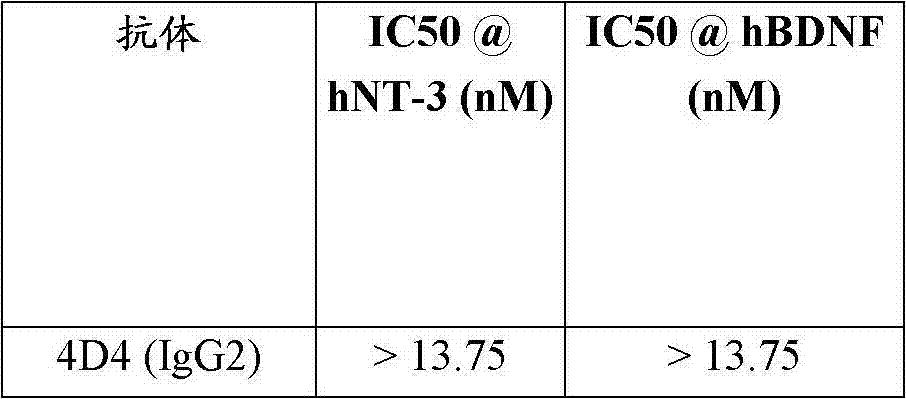
实施例8Example 8
鉴定抗NGF抗体的表位Identification of epitopes for anti-NGF antibodies
通过限制性蛋白酶解的表位作图Epitope mapping by restriction proteolysis
在4℃下,将5微克(μg)NGF与4D4(11μg)一起在0.1M Tris缓冲液(pH 7.5)中温育30分钟。然后将复合物用蛋白酶(枯草杆菌蛋白酶)1μg于37℃消化1小时和2小时。将HPLC肽图彼此进行比较以发现受4D4抗体保护的肽。NGF的限制性蛋白酶解表明,若干主要肽最初从NGF中释放。特别有趣的是,产生肽S18.3、S18.5和S34.4,并且被抗体保护免受蛋白酶解。并不明显形成或保护其它峰。两项实验(1小时和2小时消化)的受保护的肽见表7。5 micrograms (μg) of NGF were incubated with 4D4 (11 μg) in 0.1M Tris buffer (pH 7.5) for 30 min at 4°C. The complex was then digested with protease (subtilisin) 1 μg at 37°C for 1 hour and 2 hours. The HPLC peptide maps were compared to each other to find peptides protected by the 4D4 antibody. Restricted proteolysis of NGF revealed that several major peptides were initially released from NGF. Of particular interest, peptides S18.3, S18.5 and S34.4 were produced and protected from proteolysis by antibodies. No other peaks were evidently formed or preserved. The protected peptides for the two experiments (1 hour and 2 hour digestion) are shown in Table 7.
表7Table 7

根据肽峰高计算出保护百分比。S18.5含有两种肽,但用4D4抗体只保护一种肽(SSSHPIFHR;SEQ ID NO:46),因为另一个肽峰(HWNSY;SEQ ID NO:47)不因4D4抗体的加入而改变,正如在280nm下的吸光度所检测的。肽S18.3是S34.4的C端部分,两者均来自同一环区。N端和中部环区也是潜在的表位。The percent protection was calculated from the peptide peak height. S18.5 contained two peptides, but only one peptide (SSSHPIFHR; SEQ ID NO: 46) was protected with 4D4 antibody, because the other peptide peak (HWNSY; SEQ ID NO: 47) was not changed by the addition of 4D4 antibody, As detected by absorbance at 280nm. Peptide S18.3 is the C-terminal part of S34.4, both from the same loop region. The N-terminal and central loop regions are also potential epitopes.
消化肽的Microcon分离Microcon Separation of Digested Peptides
将枯草杆菌蛋白酶消化的物质(各3μg)与有活性的4D4抗体和无活性的单克隆抗体(#162)(8μg)一起在0.1M Tris缓冲液(pH 7.5)中于4℃温育30分钟。结合/未结合肽通过Microcon 10(Millipore Corp.,Bedford,Mass)分离,两种片段(结合和未结合片段)用HPLC进行分析以找出与抗体结合的肽。将用4D4抗体和#162处理和Microcon分离后通过对未结合片段的HPLC比较鉴定出的两个消耗峰回收,表明抗体结合肽。4D4结合肽为:Subtilisin digested material (3 μg each) was incubated with active 4D4 antibody and inactive monoclonal antibody (#162) (8 μg) in 0.1M Tris buffer (pH 7.5) for 30 minutes at 4°C . Bound/unbound peptides were separated by Microcon 10 (Millipore Corp., Bedford, Mass), and the two fragments (bound and unbound) were analyzed by HPLC to identify peptides bound to the antibody. Two depletion peaks identified by HPLC comparison to the unbound fragment after treatment with the 4D4 antibody and #162 and Microcon separation were recovered, indicating antibody binding to the peptide. The 4D4-binding peptides are:
S1(4.4)----SRKAVRR(113-119)(SEQ ID NO:49),C端;和S1 (4.4) ---- SRKAVRR (113-119) (SEQ ID NO: 49), C-terminal; and
S2(28.3)----EVMVL(35-39)(SEQ ID NO:50),环区。S2(28.3)----EVMVL(35-39) (SEQ ID NO:50), ring region.
或者,NGF样品用Lys-C(K)消化24小时。在无变性剂的情况下还原半胱氨酸残基并羧甲基化。将样品与单克隆抗体4D4和AMG162一起温育,接着Microcon 100分离。用反相HPLC分析结合和未结合片段。如下所述,仅两种肽被鉴定为抗体结合K-肽。通过序列分析确定的肽的计算质量和肽质谱法的一致。如下表示的肽对应于N端区和C端区。Alternatively, NGF samples were digested with Lys-C(K) for 24 hours. Cysteine residues were reduced and carboxymethylated without denaturing agents. Samples were incubated with monoclonal antibodies 4D4 and AMG162, followed by
K1(37.6)----SSSHPIFHRGEFSVCDSVSVWVGDK(SEQ ID NO:51)K1(37.6)----SSSHPIFHRGEFSVCDSVSVWVGDK (SEQ ID NO: 51)
计算质量=2821;实测质量=2828.2;N端Calculated mass = 2821; Measured mass = 2828.2; N-terminal
K2(39.5)----QAAWRFIRIDTACVCVLSRK(SEQ ID NO:52)K2(39.5)----QAAWRFIRIDTACVCVLSRK (SEQ ID NO: 52)
计算质量=2452;实测质量=2459.5;C端Calculated mass = 2452; Measured mass = 2459.5; C-terminal
之前的表位作图实验表明,至少3个区是4D4抗体的可能表位,包括N端(1-9)、内部(46-57)和C端(96-98)区。另外,AspN消化显示由---SSHPIFHRGEFSVC---(SEQ ID NO:53)组成的肽片段受4D4抗体保护,而胰蛋白酶消化显示由---SSHPIFHR----(SEQ ID NO:54)组成的肽片段不受4D4抗体保护。因此,在N端中,GEFSVC序列(SEQ IDNO:55)对与4D4抗体结合最为重要。Previous epitope mapping experiments indicated that at least 3 regions are possible epitopes of the 4D4 antibody, including the N-terminal (1-9), internal (46-57) and C-terminal (96-98) regions. Additionally, AspN digestion revealed that a peptide fragment consisting of ---SSHPIFHRGEFSVC---(SEQ ID NO:53) was protected by the 4D4 antibody, while trypsin digestion revealed that a peptide fragment consisting of ---SSHPIFHR----(SEQ ID NO:54) The constituent peptide fragments are not protected by the 4D4 antibody. Thus, in the N-terminus, the GEFSVC sequence (SEQ ID NO: 55) is most important for binding to the 4D4 antibody.
为了更明确地限定抗NGF抗体4D4.IgG1的表位,根据完整人成熟NGF(hNGF)序列,应用标准技术合成产生共23种肽(表8)。肽长15个氨基酸,重叠达10个氨基酸,并在C端加半胱氨酸尾以允许与基质缀合。下述人抗hNGF Ab 4D4.IgG1用于作图实验。To more clearly define the epitope of the anti-NGF antibody 4D4.IgG1, a total of 23 peptides were synthesized using standard techniques based on the complete human mature NGF (hNGF) sequence (Table 8). The peptides are 15 amino acids long, overlap by up to 10 amino acids, and are C-terminal cysteine tailed to allow conjugation to the substrate. The following human anti-hNGF Ab 4D4.IgG1 was used for mapping experiments.
表8Table 8
将人NGF肽片段在具有5%DMSO、1mM EDTA的PBS(pH 6.23)中稀释。将最终的肽浓度标准化至55μM(约100μg/ml)的相同摩尔浓度。使肽在Reacti-Bind Maleimide活化的96孔微量滴定板(Pierce目录号15150)中以100μl/孔于室温温育2小时,然后在搅拌的同时在4℃下过夜。人NGF(100μg/ml)用作阳性对照。板用洗涤缓冲液(KPL)洗涤,并用0.2%脱脂奶粉(PBS-EDTA缓冲液中,pH 6.23)在室温下封闭2小时,然后再用5%BSA封闭1小时。然后将板与不同浓度(0、3、10、30μg/ml)的人抗NGF抗体一起温育,接着与山羊抗hFc Ab-HRP(KPL)温育2小时。信号用TMB底物显影,在加入终止溶液(KPL)后,在450nm下读数。Human NGF peptide fragments were diluted in PBS (pH 6.23) with 5% DMSO, 1 mM EDTA. The final peptide concentration was normalized to the same molar concentration of 55 μM (approximately 100 μg/ml). Peptides were incubated at 100 μl/well in Reacti-Bind Maleimide activated 96-well microtiter plates (Pierce cat# 15150) for 2 hours at room temperature and then overnight at 4°C with agitation. Human NGF (100 μg/ml) was used as a positive control. Plates were washed with wash buffer (KPL) and blocked with 0.2% nonfat dry milk (in PBS-EDTA buffer, pH 6.23) for 2 hours at room temperature, followed by 5% BSA for 1 hour. Plates were then incubated with different concentrations (0, 3, 10, 30 μg/ml) of human anti-NGF antibody followed by goat anti-hFc Ab-HRP (KPL) for 2 hours. Signals were developed with TMB substrate and read at 450 nm after addition of stop solution (KPL).
在23种人NGF肽中,观察到表明4D4结合的至少4个主要峰。这些峰对应于下列肽:肽#1(SEQ ID NO:56),SSSHPIFHRGEFSVC(1-15);肽#10(SEQ ID NO:65),NSVFKQYFFETKARD(46-60);肽#16-17(SEQ ID NO:71-SEQ ID NO:72),WNSYATTTHTFVKAL---(76-95);和肽#18-21(SEQ ID NO:73-SEQ ID NO:76),TTTHT---LSRKC(100-115)。Among the 23 human NGF peptides, at least 4 major peaks indicative of 4D4 binding were observed. These peaks correspond to the following peptides: Peptide #1 (SEQ ID NO:56), SSSHPIFHRGEFSVC (1-15); Peptide #10 (SEQ ID NO:65), NSVFKQYFFETKARD (46-60); Peptide #16-17 (SEQ ID NO:65). ID NO: 71-SEQ ID NO: 72), WNSYATTTHTFVKAL---(76-95); and peptide #18-21 (SEQ ID NO: 73-SEQ ID NO: 76), TTTHT---LSRKC(100- 115).
4D4的4个结合峰对应于如Weismann等人(1999,Nature401:184-8)所描述的NGF中的N端、C端、内部结构域以及环L2和L4。这些结果概括于表9中。The 4 binding peaks of 4D4 correspond to the N-terminus, C-terminus, internal domain and loops L2 and L4 in NGF as described by Weismann et al. (1999, Nature 401 :184-8). These results are summarized in Table 9.
表9Table 9

Wiesmann等人解析了与trkA受体结合的hNGF的晶体结构,表明N端(残基2-9)对受体结合重要(Wiesmann等,1999,Nature401:184-8)。相对于trkB或trkC受体,NGF中该区段的残基亦在对trkA受体的特异性方面重要。抗体4D4具有对人NGF相对于对小鼠/大鼠NGF以及BDNF和NT-3的选择性,最可能是因为人NGF和其它神经营养蛋白之间的N端差异。Wiesmann et al. solved the crystal structure of hNGF bound to the trkA receptor, showing that the N-terminus (residues 2-9) is important for receptor binding (Wiesmann et al., 1999, Nature 401 :184-8). Residues in this segment of NGF are also important in specificity for the trkA receptor relative to the trkB or trkC receptor. Antibody 4D4 is selective for human NGF over mouse/rat NGF as well as BDNF and NT-3, most likely because of N-terminal differences between human NGF and other neurotrophins.
抗体4D4与分别相当于环L2和L4的肽#10(SEQ ID NO:65)(NSVFK---,46-60)和肽#17(SEQ ID NO:72)(TTTHTFVKALTMDGKC,81-95)结合,环L2和L4表示具有高于在神经营养蛋白中的平均序列多样性的7个截然不同的区中的两个。这7个区的NGF和BDNF之间的交换实验表明,L2和L4对于NGF的生物活性很重要。此外,环L2和L4中5个NT3残基被NGF的残基取代引入NGF样活性,同时保持NT3活性。因此,L2和L4可能是其中抗体4D4与NGF选择性结合而不与BDNF或NT-3结合的区域。Antibody 4D4 binds to peptide #10 (SEQ ID NO: 65) (NSVFK---, 46-60) and peptide #17 (SEQ ID NO: 72) (TTTHTFVKALTMDGKC, 81-95) corresponding to loops L2 and L4, respectively , loops L2 and L4 represent two of seven distinct regions with higher than average sequence diversity in neurotrophins. Exchange experiments between NGF and BDNF in these seven domains revealed that L2 and L4 are important for the biological activity of NGF. Furthermore, substitution of five NT3 residues in loops L2 and L4 by residues from NGF introduced NGF-like activity while maintaining NT3 activity. Therefore, L2 and L4 may be regions where antibody 4D4 selectively binds to NGF but not to BDNF or NT-3.
抗体4D4还与肽#16(SEQ ID NO:71)(WNSYATTTHTFVKAL,76-90)结合,肽#16与NGF晶体结构的内部结构域匹配。在人NGF和小鼠NGF之间该区有100%同源性,但与其它神经营养蛋白截然不同。当与其针对人NGF的活性进行比较时,4D4显示针对大鼠/小鼠NGF弱得多的活性。因此,对于种特异性,与NGF的该部分的结合极可能不是关键性的,但对于在神经营养蛋白之间的选择性则是重要的。Antibody 4D4 also binds to peptide #16 (SEQ ID NO:71) (WNSYATTTHTFVKAL, 76-90), which matches the internal domain of the NGF crystal structure. This region has 100% homology between human NGF and mouse NGF, but is distinct from other neurotrophins. 4D4 showed much weaker activity against rat/mouse NGF when compared to its activity against human NGF. Therefore, binding to this part of NGF is most likely not critical for species specificity, but important for selectivity between neurotrophins.
抗体4D4还与NGF的C端区(肽#19-21(SEQ ID NO:74-SEQ IDNO:76)TMDGK---LSRKC,91-115)结合,该区是将NGF与其它神经营养蛋白(BDNF和NT3)区分开来的人NGF的区域之一。与该区的结合有助于解释为什么4D4对其它神经营养蛋白无活性。此外,在C端中,在人NGF和小鼠NGF之间有单个氨基酸差异,这就表明这个单独的氨基酸可能是4D4具有对人NGF相对于对大鼠/小鼠NGF的选择性的原因之一,与其中观察到种间差异的N端类似。Antibody 4D4 also binds to the C-terminal region of NGF (peptide #19-21 (SEQ ID NO: 74-SEQ ID NO: 76) TMDGK---LSRKC, 91-115), which binds NGF to other neurotrophins ( BDNF and NT3) are one of the regions of human NGF that are distinguished. Binding to this region helps explain why 4D4 is inactive against other neurotrophins. Furthermore, in the C-terminus, there is a single amino acid difference between human NGF and mouse NGF, suggesting that this single amino acid may be responsible for the selectivity of 4D4 for human NGF over rat/mouse NGF One, is similar to the N-terminus where interspecies differences were observed.
最后,4D4还与通过人NGF的肽#10(SEQ ID NO:65)(---KARDC,50-60)描述的内部结构域相互作用,该内部结构域是NGF优先结合trkA而非trkB或trkC的重要区域,这进一步解释了其针对人NGF的选择性中和活性。Finally, 4D4 also interacts with the internal domain described by peptide #10 (SEQ ID NO: 65) (---KARDC, 50-60) of human NGF, which is responsible for the preferential binding of NGF to trkA but not trkB or important region of trkC, which further explains its selective neutralization activity against human NGF.
实施例9Example 9
单克隆抗体通过KinExA的亲和力测定Affinity Determination of Monoclonal Antibodies by KinExA
在KinExA上检测了Ab 4D4(38859-80)与huNGF(29714-91)的结合。简而言之,将Reacti-Gel 6x(Pierce)用huNGF预先包被,并用BSA封闭。将10pM和30pM的Ab 4D4样品与不同浓度的huNGF(Amgen)一起在室温下温育8小时后,从huNGF包被的珠粒中流过。通过荧光(Cy5)标记的山羊抗人-IgG抗体(Jackson Immuno Research)定量测定珠粒结合的抗体的量。在平衡时,结合信号与游离抗体的浓度成比例。采用双曲线一位点均质结合模型(dual-curve one-site homogeneousbinding model)(KinExTM软件),由竞争曲线的非线性回归得到解离平衡常数(KD)。与huNGF结合的Ab 4D4的KD约为4pM。Binding of Ab 4D4 (38859-80) to huNGF (29714-91 ) was tested on KinExA. Briefly, Reacti-Gel 6x (Pierce) was pre-coated with huNGF and blocked with BSA. Ab 4D4 samples at 10 pM and 30 pM were flowed through huNGF-coated beads after incubation with different concentrations of huNGF (Amgen) for 8 hours at room temperature. The amount of bead-bound antibody was quantified by fluorescent (Cy5) labeled goat anti-human-IgG antibody (Jackson Immuno Research). At equilibrium, the binding signal is proportional to the concentration of free antibody. Using the dual-curve one-site homogeneous binding model (KinExTM software), the dissociation equilibrium constant (K D ) was obtained from the nonlinear regression of the competition curve. The KD of Ab 4D4 binding to huNGF was approximately 4 pM.
实施例10Example 10
其它抗NGF抗体的鉴定Identification of other anti-NGF antibodies
选择按上述实施例2和3中所述产生和鉴定的其它抗NGF抗体(命名为14D10、6G9、7H2、14F11和4G6)用于进一步研究。简而言之,测定条件培养基的结合活性。对来自培养基的抗体进行纯化和测序。将预测质量与来自条件培养基的抗体的质谱数据进行比较。克隆抗体。使2个克隆在CHO细胞中表达,并如上所述测定活性。结果见表10。Additional anti-NGF antibodies (designated 14D10, 6G9, 7H2, 14F11 and 4G6) generated and identified as described in Examples 2 and 3 above were selected for further study. Briefly, the binding activity of conditioned media was determined. Antibodies from culture media were purified and sequenced. The predicted mass was compared to the mass spectrometry data of the antibody from the conditioned media. Cloned antibodies. Two clones were expressed in CHO cells and activity was assayed as described above. The results are shown in Table 10.
表10Table 10

然后将这些抗体的轻链和重链可变区的序列与4D4抗体序列以及彼此进行比较(图5和图6)。从这些比较中鉴定的重链可变区的百分比同源性见表11。轻链可变区的百分比同源性见表12。另外,各种抗体的CDR区的百分比同源性见图5-10。The sequences of the light and heavy chain variable regions of these antibodies were then compared to the 4D4 antibody sequence and to each other (Figure 5 and Figure 6). The percent homology of the heavy chain variable regions identified from these comparisons is shown in Table 11. See Table 12 for the percent homology of the light chain variable regions. In addition, the percent homology of the CDR regions of various antibodies is shown in Figures 5-10.
表11Table 11
表12Table 12

实施例11Example 11
人中皮下NGF抗体的安全性和耐受性Safety and tolerability of subcutaneous NGF antibody in humans
本项研究的目的在于评价在患有骨关节炎(OA)膝痛的受试者中多个皮下(SC)剂量的抗神经生长因子的抗体(NGF抗体)的安全性和耐受性,以及检查在将多个SC剂量的NGF抗体给予患OA膝痛的受试者后NGF抗体的血清药代动力学(PK)。通过Western Ontario和McMaster Universities关节炎指数[WOMACTM3.1]评价多个SC剂量的临床益处。The purpose of this study was to evaluate the safety and tolerability of multiple subcutaneous (SC) doses of an anti-nerve growth factor antibody (NGF antibody) in subjects with osteoarthritis (OA) knee pain, and The serum pharmacokinetics (PK) of NGF antibody following administration of multiple SC doses of NGF antibody to subjects with OA knee pain was examined. The clinical benefit of multiple SC doses was assessed by the Western Ontario and McMaster Universities Arthritis Index [WOMAC ™ 3.1].
在患OA膝痛的受试者中进行了I期、序贯随机、双盲安慰剂对照的多剂量、剂量递增研究。研究设计包括4个受试者群组,每个群组8名受试者(n=32)。使用NGF抗体的3种剂量水平(3mg、10mg、20mg)。用于本研究的NGF抗体是按类似于给出的方法制备的完全人单克隆抗体(此处?-我们需要确认/阐明产生这些I期mAb的产生方法吗?)。A phase I, sequential randomized, double-blind, placebo-controlled, multiple-dose, dose-escalation study was conducted in subjects with OA knee pain. The study design included 4 subject cohorts with 8 subjects in each cohort (n=32). Three dose levels (3 mg, 10 mg, 20 mg) of NGF antibody were used. The NGF antibody used in this study was a fully human monoclonal antibody prepared similarly to that given (here? - do we need to confirm/clarify the method of production of these Phase I mAbs?).
虽然功效数据变化大,且本研究并不足以以评价功效衡量的统计显著性,但是疼痛相关治疗效果似乎是显然的。平均WOMAC总分、平均WOMAC亚类分数、平均患者总体疾病评价和平均医师总体疾病评价显示在治疗组第一次给药后的第一时间点有改善的总趋势,其效果在整个给药期间保持。这些趋势在安慰剂组中并不同样明显。在NGF抗体的最后剂量后,治疗效果随时间趋向基线。Pain-related treatment effects appeared to be clear, although efficacy data were variable and the study was not powerful enough to evaluate the statistical significance of the efficacy measure. Mean WOMAC Total Score, Mean WOMAC Subcategory Score, Mean Patient Global Disease Rating, and Mean Physician Global Disease Rating showed a general trend toward improvement at the first time point after the first dosing in the treatment group, with effects sustained throughout the dosing period Keep. These trends were not as pronounced in the placebo group. After the last dose of NGF antibody, the treatment effect tended to baseline over time.
在给予患OA膝痛的受试者单个或多个SC剂量后,NGF抗体暴露似乎在3mg-20mg的剂量范围中大致与剂量成比例地增加。Tmax中值的范围为7.5-11.5天。对于在治疗组中的10名受试者(56%)和在安慰剂组中的2名受试者(33%)报告为治疗相关的不良事件(AE)。无受试者因AE而提早中止研究。然而,由于2级感觉神经AE,方案规定的停止规则变得适用,使得群组中5名受试者(2名安慰剂,3名治疗的)未接受第4个剂量和最终剂量的研究中制品。感觉神经AE似乎是剂量依赖性的。Following single or multiple SC doses in subjects with OA knee pain, NGF antibody exposure appeared to increase approximately dose proportionally in the dose range of 3 mg-20 mg. Median Tmax ranged from 7.5-11.5 days. Treatment-related adverse events (AEs) were reported for 10 subjects (56%) in the treatment group and 2 subjects (33%) in the placebo group. No subject discontinued the study early due to AEs. However, due to a
在年龄介于36和63岁的男性和女性OA受试者中,多次SC给药似乎在本研究中所给予的剂量下耐受良好,除了对接受20mg抗体的6名受试者中的4名报告的治疗突发性、可能的剂量依赖性感觉神经事件(严重程度为轻度或中度)以外。NGF抗体暴露似乎在3mg-20mg的剂量范围内大致与剂量成比例地增加。末期半寿期(t1/2,z)的范围为20.3-26.4天。In male and female OA subjects aged 36 and 63 years, multiple SC doses appeared to be well tolerated at the doses given in this study, except for 6 subjects who received 20 mg antibody Four reported treatment-emergent, possibly dose-dependent sensorineural events (mild or moderate in severity). NGF antibody exposure appears to increase approximately dose proportionally over the dose range of 3mg-20mg. The terminal half-lives (t 1/2, z ) ranged from 20.3-26.4 days.
应当理解的是,前述公开内容强调本发明的某些具体实施方案,与其等同的全部修改或备选方案均落入随附权利要求书中给出的本发明的精神和范围内。It should be understood that the foregoing disclosure emphasizes certain specific embodiments of the invention, and that all modifications and alternatives equivalent thereto fall within the spirit and scope of the invention as set forth in the appended claims.
Claims (25)
Applications Claiming Priority (3)
| Application Number | Priority Date | Filing Date | Title |
|---|---|---|---|
| US12/576,522 | 2009-10-09 | ||
| US12/576,522 US9260514B2 (en) | 2003-07-15 | 2009-10-09 | Methods of treating conditions caused by increased expression of nerve growth factor (NGF) or increased sensitivity to NGF using anti-NGF neutralizing antibodies as selective NGF pathway inhibitors |
| PCT/US2010/051960 WO2011049758A1 (en) | 2009-10-09 | 2010-10-08 | Human anti-ngf neutralizing antibodies as selective ngf pathway inhibitors |
Publications (1)
| Publication Number | Publication Date |
|---|---|
| CN102762228A true CN102762228A (en) | 2012-10-31 |
Family
ID=43466840
Family Applications (1)
| Application Number | Title | Priority Date | Filing Date |
|---|---|---|---|
| CN2010800558997A Pending CN102762228A (en) | 2009-10-09 | 2010-10-08 | Human anti-ngf neutralizing antibodies as selective ngf pathway inhibitors |
Country Status (28)
| Country | Link |
|---|---|
| US (1) | US9260514B2 (en) |
| EP (2) | EP2485760B1 (en) |
| JP (3) | JP2013507385A (en) |
| KR (1) | KR101528393B1 (en) |
| CN (1) | CN102762228A (en) |
| AR (1) | AR078569A1 (en) |
| AU (2) | AU2010308418A1 (en) |
| BR (1) | BR112012008282A2 (en) |
| CA (1) | CA2775924A1 (en) |
| CL (1) | CL2012000881A1 (en) |
| CO (1) | CO6541558A2 (en) |
| CR (1) | CR20120198A (en) |
| EA (1) | EA201290189A1 (en) |
| IL (1) | IL218885A0 (en) |
| MA (1) | MA33724B1 (en) |
| ME (1) | ME00226B (en) |
| MT (1) | MTP4289B (en) |
| MX (1) | MX343748B (en) |
| MY (1) | MY172283A (en) |
| NZ (2) | NZ599431A (en) |
| PE (1) | PE20121028A1 (en) |
| PH (1) | PH12012500668A1 (en) |
| SG (1) | SG10201603945RA (en) |
| TN (1) | TN2012000136A1 (en) |
| TW (1) | TW201125581A (en) |
| UA (1) | UA102775C2 (en) |
| WO (1) | WO2011049758A1 (en) |
| ZA (1) | ZA201203135B (en) |
Cited By (3)
| Publication number | Priority date | Publication date | Assignee | Title |
|---|---|---|---|---|
| CN111402950A (en) * | 2013-11-29 | 2020-07-10 | 豪夫迈·罗氏有限公司 | Antibody selection device and method |
| WO2021208928A1 (en) * | 2020-04-17 | 2021-10-21 | 珠海泰诺麦博生物技术有限公司 | Anti-human nerve growth factor antibody |
| TWI773264B (en) * | 2020-04-26 | 2022-08-01 | 大陸商三生國健藥業(上海)股份有限公司 | Antibody binding human ngf, manufacturing method thereof and use thereof |
Families Citing this family (26)
| Publication number | Priority date | Publication date | Assignee | Title |
|---|---|---|---|---|
| ITRM20030601A1 (en) * | 2003-12-24 | 2005-06-25 | Lay Line Genomics Spa | METHOD FOR THE HUMANIZATION OF HUMANIZED ANTIBODIES AND ANTIBODIES WITH IT OBTAINED. |
| ITRM20050290A1 (en) * | 2005-06-07 | 2006-12-08 | Lay Line Genomics Spa | USE OF MOLECULES ABLE TO INHIBIT THE BOND BETWEEN NGF AND ITS TRKA RECEPTOR AS AN EXTENDED EFFECT ANALGESICS. |
| CA2761203A1 (en) * | 2009-05-04 | 2010-11-11 | Abbott Research B.V. | Antibodies against nerve growth factor (ngf) with enhanced in vivo stability |
| US8911734B2 (en) * | 2010-12-01 | 2014-12-16 | Alderbio Holdings Llc | Methods of preventing or treating pain using anti-NGF antibodies that selectively inhibit the association of NGF with TrkA, without affecting the association of NGF with p75 |
| US9539324B2 (en) | 2010-12-01 | 2017-01-10 | Alderbio Holdings, Llc | Methods of preventing inflammation and treating pain using anti-NGF compositions |
| US11214610B2 (en) | 2010-12-01 | 2022-01-04 | H. Lundbeck A/S | High-purity production of multi-subunit proteins such as antibodies in transformed microbes such as Pichia pastoris |
| US9067988B2 (en) | 2010-12-01 | 2015-06-30 | Alderbio Holdings Llc | Methods of preventing or treating pain using anti-NGF antibodies |
| US9884909B2 (en) | 2010-12-01 | 2018-02-06 | Alderbio Holdings Llc | Anti-NGF compositions and use thereof |
| US9078878B2 (en) | 2010-12-01 | 2015-07-14 | Alderbio Holdings Llc | Anti-NGF antibodies that selectively inhibit the association of NGF with TrkA, without affecting the association of NGF with p75 |
| EP2859018B1 (en) | 2012-06-06 | 2021-09-22 | Zoetis Services LLC | Caninized anti-ngf antibodies and methods thereof |
| US9603775B2 (en) | 2013-04-24 | 2017-03-28 | Corning Incorporated | Delamination resistant pharmaceutical glass containers containing active pharmaceutical ingredients |
| EP3282928B1 (en) | 2015-04-17 | 2019-08-07 | Koninklijke Philips N.V. | Detection of anisotropic biological tissue |
| JP7071975B2 (en) | 2016-11-29 | 2022-05-19 | リジェネロン・ファーマシューティカルズ・インコーポレイテッド | Pharmaceutical composition to avoid opioid addiction |
| WO2019178364A2 (en) * | 2018-03-14 | 2019-09-19 | Elstar Therapeutics, Inc. | Multifunctional molecules and uses thereof |
| JP7460598B2 (en) * | 2018-08-10 | 2024-04-02 | リジェネロン・ファーマシューティカルズ・インコーポレイテッド | Pharmaceutical Composition for the Safe and Effective Treatment of Knee and/or Hip Pain - Patent application |
| IT201800009384A1 (en) | 2018-10-11 | 2020-04-11 | Cosmo Srl | Peptide for cosmetic application |
| WO2020248942A1 (en) * | 2019-06-10 | 2020-12-17 | 山东博安生物技术有限公司 | ANTI-β-NGF NANOBODY AND USE THEREFOR |
| CN113993900B (en) * | 2020-05-27 | 2023-08-04 | 舒泰神(北京)生物制药股份有限公司 | Antibodies specifically recognizing nerve growth factor and uses thereof |
| AU2020204105B2 (en) * | 2020-06-19 | 2023-06-08 | Dartsbio Pharmaceuticals Ltd. | Anti-human ngf antibodies and methods using same |
| US11655292B2 (en) | 2020-06-23 | 2023-05-23 | Ampsource Biopharma Shanghai Inc. | Anti-human NGF antibodies and methods using same |
| IT202000020287A1 (en) * | 2020-08-20 | 2022-02-20 | Colosseum Combinatorial Chemistry Centre For Tech Societa A Responsabilita Limitata In Forma Abbrevi | PEPTIDE FOR THERAPEUTIC APPLICATIONS IN THE DERMATOLOGICAL FIELD |
| EP4433500A1 (en) | 2021-11-19 | 2024-09-25 | Regeneron Pharmaceuticals, Inc. | Methods and compositions for reducing centralized pain |
| CA3243118A1 (en) * | 2022-01-21 | 2023-07-27 | Pralonir S.A.S. | Active immunization for reducing osteoarthritic, neuropathic, and cancer pain |
| US20240002491A1 (en) | 2022-04-27 | 2024-01-04 | Regeneron Pharmaceuticals, Inc. | Methods for selecting patients for treatment with an ngf antagonist |
| FR3148027A1 (en) * | 2023-04-24 | 2024-10-25 | Peptinov | ANTI-NGF VACCINE COMPOSITION |
| WO2025264860A2 (en) | 2024-06-18 | 2025-12-26 | Yale University | Methods of treating post-covid airway disease |
Citations (2)
| Publication number | Priority date | Publication date | Assignee | Title |
|---|---|---|---|---|
| CN1849138A (en) * | 2003-07-15 | 2006-10-18 | 安姆根有限公司 | Human anti-NGF neutralizing antibodies as selective ngf pathway inhibitors |
| CN101217978A (en) * | 2005-04-11 | 2008-07-09 | 礼纳特神经系统科学公司 | Methods for treating osteoarthritis pain by administering nerve growth factor antagonists and compositions thereof |
Family Cites Families (69)
| Publication number | Priority date | Publication date | Assignee | Title |
|---|---|---|---|---|
| US913242A (en) | 1905-08-29 | 1909-02-23 | Electrelle Company | Automatic music-playing attachment for pianos. |
| US3773919A (en) | 1969-10-23 | 1973-11-20 | Du Pont | Polylactide-drug mixtures |
| US4263428A (en) | 1978-03-24 | 1981-04-21 | The Regents Of The University Of California | Bis-anthracycline nucleic acid function inhibitors and improved method for administering the same |
| US4230691A (en) | 1978-05-23 | 1980-10-28 | The Massachusetts General Hospital | Nerve growth factor antibody and process |
| US4399216A (en) | 1980-02-25 | 1983-08-16 | The Trustees Of Columbia University | Processes for inserting DNA into eucaryotic cells and for producing proteinaceous materials |
| IE52535B1 (en) | 1981-02-16 | 1987-12-09 | Ici Plc | Continuous release pharmaceutical compositions |
| EP0088046B1 (en) | 1982-02-17 | 1987-12-09 | Ciba-Geigy Ag | Lipids in the aqueous phase |
| GB8308235D0 (en) | 1983-03-25 | 1983-05-05 | Celltech Ltd | Polypeptides |
| HUT35524A (en) | 1983-08-02 | 1985-07-29 | Hoechst Ag | Process for preparing pharmaceutical compositions containing regulatory /regulative/ peptides providing for the retarded release of the active substance |
| US4710473A (en) | 1983-08-10 | 1987-12-01 | Amgen, Inc. | DNA plasmids |
| EP0143949B1 (en) | 1983-11-01 | 1988-10-12 | TERUMO KABUSHIKI KAISHA trading as TERUMO CORPORATION | Pharmaceutical composition containing urokinase |
| US4740461A (en) | 1983-12-27 | 1988-04-26 | Genetics Institute, Inc. | Vectors and methods for transformation of eucaryotic cells |
| US4786593A (en) | 1985-04-16 | 1988-11-22 | Wistar Institute Of Anatomy And Biology | Diagnostic method for detection of neural crest disease |
| US4959455A (en) | 1986-07-14 | 1990-09-25 | Genetics Institute, Inc. | Primate hematopoietic growth factors IL-3 and pharmaceutical compositions |
| WO1988001649A1 (en) | 1986-09-02 | 1988-03-10 | Genex Corporation | Single polypeptide chain binding molecules |
| US4946778A (en) | 1987-09-21 | 1990-08-07 | Genex Corporation | Single polypeptide chain binding molecules |
| US5260203A (en) | 1986-09-02 | 1993-11-09 | Enzon, Inc. | Single polypeptide chain binding molecules |
| US4912040A (en) | 1986-11-14 | 1990-03-27 | Genetics Institute, Inc. | Eucaryotic expression system |
| JP2969647B2 (en) | 1988-09-14 | 1999-11-02 | 東ソー株式会社 | Monoclonal antibody, inhibitor comprising the same, and measuring method using the same |
| GB8823869D0 (en) | 1988-10-12 | 1988-11-16 | Medical Res Council | Production of antibodies |
| US5530101A (en) | 1988-12-28 | 1996-06-25 | Protein Design Labs, Inc. | Humanized immunoglobulins |
| SE465573B (en) | 1989-03-14 | 1991-09-30 | Lope Medicine Ab | NERVOUS GROWTH FACTOR Peptides, ANTIBODY CORRESPONDING MATERIALS AND PROCEDURES FOR DETERMINING NATIVE NERVOUS GROWTH FACTORS |
| WO1990014363A1 (en) | 1989-05-19 | 1990-11-29 | Amgen Inc. | Metalloproteinase inhibitor |
| JPH03163095A (en) | 1989-08-28 | 1991-07-15 | Takeda Chem Ind Ltd | Partial peptide of human nerve growth factor, antibody and use thereof |
| DK0418590T3 (en) | 1989-08-28 | 1998-04-20 | Takeda Chemical Industries Ltd | Antibodies, their preparation and their use |
| US5656435A (en) | 1989-08-28 | 1997-08-12 | Takeda Chemical Industries, Ltd. | Antibodies to peptides having NGF-like activity, said antibodies having no substantial cross-reactivity with NGF, and use thereof |
| US5151510A (en) | 1990-04-20 | 1992-09-29 | Applied Biosystems, Inc. | Method of synethesizing sulfurized oligonucleotide analogs |
| US5545806A (en) | 1990-08-29 | 1996-08-13 | Genpharm International, Inc. | Ransgenic non-human animals for producing heterologous antibodies |
| US6300129B1 (en) | 1990-08-29 | 2001-10-09 | Genpharm International | Transgenic non-human animals for producing heterologous antibodies |
| US5625126A (en) | 1990-08-29 | 1997-04-29 | Genpharm International, Inc. | Transgenic non-human animals for producing heterologous antibodies |
| WO1993012227A1 (en) | 1991-12-17 | 1993-06-24 | Genpharm International, Inc. | Transgenic non-human animals capable of producing heterologous antibodies |
| JP3232415B2 (en) | 1990-08-29 | 2001-11-26 | 武田薬品工業株式会社 | Monoclonal antibodies, their production and use |
| US5770429A (en) | 1990-08-29 | 1998-06-23 | Genpharm International, Inc. | Transgenic non-human animals capable of producing heterologous antibodies |
| US5874299A (en) | 1990-08-29 | 1999-02-23 | Genpharm International, Inc. | Transgenic non-human animals capable of producing heterologous antibodies |
| US5789650A (en) | 1990-08-29 | 1998-08-04 | Genpharm International, Inc. | Transgenic non-human animals for producing heterologous antibodies |
| US5633425A (en) | 1990-08-29 | 1997-05-27 | Genpharm International, Inc. | Transgenic non-human animals capable of producing heterologous antibodies |
| US5814318A (en) | 1990-08-29 | 1998-09-29 | Genpharm International Inc. | Transgenic non-human animals for producing heterologous antibodies |
| US5877397A (en) | 1990-08-29 | 1999-03-02 | Genpharm International Inc. | Transgenic non-human animals capable of producing heterologous antibodies of various isotypes |
| JP2938569B2 (en) | 1990-08-29 | 1999-08-23 | ジェンファーム インターナショナル,インコーポレイティド | Method for producing xenogeneic immunoglobulin and transgenic mouse |
| US5661016A (en) | 1990-08-29 | 1997-08-26 | Genpharm International Inc. | Transgenic non-human animals capable of producing heterologous antibodies of various isotypes |
| JPH06317587A (en) | 1990-08-31 | 1994-11-15 | Takeda Chem Ind Ltd | Antibody and its use |
| US5147294A (en) | 1990-10-01 | 1992-09-15 | Trustees Of Boston University | Therapeutic method for reducing chronic pain in a living subject |
| EP0590076A4 (en) | 1991-06-14 | 1997-02-12 | Dnx Corp | Production of human hemoglobin in transgenic pigs |
| DE69224906T2 (en) | 1991-07-08 | 1998-10-29 | Univ Massachusetts | THERMOTROPES LIQUID CRYSTALLINE SEGMENT BLOCK COPOLYMER |
| JPH0576384A (en) | 1991-09-20 | 1993-03-30 | Hitachi Ltd | Anti-human nerve growth factor monoclonal antibody |
| JP3519096B2 (en) | 1992-07-02 | 2004-04-12 | 武田薬品工業株式会社 | Monoclonal antibodies, hybridomas and their uses |
| US5625825A (en) | 1993-10-21 | 1997-04-29 | Lsi Logic Corporation | Random number generating apparatus for an interface unit of a carrier sense with multiple access and collision detect (CSMA/CD) ethernet data network |
| US5844092A (en) | 1994-03-18 | 1998-12-01 | Genentech, Inc. | Human TRK receptors and neurotrophic factor inhibitors |
| US5877016A (en) | 1994-03-18 | 1999-03-02 | Genentech, Inc. | Human trk receptors and neurotrophic factor inhibitors |
| DE69637481T2 (en) | 1995-04-27 | 2009-04-09 | Amgen Fremont Inc. | Human antibodies to IL-8 derived from immunized Xenomae |
| GB9616105D0 (en) | 1996-07-31 | 1996-09-11 | Univ Kingston | TrkA binding site of NGF |
| CA2273194C (en) | 1996-12-03 | 2011-02-01 | Abgenix, Inc. | Transgenic mammals having human ig loci including plural vh and vk regions and antibodies produced therefrom |
| US6660843B1 (en) | 1998-10-23 | 2003-12-09 | Amgen Inc. | Modified peptides as therapeutic agents |
| DK2168984T3 (en) | 1999-03-25 | 2012-12-10 | Abbott Gmbh & Co Kg | Human antibodies that bind human IL-12 and methods for its production |
| AU6375000A (en) | 1999-07-29 | 2001-02-19 | Medarex, Inc. | Human monoclonal antibodies to her2/neu |
| SI1210115T1 (en) | 1999-08-27 | 2009-12-31 | Genentech Inc | DOSAGES FOR TREATMENT WITH ANTI-ErbB2 ANTIBODIES |
| US6548062B2 (en) | 2000-02-29 | 2003-04-15 | Cephalon, Inc. | Method of treating cancer with anti-neurotrophin agents |
| FR2807660A1 (en) | 2000-04-13 | 2001-10-19 | Warner Lambert Co | Use of a nerve growth factor antagonist for the manufacture of a medicament for the prevention or treatment of chronic visceral pain |
| BR0210231A (en) | 2001-05-30 | 2004-09-14 | Genentech Inc | Method of controlling nerve growth factor (ngf) related dysfunction, pharmaceutical composition, manufactured article and use of anti-ngf monoclonal antibody |
| EP1539233B1 (en) | 2001-07-12 | 2011-04-27 | FOOTE, Jefferson | Super humanized antibodies |
| EP1369431A4 (en) | 2001-10-15 | 2005-01-12 | Kirin Brewery | Anti-hla-dr antibody |
| JP2005516965A (en) | 2001-12-28 | 2005-06-09 | アブジェニックス・インコーポレーテッド | Method using anti-MUC18 antibody |
| US6919426B2 (en) * | 2002-09-19 | 2005-07-19 | Amgen Inc. | Peptides and related molecules that modulate nerve growth factor activity |
| US7252822B2 (en) | 2002-10-08 | 2007-08-07 | Rinat Neuroscience Corp. | Methods for treating post-surgical pain by administering an anti-nerve growth factor antagonist |
| EP3539569A1 (en) * | 2002-12-24 | 2019-09-18 | Rinat Neuroscience Corp. | Anti-ngf antibodies and methods using the same in treating pain associated with musculo-skeletal disorders |
| KR100894191B1 (en) * | 2003-07-15 | 2009-04-22 | 암젠 인코포레이티드 | Human anti-NBF neutralizing antibody as a selective NGF pathway inhibitor and pharmaceutical composition comprising the antibody |
| JP5096167B2 (en) | 2005-01-24 | 2012-12-12 | メドイミューン リミテッド | Specific binding member for NGF |
| US9401875B2 (en) | 2012-06-01 | 2016-07-26 | Nippon Telegraph And Telephone Corporation | Packet transfer processing method and packet transfer processing device |
| US9300829B2 (en) | 2014-04-04 | 2016-03-29 | Canon Kabushiki Kaisha | Image reading apparatus and correction method thereof |
-
2004
- 2004-07-15 ME MEP-2008-315A patent/ME00226B/en unknown
-
2009
- 2009-10-09 US US12/576,522 patent/US9260514B2/en not_active Expired - Fee Related
-
2010
- 2010-10-07 MT MTP0004289A patent/MTP4289B/en unknown
- 2010-10-07 MY MYPI2010004729A patent/MY172283A/en unknown
- 2010-10-08 PE PE2012000442A patent/PE20121028A1/en not_active Application Discontinuation
- 2010-10-08 EA EA201290189A patent/EA201290189A1/en unknown
- 2010-10-08 CA CA2775924A patent/CA2775924A1/en not_active Abandoned
- 2010-10-08 UA UAA201205050A patent/UA102775C2/en unknown
- 2010-10-08 AR ARP100103675A patent/AR078569A1/en not_active Application Discontinuation
- 2010-10-08 BR BR112012008282A patent/BR112012008282A2/en not_active IP Right Cessation
- 2010-10-08 PH PH1/2012/500668A patent/PH12012500668A1/en unknown
- 2010-10-08 EP EP10766193.6A patent/EP2485760B1/en active Active
- 2010-10-08 WO PCT/US2010/051960 patent/WO2011049758A1/en not_active Ceased
- 2010-10-08 SG SG10201603945RA patent/SG10201603945RA/en unknown
- 2010-10-08 TW TW099134471A patent/TW201125581A/en unknown
- 2010-10-08 JP JP2012533344A patent/JP2013507385A/en active Pending
- 2010-10-08 NZ NZ599431A patent/NZ599431A/en not_active IP Right Cessation
- 2010-10-08 KR KR1020127012013A patent/KR101528393B1/en not_active Expired - Fee Related
- 2010-10-08 CN CN2010800558997A patent/CN102762228A/en active Pending
- 2010-10-08 NZ NZ625391A patent/NZ625391A/en not_active IP Right Cessation
- 2010-10-08 MX MX2012004035A patent/MX343748B/en active IP Right Grant
- 2010-10-08 EP EP15188795.7A patent/EP3028717A1/en not_active Withdrawn
- 2010-10-08 AU AU2010308418A patent/AU2010308418A1/en not_active Abandoned
-
2012
- 2012-03-27 IL IL218885A patent/IL218885A0/en unknown
- 2012-03-27 TN TNP2012000136A patent/TN2012000136A1/en unknown
- 2012-04-05 CL CL2012000881A patent/CL2012000881A1/en unknown
- 2012-04-24 CR CR20120198A patent/CR20120198A/en unknown
- 2012-04-30 ZA ZA2012/03135A patent/ZA201203135B/en unknown
- 2012-05-04 MA MA34834A patent/MA33724B1/en unknown
- 2012-05-09 CO CO12075923A patent/CO6541558A2/en unknown
-
2014
- 2014-06-12 JP JP2014121152A patent/JP2014169326A/en not_active Ceased
- 2014-06-18 AU AU2014203316A patent/AU2014203316B2/en not_active Ceased
-
2016
- 2016-10-20 JP JP2016206106A patent/JP2017014286A/en not_active Withdrawn
Patent Citations (2)
| Publication number | Priority date | Publication date | Assignee | Title |
|---|---|---|---|---|
| CN1849138A (en) * | 2003-07-15 | 2006-10-18 | 安姆根有限公司 | Human anti-NGF neutralizing antibodies as selective ngf pathway inhibitors |
| CN101217978A (en) * | 2005-04-11 | 2008-07-09 | 礼纳特神经系统科学公司 | Methods for treating osteoarthritis pain by administering nerve growth factor antagonists and compositions thereof |
Cited By (6)
| Publication number | Priority date | Publication date | Assignee | Title |
|---|---|---|---|---|
| CN111402950A (en) * | 2013-11-29 | 2020-07-10 | 豪夫迈·罗氏有限公司 | Antibody selection device and method |
| CN111402950B (en) * | 2013-11-29 | 2024-03-19 | 豪夫迈·罗氏有限公司 | Antibody selection devices and methods |
| WO2021208928A1 (en) * | 2020-04-17 | 2021-10-21 | 珠海泰诺麦博生物技术有限公司 | Anti-human nerve growth factor antibody |
| CN113527483A (en) * | 2020-04-17 | 2021-10-22 | 珠海泰诺麦博生物技术有限公司 | Antibodies against human nerve growth factor |
| CN113527483B (en) * | 2020-04-17 | 2023-09-22 | 珠海泰诺麦博制药股份有限公司 | Antibodies against human nerve growth factor |
| TWI773264B (en) * | 2020-04-26 | 2022-08-01 | 大陸商三生國健藥業(上海)股份有限公司 | Antibody binding human ngf, manufacturing method thereof and use thereof |
Also Published As
Similar Documents
| Publication | Publication Date | Title |
|---|---|---|
| CN102408483B (en) | Human anti-NGF neutralizing antibodies as selective NGF pathway inhibitors | |
| AU2014203316B2 (en) | Human Anti-NGF Neutralizing Antibodies as Selective NGF Pathway Inhibitors | |
| AU2016247195A1 (en) | Human Anti-NGF Neutralizing Antibodies as Selective NGF Pathway Inhibitors | |
| HK1178428A (en) | Human anti-ngf neutralizing antibodies as selective ngf pathway inhibitors | |
| HK1166998B (en) | Human anti-ngf neutralizing antibodies as selective ngf pathway inhibitors | |
| HK1169133A (en) | Human anti-ngf neutralizing antibodies as selective ngf pathway inhibitors | |
| HK1166998A (en) | Human anti-ngf neutralizing antibodies as selective ngf pathway inhibitors | |
| HK1169133B (en) | Human anti-ngf neutralizing antibodies as selective ngf pathway inhibitors | |
| HK1160609A (en) | Human anti-ngf neutralizing antibodies as selective ngf pathway inhibitors |
Legal Events
| Date | Code | Title | Description |
|---|---|---|---|
| C06 | Publication | ||
| PB01 | Publication | ||
| C10 | Entry into substantive examination | ||
| SE01 | Entry into force of request for substantive examination | ||
| REG | Reference to a national code |
Ref country code: HK Ref legal event code: DE Ref document number: 1178428 Country of ref document: HK |
|
| ASS | Succession or assignment of patent right |
Owner name: MEDAREX INC. Free format text: FORMER OWNER: MEDAREX, INC. Effective date: 20140320 |
|
| C41 | Transfer of patent application or patent right or utility model | ||
| TA01 | Transfer of patent application right |
Effective date of registration: 20140320 Address after: American California Applicant after: Amgen Inc. Applicant after: MEDAREX,INC Address before: American California Applicant before: Amgen Inc. Applicant before: Medarex, Inc. |
|
| AD01 | Patent right deemed abandoned |
Effective date of abandoning: 20180105 |
|
| AD01 | Patent right deemed abandoned |