CN102721951B - Method for tracking high maneuvering target - Google Patents
Method for tracking high maneuvering target Download PDFInfo
- Publication number
- CN102721951B CN102721951B CN 201210138397 CN201210138397A CN102721951B CN 102721951 B CN102721951 B CN 102721951B CN 201210138397 CN201210138397 CN 201210138397 CN 201210138397 A CN201210138397 A CN 201210138397A CN 102721951 B CN102721951 B CN 102721951B
- Authority
- CN
- China
- Prior art keywords
- target
- state
- covariance
- moment
- value
- Prior art date
- Legal status (The legal status is an assumption and is not a legal conclusion. Google has not performed a legal analysis and makes no representation as to the accuracy of the status listed.)
- Expired - Fee Related
Links
- 238000000034 method Methods 0.000 title claims abstract description 44
- 230000036461 convulsion Effects 0.000 claims abstract description 34
- 238000005562 fading Methods 0.000 claims abstract description 25
- 239000011159 matrix material Substances 0.000 claims description 59
- 238000005070 sampling Methods 0.000 claims description 36
- 230000001133 acceleration Effects 0.000 claims description 28
- 230000007704 transition Effects 0.000 claims description 13
- 238000009795 derivation Methods 0.000 claims description 6
- 238000004364 calculation method Methods 0.000 claims description 3
- 230000003044 adaptive effect Effects 0.000 description 15
- 238000004422 calculation algorithm Methods 0.000 description 6
- 230000000694 effects Effects 0.000 description 6
- 238000001914 filtration Methods 0.000 description 6
- 238000004088 simulation Methods 0.000 description 6
- 238000010586 diagram Methods 0.000 description 5
- 230000014509 gene expression Effects 0.000 description 5
- 230000017105 transposition Effects 0.000 description 5
- 238000005516 engineering process Methods 0.000 description 4
- 238000005309 stochastic process Methods 0.000 description 3
- 238000000342 Monte Carlo simulation Methods 0.000 description 2
- 238000005314 correlation function Methods 0.000 description 2
- 230000007812 deficiency Effects 0.000 description 2
- 238000005259 measurement Methods 0.000 description 2
- 230000036962 time dependent Effects 0.000 description 2
- 108010046685 Rho Factor Proteins 0.000 description 1
- 238000004458 analytical method Methods 0.000 description 1
- 238000004891 communication Methods 0.000 description 1
- 230000002596 correlated effect Effects 0.000 description 1
- 238000011161 development Methods 0.000 description 1
- 238000002474 experimental method Methods 0.000 description 1
- 238000012545 processing Methods 0.000 description 1
- 230000003313 weakening effect Effects 0.000 description 1
- 230000002087 whitening effect Effects 0.000 description 1
Images


Landscapes
- Radar Systems Or Details Thereof (AREA)
Abstract
本发明公开了一种高机动目标跟踪方法,主要解决现有技术中目标高机动带来的模型不匹配和跟踪精度低的问题。其实现过程是:(1)运动状态和模型参数的初始化;(2)建立改进jerk模型;(3)目标状态预测;(4)根据雷达的接收数据和状态预测值,求观测值的预测误差;(5)确定渐消因子;(6)确定滤波器增益;(7)对目标的状态进行更新,实现对目标的跟踪。本发明在保持一般机动目标跟踪精度的同时,提高了对目标状态突变时的跟踪性能,可用于高机动目标的跟踪。

The invention discloses a tracking method for a high maneuvering target, which mainly solves the problems of model mismatch and low tracking precision caused by the high maneuvering target in the prior art. The realization process is: (1) Initialization of motion state and model parameters; (2) Establishment of improved jerk model; (3) Prediction of target state; (4) According to the received data and state prediction value of the radar, the prediction error of the observation value is calculated ; (5) Determine the fading factor; (6) Determine the filter gain; (7) Update the state of the target to realize the tracking of the target. While maintaining the tracking accuracy of general maneuvering targets, the invention improves the tracking performance when the target state changes suddenly, and can be used for tracking high maneuvering targets.
Description
技术领域technical field
本发明属于通信技术领域,更进一步涉及雷达技术领域中一种高机动目标跟踪方法。本发明可用于实现高机动目标的跟踪,提高对目标突发机动时的跟踪性能。The invention belongs to the field of communication technology, and further relates to a method for tracking a high maneuvering target in the field of radar technology. The invention can be used to realize the tracking of high-maneuvering targets, and improve the tracking performance when the targets are suddenly maneuvered.
背景技术Background technique
随着现代航空航天技术的飞速发展,各种飞行器的机动性能大幅提高,机动形式不再局限于加速度阶跃、蛇行机动等形式,也可能会出现加速度变化率的阶跃机动等更复杂的机动。在此背景下,如何提高高机动目标的跟踪性能成为一个越来越重要的问题。With the rapid development of modern aerospace technology, the maneuverability of various aircraft has been greatly improved, and the form of maneuver is no longer limited to forms such as acceleration steps and snaking maneuvers, and more complex maneuvers such as step maneuvers of acceleration change rates may also occur . In this context, how to improve the tracking performance of high maneuvering targets has become an increasingly important issue.
目标跟踪的问题实际上就是目标状态的跟踪滤波问题,即根据雷达已获得的目标量测数据对目标状态进行精确的估计。建立目标的运动模型和自适应滤波是机动目标跟踪的两个关键部分,高机动目标的精确跟踪在过去和现在都是一个难题,最根本的原因在于目标的高机动使得目标的运动模型与目标实际动力学模型不匹配,导致跟踪滤波器发散,跟踪性能严重下降。因此,改善目标模型与目标实际运动模型的匹配度和跟踪滤波器的性能是提高高机动目标的跟踪性能的主要解决办法。The problem of target tracking is actually the problem of tracking and filtering of the target state, that is, to accurately estimate the target state according to the target measurement data obtained by the radar. The establishment of target motion model and adaptive filtering are two key parts of maneuvering target tracking. Accurate tracking of high maneuvering targets has been a difficult problem in the past and now. The actual dynamic model does not match, causing the tracking filter to diverge, and the tracking performance is severely degraded. Therefore, improving the matching degree between the target model and the target's actual motion model and the performance of the tracking filter are the main solutions to improve the tracking performance of high maneuvering targets.
乔向东和王宝树在论文“高度机动目标的‘当前’统计jerk模型”(系统工程与电子技术,2002年第24卷第6期)中提出了一种新的“当前”统计jerk模型及其跟踪滤波方法。该方法首先分析了jerk模型的局限性,提出了“当前”统计jerk模型,最后基于“当前”统计jerk模型应用卡尔曼滤波,实现对目标的跟踪。该方法存在的不足是,仅适用于实现对一般机动目标的跟踪,由于卡尔曼跟踪滤波对高机动目标存在自身鲁棒性和跟踪精度低的问题,对于高机动目标,此方法受到限制。Qiao Xiangdong and Wang Baoshu proposed a new "current" statistical jerk model and its tracking filter in the paper "The 'Current' Statistical Jerk Model of Highly Maneuvering Targets" (Systems Engineering and Electronic Technology, Vol. 24, No. 6, 2002) method. This method first analyzes the limitations of the jerk model, and proposes a "current" statistical jerk model, and finally applies Kalman filtering based on the "current" statistical jerk model to realize the tracking of the target. The disadvantage of this method is that it is only suitable for tracking general maneuvering targets. Because Kalman tracking filtering has its own robustness and low tracking accuracy for high maneuvering targets, this method is limited for high maneuvering targets.
宋强、何友和杨俭在论文“基于强跟踪滤波器的jerk模型目标跟踪算法”(海军航空工程学院学报,2007年第22卷第3期)中提出了一种强跟踪滤波算法。该方法首先分析了jerk模型自适应跟踪算法的不足,提出了强跟踪滤波的思想。该方法存在的不足也是仅适用于实现对一般机动目标的跟踪,对于高机动目标,由于jerk模型中关于目标加速度变化率为零均值的假设是不符合实际的,这一缺点将使得目标的运动模型与目标实际动力学模型不匹配,导致跟踪滤波器发散,跟踪性能下降。Song Qiang, He You and Yang Jian proposed a strong tracking filter algorithm in the paper "Jerk Model Target Tracking Algorithm Based on Strong Tracking Filter" (Journal of Naval Academy of Aeronautical Engineering, Vol. 22, No. 3, 2007). This method firstly analyzes the deficiencies of the self-adaptive tracking algorithm of the jerk model, and proposes the idea of strong tracking filtering. The disadvantage of this method is that it is only applicable to the tracking of general maneuvering targets. For high maneuvering targets, since the jerk model assumes that the rate of change of target acceleration is zero mean, this shortcoming will make the target’s movement The model does not match the actual dynamics model of the target, causing the tracking filter to diverge and the tracking performance to degrade.
发明内容Contents of the invention
本发明的目的在于克服上述现有技术的不足,提出了一种基于改进jerk模型的强跟踪滤波器的高机动目标跟踪方法。The purpose of the present invention is to overcome the above-mentioned deficiencies in the prior art, and proposes a high maneuvering target tracking method based on the strong tracking filter of the improved jerk model.
实现本发明的目的的基本思路是:首先,基于目标实际运动中的加速度变化率是非零均值的时间相关随机过程,建立改进jerk模型;其次,根据建立的运动模型,对目标状态进行预测;再次,根据雷达接收数据的观测值,确定观测值的预测误差;然后,由观测值的预测误差确定渐消因子,并由渐消因子自适应调整跟踪滤波器增益;最后,对目标状态进行更新,完成对机动目标的跟踪。The basic train of thought of realizing the purpose of the present invention is: at first, based on the acceleration rate of change in the target actual motion is the time-correlated stochastic process of non-zero mean value, set up the improved jerk model; Secondly, according to the motion model of establishment, the target state is predicted; again , according to the observation value of the radar received data, the prediction error of the observation value is determined; then, the fading factor is determined by the prediction error of the observation value, and the tracking filter gain is adaptively adjusted by the fading factor; finally, the target state is updated, Complete tracking of maneuvering targets.
实现本发明目的的具体步骤如下:The concrete steps that realize the object of the present invention are as follows:
(1)运动状态和模型参数的初始化(1) Initialization of motion state and model parameters
1a)利用雷达观测的前三个观测值确定初始状态和初始协方差;1a) Determine the initial state and initial covariance using the first three observations from the radar observation;
1b)渐消因子的初始值设为1;1b) The initial value of fading factor is set to 1;
1c)确定机动频率和目标加速度变化率的方差;1c) determine the variance of the maneuver frequency and target jerk;
(2)建立改进jerk模型(2) Establish an improved jerk model
2a)用下式对目标的运动特性建立运动状态方程:2a) Use the following formula to establish the motion state equation for the target's motion characteristics:
其中,X(k+1)为k+1时刻状态向量,k为采样时刻;F(k)为状态转移矩阵;X(k)为k时刻状态向量,


2b)用下式建立目标的观测方程:2b) Use the following formula to establish the observation equation of the target:
Z(k+1)=H(k+1)X(k+1)+V(k+1)Z(k+1)=H(k+1)X(k+1)+V(k+1)
其中,Z(k+1)为目标在k+1时刻的雷达观测值,k为采样时刻;H(k+1)为观测矩阵;X(k+1)为k+1时刻状态向量;V(k+1)为观测噪声,其均值和协方差分别为0和R(k)的高斯白噪声序列,且与过程噪声W(k)相互独立;Among them, Z(k+1) is the radar observation value of the target at k+1 time, k is the sampling time; H(k+1) is the observation matrix; X(k+1) is the state vector at k+1 time; V (k+1) is the observation noise, the Gaussian white noise sequence whose mean and covariance are 0 and R(k) respectively, and is independent of the process noise W(k);
(3)目标状态预测(3) Target state prediction
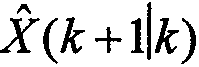
3a)由建立的模型和初始值完成目标状态的一步预测:3a) Complete one-step prediction of the target state by the established model and initial value:
其中,


3b)按照下式完成目标状态协方差的一步预测:3b) Complete the one-step prediction of the target state covariance according to the following formula:
P(k+1|k)=λ(k+1)F(k)P(k|k)FT(k)+Q(k)P(k+1|k)=λ(k+1)F(k)P(k|k)FT( k )+Q(k)
其中,P(k+1|k)表示k时刻预测目标在k+1时刻的状态协方差,k为采样时刻;λ(k+1)为k+1时刻的渐消因子;F(k)为状态转移矩阵;P(k|k)表示目标k时刻状态协方差更新值;FT(k)为状态转移矩阵的转置;Q(k)为过程噪声的协方差;Among them, P(k+1|k) represents the state covariance of the predicted target at time k+1 at time k, and k is the sampling time; λ(k+1) is the fading factor at time k+1; F(k) is the state transition matrix; P(k|k) represents the update value of the state covariance of the target at time k; FT (k) is the transposition of the state transition matrix; Q(k) is the covariance of the process noise;
(4)根据雷达的接收数据和状态预测值,求观测值的预测误差(4) Calculate the prediction error of the observation value according to the received data and state prediction value of the radar
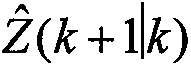
4a)由状态预测值按照下式确定目标在k时刻的观测值的预测:4a) Determine the prediction of the observed value of the target at time k by the state prediction value according to the following formula:
其中,表示k时刻预测目标在k+1时刻的观测值,k为采样时刻;H(k+1)为观测矩阵;
4b)由雷达接收数据按照下式确定目标在k时刻的观测值的预测误差:4b) Determine the prediction error of the observed value of the target at time k by the radar received data according to the following formula:
其中,

(5)确定渐消因子(5) Determine the fading factor
用预测误差确定渐消因子,其计算公式如下:The fading factor is determined by the prediction error, and its calculation formula is as follows:
其中,λ(k+1)为渐消因子,k为采样时刻;η(k+1)为可由预测误差协方差矩阵求得的渐消因子实时变化值;Among them, λ(k+1) is the fading factor, k is the sampling moment; η(k+1) is the real-time change value of the fading factor that can be obtained from the forecast error covariance matrix;
(6)确定滤波器增益(6) Determine the filter gain
6a)按照下式确定预测误差的协方差矩阵:6a) Determine the covariance matrix of the prediction error according to the following formula:
S(k+1)=H(k+1)P(k+1|k)HT(k+1)+R(k+1)S(k+1)=H(k+1)P(k+1|k)H T (k+1)+R(k+1)
其中,S(k+1)为预测误差的协方差矩阵,k为采样时刻;H(k+1)为观测矩阵;P(k+1|k)表示k时刻预测目标在k+1时刻的状态协方差;HT(k+1)为观测矩阵的转置;R(k+1)为观测噪声的协方差矩阵;Among them, S(k+1) is the covariance matrix of prediction error, k is the sampling time; H(k+1) is the observation matrix; State covariance; H T (k+1) is the transposition of the observation matrix; R(k+1) is the covariance matrix of the observation noise;
6b)由预测误差的协方差矩阵按照下式确定滤波器增益:6b) Determine the filter gain by the covariance matrix of the prediction error according to the following formula:
K(k+1)=P(k+1|k)HT(k+1)S-1(k+1)K(k+1)=P(k+1|k)H T (k+1)S -1 (k+1)
其中,K(k+1)为滤波器增益,k为采样时刻;P(k+1|k)表示k时刻预测目标在k+1时刻的状态协方差;HT(k+1)为观测矩阵的转置;S-1(k+1)为预测误差的协方差矩阵的逆;Among them, K(k+1) is the filter gain, k is the sampling time; P(k+1|k) represents the state covariance of the predicted target at time k+1; H T (k+1) is the observation The transposition of the matrix; S -1 (k+1) is the inverse of the covariance matrix of the prediction error;
(7)对目标的状态进行更新(7) Update the status of the target
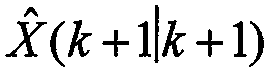
7a)按照下式完成目标状态的更新:7a) Complete the update of the target state according to the following formula:
其中,


7b)按照下式完成目标状态协方差的更新:7b) Complete the update of the target state covariance according to the following formula:
P(k+1|k+1)=P(k+1|k)-K(k+1)S(k+1)KT(k+1)P(k+1|k+1)=P(k+1|k)-K(k+1)S(k+1)K T (k+1)
其中,P(k+1|k+1)表示目标k+1时刻状态协方差更新值,k为采样时刻;P(k+1|k)表示k时刻预测目标在k+1时刻的状态协方差;K(k+1)为滤波器增益;S(k+1)为预测误差的协方差矩阵;KT(k+1)为滤波器增益矩阵的转置;Among them, P(k+1|k+1) represents the update value of the state covariance of the target at time k+1, and k is the sampling time; P(k+1|k) represents the state covariance of the predicted target at time k+1. Variance; K(k+1) is the filter gain; S(k+1) is the covariance matrix of the prediction error; K T (k+1) is the transpose of the filter gain matrix;
(8)判断状态更新是否完成,若更新没有完成,则执行步骤(3);若更新完成,则结束。(8) Judging whether the status update is completed, if the update is not completed, then perform step (3); if the update is completed, then end.
本发明与现有技术相比具有以下优点:Compared with the prior art, the present invention has the following advantages:
第一,本发明充分结合目标实际运动中的加速度变化率是非零均值的时间相关随机过程,对jerk模型进行改进,克服了现有技术中jerk模型与高机动目标实际运动模型不匹配的缺点,使得本发明能实现高机动目标的跟踪。First, the present invention fully combines the time-dependent stochastic process in which the rate of change of acceleration in the actual motion of the target is a non-zero mean value, improves the jerk model, and overcomes the shortcoming that the jerk model does not match the actual motion model of the high-maneuvering target in the prior art, Therefore, the present invention can realize the tracking of high maneuvering targets.
第二,本发明在跟踪滤波器中引入渐消因子,使滤波器能够自适应调节增益,克服了现有技术中卡尔曼跟踪滤波对高机动目标存在自身鲁棒性和跟踪精度低的缺点,使得本发明可以提高高机动目标的跟踪性能。Second, the present invention introduces a fading factor into the tracking filter, so that the filter can adaptively adjust the gain, and overcomes the shortcomings of the Kalman tracking filter in the prior art, such as its own robustness and low tracking accuracy for high maneuvering targets, Therefore, the present invention can improve the tracking performance of high maneuvering targets.
第三,本发明中的渐消因子能够随着观测值的预测误差自适应调整,使跟踪滤波器能够保持对一般机动目标跟踪精度的同时,还能够使滤波器在目标发生突发机动时,自适应的调节增益,增大目标状态估计的补偿值,提高高机动目标的跟踪性能,因此,本发明的使用范围更广。Third, the fading factor in the present invention can be adaptively adjusted along with the prediction error of the observed value, so that the tracking filter can maintain the tracking accuracy of the general maneuvering target, and also enable the filter to The self-adaptive adjustment gain increases the compensation value of target state estimation and improves the tracking performance of high-maneuvering targets. Therefore, the present invention has wider application range.
附图说明Description of drawings
图1为本发明的流程图;Fig. 1 is a flow chart of the present invention;
图2为本发明的仿真图。Fig. 2 is a simulation diagram of the present invention.
具体实施方式Detailed ways
下面结合附图1对本发明的步骤作进一步的详细说明。Below in conjunction with accompanying drawing 1, the steps of the present invention will be further described in detail.
步骤1,运动状态和模型参数的初始化Step 1, initialization of motion state and model parameters
雷达观测的前三个时刻的量测值为Z(1)、Z(2)和Z(3),将雷达观测值Z(1)、Z(2)和Z(3),利用差分法通过下式确定初始状态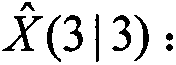
其中,
初始协方差P(3|3)可由下式确定:The initial covariance P(3|3) can be determined by the following formula:
其中,P(3|3)表示初始协方差;

本发明实施例中将渐消因子的初始值设为1,并将机动频率的初始值设为α=1/20。In the embodiment of the present invention, the initial value of the fading factor is set to 1, and the initial value of the maneuvering frequency is set to α=1/20.
步骤2,建立改进jerk模型Step 2, build an improved jerk model
基于目标的加速度变化率是非零均值的时间相关随机过程建立目标运动状态方程:Based on the time-dependent stochastic process in which the acceleration rate of the target is a non-zero mean value, the target motion state equation is established:
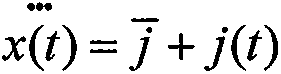
其中,为目标加速度变化率,为目标加速度变化率的均值,j(t)为零均值的指数相关的有色噪声模型,其相关函数为:in, is the target acceleration rate, is the mean value of the target acceleration rate of change, j(t) is an exponentially correlated colored noise model with zero mean value, and its correlation function is:
其中,Rj(τ)表示相关函数,
其中,w(t)为均值为0、方差为

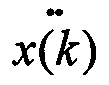
以周期T采样,离散化后,得到目标的运动状态方程为:Sampling at a period T, after discretization, the motion state equation of the target is obtained as:
其中,X(k+1)为k+1时刻状态向量,k为采样时刻;F(k)为状态转移矩阵,表达式如下:Among them, X(k+1) is the state vector at time k+1, k is the sampling time; F(k) is the state transition matrix, the expression is as follows:
p1、q1、r1和s1为上述状态转移矩阵F(k)的元素,表达式如下:p1, q1, r1 and s1 are the elements of the above state transition matrix F(k), the expressions are as follows:
p1=(2-2αT+α2T2-2e-αT)/(2α3)p1=(2-2αT+α 2 T 2 -2e -αT )/(2α 3 )
q1=(αT-1+e-αT)/α2 q1=(αT-1+e -αT )/α 2
r1=(1-e-αT)/αr1=(1-e -αT )/α
s1=e-αT s1=e -αT
X(k)为k时刻状态向量,
W(k)为过程噪声,其均值和协方差分别为0和Q(k)的高斯白噪声序列,Q(k)为对称矩阵,表达式如下:W(k) is the process noise, its mean and covariance are 0 and Q(k) Gaussian white noise sequence respectively, Q(k) is a symmetric matrix, the expression is as follows:
qij(i=1~4;j=1~4)为上述矩阵Q(k)的元素,表达式如下:q ij (i=1~4; j=1~4) is the element of the above matrix Q(k), the expression is as follows:
q11=1/2α7[α5T5/10-α4T4/2+4α3T3/3-2α2T2-3+4e-αT+2α2T2e-αT-e-2αT]q 11 =1/2α 7 [α 5 T 5 /10-α 4 T 4 /2+4α 3 T 3 /3-2α 2 T 2 -3+4e -αT +2α 2 T 2 e -αT -e - 2αT ]
q12=1/2α6[1-2αT+2α2T2-α3T3+α4T4/4+e-2αT+2αT-2e-αT-α2T2e-αT]q 12 =1/2α 6 [1-2αT+2α 2 T 2 -α 3 T 3 +α 4 T 4 /4+e -2αT +2αT-2e -αT -α 2 T 2 e -αT ]
q13=1/2α5[2αT-α2T2-α3T3/3-3-2e-2αT+4e-αT+α2T2e-αT]q 13 =1/2α 5 [2αT-α 2 T 2 -α 3 T 3 /3-3-2e -2αT +4e -αT +α 2 T 2 e -αT ]
q14=1/2α5[1+e-2αT-2e-αT-α2T2e-αT]q 14 =1/2α 5 [1+e -2αT -2e -αT -α 2 T 2 e -αT ]
q22=1/2α5[1-e-2αT+2αT+2α3T3/3-2α2T2-4αTe-αT]q 22 =1/2α 5 [1-e -2αT +2αT+2α 3 T 3 /3-2α 2 T 2 -4αTe -αT ]
q23=1/2α4[e-2αT+1-2e-αT+2αTe-αT-2αT+α2T2]q 23 =1/2α 4 [e -2αT +1-2e -αT +2αTe -αT -2αT+α 2 T 2 ]
q24=1/2α3[1-e-2αT-2αTe-αT]q 24 =1/2α 3 [1-e -2αT -2αTe -αT ]
q33=1/2α3[4e-αT-3-e-2αT+2αT]q 33 =1/2α 3 [4e -αT -3-e -2αT +2αT]
q34=1/2α2[e-2αT+1-2e-αT]q 34 =1/2α 2 [e -2αT +1-2e -αT ]
q44=1/2α[1-e-2αT]q 44 =1/2α[1-e -2αT ]
建立目标的观测方程:Create the observation equation for the target:
Z(k+1)=H(k+1)X(k+1)+V(k+1)Z(k+1)=H(k+1)X(k+1)+V(k+1)
其中,Z(k+1)为目标在k+1时刻的雷达观测值,k为采样时刻;H(k+1)为观测矩阵;X(k+1)为k+1时刻状态向量;V(k+1)为观测噪声,其均值和协方差分别为0和R(k)的高斯白噪声序列,且与过程噪声W(k)相互独立。Among them, Z(k+1) is the radar observation value of the target at k+1 time, k is the sampling time; H(k+1) is the observation matrix; X(k+1) is the state vector at k+1 time; V (k+1) is the observation noise, a Gaussian white noise sequence whose mean and covariance are 0 and R(k), respectively, and is independent of the process noise W(k).
步骤3,目标状态的预测Step 3, Prediction of the target state
由建立的模型和初始值按照下式完成目标状态的一步预测:The one-step prediction of the target state is completed by the established model and initial value according to the following formula:
其中,


按照下式完成目标状态协方差的一步预测:The one-step prediction of the target state covariance is done according to the following formula:
P(k+1|k)=λ(k+1)F(k)P(k|k)FT(k)+Q(k)P(k+1|k)=λ(k+1)F(k)P(k|k)F T (k)+Q(k)
其中,P(k+1|k)表示k时刻预测目标在k+1时刻的状态协方差,k为采样时刻;λ(k+1)为k+1时刻的渐消因子;F(k)为状态转移矩阵;P(k|k)表示目标k时刻状态协方差更新值;FT(k)为状态转移矩阵的转置;Q(k)为过程噪声的协方差。Among them, P(k+1|k) represents the state covariance of the predicted target at time k+1 at time k, and k is the sampling time; λ(k+1) is the fading factor at time k+1; F(k) is the state transition matrix; P(k|k) represents the update value of the state covariance at the target k moment; FT (k) is the transposition of the state transition matrix; Q(k) is the covariance of the process noise.
在协方差的一步预测中引入渐消因子λ(k+1),使得预测协方差可以随着渐消因子的变化而自适应的调整,提高算法对目标机动的适应性。The fading factor λ(k+1) is introduced in the one-step prediction of the covariance, so that the prediction covariance can be adjusted adaptively with the change of the fading factor, and the adaptability of the algorithm to the target maneuver is improved.
步骤4,根据雷达的接收数据和状态预测值,求观测值的预测误差Step 4, according to the received data of the radar and the state prediction value, calculate the prediction error of the observation value
由状态预测值按照下式确定目标在k时刻的观测值的预测:The prediction of the observed value of the target at time k is determined by the state prediction value according to the following formula:
其中,表示k时刻预测目标在k+1时刻的观测值,k为采样时刻;H(k+1)为观测矩阵;表示k时刻预测目标在k+1时刻的状态;in, Indicates the observed value of the predicted target at time k+1 at time k, where k is the sampling time; H(k+1) is the observation matrix; Indicates the state of the predicted target at time k+1 at time k;
由雷达接收数据按照下式确定目标在k时刻的观测值的预测误差:The prediction error of the observation value of the target at time k is determined by the radar receiving data according to the following formula:
其中,

观测值的预测误差的反应了建立的模型与目标实际运动模型之间的匹配度,观测值的预测误差越小,说明建立的模型越好。The prediction error of the observed value reflects the matching degree between the established model and the actual motion model of the target. The smaller the prediction error of the observed value, the better the established model.
步骤5,确定渐消因子
用预测误差确定渐消因子,其计算公式如下:The fading factor is determined by the prediction error, and its calculation formula is as follows:
其中,λ(k+1)为渐消因子,k为采样时刻;η(k+1)为渐消因子实时变化值,可由下式确定:Among them, λ(k+1) is the fading factor, k is the sampling time; η(k+1) is the real-time change value of the fading factor, which can be determined by the following formula:
其中,in,
N(k+1)=V0(k+1)-βR(k+1)-H(k+1)Q(k)HT(k+1)N(k+1)=V 0 (k+1)-βR(k+1)-H(k+1)Q(k)H T (k+1)
M(k+1)=H(k+1)F(k)P(k|k)FT(k)HT(k+1)M(k+1)=H(k+1)F(k)P(k|k)F T (k)H T (k+1)
其中,
在跟踪一般机动目标时,观测值的预测误差较小,使得渐消因子λ(k+1)为1,此时算法退化为基于jerk模型的卡尔曼自适应滤波算法,保持了对一般机动目标的跟踪精度。在目标发生突发机动时,强跟踪滤波器根据观测值的预测误差的增大而增大渐消因子,自适应的调节增益,增大了目标状态估计的补偿值,从而提高目标状态突变时的跟踪性能。When tracking a general maneuvering target, the prediction error of the observation value is small, so that the fading factor λ(k+1) is 1. At this time, the algorithm degenerates into a Kalman adaptive filtering algorithm based on the jerk model, which maintains the accuracy of the general maneuvering target tracking accuracy. When the target suddenly maneuvers, the strong tracking filter increases the fading factor according to the increase of the prediction error of the observed value, and adaptively adjusts the gain to increase the compensation value of the target state estimation, thereby improving the target state sudden change. tracking performance.
步骤6,确定滤波器增益Step 6, determine the filter gain
按照下式确定预测误差的协方差矩阵:The covariance matrix of the forecast errors is determined as follows:
S(k+1)=H(k+1)P(k+1|k)HT(k+1)+R(k+1)S(k+1)=H(k+1)P(k+1|k)H T (k+1)+R(k+1)
其中,S(k+1)为预测误差的协方差矩阵,k为采样时刻;H(k+1)为观测矩阵;P(k+1|k)表示k时刻预测目标在k+1时刻的状态协方差;HT(k+1)为观测矩阵的转置;R(k+1)为观测噪声的协方差矩阵。Among them, S(k+1) is the covariance matrix of prediction error, k is the sampling time; H(k+1) is the observation matrix; State covariance; H T (k+1) is the transposition of the observation matrix; R(k+1) is the covariance matrix of the observation noise.
由预测误差的协方差矩阵按照下式确定滤波器增益:The filter gain is determined from the covariance matrix of the prediction error as follows:
K(k+1)=P(k+1|k)HT(k+1)S-1(k+1)K(k+1)=P(k+1|k)H T (k+1)S -1 (k+1)
其中,K(k+1)为滤波器增益,k为采样时刻;P(k+1|k)表示k时刻预测目标在k+1时刻的状态协方差;HT(k+1)为观测矩阵的转置;S-1(k+1)为预测误差的协方差矩阵的逆。Among them, K(k+1) is the filter gain, k is the sampling time; P(k+1|k) represents the state covariance of the predicted target at time k+1; H T (k+1) is the observation The transpose of the matrix; S -1 (k+1) is the inverse of the covariance matrix of the prediction error.
步骤7,对目标状态进行更新Step 7, update the target state
按照下式完成目标状态的更新:Update the target state according to the following formula:
其中,表示目标k+1时刻状态更新值,k为采样时刻;

按照下式完成目标状态协方差的更新:The update of the target state covariance is completed according to the following formula:
P(k+1|k+1)=P(k+1|k)-K(k+1)S(k+1)KT(k+1)P(k+1|k+1)=P(k+1|k)-K(k+1)S(k+1)K T (k+1)
其中,P(k+1|k+1)表示目标k+1时刻状态协方差更新值,k为采样时刻;P(k+1|k)表示k时刻预测目标在k+1时刻的状态协方差;K(k+1)为滤波器增益;S(k+1)为预测误差的协方差矩阵;KT(k+1)为滤波器增益矩阵的转置。Among them, P(k+1|k+1) represents the update value of the state covariance of the target at time k+1, and k is the sampling time; P(k+1|k) represents the state covariance of the predicted target at time k+1. Variance; K(k+1) is the filter gain; S(k+1) is the covariance matrix of the prediction error; K T (k+1) is the transpose of the filter gain matrix.
通过对目标的运动状态进行更新,实现对目标的每一步跟踪。By updating the motion state of the target, it can track every step of the target.
步骤8,判断状态更新是否完成,若更新没有完成,则执行步骤(3);若更新完成,则结束。Step 8, judging whether the status update is completed, if the update is not completed, perform step (3); if the update is completed, then end.
下面结合附图2对本发明的效果做进一步说明。The effects of the present invention will be further described below in conjunction with accompanying drawing 2 .
1.仿真条件1. Simulation conditions
设目标的真实航迹的起始状态为[60000,-420,0,0,1000,0,0,0],对目标进行120s的连续观测,目标发生机动时刻及加速度的变化方式如下:Assuming that the initial state of the real track of the target is [60000, -420, 0, 0, 1000, 0, 0, 0], the continuous observation of the target is carried out for 120s, and the change mode of the target's maneuvering moment and acceleration is as follows:
在38s时,ax=0,ay=-10,jx=0,jy=0;在61s时,ax=-5,ay=20,jx=0,jy=0;在71s时,ax=-10,ay=10,jx=0,jy=0;在91s时,ax=0,ay=0,jx=0,jy=0在100s时,ax=0,ay=0,jx=0.5,jy=0。其中,ax,ay,jx和jy分别表示目标的X方向的加速度,Y方向的加速度,X方向的加速度变化率和Y方向的加速度变化率。At 38s, a x =0, a y =-10, j x =0, j y =0; at 61s, a x =-5, a y =20, j x =0, j y =0; At 71s, a x =-10, a y =10, j x =0, j y =0; at 91s, a x =0, a y =0, j x = 0, j y =0 at 100s When , a x =0, a y =0, j x =0.5, j y =0. Among them, a x , a y , j x and j y represent the acceleration in the X direction, the acceleration in the Y direction, the acceleration rate in the X direction and the acceleration rate in the Y direction of the target, respectively.
在笛卡尔坐标系下,采取500次Monte-Carlo仿真实验,设雷达采样间隔T=1s,雷达的测距精度为15m,观测方位角的精度为0.17°。In the Cartesian coordinate system, 500 Monte-Carlo simulation experiments are taken, and the radar sampling interval is set to T=1s. The ranging accuracy of the radar is 15m, and the accuracy of the observation azimuth angle is 0.17°.
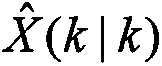
误差的计算公式为:The formula for calculating the error is:
其中,M为Monte-Carlo仿真次数,

2.仿真内容2. Simulation content
采用本发明方法和jerk模型自适应跟踪方法分别对目标的X方向位置、Y方向位置、X方向速度和Y方向速度进行跟踪估计,并比较跟踪效果。The method of the invention and the self-adaptive tracking method of the jerk model are used to track and estimate the X-direction position, the Y-direction position, the X-direction velocity and the Y-direction velocity of the target respectively, and compare the tracking effects.
3.仿真分析3. Simulation analysis
图2(a)是本发明和jerk模型自适应跟踪方法对目标的X方向位置的跟踪估计效果比较图。图中实线表示采用本发明对目标的X方向位置进行跟踪估计结果曲线,虚线表示采用jerk模型自适应跟踪方法对目标的X方向位置进行跟踪估计结果曲线。从图中可以看出,整体趋势上本发明的稳定性和跟踪性能都要优于jerk模型的自适应跟踪方法,特别是在100s后,目标在X方向作变加速度运动,机动性更强时,此时本发明的跟踪性能明显优于jerk模型的自适应跟踪方法。Fig. 2(a) is a comparison diagram of tracking and estimation effects on the X-direction position of the target between the present invention and the jerk model adaptive tracking method. The solid line in the figure represents the result curve of tracking and estimating the X-direction position of the target by using the present invention, and the dotted line represents the tracking and estimating result curve of the X-direction position of the target by using the jerk model adaptive tracking method. It can be seen from the figure that the stability and tracking performance of the present invention are better than the self-adaptive tracking method of the jerk model on the overall trend, especially after 100s, when the target moves with variable acceleration in the X direction and is more maneuverable , the tracking performance of the present invention is obviously better than the adaptive tracking method of the jerk model.
图2(b)是本发明和jerk模型自适应跟踪方法对目标的Y方向位置的跟踪估计效果比较图。图中实线表示采用本发明对目标的Y方向位置进行跟踪估计结果曲线,虚线表示采用jerk模型自适应跟踪方法对目标的Y方向位置进行跟踪估计结果曲线。从图中可以看出,整体趋势上本发明的跟踪误差小于jerk模型的自适应跟踪方法。Fig. 2(b) is a comparison diagram of the tracking and estimation effect of the Y-direction position of the target by the present invention and the jerk model adaptive tracking method. The solid line in the figure represents the result curve of tracking and estimating the position of the target in the Y direction by the present invention, and the dotted line represents the curve of the result of tracking and estimating the position of the target in the Y direction by using the jerk model adaptive tracking method. It can be seen from the figure that the tracking error of the present invention is smaller than the adaptive tracking method of the jerk model on the overall trend.
图2(c)是本发明和jerk模型自适应跟踪方法对目标的X方向速度的跟踪估计效果比较图。图中实线表示采用本发明对目标的X方向速度进行跟踪估计结果曲线,虚线表示采用jerk模型自适应跟踪方法对目标的X方向速度进行跟踪估计结果曲线。从图中可以看出,整体趋势上本发明的跟踪误差小于jerk模型的自适应跟踪方法,特别是在100s后,目标在X方向作变加速度运动,机动性更强时,此时本发明的跟踪性能明显优于jerk模型的自适应跟踪方法。Fig. 2(c) is a comparison diagram of the tracking and estimation effect of the target's X-direction velocity between the present invention and the jerk model adaptive tracking method. The solid line in the figure represents the result curve of tracking and estimating the velocity of the target in the X direction by the present invention, and the dotted line represents the curve of the result of tracking and estimating the velocity of the target in the X direction by using the jerk model adaptive tracking method. As can be seen from the figure, the tracking error of the present invention is less than the adaptive tracking method of the jerk model on the overall trend, especially after 100s, when the target moves with variable acceleration in the X direction and has stronger maneuverability, the present invention's The tracking performance is significantly better than the adaptive tracking method of jerk model.
图2(d)是本发明和jerk模型自适应跟踪方法对目标的Y方向速度的跟踪估计效果比较图。图中实线表示采用本发明对目标的Y方向速度进行跟踪估计结果曲线,虚线表示采用jerk模型自适应跟踪方法对目标的Y方向速度进行跟踪估计结果曲线。从图中可以看出,整体趋势上本发明的跟踪误差小于jerk模型的自适应跟踪方法。Fig. 2(d) is a comparison diagram of the tracking and estimation effect of the Y-direction velocity of the target by the present invention and the jerk model adaptive tracking method. The solid line in the figure represents the result curve of tracking and estimating the velocity of the target in the Y direction by the present invention, and the dotted line represents the curve of the result of tracking and estimating the velocity of the target in the Y direction by using the jerk model adaptive tracking method. It can be seen from the figure that the tracking error of the present invention is smaller than the adaptive tracking method of the jerk model on the overall trend.
Claims (4)






Priority Applications (1)
| Application Number | Priority Date | Filing Date | Title |
|---|---|---|---|
| CN 201210138397 CN102721951B (en) | 2012-05-04 | 2012-05-04 | Method for tracking high maneuvering target |
Applications Claiming Priority (1)
| Application Number | Priority Date | Filing Date | Title |
|---|---|---|---|
| CN 201210138397 CN102721951B (en) | 2012-05-04 | 2012-05-04 | Method for tracking high maneuvering target |
Publications (2)
| Publication Number | Publication Date |
|---|---|
| CN102721951A CN102721951A (en) | 2012-10-10 |
| CN102721951B true CN102721951B (en) | 2013-12-25 |
Family
ID=46947767
Family Applications (1)
| Application Number | Title | Priority Date | Filing Date |
|---|---|---|---|
| CN 201210138397 Expired - Fee Related CN102721951B (en) | 2012-05-04 | 2012-05-04 | Method for tracking high maneuvering target |
Country Status (1)
| Country | Link |
|---|---|
| CN (1) | CN102721951B (en) |
Families Citing this family (26)
| Publication number | Priority date | Publication date | Assignee | Title |
|---|---|---|---|---|
| CN102967857B (en) * | 2012-11-28 | 2014-04-16 | 西安电子科技大学 | Particle swarm optimization-based cooperative tracking method of sensor network to maneuvering target |
| CN102998629B (en) * | 2012-12-16 | 2015-01-21 | 天津大学 | Method for estimating lithium battery charge state |
| CN103308896B (en) * | 2013-05-07 | 2015-07-29 | 北京工商大学 | A kind of high precision tracking method being suitable for non-engine machine moving-target |
| CN103412295B (en) * | 2013-08-30 | 2015-06-03 | 西安电子科技大学 | High-speed maneuvering weak target detection method based on echo precise model |
| CN103487800B (en) * | 2013-09-08 | 2015-09-30 | 西安电子科技大学 | Based on the multi-model high speed and high maneuvering target tracking method of residual feedback |
| CN104678382B (en) * | 2013-11-29 | 2017-07-14 | 中国航天科工集团第三研究院第八三五七研究所 | A kind of remote high-precision distance-finding method being applied under spread spectrum system communication TT&C system |
| CN104180801B (en) * | 2014-08-20 | 2017-06-06 | 广州海格通信集团股份有限公司 | Forecasting Methodology and system based on ADS B system track points |
| CN104331902B (en) * | 2014-10-11 | 2018-10-16 | 深圳超多维科技有限公司 | Method for tracking target, tracks of device and 3D display method and display device |
| CN104851111B (en) * | 2015-04-23 | 2017-07-07 | 北京环境特性研究所 | A kind of method for tracking target of use continuous vari-focus detector |
| CN105974367A (en) * | 2016-05-04 | 2016-09-28 | 南京理工大学 | Adaptive tracking algorithm of maneuvering frequency based on CAPM model |
| CN106772351B (en) * | 2016-11-16 | 2019-04-23 | 西安电子科技大学 | A Kalman Filter Method Based on Finite Step Memory |
| CN106802414B (en) * | 2016-12-19 | 2019-07-12 | 姜秋喜 | Maneuvering target tracking method based on gaussian filtering |
| CN106646452B (en) * | 2017-02-24 | 2019-04-02 | 西北工业大学 | A spatial target tracking method based on perturbation multi-Gaussian fitting |
| CN107167799A (en) * | 2017-04-26 | 2017-09-15 | 南京理工大学 | Parameter adaptive maneuvering Target Tracking Algorithm based on CS Jerk models |
| CN107390199B (en) * | 2017-09-20 | 2019-06-18 | 哈尔滨工业大学(威海) | A Radar Maneuvering Target Tracking Waveform Design Method |
| CN107885232A (en) * | 2017-10-23 | 2018-04-06 | 上海机电工程研究所 | A kind of filtering method for how tactful maneuver tracking |
| CN109959907B (en) * | 2017-12-25 | 2023-10-20 | 大连楼兰科技股份有限公司 | A method for processing height data |
| CN108710124A (en) * | 2018-04-02 | 2018-10-26 | 西北工业大学 | A kind of strong maneuvering target tracking sensitivity assessment method of aircraft class |
| CN108646237A (en) * | 2018-05-09 | 2018-10-12 | 西安电子科技大学 | Radar maneuvering target tracking optimization method based on current statistical model |
| CN109003292B (en) * | 2018-06-25 | 2022-01-18 | 华南理工大学 | Moving target tracking method based on switch Kalman filter |
| CN109388063A (en) * | 2018-08-27 | 2019-02-26 | 广西科技大学 | Adaptive Kalman filter composite control method |
| CN110376582B (en) * | 2019-01-24 | 2022-10-04 | 西安电子科技大学 | A Maneuvering Target Tracking Method Based on Adaptive GM-PHD |
| CN109802656B (en) * | 2019-01-25 | 2022-03-04 | 西安电子科技大学 | Amplitude Information Based Kalman Filtering Method |
| CN110466790A (en) * | 2019-08-30 | 2019-11-19 | 上海电机学院 | A kind of unmanned plane target tracking system based on machine vision |
| CN111157983B (en) * | 2020-01-06 | 2022-02-15 | 南京鹰目电子科技有限公司 | Radar target tracking method |
| CN111273084B (en) * | 2020-02-24 | 2022-03-04 | 广东电网有限责任公司广州供电局 | An Adaptive Strong Tracking Unscented Kalman Filter Synchrophasor Parameter Estimation Method |
Citations (2)
| Publication number | Priority date | Publication date | Assignee | Title |
|---|---|---|---|---|
| JP4281473B2 (en) * | 2003-08-29 | 2009-06-17 | 三菱電機株式会社 | Target tracking device |
| CN101872020A (en) * | 2010-06-18 | 2010-10-27 | 华南理工大学 | Method and device for locating and navigating underwater moving targets based on spectrum transform |
Family Cites Families (1)
| Publication number | Priority date | Publication date | Assignee | Title |
|---|---|---|---|---|
| CA2634033C (en) * | 2005-12-14 | 2015-11-17 | Digital Signal Corporation | System and method for tracking eyeball motion |
-
2012
- 2012-05-04 CN CN 201210138397 patent/CN102721951B/en not_active Expired - Fee Related
Patent Citations (2)
| Publication number | Priority date | Publication date | Assignee | Title |
|---|---|---|---|---|
| JP4281473B2 (en) * | 2003-08-29 | 2009-06-17 | 三菱電機株式会社 | Target tracking device |
| CN101872020A (en) * | 2010-06-18 | 2010-10-27 | 华南理工大学 | Method and device for locating and navigating underwater moving targets based on spectrum transform |
Non-Patent Citations (1)
| Title |
|---|
| JP特许第4281473B2 2009.06.17 |
Also Published As
| Publication number | Publication date |
|---|---|
| CN102721951A (en) | 2012-10-10 |
Similar Documents
| Publication | Publication Date | Title |
|---|---|---|
| CN102721951B (en) | Method for tracking high maneuvering target | |
| CN103363993B (en) | A kind of aircraft angle rate signal reconstructing method based on Unscented kalman filtering | |
| CN105785999B (en) | Control method of heading motion of unmanned boat | |
| CN103853908A (en) | Self-adapting interactive multiple model mobile target tracking method | |
| CN107728138A (en) | A kind of maneuvering target tracking method based on current statistical model | |
| CN107024863B (en) | A UUV Trajectory Tracking Control Method to Avoid Differential Explosion | |
| CN102622520B (en) | A kind of distributed multimode type estimation fusion method of maneuvering target tracking | |
| CN103389094B (en) | A kind of improved particle filter method | |
| CN102568004A (en) | Tracking algorithm for high maneuvering targets | |
| JP5196971B2 (en) | Target tracking device | |
| CN106443661A (en) | Maneuvering extended target tracking method based on unscented Kalman filter | |
| CN105136145A (en) | Kalman filtering based quadrotor unmanned aerial vehicle attitude data fusion method | |
| CN112613532A (en) | Moving target tracking method based on radar and recurrent neural network complete infrared fusion | |
| CN102706345B (en) | Maneuvering target tracking method based on fading memory sequential detector | |
| CN107727097B (en) | Information fusion method and device based on airborne distributed position and attitude measurement system | |
| CN107167799A (en) | Parameter adaptive maneuvering Target Tracking Algorithm based on CS Jerk models | |
| CN105372994B (en) | A kind of pilot guidance behavior description method based on robust adaptive optimum control | |
| CN111913175A (en) | A Surface Target Tracking Method with Compensation Mechanism under Transient Sensor Failure | |
| CN104021285B (en) | A kind of interactive multi-model method for tracking target with optimal motion pattern switching parameter | |
| CN108710124A (en) | A kind of strong maneuvering target tracking sensitivity assessment method of aircraft class | |
| CN105929391A (en) | Variable structure interacting multiple model radar maneuvering target tracking method based on posterior probability | |
| CN114739397A (en) | Mine environment motion inertia estimation self-adaptive Kalman filtering fusion positioning method | |
| CN112986977A (en) | Method for overcoming radar extended Kalman track filtering divergence | |
| CN110865334A (en) | A multi-sensor target tracking method and system based on noise statistical characteristics | |
| CN105954743A (en) | Weight-modifying variable structure multi-model maneuvering object tracking method |
Legal Events
| Date | Code | Title | Description |
|---|---|---|---|
| C06 | Publication | ||
| PB01 | Publication | ||
| C10 | Entry into substantive examination | ||
| SE01 | Entry into force of request for substantive examination | ||
| C14 | Grant of patent or utility model | ||
| GR01 | Patent grant | ||
| CF01 | Termination of patent right due to non-payment of annual fee |
Granted publication date: 20131225 Termination date: 20200504 |
|
| CF01 | Termination of patent right due to non-payment of annual fee |