CN102676637A - High-specificity method for measuring small RNA - Google Patents
High-specificity method for measuring small RNA Download PDFInfo
- Publication number
- CN102676637A CN102676637A CN2011100541047A CN201110054104A CN102676637A CN 102676637 A CN102676637 A CN 102676637A CN 2011100541047 A CN2011100541047 A CN 2011100541047A CN 201110054104 A CN201110054104 A CN 201110054104A CN 102676637 A CN102676637 A CN 102676637A
- Authority
- CN
- China
- Prior art keywords
- rna
- primer
- small rna
- evagreen
- cdna
- Prior art date
- Legal status (The legal status is an assumption and is not a legal conclusion. Google has not performed a legal analysis and makes no representation as to the accuracy of the status listed.)
- Granted
Links
- 108091032955 Bacterial small RNA Proteins 0.000 title claims abstract description 92
- 238000000034 method Methods 0.000 title claims abstract description 56
- 238000006243 chemical reaction Methods 0.000 claims abstract description 41
- 230000000295 complement effect Effects 0.000 claims abstract description 34
- 108091027963 non-coding RNA Proteins 0.000 claims abstract description 25
- 102000042567 non-coding RNA Human genes 0.000 claims abstract description 25
- 239000002299 complementary DNA Substances 0.000 claims abstract description 23
- 239000007850 fluorescent dye Substances 0.000 claims abstract description 20
- 230000003321 amplification Effects 0.000 claims abstract description 18
- 238000003199 nucleic acid amplification method Methods 0.000 claims abstract description 18
- 238000000137 annealing Methods 0.000 claims abstract description 14
- 238000012408 PCR amplification Methods 0.000 claims abstract description 6
- 239000000975 dye Substances 0.000 claims description 23
- 108091032973 (ribonucleotides)n+m Proteins 0.000 claims description 15
- 239000000523 sample Substances 0.000 claims description 14
- 230000027455 binding Effects 0.000 claims description 9
- 238000003752 polymerase chain reaction Methods 0.000 claims description 9
- 230000008569 process Effects 0.000 claims description 9
- 239000013614 RNA sample Substances 0.000 claims description 5
- 239000003814 drug Substances 0.000 claims description 5
- 239000003153 chemical reaction reagent Substances 0.000 claims description 4
- 239000012805 animal sample Substances 0.000 claims description 3
- 235000013305 food Nutrition 0.000 claims description 2
- 230000003287 optical effect Effects 0.000 claims description 2
- 238000010839 reverse transcription Methods 0.000 abstract description 2
- 150000001875 compounds Chemical class 0.000 abstract 1
- 238000001514 detection method Methods 0.000 description 17
- 201000010099 disease Diseases 0.000 description 12
- 208000037265 diseases, disorders, signs and symptoms Diseases 0.000 description 12
- 230000035945 sensitivity Effects 0.000 description 12
- 238000003753 real-time PCR Methods 0.000 description 11
- 230000004568 DNA-binding Effects 0.000 description 9
- 230000037029 cross reaction Effects 0.000 description 9
- 108020004414 DNA Proteins 0.000 description 7
- 238000002474 experimental method Methods 0.000 description 7
- 108091091807 let-7a stem-loop Proteins 0.000 description 7
- 108091057746 let-7a-4 stem-loop Proteins 0.000 description 7
- 108091028376 let-7a-5 stem-loop Proteins 0.000 description 7
- 108091024393 let-7a-6 stem-loop Proteins 0.000 description 7
- 108091091174 let-7a-7 stem-loop Proteins 0.000 description 7
- 230000014509 gene expression Effects 0.000 description 6
- 239000000243 solution Substances 0.000 description 6
- 102000053602 DNA Human genes 0.000 description 5
- 108700011259 MicroRNAs Proteins 0.000 description 5
- 101710124239 Poly(A) polymerase Proteins 0.000 description 5
- 230000009260 cross reactivity Effects 0.000 description 5
- 238000003745 diagnosis Methods 0.000 description 5
- 230000000694 effects Effects 0.000 description 5
- 229920006227 ethylene-grafted-maleic anhydride Polymers 0.000 description 5
- 238000002844 melting Methods 0.000 description 5
- 230000008018 melting Effects 0.000 description 5
- 230000009871 nonspecific binding Effects 0.000 description 5
- 239000002773 nucleotide Substances 0.000 description 5
- 238000011002 quantification Methods 0.000 description 5
- 239000000758 substrate Substances 0.000 description 5
- 210000001519 tissue Anatomy 0.000 description 5
- 102000004190 Enzymes Human genes 0.000 description 4
- 108090000790 Enzymes Proteins 0.000 description 4
- 206010028980 Neoplasm Diseases 0.000 description 4
- CGNLCCVKSWNSDG-UHFFFAOYSA-N SYBR Green I Chemical compound CN(C)CCCN(CCC)C1=CC(C=C2N(C3=CC=CC=C3S2)C)=C2C=CC=CC2=[N+]1C1=CC=CC=C1 CGNLCCVKSWNSDG-UHFFFAOYSA-N 0.000 description 4
- 125000002887 hydroxy group Chemical group [H]O* 0.000 description 4
- 108091024449 let-7e stem-loop Proteins 0.000 description 4
- 108091044227 let-7e-1 stem-loop Proteins 0.000 description 4
- 108091071181 let-7e-2 stem-loop Proteins 0.000 description 4
- 230000007246 mechanism Effects 0.000 description 4
- 125000003729 nucleotide group Chemical group 0.000 description 4
- 238000004393 prognosis Methods 0.000 description 4
- 108090000623 proteins and genes Proteins 0.000 description 4
- 230000009870 specific binding Effects 0.000 description 4
- 108091007772 MIRLET7C Proteins 0.000 description 3
- 238000004458 analytical method Methods 0.000 description 3
- 239000012472 biological sample Substances 0.000 description 3
- 239000000090 biomarker Substances 0.000 description 3
- 238000006555 catalytic reaction Methods 0.000 description 3
- 210000004027 cell Anatomy 0.000 description 3
- 238000009795 derivation Methods 0.000 description 3
- 239000001046 green dye Substances 0.000 description 3
- 238000013537 high throughput screening Methods 0.000 description 3
- 238000012360 testing method Methods 0.000 description 3
- TWRXJAOTZQYOKJ-UHFFFAOYSA-L Magnesium chloride Chemical compound [Mg+2].[Cl-].[Cl-] TWRXJAOTZQYOKJ-UHFFFAOYSA-L 0.000 description 2
- 238000011529 RT qPCR Methods 0.000 description 2
- 108020004459 Small interfering RNA Proteins 0.000 description 2
- 108091060271 Small temporal RNA Proteins 0.000 description 2
- 102000023732 binding proteins Human genes 0.000 description 2
- 108091008324 binding proteins Proteins 0.000 description 2
- 230000015572 biosynthetic process Effects 0.000 description 2
- 210000001124 body fluid Anatomy 0.000 description 2
- 239000010839 body fluid Substances 0.000 description 2
- 235000013365 dairy product Nutrition 0.000 description 2
- 238000004925 denaturation Methods 0.000 description 2
- 230000036425 denaturation Effects 0.000 description 2
- 230000018109 developmental process Effects 0.000 description 2
- 229940079593 drug Drugs 0.000 description 2
- 238000011156 evaluation Methods 0.000 description 2
- 230000005764 inhibitory process Effects 0.000 description 2
- 108091007423 let-7b Proteins 0.000 description 2
- 108091033753 let-7d stem-loop Proteins 0.000 description 2
- 108091063986 let-7f stem-loop Proteins 0.000 description 2
- 108091007427 let-7g Proteins 0.000 description 2
- 108091042844 let-7i stem-loop Proteins 0.000 description 2
- 235000013372 meat Nutrition 0.000 description 2
- 235000013622 meat product Nutrition 0.000 description 2
- 108020004999 messenger RNA Proteins 0.000 description 2
- 239000002679 microRNA Substances 0.000 description 2
- 238000002493 microarray Methods 0.000 description 2
- 239000011325 microbead Substances 0.000 description 2
- 230000002352 nonmutagenic effect Effects 0.000 description 2
- 230000037361 pathway Effects 0.000 description 2
- 239000002243 precursor Substances 0.000 description 2
- 238000004445 quantitative analysis Methods 0.000 description 2
- 210000002966 serum Anatomy 0.000 description 2
- 230000000638 stimulation Effects 0.000 description 2
- 239000000126 substance Substances 0.000 description 2
- 235000013311 vegetables Nutrition 0.000 description 2
- XLYOFNOQVPJJNP-UHFFFAOYSA-N water Substances O XLYOFNOQVPJJNP-UHFFFAOYSA-N 0.000 description 2
- 125000003345 AMP group Chemical group 0.000 description 1
- 241000251468 Actinopterygii Species 0.000 description 1
- 108020005544 Antisense RNA Proteins 0.000 description 1
- 102000008682 Argonaute Proteins Human genes 0.000 description 1
- 108010088141 Argonaute Proteins Proteins 0.000 description 1
- 108010014303 DNA-directed DNA polymerase Proteins 0.000 description 1
- 102000016928 DNA-directed DNA polymerase Human genes 0.000 description 1
- 108010043121 Green Fluorescent Proteins Proteins 0.000 description 1
- 241000282412 Homo Species 0.000 description 1
- 108091070514 Homo sapiens let-7b stem-loop Proteins 0.000 description 1
- 108091070511 Homo sapiens let-7c stem-loop Proteins 0.000 description 1
- 108091070512 Homo sapiens let-7d stem-loop Proteins 0.000 description 1
- 108091070508 Homo sapiens let-7e stem-loop Proteins 0.000 description 1
- 108091069046 Homo sapiens let-7g stem-loop Proteins 0.000 description 1
- 108091069047 Homo sapiens let-7i stem-loop Proteins 0.000 description 1
- 102100034343 Integrase Human genes 0.000 description 1
- 241000283953 Lagomorpha Species 0.000 description 1
- JLVVSXFLKOJNIY-UHFFFAOYSA-N Magnesium ion Chemical compound [Mg+2] JLVVSXFLKOJNIY-UHFFFAOYSA-N 0.000 description 1
- 241000124008 Mammalia Species 0.000 description 1
- 108091092724 Noncoding DNA Proteins 0.000 description 1
- 108091034117 Oligonucleotide Proteins 0.000 description 1
- 238000002944 PCR assay Methods 0.000 description 1
- 108091036407 Polyadenylation Proteins 0.000 description 1
- 108091034057 RNA (poly(A)) Proteins 0.000 description 1
- 108020005093 RNA Precursors Proteins 0.000 description 1
- 101710086015 RNA ligase Proteins 0.000 description 1
- 108010092799 RNA-directed DNA polymerase Proteins 0.000 description 1
- 241000283984 Rodentia Species 0.000 description 1
- 239000007983 Tris buffer Substances 0.000 description 1
- DJJCXFVJDGTHFX-XVFCMESISA-N UMP group Chemical group P(=O)(O)(O)OC[C@@H]1[C@H]([C@H]([C@@H](O1)N1C(=O)NC(=O)C=C1)O)O DJJCXFVJDGTHFX-XVFCMESISA-N 0.000 description 1
- 241000282458 Ursus sp. Species 0.000 description 1
- 241000251539 Vertebrata <Metazoa> Species 0.000 description 1
- JLCPHMBAVCMARE-UHFFFAOYSA-N [3-[[3-[[3-[[3-[[3-[[3-[[3-[[3-[[3-[[3-[[3-[[5-(2-amino-6-oxo-1H-purin-9-yl)-3-[[3-[[3-[[3-[[3-[[3-[[5-(2-amino-6-oxo-1H-purin-9-yl)-3-[[5-(2-amino-6-oxo-1H-purin-9-yl)-3-hydroxyoxolan-2-yl]methoxy-hydroxyphosphoryl]oxyoxolan-2-yl]methoxy-hydroxyphosphoryl]oxy-5-(5-methyl-2,4-dioxopyrimidin-1-yl)oxolan-2-yl]methoxy-hydroxyphosphoryl]oxy-5-(6-aminopurin-9-yl)oxolan-2-yl]methoxy-hydroxyphosphoryl]oxy-5-(6-aminopurin-9-yl)oxolan-2-yl]methoxy-hydroxyphosphoryl]oxy-5-(6-aminopurin-9-yl)oxolan-2-yl]methoxy-hydroxyphosphoryl]oxy-5-(6-aminopurin-9-yl)oxolan-2-yl]methoxy-hydroxyphosphoryl]oxyoxolan-2-yl]methoxy-hydroxyphosphoryl]oxy-5-(5-methyl-2,4-dioxopyrimidin-1-yl)oxolan-2-yl]methoxy-hydroxyphosphoryl]oxy-5-(4-amino-2-oxopyrimidin-1-yl)oxolan-2-yl]methoxy-hydroxyphosphoryl]oxy-5-(5-methyl-2,4-dioxopyrimidin-1-yl)oxolan-2-yl]methoxy-hydroxyphosphoryl]oxy-5-(5-methyl-2,4-dioxopyrimidin-1-yl)oxolan-2-yl]methoxy-hydroxyphosphoryl]oxy-5-(6-aminopurin-9-yl)oxolan-2-yl]methoxy-hydroxyphosphoryl]oxy-5-(6-aminopurin-9-yl)oxolan-2-yl]methoxy-hydroxyphosphoryl]oxy-5-(4-amino-2-oxopyrimidin-1-yl)oxolan-2-yl]methoxy-hydroxyphosphoryl]oxy-5-(4-amino-2-oxopyrimidin-1-yl)oxolan-2-yl]methoxy-hydroxyphosphoryl]oxy-5-(4-amino-2-oxopyrimidin-1-yl)oxolan-2-yl]methoxy-hydroxyphosphoryl]oxy-5-(6-aminopurin-9-yl)oxolan-2-yl]methoxy-hydroxyphosphoryl]oxy-5-(4-amino-2-oxopyrimidin-1-yl)oxolan-2-yl]methyl [5-(6-aminopurin-9-yl)-2-(hydroxymethyl)oxolan-3-yl] hydrogen phosphate Polymers Cc1cn(C2CC(OP(O)(=O)OCC3OC(CC3OP(O)(=O)OCC3OC(CC3O)n3cnc4c3nc(N)[nH]c4=O)n3cnc4c3nc(N)[nH]c4=O)C(COP(O)(=O)OC3CC(OC3COP(O)(=O)OC3CC(OC3COP(O)(=O)OC3CC(OC3COP(O)(=O)OC3CC(OC3COP(O)(=O)OC3CC(OC3COP(O)(=O)OC3CC(OC3COP(O)(=O)OC3CC(OC3COP(O)(=O)OC3CC(OC3COP(O)(=O)OC3CC(OC3COP(O)(=O)OC3CC(OC3COP(O)(=O)OC3CC(OC3COP(O)(=O)OC3CC(OC3COP(O)(=O)OC3CC(OC3COP(O)(=O)OC3CC(OC3COP(O)(=O)OC3CC(OC3COP(O)(=O)OC3CC(OC3COP(O)(=O)OC3CC(OC3CO)n3cnc4c(N)ncnc34)n3ccc(N)nc3=O)n3cnc4c(N)ncnc34)n3ccc(N)nc3=O)n3ccc(N)nc3=O)n3ccc(N)nc3=O)n3cnc4c(N)ncnc34)n3cnc4c(N)ncnc34)n3cc(C)c(=O)[nH]c3=O)n3cc(C)c(=O)[nH]c3=O)n3ccc(N)nc3=O)n3cc(C)c(=O)[nH]c3=O)n3cnc4c3nc(N)[nH]c4=O)n3cnc4c(N)ncnc34)n3cnc4c(N)ncnc34)n3cnc4c(N)ncnc34)n3cnc4c(N)ncnc34)O2)c(=O)[nH]c1=O JLCPHMBAVCMARE-UHFFFAOYSA-N 0.000 description 1
- 230000009471 action Effects 0.000 description 1
- 230000006907 apoptotic process Effects 0.000 description 1
- 238000013459 approach Methods 0.000 description 1
- 238000003556 assay Methods 0.000 description 1
- 230000008901 benefit Effects 0.000 description 1
- 230000004071 biological effect Effects 0.000 description 1
- 230000033228 biological regulation Effects 0.000 description 1
- 210000000988 bone and bone Anatomy 0.000 description 1
- 239000000872 buffer Substances 0.000 description 1
- 239000007853 buffer solution Substances 0.000 description 1
- 230000011712 cell development Effects 0.000 description 1
- 230000008859 change Effects 0.000 description 1
- 238000012512 characterization method Methods 0.000 description 1
- 231100000433 cytotoxic Toxicity 0.000 description 1
- 230000001472 cytotoxic effect Effects 0.000 description 1
- 230000007423 decrease Effects 0.000 description 1
- 238000011161 development Methods 0.000 description 1
- 230000004069 differentiation Effects 0.000 description 1
- 210000002919 epithelial cell Anatomy 0.000 description 1
- 230000006870 function Effects 0.000 description 1
- 238000010353 genetic engineering Methods 0.000 description 1
- 230000012010 growth Effects 0.000 description 1
- 238000012165 high-throughput sequencing Methods 0.000 description 1
- 210000005260 human cell Anatomy 0.000 description 1
- 238000009396 hybridization Methods 0.000 description 1
- 108091053410 let-7 family Proteins 0.000 description 1
- 108091023663 let-7 stem-loop Proteins 0.000 description 1
- 108091063478 let-7-1 stem-loop Proteins 0.000 description 1
- 108091049777 let-7-2 stem-loop Proteins 0.000 description 1
- -1 let-7RNA Proteins 0.000 description 1
- 108091053735 lin-4 stem-loop Proteins 0.000 description 1
- 108091032363 lin-4-1 stem-loop Proteins 0.000 description 1
- 108091028008 lin-4-2 stem-loop Proteins 0.000 description 1
- 239000007788 liquid Substances 0.000 description 1
- 235000021056 liquid food Nutrition 0.000 description 1
- 229910001629 magnesium chloride Inorganic materials 0.000 description 1
- 229910001425 magnesium ion Inorganic materials 0.000 description 1
- 238000004519 manufacturing process Methods 0.000 description 1
- 239000011159 matrix material Substances 0.000 description 1
- 108091028606 miR-1 stem-loop Proteins 0.000 description 1
- 108091074487 miR-34 stem-loop Proteins 0.000 description 1
- 108091092493 miR-34-1 stem-loop Proteins 0.000 description 1
- 108091059780 miR-34-2 stem-loop Proteins 0.000 description 1
- 108091031080 miR-60 stem-loop Proteins 0.000 description 1
- 108091090556 miR-60-1 stem-loop Proteins 0.000 description 1
- 108091073509 miR-60-2 stem-loop Proteins 0.000 description 1
- 108091092625 miR-87 stem-loop Proteins 0.000 description 1
- 108091070501 miRNA Proteins 0.000 description 1
- 238000009629 microbiological culture Methods 0.000 description 1
- 238000012986 modification Methods 0.000 description 1
- 230000004048 modification Effects 0.000 description 1
- 238000010369 molecular cloning Methods 0.000 description 1
- 238000012544 monitoring process Methods 0.000 description 1
- 230000009689 neuronal regeneration Effects 0.000 description 1
- 231100000065 noncytotoxic Toxicity 0.000 description 1
- 230000002020 noncytotoxic effect Effects 0.000 description 1
- 102000039446 nucleic acids Human genes 0.000 description 1
- 108020004707 nucleic acids Proteins 0.000 description 1
- 150000007523 nucleic acids Chemical class 0.000 description 1
- CCHNOBQMQBSRHQ-UHFFFAOYSA-N phosphoric acid;7h-purin-6-amine Chemical compound OP(O)(O)=O.NC1=NC=NC2=C1NC=N2 CCHNOBQMQBSRHQ-UHFFFAOYSA-N 0.000 description 1
- 230000000379 polymerizing effect Effects 0.000 description 1
- 238000003762 quantitative reverse transcription PCR Methods 0.000 description 1
- 239000011541 reaction mixture Substances 0.000 description 1
- 230000001105 regulatory effect Effects 0.000 description 1
- 238000011160 research Methods 0.000 description 1
- 238000003757 reverse transcription PCR Methods 0.000 description 1
- 238000012216 screening Methods 0.000 description 1
- 230000001568 sexual effect Effects 0.000 description 1
- 239000007787 solid Substances 0.000 description 1
- 235000021055 solid food Nutrition 0.000 description 1
- 241000894007 species Species 0.000 description 1
- 230000003595 spectral effect Effects 0.000 description 1
- 238000013518 transcription Methods 0.000 description 1
- 230000035897 transcription Effects 0.000 description 1
- 230000037426 transcriptional repression Effects 0.000 description 1
- LENZDBCJOHFCAS-UHFFFAOYSA-N tris Chemical compound OCC(N)(CO)CO LENZDBCJOHFCAS-UHFFFAOYSA-N 0.000 description 1
- 210000003905 vulva Anatomy 0.000 description 1
Images


Classifications
-
- C—CHEMISTRY; METALLURGY
- C12—BIOCHEMISTRY; BEER; SPIRITS; WINE; VINEGAR; MICROBIOLOGY; ENZYMOLOGY; MUTATION OR GENETIC ENGINEERING
- C12Q—MEASURING OR TESTING PROCESSES INVOLVING ENZYMES, NUCLEIC ACIDS OR MICROORGANISMS; COMPOSITIONS OR TEST PAPERS THEREFOR; PROCESSES OF PREPARING SUCH COMPOSITIONS; CONDITION-RESPONSIVE CONTROL IN MICROBIOLOGICAL OR ENZYMOLOGICAL PROCESSES
- C12Q1/00—Measuring or testing processes involving enzymes, nucleic acids or microorganisms; Compositions therefor; Processes of preparing such compositions
- C12Q1/68—Measuring or testing processes involving enzymes, nucleic acids or microorganisms; Compositions therefor; Processes of preparing such compositions involving nucleic acids
- C12Q1/6844—Nucleic acid amplification reactions
- C12Q1/6848—Nucleic acid amplification reactions characterised by the means for preventing contamination or increasing the specificity or sensitivity of an amplification reaction
-
- C—CHEMISTRY; METALLURGY
- C12—BIOCHEMISTRY; BEER; SPIRITS; WINE; VINEGAR; MICROBIOLOGY; ENZYMOLOGY; MUTATION OR GENETIC ENGINEERING
- C12Q—MEASURING OR TESTING PROCESSES INVOLVING ENZYMES, NUCLEIC ACIDS OR MICROORGANISMS; COMPOSITIONS OR TEST PAPERS THEREFOR; PROCESSES OF PREPARING SUCH COMPOSITIONS; CONDITION-RESPONSIVE CONTROL IN MICROBIOLOGICAL OR ENZYMOLOGICAL PROCESSES
- C12Q1/00—Measuring or testing processes involving enzymes, nucleic acids or microorganisms; Compositions therefor; Processes of preparing such compositions
- C12Q1/68—Measuring or testing processes involving enzymes, nucleic acids or microorganisms; Compositions therefor; Processes of preparing such compositions involving nucleic acids
- C12Q1/6844—Nucleic acid amplification reactions
- C12Q1/686—Polymerase chain reaction [PCR]
-
- C—CHEMISTRY; METALLURGY
- C12—BIOCHEMISTRY; BEER; SPIRITS; WINE; VINEGAR; MICROBIOLOGY; ENZYMOLOGY; MUTATION OR GENETIC ENGINEERING
- C12Q—MEASURING OR TESTING PROCESSES INVOLVING ENZYMES, NUCLEIC ACIDS OR MICROORGANISMS; COMPOSITIONS OR TEST PAPERS THEREFOR; PROCESSES OF PREPARING SUCH COMPOSITIONS; CONDITION-RESPONSIVE CONTROL IN MICROBIOLOGICAL OR ENZYMOLOGICAL PROCESSES
- C12Q1/00—Measuring or testing processes involving enzymes, nucleic acids or microorganisms; Compositions therefor; Processes of preparing such compositions
- C12Q1/68—Measuring or testing processes involving enzymes, nucleic acids or microorganisms; Compositions therefor; Processes of preparing such compositions involving nucleic acids
- C12Q1/6844—Nucleic acid amplification reactions
- C12Q1/6851—Quantitative amplification
Landscapes
- Chemical & Material Sciences (AREA)
- Organic Chemistry (AREA)
- Life Sciences & Earth Sciences (AREA)
- Zoology (AREA)
- Wood Science & Technology (AREA)
- Proteomics, Peptides & Aminoacids (AREA)
- Health & Medical Sciences (AREA)
- Engineering & Computer Science (AREA)
- Chemical Kinetics & Catalysis (AREA)
- Biophysics (AREA)
- Immunology (AREA)
- Microbiology (AREA)
- Molecular Biology (AREA)
- Biotechnology (AREA)
- Analytical Chemistry (AREA)
- Physics & Mathematics (AREA)
- Biochemistry (AREA)
- Bioinformatics & Cheminformatics (AREA)
- General Engineering & Computer Science (AREA)
- General Health & Medical Sciences (AREA)
- Genetics & Genomics (AREA)
- Measuring Or Testing Involving Enzymes Or Micro-Organisms (AREA)
Abstract
Description
技术领域 technical field
本发明涉及生物医学、基因工程和检测领域,更具体地涉及一种高专一性的测定小RNA的方法,该方法可应用于检测非编码RNA,从而对某些疾病的情况或状态进行描述。The present invention relates to the fields of biomedicine, genetic engineering and detection, and more particularly to a method for measuring small RNAs with high specificity, which can be applied to the detection of non-coding RNAs to describe the conditions or states of certain diseases .
背景技术 Background technique
MicroRNAs(小RNA)是一类新发现的非编码RNA,它通过序列专一性地结合到和它互补反义的mRNA的3’非编码区(3’s UTR)来调控某个或某些目标mRNA转录及稳定性。MicroRNAs (small RNAs) are a newly discovered class of non-coding RNAs that regulate one or some target mRNAs by sequence-specifically binding to the 3' non-coding region (3's UTR) of its complementary antisense mRNA Transcription and stability.
大多数小RNA,如let-7RNA,miR-1,miR-34,miR-60及miR-87在无脊椎动物及脊椎动物中均是高度保守的。这说明它们能识别多个位点及(或)多个保守功能的基因的靶序列。Most small RNAs, such as let-7RNA, miR-1, miR-34, miR-60 and miR-87, are highly conserved in both invertebrates and vertebrates. This shows that they can recognize multiple sites and (or) the target sequences of genes with multiple conserved functions.
通过对秀丽线虫基因组的分析,发现了另一种小RNA的亚型-小时序RNA(stRNA,如lin-4和let-7)。stRNA在调控发育过程中起到非常重要的作用,例如:神经元再生、Dauer幼虫的形成、外阴形成以及下皮细胞的终极分化。Through the analysis of the C. elegans genome, another small RNA subtype - small sequential RNA (stRNA, such as lin-4 and let-7) was discovered. stRNAs play important roles in regulating developmental processes such as neuronal regeneration, formation of dauer larvae, vulva formation, and terminal differentiation of epithelial cells.
小RNA通常由60~70个核苷酸的RNA前体折叠、剪切而成。一些小RNA一经表达即可被检测到,而一些则仅在表达峰值时才可被检测到。Small RNAs are usually folded and cut from RNA precursors of 60-70 nucleotides. Some small RNAs are detectable upon expression, while others are detected only at peak expression.
可能由于小RNA前体在其结合蛋白的保护下,使其不易被降解,因此通常只有一个发卡结构的链被剪切下,并积累起来。推测这些结合蛋白可以调节小RNA的转录抑制作用。小RNA的前体在Dicer RNAse III及Argonaute家族的酶的参与反应后才能形成成熟的小RNA。It may be that the small RNA precursor is not easily degraded under the protection of its binding protein, so usually only one hairpin chain is cut and accumulated. These binding proteins are speculated to regulate the transcriptional repression of miRNAs. The precursors of small RNAs can form mature small RNAs after the participation of Dicer RNAse III and Argonaute family enzymes.
小RNA在生长、分裂、分化、发育、凋亡及疾病的发生等众多生物学活动中起着极其重要的作用。迄今为止,在人的细胞里,已发现了1200多种小RNA(http://www.mirbase.org/),这些小RNA参与调控了至少60%人类基因。Small RNA plays an extremely important role in many biological activities such as growth, division, differentiation, development, apoptosis and disease occurrence. So far, more than 1200 kinds of small RNAs (http://www.mirbase.org/) have been discovered in human cells, and these small RNAs are involved in the regulation of at least 60% of human genes.
小RNA是肿瘤分类、疾病诊断、预测及评估预后情况的重要生物学标记。血清或血浆中的与肿瘤相关小RNA已作为肿瘤诊断的生物学标记。小RNA的检测及定量是某些靶基因及通路的发现、疾病机理的研究、药物安全性及功效的评估、疾病诊断及预后评估的重要工具。因此,能够确定各种小RNA在特定细胞中的数量是相当重要的。Small RNA is an important biological marker for tumor classification, disease diagnosis, prediction and prognosis assessment. Tumor-associated small RNAs in serum or plasma have been used as biological markers for tumor diagnosis. The detection and quantification of small RNA is an important tool for the discovery of certain target genes and pathways, the study of disease mechanisms, the evaluation of drug safety and efficacy, disease diagnosis and prognosis. Therefore, it is quite important to be able to determine the abundance of various small RNAs in a given cell.
在一些情况下,小RNA的定量测定显得尤为重要。比如,比较不同组织中的小RNA的含量,比较外因刺激前后(物理或化学治疗)组织中小RNA的量的变化。由于序列相似的小RNA家族在同一细胞中均会存在,因此能否有个灵敏度高,又具备专一性好的检测方法显得尤为重要。再者,如果能有应用于高通量筛选样品的的方法如均质法、多重法那就再好不过了。In some cases, the quantification of small RNA is particularly important. For example, compare the content of small RNAs in different tissues, and compare the changes in the amount of small RNAs in tissues before and after external stimulation (physical or chemical treatment). Since small RNA families with similar sequences will exist in the same cell, it is particularly important to have a detection method with high sensitivity and good specificity. Furthermore, it would be great if there are methods for high-throughput screening of samples, such as homogeneous methods and multiplex methods.
现今,已有多种的小RNA定量分析方法面世,其中包括小RNA芯片矩阵,基于SYBR-Green I的小RNA定量反转录PCR法(Raymond,C.K.,Roberts,B.S.,Garrett-Engele,P.,Lim,L.P.,and Johnson,J.M.(2005)Simple,quantitative primer-extensionPCR assay for direct monitoring ofmicroRNAsand short-interfering RNAs.RNA 11,),基于茎状环形的Taqman法(Chen C,Ridzon DA,Broomer AJ,Zhou Z,Lee DH,Nguyen JT,BarbisinM,Xu NL,Mahuvakar VR,Andersen MR,Lao KQ,Livak KJ,Guegler KJ.2005.Real-time quantification of microRNAs by stem-loop RT-PCR.NucleicAcids Res 33(20):e179),微珠法及高通量测序等。Now, there are a variety of small RNA quantitative analysis methods available, including small RNA microarray matrix, small RNA quantitative reverse transcription PCR method based on SYBR-Green I (Raymond, C.K., Roberts, B.S., Garrett-Engele, P. , Lim, L.P., and Johnson, J.M. (2005) Simple, quantitative primer-extension PCR assay for direct monitoring of microRNAs and short-interfering RNAs. RNA 11,), Taqman method based on stem-like rings (Chen C, Ridzon DA, Broomer AJ, Zhou Z, Lee DH, Nguyen JT, BarbisinM, Xu NL, Mahuvakar VR, Andersen MR, Lao KQ, Livak KJ, Guegler KJ.2005. Real-time quantification of microRNAs by stem-loop RT-PCR. Nucleic Acids Res 33(20 ): e179), microbead method and high-throughput sequencing, etc.
然而,以上所及的所有方法都各有缺陷。例如,基于杂交的测定法(微矩阵或微珠)灵敏度及专一性均不理想;基于SYBR-Green I的方法背景高,专一性差;使用茎状环形的Taqman法专一性虽不太差,但价格昂贵,费工费时,且有偏差,难于应用于高通量筛选。However, all of the approaches mentioned above have their drawbacks. For example, hybridization-based assays (microarrays or microbeads) have poor sensitivity and specificity; methods based on SYBR-Green I have high background and poor specificity; Poor, but expensive, time-consuming, and biased, it is difficult to apply to high-throughput screening.
EvaGreen是一种双链DNA绑定染料。它对PCR反应抑制低、溶解曲线佳、光稳定性和热稳定性高,且不诱变,无细胞毒性。EvaGreen被应用于荧光定量PCR和溶解曲线的测定(Mao F,Leung WY,Xin X.2007.Characterization ofEvaGreen and the implication of its physicochemical properties for qPCRapplicatiohs.BMC Biotechnol.9;7:76.)。EvaGreen is a double-stranded DNA binding dye. It has low inhibition on PCR reaction, good melting curve, high photostability and thermal stability, and is non-mutagenic and non-cytotoxic. EvaGreen is applied to the determination of fluorescence quantitative PCR and melting curve (Mao F, Leung WY, Xin X.2007.Characterization of EvaGreen and the implication of its physicalchemical properties for qPCRapplicatiohs.BMC Biotechnol.9;7:76.).
虽然BioRad,Qiagen,Agilent等公司均有基于EvaGreen的PCR反应液销售,且许多实验室也有使用自配的基于EvaGreen的反应液的报道,但没有报道或暗示过EvaGreen可提高反应专一性。Although BioRad, Qiagen, Agilent and other companies have sold EvaGreen-based PCR reaction solutions, and many laboratories have also reported using self-prepared EvaGreen-based reaction solutions, there is no report or hint that EvaGreen can improve reaction specificity.
综上所述,目前本领域尚缺乏高灵敏度、高专一性且价格低廉的检测小RNA的方法。To sum up, at present, there is still a lack of methods for detecting small RNAs with high sensitivity, high specificity and low price in this field.
发明内容 Contents of the invention
本发明的目的就是提供一种高灵敏度、高专一性且价格低廉的检测小RNA的方法。The purpose of the present invention is to provide a method for detecting small RNA with high sensitivity, high specificity and low price.
在本发明的第一方面,提供了一种检测小RNA的方法,所述的方法包括步骤:In a first aspect of the present invention, a method for detecting small RNA is provided, said method comprising the steps of:
(a)对于待检测的小RNA样品,在小RNA的3’端添加polyA尾;(a) For the small RNA sample to be detected, add a polyA tail at the 3' end of the small RNA;
(b)加入与所述的小RNA的polyA尾部互补或基本互补的引物,从而使所述引物与添加了polyA尾的小RNA进行退火;(b) adding a primer complementary or substantially complementary to the polyA tail of the small RNA, thereby annealing the primer to the small RNA to which the polyA tail has been added;
(c)反转录所述的添加了polyA尾的小RNA,形成cDNA;(c) reverse transcribing the described small RNA with polyA tail added to form cDNA;
(d)使用与所述cDNA互补的正向引物和反向引物,在含有EvaGreen荧光染料的PCR反应体系中,对所述cDNA进行PCR扩增,从而形成双链DNA-EvaGreen荧光染料复合物,并且在扩增过程之中或扩增过程之后,检测扩增产物的有无和/或数量,从而确定待检测的小RNA的存在与否和/或数量。(d) using a forward primer and a reverse primer complementary to the cDNA, in a PCR reaction system containing an EvaGreen fluorescent dye, performing PCR amplification on the cDNA, thereby forming a double-stranded DNA-EvaGreen fluorescent dye complex, And during the amplification process or after the amplification process, the existence and/or quantity of the amplification product is detected, so as to determine the existence and/or quantity of the small RNA to be detected.
在另一优选例中,所述的检测包括定性检测和定量检测。In another preferred example, the detection includes qualitative detection and quantitative detection.
在另一优选例中,所述的检测包括通过对荧光强度的检测来达到定量检测小RNA。In another preferred example, the detection includes quantitative detection of small RNAs through detection of fluorescence intensity.
在另一优选例中,所述的待检测的小RNA样品是从待检测样本中抽提出的RNA。In another preferred embodiment, the small RNA sample to be detected is RNA extracted from the sample to be detected.
在另一优选例中,所述的抽提出的RNA是从含有或不含小RNA的样品中抽提出的总RNA。In another preferred embodiment, the extracted RNA is total RNA extracted from samples containing or not containing small RNAs.
在另一优选例中,在步骤(d)中,通过检测EvaGreen染料的荧光值,来确定扩增产物的有无或数量。In another preferred example, in step (d), the presence or quantity of the amplification product is determined by detecting the fluorescence value of the EvaGreen dye.
在另一优选例中,所述的正向引物具有以下特征:In another preferred example, the forward primer has the following characteristics:
(i)正向引物的3’端序列为与待检测的小RNA的5’端序列相同或基本相同,并且3’端序列与cDNA的Tm值为45-65℃;(i) The 3' end sequence of the forward primer is identical or substantially identical to the 5' end sequence of the small RNA to be detected, and the Tm value between the 3' end sequence and the cDNA is 45-65°C;
(ii)正向引物的5’端序列使得整个正向引物与cDNA的Tm值为45-75℃;和(ii) The 5' end sequence of the forward primer is such that the Tm value of the entire forward primer and cDNA is 45-75°C; and
(iii)正向引物的长度为8-50bp。(iii) The length of the forward primer is 8-50bp.
在另一优选例中,所述的反向引物具有以下特征:In another preferred example, the reverse primer has the following characteristics:
(i)反向引物的3’端具有与待检测的小RNA的3’端序列互补的、长度为0-15个碱基的第一互补区;(i) the 3' end of the reverse primer has a first complementary region of 0-15 bases in length that is complementary to the 3' end sequence of the small RNA to be detected;
(ii)反向引物的中间序列为长度为8-30个碱基的polyT;(ii) The middle sequence of the reverse primer is polyT with a length of 8-30 bases;
(iii)反向引物的5’端序列使得整个反向引物与cDNA的Tm值为45-75℃;和(iii) The 5' end sequence of the reverse primer is such that the Tm value of the entire reverse primer and cDNA is 45-75°C; and
(iv)反向引物的长度为12-50bp。(iv) The length of the reverse primer is 12-50bp.
在另一优选例中,所述的待检测样本选自下组:动物样品、食物、饲料、和药物。In another preferred example, the sample to be detected is selected from the group consisting of animal samples, food, feed, and medicine.
在另一优选例中,所述的待检测样本选自下组:体液、乳制品、蔬菜、肉类、肉制品、或水。In another preferred example, the sample to be detected is selected from the group consisting of body fluids, dairy products, vegetables, meat, meat products, or water.
在另一优选例中,在步骤(a),所述的添加PolyA尾是通过在Ploy(A)聚合酶的催化下,在小RNA的3’端聚合加上AMP,从而形成polyA尾。In another preferred embodiment, in step (a), the polyA tail is added by polymerizing and adding AMP to the 3' end of the small RNA under the catalysis of Ploy(A) polymerase, thereby forming a polyA tail.
在另一优选例中,polyA尾具有8-200个A,较佳地10-100个A,最佳地12-50个A。In another preferred embodiment, the polyA tail has 8-200 A, preferably 10-100 A, most preferably 12-50 A.
在另一优选例中,所述的小RNA是长度15~200个核甘酸(更佳地,长度为18-100bp)的RNA分子。较佳地,所述的小RNA是非编码RNA。In another preferred embodiment, the small RNA is an RNA molecule with a length of 15-200 nucleotides (more preferably, a length of 18-100 bp). Preferably, the small RNA is non-coding RNA.
在另一优选例中,所述的方法中的polyA尾被选自下组的其他polyN尾替换:poly(C)尾,或poly(G)尾,或poly(U)尾;并且In another preferred embodiment, the polyA tail in the method is replaced by other polyN tails selected from the following group: poly(C) tail, or poly(G) tail, or poly(U) tail; and
在步骤(b)中,加入与所述的小RNA的polyN尾部互补或基本互补的引物,从而使所述引物与添加了polyN尾的小RNA进行退火;和In step (b), a primer complementary or substantially complementary to the polyN tail of the small RNA is added, so that the primer anneals to the small RNA to which the polyN tail has been added; and
在步骤(c)中,反转录所述的添加了polyN尾的小RNA,形成cDNA。In step (c), the polyN-tailed small RNA is reverse transcribed to form cDNA.
在本发明的第二方面,提供了一种提高聚合酶链反应中引物与模板的结合专一性的方法,包括步骤:在聚合酶链反应的反应体系中,添加EvaGreen荧光染料。In the second aspect of the present invention, a method for improving the binding specificity of primers and templates in the polymerase chain reaction is provided, comprising the step of: adding EvaGreen fluorescent dye to the reaction system of the polymerase chain reaction.
在另一优选例中,在所述的反应体系中,EvaGreen荧光染料在475纳米的光密度值在0.01到2之间。In another preferred example, in the reaction system, the optical density value of the EvaGreen fluorescent dye at 475 nm is between 0.01 and 2.
在本发明的第三方面,提供了一种EvaGreen荧光染料的用途,它用作提高聚合酶链反应中引物与模板的结合专一性的试剂。In the third aspect of the present invention, a use of EvaGreen fluorescent dye is provided, which is used as a reagent for improving the binding specificity of primers and templates in polymerase chain reaction.
在本发明的第四方面,提供了一种EvaGreen荧光染料的用途,它用于制备提高聚合酶链反应中引物与模板的结合专一性的试剂。In the fourth aspect of the present invention, a use of EvaGreen fluorescent dye is provided, which is used to prepare reagents for improving the binding specificity of primers and templates in polymerase chain reaction.
在本发明的第五方面,提供了一种获取待检测样本中非编码RNA信息的方法,包括步骤:In a fifth aspect of the present invention, a method for obtaining non-coding RNA information in a sample to be detected is provided, comprising the steps of:
(a)从所述的待检测样本抽提含有所述非编码RNA的RNA样品;(a) extracting an RNA sample containing the non-coding RNA from the sample to be detected;
(b)对于步骤(a)抽提出的RNA,在非编码RNA的3’端添加polyA尾;(b) For the RNA extracted in step (a), add a polyA tail at the 3' end of the non-coding RNA;
(c)加入与所述的非编码RNA的polyA尾部互补的引物,从而使得所述引物与带polyA的非编码RNA进行退火;(c) adding a primer complementary to the polyA tail of the non-coding RNA, so that the primer anneals to the non-coding RNA with polyA;
(d)反转录所述的含polyA尾的非编码RNA,形成cDNA;(d) reverse transcribing the non-coding RNA containing the polyA tail to form cDNA;
(e)使用与所述cDNA互补的正向引物和反向引物,在含有EvaGreen荧光染料的PCR反应体系中,对所述cDNA进行PCR扩增,从而形成双链DNA-EvaGreen荧光染料复合物;并且在扩增过程之中或扩增过程之后,检测扩增产物的有无和/或数量,从而获得所述非编码RNA的信息,其中所述信息包括所述非编码RNA是否存在于所述样品中以及存在的数量。(e) performing PCR amplification on the cDNA in a PCR reaction system containing an EvaGreen fluorescent dye using a forward primer and a reverse primer complementary to the cDNA, thereby forming a double-stranded DNA-EvaGreen fluorescent dye complex; And during the amplification process or after the amplification process, detect the presence and/or quantity of the amplification product, so as to obtain the information of the non-coding RNA, wherein the information includes whether the non-coding RNA exists in the in the sample and the amount present.
在另一优选例中,所述的检测采用检测EvaGreen实时荧光变化的实时荧光定量PCR法。In another preferred example, the detection adopts real-time fluorescent quantitative PCR method for detecting real-time fluorescence changes of EvaGreen.
在另一优选例中,所述的方法中的polyA尾被选自下组的其他polyN尾替换:poly(C)尾,或poly(G)尾,或poly(U)尾。In another preferred embodiment, the polyA tail in the method is replaced by another polyN tail selected from the following group: poly(C) tail, or poly(G) tail, or poly(U) tail.
在另一优选例中,利用所获得的非编码RNA的信息,可用于对检测对象(其中包括但并不限于:哺乳动物如人)的某种疾病的情况或状态进行描述。该方法尤其适用于以下情况:In another preferred embodiment, the obtained non-coding RNA information can be used to describe the condition or state of a certain disease in the detected object (including but not limited to: mammals such as humans). This method is especially useful in the following situations:
a.在某种疾病的某个阶段,某个非编码RNA的表达量增加;a. At a certain stage of a certain disease, the expression of a certain non-coding RNA increases;
b.在某种疾病的某个阶段,某个非编码RNA的表达量减小。b. At a certain stage of a certain disease, the expression level of a certain non-coding RNA decreases.
上述两种情况包含了多数非编码RNA在某种疾病中的表达情况。The above two situations include the expression of most non-coding RNAs in a certain disease.
应理解,在本发明范围内中,本发明的上述各技术特征和在下文(如实施例)中具体描述的各技术特征之间都可以互相组合,从而构成新的或优选的技术方案。限于篇幅,在此不再一一累述。It should be understood that within the scope of the present invention, the above-mentioned technical features of the present invention and the technical features specifically described in the following (such as embodiments) can be combined with each other to form new or preferred technical solutions. Due to space limitations, we will not repeat them here.
附图说明 Description of drawings
图1显示了EvaGreen实时荧光定量法检测小RNA的流程。从上至下各步骤依次是:加poly(A)尾;RT引物与RNA退火;反转录反应;和使用正向引物和反向引物进行PCR扩增。Figure 1 shows the workflow of EvaGreen real-time fluorescence quantitative method for small RNA detection. The steps from top to bottom are: adding poly(A) tail; RT primer and RNA annealing; reverse transcription reaction; and PCR amplification using forward primer and reverse primer.
图2显示了本发明一个实例中正向引物的结构。Figure 2 shows the structure of a forward primer in an example of the present invention.
图3显示了本发明一个实例中反向引物的结构。Fig. 3 shows the structure of a reverse primer in an example of the present invention.
图4显示了let-7a模板浓度梯度扩增曲线。Figure 4 shows the concentration gradient amplification curve of the let-7a template.
图5显示了小RNA模板的量与Cq值呈线性关系。Figure 5 shows that the amount of small RNA template has a linear relationship with the Cq value.
图6显示了SYBR Green荧光定量PCR法与EvaGreen荧光定量PCR法的交叉反应专一性与灵敏度比较结果。Figure 6 shows the comparison results of cross-reaction specificity and sensitivity between SYBR Green fluorescent quantitative PCR method and EvaGreen fluorescent quantitative PCR method.
图7显示了含有不同的荧光染料:EvaGreen(通道一)及SYBR Green(通道二)对于专一性结合(实线)以及非专一性结合(虚线)的引物与模板结合的影响的融解曲线。图中,Trace 1(曲线1)是EvaGreen和引物与专一性模板结合的荧光值对温度求导的负数;Trace 3(曲线3)是SYBR Green I和引物与专一性模板结合的荧光值对温度求导的负数;Trace 2(曲线2)是EvaGreen和引物与非专一性模板结合的荧光值对温度求导的负数;Trace 4(曲线4)是SYBR Green I和引物与非专一性模板结合的荧光值对温度求导的负数。Figure 7 shows the melting curves of the effects of different fluorescent dyes: EvaGreen (channel 1) and SYBR Green (channel 2) on the binding of primers to templates for specific binding (solid line) and non-specific binding (dashed line) . In the figure, Trace 1 (curve 1) is the negative number of the temperature derivation of the fluorescence value of EvaGreen and primers combined with specificity template; Trace 3 (curve 3) is the fluorescence value of SYBR Green I and primers combined with specificity template The negative number of the temperature derivation; Trace 2 (curve 2) is the negative number of the fluorescence value of EvaGreen and the primer combined with the non-specific template to the temperature derivation; Trace 4 (curve 4) is the SYBR Green I and the primer and the non-specific The negative number of the temperature derivative of the fluorescent value bound to the template.
具体实施方式 Detailed ways
本发明人经过广泛而深入的研究,意外地发现,EvaGreen作为一种DNA结合染料居然能够显著提高PCR反应中引物与模板结合的专一性。具体地,与不添加另一常用的DNA结合染料SYBR Green I相比,虽然两者灵敏度上无明显区别,但是EvaGreen可以显著提高反应的专一性,因此EvaGreen特别适用于区分和检测结构差异极小的小分子RNA。在此基础上,本发明开发了新的高专一性测定小RNA的方法。After extensive and in-depth research, the inventor unexpectedly found that EvaGreen, as a DNA-binding dye, can significantly improve the specificity of primer-template binding in PCR reactions. Specifically, compared with SYBR Green I, another commonly used DNA-binding dye, although there is no significant difference in sensitivity between the two, EvaGreen can significantly improve the specificity of the reaction, so EvaGreen is especially suitable for distinguishing and detecting structural differences. small microRNAs. On this basis, the present invention develops a new method for measuring small RNA with high specificity.
本发明提供了一种具有优势的小RNA检测、分类及定量的实验方法。本发明的检测小RNA的方法适用于检测microRNAs(小RNAs)或其他小分子核苷酸,如s iRNA。The present invention provides an advantageous experimental method for detection, classification and quantification of small RNAs. The method for detecting small RNA of the present invention is suitable for detecting microRNAs (small RNAs) or other small molecule nucleotides, such as siRNA.
在此发明中,提供了一种基于EvaGreen的定量PCR法(尤其是实时定量PCR法),它适用于定量检测小RNA。基于EvaGreen的定量PCR法可以进一步扩展应用于mRNA及基因表达的定量检测。In this invention, a quantitative PCR method (especially real-time quantitative PCR method) based on EvaGreen is provided, which is suitable for quantitative detection of small RNA. The quantitative PCR method based on EvaGreen can be further extended to the quantitative detection of mRNA and gene expression.
术语the term
如本文所用,术语“EvaGreen”,“Eva Green”或“EvaGreen染料”可互换使用,指是Biotium公司生产的一种商品名为EvaGreen的DNA结合染料,它是一种同时适用于实时PCR和高分辨率熔解曲线(HRM)分析的染料。这种染料通过一种被称为“按要求释放”的全新机制,选择性的结合双链DNA。这一机制保证了较低的PCR抑制作用,同时也允许在染料饱和浓度以下进行高分辨率熔解曲线(HRM)分析。由于EvaGreen染料在光谱特性上类似于FAM以及SYBRGreen I,因此这种染料兼容所有商业化的qPCR仪器。此外,和SYBR Green I以及SYBR GreenER不同的是,EvaGreen染料非常稳定且无致突变性和细胞毒性。As used herein, the terms "EvaGreen", "Eva Green" or "EvaGreen dye" are used interchangeably to refer to a DNA-binding dye produced by Biotium Corporation under the trade name EvaGreen, which is a DNA-binding dye suitable for both real-time PCR and Dyes for high resolution melting (HRM) analysis. The dye selectively binds double-stranded DNA through a novel mechanism called "release on demand." This mechanism ensures low PCR inhibition while also allowing high-resolution melting curve (HRM) analysis below the saturation concentration of the dye. Since EvaGreen dye is similar to FAM and SYBRGreen I in spectral properties, this dye is compatible with all commercial qPCR instruments. In addition, unlike SYBR Green I and SYBR GreenER, EvaGreen dye is very stable and non-mutagenic and cytotoxic.

如本文所用,术语“引物”指的是在与模板配对,在DNA聚合酶的作用下能以其为起点进行合成与模板互补的DNA链的寡居核苷酸的总称。引物可以是天然的RNA、DNA,也可以是任何形式的天然核苷酸。引物甚至可以是非天然的核苷酸如LNA或ZNA等。As used herein, the term "primer" refers to a general term for oligonucleotides that can be used as a starting point to synthesize a DNA chain complementary to a template under the action of a DNA polymerase when paired with a template. Primers can be natural RNA, DNA, or any form of natural nucleotides. Primers can even be non-natural nucleotides such as LNA or ZNA, etc.
引物“大致上”(或“基本上”)与模板上一条链上的一个特殊的序列互补。引物必须与模板上的一条链充分互补才能开始延伸,但引物的序列不必与模板的序列完全互补。比如,在一个3’端与模板互补的引物的5’端加上一段与模板不互补的序列,这样的引物仍大致上与模板互补。只要有足够长的引物能与模板充分的结合,非完全互补的引物也可以与模板形成引物-模板复合物,从而进行扩增。A primer is "substantially" (or "essentially") complementary to a particular sequence on one strand of the template. A primer must be sufficiently complementary to one strand of the template to initiate extension, but the sequence of the primer does not have to be perfectly complementary to that of the template. For example, adding a sequence that is not complementary to the template at the 5' end of a primer that is complementary to the template at the 3' end, such a primer is still approximately complementary to the template. As long as there is a sufficiently long primer that can fully bind to the template, non-completely complementary primers can also form a primer-template complex with the template, thereby performing amplification.
如本文所用,术语“Poly(A)聚合酶”,是指一类酶,这类酶可以利用ATP作为底物,在RNA的3’羟基末端添加多个到几百个AMP。Poly(A)聚合酶可以从原核或真核生物中提取。由于这类酶的专一性不强,这类酶可以分别利用CTP,或GTP,或UTP作为底物,在RNA的3’羟基末端添加多个到几百个CMP或GMP,或UMP。如果非编码RNA是添加了的poly(C)尾,或是poly(G)尾,或是poly(U)尾,在此发明中,与尾部互补的引物也相应变化。Poly(U)聚合酶是和Poly(A)聚合酶不同,但类似的酶。它可以利用UTP作为底物,在RNA的3’羟基末端添加多个到几百个UMP。它也可以非特异性地分别利用ATP,或CTP,或GTP作为底物,在RNA的3’羟基末端添加多个到几百个AMP或CMP,或GMP。因此,在本发明中,Poly(A)聚合酶和Poly(U)聚合酶有同样的功效。As used herein, the term "Poly(A) polymerase" refers to a class of enzymes that can use ATP as a substrate to add multiples to hundreds of AMPs to the 3' hydroxyl terminus of RNA. Poly(A) polymerase can be extracted from prokaryotic or eukaryotic organisms. Because the specificity of this type of enzyme is not strong, this type of enzyme can use CTP, or GTP, or UTP as a substrate respectively, and add several to hundreds of CMP or GMP, or UMP to the 3' hydroxyl end of RNA. If the non-coding RNA is an added poly(C) tail, or a poly(G) tail, or a poly(U) tail, in this invention, the primers complementary to the tail are also changed accordingly. Poly(U) polymerase is a different but similar enzyme to Poly(A) polymerase. It can utilize UTP as a substrate to add multiples to hundreds of UMPs at the 3' hydroxyl terminus of RNA. It can also non-specifically use ATP, or CTP, or GTP as a substrate, respectively, to add multiple to hundreds of AMP or CMP, or GMP to the 3' hydroxyl end of RNA. Therefore, in the present invention, Poly(A) polymerase and Poly(U) polymerase have the same effect.
如本文所用,术语“polyA尾”,是本发明第一步中在RNA的3’端添加的寡聚到多聚A(AMP,腺苷酸)。这个“polyA尾”可用“polyC尾”,“polyG尾”,“polyU尾”替代。相应地,在下一步引入的和尾部互补,或基本互补的引物的序列也要变化。“polyA尾”也可以通过RNA链接酶(RNA Ligase)加上。The term "polyA tail", as used herein, is the oligomeric to polyA (AMP, adenine phosphate) added at the 3' end of the RNA in the first step of the present invention. This "polyA tail" can be replaced by "polyC tail", "polyG tail" and "polyU tail". Correspondingly, the sequence of the primer introduced in the next step that is complementary to the tail, or substantially complementary, also changes. The "polyA tail" can also be added by RNA Ligase.
现参见图1,本发明的一种优选的技术方案包括以下步骤:Referring now to Fig. 1, a kind of preferred technical scheme of the present invention comprises the following steps:
(1)从含有或不含小RNA的样品中抽提总RNA。在Poly(A)聚合酶的催化下在小RNA的3’端聚合加上AMP,使小RNA形成一个polyA尾。(1) Extract total RNA from samples containing or not containing small RNA. Under the catalysis of Poly(A) polymerase, AMP is polymerized at the 3' end of the small RNA, so that the small RNA forms a polyA tail.
(2)加入与polyA互补的引物,退火。(2) Add a primer complementary to polyA and anneal.
(3)在反转录酶的催化下,反转录小RNA使之成为cDNA。(3) Under the catalysis of reverse transcriptase, reverse transcribe small RNA to make it into cDNA.
(4)使用正、反向引物及含有EvaGreen的荧光染料的PCR反应混合母液对cDNA进行扩增(4) Use forward and reverse primers and PCR reaction mixture master solution containing EvaGreen fluorescent dye to amplify cDNA
(5)在扩增过程中,实时检测EvaGreen染料的荧光值的变化。(5) During the amplification process, the change of the fluorescence value of the EvaGreen dye is detected in real time.
本发明中,优选的引物结构如图2和图3所示。In the present invention, preferred primer structures are shown in Figure 2 and Figure 3 .
正向引物一般可以分为2部分,3’端部分的引物与模板小RNA的5’端完全互补,退火温度一般在45~65摄氏度之间,而引物的另一部分-5’端的附加序列(尾)将整条引物的退火温度提高到50~75摄氏度之间(图2)。The forward primer can generally be divided into two parts, the primer at the 3' end is completely complementary to the 5' end of the template small RNA, and the annealing temperature is generally between 45 and 65 degrees Celsius, while the other part of the primer is an additional sequence at the 5' end ( Tail) Increase the annealing temperature of the entire primer to between 50 and 75 degrees Celsius (Figure 2).
反向引物则由3部分组成:第一部分,引物的3’端0~15个碱基与小RNA的3’端完全互补;中间部分,约10~30个碱基为10~30个dT,与小RNA加上的Poly(A)的尾互补;第三部分为一个0~40碱基的附加序列(尾)(图3)。应理解,当第三部分为0碱基时,反向引物可以只有2部分构成。The reverse primer is composed of 3 parts: the first part, the 0-15 bases at the 3' end of the primer are completely complementary to the 3'-end of the small RNA; the middle part, about 10-30 bases are 10-30 dT, It is complementary to the tail of Poly(A) added by the small RNA; the third part is an additional sequence (tail) of 0-40 bases (Figure 3). It should be understood that when the third part is 0 bases, the reverse primer may consist of only two parts.
PCR反应的进行需要含有EvaGreen的反应母液。反应程序可以是常规的2个温度条件的(如95摄氏度变性;60摄氏度退火及延伸)或3个反应温度的条件(如95摄氏度变性;50摄氏度退火及72摄氏度延伸)。反应须在含有镁离子、dNTP、及EvaGreen——双链DNA绑定染料的缓冲体系中进行。The PCR reaction requires a reaction master solution containing EvaGreen. The reaction program can be conventional 2 temperature conditions (such as denaturation at 95 degrees Celsius; annealing and extension at 60 degrees Celsius) or 3 reaction temperature conditions (such as denaturation at 95 degrees Celsius; annealing at 50 degrees Celsius and extension at 72 degrees Celsius). The reaction must be carried out in a buffer system containing magnesium ions, dNTPs, and EvaGreen, a double-stranded DNA binding dye.
可用本发明方法检测的小RNA,其长度没有特别限制,通常为15-200bp,较佳地为18-100bp,更佳地为19-40bp。The length of the small RNA that can be detected by the method of the present invention is not particularly limited, usually 15-200 bp, preferably 18-100 bp, more preferably 19-40 bp.
可用本发明方法检测的含小RNA的生物学样品没有特别限制。应理解,生物学样品是十分广泛的一个概念,可以是一个或多个细胞,也可以是样本或培养物(包括微生物培养物),甚至包括合成来源的样本。通常,生物样本可以是动物样品,包括人类样品如体液、固体样品如骨骼或组织。样品也可以是液态或固态食物或饲料及药物,如乳制品、蔬菜、肉类及肉制品、水等。样品可以来源于任何家养或野生动物,如有蹄类、熊类、鱼类、兔类、啮齿类等。The biological samples containing small RNAs that can be detected by the method of the present invention are not particularly limited. It should be understood that a biological sample is a very broad concept, which can be one or more cells, or a sample or culture (including microbial culture), and even a synthetic source of sample. Typically, a biological sample may be an animal sample, including a human sample such as a body fluid, a solid sample such as bone or tissue. Samples can also be liquid or solid food or feed and medicine, such as dairy products, vegetables, meat and meat products, water, etc. Samples can be from any domestic or wild species, such as ungulates, bears, fish, lagomorphs, rodents, etc.
应用application
小RNA的检测及定量是其靶基因及通路的发现、疾病机理的研究、药物安全性及功效的评估、疾病诊断及预后评估的重要工具。比如,比较不同组织中的小RNA的含量,比较外因刺激前后(物理或化学治疗)组织中小RNA的量的变化。血清或血浆中小RNA也可作为肿瘤分类、疾病诊断、预测及评估预后情况的重要生物学标记。The detection and quantification of small RNA is an important tool for the discovery of its target genes and pathways, the study of disease mechanisms, the evaluation of drug safety and efficacy, disease diagnosis and prognosis. For example, compare the content of small RNAs in different tissues, and compare the changes in the amount of small RNAs in tissues before and after external stimulation (physical or chemical treatment). Small RNAs in serum or plasma can also be used as important biological markers for tumor classification, disease diagnosis, prediction, and prognosis assessment.
本发明的主要优点在于:The main advantages of the present invention are:
(a)专一性非常强。(a) Very specific.
(b)灵敏度高。(b) High sensitivity.
(c)同时适合高通量筛选和精细筛选。(c) It is suitable for both high-throughput screening and fine screening.
(d)重复性高。(d) High repeatability.
(e)价格便宜。(e) It is cheap.
下面结合具体实施例,进一步阐述本发明。应理解,这些实施例仅用于说明本发明而不用于限制本发明的范围。下列实施例中未注明具体条件的实验方法,通常按照常规条件,例如Sambrook等人,分子克隆:实验室手册(New York:Cold Spring Harbor Laboratory Press,1989)中所述的条件,或按照制造厂商所建议的条件。Below in conjunction with specific embodiment, further illustrate the present invention. It should be understood that these examples are only used to illustrate the present invention and are not intended to limit the scope of the present invention. The experimental method that does not indicate specific conditions in the following examples is usually according to conventional conditions, such as Sambrook et al., molecular cloning: the conditions described in the laboratory manual (New York: Cold Spring Harbor Laboratory Press, 1989), or according to the conditions described in the manufacture conditions recommended by the manufacturer.
实施例1Example 1
在实时荧光定量PCR法中EvaGreen具有更高的专一性EvaGreen has higher specificity in real-time fluorescent quantitative PCR method
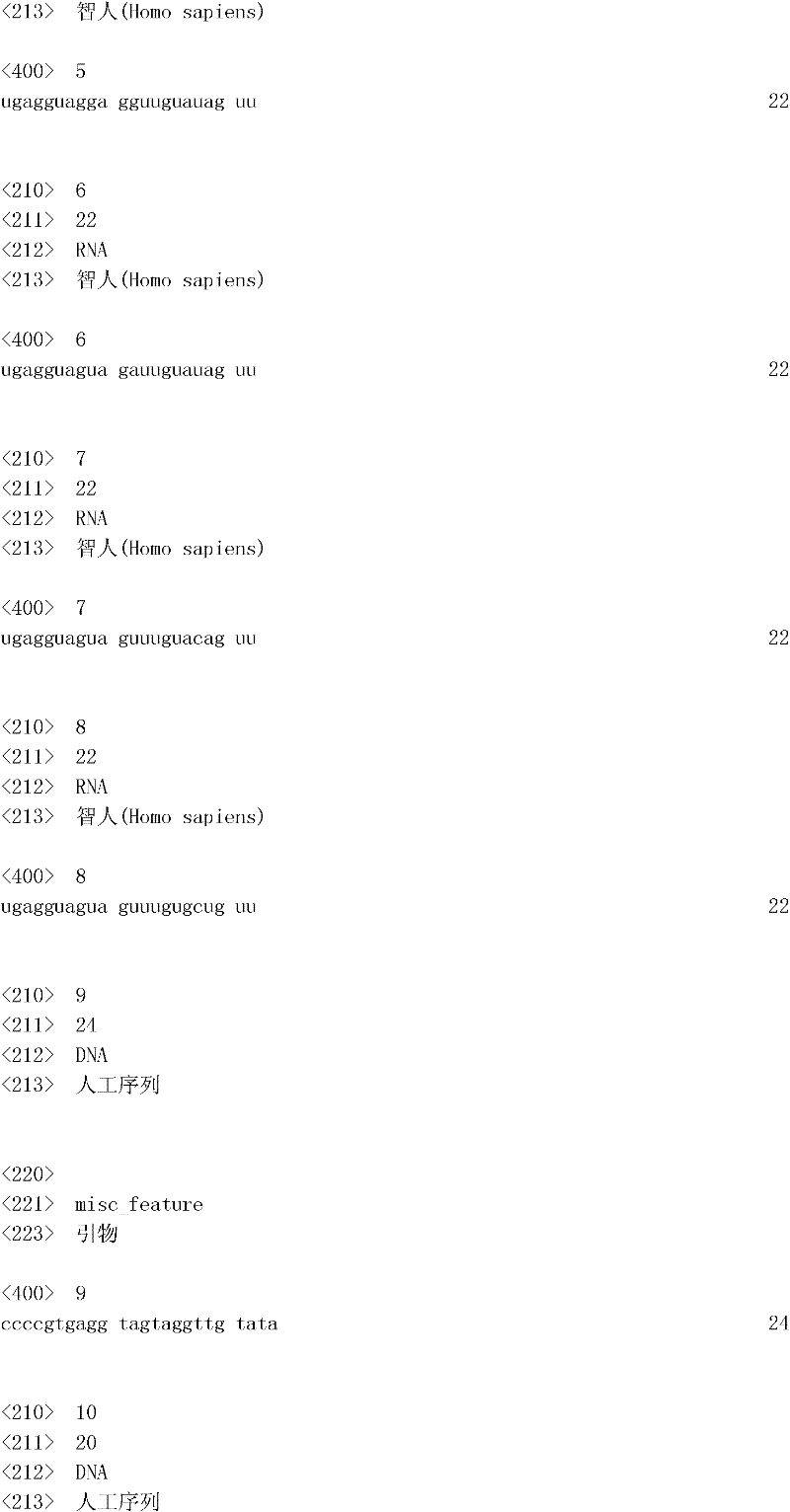
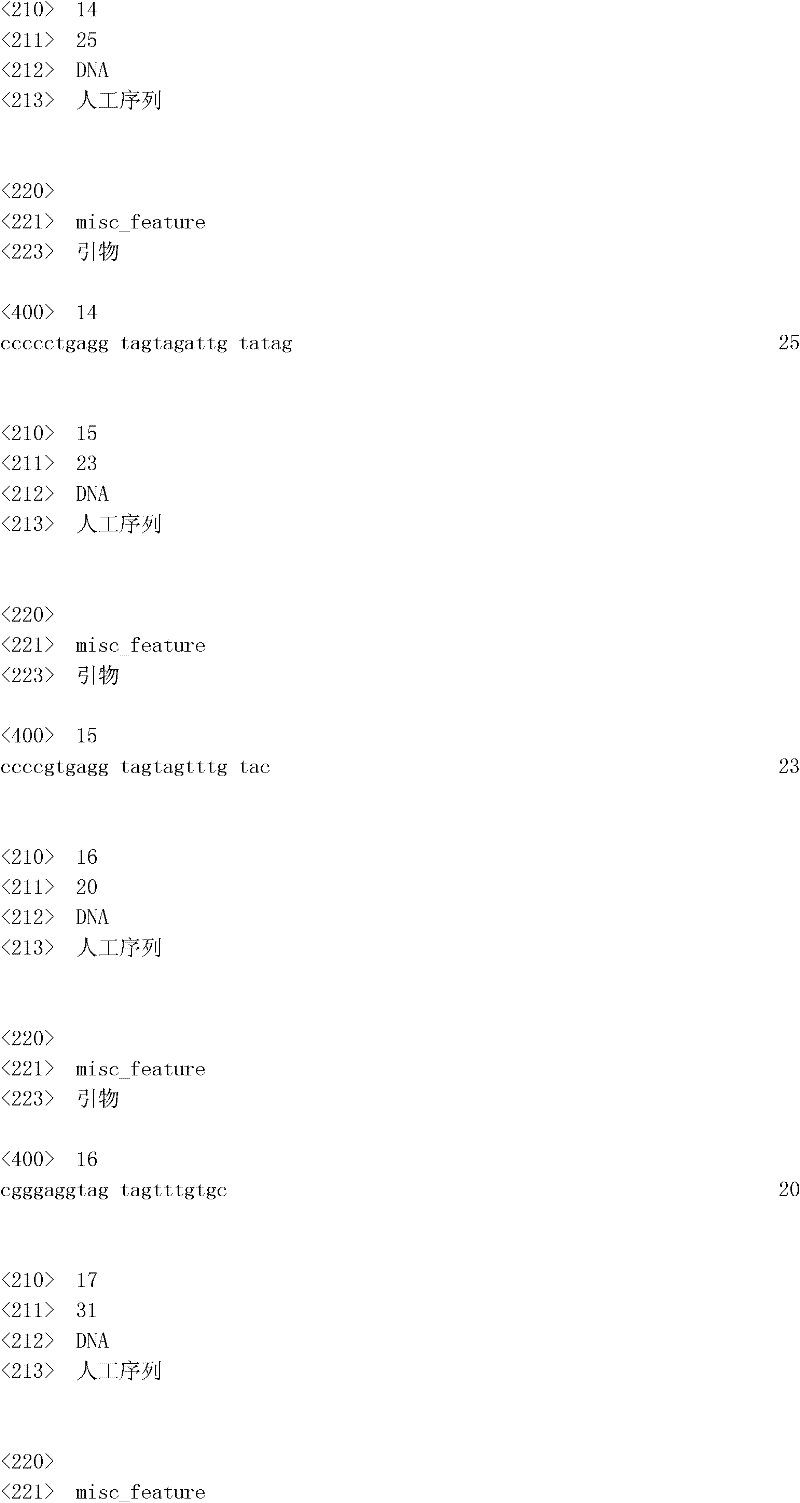
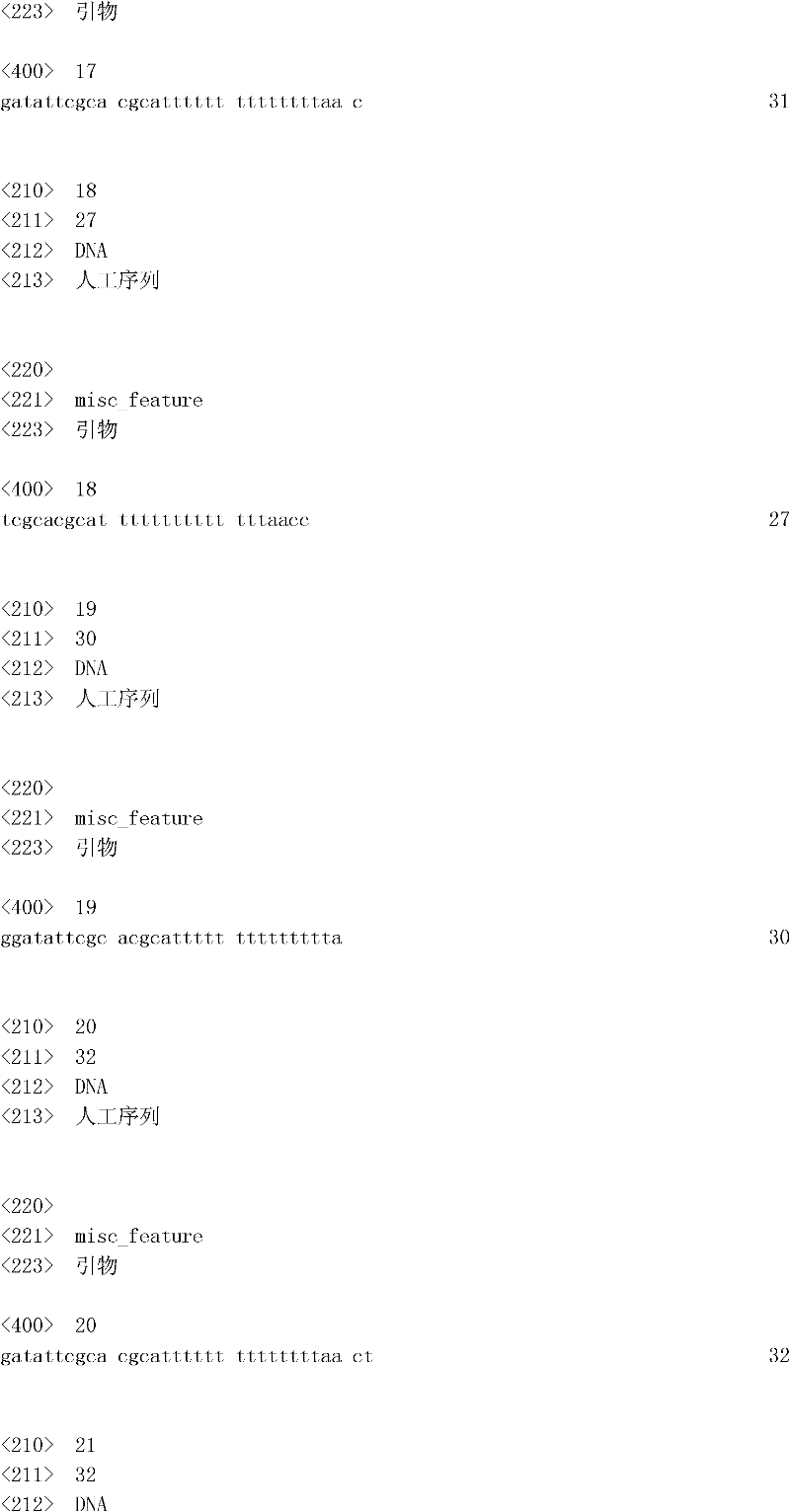
本发明人试验了4×106,4×105,4×104,4×103,4×102,40,4,以及0(NTC)(NTC为无底物对照)个分子的模板量(hsa-l et7a,SEQ ID NO:1或表1),使用正向引物(SEQ ID NO:9或表1)及反向引物(SEQ ID NO:10或表1)连同含有EvaGreen的PCR反应母液进行实时荧光定量PCR反应。The inventors tested 4×10 6 , 4×10 5 , 4×10 4 , 4×10 3 , 4×10 2 , 40, 4, and 0 (NTC) (NTC is no substrate control) molecules Template amount (hsa-l et7a, SEQ ID NO: 1 or Table 1), using forward primer (SEQ ID NO: 9 or Table 1) and reverse primer (SEQ ID NO: 10 or Table 1) together with EvaGreen containing Real-time fluorescent quantitative PCR reaction was carried out with the PCR reaction master solution.
表1小RNA以及引物序列Table 1 small RNA and primer sequence
结果如图4、图5和图6所示。其中,图5显示了灵敏度、线性及模板浓度动态范围。The results are shown in Figure 4, Figure 5 and Figure 6. Among them, Figure 5 shows the sensitivity, linearity and template concentration dynamic range.
在测试含有EvaGreen的PCR的专一性实验中,针对人类let 7家族的8个小RNA成员(序列如SEQ ID No:1-8所示或表1所示),本发明人分别使用4×10⁶个拷贝数的小RNA作为模板,用特异性PCR引物对(序列如SEQ ID NO:9-24所示或表1所示)进行PCR反应,并检测各小RNA成员对各个不同的PCR引物的PCR反应的专一性及灵敏度。In the specificity experiment of testing the PCR containing EvaGreen, the inventors used 4× 10 Small RNAs with 6 copy numbers were used as templates, and PCR reactions were carried out with specific PCR primer pairs (sequences shown in SEQ ID NO: 9-24 or shown in Table 1), and each small RNA member was detected for each different PCR The specificity and sensitivity of the PCR reaction of the primers.
本实施例同时采用了EvaGreen和SYBR Green两种双链DNA结合染料,对其专一性及灵敏度进行对比。如果同族的反应的Ct值比非同族的Ct值低一个Ct值,则非同族的反应相当于同族反应的50%,即其交叉反应为50%;同理,如果同族的反应的Ct值比非同族的Ct值低2个Ct值,则非同族的反应相当于同族反应的25%,即其交叉反应为25%;以此类推,如果同族的反应的Ct值比非同族的Ct值低3个Ct值,则非同族的反应相当于同族反应的12.5%,即其交叉反应为12.5%;如果同族的反应的Ct值比非同族的Ct值低4个Ct值,则非同族的反应相当于同族反应的6.25%,即其交叉反应为6.25%。在小RNA检测实验中,普遍可以接受低于5%的交叉反应。In this example, two double-stranded DNA binding dyes, EvaGreen and SYBR Green, were used to compare their specificity and sensitivity. If the Ct value of the reaction of the same family is one Ct value lower than the Ct value of the non-homogeneous reaction, the non-homogeneous reaction is equivalent to 50% of the homogeneous reaction, that is, its cross-reaction is 50%; If the Ct value of the non-homologous group is 2 Ct values lower, the non-homogeneous reaction is equivalent to 25% of the homogeneous reaction, that is, its cross-reaction is 25%; and so on, if the Ct value of the homogeneous reaction is lower than the
本实施例中,同时使用了EvaGreen及SYBR Green两种双链DNA结合染料,对let 7家族的8个小RNA成员实时荧光定量反应的专一性及灵敏度进行对比。In this example, two double-stranded DNA-binding dyes, EvaGreen and SYBR Green, were used at the same time to compare the specificity and sensitivity of the real-time fluorescence quantitative reactions of the eight small RNA members of the let 7 family.
结果如图6所示,在所有的49个交叉反应中,8个基于SYBR Green染料的定量PCR有大于5%的交叉反应,最高的交叉反应高于70%,相比之下,基于EvaGreen染料的交叉反应均小于5%。因此,基于EvaGreen的实时荧光定量PCR法的专一性高于基于SYBR Green的实时荧光定量PCR法。The results are shown in Figure 6, among all 49 cross-reactions, 8 quantitative PCRs based on SYBR Green dye had more than 5% cross-reactivity, and the highest cross-reaction was higher than 70%, compared with the EvaGreen dye-based The cross-reactivity was less than 5%. Therefore, the specificity of the real-time fluorescent quantitative PCR method based on EvaGreen is higher than that of the real-time fluorescent quantitative PCR method based on SYBR Green.
众所周知,小RNA的序列很短中,且不同小RNA的序列很相似,因此能区分不同小RNA的专一性引物显得尤为重要。As we all know, the sequences of small RNAs are very short, and the sequences of different small RNAs are very similar, so the specific primers that can distinguish different small RNAs are particularly important.
令人非常意外的是,从图6以及表2A和2B可发现,在EvaGreen反应中,表征非特异性交叉反应的相对值总和为15.1(见表2A)。与之相反,在SYBRGREEN反应中,表征非特异性交叉反应的相对值总和高达161(见表2B)。换言之,对于同样的引物对,同样的小RNA,SYBR Green的交叉反应居然比EvaGreen的交叉反应高出10倍之多(161.3,14.8=10.89)。即,使用EvaGreen把专一性提高了一个数量级。Surprisingly, it can be found from Figure 6 and Tables 2A and 2B that in the EvaGreen reaction, the sum of the relative values representing non-specific cross-reactivity is 15.1 (see Table 2A). In contrast, in the SYBRGREEN reaction, the sum of relative values characterizing non-specific cross-reactivity was as high as 161 (see Table 2B). In other words, for the same primer pair and the same small RNA, the cross-reaction of SYBR Green is 10 times higher than that of EvaGreen (161.3, 14.8=10.89). That is, using EvaGreen increased specificity by an order of magnitude.
表2A EvaGreen测试结果Table 2A EvaGreen test results
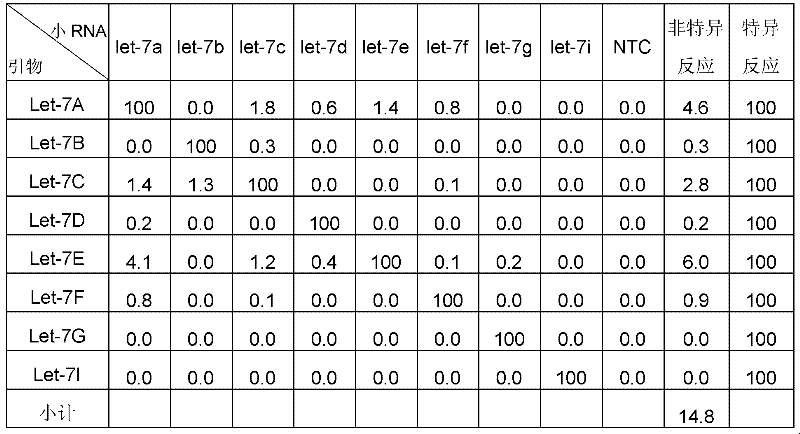
表2B SYBR Green测试结果Table 2B SYBR Green test results

注:在表2A和2B中,let-7a表示小RNA let-7a;Let-7A表示针对小RNA let-7a的特异性引物对;依此类推。NTC表示无模板。NOTE: In Tables 2A and 2B, let-7a indicates the small RNA let-7a; Let-7A indicates the specific primer pair for the small RNA let-7a; and so on. NTC means no template.
其中,将使用特异性引物时的配对配对反应的活性值定位为100,交叉反应的活性值为相对于配对反应的活性值的比值。Wherein, the activity value of the pairing reaction when specific primers are used is positioned as 100, and the activity value of the cross-reaction is a ratio of the activity value of the pairing reaction.
结果汇总Summary of results
在本实施例的小分子RNA的测定中,应用两种DNA结合染料EvaGreen和SYBR Green相比,测定的灵敏度比较接近,但EvaGreen的专一性明显高于SYBRGreen。In the determination of small RNA in this example, compared with the two DNA-binding dyes EvaGreen and SYBR Green, the sensitivity of the determination is relatively close, but the specificity of EvaGreen is significantly higher than that of SYBRGreen.
实施例2Example 2
退火实验证明EvaGreen具有更高的专一性Annealing experiments prove that EvaGreen has higher specificity
分别使用EvaGreen(组A)或SYBR Green的染料(组B),500nM的let-7e正向引物(SEQ ID NO:13)与500nM的c7e(SEQ ID NO:26)可形成完全配对的双链结构(曲线1,3),使用500nM c7a(SEQ ID NO:25)作为对照与l et-7e正向引物形成非专一性的的双链结构(曲线2,4)。该反应在50mM的Tris(pH8.0),且含有2.5mM的氯化镁的缓冲液中进行。Using EvaGreen (group A) or SYBR Green dyes (group B) respectively, 500nM let-7e forward primer (SEQ ID NO: 13) and 500nM c7e (SEQ ID NO: 26) can form a fully paired double strand Structure (
结果如图7所示。无论使用EvaGreen或SYBR Green染料,专一性结合的的双链退火曲线峰值的温度均高于非专一性结合双链的峰值峰值的温度,这证明专一性结合的退火温度较非专一性结合的高。然而,对于专一性结合与非专一性结合的曲线峰值之间的温度差使用EvaGreen(TSeva)染料时明显大于使用SYBR Green(TSSYBR)。这个实验参数证明了在EvaGreen的染料中,引物的专一性强。The result is shown in Figure 7. Regardless of the use of EvaGreen or SYBR Green dyes, the peak temperature of the double-strand annealing curve of specific binding is higher than the peak temperature of the peak peak of non-specific binding double-strand, which proves that the annealing temperature of specific binding is lower than that of non-specific binding. Sexual union is high. However, the temperature difference between the peaks of the curves for specific and nonspecific binding was significantly greater with EvaGreen (TS eva ) dye than with SYBR Green (TS SYBR ). This experimental parameter demonstrates the strong specificity of the primers in EvaGreen dyes.
另外,deva是在曲线1与曲线2在曲线1达到峰值的温度时的荧光落差;dSYBR是在曲线3与曲线4在曲线3达到峰值的温度时的荧光落差。落差的高表明两个结合状态差别大,落差的小表明两个结合状态差别小。deva大于dSYBR说明:非专一性结合在EvaGreen中要比在SYBR Green中少。这两个退火实验参数,从两个角度进一步验证了在PCR试验中观察到的现象,证实了我们的发现有其物理学基础。In addition, d eva is the fluorescence drop between
综上所述,退火实验进一步证明,EvaGreen法在退火时较SYBR Green法有更高的专一性。In summary, the annealing experiment further proves that the EvaGreen method has higher specificity than the SYBR Green method during annealing.
在本发明提及的所有文献都在本申请中引用作为参考,就如同每一篇文献被单独引用作为参考那样。此外应理解,在阅读了本发明的上述讲授内容之后,本领域技术人员可以对本发明作各种改动或修改,这些等价形式同样落于本申请所附权利要求书所限定的范围。All documents mentioned in this application are incorporated by reference in this application as if each were individually incorporated by reference. In addition, it should be understood that after reading the above teaching content of the present invention, those skilled in the art can make various changes or modifications to the present invention, and these equivalent forms also fall within the scope defined by the appended claims of the present application.



Claims (10)
Priority Applications (4)
| Application Number | Priority Date | Filing Date | Title |
|---|---|---|---|
| CN201110054104.7A CN102676637B (en) | 2011-03-08 | 2011-03-08 | A highly specific method for the determination of small RNA |
| US14/001,267 US9290801B2 (en) | 2011-03-08 | 2011-12-08 | Detection method of micro-RNA with high specificity |
| PCT/CN2011/083724 WO2012119471A1 (en) | 2011-03-08 | 2011-12-08 | Detection method of small rna with high specificity |
| US15/054,882 US20160177376A1 (en) | 2011-03-08 | 2016-02-26 | Detection method of micro-rna with high specificity |
Applications Claiming Priority (1)
| Application Number | Priority Date | Filing Date | Title |
|---|---|---|---|
| CN201110054104.7A CN102676637B (en) | 2011-03-08 | 2011-03-08 | A highly specific method for the determination of small RNA |
Publications (2)
| Publication Number | Publication Date |
|---|---|
| CN102676637A true CN102676637A (en) | 2012-09-19 |
| CN102676637B CN102676637B (en) | 2016-02-03 |
Family
ID=46797465
Family Applications (1)
| Application Number | Title | Priority Date | Filing Date |
|---|---|---|---|
| CN201110054104.7A Active CN102676637B (en) | 2011-03-08 | 2011-03-08 | A highly specific method for the determination of small RNA |
Country Status (3)
| Country | Link |
|---|---|
| US (2) | US9290801B2 (en) |
| CN (1) | CN102676637B (en) |
| WO (1) | WO2012119471A1 (en) |
Cited By (1)
| Publication number | Priority date | Publication date | Assignee | Title |
|---|---|---|---|---|
| CN107250382A (en) * | 2015-02-17 | 2017-10-13 | 生物辐射实验室股份有限公司 | Small Nucleic Acid Quantification Using Split Cycle Amplification |
Families Citing this family (7)
| Publication number | Priority date | Publication date | Assignee | Title |
|---|---|---|---|---|
| WO2014071322A1 (en) | 2012-11-02 | 2014-05-08 | Life Technologies Corporation | Small RNA Capture, Detection and Quantification |
| KR20160098097A (en) * | 2015-02-09 | 2016-08-18 | (주) 하임바이오텍 | A kit and method for detecting miDNA |
| ES2890776T3 (en) | 2015-03-13 | 2022-01-24 | Life Technologies Corp | Methods, compositions and kits for the capture, detection and quantification of small RNA |
| WO2018016885A1 (en) * | 2016-07-21 | 2018-01-25 | 주식회사 하임바이오텍 | Rna detecting kit and method |
| KR101874089B1 (en) * | 2016-07-21 | 2018-07-03 | (주) 하임바이오텍 | A kit and method for detecting RNA molecules |
| KR102343373B1 (en) * | 2020-03-09 | 2021-12-24 | (주)하임바이오텍 | Method for multiplex detection of miRNA and miRNA detection kit using the same |
| WO2023023673A2 (en) | 2021-08-20 | 2023-02-23 | Kasa Bio, L.L.C. | Compositions and methods for multiplex detection of mirna and other polynucelotides |
Citations (1)
| Publication number | Priority date | Publication date | Assignee | Title |
|---|---|---|---|---|
| WO2008092016A2 (en) * | 2007-01-26 | 2008-07-31 | Stratagene California | Methods, compositions, and kits for detection of micro rna |
Family Cites Families (1)
| Publication number | Priority date | Publication date | Assignee | Title |
|---|---|---|---|---|
| US8192937B2 (en) * | 2004-04-07 | 2012-06-05 | Exiqon A/S | Methods for quantification of microRNAs and small interfering RNAs |
-
2011
- 2011-03-08 CN CN201110054104.7A patent/CN102676637B/en active Active
- 2011-12-08 US US14/001,267 patent/US9290801B2/en active Active
- 2011-12-08 WO PCT/CN2011/083724 patent/WO2012119471A1/en not_active Ceased
-
2016
- 2016-02-26 US US15/054,882 patent/US20160177376A1/en not_active Abandoned
Patent Citations (1)
| Publication number | Priority date | Publication date | Assignee | Title |
|---|---|---|---|---|
| WO2008092016A2 (en) * | 2007-01-26 | 2008-07-31 | Stratagene California | Methods, compositions, and kits for detection of micro rna |
Non-Patent Citations (2)
| Title |
|---|
| MAO F ET AL: "Characterization of EvaGreen and the implication of its physicochemical properties for qPCR applications", 《BMC BIOTECHNOLOGY》 * |
| SHI R ET AL: "Facile means for quantifying microRNA expression by real-time PCR", 《BIOTECHNIQUES》 * |
Cited By (2)
| Publication number | Priority date | Publication date | Assignee | Title |
|---|---|---|---|---|
| CN107250382A (en) * | 2015-02-17 | 2017-10-13 | 生物辐射实验室股份有限公司 | Small Nucleic Acid Quantification Using Split Cycle Amplification |
| US11066698B2 (en) | 2015-02-17 | 2021-07-20 | Bio-Rad Laboratories, Inc. | Small nucleic acid quantification using split cycle amplification |
Also Published As
| Publication number | Publication date |
|---|---|
| WO2012119471A1 (en) | 2012-09-13 |
| US20160177376A1 (en) | 2016-06-23 |
| US20140295434A1 (en) | 2014-10-02 |
| US9290801B2 (en) | 2016-03-22 |
| CN102676637B (en) | 2016-02-03 |
Similar Documents
| Publication | Publication Date | Title |
|---|---|---|
| EP4365305B1 (en) | Method of detecting an analyte | |
| US8314220B2 (en) | Methods compositions, and kits for detection of microRNA | |
| CN110191961B (en) | Methods for preparing asymmetrically tagged sequencing libraries | |
| AU2014256903B2 (en) | Multiplexed analysis of target nucleic acids | |
| JP5851496B2 (en) | Modified stem-loop oligonucleotide-mediated reverse transcription and quantitative PCR with limited base spacing | |
| CN107075581B (en) | Digital measurement by targeted sequencing | |
| CN102676637B (en) | A highly specific method for the determination of small RNA | |
| CN102301011B (en) | Method for quantification of small RNA species | |
| CN111263819A (en) | RNA templated ligation | |
| US20060211000A1 (en) | Methods, compositions, and kits for detection of microRNA | |
| JP2024105673A (en) | Creation of single-stranded circular DNA templates for single molecule sequencing | |
| KR20110106922A (en) | Single Cell Nucleic Acid Analysis | |
| WO2020219838A1 (en) | Methods and enzymatic compositions for forming libraries of adapter ligated nucleic acid molecules | |
| Lan et al. | Linear-hairpin variable primer RT-qPCR for MicroRNA | |
| WO2010103522A1 (en) | Method for detection of nucleic acid sequences | |
| EP1978104A1 (en) | A method for the quantitative analysis of RNA molecules in a sample | |
| Xu | A Molecular Review of the Detection of Specific Nucleic Acids by Amplification and Hybridization Characterization of Microbial Diversity in the Food Chain: A Molecular Review | |
| WO2024184518A1 (en) | Improved method for detecting a target variant base using a variant-specific probe | |
| KR20130007961A (en) | Method for amplifying a target nucleic acid with reduced amplification bias and method for determining relative amount of a target nucleic acid in a sample | |
| Xu | A Molecular Review of the Detection of Specific Nucleic Acids by Amplification and Hybridization Characterization of Microbial Diversity in the Food Chain: A Molecular Review | |
| HK1162196B (en) | Method for quantification of small rna species | |
| HK1187378B (en) | Modified stem-loop oligonucleotide mediated reverse transcription and base-spacing constrained quantitative pcr |
Legal Events
| Date | Code | Title | Description |
|---|---|---|---|
| C06 | Publication | ||
| PB01 | Publication | ||
| C10 | Entry into substantive examination | ||
| SE01 | Entry into force of request for substantive examination | ||
| C14 | Grant of patent or utility model | ||
| GR01 | Patent grant | ||
| C41 | Transfer of patent application or patent right or utility model | ||
| TR01 | Transfer of patent right |
Effective date of registration: 20160819 Address after: 200333 Building No. 879, Lane 2, Zhongjiang Road, Shanghai, Putuo District 301 Patentee after: BIOVUE TECHNOLOGY LTD. Address before: Hongkong 249~253 China des Voeux Road Tonning Mansion, 9 floor Patentee before: Sheng Yuan Technology Co., Ltd. |
|
| C41 | Transfer of patent application or patent right or utility model | ||
| TR01 | Transfer of patent right |
Effective date of registration: 20161010 Address after: 200333 Building No. 879, Lane 4, Zhongjiang Road, Shanghai, Putuo District 406 Patentee after: Shanghai Xiang Qiong Biological Technology Co., Ltd. Address before: 200333 Building No. 879, Lane 2, Zhongjiang Road, Shanghai, Putuo District 301 Patentee before: BIOVUE TECHNOLOGY LTD. |