CN102675291A - Compound having triazole ring structure substituted with pyridyl group and organic electroluminescent device - Google Patents
Compound having triazole ring structure substituted with pyridyl group and organic electroluminescent device Download PDFInfo
- Publication number
- CN102675291A CN102675291A CN2012101024235A CN201210102423A CN102675291A CN 102675291 A CN102675291 A CN 102675291A CN 2012101024235 A CN2012101024235 A CN 2012101024235A CN 201210102423 A CN201210102423 A CN 201210102423A CN 102675291 A CN102675291 A CN 102675291A
- Authority
- CN
- China
- Prior art keywords
- chemical formula
- group
- compound
- substituted
- organic
- Prior art date
- Legal status (The legal status is an assumption and is not a legal conclusion. Google has not performed a legal analysis and makes no representation as to the accuracy of the status listed.)
- Pending
Links
- 0 CCC*(C=CC(c1cc**(CN(CC2=NCC(C)CC2C)c2ccccc2)n1)=C*)=C Chemical compound CCC*(C=CC(c1cc**(CN(CC2=NCC(C)CC2C)c2ccccc2)n1)=C*)=C 0.000 description 7
- MUFDYTWMRODQMS-VBWDYOMBSA-N CC(C)(C)c(cc1)ccc1-[n]1c(C2=NC(c3ncccc3)=CCC2)nnc1C(/C=C\C=C(\c1ncccc1)/N)=[IH] Chemical compound CC(C)(C)c(cc1)ccc1-[n]1c(C2=NC(c3ncccc3)=CCC2)nnc1C(/C=C\C=C(\c1ncccc1)/N)=[IH] MUFDYTWMRODQMS-VBWDYOMBSA-N 0.000 description 1
Images


Classifications
-
- C—CHEMISTRY; METALLURGY
- C07—ORGANIC CHEMISTRY
- C07D—HETEROCYCLIC COMPOUNDS
- C07D401/00—Heterocyclic compounds containing two or more hetero rings, having nitrogen atoms as the only ring hetero atoms, at least one ring being a six-membered ring with only one nitrogen atom
- C07D401/14—Heterocyclic compounds containing two or more hetero rings, having nitrogen atoms as the only ring hetero atoms, at least one ring being a six-membered ring with only one nitrogen atom containing three or more hetero rings
-
- C—CHEMISTRY; METALLURGY
- C09—DYES; PAINTS; POLISHES; NATURAL RESINS; ADHESIVES; COMPOSITIONS NOT OTHERWISE PROVIDED FOR; APPLICATIONS OF MATERIALS NOT OTHERWISE PROVIDED FOR
- C09K—MATERIALS FOR MISCELLANEOUS APPLICATIONS, NOT PROVIDED FOR ELSEWHERE
- C09K11/00—Luminescent, e.g. electroluminescent, chemiluminescent materials
- C09K11/06—Luminescent, e.g. electroluminescent, chemiluminescent materials containing organic luminescent materials
-
- H—ELECTRICITY
- H05—ELECTRIC TECHNIQUES NOT OTHERWISE PROVIDED FOR
- H05B—ELECTRIC HEATING; ELECTRIC LIGHT SOURCES NOT OTHERWISE PROVIDED FOR; CIRCUIT ARRANGEMENTS FOR ELECTRIC LIGHT SOURCES, IN GENERAL
- H05B33/00—Electroluminescent light sources
- H05B33/12—Light sources with substantially two-dimensional radiating surfaces
- H05B33/14—Light sources with substantially two-dimensional radiating surfaces characterised by the chemical or physical composition or the arrangement of the electroluminescent material, or by the simultaneous addition of the electroluminescent material in or onto the light source
-
- H—ELECTRICITY
- H10—SEMICONDUCTOR DEVICES; ELECTRIC SOLID-STATE DEVICES NOT OTHERWISE PROVIDED FOR
- H10K—ORGANIC ELECTRIC SOLID-STATE DEVICES
- H10K85/00—Organic materials used in the body or electrodes of devices covered by this subclass
- H10K85/60—Organic compounds having low molecular weight
- H10K85/649—Aromatic compounds comprising a hetero atom
- H10K85/654—Aromatic compounds comprising a hetero atom comprising only nitrogen as heteroatom
-
- H—ELECTRICITY
- H10—SEMICONDUCTOR DEVICES; ELECTRIC SOLID-STATE DEVICES NOT OTHERWISE PROVIDED FOR
- H10K—ORGANIC ELECTRIC SOLID-STATE DEVICES
- H10K85/00—Organic materials used in the body or electrodes of devices covered by this subclass
- H10K85/60—Organic compounds having low molecular weight
- H10K85/649—Aromatic compounds comprising a hetero atom
- H10K85/657—Polycyclic condensed heteroaromatic hydrocarbons
- H10K85/6572—Polycyclic condensed heteroaromatic hydrocarbons comprising only nitrogen in the heteroaromatic polycondensed ring system, e.g. phenanthroline or carbazole
-
- C—CHEMISTRY; METALLURGY
- C09—DYES; PAINTS; POLISHES; NATURAL RESINS; ADHESIVES; COMPOSITIONS NOT OTHERWISE PROVIDED FOR; APPLICATIONS OF MATERIALS NOT OTHERWISE PROVIDED FOR
- C09K—MATERIALS FOR MISCELLANEOUS APPLICATIONS, NOT PROVIDED FOR ELSEWHERE
- C09K2211/00—Chemical nature of organic luminescent or tenebrescent compounds
- C09K2211/10—Non-macromolecular compounds
- C09K2211/1018—Heterocyclic compounds
- C09K2211/1025—Heterocyclic compounds characterised by ligands
- C09K2211/1029—Heterocyclic compounds characterised by ligands containing one nitrogen atom as the heteroatom
-
- C—CHEMISTRY; METALLURGY
- C09—DYES; PAINTS; POLISHES; NATURAL RESINS; ADHESIVES; COMPOSITIONS NOT OTHERWISE PROVIDED FOR; APPLICATIONS OF MATERIALS NOT OTHERWISE PROVIDED FOR
- C09K—MATERIALS FOR MISCELLANEOUS APPLICATIONS, NOT PROVIDED FOR ELSEWHERE
- C09K2211/00—Chemical nature of organic luminescent or tenebrescent compounds
- C09K2211/10—Non-macromolecular compounds
- C09K2211/1018—Heterocyclic compounds
- C09K2211/1025—Heterocyclic compounds characterised by ligands
- C09K2211/1059—Heterocyclic compounds characterised by ligands containing three nitrogen atoms as heteroatoms
-
- H—ELECTRICITY
- H10—SEMICONDUCTOR DEVICES; ELECTRIC SOLID-STATE DEVICES NOT OTHERWISE PROVIDED FOR
- H10K—ORGANIC ELECTRIC SOLID-STATE DEVICES
- H10K2102/00—Constructional details relating to the organic devices covered by this subclass
- H10K2102/10—Transparent electrodes, e.g. using graphene
- H10K2102/101—Transparent electrodes, e.g. using graphene comprising transparent conductive oxides [TCO]
- H10K2102/103—Transparent electrodes, e.g. using graphene comprising transparent conductive oxides [TCO] comprising indium oxides, e.g. ITO
-
- H—ELECTRICITY
- H10—SEMICONDUCTOR DEVICES; ELECTRIC SOLID-STATE DEVICES NOT OTHERWISE PROVIDED FOR
- H10K—ORGANIC ELECTRIC SOLID-STATE DEVICES
- H10K50/00—Organic light-emitting devices
- H10K50/10—OLEDs or polymer light-emitting diodes [PLED]
- H10K50/11—OLEDs or polymer light-emitting diodes [PLED] characterised by the electroluminescent [EL] layers
-
- H—ELECTRICITY
- H10—SEMICONDUCTOR DEVICES; ELECTRIC SOLID-STATE DEVICES NOT OTHERWISE PROVIDED FOR
- H10K—ORGANIC ELECTRIC SOLID-STATE DEVICES
- H10K50/00—Organic light-emitting devices
- H10K50/10—OLEDs or polymer light-emitting diodes [PLED]
- H10K50/14—Carrier transporting layers
-
- H—ELECTRICITY
- H10—SEMICONDUCTOR DEVICES; ELECTRIC SOLID-STATE DEVICES NOT OTHERWISE PROVIDED FOR
- H10K—ORGANIC ELECTRIC SOLID-STATE DEVICES
- H10K50/00—Organic light-emitting devices
- H10K50/10—OLEDs or polymer light-emitting diodes [PLED]
- H10K50/18—Carrier blocking layers
-
- H—ELECTRICITY
- H10—SEMICONDUCTOR DEVICES; ELECTRIC SOLID-STATE DEVICES NOT OTHERWISE PROVIDED FOR
- H10K—ORGANIC ELECTRIC SOLID-STATE DEVICES
- H10K85/00—Organic materials used in the body or electrodes of devices covered by this subclass
- H10K85/30—Coordination compounds
- H10K85/321—Metal complexes comprising a group IIIA element, e.g. Tris (8-hydroxyquinoline) gallium [Gaq3]
- H10K85/324—Metal complexes comprising a group IIIA element, e.g. Tris (8-hydroxyquinoline) gallium [Gaq3] comprising aluminium, e.g. Alq3
-
- H—ELECTRICITY
- H10—SEMICONDUCTOR DEVICES; ELECTRIC SOLID-STATE DEVICES NOT OTHERWISE PROVIDED FOR
- H10K—ORGANIC ELECTRIC SOLID-STATE DEVICES
- H10K85/00—Organic materials used in the body or electrodes of devices covered by this subclass
- H10K85/60—Organic compounds having low molecular weight
- H10K85/615—Polycyclic condensed aromatic hydrocarbons, e.g. anthracene
Landscapes
- Chemical & Material Sciences (AREA)
- Organic Chemistry (AREA)
- Engineering & Computer Science (AREA)
- Materials Engineering (AREA)
- Physics & Mathematics (AREA)
- Spectroscopy & Molecular Physics (AREA)
- Plural Heterocyclic Compounds (AREA)
- Electroluminescent Light Sources (AREA)
Abstract
公开了具有优异的电子输送能力和空穴阻挡能力的有机化合物,其作为用于高效有机EL器件的材料。还公开了使用这样的化合物的高效有机EL器件。具体公开了下面通式(1)代表的化合物,其具有与取代吡啶基连接的三唑环结构。还公开了含有这样的化合物(1)的有机电致发光器件(在式(1)中,Ar1和Ar2可相同或不同且各自代表取代或未取代的芳烃基、取代或未取代的芳杂环基或取代或未取代的稠合多环芳基;R1、R2、R3、R4和R5中的任意一个为键连基团,其余的可以相同或不同且各自代表氢原子、氟原子、氰基、烷基、取代或未取代的芳烃基、取代或未取代的芳杂环基或取代或未取代的稠合多环芳基;R6、R7、R8、R9和R10中的任意两个为键连基团,其余的可以相同或不同且各自代表氢原子、氟原子、氰基、烷基、取代或未取代的芳烃基、取代或未取代的芳杂环基或取代或未取代的稠合多环芳基;且m代表1至4的整数)。[化学式1]
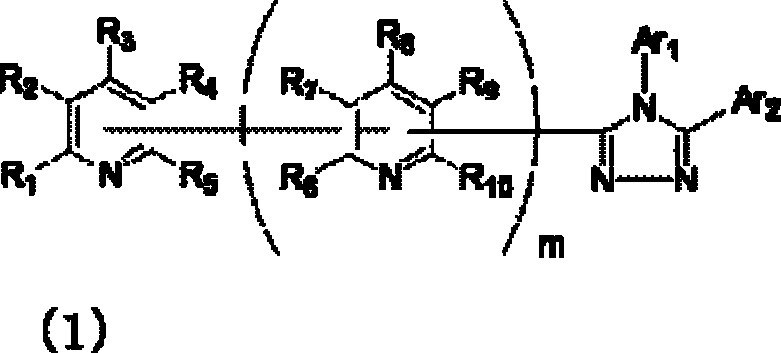
Organic compounds having excellent electron transport ability and hole blocking ability are disclosed as materials for high-efficiency organic EL devices. High-efficiency organic EL devices using such compounds are also disclosed. Specifically disclosed are compounds represented by the following general formula (1), which have a triazole ring structure linked to a substituted pyridyl group. Also disclosed is an organic electroluminescent device containing such a compound (1) (in formula (1), Ar 1 and Ar 2 can be the same or different and each represent a substituted or unsubstituted aromatic hydrocarbon group, a substituted or unsubstituted aromatic Heterocyclic group or substituted or unsubstituted condensed polycyclic aromatic group; any one of R 1 , R 2 , R 3 , R 4 and R 5 is a linking group, and the rest can be the same or different and each represent hydrogen atom, fluorine atom, cyano group, alkyl group, substituted or unsubstituted aromatic hydrocarbon group, substituted or unsubstituted aromatic heterocyclic group or substituted or unsubstituted fused polycyclic aromatic group; R 6 , R 7 , R 8 , Any two of R 9 and R 10 are bonding groups, and the rest may be the same or different and each represent a hydrogen atom, a fluorine atom, a cyano group, an alkyl group, a substituted or unsubstituted aromatic hydrocarbon group, a substituted or unsubstituted aromatic heterocyclic group or substituted or unsubstituted condensed polycyclic aromatic group; and m represents an integer of 1 to 4). [chemical formula 1]
Description
本申请是基于2006年8月31日提交的申请号为200680031906.3的名为“具有被吡啶基取代的三唑环结构的化合物和有机电致发光器件”的申请的分案申请。 This application is a divisional application based on the application number 200680031906.3 filed on August 31, 2006, entitled "Compounds with Triazole Ring Structures Substituted by Pyridyl and Organic Electroluminescent Devices". the
技术领域 technical field
本发明涉及一种适用于为适用于各种显示装置的自发光器件的有机电致发光(EL)器件的化合物,以及涉及一种器件。更具体而言,本发明涉及一种具有键合有取代吡啶的三唑环结构的化合物和使用该化合物的有机EL器件。 The present invention relates to a compound suitable for an organic electroluminescence (EL) device which is a self-luminous device suitable for various display devices, and to a device. More specifically, the present invention relates to a compound having a triazole ring structure bonded with a substituted pyridine and an organic EL device using the same. the
背景技术 Background technique
由于有机EL器件是自发光器件,因此与液晶器件相比,它们明亮,可视性优异,并且能够获得清晰的显示,因此已经积极地对其进行研究。 Since organic EL devices are self-luminous devices, they are bright, excellent in visibility, and capable of obtaining a clear display compared with liquid crystal devices, and thus have been actively researched. the
1987年,Eastman Kodak Co.的C.W.Tang等人通过开发其中各种功能分别分配于材料上的堆积结构器件,以使得使用有机材料的有机EL器件投入实际应用。他们堆叠能够输送电子的荧光材料和能够输送空穴的有机物质,并且将两种电荷注入荧光材料层中以发光,从而在10V或更低的电压下得到1000cd/m2或更高的高亮度(例如,参见专利文献1和专利文献2)。
In 1987, CW Tang et al. of Eastman Kodak Co. put an organic EL device using an organic material into practical use by developing a stacked structure device in which various functions are respectively assigned to the material. They stacked a fluorescent material capable of transporting electrons and an organic substance capable of transporting holes, and injected the two types of charges into the fluorescent material layer to emit light, resulting in high luminance of 1000cd/ m2 or more at a voltage of 10V or lower (For example, see
专利文献1:JP-A-8-48656 Patent Document 1: JP-A-8-48656
专利文献2:日本专利No.3194657 Patent Document 2: Japanese Patent No.3194657
迄今为止,已进行了许多改进,以将有机EL器件投入实际应用,并且已由其中在基底上依次设置阳极、空穴注入层、空穴传输层、发光层、电子传输层、电子注入层以及阴极的电致发光器件实现了高的效率和耐久性,从而进一步划分各种功能(例如,参见非专利文献1)。 Hitherto, many improvements have been made to put the organic EL device into practical use, and from which an anode, a hole injection layer, a hole transport layer, a light emitting layer, an electron transport layer, an electron injection layer and The electroluminescence device of the cathode realizes high efficiency and durability, thereby further dividing various functions (see, for example, Non-Patent Document 1). the
非专利文献1:Japan Applied Physics第9届研讨会预印本,第55-61页(2001)。 Non-Patent Document 1: Japan Applied Physics 9th Symposium Preprint, pp. 55-61 (2001). the
此外,人们已经尝试利用三重激发,旨在进一步改进发光效率,并且已研究了对磷光材料的利用(例如,参见非专利文献2)。 In addition, attempts have been made to utilize triplet excitation with the aim of further improving luminous efficiency, and the use of phosphorescent materials has been studied (for example, see Non-Patent Document 2). the
非专利文献2:Japan Applied Physics第9届研讨会预印本,第23-31页(2001)。 Non-Patent Document 2: Japan Applied Physics 9th Symposium Preprint, pp. 23-31 (2001). the
发光层可以通过用荧光材料或磷光材料掺杂具有电子输送能力的化合物(通常被称为宿主材料)来产生。如上述研讨会预印本所公开的,有机EL器件中有机材料的选择对该器件的各种性能如效率和耐久性具有很大影响。 The light emitting layer can be produced by doping a compound having electron transport ability (generally called a host material) with a fluorescent material or a phosphorescent material. As disclosed in the above-mentioned workshop preprint, the selection of organic materials in an organic EL device has a great influence on various properties of the device such as efficiency and durability. the
在有机EL器件中,当来自电极的注入电荷在发光层中复合时获得发光。由于空穴的转移率高于电子的转移率,因此出现了由部分穿过发光层的空穴引起的效率降低的问题。因此,需要具有高的空穴阻挡性能的输送材料。 In an organic EL device, light emission is obtained when injected charges from electrodes recombine in a light emitting layer. Since the transfer rate of holes is higher than that of electrons, there arises a problem of a decrease in efficiency caused by holes partially passing through the light emitting layer. Therefore, there is a need for transport materials with high hole blocking properties. the
尽管通常将典型的发光材料三(8-羟基喹啉)铝(下文缩写为Alq)用作电子传输材料,但并不认为Alq具有空穴阻挡性能。 Although tris(8-quinolinolato)aluminum (hereinafter abbreviated as Alq), a typical light emitting material, is generally used as an electron transport material, Alq is not considered to have hole blocking properties. the
因此,人们提出3-(4-联苯基)-4-苯基-5-(4-叔丁基苯基)-1,2,4-三唑(下文缩写为TAZ)作为具有优异空穴阻挡性能的电子传输材料(例如,参见专利文献3)。 Therefore, 3-(4-biphenyl)-4-phenyl-5-(4-tert-butylphenyl)-1,2,4-triazole (hereinafter abbreviated as TAZ) has been proposed as a Electron transport material with barrier properties (for example, see Patent Document 3). the
专利文献3:日本专利No.2734341 Patent Document 3: Japanese Patent No.2734341
由于TAZ具有5.8eV大小的功函和高的空穴阻挡性能,因此该化合物已用作具有电子输送性能的空穴阻挡层用于堆叠在通过真空气相沉积或涂覆形成的荧光发光层或磷光发光层的阴极侧上,从而有助于实现有机EL器件的高效率(例如,参见非专利文献3)。 Since TAZ has a work function of 5.8eV and high hole-blocking performance, this compound has been used as a hole-blocking layer with electron-transporting properties for stacking on fluorescent light-emitting layers or phosphorescent layers formed by vacuum vapor deposition or coating. on the cathode side of the light-emitting layer, thereby contributing to high efficiency of the organic EL device (for example, see Non-Patent Document 3). the
非专利文献3:Association of Japan Applied Physics的第50次讲演的28p-A-6预印本,第1413页,(2003)。 Non-Patent Document 3: 28p-A-6 preprint of the 50th lecture of the Association of Japan Applied Physics, p. 1413, (2003). the
然而,TAZ具有低的电子输送性能的大问题。相应地,必须在制造有机EL器件时必须将其与具有更高电子输送性能的电子传输材料结合(例如,参见非专利文献4)。 However, TAZ has a big problem of low electron transport performance. Accordingly, an organic EL device must be combined with an electron transport material having higher electron transport performance when manufacturing an organic EL device (for example, see Non-Patent Document 4). the
非专利文献4:Journal of Organic Molecular Electronics and Bioelectronics of Japan Society of Applied Physics,第11卷,第1期,第13-19页,(2000)。 Non-Patent Document 4: Journal of Organic Molecular Electronics and Bioelectronics of Japan Society of Applied Physics, Vol. 11, No. 1, pp. 13-19, (2000). the
需要具有改进的电子输送性能和高的空穴阻挡能力的电子传输材料以及具有高效率的有机EL器件。 Electron transport materials with improved electron transport properties and high hole blocking ability and organic EL devices with high efficiency are required. the
发明内容 Contents of the invention
本发明要解决的技术问题 The technical problem to be solved in the present invention
本发明的目的是提供电子输送性能和空穴阻挡能力优异的有机化合物作为用于高效有机EL器件的材料,还提供使用所述化合物的高效有机EL器件。适于本发明的有机化合物的物理性能的例子包括(1)高电子转移率和(2)优异的空穴阻挡能力。此外,适于本发明的器件的物理性能的例子包括(1)低驱动电压和(2)高发光效率。 An object of the present invention is to provide an organic compound excellent in electron transport performance and hole blocking capability as a material for a high-efficiency organic EL device, and also to provide a high-efficiency organic EL device using the compound. Examples of physical properties of organic compounds suitable for the present invention include (1) high electron transfer rate and (2) excellent hole blocking ability. In addition, examples of physical properties of devices suitable for the present invention include (1) low driving voltage and (2) high luminous efficiency. the
解决技术问题的方式 Ways to solve technical problems
为了实现上述目的,本发明的发明人已经注意到这样的事实:吡啶环是吸电子的且本发明的发明人已设计并化学合成了其中取代吡啶环键合于三唑环的新型有机化合物。本发明人已通过使用所述化合物制造了各种有机EL器件并且对所述器件已经进行了深入的性能评价,从而完成了本发明。 In order to achieve the above object, the inventors of the present invention have paid attention to the fact that the pyridine ring is electron-withdrawing and the inventors of the present invention have designed and chemically synthesized a novel organic compound in which a substituted pyridine ring is bonded to a triazole ring. The present inventors have produced various organic EL devices using the compound and have conducted intensive performance evaluations of the devices, thereby completing the present invention. the
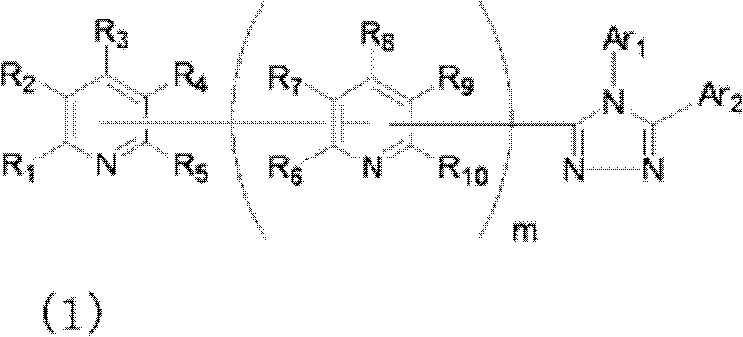
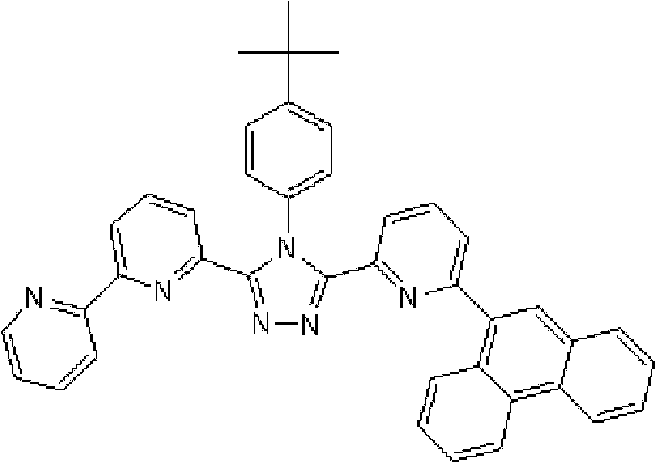
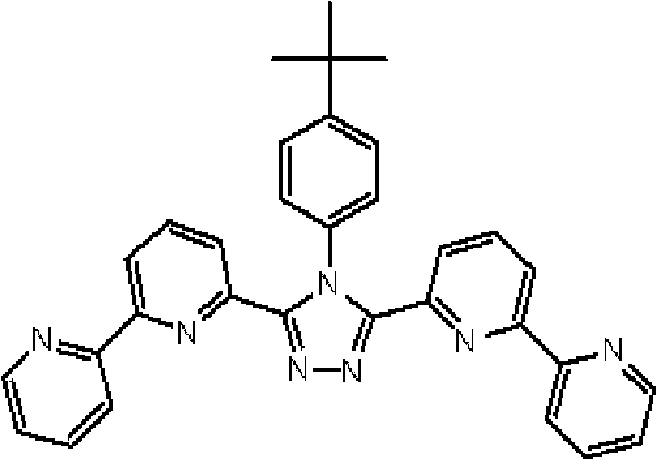
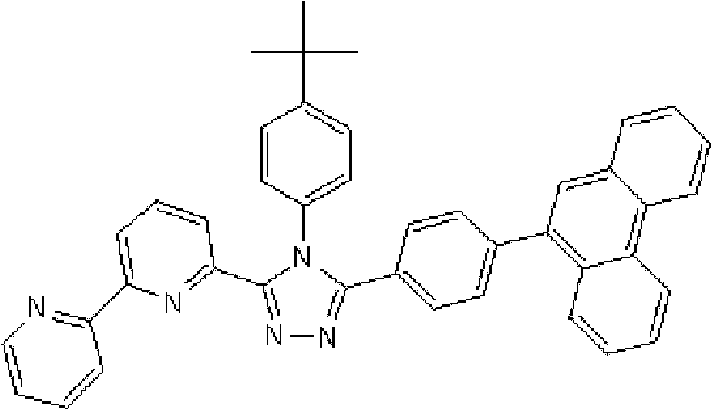
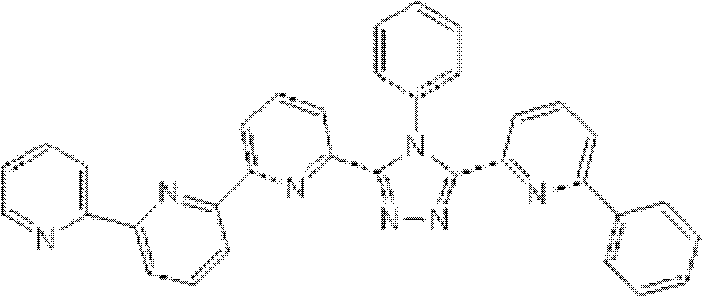
也就是说,本发明涉及通式(1)代表的具有键合有取代吡啶基的三唑环结构的化合物,还涉及包含一对电极和至少一个夹在所述电极之间的有机层的有机电致发光器件,其中所述化合物用作所述至少一个有机层的构成材料: That is, the present invention relates to a compound represented by the general formula (1) having a triazole ring structure bonded with a substituted pyridyl group, and also relates to an organic compound comprising a pair of electrodes and at least one organic layer sandwiched between the electrodes. Electromechanical luminescent device, wherein said compound is used as constituent material of said at least one organic layer:
[化学式1] [chemical formula 1]
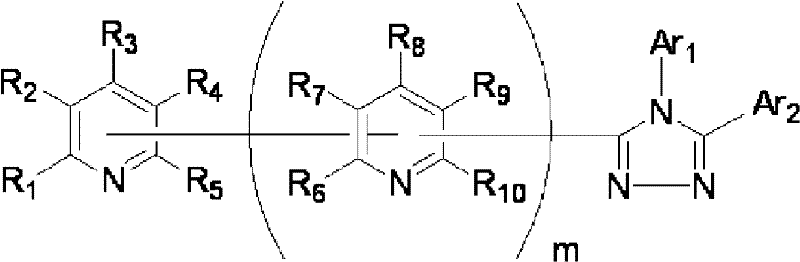
(其中Ar1和Ar2可相同或不同且各自代表取代或未取代的芳烃基、取代或未取代的芳杂环基、或取代或未取代的稠合多环芳基;R1、R2、R3、R4和R5中的任意一个为键连基团,其余的可以相同或不同且各自代表氢原子、氟原子、氰基、烷基、取代或未取代的芳烃基、取代或未取代的芳杂环基、或取代或未取代的稠合多环芳基;R6、R7、R8、R9和R10中的任意两个为键连基团,其余的可以相同或不同且各自代表氢原子、氟原子、氰基、烷基、取代或未取代的芳烃基、取代或未取代的芳杂环基、或取代或未取代的稠合多环芳基;且m代表1至4的整数。)。 (where Ar 1 and Ar 2 can be the same or different and each represents a substituted or unsubstituted aromatic hydrocarbon group, a substituted or unsubstituted aromatic heterocyclic group, or a substituted or unsubstituted condensed polycyclic aromatic group; R 1 , R 2 , any one of R 3 , R 4 and R 5 is a linking group, and the rest may be the same or different and each represent a hydrogen atom, a fluorine atom, a cyano group, an alkyl group, a substituted or unsubstituted aromatic hydrocarbon group, a substituted or Unsubstituted aromatic heterocyclic group, or substituted or unsubstituted fused polycyclic aromatic group; any two of R 6 , R 7 , R 8 , R 9 and R 10 are linking groups, and the rest can be the same or different and each represent a hydrogen atom, a fluorine atom, a cyano group, an alkyl group, a substituted or unsubstituted aromatic hydrocarbon group, a substituted or unsubstituted aromatic heterocyclic group, or a substituted or unsubstituted condensed polycyclic aromatic group; and m represents an integer from 1 to 4.).
通式(1)中的Ar1和Ar2所代表的取代或未取代的芳烃基、取代 或未取代的芳杂环基、或取代或未取代的稠合多环芳基中的芳烃基、芳杂环基或稠合多环芳基的具体例子包括苯基、联苯基、三联苯基、四联苯基、苯乙烯基、萘基、蒽基、苊基、芴基、菲基、茚基、芘基、吡啶基、嘧啶基、呋喃基、吡喃酮基(pyronyl group)、苯硫基(thiophenyl group)、喹啉基、苯并呋喃基、苯并噻吩基、吲哚基、咔唑基、苯并噁唑基、喹喔啉基、苯并咪唑基、吡唑基、二苯并呋喃基和二苯并噻吩基。 A substituted or unsubstituted aromatic hydrocarbon group, a substituted or unsubstituted aromatic heterocyclic group, or an aromatic hydrocarbon group in a substituted or unsubstituted condensed polycyclic aromatic group represented by Ar 1 and Ar 2 in the general formula (1), Specific examples of aromatic heterocyclic groups or fused polycyclic aromatic groups include phenyl, biphenyl, terphenyl, quaterphenyl, styryl, naphthyl, anthracenyl, acenaphthyl, fluorenyl, phenanthrenyl, Indenyl, pyrenyl, pyridyl, pyrimidyl, furyl, pyronyl group, thiophenyl group, quinolinyl, benzofuryl, benzothienyl, indolyl, Carbazolyl, benzoxazolyl, quinoxalinyl, benzimidazolyl, pyrazolyl, dibenzofuranyl and dibenzothienyl.
通式(1)中的Ar1和Ar2所代表的取代或未取代的芳烃基、取代或未取代的芳杂环基、或取代或未取代的稠合多环芳基中的取代基的具体例子包括氟原子、氯原子、氰基、羟基、硝基、烷基、烷氧基、氨基、三氟甲基、苯基、联苯基、三联苯基、萘基、菲基、芳烷基、芴基、茚基、吡啶基、嘧啶基、呋喃基、吡喃酮基(pyronyl)、苯硫基、喹啉基、苯并呋喃基、苯并噻吩基、吲哚基、咔唑基、苯并噁唑基、喹喔啉基、苯并咪唑基、吡唑基、二苯并呋喃基和二苯并噻吩基,且所述取代基可以进一步被取代。 In the general formula (1) Ar 1 and Ar 2 represent substituted or unsubstituted aromatic hydrocarbon groups, substituted or unsubstituted aromatic heterocyclic groups, or substituted or unsubstituted fused polycyclic aromatic groups. Specific examples include fluorine atom, chlorine atom, cyano group, hydroxyl group, nitro group, alkyl group, alkoxy group, amino group, trifluoromethyl group, phenyl group, biphenyl group, terphenyl group, naphthyl group, phenanthrenyl group, arane Base, fluorenyl, indenyl, pyridyl, pyrimidyl, furyl, pyronyl (pyronyl), thiophenyl, quinolinyl, benzofuryl, benzothienyl, indolyl, carbazolyl , benzoxazolyl, quinoxalinyl, benzimidazolyl, pyrazolyl, dibenzofuryl and dibenzothienyl, and the substituents may be further substituted.
通式(1)中的R1至R10代表的吡啶环上的取代基中的取代或未取代的芳烃基、取代或未取代的芳杂环基、或取代或未取代的稠合多环芳基中的芳烃基、芳杂环基或稠合多环芳基的具体例子包括苯基、联苯基、三联苯基、四联苯基、苯乙烯基、萘基、蒽基、苊基、芴基、菲基、茚基、芘基、嘧啶基、呋喃基、吡喃酮基(pyronyl)、苯硫基、喹啉基、苯并呋喃基、苯并噻吩基、吲哚基、咔唑基、苯并噁唑基、喹喔啉基、苯并咪唑基、吡唑基、二苯并呋喃基和二苯并噻吩基。 Among the substituents on the pyridine ring represented by R1 to R10 in the general formula (1), substituted or unsubstituted aromatic hydrocarbon groups, substituted or unsubstituted aromatic heterocyclic groups, or substituted or unsubstituted fused polycyclic rings Specific examples of the aromatic hydrocarbon group, aromatic heterocyclic group or fused polycyclic aromatic group in the aryl group include phenyl, biphenyl, terphenyl, quaterphenyl, styryl, naphthyl, anthracenyl, acenaphthyl , fluorenyl, phenanthrenyl, indenyl, pyrenyl, pyrimidinyl, furyl, pyronyl (pyronyl), thiophenyl, quinolinyl, benzofuryl, benzothienyl, indolyl, carba Azolyl, benzoxazolyl, quinoxalinyl, benzimidazolyl, pyrazolyl, dibenzofuranyl and dibenzothienyl.
通式(1)中R1至R10代表的吡啶环上的取代基中的取代或未取代的芳烃基、取代或未取代的芳杂环基、或取代或未取代的稠合多环芳基中的取代基的具体例子包括氟原子、氯原子、氰基、羟基、硝基、烷基、烷氧基、氨基、三氟甲基、萘基、芳烷基、芴基、茚基、吡啶基、嘧啶基、呋喃基、吡喃酮基(pyronyl)、苯硫基、喹啉基、苯并呋喃 基、苯并噻吩基、吲哚基、咔唑基、苯并噁唑基、喹喔啉基、苯并咪唑基、吡唑基、二苯并呋喃基和二苯并噻吩基,且所述取代基可以进一步被取代。 Among the substituents on the pyridine ring represented by R1 to R10 in general formula (1), substituted or unsubstituted aromatic hydrocarbon groups, substituted or unsubstituted aromatic heterocyclic groups, or substituted or unsubstituted fused polycyclic aromatic Specific examples of the substituent in the group include a fluorine atom, a chlorine atom, a cyano group, a hydroxyl group, a nitro group, an alkyl group, an alkoxy group, an amino group, a trifluoromethyl group, a naphthyl group, an aralkyl group, a fluorenyl group, an indenyl group, Pyridyl, pyrimidyl, furyl, pyronyl (pyronyl), thiophenyl, quinolinyl, benzofuryl, benzothienyl, indolyl, carbazolyl, benzoxazolyl, quinolyl oxalinyl, benzimidazolyl, pyrazolyl, dibenzofuryl and dibenzothienyl, and the substituents may be further substituted.
通式(1)所代表的具有键合有取代吡啶基的三唑环结构的本发明化合物具有比传统材料TAZ更高的电子转移率和更优异的空穴阻挡能力。 The compound of the present invention represented by the general formula (1) having a triazole ring structure bonded with a substituted pyridyl group has a higher electron transfer rate and a more excellent hole blocking ability than the conventional material TAZ. the
通式(1)所代表的具有键合有取代吡啶基的三唑环结构的本发明化合物适合用作有机EL器件的电子传输层的构成材料。使用具有比TAZ更高的电子转移率和更优异的空穴阻挡能力的材料,可以获得显著减小驱动电压、提高发光效率和可以制造高效耐久的有机EL器件的效果。 The compound of the present invention represented by the general formula (1) having a triazole ring structure bonded with a substituted pyridyl group is suitable as a constituent material of an electron transport layer of an organic EL device. Using a material with a higher electron transfer rate and a more excellent hole blocking ability than TAZ can achieve the effects of significantly reducing the driving voltage, improving the luminous efficiency and making an efficient and durable organic EL device. the
由于通式(1)所代表的具有键合有取代吡啶基的三唑环结构的本发明化合物具有高的空穴阻挡能力,因此可以使用所述化合物与其他电子传输材料结合作为有机EL器件的空穴阻挡层的构成材料电子传输材料。 Since the compound of the present invention having a triazole ring structure bonded with a substituted pyridyl group represented by the general formula (1) has a high hole-blocking ability, it is possible to use the compound in combination with other electron transport materials as an organic EL device. The constituent material of the hole blocking layer is an electron transport material. the
通式(1)所代表的具有键合有取代吡啶基的三唑环结构的本发明化合物也可以用作有机EL器件的发光层的构成材料。使用通过使用与TAZ相比电子输送性能优异且具有宽带隙的本发明材料作为发光层的宿主材料并通过使所述化合物带有荧光或磷光材料(称为掺杂剂)而获得的发光层,可以制造驱动电压减小且发光效率提高的有机EL器件。 The compound of the present invention represented by the general formula (1) having a triazole ring structure bonded with a substituted pyridyl group can also be used as a constituent material of a light-emitting layer of an organic EL device. Using a light-emitting layer obtained by using the material of the present invention which is excellent in electron transport performance and has a wide bandgap compared with TAZ as a host material of the light-emitting layer and by giving the compound a fluorescent or phosphorescent material (called a dopant), An organic EL device with reduced driving voltage and improved luminous efficiency can be manufactured. the
由于通过使用具有键合有取代吡啶基的三唑环结构的化合物获得本发明的有机EL器件,所述化合物具有比TAZ更高的电子转移率和更优异的空穴阻挡能力,因此显著减小了其驱动电压且提高了发光效率,从而实现了高效率。 Since the organic EL device of the present invention is obtained by using a compound having a triazole ring structure bonded with a substituted pyridyl group, which has a higher electron transfer rate and a more excellent hole blocking ability than TAZ, it is significantly reduced Its driving voltage is improved and luminous efficiency is improved, thereby achieving high efficiency. the
发明优点 Advantages of the invention
本发明涉及具有键合有取代吡啶基的三唑环结构的化合物,该化合物可用作有机EL器件的电子传输层、空穴阻挡层兼电子传输层、空穴阻挡层或发光层的构成材料,本发明还涉及使用所述化合物制造的有机EL器件。通过本发明,使用空穴阻挡性能优异的电子传输材料可以明显减小有机EL器件的驱动电压,从而实现了高效率。 The present invention relates to a compound having a triazole ring structure bonded with a substituted pyridyl group, which can be used as a constituent material of an electron transport layer, a hole blocking layer combined with an electron transport layer, a hole blocking layer, or a light emitting layer of an organic EL device , the present invention also relates to an organic EL device manufactured using the compound. Through the present invention, the driving voltage of the organic EL device can be significantly reduced by using the electron transport material with excellent hole blocking performance, thereby realizing high efficiency. the
附图说明 Description of drawings
图1是BpyTAZ01(化合物2)的NMR谱图。 Figure 1 is the NMR spectrum of BpyTAZ01 (Compound 2). the
图2是BpyTAZ02(化合物9)的NMR谱图。 Figure 2 is the NMR spectrum of BpyTAZ02 (compound 9). the
图3是化合物11的NMR谱图。
FIG. 3 is the NMR spectrum of
图4是化合物15的NMR谱图。 FIG. 4 is the NMR spectrum of compound 15. the
图5是化合物16的NMR谱图。 FIG. 5 is the NMR spectrum of compound 16. the
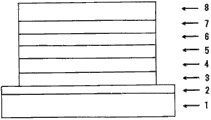
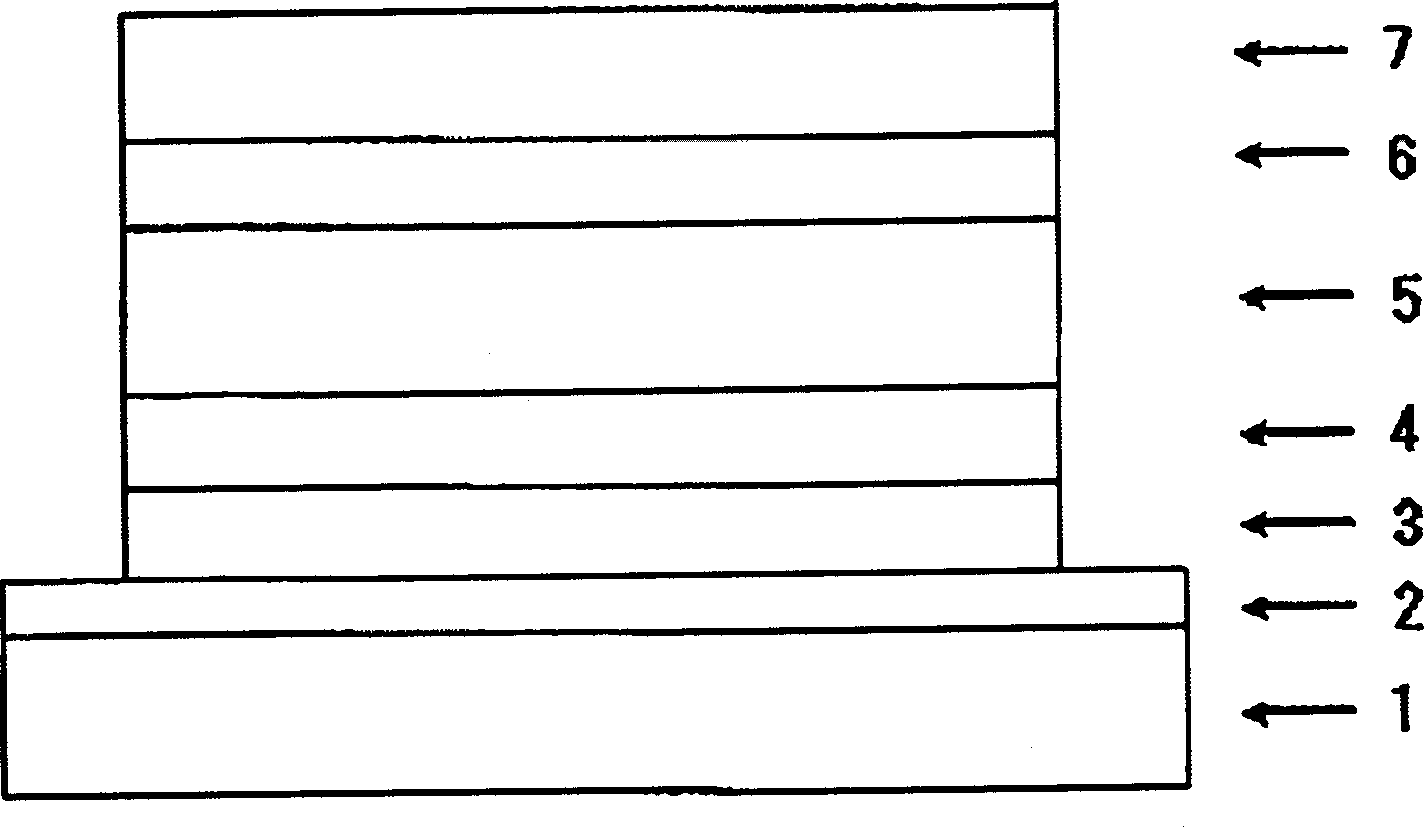
图6是表明实施例8的EL器件的结构的图。 FIG. 6 is a diagram showing the structure of an EL device of Example 8. FIG. the
图7是表明实施例10的EL器件的结构的图。 FIG. 7 is a diagram showing the structure of the EL device of Example 10. FIG. the
具体实施方式 Detailed ways
具有键合有取代吡啶基的三唑环结构的本发明化合物是新型化合物,并且可以通过相应二酰基肼与芳基胺在三氯化磷的存在下的环化反应来合成具有键合有取代吡啶基的三唑环结构的化合物。 The compound of the present invention having a triazole ring structure bonded with a substituted pyridyl group is a novel compound, and can be synthesized by a cyclization reaction of a corresponding diacylhydrazine with an arylamine in the presence of phosphorus trichloride. A pyridyl compound with a triazole ring structure. the
此外,在通式(1)中的Ar2所代表的芳烃基、芳杂环基或稠合多环芳基中,可以通过其中至少一个氢被卤原子取代的化合物与芳基硼酸的交叉偶联反应(如Suzuki偶联反应)来进一步引入取代或未取代的芳烃基、取代或未取代的芳杂环基、或取代或未取代的稠合多环芳基。 In addition, in the aromatic hydrocarbon group, aromatic heterocyclic group or condensed polycyclic aromatic group represented by Ar in the general formula ( 1 ), it is possible to cross-couple a compound in which at least one hydrogen is replaced by a halogen atom with an aryl boronic acid Linkage reaction (such as Suzuki coupling reaction) to further introduce substituted or unsubstituted aromatic hydrocarbon groups, substituted or unsubstituted aromatic heterocyclic groups, or substituted or unsubstituted fused polycyclic aromatic groups.
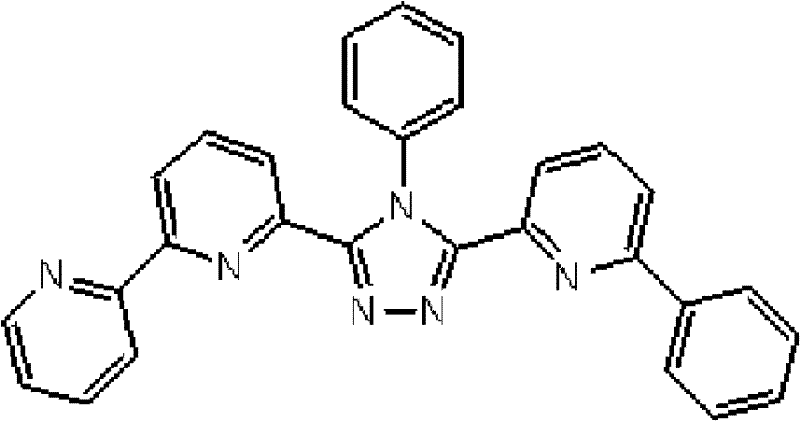
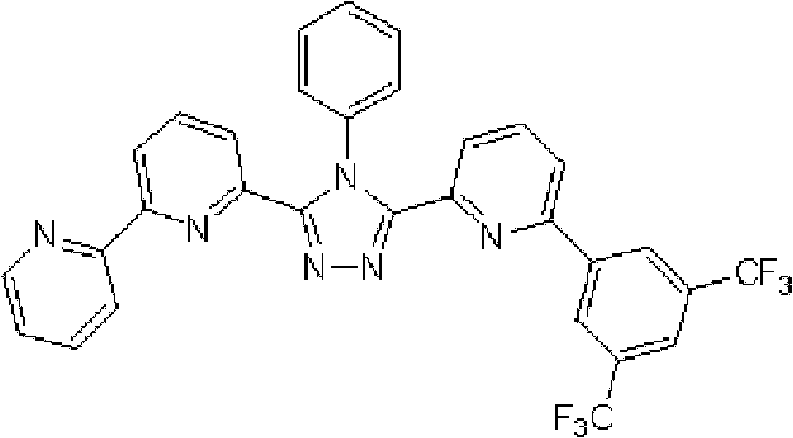
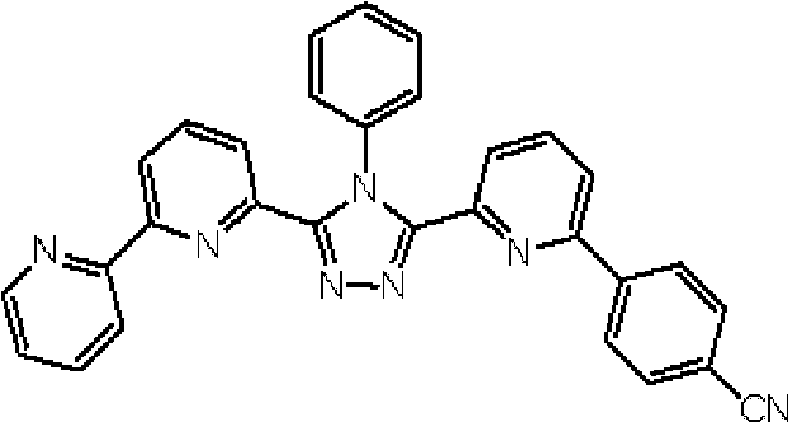
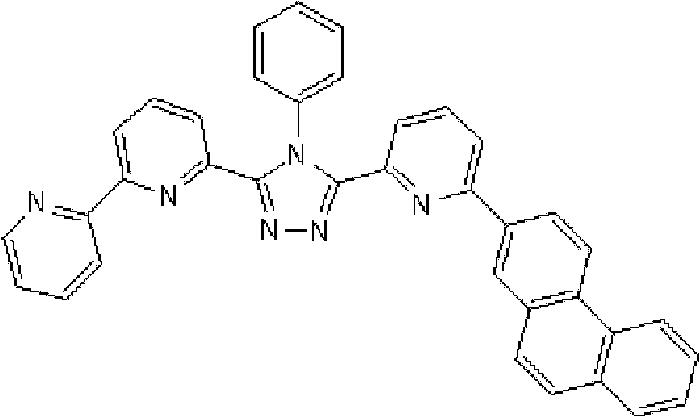
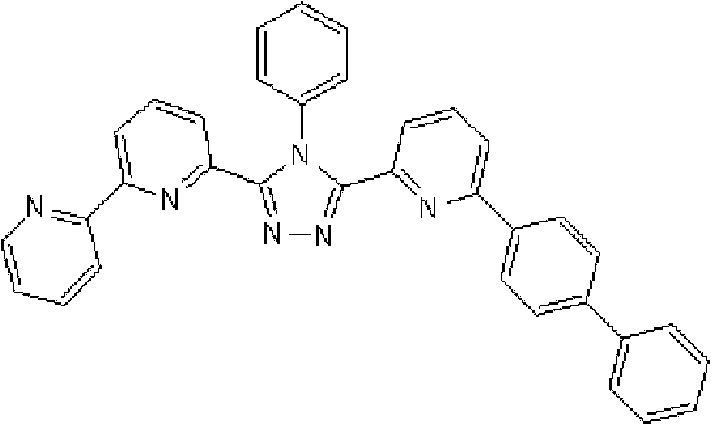
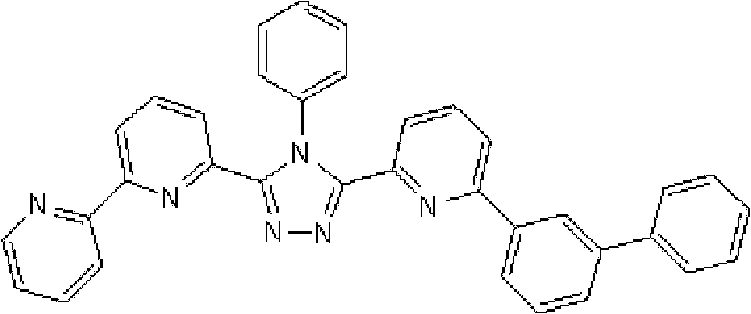
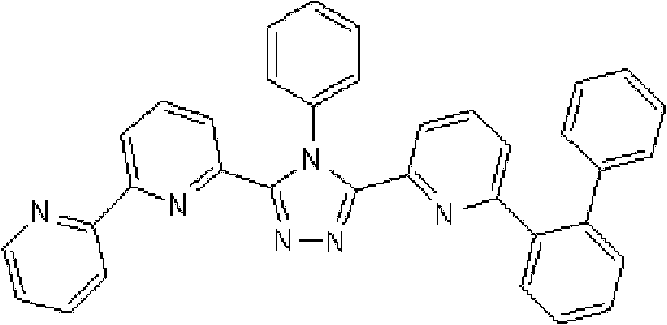
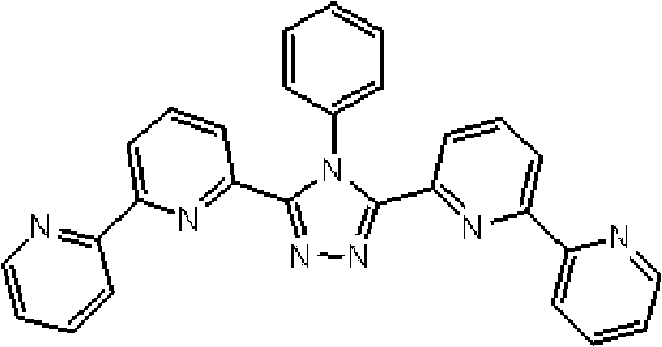
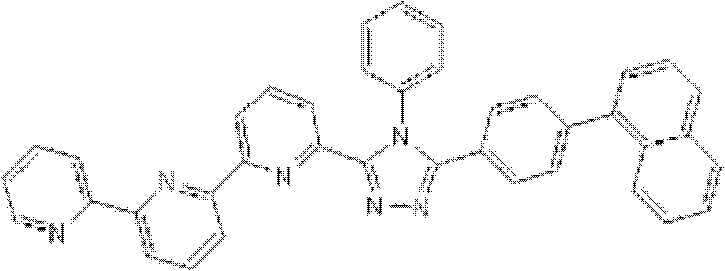
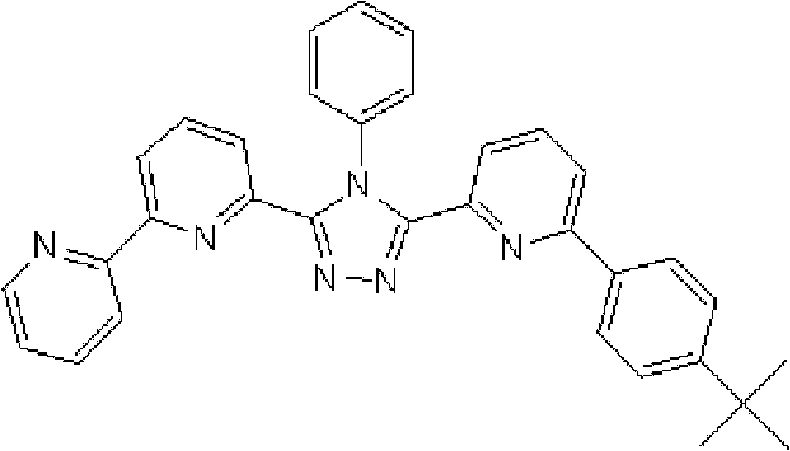
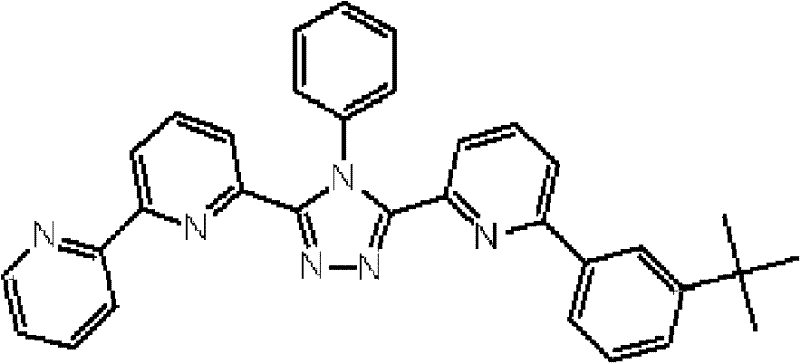
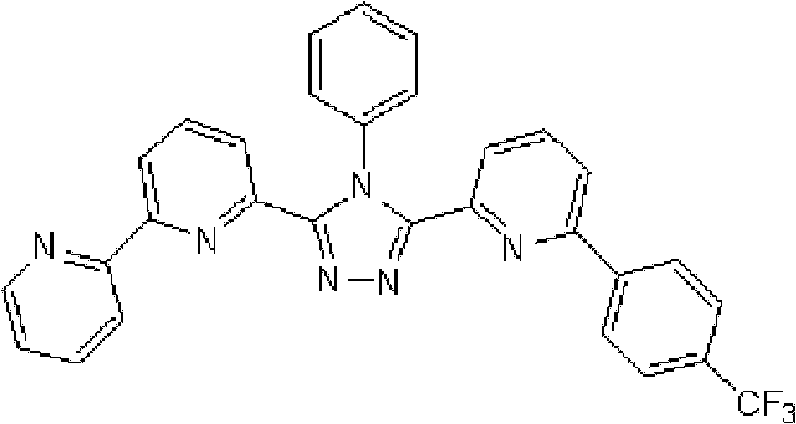
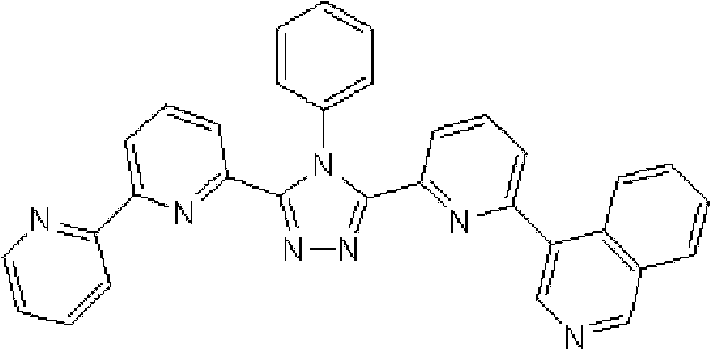
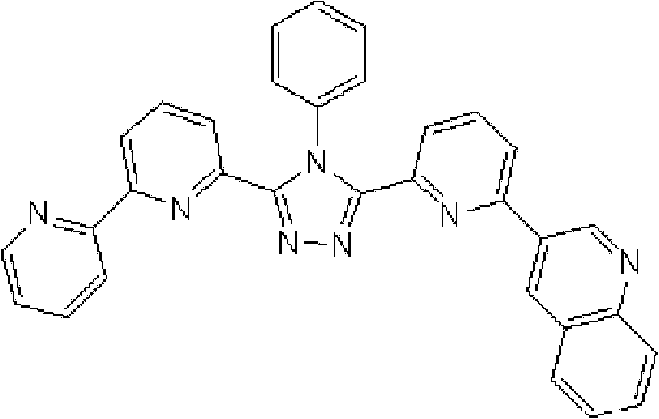
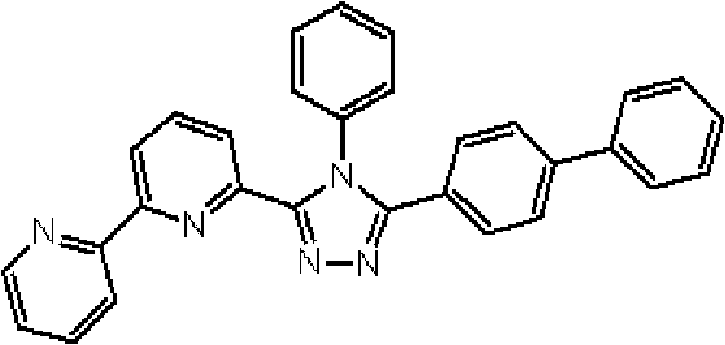
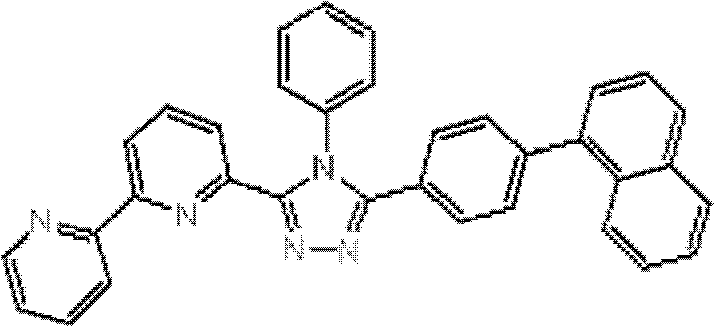
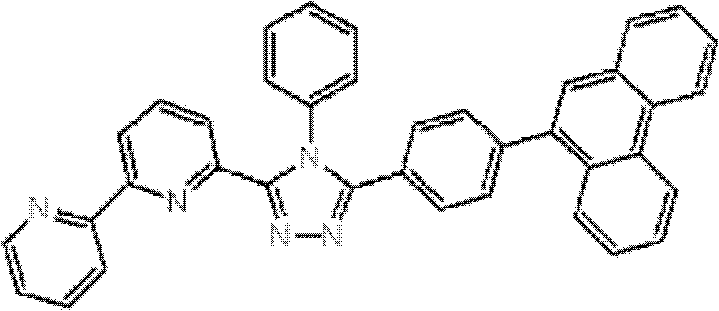
通式(1)所代表的具有键合有取代吡啶基的三唑环结构的化合物中,优选化合物的具体例子如下所示,但本发明不限于这些化合物。 Among the compounds represented by the general formula (1) having a triazole ring structure to which a substituted pyridyl group is bonded, specific examples of preferred compounds are shown below, but the present invention is not limited to these compounds. the
[化学式2] [chemical formula 2]
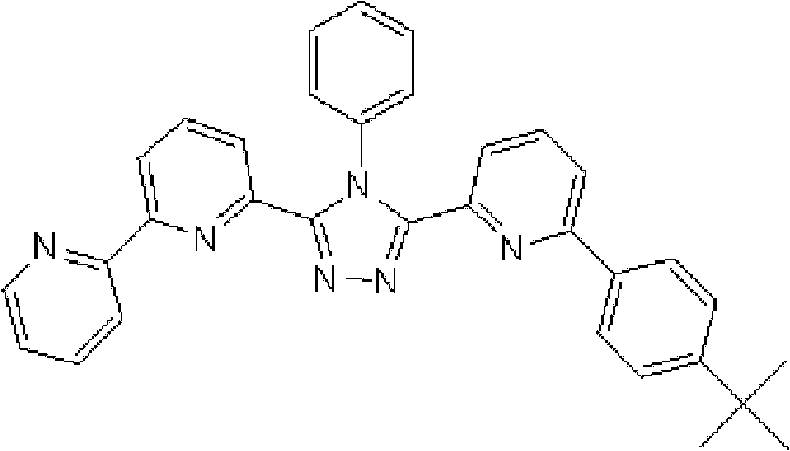
(化合物2) (compound 2)
[化学式3] [chemical formula 3]
(化合物3) (compound 3)
[化学式4] [chemical formula 4]
(化合物4) (compound 4)
[化学式5] [chemical formula 5]
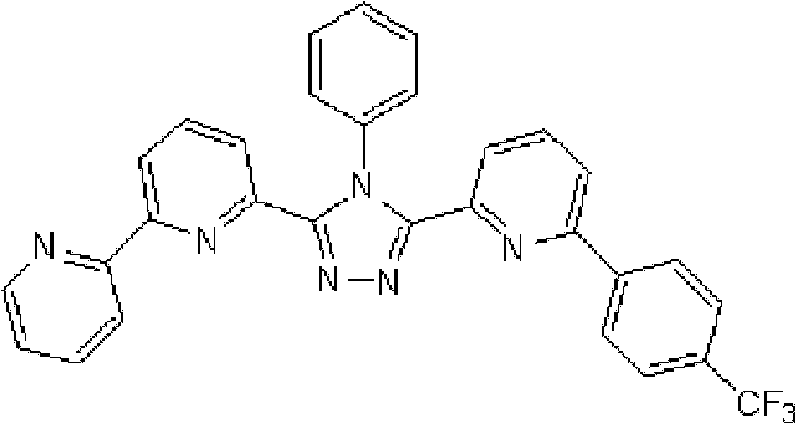
(化合物5) (Compound 5)
[化学式6] [chemical formula 6]
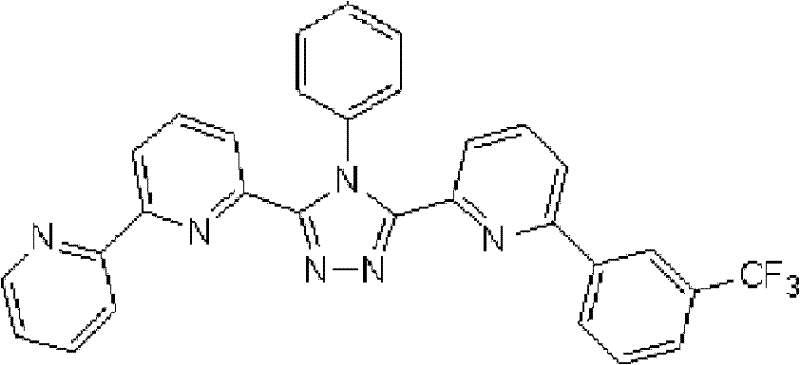
(化合物6) (compound 6)
[化学式7] [chemical formula 7]
(化合物7) (compound 7)
[化学式8] [chemical formula 8]

(化合物8) (compound 8)
[化学式9] [chemical formula 9]

(化合物9) (compound 9)
[化学式10] [chemical formula 10]
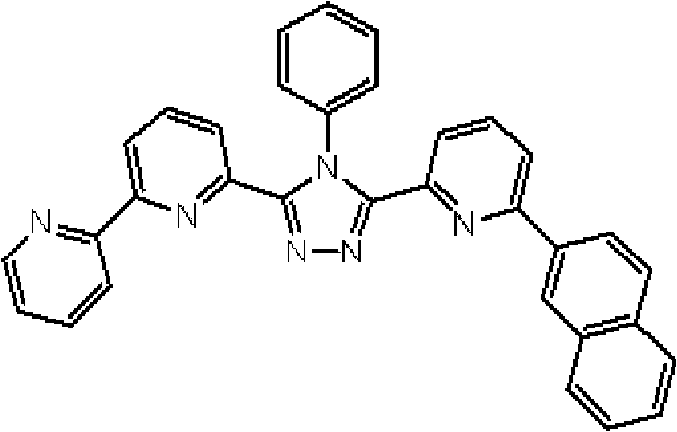
(化合物10) (compound 10)
[化学式11] [chemical formula 11]

(化合物11) (compound 11)
[化学式12] [chemical formula 12]
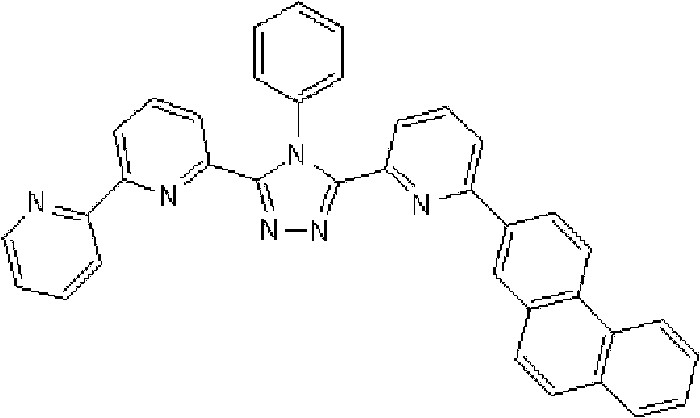
(化合物12) (compound 12)
[化学式13] [chemical formula 13]
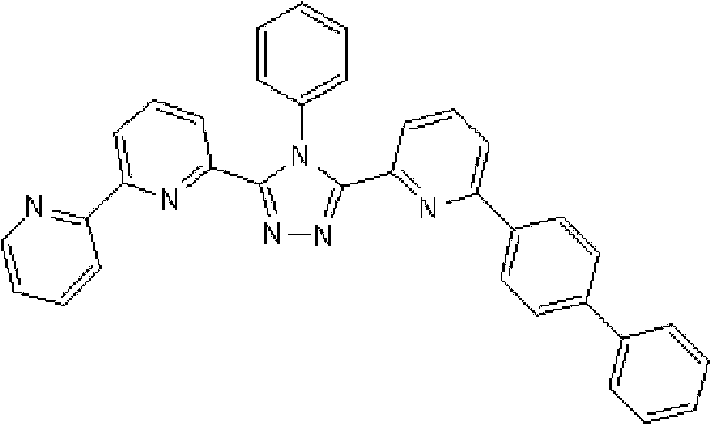
(化合物13) (compound 13)
[化学式14] [chemical formula 14]

(化合物14) (compound 14)
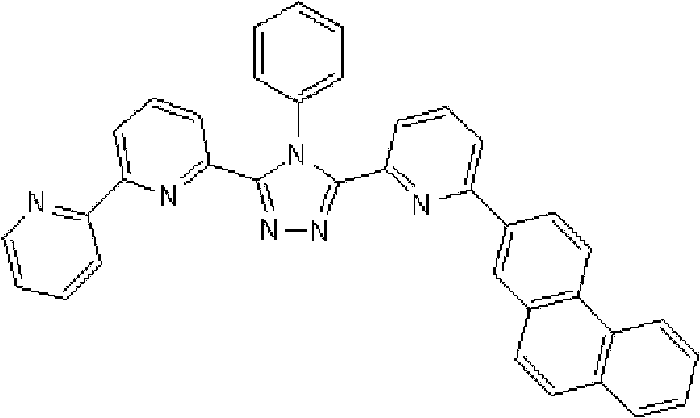
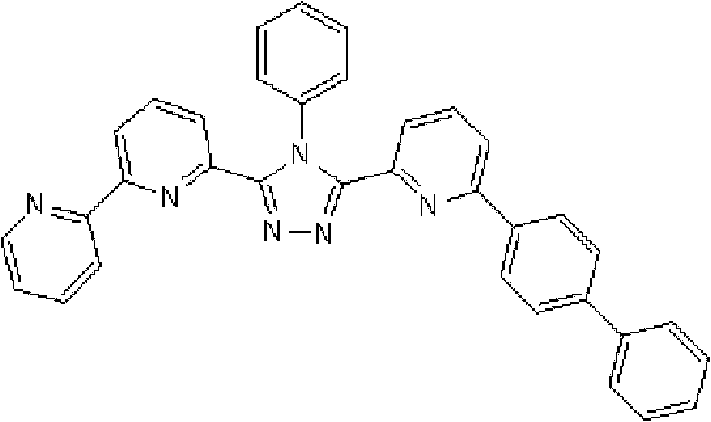
[化学式15] [chemical formula 15]
(化合物15) (compound 15)
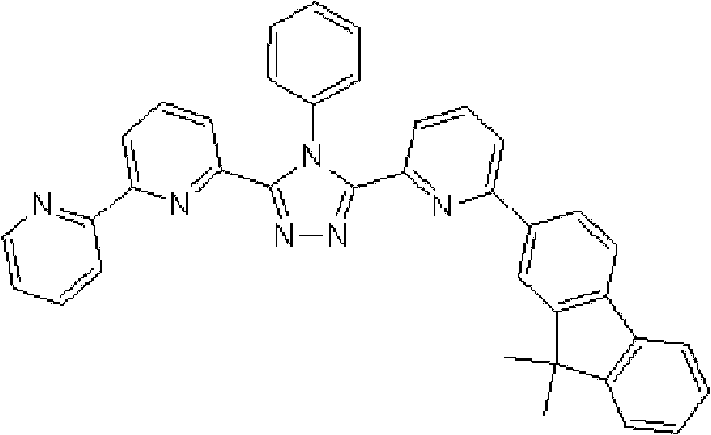
[化学式16] [chemical formula 16]
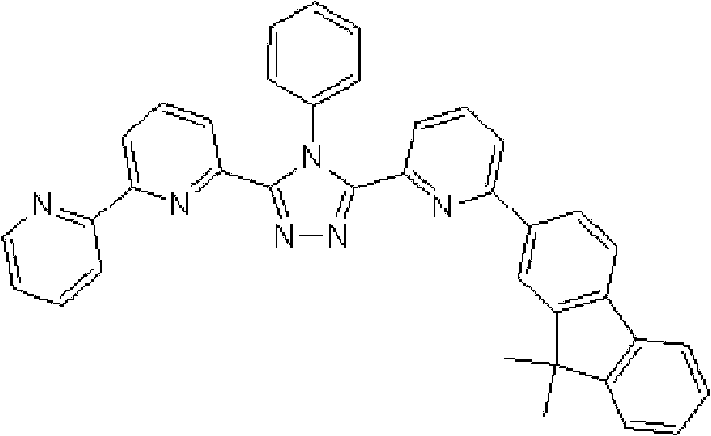
(化合物16) (compound 16)
[化学式17] [chemical formula 17]
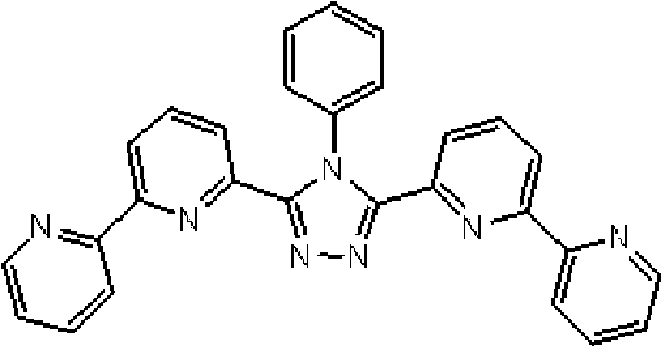
(化合物17) (compound 17)
[化学式18] [chemical formula 18]

(化合物18) (compound 18)
[化学式19] [chemical formula 19]
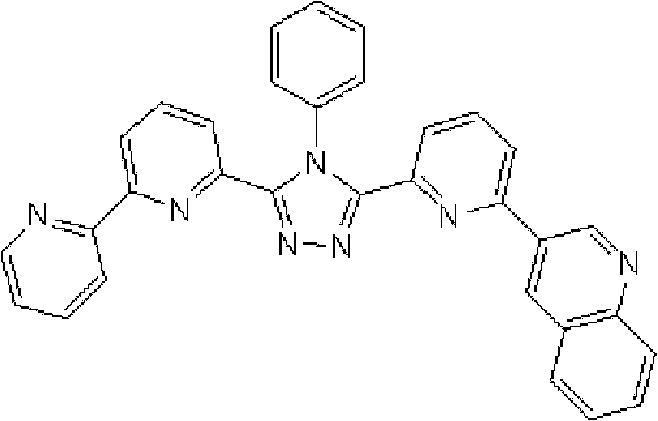
(化合物19) (compound 19)
[化学式20] [chemical formula 20]
(化合物20) (compound 20)
[化学式21] [chemical formula 21]

(化合物21) (compound 21)
[化学式22] [chemical formula 22]
(化合物22) (compound 22)
[化学式23] [chemical formula 23]

(化合物23) (compound 23)
[化学式24] [chemical formula 24]
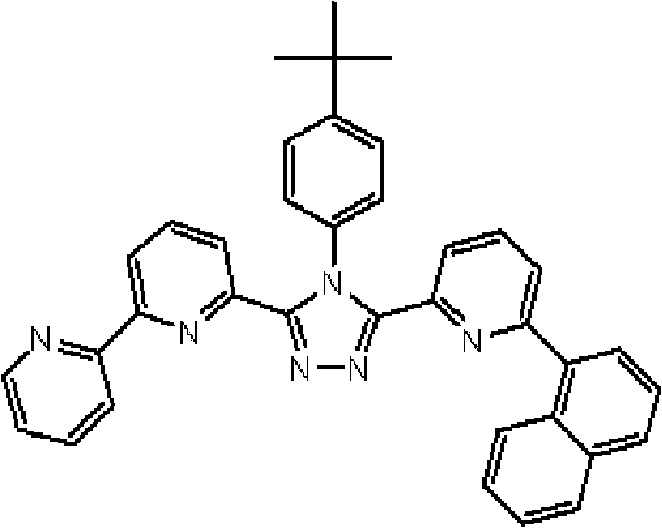
(化合物24) (compound 24)
[化学式25] [chemical formula 25]
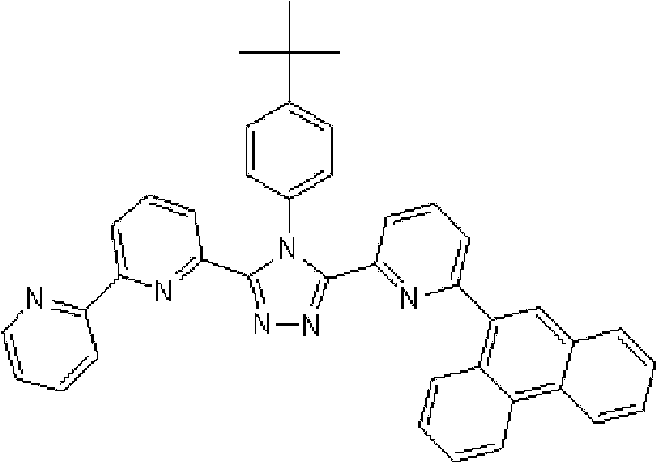
(化合物25) (compound 25)
[化学式26] [chemical formula 26]
(化合物26) (compound 26)
[化学式27] [chemical formula 27]
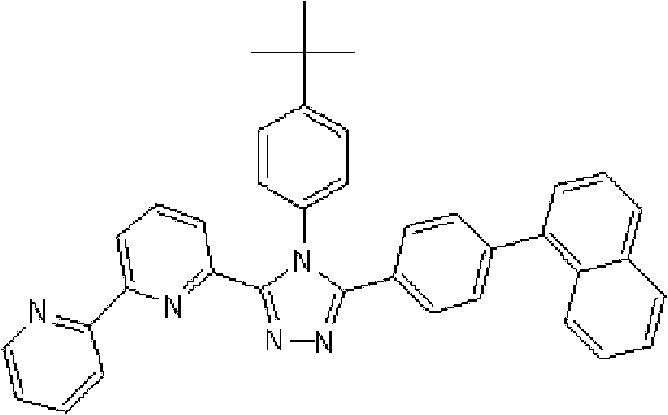
(化合物27) (compound 27)
[化学式28] [chemical formula 28]
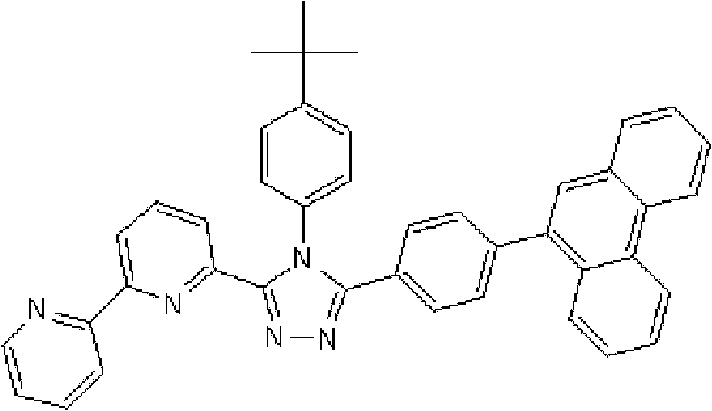
(化合物28) (compound 28)
[化学式29] [chemical formula 29]
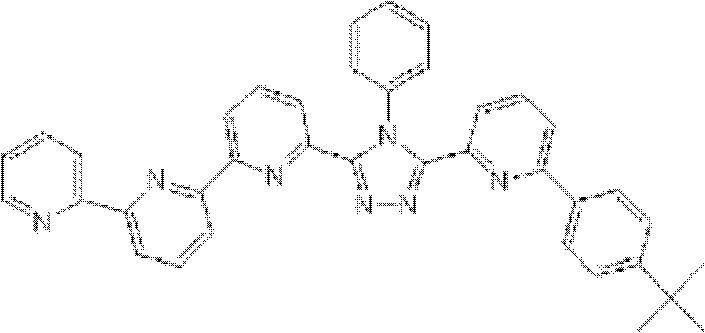
(化合物29) (compound 29)
[化学式30] [chemical formula 30]
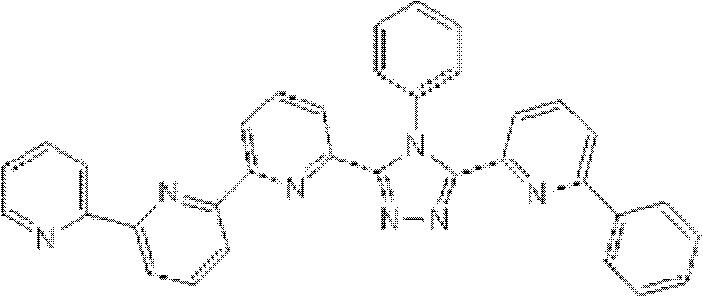
(化合物30) (compound 30)
[化学式31] [chemical formula 31]

(化合物31) (compound 31)
[化学式32] [chemical formula 32]

(化合物32) (compound 32)
这些化合物的纯化通过柱色谱纯化、吸附纯化、利用溶剂的重结晶、结晶方法等来进行。通过NMR分析鉴定这些化合物。对于物理性能值,进行DSC测量(Tg)和熔点测量。熔点用作气相沉积性能的指标,且玻璃化转变点(Tg)用作薄膜状态的稳定性的指标。 Purification of these compounds is performed by column chromatography purification, adsorption purification, recrystallization using a solvent, a crystallization method, and the like. These compounds were identified by NMR analysis. For physical property values, DSC measurement (Tg) and melting point measurement were performed. The melting point is used as an index of vapor deposition performance, and the glass transition point (Tg) is used as an index of the stability of the thin film state. the
通过使用粉末和使用DSC6220(Seiko Instruments Inc.制造的示差扫描量热计)来测量熔点和玻璃化转变点。 Melting point and glass transition point were measured by using powder and using DSC6220 (differential scanning calorimeter manufactured by Seiko Instruments Inc.). the
通过在ITO基底上制备100nm的薄膜和使用AC3(Riken keiki Co.,Ltd.制造的大气光电子分光计)来测量功函。功函用作空穴阻挡能力的指标。 The work function was measured by preparing a 100 nm thin film on an ITO substrate and using AC3 (atmospheric photoelectron spectrometer manufactured by Riken keiki Co., Ltd.). The work function is used as an index of hole blocking ability. the
本发明有机EL器件的结构的例子包括这样的结构,其中在基底上 依次形成阳极、空穴注入层、空穴传输层、发光层、空穴阻挡层、电子传输层、电子注入层以及阴极。在多层结构中,可以通过将多个层的功能结合地赋予有机层而省略有机层。例如,所述器件可以具有这样的结构,其中在基底上依次形成阳极、空穴注入兼传输层、发光层、空穴阻挡层兼电子传输层、电子注入层以及阴极。 Examples of the structure of the organic EL device of the present invention include a structure in which an anode, a hole injection layer, a hole transport layer, a light emitting layer, a hole blocking layer, an electron transport layer, an electron injection layer and a cathode are sequentially formed on a substrate. In the multilayer structure, the organic layer can be omitted by imparting the functions of a plurality of layers in combination to the organic layer. For example, the device may have a structure in which an anode, a hole injection and transport layer, a light emitting layer, a hole blocking layer and electron transport layer, an electron injection layer, and a cathode are sequentially formed on a substrate. the
作为有机EL器件的阳极,可以使用具有大功函的材料,如ITO和金。作为空穴注入层,可以使用诸如铜酞菁(下文缩写为CuPc)、星爆型三苯基胺衍生物和三[对-(N-苯基-α-萘基氨基)苯基]胺的材料以及涂覆型材料。 As the anode of the organic EL device, materials with a large work function such as ITO and gold can be used. As the hole injection layer, materials such as copper phthalocyanine (hereinafter abbreviated as CuPc), starburst triphenylamine derivatives, and tris[p-(N-phenyl-α-naphthylamino)phenyl]amine can be used. materials and coated materials. the
作为空穴传输层,可以使用联苯胺衍生物,如N,N’-二苯基-N,N’-二(间甲苯基)联苯胺(下文缩写为TPD)和N,N’-二苯基-N,N’-二(α-萘基)联苯胺(下文缩写为NPD);各种三苯基胺四聚物;等等。此外,作为空穴注入层兼空穴传输层,可以使用涂覆型高分子材料,如聚(亚乙基二氧噻吩)/聚(苯乙烯磺酸酯/盐)(下文缩写为PEDOT/PSS)。 As the hole transport layer, benzidine derivatives such as N,N'-diphenyl-N,N'-bis(m-tolyl)benzidine (hereinafter abbreviated as TPD) and N,N'-diphenyl group-N,N'-bis(α-naphthyl)benzidine (hereinafter abbreviated as NPD); various triphenylamine tetramers; and the like. In addition, as a hole injection layer and a hole transport layer, a coated polymer material such as poly(ethylenedioxythiophene)/poly(styrenesulfonate/salt) (hereinafter abbreviated as PEDOT/PSS) can be used. ). the
此外,还可以通过使用如日本专利No.2734341公开的聚-N-乙烯基咔唑(下文缩写为PVK)作为空穴注入层兼空穴传输层并将其与本发明化合物的层结合来形成有机EL器件。 In addition, it can also be formed by using poly-N-vinylcarbazole (hereinafter abbreviated as PVK) as disclosed in Japanese Patent No. 2734341 as a hole injection layer and hole transport layer and combining it with a layer of the compound of the present invention Organic EL devices. the
作为本发明有机EL器件的发光层、空穴阻挡层、电子传输层,可以使用铝络合物、噁唑衍生物、咔唑衍生物、菲咯啉衍生物、聚二烷基芴衍生物等,以及具有键合有取代吡啶基的三唑环结构的化合物。 As the light-emitting layer, hole blocking layer, and electron transport layer of the organic EL device of the present invention, aluminum complexes, oxazole derivatives, carbazole derivatives, phenanthroline derivatives, polydialkylfluorene derivatives, etc. can be used , and a compound having a triazole ring structure to which a substituted pyridyl group is bonded. the
通过将诸如铝络合物和苯乙烯基衍生物的传统发光材料用于发光层以及使用具有键合有取代吡啶基的三唑环结构的化合物作为空穴阻挡层、电子传输层或空穴阻挡层兼电子传输层,可以制造高性能有机EL器件。此外,也可以通过添加掺杂剂制造高性能有机EL器件,所述掺杂剂例如为诸如喹吖啶酮、香豆素和红荧烯的荧光材料或诸如苯 基吡啶的铱络合物的磷光材料。 By using conventional light-emitting materials such as aluminum complexes and styryl derivatives for the light-emitting layer and compounds having a triazole ring structure bonded with a substituted pyridyl group as a hole-blocking layer, an electron-transporting layer, or a hole-blocking layer, Layer and electron transport layer, can manufacture high-performance organic EL devices. In addition, high-performance organic EL devices can also be fabricated by adding dopants such as fluorescent materials such as quinacridone, coumarin, and rubrene or iridium complexes such as phenylpyridine. phosphorescent material. the
而且,通过在具有键合有取代吡啶基的三唑环结构的化合物上覆盖或共沉积传统电子传输材料和电子注入材料获得的层可以用作电子传输层。 Also, a layer obtained by covering or co-depositing a conventional electron transport material and an electron injection material on a compound having a triazole ring structure bonded with a substituted pyridyl group can be used as the electron transport layer. the
作为电子注入层,可以使用氟化锂、铈等,但可以省略该层。作为阴极,可以使用具有低功函的电极材料,如铝,或具有更低功函的合金,如铝-镁。 As the electron injection layer, lithium fluoride, cerium, or the like can be used, but this layer can be omitted. As the cathode, an electrode material with a low work function, such as aluminum, or an alloy with a lower work function, such as aluminum-magnesium, can be used. the
参照下列实施例更详细的说明本发明的实施方案,但不应解释为本发明限于这些实施例,只要没有超出本发明的主旨即可。 Embodiments of the present invention are described in more detail with reference to the following examples, but it should not be construed that the present invention is limited to these examples as long as the gist of the present invention is not exceeded. the
实施例1 Example 1
(3-(2,2’-联吡啶-6-基)-4-苯基-5-(6-溴代吡啶-2-基)-1,2,4-三唑的合成) (Synthesis of 3-(2,2'-bipyridin-6-yl)-4-phenyl-5-(6-bromopyridin-2-yl)-1,2,4-triazole)
将4.3ml苯胺和80ml 1,2-二氯苯加入用氮气置换过的反应容器中,并在室温下向其中添加0.75ml磷酰氯,随后在100℃搅拌1小时。在冷却至50℃或更低的温度后,添加3.1g N-(2,2’-联吡啶-6-羰基)-N’-(6-溴-2-吡啶基羰基)肼,使反应在140℃至150℃进行5小时。将反应液冷却至50℃之后,向其中添加水,随后搅拌1小时。之后,使用氯仿萃取反应液,并使用碳酸钠干燥有机层,随后通过过滤除去碳酸钠。将滤液减压浓缩,如此得到的固体通过柱色谱纯化(载体:NH硅胶;洗脱液:氯仿/己烷=7/3),从而得到1.0g 3-(2,2’-联吡啶-6-基)-4-苯基-5-(6-溴代吡啶-2-基)-1,2,4-三唑(收率:28%)。 4.3 ml of aniline and 80 ml of 1,2-dichlorobenzene were charged into the nitrogen-purged reaction vessel, and 0.75 ml of phosphorus oxychloride was added thereto at room temperature, followed by stirring at 100°C for 1 hour. After cooling to 50°C or lower temperature, add 3.1g of N-(2,2'-bipyridine-6-carbonyl)-N'-(6-bromo-2-pyridylcarbonyl)hydrazine to react at 140°C to 150°C for 5 hours. After cooling the reaction liquid to 50° C., water was added thereto, followed by stirring for 1 hour. Thereafter, the reaction liquid was extracted with chloroform, and the organic layer was dried with sodium carbonate, followed by removal of sodium carbonate by filtration. The filtrate was concentrated under reduced pressure, and the solid thus obtained was purified by column chromatography (carrier: NH silica gel; eluent: chloroform/hexane=7/3), thereby obtaining 1.0 g of 3-(2,2'-bipyridine-6 -yl)-4-phenyl-5-(6-bromopyridin-2-yl)-1,2,4-triazole (yield: 28%). the
(3-(2,2’-联吡啶-6-基)-4-苯基-5-[6-(4-叔丁基苯基)吡啶-2-基]-1,2,4-三唑(下文缩写为BpyTAZ01)(化合物2)的合成) (3-(2,2'-bipyridin-6-yl)-4-phenyl-5-[6-(4-tert-butylphenyl)pyridin-2-yl]-1,2,4-tri Synthesis of azole (hereinafter abbreviated as BpyTAZ01) (compound 2))
将3.0g 3-(2,2’-联吡啶-6-基)-4-苯基-5-(6-溴代吡啶-2-基)-1,2,4-三唑和1.75g 4-叔丁基苯基硼酸加入用氩气置换过的反应容器中,并在氩 气氛下向其中添加100ml甲苯/乙醇(4/1,v/v)的脱气混合液和20ml 1M碳酸钾溶液,随后添加0.40g四(三苯基膦)钯(0)。使反应在回流下进行3小时,然后将反应液冷却至室温,随后过滤沉淀的固体。将残余物溶于氯仿,并使用无水硫酸镁对液体干燥,随后过滤。将滤液浓缩后,使用氯仿/正己烷进行结晶纯化2次,从而得到为白色粉末的2.70gBpyTAZ01(化合物2)(收率:81%)。 3.0g 3-(2,2'-bipyridin-6-yl)-4-phenyl-5-(6-bromopyridin-2-yl)-1,2,4-triazole and 1.75g 4 - tert-butylphenylboronic acid is added in the reaction vessel replaced with argon, and under argon atmosphere, a degassed mixed solution of 100ml toluene/ethanol (4/1, v/v) and 20ml 1M potassium carbonate solution are added thereto , followed by the addition of 0.40 g of tetrakis(triphenylphosphine)palladium(0). The reaction was allowed to proceed under reflux for 3 hours, then the reaction solution was cooled to room temperature, and the precipitated solid was filtered. The residue was dissolved in chloroform, and the liquid was dried using anhydrous magnesium sulfate, followed by filtration. After concentrating the filtrate, crystallization and purification were performed twice using chloroform/n-hexane to obtain 2.70 g of BpyTAZ01 (compound 2) as a white powder (yield: 81%). the
使用NMR鉴定如此得到的粉末的结构。1H-NMR测量结果示于图1中。 The structure of the powder thus obtained was identified using NMR. The 1H-NMR measurement results are shown in FIG. 1 . the
通过1H-NMR(CDCl3)检测到下列28个氢信号。δ(ppm)=8.576ppm(1H),8.396-8.352ppm(2H),8.238ppm(1H),7.953-7.809ppm(2H),7.680ppm(1H),7.535-7.413ppm(6H),7.278-7.217ppm(5H),7.095ppm(1H),1.333ppm(9H)。 The following 28 hydrogen signals were detected by 1H-NMR (CDCl 3 ). δ(ppm)=8.576ppm(1H), 8.396-8.352ppm(2H), 8.238ppm(1H), 7.953-7.809ppm(2H), 7.680ppm(1H), 7.535-7.413ppm(6H), 7.278-7.217 ppm(5H), 7.095ppm(1H), 1.333ppm(9H).
实施例2 Example 2
(3-(2,2’-联吡啶-6-基)-4-苯基-5-[6-(1-萘基)吡啶-2-基]-1,2,4-三唑(下文缩写为BpyTAZ02)(化合物9)的合成) (3-(2,2'-bipyridin-6-yl)-4-phenyl-5-[6-(1-naphthyl)pyridin-2-yl]-1,2,4-triazole (hereinafter Abbreviated as BpyTAZ02) (synthesis of compound 9))
将3.0g 3-(2,2’-联吡啶-6-基)-4-苯基-5-(6-溴代吡啶-2-基)-1,2,4-三唑、1.70g 1-萘硼酸加入用氩气置换过的反应容器中,并在氩气氛下向其中添加100ml甲苯/乙醇(4/1,v/v)的脱气混合液和20ml 1M碳酸钾溶液,随后添加0.38g四(三苯基膦)钯(0)。使反应在回流下进行2小时,然后将反应液冷却至室温,随后添加100ml甲苯。使有机层和水层彼此分离以除去水层。用饱和碳酸氢钠溶液洗有机层,然后使用无水硫酸镁干燥,随后过滤。将通过浓缩滤液沉淀的固体溶于甲苯,然后向其中添加10g硅胶用于吸附,随后过滤,从而除去硅胶。浓缩吸附后的滤液,使用氯仿/正己烷对如此得到的固体进行结晶纯化,随后过滤。向如此收集的固体添加甲醇以在回流下洗1小时,随后冷却至室温并过滤,从而得到为白色粉末的2.12g BpyTAZ02(化合物9)(收率:64%)。 3.0g 3-(2,2'-bipyridin-6-yl)-4-phenyl-5-(6-bromopyridin-2-yl)-1,2,4-triazole, 1.70g 1 -Naphthylboronic acid was added to a reaction vessel replaced with argon, and a degassed mixture of 100ml of toluene/ethanol (4/1, v/v) and 20ml of 1M potassium carbonate solution were added thereto under an argon atmosphere, followed by addition of 0.38 g Tetrakis(triphenylphosphine)palladium(0). The reaction was allowed to proceed at reflux for 2 hours, then the reaction was cooled to room temperature, followed by the addition of 100 ml of toluene. The organic layer and the aqueous layer were separated from each other to remove the aqueous layer. The organic layer was washed with a saturated sodium bicarbonate solution, then dried over anhydrous magnesium sulfate, followed by filtration. The solid precipitated by concentrating the filtrate was dissolved in toluene, and then 10 g of silica gel was added thereto for adsorption, followed by filtration, thereby removing the silica gel. The adsorbed filtrate was concentrated, and the solid thus obtained was subjected to crystallization purification using chloroform/n-hexane, followed by filtration. Methanol was added to the solid thus collected to wash under reflux for 1 hour, followed by cooling to room temperature and filtration, thereby obtaining 2.12 g of BpyTAZ02 (compound 9) as a white powder (yield: 64%). the
使用NMR鉴定如此得到的粉末的结构。1H-NMR测量结果示于图2中。 The structure of the powder thus obtained was identified using NMR. The 1H-NMR measurement results are shown in FIG. 2 . the
通过1H-NMR(CDCl3)检测到下列22个氢信号。δ(ppm)=8.540ppm(1H),8.376-8.346ppm(2H),8.227ppm(1H),7.923-7.787ppm(5H),7.560-7.169ppm(11H),6.995ppm(1H),6.889ppm(1H)。 The following 22 hydrogen signals were detected by 1H-NMR (CDCl 3 ). δ (ppm) = 8.540ppm (1H), 8.376-8.346ppm (2H), 8.227ppm (1H), 7.923-7.787ppm (5H), 7.560-7.169ppm (11H), 6.995ppm (1H), 6.889ppm ( 1H).
实施例3 Example 3
(3-(2,2’-联吡啶-6-基)-4-苯基-5-[6-(菲-9-基)吡啶-2-基]-1,2,4-三唑(化合物11)的合成) (3-(2,2'-bipyridin-6-yl)-4-phenyl-5-[6-(phenanthrene-9-yl)pyridin-2-yl]-1,2,4-triazole ( Compound 11) Synthesis)
将1.35g 3-(2,2’-联吡啶-6-基)-4-苯基-5-(6-溴吡啶-2-基)-1,2,4-三唑、1.0g 9-菲硼酸加入用氩气置换过的反应容器中,并在氩气氛下添加50ml甲苯/乙醇(4/1,v/v)的脱气混合液和8.9ml 1M碳酸钾溶液,随后向其中添加0.17g四(三苯基膦)钯(0)。使反应在回流下进行9小时,然后添加0.09g四(三苯基膦)钯(0),使反应在回流下再进行3.5小时。在反应完成后,将反应液冷却至室温,通过过滤收集沉淀的粗产物。向如此得到的粗产物中,添加100ml氯仿,随后通过过滤除去催化剂。浓缩滤液后,通过添加甲醇进行结晶纯化。将如此得到的白色固体在50℃减压干燥过夜,从而得到1.36g 3-(2,2’-联吡啶-6-基)-4-苯基-5-[6-(菲-9-基)吡啶-2-基]-1,2,4-三唑(化合物11)(收率:83%)。 1.35g 3-(2,2'-bipyridin-6-yl)-4-phenyl-5-(6-bromopyridin-2-yl)-1,2,4-triazole, 1.0g 9- Add phenanthrene boric acid into the reaction vessel replaced with argon, and add a degassed mixed solution of 50ml toluene/ethanol (4/1, v/v) and 8.9ml 1M potassium carbonate solution under argon atmosphere, and then add 0.17 g Tetrakis(triphenylphosphine)palladium(0). The reaction was allowed to proceed at reflux for 9 hours, then 0.09 g of tetrakis(triphenylphosphine)palladium(0) was added and the reaction was allowed to proceed at reflux for an additional 3.5 hours. After the reaction was completed, the reaction liquid was cooled to room temperature, and the precipitated crude product was collected by filtration. To the crude product thus obtained, 100 ml of chloroform was added, followed by removal of the catalyst by filtration. After concentrating the filtrate, crystallization purification was performed by adding methanol. The white solid thus obtained was dried overnight at 50°C under reduced pressure, thereby obtaining 1.36 g of 3-(2,2'-bipyridin-6-yl)-4-phenyl-5-[6-(phenanthrene-9-yl )pyridin-2-yl]-1,2,4-triazole (compound 11) (yield: 83%). the
使用NMR鉴定如此得到的白色固体的结构。1H-NMR测量结果示于图3中。 The structure of the white solid thus obtained was identified using NMR. The 1H-NMR measurement results are shown in FIG. 3 . the
通过1H-NMR(CDCl3)检测到下列24个氢信号。δ(ppm)=8.758-8.697ppm(2H),8.552ppm(1H),8.390-8.357ppm(2H),8.286ppm(1H),7.963-7.899ppm(2H),7.859-7.809ppm(2H),7.712-7.579ppm(4H),7.517-7.166ppm(9H),6.995ppm(1H)。 The following 24 hydrogen signals were detected by 1H-NMR (CDCl 3 ). δ (ppm) = 8.758-8.697ppm (2H), 8.552ppm (1H), 8.390-8.357ppm (2H), 8.286ppm (1H), 7.963-7.899ppm (2H), 7.859-7.809ppm (2H), 7.712 -7.579ppm (4H), 7.517-7.166ppm (9H), 6.995ppm (1H).
实施例4 Example 4
(3-(2,2’-联吡啶-6-基)-4-苯基-5-[6-(联苯-2-基)吡啶-2-基]-1,2,4-三唑(化合物15)的合成) (3-(2,2'-bipyridin-6-yl)-4-phenyl-5-[6-(biphenyl-2-yl)pyridin-2-yl]-1,2,4-triazole (Synthesis of Compound 15)
在氩气氛下向用氩气置换过的反应容器中加入2.0g 3-(2,2’-联吡啶-6-基)-4-苯基-5-(6-溴代吡啶-2-基)-1,2,4-三唑、1.31g 2-联苯基硼酸、75ml甲苯/乙醇(4/1,v/v)的脱气混合液和13.24ml 1M碳酸钾溶液,随后向其中添加0.26g四(三苯基膦)钯(0)。使反应在回流下进行6小时,在反应完成后,将反应液冷却至室温,随后添加200ml乙酸乙酯。使有机层和水层彼此分离以除去水层。用饱和盐水洗涤有机层,然后使用无水硫酸镁干燥,随后浓缩。将如此得到的粗产物通过重结晶纯化并在50℃减压干燥过夜,从而得到1.25g 3-(2,2’-联吡啶-6-基)-4-苯基-5-[6-(联苯-2-基)吡啶-2-基]-1,2,4-三唑(化合物15)(收率:54%)。 Add 2.0 g of 3-(2,2'-bipyridin-6-yl)-4-phenyl-5-(6-bromopyridin-2-yl) to the argon-purged reaction vessel under argon atmosphere )-1,2,4-triazole, 1.31g 2-biphenylboronic acid, 75ml degassed mixture of toluene/ethanol (4/1, v/v) and 13.24ml 1M potassium carbonate solution, then added 0.26 g tetrakis(triphenylphosphine)palladium(0). The reaction was carried out under reflux for 6 hours, and after the completion of the reaction, the reaction liquid was cooled to room temperature, followed by adding 200 ml of ethyl acetate. The organic layer and the aqueous layer were separated from each other to remove the aqueous layer. The organic layer was washed with saturated brine, then dried over anhydrous magnesium sulfate, and then concentrated. The crude product thus obtained was purified by recrystallization and dried under reduced pressure at 50°C overnight to obtain 1.25 g of 3-(2,2'-bipyridin-6-yl)-4-phenyl-5-[6-( Biphenyl-2-yl)pyridin-2-yl]-1,2,4-triazole (Compound 15) (Yield: 54%). the
使用NMR鉴定如此得到的白色固体的结构。1H-NMR测量结果示于图4中。 The structure of the white solid thus obtained was identified using NMR. The 1H-NMR measurement results are shown in FIG. 4 . the
通过1H-NMR(CDCl3)检测到下列24个氢信号。δ(ppm)=8.578ppm(1H),8.394ppm(2H),8.002-7.917ppm(2H),7.528-7.199ppm(14H),7.067-7.043ppm(3H),6.679-6.640ppm(2H)。 The following 24 hydrogen signals were detected by 1H-NMR (CDCl 3 ). δ (ppm) = 8.578ppm (1H), 8.394ppm (2H), 8.002-7.917ppm (2H), 7.528-7.199ppm (14H), 7.067-7.043ppm (3H), 6.679-6.640ppm (2H).
实施例5 Example 5
(3-(2,2’-联吡啶-6-基)-4-苯基-5-[6-(9,9-二甲基芴-2-基)吡啶-2-基]-1,2,4-三唑(化合物16)的合成) (3-(2,2'-bipyridin-6-yl)-4-phenyl-5-[6-(9,9-dimethylfluoren-2-yl)pyridin-2-yl]-1, Synthesis of 2,4-triazole (compound 16)
在氩气氛下向用氩气置换过的反应容器中加入1.0g 3-(2,2’-联吡啶-6-基)-4-苯基-5-(6-溴代吡啶-2-基)-1,2,4-三唑、0.85g 2-(9,9-二甲基芴-2-基)-4,4,5,5-四甲基-[1,3,2]二氧杂硼酸酯、40ml甲苯/乙醇(4/1,v/v)的脱气混合液和5.5ml 2M碳酸钾溶液,随后向其中添加0.13g四(三苯基膦)钯(0)。使反应在回流下进行7.5小时。在反应完成后,将反应液冷却至室温并浓缩。添加200ml氯仿后,使有机层和水层彼此分离以除去水层。用饱和盐水洗有机层,然后使用无水硫酸镁干燥,随后浓 缩。将如此得到的粗产物溶于氯仿后,添加20g NH硅胶以进行吸附纯化,然后使用氯仿/甲醇进行结晶纯化,随后减压干燥过夜,从而得到1.14g 3-(2,2’-联吡啶-6-基)-4-苯基-5-[6-(9,9-二甲基芴-2-基)吡啶-2-基]-1,2,4-三唑(化合物16)(收率:91%)。 Add 1.0 g of 3-(2,2'-bipyridin-6-yl)-4-phenyl-5-(6-bromopyridin-2-yl) to the argon-purged reaction vessel under argon atmosphere )-1,2,4-triazole, 0.85g 2-(9,9-dimethylfluoren-2-yl)-4,4,5,5-tetramethyl-[1,3,2]di Oxaborate, 40 ml of a degassed mixture of toluene/ethanol (4/1, v/v) and 5.5 ml of 2M potassium carbonate solution, to which 0.13 g of tetrakis(triphenylphosphine)palladium(0) was subsequently added. The reaction was carried out at reflux for 7.5 hours. After the reaction was completed, the reaction solution was cooled to room temperature and concentrated. After adding 200 ml of chloroform, the organic layer and the aqueous layer were separated from each other to remove the aqueous layer. The organic layer was washed with saturated brine, then dried over anhydrous magnesium sulfate, followed by concentration. After the crude product thus obtained was dissolved in chloroform, 20 g of NH silica gel was added for adsorption purification, and then crystallization purification was carried out using chloroform/methanol, followed by drying under reduced pressure overnight, thereby obtaining 1.14 g of 3-(2,2'-bipyridine- 6-yl)-4-phenyl-5-[6-(9,9-dimethylfluoren-2-yl)pyridin-2-yl]-1,2,4-triazole (compound 16) (yield rate: 91%). the
使用NMR鉴定如此得到的白色固体的结构。1H-NMR测量结果示于图5中。 The structure of the white solid thus obtained was identified using NMR. The 1H-NMR measurement results are shown in FIG. 5 . the
通过1H-NMR(CDCl3)检测到下列28个氢信号。δ(ppm)=8.589ppm(1H),8.411-8.368ppm(2H),8.266ppm(1H),7.963-7.870ppm(2H),7.794-7.732ppm(2H),7.616-7.433ppm(9H),7.359-7.209ppm(4H),7.069ppm(1H),1.496ppm(6H)。 The following 28 hydrogen signals were detected by 1H-NMR (CDCl 3 ). δ(ppm)=8.589ppm(1H), 8.411-8.368ppm(2H), 8.266ppm(1H), 7.963-7.870ppm(2H), 7.794-7.732ppm(2H), 7.616-7.433ppm(9H), 7.359 -7.209ppm (4H), 7.069ppm (1H), 1.496ppm (6H).
实施例6 Example 6
通过高灵敏度示差扫描量热计(DSC3100S;Bruker AXS K.K.的产品)检测本发明化合物的熔点和玻璃化转变点。 The melting point and glass transition point of the compound of the present invention were measured by a high-sensitivity differential scanning calorimeter (DSC3100S; product of Bruker AXS K.K.). the
实施例7 Example 7
通过使用本发明的各种化合物,在ITO基底上形成膜厚度为100nm的气相沉积膜,并通过大气光电子分光计(AC3;Riken Keiki Co.,Ltd.的产品)测量其功函。 By using various compounds of the present invention, a vapor-deposited film having a film thickness of 100 nm was formed on an ITO substrate, and its work function was measured by an atmospheric photoelectron spectrometer (AC3; product of Riken Keiki Co., Ltd.). the
各自具有键合有取代吡啶基的三唑环结构的化合物具有显著大于TAZ的功函,TAZ的功函为5.8eV,显然所述化合物具有优异的空穴阻挡能力。 Compounds each having a triazole ring structure bonded with a substituted pyridyl group had a work function significantly larger than that of TAZ, which was 5.8 eV, and it is clear that the compounds have excellent hole blocking ability. the
实施例8 Example 8
如图6所示,通过在其上已形成有作为透明阳极2的ITO电极的玻璃基底1上依次堆叠空穴注入层兼空穴传输层3、发光层4、空穴阻挡层兼电子传输层5、电子注入层6和阴极(铝电极)7,制造有机EL器件。
As shown in Figure 6, by stacking a hole injection layer and a
用有机溶剂洗在其上已形成有膜厚度为150nm的ITO膜的玻璃基底1,然后通过氧等离子体处理来洗其表面。
The
使用真空气相沉积设备,在ITO基底上以6nm/分钟的气相沉积速率气相沉积约50nm NPD,形成空穴注入层兼空穴传输层3。随后,以6nm/分钟的气相沉积速率形成约20nm Alq作为发光层4。在发光层4上,以6nm/分钟的气相沉积速率形成约30nm BpyTAZ01(本发明实施例1化合物)(化合物2)作为空穴阻挡层兼电子传输层5。进一步,以0.1埃/秒的气相沉积速率形成约0.5nm氟化锂作为电子注入层6。最后,通过插入用于阴极气相沉积的掩膜,气相沉积约200nm铝,从而形成阴极7。将如此得到的器件储存在真空干燥器中,在空气中以常 温进行性能测试。
Using vacuum vapor deposition equipment, vapor-deposit about 50nm NPD on the ITO substrate at a vapor deposition rate of 6nm/min to form a hole injection layer and a
如此得到的有机EL器件产生稳定的绿色发光,并在6.0V的驱动电压下呈现2900cd/m2的发光,且在7.0V的驱动电压下呈现5100cd/m2的发光。 The organic EL device thus obtained produced stable green luminescence, and exhibited luminescence of 2900 cd/m 2 at a driving voltage of 6.0V, and luminescence of 5100 cd/m 2 at a driving voltage of 7.0V.
将由有机EL器件发射的光子数除以注入有机EL器件的电子数得到的比率称为外部量子效率。该器件在10000cd/m2和20000cd/m2下的外部量子效率分别为1.29%和1.46%。 The ratio obtained by dividing the number of photons emitted by the organic EL device by the number of electrons injected into the organic EL device is called external quantum efficiency. The external quantum efficiencies of the device are 1.29% and 1.46% at 10000cd/ m2 and 20000cd/ m2 , respectively.
通过增加驱动电压而增加电流密度载荷,从而评价击穿之前的最大亮度。由于通过该方法测量的最大亮度反映了所述器件的电稳定性,因此最大亮度用作有机EL器件的耐久性的指标。 The maximum luminance before breakdown was evaluated by increasing the current density loading by increasing the driving voltage. Since the maximum luminance measured by this method reflects the electrical stability of the device, the maximum luminance is used as an index of durability of the organic EL device. the
有机EL器件在9.0V下呈现28500cd/m2的最大亮度,然后发光亮度减小以达到击穿。 The organic EL device exhibited a maximum luminance of 28500cd/ m2 at 9.0V, and then the luminous luminance decreased to reach breakdown.
实施例9 Example 9
在与实施例8相同的条件下制造有机EL器件,不同的是,使用BpyTAZ02(本发明实施例2的化合物)作为用于空穴阻挡层兼电子传输层5的材料,并检测其性能。以6nm/分钟的气相沉积速率形成约30nmBpyTAZ02作为空穴阻挡层兼电子传输层5。如此得到的有机EL器件在6.0V的驱动电压下呈现3700cd/m2的发光且在7.0V的驱动电压下呈现13000cd/m2的发光。该器件在10000cd/m2和20000cd/m2下的外部量子效率分别为1.46%和1.60%。
An organic EL device was fabricated under the same conditions as in Example 8, except that BpyTAZ02 (the compound of Example 2 of the present invention) was used as the material for the hole-blocking layer and electron-transporting
[对比例1] [Comparative example 1]
为了对比,在与实施例8相同的条件下制造有机EL器件,不同的是用TAZ代替用于空穴阻挡层兼电子传输层5的材料,并检测其性能。以6nm/分钟的气相沉积速率形成约30nm TAZ作为空穴阻挡层兼电子 传输层5。如此得到的有机EL器件在6.0V的驱动电压下呈现260cd/m2的发光且在7.0V的驱动电压下呈现780cd/m2的发光。恰在击穿前该器件的外部量子效率和最大亮度为0.95%和9500cd/m2。
For comparison, an organic EL device was fabricated under the same conditions as in Example 8, except that TAZ was used instead of the material for the hole-blocking layer and electron-transporting
[对比例2] [Comparative example 2]
为了对比,在与实施例8相同的条件下制造有机EL器件,不同的是用Alq代替用于空穴阻挡层兼电子传输层5的材料,并检测其性能。以6nm/分钟的气相沉积速率形成约50nm Alq3作为发光层兼空穴阻挡层兼电子传输层4和5。如此得到的有机EL器件在6.0V的驱动电压下呈现850cd/m2的发光且在7.0V的驱动电压下呈现2800cd/m2的发光。该器件在10000cd/m2、20000cd/m2和30000cd/m2下的外部量子效率分别为1.27%、1.24%和0.97%。恰在击穿之前的最大亮度为31600cd/m2。
For comparison, an organic EL device was fabricated under the same conditions as in Example 8, except that Alq was used instead of the material for the hole-blocking layer and electron-transporting
由以上结果显而易见的是,与使用用作常规电子传输材料的Alq得到的器件和使用空穴阻挡性能优异的电子传输材料TAZ得到的器件相比,使用具有键合有取代吡啶基的三唑环的化合物得到的有机EL器件显著减小了有机EL器件的驱动电压。此外,证实了有机EL器件还在发光效率上是优异的。 As apparent from the above results, the use of triazole rings having bonded substituted pyridyl The organic EL device obtained by the compound significantly reduces the driving voltage of the organic EL device. In addition, it was confirmed that the organic EL device was also excellent in luminous efficiency. the
由于显著减小了上述对比实验中的驱动电压,因此预期具有键合有取代吡啶基的三唑环结构的化合物的电子转移率高于普通电子传输材料Alq,并明显高于传统空穴阻挡材料TAZ。 Due to the significant reduction in the driving voltage in the above comparative experiments, it is expected that the electron transfer rate of the compound with the triazole ring structure bonded with the substituted pyridyl group is higher than that of the common electron transport material Alq and significantly higher than that of the conventional hole blocking material Taz. the
实施例10 Example 10
如图7所示,通过在其上已形成有作为透明阳极2的ITO电极的玻璃基底1上依次堆积空穴注入层兼空穴传输层3、发光层4、空穴阻挡层5、电子传输层6、电子注入层7和阴极(铝电极)8制造有机EL器件。
As shown in FIG. 7 , a hole injection layer and a
用有机溶剂洗涤在其上已形成有膜厚度为150nm的ITO膜的玻璃 基底1,然后通过氧等离子体处理来洗涤其表面。
The
使用真空气相沉积设备,在ITO基底上以6nm/min的气相沉积速率气相沉积约50nm NPD,形成空穴注入层兼空穴传输层3。随后,以6nm/min的气相沉积速率形成约20nm Alq作为发光层4。在发光层4上,以6nm/min的气相沉积速率形成约20nm BpyTAZ01(本发明实施例1化合物)(化合物2)作为空穴阻挡层5。在空穴阻挡层5上以6nm/min的气相沉积速率形成约10nm Alq作为电子传输层6。进一步,以0.1埃/秒的气相沉积速率形成约0.5nm氟化锂作为电子注入层7。最后,通过嵌入用于阴极气相沉积的掩膜,气相沉积约200nm铝,从而形成阴极8。将如此得到的器件储存在真空干燥器中,在空气中以常温进行性质测量。
Using vacuum vapor deposition equipment, vapor-deposit about 50nm NPD on the ITO substrate at a vapor deposition rate of 6nm/min to form a hole injection layer and a
如此得到的有机EL器件在10000cd/m2、20000cd/m2和30000cd/m2下的外部量子效率分别为1.13%、1.46%和1.54%。恰在穿透之前的最大发光亮度为31200cd/m2。 The external quantum efficiencies of the organic EL devices thus obtained were 1.13%, 1.46% and 1.54% at 10000 cd/m 2 , 20000 cd/m 2 and 30000 cd/m 2 , respectively. The maximum luminous luminance just before breakthrough was 31200 cd/m 2 .
[对比例3] [Comparative example 3]
为了对比,在与实施例10相同的条件下制造有机EL器件,不同的是用TAZ代替用于空穴阻挡层5的材料,并检测其性质。以6nm/min的气相沉积速率形成约20nm TAZ作为空穴阻挡层5。如此得到的有机EL器件在12000cd/m2的最大亮度达到穿透。
For comparison, an organic EL device was fabricated under the same conditions as in Example 10 except that TAZ was used instead of the material for the
由以上结果显而易见的是,可以通过使用具有键合有取代吡啶基的三唑环的化合物作为用于空穴阻挡层的材料与另一电子传输材料结合来制造具有良好效率的有机EL器件。 As apparent from the above results, an organic EL device having good efficiency can be manufactured by using a compound having a triazole ring bonded with a substituted pyridyl group as a material for the hole blocking layer in combination with another electron transport material. the
通过对本发明的详细描述,以及参考其具体实施方案,对本领域熟练技术人员显而易见的是,可以在不偏离本发明主旨和范围的情况下,在本发明内进行各种变化和改进。 Through the detailed description of the present invention and with reference to its specific embodiments, it will be apparent to those skilled in the art that various changes and improvements can be made in the present invention without departing from the spirit and scope of the present invention. the
本发明是基于2005年8月31日提交的日本专利申请No.2005-250734,通过引用将其内容并入本文。 The present invention is based on Japanese Patent Application No. 2005-250734 filed on August 31, 2005, the contents of which are incorporated herein by reference. the
工业应用性 Industrial applicability
具有键合有取代吡啶基的三唑环的化合物是优异的有机EL器件用化合物,因为其空穴阻挡能力优异并且具有高电子转移率。通过使用所述化合物制造有机EL器件,可以显著减小驱动电压,而且可以获得具有高效率和耐久性的器件。例如,扩展到家用电器应用和照明应用已成为可能。 A compound having a triazole ring bonded with a substituted pyridyl group is an excellent compound for an organic EL device because it is excellent in hole blocking ability and has a high electron transfer rate. By fabricating an organic EL device using the compound, the driving voltage can be significantly reduced, and a device with high efficiency and durability can be obtained. For example, extensions to home appliance applications and lighting applications have become possible. the
Claims (16)



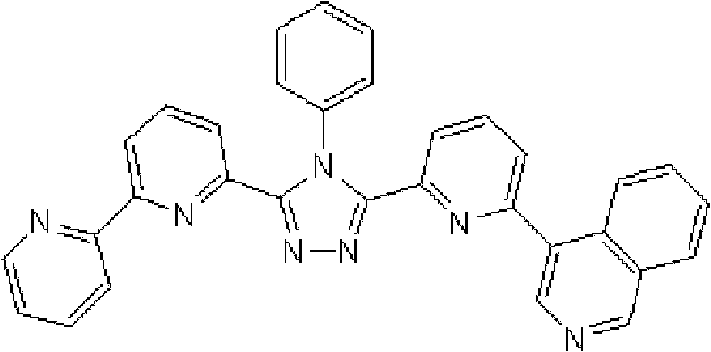
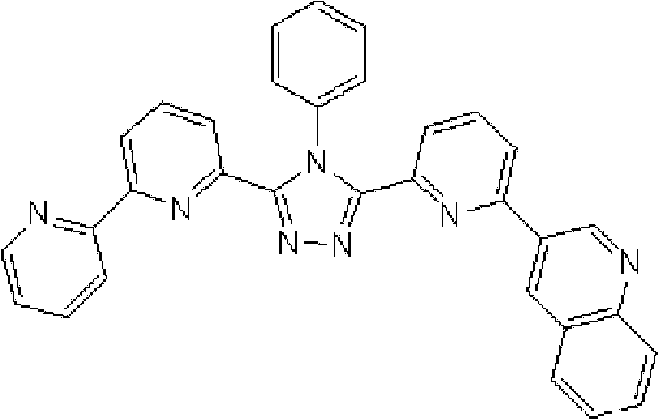
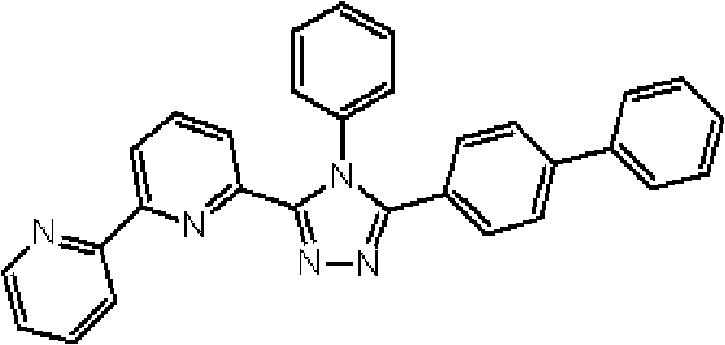
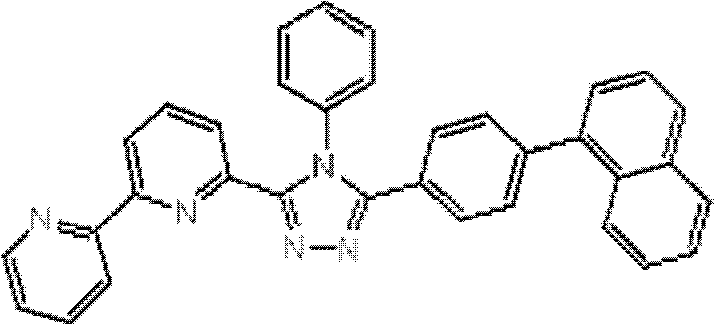






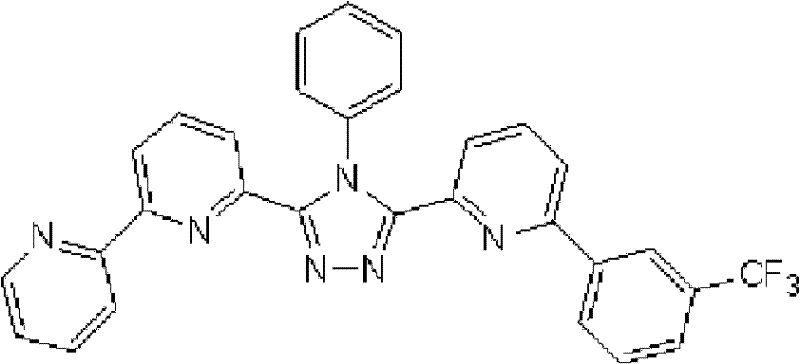
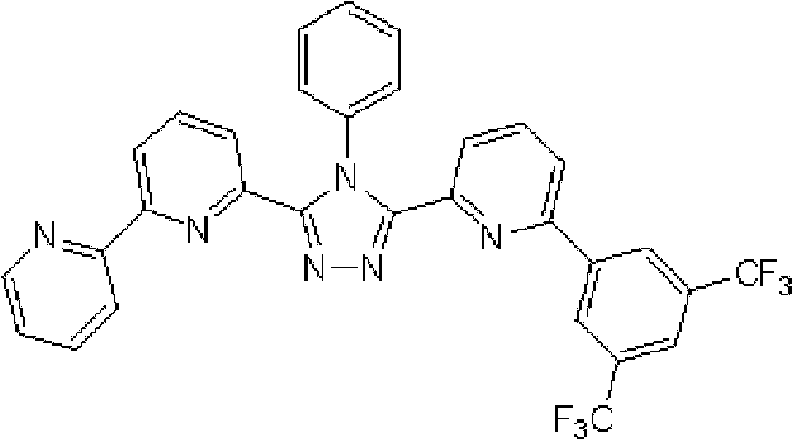
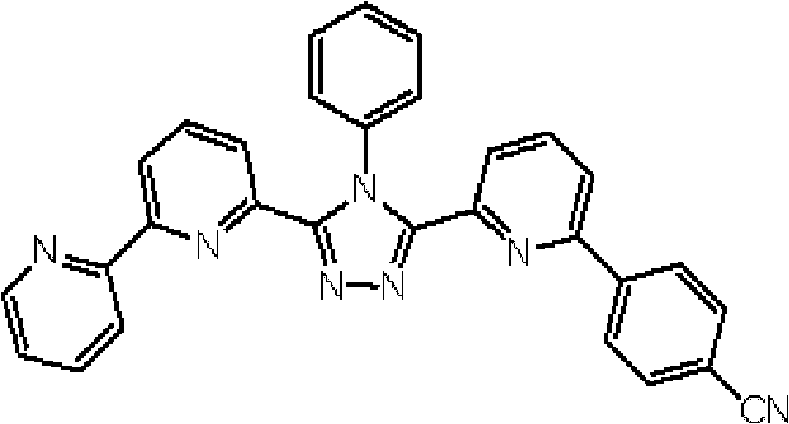

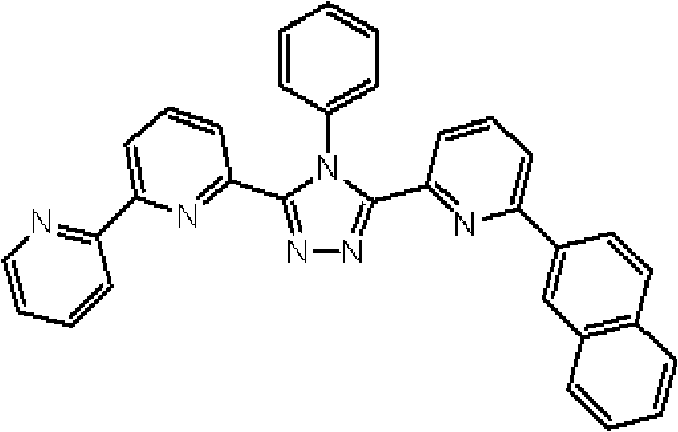



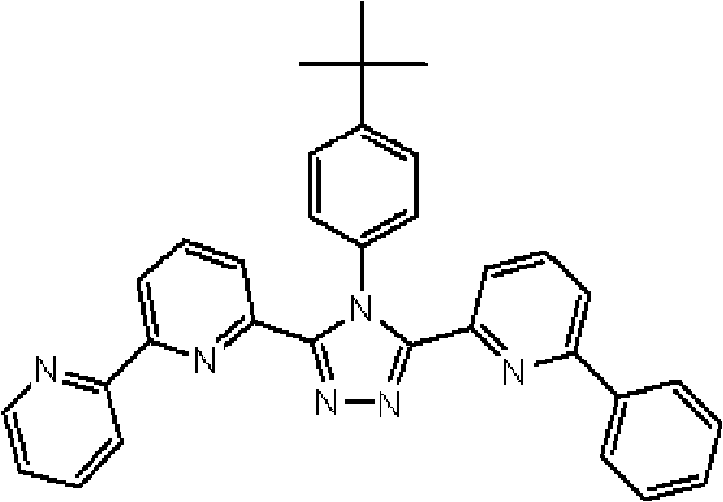
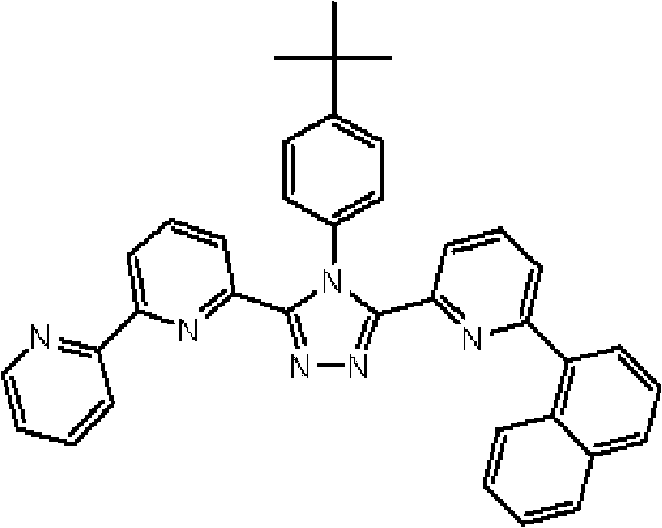

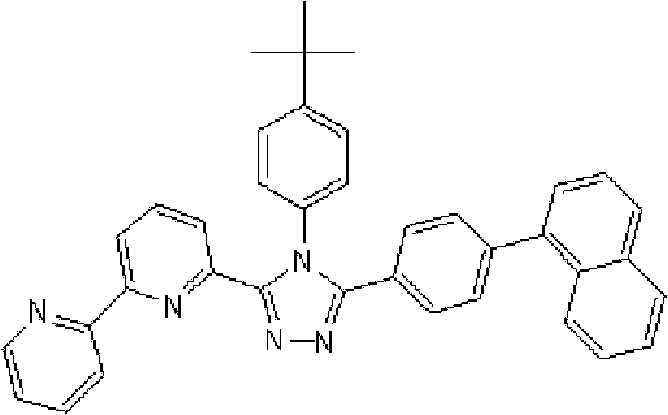

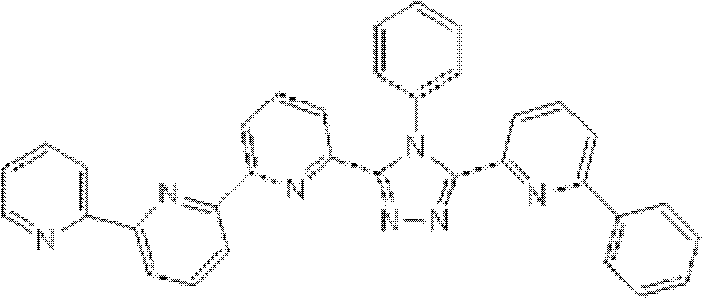
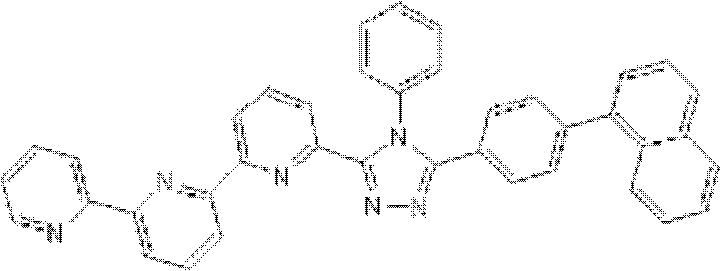
Applications Claiming Priority (2)
| Application Number | Priority Date | Filing Date | Title |
|---|---|---|---|
| JP2005250734 | 2005-08-31 | ||
| JP2005-250734 | 2005-08-31 |
Related Parent Applications (1)
| Application Number | Title | Priority Date | Filing Date |
|---|---|---|---|
| CN2006800319063A Division CN101253170B (en) | 2005-08-31 | 2006-08-31 | Compound having triazole ring structure substituted with pyridyl group and organic electroluminescent device |
Publications (1)
| Publication Number | Publication Date |
|---|---|
| CN102675291A true CN102675291A (en) | 2012-09-19 |
Family
ID=37808930
Family Applications (3)
| Application Number | Title | Priority Date | Filing Date |
|---|---|---|---|
| CN2006800319063A Expired - Fee Related CN101253170B (en) | 2005-08-31 | 2006-08-31 | Compound having triazole ring structure substituted with pyridyl group and organic electroluminescent device |
| CN2012101024235A Pending CN102675291A (en) | 2005-08-31 | 2006-08-31 | Compound having triazole ring structure substituted with pyridyl group and organic electroluminescent device |
| CN2012103357469A Pending CN102964338A (en) | 2005-08-31 | 2006-08-31 | Compound having triazole ring structure substituted with pyridyl group and organic electroluminescent device |
Family Applications Before (1)
| Application Number | Title | Priority Date | Filing Date |
|---|---|---|---|
| CN2006800319063A Expired - Fee Related CN101253170B (en) | 2005-08-31 | 2006-08-31 | Compound having triazole ring structure substituted with pyridyl group and organic electroluminescent device |
Family Applications After (1)
| Application Number | Title | Priority Date | Filing Date |
|---|---|---|---|
| CN2012103357469A Pending CN102964338A (en) | 2005-08-31 | 2006-08-31 | Compound having triazole ring structure substituted with pyridyl group and organic electroluminescent device |
Country Status (7)
| Country | Link |
|---|---|
| US (3) | US20090102361A1 (en) |
| EP (1) | EP1942107B1 (en) |
| JP (1) | JP5175099B2 (en) |
| KR (1) | KR101359194B1 (en) |
| CN (3) | CN101253170B (en) |
| TW (2) | TW201406733A (en) |
| WO (1) | WO2007026847A1 (en) |
Cited By (1)
| Publication number | Priority date | Publication date | Assignee | Title |
|---|---|---|---|---|
| CN104009177A (en) * | 2013-02-26 | 2014-08-27 | 海洋王照明科技股份有限公司 | Organic electroluminescent device and preparation method |
Families Citing this family (14)
| Publication number | Priority date | Publication date | Assignee | Title |
|---|---|---|---|---|
| TWI371452B (en) * | 2004-03-25 | 2012-09-01 | Hodogaya Chemical Co Ltd | Compound having pyridyl group-substituted oxadiazole ring structure, and organic electroluminescence device |
| WO2007026846A1 (en) | 2005-08-31 | 2007-03-08 | Hodogaya Chemical Co., Ltd. | Arylamine compound and organic electroluminescence device |
| CN104370834B (en) * | 2007-05-17 | 2017-04-19 | 株式会社半导体能源研究所 | Triazole derivative |
| JP5530608B2 (en) | 2007-09-13 | 2014-06-25 | 株式会社半導体エネルギー研究所 | Light emitting element and light emitting device |
| US8367220B2 (en) | 2007-10-30 | 2013-02-05 | Samsung Electronics Co., Ltd. | Anthracene-based compound and organic light emitting device employing the same |
| US8367219B2 (en) | 2007-10-30 | 2013-02-05 | Samsung Electronics Co., Ltd. | Anthracene-based compound and organic light emitting device employing the same |
| KR101563675B1 (en) * | 2007-12-21 | 2015-10-27 | 가부시키가이샤 한도오따이 에네루기 켄큐쇼 | Triazole derivative, light-emitting element, light-emitting device, and electronic device |
| KR20100116690A (en) * | 2008-02-26 | 2010-11-01 | 호도가야 가가쿠 고교 가부시키가이샤 | Substituted bipyridyl compound and organic electroluminescent element |
| JP5515283B2 (en) * | 2008-12-10 | 2014-06-11 | コニカミノルタ株式会社 | Organic electroluminescence element, display device and lighting device |
| KR101233377B1 (en) * | 2008-12-30 | 2013-02-18 | 제일모직주식회사 | Novel compound for organic photoelectricand organic photoelectric device including the same |
| EP2275409A1 (en) | 2009-06-25 | 2011-01-19 | Yamagata Promotional Organization for Industrial Technology | Bipiridine derivative and organic electroluminescence element containing the same |
| TWI492944B (en) | 2010-05-21 | 2015-07-21 | Semiconductor Energy Lab | Triazole derivative, and light-emitting element, light-emitting device, electronic device and lighting device using the triazole derivative |
| CN103694226B (en) | 2013-12-20 | 2015-11-25 | 深圳市华星光电技术有限公司 | Based on the Micromolecule electron transmission material of pyridine and triazole and preparation method and Organic Light Emitting Diode |
| KR102420082B1 (en) | 2015-04-13 | 2022-07-13 | 삼성디스플레이 주식회사 | Condensed-cyclic compound and organic light-emitting device comprising the same |
Family Cites Families (15)
| Publication number | Priority date | Publication date | Assignee | Title |
|---|---|---|---|---|
| DE69420656T2 (en) * | 1993-03-26 | 2000-05-31 | Sumitomo Electric Industries | ORGANIC ELECTROLUMININCENT ELEMENTS |
| JP2734341B2 (en) * | 1993-03-26 | 1998-03-30 | 住友電気工業株式会社 | Organic electroluminescence device |
| DE4334039A1 (en) * | 1993-10-06 | 1995-04-13 | Coroplast Fritz Mueller Kg | Adhesive tape and use of the adhesive tape to wrap a cable set |
| JP3102033B2 (en) * | 1994-03-16 | 2000-10-23 | 住友電気工業株式会社 | Triazole derivative and organic electroluminescent device using the same |
| EP1027398B1 (en) * | 1997-10-23 | 2004-06-09 | Isis Innovation Limited | Light-emitting dendrimers and devices |
| JP2000100570A (en) * | 1998-09-25 | 2000-04-07 | Toray Ind Inc | Luminescent device |
| JP3125777B2 (en) * | 1999-01-28 | 2001-01-22 | 日本電気株式会社 | Organic electroluminescence device and panel |
| US6645645B1 (en) * | 2000-05-30 | 2003-11-11 | The Trustees Of Princeton University | Phosphorescent organic light emitting devices |
| CN101355141B (en) * | 2001-06-15 | 2012-02-29 | 佳能株式会社 | organic electroluminescent element |
| JP2003007467A (en) * | 2001-06-19 | 2003-01-10 | Honda Motor Co Ltd | Organic electroluminescence device |
| JP4646494B2 (en) * | 2002-04-11 | 2011-03-09 | 出光興産株式会社 | Novel nitrogen-containing heterocyclic derivative and organic electroluminescence device using the same |
| US7271406B2 (en) * | 2003-04-15 | 2007-09-18 | 3M Innovative Properties Company | Electron transport agents for organic electronic devices |
| EP1486551B1 (en) * | 2003-06-13 | 2016-03-16 | Semiconductor Energy Laboratory Co., Ltd. | Light emitting element and light emitting device |
| EP2592905B1 (en) * | 2003-07-31 | 2014-11-12 | Mitsubishi Chemical Corporation | Compound, charge transporting material and organic electroluminescent element |
| TWI371452B (en) * | 2004-03-25 | 2012-09-01 | Hodogaya Chemical Co Ltd | Compound having pyridyl group-substituted oxadiazole ring structure, and organic electroluminescence device |
-
2006
- 2006-08-31 US US12/065,429 patent/US20090102361A1/en not_active Abandoned
- 2006-08-31 JP JP2007533343A patent/JP5175099B2/en not_active Expired - Fee Related
- 2006-08-31 WO PCT/JP2006/317273 patent/WO2007026847A1/en not_active Ceased
- 2006-08-31 KR KR1020087005179A patent/KR101359194B1/en not_active Expired - Fee Related
- 2006-08-31 TW TW102139510A patent/TW201406733A/en unknown
- 2006-08-31 EP EP06797233.1A patent/EP1942107B1/en not_active Not-in-force
- 2006-08-31 CN CN2006800319063A patent/CN101253170B/en not_active Expired - Fee Related
- 2006-08-31 TW TW095132201A patent/TWI428327B/en not_active IP Right Cessation
- 2006-08-31 CN CN2012101024235A patent/CN102675291A/en active Pending
- 2006-08-31 CN CN2012103357469A patent/CN102964338A/en active Pending
-
2013
- 2013-03-29 US US13/853,401 patent/US20130285025A1/en not_active Abandoned
- 2013-09-26 US US14/038,002 patent/US20140048787A1/en not_active Abandoned
Cited By (1)
| Publication number | Priority date | Publication date | Assignee | Title |
|---|---|---|---|---|
| CN104009177A (en) * | 2013-02-26 | 2014-08-27 | 海洋王照明科技股份有限公司 | Organic electroluminescent device and preparation method |
Also Published As
| Publication number | Publication date |
|---|---|
| US20130285025A1 (en) | 2013-10-31 |
| EP1942107B1 (en) | 2014-03-05 |
| EP1942107A1 (en) | 2008-07-09 |
| JPWO2007026847A1 (en) | 2009-03-12 |
| EP1942107A4 (en) | 2011-02-16 |
| WO2007026847A1 (en) | 2007-03-08 |
| US20140048787A1 (en) | 2014-02-20 |
| US20090102361A1 (en) | 2009-04-23 |
| KR101359194B1 (en) | 2014-02-05 |
| JP5175099B2 (en) | 2013-04-03 |
| TW200720258A (en) | 2007-06-01 |
| TWI428327B (en) | 2014-03-01 |
| CN101253170B (en) | 2012-10-24 |
| TW201406733A (en) | 2014-02-16 |
| KR20080039963A (en) | 2008-05-07 |
| CN102964338A (en) | 2013-03-13 |
| CN101253170A (en) | 2008-08-27 |
Similar Documents
| Publication | Publication Date | Title |
|---|---|---|
| CN104617229B (en) | Organic electroluminescence device | |
| CN102164923B (en) | Compound with substituted anthracycline structure and pyridoindole ring structure and organic electroluminescent device | |
| CN102482216B (en) | Organic electroluminescent element and compound having carbazole ring structure | |
| TWI429730B (en) | A substituted bipyridyl group and a pyridoindole ring structure, and an organic electroluminescent element | |
| JP6731355B2 (en) | Pyrimidine derivative and organic electroluminescence device | |
| US20140048787A1 (en) | Compound having triazole ring structure substituted with pyridyl group and organic electroluminescent device | |
| CN101506197A (en) | Compound having triazine ring structure substituted with pyridyl group and organic electroluminescent device | |
| CN102781918A (en) | Substituted pyridyl compound and organic electroluminescent element | |
| CN102712639A (en) | Compound having a substituted anthracene ring structure and pyridoindole ring structure, and organic electroluminescent element | |
| CN101506207A (en) | Compound having pyridoindole ring structure having substituted pyridyl group attached thereto, and organic electroluminescent device | |
| CN106432186A (en) | Compound having benzotriazole ring structure and organic electroluminescent element | |
| CN101932581B (en) | Compound having substituted pyridyl group and pyridoindole ring structure linked through phenylene group, and organic electroluminescent device | |
| CN102292327A (en) | Compound having triazole ring structure with pyridyl group attached thereto, and organic electroluminescent element | |
| JP7369714B2 (en) | Compounds with azabenzoxazole ring structure and organic electroluminescent devices | |
| CN103328475A (en) | Compound having pyridoindole ring structure and substituted bipyridyl group, and organic electroluminescent element | |
| KR20240011130A (en) | Triarylamine high molecular weight compounds and organic electroluminescence devices containing these high molecular weight compounds | |
| CN112079814A (en) | Benzotriazole derivatives and organic electroluminescent devices | |
| JP7751160B2 (en) | Spirobifluorene compounds and organic electroluminescent devices | |
| WO2007119461A1 (en) | Compound having thiadiazole ring structure substituted with pyridyl group and organic electroluminescent device | |
| JP7406500B2 (en) | Compounds with pyrimidine ring structure and organic electroluminescent devices | |
| CN101263137A (en) | Compound having oxadiazole ring structure combined with aromatic heterocycle and organic electroluminescent device | |
| JP4879734B2 (en) | Compounds having an oxadiazole ring structure substituted with a pyridyl group, and organic electroluminescence devices | |
| WO2025205616A1 (en) | Organic electroluminescent element | |
| WO2019039402A1 (en) | Compound having indenobenzoazole-ring structure, and organic electroluminescence element | |
| JPWO2005092857A1 (en) | Carbazole derivatives containing fluorene groups and organic electroluminescent devices |
Legal Events
| Date | Code | Title | Description |
|---|---|---|---|
| C06 | Publication | ||
| PB01 | Publication | ||
| C10 | Entry into substantive examination | ||
| SE01 | Entry into force of request for substantive examination | ||
| C02 | Deemed withdrawal of patent application after publication (patent law 2001) | ||
| WD01 | Invention patent application deemed withdrawn after publication |
Application publication date: 20120919 |