CN102648276A - Polypeptides with xylanase activity and polynucleotides encoding the polypeptides - Google Patents
Polypeptides with xylanase activity and polynucleotides encoding the polypeptides Download PDFInfo
- Publication number
- CN102648276A CN102648276A CN2010800539905A CN201080053990A CN102648276A CN 102648276 A CN102648276 A CN 102648276A CN 2010800539905 A CN2010800539905 A CN 2010800539905A CN 201080053990 A CN201080053990 A CN 201080053990A CN 102648276 A CN102648276 A CN 102648276A
- Authority
- CN
- China
- Prior art keywords
- polypeptide
- sequence
- cell
- polynucleotide
- seq
- Prior art date
- Legal status (The legal status is an assumption and is not a legal conclusion. Google has not performed a legal analysis and makes no representation as to the accuracy of the status listed.)
- Pending
Links
Images


Classifications
-
- C—CHEMISTRY; METALLURGY
- C12—BIOCHEMISTRY; BEER; SPIRITS; WINE; VINEGAR; MICROBIOLOGY; ENZYMOLOGY; MUTATION OR GENETIC ENGINEERING
- C12N—MICROORGANISMS OR ENZYMES; COMPOSITIONS THEREOF; PROPAGATING, PRESERVING, OR MAINTAINING MICROORGANISMS; MUTATION OR GENETIC ENGINEERING; CULTURE MEDIA
- C12N9/00—Enzymes; Proenzymes; Compositions thereof; Processes for preparing, activating, inhibiting, separating or purifying enzymes
- C12N9/14—Hydrolases (3)
- C12N9/24—Hydrolases (3) acting on glycosyl compounds (3.2)
- C12N9/2402—Hydrolases (3) acting on glycosyl compounds (3.2) hydrolysing O- and S- glycosyl compounds (3.2.1)
- C12N9/2477—Hemicellulases not provided in a preceding group
- C12N9/248—Xylanases
- C12N9/2482—Endo-1,4-beta-xylanase (3.2.1.8)
-
- C—CHEMISTRY; METALLURGY
- C12—BIOCHEMISTRY; BEER; SPIRITS; WINE; VINEGAR; MICROBIOLOGY; ENZYMOLOGY; MUTATION OR GENETIC ENGINEERING
- C12N—MICROORGANISMS OR ENZYMES; COMPOSITIONS THEREOF; PROPAGATING, PRESERVING, OR MAINTAINING MICROORGANISMS; MUTATION OR GENETIC ENGINEERING; CULTURE MEDIA
- C12N15/00—Mutation or genetic engineering; DNA or RNA concerning genetic engineering, vectors, e.g. plasmids, or their isolation, preparation or purification; Use of hosts therefor
- C12N15/09—Recombinant DNA-technology
- C12N15/63—Introduction of foreign genetic material using vectors; Vectors; Use of hosts therefor; Regulation of expression
- C12N15/79—Vectors or expression systems specially adapted for eukaryotic hosts
- C12N15/82—Vectors or expression systems specially adapted for eukaryotic hosts for plant cells, e.g. plant artificial chromosomes (PACs)
- C12N15/8241—Phenotypically and genetically modified plants via recombinant DNA technology
- C12N15/8242—Phenotypically and genetically modified plants via recombinant DNA technology with non-agronomic quality (output) traits, e.g. for industrial processing; Value added, non-agronomic traits
- C12N15/8243—Phenotypically and genetically modified plants via recombinant DNA technology with non-agronomic quality (output) traits, e.g. for industrial processing; Value added, non-agronomic traits involving biosynthetic or metabolic pathways, i.e. metabolic engineering, e.g. nicotine, caffeine
- C12N15/8245—Phenotypically and genetically modified plants via recombinant DNA technology with non-agronomic quality (output) traits, e.g. for industrial processing; Value added, non-agronomic traits involving biosynthetic or metabolic pathways, i.e. metabolic engineering, e.g. nicotine, caffeine involving modified carbohydrate or sugar alcohol metabolism, e.g. starch biosynthesis
- C12N15/8246—Non-starch polysaccharides, e.g. cellulose, fructans, levans
-
- C—CHEMISTRY; METALLURGY
- C12—BIOCHEMISTRY; BEER; SPIRITS; WINE; VINEGAR; MICROBIOLOGY; ENZYMOLOGY; MUTATION OR GENETIC ENGINEERING
- C12P—FERMENTATION OR ENZYME-USING PROCESSES TO SYNTHESISE A DESIRED CHEMICAL COMPOUND OR COMPOSITION OR TO SEPARATE OPTICAL ISOMERS FROM A RACEMIC MIXTURE
- C12P13/00—Preparation of nitrogen-containing organic compounds
-
- C—CHEMISTRY; METALLURGY
- C12—BIOCHEMISTRY; BEER; SPIRITS; WINE; VINEGAR; MICROBIOLOGY; ENZYMOLOGY; MUTATION OR GENETIC ENGINEERING
- C12P—FERMENTATION OR ENZYME-USING PROCESSES TO SYNTHESISE A DESIRED CHEMICAL COMPOUND OR COMPOSITION OR TO SEPARATE OPTICAL ISOMERS FROM A RACEMIC MIXTURE
- C12P5/00—Preparation of hydrocarbons or halogenated hydrocarbons
-
- C—CHEMISTRY; METALLURGY
- C12—BIOCHEMISTRY; BEER; SPIRITS; WINE; VINEGAR; MICROBIOLOGY; ENZYMOLOGY; MUTATION OR GENETIC ENGINEERING
- C12P—FERMENTATION OR ENZYME-USING PROCESSES TO SYNTHESISE A DESIRED CHEMICAL COMPOUND OR COMPOSITION OR TO SEPARATE OPTICAL ISOMERS FROM A RACEMIC MIXTURE
- C12P7/00—Preparation of oxygen-containing organic compounds
- C12P7/02—Preparation of oxygen-containing organic compounds containing a hydroxy group
-
- C—CHEMISTRY; METALLURGY
- C12—BIOCHEMISTRY; BEER; SPIRITS; WINE; VINEGAR; MICROBIOLOGY; ENZYMOLOGY; MUTATION OR GENETIC ENGINEERING
- C12P—FERMENTATION OR ENZYME-USING PROCESSES TO SYNTHESISE A DESIRED CHEMICAL COMPOUND OR COMPOSITION OR TO SEPARATE OPTICAL ISOMERS FROM A RACEMIC MIXTURE
- C12P7/00—Preparation of oxygen-containing organic compounds
- C12P7/24—Preparation of oxygen-containing organic compounds containing a carbonyl group
- C12P7/26—Ketones
-
- C—CHEMISTRY; METALLURGY
- C12—BIOCHEMISTRY; BEER; SPIRITS; WINE; VINEGAR; MICROBIOLOGY; ENZYMOLOGY; MUTATION OR GENETIC ENGINEERING
- C12P—FERMENTATION OR ENZYME-USING PROCESSES TO SYNTHESISE A DESIRED CHEMICAL COMPOUND OR COMPOSITION OR TO SEPARATE OPTICAL ISOMERS FROM A RACEMIC MIXTURE
- C12P7/00—Preparation of oxygen-containing organic compounds
- C12P7/40—Preparation of oxygen-containing organic compounds containing a carboxyl group including Peroxycarboxylic acids
-
- C—CHEMISTRY; METALLURGY
- C12—BIOCHEMISTRY; BEER; SPIRITS; WINE; VINEGAR; MICROBIOLOGY; ENZYMOLOGY; MUTATION OR GENETIC ENGINEERING
- C12Y—ENZYMES
- C12Y302/00—Hydrolases acting on glycosyl compounds, i.e. glycosylases (3.2)
- C12Y302/01—Glycosidases, i.e. enzymes hydrolysing O- and S-glycosyl compounds (3.2.1)
- C12Y302/01008—Endo-1,4-beta-xylanase (3.2.1.8)
Landscapes
- Life Sciences & Earth Sciences (AREA)
- Health & Medical Sciences (AREA)
- Chemical & Material Sciences (AREA)
- Organic Chemistry (AREA)
- Genetics & Genomics (AREA)
- Engineering & Computer Science (AREA)
- Zoology (AREA)
- Wood Science & Technology (AREA)
- Bioinformatics & Cheminformatics (AREA)
- General Engineering & Computer Science (AREA)
- Biotechnology (AREA)
- Biochemistry (AREA)
- General Health & Medical Sciences (AREA)
- Molecular Biology (AREA)
- Microbiology (AREA)
- Biomedical Technology (AREA)
- Nutrition Science (AREA)
- Chemical Kinetics & Catalysis (AREA)
- General Chemical & Material Sciences (AREA)
- Cell Biology (AREA)
- Plant Pathology (AREA)
- Physics & Mathematics (AREA)
- Biophysics (AREA)
- Medicinal Chemistry (AREA)
- Enzymes And Modification Thereof (AREA)
- Micro-Organisms Or Cultivation Processes Thereof (AREA)
- Preparation Of Compounds By Using Micro-Organisms (AREA)
Abstract
The present invention relates to isolated polypeptides having xylanase activity and isolated polynucleotides encoding the polypeptides. The invention also relates to nucleic acid constructs, vectors, and host cells comprising the polynucleotides as well as methods for producing and using the polypeptides.
Description
About statement to the right of the invention of completion under the research and development of federal funding
The present invention supports to accomplish with government under the cooperation agreement DE-FC36-08GO18080 that Ministry of Energy authorizes.Government has certain right to the present invention.
Relate to sequence table
The application comprises the sequence table of computer-reader form, and said computer-reader form is incorporated this paper into through carrying stating.
Relate to the preservation of biomaterial
The application comprises for the quoting of biomaterial preservation, and said preservation is incorporated this paper into through carrying stating.
Background of invention
Invention field
The present invention relates to have the isolated polypeptide of xylanase activity and the isolating polynucleotide of coding said polypeptide.The invention still further relates to the nucleic acid construct, carrier and the host cell that comprise said polynucleotide, and the method that is used to produce and use said polypeptide.
Association area is described
Mierocrystalline cellulose is that simple sugar glucose is passed through β-1, the polymkeric substance that the 4-key connects.The enzyme of the VISOSE of many microorganisms hydrolysis β-connection.These enzymes comprise NCE5, cellobiohydrolase and beta-glucosidase enzyme.NCE5 is at random site digest cellulose polymkeric substance, and open it (opening it) attacks (attack) to receive cellobiohydrolase.Cellobiohydrolase discharges the molecule of cellobiose then from the end of cellulose polymer compound.Cellobiose is water miscible β-1, the glucose dimer that 4-connects.Beta-glucosidase enzyme is hydrolyzed into glucose with cellobiose.
Lignocellulose-containing raw material (lignocellulosic feedstock) is converted into ethanol has following advantage: big content of starting materials is ready-made available, avoids burning or the desirability of embedding material and the spatter property of alcohol fuel.Timber, agricultural residue, draft crop and MSW are considered to be used for the raw material of alcohol production.These materials mainly are made up of Mierocrystalline cellulose, semicellulose and xylogen.In case cellulose conversion is become glucose, glucose will easily become ethanol by yeast fermentation.
In the art, exist through replenishing other enzymes and improve Mierocrystalline cellulose decomposition of protein compsn to increase efficient and to provide enzyme solution to one's profit for the cellulosic needs of xylogen degradation.
The invention provides the polynucleotide of the polypeptide with xylanase activity and this polypeptide of encoding.
Summary of the invention
The present invention relates to have the isolated polypeptide of xylanase activity, said polypeptide is selected from down group:
(a) polypeptide, it comprises aminoacid sequence, and the mature polypeptide of said aminoacid sequence and SEQ ID NO:2 has at least 90% identity;
(b) polypeptide; It is by polynucleotide encoding; Said polynucleotide under very high stringent condition with following hybridization: (i) the mature polypeptide encoded sequence of SEQ ID NO:1; (ii) be contained in the cDNA sequence of the mature polypeptide encoded sequence of SEQ ID NO:1, or (iii) (i) or total length complementary strand (ii);
(c) polypeptide, it is by the polynucleotide encoding that comprises nucleotide sequence, and the mature polypeptide encoded sequence of said nucleotide sequence and SEQID NO:1 has at least 90% identity; With
(d) mature polypeptide of SEQ ID NO:2 comprises replacement, lacks and/or insert one or more (several) amino acid whose variant.
The isolating polynucleotide of the polypeptide that the invention still further relates to encodes has xylanase activity, said polynucleotide are selected from down group:
(a) polynucleotide, its coding comprises the polypeptide of aminoacid sequence, and the mature polypeptide of said aminoacid sequence and SEQ IDNO:2 has at least 90% identity;
(b) polynucleotide, its under very high stringent condition with following hybridization: (i) the mature polypeptide encoded sequence of SEQ ID NO:1 (ii) is contained in cDNA sequence or (iii) (i) or the total length complementary strand (ii) of the mature polypeptide encoded sequence of SEQ ID NO:1;
(c) polynucleotide, it comprises nucleotide sequence, and the mature polypeptide encoded sequence of said nucleotide sequence and SEQ ID NO:1 has at least 90% identity; With
(d) polynucleotide, the comprising replacement, lack and/or insert one or more (several) amino acid whose variant of the mature polypeptide of its coding SEQ ID NO:2.
The invention still further relates to nucleic acid construct, recombinant expression vector, recombinant host cell that comprises said polynucleotide and the method that produces polypeptide with xylanase activity.
The invention still further relates to the method that the polypeptide that suppresses to have xylanase activity is expressed in cell, said method comprises: pair cell is used or in cell, is expressed double-stranded RNA (dsRNA) molecule, and wherein said dsRNA comprises the subsequence of polynucleotide of the present invention.The invention still further relates to this double-stranded inhibitory RNA (dsRNA) molecule, wherein randomly dsRNA is siRNA or miRNA molecule.
The invention still further relates to and use polypeptide degraded or transform cellulose materials or contain the method for xylan material with xylanase activity.
The invention still further relates to the plant that comprises isolating polynucleotide, said polynucleotide encoding has the active polypeptide of xylan.
The invention still further relates to the method that produces polypeptide with xylanase activity; It comprises: (a) cultivate transgenic plant or the vegetable cell that comprises polynucleotide under the condition of this polypeptide helping to produce, said polynucleotide encoding has the polypeptide of xylanase activity; (b) reclaim said polypeptide.
The invention further relates to the isolating polynucleotide of coded signal peptide, said signal peptide comprises the amino acid/11 to 19 of SEQID NO:2, or is made up of the amino acid/11 to 19 of SEQ ID NO:2; Relate to the nucleic acid construct, expression vector and the recombinant host cell that comprise said polynucleotide; And relate to the proteic method that produces.
The accompanying drawing summary
Fig. 1 shows the estriction map of pPpin3.
Fig. 2 A and 2B show genomic dna sequence and the deduced amino acid (being respectively SEQ ID NO:1 and 2) of having a liking for loose mould (Penicillium pinophilum) NN046877 GH10 xylanase gene.
Definition
Zytase: term " zytase " is defined as 1 in this article, and 4-β-D-xylan-wood sugar lytic enzyme (1,4-β-D-xylan-xylohydrolase) (E.C.3.2.1.8), in its catalysis xylan 1, the interior hydrolysis of 4-β-D-wood sugar glycosidic bond.With regard to the present invention, xylanase activity is to use birch xylan to confirm as substrate.The xylanase activity of a unit is defined as at 50 ℃; PH 5 from every liter of 2g birch xylan as substrate contain 0.01%
 PM produces 1.0 μ mol reducing sugars and (measures with glucose equivalent (glucose equivalents) in the time of origin process of hydrolysis 20 the 50mM sodium acetate pH 5; Like Lever; 1972; A new reaction for colorimetric determination of carbohydrates, Anal.Biochem 47:273-279 is said).
Xylan degrading is active: term " xylan degrading is active " or " xylan degrading activity " are defined as the BA that hydrolysis contains the xylan material in this article.Two kinds of basic methods of measuring the xylan degrading activity comprise: (1) measures total xylan degrading activity and independent xylan degrading activity (endo-xylanase, xylobiase, arabinofuranosidase, alpha-glucuronidase, acetyl xylan esterase, feruloyl esterase and α-glucuronic acid esterase (α-glucuronyl esterase)) is measured in (2).Recently in the in-progress summary of xylanase clastic enzyme assay method in several open source literatures; Comprise Biely and Puchard; Recentprogress in the assays of xylanolytic enzymes; 2006, Journal of the Science ofFood and Agriculture 86 (11): 1636-1647; Spanikova and Biely, 2006, Glucuronoylesterase-Novel carbohydrate esterase produced by Schizophyllum commune, FEBS Letters 580 (19): 4597-4601; And Herrmann; Vrsanska, Jurickova, Hirsch; Biely and Kubicek; 1997, The beta-D-xylosidase of Trichoderma reesei is amultifunctional beta-D-xylan xylohydrolase, Biochemical Journal 321:375-381.
Total xylan degrading activity can be measured through definite reducing sugar that forms from polytype xylan; Said xylan comprises oat wheat (oat spelt), beech wood (beechwood) and Larch (larchwood) xylan, perhaps can confirm to measure from the painted xylan fragment that the painted xylan of multiple covalency discharges through light-intensity method.Modal total xylan degrading activity assay method produces reducing sugar based on the 4-O-methylglucuronic acid xylan from poly; Like Bailey; Biely, Poutanen, 1992; Interlaboratory testing of methods for assay of xylanase activity, Journal ofBiotechnology 23 (3): described in the 257-270.
With regard to the present invention, the xylan degrading activity is birch xylan (Sigma Chemical Co., Inc., the St.Louis that is caused under following usual conditions by the xylan degrading enzyme through measuring; MO, USA) increase of hydrolysis is confirmed: 1ml reaction solution, 5mg/ml substrate (total solid); 5mg xylan decomposing protein/g substrate, the 50mM sodium acetate, pH 5; 50 ℃, 24 hours, like Lever; 1972, A new reactionfor colorimetric determination of carbohydrates, the said use PHB of Anal.Biochem 47:273-279 hydrazides (PHBAH) assay method is carried out glycan analysis.
Xylobiase: term " xylobiase " is defined as β-D xyloside wood sugar lytic enzyme (β-D-xyloside xylohydrolase) (E.C.3.2.1.37) in this article, and the outer hydrolysis of short β (1 → 4) wood oligose of its catalysis (xylooligosaccharide) is to remove successive D-xylose residues from non-reducing end.With regard to the present invention; The xylobiase activity of a unit is defined as at 40 ℃, pH 5 from 1mM p-nitrophenyl-β-D-xyloside as substrate contain 0.01%
 PM produces 1.0 μ mol p-NPs 20 the 100mM Trisodium Citrate pH 5.
Acetyl xylan esterase: term " acetyl xylan esterase " is defined as Carboxylesterase (EC3.1.1.72) in this article, and its catalysis ethanoyl is from the hydrolysis of polymerization xylan, acetylize wood sugar, acetyl glucose, acetate α-Nai Zhi (alpha-napthyl acetate) and acetic acid p-nitrophenyl acetate (p-nitrophenyl acetate).With regard to the present invention, the acetyl xylan esterase activity is to use and contains 0.01%TWEEN
TM0.5mM acetic acid p-nitrophenyl acetate among 20 the 50mM sodium acetate pH 5.0 is confirmed as substrate.The acetyl xylan esterase activity of a unit is defined as the enzyme amount that can discharge 1 micromole's p-NP negatively charged ion (p-nitrophenolate anion) at 5,25 ℃ of PMs of pH.
Feruloyl esterase: term " feruloyl esterase (feruloyl esterase) " is defined as 4-hydroxyl-3-methoxyl group cinnyl-glycosylhydrolase enzyme (EC 3.1.1.73) in this article; Its catalysis 4-hydroxyl-3-methoxyl group cinnyl (asafoetide acyl) group is from the hydrolysis of the sugar (it is generally pectinose " natural " substrate) of esterification, to produce FLA (4-hydroxyl-3-methoxy cinnamic acid).Feruloyl esterase is also referred to as feruloyl esterase (ferulic acidesterase), FAE-III, laurate lytic enzyme, FAEA, cinnAE, FAE-I or FAE-II.With regard to the present invention, ferulaic acid esterase activity is to use the 0.5mM FLA p-nitrophenyl ester among the 50mM sodium acetate pH 5.0 to confirm as substrate.The ferulaic acid esterase activity of a unit equals and can discharge the anionic enzyme amount of 1 μ mol p-NP at 5,25 ℃ of PMs of pH.
Alpha-glucuronidase: term " alpha-glucuronidase " is defined as α-D-glucuronide glucuronic acid lytic enzyme (alpha-D-glucosiduronate glucuronohydrolase) (EC3.2.1.139) in this article, and its catalysis α-D-glucuronic acid glycoside hydrolysis is D-glucuronic acid and alcohol.With regard to the present invention, alpha-glucuronidase activity is according to de Vries, 1998, and J.Bacteriol.180:243-249 confirms.The alpha-glucuronidase activity of a unit equals to discharge at 5,40 ℃ of PMs of pH the enzyme amount of 1 μ mol glucuronic acid or 4-O-methylglucuronic acid.
α-L-A Labaifunantangganmei: term " α-L-A Labaifunantangganmei " is defined as the Arabic furans lytic enzyme (EC 3.2.1.55) of α-L-arbinofuranose glycosides in this article, and its catalysis is to the hydrolysis of the terminal irreducibility α in α-L-arabinose glycosides-L-arbinofuranose glycosides residue.This enzymic activity to α-L-arbinofuranose glycosides, contain (1,3)-and/or α-L-ARABINANS, araboxylan and the arabogalactan of (1,5)-key work.α-L-A Labaifunantangganmei is also referred to as arabinofuranosidase/xylosidase, α-arabinofuranosidase/xylosidase, α-L-arabinose glycosides enzyme, α-arabinofuranosidase, polysaccharide α-L-A Labaifunantangganmei, α-L-arbinofuranose glycosides lytic enzyme, L-arabinose glycosides enzyme or α-L-arabanase.With regard to the present invention; The α-L-A Labaifunantangganmei activity is to use medium-viscosity wheat araboxylan (the Megazyme International Ireland of 5mg among the 100mM sodium acetate pH 5 of the every ml among the TV 200 μ l; Ltd., Bray, Co.Wicklow; Ireland) carried out 30 minutes at 40 ℃; Then through
 HPX-87H column chromatography (Bio-Rad Laboratories, Inc., Hercules; CA, pectinose analysis USA) is confirmed.
Cellulolytic enzyme or cellulase: term " cellulolytic enzyme " or " cellulase " mean the enzyme of one or more (several kinds) hydrolysis fiber cellulosic material.This fermentoid comprises NCE5, cellobiohydrolase, beta-glucosidase enzyme, or its combination.Two kinds of basic skills measuring cellulolytic activity comprise: the plain degrading activity of total fiber is measured in (1); (2) measure independent cellulolytic activity (NCE5, cellobiohydrolase and beta-glucosidase enzyme); Like Zhang etc.; Outlook for cellulase improvement:Screening and selection strategies, 2006, Biotechnology Advances 24:452-481 is summarized.The plain degrading activity of total fiber typically uses that insoluble substrate measures, and said substrate comprises Whatman No.1 filter paper, Microcrystalline Cellulose, bacteria cellulose, algae Mierocrystalline cellulose, cotton, through pretreated ligno-cellulose etc.The plain degrading activity assay method of modal total fiber is to use the filter paper assay method of Whatman No.1 filter paper as substrate.This assay method is to be established by International Union of Pure and AppliedChemistry (IUPAC) (Ghose, 1987, Measurement of cellulase activities, Pure Appl.Chem.59:257-68).
With regard to the present invention; The cellulolytic enzyme activity is confirmed through the increase of measuring the cellulose materials hydrolysis under following condition, undertaken by cellulolytic enzyme: Mierocrystalline cellulose carries out 3-7 day at 50 ℃ among the PCS of cellulolytic enzyme albumen/g of 1-20mg, and does not add the proteic contrast hydrolysis of cellulolytic enzyme and compares.Usual conditions are: the 1ml reaction solution, and through washing or unwashed PCS, 5% insoluble solid, 50mM sodium acetate pH 5,1mM MnSO
4, 50 ℃, 72 hours, through
 The HPX-87H post (Bio-Rad Laboratories, Inc., Hercules, CA USA) carries out glycan analysis.
NCE5: term " NCE5 " is defined as inscribe-1 in this article, and 4-(1,3; 1; 4)-callose 4-glucan hydrolase (endo-1; 4-β-D-glucan 4-glucanohydrolase) (E.C.3.2.1.4), 1 in its catalyse cellulose, derivatived cellulose (for example CMC 99.5 and Natvosol), the moss starch (lichenin), 4-β-D-glycosidic link, blended β-1; 3 VISOSEs are the interior hydrolysis (endohydrolysis) of β-1,4 key in cereal callose or xyloglucan and other vegetable material that contains cellulosic component for example.Endoglucanase activity can increase to confirm based on the minimizing of substrate viscosity or by the definite reducing end of reducing sugar test method (Zhang etc., 2006, Biotechnology Advances 24:452-481).With regard to the present invention, according to Ghose, 1987, the method for Pure andAppl.Chem.59:257-268 uses CMC 99.5 (CMC) hydrolysis to confirm endoglucanase activity.
Cellobiohydrolase: term " cellobiohydrolase " is defined as 1 in this article, and 4-callose cellobiohydrolase (1,4-beta-D-glucan cellobiohydrolase) (E.C.No.3.2.1.91); Its catalyse cellulose, Mierocrystalline cellulose oligosaccharides; Or any β-1 that comprises, 1 in the polymkeric substance of the glucose that 4-connects, the hydrolysis of 4-β-D-glycosidic link; Reduction or the non-reduced terminal cellobiose (Teeri that discharges from chain; 1997, Crystallinecellulose degradation:New insight into the function of cellobiohydrolases, Trends inBiotechnology 15:160-167; Teeri etc., 1998, Trichoderma reesei cellobiohydrolases:why so efficient on crystalline cellulose?, Biochem.Soc.Trans.26:173-178).With regard to the present invention; According to van Tilbeurgh etc.; 1982; FEBS Letters 149:152-156 and van Tilbeurgh and Claeyssens, 1985, the method that FEBS Letters 187:283-288 describes is measured cellobiohydrolase activity to fluorescence two sugar derivatives 4-methyl umbrella shape base-β-D-lactoside.
Beta-glucosidase enzyme: term " beta-glucosidase enzyme " is defined as in this article that β-D-glucoside glucose lytic enzyme (beta-D-glucoside glucohydrolase) (E.C.No.3.2.1.21); The hydrolysis of the terminal non-reduced β of its catalysis-D-glucosyl residue, and discharge β-D-glucose.With regard to the present invention; According to Venturi etc.; 2002, Extracellular beta-D-glucosidase from Chaetomium thermophilum var.coprophilum:production, purification and some biochemical properties; The basic skills that J.Basic Microbiol.42:55-66 describes just adopts different condition as described herein to confirm beta-glucosidase activity.The beta-glucosidase activity of a unit is defined as at 40 ℃; PH 5, contain 0.01%
 produce 1.0 micromole's p-NPs from 1mM p-nitrophenyl-β-D-glucose pyranoside PM among 20 the 100mM Trisodium Citrate pH 5 as substrate.
Polypeptide with cellulolytic enhancing activity: term " polypeptide with cellulolytic enhancing activity " means and makes enzyme with cellulolytic activity hydrolysis enhanced GH61 polypeptide to cellulose materials.With regard to the present invention; Confirm cellulolytic enhancing activity through measuring by the total amount increase of the reducing sugar increase that the hydrolysis fiber cellulosic material is caused under following condition of Mierocrystalline cellulose decomposition of protein or cellobiose and glucose: Mierocrystalline cellulose among 1-50mg total protein/g PCS; Wherein total protein comprises the Mierocrystalline cellulose decomposition of protein of 50-99.5%w/w; And the protein of 0.5-50%w/w with cellulolytic enhancing activity; Last 1-7 days at 50-65 ℃, compare with the contrast hydrolysis that the cellulose-less decomposition enhanced activity (Mierocrystalline cellulose among 1-50mg Mierocrystalline cellulose decomposition of protein/gPCS) with the total protein heap(ed) capacity of equivalent is carried out.One preferred aspect; The mixture of use
1.5L (Novozymes A/S,
 Denmark) in the presence of the cellulase protein heap(ed) capacity of 3% Aspergillus fumigatus beta-glucosidase enzyme of 3% aspergillus oryzae beta-glucosidase enzyme (generation of in aspergillus oryzae, recombinating according to WO 02/095014) of total protein weight or total protein quality (of WO 2002/095014 in aspergillus oryzae reorganization produce) is as the source of cellulolytic activity.
Polypeptide with cellulolytic enhancing activity strengthens the hydrolysis by the catalytic cellulose materials of protein with cellulolytic activity through the amount that reduction reaches the required cellulolytic enzyme of same hydrolysis level, at least 1.01 times of preferred reductions, more preferably at least 1.05 times; More preferably at least 1.10 times, more preferably at least 1.25 times, more preferably at least 1.5 times; More preferably at least 2 times; More preferably at least 3 times, more preferably at least 4 times, more preferably at least 5 times; Even more preferably at least 10 times, and most preferably at least 20 times.
Family's 61 glycoside hydrolases: term " family's 61 glycoside hydrolases " or " GH61 of family " are defined as the B. according to Henrissat in this article; 1991; A classification of glycosyl hydrolases based onamino-acid sequence similarities, Biochem.J.280:309-316, and Henrissat B.; With Bairoch A.; 1996, Updating the sequence-based classification of glycosylhydrolases, Biochem.J.316:695-696 belongs to the polypeptide of glycoside hydrolysis enzyme family 61.
Cellulose materials: cellulose materials can be to comprise cellulosic any material.Main polysaccharide in the primary cell wall of biomass (primary cell wall) is a Mierocrystalline cellulose, and secondly the abundantest is semicellulose, and the 3rd be pectin.Secondary cell wall (secondary cell wall) produces after cell stops growing, and it contains polysaccharide equally and strengthens through the polymerization xylogen that is covalently cross-linking to semicellulose.Mierocrystalline cellulose is the homopolymer of anhydro cellobiose; Therefore and be straight chain β-(1-4)-D-VISOSE; And semicellulose comprises multiple compound, and for example xylan, xyloglucan (xyloglucan), araboxylan and mannosans have serial substituent complex branches structure.Although multiform normally, the Mierocrystalline cellulose that is present in the plant tissue mainly is the insoluble crystal substrate of parallel dextran chain.Semicellulose links to each other with hydrogen bond with Mierocrystalline cellulose and other semicellulose usually, and it helps stabilized cell wall matrix.
Mierocrystalline cellulose is shown in for example stem, leaf, shell, skin and the cob of plant usually, or leaf, branch and the timber of tree.Cellulose materials can be, but is not limited to, draft material, agricultural residue, forestry resistates, MSW, waste paper and paper pulp and paper mill resistates (referring to; For example, Wiselogel etc., 1995; In Handbook on Bioethanol (Charles E.Wyman volume); Pp.105-118, Taylor & Francis, Washington D.C.; Wyman, 1994, Bioresource Technology 50:3-16; Lynd, 1990, Applied Biochemistry and Biotechnology 24/25:695-719; Mosier etc.,, 1999, Recent Progress in Bioconversion of Lignocellulosics; In Advances inBiochemical Engineering/Biotechnology, the T.Scheper chief editor, Volume 65; Pp.23-40, Springer-Verlag, NewYork).It should be understood that in this article Mierocrystalline cellulose can be any type of ligno-cellulose, comprises the Plant cell wall material of xylogen, Mierocrystalline cellulose and semicellulose in mixed-matrix.One preferred aspect, cellulose materials is a ligno-cellulose.
In one aspect, cellulose materials is the draft material.In yet another aspect, cellulose materials is an agricultural residue.In yet another aspect, cellulose materials is the forestry resistates.In yet another aspect, cellulose materials is a MSW.In yet another aspect, cellulose materials is a waste paper.In yet another aspect, cellulose materials is paper pulp and paper mill resistates.
In yet another aspect, cellulose materials is a corn straw.In yet another aspect, cellulose materials is a zein fiber.In yet another aspect, cellulose materials is a corn cob.In yet another aspect, cellulose materials is an orange peel.In yet another aspect, cellulose materials is the rice bar.In yet another aspect, cellulose materials is a straw.In yet another aspect, cellulose materials is switchgrass (switch grass).In yet another aspect, cellulose materials is that Chinese silvergrass belongs to.In yet another aspect, cellulose materials is a bagasse.
In yet another aspect, cellulose materials is a Microcrystalline Cellulose.In yet another aspect, cellulose materials is a bacteria cellulose.In yet another aspect, cellulose materials is the algae Mierocrystalline cellulose.In yet another aspect, cellulose materials is cotton thread head (cotton linter).In yet another aspect, cellulose materials is unbodied phosphoric acid cellulose processed.In yet another aspect, cellulose materials is a filter paper.
Cellulose materials can directly use or carry out pre-treatment, uses ordinary method known in the art, and is as described herein.One preferred aspect, the pretreatment of fiber cellulosic material.
Pretreated corn straw: term " PCS " or " pretreated corn straw " is defined as through the cellulose materials that is derived from corn straw with heat and dilute sulphuric acid processing in this article.
Contain the xylan material: term " contains the xylan material " and is defined as in this article and contains the material that β-(1-4) connects the plant cell wall polysaccharides of xylose residues skeleton any comprising.The xylan of terrestrial plant is the heteropolymer with β-(1-4)-D-xylopyranose skeleton (its by short sugar chain branch).Its chain comprises D-glucuronic acid or its 4-O-methyl ether, L-arabinose and/or multiple oligosaccharides, and said oligosaccharides comprises D-wood sugar, L-arabinose, D-or L-semi-lactosi and D-glucose.The polysaccharide of xylan type can be divided into same xylan (homoxylan) and Heteroxylan (heteroxylan); It comprises glucuronoxylan; (Arab) glucuronoxylan; (glucuronic acid) araboxylan, araboxylan and compound Heteroxylan (complexheteroxylan).Referring to for example Ebringerova etc., 2005, Adv.Polym.Sci.186:1-67.
In the method for the invention, can use any xylan material that contains.One preferred aspect, the said xylan material that contains is a ligno-cellulose.
Isolated polypeptide: term " isolated polypeptide " is used for this paper middle finger from the isolated polypeptide of originating.One preferred aspect, polypeptide is as measuring through SDS-PAGE, at least 1% pure, preferably at least 5% is pure; More preferably at least 10% is pure, and more preferably at least 20% is pure, and more preferably at least 40% is pure; More preferably at least 60% is pure, even more preferably at least 80% pure, and most preferably at least 90% pure.
Basically pure polypeptide: term " pure basically polypeptide " is represented the polypeptide prepared product at this paper, and said polypeptide prepared product contains by weight at the most 10%, preferably at the most 8%; More preferably at the most 6%, more preferably at the most 5%, more preferably at the most 4%; More preferably at the most 3%; Even more preferably at the most 2%, most preferably at the most 1%, and even other polypeptide material of 0.5% or reorganization bonded (associated) natural at the most most preferably with it.Therefore, preferred said pure basically polypeptide is pure by the weight that is present in the whole polypeptide materials in the prepared product at least 92%, and preferably at least 94% is pure; More preferably at least 95% is pure, and more preferably at least 96% is pure, and more preferably at least 97% is pure; More preferably at least 98% is pure; Even more preferably at least 99% pure, most preferably at least 99.5% is pure, and even most preferably 100% pure.The form that polypeptide of the present invention is preferably pure basically, that is, said polypeptide prepared product (essentially) does not basically contain natural with it or other polypeptide material of reorganization bonded.For example, this can be through following realization: prepare polypeptide through known recombination method or by classical purification process.
Mature polypeptide: term " mature polypeptide " is defined as the polypeptide that exists with its final form after translation and any posttranslational modification in this article, the for example terminal processing of N-of said modification, the terminal brachymemma of C-, glycosylation, phosphorylation etc.In one aspect, be the SignalP software (Nielsen etc., 1997, Protein Engineering 10:1-6) of signal peptide according to the amino acid/11 to 19 of predicting SEQ ID NO:2, mature polypeptide is the amino acid 20 to 407 of SEQ ID NO:2.
The mature polypeptide encoded sequence: term " mature polypeptide encoded sequence " is defined as the nucleotide sequence that coding has the mature polypeptide of xylanase activity in this article.In one aspect, according to the SignalP software (Nielsen etc., 1997) of Nucleotide 1 to the 57 coded signal peptide of predicting SEQ ID NO:1, the mature polypeptide encoded sequence is the Nucleotide 58 to 1439 of SEQ ID NO:1.
Identity: parameter " identity " describe between two aminoacid sequences or two nucleotide sequences between dependency.
With regard to the present invention; Identity degree between two aminoacid sequences is used like EMBOSS software package (EMBOSS:The European Molecular Biology Open Software Suite, Rice etc., 2000; Trends in Genetics 16:276-277); Preferred 3.0.0 version or more performed Needleman-Wunsch algorithm in the Needle program of highest version (Needleman and Wunsch, 1970, J.Mol.Biol.48:443-453) measure.The optional parameter that uses is breach point penalty (gap penalty) 10, and breach extends point penalty (gap extension penalty) 0.5 and EBLOSUM62 (the EMBOSS version of BLOSUM62) substitution matrix.The output result (acquisition of use-nobrief option) that use Needle is labeled as " the highest identity (longest identity) " is as identity per-cent, and calculating is as follows:
(same residue * 100)/(sum of breach in comparison length-comparison)
With regard to the present invention; Identity degree between two nucleotide sequences is used like EMBOSS software package (EMBOSS:The European Molecular Biology Open Software Suite, Rice etc., 2000; See above); Preferred 3.0.0 version or more performed Needleman-Wunsch algorithm in the Needle program of highest version (Needleman and Wunsch, 1970, see above) measure.The optional parameter that uses is breach point penalty 10, and breach extends point penalty 0.5 and EDNAFULL (the EMBOSS version of NCBI NUC4.4) substitution matrix.The output result (acquisition of use-nobrief option) that use Needle is labeled as " the highest identity " is as identity per-cent, and calculating is as follows:
(same deoxyribonucleotide * 100)/(sum of breach in comparison length-comparison)
Homologous sequence: term " homologous sequence " is defined as the tfasty search (Pearson that is carrying out with the loose mould zytase of having a liking for of SEQ ID NO:2 or its mature polypeptide in this article; W.R.; 1999; In Bioinformatics Methods and Protocols, S.Misener and S.A.Krawetz compile, pp.185-219) the predicted protein matter of middle E value (or expectation mark) less than 0.001.
Polypeptide fragment: term " polypeptide fragment " is defined as from the amino of the mature polypeptide of SEQ ID NO:2 or its homologous sequence and/or the amino acid whose polypeptide of carboxyl-terminal deletion one or more (several) in this article; Wherein said fragment has xylanase activity.One preferred aspect, said fragment contains SEQ ID NO:2, the mature polypeptide of SEQ ID NO:2 or at least 320 amino-acid residues of its homologous sequence, more preferably at least 340 amino-acid residues, and at least 360 amino-acid residues most preferably.
Subsequence: term " subsequence (subsequence) " is defined as from the nucleotide sequence of 5 ' and/or 3 ' end disappearance one or more (several) Nucleotide of SEQ ID NO:1 or its homologous sequence in this article; Wherein said subsequence coding has the polypeptide fragment of xylanase activity.One preferred aspect, said subsequence contains the mature polypeptide encoded sequence of SEQ ID NO:1 or at least 960 Nucleotide of its homologous sequence, more preferably at least 1020 Nucleotide, and at least 1080 Nucleotide most preferably.
Allelic variant (allelic variant): any two kinds or more kinds of optional form of the gene of phase syntenic genes seat represented to occupy in this article in term " allelic variant ".Allelic variation takes place through sudden change natively, and can cause the polymorphum in the population.Transgenation can be reticent (no change in encoded polypeptides) maybe can encode polypeptide of aminoacid sequence with change.The allelic variant of polypeptide is the allelic variant encoded polypeptides by gene.
Isolating polynucleotide: term " isolating polynucleotide " is used for this paper middle finger from the isolating polynucleotide of originating.One preferred aspect, polynucleotide are as measuring through agarose electrophoresis, at least 1% pure, preferably at least 5% is pure; More preferably at least 10% is pure, and more preferably at least 20% is pure, and more preferably at least 40% is pure; More preferably at least 60% is pure, even more preferably at least 80% pure, and most preferably at least 90% pure.
Basically pure polynucleotide: term " pure basically polynucleotide " is used for the polynucleotide prepared product that this paper refers to not contain other Nucleotide external or that do not expect, and said polynucleotide prepared product is in and is suitable for the form in the protein production system of genetic engineering, used.Therefore, pure basically polynucleotide contain by weight at the most 10%, and preferably at the most 8%; More preferably at the most 6%, more preferably at the most 5%, more preferably at the most 4%; More preferably at the most 3%; Even more preferably at the most 2%, most preferably at the most 1%, and even or reorganization bonded other polynucleotide material natural of 0.5% at the most most preferably with it.Yet pure basically polynucleotide can comprise naturally occurring 5 ' and 3 ' non-translational region, for example promotor and terminator.It is at least 90% pure that preferred pure basically polynucleotide are by weight, and preferably at least 92% is pure, and more preferably at least 94% is pure; More preferably at least 95% is pure; More preferably at least 96% is pure, and more preferably at least 97% is pure, even more preferably at least 98% pure; Most preferably at least 99%, and even it is most preferably at least 99.5% pure.Polynucleotide according to the invention are preferably pure basically form, that is, said polynucleotide prepared product is substantially free of natural with it or other polynucleotide material of reorganization bonded.Said polynucleotide can be genome, cDNA, RNA, semi-synthetic, synthetic source, or their any combination.
Encoding sequence: the meaning of term when being used for this paper " encoding sequence " is the nucleotide sequence of directly specifying the aminoacid sequence of its protein product.The border of encoding sequence is usually by opening frame decision, said open frame usually with ATG initiator codon or alternative initiator codon for example GTG begin with TTG, and with for example TAA, TAG and TGA end of terminator codon.Encoding sequence can be the nucleotide sequence of DNA, cDNA, synthetic or reorganization.
CDNA: term " cDNA " is defined as in this article can be through reverse transcription from deriving from the dna molecular of eukaryotic mRNA molecule preparation sophisticated, montage.CDNA lacks the intron sequences that is present in usually among the corresponding gene group DNA.Initial (initial), primary rna transcription thing are the precursors of mRNA, and it occurs as the mRNA of sophisticated montage through a series of step processing then.These steps comprise through the process that is called montage removes intron sequences.Thereby the cDNA that is derived from mRNA has no intron sequences.
Nucleic acid construct: term " nucleic acid construct " is used for this paper and refers to strand or double-stranded nucleic acid molecule; Its separation receives modification to contain the section of nucleic acid with the mode that was not present in (not otherwise exist) occurring in nature originally from naturally occurring gene or its, or it is a synthetic.When said nucleic acid construct contains when expressing the required regulating and controlling sequence of encoding sequence of the present invention term nucleic acid construct and term " expression cassette " synonym.
Regulating and controlling sequence (control sequence): term " regulating and controlling sequence " is defined as at this paper and comprises that it is essential all the components that the polynucleotide of code book invention polypeptide are expressed.Each regulating and controlling sequence can be natural or external source for the nucleotide sequence of coding said polypeptide, or each regulating and controlling sequence is for can being natural or external source each other.These regulating and controlling sequences include but not limited to leader sequence, polyadenylation sequence, propeptide sequence, promotor, signal peptide sequence and transcription terminator.Minimum situation, regulating and controlling sequence comprise promotor and the termination signal of transcribing and translating.Regulating and controlling sequence can provide with the joint that is used to introduce the specificity restriction site together, and said specificity restriction site promotes being connected of nucleotide sequence coded district of regulating and controlling sequence and coded polypeptide.
Be operably connected: term " is operably connected " and representes such configuration at this paper, wherein regulating and controlling sequence is placed the appropriate location with respect to the encoding sequence of polynucleotide sequence, makes regulating and controlling sequence instruct the expression of polypeptid coding sequence.
Express: term " expressions " comprises any step that relates to the polypeptide generation, and it includes but not limited to transcribe, post transcriptional modificaiton, translation, posttranslational modification and secretion.
Expression vector: term " expression vector " is defined as linear or Circular DNA molecular structure at this paper, and it comprises the polynucleotide of code book invention polypeptide, and said polynucleotide are operably connected with the extra Nucleotide that is provided for its expression.
Host cell: comprise any cell type like term used herein " host cell ", conversion, transfection, transduction that said cell type comprises nucleic acid construct or the expression vector of polynucleotide of the present invention for use etc. is (susceptible) of susceptible.
Modify: term " modification " in the meaning of this paper is; Polypeptide to the mature polypeptide that comprises SEQ ID NO:2; Or the polypeptide of forming by the mature polypeptide of SEQ ID NO:2 or any chemically modified of its homologous sequence, and to the genetic manipulation of the DNA of coding said polypeptide.Said modification can be one or more (several) amino acid whose replacement, disappearance and/or insertion, and the displacement of one or more (several) amino acid side chain.
Artificial variant: when being used in this paper, the meaning of term " artificial variant " is the polypeptide with xylanase activity, and said polypeptide is produced by the organism of the modified nucleotide sequences of the mature polypeptide encoded sequence of expressing SEQ ID NO:1 or its homologous sequence.Said modified nucleotide sequences is through human intervention (human intervention), and the nucleotide sequence that is disclosed in SEQ ID NO:1 or its homologous sequence through modification obtains.
Detailed Description Of The Invention
Polypeptide with xylanase activity
Aspect first; The present invention relates to comprise the isolated polypeptide of aminoacid sequence; The mature polypeptide of said aminoacid sequence and SEQ ID NO:2 has preferably at least 90%; More preferably at least 95%, and at least 96%, at least 97%, at least 98% or at least 99% identity degree most preferably, said polypeptide has xylanase activity (hereinafter " homeopeptide ").One preferred aspect; Said homeopeptide comprises aminoacid sequence, and the mature polypeptide of itself and SEQ ID NO:2 differs ten amino acid, preferably differs five amino acid; More preferably differ four amino acid; Even more preferably differ three amino acid, most preferably differ two amino acid, and even most preferably differ an amino acid.
Polypeptide of the present invention preferably comprises aminoacid sequence or its allelic variant of SEQ ID NO:2; Or their fragment with xylanase activity.One preferred aspect, polypeptide comprises the aminoacid sequence of SEQ ID NO:2.Another preferred aspect, polypeptide comprises the mature polypeptide of SEQ ID NO:2.Another preferred aspect, polypeptide comprises the amino acid 20 to 407 of SEQ ID NO:2, or its allelic variant; Or their fragment with xylanase activity.Another preferred aspect, polypeptide comprises the amino acid 20 to 407 of SEQ ID NO:2.Another preferred aspect, polypeptide is by aminoacid sequence or its allelic variant of SEQ ID NO:2; Or their fragment with xylanase activity is formed.Another preferred aspect, polypeptide is made up of the aminoacid sequence of SEQ ID NO:2.Another preferred aspect, polypeptide is made up of the mature polypeptide of SEQ ID NO:2.Another preferred aspect, polypeptide is by amino acid 20 to 407 or its allelic variant of SEQ ID NO:2; Or their fragment with xylanase activity is formed.Another preferred aspect, polypeptide is made up of the amino acid 20 to 407 of SEQ ID NO:2.
Aspect second, the present invention relates to have the isolated polypeptide of xylanase activity, said isolated polypeptide is by polynucleotide encoding, and said polynucleotide are preferably very under the low stringency condition; Under the preferred low stringency condition, more preferably under the stringent condition, more preferably in-the Gao stringent condition under, even under the more preferably high stringent condition; And under the most preferably very high stringent condition, and following hybridization: (i) the mature polypeptide encoded sequence of SEQ ID NO:1 (ii) is contained in the cDNA sequence of the mature polypeptide encoded sequence of SEQ ID NO:1; Or (iii) (i) or total length complementary strand (ii) (J.Sambrook, E.F.Fritsch, and T.Maniatis; 1989, MolecularCloning, A Laboratory Manual; The 2nd edition, Cold Spring Harbor, New York).One preferred aspect, said stringent condition is high stringent condition.Another preferred aspect, said stringent condition is very high stringent condition.
The nucleotide sequence of SEQ ID NO:1 or its subsequence; And the aminoacid sequence of SEQ ID NO:2 or its fragment; Can be used for the designing nucleic acid probe, the DNA of the polypeptide that has xylanase activity with the identification of strains that never belongs to together and plant according to method well known in the art and clones coding.Particularly,, can these probes be used for and the genome of interested genus or kind or cDNA hybridization according to the Southern trace method of standard, with identify with from wherein separating corresponding gene.These probes can be significantly shorter than complete sequence, but should be at least 14 on the length, and preferably at least 25, more preferably at least 35, and at least 70 Nucleotide most preferably.Yet preferred said nucleic probe is at least 100 length of nucleotides.For example, the length of said nucleic probe can be at least 200 Nucleotide, preferred at least 300 Nucleotide, more preferably at least 400 Nucleotide, or at least 500 Nucleotide most preferably.Can use even longer probe, for example length is preferred at least 600 Nucleotide, more preferably at least 700 Nucleotide, even more preferably at least 800 Nucleotide, or the nucleic probe of at least 900 Nucleotide most preferably.The two all can use DNA and rna probe.Usually probe mark (for example, is used to survey corresponding gene
32P,
3H,
35S, vitamin H or avidin (avidin) mark).These probes are covered by among the present invention.
Thereby, can be from by screening DNA the genomic dna of these other bacterial strains preparation or the cDNA library, said DNA and above-mentioned probe hybridization and coding have the polypeptide of xylanase activity.Agarose or polyacrylamide gel electrophoresis be can pass through, or genome or other DNA separated from these other bacterial strains through other stripping technique.Can be transferred to from the DNA in library or separated DNA soluble cotton (nitrocellulose) or other suitable carriers material and fixing on it.In order to identify and SEQ ID NO:1 or its subsequence homologous clone or DNA, said solid support material preferably is used in the Sounthern trace.
With regard to the present invention, hybridization expression nucleotides sequence is listed in the nucleic acid probe hybridization that is low to moderate very much under the very high stringent condition with mark, and said nucleic probe is corresponding to the mature polypeptide encoded sequence of SEQ ID NO:1; Be contained in the cDNA sequence of the mature polypeptide encoded sequence of SEQ ID NO:1; Its total length complementary strand; Or their subsequence.Can use X ray sheet (X-ray film) for example to detect under these conditions the molecule with nucleic acid probe hybridization.
One preferred aspect, nucleic probe is the mature polypeptide encoded sequence of SEQ ID NO:1.Another preferred aspect, nucleic probe is the Nucleotide 58 to 1439 of SEQ ID NO:1.Another preferred aspect, nucleic probe is the polynucleotide sequence of the polypeptide of coding SEQ ID NO:2, or its subsequence.Another preferred aspect, nucleic probe is SEQ ID NO:1.Another preferred aspect, nucleic probe is included in the polynucleotide sequence that contains among the plasmid pGEM-T-Ppin3 among intestinal bacteria (E.coli) DSM 22922, wherein said its polynucleotide sequence coding has the polypeptide of xylanase activity.Another preferred aspect, nucleic probe is included in the mature polypeptide encoded district of containing among the plasmid pGEM-T-Ppin3 among the intestinal bacteria DSM 22922.
Long probe at least 100 Nucleotide of length; Be defined as at 42 ℃ being low to moderate very much very high stringent condition; 5X SSPE, 0.3%SDS, 200 μ g/ml sheared and the salmon sperm DNA of sex change in; And for very low and low severity be 25% methane amide, in the neutralization-the high severity is 35% methane amide or is 50% methane amide for high and very high severity, carries out prehybridization and best 12 to 24 hours of hybridization according to the Southern blotting of standard.
For length is the long probe of at least 100 Nucleotide; Use 2X SSC, 0.2%SDS preferably at least 45 ℃ (very low severity), more preferably at least 50 ℃ (low severity), more preferably at least 55 ℃ (middle severity); More preferably at least 60 ℃ (in-high severity); Even more preferably at least 65 ℃ (high severity), and most preferably 70 ℃ (very high severity) solid support material is finally washed three times each 15 minutes at least.
Short probe for about 15 Nucleotide of length to about 70 Nucleotide; Stringent condition is defined as the T that draws according to Bolton and McCarthy installation (1962, Proceedings of the NationalAcademy of Sciences USA 48:1390) at beguine
mLow about 5 ℃ to about 10 ℃, at 0.9MNaCl, 0.09M Tris-HCl pH 7.6; 6mM EDTA, 0.5%NP-40,1 * Denhardt solution; 1mM trisodium phosphate (sodium pyrophosphate); 1mM SODIUM PHOSPHATE, MONOBASIC (sodium monobasicphosphate) in the yeast rna of 0.1mM ATP and the every ml of 0.2mg, carried out prehybridization, hybridization and post-hybridization washing best 12 to 24 hours according to the Southern trace step of standard.
For about 15 Nucleotide of length to the short probe of about 70 Nucleotide, said solid support material was added among the 0.1%SDS washing one time 15 minutes at 6 * SSC, and with 6 * SSC at T than calculating
mLow 5 ℃ to 10 ℃ temperature washed twice, each 15 minutes.
Aspect the 3rd, the present invention relates to isolated polypeptide with xylanase activity by the polynucleotide encoding that comprises nucleotide sequence or form by nucleotide sequence, the mature polypeptide encoded sequence of said nucleotide sequence and SEQ IDNO:1 has preferably at least 90%; More preferably at least 95%; And most preferably at least 96%, at least 97%, at least 98%; Perhaps at least 99% identity degree, its coding has the polypeptide of xylanase activity.Polynucleotide part referring to this paper.
Aspect the 4th, the present invention relates to the comprising replacement, lack and/or insert one or more (several) amino acid whose artificial variant of mature polypeptide or its homologous sequence of SEQ ID NO:2.Preferably, amino acid change is more unessential (ofa minor nature) to character, promptly conservative aminoacid replacement or insertion, its not remarkably influenced Protein Folding and/or activity; Be generally 1 to about 30 amino acid whose little disappearances; Little amino or C-terminal extend, like the N-terminal methionine residues; The little joint peptide of the about 20-25 of an as many as residue; Or through changing the little extension that net charge or other function promote purifying, like polyhistidine sequence (poly histidine tract), epitope (antigenic epitope) or combination territory (binding domain).
Conservative substituted instance is within following group: basic aminoacids group (l-arginine, Methionin and Histidine), acidic amino acid group (L-glutamic acid and aspartic acid), polare Aminosaeren group (Stimulina and l-asparagine), hydrophobic amino acid group (leucine, Isoleucine and Xie Ansuan), aromatic amino acid group (phenylalanine(Phe), tryptophane and tyrosine) and p1 amino acid group (glycocoll, L-Ala, Serine, Threonine and methionine(Met)).Usually the aminoacid replacement that does not change specific activity (specific activity) is known in the art, and by for example H.Neurath and R.L.Hill, 1979, in The Proteins, Academic Press describes among the New York.The exchange that the most generally takes place is Ala/Ser, Val/Ile, Asp/Glu, Thr/Ser, Ala/Gly, Ala/Thr, Ser/Asn, Ala/Val, Ser/Gly, Tyr/Phe, Ala/Pro, Lys/Arg, Asp/Asn, Leu/Ile, Leu/Val, Ala/Glu and Asp/Gly.
Except 20 primary amino acids, non-primary amino acid (for example 4-Hydroxyproline, 6-N-methyllysine, 2-aminoisobutyric acid, isovaline and Alpha-Methyl Serine) can replace the amino-acid residue of wild type peptide.The non-conserved amino acid of limited quantity, can't help genetic code amino acids coding and alpha-non-natural amino acid can the substituted amino acid residue." alpha-non-natural amino acid " through modifying, and/or has the chemical structure that is different from primary amino acid at their side chain behind protein synthesis.Alpha-non-natural amino acid can chemically synthesize; And preferably commercial can obtain; Comprise pipecolic acid (pipecolic acid), thiazolidine carboxylic acid (thiazolidinecarboxylic acid), dehydroproline, 3-and 4-methylproline; With 3,3-dimethyl-proline(Pro).
Alternative is that amino acid change has such character so that the physicochemical property of polypeptide change.For example, amino acid change can improve the thermostability of polypeptide, changes substrate specificity, changes ph optimum etc.
Can be according to methods known in the art, for example site-directed mutagenesis or L-Ala subregion mutagenesis (Cunningham and Wells, 1989, Science 244:1081-1085) are identified the indispensable amino acid in parent's polypeptide.In one technology of back, single alanine mutation is incorporated into each residue in the molecule, and the biological activity (that is xylanase activity) of test gained mutating molecule is to identify the active crucial amino-acid residue for said molecule.Equally referring to Hilton etc., 1996, J.Biol.Chem.271:4699-4708.The reactive site of enzyme or other biological interaction also can be measured through the physical analysis of structure; As through following these technology:, measure together with the amino acid whose sudden change in contact site of inferring like nucleus magnetic resonance, crystallography, electron diffraction or photoaffinity labeling.Referring to for example de Vos etc., 1992, Science 255:306-312; Smith etc., 1992, J.Mol.Biol.224:899-904; Wlodaver etc., 1992, FEBSLett.309:59-64.The identity of indispensable amino acid (identity) also can be from inferring with the identity analysis of polypeptide, and said polypeptide is relevant with polypeptide according to the present invention.
Can use known mutagenesis, reorganization and/or reorganization (shuffling) method, be relevant screening method then, and for example those are by Reidhaar-Olson and Sauer, 1988, and Science 241:53-57; Bowie and Sauer, 1989, Proc.Natl.Acad.Sci.USA 86:2152-2156; WO 95/17413; Or WO95/22625 those disclosed method is carried out and is tested single or a plurality of aminoacid replacement, disappearance and/or insertion.Other method that can use comprises fallibility PCR, phage display (for example, Lowman etc., 1991, Biochem.30:10832-10837; United States Patent(USP) No. 5,223,409; WO 92/06204) and directed mutagenesis (Derbyshire etc., 1986, the Gene 46:145 in zone; Ner etc., 1988, DNA 7:127).
Mutagenesis/reorganization method can make up with the screening method of high-throughput, robotization to detect the activity (Ness etc., 1999, Nature Biotechnology 17:893-896) by the polypeptide clone, mutagenesis of host cell expression.Can reclaim the dna molecular of the mutagenesis of coding active polypeptide from host cell, and use this area internal standard method to check order fast.These methods allow the importance of single amino acids residue in the interested polypeptide of rapid determination, and can be applied to the polypeptide of unknown structure.
The sum of aminoacid replacement, disappearance and/or the insertion of the mature polypeptide of SEQ ID NO:2 is 10, and is preferred 9, more preferably 8, more preferably 7, more preferably 6, more preferably 5, more preferably 4, even more preferably 3, most preferably 2, and even most preferably 1.
Source with polypeptide of xylanase activity
Polypeptide with xylanase activity of the present invention can obtain the mikrobe from any genus.With regard to the present invention, be used for this paper term relevant and " obtain certainly " with given source, the meaning is that nucleotide sequence coded polypeptide is produced by said source, or by the bacterial strain generation of wherein having inserted from the nucleotide sequence in said source.One preferred aspect, the polypeptide that obtains from given source is an exocytosis.
The polypeptide that the present invention has xylanase activity can be a bacterial peptide.For example, said polypeptide can be that for example bacillus (Bacillus), streptococcus (Streptococcus), streptomyces (Streptomyces), Staphylococcus (Staphylococcus), enterococcus spp (Enterococcus), lactobacillus (Lactobacillus), lactococcus genus (Lactococcus), fusobacterium (Clostridium), ground bacillus belong to (Geobacillus) to the gram positive bacterium polypeptide with xylanase activity or bacillus marinus belongs to (Oceanobacillus) polypeptide; Or have the gram negative bacterium polypeptide of xylanase activity, like intestinal bacteria (E.coli), Rhodopseudomonas (Pseudomonas), salmonella (Salmonella), campylobacter (Campylobacter), Helicobacterium (Helicobacter), Flavobacterium (Flavobacterium), Fusobacterium (Fusobacterium), mud Bacillaceae (Ilyobacter), eisseria (Neisseria) or Ureaplasma (Ureaplasma) polypeptide.
One preferred aspect, said polypeptide is Alkaliphilic bacillus (Bacillusalkalophilus) with xylanase activity, bacillus amyloliquefaciens (Bacillus amyloliquefaciens), bacillus brevis (Bacillus brevis), Bacillus circulans (Bacillus circulans), gram Lloyd's genus bacillus (Bacillusclausii), Bacillus coagulans (Bacillus coagulans), bacillus firmus (Bacillus firmus), bacillus lautus (Bacillus lautus), bacillus lentus (Bacillus lentus), Bacillus licheniformis (Bacillus licheniformis), bacillus megaterium (Bacillus megaterium), bacillus pumilus (Bacillus pumilus), bacstearothermophilus (Bacillus stearothermophilus), subtilis (Bacillus subtilis) or bacillus thuringiensis (Bacillus thuringiensis) polypeptide.
Another preferred aspect, said polypeptide is beastly pest subspecies (the Streptococcus equi subsp.Zooepidemicus) polypeptide of streptococcus equisimilis (Streptococcus equisimilis) with xylanase activity, streptococcus pyogenes (Streptococcus pyogenes), streptococcus uberis (Streptococcus uberis) or streptococcus equi.
Another preferred aspect, said polypeptide be have an xylanase activity do not produce look streptomycete (Streptomyces achromogenes), deinsectization streptomycete (Streptomyces avermitilis), sky blue streptomycete (Streptomyces coelicolor), streptomyces griseus (Streptomyces griseus) or shallow Streptomyces glaucoviolaceus (Streptomyces lividans) polypeptide.
The polypeptide that the present invention has xylanase activity also can be the fungi polypeptide, and more preferably has yeast polypeptides such as mycocandida (Candida), genus kluyveromyces (Kluyveromyces), Pichia (Pichia), yeast belong (Saccharomyces), Schizosaccharomyces (Schizosaccharomyces) or the mould genus of Western alpine yarrow (Yarrowia) polypeptide of xylanase activity; Or more preferably have the filamentous fungus polypeptide such as a mould genus of branch top spore (Acremonium) of xylanase activity; Agaricus (Agaricus); Alternaria (Alternaria); Aspergillus (Aspergillus); Aureobasidium genus (Aureobasidium); Botryospaeria; Intend wax Pseudomonas (Ceriporiopsis); Hair beak shell belongs to (Chaetomidium); Chrysosporium (Chrysosporium); Claviceps; Cochliobolus; Coprinus (Coprinopsis); Coptotermes; The rod softgel shell belongs to (Corynascus); Latent clump red shell Pseudomonas (Cyphonectria); Genera cryptococcus (Cyptococcus); Diplodia (Diplodia); Exidia (Exidia); Filibasidium; Fusarium (Fusarium); Gibberella (Gibberella); Full flagellum Eimeria (Holomastigotoides); Humicola (Humicola); Rake teeth Pseudomonas (Irpex); Agaricus (Lentinula); Leptospaeria; Magnaporthe grisea belongs to (Magnaporthe); Melanocarpus; Polyporus (Meripilus); Mucor (Mucor); Myceliophthora (Myceliophthora); The mould genus of Xin Kaoma fat (Neocallimastix); Neurospora (Neurospora); Paecilomyces (Paecilomyces); Penicillium (Penicillium); Flat lead fungi belongs to (Phanerochaete); Cud Chytridium (Piromyces); Poitrasia; False black Peziza (Pseudoplectania); Pseudotrichonympha; Rhizomucor (Rhizomucor); Schizophyllum (Schizophyllum); The capital spore belongs to (Scytalidium); Talaromyces (Talaromyces); Thermophilic ascomycete belongs to (Thermoascus); Thielavia (Thielavia); The curved mould genus of neck (Tolypocladium); Trichoderma (Trichoderma); The Peziza that becomes mildewed (Trichophaea); Verticillium (Verticillium); Volvaria (Volvariella) or Xylaria (Xylaria) polypeptide.
One preferred aspect, said polypeptide is saccharomyces carlsbergensis (Saccharomyces carlsbergensis) with xylanase activity, yeast saccharomyces cerevisiae (Saccharomyces cerevisiae), saccharomyces diastaticus (Saccharomyces diastaticus), Doug Laplace yeast (Saccharomyces douglasii), Crewe not yeast (Saccharomyces kluyveri), promise ground yeast (Saccharomyces norbensis) or ellipsoideus yeast (Saccharomyces oviformis) polypeptide.
Another preferred aspect, said polypeptide is to have xylanase activity separate fiber branch top spore mould (Acremonium cellulolyticus), microorganism Aspergillus aculeatus (Aspergillus aculeatus), Aspergillus awamori (Aspergillus awamori), Aspergillus fumigatus (Aspergillus fumigatus), smelly aspergillus (Aspergillusfoetidus), aspergillus japonicus (Aspergillus japonicus), Aspergillus nidulans (Aspergillus nidulans), black mold (Aspergillus niger), aspergillus oryzae (Aspergillus oryzae), chrysosporium keratinophilum (Chrysosporiumkeratinophilum), Chrysosporium lucknowense, chrysosporium tropicum (Chrysosporiumtropicum), Chrysosporium merdarium, Chrysosporium inops, felt gold pityrosporion ovale (Chrysosporium pannicola), Chrysosporium queenslandicum, Chrysosporiumzonatum, bar spore shape sickle spore (Fusarium bactridioides), F.graminearum schw (Fusarium cerealis), storehouse prestige sickle spore (Fusarium crookwekllense), machete sickle spore (Fusarium culmorum), fusarium graminaria (Fusarium graminearum), the red sickle spore of standing grain (Fusarium graminum), different spore sickle spore (Fusariumheterosporum), albizzia sickle spore (Fusarium nefundi), sharp sickle spore (Fusarium oxysporum), racemosus sickle spore (Fusarium reticulatum), pink sickle spore (Fusarium roseum), Williams Elder Twig sickle spore (Fusarium sambucinum), colour of skin sickle spore (Fusarium sarcochroum), intend branch spore sickle spore (Fusarium sporotrichioides), sulphur look sickle spore (Fusarium sulphureum), circle sickle spore (Fusariumtorulosum), intend a silk spore sickle spore (Fusarium trichothecioides), empiecement sickle spore (Fusariumvenenatum), grey humicola lanuginosa (Humicola grisea), special humicola lanuginosa (Humicola insolens), the cotton shape humicola lanuginosa (Humicola lanuginosa) that &s CAT[V
One preferred aspect, said polypeptide is to have the loose mould polypeptide of having a liking for of xylanase activity.One most preferred aspect, said polypeptide is to have the loose mould NN046877 of having a liking for of xylanase activity polypeptide, for example comprises the polypeptide of the mature polypeptide of SEQ ID NO:2.
Will be understood that for aforesaid kind the present invention comprises fully and imperfect state (perfect andimperfect states) and other taxonomic equivalent (equivalent), anamorph (anamorph) for example, and their known kinds no matter.Those skilled in the art will easily discern the identity of suitable equivalent.
The bacterial strain of these kinds can easily be obtained for the public at many culture collections center; Said preservation center such as American type culture collection (the American Type Culture Collection) (ATCC), Germany mikrobe and cell culture preservation center (Deutsche Sammlung vonMikroorganismen und Zellkulturen GmbH) (DSM), fungi strain preservation center (Centraalbureau Voor Schimmelcultures) (CBS) with research centre, North Area, agricultural research institute patent culture collection center (Agricultural Research Service Patent Culture Collection, Northern Regional Research Center) (NRRL).
In addition, can use above-mentioned probe to originate, comprise from the isolating microorganism identification of nature (for example, soil, compost, water etc.) and these polypeptide of acquisition from other.The technology that is used for (habitat) separate microorganism from natural habitat is well known in the art.Can obtain said polynucleotide through the genome or the cDNA library of similarly screening this mikrobe subsequently.In case with said probe in detecting to the polynucleotide of coded polypeptide, the technology that just can use those of ordinary skills to know said polynucleotide are separated or clone (referring to, for example, Sambrook etc. 1989, see above).
Polypeptide of the present invention also comprises the fusion polypeptide that fusion polypeptide maybe can be cut, and wherein other polypeptide is fused to said polypeptide or its segmental N-terminal or C-terminal.Nucleotide sequence (or its part) through another polypeptide of will encoding is blended in nucleotide sequence of the present invention (or its part) and produces the polypeptide of fusion.The technology that produces fusion polypeptide is known in the art, and comprises the encoding sequence that connects coded polypeptide so that they in the reading frame, and make under the control that is expressed in identical promoters and terminator of said fusion polypeptide.
Fusion polypeptide can also comprise cleavage site.In case secreted fusion polypeptide, just cut said site, discharge polypeptide with xylanase activity from fusion rotein.The instance of cleavage site include, but not limited to encode Kex2 site (Martin etc., 2003, the J.Ind.Microbiol.Biotechnol.3:568-76 of dipeptides Lys-Arg; Svetina etc., 2000, J.Biotechnol.76:245-251; Rasmussen-Wilson etc., 1997, Appl.Environ.Microbiol.63:3488-3493; Ward etc., 1995, Biotechnology 13:498-503; With Contreras etc., 1991, Biotechnology 9:378-381); Ile-(Glu or Asp)-Gly-Arg site, its after arginine residues through factor Xa proteolytic enzyme cutting (Eaton etc., 1986, Biochem.25:505-512); The Asp-Asp-Asp-Asp-Lys site, it cuts (Collins-Racie etc., 1995, Biotechnology 13:982-987) through enteropeptidase behind Methionin; His-Tyr-Glu site or His-Tyr-Asp site, it is through Genenase I cutting (Carter etc., 1989, Proteins:Structure, Function, and Genetics 6:240-248); The Leu-Val-Pro-Arg-Gly-Ser site, it cuts (Stevens, 2003, Drug Discovery World 4:35-48) through zymoplasm behind Arg; The Glu-Asn-Leu-Tyr-Phe-Gln-Gly site, its behind Gln through TEV proteolytic enzyme cutting (Stevens, 2003, on seeing); With the Leu-Glu-Val-Leu-Phe-Gln-Gly-Pro site, and its cutting of the ERC group virus 3C proteolytic enzyme through the genetic engineering form behind Gln (Stevens, 2003, on seeing).
Polynucleotide
The invention still further relates to isolating polynucleotide, it comprises the nucleotide sequence that code book invention has the polypeptide of xylanase activity, or is made up of the nucleotide sequence that the code book invention has a polypeptide of xylanase activity.
One preferred aspect, nucleotide sequence comprises SEQ ID NO:1 or is made up of SEQ ID NO:1.Another preferred aspect, nucleotide sequence comprises among the intestinal bacteria DSM 22922 contained sequence among the contained plasmid pGEM-T-Ppin3, or is made up of contained sequence among the contained plasmid pGEM-T-Ppin3 among the intestinal bacteria DSM 22922.Another preferred aspect, nucleotide sequence comprises the mature polypeptide encoded sequence of SEQ IDNO:1 or is made up of the mature polypeptide encoded sequence of SEQ ID NO:1.Another preferred aspect, nucleotide sequence comprises the Nucleotide 58 to 1439 of SEQ ID NO:1 or is made up of the Nucleotide 58 to 1439 of SEQ IDNO:1.Another preferred aspect, nucleotide sequence comprises the mature polypeptide encoded sequence that contains among the contained plasmid pGEM-T-Ppin3 among the intestinal bacteria DSM 22922 or is made up of the mature polypeptide encoded sequence that contains among the contained plasmid pGEM-T-Ppin3 among the intestinal bacteria DSM 22922.The nucleotide sequence of coded polypeptide is also contained in the present invention, and said polypeptide comprises aminoacid sequence or its mature polypeptide of SEQ ID NO:2, or is made up of aminoacid sequence or its mature polypeptide of SEQ ID NO:2; Because the degeneracy of genetic code, said nucleotide sequence is different from SEQ ID NO:1 or its mature polypeptide encoded sequence respectively.The invention still further relates to the subsequence of SEQ ID NO:1, said subsequence coding has the fragment of the SEQ ID NO:2 of xylanase activity.
The invention still further relates to the sudden change polynucleotide; Said sudden change polynucleotide comprise at least one sudden change in the mature polypeptide encoded sequence of SEQ ID NO:1; Or form the mature polypeptide of the nucleotide sequence coded SEQ IDNO:2 of wherein said sudden change by the Nucleotide that in the mature polypeptide encoded sequence of SEQ ID NO:1, has at least one sudden change.
Be used to separate or the technology of the polynucleotide of clones coding polypeptide is known in the art, comprise from genomic dna and separating, from the cDNA preparation, or its combination.Can detect cloned DNA fragment through for example using the polymerase chain reaction (PCR) know or the antibody screening of expression library, thereby realize from this genomic dna cloning polynucleotide of the present invention with apokoinou construction characteristic.Referring to, for example, Innis etc., 1990, PCR:A Guide to Methods and Application, Academic Press, New York.Can use other nucleic acid amplification method, transcribe (ligatedactivated transcription like ligase chain reaction LCR (LCR), connection activation; LAT) with based on the amplification (NASBA) of nucleotide sequence.Can be from the penicillium bacterial strain, or other or related organisms clone polynucleotide, and therefore can be the allele variant of the polypeptid coding area of said nucleotide sequence for example or plant variant (species variant).
The invention still further relates to the isolating polynucleotide that comprise nucleotide sequence or form by nucleotide sequence; The mature polypeptide encoded sequence of said nucleotide sequence and SEQ ID NO:1 has preferably at least 90%, and more preferably at least 95%, and most preferably at least 96%; At least 97%; At least 98%, perhaps at least 99% identity degree, its coding has the polypeptide of xylanase activity.
It is essential that the nucleotide sequence of modifying code book invention polypeptide can be for synthetic and the similar basically polypeptide of said polypeptide.Term refers to the form that the non-natural of polypeptide exists with said polypeptide " similar basically ".These polypeptide possibly be different from from its natural origin isolated polypeptide with some engineered modes, for example, and the different artificial variants in aspect such as specific activity, thermostability, ph optimum.The nucleotide sequence that can exist at polypeptid coding sequence as SEQ ID NO:1; For example on the basis of its subsequence; And/or replace and make up the variant sequence through introducing following Nucleotide: said replacement does not produce the other aminoacid sequence by nucleotide sequence coded polypeptide, but the codon that meets the host organisms that is intended to produce enzyme is selected; Perhaps said replacement can produce the different amino acid sequence.About the substituted general introduction of Nucleotide, referring to, for example, Ford etc., 1991, Protein Expression and Purification 2:95-107.
It will be apparent to one skilled in the art that these replacements can carry out outside the zone important for molecular function, and still produce active polypeptide.For by the polypeptide active of isolating polynucleotide encoding of the present invention crucial and therefore preferably do not carry out substituted amino-acid residue; Can be according to method well known in the art; For example site-directed mutagenesis or L-Ala subregion mutagenesis (referring to, for example, Cunningham and Wells; 1989, see above) identify.In one technology of back, sudden change is incorporated into the residue place of each the lotus positive electricity in the molecule, and tests the xylanase activity of gained mutating molecule, to identify active crucial amino-acid residue for said molecule.The analyzing three-dimensional structure determination also can be passed through in the site of substrate-enzyme interacting, through the technology as nuclear magnetic resonance spectroscopy, crystallography or photoaffinity labeling measure (referring to, for example, de Vos etc., 1992, see above; Smith etc., 1992, see above; Wlodaver etc., 1992, see above).
The invention still further relates to the isolating polynucleotide of code book invention polypeptide; Said isolating polynucleotide under unusual low stringency condition, preferred low stringency condition, more preferably medium stringent condition; More preferably-the Gao stringent condition; Even more preferably high stringent condition, and under the most preferably very high stringent condition, and following sequence hybridization: (i) the mature polypeptide encoded sequence of SEQ ID NO:1; (ii) be contained in the cDNA sequence of the mature polypeptide encoded sequence of SEQ ID NO:1, or (iii) (i) or total length complementary strand (ii); Or their allelic variant and subsequence (Sambrook etc., 1989, see above), as defined herein.One preferred aspect, said stringent condition is high stringent condition.Another preferred aspect, said stringent condition is very high stringent condition.
The invention still further relates to isolating polynucleotide; Said isolating polynucleotide obtain through following method: (a) very low, low, medium, in-Gao, height or very high stringent condition under; With DNA colony and following hybridization: (i) the mature polypeptide encoded sequence of SEQ ID NO:1; (ii) be contained in the cDNA sequence of the mature polypeptide encoded sequence of SEQ ID NO:1, or (iii) (i) or total length complementary strand (ii); (b) separate the polynucleotide of hybridizing, its coding has the polypeptide of xylanase activity.One preferred aspect, said stringent condition is high stringent condition.Another preferred aspect, said stringent condition is very high stringent condition.
Nucleic acid construct
The invention still further relates to the nucleic acid construct that comprises isolating polynucleotide of the present invention; Said isolating polynucleotide are operably connected with one or more (several) regulating and controlling sequence, and said regulating and controlling sequence instructs the expression of encoding sequence under the condition compatible with this regulating and controlling sequence in proper host cell.
The isolating polynucleotide that can operate code book invention polypeptide with many modes are to provide polypeptide expression.Depend on expression vector, before the sequence insertion vector with polynucleotide, operating on it possibly be ideal or essential.The technology of using recombinant DNA method to modify polynucleotide sequence is well known in the art.
Regulating and controlling sequence can be suitable promoter sequence, and it is to invent the nucleotide sequence that the host cell of the polynucleotide of polypeptide is discerned by being used to express code book.Promoter sequence contains the transcription regulating nucleotide sequence that mediates polypeptide expression.Promotor can be any nucleotide sequence that in selected host cell, shows transcriptional activity, comprises sudden change, brachymemma and promotor heterozygosis, and can be from coding and host cell homology or allogenic born of the same parents gene acquisition outer or polypeptide in the born of the same parents.
Be used to instruct nucleic acid construct of the present invention to transcribe; The instance of the suitable promotor of particularly in bacterial host cell, transcribing is the promotor from following acquisition: intestinal bacteria lac operon, sky blue streptomycete GELase gene (dagA), subtilis type froctosan saccharase gene (sacB), bacillus licheniformis alpha-amylase gene (amyL), bacstearothermophilus produce malt amylase gene (amyM), bacillus amyloliquefaciens alpha-amylase gene (amyQ), Bacillus licheniformis penicillinase gene (penP), subtilis xylA and xylB gene and protokaryon β-Nei Xiananmei gene (Villa-Kamaroff etc.; 1978; Proceedings ofthe National Academy of Sciences USA 75:3727-3731); And tac promotor (DeBoer etc.; 1983, Proceedings of the National Academy of Sciences USA 80:21-25).Other promotor at " Useful proteins from recombinant bacteria " in Scientific American, 1980, among the 242:74-94; With at Sambrook etc., 1989, middle description sees above.
The instance that is used for instructing the suitable promotor that nucleic acid construct of the present invention transcribes at filamentous fungal host cell is the promotor that the gene from following enzyme obtains: aspergillus oryzae TAKA glycase, Man Hegen Mucor (Rhizomucor miehei) aspartate protease, the neutral AMS of black mold, black mold acid acceptance AMS, black mold or Aspergillus awamori glucoamylase (glaA), Man Hegen miehei lipase, aspergillus oryzae Sumizyme MP, aspergillus oryzae triose-phosphate isomerase, Aspergillus nidulans acetamidase, empiecement sickle spore amyloglucosidase (WO 00/56900), empiecement sickle spore Daria (WO 00/56900), empiecement sickle spore Quinn (WO 00/56900), sharp sickle spore trypsin-like proteolytic enzyme (WO 96/00787), Trichodermareesei beta-glucosidase enzyme, Trichodermareesei cellobiohydrolase I, Trichodermareesei cellobiohydrolase II, trichoderma reesei endoglucanase I, trichoderma reesei endoglucanase II, trichoderma reesei endoglucanase III, trichoderma reesei endoglucanase IV, trichoderma reesei endoglucanase V, Trichodermareesei xylanase I, Trichodermareesei xylanase I I, Trichodermareesei xylobiase; And NA2-tpi promotor (a kind of promotor of modification; Come the gene of the neutral AMS of coding in the comfortable black mold, wherein untranslated leader sequence is substituted by the untranslated leader sequence of the gene of coding triose-phosphate isomerase in Aspergillus nidulans); With their sudden change, brachymemma and promotor heterozygosis.
In yeast host; Useful promotor obtains from the gene of following enzyme: and yeast saccharomyces cerevisiae Hydratase, phosphoenolpyruvate (ENO-1), yeast saccharomyces cerevisiae galactokinase (GAL1), yeast saccharomyces cerevisiae alcoholdehydrogenase/glyceraldehyde-3-phosphate dehydrogenase (ADH1, ADH2/GAP), yeast saccharomyces cerevisiae triose-phosphate isomerase (TPI), brewing yeast metallothionein (CUP1) and yeast saccharomyces cerevisiae glycerol 3-phosphate acid kinase.For other useful promotor of yeast host cell by Romanos etc., 1992, Yeast 8:423-488 describes.
Regulating and controlling sequence also can be suitable Transcription Termination subsequence, is by the sequence of host cell identification to stop transcribing.Said terminator sequence is operably connected with 3 ' end of the nucleotide sequence of coding said polypeptide.Can be with any terminator that function is arranged in selected host cell with in the present invention.
Obtain for the gene of the preferred terminator of filamentous fungal host cell: aspergillus oryzae TAKA glycase, black mold glucoamylase, Aspergillus nidulans o-amino benzoyl acid synthase, black mold alpha-glucosidase and sharp sickle spore trypsin-like proteolytic enzyme from following enzyme.
Obtain for the gene of the preferred terminator of yeast host cell: yeast saccharomyces cerevisiae Hydratase, phosphoenolpyruvate, brewing yeast cell pigment C (CYC1) and yeast saccharomyces cerevisiae glyceraldehyde-3-phosphate dehydrogenase from following enzyme.For other useful terminator of yeast host cell by Romanos etc., 1992, description sees above.
Regulating and controlling sequence can also be suitable leader sequence, and it is for the important mRNA non-translational region of the translation of host cell.Leader sequence is operably connected to 5 '-end of the nucleotide sequence of coded polypeptide.Can be with any leader sequence that function is arranged in selected host cell with in the present invention.
Obtain for the gene of the preferred leader sequence of filamentous fungal host cell: aspergillus oryzae TAKA glycase and Aspergillus nidulans triose-phosphate isomerase from following enzyme.
Obtain for the gene of the suitable leader sequence of yeast host cell: yeast saccharomyces cerevisiae Hydratase, phosphoenolpyruvate (ENO-1), yeast saccharomyces cerevisiae glycerol 3-phosphate acid kinase, yeast saccharomyces cerevisiae alpha factor and yeast saccharomyces cerevisiae alcoholdehydrogenase/glyceraldehyde-3-phosphate dehydrogenase (ADH2/GAP) from following enzyme.
Regulating and controlling sequence also can be the polyadenylation sequence, and it is the sequence that is operably connected with 3 ' end of nucleotide sequence, and when transcribing, host cell is identified as it with gathering the signal that the adenosine residue is added into the mRNA that transcribes.Can any polyadenylation sequence that function is arranged in selected host cell be used in the present invention.
Obtain for the gene of the preferred polyadenylation sequence of filamentous fungal host cell: aspergillus oryzae TAKA glycase, black mold glucoamylase, Aspergillus nidulans o-amino benzoyl acid synthase, sharp sickle spore trypsin-like proteolytic enzyme and black mold alpha-glucosidase from following enzyme.
For the useful polyadenylation sequence of yeast host cell by Guo and Sherman, 1995, Molecular Cellular Biology 15:5983-5990 describes.
Regulating and controlling sequence can also be a signal coding sequence, the signal peptide that its coding links to each other with the N-terminal of polypeptide, and instruct encoded polypeptides to get into the emiocytosis approach.Encoding sequence 5 ' the end of nucleotide sequence can comprise signal coding sequence inherently, and its encoding sequence fragment with the coding secrete polypeptide is connected translation natively and reads in the frame.Alternative is that encoding sequence 5 ' end can contain for the allogenic signal coding sequence of said encoding sequence.It is essential that the allos signal coding sequence can be when encoding sequence does not contain signal coding sequence natively.Perhaps, the external source signal coding sequence can replace the natural signals peptide-coding sequence simply to strengthen the secretion of polypeptide.Yet any signal coding sequence that instructs polypeptide expressed to get into the Secretory Pathway (that is, secreting to substratum) of selected host cell can use in the present invention.
For the effective signal coding sequence of bacterial host cell is the signal coding sequence from the gene acquisition of following enzyme: bacillus NCIB 11837 produces maltogenic amylases, bacstearothermophilus AMS, Bacillus licheniformis subtilisin (subtilisin), Bacillus licheniformis β-Nei Xiananmei, bacstearothermophilus neutral protease (nprT; NprS is nprM) with subtilis prsA.Other signal peptide is by Simonen and Palva, and 1993, Microbiological Reviews 57:109-137 describes.
For the effective signal coding sequence of filamentous fungal host cell is the signal coding sequence from the gene acquisition of following enzyme: aspergillus oryzae TAKA glycase, black mold neutral starch enzyme, black mold glucoamylase, Man Hegen Mucor aspartate protease, special humicola lanuginosa cellulase, special humicola lanuginosa EGV and thin cotton shape humicola lanuginosa lypase.
Obtain for the gene of the useful signal peptide of yeast host cell from yeast saccharomyces cerevisiae alpha factor and yeast saccharomyces cerevisiae saccharase.Other useful signal coding sequence is by Romanos etc., and 1992, description sees above.
One preferred aspect, signal peptide comprises the amino acid/11 to 19 of SEQ ID NO:2, perhaps is made up of the amino acid/11 to 19 of SEQ ID NO:2.Another preferred aspect, signal coding sequence comprises the Nucleotide 1 to 57 of SEQ ID NO:1, perhaps is made up of the Nucleotide 1 to 57 of SEQ ID NO:1.
Regulating and controlling sequence can also be a propeptide code sequence, and its coding is positioned at the aminoterminal propetide of polypeptide.The gained polypeptide is called proenzyme (proenzyme) or preceding polypeptide (propolypeptide) (or being called proenzyme (zymogen) in some cases).Before normally non-activity and the catalysis can be through propetide of polypeptide or autocatalysis cutting in the past polypeptide be converted into ripe active polypeptide.Can obtain propeptide code sequence from the gene of bacillus subtilis alkali proteinase (aprE), subtilis neutral protease (nprT), yeast saccharomyces cerevisiae alpha factor, Man Hegen Mucor aspartate protease and thermophilic rMtL (WO 95/33836).
When the two all appears at the N-terminal of polypeptide when signal peptide and propeptide sequence, and then propeptide sequence is placed (next to) polypeptide N-terminal, and signal peptide sequence is placed the and then N-terminal of propeptide sequence.
It is desirable to equally add and regulate sequence, its permission is regulated polypeptide expression with respect to the growth of host cell.The instance of regulation system is to cause genetic expression response chemistry or physical stimulation thing, comprises the existence of regulating compound and those systems of opening or closing.Regulation system in the prokaryotic system comprises lac, tac and trp operator gene system.In yeast, can use ADH2 system or GAL1 system.In filamentous fungus, can use TAKA AMS promotor, black mold glucoamylase promotor and aspergillus oryzae glucoamylase promotor as regulating sequence.Other instance of regulating sequence is those sequences that allow gene amplification.In eukaryotic system, these sequences are included in methotrexate (methotrexate) and have the dihydrofolate reductase gene of amplification down and the metallothionein gene that increases with heavy metal (with heavy metal).In these cases, the nucleotide sequence of coded polypeptide will be operably connected with the adjusting sequence.
Expression vector
The invention still further relates to recombinant expression vector, said recombinant expression vector comprises polynucleotide of the present invention, promotor and transcribes and the translation termination signal.Multiple nucleic acid as herein described and regulating and controlling sequence can combine producing recombinant expression vector, said expression vector can comprise one or more (several) easily restriction site to allow to insert or replace the nucleotide sequence of coded polypeptide in these sites.Alternative is to express nucleotide sequence of the present invention through inserting the nucleotide sequence or the nucleic acid construct that comprise said sequence at the suitable carrier that is used for expressing.In the process of preparation expression vector, encoding sequence is placed carrier, thereby this encoding sequence is operably connected with suitable expression regulation sequence.
Recombinant expression vector can be any carrier (for example, plasmid or virus), and it can carry out recombinant DNA step and the expression that can produce nucleotide sequence easily.The selection of carrier will depend on carrier and the consistency that will introduce the host cell of this carrier usually.Carrier can be wire or closed hoop plasmid.
Carrier can be an autonomously replicationg vector, that is, as the carrier that the outer entity (entity) of karyomit(e) exists, it duplicates and is independent of chromosome duplication, for example, and plasmid, extra-chromosomal element, minichromosome (minichromosome) or artificial chromosome.Carrier can contain any means (means) that are used to guarantee self replication.Perhaps, carrier can be a kind of in being introduced into host cell the time, the carrier that is incorporated in the genome and duplicates with the karyomit(e) of having integrated this carrier.In addition, can use independent carrier or plasmid or two or more carriers or plasmid, it contains the global DNA (total DNA) that remains to be introduced the host cell gene group jointly, maybe can use transposon (transposon).
Carrier of the present invention preferably contains one or more (several) selected marker, and it allows the simple cell of selecting through conversion, transfection, transduction etc.Selected marker is a gene, and its product provides biocide or virus resistance, to the resistance of heavy metal, to auxotrophic prototrophy (prototrophy to auxotrophs) etc.
The instance of bacterium selected marker is the dal gene from subtilis or Bacillus licheniformis, or gives the mark of antibiotics resistance, and said antibiotics resistance is penbritin, kantlex, paraxin or tetracyclin resistance for example.For the suitable mark of yeast host cell is ADE2, HIS3, LEU2, LYS2, MET3, TRP1 and URA3.The selected marker that is used for filamentous fungal host cell includes but not limited to amdS (acetamidase); ArgB (ornithine transcarbamylase); Bar (careless ammonium phosphine (phosphinothricin) Transacetylase); Hph (hygromix phosphotransferase); NiaD (nitrate reductase) (nitrate reductase); PyrG (Orotidine-5 '-'-phosphate decarboxylase) (orotidine-5 '-phosphatedecarboxylase); SC (sulfate adenylyl transferase) and trpC (o-amino benzoyl acid synthase (anthranilatesynthase)) and their equivalent.Preferably be used in the Aspergillus cell is the amdS of Aspergillus nidulans or aspergillus oryzae and the bar gene of pyrG gene and streptomyces hygroscopicus (Streptomyces hygroscopicus).
Carrier of the present invention preferably contains element, and it allows vector integration to go into the host cell gene group or carrier is independent of genomic self-replicating in cell.
In order to be integrated into the host cell gene group, the sequence of the polynucleotide of the responsible coded polypeptide of carrier or be used for going into genomic any other carrier element through homology or non-homogeneous recombination and integration.Perhaps, carrier can contain extra nucleotide sequence, is used in reference to conducting and crosses homologous recombination and be integrated into the exact position in the host cell gene group chromosome.In order to be increased in the possibility that the exact position is integrated, integrated element should preferably contain the nucleic acid of sufficient amount, as 100 to 10; 000 base pair; Preferred 400 to 10,000 base pairs, and most preferably 800 to 10; 000 base pair, it has height identity to strengthen the probability of homologous recombination with corresponding target sequence.Integrated element can be any sequence, the target sequence homology in itself and the host cell gene group.In addition, integrated element can be non-coding or nucleotide sequence coding.On the other hand, can carrier be passed through non-homogeneous recombination and integration in the genome of host cell.
For self-replicating, carrier can further comprise replication orgin, and it can independently duplicate carrier in described host cell.Replication orgin can be any plasmid replicon (replicator) of mediation self-replicating, and it brings into play function in cell.Term " replication orgin " or " plasmid replicon " are defined as at this paper can make the nucleotide sequence that duplicates in plasmid or the carrier body.
The instance of bacterium replication orgin is the replication orgin of the replication orgin of the plasmid pBR322, pUC19, pACYC177 and the pACYC184 that allow in intestinal bacteria, to duplicate and allowing the plasmid pUB110, pE194, pTA1060 and the pAM β 1 that in bacillus, duplicate.
The instance that is used for the replication orgin of yeast host cell is 2 microns replication orgin, ARS1, ARS4, the combination of the combination of ARS1 and CEN3 and ARS4 and CEN6.
The instance of useful replication orgin is AMA1 and ANS1 (Gems etc., 1991, Gene 98:61-67 in filamentous fungal cells; Cullen etc., 1987, Nucleic Acids Research 15:9163-9175; WO 00/24883).Separation of AM A1 gene can be accomplished according to the method that is disclosed among the WO 00/24883 with plasmid or carrier that structure comprises this gene.
Can the polynucleotide of the present invention more than a copy be inserted host cell to increase the generation of gene product.The increase of polynucleotide copies number can obtain through following method: the sequence of at least one additional copy is integrated into the host cell gene group; Or the selected marker that can increase is included in polynucleotide; Wherein can select to contain selected marker's amplification copy, and contain the cell of the additional copy of polynucleotide thus through culturing cell in the presence of suitable selective agent (selectable agent).
Be used to connect said elements with the method that makes up recombinant expression vector of the present invention be well known to those skilled in the art (referring to, for example, Sambrook etc. 1989, see above).
Host cell
The invention still further relates to recombinant host cell, it comprises isolating polynucleotide of the present invention, and said polynucleotide can be advantageously used in reorganization and produce the polypeptide with xylanase activity.The carrier that will comprise polynucleotide of the present invention imports host cell, and carrier is kept as the chromosomal integration body or as the outer carrier of the karyomit(e) of self replication as previously mentioned.Term " host cell " comprises the spawn of parental cell, and it is owing to the sudden change that takes place in the reproduction process is different from parental cell.The selection of host cell will depend on the gene and the source thereof of coded polypeptide to a great extent.
Host cell can be useful any cell in the reorganization of polypeptide of the present invention produces, for example, and protokaryon or eukaryotic cell.
Prokaryotic host cell can be any gram positive bacterium or gram negative bacterium.Gram positive bacterium includes but not limited to that bacillus, streptococcus, streptomyces, Staphylococcus, enterococcus spp, genus lactubacillus, lactococcus genus, fusobacterium, ground bacillus belong to and bacillus marinus belongs to.Gram negative bacterium includes but not limited to, intestinal bacteria, Rhodopseudomonas, salmonella, campylobacter, Helicobacterium, Flavobacterium, Fusobacterium, mud Bacillaceae, eisseria and Ureaplasma.
Bacterial host cell can be any bacillus cell.Bacillus cell useful in enforcement of the present invention includes but not limited to, Alkaliphilic bacillus, bacillus amyloliquefaciens, bacillus brevis, Bacillus circulans, gram Lloyd's genus bacillus, Bacillus coagulans, bacillus firmus, bacillus lautus, bacillus lentus, Bacillus licheniformis, bacillus megaterium, bacillus pumilus, bacstearothermophilus, subtilis and bacillus thuringiensis cell.
One preferred aspect, bacterial host cell is bacillus amyloliquefaciens, bacillus lentus, Bacillus licheniformis, bacstearothermophilus or bacillus subtilis mycetocyte.One preferred aspect, bacterial host cell is a Bacillus amyloliquefaciens.Another preferred aspect, bacterial host cell is a gram Lloyd's bacillus cell.Another preferred aspect, bacterial host cell is the Bacillus licheniformis cell.Another preferred aspect, bacterial host cell is the bacillus subtilis mycetocyte.
Bacterial host cell can also be any streptococcus cell.Streptococcus cell useful in enforcement of the present invention includes but not limited to, the beastly pest subspecies of streptococcus equisimilis, streptococcus pyogenes, streptococcus uberis and streptococcus equi cell.
One preferred aspect, bacterial host cell is the streptococcus equisimilis cell.Another preferred aspect, bacterial host cell is the streptococcus pyogenes cell.Another preferred aspect, bacterial host cell is the streptococcus uberis cell.Another preferred aspect, bacterial host cell is the beastly pest subspecies of streptococcus equi cells.
Bacterial host cell can also be any streptomyces cell.Streptomyces cell useful in enforcement of the present invention includes but not limited to, does not produce look streptomycete, deinsectization streptomycete, sky blue streptomycete, streptomyces griseus and shallow Streptomyces glaucoviolaceus cell.
One preferred aspect, bacterial host cell is not produce the look streptomyces cell.Another preferred aspect, bacterial host cell is the deinsectization streptomycete cell.Another preferred aspect, bacterial host cell is sky blue streptomyces cell.Another preferred aspect, bacterial host cell is the streptomyces griseus cell.Another preferred aspect, bacterial host cell is shallow Streptomyces glaucoviolaceus cell.
Can realize DNA is incorporated into bacillus cell through following method: for example protoplast transformation (referring to, for example, Chang and Cohen, 1979; Molecular General Genetics 168:111-115), use experience attitude cell (referring to, for example, Young and Spizizen; 1961, Journal of Bacteriology 81:823-829 or Dubnau and Davidoff-Abelson, 1971, Journal of Molecular Biology 56:209-221); Electroporation (referring to, for example, Shigekawa and Dower; 1988, Biotechniques 6:742-751) or engage (referring to, for example; Koehler and Thorne, 1987, Journal of Bacteriology 169:5771-5278).Can realize DNA is incorporated into Bacillus coli cells through following method: for example protoplast transformation (referring to, for example, Hanahan; 1983, J.Mol.Biol.166:557-580) or electroporation (referring to, for example; Dower etc., 1988, Nucleic Acids Res.16:6127-6145).Can realize DNA is incorporated into the streptomyces cell through following method: for example protoplast transformation and electroporation (referring to, for example, Gong etc., 2004; Folia Microbiol. (Praha) 49:399-405), engage (referring to, for example, Mazodier etc.; 1989, J.Bacteriol.171:3583-3585), or transduction (referring to, for example; Burke etc., 2001, Proc.Natl.Acad.Sci.USA 98:6289-6294).Can realize DNA is incorporated into the Rhodopseudomonas cell through following method: for example electroporation (referring to, for example, Choi etc.; 2006, J.Microbiol.Methods 64:391-397) or engage (referring to, for example; Pinedo and Smets, 2005, Appl.Environ.Microbiol.71:51-57).Can realize DNA is incorporated into the streptococcus cell through following method: for example natural competence (naturalcompetence) (referring to, for example, Perry and Kuramitsu, 1981; Infect.Immun.32:1295-1297), protoplast transformation (referring to, for example, Catt and Jollick; 1991, Microbios.68:189-207), electroporation (referring to, for example; Buckley etc., 1999, Appl.Environ.Microbiol.65:3800-3804) or engage (referring to, for example; Clewell, 1981, Microbiol.Rev.45:409-436).Yet, can use any method of DNA being introduced host cell known in the art.
Host cell can also be an eukaryote, like Mammals, insect, plant or fungal cell.
One preferred aspect, host cell is the fungal cell." fungi " is used in this paper and comprises with the Xiamen: and Ascomycota (Ascomycota), Basidiomycota (Basidiomycota), chytrid door (Chytridiomycota) and Zygomycota (Zygomycota) (as by Hawksworth etc., in Ainsworth and Bisby ' sDictionary of The Fungi, the 8th edition; 1995, CAB International, University Press; Cambridge defines among the UK) and oomycetes door (Oomycota) (like Hawksworth etc., 1995; On seeing, institute quotes in 171 pages) and all mitospore fungies (mitosporic fingi) (Hawksworth etc.; 1995, see above).
One preferred aspect, fungal host cells is a yeast cell." yeast " is used in the yeast that this paper comprises ascosporogenous yeast (ascosporogenous yeast) (Endomycetale (Endomycetales)), product load yeast (basidiosporogenous yeast) and belongs to imperfect fungi (Fungi Imperfecti) (gemma guiding principle (Blastomycetes)).Because zymic is sorted in and will possibly change future, with regard to the present invention, yeast is defined as the (Skinner like Biology and Activities of Yeast; F.A., Passmore, S.M.; And Davenport; R.R. compile Soc.App.Bacteriol.Symposium Series No.9,1980) described in.
One in addition be more preferably aspect, yeast host cell is mycocandida, Hansenula (Hansenula), genus kluyveromyces, Pichia, yeast belong, Schizosaccharomyces or the mould genus cell of Western alpine yarrow.
One most preferred aspect, yeast host cell is saccharomyces carlsbergensis cell, brewing yeast cell, saccharomyces diastaticus cell, Doug Laplace yeast cell, Crewe not yeast cell, promise ground yeast cell or ellipsoideus yeast cell.Another most preferred aspect, yeast host cell is Kluyveromyces lactis (Kluyveromyces lactis) cell.Another most preferred aspect, yeast host cell is to separate fat the West alpine yarrow mould (Yarrowia lipolytica) cell.
Another preferred aspect, fungal host cells is a filamentous fungal cells." filamentous fungus " comprise Mycophyta (Eumycota) and oomycetes door subphylum (as by Hawksworth etc., 1995, see above, define) all thread forms.The common mycelia body wall of forming by chitin (chitin), Mierocrystalline cellulose, VISOSE, chitosan (chitosan), mannosans and other complicated polysaccharide that is characterised in that of filamentous fungus.It is long to extend into the field headquarters health through mycelia, and carbon katabolism is obligate aerobic.On the contrary, the gemmation (budding) of nourishing and growing through unicellular thalline of yeast such as yeast saccharomyces cerevisiae carries out, and carbon katabolism can ferment.
One in addition preferred aspect, filamentous fungal host cell is a mould genus of top spore, Aspergillus, aureobasidium genus, the mould genus of smoke pipe (Bjerkandera), intend the wax Pseudomonas, Chrysosporium, Coprinus (Coprinus), Coriolus Qu61 (Coriolus), genera cryptococcus, Filibasidium, fusarium, Humicola, Magnaporthe grisea genus, Mucor, myceliophthora, the mould genus of Xin Kaoma fat, Neurospora, paecilomyces, penicillium, flat lead fungi belong to (Phanerochaete), penetrate arteries and veins Pseudomonas (Phlebia), cud Chytridium, pleurotus (Pleurotus), Schizophyllum, Talaromyces, thermophilic ascomycete genus, Thielavia, the curved mould genus of neck, trametes (Trametes) or Trichoderma cell.
Aspect most preferred, filamentous fungal host cell is Aspergillus awamori, Aspergillus fumigatus, smelly aspergillus, aspergillus japonicus, Aspergillus nidulans, black mold or aspergillus oryzae cell.Another most preferably aspect, filamentous fungal host cell is bar spore shape sickle spore, F.graminearum schw, storehouse prestige sickle spore, machete sickle spore, fusarium graminaria, the red sickle spore of standing grain, different spore sickle spore, albizzia sickle spore, sharp sickle spore, racemosus sickle spore, pink sickle spore, Williams Elder Twig sickle spore, colour of skin sickle spore, intends branch spore sickle spore, sulphur look sickle spore, circle sickle spore, intends silk spore sickle spore or empiecement sickle spore cell.Another most preferred aspect, filamentous fungal host cell is black thorn smoke pipe bacterium (Bjerkandera adusta), do intend wax bacterium (Ceriporiopsis aneirina), do intend that wax bacterium, Ceriporiopsis caregiea, Ceriporiopsisgilvescens, Ceriporiopsis pannocinta, Ceriporiopsis rivulosa, Ceriporiopsis subrufa, worm are intended wax bacterium (Ceriporiopsis subvermispora), chrysosporium keratinophilum, Chrysosporiumlucknowense, chrysosporium tropicum, Chrysosporium merdarium, Chrysosporium inops, felt gold pityrosporion ovale, Chrysosporium queenslandicum, Chrysosporium zonatum, Coprinus cinereus (Coprinus cinereus), hairy fungus (Coriolus hirsutus), special humicola lanuginosa, dredge cotton shape humicola lanuginosa, the rice black wool mouldly, thermophilic ruins that silk is mould, Neuraspora crassa, penicillium purpurogenum, the flat lead fungi (Phanerochaetechrysosporium) of yellow spore, radiation are penetrated arteries and veins bacterium (Phlebia radiata), eryngo is picked up the ears (Pleurotus eryngii), autochthonal shuttle spore is mould, long wool hair bolt bacterium (Trametes villosa), variable color bolt bacterium (Trametes versicolor), trichoderma harziarum, healthy and free from worry wood are mould, wooden mould, the Trichodermareesei of long shoot or viride cell.
Can the fungal cell be transformed with known mode own through the method that relates to protoplastis formation, protoplast transformation and cell walls reconstruction.The appropriate method that is used to transform Aspergillus and Trichoderma host cell is at EP 238023 and Yelton etc., and 1984, describe among the Proceedings of the National Academy ofSciences USA 81:1470-1474.The appropriate method that is used to transform the fusarium bacterial classification is by Malardier etc., and 1989, Gene 78:147-156 and WO 96/00787 describe.Can use method transformed yeast by following document description: Becker and Guarente, in Abelson, J.N. and Simon; M.I. compile Guide to Yeast Genetics and Molecular Biology, Methods in Enzymology; Volume 194, pp 182-187, Academic Press; Inc., New York; Ito etc., 1983, Journalof Bacteriology 153:163; With Hinnen etc., 1978, Proceedings of the NationalAcademy of Sciences USA 75:1920.
Production method
The invention still further relates to the method that is used to produce polypeptide of the present invention, it comprises: (a) helping to produce culturing cell under the condition of polypeptide, said cell produces said polypeptide with its wild-type form; (b) reclaim said polypeptide.One preferred aspect, said cell is the cell of penicillium.One preferred aspect, said cell is to have a liking for loose mould.One most preferred aspect, said cell is to have a liking for loose mould NN046877.
The invention still further relates to the method that is used to produce polypeptide of the present invention, it comprises: (a) as described herein, cultivate recombinant host cell helping to produce under the condition of polypeptide; (b) reclaim said polypeptide.
The invention still further relates to the method that is used to produce polypeptide of the present invention; Comprise: (a) cultivate recombinant host cell helping to produce under the condition of polypeptide; Wherein said host cell comprises the sudden change nucleotide sequence, and it has at least one sudden change in the mature polypeptide encoded sequence of SEQ ID NO:1, wherein said sudden change nucleotide sequence coded polypeptide; This polypeptide comprises the mature polypeptide of SEQ ID NO:2 or is formed and (b) reclaimed said polypeptide by the mature polypeptide of SEQ ID NO:2.
In production method of the present invention, use method well known in the art culturing cell in being suitable for producing the nutritional medium of said polypeptide.For example; Can through in suitable culture medium with allow to express and/or separate the shake-flask culture that carries out under the condition of said polypeptide and the small-scale in laboratory or the industrial fermentation jar or large scale fermentation (comprise continuously, in batches, fed-batch or solid state fermentation) and come culturing cell.Use methods known in the art in suitable nutritional medium, to cultivate, said nutritional medium comprises carbon source and nitrogenous source and inorganic salt.Suitable medium can or can prepare (for example, in the catalogue of American type culture collection) according to disclosed composition from the commercial supplier acquisition.If polypeptide is secreted in the nutritional medium, this polypeptide can directly reclaim from said substratum.If polypeptide is not secreted in the substratum, it can reclaim from cell lysate (lysate).
Can use known in the art is that specific method detects polypeptide for said polypeptide.These detection methods can comprise the use of specific antibody, the formation of enzyme product or the disappearance of enzyme substrates.For example, enzyme test (enzyme assay) can be used for measuring the activity of polypeptide as described herein.
The gained polypeptide can use methods known in the art to reclaim.For example, polypeptide can reclaim from nutritional medium through ordinary method, and that said ordinary method includes but not limited to is centrifugal, filtration, extraction, spraying drying, evaporation or deposition.
Polypeptide of the present invention can be through multiple methods known in the art purifying obtaining pure basically polypeptide, and said method (for example includes but not limited to chromatography (for example, IX, affine, hydrophobic, chromatofocusing and size exclusion), electrophoresis method; Preparation type (preparative) isoelectrofocusing), differential solubleness (for example, ammonium sulfate precipitation), SDS-PAGE or extraction (referring to, for example; Protein Purification; J.-C.Janson and Lars Ryden, editors, VCH Publishers; New York, 1989).
Plant
The invention still further relates to plant, for example, transgenic plant, plant part or vegetable cell, it comprises isolating polynucleotide, and said polynucleotide encoding the present invention has the polypeptide of xylanase activity, thereby reaches and produce said polypeptide with callable scale.Polypeptide can reclaim from plant or plant part.Perhaps; In statu quo (as such) plant or plant part that will contain this recombinant polypeptide is used to improve food or quality of the fodder; For example, improve nutritive value, palatability (palatability) and rheological property (rheologicalproperties), or be used to destroy ANFs.
Transgenic plant can be dicots (dicotyledonss) or monocotyledonous (monocotyledons).Monocotyledonous instance is a grass (grasses), like English grass (meadow grass) (bluegrass (blue grass), annual bluegrass belongs to (Poa)); Forage grass (forage grass) is like festuca (Festuca), lolium (Lolium); Cold ground type herbage (temperate grass) is like Agrostis (creeping bentgrass genus); And cereal, for example, wheat, oat, rye, barley, rice (rice), Chinese sorghum and Zea mays (maize) (corn).
The instance of dicotyledons is tobacco (tobacco), and beans (legumes) is like lupine (lupins); Yam; Sugar beet (sugar beet), pea, (cruciferous) plant of beans (bean) and soybean (soybean) and Cruciferae (Cruciferae (family Brassicaceae)); Like Cauliflower (cauliflower), Semen Brassicae campestris (rape seed) and the model organism Arabidopis thaliana (Arabidopsis thaliana) that is closely related.
The instance of plant part is stem (stem), callus (callus), leaf (leaf), root (root), fruit (fruit), seed (seed) and stem tuber (tuber); And the independent body that comprises these parts; For example, epidermis (epidermis), mesophyll (mesophyll), parenchyma (parenchyme), vascular tissue (vasculartissue), meristematic tissue (meristem).Concrete vegetable cell compartment (compartments) also is considered to plant part like chloroplast(id) (chloroplast), apoplast (apoplast), plastosome (mitochondria), vacuole (vacuole), peroxysome (peroxisome) and tenuigenin (cytoplasm).In addition, any vegetable cell, whatsoever tissue-derived, all be considered to plant part.Likewise, plant part also is considered to plant part as separating with concrete tissue and the cell that promotes application of the present invention, for example embryo (embryo), endosperm (endosperm), aleuron (aleurone) and kind skin (seed coat).
Be contained in the offspring who also has these plants, plant part and vegetable cell in the scope of the invention equally.
The transgenic plant or the vegetable cell of expressing polypeptide of the present invention can make up according to means known in the art.In brief; Make up said plant or vegetable cell through following method: one or more (several) expression construct of code book being invented polypeptide is incorporated plant host genome or chloroplast gene group into, and the modified plant or the vegetable cell breeding of gained is transgenic plant or vegetable cell.
Expression construct is the nucleic acid construct that comprises the polynucleotide of code book invention polypeptide expediently, and said polynucleotide are operably connected with the required suitable adjusting sequence of this polynucleotide sequence of expression in plant of selecting or plant part.In addition; Expression construct can comprise for identifying the useful selected marker of host cell, in said host cell, has integrated expression construct and this construct is incorporated into necessary dna sequence dna in the said plant (latter depends on the DNA introducing method of use).
Regulate the selection of sequence, for example promotor and terminator sequence and the randomly selection of signal or transit sequence, for instance, based on when, where expecting and express polypeptide and confirming how.For example, the expression of gene of code book invention polypeptide can be composing type or induction type, maybe can be growth, stage or tissue-specific, and can the target specific tissue of gene product or plant part for example seed or leaf.Regulate sequence by for example Tague etc., 1988, Plant Physiology 86:506 is said.
For the constructive expression, can use 35S-CaMV, corn ubiquitin 1 and rice Actin muscle 1 promotor (Franck etc., 1980, Cell 21:285-294, Christensen etc., 1992, Plant Mo.Biol.18:675-689; Zhang etc., 1991, Plant Cell 3:1155-1165).Organ specific promoters can be for example from storage tissue (the storage sink tissue) promotor of seed, potato tuber and fruit (Edwards and Coruzzi for example; 1990, Ann.Rev.Genet.24:275-303), or from the for example merismatic promotor (Ito etc. of metabolic pool tissue (metabolic sink tissue); 1994; Plant Mol.Biol.24:863-878), seed specific promoters is such as gluten (glutelin), prolamine (prolamin), sphaeroprotein (globulin) or BSA (albumin) promotor (Wu etc., 1998 from rice; Plant and CellPhysiology 39:885-889); From the broad bean promotor (Conrad etc., 1998, Journal of Plant Physiology152:708-711) of the seed protein gene of the unknown of legumin (legumin) B4 and broad bean (Vicia faba), from the promotor (Chen etc. of seed oil body protein (oil body protein); 1998; Plantand Cell Physiology 39:935-941), from the storage protein napA promotor of colea (Brassica napus), or the promotor of any other seed-specific well-known in the art; For example, described in the WO91/14772.In addition, promotor can be the specific promotor of leaf, like the rbcs promotor (Kyozuka etc. from rice or tomato; 1993, Plant Physiology 102:991-1000), chlorella virus (chlorella virus) VITAMIN B4 methyltransgerase (adenine methyltransferase) gene promoter (Mitra and Higgins; 1994, Plant Molecular Biology 26:85-93), or from the aldP gene promoter (Kagaya etc. of rice; 1995; Molecular and general genetics 248:668-674), or wound inductive promotor, like yam pin2 promotor (Xu etc.; 1993, Plant Molecular Biology 22:573-588).Likewise; Said promotor can be induced through abiotic processing; Said abiotic processing such as temperature, arid or salinity change; Or the material of the said promotor of activation that applies through external source induces, and for example ethanol, oestrogenic hormon (oestrogens), plant hormone (plant hormones) be like ethene, dormin (abscisic acid) and gibberic acid (gibberellic acid), and heavy metal.
The promotor enhancer element also can be used for realizing polypeptide of the present invention plant than high expression level.For example, the promotor enhancer element can be an intron, and it places between the nucleotide sequence of promotor and code book invention polypeptide.Xu etc. for example, 1993, on seeing, disclose first intron that uses rice Actin muscle 1 gene and expressed to strengthen.
Any other part of selected marker and expression construct can be selected from this area available those.
Incorporate nucleic acid construct into Plant Genome according to routine techniques known in the art; Said routine techniques comprises that the conversion of Agrobacterium (Agrobacterium) mediation, virus-mediated conversion, microinjection (microinjection), particle bombardment, biological projectile transform and electroporation (Gasser etc.; 1990, Science 244:1293; Potrykus, 1990, Bio/Technology 8:535; Shimamoto etc., 1989, Nature 338:274).
At present; The transgenosis (genetransfer) of Agrobacterium tumefaciens (Agrobacterium tumefaciens) mediation is that the preferred method that produces the transgenic dicotyledons (for reference, is seen Hooykas and Schilperoort; 1992; Plant Molecular Biology 19:15-38), and it also can be used for transforming monocots, though use always for other method for transformation of these plants.At present; Produce the monocotyledonous preferable methods of transgenic; Be with particle (gold or tungsten particle of the microcosmic that applies with transfer DNA) bombardment embryo callus (embryonic calli) or developmental embryo (developing embros) (Christou; 1992, Plant Journal 2:275-281; Shimamoto, 1994, Current Opinion Biotechnology 5:158-162; Vasil etc., 1992, Bio/Technology 10:667-674).Alternative method of transforming monocots is based on protoplast transformation, as by Omirulleh etc., and 1993, Plant Molecular Biology21:415-428 is described.
After the conversion, transformant and the regeneration selecting to have the expression construct of incorporating into according to method well known in the art become complete plant.Usually the design method for transformation is used for eliminating at regeneration period or in follow-up generation selectivity through following method and selects gene: for example, use have two independently the T-DNA construct cotransformation or select gene through the excision of specificity recombinase-site specific ground.
The invention still further relates to the method that is used to produce polypeptide of the present invention, it comprises: (a) cultivate transgenic plant or the vegetable cell that comprises polynucleotide under the condition of polypeptide helping to produce, said polynucleotide encoding the present invention has the polypeptide of xylanase activity; (b) reclaim said polypeptide.
In embodiments, except direct usefulness construct prepared in accordance with the present invention directly transforms concrete plant gene type, also can prepare transgenic plant through plant that will have construct of the present invention and second plant hybridization that lacks this construct.For example, can construct or its part that coding has a polypeptide of xylanase activity be introduced the specified plant kind through hybridization, and need not directly to transform the plant of this given kind at all.Therefore, the present invention is not only contained from accordinging to the present invention through the direct regenerated plant of cell transformed, also comprises the offspring (progeny) of this type of plant.As being used for this paper, the offspring can refer to the descendant (offspring) according to any generation of mother plant of the present invention's preparation.This kind offspring can comprise the DNA construct according to the present invention preparation, or according to the part of the DNA construct of the present invention's preparation.In embodiments, hybridization causes transgenic of the present invention through being crossing pollination and introduced plant kind system with initial kind system with comprising genetically modified donor plant species of the present invention.The limiting examples of this type of step further is set forth in USP 7,151, No. 204.
Contained and comprised the plant with polypeptide of xylanase activity of the present invention and comprise the plant that generates through the method for transformation of backcrossing.For example, plant of the present invention comprises the genotype that being called backcrosses transforms, the plant of planting system, inbreeding body (inbred) or crossbred (hybrid).
In embodiments, can use genetic marker to infiltrate (introgression) to another from a genetic background gene to assist one or more transgenics of the present invention.The selection that mark is assisted provides the advantage with respect to conventional breeding, is that it can be used for avoiding the mistake that is caused by phenotypic variation.Further, genetic marker can provide the data of relevant breeding germplasm relative extent in the individual offspring of specific cross.For example; When this not (otherwise) have the required genetic background of non-agronomy but plant and breeding parent with required proterties when hybridizing; Can use genetic marker to select not only to have objective trait, also have the offspring of the required germplasm of relatively large ratio.In this way, making one or more character genes infiltrate the required generation number of specific genetic background is minimized.
Remove or the minimizing xylanase activity
The invention still further relates to the method that is used to produce the parental cell two mutants; It comprises polynucleotide or its part of destroying or lacking coding polypeptide of the present invention; When said method caused cultivating under the same conditions, the cell of comparing sudden change with parental cell produced less said polypeptide.
Can use the expression of the nucleotide sequence of method well known in the art (for example, insert, destroy, substitute or disappearance) through reducing or eliminating code book invention polypeptide to make up mutant cell.One preferred aspect, said nucleotide sequence is an inactivation.Nucleotide sequence to be finished or inactivation can be that for example, coding region or its are to active crucial part, or the required regulatory element in expression coding region.The instance of this adjusting or regulating and controlling sequence can be promoter sequence or its funtion part,, is enough to influence the part that nucleotide sequence is expressed that is.Other regulating and controlling sequence that is used for possible modification includes but not limited to leader sequence, polyadenylation sequence, propeptide sequence, signal peptide sequence, transcription terminator and transcription activator.
Can be through imposing mutagenesis to parental cell, and select wherein the mutant cell of the expression decreased of said nucleotide sequence or elimination is carried out the modification or the inactivation of nucleotide sequence.Mutagenesis possibly be specific or at random, can carry out through for example using suitable physics or chemical mutagen, carry out through using suitable oligonucleotide, or through said dna sequence dna being carried out the mutagenesis that PCR produces.In addition, can carry out mutagenesis through any combination of using these mutagenic compound.
The instance that is suitable for physics or the chemical mutagen of the object of the invention comprise ultraviolet ray (UV) irradiation, azanol, N-methyl-N'-nitro-N-nitrosoguanidine (MNNG), O-methyl hydroxylamine, nitrous acid, ethyl methane sulfonate (ethyl methane sulphonate) (EMS), sodium sulfite anhy 96, formic acid and nucleotide analog.
When using these reagent, carry out said mutagenesis through following method usually: incubation is treated the parental cell of mutagenesis when under conditions suitable, having preferred mutagenic compound, and screening and/or selection demonstration genetic expression mutant cells that reduce or that do not have genetic expression.
Transcribe or translate modification or the inactivation that required controlling element can be realized said nucleotide sequence through one or more (several) Nucleotide in importing, replacement or the removal gene or its.For example, cause introducing terminator codon, remove initiator codon, or change ORFs thereby can insert or remove Nucleotide.Can realize this modification or inactivation according to methods known in the art through the mutagenesis that site-directed mutagenesis or PCR produce.Although said in theory modification can be carried out in vivo, that is, directly on the cell of expressing nucleotide sequence to be finished, to carry out, that kind of preferred example as shown below is carried out said modification external.
Elimination or minimizing nucleotide sequence are based on gene replacement, genetically deficient, or the technology of gene disruption through the example of the convenient manner of cell expressing.For example, in the gene disruption method, will carry out mutagenesis to produce the nucleotide sequence of defective external, then it will be transformed in the parental cell to produce dcc gene corresponding to the nucleotide sequence of endogenous nucleotide sequence.Through homologous recombination, said defective nucleotide sequence has substituted the endogenous nucleotide sequence.It is desirable to also coded markings of said defective nucleotide sequence, it can be used for selecting wherein nucleotide sequence to be modified or the destructive transformant.Aspect preferred especially, destroy said nucleotide sequence with selectable mark (as described herein those).
Perhaps, can use modification or the inactivation that carries out said nucleotide sequence through definite antisense or RNAi technology with said nucleotide sequence complementary sequence.More specifically, can reduce or eliminate of the expression of said nucleotide sequence through cell through the nucleotide sequence complementary sequence that imports with said gene, said sequence can the transit cell record and can with the mRNA hybridization that produces in the cell.Under the condition that allows said complementary antisense base sequences and mRNA hybridization, reduce or eliminate the proteinic amount of translation thus.
The invention further relates to the mutant cells of parental cell, it comprises the destruction or the disappearance of nucleotide sequence or its regulating and controlling sequence of coded polypeptide, and this causes comparing mutant cells with parental cell and produces polypeptide still less or do not produce polypeptide.
The polypeptide defective type mutant cell that generates like this is particularly useful as expressing host cell natural and/or heterologous polypeptide.So, the invention further relates to the method for producing natural or heterologous polypeptide, it comprises: (a) cultivate mutant cell helping to produce under the condition of polypeptide; (b) reclaim said polypeptide.It is not natural polypeptide that term " heterologous polypeptide " is defined as host cell in this article, has carried out modifying the native protein with the change native sequences, or as the native protein through changing on recombinant DNA technology its amount of being expressed in as a result to the host cell operation.
On the other hand; The present invention relates to have basically no the method for the proteinaceous product of xylanase activity through cell production that fermentation can produce polypeptide of the present invention and target protein product: before fermentation, in the process or fermentation accomplish after to fermented liquid (fermentation broth) in the reagent that can suppress xylanase activity of interpolation significant quantity; From fermented liquid, reclaim title product, and randomly the product that reclaims is further purified.
On the other hand; The present invention relates to following method of producing the proteinaceous product that has basically no xylanase activity: culturing cell under the condition that allows product to express; PH that the nutrient solution that obtains is made up and Temperature Treatment are to reduce xylanase activity and from fermented liquid, to reclaim product basically.The pH and the Temperature Treatment that perhaps, can make up from the enzyme prepared product that nutrient solution reclaims.The pH of said combination and Temperature Treatment can randomly with zytase suppressor factor treatment combination be used.
According to this aspect of the present invention, possibly remove at least 60%, preferably at least 75%, more preferably at least 85%, also more preferably at least 95%, and at least 99% xylanase activity most preferably.Can use this method to obtain the removal fully of xylanase activity.
PH and the Temperature Treatment of combination preferably the pH in 2-4 or 9-11 scope and at least the temperature in 60-70 ℃ of scope carry out one section time enough to reach desired effects, common 30 to 60 minutes is enough.
The method that is used to cultivate with the interested product of purifying can be carried out through methods known in the art.
The method that the present invention is used to produce the product that has basically no xylanase activity for example makes us being interested in the generation of enzyme at eucaryon polypeptide, particularly Fungal Protein especially.Said enzyme can be selected from, for example, and amylolytic enzyme (amylolytic enzyme), lipolytic enzyme, proteolytic ferment, cellulolytic enzyme (cellulolytic enzyme), oxydo-reductase or plant cell-wall degrading enzymes.The instance of these enzymes comprises aminopeptidase; Glycase; Amyloglucosidase; Carbohydrase; Carboxypeptidase; Katalase; Cellobiohydrolase; Cellulase; Chitinase (chitinase); At (cutinase); Maltose 4-glucosyltransferase; Dnase-; NCE5; Esterase; Tilactase; Beta-galactosidase enzymes; Glucoamylase; Notatin; Polyglucosidase; Haloperoxidase; Hemicellulase; Saccharase; Isomerase; Laccase; Ligase enzyme; Lypase; Lyase; Mannosidase; Oxydase; Pectin decomposing enzyme; Px; Phytase; Phenol oxidase; Polyphenoloxidase; Proteolytic ferment; Rnase; Transferring enzyme; Trans-glutaminases or zytase.Zytase-deficient cells also can be used to be expressed in the pharmacy interested heterologous protein for example hormone, growth factor, acceptor etc.
Will be understood that term " eucaryon polypeptide " not only comprises natural polypeptides, also comprise for example enzyme of polypeptide, it is modified with enhanced activity, thermostability, pH tolerance etc. through aminoacid replacement, disappearance or interpolation or other such modification.
Aspect other, the present invention relates to have basically no the protein of xylanase activity, it produces through method of the present invention.
Inhibition has the method for the expression of polypeptides of xylanase activity
The invention still further relates to the method that the polypeptide that suppresses to have xylanase activity is expressed in cell; It comprises that pair cell uses double-stranded RNA (dsRNA) molecule or in cell, express double-stranded RNA (dsRNA) molecule, and wherein dsRNA comprises the subsequence of polynucleotide of the present invention.One preferred aspect, dsRNA is about 15,16,17,18,19,20,21,22,23,24,25 or more duplex Nucleotide.
DsRNA is siRNA (siRNA) or microRNA (miRNA) preferably.One preferred aspect, dsRNA is used to the siRNA (siRNA) that suppresses to transcribe.Another preferred aspect, dsRNA is used to the microRNA (miRNA) that suppresses to translate.
The invention still further relates to and be used for suppressing these double-stranded RNAs (dsRNA) molecule that cell has the expression of polypeptides of xylanase activity, it comprises the part of the mature polypeptide encoded sequence of SEQ ID NO:1.The present invention is not subject to any particular mechanism of action, and dsRNA can get into cell, and causes the degraded of the single stranded RNA (ssRNA) of similar or identical sequence, and said RNA comprises endogenous mRNA.When cells contacting dsRNA, optionally receive the degraded of the process that is called RNA interference (RNAi) from homogenic mRNA.
DsRNA of the present invention can be used for gene silencing.In one aspect, the present invention provides the optionally method of degradation of rna of dsRNAi of the present invention of using.Said process can be external, in vitro or exsomatize (ex vivo) or carry out in vivo.In one aspect, the dsRNA molecular energy is enough in the afunction sudden change (loss-of-function mutation) that produces in cell, organ or the animal.The method of the dsRNA molecule of preparation or use selectivity degradation of rna is as known in the art, referring to, for example, United States Patent(USP) No. 6,506,559; United States Patent(USP) No. 6,511,824; United States Patent(USP) No. 6,515,109; With United States Patent(USP) No. 6,489,127.
Compsn
The invention still further relates to the compsn that comprises polypeptide of the present invention.Preferably, said compsn is rich in this peptide species.Term " is rich in " xylanase activity of the said compsn of expression, and for example, the concentrational factor with at least 1.1 (enrichment factor) increases.
Said compsn can comprise polypeptide of the present invention as main enzyme component, for example, and single component composition.Perhaps; Said compsn can comprise the plurality of enzymes activity, like aminopeptidase, glycase, carbohydrase, carboxypeptidase, katalase, cellulase, chitinase, at, Maltose 4-glucosyltransferase, dnase-, esterase, alpha-galactosidase, beta-galactosidase enzymes, glucoamylase, alpha-glucosidase, beta-glucosidase enzyme, haloperoxidase, saccharase, laccase, lypase, mannosidase, oxydase, pectin decomposing enzyme, peptidoglutaminase (peptidoglutaminase), px, phytase, polyphenoloxidase, proteolytic ferment, rnase, trans-glutaminases or zytase.Extra enzyme can be through for example belonging to the microorganisms with subordinate or kind: Aspergillus, preferred microorganism Aspergillus aculeatus, Aspergillus awamori, Aspergillus fumigatus, smelly aspergillus, aspergillus japonicus, Aspergillus nidulans, black mold or aspergillus oryzae; Fusarium, preferred bar spore shape sickle spore, F.graminearum schw, storehouse prestige sickle spore, machete sickle spore, fusarium graminaria, the red sickle spore of standing grain, different spore sickle spore, albizzia sickle spore, sharp sickle spore, racemosus sickle spore, pink sickle spore, Williams Elder Twig sickle spore, colour of skin sickle spore, sulphur look sickle spore, circle sickle spore, plan silk spore sickle spore or empiecement sickle spore; Humicola, preferred special humicola lanuginosa or thin cotton shape humicola lanuginosa; Or Trichoderma, preferred trichoderma harziarum, healthy and free from worry wood are mould, wooden mould, the Trichodermareesei of long shoot or viride.
Can prepare peptide composition according to the method known in the art, and can be the form of liquid or dry composition.For example, said peptide composition can be the form of particle (granulate) or particulate (microgranulate).Can will be included in the polypeptide stabilization in the said compsn according to method known in the art.
Given below is the instance of the preferred use of peptide composition of the present invention.The dosage of peptide composition of the present invention can be confirmed based on the method known in the art with other condition of using said composition.
Purposes
The invention still further relates to use and have polypeptide or its method for compositions of xylanase activity.Polypeptide of the present invention can be used for degraded or converting plant cell wall or any xylan material that contains, ligno-cellulose for example, and it derives from plant cell wall (referring to, WO2002/18561 for example).Multi-purpose instance is described below.The dosage of polypeptide of the present invention can be confirmed based on means known in the art with other conditions of using said polypeptide.
Through removing the enzymic degradation that side chain (side branch) has promoted to contain the xylan material wholly or in part.Polypeptide of the present invention is preferably with other xylan degrading enzymes such as zytase, acetyl xylan esterase, arabinofuranosidase, xylosidase, feruloyl esterase, glucuronidase and be combined in the technology that contains the xylan material of wherein waiting to degrade together and use.For example, can remove acetyl group through acetyl xylan esterase; Remove the pectinose group through α-arabinofuranosidase/xylosidase; Remove asafoetide acyl group group and remove the glucuronic acid group through feruloyl esterase through alpha-glucuronidase.By zytase, or the oligomer that is discharged by the combination of zytase and side chain lytic enzyme can further be degraded to the free wood sugar by xylobiase.
The invention still further relates to degraded or transform cellulose materials or contain the method for xylan material, it comprises: under the situation that has the polypeptide with xylanase activity of the present invention, handle cellulose materials or contain the xylan material with enzyme composition.One preferred aspect, said method comprises also that recovery has been degraded or the cellulose materials that transforms or contain the xylan material.
The invention still further relates to the method that supply to produce tunning, it comprises: (a) under the condition that has the polypeptide with xylanase activity of the present invention, with enzyme composition diastatic fiber cellulosic material or contain the xylan material; (b) with the fermentation of one or more organism of fermentation through the cellulose materials of saccharification or contain the xylan material to produce tunning; (c) reclaim tunning from fermentation.
The invention still further relates to the fermented cellulose material or contain the method for xylan material; It comprises: with one or more organism of fermentation fermented cellulose materials or contain the xylan material, and wherein said cellulose materials or to contain the xylan material be to exist the present invention to have under the condition of polypeptide of xylanase activity with the enzyme composition saccharification.One preferred aspect, cellulose materials or the fermentation that contains the xylan material produce tunning.Another preferred aspect, said method further comprises from fermentation and reclaims tunning.
Method of the present invention can be used for cellulose materials or contain the saccharification of xylan material becoming fermentable sugars, and fermentable sugars is changed into a lot of useful material, for example fuel, drinking alcohol and/or tunnings (for example acid, alcohol, ketone, gas etc.).From cellulose materials or contain xylan material production desired fermentation product and be usually directed to pre-treatment, enzymic hydrolysis (saccharification) and fermentation.
Can use the common process of this area to accomplish according to cellulose materials of the present invention or the processing that contains the xylan material.In addition, method of the present invention can be used through being configured to according to any conventional biomass processing equipment of inventing operation and carry out.
Hydrolysis (saccharification) and fermentation; Difference or while; Include but not limited to; Isolating hydrolysis and fermentation (SHF), synchronous saccharification and fermentation (SSF), synchronous saccharification and common fermentation (SSCF), blended hydrolysis and fermentation (HHF), isolating hydrolysis and common fermentation (SHCF), blended hydrolysis and common fermentation (HHCF) and directly microbial transformation (DMC).SHF use isolating treatment step with at first with cellulose materials or contain the enzymic hydrolysis of xylan material and be fermentable sugars, for example, glucose, cellobiose, procellose and pentose are then with fermentable sugars fermentation becoming ethanol.In SSF, cellulose materials or the enzymic hydrolysis and the sugar that contain the xylan material become alcoholic acid fermentation combination (Philippidis, G.P. in a step; 1996, Cellulose bioconversiontechnology is in Handbook on Bioethanol:Production and Utilization; Wyman, C.E compiles, Taylor & Francis; Washington, DC, 179-212).SSCF comprises the common fermentation (Sheehan of multiple sugar; J., and Himmel, M.; 1999; Enzymes, energy and the environment:Astrategic perspective on the U.S.Department of Energy ' s research and developmentactivities for bioethanol, Biotechnol.Prog.15:817-827).HHF also relates to independent hydrolysing step outside synchronous saccharification and hydrolysing step, said step can be carried out in same reactor drum.Step in the HHF process can be in different temperature, that is, the saccharification of high temperature enzyme process is carried out SSF at the lesser temps that fermentation strain can tolerate then.DMC has made up all three processes (enzyme generation, hydrolysis and fermentation) in one or more steps, wherein use identical organism to produce to be used for Mierocrystalline cellulose or contain that the xylan material changes into fermentable sugars and fermentable sugars changed into enzyme (Lynd, the L.R. of end product; Weimer, P.J., van Zyl; W.H.; And Pretorius, I.S., 2002; Microbial cellulose utilization:Fundamentals and biotechnology, Microbiol.Mol.Biol.Reviews 66:506-577).It is understandable that at this paper any method as known in the art comprises pre-treatment, enzymic hydrolysis (saccharification), fermentation, or their combination, can be used for the method for embodiment of the present invention.
Conventional equipment comprises that feed supplement criticizes formula stirred reactor, batch formula stirred reactor, has the even flow stirred reactor of ultrafiltration and/or piston flow column reactor (Fernanda de Castilhos Corazza continuously; Fl á vio Faria de Moraes; Gisella Maria Zanin and Ivo Neitzel; 2003, Optimal controlin fed-batch reactor for the cellobiose hydrolysis, Acta Scientiarum.Technology25:33-38; Gusakov, A.V., and Sinitsyn, A.P.; 1985, Kinetics of the enzymatichydrolysis of cellulose:1.A mathematical model for a batch reactor process, Enz.Microb.Technol.7:346-352), griding reaction device (Ryu, S.K.; And Lee, J.M., 1983, Bioconversion of waste cellulose by using an attrition bioreactor; Biotechnol.Bioeng.25:53-65), perhaps have intensively stirred reactor drum (Gusakov, A.V., the Sinitsyn that causes by EM field; A.P., Davydkin, I.Y., Davydkin; V.Y., Protas, O.V.; 1996, Enhancement of enzymatic cellulose hydrolysis using a novel type of bioreactorwith intensive stirring induced by electromagnetic field, Appl.Biochem.Biotechnol.56:141-153).Other type of reactor comprises: fluidized-bed, up-flow layer (upflowblanket), immobilization and be used for hydrolysis and/or the reactor drum of extruding type of fermentation.
Pre-treatment.In the enforcement of method of the present invention; Can use any preprocessing process known in the art to destroy the cellulose materials of plant cell wall and/or contain xylan material component (Chandra etc.; 2007, Substrate pretreatment:The key to effective enzymatic hydrolysis oflignocellulosics Adv.Biochem.Engin./Biotechnol.108:67-93; Galbe and Zacchi, 2007, Pretreatment of lignocellulosic materials for efficient bioethanol production, Adv.Biochem.Engin./Biotechnol.108:41-65; Hendriks and Zeeman, 2009, Pretreatments to enhance the digestibility of lignocellulosic biomass, BioresourceTechnol.100:10-18; Mosier etc., 2005, Features of promising technologies forpretreatment of lignocellulosic biomass, Bioresource Technol.96:673-686; Taherzadeh and Karimi, 2008, Pretreatment of lignocellulosic wastes to improveethanol and biogas production:A review, Iht.J.of Mol.Sci.9:1621-1651; Yang and Wyman, 2008, Pretreatment:the key to unlocking low-cost cellulosic ethanol, Biofuels Bioproducts and Biorefning-Biofpr.2:26-40).
Cellulose materials or contain the xylan material and also can use before the pre-treatment method as known in the art to carry out particle size reduction, pre-soaking, wetting, washing or regulate.
Conventional pre-treatment includes but not limited to, steam pre-treatment (following or do not follow blast), dilute acid pretreatment, hot water pre-treatment, alkaline pre-treatment, Calx preconditioning, wet oxidation, wet blast, the blast of ammonia fiber, organic solvent pre-treatment and Biological Pretreatment.Other pre-treatment comprises ammonia diafiltration, ultrasonic, electroporation, microwave, supercritical CO
2, overcritical H
2O, ozone and gamma-radiation pre-treatment.
Can be before hydrolysis and/or fermentation pretreatment of fiber cellulosic material or contain the xylan material.Pre-treatment is preferably carried out before hydrolysis.Perhaps, pre-treatment can be carried out to discharge fermentable sugars, like glucose, wood sugar and/or cellobiose with enzymic hydrolysis simultaneously.In most of the cases, pre-treatment step itself makes some Wood Adhesives from Biomass become fermentable sugars (even under the situation that does not have enzyme).
Steam pre-treatment.In steam pre-treatment, heat cellulose materials or contain the xylan material to destroy the plant cell wall composition, comprise xylogen, semicellulose and Mierocrystalline cellulose, make enzyme can contact Mierocrystalline cellulose and other grade branch, for example, semicellulose.With cellulose materials or contain the xylan material through or through reaction vessel, wherein injecting steam to be increasing temperature to the temperature and pressure that needs, and keeps therein the reaction times of expectation.Steam pre-treatment is preferably at 140-230 ℃, more preferably 160-200 ℃, and most preferably 170-190 ℃ carry out, wherein optimum TR depends on the interpolation of any chemical catalyst.Preferred 1-15 of the residence time of steam pre-treatment minute, more preferably 3-12 minute, and most preferably 4-10 minute, the wherein optimum residence time depends on the interpolation of TR and any chemical catalyst.Steam pre-treatment allows higher relatively solid heap(ed) capacity, makes cellulose materials or contain the xylan material in preprocessing process, mostly just to become moist.The frequent blast blowing (explosive discharge) with pretreated material of steam pre-treatment makes up; This is called vapor explosion; That is, the turbulent flow of quick flickering to normal atmosphere and material is with surface-area (Duff and the Murray that can contact through broken increase; 1996, Bioresource Technology 855:1-33; Galbe and Zacchi, 2002, Appl.Microbiol.Biotechnol.59:618-628; U.S. Patent application No.20020164730).In the steam pre-treatment process, cutting semicellulose acetyl group, and sour autocatalysis semicellulose partly hydrolysed the becoming monose and the oligosaccharides that obtain.Remove xylogen only to limited degree.
Before the steam pre-treatment of being everlasting, add catalyzer such as H
2SO
4Or SO
2(common 0.3 to 3%w/w), it can reduce the time, reduces temperature, increases the recovery, and improves enzymic hydrolysis (Ballesteros etc., 2006, Appl.Biochem.Biotechnol.129-132:496-508; Varga etc., 2004, Appl.Biochem.Biotechnol.113-116:509-523; Sassner etc., 2006, Enzyme Microb.Technol.39:756-762).
Chemical Pretreatment: " chemical treatment " refers to promote any chemical treatment of Mierocrystalline cellulose, semicellulose and/or lignin separation and/or release to term.The instance of suitable Chemical Pretreatment step comprises for example dilute acid pretreatment, Calx preconditioning, wet oxidation, ammonia fiber/freezing blast (AFEX), ammonia diafiltration (APR) and organic solvent pre-treatment.
In dilute acid pretreatment, with cellulose materials or contain the xylan material and diluted acid (H normally
2SO
4) and water mix forming slurry, by being steam heated to desired temperatures, and after one period residence time flickering to normal atmosphere.Can carry out dilute acid pretreatment with a lot of reactor design, for example, plug flow reactor, counter-current reactor or continuous countercurrent shrink bed bioreactor (Duff and Murray, 1996, supra; Schell etc., 2004, Bioresource Technol.91:179-188; Lee etc., 1999, Adv.Biochem.Eng.Biotechnol.65:93-115).
Can also use several kinds of pretreatment processs under the alkaline condition.These alkali pre-treatment include, but not limited to Calx preconditioning, wet oxidation, ammonia diafiltration (APR) and ammonia fiber/freezing blast (AFEX).
With lime carbonate, sodium hydroxide or ammonia, carry out Calx preconditioning at 85-150 ℃ low temperature, the residence time was from 1 hour to several days (Wyman etc., 2005, Bioresource Technol.96:1959-1966; Mosier etc., 2005, Bioresource Technol.96:673-686).WO 2006/110891, WO 2006/110899, WO 2006/110900 and WO 2006/110901 disclose the pretreatment process that uses ammonia.
Wet oxidation is hot pre-treatment, carries out 5-15 minute at 180-200 ℃ usually, adds oxygenant such as hydrogen peroxide or overvoltage oxygen (Schmidt and Thomsen, 1998, Bioresource Technol.64:139-151; Palonen etc., 2004, Appl.Biochem.Biotechnol.117:1-17; Varga etc., 2004, Biotechnol.Bioeng.88:567-574; Martin etc., 2006, J.Chem.Technol.Biotechnol.81:1669-1677).Pre-treatment is with preferred 1-40% dry-matter, more preferably 2-30% dry-matter, and most preferably the 5-20% dry-matter carries out, and owing to add alkali such as yellow soda ash, initial pH increases through regular meeting.
The amending method of wet oxidation pretreatment process is called wet blast (combination of wet oxidation and vapor explosion), can handle the dry-matter up to 30%.In wet blast, in preprocessing process, after certain residence time, introduce oxygenant.Finish pre-treatment (WO 2006/032282) through flickering to normal atmosphere then.
Ammonia fiber blast (AFEX) relates at mild temperature such as 90-100 ℃ and high pressure such as 17-20bar; With liquid or gaseous ammonia with cellulose materials or contained the xylan material processing 5-10 minute; Wherein solids content can be up to 60% (Gollapalli etc.; 2002, Appl.Biochem.Biotechnol.98:23-35; Chundawat etc., 2007, Biotechnol.Bioeng.96:219-231; Alizadeh etc., 2005, Appl.Biochem.Biotechnol.121:1133-1141; Teymouri etc., 2005, Bioresource Technol.96:2014-2018).The AFEX pre-treatment causes the partly hydrolysed of Mierocrystalline cellulose depolymerization and semicellulose.Xylogen-saccharide complex obtains cutting.
The organic solvent pre-treatment is through extracting 30-60 minute and with cellulose materials or contain xylan material delignificationization (Pan etc., 2005, Biotechnol.Bioeng.90:473-481 at 160-200 ℃ with aqueous ethanol (40-60% ethanol); Pan etc., 2006, Biotechnol.Bioeng.94:851-861; Kurabi etc., 2005, Appl.Biochem.Biotechnol.121:219-230).Often add sulfuric acid as catalyzer.In the organic solvent pre-treatment, remove most of semicellulose.
Other instances of appropriate pretreatment method such as Schell etc., 2003, Appl.Biochem andBiotechn.Vol.105-108:69-85; With Mosier etc.; 2005, Bioresource Technology 96:673-686 and USP apply for that openly 2002/0164730 is said.
In one aspect, Chemical Pretreatment is preferably as s.t., and more preferably handles as diluted acid and/or weak acid (mild acid) continuously and carry out.Acid is sulfuric acid normally, but also can use other acid, like acetate, Hydrocerol A, nitric acid, phosphoric acid, tartrate, succsinic acid, hydrogenchloride or its mixture.Weak acid is handled at preferred 1-5, more preferably 1-4, and most preferably carry out in the pH scope of 1-3.In one aspect, acid concentration is in preferred 0.01 to 20wt% acid, and more preferably 0.05 to 10wt% is sour, even more preferably 0.1 to 5wt% acid, and in the scope of most preferably 0.2 to 2.0wt% acid.Acid is with cellulose materials or contain the xylan material and contact, and at preferred 160-220 ℃ and more preferably the temperature maintenance several seconds in 165-195 ℃ of scope arrives several minutes, time of 1 second-60 minutes for example.
In yet another aspect, pre-treatment is carried out as ammonia fiber blast step (AFEX pre-treatment step).
In yet another aspect, pre-treatment occurs in the aqueous slurry.Aspect preferred, cellulose materials or contain the xylan material in preprocessing process with preferred 10-80wt%, more preferably 20-70wt%, and 30-60wt% most preferably, the amount of 50wt% exists according to appointment.Pretreated cellulose materials or contain the xylan material and can not wash or use any known method washing in this area for example, is used water washing.
Mechanical pretreatment: term " mechanical pretreatment " refers to various types of grinding (grinding) or pulverizes (milling) (for example, dry grinding, wet-milling or vibratory milling).One preferred aspect, mechanical pretreatment, is carried out among the Sunds Hydrolyzer of Sweden for example from Sunds Defibrator AB using as above batchwise process, the vapor gun hydrolyzer system of defined high temperature and high pressure.
The physics pre-treatment: term " physics pre-treatment " refers to promote Mierocrystalline cellulose, semicellulose and/or xylogen from cellulose materials or contain any pre-treatment of xylan material sepd and/or release.For example, the physics pre-treatment can relate to radiation (for example, microwave radiation), decatize/vapor explosion, aquathermolysis (hydrothermolysis) and their combination.
The physics pre-treatment can relate to high pressure and/or high temperature (vapor explosion).In one aspect, high end finger preferably about 300 is to about 600psi, and more preferably from about 350 to about 550psi, and most preferably from about 400 to about 500psi, according to appointment the pressure of 450psi.In yet another aspect, high temperature refers to about 100 to 300 ℃, preferred about 140 to 235 ℃ temperature.
Combined physical and Chemical Pretreatment: can or contain the xylan material to cellulose materials and carry out physics and Chemical Pretreatment.For example, pre-treatment step can relate to diluted acid or weak acid is handled and high temperature and/or pressure treatment.As required, can in proper order or carry out physics and Chemical Pretreatment simultaneously.Can also comprise mechanical pretreatment.
Therefore, one preferred aspect, to cellulose materials or contain the xylan material and carry out machinery, chemistry or physics pre-treatment, perhaps their any combination is to promote the separation and/or the release of Mierocrystalline cellulose, semicellulose and/or xylogen.
Biological Pretreatment: term " Biological Pretreatment " refers to promote Mierocrystalline cellulose, semicellulose and/or xylogen from cellulose materials or contain any Biological Pretreatment of xylan material sepd and/or release.The Biological Pretreatment technology can comprise the mikrobe of using dissolved lignin (referring to, for example, Hsu, T.-A.; 1996, Pretreatment ofbiomass is in Handbook on Bioethanol:Production and Utilization; Wyman, C.E compiles, Taylor & Francis; Washington, DC, 179-212; Ghosh and Singh, 1993, Physicochemicaland biological treatments for enzymatic/microbial conversion of lignocellulosicbiomass, Adv.Appl.Microbiol.39:295-333; McMillan, J.D., 1994, Pretreatinglignocellulosic biomass:a review is in Enzymatic Conversion of Biomass for FuelsProduction; Himmel, M.E., Baker, J.O.; And Overend, R.P. compiles ACS Symposium Series566; American Chemical Society, Washington, DC, the 15th chapter; Gong, C.S., Cao, N.J., Du; J., and Tsao, G.T., 1999; Ethanol production from renewable resources is in Advancesin Biochemical Engineering/Biotechnology, Scheper, T.; Compile Springer-Verlag BerlinHeidelberg, Germany, 65:207-241; Olsson and Hahn-Hagerdal, 1996, Fermentation oflignocellulosic hydrolysates for ethanol production, Enz.Microb.Tech.18:312-331; With Vallander and Eriksson, 1990, Production of ethanol from lignocellulosic materials:State of the art, Adv.Biochem.Eng./Biotechnol.42:63-95).
SaccharificationIn hydrolysis (being also referred to as saccharification) step; Will be for example through pretreated cellulose materials or contain the hydrolysis of xylan material, like glucose, cellobiose, wood sugar, xylulose, pectinose, seminose, semi-lactosi and/or soluble oligosaccharides so that Mierocrystalline cellulose and semicellulose are resolved into fermentable sugars.Hydrolysis have in the present invention with enzyme process by enzyme composition xylanase activity polypeptide in the presence of carry out.The enzyme of compsn can also order add.
Enzymic hydrolysis is preferably carried out in suitable aqueous environment under the condition of being confirmed by those skilled in the art being easy to.One preferred aspect, hydrolysis is being suitable for the activity of enzyme, promptly for carrying out under the enzyme optimal conditions.Hydrolysis can be criticized formula or the successive process is carried out with feed supplement, wherein with pretreated cellulose materials or contain xylan material (substrate) and mend gradually, for example, contains in the hydrating solution of enzyme.
Saccharification in stirred-tank reactor or fermentor tank, is carried out under controlled pH, temperature and mixing condition usually.Suitable treatment time, temperature and pH condition can easily be confirmed by those skilled in the art.For example, saccharification can last up to 200 hours, but preferably carries out usually about 12 to about 96 hours, and more preferably from about 16 to about 72 hours, and most preferably from about 24 to about 48 hours.Preferably about 25 ℃ to about 70 ℃ of temperature, more preferably from about 30 ℃ to about 65 ℃, and most preferably from about 40 ℃ to about 60 ℃, particularly about 50 ℃.PH preferably about 3 is to about 8, and more preferably from about 3.5 to about 7, and most preferably from about 4 to about 6, particularly about pH 5.Dry solids content preferably about 5 is to about 50wt%, and more preferably from about 10 to about 40wt%, and most preferably from about 20 to about 30wt%.
Said enzyme composition comprises preferably that to have cellulolytic activity and/or an xylan degrading active.In one aspect, said enzyme composition comprises one or more xylan degrading enzymes.Said in yet another aspect enzyme composition comprises one or more cellulolytic enzymes.In yet another aspect, said enzyme composition comprises one or more xylan degrading enzymes and one or more cellulolytic enzymes.
Said one or more xylan degrading enzymes are preferably selected from down group: zytase, acetyl xylan esterase, feruloyl esterase, arabinofuranosidase, xylosidase and glucuronidase.Said one or more cellulolytic enzymes are preferably selected from down group: NCE5, cellobiohydrolase and beta-glucosidase enzyme.
Another preferred aspect, said enzyme composition in addition or even also comprise polypeptide with cellulolytic enhancing activity (referring to, for example WO 2005/074647, WO 2005/074656 and WO2007/089290).In yet another aspect, said enzyme composition can be further or even is further comprised one or more other enzymic activitys to improve cellulose-containing material or to contain the degraded of xylan material.Other preferred enzymes are hemicellulase (for example α-D-glucuronidase, α-L-A Labaifunantangganmei, inscribe mannase, beta-Mannosidase, alpha-galactosidase, inscribe-α-L-arabanase, beta-galactosidase enzymes); Sugar ester enzyme (for example acetyl xylan esterase, acetyl mannan esterase, feruloyl esterase, PHCA esterase, glucuronic acid esterase (glucuronoyl esterases)); Polygalacturonase; Proteolytic enzyme, lignin decomposition enzyme (ligninolyticenzyme) (for example laccase, manganese peroxidase, LIP, H
2O
2Produce enzyme, oxydo-reductase), claviformin (expansin), swollenin (swollenin) or its combination.In the method for the invention, other enzymes can before the fermentation or among add, for example in saccharifying or in the organism of fermentation reproductive process or afterwards, add.
One or more components of said enzyme composition can be the combination of wild-type protein, recombinant protein or wild-type protein and recombinant protein.For example, one or more components can be the native protein of cell, and it is as host cell one or more (several kinds) other components with recombinant expressed enzyme composition.One or more components of enzyme composition can be used as single component and produce, and then it are made up to form enzyme composition.Said enzyme composition can be the combination of polycomponent and single component protein Preparation thing.
The enzyme that is used for the inventive method can be the form of technology described in any this paper of being applicable to, as for example removing or do not remove the thick fermented liquid of cell, the enzyme prepared product of half purifying or purifying, or host cell are as the source of enzyme.Said enzyme composition can be dry powder or particle, non-dusting particle, liquid, the shielded enzyme of stabilization liquid or stabilization.The liquid enzymes prepared product can be according to the technology of establishing, and for example through adding stablizer like sugar, sugar alcohol or other polyvalent alcohols, and/or lactic acid or other organic acids come stabilization.
Have the enzyme of xylanase activity and the optimal dose of polypeptide and depend on Several Factors; It includes but not limited to; The mixture of component enzyme, cellulose materials or contain xylan material, cellulose materials or contain xylan concentration of material, cellulose materials or contain pre-treatment, temperature, time, the pH of xylan material and comprise fermenting organism body (for example, the yeast of synchronous saccharification and fermentation).
One preferred aspect; Cellulolytic enzyme and/or xylan degrading enzyme are about 0.5 to about 50mg for cellulose materials or the significant quantity that contains the xylan material, and preferred about 0.5 to about 40mg, and more preferably from about 0.5 to about 25mg; More preferably from about 0.75 to about 20mg; More preferably from about 0.75 to about 15mg, even more preferably from about 0.5 to about 10mg, and 2.5 to about 10mg every g cellulose materialss or contain the xylan material most preferably from about.
Another preferred aspect, the polypeptide with xylanase activity is about 0.01 to about 50.0mg for cellulose materials or the significant quantity that contains the xylan material, preferred about 0.01 to about 40mg; More preferably from about 0.01 to about 30mg, and more preferably from about 0.01 to about 20mg, and more preferably from about 0.01 to about 10mg; More preferably from about 0.01 to about 5mg, and more preferably from about 0.025 to about 1.5mg, and more preferably from about 0.05 to about 1.25mg; More preferably from about 0.075 to about 1.25mg; More preferably from about 0.1 to about 1.25mg, even more preferably from about 0.15 to about 1.25mg, and 0.25 to about 1.0mg every g cellulose materials or contain the xylan material most preferably from about.
Another preferred aspect; Polypeptide with xylanase activity is about 0.005 to about 1.0g for the significant quantity of cellulolytic enzyme and/or xylan degrading enzyme, and preferred about 0.01 to about 1.0g, and more preferably from about 0.15 to about 0.75g; More preferably from about 0.15 to about 0.5g; More preferably from about 0.1 to about 0.5g, even more preferably from about 0.1 to about 0.5g, and 0.05 to about 0.2g every g cellulolytic enzyme most preferably from about.
Enzyme can be derived from or obtain from any suitable source, comprises bacterium, fungi, yeast, plant or Mammals source.Term " acquisition " means this enzyme in this article can be from the bioseparation of this enzyme of natural generation as natural enzyme.Term " acquisition " also means this enzyme in this article and can in host living beings, use the method reorganization described in this paper to produce; The enzyme that wherein produces through reorganization is natural or allogenic for host living beings; Or have the aminoacid sequence of modification, for example, have one or more disappearances, insertion and/or substituted amino acid; The enzyme that i.e. reorganization produces, it be fragment and/or the two mutants of natural acid sequence or the enzyme through amino acid reorganization method generation known in the art.What contain in the implication of natural enzyme is natural variant, and what contain in the implication of external enzyme is the variant that reorganization (as through site-directed mutagenesis or rearrangement) obtains
Having the active polypeptide of cellulolytic enzyme activity or xylan degrading can be bacterial peptide.For example; Said polypeptide can be gram positive bacterium polypeptide such as bacillus (Bacillus), streptococcus (Streptococcus), streptomyces (Streptomyces), Staphylococcus (Staphylococcus), enterococcus spp (Ehterococcus), lactobacillus (Lactobacillus), lactococcus genus (Lactococcus), fusobacterium (Clostridium), ground bacillus belongs to (Geobacillus) or bacillus marinus belongs to (Oceanobacillus) polypeptide, and said polypeptide has the cellulolytic enzyme activity or xylan degrading is active; Or gram negative bacterium polypeptide; Like intestinal bacteria, Rhodopseudomonas (Pseudomonas), salmonella (Salmonella), campylobacter (Campylobacter), Helicobacterium (Helicobacter), Flavobacterium (Flavobacterium), Fusobacterium (Fusobacterium), mud Bacillaceae (Ilyobacter), eisseria (Neisseria) or Ureaplasma (Ureaplasma) polypeptide, said polypeptide has the cellulolytic enzyme activity or xylan degrading is active.
One preferred aspect, said polypeptide is to have cellulolytic activity or the active Alkaliphilic bacillus of xylan degrading, bacillus amyloliquefaciens, bacillus brevis, Bacillus circulans, gram Lloyd's genus bacillus, Bacillus coagulans, bacillus firmus, bacillus lautus, bacillus lentus, Bacillus licheniformis, bacillus megaterium, bacillus pumilus, bacstearothermophilus, subtilis or bacillus thuringiensis polypeptide.
Another preferred aspect, said polypeptide is to have the beastly pest subspecies of cellulolytic activity or the active streptococcus equisimilis of xylan degrading, streptococcus pyogenes, streptococcus uberis or streptococcus equi polypeptide.
Another preferred aspect, said polypeptide is to have cellulolytic activity or active look streptomycete, deinsectization streptomycete, sky blue streptomycete, streptomyces griseus or the shallow Streptomyces glaucoviolaceus polypeptide of not producing of xylan degrading.
Having the active polypeptide of cellulolytic activity or xylan degrading also can be the fungi polypeptide; And the more preferably mould genus polypeptide of yeast polypeptides such as mycocandida, genus kluyveromyces, Pichia, yeast belong, Schizosaccharomyces or Western alpine yarrow, it has cellulolytic activity or xylan degrading is active; Or more preferably filamentous fungus polypeptide such as the mould genus of branch top spore, Agaricus, Alternaria, Aspergillus, aureobasidium genus, Botryospaeria, plan wax Pseudomonas, Chaetomidium, Chrysosporium, Claviceps, Cochliobolus, Coprinus, Coptotermes, excellent softgel shell belong to, the red shell Pseudomonas of latent clump, genera cryptococcus, Diplodia, Exidia, Filibasidium, fusarium, Gibberella, full flagellum Eimeria, Humicola, rake teeth Pseudomonas, Agaricus, Leptospaeria, Magnaporthe grisea genus, Melanocarpus, Polyporus, Mucor, myceliophthora, the mould genus of Xin Kaoma fat, Neurospora, paecilomyces, penicillium, flat lead fungi genuss, cud Chytridium, Poitrasia, false black Peziza, Pseudotrichonympha, Rhizomucor, Schizophyllum, capital spore genus, Talaromyces, thermophilic ascomycete genus, Thielavia, the curved mould genus of neck, Trichoderma, the Peziza that becomes mildewed, Verticillium, Volvaria or Xylaria polypeptide, it has cellulolytic activity or xylan degrading activity.
One preferred aspect, said polypeptide is to have cellulolytic activity or the active saccharomyces carlsbergensis of xylan degrading, yeast saccharomyces cerevisiae, saccharomyces diastaticus, Doug Laplace yeast, Crewe not yeast, promise ground yeast or ellipsoideus yeast polypeptide.
Another preferred aspect, said polypeptide be have that cellulolytic activity or xylan degrading actively separate that fiber branch top spore is mould, microorganism Aspergillus aculeatus, Aspergillus awamori, Aspergillus fumigatus, smelly aspergillus, aspergillus japonicus, Aspergillus nidulans, black mold, aspergillus oryzae, chrysosporium keratinophilum, Chrysosporium lucknowense, chrysosporium tropicum, Chrysosporium merdarium, Chrysosporium inops, felt gold pityrosporion ovale, Chrysosporiumqueenslandicum, Chrysosporium zonatum, bar spore shape sickle spore, F.graminearum schw, storehouse prestige sickle spore, machete sickle spore, fusarium graminaria, the red sickle spore of standing grain, different spore sickle spore, albizzia sickle spore, sharp sickle spore, racemosus sickle spore, pink sickle spore, Williams Elder Twig sickle spore, colour of skin sickle spore, intend branch spore sickle spore, sulphur look sickle spore, circle sickle spore, intend a silk spore sickle spore, empiecement sickle spore, grey humicola lanuginosa, special humicola lanuginosa, dredge that cotton shape humicola lanuginosa, white rake teeth bacterium, rice black wool mouldly, thermophilic ruin that silk is mould, Neuraspora crassa, penicillium funiculosum, penicillium purpurogenum, the flat lead fungi of yellow spore, Thielaviaachromatica, Thielavia albomyces, Thielavia albopilosa, Australia shuttle spore shell, Thielaviafimeti, little spore shuttle spore shell, ovum spore shuttle spore shell, Thielavia peruviana, knurl spore shuttle spore shell, hair shuttle spore shell, Thielavia subthermophila, autochthonal shuttle spore are mould, trichoderma harziarum, healthy and free from worry wood are mould, wooden mould, the Trichodermareesei of long shoot, viride or brown spore become mildewed cup fungi (Trichophaea saccata) polypeptide.
Can also use and have the two mutants that cellulolytic enzyme activity or the active polypeptide of xylan degrading are transformed through chemically modified or protein engineering.
One or more components of said cellulolytic enzyme compsn can be the reorganization components; That is; Dna sequence dna through the said independent component of clones coding and express with this dna sequence dna transformant and in the host subsequently (referring to, for example, WO91/17243 and WO91/17244) produce.Said host is heterologous host (enzyme is an external source to the host) preferably, but this host also can be homology host (enzyme is natural to the host) under certain condition.The plain decomposition of protein of monocomponent fibre can also prepare through such protein of from fermented liquid, purifying.
The instance that is applicable to the Mierocrystalline cellulose decomposition of protein prepared product of commerce of the present invention comprises, for example, and CELLIC
TMCtec (Novozymes A/S), CELLUCLAST
TM(Novozymes A/S) and NOVOZYM
TM188 (Novozymes A/S).The commercial obtainable prepared product that comprises cellulase of other available comprises CELLUZYME
TM, CEREFLO
TMAnd ULTRAFLO
TM(Novozymes A/S), LAMINEX
TMAnd SPEZYME
TMCP (Genencor Int.), ROHAMENT
TM7069W
 With
LDI,
With
LDI,
 LBR or
 150L (DyadicInternational, Inc.).Said cellulase is with solid about 0.001 to about 5.0wt.%, and more preferably solid 0.025 to about 4.0wt.%, and most preferably the significant quantity of solid about 0.005 to about 2.0wt.% is added.
The instance that can be used for the bacterium NCE5 of method of the present invention includes but are not limited to, and (WO 91/05039 to separate fiber hot acid bacterium (Acidothermus cellulolyticus) NCE5; WO93/15186; USP 5,275,944; WO 96/02551; USP 5,536,655, WO00/70031, WO 05/093050); Thermobifida fusca EG III (WO05/093050); With Thermobifida fusca EGV (WO 05/093050).
The instance that can be used for the fungi NCE5 of method of the present invention includes but are not limited to, trichoderma reesei endoglucanase I (Penttila etc., 1986, Gene 45:253-263; GENBANK
TMAccession number M15665); Trichoderma reesei endoglucanase II (Saloheimo etc., 1988, Gene 63:11-22; GENBANK
TMAccession number M19373); Trichoderma reesei endoglucanase III (Okada etc., 1988, Appl.Environ.Microbiol.64:555-563; GENBANK
TMAccession number AB003694); Trichoderma reesei endoglucanase IV (Saloheimo etc., 1997, Eur.J.Biochem.249:584-591; GENBANK
TMAccession number Y11113); With trichoderma reesei endoglucanase V (Saloheimo etc., 1994, Molecular Microbiology 13:219-228; GENBANK
TMAccession number Z33381); Microorganism Aspergillus aculeatus NCE5 (Ooi etc., 1990, Nucleic Acids Research 18:5884); Valley aspergillus (Aspergillus kawachii) NCE5 (Sakamoto etc., 1995, Current Genetics 27:435-439); Carrot soft rot Erwinia (Erwinia carotovara) NCE5 (Saarilahti etc., 1990, Gene 90:9-14); Point sickle spore NCE5 (GENBANK
TMAccession number L29381); Ash humicola lanuginosa thermoidea mutation NCE5 (GENBANK
TMAccession number AB003107); Melanocarpus albomyces NCE5 (GENBANK
TMAccession number MAL515703); Neuraspora crassa NCE5 (GENBANK
TMAccession number XM_324477); Special humicola lanuginosa EGV; Thermophilic mould CBS 117.65 NCE5s of silk of ruining; Basidiomycetes (basidiomycete) CBS 495.95 NCE5s; Basidiomycetes CBS 494.95 NCE5s; The mould NRRL 8126 CEL6B NCE5s of autochthonal shuttle spore; The mould NRRL 8126 CEL6C NCE5s of autochthonal shuttle spore; The mould NRRL 8126 CEL7C NCE5s of autochthonal shuttle spore; The mould NRRL 8126CEL7E of autochthonal shuttle spore NCE5; The mould NRRL 8126 CEL7F NCE5s of autochthonal shuttle spore; Cladorrhinum foecundissimum ATCC 62373 CEL7A NCE5s; And Li's Trichoderma strains VTT-D-80133 NCE5 (GENBANK
TMAccession number M15665).
The instance that can be used for the cellobiohydrolase of method of the present invention includes but are not limited to, Trichodermareesei cellobiohydrolase I; Trichodermareesei cellobiohydrolase II; Special humicola lanuginosa cellobiohydrolase I, the thermophilic mould cellobiohydrolase II of silk, the mould cellobiohydrolase II of autochthonal shuttle spore (CEL6A), chaetomium thermophilum (Chaetomium thermophilum) cellobiohydrolase I and the chaetomium thermophilum cellobiohydrolase II of ruining.
The instance that can be used for the beta-glucosidase enzyme of method of the present invention includes but are not limited to the aspergillus oryzae beta-glucosidase enzyme; The Aspergillus fumigatus beta-glucosidase enzyme; Brazil mould (Penicillium brasiliaum) IBT 20888 beta-glucosidase enzymes; The black mold beta-glucosidase enzyme; And microorganism Aspergillus aculeatus beta-glucosidase enzyme.
Aspergillus oryzae polypeptide with beta-glucosidase activity can obtain according to WO 2002/095014.Aspergillus fumigatus polypeptide with beta-glucosidase activity can obtain according to WO 2005/047499.Brazilian mould polypeptide with beta-glucosidase activity can obtain according to WO 2007/019442.Black mold polypeptide with beta-glucosidase activity can be according to Dan etc., and 2000, J.Biol.Chem.275:4973-4980 obtains.Microorganism Aspergillus aculeatus polypeptide with beta-glucosidase activity can be according to Kawaguchi etc., and 1996, Gene 173:287-288 obtains.
Said beta-glucosidase enzyme can be a fusion rotein.In one aspect, said beta-glucosidase enzyme is aspergillus oryzae beta-glucosidase enzyme fusion rotein or the aspergillus oryzae beta-glucosidase enzyme variant BG fusion rotein that obtains according to WO 2008/057637.
Other NCE5, cellobiohydrolase and beta-glucosidase enzyme use according to Henrissat B.; 1991; A classification of glycosyl hydrolases based on amino-acid sequencesimilarities; Biochem.J.280:309-316 and Henrissat B. and Bairoch A.; 1996, Updating the sequence-based classification of glycosyl hydrolases, the classification of Biochem.J.316:695-696 is disclosed in many glycosyl hydrolase families.
Other can be used for cellulolytic enzyme of the present invention and is described in EP 495; 257, EP 531; 315, EP531; 372, WO 89/09259, WO 94/07998, WO 95/24471, WO 96/11262, WO96/29397, WO 96/034108, WO 97/14804, WO 98/08940, WO 98/012307, WO98/13465, WO 98/015619, WO 98/015633, WO 98/028411, WO 99/06574, WO 99/10481, WO 99/025846, WO 99/025847, WO 99/031255, WO2000/009707, WO 2002/050245, WO 2002/0076792, WO 2002/101078, WO2003/027306, WO 2003/052054, WO 2003/052055, WO 2003/052056, WO2003/052057, WO 2003/052118, WO 2004/016760, WO 2004/043980, WO2004/048592, WO 2005/001065, WO 2005/028636, WO 2005/093050, WO2005/093073, WO 2006/074005, WO 2006/117432, WO 2007/071818, WO2007/071820, WO 2008/008070, WO 2008/008793, United States Patent(USP) No. 4,435,307, United States Patent(USP) No. 5; 457; 046, United States Patent(USP) No. 5,648, and 263, United States Patent(USP) No. 5; 686; 593, United States Patent(USP) No. 5,691, and 178, United States Patent(USP) No. 5; 763; 254 and United States Patent(USP) No. 5,776,757.
In the method for the invention, can use any polypeptide with cellulolytic enhancing activity.
In one aspect, said polypeptide with cellulolytic enhancing activity comprises following motif:
[ILMV]-P-X (4,5)-G-X-Y-[ILMV]-X-R-X-[EQ]-X (4)-[HNQ] and [FW]-[TF]-K-[AIV],
Wherein X is an arbitrary amino acid, and X (4,5) is the arbitrary amino acid at 4 or 5 continuous positions, and X (4) is the arbitrary amino acid at 4 continuous positions.
The polypeptide that comprises the motif shown in above-mentioned can further comprise:
H-X(1,2)-G-P-X(3)-[YW]-[AILMV],
[EQ]-X-Y-X (2)-C-X-[EHQN]-[FILV]-X-[ILV], or
H-X (1,2)-G-P-X (3)-[YW]-[AILMV] and [EQ]-X-Y-X (2)-C-X-[EHQN]-[FILV]-X-[ILV],
Wherein X is an arbitrary amino acid, and X (1,2) is the arbitrary amino acid at 1 position or 2 continuous positions, and X (3) is the arbitrary amino acid of 3 continuous positions, and X (2) is the arbitrary amino acid of 2 continuous positions.In above-mentioned motif, adopt the IUPAC single-letter amino acid abbreviations of generally acknowledging.
One preferred aspect, said polypeptide with cellulolytic enhancing activity further comprises H-X (1,2)-G-P-X (3)-[YW]-[AILMV].Another preferred aspect, the isolated polypeptide with cellulolytic enhancing activity comprises [EQ]-X-Y-X (2)-C-X-[EHQN]-[FILV]-X-[ILV].Another preferred aspect, the polypeptide with cellulolytic enhancing activity further comprises H-X (1,2)-G-P-X (3)-[YW]-[AILMV] and [EQ]-X-Y-X (2)-C-X-[EHQN]-[FILV]-X-[ILV].
Aspect second, said polypeptide with cellulolytic enhancing activity comprises following motif:
[ILMV]-P-x(4,5)-G-x-Y-[ILMV]-x-R-x-[EQ]-x(3)-A-[HNQ],
Wherein x is an arbitrary amino acid, and x (4,5) is the arbitrary amino acid at 4 or 5 continuous positions, and x (3) is the arbitrary amino acid of 3 continuous positions.In above-mentioned motif, adopt the IUPAC single-letter amino acid abbreviations of generally acknowledging.
Can be used for the instance with polypeptide of cellulolytic enhancing activity of the present invention includes but not limited to from the mould polypeptide with cellulolytic enhancing activity of autochthonal shuttle spore (WO 2005/074647); From the ascomycetous polypeptide (WO 2005/074656) of tangerine orange heat with cellulolytic enhancing activity; With the polypeptide with cellulolytic enhancing activity (WO 2007/089290) from Trichodermareesei.
The instance that is applicable to commercial xylan degrading enzyme prepared product of the present invention comprises, for example SHEARZYME
TM(Novozymes A/S), CELLIC
TMHTec (Novozymes A/S),
 (Novozymes A/S),
 (Novozymes A/S),
 HC (Novozymes A/S),
 Xylanase (Genencor),
 TX-200A (AB Enzymes), HSP 6000Xylanase (DSM), DEPOL
TM333P (Biocatalysts Limit, Wales, UK), DEPOL
TM740L (Biocatalysts Limit, Wales, UK) and DEPOL
TM762P (Biocatalysts Limit, Wales, UK).
TX-200A (AB Enzymes), HSP 6000Xylanase (DSM), DEPOL
TM333P (Biocatalysts Limit, Wales, UK), DEPOL
TM740L (Biocatalysts Limit, Wales, UK) and DEPOL
TM762P (Biocatalysts Limit, Wales, UK).
The instance that can be used for the zytase of the inventive method includes but not limited to microorganism Aspergillus aculeatus (Aspergillusaculeatus) zytase (GeneSeqP:AAR63790; WO 94/21785), Aspergillus fumigatus (Aspergillusfumigatus) zytase (WO 2006/078256) and autochthonal shuttle spore mould (Thielavia terrestris) NRRL 8126 zytases (WO 2009/079210).
The instance that can be used for the xylobiase of the inventive method includes but not limited to Trichodermareesei (Trichoderma reesei) xylobiase (UniProtKB/TrEMBL accession number Q92458), Ai Mosen ankle joint bacterium (Talaromyces emersonii) (SwissProt accession number Q8X212) and Neuraspora crassa (Neurospora crassa) (SwissProt accession number Q7SOW4).
The instance that can be used for the acetyl xylan esterase of the inventive method includes but not limited to Hypocrea jecorina (Hypocrea jecorina) acetyl xylan esterase (WO 2005/001036); Neuraspora crassa acetyl xylan esterase (UniProt accession number q7s259); Mould NRRL 8126 acetyl xylan esterases of autochthonal shuttle spore (WO2009/042846); Chaetomium globosum (Chaetomium globosum) acetyl xylan esterase (Uniprot accession number Q2GWX4); Thin beautiful chaetomium (Chaetomium gracile) acetyl xylan esterase (GeneSeqP accession number AAB82124); Grain husk withered septoria musiva (Phaeosphaeria nodorum) acetyl xylan esterase (Uniprot accession number Q0UHJ1) and special humicola lanuginosa (Humicola insolens) DSM 1800 acetyl xylan esterases (WO 2009/073709).
The instance that can be used for the feruloyl esterase of the inventive method includes but not limited to special humicola lanuginosa DSM 1800 feruloyl esterases (WO 2009/076122), Neuraspora crassa feruloyl esterase (UniProt accession number Q9HGR3) and Fei Xixinsatuo bacterium (Neosartorya fischer) feruloyl esterase (UniProt accession number A1D9T4).
The instance that can be used for the arabinofuranosidase of the inventive method includes but not limited to special humicola lanuginosa (Humicola insolens) DSM 1800 arabinofuranosidases (WO 2009/073383) and black mold (Aspergillus niger) arabinofuranosidase (GeneSeqP accession number AAR94170).
The instance that can be used for the alpha-glucuronidase of the inventive method includes but not limited to excellent aspergillus (Aspergillus clavatus) alpha-glucuronidase (UniProt accession number alcc12); Trichodermareesei alpha-glucuronidase (Uniprot accession number Q99024); Ai Mosen ankle joint bacterium alpha-glucuronidase (UniProt accession number Q8X211); Black mold alpha-glucuronidase (Uniprot accession number Q96WX9); Terreus (Aspergillus terreus) alpha-glucuronidase (SwissProt accession number Q0CJP9) and Aspergillus fumigatus alpha-glucuronidase (SwissProt accession number Q4WW45).
The enzyme and the albumen that are used for the inventive method can be through at the nutritional mediums that contains suitable carbon source and nitrogenous source and inorganic salt, use means known in the art (referring to, Bennett for example; J.W. and LaSure; L. (volume), MoreGene Manipulations in Fungi, Academic Press; CA, 1991) the above-mentioned microorganism strains of pointing out of fermentation produces.Suitable medium can obtain from supplier, or can be according to disclosing preparation of compositions (the for example catalogue of American type culture collection).Be suitable for growing the TR that produces with enzyme and other conditions in this area be known (referring to, Bailey for example, J.E. and Ollis, D.F., Biochemical EngineeringFundamentals, McGraw-Hill Book Company, NY, 1986).
Said fermentation can be the method for any its result for expression of enzymes or isolating culturing cell.Therefore; Fermentation be appreciated that for be included in the suitable medium and allow said enzyme to be able to express or isolating condition under the shake-flask culture that carries out, or little-or the large scale fermentation (comprise continuously, in batches, fed-batch or solid state fermentation) in laboratory or industrial fermentation jar.The enzyme of the gained that produces through aforesaid method can reclaim and through the ordinary method purifying from fermention medium.
Fermentation.Can through one or more can with the organism of fermentation fermentation that sugar directly or indirectly is fermented into required tunning hang oneself pre-treatment and hydrolysis cellulose materials or contain the fermentable sugars of xylan material acquisition." fermentation " or " fermentation process " refers to any fermentation process or comprises any method of fermentation step.Fermentation process also comprises the fermentation process that is used for the industry of consumer's goods alcohol (for example, beer and wine), Dairy industry (for example, fermented milk prod), leather industry and tobacco.Fermentation condition depends on desired fermentation product and fermenting organism body, and can easily be confirmed by those skilled in the art.
In fermentation step, from cellulose materials or contain the sugar that the xylan material discharges, become product as the result of pre-treatment and enzyme hydrolysis step through fermenting organism body (like yeast) fermentation, for example, ethanol.As stated, hydrolysis (saccharification) and fermentation can be separately or simultaneously.
In the fermentation step of embodiment of the present invention, can use any suitable through hydrolysis cellulose materials or contain the xylan material.Usually select said material according to required leavened prod (that is, the material that obtain from fermentation) with the method for use, as well known in the art.
Term " fermention medium " can be regarded as in this article and refers to add organism of fermentation substratum before, as, by the substratum of saccharifying generation, and the substratum that uses in synchronous saccharification and the fermentation process (SSF).
" organism of fermentation " refers to be applicable to that the ideal fermentation process produces any mikrobe of tunning, comprises bacterium and fungal organism.The fermenting organism body can be C
6And/or C
5Fermenting organism body, or their combination.C
6And C
5The fermenting organism body is all known in this field.Suitable organism of fermentation can be with sugar (like glucose, wood sugar, xylulose, pectinose, SANMALT-S, seminose, semi-lactosi or oligosaccharides) the required leavened prod of (that is, transform) one-tenth that ferment directly or indirectly.
Can produce instance such as Lin of alcoholic acid bacterium and fungi fermentation organism etc., 2006, Appl.Microbiol.Biotechnol.69:627-642 is said.
C can ferment
6The instance of the organism of fermentation of sugar comprises bacterium and fungal organism, like yeast.Preferred yeast comprises yeast belong bacterial classification, preferably saccharomyces cerevisiae.
C can ferment
5The instance of the fermenting organism body of sugar comprises bacterium and fungal organism, like yeast.Preferred C5 fermented yeast comprises Pichia, and the bacterial strain of preferred pichia stipitis (Pichia stipitis) is like pichia stipitis CBS 5773; Mycocandida, the bacterial strain of preferred Candida boidinii (Candidaboidinii), rape candiyeast (Candida brassicae), shehatae candida (Candidasheatae), Di Dansi candiyeast (Candida diddensii), candida pseudotropicalis (Candidapseudotropicalis) or Candida utilis (Candida utilis).
Other fermenting organism body comprises zymomonas (Zymomonas), like zymomonas mobilis (Zymomonas mobilis); Hansenula is like unusual debaryomyces hansenii (Hansenula anomala); Genus kluyveromyces is like Kluyveromyces fragilis; Schizosaccharomyces are like schizosaccharomyces pombe (S.pombe); And intestinal bacteria, the intestinal bacteria of particularly having improved ethanol production through genetic modification.
One preferred aspect, yeast is the yeast belong bacterial classification.One preferred aspect, yeast is a yeast saccharomyces cerevisiae.Another preferred aspect, yeast is saccharomyces diastaticus (Saccharomycesdistaticus).Another preferred aspect, yeast is saccharomyces uvarum (Saccharomycesuvarum).Another preferred aspect, yeast is a genus kluyveromyces.Another preferred aspect, yeast is kluyveromyces marxianus (Kluyveromyces marxianus).Another preferred aspect, yeast is a Kluyveromyces fragilis.Another preferred aspect, yeast is a mycocandida.Another preferred aspect, yeast is a Candida boidinii.Another preferred aspect, yeast is the rape candiyeast.Another preferred aspect, yeast is the Di Dansi candiyeast.Another preferred aspect, yeast is a candida pseudotropicalis.Another preferred aspect, yeast is a Candida utilis.Another preferred aspect, yeast is an excellent spore yeast belong (Clavispora).Another preferred aspect, yeast is Clavispora lusitaniae yeast (Clavispora lusitaniae).Another preferred aspect, yeast is a Root and stem of Cholla rod spore yeast (Clavispora opuntiae).Another preferred aspect, yeast be the pipe capsule yeast belong (Pachysolen).Another preferred aspect, yeast is pachysolen tannophilus (Pachysolen tannophilus).Another preferred aspect, yeast is a Pichia.Another preferred aspect, yeast is a pichia stipitis.Another preferred aspect, yeast is that Brettanomyces belongs to (Bretannomyces).Another preferred aspect, yeast is Ke Laosen Brettanomyces (Bretannomyces clausenii) (Philippidis, G.P.; 1996, Cellulosebioconversion technology is in Handbook on Bioethanol:Production andUtilization; Wyman, C.E. compiles, Taylor & Francis; Washington, DC, 179-212).
Can become the alcoholic acid bacterium to comprise with pentose fermentation hexose effectively, for example, zymomonas mobilis and thermal fiber clostridium (Philippidis, 1996, see above).
One preferred aspect, bacterium is a zymomonas.Aspect preferred, bacterium is a zymomonas mobilis.Another preferred aspect, bacterium is a fusobacterium.Another preferred aspect, bacterium is the thermal fiber clostridium.
The yeast that commercial available suitable ethanol produces comprises, for example ETHANOL RED
TMYeast (can be from Red Star/Lesaffre, USA obtains), FALI
TM(can be from Fleischmann ' s Yeast, BurnsPhilp Food Inc., USA acquisition), SUPERSTART
TMAnd THERMOSACC
TMFresh yeast (can be from Ethanol Technology, WI, USA acquisition), BIOFERM
TMAFT and XR (can be from NABC-North American Bioproducts Corporation, GA, USA acquisition), GERT STRAND
TM(can be from Gert Strand AB, Sweden obtains) and FERMIOL
TM(can obtain) from DSM Specialties.
One preferred aspect, organism of fermentation has passed through genetic modification, and the ability of ferment pentoses is provided, as utilizes wood sugar, utilizes pectinose and utilize the mikrobe of wood sugar and pectinose jointly.
Made up organism (Chen and the Ho that can hexose and pentose be changed into ethanol (fermentation altogether) through heterologous gene being cloned into multiple organism of fermentation; 1993; Cloning and improving the expression ofPichia stipitis xylose reductase gene in Saccharomyces cerevisiae, Appl.Biochem.Biotechnol.39-40:135-147; Ho etc., 1998, Genetically engineered Saccharomyces yeastcapable of effectively cofermenting glucose and xylose, Appl.Environ.Microbiol.64:1852-1859; Kotter and Ciriacy, 1993, Xylose fermentation by Saccharomyces cerevisiae, Appl.Microbiol.Biotechnol.38:776-783; Walfridsson etc.; 1995; Xylose-metabolizingSaccharomyces cerevisiae strains overexpressing the TKL1 and TAL1 genes encodingthe pentose phosphate pathway enzymes transketolase and transaldolase, Appl.Environ.Microbiol.61:4184-4190; Kuyper etc.; 2004; Minimal metabolic engineering ofSaccharomyces cerevisiae for efficient anaerobic xylose fermentation:a proof ofprinciple, FEMS Yeast Research 4:655-664; Beall etc., 1991, Parametric studies ofethanol production from xylose and other sugars by recombinant Escherichia coli, Biotech.Bioeng.38:296-303; Ingram etc., 1998, Metabolic engineering of bacteria forethanol production, Biotechnol.Bioeng.58:204-214; Zhang etc., 1995, Metabolicengineering of a pentose metabolism pathway in ethanologenic Zymomonas mobilis, Science 267:240-243; Deanda etc., 1996, Development of an arabinose-fermentingZyrmomonas mobilis strain by metabolic pathway engineering, Appl.Environ.Microbiol.62:4465-4470; WO 2003/062430, xylose isomerase).
One preferred aspect, be yeast saccharomyces cerevisiae through the organism of fermentation of genetic modification.Another preferred aspect, be zymomonas mobilis through the organism of fermentation of genetic modification.Another preferred aspect, be intestinal bacteria through the organism of fermentation of genetic modification.Another preferred aspect, be acid-producing Klebsiella bacterium (Klebsiella oxytoca) through the organism of fermentation of genetic modification.Another preferred aspect, said genetically modified organism of fermentation is the yeast kluyveromyces fragilis bacterial classification.
As known in the art is that above-mentioned organism can also be used to produce other material, and is as described herein.
Usually add organism of fermentation to hydrolyzate, and carried out about 8 to about 96 hours, according to appointment fermentation in 24 to about 60 hours.Temperature is generally about 26 ℃ to about 60 ℃, particularly about 32 ℃ or 50 ℃, and at about pH 3 to about pH 8, pH 4-5,6 or 7 according to appointment.
One preferred aspect, to the cellulose materials of degraded or contain the xylan material and use yeast and/or another kind of mikrobe, and carry out about 12 to about 96 hours, as be generally fermentation in 24-60 hour.One preferred aspect, temperature is preferably about 20 ℃ to about 60 ℃, more preferably from about 25 ℃ to about 50 ℃, and most preferably from about 32 ℃ to about 50 ℃, particularly about 32 ℃ or 50 ℃, and pH is generally about pH 3 to about pH 7, preferably about pH 4-7.Yet some fermenting organism style such as bacteriums have the righttest higher leavening temperature.Yeast or another kind of mikrobe are preferably with about 10
5-10
12, preferred about 10
7-10
10, particularly about 2x10
8The amount of the every ml fermented liquid of viable count is used.Further guidance about using yeast to ferment can be at for example " The Alcohol Textbook " (K.Jacques; T.P.Lyons and D.R.Kelsall compile; NottinghamUniversity Press, United Kingdom 1999) find in, it incorporates this paper into through carrying stating.
Fermentation stimulating substance can use with any method combination as herein described, with further improvement zymotechnique, and specifically, improves the performance of organism of fermentation, as, speed increases and the ethanol yield." fermentation stimulating substance " refers to be used for the stimulant of organism of fermentation (particularly yeast) growth.The fermentation stimulating substance that preferably is used to grow comprises VITAMINs and mineral substance.The instance of VITAMINs comprises multivitamin, vitamin H, pantothenic acid (salt), nicotinic acid, meso-inositol (meso-inositol), VitB1, pyridoxol (pyridoxine), para-amino benzoic acid, folic acid, vitamin G and vitamin A, B, C, D and E.Referring to; For example; Alfenore etc.; Improving ethanol production and viability of Saccharomyces cerevisiae by avitamin feeding strategy during fed-batch process, Springer-Verlag (2002), it incorporates this paper into through carrying stating.The instance of mineral substance comprises can provide nutraceutical mineral substance and mineral salt, and said nutrition comprises P, K, Mg, S, Ca, Fe, Zn, Mn and Cu.
Tunning: tunning can be any material that is derived from fermentation.Tunning can be to be not limited to alcohol (for example, arabitol, butanols, ethanol, glycerine, methyl alcohol, 1, ammediol, sorbyl alcohol and Xylitol); Organic acid (for example; Acetate, acetonic acid, hexanodioic acid, xitix, Hydrocerol A, 2,5-diketone-D-glyconic acid, formic acid, FUMARIC ACID TECH GRADE, saccharic acid, glyconic acid, glucuronic acid, pentanedioic acid, 3-hydroxy-propionic acid, methylene-succinic acid, lactic acid, oxysuccinic acid, propanedioic acid, oxalic acid, propionic acid, succsinic acid and xylosic acid); Ketone (for example, acetone); Amino acid (for example, aspartic acid, L-glutamic acid, glycocoll, Methionin, Serine and Threonine); And gas (for example, methane, hydrogen (H
2), carbonic acid gas (CO
2) and carbon monoxide (CO)).Tunning can also be the protein as high-value product.
One preferred aspect, tunning be alcohol.Will be understood that term " alcohol " comprises the material that comprises one or more oh groups.Aspect preferred, said alcohol is arabitol.Another preferred aspect, said alcohol is butanols.Another preferred aspect, said alcohol is ethanol.Another preferred aspect, said alcohol is glycerine.Another preferred aspect, said alcohol is methyl alcohol.Another preferred aspect, said alcohol is 1, ammediol.Another preferred aspect, said alcohol is sorbyl alcohol.Another preferred aspect, said alcohol is Xylitol.Referring to, for example, Gong, C.S., Cao; N.J., Du, J., and Tsao, G.T.; 1999, Ethanol production from renewable resources is in Advances in Biochemical Engineering/Biotechnology, Scheper; T. compile Springer-VerlagBerlin Heidelberg, Germany, 65:207-241; Silveira, M.M., and Jonas, R., 2002, Thebiotechnological production of sorbitol, Appl.Microbiol.Biotechnol.59:400-408; Nigam, P., and Singh, D., 1995, Processes for fermentative production of xylitol-asugar substitute, Process Biochemistry 30 (2): 117-124; Ezeji, T.C., Qureshi; N. and Blaschek; H.P., 2003, Production of acetone; Butanol and ethanol by Clostridiumbeijerinckii BA101 and in situ recovery by gas stripping, World Journal ofMicrobiology and Biotechnology 19 (6): 595-603.
Another preferred aspect, said material is an organic acid.Another preferred aspect, said organic acid is an acetate.Another preferred aspect, said organic acid is an acetonic acid.Another preferred aspect, said organic acid is a hexanodioic acid.Another preferred aspect, said organic acid is an xitix.Another preferred aspect, said organic acid is a Hydrocerol A.Another preferred aspect, said organic acid is 2,5-diketone-D-glyconic acid.Another preferred aspect, said organic acid is a formic acid.Another preferred aspect, said organic acid is a FUMARIC ACID TECH GRADE.Another preferred aspect, said organic acid is a saccharic acid.Another preferred aspect, said organic acid is a glyconic acid.Another preferred aspect, said organic acid is a glucuronic acid.Another preferred aspect, said organic acid is a pentanedioic acid.Another preferred aspect, said organic acid is the 3-hydroxy-propionic acid.Another preferred aspect, said organic acid is a methylene-succinic acid.Another preferred aspect, said organic acid is a lactic acid.Another preferred aspect, said organic acid is an oxysuccinic acid.Another preferred aspect, said organic acid is a propanedioic acid.Another preferred aspect, said organic acid is an oxalic acid.Another preferred aspect, said organic acid is a propionic acid.Another preferred aspect, said organic acid is a succsinic acid.Another preferred aspect, said organic acid is an xylosic acid.Referring to, for example, Chen; R., and Lee, Y.Y.; 1997, Membrane-mediated extractive fermentation for lactic acidproduction from cellulosic biomass, Appl.Biochem.Biotechnol.63-65:435-448.
Another preferred aspect, said material is a ketone.Will be understood that term " ketone " contains the material that contains one or more ketone groups.Another preferred aspect, said ketone is acetone.Referring to, for example, Qureshi and Blaschek, 2003, see above.
Another preferred aspect, said material is an amino acid.Another preferred aspect, said organic acid is an aspartic acid.Another preferred aspect, said amino acid is L-glutamic acid.Another preferred aspect, said amino acid is glycocoll.Another preferred aspect, said amino acid is Methionin.Another preferred aspect, said amino acid is Serine.Another preferred aspect, said amino acid is Threonine.Referring to, for example, Richard; A.; And Margaritis, A., 2004; Empirical modelingof batch fermentation kinetics for poly (glutamic acid) production and other microbialbiopolymers, Biotechnology and Bioengineering 87 (4): 501-515.
Another preferred aspect, said material is a gas.Another preferred aspect, said gas is methane.Another preferred aspect, said gas is H
2Another preferred aspect, said gas is CO
2Another preferred aspect, said gas is CO.Referring to, for example, Kataoka; N.; A.Miya, and K.Kiriyama, 1997; Studies on hydrogen production bycontinuous culture system of hydrogen-producing anaerobic bacteria, WaterScience and Technology 36 (6-7): 41-47; With Gunaseelan V.N. in Biomass andBioenergy, Vol.13 (1-2), pp.83-114,1997, Anaerobic digestion of biomass formethane production:A review.
ReclaimCan use any method known in the art, randomly reclaim tunning from fermention medium, said method includes, but not limited to chromatography, electrophoresis method, differential solubleness, distillation or extraction.For example, through conventional distillating method from the fermentation cellulose materials or contain xylan material sepd and purified alcohols.Can obtain the ethanol of purity up to about 96vol%, it can be used as, for example, and alcohol fuel, drinking alcohol, that is, and neutral alcoholic drink, or industrial alcohol.
Other purposes
Polypeptide of the present invention also can together use with degradation of xylan for producing oligosaccharides with the limited activity of other xylanase clastic enzymes.Said oligosaccharides can be used as weighting agent (bulking agent), like the araboxylan oligosaccharides that discharges from the cereal cell wall material, or from more or less (more or less) purified araboxylan of cereal.
Polypeptide of the present invention also can be used for making up with xylan degrading to be wood sugar and other monose (USP 5,658, No. 765) with other xylanase clastic enzymes.The wood sugar that discharges can be converted into other compounds.
Polypeptide of the present invention can together use to improve from rich oil vegetable material stripping oil, as extracting Semen Maydis oil from maize with other enzymes such as LSD.
Polypeptide of the present invention also can be used for toasting maturation (development), elasticity and/or the stability to improve dough/pasta; And/or the volume of baked goods, flesh structure (crumb structure) and/or preservative property (anti-staling property) are (referring to USP 5; 693, No. 518).Said polypeptide also can be used for preparing from the dough/pasta or the baked goods of the flour of any kind or powder (for example based on wheat, rye, barley, oat or corn) preparation.The baked goods that produces with polypeptide of the present invention comprises bread, little white bread (roll), French rod shape bread (baquette) etc.Just toast purpose, polypeptide of the present invention can be used as only or main enzymic activity, or can use with other enzymes such as zytase, lypase, glycase, oxydase (for example notatin, px), laccase and/or proteolytic enzyme combination.
Polypeptide of the present invention also can be used for modifying animal-feed and can or apply it in vivo in external (through modifying the component of feed) to be done in order to the digestibility of improving feed and increases its utilising efficiency (USP 6,245, No. 546).Can said polypeptide be added in the animal feedstuff compsns that comprises a large amount araboxylan and glucuronoxylan, for example comprise the feed of cereal such as barley, wheat, rye, oat or corn.When being added into feed; Polypeptide can improve the vivo degradation of Plant cell wall material; This part is because minimizing (Bedford etc., 1993, the Proceedings of the 1st Symposium on Enzymes inAnimal Nutrition of intestines viscosity (intestinalviscosity); Pp.73-77), realize the improvement that animal utilizes plant nutrition thus.Thus, growth velocity and/or the feed conversion rate (weight of the feed of promptly taking in is with respect to the ratio of weight increase) of animal have been improved.
Polypeptide of the present invention also can be used for papermaking and Pulp industry; Be used for bleaching process reduces the chlorine that uses at bleaching stage thus through the brightness of the paper pulp of bleaching with enhancing amount; With degree of freedom (the freeness) (Eriksson that is used for increasing paper pulp in recovery paper technology; 1990, Wood Science and Technology 24:79-101; Paice etc., 1988, Biotechnol.and Bioeng.32:235-239 and Pommier etc., 1989, TappiJournal 187-191), but be not limited thereto.Processing to ligno-cellulose paper pulp can be for example like USP 5,658, carries out described in No. 765, WO 93/08275, WO 91/02839 and the WO 92/03608.
Polypeptide of the present invention also can be used for brewage, comprises the filterability (filterability) (WO 2002/24926) of the wort of barley for example and/or Chinese sorghum Fructus Hordei Germinatus especially for improvement.Said polypeptide can be in the same manner as the conventional pentosanase that is used to brewage; For example; Like
 etc.; 1993, J.Inst.Brew.99:243-248 and EP 227159 are said.In addition, said polypeptide can be used for handling wine brewing distiller's dried grain (brewersspent grain), the resistates of the brewer's wort of promptly self-contained barley or malted barley or other cereal, thus improve the utilization of said resistates, for example, be used for animal-feed.
Polypeptide of the present invention also can be used for the component of separating plant cell material, particularly grain component such as wheat component.The most interesting is that wheat is separated into seitan (gluten) and starch, and the component of very large-scale commerce interests is promptly arranged.This separating technology can carry out through means known in the art, hangs like the what is called of carrying out as hydrocyclone or decanting vessel technology and sticks with paste (batter) technology (or wet-grinding technology and relative device).Hang in the paste technology at this, parent material is rare and pumpable disperse object of pending isolating vegetable material such as wheat.In the wheat separating technology, prepare said disperse object from wheat-flour and water usually.
Polypeptide of the present invention also can be used for preparing fruit or vegetables juice with increase productive rate (referring to, for example U.S. Patent number 6,228,630).
Polypeptide of the present invention also can be used as textiles enzyme process boiling-off (scouring) system (referring to, for example U.S. Patent number 6,258,590) component.
Polypeptide of the present invention also can with other enzymes functional (functionality) combinations be used to do washing detergent applications (referring to, for example U.S. Patent number 5,696,068).
Signal peptide
The invention still further relates to the isolating polynucleotide of coded signal peptide, said signal peptide comprises the amino acid/11 to 19 of SEQ IDNO:2, or is made up of the amino acid/11 to 19 of SEQ ID NO:2.The invention still further relates to the nucleic acid construct of the gene that comprises proteins encoded; The wherein said signal peptide of polynucleotide that wherein said gene is operably connected to the coded signal peptide comprises the amino acid/11 to 19 of SEQ ID NO:2; Or form by the amino acid/11 to 19 of SEQ ID NO:2, the encode polynucleotide of said signal peptide of wherein said gene pairs are external sources.
One preferred aspect, the nucleotide sequence of said polynucleotide comprises the Nucleotide 1 to 57 of SEQ ID NO:1, perhaps is made up of the Nucleotide 1 to 57 of SEQ ID NO:1.
The invention still further relates to the recombinant expression vector and the recombinant host cell that comprise this nucleic acid construct.
The invention still further relates to and be used to produce method of protein, comprising: (a) cultivate this kind recombinant host cell under the said proteinic condition being suitable for producing; (b) reclaim said protein.
Said protein can be natural or allogenic for host cell.Term " protein " is not meant the coded product of length-specific in the meaning of this paper, and therefore contains peptide, oligopeptides and protein.Term " protein " is also contained through combination to form the two or more polypeptide of coded product.Said protein also comprises hybrid polypeptide, and it comprises the combination of part or all of peptide sequence, and said peptide sequence obtains from least two kinds of different protein, and wherein one or more (several) can be allos or natural for host cell.Protein further comprises the naturally occurring allelic variation of above-mentioned protein and hybrid protein and engineered variation.
Preferred protein is hormone or its variant, enzyme, acceptor or its part, antibody or its part, or reporter protein (reporter).One preferred aspect, said protein is oxydo-reductase, transferring enzyme, lytic enzyme, lyase (lyase), isomerase or ligase enzyme.One be more preferably aspect, said protein is aminopeptidase, glycase, carbohydrase, carboxypeptidase, katalase, cellulase, chitinase, at, Maltose 4-glucosyltransferase, dnase-, esterase, alpha-galactosidase, beta-galactosidase enzymes, glucoamylase, alpha-glucosidase, beta-glucosidase enzyme, saccharase, laccase, other lypase, mannosidase, change glycanase (mutanase), oxydase, pectin decomposing enzyme, px, phytase, polyphenoloxidase, proteolytic ferment, rnase, trans-glutaminases or zytase.
Gene can obtain from any protokaryon, eucaryon or other source.
Further present invention is described through following examples, but should it be interpreted as limitation of the scope of the invention.
Embodiment
Material
The chemical that uses as damping fluid and substrate is the commerical prod of reagent grade at least.
Bacterial strain
Have a liking for the source of loose mould NN046877 as family's 10 polypeptide with xylanase activity.Aspergillus oryzae strain HowB101 (WO 95/35385) is as supplying recombinant expressed host with the loose mould NN046877 of having a liking for of xylanase activity family 10 polypeptide.
Substratum
Potato dextrose agar and deionized water that the PDA plate pack becomes 39 grams add to 1 liter.
The NNCYP-PCS substratum consists of the NaNO of every liter of 5.0g
3, the NH of 3.0g
4Cl, the MES of 2.0g, the Hydrocerol A of 2.5g, the CaCl of 0.2g
22H2O, the Bacto Peptone of 1.0g, the yeast extract of 5.0g, the MgSO of 0.2g
47H
2O, the K of 4.0g
2HPO
4, the COVE trace element solution of 1.0ml, the glucose of 2.5g, pretreated corn straw (PCS) and the deionized water of 25.0g add to 1 liter.
The COVE trace element solution consists of the Na of 0.04g
2B
4O
710H
2O, the CuSO of 0.4g
45H
2O, the FeSO of 1.2g
47H
2O, the MnSO of 0.7g
4H
2O, the Na of 0.8g
2MoO
22H
2O, the ZnSO of 10g
47H
2O and deionized water add to 1 liter.
The LB plate pack becomes the Tryptones of 10g, the yeast extract of 5g, and the sodium-chlor of 10g, the agar of 15g and deionized water add to 1 liter.
The SOC substratum consists of 2% Tryptones, 0.5% yeast extract, 10mM NaCl, 2.5mMKCl, 10mM MgCl
2And 10mM MgSO
4Sterilize through autoclaving, the glucose that adds filtration sterilization then is to 20mM.
The YPM substratum consists of 1% yeast extract, 2%Bacto peptone and 2% SANMALT-S.
The minimum medium plate pack becomes the NaNO of 6g
3, 0.52 KCl, the KH of 1.52g
2PO
4, the COVE trace-metal solution of 1ml, the Noble agar of 20g, 50% glucose of 20ml, the 20%MgSO of 2.5ml
47H
2O, the vitamin H liquid storage of 20ml and deionized water add to 1 liter.
The vitamin H liquid storage consists of the vitamin H of every liter of 0.2g.
The solution composition of COVE trace-metal is the Na of 0.04g
2B
4O
710H
2O, the CuSO of 0.4g
45H
2O, the FeSO of 1.2g
47H
2O, the MnSO of 0.7g
4H
2O, the Na of 0.8g
2MoO
2H
2O, the ZnSO of 10g
47H
2O and deionized water add to 1 liter.
Embodiment 1: have a liking for the mycelial preparation of loose penicillium bacterial strain
Collect compost sample on December 12nd, 2000 from Chinese yunnan.To have a liking for loose mould NN046877 uses the monospore stripping technique to be separated on the PDA flat board at 45 ℃.To have a liking for loose penicillium bacterial strain NN046877 and be inoculated on the PDA flat board, and in the dark 37 ℃ of incubations 4 days.The 500ml that several mycelium-PDA bolt kind is gone into to contain the NNCYP-PCS substratum of 100ml shakes bottle.With bottle at 37 ℃ with 160rpm vibration incubation 5 days.Collected mycelium on the 4th and the 5th.To freeze in liquid nitrogen from the mycelium of every day, and be stored in-80 ℃ of refrigerated tanks until use.
Embodiment 2: have a liking for loose penicillium bacterial strain RNA and separate
The mycelium that will freeze is transferred to the pestle of liquid nitrogen precooling and mortar, and wears into fine powder.Through using TRIZOL
TMReagent (Invitrogen Corporation, Carlsbad, CA, USA) extract from every day Powdered mycelium prepare total RNA.Use mTRAP Total Kit (Active Motif, Carlsbad, CA, USA) RNA of separation poly A enrichment.
Embodiment 3: the structure of having a liking for loose penicillium bacterial strain cDNA library
Use SMART
TMCDNA library Construction Kit (Clontech Laboratories, Inc., Mountain View, CA, USA) synthetic double-stranded cDNA from every day.CDNA is cut with sfi I, and cDNA is carried out size fractionation through 0.8% agarose gel electrophoresis that uses 44mM Tris alkali, 44mM boric acid, 0.5mM EDTA (TBE) damping fluid.Cut out 500bp or bigger cDNA level branch from gel; And use
 PCR DNA and Gel Band Purification Kit (GE Healthcare, United Kingdom) is according to manufacturer's indication purifying.To compile for library construction from the equivalent cDNA of the 4th day and the 5th day then.
The cDNA that will compile then through use the T4 ligase enzyme (New England Biolabs, Inc., Beverly, MA USA) carries out directed cloning according to the pMHas7 (WO2009/037253) that manufacturer's indication connects into Sif I cutting.To connect mixture and use GENE
 And PulseController (Bio-Rad Laboratories, Inc., Hercules, CA, USA) according to manufacturer's indication with 25 μ F, 25mAmp, 1.8kV goes into intestinal bacteria ELECTROMAX with the cuvette electroporation in 1mm gap
TMDH10B
TMCell (Invitrogen Corp., Carlsbad, CA, USA).
And PulseController (Bio-Rad Laboratories, Inc., Hercules, CA, USA) according to manufacturer's indication with 25 μ F, 25mAmp, 1.8kV goes into intestinal bacteria ELECTROMAX with the cuvette electroporation in 1mm gap
TMDH10B
TMCell (Invitrogen Corp., Carlsbad, CA, USA).
It is dull and stereotyped to be plated on the LB that replenishes every liter of kantlex of 50mg through the cell of electroporation.60,000 transformant altogether that connect from initial pMHas7 carrier have prepared the cDNA plasmid and have compiled thing.DNA directly uses
 Plasmid Kit (QIAGEN Inc. from the thing that compiles of bacterium colony; Valencia; CA, USA) preparation.
Embodiment 4: the structure that contains the SigA4 transposon of β-Nei Xiananmei reporter gene
The transposon that makes up the plasmid contain called after pSigA4 from the pSigA2 transposon that contains the plasmid described in the WO 2001/77315 improves version with what the selection background that makes up pSigA2 signal capture transposon reduced.Said pSigA2 transposon contains transposon from the no signal β-Nei Xiananmei construct of encoding on one's body.Use PCR to make up the disappearance of the complete β-Nei Xiananmei gene that is shown in the plasmid skeleton, said PCR uses the Pfu Turbo polysaccharase PROOFSTART of proof reading
TM(QIAGEN GmbH Corporation, Hilden, Germany) with following 5 ' phosphorylation primer (TAG Copenhagen, Denmark):
SigA2NotU-P:
5’-TCGCGATCCGTTTTCGCATTTATCGTGAAACGCT-3’(SEQ?ID?NO:3)
SigA2NotD-P:
5’-CCGCAAACGCTGGTGAAAGTAAAAGATGCTGAA-3’(SEQ?ID?NO:4)
The amplified reaction thing consists of the pSigA2 (10ng/ μ l) of 1 μ l, the 10X PROOFSTART of 5 μ l
TMBuffer (QIAGEN GmbH Corporation, Hilden, Germany); 2.5 the dNTP mixture (20mM) of μ l; 0.5 the SigA2NotU-P of μ l (10mM), the SigA2NotD-P of 0.5 μ l (10mM), the Q solution of 10 μ l (QIAGEN GmbH Corporation; Hilden is Germany) with the deionized water of 31.25 μ l.Use DNA ENGINE
TM(MA's Thermal Cycler USA) increases for MJ Research Inc., Waltham, and its program is one and circulates in 95 ℃ and carried out 5 minutes; With 20 circulations, whenever circulate in 94 ℃ and carried out 30 seconds, carried out 30 seconds and carried out 4 minutes at 62 ℃ at 72 ℃.
The PCR reaction product of having separated 3.9kb through 0.8% agarose gel electrophoresis that uses 40mM Tris alkali-20mM sodium acetate-1mM EDTA disodium salt (TAE) damping fluid and the ethidium bromide of the every ml of 0.1 μ g.At EAGLE
Imaging System (Stratagene; La Jolla; CA, under assistance USA) at 360nm place development DNA band.Cut out 3.9kb DNA band from gel, and use
 pcr dna and Gel Band Purification Kit to carry out purifying according to manufacturer's indication.
With T4DNA ligase enzyme (New England Biolabs, Inc., the Beverly of 3.9kb fragment with 10 units; MA, USA), the said 3.9kb PCR fragment of 9 μ l; Be connected damping fluid (New England Biolabs, Inc., Beverly with the 10X of 1 μ l; MA USA) carries out spending the night from connecting at 16 ℃.With connector 65 ℃ of heat inactivations 10 minutes, then with Dpn I 37 ℃ of digestion 2 hours.After incubation, use
 PCR DNA and Gel Band Purification Kit purifying digestion product.
Then with the material of purifying according to manufacturer's indication be transformed into intestinal bacteria TOP10 competent cell (Invitrogen Corp., Carlsbad, CA, USA).Transformation mixture is plated on the LB flat board of the paraxin that replenishes the every ml of 25 μ g.Prepare a small amount of prepared product of plasmid from several transformant, and digest with Bgl II.Selection has the plasmid of correct construct.With this plasmid called after pSigA4.Plasmid pSigA4 contains the transposon SigA2 that flank is BlII, and is disclosed identical among itself and the WO 2001/77315.
The 60 μ l samples of plasmid pSigA4DNA (0.3 μ g/ μ l) are digested with Bgl II, and separate through 0.8% agarose gel electrophoresis that uses tbe buffer liquid.With the SigA2 transposon DNA band of 2kb EB damping fluid (QIAGEN GmbH Corporation with 200 μ l; Hilden; Germany) wash-out and use
 PCR DNA and Gel Band Purification Kit according to manufacturer's indication purifying, and wash-out is in the EB damping fluid of 200 μ l.SigA2 is used for the signal capture that transposon is assisted.
Embodiment 5: the signal capture of having a liking for the transposon assistance of loose penicillium bacterial strain
The complete description such as the WO 2001/77315 of the signal capture that transposon is assisted are said.With transposon SigA2 and HYPERMU
TM(WI USA) handles plasmid according to manufacturer's indication and compiles thing transposase for EPICENTRE Biotechnologies, Madison.
For the external transposon tagging of having a liking for loose mould cDNA library, the DNA of having a liking for loose mould cDNA library of the DNA that contains 1 μ g of the SigA2 transposon of the DNA that contains about 100ng of 2 μ l and 1 μ l is compiled thing, the HYPERMU of 1 μ l
TM10X damping fluid (EPICENTRE Biotechnologies, the Madison of transposase and 2 μ l; WI USA) mixes with the TV of 20 μ l, and 30 ℃ of incubations 3 hours; Then add stop buffer (EPICENTRE Biotechnologies, Madison, the WI of 2 μ l; USA), and 75 ℃ of heat inactivations 10 minutes.3M sodium acetate pH 5 through adding 2 μ l and 96% ethanol of 55 μ l comes deposit D NA and 10,000xg, 4 ℃ are centrifugal 30 minutes.To be deposited in 70% ethanol and wash, air-dry in room temperature, and be resuspended in the deionized water of 10 μ l.
The plasmid of the transposon tagging of 2 μ l volumes is compiled thing use GENE according to manufacturer's indication
 With Pulse Controller with 25 μ F, 25mAmp, 1.8kV go into the intestinal bacteria ELECTROMAX of 50 μ l according to manufacturer's step electroporation with the cuvette in 1mm gap
TMDH10B
TMCell (Invitrogen Corp., Carlsbad, CA, USA).
With Pulse Controller with 25 μ F, 25mAmp, 1.8kV go into the intestinal bacteria ELECTROMAX of 50 μ l according to manufacturer's step electroporation with the cuvette in 1mm gap
TMDH10B
TMCell (Invitrogen Corp., Carlsbad, CA, USA).
To in the SOC substratum, carry out incubation in 1 hour with the 225rpm vibration through the cell of electroporation, be plated on following selective medium then: the LB substratum that replenishes the every ml kantlex of 50 μ g at 37 ℃; Replenish the LB substratum of the paraxin of every ml kantlex of 50 μ g and the every ml of 15 μ g; With the additional every ml kantlex of 50 μ g, the LB substratum of the penbritin of the paraxin of the every ml of 15 μ g and the every ml of 30 μ g.
Through the electroporation thing being plated on the LB substratum of additional kantlex, paraxin and penbritin, after 3 days, observe approximately 200 bacterium colonies of per 50 μ l at 30 ℃.With all bacterium colony replica platings in aforesaid LB kantlex, paraxin and ampicillin medium.In this selection condition recover 500 bacterium colonies.With transposon forward as follows and reverse primer (primer A and B),, the DNA from each bacterium colony is checked order according to disclosed step among the WO 2001/77315 (the 28th page).
Primer A:
5’-agcgtttgcggccgcgatcc-3’(SEQ?ID?NO:5)
Primer B:
5’-ttattcggtcgaaaaggatcc-3’(SEQ?ID?NO:6)
Embodiment 6: sequence compilation and accent are painted
From SinoGenoMax Co., (Beijing China) obtains dna sequence dna to Ltd.Read sign indicating number to remove carrier and transposon sequence for each plasmid cutting primer A and primer B sequence.The sequence of compilation is passed through service routine PhredPhrap (Ewing etc., 1998, Genome Research8:175-185; Ewing and Green, 1998, Genome Research8:186-194) is grouped into contig.Service routine BLASTX 2.0a19MP-WashU [14-Jul-1998] [Build linux-x8618:51:4430-Jul-1998] (Gish etc. then; 1993; Nat.Genet.3:266-72) with all contigs with can be from public DNA and protein sequence DB (TrEMBL, SWALL, the PDB of standard; EnsemblPep, the sequence that GeneSeqP) obtains is compared.The GH10 of family zytase material standed for directly identifies through analyzing BlastX result.
Embodiment 7: have a liking for the preparation of loose mould NN046877 genomic dna
To have a liking for loose mould NN046877 grows 4-5 days at 37 ℃ on the PDA agar plate.Mycelium directly is collected into the mortar of sterilization from agar plate, and under liquid nitrogen, freezes.The mycelium that will freeze is worn into fine powder through pestle and mortar; And use
Plant Mini Kit (QIAGEN Inc.; Valencia; CA, USA) isolation of genomic DNA.
Embodiment 8: have a liking for loose mould xylanase gene from genomic dna cloning
Based on the loose mould GH10 xylanase gene information of having a liking for that obtains described in the embodiment 6, designed Oligonucleolide primers as follows with the GH10 xylanase gene that increases from the genomic dna of having a liking for loose mould NN046877.Use
 CF Dry-down Cloning Kit (ClontechLaboratories; Inc.; Mountain View; CA USA) directly is cloned into expression vector pPFJO355 with fragment, and need not to carry out restrictive diges-tion and be connected.
Adopted primer is arranged:
5’-ACACAACTGGGGATCCACCATGACTCTAGTAAAGGCTATTCTTTTAGC-3’(SEQ?ID?NO:7)
Antisense primer:
5’-GTCACCCTCTAGATCTTCACAAACATTGGGAGTAGTATGG-3’(SEQ?ID?NO:8)
Encoding sequence represented in bold-type letter, and the insertion site homology of residue sequence and pPFJO355.
Expression vector pPFJO355 contains aspergillus oryzae TAKA-glycase promotor; Black mold glucoamylase terminator element; Be used for sequence in the pUC19 source of intestinal bacteria selection and breeding; With the pyrG gene, its coding Aspergillus nidulans orotidine decarboxylase is the transformant of pyrG two mutants Aspergillus bacterial strain for you to choose.
Each 20 picomole of above-mentioned primer are used for the PCR reaction; Said reactant consists of has a liking for loose mould NN046877 genomic dna, 5X GC Buffer (Finnzymes Oy, the Espoo of 10 μ l; Finland); 1.5 the DMSO of μ l, the PHUSION of the dATP of each 2.5mM, dTTP, dGTP and dCTP and 0.6 unit
TM(Finland), final volume is 50 μ l to High-Fidelity DNA Polymerase for Finnzymes Oy, Espoo.Peltier Thermal Cycler is used in amplification, and (CA USA) carries out for MJ Research Inc., South SanFrancisco, and its program was: 98 ℃ of sex change 1 minute; 5 circulations whenever circulate in 98 ℃ of sex change 15 seconds, and 56 ℃ of annealing 30 seconds, wherein every circulation increased by 1 ℃, and extended 75 seconds at 72 ℃; 25 circulations whenever circulate in 98 ℃ and carried out 15 seconds, and 65 ℃ were carried out 30 seconds and carried out 75 seconds at 72 ℃; With 72 ℃ of final extensions 10 minutes.Heat block gets into 4 ℃ of infusion then.
Reaction product is separated through 1.0% agarose gel electrophoresis that uses tbe buffer liquid; Wherein cut out about 1.4kb product band from gel; And use
 PCR DNA and GelBand Purification Kit (GE Healthcare; Buckinghamshire is UK) according to manufacturer's indication purifying.
Plasmid pPFJO355 is digested with Bam I and Bgl II; 1.0% agarose gel electrophoresis through using tbe buffer liquid separates, and uses
 PCR DNA and Gel BandPurification Kit to carry out purifying according to manufacturer's indication.Use
CF Dry-down PCR Cloning Kit that the carrier of gene fragment and digestion is linked together; Obtain pPpin3 (Fig. 1), wherein have a liking under the regulation and control that transcribing of loose mould GH10 xylanase gene be in aspergillus oryzae TAKA-AMS promotor.In brief, the pPFJO355 with Bam I and Bgl II digestion of 30ng is added into the reaction bottle with the PCR product of having a liking for loose mould GH10 xylanase gene purifying of 60ng, and through the resuspended final volume to 10 μ l of interpolation deionized water.To be reflected at 37 ℃ of incubations 15 minutes, then 50 ℃ of incubations 15 minutes.Use three μ l reactant transformed into escherichia coli TOP 10 competent cells (TIANGEN Biotech Co.Ltd., Beijing, China).The intestinal bacteria transformant that contains pPpin3 detects through bacterium colony PCR, and uses QIAprep SpinMiniprep Kit (QIAGEN Inc., Valencia, CA, USA) preparation DNA.The loose mould GH10 xylanase gene inset of having a liking among the pPpin3 passes through to use 3730XL DNA Analyzer (AppliedBiosystems Inc, Foster City, CA, dna sequencing affirmation USA).
PCR DNA and Gel BandPurification Kit to carry out purifying according to manufacturer's indication.Use
CF Dry-down PCR Cloning Kit that the carrier of gene fragment and digestion is linked together; Obtain pPpin3 (Fig. 1), wherein have a liking under the regulation and control that transcribing of loose mould GH10 xylanase gene be in aspergillus oryzae TAKA-AMS promotor.In brief, the pPFJO355 with Bam I and Bgl II digestion of 30ng is added into the reaction bottle with the PCR product of having a liking for loose mould GH10 xylanase gene purifying of 60ng, and through the resuspended final volume to 10 μ l of interpolation deionized water.To be reflected at 37 ℃ of incubations 15 minutes, then 50 ℃ of incubations 15 minutes.Use three μ l reactant transformed into escherichia coli TOP 10 competent cells (TIANGEN Biotech Co.Ltd., Beijing, China).The intestinal bacteria transformant that contains pPpin3 detects through bacterium colony PCR, and uses QIAprep SpinMiniprep Kit (QIAGEN Inc., Valencia, CA, USA) preparation DNA.The loose mould GH10 xylanase gene inset of having a liking among the pPpin3 passes through to use 3730XL DNA Analyzer (AppliedBiosystems Inc, Foster City, CA, dna sequencing affirmation USA).
Use pGEM-T Vector System (Promega Corporation, Madison, WI, (WI is USA) to generate pGEM-T-Ppin3 for Promega Corporation, Madison USA) identical PCR fragment cloning to be gone into carrier pGEM-T.The loose mould GH10 xylanase gene of having a liking for that contains among the pGEM-T-Ppin3 is confirmed through the dna sequencing that uses 3730XL DNA Analyzer.The coli strain 059157T-Ppin3 (NN059157) that will contain pGEM-T-Ppin3 is preserved in Germany mikrobe and cell culture preservation center (Deutsche Sammlung vonMikroorganismen und Zellkulturen GmbH) (DSM) on September 7th, 2009; D-38124 Braunschweig; Germany, and distribute accession number DSM 22922.
Embodiment 9: coding has the sign of having a liking for loose mould genome sequence of the GH10 polypeptide of xylanase activity
The dna sequencing of having a liking for loose mould genomic clone that coding has the GH10 polypeptide of xylanase activity uses version 3 .1BIG-DYE with Applied Biosystems Model 3700Automated DNA Sequencer
TMTerminator chemistry (Applied Biosystems, Inc., Foster City, CA, USA) with the dGTP chemistry (Applied Biosystems, Inc., Foster City, CA USA) moves strategy with the primer step and carries out.With regard to its quality close examination nucleotides sequence column data, and with all sequences with PHRED/PHRAP software (University of Washington, Seattle, WA, assistance USA) is compared each other.
Nucleotide sequence (SEQ ID NO:1) and the deduced amino acid (SEQ ID NO:2) of having a liking for loose mould gh10 gene are shown in table 2A and 2B.Encoding sequence is 1442bp, comprises terminator codon, and by 51bp (Nucleotide 199-249), three introns of 73bp (Nucleotide 383-455) and 94bp (Nucleotide 570-663) at interval.The albumen of the prediction of coding is 407 amino acid.The %G+C of the encoding sequence of gene (comprising intron) is 47.99%G+C, and ripe polypeptid coding sequence is 49.22%.Use SignalP program (Nielsen etc., 1997, Protein Engineering 10:1-6), predicted the signal peptide of 19 residues.The maturation protein of prediction contains 388 amino acid, has molecular weight and 5.03 the iso-electric point of the prediction of 41.5kDa.
Use the Needleman-Wunsch algorithm (Needleman and the Wunsch that carry out in the Needle program like EMBOSS; 1970; J.Mol.Biol.48:443-453); With the open point penalty of breach is 10, breach extend point penalty be 0.5 and the EBLOSUM62 matrix confirmed aminoacid sequence comparative by to overall comparison.The deduced amino acid of having a liking for loose mould gene that the comparison code displaying has the GH10 polypeptide of xylanase activity has 76% and 87% identity (eliminating breach) with the deduced amino acid that saves the GH10 family protein of bacterium (AAU99346) and Ma Erneifei mould (Penicillium marneffei) prediction (B6QN64) from the Ai Mosen ankle respectively.
Embodiment 10: in aspergillus oryzae, express and have a liking for loose mould GH10 xylanase gene
Aspergillus oryzae HowB101 (WO 95/35385 embodiment 1) protoplastis is according to Christensen etc., and 1988, the method preparation of Bio/Technology 6:1419-1422, and with the pPpin3 conversion of 3 μ g.Transform and produce about 50 transformants.It is dull and stereotyped that 12 transformant are separated to independent minimum medium.
Four transformant are inoculated the YPM substratum of the 3ml in 24 orifice plates respectively, and at 30 ℃ with 150rpm vibration carrying out incubation.After incubation on the 3rd;
 4-12%Bis-Tris Gel (the Invitrogen Corporation that contains 2-(N-morpholino) ethyl sulfonic acid (MES) through use; Carlsbad; CA, SDS-PAGE USA) according to the 20 μ l supernatants of manufacturer's indication analysis from each culture.The gel of gained is used
 Blue (Expedeon Ltd.; BabrahamCambridge, UK) dyeing.The SDS-PAGE general picture of culture shows that most of transformant have the main band of about 55kDa.Expression strain called after aspergillus oryzae EXP02765.
With the YPM washing with 10ml of the inclined-plane of aspergillus oryzae EXP02765, and inoculation 2 liters of flasks going into to contain the YPM substratum of 400ml are used to characterize the nutrient solution of this enzyme with generation.At results culture on the 3rd; And use 0.45 μ m
 Membrane (Millipore; Bedford; MA USA) filters.
Embodiment 11: from the loose mould GH10 of having a liking for of aspergillus oryzae purification of Recombinant zytase
The filtering nutrient solution of the aspergillus oryzae strain EXP02765 of 1 liter of volume with ammonium sulfate (80% is saturated) deposition, and is dissolved in the 25mM sodium acetate pH 4.3 of 50ml again, filters then to identical damping fluid dialysis, and through the 0.45mm strainer.Solution is imposed on equilibrated 40ml Q SEPHAROSE in 25mM sodium acetate pH 4.3
TMFast Flow post (GE Healthcare, Buckinghamshire, UK).The GH10 albumen of reorganization is not incorporated into post.Collection has the level of xylanase activity and divides, and described in embodiment 10, weighs through SDS-PAGE.Compiling the level of the band that contains about 55kDa divides.The level branch that will compile passes through ultrafiltration and concentration.
Embodiment 12: in the PCS hydrolysis, weigh and have a liking for loose mould GH10 zytase
(NREL) use dilute sulphuric acid pre-treatment corn straw at U.S.Department of Energy National Renewable Energy Laboratory (USDOE's National Renewable Energy Laboratory).Use following condition to carry out pre-treatment: at 190 ℃, the dried solid of 25%w/w, 0.048g sulfuric acid g dry biomass carried out about 1 minute.Water-insoluble solid in the pretreated corn straw (PCS) contains 52% Mierocrystalline cellulose, 3.6% semicellulose and 29.8% xylogen.Through two stage sulphuric acid hydrolysis, then measure Mierocrystalline cellulose and semicellulose through the efficient liquid phase chromatographic analysis sugar that uses NREL StandardAnalytical Procedure#002.Xylogen uses NREL Standard AnalyticalProcedure#003 to measure with gravimetry after dividing with sulphuric acid hydrolysis Mierocrystalline cellulose and semicellulose level.Before enzymic hydrolysis, PCS is ground (GA is USA) and through 450um filter screen (Retsch AS200) sieving for Multi UtilityGrinder, Inno Concepts Inc..
Have a liking for loose mould GH10 zytase like embodiment 10 and 11 said expression and purifying.Protein concentration is through using 8-16%
 SDS-PAGE gel (Bio-Rad Laboratories; Inc.; Hercules; CA; USA) SDS-PAGE and
 Stain-Free Imaging System (Bio-Rad Laboratories, Inc., Hercules; CA USA) confirms.
The synergistic effect of having a liking between loose mould GH10 zytase and the Trichodermareesei SaMe-MF268 cellulolytic enzyme prepared product (WO 2008/151079) is used at 50 ℃, 1 gram of pH 5 through grind sieving, unwashed PCS (GS-PCS) hydrolysis assay method is confirmed.To have a liking for loose mould GH10 zytase (0.6mg/g Mierocrystalline cellulose) and be added into Trichodermareesei SaMe-MF268 cellulolytic enzyme prepared product (3mg/g Mierocrystalline cellulose), obtain the cellulosic total heap(ed) capacity of 3.6mg albumen/g.Total insoluble solid heap(ed) capacity of GS-PCS is 50g/L (in containing 50mM sodium acetate pH 5.0 damping fluids of 1mM manganous sulfate).Total reaction volume is the 1.0ml in 96 orifice plates.Mensuration reruns.After 72 hours incubations of 50 ℃, shift out supernatant, and (MA filters USA), at 5mMH for Millipore, Bedford through 0.45 μ m, 96 hole filter plates
2SO
4In 2 times of dilutions, and pass through
 The HPX-87H column chromatography (Bio-Rad Laboratories, Inc., Hercules, CA USA) uses
 (CA USA) detects and analyzes with refractive index 1100HPLC for Agilent Technologies, Santa Clara.The hydrolysis data are expressed as the plain % of total fiber that is converted into glucose.Cellulose conversion is that the degree of reducing sugar is used following Equation for Calculating:
Transform
(%)=RS
(mg/ml)* 100*162/ (Mierocrystalline cellulose
(mg/ml)* 180)
=RS
(mg/ml)* 100/ (Mierocrystalline cellulose
(mg/ml)* 1.111)
In this equation, RS is the concentration of reducing sugar in the solution, measure with glucose equivalent (mg/ml), and factor 1 .111 has reflected that cellulose conversion is the weight increase of glucose.
PCS hydrolysis through having a liking for loose mould GH10 zytase (0.6mg/g Mierocrystalline cellulose) and Trichodermareesei SaMe-MF268 cellulolytic enzyme prepared product (3mg/g Mierocrystalline cellulose) has produced 65.8% cellulose conversion rate after 72 hours; And produced 61.7% cellulose conversion rate through the PCS hydrolysis of the cellulosic Trichodermareesei SaMe-MF268 of 3.6mg/g cellulolytic enzyme prepared product; Show and additional have a liking for loose mould GH10 zytase and Trichodermareesei SaMe-MF268 cellulolytic enzyme prepared product at 50 ℃, pH 5.0 has synergistic effect in the PCS hydrolysis.
Embodiment 13: the sign of having a liking for loose mould GH10 zytase
Specific activity: (MO USA) measures the specific activity of having a liking for loose mould GH10 zytase for Sigma Chemical Co., St.Louis to birch xylan.Contain 0.01%
 preparation birch xylan solution (2g/L) among 20 the 50mM sodium acetate pH 5.0.The loose mould GH10 of having a liking for of ten microlitres zytase (with different loading amount) is added into the birch xylan solution of 190 μ l.Substrate contrast and enzyme contrast have been comprised.To be reflected at 50 ℃ of incubations 30 minutes, follow 0.5M NaOH termination reaction with 50 μ l.
The reducing sugar that produces use the PHB hydrazides that is adapted to 96 hole microwell plate forms of being described below (PHBAH, Sigma, St.Louis, MO, USA) assay method is confirmed.In brief, 100 μ l aliquots containigs with the sample that suitably dilutes place 96 holes awl end microwell plate (conical bottomed microplate).Come initial action through 1.5% among the 2%NaOH that adds 50 μ l (w/v) PHBAH to each hole.Plate is not added mulched ground 95 ℃ of heating 10 minutes.Allow plate to be cooled to room temperature (RT) and the deionized water of 50 μ l is added into each hole.To be transferred to 96 flat orifice plates from the 100 μ l aliquots containigs in each hole; And use
 Microplate Reader (Molecular Devices; Sunnyvale; CA, USA) measurement is in the absorbancy of 410nm.Use glucose standard specimen (being diluted to 0.1-0.0125mg/ml) preparation standard curve with A with acquisition with 0.4% sodium hydroxide
410nmValue is scaled glucose equivalent.With the enzyme heap(ed) capacity reducing sugar that produces is mapped, and use linearity range to calculate the specific activity of having a liking for loose mould GH10 zytase, be expressed as the glucose equivalent micromole number that every mg enzyme PM produces, or IU/mg.Have a liking for loose mould GH10 zytase the specific activity of birch xylan is measured as the 113.5IU/mg enzyme.
Microplate Reader (Molecular Devices; Sunnyvale; CA, USA) measurement is in the absorbancy of 410nm.Use glucose standard specimen (being diluted to 0.1-0.0125mg/ml) preparation standard curve with A with acquisition with 0.4% sodium hydroxide
410nmValue is scaled glucose equivalent.With the enzyme heap(ed) capacity reducing sugar that produces is mapped, and use linearity range to calculate the specific activity of having a liking for loose mould GH10 zytase, be expressed as the glucose equivalent micromole number that every mg enzyme PM produces, or IU/mg.Have a liking for loose mould GH10 zytase the specific activity of birch xylan is measured as the 113.5IU/mg enzyme.
Thermostability: will have a liking for loose mould GH10 zytase and contain 0.01%
 Be diluted to every liter of 1g among 20 the 50mM sodium acetate pH 5, then 60 ℃ of incubations 3 hours or 24 hours.Then same sample also is stored in 4 ℃ with served as control.After incubation, sample uses identical as stated mensuration scheme to measure with regard to specific activity to the activity of birch xylan, only is to use a kind of providing < the enzyme heap(ed) capacity of 5% transformation efficiency.Sample is standardized as 100% 4 ℃ activity, and will compares with 4 ℃ of activity in the activity of the sample of other incubation conditions.The thermostability of having a liking for loose mould GH10 zytase is as follows, shows that this enzyme keeps at 60 ℃ of incubations that it is active 100% after 3 hours, and 60 ℃ of incubations keep after 24 hours its active 83%.
| Incubation conditions | Residual activity to birch xylan |
| 4℃ | 100% |
| 60 ℃, 3 hours | 100% |
| 60 ℃, 24 hours | 83% |
The pH general picture: have a liking for that the pH of loose mould GH10 zytase is active to use aforesaid same measured scheme to confirm with regard to specific activity, just with enzyme at 5 different pH:4,5,6,7 and 8 incubations, and use a kind of enzyme heap(ed) capacity that is less than 5% transformation efficiency that provides.Use Britton Robinson damping fluid as buffering system.In order to prepare Britton Robinson damping fluid, prepare every liter of deionized water and contain 0.1 mole of boric acid, the 100mM liquid storage of 0.1 mole of acetic acid and 0.1 mole of phosphoric acid.Use 5M NaOH with the titration to 4 of 100mM liquid storage then, 5,6,7 or 8 pH is diluted to 40mM then.Birch xylan is added into each damping fluid with the concentration of every liter of 2g, measures active then at 50 ℃.The highest activity is normalized to 100%, and the activity of other pH is compared with high reactivity, and be expressed as the % activity.The active general picture of pH of having a liking for loose mould GH10 zytase is as follows:
| The pH value | Active |
| 4.0 | 100% |
| 5.0 | 78% |
| 6.0 | 62% |
| 7.0 | 19% |
| 8.0 | 0% |
The preservation of biomaterial
Following biomaterial is preserved in Germany mikrobe and cell culture preservation center (Deutsche Sammlung von Mikroorganismen und ZellkulturenGmbH according to the clause of budapest treaty; DSM); Mascheroder Weg 1B; D-38124Braunschweig, Germany, and give following accession number:
Preservation thing accession number preservation date
Intestinal bacteria (NN059157) DSM on September 7th, 22,922 2009
Said bacterial strain preservation under following condition: guarantee during present patent application is unsettled, can obtain said culture according to the people of the mandate of this foreign patent law.Said preservation thing is the pure basically culture of institute's preservation strain.At the copy of having submitted this application to, or the country of its follow-up text, said preservation thing can be obtained according to this foreign patent law.Yet, should be appreciated that the acquisition of preservation thing does not constitute the permission to embodiment of the present invention, embodiment of the present invention is the infringement of patent right that action by government is authorized.
Through following numbering paragraph the present invention is described:
[1] have the isolated polypeptide of xylanase activity, it is selected from down group:
(a) comprise the polypeptide of aminoacid sequence, the mature polypeptide of said aminoacid sequence and SEQ ID NO:2 has at least 90% identity; (b) by the polypeptide of polynucleotide encoding; Said polynucleotide under very high stringent condition with following hybridization: (i) the mature polypeptide encoded sequence of SEQ ID NO:1; (ii) be contained in the cDNA sequence of the mature polypeptide encoded sequence of SEQID NO:1, or (iii) (i) or total length complementary strand (ii); (c) by the polypeptide of polynucleotide encoding, said polynucleotide comprise the nucleotide sequence that the mature polypeptide encoded sequence with SEQ ID NO:1 has at least 90% identity; (d) mature polypeptide of SEQ ID NO:2 comprises replacement, lacks and/or insert one or more (several) amino acid whose variant.
[2] polypeptide of section 1, it comprises aminoacid sequence, and the aminoacid sequence of said aminoacid sequence and SEQ ID NO:2 has at least 90% identity.
[3] polypeptide of section 2, it comprises aminoacid sequence, and the aminoacid sequence of said aminoacid sequence and SEQ ID NO:2 has at least 95% identity.
[4] polypeptide of section 3, it comprises aminoacid sequence, and the aminoacid sequence of said aminoacid sequence and SEQ ID NO:2 has at least 97% identity.
[5] section 1 polypeptide, it comprises aminoacid sequence or its fragment with xylanase activity of SEQ ID NO:2 or is made up of aminoacid sequence or its fragment with xylanase activity of SEQ ID NO:2.
[6] polypeptide of section 5, it comprises the aminoacid sequence of SEQ ID NO:2 or is made up of the aminoacid sequence of SEQ ID NO:2.
[7] polypeptide of section 5, it comprises the mature polypeptide of SEQ ID NO:2 or is made up of the mature polypeptide of SEQ ID NO:2.
[8] polypeptide of section 1; It is by polynucleotide encoding; Said polynucleotide under very high stringent condition with following hybridization: (i) the mature polypeptide encoded sequence of SEQ ID NO:1; (ii) be contained in the cDNA sequence of the mature polypeptide encoded sequence of SEQ ID NO:1, or (iii) (i) or total length complementary strand (ii).
[9] polypeptide of section 1, it is by the polynucleotide encoding that comprises nucleotide sequence, and the mature polypeptide encoded sequence of said nucleotide sequence and SEQ ID NO:1 has at least 90% identity.
[10] polypeptide of section 9, it is by the polynucleotide encoding that comprises nucleotide sequence, and the mature polypeptide encoded sequence of said nucleotide sequence and SEQ ID NO:1 has at least 95% identity.
[11] polypeptide of section 10, it is by the polynucleotide encoding that comprises nucleotide sequence, and the mature polypeptide encoded sequence of said nucleotide sequence and SEQ ID NO:1 has at least 97% identity.
[12] polypeptide of section 1; It is by polynucleotide encoding, and said polynucleotide comprise the nucleotide sequence of SEQ ID NO:1 or segmental subsequence that its coding has xylanase activity or are made up of the segmental subsequence that nucleotide sequence or its coding of SEQ ID NO:1 has xylanase activity.
[13] polypeptide of section 12, it is by polynucleotide encoding, and said polynucleotide comprise the nucleotide sequence of SEQ ID NO:1 or are made up of the nucleotide sequence of SEQ ID NO:1.
[14] polypeptide of section 12, it is by polynucleotide encoding, and said polynucleotide comprise the mature polypeptide encoded sequence of SEQ ID NO:1 or are made up of the mature polypeptide encoded sequence of SEQ ID NO:1.
[15] polypeptide of section 1, wherein said polypeptide is the variant that comprises one or more (several) amino acid whose replacement, disappearance and/or insertion of the mature polypeptide of SEQ ID NO:2.
[16] polypeptide of section 1, said polypeptide is by the polynucleotide encoding that contains among the plasmid pGEM-T-Ppin3, and said plasmid pGEM-T-Ppin3 is included among the intestinal bacteria DSM 22922.
[17] each polypeptide among the section 1-16, wherein mature polypeptide is the amino acid 20 to 407 of SEQ ID NO:2.
[18] each polypeptide among the section 1-17, wherein the mature polypeptide encoded sequence is the Nucleotide 58 to 1439 of SEQ ID NO:1.
[19] isolating polynucleotide, it comprises the nucleotide sequence of each polypeptide among the coding section 1-18.
[20] the isolating polynucleotide of section 19, it comprises at least one sudden change, the mature polypeptide of the nucleotide sequence coded SEQ ID of wherein said sudden change NO:2 in the mature polypeptide encoded sequence of SEQ ID NO:1.
[21] nucleic acid construct, its section of comprising 19 or 20 polynucleotide, said polynucleotide are operably connected with one or more (several) regulating and controlling sequence, and said regulating and controlling sequence instructs polypeptide in expressive host, to produce.
[22] recombinant expression vector, the nucleic acid construct of its section of comprising 21.
[23] recombinant host cell, the nucleic acid construct of its section of comprising 21.
[24] be used for each the method for polypeptide of the section of generation 1-18, it comprises: (a) culturing cell under the condition that helps said polypeptide to produce, and said cell produces said polypeptide with its wild-type form; (b) reclaim said polypeptide.
[25] be used for each the method for polypeptide of the section of generation 1-18, it comprises: (a) under the condition that helps said polypeptide to produce, cultivate the host cell that comprises nucleic acid construct, said nucleic acid construct comprises the nucleotide sequence of coding said polypeptide; (b) reclaim said polypeptide.
[26] be used to produce the method for the two mutants of parental cell, said method comprise destroy or disappearance coding section 1-18 in each polypeptide or its a part of polynucleotide, it causes two mutants to be compared with parental cell producing less said polypeptide.
[27] mutant cell that produces by the method for section 26.
[28] mutant cell of section 27, it further comprises the gene of encode natural or heterologous protein.
[29] produce proteic method, it comprises: the mutant cell of (a) under the condition that helps said albumen to produce, cultivating section 28; (b) reclaim said albumen.
[30] the isolating polynucleotide of section 19 or 20; It is through following acquisition: (a) under very high stringent condition with DNA colony and following hybridization: (i) the mature polypeptide encoded sequence of SEQ ID NO:1; (ii) be contained in the cDNA sequence of the mature polypeptide encoded sequence of SEQ ID NO:1, or (iii) (i) or total length complementary strand (ii); (b) separate the polynucleotide of hybridizing, its coding has the polypeptide of xylanase activity.
[31] the isolating polynucleotide of section 30, wherein said mature polypeptide encoded sequence is the Nucleotide 58 to 1439 of SEQ ID NO:1.
[32] be used to produce the method for the polynucleotide that comprise the nucleotide sequence that suddenlys change; The nucleotide sequence coded polypeptide of said sudden change with xylanase activity; Said method comprises: (a) in the mature polypeptide encoded sequence of SEQ ID NO:1, introduce at least one sudden change, the mature polypeptide of the nucleotide sequence coded SEQ of the comprising ID NO:2 that wherein suddenlys change or the polypeptide of being made up of the mature polypeptide of SEQ ID NO:2; (b) reclaim the said polynucleotide that comprise the nucleotide sequence that suddenlys change.
[33] the sudden change polynucleotide that produce by the method for section 32.
[34] method of generation polypeptide, it comprises: (a) culturing cell under the condition that helps said polypeptide to produce, the sudden change polynucleotide of the coding said polypeptide of the said cell section of comprising 33; (b) reclaim said polypeptide.
[35] method of each polypeptide among the generation section 1-18, it comprises: (a) under the condition that helps said polypeptide to produce, cultivate transgenic plant or vegetable cell, said transgenic plant or vegetable cell comprise the polynucleotide of coding said polypeptide; (b) reclaim said polypeptide.
[36] transgenic plant, plant part or vegetable cell, its polynucleotide with each polypeptide among the coding section 1-18 transform.
[37] double-stranded RNA (dsRNA) molecule that suppresses, the subsequence of its section of comprising 19 or 20 polynucleotide, wherein dsRNA randomly is siRNA or miRNA molecule.
[38] section 37 two strands suppresses RNA (dsRNA) molecule, and it is to be about 15,16,17,18,19,20,21,22,23,24,25 or longer duplex Nucleotide.
[39] be used for suppressing having the method that the polypeptide of xylanase activity is expressed at cell; It comprises that pair cell uses double-stranded RNA (dsRNA) molecule; Perhaps in cell, express double-stranded RNA (dsRNA) molecule, the subsequence of wherein said dsRNA section of comprising 19 or 20 polynucleotide.
[40] section 39 method, wherein dsRNA is about 15,16,17,18,19,20,21,22,23,24,25 or longer duplex Nucleotide.
[41] isolating polynucleotide, its coded signal peptide, said signal peptide comprise the amino acid/11 to 19 of SEQ ID NO:2 or are made up of the amino acid/11 to 19 of SEQ ID NO:2.
[42] nucleic acid construct, it comprises the gene of coded protein, the polynucleotide of the said gene section of being operably connected to 41, wherein said gene is an external source for the polynucleotide of the said signal peptide of coding.
[43] recombinant expression vector, the nucleic acid construct of its section of comprising 42.
[44] recombinant host cell, the nucleic acid construct of its section of comprising 42.
[45] be used to produce method of protein, it comprises: the recombinant host cell of (a) under the condition that helps said protein to produce, cultivating section 44; (b) reclaim said protein.
[46] compsn, each polypeptide among its section of comprising 1-18.
[47] method of degraded or conversion cellulose materials, it comprises: in section 1-18, handle said cellulose materials with enzyme composition in the presence of each the polypeptide with xylanase activity.
[48] method of section 47, wherein said cellulose materials is through pre-treatment.
[49] method of section 47 or 48, wherein enzyme composition comprises one or more cellulolytic enzymes that are selected from down group: NCE5, cellobiohydrolase and beta-glucosidase enzyme.
[50] each method among the section 47-49, wherein said enzyme composition further comprises one or more enzymes that is selected from down group: hemicellulase, esterase, proteolytic enzyme, laccase or px.
[51] each method among the section 47-50, it further comprises the cellulose materials that recovery has been degraded.
[52] method of section 51, the cellulose materials of wherein having degraded are sugar.
[53] method of section 52, wherein said sugar is selected from down group: glucose, wood sugar, seminose, semi-lactosi, and pectinose.
[54] produce the method for tunning, it comprises: (a) in section 1-18 in the presence of each the polypeptide with xylanase activity, with enzyme composition diastatic fiber cellulosic material; (b) with the fermentation of one or more organism of fermentation through the cellulose materials of saccharification to produce tunning; (c) reclaim said tunning from said fermentation.
[55] method of section 54, wherein said cellulose materials is through pre-treatment.
[56] method of section 54 or 55, wherein said enzyme composition comprises one or more cellulolytic enzymes that are selected from down group: NCE5, cellobiohydrolase and beta-glucosidase enzyme.
[57] each method among the section 54-56, wherein said enzyme composition further comprises one or more enzymes that are selected from down group: hemicellulase, esterase, proteolytic enzyme, laccase or px.
[58] each method among the section 54-57, wherein step (a) with (b) synchronous saccharification with ferment in carry out simultaneously.
[59] each method among the section 54-58, wherein tunning is alcohol, organic acid, ketone, amino acid or gas.
[60] method of fermented cellulose material, it comprises: with one or more organism of fermentation fermented cellulose materials, wherein said cellulose materials be in section 1-18 each the polypeptide with xylanase activity in the presence of with the enzyme composition saccharification.
[61] method of section 60, the fermentation of wherein said cellulose materials produces tunning.
[62] method of section 61, it further comprises from said fermentation recovery tunning.
[63] each method among the section 60-62, wherein said cellulose materials is the process pre-treatment before saccharification.
[64] each method among the section 60-63, wherein said enzyme composition comprises one or more cellulolytic enzymes that are selected from down group: NCE5, cellobiohydrolase and beta-glucosidase enzyme.
[65] each method among the section 60-64, wherein said enzyme composition further comprises one or more enzymes that are selected from down group: hemicellulase, esterase, proteolytic enzyme, laccase or px.
[66] each method among the section 60-65, wherein tunning is alcohol, organic acid, ketone, amino acid, or gas.
[67] a kind of degraded or transform the method that contains the xylan material is handled hemicellulosic materials with enzyme composition under each the existence of the polypeptide with xylanase activity of the section of being included in 1-18.
[68] method of section 67, the wherein said xylan material that contains is through pre-treatment.
[69] method of section 67 or 68, wherein said enzyme composition comprise one or more enzymes that is selected from down group: zytase, acetyl xylan esterase, feruloyl esterase, arabinofuranosidase, xylosidase, glucuronidase and combination thereof.
[70] each method among the section 67-69, wherein said enzyme composition further comprises one or more enzymes that is selected from down group: NCE5, cellobiohydrolase and beta-glucosidase enzyme.
[71] each method among the section 67-70 further comprises and reclaims said hemicellulosic materials through degraded.
[72] a kind of method that produces tunning comprises: (a) in section 1-18 each polypeptide with xylanase activity in the presence of contain the xylan material with the enzyme composition saccharification; (b) contain the xylan material to produce tunning with the fermentation of one or more organism of fermentation through saccharification; (c) reclaim said tunning from fermentation.
[73] method of section 72, the wherein said xylan material that contains is through pre-treatment.
[74] method of section 72 or 73, wherein said enzyme composition comprise one or more enzymes that is selected from down group: zytase, acetyl xylan esterase, feruloyl esterase, arabinofuranosidase, xylosidase, glucuronidase and combination thereof.
[75] each method among the section 72-74, wherein said enzyme composition further comprises one or more enzymes that is selected from down group: NCE5, cellobiohydrolase and beta-glucosidase enzyme.
[76] each method among the section 72-75, wherein step (a) with (b) synchronous saccharification with ferment in carry out simultaneously.
[77] each method among the section 72-76, wherein said tunning is alcohol, organic acid, ketone, amino acid or gas.
[78] a kind of fermentation contains the method for xylan material; Comprise with the fermentation of one or more organism of fermentation containing the xylan material, wherein said hemicellulosic materials be in section 1-18 in the presence of each the polypeptide with xylanase activity with the enzyme composition saccharification.
[79] method of section 78, the wherein said fermentation that contains the xylan material produces tunning.
[80] method of section 79 further comprises from fermentation and reclaims tunning.
[81] each method among the section 78-80, wherein said contain the xylan material before saccharification through pre-treatment.
[82] each method among the section 78-81, wherein said enzyme composition comprises one or more enzymes that is selected from down group: zytase, acetyl xylan esterase, feruloyl esterase, arabinofuranosidase, xylosidase, glucuronidase and combination thereof.
[83] each method among the section 78-82, wherein said enzyme composition further comprises one or more enzymes that is selected from down group: NCE5, cellobiohydrolase and beta-glucosidase enzyme.
[84] each method among the section 78-83, wherein said tunning is alcohol, organic acid, ketone, amino acid or gas.
This paper describes and requires the present invention of protection to be not limited in the scope of the disclosed concrete aspect of this paper, because these aspects are intended to the explanation as the several aspects of the present invention.Be intended to any aspect that is equal to is contained in the scope of the present invention.In fact, from the explanation of front, except that this paper showed and described, multiple modification of the present invention was conspicuous for a person skilled in the art.These modifications also are intended to fall in the scope of appended claim.Under the situation of conflict, will be as the criterion with the disclosure that comprises definitional part.


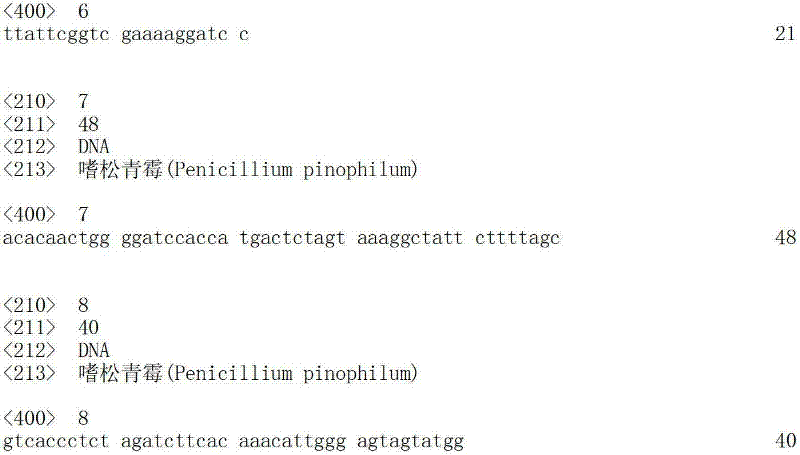
Claims (25)
1. the isolated polypeptide that has xylanase activity, it is selected from down group:
(a) comprise the polypeptide of aminoacid sequence, the mature polypeptide of said aminoacid sequence and SEQ ID NO:2 has at least 90% identity;
(b) by the polypeptide of polynucleotide encoding; Said polynucleotide under very high stringent condition with following hybridization: (i) the mature polypeptide encoded sequence of SEQ ID NO:1; (ii) be contained in the cDNA sequence of the mature polypeptide encoded sequence of SEQ ID NO:1, or (iii) (i) or total length complementary strand (ii);
(c) by the polypeptide of the polynucleotide encoding that comprises nucleotide sequence, the mature polypeptide encoded sequence of said nucleotide sequence and SEQID NO:1 has at least 90% identity; With
(d) variant that comprises one or more (several) amino acid whose replacement, disappearance and/or insertion of the mature polypeptide of SEQ ID NO:2.
2. the polypeptide of claim 1; It comprises mature polypeptide or its segmental aminoacid sequence with beta-glucosidase activity of SEQ ID NO:2 or SEQ ID NO:2, or is made up of mature polypeptide or its segmental aminoacid sequence with beta-glucosidase activity of SEQ ID NO:2 or SEQID NO:2.
3. the polypeptide of claim 1, said polypeptide are by polynucleotide encoding contained in the following plasmid: be included in the plasmid pGEM-T-Ppin3 among the intestinal bacteria DSM 22922.
4. isolating polynucleotide, it comprises the nucleotide sequence of each polypeptide among the coding claim 1-3.
5. be used for producing each the method for polypeptide of claim 1-3, it comprises: (a) culturing cell under the condition that helps said polypeptide to produce, and said cell produces said polypeptide with its wild-type form; (b) reclaim said polypeptide.
6. be used to produce the method for the polypeptide with xylanase activity, it comprises: (a) culture bag contains the recombinant host cell that right requires 4 polynucleotide under the condition that helps said polypeptide to produce; (b) reclaim said polypeptide.
7. be used to produce the method for the two mutants of parental cell, said method comprise destroy or disappearance coding claim 1-3 in each polypeptide or polynucleotide of its part, it causes two mutants to be compared with parental cell producing less said polypeptide.
8. be used for producing each the method for polypeptide of claim 1-3, it comprises: (a) under the condition that helps said polypeptide to produce, cultivate transgenic plant or vegetable cell, said transgenic plant or vegetable cell comprise the polynucleotide of coding said polypeptide; (b) reclaim said polypeptide.
9. transgenic plant, plant part or vegetable cell, it transforms with the polynucleotide of each polypeptide among the coding claim 1-3.
10. the two strands of subsequence that comprises the polynucleotide of claim 4 suppresses RNA (dsRNA) molecule, and wherein randomly said dsRNA is siRNA or miRNA molecule.
11. be used for suppressing having the method that the polypeptide of xylanase activity is expressed at cell, it comprises double-stranded RNA (dsRNA) molecule of said cell being used claim 10, perhaps in said cell, expresses double-stranded RNA (dsRNA) molecule of claim 10.
12. isolating polynucleotide, its coded signal peptide, said signal peptide comprise the amino acid/11 to 19 of SEQ ID NO:2 or are made up of the amino acid/11 to 19 of SEQ ID NO:2.
13. be used to produce method of protein; It comprises: (a) under the condition that helps said protein to produce, cultivate recombinant host cell; Said host cell comprises the gene of coded protein; Said gene is operably connected to the polynucleotide of claim 12, and wherein said gene is an external source for the polynucleotide of coded signal peptide; (b) reclaim said protein.
14. be used to degrade or transform the method for cellulose materials, it comprises: in claim 1-3, in the presence of each the polypeptide with xylanase activity, handle cellulose materials with enzyme composition.
15. the method for claim 14 further comprises the cellulose materials that recovery has been degraded.
16. produce the method for tunning, it comprises:
(a) in claim 1-3 in the presence of each the polypeptide, with enzyme composition diastatic fiber cellulosic material with xylanase activity;
(b) with the fermentation of one or more organism of fermentation through the cellulose materials of saccharification to produce tunning; With
(c) from said fermentation, reclaim said tunning.
17. the method for fermented cellulose material; It comprises: with one or more organism of fermentation fermented cellulose materials, wherein said cellulose materials be in claim 1-3 each the polypeptide with xylanase activity in the presence of with the enzyme composition saccharification.
18. the method for claim 17, wherein the fermentation of cellulose materials produces tunning.
19. the method for claim 18 further comprises from said fermentation and reclaims tunning.
20. one kind is used to degrade or transform the method that contains the xylan material, it comprises: in claim 1-3 each polypeptide with xylanase activity in the presence of handle said hemicellulosic materials with enzyme composition.
21. the method for claim 20 further comprises the hemicellulosic materials that reclaims degraded.
22. produce the method for tunning, it comprises:
(a) in claim 1-3, in the presence of each the polypeptide, contain the xylan material with the enzyme composition saccharification with xylanase activity;
(b) contain the xylan material to produce tunning with the fermentation of one or more organism of fermentation through saccharification; With
(c) from said fermentation, reclaim said tunning.
23. a fermentation contains the method for xylan material; It comprises: with the said xylan material that contains of one or more organism of fermentation fermentation, wherein said hemicellulosic materials be in claim 1-3 in the presence of each the polypeptide with xylanase activity with the enzyme composition saccharification.
24. the method for claim 23, the fermentation that wherein contains the xylan material produces tunning.
25. the method for claim 23 further comprises from said fermentation and reclaims tunning.
Priority Applications (1)
| Application Number | Priority Date | Filing Date | Title |
|---|---|---|---|
| CN201710456994.1A CN107338233A (en) | 2009-09-29 | 2010-09-29 | Polypeptide with xylanase activity and the polynucleotides for encoding the polypeptide |
Applications Claiming Priority (3)
| Application Number | Priority Date | Filing Date | Title |
|---|---|---|---|
| US24688709P | 2009-09-29 | 2009-09-29 | |
| US61/246,887 | 2009-09-29 | ||
| PCT/US2010/050709 WO2011041405A1 (en) | 2009-09-29 | 2010-09-29 | Polypeptides having xylanase activity and polynucleotides encoding same |
Related Child Applications (1)
| Application Number | Title | Priority Date | Filing Date |
|---|---|---|---|
| CN201710456994.1A Division CN107338233A (en) | 2009-09-29 | 2010-09-29 | Polypeptide with xylanase activity and the polynucleotides for encoding the polypeptide |
Publications (1)
| Publication Number | Publication Date |
|---|---|
| CN102648276A true CN102648276A (en) | 2012-08-22 |
Family
ID=43087057
Family Applications (2)
| Application Number | Title | Priority Date | Filing Date |
|---|---|---|---|
| CN2010800539905A Pending CN102648276A (en) | 2009-09-29 | 2010-09-29 | Polypeptides with xylanase activity and polynucleotides encoding the polypeptides |
| CN201710456994.1A Pending CN107338233A (en) | 2009-09-29 | 2010-09-29 | Polypeptide with xylanase activity and the polynucleotides for encoding the polypeptide |
Family Applications After (1)
| Application Number | Title | Priority Date | Filing Date |
|---|---|---|---|
| CN201710456994.1A Pending CN107338233A (en) | 2009-09-29 | 2010-09-29 | Polypeptide with xylanase activity and the polynucleotides for encoding the polypeptide |
Country Status (7)
| Country | Link |
|---|---|
| US (3) | US8211665B2 (en) |
| EP (1) | EP2483403B1 (en) |
| CN (2) | CN102648276A (en) |
| BR (1) | BR112012006978B1 (en) |
| CA (1) | CA2775347A1 (en) |
| DK (1) | DK2483403T3 (en) |
| WO (1) | WO2011041405A1 (en) |
Cited By (1)
| Publication number | Priority date | Publication date | Assignee | Title |
|---|---|---|---|---|
| CN106103709A (en) * | 2014-01-31 | 2016-11-09 | 杜邦营养生物科学有限公司 | Comprise compositions and the method for xylanase variant |
Families Citing this family (123)
| Publication number | Priority date | Publication date | Assignee | Title |
|---|---|---|---|---|
| DK2496694T3 (en) | 2009-11-06 | 2017-06-06 | Novozymes Inc | COMPOSITIONS FOR SACCHARIFYING CELLULOS MATERIAL |
| WO2012003379A1 (en) | 2010-06-30 | 2012-01-05 | Novozymes A/S | Polypeptides having beta-glucosidase activity and polynucleotides encoding same |
| US8624082B2 (en) | 2010-08-30 | 2014-01-07 | Novozymes A/S | Polypeptides having xylanase activity and polynucleotides encoding same |
| US9187742B2 (en) | 2010-08-30 | 2015-11-17 | Novozymes, Inc. | Polypeptides having cellobiohydrolase activity and polynucleotides encoding same |
| EP2611901B1 (en) | 2010-08-30 | 2016-05-11 | Novozymes A/S | Polypeptides having beta-glucosidase activity, beta-xylosidase activity, or beta-glucosidase and beta-xylosidase activity and polynucleotides encoding same |
| EP3470514A1 (en) | 2010-08-30 | 2019-04-17 | Novozymes A/S | Polypeptides having cellulolytic enhancing activity and polynucleotides encoding same |
| US9267126B2 (en) | 2010-08-30 | 2016-02-23 | Novozymes, Inc. | Polypeptides having endoglucanase activity and polynucleotides encoding same |
| US20130212746A1 (en) | 2010-08-30 | 2013-08-15 | Novoyzmes A/S | Polypeptides Having Hemicellulolytic Activity And Polynucleotides Encoding Same |
| CN103237891B (en) | 2010-09-30 | 2017-07-14 | 诺维信股份有限公司 | Polypeptide variants having cellulolytic enhancing activity and polynucleotides encoding the same |
| DK2622068T3 (en) | 2010-09-30 | 2016-10-17 | Novozymes Inc | Variants of polypeptides having cellulolytic enhancing ACTIVITY AND POLYNUCLEOTIDES ENCODING THEM |
| DK2622069T3 (en) | 2010-10-01 | 2016-02-22 | Novozymes Inc | Beta-glucosidasevarianter and polynucleotides encoding them |
| BR112013009817B1 (en) | 2010-10-26 | 2020-02-04 | Novozymes As | methods to degrade or convert sugar cane refuse, to produce a fermentation product, and to ferment sugar cane refuse |
| US9932414B2 (en) | 2010-11-02 | 2018-04-03 | Novozymes, Inc. | Methods of pretreating cellulosic material with a family 61 polypeptide |
| WO2012059053A1 (en) | 2010-11-04 | 2012-05-10 | Novozymes A/S | Polypeptides having cellobiohydrolase activity and polynucleotides encoding same |
| BR112013009026A2 (en) | 2010-11-12 | 2016-07-12 | Novozymes Inc | isolated polypeptide, recombinant host cell, methods for producing a polypeptide, a precursor cell mutant, a protein, and a fermentation product, for inhibiting expression of a polypeptide, for degrading or converting a cellulosic material, and method for fermenting a cellulosic material, transgenic plant, plant part or plant cell, double stranded inhibitor mRNA molecule, isolated polynucleotide, and integral broth formulation or cell culture composition |
| US9080161B2 (en) | 2011-01-26 | 2015-07-14 | Novozymes, Inc. | Polypeptides having cellobiohydrolase activity and polynucleotides encoding same |
| US8759023B2 (en) | 2011-01-26 | 2014-06-24 | Novozymes Inc. | Polypeptides having cellobiohydrolase activity and polynucleotides encoding same |
| CN103534348B (en) | 2011-01-26 | 2018-04-10 | 诺维信公司 | Polypeptide having cellobiohydrolase activity and polynucleotide encoding the polypeptide |
| MX2013007720A (en) | 2011-01-26 | 2013-08-09 | Novozymes As | Polypeptides having cellobiohydrolase activity and polynucleotides encoding same. |
| BR112013016830A2 (en) | 2011-02-23 | 2017-03-01 | Novozymes Inc | isolated polypeptide, isolated polynucleotide, method of producing the polypeptide, producing a parent cell mutant, inhibiting expression of a polypeptide, producing a protein, degrading or converting a cellulosic material, producing a fermentation product and ferment a cellulosic material, transgenic plant, plant part or plant cell transformed with a polynucleotide, double-stranded rna molecule, composition, and full broth formulation or cell culture composition |
| EP2683830A1 (en) | 2011-03-09 | 2014-01-15 | Novozymes A/S | Methods of increasing the cellulolytic enhancing activity of a polypeptide |
| WO2012122477A1 (en) | 2011-03-10 | 2012-09-13 | Novozymes A/S | Polypeptides having cellulolytic enhancing activity and polynucleotides encoding same |
| WO2012130120A1 (en) | 2011-03-25 | 2012-10-04 | Novozymes A/S | Method for degrading or converting cellulosic material |
| US9410136B2 (en) | 2011-03-31 | 2016-08-09 | Novozymes, Inc. | Methods for enhancing the degradation or conversion of cellulosic material |
| US20140080182A1 (en) | 2011-03-31 | 2014-03-20 | Novozymes, Inc. | Cellulose Binding Domain Variants and Polynucleotides Encoding Same |
| CA2834513A1 (en) | 2011-04-28 | 2012-11-01 | Novozymes, Inc. | Polypeptides having endoglucanase activity and polynucleotides encoding same |
| EP2702162B1 (en) | 2011-04-29 | 2020-02-26 | Novozymes, Inc. | Methods for enhancing the degradation or conversion of cellulosic material |
| CN109022518A (en) | 2011-07-22 | 2018-12-18 | 诺维信北美公司 | For pre-treating cellulosic material and the method for improving its hydrolysis |
| EP2739728B1 (en) | 2011-08-04 | 2017-07-12 | Novozymes A/S | Polypeptides having endoglucanase activity and polynucleotides encoding same |
| DK3091073T4 (en) | 2011-08-04 | 2023-06-06 | Novozymes Inc | POLYPEPTIDES WITH XYLANASE ACTIVITY AND POLYNUCLEOTIDES ENCODING THEM |
| AU2012298713B2 (en) | 2011-08-24 | 2017-11-23 | Novozymes, Inc. | Methods for obtaining positive transformants of a filamentous fungal host cell |
| IN2014CN02136A (en) | 2011-08-24 | 2015-05-29 | Novozymes Inc | |
| US20140308705A1 (en) | 2011-09-20 | 2014-10-16 | Novozymes A/S | Polypeptides Having Cellulolytic Enhancing Activity And Polynucleotides Encoding Same |
| US20140329284A1 (en) | 2011-09-30 | 2014-11-06 | Novozymes, Inc. | Chimeric Polypeptides Having Beta-Glucosidase Activity and Polynucleotides Encoding Same |
| BR112014009918B1 (en) | 2011-10-27 | 2021-03-30 | Buckman Laboratories International, Inc | METHOD FOR CONTROLLING ORGANIC CONTAMINANTS AND COMPOSITION |
| US10704034B2 (en) * | 2011-10-28 | 2020-07-07 | Novozymes Inc. | Polypeptides having xylanase activity and polynucleotides encoding same |
| CN104039817A (en) * | 2011-10-28 | 2014-09-10 | 诺维信股份有限公司 | Polypeptides having xylanase activity and polynucleotides encoding same |
| WO2013060293A1 (en) * | 2011-10-28 | 2013-05-02 | Novozymes, Inc. | Polypeptides having xylanase activity and polynucleotides encoding same |
| EP2773656B1 (en) | 2011-10-31 | 2019-06-19 | Novozymes, Inc. | Polypeptides having cellulolytic enhancing activity and polynucleotides encoding same |
| EP3409769A1 (en) | 2011-11-18 | 2018-12-05 | Novozymes A/S | Polypeptides having beta-glucosidase activity, beta-xylosidase activity, or beta-glucosidase and beta-xylosidase activity and polynucleotides encoding same |
| EP3219794B1 (en) | 2011-11-21 | 2019-09-11 | Novozymes A/S | Gh61 polypeptide variants and polynucleotides encoding same |
| EP2782998B1 (en) | 2011-11-22 | 2018-01-10 | Novozymes Inc. | Polypeptides having beta-xylosidase activity and polynucleotides encoding same |
| BR122019023258B1 (en) * | 2011-11-25 | 2021-12-21 | Mitsui Chemicals, Inc. | MUTANT XYLANASE, NUCLEIC ACID, EXPRESSION VECTOR, TRANSFORMER, METHOD FOR MANUFACTURING MUTANT XYLANASE METHOD FOR MANUFACTURING A LIGNOCELLULOSE SACCHARIFIED PRODUCT, COMPOSITION, METHOD FOR BLEACHING A PULP, DETERGENT, ANIMAL FOOD AND BAKERY MODIFIER |
| DK2785732T3 (en) | 2011-12-01 | 2017-06-19 | Novozymes Inc | POLYPEPTIDES WITH BETA-XYLOSIDASE ACTIVITY AND POLYNUCLEOTIDES CODING THEM |
| DK2791330T3 (en) | 2011-12-16 | 2017-11-06 | Novozymes Inc | Polypeptides with laccase activity and polynucleotides encoding them |
| CA2859796A1 (en) | 2011-12-19 | 2013-06-27 | Novozymes A/S | Processes and compositions for increasing the digestibility of cellulosic materials |
| BR112014014697A2 (en) | 2011-12-19 | 2020-10-27 | Novozymes, Inc. | isolated polypeptide, composition, isolated polynucleotide, nucleic acid construct or expression vector, recombinant host cell, methods for producing a polypeptide and a protein, for generating molecular oxygen, and for removing hydrogen peroxide from tissue, processes for degrading or converting a cellulosic material, and to produce a fermentation product, and, integral broth formulation or cell culture composition |
| DK2794869T3 (en) | 2011-12-20 | 2018-01-02 | Novozymes Inc | CELLOBIO HYDROLASE VARIABLES AND POLYNUCLEOTIDES CODING THEM |
| EP2794899A1 (en) | 2011-12-21 | 2014-10-29 | Novozymes, Inc. | Methods for determining the degradation of a biomass material |
| CA2868308A1 (en) | 2012-04-27 | 2013-10-31 | Novozymes, Inc. | Gh61 polypeptide variants and polynucleotides encoding same |
| BR112015005884A2 (en) | 2012-09-19 | 2017-08-08 | Novozymes Inc E Novozymes As | processes for degradation of a cellulosic material, for production of a fermentation product, and fermentation of a cellulosic material, composition, and whole broth formulation or cell culture composition |
| CN105861469B (en) | 2012-10-08 | 2020-04-14 | 诺维信公司 | Polypeptides having cellulolytic enhancing activity and polynucleotides encoding them |
| WO2014066141A2 (en) | 2012-10-24 | 2014-05-01 | Novozymes A/S | Polypeptides having cellulolytic enhancing activity and polynucleotides encoding same |
| MX2015006569A (en) | 2012-11-27 | 2015-08-05 | Novozymes As | Milling process. |
| EP2925790B1 (en) | 2012-11-27 | 2021-07-07 | Novozymes A/S | Milling process |
| CN104870639A (en) | 2012-12-14 | 2015-08-26 | 诺维信公司 | Polypeptides having cellulolytic enhancing activity and polynucleotides encoding same |
| WO2014099798A1 (en) | 2012-12-19 | 2014-06-26 | Novozymes A/S | Polypeptides having cellulolytic enhancinc activity and polynucleotides encoding same |
| CN103131684B (en) * | 2013-01-09 | 2015-09-30 | 中国农业科学院饲料研究所 | A kind of C of having holds the method for the zytase XynA of unnecessary sequence and gene thereof and purposes, raising zytase catalytic rate |
| US8759041B1 (en) * | 2013-02-12 | 2014-06-24 | Novozymes Inc. | Polypeptides having xylanase activity and polynucleotides encoding same |
| CN105164254B (en) | 2013-03-08 | 2019-06-28 | 诺维信公司 | Cellobiohydrolase variants and polynucleotides encoding them |
| EP2994529B1 (en) | 2013-05-10 | 2018-11-21 | Novozymes A/S | Polypeptides having xylanase activity and polynucleotides encoding same |
| CN105492601A (en) | 2013-09-04 | 2016-04-13 | 诺维信公司 | Processes for increasing enzymatic hydrolysis of cellulosic material |
| MY186318A (en) | 2014-01-07 | 2021-07-08 | Novozymes As | Process for degrading mannan-containing cellulosic materials |
| EP3186372B1 (en) | 2014-08-28 | 2020-10-21 | Novozymes A/S | Solubilization of msw with blend enzymes |
| CN107002056A (en) | 2014-09-05 | 2017-08-01 | 诺维信公司 | Carbohydrate binding module variants and polynucleotides encoding them |
| WO2016045569A1 (en) | 2014-09-23 | 2016-03-31 | Novozymes A/S | Processes for producing ethanol and fermenting organisms |
| CN107208080B (en) * | 2014-12-19 | 2022-03-25 | 诺维信公司 | Compositions comprising a polypeptide having xylanase activity and a polypeptide having arabinofuranosidase activity |
| WO2016120298A1 (en) | 2015-01-28 | 2016-08-04 | Dsm Ip Assets B.V. | Process for enzymatic hydrolysis of lignocellulosic material and fermentation of sugars |
| MY182182A (en) | 2015-01-28 | 2021-01-18 | Dsm Ip Assets Bv | Process for enzymatic hydrolysis of lignocellulosic material and fermentation of sugars |
| CN107406862B (en) | 2015-01-28 | 2022-08-09 | 帝斯曼知识产权资产管理有限公司 | Process for enzymatic hydrolysis of lignocellulosic material and fermentation of sugars |
| WO2016138167A2 (en) | 2015-02-24 | 2016-09-01 | Novozymes A/S | Cellobiohydrolase variants and polynucleotides encoding same |
| US10513721B2 (en) | 2015-03-12 | 2019-12-24 | Novozymes A/S | Two-stage process for enzymatic hydrolysis of lignocellulosic biomass |
| BR112017019331A2 (en) | 2015-03-12 | 2018-06-05 | Beta Renewables Spa | multistage saccharification processes of a lignocellulosic material and to improve a glucose or xylose yield of saccharification of a lignocellulosic material in a continuously stirred tank reactor |
| WO2016145350A1 (en) | 2015-03-12 | 2016-09-15 | Novozymes A/S | Multi-stage enzymatic hydrolysis of lignocellulosic biomass |
| EP3067428A1 (en) | 2015-03-12 | 2016-09-14 | BETA RENEWABLES S.p.A. | A process for producing a hydrolyzed mixture from a pre-treated ligno-cellulosic slurry comprising a slurry liquid and slurry solids |
| US10100295B2 (en) * | 2015-04-14 | 2018-10-16 | National Institute Of Advanced Industrial Science And Technology | Modified xylanase |
| WO2016169893A1 (en) | 2015-04-20 | 2016-10-27 | Dsm Ip Assets B.V. | Whole fermentation broth |
| WO2016169892A1 (en) | 2015-04-20 | 2016-10-27 | Dsm Ip Assets B.V. | Process for enzymatic hydrolysis of lignocellulosic material and fermentation of sugars |
| EP3303578B1 (en) | 2015-05-27 | 2020-07-08 | Novozymes A/S | Polypeptides having cellobiohydrolase activity and polynucleotides encoding same |
| WO2016207144A1 (en) | 2015-06-22 | 2016-12-29 | Dsm Ip Assets B.V. | Process for enzymatic hydrolysis of lignocellulosic material and fermentation of sugars |
| WO2017019491A1 (en) | 2015-07-24 | 2017-02-02 | Novozymes Inc. | Polypeptides having beta-xylosidase activity and polynucleotides encoding same |
| EP3325616A1 (en) | 2015-07-24 | 2018-05-30 | Novozymes, Inc. | Polypeptides having arabinofuranosidase activity and polynucleotides encoding same |
| WO2017040907A1 (en) | 2015-09-04 | 2017-03-09 | Novozymes A/S | Methods of inhibiting aa9 lytic polysaccharide monooxygenase catalyzed inactivation of enzyme compositions |
| DK3353195T3 (en) | 2015-09-22 | 2021-11-22 | Novozymes As | Polypeptides with cellobiohydrolase activity and polynucleotides encoding them |
| WO2017070219A1 (en) | 2015-10-20 | 2017-04-27 | Novozymes A/S | Lytic polysaccharide monooxygenase (lpmo) variants and polynucleotides encoding same |
| WO2017076421A1 (en) | 2015-11-02 | 2017-05-11 | Renescience A/S | Solubilization of msw with blend enzymes |
| CN108368527B (en) | 2015-11-26 | 2023-07-18 | 诺维信公司 | grinding method |
| DK3393983T3 (en) | 2015-12-23 | 2023-12-18 | Envirozyme Llc | PROCESSES FOR INCREASING SLUDGE DEWATER CAPACITY WITH ENZYME TREATMENT |
| DK3423577T3 (en) | 2016-03-02 | 2024-07-08 | Novozymes As | CELLOBIOHYDROLASE VARIANTS AND POLYNUCLEOTIDES ENCODING THEREOF |
| WO2017165760A1 (en) | 2016-03-24 | 2017-09-28 | Novozymes A/S | Cellobiohydrolase variants and polynucleotides encoding same |
| WO2017205535A1 (en) | 2016-05-27 | 2017-11-30 | Novozymes, Inc. | Polypeptides having endoglucanase activity and polynucleotides encoding same |
| CN109312380A (en) | 2016-06-09 | 2019-02-05 | 帝斯曼知识产权资产管理有限公司 | Seed training for large-scale enzyme production |
| WO2018019948A1 (en) | 2016-07-29 | 2018-02-01 | Dsm Ip Assets B.V. | Polypeptides having cellulolytic enhancing activity and uses thereof |
| WO2018026868A1 (en) | 2016-08-01 | 2018-02-08 | Novozymes, Inc. | Polypeptides having endoglucanase activity and polynucleotides encoding same |
| WO2018085370A1 (en) | 2016-11-02 | 2018-05-11 | Novozymes A/S | Processes for reducing production of primeverose during enzymatic saccharification of lignocellulosic material |
| CA3043966A1 (en) | 2016-11-24 | 2018-05-31 | Dsm Ip Assets B.V. | Enzyme composition |
| MY206033A (en) | 2016-11-24 | 2024-11-26 | Dsm Ip Assets Bv | Enzyme composition |
| US11180786B2 (en) | 2016-11-25 | 2021-11-23 | Novozymes A/S | GH10 xylanase, GH62 arabinofuranosidase, milling process and other application |
| WO2018185071A1 (en) | 2017-04-03 | 2018-10-11 | Dsm Ip Assets B.V. | Process for enzymatic hydrolysis of lignocellulosic material and fermentation of sugars |
| PT3695001T (en) | 2017-10-09 | 2024-01-26 | Versalis Spa | Process for enzymatic hydrolysis of lignocellulosic material and fermentation of sugars |
| CN111278986A (en) | 2017-10-30 | 2020-06-12 | 帝斯曼知识产权资产管理有限公司 | Methods for enzymatic hydrolysis of lignocellulosic material and fermentation of sugars |
| WO2019086370A1 (en) | 2017-10-30 | 2019-05-09 | Dsm Ip Assets B.V. | Process for enzymatic hydrolysis of lignocellulosic material and fermentation of sugars |
| RU2020124098A (en) * | 2017-12-22 | 2022-01-24 | Новозимс А/С | METHOD FOR GRINDING WHEAT AND XYLANASE GH8 |
| BR112020018791A2 (en) | 2018-03-28 | 2020-10-13 | Dsm Ip Assets B.V. | enzyme composition |
| WO2019185681A1 (en) | 2018-03-28 | 2019-10-03 | Dsm Ip Assets B.V. | Enzyme composition |
| WO2019219804A1 (en) | 2018-05-17 | 2019-11-21 | Dsm Ip Assets B.V. | Process for producing a polypeptide |
| CN112204151B (en) | 2018-05-30 | 2024-06-11 | 维尔萨利斯股份公司 | Methods for producing sugars from carbohydrate materials |
| WO2020058249A1 (en) | 2018-09-18 | 2020-03-26 | Dsm Ip Assets B.V. | Process for enzymatic hydrolysis of carbohydrate material and fermentation of sugars |
| WO2020058253A1 (en) | 2018-09-18 | 2020-03-26 | Dsm Ip Assets B.V. | Process for enzymatic hydrolysis of carbohydrate material and fermentation of sugars |
| WO2020058248A1 (en) | 2018-09-18 | 2020-03-26 | Dsm Ip Assets B.V. | Process for enzymatic hydrolysis of carbohydrate material and fermentation of sugars |
| EP3870715A1 (en) | 2018-10-24 | 2021-09-01 | DSM IP Assets B.V. | Process for enzymatic hydrolysis of carbohydrate material and fermentation of sugars |
| CN113302293A (en) | 2018-12-12 | 2021-08-24 | 诺维信公司 | Polypeptides having xylanase activity and polynucleotides encoding same |
| WO2020182843A1 (en) | 2019-03-12 | 2020-09-17 | Dsm Ip Assets B.V. | Process for producing a fermentation broth |
| WO2021026201A1 (en) | 2019-08-05 | 2021-02-11 | Novozymes A/S | Enzyme blends and processes for producing a high protein feed ingredient from a whole stillage byproduct |
| JP7265448B2 (en) * | 2019-08-20 | 2023-04-26 | 株式会社日立システムズ | METHOD AND SYSTEM FOR SUPPORTING PROMOTION OF USE OF DIGITAL COMMUNITY CURRENCY |
| BR112022002942A2 (en) | 2019-09-10 | 2022-05-10 | Dsm Ip Assets Bv | Enzyme composition |
| WO2022013148A1 (en) | 2020-07-13 | 2022-01-20 | Dsm Ip Assets B.V. | Process for the production of biogas |
| CA3216054A1 (en) | 2021-04-06 | 2022-10-13 | Dsm Ip Assets B.V. | Enzyme composition |
| CA3213845A1 (en) | 2021-04-06 | 2022-10-13 | Dsm Ip Assets B.V. | Enzyme composition |
| CN117178059A (en) | 2021-04-06 | 2023-12-05 | 帝斯曼知识产权资产管理有限公司 | enzyme composition |
| CN116670296A (en) | 2021-04-08 | 2023-08-29 | 维尔萨利斯股份公司 | Process for the preparation of sugar products and fermented products |
| CN121399279A (en) | 2023-07-19 | 2026-01-23 | 诺维信公司 | Enzyme-assisted sugarcane juice extraction |
| CN120138018B (en) * | 2025-03-12 | 2026-01-09 | 江西省科学院微生物研究所(江西省流域生态研究所) | A replicon capable of autonomous replication within *Pseudomonas aeruginosa* cells and its applications. |
Citations (3)
| Publication number | Priority date | Publication date | Assignee | Title |
|---|---|---|---|---|
| WO2002024926A1 (en) * | 2000-09-21 | 2002-03-28 | Dsm N.V. | Talaromyces xylanases |
| CN101012457A (en) * | 2007-01-29 | 2007-08-08 | 中国农业大学 | Method of preparing heat-proof xylanase, heat-proof beta-xylosidase or heat-proof beta-glucosidase |
| WO2009079210A2 (en) * | 2007-12-05 | 2009-06-25 | Novozymes A/S | Polypeptides having xylanase activity and polynucleotides encoding same |
Family Cites Families (100)
| Publication number | Priority date | Publication date | Assignee | Title |
|---|---|---|---|---|
| DK187280A (en) | 1980-04-30 | 1981-10-31 | Novo Industri As | RUIT REDUCING AGENT FOR A COMPLETE LAUNDRY |
| FI87577C (en) | 1985-12-03 | 1993-01-25 | Gist Brocades Nv | Process for making wort and beer with improved filterability and / or lower viscosity |
| DK122686D0 (en) | 1986-03-17 | 1986-03-17 | Novo Industri As | PREPARATION OF PROTEINS |
| EP0406314B1 (en) | 1988-03-24 | 1993-12-01 | Novo Nordisk A/S | A cellulase preparation |
| US5776757A (en) | 1988-03-24 | 1998-07-07 | Novo Nordisk A/S | Fungal cellulase composition containing alkaline CMC-endoglucanase and essentially no cellobiohydrolase and method of making thereof |
| US5223409A (en) | 1988-09-02 | 1993-06-29 | Protein Engineering Corp. | Directed evolution of novel binding proteins |
| DK420289D0 (en) | 1989-08-25 | 1989-08-25 | Novo Nordisk As | METHOD OF TREATING LIGNOCELLULOSE PULP |
| US5275944A (en) | 1989-09-26 | 1994-01-04 | Midwest Research Institute | Thermostable purified endoglucanas from acidothermus cellulolyticus ATCC 43068 |
| US5536655A (en) | 1989-09-26 | 1996-07-16 | Midwest Research Institute | Gene coding for the E1 endoglucanase |
| US5110735A (en) | 1989-09-26 | 1992-05-05 | Midwest Research Institute | Thermostable purified endoglucanase from thermophilic bacterium acidothermus cellulolyticus |
| NZ237549A (en) | 1990-03-23 | 1993-06-25 | Gist Brocades Nv | Production of enhanced levels of enzymes in the seeds of transgenic plants and the use of these seeds |
| AU639570B2 (en) | 1990-05-09 | 1993-07-29 | Novozymes A/S | A cellulase preparation comprising an endoglucanase enzyme |
| DK115890D0 (en) | 1990-05-09 | 1990-05-09 | Novo Nordisk As | ENZYME |
| DK203490D0 (en) | 1990-08-24 | 1990-08-24 | Novo Nordisk As | PROCEDURE FOR TREATING LIGNOCELLULOS PULP AND APPARATUS FOR PERFORMING THE PROCESS |
| IL99552A0 (en) | 1990-09-28 | 1992-08-18 | Ixsys Inc | Compositions containing procaryotic cells,a kit for the preparation of vectors useful for the coexpression of two or more dna sequences and methods for the use thereof |
| SG52693A1 (en) | 1991-01-16 | 1998-09-28 | Procter & Gamble | Detergent compositions with high activity cellulase and softening clays |
| DK175391D0 (en) | 1991-10-18 | 1991-10-18 | Novo Nordisk As | NEW ENZYMER |
| EP0651785B1 (en) | 1992-07-02 | 2000-09-27 | Novo Nordisk A/S | ALKALOPHILIC -i(BACILLUS sp. AC13) AND PROTEASE, XYLANASE, CELLULASE OBTAINABLE THEREFROM |
| EP1431389A3 (en) | 1992-10-06 | 2004-06-30 | Novozymes A/S | Cellulase variants |
| ATE412048T1 (en) | 1993-03-10 | 2008-11-15 | Novozymes As | ENZYMES WITH XYLANASE ACTIVITY FROM ASPERGILLUS ACULEATUS |
| JP2807612B2 (en) | 1993-03-12 | 1998-10-08 | ノボ ノルディスク アクティーゼルスカブ | Novel xylanase, method for producing the same, pulp treatment method using the xylanase, and method for producing xylo-oligosaccharide |
| DE4343591A1 (en) | 1993-12-21 | 1995-06-22 | Evotec Biosystems Gmbh | Process for the evolutionary design and synthesis of functional polymers based on shape elements and shape codes |
| US5605793A (en) | 1994-02-17 | 1997-02-25 | Affymax Technologies N.V. | Methods for in vitro recombination |
| DE69536145D1 (en) | 1994-03-08 | 2011-04-07 | Novozymes As | Novel alkaline cellulases |
| DK0765394T3 (en) | 1994-06-03 | 2001-12-10 | Novozymes As | Purified Myceliopthora laccases and nucleic acids encoding them |
| US6025185A (en) | 1994-06-17 | 2000-02-15 | Novo Nordisk Als | Fungus wherein the areA gene has been modified and an areA gene from Aspergillus oryzae |
| DE69534185T2 (en) | 1994-06-30 | 2006-02-23 | Novozymes Biotech, Inc., Davis | NON-TOXIC, NON-TOXIGEN, NON-PATHOGENIC FUSARIUM EXPRESSION SYSTEM, AND PROMOTERS AND TERMINATORS TO BE USED IN IT |
| EP1995303A3 (en) | 1994-10-06 | 2008-12-31 | Novozymes A/S | Enzyme preparation with endoglucanase activity |
| CN1165614C (en) | 1995-01-26 | 2004-09-08 | 诺沃奇梅兹有限公司 | Animal feed additives containing xylanase |
| CN1182451A (en) | 1995-03-17 | 1998-05-20 | 诺沃挪第克公司 | Novel endoglucanases |
| US6313081B1 (en) | 1995-04-28 | 2001-11-06 | Henkel Kommanditgesellschaft Auf Aktien (Kgaa) | Detergents comprising cellulases |
| US20030044956A1 (en) | 1995-08-23 | 2003-03-06 | Short Jay M. | Enzymes having carboxymethyl cellulase activity and methods of use thereof |
| CA2232245C (en) | 1995-10-17 | 2011-06-07 | Rohm Enzyme Finland Oy | Cellulases, the genes encoding them and uses thereof |
| WO1998008940A1 (en) | 1996-08-26 | 1998-03-05 | Novo Nordisk A/S | A novel endoglucanase |
| DE69735767T2 (en) | 1996-09-17 | 2007-04-05 | Novozymes A/S | cellulase |
| US6451063B1 (en) | 1996-09-25 | 2002-09-17 | Genencor International, Inc. | Cellulase for use in industrial processes |
| US6017870A (en) | 1996-10-09 | 2000-01-25 | Genencor International, Inc. | Purified cellulase and method of producing |
| US5811381A (en) | 1996-10-10 | 1998-09-22 | Mark A. Emalfarb | Cellulase compositions and methods of use |
| US7883872B2 (en) | 1996-10-10 | 2011-02-08 | Dyadic International (Usa), Inc. | Construction of highly efficient cellulase compositions for enzymatic hydrolysis of cellulose |
| US5989899A (en) | 1996-12-23 | 1999-11-23 | Genencor International, Inc. | Oversized cellulase compositions for use in detergent compositions and in the treatment of textiles |
| WO1999006574A1 (en) | 1997-07-31 | 1999-02-11 | Dsm N.V. | Cellulose degrading enzymes of aspergillus |
| US5871550A (en) | 1997-08-26 | 1999-02-16 | Genencor International, Inc. | Mutant Thermonospora spp. cellulase |
| JP3661995B2 (en) | 1997-11-19 | 2005-06-22 | ジェネンコア インターナショナル インコーポレーテッド | Cellulase produced by actinomycetes and production method thereof |
| US6562612B2 (en) | 1997-11-19 | 2003-05-13 | Genencor International, Inc. | Cellulase producing actinomycetes, cellulase produced therefrom and method of producing same |
| EP1034280B1 (en) | 1997-11-19 | 2006-05-31 | Genencor International, Inc. | Cellulase produced by actinomycetes and method of producing same |
| US6258590B1 (en) | 1998-11-02 | 2001-07-10 | Novozymes A/S | Biopreparation of textiles at high temperatures |
| EP1038008B1 (en) | 1997-12-16 | 2006-10-18 | Genencor International, Inc. | Methods for producing egiii-like enzymes |
| US6506559B1 (en) | 1997-12-23 | 2003-01-14 | Carnegie Institute Of Washington | Genetic inhibition by double-stranded RNA |
| EP1088080B1 (en) | 1998-06-24 | 2006-10-11 | Genencor International, Inc. | Recombinant production of cellulase from actinomycetes |
| EP1124949B1 (en) | 1998-10-26 | 2006-07-12 | Novozymes A/S | Constructing and screening a dna library of interest in filamentous fungal cells |
| US6511824B1 (en) | 1999-03-17 | 2003-01-28 | Exelixis, Inc. | Nucleic acids and polypeptides of invertebrate TWIK channels and methods of use |
| CN1940067A (en) | 1999-03-22 | 2007-04-04 | 诺沃奇梅兹有限公司 | Promoters for expressing genes in a fungal cell |
| CA2372594A1 (en) | 1999-05-19 | 2000-11-23 | Midwest Research Institute | E1 endoglucanase variants y245g, y82r and w42r |
| US6531644B1 (en) | 2000-01-14 | 2003-03-11 | Exelixis, Inc. | Methods for identifying anti-cancer drug targets |
| ES2166316B1 (en) | 2000-02-24 | 2003-02-16 | Ct Investig Energeticas Ciemat | PROCEDURE FOR THE PRODUCTION OF ETHANOL FROM LIGNOCELLULOSIC BIOMASS USING A NEW THERMOTOLERING YEAST. |
| DE60134400D1 (en) | 2000-04-07 | 2008-07-24 | Novozymes As | INTEGRATION OF SIGNAL SEQUENCES |
| ES2423898T3 (en) | 2000-07-21 | 2013-09-25 | The Government Of The United States Of America, As Represented By The Secretary, Department Of Health And Human Services | Dental pulp cytoblasts of adult humans in vitro and in vivo |
| EP1184460A1 (en) | 2000-08-29 | 2002-03-06 | Dsm N.V. | Modified fungal xylanases |
| US6515109B1 (en) | 2000-10-12 | 2003-02-04 | Exelixis, Inc. | Human ECT2 polypeptide |
| US7151204B2 (en) | 2001-01-09 | 2006-12-19 | Monsanto Technology Llc | Maize chloroplast aldolase promoter compositions and methods for use thereof |
| AU2002316785A1 (en) | 2001-05-18 | 2002-12-03 | Novozymes A/S | Polypeptides having cellobiase activity and polynucleotides encoding same |
| US6982159B2 (en) | 2001-09-21 | 2006-01-03 | Genencor International, Inc. | Trichoderma β-glucosidase |
| US7049125B2 (en) | 2001-12-18 | 2006-05-23 | Genencor International, Inc. | EGVIII endoglucanase and nucleic acids encoding the same |
| US7045332B2 (en) | 2001-12-18 | 2006-05-16 | Genencor International, Inc. | BGL4 β-glucosidase and nucleic acids encoding the same |
| US7056721B2 (en) | 2001-12-18 | 2006-06-06 | Genencor International, Inc. | EGVI endoglucanase and nucleic acids encoding the same |
| US7045331B2 (en) | 2001-12-18 | 2006-05-16 | Genencor International, Inc. | EGVII endoglucanase and nucleic acids encoding the same |
| US7005289B2 (en) | 2001-12-18 | 2006-02-28 | Genencor International, Inc. | BGL5 β-glucosidase and nucleic acids encoding the same |
| BR0306740A (en) | 2002-01-23 | 2004-12-28 | Royal Nedalco B V | Host cell transformed with a nucleic acid construct, isolated nucleic acid molecule, and processes for producing ethanol, and a fermentation product |
| DK2322606T3 (en) | 2002-08-16 | 2015-12-14 | Danisco Us Inc | NOVEL HYPROCREA JECORINA CBH1 cellulase WITH INCREASED THERMAL STABILITY COMPREHENSIVE SUBSTITUTION OR DELETION FOR POSITION T332 |
| EP1556512B1 (en) | 2002-11-07 | 2016-06-15 | Danisco US Inc. | Bgl6 beta-glucosidase and nucleic acids encoding the same |
| US7407788B2 (en) | 2002-11-21 | 2008-08-05 | Danisco A/S, Genencor Division | BGL7 beta-glucosidase and nucleic acids encoding the same |
| CN1898381B (en) | 2003-03-21 | 2013-07-17 | 金克克国际有限公司 | Novel cbh1 homologs and variant cbh1 cellulases |
| CA2520636C (en) | 2003-04-01 | 2012-05-08 | Genencor International, Inc. | Variant humicola grisea cbh1.1 |
| DK1862626T3 (en) | 2003-05-29 | 2011-12-12 | Genencor Int | New Trichoderma Genes |
| WO2005047499A1 (en) | 2003-10-28 | 2005-05-26 | Novozymes Inc. | Polypeptides having beta-glucosidase activity and polynucleotides encoding same |
| WO2006011899A1 (en) | 2003-11-25 | 2006-02-02 | L-3 Communications Security and Detection Systems Corporation | Security system for detecting nuclear masses |
| WO2005074647A2 (en) | 2004-01-30 | 2005-08-18 | Novozymes Inc. | Polypeptides having cellulolytic enhancing activity and polynucleotides encoding same |
| CN1965078B (en) | 2004-02-06 | 2013-09-18 | 诺维信股份有限公司 | Polypeptides having cellulolytic enhancing activity and polynucleotides encoding same |
| CN101389645B (en) | 2004-02-12 | 2016-08-03 | 诺维信股份有限公司 | Polypeptides having xylanase activity and polynucleotides encoding it |
| CA2560588A1 (en) | 2004-03-25 | 2005-10-06 | Genencor International, Inc. | Cellulase fusion protein and heterologous cellulase fusion construct encoding the same |
| US8097445B2 (en) | 2004-03-25 | 2012-01-17 | Danisco Us Inc. | Exo-endo cellulase fusion protein |
| US20060004699A1 (en) | 2004-06-30 | 2006-01-05 | Nokia Corporation | Method and system for managing metadata |
| DK176540B1 (en) | 2004-09-24 | 2008-07-21 | Cambi Bioethanol Aps | Process for the treatment of biomass and organic waste in order to extract desired biologically based products |
| DK1838849T3 (en) | 2004-12-30 | 2015-11-30 | Danisco Us Inc | CBH2 CELLULASE VARIETIES OF HYPOCREA JECORINA |
| CN101160405B (en) | 2005-04-12 | 2014-01-01 | 纳幕尔杜邦公司 | Process for biomass treatment to obtain target chemical substance |
| BRPI0609906A8 (en) | 2005-04-29 | 2017-11-21 | Ab Enzymes Oy | cellulase fusion protein, its production process and detergent composition containing it, expression vector, host cell, enzyme preparation, fading and bio-finishing processes and methods of treating cellulosic fiber containing textile material to treat fiber or pulp derived from wood and to improve the quality of animal feed |
| WO2007019442A2 (en) | 2005-08-04 | 2007-02-15 | Novozymes, Inc. | Polypeptides having beta-glucosidase activity and polynucleotides encoding same |
| JP5129142B2 (en) | 2005-09-30 | 2013-01-23 | ノボザイムス,インコーポレイティド | Method for enhancing degradation or conversion of cellulosic materials |
| EP1969123B1 (en) | 2005-12-22 | 2017-07-12 | AB Enzymes Oy | Novel enzymes |
| FI120045B (en) | 2005-12-22 | 2009-06-15 | Roal Oy | Treatment of cellulose materials and enzymes useful therein |
| US8304212B2 (en) | 2006-07-10 | 2012-11-06 | Dyadic International, Inc. | Methods and compositions for degradation of lignocellulosic material |
| CA2658610A1 (en) | 2006-07-21 | 2008-05-15 | Novozymes, Inc. | Methods of increasing secretion of polypeptides having biological activity |
| WO2008049837A2 (en) * | 2006-10-24 | 2008-05-02 | Novozymes A/S | Improved alpha factor signal peptide for producing a polypeptide |
| MX2009012845A (en) | 2007-05-31 | 2009-12-15 | Novozymes Inc | Methods of increasing the cellulolytic enhancing activity of a polypeptide. |
| WO2009037253A2 (en) | 2007-09-18 | 2009-03-26 | Novozymes A/S | Polypeptides having tyrosinase activity and polynucleotides encoding same |
| WO2009042846A1 (en) | 2007-09-28 | 2009-04-02 | Novozymes A/S | Polypeptides having acetylxylan esterase activity and polynucleotides encoding same |
| CN101978049B (en) | 2007-11-30 | 2013-11-06 | 诺维信公司 | Polypeptides having arabinofuranosidase activity and polynucleotides encoding same |
| EP2224822B1 (en) | 2007-12-06 | 2014-05-21 | Novozymes A/S | Polypeptides having acetylxylan esterase activity and polynucleotides encoding same |
| BRPI0821088A2 (en) | 2007-12-07 | 2015-09-15 | Novozymes As | nucleic acid construct, transgenic microbial host cell, and methods for producing a polypeptide having feruloyl esterase activity, for producing a mother cell mutant, for inhibiting expression of a polypeptide having feruloyl esterase activity in a cell, for produce a protein, and to degrade a xylan-containing material. |
| DK2496694T3 (en) * | 2009-11-06 | 2017-06-06 | Novozymes Inc | COMPOSITIONS FOR SACCHARIFYING CELLULOS MATERIAL |
-
2010
- 2010-09-29 CN CN2010800539905A patent/CN102648276A/en active Pending
- 2010-09-29 CN CN201710456994.1A patent/CN107338233A/en active Pending
- 2010-09-29 BR BR112012006978-0A patent/BR112012006978B1/en active IP Right Grant
- 2010-09-29 DK DK10763939.5T patent/DK2483403T3/en active
- 2010-09-29 WO PCT/US2010/050709 patent/WO2011041405A1/en not_active Ceased
- 2010-09-29 US US12/893,575 patent/US8211665B2/en active Active
- 2010-09-29 CA CA2775347A patent/CA2775347A1/en not_active Abandoned
- 2010-09-29 EP EP10763939.5A patent/EP2483403B1/en active Active
-
2012
- 2012-05-23 US US13/479,014 patent/US8299322B2/en active Active
- 2012-10-26 US US13/661,691 patent/US8431362B2/en active Active
Patent Citations (3)
| Publication number | Priority date | Publication date | Assignee | Title |
|---|---|---|---|---|
| WO2002024926A1 (en) * | 2000-09-21 | 2002-03-28 | Dsm N.V. | Talaromyces xylanases |
| CN101012457A (en) * | 2007-01-29 | 2007-08-08 | 中国农业大学 | Method of preparing heat-proof xylanase, heat-proof beta-xylosidase or heat-proof beta-glucosidase |
| WO2009079210A2 (en) * | 2007-12-05 | 2009-06-25 | Novozymes A/S | Polypeptides having xylanase activity and polynucleotides encoding same |
Non-Patent Citations (1)
| Title |
|---|
| FURNISS CAROLINE S M ET AL: "《The substrate specificity and susceptibility to wheat inhibitor proteins of Penicillium funiculosum xylanases from a commercial enzyme preparation》", 《JOURNAL OF THE SCIENCE OF FOOD AND AGRICULTURE》, vol. 85, no. 4, 31 March 2005 (2005-03-31) * |
Cited By (1)
| Publication number | Priority date | Publication date | Assignee | Title |
|---|---|---|---|---|
| CN106103709A (en) * | 2014-01-31 | 2016-11-09 | 杜邦营养生物科学有限公司 | Comprise compositions and the method for xylanase variant |
Also Published As
| Publication number | Publication date |
|---|---|
| CA2775347A1 (en) | 2011-04-07 |
| US8431362B2 (en) | 2013-04-30 |
| BR112012006978B1 (en) | 2018-11-06 |
| CN107338233A (en) | 2017-11-10 |
| DK2483403T3 (en) | 2018-02-12 |
| EP2483403A1 (en) | 2012-08-08 |
| WO2011041405A1 (en) | 2011-04-07 |
| US8299322B2 (en) | 2012-10-30 |
| US20110078830A1 (en) | 2011-03-31 |
| BR112012006978A2 (en) | 2015-09-08 |
| US20120240293A1 (en) | 2012-09-20 |
| US20130078672A1 (en) | 2013-03-28 |
| US8211665B2 (en) | 2012-07-03 |
| EP2483403B1 (en) | 2017-11-15 |
Similar Documents
| Publication | Publication Date | Title |
|---|---|---|
| EP2483403B1 (en) | Polypeptides having xylanase activity and polynucleotides encoding same | |
| US8735128B2 (en) | Polypeptides having alpha-glucuronidase activity and polynucleotides encoding same | |
| US8071335B2 (en) | Polypeptides having acetylxylan esterase activity and polynucleotides encoding same | |
| US8058513B2 (en) | Polypeptides having feruloyl esterase activity and polynucleotides encoding same | |
| US8609933B2 (en) | Polypeptides having feruloyl esterase activity and polynucleotides encoding same | |
| US8604277B2 (en) | Polypeptides having beta-glucosidase activity and polynucleotides encoding same | |
| CN102639697A (en) | Polypeptides having xylanase activity and polynucleotides encoding same | |
| CN102482652A (en) | Polypeptides Having Cellobiohydrolase Activity And Polynucleotides Encoding Same | |
| CN102695720A (en) | Polypeptides having cellulolytic enhancing activity and polynucleotides encoding the polypeptides | |
| CN102918151A (en) | Cellobiohydrolase variants and polynucleotides encoding same | |
| CN103703125A (en) | Polypeptides having endoglucanase activity and polynucleotides encoding same | |
| CN104245930A (en) | Polypeptides having glucuronyl esterase activity and polynucleotides encoding same | |
| CN104039959A (en) | Polypeptides having xylanase activity and polynucleotides encoding same | |
| CN104145016B (en) | Polypeptide with β-xylosidase activity and polynucleotide encoding the polypeptide |
Legal Events
| Date | Code | Title | Description |
|---|---|---|---|
| C06 | Publication | ||
| PB01 | Publication | ||
| C10 | Entry into substantive examination | ||
| SE01 | Entry into force of request for substantive examination | ||
| RJ01 | Rejection of invention patent application after publication |
Application publication date: 20120822 |
|
| RJ01 | Rejection of invention patent application after publication |