CN102634054B - Preparation method of modified polymer film material for effectively removing trace heavy metal ions in water body - Google Patents
Preparation method of modified polymer film material for effectively removing trace heavy metal ions in water body Download PDFInfo
- Publication number
- CN102634054B CN102634054B CN 201210106966 CN201210106966A CN102634054B CN 102634054 B CN102634054 B CN 102634054B CN 201210106966 CN201210106966 CN 201210106966 CN 201210106966 A CN201210106966 A CN 201210106966A CN 102634054 B CN102634054 B CN 102634054B
- Authority
- CN
- China
- Prior art keywords
- solution
- film
- water body
- preparation
- film material
- Prior art date
- Legal status (The legal status is an assumption and is not a legal conclusion. Google has not performed a legal analysis and makes no representation as to the accuracy of the status listed.)
- Active
Links
- XLYOFNOQVPJJNP-UHFFFAOYSA-N water Substances O XLYOFNOQVPJJNP-UHFFFAOYSA-N 0.000 title claims abstract description 56
- 150000002500 ions Chemical class 0.000 title claims abstract description 54
- 229910001385 heavy metal Inorganic materials 0.000 title claims abstract description 49
- 238000002360 preparation method Methods 0.000 title claims abstract description 48
- 239000000463 material Substances 0.000 title claims abstract description 41
- 229920006254 polymer film Polymers 0.000 title claims abstract description 17
- 239000000243 solution Substances 0.000 claims abstract description 90
- -1 polyethylene Polymers 0.000 claims abstract description 44
- 239000003999 initiator Substances 0.000 claims abstract description 34
- 239000000178 monomer Substances 0.000 claims abstract description 31
- 238000006243 chemical reaction Methods 0.000 claims abstract description 28
- 230000004913 activation Effects 0.000 claims abstract description 26
- 229920000768 polyamine Polymers 0.000 claims abstract description 13
- 239000004698 Polyethylene Substances 0.000 claims abstract description 12
- 229920000573 polyethylene Polymers 0.000 claims abstract description 12
- IJGRMHOSHXDMSA-UHFFFAOYSA-N Atomic nitrogen Chemical compound N#N IJGRMHOSHXDMSA-UHFFFAOYSA-N 0.000 claims description 48
- LFQSCWFLJHTTHZ-UHFFFAOYSA-N Ethanol Chemical compound CCO LFQSCWFLJHTTHZ-UHFFFAOYSA-N 0.000 claims description 48
- HEMHJVSKTPXQMS-UHFFFAOYSA-M Sodium hydroxide Chemical compound [OH-].[Na+] HEMHJVSKTPXQMS-UHFFFAOYSA-M 0.000 claims description 36
- 230000004888 barrier function Effects 0.000 claims description 33
- 239000007789 gas Substances 0.000 claims description 33
- 239000007864 aqueous solution Substances 0.000 claims description 24
- 150000001718 carbodiimides Chemical class 0.000 claims description 24
- HOGDNTQCSIKEEV-UHFFFAOYSA-N n'-hydroxybutanediamide Chemical compound NC(=O)CCC(=O)NO HOGDNTQCSIKEEV-UHFFFAOYSA-N 0.000 claims description 24
- 229910052757 nitrogen Inorganic materials 0.000 claims description 24
- XKRFYHLGVUSROY-UHFFFAOYSA-N Argon Chemical compound [Ar] XKRFYHLGVUSROY-UHFFFAOYSA-N 0.000 claims description 22
- 239000004743 Polypropylene Substances 0.000 claims description 20
- 229920001155 polypropylene Polymers 0.000 claims description 20
- 238000009281 ultraviolet germicidal irradiation Methods 0.000 claims description 17
- 239000002131 composite material Substances 0.000 claims description 15
- QVGXLLKOCUKJST-UHFFFAOYSA-N atomic oxygen Chemical compound [O] QVGXLLKOCUKJST-UHFFFAOYSA-N 0.000 claims description 14
- 239000004568 cement Substances 0.000 claims description 14
- 238000010559 graft polymerization reaction Methods 0.000 claims description 14
- 239000001301 oxygen Substances 0.000 claims description 14
- 229910052760 oxygen Inorganic materials 0.000 claims description 14
- VGGSQFUCUMXWEO-UHFFFAOYSA-N Ethene Chemical compound C=C VGGSQFUCUMXWEO-UHFFFAOYSA-N 0.000 claims description 13
- 229910019142 PO4 Inorganic materials 0.000 claims description 12
- ZLMJMSJWJFRBEC-UHFFFAOYSA-N Potassium Chemical compound [K] ZLMJMSJWJFRBEC-UHFFFAOYSA-N 0.000 claims description 12
- 238000011095 buffer preparation Methods 0.000 claims description 12
- 239000001307 helium Substances 0.000 claims description 12
- 229910052734 helium Inorganic materials 0.000 claims description 12
- SWQJXJOGLNCZEY-UHFFFAOYSA-N helium atom Chemical group [He] SWQJXJOGLNCZEY-UHFFFAOYSA-N 0.000 claims description 12
- NBIIXXVUZAFLBC-UHFFFAOYSA-K phosphate Chemical compound [O-]P([O-])([O-])=O NBIIXXVUZAFLBC-UHFFFAOYSA-K 0.000 claims description 12
- 239000010452 phosphate Substances 0.000 claims description 12
- 229910052700 potassium Inorganic materials 0.000 claims description 12
- 239000011591 potassium Substances 0.000 claims description 12
- 230000037452 priming Effects 0.000 claims description 12
- 238000001291 vacuum drying Methods 0.000 claims description 12
- IMNFDUFMRHMDMM-UHFFFAOYSA-N N-Heptane Chemical compound CCCCCCC IMNFDUFMRHMDMM-UHFFFAOYSA-N 0.000 claims description 11
- 229910052786 argon Inorganic materials 0.000 claims description 11
- 229920002981 polyvinylidene fluoride Polymers 0.000 claims description 10
- 239000004793 Polystyrene Substances 0.000 claims description 9
- 229920002492 poly(sulfone) Polymers 0.000 claims description 9
- 229920002239 polyacrylonitrile Polymers 0.000 claims description 9
- 229920006393 polyether sulfone Polymers 0.000 claims description 9
- 229920002223 polystyrene Polymers 0.000 claims description 9
- VILCJCGEZXAXTO-UHFFFAOYSA-N 2,2,2-tetramine Chemical compound NCCNCCNCCN VILCJCGEZXAXTO-UHFFFAOYSA-N 0.000 claims description 8
- NIXOWILDQLNWCW-UHFFFAOYSA-N Acrylic acid Chemical group OC(=O)C=C NIXOWILDQLNWCW-UHFFFAOYSA-N 0.000 claims description 8
- RSWGJHLUYNHPMX-ONCXSQPRSA-N abietic acid Chemical compound C([C@@H]12)CC(C(C)C)=CC1=CC[C@@H]1[C@]2(C)CCC[C@@]1(C)C(O)=O RSWGJHLUYNHPMX-ONCXSQPRSA-N 0.000 claims description 8
- 235000010299 hexamethylene tetramine Nutrition 0.000 claims description 8
- XEEYBQQBJWHFJM-UHFFFAOYSA-N iron Substances [Fe] XEEYBQQBJWHFJM-UHFFFAOYSA-N 0.000 claims description 8
- 229920000915 polyvinyl chloride Polymers 0.000 claims description 8
- FAGUFWYHJQFNRV-UHFFFAOYSA-N tetraethylenepentamine Chemical compound NCCNCCNCCNCCN FAGUFWYHJQFNRV-UHFFFAOYSA-N 0.000 claims description 8
- 229960001124 trientine Drugs 0.000 claims description 8
- 150000001412 amines Chemical class 0.000 claims description 7
- JPVYNHNXODAKFH-UHFFFAOYSA-N Cu2+ Chemical compound [Cu+2] JPVYNHNXODAKFH-UHFFFAOYSA-N 0.000 claims description 6
- PXHVJJICTQNCMI-UHFFFAOYSA-N Nickel Chemical compound [Ni] PXHVJJICTQNCMI-UHFFFAOYSA-N 0.000 claims description 6
- 229910001430 chromium ion Inorganic materials 0.000 claims description 6
- ZUOUZKKEUPVFJK-UHFFFAOYSA-N diphenyl Chemical compound C1=CC=CC=C1C1=CC=CC=C1 ZUOUZKKEUPVFJK-UHFFFAOYSA-N 0.000 claims description 6
- 229910052742 iron Inorganic materials 0.000 claims description 6
- RPNUMPOLZDHAAY-UHFFFAOYSA-N Diethylenetriamine Chemical compound NCCNCCN RPNUMPOLZDHAAY-UHFFFAOYSA-N 0.000 claims description 5
- RWCCWEUUXYIKHB-UHFFFAOYSA-N benzophenone Chemical compound C=1C=CC=CC=1C(=O)C1=CC=CC=C1 RWCCWEUUXYIKHB-UHFFFAOYSA-N 0.000 claims description 5
- 239000012965 benzophenone Substances 0.000 claims description 5
- RVPVRDXYQKGNMQ-UHFFFAOYSA-N lead(2+) Chemical compound [Pb+2] RVPVRDXYQKGNMQ-UHFFFAOYSA-N 0.000 claims description 5
- BQPIGGFYSBELGY-UHFFFAOYSA-N mercury(2+) Chemical compound [Hg+2] BQPIGGFYSBELGY-UHFFFAOYSA-N 0.000 claims description 5
- 229910001453 nickel ion Inorganic materials 0.000 claims description 5
- CERQOIWHTDAKMF-UHFFFAOYSA-N Methacrylic acid Chemical compound CC(=C)C(O)=O CERQOIWHTDAKMF-UHFFFAOYSA-N 0.000 claims description 4
- FPYJFEHAWHCUMM-UHFFFAOYSA-N maleic anhydride Chemical compound O=C1OC(=O)C=C1 FPYJFEHAWHCUMM-UHFFFAOYSA-N 0.000 claims description 4
- VNQXSTWCDUXYEZ-UHFFFAOYSA-N 1,7,7-trimethylbicyclo[2.2.1]heptane-2,3-dione Chemical compound C1CC2(C)C(=O)C(=O)C1C2(C)C VNQXSTWCDUXYEZ-UHFFFAOYSA-N 0.000 claims description 3
- 239000012956 1-hydroxycyclohexylphenyl-ketone Substances 0.000 claims description 3
- 239000004697 Polyetherimide Substances 0.000 claims description 3
- NSOXQYCFHDMMGV-UHFFFAOYSA-N Tetrakis(2-hydroxypropyl)ethylenediamine Chemical compound CC(O)CN(CC(C)O)CCN(CC(C)O)CC(C)O NSOXQYCFHDMMGV-UHFFFAOYSA-N 0.000 claims description 3
- 235000010290 biphenyl Nutrition 0.000 claims description 3
- MQDJYUACMFCOFT-UHFFFAOYSA-N bis[2-(1-hydroxycyclohexyl)phenyl]methanone Chemical compound C=1C=CC=C(C(=O)C=2C(=CC=CC=2)C2(O)CCCCC2)C=1C1(O)CCCCC1 MQDJYUACMFCOFT-UHFFFAOYSA-N 0.000 claims description 3
- 229930006711 bornane-2,3-dione Natural products 0.000 claims description 3
- MWQBWSPPTQGZII-UHFFFAOYSA-N ethoxy(phenyl)phosphinic acid Chemical compound CCOP(O)(=O)C1=CC=CC=C1 MWQBWSPPTQGZII-UHFFFAOYSA-N 0.000 claims description 3
- 229920001601 polyetherimide Polymers 0.000 claims description 3
- YRHRIQCWCFGUEQ-UHFFFAOYSA-N thioxanthen-9-one Chemical compound C1=CC=C2C(=O)C3=CC=CC=C3SC2=C1 YRHRIQCWCFGUEQ-UHFFFAOYSA-N 0.000 claims description 3
- 239000004695 Polyether sulfone Substances 0.000 claims description 2
- 238000004140 cleaning Methods 0.000 claims description 2
- 239000004800 polyvinyl chloride Substances 0.000 claims description 2
- MDDUHVRJJAFRAU-YZNNVMRBSA-N tert-butyl-[(1r,3s,5z)-3-[tert-butyl(dimethyl)silyl]oxy-5-(2-diphenylphosphorylethylidene)-4-methylidenecyclohexyl]oxy-dimethylsilane Chemical compound C1[C@@H](O[Si](C)(C)C(C)(C)C)C[C@H](O[Si](C)(C)C(C)(C)C)C(=C)\C1=C/CP(=O)(C=1C=CC=CC=1)C1=CC=CC=C1 MDDUHVRJJAFRAU-YZNNVMRBSA-N 0.000 claims description 2
- BFKJFAAPBSQJPD-UHFFFAOYSA-N tetrafluoroethene Chemical group FC(F)=C(F)F BFKJFAAPBSQJPD-UHFFFAOYSA-N 0.000 claims description 2
- 238000000034 method Methods 0.000 abstract description 37
- 238000009832 plasma treatment Methods 0.000 abstract description 20
- 238000001179 sorption measurement Methods 0.000 abstract description 10
- 230000000694 effects Effects 0.000 abstract description 9
- 230000008569 process Effects 0.000 abstract description 8
- 230000000536 complexating effect Effects 0.000 abstract description 5
- 125000003178 carboxy group Chemical group [H]OC(*)=O 0.000 abstract description 4
- 230000008901 benefit Effects 0.000 abstract description 3
- 230000003213 activating effect Effects 0.000 abstract 3
- 125000003277 amino group Chemical group 0.000 abstract 1
- 239000007853 buffer solution Substances 0.000 abstract 1
- 238000005859 coupling reaction Methods 0.000 abstract 1
- 230000002349 favourable effect Effects 0.000 abstract 1
- 239000012528 membrane Substances 0.000 description 14
- 150000001875 compounds Chemical class 0.000 description 11
- 239000002033 PVDF binder Substances 0.000 description 6
- 238000010521 absorption reaction Methods 0.000 description 6
- 229920001343 polytetrafluoroethylene Polymers 0.000 description 6
- 239000004810 polytetrafluoroethylene Substances 0.000 description 6
- 229940058401 polytetrafluoroethylene Drugs 0.000 description 6
- 229920001477 hydrophilic polymer Polymers 0.000 description 5
- 230000004048 modification Effects 0.000 description 5
- 238000012986 modification Methods 0.000 description 5
- 239000002594 sorbent Substances 0.000 description 5
- 230000000274 adsorptive effect Effects 0.000 description 4
- 239000004312 hexamethylene tetramine Substances 0.000 description 4
- VKYKSIONXSXAKP-UHFFFAOYSA-N hexamethylenetetramine Chemical compound C1N(C2)CN3CN1CN2C3 VKYKSIONXSXAKP-UHFFFAOYSA-N 0.000 description 4
- 239000000203 mixture Substances 0.000 description 4
- 239000000126 substance Substances 0.000 description 4
- 238000004804 winding Methods 0.000 description 4
- NWUYHJFMYQTDRP-UHFFFAOYSA-N 1,2-bis(ethenyl)benzene;1-ethenyl-2-ethylbenzene;styrene Chemical compound C=CC1=CC=CC=C1.CCC1=CC=CC=C1C=C.C=CC1=CC=CC=C1C=C NWUYHJFMYQTDRP-UHFFFAOYSA-N 0.000 description 3
- SMZOUWXMTYCWNB-UHFFFAOYSA-N 2-(2-methoxy-5-methylphenyl)ethanamine Chemical compound COC1=CC=C(C)C=C1CCN SMZOUWXMTYCWNB-UHFFFAOYSA-N 0.000 description 3
- 239000003463 adsorbent Substances 0.000 description 3
- 230000031018 biological processes and functions Effects 0.000 description 3
- 239000003456 ion exchange resin Substances 0.000 description 3
- 229920003303 ion-exchange polymer Polymers 0.000 description 3
- 238000004519 manufacturing process Methods 0.000 description 3
- 230000001105 regulatory effect Effects 0.000 description 3
- CSCPPACGZOOCGX-UHFFFAOYSA-N Acetone Chemical compound CC(C)=O CSCPPACGZOOCGX-UHFFFAOYSA-N 0.000 description 2
- VYZAMTAEIAYCRO-UHFFFAOYSA-N Chromium Chemical compound [Cr] VYZAMTAEIAYCRO-UHFFFAOYSA-N 0.000 description 2
- RYGMFSIKBFXOCR-UHFFFAOYSA-N Copper Chemical compound [Cu] RYGMFSIKBFXOCR-UHFFFAOYSA-N 0.000 description 2
- KCXVZYZYPLLWCC-UHFFFAOYSA-N EDTA Chemical compound OC(=O)CN(CC(O)=O)CCN(CC(O)=O)CC(O)=O KCXVZYZYPLLWCC-UHFFFAOYSA-N 0.000 description 2
- PIICEJLVQHRZGT-UHFFFAOYSA-N Ethylenediamine Chemical compound NCCN PIICEJLVQHRZGT-UHFFFAOYSA-N 0.000 description 2
- 229920002873 Polyethylenimine Polymers 0.000 description 2
- 238000009388 chemical precipitation Methods 0.000 description 2
- 229910052804 chromium Inorganic materials 0.000 description 2
- 239000011651 chromium Substances 0.000 description 2
- 229910052802 copper Inorganic materials 0.000 description 2
- 239000010949 copper Substances 0.000 description 2
- 230000007812 deficiency Effects 0.000 description 2
- 125000000524 functional group Chemical group 0.000 description 2
- 238000007306 functionalization reaction Methods 0.000 description 2
- 238000005342 ion exchange Methods 0.000 description 2
- 239000003014 ion exchange membrane Substances 0.000 description 2
- 239000000843 powder Substances 0.000 description 2
- 238000005096 rolling process Methods 0.000 description 2
- 238000000926 separation method Methods 0.000 description 2
- 239000002351 wastewater Substances 0.000 description 2
- BHPQYMZQTOCNFJ-UHFFFAOYSA-N Calcium cation Chemical compound [Ca+2] BHPQYMZQTOCNFJ-UHFFFAOYSA-N 0.000 description 1
- OKTJSMMVPCPJKN-UHFFFAOYSA-N Carbon Chemical compound [C] OKTJSMMVPCPJKN-UHFFFAOYSA-N 0.000 description 1
- KRHYYFGTRYWZRS-UHFFFAOYSA-M Fluoride anion Chemical compound [F-] KRHYYFGTRYWZRS-UHFFFAOYSA-M 0.000 description 1
- 102000003886 Glycoproteins Human genes 0.000 description 1
- 108090000288 Glycoproteins Proteins 0.000 description 1
- PWHULOQIROXLJO-UHFFFAOYSA-N Manganese Chemical compound [Mn] PWHULOQIROXLJO-UHFFFAOYSA-N 0.000 description 1
- 108010020346 Polyglutamic Acid Proteins 0.000 description 1
- 229910004298 SiO 2 Inorganic materials 0.000 description 1
- UCKMPCXJQFINFW-UHFFFAOYSA-N Sulphide Chemical compound [S-2] UCKMPCXJQFINFW-UHFFFAOYSA-N 0.000 description 1
- 239000004809 Teflon Substances 0.000 description 1
- 229920006362 Teflon® Polymers 0.000 description 1
- RTAQQCXQSZGOHL-UHFFFAOYSA-N Titanium Chemical compound [Ti] RTAQQCXQSZGOHL-UHFFFAOYSA-N 0.000 description 1
- 208000027418 Wounds and injury Diseases 0.000 description 1
- 229910021536 Zeolite Inorganic materials 0.000 description 1
- HCHKCACWOHOZIP-UHFFFAOYSA-N Zinc Chemical compound [Zn] HCHKCACWOHOZIP-UHFFFAOYSA-N 0.000 description 1
- 239000002253 acid Substances 0.000 description 1
- 230000009471 action Effects 0.000 description 1
- 230000002411 adverse Effects 0.000 description 1
- 125000003368 amide group Chemical group 0.000 description 1
- 239000003957 anion exchange resin Substances 0.000 description 1
- 125000000129 anionic group Chemical group 0.000 description 1
- 239000012298 atmosphere Substances 0.000 description 1
- 239000003124 biologic agent Substances 0.000 description 1
- 230000005540 biological transmission Effects 0.000 description 1
- 210000000988 bone and bone Anatomy 0.000 description 1
- 229910001424 calcium ion Inorganic materials 0.000 description 1
- 150000001732 carboxylic acid derivatives Chemical class 0.000 description 1
- 125000002091 cationic group Chemical group 0.000 description 1
- 239000013043 chemical agent Substances 0.000 description 1
- 239000003795 chemical substances by application Substances 0.000 description 1
- 239000011246 composite particle Substances 0.000 description 1
- 230000006378 damage Effects 0.000 description 1
- 238000013461 design Methods 0.000 description 1
- 238000010586 diagram Methods 0.000 description 1
- HNPSIPDUKPIQMN-UHFFFAOYSA-N dioxosilane;oxo(oxoalumanyloxy)alumane Chemical compound O=[Si]=O.O=[Al]O[Al]=O HNPSIPDUKPIQMN-UHFFFAOYSA-N 0.000 description 1
- 239000003814 drug Substances 0.000 description 1
- 230000009977 dual effect Effects 0.000 description 1
- 239000002158 endotoxin Substances 0.000 description 1
- 230000007613 environmental effect Effects 0.000 description 1
- 150000002148 esters Chemical class 0.000 description 1
- 238000002474 experimental method Methods 0.000 description 1
- 150000004676 glycans Chemical class 0.000 description 1
- 239000008187 granular material Substances 0.000 description 1
- 229910021389 graphene Inorganic materials 0.000 description 1
- 230000036541 health Effects 0.000 description 1
- 230000002209 hydrophobic effect Effects 0.000 description 1
- 229910052588 hydroxylapatite Inorganic materials 0.000 description 1
- 230000008676 import Effects 0.000 description 1
- 230000006872 improvement Effects 0.000 description 1
- 239000012535 impurity Substances 0.000 description 1
- 230000000977 initiatory effect Effects 0.000 description 1
- 208000014674 injury Diseases 0.000 description 1
- IXQWNVPHFNLUGD-UHFFFAOYSA-N iron titanium Chemical compound [Ti].[Fe] IXQWNVPHFNLUGD-UHFFFAOYSA-N 0.000 description 1
- 230000002045 lasting effect Effects 0.000 description 1
- 239000003446 ligand Substances 0.000 description 1
- 229920006008 lipopolysaccharide Polymers 0.000 description 1
- 239000007788 liquid Substances 0.000 description 1
- 239000007791 liquid phase Substances 0.000 description 1
- 229910052748 manganese Inorganic materials 0.000 description 1
- 239000011572 manganese Substances 0.000 description 1
- 229910021645 metal ion Inorganic materials 0.000 description 1
- 244000005700 microbiome Species 0.000 description 1
- 238000002715 modification method Methods 0.000 description 1
- 239000003607 modifier Substances 0.000 description 1
- 239000002086 nanomaterial Substances 0.000 description 1
- 229910052759 nickel Inorganic materials 0.000 description 1
- 230000000050 nutritive effect Effects 0.000 description 1
- AUONHKJOIZSQGR-UHFFFAOYSA-N oxophosphane Chemical compound P=O AUONHKJOIZSQGR-UHFFFAOYSA-N 0.000 description 1
- 239000013618 particulate matter Substances 0.000 description 1
- XYJRXVWERLGGKC-UHFFFAOYSA-D pentacalcium;hydroxide;triphosphate Chemical compound [OH-].[Ca+2].[Ca+2].[Ca+2].[Ca+2].[Ca+2].[O-]P([O-])([O-])=O.[O-]P([O-])([O-])=O.[O-]P([O-])([O-])=O XYJRXVWERLGGKC-UHFFFAOYSA-D 0.000 description 1
- 239000012071 phase Substances 0.000 description 1
- 229920002643 polyglutamic acid Polymers 0.000 description 1
- 229920000642 polymer Polymers 0.000 description 1
- 229920001282 polysaccharide Polymers 0.000 description 1
- 239000005017 polysaccharide Substances 0.000 description 1
- 125000002924 primary amino group Chemical group [H]N([H])* 0.000 description 1
- 238000012545 processing Methods 0.000 description 1
- 239000002994 raw material Substances 0.000 description 1
- 230000007420 reactivation Effects 0.000 description 1
- 230000008929 regeneration Effects 0.000 description 1
- 238000011069 regeneration method Methods 0.000 description 1
- 229920005989 resin Polymers 0.000 description 1
- 239000011347 resin Substances 0.000 description 1
- 150000003839 salts Chemical class 0.000 description 1
- 238000012216 screening Methods 0.000 description 1
- 238000004062 sedimentation Methods 0.000 description 1
- 239000003352 sequestering agent Substances 0.000 description 1
- 239000010865 sewage Substances 0.000 description 1
- 239000002689 soil Substances 0.000 description 1
- 239000007790 solid phase Substances 0.000 description 1
- 238000002798 spectrophotometry method Methods 0.000 description 1
- 239000007858 starting material Substances 0.000 description 1
- 230000003068 static effect Effects 0.000 description 1
- BDHFUVZGWQCTTF-UHFFFAOYSA-M sulfonate Chemical compound [O-]S(=O)=O BDHFUVZGWQCTTF-UHFFFAOYSA-M 0.000 description 1
- 239000002352 surface water Substances 0.000 description 1
- 231100000331 toxic Toxicity 0.000 description 1
- 230000002588 toxic effect Effects 0.000 description 1
- 239000002699 waste material Substances 0.000 description 1
- 238000003911 water pollution Methods 0.000 description 1
- 239000010457 zeolite Substances 0.000 description 1
- 229910052725 zinc Inorganic materials 0.000 description 1
- 239000011701 zinc Substances 0.000 description 1
Images

Landscapes
- Treatments Of Macromolecular Shaped Articles (AREA)
- Solid-Sorbent Or Filter-Aiding Compositions (AREA)
- Graft Or Block Polymers (AREA)
Abstract
The invention discloses a preparation method of a modified polymer film material for effectively removing trace heavy metal ions in a water body, which comprises the following steps: 1) carrying out plasma treatment on a polymer film; 2) respectively preparing an initiator solution, a monomer solution, a buffer solution, an activating solution and a polyethylene polyamine water solution; 3) immerging the polymer film in the initiator solution, and carrying out surface activation by ultraviolet irradiation; 4) putting the polymer film into the monomer solution to carry out grafting reaction under ultraviolet irradiation; 5) activating the polymer film in the activating solution; and 6) putting the activated film into a polyethylene polyamine water solution to carry out coupling reaction, thereby preparing the modified film material capable of removing trace heavy metal ions in a water body. In the polymer film modifying process, carboxyl and amino groups are introduced to carry out hydrophilization and endow the modified film with complexing capacity, thereby removing the trace heavy metal ions. The invention has the advantages of simple technique, favorable treatment effect, wide application range, low cost, high unit mass adsorption capacity, time saving, high efficiency and energy saving.
Description
Technical field
The present invention relates to a kind of preparation method of polymeric film material, relate in particular to the polymer-modified preparation method of film material of micro heavy ionic in effective removal water body.
Technical background
Heavy metal ion extensively is present in nature, is industrial important starting material.But because industrial developing rapidly, the heavy metal overexploitation uses, make plurality of heavy metal enter atmosphere, water body, soil and pollute, grievous injury people ' s health, wherein heavy metal pollution of water body has become one of serious environmental problem in the world today.As everyone knows, China is the poor area of a water resources, adds reasons such as pollution, makes that limited water resource becomes precious more originally.For the improvement of polluted-water, the especially removal of heavy metal ion in the water body seems particularly important.At the serious present situation of surface water pollution, press for the method and the material that can find a kind of simple and effective ground to remove heavy metal ion in the water body, thereby offer help for solving China's partial area water difficult problem.
At present, the heavy metal ion method comprises chemical precipitation method, biological process, absorption method, ion exchange method, membrane separation process etc. in the removal water body that uses both at home and abroad.
Chemical precipitation method is to precipitate removal after heavy metal ion is transformed into salts such as the oxyhydroxide that is insoluble in water or sulfide by chemical reaction.CN101244860A discloses the heavy metal ion in the method removal waste liquid that utilizes redox-sedimentation and filtration-magnetic absorption.This method technical process complexity will be used a large amount of chemical agents, thereby can make the new impurity of introducing in the water.
Biological process is to utilize extracellular polymeric that microorganism produces in process of growth such as polysaccharide, glycoprotein, lipopolysaccharides etc. to have the character of a large amount of anionic groups, and the enrichment of some heavy metal ion is reached the purpose that it is removed from water.CN101428929A discloses a kind of method of utilizing direct advanced treatment for heavy metal wastewater with biological agent, can effectively remove heavy metal and calcium ion in the waste water.But biological process need carry out biological introducing a fine variety, cultivation and nutritive substance supply, operation inconvenience, and when concentration of heavy metal ion is higher, can produce toxic side effect to biology, thus cause that biological respinse efficient reduces even inefficacy.
Absorption method is one of method of the processing heavy metal ion sewage used always, utilizes sorbent material that metal ion is adsorbed removal usually.CN101594933A discloses a kind of levigated zeolite and the sorbent material preparation method of nano-phase material composition and heavy metal ion adsorbed application thereof; CN101279789A discloses a kind of iron-titanium composite oxide nano-material preparation method and heavy metal ion adsorbed application thereof; CN101386438A discloses a kind of amido modified Fe
3O
4-SiO
2The preparation method of composite particles and heavy metal ion adsorbed application thereof; CN101502785A discloses a kind of surface finish nano titanate preparation method and application thereof of removing heavy metal ion; CN101690882A discloses a kind of natural adsorbent of removing heavy metal ion in the water body and its production and application; CN101613135A discloses a kind of method of utilizing nanometer hydroxyapatite to remove heavy metal ion in the water body; CN101973620A discloses a kind of method of utilizing the graphene oxide sheet to remove heavy metal ion in the water body.But above-mentioned sorbent material is the inorganic powder state, has shortcomings such as transportation and aftertreatment complexity, with heavy metal ion from the liquid-phase conversion to the solid phase, the adsorbent reactivation difficulty.Utilize polymeric sorbent can overcome the unmanageable deficiency of inorganic powder, CN101314492A discloses a kind of novel heavy metal ion sequestrant preparation method and application thereof; CN101172677A discloses a kind of application that utilizes polyglutamic acid and its esters to remove heavy metal in the water as agglutinant; CN101560004A discloses a kind of application that utilizes hydroximic acid type polymeric flocculant preparation method and removal of heavy metal ions thereof; CN101757893A discloses a kind of heavy metal ion selective adsorption polymkeric substance and preparation method based on sulfonate resin.But the preparation cost height of polymeric sorbent needs during use that consumption is very big just to reach removal effect preferably, and not ideal enough to the removal effect of some heavy metal ion, has therefore limited the application of this method.
Ion exchange method adopts ion exchange resin or ion-exchange membrane to handle and removes or reclaim heavy metal ion.CN1446755A discloses the method for a kind of weak base anion-exchange resin preparation and Adsorption of Heavy Metal Ions thereof; CN101481185A discloses a kind of method of utilizing the cationic exchange membrane chemical reactor for separating to remove heavy metal ion in the water body.But ion exchange resin or ion-exchange membrane cost are higher, can introduce other a large amount of ions again during use in water body, and regeneration of ion-exchange resin need consume a large amount of medicaments.
Polymeric film adsorption treatment heavy metal ion when carrying out the water purifying treatment has remarkable advantages, and its preparation method is simple, and rate of adsorption is fast, and can pass through the component of telomerized polymer film to its functionalization.CN101254457A discloses a kind of heavy metal ion adsorbed film and preparation method thereof; CN101961648A discloses a kind of removal and has drunk membrane adsorbent of heavy metal ion in the water body and preparation method thereof.More than two kinds of methods all be to utilize the polymkeric substance that contains functional groups to carry out blend system film, utilize the functional groups that is connected with on the membrane bone frame to the heavy metal ion adsorbed purpose that reaches it removal, though effect is good, but adopt blend legal system film, hydrophilic polymer content can not be too high, otherwise the mechanical property to film can exert an adverse impact, thereby has limited its application.CN1535204A discloses the ligand modified polymeric film preparation method of a kind of EDTA, thereby this method is to utilize modifier that film is carried out surface modification to make its functionalization, though good effect is arranged, but the film surface is to adsorb last layer hydrophilic polymer layer earlier, and then EDTA part in the grafting, top layer hydrophilic polymer layer comes off easily, has influenced its result of use.
The present invention utilizes the graft polymerization method that the common polymeric film that is easy to get is carried out modification, with carboxyl, amino is that the adsorption group of representative is fixed on fenestra inside and polymer film surface, flow through in the process of fenestra at water, realization is for the filteration of granule foreign and the adsorption of heavy metal ion, thereby raise the efficiency, shorten working time, reduce cost.
Summary of the invention
At the prior art above shortcomings, technical problem to be solved by this invention provides a kind of polymer-modified preparation method of film material that can effectively remove heavy metal ion in the water body.By atmospheric plasma-UV-light initiation grafting surface modifying method, the polyamino and the carboxyl that will have the complexing function are introduced in the polymeric film, improve the hydrophilic while of polymeric film, utilize aperture screening principle to remove large particulate matter, utilization has the polyamino and the carboxyl Adsorption of Heavy Metal Ions of complexing function, reaches the purpose that reduces heavy metal ion content in the water body.
The present invention is achieved through the following technical solutions:
The polymer-modified preparation method of film material of micro heavy ionic in a kind of effective removal water body, form by following step successively:
Step 1), polymeric film material is placed between two discharge electrodes of dielectric barrier discharge, feed the mixed gas of rare gas element and oxygen, carry out the atmospheric dielectric barrier discharge plasma and handle;
Step 2), initiator is dissolved in normal heptane preparation initiator solution, with monomer preparation monomer solution soluble in water, use potassium primary phosphate and sodium hydroxide preparation buffered soln, use the activated solution of above-mentioned buffer preparation carbodiimide and N-hydroxy-succinamide, with the water-soluble preparation polyethylene polyamine of the polyethylene polyamine aqueous solution;
Step 3), the polymeric film material after the Cement Composite Treated by Plasma was soaked in above-mentioned initiator solution 10~60 minutes, dry 1~5 minute activated polymer film of UV-irradiation surface under nitrogen protection, back, make the activation film;
Step 4), the above-mentioned activation film that makes is put into monomer solution, UV-irradiation is 5~30 minutes under nitrogen protection, carries out the graft polymerization reaction on activation film surface;
Step 5), the film after the grafting is put into activated solution carried out priming reaction 1~2 hour after ethanol cleans up, put into buffered soln then and clean;
Step 6), the film after the above-mentioned cleaning is put into the polyethylene polyamine aqueous solution carried out linked reaction 12~24 hours, clean up the final vacuum drying, promptly make and effectively to remove the polymer-modified mould material of micro heavy ionic in the water body through ethanol.
In the described step 1), distance during described Cement Composite Treated by Plasma between two discharge electrodes is 1.5~3 centimetres, feeding rare gas element during discharge is helium or argon gas, the volume ratio of rare gas element and oxygen is 97~99.5: 0.5~3, the intake velocity of mixed gas is 0.5~10 liter/minute, discharge power is 50~150 watts, and discharge frequency is 10 kilohertzs, and the treatment time is 20~180 seconds.
Polymeric film material described in the step 1) is polypropylene, polystyrene, polyacrylonitrile, polyvinyl chloride, polyetherimide, polysulfones, polyethersulfone, polyvinylidene difluoride (PVDF) or tetrafluoroethylene.
Step 2) initiator described in is a phenylbenzene (2; 4; the 6-trimethylbenzoyl) phosphine oxide, st-yrax dme, benzophenone, thioxanthone, camphorquinone, 2-hydroxy-2-methyl-1-phenyl-acetone, 1-hydroxy-cyclohexyl phenyl ketone or 2; 4,6-trimethylbenzoyl phenyl-phosphonic acid ethyl ester.
Step 2) monomer described in is vinylformic acid, maleic anhydride, rosin acid, methacrylic acid or Ba Dousuan.
Step 2) volumetric molar concentration of initiator is 10~50mmol/L in the initiator solution described in, and monomeric mass concentration is 20~120g/L in the monomer solution.
Step 2) polyethylene polyamine described in is quadrol, diethylenetriamine, triethylene tetramine, tetraethylene pentamine, five ethene hexamines, six ethene, seven amine or polymine.
The mass concentration of the polyethylene polyamine aqueous solution step 2) is 5~30g/ml.
Step 2) buffered soln pH=4~6 described in, the mol ratio of carbodiimide and N-hydroxy-succinamide are 2: 5~2: 1.
Described heavy metal ion is one or more of mn ion, iron ion, chromium ion, cupric ion, mercury ion, lead ion, zine ion or nickel ion.
Compared with prior art, advantage of the present invention is embodied as:
(1) this surface-modification method is good with respect to the polymeric film mechanical property that in the past blend system embrane method obtains, and the mould material flexible design has been widened the range of application of polymeric film greatly; Introduce one deck hydrophilic polymer layer by the graft polymerization method at polymer film surface, overcome the polymeric film absorption method and introduced the deficiency that comes off easily behind the hydrophilic polymer layer, action effect is lasting, long service life.
(2) by the grafting method polymer film surface is realized hydrophilic and complexing modification, production technique is simple, but this method continuous operation is suitable for suitability for industrialized production.
(3) used carboxylic-acid and polyamines class properties-correcting agent raw material obtain easily in the polymer film surface modifying process, and be with low cost, is suitable for industrial applications.
(4) utilize the filteration and the complexing action of fenestra, realize the water purifying dual function, both guaranteed that particulate state is sedimentary to deviate from, guarantee the absorption of water-soluble heavy metal ion again.
(5) can remove one or more heavy metal ion that comprise mn ion, iron ion, chromium ion, cupric ion, mercury ion, lead ion, zine ion, nickel ion, it is few to carry out the required time of complex reaction, adsorptive capacity is big, and the adsorption efficiency height realizes that easily industrialization handles continuously.
Description of drawings
Fig. 1 is that the present invention carries out the processed continuously process synoptic diagram of atmospheric dielectric barrier discharge plasma to polymeric film material.
Shown in Figure 1: the polymeric film material that 1-is pending; The 2-plasma generator; The 3-airway, mixed gas imports from this airway; The 4-discharge electrode; 5-automatic winding machine.
Embodiment
Below in conjunction with embodiment and accompanying drawing the present invention is described in further detail, following embodiment only is used to the present invention is described and is not used in and limits the scope of the invention.Should be understood that in addition those skilled in the art can make various changes or modifications the present invention after having read the content that the present invention lectures, these equivalent form of values fall within appended claims of the present invention institute restricted portion equally.
In conjunction with Fig. 1, it is as follows that polymeric film is carried out the continuous treating processes of atmospheric dielectric barrier discharge plasma:
Pending polypropylene screen 1 through between two discharge electrodes 4 of plasma device, is wound in automatic winding machine 5 again.This automatic winding machine 5 can carry out online rolling with the polypropylene screen after handling, and regulates the Trace speed of polypropylene screen by the rotating speed of regulating Scroll.
The distance of regulating between two discharge electrodes 4 is 1.5 centimetres, feeds mixed gas earlier from airway 3, and mixed gas is 99: 1 argon gas of volume ratio and oxygen, and adjusting intake velocity is 4 liters/minute; Open power supply then, the switch of the plasma generator 2 that closes, regulating plasma discharge power is 120 watts, discharge frequency is 10 kilohertzs, produces uniform plasma body.In the time of between the polypropylene screen process plasma discharge electrode 4, its surface obtains handling.Regulate the rotating speed of Scroll, making polypropylene screen Trace speed (transmission) is 20 meters/minute, passes through 5 rollings of automatic winding machine then.Guarantee that plasma treatment time is 30 seconds, is handled polypropylene screen fully.
Benzophenone is dissolved in the initiator solution that the normal heptane configuration concentration is 10mmol/L, with the water-soluble configuration concentration of vinylformic acid is the monomer solution of 20g/L, use the buffered soln of potassium primary phosphate and sodium hydroxide preparation pH=5.6, the mol ratio of using above-mentioned buffer preparation carbodiimide and N-hydroxy-succinamide is 1: 1 a activated solution, is the 5g/ml ethylenediamine solution with the water-soluble compound concentration of quadrol.Polypropylene screen after the Cement Composite Treated by Plasma was soaked in initiator solution 10 minutes, dry irradiation activation in 1 minute film surface under the UV-light of nitrogen protection, back, make the activation polypropylene screen; To activate polypropylene screen again and put into Acrylic Acid Monomer solution, UV-irradiation is 5 minutes under the nitrogen protection, carries out the graft polymerization reaction on the film surface; After polypropylene screen after the grafting put into ethanol and clean up, put into carbodiimide/N-hydroxy-succinamide activated solution and carried out priming reaction 1 hour, the ethylenediamine solution of putting into concentration and be 5g/ml after buffered soln cleans carried out linked reaction 12 hours, putting into vacuum drying oven after ethanol cleans up dries, promptly make and can effectively remove trace manganese ionic modified polypropene mould material in the water body, its removal performance for mn ion sees Table 1.
Embodiment 2
Polypropylene screen is placed between two discharge electrodes of dielectric barrier discharge, feed argon gas, carry out the atmospheric dielectric barrier discharge plasma and handle, atmospheric dielectric barrier discharge plasma treatment condition are: the distance between the discharge electrode is 2 centimetres; Feeding volume ratio is 99.5: 0.5 the argon gas and the mixed gas of oxygen, and intake velocity is 10 liters/minute; The discharge power of plasma body is 100 watts, and discharge frequency is 10 kilohertzs, and the Trace speed of polypropylene screen is 15 meters/minute, and plasma treatment time is 40 seconds; With phenylbenzene (2; 4; the 6-trimethylbenzoyl) phosphine oxide is dissolved in the initiator solution that the normal heptane compound concentration is 20mmol/L; with the water-soluble compound concentration of rosin acid is the monomer solution of 40g/L; use the buffered soln of potassium primary phosphate and sodium hydroxide preparation pH=4.0; the mol ratio of using above-mentioned buffer preparation carbodiimide and N-hydroxy-succinamide is 2: 1 a activated solution, is the 10g/ml diethylenetriamine aqueous solution with the water-soluble compound concentration of diethylenetriamine.Polypropylene screen after the Cement Composite Treated by Plasma was soaked in initiator solution 20 minutes, dry irradiation activation in 2 minutes film surface under the UV-light of nitrogen protection, back, make the activation polypropylene screen; To activate polypropylene screen again and put into the rosin acid monomer solution, UV-irradiation is 10 minutes under the nitrogen protection, carries out the graft polymerization reaction on the film surface; After polypropylene screen after the grafting put into ethanol and clean up, put into carbodiimide/N-hydroxy-succinamide activated solution and carried out priming reaction 1.5 hours, the diethylenetriamine aqueous solution of putting into concentration and be 10g/ml after buffered soln cleans carried out linked reaction 16 hours, putting into vacuum drying oven after ethanol cleans up dries, promptly make and can effectively remove trace iron ionic modified polypropene mould material in the water body, its removal performance for iron ion sees Table 1.
Polystyrene Film is placed between two discharge electrodes of dielectric barrier discharge, feed helium, carry out the atmospheric dielectric barrier discharge plasma and handle, atmospheric dielectric barrier discharge plasma treatment condition are: the distance between the discharge electrode is 3 centimetres; Feeding volume ratio is 97: 3 the helium and the mixed gas of oxygen, and intake velocity is 6 liters/minute; The discharge power of plasma body is 50 watts, and discharge frequency is 10 kilohertzs, and the Trace speed of Polystyrene Film is 3.3 meters/minute, and plasma treatment time is 180 seconds; The st-yrax dme is dissolved in the initiator solution that the normal heptane configuration concentration is 30mmol/L, with the water-soluble configuration concentration of methacrylic acid is the monomer solution of 60g/L, use the buffered soln of potassium primary phosphate and sodium hydroxide preparation pH=4.5, the mol ratio of using above-mentioned buffer preparation carbodiimide and N-hydroxy-succinamide is 2: 5 a activated solution, is the 15g/ml triethylene tetramine aqueous solution with the water-soluble compound concentration of triethylene tetramine.Polystyrene Film after the Cement Composite Treated by Plasma was soaked in initiator solution 30 minutes, dry irradiation activation in 4 minutes film surface under the UV-light of nitrogen protection, back, make the activated polystyrene film; Again the activated polystyrene film is put into methacrylic acid monomer solution, UV-irradiation is 15 minutes under the nitrogen protection, carries out the graft polymerization reaction on the film surface; After Polystyrene Film after the grafting put into ethanol and clean up, put into carbodiimide/N-hydroxy-succinamide activated solution and carried out priming reaction 2 hours, the triethylene tetramine aqueous solution of putting into concentration and be 15g/ml after buffered soln cleans carried out linked reaction 20 hours, putting into vacuum drying oven after ethanol cleans up dries, promptly make and can effectively remove trace chromium ionic modified polystyrene mould material in the water body, its removal performance for chromium ion sees Table 1.
Polyacrylonitrile film is placed between two discharge electrodes of dielectric barrier discharge, feed argon gas, carry out the atmospheric dielectric barrier discharge plasma and handle, atmospheric dielectric barrier discharge plasma treatment condition are: the distance between the discharge electrode is 1.5 centimetres; Feeding volume ratio is 98: 2 the argon gas and the mixed gas of oxygen, and intake velocity is 4 liters/minute; The discharge power of plasma body is 150 watts, and discharge frequency is 10 kilohertzs, and the Trace speed of polyacrylonitrile film is 30 meters/minute, and plasma treatment time is 20 seconds; Camphorquinone is dissolved in the initiator solution that the normal heptane configuration concentration is 50mmol/L, with the water-soluble configuration concentration of Ba Dousuan is the monomer solution of 80g/L, use the buffered soln of potassium primary phosphate and sodium hydroxide preparation pH=5.0, the mol ratio of using above-mentioned buffer preparation carbodiimide and N-hydroxy-succinamide is 1: 1 a activated solution, is the 20g/ml tetraethylene pentamine aqueous solution with the water-soluble compound concentration of tetraethylene pentamine.Polyacrylonitrile film after the Cement Composite Treated by Plasma was soaked in initiator solution 60 minutes, dry the UV-irradiation 5 minute activation film surface of back, make the activation polyacrylonitrile film in nitrogen protection; To activate polyacrylonitrile film again and put into the Ba Dousuan monomer solution, UV-irradiation is 20 minutes under the nitrogen protection, carries out the graft polymerization reaction on the film surface; After polyacrylonitrile film after the grafting put into ethanol and clean up, put into carbodiimide/N-hydroxy-succinamide activated solution and carried out priming reaction 2 hours, the tetraethylene pentamine aqueous solution of putting into concentration and be 20g/ml after buffered soln cleans carried out linked reaction 24 hours, putting into vacuum drying oven after ethanol cleans up dries, promptly make and can effectively remove trace chromium ionic modified polyacrylonitrile mould material in the water body, its removal performance for chromium ion sees Table 1.
Polychloroethylene film is placed between two discharge electrodes of dielectric barrier discharge, feed helium, carry out the atmospheric dielectric barrier discharge plasma and handle, atmospheric dielectric barrier discharge plasma treatment condition are: the distance between the discharge electrode is 2 centimetres; Feeding volume ratio is 99: 1 the helium and the mixed gas of oxygen, and intake velocity is 0.5 liter/minute; Plasma discharge power is 100 watts, and discharge frequency is 10 kilohertzs, and the Trace speed of polychloroethylene film is 15 meters/minute, and plasma treatment time is 40 seconds; Thioxanthone is dissolved in the initiator solution that the normal heptane configuration concentration is 50mmol/L, with the water-soluble configuration concentration of maleic anhydride is the monomer solution of 100g/L, use the buffered soln of potassium primary phosphate and sodium hydroxide preparation pH=5.5, the mol ratio of using above-mentioned buffer preparation carbodiimide and N-hydroxy-succinamide is 2: 1 a activated solution, is the 25g/ml five ethene hexamine aqueous solution with the water-soluble compound concentration of five ethene hexamines.Polychloroethylene film after the Cement Composite Treated by Plasma was soaked in initiator solution 60 minutes, dry irradiation activation in 5 minutes film surface under the UV-light of nitrogen protection, back, make the activation polychloroethylene film; To activate polychloroethylene film again and put into maleic anhydride monomer solution, UV-irradiation is 25 minutes under the nitrogen protection, carries out the graft polymerization reaction on the film surface; After polychloroethylene film after the grafting put into ethanol and clean up, put into carbodiimide/N-hydroxy-succinamide activated solution and carried out priming reaction 1.5 hours, the five ethene hexamine aqueous solution of putting into concentration and be 25g/ml after buffered soln cleans carried out linked reaction 24 hours, putting into vacuum drying oven after ethanol cleans up dries, promptly make and can effectively remove trace copper ionic modified pvc membrane material in the water body, its removal performance for cupric ion sees Table 1.
Embodiment 6
Polyetherimde films is placed between two discharge electrodes of dielectric barrier discharge, feed argon gas, carry out the atmospheric dielectric barrier discharge plasma and handle, atmospheric dielectric barrier discharge plasma treatment condition are: the distance between the discharge electrode is 3 centimetres; Feeding volume ratio is 99: 1 the argon gas and the mixed gas of oxygen, and intake velocity is 5 liters/minute; Plasma discharge power is 150 watts, and discharge frequency is 10 kilohertzs, and the Trace speed of polyetherimde films is 30 meters/minute, and plasma treatment time is 20 seconds; 2-hydroxy-2-methyl-1-phenyl-acetone is dissolved in the initiator solution that the normal heptane configuration concentration is 20mmol/L, with the water-soluble configuration concentration of rosin acid is the monomer solution of 120g/L, use the buffered soln of potassium primary phosphate and sodium hydroxide preparation pH=6.0, the mol ratio of using above-mentioned buffer preparation carbodiimide and N-hydroxy-succinamide is 2: 5 a activated solution, is 30g/ml six ethene seven amine aqueous solutions with the water-soluble compound concentration of six ethene, seven amine.Polyetherimde films after the Cement Composite Treated by Plasma was soaked in initiator solution 60 minutes, dry the UV-irradiation 5 minute activation film surface of back, make the activation polyetherimde films in nitrogen protection; To activate polyetherimde films again and put into the rosin acid monomer solution, UV-irradiation is 30 minutes under the nitrogen protection, carries out the graft polymerization reaction on the film surface; After polyetherimde films after the grafting put into ethanol and clean up, put into carbodiimide/N-hydroxy-succinamide activated solution and carried out priming reaction 1 hour, six ethene, seven amine aqueous solutions of putting into concentration and be 30g/ml after buffered soln cleans carried out linked reaction 20 hours, putting into vacuum drying oven after ethanol cleans up dries, promptly make and can effectively remove trace copper ionic modified polyether imide mould material in the water body, its removal performance for cupric ion sees Table 1.
Embodiment 7
Poly (ether sulfone) film is placed between two discharge electrodes of dielectric barrier discharge, feed helium, carry out the atmospheric dielectric barrier discharge plasma and handle, atmospheric dielectric barrier discharge plasma treatment condition are: the distance between the discharge electrode is 3 centimetres; Feeding volume ratio is 98: 2 the helium and the mixed gas of oxygen, and intake velocity is 8 liters/minute; Plasma discharge power is 100 watts, and discharge frequency is 10 kilohertzs, and the Trace speed of poly (ether sulfone) film is 20 meters/minute, and plasma treatment time is 30 seconds; 1-hydroxy-cyclohexyl phenyl ketone is dissolved in the initiator solution that the normal heptane configuration concentration is 20mmol/L, with the water-soluble configuration concentration of vinylformic acid is the monomer solution of 60g/L, use the buffered soln of potassium primary phosphate and sodium hydroxide preparation pH=5.6, the mol ratio of using above-mentioned buffer preparation carbodiimide and N-hydroxy-succinamide is 1: 1 a activated solution, is 25g/ml polyethyleneimine: amine aqueous solution with the water-soluble compound concentration of polymine.Poly (ether sulfone) film after the Cement Composite Treated by Plasma was soaked in initiator solution 60 minutes, dry irradiation activation in 5 minutes film surface under the UV-light of nitrogen protection, back, make the activation poly (ether sulfone) film; To activate poly (ether sulfone) film again and put into acrylic acid solution, UV-irradiation is 15 minutes under the nitrogen protection, carries out the graft polymerization reaction on the film surface; After poly (ether sulfone) film after the grafting put into ethanol and clean up, put into carbodiimide/N-hydroxy-succinamide activated solution and carried out priming reaction 1 hour, the polyethyleneimine: amine aqueous solution of putting into concentration and be 25g/ml after buffered soln cleans carried out linked reaction 18 hours, putting into vacuum drying oven after ethanol cleans up dries, promptly make and can effectively remove Trace Mercury ionic modified poly (ether-sulfone) mould material in the water body, its removal performance for mercury ion sees Table 1.
Embodiment 8
Polysulfone membrane is placed between two discharge electrodes of dielectric barrier discharge, feed helium, carry out the atmospheric dielectric barrier discharge plasma and handle, atmospheric dielectric barrier discharge plasma treatment condition are: the distance between the discharge electrode is 1.5 centimetres; Feeding volume ratio is 99: 1 the helium and the mixed gas of oxygen, and intake velocity is 5 liters/minute; Plasma discharge power is 130 watts, and discharge frequency is 10 kilohertzs, and the Trace speed of polysulfone membrane is 15 meters/minute, and plasma treatment time is 40 seconds; With 2; 4; 6-trimethylbenzoyl phenyl-phosphonic acid ethyl ester is dissolved in the initiator solution that the normal heptane configuration concentration is 50mmol/L; with the water-soluble configuration concentration of rosin acid is the monomer solution of 120g/L; use the buffered soln of potassium primary phosphate and sodium hydroxide preparation pH=5.6; the mol ratio of using above-mentioned buffer preparation carbodiimide and N-hydroxy-succinamide is 1: 1 a activated solution, is the 20g/ml triethylene tetramine aqueous solution with the water-soluble compound concentration of triethylene tetramine.Polysulfone membrane after the Cement Composite Treated by Plasma was soaked in initiator solution 60 minutes, dry irradiation activation in 5 minutes film surface under the UV-light of nitrogen protection, back, make the activation polysulfone membrane; To activate polysulfone membrane again and put into the rosin acid monomer solution, UV-irradiation is 5 minutes under the nitrogen protection, carries out the graft polymerization reaction on the film surface; After polysulfone membrane after the grafting put into ethanol and clean up, put into carbodiimide/N-hydroxy-succinamide activated solution and carried out priming reaction 1.5 hours, the triethylene tetramine aqueous solution of putting into concentration and be 20g/ml after buffered soln cleans carried out linked reaction 24 hours, putting into vacuum drying oven after ethanol cleans up dries, promptly make the modification polysulfone membrane material that can effectively remove micro-lead ion in the water body, its removal performance for lead ion sees Table 1.
Embodiment 9
Poly tetrafluoroethylene is placed between two discharge electrodes of dielectric barrier discharge, feed argon gas, carry out the atmospheric dielectric barrier discharge plasma and handle, atmospheric dielectric barrier discharge plasma treatment condition are: the distance between the discharge electrode is 2 centimetres; Feeding volume ratio is 99: 1 the argon gas and the mixed gas of oxygen, and intake velocity is 6 liters/minute; Plasma discharge power is 150 watts, and discharge frequency is 10 kilohertzs, and the Trace speed of poly tetrafluoroethylene is 30 meters/minute, and plasma treatment time is 20 seconds; Benzophenone is dissolved in the initiator solution that the normal heptane configuration concentration is 30mmol/L, with the water-soluble configuration concentration of Ba Dousuan is the monomer solution of 60g/L, use the buffered soln of potassium primary phosphate and sodium hydroxide preparation pH=5.6, the mol ratio of using above-mentioned buffer preparation carbodiimide and N-hydroxy-succinamide is 1: 1 a activated solution, is the 15g/ml five ethene hexamine aqueous solution with the water-soluble compound concentration of five ethene hexamines.Poly tetrafluoroethylene after the Cement Composite Treated by Plasma was soaked in initiator solution 60 minutes, dry 5 minutes activation film surfaces under the UV-irradiation of nitrogen protection, back, make the activation poly tetrafluoroethylene; To activate poly tetrafluoroethylene again and put into the Ba Dousuan monomer solution, UV-irradiation is 15 minutes under the nitrogen protection, carries out the graft polymerization reaction on the film surface; After poly tetrafluoroethylene after the grafting put into ethanol and clean up, put into carbodiimide/N-hydroxy-succinamide activated solution and carried out priming reaction 1 hour, the five ethene hexamine aqueous solution of putting into concentration and be 15g/ml after buffered soln cleans carried out linked reaction 20 hours, putting into vacuum drying oven after ethanol cleans up dries, promptly make and can effectively remove trace zinc ionic modified Teflon mould material in the water body, its removal performance for zine ion sees Table 1.
Polyvinylidene fluoride film is placed between two discharge electrodes of dielectric barrier discharge, feed helium, carry out the atmospheric dielectric barrier discharge plasma and handle, atmospheric dielectric barrier discharge plasma treatment condition are: the distance between the discharge electrode is 3 centimetres; Feeding volume ratio is 99: 1 the helium and the mixed gas of oxygen, and intake velocity is 4 liters/minute; Plasma discharge power is 120 watts, and discharge frequency is 10 kilohertzs, and the Trace speed of polyvinylidene fluoride film is 15 meters/minute, and plasma treatment time is 40 seconds; Benzophenone is dissolved in the initiator solution that the normal heptane configuration concentration is 40mmol/L, with the water-soluble configuration concentration of vinylformic acid is the monomer solution of 40g/L, use the buffered soln of potassium primary phosphate and sodium hydroxide preparation pH=5.6, the mol ratio of using above-mentioned buffer preparation carbodiimide and N-hydroxy-succinamide is 1: 1 a activated solution, is the 20g/ml tetraethylene pentamine aqueous solution with the water-soluble compound concentration of tetraethylene pentamine.Polyvinylidene fluoride film after the Cement Composite Treated by Plasma was soaked in initiator solution 60 minutes, dry irradiation activation in 5 minutes film surface under the UV-light of nitrogen protection, back, make the activation polyvinylidene fluoride film; To activate polyvinylidene fluoride film again and put into Acrylic Acid Monomer solution, UV-irradiation is 25 minutes under the nitrogen protection, carries out the graft polymerization reaction on the film surface; After polyvinylidene fluoride film after the grafting put into ethanol and clean up, put into carbodiimide/N-hydroxy-succinamide activated solution and carried out priming reaction 2 hours, the tetraethylene pentamine aqueous solution of putting into concentration and be 20g/ml after buffered soln cleans carried out linked reaction 16 hours, putting into vacuum drying oven after ethanol cleans up dries, promptly make and can effectively remove micro-nickel ionic modified polyvinilidene fluoride film material in the water body, its removal performance for nickel ion sees Table 1.
Table 1: the heavy metal ion adsorbed effect of the polymer-modified separatory membrane of different hydrophilic
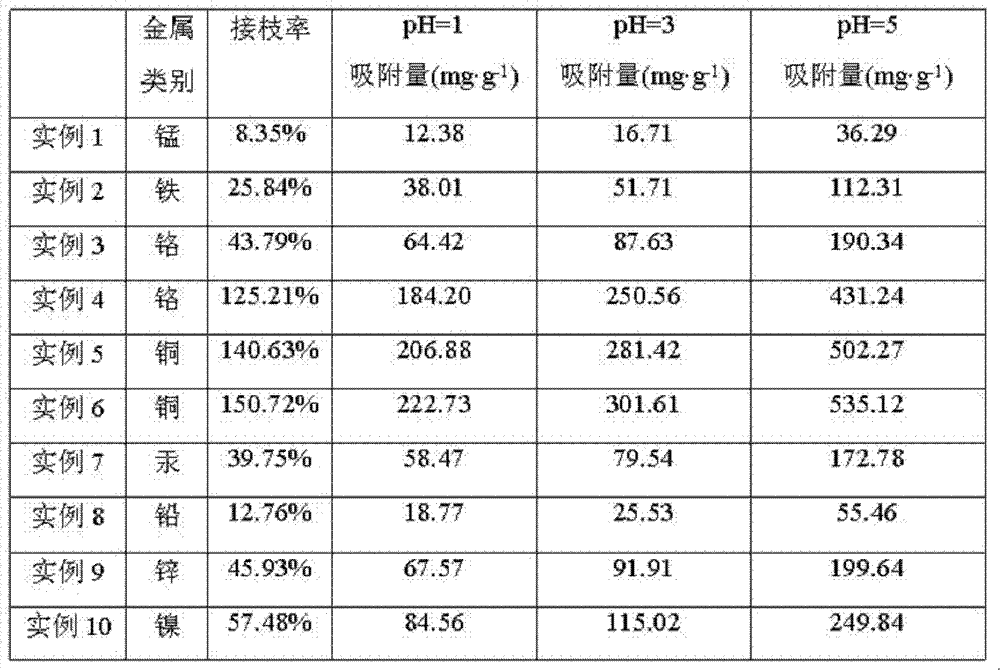
Adopt static adsorptive method to measure the adsorption effect of modifying polymer film.The modifying polymer film profile is that diameter is the circular membrane of 2.5cm, gets pH=1 respectively, pH=3, the 30ppm heavy metal ion solution 10ml of pH=5.Put into solution modifying polymer film soaked into 3s in acetone after, 30 ℃ of condition constant temperature 24 hours, take out solution and with the corresponding heavy metal ion content of atom spectrophotometry, and calculate adsorptive capacity.Each example repeats 8 times and obtains mean value.By experiment the result as can be seen, along with the increase of percentage of grafting, the raising of pH, adsorptive capacity progressively increases.Confirmed fully that simultaneously " the polymer-modified preparation method of film material of micro heavy ionic in a kind of effective removal water body " disclosed by the invention can hydrophobic property polymer separation film hydrophilicity and to the absorption property of mn ion, iron ion, chromium ion, cupric ion, lead ion, mercury ion, zine ion, nickel ion.
Claims (9)
1. effectively remove the polymer-modified preparation method of film material of micro heavy ionic in the water body for one kind, it is characterized in that forming by following step successively:
Step 1), polymeric film material is placed between two discharge electrodes of dielectric barrier discharge, feed the mixed gas of rare gas element and oxygen, carry out the atmospheric dielectric barrier discharge plasma and handle;
Step 2), initiator is dissolved in normal heptane preparation initiator solution, with monomer preparation monomer solution soluble in water, use potassium primary phosphate and sodium hydroxide preparation buffered soln, use the activated solution of above-mentioned buffer preparation carbodiimide and N-hydroxy-succinamide, with the water-soluble preparation polyethylene polyamine of the polyethylene polyamine aqueous solution, described monomer is vinylformic acid, maleic anhydride, rosin acid, methacrylic acid or Ba Dousuan;
Step 3), the polymeric film material after the Cement Composite Treated by Plasma was soaked in above-mentioned initiator solution 10~60 minutes, dry 1~5 minute activated polymer film of UV-irradiation surface under nitrogen protection, back, make the activation film;
Step 4), the above-mentioned activation film that makes is put into monomer solution, UV-irradiation is 5~30 minutes under nitrogen protection, carries out the graft polymerization reaction on activation film surface;
Step 5), the film after the grafting is put into activated solution carried out priming reaction 1~2 hour after ethanol cleans up, put into buffered soln then and clean;
Step 6), the film after the above-mentioned cleaning is put into the polyethylene polyamine aqueous solution carried out linked reaction 12~24 hours, clean up the final vacuum drying, promptly make and effectively to remove the polymer-modified mould material of micro heavy ionic in the water body through ethanol.
2. the polymer-modified preparation method of film material of micro heavy ionic in effective removal water body as claimed in claim 1, it is characterized in that: in the described step 1), distance during described Cement Composite Treated by Plasma between two discharge electrodes is 1.5~3 centimetres, the rare gas element that feeds during discharge is helium or argon gas, the volume ratio of rare gas element and oxygen is 97~99.5:0.5~3, the intake velocity of mixed gas is 0.5~10 liter/minute, discharge power is 50~150 watts, discharge frequency is 10 kilohertzs, and the treatment time is 20~180 seconds.
3. the polymer-modified preparation method of film material of micro heavy ionic in effective removal water body according to claim 1 is characterized in that: the polymeric film material described in the step 1) is polypropylene, polystyrene, polyacrylonitrile, polyvinyl chloride, polyetherimide, polysulfones, polyethersulfone, polyvinylidene difluoride (PVDF) or tetrafluoroethylene.
4. the polymer-modified preparation method of film material of micro heavy ionic in effective removal water body according to claim 1; it is characterized in that: step 2) described in initiator be phenylbenzene (2; 4; the 6-trimethylbenzoyl) phosphine oxide, st-yrax dme, benzophenone, thioxanthone, camphorquinone, 2-hydroxy-2-methyl-1-phenyl-acetone, 1-hydroxy-cyclohexyl phenyl ketone or 2; 4,6-trimethylbenzoyl phenyl-phosphonic acid ethyl ester.
5. the polymer-modified preparation method of film material of micro heavy ionic in effective removal water body according to claim 1, it is characterized in that: step 2) described in initiator solution in the volumetric molar concentration of initiator be 10~50mmol/L, monomeric mass concentration is 20~120g/L in the monomer solution.
6. the polymer-modified preparation method of film material of micro heavy ionic in effective removal water body according to claim 1 is characterized in that: step 2) described in polyethylene polyamine be quadrol, diethylenetriamine, triethylene tetramine, tetraethylene pentamine, five ethene hexamines, six ethene, seven amine or polymine.
7. the polymer-modified preparation method of film material of micro heavy ionic in effective removal water body according to claim 1 is characterized in that: step 2) described in the mass concentration of the polyethylene polyamine aqueous solution be 5~30g/ml.
8. the polymer-modified preparation method of film material of micro heavy ionic in effective removal water body according to claim 1, it is characterized in that: step 2) described in buffered soln pH=4~6, the mol ratio of carbodiimide and N-hydroxy-succinamide is 2:5~2:1.
9. the polymer-modified preparation method of film material of micro heavy ionic in effective removal water body according to claim 1 is characterized in that: described heavy metal ion is one or more of mn ion, iron ion, chromium ion, cupric ion, mercury ion, lead ion, zine ion or nickel ion.
Priority Applications (1)
| Application Number | Priority Date | Filing Date | Title |
|---|---|---|---|
| CN 201210106966 CN102634054B (en) | 2012-04-12 | 2012-04-12 | Preparation method of modified polymer film material for effectively removing trace heavy metal ions in water body |
Applications Claiming Priority (1)
| Application Number | Priority Date | Filing Date | Title |
|---|---|---|---|
| CN 201210106966 CN102634054B (en) | 2012-04-12 | 2012-04-12 | Preparation method of modified polymer film material for effectively removing trace heavy metal ions in water body |
Publications (2)
| Publication Number | Publication Date |
|---|---|
| CN102634054A CN102634054A (en) | 2012-08-15 |
| CN102634054B true CN102634054B (en) | 2013-07-24 |
Family
ID=46618637
Family Applications (1)
| Application Number | Title | Priority Date | Filing Date |
|---|---|---|---|
| CN 201210106966 Active CN102634054B (en) | 2012-04-12 | 2012-04-12 | Preparation method of modified polymer film material for effectively removing trace heavy metal ions in water body |
Country Status (1)
| Country | Link |
|---|---|
| CN (1) | CN102634054B (en) |
Families Citing this family (18)
| Publication number | Priority date | Publication date | Assignee | Title |
|---|---|---|---|---|
| CN102935389B (en) * | 2012-10-30 | 2014-09-17 | 中国海洋大学 | Method for preparing cation exchange membrane with monovalent preferential separation function |
| CN103848999B (en) * | 2012-11-30 | 2018-03-06 | 中国科学院宁波材料技术与工程研究所 | A kind of polymer surface modifying method |
| CN104722218B (en) * | 2013-12-18 | 2017-04-26 | 天津大学 | Preparation method for solvent-resistant modified polyetherimide nanofiltration membrane |
| CN105540731B (en) * | 2015-12-30 | 2018-07-27 | 青岛康景辉环境科技集团有限公司 | A kind of chemical wastewater treatment method |
| CN106823841B (en) * | 2017-01-18 | 2019-08-23 | 燕山大学 | A preparation method of polyethersulfone functional composite separation membrane |
| CN106914282B (en) * | 2017-03-24 | 2020-04-03 | 马鞍山中创环保科技有限公司 | Method for rapidly preparing nickel-removing ion exchange fiber by using cotton fiber |
| EP3635056B1 (en) | 2017-06-30 | 2024-04-10 | Kraton Polymers LLC | Light color rosin ester compositions and methods of making same |
| CN111138570B (en) * | 2018-11-05 | 2021-10-19 | 中昊晨光化工研究院有限公司 | A kind of treatment method of fluorine-containing dispersion concentrate scum |
| CN111434373B (en) * | 2019-01-11 | 2023-04-07 | 清华大学 | Method and system for separating and concentrating radionuclide in radioactive waste liquid by reverse osmosis membrane |
| CN112011120B (en) * | 2019-05-29 | 2022-04-26 | 合肥杰事杰新材料股份有限公司 | Modified resin material for purifying domestic water and preparation method thereof |
| CN111135876A (en) * | 2019-08-31 | 2020-05-12 | 浙江工业大学 | Preparation method of anti-pollution aliphatic PVC anion exchange membrane |
| CN111330465B (en) * | 2020-03-20 | 2022-03-15 | 济宁学院 | A kind of preparation method of adsorption material for adsorbing gold ions |
| CN112044274B (en) * | 2020-08-28 | 2022-09-09 | 盐城工学院 | A kind of preparation method of porous polytetrafluoroethylene filter membrane |
| CN112831054A (en) * | 2021-01-11 | 2021-05-25 | 广西龙酉商贸有限公司 | Method for preparing modified polyvinyl chloride |
| CN114307960A (en) * | 2021-12-29 | 2022-04-12 | 无锡凡锡环保科技有限公司 | Preparation method and application of cation pi-effect synergistic mesoporous carbon material |
| CN116328561B (en) * | 2023-02-23 | 2025-08-05 | 浙江大学 | A method for modifying polyamide composite membranes to resist biofouling using hydrated electrons |
| CN119371673B (en) * | 2024-10-30 | 2025-06-17 | 江苏恰瑞生物科技有限公司 | A modified filler for blood perfusion and preparation method thereof |
| CN119771174B (en) * | 2025-03-10 | 2025-05-27 | 深圳能源资源综合开发有限公司 | Preparation method of modified ultrafiltration membrane |
Citations (4)
| Publication number | Priority date | Publication date | Assignee | Title |
|---|---|---|---|---|
| US5348772A (en) * | 1991-06-10 | 1994-09-20 | Institut Textile De France | Use of amino groups, obtained on a polymer material by an electric treatment under nitrogen atmosphere, for accelerating a grafting reaction |
| CN101024150A (en) * | 2007-01-12 | 2007-08-29 | 中国科学院上海有机化学研究所 | Porous film material fixed with heparin on surface, its preparing method and use |
| CN101519501A (en) * | 2009-02-24 | 2009-09-02 | 上海大学 | Method for preparing polypropylene ion chelating membrane by radiation grafting method |
| CN101974741A (en) * | 2010-11-01 | 2011-02-16 | 广西师范学院 | Method for performing chemical plating on surface of polytetrafluoroethylene thin film |
-
2012
- 2012-04-12 CN CN 201210106966 patent/CN102634054B/en active Active
Patent Citations (4)
| Publication number | Priority date | Publication date | Assignee | Title |
|---|---|---|---|---|
| US5348772A (en) * | 1991-06-10 | 1994-09-20 | Institut Textile De France | Use of amino groups, obtained on a polymer material by an electric treatment under nitrogen atmosphere, for accelerating a grafting reaction |
| CN101024150A (en) * | 2007-01-12 | 2007-08-29 | 中国科学院上海有机化学研究所 | Porous film material fixed with heparin on surface, its preparing method and use |
| CN101519501A (en) * | 2009-02-24 | 2009-09-02 | 上海大学 | Method for preparing polypropylene ion chelating membrane by radiation grafting method |
| CN101974741A (en) * | 2010-11-01 | 2011-02-16 | 广西师范学院 | Method for performing chemical plating on surface of polytetrafluoroethylene thin film |
Non-Patent Citations (2)
| Title |
|---|
| 张晓等.聚丙烯无纺布预辐射接枝改性及胺化研究.《合成纤维工业》.2010,第33卷(第4期),第7-10页. |
| 聚丙烯无纺布预辐射接枝改性及胺化研究;张晓等;《合成纤维工业》;20101231;第33卷(第4期);第7-10页 * |
Also Published As
| Publication number | Publication date |
|---|---|
| CN102634054A (en) | 2012-08-15 |
Similar Documents
| Publication | Publication Date | Title |
|---|---|---|
| CN102634054B (en) | Preparation method of modified polymer film material for effectively removing trace heavy metal ions in water body | |
| Badsha et al. | An innovative pH-independent magnetically separable hydrogel for the removal of Cu (II) and Ni (II) ions from electroplating wastewater | |
| CN102671555B (en) | Preparation method and application of chitosan and polyvinyl alcohol mixed film | |
| JP6697205B2 (en) | Chelate microfiltration membrane manufacturing method, recycling method and application | |
| CN102190345A (en) | Method for enriching low-concentration heavy metal in water by recyclable magnesium hydroxide adsorbent | |
| CN102942239A (en) | Novel polymer-based composite material and preparation method of composite material as well as method for deep fluorine removal of water body | |
| CN110882631B (en) | Polyamide composite nanofiltration membrane and preparation method thereof | |
| CN104136112A (en) | Preparation method of granular oxide adsorbent, and water treatment method using same | |
| CN106865717A (en) | The device and application process of ferrous ion activation persulfate pretreatment lifting milipore filter water purification efficiency | |
| CN104138750A (en) | Method for deep dephosphorization by using embedded lanthanum oxide composite resin | |
| CN110170309B (en) | A kind of two-dimensional metal-organic framework composite membrane material, preparation method and application | |
| CN104014314B (en) | Bio-adsorbent, preparation method and application | |
| CN106823824A (en) | Carry the preparation method of the polyether sulfone functional membrane of polyamino phosphonic acid functional groups | |
| CN108993172B (en) | Preparation method of polyvinylidene fluoride composite separation membrane | |
| CN113428856B (en) | Nitrogen-phosphorus-codoped porous carbon material, and preparation and application methods thereof | |
| CN105107486A (en) | Preparation method of pseudo-boehmite composite film for adsorbing toxic Cr (VI) | |
| Hang et al. | Adsorption performances of naked and 3-aminopropyl triethoxysilane-modified mesoporous TiO2 hollow nanospheres for Cu2+, Cd2+, Pb2+, and Cr (VI) ions | |
| CN105457505A (en) | Heavy-metal-ion adsorption type anti-pollution hybrid flat-sheet separation membrane and preparation method thereof | |
| CN109304105B (en) | Forward osmosis membrane for efficient adsorption and removal of heavy metal ions, preparation method and application thereof | |
| CN108816185A (en) | A kind of easily separated type clay absorbent and preparation method thereof for removing water pollutant | |
| KR101621954B1 (en) | Chelating compound, and method of use of, poly(2-octadecyl-butanedioate) and the corresponding acid, poly(2-octadecyl-butanedioate) | |
| CN108939956B (en) | Preparation method of modified polyether sulfone functionally-graded composite membrane | |
| CN108940238B (en) | A kind of preparation method of polyethersulfone functional separation membrane for efficiently adsorbing heavy metals | |
| CN113070046B (en) | Preparation method of defluorination adsorbent modified by biopolymer composite material | |
| CN109248648B (en) | Modified bauxite for adsorbing heavy metal ions in wastewater |
Legal Events
| Date | Code | Title | Description |
|---|---|---|---|
| C06 | Publication | ||
| PB01 | Publication | ||
| C10 | Entry into substantive examination | ||
| SE01 | Entry into force of request for substantive examination | ||
| C14 | Grant of patent or utility model | ||
| GR01 | Patent grant | ||
| C41 | Transfer of patent application or patent right or utility model | ||
| TR01 | Transfer of patent right |
Effective date of registration: 20160921 Address after: 315300 No. 298 Binhai Avenue, Hangzhou Bay New District, Zhejiang, Ningbo Patentee after: NINGBO SHUIYI FILM TECHNOLOGY DEVELOPMENT CO., LTD. Address before: 315336 Binhai Road, Cixi Economic Development Zone, Ningbo, Zhejiang, China (Hangzhou Bay Area) Patentee before: Qinyuan Group Co., Ltd. |