CN102609465B - Information recommendation method based on potential communities - Google Patents
Information recommendation method based on potential communities Download PDFInfo
- Publication number
- CN102609465B CN102609465B CN201210012345.XA CN201210012345A CN102609465B CN 102609465 B CN102609465 B CN 102609465B CN 201210012345 A CN201210012345 A CN 201210012345A CN 102609465 B CN102609465 B CN 102609465B
- Authority
- CN
- China
- Prior art keywords
- community
- interest
- communities
- user
- recommended
- Prior art date
- Legal status (The legal status is an assumption and is not a legal conclusion. Google has not performed a legal analysis and makes no representation as to the accuracy of the status listed.)
- Expired - Fee Related
Links
- 238000000034 method Methods 0.000 title claims abstract description 30
- 238000005516 engineering process Methods 0.000 claims abstract description 10
- 238000004364 calculation method Methods 0.000 claims description 12
- 230000003993 interaction Effects 0.000 claims description 9
- 238000005065 mining Methods 0.000 claims description 9
- 238000011002 quantification Methods 0.000 claims description 3
- 238000000605 extraction Methods 0.000 abstract description 3
- 238000001914 filtration Methods 0.000 abstract description 2
- 230000002708 enhancing effect Effects 0.000 abstract 2
- 238000010586 diagram Methods 0.000 description 15
- 230000008569 process Effects 0.000 description 8
- 238000003860 storage Methods 0.000 description 3
- 230000008901 benefit Effects 0.000 description 2
- 230000007246 mechanism Effects 0.000 description 2
- 230000009466 transformation Effects 0.000 description 2
- 235000001674 Agaricus brunnescens Nutrition 0.000 description 1
- 238000004891 communication Methods 0.000 description 1
- 230000007547 defect Effects 0.000 description 1
- 235000019580 granularity Nutrition 0.000 description 1
- 230000010365 information processing Effects 0.000 description 1
- 238000012804 iterative process Methods 0.000 description 1
- 238000012986 modification Methods 0.000 description 1
- 230000004048 modification Effects 0.000 description 1
- 230000006855 networking Effects 0.000 description 1
- 230000008092 positive effect Effects 0.000 description 1
- 238000012545 processing Methods 0.000 description 1
- 238000011160 research Methods 0.000 description 1
- 239000013589 supplement Substances 0.000 description 1
- 238000012549 training Methods 0.000 description 1
Images


Landscapes
- Management, Administration, Business Operations System, And Electronic Commerce (AREA)
- Information Retrieval, Db Structures And Fs Structures Therefor (AREA)
Abstract
Description
技术领域technical field
本发明涉及信息推荐技术领域,尤其涉及一种基于潜在社群的信息推荐方法。The present invention relates to the technical field of information recommendation, in particular to an information recommendation method based on potential communities.
背景技术Background technique
随着信息社会从“E社会(Electronic Society)”向“U社会(Universal、User-Centric、Ubiquitous Society)”的高级阶段发展,信息推荐技术的研究将具有越来越重要的理论意义和广阔的应用前景,能够被应用于电子商务、数字家庭、娱乐游戏、新闻等许多领域。这种转变的根本原因是计算环境正在实现从以CPU为中心的图灵模式单机向以互联网为中心的网络化跨越和转变;全球51亿移动用户,正通过微博客、Facebook、Twitter等新兴应用,以及移动设备上的各类传感器,改变着传统信息创造、传递、处理、体验的方式。正是网络化的进程加速了信息的交互与增值。2007年底,全球数字信息总量首次超出全球所拥有的存储总量,而在随后的3年里,云计算和物联网为代表的互联网应用深化,导致各类传感器的普及和基于Web2.0的服务混搭技术的风靡,各种新生数据源如雨后春笋般涌现。据美国《科学》杂志最新报道,截止2011年2月,全球生成、捕获与复制所产生的信息量相比2007年增长了4倍,逼近1300EB,信息总量已经达到了存储能力的两倍,同时,信息总冗余量也达到了75%的惊人比例。这种态势一方面给信息处理、通信和存储能力提出更高要求;另一方面,尽管所处的信息空间在急剧膨胀,但人们真正需求的只是那些与自己的兴趣、工作、专业、学习等相关的个性化信息,在信息社会的高级阶段,人们已从对简单信息的需求转化为对有用信息和知识信息的需求,海量信息必须经过过滤才不会对人形成困扰。如何快速、精准地为用户提供有价值的信息服务成为当前巨大的挑战性问题。因此,海量信息推荐的重点在于如何在合适的时间、合适的地点、选择合适的信息提供满足用户需求的服务。As the information society develops from "E-society (Electronic Society)" to "U-society (Universal, User-Centric, Ubiquitous Society)", the research on information recommendation technology will have more and more important theoretical significance and broad application. The application prospect can be applied to many fields such as e-commerce, digital home, entertainment games, news, etc. The fundamental reason for this transformation is that the computing environment is realizing the leap and transformation from the CPU-centered Turing model stand-alone to the Internet-centered network; 5.1 billion mobile users around the world are using emerging applications such as microblog, Facebook, Twitter, etc. , and various sensors on mobile devices are changing the way traditional information is created, transmitted, processed, and experienced. It is the process of networking that accelerates the interaction and value-added of information. At the end of 2007, the total amount of global digital information exceeded the total amount of storage in the world for the first time, and in the following three years, the deepening of Internet applications represented by cloud computing and the Internet of Things led to the popularization of various sensors and Web2.0-based With the popularity of service mash-up technology, various new data sources have sprung up like mushrooms after rain. According to the latest report of the American "Science" magazine, as of February 2011, the amount of information generated, captured and copied globally has increased by 4 times compared with 2007, approaching 1300EB, and the total amount of information has reached twice the storage capacity. At the same time, the total redundancy of information has reached an astonishing ratio of 75%. On the one hand, this situation puts forward higher requirements for information processing, communication, and storage capabilities; on the other hand, although the information space in which they live is rapidly expanding, what people really need are those information related to their interests, jobs, majors, studies, etc. Relevant personalized information, in the advanced stage of the information society, people have transformed from the demand for simple information to the demand for useful information and knowledge information. Massive information must be filtered so that it will not cause trouble to people. How to quickly and accurately provide users with valuable information services has become a huge challenge. Therefore, the focus of mass information recommendation is how to provide services that meet user needs at the right time, at the right place, and with the right information.
社群(Group)是目前社会媒体网站中非常流行的一种机制,例如Youtube、Flickr等。用户能够手工创建Group用于实现资源的功能与推荐。研究发现,超过一半的Flickr用户参与了至少一个Group,这表明用户热衷于抱团式的资源共享,同时Group又会吸引大量新用户,提高站点的热度。通常,每个Group包含一个或多个主题的资源,用户若对这些主题中的部分感兴趣,则可以加入这个Group,并与其中的所有用户分享资源。不过,目前的Group机制也存在一些不足:Community (Group) is a very popular mechanism in social media websites, such as Youtube, Flickr and so on. Users can manually create groups to implement resource functions and recommendations. The study found that more than half of Flickr users participated in at least one Group, which shows that users are keen on group-style resource sharing, and at the same time, Groups will attract a large number of new users and increase the popularity of the site. Usually, each Group contains resources of one or more themes. If users are interested in some of these themes, they can join this Group and share resources with all users in it. However, the current Group mechanism also has some shortcomings:
.自组织:一个主题也许对应了大量Group,如Flickr中与“鸟”相关的主题有近3万个。对于这种情况,用户往往会不知错所,迷茫于到底加入哪个group;. Self-organization: A topic may correspond to a large number of Groups. For example, there are nearly 30,000 topics related to "birds" in Flickr. In this case, users often don't know where to go wrong, and are confused about which group to join;
.多义性:一个资源,无论是图像、视频或软件服务,往往包含了众多的语义信息,用户如何分类这些资源,并上传到对应的Group里,一直是个问题;.Ambiguity: A resource, whether it is an image, video, or software service, often contains a lot of semantic information. How users classify these resources and upload them to the corresponding Group has always been a problem;
.潜意识性:用户经常会意识不到自己的实际兴趣,可能会错过很多Group加入;.Subconsciousness: users are often unaware of their actual interests, and may miss out on joining many groups;
.噪声:由于Group是一种完全自由、松散的方式构造起来的,导致很多Group中可能会存在一些与其主题无关的资源,或者对该主题并不是很感兴趣的用户,导致基于Group的推荐经常会导致错误。.Noise: Since Group is constructed in a completely free and loose way, many Groups may contain some resources that are not related to their topic, or users who are not very interested in the topic, resulting in frequent recommendation based on Group will cause an error.
正是由于目前Group的以上缺陷,导致了无序的资源推荐。因此,大部分研究着重于探索如何推荐合适的Group给用户,或者将一个资源推荐到合适的Group中。不过,尽管这些方法能够选出最适合的Group推荐给某个用户或某个资源,大多数兴趣相似的用户可能仍然分居在不同Group中,无法进行充分的资源共享与推荐。It is precisely because of the above defects of the current Group that lead to disordered resource recommendations. Therefore, most studies focus on exploring how to recommend appropriate groups to users, or recommend a resource to an appropriate group. However, although these methods can select the most suitable group to recommend to a certain user or a certain resource, most users with similar interests may still live in different groups, unable to fully share and recommend resources.
发明内容Contents of the invention
针对上述存在的技术问题,本发明的目的是提供一种基于潜在社群的信息推荐方法,实现准确高效而不失新颖的自动推荐。In view of the above-mentioned technical problems, the purpose of the present invention is to provide an information recommendation method based on potential communities, so as to realize accurate, efficient and novel automatic recommendation.
为达到上述目的,本发明采用的技术方案为一种基于潜在社群的信息推荐方法,包含以下步骤:In order to achieve the above purpose, the technical solution adopted by the present invention is a potential community-based information recommendation method, which includes the following steps:
步骤1,根据用户历史数据记录来进行用户兴趣模型挖掘,包括以下步骤,Step 1, perform user interest model mining according to user historical data records, including the following steps,
步骤1.1,采用特征发现技术从用户交互过的信息中挖掘出兴趣;Step 1.1, using feature discovery technology to mine interests from the information that users have interacted with;
步骤1.2,根据用户与信息交互次数的量化,衡量用户对兴趣的感兴趣程度;Step 1.2, according to the quantification of the number of interactions between the user and the information, measure the user's interest in the interest;
步骤1.3,将用户、兴趣以及用户对兴趣的感兴趣程度组织成用户兴趣模型;Step 1.3, organize users, interests, and user interest in interests into a user interest model;
步骤2,基于用户兴趣模型进行潜在社群发现,并根据社群层次关系定义对潜在社群进行社群层次关系挖掘,得到社群层次结构;Step 2, discover potential communities based on the user interest model, and mine potential communities for community hierarchical relationships according to the definition of community hierarchical relationships to obtain the community hierarchy;
所述潜在社群包括单一兴趣社群和多兴趣社群,一个社群的所有用户构成该社群的用户集,一个社群的所有兴趣构成该社群的兴趣集;The potential community includes a single interest community and a multi-interest community, all users of a community form the user set of the community, and all interests of a community form the interest set of the community;
所述社群层次关系定义如下,The community hierarchical relationship is defined as follows,
(1)若一个社群G的用户集包含另一个社群G′的用户集,同时社群G的兴趣集被社群G′的兴趣集包含,则社群G是社群G′的上位社群,社群G′是社群G的下位社群;(1) If the user set of a community G includes the user set of another community G', and the interest set of the community G is included by the interest set of the community G', then the community G is the superior of the community G' Community, community G′ is the subordinate community of community G;
(2)若一个上位社群和一个下位社群之间不存在别的社群,则称为直接上位社群和直接下位社群;(2) If there is no other community between a superior community and a subordinate community, it is called a direct superior community and a direct subordinate community;
(3)只有直接上位社群和直接下位社群之间才有连接,并且直接上位社群通过键指向直接下位社群,这个键是直接下位社群比直接上位社群多出来的单一兴趣社群编号;(3) There is only a connection between the directly superior community and the directly subordinate community, and the directly superior community points to the direct subordinate community through a key, which is a single interest community that has more direct subordinate communities than directly superior communities group number;
基于用户兴趣模型进行潜在社群发现包括以下步骤,The potential community discovery based on the user interest model includes the following steps,
步骤2.1,根据用户兴趣模型发现单一兴趣社群,Step 2.1, discovering a single interest community based on the user interest model,
所述单一兴趣社群表示为,The single interest community is expressed as,
{(tidk)(∪uj)}{(t i d k )(∪u j )}
其中,tidk为单一兴趣社群的编号,ti表示该社群对应的兴趣,dk表示该社群对应的兴趣度,∪uj表示该社群对应的用户集,dk根据该社群对应的用户对兴趣ti的感兴趣程度量化得到;Among them, t i d k is the serial number of a single interest community, t i represents the interest corresponding to the community, d k represents the degree of interest corresponding to the community, ∪u j represents the user set corresponding to the community, and d k is based on The degree of interest of the users corresponding to the community to the interest t i is quantified;
步骤2.2,基于单一兴趣社群迭代发现多兴趣社群,Step 2.2, iteratively discovering multiple interest communities based on a single interest community,
所述多兴趣社群表示为,The multi-interest community is expressed as,
{(∪gi)(∪uj)}{(∪g i )(∪u j )}
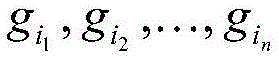
其中,gi表示该社群包含的某个单一兴趣社群,∪gi表示该社群对应的单一兴趣社群集合,采用组合成该社群的所有单一兴趣社群的编号的集合表示,即单一兴趣社群编号集合;∪uj表示该社群对应的用户集;Among them, g i represents a single interest community contained in the community, ∪g i represents the set of single interest communities corresponding to the community, and is represented by a set of numbers of all single interest communities combined into the community, That is, a single interest community ID set; ∪u j represents the user set corresponding to the community;
所述迭代发现多兴趣社群的实现方式如下,The implementation of the iterative discovery of multiple interest communities is as follows,
设有单一兴趣社群gi,按照i=0,1…Max的顺序,分别组合社群gi和社群gi,gi+1…gMax,从中发现单一兴趣社群编号集合包括单一兴趣社群gi的编号的所有社群;若社群gi与gj组合生成新社群,基于社群层次关系判断新社群是否是被包含的社群,若是则去除新社群,若不是则将新社群加入社群层次关系,并将新社群和社群gi继续与社群gj,gj+1…gMax分别组合;There is a single interest community g i , according to the order of i=0, 1...Max, the community g i and the community g i , g i+1 ...g Max are respectively combined, and it is found that the number set of the single interest community includes a single All communities with the number of interest community g i ; if the combination of community g i and g j generates a new community, judge whether the new community is an included community based on the community hierarchy relationship, and if so, remove the new community, If not, add the new community to the community hierarchical relationship, and continue to combine the new community and community g i with the community g j , g j+1 ...g Max respectively;
所述组合,是指将两个社群的兴趣集取并集,两个社群的用户集取交集;The combination refers to the union of the interest sets of the two communities, and the intersection of the user sets of the two communities;
所述生成新社群,是指当组合所得社群的用户集中用户数目不小于预设阈值时,将组合所得社群作为生成的新社群;The generating a new community refers to taking the combined community as the generated new community when the number of users in the combined community is not less than the preset threshold;
所述包含,是指若一个社群A包含另一个社群B,则表示组合成社群B的单一兴趣社群集合是组合成社群A的单一兴趣社群集合的子集,社群B的用户集是社群A的用户集的子集;The inclusion means that if a community A includes another community B, it means that the single-interest community set combined into community B is a subset of the single-interest community set combined into community A, and community B The user set of community A is a subset of the user set of community A;
判断新社群是否是被包含的社群的具体实现方式如下,The specific implementation of judging whether the new community is an included community is as follows,
设一个多兴趣社群G,若多兴趣社群G被包含,则在包含多兴趣社群G的所有社群中,一定存在一个社群G′是其他社群的上位社群;Suppose a multi-interest community G, if the multi-interest community G is included, then among all the communities including the multi-interest community G, there must be a community G′ that is the superior community of other communities;
设组合成多兴趣社群G的单一兴趣社群为多兴趣社群G指向单一兴趣社群

首先定位到单一兴趣社群


若不存在社群G′,则判定多兴趣社群G不被包含,若找到社群G′,则判断社群G′的用户集是否包含多兴趣社群G的用户集,若包含则多兴趣社群G是被包含的,否则多兴趣社群G不被包含;If there is no community G', it is determined that the multi-interest community G is not included, if the community G' is found, then it is judged whether the user set of the community G' includes the user set of the multi-interest community G, if it is included, then more The interest community G is included, otherwise the multi-interest community G is not included;
步骤3,基于社群层次关系进行推荐,包括以下步骤,Step 3, recommending based on the hierarchical relationship of the community, including the following steps,
步骤3.1,挖掘待推荐项目包含的兴趣;Step 3.1, mining the interests contained in the items to be recommended;
步骤3.2,根据待推荐项目包含的兴趣,按照步骤2所得社群层次关系找到满足推荐条件的待推荐社群,将待推荐项目推送到找到的待推荐社群;Step 3.2, according to the interests contained in the items to be recommended, according to the hierarchical relationship of the communities obtained in step 2, find the communities to be recommended that meet the recommendation conditions, and push the items to be recommended to the found communities to be recommended;
步骤3.3,记录用户反馈信息并更新社群层次关系。Step 3.3, record user feedback information and update community hierarchy.
而且,步骤3.2中,查找满足推荐条件的待推荐社群的具体方式如下,Moreover, in step 3.2, the specific method of finding the community to be recommended that meets the recommendation conditions is as follows,
步骤a,首先将单一兴趣社群列表L0中满足推荐条件的社群加入到推荐社群列表L1中,将不满足推荐条件的加入到待推荐社群列表L2中;Step a, first add the communities that meet the recommendation conditions in the single-interest community list L0 to the recommended community list L1, and add those that do not meet the recommendation conditions to the community list to be recommended L2;
步骤b,将L2中的社群与L2中的社群组合,得到社群组合结果;Step b, combining the communities in L2 with the communities in L2 to obtain the community combination result;
步骤c,将社群组合结果在社群层次关系中查找到相应的社群加入到社群列表L3;Step c, find the corresponding community in the community hierarchical relationship as a result of the community combination and add it to the community list L3;
步骤c,将L3中社群与L1中社群进行比较,若包含L1中社群则从L3中剔除;Step c, compare the community in L3 with the community in L1, and remove it from L3 if it includes the community in L1;
步骤d,判断L3中社群是否满足推荐条件,将满足推荐条件的社群加入到L1中;Step d, judge whether the communities in L3 meet the recommendation conditions, and add the communities that meet the recommendation conditions into L1;
步骤e,将不满足推荐条件的社群加入到待推荐社群列表L4中;将L4中的社群继续与L2中的社群组合得到社群组合结果,返回执行步骤b,不断的循环下去,直到L3或者L4为空为止。Step e, add communities that do not meet the recommendation conditions to the community list L4 to be recommended; continue to combine the communities in L4 with the communities in L2 to obtain the community combination result, return to step b, and continue to cycle , until L3 or L4 is empty.
而且,判断一个社群是否满足推荐条件,根据待推荐兴趣组合和待推荐社群间相似度决定,计算公式如下,Moreover, to judge whether a community meets the recommendation conditions, it is determined according to the similarity between the interest combination to be recommended and the community to be recommended. The calculation formula is as follows,
其中,ot表示待推荐项目包含的所有兴趣构成的待推荐兴趣组合,gt表示待推荐社群的兴趣集,δ是避免出现除零情况的参数,Pscore表示待推荐兴趣组合和待推荐社群的兴趣集的同向度,Nscore表示待推荐兴趣组合和待推荐社群的兴趣集的异向度。Among them, o t represents the interest combination to be recommended composed of all interests contained in the item to be recommended, g t represents the interest set of the community to be recommended, δ is a parameter to avoid division by zero, and P score represents the interest combination to be recommended and the value to be recommended The same direction of the interest set of the community, N score indicates the degree of dissimilarity between the interest set to be recommended and the interest set of the community to be recommended.
本发明具有以下优点和积极效果:The present invention has the following advantages and positive effects:
1)通过潜在Group发现,将具有相似兴趣的群体聚集在一起,并根据兴趣的多少、用户的众寡,实现不同粒度的Group层次化抽象,从而能够实现灵活的信息自动批量推送,相比传统点对点的推荐技术,在效率上有大幅提升;1) Through latent Group discovery, groups with similar interests are gathered together, and according to the number of interests and the number of users, the hierarchical abstraction of Groups with different granularities can be realized, so that flexible information can be automatically pushed in batches, compared with traditional Point-to-point recommendation technology has greatly improved efficiency;
2)在潜在Group挖掘过程中集成了协同过滤技术,从而使得同一Group中的不同用户能够相互间接影响、学习,从而增加信息推荐的新颖性。2) Collaborative filtering technology is integrated in the process of potential group mining, so that different users in the same group can indirectly influence and learn from each other, thereby increasing the novelty of information recommendation.
附图说明Description of drawings
图1是本发明实施例的流程图;Fig. 1 is the flowchart of the embodiment of the present invention;
图2是本发明实施例的用户兴趣模型示意图;Fig. 2 is a schematic diagram of a user interest model according to an embodiment of the present invention;
图3是本发明实施例的单一兴趣社群示意图;Fig. 3 is a schematic diagram of a single interest community in an embodiment of the present invention;
图4是本发明实施例中基于单一兴趣社群迭代发现多兴趣社群的示意图;FIG. 4 is a schematic diagram of iteratively discovering multiple interest communities based on a single interest community in an embodiment of the present invention;
图5是本发明实施例中对单一兴趣社群g0组合成多兴趣社群的示意图;FIG. 5 is a schematic diagram of combining a single interest community g0 into multiple interest communities in an embodiment of the present invention;
图6是本发明实施例中多兴趣社群发现结果的示意图;Fig. 6 is a schematic diagram of the discovery result of the multi-interest community in the embodiment of the present invention;
图7是本发明实施例中社群层次关系的示意图;Fig. 7 is a schematic diagram of the hierarchical relationship of communities in the embodiment of the present invention;
图8是本发明实施例中社群层次关系生成过程中的示意图;Fig. 8 is a schematic diagram of the generation process of the community hierarchical relationship in the embodiment of the present invention;
图9是本发明实施例中待推荐社群寻找过程中的示意图;Fig. 9 is a schematic diagram of the process of finding a community to be recommended in the embodiment of the present invention;
图10是本发明实施例中待推荐项目与待推荐社群之间匹配的示意图,其中图10a是Nscore=γ1的示意图,图10b是Nscore=γ1+γ2的示意图,图10c是Nscore=γ1+γ3的示意图,图10d是Nscore=γ1+γ2+γ3的示意图。Fig. 10 is a schematic diagram of matching between an item to be recommended and a community to be recommended in an embodiment of the present invention, wherein Fig. 10a is a schematic diagram of N score = γ 1 , Fig. 10b is a schematic diagram of N score = γ 1 + γ 2 , and Fig. 10c is a schematic diagram of N score =γ 1 +γ 3 , and FIG. 10d is a schematic diagram of N score =γ 1 +γ 2 +γ 3 .
具体实施方式Detailed ways
以下结合附图和实施例详细说明本发明技术方案。The technical solution of the present invention will be described in detail below in conjunction with the drawings and embodiments.
本发明提供了一种基于潜在社群的信息推荐方法,实施例的处理流程如图1所示:收集的用户历史数据记录可以保存在数据库中,实施例通过特征发现技术从收集的用户历史数据记录中挖掘出用户兴趣模型;然后根据用户兴趣模型进行潜在社群发现并挖掘出社群间的层次关系。推荐时则通过特征提取从待推荐项目中提取出待推荐兴趣集合,然后结合社群层次结构的特点,快速定位到待推荐社群;再根据推荐算法,计算待推荐社群与待推荐兴趣集合间的相似度来决策是否满足推荐条件。最后,若推荐成功,记录用户反馈信息作为新的用户历史数据记录写入数据库,并参加下一次更新,这样可以保持社群层次关系自动更新。The present invention provides a method for recommending information based on potential communities. The processing flow of the embodiment is shown in Figure 1: the collected user history data records can be stored in the database, and the embodiment uses the feature discovery technology to collect user history data The user interest model is mined from the records; and then the potential community is discovered according to the user interest model and the hierarchical relationship between the communities is mined. When recommending, feature extraction is used to extract the recommended interest set from the items to be recommended, and then combine the characteristics of the community hierarchy to quickly locate the community to be recommended; then calculate the community to be recommended and the interest set to be recommended according to the recommendation algorithm The similarity between them is used to determine whether the recommendation conditions are met. Finally, if the recommendation is successful, the recorded user feedback information will be written into the database as a new user history data record, and will participate in the next update, so as to keep the community hierarchy automatically updated.
为便于实施参考起见,实施例的具体步骤提供如下:For ease of implementation reference, the specific steps of the embodiment are provided as follows:
步骤1,根据用户历史数据记录来进行用户兴趣模型挖掘,包括以下步骤:Step 1, perform user interest model mining according to user historical data records, including the following steps:
步骤1.1,根据用户历史数据记录,采用特征发现技术从用户交互过的信息中挖掘出兴趣。Step 1.1, according to the user's historical data records, use feature discovery technology to mine interests from the information that users have interacted with.
针对不同信息的特点,所采用的特征发现方法也将有所不同,不过最终都归结到分类问题。以图片的特征发现为例,首先对图片进行切割,然后对每一部分进行特征提取之后再与训练集进行相似性计算,对应到Tag(语义),最后对Tag进行聚类,每一类将成为一个兴趣。本发明不予赘述。According to the characteristics of different information, the feature discovery methods adopted will also be different, but they all come down to the classification problem in the end. Taking the feature discovery of pictures as an example, first cut the picture, then perform feature extraction on each part, and then perform similarity calculation with the training set, corresponding to Tag (semantics), and finally cluster the Tag, each class will become an interest. The present invention will not be described in detail.
步骤1.2,根据用户与信息交互次数的量化来衡量用户对兴趣的感兴趣程度。In step 1.2, measure the user's interest in the interest based on the quantification of the number of times the user interacts with the information.
针对不同的兴趣,结合每个用户与所有信息的交互次数来衡量用户在该兴趣上的兴趣度。用户i在兴趣t上的兴趣度
其中,表示用户i与兴趣t的交互次数,IFi表示用户i的交互频率,α用来避免出现除零情况。IFi的计算公式为:in, Indicates the number of interactions between user i and interest t, IF i indicates the interaction frequency of user i, and α is used to avoid division by zero. The calculation formula of IF i is:
其中,sumINi表示用户i的总交互次数,avgIN表示平均每个用户的交互次数。然后在每个兴趣t上根据所有用户的兴趣度Dt来判定该用户对兴趣t的感兴趣程度。Among them, sumIN i represents the total number of interactions of user i, and avgIN represents the average number of interactions per user. Then, on each interest t, according to the degree of interest D t of all users, the user's degree of interest in the interest t is determined.
步骤1.3,将用户、兴趣以及它们之间的关系组织成用户兴趣模型。Step 1.3, organize users, interests and their relationships into a user interest model.
量化了所有用户与兴趣之间的关系(即用户对兴趣的感兴趣程度)后,就能形成用户兴趣模型。图2是用户兴趣模型的一个示例。该模型的每列(t1、t2、t3、t4)表示一个兴趣,每行(u1、u2、u3、u4、u5、u6)表示一个用户,中间的权值表示用户对兴趣的感兴趣程度,感兴趣程度的由低到高为d1、d2、d3。模型中用0表示感兴趣程度未知,就是还没有该用户与该兴趣的对应关系。After quantifying the relationship between all users and interests (that is, the degree to which users are interested in interests), a user interest model can be formed. Figure 2 is an example of a user interest model. Each column (t1, t2, t3, t4) of the model represents an interest, each row (u1, u2, u3, u4, u5, u6) represents a user, and the weight in the middle represents the user's interest in the interest. The degree of interest from low to high is d1, d2, d3. In the model, 0 means that the degree of interest is unknown, that is, there is no corresponding relationship between the user and the interest.
步骤2,基于用户兴趣模型进行潜在社群发现,并根据社群层次关系定义对潜在社群进行社群层次关系挖掘,得到社群层次结构。Step 2: Discover potential communities based on the user interest model, and perform community hierarchy relationship mining on potential communities according to the community hierarchy relationship definition to obtain the community hierarchy.
所述潜在社群包括单一兴趣社群和多兴趣社群,一个社群的所有用户构成该社群的用户集,一个社群的所有兴趣构成该社群的兴趣集。The potential communities include single-interest communities and multi-interest communities. All users of a community constitute a user set of the community, and all interests of a community constitute the interest set of the community.
步骤2.1,根据用户兴趣模型发现包含单一兴趣的社群。Step 2.1, discover communities containing a single interest based on the user interest model.
在用户兴趣模型中,针对单个兴趣,将感兴趣程度相同的用户划分到同一个社群,这样的社群由于只涉及到单个兴趣,故本发明称为单一兴趣社群。单一兴趣社群包含的属性有兴趣,兴趣等级和用户集。以图2为例,进行单一兴趣社群发现之后,见图3,兴趣t1、t2、t3、t4和兴趣等级d1、d2、d3构成单一兴趣社群g0、g1、g2、g3、g4、g5、g6、g7、g8、g9、g10、g11。例如,在兴趣t1上,用户u1,u2,u3,u4的兴趣度都是d1,故他们构成单一兴趣社群g0,用户u5,u6的兴趣度都是d2,构成g1,没有用户的兴趣为d3,因此g2为Φ(空集)。In the user interest model, for a single interest, users with the same degree of interest are divided into the same community. Since such a community only involves a single interest, the present invention is called a single interest community. The attributes included in a single interest community are interest, interest level and user set. Taking Figure 2 as an example, after discovering a single interest community, see Figure 3, interests t1, t2, t3, t4 and interest levels d1, d2, d3 form a single interest community g0, g1, g2, g3, g4, g5 , g6, g7, g8, g9, g10, g11. For example, on interest t1, users u1, u2, u3, and u4 all have an interest degree of d1, so they form a single interest community g0, users u5 and u6 all have an interest degree of d2, forming g1, and no user’s interest is d3, so g2 is Φ (empty set).
某个单一兴趣社群可以表示成A single interest community can be expressed as
{(tidk)(∪uj)}{(t i d k )(∪u j )}
其中,单一兴趣社群的编号tidk包含兴趣和兴趣度两个信息,ti表示该社群对应的兴趣,dk表示该社群对应的兴趣度,∪uj表示该社群对应的用户集。dk根据该社群对应的用户对兴趣ti的感兴趣程度量化得到,即步骤1.2计算结果。Among them, the number t i d k of a single interest community contains two information of interest and interest degree, t i indicates the interest corresponding to the community, d k indicates the interest degree corresponding to the community, ∪u j indicates the corresponding interest of the community set of users. d k is quantified according to the degree of interest t i of the user corresponding to the community, which is the calculation result of step 1.2.
步骤2.2,基于单一兴趣社群迭代发现包含多兴趣的社群。Step 2.2, iteratively discover communities containing multiple interests based on a single interest community.
不同的单一兴趣社群,若用户集有交集(实施例设定不少于2),就能组合成包含多兴趣的社群,本发明称为多兴趣社群。多兴趣社群包含两个属性,分别是用户集和单一兴趣社群编号集合。单一兴趣社群编号集合取组合成它的单一兴趣社群的兴趣及兴趣度的并集,用户集取组合成它的单一兴趣社群用户集的交集。单一兴趣社群的编号由单一兴趣社群对应的兴趣和兴趣度共同唯一确定,即tidk。例如,图3中g0,g4,g6就能组合成图2中标记的多兴趣社群。Different single-interest communities can be combined into a community containing multiple interests if the user sets overlap (the embodiment setting is not less than 2), which is called a multi-interest community in the present invention. A multi-interest community includes two attributes, namely user set and single-interest community ID set. The ID set of a single interest community is the union of the interest and degree of interest of the single interest communities that compose it, and the user set is the intersection of the user sets of the single interest communities that compose it. The number of a single interest community is uniquely determined by the interest and interest degree corresponding to the single interest community, that is, t i d k . For example, g0, g4, and g6 in Figure 3 can be combined into the multi-interest community marked in Figure 2.
某个多兴趣社群可以表示成A multi-interest community can be expressed as
{(∪gi)(∪uj)}{(∪g i )(∪u j )}
其中,gi表示该社群包含的某个单一兴趣社群,∪gi表示该社群对应的单一兴趣社群集合,可采用组合成该社群的所有单一兴趣社群的编号的集合表示,即单一兴趣社群编号集合。∪uj表示该社群对应的用户集。Among them, g i represents a single interest community contained in the community, and ∪g i represents the set of single interest communities corresponding to the community, which can be represented by a set of numbers of all single interest communities combined into the community , which is a collection of IDs for a single community of interest. ∪u j represents the user set corresponding to the community.
实施例发现包含多兴趣的社群采用迭代的过程见图4,设有单一兴趣社群g0,g1…gMax,首先考虑单一兴趣社群g0,g1…gMax,从中找出单一兴趣社群编号集合包括单一兴趣社群g0的编号的所有社群,即找到的社群都满足单一兴趣社群g0的编号是组合成该社群的单一兴趣社群集合的子集;然后考虑g1,g2…gMax,从中找出包含单一兴趣社群g1的所有社群;依次处理,直到最后考虑单一兴趣社群gMax,从中找出包含单一兴趣社群gMax的所有社群。后产生的社群可能被前面已经生成的社群包含,因此要去包含。The embodiment finds the iterative process of communities containing multiple interests, as shown in Figure 4. There are single interest communities g0, g1...gMax, first consider the single interest communities g0, g1...gMax, and find out the number set of single interest communities All communities including the numbers of the single-interest community g0, that is, the found communities all satisfy the single-interest community g0 is a subset of the single-interest community set combined into the community; then consider g1, g2...gMax , find out all the communities that include the single interest community g1; process in turn until finally consider the single interest community gMax, and find out all the communities that include the single interest community gMax. The community generated later may be included by the previously generated community, so it must be included.
图4中每一小步的流程见图5。设有单一兴趣社群gi,按照i=0,1…Max的顺序,分别组合社群gi和社群gi,gi+1…gMax,从中发现单一兴趣社群编号集合包括单一兴趣社群gi的编号的所有社群;若社群gi与gj组合生成新社群,基于社群层次关系判断新社群是否是被包含的社群,若是则去除新社群,若不是则将新社群加入社群层次关系,并将新社群和社群gi继续与社群gj,gj+1…gMax分别组合。The flow chart of each small step in Figure 4 is shown in Figure 5. There is a single interest community g i , according to the order of i=0, 1...Max, the community g i and the community g i , g i+1 ...g Max are respectively combined, and it is found that the number set of the single interest community includes a single All communities with the number of interest community g i ; if the combination of community g i and g j generates a new community, judge whether the new community is an included community based on the community hierarchy relationship, and if so, remove the new community, If not, add the new community to the community hierarchical relationship, and continue to combine the new community and community g i with the communities g j , g j+1 ...g Max respectively.
所述组合,是指将两个社群的兴趣集取并集,两个社群的用户集取交集;The combination refers to the union of the interest sets of the two communities, and the intersection of the user sets of the two communities;
所述生成新社群,是指当组合所得社群的用户集中用户数目不小于预设阈值(实施例取值为2)时,将组合所得社群作为生成的新社群;The generating a new community refers to taking the combined community as the generated new community when the number of concentrated users in the combined community is not less than the preset threshold (the value in the embodiment is 2);
所述包含,是指若一个社群A包含另一个社群B,则表示组合成社群B的单一兴趣社群集合是组合成社群A的单一兴趣社群集合的子集,社群B的用户集是社群A的用户集的子集。The inclusion means that if a community A includes another community B, it means that the single-interest community set combined into community B is a subset of the single-interest community set combined into community A, and community B The user set of community A is a subset of the user set of community A.
以图3中的单一兴趣社群列表为例,首先按照图5中所示的流程图找出包含单一兴趣社群g0的所有社群。开始多兴趣社群列表为空,g1与g0组合,没有用户交集,不能形成多兴趣社群;g2与g0组合,同样没交集;g3与g0组合,还是没交集;g4与g0组合,交集为{u1,u3,u4},故形成G0{(g0,g4)(u1,u3,u4)},满足条件,将G0加入到多兴趣社群列表中;g5与G0,g0组合,都没用户交集;g6与G0组合,交集为{u1,u3},形成G1{(g0,g4,g6)(u1,u3)},满足条件,将G1加入到多兴趣社群列表中;g6与g0组合,形成{(g0,g6)(u1,u3)},其被G1包含,故不满足条件;g7与G0,G1,g0组合,都没交集;g8与G0组合,交集为{u4},长度小于2,不满足条件;g8与G1组合,没交集;g8与g0组合,交集为{u4},不满足条件;g9与G0,G1,g0组合,都没交集;g10与G0,G1,g0组合,都没交集;g11与G0组合,交集为{u3,u4},形成G2{(g0,g4,g11)(u3,u4)}满足条件,将G2加入到多兴趣社群列表中;g11与G1组合,交集为{u3},不满足条件;g11与g0组合,交集为{u2,u3,u4},形成G3{(g0,g11)(u2,u3,u4)},G3没有被别的社群包含,故满足条件,将G3加入到多兴趣社群列表中。New Group(新社群)由单一兴趣社群列表中成员与多兴趣社群列表中成员或者g0组合而成,即New Group由两个单一兴趣社群组合而成,或者由一个多兴趣社群和另一个单一兴趣社群组合而成。如果New Group满足条件,则加入到多兴趣社群列表。Taking the single-interest community list in FIG. 3 as an example, first find out all communities including the single-interest community g0 according to the flow chart shown in FIG. 5 . At the beginning, the multi-interest community list is empty, and the combination of g1 and g0 has no user intersection, and the multi-interest community cannot be formed; the combination of g2 and g0 also has no intersection; the combination of g3 and g0 still has no intersection; the combination of g4 and g0, the intersection is {u1,u3,u4}, so form G0{(g0,g4)(u1,u3,u4)}, if the conditions are satisfied, G0 will be added to the multi-interest community list; g5 is combined with G0, g0, and there are no users Intersection; the combination of g6 and G0, the intersection is {u1,u3}, forming G1{(g0,g4,g6)(u1,u3)}, meeting the conditions, adding G1 to the list of multi-interest communities; the combination of g6 and g0 , forming {(g0,g6)(u1,u3)}, which is contained by G1, so it does not meet the condition; the combination of g7 and G0, G1, g0 has no intersection; the combination of g8 and G0, the intersection is {u4}, the length If it is less than 2, the condition is not satisfied; when g8 is combined with G1, there is no intersection; when g8 is combined with g0, the intersection is {u4}, and the condition is not satisfied; when g9 is combined with G0, G1, g0, there is no intersection; g10 is combined with G0, G1, g0 The combination has no intersection; the combination of g11 and G0, the intersection is {u3,u4}, forming G2{(g0,g4,g11)(u3,u4)} meets the conditions, and G2 is added to the multi-interest community list; g11 Combined with G1, the intersection is {u3}, which does not meet the condition; g11 is combined with g0, the intersection is {u2,u3,u4}, forming G3{(g0,g11)(u2,u3,u4)}, G3 is not identified The community contains, so the conditions are met, and G3 is added to the list of multi-interest communities. New Group (new community) is composed of members in the single-interest community list and members in the multi-interest community list or g0, that is, New Group is composed of two single-interest communities, or a multi-interest community Combined with another single-interest community. If the New Group meets the conditions, it will be added to the multi-interest community list.
至此,包含g0的所有社群已被找到,即多兴趣社群列表中的G0,G1,G2,G3。同样的方法,按图4给出的步骤,得到的结果见图6。对单一兴趣社群gi(i的取值为0,1,4,6,8)寻找包含单一兴趣社群gi的所有社群,对单一兴趣社群g0找到的多兴趣社群为{(g0,g4)(u1,u3,u4)},{(g0,g4,g6)(u1,u3)},{(g0,g4,g11)(u3,u4)},{(g0,g11)(u2,u3,u4)},对单一兴趣社群g4找到的多兴趣社群为{(g4,g6)(u1,u3)},{(g4,g8)(u4,u5)},{(g4,g11)(u3,u4)};对其他单一兴趣社群g1、g6、g8未找到,为空集。So far, all communities containing g0 have been found, that is, G0, G1, G2, and G3 in the list of multi-interest communities. In the same way, according to the steps given in Figure 4, the results obtained are shown in Figure 6. For the single-interest community gi (the value of i is 0, 1, 4, 6, 8), find all the communities that include the single-interest community gi, and find the multi-interest community for the single-interest community g0 as {(g0 ,g4)(u1,u3,u4)},{(g0,g4,g6)(u1,u3)},{(g0,g4,g11)(u3,u4)},{(g0,g11)(u2 ,u3,u4)}, the multi-interest community found for the single interest community g4 is {(g4,g6)(u1,u3)},{(g4,g8)(u4,u5)},{(g4, g11)(u3,u4)}; for other single interest communities g1, g6, g8 are not found, it is an empty set.
实施例定义社群层次关系,所有的社群都将通过社群层次结构组织在一起。层次结构定义如下:The embodiment defines the community hierarchical relationship, and all communities will be organized together through the community hierarchy. The hierarchy is defined as follows:
(1)若一个社群G的用户集包含另一个社群G′的用户集,同时社群G的兴趣集被社群G′的兴趣集包含,则社群G是社群G′的上位社群,社群G′是社群G的下位社群;(1) If the user set of a community G includes the user set of another community G', and the interest set of the community G is included by the interest set of the community G', then the community G is the superior of the community G' Community, community G′ is the subordinate community of community G;
(2)若一个上位社群和一个下位社群之间不存在别的社群,则称为直接上位社群和直接下位社群;(2) If there is no other community between a superior community and a subordinate community, it is called a direct superior community and a direct subordinate community;
(3)只有直接上位社群和直接下位社群之间才有连接,并且直接上位社群通过键指向直接下位社群,这个键是直接下位社群比直接上位社群多出来的单一兴趣社群编号。(3) There is only a connection between the directly superior community and the directly subordinate community, and the directly superior community points to the direct subordinate community through a key, which is a single interest community that has more direct subordinate communities than directly superior communities group number.
以上特点决定了每个用户兴趣模型对应的社群层次结构是唯一的。图7所示的是对应图6的社群层次关系图:(g11)(u2,u3,u4)指向(g0.g11)(u2,u3,u4),键值为0;(g0)(u1,u2,u3,u4)指向(g0.g11)(u2,u3,u4)和(g0,g4)(u1,u3,u4),键值为11和4;(g4)(u1,u3,u4,u5)指向(g0,g4)(u1,u3,u4)和(g4,g8)(u4,u5),键值为0和8;(g6)(u1,u3)指向(g0,g4,g6)(u1,u3),键值为0,4;(g8)(u4,u5)指向(g4,g8)(u4,u5),键值为4;(g0.g11)(u2,u3,u4)指向(g0,g4,g11)(u3,u4),键值为4;(g0,g4)(u1,u3,u4)指向(g0,g4,g11)(u3,u4)和(g0,g4,g6)(u1,u3),键值为11和6。键值即下位社群比上位社群多出来的单一兴趣社群的编号。The above characteristics determine that the community hierarchy corresponding to each user interest model is unique. Figure 7 shows the community hierarchy diagram corresponding to Figure 6: (g11)(u2,u3,u4) points to (g0.g11)(u2,u3,u4), the key value is 0; (g0)(u1 ,u2,u3,u4) point to (g0.g11)(u2,u3,u4) and (g0,g4)(u1,u3,u4), key values are 11 and 4; (g4)(u1,u3,u4 ,u5) points to (g0,g4)(u1,u3,u4) and (g4,g8)(u4,u5), the key values are 0 and 8; (g6)(u1,u3) points to (g0,g4,g6 )(u1,u3), the key value is 0, 4; (g8)(u4,u5) points to (g4,g8)(u4,u5), the key value is 4; (g0.g11)(u2,u3,u4 ) points to (g0, g4, g11) (u3, u4), the key value is 4; (g0, g4) (u1, u3, u4) points to (g0, g4, g11) (u3, u4) and (g0, g4 ,g6)(u1,u3), the key values are 11 and 6. The key value is the number of a single interest community in which the lower-level community is more than the upper-level community.
图8列出了几种不同情形下社群层次结构的变化。情形(1)中,单一兴趣社群g或者多兴趣社群G与单一兴趣社群g′组合,若生成的新社群满足条件(即同时满足成为社群和不被包含的条件),则g或者G通过g′的编号指向新社群,g′则通过g的编号或者G中包含的单一兴趣社群的编号指向新社群;情形(2)中,多兴趣社群G与单一兴趣社群g组合,生成的新社群包含了G,则g通过G中包含的单一兴趣社群的编号指向G,然后再用新社群代替G(只替换社群内容,层次结构信息不替换);情形(3)则是情形(1)的一种特殊情况,即生成的新社群有下位社群存在,这种情形下,首先需要去掉g或者G和g′与下位社群G′之间的联系,然后将新社群指向G′,再建立g或者G和g′与新社群之间的联系,方法与情形(1)相同。Figure 8 lists the changes in the community hierarchy in several different situations. In case (1), if a single-interest community g or a multi-interest community G is combined with a single-interest community g′, if the generated new community satisfies the conditions (that is, satisfies both the conditions of being a community and not being included), then g or G points to the new community through the number of g', and g' points to the new community through the number of g or the number of the single-interest community contained in G; in case (2), the multi-interest community G and the single-interest community Combination of community g, the generated new community contains G, then g points to G through the number of the single interest community contained in G, and then replaces G with the new community (only the content of the community is replaced, and the hierarchical structure information is not replaced ); case (3) is a special case of case (1), that is, the generated new community has subordinate communities, in this case, it is first necessary to remove g or G and g′ and the subordinate community G′ Then point the new community to G′, and then establish the connection between g or G and g′ and the new community, the method is the same as the case (1).
例如:在多兴趣社群发现,找出包含g0的所有社群的过程中,g4与g0组合产生G0{(g0,g4)(u1,u3,u4)},符合图8中情形(1),g4,g0将分别通过键0,4指向G0;g6与G0组合产生G1{(g0,g4,g6)(u1,u3)},符合情形(1),g6通过键0,4指向G1,G0通过键6指向G1;g11与G0产生G2{(g0,g4,g11)(u3,u4)},符合情形(1),G0通过键11指向G2,g11通过键0,4指向G2;g11与g0组合产生G3{(g0,g11)(u2,u3,u4)},符合情形(3),g11将不再指向G2,而改为通过键0指向G3,G3通过键4指向G2,g0通过键11指向G3。至此包含g0的所有社群都层次化了。For example: in the process of finding out all communities including g0 in the discovery of multi-interest communities, the combination of g4 and g0 produces G0{(g0,g4)(u1,u3,u4)}, which conforms to the situation (1) in Figure 8 , g4, g0 will point to G0 through
为保证生成的所有社群都是没有包含关系的,需要针对多兴趣社群,进行去包含关系运算。即若一个社群的兴趣集和用户集同时被另一个社群包含,那么这个社群就应该去掉,这个过程称为去包含关系过程。其目的是保证所有生成的潜在社群都是有存在必要的。图6中,社群{(g4,g6)(u1,u3)},{(g4,g11)(u3,u4)}因被包含了而被去掉。实施例基于社群层次关系进行去包含关系运算。In order to ensure that all the generated communities have no inclusion relationship, it is necessary to perform de-inclusion relationship calculations for multi-interest communities. That is, if the interest set and user set of a community are included by another community at the same time, then this community should be removed. This process is called the process of deinclusion relationship. Its purpose is to ensure that all potential communities generated are necessary for existence. In Figure 6, the communities {(g4,g6)(u1,u3)},{(g4,g11)(u3,u4)} are removed because they are included. The embodiment performs the de-inclusion relationship operation based on the community hierarchical relationship.
由社群层次结构的特点能发现,给定一个多兴趣社群G,若G被包含,则在包含G的所有社群中,一定存在一个社群G′,它是其他社群的上位社群。因此,若想判断G是否被包含,只需找出G′,然后判断G是否被G′包含即可。找出G′的方法如下:From the characteristics of the community hierarchy structure, it can be found that given a multi-interest community G, if G is included, there must be a community G′ in all the communities that contain G, which is the superior community of other communities. group. Therefore, if you want to judge whether G is included, you only need to find G', and then judge whether G is included by G'. The way to find G' is as follows:
先找出组合成多兴趣社群G的单一兴趣社群,假设它们为


以图6中的社群G{(g4,g6)(u1,u3)}为例,结合图7中的层次结构图说明。首先定位到g4,然后在g4及其下位社群中查找键6,发现{(g0,g4)(u1,u3,u4)}存在键6,然后返回键6对应的G′{(g0,g4,g6)(u1,u3)};再判断G′是否包含G,发现包含,故{(g4,g6)(u1,u3)}应该去掉。Take the community G{(g4,g6)(u1,u3)} in Figure 6 as an example, combined with the hierarchical structure diagram in Figure 7 for illustration. First locate g4, then search key 6 in g4 and its subordinate communities, find that key 6 exists in {(g0,g4)(u1,u3,u4)}, and then return G′{(g0,g4) corresponding to key 6 ,g6)(u1,u3)}; then judge whether G′ contains G, and find that it does, so {(g4,g6)(u1,u3)} should be removed.
步骤3,基于社群层次关系进行推荐,包括以下步骤:Step 3, recommending based on the hierarchical relationship of the community, includes the following steps:
步骤3.1,发现待推荐项目包含的待推荐兴趣组合。Step 3.1, discover the interest combinations to be recommended contained in the items to be recommended.
用户兴趣模型中的兴趣也是通过特征发现技术从项目中挖掘出来的,这一步与步骤1.1具体实现方式相同。发现待推荐项目可能包含的多个兴趣,构成待推荐兴趣组合。Interests in the user interest model are also mined from items through feature discovery technology, and this step is the same as step 1.1. Multiple interests that may be included in the items to be recommended are found to form a combination of interests to be recommended.
步骤3.2,根据待推荐项目包含的兴趣,按照步骤2所得社群层次结构找到满足推荐条件的待推荐社群,将待推荐项目推送到找到的待推荐社群。Step 3.2, according to the interests contained in the items to be recommended, according to the community hierarchy obtained in step 2, find the communities to be recommended that meet the recommendation conditions, and push the items to be recommended to the found communities to be recommended.
根据社群层次结构的特点,下位社群中的用户集一定是被上位社群的用户集包含的,因此,若判定一个社群满足推荐条件,则不用再继续考虑它的下位社群。参见图9,假设待推荐兴趣集合为i1,i2,…,ik,它们对应的单一兴趣社群列表为L0{g1,g2,…,gn},执行以下步骤:According to the characteristics of the community hierarchy, the user sets in the lower-level communities must be included in the user sets of the upper-level communities. Therefore, if it is determined that a community meets the recommendation conditions, it is not necessary to continue to consider its lower-level communities. Referring to Figure 9, assuming that the set of interests to be recommended is i 1 , i 2 ,…,i k , and their corresponding single interest community list is L0{g 1 ,g 2 ,…,g n }, perform the following steps:
步骤a,首先将单一兴趣社群列表L0中满足推荐条件的社群加入到推荐社群列表L1中,将不满足推荐条件的加入到待推荐社群列表L2中;Step a, first add the communities that meet the recommendation conditions in the single-interest community list L0 to the recommended community list L1, and add those that do not meet the recommendation conditions to the community list to be recommended L2;
步骤b,将L2中的社群与L2中的社群组合(即L2中的社群两两组合),得到社群组合结果;Step b, combine the communities in L2 with the communities in L2 (that is, combine the communities in L2 in pairs) to obtain the community combination result;
步骤c,将社群组合结果在社群层次关系中查找到相应的社群加入到社群列表L3;Step c, find the corresponding community in the community hierarchical relationship as a result of the community combination and add it to the community list L3;
步骤c,将L3中社群与L1中社群进行比较,若包含L1中社群则从L3中剔除;Step c, compare the community in L3 with the community in L1, and remove it from L3 if it includes the community in L1;
步骤d,判断L3中社群是否满足推荐条件,将满足推荐条件的社群加入到L1中;Step d, judge whether the communities in L3 meet the recommendation conditions, and add the communities that meet the recommendation conditions into L1;
步骤e,将不满足推荐条件的社群加入到待推荐社群列表L4中;将L4中的社群继续与L2中的社群组合得到社群组合结果,返回执行步骤b,不断的循环下去,直到L3或者L4为空为止。这样,所有满足推荐条件的社群都在推荐社群列表L1中了。Step e, add communities that do not meet the recommendation conditions to the community list L4 to be recommended; continue to combine the communities in L4 with the communities in L2 to obtain the community combination result, return to step b, and continue to cycle , until L3 or L4 is empty. In this way, all communities meeting the recommendation conditions are included in the recommended community list L1.
判断一个社群是否满足推荐条件,将根据待推荐兴趣组合和待推荐社群间相似度决定,计算公式为:Judging whether a community meets the recommendation conditions will be determined according to the similarity between the interest combination to be recommended and the community to be recommended. The calculation formula is:
其中,ot表示待推荐兴趣组合,gt表示待推荐社群的兴趣集,δ用于避免出现除零情况,Pscore表示两者同向度,Nscore表示两者异向度。Among them, o t represents the combination of interests to be recommended, g t represents the interest set of the community to be recommended, δ is used to avoid division by zero, P score represents the degree of the same direction, and N score represents the degree of dissimilarity between the two.
图10中列出了两者间可能出现的4种情形。同向度Pscore计算的是两者相同部分带来的收益,其计算公式为:Figure 10 lists four possible situations between the two. The P score of the same direction calculates the income brought by the same part of the two, and its calculation formula is:
其中,λm表示兴趣tm对应的兴趣度,tMatch表示待推荐兴趣组合与待推荐社群的兴趣集的交集。Among them, λ m represents the degree of interest corresponding to the interest t m , and t Match represents the intersection of the interest combination to be recommended and the interest set of the community to be recommended.
而异向度Nscore计算的是两者不同部分带来的收益,其计算部分根据情形不同有所差异。图10情形(a)中,Nscore=γ1,(b)中,Nscore=γ1+γ2,(c)中,Nscore=γ1+γ3,(d)中Nscore=γ1+γ2+γ3。The difference N score calculates the benefits brought by different parts of the two, and the calculation part varies according to different situations. In the situation (a) of Figure 10, N score =γ 1 , in (b), N score =γ 1 +γ 2 , in (c), N score =γ 1 +γ 3 , in (d) N score =γ 1 +γ 2 +γ 3 .
γ1表示相同兴趣下因兴趣度不同带来的差异,其计算公式为:γ 1 represents the difference caused by different degrees of interest under the same interest, and its calculation formula is:
λi和λj分别表示兴趣ti和tj对应的兴趣度,兴趣ti和tj是集合tMatch中的两个不同兴趣。λ i and λ j represent the interest degree corresponding to interest t i and t j respectively, and interest t i and t j are two different interests in the set t Match .
γ2,γ3分别表示待推荐社群的兴趣集gt和待推荐兴趣组合ot中不匹配的兴趣带来的差异,它们的计算公式为:γ 2 and γ 3 respectively represent the difference between the interest set g t of the community to be recommended and the unmatched interests in the interest combination o t to be recommended, and their calculation formulas are:
其中,OMismatch表示ot中存在、gt中不存在的兴趣集合,兴趣td是集合OMismatch中的兴趣,avgλ表示ot中不匹配的兴趣对应兴趣度的平均值;gMismatch表示gt中存在、ot中不存在的兴趣集合,兴趣tc是集合gMismatch中的兴趣,λc表示兴趣tc对应的兴趣度。Among them, O Mismatch represents the interest set that exists in o t and does not exist in g t , the interest t d is the interest in the set O Mismatch , avg λ represents the average value of the interest degree corresponding to the unmatched interest in o t ; g Mismatch represents The interest set that exists in g t and does not exist in o t , the interest t c is the interest in the set g Mismatch , and λ c represents the interest degree corresponding to the interest t c .
只有相似度大于给定的阀值,才满足推送条件。具体实施时,阀值可根据具体情况由本领域技术人员设定。Only when the similarity is greater than the given threshold value can the push condition be met. During specific implementation, the threshold value can be set by those skilled in the art according to specific conditions.
步骤3.3,记录用户反馈信息并更新社群层次关系。Step 3.3, record user feedback information and update community hierarchy.
项目推荐到社群之后,最终会推送到用户那里,根据用户与推荐项目的交互来记录反馈结果,可设定在一段时间之后,社群层次关系根据新的交互记录更新。After the item is recommended to the community, it will eventually be pushed to the user, and the feedback result will be recorded according to the interaction between the user and the recommended item. After a period of time, the hierarchical relationship of the community will be updated according to the new interaction record.
本文中所描述的具体实施例仅仅是对本发明精神作举例说明。本发明所属技术领域的技术人员可以对所描述的具体实施例做各种各样的修改或补充或采用类似的方式替代,但并不会偏离本发明的精神或者超越所附权利要求书所定义的范围。The specific embodiments described herein are merely illustrative of the spirit of the invention. Those skilled in the art to which the present invention belongs can make various modifications or supplements to the described specific embodiments or adopt similar methods to replace them, but they will not deviate from the spirit of the present invention or go beyond the definition of the appended claims range.
Claims (3)



Priority Applications (1)
| Application Number | Priority Date | Filing Date | Title |
|---|---|---|---|
| CN201210012345.XA CN102609465B (en) | 2012-01-16 | 2012-01-16 | Information recommendation method based on potential communities |
Applications Claiming Priority (1)
| Application Number | Priority Date | Filing Date | Title |
|---|---|---|---|
| CN201210012345.XA CN102609465B (en) | 2012-01-16 | 2012-01-16 | Information recommendation method based on potential communities |
Publications (2)
| Publication Number | Publication Date |
|---|---|
| CN102609465A CN102609465A (en) | 2012-07-25 |
| CN102609465B true CN102609465B (en) | 2014-04-16 |
Family
ID=46526837
Family Applications (1)
| Application Number | Title | Priority Date | Filing Date |
|---|---|---|---|
| CN201210012345.XA Expired - Fee Related CN102609465B (en) | 2012-01-16 | 2012-01-16 | Information recommendation method based on potential communities |
Country Status (1)
| Country | Link |
|---|---|
| CN (1) | CN102609465B (en) |
Cited By (1)
| Publication number | Priority date | Publication date | Assignee | Title |
|---|---|---|---|---|
| CN108629054A (en) * | 2018-06-26 | 2018-10-09 | 深圳市爱的网络科技有限公司 | Community method for pushing, device, computer installation and computer readable storage medium |
Families Citing this family (11)
| Publication number | Priority date | Publication date | Assignee | Title |
|---|---|---|---|---|
| CN102968739A (en) * | 2012-12-11 | 2013-03-13 | 苏州亚安智能科技有限公司 | Intelligent e-commerce service platform based on modern technology |
| CN103294800B (en) | 2013-05-27 | 2016-12-28 | 华为技术有限公司 | A kind of information-pushing method and device |
| CN104572669B (en) * | 2013-10-15 | 2017-12-19 | 财团法人资讯工业策进会 | Commending system and its method |
| US10379708B2 (en) | 2014-09-26 | 2019-08-13 | Mickael Pic | Graphical user interface for a common interest social network |
| CN106557513B (en) | 2015-09-29 | 2022-05-10 | 腾讯科技(深圳)有限公司 | Event information push method and event information push device |
| CN105608116B (en) * | 2015-12-14 | 2019-03-15 | 成都陌云科技有限公司 | Personalized recommendation method based on interactive history data |
| CN105677701A (en) * | 2015-12-24 | 2016-06-15 | 苏州大学 | Social recommendation method based on oblivious transfer |
| CN108268198B (en) * | 2017-03-14 | 2021-05-04 | 阿里巴巴(中国)有限公司 | Interactive information display method and device |
| CN108287864B (en) * | 2017-12-06 | 2020-07-10 | 深圳市腾讯计算机系统有限公司 | Interest group dividing method, device, medium and computing equipment |
| WO2020000205A1 (en) * | 2018-06-26 | 2020-01-02 | 深圳市爱的网络科技有限公司 | Group pushing method and device, computer device, and computer-readable storage medium |
| CN114528485B (en) * | 2022-01-27 | 2025-07-11 | 北京三快在线科技有限公司 | Method and device for obtaining social link based on location information |
Citations (2)
| Publication number | Priority date | Publication date | Assignee | Title |
|---|---|---|---|---|
| CN101719145A (en) * | 2009-11-17 | 2010-06-02 | 北京大学 | Individuation searching method based on book domain ontology |
| CN101819572A (en) * | 2009-09-15 | 2010-09-01 | 电子科技大学 | Method for establishing user interest model |
Family Cites Families (1)
| Publication number | Priority date | Publication date | Assignee | Title |
|---|---|---|---|---|
| US6868525B1 (en) * | 2000-02-01 | 2005-03-15 | Alberti Anemometer Llc | Computer graphic display visualization system and method |
-
2012
- 2012-01-16 CN CN201210012345.XA patent/CN102609465B/en not_active Expired - Fee Related
Patent Citations (2)
| Publication number | Priority date | Publication date | Assignee | Title |
|---|---|---|---|---|
| CN101819572A (en) * | 2009-09-15 | 2010-09-01 | 电子科技大学 | Method for establishing user interest model |
| CN101719145A (en) * | 2009-11-17 | 2010-06-02 | 北京大学 | Individuation searching method based on book domain ontology |
Cited By (1)
| Publication number | Priority date | Publication date | Assignee | Title |
|---|---|---|---|---|
| CN108629054A (en) * | 2018-06-26 | 2018-10-09 | 深圳市爱的网络科技有限公司 | Community method for pushing, device, computer installation and computer readable storage medium |
Also Published As
| Publication number | Publication date |
|---|---|
| CN102609465A (en) | 2012-07-25 |
Similar Documents
| Publication | Publication Date | Title |
|---|---|---|
| CN102609465B (en) | Information recommendation method based on potential communities | |
| Pal et al. | Pinnersage: Multi-modal user embedding framework for recommendations at pinterest | |
| US12094230B2 (en) | Cross-modal weak supervision for media classification | |
| CN111782965B (en) | Intended to recommend methods, devices, equipment and storage media | |
| CN110737778B (en) | Patent recommendation method based on knowledge graph and Transformer | |
| US10572565B2 (en) | User behavior models based on source domain | |
| CN110574387B (en) | Using Machine Learning to Recommend Live Streaming Content | |
| CN105706078B (en) | Automatic definition of entity collections | |
| Fu et al. | Deep learning models for serendipity recommendations: A survey and new perspectives | |
| CN104063383B (en) | Information recommendation method and device | |
| US20100082653A1 (en) | Event media search | |
| CN104298785B (en) | Searching method for public searching resources | |
| CN107944629A (en) | A kind of recommendation method and device based on heterogeneous information network representation | |
| US20140006523A1 (en) | System and Method to Enable Communication Group Identification | |
| CN104008138A (en) | Music recommendation method based on social network | |
| US20150100605A1 (en) | Determining collection membership in a data graph | |
| CN105488211A (en) | Method for determining user group based on feature analysis | |
| Ruffo et al. | A peer-to-peer recommender system based on spontaneous affinities | |
| De Bonis et al. | Graph-based methods for Author Name Disambiguation: a survey | |
| US12511255B2 (en) | Classifying and organizing digital content items automatically utilizing content item classification models | |
| Zhao et al. | An improved user identification method across social networks via tagging behaviors | |
| CN110399337B (en) | File automation service method and system based on data driving | |
| Jiang et al. | Big social network mining for" following" patterns | |
| CN111339354B (en) | Incremental concept tree-based video content structure representation method | |
| Adeleye et al. | A fitness-based evolving network for web-apis discovery |
Legal Events
| Date | Code | Title | Description |
|---|---|---|---|
| C06 | Publication | ||
| PB01 | Publication | ||
| C10 | Entry into substantive examination | ||
| SE01 | Entry into force of request for substantive examination | ||
| C14 | Grant of patent or utility model | ||
| GR01 | Patent grant | ||
| CF01 | Termination of patent right due to non-payment of annual fee | ||
| CF01 | Termination of patent right due to non-payment of annual fee |
Granted publication date: 20140416 |