CN102483765B - File search system and program - Google Patents
File search system and program Download PDFInfo
- Publication number
- CN102483765B CN102483765B CN2010800406725A CN201080040672A CN102483765B CN 102483765 B CN102483765 B CN 102483765B CN 2010800406725 A CN2010800406725 A CN 2010800406725A CN 201080040672 A CN201080040672 A CN 201080040672A CN 102483765 B CN102483765 B CN 102483765B
- Authority
- CN
- China
- Prior art keywords
- search
- file
- index
- metadata
- full
- Prior art date
- Legal status (The legal status is an assumption and is not a legal conclusion. Google has not performed a legal analysis and makes no representation as to the accuracy of the status listed.)
- Expired - Fee Related
Links
Images




Classifications
-
- G—PHYSICS
- G06—COMPUTING OR CALCULATING; COUNTING
- G06F—ELECTRIC DIGITAL DATA PROCESSING
- G06F16/00—Information retrieval; Database structures therefor; File system structures therefor
- G06F16/10—File systems; File servers
- G06F16/13—File access structures, e.g. distributed indices
-
- G—PHYSICS
- G06—COMPUTING OR CALCULATING; COUNTING
- G06F—ELECTRIC DIGITAL DATA PROCESSING
- G06F16/00—Information retrieval; Database structures therefor; File system structures therefor
- G06F16/10—File systems; File servers
- G06F16/14—Details of searching files based on file metadata
Landscapes
- Engineering & Computer Science (AREA)
- Theoretical Computer Science (AREA)
- Data Mining & Analysis (AREA)
- Databases & Information Systems (AREA)
- Physics & Mathematics (AREA)
- General Engineering & Computer Science (AREA)
- General Physics & Mathematics (AREA)
- Library & Information Science (AREA)
- Information Retrieval, Db Structures And Fs Structures Therefor (AREA)
- Storage Device Security (AREA)
Abstract
There are provided a file search system and program that perform efficient searches by creating, with respect to a file search environment where files for which a full-text search should be allowed and files for which a full-text search is unnecessary coexist, different index files between the files for which a full-text search should be allowed and the files for which a full-text search is unnecessary. With respect to a file search system in which a file search server 1, a file server 4 and a client 3 are communicably interconnected via a communications line 9, the file search server 1 comprises: metadata search means adapted to select, upon receiving a search request from the client 3, metadata matching records from an index 2 file 22 based on a conditional search expression, full-text search means adapted to perform a search with respect to an index 1 file 21 by referencing keywords based on the conditional search expression and the metadata matching records, means adapted to transmit the search result to the client 3,and the like.
Description
Technical Field
The present invention relates to a file search system and program that create an index file for a file subjected to search in advance, and search for the file by referring to the index file.
Background
In recent years, digitization of information has been progressing rapidly. In the past, digitization has primarily involved storing data to be referenced, including bank accounts, city/town/village resident registrations, etc., in files and DBs (databases) for core operations by computer systems of businesses, foreign offices, etc.
On the other hand, at present, various documents created in daily operations of an organization such as a business and the like are stored as document files on a client PC (personal computer) of each employee, and are transmitted to other client PCs as an email attachment, or are stored on a file server as shared information of the entire organization. Further, the document file stored on the file server is referred to by respective employees, and is sometimes copied to and updated on the client PC.
Because a large amount of digital information is thus distributed and stored on a variety of computers, identical or similar digital information ultimately exists in large quantities within an organization. In addition, the amount of storage of various digital information continues to increase.
On the other hand, within an organization, for example, it is often the case that one may wish to refer to digital information whose storage location is unknown, such as when a document file created in the past by a previous employee who has left the organization is required, and so forth. In such a case, it is common practice to search for document files or the like by a full-text search or the like using keywords expected to be found in the document file of interest.
By the way, if digital information is to be searched in all computers within an organization, the client PC of each employee will also have to allow access from all employees, which is undesirable in terms of security. It is therefore common practice to store digital information to be shared throughout an organization on a predetermined file server.
However, even if document files and the like are stored on a plurality of predetermined file servers, if one searches for all files stored on the file servers each time a document file is required, it will take a lot of time to perform file I/O (input/output) and the like.
For this reason, a technique is known in patent document 1 in which, for document files and the like stored on a file server, a relatively small amount of information (index information) used for searching, such as storage locations, keywords, and the like, is stored as an index file. Specifically, by creating an index file, index information related to a plurality of files can be obtained by one file I/O during search, thereby avoiding the need to perform file I/O for each document file, and the like. As a result, the response time during file search can be shortened, and the load on the file server can be reduced.
Reference list
Patent document
Patent citation 1: japanese patent publication (Japanese laid-open publication) No.2003-162545A
Summary of The Invention
Technical problem
However, in order to perform file search by a technique such as that disclosed in patent document 1, it is necessary to create index files of all files subjected to search.
Although the storage capacity of the index information is relatively small compared to an actual file, in order to enable full-text search by keywords, it is necessary to analyze keywords contained in the file and store them in the index information. Therefore, as the number of keywords contained in a file increases, a correspondingly larger capacity is required. Therefore, as the number of files to be subjected to search increases, the storage capacity of the index file becomes larger.
Considering now, for example, file searching within an organization, even when files are stored on a shared file server, it is often the case that each department has access rights to limited folders and the like under which files are stored and in which searching is performed. In such a case, a method is often employed in which folders are given names such as "work report folder" and the like, and files conforming to these names are stored in the respective folders, i.e., a method of classifying files in a folder manner. Further, in such a case, since the document of interest can be retrieved by following the tree structure of the folder, a full-text search by a keyword is hardly required.
Therefore, even if a file is stored in an erroneous folder, a search is often possible by referring to index information in an index file as long as there is a small-capacity index file regarding the intention, title, and the like of the file.
In other words, for files such as documents and the like created within an organization, a search is often possible as long as there is a small volume of index files with regard to the intent, title, and the like of the files. On the other hand, for example, for documents obtained from outside the organization, such as patent documents, technical papers, and the like, or for documents existing on a server outside the organization, such as a web server or the like, and often also referring to them for an unintended purpose in obtaining them, it is often necessary to perform a full-text search by keywords.
Thus, considering file searches within an organization, there are files for which full text searches should be allowed as well as files for which full text searches are unnecessary. This applies not only to organizations but also to file searches, for example by individuals.
In view of the above circumstances, it is an object of the present invention to provide a file search system and program that perform efficient search by creating different index files between files that should allow full-text search and files that are unnecessary for full-text search with respect to a file search environment in which files that should allow full-text search and files that are unnecessary for full-text search coexist.
Solution to the problem
In order to solve the above-described problems, the present invention provides the following configurations.
A first aspect of the present invention provides a file search system in which a file search server, a file server, and a client are communicably connected to each other through a wired communication line or a wireless communication line, the file search server including:
analyzing means adapted to, upon receiving a search request from the client, analyze a conditional search expression included in the search request and determine whether to perform a metadata search;
metadata search means adapted to select a metadata matching record of a matching condition from the index 2 records of the index 2 file based on the conditional search expression if it is determined that a metadata search is to be performed;
determining means adapted to determine whether to perform a full-text search based on the conditional search expression after performing the metadata search or if it is determined that no metadata search is to be performed;
full-text search means adapted to, if it is determined that a full-text search is to be performed, perform a search for the index 1 file by referring to the keyword based on the conditional search expression and the metadata matching record; and
transmitting means adapted to transmit each data item of the index 1 record as the retrieved keyword matching record to the client if a full-text search is performed, and to transmit the metadata matching record to the client if it is determined that no full-text search is to be performed.
A second aspect of the present invention provides the file search system according to the first aspect, wherein
The file search server includes:
other search means adapted to perform another search,
the other search means includes:
extracting means adapted to extract a full-text search condition from the conditional search expression if it is determined that a full-text search is to be performed; and
a transmission means adapted to transmit the extracted full-text search condition to the index 1 search means in common with the file path of the metadata matching record and the user ID received from the client, and
the index 1 search means includes:
a reference means adapted to, upon receiving the file path of the full-text search condition and the metadata matching record and the user ID from the other search means, refer to the index 1 record whose file path is set to the same value with respect to the file paths of all the received metadata matching records to determine whether the received user ID has an access right based on the access rights of these records; and
determining means adapted to determine whether the keywords of the records satisfy the full-text search condition if it is determined to have the access right.
A third aspect of the present invention provides the file search system according to the second aspect, wherein, instead of the configuration in which the file search server includes the index 1 creating means and the index 1 searching means,
there is further provided a second file search server communicably connected to the communication line, the second file search server including the index 1 creating means and the index 1 searching means.
A fourth aspect of the present invention provides the file search system according to the third aspect, further comprising a web server communicably connected to the communication line through the internet, wherein
The index 1 creating means includes means adapted to create the index 1 file with respect to the file subject to search stored on the storage device of the web server by web search, and
the index 1 searching means comprises means adapted to search in the index 1 file created by the index 1 creating means.
A fifth aspect of the present invention provides a file search system program for a file search system in which a file search server, a file server, and a client are communicably connected to each other through a wired communication line or a wireless communication line, wherein the file search server is caused to execute:
an index 1 creating function adapted to create an index 1 file from a file subjected to search on a storage device connected to the file server, and store an index 1 record including at least a file name, a file path, an access authority, and a keyword in the index 1 file;
an index 2 creation function adapted to create an index 2 file from a file subject to search and store an index 2 record including system metadata, the system metadata including at least a file name and a file path, standard metadata, and user-defined metadata in the index 2 file;
an analysis function adapted to, upon receiving a search request from the client, analyze a conditional search expression included in the search request and determine whether to perform a metadata search;
a metadata search function adapted to, if it is determined that a metadata search is to be performed, select a metadata match record of a match condition from the index 2 record of the index 2 file based on the conditional search expression;
a determination function adapted to determine whether to perform a full-text search based on the conditional search expression after performing a metadata search or if it is determined that no metadata search is to be performed;
a full-text search function adapted to, if it is determined that a full-text search is to be performed, perform a search for the index 1 file by referring to the keyword based on the conditional search expression and the metadata matching record; and
a transmission function adapted to transmit each data item of the index 1 record as the retrieved keyword matching record to the client if the full-text search is performed, and to transmit the metadata matching record to the client if it is determined that no full-text search is to be performed.
A sixth aspect of the present invention provides the file search system program according to the fifth aspect, wherein
Causing the file search server to perform:
an index 1 search function adapted to search in the index 1 file; and
other search functions, which are adapted to perform another search,
the other search function causes the file search server to execute:
an extracting function adapted to, if it is determined that a full-text search is to be performed, extract a full-text search condition from the conditional search expression; and
a transmission function adapted to transmit the extracted full-text search condition to the index 1 search function in common with a file path of the metadata matching record and a user ID received from the client, and
the index 1 search function causes the file search server to execute:
a reference function adapted to, upon receiving the file path of the full-text search condition and the metadata matching record and the user ID from the other search function, refer to the index 1 record whose file path is set to the same value with respect to the file paths of all the received metadata matching records to determine whether the received user ID has an access right based on the access rights of these records; and
a determination function adapted to determine whether the keywords of the records satisfy the full-text search condition if it is determined to have the access right.
A seventh aspect of the present invention provides the file search system program according to the sixth aspect, wherein, instead of causing the file search server to execute the index 1 creating function and the index 1 searching function,
a second file search server communicably connected to the communication line is additionally provided, so that the second file search server executes the index 1 creating function and the index 1 searching function.
An eighth aspect of the present invention provides the file search system program according to the seventh aspect, wherein the file search system further includes a web server communicably connected to the communication line through the internet, wherein
The index 1 creation function causes the second file search server to perform a function adapted to create the index 1 file with respect to a file subject to search stored on a storage device of the web server by web search, and
the index 1 search function causes the second file search server to execute a function suitable for searching in the index 1 file created by the index 1 creation function.
Advantageous effects of the invention
According to the present invention, it is possible to provide a file search program that makes an efficient search by creating different index files between files that should allow a full-text search and files that are unnecessary for the full-text search with respect to a file search environment in which the files that should allow the full-text search and the files that are unnecessary for the full-text search coexist.
Brief Description of Drawings
Fig. 1 is a system configuration diagram of a file search system according to embodiment 1 of the present invention.
Fig. 2 is a data structure diagram of an index 1 file according to embodiment 1 of the present invention.
Fig. 3 is a data structure diagram of an index 2 file according to embodiment 1 of the present invention.
Fig. 4 is a data structure diagram of system metadata according to embodiment 1 of the present invention.
Fig. 5 is a data structure diagram of standard metadata according to embodiment 1 of the present invention.
Fig. 6 is a data structure diagram of a virtual class definition file according to embodiment 1 of the present invention.
Fig. 7 is a data structure diagram of an association definition file according to embodiment 1 of the present invention.
Fig. 8 is a flowchart showing the operation of the index 1 creation program according to embodiment 1 of the present invention.
Fig. 9 is a flowchart showing the operation of the index 2 creation program according to embodiment 1 of the present invention.
Fig. 10 is a flowchart showing the operation of the search request program according to embodiment 1 of the present invention.
Fig. 11 is a flowchart showing the operation of the search program according to embodiment 1 of the present invention.
Fig. 12 is a flowchart showing the operation of the index 1 search program according to embodiment 1 of the present invention.
Fig. 13 is a diagram showing an example of a login screen according to embodiment 1 of the present invention.
Fig. 14 is a diagram showing an embodiment of a search request screen according to embodiment 1 of the present invention.
Fig. 15 is a diagram showing an embodiment of a search request screen according to embodiment 1 of the present invention, and a tree view is provided therein.
Fig. 16 is a flowchart showing the operation of a search program according to embodiment 1 of the present invention, which is related to compound search, and the like.
Fig. 17 is a diagram showing an example of display contents of search results on the search request screen according to embodiment 1 of the present invention.
Fig. 18 is a diagram showing an example of display contents of associated search results on the search request screen according to embodiment 1 of the present invention.
Fig. 19 is a system configuration diagram of a file search system according to embodiment 2 of the present invention.
Description of the embodiments
Embodiments of the invention are described below with reference to the accompanying drawings, which illustrate examples.
Note that the above-mentioned file search server, second file search server, file server, client, and web server are computers, and the above-mentioned various apparatuses are apparatuses realized by causing the CPU of the computer to load and execute a required computer program, and flowcharts thereof are shown in fig. 8 to 12 and in fig. 16.
Further, in the following description, the term "file" refers to any type of electronic data that is subjected to browsing, viewing/listening, e-mail transmission/reception, copying to an external storage medium, or the like, and unless otherwise specified, shall include not only files such as document files, image files, or the like, but also entire databases, individual records in databases, or the like.
Example 1
Fig. 1 is a system configuration diagram of a file search system according to embodiment 1 of the present invention.
< configuration/function of entire document search System >
The file search system in embodiment 1 is a system in which the file search server 1, the file server 4, and the client 3 are communicably connected by means of a wired communication line or a wireless communication line 9 such as a LAN (local area network) or the like. Although only one of each of the file search server 1, the file server 4, and the client 3 is shown here, each of them may have two or more. Further, the communication line 9 is not limited to a LAN in any way, and may also be, for example, a WAN (wide area network), the internet, or a combination thereof.
With such a configuration, the file search server 1 can collect names and the like of files stored on the file server 4, and create and store an index file, as will be discussed in detail below. The client 3 can then transmit a file search request (hereinafter sometimes abbreviated as "search request") to the file search server 1, and the file search server 1 can perform a file search by referring to the above-mentioned index file and transmit a file search result (hereinafter sometimes abbreviated as "search result") to the client 3.
< configuration/function of client 3 >
The client 3 is a device such as a personal computer or the like, and is communicably connected to an input device 32 and a display device 33. The input device 32 may be a device such as a keyboard, a mouse, or the like, and by operating the input device 32, the operator of the client 3 can instruct the process performed by the client 3. In other words, the input device 32 functions as an input means of the client 3.
The display device 33 may be a device such as a liquid crystal display, a printer, or the like, and displays or prints out a result of a process performed by the client 3, or the like. In other words, the display device 33 functions as a display means and/or an output means of the client 3. Further, although not shown in the drawings, the client 3 has a built-in or externally connected storage device including a disk or the like. The storage device and the main storage device and the like of the client 3, although not shown, serve as storage means of the client 3.
The client 3 includes, although not shown, a CPU (central processing unit), a main storage device, and the like. The CPU, although not shown, executes various processes by loading a program such as the search request program 31 or the like stored on the storage device into the main memory and executing the operation code thereof. Further, in executing the operation code of the application program such as the search request program 31 or the like, the CPU sometimes also executes the operation code of the program such as an OS (operating system) or the like. Since the technology related to such program execution is well known, in the following description and in the drawings, for the purpose of preventing the description related to the program execution from becoming redundant, a description will be provided as the main execution process of the search request program 31 and the like. Note that the function of each program can also be realized by an electronic device or by a combination of an electronic device and firmware, or the like.
Upon receiving a file search condition and a file search instruction (e.g., an instruction to search for a file whose file name is "work report") input by the operator of the client 3 through the input device 32, the search request program 31 creates a conditional search expression, and transmits a search request containing the conditional search expression to the file search server 1. Further, the search result transmitted from the file search server 1 to the client 3 is received and displayed on the display device 33. The search request program 31 may be an original program related to embodiment 1, or it may also be, for example, a web browser. The search program 13 of the file search server 1 described later may be, for example, a web application program if a web browser is used as the search request program 31.
< configuration/function of File Server 4 >
The file server 4 is a device such as a personal computer or the like, and is communicably connected to the storage device 42. The storage device 42 is a device such as a magnetic disk or the like, and is built in or externally connected to the file server 4. In fig. 1, an embodiment is shown in which a storage device 42 is connected to the file server 4. However, in reality, it is more common that two or more storage devices 42 are connected to the file server 4. Furthermore, two or more storage devices 42 are also often switchably connected to two or more file servers 4.
Although various files are stored on the storage device 42, among these files, those files that accept the index creation of the file search server 1 described later are referred to as "files that accept search 43" in fig. 1. In other words, there is not a specific file called the file 43 subject to search. Rather, the files 43 subject to search may be, for example, all of the files stored on the storage device 42, or a portion of the files stored on the storage device 42, such as all of the files within a particular folder, and so forth.
The file server 4 includes a file management program 41. The file management program 41 manages the storage locations and the like of files stored on the storage device 42, including the storage location of the file 43 subject to search. Further, the file management program 41 also includes a function of receiving a storage location or the like of a file from the file search server 1, a function of reading a file 43 or the like stored at the storage location which is subject to search, and a function of transmitting the stored content of the file to the file search server 1.
< configuration/function of File search Server 1 >
The file search server 1 is a device such as a personal computer or the like, and is communicably connected to the storage device 2.
The storage device 2 is a device such as a magnetic disk or the like, and is built in or externally connected to the file server 1. Although an embodiment in which one storage device 2 is connected to the file search server 1 is shown in fig. 1, it is also possible to have two or more storage devices 2. The storage device 2 and a main storage device (although not shown) of the file server 1, and the like, function as storage means of the file server 1.
The file search server 1 includes an index 1 creation program 11, an index 2 creation program 12, a search program 13, and an index 1 search program 14.
The index 1 creation program 11 refers to the file 43 subjected to search at a predetermined time, for example, the same time every day, and creates the index 1 file 21. As will be described later, a file name, a keyword extracted from the file content, and the like are stored in the index 1 file 21.
Which files are to be the files 43 subject to search may be specified by, for example, storing one or more file paths of the storage device 42 (e.g., "/etc/usr 1/", etc.) on the storage device 2 in advance, and making the files under these file paths the files 43 subject to search, although not shown in the drawings. Note that, for example, when there are two or more storage devices 42, the file path may be stored such that it includes information about which storage device they point to, and so on. By thus creating the index 1 file 21, file searching can be performed by referring to the index 1 file 21, thereby making it unnecessary to refer to the file 43 subjected to searching each time searching is performed, and thereby shortening the time taken to process searching.
Note that, after the index 1 file 21 is created, in searching by referring to the index 1 file 21 as a result, if the file 43 subjected to the search is deleted or modified (for example, if the index 1 file 21 is created with respect to a file whose file name is "work report", and these files are then deleted) and searching is performed in the index 1 file 21, the obtained search result will be different from the search result obtained in searching in the file 43 subjected to the search (that is, when referring to the index 1 file 21, it will appear as if a file whose file name is "work report" exists even if such a file does not exist in the file 43 subjected to the search). Therefore, as described above, the index 1 creation program 11 can be arranged to execute processing at a predetermined time, for example, the same time of day or the like. With this arrangement, the index 1 file 21 can be updated regularly, thereby preventing it from deviating significantly from the file 43 subject to search.
Further, by shortening the interval at which the index 1 creation program 11 performs processing (for example, by arranging that the processing is performed once per hour), the deviation of the index 1 file 21 from the file 43 subjected to search can be further reduced. However, shortening the interval at which the index 1 creation program 11 performs processing is to shorten the interval at which all the files 43 subjected to search undergo I/O. Therefore, in deciding the interval at which the index 1 creation program 11 executes the processing, the performance of the file server 4 and the like must be taken into account as well.
For example, an effective method may be a method in which, for the file server 4, program execution that continuously monitors the usage rate of the CPU, the I/O frequency, and the like for a given period, and if the usage rate of the CPU, the I/O frequency, and the like fall below a predetermined value for a given period, this fact is transmitted to the index 1 creation program 11, and the index 1 creation program 11 starts processing, and the like. Alternatively, it may be the case that, for the file server 4, the program operation regarding the I/O of the file 43 subject to search is continuously monitored, and at each time any file update or the like in the file 43 subject to search is accepted, this fact is notified to the index 1 creation program 11, and the index information within the index 1 file 21 and relating to the relevant file is updated.
Like the index 1 creation program 11, the index 2 creation program 12 also refers to the file 43 subject to search at a predetermined time, for example, the same time every day, and creates the index 2 file 22. In embodiment 1, as will be described later, titles and the like determined from file contents of documents stored in a file are stored in the index 2 file 22. In other words, although the storage contents of the index 1 file 21 and the index 2 file 22 may partially overlap, they are not completely identical.
Which files are to be the files 43 subject to search may be specified by storing one or more file paths of the storage device 42 (e.g., "/etc/usr 1/", etc.) on the storage device 2 in advance, and making the files under these file paths the files 43 subject to search, as with the index 1 creation program 11. The searched file 43 of the index 1 creation program 11 and the searched file 43 of the index 2 creation program 12 may be the same, partially overlapping, or completely different.
Note that, when a search is performed by referring to the index 2 file 22 thus created, as in the case when a search is performed by referring to the index 1 file 21, there arises a problem that the storage content of the index 2 file 22 sometimes deviates from the content of the file 43 subjected to a search. Further, like the index 1 creation program 11, this problem can be solved by shortening the interval at which the index 2 creation program 12 performs processing and the like.
Further, there also arises a problem that when the creation times of the index 1 file 21 and the index 2 file 22 are different, the contents of the index 1 file 21 and the index 2 file 22 sometimes do not coincide. One method for solving this problem would be to coordinate the start times of the index file creation processes of the index 1 creation program 11 and the index 2 creation program 12. Specifically, for example, it may be arranged that an index-file-creation-process start request is transmitted to the index-1 creating program 11 immediately before the index-2 creating program 12 starts the index-file creating process, and the index-1 creating program 11 starts the index-file creating process upon receiving the request.
Even when the index file creation process start times are coordinated, although the reference times of each of the files 43 subject to search are not necessarily coordinated, slight differences between the contents of the index 1 file 21 and the index 2 file 22 will not cause serious problems in performing searches using them. Therefore, as long as the start times of the index file creation processes are coordinated, to a large extent, no problem will occur in practice.
However, in the case where it is absolutely necessary to prevent all and any differences between the contents of the index 1 file 21 and the index 2 file 22, it may be arranged, for example, for the file server 4 to continuously monitor the execution of programs concerning the I/O of the file 43 subject to search, and to update the information concerning the relevant files within the index 1 file 21 and the index 2 file 22 each time the file 43 subject to search is updated.
The search program 13 is activated when the file search server 1 receives a search request from the client 3, and performs file search. Specifically, one or both of the index 1 file 21 and the index 2 file 22 are referred to determine whether there is a file matching the conditional search expression of the search request. If so, the search results, including the file name of the matching file, etc., are transmitted to the client 3.
Here, if it is necessary to refer to the index 1 file 21, the search program 13 transmits the conditional search expression to the index 1 search program 14. The index 1 search program 14 refers to the index 1 file 21 and determines whether there is a file matching the received conditional search expression. In other words, the index 1 search program 14 is a program that supplements part of the search function of the search program 13. As will be discussed later, in embodiment 1, when the operator of the client 3 requests a so-called full-text search, the search is performed by the index 1 search program 14. By separating the full-text search function from the function of the search program 13 itself, such as the index 1 search program 14, various already existing full-text search programs can be used. For example, the intention of search may be determined from the search request, such as whether to request search for documents in the field of social science or to request search for documents in the field of natural science, or the like, and a full-text search suitable for the intention of search is performed by the index 1 search program 14.
The search program 13 has a function of creating a tree hierarchy by classifying the file 43 subjected to search by document titles and the like stored in the index 2 file 22 (hereinafter referred to as a "virtual classification function"). In other words, it has a function of classifying the index 2 record 220, and when virtual classification is performed, it refers to the virtual class definition file 23 in which classification conditions and the like are defined. Naturally, there will be a program that creates, updates, etc. the virtual class definition file 23. However, since it is not directly related to the present invention, a description will be provided hereinafter based on the assumption that the virtual class definition file 23 has been created.
Further, the search program 13 has a function of creating a tree hierarchy (hereinafter referred to as "physical hierarchy creating function") by referring to the storage location (stored in the index 2 file 22) of the file 43 subjected to search on the storage device 42.
Further, the search program 13 has a function of searching for a file associated with the search result (hereinafter referred to as "association search function"), and when performing an association search, it refers to the association definition file 24 in which association search conditions and the like are defined. Naturally, there will be a program that creates, updates, etc. the associated definition file 24. However, since it is not directly related to the present invention, a description will be provided hereinafter based on the assumption that the association definition file 24 has been created.
< configuration/function of each File >
Fig. 2 is a data structure diagram of the index 1 file 21 in embodiment 1.
Each index 1 record 210 includes various data items, including a file name 211, a file path 212, access rights 213, and keywords 214.
The file name 211 is set to the file name of the corresponding file 43 subject to search, for example, "workreport 1. doc".
The file path 212 is set to an absolute path of the corresponding searched file 43, for example, "// etc/usr1/workreport1. doc" (i.e., "workreport 1. doc" is in "etc" folder, "usr 1" folder, and "etc" folder is directly under the root directory). Note that it is possible that the storage location of the file 43 subject to search on the storage device 42 may be identified by the file path 212. However, if a plurality of storage devices 42 are connected to the file server 4, identification information specifying the specific storage device 42, logical volume name, and the like may also be provided as part of the file path 212 or as a data item separate from the file path 212. Further, the storage location of the file 43 subjected to the search, for example, a relative path with respect to a predetermined file or a logical block number of a place where the file is stored, may also be identified by information other than the absolute path of the file. Index 1 records 210 may be provided with these data details in place of file path 212 or in addition to file path 212.
The access authority 213 is set as an access authority set with respect to the corresponding file 43 subject to search. Specifically, it is set as an access right which is granted by, for example, the file management program 41 or the like of the file server 4 and stored as file attribute information (for example, a three-digit numerical value (e.g., 777 or the like) used in UNIX (registered trademark) representing a right with respect to reference, update, or execution of an owner, a group, or other user).
The keywords 214 are set as keywords extracted from the contents of the corresponding searched files 43. One or more keywords may be extracted by various syntactic analysis methods, for example, if multiple instances of the text string "site" are contained in the content of the document 43 being searched, then "site" is extracted, and the keyword 214 may be set to "site". Typically, a plurality of words and the like are stored in the keywords 214, and a large portion of the size of each index 1 record 210 is used for the keywords 214.
Note that in addition to the above, other file attribute information, such as the creator of the file, etc., may also be included as a data detail for index 1 record 210.
The index 1 record 210 (index information) thus created is referred to by the index 1 search program 14, as described above.
Fig. 3 is a data structure diagram of the index 2 file 22 relating to embodiment 1.
The index 2 file 22 includes index 2 records 220 corresponding to the respective files 43 subject to search. In other words, each index 2 record 220 has a one-to-one correspondence with each file 43 subject to search from the time the index 2 record 220 is created.
Each index 2 record 220 includes system metadata 221, standard metadata 222, and user-defined metadata 223. The system metadata 221 is set by the index 2 creator 12, and the user cannot directly modify its settings. On the other hand, although the standard metadata 222 is set by the index 2 creation program 12, the user can directly modify its setting using a metadata modification program (although not shown in fig. 1) of the file search server 1. Further, the user-defined metadata 223 is a data item that the user defines a data structure and sets/modifies the data content.
The index 2 creator 12 is not included in the setting of the user-defined metadata 223.
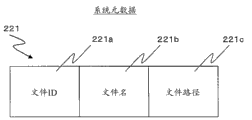
Fig. 4 is a data structure diagram relating to the system metadata 221 of embodiment 1.
The system metadata 221 includes a file ID 221a, a file name 221b, and a file path 221 c.
Each file ID 221a is set to an ID (identifier) that can uniquely identify the corresponding file 43 subject to search. Specifically, for example, it may be set as a sequence number starting from 1 each time the index 2 record 220 of a new file 43 subject to search is created.
Like the file name 211 of the index 1 record 210, each file name 221b is set to the file name of the corresponding search-accepted file 43, for example, "workreport 1. doc".
Like the file path 212 of the index 1 record 210, each file path 221c is set to an absolute path of the corresponding file 43 subject to search, e.g., "// etc/usr1/workreport1. doc".
Note that other file attribute information, such as the creator of the file, access rights, and the like, may be included as the data item of the system metadata 221 in addition to the above.
Fig. 5 is a data structure diagram of the standard metadata 222 relating to embodiment 1.
The standard metadata 222 includes a title 222a, a document writing date 222b, and a security level 222 c.
The title 222a is set as the title of the document or the like stored in the corresponding search-accepted file 43, for example, "work report". Specifically, the index 2 creation program 12, for example, creates a display image of the file which will appear at the time of printing thereof, assuming that a text string printed at the top of the first page whose font size is larger than other text is the title of the document or the like, and sets the title 222a as the text string.
The document writing date 222b is set to a date on which the document or the like stored in the corresponding search-accepted file 43 is written, for example, "8.5.8.2009". Specifically, the index 2 creation program 12, for example, assumes that if the file is printed, a text string printed at the top of the first page, i.e., a text string similar to the creation date, for example, a text string containing the words "creation", "1 month", "2 months", "3 months", etc., is the write date of the document, etc., and sets the document write date 222b as the write date.
The security level 222c is set to a confidentiality level of documents and the like stored in the corresponding search-accepted file 43, such as "confidential", "secret", and the like. Specifically, the index 2 creation program 12, for example, extracts a text string that may indicate a required confidentiality, such as "carefully handled", "must not copy", and the like, from the text strings contained in the file, determines a confidentiality level from the content, number, and the like of the extracted text string, and sets the security level 222c to the confidentiality level.
Note that, in addition to the above, other information recognizable from the display image (to be displayed if printed) of the file 43 subject to search, and the like, such as the storage period of the document, may also be included as the data item of the standard metadata 222.
The index 2 record 220 (index information) thus created is referred to by the search program 13, as described above.
Fig. 6 is a data structure diagram of the virtual class definition file 23 relating to embodiment 1.
The virtual class definition file 23 includes one or more virtual class definition records 230.
Each virtual class definition record 230 includes the following data items: a virtual class ID 231, a display name 232, a condition 233, and an upper level virtual class ID 234.
The virtual class ID 231 is set to a value, for example, "1", "2", etc., that can uniquely identify the virtual class definition record 230.
The display name 232 is set to the name of the virtual class, such as "title", "work report", and the like.
The condition 233 is set as a classification condition of the virtual class, such as "no condition", "includes (text string) 'work report' in the title 222 a", and the like. If the sort condition is set to "no condition," it indicates that the index 2 record 220 is not sorted in the virtual class. If the classification condition is set to some condition for index 2 records 220, then it indicates that those records that satisfy the condition are to be classified in the virtual class. Thus, there may be instances where one index 2 record 220 is to be classified in two or more virtual classes, and instances where it is not classified in any virtual class.
As will be discussed later, the virtual class definition records 230 are referred to by the search program 13, and the display names 232 and the file names 221b of the index 2 records 220 satisfying the conditions 233 for those display names 232 are displayed on the display device 33 in a tree hierarchy. Thus, there may be a case where one index 2 record 220 will be displayed in two or more places in the tree, and a case where it will not be displayed anywhere in the tree.
The upper level virtual class identifier 234 is set to a value that can uniquely identify the upper level virtual class definition record 230 of the virtual class definition record 230, such as "0 (no upper level virtual class record)", "1", and the like.
For example, assume a case where the virtual class definition records 230 in which the virtual class ID 231, the display name 232, the condition 233, and the upper virtual class ID 234 thereof are set to "1", "title", "no condition", and "0 (no upper virtual class record)" respectively, and the virtual class definition records 230 in which they are set to "2", "work report'" and "1" are included in the title 222a respectively, and has four index 2 records 220 whose header 222a includes "work report", their file names 221b being "work report1. doc", "work report2. doc", "work report3. doc" and "report. doc", respectively, the tree view will be displayed on the display device 33, as if there were a folder named "workreport" within a folder named "title", and as if four files "work report1. doc", "work report2. doc", "work report3. doc", and "report. doc" were contained in the folder named "work report" (see D1402 in fig. 15).
Fig. 7 is a data structure diagram of the association definition file 24 relating to embodiment 1.
The association definition file 24 includes one or more association definition records 240.
Each association definition record 240 includes the following data items: the association defines an ID 241, a display name 242, and a condition 243.
The association definition ID 241 is set to a value that can uniquely identify the association definition record 240, such as "1", "2", and so on.
The display name 242 is set to the name of the association definition, such as "title" or the like.
The condition 243 is set as a classification condition of the virtual class, for example, "title 222a is equal to relevant search result", or the like.
For example, assume a case where there are associated definition records 240 whose associated definition ID 241, display name 242, and condition 243 are set to "1", "title", and "title 222a are equal to the instant search result", respectively, where there are four index 2 records 220 whose title 222a includes "work report", where their file names 221b are "work report1. doc", "work report2. doc", "work report3. doc", and "report. doc", respectively, and where "work report1. doc" is displayed on the display device 33 as a search result, the word "title" will also be displayed, and when the word "title" is clicked, three files "work report2. doc", "work report3. doc", and "report. doc" will be retrieved by association (see D1405 in fig. 17 and 18).
Note that the condition 243 may be set as various conditions, for example, ' copy is a prefix of a file name of the retrieved file ', ' number is a suffix of a file name of the retrieved file ", and the like.
As above, the description of the configuration/function of the file search system of embodiment 1 is completed. Hereinafter, the operation of the file search system of embodiment 1 will be described with reference to flowcharts of various programs.
< operations of various procedures >
Fig. 8 is a flowchart showing the operation of the index 1 creation program 11 of embodiment 1.
Once the process starts, the index 1 creation program 11 creates an index 1 record 210 of the file 43 subjected to the search and so on (S801).
Specifically, for example, the file management program 41 is requested to read and transmit a file included in a predefined file path (e.g., "/etc/usr 1/"). Then, if a file is received from the file management program 41, it is determined whether there is an index 1 record 210 whose file path 212 is set to the file path of the obtained file (e.g., "/etc/usr 1/workreport1. doc"). Then, if such an index 1 record 210 does not exist, a keyword is extracted from the obtained file, and the index 1 record 210 is added by setting its file name 211, file path 212, access authority 213, and keyword 214 as the file name, file path, access authority, and extracted keyword of the file, respectively. On the other hand, if such an index 1 record 210 exists, the access authority 213 and the keyword 214 of the index 1 record 210 are updated (hereinafter referred to as "record acceptance update").
After the above process is performed on all files under the predefined file path, if there are any index 1 records 210 other than the newly created index 1 record 210 (which does not become a record accepting updates), then these index 1 records 210 are deleted.
Note that the method for creating or the like the index 1 record 210 is not limited to the above-described method. For example, once the process begins, index 1 file 21 may be deleted, file management program 41 may be requested to read and transmit the files included in a predefined file path (e.g., "/etc/usr 1/"), and index 1 record 210 may be created for the received files.
As described above, in the embodiment of example 1, each time the index 1 creation program 11 performs processing, the index 1 records 210 having a one-to-one correspondence relationship with the respective files 43 subject to search are created at the time of processing.
Fig. 9 is a flowchart showing the operation of the index 2 creation program 12 of embodiment 1.
Once the process starts, the index 2 creation program 12 creates an index 2 record 220 of the file 43 subjected to the search or the like (S901). Since the specific contents of this process are similar to those of the index 1 creation program 11, only different points will be explained below.
First, as described above, the files 43 of the index 2 creation program 12 that are subject to search need not be the same as those of the index 1 creation program 11. For example, all files stored on the storage device 42 may be the search-accepted files 43 of the index 1 creation program 11, while a part of the files stored on the storage device 42 (for example, only files that the operator of the client 3 regularly refers to) are the search-accepted files 43 of the index 2 creation program 12. With such an arrangement, it is possible to limit the number of files displayed as search results by routinely searching only in the index 2 file 22 in the search process described later, while on the other hand making it possible to display files not normally referred to as search results by searching in the index 1 file 21 as needed.
Conversely, a portion of the files stored on the storage device 42 (e.g., document files in which terms are used relatively strictly, such as research reports, court decisions, etc.) may be the search-accepted files 43 of the index 1 creation program 11, while all of the files stored on the storage device 42 are the search-accepted files 43 of the index 2 creation program 12. With such an arrangement, terms and the like whose definitions are ambiguous are used (where it is relatively likely that even if these terms and the like match the search keyword, and the relevant documents are displayed as search results, these documents are not those sought) are less likely to be extracted as the keywords 214 of the index 1 record 210. Therefore, it is possible to keep the capacity of the index 1 file 21 relatively small while increasing the possibility that a desired file is displayed as a search result when a full-text search by a keyword is performed in a search process described later.
In addition, unnecessary updates of index 2 record 220 may also be avoided by the following arrangement. For example, the update date and time may be provided as a data item of the index 2 record 220, and it may be set as the date and time when the process is performed every time the index 2 record 220 is created/updated. When the index 2 creation program 12 attempts to update the index 2 record 220, the update date and time of the index 2 record 220 and the update date and time of the file 43 subject to search (which is typically set by the file management program 41 as one of the items of file attribute information) may be compared with each other, and if the update date and time of the file 43 subject to search is closer, it accepts the update due to having a possibility that the content of the file 43 subject to search is modified after the index 2 record 220 is created. Further, if access rights are provided as data items for the index 2 record 220, when the index 2 creation program 12 attempts to update the index 2 record 220, the access rights of the index 2 record 220 and the access rights of the file 43 subject to search may be compared with each other, and if they are different, it may be subject to update.
Further, when updating the index 2 record 220, the index 2 creation program 12 determines whether the settings of the standard metadata 222 are directly modified using the above-mentioned metadata modification program, and if they are directly modified, does not update the standard metadata 222. To do this, for example, a "directly modified status" may be provided as a data detail of the metadata 222, and may be set to "not directly modified" at the time of creation of the index 2 record 220, and then set to "directly modified" in the case of direct modification by a metadata modification program. Note that the index 2 creator 12 does not update the user-defined metadata 223.
The "file update status after direct modification" may be additionally provided as a data detail of the standard metadata 222 and set to "no update" when the index 2 record 220 is created by the index 2 creator 12. When the index 2 creator 12 updates the index 2 record 220, it is determined whether the index 2 record 220 has been directly modified using a metadata modification program, and if it has been directly modified and if the contents of the corresponding searched file 43 have been modified, the "file update status after direct modification" may be set to "updated".
Thus, when the operator of the client 3 references this index 2 record 220 using the metadata modification program, or when displaying file search results as described below, it may be notified: the contents of the file displayed on the display device 33 are updated after the standard metadata 222 is directly modified, and the operator of the client 3 can determine whether it is necessary to perform the direct modification of the standard metadata 222 again.
As described above, in the embodiment of example 1, each time the index 2 creation program 12 performs processing, the index 2 records 220 having a one-to-one correspondence relationship with the respective files 43 subject to search are created at the time of processing.
Fig. 10 is a flowchart showing the operation of the search request program 31 of embodiment 1.
The search request program 31 is activated by the operator of the client 3 using the input device 32.
Once activated, the search request program 31 performs a login process (S1001). Specifically, a login screen (e.g., the login screen shown in fig. 13) is displayed on the display device 33, and the operator of the client 3 inputs his/her user ID and password using the input device 32 and presses a "submit" button, at which time it is determined whether the input user ID and password are valid. Note that such a login procedure is a technique well known per se, and therefore further description will not be provided.
If it is determined that the input user ID and password are valid, the search request program 31 displays a search request screen on the display device 33 (S1002).
A display embodiment (D1401) of the search request screen is shown in fig. 14. In fig. 14, the search request screen includes a virtual class display portion (D1402), a physical folder display portion (D1403), a search condition portion (D1404), a search result portion (D1405), and a "search" button, an "edit metadata" button, and an "end" button.
In displaying the search request screen, the search request program 31 displays a virtual class display section using the virtual classification function of the search program 13 (D1402). Specifically, the search request program 31 requests the search program 13 to transmit the initial display content of the virtual class. The search program 13 transmits the display name 232 of the record whose superior virtual class ID 234 is set to "0 (no superior virtual class record)" (i.e., the highest virtual class definition record 230) among the virtual class definition records 230 to the search request program 31. The search request program 31 displays the received display name in the virtual class display section (D1402). In addition, the search request program 31 displays a graphic surrounded by squares with a "+" sign in front of each display name 232. As will be described later, by performing operations such as clicking on these graphics using a mouse, etc., the operator of the client 3 can display other virtual classes and files included under these virtual classes.
For example, assume a case where there are a virtual class definition record 230 whose virtual class ID 231, display name 232, condition 233, and upper virtual class ID 234 are set to "1", "title", "no condition", and "0 (no upper virtual class record)", respectively, and a virtual class definition record 230 similarly set to "2", "work report", "containing 'work report' and" 1 "in the title 222a, and there are four index 2 records 220 whose titles 222a contain" work report ", their file names 221b being" work report1.doc "," work report2.doc "," work report3.doc ", and" report. doc ", respectively. When a graphic surrounded by a square with a "+" symbol shown before "title" in the virtual class display section (D1402) is clicked, although not shown in the drawing, a tree view is displayed in which a folder like "work report" is contained within a folder named "title". Further, when the graphic in which the "+" symbol is enclosed by a square, which is displayed before "work report", is clicked, as shown in the virtual class display section (D1402) in fig. 15, a tree view is displayed in which a folder as if the same name as "work report" exists within a folder as if the name was "title", and four files, i.e., "work report1. doc", "work report2. doc", "work report3. doc", and "report.doc", are contained within the folder as if the name was "work report".
Further, in displaying the search request screen, the search request program 31 displays a physical folder display portion using the physical hierarchy creating function of the search program 13 (D1403). Specifically, the search request program 31 requests the search program 13 to transmit the initial display contents of the physical folder. The search program 13 creates a tree hierarchy of folders by referring to the file path 221c of the index 2 record 220, and transmits the name of the folder at the highest level of the tree to the search request program 31. The search request program 31 displays the received folder name in the physical folder display section (D1403). Further, the search request program 31 displays a graphic in which a "+" symbol is enclosed by a square before each folder name. By performing operations such as clicking on these graphics using a mouse, the operator of the client 3 can display other folders and files contained in these folders.
Note that the display contents of the search condition portion (D1404) and the search result portion (D1405) are shown in fig. 14, and the search result is not displayed in the search result portion (D1405).
The operator of the client 3 inputs various items into the search condition section (D1404) using the input device 32. The details of the input search condition section (D1404) become search conditions. For example, if "site" is entered in "full text" and "work report" is entered in "title", a file whose keyword 214 in index 1 record 210 is set to "site" and whose title 222a in index 2 record 220 is set to "work report" will be searched, and the search result will be scrollably displayed in the search result portion (D1405).
For various items in the search condition section (D1404), the ease of search can be improved by allowing various input methods. For example, in "full text," e.g., "no site," "site and work," etc., may allow for logical expression input. Note that the input details in the search condition section (D1404) need not be limited to the details shown in the drawings in any way, and may be decided according to the data details in the index 1 file 21 and the index 2 file 22, such as access authority, security level, and the like.
After displaying the search request screen (S1002), the search request program 31 waits for the search button, the edit metadata button, or the end button to be pressed (S1003, S1004). When the search button is pressed, that is, when a search request is detected (yes in S1003), a search process is performed (S1005, S1006, S1007). Further, when the end button is pressed, that is, when an end request is detected (yes in S1004), the process is terminated.
Note that, although not shown in fig. 10, the search request program 31 executes the metadata editing process when the edit metadata button is pressed. Specifically, it requests the operator of the client 3 to specify a file to be edited, displays the current settings of the standard metadata 222 and the user-defined metadata 223 of the specified file, and modifies the settings of the standard metadata 222 and the user-defined metadata 223 using the content input by the operator of the client 3. At this time, as described above, if the file update status after the direct modification in the standard metadata 222 is set to "updated", a message indicating the effect may be displayed on the display device 33.
When the search request is detected, the search request program 31 transmits the input contents (search conditions) of the search condition section (D1404) to the search program 13 (S1005). For example, if "site" is input in "full text" and "work report" is input in "title", a conditional search expression such as "full text, title, work report" is created and transmitted to the search program 13 together with the user ID input through the login screen. Here, the conditional search expression is an expression interpreted by the search program 13, and may be created according to a syntax rule or the like that allows the search program 13 to interpret.
After the conditional search expression is transmitted to the search program 13, the search request program 31 waits until a search result is received from the search program 13 (S1006). Upon receiving the search result, the search request program 31 displays the search result in the search result portion (D1405) on the search request screen (S1007), and waits again for the search button or the like to be pressed (S1003, S1004).
Fig. 11 is a flowchart showing the operation of the search program 13 of embodiment 1.
The search program 13 is activated by the file search server 1 when the file search server 1 receives a search request from the client 3.
The search program 13 first analyzes the conditional search expression contained in the search request to determine whether it is necessary to perform a metadata search, i.e., a search is performed by referring to the system metadata 221 and the like in the index 2 file 22 (S1101). For example, if the conditional search expression is "full-text and title", it is determined that it is necessary to perform a search by referring to the title 222a of the system metadata 222.
If it is determined that the metadata search is to be performed (yes in S1101), the search program 13 performs a search based on the index 2 file 22 (S1102). Specifically, a condition related to the system metadata 221 and the like is extracted from the conditional search expression, and an index 2 record 220 matching the condition (hereinafter referred to as "record matching metadata") is selected.
For example, if the conditional search expression is "full-text-site, title-work report", the index 2 record 220 whose title 222a in the standard metadata 222 is set to "work report" is selected.
After the metadata search is performed (S1102) or if it is determined that no metadata search is to be performed (no in S1101), the search program 13 determines whether it is necessary to perform a full-text search, i.e., a search is performed by referring to the keyword 214 in the index 1 file 21 (S1103). For example, if the conditional search expression is "full-text-site, title-word report", it is determined that it is necessary to perform a search by referring to the keyword 214.
If it is determined that the full-text search is to be performed (yes in S1103), the search program 13 performs the full-text search based on the index 1 file 21 (S1104). Specifically, the full-text search condition is extracted from the conditional search expression and transmitted to the index 1 search program 14 in common with the file path 221c of the metadata matching record and the user ID received from the search request program 31. As will be described later, the index 1 search program 14 performs a search by referring to the received full-text search condition or the like, and transmits the file path 221c of the index 1 record 210 (hereinafter referred to as "keyword matching record") that should eventually be a search result to the search program 13.
If it is determined that no full-text search is to be performed (no in S1103), the search program 13 causes the metadata matching records to be transmitted to the search request program 31, and if the full-text search is performed (S1104), the search program 13 causes the keyword matching records to be transmitted to the search request program 31. The search program 13 transmits each data item of the index 2 record 220 that has accepted the transmission to the search request program 31 (S1105).
After the transmission, the search program 13 terminates the process.
Fig. 12 is a flowchart showing the operation of the index 1 search program 14 of embodiment 1.
The index 1 search program 14 searches the index 1 record 210 of the metadata matching record (S1201). Specifically, with respect to the file paths 221c of all metadata matching records received from the search program 13, the index 1 records 210 whose file paths 212 are respectively set to the same value are referred to, and based on the access authority 213 of the relevant record, it is determined whether the user ID received from the search program 13 has an access authority. Further, if it is determined that it has an access right, it is determined whether the keyword 214 of the related record satisfies the full-text search condition received from the search program 13.
The index 1 search program 14 transmits the file path 221c satisfying the above condition to the search program 13(S1202), and terminates the process.
Incidentally, if various existing full-text search programs are to be used as the index 1 search program 14, programs corresponding to these index 1 search programs 14 will also have to be used for the index 1 creation program 11. In such a case, typically, the searched for file 43 associated with the index 1 file 21 will be different from the searched for file 43 associated with the index 2 file 22. Therefore, even if, for example, the file 43 subject to search related to the index 2 file 22 is set as a file frequently used by the operator of the client 3, if the operator of the client 3 requests only the full-text search, since the search is to be performed in the index 1 file 21, the file not frequently used will be terminated to be displayed as a search result.
While there may be cases where such a search is preferred, there are also cases where such a search is not preferred. Therefore, if only a full-text search is to be performed, it is possible to specify through the search request screen that only the searched file 43 for which the index 2 file 22 is created is to be subjected to a search (i.e., only the file for which metadata is created is to be subjected to a search), or that all the searched files 43 of the index 1 file 21 are to be subjected to a search regardless of the index 2 file 22 (i.e., files for which metadata has not yet been created are also to be subjected to a search).
When so arranged, the index 1 search program 14 operates as described above if it is specified that files for which metadata has not yet been created are also to be subjected to searching. On the other hand, if it is specified that only the file for which metadata is created is to be subjected to search, the index 1 search program 14 selects (even if metadata search is not requested (no in S1101 in fig. 11) all the index 2 records 220 of the index 2 file 22 as metadata matching records, and transmits the file path 221c of these records to the index 1 search program 14 together with the full-text search condition and the user ID received from the search request program 31.
< additional description on processing in the case of performing metadata search and full-text search >
As described above, with the file search system of embodiment 1, a search is performed using the index 1 file 21 only when the operator of the client 3 requests a full-text search. Incidentally, the processing time taken for the full-text search is generally longer than that in the case where the full-text search is not performed. Therefore, the waiting time from the time when the operator of the client 3 requests the search to the time when the search result is displayed becomes longer. It is therefore preferable that the operator of the client 3 should be prevented from having to wait for an unexpectedly long time.
The following provides a description about operations of the search program 13 and the like, which are performed when these measures are effective in a case where a metadata search and a full-text search are performed (hereinafter referred to as "compound search").
Fig. 16 is a flowchart showing the operation of the search program 13 and the like in the composite search relating to embodiment 1.
S1650 to S1655 in fig. 16 show details of the process performed by the search program 13 in S1104 and S1105 in fig. 11 during the composite search. S1601 to S1607 show details of the process executed by the search request program 31 in S1006 and S1007 in fig. 10 corresponding to this process.
The search program 13 compares the number of search results, i.e., the number of metadata matching records retrieved by the metadata search, with a predefined number (hereinafter referred to as "maximum retrieval number") (S1650).
Then, if the number of metadata matching records, that is, the number of records subjected to the full-text search, is larger than the maximum retrieval number (yes in S1650), a message for confirming whether to continue the process is transmitted to the search request program 31(S1651), and waits until a confirmation result as to whether the search process is to be continued is received from the search request program 31 (S1652).
Upon receiving the message for confirming whether to continue the search process from the search program 13, the search request program 31 displays the message on the display device 33 and requests the operator of the client 3 to respond whether to continue the search process (S1601). Specifically, for example, the confirmation message and the "continue search" button and the "cancel" button may be displayed through pop-up dialog boxes, and it may wait until one of the buttons is clicked.
If the operator of the client 3 instructs to cancel the search by clicking a "cancel" button or the like (no in S1602), the search request program 31 transmits a "cancel search" instruction to the search program 13 and terminates the process (S1603). Therefore, the search request program 31 does not display any search result and waits for the search button or the like to be pressed again on the search request screen (S1003 and S1004 in fig. 10).
If the operator of the client 3 instructs to continue the search by clicking on the "continue search" button or the like (yes in S1602), the search request program 31 transmits a "continue search" instruction to the search program 13, although not explicitly shown in the drawing, and waits until a search result is received from the search program 13.
After receiving the "cancel search" instruction or the "continue search" instruction from the search request program 31, the search program 13 changes the process according to the received instruction (S1652). Specifically, if a "cancel search" instruction is received (no in S1652), the process is terminated, and if a "continue search" instruction is received (yes in S1652), a full-text search is caused to be performed by transmitting the file path 221c of the record of which the metadata matches the maximum retrieval number among the records, the full-text search condition, and the user ID received from the search request program 31 to the index 1 search program 14 (S1653).
Note that, if the number of records subjected to the full-text search is equal to or smaller than the maximum retrieval number (no in S1650), a message for confirming whether to continue the process is not transmitted to the search request program 31, and the full-text search is caused to be performed by transmitting the file path 221c of the metadata matching record, the full-text search condition, and the user ID received from the search request program 31 to the index 1 search program 14 (S1653).
Once the full-text search is ended, the search program 13 transmits each data item of the keyword matching record to the search request program 31 (S1654). At this time, confirmation as to whether the full-text search was performed for all the metadata matching records or whether there is still a metadata matching record for which the full-text search was not performed is also transmitted.
Then, the search program 13 determines whether or not the supplementary display is possible in the search result portion (D1405) (S1655). Specifically, if there are still metadata matching records for which a full-text search has not been performed, and if the cumulative total number of search results transmitted to the search request program 31 is smaller than the number predefined as the displayable number in the search result portion (D1405) on the search request screen (D1401) (hereinafter referred to as "maximum display number") (yes in S1655), it waits again until a confirmation result as to whether the search process is to be continued is received from the search request program 31 (S1652). On the other hand, if the supplemental display is not possible in the search result portion (D1405) (no in S1655), the search program 13 terminates the process.
Upon receiving the search result from the search program 13, the search request program 31 displays the search result in the search result portion (D1405). Note that as described above, as long as supplementary display is possible in the search result portion (D1405), full-text search on metadata matching records is repeatedly performed. Therefore, the search result will be displayed in the search result portion (D1405) additionally. For example, if the results of the first full-text search include three find (hit) and the search results of the second full-text search include four find, then search results of seven find are displayed in search results portion (D1405).
Then, the search request program 31 determines whether it is still possible to have any metadata matching records for which a full-text search has not been performed (as described above, a confirmation message as to whether a full-text search has been performed for all metadata matching records or a metadata matching record for which a full-text search has not been performed is transmitted from the search program 13) and whether supplemental display is possible in the search result portion (D1405) (S1606). If there is still a metadata matching record for which a full-text search has not been performed yet and supplementary display is possible in the search result portion (D1405) ("yes" in S1606), a message for confirming whether to continue the process is displayed on the display device 33 (S1607), and the operator of the client 3 is requested again to respond as to whether to continue the search process (S1602).
On the other hand, if a full-text search has been performed on all the metadata matching records or if supplemental display is not possible in the search result portion (D1405) (no in S1606), the search request program 31 terminates the process (S1603). Therefore, the search request program 31 displays the search result in the search result portion (D1405) up to that point, and waits for the search button or the like to be pressed again (S1003 and S1004 in fig. 10).
Therefore, when the number of records subjected to the full-text search is larger than the maximum retrieval number, the operator of the client 3 is asked whether or not to continue the search process, and if "continue search" is instructed, the full-text search is performed. Thus, if the search time is perceived to be long, the operator of the client 3 may temporarily cancel the search process and perform the search, for example, by further refining the metadata search criteria.
Further, the full-text search is repeatedly performed in units of the maximum retrieval number, and the search result is displayed supplementarily each time the full-text search is performed. Therefore, the operator of the client 3 can successively check the search results in a relatively short time.
< supplementary description on related search >
Fig. 17 is a diagram showing an example of contents displayed in the search result portion (D1405) with respect to embodiment 1. In fig. 17, the file name and the file path are shown. However, other data items such as title, document writing date, etc. of index 2 record 220, etc. may also be displayed. It is also possible, for example, to set a part of the content of each file 43 subject to search in the index 2 record 220 and cause it to be displayed.
Further, in the association search instruction section (D1701) surrounded by a dotted line in fig. 17, the display name to which the display name 242 having the association definition record 240 is set. In the embodiment in fig. 17, there is the association definition record 240 whose display names 242 are set to "title" and "date written", respectively, and these display names 242 are displayed.
In these cases, when the operator of the client 3 clicks a portion displaying, for example, "title", the search request program 31 requests the search program 13 to perform an associated search related to "title". Specifically, the file identification 221a relating to the file of the search result that is not displayed on the display device 33 but received from the search program 13, and the association definition ID 241 relating to the "title" are transmitted to the search program 13 together with the association search request.
Upon receiving the association search request, the search program 13 refers to the condition 243 of the association definition record 240 set as the received association definition ID 241, searches in the index 2 record 220 according to the condition in which the condition 243 is set, and transmits the search result to the search request program 31.
For example, assume a case where there are associated definition records 240 whose associated definition ID 241, display name 242, and condition 243 are set to "1", "title", and "title 222a is equal to the relevant search result", respectively, with four index 2 records 220 containing "workreport" in their title 222a, with their file names 221b being "workreport 1. doc", "workreport 2. doc", "workreport 3. doc", and "report. doc", respectively, and where "workreport 1. doc" is displayed on the display device 33 as the search result, the word "title" will be displayed in the associated search instruction section (D1701). When the operator of the client 3 clicks the word "title", the search request program 31 transmits the file ID of "workreport 1. doc" and the associated definition ID ("1") to the search program 13. Then, the search program 13 refers to the condition 243 of the association definition record 240 whose association definition ID 241 is "1", and since it is set so that "title 222a is equal to the immediate search result", the search program 13 obtains the title 222a of "workreport 1. doc" based on the received file ID, retrieves three files containing (same as "workreport 1. doc") the "work report" in their titles 222a, that is, "workreport 2. doc", "workreport 3. doc", and "report. doc", and transmits the search result to the search request program 31. Then, as shown in fig. 18, the search request program 31 displays the associated search result in the search result portion (D1405).
Note that it is also possible not to set any specific limit to the number of finding that can be displayed in association with a search result, and it is also possible, for example, to display only a maximum of five finding and display it on another screen if the result exceeds five finding.
The file search system according to the present invention is not limited in any way to embodiment 1 mentioned above, and may be implemented in various forms. One such embodiment is described below.
Example 2
< Another embodiment of the document searching System >
Fig. 19 is a system configuration diagram of a file search system according to embodiment 2 of the present invention.
In embodiment 2, unlike embodiment 1, the file search server 1 does not include the index 1 creation program 11 and the index 1 search program 14.
Instead, the file search server 5 (corresponding to the second file search server mentioned above) is a device such as a personal computer or the like, and is communicably connected to the client 3, the file server 4, the web server 7, and the file search server 1 via a communication line 9. The file search server 5 includes an index 1 creation program 11 and an index 1 search program 14. Further, the index 1 file 21 is not stored on the storage device 2 of the file search server 1, but is stored on the storage device 6 of the file search server 5.
The significant differences between the configurations of example 2 and example 1 are as described above.
In the file search system of embodiment 2, the client 3, the file server 4, the web server 7, the file search server 1, and the file search server 5 are communicably connected to each other through the internet by means of the communication line 9. With such a configuration, for example, if a given organization has files stored on the file server 4 established at the data center, metadata search, virtual class display, physical folder display, and association search can be performed by creating the index 2 file 22, the virtual class definition file 23, and the association definition file 24 with respect to the files 43 subject to search stored on the file server 4. Further, with respect to the file under search 73 stored on the storage device 72 of the web server 7 which is not managed by the organization, the index 1 creation program 11 of the file search server 5 can create the index 1 file 21 by a way commonly referred to as web search through the web server program 71 such as Apache (registered trademark) or the like, thereby making full-text search possible.
Further, with embodiment 2, the file search server 5 does not need to be built in an organization that performs file search, and full-text search and the like can be performed using the functions of an existing file search server. Thus, a highly flexible and extensible search system can be constructed.
REFERENCE SIGNS LIST
1. 5 File search Server
3 client
4 File server
7 Web server
9 communication line
21 index 1 File
22 indexing 2 files
42, 72 storage device
43. 73 files to be searched
210 index 1 record
211. 221b File name
212. 221c File Path
213 Access rights
214 keywords
220 index 2 record
221 System metadata
222 standard metadata
223 user-defined metadata
Claims (8)
Applications Claiming Priority (3)
| Application Number | Priority Date | Filing Date | Title |
|---|---|---|---|
| JP2009217344A JP2011065546A (en) | 2009-09-18 | 2009-09-18 | File search system and program |
| JP2009-217344 | 2009-09-18 | ||
| PCT/JP2010/005435 WO2011033734A1 (en) | 2009-09-18 | 2010-09-03 | File search system and program |
Publications (2)
| Publication Number | Publication Date |
|---|---|
| CN102483765A CN102483765A (en) | 2012-05-30 |
| CN102483765B true CN102483765B (en) | 2013-12-11 |
Family
ID=43758349
Family Applications (1)
| Application Number | Title | Priority Date | Filing Date |
|---|---|---|---|
| CN2010800406725A Expired - Fee Related CN102483765B (en) | 2009-09-18 | 2010-09-03 | File search system and program |
Country Status (5)
| Country | Link |
|---|---|
| US (1) | US20120173511A1 (en) |
| EP (1) | EP2478452B1 (en) |
| JP (1) | JP2011065546A (en) |
| CN (1) | CN102483765B (en) |
| WO (1) | WO2011033734A1 (en) |
Families Citing this family (26)
| Publication number | Priority date | Publication date | Assignee | Title |
|---|---|---|---|---|
| US20120215819A1 (en) * | 2011-02-23 | 2012-08-23 | International Business Machines Corporation | Tool for removing inactive objects |
| JP5535993B2 (en) * | 2011-07-20 | 2014-07-02 | ビッグローブ株式会社 | Storage device sharing system and storage device sharing method |
| JP5945408B2 (en) * | 2011-12-08 | 2016-07-05 | シャープ株式会社 | Related content search system, terminal, and related content search method |
| KR101672349B1 (en) * | 2011-12-27 | 2016-11-07 | 한국전자통신연구원 | File cloud service apparatus and method |
| JP5953851B2 (en) * | 2012-03-19 | 2016-07-20 | 富士ゼロックス株式会社 | Document management apparatus and program |
| WO2013145129A1 (en) * | 2012-03-27 | 2013-10-03 | 富士通株式会社 | Database management method, program and information processing device |
| US11487707B2 (en) * | 2012-04-30 | 2022-11-01 | International Business Machines Corporation | Efficient file path indexing for a content repository |
| GB2507037A (en) * | 2012-10-16 | 2014-04-23 | Ibm | Software application discovery using variable frequency file system scanning |
| US8914356B2 (en) | 2012-11-01 | 2014-12-16 | International Business Machines Corporation | Optimized queries for file path indexing in a content repository |
| US9323761B2 (en) | 2012-12-07 | 2016-04-26 | International Business Machines Corporation | Optimized query ordering for file path indexing in a content repository |
| WO2014124053A1 (en) * | 2013-02-06 | 2014-08-14 | Lu Elaine | Systems and methods for parents' connection and communication platform |
| US10104019B2 (en) * | 2014-05-27 | 2018-10-16 | Magnet Forensics Inc. | Systems and methods for locating application-specific data on a remote endpoint computer |
| US9785712B1 (en) * | 2014-06-20 | 2017-10-10 | Amazon Technologies, Inc. | Multi-index search engines |
| US10965748B2 (en) * | 2015-06-19 | 2021-03-30 | Lenovo (Singapore) Pte. Ltd. | Creating and using document pedigree data |
| CN105022819A (en) * | 2015-07-15 | 2015-11-04 | 魅族科技(中国)有限公司 | File storage method and apparatus |
| CN105354318A (en) * | 2015-11-13 | 2016-02-24 | 北京金山安全软件有限公司 | File searching method and device |
| CN105468785A (en) * | 2015-12-24 | 2016-04-06 | 张梅云 | Computer file management method |
| JP6700927B2 (en) * | 2016-04-15 | 2020-05-27 | キヤノン株式会社 | Image processing system, image processing device, image processing method, and program |
| JP2018005509A (en) * | 2016-06-30 | 2018-01-11 | キヤノン株式会社 | Information processing device, control method, and program |
| CN107145530A (en) * | 2017-04-18 | 2017-09-08 | 北京明朝万达科技股份有限公司 | A kind of document retrieval method and system based on additional data |
| US11023419B2 (en) * | 2018-08-13 | 2021-06-01 | Sap Se | Folder key management |
| CN111026710A (en) * | 2019-12-11 | 2020-04-17 | 华南师范大学 | Data set retrieval method and system |
| CN112860978B (en) * | 2021-03-31 | 2024-05-17 | 中国工商银行股份有限公司 | Global searching method and device |
| CN114090515B (en) * | 2022-01-21 | 2022-07-05 | 亿次网联(杭州)科技有限公司 | File searching method, terminal device and storage medium |
| JP7251876B1 (en) * | 2022-03-14 | 2023-04-04 | Necプラットフォームズ株式会社 | SERVER DEVICE, CONTROL METHOD FOR SERVER DEVICE, AND PROGRAM |
| JP2023138122A (en) * | 2022-03-18 | 2023-09-29 | 株式会社リコー | Data management device, data management system, data management method, and program |
Citations (2)
| Publication number | Priority date | Publication date | Assignee | Title |
|---|---|---|---|---|
| US6985948B2 (en) * | 2000-03-29 | 2006-01-10 | Fujitsu Limited | User's right information and keywords input based search query generating means method and apparatus for searching a file |
| CN101136027A (en) * | 2006-09-01 | 2008-03-05 | 横河电机株式会社 | Systems and methods for database indexing, searching and data retrieval |
Family Cites Families (35)
| Publication number | Priority date | Publication date | Assignee | Title |
|---|---|---|---|---|
| JP2929963B2 (en) * | 1995-03-15 | 1999-08-03 | 松下電器産業株式会社 | Document search device, word index creation method, and document search method |
| JPH08272806A (en) * | 1995-04-03 | 1996-10-18 | Nippon Steel Corp | Database search system |
| US6304872B1 (en) * | 1998-08-13 | 2001-10-16 | Tornado Technology Co. Ltd. | Search system for providing fulltext search over web pages of world wide web servers |
| JP2000315209A (en) * | 1999-04-30 | 2000-11-14 | Ricoh Co Ltd | Image filing apparatus, image filing method, and computer-readable recording medium storing program for causing a computer to execute the method |
| US7181438B1 (en) * | 1999-07-21 | 2007-02-20 | Alberti Anemometer, Llc | Database access system |
| US6516337B1 (en) * | 1999-10-14 | 2003-02-04 | Arcessa, Inc. | Sending to a central indexing site meta data or signatures from objects on a computer network |
| JP2001344245A (en) * | 2000-03-29 | 2001-12-14 | Fujitsu Ltd | Information processing device |
| US6751624B2 (en) * | 2000-04-04 | 2004-06-15 | Globalscape, Inc. | Method and system for conducting a full text search on a client system by a server system |
| US6782380B1 (en) * | 2000-04-14 | 2004-08-24 | David Victor Thede | Method and system for indexing and searching contents of extensible mark-up language (XML) documents |
| US6782383B2 (en) * | 2001-06-18 | 2004-08-24 | Siebel Systems, Inc. | System and method to implement a persistent and dismissible search center frame |
| NO316480B1 (en) * | 2001-11-15 | 2004-01-26 | Forinnova As | Method and system for textual examination and discovery |
| JP4490012B2 (en) | 2001-11-26 | 2010-06-23 | 富士通株式会社 | File search device and file search program |
| JP2003323427A (en) * | 2002-05-02 | 2003-11-14 | Nippon Telegr & Teleph Corp <Ntt> | XML information search apparatus and method, execution program of the method, and recording medium recording execution program of the method |
| US7702666B2 (en) * | 2002-06-06 | 2010-04-20 | Ricoh Company, Ltd. | Full-text search device performing merge processing by using full-text index-for-registration/deletion storage part with performing registration/deletion processing by using other full-text index-for-registration/deletion storage part |
| CN1625740A (en) * | 2002-07-23 | 2005-06-08 | 三星电子株式会社 | Metadata index structure, method of providing metadata index, and metadata search method and device using metadata index |
| EP1411448A3 (en) * | 2002-10-17 | 2007-12-05 | Matsushita Electric Industrial Co., Ltd. | Data searching apparatus |
| CA2539431C (en) * | 2003-09-23 | 2017-07-11 | Amazon.Com, Inc. | Personalized searchable library with highlighting capabilities |
| FR2860886B1 (en) * | 2003-10-14 | 2005-12-23 | Commissariat Energie Atomique | DEVICE FOR DISPLACING PARTICLES |
| US7376642B2 (en) * | 2004-03-30 | 2008-05-20 | Microsoft Corporation | Integrated full text search system and method |
| US7730012B2 (en) * | 2004-06-25 | 2010-06-01 | Apple Inc. | Methods and systems for managing data |
| US7461064B2 (en) * | 2004-09-24 | 2008-12-02 | International Buiness Machines Corporation | Method for searching documents for ranges of numeric values |
| US20060074980A1 (en) * | 2004-09-29 | 2006-04-06 | Sarkar Pte. Ltd. | System for semantically disambiguating text information |
| JP2006178599A (en) * | 2004-12-21 | 2006-07-06 | Fuji Xerox Co Ltd | Document retrieval device and method |
| US7392253B2 (en) * | 2005-03-03 | 2008-06-24 | Microsoft Corporation | System and method for secure full-text indexing |
| US8417693B2 (en) * | 2005-07-14 | 2013-04-09 | International Business Machines Corporation | Enforcing native access control to indexed documents |
| US7668825B2 (en) * | 2005-08-26 | 2010-02-23 | Convera Corporation | Search system and method |
| US8600997B2 (en) * | 2005-09-30 | 2013-12-03 | International Business Machines Corporation | Method and framework to support indexing and searching taxonomies in large scale full text indexes |
| US20070162481A1 (en) * | 2006-01-10 | 2007-07-12 | Millett Ronald P | Pattern index |
| US20080086453A1 (en) * | 2006-10-05 | 2008-04-10 | Fabian-Baber, Inc. | Method and apparatus for correlating the results of a computer network text search with relevant multimedia files |
| US8250075B2 (en) * | 2006-12-22 | 2012-08-21 | Palo Alto Research Center Incorporated | System and method for generation of computer index files |
| JP2008217600A (en) * | 2007-03-06 | 2008-09-18 | Fujitsu Ltd | Information search apparatus, information search method, information search program, and recording medium |
| US7849065B2 (en) * | 2007-07-20 | 2010-12-07 | Microsoft Corporation | Heterogeneous content indexing and searching |
| US8442994B1 (en) * | 2007-09-14 | 2013-05-14 | Google Inc. | Custom search index data security |
| US8965881B2 (en) * | 2008-08-15 | 2015-02-24 | Athena A. Smyros | Systems and methods for searching an index |
| US8364714B2 (en) * | 2009-06-08 | 2013-01-29 | International Business Machines Corporation | Servicing query with access path security in relational database management system |
-
2009
- 2009-09-18 JP JP2009217344A patent/JP2011065546A/en active Pending
-
2010
- 2010-09-03 EP EP10816849.3A patent/EP2478452B1/en active Active
- 2010-09-03 US US13/496,505 patent/US20120173511A1/en not_active Abandoned
- 2010-09-03 CN CN2010800406725A patent/CN102483765B/en not_active Expired - Fee Related
- 2010-09-03 WO PCT/JP2010/005435 patent/WO2011033734A1/en not_active Ceased
Patent Citations (2)
| Publication number | Priority date | Publication date | Assignee | Title |
|---|---|---|---|---|
| US6985948B2 (en) * | 2000-03-29 | 2006-01-10 | Fujitsu Limited | User's right information and keywords input based search query generating means method and apparatus for searching a file |
| CN101136027A (en) * | 2006-09-01 | 2008-03-05 | 横河电机株式会社 | Systems and methods for database indexing, searching and data retrieval |
Non-Patent Citations (1)
| Title |
|---|
| JP特开平8-272806A 1996.10.18 |
Also Published As
| Publication number | Publication date |
|---|---|
| CN102483765A (en) | 2012-05-30 |
| EP2478452A1 (en) | 2012-07-25 |
| US20120173511A1 (en) | 2012-07-05 |
| WO2011033734A1 (en) | 2011-03-24 |
| EP2478452B1 (en) | 2018-12-19 |
| JP2011065546A (en) | 2011-03-31 |
| EP2478452A4 (en) | 2015-09-02 |
Similar Documents
| Publication | Publication Date | Title |
|---|---|---|
| CN102483765B (en) | File search system and program | |
| US6477528B1 (en) | File management system, electronic filing system, hierarchical structure display method of file, computer readable recording medium recording program in which function thereof is executable | |
| US7590939B2 (en) | Storage and utilization of slide presentation slides | |
| US8973128B2 (en) | Search result presentation | |
| US8392472B1 (en) | Auto-classification of PDF forms by dynamically defining a taxonomy and vocabulary from PDF form fields | |
| US8799317B2 (en) | Forensic system, forensic method, and forensic program | |
| US7493561B2 (en) | Storage and utilization of slide presentation slides | |
| RU2427896C2 (en) | Annotation of documents in jointly operating applications by data in separated information systems | |
| US7546533B2 (en) | Storage and utilization of slide presentation slides | |
| US20090070301A1 (en) | Document search tool | |
| US20110295879A1 (en) | Systems and methods for document management | |
| US20120239666A1 (en) | Forensic system, forensic method, and forensic program | |
| US12373633B2 (en) | Systems and methods for displaying digital forensic evidence | |
| JP2005018754A (en) | Sharing computer objects with associations | |
| CN102591897A (en) | Apparatus and method for searching document | |
| US8145580B2 (en) | Data management apparatus and method for managing data elements using a plurality of metadata elements | |
| US20110107198A1 (en) | Information processing apparatus, storage medium, and information processing method | |
| JP5592747B2 (en) | File search device and file search program | |
| KR101272656B1 (en) | Method of file management based on tag and system of the same | |
| JP2009211403A (en) | File search program | |
| JP2008234078A (en) | Information processing apparatus, information processing method, information processing program, and recording medium on which information processing program is recorded | |
| JP5128386B2 (en) | Information processing apparatus, electronic form management system, server apparatus, form retrieval method, and program | |
| US20070185832A1 (en) | Managing tasks for multiple file types | |
| WO2017221445A1 (en) | Management device, management method, and management program | |
| US20130060778A1 (en) | Device, method, and program for displaying document list |
Legal Events
| Date | Code | Title | Description |
|---|---|---|---|
| C06 | Publication | ||
| PB01 | Publication | ||
| C10 | Entry into substantive examination | ||
| SE01 | Entry into force of request for substantive examination | ||
| C14 | Grant of patent or utility model | ||
| GR01 | Patent grant | ||
| CF01 | Termination of patent right due to non-payment of annual fee | ||
| CF01 | Termination of patent right due to non-payment of annual fee |
Granted publication date: 20131211 Termination date: 20160903 |