CN102482819A - High loft spunbonded web - Google Patents
High loft spunbonded web Download PDFInfo
- Publication number
- CN102482819A CN102482819A CN2010800374584A CN201080037458A CN102482819A CN 102482819 A CN102482819 A CN 102482819A CN 2010800374584 A CN2010800374584 A CN 2010800374584A CN 201080037458 A CN201080037458 A CN 201080037458A CN 102482819 A CN102482819 A CN 102482819A
- Authority
- CN
- China
- Prior art keywords
- web
- fiber
- fibers
- fiber web
- webs
- Prior art date
- Legal status (The legal status is an assumption and is not a legal conclusion. Google has not performed a legal analysis and makes no representation as to the accuracy of the status listed.)
- Granted
Links
Images


Classifications
-
- D—TEXTILES; PAPER
- D04—BRAIDING; LACE-MAKING; KNITTING; TRIMMINGS; NON-WOVEN FABRICS
- D04H—MAKING TEXTILE FABRICS, e.g. FROM FIBRES OR FILAMENTARY MATERIAL; FABRICS MADE BY SUCH PROCESSES OR APPARATUS, e.g. FELTS, NON-WOVEN FABRICS; COTTON-WOOL; WADDING ; NON-WOVEN FABRICS FROM STAPLE FIBRES, FILAMENTS OR YARNS, BONDED WITH AT LEAST ONE WEB-LIKE MATERIAL DURING THEIR CONSOLIDATION
- D04H3/00—Non-woven fabrics formed wholly or mainly of yarns or like filamentary material of substantial length
- D04H3/08—Non-woven fabrics formed wholly or mainly of yarns or like filamentary material of substantial length characterised by the method of strengthening or consolidating
- D04H3/16—Non-woven fabrics formed wholly or mainly of yarns or like filamentary material of substantial length characterised by the method of strengthening or consolidating with bonds between thermoplastic filaments produced in association with filament formation, e.g. immediately following extrusion
-
- B—PERFORMING OPERATIONS; TRANSPORTING
- B01—PHYSICAL OR CHEMICAL PROCESSES OR APPARATUS IN GENERAL
- B01D—SEPARATION
- B01D39/00—Filtering material for liquid or gaseous fluids
-
- B—PERFORMING OPERATIONS; TRANSPORTING
- B01—PHYSICAL OR CHEMICAL PROCESSES OR APPARATUS IN GENERAL
- B01D—SEPARATION
- B01D39/00—Filtering material for liquid or gaseous fluids
- B01D39/14—Other self-supporting filtering material ; Other filtering material
- B01D39/16—Other self-supporting filtering material ; Other filtering material of organic material, e.g. synthetic fibres
-
- B—PERFORMING OPERATIONS; TRANSPORTING
- B01—PHYSICAL OR CHEMICAL PROCESSES OR APPARATUS IN GENERAL
- B01D—SEPARATION
- B01D39/00—Filtering material for liquid or gaseous fluids
- B01D39/14—Other self-supporting filtering material ; Other filtering material
- B01D39/16—Other self-supporting filtering material ; Other filtering material of organic material, e.g. synthetic fibres
- B01D39/1607—Other self-supporting filtering material ; Other filtering material of organic material, e.g. synthetic fibres the material being fibrous
- B01D39/1623—Other self-supporting filtering material ; Other filtering material of organic material, e.g. synthetic fibres the material being fibrous of synthetic origin
- B01D39/163—Other self-supporting filtering material ; Other filtering material of organic material, e.g. synthetic fibres the material being fibrous of synthetic origin sintered or bonded
-
- D—TEXTILES; PAPER
- D04—BRAIDING; LACE-MAKING; KNITTING; TRIMMINGS; NON-WOVEN FABRICS
- D04H—MAKING TEXTILE FABRICS, e.g. FROM FIBRES OR FILAMENTARY MATERIAL; FABRICS MADE BY SUCH PROCESSES OR APPARATUS, e.g. FELTS, NON-WOVEN FABRICS; COTTON-WOOL; WADDING ; NON-WOVEN FABRICS FROM STAPLE FIBRES, FILAMENTS OR YARNS, BONDED WITH AT LEAST ONE WEB-LIKE MATERIAL DURING THEIR CONSOLIDATION
- D04H3/00—Non-woven fabrics formed wholly or mainly of yarns or like filamentary material of substantial length
- D04H3/016—Non-woven fabrics formed wholly or mainly of yarns or like filamentary material of substantial length characterised by the fineness
-
- D—TEXTILES; PAPER
- D04—BRAIDING; LACE-MAKING; KNITTING; TRIMMINGS; NON-WOVEN FABRICS
- D04H—MAKING TEXTILE FABRICS, e.g. FROM FIBRES OR FILAMENTARY MATERIAL; FABRICS MADE BY SUCH PROCESSES OR APPARATUS, e.g. FELTS, NON-WOVEN FABRICS; COTTON-WOOL; WADDING ; NON-WOVEN FABRICS FROM STAPLE FIBRES, FILAMENTS OR YARNS, BONDED WITH AT LEAST ONE WEB-LIKE MATERIAL DURING THEIR CONSOLIDATION
- D04H3/00—Non-woven fabrics formed wholly or mainly of yarns or like filamentary material of substantial length
- D04H3/08—Non-woven fabrics formed wholly or mainly of yarns or like filamentary material of substantial length characterised by the method of strengthening or consolidating
- D04H3/14—Non-woven fabrics formed wholly or mainly of yarns or like filamentary material of substantial length characterised by the method of strengthening or consolidating with bonds between thermoplastic yarns or filaments produced by welding
-
- B—PERFORMING OPERATIONS; TRANSPORTING
- B01—PHYSICAL OR CHEMICAL PROCESSES OR APPARATUS IN GENERAL
- B01D—SEPARATION
- B01D2239/00—Aspects relating to filtering material for liquid or gaseous fluids
- B01D2239/06—Filter cloth, e.g. knitted, woven non-woven; self-supported material
- B01D2239/0604—Arrangement of the fibres in the filtering material
- B01D2239/0627—Spun-bonded
-
- B—PERFORMING OPERATIONS; TRANSPORTING
- B01—PHYSICAL OR CHEMICAL PROCESSES OR APPARATUS IN GENERAL
- B01D—SEPARATION
- B01D2239/00—Aspects relating to filtering material for liquid or gaseous fluids
- B01D2239/06—Filter cloth, e.g. knitted, woven non-woven; self-supported material
- B01D2239/065—More than one layer present in the filtering material
-
- B—PERFORMING OPERATIONS; TRANSPORTING
- B01—PHYSICAL OR CHEMICAL PROCESSES OR APPARATUS IN GENERAL
- B01D—SEPARATION
- B01D2239/00—Aspects relating to filtering material for liquid or gaseous fluids
- B01D2239/06—Filter cloth, e.g. knitted, woven non-woven; self-supported material
- B01D2239/065—More than one layer present in the filtering material
- B01D2239/0654—Support layers
-
- B—PERFORMING OPERATIONS; TRANSPORTING
- B01—PHYSICAL OR CHEMICAL PROCESSES OR APPARATUS IN GENERAL
- B01D—SEPARATION
- B01D2239/00—Aspects relating to filtering material for liquid or gaseous fluids
- B01D2239/06—Filter cloth, e.g. knitted, woven non-woven; self-supported material
- B01D2239/069—Special geometry of layers
-
- B—PERFORMING OPERATIONS; TRANSPORTING
- B01—PHYSICAL OR CHEMICAL PROCESSES OR APPARATUS IN GENERAL
- B01D—SEPARATION
- B01D2239/00—Aspects relating to filtering material for liquid or gaseous fluids
- B01D2239/12—Special parameters characterising the filtering material
- B01D2239/1233—Fibre diameter
-
- B—PERFORMING OPERATIONS; TRANSPORTING
- B01—PHYSICAL OR CHEMICAL PROCESSES OR APPARATUS IN GENERAL
- B01D—SEPARATION
- B01D2239/00—Aspects relating to filtering material for liquid or gaseous fluids
- B01D2239/12—Special parameters characterising the filtering material
- B01D2239/1266—Solidity
-
- B—PERFORMING OPERATIONS; TRANSPORTING
- B01—PHYSICAL OR CHEMICAL PROCESSES OR APPARATUS IN GENERAL
- B01D—SEPARATION
- B01D2239/00—Aspects relating to filtering material for liquid or gaseous fluids
- B01D2239/12—Special parameters characterising the filtering material
- B01D2239/1291—Other parameters
-
- D—TEXTILES; PAPER
- D10—INDEXING SCHEME ASSOCIATED WITH SUBLASSES OF SECTION D, RELATING TO TEXTILES
- D10B—INDEXING SCHEME ASSOCIATED WITH SUBLASSES OF SECTION D, RELATING TO TEXTILES
- D10B2505/00—Industrial
- D10B2505/04—Filters
-
- Y—GENERAL TAGGING OF NEW TECHNOLOGICAL DEVELOPMENTS; GENERAL TAGGING OF CROSS-SECTIONAL TECHNOLOGIES SPANNING OVER SEVERAL SECTIONS OF THE IPC; TECHNICAL SUBJECTS COVERED BY FORMER USPC CROSS-REFERENCE ART COLLECTIONS [XRACs] AND DIGESTS
- Y10—TECHNICAL SUBJECTS COVERED BY FORMER USPC
- Y10T—TECHNICAL SUBJECTS COVERED BY FORMER US CLASSIFICATION
- Y10T428/00—Stock material or miscellaneous articles
- Y10T428/24—Structurally defined web or sheet [e.g., overall dimension, etc.]
- Y10T428/24628—Nonplanar uniform thickness material
- Y10T428/24636—Embodying mechanically interengaged strand[s], strand-portion[s] or strand-like strip[s] [e.g., weave, knit, etc.]
-
- Y—GENERAL TAGGING OF NEW TECHNOLOGICAL DEVELOPMENTS; GENERAL TAGGING OF CROSS-SECTIONAL TECHNOLOGIES SPANNING OVER SEVERAL SECTIONS OF THE IPC; TECHNICAL SUBJECTS COVERED BY FORMER USPC CROSS-REFERENCE ART COLLECTIONS [XRACs] AND DIGESTS
- Y10—TECHNICAL SUBJECTS COVERED BY FORMER USPC
- Y10T—TECHNICAL SUBJECTS COVERED BY FORMER US CLASSIFICATION
- Y10T428/00—Stock material or miscellaneous articles
- Y10T428/24—Structurally defined web or sheet [e.g., overall dimension, etc.]
- Y10T428/24628—Nonplanar uniform thickness material
- Y10T428/24636—Embodying mechanically interengaged strand[s], strand-portion[s] or strand-like strip[s] [e.g., weave, knit, etc.]
- Y10T428/24645—Embodying mechanically interengaged strand[s], strand-portion[s] or strand-like strip[s] [e.g., weave, knit, etc.] with folds in parallel planes
-
- Y—GENERAL TAGGING OF NEW TECHNOLOGICAL DEVELOPMENTS; GENERAL TAGGING OF CROSS-SECTIONAL TECHNOLOGIES SPANNING OVER SEVERAL SECTIONS OF THE IPC; TECHNICAL SUBJECTS COVERED BY FORMER USPC CROSS-REFERENCE ART COLLECTIONS [XRACs] AND DIGESTS
- Y10—TECHNICAL SUBJECTS COVERED BY FORMER USPC
- Y10T—TECHNICAL SUBJECTS COVERED BY FORMER US CLASSIFICATION
- Y10T442/00—Fabric [woven, knitted, or nonwoven textile or cloth, etc.]
- Y10T442/10—Scrim [e.g., open net or mesh, gauze, loose or open weave or knit, etc.]
- Y10T442/184—Nonwoven scrim
- Y10T442/197—Including a nonwoven fabric which is not a scrim
-
- Y—GENERAL TAGGING OF NEW TECHNOLOGICAL DEVELOPMENTS; GENERAL TAGGING OF CROSS-SECTIONAL TECHNOLOGIES SPANNING OVER SEVERAL SECTIONS OF THE IPC; TECHNICAL SUBJECTS COVERED BY FORMER USPC CROSS-REFERENCE ART COLLECTIONS [XRACs] AND DIGESTS
- Y10—TECHNICAL SUBJECTS COVERED BY FORMER USPC
- Y10T—TECHNICAL SUBJECTS COVERED BY FORMER US CLASSIFICATION
- Y10T442/00—Fabric [woven, knitted, or nonwoven textile or cloth, etc.]
- Y10T442/60—Nonwoven fabric [i.e., nonwoven strand or fiber material]
- Y10T442/608—Including strand or fiber material which is of specific structural definition
- Y10T442/614—Strand or fiber material specified as having microdimensions [i.e., microfiber]
-
- Y—GENERAL TAGGING OF NEW TECHNOLOGICAL DEVELOPMENTS; GENERAL TAGGING OF CROSS-SECTIONAL TECHNOLOGIES SPANNING OVER SEVERAL SECTIONS OF THE IPC; TECHNICAL SUBJECTS COVERED BY FORMER USPC CROSS-REFERENCE ART COLLECTIONS [XRACs] AND DIGESTS
- Y10—TECHNICAL SUBJECTS COVERED BY FORMER USPC
- Y10T—TECHNICAL SUBJECTS COVERED BY FORMER US CLASSIFICATION
- Y10T442/00—Fabric [woven, knitted, or nonwoven textile or cloth, etc.]
- Y10T442/60—Nonwoven fabric [i.e., nonwoven strand or fiber material]
- Y10T442/681—Spun-bonded nonwoven fabric
Landscapes
- Chemical & Material Sciences (AREA)
- Chemical Kinetics & Catalysis (AREA)
- Engineering & Computer Science (AREA)
- Textile Engineering (AREA)
- Nonwoven Fabrics (AREA)
- Filtering Materials (AREA)
Abstract
Description
背景技术 Background technique
纺粘纤维网已经用于各种应用中,包括尿布和/或个人护理制品的背衬、地毯背衬、土工织物等等。此类纺粘纤维网通常为低蓬松度材料,其主要被依靠以提供结构增强、屏蔽性质等。该领域的一些工作者已尝试通过各种方法开发具有更高蓬松度的纤维网。Spunbond webs have been used in a variety of applications including backings for diapers and/or personal care articles, carpet backings, geotextiles, and the like. Such spunbond webs are typically low loft materials that are primarily relied upon to provide structural reinforcement, barrier properties, and the like. Some workers in this field have attempted to develop webs with higher loft by various methods.
发明内容 Contents of the invention
本文公开了基本上不含卷曲纤维和间隙形成纤维的高蓬松度纺粘纤维网。所述纤维网呈现出小于8.0%至约4.0%的密实度和至少1.40的有效纤维直径与实际纤维直径之比。本文还公开了制备此类纤维网的方法。Disclosed herein are high loft spunbond webs that are substantially free of crimped and gap-forming fibers. The web exhibits a solidity of less than 8.0% to about 4.0% and an effective fiber diameter to actual fiber diameter ratio of at least 1.40. Also disclosed herein are methods of making such webs.
因此在一个方面,本文公开了一种纺粘纤维网,其具有小于8.0%至约4.0%的密实度,并具有至少1.40的有效纤维直径与实际纤维直径之比,其中所述纤维网基本上不含卷曲纤维、间隙形成纤维和双组分纤维。Thus in one aspect, disclosed herein is a spunbond web having a solidity of less than 8.0% to about 4.0% and having an effective fiber diameter to actual fiber diameter ratio of at least 1.40, wherein the web is substantially Free of crimped fibers, gap forming fibers and bicomponent fibers.
因此在另一方面,本文公开了一种自支承褶皱型过滤器,其包括过滤介质,所述过滤介质包括多个相向的褶皱,并且所述过滤器还包括沿着所述过滤介质的边缘存在的周边框架,其中所述过滤介质包括纺粘纤维网,所述纤维网具有小于8.0%至约4.0%的密实度,并具有至少1.40的有效纤维直径与实际纤维直径之比,其中所述纤维网基本上不含卷曲纤维、间隙形成纤维和双组分纤维。Thus in another aspect, disclosed herein is a self-supporting pleated filter comprising a filter medium comprising a plurality of facing pleats, and the filter further comprising wherein the filter media comprises a spunbond web having a solidity of less than 8.0% to about 4.0% and having an effective fiber diameter to actual fiber diameter ratio of at least 1.40, wherein the fibers The web is substantially free of crimped fibers, gap forming fibers and bicomponent fibers.
本发明的这些方面以及其他方面在下面的具体实施方式中将显而易见。然而,在任何情况下都不应将上述发明内容理解为是对受权利要求书保护的主题的限制,该主题仅受所附权利要求书的限定,并且在审查期间可以进行修改。These and other aspects of the invention will be apparent from the detailed description that follows. In no event, however, should the above summary be construed as limitations on the claimed subject matter, which subject matter is defined solely by the appended claims, as may be amended during prosecution.
附图说明 Description of drawings
图1是可用于形成本文所公开的纺粘非织造纤维网的设备的示意图。Figure 1 is a schematic illustration of equipment that may be used to form the spunbond nonwoven webs disclosed herein.
图2是可用于图1所示工艺中的缩束装置的侧视图。Figure 2 is a side view of a attenuator that may be used in the process shown in Figure 1 .
图3是传统纺粘非织造纤维网在100倍放大率下的俯视图形式的扫描电子显微图。Figure 3 is a scanning electron micrograph in top view at 100X magnification of a conventional spunbond nonwoven web.
图4是如本文所公开那样制备的纺粘非织造纤维网在250倍放大率下的俯视图形式的扫描电子显微图。Figure 4 is a scanning electron micrograph in top view at 250X magnification of a spunbond nonwoven web made as disclosed herein.
图5是如本文所公开那样制备的纺粘非织造纤维网在100倍放大率下的剖视图形式的扫描电子显微图。Figure 5 is a scanning electron micrograph in cross-sectional view at 100X magnification of a spunbond nonwoven web prepared as disclosed herein.
图6是具有周边框架和稀松布的褶皱型过滤器的局部剖视透视图。6 is a perspective view, partially cut away, of a pleated filter with a perimeter frame and scrim.
在上述多张图中,相同的附图标记表明相同的元件。除非另外指明,否则本文中的所有附图均未按比例绘制,并且选择这些附图是为了示出本发明的不同实施例。具体地讲,除非另外指明,否则各种组件的尺寸仅用于示例性目的,并且不应根据图式推断介于各种组件的尺寸之间的关系。尽管在本公开中可能使用了例如“顶部”、“底部”、“上面”、“下面”、“下方”、“上方”、“前部”、“背部”、“向外”、“向内”、“向上”、“向下”、“第一”和“第二”等术语,但应当理解,除非另外指明,否则这些术语仅在其相对含义下使用。In the above several figures, the same reference numerals designate the same elements. All figures herein are not drawn to scale unless otherwise indicated and have been chosen to illustrate various embodiments of the invention. In particular, unless otherwise indicated, the dimensions of the various components are for exemplary purposes only, and no relationship between the dimensions of the various components should be inferred from the drawings. Although terms such as "top", "bottom", "above", "below", "below", "above", "front", "back", "outward", "inwardly" may be used in this disclosure ”, “upward”, “downward”, “first” and “second”, but it should be understood that these terms are used in their relative sense only unless otherwise indicated.
具体实施方式 Detailed ways
术语表Glossary
本文中,术语“长丝”通常用于指代从一组孔挤出的热塑性材料的熔融流,术语“纤维”通常用于指代硬化的长丝及由其构成的纤维网。使用这些命名仅是为了方便描述。在本文所述的工艺中,在局部硬化的长丝与仍包含略微发粘和/或半熔融的表面的纤维之间可能没有明确的分界线。As used herein, the term "filament" is generally used to refer to a molten stream of thermoplastic material extruded from a set of orifices, and the term "fiber" is generally used to refer to hardened filaments and webs made of them. These nomenclatures are used for descriptive convenience only. In the processes described herein, there may not be a clear demarcation line between locally hardened filaments and fibers that still contain slightly tacky and/or semi-fused surfaces.
术语“熔纺”是指如下所形成的纤维:从一组孔挤出长丝并允许长丝冷却和硬化以形成纤维,其中长丝穿过空气空间(可包含运动空气流)以帮助冷却长丝,并穿过抽长(即,拉延)单元以至少部分地拉延长丝。熔纺与熔吹的区别可在于,熔吹涉及将长丝挤出到通过吹气孔而引入的会聚高速空气流中,这些吹气孔邻近挤出孔设置。The term "melt spun" refers to fibers that are formed by extruding filaments from a set of holes and allowing the filaments to cool and harden to form fibers, where the filaments are passed through an air space (which may contain a stream of moving air) to help cool the filaments. The filament is passed through an elongation (ie, drawing) unit to at least partially elongate the filament. Melt spinning can be distinguished from melt blowing in that melt blowing involves the extrusion of filaments into a converging high velocity air stream introduced through blow holes located adjacent to the extrusion holes.
“纺粘”是指纤维网包含一组熔纺纤维,这些熔纺纤维被收集成为纤维网并可选地经受一个或多个粘结操作。"Spunbond" means that a web comprises a collection of melt-spun fibers that are collected into a web and optionally subjected to one or more bonding operations.
“直接收集的纤维”是指通过从一组孔挤出熔融长丝并在收集器表面上收集至少部分硬化的长丝作为纤维,而长丝或纤维不接触孔和收集器表面之间的偏转器等,进而基本上在一个操作中被形成并收集成纤维网的纤维。"Fibers collected directly" means fibers obtained by extruding molten filaments from a set of holes and collecting the at least partially hardened filaments as fibers on a collector surface without contacting the deflection between the holes and the collector surface of the filaments or fibers etc., and then the fibers that are formed and collected into a web are essentially in one operation.
“褶皱”是指纤维网的至少一部分已折叠而形成包含多行大致平行、相反取向的折叠部的构造。这样,纤维网整体的成褶区别于单独的纤维的卷曲。"Crinkled" means that at least a portion of a web has been folded to form a configuration comprising rows of generally parallel, oppositely oriented folds. In this way, the pleating of the web as a whole is distinguished from the crimping of individual fibers.
“卷曲纤维”是指已经历卷曲工艺的纤维。卷曲工艺包括(例如,人造短纤维的)机械卷曲。卷曲工艺还包括所谓的热活化工艺,其中双组分纤维(例如,所谓的组合纤维)暴露于温度中以使得由于纤维组分之间的回缩不一致而发生卷曲。卷曲工艺还包括这样的热活化工艺,其中对纤维执行几何不对称的热处理,以在纤维中产生硬化梯度,从而导致卷曲。这样的热活化工艺或其它卷曲工艺可在纺粘工艺之前、过程中、或之后进行。卷曲纤维可通过具有螺旋状外观(例如,尤其是在通过双组分纤维的热活化而获得的卷曲纤维的情况下)等而被辨别为显示重复的特征(如显露为(例如)纤维的波状、锯齿状、正弦等外观),并且可由本领域普通技术人员容易地识别。示例性卷曲纤维在美国专利4,118,531(Hauser)和5,597,645(Pike等人)以及加拿大专利2612854(Sommer等人)中有所描述。"Crimped fiber" refers to fiber that has been subjected to a crimping process. The crimping process includes mechanical crimping (eg, of staple fibers). Crimping processes also include so-called thermal activation processes, in which bicomponent fibers (eg, so-called combined fibers) are exposed to temperatures such that crimping occurs due to inconsistent retraction between the fiber components. The crimping process also includes heat activation processes in which a geometrically asymmetric heat treatment is performed on the fiber to create a stiffening gradient in the fiber, resulting in crimping. Such heat activation processes or other crimping processes can be performed before, during, or after the spunbond process. A crimped fiber can be discerned as exhibiting repeating features (such as revealed as, for example, the undulating shape of the fiber) by having a helical appearance (e.g., especially in the case of crimped fibers obtained by thermal activation of bicomponent fibers), etc. , jagged, sinusoidal, etc. appearance), and can be easily recognized by those of ordinary skill in the art. Exemplary crimped fibers are described in US Patents 4,118,531 (Hauser) and 5,597,645 (Pike et al.) and Canadian Patent 2612854 (Sommer et al.).
“间隙形成纤维”是指在两个间隔开的表面之间的间隙(例如,会聚间隙)中(例如,辊隙、狭槽等中)所收集的纤维。间隙形成纤维可这样来辨认:当纤维网被以横截面形式观看时显示U形或C形纤维的大致重复的图案和/或波浪、折叠、套环、隆起等的大致重复的图案,并且纤维网的大量纤维大致沿纤维网的最短尺寸(厚度方向)取向。在这种情况下,间隙形成纤维包括这样的纤维:其可初步收集在单个表面(例如,基本平坦的收集面)上,然后穿过实现上述波浪、折叠等图案的会聚间隙、辊隙等。示例性间隙形成纤维在美国专利6,588,080(Neely等人)、6,867,156(White等人)和7,476,632(Olson等人)中有所描述。"Gap-forming fibers" refers to fibers collected in a gap (eg, a converging gap) between two spaced apart surfaces (eg, in a nip, slot, etc.). Gap-forming fibers can be identified by exhibiting a generally repeating pattern of U-shaped or C-shaped fibers and/or a generally repeating pattern of waves, folds, loops, bumps, etc. when the web is viewed in cross-section, and the fibers The majority of fibers of the web are oriented approximately along the shortest dimension (thickness direction) of the web. In this case, gap-forming fibers include fibers that can be initially collected on a single surface (eg, a substantially flat collecting surface) and then passed through converging gaps, nips, etc. that achieve the above-described pattern of waves, folds, etc. Exemplary gap-forming fibers are described in US Patents 6,588,080 (Neely et al.), 6,867,156 (White et al.), and 7,476,632 (Olson et al.).
密实度是指无量纲比率(通常以百分比记录),其表示纤维网被固体(例如,聚合物纤维)材料所占据的总体积的比例。进一步说明以及获得密实度的方法见于“实例”章节中。蓬松度是100%减去密实度,并表示纤维网未被固体材料占据的总体积的比例。Solidity refers to a dimensionless ratio (usually reported as a percentage) that expresses the proportion of the total volume of a web that is occupied by solid (eg, polymeric fiber) material. Further illustrations and methods for obtaining solidity are found in the "Examples" section. Loft is 100% minus solidity, and expresses the proportion of the total volume of the web not occupied by solid material.
图1示出可用于形成本文所公开的高蓬松度纺粘纤维网的示例性设备。在一种使用此一设备的示例性方法中,聚合物纤维形成材料被引入料斗11中,在挤出机12中熔融,并经由泵13泵送到挤出头10中。呈球粒或其他粒子形式的固体聚合物材料最常被使用并熔化至液体可泵送状态。Figure 1 illustrates an exemplary apparatus that may be used to form the high loft spunbond webs disclosed herein. In one exemplary method of using this apparatus, polymeric fiber forming material is introduced into a
挤出头10可以是常规的喷丝头或纺丝组合件,通常包括以规则图案(如直线行)布置的多个孔。纤维形成液体的长丝15是从挤出头挤出,并可穿过空气填充的空间17输送至缩束装置16。挤出的长丝15在到达缩束装置16之前穿过空气空间17运行的距离可随挤出的长丝15所可能置于的条件而不同。骤冷空气流18可被引导向挤出的长丝15,以降低挤出的长丝15的温度和/或局部硬化挤出的长丝15。(尽管在本文中术语“空气”是为了方便而使用,然而应该理解,在本文所公开的骤冷和拉延工艺中可使用其他气体和/或气体混合物)。可使用一个或多个空气流;例如,相对于长丝流横向吹的第一空气流18a可主要用于移除在挤出过程中释放的不期望的气体材料或烟雾,以及第二骤冷空气流18b可主要起到实现温度降低的作用。骤冷空气流的流速可如本文所公开的那样被调控至有利,以帮助实现具有本文所公开的独特性质的纤维网。
长丝15可穿过缩束装置16(下文中更详细地说明),然后沉积到基本平坦(是指曲率半径大于六英寸)的收集器表面19上,在该表面上长丝15被收集成纤维团20。(在基本平坦的收集器表面19上收集纤维应该区别于例如在间隔开的表面之间的间隙中收集纤维)。收集器表面19可包括单个连续的收集器表面,例如由半径为至少六英寸的连续带或筒或辊提供的表面。收集器19通常可为多孔的,气体抽离(真空)装置14可设置在收集器下方以帮助将纤维沉积到收集器上(收集器的多孔性(例如,相对小规模的多孔性)并不会改变上面所限定的收集器基本平坦的事实)。缩束装置出口与收集器之间的距离21可以变化以获得不同的效果。另外,在收集之前,挤出的长丝可经受未在图1中示出的多个附加工序,如进一步拉延、喷洒等。The
在收集之后,收集的纺粘纤维团20(纤维网)可经受一个或多个粘结操作,(例如)以增强纤维网的完整性和/或可操纵性。在某些实施例中,此类粘结可包括自生粘结,自生粘结在本文中被定义为在无需向纤维网上施加固体接触压力的条件下在高温下执行的粘结(例如,通过使用烘箱和/或受控温度的气流所实现的)。此类粘结可通过将受热空气引导到纤维网上(例如,通过使用图1的受控加热装置101)来执行。此类装置在美国专利申请2008/0038976(Berrigan等人)中有更详细的说明,该专利申请为此目的以引用方式并入本文。除了此类粘结之外或代替此类粘结,可采用其他熟知的粘结方法,例如使用压延辊。纺粘纤维网20可输送至其他设备,例如压印工位、层合机、切割机等,卷绕成存储卷筒等。After collection, the collected spunbond mass 20 (web) may be subjected to one or more bonding operations, for example, to enhance the integrity and/or handleability of the web. In certain embodiments, such bonding may include autogenous bonding, which is defined herein as bonding performed at elevated temperatures without the need to apply solid contact pressure to the web (e.g., by using oven and/or controlled temperature airflow). Such bonding may be performed by directing heated air onto the web (eg, by using the controlled
图2是可供长丝15穿过的示例性缩束装置16的放大侧视图。缩束装置16可起到至少部分地拉延长丝15的作用,并且可另外起到使长丝15冷却和/或骤冷的作用(超过长丝15在穿过挤出头10与缩束装置16之间的距离过程中可能已经发生的任何冷却和/或骤冷)。这样的至少部分拉延可用以实现每一长丝的至少一部分的至少局部取向,相应改善由其生成的硬化纤维的强度,如本领域技术人员所熟知的。这样的至少部分拉延还可显现为相对于没有拉延时的直径,硬化纤维的直径减小。通常,本领域普通技术人员预期,减少对纤维所执行的拉延的量(例如,减小缩束装置16中所使用的拉延空气的体积)可导致纤维变弱(由于其缺少取向)和/或直径变大。FIG. 2 is an enlarged side view of an
在一些情况下,示例性缩束装置16可包括两个半块或侧16a和16b,这两个半块或侧被分开以在它们之间限定缩束室24,如图2的设计。尽管以两个半块或侧的形式存在(在此具体实例中),然而缩束装置16仍用作一个一体的装置,并且将首先以其组合形式进行说明。示例性缩束装置16包括倾斜的进入壁27,其限定缩束室24的进入空间或狭道24a。入口壁27优选在入口边缘或表面27a处弯曲以使携带挤出长丝15的空气流平缓进入。壁27附接到主体部分28,并且可以设置有凹进区域29,从而在本体部分28与壁27之间形成空气间隙30。空气可通过导管31引入间隙30中。缩束装置主体28可在28a处弯曲,从而使空气平稳地从气刀32流入室24中。可以选择缩束装置主体的表面28b的角度(α),以确定气刀冲击穿过缩束装置的长丝流的所需角度。In some cases, an
缩束室24可具有均匀的间隙宽度;或者如图2所示,间隙宽度可沿着缩束室的长度而变化。限定缩束室24的纵向长度的至少一部分的壁可采取板36的形式,这些板与主体部分28是分开的并且附接到该主体部分。The
在一些实施例中,缩束装置16的某些部分(例如,侧16a和16b)可能够(例如)响应于系统的扰动朝着彼此和/或背离彼此移动。这种能力在一些情况下可为有利的。In some embodiments, certain portions of attenuator 16 (eg, sides 16a and 16b ) may be capable of moving toward and/or away from each other, for example, in response to disturbances in the system. This capability may be advantageous in some circumstances.
缩束装置16及其可能的变型的进一步细节可见于美国专利申请2008/0038976(Berrigan等人)以及美国专利6,607,624和6,916,752中,该专利申请及这些专利均为此目的以引用方式并入本文。Further details of
发明人已经发现,背离纺粘工艺的传统操作(例如,背离图1和图2所示设备的普通操作(例如,如上面的引用源中所述)),可如本文所述生成独特且有利的纤维网。The inventors have discovered that departures from the conventional operation of the spunbond process (e.g., departures from the common operation of the apparatus shown in Figures 1 and 2 (e.g., as described in the cited sources above)) can create unique and advantageous fiber web.
具体地讲,发明人已发现,当至少正确选择相对于熔融聚合物通过量(例如,正熔纺的长丝的通过速率)所使用的骤冷空气和拉延空气的量时,可生成具有独特性质的纺粘纤维网。简而言之,此类纤维网可具有高蓬松度和有效纤维直径(EFD)与实际纤维直径(AFD)的高比率的意外组合,如本文中稍后详细说明。高蓬松度和EFD与AFD的高比率的此一组合可赋予这些纤维网独特的能力以用作深度过滤器;例如,能够在粒子于过滤纤维网的表面上形成表面粉饼之前在过滤纤维网内收集相对高填塞的粒子。In particular, the inventors have discovered that when at least the amounts of quenching air and drawing air used are properly chosen relative to the throughput of the molten polymer (e.g., the throughput rate of the filament being melt spun), it is possible to generate Spunbond webs with unique properties. In short, such webs can have an unexpected combination of high loft and high ratio of effective fiber diameter (EFD) to actual fiber diameter (AFD), as detailed later herein. This combination of high loft and high ratio of EFD to AFD can give these webs unique capabilities to function as depth filters; Relatively high packing particles are collected.
此类纤维网的蓬松度在本文中将用术语密实度(如本文中所定义并通过本文中报道的方法所测量)来表征。如本文所公开的,可生成密实度从约4.0%至小于8.0%(即,蓬松度从约96.0%至大于92.0%)的纤维网。在各种实施例中,本文所公开的纤维网具有至多约7.5%、至多约7.0%、或至多约6.5%的密实度。在另外的实施例中,本文所公开的纤维网具有至少约5.0%、至少约5.5%或至少约6.0%的密实度。The loft of such webs will be characterized herein by the term solidity (as defined herein and measured by the methods reported herein). As disclosed herein, webs can be produced with solidities from about 4.0% to less than 8.0% (ie, lofts from about 96.0% to greater than 92.0%). In various embodiments, the fiber webs disclosed herein have a solidity of at most about 7.5%, at most about 7.0%, or at most about 6.5%. In additional embodiments, the fiber webs disclosed herein have a solidity of at least about 5.0%, at least about 5.5%, or at least about 6.0%.
在各种实施例中,本文所公开的纺粘纤维网的有效纤维直径与实际纤维直径之比为至少约1.40、至少约1.50或至少约1.60。In various embodiments, the spunbond webs disclosed herein have a ratio of effective fiber diameter to actual fiber diameter of at least about 1.40, at least about 1.50, or at least about 1.60.
此前本领域的其他工作人员报道的某些高蓬松度纤维网依赖于卷曲纤维(如本文先前定义的)的存在来实现高蓬松度。本文所述的纤维网不需要包含卷曲纤维以便实现高蓬松度。因此,在一些实施例中,本文所公开的纤维网基本上不含卷曲纤维,这在此上下文中表示纤维网每十个纤维中少于一个为本文所定义的卷曲纤维。在另外的实施例中,纤维网每二十个纤维中少于一个为本文所定义的卷曲纤维。(满足这些标准的示例性纤维网示出于图4和图5中)。本领域普通技术人员当然将容易地理解这样的非线性(例如,弯曲)纤维或其部分(如在形成任何纺粘纤维网的过程中可能发生的)与本文所定义的卷曲纤维之间的差别。在特定实施例中,本文所述的纤维网基本上不含卷曲短纤维。Certain high loft webs previously reported by others in the art rely on the presence of crimped fibers (as previously defined herein) to achieve high loft. The webs described herein need not contain crimped fibers in order to achieve high loft. Accordingly, in some embodiments, the fiber webs disclosed herein are substantially free of crimped fibers, which in this context means that less than one in ten fibers of the fiber web is a crimped fiber as defined herein. In further embodiments, less than one in every twenty fibers of the web is a crimped fiber as defined herein. (Exemplary webs meeting these criteria are shown in Figures 4 and 5). Those of ordinary skill in the art will of course readily appreciate the difference between such non-linear (e.g., curved) fibers or portions thereof (as may occur during the formation of any spunbond web) and crimped fibers as defined herein . In particular embodiments, the fiber webs described herein are substantially free of crimped staple fibers.
通常,本领域中的高蓬松度纤维网依赖于使用所谓的双组分纤维,所述纤维在进行特定热暴露(例如,热活化)时可能发生卷曲(例如,由于纤维的以并列或偏心皮/芯构型存在并具有不同回缩特性的两个组分,如本领域中所熟知的)。尽管可选地,在本文所公开的纤维网中可存在双组分纤维,然而本文所公开的纤维网不需要包含双组分纤维以便实现高蓬松度。因此,在一些实施例中,本文所公开的纤维网基本上不含双组分纤维,这如本文中所定义地表示纤维网的每十个纤维中少于一个是由双组分树脂制成(即,其余的纤维包括单组分纤维)。在另外的实施例中,纤维网的每二十个纤维中少于一个为本文所定义的双组分纤维。在具体实施例中,本文所公开的纤维网包括单组分纺粘纤维网,这在本文中被定义为纤维网大体上仅包含单组分纤维(即,纤维网的每五十个纤维中少于一个纤维为双组分纤维)。此类单组分纤维网当然不排除添加剂、加工助剂等的存在,所述添加剂、加工助剂等可存在于纤维网中(无论作为例如散布于纤维网中的粒状添加剂,还是作为例如存在于各个纤维的材料内的熔融添加剂)。Typically, high loft webs in the art rely on the use of so-called bicomponent fibers that may crimp (e.g., due to juxtaposition or eccentric sheathing of the fibers) upon specific heat exposure (e.g., thermal activation). / core configuration exists and has two components with different retraction characteristics, as is well known in the art). Although bicomponent fibers may optionally be present in the webs disclosed herein, the webs disclosed herein need not contain bicomponent fibers in order to achieve high loft. Accordingly, in some embodiments, the fiber webs disclosed herein are substantially free of bicomponent fibers, which means, as defined herein, that less than one in ten fibers of the fiber web is made from a bicomponent resin (ie, the remaining fibers comprise monocomponent fibers). In further embodiments, less than one in every twenty fibers of the web is a bicomponent fiber as defined herein. In particular embodiments, the webs disclosed herein comprise monocomponent spunbond webs, which are defined herein as webs comprising substantially only monocomponent fibers (i.e., every fifty fibers of the web less than one fiber is a bicomponent fiber). Such monocomponent webs of course do not exclude the presence of additives, processing aids, etc., which may be present in the web (whether as, for example, particulate additives dispersed in the web, or as, for example, melt additives in the material of each fiber).
在使双组分纤维的存在量最小化方面,本文所公开的纤维网在至少某些实施例中可为有利的。例如,本文所公开的纤维网可由基本上由聚丙烯构成的单组分纤维构成,所述单组分纤维可非常易于充电(例如,如果过滤应用需要)。包括可观数目的(例如)聚乙烯的双组分纤维可能无法被充电,因为聚乙烯接收并保持电荷的能力较差。如本文所公开的主要由单组分纤维构成的纤维网可相比于双组分纤维具有附加优点:无需热活化步骤就可实现高蓬松度。The webs disclosed herein can be advantageous in at least some embodiments in minimizing the presence of bicomponent fibers. For example, the fiber webs disclosed herein can be composed of monocomponent fibers consisting essentially of polypropylene that can be very easily charged (eg, if desired for filtration applications). Bicomponent fibers that include appreciable amounts of, for example, polyethylene may not be able to be charged due to the poor ability of polyethylene to accept and hold a charge. Webs composed primarily of monocomponent fibers as disclosed herein may have an additional advantage over bicomponent fibers: high loft can be achieved without the need for a heat activation step.
此前本领域其他工作人员所报道的某些高蓬松度纤维网依赖于本文所定义的间隙形成纤维的存在。此类型的纤维网可包括沿纤维网的z方向(厚度方向)取向的显著数目的纤维部分。当以横截面观看纤维网时,此类纤维可呈现出(例如)套环、波浪、隆起、峰、折叠、U形或C形(U或C的封闭端通常更靠近纤维网的内部布置,并且U或C的臂远离纤维网的内部布置)。此类纤维的z轴末端可熔融到纤维网的表面中。Certain high loft webs previously reported by others in the art rely on the presence of gap-forming fibers as defined herein. Webs of this type may include a significant number of fiber portions oriented in the z-direction (thickness direction) of the web. When viewing the web in cross-section, such fibers may exhibit, for example, loops, waves, ridges, peaks, folds, U-shape, or C-shape (the closed end of the U or C is typically placed closer to the interior of the web, and the arms of U or C are placed away from the interior of the web). The z-axis ends of such fibers can be fused into the surface of the web.
本文所公开的纤维网不需要包含间隙形成纤维以便实现高蓬松度。因此,在一些实施例中,本文所公开的纤维网基本上不含间隙形成纤维,这如本文中所定义的表示纤维网的每二十个纤维中少于一个为间隙形成纤维。满足此标准的示例性纤维网示出于图4和图5中。(本领域的普通技术人员将容易理解,在任何纺粘纤维网的形成过程中,某一小数量的纤维可形成类似间隙形成纤维所呈现的结构。本领域的普通技术人员还将理解,可容易地将此类情形与由间隙形成纤维制成的纤维网区别开来)。在特定实施例中,本文所公开的纤维网基本上不含C形纤维、U形纤维等的重复图案,并且基本上不含折叠、套环、隆起、峰等的重复图案。在另外的实施例中,本文所公开的纤维网不包括多个纤维,其中所述纤维的z轴末端熔融到纤维网的表面中。The webs disclosed herein need not contain gap forming fibers in order to achieve high loft. Accordingly, in some embodiments, the fiber webs disclosed herein are substantially free of gap-forming fibers, which, as defined herein, means that less than one in every twenty fibers of the fiber web is a gap-forming fiber. Exemplary webs meeting this criterion are shown in FIGS. 4 and 5 . (One of ordinary skill in the art will readily appreciate that in the formation of any spunbond web, a certain small number of fibers can form a structure similar to that exhibited by gap-forming fibers. Those of ordinary skill in the art will also appreciate that the Such cases are easily distinguished from webs made of gap-forming fibers). In particular embodiments, the fiber webs disclosed herein are substantially free of repeating patterns of C-shaped fibers, U-shaped fibers, etc., and are substantially free of repeating patterns of folds, loops, ridges, peaks, and the like. In additional embodiments, the fiber webs disclosed herein do not include a plurality of fibers wherein the z-axis ends of the fibers are fused into the surface of the fiber web.
在通过使用单个相对常规的基本平坦的收集面(例如,如图1所示)来生成高蓬松度纤维网时,本文所公开的工艺有利地避免了为提供间隙形成纤维而通常需要的间隔开的收集面的复杂布置方式。In creating high loft webs by using a single, relatively conventional, substantially planar collecting surface (e.g., as shown in FIG. The complex arrangement of the collection surface.
发明人已经发现,本文所公开的纤维网呈现出此前未报道的独特的特性。具体地讲,发明人通过将纤维网的纤维的实际纤维直径(AFD)与纤维网所呈现出的有效纤维直径(EFD)进行比较来表征这些纤维网。如“实例”章节中详细说明的,实际纤维直径是通过微观观察来获得,并表示纤维的(平均)实际物理直径。有效纤维直径是基于穿过多孔介质的流体流的基本原理从熟知模型(Davies,C.N.;The Separation ofAirborne Dust and Particles,Institution of Mechanical Engineers,London,Proceedings 1B,1952)获得的计算的参数(根据测量的压降和穿过纤维网的流速来计算)。本质上,纤维网的有效纤维直径表示根据流体流模型,预期将产生纤维网所呈现的流动特性的纤维直径。本领域的普通技术人员认识到,(尽管对应关系可能并不确切)对于给定的纺粘纤维网,有效纤维直径常常非常类似于实际纤维直径(例如,在其约20%范围内)。The inventors have discovered that the fiber webs disclosed herein exhibit unique properties not previously reported. Specifically, the inventors characterized webs by comparing the actual fiber diameter (AFD) of the fibers of the web to the effective fiber diameter (EFD) exhibited by the web. As detailed in the "Examples" section, actual fiber diameters were obtained by microscopic observation and represent the (average) actual physical diameter of the fibers. The effective fiber diameter is a calculated parameter (based on measured The pressure drop and the flow rate through the fiber web are calculated). Essentially, the effective fiber diameter of a fiber web represents the fiber diameter that, according to fluid flow models, is expected to produce the flow characteristics exhibited by the fiber web. One of ordinary skill in the art recognizes (although the correspondence may not be exact) that for a given spunbond web, the effective fiber diameter is often very similar to the actual fiber diameter (eg, within about 20% thereof).
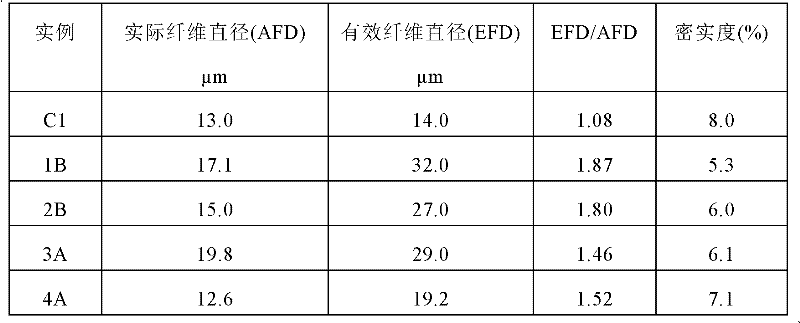
发明人已经发现,本文所公开的高蓬松度纤维网意外地呈现出比纤维网的实际纤维直径大至少约40%的有效纤维直径,如从“实例”章节的表5中看出。例如,实例4的纤维网4A显示出比纤维网的实际纤维直径(12.6μm)大50%左右的有效纤维直径(19.2μm)(即,EFD/AFD比为大约1.52)。相比之下,比较例1的纤维网显示出比比较例1的纤维网的实际纤维直径(13.0μm)大小于10%的有效纤维直径(14.0μm)。The inventors have discovered that the high loft webs disclosed herein unexpectedly exhibit an effective fiber diameter that is at least about 40% greater than the actual fiber diameter of the web, as seen in Table 5 of the "Examples" section. For example, web 4A of Example 4 exhibited an effective fiber diameter (19.2 μm) that was approximately 50% larger than the actual fiber diameter of the web (12.6 μm) (ie, an EFD/AFD ratio of approximately 1.52). In contrast, the web of Comparative Example 1 exhibited an effective fiber diameter (14.0 μm) that was 10% smaller than the actual fiber diameter (13.0 μm) of the web of Comparative Example 1.
本领域的普通技术人员将会知道,尽管两个纤维网显示出非常类似的实际纤维直径(12.6μm对13.0μm),然而相比于比较例1的纤维网,纤维网4A的EFD/AFD比仍增加。另外,4A纤维网和比较例1纤维网均在相同的设备上制成(其中比较例1纤维网是利用与本领域中所述的那些条件类似的普通操作条件来制成,并且4A纤维网是根据本文所公开的方法制成)。因此,通过本文所公开的方法改变操作条件并不会导致纤维网的纤维的实际直径发生显著改变(也不会导致纤维强度发生不可接受的降低),而是导致显著更高的有效纤维直径以及显著更高的蓬松度。Those of ordinary skill in the art will appreciate that although the two webs exhibit very similar actual fiber diameters (12.6 μm vs. 13.0 μm), the EFD/AFD ratio of web 4A compared to the web of Comparative Example 1 Still increasing. Additionally, both the 4A web and the Comparative Example 1 web were made on the same equipment (where the Comparative Example 1 web was made using common operating conditions similar to those described in the art, and the 4A web made according to the methods disclosed herein). Thus, changing the operating conditions by the methods disclosed herein does not result in a significant change in the actual diameter of the fibers of the web (nor an unacceptable reduction in fiber strength), but rather results in significantly higher effective fiber diameters and Significantly higher loft.
因此,本领域的普通技术人员将认识到,本文所公开的方法允许在这样的条件下生成熔纺纤维,所述条件允许纤维被充分拉延(可通过如上所述,制成的纤维可具有与普通条件下所制成的类似的直径的事实来证明,也可通过纤维具有可接受的强度的事实来证明),同时允许纤维意外地形成具有有利地高的蓬松度和高的EFD/AFD比的纤维网。Accordingly, those of ordinary skill in the art will recognize that the methods disclosed herein allow for the production of melt-spun fibers under conditions that allow the fibers to be sufficiently drawn (which, as noted above, can result in fibers having As evidenced by the fact that the diameters are similar to those produced under ordinary conditions, and also by the fact that the fibers have acceptable strength), while allowing the fibers to unexpectedly form with advantageously high loft and high EFD/AFD Ratio fiber web.
尽管不希望受理论或机制的限制,然而本发明人假设,由于即使在实际纤维直径非常类似的情况下,也可观察到这样显著更高的有效纤维直径,因而有效纤维直径的这种差异可能归因于纤维以通过本文所公开的工序实现的某种新颖构型而总体排列。While not wishing to be bound by theory or mechanism, the inventors hypothesize that this difference in effective fiber diameter may It is attributed to the overall arrangement of the fibers in a certain novel configuration achieved by the procedures disclosed herein.
本发明人已经发现,本文所公开的这样新颖且可用的纤维网可通过相对于熔融聚合物长丝的通过速率,显著减少所用的骤冷空气和/或拉延空气的量来生成。此一方法违背了传统看法,传统看法假设熔纺纤维应该在收集之前尽可能完全地骤冷(尽管一些研究者已报道了不使用骤冷空气而生成纺粘纤维,然而此类研究者通常仍使用相对大量的拉延空气,所述拉延空气在这种情况下也将执行骤冷功能)。一直认为这样最大化完全的骤冷可用于防止纤维粘到缩束装置的内表面,团集在一起从而形成绳状集聚束,这可不利地降低纤维网的均匀度等。The present inventors have discovered that such novel and useful webs as disclosed herein can be produced by significantly reducing the amount of quenching air and/or drawing air used relative to the throughput rate of the molten polymer filaments. This approach goes against the conventional wisdom that posits that melt-spun fibers should be quenched as completely as possible prior to collection (although some investigators have reported the generation of spunbond fibers without the use of quench air, such investigators generally still A relatively large amount of drawing air is used, which in this case will also perform a quenching function). It has been believed that such maximally complete quenching can be used to prevent fibers from sticking to the inner surfaces of the attenuator, clumping together and forming rope-like bunches, which can detrimentally reduce web uniformity, etc.
意外地,本发明人发现,骤冷和/或拉延空气相对于熔纺纤维的通过速率以本文所公开的方式这样减少可提供具有意外高的蓬松度并且具有EFD与AFD的意外高的比率的纤维网,而无需使纤维网包含卷曲纤维、间隙形成纤维、双组分纤维等,同时避免了上述预期问题,同时对纤维提供充分拉延以具有可接受的强度。Surprisingly, the inventors have discovered that such a reduction in the passage rate of quenching and/or drawing air relative to melt-spun fibers in the manner disclosed herein provides a fiber having a surprisingly high loft and having a surprisingly high ratio of EFD to AFD web without requiring the web to contain crimped fibers, gap forming fibers, bicomponent fibers, etc., while avoiding the anticipated problems described above, while providing sufficient drawing of the fibers to have acceptable strength.
并不希望受理论或机制限制,本发明人假设本文所公开的现象可能至少部分地是由于在纺粘工艺过程中,纤维在某一点沿其长度的一段碰撞并粘结在一起。即,在本文所公开的工艺中可能有利地形成相对大量的绳状集聚束(常称为“宏束(macrobundle)”),绳状集聚束包括若干(例如,四个、五个、或多至八个或更多)纤维,这些纤维沿其长度的一段粘结在一起(此类纤维偶尔称为“结合(married)”纤维)。对本领域的普通技术人员而言这为基本原理:在制备纺粘纤维网时应避免或最小化诸如宏束等特征,因为它们可能粘到缩束装置的内部并干扰纺粘工艺,可能在所收集的纤维网中导致绳状集聚,从而使纤维网出现不期望的不均匀性,等等。尽管在任何纺粘纤维网中均会在某种程度上存在这样的宏束(例如,图3的比较例1纤维网中可存在一些),然而本发明人假设宏束量的增加可能至少部分地导致本文所公开的纤维网的独特性质。Without wishing to be bound by theory or mechanism, the inventors hypothesize that the phenomena disclosed herein may be at least in part due to fibers colliding and bonding together at some point along a length of their length during the spunbond process. That is, in the processes disclosed herein it may be advantageous to form a relatively large number of rope-like bundles (often referred to as "macrobundles") comprising several (e.g., four, five, or more to eight or more) fibers that are bonded together along a portion of their length (such fibers are occasionally called "married" fibers). It is a rationale for those of ordinary skill in the art that features such as macrobundles should be avoided or minimized when making spunbond webs, as they may stick to the inside of the attenuator and interfere with the spunbond process, possibly in the Rope-like accumulations in the collected web lead to undesirable inhomogeneities in the web, etc. While such macrobundles will be present to some extent in any spunbond web (for example, there may be some in the Comparative Example 1 web of FIG. This leads to the unique properties of the fiber webs disclosed herein.
在图4中,存在于本文所公开的纤维网中的宏束指向外(由标号50指示)。具体地讲,图5的示例性纤维网示出本文所公开的纤维网的独特结构,其中存在大量宏束(这些宏束常常可大致在纤维网的平面内取向)。此结构可与本领域中的至少一些纤维网形成对比(例如,包含间隙形成纤维的一些纤维网)。本领域中的此类纤维网尽管整体上可能具有高蓬松度,但其可能具有不均匀结构,其中纤维网的内部具有相对高的蓬松度,而纤维网的一个或两个表面具有相对低的蓬松度(即,更致密)。本文所述的纤维网由于不包括相对致密的表面区域,因而可更能够允许粒子渗透到纤维网的内部区域中并保持在其中,这可有助于本发明人所指出的优异的深度填塞能力。In FIG. 4, the macrobundles present in the webs disclosed herein are directed outward (indicated by numeral 50). In particular, the exemplary web of FIG. 5 illustrates the unique structure of the webs disclosed herein in which there are a large number of macro-bundles (these macro-bundles can often be oriented approximately in the plane of the web). This structure can be contrasted with at least some webs in the art (eg, some webs comprising gap-forming fibers). Such webs in the art, while potentially high loft as a whole, may have a non-uniform structure in which the interior of the web has relatively high loft and one or both surfaces of the web have relatively low loft. Loftiness (ie, denser). The webs described herein may be more capable of allowing particles to penetrate into and be retained in the interior regions of the web, since they do not include relatively dense surface regions, which may contribute to the superior deep packing capabilities noted by the inventors .
虽然同样不希望受理论或机制限制,然而图2所示类型的缩束装置的独特设计(本领域的技术人员会认为其具有相对短长度的拉延室)在如本文所述操作时可尤其有利于允许此类宏束成功产生并结合到纺粘纤维网中。While again not wishing to be bound by theory or mechanism, the unique design of a attenuator of the type shown in FIG. It is advantageous to allow such macrobundles to be successfully produced and incorporated into a spunbond web.
因此,本文所公开的纤维网可通过相对于熔融聚合物通过量显著减少拉延空气(以及可选地,骤冷空气)的量来生成。本领域的技术人员会认为本文所公开的拉延空气的量处于如下范围内:所述范围通常被认为太低,从而会导致操作熔纺工艺时的上述困难,和/或导致上述不期望的纤维网特征。因此,本文所公开的条件没有落入熔纺工艺的普通条件的惯常优化范围内。Accordingly, the webs disclosed herein can be produced by significantly reducing the amount of drawing air (and optionally, quench air) relative to the molten polymer throughput. Those skilled in the art will recognize that the amounts of drawing air disclosed herein are within ranges generally considered too low to cause the aforementioned difficulties in operating the melt-spinning process, and/or lead to the aforementioned undesirable effects. Fiber web characteristics. Therefore, the conditions disclosed herein do not fall within the customary optimization range of the ordinary conditions of the melt spinning process.
实例1-3中讨论了利用减少的骤冷空气流和拉延空气流生成的纤维网的实例(与相对于熔融聚合物通过量的量,通常使用的空气流速进行比较)。Examples of webs produced using reduced quench and draw air flows are discussed in Examples 1-3 (compared to typically used air flow rates relative to the amount of molten polymer throughput).
发明人还发现,如果充分增加熔融聚合物通过量,则在仍使用相对大的骤冷空气和/或拉延空气量的同时也可实现本文所公开的结果。实例4给出了以这样的方式生成的纤维网的实例。在这种情况下,骤冷空气和拉延空气与比较例1相当,但熔融聚合物通过量以足以实现本文所公开的有利结果的因子增加。The inventors have also discovered that if the molten polymer throughput is increased sufficiently, the results disclosed herein can be achieved while still using relatively large amounts of quench air and/or drawing air. Example 4 gives an example of a web produced in this way. In this case, the quench air and draw air were comparable to Comparative Example 1, but the molten polymer throughput was increased by a factor sufficient to achieve the favorable results disclosed herein.
因此,本文所公开的纤维网可通过相对于熔融聚合物通过量显著减少拉延空气(以及可选地,骤冷空气)的量来生成,而无论这是通过(例如)减少骤冷空气和拉延空气,或通过(例如)增大熔融聚合物通过速率,或该二者之某种组合而实现的。尽管本文中给出了工艺条件的某些组合(已证明其尤其适用于本文所给出类型的设备),然而本领域的普通技术人员将理解,本文所公开的条件在一定程度上可能是本文所用设备的设计所特有的。可能不得不通过本文公开内容的教导,针对任何特定生产线获得合适的工艺条件组合。并且,如所述,某些设备(例如,包括本文所述的创新的缩束装置设计的那些设备)可能最适合于生产本文所公开的纺粘纤维网。Thus, the webs disclosed herein can be produced by significantly reducing the amount of draw air (and optionally, quench air) relative to molten polymer throughput, whether this is by, for example, reducing quench air and Drawing air, or by, for example, increasing the molten polymer throughput rate, or some combination of the two. Although certain combinations of process conditions are presented herein that have proven to be particularly suitable for use with equipment of the type presented herein, those of ordinary skill in the art will appreciate that the conditions disclosed herein may to the extent are specific to the design of the equipment used. A suitable combination of process conditions for any particular production line may have to be obtained through the teachings of the disclosure herein. And, as noted, certain equipment (eg, those including the innovative attenuator designs described herein) may be best suited for producing the spunbond webs disclosed herein.
在生产本文所公开的高蓬松度纤维网时,纤维收集方法也可被调控至有利。例如,施加于纤维收集表面(例如,通过图1所示的气体抽离装置14施加)的真空量可保持为最小,以便维持最高蓬松度(然而,同样意外地,本文所公开的纤维网已证明即使使用相对大量的真空也能够保持高蓬松度)。收集表面19的速度(形成速度)也可被调控至有利,(例如)以进一步降低密实度并增大蓬松度,如表1A和表2A所示出的。同样,任何后续粘结方法(其常常用于增强纤维网的完整性和物理强度)可被调控至有利。因此,在使用图1的受控加热装置101时,由装置101提供的任何受热空气的流速和/或此类工艺中所施加(例如,通过气体抽离装置14施加)的任何真空的量可被最小化。或者,在通过压延进行粘结时,力的量和/或实际压延面积可保持为最小(例如,可使用点粘结)。具体对于压延,如果此类压延被执行为使得其使接收压延力的纤维网区域显著致密,并且使得相对大的纤维网区域被如此压延,则致密区域可使纤维网的某些测量性质(例如,有效纤维直径)相对于纤维网在被压延之前固有实现的性质(以及相对于纤维网的未接收压延力的区域所呈现的性质)而改变。因此,在纤维网已被如此压延的特定情况下,可能有必要测试纤维网的未压延区域,和/或在其预压延条件下测试纤维网,以确定纤维网是否落入本文所公开的参数范围内。Fiber acquisition methods can also be manipulated to advantage in producing the high loft webs disclosed herein. For example, the amount of vacuum applied to the fiber collecting surface (e.g., by the
如上所述,根据本文的公开内容,本文所公开的纤维网可包括纤维,所述纤维暴露于相对低速或程度的骤冷和/或相对低速或程度的拉延。这样,在各种实施例中,本文所公开的纤维网可包括:不包括双折射不同达5%或更高的纵向分段的纤维;和/或其中在分级密度(Graded Density)测试(如美国专利6,916,752(Berrigan等人)中所公开的),少于五个纤维段变得相对于水平面成至少60度的角设置的纤维。As noted above, in accordance with the disclosure herein, the fiber webs disclosed herein may include fibers that have been exposed to relatively low rates or degrees of quenching and/or relatively low rates or degrees of drawing. Thus, in various embodiments, the fiber webs disclosed herein can include: fibers that do not include longitudinal segments that differ in birefringence by 5% or more; In US Patent No. 6,916,752 (as disclosed in Berrigan et al.), fewer than five fiber segments become fibers disposed at an angle of at least 60 degrees relative to the horizontal.
在一些实施例中,本文所公开的纤维网可包括如本文所定义的“直接收集的纤维”。In some embodiments, the fiber webs disclosed herein may include "directly collected fibers" as defined herein.
在一些实施例中,本文所公开的纤维网可包括基本连续的纤维,表示纤维具有相对长(例如,大于六英寸)的无限长度。这样基本连续的纤维可与(例如)人造短纤维形成对比,人造短纤维通常相对短(例如,六英寸或更短)和/或短切成有限长度。In some embodiments, the fiber webs disclosed herein can include substantially continuous fibers, meaning that the fibers have an infinite length that is relatively long (eg, greater than six inches). Such substantially continuous fibers may be contrasted, for example, with staple fibers, which are typically relatively short (eg, six inches or less) and/or chopped to finite lengths.
在各种实施例中,本文所公开的纤维网的基重可在(例如)每平方米30-200克范围内。在各种实施例中,本文所公开的纤维网的厚度可在约0.5mm至约3.0mm范围内。In various embodiments, the fiber webs disclosed herein can have a basis weight in the range of, for example, 30-200 grams per square meter. In various embodiments, the thickness of the fiber webs disclosed herein can range from about 0.5 mm to about 3.0 mm.
在一些实施例中,本文所公开的纤维网为自支承的,这意味着它们具有足够的完整性,从而可利用正常工艺和设备来处理(例如,可卷绕成卷、成褶、组装成过滤装置等)。如本文中所述,可使用粘结工艺(例如,经由受控加热设备的自生粘结、点粘结等)来增强此自支承特性。In some embodiments, the webs disclosed herein are self-supporting, which means that they have sufficient integrity to be handled using normal processes and equipment (e.g., can be wound into rolls, pleated, assembled into filter, etc.). As described herein, bonding processes (eg, autogenous bonding via controlled heating equipment, point bonding, etc.) can be used to enhance this self-supporting characteristic.
在各种实施例中,本文所公开的纤维网具有至少约10μm、至少约14μm或至少约18μm的实际纤维直径。在另外的实施例中,本文所公开的纤维网具有至多约30μm、至多约25μm或至多约20μm的实际纤维直径。In various embodiments, the fiber webs disclosed herein have an actual fiber diameter of at least about 10 μm, at least about 14 μm, or at least about 18 μm. In additional embodiments, the fiber webs disclosed herein have an actual fiber diameter of at most about 30 μm, at most about 25 μm, or at most about 20 μm.
在各种实施例中,本文所公开的纤维网具有至少约15μm、至少约20μm或至少约25μm的有效纤维直径。在另外的实施例中,本文所公开的纤维网具有至多约45μm、至多约35μm或至多约30μm的有效纤维直径。In various embodiments, the fiber webs disclosed herein have an effective fiber diameter of at least about 15 μm, at least about 20 μm, or at least about 25 μm. In additional embodiments, the fiber webs disclosed herein have an effective fiber diameter of at most about 45 μm, at most about 35 μm, or at most about 30 μm.
在各种实施例中,可使用任何方便的热塑性纤维形成聚合材料来形成本文所公开的纤维网。此类材料可包括(例如)聚烯烃(例如,聚丙烯、聚乙烯等)、聚对苯二甲酸乙二酯、尼龙以及这些材料中任何材料的共聚物和/或共混物。In various embodiments, any convenient thermoplastic fiber-forming polymeric material may be used to form the webs disclosed herein. Such materials may include, for example, polyolefins (eg, polypropylene, polyethylene, etc.), polyethylene terephthalate, nylon, and copolymers and/or blends of any of these materials.
在一些实施例中,可向本文所公开的纤维网中添加其他纤维、添加剂等。例如,可包括人造短纤维,可使用用于各种目的的粒状添加剂、吸附剂等,如本领域所已知的。具体地讲,(例如)如果需要,可存在氟化添加剂或处理,以便改善纤维网的耐油性。In some embodiments, other fibers, additives, etc. may be added to the webs disclosed herein. For example, staple fibers may be included, particulate additives for various purposes, adsorbents, etc. may be used, as is known in the art. In particular, fluorinated additives or treatments may be present, for example, if desired, in order to improve the oil resistance of the web.
在一些实施例中,如本领域所熟知的,可通过(例如)水充电(hydrocharging)、电晕充电等对本文所公开的纤维网充电。In some embodiments, the webs disclosed herein may be charged by, for example, hydrocharging, corona charging, etc., as is well known in the art.
例如支撑层、预过滤层等附加层可与本文所公开的纤维网组合(例如,通过层合)。因此,在一些实施例中,本文所公开的纤维网可作为多层制品中的一个或多个子层而存在。Additional layers, such as support layers, pre-filter layers, etc., can be combined (eg, by lamination) with the webs disclosed herein. Accordingly, in some embodiments, the webs disclosed herein may exist as one or more sublayers in a multilayer article.
在一些实施例中,本文所公开的纤维网可如本领域所熟知地成褶,(例如)以形成褶皱型过滤器以用于诸如空气过滤等应用中。如先前所述,本领域的普通技术人员将区别纤维网整体的这种成褶与各个纤维的卷曲。本文所述的褶皱型过滤器可为自支承的,意味着它们在经受强制通风系统中通常会遇到的空气压力时不会过度伸缩或弯倒。本文所述的褶皱型过滤器可具有一个或多个稀松布和/或周边框架以增强褶皱型过滤器的稳定性。图5示出示例性褶皱型过滤器114,其包含由本文所述的纺粘纤维网20构成的过滤介质,并且还包括周边框架112和稀松布110。尽管图5中示出与过滤介质的一个面不连续接触的平坦构造,然而稀松布110可与过滤介质一起成褶(例如,从而与过滤介质基本上连续接触)。稀松布110可由非织造材料、线、玻璃纤维等构成。In some embodiments, the webs disclosed herein can be pleated as is well known in the art, for example, to form pleated filters for use in applications such as air filtration. As previously stated, one of ordinary skill in the art will distinguish between such pleating of the web as a whole and crimping of individual fibers. The pleated filters described herein may be self-supporting, meaning that they do not unduly stretch or buckle when subjected to air pressures typically encountered in forced air systems. The pleated filters described herein may have one or more scrims and/or perimeter frames to enhance the stability of the pleated filters. FIG. 5 illustrates an exemplary
可能由于其高蓬松度和有效纤维直径与实际纤维直径的高比率允许其用作深度过滤器,本文所述的纤维网可呈现出有利的过滤性质,例如与低压降结合的高过滤效率。此类性质可通过任何熟知的参数来表征,这些参数包括渗透率百分比、压降、品质因子、捕集效率(例如,最低复合效率、最低效率记录值)等。在特定实施例中,本文所公开的纤维网具有至少约0.5、至少约0.7或至少约1.0的品质因子。The fiber webs described herein can exhibit advantageous filtration properties, such as high filtration efficiency combined with low pressure drop, likely due to their high loft and high ratio of effective fiber diameter to actual fiber diameter allowing them to be used as depth filters. Such properties can be characterized by any of the well-known parameters, including percent permeability, pressure drop, quality factor, capture efficiency (eg, lowest recombination efficiency, lowest recorded efficiency), and the like. In particular embodiments, the fiber webs disclosed herein have a quality factor of at least about 0.5, at least about 0.7, or at least about 1.0.
实例example
测试工序Test procedure
密实度和蓬松度Density and bulk
密实度是通过将纤维网的所测堆密度除以构成纤维网的固体部分的材料的密度来确定。纤维网的堆密度可通过首先测量纤维网(例如,10cm×10cm的区段)的重量来确定。将测量的纤维网的重量除以纤维网面积,得到纤维网的基重,以g/m2为单位记录。纤维网的厚度可通过获得(例如,通过冲模切割)135mm直径的纤维网盘并在纤维网顶部居中放置100mm直径的230g重物的情况下测量纤维网厚度而测得。纤维网的堆密度是通过将纤维网的基重除以纤维网的厚度来确定,以g/m3为单位记录。Solidity is determined by dividing the measured bulk density of the web by the density of the material making up the solid portion of the web. The bulk density of a fiber web can be determined by first measuring the weight of the fiber web (eg, 10 cm x 10 cm segments). Divide the measured weight of the web by the area of the web to obtain the basis weight of the web, reported in g/ m2 . The thickness of the web can be measured by obtaining (eg, by die cutting) a 135 mm diameter disc of the web and measuring the web thickness with a 100 mm diameter 230 g weight centered on top of the web. The bulk density of the web is determined by dividing the basis weight of the web by the thickness of the web and is reported in g/ m3 .
然后,通过将纤维网的堆密度除以包括纤维网的固体纤维的材料(例如,聚合物)的密度来确定密实度。(如果供应商未规定材料密度,则可通过标准装置来测量聚合物的密度。)密实度是通常以百分比来记录的无量纲比率。Solidity is then determined by dividing the bulk density of the web by the density of the material (eg, polymer) comprising the solid fibers of the web. (If the material density is not specified by the supplier, the density of the polymer can be measured by standard equipment.) Solidity is a dimensionless ratio usually reported as a percentage.
蓬松度通常记录为100%减去密实度(例如,7%的密实度相当于93%的蓬松度)。Loft is usually reported as 100% minus firmness (eg, 7% firmness is equivalent to 93% loft).
有效纤维直径Effective fiber diameter
根据Davies,C.N.的“The Separation of Airborne Dust andParticles”(Institution of Mechanical Engineers,London,Proceedings 1B,1952)中示出的方法来评价纤维网的有效纤维直径(EFD)。除非另有说明,否则测试以14cm/sec的面速度进行。The effective fiber diameter (EFD) of the web was evaluated according to the method set forth in "The Separation of Airborne Dust and Particles" by Davies, C.N. (Institution of Mechanical Engineers, London, Proceedings 1B, 1952). Unless otherwise stated, tests were performed at a face velocity of 14 cm/sec.
实际纤维直径和纤维网表征Actual fiber diameter and web characterization
通过经由扫描电镜以500倍或更大的放大率对纤维网成像并利用Olympus DP2-BSW图像分析程序来评价纤维网中纤维的实际纤维直径(AFD)。针对每一纤维网样品获得至少100个单独的直径测量值,并将这些测量值的均值记录为该纤维网的AFD。The actual fiber diameter (AFD) of the fibers in the web was evaluated by imaging the web via a scanning electron microscope at a magnification of 500X or greater and using the Olympus DP2-BSW image analysis program. At least 100 individual diameter measurements were obtained for each web sample, and the average of these measurements was reported as the AFD for that web.
可使用经由显微镜(例如,光学或SEM)的视觉检测来确定纤维网是否包括给定类型的纤维(例如,卷曲纤维、间隙收集纤维和/或双组分纤维)。这可通过检测纤维片段(例如,显现于显微镜视野中)来进行,而不论纤维片段是否可来自各个单独的纤维,或者检测的至少一些片段是否可来自足够长以在视野内来回绕多次的纤维。因此,这样每二十个纤维中少于一个为给定类型的表征在本文中被定义为表示每二十个纤维片段(如(纤维网的适当数量的不同区域的)视觉检测过程中所评价的)中少于一个为给定类型。Visual inspection via microscopy (eg, optical or SEM) can be used to determine whether a web includes a given type of fiber (eg, crimped fibers, interstitial collected fibers, and/or bicomponent fibers). This can be done by detecting fiber fragments (e.g., appearing in the field of view of a microscope), regardless of whether the fiber fragments can be from individual fibers, or whether at least some of the detected fragments can be from long enough to wrap around in the field of view multiple times. fiber. Thus, such less than one in twenty fibers of a given type is defined herein to mean that every twenty fiber segments (as assessed during visual inspection (of an appropriate number of distinct regions of a web) of ) for a given type.
%渗透率、压降和品质因子% Permeability, Pressure Drop and Quality Factor
纤维网样品的渗透率百分比、压降和过滤品质因子(QF)是利用包含DOP(邻苯二甲酸二辛酯)液滴的测试用气溶胶来确定,以85升/分钟的流速递送(除非另外指明)以提供14cm/s的面速度,并利用TSITMModel8130高速自动过滤器测试机(可从TSI Inc.商购获得)来评价。对于DOP测试,该气溶胶可包含直径约0.185μm的粒子,且该自动过滤器测试机可在加热器关闭且粒子中和器打开时进行操作。可在过滤器的入口和出口处采用经校准的光度计来测量粒子浓度以及穿过该过滤器的粒子渗透率百分比。可采用MKS压力换能器(可从MKS Instruments商购获得)来测量穿过过滤器的压降(ΔP,mm H2O)。可使用如下公式来计算QF:The percent permeability, pressure drop and filtration quality factor (QF) of the web samples were determined using a test aerosol containing DOP (dioctyl phthalate) droplets, delivered at a flow rate of 85 liters per minute (unless otherwise specified) to provide a face velocity of 14 cm/s and evaluated using a TSI ™ Model 8130 High Speed Automatic Filter Tester (commercially available from TSI Inc.). For DOP testing, the aerosol can contain particles approximately 0.185 μm in diameter, and the automated filter tester can be operated with the heater off and the particle neutralizer on. A calibrated photometer can be used at the inlet and outlet of the filter to measure the particle concentration and the percent penetration of the particle through the filter. A MKS pressure transducer (commercially available from MKS Instruments) can be used to measure the pressure drop across the filter ([Delta]P, mm H2O ). QF can be calculated using the following formula:
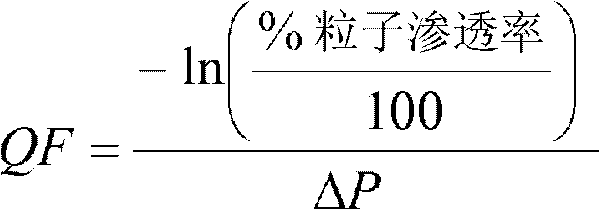
初始品质因子QF值通常提供关于总体性能的可靠指标,其中较高的初始QF值表示较好的过滤性能,而较低的初始QF值表示较低的过滤性能。QF的单位为压降的倒数(以1/mm H20记录)。Initial quality factor QF values generally provide a reliable indicator of overall performance, with higher initial QF values indicating better filtration performance and lower initial QF values indicating lower filtration performance. The units of QF are the reciprocal of the pressure drop (reported as 1/mm H20 ).
捕集效率Capture efficiency
过滤器的过滤性能可通过以与ASHRAE标准52.2(“Method ofTesting General Ventilation Air-Cleaning Devices for Removal Efficiencyby Particle Size”)中所述类似的方式进行测试来确定。所述测试涉及将纤维网构造为过滤器(例如,褶皱和/或加框过滤器),将该过滤器安装到测试管道中,并使过滤器经受氯化钾粒子(已干燥并电荷中和)。可采用1.5米/秒的测试面速度。光学粒子计数器可以用于测量在一系列十二个粒度范围或通道内该测试过滤器的上游和下游的粒子浓度。可使用如下公式来确定每个通道的捕集效率:The filtration performance of a filter can be determined by testing in a manner similar to that described in ASHRAE Standard 52.2 ("Method of Testing General Ventilation Air-Cleaning Devices for Removal Efficiency by Particle Size"). The test involved constructing the fiber web into a filter (e.g., a pleated and/or framed filter), installing the filter into a test pipe, and subjecting the filter to potassium chloride particles (dried and charge neutralized ). A test face velocity of 1.5 m/s may be used. An optical particle counter can be used to measure particle concentrations upstream and downstream of the test filter within a series of twelve particle size ranges or channels. The capture efficiency of each channel can be determined using the following formula:

在初始效率测量之后,依序进行一系列粉尘填塞和效率测量,直到过滤器压力达到预定值;确定测试过程中每一粒度通道的最低效率,并确定复合最低效率曲线。在初始以及每一粉尘填塞之后测量过滤器上的压降,并确定粉尘提供量和过滤器的重量增益。根据复合最低效率曲线,可对介于0.3和1.0μm之间的四个效率值求平均,以得到E1最低复合效率(MCE),可对介于1.0和3.0μm之间的四个效率值求平均,以得到E2MCE,并且可对介于3.0和10.0μm之间的四个效率值求平均,以得到E3MCE。根据过滤器的MCE值,可使用标准中的参考表来确定过滤器的最低效率记录值(MERV)。After the initial efficiency measurement, a series of dust packing and efficiency measurements are performed sequentially until the filter pressure reaches a predetermined value; the minimum efficiency of each particle size channel during the test is determined, and the composite minimum efficiency curve is determined. The pressure drop across the filter was measured initially and after each dust pack, and the dust delivery and weight gain of the filter was determined. According to the composite minimum efficiency curve, the four efficiency values between 0.3 and 1.0 μm can be averaged to obtain the E1 minimum composite efficiency (MCE), and the four efficiency values between 1.0 and 3.0 μm can be calculated averaged to obtain the E2MCE, and the four efficiency values between 3.0 and 10.0 μm can be averaged to obtain the E3MCE. Based on the MCE value of the filter, the minimum efficiency record value (MERV) of the filter can be determined using the reference table in the standard.
实例1Example 1
使用与图1和图2所示类似的设备,由熔融流速指数为70的聚丙烯(可以商品名3860得自Total Petrochemicals)形成单组分单层纤维网。挤出头具有18行,每行36个孔,挤出头分成两块,每块9行,通过冲模中间的0.63英寸(16mm)的间隙分隔开,构成总共648个孔。这些孔被布置为交错的图案,间距为0.25英寸(6.4mm)。熔融聚合物的流速为大约每分钟每孔0.71克。供应两个相对的骤冷空气流(与图1中的示出为18b的那些类似;不采用示出为18a的那种流)来作为:上部流,其来自高度为16英寸(406mm)的骤冷箱,面速度近似为0.3m/sec且温度为5℃;以及下部流,其来自高度为7.75英寸(197mm)的骤冷箱,面速度近似为0.1m/sec且温度为室温。采用类似美国专利No.6,607,624和No.6,916,752中所示的活动壁缩束装置,气刀间隙为0.030英寸(0.76mm),空气以14kPa的压力供应给气刀,缩束装置顶部间隙宽度为6.1mm,缩束装置底部间隙宽度为6.1mm,且缩束室长度为6英寸(152mm)。从挤出头至缩束装置的距离为31英寸(79cm),并且从缩束装置至收集带的距离为27英寸(69cm)。熔纺纤维流以约46cm的宽度沉积在收集带上,在收集带下方建立有大约125Pa的真空。收集带是由20目不锈钢制成,并以表1所示的速度(“形成速度”)移动。Using equipment similar to that shown in Figures 1 and 2, a single component single layer web was formed from a melt flow index 70 polypropylene (available under the trade designation 3860 from Total Petrochemicals). The extrusion head had 18 rows of 36 holes each, and the head was divided into two pieces of 9 rows separated by a 0.63 inch (16 mm) gap in the middle of the die for a total of 648 holes. The holes were arranged in a staggered pattern with a pitch of 0.25 inches (6.4 mm). The flow rate of molten polymer was approximately 0.71 grams per minute per hole. Two opposing streams of quench air (similar to those shown as 18b in FIG. 1 ; the stream shown as 18a was not used) were supplied as: the upper stream from a 16 inch (406 mm) high A quench box with a face velocity of approximately 0.3 m/sec and a temperature of 5°C; and a lower flow from a quench box of height 7.75 inches (197 mm) with a face velocity of approximately 0.1 m/sec and a temperature of room temperature. Using a movable wall attenuator similar to that shown in U.S. Patent No. 6,607,624 and No. 6,916,752, the air knife gap is 0.030 inches (0.76mm), the air is supplied to the air knife at a pressure of 14kPa, and the top gap width of the attenuator is 6.1 mm, the width of the gap at the bottom of the attenuator is 6.1 mm, and the length of the attenuator chamber is 6 inches (152 mm). The distance from the extrusion head to the attenuator was 31 inches (79 cm), and the distance from the attenuator to the collection belt was 27 inches (69 cm). The melt-spun fiber stream was deposited on a collection belt with a width of about 46 cm, below which a vacuum of about 125 Pa was established. The collection belt was made of 20 mesh stainless steel and moved at the speed shown in Table 1 ("formation speed").
然后,收集的熔纺纤维团(纤维网)经过受控加热粘结装置下方,以使至少一些纤维自生地粘结在一起。通过粘结装置在出口狭槽(其为7.6cm×61cm)处以大约4.1m/sec的速度供应空气。当纤维网经过粘结装置下方时,空气出口距收集的纤维网约2.5cm。穿过受控加热装置的狭槽的空气的温度为大约153℃(在受热空气进入壳体的入口点处测量得到)。在纤维网经过粘结装置下方之后,强迫环境温度空气穿过纤维网,以将纤维网冷却至大约环境温度。The collected mass of melt-spun fibers (fibrous web) is then passed under a controlled heated bonding device to autogenously bond at least some of the fibers together. Air was supplied at a velocity of approximately 4.1 m/sec at an outlet slot (which was 7.6 cm x 61 cm) by a bonding device. The air outlet was about 2.5 cm from the collected web as the web passed under the bonding device. The temperature of the air passing through the slots of the controlled heating means was about 153°C (measured at the point of entry of the heated air into the housing). After the web passes under the bonding device, ambient temperature air is forced through the web to cool the web to about ambient temperature.
如此制成的纤维网是利用正常工艺和设备以足够的完整性进行粘结以便自支承且可处理;纤维网可通过正常的卷起处理卷成存储卷筒,或者可经受诸如成褶等各种操作并组装成过滤装置,例如褶皱型过滤面板。The web so produced is bonded with sufficient integrity to be self-supporting and handleable using normal processes and equipment; operation and assembled into a filter device, such as a pleated filter panel.
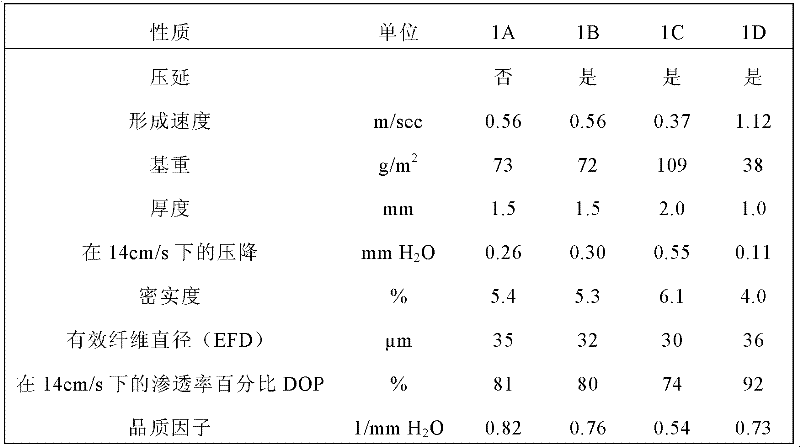
制备纤维网的若干变型,如表1A所述。通过改变收集带的速度,以三种不同的基重收集纤维网。用扫描电子显微镜测量纤维网之一(1B)的纤维,发现基于114个纤维的样品尺寸,所述纤维网的纤维具有17.1微米的实际纤维直径,标准偏差为2.8微米。Several variations of webs were prepared, as described in Table 1A. The web was collected at three different basis weights by varying the speed of the collection belt. The fibers of one of the webs (1B) were measured with a scanning electron microscope and found to have an actual fiber diameter of 17.1 microns based on a sample size of 114 fibers, with a standard deviation of 2.8 microns.
馈送每一纤维网(除了纤维网1A之外,如下所述)经过离线(即,与上述纤维网形成工艺分开的)压延工艺,所述工艺采用具有2.4%粘结图案的未受热压延辊(该粘结图案由3.8mm高的元素组成,所述元素在行与行之间间隔开7.4mm且沿着每一行间隔开4.3mm),并结合使用光滑背衬辊,该背衬辊被加热至93℃并以18N/mm的压力和15m/min的速度接触图案辊。然后,利用本领域熟知的方法以大约-20kV对纤维网进行电晕充电。然后获得这些纤维网的在14cm/s下的压降、有效纤维直径、DOP的渗透率百分比以及品质因子,列于表1A中。Each web (except Web 1A, described below) was fed through an off-line (i.e., separate from the web formation process described above) calendering process using unheated calendering rolls with a 2.4% bonding pattern ( The bonding pattern consisted of 3.8mm high elements spaced 7.4mm apart from row to row and 4.3mm along each row) in combination with a smooth backing roll which was heated to 93°C and contact the patterned roll with a pressure of 18 N/mm and a speed of 15 m/min. The web was then corona charged at approximately -20 kV using methods well known in the art. The pressure drop at 14 cm/s, effective fiber diameter, percent permeability of DOP, and quality factor for these webs were then obtained and are listed in Table 1A.
表1ATable 1A
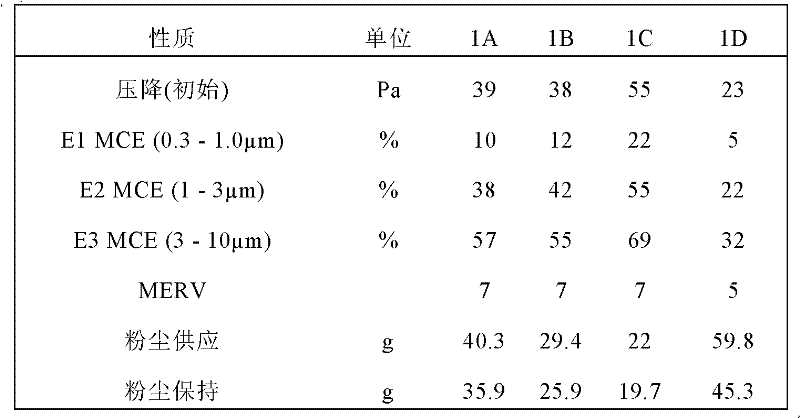
用Super 77喷胶(可得自3M Company)将充电的平坦纤维网样品层合至开放丝网增强层。用推棒成褶器使层合的介质成褶,该成褶器被设置为每英尺间隔提供12个褶皱,褶皱长度为大约5cm。用一体式冲切框架将成褶介质加框而成过滤器,以得到大约35×63×2cm的最终过滤器尺寸。由独立测试公司根据ASHRAE标准52.2针对149Pa的最终压力评价过滤器。获得每一褶皱型过滤器的最低复合效率和最低效率记录值,列于表1B中。The charged flat web samples were laminated to the open wire mesh reinforcement with Super 77 spray glue (available from 3M Company). The laminated media was pleated with a push bar pleater set to provide 12 pleats per foot of spacing with a pleat length of approximately 5 cm. The filter was framed from the pleated media with an integral die cut frame to give a final filter size of approximately 35 x 63 x 2 cm. Filters were rated by an independent testing company according to ASHRAE Standard 52.2 for a final pressure of 149 Pa. The lowest composite efficiency and lowest recorded efficiency were obtained for each pleated filter and are listed in Table 1B.
表1BTable 1B
实例2Example 2
使用实例1中的通用方法(除了以下另外指明的外),由熔融流速指数为70的3860聚丙烯(可得自Total Petrochemicals)形成单组分单层纤维网,并与0.5重量%的Uvinul 5050H(可得自BASF)组合。上部骤冷流具有近似0.4m/sec的面速度。供应给气刀的空气处于34kPa的压力下。熔纺纤维流以约46cm的宽度沉积在收集带上。估计收集带下方的真空为约300Pa。通过受控加热粘结装置在出口狭槽处以大约5.7m/sec的速度供应空气。穿过受控加热装置的狭槽的空气的温度为155℃(在受热空气进入壳体的入口点处测量得到)。Using the general procedure in Example 1 (except as otherwise indicated below), a monocomponent monolayer web was formed from 3860 polypropylene having a melt flow index of 70 (available from Total Petrochemicals) and mixed with 0.5% by weight of Uvinul 5050H (available from BASF) combination. The upper quench flow has a face velocity of approximately 0.4 m/sec. The air supplied to the air knife was at a pressure of 34kPa. The melt-spun fiber stream was deposited on the collection belt with a width of about 46 cm. The vacuum under the collection belt was estimated to be about 300 Pa. Air was supplied at the outlet slot at a velocity of approximately 5.7 m/sec by a controlled heating bonding device. The temperature of the air passing through the slots of the controlled heating means was 155°C (measured at the point of entry of the heated air into the enclosure).
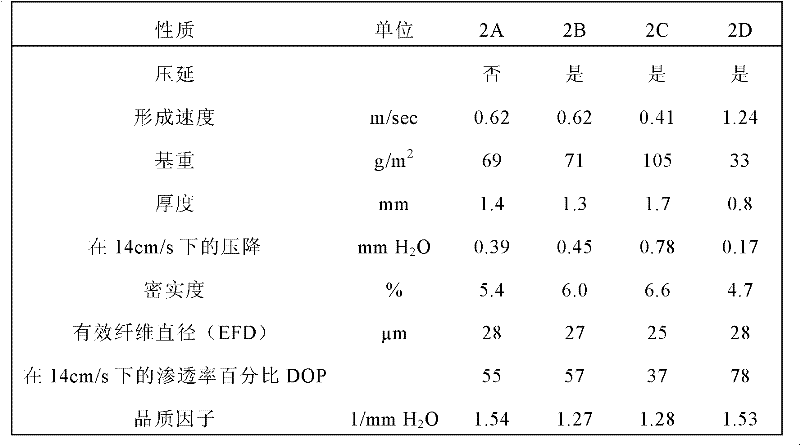
如此制成的纤维网是利用正常工艺和设备以足够的完整性进行粘结以便自支承且可处理;纤维网可通过正常的卷起处理而卷成存储卷筒,或者可经受诸如成褶等各种操作并组装成过滤装置,例如褶皱型过滤面板。制备纤维网的若干变型,如表2A所述。通过改变收集带的速度,以三种不同的基重收集纤维网。用扫描电子显微镜测量纤维网2B的纤维,发现基于252个纤维的样品尺寸,纤维网2B的纤维具有15.0微米的实际纤维直径,标准偏差为2.6微米。The web so produced is bonded with sufficient integrity to be self-supporting and handleable using normal processes and equipment; Various operations and assembled into filter devices, such as pleated filter panels. Several variations of the webs were prepared, as described in Table 2A. The web was collected at three different basis weights by varying the speed of the collection belt. The fibers of web 2B were measured with a scanning electron microscope and found to have an actual fiber diameter of 15.0 microns based on a sample size of 252 fibers with a standard deviation of 2.6 microns.
每一纤维网(除了纤维网2A)以与纤维网1B-1D类似的方式被压延。然后,根据美国专利No.5,496,507中教导的技术用去离子水对纤维网进行水充电,然后干燥。Each web (except web 2A) was calendered in a similar manner to webs 1B-1D. The web was then hydrocharged with deionized water according to the techniques taught in US Patent No. 5,496,507, and then dried.
表2ATable 2A
以与实例1的样品类似的方式将充电的平坦纤维网样品层合至开放丝网增强层、成褶、加框和过滤测试。获得每一褶皱型过滤器的最低复合效率和最低效率报告值,列于表2B中。The charged flat web samples were laminated to an open mesh reinforcement, pleated, framed, and filtered in a similar manner to the sample of Example 1 . The minimum composite efficiency and the minimum reported efficiency values were obtained for each pleated filter and are listed in Table 2B.
表2BTable 2B
实例3Example 3
使用实例1中的通用方法(除了以下另外指明的外),由熔融流速指数为70的3860聚丙烯(可得自Total Petrochemicals)形成单组分单层纤维网。上部骤冷流具有近似0.6m/sec的面速度。熔纺纤维流以约46cm的宽度沉积在收集带上。通过受控加热粘结装置在出口狭槽处以大约4.6m/sec的速度供应空气。Using the general procedure in Example 1 (except as otherwise indicated below), a monocomponent monolayer web was formed from 3860 polypropylene having a melt flow index of 70 (available from Total Petrochemicals). The upper quench flow has a face velocity of approximately 0.6 m/sec. The melt-spun fiber stream was deposited on the collection belt with a width of about 46 cm. Air was supplied at the exit slot at a velocity of approximately 4.6 m/sec by a controlled heating bonding device.
如此制成的纤维网是利用正常工艺和设备以足够的完整性进行粘结以便自支承且可处理;纤维网可通过正常的卷起处理而卷成存储卷筒,或者可经受诸如成褶等各种操作并组装成过滤装置,例如褶皱型过滤面板。制备纤维网的一个变型,如表3所述。The web so produced is bonded with sufficient integrity to be self-supporting and handleable using normal processes and equipment; Various operations and assembled into filter devices, such as pleated filter panels. A variation of the fiber web was prepared as described in Table 3.
表3table 3

用扫描电子显微镜测量纤维网3A的纤维,发现基于146个纤维的样品尺寸,纤维网3A的纤维具有19.8微米的实际纤维直径,标准偏差为2.8微米。The fibers of web 3A were measured with a scanning electron microscope and found to have an actual fiber diameter of 19.8 microns based on a sample size of 146 fibers, with a standard deviation of 2.8 microns.
实例4Example 4
使用实例1中的通用方法(除了以下另外指明的外),由熔融流速指数为70的3860聚丙烯(可得自Total Petrochemicals)形成单组分单层纤维网。上部骤冷流具有近似0.7m/sec的面速度;未使用下部骤冷箱。缩束装置具有0.020英寸(0.51mm)的气刀间隙;空气以83kPa的压力供应给气刀。从挤出头至缩束装置的距离为23英寸(58cm),并且从缩束装置至收集带的距离为21英寸(53cm)。熔纺纤维流以约51cm的宽度沉积在收集带上。在这种情况下,收集带为9SS TC带(可得自Albany International)。估计收集带下方的真空为约800Pa。通过受控加热粘结装置在出口狭槽处以大约11m/sec的速度供应空气。Using the general procedure in Example 1 (except as otherwise indicated below), a monocomponent monolayer web was formed from 3860 polypropylene having a melt flow index of 70 (available from Total Petrochemicals). The upper quench flow had a face velocity of approximately 0.7 m/sec; the lower quench box was not used. The attenuator had an air knife gap of 0.020 inches (0.51 mm); air was supplied to the air knife at a pressure of 83 kPa. The distance from the extrusion head to the attenuator was 23 inches (58 cm), and the distance from the attenuator to the collection belt was 21 inches (53 cm). The melt-spun fiber stream was deposited on the collection belt with a width of about 51 cm. In this case, the collection tape was a 9SS TC tape (available from Albany International). The vacuum under the collection belt was estimated to be about 800 Pa. Air was supplied at the outlet slot at a velocity of about 11 m/sec by a controlled heating bonding device.
如此制成的纤维网是利用正常工艺和设备以足够的完整性进行粘结以便自支承且可处理;纤维网可通过正常的卷起处理而卷成存储卷筒,或者可经受诸如成褶等各种操作并组装成过滤装置,例如褶皱型过滤面板。制备纤维网的一个变型,如表4所述。The web so produced is bonded with sufficient integrity to be self-supporting and handleable using normal processes and equipment; Various operations and assembled into filter devices, such as pleated filter panels. A variation of the fiber web was prepared as described in Table 4.
表4Table 4
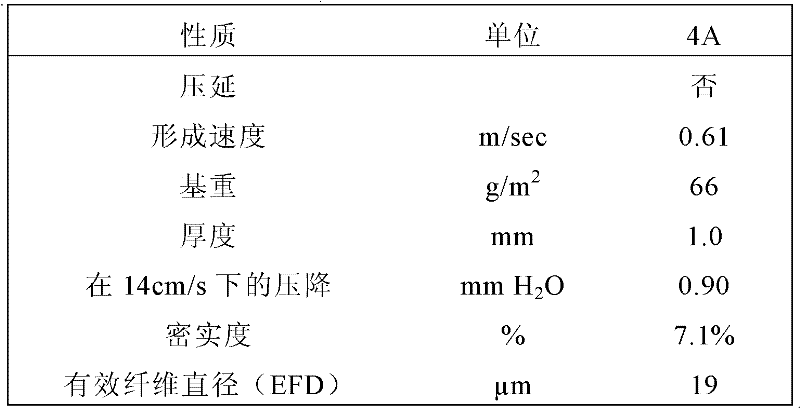
用扫描电子显微镜测量纤维网4A的纤维,发现基于191个纤维的样品尺寸,纤维网4A的纤维具有12.6微米的实际纤维直径,标准偏差为2.5微米。The fibers of web 4A were measured with a scanning electron microscope and found to have an actual fiber diameter of 12.6 microns based on a sample size of 191 fibers, with a standard deviation of 2.5 microns.
比较例1Comparative example 1
根据Berrigan等人在美国专利6,916,752中的教导来形成单组分纤维网。使用实例4(上述)中的通用方法(除了以下另外指明的外),由熔融流速指数为70的3860聚丙烯(可得自Total Petrochemicals)形成纤维网。熔融聚合物流速为大约每分钟每孔0.54克(对实例4的每分钟每孔0.71克)。估计收集带下方的真空为约2000Pa。Monocomponent webs were formed according to the teachings of Berrigan et al. in US Patent 6,916,752. Using the general procedure in Example 4 (above), except as otherwise indicated below, webs were formed from 3860 polypropylene with a melt flow index of 70 (available from Total Petrochemicals). The molten polymer flow rate was approximately 0.54 grams per minute per hole (0.71 grams per minute per hole for Example 4). The vacuum under the collection zone was estimated to be about 2000 Pa.
如此制成的纤维网是利用正常工艺和设备以足够的完整性进行粘结以便自支承且可处理;纤维网可通过正常的卷起处理而卷成存储卷筒,或者可经受诸如成褶等各种操作并组装成过滤装置,例如褶皱型过滤面板。制备纤维网的一个变型,如表C1所述。The web so produced is bonded with sufficient integrity to be self-supporting and handleable using normal processes and equipment; Various operations and assembled into filter devices, such as pleated filter panels. A variation of the fiber web was prepared as described in Table C1.
表C1Table C1
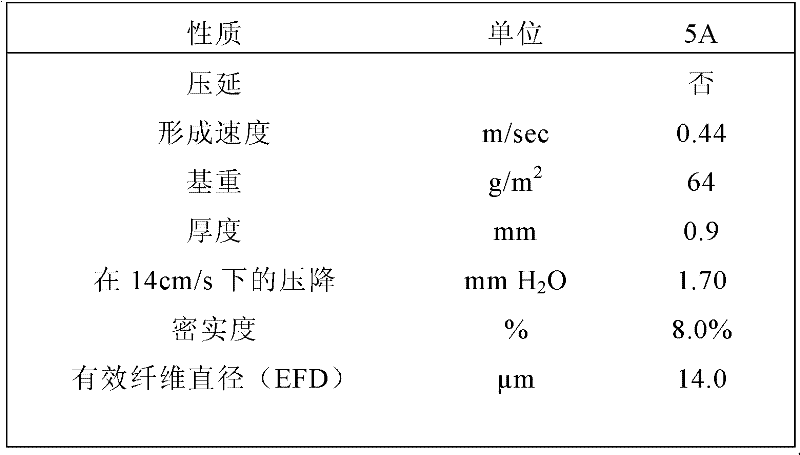
用扫描电子显微镜测量纤维网C1的纤维,发现基于147个纤维的样品尺寸,纤维网C1的纤维具有13.0微米的实际纤维直径,标准偏差为2.2微米。The fibers of web C1 were measured with a scanning electron microscope and found to have an actual fiber diameter of 13.0 microns based on a sample size of 147 fibers with a standard deviation of 2.2 microns.
实例总结Example summary
比较例1(C1)以及样品1B、2B、3A和4A的实际纤维直径、有效纤维直径、EFD/AFD比和密实度列于表5中。The actual fiber diameter, effective fiber diameter, EFD/AFD ratio and solidity of Comparative Example 1 (C1 ) and Samples 1B, 2B, 3A and 4A are listed in Table 5.
表5table 5
上述测试和测试结果仅用于示例性目的,而不用于预测性目的,并且可预期测试工序的改变会产生不同的结果。“实例”章节中的所有定量值均应理解为根据所使用工序中所涉及的通常所知公差的近似值。给出上述详细描述和实例仅为了清楚地理解本发明。应该理解,对于本发明,这些描述和实施例没有不必要的限制。The tests and test results described above are for illustrative purposes only, not predictive, and variations in testing procedures are expected to produce different results. All quantitative values in the "Examples" section are to be understood as approximations according to commonly known tolerances involved in the procedures employed. The foregoing detailed description and examples have been given for a clear understanding of the invention only. It should be understood that these descriptions and examples do not unnecessarily limit the invention.
对于本领域的技术人员将显而易见的是,本文所公开的具体示例性结构、特征、细节、构造等可在许多实施例中修改和/或组合。本发明人所构思的所有此类变型和组合均在所构思的发明的范围内。因此,本发明的范围不应受本文所述的具体示例性结构限制,而是受权利要求书的文字所描述的结构或这些结构的等同形式限制。如果在本说明书与以引用方式并入本文的任何文献的公开内容之间存在冲突或差异,则以本说明书为准。It will be apparent to those skilled in the art that the specific exemplary structures, features, details, configurations, etc. disclosed herein may be modified and/or combined in many embodiments. All such variations and combinations contemplated by the inventors are within the scope of the conceived invention. Thus, the scope of the present invention should not be limited by the specific exemplary structures described herein, but by the structures described by the words of the claims, or the equivalents of those structures. In the event of a conflict or discrepancy between this specification and the disclosure of any document incorporated herein by reference, this specification will control.
Claims (21)
Applications Claiming Priority (3)
| Application Number | Priority Date | Filing Date | Title |
|---|---|---|---|
| US12/497,102 | 2009-07-02 | ||
| US12/497,102 US8162153B2 (en) | 2009-07-02 | 2009-07-02 | High loft spunbonded web |
| PCT/US2010/040590 WO2011002878A2 (en) | 2009-07-02 | 2010-06-30 | High loft spunbonded web |
Publications (2)
| Publication Number | Publication Date |
|---|---|
| CN102482819A true CN102482819A (en) | 2012-05-30 |
| CN102482819B CN102482819B (en) | 2015-05-06 |
Family
ID=43411723
Family Applications (1)
| Application Number | Title | Priority Date | Filing Date |
|---|---|---|---|
| CN201080037458.4A Active CN102482819B (en) | 2009-07-02 | 2010-06-30 | High loft spunbonded web |
Country Status (9)
| Country | Link |
|---|---|
| US (2) | US8162153B2 (en) |
| EP (1) | EP2449159B1 (en) |
| JP (1) | JP5747028B2 (en) |
| KR (1) | KR101679899B1 (en) |
| CN (1) | CN102482819B (en) |
| BR (1) | BR112012000017A2 (en) |
| CA (1) | CA2767009C (en) |
| TW (1) | TWI580833B (en) |
| WO (1) | WO2011002878A2 (en) |
Cited By (11)
| Publication number | Priority date | Publication date | Assignee | Title |
|---|---|---|---|---|
| CN105518197A (en) * | 2013-09-03 | 2016-04-20 | 3M创新有限公司 | Melt-spinning process, melt-spun nonwoven fibrous webs and related filtration media |
| CN108778218A (en) * | 2016-02-29 | 2018-11-09 | 博爱德国有限公司 | Nonwoven fabric and method of forming same |
| WO2020024245A1 (en) * | 2018-08-03 | 2020-02-06 | 3M Innovative Properties Company | Air-filter media including a relofted spunbonded web, and methods of making and using |
| WO2020107422A1 (en) * | 2018-11-30 | 2020-06-04 | The Procter & Gamble Company | Methods of creating soft and lofty nonwoven webs |
| CN112301554A (en) * | 2019-07-30 | 2021-02-02 | 莱芬豪舍有限责任两合公司机器制造厂 | Apparatus and method for making nonwoven fabrics from crimped fibers |
| CN113166989A (en) * | 2018-11-23 | 2021-07-23 | 莱芬豪舍有限责任两合公司机器制造厂 | Bulky nonwoven fabric with enhanced compressibility and recovery |
| CN114206471A (en) * | 2019-08-13 | 2022-03-18 | 3M创新有限公司 | Spunbond air filter web |
| CN114207204A (en) * | 2019-07-30 | 2022-03-18 | 旭化成株式会社 | Method and apparatus for producing nonwoven fabrics made from crimped synthetic fibers |
| CN114340759A (en) * | 2019-08-13 | 2022-04-12 | 3M创新有限公司 | High performance spunbond air filtration web |
| US11686026B2 (en) | 2018-11-30 | 2023-06-27 | The Procter & Gamble Company | Methods for producing through-fluid bonded nonwoven webs |
| US12091793B2 (en) | 2018-11-30 | 2024-09-17 | The Procter & Gamble Company | Methods for through-fluid bonding nonwoven webs |
Families Citing this family (81)
| Publication number | Priority date | Publication date | Assignee | Title |
|---|---|---|---|---|
| DE102006014236A1 (en) | 2006-03-28 | 2007-10-04 | Irema-Filter Gmbh | Fleece material used as a pleated air filter in a motor vehicle comprises thinner fibers homogeneously incorporated into thicker fibers |
| DE102010052155A1 (en) | 2010-11-22 | 2012-05-24 | Irema-Filter Gmbh | Air filter medium with two mechanisms of action |
| US20130273594A1 (en) * | 2010-12-22 | 2013-10-17 | 3Innovative Properties Company | Sterilization indicators including a porous carrier and methods |
| WO2012088064A1 (en) | 2010-12-22 | 2012-06-28 | 3M Innovative Properties Company | Sterilization indicators including a neutralizer and methods |
| CN103347585B (en) | 2011-02-03 | 2016-08-31 | 唐纳森公司 | Filtration media packs, filter assemblies, and methods |
| US10434006B2 (en) | 2012-06-07 | 2019-10-08 | Fabian Hermann Urban Füglister | Tongue deformation implant |
| PL2861321T3 (en) * | 2012-06-14 | 2017-07-31 | Irema-Filter Gmbh | Synthetic polymer filter material |
| AU2013368596B2 (en) | 2012-12-28 | 2016-08-04 | 3M Innovative Properties Company | Electret webs with charge-enhancing additives |
| RU2635160C2 (en) | 2013-04-19 | 2017-11-09 | 3М Инновейтив Пропертиз Компани | Electrete webs with additives, promoting charge accumulation |
| DE102013008402B4 (en) | 2013-05-16 | 2025-07-17 | Irema-Filter Gmbh | Nonwoven fabric and method for producing the same |
| US9278301B2 (en) | 2013-08-16 | 2016-03-08 | 3M Innovative Properties Company | Nestable framed pleated air filter and method of making |
| US9174159B2 (en) | 2013-08-16 | 2015-11-03 | 3M Innovative Properties Company | Framed pleated air filter with upstream bridging filaments |
| US9833734B2 (en) | 2013-12-17 | 2017-12-05 | 3M Innovative Properties Company | Air quality indicator |
| US10704173B2 (en) | 2014-01-29 | 2020-07-07 | Biax-Fiberfilm Corporation | Process for forming a high loft, nonwoven web exhibiting excellent recovery |
| US10961644B2 (en) | 2014-01-29 | 2021-03-30 | Biax-Fiberfilm Corporation | High loft, nonwoven web exhibiting excellent recovery |
| US20150211160A1 (en) * | 2014-01-29 | 2015-07-30 | Biax-Fiberfilm | High loft, nonwoven web exhibiting excellent recovery |
| ES2710705T3 (en) | 2014-02-17 | 2019-04-26 | 3M Innovative Properties Co | Abrasive article and methods of manufacture and use |
| CA2943387C (en) | 2014-03-21 | 2022-09-06 | 3M Innovative Properties Company | Refillable air filter assembly |
| KR20170021853A (en) | 2014-06-23 | 2017-02-28 | 쓰리엠 이노베이티브 프로퍼티즈 캄파니 | Electret webs with charge-enhancing additives |
| CN106794412B (en) | 2014-08-25 | 2020-12-04 | 3M创新有限公司 | Evenly expandable air filter |
| JP6606172B2 (en) | 2014-08-26 | 2019-11-13 | スリーエム イノベイティブ プロパティズ カンパニー | Spunbond web containing polylactic acid fiber |
| EP3215096B1 (en) | 2014-11-06 | 2023-05-24 | The Procter & Gamble Company | Apertured webs and methods for making the same |
| US10271999B2 (en) | 2014-11-06 | 2019-04-30 | The Procter & Gamble Company | Crimped fiber spunbond nonwoven webs/laminate |
| JP6678179B2 (en) | 2015-01-29 | 2020-04-08 | スリーエム イノベイティブ プロパティズ カンパニー | Compatible pleated air filter with cross-linked filaments |
| US10406472B2 (en) | 2015-03-12 | 2019-09-10 | 3M Innovative Properties Company | Collapsible air filter |
| EP3316984B1 (en) | 2015-06-30 | 2021-09-22 | 3M Innovative Properties Company | Filter cartridge comprising filter media with adhesively edge-sealed ends, and method of making and using |
| CN107849449B (en) | 2015-07-07 | 2020-12-29 | 3M创新有限公司 | Substituted benzotriazole phenates and antioxidant compositions formed therefrom |
| CA2991418A1 (en) | 2015-07-07 | 2017-01-12 | 3M Innovative Properties Company | Polymeric matrices with ionic additives |
| CN108026679B (en) | 2015-07-07 | 2020-10-16 | 3M创新有限公司 | Electret webs with charge-enhancing additives |
| CN108026054B (en) | 2015-07-07 | 2021-10-15 | 3M创新有限公司 | Substituted benzotriazoles |
| WO2017053341A1 (en) | 2015-09-24 | 2017-03-30 | 3M Innovative Properties Company | Expandable air filters |
| WO2017053177A1 (en) | 2015-09-24 | 2017-03-30 | 3M Innovative Properties Company | Air filter devices with gap sealing unit |
| US10286349B2 (en) | 2015-11-10 | 2019-05-14 | 3M Innovative Properties Company | Air filter use indicators |
| US11219788B2 (en) | 2015-11-19 | 2022-01-11 | 3M Innovative Properties Company | Filter cartridge holder with fit-check device |
| KR20180115308A (en) | 2016-02-26 | 2018-10-22 | 쓰리엠 이노베이티브 프로퍼티즈 컴파니 | Air conditioner filter and manufacturing method |
| JP7055967B2 (en) | 2016-03-14 | 2022-04-19 | スリーエム イノベイティブ プロパティズ カンパニー | Composite granules containing polymer adsorbents for aldehydes |
| US10960341B2 (en) | 2016-03-14 | 2021-03-30 | 3M Innovative Properties Company | Air filters comprising polymeric sorbents for aldehydes |
| WO2017160646A2 (en) | 2016-03-14 | 2017-09-21 | 3M Innovative Properties Company | Air filters comprising polymeric sorbents for reactive gases |
| CA3022552A1 (en) | 2016-04-29 | 2017-11-02 | 3M Innovative Properties Company | Cleaning articles including scouring bodies that form printed instructions |
| WO2017213926A1 (en) | 2016-06-06 | 2017-12-14 | 3M Innovative Properties Company | Channel-framed, pleated air filter with bridging filaments |
| CN109641166B (en) | 2016-08-05 | 2021-04-30 | 3M创新有限公司 | Air filter with passivated filter life indicator |
| JP2019531880A (en) | 2016-08-26 | 2019-11-07 | スリーエム イノベイティブ プロパティズ カンパニー | Pleated filter element with pleated filter media having an edge dam and method of making and using the same |
| EP3538246B1 (en) | 2016-11-14 | 2021-06-09 | 3M Innovative Properties Company | Air filters comprising metal-containing polymeric sorbents |
| US11027231B2 (en) | 2016-11-17 | 2021-06-08 | 3M Innovative Properties Company | Air filter with visual filter life indicator zone and sorbent-loaded visual reference zone |
| CN110446541B (en) | 2017-01-05 | 2021-12-03 | 3M创新有限公司 | Electret webs with charge-enhancing additives |
| US20190360135A1 (en) | 2017-02-14 | 2019-11-28 | 3M Innovative Properties Company | Sheet Of Loop Material, Apparatus And Method For Forming Same |
| EP4335420A3 (en) | 2017-02-16 | 2024-05-29 | The Procter & Gamble Company | Absorbent articles with substrates having repeating patterns of apertures comprising a plurality of repeat units |
| WO2018191865A1 (en) | 2017-04-18 | 2018-10-25 | 3M Innovative Properties Company | Air filter media with post-pleat-deposited sorbent particles |
| CN110719805B (en) | 2017-06-16 | 2022-12-27 | 3M创新有限公司 | Air filter comprising polymeric adsorbent for aldehyde |
| EP3672796A4 (en) | 2017-08-25 | 2021-05-26 | 3M Innovative Properties Company | Adhesive articles permitting damage free removal |
| EP3672795A4 (en) | 2017-08-25 | 2021-05-12 | 3M Innovative Properties Company | Adhesive articles permitting damage free removal |
| US12127925B2 (en) | 2018-04-17 | 2024-10-29 | The Procter & Gamble Company | Webs for absorbent articles and methods of making the same |
| WO2020021263A1 (en) | 2018-07-24 | 2020-01-30 | Mg Ip Ltd | Method and apparatus for producing porous plastic profiles |
| CA3108368A1 (en) | 2018-08-03 | 2020-02-06 | 3M Innovative Properties Company | Pleated air filter with reinforcing filaments comprising locally-thinned bending zones |
| WO2020026062A1 (en) * | 2018-08-03 | 2020-02-06 | 3M Innovative Properties Company | Air-filter media comprising a relofted spunbonded web, and methods of making and using |
| US12017175B2 (en) | 2018-08-03 | 2024-06-25 | 3M Innovative Properties Company | Pleated air filter with bridging filaments and continuous-contact filaments |
| US11433332B2 (en) | 2018-11-05 | 2022-09-06 | Hollingsworth & Vose Company | Filter media with irregular structure |
| US11420143B2 (en) * | 2018-11-05 | 2022-08-23 | Hollingsworth & Vose Company | Filter media with irregular structure and/or reversibly stretchable layers |
| CA3126895A1 (en) | 2019-01-21 | 2020-07-30 | 3M Innovative Properties Company | Multi-layer, biodegradable composites for air filtration |
| WO2020198681A1 (en) * | 2019-03-28 | 2020-10-01 | Donaldson Company, Inc. | Filter media with improved dust loading |
| CN114555691B (en) | 2019-10-16 | 2023-11-28 | 3M创新有限公司 | Substituted benzimidazole melt additives |
| US20220380574A1 (en) | 2019-10-16 | 2022-12-01 | 3M Innovative Properties Company | Dual-function melt additives |
| CN115038829B (en) | 2019-12-03 | 2023-07-28 | 3M创新有限公司 | Aromatic heterocyclic melt additives |
| CN114765996B (en) | 2019-12-03 | 2023-06-02 | 3M创新有限公司 | Mercaptide melt additives |
| EP4097284B1 (en) | 2020-01-27 | 2024-05-29 | 3M Innovative Properties Company | Substituted thiolate salt melt additives |
| US11982031B2 (en) | 2020-01-27 | 2024-05-14 | 3M Innovative Properties Company | Substituted thiol melt additives |
| US12409401B2 (en) | 2020-07-08 | 2025-09-09 | 3M Innovative Properties Company | Pleated filtration assembly comprising spunbonded prefilter |
| EP4196630A1 (en) | 2020-08-11 | 2023-06-21 | 3M Innovative Properties Company | Electret webs with carboxylic acid or carboxylate salt charge-enhancing additives |
| US20230285884A1 (en) | 2020-08-11 | 2023-09-14 | 3M Innovative Properties Company | Electret webs with benzoate salt charge-enhancing additives |
| WO2022084830A1 (en) | 2020-10-23 | 2022-04-28 | 3M Innovative Properties Company | Acoustic articles and assemblies |
| WO2022172222A1 (en) | 2021-02-12 | 2022-08-18 | 3M Innovative Properties Company | Sample collection device and system |
| KR20230164096A (en) | 2021-04-02 | 2023-12-01 | 쓰리엠 이노베이티브 프로퍼티즈 캄파니 | Sample collection device and method |
| WO2022214884A1 (en) | 2021-04-06 | 2022-10-13 | 3M Innovative Properties Company | Sample collection devices, systems, and methods |
| US20240237971A1 (en) | 2021-05-21 | 2024-07-18 | 3M Innovative Properties Company | Sample collection device and system |
| WO2022243902A1 (en) | 2021-05-21 | 2022-11-24 | 3M Innovative Properties Company | Pop-up sample collection device and system |
| US20220395408A1 (en) * | 2021-06-11 | 2022-12-15 | The Procter & Gamble Company | Apertured Nonwoven And Absorbent Articles Having The Same |
| TWI877547B (en) | 2021-12-16 | 2025-03-21 | 美商貝里國際公司 | Dryer sheet, filter, nonwoven fabric, and method of making nonwoven fabric |
| EP4637956A1 (en) | 2022-12-21 | 2025-10-29 | 3M Innovative Properties Company | Shirred filter media and methods of making and using the same |
| US20240262761A1 (en) * | 2023-02-08 | 2024-08-08 | 3M Innovative Properties Company | Compostable spunbonded tarp and method of using |
| CN120936426A (en) | 2023-04-13 | 2025-11-11 | 3M创新有限公司 | Filter media for filter devices and methods of making and using the same |
| WO2025202974A1 (en) | 2024-03-29 | 2025-10-02 | 3M Innovative Properties Company | Respirators, respirator materials and methods of manufacturing the same |
Citations (4)
| Publication number | Priority date | Publication date | Assignee | Title |
|---|---|---|---|---|
| US5620545A (en) * | 1992-08-04 | 1997-04-15 | Minnesota Mining And Manufacturing Company | Method of making a corrugated nonwoven web of polymeric microfiber |
| US5707468A (en) * | 1994-12-22 | 1998-01-13 | Kimberly-Clark Worldwide, Inc. | Compaction-free method of increasing the integrity of a nonwoven web |
| US20020102897A1 (en) * | 2000-11-20 | 2002-08-01 | 3M Innovative Properties Company | Fiber-forming process |
| US6649547B1 (en) * | 2000-08-31 | 2003-11-18 | Kimberly-Clark Worldwide, Inc. | Integrated nonwoven laminate material |
Family Cites Families (24)
| Publication number | Priority date | Publication date | Assignee | Title |
|---|---|---|---|---|
| CA1073648A (en) | 1976-08-02 | 1980-03-18 | Edward R. Hauser | Web of blended microfibers and crimped bulking fibers |
| US4409282A (en) | 1978-05-01 | 1983-10-11 | Toa Nenryo Kogyo Kabushiki Kaisha | Nonwoven fabrics |
| JPS6056825B2 (en) | 1978-05-01 | 1985-12-12 | 東亜燃料工業株式会社 | Manufacturing method of nonwoven fabric |
| US6169045B1 (en) | 1993-11-16 | 2001-01-02 | Kimberly-Clark Worldwide, Inc. | Nonwoven filter media |
| US5597645A (en) | 1994-08-30 | 1997-01-28 | Kimberly-Clark Corporation | Nonwoven filter media for gas |
| PL319975A1 (en) | 1994-10-31 | 1997-09-01 | Kimberly Clark Co | Non-woven high-density filtering materials |
| DE69607164T2 (en) * | 1995-06-23 | 2000-11-23 | Minnesota Mining And Mfg. Co., Saint Paul | SOUND INSULATION METHOD AND SOUND INSULATION ITEM |
| US6165217A (en) | 1997-10-02 | 2000-12-26 | Gore Enterprise Holdings, Inc. | Self-cohering, continuous filament non-woven webs |
| US6867156B1 (en) | 1999-04-30 | 2005-03-15 | Kimberly-Clark Worldwide, Inc. | Materials having z-direction fibers and folds and method for producing same |
| US6588080B1 (en) | 1999-04-30 | 2003-07-08 | Kimberly-Clark Worldwide, Inc. | Controlled loft and density nonwoven webs and method for producing |
| WO2002055782A2 (en) * | 2000-11-20 | 2002-07-18 | 3M Innovative Properties Company | Fiber-forming process |
| US7258758B2 (en) | 2001-12-21 | 2007-08-21 | Kimberly-Clark Worldwide, Inc. | Strong high loft low density nonwoven webs and laminates thereof |
| US20030118816A1 (en) | 2001-12-21 | 2003-06-26 | Polanco Braulio A. | High loft low density nonwoven webs of crimped filaments and methods of making same |
| US6916752B2 (en) | 2002-05-20 | 2005-07-12 | 3M Innovative Properties Company | Bondable, oriented, nonwoven fibrous webs and methods for making them |
| US7279440B2 (en) | 2002-05-20 | 2007-10-09 | 3M Innovative Properties Company | Nonwoven amorphous fibrous webs and methods for making them |
| US20040077247A1 (en) | 2002-10-22 | 2004-04-22 | Schmidt Richard J. | Lofty spunbond nonwoven laminate |
| US7476632B2 (en) | 2002-11-15 | 2009-01-13 | 3M Innovative Properties Company | Fibrous nonwoven web |
| US20050106982A1 (en) | 2003-11-17 | 2005-05-19 | 3M Innovative Properties Company | Nonwoven elastic fibrous webs and methods for making them |
| US7244291B2 (en) * | 2005-05-02 | 2007-07-17 | 3M Innovative Properties Company | Electret article having high fluorosaturation ratio |
| US9139940B2 (en) | 2006-07-31 | 2015-09-22 | 3M Innovative Properties Company | Bonded nonwoven fibrous webs comprising softenable oriented semicrystalline polymeric fibers and apparatus and methods for preparing such webs |
| US7807591B2 (en) | 2006-07-31 | 2010-10-05 | 3M Innovative Properties Company | Fibrous web comprising microfibers dispersed among bonded meltspun fibers |
| US7947142B2 (en) * | 2006-07-31 | 2011-05-24 | 3M Innovative Properties Company | Pleated filter with monolayer monocomponent meltspun media |
| EP1930492B1 (en) | 2006-12-06 | 2010-09-29 | Reifenhäuser GmbH & Co. KG Maschinenfabrik | Method and apparatus for making a spunbonded nonwoven fabric |
| US7989372B2 (en) * | 2007-06-22 | 2011-08-02 | 3M Innovative Properties Company | Molded respirator comprising meltblown fiber web with staple fibers |
-
2009
- 2009-07-02 US US12/497,102 patent/US8162153B2/en active Active
-
2010
- 2010-06-30 CA CA2767009A patent/CA2767009C/en active Active
- 2010-06-30 KR KR1020127002805A patent/KR101679899B1/en active Active
- 2010-06-30 CN CN201080037458.4A patent/CN102482819B/en active Active
- 2010-06-30 BR BR112012000017A patent/BR112012000017A2/en not_active IP Right Cessation
- 2010-06-30 WO PCT/US2010/040590 patent/WO2011002878A2/en not_active Ceased
- 2010-06-30 JP JP2012517891A patent/JP5747028B2/en active Active
- 2010-06-30 EP EP20100794700 patent/EP2449159B1/en active Active
- 2010-07-01 TW TW099121699A patent/TWI580833B/en active
-
2012
- 2012-03-15 US US13/420,901 patent/US8240484B2/en active Active
Patent Citations (5)
| Publication number | Priority date | Publication date | Assignee | Title |
|---|---|---|---|---|
| US5620545A (en) * | 1992-08-04 | 1997-04-15 | Minnesota Mining And Manufacturing Company | Method of making a corrugated nonwoven web of polymeric microfiber |
| US5707468A (en) * | 1994-12-22 | 1998-01-13 | Kimberly-Clark Worldwide, Inc. | Compaction-free method of increasing the integrity of a nonwoven web |
| US6649547B1 (en) * | 2000-08-31 | 2003-11-18 | Kimberly-Clark Worldwide, Inc. | Integrated nonwoven laminate material |
| US20020102897A1 (en) * | 2000-11-20 | 2002-08-01 | 3M Innovative Properties Company | Fiber-forming process |
| US6607624B2 (en) * | 2000-11-20 | 2003-08-19 | 3M Innovative Properties Company | Fiber-forming process |
Cited By (19)
| Publication number | Priority date | Publication date | Assignee | Title |
|---|---|---|---|---|
| CN105518197A (en) * | 2013-09-03 | 2016-04-20 | 3M创新有限公司 | Melt-spinning process, melt-spun nonwoven fibrous webs and related filtration media |
| CN108778218A (en) * | 2016-02-29 | 2018-11-09 | 博爱德国有限公司 | Nonwoven fabric and method of forming same |
| TWI835830B (en) * | 2018-08-03 | 2024-03-21 | 美商3M新設資產公司 | Air-filter media including a relofted spunbonded web, and methods of making and using |
| WO2020024245A1 (en) * | 2018-08-03 | 2020-02-06 | 3M Innovative Properties Company | Air-filter media including a relofted spunbonded web, and methods of making and using |
| CN112888492A (en) * | 2018-08-03 | 2021-06-01 | 3M创新有限公司 | Air filtration media including a re-fluff spunbond web and methods of making and using |
| CN113166989B (en) * | 2018-11-23 | 2023-03-17 | 莱芬豪舍有限责任两合公司机器制造厂 | Bulky nonwoven fabrics with enhanced compressibility and recovery |
| CN113166989A (en) * | 2018-11-23 | 2021-07-23 | 莱芬豪舍有限责任两合公司机器制造厂 | Bulky nonwoven fabric with enhanced compressibility and recovery |
| WO2020107422A1 (en) * | 2018-11-30 | 2020-06-04 | The Procter & Gamble Company | Methods of creating soft and lofty nonwoven webs |
| US12320046B2 (en) | 2018-11-30 | 2025-06-03 | The Procter & Gamble Company | Methods for producing through-fluid bonded nonwoven webs |
| US12091793B2 (en) | 2018-11-30 | 2024-09-17 | The Procter & Gamble Company | Methods for through-fluid bonding nonwoven webs |
| US11396720B2 (en) | 2018-11-30 | 2022-07-26 | The Procter & Gamble Company | Methods of creating soft and lofty nonwoven webs |
| US12460330B2 (en) | 2018-11-30 | 2025-11-04 | The Procter & Gamble Company | Methods of creating soft and lofty nonwoven webs |
| US11767622B2 (en) | 2018-11-30 | 2023-09-26 | The Procter & Gamble Company | Methods of creating soft and lofty nonwoven webs |
| US11686026B2 (en) | 2018-11-30 | 2023-06-27 | The Procter & Gamble Company | Methods for producing through-fluid bonded nonwoven webs |
| CN112301554A (en) * | 2019-07-30 | 2021-02-02 | 莱芬豪舍有限责任两合公司机器制造厂 | Apparatus and method for making nonwoven fabrics from crimped fibers |
| CN112301554B (en) * | 2019-07-30 | 2022-11-18 | 莱芬豪舍有限责任两合公司机器制造厂 | Apparatus and method for producing a nonwoven fabric from crimped fibers |
| CN114207204A (en) * | 2019-07-30 | 2022-03-18 | 旭化成株式会社 | Method and apparatus for producing nonwoven fabrics made from crimped synthetic fibers |
| CN114340759A (en) * | 2019-08-13 | 2022-04-12 | 3M创新有限公司 | High performance spunbond air filtration web |
| CN114206471A (en) * | 2019-08-13 | 2022-03-18 | 3M创新有限公司 | Spunbond air filter web |
Also Published As
| Publication number | Publication date |
|---|---|
| CN102482819B (en) | 2015-05-06 |
| US20120171913A1 (en) | 2012-07-05 |
| TWI580833B (en) | 2017-05-01 |
| BR112012000017A2 (en) | 2016-03-15 |
| CA2767009A1 (en) | 2011-01-06 |
| US8162153B2 (en) | 2012-04-24 |
| KR20120092551A (en) | 2012-08-21 |
| EP2449159A4 (en) | 2012-12-05 |
| TW201114966A (en) | 2011-05-01 |
| US8240484B2 (en) | 2012-08-14 |
| JP2012532255A (en) | 2012-12-13 |
| KR101679899B1 (en) | 2016-11-25 |
| EP2449159B1 (en) | 2013-11-06 |
| JP5747028B2 (en) | 2015-07-08 |
| WO2011002878A3 (en) | 2011-04-28 |
| US20110000845A1 (en) | 2011-01-06 |
| CA2767009C (en) | 2017-03-28 |
| EP2449159A2 (en) | 2012-05-09 |
| WO2011002878A2 (en) | 2011-01-06 |
Similar Documents
| Publication | Publication Date | Title |
|---|---|---|
| CN102482819B (en) | High loft spunbonded web | |
| KR101504768B1 (en) | Pleated filter with bimodal monolayer monocomponent media | |
| CN101495208B (en) | Single component single layer meltblown web and meltblown device | |
| US20160206984A1 (en) | Melt-spinning process, melt-spun nonwoven fibrous webs and related filtration media | |
| JP5021740B2 (en) | Foldable mask with single component filtration / reinforcement single layer | |
| TWI843740B (en) | Air-filter media comprising a relofted spunbonded web, and methods of making and using | |
| US9186608B2 (en) | Process for forming a high efficiency nanofiber filter | |
| US20060137317A1 (en) | Filtration media for filtering particulate material from gas streams | |
| AU1685097A (en) | High efficiency breathing mask fabrics | |
| CN112888492A (en) | Air filtration media including a re-fluff spunbond web and methods of making and using | |
| CA3151083C (en) | Spunbonded air-filtration web | |
| US20220266181A1 (en) | Spunbonded Air-Filtration Web | |
| CN212119378U (en) | Pleated spunbonded fiber air filter screen and air filter | |
| TWM597785U (en) | Pleated filtration web with sheath-core fibers |
Legal Events
| Date | Code | Title | Description |
|---|---|---|---|
| C06 | Publication | ||
| PB01 | Publication | ||
| C10 | Entry into substantive examination | ||
| SE01 | Entry into force of request for substantive examination | ||
| C14 | Grant of patent or utility model | ||
| GR01 | Patent grant |