CN102482305A - Synthesis of N4- (2, 2-dimethyl-4- [ (dihydrogen phosphonoxy ] -3-oxo-5-pyrido [1, 4] oxazin-6-yl)-5-fluoro-n2- (3, 4, 5,-trimethoxyphenyl) -2, 4- pyrimidinediamine disodium salt - Google Patents
Synthesis of N4- (2, 2-dimethyl-4- [ (dihydrogen phosphonoxy ] -3-oxo-5-pyrido [1, 4] oxazin-6-yl)-5-fluoro-n2- (3, 4, 5,-trimethoxyphenyl) -2, 4- pyrimidinediamine disodium salt Download PDFInfo
- Publication number
- CN102482305A CN102482305A CN2010800391081A CN201080039108A CN102482305A CN 102482305 A CN102482305 A CN 102482305A CN 2010800391081 A CN2010800391081 A CN 2010800391081A CN 201080039108 A CN201080039108 A CN 201080039108A CN 102482305 A CN102482305 A CN 102482305A
- Authority
- CN
- China
- Prior art keywords
- compound
- formula
- acid amides
- condition
- dmac
- Prior art date
- Legal status (The legal status is an assumption and is not a legal conclusion. Google has not performed a legal analysis and makes no representation as to the accuracy of the status listed.)
- Granted
Links
- UFHFLCQGNIYNRP-UHFFFAOYSA-N Hydrogen Chemical compound [H][H] UFHFLCQGNIYNRP-UHFFFAOYSA-N 0.000 title abstract description 5
- 230000015572 biosynthetic process Effects 0.000 title 1
- 238000003786 synthesis reaction Methods 0.000 title 1
- 150000001875 compounds Chemical class 0.000 claims abstract description 158
- 150000001408 amides Chemical class 0.000 claims abstract description 74
- 238000000034 method Methods 0.000 claims abstract description 61
- -1 [1,4] oxazin-6-yl Chemical group 0.000 claims abstract description 27
- 150000004687 hexahydrates Chemical class 0.000 claims abstract description 10
- 238000004519 manufacturing process Methods 0.000 claims abstract 2
- HEMHJVSKTPXQMS-UHFFFAOYSA-M Sodium hydroxide Chemical compound [OH-].[Na+] HEMHJVSKTPXQMS-UHFFFAOYSA-M 0.000 claims description 57
- 239000002904 solvent Substances 0.000 claims description 47
- 239000012453 solvate Substances 0.000 claims description 31
- 229910052757 nitrogen Inorganic materials 0.000 claims description 29
- 239000003513 alkali Substances 0.000 claims description 20
- 239000007864 aqueous solution Substances 0.000 claims description 17
- 238000002360 preparation method Methods 0.000 claims description 17
- IJGRMHOSHXDMSA-UHFFFAOYSA-N Atomic nitrogen Chemical compound N#N IJGRMHOSHXDMSA-UHFFFAOYSA-N 0.000 claims description 14
- 229910052799 carbon Inorganic materials 0.000 claims description 14
- MHABMANUFPZXEB-UHFFFAOYSA-N O-demethyl-aloesaponarin I Natural products O=C1C2=CC=CC(O)=C2C(=O)C2=C1C=C(O)C(C(O)=O)=C2C MHABMANUFPZXEB-UHFFFAOYSA-N 0.000 claims description 12
- UIIMBOGNXHQVGW-UHFFFAOYSA-M Sodium bicarbonate Chemical compound [Na+].OC([O-])=O UIIMBOGNXHQVGW-UHFFFAOYSA-M 0.000 claims description 10
- 239000000203 mixture Substances 0.000 claims description 10
- 229910052739 hydrogen Inorganic materials 0.000 claims description 9
- 229910052736 halogen Inorganic materials 0.000 claims description 8
- 150000002367 halogens Chemical class 0.000 claims description 8
- 239000002798 polar solvent Substances 0.000 claims description 8
- LFQSCWFLJHTTHZ-UHFFFAOYSA-N Ethanol Chemical compound CCO LFQSCWFLJHTTHZ-UHFFFAOYSA-N 0.000 claims description 6
- KFZMGEQAYNKOFK-UHFFFAOYSA-N Isopropanol Chemical compound CC(C)O KFZMGEQAYNKOFK-UHFFFAOYSA-N 0.000 claims description 6
- 239000002253 acid Substances 0.000 claims description 6
- FJDQFPXHSGXQBY-UHFFFAOYSA-L caesium carbonate Chemical compound [Cs+].[Cs+].[O-]C([O-])=O FJDQFPXHSGXQBY-UHFFFAOYSA-L 0.000 claims description 5
- 229910000024 caesium carbonate Inorganic materials 0.000 claims description 5
- 235000017557 sodium bicarbonate Nutrition 0.000 claims description 5
- 229910000030 sodium bicarbonate Inorganic materials 0.000 claims description 5
- 238000005406 washing Methods 0.000 claims description 5
- OKTJSMMVPCPJKN-UHFFFAOYSA-N Carbon Chemical compound [C] OKTJSMMVPCPJKN-UHFFFAOYSA-N 0.000 claims description 4
- FKNQFGJONOIPTF-UHFFFAOYSA-N Sodium cation Chemical compound [Na+] FKNQFGJONOIPTF-UHFFFAOYSA-N 0.000 claims description 4
- 150000003869 acetamides Chemical class 0.000 claims description 4
- 125000001931 aliphatic group Chemical group 0.000 claims description 4
- 150000001732 carboxylic acid derivatives Chemical class 0.000 claims description 4
- 150000002576 ketones Chemical class 0.000 claims description 4
- BWHMMNNQKKPAPP-UHFFFAOYSA-L potassium carbonate Substances [K+].[K+].[O-]C([O-])=O BWHMMNNQKKPAPP-UHFFFAOYSA-L 0.000 claims description 4
- 235000015320 potassium carbonate Nutrition 0.000 claims description 4
- 229910001415 sodium ion Inorganic materials 0.000 claims description 4
- 150000003334 secondary amides Chemical class 0.000 claims description 3
- 125000002496 methyl group Chemical group [H]C([H])([H])* 0.000 abstract description 8
- 201000010099 disease Diseases 0.000 abstract description 4
- 208000037265 diseases, disorders, signs and symptoms Diseases 0.000 abstract description 4
- 125000005809 3,4,5-trimethoxyphenyl group Chemical group [H]C1=C(OC([H])([H])[H])C(OC([H])([H])[H])=C(OC([H])([H])[H])C([H])=C1* 0.000 abstract 1
- 150000004677 hydrates Chemical class 0.000 abstract 1
- 230000002265 prevention Effects 0.000 abstract 1
- YMWUJEATGCHHMB-UHFFFAOYSA-N Dichloromethane Chemical compound ClCCl YMWUJEATGCHHMB-UHFFFAOYSA-N 0.000 description 22
- QTBSBXVTEAMEQO-UHFFFAOYSA-N Acetic acid Chemical compound CC(O)=O QTBSBXVTEAMEQO-UHFFFAOYSA-N 0.000 description 17
- BZLVMXJERCGZMT-UHFFFAOYSA-N Methyl tert-butyl ether Chemical compound COC(C)(C)C BZLVMXJERCGZMT-UHFFFAOYSA-N 0.000 description 17
- 239000000243 solution Substances 0.000 description 15
- 238000010586 diagram Methods 0.000 description 14
- XLYOFNOQVPJJNP-UHFFFAOYSA-N water Substances O XLYOFNOQVPJJNP-UHFFFAOYSA-N 0.000 description 12
- VQTUBCCKSQIDNK-UHFFFAOYSA-N Isobutene Chemical compound CC(C)=C VQTUBCCKSQIDNK-UHFFFAOYSA-N 0.000 description 11
- 238000002474 experimental method Methods 0.000 description 10
- 239000003444 phase transfer catalyst Substances 0.000 description 9
- 238000006243 chemical reaction Methods 0.000 description 8
- CSCPPACGZOOCGX-UHFFFAOYSA-N Acetone Chemical compound CC(C)=O CSCPPACGZOOCGX-UHFFFAOYSA-N 0.000 description 7
- 238000000354 decomposition reaction Methods 0.000 description 7
- 239000002243 precursor Substances 0.000 description 7
- 239000000047 product Substances 0.000 description 7
- OKKJLVBELUTLKV-UHFFFAOYSA-N Methanol Chemical compound OC OKKJLVBELUTLKV-UHFFFAOYSA-N 0.000 description 6
- 238000005844 autocatalytic reaction Methods 0.000 description 6
- 239000007789 gas Substances 0.000 description 6
- 239000000463 material Substances 0.000 description 6
- 125000000217 alkyl group Chemical group 0.000 description 5
- 238000004821 distillation Methods 0.000 description 5
- 125000000547 substituted alkyl group Chemical group 0.000 description 5
- QGZKDVFQNNGYKY-UHFFFAOYSA-N Ammonia Chemical compound N QGZKDVFQNNGYKY-UHFFFAOYSA-N 0.000 description 4
- CDBYLPFSWZWCQE-UHFFFAOYSA-L Sodium Carbonate Chemical compound [Na+].[Na+].[O-]C([O-])=O CDBYLPFSWZWCQE-UHFFFAOYSA-L 0.000 description 4
- 125000000484 butyl group Chemical group [H]C([*])([H])C([H])([H])C([H])([H])C([H])([H])[H] 0.000 description 4
- 150000001721 carbon Chemical group 0.000 description 4
- 238000013213 extrapolation Methods 0.000 description 4
- 239000010410 layer Substances 0.000 description 4
- 125000000394 phosphonato group Chemical group [O-]P([O-])(*)=O 0.000 description 4
- WYURNTSHIVDZCO-UHFFFAOYSA-N tetrahydrofuran Substances C1CCOC1 WYURNTSHIVDZCO-UHFFFAOYSA-N 0.000 description 4
- QTBSBXVTEAMEQO-UHFFFAOYSA-M Acetate Chemical compound CC([O-])=O QTBSBXVTEAMEQO-UHFFFAOYSA-M 0.000 description 3
- WEVYAHXRMPXWCK-UHFFFAOYSA-N Acetonitrile Chemical compound CC#N WEVYAHXRMPXWCK-UHFFFAOYSA-N 0.000 description 3
- ZMANZCXQSJIPKH-UHFFFAOYSA-N Triethylamine Chemical compound CCN(CC)CC ZMANZCXQSJIPKH-UHFFFAOYSA-N 0.000 description 3
- 239000012065 filter cake Substances 0.000 description 3
- 239000001257 hydrogen Substances 0.000 description 3
- 239000012044 organic layer Substances 0.000 description 3
- LPNYRYFBWFDTMA-UHFFFAOYSA-N potassium tert-butoxide Chemical compound [K+].CC(C)(C)[O-] LPNYRYFBWFDTMA-UHFFFAOYSA-N 0.000 description 3
- 239000011541 reaction mixture Substances 0.000 description 3
- 239000011734 sodium Substances 0.000 description 3
- 239000007787 solid Substances 0.000 description 3
- 238000003860 storage Methods 0.000 description 3
- 238000005160 1H NMR spectroscopy Methods 0.000 description 2
- 0 CC(C)(C(N1COP([*-]I)(O)=O)=O)Oc(cc2)c1nc2Nc(nc(Nc(cc1OC)cc(OC)c1OC)nc1)c1F Chemical compound CC(C)(C(N1COP([*-]I)(O)=O)=O)Oc(cc2)c1nc2Nc(nc(Nc(cc1OC)cc(OC)c1OC)nc1)c1F 0.000 description 2
- BVKZGUZCCUSVTD-UHFFFAOYSA-L Carbonate Chemical compound [O-]C([O-])=O BVKZGUZCCUSVTD-UHFFFAOYSA-L 0.000 description 2
- FKLJPTJMIBLJAV-UHFFFAOYSA-N Compound IV Chemical compound O1N=C(C)C=C1CCCCCCCOC1=CC=C(C=2OCCN=2)C=C1 FKLJPTJMIBLJAV-UHFFFAOYSA-N 0.000 description 2
- IAZDPXIOMUYVGZ-UHFFFAOYSA-N Dimethylsulphoxide Chemical compound CS(C)=O IAZDPXIOMUYVGZ-UHFFFAOYSA-N 0.000 description 2
- SECXISVLQFMRJM-UHFFFAOYSA-N N-Methylpyrrolidone Chemical compound CN1CCCC1=O SECXISVLQFMRJM-UHFFFAOYSA-N 0.000 description 2
- NBIIXXVUZAFLBC-UHFFFAOYSA-N Phosphoric acid Chemical compound OP(O)(O)=O NBIIXXVUZAFLBC-UHFFFAOYSA-N 0.000 description 2
- 238000009825 accumulation Methods 0.000 description 2
- 229910021529 ammonia Inorganic materials 0.000 description 2
- 239000002585 base Substances 0.000 description 2
- 239000003153 chemical reaction reagent Substances 0.000 description 2
- XTHPWXDJESJLNJ-UHFFFAOYSA-N chlorosulfonic acid Substances OS(Cl)(=O)=O XTHPWXDJESJLNJ-UHFFFAOYSA-N 0.000 description 2
- XLJMAIOERFSOGZ-UHFFFAOYSA-N cyanic acid Chemical compound OC#N XLJMAIOERFSOGZ-UHFFFAOYSA-N 0.000 description 2
- GGSUCNLOZRCGPQ-UHFFFAOYSA-N diethylaniline Chemical compound CCN(CC)C1=CC=CC=C1 GGSUCNLOZRCGPQ-UHFFFAOYSA-N 0.000 description 2
- 238000004090 dissolution Methods 0.000 description 2
- 238000001035 drying Methods 0.000 description 2
- 238000005516 engineering process Methods 0.000 description 2
- 125000001495 ethyl group Chemical group [H]C([H])([H])C([H])([H])* 0.000 description 2
- PQVSTLUFSYVLTO-UHFFFAOYSA-N ethyl n-ethoxycarbonylcarbamate Chemical compound CCOC(=O)NC(=O)OCC PQVSTLUFSYVLTO-UHFFFAOYSA-N 0.000 description 2
- 238000010438 heat treatment Methods 0.000 description 2
- XLYOFNOQVPJJNP-UHFFFAOYSA-M hydroxide Chemical compound [OH-] XLYOFNOQVPJJNP-UHFFFAOYSA-M 0.000 description 2
- 239000007788 liquid Substances 0.000 description 2
- GLXDVVHUTZTUQK-UHFFFAOYSA-M lithium hydroxide monohydrate Substances [Li+].O.[OH-] GLXDVVHUTZTUQK-UHFFFAOYSA-M 0.000 description 2
- 229940040692 lithium hydroxide monohydrate Drugs 0.000 description 2
- 125000004123 n-propyl group Chemical group [H]C([H])([H])C([H])([H])C([H])([H])* 0.000 description 2
- 230000004962 physiological condition Effects 0.000 description 2
- 150000003254 radicals Chemical class 0.000 description 2
- 238000010206 sensitivity analysis Methods 0.000 description 2
- 235000017550 sodium carbonate Nutrition 0.000 description 2
- 229910000029 sodium carbonate Inorganic materials 0.000 description 2
- 238000003756 stirring Methods 0.000 description 2
- 239000000725 suspension Substances 0.000 description 2
- LWIHDJKSTIGBAC-UHFFFAOYSA-K tripotassium phosphate Chemical group [K+].[K+].[K+].[O-]P([O-])([O-])=O LWIHDJKSTIGBAC-UHFFFAOYSA-K 0.000 description 2
- GGYVTHJIUNGKFZ-UHFFFAOYSA-N 1-methylpiperidin-2-one Chemical compound CN1CCCCC1=O GGYVTHJIUNGKFZ-UHFFFAOYSA-N 0.000 description 1
- ZCYVEMRRCGMTRW-UHFFFAOYSA-N 7553-56-2 Chemical compound [I] ZCYVEMRRCGMTRW-UHFFFAOYSA-N 0.000 description 1
- DLFVBJFMPXGRIB-UHFFFAOYSA-N Acetamide Chemical compound CC(N)=O DLFVBJFMPXGRIB-UHFFFAOYSA-N 0.000 description 1
- 108010013043 Acetylesterase Proteins 0.000 description 1
- WKBOTKDWSSQWDR-UHFFFAOYSA-N Bromine atom Chemical compound [Br] WKBOTKDWSSQWDR-UHFFFAOYSA-N 0.000 description 1
- GKDRMWXFWHEQQT-UHFFFAOYSA-N CC(C)(C(N1COP(O)(O)=O)=O)Oc(cc2)c1nc2Nc(nc(Nc(cc1OC)cc(OC)c1OC)nc1)c1F Chemical compound CC(C)(C(N1COP(O)(O)=O)=O)Oc(cc2)c1nc2Nc(nc(Nc(cc1OC)cc(OC)c1OC)nc1)c1F GKDRMWXFWHEQQT-UHFFFAOYSA-N 0.000 description 1
- LNJAJHJFSKUCIR-UHFFFAOYSA-N CC(C)(C)OP(OCCl)(OC(C)(C)C)=O Chemical compound CC(C)(C)OP(OCCl)(OC(C)(C)C)=O LNJAJHJFSKUCIR-UHFFFAOYSA-N 0.000 description 1
- LNXIKEOPYQNZKM-UHFFFAOYSA-N CC(C)(C)OP(OCN1c(nc(cc2)Nc(nc(Nc(cc3OC)cc(OC)c3OC)nc3)c3F)c2OC(C)(C)C1=O)(OC(C)(C)C)=O Chemical compound CC(C)(C)OP(OCN1c(nc(cc2)Nc(nc(Nc(cc3OC)cc(OC)c3OC)nc3)c3F)c2OC(C)(C)C1=O)(OC(C)(C)C)=O LNXIKEOPYQNZKM-UHFFFAOYSA-N 0.000 description 1
- VEXZGXHMUGYJMC-UHFFFAOYSA-M Chloride anion Chemical compound [Cl-] VEXZGXHMUGYJMC-UHFFFAOYSA-M 0.000 description 1
- ZAMOUSCENKQFHK-UHFFFAOYSA-N Chlorine atom Chemical compound [Cl] ZAMOUSCENKQFHK-UHFFFAOYSA-N 0.000 description 1
- PXGOKWXKJXAPGV-UHFFFAOYSA-N Fluorine Chemical compound FF PXGOKWXKJXAPGV-UHFFFAOYSA-N 0.000 description 1
- DGAQECJNVWCQMB-PUAWFVPOSA-M Ilexoside XXIX Chemical compound C[C@@H]1CC[C@@]2(CC[C@@]3(C(=CC[C@H]4[C@]3(CC[C@@H]5[C@@]4(CC[C@@H](C5(C)C)OS(=O)(=O)[O-])C)C)[C@@H]2[C@]1(C)O)C)C(=O)O[C@H]6[C@@H]([C@H]([C@@H]([C@H](O6)CO)O)O)O.[Na+] DGAQECJNVWCQMB-PUAWFVPOSA-M 0.000 description 1
- FXHOOIRPVKKKFG-UHFFFAOYSA-N N,N-Dimethylacetamide Chemical compound CN(C)C(C)=O FXHOOIRPVKKKFG-UHFFFAOYSA-N 0.000 description 1
- CMEWLCATCRTSGF-UHFFFAOYSA-N N,N-dimethyl-4-nitrosoaniline Chemical compound CN(C)C1=CC=C(N=O)C=C1 CMEWLCATCRTSGF-UHFFFAOYSA-N 0.000 description 1
- LRHPLDYGYMQRHN-UHFFFAOYSA-N N-Butanol Chemical class CCCCO LRHPLDYGYMQRHN-UHFFFAOYSA-N 0.000 description 1
- AMQJEAYHLZJPGS-UHFFFAOYSA-N N-Pentanol Chemical compound CCCCCO AMQJEAYHLZJPGS-UHFFFAOYSA-N 0.000 description 1
- OHLUUHNLEMFGTQ-UHFFFAOYSA-N N-methylacetamide Chemical compound CNC(C)=O OHLUUHNLEMFGTQ-UHFFFAOYSA-N 0.000 description 1
- DKGAVHZHDRPRBM-UHFFFAOYSA-N Tert-Butanol Chemical compound CC(C)(C)O DKGAVHZHDRPRBM-UHFFFAOYSA-N 0.000 description 1
- 239000012670 alkaline solution Substances 0.000 description 1
- 150000004703 alkoxides Chemical class 0.000 description 1
- 230000002152 alkylating effect Effects 0.000 description 1
- 229910000147 aluminium phosphate Inorganic materials 0.000 description 1
- 238000004458 analytical method Methods 0.000 description 1
- 239000012062 aqueous buffer Substances 0.000 description 1
- GDTBXPJZTBHREO-UHFFFAOYSA-N bromine Substances BrBr GDTBXPJZTBHREO-UHFFFAOYSA-N 0.000 description 1
- 229910052794 bromium Inorganic materials 0.000 description 1
- 230000005587 bubbling Effects 0.000 description 1
- HQABUPZFAYXKJW-UHFFFAOYSA-N butan-1-amine Chemical compound CCCCN HQABUPZFAYXKJW-UHFFFAOYSA-N 0.000 description 1
- AJSHDAOMUKXVDC-UHFFFAOYSA-N butan-1-amine;sulfuric acid Chemical compound CCCC[NH3+].OS([O-])(=O)=O AJSHDAOMUKXVDC-UHFFFAOYSA-N 0.000 description 1
- FJTUUPVRIANHEX-UHFFFAOYSA-N butan-1-ol;phosphoric acid Chemical group CCCCO.OP(O)(O)=O FJTUUPVRIANHEX-UHFFFAOYSA-N 0.000 description 1
- 125000004432 carbon atom Chemical group C* 0.000 description 1
- 125000003178 carboxy group Chemical group [H]OC(*)=O 0.000 description 1
- 238000006555 catalytic reaction Methods 0.000 description 1
- 229910052801 chlorine Inorganic materials 0.000 description 1
- 239000000460 chlorine Substances 0.000 description 1
- 238000005336 cracking Methods 0.000 description 1
- 230000006837 decompression Effects 0.000 description 1
- 238000013461 design Methods 0.000 description 1
- 238000000113 differential scanning calorimetry Methods 0.000 description 1
- 230000001079 digestive effect Effects 0.000 description 1
- 238000007599 discharging Methods 0.000 description 1
- 239000003814 drug Substances 0.000 description 1
- 125000006575 electron-withdrawing group Chemical group 0.000 description 1
- 238000000605 extraction Methods 0.000 description 1
- 238000001914 filtration Methods 0.000 description 1
- 229910052731 fluorine Inorganic materials 0.000 description 1
- 239000011737 fluorine Substances 0.000 description 1
- 125000001188 haloalkyl group Chemical group 0.000 description 1
- 125000005843 halogen group Chemical group 0.000 description 1
- 230000036571 hydration Effects 0.000 description 1
- 238000006703 hydration reaction Methods 0.000 description 1
- 125000001183 hydrocarbyl group Chemical group 0.000 description 1
- 229910052500 inorganic mineral Inorganic materials 0.000 description 1
- 229910052740 iodine Inorganic materials 0.000 description 1
- 239000011630 iodine Substances 0.000 description 1
- 125000000959 isobutyl group Chemical group [H]C([H])([H])C([H])(C([H])([H])[H])C([H])([H])* 0.000 description 1
- 125000001449 isopropyl group Chemical group [H]C([H])([H])C([H])(*)C([H])([H])[H] 0.000 description 1
- 238000012423 maintenance Methods 0.000 description 1
- 230000014759 maintenance of location Effects 0.000 description 1
- 230000004060 metabolic process Effects 0.000 description 1
- 229910052751 metal Inorganic materials 0.000 description 1
- 239000002184 metal Substances 0.000 description 1
- 235000010755 mineral Nutrition 0.000 description 1
- 239000011707 mineral Substances 0.000 description 1
- 125000000740 n-pentyl group Chemical group [H]C([H])([H])C([H])([H])C([H])([H])C([H])([H])C([H])([H])* 0.000 description 1
- 125000001971 neopentyl group Chemical group [H]C([*])([H])C(C([H])([H])[H])(C([H])([H])[H])C([H])([H])[H] 0.000 description 1
- 125000004433 nitrogen atom Chemical group N* 0.000 description 1
- 125000000018 nitroso group Chemical group N(=O)* 0.000 description 1
- 238000010943 off-gassing Methods 0.000 description 1
- 239000003973 paint Substances 0.000 description 1
- 125000005010 perfluoroalkyl group Chemical group 0.000 description 1
- 238000003408 phase transfer catalysis Methods 0.000 description 1
- 150000003016 phosphoric acids Chemical class 0.000 description 1
- OJMIONKXNSYLSR-UHFFFAOYSA-N phosphorous acid Chemical class OP(O)O OJMIONKXNSYLSR-UHFFFAOYSA-N 0.000 description 1
- 229940093916 potassium phosphate Drugs 0.000 description 1
- 229910000160 potassium phosphate Inorganic materials 0.000 description 1
- 235000011009 potassium phosphates Nutrition 0.000 description 1
- 150000003140 primary amides Chemical class 0.000 description 1
- 239000000651 prodrug Substances 0.000 description 1
- 229940002612 prodrug Drugs 0.000 description 1
- 230000035484 reaction time Effects 0.000 description 1
- 238000004064 recycling Methods 0.000 description 1
- 230000000630 rising effect Effects 0.000 description 1
- 150000003839 salts Chemical class 0.000 description 1
- 229910052708 sodium Inorganic materials 0.000 description 1
- 159000000000 sodium salts Chemical class 0.000 description 1
- 238000007614 solvation Methods 0.000 description 1
- 239000011877 solvent mixture Substances 0.000 description 1
- 230000006641 stabilisation Effects 0.000 description 1
- 238000011105 stabilization Methods 0.000 description 1
- 125000001424 substituent group Chemical group 0.000 description 1
- 125000003107 substituted aryl group Chemical group 0.000 description 1
- ISIJQEHRDSCQIU-UHFFFAOYSA-N tert-butyl 2,7-diazaspiro[4.5]decane-7-carboxylate Chemical class C1N(C(=O)OC(C)(C)C)CCCC11CNCC1 ISIJQEHRDSCQIU-UHFFFAOYSA-N 0.000 description 1
- 238000012360 testing method Methods 0.000 description 1
- 150000005621 tetraalkylammonium salts Chemical class 0.000 description 1
- 210000001835 viscera Anatomy 0.000 description 1
Images


Classifications
-
- C—CHEMISTRY; METALLURGY
- C07—ORGANIC CHEMISTRY
- C07F—ACYCLIC, CARBOCYCLIC OR HETEROCYCLIC COMPOUNDS CONTAINING ELEMENTS OTHER THAN CARBON, HYDROGEN, HALOGEN, OXYGEN, NITROGEN, SULFUR, SELENIUM OR TELLURIUM
- C07F9/00—Compounds containing elements of Groups 5 or 15 of the Periodic Table
- C07F9/02—Phosphorus compounds
- C07F9/547—Heterocyclic compounds, e.g. containing phosphorus as a ring hetero atom
- C07F9/6561—Heterocyclic compounds, e.g. containing phosphorus as a ring hetero atom containing systems of two or more relevant hetero rings condensed among themselves or condensed with a common carbocyclic ring or ring system, with or without other non-condensed hetero rings
-
- C—CHEMISTRY; METALLURGY
- C07—ORGANIC CHEMISTRY
- C07F—ACYCLIC, CARBOCYCLIC OR HETEROCYCLIC COMPOUNDS CONTAINING ELEMENTS OTHER THAN CARBON, HYDROGEN, HALOGEN, OXYGEN, NITROGEN, SULFUR, SELENIUM OR TELLURIUM
- C07F9/00—Compounds containing elements of Groups 5 or 15 of the Periodic Table
- C07F9/02—Phosphorus compounds
- C07F9/06—Phosphorus compounds without P—C bonds
- C07F9/08—Esters of oxyacids of phosphorus
- C07F9/09—Esters of phosphoric acids
- C07F9/091—Esters of phosphoric acids with hydroxyalkyl compounds with further substituents on alkyl
Landscapes
- Chemical & Material Sciences (AREA)
- Organic Chemistry (AREA)
- Health & Medical Sciences (AREA)
- Life Sciences & Earth Sciences (AREA)
- Biochemistry (AREA)
- General Health & Medical Sciences (AREA)
- Molecular Biology (AREA)
- Pharmaceuticals Containing Other Organic And Inorganic Compounds (AREA)
- Low-Molecular Organic Synthesis Reactions Using Catalysts (AREA)
- Agricultural Chemicals And Associated Chemicals (AREA)
Abstract
This invention relates to the field of pharmaceutical/process chemistry. Disclosed herein is a process for preparing N4- (2, 2-dimethyl-4- [ (dihydrogen phosphonoxy) methyl] -3-oxo-5-pyrido [1,4] oxazin-6-yl) -5-fluoro-N2- (3,4, 5-trimethox yphenyl) -2, 4-pyrimidinediamine disodium salt, particularly hydrates (such as a hexahydrate). The compound is useful in the treatment and prevention of various diseases. Also disclosed is a process of preparing N4- (2, 2-dimethyl-4- [ (dialkyl phosphonoxy) methyl] -3-oxo-5-pyrido [1, 4] oxazin-6-yl) -5-f luoro-N2- (3,4, 5-trimethox yphenyl ) -2, 4-pyrimidinediamine. Both processes involve the use of an amide. in.
Description
The cross reference of related application
The application has required the rights and interests of the U.S. Provisional Application sequence number 61/270,073 of submission on July 2nd, 2009, and this application is incorporated into its integral body at this by reference.
Invention field
The present invention relates to the field of pharmaceutical chemistry/process chemistry.Disclosed herein is Synthetic 2, the method for 4-pyrimidinediamine class and wherein used midbody.As an embodiment, provide in this article a kind of preparation N4-(2,2-dimethyl--4-[(dihydro phosphonato) methyl]-3-oxo-5-pyrido [1; 4] oxazine-6-yl)-5-fluoro-N2-(3; 4, the 5-trimethoxyphenyl)-2,4-pyrimidinediamine disodium salt (formula I compound), the particularly method of the hydrate of formula I compound (such as hexahydrate); Said formula I compound is a kind of can be used for treating and preventing 2 of multiple disease, 4-pyrimidinediamine.
Background technology
Found 2 of plurality of classes, the 4-pyrimidinediamine compounds has many therepic use.Referring to, for example, the U. S. application sequence number 10/355 that on January 31st, 2003 submitted to; 543 (US 2004/0029902A1); The international application serial PCT/US03/03022 (WO 03/063794) that on January 31st, 2003 submitted to, the U. S. application sequence number 10/631,029 (U.S.2007/0060603) that on July 29th, 2003 submitted to; International application serial PCT/US03/24087 (WO 2004/014382); The U. S. application sequence number 10/903,263 (US2005/0234049) that on July 30th, 2004 submitted to, and international application serial PCT/US2004/24716 (WO/2005/016893).Each piece of writing in these applications is all incorporated into its integral body by reference.
Be used to prepare 2, one of method of 4-pyrimidinediamine compounds on October 5th, 2006 submit to U. S. application sequence number 11/539,074 in describe, this application is incorporated this paper into its integral body by reference in this disclosure.
Summary of the invention
The present invention includes a kind of preparation N4-(2,2-dimethyl--4-[(dihydro phosphonato) methyl]-3-oxo-5-pyrido [1,4] oxazine-6-yl)-5-fluoro-N2-(3,4, the 5-trimethoxyphenyl)-2,4-pyrimidinediamine disodium salt (formula I compound):

And the method for hydrate (such as hexahydrate).Formula I compound (and hydrate) is a kind of can be used for treating and preventing 2 of multiple disease, 4-pyrimidinediamine.The present invention also comprises solvate midbody that can be used in this method and the compound for preparing through this method.
The embodiment of summing up above one of ordinary skill in the art would recognize that is can be any suitable combines use generating the embodiment of clearly not setting forth in the above, and such embodiment is considered to a part of the present invention.
Description of drawings
Fig. 1 diagram the dynamic differential scanning calorimetric experiment (DSC) of clean two-tertiary butyl chloride methyl phosphorodithioate (3.834mg) of in sealed cup, carrying out.
Fig. 2 diagram the thermo-sensitivity analysis of carrying out with clean two-tertiary butyl chloride methyl phosphorodithioate (7.7mg) (Thermo-Graphic-Analysis, TGA) experiment.
Fig. 3 diagram the dynamic differential scanning calorimetric experiment of 36% solution of two-tertiary butyl chloride methyl phosphorodithioate (5.6mg) in DMAc that in sealed cup, carries out.
Fig. 4 diagram in sealed cup in the isothermal differential scanning calorimetric of 80 ℃ of two-tertiary butyl chloride methyl phosphorodithioate (10.9mg), 36% solution in DMAc that carry out experiment (isotherm differential scanning calorimetry experiment).
Embodiment
1. definition
As used herein, only if show in addition, should be suitable for to give a definition.
Only if definition in addition, all technology used herein and scientific terminology have the identical meanings like those skilled in the art institute common sense.Although any method and material similar or that be equal to person described herein can be used for having described preferable methods, equipment and material now in practice of the present invention or the test.All public publications that this paper quoted are incorporated this paper into its integral body by reference, are used for describing and be disclosed in that this public publication reports possibly be used for methodology of the present invention, reagent and instrument.Having no content to be regarded as the present invention among this paper haves no right to make said disclosure to take the lead because of existing invention.
" acid amides " is meant radicals R
20CON (R
21)
2, R wherein
20Be selected from hydrogen or optional substituted alkyl; And each R
21Be hydrogen or optional substituted alkyl, perhaps two R independently
21The nitrogen that is connected with them forms 4-6 unit aliphatic series ring; Perhaps R
20And R
21One of the carbon that is connected respectively with them and nitrogen combine and be combined to form 4-6 unit and contain azo-cycle, and another R
21Be hydrogen or optional substituted alkyl.Acid amides comprise primary amide, secondary amide (such as but be not limited to alkyl formamides and ethanamide; Such as the N-methylacetamide) and teritary amide (such as but be not limited to N; N-dialkyl acetamides, N, N-dialkylformamide, N-alkyl pyrrolidone and N-Alkylpiperidine ketone).The object lesson that is suitable for the teritary amide of solvate disclosed herein unrestrictedly comprises DMAC N,N, N, dinethylformamide, N-Methyl pyrrolidone, N-methylpiperidone.
" alkyl " is meant have 1-8 the carbon atom monovalence radical of saturated aliphatic alkyl of (such as 1-6 carbon atom or 1-4 carbon atom).This term comprises, mode by way of example, and straight chain and branched hydrocarbyl are such as methyl (CH
3), ethyl (CH
3CH
2-), n-propyl (CH
3CH
2CH
2-), sec.-propyl ((CH
3)
2CH-), normal-butyl (CH
3CH
2CH
2CH
2-), isobutyl-((CH
3)
2CHCH
2-), sec.-butyl ((CH
3) (CH
3CH
2) CH-), the tertiary butyl ((CH
3)
3C-), n-pentyl (CH
3CH
2CH
2CH
2CH
2-) and neo-pentyl ((CH
3)
3CCH
2-).Mode equally by way of example, methyl group, ethyl group, n-propyl group, isopropyl group, normal-butyl group, isobutyl groups, sec.-butyl group and tertiary butyl groups can be by term C
1-C
4Alkyl comes common representative.The similar terms that shows bigger value of carbon atoms scope is the representative that falls into any straight or branched alkyl in this numerical range.This comprising property is applicable to other alkyl term that has this numerical range.
" alkali " is meant the material that can accept proton.The example of alkali includes but not limited to carbonate such as cesium carbonate, yellow soda ash, sodium hydrogencarbonate, salt of wormwood, oxyhydroxide such as sodium hydroxide, Pottasium Hydroxide, Lithium Hydroxide MonoHydrate, and ammonia.
" halo " or " halogen " is meant fluorine, chlorine, bromine and iodine.
" solvate " is meant the mixture that is combined to form through at least one solvent molecule and at least one solute molecule or ionic.When those of ordinary skills will recognize solvation the stoichiometry of solvent and solute can be greater than 1, equal 1 or less than 1.Solvent can be organic cpds, mineral compound or the mixture of the two.Some examples of solvent include but not limited to methyl alcohol, acetate, N, dinethylformamide, THF, methyl-sulphoxide and water.When using in this article, term " solvate " is not that intention is restricted to concrete combination kind (such as ionic linkage or coordinate-covalent bond) arbitrarily with solvate compound as herein described.
When being used to modify special groups or base, term " replacements " representes that this appointments group or basic one or more Wasserstoffatomss are separately, replaced by defined identical or different substituting group group as follows independently of one another.
Substituting group group on the optional substituted alkyl is alkyl, halogen, haloalkyl, nitroso-group and cyanic acid.
Similarly, should understand top definition and do not mean that and comprise unallowed replacement form (such as with five substituted carbon of group, that is, pentavalent carbon).This unallowed replacement form can easily be discerned by those skilled in the art.
Compsn and method
Herein disclosed is Synthetic 2, the method for 4-pyrimidinediamine class and wherein used midbody.As an embodiment, this paper provide a kind of preparation N4-(2,2-dimethyl--4-[(dihydro phosphonato) methyl]-3-oxo-5-pyrido [1; 4] oxazine-6-yl)-5-fluoro-N2-(3,4, the 5-trimethoxyphenyl)-2; 4-pyrimidinediamine disodium salt (formula I compound) (comprises its hydrate; Hexahydrate particularly) method, this compound is a kind of can be used for treating and preventing 2 of multiple disease, 4-pyrimidinediamine.
Describe in No. the 7th, 449,458, the USP that formula I compound has been submitted on January 19th, 2006, this patent is incorporated this paper into its integral body in this disclosure by reference.Can improve 2 such as the phosphorous acid esters precursor group (progroup) in formula I, II, III and the VI compound, the solubleness of 4-pyrimidinediamine compounds, the latter shows very poor solubleness (for example, solubleness is lower than about 10 μ g/mL) under physiological condition.Phosphorous acid esters precursor group can help the basis (potential, underlying) active 2, the solubleness of 4-pyrimidinediamine compounds, the latter can improve its biological degree capable of using again when Orally administered.The SULPHOSUCCINIC ACID ESTER precursor group can be fallen by metabolism through the Phosphoric acid esterase of in digestive tube, finding, allows to take in basic active medicine thus.
The USP that on January 19th, 2009 submitted to discloses such as formula IV compound for the 7th, 449, No. 458:

Particular organisms active 2, the water-soluble and oral biology degree capable of using of 4-pyrimidinediamine is being formulated as as at formula II compound:

Middle that kind significantly increases when comprising precursor group at the theheterocyclic nitrogen atom place.
When discoverable type IV compound water-soluble in aqueous buffer solution under the physiological condition in about 1-2 μ g/mL scope the time, the solubleness of finding corresponding SULPHOSUCCINIC ACID ESTER prodrug (formula II compound) is under the same conditions greater than 5mg/mL, perhaps high approximately 2000 times.The water-soluble permission of this raising is dissolving better in internal organ, helps Orally administered thus.
In the U. S. application sequence number of submitting on October 5th, 2,006 11/539,074, described a kind of method of preparation I compound, this application is incorporated this paper into its integral body in this disclosure by reference.
One wide aspect, the present invention relates to the amide solvent compound (formula IIa) of a kind of preparation formula II compound (as follows) and be translated into the method for formula I compound.On meaning more specifically, the present invention relates to a kind of method, wherein the sour solvate with formula II compound is converted into the amide solvent compound, and this amide solvent compound is converted into formula I compound.In embodiment more specifically, the present invention relates to a kind of method of preparation I compound:

Said method comprises:
A) with the sour solvate of formula II compound:
Under the condition of the amide solvent compound that is suitable for forming formula II compound, contact with acid amides; With
B) this amide solvent compound and the alkali aqueous solution that comprises sodium ion are contacted being suitable for forming under the condition of formula I compound.In a specific implementations, formula I compound is a hydrate, such as hexahydrate.
In some embodiments, the sour solvate of formula II compound is a carboxylic acid.In some embodiments, said carboxylic acid is R
1COOH, wherein R
1Be-H or by optional substituted C of three halogenic substituents at the most
1-C
4Alkyl.
On the other hand, present invention resides in the novel amide solvent compound midbody that uses in the methods described herein.For example, disclosed compound comprises the amide solvent compound of formula IIa:

As for formula IIa, said amide solvent compound is not limited to single solvate, but can comprise a plurality of numbers of per minute minor II compound and the amide molecule solvate of non-integer number, such as 0.5,1,2 and 3.
In some embodiments, said acid amides is secondary amide or teritary amide.
In some embodiments, said acid amides is R
30CON (R
2)
2, each R wherein
2Be independently-H or C
1-C
4Alkyl, perhaps two R
2The nitrogen that is connected with them is common to form 4~6 yuan of aliphatic series rings, and R
30Be-H or C
1-C
4Alkyl; Perhaps R
30And R
2One of be combined to form 4~6 yuan of cycloaliphatic rings jointly with carbon and nitrogen that they are connected respectively, and another R
2Be independently-H or C
1-C
4Alkyl.In some embodiments, said acid amides is selected from N, N-dialkylformamide, N, N-dialkyl acetamides, N-alkyl pyrrolidone and N-Alkylpiperidine ketone.
In some embodiments, said acid amides is selected from N, N-dialkylformamide, N, N-dialkyl acetamides, N-alkyl pyrrolidone and N-Alkylpiperidine ketone.In some embodiments, said acid amides is N, dinethylformamide (DMF):

Amide solvent compound IIa can be converted into amide solvent compound IIa through the sour solvate with formula II compound and synthesize.Consider present disclosure, persons skilled in the art will appreciate that the amide solvent compound of formula IIa can make via other form of II, and are not only the sour solvate by II.In some embodiments, said acid amides is N, the N-dialkylformamide, and the said condition that is suitable for forming the amide solvent compound of formula II compound comprises said sour solvate is contacted with the temperature of teritary amide between about 20 ℃~about 50 ℃.In some embodiments, said acid amides is N, dinethylformamide (DMF), and the said condition that is suitable for forming the amide solvent compound is included in about 40 ℃ temperature with the pulp again in DMF of sour solvate.
In some embodiments, above-mentioned steps b) alkali aqueous solution in comprises sodium hydroxide (NaOH) and alcohol, and the said condition that is suitable for forming formula I compound comprises temperature and about pH of 9~about 10.5 between about 40 ℃~about 80 ℃.In some embodiments, said alcohol includes but not limited to methyl alcohol, ethanol, Virahol, butanols, the trimethyl carbinol, amylalcohol.
In some embodiments, above-mentioned steps b) alkali aqueous solution in comprises sodium hydroxide (NaOH) and Virahol (IPA), and the said condition that is suitable for forming formula I compound comprises the pH of about 80 ℃ temperature and about 10.2.
On the other hand, the present invention includes a kind of method of precursor (VI) of preparation I compound:

Said method comprises: with formula IV compound:

With formula V compound:

Wherein:
R
3And R
4Be C independently of one another
1-C
6Alkyl; And
X be halogen or-OSO
2R
62, R wherein
62By the optional substituted alkyl (for example, perfluoro alkyl group) of halogen or by alkyl or electron-withdrawing group (for example, halogen, NO
2,-CN etc.) optional substituted aryl (preferred X is a halogen);
In the presence of acid amides, be suitable for forming formula VI compound:

Condition under contact.
In another embodiment, the present invention includes and a kind of precursor VI is converted into the method for formula I compound, said method comprises:
A) formula VI compound is contacted under the condition of the sour solvate that is suitable for forming formula II compound with acid:

B) the sour solvate of formula II compound and acid amides are contacted under the condition of the amide solvent compound that is suitable for forming formula II compound; With
C) the amide solvent compound of formula II compound and the alkali aqueous solution that contains sodium ion are contacted being suitable for forming under the condition of formula I compound.
In a specific implementations, the formula I compound for preparing through this method is a hydrate, such as hexahydrate.
In another embodiment, the present invention includes the sequential combination (being a kind of comprise method for preparing precursor VI and the method that subsequently VI is converted into the method for formula I compound) of two kinds of preceding methods.
On general meaning more, the present invention relates to through the following steps preparation I compound: with compound IV and V reaction to obtain compound VI; Compound VI is converted into the sour solvate of compound I I or II; Compound I I and/or its sour solvate are converted into compound I Ia, and it is the amide solvent compound; And compound I Ia is converted into compound I (randomly being hydrate forms, such as hexahydrate).
In some embodiments, formula V compound is two-tertiary butyl chloride methyl phosphorodithioate:

The condition that is suitable for preparing formula VI compound can comprise:
(i) formula IV compound and formula V compound and alkali are made up in polar solvent; With
(ii) will wash from the product use alkaline solution that step (i) obtains.
Be suitable for step (i), (ii) or the example of the alkali in the two include but not limited to: carbonate, such as cesium carbonate, yellow soda ash, sodium hydrogencarbonate, salt of wormwood; Oxyhydroxide is such as sodium hydroxide, Pottasium Hydroxide, Lithium Hydroxide MonoHydrate; And one, two and triamine, such as triethylamine, N, accelerine, N, N-Diethyl Aniline and ammonia; And metal alkoxide, for example potassium tert.-butoxide.
The example of polar solvent includes but not limited to N, dinethylformamide (DMF), DMAC N,N, THF, methylene dichloride, acetone, acetonitrile, methyl-sulphoxide.As well known by persons skilled in the art, also can use the mixture of these solvents.In addition, those skilled in the art also will understand, and such polar solvent can comprise the nonpolarity element mixed with one or more polar solvents, as long as the solvent mixture that obtains is a polar.Usually be considered to the polar solvent and comprise that DIELECTRIC CONSTANTS is at least those of about 5, and be typically greater than about 7 or 8.For example, the DIELECTRIC CONSTANTS of THF is 7.6, and the specific inductivity of DMF is 37.
In some embodiments, the alkali in the above-mentioned steps (i) comprises cesium carbonate (Cs
2CO
3) and salt of wormwood (K
2CO
3) at least a; Polar solvent comprises at least a in DMF and the DMAC N,N (DMAc); And above-mentioned steps alkali aqueous solution (ii) comprises sodium hydrogencarbonate (NaHCO
3) and sodium hydroxide (NaOH) at least a.
In some embodiments, formula VI compound is not isolating.
In some embodiments, formula V compound is stablized with DMAC N,N (DMAc) solvent.
Usually, formula V compound (such as, two-tertiary butyl chloride methyl phosphorodithioate) be unstable product.As an example, two-tertiary butyl chloride methyl phosphorodithioate experiences decomposition and discharges heat and isobutene gas when storing.With reference to following scheme, and be not that intention is accepted opinion and limit simultaneously, thereby believe that the dissociating of O-tertiary butyl groups on two-tertiary butyl chloride methyl phosphorodithioate A that had catalysis of acid traces obtains list-tertiary butyl kind C, discharges iso-butylene simultaneously.Kind C can be used as acid source and decomposes with the autocatalysis of further driving and generating SULPHOSUCCINIC ACID ESTER E.Shown that like following scheme dotted line SULPHOSUCCINIC ACID ESTER E also can provide proton to decompose with the autocatalysis that supplies to A.The decomposition of A is heat release, and every mole A produces 2 moles iso-butylene.

When under adiabatic condition, storing, it can be significant coming the heat of self-decomposition and accumulation of pressure.Fig. 1 diagram the storage of two-tertiary butyl chloride methyl phosphorodithioate under adiabatic condition can cause decomposing, pressure and temperature acutely raises thus.Fig. 1 diagram the dynamic differential scanning calorimetric experiment (DSC) of clean two-tertiary butyl chloride methyl phosphorodithioate of in sealed cup (closed cup), carrying out (at the N of 50mL/min
2The speed that flows down with 5 ℃/minute is heated to 300 ℃ from 0 ℃).With reference to figure 1, (, product begins the release of iso-butylene when forming acid in endothermic signal; The extrapolation peak is located at 99.10 ℃; Peak width is 0.33 ℃; And integral area (integrated area) is-108.45mJ) afterwards, can be observed that (the extrapolation peak is located at 100.57 ℃, and peak width is 3.99 ℃ at the about 100 ℃ very sharp-pointed heat release signals of locating; And integral area is 2717.05mJ), this decomposes for autocatalysis is typical.Fig. 2 diagram thermo-sensitivity analysis (TGA) experiment of carrying out with clean two-tertiary butyl chloride methyl phosphorodithioate, show and observed the continuous decomposition that discharges (offgassing) with isobutene gas.In Fig. 2, be that the speed with 5 ℃/minute is heated to 300 ℃ from 20 ℃ under 80mL/ minute the N2 with sample at flow velocity.Sample has shown the mass loss of 41.465% (3.189mg) between about 21 ℃ to 119 ℃; And between about 119 ℃ to 300 ℃, shown the mass loss of 19.526% (1.502mg).Most of iso-butylene in 100 ℃ rapidly cracking come out; After 300 ℃ kept 1 hour, example weight was corresponding to the top sour E that paints.Further experiment has shown that the pressure rising that causes owing to iso-butylene release can be up to 80bar.Simultaneously, iso-butylene is an inflammable gas, and it possibly be dangerous therefore discharging a large amount of iso-butylenes.
Therefore, importantly design the equipment that is used for storage type V compound of ability proof pressure accumulation usually.Also need take many other security measuress, such as temperature control, distillation time and SV size, so that avoid the structure deteriorate in undesired decomposition reaction process.
Yet, find that unexpectedly two-tertiary butyl chloride methyl phosphorodithioate has been stablized in the adding of DMAC N,N (DMAc), make this compound the autocatalysis decomposition can not take place and do not form gas (seeing Fig. 3-4) thus in about 60 ℃ of storages.Fig. 3 diagram dynamic differential scanning calorimetric experiment (the N of 36% solution of two-tertiary butyl chloride methyl phosphorodithioate in DMAc that in sealed cup, carries out at 50mL/ minute
2The speed that flows down with 5 ℃/minute is heated to 300 ℃ from 0 ℃).(some iso-butylenes that cause because of acid traces lose in endothermic signal; The extrapolation peak locate at 116.42 ℃, peak width is 6.19 ℃, and integral area be-70.78mJ) afterwards, can be observed at 120 ℃ of level and smooth heat release signals of locating and (locate to observe sharp-pointed heat release signal at 99~100 ℃; The extrapolation peak is located at 129.74 ℃, and peak width is 42.52 ℃, and integral area is 1362.40mJ).This shows that system does not experience autocatalysis and decomposes.Fig. 4 diagram in sealed cup in 80 ℃ of (N that divide at 50mL/
2Flow down) isothermal differential scanning calorimetric (DSC) experiment of 36% solution of two-tertiary butyl chloride methyl phosphorodithioate in DMAc that carries out.Decompose through the neither endothermic nor exothermic of not observing 36% solution of two-tertiary butyl chloride methyl phosphorodithioate in DMAc in 15 hours in storing temp (45,60 and even 80 ℃), therefore two-tertiary butyl chloride methyl phosphorodithioate is by stable.In fact, will surpass 96 hours in 60 ℃ of thermostatically heating from the solution of 36% solution of two-tertiary butyl chloride methyl phosphorodithioate in DMAc of 68.7g and not generate any gas (iso-butylene).
Should understand any acid amides (such as but be not limited to DMAc) can be used for stable V compound, it comprises two-tertiary butyl chloride methyl phosphorodithioate.Such acid amides is known to persons skilled in the art.The example of such acid amides includes but not limited to DMAC N,N, N, dinethylformamide, N-Methyl pyrrolidone.In some embodiments, can solvent randomly be joined the combination of acid amides and two-tertiary butyl chloride methyl phosphorodithioate.In some embodiments, acid amides also can be a solvent.For example, DMAc can be used as acid amides and solvent.
Therefore, in one aspect, a kind of two-tertiary butyl chloride methyl phosphorodithioate that comprises is provided:

With the compsn of acid amides, it is randomly in solvent.
In some embodiments, said acid amides also is a solvent.
In some embodiments, said acid amides is a teritary amide.
In some embodiments, said teritary amide is DMAC N,N (DMAc).
Be used for improving one's methods of synthetic compound of formula i like following scheme I~VII institute diagram.
3. synthetic schemes
It is commercially available being used for synthetic parent material as herein described.Shown in the synthetic as following scheme I of formula V compound:
Scheme I

According to scheme I, formula V compound is through dialkyl group potassiumphosphate group (R
3And R
4Such as in the preceding text definition) with such as the alkylating reagent of monochloromethyl sulfuric chlorohydrin ester (X in the preceding text definition) in the presence of phase-transfer catalyst (PTC) reaction and obtain.A lot of examples of phase-transfer catalyst are known for a person skilled in the art.The example of this phase-transfer catalyst includes but not limited to tetraalkylammonium salt, such as 4-butyl ammonium.For example, two-tertiary butyl chloride methyl phosphorodithioate can obtain with the reaction of chloromethyl sulfuric chlorohydrin ester (CMCS) in the presence of 4-butyl ammonium hydrogen sulfate (TBAHS) through two-tertiary butyl potassiumphosphate or sodium (PDP).
Following scheme Ia (and Fig. 1-4 with following embodiment) has shown that the adding of pH regulator and DMAC N,N (DMAc) stablized two-tertiary butyl chloride methyl phosphorodithioate, makes that thus this compound can be in about 60 ℃ of maintenances, and can not form gas.
Scheme Ia

Should understand the synthetic of two-tertiary butyl chloride methyl phosphorodithioate among the scheme Ia only is for illustration purpose.The synthetic of other SULPHOSUCCINIC ACID ESTER of the formula V compound that carries out according to scheme Ia also can be implemented through the conventional variant of this method.In addition, can use sodium salt or other salt of two-tertiary butyl phosphoric acid and other reaction conditions to prepare two-tertiary butyl chloride methyl phosphorodithioate.
Institute's diagram in the synthetic as following scheme II of the formula VIa compound that formula IV compound carries out:
Scheme II
According to scheme II, formula IV compound is handled to obtain formula VIa compound (such as the step B among this paper embodiment 1) with two-tertiary butyl chloride methyl phosphorodithioate.The reaction that should understand formula IV compound and two-tertiary butyl chloride methyl phosphorodithioate has been merely illustration purpose.Other SULPHOSUCCINIC ACID ESTER such as formula V compound described herein can use the conventional variant of this method to react to obtain formula VI compound with formula IV compound.Hereinafter also can be applicable to the compound of formula VI about the step that further describes of formula VIa compound.
In some embodiments, Cs
2CO
3Be used for the synthetic of formula VIa compound as alkali and DMAc as solvent.Alkali Cs
2CO
3Available K
2CO
3Or KOtBu replaces K
2CO
3Use perhaps be bonded to each other use or and Cs separately separately with KOtBu
2CO
3Combination is used.Formula VIa compound is separable to be solid, but the solution that also can be used as in MTBE (MtBE) obtains.
The sour solvate of the formula II compound that carries out from formula VIa compound synthetic, and illustration among the step C of embodiment 1 below like institute's diagram the scheme III:
Scheme III

According to scheme III, with formula VIa compound dissolution at sour R
1-COOH (R
1Such as in the preceding text definition) and the mixture of water in, and be heated to about 55~70 ℃.For example, described in the step C of embodiment 1, with formula VIa compound dissolution at acetate and water (4: 1 AcOH: H
2O) in, and be heated to 67 ℃, to obtain the acetic acid solvent compound of formula II compound.
The amide solvent compound of the formula II compound that carries out from the sour solvate of formula II compound synthetic like institute's diagram the scheme IV, and in the step C of embodiment 1 illustration:
Scheme IV


Its Chinese style II compound is a hydrate forms randomly, such as hexahydrate.
Conversion from the sour solvate of formula II compound to the amide solvent compound of formula II compound be included in about 20 ℃~50 ℃ sour solvate with formula II compound at teritary amide (such as R
30CON (R
2)
2(R wherein
2And R
30Such as in the preceding text definition) in pulp again.For example, described in the step C of embodiment 1, with the acetic acid solvent compound of formula II compound in DMF in about 40 ℃ of pulps again, to obtain the DMF solvate of formula II compound.
This with sour solvate again pulp obtained higher-quality product with the step of the DMF solvate that obtains formula II compound; And parent material and sub product are still less; Such as, the loss of formula IV compound reaches<1 mole of %, and the p-dipolymer reaches<0.1 mole of %.This product can be stablized in 40 ℃ and reaches about 24h.This product filterableness of improving one's methods and being improved.This improving one's methods also makes productive rate improve about 10%.
Institute's illustration from the step D of the amide solvent compound synthetic compound of formula i of formula II compound such as embodiment 1.The amide solvent compound of formula II compound is dropped in alcohol (such as Virahol)/water, wherein through add such as the alkali of NaOH with pH regulator to about 9~to about 10.5.Solution is heated between about 40 ℃ to about 80 ℃.In one embodiment, the DMF solvate of formula II compound is handled to obtain formula I compound down in about 80 ℃ of pH with about 8~10.2 with isopropanol.
Embodiment
Through can further understanding the present invention with reference to following examples, these embodiment are pure, and intention is used for illustration some aspect of the present invention, and is not intended to limit its scope.
Among the embodiment below and the application in the whole text in, below abbreviation has a following implication.If unqualified, term has its implication of accepting usually.

Embodiment 1
A. the preparation of two-tertiary butyl chloride methyl phosphorodithioate:
Program I:
The preparation of two-tertiary butyl chloride methyl phosphorodithioate of stabilization
The preparation of two-tertiary butyl chloride methyl phosphorodithioate discloses in such as following document: Mantyla, et al.Tetrahedron Letters, 43 (2002), 3793-3794 and Chadwick, et al.US 2006/0047135.We have found these method improvements, have improved productive rate thus and have obtained high purity, thereby and stablized two-tertiary butyl chloride methyl phosphorodithioate via contacting with acid amides.Following specific embodiment diagram this aspect of the present invention.
Surprisingly; Find that two-tertiary butyl chloride methyl phosphorodithioate can be synthetic with fabulous productive rate (>90%) and purity (>99%) in the following manner: in 2.5 normal CMCS input PDP and the two-phase mixture of phase-transfer catalyst TBAHS in DCM/ water, and through adding 20% the NaOH aqueous solution pH value is adjusted to 8 simultaneously.In addition, through being prepared in the 30w% solution in the N,N-DIMETHYLACETAMIDE (DMAc), finding greatly to have improved the stability of two-tertiary butyl chloride methyl phosphorodithioate and do not observe autocatalysis decomposition behavior.
The method explanation:
In 18 ℃ of uses at DCM/H
2Two-tertiary butyl chloride methyl phosphorodithioate is synthesized in the reaction of the TBAHS phase-transfer catalysis of PDP among the O and 2.5 equivalent CMCS.Monitor pH and it is adjusted to 8 through adding the 20%NaOH aqueous solution.

In 20 ℃ and the following DCM (recycling of DCM) that removes of pH>7 decompressions.In thick two-tertiary butyl chloride methyl phosphorodithioate, add MtBE, and through removing TBASHS with 2% sodium bicarbonate aqueous solution washing MtBE layer.For stablizing two-tertiary butyl chloride methyl phosphorodithioate, add DMAc, distill MtBE then.Based on the PDP parent material, productive rate>90%.The purity basis of the two-tertiary butyl chloride methyl phosphorodithioate in DMAc
1H-NMR>99%.
This program has the following advantages at least: 1) can use liquid base (the NaOH aqueous solution) to replace too much solid alkali (such as NaHCO
3, Na
2HPO
4Or Na
2CO
3); 2) this reaction can be carried out in more spissated state, because relatively poor supercarbonate or the phosphoric acid salt of too much solvability is substituted by soluble chloride, has minimized volume demand and reaction times thus, has improved productive rate simultaneously.Simultaneously, through the preparation 30w% solution in DMAc and strengthened the stability of two-tertiary butyl chloride methyl phosphorodithioate under up to 40 ℃ for example.
In a specific embodiment, with PDP (the 1.0mol equivalent: 91.2w%) mix mutually of 56.3g with the TBAHS (0.05 equivalent) of 3.53g, the water of 60g and the DCM of 300g.In room temperature, the CMCS (2.5 equivalent) of 86.6g is put in the reaction mixture through 4h.During CMCS feeds intake, be 8 with pH regulator through the 20%NaOH aqueous solution that adds 227g.With the two-phase reaction mixture that obtains in 20 ℃ of stirred overnight.In 20 ℃ DCM (500 → 300 millibars) distillation of from this two-phase mixture, reducing pressure is removed.After in resistates, adding 200mLMtBE, separating layer.Water layer is thrown aside, and with the 2%NaHCO of organic layer with 300mL
3Solution washing is once to remove phase-transfer catalyst.After adding 90mL DMAc, remove MtBE in 40 ℃ of underpressure distillation.With liquid nitrogen mixture bubbling 1 hour DCM and MtBE with the removal trace through obtaining.Obtain two-tertiary butyl chloride methyl phosphorodithioate (oil of 128g) and pass through
1H-NMR analyzes, and shows that the productive rate of two-tertiary butyl chloride methyl phosphorodithioate is 90.7%.(two-tertiary butyl chloride methyl phosphorodithioate: 36.4%; DMAc:63.4w%; DCM:0.03w%; MtBE:0.01w%; PTC:0.01w%; Water: 0.6w%).
Other advantage comprises: 1) DCM can be repeated to utilize, 2) PTC can be removed 3 in the single extraction) only need the PTC and 4 of 5mol%) almost trace DCM and MtBE pass through N
2Bubbling is removed.
B. the preparation of the formula VIa compound in MtBE

The explanation that formula VIa compound is synthetic:
(1 equivalent is 70mmol) with 30.6w% two-tertiary butyl chloride methyl phosphorodithioate (1.25 equivalent) charging of 74g and in 40 ℃ of stirred overnight for the formula IV compound of the cesium carbonate of 27.3g (1.2 equivalent) that will be in DMAc, the DMAC N,N of 185g, 33.5g.Obtained cream-coloured suspension-s.This suspension-s is cooled to room temperature and adds respectively be the MTBE of 118mL and water.Be separated, and water layer is washed with 94mL MTBE.Each personal 94mL water washing of organic layer.Organic layer has produced the 187.9g compound VI a in MTBE, (based on 70mmol formula IV compound, productive rate is 74%).
C. the preparation of formula IIa compound (amide solvent compound):

Explain:
With acetate (168.6g, 160.6mL) with the hydration of equivalent also, and with this mixture heating up to 67 ℃.(187g 170mL) joins in the acetic acid aqueous solution with the formula VIa compound solution in MTBE that obtains as stated.Remove most of MTBE in the normal atmosphere distillation, and, obtain yellow suspension the solution stirring 2h that obtains.Remove remaining MTBE in 300 millibars of distillations, suspension-s is cooled to 20 ℃ also filters to obtain pale solid.(2 * 160mL) wash, and in 30 ℃ of dried overnight, obtain the formula II compound of 29.8g as the acetic acid solvent compound with cold acetone with filter cake.
With 29.8g as the suspension-s of the formula II compound of acetic acid solvent compound (for or be about 1: 1 stoichiometry) and 150mL DMF be heated to 50 ℃ and stir 2h.Then suspension-s is cooled to room temperature and filtration.Filter cake washs three times with 98mL MTBE, and in 30 ℃ of drying under vacuum overnight.Obtain the amide solvent compound (26.7g) (based on the 70mmol compound IV, productive rate is 55%) of formula II compound.
D. the hexahydrated preparation of formula I compound:
(10g 15mmol) is suspended in the 100mL water and stirred 1 hour with the amide solvent compound.Subsequently, add 50mL IPA and pH is adjusted to 8.5 from 3.3 through the 1M NaOH that adds 31.9g.Reaction mixture is heated to 82 ℃, stirred 1 hour, filter, be cooled to 20 ℃ through 10 micron filters, and stirred overnight.With the suspension filtered that obtains, filter cake with 40mL washing with acetone twice, and in 40 ℃ of drying under vacuum overnight, is obtained the hexahydrate (77% productive rate) of 8.6g formula I compound.
Claims (24)
1. the method for a preparation I compound:
Said method comprises:
A) with formula II compound:
Sour solvate and acid amides under the condition of the amide solvent compound that is suitable for forming formula II compound, contact; With
B) this amide solvent compound and the alkali aqueous solution that contains sodium ion are contacted being suitable for forming under the condition of formula I compound.
2. the method for claim 1, the sour composition of the sour solvate of wherein said formula II compound is a carboxylic acid.
3. method as claimed in claim 2, wherein said carboxylic acid is R
1COOH, wherein R
1Be-H or by optional substituted C of 3 halogens at the most
1-C
4Alkyl.
4. the method for claim 1, wherein said acid amides is secondary amide or teritary amide.
5. method as claimed in claim 4, wherein said acid amides is R
30CON (R
2)
2, each R wherein
2Be independently-H or C
1-C
4Alkyl, perhaps two R
2The nitrogen that is connected with them is common to form 4~6 yuan of aliphatic series rings, and R
30Be-H or C
1-C
4Alkyl; Perhaps R
30And R
2One of the carbon and the nitrogen that are connected respectively with them be combined to form 4~6 yuan of aliphatic series rings jointly, and another R
2Be independently-H or C
1-C
4Alkyl.
6. method as claimed in claim 5, wherein said acid amides is N, N-dialkylformamide, N, N-dialkyl acetamides, N-alkyl pyrrolidone or N-Alkylpiperidine ketone.
7. method as claimed in claim 6, wherein said acid amides is N, the N-dialkylformamide; And the said condition that is suitable for forming the amide solvent compound of formula II compound comprises the temperature between about 20 ℃ and about 70 ℃.
8. method as claimed in claim 7, wherein said acid amides is N, dinethylformamide (DMF); And the said condition that is suitable for forming said amide solvent compound is included in about 50 ℃ temperature with the pulp again in DMF of said sour solvate.
9. the method for claim 1, wherein part b) in said alkali aqueous solution comprise sodium hydroxide and alcohol, and the said condition that is suitable for forming formula I compound comprises temperature and about pH of 8~about 10.5 between about 40 ℃ and about 80 ℃.
10. method as claimed in claim 9, wherein the said alkali aqueous solution in the step b) comprises sodium hydroxide (NaOH) and Virahol (IPA), and the said condition that is suitable for forming formula I compound comprises the pH of about 80 ℃ temperature and about 9.
11. formula III compound:

12. method for preparing formula IV compound:
Said method comprises the compound with formula IV:
With formula V compound:
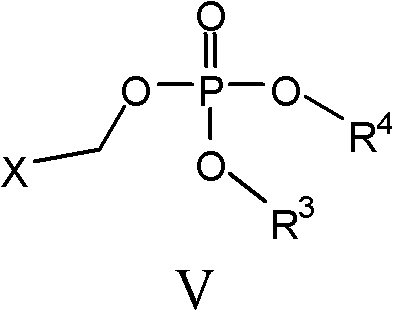
Wherein:
R
3And R
4Be C independently of one another
1-C
6Alkyl; And
X is a halogen;
In the presence of acid amides, be suitable for forming under the condition of formula VI compound and contacting.
13. the method for a preparation I compound:

Said method comprises the compound with formula VI:

Be suitable for forming formula II compound with acid:
The condition of sour solvate under contact;
The sour solvate of formula II compound and acid amides are contacted under the condition of the amide solvent compound that is suitable for forming formula II compound; With
The amide solvent compound of formula II compound and the alkali aqueous solution that contains sodium ion are contacted being suitable for forming under the condition of formula I compound.
14. method as claimed in claim 12, wherein said formula V compound is two-tertiary butyl chloride methyl phosphorodithioate:

15. method as claimed in claim 12, the condition that wherein is enough to production VI compound comprises:
(i) formula IV compound and formula V compound and alkali are made up in polar solvent; With
The product that (ii) washing obtains from (i) in alkaline aqueous solution.
16. method as claimed in claim 15, wherein the said alkali in (i) comprises cesium carbonate (Cs
2CO
3) and salt of wormwood (K
2CO
3) at least a; Said polar solvent comprises at least a in DMF and the DMAC N,N (DMAc); And the said alkali aqueous solution (ii) comprises sodium hydrogencarbonate (NaHCO
3) and sodium hydroxide (NaOH) at least a.
17. method as claimed in claim 12, wherein said formula VI compound is unsegregated.
18. method as claimed in claim 12, wherein said formula V compound is stablized with DMAC N,N (DMAc) solvent.
19. a compsn, it comprises two-tertiary butyl chloride methyl phosphorodithioate:
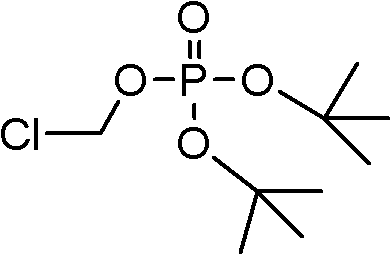
And acid amides.
20. compsn as claimed in claim 19, wherein said acid amides also are solvents.
21. compsn as claimed in claim 20, wherein said acid amides is a teritary amide.
22. compsn as claimed in claim 21, wherein said teritary amide are DMAC N,N (DMAc).
23. like claim 1 or 13 described methods, wherein said formula I compound is a hydrate forms.
24. method as claimed in claim 23, wherein said hydrate is a hexahydrate.
Applications Claiming Priority (3)
| Application Number | Priority Date | Filing Date | Title |
|---|---|---|---|
| US27007309P | 2009-07-02 | 2009-07-02 | |
| US61/270,073 | 2009-07-02 | ||
| PCT/US2010/040792 WO2011002999A1 (en) | 2009-07-02 | 2010-07-01 | Synthesis of n4- (2, 2-dimethyl-4- [ (dihydrogen phosphonoxy ] -3-oxo-5-pyrido [1, 4] oxazin-6-yl)-5-fluoro-n2- (3, 4, 5,-trimethoxyphenyl) -2, 4- pyrimidinediamine disodium salt |
Publications (2)
| Publication Number | Publication Date |
|---|---|
| CN102482305A true CN102482305A (en) | 2012-05-30 |
| CN102482305B CN102482305B (en) | 2016-07-13 |
Family
ID=42937685
Family Applications (1)
| Application Number | Title | Priority Date | Filing Date |
|---|---|---|---|
| CN201080039108.1A Active CN102482305B (en) | 2009-07-02 | 2010-07-01 | N4-(2,2-Dimethyl-4-[(dihydrophosphonooxy)methyl]-3-oxo-5-pyrido[1,4]oxazin-6-yl)-5- Synthesis of Disodium Salt of Fluoro-N2-(3,4,5-trimethoxyphenyl)-2,4-pyrimidinediamine |
Country Status (21)
| Country | Link |
|---|---|
| US (3) | US8299242B2 (en) |
| EP (1) | EP2448950B1 (en) |
| JP (1) | JP5739882B2 (en) |
| CN (1) | CN102482305B (en) |
| AU (1) | AU2010266213B2 (en) |
| BR (1) | BRPI1011888A2 (en) |
| CA (1) | CA2766801C (en) |
| CY (1) | CY1117489T1 (en) |
| DK (1) | DK2448950T3 (en) |
| EA (1) | EA021657B1 (en) |
| ES (1) | ES2565985T3 (en) |
| HR (1) | HRP20160319T1 (en) |
| HU (1) | HUE027212T2 (en) |
| ME (1) | ME02388B (en) |
| PL (1) | PL2448950T3 (en) |
| RS (1) | RS54679B1 (en) |
| SG (1) | SG176799A1 (en) |
| SI (1) | SI2448950T1 (en) |
| SM (1) | SMT201600084B (en) |
| UA (1) | UA108077C2 (en) |
| WO (1) | WO2011002999A1 (en) |
Cited By (3)
| Publication number | Priority date | Publication date | Assignee | Title |
|---|---|---|---|---|
| CN102746337A (en) * | 2012-06-21 | 2012-10-24 | 成都苑东药业有限公司 | 2,4-pyrimidinediamine compound and preparation method thereof |
| CN105849115A (en) * | 2013-12-20 | 2016-08-10 | 里格尔药品股份有限公司 | Pharmaceutical process and intermediates |
| CN111417634A (en) * | 2017-10-04 | 2020-07-14 | 细胞基因公司 | Process for the preparation of cis-4- [2- { [ (3S,4R) -3-fluorooxan-4-yl ] amino } -8- (2,4, 6-trichloroanilino) -9H-purin-9-yl ] -1-methylcyclohexane-1-carboxamide |
Families Citing this family (12)
| Publication number | Priority date | Publication date | Assignee | Title |
|---|---|---|---|---|
| EP2687533B1 (en) | 2006-07-20 | 2017-07-19 | Debiopharm International SA | Acrylamide derivatives as FAB I inhibitors |
| UA108077C2 (en) | 2009-07-02 | 2015-03-25 | SYNTHESIS OF DINODIUM SALT N4- (2,2-DIMETHYL-4 - $ (DYHYDROPHOPHONOXY) METHYL] -3-OXO-5-PYRIDO $ 1,4] OXAZIN-6-YL) -2-FLUORINE 5-TRIMETHOXYPHENYL) -2,4-PYRIMIDINDIAMINE | |
| BR112012020585A2 (en) * | 2010-02-24 | 2018-04-17 | Auspex Pharmaceuticals Inc | compound, pharmaceutical composition and method of treating a tyrosine kinase-mediated disorder |
| DK2736487T4 (en) | 2011-07-28 | 2024-11-04 | Rigel Pharmaceuticals Inc | NEW (TRIMETHOXYPHENYLAMINO)PYRIMIDINYL FORMULATIONS |
| TWI526437B (en) * | 2011-09-09 | 2016-03-21 | 台灣神隆股份有限公司 | Crystalline forms of cabazitaxel |
| US8426450B1 (en) * | 2011-11-29 | 2013-04-23 | Helsinn Healthcare Sa | Substituted 4-phenyl pyridines having anti-emetic effect |
| HRP20190980T1 (en) | 2012-06-19 | 2019-08-23 | Debiopharm International Sa | (E) -N-METHYL-N ((3-METHYLBENZOFURAN-2 IL) METHYL) -3- (7-OXO-5,6,7,8-TETRAHYDRO-1,8-NAFTYRIDIN-3-IL) DERIVATIVES acrylamide |
| US9145411B2 (en) | 2012-08-02 | 2015-09-29 | Asana Biosciences, Llc | Substituted amino-pyrimidine derivatives |
| EP3419628B1 (en) | 2016-02-26 | 2020-10-14 | Debiopharm International SA | Medicament for treatment of diabetic foot infections |
| US20180065992A1 (en) | 2016-09-08 | 2018-03-08 | Glykon Technologies Group, Llc | Monomeric bimetal hydroxycitric acid compounds and methods of making and using the same |
| HUE062061T2 (en) | 2019-02-14 | 2023-09-28 | Debiopharm Int Sa | Afabicin formulation, method for making the same |
| PH12021553086A1 (en) | 2019-06-14 | 2023-08-14 | Debiopharm Int Sa | Medicament and use thereof for treating bacterial infections involving biofilm |
Citations (2)
| Publication number | Priority date | Publication date | Assignee | Title |
|---|---|---|---|---|
| CN101115761A (en) * | 2005-01-19 | 2008-01-30 | 里格尔药品股份有限公司 | Prodrugs of 2,4-pyrimidinediamine compounds and their applications |
| WO2008064274A1 (en) * | 2006-11-21 | 2008-05-29 | Rigel Pharmaceuticals, Inc. | Prodrug salts of 2, 4-pyrimidinediamine compounds and their uses |
Family Cites Families (9)
| Publication number | Priority date | Publication date | Assignee | Title |
|---|---|---|---|---|
| US324087A (en) | 1885-08-11 | Abel combs | ||
| US303022A (en) | 1884-08-05 | Egg-beater | ||
| TWI329105B (en) | 2002-02-01 | 2010-08-21 | Rigel Pharmaceuticals Inc | 2,4-pyrimidinediamine compounds and their uses |
| AU2003221887A1 (en) | 2002-04-12 | 2003-10-27 | Tritek Technologies, Inc. | Mail sorting processes and systems |
| JP2006514989A (en) | 2002-07-29 | 2006-05-18 | ライジェル ファーマシューティカルズ | Method for treating and preventing autoimmune diseases with 2,4-pyrimidinediamine compounds |
| AU2004265288A1 (en) | 2003-07-30 | 2005-02-24 | Rigel Pharmaceuticals, Inc. | 2,4-pyrimidinediamine compounds for use in the treatment or prevention of autoimmune diseases |
| US20060047135A1 (en) | 2004-08-30 | 2006-03-02 | Chadwick Scott T | Process for preparing chloromethyl di-tert-butylphosphate |
| JP4981673B2 (en) * | 2005-09-13 | 2012-07-25 | エーザイ・アール・アンド・ディー・マネジメント株式会社 | Composition comprising chloromethyl phosphate derivative with improved stability and method for producing the same |
| UA108077C2 (en) | 2009-07-02 | 2015-03-25 | SYNTHESIS OF DINODIUM SALT N4- (2,2-DIMETHYL-4 - $ (DYHYDROPHOPHONOXY) METHYL] -3-OXO-5-PYRIDO $ 1,4] OXAZIN-6-YL) -2-FLUORINE 5-TRIMETHOXYPHENYL) -2,4-PYRIMIDINDIAMINE |
-
2010
- 2010-01-07 UA UAA201201072A patent/UA108077C2/en unknown
- 2010-07-01 CA CA2766801A patent/CA2766801C/en active Active
- 2010-07-01 EA EA201270114A patent/EA021657B1/en unknown
- 2010-07-01 ES ES10730679.7T patent/ES2565985T3/en active Active
- 2010-07-01 SG SG2011091733A patent/SG176799A1/en unknown
- 2010-07-01 RS RS20160220A patent/RS54679B1/en unknown
- 2010-07-01 CN CN201080039108.1A patent/CN102482305B/en active Active
- 2010-07-01 EP EP10730679.7A patent/EP2448950B1/en active Active
- 2010-07-01 BR BRPI1011888A patent/BRPI1011888A2/en not_active Application Discontinuation
- 2010-07-01 SI SI201031148A patent/SI2448950T1/en unknown
- 2010-07-01 AU AU2010266213A patent/AU2010266213B2/en active Active
- 2010-07-01 HR HRP20160319TT patent/HRP20160319T1/en unknown
- 2010-07-01 US US12/829,126 patent/US8299242B2/en active Active
- 2010-07-01 PL PL10730679T patent/PL2448950T3/en unknown
- 2010-07-01 JP JP2012518607A patent/JP5739882B2/en active Active
- 2010-07-01 ME MEP-2016-57A patent/ME02388B/en unknown
- 2010-07-01 DK DK10730679.7T patent/DK2448950T3/en active
- 2010-07-01 WO PCT/US2010/040792 patent/WO2011002999A1/en not_active Ceased
- 2010-07-01 HU HUE10730679A patent/HUE027212T2/en unknown
-
2012
- 2012-09-24 US US13/625,552 patent/US8481724B2/en active Active
-
2013
- 2013-06-07 US US13/912,856 patent/US8691798B2/en active Active
-
2016
- 2016-03-24 SM SM201600084T patent/SMT201600084B/en unknown
- 2016-04-12 CY CY20161100304T patent/CY1117489T1/en unknown
Patent Citations (2)
| Publication number | Priority date | Publication date | Assignee | Title |
|---|---|---|---|---|
| CN101115761A (en) * | 2005-01-19 | 2008-01-30 | 里格尔药品股份有限公司 | Prodrugs of 2,4-pyrimidinediamine compounds and their applications |
| WO2008064274A1 (en) * | 2006-11-21 | 2008-05-29 | Rigel Pharmaceuticals, Inc. | Prodrug salts of 2, 4-pyrimidinediamine compounds and their uses |
Cited By (4)
| Publication number | Priority date | Publication date | Assignee | Title |
|---|---|---|---|---|
| CN102746337A (en) * | 2012-06-21 | 2012-10-24 | 成都苑东药业有限公司 | 2,4-pyrimidinediamine compound and preparation method thereof |
| CN102746337B (en) * | 2012-06-21 | 2014-12-17 | 成都苑东药业有限公司 | 2,4-pyrimidinediamine compound and preparation method thereof |
| CN105849115A (en) * | 2013-12-20 | 2016-08-10 | 里格尔药品股份有限公司 | Pharmaceutical process and intermediates |
| CN111417634A (en) * | 2017-10-04 | 2020-07-14 | 细胞基因公司 | Process for the preparation of cis-4- [2- { [ (3S,4R) -3-fluorooxan-4-yl ] amino } -8- (2,4, 6-trichloroanilino) -9H-purin-9-yl ] -1-methylcyclohexane-1-carboxamide |
Also Published As
| Publication number | Publication date |
|---|---|
| AU2010266213A1 (en) | 2012-02-02 |
| SG176799A1 (en) | 2012-01-30 |
| BRPI1011888A2 (en) | 2016-04-12 |
| JP2012532143A (en) | 2012-12-13 |
| HUE027212T2 (en) | 2016-10-28 |
| RS54679B1 (en) | 2016-08-31 |
| DK2448950T3 (en) | 2016-04-04 |
| HRP20160319T1 (en) | 2016-04-22 |
| SMT201600084B (en) | 2016-04-29 |
| US20110003986A1 (en) | 2011-01-06 |
| UA108077C2 (en) | 2015-03-25 |
| CA2766801A1 (en) | 2011-01-06 |
| EA201270114A1 (en) | 2012-05-30 |
| US20130018185A1 (en) | 2013-01-17 |
| PL2448950T3 (en) | 2016-06-30 |
| EP2448950A1 (en) | 2012-05-09 |
| US8691798B2 (en) | 2014-04-08 |
| WO2011002999A1 (en) | 2011-01-06 |
| JP5739882B2 (en) | 2015-06-24 |
| EP2448950B1 (en) | 2016-01-13 |
| EA021657B1 (en) | 2015-08-31 |
| AU2010266213B2 (en) | 2015-06-18 |
| US20130274499A1 (en) | 2013-10-17 |
| CN102482305B (en) | 2016-07-13 |
| US8481724B2 (en) | 2013-07-09 |
| CA2766801C (en) | 2018-03-13 |
| ME02388B (en) | 2016-09-20 |
| ES2565985T3 (en) | 2016-04-08 |
| HK1169996A1 (en) | 2013-02-15 |
| CY1117489T1 (en) | 2017-04-26 |
| SI2448950T1 (en) | 2016-05-31 |
| US8299242B2 (en) | 2012-10-30 |
Similar Documents
| Publication | Publication Date | Title |
|---|---|---|
| CN102482305A (en) | Synthesis of N4- (2, 2-dimethyl-4- [ (dihydrogen phosphonoxy ] -3-oxo-5-pyrido [1, 4] oxazin-6-yl)-5-fluoro-n2- (3, 4, 5,-trimethoxyphenyl) -2, 4- pyrimidinediamine disodium salt | |
| JP6190372B2 (en) | Methods for preparing antiviral nucleotide analogs | |
| CN103298812B (en) | For the method preparing tenofovir | |
| EA031458B1 (en) | Process of making adamantanamides | |
| CN108137446A (en) | Anthracene -9,10- dione dioxime compound prodrug and application thereof | |
| KR20100031085A (en) | Method for purification of adefovir dipivoxil | |
| JP2017522301A (en) | Novel polymorphic form of tenofovir prodrug and process for its production and use | |
| JP2010502569A (en) | How to improve pharmacokinetics | |
| WO2018009375A1 (en) | Method of synthesizing near ir, closed chain sulfo-cyanine dyes | |
| CN101405293A (en) | Lysine-based prodrugs of aspartyl protease inhibitors and methods of making the same | |
| JP2007517803A (en) | Method for producing sildenafil base and citrate | |
| JP2012516839A (en) | Major intermediates for the synthesis of rosuvastatin or pharmaceutically acceptable salts thereof | |
| US9963475B2 (en) | Anthracene-9, 10-dione dioxime compound prodrugs and their uses | |
| CN101928301B (en) | Method for synthesizing levofosfomycin dextrophenethylamine salt from dextrofosfomysin levophenethylamine salt | |
| ES2358669T3 (en) | ACID SALTS (2S, 3S) -3 - [[(1S) -1-ISOBUTOXIMETIL-3-METILBUTIL] CARBAMOIL] OXIRANO-2-CARBOXILICO. | |
| RU2177947C1 (en) | Method of synthesis of o,o-dialkyldithiophosphates | |
| NZ227978A (en) | Halogenated phosphonate derivatives, preparation thereof and pharmaceutical compositions | |
| CN102137840A (en) | Gabapentin enacarbil salts and processes for their preparation | |
| JPH0660185B2 (en) | Method for producing phosphate ester | |
| WO2011158259A1 (en) | Novel process for the preparation of (3s)-tetrahydrofuran-3-yl (is, 2r)-3-[[(4-aminophenyl) sulfonyl] (isobutyl) amino]-1-benzyl-2-(phosphonooxy) propylcarbamate and its pharmaceutically acceptable salts thereof | |
| JPS63208593A (en) | Production of phosphoric acid ester |
Legal Events
| Date | Code | Title | Description |
|---|---|---|---|
| C06 | Publication | ||
| PB01 | Publication | ||
| C10 | Entry into substantive examination | ||
| SE01 | Entry into force of request for substantive examination | ||
| C14 | Grant of patent or utility model | ||
| GR01 | Patent grant |