CN102481440B - Device including nanoscale protrusions and method of manufacturing the same - Google Patents
Device including nanoscale protrusions and method of manufacturing the same Download PDFInfo
- Publication number
- CN102481440B CN102481440B CN201080028047.9A CN201080028047A CN102481440B CN 102481440 B CN102481440 B CN 102481440B CN 201080028047 A CN201080028047 A CN 201080028047A CN 102481440 B CN102481440 B CN 102481440B
- Authority
- CN
- China
- Prior art keywords
- nanoscale
- protrusions
- array
- carrier
- nanoprojection
- Prior art date
- Legal status (The legal status is an assumption and is not a legal conclusion. Google has not performed a legal analysis and makes no representation as to the accuracy of the status listed.)
- Expired - Fee Related
Links
Images


Classifications
-
- A—HUMAN NECESSITIES
- A61—MEDICAL OR VETERINARY SCIENCE; HYGIENE
- A61B—DIAGNOSIS; SURGERY; IDENTIFICATION
- A61B17/00—Surgical instruments, devices or methods
- A61B17/20—Surgical instruments, devices or methods for vaccinating or cleaning the skin previous to the vaccination
- A61B17/205—Vaccinating by means of needles or other puncturing devices
-
- A—HUMAN NECESSITIES
- A61—MEDICAL OR VETERINARY SCIENCE; HYGIENE
- A61M—DEVICES FOR INTRODUCING MEDIA INTO, OR ONTO, THE BODY; DEVICES FOR TRANSDUCING BODY MEDIA OR FOR TAKING MEDIA FROM THE BODY; DEVICES FOR PRODUCING OR ENDING SLEEP OR STUPOR
- A61M37/00—Other apparatus for introducing media into the body; Percutany, i.e. introducing medicines into the body by diffusion through the skin
- A61M37/0015—Other apparatus for introducing media into the body; Percutany, i.e. introducing medicines into the body by diffusion through the skin by using microneedles
-
- A—HUMAN NECESSITIES
- A61—MEDICAL OR VETERINARY SCIENCE; HYGIENE
- A61B—DIAGNOSIS; SURGERY; IDENTIFICATION
- A61B17/00—Surgical instruments, devices or methods
- A61B2017/00526—Methods of manufacturing
-
- A—HUMAN NECESSITIES
- A61—MEDICAL OR VETERINARY SCIENCE; HYGIENE
- A61B—DIAGNOSIS; SURGERY; IDENTIFICATION
- A61B90/00—Instruments, implements or accessories specially adapted for surgery or diagnosis and not covered by any of the groups A61B1/00 - A61B50/00, e.g. for luxation treatment or for protecting wound edges
- A61B90/03—Automatic limiting or abutting means, e.g. for safety
- A61B2090/032—Automatic limiting or abutting means, e.g. for safety pressure limiting, e.g. hydrostatic
-
- A—HUMAN NECESSITIES
- A61—MEDICAL OR VETERINARY SCIENCE; HYGIENE
- A61M—DEVICES FOR INTRODUCING MEDIA INTO, OR ONTO, THE BODY; DEVICES FOR TRANSDUCING BODY MEDIA OR FOR TAKING MEDIA FROM THE BODY; DEVICES FOR PRODUCING OR ENDING SLEEP OR STUPOR
- A61M37/00—Other apparatus for introducing media into the body; Percutany, i.e. introducing medicines into the body by diffusion through the skin
- A61M37/0015—Other apparatus for introducing media into the body; Percutany, i.e. introducing medicines into the body by diffusion through the skin by using microneedles
- A61M2037/0023—Drug applicators using microneedles
-
- A—HUMAN NECESSITIES
- A61—MEDICAL OR VETERINARY SCIENCE; HYGIENE
- A61M—DEVICES FOR INTRODUCING MEDIA INTO, OR ONTO, THE BODY; DEVICES FOR TRANSDUCING BODY MEDIA OR FOR TAKING MEDIA FROM THE BODY; DEVICES FOR PRODUCING OR ENDING SLEEP OR STUPOR
- A61M37/00—Other apparatus for introducing media into the body; Percutany, i.e. introducing medicines into the body by diffusion through the skin
- A61M37/0015—Other apparatus for introducing media into the body; Percutany, i.e. introducing medicines into the body by diffusion through the skin by using microneedles
- A61M2037/0046—Solid microneedles
-
- A—HUMAN NECESSITIES
- A61—MEDICAL OR VETERINARY SCIENCE; HYGIENE
- A61M—DEVICES FOR INTRODUCING MEDIA INTO, OR ONTO, THE BODY; DEVICES FOR TRANSDUCING BODY MEDIA OR FOR TAKING MEDIA FROM THE BODY; DEVICES FOR PRODUCING OR ENDING SLEEP OR STUPOR
- A61M37/00—Other apparatus for introducing media into the body; Percutany, i.e. introducing medicines into the body by diffusion through the skin
- A61M37/0015—Other apparatus for introducing media into the body; Percutany, i.e. introducing medicines into the body by diffusion through the skin by using microneedles
- A61M2037/0053—Methods for producing microneedles
-
- Y—GENERAL TAGGING OF NEW TECHNOLOGICAL DEVELOPMENTS; GENERAL TAGGING OF CROSS-SECTIONAL TECHNOLOGIES SPANNING OVER SEVERAL SECTIONS OF THE IPC; TECHNICAL SUBJECTS COVERED BY FORMER USPC CROSS-REFERENCE ART COLLECTIONS [XRACs] AND DIGESTS
- Y10—TECHNICAL SUBJECTS COVERED BY FORMER USPC
- Y10T—TECHNICAL SUBJECTS COVERED BY FORMER US CLASSIFICATION
- Y10T29/00—Metal working
- Y10T29/49—Method of mechanical manufacture
-
- Y—GENERAL TAGGING OF NEW TECHNOLOGICAL DEVELOPMENTS; GENERAL TAGGING OF CROSS-SECTIONAL TECHNOLOGIES SPANNING OVER SEVERAL SECTIONS OF THE IPC; TECHNICAL SUBJECTS COVERED BY FORMER USPC CROSS-REFERENCE ART COLLECTIONS [XRACs] AND DIGESTS
- Y10—TECHNICAL SUBJECTS COVERED BY FORMER USPC
- Y10T—TECHNICAL SUBJECTS COVERED BY FORMER US CLASSIFICATION
- Y10T29/00—Metal working
- Y10T29/49—Method of mechanical manufacture
- Y10T29/49826—Assembling or joining
-
- Y—GENERAL TAGGING OF NEW TECHNOLOGICAL DEVELOPMENTS; GENERAL TAGGING OF CROSS-SECTIONAL TECHNOLOGIES SPANNING OVER SEVERAL SECTIONS OF THE IPC; TECHNICAL SUBJECTS COVERED BY FORMER USPC CROSS-REFERENCE ART COLLECTIONS [XRACs] AND DIGESTS
- Y10—TECHNICAL SUBJECTS COVERED BY FORMER USPC
- Y10T—TECHNICAL SUBJECTS COVERED BY FORMER US CLASSIFICATION
- Y10T29/00—Metal working
- Y10T29/49—Method of mechanical manufacture
- Y10T29/49826—Assembling or joining
- Y10T29/49885—Assembling or joining with coating before or during assembling
Landscapes
- Health & Medical Sciences (AREA)
- Life Sciences & Earth Sciences (AREA)
- Engineering & Computer Science (AREA)
- Veterinary Medicine (AREA)
- Public Health (AREA)
- Biomedical Technology (AREA)
- Heart & Thoracic Surgery (AREA)
- Surgery (AREA)
- Medical Informatics (AREA)
- Animal Behavior & Ethology (AREA)
- General Health & Medical Sciences (AREA)
- Hematology (AREA)
- Dermatology (AREA)
- Nuclear Medicine, Radiotherapy & Molecular Imaging (AREA)
- Anesthesiology (AREA)
- Molecular Biology (AREA)
- Medicines Containing Antibodies Or Antigens For Use As Internal Diagnostic Agents (AREA)
- Medicinal Preparation (AREA)
Abstract
Description
技术领域 technical field
本发明通常涉及用于施用或递送生物学组合物、药物组合物或化学组合物,例如疫苗,至生物体体内的装置和方法。更具体地说,本发明的方面涉及用于施用或递送生物学组合物、药物组合物或化学组合物至生物体皮肤内可控深度的纳米级突起的系统、设备和方法。 The present invention generally relates to devices and methods for administering or delivering biological, pharmaceutical or chemical compositions, such as vaccines, into an organism. More specifically, aspects of the invention relate to systems, devices, and methods for applying or delivering biological, pharmaceutical, or chemical compositions to nanoscale protrusions of controlled depth within the skin of an organism.
技术背景 technical background
抵抗不同疾病的应用于预防性接种和/或治疗的生物学组合物、药物组合物和化学组合物(例如疫苗)可商业获得。常规地,将疫苗施用至生物体的机体内通常包括针式注射,例如皮下注射或肌肉注射。其它已知的施用疫苗的方法包括口服给药、舌下给药或鼻腔给药。 Biological, pharmaceutical and chemical compositions (eg vaccines) for use in prophylactic vaccination and/or therapy against different diseases are commercially available. Conventionally, administering a vaccine into an organism usually involves needle injection, such as subcutaneous injection or intramuscular injection. Other known methods of administering vaccines include oral, sublingual, or nasal administration.
通过针式注射施用疫苗的效用已被证明。但是,使用这样的针式注射(1)具有几个安全性和可接受性方面的缺点。与使用针式注射相关的用于递送疫苗和其它的化学组合物的缺点或问题在于由病毒(例如甲型肝炎、乙型肝炎、丙型肝炎和HIV病毒)导致的潜在的机会性感染和通过血液的递送传播的疾病。由此,在许多情况中,使用针来施用疫苗和/或其它的化学组合物伴随着对于昂贵的和有毒的药物的预防。使用针的额外的缺点在于许多病人抵触针,其将导致显著的顺应性的问题。 The efficacy of administering vaccines by needle injection has been demonstrated. However, the use of such needle injections (1) has several safety and acceptability disadvantages. A disadvantage or problem associated with the use of needle injections for the delivery of vaccines and other chemical compositions is the potential for opportunistic infections and transmission of Disease spread by delivery of blood. Thus, in many cases, the use of needles to administer vaccines and/or other chemical compositions is accompanied by prophylaxis against expensive and toxic drugs. An additional disadvantage of using needles is that many patients resist the needles, which can lead to significant compliance problems.
对于疫苗和其它化学组合物来说具有很少的非侵入性递送路径,例如肺部、鼻腔和口腔递送路径。通常地,鼻腔施用疫苗和其它化学组合物提供了特殊的预备好的通道至例如人体体循环的大范围的身体系统,而不需要穿过例如角质层等阻止经皮给药应用的身体屏障。然而,鼻腔施用或递送疫苗和其它的化学组合物仍然存在几个挑战或者困难。这样的挑战包括确保精确量和/或准确剂量疫苗的充足停留时间,该疫苗通过特定的细胞(例如M细胞)或通过贯穿鼻子的旁路细胞吸收被吸收。鼻腔递送疫苗和其它的化学组合物的其它的困难包括在肺部和胃部内的不期望的沉积以及用来作用于所述鼻腔递送(2)的多次使用设备的微生物污染。 There are few non-invasive delivery routes for vaccines and other chemical compositions, such as pulmonary, nasal and oral delivery routes. In general, nasal administration of vaccines and other chemical compositions provides specific prepared access to a wide range of body systems such as the human systemic circulation without the need to cross body barriers such as the stratum corneum that prevent transdermal application. However, nasal administration or delivery of vaccines and other chemical compositions still presents several challenges or difficulties. Such challenges include ensuring sufficient residence time for precise quantities and/or accurate doses of vaccines that are absorbed by specific cells (eg, M cells) or by bypass cellular uptake throughout the nose. Other difficulties with nasal delivery of vaccines and other chemical compositions include undesired deposition in the lungs and stomach and microbial contamination of the multi-use equipment used to effect the nasal delivery (2).
通常是不推荐口服施用或递送疫苗的,因为食物及其类似物质的连续摄取导致胃肠道的高耐受性。因此,通过口服给药路径产生的有效的免疫应答或免疫力典型地是非常低的。此外,仅具有少量已知的疫苗可以通过胃肠道、更特别地通过位于胃肠道内的M细胞很好地吸收。疫苗通过胃肠道的吸收相当低的原因还在于胃部(即胃部内存在的酸性pH)和小肠内(即小肠内存在的高浓度酶)的恶劣的环境。 Oral administration or delivery of vaccines is generally not recommended because continuous ingestion of food and the like leads to high tolerance in the gastrointestinal tract. Thus, the generation of an effective immune response or immunity by the oral route of administration is typically very low. Furthermore, only a small number of known vaccines are well absorbed through the gastrointestinal tract, more particularly by M cells located within the gastrointestinal tract. The relatively low absorption of vaccines through the gastrointestinal tract is also due to the harsh environment of the stomach (ie, the acidic pH present in the stomach) and the small intestine (ie, the high concentration of enzymes present in the small intestine).
皮肤是人体最大的器官。皮肤为高度免疫原的,其具有高浓度的树突细胞,该细胞还称为朗格汉斯细胞。当与过敏原接触的时候,朗格汉斯细胞立即迁移至淋巴结以开始相应的免疫应答。皮肤,更特别地,皮肤的外层或角质层(SC),还具有保护性功能,其用于阻挡病原体和其它潜在的有害药剂进入身体。然而,皮肤,更特别地SC,同时阻止了许多药物的治疗性的递送,特别是分子量大于约1000道尔顿(Da)的药物。 The skin is the largest organ of the human body. Skin is highly immunogenic with a high concentration of dendritic cells, also known as Langerhans cells. Upon contact with an allergen, Langerhans cells immediately migrate to the lymph nodes to initiate the corresponding immune response. The skin, and more particularly the outer layer of the skin or the stratum corneum (SC), also has a protective function, serving to keep pathogens and other potentially harmful agents from entering the body. However, skin, and more particularly SC, simultaneously prevents the therapeutic delivery of many drugs, especially those with a molecular weight greater than about 1000 Daltons (Da).
微米级显微针已被用来实现疫苗的透皮递送。例如,微米级的显微针能够穿刺动物和人的尸体皮以实现例如用于全身作用的蛋白质、DNA和疫苗制剂的小分子的透皮递送,其通过Praunsnitz(3)开发。 Micron-sized microneedles have been used to achieve transdermal delivery of vaccines. For example, micron-scale microneedles capable of piercing animal and human cadaver skin to enable transdermal delivery of small molecules such as proteins, DNA and vaccine formulations for systemic action were developed by Praunsnitz (3).
对于目前能够使用的微米级显微针来说,其具有大量的限制和不利因素。本发明的实施方案提供了相对于目前可利用的选择来说改进的和/或可替换的选择,其用于施用或递送生物学组合物、药物组合物和化学组合物。 There are a number of limitations and disadvantages to the micron-scale microneedles currently available. Embodiments of the present invention provide improved and/or alternative options over currently available options for administering or delivering biological, pharmaceutical, and chemical compositions.
发明内容 Contents of the invention
本发明的实施方案提供了用于施用或递送生物学组合物、药物组合物和化学组合物,例如疫苗、药物、治疗剂和其它生物学或生物活性化合物至生物体体内的系统、装置、方法、工艺和技术。本发明的许多实施方案提供了通过使用纳米级突起(或纳米突起),例如纳米棒、纳米线、或纳米针、或纳米管,施用或递送生物学组合物、药物组合物和化学组合物至生物体体内的靶标位点(例如表皮)的系统、装置、工艺、过程和技术。 Embodiments of the present invention provide systems, devices, and methods for administering or delivering biological, pharmaceutical, and chemical compositions, such as vaccines, drugs, therapeutics, and other biological or bioactive compounds, into an organism , process and technology. Many embodiments of the invention provide for the administration or delivery of biological, pharmaceutical and chemical compositions to Systems, devices, processes, procedures and techniques for targeting a site in an organism, such as the epidermis.
根据本发明的实施方案,公开了一种装置,该装置包括一组由载体介质承载的纳米级突起,这组纳米级突起成形并配置为递送组合物至体内的靶标位置。该装置进一步包括外围结构和可移置的载体,该外围结构配置为用于至少部分地在其内部容纳该套纳米级突起,该可移置的载体连接于该外围结构并配置为可相对于该外围结构在第一位置和第二位置之间移动。该可移置的载体相对于外围结构的移动促使或实现该套纳米级突起相应的移动,从而将该套纳米级突起插入进体内。 According to an embodiment of the present invention, a device is disclosed comprising an array of nanoscale projections supported by a carrier medium, the array of nanoscale projections shaped and configured to deliver a composition to a target location in the body. The device further includes a peripheral structure configured to at least partially house the set of nanoscale protrusions therein, and a displaceable carrier coupled to the peripheral structure and configured to be relative to the peripheral structure. The peripheral structure moves between a first position and a second position. Movement of the displaceable carrier relative to the peripheral structure causes or enables corresponding movement of the set of nanoscale projections, thereby inserting the set of nanoscale projections into the body.
根据本发明的另一实施方案,公开了一种系统,该系统包括至少两个纳米级突起阵列,每个纳米级突起阵列包括一套通过载体介质承载的纳米级突起。该系统还包括一套外围结构和一套可移置的载体,该外围结构配置为用于至少部分地在其内部接收该至少两个纳米级突起阵列,该可移置的载体连接于该套外围结构。该套可移置的载体可连接于该至少两个纳米级突起阵列并配置为相对于该外围结构在第一位置和第二位置之间可移动,从而移动该至少两个连接于其上的纳米级突起阵列。 According to another embodiment of the present invention, there is disclosed a system comprising at least two nanoscale protrusion arrays, each nanoscale protrusion array comprising a set of nanoscale protrusions carried by a carrier medium. The system also includes a set of peripheral structures configured to at least partially receive the at least two arrays of nanoscale protrusions within the peripheral structure and a set of displaceable supports attached to the set. peripheral structure. The set of displaceable carriers is connectable to the at least two nanoscale protrusion arrays and configured to move relative to the peripheral structure between a first position and a second position, thereby moving the at least two nanoscale protrusion arrays connected thereto. Nanoscale protrusion arrays.
根据本发明的另一实施方案,公开了一种用于制造装置的方法,该装置配置为用于递送组合物至体内的靶标位置。该方法包括形成一套由载体介质承载的纳米级突起,该套纳米级突起被成形并配置为用于递送该组合物至靶标位置,并且将该套纳米级突起的至少一部分配置在外围结构内。该方法还包括连接可移置的载体至该外围结构,该可移置的载体可连接于该套纳米级突起并配置为相对于该外围结构在第一位置和第二位置之间可移动,以由此促使或实现该套纳米级突起相应的移动,从而使该套纳米级突起插入进体内。 According to another embodiment of the present invention, a method for manufacturing a device configured for delivery of a composition to a target location in the body is disclosed. The method includes forming a set of nanoscale protrusions supported by a carrier medium, the set of nanoscale protrusions shaped and configured for delivery of the composition to a target site, and disposing at least a portion of the set of nanoscale protrusions within a peripheral structure . The method also includes attaching a displaceable carrier to the peripheral structure, the displaceable carrier attachable to the set of nanoscale protrusions and configured to move relative to the peripheral structure between a first position and a second position, The corresponding movement of the set of nano-scale protrusions is thereby promoted or realized, so that the set of nano-scale protrusions is inserted into the body.
根据本发明的另一实施方案,公开了一种方法,该方法包括形成多个由载体介质承载的纳米级突起片段,其中该多个纳米级突起片段中的每一个均包括至少两个相互之间堆叠在一起的片段,并且其中该多个纳米级突起片段的至少一部分通常具有分层的形状。该方法还包括将该多个纳米级突起片段配置为可移动至体内,从而促使或实现将组合物递送至体内的靶标位置。 According to another embodiment of the present invention, a method is disclosed, the method comprising forming a plurality of nanoscale protrusion segments supported by a carrier medium, wherein each of the plurality of nanoscale protrusion segments includes at least two interconnected Segments stacked together, and wherein at least a portion of the plurality of nanoscale protrusion segments generally have a layered shape. The method also includes configuring the plurality of nanoscale projection segments to be movable into the body, thereby facilitating or effecting delivery of the composition to a target location in the body.
根据本发明的另一实施方案,公开了一种制造系统的方法,该系统用于递送至少一种组合物至体内的靶标位置。该方法包括形成至少两个纳米级突起阵列,每个纳米级突起阵列包括一套由载体介质承载的纳米级突起,并且将每个纳米级突起阵列配置在外围结构内。该方法进一步包括连接每个纳米级突起阵列至可移置的载体,该可移置的载体配置为相对于该外围结构在第一位置和第二位置之间可移动,从而由此促使或实现连接于其上的该纳米级突起阵列相应的移动。 According to another embodiment of the present invention, a method of making a system for delivering at least one composition to a target location in the body is disclosed. The method includes forming at least two nanoscale protrusion arrays, each nanoscale protrusion array comprising a set of nanoscale protrusions carried by a carrier medium, and disposing each nanoscale protrusion array within a peripheral structure. The method further includes attaching each array of nanoscale protrusions to a displaceable carrier configured to be movable relative to the peripheral structure between a first position and a second position, thereby causing or effecting The array of nanoscale protrusions attached thereto moves accordingly.
根据本发明的其它的实施方案,公开了一种用于递送组合物至靶标位置的方法。该方法包括提供纳米级突起阵列,该纳米级突起阵列包括一套纳米级突起和承载该套纳米级突起的载体介质,该纳米级突起阵列至少部分地配置在外围结构内并且通过可移置的载体承载。该方法还包括相对于该外围结构移动该可移置的载体,其中该可移置的载体结构相对于该外围结构的移动促使或实现了在由可移置的结构承载的纳米级突起阵列上施加力以由此移动该纳米级突起阵列,从而递送组合物至靶标位置。根据本发明的还一实施方案,上述方法可以用于递送组合物至体内的靶标位置。因此,该可移置的载体结构相对于该外围结构的移动促使或实现了在纳米级突起阵列上施加力以由此移动该纳米级突起阵列的纳米级突起从而插入进体内。 According to other embodiments of the present invention, a method for delivering a composition to a target location is disclosed. The method includes providing an array of nanoscale protrusions, the array of nanoscale protrusions comprising a set of nanoscale protrusions and a carrier medium carrying the set of nanoscale protrusions, the array of nanoscale protrusions disposed at least partially within a peripheral structure and via a displaceable carrier bearer. The method also includes moving the displaceable carrier relative to the peripheral structure, wherein the movement of the displaceable carrier structure relative to the peripheral structure causes or enables the displaceable support on the array of nanoscale protrusions carried by the displaceable structure A force is applied to thereby move the array of nanoscale projections, thereby delivering the composition to the target location. According to yet another embodiment of the present invention, the method described above can be used to deliver the composition to a target location in the body. Thus, movement of the displaceable carrier structure relative to the peripheral structure causes or enables exertion of a force on the array of nanoscale projections to thereby move the nanoscale projections of the array of nanoscale projections for insertion into the body.
附图说明 Description of drawings
本发明的实施方案将在下文中通过附图来描述,其中: Embodiments of the invention will hereinafter be described with reference to the accompanying drawings, in which:
图1A为根据本发明实施方案的用于施用或递送药物组合物的纳米级突起阵列的示意图; Figure 1A is a schematic diagram of a nanoscale projection array for administering or delivering a pharmaceutical composition according to an embodiment of the present invention;
图1B为根据本发明实施方案的用于施用或递送药物组合物的另一种纳米级突起阵列的示意图; Figure 1B is a schematic diagram of another nanoscale protrusion array for administering or delivering a pharmaceutical composition according to an embodiment of the present invention;
图1C为根据本发明实施方案的用于施用或递送药物组合物的还一种纳米级突起阵列的示意图; Figure 1C is a schematic diagram of yet another nanoscale protrusion array for administering or delivering a pharmaceutical composition according to an embodiment of the present invention;
图1D为根据本发明另一实施方案的用于施用或递送药物组合物的包括纳米针的纳米级突起阵列的示意图; 1D is a schematic diagram of a nanoscale protrusion array including nanoneedles for administering or delivering a pharmaceutical composition according to another embodiment of the present invention;
图2A-2D示出了包括不同数量片段的纳米级突起阵列的局部侧视图; Figures 2A-2D show partial side views of nanoscale protrusion arrays comprising different numbers of segments;
图3A-3D分别示出了图2A-2D的纳米级突起阵列的局部顶视图; 3A-3D show partial top views of the nanoscale protrusion arrays of FIGS. 2A-2D , respectively;
图4A为根据本发明实施方案的纳米突起阵列的等距示意图,该纳米突起阵列包括由硅载体基底承载的纳米突起; Figure 4A is a schematic isometric view of a nanoprojection array comprising nanoprojections carried by a silicon carrier substrate in accordance with an embodiment of the present invention;
图4B为根据本发明实施方案的纳米突起阵列的等距示意图,该纳米突起阵列包括由PDMS载体基底承载的纳米突起; Figure 4B is a schematic isometric view of a nanoprojection array comprising nanoprojections carried by a PDMS carrier substrate, according to an embodiment of the present invention;
图4C为根据本发明实施方案的纳米突起阵列的等距示意图,该纳米突起阵列包括由多层载体基底承载的纳米突起,该多层载体基底包括PDMS层和硅层; 4C is a schematic isometric view of a nanoprojection array comprising nanoprojections carried by a multilayer carrier substrate comprising a PDMS layer and a silicon layer, according to an embodiment of the present invention;
图5A为根据本发明实施方案的包括连接于施药单元的纳米突起阵列的装置的示意图; Figure 5A is a schematic diagram of a device comprising a nanoprojection array attached to a drug delivery unit according to an embodiment of the present invention;
图5B为根据本发明实施方案的置于外围结构内并由可移置的载体承载的纳米突起阵列的示意性顶视图; Figure 5B is a schematic top view of an array of nanoprojections disposed within a peripheral structure and carried by a displaceable carrier according to an embodiment of the present invention;
图6A为根据本发明实施方案的置于延伸位置的纳米突起阵列的等距示意图; Figure 6A is a schematic isometric illustration of a nanoprojection array placed in an extended position according to an embodiment of the present invention;
图6B为根据本发明实施方案的置于缩进位置的图6B的纳米突起阵列的等距示意图; 6B is a schematic isometric illustration of the nanoprojection array of FIG. 6B placed in a retracted position according to an embodiment of the invention;
图7A为根据本发明实施方案的包括置于外围结构内并连接于可移置的载体的纳米突起阵列的装置的视图; Figure 7A is a view of a device including an array of nanoprojections disposed within a peripheral structure and attached to a displaceable carrier according to an embodiment of the present invention;
图7B为图7A的装置的另一视图; Figure 7B is another view of the device of Figure 7A;
图8示出了根据本发明实施方案的包括配置在施药单元的外围结构内的纳米突起阵列的装置,该施药单元用密封膜附着于该外围结构; Figure 8 illustrates a device comprising an array of nanoprojections disposed within a peripheral structure of a dosing unit to which the dosing unit is attached with a sealing membrane, according to an embodiment of the present invention;
图9为根据本发明实施方案的包括纳米突起阵列和包括可移置的控制元件的施药单元的装置的示意图; 9 is a schematic diagram of a device comprising a nanoprojection array and a drug delivery unit comprising a displaceable control element according to an embodiment of the present invention;
图10为根据本发明实施方案的包括纳米突起阵列和施药单元的装置的示意图,该施药单元包括可移置的控制元件以及一套施力元件; 10 is a schematic diagram of a device comprising a nanoprojection array and a drug delivery unit including a displaceable control element and a set of force application elements according to an embodiment of the present invention;
图11A为由可移置的载体承载的纳米突起阵列的示意图,该纳米突起阵列和可移置的载体置于缩进位置; 11A is a schematic diagram of a nanoprojection array carried by a displaceable carrier, the nanoprojection array and the displaceable carrier placed in an indented position;
图11B为由图11A的可移置的载体承载的纳米突起阵列的示意图,该纳米突起阵列和可移置的载体置于延伸位置; 11B is a schematic diagram of a nanoprojection array carried by the displaceable carrier of FIG. 11A , the nanoprojection array and the displaceable carrier placed in an extended position;
图12A示出了根据本发明实施方案的连接于一套施力元件的纳米突起阵列; Figure 12A shows an array of nanoprojections attached to a set of force applying elements according to an embodiment of the present invention;
图12B示出了根据本发明实施方案的连接于不同套的施力元件的纳米突起阵列; Figure 12B shows an array of nanoprojections attached to different sets of force applying elements according to an embodiment of the invention;
图13为根据本发明实施方案的包括纳米突起阵列和施药单元的装置的示意图,该施药单元包括底部基底,其具有形成于其中的流体储液槽; 13 is a schematic diagram of a device comprising a nanoprojection array and a drug delivery unit comprising a bottom substrate having a fluid reservoir formed therein, according to an embodiment of the invention;
图14为根据本发明实施方案的包括多个纳米突起阵列的系统的示意图; 14 is a schematic diagram of a system comprising a plurality of nanoprojection arrays according to an embodiment of the invention;
图15A为根据本发明实施方案的包括多个纳米针阵列的系统的视图,该纳米针阵列具有多个包括流体储液槽的施药单元; 15A is a view of a system including a plurality of nanoneedle arrays with a plurality of drug delivery units including fluid reservoirs, according to an embodiment of the present invention;
图15B为图14A的系统的顶视图; Figure 15B is a top view of the system of Figure 14A;
图16为根据本发明实施方案的制造用于递送组合物的装置的工艺流程图; Figure 16 is a process flow diagram for manufacturing a device for delivering a composition according to an embodiment of the present invention;
图17为根据本发明实施方案的制造用于递送至少一种组合物的系统的工艺流程图; Figure 17 is a process flow diagram for making a system for delivering at least one composition according to an embodiment of the present invention;
图18A为根据本发明实施方案的包括由硅载体基底承载的纳米突起的纳米针阵列的第一视图,该硅载体基底形成于制造纳米针阵列的工艺过程中; 18A is a first view of a nanoneedle array comprising nanoprojections carried by a silicon carrier substrate formed during a process for fabricating the nanoneedle array, according to an embodiment of the present invention;
图18B为图18A的纳米针阵列的第二视图; Figure 18B is a second view of the nanoneedle array of Figure 18A;
图19A为根据本发明实施方案的纳米针阵列的第一视图,该纳米针阵列包括由载体基底承载的纳米突起,该载体基底具有硅层和PDMS层,该PDMS层形成于制造纳米针阵列的工艺过程中; 19A is a first view of a nanoneedle array comprising nanoprotrusions carried by a carrier substrate having a silicon layer and a PDMS layer formed during the fabrication of the nanoneedle array, according to an embodiment of the present invention. in process;
图19B为图19A的纳米针阵列的第二视图; Figure 19B is a second view of the nanoneedle array of Figure 19A;
图20A为根据本发明实施方案的纳米针阵列的第一视图,该纳米针阵列包括由PDMS载体基底承载的纳米突起,该PDMS载体形成于制造纳米针阵列的工艺过程中; 20A is a first view of a nanoneedle array comprising nanoprotrusions supported by a PDMS carrier substrate formed during a process for fabricating the nanoneedle array, according to an embodiment of the present invention;
图20B为图20A的纳米针阵列的第二视图; Figure 20B is a second view of the nanoneedle array of Figure 20A;
图21A示出了通过扫描电子显微镜获得的纳米突起的局部等距视图,该纳米突起处于穿透或插入皮肤之前的状态; Figure 21A shows a partial isometric view of a nanoprojection obtained by scanning electron microscopy prior to penetration or insertion into the skin;
图21B示出了通过扫描电子显微镜获得的图17A的纳米突起的局部等距视图,该纳米突起处于穿透或插入皮肤之后的状态; FIG. 21B shows a partial isometric view of the nanoprojection of FIG. 17A obtained by scanning electron microscopy after penetration or insertion into the skin;
图22A示出了根据本发明实施方案的装置的纳米突起的白蛋白-异硫氰酸荧光素(FITC)分布的顶视图; Figure 22A shows a top view of albumin-fluorescein isothiocyanate (FITC) distribution of nanoprojections of a device according to an embodiment of the invention;
图22B为图18A中示出了的白蛋白-异硫氰酸荧光素分布的放大视图; Figure 22B is an enlarged view of the albumin-fluorescein isothiocyanate distribution shown in Figure 18A;
图23示出了将纳米突起插入皮肤样本之后的皮肤样本的顶视图(A)以及侧视图(B)和(C),其中通过白蛋白-异硫氰酸荧光素穿透皮肤样本形成的荧光通道为可见的; Figure 23 shows a top view (A) and side views (B) and (C) of a skin sample after inserting nanoprotrusions into the skin sample, where fluorescence formed by albumin-fluorescein isothiocyanate penetrates the skin sample channel is visible;
图24是典型的胶带脱模(tape stripping)的三维结构,其示出全部沿着皮肤样本深度的荧光; Figure 24 is a three-dimensional structure of a typical tape stripping showing fluorescence throughout the depth of the skin sample;
图25示出了水蒸气渗透性能测定仪(VapoMeter)的工作原理,其使用于根据本发明特定实施方案实施的试验; Figure 25 illustrates the working principle of the VapoMeter, which was used in tests conducted in accordance with certain embodiments of the present invention;
图26示出了根据本发明特定实施方案实施的评价经皮失水(TEWL)试验的典型结果的图表;和 Figure 26 shows a graph of typical results of a test to evaluate transepidermal water loss (TEWL) conducted in accordance with certain embodiments of the present invention; and
图27为代表根据本发明特定实施方案的在将纳米突起插入老鼠皮肤内5周之后在老鼠体内测定或获得的IgG滴定量的图示。
27 is a graph representing IgG titers measured or obtained in
具体实施方式 Detailed ways
现有技术中存在几种用于施用药物组合物,例如药物、疫苗和其它生物活性分子至体内的传统的方法和设备。例如,针式注射通常用于施用或递送疫苗至体内。然而,使用现有技术中的针来施用或递送药物组合物至体内具有许多限制和缺陷。这些限制和缺陷中的一些包括病人对于针的恐惧、疼痛的负担,以及针污染和相继的交叉感染的潜在威胁。 Several conventional methods and devices exist in the prior art for administering pharmaceutical compositions such as drugs, vaccines and other biologically active molecules into the body. For example, needle injections are commonly used to administer or deliver vaccines into the body. However, the use of prior art needles to administer or deliver pharmaceutical compositions into the body has many limitations and drawbacks. Some of these limitations and drawbacks include patient fear of needles, pain burden, and the potential threat of needle contamination and subsequent cross-infection.
本发明的实施方案涉及用于施用、递送、提供或运送生物学组合物、药物组合物和其它的化学组合物至体内的系统、装置、设备、方法、工艺和技术。更特别地,本发明的大多数实施方案涉及使用纳米级结构或突起,例如纳米级针(或纳米针)和/或纳米级棒(或纳米棒)来施用、递送、提供或运送生物学组合物、药物组合物和其它的化学组合物至靶标结构、组织或身体位置,例如表皮内可预见的、通常可预见的、可控制的、或通常可控制的深度或位置。本发明的许多实施方案在于解决与现有的用于施用或递送药物组合物例如疫苗至体内的方法和/或设备相关的至少一个限制、缺陷或主旨。 Embodiments of the invention relate to systems, devices, devices, methods, processes and techniques for administering, delivering, providing or transporting biological, pharmaceutical and other chemical compositions into the body. More particularly, most embodiments of the present invention relate to the use of nanoscale structures or protrusions, such as nanoscale needles (or nanoneedles) and/or nanoscale rods (or nanorods) to administer, deliver, provide or deliver biological compositions Drugs, pharmaceutical compositions, and other chemical compositions are delivered to a target structure, tissue, or body location, such as a predictable, generally predictable, controllable, or generally controllable depth or location within the epidermis. Many embodiments of the present invention address at least one limitation, deficiency or gist associated with existing methods and/or devices for administering or delivering pharmaceutical compositions, such as vaccines, into the body.
对于本发明来说,生物学组合物、药物组合物或化学组合物可以理解为包括疫苗、药物和其它的生物活性或生物治疗性分子、试剂、制剂或组合物,当其施用或递送至活的生物体体内时,其能够提供保护的、免疫调节的、产生免疫性的、和/或治疗性的效果。生物活性或生物治疗性分子、试剂、制剂或组合物可以包括多核苷酸、核酸、抗原、变应原、佐剂、多肽、抗氧化剂、抗癌剂、抗突变剂、抗肿瘤剂和/或其它类似的化合物或生物分子。此外,生物组合物或药物组合物可以包括特别设计或配制的制剂或组合物以最优化组合物或物质在体内的性能,例如促使增强的或优化的保护性和/或治疗性功效。优化或配制可以包括调整活性组分的浓度以及添加稳定剂、溶剂、和/或类似的化合物。在某些实施方案中,递送至靶标位置的组合物可以包括纳米颗粒。 For purposes of the present invention, biological, pharmaceutical, or chemical compositions are understood to include vaccines, drugs, and other biologically active or biotherapeutic molecules, agents, formulations, or compositions when administered or delivered to living It can provide protective, immunomodulatory, immunogenic, and/or therapeutic effects when in an organism. Bioactive or biotherapeutic molecules, agents, formulations or compositions may include polynucleotides, nucleic acids, antigens, allergens, adjuvants, polypeptides, antioxidants, anticancer agents, antimutagenic agents, antineoplastic agents and/or Other similar compounds or biomolecules. Furthermore, biological or pharmaceutical compositions may include formulations or compositions specially designed or formulated to optimize the performance of the composition or substance in vivo, eg, to induce enhanced or optimized protective and/or therapeutic efficacy. Optimizing or formulating may include adjusting the concentration of active ingredients and adding stabilizers, solvents, and/or similar compounds. In certain embodiments, the compositions delivered to the target location may include nanoparticles.
此外,本发明的纳米级突起可以包括或可以是纳米棒、纳米线、纳米针、纳米管、以及类似的具有纳米范围尺寸的结构。更特别地,穿透皮肤或身体组织的纳米级突起的直径或横截面部分处于纳米范围内。在本发明的大多数的实施方案中,靶标位置涉及为皮肤内的位置,并且更特别地,其为皮肤表皮内的位置。 Furthermore, the nanoscale protrusions of the present invention may include or may be nanorods, nanowires, nanoneedles, nanotubes, and similar structures having dimensions in the nanometer range. More particularly, the diameter or cross-sectional portion of a nanoscale protrusion penetrating skin or body tissue is in the nanometer range. In most embodiments of the invention, the target location is referred to as a location within the skin, and more particularly, it is a location within the epidermis of the skin.
本发明的系统、装置、方法和工艺使用纳米级突起,其分级、成形和/或配置以促使或实现将生物学组合物、药物组合物或化学组合物施用至体内的靶标位置。在大多数的实施方案中,该纳米级突起分级、成形和/或配置以移置靶标位置或置于靶标位置。将纳米级突起移置或置于靶标位置促使或实现将生物学组合物、药物组合物或化学组合物施用或递送至靶标位置。 The systems, devices, methods and processes of the invention employ nanoscale projections that are sized, shaped and/or configured to facilitate or enable the administration of biological, pharmaceutical or chemical compositions to target locations in the body. In most embodiments, the nanoscale protrusions are graded, shaped and/or configured to displace or place at a target location. Displacement or placement of the nanoscale protrusion at the target location facilitates or enables administration or delivery of the biological, pharmaceutical or chemical composition to the target location.
在许多实施方案中,将生物学组合物、药物组合物或化学组合物施用或递送至靶标位置对于提供、引起、导致、产生、或促使体内的生物学应答是有效的。该生物学应答例如为治疗性的、保护性的、产生免疫性的、和/或免疫调节的反应。 In many embodiments, administration or delivery of a biological, pharmaceutical, or chemical composition to a target site is effective to provide, elicit, cause, produce, or induce a biological response in vivo. The biological response is, for example, a therapeutic, protective, immunogenic, and/or immunomodulatory response.
在本发明的实施方案中,可以控制或操纵将纳米级突起移置并插入至体内,例如至靶标位置。在许多实施方案中,每个纳米级突起插入至体内的距离是可以控制的,例如是可以选择的和/或变化的。作为例子,在一些实施方案中,纳米级突起的移置对于优先地对准组织或皮肤层(例如表皮)或皮肤层的组织的细胞(例如朗格汉斯细胞)是可以控制的。此外,纳米级突起的移置可以被控制从而明确地避免与组织或皮肤层(例如真皮)或与组织或皮肤层内特定类型的细胞(例如感觉神经末梢)相接触。在大多数的实施方案中,该纳米级突起可以均匀的和/或一致的压力插入或注射进体内。 In embodiments of the invention, the displacement and insertion of nanoscale protrusions into the body, eg, to a target location, can be controlled or manipulated. In many embodiments, the distance each nanoscale protrusion is inserted into the body is controllable, eg selectable and/or variable. As an example, in some embodiments, the displacement of nanoscale protrusions is controllable to preferentially align with tissue or a layer of skin (eg, epidermis) or cells of tissue of a layer of skin (eg, Langerhans cells). Furthermore, the displacement of nanoscale protrusions can be controlled to specifically avoid contact with tissue or skin layers (eg, dermis) or with specific types of cells within tissue or skin layers (eg, sensory nerve endings). In most embodiments, the nanoscale protrusions can be inserted or injected into the body with uniform and/or consistent pressure.
本发明大多数实施方案的装置或设备包括施药单元,其被配置成用于促进或实现连接于其上或由其承载的纳米突起的移置。 The device or device of most embodiments of the invention comprises a drug delivery unit configured to facilitate or effectuate the displacement of a nanoprojection attached thereto or carried by it.
在大多数实施方案中,该施药单元包括外围壳体(还被称为外围结构或箱体)。该纳米级突起可以至少部分地容纳或安置在该外围壳体内。在特定的实施方案中,该外围壳体被配置为围绕或隔离置于其中的纳米级突起从而保护该纳米级突起。 In most embodiments, the dosing unit comprises a peripheral housing (also referred to as peripheral structure or housing). The nanoscale protrusion can be at least partially contained or disposed within the peripheral housing. In certain embodiments, the peripheral housing is configured to surround or isolate the nanoscale protrusion disposed therein so as to protect the nanoscale protrusion.
在大多数的实施方案中,该施药单元包括可移置的载体或可移置的结构。该可移置的载体可以相对于该外围结构移动。该可移置的载体相对于该外围结构的移动促使或实现该纳米级突起的移动。在大多数实施方案中,该可移置的载体可被称为转移结构或元件,其配置为转移力至纳米级突起从而将该纳米级突起插入至体内。 In most embodiments, the administration unit comprises a displaceable carrier or displaceable structure. The displaceable carrier is movable relative to the peripheral structure. Movement of the displaceable carrier relative to the peripheral structure causes or enables movement of the nanoscale protrusions. In most embodiments, the displaceable carrier may be referred to as a transfer structure or element configured to transfer force to the nanoscale projection for insertion of the nanoscale projection into the body.
在许多实施方案中,该施药单元被配置为用于控制或操纵纳米级突起的移动并插入至体内。在众多实施方案中,该施药单元包括移置控制元件。该移置控制元件被布置和/或被配置为用于控制该可移置的载体和该纳米突起的移动。在一些实施方案中,该移置控制元件被布置和/或配置为用于控制该可移置的载体的移动距离,由此控制该纳米突起的移动距离。 In many embodiments, the drug delivery unit is configured for controlling or manipulating the movement and insertion of the nanoscale projections into the body. In various embodiments, the dosing unit includes a displacement control element. The displacement control element is arranged and/or configured for controlling movement of the displaceable carrier and the nanoprojection. In some embodiments, the displacement control element is arranged and/or configured for controlling the distance of movement of the displaceable carrier, thereby controlling the distance of movement of the nanoprojection.
在某些实施方案中,该移置控制元件改为或包括力转移元件。该力转移元件促使或实现施加于该可移置的载体之上的力的转移。 In certain embodiments, the displacement control element instead or includes a force transfer element. The force transfer element facilitates or enables transfer of force applied to the displaceable carrier.
在本发明的一些实施方案中,一套施力元件(还被称为力分配元件或力分配器)可以被用来辅助控制或操纵纳米级突起的移动,并且由此将纳米级突起插入至体内。例如,在特定的实施方案中,该套施力元件被配置为用于控制所施加或转移至该可移置的载体、该纳米级突起阵列和/或该纳米级突起阵列的纳米级突起的力或压力。 In some embodiments of the invention, a set of force applying elements (also referred to as force distributing elements or force distributors) may be used to assist in controlling or manipulating the movement of the nanoscale projections and thereby inserting the nanoscale projections into the in vivo. For example, in certain embodiments, the set of force-applying elements is configured to control the movement of nanoscale projections applied or transferred to the displaceable carrier, the array of nanoscale projections, and/or the nanoscale projections of the array of nanoscale projections. force or pressure.
在一些实施方案中,该套施力元件配置为用于分配(例如平均分配)和/或限制施加或转移至该可移置的载体、该纳米级突起阵列和/或该纳米级突起阵列的纳米级突起的力或压力。对于施加或转移至该纳米级突起的力或压力的控制、分配或限制可以帮助促使或实现该纳米级突起以均匀的压力和/或深度插入至体内。 In some embodiments, the set of force applying elements is configured to distribute (e.g., evenly distribute) and/or limit the force applied or transferred to the displaceable carrier, the array of nanoscale projections, and/or the array of nanoscale projections. Force or pressure on nanoscale protrusions. Controlling, distributing or limiting the force or pressure applied or transferred to the nanoscale projection can help facilitate or achieve uniform pressure and/or depth insertion of the nanoscale projection into the body.
特定实施方案的结构形态Structural form of specific embodiments
图1A至图15B示出了本发明不同实施方案的结构形态。 Figures 1A to 15B illustrate the structural configurations of different embodiments of the present invention.
本发明的系统、装置和设备包括纳米级突起(以下称为纳米突起),其成形、按尺寸构造、和/或配置为用于插入、注射或移动至生物体的体内。该纳米突起成形、按尺寸构造、和/或配置为用于插入至体内的靶标位置,例如皮肤的表皮。在众多实施方案中,将纳米突起插入至体内的靶标位置促使或实现了施用或递送生物学组合物、药物组合物或化学组合物(以下称为组合物),例如疫苗至靶标位置以由此诱导、提供、产生或制造治疗性的、保护性的、产生免疫性的和/或免疫调节的效果。 The systems, devices, and devices of the present invention include nanoscale projections (hereafter referred to as nanoprojections) that are shaped, sized, and/or configured for insertion, injection, or movement into the body of an organism. The nanoprojection is shaped, sized, and/or configured for insertion into a target location in the body, such as the epidermis of the skin. In various embodiments, insertion of nanoprojections into a target location in the body facilitates or enables administration or delivery of a biological, pharmaceutical, or chemical composition (hereinafter referred to as a composition), such as a vaccine, to a target location to thereby Induce, provide, produce or produce a therapeutic, protective, immunogenic and/or immunomodulatory effect.
特定纳米突起阵列的结构形态Structural morphology of specific nanoprojection arrays
图1A至图1D示出了根据本发明不同实施方案的特定纳米突起阵列20的结构形态。每个纳米突起阵列20可选择地称为一套纳米突起或纳米突起的阵列。
1A to 1D illustrate the structural morphology of
在大多数实施方案中,每个纳米突起阵列20包括多个的纳米突起25(或一套纳米突起25)和载体基底30(还称为载体介质、承载基底、承载介质、基体基底或基体介质)。由本发明实施方案提供的装置、设备和系统包括至少一个纳米突起阵列20,在某些实施方案中包括至少两个、三个、四个、十个或更多个纳米突起阵列20。
In most embodiments, each
在大多数实施方案中,该纳米突起阵列20包括至少约500个纳米突起25。在许多实施方案中,该纳米突起阵列20包括至少约3,600个纳米突起25。在众多实施方案中,该纳米突起阵列20包括至少约10,000个纳米突起25。在一些实施方案中,该纳米突起阵列20包括至少约100,000个纳米突起25,例如至少约50万、100万、500万、900万或更多的纳米突起25。
In most embodiments, the
该纳米突起25被成形、按尺寸构造和/或配置以用于插入、注射或移动至体内。该纳米突起25还被成形、按尺寸构造和/或配置促使或实现组合物(例如疫苗)递送至体内的靶标位置。
The
在本发明的许多实施方案中,例如图1A至图1D中所示,纳米突起25具有锥形的、圆锥形的、分层的、堆叠的和/或分段的形状。因此,在许多实施方案中,纳米突起25具有与第二末端40(或第二顶端40)相比较小直径的第一末端35(或第一顶端35),第一末端35和第二末端40的每一个处于纳米突起25相对的末端。
In many embodiments of the invention, such as shown in FIGS. 1A-1D , nanoprojections 25 have a tapered, conical, layered, stacked, and/or segmented shape. Thus, in many embodiments, the
纳米突起25的形状促使纳米突起25插入至体内。在不同的实施方案中,纳米突起25的锥形的、圆锥形的、分层的、堆叠的和/或分段的形状提供给纳米突起25增强的结构完整性或强度。在特定的实施方案中,纳米突起25的锥形的、圆锥形的、分层的、堆叠的和/或分段的形状辅助控制或操纵纳米突起25插入至体内。
The shape of the
在许多实施方案中,纳米突起25的第一末端35的直径小于纳米突起25的第二末端40的直径至少约10%。在一些实施方案中,纳米突起25的第一末端35的直径小于纳米突起40的第二末端的直径至少约20%。在不同的实施方案中,纳米突起25的第一末端35的直径小于纳米突起25的第二末端40的直径至少约40%,例如约50%、60%或75%。
In many embodiments, the diameter of the
在众多实施方案中,纳米突起25的第一末端35的直径为约10nm至250nm。在一些实施方案中,纳米突起25的第一末端35的直径为约20nm至200nm。在不同的实施方案中,纳米突起25的第一末端35的直径为约25nm至100nm。在特定的实施方案中,纳米突起25的第一末端35的直径为约25nm、30nm、35nm、40nm、45nm、50nm、60nm、70nm、80nm或90nm。
In various embodiments, the
在众多实施方案中,纳米突起25的第二末端40的直径为约50nm至400nm。在一些实施方案中,纳米突起25的第二末端40的直径为约100nm至300nm。在不同的实施方案中,纳米突起25的第二末端40的直径为约125nm至200nm。在特定的实施方案中,纳米突起25的第二末端40的直径为约140nm、150nm、160nm或170nm。
In various embodiments, the
尽管在本发明中描述了锥形的、圆锥形的、分层的或片段形的纳米突起25,但是具有可选的形状、尺寸和/或构型的一套或多套的纳米突起25也包含在本发明的范围之内。例如,至少一套纳米突起25可以是圆柱形的或矩形的。
Although tapered, conical, layered, or
在本发明大多数的实施方案中,每个纳米突起25的长度是可以选择的并且可以是不同的,例如取决于组合物(例如疫苗)递送至的靶标位置。在许多实施方案中,该纳米突起25具有的长度优选地配置为靶向特定的皮肤层,例如表皮,从而递送该组合物(例如疫苗)至该特定的皮肤层。在众多实施方案中,纳米突起25的长度选择为使其能够优先插入至表皮,同时明确地避免了其它的身体组织(例如真皮)。
In most embodiments of the invention, the length of each
尽管如上所述的纳米突起25优先插入至表皮,并且明确地避免了纳米突起25与真皮的接触,但是对于纳米突起25的可替换的长度的选择仍然包括在本发明的范围内。举例来说,对于优先插入穿过表皮并进入真皮,同时避免位于体内更深深度的身体组织的纳米突起25的长度的选择也落入本发明的范围。
Although the preferential insertion of the
皮肤的情况(topography) Skin condition (topography)
皮肤通常涉及生物体的外层覆盖层。哺乳动物的皮肤通常由三层主要的层构成,即表皮、真皮和下皮。表皮为皮肤的最外层并在身体的整个表面形成基本上防水和保护性的覆盖。表皮是没有血管。表皮包含有默克尔细胞(Merkel cells)、角质形成细胞、黑素细胞和朗格汉斯细胞。表皮内的朗格汉斯细胞为树突细胞,其为自适应免疫系统的一部分。在本发明中,朗格汉斯细胞能够作用为抗原呈递细胞,其产生、诱导或创建免疫保护(或免疫性)。 Skin generally refers to the outer covering of an organism. Mammalian skin is generally composed of three main layers, namely the epidermis, dermis and hypodermis. The epidermis is the outermost layer of the skin and forms a substantially waterproof and protective covering over the entire surface of the body. The epidermis is devoid of blood vessels. The epidermis contains Merkel cells, keratinocytes, melanocytes and Langerhans cells. Langerhans cells within the epidermis are dendritic cells that are part of the adaptive immune system. In the present invention, Langerhans cells are able to act as antigen presenting cells, which generate, induce or create immune protection (or immunity).
真皮是位于表皮下面的皮肤层。真皮包括毛囊、汗腺、皮脂腺、大汗腺、淋巴管和血管。下皮位于真皮下并且用于连接皮肤,更特别地连接表皮和真皮与下面的骨骼和肌肉组织。下皮包括松散结缔组织和弹性蛋白。下皮的主要细胞类型包括成纤维细胞、巨噬细胞和脂肪细胞(也称为脂肪存储细胞)。下皮还可称为皮下组织。 The dermis is the layer of skin that lies below the epidermis. The dermis includes hair follicles, sweat glands, sebaceous glands, apocrine glands, lymphatics, and blood vessels. The hypodermis lies beneath the dermis and serves to connect the skin, more particularly the epidermis and dermis, with the underlying bone and muscle tissue. The hypodermis consists of loose connective tissue and elastin. The main cell types of the hypodermis include fibroblasts, macrophages, and adipocytes (also known as fat storage cells). The hypodermis may also be referred to as hypodermis.
在本发明许多实施方案中,纳米突起25的长度与体内靶标位置、组织或皮肤层的深度有关。在大多数实施方案中,纳米突起25的长度约5μm至200μm。在许多实施方案中,纳米突起25的长度约10μm至150μm。在个别实施方案中,纳米突起25的长度约20μm至100μm。在特定的实施方案中,纳米突起25的长度为约25μm、40μm、50μm、60μm或75μm。
In many embodiments of the invention, the length of the
在一些实施方案中,将组合物(例如疫苗)输送或递送至表皮提供或呈递给位于表皮的朗格汉斯细胞该组合物。在不同的实施方案中,将该组合物呈递给位于表皮内的朗格汉斯细胞促使或致使诱导、产生或配置体内治疗性的、保护性的、产生免疫性的或免疫调节的反应。例如,在特定的实施方案中,其中该组合物为疫苗,将该疫苗递送至表皮(并且朗格汉斯细胞位于那里)促使体内与免疫应答(或免疫性)相关的诱导。 In some embodiments, delivering or delivering a composition (eg, a vaccine) to the epidermis provides or presents the composition to Langerhans cells located in the epidermis. In various embodiments, presentation of the composition to Langerhans cells located within the epidermis prompts or causes the induction, generation or configuration of a therapeutic, protective, immunogenic or immunomodulatory response in vivo. For example, in a particular embodiment wherein the composition is a vaccine, delivery of the vaccine to the epidermis (and where the Langerhans cells are located) results in induction in vivo associated with an immune response (or immunity).
在本发明一些实施方案中的纳米突起25的长度,操纵或控制其在体内的插入,能够操纵、减少或消除通常与针式注射相关联的疼痛。这是因为本发明大多数实施方案的纳米突起25的长度仅能够满足优先插入至(即达到)皮肤的表皮,并且没有达到皮肤的真皮,在真皮中具有身体的感觉组织(即感觉神经末梢)。当本发明大多数实施方案的纳米突起25没有达到并接触到真皮内的感觉神经末梢的时候,就可以实现操纵、减少或消除疼痛。
Manipulating or controlling the length of the
图2A至图2D示出了不同的纳米突起阵列20,其包括具有不同数量片段或部分45的纳米突起25。图3A至图3D分别示出了图2A至图2D的纳米突起阵列20的顶视图。
FIGS. 2A-2D show
在本发明不同的实施方案中,纳米突起25可以包括多个片段45或部分(即纳米突起25可以被分段)。例如,在特定的实施方案中,纳米突起25包括至少两个片段45。在某些实施方案中,纳米突起25包括至少三个片段45,例如三个、四个、五个或更多个片段45。在某些实施方案中,分段的纳米突起25相对于未分段的纳米突起来说可以表现出增强的结构强度或完整性。
In various embodiments of the invention, the
每个片段45的长度可以是选择的并且可以是不同的,例如基于纳米突起25的总体长度、目标组织类型或皮肤层、和/或将通过装置施用的药物组合物的类型。举例来说,在特定的实施方案中,每个片段45的长度可以约1μm至50μm,并且更特别地为约2μm、5μm、10μm、15μm、20μm或25μm。
The length of each
载体基底或介质30的结构形态Structural configuration of carrier substrate or
在本发明的实施方案中,纳米突起阵列20包括载体基底30或载体介质30。该载体基底30成形、尺寸构造为和/或配置为用于携带、保持和/或承载纳米突起阵列20的成套的纳米突起25。
In an embodiment of the present invention,
图4A至图4C,以及图1A至图1D示出了根据本发明特定实施方案的载体基底30。在许多实施方案中,该载体基底30成形、尺寸构造为和/或配置为用于保持、设定或维持该成套的纳米突起25的完整的单元,其相互之间具有固定的或可预见的空间位置和/或构型。在许多实施方案中,该载体基底30为平面的或基本平面的。该成套的纳米突起25可以延伸自或凸出自、或穿过该平面状的载体基底30,以相对于平面状的载体基底30的表面或平面垂直的或基本垂直的角度。
Figures 4A-4C, and Figures 1A-1D illustrate a
载体基底30的尺寸、厚度、形状和/或构型可以是选择的并且可以是不同的,例如取决于由其承载的多个纳米突起25,由其承载的纳米突起25的构型,和/或由纳米突起25施用的组合物的类型。作为例子,该载体基底30的形状可以是正方形、矩形、圆形、三角形或不规则的形状。
The size, thickness, shape, and/or configuration of the
在本发明的许多实施方案中,该载体基底30具有约5mm2至400mm2的表面积。在大多数实施方案中,该载体基底30具有约20mm2至200mm2的表面积。在不同的实施方案中,该载体基底30具有约25mm2至100mm2的表面积,例如约40 mm2、50 mm2、60 mm2和70 mm2。
In many embodiments of the invention, the
在许多实施方案中,该载体基底30具有约0.2μm至10μm的厚度。在一些实施方案中,该载体基底30具有约0.5μm至7.5μm的厚度。在不同的实施方案中,该载体基底30具有约0.6μm至5μm的厚度,例如约0.8μm、1.0μm、1.5μm、2μm或2.5μm。
In many embodiments, the
在本发明的许多实施方案中,由每个载体基底30承载的纳米突起25的数量或密度可以是选择的并且可以是不同的,例如取决于通过装置递送的药物组合物的类型和剂量,和/或纳米突起25的长度。在许多实施方案中,由载体基底30承载的纳米突起25的密度约10/mm2至500/mm2。在特定的实施方案中,由载体基底30承载的纳米突起25的密度为约100/mm2、250每mm2或400/mm2。在优选的实施方案中,由载体基底30承载的纳米突起25的密度大于500/mm2,例如至少约5000/mm2。
In many embodiments of the invention, the number or density of
在本发明的许多实施方案中,相邻或邻近由载体基底30承载的纳米突起25的第一末端35的距离约0.1μm至1.50μm。在一些实施方案中,相邻或邻近由载体基底30承载的纳米突起25的第一末端35的距离约0.25μm至1.0μm。在不同的实施方案中,相邻或邻近由载体基底30承载的纳米突起25的第一末端35的距离约0.4μm至0.8μm,例如约0.5μm、0.6μm或0.7μm。
In many embodiments of the invention, the distance adjacent or adjacent to the first ends 35 of the
在许多实施方案中,相邻或邻近由载体基底30承载的纳米突起25的第二末端40的距离约0.05μm至0.75μm。在一些实施方案中,相邻或邻近由载体基底30承载的纳米突起25的第二末端40的距离约0.1μm至0.5μm。在不同的实施方案中,相邻或邻近由载体基底30承载的纳米突起25的第二末端40的距离约0.2μm至0.4μm,例如约0.25μm、0.3μm或0.35μm。
In many embodiments, the distance adjacent or adjacent to the second ends 40 of the
在某些实施方案中,该载体基底30为单一层结构。图1A、图1C、图1D、图4A和图4B示出了包括单一层的载体基底30。
In certain embodiments, the
在特定的实施方案中,例如图4A中所示,该载体基底30至少基本上由硅(Si)构成。在其他的实施方案中,例如图4B中所示,该载体基底30至少基本上由聚二甲基硅氧烷(PDMS)构成。可选地,该载体基底30由或基本上由其他的材料构成,例如其他的生物相容性或生物可降解性材料,它们都落入本发明的范围内。
In certain embodiments, such as shown in Figure 4A, the
在特定的实施方案中,该载体基底30可以包括至少两个层50,例如两个、三个、四个或更多个层50,其相互连接在一起。例如,图1B示出了包括两个层50的载体基底30,即第一层50a和第二层50b。相似地,图4C示出了包括两个层50的载体基底30,即至少基本上由PDMS构成的第一层50a和至少基本上由Si构成的第二层50b。
In particular embodiments, the
在一些实施方案中,其中该载体基底30包括至少两个层50,单独层50相互之间的尺寸(例如表面积)和/或厚度可以相同、相似、不同或相异。举例来说,在特定的实施方案中,第一层50a可以具有更小的表面积,例如与第二层50b相比小于约10%、20%、25%或更多的表面积。在某些实施方案中,第一层50a可以更薄,例如与第二层50b相比小于约10%、20%、45%、50%或更多的厚度。
In some embodiments, where the
在本发明的某些实施方案中,载体基底30的一层50(例如第一层50a)可以被认为是中间层或种子层。该中间层可以作用为纳米突起的支撑层或稳定层。此外,在特定的实施方案中,该中间层可以作用为用于促使构造或制造纳米突起25的平台或基体。
In certain embodiments of the invention, one layer 50 (eg, first layer 50a) of
将纳米突起25插入、注射或移动至体内的靶标位置,例如穿过角质层(SC)到达皮肤的表皮,促使或实现了将组合物(例如疫苗)施用或递送至靶标位置。
Insertion, injection or movement of
如在下文中更加详细地描述的,移动该载体基底30以促使或实现由其承载的纳米突起25插入、注射或移动至体内。在本发明的实施方案中,将纳米突起25插入至体内的距离或深度是可以控制的。在许多实施方案中,该载体基底30的移动,例如载体基底30的移动距离是可以控制或操纵的。
As described in more detail below, the
载体基底30的移动距离,以及由此由其承载的纳米突起25的移动距离是可以控制或操纵的,例如是可以选择的并且可以是不同的。控制载体基底30的移动距离促使或实现了纳米突起25的移动距离的控制,并且由此促使或实现了纳米突起25插入至体内距离的控制。在一些实施方案中,可以控制载体基底30的移动距离从而使纳米突起25能够优先到达表皮,同时避免其它的皮肤层或身体组织,例如真皮。可选择地,可以控制载体基底30的移动距离以使得纳米突起25能够优先到达真皮,同时避免到达位于体内更深深度的其它的身体组织。
The distance of movement of the
施药单元100的结构形态Structural form of the
在本发明大多数的实施方案中,施药单元100(也称为施药器)促使、操纵或控制纳米突起阵列20,更具体地纳米突起25和纳米突起阵列20的载体基底30的移动,以使得纳米突起25可以到达体内设计的目标深度(例如表皮内或真皮内)。
In most embodiments of the present invention, the dispensing unit 100 (also referred to as an applicator) causes, manipulates or controls the movement of the
图5至图15B示出了根据本发明特定实施方案的施药单元100的形态。在大多数实施方案中,每个施药单元100承载、连接于或相连于纳米突起阵列20。
Figures 5 to 15B illustrate configurations of a
外围结构或外围壳体的结构形态 Structural form of peripheral structure or peripheral shell
在本发明的大多数实施方案中,该施药单元100包括外围结构110(也称为外围支撑或外围框架)。
In most embodiments of the invention, the
该外围结构110成形、按尺寸构造和/或配置以使得纳米突起阵列20可以或基本上可以置于或容纳在该外围结构110中。换句话说,在众多实施方案中,该外围结构110成形、按尺寸构造和/或配置从而至少部分围绕和/或隔离该纳米突起阵列20,并由此至少部分围绕和/或隔离该纳米突起25。
The
外围结构110的宽度和广度可以是选择的并且可以是不同的,例如基于纳米突起阵列20的尺寸,例如基于载体基底30的表面积。例如,外围结构110的宽度和广度中的每一个均可以约5mm至2.5cm。在特定的实施方案中,外围结构110的宽度和广度可以约1cm至2cm,例如约1.2cm、1.4cm或1.6cm。
The width and extent of the
外围结构110的高度可以取决于纳米突起25的长度和/或将组合物递送至靶标位置的深度。在不同的实施方案中,外围结构110的高度(即外围结构110的底面和顶面之间的距离)可以影响或决定纳米突起阵列20的移动距离,从而影响或决定纳米突起25延伸超过外围结构110的顶面的距离。
The height of the
在一些实施方案中,外围结构110的高度约10μm至250μm。在不同的实施方案中,外围结构105的高度约25μm至150μm。在特定的实施方案中,外围结构105的高度约50μm至125μm,例如约70μm、80μm、90μm或100μm。
In some embodiments, the height of the
此外,外围结构110的厚度可以是选择的并且可以是不同的,例如依赖于施药单元100的特定结构或功能性特征。
Furthermore, the thickness of the
可移置的载体/基体/基底的结构形态 Structural Morphology of Displaceable Carrier/Matrix/Substrate
在本发明的许多实施方案中,施药单元100进一步包括可移置的载体120或可移置的基体120。该可移置的载体120还被称为可移置的基底、可移动框架、可移动载体、可移动基体、可移动基底或类似的结构形式。
In many embodiments of the invention, the
该可移置的载体120配置为可相对于外围结构110移动从而移置置于外围结构110内的纳米突起阵列20。换句话说,在许多实施方案中,该可移置的载体120的移动导致纳米突起阵列20的相应的移动,从而导致纳米突起阵列20的纳米突起25的移动。在一些实施方案中,该可移置的载体120的移动导致将力施加至连接、承载或相连于可移置的载体120的纳米突起阵列20。
The
通常来说,该可移置的载体120可连接与纳米突起阵列20。该可移置的载体120相对于纳米突起阵列20的位置是可以决定的并且可以是不同的,其例如取决于本发明的特定结构或功能性特征。
Generally speaking, the
在许多实施方案中,该可移置的载体120布置在或接近纳米突起阵列20的载体基底30的底面的一侧(即基体)。在该实施方案中,该纳米突起阵列20可以安装或承载在该可移置的载体120上。
In many embodiments, the
图5B示出了设置在外围结构110内并安装在可移置的载体120上的纳米突起阵列20。图5B的可移置的载体120可以是PDMS或硅可移置的载体120,其配置成允许将施加于其上的力转移至纳米突起阵列20由此促使或实现纳米突起阵列20的移动和纳米突起阵列20的纳米突起25插入至体内。
FIG. 5B shows
在特定的实施方案中,该可移置的载体120围绕或至少某种程度上围绕载体基底30的周界布置(例如该可移置的载体120围绕纳米突起阵列20布置)。在本发明的一些实施方案中,该可移置的载体120布置在或至少部分布置在施药单元100的外围结构110内。
In particular embodiments, the
如上所述,该可移置的载体120可以相对于外围结构110移动。在许多实施方案中,该可移置的载体120相对于外围结构110来说可以从第一位置(也称为回缩位置或静止位置)移动,或在第一位置和第二位置(也称为延伸位置或活化位置)之间移动,或朝向第二位置移动。
As mentioned above, the
在大多数的实施方案中,该可移置的载体120在第一和第二位置之间(即在回缩和延伸位置之间)的移动相应地移动了分别在第一(或回缩)和第二(或延伸)位置之间连接、承载或相连于可移置的载体120的纳米突起阵列20。
In most embodiments, movement of the
在许多实施方案中,当纳米突起阵列20处于第一(或回缩)位置时,其布置在或基本上布置在外围结构110内。因此,当纳米突起阵列20位于第一(或回缩)位置时,该纳米突起25并不延伸超过外围结构110的顶面的平面。当纳米突起阵列20处于或移动到第二(或延伸)位置时,其布置在或至少部分延伸到外围结构110的外部。因此,当纳米突起阵列20位于第二(或延伸)位置时,该纳米突起25至少部分地延伸超过外围结构110的顶面的平面。
In many embodiments,
图6A示出的纳米突起阵列20处于延伸位置并且图6B示出的纳米突起阵列20处于回缩位置。此外,图7A、图7B和图8示出的纳米突起阵列20处于回缩位置并布置在外围结构110内。
Figure 6A shows the
在许多实施方案中,纳米突起阵列20的纳米突起25(a)当纳米突起阵列20处于回缩位置时,布置在或基本上布置在外围结构110内部;并且(b)当纳米突起阵列20处于延伸位置时,布置在或基本上布置在外围结构110外部。如图6A所示,当纳米突起阵列20处于延伸位置时,纳米突起25的第一末端35位于外围结构110的外部(即位于外围结构110的顶面的平面之上)。如在图6B中所示,当处于回缩位置时,纳米突起25的第一末端35位于外围结构110的顶面或位于其下。
In many embodiments, the
纳米突起阵列20从回缩位置朝向延伸位置的移动促使或实现了纳米突起25穿过SC并进入表皮或其它身体组织的插入。
Movement of the
在不同的实施方案中,该可移置的载体120成形、按尺寸构造和/或配置以使得其移动的距离导致连接、承载或相连于其的纳米突起阵列20移动相应的距离。因此,在不同的实施方案中,该可移置的载体120移动的距离相应于或基本上相应于纳米突起25移动的距离并且纳米突起25以这一距离插入至体内。
In various embodiments, the
在本发明的一些实施方案中,可移置的载体120可以偏置地布置在或朝向第一或回缩位置。在该实施方案中,该可移置的载体120可以被配置成在移动到第二或延伸位置之后回撤至第一位置或回缩位置。
In some embodiments of the invention, the
在某些实施方案中,该可移置的载体120包括或为弹性或偏置可变形的基底或平台。在特定的实施方案中,该可移置的载体120包括或连接于至少一个弹性或偏置元件,其促使或实现可移置的载体120在第一或回缩位置的偏置。换句话说,该可移置的载体120可以包括或连接于至少一个弹性或偏置元件,其在该可移置的载体120到达或朝向第二或延伸位置移动之后,促使或实现自动地或基本上自动地回撤该可移置的载体120至第一或回缩位置。
In certain embodiments, the
移置控制元件 displacement control element
在本发明的大多数实施方案中,一种或多种组合物(例如疫苗)可以递送至皮肤内可预见的或可控的深度,例如到达表皮或真皮。换句话说,纳米突起25移动或插入至体内的距离是可以控制的或操纵的。
In most embodiments of the invention, one or more compositions (eg, vaccines) can be delivered to a predictable or controlled depth within the skin, eg, to the epidermis or dermis. In other words, the distance the
在许多实施方案中,纳米突起25插入至体内的控制通过控制承载或连接于纳米突起25的可移置的载体120的移动来促使或实现。也就是说,该可移置的载体120的移动是可以控制的以由此控制纳米突起25插入至体内。例如,在特定的实施方案中,该可移置的载体120的移动距离决定了纳米突起阵列20的移动距离,并且由此决定了承载、连接或相连于该可移置的载体120的纳米突起25的移动距离。
In many embodiments, the controlled insertion of the
图9、图10、图11A和图11B示出了特定的施药单元100,其包括移置控制元件或结构130(或移置限制元件)从而控制可移置的载体120的移动并由此控制纳米突起阵列20的移动。
Figures 9, 10, 11A and 11B show a
在本发明的一些实施方案中,该移置控制元件130的至少一部分连接、承载或容纳于该可移置的载体120的一部分。如图9中所示,在某些实施方案中,该移置控制元件130可以连接于该可移置的载体120(例如连接于该可移置的载体120的底面)。
In some embodiments of the present invention, at least a portion of the
该移置控制元件130成形和/或配置以控制或限制该可移置的载体120的移动。具体地说,在一些实施方案中,该移置控制元件130配置为控制该可移置的载体120的移动距离。
The
在本发明的某些实施方案中,例如图10、图11A和图11B中所示,该移置控制元件130连接、承载或布置在外围结构110或壳体内。该移置控制元件130可以成形和/或配置成控制或限制该可移置的载体120的移动的机械结构。举例来说,该移置控制元件130可以是刚性的或是基本上刚性的单元或结构,其控制(例如限制或阻止)该可移置的载体120的移动。
In certain embodiments of the invention, such as shown in FIGS. 10, 11A and 11B, the
在特定的实施方案中,当该可移置的载体120与移置控制元件130相接触时,该移置控制元件130的移动,更具体地该刚性元件的移动阻止了该可移置的载体120的进一步的移动。在特定的实施方案中,该移置控制元件130,更特别地该刚性元件布置并配置为定义或基本上定义、区分或基本上区分该可移置的载体120的第一位置(或回缩位置)和/或第二位置(或延伸位置)。
In particular embodiments, when the
图11A示出了该可移置的载体120在第一(或回缩)位置的移置或位置并且图11B示出了该可移置的载体120在第二(或延伸)位置的移置或位置。如图11A和图11B中所示,该移置控制元件130促使该可移置的载体120在远离第一位置的方向超过第二(或延伸)位置的进一步移动的阻止。
Figure 11A shows the displacement or position of the
在不同的实施方案中,该移置控制元件130包括一套绷紧的元件(未示出),例如机械弹簧、可变形膜和/或可移置的杠杆,其配置以促使或实现该可移置的载体120的移动距离的控制。该套绷紧的元件可以连接、承载或部分容纳于该可移置的载体120内。例如,该套绷紧的元件可以连接于该可移置的载体120的一侧、一边缘或一角。
In various embodiments, the
施力元件 Force element
图10、图12A和图12B示出了包括一套连接于纳米突起阵列20的施力元件140的特定实施方案的形态。
FIGS. 10 , 12A and 12B illustrate aspects of a particular embodiment comprising a set of
在特定的实施方案中,例如图12A中所示,该套施力元件140可以连接于该纳米突起阵列20的角部或外缘。然而应当理解的是该套施力元件140可以可选地布置、安置或连接于该纳米突起阵列20。举例来说,在特定的实施方案中,该套施力元件140可以在一个或多个位置焊接到该纳米突起阵列20。
In certain embodiments, such as shown in FIG. 12A , the set of
该套施力元件140布置或配置以控制所施加、转移至该纳米突起阵列20的力或压力。在一些实施方案中,该套施力元件140布置和/或配置以控制从可移置的载体120递送至纳米突起阵列20的力或压力。
The set of
在不同的实施方案中,该套施力元件140布置和/或配置以控制、分配、或限制施加或递送至纳米突起阵列20的力或压力。举例来说,在特定的实施方案中,该套施力元件140配置以均匀地或基本上均匀地分配施加或递送至纳米突起阵列20的力,并且由此施加或递送至纳米突起阵列20的纳米突起25的力。在一些实施方案中,对于施加或递送至纳米突起25的力的控制、分配或限制促使或实现了纳米突起25以均匀的、或基本上均匀的压力和/或深度插入至体内。
In various embodiments, the set of
该套施力元件140可以包括多个绷紧的元件,例如至少两个、四个、六个、十个或更多个绷紧的元件。该绷紧的元件可以包括例如弹簧(例如微机械弹簧)。可选地,该绷紧的元件可以包括可移置的杠杆或可移置的支架臂。
The set of
在不同的实施方案中,例如图12A中所示,该套施力元件140包括四个绷紧的元件(例如弹簧),其布置在正方形纳米突起阵列20的每个角。在其它的实施方案中,例如图12B中所示,该套施力元件140包括两个绷紧的元件,其布置在纳米突起阵列20的相对侧。在某些实施方案中,该绷紧的元件可以连接于其自身连接于纳米突起阵列20的框架或支架。
In a different embodiment, such as shown in FIG. 12A , the set of
流体通道/流体储液槽 Fluid Channel/Fluid Reservoir
图13示出了根据本发明不同实施方案的施药单元100,其进一步包括具有流体通道160或流体储液器160形成或嵌入于其中的基体基底150(也称为聚合物基基底)。
Figure 13 shows a
在本发明中,包括流体储液器160的施药单元100与纳米突起阵列20一并使用,其中纳米突起25为或包括纳米针或纳米管。将在下文中提供纳米突起阵列20的进一步描述,其中纳米突起25包括纳米针或纳米管。
In the present invention, a
该流体储液器160成形并配置以保持或储存预定量的组合物(例如疫苗)。在储液器160内保持或储存的组合物的量可以基于装置的特定结构或功能性特征和/或考虑组合物剂量的目的。
The
在一些实施方案中,该流体储液器160的深度(或高度)约100μm至250μm。在不同的实施方案中,该流体储液器160的深度(或高度)约125μm至200μm,例如约150μm、160μm或175μm。在某些实施方案中,该流体储液器160的横截面积约1mm2至5cm2。在不同的实施方案中,该流体储液器160的横截面积约5mm2至2.5cm2,例如约7.5 mm2、1 cm2、或2 cm2。
In some embodiments, the depth (or height) of the
在许多实施方案中,该基体基底150布置在邻近于施药单元100的外围结构110。具体地,在众多实施方案中,基体基底150布置在外围机构110的底部侧。在一些实施方案中,流体储液器160布置在邻近于可移置的载体120和/或纳米突起阵列20。
In many embodiments, the
在许多实施方案中,保持或储存在流体储存器160内的组合物可以通过或穿过纳米突起25(即纳米针)递送,例如在将纳米突起25插入至靶标位置的过程中传递至靶标位置。关于使用纳米针递送或施用保持或储存在流体储存器160内的组合物的进一步细节将在下文中提供。
In many embodiments, the composition held or stored within the
密封膜 sealing film
在许多实施方案中,密封膜170(也称为密封聚合物膜或聚合物膜)可以连接、粘着或附连于外围结构110。更具体地说,密封膜170可以连接、粘着或附连于外围结构110的顶部(即顶侧)。粘结剂或粘结材料,例如压敏粘结剂(PSA)或可移除粘结剂可以用于将密封膜170附连、组装或粘着至外围结构110。
In many embodiments, sealing film 170 (also referred to as sealing polymer film or polymer film) may be attached, adhered, or attached to
将密封膜170附连、组装或粘着于外围结构110的顶部可以促使或实现布置在外围结构110内的纳米突起阵列20的隔离。因此,将密封膜170附连、组装或粘着于外围结构110的顶部可以帮助维持布置在外围结构110内的纳米突起25在使用之前(例如插入进人体内)处于无菌的状态。
Attaching, assembling or adhering the sealing
在某些实施方案中,密封膜170在纳米突起25的移置和插入至人体内的过程中保持与外围结构110的粘附。因此,当插入至体内的时候,纳米突起25穿过或刺穿密封膜170。在其它的实施方案中,在纳米突起25移动并插入至体内之前将密封膜170从外围结构110中移除。
In certain embodiments, the sealing
施用或递送组合物的方案 Protocol for administering or delivering the composition
如上所述,将纳米突起25移置并插入至体内的靶标位置或组织,例如表皮,促使或实现了组合物(例如疫苗)到靶标位置的递送。该纳米突起25成形、按尺寸构造和/或配置以辅助或能够递送组合物(例如疫苗)到靶标位置。本发明的实施方案促使或实现了将纳米突起25插入至体内的控制。更具体地,特定的实施方案促使或实现了纳米突起25至特定的身体组织或皮肤层(例如表皮)的优先插入,同时避免或总体上避免了插入至其它的身体组织或皮肤层(例如真皮)。
As described above, displacement and insertion of
使用实心纳米突起(纳米棒)施用或递送组合物 Application or delivery of compositions using solid nanoprojections (nanorods)
在本发明的某些实施方案中,每个纳米突起阵列20的纳米突起25的至少一部分是实心的(即非空心)。实心纳米突起25在以下被称为纳米棒25a或纳米线25a。此外,包括纳米棒25a的纳米突起阵列20可被称为纳米棒阵列20a。
In certain embodiments of the invention, at least a portion of the
组合物(例如疫苗)可以涂覆在纳米棒25a表面的至少一部分上从而在将纳米棒25a插入至靶标位置的时候(例如过程中)递送至靶标位置。使用定量的组合物涂覆在其表面的至少一部分上的纳米棒25a可以被称为涂覆的纳米棒25a。
A composition (eg, a vaccine) can be coated on at least a portion of the surface of the
在众多实施方案中,涂覆有组合物(例如疫苗)的纳米棒25a的表面区域可以是选择的或可以是不同的,其例如取决于组合物的类型、纳米棒25a的长度和/或所需要的组合物的剂量。
In various embodiments, the surface area of the
在特定的实施方案中,涂覆在纳米棒25a上的组合物为疫苗的冻干形式,其由一种或多种抗原与赋形剂、佐剂和/或稳定剂(例如明矾、甘露糖醇、壳聚糖和葡聚糖)的悬浮液制备。包括抗原的疫苗能够引发抵抗人体病原菌的免疫应答。例如,该疫苗可以是抵抗人体疱疹病毒、乙型肝炎病毒、甲型肝炎病毒或流感病毒的疫苗。
In particular embodiments, the composition coated on the
如上所述,在不同的实施方案中,纳米突起25,例如纳米棒25a可以配置以使得其长度能够到达用于将组合物递送至的靶标位置。在众多实施方案中,将涂覆的纳米棒25a插入或注射至体内,例如至皮肤的表皮,使得组合物物理接触或接近靶标位置,例如表皮细胞。通过移置纳米突起的方案将组合物运输至这样的细胞,并由此导致的组合物与靶标位置(例如表皮)的物理接触,促使或实现了组合物至靶标位置的递送。
As noted above, in various embodiments, nanoprojections 25, such as
在特定的实施方案中,将涂覆的纳米棒25a插入或注射至体内致使组合物物理接触或接近于真皮内的树突细胞。将组合物运输至物理接触或接近于真皮内的树突细胞促使或实现了组合物至其的递送。
In particular embodiments, the coated
在许多实施方案中,使用涂覆的纳米棒25a用于递送疫苗的能力消除了冷藏环节,即保持所递送的疫苗处于特定的温度范围,例如约2℃至8℃。更具体地说,使用冻干形式的疫苗涂覆纳米棒25a的能力消除了冷藏环节的必须性,其可能在发展中国家是更加有意义的或有用的,发展中国家可能难于储存疫苗,并且很难使用于递送这样的疫苗的装置处于特定的温度范围(例如低温范围)。
In many embodiments, the ability to use coated
使用空心纳米突起(例如纳米针或纳米管)施用组合物 Administering the composition using hollow nanoprojections such as nanoneedles or nanotubes
在本发明的某些实施方案中,每个纳米突起阵列20的纳米突起25的至少一部分是空心的。换句话说,在本发明的某些实施方案中,每个纳米突起阵列20的纳米突起25的至少一部分包括形成于其中的通道70(如图1D中所示)。包括形成于其中的通道70的空心纳米突起25,或纳米突起25可以被称为纳米针25b或纳米管25b。此外,包括纳米针25b的纳米突起阵列20可以被称为纳米针阵列20b。
In certain embodiments of the invention, at least a portion of the
纳米针25b的通道70按尺寸构造并配置以允许传递组合物(例如疫苗)至纳米针25b内并贯穿于其中(例如从纳米针25b的第二末端40至第一末端35)。在不同的实施方案中,纳米针25b的通道70的直径可以是选择的并且可以是不同的,例如取决于由装置递送的组合物的类型、由装置递送的组合物的分子的尺寸、和/或纳米针25b的尺寸或构型。在特定的实施方案中,通道70可以配置以促使或实现了传递组合物穿过通道70的控制,例如控制对于传递穿过通道70的组合物的体积。
The channel 70 of the nanoneedle 25b is sized and configured to allow delivery of a composition (eg, a vaccine) into and throughout the
在一些实施方案中,使用纳米针25b将组合物施用或递送至靶标位置发生在将纳米针25b插入至体内(例如表皮或真皮)的靶标位置时。更具体地说,传递组合物穿过纳米针25b的通道70发生在将纳米针25b移动至靶标位置的过程中或其后,由此能够在靶标位置递送组合物。
In some embodiments, administration or delivery of the composition to the target location using the
如上所述,包括纳米针25b的纳米突起阵列20(即纳米针阵列20b)与包括流体储液器160的施药单元100相连或一起使用。在本发明的许多实施方案中,纳米针25b的通道70流体连通于施药单元的流体储液器160。在众多实施方案中,流体储液器160以没有空气泡存在于流体储液器160和纳米针25b的通道70之间的方案形成或配置。
As described above,
当纳米针25b插入至靶标位置时,保持或储存在流体储液器160内的组合物可以通过纳米针25b(例如从纳米针25b的第二末端40至第一末端35)的通道70传递或递送,从而递送至体内的靶标位置。更具体地说,组合物从流体储液器160从纳米针25b的第二末端40传递至纳米针25b的第一末端35,并且在第二末端40释放至靶标位置。
When the nanoneedle 25b is inserted into the target site, the composition held or stored in the
可移置的载体120从回缩位置移动到延伸位置导致纳米针阵列20b从回缩位置到延伸位置的相应的移动,并且由此导致所述纳米针阵列20b的纳米针25b的相应的移动。纳米突起阵列20到延伸位置的移动,并由此纳米针25b到延伸位置的移动,促使或实现了纳米针25b到靶标位置的插入。
Movement of the
此外,在不同的实施方案中,可移置的载体120从回缩位置到延伸位置的移动触发、促使或实现了同时的,或基本上同时的传递储存在流体储存器160内的组合物穿过纳米针25b的通道70从而递送至靶标位置。
Furthermore, in various embodiments, movement of the
在特定的实施方案中,可以控制用于在靶标位置释放的从流体储存器160穿过纳米针25b的通道70的组合物的传递。例如,在所选择的实施方案中,从流体储液器160至靶标位置的传递的组合物的量是可以选择的和/或是不同的。
In particular embodiments, the delivery of the composition from the
组合物的特定剂量specific dosage of the composition
在本发明的实施方案中,其中纳米突起25为纳米针25b,纳米针25b插入至靶标位置并且使组合物穿过所述纳米针25b的通道70传递至靶标位置可以促使或实现将一定剂量,例如有效剂量的组合物递送至靶标位置。类似地,在本发明的实施方案中,其中纳米突起25为纳米棒25a,将涂覆的纳米棒25a插入至靶标位置致使组合物物理接触于靶标位置以由此促使或实现将一定剂量,例如有效剂量的组合物递送至靶标位置。
In an embodiment of the present invention, wherein the
出于本发明的目的,一定量或一定剂量涉及特定数量(即数量或体积)的生物学组合物、药物组合物或化学组合物,例如疫苗,其以单一的或连续的(多个纳米突起阵列的情况)施加(例如穿皮给药法)来施用或递送。此外,有效量或有效剂量涉及最小量(即数量或体积)的生物学组合物、药物组合物或化学组合物,例如疫苗,其能够在体内诱导、提供或产生有效的治疗性的、保护性的、产生免疫性的或免疫调节的应答。 For the purposes of the present invention, an amount or a dose refers to a specific quantity (i.e. number or volume) of a biological, pharmaceutical or chemical composition, such as a vaccine, in a single or sequential (multiple nanoprotrusion In the case of an array) application (eg, transdermal administration) for administration or delivery. Furthermore, an effective amount or dose relates to the minimum amount (i.e., quantity or volume) of a biological, pharmaceutical or chemical composition, such as a vaccine, capable of inducing, providing or producing an effective therapeutic, protective or , producing an immune or immunomodulatory response.
在本发明不同的实施方案中,相对于在现有的组合物递送技术中的应用来说,有效的治疗性的、保护性的、产生免疫性的或免疫调节的反应可以利用更低剂量(或量)的组合物的递送来产生、提供或诱导。 In various embodiments of the invention, effective therapeutic, protective, immunogenic or immunomodulatory responses may utilize lower doses relative to use in existing composition delivery technologies ( or amount) of the composition to produce, provide or induce.
如上所述,在不同的组合物为疫苗的实施方案中,将疫苗施用或递送至表皮表现为将抗原的、产生免疫原的或类似的疫苗生物活性试剂(以下称为活性试剂)递送至存在于表皮中的免疫细胞(更特别的为朗格汉斯细胞)或真皮中的免疫细胞(更特别的为树突细胞)。 As noted above, in the various embodiments where the composition is a vaccine, administration or delivery of the vaccine to the epidermis involves delivery of an antigenic, immunogenic or similar vaccine biologically active agent (hereinafter referred to as the active agent) to the presence of Immune cells in the epidermis (more specifically Langerhans cells) or in the dermis (more specifically dendritic cells).
在众多实施方案中,将药物或化学组合物的活性试剂(例如疫苗)呈递至表皮内的朗格汉斯细胞导致体内治疗性或产生免疫性的应答的诱导、制造或产生。 In various embodiments, presentation of an active agent of a pharmaceutical or chemical composition (eg, a vaccine) to Langerhans cells in the epidermis results in the induction, manufacture or production of a therapeutic or immunogenic response in vivo.
在本发明一些实施方案中,有效的治疗性的、保护性的或产生免疫性的应答可以利用单一量或复数量(加强量)的组合物(例如疫苗)来产生、提供或诱导。与常规的用于递送药物或化学组合物的方法(例如通过肌肉注射或口服递送)所涉及的用量相比,根据本发明实施方案的组合物的递送可以在更低量的组合物的情况下提供有效的治疗性的、保护性的或产生免疫性的应答。此外,有效的治疗性的、保护性的或产生免疫性的应答可以在需要或在不需要加强免疫(或增强量)的情况下产生、提供或诱导。 In some embodiments of the invention, an effective therapeutic, protective or immunogenic response can be generated, provided or induced using a single amount or multiple (boosting) amounts of the composition (eg, vaccine). Compositions according to embodiments of the present invention may be delivered in lower amounts of the composition than those involved in conventional methods for delivering pharmaceutical or chemical compositions, such as by intramuscular injection or oral delivery. Provides an effective therapeutic, protective or immunogenic response. Furthermore, an effective therapeutic, protective or immunogenic response can be generated, provided or induced with or without the need for a booster immunization (or boosting amount).
根据本发明大多数实施方案的有效剂量可以至少约低于常规施用或递送方法,例如肌肉或静脉药物递送方法所使用的剂量的10%。根据本发明不同实施方案的有效剂量可以至少约低于常规的药物施用或递送方法所需剂量的25%。更特别地,根据特定实施方案的有效剂量为与常规的施用或递送方法所需剂量相比,至少低于约50%,例如约60%、65%、70%、75%或更多。 Effective dosages according to most embodiments of the invention may be at least about 10% lower than those used by conventional methods of administration or delivery, such as intramuscular or intravenous drug delivery methods. Effective doses according to various embodiments of the invention may be at least about 25% less than that required by conventional methods of drug administration or delivery. More particularly, effective doses according to certain embodiments are at least about 50% lower, such as about 60%, 65%, 70%, 75% or more, than would be required by conventional methods of administration or delivery.
根据本发明的一些实施方案的组合物的有效剂量可以利用一个纳米突起阵列20(或一套纳米突起25)的纳米突起25的单一注射或插入来施用或递送至体内,例如至体内的靶标位置。可选地,有效剂量的组合物可以利用至少两套纳米突起25的注射或插入(例如同时注射或插入)来施用或递送至体内。在特定的实施方案中,至少两种不同的组合物可以使用至少两套相应的纳米突起25来同时递送至体内。
An effective dose of a composition according to some embodiments of the invention can be administered or delivered into the body, for example to a target site in the body, using a single injection or insertion of the
包括多个纳米突起阵列20(成套的纳米突起)的系统System comprising a plurality of nanoprojection arrays 20 (kitted nanoprojections)
图14为根据本发明特定实施方案的系统200的示意图,该系统包括至少两个纳米突起阵列20。
Figure 14 is a schematic diagram of a
根据本发明特定的实施方案提供了包括至少两个,例如两个、四个、十个或更多个纳米突起阵列20的系统200。
A
在一些实施方案中,特定系统200的每个纳米突起阵列20相互之间为相同的或基本上相似的。在其它的实施方案中,例如图14中所示,系统200包括不同类型的纳米突起阵列20,举例来说至少一个具有纳米棒25a的纳米棒阵列20a和至少一个具有纳米针25b的纳米针阵列20b。
In some embodiments, each
此外,特定实施方案的系统200还可以包括一个或多个传统的针阵列或基片,例如微针阵列和一个或多个本发明的纳米针阵列20。
In addition, the
系统200的至少两个纳米突起阵列20可以配置为或布置为具有一定的顺序,例如有次序的排列。在大多数实施方案中,系统200还包括多个施药单元100。在许多实施方案中,每个纳米突起阵列20连接、承载或相连于一个施药单元100。举例来说,在一些实施方案中,每个纳米突起阵列20连接、承载或相连于一个施药单元100的至少一部分。
The at least two
在一些实施方案中,系统200包括连接基底或结构210(也称为连结基底或结构),其被配置以相互连结、或耦接多个纳米突起阵列20以及多个施药单元100。在多个实施方案中,配置并布置连接结构210以相互耦接或连结外围结构110和/或系统200的施药单元100的可移置的载体120。
In some embodiments, the
在某些实施方案中,特定系统200的多个纳米突起阵列20可以同时施用或递送组合物至一个或多个体内的靶标位置、组织或皮肤层。例如,在特定的实施方案中,特定的系统200可以包括第一纳米突起阵列20,其包括长度适合于达到第一靶标位置(例如表皮)的纳米突起25,以及第二纳米突起阵列20,其包括长度适合于到达不同的第二靶标位置(例如真皮)的纳米突起25。在特定的实施方案中,系统200的多个纳米突起阵列20中的每一个的纳米突起25可以同时插入至体内以施用组合物至一个或多个体内的靶标位置、身体组织或皮肤层。
In certain embodiments,
在某些实施方案中,配置和/或布置连接结构210以使得在连接结构210上的力或压力的施加导致同时地或基本上同时地在系统200的多个施药单元100的可移置的载体120上施加力或压力。换句话说,可以分配施加在连接结构210上的力,从而同时转移到链接或承载于连接结构210的多个施药单元100的每个可移置的载体120上。
In certain embodiments, connecting
同时施加或转移力或压力至每个可移置的载体120触发、促使或实现了同时地或基本上同时地移动系统200的可移置的载体120,从而促使或实现同时地移动系统200的每个纳米突起阵列20。同时地移动每个纳米突起阵列20由此帮助或使每个纳米突起阵列20的纳米突起25能够同时插入至体内,例如表皮。
Simultaneously applying or transferring force or pressure to each of the
尽管上文描述的实施方案适合于同时移动多个纳米突起阵列20,但是应当理解控制施加的力或压力从而以连续的或相继的方案移动特定系统200的可移置的载体120以由此以连续的或相继的方案移动纳米突起阵列20的能力也包括在本发明的范围内。
Although the embodiments described above are suitable for moving
在本发明的一些实施方案中,相连于或通过特定系统200的两个或更多个纳米突起阵列20来递送的组合物(例如疫苗)为相同的或基本上相似的。
In some embodiments of the invention, the compositions (eg, vaccines) delivered associated with or through two or
在其它的实施方案中,相连于或通过特定系统200的两个或更多个纳米突起阵列20来递送的组合物(例如疫苗)为不同的。换句话说,在一些实施方案中,系统200的第一纳米突起阵列20可用于递送第一组合物(或第一类型的疫苗)并且所述系统200的第二纳米突起阵列20用来递送第二组合物(或第二类型的疫苗),第一和第二组合物(或第一和第二类型的疫苗)中的每一种相互之间是不同的。
In other embodiments, the compositions (eg, vaccines) delivered associated with or through two or
在特定的实施方案中,使用特定系统200递送的组合物(例如疫苗)的数量和/或类型可以是选择的或可以是不同的,其例如取决于系统200的特定结构或功能性特征和/或考虑临床表现。
In particular embodiments, the amount and/or type of composition (e.g., vaccine) delivered using a
包括用于递送多种组合物的多个纳米针阵列20b的系统
Systems comprising
如上所述,在本发明一些实施方案中,纳米突起阵列20的纳米突起25可以包括纳米针25b(所述纳米突起阵列20称为纳米针阵列20b)。
As mentioned above, in some embodiments of the present invention, the
图15A和图15B示出了根据本发明特定实施方案的包括多个纳米针阵列20b的系统200b。
15A and 15B illustrate a
在许多实施方案中,包括多个纳米针阵列20b的系统200b还包括多个相应的包括流体储液器160的施药单元100。该流体储液器160储存组合物,其相互之间可以是相似的或不同的,其可以穿过各自的纳米针阵列25b的纳米针25b的通道70传递从而递送至靶标位置。
In many embodiments, a
在特定的实施方案中,例如图14A和图14B中所示,系统200b可以包括三个纳米针阵列20b和三个施药单元100,每个施药单元100均具有独立的可流体连通于相应的纳米针阵列20b的纳米针25b的通道70的流体储液槽160。
In a particular embodiment, such as shown in FIG. 14A and FIG. 14B, the
在图14A和图14B所示的系统200b中,三个施药单元100的每个流体储液槽160均为流体隔离的并且保持或储存有相互之间不同的组合物(例如疫苗)。
In the
将理解在特定的可选的实施方案中,系统200b的不同的施药单元100的流体储液槽160可以流体连接或相互连接,例如通过连接通路(或流体连接通路)(未示出)。特定系统200b的相互连接的流体储液槽160可以储存相同的或基本上相似的组合物(例如疫苗)。
It will be appreciated that in certain alternative embodiments, the
在特定的实施方案中,系统200b包括一个流体储液槽160,其可流体连通于系统200b的每个纳米针阵列20b的纳米针25的通道70。此外,在特定的实施方案中,系统200b可以具有一外围结构110,其成形,按尺寸构造和/或配置以包围该流体储液器160以及系统200b的每个纳米针阵列20b。
In certain embodiments, the
制造方法、工艺和技术Manufacturing methods, processes and techniques
通过本发明不同的实施方案提供用于制造特定装置和系统的方法、工艺和技术。 Methods, processes and techniques for fabricating specific devices and systems are provided through various embodiments of the present invention.
制造装置的工艺 The process of manufacturing the device
图16示出了根据本发明特定实施方案的用于制造装置的工艺300的流程图。 Figure 16 shows a flow diagram of a process 300 for fabricating a device according to a particular embodiment of the invention.
在第一操作步骤305中,制作、合成或制造纳米突起阵列20。如上所述,每个纳米突起阵列20包括多个纳米突起25,其由载体基底30或载体介质30承载或支撑。
In a first operation step 305, the
在本发明的许多实施方案中,纳米突起阵列20的制作包括在载体基底30或载体介质30上生长、合成或构造一套纳米突起25。
In many embodiments of the invention, fabrication of
圆柱形纳米突起25在载体基底30上的生长可以使用描述于C. Li, G. Fang, Q. Fu, F. Su, G. Li, X. Wu, X. Zhao, 基底温度对于垂直排列的ZnO纳米结构的生长和光致发光特性的影响(Effect of substrate temperature on the growth and photoluminescence properties of vertically aligned ZnO nanostructures),Journal of Crystal Growth, 2006, 292, 第19-25页中的步骤或技术来实施。
Growth of
尽管描述于C. Li等的步骤用于圆柱形纳米突起的制造,但是在本发明的许多实施方案中,圆锥形的、锥形的、多层的或片段的纳米突起25均为可替换的形式。
Although the procedure described in C. Li et al. is for the fabrication of cylindrical nanoprojections, in many embodiments of the invention, conical, tapered, multilayered or
在一些实施方案中,垂直排列的纳米突起25可以使用气-固相(VS)原理在涂覆有约200nm的氧化锌种的硅载体基底30上形成或合成。C. Li等公开了通过单一生长步骤形成或合成纳米棒,从而形成单一片段的纳米棒。然而,在本发明不同的实施方案中,纳米突起25的形成或合成通过多个重复的生长或合成步骤来发生,例如至少两个、三个、四个、五个或更多个生长步骤。此外,在特定的实施方案中,用同质各向异性(homoepitaxial anisotropic)生长过程来合成纳米突起25。
In some embodiments, vertically aligned nanoprojections 25 can be formed or synthesized on a
更加详细的纳米突起阵列20的形成、合成或制造在下文提供的实施例(例如实施例1和2)中描述。更具体地说,包括纳米棒25a的纳米突起阵列20的制造的进一步说明(即纳米棒阵列20a的制造)在下文的实施例1中提供,并且包括制造纳米针25b的纳米突起阵列20的进一步说明(即纳米针阵列20b的制造)在下文的实施例2中提供。
More detailed formation, synthesis or fabrication of the
第二操作步骤310涉及组装、制造或构造施药单元100。如上所述,在许多实施方案中,施药单元100包括外围结构110和可移置的载体120。在一些实施方案中,施药单元100进一步包括移置控制元件130和一套施力元件140。
A second operational step 310 involves assembling, manufacturing or constructing the
在众多实施方案中,可移置的载体120连接于外围结构110,并配置以相对于外围结构110移动。在一些实施方案中,可移置的载体120成形并配置以安置在或至少部分地安置在外围结构110内。在不同的实施方案中,配置可移置的载体120以转移施加在其上的力至纳米突起阵列20。
In various embodiments, the
在许多实施方案中,移置控制元件130以促使或实现控制可移置的载体120相对于外围结构移动的方式来放置和/或配置。在一些实施方案中,移置控制元件130连接、承载或容纳在可移置的载体120内。在不同的实施方案中,移置控制元件130连接、承载或容纳在外围结构110内以控制,例如物理限制或阻止可移置的载体120相对于外围结构110的移动。在某些实施方案中,配置移置控制元件130以允许和/或控制力转移至可移置的载体。在不同的实施方案中,移置控制元件130配置控制从可移置的载体120转移至纳米突起阵列20的力。
In many embodiments, the
在第三操作步骤315中,纳米突起阵列20连接于施药单元100。在许多实施方案中,纳米突起阵列20放置在或基本上放置在施药单元100的外围结构110或外围壳体110内。在许多实施方案中,纳米突起阵列20由施药单元100的可移置的载体120承载。
In a third operation step 315 , the
在特定的实施方案中,纳米突起阵列20的特定部分或元件可以焊接、粘结、熔接或模制至施药单元100。举例来说,在特定的实施方案中,纳米突起阵列20可以焊接或粘结至一套施力元件140。其它的可以用于连接纳米突起阵列20至施药单元100的方法、技术或工艺也将落入根据本发明范围。
In certain embodiments, specific portions or elements of
在第四操作步骤320中,密封膜170(例如聚合物密封膜)连接、施加或组装于施药单元100以封闭或隔离由施药单元100承载的纳米突起阵列20。在一些实施方案中,密封膜170粘结至外围结构110的顶部以隔离放置在外围结构110内的纳米突起阵列20。粘结剂或粘结材料,例如压敏粘结剂(PSA)或可移除粘结剂可用于将密封膜170粘结或粘着至外围结构110的顶部。
In the fourth operation step 320 , the sealing film 170 (such as a polymer sealing film) is connected, applied or assembled on the
在一些实施方案中,将密封170粘结在外围结构110顶部从而隔离放置在外围结构110内的纳米突起阵列20以帮助维持纳米突起阵列20直到使用之时(例如移动并插入纳米突起25至体内)的无菌状态。
In some embodiments, the
制造系统的工艺 Manufacturing System Process
如上所述,本发明的特定实施方案的系统200包括具有多个施药单元100的多个纳米突起阵列20。
As noted above, the
图17示出了根据本发明实施方案的用于制造系统200的工艺350的流程图,该系统200包括具有多个施药单元100的多个纳米突起阵列20。
Figure 17 shows a flow diagram of a
在许多实施方案中,工艺350包括上文所述的操作步骤305至320的每一个。更具体地说,工艺350的第一操作步骤355涉及次数(例如三次或更多次)重复操作步骤305至320以制备包括所述多个(例如三个或更多个)纳米突起阵列20和施药单元100的系统200。
In many embodiments,
第二操作步骤360涉及使多个(例如三个或更多个)纳米突起阵列20和施药单元100相互之间组装、藕接或连接。在一些实施方案中,连接结构210用来使纳米突起阵列20和施药单元100相互之间组装、藕接或连接。
A second
制造装置和系统所使用的材料 Materials used in the manufacture of devices and systems
本发明特定实施方案的装置和系统可以使用多种不同的材料来构造。在许多实施方案中,装置和系统使用生物相容性材料例如钛、金、银或硅来构造。在某些实施方案中,整个的装置或系统(即装置或系统的每个部件)由生物相容性材料构成。可选地,在不同的实施方案中,仅装置或系统的特定的部件或部分,例如纳米突起25,由生物相容性材料构成。不同类型的材料的结合,例如金属材料和非金属材料,以及生物相容性材料和非生物相容性材料,可以用于制造特定装置或系统的不同的部件或元件。
Devices and systems of certain embodiments of the invention may be constructed using a variety of different materials. In many embodiments, devices and systems are constructed using biocompatible materials such as titanium, gold, silver, or silicon. In certain embodiments, the entire device or system (ie, each component of the device or system) is constructed of biocompatible materials. Optionally, in various embodiments, only certain components or portions of the device or system, such as
在本发明特定的实施方案中,纳米突起25使用生物相容性和/或生物可降解性聚合物来构成或配置,其例如为聚乳酸(PLA)、聚羟基乙酸(PGA)或聚乳酸-乙醇酸(PGLA)。在纳米突起25为纳米棒25a的实施方案中,纳米棒25a可以选择使用至少一种药物组合物(例如疫苗)来涂覆。在大多数实施方案中,纳米突起25使用氧化锌(ZnO)或其它的金属氧化物来构成或构造。
In particular embodiments of the invention, nanoprojections 25 are constructed or configured using biocompatible and/or biodegradable polymers, such as polylactic acid (PLA), polyglycolic acid (PGA), or polylactic-acid- Glycolic acid (PGLA). In embodiments where nanoprojections 25 are
在一些实施方案中,纳米突起阵列20和/或施药单元100的不同的部件,例如载体基底30,可以由选自由硅、氮氧化硅、正硅酸乙酯、湿氧化硅、干氧化硅、化学氧化硅、氮化硅、碳化硅、砷化镓、氧化铝、硅烷、钛酸锶钡、锆钛酸铅、氧化锌、有机材料、金属、金属氧化物、导体、陶瓷和聚合物构成的组的材料构成。
In some embodiments, various components of
在某些实施方案中,载体基底30,例如载体基底30的第一层50a,可以包括或至少部分涂覆有选自由氧化锌、硅、氮氧化硅、正硅酸乙酯、湿氧化硅、干氧化硅、化学氧化硅、氮化硅、碳化硅、砷化镓、氧化铝、硅烷、钛酸锶钡、锆钛酸铅、有机材料、金属、金属氧化物、导体、陶瓷和聚合物构成的组的材料。
In certain embodiments, the
在特定的实施方案中,纳米突起阵列20的载体基底30和施药单元100的可移置的载体120由硅构成或构造。在特定的实施方案中,硅载体基底30和可移置的载体12为非毒性的、生物可降解的和/或环境友好的。
In a particular embodiment, the
尽管本发明公开了用于制造特定的装置和系统,更具体的用于装置和系统的不同的部件和元件的材料,但是也可以使用其它未在本发明中公开的材料,其落入本发明的范围。总体上来说,根据本发明装置或系统可以使用微型机械制造技术和纳米制造技术来制造。 Although the present invention discloses materials for use in the manufacture of particular devices and systems, and more particularly for the various components and elements of the devices and systems, other materials not disclosed herein may also be used, which fall within the scope of the present invention range. In general, devices or systems according to the invention can be fabricated using micromachining and nanofabrication techniques.
为了能够更加清楚地理解本发明的实施方案的原理以及制造和使用其的方法,下文中提供了几个非限制性的实施例。以下提供的实施例中未包括附图标记。在下文描述的实施例中,用来指示特定的装置、系统、纳米突起阵列、施药单元及其不同的部件或元件的参考可理解为包括、或等价于或类似于在上文中描述的和/或在图1A至图15B中示出的参考。此外,在下文描述的实施例中,用于特定的装置、系统、纳米突起阵列、施药单元及其不同的部件或元件的参考可以理解为包括在上文中描述的和/或在图1A至图15B中示出的变形形式和/或可替换形式,其均落入本发明的范围。 In order that the principles of embodiments of the invention and methods of making and using them may be more clearly understood, several non-limiting examples are provided below. Reference numerals are not included in the examples provided below. In the embodiments described below, references to specific devices, systems, nanoprojection arrays, drug delivery units, and various components or elements thereof may be understood to include, or be equivalent to or similar to those described hereinabove. and/or the references shown in Figures 1A to 15B. Furthermore, in the embodiments described below, references to specific devices, systems, nanoprojection arrays, drug delivery units, and various components or elements thereof may be understood to include those described above and/or in FIGS. Variations and/or alternatives to those shown in Figure 15B are within the scope of the present invention.
实施例1 Example 1
实施例1:制造纳米棒阵列的方法Embodiment 1: the method for making nanorod array
根据本发明特定的实施方案,提供了一种制造、制作或合成纳米突起阵列的方法或工艺,其中纳米突起阵列的纳米突起为纳米棒(即纳米棒阵列)。 According to a specific embodiment of the present invention, a method or process for manufacturing, fabricating or synthesizing a nanoprojection array is provided, wherein the nanoprojections of the nanoprojection array are nanorods (ie, nanorod array).
在硅载体基底上形成或制备对齐的氧化锌(ZnO)纳米棒Formation or fabrication of aligned zinc oxide (ZnO) nanorods on silicon support substrates
在实施例1中,纳米棒阵列包括由氧化锌(ZnO)构成的纳米棒和由硅构成的载体基底(或载体介质)。在实施例1的工艺的第一操作步骤中,在硅载体基底上构造或制造一套纳米棒。 In Example 1, the nanorod array includes nanorods composed of zinc oxide (ZnO) and a support substrate (or support medium) composed of silicon. In the first operating step of the process of Example 1, a set of nanorods is structured or fabricated on a silicon carrier substrate.
垂直排列的氧化锌纳米突起阵列或片段,更具体地纳米棒阵列或片段,可以由下述的描述于C. Li, G. Fang, Q. Fu, F. Su, G. Li, X. Wu, X. Zhao, 基底温度对于垂直排列的ZnO纳米结构的生长和光致发光特性的影响(Effect of substrate temperature on the growth and photoluminescence properties of vertically aligned ZnO nanostructures),Journal of Crystal Growth, 2006, 292, 19-25 (4)中的步骤合成。 Vertically aligned zinc oxide nanoprojection arrays or segments, more specifically nanorod arrays or segments, can be described by C. Li, G. Fang, Q. Fu, F. Su, G. Li, X. Wu , X. Zhao, Effect of substrate temperature on the growth and photoluminescence properties of vertically aligned ZnO nanostructures, Journal of Crystal Growth , 2006, 292, 19 Synthesized by the steps in (4) in -25.
该步骤使用气-固相(VS)机理,其在硅晶片(即硅载体基底)上涂覆约200nm的氧化锌种层。 This step uses a vapor-solid (VS) mechanism, which coats a silicon wafer (ie, silicon carrier substrate) with an ~200 nm seed layer of zinc oxide.
上述步骤通常导致、形成、或产生,完全地、或近似于完全地垂直的纳米棒阵列。因此,为了制造或形成圆锥形的、锥形的、多层的、堆叠的和/或片段的实施例1的纳米棒阵列的纳米棒,改进描述于C. Li等的步骤。 The above-described steps generally result in, form, or produce, a completely, or nearly completely, vertical array of nanorods. Thus, to fabricate or form nanorods of the conical, tapered, multilayered, stacked and/or segmented nanorod arrays of Example 1, the procedure described in C. Li et al. is modified.
C. Li等的文献仅公开了单一片段的纳米棒的制造。然而,实施例1的纳米棒阵列的纳米棒为多片段的(即包括至少两个片段)。因此,在实施例1的方法或工艺中,每个生长步骤均以一定数量的次数,例如四次或更多次来重复,从而形成多片段纳米棒。每个单独生长步骤的过程可以相似于或基于在上文C. Li等的文献中描述的。 The literature of C. Li et al. only discloses the fabrication of single-segment nanorods. However, the nanorods of the nanorod array of Example 1 are multi-segmented (ie, comprise at least two segments). Therefore, in the method or process of Example 1, each growth step is repeated a certain number of times, such as four or more times, thereby forming multi-segmented nanorods. The procedure for each individual growth step can be similar to or based on that described in C. Li et al., supra.
通过多生长步骤以形成根据本发明实施方案的多片段纳米棒的新颖性的使用在实施例1中提供,其能够生产或形成具有更坚固的基体以及增强的结构完整性的纳米棒。 The novel use of multiple growth steps to form multi-segmented nanorods according to embodiments of the present invention is provided in Example 1, which enables the production or formation of nanorods with a stronger matrix and enhanced structural integrity.
在本发明的特定实施方案中,多片段纳米棒的生长通过在一套已经生长的ZnO纳米棒上的同质各向异性生长的过程来实施。该特定纳米棒片段的最终数量可以取决于同质各向异性生长过程的生长循环的总体数量。 In a particular embodiment of the invention, the growth of multi-segmented nanorods is carried out by a process of homogeneous anisotropic growth on a set of already grown ZnO nanorods. The final number of this particular nanorod segment can depend on the overall number of growth cycles of the homogeneous anisotropic growth process.
本发明均同质各向异性生长过程的多生长循环可以通过脉冲激光器沉积或磁控管溅射来获得,其能够制造垂直的突起、多片段纳米突起(即纳米棒或纳米线)。 The multiple growth cycles of the homogeneous anisotropic growth process of the present invention can be obtained by pulsed laser deposition or magnetron sputtering, which enables the fabrication of vertical protrusions, multi-segmented nanoprotrusions (ie nanorods or nanowires).
使用上文的步骤获得的纳米棒阵列具有约0.64cm2(0.8cm×0.8cm)的平均表面积,并且包括ZnO金字塔形纳米棒,其具有约60nm的顶部尺寸(或第一末端直径)以及约20μm至100μm的长度。该纳米棒的基体尺寸(或第二末端直径)为约150nm,而两个相邻的纳米棒的距离约为0.3μm至0.5μm。 The nanorod array obtained using the above procedure has an average surface area of about 0.64 cm 2 (0.8 cm × 0.8 cm), and includes ZnO pyramidal nanorods with a top dimension (or first end diameter) of about 60 nm and about 20μm to 100μm in length. The base size (or second end diameter) of the nanorods is about 150 nm, and the distance between two adjacent nanorods is about 0.3 μm to 0.5 μm.
纳米棒阵列上的组合物(例如疫苗)的吸附或涂覆Adsorption or coating of compositions (e.g. vaccines) on nanorod arrays
在实施例1的第二操作步骤中,组合物,更具体的疫苗或疫苗制剂吸附或涂覆在纳米棒阵列上。 In the second operating step of Example 1, the composition, more specifically the vaccine or vaccine formulation, is adsorbed or coated on the nanorod array.
实施例1的疫苗,或疫苗制剂包括能够引起抵抗人类病原体的免疫应答的抗原。可用于本发明(例如实施例1的步骤)的疫苗的例子为包括能够引发抵抗人体疱疹病毒、乙型肝炎病毒(例如乙型肝炎表面抗原)、甲型肝炎病毒或流感病毒抗原(H1N1)的免疫应答的抗原的疫苗。 The vaccine, or vaccine formulation, of Example 1 includes an antigen capable of eliciting an immune response against a human pathogen. Examples of vaccines that can be used in the present invention (such as the steps of Example 1) include vaccines that elicit resistance to human herpes virus, hepatitis B virus (such as hepatitis B surface antigen), hepatitis A virus or influenza virus antigen (H1N1). The immune response to the antigen of the vaccine.
在本发明不同的实施方案中,例如实施例1的步骤,疫苗的冻干形式,其通过一种或多种抗原与赋形剂和稳定剂(例如明矾、甘露醇、葡聚糖)一起的悬浮液来制备,并涂覆或吸附在纳米棒阵列上。 In various embodiments of the invention, such as the procedure of Example 1, a lyophilized form of the vaccine, which is passed through one or more antigens together with excipients and stabilizers (e.g. alum, mannitol, dextran) Suspensions are prepared and coated or adsorbed on nanorod arrays.
衍生自在实心纳米突起(即纳米棒)吸附疫苗的优点包括降低了由于避免冷藏环节的必要性所导致的成本。许多疫苗通常必须维持在2℃至8℃(例如脊髓灰质炎、水痘和黄热病疫苗对于热是敏感的,同时百日咳或乙型肝炎疫苗对于冷冻是敏感的)。对于疫苗或疫苗制剂的储存和/或运输,根据本发明不同的实施方案废除了冷藏环节的需要,其在发展中国家是特别有利的。 Advantages derived from adsorption of vaccines on solid nanoprojections (ie, nanorods) include reduced costs due to avoidance of the necessity of refrigeration. Many vaccines typically must be maintained at 2°C to 8°C (eg polio, varicella and yellow fever vaccines are sensitive to heat, while pertussis or hepatitis B vaccines are sensitive to freezing). For the storage and/or transportation of vaccines or vaccine preparations, various embodiments according to the present invention do away with the need for refrigeration, which is particularly advantageous in developing countries.
为了实现疫苗在纳米棒表面上的吸附,称量16mg的白蛋白并与3ml的磷酸盐缓冲溶液(PBS)在5ml的离心管中相混合。基于在体内的研究,使用了更高的初始浓度(21mg)。该试管内的内容物超声降解2分钟。来自于上述试管内的1ml的白蛋白溶液之后倒进24孔板。重复执行3次,3ml的总量被分进3个孔板。具有剩余白蛋白溶液的试管保存在冷冻器/冰箱内。 To achieve the adsorption of the vaccine on the nanorod surface, 16 mg of albumin was weighed and mixed with 3 ml of phosphate buffered saline (PBS) in a 5 ml centrifuge tube. Based on in vivo studies, a higher initial concentration (21 mg) was used. The contents of the tube were sonicated for 2 minutes. 1 ml of the albumin solution from the aforementioned tubes was then poured into a 24-well plate. This was repeated 3 times, and a total of 3ml was divided into 3 well plates. Tubes with remaining albumin solution were kept in the freezer/refrigerator.
三个基片放置在三个孔板以及整个24孔板上,其包括白蛋白溶液以及基片,保存在冷冻器/冰箱内24小时。然后留在孔板内的白蛋白溶液收集到三个其它的试管中并通过布拉德福德分析(Bradford analysis)量化。 The three substrates were placed on the three well plates and the entire 24-well plate, which included the albumin solution and the substrates, was stored in the freezer/refrigerator for 24 hours. The albumin solution remaining in the well plate was then collected into three other tubes and quantified by Bradford analysis.
吸附在纳米棒阵列上的疫苗的量化Quantification of vaccines adsorbed on nanorod arrays
实施例1的工艺的第三操作步骤涉及吸附在纳米棒阵列上的疫苗的量化。 The third operational step of the process of Example 1 involved the quantification of the vaccine adsorbed on the nanorod array.
在PBS中制备10mg/ml的疫苗(例如OVA)的储备溶液。在存在或不存在10-100μl的辅助试剂的情况下,总量为400μg-1mg的疫苗被施加并吸附在如此制备的纳米棒上。不同浓度(0.1-1.5mg/ml)的疫苗通过使用不同体积的PBS稀释储备溶液来制备。加入10μl的所述浓度的每个试样至96孔板的分离孔。此外,对于96孔板的空白孔,加入10μl的缓冲溶液。对于每个将要使用的孔,加入200μl的布拉德福德试剂(Sigma)并混合。之后该96孔板在室温下培养15分钟。在610nm下测定所有浓度的光密度(OD)并绘制图像以获得标准曲线。 Prepare a stock solution of the vaccine (eg, OVA) at 10 mg/ml in PBS. A total amount of 400 μg-1 mg of vaccine was applied and adsorbed on the nanorods thus prepared in the presence or absence of 10-100 μl of auxiliary reagents. Vaccines of different concentrations (0.1-1.5 mg/ml) were prepared by diluting stock solutions with different volumes of PBS. Add 10 μl of each sample at the stated concentration to separate wells of a 96-well plate. In addition, for the blank wells of the 96-well plate, add 10 μl of buffer solution. For each well to be used, add 200 μl of Bradford reagent (Sigma) and mix. The 96-well plate was then incubated for 15 minutes at room temperature. The optical density (OD) of all concentrations was determined at 610 nm and the images were plotted to obtain a standard curve.
暴露试样以在610nm下测量OD。然后OD与标准曲线对照从而获得合适的蛋白质浓度。 Expose the sample to measure OD at 610 nm. The OD is then compared to a standard curve to obtain the appropriate protein concentration.
在量化吸附在纳米棒阵列上的疫苗的量之后,合适的纳米棒阵列(例如包括至少预定体积的疫苗的纳米棒阵列)可以连接于施药单元从而用于准备施用或递送疫苗。 Following quantification of the amount of vaccine adsorbed on the nanorod array, a suitable nanorod array (eg, a nanorod array comprising at least a predetermined volume of vaccine) can be attached to the dosing unit for ready administration or delivery of the vaccine.
实施例2 Example 2
实施例2:制备纳米针阵列的方法Embodiment 2: the method for preparing nanoneedle array
根据本发明特定的实施方案,提供一种用于制造或制备纳米突起阵列的方法或工艺,其中该纳米突起为纳米针(即纳米针阵列)。 According to a specific embodiment of the present invention, there is provided a method or process for manufacturing or preparing a nano-protrusion array, wherein the nano-protrusion is a nano-needle (ie, a nano-needle array).
在PDMS载体基底上形成对齐的氧化锌(ZnO)纳米针Formation of aligned zinc oxide (ZnO) nanoneedles on a PDMS carrier substrate
实施例2的第一操作步骤涉及在硅载体基底上形成或制备氧化锌纳米针。图17A和图17B示出了通过硅载体基底承载的一定数量的氧化锌纳米针的不同的视图。 The first operational step of Example 2 involves forming or fabricating zinc oxide nanoneedles on a silicon support substrate. Figures 17A and 17B show different views of a number of zinc oxide nanoneedles carried by a silicon support substrate.
形成于硅载体基底上的纳米针包括形成于其中的通道(即具有空心孔的纳米针)。该通道具有纳米级的直径。在许多实施方案中,该通道具有小于约1μm的直径。在实施例2中,所制备的纳米针阵列的纳米针以约2μm的距离分割开,从而在1cm2的载体基底上获得至少9×10⁶个纳米针的阵列。 Nanoneedles formed on a silicon carrier substrate include channels (ie, nanoneedles with hollow pores) formed therein. The channel has a nanoscale diameter. In many embodiments, the channel has a diameter of less than about 1 μm. In Example 2, the nanoneedles of the prepared nanoneedle array were separated at a distance of about 2 μm, so that an array of at least 9×10 6 nanoneedles was obtained on a 1 cm 2 carrier substrate.
在实施例2工艺的第二操作步骤中,在硅载体基底上的如此制备的对齐的纳米针使用依然为液态的PDMS层来处理并在烘箱中在90-120℃下经进行10分钟的固化步骤。 In the second operating step of the process of Example 2, the thus prepared aligned nanoneedles on a silicon carrier substrate were treated with a still liquid layer of PDMS and cured in an oven at 90-120° C. for 10 minutes. step.
第二操作步骤导致具有硅层和PDMS层的载体基底的形成。图18A和图18B示出了由具有在硅层上承载的PDMS层的载体基底承载的一定数量的氧化锌纳米针的不同的视图。 The second operating step results in the formation of a carrier substrate with a silicon layer and a PDMS layer. Figures 18A and 18B show different views of a number of zinc oxide nanoneedles carried by a carrier substrate with a PDMS layer carried on a silicon layer.
第三操作步骤涉及使用深反应离子蚀刻(DRIE)工艺来处理载体基底从而移除载体基底的硅层由此暴露在其上具有纳米针突起的PDMS层。图19A和图19B示出了在PDMS层上或穿过PDMS层具有纳米针突起的纳米针阵列的不同的视图。 The third operational step involves treating the carrier substrate using a deep reactive ion etching (DRIE) process to remove the silicon layer of the carrier substrate thereby exposing the PDMS layer with nanoneedle protrusions thereon. Figures 19A and 19B show different views of a nanoneedle array with nanoneedle protrusions on or through a PDMS layer.
提供一定量的组合物(例如疫苗)Provide a certain amount of composition (such as a vaccine)
在第四操作步骤中,提供一定量的组合物,更具体的疫苗给纳米针阵列。如上所述,流体储液槽用于储存或容纳组合物(例如疫苗)从而使用纳米针来递送。该疫苗可以通过纳米针的通道连通于流体储液槽从而递送至靶标位置。 In a fourth operating step, an amount of the composition, more specifically the vaccine, is provided to the nanoneedle array. As noted above, fluid reservoirs are used to store or contain compositions (eg, vaccines) for delivery using nanoneedles. The vaccine can be delivered to the target location by communicating with the fluid reservoir through the channel of the nanoneedle.
尽管在实施例2中没有描述进一步制备用于递送疫苗的纳米针阵列的步骤,但是其将理解为,这样的制备步骤可以与上文描述的步骤300的那些相似。举例来说,该纳米针阵列可以放置在外围结构中并连接于可移置的载体。流体储液槽邻接于可移置的载体以及纳米针阵列放置。用于将纳米针阵列的纳米针插入至皮肤(例如表皮)内的可移置的载体的移动触发、促使和/或实现了疫苗通过用于在靶标位置(例如表皮)递送的纳米针的通道连通。 Although further steps of preparing nanoneedle arrays for vaccine delivery are not described in Example 2, it will be understood that such preparation steps may be similar to those of step 300 described above. For example, the nanoneedle array can be placed in a peripheral structure and attached to a removable carrier. A fluid reservoir is placed adjacent to the displaceable carrier and the nanoneedle array. Movement of a displaceable carrier for insertion of nanoneedles of a nanoneedle array into skin (eg, epidermis) triggers, facilitates, and/or enables passage of a vaccine through the nanoneedles for delivery at a target location (eg, epidermis) connected.
在本发明的特定实施方案中,例如在实施例2中,纳米针用于递送携带腺病毒(adenovirus-vectored)的疫苗,其可以在不需要冷冻的情况下长期储存[Evans RK, Nawrocki DK, Isopi LA等,基于腺病毒疫苗的稳定的液态配方的发展(Development of stable formulations for adenovirus-based vaccines),J. pharm. Sci.,2004, 93, 2458-2475]。在特定的实施方案中,纳米针阵列还可以用于递送更粘的包含抗老化物质和抗癌症试剂的悬浮液/凝胶。 In particular embodiments of the invention, such as in Example 2, nanoneedles are used to deliver adenovirus-vectored vaccines, which can be stored long-term without refrigeration [Evans RK, Nawrocki DK, Isopi LA et al., Development of stable formulations for adenovirus-based vaccines, J. pharm. Sci., 2004, 93, 2458-2475]. In certain embodiments, nanoneedle arrays can also be used to deliver more viscous suspensions/gels containing anti-aging substances and anti-cancer agents.
实施例3 Example 3
实施例3:由载体基底承载的纳米突起(例如纳米棒)的完整性Example 3: Integrity of Nanoprojections (e.g. Nanorods) Carried by a Carrier Substrate
在实施例3中,使用扫描电子显微镜(SEM)研究或观测由载体基底承载的纳米突起,更具体的纳米棒的完整性。更具体地说,该纳米棒在插入或穿透皮肤之前和之后使用SEM来显现,从而分析由载体基底承载的纳米棒在所述的插入之前和之后的完整性。 In Example 3, the integrity of nanoprotrusions, more specifically nanorods, carried by the carrier substrate was studied or observed using scanning electron microscopy (SEM). More specifically, the nanorods were visualized using SEM before and after insertion or penetration into the skin to analyze the integrity of the nanorods carried by the carrier substrate before and after said insertion.
结果result
图21A示出了在插入至皮肤之前的纳米突起(即纳米棒)并且图21B示出在插入至皮肤之后的纳米突起(即纳米棒)。 FIG. 21A shows nanoprojections (ie, nanorods) before insertion into the skin and FIG. 21B shows nanoprojections (ie, nanorods) after insertion into the skin.
结果讨论Discussion of results
尽管图21A和图21B示出了纳米棒在外形上的变化,但是重要的是注意该纳米棒仍然附连于载体基底,因为在整个试样上它们的密度没有减少。此外,纳米棒中的绝大多数保持一定程度上的垂直并且仅顶部受到影响,由此显示出纳米棒阵列具有再次使用的可能。回收或再次使用该相同的纳米棒阵列来递送组合物(例如疫苗)的能力使得更加经济地使用所述的纳米棒阵列成为可能。 Although Figures 21A and 21B show the change in shape of the nanorods, it is important to note that the nanorods remain attached to the carrier substrate as there is no decrease in their density across the sample. Furthermore, the vast majority of the nanorods remained somewhat vertical and only the tops were affected, thus showing the potential for reuse of the nanorod arrays. The ability to recycle or reuse this same array of nanorods to deliver a composition such as a vaccine enables more economical use of the array of nanorods.
纳米棒顶部形状的改变很可能是由于有效地将纳米棒阵列施加在皮肤样本上所施加的压力。该初始的皮肤的穿透,接下来的穿过角质层的穿透(至少在表皮下10μm)以及疫苗的成功递送理论上需要垂直对齐或稍微倾斜的纳米棒。纳米棒阵列,更具体地纳米棒阵列的ZnO纳米棒保持它们的结构完整性(或形状)的能力促使其能够递送预定量的组合物剂量并允许纳米棒多次使用。 The change in shape of the nanorod tips is most likely due to the pressure applied to effectively press the nanorod arrays onto the skin samples. This initial skin penetration, subsequent penetration through the stratum corneum (at least 10 μm below the epidermis) and successful vaccine delivery would theoretically require vertically aligned or slightly tilted nanorods. The ability of the nanorod arrays, and more specifically the ZnO nanorods of the nanorod arrays, to retain their structural integrity (or shape) enables the delivery of predetermined doses of the composition and allows multiple uses of the nanorods.
实施例4 Example 4
实施例4:体外皮肤穿透或插入的研究Example 4: In Vitro Skin Penetration or Insertion Studies
实施体外试验(例如体外皮肤穿透研究)以研究纳米突起的穿透或插入至靶标位置以及接下来吸收或递送组合物至靶标位置的程度。 In vitro assays, such as in vitro skin penetration studies, are performed to investigate the extent to which nanoprojections penetrate or insert into a target site and subsequently absorb or deliver the composition to the target site.
使用白蛋白-FITC(Albumin-FITC)进行的皮肤穿透研究通过来自于新加坡中央医院(SGH)的22岁女性印第安人的离体腹部皮肤样本的角质层来实施,该实施是在捐赠人首先同意的情况下进行的。白蛋白-FITC(使用荧光分子结合的蛋白),表达疫苗原型,当所示的FITC提供用于疫苗纳米突起阵列复合物的可视化光学信号时(如图22A和22B所示),提供了在荧光显微镜下进一步表征的优点。 Skin penetration studies using Albumin-FITC ( Albumin -FITC) were performed through the stratum corneum of excised abdominal skin samples from 22-year-old female Indians at the Singapore General carried out with consent. Albumin-FITC (protein conjugated using fluorescent molecules), expressing the vaccine prototype, provided an optical signal for visualization of the vaccine nanoprojection array complex when the indicated FITC (as shown in Figures 22A and 22B) Advantages of further characterization under the microscope.
角质层通过将整个皮肤样本在60℃的水中沉浸2分钟来隔离,接下来小心地从结缔组织(5)中移除角质层。样本在-80℃下储存在塑料袋中,直到使用。在试验之前,这些膜与角质层漂浮在PBS的顶侧。该白蛋白-FITC通过包括氧化锌纳米突起(即纳米棒)的纳米突起阵列来递送。在荧光显微镜下分析该角质层(SC)样本(如图23中所示)。斐迪南(Franz)流动穿过型渗滤细胞用于实施例4(5)的体外皮肤穿透研究。 The stratum corneum was isolated by immersing the whole skin sample in water at 60 °C for 2 min, followed by careful removal of the stratum corneum from the connective tissue (5). Samples were stored in plastic bags at -80°C until use. These membranes were floated atop PBS with cuticles prior to testing. The albumin-FITC was delivered through a nanoprojection array comprising zinc oxide nanoprojections (ie, nanorods). The stratum corneum (SC) samples (as shown in Figure 23) were analyzed under a fluorescence microscope. Ferdinand (Franz) flow-through type percolation cells were used in the in vitro skin penetration studies of Example 4(5).
该纳米突起阵列安装或施加在隔离的人体角质层(SC)上。更具体地,该纳米突起阵列的纳米突起面向SC以插入至SC内。受体部分连接于纳米突起阵列,并由此连接于SC。500ml的PBS受体溶液置于储液瓶中并允许以0.50ml/h流进和通过受体部分。该受体溶液彻底脱气从而阻止在膜的下面形成气泡。细胞的环境温度通过加热器/循环器(Haake, 德国)控制在37℃。受体溶液通过16通道蠕动盒泵(Ismatec, 瑞士)连续地泵过受体部分并排进位于分馏收集器(ISCO Retriever IV, US)内的测试试管。对于蛋白质阵列来说,累积的受体液体样本以4小时的间隔收集。试验实施三次,在4个月期间的不同时间来执行。 This nanoprojection array is mounted or applied on isolated human stratum corneum (SC). More specifically, the nanoprojections of the nanoprojection array face the SC for insertion into the SC. The receptor moiety is attached to the nanoprojection array and thus to the SC. 500ml of PBS receptor solution was placed in a reservoir bottle and allowed to flow into and through the receptor section at 0.50ml/h. The acceptor solution was thoroughly degassed to prevent the formation of gas bubbles underneath the membrane. The ambient temperature of the cells was controlled at 37°C by a heater/circulator (Haake, Germany). The receptor solution was continuously pumped through the receptor fraction by a 16-channel peristaltic cartridge pump (Ismatec, Switzerland) and drained into test tubes located in a fractionation collector (ISCO Retriever IV, US). For protein arrays, cumulative receptor fluid samples were collected at 4 hour intervals. Trials were performed three times, performed at different times over a 4-month period.
在皮肤样本上的荧光和共焦激光扫描显微镜揭示了大多数的白蛋白-FITC在SC内的通道中吸收,证明了以纳米突起阵列方式的经皮吸收递送是可行的。在共焦显微镜下的皮肤的详细评估证明了通过纳米突起,更具体地纳米棒的存在确实促进了穿透,正如通过沿着皮肤层的荧光通道的形成所表明的,其是以完全相应于由纳米突起,更特别地纳米棒形成的纳米通道的方式。 Fluorescence and confocal laser scanning microscopy on skin samples revealed that most of the albumin-FITC was absorbed in channels within the SC, demonstrating the feasibility of transdermal delivery in the form of nanoprojection arrays. A detailed evaluation of the skin under a confocal microscope demonstrated that penetration is indeed facilitated by the presence of nanoprotrusions, and more specifically nanorods, as indicated by the formation of fluorescent channels along the skin layers, which correspond exactly to the By way of nanochannels formed by nanoprotrusions, more particularly nanorods.
换句话说,荧光分子主要通过由插入至SC内的纳米突起产生的这些纳米通道来吸收。荧光标记(即表示为荧光分子)更多地堆叠在两个连续的纳米突起之间的皮肤表面上。此外,在通过纳米突起阵列覆盖的区域之外没有检测到荧光或荧光标记,从而确定使用纳米突起阵列来改善药物递送,例如通过使用纳米突起阵列来选择性地递送药物(或其它组合物)。 In other words, fluorescent molecules are mainly absorbed through these nanochannels created by the nanoprotrusions inserted into the SC. Fluorescent markers (i.e., represented as fluorescent molecules) were more stacked on the skin surface between two consecutive nanoprotrusions. Furthermore, no fluorescence or fluorescent labels were detected outside the area covered by the nanoprojection array, confirming the use of the nanoprojection array to improve drug delivery, for example by using the nanoprojection array to selectively deliver a drug (or other composition).
蛋白质的定量和定性分析Quantitative and qualitative analysis of proteins
在皮肤穿透研究过程中流体对于皮肤的穿过通过布拉德福德蛋白质定量分析(6)和SDS-PAGE(7)来实施,从而证实白蛋白-FITC的最终存在。执行三次实施例4的试验或研究。 Fluid passage through the skin during skin penetration studies was performed by Bradford protein quantification (6) and SDS-PAGE (7), confirming the eventual presence of albumin-FITC. The experiment or study of Example 4 was performed three times.
布拉德福德蛋白质定量分析Bradford Protein Quantitative Assay
对蛋白质溶液(即在纳米突起阵列吸收之前的蛋白质溶液和吸收之后的蛋白质溶液)进行布拉德福德蛋白质分析从而确定吸收在纳米突起阵列上的蛋白质(即组合物)的含量。蛋白质的量或数量使用初始浓度与在将纳米突起阵列功能化之后收集的用量的差值来计算。 Bradford protein analysis was performed on the protein solution (ie, the protein solution before nanoprojection array absorption and the protein solution after absorption) to determine the amount of protein (ie, composition) absorbed on the nanoprojection array. The amount or amount of protein was calculated using the difference between the initial concentration and the amount collected after functionalizing the nanoprojection array.
下表(即表1)示出了在纳米突起阵列上吸收了约427μg的白蛋白-FITC。在本发明描述的不同的实施例中,纳米突起阵列也称为纳米突起阵列基片或简称为基片。在0.427mg可用的蛋白质之外,仅约57μg(约13%)的蛋白质(即组合物)通过皮肤样本递送。可以使用相同的蛋白质溶液来装载几个纳米突起阵列(即一个蛋白质溶液可以与多个纳米突起阵列一起使用)从而帮助减少蛋白质(即组合物)的浪费并由此促使本发明工艺的成本节约。 The table below (ie Table 1) shows that about 427 μg of albumin-FITC was absorbed on the nanoprojection array. In different embodiments described in the present invention, the nano-projection array is also referred to as a nano-projection array substrate or simply as a substrate. Out of the 0.427 mg protein available, only about 57 μg (about 13%) of the protein (ie the composition) was delivered through the skin sample. The same protein solution can be used to load several nanoprojection arrays (ie one protein solution can be used with multiple nanoprojection arrays) thereby helping to reduce protein (ie composition) waste and thereby contributing to the cost savings of the inventive process.
表1:存在于特定蛋白质样本中的蛋白质浓度(mg/ml)Table 1: Protein concentrations (mg/ml) present in specific protein samples

SDS-PAGE SDS-PAGE
最后,执行使用每个上述蛋白质样本的SDS-PAGE。SDS-PAGE的结果在凝胶中示出与分子量(66kDa)的蛋白质(即组合物)相应的带(band),由此证实白蛋白-FITR对于皮肤层的穿透。 Finally, perform SDS-PAGE using each of the above protein samples. The result of SDS-PAGE showed a band (band) corresponding to the molecular weight (66 kDa) of the protein (ie, the composition) in the gel, thereby confirming the penetration of the albumin-FITR into the skin layer.
实施例5 Example 5
实施例5:体内皮肤穿透或插入研究Example 5: In Vivo Skin Penetration or Insertion Studies
实施体内试验或研究以研究纳米突起穿透或插入至靶标位置以及由此的组合物吸收或递送至靶标位置的程度。 In vivo experiments or studies are performed to investigate the extent to which nanoprojections penetrate or insert into a target site and thus the composition is absorbed or delivered to the target site.
对三只裸鼠实施皮肤穿透试验。每个试验开始前,从泰国Mahidol大学的国家实验动物中心获得6-8周大的雌性BALB/c小鼠。该小鼠以标准条件在Naresuan大学药物学院的动物实验室内喂养。它们可以自由进食和取水并且根据泰国的国家研究会的指导来使用它们。免疫研究24小时至48小时之前,每只老鼠均小心地在其背部刮毛。 The skin penetration test was performed on three nude mice. Before the start of each experiment, 6-8 week-old female BALB/c mice were obtained from the National Center for Experimental Animals, Mahidol University, Thailand. The mice were housed under standard conditions in the animal laboratory of the Faculty of Pharmacy, Naresuan University. They had free access to food and water and used them according to the guidelines of the National Research Council of Thailand. Each mouse was carefully shaved on its back 24 hours to 48 hours before the immunization studies.
样本收集 sample collection
在第0天(免疫化之前)和第35天(研究结束时)收集血液和排泄物样本。在第0天,从老鼠切割的尾巴顶端收集血液样本(每只动物0.2ml的量)。然而,在研究结束时(第35天),使用二乙醚麻醉小鼠并通过心脏穿刺来收集血液样本(每只动物0.2ml的量)。允许该血液样本凝结过夜并且之后在室温下以8000g离心5分钟。无论是尾巴血液还是心脏穿刺的血液,均收集每只老鼠的血清并单独地保存。所有的血清样本冷冻储存在-20℃直至分析。同时收集小鼠的新鲜的排泄物样本与血液样本。该样本保存在-20℃。在分析之前,该样本使用Speed Vac浓缩器(LABCONCO, 密苏里州,美国)来真空干燥。
Blood and fecal samples were collected on Day 0 (before immunization) and Day 35 (at the end of the study). On
蛋白质的定量和定性分析Quantitative and qualitative analysis of proteins
在皮肤穿透研究过程中流体对于皮肤的穿过通过布拉德福德蛋白质定量分析(6)和SDS-PAGE(7)实施从而证实白蛋白-FITC的最终存在。 Fluid passage through the skin during skin penetration studies was performed by Bradford protein quantification (6) and SDS-PAGE (7) to confirm the eventual presence of albumin-FITC.
布拉德福德蛋白质定量分析 Bradford Protein Quantitative Assay
将体外研究样本和用于体内研究的样本(其中的初始浓度更高(7.107mg/ml))进行比照从而最佳化吸收在纳米突起阵列(还称为基片)并递送自纳米突起阵列的疫苗的用量。 Samples from in vitro studies were compared with samples used in in vivo studies where the initial concentration was higher (7.107 mg/ml) to optimize absorption into and delivery from the nanoprojection array (also known as the substrate) The dose of the vaccine.
在体外研究中获得的样本和体内研究中获得的样本之间没有观测到显著的不同,表明饱和可以在更低的组合物浓度中实现。换句话说,可以物理吸附在纳米突起阵列上的蛋白质(或组合物)的量范围约427μg至503μg。 No significant differences were observed between the samples obtained in the in vitro study and those obtained in the in vivo study, indicating that saturation can be achieved at lower composition concentrations. In other words, the amount of protein (or composition) that can be physically adsorbed on the nanoprojection array ranges from about 427 μg to 503 μg.
在体内研究的情况中,该纳米突起阵列使用OVA白蛋白处理。如下表2中所示,从纳米突起阵列释放大多数(多于70%)的蛋白质并通过皮肤散播,显示出疫苗原型的成功释放(即疫苗的递送)。 In the case of in vivo studies, the nanoprojection arrays were treated with OVA albumin. As shown in Table 2 below, the majority (more than 70%) of the protein was released from the nanoprojection array and spread through the skin, showing successful release (ie, delivery of the vaccine) of the vaccine prototype.
另一个重要的值得注意的方面在于,尽管实施例5的纳米突起阵列为手工制造并切割,但是该纳米突起阵列显示出可重复的特性,其通过它们在SEM下显示出的均匀的性能和纳米突起阵列吸收的蛋白质的含量(约450μg至503μg的白蛋白/基片范围)来指示。这一最后的方面显示出用于上文描述工艺的可测量性的重要结果。 Another important noteworthy aspect is that although the nanoprojection arrays of Example 5 were hand-fabricated and cut, the nanoprojection arrays showed reproducible properties through their uniform performance and nanometer The amount of protein absorbed by the protrusion array (approximately 450 μg to 503 μg albumin/substrate range) is indicated. This last aspect shows important consequences for the scalability of the process described above.
对于体内皮肤穿透研究来说,量化在实施例5的试验中吸收在纳米突起阵列(或基片)上的蛋白质。更具体地说,通过布拉德福德分析来分析吸附至纳米突起阵列(或基片)之前和之后的蛋白质溶液。 For in vivo skin penetration studies, the protein absorbed on the nanoprojection array (or substrate) in the assay of Example 5 was quantified. More specifically, protein solutions before and after adsorption to nanoprojection arrays (or substrates) were analyzed by Bradford analysis.
下表2中的“x”代表用于在SEM分析中使用的纳米突起阵列2(或基片2),其由此不能计算出保留在纳米突起阵列(或基片)上的蛋白质(即组合物)的含量。 "x" in Table 2 below represents the nanoprojection array 2 (or substrate 2) used in the SEM analysis, which thus cannot account for the proteins (i.e., combined substance) content.
表2:存在于特定蛋白质样本中的蛋白质浓度(mg/ml)Table 2: Protein concentrations (mg/ml) present in specific protein samples
SDS-PAGE SDS-PAGE
最后,执行使用每个上述蛋白质样本的SDS-PAGE。SDS-PAGE的结果在凝胶中示出与分子量(66kDa)的蛋白质(即组合物)相应的带,由此证明白蛋白-FITR对于皮肤层的穿透。 Finally, perform SDS-PAGE using each of the above protein samples. The results of SDS-PAGE showed a band corresponding to the molecular weight (66 kDa) protein (ie composition) in the gel, thereby proving the penetration of albumin-FITR to the skin layer.
实施例6 Example 6
实施例6:胶带剥离试验Embodiment 6: tape peel test
当组合物递送至皮肤内时,进行试验(即胶带剥离试验)来证明或研究组合物的分布图。换句话说,实施胶带剥离试验以证明或研究由纳米突起阵列递送的组合物或蛋白质是否能够有效地穿透皮肤从而递送至靶标位置。 When the composition is delivered into the skin, a test (ie, a tape peel test) is performed to demonstrate or study the profile of the composition. In other words, a tape peel test is performed to demonstrate or investigate whether a composition or protein delivered by a nanoprojection array can effectively penetrate the skin for delivery to a target site.
在实施例6的试验中,胶带在使用已经利用白蛋白-FITC吸附的纳米突起阵列(或基片)1小时后从皮肤区域移除直至闪亮的似水层显现(湿的表皮层)。在65岁志愿者的前臂背部皮肤上持续1小时使用该纳米突起阵列(或基片)。 In the test of Example 6, the tape was removed from the skin area 1 hour after application of the nanoprojection array (or substrate) which had been adsorbed with albumin-FITC until a shiny hydrous layer appeared (wet epidermal layer). The nanoprotrusion array (or substrate) was applied to the skin of the back of the forearm of a 65-year-old volunteer for 1 hour.
该粘结性的胶带(3M公司的“输送胶带”)压在皮肤的表面并利用一快速运动来移除,并且接下来直接固定在滑动框上。上述胶带剥离步骤在同样的皮肤区域重复18次,并且在荧光显微镜下分析该相应的滑动框。 The adhesive tape (3M's "Transfer Tape") is pressed against the surface of the skin and removed with one quick motion, and then secured directly to the slide frame. The tape stripping procedure described above was repeated 18 times on the same skin area, and the corresponding slide boxes were analyzed under a fluorescence microscope.
结果和结果讨论Results and Discussion of Results
图24示出了收集的胶带层在荧光显微镜下的分析,其揭示了沿着整个胶带层存在荧光标记,即存在于从第一胶带层至最末胶带层。图24中所示的结果表明尽管纳米突起(例如纳米棒)的长度为约20μm,但是该纳米突起是足够坚硬的并且经排列以产生至皮肤内的纳米孔从而促使或实现组合物(例如疫苗)至皮肤内的递送。 Figure 24 shows analysis under a fluorescence microscope of the collected tape layers, which revealed the presence of fluorescent markers along the entire tape layer, ie from the first tape layer to the last tape layer. The results shown in FIG. 24 indicate that although the nanoprojections (e.g., nanorods) are about 20 μm in length, the nanoprojections are sufficiently rigid and arranged to create nanopores into the skin to facilitate or enable compositions (e.g., vaccines). ) to intradermal delivery.
实施例7 Example 7
实施例7:经皮失水Example 7: Percutaneous dehydration
进行试验以研究或测量取决于将纳米突起插入至皮肤内的皮肤的改性。更具体地,进行试验以研究取决于将纳米突起插入至皮肤内的经皮失水的效果。 Experiments were performed to study or measure the modification of the skin depending on the insertion of nanoprojections into the skin. More specifically, experiments were conducted to investigate the effect of percutaneous water loss depending on the insertion of nanoprojections into the skin.
经皮失水(TEWL)技术被广泛地应用,因为其是快速的和非侵入性的生物物理技术(8,9)。TEWL被定义为通过扩散和蒸发过程由体内穿过表皮层(皮肤)至周围环境的水的剂量的测量。这样的测量对于决定皮肤的损坏或在特定的情况中对于评估皮肤穿透的纳米棒介质增强作用是有用的。 The transcutaneous water loss (TEWL) technique is widely used because it is a rapid and non-invasive biophysical technique (8,9). TEWL is defined as the measurement of the dose of water that passes from the body through the epidermal layer (skin) to the surrounding environment through the processes of diffusion and evaporation. Such measurements are useful for determining damage to the skin or in certain cases for assessing nanorod mediation enhancement of skin penetration.
在实施例7的试验中,在将纳米棒插入至皮肤内之前和之后的TEWL使用皮肤水分流失测试仪测量,其由包含用于相对湿度和温度的感应器的闭合的输送腔构成。 In the experiments of Example 7, the TEWL before and after insertion of the nanorods into the skin was measured using a skin water loss tester consisting of a closed delivery chamber containing sensors for relative humidity and temperature.
图25阐释了用于测量或评估TEWL的水蒸气渗透性能测试仪的工作原理。图25示出了在将纳米突起阵列安置为与皮肤接触之后很短的时间内(即将纳米突起阵列的纳米突起插入至皮肤内)在腔室内的相对湿度(RH%)的线性增加。通过RH%的增加来计算该TEWL。 Figure 25 illustrates the working principle of the water vapor permeability tester used to measure or evaluate TEWL. Figure 25 shows the linear increase in relative humidity (RH%) within the chamber shortly after placing the nanoprojection array in contact with the skin (ie inserting the nanoprojections of the nanoprojection array into the skin). The TEWL is calculated by the increase in RH%.
该研究在下午初期(13:30)实施,温度控制在室温(温度保持在21℃),并且在开始试验之前使受试者适应约20分钟。在每个前臂上标记正方形区域的四个角,在纳米突起插入至皮肤内之前和之后在其中央进行测量TEWL。在将纳米突起插入至皮肤内之前,记录用于障碍函数的基值(TEWL)。TEWL使用皮肤水分流失测试仪 TM 300 Courage + Khazaka (科隆, 德国)在化妆品和天然产品研究中心(Cosnat),黎宣医院(Naresuan Hospital)(彭世洛府, 泰国)来测量。该装置的探针缓缓地放置在皮肤上标记区域的中央,并且以30秒的周期收集数值,在其后自动生成平均值。 The study was conducted in the early afternoon (13:30), temperature controlled at room temperature (the temperature was maintained at 21 °C), and subjects were allowed to acclimatize for approximately 20 minutes before starting the experiment. The four corners of a square area were marked on each forearm, and the TEWL was measured in its center before and after nanoprojection insertion into the skin. The base value (TEWL) for the barrier function was recorded before the nanoprojection was inserted into the skin. TEWL was measured using the Skin Water Loss Tester TM 300 Courage + Khazaka (Cologne, Germany) at the Center for Cosmetics and Natural Products Research (Cosnat), Naresuan Hospital (Pitsanulok, Thailand). The device's probe is gently placed in the center of the marked area on the skin, and values are collected in 30-second periods, after which an average value is automatically generated.
在两个臂上的实施测量的时间不同。基础测量每隔5分钟测量一次,共测量20分钟。该值的单位为g h-1 m-2并且使用三个连续测量的方法来计算。该测量直接在两倍使用之后来实施(即两倍插入纳米突起至皮肤内),在0分钟和每隔5分钟重复实施,共测量25分钟。 The time at which the measurements were performed was different on the two arms. The basic measurement is measured every 5 minutes for a total of 20 minutes. The value is in g h -1 m -2 and is calculated using a method of three consecutive measurements. The measurement was carried out directly after two uses (ie two insertions of the nanoprojections into the skin), repeated at 0 minutes and every 5 minutes for a total of 25 minutes.
结果和讨论Results and discussion
在图26的图标中提供利用设备处理后的TEWL值。 The TEWL values processed with the device are provided in the graph of FIG. 26 .
关于左臂,在处理之前(即在将纳米突起插入至皮肤内之前)的TEWL值为约6.30 g h-1 m-2(SD ± 0.7)。施用纳米突起阵列(或基片)至皮肤上(例如插入纳米突起至皮肤内)之后,该TEWL值立即增加至大于8.57。 Regarding the left arm, the TEWL value before treatment (ie before insertion of the nanoprojections into the skin) was about 6.30 g h −1 m −2 (SD ± 0.7). Immediately after application of the nanoprojection array (or substrate) to the skin (eg, insertion of the nanoprojections into the skin), the TEWL value increases to greater than 8.57.
静止5分钟之后,接下来的TEWL提供了更低的数值(≤ 7.00),其在接下来的测量中快速地降低。持续该测量从而持续整个70分钟的周期(数据未示出),但是该数值在初始的15分钟至25分钟之后未显著地变化。由此,在最终的图表中未包括其它的点。 After 5 minutes of rest, subsequent TEWLs provided lower values (≤ 7.00), which decreased rapidly in subsequent measurements. The measurement was continued for the entire 70 minute period (data not shown), but the value did not change significantly after the initial 15 to 25 minutes. Thus, no other points are included in the final graph.
在右臂的情况中(粉线),注意到不同的表现,其具有约6.68 g h-1 m-2(SD ± 0.7)的基线水平。在右臂中,TEWL的增加是可比的,但是这仅发生在施用10分钟之后,并且纳米突起阵列施用的效果缓慢地降低直至在约15分钟之后达到基值。 In the case of the right arm (pink line), a different performance was noted with a baseline level of about 6.68 g h −1 m −2 (SD ± 0.7). In the right arm, the increase in TEWL was comparable, but this occurred only 10 minutes after application, and the effect of nanoprojection array application slowly decreased until reaching baseline after approximately 15 minutes.
左臂和右臂之间存在差异的原因可能在于室内的温度,在开始阶段看起来是合意的,但是接下来的温度对于用于研究的受试者来说过于寒冷。已经说明TEWL受环境因素的影响,例如湿度、温度、一年中的时间(季节变换)和皮肤水分含量(水化值)。在控制装置腔室的湿度的同时,对于个体的环境温度恒定维持在21℃,但是其感到是不舒服的。 The reason for the discrepancy between the left and right arms may be due to the temperature in the room, which appeared to be desirable at the beginning, but then became too cold for the subjects used in the study. It has been shown that TEWL is influenced by environmental factors such as humidity, temperature, time of year (seasonal change) and skin moisture content (hydration value). While controlling the humidity of the device chamber, the ambient temperature was maintained constant at 21° C. for the individual, but felt uncomfortable.
在每一种情况中,通过使用基片而观测到渗透性的增加和失水值(TEWL在两臂中均增加至少2.3 g h-1 m-2)的增加是重要的,因为其证明了它们在完全不存在疼痛的情况下穿透皮肤的效用。因此,他们试图能够在很大程度上扰乱角质层障碍。然而,将纳米突起穿透至皮肤内并没有导致对于处理区域的刺激。此外,相继的降低TEWL值至正常(或基础)范围支持了纳米孔或纳米开口的形成取决于在将纳米突起从皮肤移除之后很短的时间内快速地将纳米突起插入至皮肤内,由此最小化了对于皮肤的刺激和任何持续时间很长的副作用。 In each case, the increase in permeability and water loss (TEWL increased by at least 2.3 gh -1 m -2 in both arms) observed by the use of substrates is important because it demonstrates that they The utility of penetrating the skin in the complete absence of pain. So they try to be able to disrupt the stratum corneum barrier to a great extent. However, penetration of the nanoprojections into the skin did not result in irritation of the treated area. Furthermore, the sequential reduction of TEWL values to the normal (or basal) range supports that the formation of nanopores or nanoopenings depends on the rapid insertion of nanoprojections into the skin within a short time after removal of the nanoprojections from the skin, by This minimizes irritation to the skin and any prolonged side effects.
在体内试验中测量的TEWL显示了在施用纳米突起阵列之后(即插入纳米突起至皮肤内)获得增加的水流量并且获得或再生了具有生存能力的表皮,该短纳米针的长度仅为约20微米。 TEWL measured in in vivo experiments showed that after application of nanoprojection arrays (i.e. insertion of nanoprojections into the skin) increased water flow was obtained and viable epidermis was obtained or regenerated, the short nanoneedles were only about 20 Microns.
该实验还显示出仅在移除基片40分钟之后,TEWL再次降低至未处理皮肤的正常(或基础)值,其表明穿过角质层形成的纳米孔或纳米孔(取决于插入纳米突起至皮肤内)在很短的时间之后再次闭合。在皮肤内形成的纳米孔或纳米孔的快速闭合可以防止微生物通过所述的纳米孔或纳米孔进入或穿透皮肤。 This experiment also showed that TEWL decreased again to the normal (or basal) value of untreated skin only 40 minutes after removal of the substrate, which indicated the formation of nanopores or nanopores (depending on the insertion of nanoprotrusions into skin) closes again after a short time. Nanopores or nanopores formed in the skin, or rapid closure, prevent microbes from entering or penetrating the skin through said nanopores or nanopores.
由此,实施例7的试验表明由本发明不同实施方案提供的装置、设备、系统、方法和工艺可以具有关于安全性和有效性的独特的和有利的特性,其并没有通过现有技术中的微针系统或其它的用于递送药物或化学组合物(例如疫苗)的设备来满足。 Thus, the experiments in Example 7 demonstrate that the devices, equipment, systems, methods and processes provided by the various embodiments of the present invention may have unique and advantageous properties regarding safety and efficacy, which have not been established by the prior art. Microneedle systems or other devices used to deliver drugs or chemical compositions such as vaccines.
实施例8 Example 8
实施例8:免疫应答的测定Example 8: Determination of immune response
实施试验以证明或评估特定的本发明的纳米突起阵列递送组合物、更特别地为疫苗,以引起免疫应答的能力。 Experiments are performed to demonstrate or evaluate the ability of a particular nanoprojection array delivery composition of the invention, more particularly a vaccine, to elicit an immune response.
为了证明或评估纳米突起阵列递送有效剂量的组合物、更具体地为疫苗,从而引起免疫应答的能力,利用BALB/c小鼠来实施免疫反应测试。 To demonstrate or evaluate the ability of nanoprojection arrays to deliver an effective dose of a composition, more specifically a vaccine, to elicit an immune response, an immune response test was performed using BALB/c mice.
对于卵白蛋白(OVA)的免疫应答通过酶联免疫吸附试验(ELISA)在5周后分析,从而测定OVA特异性血清免疫球蛋白G(IgG)抗体的水平,如Pitaksuteepong(10)中所述。用50μl每孔100μg/ml的OVA涂覆溶液(0.1 M NaHCO3, pH 8.2)涂覆96孔MaxiSorp NUNC-ImmunoTM板的平底。在4℃下培养过夜,使用在磷酸盐缓冲溶液(T20/PBS)中的0.05% v/v Tween 20冲洗该板6次。通过加入200μl的在PBS中为10% v/v的FBS至孔内,并且接下来通过在室温下培养2小时进行封闭。然后使用T20/PBS来冲洗该板。接下来,100μl的血清加入至每个孔中,一式两份。在ELISA板上实施两倍具有10FBS/PBS的试样的连续的稀释液。通过使用100μl的10FBS/PBS一式两份设定空白。这些空白的吸收值将通过标准的和样本的吸收值减去。
The immune response to ovalbumin (OVA) was analyzed after 5 weeks by enzyme-linked immunosorbent assay (ELISA) to determine the level of OVA-specific serum immunoglobulin G (IgG) antibodies as described in Pitaksuteepong (10). The flat bottom of a 96-well MaxiSorp NUNC-Immuno TM plate was coated with 50 μl per well of 100 μg/ml OVA coating solution (0.1 M NaHCO 3 , pH 8.2). Incubate overnight at 4°C and wash the plate 6 times with 0.05% v/
该ELISA板在室温下培养1小时,然后使用T20/PBS冲洗。使用10FBS/PBS稀释羊抗鼠IgG HRP的共轭物并将100μl所获得的稀释液加入至每个孔中。该板之后在室温下进一步培养45分钟。接下来,使用T20/PBS和100μlde 的TMB冲洗该板,其添加至每个孔中。在颜色呈现之后,通过添加100μl/孔的1N H2SO4来终止该反应。使用酶标仪(Spectra count, Perkin Elmer, USA)在450nm的波长下测定每个孔的吸光度。 The ELISA plate was incubated for 1 hour at room temperature and then washed with T20/PBS. The goat anti-mouse IgG HRP conjugate was diluted with 10FBS/PBS and 100 μl of the resulting dilution was added to each well. The plate was then incubated for a further 45 minutes at room temperature. Next, the plate was washed with T20/PBS and 100 μl de TMB added to each well. After color development, the reaction was stopped by adding 100 μl/well of 1N H2SO4 . The absorbance of each well was measured at a wavelength of 450 nm using a microplate reader (Spectra count, Perkin Elmer, USA).
三只小鼠培养5周之后进行测定特异性IgG抗体滴定量。零位值定义为所有数据的均值,其未显示出显著的血清浓度依赖。值得注意的是在每个期限(例如在第0天和第35天)获得的IgG值均显示出良好的均匀性(例如很小的标准偏差),对于每组小鼠来说。由此,该结果显示出所使用的协议的良好的再现性。
Three mice were cultured for 5 weeks to determine specific IgG antibody titers. The null value was defined as the mean of all data, which did not show significant serum concentration dependence. It is noteworthy that the IgG values obtained at each period (eg at
结果和讨论Results and discussion
如下表3中以及在图27的图表中记录的,由免疫应答产生(或免疫性提供)的结果的改进为约50%。换句话说,使用本发明的装置的疫苗导致约50%的由免疫应答产生的改善。此外,OVA的比较弱的产生免疫原的特性(11)限制或降低了由免疫应答引起的改善。这是因为在实施例8的试验中所使用的疫苗原型通常与在产生免疫原的研究中的合适的辅助试剂相关,例如壳聚糖和三甲基壳聚糖(TMC)(12)。因此,由免疫应答产生的更高百分比的改进可以通过使用本发明的具有改善的疫苗原型或改换得疫苗制剂的装置来实现。 As documented in Table 3 below and in the graph of Figure 27, the improvement in results produced by the immune response (or provided by immunity) was about 50%. In other words, vaccines using the device of the invention lead to an improvement of about 50% resulting from the immune response. Furthermore, the relatively weak immunogenic properties of OVA (11) limit or reduce the improvement caused by the immune response. This is because the vaccine prototypes used in the trials of Example 8 are usually associated with suitable auxiliary reagents in studies to generate immunogens, such as chitosan and trimethylchitosan (TMC) (12). Thus, higher percentage improvements in immune response can be achieved by using the devices of the present invention with improved vaccine prototypes or repurposed vaccine formulations.
表3:第0天和第35天的IgG浓度(ng/ml)Table 3: IgG Concentrations (ng/ml) on
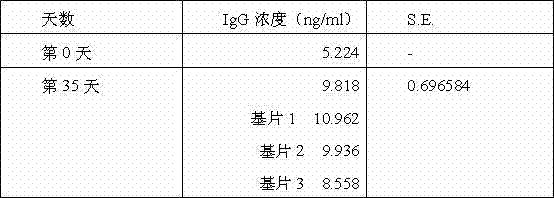
据信在很大的范围内皮肤内的朗格汉斯细胞,作为抗原提呈细胞,扮演着在皮肤抗原处理和穿透过程中决定性的角色(13-15)。然而,朗格汉斯细胞仅在处理未受影响的蛋白质中是非常有效的,但是对于它们的片段其为相当差的呈递者。大体来说,抗原片段的呈递不同于大的抗原表位(14)。其已经成为基本原理,即朗格汉斯细胞诱捕表皮内的抗原并携带它们至排泄的淋巴结,其中相应的片段最终可以呈递给T细胞(13)。因此还可能的是,在试验的过程中该原始疫苗可以改性并减小为更小的片段。由此,这些可以解释在第一个试验性的接种疫苗研究中发现的适度的抗原滴定量。 Langerhans cells in the skin are believed to play a critical role in the processing and penetration of skin antigens to a large extent as antigen-presenting cells (13-15). However, Langerhans cells are only very efficient at processing unaffected proteins, but are rather poor presenters of their fragments. In general, antigenic fragments are presented differently than large epitopes (14). It has become the rationale that Langerhans cells trap antigens in the epidermis and carry them to the draining lymph nodes, where the corresponding fragments can eventually be presented to T cells (13). It is therefore also possible that the original vaccine could be modified and reduced to smaller fragments during the course of the trial. Thus, these may explain the modest antigen titers found in the first experimental vaccination studies.
必须用来诱导小鼠的合适的免疫化的OVA含量为约100μg。基于先前的胶带剥离的结果(如图24中所示),在其中观测到荧光,直到角质层的更深的层,并且计算从纳米突起阵列(或基片)上释放的抗原(即450-503μg的白蛋白每基片,如上文提供的表2中所示),可以推论整个剂量的至少1/5达到了所需要的靶标位置。 The amount of OVA that must be used to induce proper immunization of mice is about 100 μg. Based on the results of previous tape stripping (as shown in Figure 24), where fluorescence was observed down to deeper layers of the stratum corneum, and the antigen released from the nanoprojection array (or substrate) was calculated (i.e., 450-503 μg albumin per substrate, as shown in Table 2 provided above), it can be concluded that at least 1/5 of the entire dose reached the desired target location.
实施例9 Example 9
实施例9:包括多个纳米针阵列和相应数量的流体储液槽的系统Example 9: System Including Multiple Nanoneedle Arrays and Corresponding Number of Fluidic Reservoirs
根据本发明的实施方案提供了包括多个,例如两个、三个、四个、五个、十个或更多个纳米针阵列以及相应数量的流体储液槽的系统,其在实施例9中描述。该系统配置以递送组合物、更具体地为疫苗至生物体的皮肤的表皮(表皮层)。 Embodiments according to the present invention provide a system comprising a plurality, such as two, three, four, five, ten or more nanoneedle arrays and a corresponding number of fluid reservoirs, which are described in Example 9 described in. The system is configured to deliver a composition, more specifically a vaccine, to the epidermis (epidermal layer) of the skin of an organism.
每个纳米针阵列包括一套纳米针,每个纳米针包括形成于其中的通道,以及载体介质配置为承载该套纳米针。该纳米针从载体介质上以相对于载体介质的表面垂直的、或基本上垂直的方式突起。该纳米针具有圆锥形的、锥形的、多层的或分段的形状,其能够增强纳米针的结构完整性。 Each nanoneedle array includes a set of nanoneedles, each nanoneedle including a channel formed therein, and a carrier medium configured to carry the set of nanoneedles. The nanoneedles protrude from the support medium in a perpendicular, or substantially perpendicular, manner relative to the surface of the support medium. The nanoneedles have a conical, tapered, multilayered or segmented shape, which can enhance the structural integrity of the nanoneedles.
每个纳米针阵列可以容纳或放置在外围结构或壳体内。此外,每个纳米针阵列承载在可移置的载体上。该可移置的载体连接于外围结构并配置以在第一位置(或回缩位置)和第二位置(或延伸位置)之间相对于外围结构移动。该可移置的载体配置为在第一位置是偏置的。由此,该可移置的载体被配置以随着其移动而回退至第一位置或朝向第二位置移动。 Each array of nanoneedles can be housed or placed within a surrounding structure or housing. In addition, each nanoneedle array is carried on a displaceable carrier. The displaceable carrier is connected to the peripheral structure and configured to move relative to the peripheral structure between a first position (or retracted position) and a second position (or extended position). The displaceable carrier is configured to be biased in a first position. Thus, the displaceable carrier is configured to retract to the first position or move towards the second position as it moves.
该可移置的载体在第一位置的移动或位置相应地决定了该套纳米针阵列的纳米针在外围结构内的位置。该可移置的载体在第二位置的移动或位置相应地决定了该套纳米针阵列的纳米针在外围结构之外的位置从而能够将该套纳米针插入至生物体的皮肤内。 The movement or position of the displaceable carrier at the first position correspondingly determines the position of the nanoneedles of the set of nanoneedle arrays in the peripheral structure. The movement or position of the displaceable carrier at the second position correspondingly determines the position of the nanoneedles of the set of nanoneedle arrays outside the peripheral structure so that the set of nanoneedles can be inserted into the skin of the living body.
第一位置和第二位置之间的距离是可以控制的,例如可以是选择的或可以是不同的,从而具有能够移动该套纳米针至皮肤表皮的可能。通过使用移置控制元件来控制第一位置和第二位置之间的距离,以及由此可移置的载体的移动。该移置控制元件相对于可移置的载体安置并配置从而限制可移置的载体在第一位置和第二位置之间的移动。实施例9的移置控制元件为一套绷紧的元件,例如弹簧,其连接于该可移置的载体。然而,可以理解其它的可变形结构或单元,和/或刚性结构或单元,可以用于控制可移置的载体的移动。 The distance between the first position and the second position is controllable, for example, can be selected or can be different, so that it is possible to move the set of nanoneedles to the epidermis of the skin. The distance between the first position and the second position, and thus the movement of the displaceable carrier, is controlled by using a displacement control element. The displacement control element is positioned and configured relative to the displaceable carrier to limit movement of the displaceable carrier between a first position and a second position. The displacement control element of embodiment 9 is a set of taut elements, such as springs, connected to the displaceable carrier. However, it is understood that other deformable structures or units, and/or rigid structures or units, may be used to control the movement of the displaceable carrier.
在实施例9的系统中,每个纳米针阵列相连于流体储液槽。每个纳米针阵列的成套的纳米针的通道均流体连通于相应的流体储液槽。每个流体储液槽成形并配置以储存一定量的特定的疫苗。例如,在实施例9的系统中,第一流体储液槽储存白喉抗原疫苗并且第二流体储液槽储存破伤风抗原疫苗。将被理解其它类型的疫苗,例如腺病毒疫苗可以储存在流体储液槽中。 In the system of Example 9, each nanoneedle array is connected to a fluid reservoir. The channels of the sets of nanoneedles of each nanoneedle array are in fluid communication with corresponding fluid reservoirs. Each fluid reservoir is shaped and configured to store a quantity of a particular vaccine. For example, in the system of Example 9, the first fluid reservoir stores the diphtheria antigen vaccine and the second fluid reservoir stores the tetanus antigen vaccine. It will be appreciated that other types of vaccines, such as adenovirus vaccines, may be stored in the fluid reservoir.
实施例9的系统的可移置的载体移动至第二位置或朝向第二位置(例如延伸位置)的移动能够插入多个纳米针阵列的成套的纳米针至皮肤内,并且更特别地至皮肤的表皮内。此外,可移置的载体的移动触发、促使或实现了储存在系统的流体储液器内的疫苗穿过相应的成套的纳米针的通道从而递送至靶标位置、更特别地为皮肤的表皮。 Movement of the displaceable carrier of the system of Example 9 to or towards a second position (eg, an extended position) enables insertion of a set of nanoneedles of a plurality of nanoneedle arrays into the skin, and more particularly to the skin within the epidermis. Furthermore, movement of the displaceable carrier triggers, facilitates or enables passage of the vaccine stored within the fluid reservoir of the system through the corresponding set of nanoneedles for delivery to the target site, more particularly the epidermis of the skin.
如上所述,本明的实施方案涉及系统、装置、设备、方法和工艺,其包括施用或递送生物学、药物或化学组合物、例如疫苗至靶标位置的纳米级突起。在大多数的实施方案中,该纳米级突起可以插入至皮肤表皮内预设的和/或可控的深度。 As noted above, embodiments of the invention relate to systems, devices, devices, methods and processes involving nanoscale projections for administering or delivering biological, pharmaceutical or chemical compositions, such as vaccines, to target sites. In most embodiments, the nanoscale protrusions can be inserted to a predetermined and/or controllable depth within the epidermis of the skin.
许多实施方案的装置或设备包括纳米突起阵列,其包括一套由载体基底或载体介质承载或支撑的纳米突起,和配置成以促使或实现纳米突起阵列的移动的施药单元。在绝大多数实施方案中,该施药单元包括外围结构或外围壳体,纳米突起阵列可以放置或安置在其中。此外,该施药单元包括可移置的载体,其可连接于纳米突起阵列。该可移置的载体可以相对于外围结构移动以由此移动连接、承载或相连于可移置的载体的纳米突起阵列。 The device or device of many embodiments includes a nanoprojection array comprising a set of nanoprojections carried or supported by a carrier substrate or carrier medium, and a drug delivery unit configured to cause or effect movement of the nanoprojection array. In most embodiments, the drug delivery unit includes a peripheral structure or housing in which the array of nanoprojections can be placed or housed. Additionally, the drug delivery unit includes a displaceable carrier that can be attached to the nanoprojection array. The displaceable carrier can move relative to the surrounding structure to thereby move the array of nanoprojections attached, carried or connected to the displaceable carrier.
更特别地,该可移置的载体可以在回缩位置和延伸位置之间移动以由此在相应的回缩和延伸位置之间移动该纳米突起阵列。在本发明一些实施方案中,可移置的载体的移动是控制或限制的。举例来说,可移置的载体的移动距离是可以控制的或限制的。移动纳米突起阵列至延伸位置促使或实现了纳米突起阵列的纳米突起至体内的插入,例如至皮肤表皮的插入。在一些实施方案中,一套施力元件可以用来控制将纳米突起插入至体内。 More particularly, the displaceable carrier is movable between a retracted position and an extended position to thereby move the nanoprojection array between respective retracted and extended positions. In some embodiments of the invention, the movement of the displaceable carrier is controlled or restricted. For example, the travel distance of the displaceable carrier can be controlled or limited. Moving the nanoprojection array to the extended position facilitates or enables insertion of the nanoprojections of the nanoprojection array into the body, eg, into the epidermis of the skin. In some embodiments, a set of force applying elements can be used to control the insertion of nanoprojections into the body.
在本发明的特定实施方案中,旨在解决现有装置、系统和方法中存在的用于递送药物或化学组合物至体内的至少一个方面、问题、限制和/或不利因素。在描述于本发明中的特定实施方案表现出特性、特点和/或有利因素的同时,其它的实施方案也可以表现出这样的特性、特点和/或有利因素,并且并不是所有的实施方案均需要表现出这样的特性、特点和/或有利因素来落入本发明的范围。将注意到通过本领域技术人员,上文公开的系统、装置、方法或其替换形式中的几个,可以需要地相互结合为其它不同的系统、装置、方法和/或应用。此外,对于不同的实施方案,本领域技术人员可以做出不同的变形、替换和/或改进,其均落入本发明的范围和精神。 In certain embodiments of the present invention, it is intended to address at least one aspect, problem, limitation and/or disadvantage of existing devices, systems and methods for delivering pharmaceutical or chemical compositions into the body. While particular embodiments described in the present invention exhibit characteristics, characteristics and/or advantages, other embodiments may also exhibit such characteristics, characteristics and/or advantages, and not all embodiments are equally Such properties, characteristics and/or advantages need to be exhibited to fall within the scope of the present invention. It will be noted that by those skilled in the art, several of the above-disclosed systems, devices, methods or alternatives thereof may be combined with each other as desired to form other different systems, devices, methods and/or applications. In addition, for different implementations, those skilled in the art may make various modifications, substitutions and/or improvements, all of which fall within the scope and spirit of the present invention.
参考文献: references:
(1) L. Baizer, C. Lacey, J. Hayes, D’Antonio. Needle-free Injectors: new Technologies, The Drug Delivery Report, 2001/02 Pharma Ventures Ltd 2001. (1) L. Baizer, C. Lacey, J. Hayes, D’Antonio. Needle-free Injectors: new Technologies, The Drug Delivery Report, 2001/02 Pharma Ventures Ltd 2001.
(2) G. Furness. Nasal drug delivery: rapid onset via a convenient route. Published by ONdrug Delivery Ltd 2005, Cedar Cottage, Newtimber Place Lane, Newtimber, West Sussex, BN6 9BU, United Kingdom. Registered in England: No 05314696. (2) G. Furness. Nasal drug delivery: rapid onset via a convenient route. Published by ONdrug Delivery Ltd 2005, Cedar Cottage, Newtimber Place Lane, Newtimber, West Sussex, BN6 9BU, United Kingdom. 4 England. 6 Register
(3) D.P. Wermeling, S.L. Banks, D.A. Hudson, H.S. Gill, J. Gupta, M.R. Prausnitz, A.L. Stinchcomb. Microneedles permit transdermal delivery of a skin-impermeant medication to humans. Proc. Natl. Acad. Sci. USA. 2008, 105(6), 2058-2063. (3) D.P. Wermeling, S.L. Banks, D.A. Hudson, H.S. Gill, J. Gupta, M.R. Prausnitz, A.L. Stinchcomb. Microneedles permit transdermal delivery of a skin-impermeant medication to humans. 2 Proc. 105(6), 2058-2063.
(4) C. Li, G. Fang, Q. Fu, F. Su, G. Li, X. Zhao. Effect of substrate temperature on the growth and photoluminescence properties of vertically aligned ZnO nanostructures. J. .Cryst. Growth, 2006, 292, 19-25. (4) C. Li, G. Fang, Q. Fu, F. Su, G. Li, X. Zhao. Effect of substrate temperature on the growth and photoluminescence properties of vertically aligned ZnO nanostructures. J. .Cryst. Growth, 2006, 292, 19-25.
(5) A. M. Kligman, E. Christophers. Preparation of Isolated Sheets of Human Stratum Corneum. Archives of Dermatology., 1963, 88, 702-705. (5) A. M. Kligman, E. Christophers. Preparation of Isolated Sheets of Human Stratum Corneum. Archives of Dermatology., 1963, 88, 702-705.
(6) M.M. Bradford. A rapid and sensitive method for the quantitation of microgram quantities of protein utilizing the principle of protein-dye binding. Anal. Biochem., 1976, 72, 248. (6) M.M. Bradford. A rapid and sensitive method for the quantitation of microgram quantities of protein utilizing the principle of protein-dye binding. Anal. Biochem., 1976, 72, 248.
(7) .J. Sambrook et al. Molecular cloning: a laboratory manual, 20d ed. Cold Spring Harbor Laboratory Press, Cold Spring Harbor, N.Y., 1998. (7) .J. Sambrook et al. Molecular cloning: a laboratory manual, 20d ed. Cold Spring Harbor Laboratory Press, Cold Spring Harbor, N.Y., 1998.
(8) J. Pinnagoda, R. A. Tupker, T. Agner, J. Serup. Guidelines for transepidermal water-loss (TEWL) measurement- a report from the Standardization Group of the European Society of contact dermatitis. Contact Dermatitis, 1990, 3, 164-178. (8) J. Pinnagoda, R. A. Tupker, T. Agner, J. Serup. Guidelines for transepidermal water-loss (TEWL) measurement- a report from the Standardization Group of the European Society of contact dermatitis. Contact 1990, , 3, 164-178.
(9) J. W. Fluhr, O. Kuss, T. Diepgen, S. Lazzerini, A. Pelosi, M. Gloor, E. Berardesca. Testing for irritation with a multifactorial approach: comparison of eight non-invasive measuring techniques. (9) J. W. Fluhr, O. Kuss, T. Diepgen, S. Lazzerini, A. Pelosi, M. Gloor, E. Berardesca. Testing for irritation with a multifactorial approach: comparison of eight non-invasive measuring techniques.
(10) S. Saraf, D. Mishra, A. Asthana, R. Jain, S. Singh and N.K Jain. Lipid microparticles for mucosal immunization against hepatitis B. Vaccine, 2006, 24, 45-56. (10) S. Saraf, D. Mishra, A. Asthana, R. Jain, S. Singh and N.K Jain. Lipid microparticles for mucosal immunization against hepatitis B. Vaccine, 2006, 24, 45-56.
(11) E. C. Lavelle, G. Grant, A. Pusztai, U. Pfüller, D.T. O’hagan. Mucosal immunogenicity of plant lectins in mice. Immunology. 2000, 99(1), 30-37. (11) E. C. Lavelle, G. Grant, A. Pusztai, U. Pfüller, D.T. O’hagan. Mucosal immunogenicity of plant lectins in mice. Immunology. 2000, 99(1), 30-37.
(12) W. Boonyo, H.E. Junginger, N, Waranuch, A. Polnok and T. Pitaksuteepong. Chitosan and trimethyl chitosan chloride (TMC) as adjuvants for inducing immune responses to ovalbumin in mice following nasal administration. J. Contr. Release., 2007, 121(3), 168-175. (12) W. Boonyo, H.E. Junginger, N, Waranuch, A. Polnok and T. Pitaksuteepong. Chitosan and trimethyl chitosan chloride (TMC) as adjuvants for inducing immune responses to ovalbumin in mice letr following nasal J administ , 2007, 121(3), 168-175.
(13) J. D. Bos, and M. K. Kapsenberg. The skin immune system: Progress in cutaneous biology. Immunol. Today. 1993, 14, 75-78. (13) J. D. Bos, and M. K. Kapsenberg. The skin immune system: Progress in cutaneous biology. Immunol. Today. 1993, 14, 75-78.
(14) E. van Wilsem, I. van Hoogstraten, J. Breve, Y. Zaman, and G. Kraal. In vivo antigen presentation capacity of dendritic cells from oral mucosa and skin draining lymph nodes. Adv. Exp. Med. Biol. 1994. 355, 63-67. (14) E. van Wilsem, I. van Hoogstraten, J. Breve, Y. Zaman, and G. Kraal. In vivo antigen presentation capacity of dendritic cells from oral mucosa and skin draining lymph nodes. Adv. Exp. Med. Biol . 1994. 355, 63-67.
(15) G. M. Woods, K. G. Henderson, M. Qu and H. K. Mueller. Processing of complex antigens and simple hapten-like molecules by epidermal Langerhans cells. J. Leukoc. Biol. 1995. 57, 891-896. (15) G. M. Woods, K. G. Henderson, M. Qu and H. K. Mueller. Processing of complex antigens and simple hapten-like molecules by epidermal Langerhans cells. J. Leukoc. Biol. 1995. 57, 891-896.
Claims (23)
Applications Claiming Priority (3)
| Application Number | Priority Date | Filing Date | Title |
|---|---|---|---|
| US17191309P | 2009-04-23 | 2009-04-23 | |
| US61/171,913 | 2009-04-23 | ||
| PCT/SG2010/000164 WO2010123463A1 (en) | 2009-04-23 | 2010-04-23 | An apparatus that includes nano-sized projections and a method for manufacture thereof |
Publications (2)
| Publication Number | Publication Date |
|---|---|
| CN102481440A CN102481440A (en) | 2012-05-30 |
| CN102481440B true CN102481440B (en) | 2014-06-25 |
Family
ID=43011358
Family Applications (1)
| Application Number | Title | Priority Date | Filing Date |
|---|---|---|---|
| CN201080028047.9A Expired - Fee Related CN102481440B (en) | 2009-04-23 | 2010-04-23 | Device including nanoscale protrusions and method of manufacturing the same |
Country Status (5)
| Country | Link |
|---|---|
| US (1) | US20120089117A1 (en) |
| EP (1) | EP2421595A1 (en) |
| CN (1) | CN102481440B (en) |
| SG (2) | SG175777A1 (en) |
| WO (1) | WO2010123463A1 (en) |
Families Citing this family (17)
| Publication number | Priority date | Publication date | Assignee | Title |
|---|---|---|---|---|
| US8062568B2 (en) * | 2009-08-27 | 2011-11-22 | Korea University Research And Business Foundation | Nano pattern writer |
| AU2011246882B2 (en) * | 2010-04-28 | 2016-02-25 | Sorrento Therapeutics, Inc. | Nanopatterned medical device with enhanced cellular interaction |
| EP2563451B1 (en) | 2010-04-28 | 2017-11-01 | Kimberly-Clark Worldwide, Inc. | MEDICAL DEVICES FOR DELIVERY OF siRNA |
| CA2796965C (en) * | 2010-04-28 | 2019-04-16 | Kimberly-Clark Worldwide, Inc. | Method for increasing permeability of an epithelial barrier |
| ES2636673T3 (en) | 2010-04-28 | 2017-10-06 | Kimberly-Clark Worldwide, Inc. | Device for the administration of rheumatoid arthritis medications |
| US8455374B2 (en) * | 2010-05-06 | 2013-06-04 | Applied Materials, Inc. | Radiation heating efficiency by increasing optical absorption of a silicon containing material |
| US20170246439A9 (en) | 2011-10-27 | 2017-08-31 | Kimberly-Clark Worldwide, Inc. | Increased Bioavailability of Transdermally Delivered Agents |
| US11110066B2 (en) | 2011-10-27 | 2021-09-07 | Sorrento Therapeutics, Inc. | Implantable devices for delivery of bioactive agents |
| US9550053B2 (en) | 2011-10-27 | 2017-01-24 | Kimberly-Clark Worldwide, Inc. | Transdermal delivery of high viscosity bioactive agents |
| KR20130052825A (en) * | 2011-11-14 | 2013-05-23 | 삼성전자주식회사 | Light emitting device |
| GB201304669D0 (en) * | 2013-03-15 | 2013-05-01 | Univ Singapore | Micro-needles integrated with nanotubes |
| US10039910B2 (en) * | 2014-03-26 | 2018-08-07 | Nanomed Skincare, Inc. | Plumber-like mass transport device for dermal and transdermal delivery of a liquid or solid composition |
| CN107206220A (en) * | 2015-02-16 | 2017-09-26 | 凸版印刷株式会社 | Microneedles |
| JP2016195651A (en) * | 2015-04-02 | 2016-11-24 | 日本写真印刷株式会社 | Microneedle sheet |
| KR20200043369A (en) * | 2017-06-16 | 2020-04-27 | 님 싸이언티픽 인코포레이티드 | Nano needle and related devices and methods |
| US11808713B2 (en) * | 2020-07-30 | 2023-11-07 | Epic Semiconductors Inc | System for detecting pathogens in products |
| CN112370648A (en) * | 2020-10-30 | 2021-02-19 | 北京科技大学 | Tower-shaped microneedle array skin patch as well as preparation method and application method thereof |
Citations (4)
| Publication number | Priority date | Publication date | Assignee | Title |
|---|---|---|---|---|
| US20040063100A1 (en) * | 2002-09-30 | 2004-04-01 | Wang Chung Lin | Nanoneedle chips and the production thereof |
| US20060057388A1 (en) * | 2004-09-10 | 2006-03-16 | Sungho Jin | Aligned and open-ended nanotube structure and method for making the same |
| CN101078026A (en) * | 2006-05-24 | 2007-11-28 | 江苏吴中高新技术实业有限公司 | DNA electrochemical sensor and preparation method thereof |
| WO2008056190A2 (en) * | 2006-11-10 | 2008-05-15 | Isis Innovation Limited | Ordered array of nanostructures and method of fabrication |
Family Cites Families (5)
| Publication number | Priority date | Publication date | Assignee | Title |
|---|---|---|---|---|
| US6743211B1 (en) * | 1999-11-23 | 2004-06-01 | Georgia Tech Research Corporation | Devices and methods for enhanced microneedle penetration of biological barriers |
| US7419481B2 (en) * | 2000-10-13 | 2008-09-02 | Alza Corporation | Apparatus and method for piercing skin with microprotrusions |
| WO2005044333A2 (en) * | 2003-10-31 | 2005-05-19 | Alza Corporation | Self-actuating applicator for microprojection array |
| CA2629193C (en) * | 2005-11-18 | 2016-03-29 | 3M Innovative Properties Company | Coatable compositions, coatings derived therefrom and microarrays having such coatings |
| FR2912919B1 (en) * | 2007-02-22 | 2009-05-01 | Bernard Perriere | MINIATURIZED INJECTION DEVICE FOR MEDICAL USE |
-
2010
- 2010-04-23 WO PCT/SG2010/000164 patent/WO2010123463A1/en not_active Ceased
- 2010-04-23 SG SG2011077773A patent/SG175777A1/en unknown
- 2010-04-23 CN CN201080028047.9A patent/CN102481440B/en not_active Expired - Fee Related
- 2010-04-23 EP EP10767403A patent/EP2421595A1/en not_active Withdrawn
- 2010-04-23 US US13/265,787 patent/US20120089117A1/en not_active Abandoned
- 2010-04-23 SG SG10201401744QA patent/SG10201401744QA/en unknown
Patent Citations (4)
| Publication number | Priority date | Publication date | Assignee | Title |
|---|---|---|---|---|
| US20040063100A1 (en) * | 2002-09-30 | 2004-04-01 | Wang Chung Lin | Nanoneedle chips and the production thereof |
| US20060057388A1 (en) * | 2004-09-10 | 2006-03-16 | Sungho Jin | Aligned and open-ended nanotube structure and method for making the same |
| CN101078026A (en) * | 2006-05-24 | 2007-11-28 | 江苏吴中高新技术实业有限公司 | DNA electrochemical sensor and preparation method thereof |
| WO2008056190A2 (en) * | 2006-11-10 | 2008-05-15 | Isis Innovation Limited | Ordered array of nanostructures and method of fabrication |
Also Published As
| Publication number | Publication date |
|---|---|
| SG10201401744QA (en) | 2014-08-28 |
| SG175777A1 (en) | 2011-12-29 |
| US20120089117A1 (en) | 2012-04-12 |
| EP2421595A1 (en) | 2012-02-29 |
| CN102481440A (en) | 2012-05-30 |
| WO2010123463A1 (en) | 2010-10-28 |
Similar Documents
| Publication | Publication Date | Title |
|---|---|---|
| CN102481440B (en) | Device including nanoscale protrusions and method of manufacturing the same | |
| US12138415B2 (en) | Increased bioavailability of transdermally delivered agents | |
| Chen et al. | Fully embeddable chitosan microneedles as a sustained release depot for intradermal vaccination | |
| US11083881B2 (en) | Method for increasing permeability of a cellular layer of epithelial cells | |
| van der Maaden et al. | Microneedle-based drug and vaccine delivery via nanoporous microneedle arrays | |
| JP5161776B2 (en) | Solid solution punch comprising drug particles and / or particles adsorbed with drugs | |
| T. Sanjay et al. | Controlled drug delivery using microdevices | |
| US20120016309A1 (en) | Microarray device | |
| TWI528975B (en) | Microneedle trandermal delivery device and microneedle transdermal delivery method using the same | |
| Han et al. | Improvement in antigen-delivery using fabrication of a grooves-embedded microneedle array | |
| Sachdeva et al. | Microneedles and their applications | |
| KR20040014502A (en) | Microprojection array immunization patch and method | |
| US20160271381A1 (en) | Bioactive components conjugated to substrates of microneedle arrays | |
| NZ529029A (en) | Microprojection array having a beneficial agent containing coating | |
| KR20180038512A (en) | Micro needle array | |
| JP2009507576A (en) | Coatable transdermal delivery microprojection assembly | |
| RU2574137C2 (en) | Method for improving epithelial barrier penetration | |
| NZ538043A (en) | Composition having a beneficial agent for forming a solid coating on microprojections array | |
| AU2006274490A1 (en) | Microarray device |
Legal Events
| Date | Code | Title | Description |
|---|---|---|---|
| C06 | Publication | ||
| PB01 | Publication | ||
| C10 | Entry into substantive examination | ||
| SE01 | Entry into force of request for substantive examination | ||
| C53 | Correction of patent of invention or patent application | ||
| CB03 | Change of inventor or designer information |
Inventor after: JUNGINGER HANS Inventor after: Pastorin Giorgia Inventor after: Zheng Minrui Inventor after: Li Zhengguo Inventor before: Junginger Hans Inventor before: Pastorin Giorgia Inventor before: Zheng Minrui Inventor before: Lee Chengkuo |
|
| COR | Change of bibliographic data |
Free format text: CORRECT: INVENTOR; FROM: HANS JUNGINGER PASTORIN GIORGIA ZHENG MINRUI LEE CHENGKUO VINCENT TO: JUNGINGER HANS PASTORIN GIORGIA ZHENG MINRUI LI ZHENGGUO |
|
| C14 | Grant of patent or utility model | ||
| GR01 | Patent grant | ||
| CF01 | Termination of patent right due to non-payment of annual fee | ||
| CF01 | Termination of patent right due to non-payment of annual fee |
Granted publication date: 20140625 Termination date: 20160423 |