CN102459754A - Modified cellulose from chemical kraft fibers and methods of making and using the same - Google Patents
Modified cellulose from chemical kraft fibers and methods of making and using the same Download PDFInfo
- Publication number
- CN102459754A CN102459754A CN2010800278943A CN201080027894A CN102459754A CN 102459754 A CN102459754 A CN 102459754A CN 2010800278943 A CN2010800278943 A CN 2010800278943A CN 201080027894 A CN201080027894 A CN 201080027894A CN 102459754 A CN102459754 A CN 102459754A
- Authority
- CN
- China
- Prior art keywords
- fiber
- range
- kraft
- fibers
- pulp
- Prior art date
- Legal status (The legal status is an assumption and is not a legal conclusion. Google has not performed a legal analysis and makes no representation as to the accuracy of the status listed.)
- Granted
Links
Images


Classifications
-
- D—TEXTILES; PAPER
- D21—PAPER-MAKING; PRODUCTION OF CELLULOSE
- D21C—PRODUCTION OF CELLULOSE BY REMOVING NON-CELLULOSE SUBSTANCES FROM CELLULOSE-CONTAINING MATERIALS; REGENERATION OF PULPING LIQUORS; APPARATUS THEREFOR
- D21C9/00—After-treatment of cellulose pulp, e.g. of wood pulp, or cotton linters ; Treatment of dilute or dewatered pulp or process improvement taking place after obtaining the raw cellulosic material and not provided for elsewhere
- D21C9/10—Bleaching ; Apparatus therefor
- D21C9/16—Bleaching ; Apparatus therefor with per compounds
- D21C9/163—Bleaching ; Apparatus therefor with per compounds with peroxides
-
- A—HUMAN NECESSITIES
- A61—MEDICAL OR VETERINARY SCIENCE; HYGIENE
- A61F—FILTERS IMPLANTABLE INTO BLOOD VESSELS; PROSTHESES; DEVICES PROVIDING PATENCY TO, OR PREVENTING COLLAPSING OF, TUBULAR STRUCTURES OF THE BODY, e.g. STENTS; ORTHOPAEDIC, NURSING OR CONTRACEPTIVE DEVICES; FOMENTATION; TREATMENT OR PROTECTION OF EYES OR EARS; BANDAGES, DRESSINGS OR ABSORBENT PADS; FIRST-AID KITS
- A61F13/00—Bandages or dressings; Absorbent pads
- A61F13/15—Absorbent pads, e.g. sanitary towels, swabs or tampons for external or internal application to the body; Supporting or fastening means therefor; Tampon applicators
- A61F13/53—Absorbent pads, e.g. sanitary towels, swabs or tampons for external or internal application to the body; Supporting or fastening means therefor; Tampon applicators characterised by the absorbing medium
-
- D—TEXTILES; PAPER
- D21—PAPER-MAKING; PRODUCTION OF CELLULOSE
- D21C—PRODUCTION OF CELLULOSE BY REMOVING NON-CELLULOSE SUBSTANCES FROM CELLULOSE-CONTAINING MATERIALS; REGENERATION OF PULPING LIQUORS; APPARATUS THEREFOR
- D21C9/00—After-treatment of cellulose pulp, e.g. of wood pulp, or cotton linters ; Treatment of dilute or dewatered pulp or process improvement taking place after obtaining the raw cellulosic material and not provided for elsewhere
- D21C9/001—Modification of pulp properties
- D21C9/002—Modification of pulp properties by chemical means; preparation of dewatered pulp, e.g. in sheet or bulk form, containing special additives
-
- D—TEXTILES; PAPER
- D21—PAPER-MAKING; PRODUCTION OF CELLULOSE
- D21C—PRODUCTION OF CELLULOSE BY REMOVING NON-CELLULOSE SUBSTANCES FROM CELLULOSE-CONTAINING MATERIALS; REGENERATION OF PULPING LIQUORS; APPARATUS THEREFOR
- D21C9/00—After-treatment of cellulose pulp, e.g. of wood pulp, or cotton linters ; Treatment of dilute or dewatered pulp or process improvement taking place after obtaining the raw cellulosic material and not provided for elsewhere
- D21C9/10—Bleaching ; Apparatus therefor
-
- D—TEXTILES; PAPER
- D21—PAPER-MAKING; PRODUCTION OF CELLULOSE
- D21C—PRODUCTION OF CELLULOSE BY REMOVING NON-CELLULOSE SUBSTANCES FROM CELLULOSE-CONTAINING MATERIALS; REGENERATION OF PULPING LIQUORS; APPARATUS THEREFOR
- D21C9/00—After-treatment of cellulose pulp, e.g. of wood pulp, or cotton linters ; Treatment of dilute or dewatered pulp or process improvement taking place after obtaining the raw cellulosic material and not provided for elsewhere
- D21C9/10—Bleaching ; Apparatus therefor
- D21C9/1026—Other features in bleaching processes
- D21C9/1036—Use of compounds accelerating or improving the efficiency of the processes
-
- D—TEXTILES; PAPER
- D21—PAPER-MAKING; PRODUCTION OF CELLULOSE
- D21C—PRODUCTION OF CELLULOSE BY REMOVING NON-CELLULOSE SUBSTANCES FROM CELLULOSE-CONTAINING MATERIALS; REGENERATION OF PULPING LIQUORS; APPARATUS THEREFOR
- D21C9/00—After-treatment of cellulose pulp, e.g. of wood pulp, or cotton linters ; Treatment of dilute or dewatered pulp or process improvement taking place after obtaining the raw cellulosic material and not provided for elsewhere
- D21C9/10—Bleaching ; Apparatus therefor
- D21C9/12—Bleaching ; Apparatus therefor with halogens or halogen-containing compounds
- D21C9/14—Bleaching ; Apparatus therefor with halogens or halogen-containing compounds with ClO2 or chlorites
- D21C9/144—Bleaching ; Apparatus therefor with halogens or halogen-containing compounds with ClO2 or chlorites with ClO2/Cl2 and other bleaching agents in a multistage process
-
- D—TEXTILES; PAPER
- D21—PAPER-MAKING; PRODUCTION OF CELLULOSE
- D21H—PULP COMPOSITIONS; PREPARATION THEREOF NOT COVERED BY SUBCLASSES D21C OR D21D; IMPREGNATING OR COATING OF PAPER; TREATMENT OF FINISHED PAPER NOT COVERED BY CLASS B31 OR SUBCLASS D21G; PAPER NOT OTHERWISE PROVIDED FOR
- D21H11/00—Pulp or paper, comprising cellulose or lignocellulose fibres of natural origin only
- D21H11/02—Chemical or chemomechanical or chemothermomechanical pulp
- D21H11/04—Kraft or sulfate pulp
-
- D—TEXTILES; PAPER
- D21—PAPER-MAKING; PRODUCTION OF CELLULOSE
- D21H—PULP COMPOSITIONS; PREPARATION THEREOF NOT COVERED BY SUBCLASSES D21C OR D21D; IMPREGNATING OR COATING OF PAPER; TREATMENT OF FINISHED PAPER NOT COVERED BY CLASS B31 OR SUBCLASS D21G; PAPER NOT OTHERWISE PROVIDED FOR
- D21H11/00—Pulp or paper, comprising cellulose or lignocellulose fibres of natural origin only
- D21H11/16—Pulp or paper, comprising cellulose or lignocellulose fibres of natural origin only modified by a particular after-treatment
-
- D—TEXTILES; PAPER
- D21—PAPER-MAKING; PRODUCTION OF CELLULOSE
- D21H—PULP COMPOSITIONS; PREPARATION THEREOF NOT COVERED BY SUBCLASSES D21C OR D21D; IMPREGNATING OR COATING OF PAPER; TREATMENT OF FINISHED PAPER NOT COVERED BY CLASS B31 OR SUBCLASS D21G; PAPER NOT OTHERWISE PROVIDED FOR
- D21H11/00—Pulp or paper, comprising cellulose or lignocellulose fibres of natural origin only
- D21H11/16—Pulp or paper, comprising cellulose or lignocellulose fibres of natural origin only modified by a particular after-treatment
- D21H11/20—Chemically or biochemically modified fibres
-
- D—TEXTILES; PAPER
- D21—PAPER-MAKING; PRODUCTION OF CELLULOSE
- D21H—PULP COMPOSITIONS; PREPARATION THEREOF NOT COVERED BY SUBCLASSES D21C OR D21D; IMPREGNATING OR COATING OF PAPER; TREATMENT OF FINISHED PAPER NOT COVERED BY CLASS B31 OR SUBCLASS D21G; PAPER NOT OTHERWISE PROVIDED FOR
- D21H21/00—Non-fibrous material added to the pulp, characterised by its function, form or properties; Paper-impregnating or coating material, characterised by its function, form or properties
- D21H21/14—Non-fibrous material added to the pulp, characterised by its function, form or properties; Paper-impregnating or coating material, characterised by its function, form or properties characterised by function or properties in or on the paper
- D21H21/32—Bleaching agents
-
- Y—GENERAL TAGGING OF NEW TECHNOLOGICAL DEVELOPMENTS; GENERAL TAGGING OF CROSS-SECTIONAL TECHNOLOGIES SPANNING OVER SEVERAL SECTIONS OF THE IPC; TECHNICAL SUBJECTS COVERED BY FORMER USPC CROSS-REFERENCE ART COLLECTIONS [XRACs] AND DIGESTS
- Y10—TECHNICAL SUBJECTS COVERED BY FORMER USPC
- Y10T—TECHNICAL SUBJECTS COVERED BY FORMER US CLASSIFICATION
- Y10T428/00—Stock material or miscellaneous articles
- Y10T428/29—Coated or structually defined flake, particle, cell, strand, strand portion, rod, filament, macroscopic fiber or mass thereof
- Y10T428/2913—Rod, strand, filament or fiber
- Y10T428/298—Physical dimension
Landscapes
- Life Sciences & Earth Sciences (AREA)
- Engineering & Computer Science (AREA)
- Wood Science & Technology (AREA)
- Chemical & Material Sciences (AREA)
- Health & Medical Sciences (AREA)
- Chemical Kinetics & Catalysis (AREA)
- General Chemical & Material Sciences (AREA)
- Biochemistry (AREA)
- Heart & Thoracic Surgery (AREA)
- Veterinary Medicine (AREA)
- Epidemiology (AREA)
- Vascular Medicine (AREA)
- Animal Behavior & Ethology (AREA)
- General Health & Medical Sciences (AREA)
- Public Health (AREA)
- Biomedical Technology (AREA)
- Paper (AREA)
- Polysaccharides And Polysaccharide Derivatives (AREA)
- Absorbent Articles And Supports Therefor (AREA)
- Medicines Containing Antibodies Or Antigens For Use As Internal Diagnostic Agents (AREA)
- Artificial Filaments (AREA)
- Dry Formation Of Fiberboard And The Like (AREA)
Abstract
Description
发明领域 field of invention
本公开涉及纤维素纤维的化学改性。更具体地讲,本公开涉及来源于表现出一系列独特特性的漂白牛皮纸浆的化学改性纤维素纤维,将其性能改善至超越来源于牛皮纸浆的标准纤维素纤维并且使其可用于迄今局还限于昂贵纤维(例如,棉花或高α含量亚硫酸盐纸浆)的应用。具体地讲,所述化学改性漂白牛皮纸纤维可表现出一种或多种以下有益特性,包括但不限于改进的气味控制性、改善的可压缩性和/或增加的白度。所述化学改性漂白牛皮纸纤维可表现出一种或多种这些有益特性,同时也保持非化学改性漂白牛皮纸纤维的一种或多种其它特性,例如,保持纤维长度和/或游离度。The present disclosure relates to the chemical modification of cellulosic fibers. More specifically, the present disclosure relates to chemically modified cellulose fibers derived from bleached kraft pulp that exhibit a unique set of properties, improving their properties beyond standard cellulose fibers derived from kraft pulp and making them useful in applications hitherto It is also limited to the application of expensive fibers such as cotton or high alpha sulfite pulps. In particular, the chemically modified bleached kraft fiber can exhibit one or more of the following beneficial properties including, but not limited to, improved odor control, improved compressibility, and/or increased whiteness. The chemically modified bleached kraft fiber can exhibit one or more of these beneficial properties while also maintaining one or more other properties of non-chemically modified bleached kraft fiber, eg, maintaining fiber length and/or freeness.
本公开进一步涉及来源于表现出低聚合度或超低聚合度的漂白软木和/或硬木牛皮纸浆的化学改性纤维素纤维,使其适于用作吸收性产品的绒毛浆,用作包括纤维素醚和酯的纤维素衍生物生产及消费品中的化学纤维素原料。本文中使用的“聚合度”可缩写为“DP”。本公开更进一步涉及来源于具有小于约80的平衡聚合度的化学改性牛皮纸纤维的纤维素。更具体地讲,本文中描述的化学改性牛皮纸纤维表现出低聚合度或超低聚合度(本文中称为“LDP”或“ULDP”),可通过酸性或碱性水解处理以进一步将其聚合度降低至小于约80(例如降低至小于约50),以使其适于多种下游应用。The present disclosure further relates to chemically modified cellulosic fibers derived from bleached softwood and/or hardwood kraft pulp exhibiting a low or ultra-low degree of polymerization, making them suitable for use as fluff pulp in absorbent products, including fibers Production of cellulose derivatives of ethers and esters and chemical cellulose raw materials in consumer products. As used herein, "degree of polymerization" may be abbreviated as "DP". The present disclosure still further relates to cellulose derived from chemically modified kraft fibers having an equilibrium degree of polymerization of less than about 80. More specifically, the chemically modified kraft fibers described herein exhibit a low or ultra-low degree of polymerization (referred to herein as "LDP" or "ULDP"), which can be further converted to The degree of polymerization is reduced to less than about 80 (eg, to less than about 50) to make it suitable for a variety of downstream applications.
本公开也涉及用于制造所描述的改性纤维的方法。本公开部分程度上提供一种用于同时增加牛皮纸纤维的羧基和醛官能度的方法。所描述纤维经历催化氧化处理。在一些实施方案中,将所述纤维用铁或铜氧化,然后再进一步漂白以提供具有有益的白度特性的纤维,所述有益的白度为例如可与标准漂白纤维相比的白度。此外,本发明公开至少一种工艺,其可提供上述改善的有益特性而不引入用于对漂白纤维进行后处理的成本增加的步骤。在这个低成本的实施方案中,所述纤维可在牛皮纸工艺(诸如牛皮纸漂白工艺)的单段中处理。另一个实施方案涉及包括D0E1D1E2D2工序的五段漂白工艺,其中第四(E2)段包括催化氧化处理。The present disclosure also relates to methods for making the described modified fibers. The present disclosure provides, in part, a method for simultaneously increasing the carboxyl and aldehyde functionality of kraft fiber. The fibers described were subjected to a catalytic oxidation treatment. In some embodiments, the fibers are oxidized with iron or copper prior to further bleaching to provide fibers with beneficial whiteness characteristics, eg, comparable to standard bleached fibers. Furthermore, the present invention discloses at least one process that can provide the improved beneficial properties described above without introducing cost-increasing steps for post-processing bleached fibers. In this low cost embodiment, the fibers can be processed in a single stage of a kraft process, such as a kraft bleaching process. Another embodiment relates to a five-stage bleaching process comprising a D 0 E1D1E2D2 sequence, wherein the fourth (E2) stage comprises a catalytic oxidation treatment.
最后,本公开涉及使用所描述的化学改性纤维素纤维制造的所有消费品、纤维素衍生物(包括纤维素醚和酯)和微晶纤维素。Finally, the present disclosure relates to all consumer products, cellulose derivatives (including cellulose ethers and esters) and microcrystalline cellulose manufactured using the chemically modified cellulose fibers described.
发明背景Background of the invention
纤维素纤维和衍生物广泛用于纸张、吸收性产品、食品或食品有关应用、药物和工业应用。纤维素纤维的主要来源是木纸浆和棉花。纤维素源和纤维素处理条件通常决定了纤维素纤维的特性,并且因此决定了所述纤维对于某些目标用途的适用性。对处理成本相对较低但用途非常广泛且从而使其能够用于多种应用的纤维素纤维存在需求。Cellulose fibers and derivatives are widely used in paper, absorbent products, food or food-related applications, pharmaceuticals and industrial applications. The main sources of cellulose fibers are wood pulp and cotton. The cellulose source and cellulose processing conditions generally determine the characteristics of cellulose fibers and thus determine the suitability of the fibers for certain intended uses. There is a need for cellulose fibers that are relatively inexpensive to process but are very versatile thereby enabling their use in a variety of applications.
纤维素通常以包含数百至成千上万个葡萄糖单位的聚合物链存在。氧化纤维素的各种方法是已知的。在纤维素氧化中,纤维素链的糖苷的羟基可被转化成(例如)诸如醛基或羧基的羰基。根据使用的氧化方法和条件,羰基修饰的类型、程度和位置可能不同。已知某些氧化条件可使纤维素链本身降解,例如通过使纤维素链中的糖苷环裂解导致解聚。大多数情况下,解聚纤维素不仅粘度降低,而且纤维长度比起纤维素原料更短。当纤维素降解时(诸如通过解聚和/或显著地降低纤维长度和/或纤维强度),其可能难以处理和/或可能不适于许多下游应用。对于可增加羧酸和醛官能度两者的改性纤维素纤维的方法仍有需求,这些方法不会使纤维素纤维广泛地降解。本公开提供解决一个或多个这些不足的独特方法。Cellulose typically exists as polymer chains containing hundreds to thousands of glucose units. Various methods of oxidizing cellulose are known. In cellulose oxidation, the hydroxyl groups of the glycosides of the cellulose chain can be converted, for example, to carbonyl groups such as aldehyde or carboxyl groups. The type, degree and position of carbonyl modification may vary depending on the oxidation method and conditions used. Certain oxidative conditions are known to degrade the cellulose chains themselves, for example by cleaving glycosidic rings in the cellulose chains leading to depolymerization. In most cases, depolymerized cellulose not only has a lower viscosity, but also has shorter fiber lengths than the cellulose raw material. When cellulose degrades (such as by depolymerization and/or significantly reduces fiber length and/or fiber strength), it can be difficult to handle and/or may not be suitable for many downstream applications. There remains a need for methods of modifying cellulose fibers that increase both carboxylic acid and aldehyde functionality without extensively degrading the cellulose fibers. The present disclosure provides a unique approach to addressing one or more of these deficiencies.
已做出各种尝试来氧化纤维素以向纤维素链提供羧基和醛官能度而不使纤维素纤维降解。在传统的纤维素氧化方法中,当在纤维素上存在醛基时,可能难以控制或限制纤维素的降解。先前解决这些问题的尝试包括使用多步氧化工艺,例如在一个步骤中,以位点特异性方式修饰某些羰基并且在另一个步骤中氧化其它羟基,和/或提供调节剂和/或保护剂,所有步骤都可能对纤维素氧化工艺带来额外费用和副产物。因此,需要节约成本的和/或可在单步工艺(诸如牛皮纸工艺)中进行的对纤维素进行改性的方法。Various attempts have been made to oxidize cellulose to provide carboxyl and aldehyde functionality to the cellulose chains without degrading the cellulose fibers. In conventional cellulose oxidation methods, it may be difficult to control or limit the degradation of cellulose when aldehyde groups are present on the cellulose. Previous attempts to address these issues have included the use of multi-step oxidation processes, e.g. modifying certain carbonyl groups in a site-specific manner in one step and oxidizing other hydroxyl groups in another step, and/or providing modulators and/or protecting agents , all steps may introduce additional costs and by-products to the cellulose oxidation process. Accordingly, there is a need for methods of modifying cellulose that are cost-effective and/or can be performed in a single-step process, such as a kraft process.
本公开提供新颖的方法,其相比现有技术中尝试的方法提供了巨大的改善。通常,纤维素牛皮纸纤维的氧化(在现有技术中)是在漂白工艺之后进行。意外的是,本发明人发现可使用现有漂白工序的各段(特别是五段漂白工序的第四段)来氧化纤维素纤维的氧化。此外,意外的是,本发明人发现金属催化剂(特别是铁催化剂)可用于漂白工序中来完成这种氧化而不影响成品,例如,因为催化剂不会在纤维素中保持结合,使得在漂白工序终点之前除去至少一些残留的铁比基于本领域知识的预期更加容易。此外,出乎意料地,本发明人发现可进行此类方法而基本上不使纤维降解。The present disclosure provides novel approaches that offer vast improvements over approaches attempted in the prior art. Typically, oxidation of cellulose kraft fibers is (in the prior art) performed after the bleaching process. Surprisingly, the inventors have found that the oxidation of cellulose fibers can be oxidized using various stages of an existing bleaching process, in particular the fourth stage of a five-stage bleaching process. Furthermore, surprisingly, the inventors have found that metal catalysts, in particular iron catalysts, can be used in the bleaching process to accomplish this oxidation without affecting the finished product, for example, because the catalyst does not remain bound in the cellulose so that the bleaching process Removal of at least some residual iron prior to endpoint was easier than expected based on knowledge in the art. Furthermore, unexpectedly, the inventors have found that such methods can be performed without substantially degrading the fibers.
纤维素纤维(包括牛皮纸浆)可用金属和过氧化物和/或过酸氧化在本领域是已知的。例如,纤维素可用铁和过氧化物(芬顿试剂(Fenton′s reagent))氧化。参见Kishimoto等人,Holzforschung,52卷,第2期(1998),180-184页。金属和过氧化物(诸如芬顿试剂)是相对廉价的氧化剂,使它们一定程度上适于诸如牛皮纸工艺的大规模应用。就芬顿试剂而言,众所周知这种氧化方法在酸性条件下可降解纤维素。因此,本来就不期望在牛皮纸工艺中使用芬顿试剂而不广泛地降解纤维,例如在酸性条件下伴有纤维长度的损失。为了防止纤维素的降解,芬顿试剂经常在碱性条件下使用,不过芬顿反应被显著地抑制。然而,在碱性条件下使用芬顿试剂可能还存在其它缺点。例如,纤维素仍然可能会降解或褪色。在牛皮纸浆处理中,纤维素纤维通常在多段工序中漂白,其通常包含强酸性和强碱性漂白步骤,包括在漂白工序终点或终点附近的至少一个碱性步骤。因此,与本领域所已知的相反,在牛皮纸漂白工艺的酸性段用铁氧化的纤维可产生具有增强的化学性质的纤维,但没有物理降解或褪色,这是相当惊人的。It is known in the art that cellulosic fibers, including kraft pulp, can be oxidized with metals and peroxides and/or peracids. For example, cellulose can be oxidized with iron and peroxides (Fenton's reagent). See Kishimoto et al., Holzforschung, Vol. 52, No. 2 (1998), pp. 180-184. Metals and peroxides (such as Fenton's reagent) are relatively inexpensive oxidizing agents, making them somewhat suitable for large-scale applications such as kraft paper processing. As far as Fenton's reagent is concerned, this oxidation method is well known to degrade cellulose under acidic conditions. Therefore, it is inherently undesirable to use Fenton's reagent in kraft paper processing without extensive fiber degradation, for example with loss of fiber length under acidic conditions. In order to prevent the degradation of cellulose, Fenton's reagent is often used under alkaline conditions, but the Fenton reaction is significantly inhibited. However, there may be other disadvantages of using Fenton's reagent under alkaline conditions. Cellulose, for example, may still degrade or fade. In kraft pulp processing, cellulosic fibers are typically bleached in a multi-stage process, which typically comprises strongly acidic and strongly alkaline bleaching steps, including at least one alkaline step at or near the end of the bleaching process. Thus, contrary to what is known in the art, it is quite surprising that fibers oxidized with iron in the acidic stage of the kraft bleaching process can produce fibers with enhanced chemical properties, but without physical degradation or discoloration.
因此,需要一种可向纤维素纤维(诸如来源于牛皮纸浆的纤维)引入醛和羧基官能度而不广泛地降解纤维素和/或使纤维素变得不适于许多下游应用的低成本和/或单步氧化。此外,还有向纤维素纤维引入高含量的羰基(诸如羧酸、酮和醛基)的需求。例如,希望在不抑制氧化反应的条件下使用氧化剂(不同于例如在碱性pH使用芬顿试剂)以引入高含量的羰基。为了提供满足这些需求的方法,发明人克服了现有技术的许多困难。Accordingly, there is a need for a low-cost and/or low-cost and/or cellulose-based method that can introduce aldehyde and carboxyl functionality to cellulosic fibers, such as those derived from kraft pulp, without extensively degrading the cellulose and/or rendering the cellulose unsuitable for many downstream applications. or single-step oxidation. In addition, there is a need to introduce a high content of carbonyl groups such as carboxylic acid, ketone and aldehyde groups into cellulose fibers. For example, it is desirable to use an oxidizing agent under conditions that do not inhibit the oxidation reaction (as opposed to, for example, using Fenton's reagent at alkaline pH) to introduce high levels of carbonyl groups. In order to provide a method that meets these needs, the inventors have overcome many difficulties of the prior art.
除了在控制纤维素氧化产物的化学结构以及那些产物的降解中的困难之外,已知氧化方法可影响其它性质,包括化学和物理性质和/或成品中的杂质。例如,氧化方法可影响结晶度、半纤维素含量、颜色和/或成品中的杂质含量。最后,氧化方法可影响处理用于工业或其它应用的纤维素产品的能力。In addition to the difficulties in controlling the chemical structure of cellulose oxidation products and the degradation of those products, oxidation processes are known to affect other properties, including chemical and physical properties and/or impurities in the finished product. For example, oxidation methods can affect crystallinity, hemicellulose content, color, and/or the level of impurities in the finished product. Finally, oxidation methods can affect the ability to process cellulosic products for industrial or other applications.
通常进行木纸浆漂白的目的是有选择地增加纸浆的白色或白度(一般通过除去木素和其它杂质),而不负面地影响物理性质。漂白化学纸浆(诸如牛皮纸浆)通常需要若干不同的漂白阶段,以获得具有良好选择性的希望的白度。通常,漂白工序使用以变化的pH范围来进行的阶段。这种变化有助于(例如)通过溶解木素分解的产物来除去在漂白工序中产生的杂质。因此,一般来说,希望在漂白工序中使用一系列酸性阶段(诸如三个依序酸性阶段),不会提供与变化的酸性/碱性阶段(诸如酸性-碱性-酸性)相同的白度。例如,示例性DEDED工序制造出比DEDAD工序(其中A指酸性处理)更白的产品。因此,中间不具有碱性阶段却制造出具有可比较的白度的产品的工序是本领域技术的人员没有预料到的。Bleaching of wood pulp is generally performed to selectively increase the whiteness or brightness of the pulp (typically by removing lignin and other impurities) without negatively affecting the physical properties. Bleaching chemical pulps such as kraft pulp usually requires several different bleaching stages in order to obtain the desired brightness with good selectivity. Typically, the bleaching process uses stages with varying pH ranges. This change helps to remove impurities produced during the bleaching process, for example by dissolving the products of lignin decomposition. Therefore, in general, it is desirable to use a series of acidic stages (such as three sequential acidic stages) in a bleaching sequence that will not provide the same brightness as varying acidic/alkaline stages (such as acid-alkaline-acidic) . For example, the exemplary DEDED process produces a whiter product than the DEDAD process (where A refers to acid treatment). Thus, a procedure that produces a product with comparable whiteness without an intermediate alkaline stage would not have been anticipated by those skilled in the art.
通常,虽然已知牛皮纸工艺中的某些漂白工序可能比其它工序具有优势,但并未充分理解任何优势背后的原因。就氧化而言,没有研究显示多段工序的某个特定阶段中氧化的任何优势,或显示对纤维性质可受后氧化阶段/处理的影响的任何认识。例如,现有技术未公开后一阶段氧化比前一阶段氧化有任何优势。在一些实施方案中,本公开提供专门在特定阶段(例如,漂白工艺的后期阶段)进行的方法,其在牛皮纸工艺中有益并且产生具有一系列独特物理和化学特性的纤维。In general, while it is known that certain bleaching steps in the kraft process may have advantages over others, the reasons behind any advantages are not well understood. As far as oxidation is concerned, no studies have shown any advantage of oxidation in a particular stage of the multi-stage process, or any awareness that fiber properties can be affected by post-oxidation stages/treatments. For example, the prior art does not disclose any advantage of the latter stage oxidation over the former stage oxidation. In some embodiments, the present disclosure provides methods performed exclusively at specific stages (eg, late stages of the bleaching process) that are beneficial in the kraft process and produce fibers with a unique set of physical and chemical properties.
此外,就在牛皮纸漂白工艺中的白度而言,已知金属(特别是天然存在于纸浆原料的过渡金属)对产品的白度是不利的。因此,漂白工序经常旨在从成品除去某些过渡金属以获得目标白度。例如,可使用螯合剂从纸浆除去天然存在的金属。因此,因为除去天然存在于纸浆中的金属有重要意义,所以本领域技术人员通常不会向漂白工序中添加任何金属,这将增加获得更白的产品的难度。Furthermore, with regard to brightness in kraft bleaching processes, metals, especially transition metals naturally occurring in pulp raw materials, are known to be detrimental to the brightness of the product. Therefore, bleaching procedures are often aimed at removing certain transition metals from the finished product to achieve a target brightness. For example, naturally occurring metals can be removed from pulp using chelating agents. Therefore, because of the importance of removing the metals naturally present in the pulp, those skilled in the art would not normally add any metals to the bleaching process, which would make it more difficult to obtain a whiter product.
此外,就铁而言,向纸浆中添加该材料会导致显著地褪色,类似(例如)燃烧纸时存在的褪色。迄今认为该褪色(类似燃烧纸的褪色)是不可逆的。因此,一直认为添加铁使木纸浆褪色后,所述纸浆将会遭受白度的永久损失,不能用额外的漂白恢复。Furthermore, in the case of iron, the addition of this material to the pulp results in significant discoloration, similar to that present when burning paper, for example. This fading (like that of burning paper) has hitherto been considered irreversible. Therefore, it has been believed that after adding iron to bleach wood pulp, the pulp will suffer a permanent loss of brightness which cannot be recovered with additional bleaching.
因此,虽然已知铁或铜和过氧化物可低成本地氧化纤维素,但是迄今它们还没有以达到与不使用铁或铜的氧化步骤的标准序列可比较的白度的方式在纸浆漂白工艺中予以使用。通常,避免在纸浆漂白工艺中使用它们。意外的是,本发明人克服了这些困难,并且在一些实施方案中,提供一种在纸浆漂白工艺中用铁或铜低成本地氧化纤维素的方法。在一些实施方案中,本文中公开的方法生产的产品具有令人非常惊讶的并且与基于现有技术教导的预测相反的特性。因此,本公开的方法可提供优于现有技术产品的产品并且其可更加经济第地制造。Thus, while iron or copper and peroxides are known to cost-effectively oxidize cellulose, they have so far not been used in pulp bleaching processes in a manner that achieves brightness comparable to standard sequences of oxidation steps that do not use iron or copper. be used in . In general, their use in pulp bleaching processes is avoided. Surprisingly, the present inventors have overcome these difficulties and, in some embodiments, provide a method for low-cost oxidation of cellulose with iron or copper in pulp bleaching processes. In some embodiments, the methods disclosed herein produce products with properties that are quite surprising and contrary to predictions based on prior art teachings. Thus, the methods of the present disclosure can provide products that are superior to prior art products and that can be manufactured more economically.
例如,本领域中通常认为金属(诸如铁)与纤维素可良好结合并且不能通过正常的洗涤除去。通常,从纤维素除去铁是困难的并且成本较高,并且需要额外的处理步骤。已知在纤维素产品中存在高含量的铁残留会具有一些缺点,特别是在纸浆和造纸应用中。例如,铁可导致成品的褪色和/或可能不适于与皮肤接触的成品的应用(诸如尿布和伤口敷料)。因此,在牛皮纸漂白工艺中使用铁将会产生若干缺点。For example, it is generally believed in the art that metals such as iron bind well to cellulose and cannot be removed by normal washing. Typically, iron removal from cellulose is difficult and costly and requires additional processing steps. The presence of high levels of iron residues in cellulosic products is known to have some disadvantages, especially in pulp and paper applications. For example, iron can cause discoloration of finished products and/or may be unsuitable for finished product applications that come into contact with the skin (such as diapers and wound dressings). Therefore, the use of iron in the kraft bleaching process will have several disadvantages.
迄今,增加官能度的牛皮纸纤维氧化处理往往局限于在漂白纤维之后进行氧化处理。此外,用于使纤维变得更具醛性的已知工艺也引起纤维白度或品质的伴随损失。此外,导致纤维的醛官能度增加的已知工艺也导致羧基官能度的损失。本公开的方法避免了这些缺点中的一者或多者。To date, the oxidation treatment of kraft fiber to increase functionality has tended to be limited to oxidation treatment performed after bleaching the fiber. Furthermore, known processes for making fibers more aldehydic also cause a concomitant loss of fiber whiteness or quality. Furthermore, known processes that lead to an increase in the aldehyde functionality of the fibers also result in a loss of carboxyl functionality. The methods of the present disclosure avoid one or more of these disadvantages.
通过化学牛皮纸浆方法制造的牛皮纸纤维提供了廉价的纤维素纤维源,其通常在整个制浆过程中保持其纤维长度,并且通常提供具有良好白度和强度特性的成品。因而,其广泛用于纸张应用。然而,由于标准牛皮纸浆和漂白所制成的纤维素的化学结构,标准牛皮纸纤维在下游应用(诸如纤维素衍生物制造)中具有有限的适用性。一般来说,标准牛皮纸纤维含有太多残留的半纤维素和可能影响所述纤维随后的物理和/或化学改性的其它天然存在的材料。此外,标准牛皮纸纤维具有有限的化学官能度,并且通常是坚硬和不可高度压缩的。Kraft paper fibers produced by the chemical kraft pulping process provide an inexpensive source of cellulose fibers that generally retain their fiber length throughout the pulping process and generally provide a finished product with good brightness and strength properties. Thus, it is widely used in paper applications. However, due to the chemical structure of standard kraft pulp and cellulose produced by bleaching, standard kraft fiber has limited applicability in downstream applications such as the manufacture of cellulose derivatives. In general, standard kraft fiber contains too much residual hemicellulose and other naturally occurring materials that may interfere with subsequent physical and/or chemical modification of the fiber. Furthermore, standard kraft fibers have limited chemical functionality and are generally stiff and not highly compressible.
在需要与人皮肤接触的应用(例如,尿布、卫生用品和纸巾产品)中,牛皮纸纤维坚硬和粗糙的性质可需要层合或添加不同类型的材料(诸如棉花)。因此,例如,在多层产品中,可能希望提供具有更好的柔韧性和/或柔软度的纤维素纤维以减少使用其它材料的需求。In applications that require contact with human skin (eg, diapers, hygiene products, and tissue products), the stiff and rough nature of kraft fibers may require lamination or addition of different types of materials, such as cotton. Thus, for example, in multilayer products, it may be desirable to provide cellulosic fibers with greater flexibility and/or softness to reduce the need to use other materials.
涉及吸收身体排泄物和/或液体(例如,尿布、成人失禁用品、伤口敷料、卫生巾和/或卫生棉)应用的纤维素纤维经常会暴露于存在于身体排泄物的氨气和/或由与身体排泄物和/或液体有关的细菌产生的氨气中。在此类应用中,可能希望使用不仅提供堆积密度和吸收性而且还具有气味降低和/或抗菌性质(例如,可降低来自含氮化合物的气味,诸如氨气(NH3))的纤维素纤维。迄今,通过氧化改性牛皮纸纤维以增加其气味控制能力常常伴有不希望的白度降低。对表现出良好吸收性特性和/或气味控制能力同时保持良好的白度特性的低成本改性牛皮纸纤维存在需求。Cellulosic fibers used in applications involving the absorption of bodily waste and/or fluids (e.g., diapers, adult incontinence products, wound dressings, sanitary napkins, and/or tampons) are often exposed to ammonia present in bodily waste and/or caused by In ammonia produced by bacteria associated with bodily waste and/or fluids. In such applications, it may be desirable to use cellulosic fibers that not only provide bulk density and absorbency, but also have odor-reducing and/or antimicrobial properties (e.g., can reduce odor from nitrogen-containing compounds, such as ammonia (NH 3 )) . Heretofore, oxidative modification of kraft fibers to increase their odor control capabilities has often been accompanied by an undesired reduction in whiteness. There is a need for low cost modified kraft fibers that exhibit good absorbency properties and/or odor control capabilities while maintaining good whiteness properties.
在现今的市场中,消费者需要更薄的吸收性产品(例如,尿布、成人失禁用品和卫生巾)。超薄产品设计需要更低的纤维重量并且如果使用的纤维太短可导致产品完整性的损失。牛皮纸纤维的化学改性可导致纤维长度的损失,使其不可在某些类型的产品中使用(例如,超薄产品)。更具体地讲,经处理来增加醛官能度(与改善的气味控制有关)的牛皮纸纤维可能在化学改性期间遭受纤维长度的损失,使其不适于在超薄产品设计中使用。对表现出可压缩性而不损失纤维长度从而使其专门适合于超薄设计(即,所述产品保持了基于可被压缩成更小空间的纤维的量的良好吸收性,同时以更低的纤维重量保持产品完整性)的低成本纤维存在需求。In today's marketplace, consumers demand thinner absorbent products (eg, diapers, adult incontinence products, and sanitary napkins). Ultra-thin product designs require lower fiber weights and can result in loss of product integrity if fibers are used that are too short. Chemical modification of kraft fiber can result in a loss of fiber length, making it unusable in certain types of products (eg, ultra-thin products). More specifically, kraft fibers treated to increase aldehyde functionality (associated with improved odor control) may suffer loss of fiber length during chemical modification, making them unsuitable for use in ultra-thin product designs. The pair exhibits compressibility without loss of fiber length making it particularly suitable for ultra-thin designs (i.e. the product retains good absorbency based on the amount of fiber that can be compressed into a smaller space while at a lower There is a need for low cost fibers that maintain product integrity by weight of the fiber.
传统地,适用于吸收性产品或纸巾的制造的纤维素源也不适用于下游纤维素衍生物(诸如纤维素醚和纤维素酯)的制造。由高粘度纤维素原料(诸如标准牛皮纸纤维)制造低粘度纤维素衍生物需要额外的制造步骤,这将显著增加成本同时引入不希望有的副产物并且降低所述纤维素衍生物总体品质。棉绒和高α纤维素含量的亚硫酸盐纸浆(其通常具有高聚合度)通常用于诸如纤维素醚和酯的纤维素衍生物的制造。然而,由于原料(就棉花而言)的成本;制浆和漂白的高能量、化学和环境成本(就亚硫酸盐纸浆而言);和需要的广泛的纯化工艺(适于两种情况),制造具有高聚合度和/或粘度的棉绒和亚硫酸盐纤维是昂贵的。除高成本之外,市场上可用的亚硫酸盐纸浆供给减少。因此,这些纤维是非常昂贵的,并且在纸浆和纸张应用中具有有限的适用性(例如,在可能需要较高DP或较高粘度纸浆的情况下)。对于纤维素衍生物制造商,这些纸浆构成其总制造成本的重要部分。因此,对可用于纤维素衍生物制造的低成本纤维(诸如改性牛皮纸纤维)存在需求。Traditionally, cellulose sources suitable for the manufacture of absorbent products or tissues are not suitable for the manufacture of downstream cellulose derivatives such as cellulose ethers and cellulose esters. The manufacture of low viscosity cellulose derivatives from high viscosity cellulose feedstocks such as standard kraft fiber requires additional manufacturing steps which can significantly increase costs while introducing undesirable by-products and reducing the overall quality of the cellulose derivatives. Cotton linters and high alpha cellulose content sulfite pulps (which generally have a high degree of polymerization) are commonly used in the manufacture of cellulose derivatives such as cellulose ethers and esters. However, due to the cost of the raw material (in the case of cotton); the high energy, chemical and environmental costs of pulping and bleaching (in the case of sulfite pulp); and the extensive purification process required (in both cases), Cotton linters and sulfite fibers with a high degree of polymerization and/or viscosity are expensive to manufacture. In addition to high costs, there is a reduced supply of sulphite pulp available in the market. Consequently, these fibers are very expensive and have limited applicability in pulp and paper applications (eg where higher DP or higher viscosity pulps may be required). For manufacturers of cellulose derivatives, these pulps constitute a significant part of their total manufacturing costs. Therefore, there is a need for low cost fibers, such as modified kraft fibers, that can be used in the manufacture of cellulose derivatives.
对可用于微晶纤维素制造的低成本纤维素材料也有需求。微晶纤维素广泛用于食品、药物、化妆品和工业应用,并且是部分解聚的纤维素的纯化结晶形式。牛皮纸纤维在微晶纤维素制造中的用途(不添加广泛的后漂白处理步骤)迄今是有限的。微晶纤维素制造通常需要高度纯化的纤维素原料,这种原料经过酸性水解以除去纤维素链的非晶形链段。参见Battista等人的美国专利第2,978,446号和Braunstein等人的美国专利第5,346,589号。除去纤维素的非晶形链段后的链的低聚合度称为“平衡DP”,其往往为微晶纤维素制造的起始点,并且其数值主要取决于纤维素纤维的来源和纤维素纤维的处理。由于至少一个以下原因,来自标准牛皮纸纤维的非晶形链段的溶解通常使纤维降解至使其变得不适于大多数应用的程度:1)残留杂质;2)缺少足够长的结晶链段;或3)其产生具有过高聚合度(通常在200至400范围内)的纤维素纤维,从而使其不能用于微晶纤维素的制造。例如,需要具有良好的纯度和/或更低的平衡DP值的牛皮纸纤维,因为所述牛皮纸纤维在微晶纤维素制造和应用中可以提供更高的通用性。There is also a need for low-cost cellulose materials that can be used in microcrystalline cellulose manufacture. Microcrystalline cellulose is widely used in food, pharmaceutical, cosmetic and industrial applications and is a purified crystalline form of partially depolymerized cellulose. The use of kraft fiber in the manufacture of microcrystalline cellulose (without the addition of extensive post-bleach processing steps) has so far been limited. Avicel manufacturing typically requires highly purified cellulose feedstock that has been subjected to acidic hydrolysis to remove the amorphous segments of the cellulose chain. See US Patent No. 2,978,446 to Battista et al. and US Patent No. 5,346,589 to Braunstein et al. The low degree of polymerization of the chain after removing the amorphous segment of cellulose is called "equilibrium DP", which is often the starting point for the manufacture of microcrystalline cellulose, and its value mainly depends on the source of the cellulose fiber and the quality of the cellulose fiber. deal with. Dissolution of the amorphous segments from standard kraft fiber typically degrades the fiber to such an extent that it becomes unsuitable for most applications due to at least one of the following reasons: 1) residual impurities; 2) lack of sufficiently long crystalline segments; or 3) It produces cellulose fibers with too high a degree of polymerization (usually in the range of 200 to 400), making it unusable for the manufacture of microcrystalline cellulose. For example, there is a need for kraft fiber with good purity and/or lower equilibrium DP value because it may provide higher versatility in microcrystalline cellulose manufacture and applications.
在本公开中,具有一种或多种所描述的性质的纤维可仅经由示例性牛皮纸浆加漂白工艺的改良来制造。本公开的纤维克服了与上述已知改性牛皮纸纤维有关的若干限制。In this disclosure, fibers having one or more of the described properties can be produced only through modification of the exemplary kraft plus bleaching process. The fibers of the present disclosure overcome several limitations associated with the known modified kraft fibers described above.
附图简述Brief description of the drawings
图1示出最终0.5%毛细管CED粘度作为消耗的过氧化物百分比的函数的图表。Figure 1 shows a graph of final 0.5% capillary CED viscosity as a function of percent peroxide consumed.
图2示出作为湿强度树脂含量的函数的湿强度与干强度比例的图表。Figure 2 shows a graph of the ratio of wet strength to dry strength as a function of wet strength resin content.
发明描述Description of the invention
I.方法I. Method
本公开提供用于处理纤维素纤维的新颖方法。在一些实施方案中,本公开提供一种对纤维素纤维进行改性的方法,包括提供纤维素纤维和氧化纤维素纤维。本文中使用的“氧化的”、“催化氧化的”、“催化氧化”和“氧化”全部理解为可互换的并且指用至少催化量的至少一种铁或铜和至少一种过氧化物(诸如过氧化氢)处理纤维素纤维,以使纤维素纤维的至少一些羟基被氧化。短语“铁或铜”和类似的“铁(或铜)”表示“铁或铜或其组合物”。在一些实施方案中,氧化包括同时增加纤维素纤维的羧酸和醛含量。The present disclosure provides novel methods for treating cellulosic fibers. In some embodiments, the present disclosure provides a method of modifying cellulose fibers comprising providing cellulose fibers and oxidized cellulose fibers. As used herein, "oxidized", "catalyzed oxidized", "catalyzed oxidation" and "oxidized" are all understood to be interchangeable and refer to the reaction with at least a catalytic amount of at least one iron or copper and at least one peroxide The cellulose fibers are treated (such as with hydrogen peroxide) such that at least some of the hydroxyl groups of the cellulose fibers are oxidized. The phrase "iron or copper" and analogously "iron (or copper)" means "iron or copper or a combination thereof". In some embodiments, oxidizing includes simultaneously increasing the carboxylic acid and aldehyde content of the cellulosic fibers.
本文中描述的方法中使用的纤维素纤维可来源于软木纤维、硬木纤维和其混合物。在一些实施方案中,所述改性纤维素纤维来源于软木,诸如南方松。在一些实施方案中,所述改性纤维素纤维来源于硬木,诸如桉树。在一些实施方案中,所述改性纤维素纤维来源于软木和硬木的混合物。在又一个实施方案中,所述改性纤维素纤维来源于预先经历全部或部分牛皮纸工艺的纤维素纤维(即,牛皮纸纤维)。Cellulosic fibers used in the methods described herein can be derived from softwood fibers, hardwood fibers, and mixtures thereof. In some embodiments, the modified cellulosic fibers are derived from softwoods, such as southern pine. In some embodiments, the modified cellulose fibers are derived from hardwoods, such as eucalyptus. In some embodiments, the modified cellulose fibers are derived from a mixture of softwoods and hardwoods. In yet another embodiment, the modified cellulosic fibers are derived from cellulosic fibers that have previously undergone all or part of a kraft process (ie, kraft fibers).
在本公开中提及的“纤维素纤维”或“牛皮纸纤维”是可互换的,除非特别地指出不同或普通技术人员将会理解为不同。References in this disclosure to "cellulose fiber" or "kraft fiber" are interchangeable unless specifically stated to be different or would be understood to be different by one of ordinary skill.
在至少一个实施方案中,所述方法包括提供纤维素纤维并且氧化纤维素纤维同时总体上保持纤维素纤维的纤维长度。In at least one embodiment, the method includes providing cellulose fibers and oxidizing the cellulose fibers while generally maintaining the fiber length of the cellulose fibers.
当用于描述纤维的性质并且表示长度加权平均纤维长度时,“纤维长度”和“平均纤维长度”可互换地使用。因此,例如,具有2mm平均纤维长度的纤维应该理解为表示具有2mm长度加权平均纤维长度的纤维。"Fiber length" and "average fiber length" are used interchangeably when used to describe properties of fibers and refer to length-weighted average fiber length. Thus, for example, fibers having an average fiber length of 2 mm should be understood to mean fibers having a length-weighted average fiber length of 2 mm.
在至少一个实施方案中,所述方法包括提供纤维素纤维,部分地漂白纤维素纤维并且氧化纤维素纤维。在一些实施方案中,所述氧化在漂白工艺中进行。在一些实施方案中,所述氧化在漂白工艺之后进行。In at least one embodiment, the method includes providing cellulose fibers, partially bleaching the cellulose fibers and oxidizing the cellulose fibers. In some embodiments, the oxidation is performed in a bleaching process. In some embodiments, the oxidation is performed after the bleaching process.
在至少一个实施方案中,所述方法包括提供纤维素纤维,并且氧化纤维素纤维从而降低纤维素纤维的聚合度。In at least one embodiment, the method includes providing cellulose fibers, and oxidizing the cellulose fibers to reduce the degree of polymerization of the cellulose fibers.
在至少一个实施方案中,所述方法包括提供纤维素纤维,并且氧化所述纤维素纤维同时保持该纤维素纤维的加拿大标准游离度(“游离度”)。In at least one embodiment, the method includes providing cellulose fibers, and oxidizing the cellulose fibers while maintaining the Canadian Standard Freeness ("freeness") of the cellulose fibers.
在至少一个实施方案中,所述方法包括提供纤维素纤维,氧化纤维素纤维,并且使该氧化纤维素纤维的白度增加到超过标准纤维素纤维的白度。In at least one embodiment, the method includes providing cellulose fibers, oxidizing the cellulose fibers, and increasing the whiteness of the oxidized cellulose fibers beyond that of standard cellulose fibers.
如上所述,根据本公开,纤维素纤维的氧化涉及用至少催化量的铁或铜和过氧化氢处理所述纤维素纤维。在至少一个实施方案中,所述方法包括用铁和过氧化氢氧化纤维素纤维。铁源可以是任何适当的来源(如技术人员能够考虑到的),诸如硫酸亚铁(例如硫酸亚铁七水合物)、氯化亚铁、硫酸亚铁铵、氯化铁、硫酸铁铵或柠檬酸铁铵。As noted above, according to the present disclosure, oxidation of cellulose fibers involves treating the cellulose fibers with at least catalytic amounts of iron or copper and hydrogen peroxide. In at least one embodiment, the method comprises oxidizing cellulose fibers with iron and hydrogen peroxide. The source of iron may be any suitable source (as contemplated by the skilled person), such as ferrous sulfate (e.g. ferrous sulfate heptahydrate), ferrous chloride, ferrous ammonium sulfate, ferric chloride, ferric ammonium sulfate or Ammonium Ferric Citrate.
在一些实施方案中,所述方法包括用铜和过氧化氢氧化纤维素纤维。类似地,铜源可以是技术人员能够考虑到的任何适当的来源。最后,在一些实施方案中,所述方法包括用铜和铁的组合以及过氧化氢氧化所述纤维素纤维。In some embodiments, the method includes oxidizing cellulose fibers with copper and hydrogen peroxide. Similarly, the source of copper may be any suitable source contemplated by the skilled artisan. Finally, in some embodiments, the method includes oxidizing the cellulose fibers with a combination of copper and iron and hydrogen peroxide.
在一些实施方案中,本公开提供一种用于处理纤维素纤维的方法,包括提供纤维素纤维,使纤维素纤维制成浆,漂白纤维素纤维,并且氧化纤维素纤维。In some embodiments, the present disclosure provides a method for treating cellulose fibers comprising providing cellulose fibers, pulping the cellulose fibers, bleaching the cellulose fibers, and oxidizing the cellulose fibers.
在一些实施方案中,所述方法进一步包括使纤维素纤维氧脱木素。氧脱木素可通过普通技术人员所知的任何方法进行。例如,氧脱木素可以是常规的两段氧脱木素。已知(例如)使纤维素纤维氧脱木素(诸如牛皮纸纤维)可在处理期间改变纤维素纤维的羧酸和/或醛含量。在一些实施方案中,所述方法包括使纤维素纤维在漂白纤维素纤维之前氧脱木素。In some embodiments, the method further comprises oxygen delignifying the cellulosic fibers. Oxygen delignification can be performed by any method known to those of ordinary skill. For example, the oxygen delignification may be conventional two-stage oxygen delignification. It is known, for example, that oxygen delignification of cellulosic fibers, such as kraft fibers, can alter the carboxylic acid and/or aldehyde content of the cellulosic fibers during processing. In some embodiments, the method includes oxygen delignifying the cellulose fibers prior to bleaching the cellulose fibers.
在至少一个实施方案中,所述方法包括在至少一个牛皮纸浆步骤、氧脱木素步骤和牛皮纸漂白步骤中氧化纤维素纤维。在一个优选实施方案中,所述方法包括在至少一个牛皮纸漂白步骤中氧化纤维素纤维。在至少一个实施方案中,所述方法包括在两个或两个以上牛皮纸漂白步骤中氧化纤维素纤维。In at least one embodiment, the method comprises oxidizing cellulose fibers in at least one of a kraft pulping step, an oxygen delignification step, and a kraft bleaching step. In a preferred embodiment, the method comprises oxidizing the cellulose fibers in at least one kraft bleaching step. In at least one embodiment, the method comprises oxidizing the cellulose fibers in two or more kraft bleaching steps.
当纤维素纤维在漂白步骤中氧化时,纤维素纤维不应该在氧化期间或之后在漂白工艺中经历显著的碱性条件。在一些实施方案中,所述方法包括在酸性pH氧化纤维素纤维。在一些实施方案中,所述方法包括提供纤维素纤维,使纤维素纤维酸化,然后在酸性pH氧化纤维素纤维。在一些实施方案中,pH在约2至约6的范围内,例如约2至约5或约2至约4。When the cellulose fibers are oxidized in the bleaching step, the cellulose fibers should not be subjected to significant alkaline conditions in the bleaching process during or after oxidation. In some embodiments, the method comprises oxidizing cellulose fibers at an acidic pH. In some embodiments, the method includes providing cellulose fibers, acidifying the cellulose fibers, and then oxidizing the cellulose fibers at an acidic pH. In some embodiments, the pH is in the range of about 2 to about 6, such as about 2 to about 5 or about 2 to about 4.
可使用任何适当的酸调节pH(如技术人员能够考虑到的),例如,硫酸或盐酸或来自漂白工艺的酸性漂白段(诸如多段漂白工艺的二氧化氯(D)段)的滤液。例如,纤维素纤维可通过添加外部的酸来酸化。外部的酸的实例在本领域是已知的并且包括但不限于硫酸、盐酸和碳酸。在一些实施方案中,纤维素纤维是用酸性滤液酸化,诸如来自漂白步骤的废水滤液。在一些实施方案中,来自漂白步骤的酸性滤液不具有高的铁含量。在至少一个实施方案中,纤维素纤维是用来自多段漂白工艺的D段的酸性滤液酸化。The pH may be adjusted using any suitable acid (as the skilled person will contemplate), for example sulfuric or hydrochloric acid or filtrate from an acidic bleaching stage of a bleaching process such as the chlorine dioxide (D) stage of a multi-stage bleaching process. For example, cellulosic fibers can be acidified by adding external acids. Examples of external acids are known in the art and include, but are not limited to, sulfuric acid, hydrochloric acid, and carbonic acid. In some embodiments, cellulosic fibers are acidified with an acidic filtrate, such as wastewater filtrate from a bleaching step. In some embodiments, the acidic filtrate from the bleaching step does not have a high iron content. In at least one embodiment, cellulosic fibers are acidified with acid filtrate from stage D of a multi-stage bleaching process.
在一些实施方案中,所述方法包括在多段漂白工序的一个或多个段中氧化纤维素纤维。在一些实施方案中,所述方法包括在多段漂白工序的单段中氧化纤维素纤维。在一些实施方案中,所述方法包括在多段漂白工序的终点或终点附近氧化纤维素纤维。在一些实施方案中,所述方法包括在五段漂白工序的至少第四段氧化纤维素纤维。In some embodiments, the method comprises oxidizing the cellulose fibers in one or more stages of a multi-stage bleaching sequence. In some embodiments, the method comprises oxidizing the cellulose fibers in a single stage of a multi-stage bleaching sequence. In some embodiments, the method includes oxidizing the cellulose fibers at or near the end of the multi-stage bleaching process. In some embodiments, the method includes at least a fourth stage of oxidizing cellulose fibers in a five-stage bleaching sequence.
根据本公开,所述多段漂白工序可为在氧化步骤之后不包含碱性漂白步骤的任何漂白工序。在至少一个实施方案中,所述多段漂白工序是五段漂白工序。在一些实施方案中,所述漂白工序是DEDED工序。在一些实施方案中,所述漂白工序是D0E1D1E2D2工序。在一些实施方案中,所述漂白工序是D0(EoP)D1E2D2工序。在一些实施方案中所述漂白工序是D0(EO)D1E2D2。According to the present disclosure, the multi-stage bleaching sequence can be any bleaching sequence that does not include an alkaline bleaching step after the oxidation step. In at least one embodiment, the multi-stage bleaching sequence is a five-stage bleaching sequence. In some embodiments, the bleaching process is a DEDED process. In some embodiments, the bleaching sequence is a D 0 E1D1E2D2 sequence. In some embodiments, the bleaching step is a D 0 (EoP)D1E2D2 step. In some embodiments the bleaching sequence is D 0 (EO)D1E2D2.
多段漂白工序的非氧化段可包括任何常规或之后发现的一系列阶段(在常规条件下进行),前提条件为可用于制造本公开中描述的改性纤维,而无需在氧化步骤之后进行碱性漂白步骤。The non-oxidative stage of the multi-stage bleaching process may comprise any conventional or hereafter discovered series of stages (performed under conventional conditions) provided that it can be used to make the modified fibers described in this disclosure without the need for an alkaline process after the oxidation step Bleach step.
在一些实施方案中,将所述氧化合并到多段漂白工艺的第四段。在一些实施方案中,所述方法在具有D0E1D1E2D2工序的五段漂白工艺中实施,所述第四段(E2)用于氧化牛皮纸纤维。In some embodiments, the oxidation is incorporated into the fourth stage of a multi-stage bleaching process. In some embodiments, the method is carried out in a five-stage bleaching process with a D 0 E1D1E2D2 sequence, the fourth stage (E2) being used to oxidize kraft fibers.
在一些实施方案中,卡伯值在纤维素纤维氧化之后增加。更具体地讲,基于预期的材料(诸如木素,其与高锰酸盐试剂反应)的减少,通常会预期整个此漂白段中的卡伯值降低。然而,在本文描述的方法中,纤维素纤维的卡伯值可能因为杂质(例如,木素)的损失而降低;然而,卡伯值可能因为纤维的化学改性而增加。不希望受理论限制,据信改性纤维素官能度的增加提供可与高锰酸盐试剂反应的其它位点。因此,改性牛皮纸纤维的卡伯值相对于标准牛皮纸浆纤维的卡伯值增加。In some embodiments, the kappa number increases after oxidation of cellulose fibers. More specifically, based on the expected reduction of materials such as lignin, which reacts with the permanganate reagent, a reduction in kappa number throughout this bleaching stage would generally be expected. However, in the methods described herein, the kappa number of cellulose fibers may decrease due to the loss of impurities (eg, lignin); however, the kappa number may increase due to chemical modification of the fibers. Without wishing to be bound by theory, it is believed that the increased functionality of the modified cellulose provides additional sites that can react with permanganate reagents. Thus, the kappa number of the modified kraft fiber is increased relative to the kappa number of the standard kraft fiber.
在至少一个实施方案中,所述氧化在铁或铜和过氧化物都添加并且提供一段保持时间之后在漂白工序的单段中发生。适当的保持是足以用铁或铜催化过氧化氢的一定量时间。该时间可由普通技术人员容易地确定。In at least one embodiment, the oxidation occurs in a single stage of the bleaching sequence after both the iron or copper and the peroxide are added and a holding time is provided. A suitable hold is an amount of time sufficient to catalyze hydrogen peroxide with iron or copper. This time can be readily determined by one of ordinary skill.
根据本公开,所述氧化在足以产生希望的反应完成的时间和温度下进行。例如,所述氧化可在约60℃至约80℃范围内的温度和在约40分钟至约80分钟范围内的时间进行。所述氧化反应所需的时间和温度可由本领域技术人员容易地确定。According to the present disclosure, the oxidation is carried out at a time and temperature sufficient to produce the desired completion of the reaction. For example, the oxidation can be performed at a temperature ranging from about 60°C to about 80°C and for a time ranging from about 40 minutes to about 80 minutes. The time and temperature required for the oxidation reaction can be readily determined by those skilled in the art.
有利地,纤维素纤维在漂白之前被蒸煮至目标卡伯值。例如,当希望氧化的纤维素用于纸张等级或绒毛浆纤维素时,可将纤维素纤维在漂白纤维素之前在两容器液压蒸煮罐中用Lo-SolidsTM蒸煮法蒸煮至约30至约32范围内的卡伯值并且氧化所述纤维素。或者,如果希望氧化的纤维素用于纤维素衍生物应用(例如纤维素醚的制造),可将纤维素纤维在漂白之前蒸煮至约20至约24范围内的卡伯值并且根据本公开的方法氧化所述纤维素。在一些实施方案中,纤维素纤维是在漂白和氧化纤维素纤维之前在传统的两段氧脱木素步骤中蒸煮和脱木素的。有利地,当希望氧化的纤维素用于纤维素衍生物应用时,脱木素进行至达到约6至约8范围内的目标卡伯值,当希望氧化的纤维素用于纸张和/或绒毛应用时,进行至到达约12至约14范围内的目标卡伯值。Advantageously, the cellulose fibers are cooked to a target kappa number prior to bleaching. For example, when oxidized cellulose is desired for paper grade or fluff pulp cellulose, the cellulose fiber can be cooked to about 30 to about 32 range of Kappa numbers and oxidizes the cellulose. Alternatively, if oxidized cellulose is desired for cellulose derivative applications (e.g., the manufacture of cellulose ethers), the cellulose fibers can be cooked to a Kappa number in the range of about 20 to about 24 prior to bleaching and processed according to the present disclosure. The method oxidizes the cellulose. In some embodiments, the cellulose fibers are cooked and delignified in a conventional two-stage oxygen delignification step prior to bleaching and oxidizing the cellulose fibers. Advantageously, when the oxidized cellulose is desired for cellulose derivative applications, delignification is carried out to achieve a target kappa number in the range of about 6 to about 8, when the oxidized cellulose is desired for paper and/or fluff When applied, proceed until a target kappa number in the range of about 12 to about 14 is reached.
在一些实施方案中,所述漂白工艺是在达到约88%-90%最终ISO白度(诸如在约85%至约95%,或约88%至约90%范围内)目标的条件下进行的。In some embodiments, the bleaching process is carried out under conditions to achieve a target of about 88%-90% final ISO brightness, such as in the range of about 85% to about 95%, or about 88% to about 90% of.
本公开还提供一种处理纤维素纤维的方法,所述方法包括提供纤维素纤维,降低纤维素纤维的DP,并且保持纤维素纤维的纤维长度。在一些实施方案中,纤维素纤维是牛皮纸纤维。在一些实施方案中,纤维素纤维的DP是在漂白工艺中降低。在一些实施方案中,纤维素纤维的DP是在多段漂白工序的终点或终点附近降低。在一些实施方案中,DP是在多段漂白工序的至少第四段降低。在一些实施方案中,DP是在多段漂白工序的第四段或第四段之后降低。The present disclosure also provides a method of treating cellulose fibers, the method comprising providing cellulose fibers, reducing the DP of the cellulose fibers, and maintaining the fiber length of the cellulose fibers. In some embodiments, the cellulosic fibers are kraft fibers. In some embodiments, the DP of the cellulosic fibers is reduced during the bleaching process. In some embodiments, the DP of the cellulosic fibers is reduced at or near the end of the multi-stage bleaching process. In some embodiments, the DP is reduced in at least the fourth stage of a multi-stage bleaching sequence. In some embodiments, the DP is reduced during or after the fourth stage of the multi-stage bleaching sequence.
或者,可改变多段漂白工序以在氧化纤维素纤维之前提供更强烈的漂白条件。在一些实施方案中,所述方法包括在氧化步骤之前提供更强烈的漂白条件。更强烈的漂白条件可允许纤维素纤维的聚合度和/或粘度在用较少量的铁或铜和/或过氧化氢的氧化步骤中降低。因此,有可能改良漂白工序条件以便进一步控制最终纤维素产品的白度和/或粘度。例如,降低过氧化物和金属的量,同时在氧化之前提供更强烈的漂白条件,可提供比用同样的氧化条件但不那么强烈的漂白产生的氧化产物具有更低的粘度和更高的白度的产品。在一些实施方案中此类条件可能是有利的,特别是在纤维素醚应用中。Alternatively, the multi-stage bleaching sequence can be modified to provide more intense bleaching conditions prior to oxidation of the cellulose fibers. In some embodiments, the method includes providing more intense bleaching conditions prior to the oxidation step. More intense bleaching conditions may allow the degree of polymerization and/or viscosity of the cellulose fibers to be reduced in the oxidation step with lesser amounts of iron or copper and/or hydrogen peroxide. Thus, it is possible to modify the bleaching process conditions to further control the brightness and/or viscosity of the final cellulose product. For example, reducing the amount of peroxide and metal while providing more intense bleaching conditions prior to oxidation can provide oxidation products with lower viscosity and higher whiteness than those produced by less intense bleaching using the same oxidation conditions. Degree products. Such conditions may be advantageous in some embodiments, particularly in cellulose ether applications.
在一些实施方案中,本公开的方法进一步包括降低纤维素纤维的结晶度以便其比在氧化段之前测量的纤维素纤维的结晶度降低。例如,根据本公开的方法,纤维素纤维的结晶度指数相对于在氧化段之前测量的起始结晶度指数可降低最多20%。In some embodiments, the methods of the present disclosure further comprise reducing the crystallinity of the cellulose fibers so that they are lower than the crystallinity of the cellulose fibers measured prior to the oxidation stage. For example, according to the methods of the present disclosure, the crystallinity index of cellulose fibers can be reduced by up to 20% relative to the starting crystallinity index measured prior to the oxidation stage.
在一些实施方案中,本公开的方法进一步包括用至少一种苛性或碱性物质处理改性纤维素纤维。例如,在至少一个实施方案中,一种处理纤维素纤维的方法包括提供本公开的氧化的纤维素纤维,使氧化的纤维素纤维暴露于碱性或苛性物质,然后干法处理纤维素产品。不受理论限制,据信向改性纤维素中添加至少一种苛性物质可产生具有极高官能度和极小纤维长度的纤维素纤维。In some embodiments, the methods of the present disclosure further comprise treating the modified cellulosic fibers with at least one caustic or alkaline substance. For example, in at least one embodiment, a method of treating cellulose fibers includes providing oxidized cellulose fibers of the present disclosure, exposing the oxidized cellulose fibers to an alkaline or caustic substance, and then dry treating the cellulose product. Without being bound by theory, it is believed that the addition of at least one caustic to the modified cellulose produces cellulose fibers with extremely high functionality and very small fiber length.
已知包含增加的醛基的纤维素在改善纤维素纤维的湿强度中具有有利的性质。参见,例如Smith等人的美国专利第6,319,361号和Thornton等人的美国专利第6,582,559号。此类性质在(例如)吸收材料应用中可能是有益的。在一些实施方案中,本公开提供一种用于改善产品湿强度的方法,包括提供本公开的改性纤维素纤维并且将本公开的改性纤维素纤维添加到一种产品中(诸如纸类产品)。例如,所述方法可在漂白工艺中包括氧化纤维素纤维,用酸性或苛性物质进一步处理氧化纤维素,并且将处理的纤维添加至纤维素产品中。Cellulose containing increased aldehyde groups is known to have advantageous properties in improving the wet strength of cellulose fibers. See, eg, US Patent No. 6,319,361 to Smith et al. and US Patent No. 6,582,559 to Thornton et al. Such properties may be beneficial, for example, in absorbent material applications. In some embodiments, the present disclosure provides a method for improving the wet strength of a product comprising providing the modified cellulose fiber of the present disclosure and adding the modified cellulose fiber of the present disclosure to a product such as paper product). For example, the method may include oxidizing cellulose fibers in a bleaching process, further treating the oxidized cellulose with an acidic or caustic substance, and adding the treated fibers to the cellulose product.
根据本公开,将过氧化氢以足以获得希望的氧化和/或聚合度和/或粘度的最终纤维素产品的量添加到酸性介质中的纤维素纤维。例如,过氧化物可以基于纸浆干重约0.1%至约4%的量添加,或约1%至约3%,或约1%至约2%,或约2%至约3%。According to the present disclosure, hydrogen peroxide is added to the cellulose fibers in the acidic medium in an amount sufficient to obtain the desired degree of oxidation and/or polymerization and/or viscosity of the final cellulose product. For example, peroxide may be added in an amount of from about 0.1% to about 4%, or from about 1% to about 3%, or from about 1% to about 2%, or from about 2% to about 3%, based on the dry weight of the pulp.
铁或铜是至少以足以催化用过氧化物氧化纤维素的量添加。例如,铁可以基于牛皮纸浆干重在约25ppm至约200ppm范围内的量添加。本领域技术人员将能够容易地优化铁或铜的量以获得所需水平或量的氧化和/或聚合度和/或粘度的最终纤维素产品。Iron or copper is added at least in an amount sufficient to catalyze the oxidation of cellulose with the peroxide. For example, iron may be added in an amount ranging from about 25 ppm to about 200 ppm based on kraft pulp dry weight. Those skilled in the art will readily be able to optimize the amount of iron or copper to obtain the desired level or amount of oxidation and/or degree of polymerization and/or viscosity of the final cellulose product.
在一些实施方案中,所述方法进一步涉及在添加过氧化氢前后添加蒸汽。In some embodiments, the method further involves adding steam before and after adding the hydrogen peroxide.
在一些实施方案中,纸浆的最终DP和/或粘度可通过铁或铜和过氧化氢的量以及氧化步骤之前的漂白条件的强度控制。本领域技术人员将会考虑到本公开的改性牛皮纸纤维的其它性质可受铁或铜和过氧化氢的量以及氧化步骤之前的漂白条件的强度影响。例如,本领域技术人员可调节铁或铜和过氧化氢的量以及在氧化步骤之前的漂白条件的强度以达到或获得希望的白度和/或所需聚合度或粘度的成品。In some embodiments, the final DP and/or viscosity of the pulp can be controlled by the amount of iron or copper and hydrogen peroxide and the intensity of the bleaching conditions prior to the oxidation step. Those skilled in the art will recognize that other properties of the modified kraft fiber of the present disclosure may be affected by the amount of iron or copper and hydrogen peroxide and the intensity of the bleaching conditions prior to the oxidation step. For example, one skilled in the art can adjust the amount of iron or copper and hydrogen peroxide and the intensity of the bleaching conditions prior to the oxidation step to achieve or obtain the desired degree of whiteness and/or desired degree of polymerization or viscosity of the finished product.
在一些实施方案中,本公开提供一种对纤维素纤维进行改性的方法,包括提供纤维素纤维,降低纤维素纤维的聚合度,并且保持纤维素纤维的纤维长度。In some embodiments, the present disclosure provides a method of modifying cellulose fibers comprising providing cellulose fibers, reducing the degree of polymerization of the cellulose fibers, and maintaining the fiber length of the cellulose fibers.
在一些实施方案中,本公开的氧化的牛皮纸纤维没有磨浆。氧化的牛皮纸纤维的磨浆对其纤维长度和完整性可能具有负面的影响,例如纤维磨浆可引起纤维破裂。In some embodiments, the oxidized kraft fibers of the present disclosure are not refined. Refining of oxidized kraft fibers can have a negative impact on their fiber length and integrity, eg fiber refining can cause fiber breakage.
在一些实施方案中,五段漂白工艺的各段包括至少一混合器、一反应器和一洗涤器(如为本领域技术人员所知的)。In some embodiments, each stage of the five-stage bleaching process includes at least one mixer, one reactor, and one scrubber (as known to those skilled in the art).
在一些实施方案中,牛皮纸浆是在D1段洗涤器上酸化,铁源也是在D1段洗涤器上添加到牛皮纸浆中,将过氧化物在铁源(或铜源)之后于混合器或泵中的添加点添加,然后进入E2段塔,牛皮纸浆在E2塔中反应并且在E2洗涤器上洗涤,在进入E2塔之前可任选地在蒸煮混合器中添加蒸汽。In some embodiments, the kraft pulp is acidified on the D1 stage washer, the iron source is also added to the kraft pulp on the D1 stage washer, and the peroxide is added after the iron source (or copper source) in the mixer or pump The addition point in is added, and then enters the E2 section column, where the kraft pulp is reacted and washed on the E2 scrubber, optionally adding steam in the cooking mixer before entering the E2 column.
在一些实施方案中,铁(或铜)可添加到D1段的终点为止,或也可在E2段开始时添加铁(或铜),条件是纸浆首先(即,在添加铁之前)在D1段酸化。在过氧化物添加前后可任选地添加蒸汽。In some embodiments, iron (or copper) can be added until the end of stage D1, or iron (or copper) can also be added at the beginning of stage E2, provided that the pulp is first (i.e., before adding iron) in stage D1 acidification. Steam can optionally be added before or after the peroxide addition.
在一个示例性实施方案中,用于制备低粘度改性纤维素纤维的方法可涉及使用过氧化氢在酸性介质中并且在铁存在下,在多段漂白工艺中漂白牛皮纸浆并且在多段漂白工艺的最终段(例如多段漂白工艺的第4段,例如5段漂白工艺的第4段)或附近降低纸浆的DP。例如,纸浆的最终DP可通过施加适当的铁或铜和过氧化氢来控制,如在实施例部分中进一步描述。在一些实施方案中,是以适合于产生低DP纤维(即,具有在约1180至约1830范围内的DPw,或在约7mPa·s至约13mPa·s范围内的0.5毛细管CED粘度的纤维)的量和条件提供铁或铜和过氧化氢。在一些示例性实施方案中,是以适合于产生超低DP纤维(即,具有在约700至约1180范围内的DPw,或在约3.0mPa·s至约7mPa·s范围内的0.5毛细管CED粘度的纤维)的量和条件来提供铁或铜和过氧化氢。In an exemplary embodiment, the method for preparing low viscosity modified cellulose fibers may involve bleaching kraft pulp in a multi-stage bleaching process using hydrogen peroxide in an acidic medium and in the presence of iron and in the multi-stage bleaching process The DP of the pulp is reduced at or near the final stage (eg stage 4 of a multi-stage bleaching process, eg stage 4 of a 5-stage bleaching process). For example, the final DP of the pulp can be controlled by applying appropriate iron or copper and hydrogen peroxide, as further described in the Examples section. In some embodiments, is suitable for producing low DP fibers (i.e., fibers having a DPw in the range of about 1180 to about 1830, or a 0.5 capillary CED viscosity in the range of about 7 mPa·s to about 13 mPa·s) The amounts and conditions provided are iron or copper and hydrogen peroxide. In some exemplary embodiments, the 0.5 capillary CED is suitable for producing ultra-low DP fibers (i.e., having a DPw in the range of about 700 to about 1180, or in the range of about 3.0 mPa·s to about 7 mPa·s. Viscosity fiber) amount and condition to provide iron or copper and hydrogen peroxide.
例如,在一些实施方案中,在具有铁或铜的酸性介质中用过氧化氢的处理可涉将牛皮纸浆的pH调节到在约2至约5的范围内,向酸化的纸浆中添加铁源,并且向牛皮纸浆添加过氧化氢。For example, in some embodiments, treatment with hydrogen peroxide in an acidic medium with iron or copper may involve adjusting the pH of the kraft pulp to a range of about 2 to about 5, adding an iron source to the acidified pulp , and hydrogen peroxide was added to kraft pulp.
在一些实施方案中,例如,制备在本公开范围内的改性纤维素纤维的方法可涉及将牛皮纸浆酸化至约2至约5范围内的pH(例如使用硫酸),以基于牛皮纸浆干重计约25ppm至约250ppm的Fe+2的用量,以约1%至约15%范围内的稠度将铁源(例如硫酸亚铁,例如硫酸亚铁七水合物)与酸化的牛皮纸浆以及过氧化氢(其可作为溶液,以约1重量%至约50重量%的浓度和以基于牛皮纸浆干重计约0.1%至约1.5%范围内的量来添加)混合。在一些实施方案中,硫酸亚铁溶液与牛皮纸浆是在约7%至约15%范围内的稠度混合。在一些实施方案中,酸性牛皮纸浆与铁源混合并且与过氧化氢在约60℃至约80℃范围的温度反应在约40分钟至约80分钟范围内的时间。In some embodiments, for example, methods of making modified cellulosic fibers within the scope of the present disclosure may involve acidifying kraft pulp to a pH in the range of about 2 to about 5 (e.g., using sulfuric acid) to An iron source (such as ferrous sulfate , such as ferrous sulfate heptahydrate) is mixed with acidified kraft pulp and peroxidized Hydrogen (which may be added as a solution at a concentration of about 1% to about 50% by weight and in an amount ranging from about 0.1% to about 1.5% based on the dry weight of the kraft pulp) is mixed. In some embodiments, the ferrous sulfate solution is mixed with kraft pulp at a consistency ranging from about 7% to about 15%. In some embodiments, the acid kraft pulp is mixed with an iron source and reacted with hydrogen peroxide at a temperature ranging from about 60°C to about 80°C for a time ranging from about 40 minutes to about 80 minutes.
在一些实施方案中,制备在本公开范围内的改性纤维素纤维的方法涉及通过用过氧化氢在酸性介质中在铁(或铜)存在下处理牛皮纸浆来降低DP,其中所述酸性、过氧化氢和铁(或铜)处理被合并到多段漂白工艺。在一些实施方案中,用铁、酸和过氧化氢的处理被合并到多段漂白工艺的单段。在一些实施方案中,用铁(或铜)、酸和过氧化氢的处理被合并到在多段漂白工艺终点或终点附近的单段。在一些实施方案中,用铁(或铜)、酸和过氧化氢的处理被合并到在多段漂白工艺的第四段。例如,在铁(或铜)和过氧化物都已添加并且提供一些保持时间之后,可在单段中(诸如E2段)发生纸浆处理。在一些实施方案中,五段漂白工艺的各段包括至少一混合器、一反应器和一洗涤器(如为本领域技术人员所知的),并且牛皮纸浆可在D1段洗涤器上酸化,铁源也可在D1段洗涤器上添加到牛皮纸浆中,将过氧化物在铁源(或铜源)之后于混合器或泵中的添加点添加,然后进入E2段塔,牛皮纸浆可在E2塔中反应并且在E2洗涤器上洗涤,在进入E2塔之前可任选地在蒸煮混合器中添加蒸汽。在一些实施方案中,例如,铁(或铜)可添加到D1段的终点为止,或也可在E2段开始时添加铁(或铜),条件是纸浆首先(即,在铁添加之前)在D1段酸化,如果需要使pH进入约3至约5的范围,可添加额外的酸,并且可在铁(或铜)之后添加过氧化物。在添加过氧化物前后可添加蒸汽。In some embodiments, methods of making modified cellulosic fibers within the scope of the present disclosure involve reducing DP by treating kraft pulp with hydrogen peroxide in an acidic medium in the presence of iron (or copper), wherein the acidic, Hydrogen peroxide and iron (or copper) treatments are incorporated into a multi-stage bleaching process. In some embodiments, the treatment with iron, acid and hydrogen peroxide is combined into a single stage of a multi-stage bleaching process. In some embodiments, the treatment with iron (or copper), acid and hydrogen peroxide is combined into a single stage at or near the end of the multi-stage bleaching process. In some embodiments, treatment with iron (or copper), acid and hydrogen peroxide is incorporated into the fourth stage of the multi-stage bleaching process. For example, pulp treatment may occur in a single stage, such as stage E2, after both iron (or copper) and peroxide have been added and some holding time is provided. In some embodiments, each stage of the five-stage bleaching process includes at least a mixer, a reactor, and a washer (as known to those skilled in the art), and the kraft pulp may be acidified on the D1 stage washer, The iron source can also be added to the kraft pulp on the D1 section scrubber, and the peroxide is added at the addition point in the mixer or pump after the iron source (or copper source), and then enters the E2 section tower, and the kraft pulp can be Reacted in the E2 column and washed on the E2 scrubber, optionally adding steam in the digester mixer before entering the E2 column. In some embodiments, for example, iron (or copper) can be added until the end of stage D1, or iron (or copper) can also be added at the beginning of stage E2, provided that the pulp is first (i.e., before iron addition) Stage D1 acidification, additional acid can be added if necessary to bring the pH into the range of about 3 to about 5, and the peroxide can be added after the iron (or copper). Steam can be added before or after the addition of peroxide.
例如,在一个实施方案中,用软木纤维素原料进行的上述五段漂白工艺可产生具有一种或多种以下性质的改性纤维素纤维:至少2.2mm的平均纤维长度、在约3.0mPa·s至小于13mPa·s范围内的粘度、在约16%至约20%范围内的S10苛性碱溶解度、在约14%至约18%范围内的S18苛性碱溶解度、在约2meq/100g至约6meq/100g范围内的羧基含量、在约1meq/100g至约3meq/100g范围内的醛含量、约1至4的羰基含量、在约700mis至约760mis范围内的游离度、在约5km至约8km范围内的纤维强度和在约85至约95ISO范围内的白度。例如,在一些实施方案中,上述示例性五段漂白工艺可产生具有前述各性质的改性纤维素软木纤维。For example, in one embodiment, the five-stage bleaching process described above with a softwood cellulose feedstock produces modified cellulose fibers having one or more of the following properties: an average fiber length of at least 2.2 mm, s to less than a viscosity in the range of 13 mPa·s, S10 caustic solubility in the range of about 16% to about 20%, S18 caustic solubility in the range of about 14% to about 18%, in the range of about 2meq/100g to about Carboxyl content in the range of 6meq/100g, aldehyde content in the range of about 1meq/100g to about 3meq/100g, carbonyl content in the range of about 1 to 4, freeness in the range of about 700mis to about 760mis, in the range of about 5km to about Fiber strength in the 8 km range and whiteness in the range of about 85 to about 95 ISO. For example, in some embodiments, the exemplary five-stage bleaching process described above can produce modified cellulosic softwood fibers having the properties previously described.
根据另一个实施例,其中所述纤维素纤维是软木纤维,上述示例性五段漂白工艺可产生具有以下性质的改性纤维素软木纤维:至少2.0mm(例如在约2.0mm至约3.7mm,或约2,2mm至约3.7mm范围内)的平均纤维长度、小于13mPa·s(例如在约3.0mPa·s至小于13mPa·s,或约3.0mPa·s至约5.5mPa·s,或约3.0mPa·s至约7mPa·s,或约7mPa·s至小于13mPa·s范围内)的粘度,和至少85(例如在约85至约95范围内)的白度。According to another embodiment, wherein the cellulosic fibers are softwood fibers, the exemplary five-stage bleaching process described above can produce modified cellulosic softwood fibers having the following properties: or from about 2.2mm to about 3.7mm), an average fiber length of less than 13mPa·s (for example, from about 3.0mPa·s to less than 13mPa·s, or from about 3.0mPa·s to about 5.5mPa·s, or about 3.0 mPa·s to about 7 mPa·s, or about 7 mPa·s to less than 13 mPa·s range), and a whiteness of at least 85 (eg, in the range of about 85 to about 95).
在一些实施方案中,本公开提供一种用于制造绒毛浆的方法,包括提供本公开的改性牛皮纸纤维以及然后制造绒毛浆。例如,所述方法包括在多段漂白工艺中漂白牛皮纸纤维,在多段漂白工艺的至少第四或第五段用酸性条件下的过氧化氢和催化量的铁或铜氧化所述纤维,然后形成绒毛浆。在至少一个实施方案中,纤维在多段漂白工艺之后没有磨浆。In some embodiments, the present disclosure provides a method for making a fluff pulp comprising providing the modified kraft fiber of the present disclosure and then making a fluff pulp. For example, the method comprises bleaching kraft fibers in a multi-stage bleaching process, oxidizing the fibers with hydrogen peroxide under acidic conditions and catalytic amounts of iron or copper in at least a fourth or fifth stage of the multi-stage bleaching process, and then forming fluff pulp. In at least one embodiment, the fibers are not refined after the multi-stage bleaching process.
本公开还提供一种用于降低气味的方法,诸如来自身体排泄物的气味(例如来自尿或血液的气味)。在一些实施方案中,本公开提供一种用于控制气味的方法,包括提供根据本公开的改性漂白牛皮纸纤维,并且对漂白牛皮纸纤维施加有味物质,使得与对等量标准牛皮纸浆纤维施加等量有味物质后的大气有味物质的量相比,改性漂白牛皮纸纤维的大气有味物质的量降低。在一些实施方案中,本公开提供一种用于控制气味,包括抑制细菌气味产生的方法。在一些实施方案中,本公开提供一种用于控制气味,包括将有味物质(诸如含氮有味物质)吸收到改性牛皮纸纤维中的方法。应将本文中使用的“含氮有味物质”理解为表示包含至少一个氮的有味物质。The present disclosure also provides a method for reducing odors, such as odors from bodily discharges (eg, odors from urine or blood). In some embodiments, the present disclosure provides a method for controlling odor comprising providing a modified bleached kraft fiber according to the present disclosure, and applying an odorant to the bleached kraft fiber such that an equivalent amount of standard kraft fiber is applied Compared with the amount of atmospheric odorant after equal amount of odorant, the amount of atmospheric odorant of modified bleached kraft fiber is reduced. In some embodiments, the present disclosure provides a method for controlling odor, including inhibiting bacterial odor production. In some embodiments, the present disclosure provides a method for controlling odor comprising absorbing an odorant, such as a nitrogen-containing odorant, into a modified kraft fiber. "Nitrogen-containing odorant" as used herein should be understood to mean an odorant comprising at least one nitrogen.
在至少一个实施方案中,一种降低气味的方法包括提供根据本公开的改性纤维素纤维,并且向改性牛皮纸纤维施加有味物质(诸如含氮化合物,例如氨气)或能够产生含氮化合物的生物体。在一些实施方案中,所述方法进一步包括在向改性牛皮纸纤维添加有味物质之前由改性纤维素纤维形成绒毛浆。在一些实施方案中,有味物质包括至少一种能够产生含氮化合物的细菌。在一些实施方案中,有味物质包括含氮化合物,诸如氨气。In at least one embodiment, a method of reducing odor comprises providing modified cellulose fibers according to the present disclosure, and applying to the modified kraft fibers an odorous substance (such as a nitrogen-containing compound, such as ammonia) or capable of generating nitrogen-containing compound organisms. In some embodiments, the method further includes forming a fluff pulp from the modified cellulose fibers prior to adding the odorant to the modified kraft fibers. In some embodiments, the odorant includes at least one bacterium capable of producing nitrogen-containing compounds. In some embodiments, odorants include nitrogen-containing compounds, such as ammonia gas.
在一些实施方案中,降低气味的方法进一步包括将氨气吸收到改性纤维素纤维中。在一些实施方案中,降低气味的方法进一步包括抑制细菌氨气产生。在一些实施方案中,抑制细菌氨气产生的方法包括抑制细菌生长。在一些实施方案中,抑制细菌氨气产生的方法包括抑制细菌尿素合成。In some embodiments, the method of reducing odor further comprises absorbing ammonia gas into the modified cellulose fibers. In some embodiments, the method of reducing odor further comprises inhibiting bacterial ammonia production. In some embodiments, the method of inhibiting bacterial ammonia production comprises inhibiting bacterial growth. In some embodiments, the method of inhibiting bacterial ammonia production comprises inhibiting bacterial urea synthesis.
在一些实施方案中,一种降低气味的方法包括将改性纤维素纤维与至少一种其它减味剂(odor reductant)组合,然后向与减味剂组合的改性纤维素纤维中施加有味物质。In some embodiments, a method of reducing odor comprises combining modified cellulose fibers with at least one other odor reductant, and then applying an odorant to the modified cellulose fibers combined with the odor reductant. substance.
示例性减味剂在本领域是已知的,并且包括例如气味减轻剂、气味掩蔽剂、杀菌剂、酶和尿素酶抑制剂。例如,改性纤维素纤维可与选自下列的至少一种减味剂组合:沸石、活性碳、硅藻土、环糊精、粘土、螯合剂(如含有诸如铜、银或锌离子的金属离子的那些)、离子交换树脂、抗菌剂或抗菌聚合物和/或芳香剂。Exemplary odor reducing agents are known in the art and include, for example, odor reducing agents, odor masking agents, bactericides, enzymes, and urease inhibitors. For example, modified cellulosic fibers may be combined with at least one odor reducing agent selected from the group consisting of zeolites, activated carbon, diatomaceous earth, cyclodextrins, clays, chelating agents (e.g. containing metals such as copper, silver or zinc ions) ionic), ion exchange resins, antimicrobial agents or antimicrobial polymers and/or fragrances.
在一些实施方案中,改性纤维素纤维与至少一种超吸收性聚合物(SAP)组合。在一些实施方案中,SAP可为减味剂。根据本公开可用的SAP的实例包括但不限于BASF公司出售的HysorbTM,Sumitomo公司出售的Aqua和Evonik公司出售的
II.牛皮纸纤维II. Kraft fiber
本文中对“标准”、“常规”或“传统”牛皮纸纤维、牛皮纸漂白纤维、牛皮纸浆或牛皮纸漂白纸浆做参考。此类纤维或纸浆经常描述为用于定义本发明改善的性质的参考点。本文中使用的这些术语是可互换的并且指的是组成上与未经历任何氧化(单独或后接一个或多个碱性或酸性处理(即,以标准或常规方式处理))的目标纤维或纸浆相同并且以类似于所述目标纤维或纸浆的方式处理的纤维或纸浆。本文中使用的术语“改性”指已经历氧化处理(单独或后面接着一个或多个碱性或酸性处理)的纤维。References herein to "standard", "conventional" or "traditional" kraft fiber, kraft-bleached fiber, kraft pulp or kraft-bleached pulp. Such fibers or pulps are often described as reference points for defining the improved properties of the present invention. These terms are used herein interchangeably and refer to the target fiber compositionally and without undergoing any oxidation (either alone or followed by one or more alkaline or acidic treatments (i.e., treated in a standard or conventional manner)). Or fibers or pulps of the same pulp and treated in a manner similar to said target fibers or pulps. As used herein, the term "modified" refers to fibers that have undergone an oxidative treatment, either alone or followed by one or more alkaline or acidic treatments.
本说明书中提到的改性纤维素纤维的物理性质(例如,纤维长度和粘度)是根据在实施例部分中提供的方案测量。The physical properties (eg, fiber length and viscosity) of the modified cellulose fibers referred to in this specification were measured according to the protocols provided in the Examples section.
本公开提供具有低粘度和超低粘度的牛皮纸纤维。除非另作说明,本文中使用的“粘度”是指根据所述方案中T230-om99测量的0.5毛细管CED粘度。本发明的改性牛皮纸纤维表现出独特的特性,这些特性是对其所做的化学改性的表征。更具体地讲,本发明的纤维表现出类似标准牛皮纸纤维的特性(即,长度和游离度),但也表现出一些非常不同的特性,这些特性取决于包含于改性纤维的增加的官能团数目。当经历引用的TAPPI测试测量粘度时该改性纤维表现出独特的特性。具体而言,作为测试方法的一部分,引用的TAPPI测试用苛性剂处理纤维。对改性纤维施加苛性剂(如所述)导致改性纤维发生与标准牛皮纸纤维不同的水解,因此报告的粘度通常比标准牛皮纸纤维的粘度低。因此,本领域技术人员将会理解,报告的粘度可受粘度测量方法影响。对本发明来说,在本文中报告的通过引用的TAPPI方法测量的粘度表示用于计算所述纤维聚合度的牛皮纸纤维的粘度。The present disclosure provides kraft fibers with low viscosity and ultra-low viscosity. Unless otherwise stated, "viscosity" as used herein refers to the 0.5 capillary CED viscosity measured according to T230-om99 in the protocol. The modified kraft fibers of the present invention exhibit unique properties that are indicative of the chemical modifications made to them. More specifically, the fibers of the present invention exhibit similar properties (i.e., length and freeness) to standard kraft fibers, but also exhibit some very different properties depending on the number of increased functional groups contained in the modified fibers . The modified fiber exhibits unique properties when subjected to the cited TAPPI test to measure viscosity. Specifically, the referenced TAPPI test treats fibers with a caustic agent as part of the test method. Application of a caustic agent (as described) to the modified fiber causes the modified fiber to hydrolyze differently than standard kraft fiber, so the reported viscosity is generally lower than that of standard kraft fiber. Accordingly, those skilled in the art will appreciate that the reported viscosity can be influenced by the method of viscosity measurement. For purposes of this invention, the viscosities reported herein as measured by the referenced TAPPI method represent the viscosity of the kraft fiber used to calculate the degree of polymerization of the fiber.
除非另作说明,本文中使用的“DP”指由根据TAPPI T230-om99测量的0.5毛细管CED粘度计算的以重量计的平均聚合度(DPw)。参见,例如,J.F.CelluconConference,The Chemistry and Processing of Wood and Plant Fibrous Materials,155页,测试方案8,1994(Woodhead Publishing Ltd.,Abington Hall,Abinton CambridgeCBI 6AH England,J.F.Kennedy等人编辑)。“低DP”表示在约1160至约1860范围内的DP或在约7mPa·s至约13mPa·s范围内的粘度。“超低DP”纤维表示在约350至约1160范围内的DP或在约3mPa·s至约7mPa·s范围内的粘度。Unless otherwise stated, "DP" as used herein refers to the average degree of polymerization by weight (DPw) calculated from the 0.5 capillary CED viscosity measured according to TAPPI T230-om99. See, e.g., J.F. Cellucon Conference, The Chemistry and Processing of Wood and Plant Fibrous Materials, p. 155, Test Protocol 8, 1994 (Woodhead Publishing Ltd., Abington Hall, Abington Cambridge CBI 6AH England, edited by J.F. Kennedy et al.). "Low DP" means a DP in the range of about 1160 to about 1860 or a viscosity in the range of about 7 mPa·s to about 13 mPa·s. "Ultra low DP" fiber means a DP in the range of about 350 to about 1160 or a viscosity in the range of about 3 mPa·s to about 7 mPa·s.
在一些实施方案中,改性纤维素纤维具有在约350至约1860范围内的DP。在一些实施方案中,DP在约710至约1860范围内。在一些实施方案中,DP在约350至约910范围内。在一些实施方案中,DP在约350至约1160范围内。在一些实施方案中,DP在约1160至约1860范围内。在一些实施方案中,DP小于1860、小于1550、小于1300、小于820或小于600。In some embodiments, the modified cellulose fibers have a DP in the range of about 350 to about 1860. In some embodiments, the DP ranges from about 710 to about 1860. In some embodiments, the DP ranges from about 350 to about 910. In some embodiments, the DP ranges from about 350 to about 1160. In some embodiments, the DP ranges from about 1160 to about 1860. In some embodiments, the DP is less than 1860, less than 1550, less than 1300, less than 820, or less than 600.
在一些实施方案中,改性纤维素纤维具有在约3.0mPa·s至约13mPa·s范围内的粘度。在一些实施方案中,粘度在约4.5mPas至约13mPa·s范围内。在一些实施方案中,粘度在约3.0mPa·s至约5.5mPa·s范围内。在一些实施方案中,粘度在约3.0mPa·s至约7mPa·s范围内。在一些实施方案中,粘度在约7mPa·s至约13mPa·s范围内。在一些实施方案中,粘度小于13mPa·s、小于10mPa·s、小于8mPa·s、小于5mPa·s或小于4mPa·s。In some embodiments, the modified cellulose fibers have a viscosity in the range of about 3.0 mPa·s to about 13 mPa·s. In some embodiments, the viscosity is in the range of about 4.5 mPas to about 13 mPas. In some embodiments, the viscosity is in the range of about 3.0 mPa·s to about 5.5 mPa·s. In some embodiments, the viscosity is in the range of about 3.0 mPa·s to about 7 mPa·s. In some embodiments, the viscosity ranges from about 7 mPa·s to about 13 mPa·s. In some embodiments, the viscosity is less than 13 mPa·s, less than 10 mPa·s, less than 8 mPa·s, less than 5 mPa·s, or less than 4 mPa·s.
在一些实施方案中,本公开的改性牛皮纸纤维在漂白工艺期间保持其游离度。在一些实施方案中,改性纤维素纤维具有至少约690mis的“游离度”,诸如至少约700mis,或约710mis,或约720mis,或约730mis。In some embodiments, the modified kraft fiber of the present disclosure retains its freeness during the bleaching process. In some embodiments, the modified cellulose fibers have a "freeness" of at least about 690 mis, such as at least about 700 mis, or about 710 mis, or about 720 mis, or about 730 mis.
在一些实施方案中,本公开的改性牛皮纸纤维在漂白工艺期间保持其纤维长度。In some embodiments, the modified kraft fiber of the present disclosure maintains its fiber length during the bleaching process.
在一些实施方案中,当改性纤维素纤维是软木纤维时,所述改性纤维素纤维具有约2mm或更大的平均纤维长度(根据测试方案12(在以下实施例部分描述)测量)。在一些实施方案中,平均纤维长度不大于约3.7mm。在一些实施方案中,平均纤维长度是至少约2.2mm、约2.3mm、约2.4mm、约2.5mm、约2.6mm、约2.7mm、约2.8mm、约2.9mm、约3.0mm、约3.1mm、约3.2mm、约3.3mm、约3.4mm、约3.5mm、约3.6mm或约3.7mm。在一些实施方案中,平均纤维长度在约2mm至约3.7mm,或约2.2mm至约3.7mm范围内。In some embodiments, when the modified cellulose fibers are softwood fibers, the modified cellulose fibers have an average fiber length (measured according to Test Protocol 12 (described in the Examples section below)) of about 2 mm or greater. In some embodiments, the average fiber length is no greater than about 3.7 mm. In some embodiments, the average fiber length is at least about 2.2 mm, about 2.3 mm, about 2.4 mm, about 2.5 mm, about 2.6 mm, about 2.7 mm, about 2.8 mm, about 2.9 mm, about 3.0 mm, about 3.1 mm , about 3.2mm, about 3.3mm, about 3.4mm, about 3.5mm, about 3.6mm or about 3.7mm. In some embodiments, the average fiber length ranges from about 2 mm to about 3.7 mm, or from about 2.2 mm to about 3.7 mm.
在一些实施方案中,当改性纤维素纤维是硬木纤维时,所述改性纤维素纤维具有约0.75mm至约1.25mm的平均纤维长度。例如,平均纤维长度可为至少约0.85mm,诸如约0.95mm,或约1.05mm,或约1.15mm。In some embodiments, when the modified cellulose fibers are hardwood fibers, the modified cellulose fibers have an average fiber length of from about 0.75 mm to about 1.25 mm. For example, the average fiber length may be at least about 0.85mm, such as about 0.95mm, or about 1.05mm, or about 1.15mm.
在一些实施方案中,本公开的改性牛皮纸纤维具有与牛皮纸纤维标准牛皮纸纤维相同的白度。在一些实施方案中,所述改性纤维素纤维具有至少85、86、87、88、89或90ISO的白度。在一些实施方案中,白度不多于约92。在一些实施方案中,白度在约85至约92,或约86至约90,或约87至约90,或约88至约90范围内。In some embodiments, the modified kraft fiber of the present disclosure has the same whiteness as kraft fiber standard kraft fiber. In some embodiments, the modified cellulose fibers have a whiteness of at least 85, 86, 87, 88, 89, or 90 ISO. In some embodiments, the whiteness is no more than about 92. In some embodiments, the whiteness ranges from about 85 to about 92, or from about 86 to about 90, or from about 87 to about 90, or from about 88 to about 90.
在一些实施方案中,本公开的改性纤维素纤维比标准牛皮纸纤维更可压缩和/或压纹(embossable)。在一些实施方案中,改性纤维素纤维可用来制造比用等量标准牛皮纸纤维制造的结构更薄和/或具有更高密度的结构。In some embodiments, the modified cellulose fibers of the present disclosure are more compressible and/or embossable than standard kraft fibers. In some embodiments, modified cellulose fibers can be used to make structures that are thinner and/or have higher density than structures made with an equivalent amount of standard kraft fiber.
在一些实施方案中,本公开的改性纤维素纤维可压缩至至少约0.21g/cc的密度,例如约0.22g/cc,或约0.23g/cc,或约0.24g/cc。在一些实施方案中,本公开的改性纤维素纤维可压缩到约0.21g/cc至约0.24g/cc范围内的密度。在至少一个实施方案中,本公开的改性纤维素纤维(在20psi表压力压缩时)具有在约0.21g/cc至约0.24g/cc范围内的密度。In some embodiments, the modified cellulose fibers of the present disclosure are compressible to a density of at least about 0.21 g/cc, such as about 0.22 g/cc, or about 0.23 g/cc, or about 0.24 g/cc. In some embodiments, the modified cellulose fibers of the present disclosure are compressible to a density in the range of about 0.21 g/cc to about 0.24 g/cc. In at least one embodiment, the modified cellulose fibers of the present disclosure (when compressed at 20 psi gauge) have a density in the range of about 0.21 g/cc to about 0.24 g/cc.
在一些实施方案中,本公开的改性纤维素纤维(在约5psi的表压力下压缩时)具有在约0.110g/cc至约0.114g/cc范围内的密度。例如,本公开的改性纤维素纤维(在约5psi的表压力下压缩时)可具有至少约0.110g/cc的密度,例如至少约0.112g/cc,或约0.113g/cc,或约0.114g/cc。In some embodiments, the modified cellulose fibers of the present disclosure (when compressed at a gauge pressure of about 5 psi) have a density in the range of about 0.110 g/cc to about 0.114 g/cc. For example, the modified cellulose fibers of the present disclosure (when compressed at a gauge pressure of about 5 psi) can have a density of at least about 0.110 g/cc, such as at least about 0.112 g/cc, or about 0.113 g/cc, or about 0.114 g/cc.
在一些实施方案中,本公开的改性纤维素纤维(在约10psi的表压力下压缩时)具有在约0.130g/cc至约0.155g/cc范围内的密度。例如,本公开的改性纤维素纤维(在约10psi的表压力下压缩时)可具有至少约0.130g/cc的密度,例如至少约0.135g/cc,或约0.140g/cc,或约0.145g/cc,或约0.150g/cc。In some embodiments, the modified cellulose fibers of the present disclosure (when compressed at a gauge pressure of about 10 psi) have a density in the range of about 0.130 g/cc to about 0.155 g/cc. For example, the modified cellulose fibers of the present disclosure (when compressed at a gauge pressure of about 10 psi) can have a density of at least about 0.130 g/cc, such as at least about 0.135 g/cc, or about 0.140 g/cc, or about 0.145 g/cc, or about 0.150 g/cc.
在一些实施方案中,本公开的改性纤维素纤维可压缩至比标准牛皮纸纤维的密度高至少约8%的密度。在一些实施方案中,本公开的改性纤维素纤维具有比标准牛皮纸纤维的密度高约8%至约16%的密度,例如高约10%至约16%,或高约12%至约16%,或高约13%至约16%,或高约14%至约16%,或高约15%至约16%。In some embodiments, the modified cellulose fibers of the present disclosure are compressible to a density that is at least about 8% higher than that of standard kraft fibers. In some embodiments, the modified cellulose fibers of the present disclosure have a density that is about 8% to about 16% higher than the density of standard kraft fiber, such as about 10% to about 16% higher, or about 12% to about 16% higher. %, or about 13% to about 16% higher, or about 14% to about 16% higher, or about 15% to about 16% higher.
在一些实施方案中,本公开的改性牛皮纸纤维相对于标准牛皮纸纤维具有增加的羧基含量。In some embodiments, the modified kraft fibers of the present disclosure have increased carboxyl content relative to standard kraft fibers.
在一些实施方案中,改性纤维素纤维具有在约2meq/100g至约9meq/100g范围内的羧基含量。在一些实施方案中,羧基含量在约3meq/100g至约8meq/100g范围内。在一些实施方案中,羧基含量是约4meq/100g。在一些实施方案中,羧基含量是至少约2meq/100g,例如,至少约2.5meq/100g,例如,至少约3.0meq/100g,例如,至少约3.5meq/100g,例如,至少约4.0meq/100g,例如,至少约4.5meq/100g,或例如,至少约5.0meq/100g。In some embodiments, the modified cellulose fibers have a carboxyl content in the range of about 2 meq/100 g to about 9 meq/100 g. In some embodiments, the carboxyl content ranges from about 3 meq/100g to about 8 meq/100g. In some embodiments, the carboxyl content is about 4 meq/100g. In some embodiments, the carboxyl content is at least about 2 meq/100g, e.g., at least about 2.5 meq/100g, e.g., at least about 3.0 meq/100g, e.g., at least about 3.5 meq/100g, e.g., at least about 4.0 meq/100g , for example, at least about 4.5 meq/100g, or for example, at least about 5.0 meq/100g.
本公开的改性牛皮纸纤维相对于标准漂白牛皮纸纤维具有增加的醛含量。在一些实施方案中,改性牛皮纸纤维具有在约1meq/100g至约9meq/100g范围内的醛含量。在一些实施方案中,醛含量是至少约1.5meq/100g、约2meq/100g、约2.5meq/100g、约3.0meq/100g、约3.5meq/100g、约4.0meq/100g、约4.5meq/100g或约5.0meq/100g,或至少约6.5meq,或至少约7.0meq。The modified kraft fibers of the present disclosure have increased aldehyde content relative to standard bleached kraft fibers. In some embodiments, the modified kraft fiber has an aldehyde content in the range of about 1 meq/100g to about 9 meq/100g. In some embodiments, the aldehyde content is at least about 1.5meq/100g, about 2meq/100g, about 2.5meq/100g, about 3.0meq/100g, about 3.5meq/100g, about 4.0meq/100g, about 4.5meq/100g Or about 5.0 meq/100g, or at least about 6.5 meq, or at least about 7.0 meq.
在一些实施方案中,改性纤维素纤维具有大于约0.3的总醛与羧基含量的比例,诸如大于约0.5,诸如大于约1,诸如大于约1.4。在一些实施方案中,醛与羧基比例在约0.3至约1.5的范围内。在一些实施方案中,比例在约0.3至约0.5的范围内。在一些实施方案中,比例在约0.5至约1的范围内。在一些实施方案中,比例在约1至约1.5的范围内。In some embodiments, the modified cellulose fibers have a ratio of total aldehyde to carboxyl content of greater than about 0.3, such as greater than about 0.5, such as greater than about 1, such as greater than about 1.4. In some embodiments, the aldehyde to carboxyl ratio ranges from about 0.3 to about 1.5. In some embodiments, the ratio is in the range of about 0.3 to about 0.5. In some embodiments, the ratio ranges from about 0.5 to about 1. In some embodiments, the ratio ranges from about 1 to about 1.5.
在一些实施方案中,改性牛皮纸纤维比标准牛皮纸纤维具有更高的扭结和卷曲。根据本发明的改性牛皮纸纤维具有在约1.3至约2.3范围内的扭结指数。例如,扭结指数可在约1.5至约2.3,或约1.7至约2.3或约1.8至约2.3,或约2.0至约2.3范围内。根据本公开的改性牛皮纸纤维可具有在约0.11至约0.23范围内的长度加权卷曲指数,诸如约0.15至约0.2。In some embodiments, the modified kraft fiber has higher kinks and curls than standard kraft fiber. Modified kraft fibers according to the present invention have a kink index in the range of about 1.3 to about 2.3. For example, the kink index can range from about 1.5 to about 2.3, or from about 1.7 to about 2.3, or from about 1.8 to about 2.3, or from about 2.0 to about 2.3. Modified kraft fibers according to the present disclosure may have a length-weighted crimp index in the range of about 0.11 to about 0.23, such as about 0.15 to about 0.2.
在一些实施方案中,改性牛皮纸纤维的结晶度指数相对于标准牛皮纸纤维的结晶度指数降低约5%至约20%,例如约10%至约20%,或约15%至约20%。In some embodiments, the crystallinity index of the modified kraft fiber is reduced from about 5% to about 20%, such as from about 10% to about 20%, or from about 15% to about 20%, relative to the crystallinity index of standard kraft fiber.
在一些实施方案中,根据本公开的改性纤维素具有在约65%至约85%范围内的R10值,例如约70%至约85%,或约75%至约85%。在一些实施方案中,根据本公开的改性纤维具有在约75%至约90%范围内的R18值,例如约80%至约90%,例如约80%至约87%。R18和R10含量在TAPPI 235中描述。R10表示用10重量%苛性碱溶液萃取纸浆剩余的残留不溶解材料,R18表示用18%苛性碱溶液萃取纸浆之后剩余的不溶解材料的残留量。通常,在10%苛性碱溶液中,半纤维素和化学降解的短链纤维素被溶解并且在溶液中除去。相比之下,通常只有半纤维素在18%苛性碱溶液中溶解并除去。因此,R10值和R18值之间的差(R=R18-R10)表示存在于纸浆样品中的化学降解的短链纤维素的量。In some embodiments, modified cellulose according to the present disclosure has an R10 value in the range of about 65% to about 85%, such as about 70% to about 85%, or about 75% to about 85%. In some embodiments, modified fibers according to the present disclosure have an R18 value in the range of about 75% to about 90%, such as about 80% to about 90%, such as about 80% to about 87%. R18 and R10 contents are described in TAPPI 235. R10 represents the residual undissolved material remaining after extraction of the pulp with a 10% by weight caustic solution, and R18 represents the residual amount of undissolved material remaining after extracting the pulp with an 18% caustic solution. Typically, in a 10% caustic solution, hemicellulose and chemically degraded short-chain cellulose are dissolved and removed in solution. In contrast, typically only hemicellulose is dissolved and removed in 18% caustic solution. Thus, the difference between the R10 value and the R18 value (R=R18-R10) represents the amount of chemically degraded short-chain cellulose present in the pulp sample.
基于一种或多种上述性质(诸如纤维的扭结和卷曲,增加的官能度和改性牛皮纸纤维的结晶度),本领域技术人员将会预料到本公开的改性牛皮纸纤维具有标准牛皮纸纤维不具有的某些特性。例如,据信本公开的牛皮纸纤维可比标准牛皮纸纤维更柔韧,并且可拉长和/或弯曲和/或表现出弹性和/或增加芯吸。此外,不受理论限制,希望改性牛皮纸纤维可提供一种物理结构(例如在绒毛浆中),其会引起纤维缠结和纤维/纤维结合或者会将施加到所述纸浆的材料缠绕,以使这些材料保持在纸浆内的相对固定的间隙位置,阻滞其扩散。另外,至少由于结晶度相对于标准牛皮纸纤维降低,希望本公开的改性牛皮纸纤维将会比标准牛皮纸纤维更柔软,增强其在吸收性产品应用(例如,诸如尿布和绷带应用)中的适用性。Based on one or more of the above properties, such as kinks and curls of the fibers, increased functionality, and crystallinity of the modified kraft fibers, one skilled in the art would expect that the modified kraft fibers of the present disclosure have properties that standard kraft fibers do not. have certain characteristics. For example, it is believed that kraft fibers of the present disclosure may be more flexible than standard kraft fibers and may elongate and/or bend and/or exhibit elasticity and/or increase wicking. Furthermore, without being limited by theory, it is hoped that the modified kraft fibers may provide a physical structure (such as in a fluff pulp) that will cause fiber entanglement and fiber/fiber bonding or will entangle the material applied to the pulp to Keeping these materials in relatively fixed interstitial positions within the pulp retards their diffusion. Additionally, at least due to the reduced crystallinity relative to standard kraft fibers, it is expected that the modified kraft fibers of the present disclosure will be softer than standard kraft fibers, enhancing their suitability in absorbent product applications such as, for example, diaper and bandage applications .
在一些实施方案中,改性纤维素纤维具有在约16%至约30%,或约14%至约16%范围内的S10苛性碱溶解度。在一些实施方案中,改性纤维素纤维具有在约14%至约22%,或约14%至约16%范围内的S18苛性碱溶解度。在一些实施方案中,改性纤维素纤维具有约2.9或更大的ΔR(S10和S18之间的差)。在一些实施方案中ΔR是约6.0或更大。In some embodiments, the modified cellulose fiber has an S10 caustic solubility in the range of about 16% to about 30%, or about 14% to about 16%. In some embodiments, the modified cellulose fiber has an S18 caustic solubility in the range of about 14% to about 22%, or about 14% to about 16%. In some embodiments, the modified cellulose fibers have a ΔR (difference between S10 and S18) of about 2.9 or greater. In some embodiments the AR is about 6.0 or greater.
在一些实施方案中,改性纤维素纤维强度(通过湿零距裂断长测量)在约4km至约10km范围内,例如,约5km至约8km。在一些实施方案中,纤维强度是至少约4km、约5km、约6km、约7km或约8km。在一些实施方案中,纤维强度在约5km至约7km,或约6km至约7km范围内。In some embodiments, the modified cellulose fiber strength (measured by wet zero span length at break) is in the range of about 4 km to about 10 km, eg, about 5 km to about 8 km. In some embodiments, the fiber strength is at least about 4 km, about 5 km, about 6 km, about 7 km, or about 8 km. In some embodiments, the fiber strength is in the range of about 5 km to about 7 km, or about 6 km to about 7 km.
在一些实施方案中,改性牛皮纸纤维具有气味控制性质。在一些实施方案中,改性牛皮纸纤维能够减轻身体排泄物的气味,诸如尿或月经。在一些实施方案中,改性牛皮纸纤维吸收氨气。在一些实施方案中,改性牛皮纸纤维抑制细菌气味产生,例如,在一些实施方案中,改性牛皮纸纤维抑制细菌氨气产生。In some embodiments, the modified kraft fiber has odor control properties. In some embodiments, the modified kraft fiber is capable of reducing the odor of bodily discharges, such as urine or menses. In some embodiments, the modified kraft fiber absorbs ammonia. In some embodiments, the modified kraft fiber inhibits bacterial odor production, for example, in some embodiments, the modified kraft fiber inhibits bacterial ammonia production.
在至少一个实施方案中,改性牛皮纸纤维能够吸收有味物质,诸如含氮有味物质(例如氨气)。In at least one embodiment, the modified kraft fiber is capable of absorbing odorants, such as nitrogen-containing odorants (eg, ammonia gas).
本文中使用的术语“有味物质”理解为表示具有味道或气味的化学材料,或能够与嗅觉受体相互作用,或表示能够产生产生味道或气味的化合物(例如产生尿素的细菌)生物体(诸如细菌)。The term "odor substance" as used herein is understood to mean a chemical material having a taste or smell, or capable of interacting with olfactory receptors, or an organism ( such as bacteria).
在一些实施方案中,改性牛皮纸纤维降低大气氨气浓度比标准漂白牛皮纸纤维降低大气氨气更多。例如,改性牛皮纸纤维可通过吸收至少部分施加到改性牛皮纸纤维的氨气样品,或通过抑制细菌氨气产生降低大气氨气。在至少一个实施方案中,改性牛皮纸纤维吸收氨气并且抑制细菌氨气产生。In some embodiments, the modified kraft fiber reduces atmospheric ammonia concentration more than standard bleached kraft fiber reduces atmospheric ammonia. For example, the modified kraft fiber can reduce atmospheric ammonia by absorbing at least a portion of an ammonia sample applied to the modified kraft fiber, or by inhibiting bacterial ammonia production. In at least one embodiment, the modified kraft fiber absorbs ammonia and inhibits bacterial ammonia production.
在一些实施方案中,改性牛皮纸纤维比标准牛皮纸浆纤维降低的大气氨气浓度多至少40%,例如比标准牛皮纸纤维多至少约50%,或多约60%,或多约70%,或多约75%,或多约80%,或多约90%。In some embodiments, the modified kraft fiber reduces atmospheric ammonia concentration by at least 40% more than standard kraft fiber, such as at least about 50% more, or about 60% more, or about 70% more than standard kraft fiber, or About 75% more, or about 80% more, or about 90% more.
在一些实施方案中,本公开的改性牛皮纸纤维(向约九克改性纤维素施加0.12g50%氢氧化铵溶液并且经45分钟保温时间之后)使在1.6L容积中的大气氨气浓度降低至小于150ppm,例如,小于约125ppm,例如小于约100ppm,例如,小于约75ppm,例如,小于约50ppm。In some embodiments, the modified kraft fiber of the present disclosure (after application of 0.12 g of 50% ammonium hydroxide solution to about nine grams of modified cellulose and a 45 minute incubation time) reduces the concentration of atmospheric ammonia in a volume of 1.6 L To less than 150 ppm, eg, less than about 125 ppm, eg, less than about 100 ppm, eg, less than about 75 ppm, eg, less than about 50 ppm.
在一些实施方案中,改性牛皮纸纤维每克吸收约5ppm至约10ppm氨气。例如,改性纤维素每克可吸收约6ppm至约10ppm氨气,或约7ppm至约10ppm,或约8ppm至约10ppm。In some embodiments, the modified kraft fiber absorbs from about 5 ppm to about 10 ppm ammonia per gram. For example, the modified cellulose can absorb about 6 ppm to about 10 ppm ammonia per gram, or about 7 ppm to about 10 ppm, or about 8 ppm to about 10 ppm.
在一些实施方案中,与标准牛皮纸纤维相比,改性牛皮纸纤维同时具有改善的气味控制性质和增加的白度。在至少一个实施方案中,改性纤维素纤维具有在约85至约92范围内的白度并且能够降低气味。例如,改性纤维素可具有在约85至约92范围内的白度,并且每克吸收约5ppm至约10ppm氨气。In some embodiments, the modified kraft fiber has both improved odor control properties and increased whiteness compared to standard kraft fiber. In at least one embodiment, the modified cellulose fibers have a whiteness ranging from about 85 to about 92 and are capable of reducing odor. For example, the modified cellulose may have a whiteness ranging from about 85 to about 92 and absorb about 5 ppm to about 10 ppm ammonia gas per gram.
在一些实施方案中,改性纤维素纤维在零至四等级上具有小于2的MEM洗脱细胞毒性试验(ISO 10993-5)值。例如细胞毒性可小于约1.5或小于约1。In some embodiments, the modified cellulose fiber has a MEM Elution Cytotoxicity Test (ISO 10993-5) value of less than 2 on a scale of zero to four. For example, the cytotoxicity can be less than about 1.5 or less than about 1.
已知氧化的纤维素(特别是包含醛和/或羧基的纤维素)表现出抗病毒和/或抗菌活性。参见,例如,Song等人,Novel antiviral activity of dialdehyde starch,Electronic J.Biotech.,12卷,第2期,2009;Looney等人的美国专利第7,019,191号。例如,已知在双醛淀粉中的醛基提供抗病毒活性,氧化的纤维素和氧化的再生纤维素(例如含有羧酸基团)经常用于伤口护理应用,部分是由于其杀菌和止血性质。因此,在一些实施方案中,本公开的纤维素纤维可表现出抗病毒和/或抗菌活性。在至少一个实施方案中,改性纤维素纤维表现出抗菌活性。在一些实施方案中,改性纤维素纤维表现出抗病毒活性。Oxidized cellulose, especially cellulose containing aldehyde and/or carboxyl groups, is known to exhibit antiviral and/or antibacterial activity. See, eg, Song et al., Novel antiviral activity of dialaldehyde starch, Electronic J. Biotech., Vol. 12, No. 2, 2009; U.S. Patent No. 7,019,191 to Looney et al. For example, the aldehyde groups in dialdehyde starch are known to provide antiviral activity, and oxidized cellulose and oxidized regenerated cellulose (e.g., containing carboxylic acid groups) are often used in wound care applications, in part due to their bactericidal and haemostatic properties . Thus, in some embodiments, cellulosic fibers of the present disclosure may exhibit antiviral and/or antibacterial activity. In at least one embodiment, the modified cellulose fibers exhibit antimicrobial activity. In some embodiments, the modified cellulose fibers exhibit antiviral activity.
在一些实施方案中,本公开的改性牛皮纸纤维具有小于200的平衡DP,诸如小于约100,或小于约80,或小于约75,或小于约50或小于或等于约48。平衡DP可通过本领域已知方法测量,例如通过在Battista等人公开的Level-Off Degree ofPolymerization,Division of Cellulose Chemistry,Symposium on Degradation of Celluloseand Cellulose Derivatives,127th Meeting,AC S,Cincinnati,Ohio(1955年3月-4月)中的方法测量。In some embodiments, the modified kraft fiber of the present disclosure has an equilibrium DP of less than 200, such as less than about 100, or less than about 80, or less than about 75, or less than about 50, or about 48 or less. Equilibrium DP can be measured by methods known in the art, for example by Level-Off Degree of Polymerization, Division of Cellulose Chemistry, Symposium on Degradation of Cellulose and Cellulose Derivatives, 127th Meeting, ACS, Cincinnati, Ohio (1955) disclosed in Battista et al. Measured by the method in March-April of the year.
在一些实施方案中,改性牛皮纸纤维具有小于约2的卡伯值。例如,改性牛皮纸纤维可具有小于约1.9的卡伯值。在一些实施方案中,改性牛皮纸纤维具有在约0.1至约1范围内的卡伯值,诸如约0.1至约0.9,诸如约0.1至约0.8,例如约0.1至约0.7,例如约0.1至约0.6,诸如约0.1至约0.5,或约0.2至约0.5。In some embodiments, the modified kraft fiber has a kappa number of less than about 2. For example, the modified kraft fiber can have a kappa number of less than about 1.9. In some embodiments, the modified kraft fiber has a kappa number in the range of about 0.1 to about 1, such as about 0.1 to about 0.9, such as about 0.1 to about 0.8, for example about 0.1 to about 0.7, for example about 0.1 to about 0.6, such as from about 0.1 to about 0.5, or from about 0.2 to about 0.5.
在一些实施方案中,改性牛皮纸纤维是在多段工艺中漂白的牛皮纸纤维,其中氧化步骤之后具有至少一个漂白步骤。在此类实施方案中,在至少一个漂白步骤之后的改性纤维具有在约0.2至约1.2范围内的“k值”(根据TAPPI UM 251测量)。例如,k值可在约0.4至约1.2,或约0.6至约1.2,或约0.8至约1.2,或约1.0至约1.2范围内。In some embodiments, the modified kraft fiber is kraft fiber bleached in a multi-stage process wherein the oxidation step is followed by at least one bleaching step. In such embodiments, the modified fiber after at least one bleaching step has a "k value" (measured according to TAPPI UM 251) in the range of about 0.2 to about 1.2. For example, the value of k can range from about 0.4 to about 1.2, or from about 0.6 to about 1.2, or from about 0.8 to about 1.2, or from about 1.0 to about 1.2.
在一些实施方案中,改性纤维素纤维具有大于约2的铜价。在一些实施方案中,铜价大于2.0。在一些实施方案中,铜价大于约2.5。例如,铜价可大于约3。在一些实施方案中,铜价在约2.5至约5.5的范围内,诸如约3至约5.5,例如约3至约5.2。In some embodiments, the modified cellulose fibers have a copper value greater than about 2. In some embodiments, the copper value is greater than 2.0. In some embodiments, the copper valence is greater than about 2.5. For example, the copper price may be greater than about 3. In some embodiments, the copper valence is in the range of about 2.5 to about 5.5, such as about 3 to about 5.5, eg about 3 to about 5.2.
在至少一个实施方案中,改性牛皮纸纤维的半纤维素含量基本上与标准未漂白牛皮纸纤维的相同。例如,软木牛皮纸纤维的半纤维素含量可在约16%至约18%范围内。例如,硬木牛皮纸纤维的半纤维素含量可在约18%至约25%范围内。In at least one embodiment, the hemicellulose content of the modified kraft fiber is substantially the same as that of standard unbleached kraft fiber. For example, the hemicellulose content of softwood kraft fibers may range from about 16% to about 18%. For example, the hemicellulose content of hardwood kraft fibers can range from about 18% to about 25%.
III.进一步处理-酸性/碱性水解III. Further processing - acidic/alkaline hydrolysis
在一些实施方案中,本公开的改性牛皮纸纤维适于纤维素衍生物的制造,例如用于更低粘度的纤维素醚、纤维素酯和微晶纤维素的制造。在一些实施方案中,本公开的改性牛皮纸纤维是水解的改性牛皮纸纤维。本文中使用的“水解的改性牛皮纸纤维”、“水解的牛皮纸纤维”等应理解为表示已通过已知解聚纤维素链的任何酸或碱处理的纤维。在一些实施方案中,根据本公开的牛皮纸纤维被进一步处理以降低其粘度和/或聚合度。例如,根据本公开的牛皮纸纤维可用酸或碱处理。In some embodiments, the modified kraft fiber of the present disclosure is suitable for the manufacture of cellulose derivatives, such as for the manufacture of lower viscosity cellulose ethers, cellulose esters, and microcrystalline cellulose. In some embodiments, the modified kraft fiber of the present disclosure is a hydrolyzed modified kraft fiber. As used herein, "hydrolyzed modified kraft fiber", "hydrolyzed kraft fiber" and the like are understood to mean fibers that have been treated by any acid or base known to depolymerize cellulose chains. In some embodiments, kraft fiber according to the present disclosure is further treated to reduce its viscosity and/or degree of polymerization. For example, kraft fiber according to the present disclosure may be treated with an acid or base.
在一些实施方案中,本公开提供一种处理牛皮纸纤维的方法,包括漂白根据本公开的牛皮纸纤维,然后水解漂白的牛皮纸纤维。水解可通过普通技术人员所知的任何方法进行。在一些实施方案中,漂白牛皮纸纤维是用至少一种酸水解。在一些实施方案中,漂白牛皮纸纤维通过选自硫酸、无机酸和盐酸的酸水解。In some embodiments, the present disclosure provides a method of treating kraft fiber comprising bleaching kraft fiber according to the present disclosure and then hydrolyzing the bleached kraft fiber. Hydrolysis can be performed by any method known to those of ordinary skill. In some embodiments, bleached kraft fiber is hydrolyzed with at least one acid. In some embodiments, bleached kraft fiber is hydrolyzed by an acid selected from sulfuric acid, mineral acid, and hydrochloric acid.
本公开也提供一种用于制造纤维素醚的方法。在一些实施方案中,用于制造纤维素醚的方法包括漂白根据本公开的牛皮纸纤维,用至少一种碱性剂(诸如氢氧化钠)处理漂白牛皮纸纤维,并且使纤维与至少一种醚化剂反应。The present disclosure also provides a method for making cellulose ethers. In some embodiments, methods for making cellulose ethers include bleaching kraft fiber according to the present disclosure, treating the bleached kraft fiber with at least one alkaline agent, such as sodium hydroxide, and etherifying the fiber with at least one agent reaction.
本公开也提供用于制造纤维素酯的方法。在一些实施方案中,用于制造纤维素酯的方法包括漂白根据本公开的牛皮纸纤维,用催化剂(诸如硫酸)处理漂白牛皮纸纤维,然后用至少一种乙酸酐或醋酸处理纤维。在一个替代实施方案中,用于制造纤维素醋酸酯的方法包括漂白根据本公开的牛皮纸纤维,用硫酸水解漂白牛皮纸纤维,并且用至少一种乙酸酐或醋酸处理水解的牛皮纸纤维。The present disclosure also provides methods for making cellulose esters. In some embodiments, methods for making cellulose esters include bleaching kraft fiber according to the present disclosure, treating the bleached kraft fiber with a catalyst such as sulfuric acid, and then treating the fiber with at least one of acetic anhydride or acetic acid. In an alternative embodiment, a process for making cellulose acetate comprises bleaching kraft fiber according to the present disclosure, hydrolyzing the bleached kraft fiber with sulfuric acid, and treating the hydrolyzed kraft fiber with at least one of acetic anhydride or acetic acid.
本公开也提供用于制造微晶纤维素的方法。在一些实施方案中,用于制造微晶纤维素的方法包括提供根据本公开的漂白牛皮纸纤维,用至少一种酸水解漂白牛皮纸纤维直到达到希望的DP或在达到平衡DP条件下水解漂白牛皮纸纤维。在又一个实施方案中,水解的漂白牛皮纸纤维经机械处理,例如通过碾磨、研磨或剪切。在微晶纤维素制造中用以机械方式处理水解的牛皮纸纤维的方法为本领域技术人员所知,并且可提供希望的粒径。用于制造微晶纤维素的其它参数和条件是已知的,并且在例如美国专利第2,978,446号和第5,346,589号中描述。The present disclosure also provides methods for making microcrystalline cellulose. In some embodiments, a method for making microcrystalline cellulose includes providing bleached kraft fiber according to the present disclosure, hydrolyzing the bleached kraft fiber with at least one acid until a desired DP is achieved or hydrolyzing the bleached kraft fiber under conditions where an equilibrium DP is achieved . In yet another embodiment, the hydrolyzed bleached kraft fiber is mechanically treated, for example by milling, grinding or shearing. Methods for mechanically treating hydrolyzed kraft fiber in the manufacture of microcrystalline cellulose are known to those skilled in the art and may provide the desired particle size. Other parameters and conditions for producing microcrystalline cellulose are known and described, for example, in US Patent Nos. 2,978,446 and 5,346,589.
在一些实施方案中,根据本公开的改性牛皮纸纤维进一步用碱性剂或苛性剂处理以降低其粘度和/或聚合度。碱性处理(约9以上的pH)引起二醛反应并且进行β-羟基消除。已用碱性剂处理的该进一步改性的纤维也可用于纸巾、毛巾以及其它吸收性产品和纤维素衍生物应用的制造。在更加常规的造纸工艺中,经常向纤维浆中添加强度剂以改良成品的物理性质。该碱改性纤维可用来代替用于纸巾和毛巾制造的一些或全部强度调节剂。In some embodiments, the modified kraft fiber according to the present disclosure is further treated with an alkaline or caustic agent to reduce its viscosity and/or degree of polymerization. Alkaline treatment (pH above about 9) causes dialdehyde reaction and β-hydroxyl elimination. This further modified fiber which has been treated with an alkaline agent can also be used in the manufacture of paper towels, towels and other absorbent products and cellulose derivative applications. In the more conventional papermaking process, strength agents are often added to the fiber pulp to modify the physical properties of the finished product. The alkali-modified fibers can be used to replace some or all of the strength modifiers used in the manufacture of paper towels and towels.
如上所述,有三类纤维产品可通过本文中描述的工艺制备。第一类是已通过催化氧化处理的纤维,该纤维与其常规对应物几乎不可区分(至少就涉及的物理性质和造纸性质而言),然而其具有相关的赋予其一种或多种以下性质的官能度:其气味控制性质、可压缩性、低DP和超低DP,和/或在碱性或酸性水解条件(诸如纤维素衍生物制造(例如,醚或醋酸酯制造)的条件)下“当场”转化成低DP/低粘度纤维的能力。该类型的纤维的物理特性和造纸性质使其适合于在一般的造纸和吸收性产品应用中使用。另一方面,增加的官能度(例如,醛和羧基)和与官能度有关的性质使该纤维更加合乎需要并且比标准牛皮纸纤维更加通用。As noted above, there are three types of fiber products that can be produced by the processes described herein. The first category is fibers that have been treated by catalytic oxidation and which are hardly distinguishable (at least as far as physical and papermaking properties are concerned) from their conventional counterparts, but which have associated properties which impart to them one or more of the following properties Functionality: its odor control properties, compressibility, low and ultra-low DP, and/or under alkaline or acidic hydrolysis conditions such as those of cellulose derivative manufacture (e.g., ether or acetate manufacture)" On-the-spot" ability to convert to low DP/low viscosity fibers. The physical and papermaking properties of this type of fiber make it suitable for use in general papermaking and absorbent product applications. On the other hand, the increased functionality (eg, aldehyde and carboxyl groups) and properties related to functionality make the fibers more desirable and versatile than standard kraft fibers.
第二类纤维是已经历催化氧化并且之后已用碱性或苛性剂处理的纤维。碱性剂引起纤维在经由氧化工艺增加的羰基官能度位点处断裂。该纤维与只经历氧化的纤维具有不同的物理和造纸性质,但可表现出相同或类似的DP水平,因为用于测量粘度并进而测量DP的测试使纤维经历苛性剂。对熟练的技术人员来说,不同碱性剂和含量可提供不同DP水平是显然的。The second type of fiber is that which has undergone catalytic oxidation and has subsequently been treated with an alkaline or caustic agent. The alkaline agent causes the fibers to break down at the sites of carbonyl functionality increased through the oxidation process. The fibers have different physical and papermaking properties than fibers that have only undergone oxidation, but can exhibit the same or similar DP levels because the tests used to measure viscosity and thus DP subject the fibers to a caustic. It will be apparent to the skilled artisan that different alkaline agents and levels will provide different DP levels.
第三类纤维是已经历催化氧化并且之后在酸性水解步骤中处理的纤维。酸性水解导致纤维分解,可能分解至与其平衡DP一致的水平。A third type of fiber is that which has undergone catalytic oxidation and is then treated in an acidic hydrolysis step. Acidic hydrolysis leads to fiber breakdown, possibly to a level consistent with its equilibrium DP.
IV.由牛皮纸纤维制造的产品IV. Products Made from Kraft Fiber
本公开提供由本文中描述的改性牛皮纸纤维制造的产品。在一些实施方案中,所述产品通常是那些由标准牛皮纸纤维制造的。在其它实施方案中,所述产品通常是那些由棉绒或亚硫酸盐纸浆制造的。更具体地讲,本发明的改性纤维可(不经进一步改性)在吸收性产品制造中使用以及在化学衍生物(诸如醚和酯)的制备中作为原料。迄今,还没有可用的纤维用于代替高α含量纤维素(诸如棉花和亚硫酸盐纸浆)以及传统的牛皮纸纤维的纤维。The present disclosure provides products made from the modified kraft fibers described herein. In some embodiments, the products are typically those manufactured from standard kraft fibers. In other embodiments, the products are typically those made from cotton linters or sulfite pulp. More specifically, the modified fibers of the present invention can be used (without further modification) in the manufacture of absorbent products and as raw materials in the preparation of chemical derivatives such as ethers and esters. To date, no fiber has been available for replacing high alpha cellulose such as cotton and sulfite pulp, as well as traditional kraft fiber.
诸如“其可代替棉绒(或亚硫酸盐纸浆)...”和“可与棉绒(或亚硫酸盐纸浆)...互换”和“其可用于代替棉绒(或亚硫酸盐纸浆)...”等的短语仅表示所述纤维具有适用于通常使用棉绒(或亚硫酸盐纸浆)制造的最终应用的性质。所述短语不欲表示所述纤维必定具有与棉绒(或亚硫酸盐纸浆)完全相同的特性。Such as "it can replace cotton linter (or sulfite pulp) ..." and "it can be interchanged with cotton linter (or sulfite pulp) ..." and "it can be used to replace cotton linter (or sulfite pulp) pulp)...", etc. simply means that the fiber has properties suitable for the end use typically produced using cotton linters (or sulfite pulp). The phrase is not intended to imply that the fibers necessarily have exactly the same properties as cotton linters (or sulfite pulp).
在一些实施方案中,所述产品是吸收性产品,包括但不限于医疗器材(包括伤口护理(例如绷带))、婴儿尿布护理垫、成人失禁用品、女性卫生用品(包括,例如,卫生巾和卫生棉)、无尘非织造产品、无尘组合物、“桌面”抹布、餐巾、纸巾、毛巾等。根据本公开的吸收性产品可为一次性的。在那些实施方案中,根据本发明的改性纤维可用作通常用于这些产品制造的漂白硬木或软木纤维的全部或部分替代物。In some embodiments, the product is an absorbent product including, but not limited to, medical devices including wound care (e.g., bandages), baby diaper care pads, adult incontinence products, feminine hygiene products (including, for example, sanitary napkins and Sanitary napkins), dust-free nonwoven products, dust-free compositions, "tabletop" wipes, napkins, paper towels, towels, etc. Absorbent products according to the present disclosure may be disposable. In those embodiments, the modified fibers according to the present invention can be used as full or partial replacements for bleached hardwood or softwood fibers commonly used in the manufacture of these products.
在一些实施方案中,改性纤维素纤维是以绒毛浆形式并且具有使改性纤维素纤维在吸收性产品中比常规绒毛浆更加有效的一种或多种性质。更具体地讲,本发明的改性纤维可具有增加的可压缩性和增加的气味控制性,这两者都使其适合用作目前的绒毛浆纤维的替代物。由于本公开的纤维的可压缩性增加,其可用于设法制造更薄、更加紧凑的吸收结构的实施方案中。本领域技术人员(理解本公开的纤维的可压缩性质时)可容易地想到可使用该纤维的吸收性产品。在一些实施方案中,通过举例,本公开提供包含本公开的改性牛皮纸纤维的超薄卫生用品。超薄绒毛芯通常用于(例如)女性卫生用品或婴儿尿布。可用本公开的纤维制造的其它产品可为任何需要吸收芯或压缩吸收层的物品。当压缩时,本发明的纤维的吸收性未表现出损失或未表现出显著的损失,但表现出柔韧性的增加。In some embodiments, the modified cellulose fibers are in the form of fluff pulp and have one or more properties that make the modified cellulose fibers more effective in absorbent products than conventional fluff pulp. More specifically, the modified fibers of the present invention can have increased compressibility and increased odor control, both of which make them suitable for use as replacements for current fluff pulp fibers. Due to the increased compressibility of the fibers of the present disclosure, they can be used in embodiments that seek to produce thinner, more compact absorbent structures. Those skilled in the art (with an understanding of the compressible nature of the fibers of the present disclosure) can readily envision absorbent products in which the fibers can be used. In some embodiments, by way of example, the present disclosure provides ultrathin hygiene products comprising the modified kraft fiber of the present disclosure. Ultra-thin fleece cores are commonly used in, for example, feminine hygiene products or baby diapers. Other products that can be made from the fibers of the present disclosure can be any article that requires an absorbent core or a compressed absorbent layer. The fibers of the present invention exhibit no or no significant loss of absorbency when compressed, but exhibit an increase in flexibility.
本发明的改性纤维也可(不经进一步改性)用于吸收性产品的制造,包括但不限于纸巾、毛巾、餐巾和在传统的造纸机器上形成的其它纸类产品。传统的造纸工艺涉及制备通常储存在成形网上的纤维浆水溶液,之后在成形网除去水。本公开的改性纤维素纤维增加的官能度可在包括这些改性纤维的产品中提供改善的产品特性。由于上述原因,本发明的改性纤维可引起以此制造的产品表现出增加的强度,可能与所述纤维增加的官能度有关。本发明的改性纤维也可使产品具有增加的柔软度。The modified fibers of the present invention can also be used (without further modification) in the manufacture of absorbent products including, but not limited to, paper towels, towels, napkins, and other paper-based products formed on conventional papermaking machines. The traditional papermaking process involves the preparation of an aqueous solution of fiber slurry, usually stored on a forming wire, after which the water is removed from the forming wire. The increased functionality of the modified cellulose fibers of the present disclosure can provide improved product properties in products that include these modified fibers. For the above reasons, the modified fibers of the present invention can cause products made therefrom to exhibit increased strength, possibly related to the increased functionality of the fibers. The modified fibers of the present invention can also impart increased softness to products.
在一些实施方案中,本公开的改性纤维(不经进一步改性)可用于纤维素醚(例如羧甲基纤维素)和酯的制造,作为具有约2950至约3980(即,具有在约30mPa·s至约60mPa·s范围内(通过0.5%毛细管CED测量)的粘度的纤维)的极高DP和极高纤维素百分比(例如95%或更高)的纤维的替代物,所述纤维诸如来源于棉绒和来源于通过酸性亚硫酸盐纸浆工艺制造的漂白软木纤维。未经历酸性水解的本发明的改性纤维通常会在制造纤维素醚或酯的生产工艺中经历该酸性水解处理。In some embodiments, the modified fibers of the present disclosure (without further modification) are useful in the manufacture of cellulose ethers (e.g., carboxymethyl cellulose) and esters, as 30 mPa s to about 60 mPa s (measured by 0.5% capillary CED) viscosities in the range of 30 mPa. Examples include cotton linters and bleached softwood fibers produced by the acid sulfite pulp process. Modified fibers of the present invention that have not undergone acid hydrolysis typically undergo this acid hydrolysis treatment during the production process for making cellulose ethers or esters.
如所述,第二类和第三类纤维是经由纤维衍生或水解的工艺制造。这些纤维也可用于吸收物品、吸水纸产品和包括醚和酯的纤维素衍生物的制造。As mentioned, the second and third types of fibers are produced via fiber derivatization or hydrolysis processes. These fibers are also useful in the manufacture of absorbent articles, absorbent paper products and cellulose derivatives including ethers and esters.
V.酸性/碱性水解产物V. Acidic/Alkaline Hydrolyzate
在一些实施方案中,本公开提供一种可用作棉绒或亚硫酸盐纸浆替代物的改性牛皮纸纤维。在一些实施方案中,本公开提供一种可用作棉绒或亚硫酸盐纸浆替代物的改性牛皮纸纤维,例如在纤维素醚、纤维素醋酸酯和微晶纤维素的制造中。In some embodiments, the present disclosure provides a modified kraft fiber that can be used as a linter or sulfite pulp replacement. In some embodiments, the present disclosure provides a modified kraft fiber that can be used as a linter or sulfite pulp replacement, for example in the manufacture of cellulose ethers, cellulose acetate, and microcrystalline cellulose.
不受理论限制,据信相对于常规牛皮纸浆增加的醛含量提供了用于醚化制成成品(诸如羧甲基纤维素、甲基纤维素、羟丙基纤维素等)的额外活性位点,使得可用于造纸和纤维素衍生物的纤维的制造成为可能。Without being bound by theory, it is believed that the increased aldehyde content relative to conventional kraft pulp provides additional active sites for etherification into finished products such as carboxymethylcellulose, methylcellulose, hydroxypropylcellulose, etc. , enabling the manufacture of fibers that can be used in papermaking and cellulose derivatives.
在一些实施方案中,改性牛皮纸纤维具有使其适于纤维素醚制造的化学性质。因此,本公开提供一种来源于所描述的改性牛皮纸纤维的纤维素醚。在一些实施方案中,纤维素醚选自乙基纤维素、甲基纤维素、羟丙基纤维素、羧甲基纤维素、羟丙基甲基纤维素和羟乙基甲基纤维素。据信本公开的纤维素醚可用于传统上使用纤维素醚的任何应用。例如(但并不作为限制),本公开的纤维素醚可用于涂料、墨水、粘合剂、释放受控药物片剂和薄膜。In some embodiments, the modified kraft fiber has chemical properties that make it suitable for cellulose ether manufacture. Accordingly, the present disclosure provides a cellulose ether derived from the described modified kraft fiber. In some embodiments, the cellulose ether is selected from the group consisting of ethyl cellulose, methyl cellulose, hydroxypropyl cellulose, carboxymethyl cellulose, hydroxypropyl methyl cellulose, and hydroxyethyl methyl cellulose. It is believed that the cellulose ethers of the present disclosure can be used in any application in which cellulose ethers are traditionally used. For example, and not limitation, the cellulose ethers of the present disclosure can be used in coatings, inks, adhesives, controlled release drug tablets, and films.
在一些实施方案中,改性牛皮纸纤维具有使其适于纤维素酯制造的化学性质。因此,本公开提供一种来源于本公开的改性牛皮纸纤维的纤维素酯,诸如醋酸纤维素。在一些实施方案中,本公开提供一种包含来源于本公开的改性牛皮纸纤维的纤维素醋酸酯的产品。例如(但并不作为限制),本公开的纤维素酯可用于家居用品、香烟、墨水、吸收性产品、卫生器材和塑料(包括,例如,LCD和等离子显示屏和挡风板)。In some embodiments, the modified kraft fiber has chemical properties that make it suitable for cellulose ester manufacture. Accordingly, the present disclosure provides a cellulose ester, such as cellulose acetate, derived from the modified kraft fiber of the present disclosure. In some embodiments, the present disclosure provides a product comprising cellulose acetate derived from the modified kraft fiber of the present disclosure. For example, and not by way of limitation, the cellulose esters of the present disclosure find use in housewares, cigarettes, inks, absorbent products, sanitary fixtures, and plastics including, for example, LCD and plasma display screens and windshields.
在一些实施方案中,改性牛皮纸纤维具有使其适于微晶纤维素制造的化学性质。微晶纤维素制造需要相对纯净的、高度纯化的起纤维素原料。因而,传统地,昂贵的亚硫酸盐纸浆已主要地用于其制造。本公开提供来源于本公开的改性牛皮纸纤维的微晶纤维素。因此,本公开提供一种用于微晶纤维素制造的节约成本的纤维素源。在一些实施方案中,微晶纤维素来源于具有小于约100(例如,小于约75或小于约50)的DP的改性牛皮纸纤维。在一些实施方案中,微晶纤维素来源于具有在约65%至约85%(例如约70%至约85%,或约75%至约85%)范围内的R10值和在约75%至约90%(例如约80%至约90%,例如约80%至约87%)范围内的R18值的改性牛皮纸纤维。In some embodiments, the modified kraft fiber has chemical properties that make it suitable for microcrystalline cellulose manufacture. Microcrystalline cellulose manufacture requires relatively pure, highly purified cellulose raw materials. Thus, traditionally, expensive sulfite pulp has been mainly used for its manufacture. The present disclosure provides microcrystalline cellulose derived from the modified kraft fiber of the present disclosure. Accordingly, the present disclosure provides a cost-effective cellulose source for microcrystalline cellulose manufacture. In some embodiments, the microcrystalline cellulose is derived from modified kraft fiber having a DP of less than about 100 (eg, less than about 75 or less than about 50). In some embodiments, the source of microcrystalline cellulose has an R10 value in the range of about 65% to about 85% (e.g., about 70% to about 85%, or about 75% to about 85%) and an R10 value in the range of about 75% Modified kraft fiber having an R18 value in the range of to about 90%, such as from about 80% to about 90%, such as from about 80% to about 87%.
本公开的改性纤维素可用于传统上使用微晶纤维素的任何应用。例如(但并不作为限制),本公开的改性纤维素可用于药物或保健品应用、食品应用、化妆品应用、纸张应用或结构组合物。例如,本公开的改性纤维素可为粘合剂、稀释剂、崩解剂、润滑剂、制片助剂、稳定剂、增稠剂、脂肪代用品、填充剂、抗结块剂、发泡剂、乳化剂、稠化剂、分离剂、胶凝剂、载体材料、遮光剂或粘度调节剂。在一些实施方案中,微晶纤维素是胶体。The modified cellulose of the present disclosure can be used in any application where microcrystalline cellulose is traditionally used. For example, and not by way of limitation, the modified cellulose of the present disclosure may be used in pharmaceutical or nutraceutical applications, food applications, cosmetic applications, paper applications, or structural compositions. For example, the modified cellulose of the present disclosure can be a binder, diluent, disintegrant, lubricant, tableting aid, stabilizer, thickener, fat substitute, filler, anti-caking agent, Foaming agents, emulsifiers, thickeners, separating agents, gelling agents, carrier materials, opacifiers or viscosity regulators. In some embodiments, microcrystalline cellulose is colloidal.
VI.包含酸性水解产物的产品VI. Products Containing Acidic Hydrolysates
在一些实施方案中,本公开提供一种包含从已水解的本公开的改性牛皮纸纤维制造的微晶纤维素的药物产品。所述药物产品可为传统上使用微晶纤维素的任何药物产品。例如(但并不作为限制),所述药物产品可选自片剂和胶囊。例如,本公开的微晶纤维素可为稀释剂、崩解剂、粘合剂、压缩助剂、涂层和/或润滑剂。在其它实施方案中,本公开提供一种包含至少一种改性衍生化本公开牛皮纸纤维(诸如水解的改性牛皮纸纤维)的药物产品。In some embodiments, the present disclosure provides a pharmaceutical product comprising microcrystalline cellulose produced from a modified kraft fiber of the present disclosure that has been hydrolyzed. The pharmaceutical product may be any pharmaceutical product for which microcrystalline cellulose is traditionally used. For example, but not by way of limitation, the pharmaceutical product may be selected from tablets and capsules. For example, the microcrystalline cellulose of the present disclosure may be a diluent, disintegrant, binder, compression aid, coating, and/or lubricant. In other embodiments, the present disclosure provides a pharmaceutical product comprising at least one modified derivatized kraft fiber of the disclosure, such as a hydrolyzed modified kraft fiber.
在一些实施方案中,本公开提供一种已水解的本公开的漂白牛皮纸纤维的食品产品。在一些实施方案中,本公开提供一种包含来源于本公开的漂白牛皮纸纤维的至少一种产品的食品产品。在其它实施方案中,本公开提供一种包含来源于本公开的牛皮纸纤维的微晶纤维素的食品产品。在一些实施方案中,所述食品产品包含来源于本公开的牛皮纸纤维的胶体微晶纤维素。所述食品产品可为传统上使用微晶纤维素的任何食品产品。可使用微晶纤维素的示例性食品种类为普通技术人员所熟知,可见于(例如)Codex Alimentarius(例如表3)。例如,来源于本公开的化学改性牛皮纸纤维的微晶纤维素可为抗结块剂、填充剂、乳化剂、发泡剂、稳定剂、稠化剂、胶凝剂和/或悬浮剂。In some embodiments, the present disclosure provides a food product of the bleached kraft fiber of the present disclosure that has been hydrolyzed. In some embodiments, the present disclosure provides a food product comprising at least one product derived from the bleached kraft fiber of the present disclosure. In other embodiments, the present disclosure provides a food product comprising microcrystalline cellulose derived from the kraft fiber of the present disclosure. In some embodiments, the food product comprises colloidal microcrystalline cellulose derived from kraft fiber of the present disclosure. The food product may be any food product for which microcrystalline cellulose is traditionally used. Exemplary types of food products for which microcrystalline cellulose can be used are well known to those of ordinary skill and can be found, for example, in Codex Alimentarius (e.g., Table 3). For example, microcrystalline cellulose derived from chemically modified kraft fibers of the present disclosure can be an anti-blocking agent, filler, emulsifier, foaming agent, stabilizer, thickener, gelling agent, and/or suspending agent.
包含来源于根据本公开的化学改性牛皮纸纤维的纤维素衍生物和微晶纤维素的其它产品也可被普通技术人员想到。此类产品可见于(例如)化妆品和工业应用。Other products comprising cellulose derivatives and microcrystalline cellulose derived from chemically modified kraft fibers according to the present disclosure will also occur to those of ordinary skill. Such products can be found, for example, in cosmetic and industrial applications.
本文中使用的“约”是为了说明由于实验误差引起的变化。除非另外特别声明,将全部测量结果均理解为由“约”修饰,不管是否明确地陈述“约”。因此,例如,“具有2mm长度的纤维”的表述应认为表示“具有约2mm长度的纤维”。"About" is used herein to account for variations due to experimental error. Unless specifically stated otherwise, all measurements are understood to be modified by "about," whether or not "about" is explicitly stated. Thus, for example, the expression "fibers having a length of 2 mm" should be taken to mean "fibers having a length of about 2 mm".
本发明的一个或多个非限制性实施方案的细节在以下实施例中阐述。讨论本公开之后,本发明的其它实施方案对普通技术人员来说应该是显而易见的。The details of one or more non-limiting embodiments of the invention are set forth in the examples below. Other embodiments of the invention should be apparent to those of ordinary skill from a discussion of the present disclosure.
实施例 Example
A.测试方案A. Test plan
1.苛性碱溶解度(R10、S10、R18、S18)是根据TAPPI T235-cm00测量。1. Caustic alkali solubility (R10, S10, R18, S18) is measured according to TAPPI T235-cm00.
2.羧基含量是根据TAPPI T237-cm98测量。2. Carboxyl content is measured according to TAPPI T237-cm98.
3.醛含量是根据Econotech Services LTD所有权的程序ESM 055B测量。3. Aldehyde content is measured according to procedure ESM 055B proprietary to Econotech Services LTD.
4.铜价是根据TAPPI T430-cm99测量。4. Copper price is measured according to TAPPI T430-cm99.
5.羰基含量是根据下式由铜价计算:羰基=(铜价-0.07)/0.6,来自Biomacromolecules 2002,3,969-975。5. The carbonyl content is calculated from the copper price according to the following formula: carbonyl=(copper price-0.07)/0.6, from Biomacromolecules 2002, 3, 969-975.
6.5%毛细管CED粘度是根据TAPPI T230-om99测量。6.5% capillary CED viscosity is measured according to TAPPI T230-om99.
7.特性粘度是根据ASTM D 1795(2007)测量。7. Intrinsic viscosity is measured according to ASTM D 1795 (2007).
8.DP是根据下式由0.5毛细管CED粘度计算:DPw=-449.6+598.4ln(0.5%毛细管CED)+118.02ln2(0.5%毛细管CED),来自刊登于The Chemistry and Processing Of Wood And Plant Fibrous Materials的1994Cellucon Conference,155页,woodhead PublishingLtd,Abington Hall,Abington,Cambridge CBI 6AH,England,J.F.Kennedy等人编辑。8. DP is calculated from the viscosity of 0.5 capillary CED according to the following formula: DPw=-449.6+598.4ln (0.5% capillary CED)+118.02ln 2 (0.5% capillary CED), published in The Chemistry and Processing Of Wood And Plant Fibrous 1994 Cellucon Conference on Materials , 155 pages, edited by woodhead Publishing Ltd, Abington Hall, Abington, Cambridge CBI 6AH, England, JFKennedy et al.
9.碳水化合物是根据TAPPI T249-cm00通过Dionex离子色谱法分析测量。9. Carbohydrates are measured by Dionex ion chromatography analysis according to TAPPI T249-cm00.
10.纤维素含量是根据下式由碳水化合物组合物计算:纤维素=葡聚糖-(甘露聚糖/3),来自TAPPIJournal 65(12):78-801982。10. Cellulose content is calculated from the carbohydrate composition according to the following formula: Cellulose = Dextran - (Mannan/3) from TAPPI Journal 65(12): 78-801982.
11.半纤维素含量是由糖的总和减去纤维素含量计算。11. The hemicellulose content is calculated by subtracting the cellulose content from the sum of sugars.
12.纤维长度和粗糙度是根据制造商的标准程序在得自OPTEST,Hawkesbury,Ontario的Fiber Quality AnalyzerTM上测定。12. Fiber length and roughness were measured on a Fiber Quality Analyzer (TM) from OPTEST, Hawkesbury, Ontario according to the manufacturer's standard procedures.
13.湿零距抗张是根据TAPPI T273-pm99测定。13. Wet zero-span tensile strength is measured according to TAPPI T273-pm99.
14.游离度是根据TAPPI T227-om99测定。14. Freeness is measured according to TAPPI T227-om99.
15.保水值是根据TAPPI UM 256测定。15. The water retention value is determined according to TAPPI UM 256.
16.DCM(二氯甲烷)提取物是根据TAPPI T204-cm97测定。16. DCM (dichloromethane) extract is determined according to TAPPI T204-cm97.
17.铁含量是通过酸解和ICP分析测定。17. Iron content was determined by acid hydrolysis and ICP analysis.
18.灰分是根据TAPPI T211-om02测定。18. Ash content is measured according to TAPPI T211-om02.
19.过氧化物残留是根据Interox程序测定。19. Peroxide residues are determined according to the Interox procedure.
20.白度是根据TAPPI T525-om02测定。20. Whiteness is measured according to TAPPI T525-om02.
21.孔隙率是根据TAPPI 460-om02测定。21. Porosity is determined according to TAPPI 460-om02.
22.耐破因子是根据TAPPI T403-om02测定。22. Burst resistance factor is determined according to TAPPI T403-om02.
23.撕裂因子是根据TAPPI T414-om98测定。23. Tear factor is determined according to TAPPI T414-om98.
24.裂断长和拉伸率是根据TAPPI T494-om01测定。24. Breaking length and elongation are determined according to TAPPI T494-om01.
25.不透明度是根据TAPPI T425-om01测定。25. Opacity is measured according to TAPPI T425-om01.
26.Frazier孔隙率是根据制造商的程序在来自Frazier Instruments,Hagerstown,MD的Frazier Low Air Permeability Instrument上测定。26. Frazier porosity was determined on a Frazier Low Air Permeability Instrument from Frazier Instruments, Hagerstown, MD according to the manufacturer's procedure.
27.纤维长度和形状因子是根据制造商的标准程序在来自Lorentzen&Wettre,Kista,Sweden的L&W Fiber Tester上测定。27. Fiber length and shape factor were determined on a L&W Fiber Tester from Lorentzen & Wettre, Kista, Sweden according to the manufacturer's standard procedure.
28.尘埃和纤维束是根据TAPPI T213-om01测定。28. Dust and fiber bundles are measured according to TAPPI T213-om01.
B.制造改性纤维素纤维的示例性方法B. Exemplary Methods of Making Modified Cellulosic Fibers
可用酸、铁和过氧化氢处理半漂白或大部分漂白牛皮纸浆,以用于降低纤维的粘度或DP。所述纤维可用硫酸、盐酸、醋酸或来自酸性漂白段(诸如二氧化氯段)洗涤器的滤液将pH调节至约2至约5(如果尚未在此范围内)。铁可以Fe+2形式添加,例如铁可作为硫酸亚铁七水合物(FeSO4·7H2O)添加。可将硫酸亚铁以约0.1g/L至约48.5g/L范围的浓度溶于水中。硫酸亚铁溶液可以基于纸浆干重在约25ppm至约200ppm范围内的Fe+2的施加速度添加。然后可将硫酸亚铁溶液与调节pH的纸浆以作为总湿纸浆质量的干纸浆含量测量的约1%至约15%的稠度彻底地混合。然后可作为溶液添加具有以H2O2在水中重量计约1%至约50%浓度的过氧化氢(H2O2),用量为基于所述纸浆干重约0.1%至约3%。可允许与硫酸亚铁和过氧化物混合的pH在约2至约5的纸浆在约60℃至约80℃温度下反应约40分钟至约80分钟范围内的时间。粘度(或DP)降低程度取决于在反应中消耗的过氧化物的量,该量取决于施加的过氧化物和铁的浓度和量以及保持时间和温度。Semi-bleached or mostly bleached kraft pulp can be treated with acid, iron and hydrogen peroxide for reducing the viscosity or DP of the fiber. The fiber can be adjusted to a pH of about 2 to about 5 (if not already in range) with sulfuric acid, hydrochloric acid, acetic acid, or filtrate from an acid bleach stage (such as a chlorine dioxide stage) scrubber. Iron may be added in the form of Fe +2 , for example iron may be added as ferrous sulfate heptahydrate (FeSO 4 ·7H 2 O). Ferrous sulfate can be dissolved in water at concentrations ranging from about 0.1 g/L to about 48.5 g/L. The ferrous sulfate solution may be added at an application rate of Fe +2 in the range of about 25 ppm to about 200 ppm based on the dry weight of the pulp. The ferrous sulfate solution may then be thoroughly mixed with the pH adjusted pulp at a consistency of about 1% to about 15% as measured as dry pulp content of the total wet pulp mass. Hydrogen peroxide ( H2O2 ) may then be added as a solution having a concentration of about 1% to about 50% by weight of H2O2 in water , in an amount of about 0.1% to about 3% based on the dry weight of the pulp. The pulp mixed with ferrous sulfate and peroxide at a pH of about 2 to about 5 may be allowed to react at a temperature of about 60°C to about 80°C for a time ranging from about 40 minutes to about 80 minutes. The degree of viscosity (or DP) reduction depends on the amount of peroxide consumed in the reaction, which depends on the concentration and amount of peroxide and iron applied and the holding time and temperature.
所述处理可在具有D0E1D1E2D2标准工序的典型五段漂白车间中完成。通过该方案,不需要额外的贮槽、泵、混合器、塔或洗涤器。第四段或E2段优选用于所述处理。在D1段洗涤器上的纤维可按需要通过添加酸或来自D2段的滤液将pH调节至约2至约5。硫酸亚铁溶液可通过以下方式之一添加到纸浆中:(1)经由存在的喷淋头或新喷头将其在D1段洗涤器垫上喷雾,(2)经由在再浆化槽的喷雾机构装置添加,或(3)经由在第四段的混合器或泵之前的添加点添加。呈溶液形式的过氧化物可接着硫酸亚铁在进入第四段塔的混合器或泵中之前的添加点添加。在进入塔之前也可按需要将蒸汽添加到蒸煮混合器中。然后纸浆可在所述塔中反应适当的保持时间。然后可在第四段洗涤器中以正常方式洗涤化学改性纸浆。额外的漂白可接着所述处理通过以正常方式操作的第五段或D2段任选地完成。The treatment can be done in a typical five stage bleach plant with D 0 E1D1E2D2 standard procedure. With this approach, no additional sumps, pumps, mixers, columns or scrubbers are required. The fourth or E2 stage is preferably used for the treatment. The fiber on the D1 stage scrubber can be adjusted to a pH of about 2 to about 5 by adding acid or filtrate from D2 stage as needed. The ferrous sulphate solution can be added to the pulp in one of the following ways: (1) by spraying it on the D1 section scrubber pad via the existing spray head or a new spray head, (2) via the spray mechanism set up in the repulp tank Addition, or (3) addition via an addition point prior to the mixer or pump of the fourth stage. Peroxide in solution may be added following the ferrous sulfate addition point before entering the fourth stage column's mixer or pump. Steam can also be added to the digester mixer as needed before entering the column. The pulp can then react in the tower for a suitable holding time. The chemically modified pulp can then be washed in the normal manner in the fourth stage washer. Additional bleaching may optionally follow the treatment through the fifth stage or D2 stage operating in the normal manner.
实施例1Example 1
制备本公开的纤维的方法Methods of Making Fibers of the Disclosure
A.工厂方法AA. Factory Method A
蒸煮南方松纤维素并且在传统的两段氧脱木素步骤中进行氧脱木素到约9至约10的卡伯值。将脱木素的纸浆在在五段漂白车间中,通过D0(EO)D1E2D2工序漂白。在第四段或E2段之前,用来自所述工序D段的滤液将纸浆pH调节至约2至约5的范围。调节pH之后,将基于纸浆干重0.2%的过氧化氢和基于纸浆干重的FeSO4·7H2O形式的25ppm Fe+2添加到在E2段塔中的牛皮纸纤维中,并且在约78至约82℃温度下反应约90分钟。然后将反应的纤维在第四段洗涤器上洗涤,然后在第五(D2)段用二氧化氯漂白。Southern pine cellulose is cooked and oxygen delignified to a kappa number of about 9 to about 10 in a conventional two-stage oxygen delignification step. The delignified pulp is bleached through the D 0 (EO)D1E2D2 process in a five-stage bleaching plant. Prior to the fourth or E2 stage, the pulp pH is adjusted to a range of about 2 to about 5 with the filtrate from stage D of the process. After adjusting the pH, 0.2% hydrogen peroxide based on pulp dry weight and 25 ppm Fe +2 based on pulp dry weight in the form of FeSO 4 7H 2 O were added to the kraft fiber in the E2 stage column and the The reaction was carried out at a temperature of about 82°C for about 90 minutes. The reacted fibers are then washed on the fourth stage washer and then bleached with chlorine dioxide in the fifth (D2) stage.
B.工厂方法BB. Factory Method B
按照工厂方法A中的描述制备纤维,不同的是用0.6%过氧化物和75ppm Fe+2处理所述纸浆。Fibers were prepared as described in Mill Method A except that the pulp was treated with 0.6% peroxide and 75 ppm Fe +2 .
C.工厂方法CC. Factory Method C
按照工厂方法A中的描述制备纤维,不同的是用1.4%过氧化物和100ppm Fe+2处理所述纸浆。Fibers were prepared as described in Mill Method A except that the pulp was treated with 1.4% peroxide and 100 ppm Fe +2 .
示例性纤维的性质Properties of Exemplary Fibers
接着上述五段漂白工序收集根据工厂方法A(样品2)、B(样品3)和C(样品4)制备的纤维样品。根据上述方案测量这些样品以及标准绒毛等级纤维(GP Leaf RiverCellulose,New Augusta,MS;样品1)和市售样品(PEACHTM,Weyerhaeuser Co.出售;样品5)的一些性质。这些测量的结果在以下表1中报告。Fiber samples prepared according to plant methods A (Sample 2), B (Sample 3) and C (Sample 4) were collected following the five-stage bleaching procedure described above. Some properties of these samples as well as standard fluff grade fiber (GP Leaf River Cellulose, New Augusta, MS; Sample 1) and a commercial sample (PEACH ™ , sold by Weyerhaeuser Co.; Sample 5) were measured according to the protocol described above. The results of these measurements are reported in Table 1 below.
表1Table 1

如在表1中报告,没有测量对照纤维(样品1)的铁含量。然而,测量了在与样品1报告相同的条件下处理的四个工厂制造纸浆样品的铁含量。这些样品的铁含量平均是2.6ppm。因此,对于样品1,可预期的铁含量为大约2.5ppm。As reported in Table 1, the iron content of the control fiber (Sample 1) was not measured. However, the iron content of four mill-made pulp samples treated under the same conditions as reported in Sample 1 was measured. The iron content of these samples averaged 2.6 ppm. Therefore, for sample 1, the expected iron content is about 2.5 ppm.
从表1可见,根据本发明的改性纤维与两种对照纤维(样品1,和另一市售的氧化纤维,样品5)的总羰基含量以及羧基含量和醛含量出乎意料地不同。如果在总羰基和醛基之间有差别,其它的羰基官能度可能是以其它的酮形式。数据显示我们获得相对高的醛含量同时保持羧基并且同时保持醛与总羰基的比例接近一致(如在表1可见,约1.0(0.95)至1.6)。这在表现出高白度并且也相对强韧和有吸收力的纤维中是更令人惊讶的。As can be seen from Table 1, the modified fiber according to the invention differs unexpectedly from the two control fibers (Sample 1, and another commercially available oxidized fiber, Sample 5) in total carbonyl content as well as carboxyl and aldehyde content. If there is a difference between the total carbonyl and aldehyde groups, other carbonyl functionality may be in other ketone forms. The data show that we obtain relatively high aldehyde content while maintaining carboxyl groups and while maintaining a nearly consistent ratio of aldehydes to total carbonyls (as seen in Table 1, about 1.0 (0.95) to 1.6). This is all the more surprising in fibers that exhibit high whiteness and are also relatively strong and absorbent.
如在表1中可见,所述标准绒毛等级纤维(样品1)具有3.13meq/100g的羧基含量和0.97meq/100g的醛含量。用0.2%H2O2和25ppm Fe+2的低剂量处理(样品2)或用0.6%H2O2和75ppm Fe+2(样品3)的高剂量处理,或用1.4%H2O2和100ppm Fe+2的高剂量处理(样品4)之后,纤维长度和计算的纤维素含量相对无变化,通过湿零距方法测量的纤维强度有些降低,然而羧基、羰基和醛含量全部增加,表明所述纤维素经广泛的氧化。As can be seen in Table 1, the standard fluff grade fiber (Sample 1) had a carboxyl content of 3.13 meq/100 g and an aldehyde content of 0.97 meq/100 g. Treated with a low dose of 0.2% H2O2 and 25ppm Fe +2 (sample 2) or with a high dose of 0.6% H2O2 and 75ppm Fe +2 ( sample 3), or with 1.4% H2O2 and 100ppm Fe +2 after high dose treatment (sample 4), fiber length and calculated cellulose content were relatively unchanged, fiber strength measured by the wet zero-span method was somewhat reduced, however carboxyl, carbonyl and aldehyde contents all increased, indicating that The cellulose is extensively oxidized.
相比之下,与作为样品1报告的绒毛等级纤维相比,通过替代方法制造的氧化牛皮纸软木南方松纤维的市售样品(样品5)显示纤维长度显著降低并且通过湿零距方法测量的纤维强度损失70%。与标准绒毛等级纤维相比样品5的醛含量实际上无变化,然而通过工厂方法A-C制备的本发明的纤维(样品2-4)醛含量高度增加,相当于所述纤维素总计算羰基含量约70%至约100%。相比之下,
上述标准纤维(样品1)的游离度、密度和强度与上述样品3比较。此分析的结果在表2中描述。The freeness, density and strength of the above-mentioned standard fiber (sample 1) were compared with those of the above-mentioned sample 3. The results of this analysis are described in Table 2.
表2标准和改性牛皮纸纤维的纸浆、纸张及纤维性质Table 2 Pulp, paper and fiber properties of standard and modified kraft fiber

如在以上表2中可见,根据本公开的改性纤维素纤维可具有可与未在漂白工序中经历氧化处理的标准绒毛纤维相当的游离度。As can be seen in Table 2 above, modified cellulosic fibers according to the present disclosure can have a freeness comparable to standard fluff fibers that have not undergone oxidative treatment in the bleaching process.
实施例2Example 2
将来自OD(EOP)D(EP)D漂白车间D1段的具有约14.6mPa·s的0.5%毛细管CED粘度的南方松纸浆样品用以0.25%至1.5%施加的过氧化氢和作为FeSO4·7H2O添加的50或100ppm Fe+2在约10%稠度下处理。Fe+2作为水溶液添加并且与纸浆彻底地混合。然后将3%过氧化氢水溶液与纸浆混合。混合的纸浆在78℃于水浴中保持1小时。反应时间之后,将纸浆过滤并且测量滤液的pH和残留过氧化物。洗涤纸浆并且根据TAPPI T230测定0.5%毛细管CED粘度。结果在表3中展示。Southern pine pulp samples from section D1 of the OD(EOP)D(EP)D bleaching plant with a 0.5% capillary CED viscosity of about 14.6 mPa·s were treated with 0.25% to 1.5% applied hydrogen peroxide and as FeSO 4 . 50 or 100ppm Fe +2 added by 7H2O was processed at about 10% consistency. Fe +2 was added as an aqueous solution and mixed thoroughly with the pulp. A 3% aqueous hydrogen peroxide solution was then mixed with the pulp. The mixed pulp was kept in a water bath at 78°C for 1 hour. After the reaction time, the pulp was filtered and the pH and residual peroxide of the filtrate were measured. The pulp was washed and the 0.5% capillary CED viscosity was determined according to TAPPI T230. The results are shown in Table 3.
表3table 3

实施例3Example 3
除了保持时间的变化也是从45分钟至80分钟以外,将来自在实施例2中描述的漂白车间的D1纸浆样品(具有15.8mPa·s的0.5%毛细管CED粘度(DPw 2101))用0.75%过氧化氢施加处理并且以与实施例2相同的方法添加50ppm至200ppm Fe+2。结果在表4中展示。A D1 pulp sample (with a 0.5% capillary CED viscosity (DPw 2101) of 15.8 mPa·s) from the bleach plant described in Example 2 was treated with 0.75% peroxide, except that the hold time also varied from 45 minutes to 80 minutes. Hydrogen treatment was applied and 50 ppm to 200 ppm Fe +2 was added in the same manner as in Example 2. The results are shown in Table 4.
表4Table 4

实施例4Example 4
将来自在实施例2中描述的漂白车间的D1纸浆样品(具有14.8mPa·s的0.5%毛细管CED粘度)用0.75%过氧化氢和150ppm Fe+2以与在实施例2中描述的相同方法处理,不同的是除了处理时间是80分钟。结果在表5中展示。A D1 pulp sample (with a 0.5% capillary CED viscosity of 14.8 mPa·s) from the bleach plant described in Example 2 was treated with 0.75% hydrogen peroxide and 150 ppm Fe +2 in the same manner as described in Example 2 , except that the processing time is 80 minutes. The results are shown in Table 5.
表5table 5

实施例5Example 5
将来自OD0(EO)D1(EP)D2工序的D1段的南方松纸浆(具有15.6mPa·s的0.5%毛细管CED粘度(DPw 2085))用按纸浆重量计0.25%或0.5%施加的过氧化氢和作为FeSO4·7H2O添加的25、50或100ppm Fe+2在10%稠度下处理。Fe+2作为水溶液添加并且与纸浆彻底地混合。过氧化氢是3%水溶液然后将其与纸浆混合,混合的纸浆在78℃于水浴中保持1小时。反应时间之后,将纸浆过滤并且测量滤液的pH和残留过氧化物。洗涤纸浆并且根据TAPPI T230测定0.5%毛细管CED粘度。结果在表6中展示。Southern pine pulp from stage D1 of the OD 0 (EO) D1 (EP) D2 process (with 0.5% capillary CED viscosity (DPw 2085) of 15.6 mPa·s) was treated with 0.25% or 0.5% by weight of pulp Hydrogen oxide and 25, 50 or 100 ppm Fe +2 added as FeSO 4 ·7H 2 O were treated at 10% consistency. Fe +2 was added as an aqueous solution and mixed thoroughly with the pulp. Hydrogen peroxide was a 3% aqueous solution which was then mixed with the pulp and the mixed pulp was kept in a water bath at 78°C for 1 hour. After the reaction time, the pulp was filtered and the pH and residual peroxide of the filtrate were measured. The pulp was washed and the 0.5% capillary CED viscosity was determined according to TAPPI T230. The results are shown in Table 6.
表6Table 6
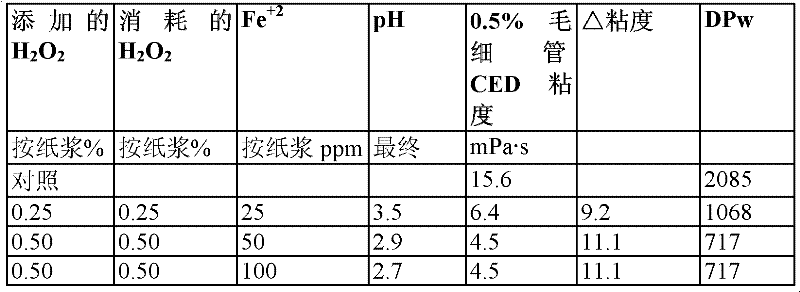
实施例6Example 6
将另一个D1纸浆样品(具有15.2mPa·s的0.5%毛细管CED粘度(DPw 2053))用0.10、0.25、0.50或0.65%过氧化氢和25、50或75ppm Fe+2以与实施例5相同的方法处理。结果在表7中展示。Another D1 pulp sample (with 0.5% capillary CED viscosity (DPw 2053) of 15.2 mPa·s) was treated with 0.10, 0.25, 0.50 or 0.65% hydrogen peroxide and 25, 50 or 75 ppm Fe +2 in the same manner as in Example 5. method of processing. The results are shown in Table 7.
表7Table 7

实施例7Example 7
在牛皮纸和氧气段中的脱木素程度增加到制造具有更低的DPw或0.5%毛细管CED粘度之后,自OD(EO)D(EP)D漂白工序的D1段收集南方松纸浆。起始0.5%毛细管CED粘度是12.7mPa·s(DPw 1834)。将0.50或1.0%过氧化氢与100ppm Fe+2添加。其它处理条件是10%稠度、78℃和1小时处理时间。结果在表8中展示。Southern pine pulp was collected from D1 stage of the OD(EO)D(EP)D bleaching sequence after the degree of delignification in the kraft and oxygen stages was increased to produce a viscosity with lower DPw or 0.5% capillary CED. The initial 0.5% capillary CED viscosity was 12.7 mPa·s (DPw 1834). Add 0.50 or 1.0% hydrogen peroxide with 100 ppm Fe +2 . Other processing conditions were 10% consistency, 78°C and 1 hour processing time. The results are shown in Table 8.
表8Table 8

实施例8Example 8
将来自OD(EO)D(EP)D工序的D1段的D1纸浆的低粘度样品(具有11.5mPa·s的0.5毛细管CED粘度(DPw 1716))用0.75或1.0%过氧化氢和75或150ppm Fe+2以类似于实施例7的方法处理,不同的是处理时间是80分钟。结果在表9中展示。A low viscosity sample of D1 pulp from D1 stage of the OD(EO)D(EP)D process (with a 0.5 capillary CED viscosity (DPw 1716) of 11.5 mPa·s) was treated with 0.75 or 1.0% hydrogen peroxide and 75 or 150 ppm Fe +2 was treated in a manner similar to Example 7, except that the treatment time was 80 minutes. The results are shown in Table 9.
表9Table 9
实施例9Example 9
从OD(EO)D(EP)D工序的D1段收集南方松纸浆。起始0.5毛细管CED粘度是11.6mPa·s(DPw 1726)。将1.0%、1.5%或2%过氧化氢与75、150或200ppm Fe+2添加。其它处理条件是10%稠度、78℃和1.5小时处理时间。结果在表10中展示。Southern pine pulp was collected from stage D1 of the OD(EO)D(EP)D process. The initial 0.5 capillary CED viscosity is 11.6 mPa·s (DPw 1726). 1.0%, 1.5% or 2% hydrogen peroxide was added with 75, 150 or 200 ppm Fe +2 . Other processing conditions were 10% consistency, 78°C and 1.5 hours processing time. The results are shown in Table 10.
表10Table 10

实施例10Example 10
从OD(EO)D(EP)D工序的D1段收集南方松纸浆。起始0.5毛细管CED粘度是14.4mPa·s(DPw 1986)。将1.0%、1.5%或2%过氧化氢与75、150或200ppm Fe+2添加。其它处理条件是10%稠度、78℃和1.5小时反应时间。结果在表11中展示。Southern pine pulp was collected from stage D1 of the OD(EO)D(EP)D process. The initial 0.5 capillary CED viscosity is 14.4 mPa·s (DPw 1986). 1.0%, 1.5% or 2% hydrogen peroxide was added with 75, 150 or 200 ppm Fe +2 . Other processing conditions were 10% consistency, 78°C and 1.5 hours reaction time. The results are shown in Table 11.
表11Table 11

实施例11Example 11
从OD(EO)D(EP)D工序的D1段收集南方松纸浆。起始0.5毛细管CED粘度是15.3mPa·s(DPw 2061)。过氧化氢是按纸浆3%与200ppm Fe+2添加。其它处理条件是10%稠度、80℃和1.5小时反应时间。结果在表12中展示。Southern pine pulp was collected from stage D1 of the OD(EO)D(EP)D process. The initial 0.5 capillary CED viscosity is 15.3 mPa·s (DPw 2061). Hydrogen peroxide was added at 3% pulp with 200ppm Fe +2 . Other processing conditions were 10% consistency, 80°C and 1.5 hours reaction time. The results are shown in Table 12.
表12Table 12

以上实施例2-11显示0.5毛细管CED粘度显著的降低和/或聚合度可用本公开的酸性、催化、过氧化物处理获得。最终粘度或DPw似乎是取决于由反应消耗的过氧化物的量,如图1所示,该图报告来自两个不同工厂(“Brunswick”和LeafRiver(“LR”))的纸浆粘度作为消耗的过氧化物百分比的函数。过氧化物消耗量取决于施加的过氧化物和铁的量和浓度、反应时间和反应温度。Examples 2-11 above show that a significant reduction in 0.5 capillary CED viscosity and/or degree of polymerization can be achieved with the acidic, catalyzed, peroxide treatment of the present disclosure. The final viscosity or DPw appears to be dependent on the amount of peroxide consumed by the reaction, as shown in Figure 1, which reports pulp viscosities from two different mills ("Brunswick" and Leaf River ("LR")) as consumed function of percent peroxide. Peroxide consumption depends on the amount and concentration of peroxide and iron applied, reaction time and reaction temperature.
实施例12Example 12
从OD(EO)D(EP)D工序的D1段收集南方松纸浆。起始0.5毛细管CED粘度是14.8mPa·s(DPw 2020)。过氧化氢按纸浆1%与作为CuSO4·5H20添加的100、150或200pm Cu+2添加。其它处理条件是10%稠度、80℃和3.5小时反应时间。结果在表13中展示。Southern pine pulp was collected from stage D1 of the OD(EO)D(EP)D process. The initial 0.5 capillary CED viscosity is 14.8 mPa·s (DPw 2020). Hydrogen peroxide was added at 1% pulp with 100, 150 or 200 pm Cu +2 added as CuSO 4 ·5H 2 0. Other processing conditions were 10% consistency, 80°C and 3.5 hours reaction time. The results are shown in Table 13.
表13Table 13
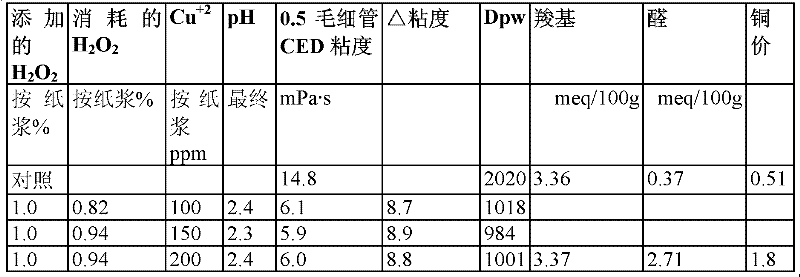
使用铜代替铁导致反应减慢并且使粘度降得更低,但与对照(未处理的纸浆)相比在粘度、羧基含量和醛含量仍有显著的变化。The use of copper instead of iron resulted in a slower reaction and lower viscosity drop, but there were still significant changes in viscosity, carboxyl content and aldehyde content compared to the control (untreated pulp).
实施例13Example 13
改变OD(EOP)D(EP)D工序的E2(EP)段以制造超低聚合度纸浆。以150ppm Fe+2的施加速度对在D1段洗涤器再浆化槽的纸浆用FeSO4·7H20溶液喷雾。不向E2段添加烧碱(NaOH)并且过氧化物施加增加到0.75%。保持时间是大约1小时,温度是79℃。pH是2.9。处理的纸浆在真空转筒洗涤器中洗涤并且随后在最终D2段用0.7%ClO2在91℃处理大约2小时。最终漂白纸浆的0.5毛细管CED粘度是6.5mPa·s(DPw 1084),ISO白度是87。Change the E2(EP) section of the OD(EOP)D(EP)D process to produce ultra-low polymerization pulp. The pulp in the repulp tank of the D1 stage washer was sprayed with a FeSO 4 ·7H 2 0 solution at an application rate of 150 ppm Fe +2 . No caustic soda (NaOH) was added to stage E2 and the peroxide application was increased to 0.75%. The hold time is about 1 hour and the temperature is 79°C. The pH is 2.9. The treated pulp was washed in a vacuum drum washer and then treated with 0.7% ClO2 at 91 °C for about 2 hours in the final D2 stage. The 0.5 capillary CED viscosity of the final bleached pulp was 6.5 mPa·s (DPw 1084) and the ISO brightness was 87.
实施例14Example 14
将实施例13中制造的纸浆在具有标准干燥机罐的Fourdrinier型纸浆干燥机上制成纸浆板。收集对照纸浆和本发明的纸浆(ULDP)样品并且分析化学成分和纤维性质。结果在表14中展示。The pulp produced in Example 13 was made into pulp boards on a Fourdrinier type pulp dryer with a standard dryer tank. Samples of control pulp and inventive pulp (ULDP) were collected and analyzed for chemical composition and fiber properties. The results are shown in Table 14.
表14Table 14
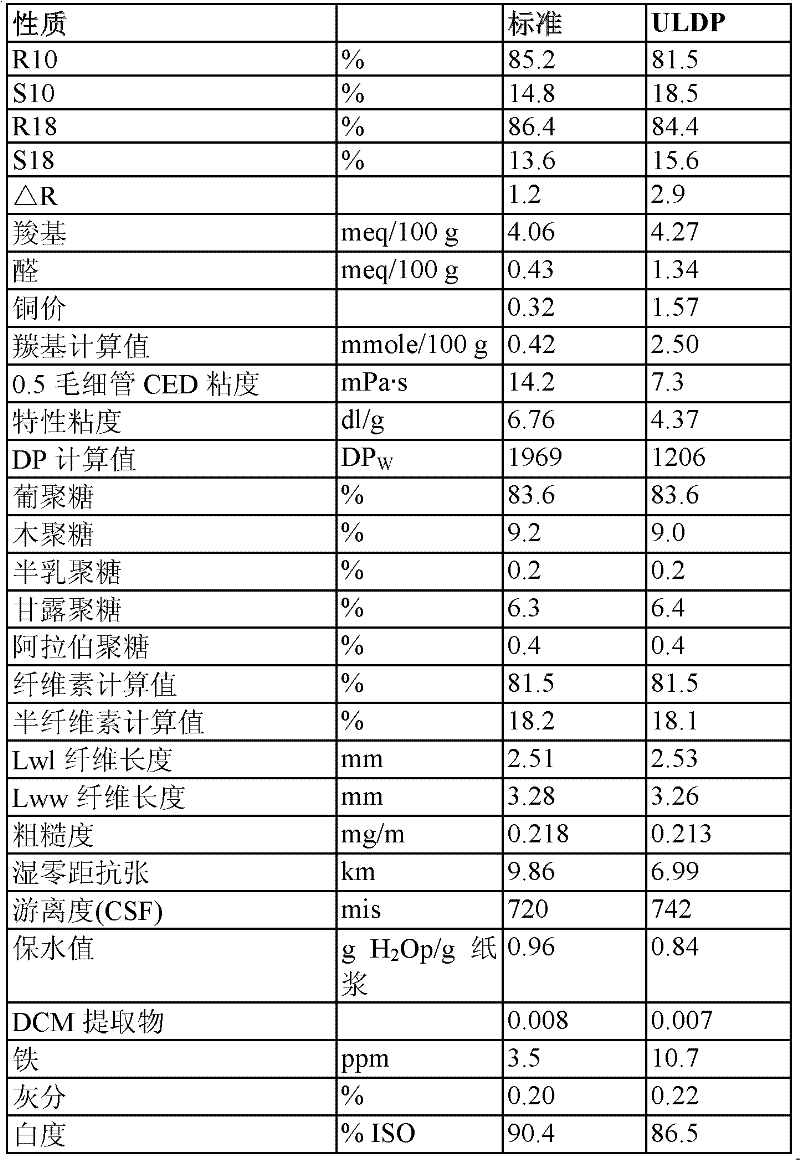
处理的纸浆(ULDP)在10%和18%NaOH中具有高苛性碱溶解度和高醛和总羰基含量。通过0.5毛细管CED粘度测量,ULDP的DP显著地降低。纤维完整性的降低也通过湿零距抗张强度的降低确定。尽管DPw显著降低,但纤维长度和游离度基本上无变化。在机器上对排水或板制造没有有害影响。The treated pulp (ULDP) had high caustic solubility and high aldehyde and total carbonyl content in 10% and 18% NaOH. The DP of ULDP is significantly lower as measured by 0.5 capillary CED viscosity. Reduction in fiber integrity was also determined by reduction in wet zero span tensile strength. Despite the significant reduction in DPw, there was essentially no change in fiber length and freeness. No deleterious effect on drainage or board making on the machine.
实施例15Example 15
改变OD(EO)D(EP)D工序的E2(EP)段以按实施例13的类似方法制造超低聚合度纸浆。在这个实施例中,按75ppm Fe+2添加FeSO4·7H2O,在E2段中施加的过氧化氢是0.6%。处理段的pH是3.0,温度是82℃,保持时间是大约80分钟。洗涤纸浆并且然后在D2段中用0.2%ClO2在92℃处理大约150分钟。完全漂白纸浆的0.5毛细管CED粘度是5.5mPa·s(DPw 914),ISO白度是88.2。Change the E2(EP) section of the OD(EO)D(EP)D process to produce ultra-low polymerization pulp in a similar manner to Example 13. In this example, FeSO 4 .7H 2 O was added at 75 ppm Fe +2 and the hydrogen peroxide applied in section E2 was 0.6%. The pH of the treatment section was 3.0, the temperature was 82°C, and the hold time was about 80 minutes. The pulp was washed and then treated with 0.2% ClO2 at 92°C for approximately 150 minutes in D2 section. The 0.5 capillary CED viscosity of fully bleached pulp is 5.5 mPa·s (DPw 914) and the ISO brightness is 88.2.
实施例16Example 16
将实施例15中制造的纸浆在具有气垫式FlaktTM干燥机部分的Fourdrinier型纸浆干燥机上制成纸浆板。收集标准纸浆和本发明的纸浆(ULDP)样品并且分析化学成分和纤维性质。结果在表15中展示。The pulp produced in Example 15 was made into pulp boards on a Fourdrinier type pulp dryer with an air cushion Flakt ™ dryer section. Standard pulp and inventive pulp (ULDP) samples were collected and analyzed for chemical composition and fiber properties. The results are shown in Table 15.
表15Table 15
处理的纸浆(ULDP)在10%和18%NaOH中具有高苛性碱溶解度和高醛和总羰基含量。通过0.5毛细管CED粘度测量,ULDP的DP显著地降低并且湿零距裂断长降低。白度仍是可接受的值88.2。处理保持了纤维长度和游离度,形成和干燥板时没有操作上的问题。The treated pulp (ULDP) had high caustic solubility and high aldehyde and total carbonyl content in 10% and 18% NaOH. The DP of ULDP was significantly lower and the wet zero span break length was lower as measured by 0.5 capillary CED viscosity. The whiteness is still an acceptable value of 88.2. The treatment maintained fiber length and freeness, and there were no operational problems in forming and drying the board.
实施例17Example 17
改变OD(EO)D(EP)D工序的E2(EP)段以按实施例13的类似方法制造低聚合度纸浆。在此情况下以25ppm Fe+2添加FeSO4·7H2O,在E2段中应用的过氧化氢是0.2%。处理段的pH是3.0,温度是82℃并且保持时间是大约80分钟。洗涤纸浆并且在D2段中用0.2%ClO2在92℃处理大约150分钟。完全漂白纸浆的0.5毛细管CED粘度是8.9mPa·s(DPw 1423),ISO白度是89。Change the E2(EP) section of the OD(EO)D(EP)D process to produce low-degree-of-polymerization pulp in a similar manner to Example 13. In this case FeSO 4 ·7H 2 O was added at 25 ppm Fe +2 , the hydrogen peroxide used in section E2 was 0.2%. The pH of the treatment section was 3.0, the temperature was 82°C and the hold time was about 80 minutes. The pulp was washed and treated with 0.2% ClO2 at 92°C for about 150 minutes in D2 section. The 0.5 capillary CED viscosity of fully bleached pulp is 8.9 mPa·s (DPw 1423), and the ISO brightness is 89.
实施例18Example 18
将实施例15中制造的纸浆在具有气垫式FlaktTM干燥机部分的Fourdrinier型纸浆干燥机上制成纸浆板。收集标准纸浆和本发明的低聚合度纸浆(LDP)样品并且分析化学成分和纤维性质。结果在表16中展示。The pulp produced in Example 15 was made into pulp boards on a Fourdrinier type pulp dryer with an air cushion Flakt ™ dryer section. Standard pulp and low degree of polymerization pulp (LDP) samples of the present invention were collected and analyzed for chemical composition and fiber properties. The results are shown in Table 16.
表16Table 16
处理的纸浆(LDP)在10%和18%NaOH中具有高苛性碱溶解度和高醛和总羰基含量。通过0.5毛细管CED粘度测量,LDP的DP低。白度有极少的损失。处理保持了纤维长度,形成和干燥板时没有操作上的问题。The treated pulp (LDP) had high caustic solubility and high aldehyde and total carbonyl content in 10% and 18% NaOH. LDP has a low DP as measured by 0.5 capillary CED viscosity. There is very little loss of whiteness. The processing maintained the fiber length and there were no operational problems in forming and drying the board.
实施例19Example 19
将在实施例14中描述的纸浆板纤维化并且使用Kamas LaboratoryHammermill(Kamas Industries,Sweden)空气成形4″×7″衬垫。然后将空气成形的衬垫使用实验室压力机在多种表压力下压缩。压制之后,使用具有0.089psi足底压力的200-A型号Emveco精密超声测厚仪卡规(Emveco microgage caliper gage)测量衬垫厚度。由衬垫重量和厚度计算衬垫密度。结果在表17中描述。The pulp board described in Example 14 was fiberized and air formed into 4"x7" pads using a Kamas Laboratory Hammermill (Kamas Industries, Sweden). The air-formed pads were then compressed using a laboratory press at various gauge pressures. After pressing, the pad thickness was measured using a Model 200-A Emveco Microgage caliper gage with a plantar pressure of 0.089 psi. Pad density was calculated from pad weight and thickness. The results are described in Table 17.
表17Table 17

在表17中的数据显示在本公开范围内制造的改性纤维是更可压缩的,产生更适于当今的一次性吸收产品设计的更薄和更高密度结构。The data in Table 17 shows that modified fibers made within the scope of the present disclosure are more compressible, resulting in thinner and higher density structures more suitable for today's disposable absorbent product designs.
不受理论限制,据信纤维素的氧化破坏聚合物的晶体结构,使其变得不那么坚硬并且更舒适。由改性纤维素结构组成的纤维然后变得更可压缩,从而允许高密度吸收结构的生产。Without being bound by theory, it is believed that oxidation of the cellulose breaks down the crystalline structure of the polymer, making it less rigid and more comfortable. The fibers composed of the modified cellulose structure then become more compressible, allowing the production of high density absorbent structures.
实施例20Example 20
从OD(EO)D(EP)D工序的D1段收集南方松纸浆。起始0.5毛细管CED粘度是14.9mPa·s(DPw 2028)。分别添加1.0%或2%过氧化氢与100或200ppm Fe+2。其它处理条件是10%稠度、80℃和1小时保持时间。然后用去离子水打浆这些绒毛浆,湿法加到滤网以形成纤维层,借助于滚压机脱水,并且在250°F干燥。使用KamasLaboratory Hammermill(Kamas Industries,Sweden)将干燥纸张脱纤维并且空气成形重8.5克的4″×7″无尘衬垫。将单个完全覆盖非纺织面层施加到各衬垫的一面并且使用Carver液压压片机施加145psig载荷使样品增加密度。Southern pine pulp was collected from stage D1 of the OD(EO)D(EP)D process. The initial 0.5 capillary CED viscosity is 14.9 mPa·s (DPw 2028). 1.0% or 2% hydrogen peroxide and 100 or 200 ppm Fe +2 were added, respectively. Other processing conditions were 10% consistency, 80°C and 1 hour hold time. The fluff pulp was then beaten with deionized water, wet applied to a screen to form a fibrous layer, dewatered by means of a roller press, and dried at 250°F. The dry paper was defibrated and air formed into 4"x7" dust-free pads weighing 8.5 grams using a Kamas Laboratory Hammermill (Kamas Industries, Sweden). A single full coverage nonwoven facing was applied to one side of each pad and the samples were densified using a Carver hydraulic tablet press applying a 145 psig load.
将这些衬垫置于单独的1.6L具有配备单向阀和1/4″ID

表18Table 18

实施例21Example 21
改变商业化牛皮纸浆设备的OD(EO)D(EP)D工序的E2(EP)段以按实施例14的类似方法制造低聚合度纸浆。在这个实施例中,FeSO4·7H2O是以100ppm Fe+2添加,在E2段中应用的过氧化氢是1.4%。纸浆性质在表19中展示。The E2(EP) section of the OD(EO)D(EP)D process of the commercial kraft pulp equipment was changed to produce low-degree-of-polymerization pulp in a similar manner to Example 14. In this example, FeSO 4 .7H 2 O was added at 100 ppm Fe +2 and the hydrogen peroxide used in stage E2 was 1.4%. Pulp properties are shown in Table 19.
表19Table 19
将制造的改性化学纤维素在具有气垫式FlaktTM干燥机部分的Fourdrinier型纸浆干燥机上制成纸浆板。将该产品样品和对照牛皮纸浆板使用Kamas laboratoryhammermill脱纤维。借助于可从OptestEquipment,Inc.,Hawkesbury,ON,Canada获得的HiRes Fiber Quality Analyzer,根据制造商的方案对前后两个Kamas工厂样品进行纤维性质光学分析。结果在以下表中描述。The produced modified chemical cellulose was made into pulp board on a Fourdrinier type pulp dryer with an air cushion Flakt ™ dryer section. The product samples and control kraft pulp boards were defibrated using a Kamas laboratoryhammermill. Optical analysis of fiber properties was performed on both the front and back Kamas plant samples according to the manufacturer's protocol with the aid of the HiRes Fiber Quality Analyzer available from Optest Equipment, Inc., Hawkesbury, ON, Canada. The results are described in the table below.
表20Table 20
如在表20中可见,根据本公开制备的ULDP纤维比不用铁和过氧化物处理的对照纤维具有更高的扭结和卷曲。As can be seen in Table 20, the ULDP fibers prepared according to the present disclosure had higher kinks and crimps than the control fibers not treated with iron and peroxide.
将以上脱纤维的纤维空气成形重4.25克(风干)的4″×7″衬垫。将来源于BASF的聚丙烯酸钠高吸水性(SAP)颗粒均匀地施加到两个4.25克衬垫中间。将完全覆盖非纺织面层材料施加到纤维/SAP基体的上面并且借助于Carver压片机施加的145psig载荷使衬垫增加密度。The above defibrated fibers were air formed into a 4" x 7" pad weighing 4.25 grams (air dry). Sodium polyacrylate superabsorbent (SAP) particles from BASF were evenly applied between two 4.25 gram liners. A full coverage nonwoven facing material was applied on top of the fiber/SAP matrix and the pad was densified with a 145 psig load applied by a Carver tablet press.
通过在去离子水中溶解2%尿素、0.9%氯化钠和0.24%养营肉汤(可由HardyDiagnostics,SantaMaria,CA获得的CriterionTM牌),并且添加1.4×10⁷CFU/ml起始细菌浓度产生的一份普通变形杆菌(Proteus Vulgaris)来制备合成尿。然后将上述衬垫置于在实施例20中描述的顶部空间腔室并且施加80ml合成尿溶液污物。一施加污物之后就将腔室密封并且置于30℃温度的环境中。以四个小时和七个小时的时间间隔进行连续地Drager取样。将实验重复三次,平均结果在表21中报告。Produced by dissolving 2% urea, 0.9% sodium chloride and 0.24% Nutrient Broth (Criterion ™ brand available from Hardy Diagnostics, Santa Maria, CA) in deionized water and adding 1.4 x 10⁷ CFU/ml starting bacterial concentration common Proteus (Proteus Vulgaris) to make synthetic urine. The pads described above were then placed in the headspace chamber described in Example 20 and 80ml of synthetic urine solution soil applied. The chamber was sealed and placed in an environment at a temperature of 30°C as soon as the soil was applied. Continuous Drager sampling was performed at four-hour and seven-hour time intervals. The experiment was repeated three times and the averaged results are reported in Table 21.
表21Table 21
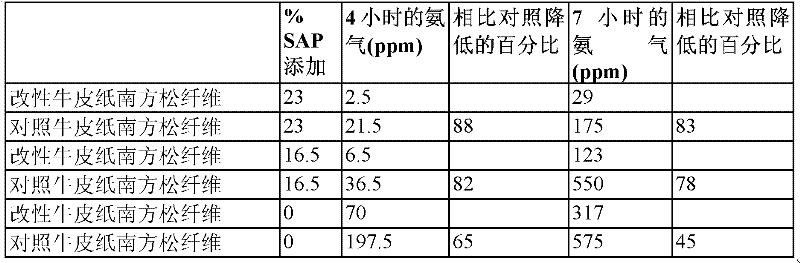
从数据可见,在合并在本公开范围内制造的改性纤维素纤维的复合结构(在结构上类似零售的尿失禁产品)中由尿素的细菌水解引起的大气氨气比具有标准牛皮纸南方松纤维制造的复合结构降低。因此,包含根据本公开的改性纤维素纤维的结构比标准牛皮纸南方松纤维具有更佳的气味控制性质。As can be seen from the data, atmospheric ammonia caused by bacterial hydrolysis of urea in composite structures incorporating modified cellulose fibers made within the scope of the present disclosure (structurally similar to retail urinary incontinence products) was higher than that of standard kraft southern pine fibers. Manufactured composite structures are reduced. Accordingly, structures comprising modified cellulose fibers according to the present disclosure have better odor control properties than standard kraft southern pine fibers.
实施例22第4段至漂白后处理的比较Comparison of Example 22 Paragraph 4 to Post-Bleaching Treatment
从OD(EO)D1(EP)D2工序的D1段收集南方松纸浆。起始0.5毛细管CED粘度是14.1mPa·s。过氧化氢基于纸浆干重的1.5%与150ppm Fe+2添加。如在本文中使用,“P*”用来表示铁和过氧化氢处理段。所述处理在10%稠度在78℃温度下在所述工序的第四段中进行1小时。然后洗涤该处理纸浆并且在78℃用0.25%ClO2在D2段中漂白2小时。结果在表22中展示。Southern pine pulp was collected from section D1 of the OD(EO)D1(EP)D2 process. The initial 0.5 capillary CED viscosity is 14.1 mPa·s. Hydrogen peroxide was added at 1.5% based on pulp dry weight with 150 ppm Fe +2 . As used herein, "P*" is used to denote the iron and hydrogen peroxide treatment stage. The treatment is carried out in the fourth stage of the process at a 10% consistency for 1 hour at a temperature of 78°C. The treated pulp was then washed and bleached with 0.25% ClO2 in D2 stage at 78°C for 2 hours. The results are shown in Table 22.
表22Table 22

以上D2样品也通过将其放置在105℃的烘箱中1小时测试白度复原。在复原处理前后,通过Hunterlab MiniScan(根据制造商的方案)测量白度以及L*(白色)、a*(红色至绿色)和b*(蓝色至黄色)值。结果在以下表23中展示。更正的b值表示更黄的颜色。因此,在大多数纸张和纸浆应用中更高的b值是不希望的。退色值(在以下报告)表示老化前后的k/s比例的差,其中k=吸收系数,s=散射系数,即退色值=100{(k/s)老化之后-(k/s)老化之前}。参见,例如H.W.Giertz,Svensk Papperstid.,48(13),317(1945)。The above D2 sample was also tested for whiteness recovery by placing it in an oven at 105°C for 1 hour. Whiteness and L* (white), a* (red to green) and b* (blue to yellow) values were measured by Hunterlab MiniScan (according to manufacturer's protocol) before and after reconstitution treatment. The results are shown in Table 23 below. A corrected b value indicates a more yellow color. Therefore, higher b values are undesirable in most paper and pulp applications. Fade value (reported below) represents the difference in k/s ratio before and after aging, where k = absorption coefficient, s = scattering coefficient, i.e. fade value = 100 {(k/s) after aging - (k/s) before aging }. See, eg, HW Giertz, Svensk Papperstid., 48(13), 317 (1945).
表23白度复原Table 23 Whiteness Restoration
从如上具有相同起始毛细管CED粘度的相同漂白车间的D2段收集南方松纸浆并且如上所述用过氧化氢和Fe+2处理。过氧化氢基于纸浆干重的1.5%与150ppm Fe+2添加。该处理纸浆的性质在表24中描述。Southern pine pulp was collected from section D2 of the same bleach plant as above with the same initial capillary CED viscosity and treated with hydrogen peroxide and Fe +2 as described above. Hydrogen peroxide was added at 1.5% based on pulp dry weight with 150 ppm Fe +2 . The properties of the treated pulp are described in Table 24.
表24Table 24

如上所述测试P*纸浆的白度。结果在以下表25中描述。P* pulps were tested for brightness as described above. The results are described in Table 25 below.
表25白度复原Table 25 Whiteness Restoration
从以上数据可见,在五段漂白车间的第四段中的酸性催化过氧化物处理与接着五段漂白车间最终段的处理相比产生有益的白度性质。在第四段处理中,从所述处理段损失的任何白度可用最终D2漂白段补偿以便仍然获得高白度纸浆。在后漂白处理的情况,有3.4点的显著白度损失不能得到补偿。加速白度复原处理之后,后者仍然具有显著地白度降低。From the above data it can be seen that the acid catalyzed peroxide treatment in the fourth stage of the five stage bleach plant produces beneficial brightness properties compared to the treatment followed by the final stage of the five stage bleach plant. In the fourth stage of processing, any brightness lost from that stage can be compensated for with the final D2 bleaching stage in order to still obtain a high brightness pulp. In the case of the post-bleach treatment, a significant loss of brightness of 3.4 points could not be compensated. The latter still had a significant reduction in whiteness after the accelerated whiteness recovery treatment.
实施例23强度数据Example 23 Intensity Data
将由根据本公开的具有5.1mPa·s粘度的改性纤维素制造的绒毛浆的强度与具有15.4mPa·s粘度的传统绒毛浆相比较。结果在以下表26中描述。The strength of a fluff pulp made from modified cellulose with a viscosity of 5.1 mPa·s according to the present disclosure was compared to conventional fluff pulp with a viscosity of 15.4 mPa·s. The results are described in Table 26 below.
表26Table 26
实施例24改性纤维素的衍生Example 24 Derivatization of modified cellulose
将来自实施例21的ULDP样品用0.05M HCl在5%稠度和122℃下酸性水解3小时。通过以下方法测试来自D1段的初始纸浆、ULDP和酸性水解ULDP的平均分子量或聚合度。The ULDP sample from Example 21 was acid hydrolyzed with 0.05M HCl at 5% consistency and 122°C for 3 hours. The virgin pulp, ULDP and acid hydrolyzed ULDP from stage D1 were tested for average molecular weight or degree of polymerization by the following method.
将三个纸浆样品碾磨以通过20目滤网。将纤维素样品(15mg)置于配备小搅拌棒的单独的试管中并且在真空下在40℃干燥过夜。然后将试管盖上橡胶隔片。借助于注射器依次添加无水吡啶(4.00mL)和异氰酸苯酯(0.50mL)。将试管置于70℃的油浴并且允许搅拌48h。添加甲醇(1.00mL)淬灭任何剩余的异氰酸苯酯。然后将各试管的内容物逐滴添加至7∶3甲醇/水混合物(100mL)以促进衍生化纤维素的析出。通过过滤收集固体,然后用甲醇/水(1×50mL)洗涤,接着用水(2×50mL)洗涤。然后将衍生化纤维素在真空下在40℃干燥整夜。在GPC分析之前将衍生化纤维素溶于THF(1mg/mL),通过0.45μm过滤器过滤并且置于2mL自动进样器小瓶中。所得DPw和DPn(数均聚合度)在以下表27中报告。Three pulp samples were milled to pass through a 20 mesh screen. Cellulose samples (15 mg) were placed in separate test tubes equipped with a small stir bar and dried under vacuum at 40°C overnight. The tubes were then capped with rubber septa. Anhydrous pyridine (4.00 mL) and phenylisocyanate (0.50 mL) were added sequentially via syringe. The tube was placed in a 70°C oil bath and allowed to stir for 48h. Methanol (1.00 mL) was added to quench any remaining phenylisocyanate. The contents of each tube were then added dropwise to a 7:3 methanol/water mixture (100 mL) to facilitate precipitation of the derivatized cellulose. The solid was collected by filtration and washed with methanol/water (1 x 50 mL) followed by water (2 x 50 mL). The derivatized cellulose was then dried under vacuum at 40°C overnight. Derivatized cellulose was dissolved in THF (1 mg/mL), filtered through a 0.45 μm filter and placed in a 2 mL autosampler vial prior to GPC analysis. The resulting DPw and DPn (number average degree of polymerization) are reported in Table 27 below.
表27DPn和DPw测试结果Table 27 DPn and DPw test results
如在以上表中可见,根据本公开的酸性水解的改性纤维素可具有48的DPn。As can be seen in the table above, the acid hydrolyzed modified cellulose according to the present disclosure may have a DPn of 48.
实施例25Example 25
通过对纤维打浆,调节pH至约5.5,然后添加(作为临时湿强剂)来自KemiraChemicals的乙醛酸聚丙烯酰胺将LeafRiver ULDP纤维和标准软木纤维制成手抄纸。然后形成纤维,压制成纸张并且干燥。所述纸张的特性通过已知方法测量。所述结果在以下表28中报告。LeafRiver ULDP fibers and standard softwood fibers were made into handsheets by beating the fibers, adjusting the pH to about 5.5, and then adding (as a temporary wet strength agent) glyoxylate polyacrylamide from Kemira Chemicals. Fibers are then formed, pressed into paper and dried. The properties of the paper are measured by known methods. The results are reported in Table 28 below.
表28手抄纸性质Table 28 Properties of Handsheets

如在以上表28中可见,根据本公开的ULDP可用于湿压纸的制造。如在图2中展示,由ULDP形成的手抄纸的湿/干比例比仅由标准南方软木制造的比较纸张的湿/干比例高。As can be seen in Table 28 above, the ULDP according to the present disclosure can be used in the manufacture of wet press paper. As shown in Figure 2, the wet/dry ratio of the handsheet formed from ULDP was higher than that of the comparative paper made from standard southern softwood only.
其它实施方案Other implementations
虽然申请人目前期望的发明在所附权利要求书中限定,但应理解可以根据以下实施方案限定本发明,这些实施方案未必是详尽性的或对要求保护的那些进行限制:While applicants' presently desired invention is defined in the appended claims, it should be understood that the invention may be defined in terms of the following embodiments, which are not necessarily exhaustive or limiting of what is claimed:
A.一种来源于漂白软木或硬木牛皮纸浆的纤维,其中所述纤维具有约13mPa·s或更小的0.5%毛细管CED粘度,优选小于约10mPa·s,更优选小于8mPa·s,更加优选小于约5mPa·s,或进一步更加优选小于约4mPa·s。A. A fiber derived from bleached softwood or hardwood kraft pulp, wherein said fiber has a 0.5% capillary CED viscosity of about 13 mPa·s or less, preferably less than about 10 mPa·s, more preferably less than 8 mPa·s, even more preferably Less than about 5 mPa·s, or even more preferably less than about 4 mPa·s.
B.一种来源于漂白软木牛皮纸浆的纤维,其中所述纤维具有至少约2mm的平均纤维长度,优选至少约2.2mm,例如至少约2.3mm,或例如至少约2.4mm,或例如约2.5mm,更优选约2mm至约3.7mm,更加优选约2.2mm至约3.7mm。B. A fiber derived from bleached softwood kraft pulp, wherein the fibers have an average fiber length of at least about 2 mm, preferably at least about 2.2 mm, such as at least about 2.3 mm, or such as at least about 2.4 mm, or such as about 2.5 mm , more preferably from about 2 mm to about 3.7 mm, even more preferably from about 2.2 mm to about 3.7 mm.
C.一种来源于漂白硬木牛皮纸浆的纤维,其中所述纤维具有至少约0.75mm的平均纤维长度,优选至少约0.85mm,或至少约0.95mm,或更加优选至少约1.15,或约0.75mm至约1.25mm范围。C. A fiber derived from bleached hardwood kraft pulp, wherein the fibers have an average fiber length of at least about 0.75 mm, preferably at least about 0.85 mm, or at least about 0.95 mm, or more preferably at least about 1.15, or about 0.75 mm to about 1.25mm range.
D.一种来源于漂白软木牛皮纸浆的纤维,其中所述纤维具有约13mPa·s或更小的0.5%毛细管CED粘度,至少约2mm的平均纤维长度和约85至约95范围的ISO白度。D. A fiber derived from bleached softwood kraft pulp, wherein the fiber has a 0.5% capillary CED viscosity of about 13 mPa·s or less, an average fiber length of at least about 2 mm, and an ISO brightness ranging from about 85 to about 95.
E.如实施方案A-D中任一项所述的纤维,其中所述粘度在约3.0mPa·s至约13mPa·s范围内,例如约4.5mPa·s至约13mPa·s,优选约7mPa·s至约13mPa·s,或例如约3.0mPa·s至约7mPa·s,优选约3.0mPa·s至约5.5mPa·s。E. The fiber according to any one of embodiments A-D, wherein the viscosity is in the range of about 3.0 mPa·s to about 13 mPa·s, for example about 4.5 mPa·s to about 13 mPa·s, preferably about 7 mPa·s to about 13 mPa·s, or for example about 3.0 mPa·s to about 7 mPa·s, preferably about 3.0 mPa·s to about 5.5 mPa·s.
F.如实施方案A-D所述的纤维,其中所述粘度小于约7mPa·s。F. The fiber of embodiments A-D, wherein the viscosity is less than about 7 mPa·s.
G.如实施方案A-D所述的纤维,其中所述粘度是至少约3.5mPa·s。G. The fiber of embodiments A-D, wherein the viscosity is at least about 3.5 mPa·s.
H.如实施方案A-D所述的纤维,其中所述粘度小于约4.5mPa·s。H. The fiber of embodiments A-D, wherein the viscosity is less than about 4.5 mPa·s.
I.如实施方案A-D所述的纤维,其中所述粘度是至少约5.5mPa·s。I. The fiber of embodiments A-D, wherein the viscosity is at least about 5.5 mPa·s.
J.如实施方案E所述的纤维,其中所述粘度不大于约6mPa·s。J. The fiber of embodiment E, wherein the viscosity is not greater than about 6 mPa·s.
K.如以上实施方案中一项所述的纤维,其中所述粘度小于约13mPa·s。K. The fiber of one of the above embodiments, wherein the viscosity is less than about 13 mPa·s.
L.如实施方案A-B和D-K中一项所述的纤维,其中所述平均纤维长度是至少约2.2mm。L. The fiber of one of embodiments A-B and D-K, wherein the average fiber length is at least about 2.2 mm.
M.如实施方案A-B和D-L中一项所述的纤维,其中所述平均纤维长度不大于约3.7mm。M. The fiber of one of Embodiments A-B and D-L, wherein the average fiber length is no greater than about 3.7 mm.
N.如实施方案A-M中一项所述的纤维,其中所述纤维具有在约16%至约30%范围内的S10苛性碱溶解度,优选约16%至约20%。N. The fiber of one of embodiments A-M, wherein the fiber has an S10 caustic solubility in the range of about 16% to about 30%, preferably about 16% to about 20%.
O.如实施方案A-M中一项所述的纤维,其中所述纤维具有在约14%至约16%范围内的S10苛性碱溶解度。O. The fiber of one of embodiments A-M, wherein the fiber has an S10 caustic solubility in the range of about 14% to about 16%.
P.如实施方案A-O中一项所述的纤维,其中所述纤维具有在约14%至约22%范围内的S18苛性碱溶解度,优选约14%至约18%,更优选约14%至约16%。P. The fiber of one of embodiments A-O, wherein the fiber has an S18 caustic solubility in the range of about 14% to about 22%, preferably about 14% to about 18%, more preferably about 14% to About 16%.
Q.如实施方案A-P中一项所述的纤维,其中所述纤维具有在约14%至约16%范围内的S18苛性碱溶解度。Q. The fiber of one of embodiments A-P, wherein the fiber has a S18 caustic solubility in the range of about 14% to about 16%.
R.如实施方案A-Q中一项所述的纤维,其中所述纤维具有约2.9或更大的ΔR。R. The fiber of one of embodiments A-Q, wherein said fiber has a AR of about 2.9 or greater.
S.如实施方案A-Q中一项所述的纤维,其中所述纤维具有约3.0或更大的ΔR,优选约6.0或更大。S. The fiber according to one of embodiments A-Q, wherein said fiber has a AR of about 3.0 or greater, preferably about 6.0 or greater.
T.如实施方案A-S中一项所述的纤维,其中所述纤维具有在约2meq/100g至约8meq/100g范围内的羧基含量,优选约2meq/100g至约6meq/100g,更优选约3meq/100g至约6meq/100g。T. The fiber according to one of embodiments A-S, wherein the fiber has a carboxyl content in the range of about 2 meq/100g to about 8 meq/100g, preferably about 2meq/100g to about 6meq/100g, more preferably about 3meq /100g to about 6meq/100g.
U.如实施方案A-S中一项所述的纤维,其中所述纤维具有至少约2meq/100g的羧基含量。U. The fiber of one of embodiments A-S, wherein the fiber has a carboxyl content of at least about 2 meq/100 g.
V.如实施方案A-S中一项所述的纤维,其中所述纤维具有至少约2.5meq/100g的羧基含量。V. The fiber of one of embodiments A-S, wherein the fiber has a carboxyl content of at least about 2.5 meq/100 g.
W.如实施方案A-S中一项所述的纤维,其中所述纤维具有至少约3meq/100g的羧基含量。W. The fiber of one of embodiments A-S, wherein the fiber has a carboxyl content of at least about 3 meq/100 g.
X.如实施方案A-S中一项所述的纤维,其中所述纤维具有至少约3.5meq/100g的羧基含量。X. The fiber of one of embodiments A-S, wherein the fiber has a carboxyl content of at least about 3.5 meq/100 g.
Y.如实施方案A-S中一项所述的纤维,其中所述纤维具有至少约4meq/100g的羧基含量。Y. The fiber of one of embodiments A-S, wherein the fiber has a carboxyl content of at least about 4 meq/100 g.
Z.如实施方案A-S中一项所述的纤维,其中所述纤维具有至少约4.5meq/100g的羧基含量。Z. The fiber of one of embodiments A-S, wherein the fiber has a carboxyl content of at least about 4.5 meq/100 g.
AA.如实施方案A-S中一项所述的纤维,其中所述纤维具有至少约5meq/100g的羧基含量。AA. The fiber of one of embodiments A-S, wherein the fiber has a carboxyl content of at least about 5 meq/100 g.
BB.如实施方案A-S中一项所述的纤维,其中所述纤维具有约4meq/100g的羧基含量。BB. The fiber according to one of embodiments A-S, wherein the fiber has a carboxyl content of about 4 meq/100 g.
CC.如实施方案A-BB中一项所述的纤维,其中所述纤维具有在约1meq/100g至约9meq/100g范围内的醛含量,优选约1meq/100g至约3meq/100g。CC. The fiber according to one of embodiments A-BB, wherein the fiber has an aldehyde content in the range of about 1 meq/100g to about 9 meq/100g, preferably about 1 meq/100g to about 3 meq/100g.
DD.如实施方案A-BB中一项所述的纤维,其中所述纤维具有至少约1.5meq/100g的醛含量。DD. The fiber of one of embodiments A-BB, wherein the fiber has an aldehyde content of at least about 1.5 meq/100 g.
EE.EE.
FF.如实施方案A-BB中一项所述的纤维,其中所述纤维具有至少约2.0meq/100g的醛含量。FF. The fiber of one of embodiments A-BB, wherein the fiber has an aldehyde content of at least about 2.0 meq/100 g.
GG.如实施方案A-BB中一项所述的纤维,其中所述纤维具有至少约2.5meq/100g的醛含量。GG. The fiber of one of embodiments A-BB, wherein the fiber has an aldehyde content of at least about 2.5 meq/100 g.
HH.如实施方案A-BB中一项所述的纤维,其中所述纤维具有至少约3.0meq/100g的醛含量。HH. The fiber of one of embodiments A-BB, wherein the fiber has an aldehyde content of at least about 3.0 meq/100 g.
II.如实施方案A-BB中一项所述的纤维,其中所述纤维具有至少约3.5meq/100g的醛含量。II. The fiber of one of embodiments A-BB, wherein the fiber has an aldehyde content of at least about 3.5 meq/100 g.
JJ.如实施方案A-BB中一项所述的纤维,其中所述纤维具有至少约4.0meq/100g的醛含量。JJ. The fiber of one of embodiments A-BB, wherein the fiber has an aldehyde content of at least about 4.0 meq/100 g.
KK.如实施方案A-BB中一项所述的纤维,其中所述纤维具有至少约5.5meq/100g的醛含量。KK. The fiber of one of embodiments A-BB, wherein the fiber has an aldehyde content of at least about 5.5 meq/100 g.
LL.如实施方案A-BB中一项所述的纤维,其中所述纤维具有至少约5.0meq/100g的醛含量。LL. The fiber of one of embodiments A-BB, wherein the fiber has an aldehyde content of at least about 5.0 meq/100 g.
MM.如实施方案A-MM中一项所述的纤维,其中所述纤维具有通过铜价确定的大于约2的羰基含量,优选大于约2.5,更优选大于约3,或通过铜价确定的约2.5至约5.5的羰基含量,优选约3至约5.5,更优选约3至约5.5,或所述纤维具有通过铜价确定的约1至约4的羰基含量。MM. The fiber of one of embodiments A-MM, wherein the fiber has a carbonyl content greater than about 2 as determined by copper valence, preferably greater than about 2.5, more preferably greater than about 3, or about 2.5 as determined by copper valence to about 5.5 carbonyl content, preferably about 3 to about 5.5, more preferably about 3 to about 5.5, or the fiber has a carbonyl content of about 1 to about 4 as determined by copper valence.
NN.如实施方案A-NN中一项所述的纤维,其中所述羰基含量在约2至约3范围内。NN. The fiber of one of embodiments A-NN, wherein the carbonyl content is in the range of about 2 to about 3.
OO.如实施方案A-NN中一项所述的纤维,其中所述纤维具有通过铜价确定的约3或更大的羰基含量。OO. The fiber of one of embodiments A-NN, wherein the fiber has a carbonyl content as determined by copper valence of about 3 or greater.
PP.如实施方案A-NN中一项所述的纤维,其中所述纤维具有在约0.9至约1.6范围内的总羰基与醛含量的比例。PP. The fiber of one of embodiments A-NN, wherein the fiber has a total carbonyl to aldehyde content ratio in the range of about 0.9 to about 1.6.
QQ.如实施方案A-NN中一项所述的纤维,其中所述总羰基与醛含量的比例在约0.8至约1.0范围内。QQ. The fiber of one of embodiments A-NN, wherein the ratio of total carbonyl to aldehyde content is in the range of about 0.8 to about 1.0.
RR.如以上实施方案中一项所述的纤维,其中所述纤维具有至少约690mis的加拿大标准游离度(“游离度”),优选至少约700mis,更优选至少约710mis,或例如至少约720mis或约730mis。RR. The fiber according to one of the above embodiments, wherein the fiber has a Canadian Standard Freeness ("freeness") of at least about 690 mis, preferably at least about 700 mis, more preferably at least about 710 mis, or for example at least about 720 mis or about 730mis.
SS.如以上实施方案中一项所述的纤维,其中所述纤维具有至少约710mis的游离度。SS. The fiber of one of the above embodiments, wherein the fiber has a freeness of at least about 710 mis.
TT.如以上实施方案中一项所述的纤维,其中所述纤维具有至少约720mis的游离度。TT. The fiber of one of the above embodiments, wherein the fiber has a freeness of at least about 720 mis.
UU.如以上实施方案中任一项所述的纤维,其中所述纤维具有至少约730mis的游离度。UU. The fiber of any of the preceding embodiments, wherein the fiber has a freeness of at least about 730 mis.
VV.如以上实施方案中一项所述的纤维,其中所述纤维具有不多于约760mis的游离度。VV. The fiber of one of the above embodiments, wherein the fiber has a freeness of not more than about 760 mis.
WW.如实施方案A-WW中一项所述的纤维,其中所述纤维具有在约4km至约10km范围内的纤维强度(通过湿零距裂断长测量)。WW. The fiber of one of Embodiments A-WW, wherein the fiber has a fiber strength (measured by wet zero-span breaking length) in the range of about 4 km to about 10 km.
XX.如实施方案A-WW中一项所述的纤维,其中所述纤维具有在约5km至约8km范围内的纤维强度。XX. The fiber of one of embodiments A-WW, wherein the fiber has a fiber strength in the range of about 5 km to about 8 km.
YY.如实施方案A-WW中一项所述的纤维,其中所述纤维具有至少约4km的纤维强度(通过湿零距裂断长测量)。YY. The fiber of one of embodiments A-WW, wherein the fiber has a fiber strength (measured by wet zero-span break length) of at least about 4 km.
ZZ.如实施方案A-WW中一项所述的纤维,其中所述纤维具有至少约5km的纤维强度(通过湿零距裂断长测量)。ZZ. The fiber of one of embodiments A-WW, wherein the fiber has a fiber strength (measured by wet zero-span breaking length) of at least about 5 km.
AAA.如实施方案A-WW中一项所述的纤维,其中所述纤维具有至少约6km的纤维强度(通过湿零距裂断长测量)。AAA. The fiber of one of Embodiments A-WW, wherein the fiber has a fiber strength (measured by wet zero-span break length) of at least about 6 km.
BBB.如实施方案A-WW中一项所述的纤维,其中所述纤维具有至少约7km的纤维强度(通过湿零距裂断长测量)。BBB. The fiber of one of Embodiments A-WW, wherein the fiber has a fiber strength (measured by wet zero-span breaking length) of at least about 7 km.
CCC.如实施方案A-WW中一项所述的纤维,其中所述纤维具有至少约8km的纤维强度(通过湿零距裂断长测量)。CCC. The fiber of one of Embodiments A-WW, wherein the fiber has a fiber strength (measured by wet zero-span breaking length) of at least about 8 km.
DDD.如实施方案A-WW中一项所述的纤维,其中所述纤维具有在约5km至约7km范围内的纤维强度(通过湿零距裂断长测量)。DDD. The fiber of one of Embodiments A-WW, wherein the fiber has a fiber strength (measured by wet zero distance to break length) in the range of about 5 km to about 7 km.
EEE.如实施方案A-WW中一项所述的纤维,其中所述纤维具有在约6km至约7km范围内的纤维强度(通过湿零距裂断长测量)。EEE. The fiber of one of Embodiments A-WW, wherein the fiber has a fiber strength (measured by wet zero-span breaking length) in the range of about 6 km to about 7 km.
FFF.如以上实施方案中一项所述的纤维,其中所述ISO白度在约85至约92范围内,优选约86至约90,更优选约87至约90或约88至约90ISO。FFF. The fiber of one of the above embodiments, wherein the ISO whiteness ranges from about 85 to about 92, preferably from about 86 to about 90, more preferably from about 87 to about 90 or from about 88 to about 90 ISO.
GGG.如以上实施方案中一项所述的纤维,其中所述ISO白度是至少约85,优选至少约86,更优选至少约87,特别地至少约88,更特别地至少约89或约90ISO。GGG. The fiber according to one of the above embodiments, wherein the ISO whiteness is at least about 85, preferably at least about 86, more preferably at least about 87, especially at least about 88, more particularly at least about 89 or about 90ISO.
HHH.如实施方案A-FFF中一项所述的纤维,其中所述ISO白度是至少约87。HHH. The fiber of one of Embodiments A-FFF, wherein the ISO whiteness is at least about 87.
III.如实施方案A-FFF中一项所述的纤维,其中所述ISO白度是至少约88。III. The fiber of one of embodiments A-FFF, wherein the ISO whiteness is at least about 88.
JJJ.如实施方案A-FFF中一项所述的纤维,其中所述ISO白度是至少约89。JJJ. The fiber of one of Embodiments A-FFF, wherein the ISO whiteness is at least about 89. JJJ.
KKK.如实施方案A-FFF中一项所述的纤维,其中所述ISO白度是至少约90。KKK. The fiber of one of Embodiments A-FFF, wherein the ISO whiteness is at least about 90. KKK.
LLL.如以上实施方案中任一项所述的纤维,其中所述纤维具有与标准牛皮纸纤维约相同的长度。LLL. The fiber of any of the above embodiments, wherein the fiber has about the same length as a standard kraft fiber.
MMM.如实施方案A-S和SS-MMM中一项所述的纤维,其比标准牛皮纸纤维具有更高的羧基含量。MMM. Fiber according to one of embodiments A-S and SS-MMM, which has a higher carboxyl content than standard kraft fiber.
NNN.如实施方案A-S和SS-NNN中一项所述的纤维,其比标准牛皮纸纤维具有更高的醛含量。NNN. The fiber of one of Embodiments A-S and SS-NNN, which has a higher aldehyde content than standard kraft fiber.
OOO.如实施方案A-S和SS-MMM所述的纤维,其具有大于约0.3的总醛与羧基含量的比例,优选大于约0.5,更优选大于约1.4,或例如在约0.3至约0.5范围内,或在约0.5至约1范围内,或在约1至约1.5范围内。OOO. The fiber of embodiments A-S and SS-MMM having a ratio of total aldehyde to carboxyl content greater than about 0.3, preferably greater than about 0.5, more preferably greater than about 1.4, or for example in the range of about 0.3 to about 0.5 , or in the range of about 0.5 to about 1, or in the range of about 1 to about 1.5.
PPP.如以上实施方案中任一项所述的纤维,其比标准牛皮纸纤维具有更高的扭结指数,例如具有在约1.3至约2.3范围内的扭结指数,优选约1.7至约2.3,更优选约1.8至约2.3或在约2.0至约2.3范围内。PPP. Fibers according to any one of the above embodiments having a higher kink index than standard kraft fibers, for example having a kink index in the range of about 1.3 to about 2.3, preferably about 1.7 to about 2.3, more preferably From about 1.8 to about 2.3 or in the range of about 2.0 to about 2.3.
QQQ.如以上实施方案中任一项所述的纤维,其具有在约0.11至约0.2范围内的长度加权卷曲指数,优选约0.15至约0.2。QQQ. The fiber of any one of the above embodiments having a length-weighted crimp index in the range of about 0.11 to about 0.2, preferably about 0.15 to about 0.2.
RRR.如以上实施方案中任一项所述的纤维,其比标准牛皮纸纤维具有更低的结晶度指数,例如相对于标准牛皮纸纤维结晶度指数降低约5%至约20%,优选约10%至约20%,更优选相对于标准牛皮纸纤维降低15%至20%。RRR. Fiber according to any one of the above embodiments, which has a lower crystallinity index than standard kraft fiber, e.g., about 5% to about 20%, preferably about 10% lower crystallinity index relative to standard kraft fiber to about 20%, more preferably a 15% to 20% reduction relative to standard kraft fiber.
SSS.如以上实施方案中任一项所述的纤维,其中所述R10值在约65%至约85%范围内,优选约70%至约85%,更优选约75%至约85%。SSS. The fiber of any one of the above embodiments, wherein the R10 value is in the range of about 65% to about 85%, preferably about 70% to about 85%, more preferably about 75% to about 85%.
TTT.如以上实施方案中任一项所述的纤维,其中所述R18值在约75%至约90%范围内,优选约80%至约90%,更优选约80%至约87%。TTT. The fiber of any one of the above embodiments, wherein the R18 value is in the range of about 75% to about 90%, preferably about 80% to about 90%, more preferably about 80% to about 87%.
UUU.如以上实施方案中任一项所述的纤维,其中所述纤维具有气味控制性质。UUU. The fiber of any one of the above embodiments, wherein the fiber has odor control properties.
VVV.如以上实施方案中任一项所述的纤维,其中所述纤维比标准牛皮纸纤维降低的大气氨气浓度多至少40%,优选多至少约50%,更优选多至少约60%,特别地多至少约70%,或多至少约75%,更特别地多至少约80%或多约90%。VVV. The fiber of any one of the above embodiments, wherein the fiber reduces atmospheric ammonia concentration by at least 40% more than standard kraft fiber, preferably at least about 50% more, more preferably at least about 60% more, especially At least about 70% more, or at least about 75% more, more specifically at least about 80% more or about 90% more.
WWW.如以上实施方案中任一项所述的纤维,其中所述纤维每克吸收约5ppm至约10ppm氨气,优选约7ppm至约10ppm,更优选每克约8ppm至约10ppm氨气。WWW. The fiber of any one of the above embodiments, wherein the fiber absorbs about 5 ppm to about 10 ppm ammonia per gram, preferably about 7 ppm to about 10 ppm, more preferably about 8 ppm to about 10 ppm ammonia per gram.
XXX.如以上实施方案中任一项所述的纤维,其中所述纤维具有小于2的MEM洗脱细胞毒性试验值,优选小于约1.5,更优选小于约1。XXX. The fiber of any of the preceding embodiments, wherein the fiber has a MEM Elution Cytotoxicity Test value of less than 2, preferably less than about 1.5, more preferably less than about 1. XXX.
YYY.如以上实施方案中任一项所述的纤维,其中所述铜价小于2,优选小于1.9,更优选小于1.8,更加优选小于1.7。YYY. The fiber of any one of the above embodiments, wherein the copper valence is less than 2, preferably less than 1.9, more preferably less than 1.8, even more preferably less than 1.7.
ZZZ.如实施方案A-YYY中任一项所述的纤维,其具有在约0.1至约1范围内的卡伯值,优选约0.1至约0.9,更优选约0.1至约0.8,例如约0.1至约0.7或约0.1至约0.6或约0.1至约0.5,更优选约0.2至约0.5。ZZZ. The fiber of any one of embodiments A-YYY having a kappa number in the range of about 0.1 to about 1, preferably about 0.1 to about 0.9, more preferably about 0.1 to about 0.8, for example about 0.1 to about 0.7 or about 0.1 to about 0.6 or about 0.1 to about 0.5, more preferably about 0.2 to about 0.5.
AAAA.如以上实施方案中任一项所述的纤维,其具有基本上与标准牛皮纸纤维相同的半纤维素含量,例如,当所述纤维是软木纤维时在约16%至约18%的范围内或当所述纤维是硬木纤维时在约18%至约25%的范围内。AAAA. The fiber of any of the above embodiments having substantially the same hemicellulose content as standard kraft fiber, e.g., in the range of about 16% to about 18% when the fiber is a softwood fiber or in the range of about 18% to about 25% when the fibers are hardwood fibers.
BBBB.如以上实施方案中任一项所述的纤维,其中所述纤维表现出抗菌和/或抗病毒活性。BBBB. The fiber according to any one of the above embodiments, wherein said fiber exhibits antibacterial and/or antiviral activity.
CCCC.如实施方案B-C或L-CCCC中任一项所述的纤维,其中所述DP在约350至约1860的范围内,例如约710至约1860,优选约350至约910,或例如约1160至约1860。CCCC. The fiber of any one of embodiments B-C or L-CCCC, wherein the DP is in the range of about 350 to about 1860, for example about 710 to about 1860, preferably about 350 to about 910, or for example about 1160 to about 1860.
DDDD.如实施方案B-C或L-CCCC中任一项所述的纤维,其中所述DP小于约1860,优选小于约1550,更优选小于约1300,更加优选小于约820,或小于约600。DDDD. The fiber of any of embodiments B-C or L-CCCC, wherein the DP is less than about 1860, preferably less than about 1550, more preferably less than about 1300, still more preferably less than about 820, or less than about 600.
EEEE.如以上实施方案中任一项所述的纤维,其中所述纤维比标准牛皮纸纤维更可压缩和/或压纹。EEEE. The fiber of any of the preceding embodiments, wherein the fiber is more compressible and/or embossable than standard kraft fiber.
FFFF.如实施方案A-OOO所述的纤维,其中所述纤维可被压缩至至少约0.210g/cc的密度,优选至少约0.220g/cc,更优选至少约0.230g/cc,特别地至少约0.240g/cc。FFFF. The fiber of Embodiment A-OOO, wherein the fiber is compressible to a density of at least about 0.210 g/cc, preferably at least about 0.220 g/cc, more preferably at least about 0.230 g/cc, especially at least About 0.240g/cc.
GGGG.如实施方案A-OOO所述的纤维,其中所述纤维可被压缩至比标准牛皮纸纤维密度高至少约8%的密度,特别地比标准牛皮纸纤维密度高约8%至约16%的范围内,优选约8%至约10%,或高约12%至约16%,更优选高约13%至约16%,更优选高约14%至约16%,特别地高约15%至约16%。GGGG. The fiber of Embodiment A-OOO, wherein the fiber is compressible to a density that is at least about 8% higher than standard kraft fiber density, specifically about 8% to about 16% higher than standard kraft fiber density range, preferably about 8% to about 10%, or about 12% to about 16% higher, more preferably about 13% to about 16% higher, more preferably about 14% to about 16% higher, especially about 15% higher to about 16%.
已经描述了若干实施方案。然而应理解,可在不脱离本公开的精神和范围的情况下进行各种修改。因此,其它实施方案在下列权利要求的范围之内。Several embodiments have been described. It should be understood, however, that various modifications may be made without departing from the spirit and scope of the present disclosure. Accordingly, other implementations are within the scope of the following claims.
Claims (247)
Priority Applications (1)
| Application Number | Priority Date | Filing Date | Title |
|---|---|---|---|
| CN201410216175.6A CN104060491B (en) | 2009-05-28 | 2010-05-28 | modified cellulose from chemical kraft fiber and methods of making and using the same |
Applications Claiming Priority (3)
| Application Number | Priority Date | Filing Date | Title |
|---|---|---|---|
| US18200009P | 2009-05-28 | 2009-05-28 | |
| US61/182,000 | 2009-05-28 | ||
| PCT/US2010/036763 WO2010138941A2 (en) | 2009-05-28 | 2010-05-28 | Modified cellulose from chemical kraft fiber and methods of making and using the same |
Related Child Applications (1)
| Application Number | Title | Priority Date | Filing Date |
|---|---|---|---|
| CN201410216175.6A Division CN104060491B (en) | 2009-05-28 | 2010-05-28 | modified cellulose from chemical kraft fiber and methods of making and using the same |
Publications (2)
| Publication Number | Publication Date |
|---|---|
| CN102459754A true CN102459754A (en) | 2012-05-16 |
| CN102459754B CN102459754B (en) | 2015-04-29 |
Family
ID=43223397
Family Applications (2)
| Application Number | Title | Priority Date | Filing Date |
|---|---|---|---|
| CN201080027894.3A Active CN102459754B (en) | 2009-05-28 | 2010-05-28 | Modified cellulose from chemical kraft fibers and methods of making and using the same |
| CN201410216175.6A Active CN104060491B (en) | 2009-05-28 | 2010-05-28 | modified cellulose from chemical kraft fiber and methods of making and using the same |
Family Applications After (1)
| Application Number | Title | Priority Date | Filing Date |
|---|---|---|---|
| CN201410216175.6A Active CN104060491B (en) | 2009-05-28 | 2010-05-28 | modified cellulose from chemical kraft fiber and methods of making and using the same |
Country Status (16)
| Country | Link |
|---|---|
| US (11) | US8778136B2 (en) |
| EP (2) | EP2435629B1 (en) |
| JP (7) | JP5799009B2 (en) |
| KR (6) | KR101797943B1 (en) |
| CN (2) | CN102459754B (en) |
| AU (1) | AU2010253926B2 (en) |
| BR (2) | BRPI1012052A2 (en) |
| CA (2) | CA2949518C (en) |
| CL (3) | CL2011003005A1 (en) |
| CO (1) | CO6480928A2 (en) |
| ES (1) | ES2752755T3 (en) |
| IL (3) | IL216554A (en) |
| MX (4) | MX382646B (en) |
| RU (5) | RU2683654C2 (en) |
| WO (1) | WO2010138941A2 (en) |
| ZA (1) | ZA201108788B (en) |
Cited By (17)
| Publication number | Priority date | Publication date | Assignee | Title |
|---|---|---|---|---|
| CN104363871A (en) * | 2012-04-11 | 2015-02-18 | Gp纤维素股份有限公司 | High density absorbent cores having improved blood wicking |
| CN105121735A (en) * | 2013-03-14 | 2015-12-02 | Gp纤维素股份有限公司 | A method of making highly functional, low viscosity sulfate fiber using an acidic bleaching sequence and a fiber made by the process |
| CN105143547A (en) * | 2013-03-15 | 2015-12-09 | Gp纤维素股份有限公司 | Low viscosity kraft fiber with increased carboxyl content and methods of making and using same |
| CN105209083A (en) * | 2013-03-15 | 2015-12-30 | Gp纤维素股份有限公司 | Modified cellulose from chemical kraft fiber and methods of making and using the same |
| CN105228657A (en) * | 2013-03-15 | 2016-01-06 | Gp纤维素股份有限公司 | From the surface-treated modified cellulose and production and preparation method thereof of chemical kraft fibers |
| CN106535625A (en) * | 2014-06-20 | 2017-03-22 | Gp 纤维素股份有限公司 | Animal litter having improved odor control and absorbency |
| CN106812018A (en) * | 2017-03-28 | 2017-06-09 | 广西金桂浆纸业有限公司 | The manufacture craft of energy-conserving and environment-protective cupstock |
| CN106835810A (en) * | 2017-03-28 | 2017-06-13 | 广西金桂浆纸业有限公司 | The manufacture craft of high bulk cupstock |
| CN106988152A (en) * | 2017-03-28 | 2017-07-28 | 广西金桂浆纸业有限公司 | A kind of manufacture craft of cupstock |
| CN106988151A (en) * | 2017-03-28 | 2017-07-28 | 广西金桂浆纸业有限公司 | The manufacture craft of recyclable recycling cupstock |
| CN108602897A (en) * | 2015-12-01 | 2018-09-28 | Gp 纤维素股份有限公司 | Open-chain modified cellulose pulp and methods of making and using the same |
| CN108779575A (en) * | 2016-01-28 | 2018-11-09 | 纳米绿色生物炼制公司 | Production of crystalline cellulose |
| CN109485736A (en) * | 2018-12-05 | 2019-03-19 | 昆明理工大学 | A method of preparing nanocrystal cellulose |
| CN109898321A (en) * | 2019-02-27 | 2019-06-18 | 天津科技大学 | It is a kind of to load Fe using carboxymethyl cellulose2+To the method for pulp fiber surface oxidation |
| CN110637122A (en) * | 2017-03-21 | 2019-12-31 | 国际纸业公司 | Odor Control Pulp Composition |
| US11253861B2 (en) | 2015-10-28 | 2022-02-22 | Innotech Materials, Llc | Preparation of modified cellulose and its derivatives |
| CN114302991A (en) * | 2019-09-04 | 2022-04-08 | 斯道拉恩索公司 | Fluff pulp |
Families Citing this family (48)
| Publication number | Priority date | Publication date | Assignee | Title |
|---|---|---|---|---|
| US8262850B2 (en) * | 2003-09-23 | 2012-09-11 | International Paper Company | Chemical activation and refining of southern pine kraft fibers |
| DK3575489T3 (en) | 2005-05-02 | 2021-05-17 | Int Paper Co | LIGNOCELLULOSIS MATERIALS AND PRODUCTS MADE THEREOF |
| US9169364B2 (en) | 2006-06-16 | 2015-10-27 | Georgia-Pacific Chemicals Llc | Binder compositions and methods for making and using same |
| KR101797943B1 (en) | 2009-05-28 | 2017-11-15 | 게페 첼루로제 게엠베하 | Modified cellulose from chemical kraft fiber and methods of making and using the same |
| US9512563B2 (en) | 2009-05-28 | 2016-12-06 | Gp Cellulose Gmbh | Surface treated modified cellulose from chemical kraft fiber and methods of making and using same |
| US9512237B2 (en) | 2009-05-28 | 2016-12-06 | Gp Cellulose Gmbh | Method for inhibiting the growth of microbes with a modified cellulose fiber |
| US9511167B2 (en) | 2009-05-28 | 2016-12-06 | Gp Cellulose Gmbh | Modified cellulose from chemical kraft fiber and methods of making and using the same |
| EP2551108B1 (en) * | 2010-03-24 | 2017-06-07 | Toppan Printing Co., Ltd. | Antistatic laminate and its use |
| BR112013030060A2 (en) | 2011-05-23 | 2018-01-16 | Gp Cellulose Gmbh | kraft resin wood fibers and board and their method for making kraft fiber |
| CN103635628B (en) * | 2011-06-30 | 2018-03-09 | 纳米绿色生物炼制公司 | Catalytic Conversion of Biomass |
| MX366988B (en) * | 2012-01-12 | 2019-08-01 | Gp Cellulose Gmbh | A low viscosity kraft fiber having reduced yellowing properties and methods of making and using the same. |
| WO2013158384A1 (en) * | 2012-04-18 | 2013-10-24 | Georgia-Pacific Consumer Products Lp | The use of surfactant to treat pulp and improve the incorporation of kraft pulp into fiber for the production of viscose and other secondary fiber products |
| JP5953909B2 (en) * | 2012-04-27 | 2016-07-20 | 王子ホールディングス株式会社 | Method for producing dissolving pulp |
| BR112015002815B1 (en) * | 2012-08-10 | 2020-04-28 | Int Paper Co | soft pulp, process for preparing a soft pulp, core, process for preparing a core, absorbent product and process for preparing absorbent product. |
| US9394637B2 (en) | 2012-12-13 | 2016-07-19 | Jacob Holm & Sons Ag | Method for production of a hydroentangled airlaid web and products obtained therefrom |
| EP2954115B1 (en) | 2013-02-08 | 2022-01-12 | GP Cellulose GmbH | Softwood kraft fiber having an improved a-cellulose content and its use in the production of chemical cellulose products |
| WO2015138335A1 (en) | 2014-03-12 | 2015-09-17 | Gp Cellulose Gmbh | A low viscosity kraft fiber having an enhanced carboxyl content and methods of making and using the same |
| EP2971351B1 (en) * | 2013-03-15 | 2017-03-01 | GP Cellulose GmbH | High-permeability cellulose fibers |
| US9717817B2 (en) * | 2013-12-30 | 2017-08-01 | International Paper Company | Binary odor control system for absorbent articles |
| TWI667378B (en) * | 2014-01-03 | 2019-08-01 | 奧地利商蘭精股份有限公司 | Cellulosic fibre |
| CA2933824C (en) | 2014-03-19 | 2020-03-10 | Cnh Industrial Canada, Ltd. | Washing apparatus and method for preparation of cellulose fibers for use in manufacture of biocomposite materials |
| WO2016031749A1 (en) * | 2014-08-29 | 2016-03-03 | 日本製紙株式会社 | Sanitary thin paper and absorbent article using same |
| CN104631089B (en) * | 2015-02-05 | 2017-01-11 | 南通市玉扬色织有限公司 | Low-temperature bleaching method of cotton-wool blended yarn |
| EP3256231A4 (en) * | 2015-02-10 | 2018-07-18 | GP Cellulose GmbH | Filter medium and filters made therefrom |
| JP6234394B2 (en) * | 2015-03-04 | 2017-11-22 | 大王製紙株式会社 | Method for manufacturing absorbent article |
| JP6503201B2 (en) | 2015-03-12 | 2019-04-17 | ニッポン高度紙工業株式会社 | SEPARATOR FOR STORAGE DEVICE AND STORAGE DEVICE USING THE SEPARATOR |
| JP6767977B2 (en) * | 2015-07-22 | 2020-10-14 | 日本製紙株式会社 | Cellulose fiber containing metal ions, sanitary tissue paper using it, and absorbent articles |
| EP3362485B1 (en) | 2015-10-14 | 2022-03-02 | GP Cellulose GmbH | Novel cellulose composite materials and methods of making and using the same |
| SE539147C2 (en) * | 2015-12-14 | 2017-04-18 | Valmet Oy | Method for controlling viscosity in dissolving pulps |
| US9771687B2 (en) * | 2016-02-25 | 2017-09-26 | International Paper Company | Crosslinked cellulose as precursor in production of high-grade cellulose derivatives and related technology |
| JP6187619B2 (en) * | 2016-03-07 | 2017-08-30 | 王子ホールディングス株式会社 | Method for producing dissolving pulp |
| EP3464725B1 (en) | 2016-06-02 | 2024-11-06 | GP Cellulose GmbH | Oxidized cellulose containing packaging materials |
| US10865519B2 (en) | 2016-11-16 | 2020-12-15 | Gp Cellulose Gmbh | Modified cellulose from chemical fiber and methods of making and using the same |
| JP2020536133A (en) * | 2017-10-03 | 2020-12-10 | ダウ グローバル テクノロジーズ エルエルシー | Simplified method for producing low viscosity cellulose ether |
| DE102017222748B3 (en) * | 2017-12-14 | 2019-05-29 | Hope Tree International Gmbh | PROCESS FOR FIBER CLOSURE OF BAOBAB FIBERS |
| EP3755839B1 (en) | 2018-02-23 | 2024-08-21 | GP Cellulose GmbH | Novel dissolving wood pulps and methods of making and using the same |
| US11352748B2 (en) | 2018-07-31 | 2022-06-07 | International Paper Company | Crosslinked pulps, cellulose ether products made therefrom; and related methods of making pulps and cellulose ether products |
| KR102444808B1 (en) * | 2018-08-10 | 2022-09-19 | 엘지전자 주식회사 | Method and apparatus for performing channel estimation in a wireless communication system |
| ES2987901T3 (en) * | 2019-03-26 | 2024-11-18 | Resolute Fp Canada Inc | Curly fiber mats and methods of making and using them |
| WO2020263623A1 (en) * | 2019-06-26 | 2020-12-30 | University Of Florida Research Foundation | Catalytic depolymerization of lignin to high value hydrocarbons |
| CA3095068A1 (en) | 2019-10-02 | 2021-04-02 | Racine Railroad Products, Inc. | Tie plate centering and inserting machine |
| WO2021097138A1 (en) * | 2019-11-14 | 2021-05-20 | Bcd Bioscience, Inc. | High-yield peroxide quench-controlled polysaccharide depolymerization and compositions thereof |
| JP2022191822A (en) * | 2021-06-16 | 2022-12-28 | 大日精化工業株式会社 | Oxidized polysaccharide, method for producing the same, and oxidized polysaccharide dispersion |
| JP7120430B1 (en) | 2021-11-24 | 2022-08-17 | 王子ホールディングス株式会社 | Ultraviolet laser printing paper, printed matter, method for producing printed matter, and processed paper product |
| JP2023132441A (en) * | 2022-03-11 | 2023-09-22 | 日本製紙株式会社 | powdered cellulose |
| JP2023132440A (en) * | 2022-03-11 | 2023-09-22 | 日本製紙株式会社 | cellulose material |
| WO2023171748A1 (en) * | 2022-03-11 | 2023-09-14 | 日本製紙株式会社 | Cellulose material |
| JP2025536021A (en) | 2022-11-09 | 2025-10-30 | ジョージア パシフィック ジプサム エルエルシー | Gypsum board with oxidized modified cellulose fibers |
Citations (2)
| Publication number | Priority date | Publication date | Assignee | Title |
|---|---|---|---|---|
| US20060070711A1 (en) * | 2004-09-30 | 2006-04-06 | Mengkui Luo | Low pH treatment of pulp in a bleach sequence to produce pulp having low D.P. and low copper number for use in lyocell manufacture |
| CN101171389A (en) * | 2005-05-02 | 2008-04-30 | 国际纸业公司 | Lignocellulosic materials and products made from them |
Family Cites Families (279)
| Publication number | Priority date | Publication date | Assignee | Title |
|---|---|---|---|---|
| US444621A (en) | 1891-01-13 | schneider | ||
| US1298552A (en) | 1916-12-02 | 1919-03-25 | Electro Bleaching Gas Company | Process of bleaching. |
| US1298553A (en) | 1916-12-02 | 1919-03-25 | Electro Bleaching Gas Company | Bleaching process. |
| US1298554A (en) | 1919-02-15 | 1919-03-25 | Electro Bleaching Gas Company | Process or bleaching. |
| US1860431A (en) | 1928-06-02 | 1932-05-31 | Brown Co | Process of producing low-viscosity cellulose fiber |
| US2112116A (en) | 1936-05-02 | 1938-03-22 | Brown Co | Production of cellulose fiber of low solution viscosity for conversion into cellulose derivatives |
| US2178696A (en) | 1938-02-03 | 1939-11-07 | Pittsburgh Plate Glass Co | Material treatment |
| US2178596A (en) | 1938-03-02 | 1939-11-07 | Edward J Mccormick | Holder for divisional propellent charges |
| US2212338A (en) | 1938-04-28 | 1940-08-20 | Bell Telephone Labor Inc | Frequency modulation |
| GB555985A (en) | 1942-03-11 | 1943-09-15 | Henry Dreyfus | Improvements in or relating to the manufacture of cellulose |
| US2368527A (en) | 1942-09-10 | 1945-01-30 | Sidney M Edelstein | Treatment of cellulosic pulp |
| US2512338A (en) | 1947-04-29 | 1950-06-20 | Hercules Powder Co Ltd | Preparation of cellulose ethers |
| US2749336A (en) | 1952-04-02 | 1956-06-05 | Hercules Powder Co Ltd | Process for producing cellulose derivatives |
| NL224413A (en) | 1957-01-28 | |||
| US2915169A (en) | 1957-04-19 | 1959-12-01 | Harold G Abbey | Conveyor chain and trackway assembly |
| US2975169A (en) | 1957-08-22 | 1961-03-14 | Int Paper Canada | Bleaching of cellulose pulp |
| US3251731A (en) | 1963-02-11 | 1966-05-17 | Andrew J Gard | Bleaching of wood pulp with a sequestering agent and hydrogen peroxide |
| US3308012A (en) | 1963-08-19 | 1967-03-07 | Du Pont | Use of sulfamic acid in chlorination step of multistage bleaching process |
| GB1054386A (en) | 1963-11-18 | |||
| US3728331A (en) | 1969-04-04 | 1973-04-17 | Dow Chemical Co | Process for reducing the viscosity of a cellulose ether with hydrogen peroxide |
| GB1317156A (en) | 1969-06-05 | 1973-05-16 | Boots Co Ltd | Babies napkins |
| US3728213A (en) | 1971-08-18 | 1973-04-17 | American Cyanamid Co | Antibiotic paper |
| US3868955A (en) | 1973-10-05 | 1975-03-04 | Personal Products Co | Aldehyde polysaccharide dressings |
| US3975206A (en) | 1974-11-18 | 1976-08-17 | A. E. Staley Manufacturing Company | Method of peroxide thinning granular starch |
| US4022965A (en) | 1975-01-13 | 1977-05-10 | Crown Zellerbach Corporation | Process for producing reactive, homogeneous, self-bondable lignocellulose fibers |
| US4454005A (en) | 1975-04-10 | 1984-06-12 | The Regents Of The University Of California | Method of increasing interfiber bonding among fibers of lignocellulosic material, and resultant product |
| US4048433A (en) | 1976-02-02 | 1977-09-13 | The Procter & Gamble Company | Cellulose ethers having a low molecular weight and a high degree of methyl substitution |
| GB1590704A (en) | 1976-11-23 | 1981-06-10 | Defibrator Ab | Method end device for the continuous production of pulp from fibrous lignocellulosic materials |
| SE416481B (en) | 1977-05-02 | 1981-01-05 | Mo Och Domsjoe Ab | METHOD AND DEVICE FOR TREATMENT OF WOOD TIP FOR REMOVAL OF HEAVY METALS AND RESIN |
| SE420430B (en) | 1978-02-17 | 1981-10-05 | Mo Och Domsjoe Ab | PROCEDURE FOR WHEATING AND EXTRACTION OF LIGNOCELLULOSALLY MATERIALS WITH PEROXID CONTAINING BLACKS |
| US4410397A (en) | 1978-04-07 | 1983-10-18 | International Paper Company | Delignification and bleaching process and solution for lignocellulosic pulp with peroxide in the presence of metal additives |
| CA1129161A (en) | 1978-04-07 | 1982-08-10 | Robert C. Eckert | Delignification and bleaching process and solution for lignocellulosic pulp with peroxide in the presence of metal additives |
| US4427490A (en) | 1978-04-07 | 1984-01-24 | International Paper Company | Delignification and bleaching process for lignocellulosic pulp with peroxide in the presence of metal additives |
| CA1155655A (en) | 1979-07-13 | 1983-10-25 | Rodney A. Stafford | Tags, particularly ear tags |
| JPS5854089Y2 (en) | 1979-09-03 | 1983-12-09 | 内田ピ−エス株式会社 | Posture measuring device |
| US4372314A (en) | 1980-09-15 | 1983-02-08 | Wall W Henry | Dental sponge |
| US4444621A (en) | 1980-11-21 | 1984-04-24 | Mo Och Domsjo Aktiebolag | Process and apparatus for the deresination and brightness improvement of cellulose pulp |
| US4661205A (en) | 1981-08-28 | 1987-04-28 | Scott Paper Company | Method of bleaching lignocellulosic material with peroxide catalyzed with a salt of a metal |
| SE8202090L (en) | 1982-04-01 | 1983-10-02 | Moelnlycke Ab | ABSORBING PRODUCT |
| FR2545854B1 (en) * | 1983-05-10 | 1985-07-26 | Ugine Kuhlmann | PROCESS FOR BLEACHING TEXTILES IN THE PRESENCE OF IRON PARTICLES OR FERROUS METALS |
| US4783239A (en) | 1983-08-11 | 1988-11-08 | The Procter & Gamble Company | Absorbent vegetable material and process for making same |
| US4875974A (en) | 1983-08-11 | 1989-10-24 | The Procter & Gamble Company | Absorbent vegetable material and process for making same |
| CA1212505A (en) | 1984-07-17 | 1986-10-14 | Rudy Vit | Method, process and apparatus for converting wood, wood residue and or biomass into pulp |
| US4614646A (en) | 1984-12-24 | 1986-09-30 | The Dow Chemical Company | Stabilization of peroxide systems in the presence of alkaline earth metal ions |
| SE8501246L (en) | 1985-03-13 | 1986-09-14 | Eka Ab | SET TO MANUFACTURE IN BLEACH, CHEMICAL MECHANICAL AND SEMI-CHEMICAL FIBER MASS USING ONE-STEP IMAGRATION |
| US5002635A (en) | 1985-09-20 | 1991-03-26 | Scott Paper Company | Method for producing pulp using pre-treatment with stabilizers and refining |
| US4889595A (en) | 1986-06-27 | 1989-12-26 | The Procter & Gamble Cellulose Company | Process for making individualized, crosslinked fibers having reduced residuals and fibers thereof |
| US4869783A (en) | 1986-07-09 | 1989-09-26 | The Mead Corporation | High-yield chemical pulping |
| USH479H (en) * | 1986-12-19 | 1988-06-07 | Shell Oil Company | Wood pulp bleaching process |
| US4838944A (en) | 1987-06-17 | 1989-06-13 | National Starch And Chemical Corporation | Degradation of granular starch |
| US5181989A (en) | 1990-10-26 | 1993-01-26 | Union Camp Patent Holdings, Inc. | Reactor for bleaching high consistency pulp with ozone |
| AU626407B2 (en) | 1989-05-19 | 1992-07-30 | Betz International, Inc. | Process for producing kraft pulp for paper |
| USH1340H (en) | 1989-12-19 | 1994-07-05 | Yetter Jerry J | Disposable sanitary garment |
| US5026589A (en) | 1989-12-28 | 1991-06-25 | The Procter & Gamble Company | Disposable sanitary articles |
| US5607546A (en) | 1990-02-13 | 1997-03-04 | Molnlycke Ab | CTMP-process |
| SE466060C (en) | 1990-02-13 | 1995-09-11 | Moelnlycke Ab | Absorbent chemitermomechanical mass and preparation thereof |
| US5015245A (en) | 1990-04-30 | 1991-05-14 | The Procter & Gamble Company | Disposable sanitary articles |
| US5164044A (en) | 1990-05-17 | 1992-11-17 | Union Camp Patent Holding, Inc. | Environmentally improved process for bleaching lignocellulosic materials with ozone |
| EP0465992B1 (en) | 1990-07-02 | 1998-06-17 | Aqualon Company | High solids low viscosity polysaccharide composition |
| US5063982A (en) | 1990-08-21 | 1991-11-12 | Durney Max W | Hand tool for forming a pocket mortise and method |
| CA2053035C (en) | 1990-10-12 | 1997-09-30 | Repap Enterprises Inc. | Chlorine-free wood pulps and process of making |
| US5087324A (en) * | 1990-10-31 | 1992-02-11 | James River Corporation Of Virginia | Paper towels having bulky inner layer |
| CA2048905C (en) | 1990-12-21 | 1998-08-11 | Cherie H. Everhart | High pulp content nonwoven composite fabric |
| ATE217014T1 (en) | 1991-02-21 | 2002-05-15 | Genencor Int | METHOD FOR CONVERTING CELLULOSE MATERIAL INTO CRYSTALLINE CELLULOSE |
| SE470065C (en) | 1991-04-30 | 1996-01-15 | Eka Nobel Ab | Treatment of chemical pulp with an acid and then a magnesium and calcium compound in chlorine-free bleaching |
| US6398908B1 (en) | 1991-04-30 | 2002-06-04 | Eka Nobel Ab | Process for acid bleaching of lignocellulose-containing pulp with a magnesium compound |
| FR2688787B1 (en) | 1992-03-23 | 1994-05-13 | Elf Atochem Sa | PROCESS FOR THE OXIDATION OF CATIONIC STARCHES AND CARBOXYLIC AND CATIONIC AMPHOTERIC STARCHES THUS OBTAINED. |
| FR2692499B1 (en) | 1992-06-22 | 1994-08-26 | Atochem Elf Sa | Process for delignification and bleaching of a lignocellulosic material. |
| US5549789A (en) | 1992-08-28 | 1996-08-27 | The United States Of America As Represented By The Secretary Of Agriculture | Oxidation of lignin and polysaccharides mediated by polyoxometalate treatment of wood pulp |
| US5302248A (en) | 1992-08-28 | 1994-04-12 | The United States Of America As Represented By The Secretary Of Agriculture | Delignification of wood pulp by vanadium-substituted polyoxometalates |
| US5300358A (en) | 1992-11-24 | 1994-04-05 | E. I. Du Pont De Nemours And Co. | Degradable absorbant structures |
| JPH06214365A (en) | 1992-12-14 | 1994-08-05 | Eastman Kodak Co | Bleaching accelerator, bleaching composition and photographic element |
| CA2115881C (en) * | 1993-02-25 | 2000-05-23 | Michael G. Paice | Non-chlorine bleaching of kraft pulp |
| FI93232C (en) | 1993-03-03 | 1995-03-10 | Ahlstroem Oy | Process for bleaching pulp with chlorine-free chemicals |
| US6010594A (en) * | 1993-03-03 | 2000-01-04 | Ahlstrom Machinery Corporation | Method of bleaching pulp with chlorine-free chemicals wherein a complexing agent is added immediately after an ozone bleach stage |
| NL9300540A (en) | 1993-03-25 | 1994-10-17 | Inst Voor Agrotech Onderzoek | Method for oxidizing carbohydrates. |
| US5552967A (en) | 1993-04-30 | 1996-09-03 | Kabushiki Kaisha Toshiba | Portable electronic apparatus having a housing for containing circuits board and functional components |
| US5414079A (en) | 1993-08-03 | 1995-05-09 | Biocontrol Incorporated | Oxidized cellulose |
| US5593543A (en) | 1993-08-26 | 1997-01-14 | Henkel Corporation | Process for repulping wet strength paper |
| US5447602A (en) | 1993-08-26 | 1995-09-05 | Henkel Corporation | Process for repulping wet-strength paper |
| JP3086769B2 (en) | 1993-09-29 | 2000-09-11 | 株式会社東芝 | Multi-port field memory |
| US6605181B1 (en) * | 1993-10-01 | 2003-08-12 | Kvaerner Pulping Aktiebolag | Peroxide bleach sequence including an acidic bleach stage and including a wash stage |
| WO1995020066A1 (en) | 1994-01-21 | 1995-07-27 | Rayonier, Inc. | Cold caustic extraction of pulps for absorbent products |
| FI944348L (en) | 1994-09-19 | 1996-03-20 | Ahlstroem Oy | Method for bleaching kraft pulp |
| US5522967A (en) | 1994-05-27 | 1996-06-04 | Kimberly-Clark Corporation | Sulfonated cellulose and method of preparation |
| WO1995034628A1 (en) | 1994-06-13 | 1995-12-21 | Unilever N.V. | Bleach activation |
| FI942970L (en) | 1994-06-20 | 1995-12-21 | Kemira Chemicals Oy | Method for delignification of chemical pulp |
| FI942968L (en) | 1994-06-20 | 1995-12-21 | Kemira Chemicals Oy | Method for delignification of chemical pulp |
| FI98841C (en) | 1994-06-20 | 1997-08-25 | Kemira Chemicals Oy | Process for delignifying a chemical pulp |
| US5529662A (en) | 1994-07-06 | 1996-06-25 | Macmillan Bloedel Limited | Method of bleaching cellulosic pulps with ozone and a protective amount of an N-alkylated urea |
| US5558658A (en) | 1994-11-23 | 1996-09-24 | Kimberly-Clark Corporation | Disposable diaper having a humidity transfer area |
| CA2163389A1 (en) | 1994-11-23 | 1996-05-24 | Malcolm Cronlund | Chlorine-free organosolv pulps |
| JP3402344B2 (en) * | 1994-12-12 | 2003-05-06 | 三菱瓦斯化学株式会社 | Delignification bleaching method of chemical pulp for papermaking. |
| SE508626C2 (en) | 1994-12-30 | 1998-10-19 | Sca Hygiene Prod Ab | A material with high absorption capacity as well as an absorbent structure and an absorbent article comprising the material in question |
| US5639348A (en) * | 1995-01-30 | 1997-06-17 | Vinings Industries, Inc. | Bleaching compositions comprising sulfamates and borates or gluconates and processes |
| US6514380B1 (en) | 1995-03-08 | 2003-02-04 | Andritz Oy | Treatment of chemical pulp |
| US5562645A (en) | 1995-05-31 | 1996-10-08 | Kimberly-Clark Corporation | Article with soft absorbent pulp sheet |
| US5810798A (en) * | 1995-06-30 | 1998-09-22 | Kimberly-Clark Worldwide, Inc. | Absorbent article having a thin, efficient absorbent core |
| US5766159A (en) | 1995-07-06 | 1998-06-16 | International Paper Company | Personal hygiene articles for absorbing fluids |
| JP3698178B2 (en) * | 1995-09-22 | 2005-09-21 | 三菱瓦斯化学株式会社 | Process for bleaching chemical pulp for papermaking |
| FI105701B (en) | 1995-10-20 | 2000-09-29 | Ahlstrom Machinery Oy | Method and arrangement for treatment of pulp |
| US5703225A (en) | 1995-12-13 | 1997-12-30 | Kimberly-Clark Worldwide, Inc. | Sulfonated cellulose having improved absorbent properties |
| WO1997022749A1 (en) | 1995-12-19 | 1997-06-26 | Kvaerner Hymac Inc. | Process for treating refiner pulp |
| FI103418B (en) | 1996-01-31 | 1999-06-30 | Sunds Defibrator Woodhandling | Method and apparatus for the pre-treatment of fibrous material for the production of cellulose pulp |
| FI115469B (en) | 1996-02-19 | 2005-05-13 | Kemira Oyj | Process for the treatment of chemical cellulose material |
| US5698688A (en) | 1996-03-28 | 1997-12-16 | The Procter & Gamble Company | Aldehyde-modified cellulosic fibers for paper products having high initial wet strength |
| JP3180131B2 (en) | 1996-03-28 | 2001-06-25 | ザ、プロクター、エンド、ギャンブル、カンパニー | Wet strength paper products made from cellulosic fibers and polymers functionalized with aldehydes |
| DE19620241A1 (en) * | 1996-05-20 | 1997-11-27 | Patt R Prof Dr | Process for delignifying pulps and using a catalyst |
| US5876625A (en) | 1996-07-22 | 1999-03-02 | Carnegie Mellon University | Metal ligand containing bleaching compositions |
| US6136223A (en) | 1996-07-22 | 2000-10-24 | Carnegie Mellon University | Metal ligand containing bleaching compositions |
| US6221487B1 (en) | 1996-08-23 | 2001-04-24 | The Weyerhauser Company | Lyocell fibers having enhanced CV properties |
| US6306334B1 (en) | 1996-08-23 | 2001-10-23 | The Weyerhaeuser Company | Process for melt blowing continuous lyocell fibers |
| US6210801B1 (en) | 1996-08-23 | 2001-04-03 | Weyerhaeuser Company | Lyocell fibers, and compositions for making same |
| US6605350B1 (en) | 1996-08-23 | 2003-08-12 | Weyerhaeuser Company | Sawdust alkaline pulp having low average degree of polymerization values and method of producing the same |
| US6331354B1 (en) | 1996-08-23 | 2001-12-18 | Weyerhaeuser Company | Alkaline pulp having low average degree of polymerization values and method of producing the same |
| US6235392B1 (en) | 1996-08-23 | 2001-05-22 | Weyerhaeuser Company | Lyocell fibers and process for their preparation |
| US6471727B2 (en) | 1996-08-23 | 2002-10-29 | Weyerhaeuser Company | Lyocell fibers, and compositions for making the same |
| JPH10219575A (en) * | 1997-02-06 | 1998-08-18 | Mitsubishi Gas Chem Co Inc | Bleaching method of chemical pulp for papermaking |
| DE19708531A1 (en) | 1997-03-03 | 1998-09-10 | Clariant Gmbh | Cellulose ethers containing 2-propenyl groups and their use as protective colloids in polymerizations |
| US6146494A (en) | 1997-06-12 | 2000-11-14 | The Procter & Gamble Company | Modified cellulosic fibers and fibrous webs containing these fibers |
| JP2001515136A (en) | 1997-08-14 | 2001-09-18 | 隆司 渡邊 | Chemical method for lignin depolymerization |
| FI104502B (en) | 1997-09-16 | 2000-02-15 | Metsae Serla Oyj | Process for making paper web |
| US6059927A (en) | 1997-09-23 | 2000-05-09 | Queen's University At Kingston | Method of reducing brightness reversion and yellowness (B*) of bleached mechanical wood pulps |
| DE69839096T2 (en) | 1997-12-04 | 2009-01-29 | Asahi Kasei Kabushiki Kaisha | DISPERSION OF CELLULOSE |
| CA2328125C (en) * | 1998-04-16 | 2005-09-27 | Pulp And Paper Research Institute Of Canada | Oxidase process for pulp and dye oxidation |
| EP1095184B1 (en) | 1998-04-17 | 2003-10-15 | Alberta Research Council, Inc. | Method of producing lignocellulosic pulp from non-woody species |
| FI106273B (en) | 1998-04-30 | 2000-12-29 | Metsae Serla Oyj | Process for making a fiber product |
| CN1141322C (en) | 1998-05-07 | 2004-03-10 | 荷兰应用科学研究会(Tno) | Method for selective oxidation of primary alcohols |
| SE515235C2 (en) | 1998-05-12 | 2001-07-02 | Sca Hygiene Prod Ab | Absorbent structure in an absorbent article, method of making such an absorbent structure, and absorbent articles comprising such structure |
| US6699358B1 (en) | 1998-05-15 | 2004-03-02 | National Silicates Partnership | Method for brightening chemical pulp with hydrogen peroxide using a magnesium compound in silicate solution |
| EP1110083A4 (en) | 1998-08-24 | 2006-09-13 | Carter Holt Harvey Ltd | PROCESS FOR SELECTING AND / OR PROCESSING WOOD ACCORDING TO THE CHARACTERISTICS OF THE FIBERS |
| DE19849441A1 (en) | 1998-10-27 | 2000-05-04 | Clariant Gmbh | Sulfoalkyl group-containing hydrophobic modified cellulose ethers are useful as protective colloids in emulsion polymerization, less protective colloid is required, and the dispersions obtained have improved quality |
| EP0999222A1 (en) | 1998-11-02 | 2000-05-10 | Nederlandse Organisatie Voor Toegepast-Natuurwetenschappelijk Onderzoek Tno | Carbohydrate oxidation products |
| US6773648B2 (en) | 1998-11-03 | 2004-08-10 | Weyerhaeuser Company | Meltblown process with mechanical attenuation |
| DE19854770A1 (en) | 1998-11-27 | 2000-05-31 | Wolff Walsrode Ag | Process for the preparation of low-viscosity water-soluble cellulose ethers |
| SE513227C2 (en) | 1998-12-03 | 2000-08-07 | Sca Hygiene Prod Ab | Material structure for use in absorbent articles, and an absorbent article comprising such material structure |
| EP1140229B1 (en) | 1998-12-16 | 2010-10-06 | Nederlandse Organisatie voor toegepast -natuurwetenschappelijk onderzoek TNO | Acidic superabsorbent polysaccharides |
| US6562743B1 (en) | 1998-12-24 | 2003-05-13 | Bki Holding Corporation | Absorbent structures of chemically treated cellulose fibers |
| ATE277222T1 (en) | 1999-02-15 | 2004-10-15 | Kiram Ab | METHOD FOR OXYGEN DISSOLUTION OF LIGANOCELLULOSIC MATERIALS AND RECOVERY OF DISSIONING CHEMICALS |
| US6686040B2 (en) | 1999-02-24 | 2004-02-03 | Weyerhaeuser Company | Use of thinnings and other low specific gravity wood for lyocell products |
| HUP0202330A2 (en) | 1999-02-24 | 2002-12-28 | Sca Hygiene Prod Gmbh | Oxidized cellulose-containing fibrous materials and products made therefrom |
| US6685856B2 (en) | 1999-02-24 | 2004-02-03 | Weyerhaeuser Company | Use of thinnings and other low specific gravity wood for lyocell products method |
| US6797113B2 (en) | 1999-02-24 | 2004-09-28 | Weyerhaeuser Company | Use of thinnings and other low specific gravity wood for lyocell pulps method |
| US6686039B2 (en) | 1999-02-24 | 2004-02-03 | Weyerhaeuser Company | Use of thinnings and other low specific gravity wood for lyocell pulps |
| WO2000050463A1 (en) | 1999-02-24 | 2000-08-31 | Sca Hygiene Products Zeist B.V. | Process for selective oxidation of cellulose |
| US6379494B1 (en) | 1999-03-19 | 2002-04-30 | Weyerhaeuser Company | Method of making carboxylated cellulose fibers and products of the method |
| US6524348B1 (en) | 1999-03-19 | 2003-02-25 | Weyerhaeuser Company | Method of making carboxylated cellulose fibers and products of the method |
| BR0011214A (en) | 1999-04-26 | 2002-12-17 | Bki Holding Corp | cellulose ters and method for preparing them |
| US6686464B1 (en) | 1999-04-26 | 2004-02-03 | Bki Holding Corporation | Cellulose ethers and method of preparing the same |
| US6531593B1 (en) * | 1999-05-21 | 2003-03-11 | Weyerhaeuser Company | Method for production of cellulose derivatives and the resulting products |
| EP1226179A4 (en) * | 1999-07-02 | 2002-10-29 | Mendell Co Inc Edward | TREATMENT OF PULP FOR PRODUCING MICROCRYSTALLINE CELLULOSE |
| EP1077282A1 (en) | 1999-08-16 | 2001-02-21 | Dow Corning Corporation | Improved chemical pulping process |
| US6368456B1 (en) | 1999-08-17 | 2002-04-09 | National Starch And Chemical Investment Holding Corporation | Method of making paper from aldehyde modified cellulose pulp with selected additives |
| CN1298885A (en) | 1999-08-17 | 2001-06-13 | 国家淀粉及化学投资控股公司 | Oxidation method for preph. of polyuron, and its use as strengthening agent in paper making |
| US6695950B1 (en) | 1999-08-17 | 2004-02-24 | National Starch And Chemical Investment Holding Corporation | Aldehyde modified cellulose pulp for the preparation of high strength paper products |
| US6586588B1 (en) | 1999-08-17 | 2003-07-01 | National Starch And Chemical Investment Holding Corporation | Polysaccharide aldehydes prepared by oxidation method and used as strength additives in papermaking |
| US6228126B1 (en) | 1999-08-17 | 2001-05-08 | National Starch And Chemical Investment Holding Corporation | Paper prepared from aldehyde modified cellulose pulp and the method of making the pulp |
| US6302997B1 (en) | 1999-08-30 | 2001-10-16 | North Carolina State University | Process for producing a pulp suitable for papermaking from nonwood fibrous materials |
| US6310268B1 (en) | 1999-09-29 | 2001-10-30 | Rayonier Products And Financial Services Company | Non-ionic plasticizer additives for wood pulps and absorbent cores |
| JP2001115359A (en) | 1999-10-04 | 2001-04-24 | Toyota Autom Loom Works Ltd | Tape driving wheel in rapier loom |
| DE19953589B4 (en) | 1999-11-08 | 2005-05-25 | Sca Hygiene Products Gmbh | Polysaccharide with functional groups, process for its preparation and products made therefrom |
| WO2001034657A1 (en) | 1999-11-08 | 2001-05-17 | Sca Hygiene Products Zeist B.V. | Process of oxidising primary alcohols |
| DE60036568T2 (en) | 1999-11-10 | 2008-06-26 | Sanofi-Aventis Deutschland Gmbh | N-ACYLPYRROLIDIN-2-YL ALKYLBENZAMIDINE DERIVATIVES AS INHIBITORS OF FACTOR XA |
| US6627749B1 (en) * | 1999-11-12 | 2003-09-30 | University Of Iowa Research Foundation | Powdered oxidized cellulose |
| US6689378B1 (en) | 1999-12-28 | 2004-02-10 | Kimberly-Clark Worldwide, Inc. | Cyclodextrins covalently bound to polysaccharides |
| US7052578B2 (en) | 2000-01-28 | 2006-05-30 | Martin Marietta Magnesia Specialties, Inc. | Process employing magnesium hydroxide in peroxide bleaching of mechanical pulp |
| WO2001083887A1 (en) | 2000-05-04 | 2001-11-08 | Sca Hygiene Products Zeist B.V. | Aldehyde-containing polymers as wet strength additives |
| US6582559B2 (en) | 2000-05-04 | 2003-06-24 | Sca Hygiene Products Zeist B.V. | Aldehyde-containing polymers as wet strength additives |
| EP1154074A1 (en) | 2000-05-11 | 2001-11-14 | SCA Hygiene Products Zeist B.V. | Aldehyde-containing polymers as wet strength additives |
| US6540876B1 (en) | 2000-05-19 | 2003-04-01 | National Starch And Chemical Ivnestment Holding Corporation | Use of amide or imide co-catalysts for nitroxide mediated oxidation |
| US20030208175A1 (en) | 2000-06-12 | 2003-11-06 | Gross James R. | Absorbent products with improved vertical wicking and rewet capability |
| AU6786001A (en) | 2000-07-05 | 2002-01-14 | Asahi Chemical Ind | Cellulose powder |
| US7022837B2 (en) | 2000-11-01 | 2006-04-04 | Bki Holding Corporation | Cellulose ethers and method of preparing the same |
| EP1215217A1 (en) | 2000-12-12 | 2002-06-19 | SCA Hygiene Products Zeist B.V. | High molecular weight oxidised cellulose |
| AU2002219718A1 (en) | 2000-12-13 | 2002-06-24 | Sca Hygiene Products Zeist B.V. | Process for oxidising primary alcohols |
| PL365887A1 (en) | 2000-12-20 | 2005-01-10 | Kimberly-Clark Worldwide, Inc. | Thin, high capacity absorbent structure and method for producing same |
| US7411110B2 (en) | 2000-12-20 | 2008-08-12 | Kimberly-Clark Worldwide, Inc. | Thin, high capacity absorbent structure and method for producing same |
| US6749721B2 (en) | 2000-12-22 | 2004-06-15 | Kimberly-Clark Worldwide, Inc. | Process for incorporating poorly substantive paper modifying agents into a paper sheet via wet end addition |
| US20020133131A1 (en) | 2001-01-09 | 2002-09-19 | Krishnakumar Rangachari | Absorbent material incorporating synthetic fibers and process for making the material |
| DE10102248A1 (en) | 2001-01-19 | 2002-07-25 | Clariant Gmbh | Use of transition metal complexes with oxime ligands as bleach catalysts |
| US6821383B2 (en) | 2001-03-28 | 2004-11-23 | National Starch And Chemical Investment Holding Corporation | Preparation of modified fluff pulp, fluff pulp products and use thereof |
| US7279071B2 (en) | 2001-04-11 | 2007-10-09 | International Paper Company | Paper articles exhibiting water resistance and method for making same |
| US20030019596A1 (en) | 2001-04-17 | 2003-01-30 | Ragauskas Arthur J. | Metal substituted xerogels for improved peroxide bleaching of kraft pulps |
| CN100567471C (en) | 2001-04-30 | 2009-12-09 | 西巴特殊化学品控股有限公司 | Use of metal complexes as oxidation catalysts |
| US6702921B2 (en) | 2001-05-01 | 2004-03-09 | Ondeo Nalco Company | Methods to enhance pulp bleaching and delignification using an organic sulfide chelating agent |
| DE10123665A1 (en) | 2001-05-14 | 2002-11-21 | Univ Schiller Jena | Recovery of cellulose from ligno-cellulosics, exposes hot pulped material to hydrogen peroxide and transition metal oxidation catalyst |
| US6743332B2 (en) | 2001-05-16 | 2004-06-01 | Weyerhaeuser Company | High temperature peroxide bleaching of mechanical pulps |
| US6881299B2 (en) | 2001-05-16 | 2005-04-19 | North American Paper Corporation | Refiner bleaching with magnesium oxide and hydrogen peroxide |
| FI109550B (en) | 2001-05-23 | 2002-08-30 | Upm Kymmene Corp | Coated printing paper such as machine finished coated printing paper, comprises specific amount of mechanical pulp, and has specific opacity, brightness and surface roughness |
| US6916466B2 (en) | 2001-07-11 | 2005-07-12 | Sca Hygiene Products Ab | Coupling of modified cyclodextrins to fibers |
| EP1404921A1 (en) | 2001-07-11 | 2004-04-07 | SCA Hygiene Products Zeist B.V. | Cationic cellulosic fibres |
| US6849156B2 (en) | 2001-07-11 | 2005-02-01 | Arie Cornelis Besemer | Cationic fibers |
| NL1018568C2 (en) | 2001-07-17 | 2003-01-21 | Tno | Extraction of polysaccharides from vegetable and microbial material. |
| JP2003096681A (en) | 2001-09-21 | 2003-04-03 | Oji Paper Co Ltd | Method for producing pulp and transfer paper for electrophotography containing the pulp |
| EP1308556A1 (en) | 2001-11-01 | 2003-05-07 | Akzo Nobel N.V. | Lignocellulose product |
| US6852904B2 (en) | 2001-12-18 | 2005-02-08 | Kimberly-Clark Worldwide, Inc. | Cellulose fibers treated with acidic odor control agents |
| GB0130461D0 (en) | 2001-12-20 | 2002-02-06 | Scimat Ltd | An absorbent hygiene product |
| US6793686B2 (en) * | 2002-01-18 | 2004-09-21 | National Starch And Chemical Investment Holding Corporation | Finishing process for cellulosic textiles and the products made therefrom |
| JP2003278088A (en) | 2002-03-20 | 2003-10-02 | Mitsubishi Paper Mills Ltd | Process for producing ECF bleached pulp |
| US20040000012A1 (en) | 2002-06-26 | 2004-01-01 | Borregaard Chemcell | Treatment of a mixture containing cellulose |
| US7252837B2 (en) | 2002-06-28 | 2007-08-07 | Ethicon, Inc. | Hemostatic wound dressing and method of making same |
| US20040101548A1 (en) | 2002-11-26 | 2004-05-27 | Pendharkar Sanyog Manohar | Hemostatic wound dressing containing aldehyde-modified polysaccharide |
| US20040101546A1 (en) | 2002-11-26 | 2004-05-27 | Gorman Anne Jessica | Hemostatic wound dressing containing aldehyde-modified polysaccharide and hemostatic agents |
| US20040120993A1 (en) | 2002-12-20 | 2004-06-24 | Guanghui Zhang | Hemostatic wound dressing and fabric and methods of making and using same |
| US7279177B2 (en) | 2002-06-28 | 2007-10-09 | Ethicon, Inc. | Hemostatic wound dressings and methods of making same |
| US20040024375A1 (en) | 2002-08-02 | 2004-02-05 | John Litvay | Multi-functional tissue for absorbent articles |
| EP1552056A2 (en) | 2002-10-17 | 2005-07-13 | The Procter & Gamble Company | Tissue paper softening compositions and tissue papers comprising the same |
| US7094317B2 (en) | 2002-11-06 | 2006-08-22 | Fiberstar, Inc. | Process of manufacturing and using highly refined fiber mass |
| US20040118540A1 (en) | 2002-12-20 | 2004-06-24 | Kimberly-Clark Worlwide, Inc. | Bicomponent strengtheninig system for paper |
| US6916402B2 (en) | 2002-12-23 | 2005-07-12 | Kimberly-Clark Worldwide, Inc. | Process for bonding chemical additives on to substrates containing cellulosic materials and products thereof |
| US20040166144A1 (en) | 2003-01-15 | 2004-08-26 | Arie Besemer | Bacteria trapping fibrous material |
| ES2381047T3 (en) | 2003-01-15 | 2012-05-22 | Sca Hygiene Products Ab | Bacteria cleansing wipe |
| US7019191B2 (en) | 2003-03-25 | 2006-03-28 | Ethicon, Inc. | Hemostatic wound dressings and methods of making same |
| US7497924B2 (en) | 2003-05-14 | 2009-03-03 | International Paper Company | Surface treatment with texturized microcrystalline cellulose microfibrils for improved paper and paper board |
| US20040265371A1 (en) | 2003-06-25 | 2004-12-30 | Looney Dwayne Lee | Hemostatic devices and methods of making same |
| US7001483B2 (en) | 2003-08-05 | 2006-02-21 | Weyerhaeuser Company | Apparatus for making carboxylated pulp fibers |
| US20050028956A1 (en) * | 2003-08-05 | 2005-02-10 | Weyerhaeuser Company | Method for making tissue product containing carboxylated cellulosic fibers |
| US20050028953A1 (en) * | 2003-08-05 | 2005-02-10 | Severeid David E. | Methods for making carboxylated pulp fibers |
| US20050051288A1 (en) * | 2003-09-09 | 2005-03-10 | Caifang Yin | Extended retention and medium consistency pulp treatment |
| US8262850B2 (en) | 2003-09-23 | 2012-09-11 | International Paper Company | Chemical activation and refining of southern pine kraft fibers |
| US7195695B2 (en) * | 2003-10-02 | 2007-03-27 | Rayonier Products & Financial Services Company | Cross-linked cellulose fibers and method of making same |
| US7879350B2 (en) | 2003-10-16 | 2011-02-01 | Kimberly-Clark Worldwide, Inc. | Method for reducing odor using colloidal nanoparticles |
| EP1541590A1 (en) | 2003-12-08 | 2005-06-15 | SCA Hygiene Products AB | Process for the oxidation of hydroxy compounds by means of nitroxy compounds |
| SE526356C2 (en) | 2003-12-15 | 2005-08-30 | Akzo Nobel Nv | Associative water-soluble cellulose ethers |
| FI117439B (en) | 2003-12-23 | 2006-10-13 | Valtion Teknillinen | Process for preparing a fiber composition |
| FI20031904L (en) | 2003-12-23 | 2005-06-24 | Kemira Oyj | Method for modifying a lignocellulosic product |
| US20070272377A1 (en) | 2003-12-25 | 2007-11-29 | Xiuquan Mei | Fully Closed, Zero Discharge, Clean Oxidizing Pulping Technology and Process |
| MXPA06007817A (en) | 2004-01-12 | 2006-09-01 | Ciba Sc Holding Ag | Use of metal complex compounds as catalysts for oxidations with peroxy acids and/or precursors of organic peroxy acid and h2. |
| US7589051B2 (en) | 2004-04-08 | 2009-09-15 | Hercules Incorporated | Cationic, oxidized polysaccharides in conditioning applications |
| US8324446B2 (en) | 2004-06-30 | 2012-12-04 | Kimberly-Clark Worldwide, Inc. | Unitary absorbent core with binding agents |
| US20060065377A1 (en) | 2004-09-30 | 2006-03-30 | Mengkui Luo | High PH treatment of pulp in a bleach sequence to produce pulp having low D.P. and low copper number for use in lyocell manufacture |
| US20060142561A1 (en) | 2004-12-29 | 2006-06-29 | Mengkui Luo | Carboxyalkyl cellulose |
| US7541396B2 (en) | 2004-12-29 | 2009-06-02 | Weyerhaeuser Nr Company | Method for making carboxyalkyl cellulose |
| RU2386738C2 (en) | 2005-02-19 | 2010-04-20 | Интернэшнл Пэйпа Кампани | Fixation of optic whiteners on fibre |
| US7708214B2 (en) | 2005-08-24 | 2010-05-04 | Xyleco, Inc. | Fibrous materials and composites |
| DK3081307T3 (en) | 2005-03-24 | 2018-03-05 | Xyleco Inc | PROCEDURE FOR MANUFACTURING A COMPOSITION MATERIAL |
| KR101253126B1 (en) | 2005-05-23 | 2013-04-10 | 엘지전자 주식회사 | Water Level Sensor of Apparatus for Spraying Steam in Drum type Washer |
| US8328983B2 (en) | 2005-05-24 | 2012-12-11 | International Paper Company | Modified kraft fibers |
| US7520958B2 (en) | 2005-05-24 | 2009-04-21 | International Paper Company | Modified kraft fibers |
| AU2006251406B9 (en) | 2005-05-27 | 2009-09-24 | Unilever Plc | Process of bleaching |
| US7700764B2 (en) | 2005-06-28 | 2010-04-20 | Akzo Nobel N.V. | Method of preparing microfibrillar polysaccharide |
| US7727945B2 (en) | 2005-07-15 | 2010-06-01 | Akzo Nobel N.V. | Modified polysaccharides |
| CN101331260B (en) * | 2005-10-12 | 2012-05-30 | 荷兰联合利华有限公司 | Bleaching of substrates |
| JP2007126775A (en) | 2005-11-02 | 2007-05-24 | Nisshin Kagaku Kenkyusho:Kk | Pulp bleaching aid and pulp bleaching method |
| US8268122B2 (en) | 2005-12-02 | 2012-09-18 | Akzo Nobel N.V. | Process of producing high-yield pulp |
| US20100320156A1 (en) | 2006-01-25 | 2010-12-23 | Olaiya Charles O | Oxidative Treatment Method |
| US20090044345A1 (en) | 2006-02-06 | 2009-02-19 | Gunther Schlingloff | Use of Metal Complex Compounds as Oxidation Catalysts |
| WO2007095005A1 (en) * | 2006-02-10 | 2007-08-23 | Z-Medica Corporation | Agents and devices for providing blood clotting functions to wounds |
| US7390566B2 (en) | 2006-06-30 | 2008-06-24 | Weyerhaeuser Company | Viscose product |
| US8057636B2 (en) | 2006-07-17 | 2011-11-15 | The Procter & Gamble Company | Soft and strong fibrous structures |
| US7608167B2 (en) | 2006-10-02 | 2009-10-27 | Weyerhaeuser Nr Company | Crosslinked carboxyalkyl cellulose fibers having permanent and non-permanent crosslinks |
| US7455902B2 (en) | 2006-10-02 | 2008-11-25 | Weyerhaeuser Company | Mixed polymer superabsorbent fibers |
| ES2637894T3 (en) | 2006-10-25 | 2017-10-17 | Dow Global Technologies Llc | A vinylidene chloride copolymer that has improved bubble stability and a process to obtain it |
| US20100124583A1 (en) | 2008-04-30 | 2010-05-20 | Xyleco, Inc. | Processing biomass |
| CN101589197B (en) | 2006-11-23 | 2011-09-21 | 荷兰应用科学研究会(Tno) | Biopolymers as wet strength additives |
| US7976676B2 (en) | 2006-12-18 | 2011-07-12 | International Paper Company | Process of bleaching softwood pulps in a D1 or D2 stage in a presence of a weak base |
| US20080188636A1 (en) | 2007-02-06 | 2008-08-07 | North Carolina State University | Polymer derivatives and composites from the dissolution of lignocellulosics in ionic liquids |
| JP2008202197A (en) | 2007-02-22 | 2008-09-04 | Osaka Univ | Process for producing bleached kraft pulp |
| CN101687045B (en) | 2007-05-23 | 2015-11-25 | 国际纸业公司 | Compositions and granules comprising cellulose fibers and stabilized and/or activated urease inhibitors and methods of making and using them |
| US20080308239A1 (en) | 2007-06-12 | 2008-12-18 | Hart Peter W | Fiber blend having high yield and enhanced pulp performance and method for making same |
| WO2008153565A1 (en) | 2007-06-12 | 2008-12-18 | Meadwestvaco Corporation | A fiber blend having high yield and enhanced pulp performance and method for making same |
| CN101772516B (en) | 2007-08-07 | 2012-10-10 | 花王株式会社 | Gas barrier material |
| AU2008330684B8 (en) | 2007-11-26 | 2014-01-23 | The University Of Tokyo | Cellulose nanofiber, production method of same and cellulose nanofiber dispersion |
| CA2710550C (en) | 2007-12-28 | 2015-02-24 | Nippon Paper Industries Co., Ltd. | Processes for producing cellulose nanofibers, cellulose oxidation catalysts and methods for oxidizing cellulose |
| JP5475469B2 (en) | 2008-01-22 | 2014-04-16 | ライオン株式会社 | Production method of kraft pulp using detergent for kraft pulp |
| US7867359B2 (en) | 2008-04-30 | 2011-01-11 | Xyleco, Inc. | Functionalizing cellulosic and lignocellulosic materials |
| US20090312537A1 (en) | 2008-04-30 | 2009-12-17 | Xyleco, Inc. | Carbohydrates |
| US7867358B2 (en) | 2008-04-30 | 2011-01-11 | Xyleco, Inc. | Paper products and methods and systems for manufacturing such products |
| US8084391B2 (en) | 2008-06-30 | 2011-12-27 | Weyerhaeuser Nr Company | Fibers having biodegradable superabsorbent particles attached thereto |
| EP2318207A4 (en) | 2008-08-28 | 2012-08-15 | Tyco Healthcare | Anti-microbial fibers and related articles and methods |
| US9512237B2 (en) | 2009-05-28 | 2016-12-06 | Gp Cellulose Gmbh | Method for inhibiting the growth of microbes with a modified cellulose fiber |
| US9511167B2 (en) | 2009-05-28 | 2016-12-06 | Gp Cellulose Gmbh | Modified cellulose from chemical kraft fiber and methods of making and using the same |
| KR101797943B1 (en) | 2009-05-28 | 2017-11-15 | 게페 첼루로제 게엠베하 | Modified cellulose from chemical kraft fiber and methods of making and using the same |
| US9512563B2 (en) | 2009-05-28 | 2016-12-06 | Gp Cellulose Gmbh | Surface treated modified cellulose from chemical kraft fiber and methods of making and using same |
| WO2011002956A1 (en) | 2009-07-02 | 2011-01-06 | E. I. Du Pont De Nemours And Company | Aldehyde-functionalized polysaccharides |
| WO2011088889A1 (en) | 2010-01-19 | 2011-07-28 | Södra Skogsägarna Ekonomisk Förening | Process for production of oxidised cellulose pulp |
| WO2011090410A1 (en) | 2010-01-19 | 2011-07-28 | Sca Hygiene Products Ab | Absorbent article comprising an absorbent porous foam |
| US8372765B2 (en) | 2010-01-27 | 2013-02-12 | Basf Se | Odor inhibiting water-absorbing composites |
| CN103635628B (en) | 2011-06-30 | 2018-03-09 | 纳米绿色生物炼制公司 | Catalytic Conversion of Biomass |
-
2010
- 2010-05-28 KR KR1020117031052A patent/KR101797943B1/en active Active
- 2010-05-28 WO PCT/US2010/036763 patent/WO2010138941A2/en not_active Ceased
- 2010-05-28 EP EP10724941.9A patent/EP2435629B1/en active Active
- 2010-05-28 AU AU2010253926A patent/AU2010253926B2/en active Active
- 2010-05-28 CN CN201080027894.3A patent/CN102459754B/en active Active
- 2010-05-28 CA CA2949518A patent/CA2949518C/en active Active
- 2010-05-28 MX MX2015014165A patent/MX382646B/en unknown
- 2010-05-28 ES ES10724941T patent/ES2752755T3/en active Active
- 2010-05-28 KR KR1020167023813A patent/KR101866196B1/en active Active
- 2010-05-28 KR KR1020167027984A patent/KR101797942B1/en active Active
- 2010-05-28 RU RU2015110138A patent/RU2683654C2/en active
- 2010-05-28 MX MX2011012494A patent/MX2011012494A/en active IP Right Grant
- 2010-05-28 CA CA2763024A patent/CA2763024C/en active Active
- 2010-05-28 EP EP19202810.8A patent/EP3636830A1/en active Pending
- 2010-05-28 KR KR1020167007268A patent/KR101805048B1/en active Active
- 2010-05-28 KR KR1020127026805A patent/KR101728910B1/en active Active
- 2010-05-28 JP JP2012513347A patent/JP5799009B2/en active Active
- 2010-05-28 RU RU2011153614/12A patent/RU2549968C2/en active
- 2010-05-28 MX MX2012010591A patent/MX357819B/en unknown
- 2010-05-28 BR BRPI1012052A patent/BRPI1012052A2/en not_active Application Discontinuation
- 2010-05-28 US US13/322,419 patent/US8778136B2/en active Active
- 2010-05-28 CN CN201410216175.6A patent/CN104060491B/en active Active
- 2010-05-28 MX MX2015014164A patent/MX382645B/en unknown
- 2010-05-28 KR KR1020167007269A patent/KR101739949B1/en active Active
- 2010-05-28 BR BR122013022639-7A patent/BR122013022639A2/en not_active Application Discontinuation
-
2011
- 2011-11-23 IL IL216554A patent/IL216554A/en active IP Right Grant
- 2011-11-28 CL CL2011003005A patent/CL2011003005A1/en unknown
- 2011-11-30 ZA ZA2011/08788A patent/ZA201108788B/en unknown
- 2011-12-08 US US13/314,493 patent/US9909257B2/en not_active Ceased
- 2011-12-22 CO CO11177198A patent/CO6480928A2/en unknown
-
2012
- 2012-09-14 US US13/619,504 patent/US9512561B2/en active Active
- 2012-09-19 IL IL221976A patent/IL221976A/en active IP Right Grant
- 2012-10-02 JP JP2012220463A patent/JP5927098B2/en active Active
-
2013
- 2013-03-13 US US13/800,941 patent/US9512562B2/en active Active
-
2014
- 2014-05-21 JP JP2014105261A patent/JP5805269B2/en active Active
- 2014-06-02 US US14/293,749 patent/US10106927B2/en active Active
- 2014-06-02 US US14/293,773 patent/US9777432B2/en active Active
- 2014-10-23 RU RU2014142821A patent/RU2666674C9/en active
-
2015
- 2015-02-04 JP JP2015020286A patent/JP5947930B2/en active Active
- 2015-05-13 IL IL238797A patent/IL238797A0/en active IP Right Grant
- 2015-10-29 CL CL2015003181A patent/CL2015003181A1/en unknown
- 2015-12-02 JP JP2015235471A patent/JP2016033226A/en not_active Withdrawn
-
2016
- 2016-06-08 RU RU2016122607A patent/RU2016122607A/en not_active Application Discontinuation
- 2016-06-08 RU RU2016122608A patent/RU2016122608A/en not_active Application Discontinuation
-
2017
- 2017-01-20 JP JP2017008835A patent/JP6317481B2/en active Active
- 2017-02-02 US US15/423,177 patent/US9926666B2/en active Active
- 2017-02-02 US US15/423,145 patent/US9970158B2/en active Active
-
2018
- 2018-02-27 JP JP2018033597A patent/JP2018087406A/en not_active Withdrawn
- 2018-09-13 US US16/130,211 patent/US10731293B2/en active Active
-
2019
- 2019-02-22 CL CL2019000489A patent/CL2019000489A1/en unknown
-
2020
- 2020-07-20 US US16/933,167 patent/US11111628B2/en active Active
-
2021
- 2021-08-30 US US17/460,632 patent/USRE49570E1/en active Active
Patent Citations (2)
| Publication number | Priority date | Publication date | Assignee | Title |
|---|---|---|---|---|
| US20060070711A1 (en) * | 2004-09-30 | 2006-04-06 | Mengkui Luo | Low pH treatment of pulp in a bleach sequence to produce pulp having low D.P. and low copper number for use in lyocell manufacture |
| CN101171389A (en) * | 2005-05-02 | 2008-04-30 | 国际纸业公司 | Lignocellulosic materials and products made from them |
Cited By (33)
| Publication number | Priority date | Publication date | Assignee | Title |
|---|---|---|---|---|
| CN104363871A (en) * | 2012-04-11 | 2015-02-18 | Gp纤维素股份有限公司 | High density absorbent cores having improved blood wicking |
| TWI664338B (en) * | 2013-03-14 | 2019-07-01 | 瑞士商Gp纖維股份有限公司 | Method for bleaching cllulose kraft pulp in a multi-stage bleaching process |
| CN105121735A (en) * | 2013-03-14 | 2015-12-02 | Gp纤维素股份有限公司 | A method of making highly functional, low viscosity sulfate fiber using an acidic bleaching sequence and a fiber made by the process |
| TWI667390B (en) * | 2013-03-14 | 2019-08-01 | 瑞士商Gp纖維股份有限公司 | Method for making kraft pulp using multi-stage bleaching process and kraft pulp obtained therefrom |
| TWI711742B (en) * | 2013-03-15 | 2020-12-01 | 瑞士商Gp纖維股份有限公司 | A low viscosity kraft fiber having an enhanced carboxyl content |
| CN105143547B (en) * | 2013-03-15 | 2018-05-01 | Gp 纤维素股份有限公司 | Low viscosity kraft fiber with increased carboxyl content and methods of making and using same |
| CN105143547A (en) * | 2013-03-15 | 2015-12-09 | Gp纤维素股份有限公司 | Low viscosity kraft fiber with increased carboxyl content and methods of making and using same |
| CN105209083A (en) * | 2013-03-15 | 2015-12-30 | Gp纤维素股份有限公司 | Modified cellulose from chemical kraft fiber and methods of making and using the same |
| CN105228657A (en) * | 2013-03-15 | 2016-01-06 | Gp纤维素股份有限公司 | From the surface-treated modified cellulose and production and preparation method thereof of chemical kraft fibers |
| TWI675140B (en) * | 2013-03-15 | 2019-10-21 | 瑞士商Gp纖維股份有限公司 | Surface treated modified cellulose from chemical kraft fiber and methods of making and using the same |
| TWI620847B (en) * | 2013-03-15 | 2018-04-11 | Gp纖維股份有限公司 | Urine absorbing product |
| CN105228657B (en) * | 2013-03-15 | 2018-09-25 | Gp 纤维素股份有限公司 | The modified cellulose of surface treatment and production and preparation method thereof from chemical kraft fibers |
| CN108049234A (en) * | 2013-03-15 | 2018-05-18 | Gp 纤维素股份有限公司 | A kind of chemically modified kraft fibers |
| TWI634246B (en) * | 2013-03-15 | 2018-09-01 | Gp纖維股份有限公司 | Method for producing modified acid treated kraft fiber |
| CN106535625A (en) * | 2014-06-20 | 2017-03-22 | Gp 纤维素股份有限公司 | Animal litter having improved odor control and absorbency |
| US11253861B2 (en) | 2015-10-28 | 2022-02-22 | Innotech Materials, Llc | Preparation of modified cellulose and its derivatives |
| CN108602897A (en) * | 2015-12-01 | 2018-09-28 | Gp 纤维素股份有限公司 | Open-chain modified cellulose pulp and methods of making and using the same |
| CN108602897B (en) * | 2015-12-01 | 2021-02-02 | Gp 纤维素股份有限公司 | Open-chain modified cellulose pulp and methods of making and using the same |
| CN108779575A (en) * | 2016-01-28 | 2018-11-09 | 纳米绿色生物炼制公司 | Production of crystalline cellulose |
| CN108779575B (en) * | 2016-01-28 | 2021-04-23 | 纳米绿色生物炼制公司 | Production of crystalline cellulose |
| US12528886B2 (en) | 2016-01-28 | 2026-01-20 | Nano-Green Biorefineries Inc. | Production of crystalline cellulose |
| CN110637122A (en) * | 2017-03-21 | 2019-12-31 | 国际纸业公司 | Odor Control Pulp Composition |
| CN116397456A (en) * | 2017-03-21 | 2023-07-07 | 国际纸业公司 | Odor Control Pulp Composition |
| CN116397456B (en) * | 2017-03-21 | 2025-12-19 | 国际纸业公司 | Odor control pulp composition |
| CN106988152A (en) * | 2017-03-28 | 2017-07-28 | 广西金桂浆纸业有限公司 | A kind of manufacture craft of cupstock |
| CN106835810A (en) * | 2017-03-28 | 2017-06-13 | 广西金桂浆纸业有限公司 | The manufacture craft of high bulk cupstock |
| CN106988151A (en) * | 2017-03-28 | 2017-07-28 | 广西金桂浆纸业有限公司 | The manufacture craft of recyclable recycling cupstock |
| CN106812018A (en) * | 2017-03-28 | 2017-06-09 | 广西金桂浆纸业有限公司 | The manufacture craft of energy-conserving and environment-protective cupstock |
| CN109485736A (en) * | 2018-12-05 | 2019-03-19 | 昆明理工大学 | A method of preparing nanocrystal cellulose |
| CN109898321A (en) * | 2019-02-27 | 2019-06-18 | 天津科技大学 | It is a kind of to load Fe using carboxymethyl cellulose2+To the method for pulp fiber surface oxidation |
| CN114302991A (en) * | 2019-09-04 | 2022-04-08 | 斯道拉恩索公司 | Fluff pulp |
| CN114302991B (en) * | 2019-09-04 | 2024-07-30 | 斯道拉恩索公司 | Fluff pulp |
| US12297600B2 (en) | 2019-09-04 | 2025-05-13 | Stora Enso Oyj | Fluff pulp |
Also Published As
Similar Documents
| Publication | Publication Date | Title |
|---|---|---|
| CN102459754B (en) | Modified cellulose from chemical kraft fibers and methods of making and using the same | |
| CN105228657B (en) | The modified cellulose of surface treatment and production and preparation method thereof from chemical kraft fibers | |
| CN105209083B (en) | Modified cellulose from chemical kraft fibers and methods of making and using the same | |
| AU2015255155B2 (en) | Modified cellulose from chemical kraft fiber and methods of making and using the same |
Legal Events
| Date | Code | Title | Description |
|---|---|---|---|
| C06 | Publication | ||
| PB01 | Publication | ||
| C10 | Entry into substantive examination | ||
| SE01 | Entry into force of request for substantive examination | ||
| C14 | Grant of patent or utility model | ||
| GR01 | Patent grant |