CN102459590A - Polypeptide having d-lactate dehydrogenase activity, polynucleotide encoding the polypeptide, and process for production of d-lactic acid - Google Patents
Polypeptide having d-lactate dehydrogenase activity, polynucleotide encoding the polypeptide, and process for production of d-lactic acid Download PDFInfo
- Publication number
- CN102459590A CN102459590A CN2010800341720A CN201080034172A CN102459590A CN 102459590 A CN102459590 A CN 102459590A CN 2010800341720 A CN2010800341720 A CN 2010800341720A CN 201080034172 A CN201080034172 A CN 201080034172A CN 102459590 A CN102459590 A CN 102459590A
- Authority
- CN
- China
- Prior art keywords
- gene
- polynucleotide
- polypeptide
- sequence
- lactic acid
- Prior art date
- Legal status (The legal status is an assumption and is not a legal conclusion. Google has not performed a legal analysis and makes no representation as to the accuracy of the status listed.)
- Granted
Links
Images


Classifications
-
- C—CHEMISTRY; METALLURGY
- C12—BIOCHEMISTRY; BEER; SPIRITS; WINE; VINEGAR; MICROBIOLOGY; ENZYMOLOGY; MUTATION OR GENETIC ENGINEERING
- C12P—FERMENTATION OR ENZYME-USING PROCESSES TO SYNTHESISE A DESIRED CHEMICAL COMPOUND OR COMPOSITION OR TO SEPARATE OPTICAL ISOMERS FROM A RACEMIC MIXTURE
- C12P7/00—Preparation of oxygen-containing organic compounds
- C12P7/40—Preparation of oxygen-containing organic compounds containing a carboxyl group including Peroxycarboxylic acids
- C12P7/56—Lactic acid
-
- C—CHEMISTRY; METALLURGY
- C07—ORGANIC CHEMISTRY
- C07K—PEPTIDES
- C07K14/00—Peptides having more than 20 amino acids; Gastrins; Somatostatins; Melanotropins; Derivatives thereof
- C07K14/435—Peptides having more than 20 amino acids; Gastrins; Somatostatins; Melanotropins; Derivatives thereof from animals; from humans
-
- C—CHEMISTRY; METALLURGY
- C12—BIOCHEMISTRY; BEER; SPIRITS; WINE; VINEGAR; MICROBIOLOGY; ENZYMOLOGY; MUTATION OR GENETIC ENGINEERING
- C12N—MICROORGANISMS OR ENZYMES; COMPOSITIONS THEREOF; PROPAGATING, PRESERVING, OR MAINTAINING MICROORGANISMS; MUTATION OR GENETIC ENGINEERING; CULTURE MEDIA
- C12N15/00—Mutation or genetic engineering; DNA or RNA concerning genetic engineering, vectors, e.g. plasmids, or their isolation, preparation or purification; Use of hosts therefor
- C12N15/09—Recombinant DNA-technology
- C12N15/63—Introduction of foreign genetic material using vectors; Vectors; Use of hosts therefor; Regulation of expression
- C12N15/79—Vectors or expression systems specially adapted for eukaryotic hosts
- C12N15/80—Vectors or expression systems specially adapted for eukaryotic hosts for fungi
- C12N15/81—Vectors or expression systems specially adapted for eukaryotic hosts for fungi for yeasts
-
- C—CHEMISTRY; METALLURGY
- C12—BIOCHEMISTRY; BEER; SPIRITS; WINE; VINEGAR; MICROBIOLOGY; ENZYMOLOGY; MUTATION OR GENETIC ENGINEERING
- C12N—MICROORGANISMS OR ENZYMES; COMPOSITIONS THEREOF; PROPAGATING, PRESERVING, OR MAINTAINING MICROORGANISMS; MUTATION OR GENETIC ENGINEERING; CULTURE MEDIA
- C12N9/00—Enzymes; Proenzymes; Compositions thereof; Processes for preparing, activating, inhibiting, separating or purifying enzymes
- C12N9/0004—Oxidoreductases (1.)
- C12N9/0006—Oxidoreductases (1.) acting on CH-OH groups as donors (1.1)
Landscapes
- Chemical & Material Sciences (AREA)
- Life Sciences & Earth Sciences (AREA)
- Organic Chemistry (AREA)
- Health & Medical Sciences (AREA)
- Zoology (AREA)
- Engineering & Computer Science (AREA)
- Wood Science & Technology (AREA)
- Genetics & Genomics (AREA)
- Bioinformatics & Cheminformatics (AREA)
- Biotechnology (AREA)
- General Engineering & Computer Science (AREA)
- General Health & Medical Sciences (AREA)
- Biochemistry (AREA)
- Microbiology (AREA)
- Biomedical Technology (AREA)
- Molecular Biology (AREA)
- Medicinal Chemistry (AREA)
- Chemical Kinetics & Catalysis (AREA)
- General Chemical & Material Sciences (AREA)
- Biophysics (AREA)
- Mycology (AREA)
- Gastroenterology & Hepatology (AREA)
- Toxicology (AREA)
- Proteomics, Peptides & Aminoacids (AREA)
- Physics & Mathematics (AREA)
- Plant Pathology (AREA)
- Micro-Organisms Or Cultivation Processes Thereof (AREA)
- Preparation Of Compounds By Using Micro-Organisms (AREA)
- Enzymes And Modification Thereof (AREA)
Abstract
Description
技术领域 technical field
本发明涉及用于制造D-乳酸的新的具有D-乳酸脱氢酶活性的多肽、编码该多肽的多核苷酸和导入了该多核苷酸的转化体,还涉及包含培养该转化体的步骤的D-乳酸的制造方法。The present invention relates to a novel polypeptide having D-lactate dehydrogenase activity for producing D-lactic acid, a polynucleotide encoding the polypeptide, and a transformant into which the polynucleotide is introduced, and also relates to a step comprising culturing the transformant Method for the manufacture of D-lactic acid.
背景技术 Background technique
以作为可再生资源的生物质为原料的聚乳酸(PLA)从碳中和的考虑受到强烈关注。PLA成本比较的低,熔点也约为170℃具有耐热性,被期待作为可溶融成型的生物降解性聚合物。而且,已知通过混合聚-L-乳酸和聚-D-乳酸,可获得聚乳酸立构复合物(专利文献1~3)。已知聚乳酸立构复合物与单独的聚合物相比显示高熔点和高结晶性,作为纤维、膜、树脂成型品而可制成有用的成型品,作为其原料的L-乳酸、D-乳酸均要求高纯度且高效率的制造方法。Polylactic acid (PLA) made from biomass, which is a renewable resource, has attracted intense attention from the viewpoint of carbon neutrality. PLA is relatively low in cost, has a melting point of about 170°C and has heat resistance, and is expected to be a biodegradable polymer that can be melt-molded. Furthermore, it is known that a polylactic acid stereocomplex can be obtained by mixing poly-L-lactic acid and poly-D-lactic acid (Patent Documents 1 to 3). Polylactic acid stereocomplexes are known to exhibit high melting points and high crystallinity compared with individual polymers, and can be used as fibers, films, and resin molded products to make useful molded products. L-lactic acid, D- Lactic acid requires a high-purity and high-efficiency production method.
自然界存在乳酸菌等高效地生产乳酸的细菌,有的已经在使用它们的乳酸制造方法的中被实用化。例如,作为高效地生产L-乳酸的细菌,有德氏乳杆菌(Lactobacillus delbrueckii)等。另外,作为高效地生产D-乳酸的细菌,已知Sporolactobacillus laevolacticus的微生物等(专利文献4)。任一情况下均通过厌氧培养而乳酸的积累量达到高水平,但作为副产物,在L-乳酸发酵时生成D-乳酸,在D-乳酸发酵时生成L-乳酸,造成光学纯度降低。而且,分离这些副产物非常困难。Bacteria that efficiently produce lactic acid, such as lactic acid bacteria, exist in nature, and some of them have been put into practical use in the production method of lactic acid using them. For example, Lactobacillus delbrueckii and the like are examples of bacteria that efficiently produce L-lactic acid. In addition, microorganisms such as Sporolactobacillus laevolacticus are known as bacteria that efficiently produce D-lactic acid (Patent Document 4). In either case, the accumulation of lactic acid reached a high level by anaerobic culture, but as a by-product, D-lactic acid was produced during L-lactic acid fermentation, and L-lactic acid was produced during D-lactic acid fermentation, resulting in a decrease in optical purity. Furthermore, it is very difficult to separate these by-products.
这里,作为高光学纯度的乳酸的制造方法,研究了在本来不具有乳酸生产能的酵母中导入编码L-乳酸或D-乳酸脱氢酶的基因,使用该酵母的L-乳酸和D-乳酸发酵(专利文献4~6、非专利文献1)。关于利用基因重组酵母的L-乳酸发酵,通过导入编码高活性的来源于爪蟾的L-乳酸脱氢酶的基因,可以实现高效率且高光学纯度的乳酸发酵(专利文献4)。另一方面,关于利用基因重组酵母的D-乳酸发酵,虽然可得到与L-乳酸发酵同样高光学纯度的D-乳酸,但D-乳酸收率存在课题(专利文献5和6、非专利文献1)。Here, as a method for producing lactic acid with high optical purity, it has been studied to introduce a gene encoding L-lactic acid or D-lactate dehydrogenase into a yeast that does not originally have the ability to produce lactic acid, and to use the L-lactic acid and D-lactic acid of the yeast. Fermentation (
现有技术文献prior art literature
专利文献patent documents
专利文献1:特开昭61-36321号公报Patent Document 1: JP-A-61-36321
专利文献2:特开昭63-241024号公报Patent Document 2: JP-A-63-241024
专利文献3:特开平2000-17163号公报Patent Document 3: Japanese Unexamined Patent Application Publication No. 2000-17163
专利文献4:WO2007/043253Patent Document 4: WO2007/043253
专利文献5:特开2007-074939号公报Patent Document 5: JP-A-2007-074939
专利文献6:WO2004/104202Patent Document 6: WO2004/104202
非专利文献non-patent literature
非专利文献1:Ishida N,Journal biosci bioeng(2006),101,172-7.Non-Patent Document 1: Ishida N, Journal biosci bioeng (2006), 101, 172-7.
发明内容 Contents of the invention
发明所要解决的课题The problem to be solved by the invention
本发明的课题是通过具有高于现有技术的D-乳酸脱氢酶活性的多肽和编码该多肽的多核苷酸,来实现生产性高的D-乳酸发酵。The object of the present invention is to realize highly productive D-lactic acid fermentation using a polypeptide having D-lactate dehydrogenase activity higher than that of the prior art and a polynucleotide encoding the polypeptide.
用于解决课题的方法method used to solve the problem
本发明者们对于各种D-乳酸脱氢酶进行了深入研究,结果发现了使D-乳酸的产生量增大、同时副产物生成少的具有D-乳酸脱氢酶活性的多肽和编码该多肽的多核苷酸,从而完成了本发明。The inventors of the present invention conducted intensive studies on various D-lactate dehydrogenases, and as a result, found a polypeptide having D-lactate dehydrogenase activity that increases the amount of D-lactate produced while reducing the production of by-products and a polypeptide encoding the D-lactate dehydrogenase. Polynucleotides of polypeptides, thus completing the present invention.
即,本发明包括以下方式。That is, the present invention includes the following aspects.
(1)下述(A)~(C)的任一多肽,(1) Any polypeptide of the following (A) to (C),
(A)包含序列号1或2所记载的氨基酸序列的多肽,(A) a polypeptide comprising the amino acid sequence described in SEQ ID NO: 1 or 2,
(B)包含在序列号1或2所记载的氨基酸序列中置换、缺失、插入和/或添加了1个或数个氨基酸的氨基酸序列,并具有D-乳酸脱氢酶活性的多肽,(B) a polypeptide comprising an amino acid sequence in which one or several amino acids are substituted, deleted, inserted and/or added to the amino acid sequence described in SEQ ID NO: 1 or 2, and has D-lactate dehydrogenase activity,
(C)包含与序列号1或2所记载的氨基酸序列的序列同一性至少为80%以上的氨基酸序列,并具有D-乳酸脱氢酶活性的多肽。(C) A polypeptide comprising an amino acid sequence having at least 80% sequence identity with the amino acid sequence described in SEQ ID NO: 1 or 2, and having D-lactate dehydrogenase activity.
(2)下述(a)~(e)的任一多核苷酸,(2) Any polynucleotide of the following (a) to (e),
(a)包含序列号3或4所记载的碱基序列的多核苷酸,(a) a polynucleotide comprising the nucleotide sequence described in SEQ ID NO: 3 or 4,
(b)包含在序列号3或4所记载的碱基序列中置换、缺失、插入和/或添加了1个或数个碱基的碱基序列,并编码具有D-乳酸脱氢酶活性的多肽的多核苷酸,(b) A nucleotide sequence comprising substitution, deletion, insertion and/or addition of one or several nucleotides in the nucleotide sequence described in SEQ ID NO: 3 or 4, and encoding a protein having D-lactate dehydrogenase activity Polypeptide polynucleotides,
(c)与包含序列号3或4所记载的碱基序列的多核苷酸或其互补链的全部或其一部分在严格条件下杂交、且编码具有D-LDH活性的多肽的多核苷酸,(c) a polynucleotide that hybridizes under stringent conditions to a polynucleotide comprising the base sequence described in SEQ ID NO: 3 or 4 or its complementary strand or a part thereof, and encodes a polypeptide having D-LDH activity,
(d)包含与序列号3或4所记载的碱基序列的序列同一性至少为80%以上的碱基序列、且编码具有D-乳酸脱氢酶活性的多肽的多核苷酸,(d) a polynucleotide comprising a base sequence having at least 80% sequence identity with the base sequence described in SEQ ID NO: 3 or 4 and encoding a polypeptide having D-lactate dehydrogenase activity,
(e)编码(1)所述的多肽的多核苷酸。(e) a polynucleotide encoding the polypeptide described in (1).
(3)DNA构建体,是使(2)所记载的多核苷酸与能表达该多核苷酸的启动子连接而得的。(3) A DNA construct obtained by linking the polynucleotide described in (2) to a promoter capable of expressing the polynucleotide.
(4)根据(3)所述的DNA构建体,其特征在于,所述启动子是丙酮酸脱羧酶1基因(PDC1基因)、指数缺陷的抑制1基因(SED1基因)或甘油醛-3-磷酸脱氢酶3基因(TDH3基因)的启动子。(4) The DNA construct according to (3), wherein the promoter is pyruvate decarboxylase 1 gene (PDC1 gene), suppressor of exponential deficiency 1 gene (SED1 gene), or glyceraldehyde-3- Promoter of
(5)根据(3)或(4)所述的DNA构建体,其中,所述启动子选自下述(I)~(III)中的任一项,(5) The DNA construct according to (3) or (4), wherein the promoter is selected from any one of the following (I) to (III),
(I)包含序列号5~7的任一项所记载的碱基序列的启动子,(I) a promoter comprising the nucleotide sequence described in any one of SEQ ID NO: 5 to 7,
(II)包含下述碱基序列的启动子,所述碱基序列与包含序列号5~7的任一项所记载的碱基序列或其一部分的碱基序列在严格条件杂交,(II) a promoter comprising a nucleotide sequence that hybridizes under stringent conditions to a nucleotide sequence comprising the nucleotide sequence described in any one of SEQ ID NOs. 5 to 7 or a part thereof,
(III)包含在序列号5~7的任一项所记载的碱基序列中缺失、置换和/或添加了1个或数个碱基的碱基序列的启动子。(III) A promoter comprising a base sequence in which one or several bases are deleted, substituted, and/or added to the base sequence described in any one of SEQ ID NOS. 5 to 7.
(6)转化体,其中,导入有(2)所述的多核苷酸或(3)~(5)的任一项所述的DNA构建体。(6) A transformant into which the polynucleotide described in (2) or the DNA construct described in any one of (3) to (5) has been introduced.
(7)转化酵母,其中,导入有(2)所述的多核苷酸或(3)~(5)的任一项所述的DNA构建体。(7) Transformed yeast into which the polynucleotide according to (2) or the DNA construct according to any one of (3) to (5) has been introduced.
(8)根据(7)所述的转化酵母,所述转化酵母的丙酮酸脱羧酶1基因(PDC1基因)、指数缺陷的抑制1基因(SED1基因)和甘油醛-3-磷酸脱氢酶3基因(TDH3基因)中的至少1种基因,被置换成(2)所述的多核苷酸或(3)~(5)的任一项所述的DNA构建体。(8) The transformed yeast according to (7), wherein the pyruvate decarboxylase 1 gene (PDC1 gene), exponentially deficient suppressor 1 gene (SED1 gene) and glyceraldehyde-3-
(9)根据(8)所述的转化酵母,所述基因中的至少1种基因是PDC1基因。(9) The transformed yeast according to (8), wherein at least one of the genes is the PDC1 gene.
(10)D-乳酸的制造方法,包括培养(6)所述的转化体或(7)~(9)的任一项所述的转化酵母的工序。(10) A method for producing D-lactic acid, comprising the step of culturing the transformant described in (6) or the transformed yeast described in any one of (7) to (9).
(11)转化体,其中,导入了编码来源于鲎科的D-乳酸脱氢酶的多核苷酸或连接有该多核苷酸和能够表达该多核苷酸的启动子的DNA构建体。(11) A transformant into which a polynucleotide encoding D-lactate dehydrogenase derived from Limulidae or a DNA construct in which the polynucleotide is linked to a promoter capable of expressing the polynucleotide has been introduced.
(12)转化酵母,其中,导入了编码来源于美洲鲎属的D-乳酸脱氢酶的多核苷酸或连接有该多核苷酸和能够表达该多核苷酸的启动子的DNA构建体。(12) Transforming yeast into which a polynucleotide encoding D-lactate dehydrogenase derived from the genus Limulus or a DNA construct linking the polynucleotide and a promoter capable of expressing the polynucleotide has been introduced.
(13)根据(12)所述的转化酵母,所述转化酵母的丙酮酸脱羧酶1基因(PDC1基因)、指数缺陷的抑制1基因(SED1基因)和甘油醛-3-磷酸脱氢酶3基因(TDH3基因)中的至少1种基因,被置换成所述编码来源于鲎科的D-乳酸脱氢酶的多核苷酸或连接有该多核苷酸和能够表达该多核苷酸的启动子的DNA构建体。(13) The transformed yeast according to (12), wherein the pyruvate decarboxylase 1 gene (PDC1 gene), exponentially deficient suppressor 1 gene (SED1 gene), and glyceraldehyde-3-
(14)D-乳酸的制造方法,包括培养(11)所述的转化体或者(12)或(13)所述的转化酵母的工序。(14) A method for producing D-lactic acid, comprising the step of culturing the transformant described in (11) or the transformed yeast described in (12) or (13).
发明的效果The effect of the invention
根据本发明,提供适合D-乳酸发酵生产的具有D-乳酸脱氢酶活性的多肽和编码该多肽的多核苷酸。另外,通过本发明的多核苷酸可以容易地获得能够高产D-乳酸的转化体,而且通过培养该转化体可以高效且高纯度地生产D-乳酸。According to the present invention, a polypeptide having D-lactate dehydrogenase activity suitable for D-lactic acid fermentation production and a polynucleotide encoding the polypeptide are provided. In addition, a transformant capable of high D-lactic acid production can be easily obtained from the polynucleotide of the present invention, and D-lactic acid can be produced efficiently and with high purity by culturing the transformant.
附图说明 Description of drawings
图1是表示本发明的酵母SU042株之一的制作步骤的图。Fig. 1 is a diagram showing the production steps of one of the yeast SU042 strains of the present invention.
图2是表示本发明的酵母SU042株的利用膜的连续培养结果的图。Fig. 2 is a graph showing the results of continuous culture using membranes of the yeast strain SU042 of the present invention.
具体实施方式 Detailed ways
以下对于本发明的实施方式进行详细说明。Embodiments of the present invention will be described in detail below.
D-乳酸脱氢酶(以下也称为D-LDH)活性,是将还原型烟酰胺腺嘌呤二核苷酸(NADH)和丙酮酸转换成D-乳酸和氧化型烟酰胺腺嘌呤二核苷酸(NAD+)的活性。D-lactate dehydrogenase (hereinafter also referred to as D-LDH) activity converts reduced nicotinamide adenine dinucleotide (NADH) and pyruvate into D-lactate and oxidized nicotinamide adenine dinucleotide Acid (NAD+) activity.
本发明的特征在于,含有包含序列号1或2所记载的氨基酸序列的多肽或其类似物(homolog),该多肽具有D-LDH活性。The present invention is characterized by comprising a polypeptide comprising the amino acid sequence described in SEQ ID NO: 1 or 2 or a homolog thereof, and the polypeptide has D-LDH activity.
包含序列号1或2所记载的氨基酸序列的多肽是来源于属于鲎科(Lomulidae)美洲鲎属(Limulus)的美洲鲎(Limulus polyphemus)的多肽。The polypeptide comprising the amino acid sequence described in SEQ ID NO: 1 or 2 is a polypeptide derived from Limulus polyphemus belonging to the genus Limulus in the family Lomulidae.
作为包含序列号1或2所记载的氨基酸序列的多肽的类似物,可列举例如,具有在序列号1或2所记载的氨基酸序列中置换、缺失、插入和/或添加1个或数个、优选为1~10个、更优选为1~5个、进一步优选为1或2个氨基酸而得的氨基酸序列、且具有D-LDH活性的多肽。Examples of analogs of polypeptides comprising the amino acid sequence described in SEQ ID NO: 1 or 2 include, for example, those having one or more substitutions, deletions, insertions and/or additions in the amino acid sequence described in SEQ ID NO: 1 or 2, A polypeptide having an amino acid sequence of preferably 1 to 10, more preferably 1 to 5, and still more preferably 1 or 2 amino acids, and having D-LDH activity.
另外,序列号3或4所记载的多肽的类似物可以是具有与序列号1或2所记载的氨基序列的序列同一性为至少80%以上、优选为90%以上、更优选为95%以上的氨基酸序列、且具有D-LDH活性的多肽。此外,氨基酸序列的序列同一性可以使用作为本领域通用软件的BLAST容易地研究。BLAST任何人都可以在NCBI(美国国家生物技术信息中心,NationalCenter for Biotechnology Information)的主页上使用,使用默认的参数可以容易地研究同一性。In addition, the analog of the polypeptide described in SEQ ID NO: 3 or 4 may have at least 80% or more sequence identity with the amino sequence described in SEQ ID NO: 1 or 2, preferably 90% or more, more preferably 95% or more The amino acid sequence of the polypeptide with D-LDH activity. In addition, the sequence identity of amino acid sequences can be easily studied using BLAST, which is a general software in the art. BLAST can be used by anyone on the homepage of NCBI (National Center for Biotechnology Information), and the identity can be easily studied by using default parameters.
另外,包含序列号1或2所记载的氨基酸序列的多肽的类似物可以是来源于属于鲎科的生物、优选为来源于属于美洲鲎属或鲎属的生物、更优选为来源于美洲鲎属的美洲鲎(Limulus polyphemus)或鲎属的东方鲎(Tachypleus tridentatus)、南方鲎(Tachypleus gigas)或圆尾鲎(Tachypleusrotundicauda)、且具有D-LDH活性的多肽。In addition, the analogue of the polypeptide comprising the amino acid sequence described in SEQ ID NO: 1 or 2 may be derived from an organism belonging to the Limulidae family, preferably from an organism belonging to the genus Limulus or the genus Limulus, more preferably from the genus Limulus. Limulus polyphemus or Tachypleus tridentatus, Tachypleus gigas or Tachypleus rotundicauda, and have D-LDH activity.
包含序列号1或2所记载的氨基酸序列的多肽可以通过公知的方法从美洲鲎中提取,或者使用作为肽合成法公知的方法来制备,另外,还可以使用编码序列号1或2所记载的氨基酸序列的多核苷酸通过基因重组技术来制备。包含序列号1或2所记载的氨基酸序列的多肽可以通过公知的方法从属于鲎属的生物中提取,或者使用作为肽合成法公知的方法来制备,另外,还可以使用编码该多肽的氨基酸序列的多核苷酸通过基因重组技术来制备。The polypeptide comprising the amino acid sequence described in SEQ ID NO: 1 or 2 can be extracted from Limulus americana by a known method, or can be prepared using a method known as a peptide synthesis method, and the polypeptide described in SEQ ID NO: 1 or 2 can also be used. The polynucleotide of amino acid sequence is prepared by gene recombination technology. The polypeptide comprising the amino acid sequence described in SEQ ID NO: 1 or 2 can be extracted from organisms belonging to the genus Limulus by a known method, or can be prepared by a method known as a peptide synthesis method, and the amino acid sequence encoding the polypeptide can also be used The polynucleotides are prepared by genetic recombination technology.
包含序列号1或2所记载的氨基酸序列的多肽的类似物,与包含序列号1或2所示氨基酸序列的多肽相比,可以D-LDH活性提高,也可以热稳定性提高。这里,所谓“D-LDH活性提高”,是指对作为底物的丙酮酸和/或NADH的底物亲和性和/或分子活性(Kcat)提高,和/或另外,该多肽的酶活性的最适pH值向适合表达该多肽的细胞的生长的pH值靠近。这样的多肽可以基于包含序列号1或2所示氨基酸序列的多肽人工地设计,可以从天然分离。另外,可以通过分子进化工程学方法对D-乳酸脱氢酶基因随机地引入突变,由此筛选优选的多肽。The analogue of the polypeptide comprising the amino acid sequence described in SEQ ID NO: 1 or 2 may have improved D-LDH activity or improved thermal stability compared to the polypeptide comprising the amino acid sequence described in SEQ ID NO: 1 or 2. Here, the so-called "increased D-LDH activity" refers to an increase in the substrate affinity and/or molecular activity (Kcat) of pyruvate and/or NADH as a substrate, and/or in addition, the enzymatic activity of the polypeptide The optimum pH value is closer to the pH value suitable for the growth of cells expressing the polypeptide. Such a polypeptide can be artificially designed based on the polypeptide comprising the amino acid sequence shown in SEQ ID NO: 1 or 2, and can be isolated from nature. In addition, mutations can be randomly introduced into the D-lactate dehydrogenase gene by molecular evolution engineering methods, thereby screening preferred polypeptides.
本发明的特征在于,含有包含序列号3或4所记载的碱基序列的多核苷酸或其类似物,该多核苷酸编码具有D-LDH活性的多核苷酸。这里,“多核苷酸”可以是任何来源的cDNA、基因组DNA、合成DNA、mRNA、合成RNA、复制子RNA等,优选为DNA或RNA,更优选为DNA。另外,可以是单链也可以是具有其互补链的双链。另外,还可以含有天然的或人工的核苷酸衍生物。The present invention is characterized by comprising a polynucleotide comprising the nucleotide sequence described in SEQ ID NO: 3 or 4 or an analogue thereof, the polynucleotide encoding a polynucleotide having D-LDH activity. Here, "polynucleotide" may be cDNA, genomic DNA, synthetic DNA, mRNA, synthetic RNA, replicon RNA, etc. from any source, preferably DNA or RNA, more preferably DNA. In addition, it may be a single strand or a double strand having its complementary strand. In addition, natural or artificial nucleotide derivatives may also be included.
包含序列号3或4所记载的碱基序列的多核苷酸的特征在于,是来源于美洲鲎的多核苷酸,编码所述具有D-LDH活性的多肽。The polynucleotide comprising the nucleotide sequence described in SEQ ID NO: 3 or 4 is characterized in that it is a polynucleotide derived from Limulus americana and encodes the polypeptide having D-LDH activity.
作为序列号3或4所记载的多核苷酸的类似物,可列举例如,包含在序列号3或4所记载的碱基序列中置换、缺失、插入和/或添加1个或数个、优选为1~40个、更优选为1~30个、进一步优选为1~20个、特别优选为1~10个、最优选为1~5个碱基而得的碱基序列、且同时编码具有D-LDH活性的多肽的多核苷酸。Examples of analogs of the polynucleotide described in SEQ ID NO: 3 or 4 include, for example, one or more substitutions, deletions, insertions, and/or additions contained in the nucleotide sequence described in SEQ ID NO: 3 or 4, preferably 1-40 bases, more preferably 1-30 bases, further preferably 1-20 bases, particularly preferably 1-10 bases, most preferably 1-5 bases, and at the same time encode A polynucleotide of a polypeptide having D-LDH activity.
另外,作为序列号3或4所记载的多核苷酸的类似物,可列举与包含序列号3或4所记载的碱基序列的多核苷酸或其互补链的全部或其一部分在严格条件下杂交、同时编码具有D-LDH活性的多肽的多核苷酸。这里,所谓“在严格条件下杂交的多核苷酸”,例如,以选择了一个或多个原碱基序列的任意至少20个、优选为25个、更优选为至少30个连续的序列的多核苷酸作为探针,使用公知的杂交技术(Current Protocols I MolecularBiology edit.Ausubel et al.,(1987)Publish.John Wily & SonsSectoin6.3-6.4)等杂交的多核苷酸。这里作为严格条件,例如,通过在50%甲酰胺存在下在杂交温度为37℃、作为更严格的条件为42℃、作为进一步严格的条件为65℃下,使用0.1~2倍浓度的SSC(saline-sodium citrate)溶液(1倍浓度的SSC溶液的组成:150mM氯化钠、15mM柠檬酸钠)进行洗涤来实现。In addition, examples of analogs of the polynucleotide described in SEQ ID NO: 3 or 4 include polynucleotides containing the nucleotide sequence described in SEQ ID NO: 3 or 4 or all or a part of their complementary strands under stringent conditions. A polynucleotide that hybridizes and simultaneously encodes a polypeptide having D-LDH activity. Here, the so-called "polynucleotide that hybridizes under stringent conditions" is, for example, a polynucleotide that selects any at least 20, preferably 25, and more preferably at least 30 consecutive sequences of one or more original base sequences. Nucleotides are used as probes, and polynucleotides hybridized using known hybridization techniques (Current Protocols I Molecular Biology edit. Ausubel et al., (1987) Publish. John Wily & Sons Sectoin 6.3-6.4) and the like. Here, as stringent conditions, for example, by using 0.1 to 2-fold concentration of SSC ( saline-sodium citrate) solution (composition of 1-fold concentration of SSC solution: 150mM sodium chloride, 15mM sodium citrate) was washed to achieve.
另外,序列号3或4所记载的多核苷酸的类似物可以是包含相对于序列号3或4所记载的碱基序列具有至少80%以上、更优选为90%以上、进一步优选为95%以上的序列同一性的碱基序列、同时编码具有D-LDH活性的多肽的多核苷酸。这里所谓的多核苷酸的碱基序列的序列同一性通过上述基因分析程序BLAST等来确定。In addition, the analogue of the polynucleotide described in SEQ ID NO: 3 or 4 may contain at least 80% or more, more preferably 90% or more, and more preferably 95% of the base sequence described in SEQ ID NO: 3 or 4. A base sequence with the above sequence identity and a polynucleotide encoding a polypeptide having D-LDH activity. The sequence identity of the base sequence of the polynucleotide referred to here is determined by the above-mentioned gene analysis program BLAST or the like.
另外,序列号3或4所记载的多核苷酸的类似物还可以是来源于属于鲎科的生物、优选为来源于属于美洲鲎属或鲎属的生物、更优选为来源于美洲鲎、东方鲎、南方鲎或圆尾鲎、且编码具有D-LDH活性的多肽的多核苷酸。In addition, the analogue of the polynucleotide described in SEQ ID NO: 3 or 4 may also be derived from organisms belonging to Limulidae, preferably derived from organisms belonging to the genus Limulus or Limulus, more preferably from Limulus, oriental Limulus, Limulus australis or Limulus polynucleus, and a polynucleotide encoding a polypeptide having D-LDH activity.
所述多核苷酸可以从属于鲎科、优选为鲎科美洲鲎属的生物(以下将它们总称为鲎)克隆来制备,但也可以采用化学合成或作为长链DNA的合成方法已知的藤本等的方法(藤本英也,合成遺伝子の作製法、植物細胞工学シリ一ズ7植物のPCR実験プロトコ一ル(合成基因的制作法、植物细胞工程学系列7植物的PCR实验方案)、1997、秀润社、第95-100页)来合成。从鲎的克隆,可以使用通常公知的方法来分离,作为这样的方法,例如,由从鲎血细胞分离的polyA(+)RNA制作的cDNA,使用以在D-乳酸脱氢酶中高度保守的序列为基础合成的引物进行部分片段的扩增、序列确定,然后通过5’RACE和3’RACE法确定全ORF序列,然后通过PCR扩增来获得。另外,还可以通过D-乳酸脱氢酶的功能互补来进行。其原理详细记载于(DOMINIQUE,G.,Appl Environ Microbiol,United States(1995)61 266-272)。这样,一旦具有确定的碱基序列的本发明的多核苷酸可以再次从鲎血细胞获得,也可以将其直接用DNA合成装置进行化学合成。The polynucleotide can be prepared by cloning an organism belonging to the Limulidae family, preferably Limulus genus Limulus (hereinafter collectively referred to as Limulus), but chemical synthesis or a vine known as a long-chain DNA synthesis method can also be used. et al. (Hideya Fujimoto, Synthetic Gene Production Method, Plant Cell Engineering Series 7 Plant PCR Project Coll (Synthetic Gene Production Method, Plant Cell Engineering Series 7 PCR Experiment Protocol for Plants), 1997, Xiurun Society, pages 95-100) to synthesize. The clone from Limulus can be isolated using a generally known method. As such a method, for example, cDNA prepared from polyA(+) RNA isolated from Limulus hemocytes uses a sequence highly conserved in D-lactate dehydrogenase The primers synthesized on the basis are used to amplify and determine the sequence of some fragments, and then determine the entire ORF sequence by 5'RACE and 3'RACE methods, and then obtain it by PCR amplification. In addition, it can also be performed by the functional complementation of D-lactate dehydrogenase. Its principle is described in detail in (DOMINIQUE, G., Appl Environ Microbiol, United States (1995) 61 266-272). In this way, once the polynucleotide of the present invention having a defined base sequence can be obtained again from Limulus blood cells, it can also be directly chemically synthesized using a DNA synthesis device.
此外,所述多肽或多核苷酸可以通过在氨基酸序列或碱基序列中使用位点特异性变位导入法(Current Protocols I Molecular Biology edit.Ausubel etal.,(1987)Publish.John Wily & Sons Sectoin 8.1-8.5)等适宜导入置换、缺失、插入、和/或添加突变来适宜改变。另外,这样的多肽的氨基酸序列或多核苷酸的碱基序列的改变不限于人工导入或合成突变的改变,也包含基于人工的突变处理或通过不限于此的自然界中的氨基酸突变来生成的改变。In addition, the polypeptide or polynucleotide can be introduced by using a site-specific mutation in the amino acid sequence or base sequence (Current Protocols I Molecular Biology edit. Ausubel et al., (1987) Publish.John Wily & Sons Sectoin 8.1-8.5), etc. are suitably changed by introducing substitutions, deletions, insertions, and/or addition mutations. In addition, such a change in the amino acid sequence of a polypeptide or the base sequence of a polynucleotide is not limited to a change by artificial introduction or a synthetic mutation, but also includes a change produced by artificial mutation treatment or amino acid mutation in nature without being limited thereto. .
所述多核苷酸可以用于通过基因重组来制作D-乳酸产生细胞。为了使通过基因重组而导入了本发明的多核苷酸的宿主细胞(以下也称为转化体)产生D-乳酸,需要在转化体内表达由该多核苷酸所编码的具有D-LDH活性的多肽,此时,作为表达具有D-LDH活性的多肽的方法之一,利用连接有能够表达该多核苷酸的启动子的DNA构建体、即在该启动子的3’末端侧连接有该多核苷酸的DNA构建体是有用的,该DNA构建体也包含在本发明中。本发明的DNA构建体,通过将本发明的多核苷酸(DNA)、和能够表达该多核苷酸的启动子分别用适当的限制性酶切割,插入到后述的载体DNA的限制性酶位点或多克隆位点进行连接的方法,和/或将本发明的多核苷酸(DNA)与该启动子通过PCR连接的方法来制作。The polynucleotide can be used to produce D-lactic acid producing cells by genetic recombination. In order to produce D-lactic acid in a host cell into which the polynucleotide of the present invention has been introduced by genetic recombination (hereinafter also referred to as a transformant), it is necessary to express a polypeptide having D-LDH activity encoded by the polynucleotide in the transformant , at this time, as one of the methods for expressing a polypeptide having D-LDH activity, a DNA construct to which a promoter capable of expressing the polynucleotide is connected is used, that is, the polynucleotide is connected to the 3' end side of the promoter. Acidic DNA constructs are useful and are also encompassed by the present invention. The DNA construct of the present invention is inserted into the restriction enzyme site of the vector DNA described later by cutting the polynucleotide (DNA) of the present invention and the promoter capable of expressing the polynucleotide with appropriate restriction enzymes, respectively. point or multiple cloning sites, and/or a method of ligating the polynucleotide (DNA) of the present invention and the promoter by PCR.
作为所述DNA构建体的优选方式,使该DNA构建体在质粒(DNA)、噬菌体(DNA)、反转录转座子(DNA)、人工染色体(YAC、PAC、BAC、MAC等)等的载体中保持。根据该DNA构建体的导入形态(宿主基因组内或宿主基因组外)和/或宿主细胞的种类,适宜选择本领域中公知的原核细胞性载体、真核细胞性载体、动物细胞性载体或植物细胞性载体。As a preferred mode of the DNA construct, the DNA construct is made in a plasmid (DNA), phage (DNA), retrotransposon (DNA), artificial chromosome (YAC, PAC, BAC, MAC, etc.) held in the carrier. Prokaryotic vectors, eukaryotic vectors, animal cell vectors or plant cells are appropriately selected according to the introduction form of the DNA construct (inside the host genome or outside the host genome) and/or the type of host cell sex carrier.
此外,作为质粒,可列举例如,pRS413、pRS415、pRS416、YCp50、pAUR112或pAUR123等YCp型大肠杆菌-酵母穿梭载体、pYES32或YEp13等YEp型大肠杆菌-酵母穿梭载体、pRS403、pRS404、pRS405、pRS406、pAUR101或pAUR135等YIp型大肠杆菌-酵母穿梭载体、来源于大肠杆菌的质粒(pBR322、pBR325、pUC18、pUC19、pUC119、pTV118N、pTV119N、pBluescript、pHSG298、pHSG396或pTrc99A等ColE系质粒、pACYC177或pACYC184等p1A系质粒、pMW118、pMW119、pMW218或pMW219等pSC101系质粒等)、来源于枯草杆菌的质粒(例如,pUB110、pTP5等)等。作为噬菌体,可列举λ噬菌体(Charon4A、Charon21A、EMBL3、EMBL4、λgt100、gt11、zap)、
所述DNA构建体中的“启动子”,意味着参与从基因的mRNA转录起始的碱基序列,通常是指存在于染色体中的基因的5’末端侧的上游序列。作为启动子的碱基序列长,优选为1~3000bp、更优选为1~1000bp,只要是能够使存在于下游的基因的mRNA的转录起始的碱基序列即可,不特别限制。另外,提高启动子的转录活性的突变和/或操作是公知的,“启动子”中包含通过公知的方法改变而得的启动子。所述DNA构建体中的启动子只要在导入了该DNA构建体的转化体内具有启动子活性即可,不特别限制,如后所述,由于本发明的DNA构建体优选被导入酵母,因此优选是在酵母中发挥功能的启动子。The "promoter" in the above-mentioned DNA construct means a nucleotide sequence involved in initiation of transcription from mRNA of a gene, and usually refers to an upstream sequence present on the 5' end side of a gene in a chromosome. The nucleotide sequence of the promoter is long, preferably 1 to 3000 bp, more preferably 1 to 1000 bp, and is not particularly limited as long as it is a nucleotide sequence capable of initiating transcription of mRNA of a gene present downstream. In addition, mutations and/or manipulations to increase the transcriptional activity of promoters are known, and "promoters" include promoters altered by known methods. The promoter in the DNA construct is not particularly limited as long as it has promoter activity in the transformant into which the DNA construct has been introduced. As will be described later, since the DNA construct of the present invention is preferably introduced into yeast, it is preferably is a promoter that functions in yeast.
作为在酵母中发挥功能的启动子的优选例,可列举酸性磷酸酶基因(PHO5)、甘油醛-3-磷酸脱氢酶基因(TDH1,2,3)、醇脱氢酶基因(ADH1,2,3,4,5,6,7)基因、半乳糖代谢系基因(GAL1,7,10)、细胞色素c基因(CYC1)、磷酸丙糖异构酶基因(TPI1)、磷酸甘油酸激酶基因(PGK1)、磷酸果糖激酶基因(PFK1)、丙酮酸脱羧酶基因(PDC1,5,6)的启动子,在国际申请PCT/JP2008/072129中被记载、利用的、作为在酵母培养开始后50小时以后的基因表达量为全基因的平均相对表达量的5倍以上的启动子的、烯醇化酶1基因(ENO1)、细胞壁关联蛋白质2基因(CWP2)、指数缺陷的抑制1基因(SED1)的启动子。Preferred examples of promoters that function in yeast include acid phosphatase gene (PHO5), glyceraldehyde-3-phosphate dehydrogenase gene (TDH1, 2, 3), alcohol dehydrogenase gene (ADH1, 2 , 3, 4, 5, 6, 7) genes, galactose metabolism genes (GAL1, 7, 10), cytochrome c genes (CYC1), triose phosphate isomerase genes (TPI1), phosphoglycerate kinase genes The promoters of (PGK1), phosphofructokinase gene (PFK1), and pyruvate decarboxylase gene (PDC1, 5, 6) are described and utilized in the international application PCT/JP2008/072129, as a yeast culture starting 50 Promoters whose gene expression level is 5 times or more than the average relative expression level of the entire gene, enolase 1 gene (ENO1), cell wall-associated protein 2 gene (CWP2), exponentially deficient suppressor 1 gene (SED1) promoter.
作为在酵母中发挥功能的启动子的更优选例,可列举在酵母的乙醇发酵途径中高表达的PDC1启动子或TDH3启动子,或在长时间的酵母培养时高表达的SED1启动子,更具体可列举,序列号5所记载的PDC1启动子、序列号6所记载的SED1启动子或序列号7所记载的TDH3启动子。More preferred examples of promoters that function in yeast include the PDC1 promoter or TDH3 promoter that are highly expressed in the ethanol fermentation pathway of yeast, or the SED1 promoter that is highly expressed during long-term yeast culture, and more specifically Examples thereof include the PDC1 promoter described in SEQ ID NO: 5, the SED1 promoter described in SEQ ID NO: 6, or the TDH3 promoter described in SEQ ID NO: 7.
另外,PDC1启动子、SED1启动子或TDH3启动子在具有该启动子活性的范围内,可以是在序列号5~7的任一项所记载的碱基序列中缺失、置换和/或添加1个或数个、优选为1~40个、更优选为1~30个、进一步优选为1~20个、特别优选为1~10个、最优选为1~5个碱基序列而得的碱基序列。In addition, the PDC1 promoter, SED1 promoter, or TDH3 promoter may be deleted, substituted, and/or added to the nucleotide sequence described in any one of SEQ ID NO: 5 to 7 within the range of having the promoter activity. One or several, preferably 1 to 40, more preferably 1 to 30, further preferably 1 to 20, particularly preferably 1 to 10, most preferably 1 to 5 bases derived from the base sequence base sequence.
另外,PDC1启动子、TDH3启动子或SED1启动子在具有该启动子活性的范围内,还可以是与包含序列号5~7的任一项所记载的碱基序列或其一部分的碱基序列在严格条件下杂交的碱基序列。这里,所谓“在严格条件下杂交的多核苷酸”,例如,以选择了一个或多个原碱基序列的任意至少20个、优选为25个、更优选为至少30个连续的序列的多核苷酸作为探针,使用本领域技术人员公知的杂交技术(Current Protocols I MolecularBiology edit.Ausubel et al.,(1987)Publish.John Wily & SonsSectoin6.3-6.4)等杂交的多核苷酸。这里作为严格条件,例如,通过在50%甲酰胺存在下在杂交温度为37℃、作为更严格的条件为42℃、作为进一步严格的条件为65℃下,使用0.1~2倍浓度的SSC(saline-sodium citrate)溶液(1倍浓度的SSC溶液的组成:150mM氯化钠、15mM柠檬酸钠)进行洗涤来实现。In addition, the PDC1 promoter, TDH3 promoter, or SED1 promoter may be a nucleotide sequence that includes the nucleotide sequence described in any one of SEQ ID NO: 5 to 7 or a part thereof within the scope of having the promoter activity. A base sequence that hybridizes under stringent conditions. Here, the so-called "polynucleotide that hybridizes under stringent conditions" is, for example, a polynucleotide that selects any at least 20, preferably 25, and more preferably at least 30 consecutive sequences of one or more original base sequences. Nucleotides are used as probes, using hybridization techniques known to those skilled in the art (Current Protocols I Molecular Biology edit. Ausubel et al., (1987) Publish. John Wily & Sons Sectoin 6.3-6.4) and other hybridized polynucleotides. Here, as stringent conditions, for example, by using 0.1 to 2-fold concentration of SSC ( saline-sodium citrate) solution (composition of 1-fold concentration of SSC solution: 150mM sodium chloride, 15mM sodium citrate) was washed to achieve.
将所述多核苷酸或DNA构建体导入宿主细胞而得的转化体也包含在本发明中。作为宿主细胞,只要是稳定保持该多核苷酸或DNA构建体的细胞即可,不特别限制,可列举大肠杆菌、枯草杆菌、乳酸菌等细菌、酵母、昆虫细胞、动物细胞或植物细胞,因为酵母为耐酸性,在由于表达具有D-LDH活性的多肽而高产D-乳酸的情况下也可以生长,所以优选使用。Transformants obtained by introducing the polynucleotide or DNA construct into host cells are also included in the present invention. The host cell is not particularly limited as long as it is a cell that stably maintains the polynucleotide or DNA construct, and examples thereof include bacteria such as Escherichia coli, Bacillus subtilis, and lactic acid bacteria, yeast, insect cells, animal cells, or plant cells. For acid resistance, it can grow even when D-lactic acid is highly produced by expressing a polypeptide having D-LDH activity, so it is preferably used.
作为酵母,可列举属于酵母属(Saccharomyces)、裂殖酵母属(Schizosaccharomyces)、克鲁维酵母属(Kluyveromyces)、假丝酵母属(Candida)、毕赤酵母属(Pichia)、汉逊酵母属(Hansenura)、亚罗酵母属(Yarrowia)、接合酵母属(Zygosaccharomyces)、球拟酵母属(Torulopsis)、德巴利氏酵母属(Debaryomyces)、伊萨酵母属(Issachenkia)、Fellomyces属的酵母,优选为属于酵母属、假丝酵母属或克鲁维酵母属的酵母,更优选为酿酒酵母(Saccharomyces cerevisiae)或产朊假丝酵母(Candida utilis)、光滑假丝酵母(Candida glabrata)、白假丝酵母(Candida albicans)、博伊丁假丝酵母(Candida boidinii)、Candida sonorensis或乳酸克鲁维酵母(Kluyveromyces lactis)、马克斯克鲁维酵母(Kluyveromyces marxianus)。Examples of yeast include those belonging to the genus Saccharomyces, Schizosaccharomyces, Kluyveromyces, Candida, Pichia, and Hansenula ( Yeasts of the genera Hansenura, Yarrowia, Zygosaccharomyces, Torulopsis, Debaryomyces, Issachenkia, Fellomyces, preferably is a yeast belonging to the genus Saccharomyces, Candida or Kluyveromyces, more preferably Saccharomyces cerevisiae or Candida utilis, Candida glabrata, Candida albicans Yeast (Candida albicans), Candida boidinii, Candida sonorensis, or Kluyveromyces lactis, Kluyveromyces marxianus.
另外,如果酵母为多倍体酵母,则可以在简便的操作条件下长时间稳定地维持D-乳酸的高生产性,从而可以以低成本稳定地生产D-乳酸,因此在本发明中优选使用。这里,“多倍体酵母”是指细胞内具有2组以上染色体的酵母。对多倍体酵母的染色体的组数不特别限制,优选为具有2组染色体的2倍体酵母。多倍体酵母可列举例如,在发酵工业中常用的面包酵母、清酒酵母、红酒酵母、啤酒酵母等酵母等。所使用的多倍体酵母可以是从自然环境中分离出的,还可以是通过突变和/或基因重组来改变其一部分性质而得的。In addition, if the yeast is a polyploid yeast, the high productivity of D-lactic acid can be stably maintained for a long time under simple operating conditions, and D-lactic acid can be stably produced at low cost, so it is preferably used in the present invention. . Here, "polyploid yeast" means a yeast having two or more sets of chromosomes in a cell. The number of sets of chromosomes of polyploid yeast is not particularly limited, but diploid yeast having two sets of chromosomes is preferred. Polyploid yeasts include, for example, yeasts such as baker's yeast, sake yeast, red wine yeast, and brewer's yeast that are commonly used in the fermentation industry. The polyploid yeast used can be isolated from the natural environment, and can also be obtained by changing part of its properties through mutation and/or gene recombination.
另外,如果酵母为非营养缺陷型,则在可以使用营养素比现有技术少的培养基、即低成本的培养基的同时,可以在简便的操作条件下长时间稳定地维持D-乳酸的高生产性,从而可以以低成本稳定地生产乳酸,因此在本发明中优选使用。这里,“营养缺陷型”意味着,野生型酵母所具有的营养合成基因中由于某些原因而发生了突变,结果缺失了该营养的合成能力。即,“非营养缺陷型酵母”是不具有显示营养缺陷型的基因型,或者营养缺陷型被互补的酵母。作为恢复营养缺陷型酵母的营养缺陷型而制作非营养缺陷型酵母的方法,可列举:通过基因重组方法导入营养合成基因,使营养缺陷型恢复的方法;以及重复使具有不同营养缺陷型的酵母彼此接合、形成子囊,从而使目标的营养缺陷型恢复的过程,最终使营养缺陷型全部恢复,制成非营养缺陷型酵母的方法等。此外,作为是否是非营养缺陷型酵母的判定方法,可以以是否能够在作为酵母的基本培养基的SD培养基中生长作为判断基准。In addition, if the yeast is non-auxotrophic, it is possible to use a medium with fewer nutrients than the prior art, that is, a low-cost medium, and can stably maintain a high level of D-lactic acid for a long time under simple operating conditions. Because of productivity, lactic acid can be stably produced at low cost, and thus is preferably used in the present invention. Here, "auxotrophy" means that the nutrient synthesis gene possessed by the wild-type yeast is mutated for some reason, and as a result, the ability to synthesize the nutrient is lost. That is, "non-auxotrophic yeast" is a yeast that does not have a genotype showing auxotrophy, or auxotrophy is complemented. Examples of methods for restoring the auxotrophic type of auxotrophic yeast to produce non-auxotrophic yeast include: a method of introducing an auxotrophic gene by a genetic recombination method to restore the auxotrophic type; and repeatedly making yeast with different auxotrophic types The process of restoring target auxotrophs by joining each other to form ascus, and finally restoring all auxotrophs, and producing non-auxotrophic yeast, etc. In addition, as a method of judging whether it is a non-auxotrophic yeast, whether it can grow in SD medium, which is a basic medium for yeast, can be used as a judging criterion.
另外,酵母是旺盛地进行乙醇发酵的微生物,其代谢途径是将作为糖酵解途径产物的丙酮酸用丙酮酸脱羧酶转换成乙醛,再将该乙醛用醇脱氢酶转换成乙醇。因此,通过以作为乙醇代谢途径起点的丙酮酸脱羧酶基因被破坏的酵母株作为宿主,可以将本来应在乙醇代谢途径中被代谢的丙酮酸用于D-乳酸代谢途径,因此是优选的。In addition, yeast is a microorganism that actively ferments ethanol, and its metabolic pathway is to convert pyruvate, which is a product of the glycolytic pathway, into acetaldehyde with pyruvate decarboxylase, and then convert the acetaldehyde into ethanol with alcohol dehydrogenase. Therefore, using as a host a yeast strain in which the pyruvate decarboxylase gene that is the starting point of the ethanol metabolic pathway is disrupted, pyruvate that should be metabolized in the ethanol metabolic pathway can be used in the D-lactate metabolic pathway, which is preferable.
特别是在酿酒酵母的情况下,编码丙酮酸脱羧酶的基因中存在丙酮酸脱羧酶1(PDC1)基因、丙酮酸脱羧酶5(PDC5)基因、和丙酮酸脱羧酶6(PDC6)基因的3种基因,其中仅PDC1和PDC5被指出在酵母细胞内具有丙酮酸脱氢酶活性,因此优选使用PDC1基因或PDC5基因被破坏的菌株,更优选使用PDC1基因被破坏的菌株。另外,在PDC1基因被破坏的菌株中,如特开2008-048726号公报所记载的那样,优选具有带有使得PDC5活性降低的突变的突变型PDC5基因的菌株,更优选具有温度敏感性的突变型PDC5基因的菌株。这里,“温度敏感性的突变型PDC5”是指,具有与野生型PDC5相比,在某培养温度下显示相同程度的丙酮酸脱羧酶活性,但如果改变培养温度使其为特定培养温度以上,则显示PDC5活性消失或降低的性质的突变型PDC5。酿酒酵母的通常培养温度为28~30℃,显示温度敏感性的温度越接近通常的培养温度,则改变培养温度所需的热量可以越少,越可以降低培养成本,因此是优选的。具体来说,温度敏感性突变型PDC5优选在34℃以上显示温度敏感性。Particularly in the case of Saccharomyces cerevisiae, among the genes encoding pyruvate decarboxylase, there are 3 of the pyruvate decarboxylase 1 (PDC1) gene, the pyruvate decarboxylase 5 (PDC5) gene, and the pyruvate decarboxylase 6 (PDC6) gene. Among them, only PDC1 and PDC5 are indicated to have pyruvate dehydrogenase activity in yeast cells, so it is preferred to use a strain in which the PDC1 gene or PDC5 gene is disrupted, more preferably a strain in which the PDC1 gene is disrupted. In addition, among strains in which the PDC1 gene is disrupted, as described in JP-A-2008-048726, a strain having a mutant PDC5 gene with a mutation that reduces PDC5 activity is preferable, and a temperature-sensitive mutation is more preferable. Type PDC5 gene strains. Here, "temperature-sensitive mutant PDC5" means that it has the same level of pyruvate decarboxylase activity as wild-type PDC5 at a certain culture temperature, but if the culture temperature is changed to a specific culture temperature or higher, A mutant PDC5 that exhibits the property of PDC5 activity disappearance or decrease. The normal culture temperature of Saccharomyces cerevisiae is 28 to 30°C. The closer the temperature showing temperature sensitivity is to the normal culture temperature, the less heat is required to change the culture temperature, and the culture cost can be reduced, which is preferable. Specifically, the temperature-sensitive mutant PDC5 preferably exhibits temperature sensitivity above 34°C.
作为将所述多核苷酸或DNA构建体导入酵母、并在转化酵母内表达具有D-LDH活性的多肽的方法,可列举如上所述的将包含该DNA构建体的载体导入酵母染色体外的方法、将该多核苷酸或DNA构建体导入酵母染色体的方法,均可以采用。As a method for introducing the polynucleotide or DNA construct into yeast and expressing a polypeptide having D-LDH activity in transformed yeast, the above-mentioned method of introducing a vector containing the DNA construct into the yeast extrachromosomal , the method of introducing the polynucleotide or DNA construct into the chromosome of yeast can be used.
作为将所述多核苷酸导入酵母染色体的方法,本发明的多核苷酸优选使用具备作为与酵母染色体相同的序列的同源重组用DNA片段的构建体(以下也称为同源重组用DNA构建体)。同源重组用DNA片段是与酵母染色体中要导入本发明的多核苷酸的靶部位附近的DNA序列同源的DNA序列。同源重组用DNA片段至少具备1个,优选具备2个。在具备2个同源重组用DNA片段的情况下,优选将2个同源重组用DNA片段作为与染色体上的靶部位的上游侧和下游侧的DNA相同的DNA序列,在这些DNA片段之间连接本发明的多核苷酸。As a method for introducing the polynucleotide into the yeast chromosome, the polynucleotide of the present invention preferably uses a construct having a DNA fragment for homologous recombination which is the same sequence as that of the yeast chromosome (hereinafter also referred to as DNA construct for homologous recombination). body). The DNA fragment for homologous recombination is a DNA sequence homologous to a DNA sequence near a target site in the yeast chromosome into which the polynucleotide of the present invention is to be introduced. There is at least one DNA fragment for homologous recombination, preferably two. In the case of having two DNA fragments for homologous recombination, it is preferable that the two DNA fragments for homologous recombination have the same DNA sequence as the DNA on the upstream side and downstream side of the target site on the chromosome, and between these DNA fragments The polynucleotides of the invention are ligated.
对通过同源重组用DNA构建体来进行同源重组的方法不特别限制,可采用通过PCR来扩增同源重组用DNA构建体,将该PCR片段插入质粒并导入酵母的方法,将该PCR片段导入酵母的方法。另外,同源重组用DNA构建体中优选包含用于控制本发明的多核苷酸的表达的终止子。这里,“终止子”是指使从基因的mRNA转录终结的序列,通常是指存在于染色体中的基因的3’末端侧的下游序列。The method for performing homologous recombination using a DNA construct for homologous recombination is not particularly limited, and a method of amplifying a DNA construct for homologous recombination by PCR, inserting the PCR fragment into a plasmid and introducing it into yeast, and using the PCR Method for fragment introduction into yeast. In addition, the DNA construct for homologous recombination preferably contains a terminator for controlling the expression of the polynucleotide of the present invention. Here, "terminator" refers to a sequence that terminates the transcription of mRNA from a gene, and generally refers to a sequence present downstream of the 3' end of a gene in a chromosome.
另外,同源重组用DNA构建体中除了包含本发明的多核苷酸或DNA构建体之外,为了容易地进行转化酵母的选择,优选还包含选择标记。作为这里所谓的选择标记,可列举URA3或TRP1等营养缺陷型互补基因或G418耐性基因或新霉素耐性基因等耐药性基因。In addition, the DNA construct for homologous recombination preferably contains a selectable marker in addition to the polynucleotide or DNA construct of the present invention in order to facilitate selection of transformed yeast. Examples of the selection marker here include auxotrophic complementary genes such as URA3 and TRP1, and drug resistance genes such as G418 resistance gene and neomycin resistance gene.
通过PCR来制备包含所述多核苷酸、终止子和选择标记的同源重组用DNA构建体的方法,例如可以通过下述步骤1~3的工序来进行。The method for preparing a DNA construct for homologous recombination comprising the polynucleotide, a terminator, and a selectable marker by PCR can be performed, for example, through the following steps 1 to 3.
步骤1:以在本发明的多核苷酸的下游连接有终止子的质粒作为模板,以引物1、2为引物组,通过PCR来扩增包含本发明的多核苷酸和终止子的片段。引物1设计成添加与导入目标位置的上游侧同源的序列40bp以上那样,引物2以终止子的下游的来源于质粒的序列为基础来设计。Step 1: Using the plasmid with the terminator linked downstream of the polynucleotide of the present invention as a template, using primers 1 and 2 as a primer set, amplify the fragment containing the polynucleotide of the present invention and the terminator by PCR. Primer 1 was designed so that 40 bp or more of a sequence homologous to the upstream side of the introduction target position was added, and primer 2 was designed based on a plasmid-derived sequence downstream of the terminator.
步骤2:以具有选择标记的质粒、例如pRS400、pRS424、pRS426等为模板,以引物3、4为引物组,通过PCR来扩增包含选择标记的片段。引物3设计成添加与步骤1的PCR片段的终止子的下游的序列具有同源性的序列为30bp以上那样,引物4设计成在其中添加与导入目标位置的下游侧相当的序列40bp以上那样。Step 2: Using a plasmid with a selectable marker, such as pRS400, pRS424, pRS426, etc. as a template, and using
步骤3:将步骤1、2所得PCR片段混合作为模板,以引物1、4为引物组进行PCR,从而得到在两末端添加了相当于导入目标位置的上游侧和下游侧的序列的、包含本发明的多核苷酸、终止子和酵母选择标记的同源重组用DNA构建体。Step 3: Mix the PCR fragments obtained in steps 1 and 2 as a template, and use
为了将所述同源重组用DNA构建体导入酵母,可以使用转染、共转染或电穿孔等方法。具体来说,例如有使用乙酸锂的方法、原生质体法等。In order to introduce the DNA construct for homologous recombination into yeast, methods such as transfection, co-transfection, or electroporation can be used. Specifically, there are, for example, a method using lithium acetate, a protoplast method, and the like.
在通过同源重组在酵母染色体中导入所述多核苷酸的情况下,可以导入成该多核苷酸可通过酵母染色体上的固有基因的启动子来控制那样。这种情况下,还可以通过所述多核苷酸的导入同时破坏本来应被该启动子控制的固有基因,从而代替该固有基因而表达外来的本发明的多核苷酸。本方法特别是在该启动子是如上所述在酵母中高表达的启动子的情况下、破坏以抑制酵母的D-乳酸代谢途径的方式发挥功能的固有基因的情况下是有用的。When the polynucleotide is introduced into the yeast chromosome by homologous recombination, it can be introduced so that the polynucleotide can be controlled by a promoter of a gene inherent in the yeast chromosome. In this case, the introduction of the polynucleotide can simultaneously destroy the inherent gene that should be controlled by the promoter, so as to replace the inherent gene and express the foreign polynucleotide of the present invention. This method is particularly useful when the promoter is a promoter highly expressed in yeast as described above, and when an inherent gene that functions to suppress the D-lactic acid metabolism pathway of yeast is disrupted.
作为将所述多核苷酸导入酵母染色体时的靶的固有基因,可列举酸性磷酸酶基因(PHO5)、甘油醛-3-磷酸脱氢酶基因(TDH1,2,3)、醇脱氢酶基因(ADH1,2,3,4,5,6,7)、半乳糖代谢系基因(GAL1,7,10)、细胞色素c基因(CYC1)、磷酸丙糖异构酶基因(TPI1)、磷酸甘油酸激酶基因(PGK1)、磷酸果糖激酶基因(PFK1)、丙酮酸脱羧酶基因(PDC1,5,6)作为优选例。另外,国际申请PCT/JP2008/072129中记载、利用的、在酵母培养开始后50小时以后基因表达量为全基因的平均相对表达量的5倍以上的烯醇化酶1基因(ENO1)、细胞壁关联蛋白质2基因(CWP2)、指数缺陷的抑制1基因(SED1基因)的启动子也可作为优选例列举。特别是在酵母的乙醇发酵途径中高表达的PDC1基因或TDH3基因、或长时间的酵母培养时高表达的SED1基因可作为更优选的例子列举,另外如上所述,通过以至少破坏作为乙醇发酵途径起点的PDC1基因或PDC5基因、优选为PDC1基因的方式导入所述多核苷酸,可以将在乙醇发酵途径中代谢的丙酮酸用于D-乳酸代谢途径,因此是进一步优选的。Specific genes targeted when the polynucleotide is introduced into yeast chromosomes include acid phosphatase gene (PHO5), glyceraldehyde-3-phosphate dehydrogenase gene (TDH1, 2, 3), alcohol dehydrogenase gene (ADH1, 2, 3, 4, 5, 6, 7), galactose metabolism genes (GAL1, 7, 10), cytochrome c gene (CYC1), triose phosphate isomerase gene (TPI1), glycerol phosphate Acid kinase gene (PGK1), phosphofructokinase gene (PFK1), pyruvate decarboxylase gene (PDC1, 5, 6) are preferred examples. In addition, the enolase 1 gene (ENO1), which is described and used in the international application PCT/JP2008/072129, whose gene expression level is 5 times or more than the average relative expression level of all genes after 50 hours after the start of yeast culture, cell wall-related Promoters of protein 2 gene (CWP2) and suppressor of exponential deficiency 1 gene (SED1 gene) are also mentioned as preferable examples. In particular, the PDC1 gene or TDH3 gene that is highly expressed in the ethanol fermentation pathway of yeast, or the SED1 gene that is highly expressed during long-term yeast culture can be cited as more preferable examples. It is further preferable to introduce the polynucleotide as the starting point of the PDC1 gene or PDC5 gene, preferably the PDC1 gene, since pyruvate metabolized in the ethanol fermentation pathway can be used in the D-lactic acid metabolic pathway.
另外,作为将所述DNA构建体导入酵母染色体的方法,可以与上述将多核苷酸导入酵母染色体的情况同样地制成同源重组用DNA构建体,通过同源重组导入目标染色体上的位置。此外,由于所述DNA构建体已经包含能够表达所述多核苷酸的启动子,因此没有必要导入使得所述多核苷酸能够由酵母染色体上的固有基因的启动子控制。In addition, as a method for introducing the DNA construct into the yeast chromosome, it is possible to prepare a DNA construct for homologous recombination in the same manner as the above-mentioned case of introducing a polynucleotide into the yeast chromosome, and introduce it into a target chromosome site by homologous recombination. Furthermore, since the DNA construct already contains a promoter capable of expressing the polynucleotide, it is not necessary to introduce a promoter enabling the polynucleotide to be controlled by a native gene on the yeast chromosome.
此外,酵母染色体上的所需的位置是否导入了所述多核苷酸或DNA构建体的确认可以通过PCR法、DNA杂交(Southern hybridization)法来进行。例如,从转化酵母制备DNA,通过导入位点特异性引物来进行PCR,对于PCR产物,通过在电泳中检测预期的条带来确认。或者也可以通过用荧光色素等标记的引物来进行PCR来确认。这些方法在本领域技术人员中是公知的。In addition, whether or not the polynucleotide or DNA construct has been introduced at a desired position on the yeast chromosome can be confirmed by PCR or DNA hybridization (Southern hybridization) method. For example, DNA is prepared from transformed yeast, PCR is performed by introducing site-specific primers, and PCR products are confirmed by detecting expected bands in electrophoresis. Alternatively, it can also be confirmed by performing PCR with a primer labeled with a fluorescent dye or the like. These methods are well known to those skilled in the art.
包括培养所述转化体的工序的D-乳酸的制造方法也包含在本发明中。如果培养所述转化体,则该转化体内具有D-LDH活性的多肽的表达被新赋予或增强,D-乳酸代谢途径被新赋予或增强,其结果是可通过实施从培养物中分离D-乳酸的工序来获得D-乳酸。培养物包含培养上清、以及转化体或转化体的破碎物。A method for producing D-lactic acid including the step of culturing the transformant is also included in the present invention. If the transformant is cultured, the expression of the polypeptide having D-LDH activity in the transformant is newly conferred or enhanced, and the D-lactic acid metabolic pathway is newly conferred or enhanced. As a result, D-LDH can be isolated from the culture by implementing Lactic acid process to obtain D-lactic acid. The culture contains a culture supernatant, and a transformant or a crushed product of the transformant.
对所述转化体的培养方法不特别限制,可采用公知的方法。例如,作为所述转化酵母的培养方法,可以使用“M.D.Rose et al.,“Methods InYeast Genetics”,Cold Spring Harbor Laboratory Press(1990)”等记载的方法。此外,在包含所述DNA构建体的质粒、同源重组用DNA构建体中包含选择标记的情况下,可以通过在适应选择标记的营养非添加培养基或药剂添加培养基中培养来选择所需的转化体。The method for culturing the transformant is not particularly limited, and known methods can be used. For example, methods described in "M.D. Rose et al., "Methods In Yeast Genetics", Cold Spring Harbor Laboratory Press (1990)" and the like can be used as a method for culturing the transformed yeast. In addition, when a selectable marker is contained in the plasmid containing the DNA construct or the DNA construct for homologous recombination, the desired strain can be selected by culturing in a nutrient-free medium or a drug-supplemented medium adapted to the selectable marker. transformants.
作为培养所述转化体的培养基,只要是含有该转化体能够同化的碳源、氮源、无机盐类等、能够有效地进行该转化体的培养的培养基即可,可以使用天然培养基、合成培养基的任一种。例如,在转化酵母的情况下,作为碳源,可以使用葡萄糖、果糖、蔗糖、半乳糖、麦芽糖、棉子糖、海藻糖、山梨糖、纤维二糖、乳糖、蜜二糖、松三糖、菊粉、木糖、阿拉伯糖、核糖、鼠李糖、葡糖胺、赤藓糖醇、核糖醇、甘露糖醇、葡糖醇、水杨苷、淀粉(starch)、淀粉等碳水化合物、乙酸、丙酸、柠檬酸等有机酸、乙醇、丙醇等醇。作为氮源,可以使用氨、氯化铵、硫酸铵、乙酸铵、磷酸铵等无机酸或有机酸的铵盐或其他含氮化合物、以及胨、肉提取物、玉米浆等。作为无机物,可以使用磷酸二氢钾、磷酸镁、硫酸镁、氯化钠、硫酸亚铁、硫酸锰、硫酸铜、碳酸钙等。As the medium for cultivating the transformant, any medium can be used as long as it contains carbon sources, nitrogen sources, inorganic salts, etc. that the transformant can assimilate and can effectively cultivate the transformant, and a natural medium can be used. , any of the synthetic media. For example, in the case of transforming yeast, as a carbon source, glucose, fructose, sucrose, galactose, maltose, raffinose, trehalose, sorbose, cellobiose, lactose, melibiose, melezitose, Carbohydrates such as inulin, xylose, arabinose, ribose, rhamnose, glucosamine, erythritol, ribitol, mannitol, glucitol, salicin, starch (starch), starch, acetic acid , propionic acid, citric acid and other organic acids, ethanol, propanol and other alcohols. As the nitrogen source, ammonia, ammonium chloride, ammonium sulfate, ammonium acetate, ammonium phosphate, and other inorganic or organic acids, or other nitrogen-containing compounds, peptone, meat extract, corn steep liquor, and the like can be used. As the inorganic substance, potassium dihydrogen phosphate, magnesium phosphate, magnesium sulfate, sodium chloride, ferrous sulfate, manganese sulfate, copper sulfate, calcium carbonate and the like can be used.
所述转化体的培养,通常在从振荡培养或通气搅拌培养等的好氧条件下、至不进行通气的厌氧条件下的范围内,设定乳酸的生产性良好的条件,优选使用从微好氧至厌氧的条件。培养温度可以在25~37℃进行,优选在28~35℃进行。由于随着D-乳酸在培养基中积累培养物的pH值降低,因而还可以用氢氧化钙、碳酸钙、氢氧化钠、氢氧化钾、氨水、氨气等碱性物质中和。另外为了使后段中的乳酸的纯化容易,也可以不进行中和地培养。另外,作为培养方法,只要是能够发酵生产作为目标的D-乳酸的方式即可,不特别限制,可以采用分批培养、补料分批培养、恒化器培养、连续培养等。优选为分批培养,或者WO2007/097260所记载的利用膜的连续培养,该利用膜的连续培养是,利用不易引起堵塞的膜从而通过分离膜将发酵培养物分离成滤液和未过滤液,在从滤液回收所需的发酵生产物的同时,使未过滤液保持或回流至发酵培养物中。The culture of the transformant is usually performed under aerobic conditions such as shaking culture or aeration-stirring culture, to anaerobic conditions without aeration, and the conditions for good productivity of lactic acid are set. Aerobic to anaerobic conditions. The culturing temperature can be carried out at 25-37°C, preferably at 28-35°C. Since the pH value of the culture decreases with the accumulation of D-lactic acid in the medium, it can also be neutralized with alkaline substances such as calcium hydroxide, calcium carbonate, sodium hydroxide, potassium hydroxide, ammonia water, and ammonia gas. In addition, in order to facilitate the purification of lactic acid in the latter stage, it may be cultured without neutralization. In addition, the culture method is not particularly limited as long as it can fermentatively produce the target D-lactic acid, and batch culture, fed-batch culture, chemostat culture, continuous culture, etc. can be used. Batch culture is preferred, or continuous culture using a membrane as described in WO2007/097260. The continuous culture using a membrane is to separate the fermentation culture into a filtrate and an unfiltered liquid through a separation membrane by using a membrane that is less likely to cause clogging. While recovering the desired fermentation product from the filtrate, the non-filtrate is held or refluxed into the fermentation culture.
对所述培养物中获得的D-乳酸的测定法不特别限制,例如,有使用HPLC的方法、使用F-试剂盒(ロシユ社制)的方法等。The method for measuring D-lactic acid obtained in the culture is not particularly limited, and examples include a method using HPLC, a method using F-kit (manufactured by Roshio Corporation), and the like.
所述发酵培养物中所含的D-乳酸的分离、纯化可以组合现有技术中已知的浓缩、蒸馏和晶析等方法来进行,可列举例如:使过滤、分离发酵液的pH值为1以下,然后用乙醚、乙酸乙酯等提取的方法;在离子交换树脂中吸附洗涤然后溶出的方法;在酸催化剂存在下使其与醇反应而作为酯蒸馏的方法;作为钙盐、锂盐进行晶析的方法;WO2009/004922所公开的组合纳滤膜和蒸馏的分离、纯化方法等。The separation and purification of D-lactic acid contained in the fermentation culture can be carried out in combination with methods such as concentration, distillation and crystallization known in the prior art, for example: making the pH of the filtration and separation fermentation liquid be 1 or less, then extraction with ether, ethyl acetate, etc.; method of adsorption washing in ion exchange resin and then dissolution; method of reacting with alcohol in the presence of an acid catalyst to distill it as an ester; as calcium salt, lithium salt Crystallization method; WO2009/004922 discloses a separation and purification method combining nanofiltration membrane and distillation, etc.
实施例Example
以下用实施例说明本发明的实施方式,但这些是本发明的例示,并不限制本发明。Hereinafter, although an Example demonstrates embodiment of this invention, these are illustrations of this invention, and do not limit this invention.
(实施例1)来源于美洲鲎的编码具有D-LDH活性的多肽的多核苷酸(以下称为来源于美洲鲎的D-LDH基因)的碱基序列确定(Example 1) Determination of the base sequence of a polynucleotide encoding a polypeptide having D-LDH activity derived from Limulus americana (hereinafter referred to as the D-LDH gene derived from Limulus americana)
为了制作美洲鲎的cDNA,进行polyA(+)RNA的纯化。polyA(+)RNA从美洲鲎的血细胞中分离出。从美洲鲎(从Marine Biological Laboratory(USA)购入)的血细胞,使用AGPC法(参照实验医学Vol.9(1991)、1937-1940页)分离总RNA。使用分离的总RNA,使用“Oligotex-dT30 Super试剂盒”(タカラバイオ社制)来分离polyA(+)RNA。接着,使用“SuperScript IIReverse Transcriptase”(インビトロジエン社制)以Oligo d(T)为引物合成cDNA。接着,使用该反应液作为模板,以关注在D-LDH基因中高度保守的DNA序列设计出的序列号8和序列号9所记载的寡聚DNA为引物进行PCR,扩增来源于美洲鲎的D-LDH基因的部分序列。PCR在以下条件下进行。95℃(3分钟):{95℃(30秒)-45℃(30秒)-72℃(30秒)}×35循环:72℃(5分钟)。接着通过使用1.0%琼脂糖凝胶的电泳来进行扩增DNA片段的确认,使用“QIA quick Gel extraction kit”(株式会社キアゲン制)纯化600bp的扩增片段,然后克隆到质粒载体“pGEMt-easy”(プロメガ株式会社制)中,进行DNA序列的确定。碱基序列的确定使用“Taq DyeDeoxyTerminator Cycle Sequencing Kit”(アプライドバイオシステムズ社制)按照Sanger的方法来进行。其结果是,获得了认为是相当于来源于美洲鲎的D-LDH基因的2种序列(D-LDH1、D-LDH2)的部分序列。In order to prepare cDNA of Limulus americana, polyA(+) RNA was purified. polyA(+) RNA isolated from hemocytes of Limulus americana. Total RNA was isolated from blood cells of Limulus americana (purchased from Marine Biological Laboratory (USA)) using the AGPC method (see Experimental Medicine Vol. 9 (1991), pp. 1937-1940). Using the isolated total RNA, polyA(+) RNA was isolated using "Oligotex-dT30 Super Kit" (manufactured by Takara Bio Co., Ltd.). Next, cDNA was synthesized using "SuperScript II Reverse Transcriptase" (manufactured by Invitrogen Co., Ltd.) with Oligo d(T) as a primer. Next, using this reaction solution as a template, PCR was performed using the oligomeric DNAs described in SEQ ID NO: 8 and SEQ ID NO: 9, which were designed with attention to the highly conserved DNA sequences in the D-LDH gene, to amplify the DNA derived from Limulus americana. Partial sequence of D-LDH gene. PCR was performed under the following conditions. 95°C (3 minutes): {95°C (30 seconds)-45°C (30 seconds)-72°C (30 seconds)}×35 cycles: 72°C (5 minutes). Next, the amplified DNA fragment was confirmed by electrophoresis using 1.0% agarose gel, and the 600 bp amplified fragment was purified using "QIA quick Gel extraction kit" (manufactured by Keygen Co., Ltd.), and cloned into the plasmid vector "pGEMt-easy " (Promega Co., Ltd.), the determination of the DNA sequence was carried out. The determination of the nucleotide sequence was carried out according to the method of Sanger using "Taq DyeDeoxyTerminator Cycle Sequencing Kit" (manufactured by Appraid Biosystems). As a result, partial sequences believed to correspond to two sequences (D-LDH1 and D-LDH2) of the D-LDH gene derived from Limulus americana were obtained.
接着,使用5’RACE和3’RACE法来明确D-LDH1和D-LDH2的全ORF序列。5’RACE通过以下方法来进行。首先,将配置成100μM的序列号10记载(D-LDH1用)的寡聚DNA或序列号11记载(D-LDH2用)的寡聚DNA 50μL、T4多核苷酸激酶(タカラバイオ社制)50单位、10×激酶缓冲液(500mM Tris-HCl pH7.6、100mMMgCl2、50mM DTT、1mM亚精胺、1mM EDTA)10μL、100mM ATP 1μL、蒸馏水34μL混和,在37℃静置1小时,从而进行寡聚DNA的5’末端的磷酸化,再通过酚-氯仿-异戊醇处理、乙醇沉淀来纯化。接着,以美洲鲎的polyA(+)RNA为模板,使用“SuperScript II Reverse Transcriptase”(インビトロジエン株式会社制),以上述磷酸化寡聚DNA为引物进行cDNA的合成。以下,使用“5’-FullRACE Core Set”(タカラバイオ株式会社制)来进行利用连接反应的单链cDNA的多联体化,生成多联体化cDNA,以该多联体化cDNA为模板,以序列号12和序列号13记载(D-LDH1用)的寡聚DNA、或序列号14和序列号15记载(D-LDH2用)的寡聚DNA为引物进行第1次PCR,再以该反应液为模板,以序列号16和序列号17记载(D-LDH1用)的寡聚DNA、或序列号18和序列号19记载(D-LDH2用)的寡聚DNA为引物进行第2次PCR。扩增片段的确认、纯化和碱基序列的确定如上所述地进行。Next, the entire ORF sequences of D-LDH1 and D-LDH2 were clarified using 5'RACE and 3'RACE methods. 5'RACE was performed by the following method. First, 50 μL of oligoDNA described in SEQ ID NO: 10 (for D-LDH1) or oligoDNA described in SEQ ID NO: 11 (for D-LDH2), T4 polynucleotide kinase (manufactured by Takara Bio Co., Ltd.) Unit, 10×Kinase buffer (500mM Tris-HCl pH7.6, 100mMMgCl 2 , 50mM DTT, 1mM spermidine, 1mM EDTA) 10μL, 100mM ATP 1μL, distilled water 34μL mixed, and stood at 37℃ for 1 hour to perform Phosphorylation of the 5' end of the oligo DNA was performed, followed by purification by phenol-chloroform-isoamyl alcohol treatment and ethanol precipitation. Next, cDNA was synthesized using "SuperScript II Reverse Transcriptase" (manufactured by Invitrogen Co., Ltd.) using polyA(+) RNA of Limulus americana as a template, and using the phosphorylated oligoDNA as a primer. Next, "5'-FullRACE Core Set" (manufactured by Takara Bio Co., Ltd.) was used to perform concatemerization of single-stranded cDNA by ligation reaction to generate concatemerized cDNA, and using this concatemerized cDNA as a template, The first PCR was performed using the oligo DNA described in SEQ ID NO: 12 and SEQ ID NO: 13 (for D-LDH1), or the oligo DNA described in SEQ ID NO: 14 and SEQ ID NO: 15 (for D-LDH2) as primers, and then the The reaction solution was used as a template, and the oligoDNA described in SEQ ID NO: 16 and SEQ ID NO: 17 (for D-LDH1) or the oligo DNA described in SEQ ID NO: 18 and SEQ ID NO: 19 (for D-LDH2) was used as a primer for the second PCR. Confirmation, purification, and determination of the base sequence of the amplified fragments were performed as described above.
3’RACE通过以下方法进行。首先,以美洲鲎的polyA(+)RNA为模板,使用“SuperScript II Reverse Transcriptase”(インビトロジエン株式会社制),以Oligo d(T)为引物进行cDNA的合成。接着,以该反应液为模板,以Oligo d(T)和序列号13记载(D-LDH1用)的寡聚DNA、或序列号15记载(D-LDH2用)的寡聚DNA为引物进行第1次PCR,进而,以该反应液为模板,以Oligo d(T)和序列号17记载(D-LDH1用)的寡聚DNA、或序列号19记载(D-LDH2用)的寡聚DNA为引物进行第2次PCR。扩增片段的确认、纯化和碱基序列的确定如上所述进行。3'RACE was performed by the following method. First, using polyA(+) RNA of Limulus americana as a template, cDNA was synthesized using "SuperScript II Reverse Transcriptase" (manufactured by Invitrogen Co., Ltd.) with Oligo d(T) as a primer. Next, using this reaction solution as a template, Oligo d(T) and the oligo DNA described in SEQ ID NO: 13 (for D-LDH1) or the oligo DNA described in SEQ ID NO: 15 (for D-LDH2) were used as primers to carry out the first step. 1 PCR, and further, using the reaction solution as a template, Oligo d(T) and the oligo DNA described in SEQ ID NO: 17 (for D-LDH1), or the oligo DNA described in SEQ ID NO: 19 (for D-LDH2) A second PCR was performed for the primers. Confirmation, purification, and determination of the base sequence of the amplified fragment were performed as described above.
来源于美洲鲎的D-LDH1基因的氨基酸序列(序列号1)和cDNA的ORF序列(序列号3)、或D-LDH2的氨基酸序列(序列号2)和cDNA的ORF序列(序列号4),通过结合上述方法所得的序列来确定。此外,利用BLAST获得的序列号1和序列号2所记载的氨基酸序列之间的序列同一性为93%,序列号3和序列号4所记载的碱基序列之间的序列同一性为82%。Amino acid sequence (SEQ ID NO: 1) and cDNA ORF sequence (SEQ ID NO: 3) of D-LDH1 gene derived from Limulus americana, or D-LDH2 amino acid sequence (SEQ ID NO: 2) and cDNA ORF sequence (SEQ ID NO: 4) , determined by combining the sequences obtained by the above methods. In addition, the sequence identity between the amino acid sequences described in SEQ ID NO: 1 and SEQ ID NO: 2 obtained by BLAST was 93%, and the sequence identity between the base sequences described in SEQ ID NO: 3 and SEQ ID NO: 4 was 82%. .
(实施例2)来源于美洲鲎的D-LDH基因表达质粒的构建(Example 2) Construction of D-LDH Gene Expression Plasmid Derived from American Limulus
以相当于在实施例1中确定的被认为是来源于美洲鲎的D-LDH基因的D-LDH1基因和D-LDH2基因(以下分别称为Lp.D-LDH1基因、Lp.D-LDH2基因)的ORF5’侧和ORF3’侧的序列号20和序列号21记载的寡聚DNA、或者序列号22和序列号23记载的寡聚DNA为引物组,以由美洲鲎的polyA(+)RNA合成的cDNA为模板进行PCR,从而进行基因的克隆。将所得的DNA片段用限制性酶XhoI和NotI切割,导入到同样地用限制性酶XhoI和NotI切割的酵母表达用载体pTRS11(带有TDH3启动子和选择标记URA3基因,参照特开2006-280368号公报。其中,TDH3启动子和终止子表述为GAPDH启动子和终止子。)的切割部位,制作包含连接有TDH3启动子、Lp.D-LDH1基因或Lp.D-LDH2基因的DNA构建体的质粒载体。然后,将这些质粒载体作为pTRS205(保持Lp.D-LDH1)和pTRS206(保持Lp.D-LDH2)。这里,pTRS11载体是通过将pNV11载体(参照Nature,vol.357,25JUNE 1992,p.700)用限制性酶XhoI切割,除去插入片段之后自身连接而制成的。The D-LDH1 gene and the D-LDH2 gene (hereinafter respectively referred to as Lp. ) on the ORF5' side and ORF3' side of the oligomeric DNA described in SEQ ID NO: 20 and SEQ ID NO: 21, or the oligomeric DNA described in SEQ ID NO: 22 and SEQ ID NO: 23 as a primer set, using the polyA (+) RNA of Limulus americana The synthesized cDNA was used as a template for PCR to clone the gene. The resulting DNA fragment was cut with restriction enzymes XhoI and NotI, and introduced into the yeast expression vector pTRS11 (with a TDH3 promoter and a selection marker URA3 gene, which was similarly cut with restriction enzymes XhoI and NotI, referring to Japanese Patent Laid-Open No. 2006-280368 No. bulletin. Wherein, the TDH3 promoter and the terminator are expressed as the GAPDH promoter and the terminator.) Cutting site, making a DNA construct comprising the TDH3 promoter, Lp.D-LDH1 gene or Lp.D-LDH2 gene connected plasmid vector. Then, these plasmid vectors were designated as pTRS205 (holding Lp.D-LDH1) and pTRS206 (holding Lp.D-LDH2). Here, the pTRS11 vector was prepared by cutting the pNV11 vector (see Nature, vol. 357, 25 JUNE 1992, p. 700) with the restriction enzyme XhoI, removing the insert fragment, and then self-ligating.
(实施例3)来源于美洲鲎的D-LDH基因表达质粒向酵母的导入(Example 3) Introduction of D-LDH gene expression plasmid derived from Limulus americana into yeast
将如实施例2所得的pTRS205和pTRS206导入作为酵母的酿酒酵母SW029-1B株(基因型:MATa ura TRP(Δpdc1::TRP1)his ade lys leu)(以下称为SW029-1B株)中。质粒的导入是使用“YEASTMAKER YeastTransformation System”(クロンテツク社制)通过乙酸锂法进行的(详细参照附带的方案)。作为宿主的SW029-1B株是缺失了尿嘧啶合成能力的菌株,由于pTRS205和206所具有的选择标记URA3基因的作用,可以在尿嘧啶非添加培养基上选择导入了pTRS205和206的转化酵母。向这样得到的转化体中的D-LDH基因表达载体导入的确认,可以从在尿嘧啶非添加的液体培养基中培养的转化株中,用基因组DNA提取试剂盒“Genとるくん”(タカラバイオ株式会社制)提取包含质粒DNA的基因组DNA,使用该基因组DNA作为模板通过PCR来进行。引物分别使用克隆来源于美洲鲎的D-LDH基因时所用的引物。其结果确认了,在所有转化酵母中分别导入了各来源于美洲鲎的D-LDH基因。pTRS205 and pTRS206 obtained as in Example 2 were introduced into Saccharomyces cerevisiae SW029-1B strain (genotype: MATa ura TRP(Δpdc1::TRP1) his ade lys leu) (hereinafter referred to as SW029-1B strain) as a yeast. The introduction of the plasmid was carried out by the lithium acetate method using "YEASTMAKER Yeast Transformation System" (manufactured by Crontec Corporation) (see the attached protocol for details). The SW029-1B strain used as the host is a strain lacking the ability to synthesize uracil. Due to the function of the selection marker URA3 gene contained in pTRS205 and 206, the transformed yeast introduced with pTRS205 and 206 can be selected on a uracil-free medium. The confirmation of the introduction of the D-LDH gene expression vector into the thus obtained transformant can be confirmed by using the genomic DNA extraction kit "Gentoru Kun" (Takara Bio Co., Ltd.) extracted genomic DNA including plasmid DNA, and performed PCR using the genomic DNA as a template. As the primers, the primers used for cloning the D-LDH gene derived from Limulus americanus were used. As a result, it was confirmed that each of the D-LDH genes derived from Limulus americana was introduced into all the transformed yeasts.
(实施例4)D-乳酸生产性试验1(Example 4) D-lactic acid productivity test 1
使用如实施例3所得的导入了pTRS205和206的酿酒酵母SW029-1B株(以下称为SW029-1B/pTRS205株、SW029-1B/pTRS206株)进行D-乳酸生产性试验。Using the Saccharomyces cerevisiae SW029-1B strain introduced with pTRS205 and 206 (hereinafter referred to as SW029-1B/pTRS205 strain and SW029-1B/pTRS206 strain) obtained in Example 3, D-lactic acid productivity was tested.
在试管中取从表1所示组成的SC3培养基中除去尿嘧啶后的培养基(SC3-Ura培养基)10mL,在其中接种少量的各菌株,在30℃培养一夜(前培养)。接着,将SC3-Ura培养基10mL装入试管,分别接种各前培养液100μL,在30℃振荡培养(主培养)。将主培养开始后40小时的培养液进行离心分离,在下述所示的条件下通过HPLC测定上清所含的乳酸。In a test tube, 10 mL of a culture medium (SC3-Ura medium) in which uracil was removed from the SC3 medium having the composition shown in Table 1 was inoculated with a small amount of each strain, and cultured at 30° C. overnight (preculture). Next, 10 mL of the SC3-Ura medium was put into a test tube, and 100 μL of each preculture solution was inoculated, and cultured with shaking at 30° C. (main culture). The
柱:“Shim-Pack SPR-H”(株式会社岛津制作所制)Column: "Shim-Pack SPR-H" (manufactured by Shimadzu Corporation)
移动相:5mM对甲苯磺酸(流速0.8mL/分钟)Mobile phase: 5mM p-toluenesulfonic acid (flow rate 0.8mL/min)
反应液:5mM对甲苯磺酸、20mM Bis-Tris、0.1mM EDTA·2Na(流速0.8mL/分钟)Reaction solution: 5mM p-toluenesulfonic acid, 20mM Bis-Tris, 0.1mM EDTA·2Na (flow rate 0.8mL/min)
检测方法:电导率Detection method: conductivity
温度:45℃。Temperature: 45°C.
另外,D-乳酸的光学纯度,是由在以下条件下通过HPLC法测定的D-乳酸和L-乳酸浓度的测定结果,基于下式计算的。In addition, the optical purity of D-lactic acid was calculated based on the following formula from the measurement results of the concentrations of D-lactic acid and L-lactic acid measured by the HPLC method under the following conditions.
柱:“TSK-gel Enantio LI”(注册商标:東ソ一株式会社制)Column: "TSK-gel Enantio LI" (registered trademark: manufactured by Tosoh Corporation)
移动相:1mM硫酸铜水溶液Mobile phase: 1mM copper sulfate aqueous solution
流速:1.0ml/分钟Flow rate: 1.0ml/min
检测方法:UV254nmDetection method: UV254nm
温度:30℃。Temperature: 30°C.
光学纯度(%e.e.)=100×(D-L)/(D+L)Optical purity (%e.e.)=100×(D-L)/(D+L)
光学纯度(%)=100×D/(D+L)Optical purity (%)=100×D/(D+L)
这里,L表示L-乳酸的浓度,D表示D-乳酸的浓度。Here, L represents the concentration of L-lactic acid, and D represents the concentration of D-lactic acid.
[表1][Table 1]
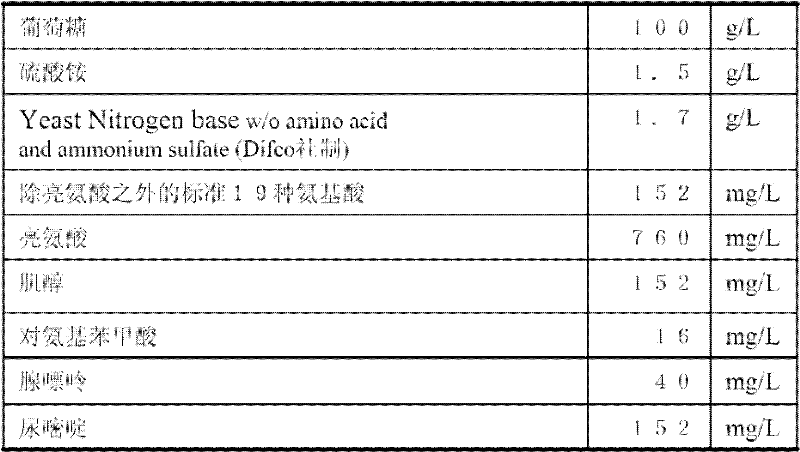
其结果是,D-乳酸的积累浓度在SW029-1B/pTRS205株中为13g/L,在SW029-1B/pTRS206株中为12g/L。另外,培养液中仅检测到D-乳酸,L-乳酸为检测限以下。可以确认,通过将从美洲鲎克隆的D-LDH基因导入酵母,从而该转化酵母产生D-乳酸。As a result, the accumulated concentration of D-lactic acid was 13 g/L in the SW029-1B/pTRS205 strain and 12 g/L in the SW029-1B/pTRS206 strain. In addition, only D-lactic acid was detected in the culture solution, and L-lactic acid was below the detection limit. It was confirmed that the transformed yeast produced D-lactic acid by introducing the D-LDH gene cloned from Limulus americana into yeast.
(实施例5)来源于美洲鲎的D-LDH基因向酵母染色体的导入(Example 5) Introduction of D-LDH gene derived from Limulus americana into yeast chromosome
通过以下步骤1~3来制作包含来源于美洲鲎的D-LDH基因的同源重组用DNA构建体。A DNA construct for homologous recombination containing the D-LDH gene derived from Limulus americana was prepared by the following steps 1 to 3.
[步骤1][step 1]
以实施例2所得的保持Lp.D-LDH1基因的pTRS205和保持Lp.D-LDH2基因的pTRS206为模板,以序列号24和25记载的寡聚DNA、或者序列号26和25记载的寡聚DNA为引物组,通过PCR来扩增包含各D-LDH基因的约1.1kb的DNA片段。这里序列号24、26记载的寡聚DNA设计成添加与PDC1基因的上游65bp具有同源性的序列那样。Using the pTRS205 that maintains the Lp.D-LDH1 gene obtained in Example 2 and the pTRS206 that maintains the Lp.D-LDH2 gene as templates, the oligomeric DNA described in SEQ ID NO: 24 and 25, or the oligomeric DNA described in SEQ ID NO: 26 and 25 The DNA was a primer set, and a DNA fragment of about 1.1 kb including each D-LDH gene was amplified by PCR. The oligo DNAs described in SEQ ID NOs: 24 and 26 were designed so that a sequence having homology to the upstream 65 bp of the PDCl gene was added.
[步骤2][step 2]
接着,以质粒pRS424(GenBank Accession Number:U03453)为模板,以序列号27和28记载的寡聚DNA为引物组,通过PCR来扩增包含作为酵母选择标记的TRP1基因的约1.4kb的DNA片段。这里序列号28所记载的寡聚DNA被设计成添加有与PDC1基因的下游65bp具有同源性的序列那样。Next, using the plasmid pRS424 (GenBank Accession Number: U03453) as a template and the oligomeric DNA described in SEQ ID NO: 27 and 28 as a primer set, a DNA fragment of about 1.4 kb containing the TRP1 gene as a yeast selection marker was amplified by PCR . The oligo DNA described in SEQ ID NO: 28 was designed so that a sequence homologous to the downstream 65 bp of the PDCl gene was added.
[步骤3][Step 3]
将DNA片段用1%琼脂糖凝胶电泳分离,然后使用“QIA quick Gelextraction kit”(キアゲン株式会社制)进行纯化。将这里所得的包含D-LDH基因的1.1kb片段、包含TRP1基因的1.4kb片段分别混合,以混合物作为模板,以序列号24和28记载的寡聚DNA、或者序列号26和28记载的寡聚DNA作为引物组,通过PCR来扩增连接有各D-LDH基因、TDH3终止子和TRP1基因的约2.5kb的同源重组用DNA构建体。The DNA fragments were separated by 1% agarose gel electrophoresis, and then purified using "QIA quick Gelextraction kit" (manufactured by Keygen Co., Ltd.). The 1.1 kb fragment containing the D-LDH gene and the 1.4 kb fragment containing the TRP1 gene obtained here were respectively mixed, and using the mixture as a template, the oligo DNA described in SEQ ID NO: 24 and 28 or the oligo DNA described in SEQ ID NO: 26 and 28 were mixed. Using polyDNA as a primer set, an approximately 2.5 kb DNA construct for homologous recombination in which each of the D-LDH gene, TDH3 terminator, and TRP1 gene were ligated was amplified by PCR.
将如上所述制作的同源重组用DNA构建体,转化作为使酿酒酵母NBRC10505株(以下称为NBRC10505株)的赖氨酸营养缺陷型恢复而得的菌株的酿酒酵母SW092-2D株(以下称为SW092-2D株)。The DNA construct for homologous recombination produced as described above was transformed into Saccharomyces cerevisiae SW092-2D strain (hereinafter referred to as Saccharomyces cerevisiae SW092-2D strain), which is a strain obtained by restoring the lysine auxotrophy of Saccharomyces cerevisiae NBRC10505 strain (hereinafter referred to as NBRC10505 strain). It is SW092-2D strain).
此外,SW092-2D株的制作法如下。以フナコシ株式会社制的酿酒酵母BY4741株的基因组DNA为模板,以寡核苷酸(序列号29,30)为引物组,通过PCR来扩增LYS2基因的前半约2kb的PCR片段。将上述PCR片段用1%琼脂糖凝胶电泳分离,按照常规方法纯化,然后对NBRC10505株进行转化操作,解除LYS2基因的琥珀型突变。通过在赖氨酸非添加培养基中培养,选择出赖氨酸合成能力恢复了的转化株(NBRC10505(LYS2)株)。如下确认转化株是解除了LYS2基因的琥珀型突变的酵母。首先,使所得的转化体与具有野生型的LYS2基因的酿酒酵母L0GY7株接合而获得2倍体细胞,使该2倍体细胞在子囊形成培养基中进行子囊形成。用显微操作器解剖子囊获得各个单倍体细胞(四分体),研究各个单倍体细胞的营养缺陷型。确认了取得的所有单倍体细胞都具有赖氨酸合成能力。使所得的NBRC10505(LYS2)株和NBRC10506株接合,用显微操作器进行子囊解剖,从而获得SW092-2D(基因型:MATa ura3 leu2 trp1 his3 ade2 LYS2)株。In addition, the production method of the SW092-2D strain is as follows. A PCR fragment of about 2 kb in the first half of the LYS2 gene was amplified by PCR using genomic DNA of S. cerevisiae strain BY4741 produced by Funakoshi Co., Ltd. as a template and oligonucleotides (SEQ ID NO: 29, 30) as a primer set. The above PCR fragments were separated by 1% agarose gel electrophoresis, purified according to conventional methods, and then the NBRC10505 strain was transformed to remove the amber mutation of the LYS2 gene. A transformant (NBRC10505 (LYS2) strain) with restored lysine synthesis ability was selected by culturing in a lysine-free medium. The transformant was confirmed as follows to be a yeast in which the amber mutation of the LYS2 gene was eliminated. First, the obtained transformant was mated with Saccharomyces cerevisiae LOGY7 strain having the wild-type LYS2 gene to obtain diploid cells, and the diploid cells were subjected to ascus formation in an ascus formation medium. Each haploid cell (tetrad) was obtained by dissecting the ascus with a micromanipulator, and the auxotrophy of each haploid cell was studied. It was confirmed that all the haploid cells obtained had the ability to synthesize lysine. The obtained NBRC10505 (LYS2) strain and NBRC10506 strain were mated, and the ascus was dissected using a micromanipulator to obtain a SW092-2D (genotype: MATa ura3 leu2 trp1 his3 ade2 LYS2) strain.
使用上述同源重组用DNA构建体转化SW092-2D株,在色氨酸非添加的培养基中进行培养,从而筛选转化酵母。将这样获得的转化酵母作为SW092-2D(Δpdc1::Lp.D-LDH1-TRP1)株和SW092-2D(Δpdc1::Lp.D-DLH2-TRP1)株。The SW092-2D strain was transformed with the above-mentioned DNA construct for homologous recombination, and cultured in a medium not supplemented with tryptophan to select transformed yeast. The transformed yeast thus obtained were designated as SW092-2D (Δpdc1::Lp.D-LDH1-TRP1) strain and SW092-2D (Δpdc1::Lp.D-DLH2-TRP1) strain.
(实施例6)D-乳酸生产性试验2(Example 6) D-lactic acid productivity test 2
使用实施例5所制作的SW092-2D(Δpdc1::Lp.D-LDH1-TRP1)株、SW092-2D(Δpdc1::Lp.D-LDH2-TRP1)株,使用微型发酵罐(丸菱バイオエンジ株式会社制,5L)进行发酵评价。Using the SW092-2D (Δpdc1::Lp.D-LDH1-TRP1) strain and SW092-2D (Δpdc1::Lp.D-LDH2-TRP1) strain produced in Example 5, a microfermenter (Maruhishi Bioengineering) was used Co., Ltd., 5 L) for fermentation evaluation.
在试管中取表1所示的SC3培养基10mL,在其中接种少量的各菌株,在30℃培养一夜(前前培养)。接着,在加入了45mL的SC3培养基的三角烧瓶中加入前前培养液5mL,在30℃进一步培养8小时(前培养)。在加入了1L的SC3培养基的微型发酵罐中接种前培养液的总量,培养30小时。培养条件在以下显示。10 mL of the SC3 medium shown in Table 1 was taken in a test tube, a small amount of each strain was inoculated therein, and cultured at 30° C. overnight (pre-pre-culture). Next, 5 mL of the pre-proculture solution was added to the Erlenmeyer flask containing 45 mL of the SC3 medium, and further cultured at 30° C. for 8 hours (pre-culture). The total amount of the culture solution before inoculation was added to a microfermenter added with 1 L of SC3 medium, and cultured for 30 hours. The culture conditions are shown below.
pH值:pH值5pH:
通气:100mL/分钟Ventilation: 100mL/min
搅拌:120转/分钟Stirring: 120 rpm
中和剂:1N氢氧化钠。Neutralizer: 1N sodium hydroxide.
用“グルコ一ステストワコ一C”(注册商标)(和光纯药株式会社制)测定培养结束时的培养液量和培养液中的D-乳酸浓度和葡萄糖浓度,由该乳酸、和由葡萄糖浓度计算出的加入葡萄糖,求算出乳酸对糖收率。其结果可以确认,SW092-2D(Δpdc1::Lp.D-LDH1-TRP1)以对糖收率45%生产D-乳酸,SW092-2D(Δpdc1::Lp.D-LDH2-TRP1)以对糖收率42%生产D-乳酸。The amount of the culture solution at the end of the culture and the D-lactic acid concentration and the glucose concentration in the culture solution were measured with "Glucos Test Wako C" (registered trademark) (manufactured by Wako Pure Chemical Industries, Ltd.), and calculated from the lactic acid and the glucose concentration. Glucose is added to the obtained one, and the yield of lactic acid to sugar is calculated. As a result, it was confirmed that SW092-2D (Δpdc1::Lp.D-LDH1-TRP1) produced D-lactic acid with a sugar yield of 45%, and SW092-2D (Δpdc1::Lp.D-LDH2-TRP1) produced sugar with a yield of 45%. D-lactic acid was produced in a yield of 42%.
(比较例1)来源于乳酸菌的D-LDH基因的克隆、发酵评价(Comparative Example 1) Cloning and fermentation evaluation of D-LDH gene derived from lactic acid bacteria
作为能够在转化酵母中高效地发酵生产D-乳酸的D-LDH基因,来源于肠膜明串珠菌(Leuconostoc mesenteroides)ATCC9135株的D-LDH基因是公知的(参照WO2004/104202),通过克隆该D-LDH基因(以下称为Lm.D-LDH基因)导入酵母并发酵,从而进行与来源于美洲鲎的Lp.D-LDH1基因或Lp.D-LDH2基因的D-LDH活性的比较研究。The D-LDH gene derived from Leuconostoc mesenteroides ATCC9135 strain is known as a D-LDH gene capable of highly fermentatively producing D-lactic acid in transformed yeast (see WO2004/104202). By cloning the The D-LDH gene (hereinafter referred to as Lm.D-LDH gene) was introduced into yeast and fermented to conduct a comparative study of D-LDH activity with the Lp.D-LDH1 gene or Lp.D-LDH2 gene derived from Limulus americana.
Lm.D-LDH基因的克隆,使用参考WO2004/104202所记载的碱基序列设计的引物组(序列号31、32),以ATCC9135株为模板,通过菌落PCR(使用东洋纺株式会社制“KOD-Plus-polymerase”)来进行。纯化PCR扩增片段,将末端用“T4多核苷酸激酶”(タカラバイオ株式会社制)磷酸化,然后与pUC118载体(用限制性酶HincII切割、将切割面进行脱磷酸化处理后的载体)连接。连接使用“DNA Ligation Kit Ver.2”(タカラバイオ株式会社制)来进行。用连接质粒产物转化大肠杆菌DH5α,回收质粒DNA,从而获得亚克隆有Lm.D-LDH基因的质粒。将插入有所得的Lm.D-LDH基因的pUC118质粒用限制性酶XhoI和NotI消化,将所得的各DNA片段插入到酵母表达用载体pTRS11的XhoI/NotI切割部位。这样获得Lm.D-LDH基因表达质粒pTRS207。To clone the Lm.D-LDH gene, use the primer set (SEQ ID NO: 31, 32) designed with reference to the nucleotide sequence described in WO2004/104202, and use the ATCC9135 strain as a template to perform colony PCR (using Toyobo Co., Ltd. "KOD -Plus-polymerase") to carry out. The PCR-amplified fragment was purified, and the terminus was phosphorylated with "T4 polynucleotide kinase" (manufactured by Takara Bio Co., Ltd.), and then combined with pUC118 vector (vector cut with restriction enzyme HincII and dephosphorylated the cleaved surface) connect. Ligation was performed using "DNA Ligation Kit Ver. 2" (manufactured by Takara Bio Co., Ltd.). Escherichia coli DH5α was transformed with the ligated plasmid product, and the plasmid DNA was recovered to obtain a plasmid subcloned with the Lm.D-LDH gene. The pUC118 plasmid into which the obtained Lm.D-LDH gene was inserted was digested with restriction enzymes XhoI and NotI, and each obtained DNA fragment was inserted into the XhoI/NotI cleavage site of the yeast expression vector pTRS11. Thus the Lm.D-LDH gene expression plasmid pTRS207 was obtained.
接着,以pTRS207为模板,使用序列号33所示的引物组代替序列号24或26所示的引物,除此之外,用与实施例5同样的方法将Lm.D-LDH基因导入酿酒酵母SW092-2D株的染色体中的PDC1基因座。将制作的转化酵母作为SW092-2D(Δpdc1::Lm.D-LDH-TRP1)。接着,用与实施例6同样的方法,进行分批培养的D-乳酸生产性的评价。其结果是,SW092-2D(Δpdc1::Lm.D-LDH-TRP1)的对糖收率为38%。与实施例6的结果合并示于表2。Next, using pTRS207 as a template, using the primer set shown in SEQ ID NO: 33 instead of the primers shown in SEQ ID NO: 24 or 26, the same method as in Example 5 was used to introduce the Lm.D-LDH gene into Saccharomyces cerevisiae The PDC1 locus in the chromosome of the SW092-2D strain. The prepared transformed yeast was designated as SW092-2D (Δpdc1::Lm.D-LDH-TRP1). Next, in the same manner as in Example 6, evaluation of D-lactic acid productivity in batch culture was performed. As a result, the sugar yield of SW092-2D (Δpdc1::Lm.D-LDH-TRP1) was 38%. Combined with the result of Example 6, it is shown in Table 2.
[表2][Table 2]
(参考例1)来源于爪蟾的L-LDH基因导入酵母的制作(Reference Example 1) Production of Xenopus-derived L-LDH gene-introduced yeast
通过特开2008-029329号公报所记载的方法,制作将来源于爪蟾的L-LDH基因(X.L-LDH基因)导入PDC1基因座而得的酵母。此外,作为向染色体进行导入的酵母,使用使NBRC10506株的腺嘌呤营养缺陷型恢复而得的菌株(SU013-1D株)。以下显示SU013-1D株的制成方法。以质粒pRS422为模板,以寡核苷酸(序列号34,35)为引物组,通过PCR来扩增ADE2基因的PCR片段约2kb。将上述PCR片段通过1%琼脂糖凝胶电泳分离,按照常规方法纯化,然后进行转化操作,解除ADE2基因的突变。通过用腺嘌呤非添加培养基进行培养,来选择出腺嘌呤合成能力恢复了的转化株。Yeast in which the L-LDH gene (X.L-LDH gene) derived from Xenopus laevis was introduced into the PDC1 locus was prepared by the method described in JP-A-2008-029329. In addition, a strain obtained by restoring the adenine auxotrophy of the NBRC10506 strain (SU013-1D strain) was used as the yeast to be introduced into the chromosome. The preparation method of the SU013-1D strain is shown below. Using plasmid pRS422 as a template and oligonucleotides (SEQ ID NO: 34, 35) as a primer set, the PCR fragment of about 2 kb of ADE2 gene was amplified by PCR. The above PCR fragments were separated by 1% agarose gel electrophoresis, purified according to conventional methods, and then transformed to remove the mutation of the ADE2 gene. A transformant whose adenine synthesis ability was restored was selected by culturing in an adenine-free medium.
如下确认如上所述获得的转化株是解除了AED2基因的突变的酵母。首先,使所得的转化体与带有野生型的ADE2基因的酿酒酵母L0GY77株接合而获得2倍体细胞。使该2倍体细胞在子囊形成培养基中进行子囊形成。用显微操作器解剖子囊而取得各个单倍体细胞(四分体),研究各个单倍体细胞的营养缺陷型。确认了取得的全部单倍体细胞都具有腺嘌呤合成能力。使所得的NBRC10506(ADE2)株与NBRC10505株接合,通过用显微操作器进行子囊解剖来获得SU013-1D株(基因型:MATαura3 leu2 trp1his3 ADE2 lys2)。将所得的转化酵母作为SU013-1D(Δpdc1::X.L-LDH-TRP1)株。The transformed strain obtained as described above was confirmed to be a yeast in which the mutation of the AED2 gene was eliminated as follows. First, the obtained transformant was mated with Saccharomyces cerevisiae LOGY77 strain carrying the wild-type ADE2 gene to obtain diploid cells. The diploid cells were subjected to ascus formation in an ascus formation medium. Each haploid cell (tetrad) was obtained by dissecting the ascus with a micromanipulator, and the auxotrophy of each haploid cell was studied. It was confirmed that all the obtained haploid cells have adenine synthesis ability. The resulting NBRC10506 (ADE2) strain was mated with the NBRC10505 strain, and the SU013-1D strain (genotype: MATαura3 leu2 trp1his3 ADE2 lys2) was obtained by ascus dissection using a micromanipulator. The obtained transformed yeast was designated as SU013-1D (Δpdc1::X.L-LDH-TRP1) strain.
(实施例7、比较例2)D-乳酸生产性试验3(Example 7, Comparative Example 2) D-lactic
使如参考例1那样制作的SU013-1D(Δpdc1::X.L-LDH-TRP1)株分别与实施例5和比较例1所制作的SW092-2D(Δpdc1::Lp.D-LDH1-TRP1)株、SW092-2D(Δpdc1::Lp.D-LDH2-TRP1)株和SW092-2D(Δpdc1::Lm.D-LDH-TRP1)株接合,制作在PDC1基因座杂合有L-LDH基因和D-LDH基因的2倍体酵母。将所制作的2倍体酵母分别作为Lp1-X株、Lp2-X株、Lm-X株。The SU013-1D (Δpdc1::X.L-LDH-TRP1) strain prepared as in Reference Example 1 was compared with the SW092-2D (Δpdc1::Lp.D-LDH1-TRP1) strain prepared in Example 5 and Comparative Example 1, respectively. , SW092-2D(Δpdc1::Lp.D-LDH2-TRP1) strain and SW092-2D(Δpdc1::Lm.D-LDH-TRP1) strain were mated, and the L-LDH gene and D - Diploid yeast for the LDH gene. The prepared diploid yeasts were designated as Lp1-X strain, Lp2-X strain, and Lm-X strain, respectively.
接着,将Lp1-X株、Lp2-X株、Lm-X株在与实施例5同样的条件下进行分批培养,评价所生产的乳酸的光学纯度(表3)。Next, Lp1-X strain, Lp2-X strain, and Lm-X strain were cultured in batches under the same conditions as in Example 5, and the optical purity of the produced lactic acid was evaluated (Table 3).
[表3][table 3]
其结果是,具有来源于美洲鲎的D-LDH基因的酵母以光学纯度50%以上产生D-乳酸,与此相对,由具有来源于肠膜明串珠菌的D-LDH基因的酵母产生的D-乳酸的光学纯度为44.4%。由于认为各酵母所生产的D-乳酸的对糖收率和D-乳酸的光学纯度与D-LDH基因转化酵母内的D-LDH活性成比例,因而由表2和表3的结果可以确认,与来源于肠膜明串珠菌的D-LDH基因相比,来源于美洲鲎的D-LDH基因在导入酵母的情况下编码更高活性的多肽。As a result, the yeast having the D-LDH gene derived from Limulus americana produced D-lactic acid with an optical purity of 50% or more, while the D-lactic acid produced by the yeast having the D-LDH gene derived from Leuconostoc enterococci - Lactic acid has an optical purity of 44.4%. Since it is considered that the sugar yield of D-lactic acid produced by each yeast and the optical purity of D-lactic acid are proportional to the D-LDH activity in the D-LDH gene-transformed yeast, it can be confirmed from the results of Table 2 and Table 3 that, Compared with the D-LDH gene derived from Leuconostoc enterococci, the D-LDH gene derived from Limulus americana encodes a polypeptide with higher activity when introduced into yeast.
(实施例8)向酵母染色体中的D-LDH基因的多拷贝导入和温度敏感性突变型PDC5酵母的制作(Example 8) Introduction of multiple copies of D-LDH gene into yeast chromosome and production of temperature-sensitive mutant PDC5 yeast
接着,为了进一步提高D-乳酸收率,研究了在PDC1基因座以外的基因座也导入了来源于美洲鲎的D-LDH基因的酵母的制作,导入到了特开2008-029329号公报中记载了导入效果的TDH3基因座和国际申请PCT/JP2008/072129中记载了导入效果的SED1基因座中。另外,还导入了特开2008-048726号公报所记载的温度敏感性突变型PDC5基因。Next, in order to further increase the yield of D-lactic acid, the production of yeast in which the D-LDH gene derived from Limulus americanus was also introduced into loci other than the PDC1 locus was studied, and the introduction was described in Japanese Unexamined Patent Publication No. 2008-029329 The TDH3 locus of the introduction effect and the SED1 locus of the introduction effect described in International Application PCT/JP2008/072129. In addition, the temperature-sensitive mutant PDC5 gene described in JP-A-2008-048726 was also introduced.
[向TDH3基因座的D-LDH基因导入][Introduction of D-LDH gene into TDH3 locus]
为了向TDH3基因座的导入,与特开2008-029329号公报所记载的pTRS150的制作方法同样地,制作将保持Lp.D-LDH1基因的pTRS205的TDH3终止子置换成ADH1终止子的质粒pTRS208。接着,使用序列号36所示的引物代替特开2008-029329号公报中的序列号8,以pTRS208为模板,获得了TDH3基因座导入用的同源重组用DNA构建体。For introduction into the TDH3 locus, plasmid pTRS208 in which the TDH3 terminator of pTRS205 holding the Lp.D-LDH1 gene was replaced with the ADH1 terminator was prepared in the same manner as the preparation method of pTRS150 described in JP-A-2008-029329. Next, using the primer shown in SEQ ID NO: 36 instead of SEQ ID NO: 8 in JP-A-2008-029329, a DNA construct for homologous recombination for introducing the TDH3 locus was obtained using pTRS208 as a template.
作为导入上述同源重组用DNA构建体的酵母,使用SU013-1D株的亮氨酸非缺陷型株(SW087-2C株)。以下显示SW087-2C株的制成方法。以质粒pRS425为模板,以寡核苷酸(序列号37,38)为引物组,通过PCR来扩增LEU2基因的PCR片段约2kb。将上述PCR片段用1%琼脂糖凝胶电泳进行分离,按照常规方法纯化,然后进行SU013-1D株的转化操作,解除LEU2基因的突变。通过在亮氨酸非添加培养基中进行培养,来选择出亮氨酸合成能力恢复了的转化株。如下确认这样获得的转化株是解除了LEU2基因的突变的酵母。首先,使所得的转化体与带有野生型的LEU2基因的酿酒酵母L0GY77株接合获得2倍体细胞。使该2倍体细胞在子囊形成培养基中进行子囊形成。用显微操作器解剖子囊取得各个单倍体细胞(四分体),研究各个单倍体细胞的营养缺陷型。确认了所取得的全部单倍体细胞都具有亮氨酸合成能力。使所得的SU013-1D(LEU2)株与NBRC10505株接合,通过利用显微操作器的子囊解剖来获得SW087-2C株(基因型:MATαura3 LEU2 trp1 his3 ADE2 lys2)。As the yeast into which the DNA construct for homologous recombination was introduced, a leucine-non-deficient strain of the SU013-1D strain (SW087-2C strain) was used. The preparation method of SW087-2C strain is shown below. Using plasmid pRS425 as a template and oligonucleotides (SEQ ID NO: 37, 38) as a primer set, the PCR fragment of about 2 kb of LEU2 gene was amplified by PCR. The above PCR fragments were separated by 1% agarose gel electrophoresis, purified according to conventional methods, and then transformed into the SU013-1D strain to remove the mutation of the LEU2 gene. Transformants whose leucine synthesis ability was restored were selected by culturing in a leucine-free medium. The transformed strain thus obtained was confirmed to be a yeast in which the mutation of the LEU2 gene was eliminated as follows. First, the obtained transformant was mated with Saccharomyces cerevisiae LOGY77 strain carrying the wild-type LEU2 gene to obtain diploid cells. The diploid cells were subjected to ascus formation in an ascus formation medium. Each haploid cell (tetrad) was obtained by dissecting the ascus with a micromanipulator, and the auxotrophy of each haploid cell was studied. It was confirmed that all the obtained haploid cells had the ability to synthesize leucine. The obtained SU013-1D (LEU2) strain was mated with the NBRC10505 strain, and the SW087-2C strain (genotype: MATαura3 LEU2 trp1 his3 ADE2 lys2) was obtained by ascus dissection using a micromanipulator.
使用上述同源重组用DNA构建体转化SW087-2C株,在尿嘧啶非添加培养基中进行选择,从而获得在TDH3基因座导入了Lp.D-LDH1基因的转化酵母。将所得转化酵母作为SW087-2C(ΔTDH3::Lp.D-LDH-URA3)株。The SW087-2C strain was transformed with the above-mentioned DNA construct for homologous recombination, and selection was performed in a uracil-free medium to obtain a transformed yeast in which the Lp.D-LDH1 gene was introduced into the TDH3 locus. The obtained transformed yeast was designated as SW087-2C (ΔTDH3::Lp.D-LDH-URA3) strain.
[向SED1基因座的D-LDH基因导入][Introduction of D-LDH gene into SED1 locus]
向SED1基因座的导入法是改变国际申请PCT/JP2008/072129的实施例2所记载的方法来进行的。即,作为PCR的模板,使用pTRS205代替pTRS102,另外使用序列号39所示的引物代替上述公报中的序列号14,扩增SED1基因座导入用的同源重组用DNA构建体。The method of introduction into the SED1 locus was carried out by modifying the method described in Example 2 of International Application PCT/JP2008/072129. That is, pTRS205 was used instead of pTRS102 as a template for PCR, and the primer shown in SEQ ID NO: 39 was used instead of SEQ ID NO: 14 in the above publication to amplify a DNA construct for homologous recombination for introducing the SED1 locus.
作为导入上述同源重组用DNA构建体的酵母,使用使实施例5所制作的NBRC10505(LYS2)株与参考例1所制作的NBRC10506(ADE2)株接合,通过利用显微操作器的子囊解剖分离而得的SW092-7D株(基因型:MATa ura3 leu2 trp1 his3 ADE2 LYS2)。As the yeast into which the DNA construct for homologous recombination was introduced, the NBRC10505 (LYS2) strain prepared in Example 5 was conjugated with the NBRC10506 (ADE2) strain prepared in Reference Example 1, and the ascus was dissected and isolated by a micromanipulator. The obtained SW092-7D strain (genotype: MATa ura3 leu2 trp1 his3 ADE2 LYS2).
使用上述同源重组用DNA构建体转化SW092-7D株,用组氨酸非添加培养基进行选择,从而获得在SED1基因座导入了Lp.D-LDH1基因的转化酵母。将所得的转化酵母作为SW092-7D(ΔSED1::Lp.D-LDH-HIS3)株。The SW092-7D strain was transformed with the above DNA construct for homologous recombination, and selected in a histidine-free medium to obtain a transformed yeast in which the Lp.D-LDH1 gene was introduced into the SED1 locus. The obtained transformed yeast was designated as SW092-7D (ΔSED1::Lp.D-LDH-HIS3) strain.
[温度敏感性突变型PDC5基因(pdc5ts-9)的导入][Introduction of temperature-sensitive mutant PDC5 gene (pdc5ts-9)]
作为导入有温度敏感性突变型PDC5基因的酵母,使用特开2008-048726号公报所记载的、带有温度敏感性突变型PDC5基因(pdc5ts-9)的酵母SW015株。使SW015株与SW087-2C株接合,通过利用显微操作器的子囊解剖来分离,从而获得SW095-4B株(基因型:MATα ura3 LEU2trp1 his3 ADE2 lys2 pdc5ts-9 Δpdc1::TRP1)。进一步使SW095-4B株与SW092-2D株接合,通过利用显微操作器的子囊解剖来分离,从而获得SW098-21B株(基因型:MATα ura3 LEU2 trp1 his3 ADE2 LYS2pdc5ts-9)。As the yeast into which the temperature-sensitive mutant PDC5 gene was introduced, the yeast SW015 strain carrying the temperature-sensitive mutant PDC5 gene (pdc5ts-9) described in JP-A-2008-048726 was used. The SW015 strain was mated with the SW087-2C strain and isolated by ascus dissection using a micromanipulator to obtain the SW095-4B strain (genotype: MATα ura3 LEU2trp1 his3 ADE2 lys2 pdc5ts-9 Δpdc1::TRP1). The SW095-4B strain was further mated with the SW092-2D strain, and isolated by ascus dissection using a micromanipulator to obtain the SW098-21B strain (genotype: MATα ura3 LEU2 trp1 his3 ADE2 LYS2pdc5ts-9).
[向PDC1、TDH3和SED1基因座的D-LDH基因导入、以及温度敏感性突变型PDC5基因(pdc5ts-9)的导入][Introduction of D-LDH gene into PDC1, TDH3, and SED1 loci, and introduction of temperature-sensitive mutant PDC5 gene (pdc5ts-9)]
使用所制作的SW092-2D(ΔPDC1::Lp.D-LDH1-TRP1)株、SW087-2C(ΔTDH3::Lp.D-LDH1-URA3)株、SW092-7D(ΔTDH3::Lp.D-LDH1-HIS3)和SW098-21B,重复2倍体接合、四分体,获得在PDC1、TDH3和SED1基因座具有Lp.D-LDH1基因、具有温度敏感性突变型PDC5(pdc5ts-9)、且在2倍体中不具有腺嘌呤、亮氨酸、赖氨酸的营养缺陷型的SU042株。图1显示SU042株的制作步骤。Using the prepared SW092-2D (ΔPDC1::Lp.D-LDH1-TRP1) strain, SW087-2C (ΔTDH3::Lp.D-LDH1-URA3) strain, SW092-7D (ΔTDH3::Lp.D-LDH1 -HIS3) and SW098-21B, repeated diploid conjugation, tetrad, obtained Lp.D-LDH1 gene at the PDC1, TDH3 and SED1 loci, temperature-sensitive mutant PDC5 (pdc5ts-9), and in An auxotrophic SU042 strain that does not have adenine, leucine, or lysine in diploid. Fig. 1 shows the production steps of the SU042 strain.
(实施例9)D-乳酸生产性的试验4(Example 9) D-lactic
使用如实施例8所制作的SU042株,进行分批培养的D-乳酸生产性的试验。培养基使用表1所示的SC3培养基或原料糖培养基(100g/L“优糖精”(ムソ一株式会社制)、1.5g/L硫酸铵)。首先,将SU042株在试管中用5mL的SC3培养基或原料糖培养基振荡培养一夜(前前培养)。将前前培养液接种到新鲜的SC3培养基或原料糖培养基50ml中,用500ml容量的坂口烧瓶振荡培养24小时(前培养)。在微型发酵罐(Able社制、2L)中加入1L的SC3培养基或原料糖培养基,进行温度调节(32℃)、pH值控制(pH值5、5N氢氧化钙),一边通气、搅拌(200mL/分钟,400转/分钟)一边进行培养。其结果是在SC3培养基中,培养在30小时结束,对糖收率为63%。另外,在原料糖培养基中,培养在50小时结束,对糖收率为70%。由该结果可以确认,通过Lp.D-LDH1基因向PDC1、TDH3、SED1基因座的导入和向PDC5基因的温度敏感性突变的导入,D-乳酸的发酵性能提高。Using the SU042 strain prepared in Example 8, a batch culture D-lactic acid productivity test was carried out. The SC3 medium shown in Table 1 or the raw sugar medium (100 g/L "Saccharin" (manufactured by Muso Co., Ltd.), 1.5 g/L ammonium sulfate) was used as the medium. First, the SU042 strain was shake-cultured overnight in a test tube with 5 mL of SC3 medium or raw sugar medium (pre-pre-culture). The pre-pre-culture solution was inoculated into 50 ml of fresh SC3 medium or raw sugar medium, and cultured with shaking in a 500-ml Sakaguchi flask for 24 hours (pre-culture). Add 1 L of SC3 medium or raw sugar medium to a microfermenter (manufactured by Able, 2 L), adjust the temperature (32°C), control the pH (
(实施例10)利用连续培养的D-乳酸生产性试验(Example 10) D-lactic acid productivity test using continuous culture
使用SU042株,进行使用WO2007/097260所记载的分离膜的连续培养的研究。培养基使用原料糖培养基(75g/L“优糖精”(ムソ一株式会社制)、1.5g/L硫酸铵)。下述显示培养条件。Using the SU042 strain, studies were conducted on continuous culture using the separation membrane described in WO2007/097260. As a medium, a sugar medium (75 g/L "Usaccharin" (manufactured by Muso Co., Ltd.), 1.5 g/L ammonium sulfate) was used as a raw material. The culture conditions are shown below.
发酵槽容量:2(L)Fermentation Tank Capacity: 2(L)
培养液容量:1.5(L)Culture medium capacity: 1.5(L)
使用分离膜:PVDF过滤膜(在WO2007/097260的参考例2中记载)Separation membrane used: PVDF filter membrane (described in Reference Example 2 of WO2007/097260)
膜分离构件有效过滤面积:120cm2 Effective filtration area of membrane separation member: 120cm 2
温度调节:32(℃)Temperature regulation: 32(℃)
发酵反应槽通气量:空气0.02(L/分钟)、氮气0.18(L/分钟)Fermentation reaction tank ventilation: air 0.02 (L/min), nitrogen 0.18 (L/min)
发酵反应槽搅拌速度:800(转/分钟)Stirring speed of fermentation reaction tank: 800 (rev/min)
pH值调节:用5N氢氧化钙调节成pH值5pH adjustment: adjust to
灭菌:包含分离膜构件的培养槽、和使用培养基经121℃、20分钟用高压釜进行高压蒸气灭菌。Sterilization: The culture tank including the separation membrane member and the culture medium used were subjected to high-pressure steam sterilization in an autoclave at 121° C. for 20 minutes.
首先,将SU042株在试管中用10mL的原料糖培养基以30℃振荡培养一夜(前前前培养)。将所得的培养液的总量接种到新鲜的原料糖培养基100ml中,用500ml容量的坂口烧瓶以24小时振荡培养30℃(前前培养)。将前前培养液接种到加入有1.5L的原料糖培养基的膜一体型的连续培养装置(WO2007/097260的图2所示的装置)中,从培养开始50小时起开始用ペリスタポンプ(泵)抽出培养液(200mL/小时),培养至400小时,测定作为生产物质的乳酸浓度和乳酸生产速度。图2显示结果。此外,连续培养中的乳酸生产速度使用以下式(1)计算出。First, the SU042 strain was shake-cultured overnight at 30° C. in a test tube with 10 mL of a raw sugar medium (pre-pre-culture). The total amount of the obtained culture solution was inoculated into 100 ml of a fresh raw sugar medium, and cultured with shaking at 30° C. for 24 hours in a 500 ml capacity Sakaguchi flask (pre-pre-culture). The pre-pre-culture solution was inoculated into a membrane-integrated continuous culture device (device shown in FIG. 2 of WO2007/097260) to which 1.5 L of raw sugar medium was added, and the perista pump (pump) was started 50 hours after the start of the culture. The culture solution was drawn out (200 mL/hour), cultured for 400 hours, and the concentration of lactic acid as a production substance and the production rate of lactic acid were measured. Figure 2 shows the results. In addition, the lactic acid production rate in continuous culture was calculated using the following formula (1).
乳酸生产速度(g/L·h)=抽出液中的生产物浓度(g/L)×发酵培养液抽出速度(L/小时)÷装置的运转液量(L)···(式1)。Lactic acid production rate (g/L·h) = product concentration in the extract (g/L) × extraction rate of fermentation culture solution (L/hour) ÷ operating liquid volume of the device (L)...(Formula 1) .
使用分离膜进行连续培养的结果可以确认,D-乳酸的对糖收率进一步提高到85%左右,另外,D-乳酸生产速度提高到7.5g/L·小时。As a result of continuous culture using a separation membrane, it was confirmed that the sugar yield of D-lactic acid was further increased to about 85%, and the production rate of D-lactic acid was increased to 7.5 g/L·hour.
(实施例11)向产朊假丝酵母的美洲鲎D-LDH的导入(Example 11) Introduction of Limulus americana D-LDH into Candida utilis
接着,使用作为Crabtree-阴性酵母的产朊假丝酵母进行D-乳酸的研究。Next, studies on D-lactic acid were performed using Candida utilis, which is a Crabtree-negative yeast.
(a)美洲鲎D-LDH基因导入用载体的制作(a) Preparation of vector for transducing D-LDH gene of Limulus americana
首先,进行用于在产朊假丝酵母染色体中的PDC1基因座导入来源于美洲鲎的D-LDH基因的载体构建。将产朊假丝酵母NBRC0988株(以下简称为NBRC0988)接种到YPD培养基(1%Bacto酵母提取物,2%Bacto蛋白胨、2%葡萄糖)中,在30℃培养一夜。按照常规方法从所得的菌体提取基因组DNA作为接下来的PCR的模板。首先,以序列号40、41的寡聚DNA作为引物组,扩增包含PDC1基因的终止子区域的片段。此外,DNA聚合酶使用KOD-plus-(东洋纺株式会社制)按照附带的方案进行,但不限于此。将所得的约1kb的片段用限制性酶BssHI切割,将其纯化之后,与同样地用限制性酶BssHI预先切割的pBluescriptIISK(+)连接。将所得的质粒作为pKS01。First, construction of a vector for introducing the D-LDH gene derived from Limulus americana into the PDC1 locus in the chromosome of Candida utilis was carried out. Candida utilis NBRC0988 strain (hereinafter referred to as NBRC0988) was inoculated into YPD medium (1% Bacto yeast extract, 2% Bacto peptone, 2% glucose), and cultured overnight at 30°C. Genomic DNA was extracted from the obtained bacterial cells according to a conventional method and used as a template for subsequent PCR. First, a fragment including the terminator region of the PDC1 gene was amplified using oligo DNA of SEQ ID NO: 40 or 41 as a primer set. In addition, DNA polymerase was performed using KOD-plus- (manufactured by Toyobo Co., Ltd.) according to the attached protocol, but not limited thereto. The resulting approximately 1 kb fragment was cleaved with the restriction enzyme BssHI, purified, and ligated with pBluescriptIISK(+) previously cleaved with the same restriction enzyme BssHI. The obtained plasmid was designated as pKS01.
接着,同样地以NBRC0988的基因组DNA为模板,以序列号42,43的寡聚DNA为引物组进行PCR,从而扩增包含PGK启动子的片段。将所得的约1kb的片段纯化用于接下来的实验。接着,以带有能够赋予对作为抗生素的一种的潮霉素B的耐性的基因的hph基因的质粒pLC1-hph为模板,以序列号44、45的寡聚DNA为引物组,通过PCR来扩增、纯化包含hph基因的片段,得到约1.1kb的片段。另外,以NBRC0988的基因组DNA为模板,以序列号46、47的寡聚DNA为引物组,通过PCR来扩增、纯化包含GAP终止子的片段,得到了约500bp的片段。Next, similarly, using the genomic DNA of NBRC0988 as a template and the oligomeric DNA of SEQ ID NO: 42, 43 as a primer set, PCR was performed to amplify a fragment containing the PGK promoter. The obtained fragment of about 1 kb was purified and used in the next experiment. Next, using the plasmid pLC1-hph carrying the hph gene, which is a gene capable of conferring resistance to hygromycin B, which is a kind of antibiotic, as a template, and using the oligo DNA of SEQ ID NO: 44, 45 as a primer set, PCR The fragment containing the hph gene was amplified and purified to obtain a fragment of about 1.1 kb. In addition, using the genomic DNA of NBRC0988 as a template and the oligo DNA of SEQ ID NO: 46 and 47 as a primer set, the fragment containing the GAP terminator was amplified and purified by PCR, and a fragment of about 500 bp was obtained.
将如上所述得到的包含PGK启动子的片段、包含hph基因的片段和包含GAP终止子的片段混合,以序列号48、49的寡聚DNA为引物组,通过PCR来扩增连接有PGK启动子、hph基因和GAP终止子的片段。将所得的约2.6kb的片段的末端磷酸化,然后与预先将pUC118用HincII切割而脱磷酸化的产物连接。将所得的质粒作为pKS02。Mix the fragments containing the PGK promoter, the fragments containing the hph gene, and the fragments containing the GAP terminator obtained as described above, and use the oligomeric DNA of sequence numbers 48 and 49 as a primer set to amplify the PGK promoter connected by PCR. sub, hph gene and fragments of the GAP terminator. The end of the obtained fragment of about 2.6 kb was phosphorylated, and then ligated to a product obtained by cutting and dephosphorylated pUC118 with HincII. The obtained plasmid was designated as pKS02.
接着,同样地以NBRC0988的基因组DNA为模板,以序列号50、51的寡聚DNA为引物组,通过PCR来扩增、纯化包含PGK终止子的片段,得到了约500bp的片段。另外,以如上所述得到的pKS02为模板,以序列号52、53的寡聚DNA为引物组,通过PCR来扩增、纯化连接有PGK启动子、hph基因和GAP终止子的片段,得到了约2.6kb的片段。Next, using the genomic DNA of NBRC0988 as a template and the oligo DNA of SEQ ID NO: 50 and 51 as a primer set, the fragment containing the PGK terminator was amplified and purified by PCR to obtain a fragment of about 500 bp. In addition, using the pKS02 obtained as described above as a template and the oligomeric DNA of SEQ ID NO: 52 and 53 as a primer set, the fragment linked with the PGK promoter, hph gene and GAP terminator was amplified and purified by PCR to obtain A fragment of approximately 2.6 kb.
将如上所述得到的包含PGK终止子的片段与连接有PGK启动子、hph基因和GAP终止子的片段混合,以序列号50、53的寡聚DNA为引物组,通过PCR来扩增连接有PGK终止子、PGK启动子、hph基因和GAP终止子的片段。将所得的约3kb的片段用限制性酶BamHI和ClaI切割,将其纯化之后,与同样地预先用限制性酶BamHI和ClaI切割的pKS02连接。将所得的质粒作为pKS03。Mix the fragment containing the PGK terminator obtained above with the fragment connected with the PGK promoter, hph gene and GAP terminator, and use the oligomeric DNA of
接着,同样地以NBRC0988的基因组DNA为模板,以序列号54、55的寡聚DNA为引物组,通过PCR来扩增、纯化包含PDC1启动子区域的片段,得到了约2.1kb的片段。另外,以实施例2所制作的pTRS205为模板,以序列号56、57的寡聚DNA为引物组,通过PCR来扩增、纯化包含来源于美洲鲎的D-LDH基因的片段,得到了约1kb的片段。Next, similarly using the genomic DNA of NBRC0988 as a template and the oligomeric DNA of SEQ ID NO: 54 and 55 as a primer set, the fragment containing the PDC1 promoter region was amplified and purified by PCR, and a fragment of about 2.1 kb was obtained. In addition, using the pTRS205 produced in Example 2 as a template, and using the oligomeric DNA of SEQ ID NO: 56 and 57 as a primer set, a fragment containing the D-LDH gene derived from Limulus americanus was amplified and purified by PCR, and about 1 kb fragments.
将如上所述获得的包含PDC1启动子区域的片段和包含来源于美洲鲎的D-LDH基因的片段混合,以序列号54、57的寡聚DNA为引物组,通过PCR来扩增连接有包含PDC1启动子区域的片段和包含来源于美洲鲎的D-LDH基因的片段的片段,将所得的约3.1kb的片段用限制性酶NotI和BglII切割,将其纯化之后,与预先用限制性酶NotI和BamHI切割了的pKS03连接。将所得的质粒作为pKS04。The fragment comprising the PDC1 promoter region obtained as described above was mixed with the fragment comprising the D-LDH gene derived from Limulus americanus, and the oligomeric DNA of sequence numbers 54 and 57 was used as a primer set to amplify by PCR a link comprising A fragment of the PDC1 promoter region and a fragment containing a fragment of the D-LDH gene derived from Limulus americanus, the obtained fragment of about 3.1 kb was cut with restriction enzymes NotI and BglII, after purification, it was mixed with the restriction enzyme Notl and BamHI cut pKS03 ligation. The obtained plasmid was designated as pKS04.
(b)美洲鲎D-LDH基因向PDC1基因座的导入(b) Introduction of the D-LDH gene of Limulus americanus into the PDC1 locus
将如上所述获得的pKS04用限制性酶BglII切割后的产物通过电穿孔法导入NBRC0988。在YPD培养基中接种少量的菌体,在30℃培养一夜。离心去掉上清之后,将菌体用灭菌水和1M山梨糖醇洗涤,最后使菌体悬浮在1M山梨糖醇中。接着,将菌体与用限制性酶BglII切割后的pKS04混合,在冰上放置5分钟之后,移至电穿孔用的杯,在电容(25μF)、电压(0.75kV)和电阻(800Ω)的条件下进行电穿孔。然后,移至加有1M山梨糖醇的YPD培养基中,在30℃培养4小时左右,涂布在添加了600μg/L的潮霉素B的YPD培养基上。从所得的潮霉素B耐性菌株提取基因组,以序列号54、57和序列号56、51的寡聚DNA为引物组,通过PCR来确认分别约3kb和2kb的片段的扩增,从而确认获得了在PDC1基因座导入了来源于美洲鲎的D-LDH基因的转化酵母。将所得的转化酵母作为CuLpLDH株。The pKS04 obtained above was cleaved with the restriction enzyme BglII and introduced into NBRC0988 by electroporation. A small amount of bacterial cells were inoculated in YPD medium, and cultured overnight at 30°C. After centrifuging to remove the supernatant, the bacterial cells were washed with sterilized water and 1M sorbitol, and finally the bacterial cells were suspended in 1M sorbitol. Next, the cells were mixed with pKS04 cleaved with the restriction enzyme BglII, placed on ice for 5 minutes, then transferred to a cuvette for electroporation, and tested under the conditions of capacitance (25 μF), voltage (0.75 kV) and resistance (800 Ω). Under the conditions of electroporation. Then, it was transferred to a YPD medium supplemented with 1 M sorbitol, cultured at 30° C. for about 4 hours, and spread on a YPD medium supplemented with 600 μg/L hygromycin B. The genome was extracted from the obtained hygromycin B-resistant strain, and the oligomeric DNA of SEQ ID NO: 54, 57 and SEQ ID NO: 56, 51 was used as a primer set to confirm the amplification of fragments of about 3 kb and 2 kb respectively by PCR, thereby confirming the obtained Transformed yeast into which the D-LDH gene derived from Limulus americana was introduced into the PDC1 locus was obtained. The obtained transformed yeast was designated as CuLpLDH strain.
(比较例2)向产朊假丝酵母的来源于乳酸菌的D-LDH的导入(Comparative Example 2) Introduction of D-LDH derived from lactic acid bacteria into Candida utilis
用与实施例11同样的方法导入来源于乳酸菌肠膜明串珠菌的D-LDH基因。此外,使用序列号58的寡聚DNA代替实施例11中的序列号55,另外代替实施例2的pTRS205以比较例1的pTRS207为模板,同时使用使用序列号59、60的寡聚DNA代替序列号56、57。将所得的质粒作为pKS05。The D-LDH gene derived from the lactic acid bacterium Leuconostoc enterolis was introduced in the same manner as in Example 11. In addition, the oligomeric DNA of sequence number 58 was used instead of sequence number 55 in Example 11, and the pTRS205 of example 2 was replaced with pTRS207 of comparative example 1 as a template, and the oligomeric DNA of
将如上所述获得的质粒用与实施例11同样的方法导入NBRC0988株中。将所得的在PDC1基因座导入了来源于乳酸菌肠膜明串珠菌的D-LDH基因的菌株作为CuLmLDH株。The plasmid obtained above was introduced into the NBRC0988 strain in the same manner as in Example 11. The obtained strain into which the D-LDH gene derived from the lactic acid bacterium Leuconostoc enterolis was introduced into the PDC1 locus was designated as CuLmLDH strain.
(实施例12、比较例3)产朊假丝酵母的D-乳酸生产性试验(Example 12, Comparative Example 3) D-lactic acid productivity test of Candida utilis
使用实施例11和比较例2所制作的CuLpLDH株、CuLmLDH株评价D-乳酸生产性。在500mL的坂口烧瓶中加入50mL的YPD培养基,在其中接种少量的CuLpLDH株和CuLmLDH株,在30℃振荡培养一夜(前培养)。将培养液进行收集菌体,用新鲜的YPD培养基洗涤,然后加入到添加有1L的YPD10培养基(含有10%葡萄糖)的微型发酵罐中进行培养。以下显示培养条件。The D-lactic acid productivity was evaluated using the CuLpLDH strain and the CuLmLDH strain prepared in Example 11 and Comparative Example 2. 50 mL of YPD medium was added to a 500 mL Sakaguchi flask, a small amount of CuLpLDH strain and CuLmLDH strain were inoculated therein, and cultured with shaking at 30° C. overnight (preculture). Bacteria were collected from the culture solution, washed with fresh YPD medium, and then added to a micro-fermenter supplemented with 1 L of YPD10 medium (containing 10% glucose) for cultivation. The culture conditions are shown below.
初期植菌量:接种至OD600=10Initial planting amount: inoculate to OD 600 =10
pH值:pH值6pH:
通气:100mL/分钟Ventilation: 100mL/min
搅拌:120转/分钟Stirring: 120 rpm
中和剂:1N氢氧化钙Neutralizer: 1N Calcium Hydroxide
培养温度:35℃。Culture temperature: 35°C.
培养进行40小时,分析40小时时刻的培养液的乳酸浓度、葡萄糖浓度。葡萄糖被消耗尽。另外,相对于每份消耗葡萄糖的生产性(对糖收率)和D-乳酸光学纯度如表4所示,可知在产朊假丝酵母中导入了D-LDH基因的酵母可以发酵生产D-乳酸,另外收率是导入了来源于美洲鲎的D-LDH基因的CuLpLDH株较高。The culture was carried out for 40 hours, and the concentration of lactic acid and the concentration of glucose in the culture solution at 40 hours were analyzed. Glucose is used up. In addition, the productivity (yield to sugar) and the optical purity of D-lactic acid are shown in Table 4 with respect to glucose consumed per fraction, and it can be seen that the yeast introduced with the D-LDH gene in Candida utilis can ferment and produce D-lactic acid. Lactic acid, and the yield was higher in the CuLpLDH strain into which the D-LDH gene derived from Limulus americana was introduced.
(实施例13、比较例4)产朊假丝酵母的D-乳酸生产性试验2(Example 13, Comparative Example 4) D-lactic acid productivity test 2 of Candida utilis
接着,使用CuLpLDH株、CuLmLDH株,以作为5单糖的木糖为糖源进行D-乳酸生产性的评价。在500mL的坂口烧瓶中加入50mL的YPD培养基,在其中接种少量的CuLpLDH株和CuLmLDH株,在30℃振荡培养一夜(前培养)。将培养液进行收集菌体,用新鲜的YPD培养基洗涤,然后加入到添加有1L的YPX10培养基(1%酵母提取物、2%Bacto蛋白胨、4%木糖)的微型发酵罐中进行培养。以下显示培养条件。Next, D-lactic acid productivity was evaluated using the CuLpLDH strain and the CuLmLDH strain, using xylose, which is a pentamonosaccharide, as a sugar source. 50 mL of YPD medium was added to a 500 mL Sakaguchi flask, a small amount of CuLpLDH strain and CuLmLDH strain were inoculated therein, and cultured with shaking at 30° C. overnight (preculture). Bacteria were collected from the culture solution, washed with fresh YPD medium, and then added to a micro-fermenter supplemented with 1L of YPX10 medium (1% yeast extract, 2% Bacto peptone, 4% xylose) for cultivation . The culture conditions are shown below.
初期植菌量:接种至OD600=10Initial planting amount: inoculate to OD 600 =10
pH值:pH值6pH:
通气:100mL/分钟Ventilation: 100mL/min
搅拌:120转/分钟Stirring: 120 rpm
中和剂:1N氢氧化钙Neutralizer: 1N Calcium Hydroxide
培养温度:30℃。Culture temperature: 30°C.
培养进行60小时,分析60小时时刻的培养液的乳酸浓度、木糖浓度。木糖被消耗尽。另外,相对于每份消耗木糖的生产性(对糖收率)和D-乳酸光学纯度如表4所示,可知在产朊假丝酵母导入有D-LDH基因的酵母可以以木糖为原料发酵生产D-乳酸,另外收率是导入了来源于美洲鲎的D-LDH基因的CuLpLDH株较高。The culture was carried out for 60 hours, and the lactic acid concentration and xylose concentration of the culture solution at 60 hours were analyzed. Xylose is used up. In addition, the productivity (to sugar yield) and the optical purity of D-lactic acid are shown in Table 4 with respect to the xylose consumption per share, and it can be seen that the yeast with the D-LDH gene introduced into Candida utilis can use xylose as the The raw material is fermented to produce D-lactic acid, and the yield is higher in the CuLpLDH strain introduced with the D-LDH gene derived from Limulus americana.
[表4][Table 4]
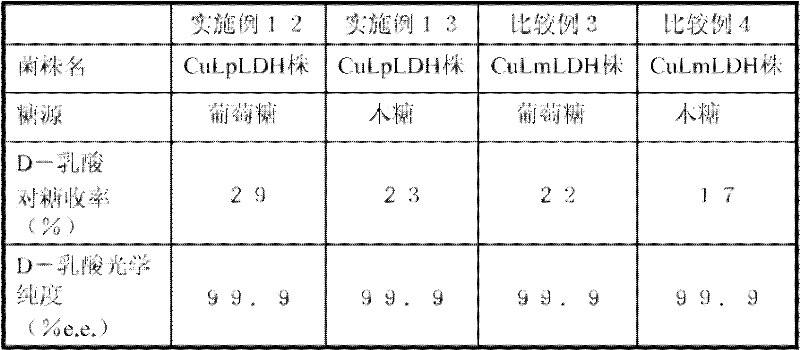
产业可利用性industry availability
通过本发明,可以以低成本稳定地生产D-乳酸,另外,所得的D-乳酸光学纯度高,优选作为聚合物原料使用。According to the present invention, D-lactic acid can be stably produced at low cost, and the obtained D-lactic acid has high optical purity and is preferably used as a polymer raw material.
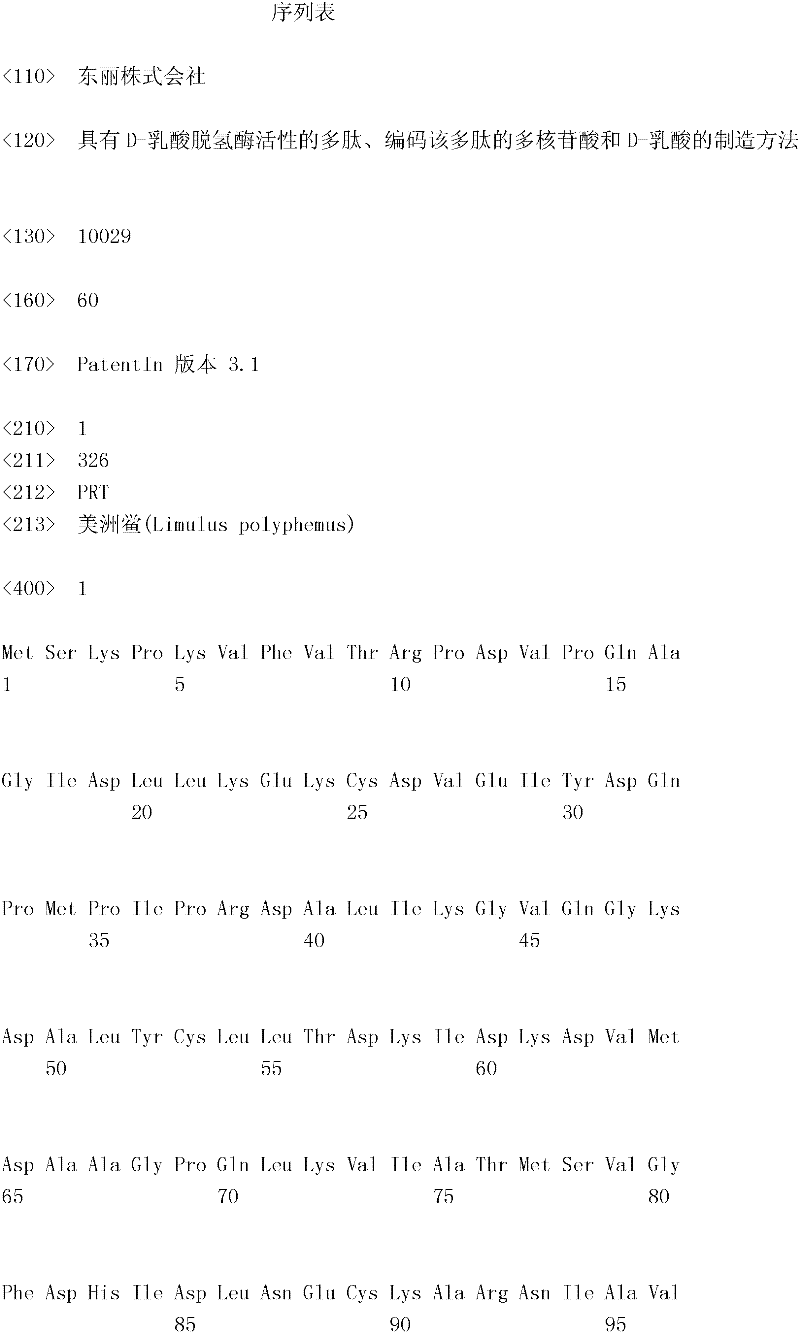

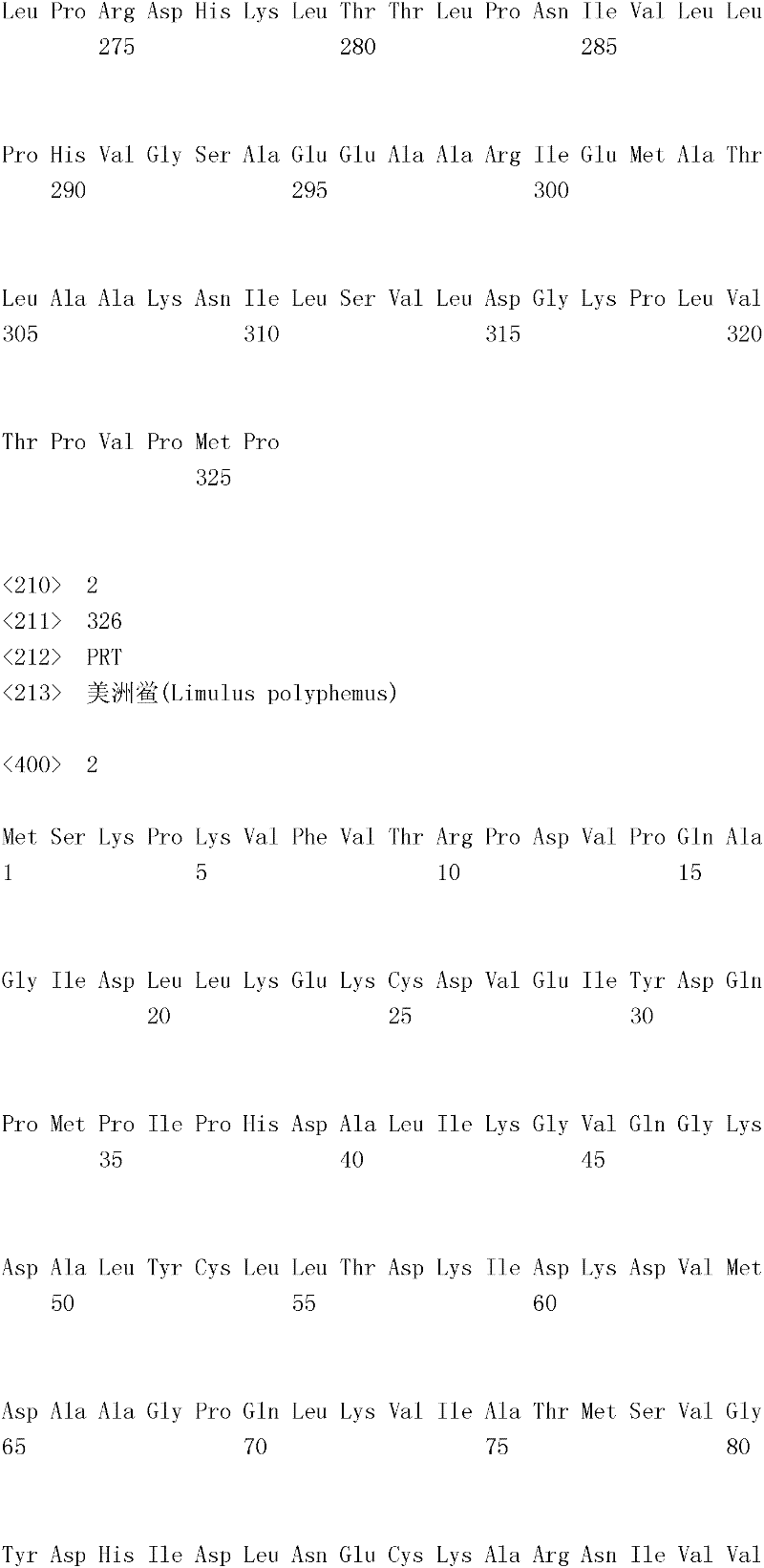
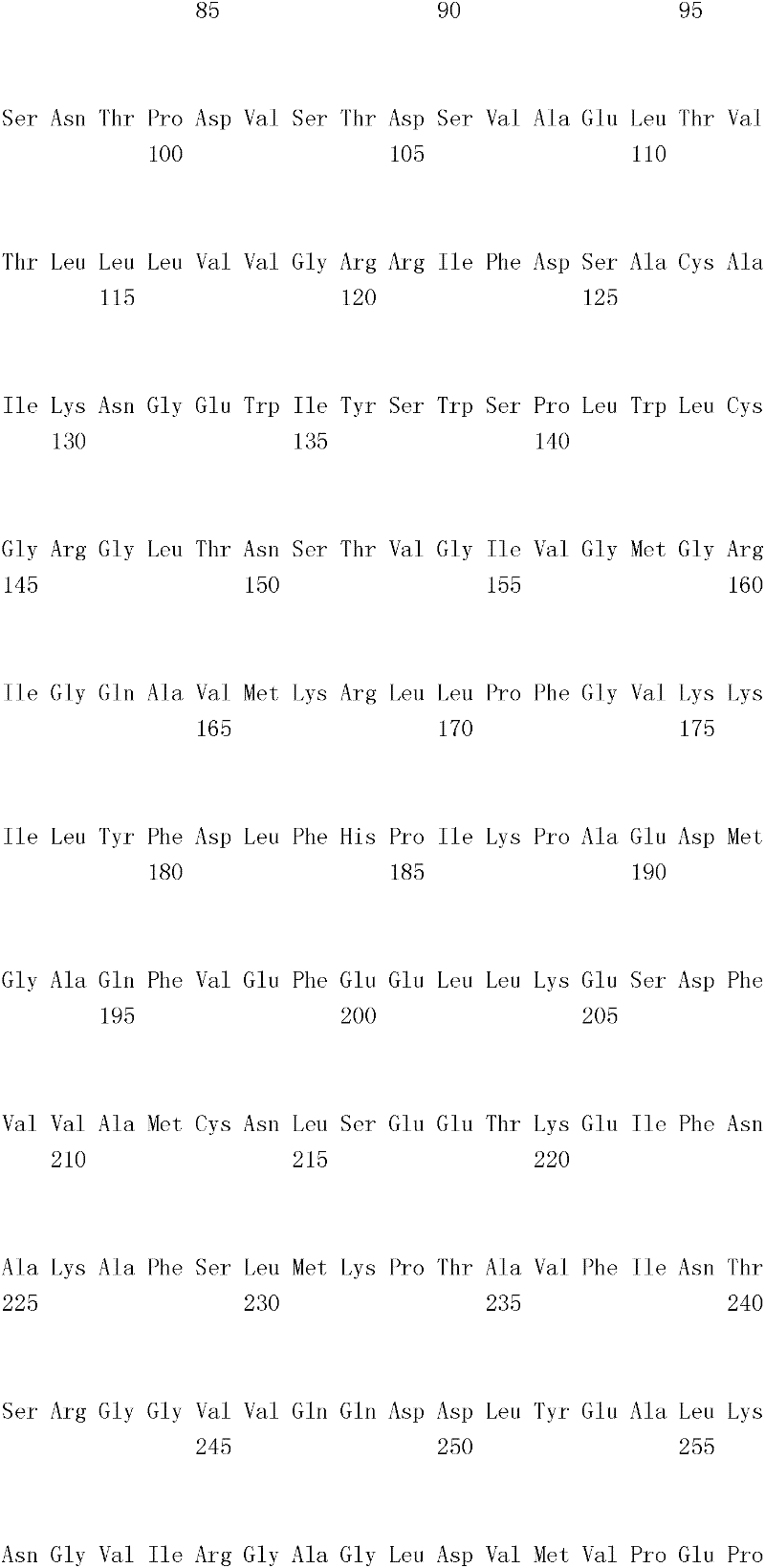

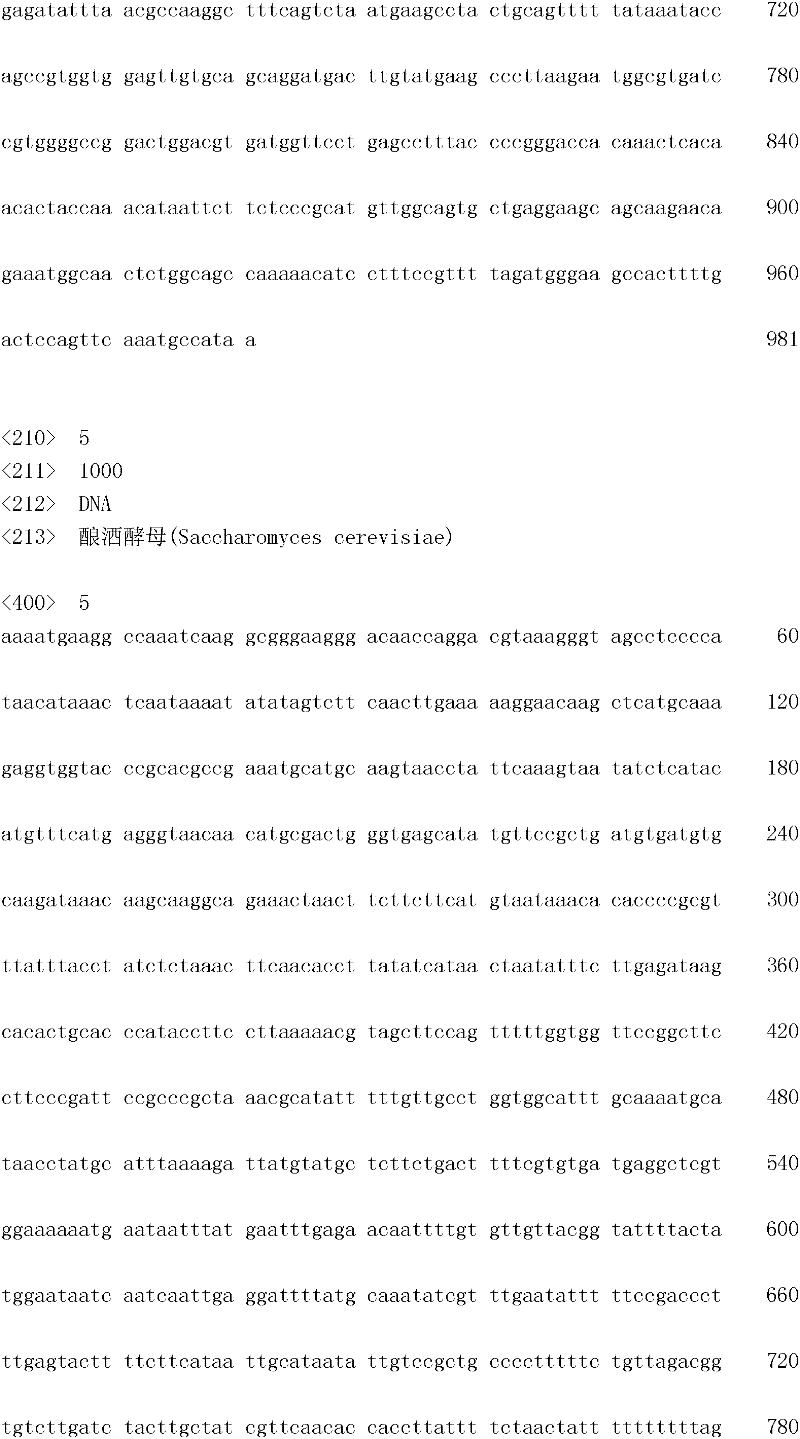
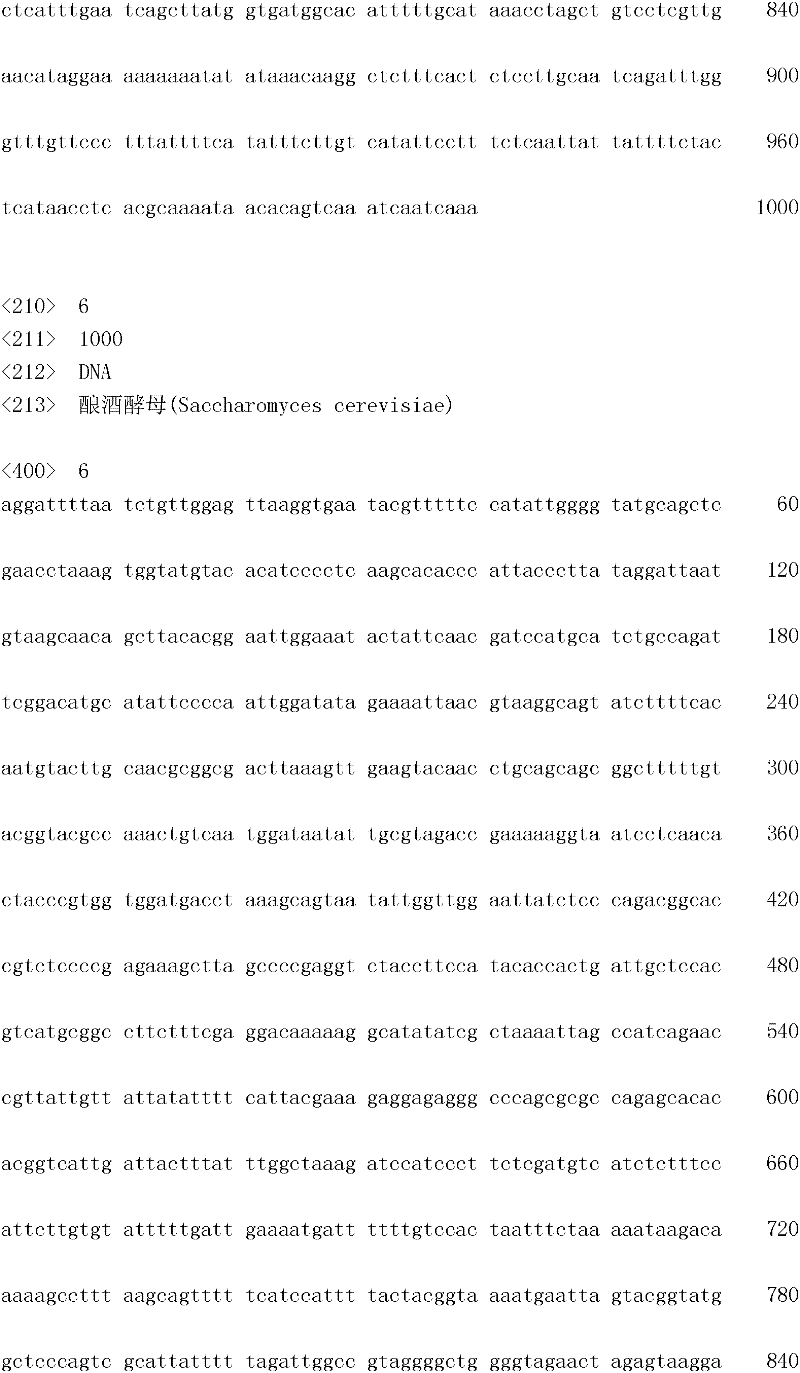
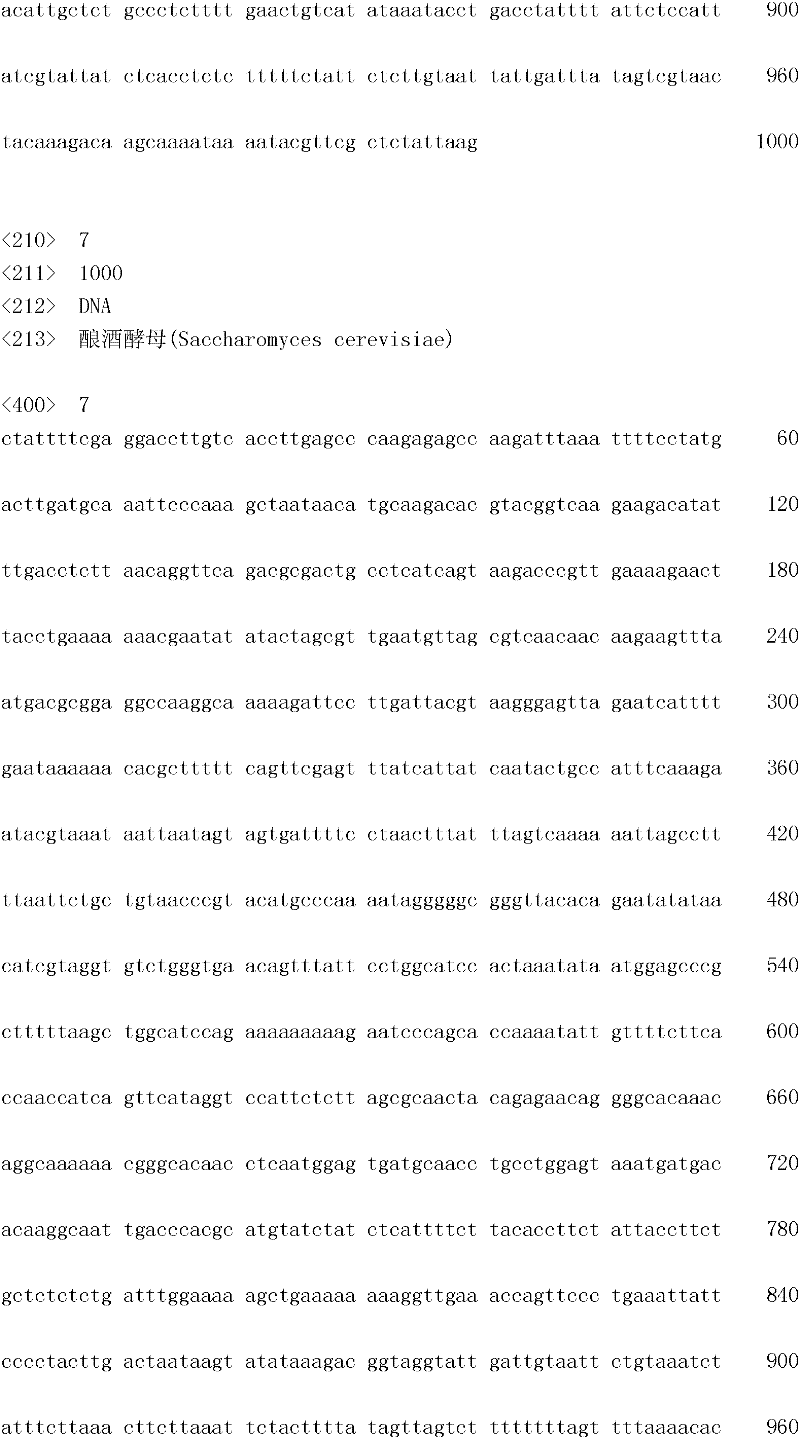

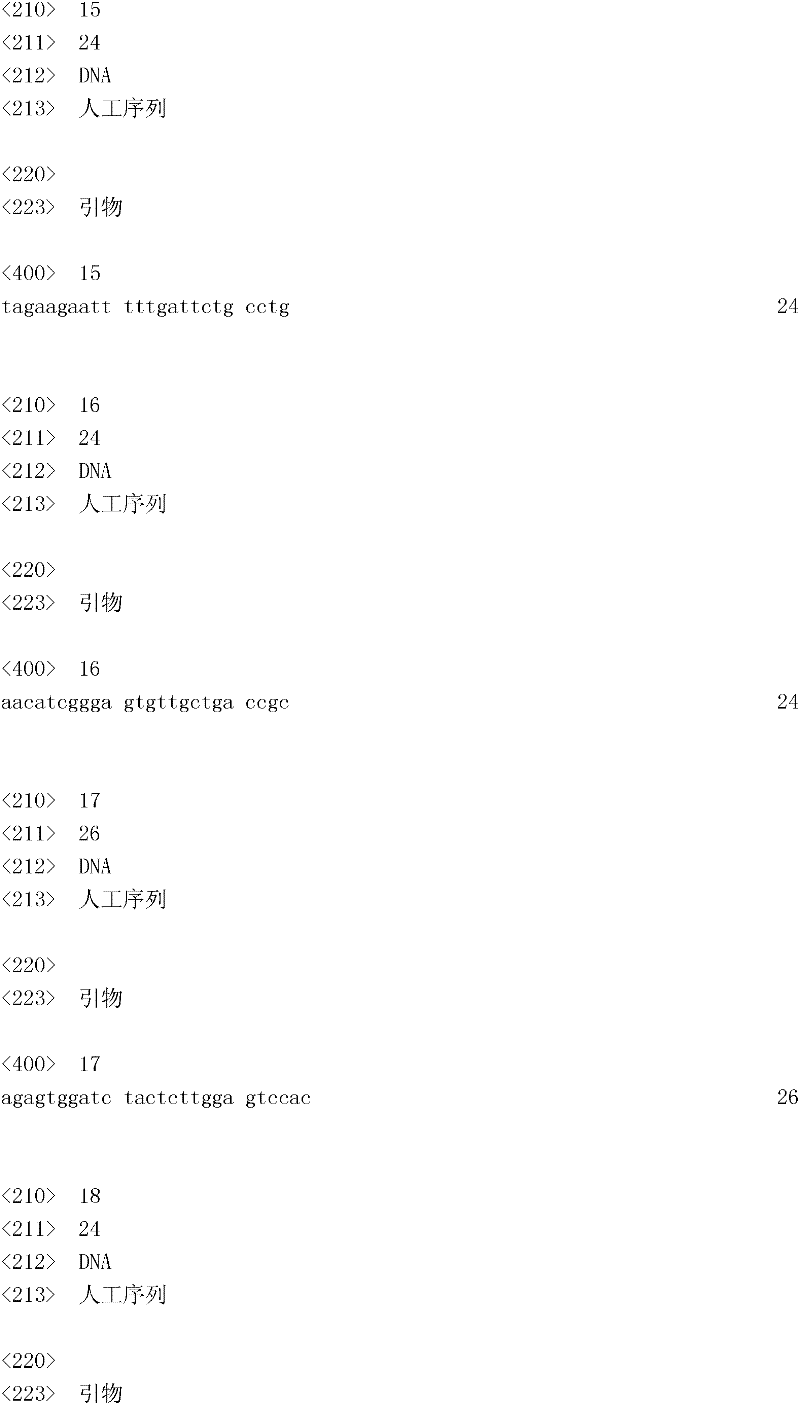
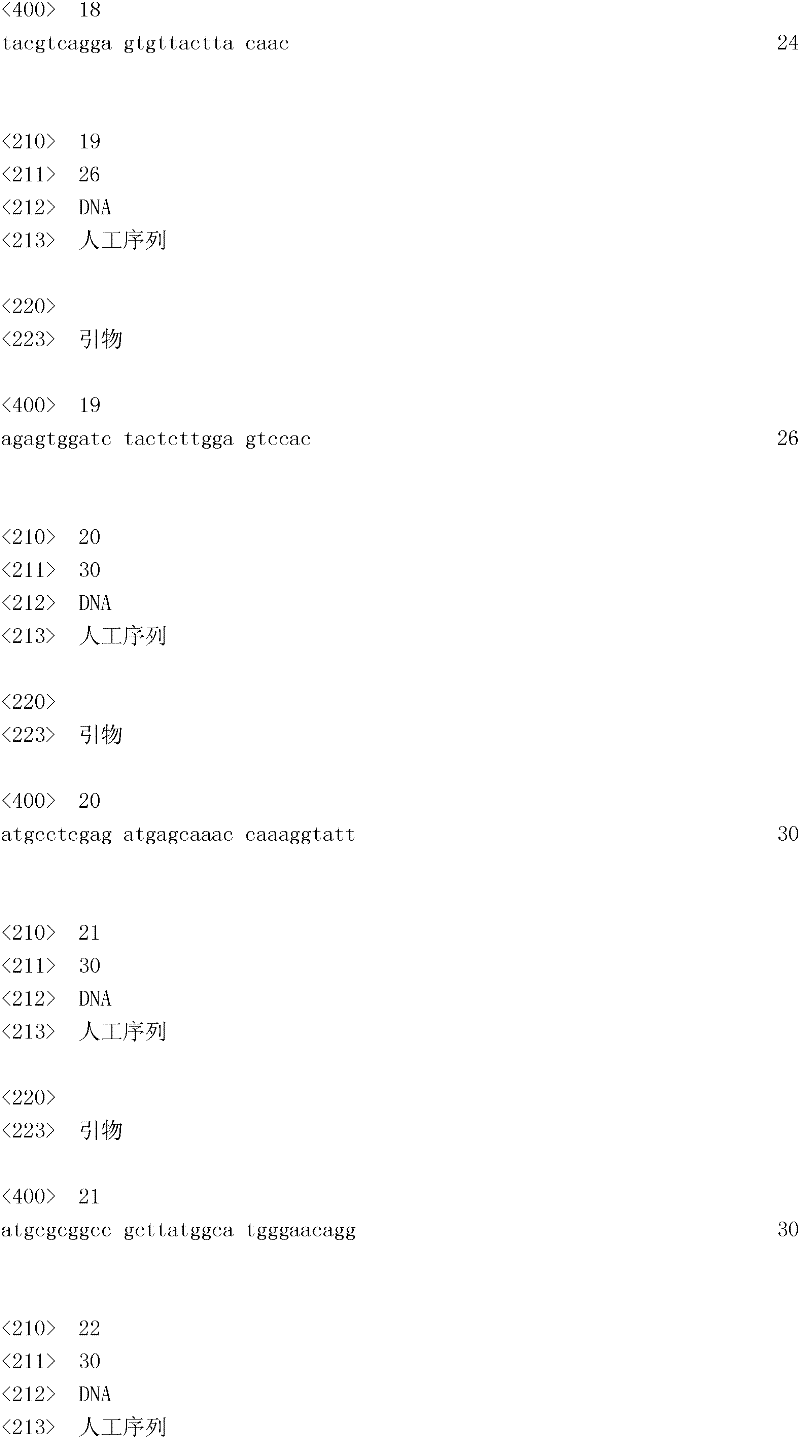
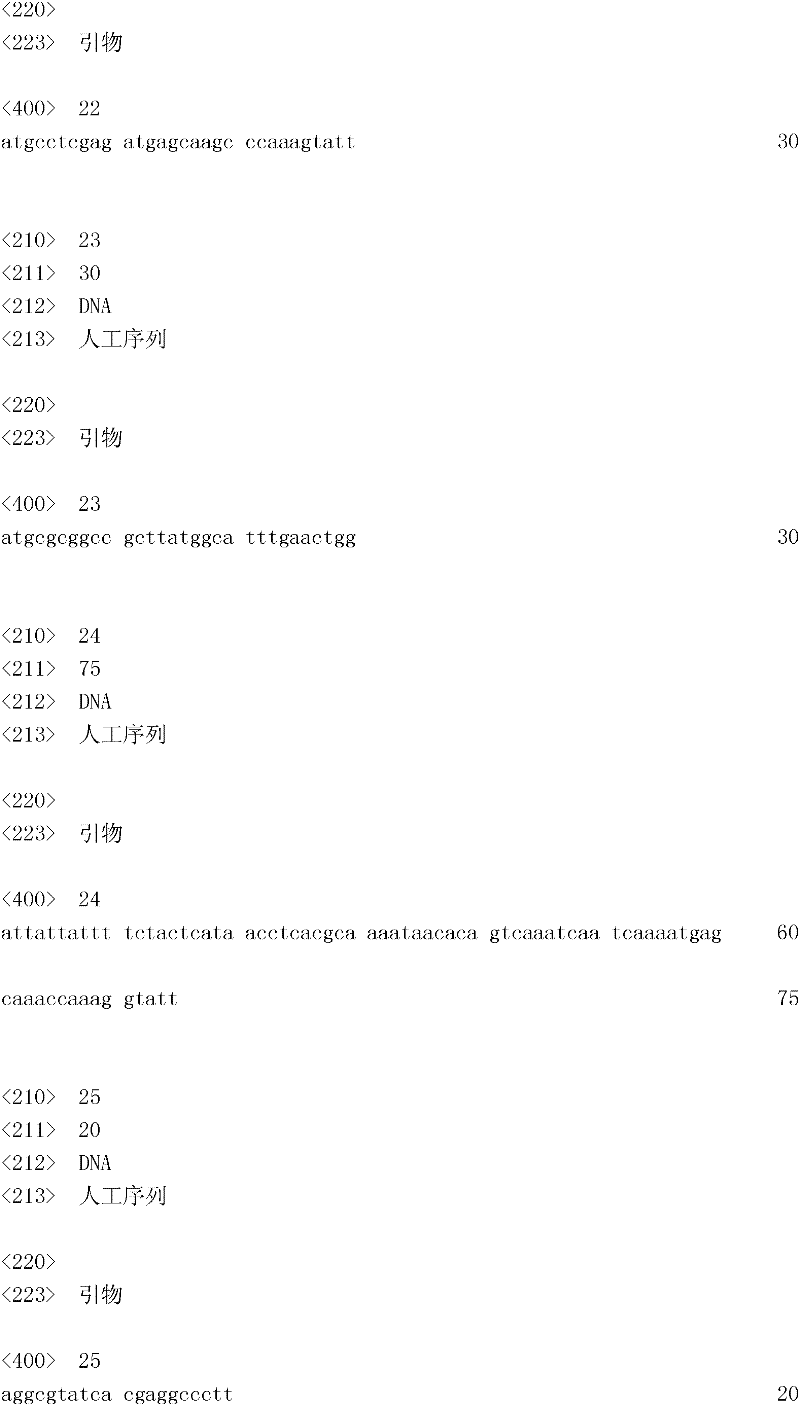


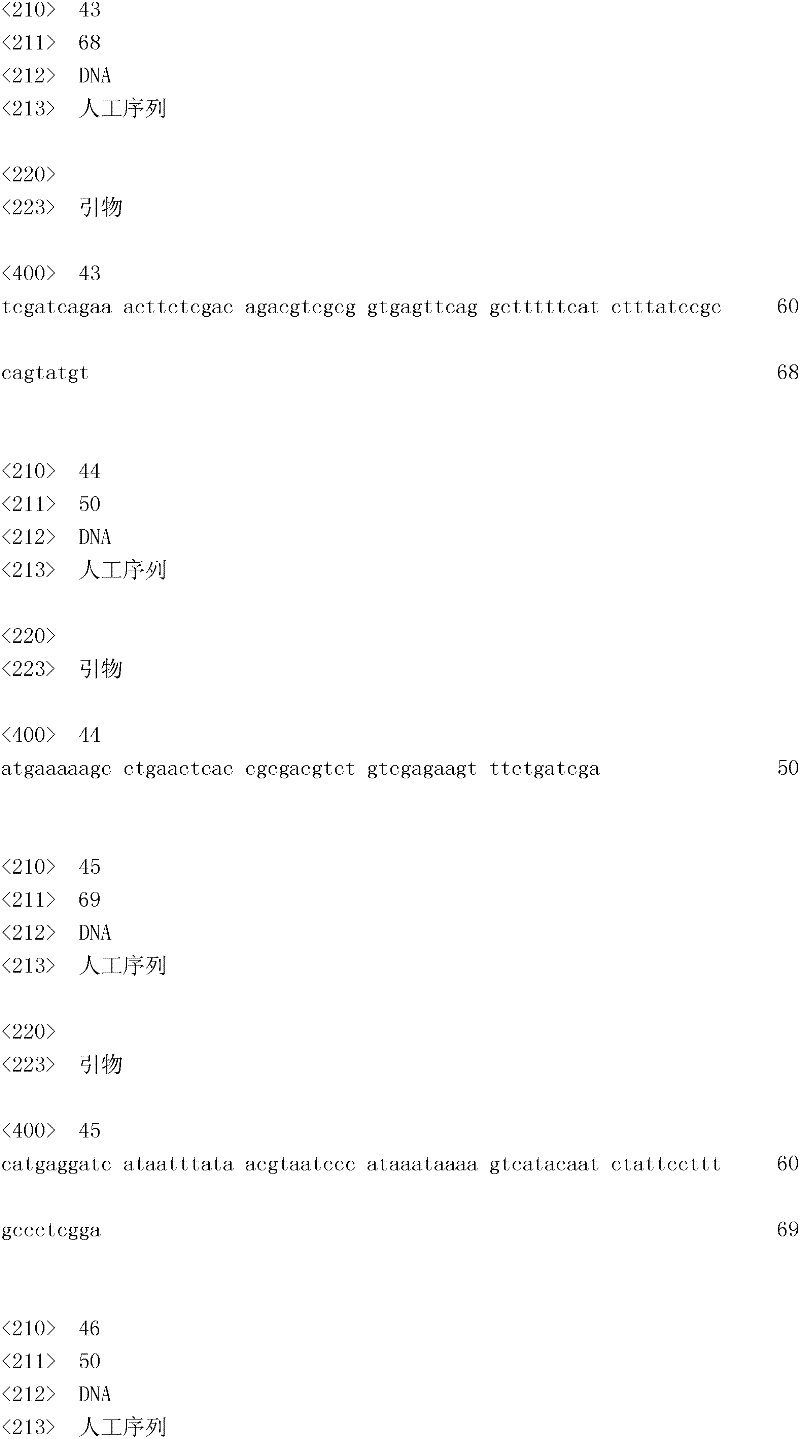


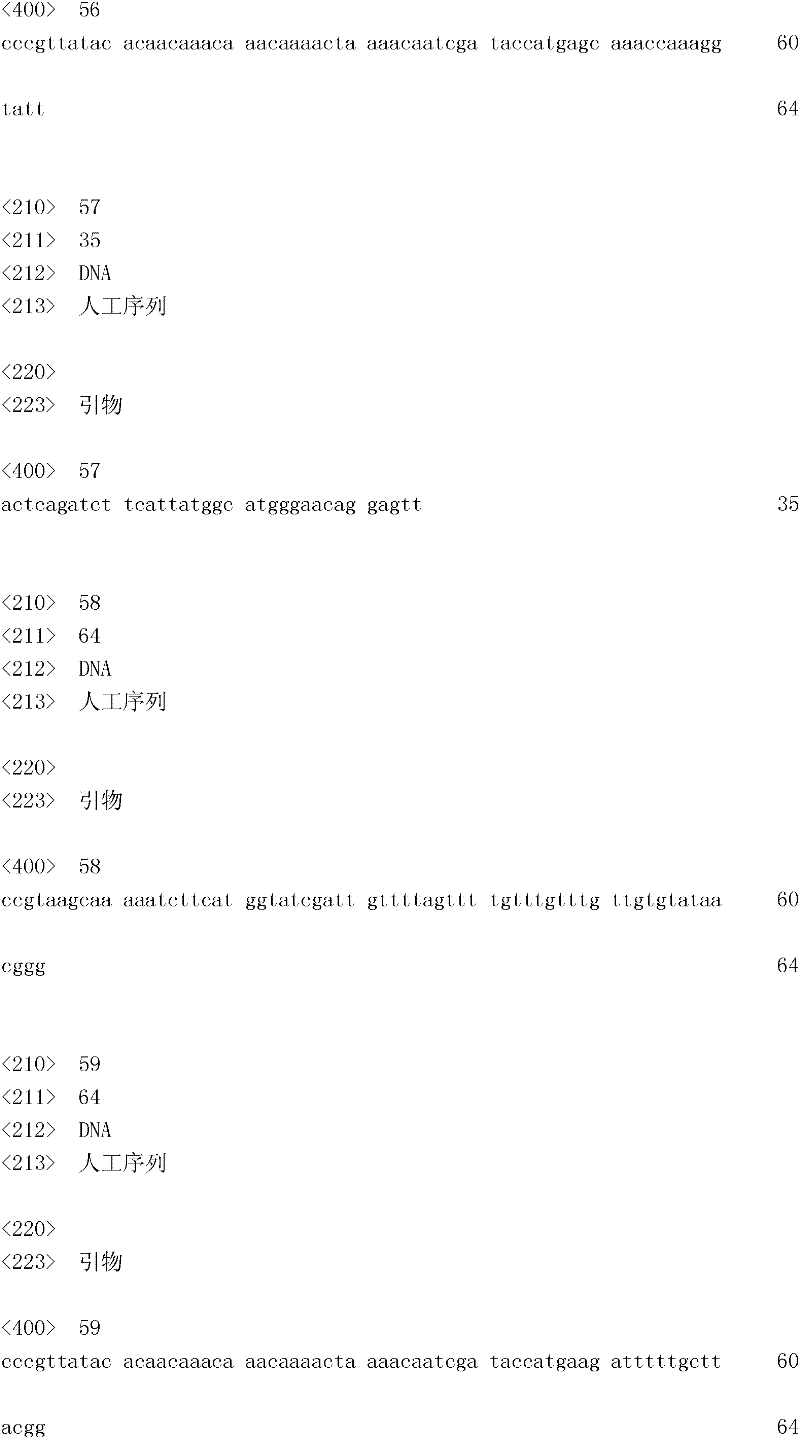
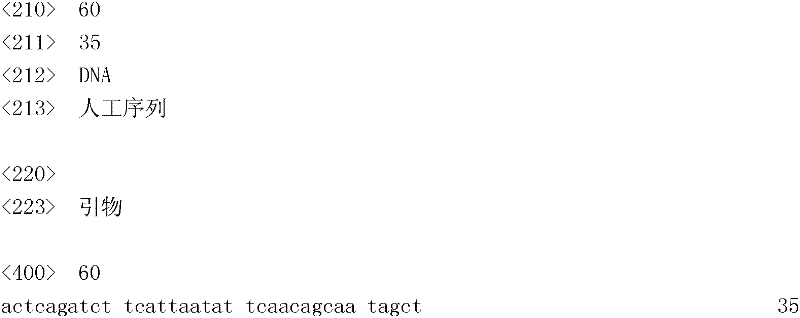
Claims (14)
Applications Claiming Priority (3)
| Application Number | Priority Date | Filing Date | Title |
|---|---|---|---|
| JP134213/2009 | 2009-06-03 | ||
| JP2009134213 | 2009-06-03 | ||
| PCT/JP2010/059306 WO2010140602A1 (en) | 2009-06-03 | 2010-06-02 | Polypeptide having d-lactate dehydrogenase activity, polynucleotide encoding the polypeptide, and process for production of d-lactic acid |
Publications (2)
| Publication Number | Publication Date |
|---|---|
| CN102459590A true CN102459590A (en) | 2012-05-16 |
| CN102459590B CN102459590B (en) | 2014-10-29 |
Family
ID=43297735
Family Applications (1)
| Application Number | Title | Priority Date | Filing Date |
|---|---|---|---|
| CN201080034172.0A Expired - Fee Related CN102459590B (en) | 2009-06-03 | 2010-06-02 | Polypeptide having d-lactate dehydrogenase activity, polynucleotide encoding the polypeptide, and process for production of d-lactic acid |
Country Status (13)
| Country | Link |
|---|---|
| US (1) | US8822195B2 (en) |
| EP (1) | EP2439271B1 (en) |
| JP (1) | JP5803106B2 (en) |
| KR (1) | KR20120027354A (en) |
| CN (1) | CN102459590B (en) |
| AU (1) | AU2010255000A1 (en) |
| BR (1) | BRPI1008141A2 (en) |
| CA (1) | CA2764448A1 (en) |
| ES (1) | ES2436567T3 (en) |
| MY (1) | MY159074A (en) |
| RU (1) | RU2553563C2 (en) |
| SG (1) | SG176263A1 (en) |
| WO (1) | WO2010140602A1 (en) |
Families Citing this family (12)
| Publication number | Priority date | Publication date | Assignee | Title |
|---|---|---|---|---|
| AU2008332348B2 (en) * | 2007-12-07 | 2014-06-26 | Toray Industries, Inc. | Expression cassette for lactase dehydrogenase, transformed yeast and method of producing lactic acid |
| EP2679668B1 (en) * | 2011-02-23 | 2015-09-23 | Macrogen Inc. | Transformant for producing lactic acid having high optical purity, and method for producing lactic acid using same |
| US9217165B2 (en) | 2011-04-28 | 2015-12-22 | Toray Industries, Inc. | Mutant strain of lactic acid producing yeast and process for producing lactic acid |
| WO2013015212A1 (en) | 2011-07-22 | 2013-01-31 | 東レ株式会社 | Method for producing organic acid |
| CN104039969A (en) | 2012-01-13 | 2014-09-10 | 东丽株式会社 | Method for producing chemical substance |
| WO2013105651A1 (en) | 2012-01-13 | 2013-07-18 | 東レ株式会社 | Method for producing chemical substance |
| EP2837687B1 (en) | 2012-03-30 | 2017-02-22 | Toray Industries, Inc. | Method for producing chemical by means of continuous fermentation and continuous fermentation device |
| BR112016009701A2 (en) | 2013-11-07 | 2020-11-10 | Toray Industries, Inc. | METHODS FOR THE PRODUCTION OF A LIQUID AND FOR THE PRODUCTION OF A CHEMICAL SUBSTANCE |
| KR102581464B1 (en) | 2015-05-28 | 2023-09-21 | 삼성전자주식회사 | Method for screeninig a lactate dehydrogenase mutant, lactate dehydrogenase mutant, polynucleotide, vector, microorganism including the mutant, and method for preparing a lactate using the microorganism |
| KR102311681B1 (en) | 2015-07-28 | 2021-10-12 | 삼성전자주식회사 | Yeast cell resistant to acid, method for producing an organic acid using the same, and method for producing the same |
| MY199633A (en) | 2017-06-30 | 2023-11-10 | Toray Industries | Production method and production device for chemical by continuous fermentation |
| CN118813434B (en) * | 2024-06-13 | 2025-05-20 | 陕西海斯夫生物工程有限公司 | Recombinant cerevisiae yeast with high polylactic acid production, construction method and application thereof |
Family Cites Families (14)
| Publication number | Priority date | Publication date | Assignee | Title |
|---|---|---|---|---|
| JPS6136321A (en) | 1984-07-27 | 1986-02-21 | Daicel Chem Ind Ltd | Novel polymer and its resin composition |
| US4719246A (en) | 1986-12-22 | 1988-01-12 | E. I. Du Pont De Nemours And Company | Polylactide compositions |
| PH31093A (en) * | 1993-08-06 | 1998-02-05 | Nestec Ltd | Lactobacillus bulgaricus having decreased acid production and/or improved aroma and flavor production and food composition comprising said lactobacillus. |
| JP3687354B2 (en) | 1998-06-30 | 2005-08-24 | トヨタ自動車株式会社 | Polylactic acid stereocomplex polymer composition |
| CN1735691B (en) * | 2002-05-30 | 2010-05-26 | 卡吉尔道有限责任公司 | Fermentation method using specific oxygen absorption rate as process control |
| AU2004241394B2 (en) | 2003-05-22 | 2008-05-22 | Teijin Limited | DNA coding for protein having D-lactic acid dehydrogenase activity and use thereof |
| JP2006280368A (en) | 2005-03-11 | 2006-10-19 | Toray Ind Inc | Method for producing organic acid |
| JP4692173B2 (en) | 2005-09-13 | 2011-06-01 | 東レ株式会社 | Polypeptide having D-lactic acid dehydrogenase activity, gene encoding the same, and method for producing D-lactic acid |
| EP1975232A4 (en) | 2005-10-14 | 2009-07-29 | Toray Industries | Yeast and method of producing l-lactic acid |
| DK1988170T3 (en) | 2006-02-24 | 2019-07-22 | Toray Industries | Process for the preparation of a chemical product and device for continuous fermentation |
| JP5320692B2 (en) | 2006-06-28 | 2013-10-23 | 東レ株式会社 | Yeast and method for producing L-lactic acid |
| JP5329055B2 (en) | 2006-07-24 | 2013-10-30 | 東レ株式会社 | Yeast having mutant pyruvate decarboxylase 5 gene and method for producing lactic acid |
| EP2175029B1 (en) | 2007-06-29 | 2020-10-07 | Toray Industries, Inc. | Lactic acid production method |
| AU2008332348B2 (en) | 2007-12-07 | 2014-06-26 | Toray Industries, Inc. | Expression cassette for lactase dehydrogenase, transformed yeast and method of producing lactic acid |
-
2010
- 2010-06-02 JP JP2010522119A patent/JP5803106B2/en not_active Expired - Fee Related
- 2010-06-02 CA CA2764448A patent/CA2764448A1/en not_active Abandoned
- 2010-06-02 EP EP10783384.0A patent/EP2439271B1/en not_active Not-in-force
- 2010-06-02 US US13/375,882 patent/US8822195B2/en not_active Expired - Fee Related
- 2010-06-02 AU AU2010255000A patent/AU2010255000A1/en not_active Abandoned
- 2010-06-02 SG SG2011087707A patent/SG176263A1/en unknown
- 2010-06-02 ES ES10783384.0T patent/ES2436567T3/en active Active
- 2010-06-02 CN CN201080034172.0A patent/CN102459590B/en not_active Expired - Fee Related
- 2010-06-02 WO PCT/JP2010/059306 patent/WO2010140602A1/en not_active Ceased
- 2010-06-02 BR BRPI1008141A patent/BRPI1008141A2/en not_active Application Discontinuation
- 2010-06-02 MY MYPI2011005828A patent/MY159074A/en unknown
- 2010-06-02 RU RU2011152925/10A patent/RU2553563C2/en active
- 2010-06-02 KR KR1020117030018A patent/KR20120027354A/en not_active Withdrawn
Non-Patent Citations (3)
| Title |
|---|
| JOSEPH F. SIEBENALLER ET AL: "Comparison of the d-lactate stereospecific dehydrogenase of limulus polyphemus with active-site regions of l-lactate dehydrogenases", 《BIOCHIMICA ET BIOPHYSICA ACTA》 * |
| LONG G L ET AL: "Diphosphopyridine nucleotide-linked D-lactate dehydrogenase from the horseshoe crab,and the seaworm,Nereis virens.II.Catalytic properties", 《ARCH BIOCHEM BIOPHYS》 * |
| LONG G L ET AL: "D-lactate dehydrogenase from the horseshoe crab", 《METHODS ENZYMOL》 * |
Also Published As
| Publication number | Publication date |
|---|---|
| EP2439271A4 (en) | 2012-11-07 |
| EP2439271A1 (en) | 2012-04-11 |
| AU2010255000A1 (en) | 2011-12-15 |
| EP2439271B1 (en) | 2013-11-20 |
| JP5803106B2 (en) | 2015-11-04 |
| BRPI1008141A2 (en) | 2020-04-07 |
| WO2010140602A1 (en) | 2010-12-09 |
| KR20120027354A (en) | 2012-03-21 |
| US8822195B2 (en) | 2014-09-02 |
| RU2553563C2 (en) | 2015-06-20 |
| JPWO2010140602A1 (en) | 2012-11-22 |
| CN102459590B (en) | 2014-10-29 |
| RU2011152925A (en) | 2013-07-20 |
| US20120070871A1 (en) | 2012-03-22 |
| CA2764448A1 (en) | 2010-12-09 |
| ES2436567T3 (en) | 2014-01-03 |
| SG176263A1 (en) | 2012-01-30 |
| MY159074A (en) | 2016-12-15 |
Similar Documents
| Publication | Publication Date | Title |
|---|---|---|
| CN102459590B (en) | Polypeptide having d-lactate dehydrogenase activity, polynucleotide encoding the polypeptide, and process for production of d-lactic acid | |
| US7964382B2 (en) | DNA encoding a protein having D-lactate dehydrogenase activity and uses thereof | |
| US7326550B2 (en) | Yeast strains for the production of lactic acid | |
| JP4963488B2 (en) | Mutant yeast and substance production method using the same | |
| CN101287824A (en) | Genetically modified yeasts of the species issatchenkia orientalis and closely related species and fermentation processes employing them | |
| WO2007149894A2 (en) | Production of d-lactic acid with yeast | |
| JP5320692B2 (en) | Yeast and method for producing L-lactic acid | |
| JP4692173B2 (en) | Polypeptide having D-lactic acid dehydrogenase activity, gene encoding the same, and method for producing D-lactic acid | |
| US10059926B2 (en) | Mutant lactate dehydrogenase | |
| JP2006006271A (en) | Lactic acid producing yeast and lactic acid producing method | |
| CN112094826B (en) | fumarate reductase | |
| JP2012061006A (en) | Method for producing organic acid and alcohol using acid resistance microorganism | |
| JP2003093060A (en) | Method for producing organic acids and alcohols using acid-resistant microorganisms | |
| JP2009261262A (en) | Polypeptide having d-lactic acid dehydrogenase activity, polynucleotide encoding the polypeptide and method for producing d-lactic acid |
Legal Events
| Date | Code | Title | Description |
|---|---|---|---|
| C06 | Publication | ||
| PB01 | Publication | ||
| C10 | Entry into substantive examination | ||
| SE01 | Entry into force of request for substantive examination | ||
| C14 | Grant of patent or utility model | ||
| GR01 | Patent grant | ||
| CF01 | Termination of patent right due to non-payment of annual fee | ||
| CF01 | Termination of patent right due to non-payment of annual fee |
Granted publication date: 20141029 Termination date: 20210602 |