CN102414194A - Soluble guanylate cyclase activators - Google Patents
Soluble guanylate cyclase activators Download PDFInfo
- Publication number
- CN102414194A CN102414194A CN2010800184490A CN201080018449A CN102414194A CN 102414194 A CN102414194 A CN 102414194A CN 2010800184490 A CN2010800184490 A CN 2010800184490A CN 201080018449 A CN201080018449 A CN 201080018449A CN 102414194 A CN102414194 A CN 102414194A
- Authority
- CN
- China
- Prior art keywords
- trifluoromethyl
- mmol
- phenyl
- pyrazole
- benzyl
- Prior art date
- Legal status (The legal status is an assumption and is not a legal conclusion. Google has not performed a legal analysis and makes no representation as to the accuracy of the status listed.)
- Pending
Links
- 0 C=CCNCC1**C1 Chemical compound C=CCNCC1**C1 0.000 description 6
Classifications
-
- C—CHEMISTRY; METALLURGY
- C07—ORGANIC CHEMISTRY
- C07D—HETEROCYCLIC COMPOUNDS
- C07D401/00—Heterocyclic compounds containing two or more hetero rings, having nitrogen atoms as the only ring hetero atoms, at least one ring being a six-membered ring with only one nitrogen atom
- C07D401/02—Heterocyclic compounds containing two or more hetero rings, having nitrogen atoms as the only ring hetero atoms, at least one ring being a six-membered ring with only one nitrogen atom containing two hetero rings
- C07D401/04—Heterocyclic compounds containing two or more hetero rings, having nitrogen atoms as the only ring hetero atoms, at least one ring being a six-membered ring with only one nitrogen atom containing two hetero rings directly linked by a ring-member-to-ring-member bond
-
- A—HUMAN NECESSITIES
- A61—MEDICAL OR VETERINARY SCIENCE; HYGIENE
- A61K—PREPARATIONS FOR MEDICAL, DENTAL OR TOILETRY PURPOSES
- A61K31/00—Medicinal preparations containing organic active ingredients
- A61K31/33—Heterocyclic compounds
- A61K31/395—Heterocyclic compounds having nitrogen as a ring hetero atom, e.g. guanethidine or rifamycins
- A61K31/435—Heterocyclic compounds having nitrogen as a ring hetero atom, e.g. guanethidine or rifamycins having six-membered rings with one nitrogen as the only ring hetero atom
- A61K31/44—Non condensed pyridines; Hydrogenated derivatives thereof
- A61K31/445—Non condensed piperidines, e.g. piperocaine
- A61K31/4523—Non condensed piperidines, e.g. piperocaine containing further heterocyclic ring systems
- A61K31/4545—Non condensed piperidines, e.g. piperocaine containing further heterocyclic ring systems containing a six-membered ring with nitrogen as a ring hetero atom, e.g. pipamperone, anabasine
-
- A—HUMAN NECESSITIES
- A61—MEDICAL OR VETERINARY SCIENCE; HYGIENE
- A61P—SPECIFIC THERAPEUTIC ACTIVITY OF CHEMICAL COMPOUNDS OR MEDICINAL PREPARATIONS
- A61P1/00—Drugs for disorders of the alimentary tract or the digestive system
- A61P1/16—Drugs for disorders of the alimentary tract or the digestive system for liver or gallbladder disorders, e.g. hepatoprotective agents, cholagogues, litholytics
-
- A—HUMAN NECESSITIES
- A61—MEDICAL OR VETERINARY SCIENCE; HYGIENE
- A61P—SPECIFIC THERAPEUTIC ACTIVITY OF CHEMICAL COMPOUNDS OR MEDICINAL PREPARATIONS
- A61P11/00—Drugs for disorders of the respiratory system
- A61P11/06—Antiasthmatics
-
- A—HUMAN NECESSITIES
- A61—MEDICAL OR VETERINARY SCIENCE; HYGIENE
- A61P—SPECIFIC THERAPEUTIC ACTIVITY OF CHEMICAL COMPOUNDS OR MEDICINAL PREPARATIONS
- A61P13/00—Drugs for disorders of the urinary system
- A61P13/12—Drugs for disorders of the urinary system of the kidneys
-
- A—HUMAN NECESSITIES
- A61—MEDICAL OR VETERINARY SCIENCE; HYGIENE
- A61P—SPECIFIC THERAPEUTIC ACTIVITY OF CHEMICAL COMPOUNDS OR MEDICINAL PREPARATIONS
- A61P15/00—Drugs for genital or sexual disorders; Contraceptives
-
- A—HUMAN NECESSITIES
- A61—MEDICAL OR VETERINARY SCIENCE; HYGIENE
- A61P—SPECIFIC THERAPEUTIC ACTIVITY OF CHEMICAL COMPOUNDS OR MEDICINAL PREPARATIONS
- A61P3/00—Drugs for disorders of the metabolism
- A61P3/08—Drugs for disorders of the metabolism for glucose homeostasis
- A61P3/10—Drugs for disorders of the metabolism for glucose homeostasis for hyperglycaemia, e.g. antidiabetics
-
- A—HUMAN NECESSITIES
- A61—MEDICAL OR VETERINARY SCIENCE; HYGIENE
- A61P—SPECIFIC THERAPEUTIC ACTIVITY OF CHEMICAL COMPOUNDS OR MEDICINAL PREPARATIONS
- A61P43/00—Drugs for specific purposes, not provided for in groups A61P1/00-A61P41/00
-
- A—HUMAN NECESSITIES
- A61—MEDICAL OR VETERINARY SCIENCE; HYGIENE
- A61P—SPECIFIC THERAPEUTIC ACTIVITY OF CHEMICAL COMPOUNDS OR MEDICINAL PREPARATIONS
- A61P7/00—Drugs for disorders of the blood or the extracellular fluid
- A61P7/02—Antithrombotic agents; Anticoagulants; Platelet aggregation inhibitors
-
- A—HUMAN NECESSITIES
- A61—MEDICAL OR VETERINARY SCIENCE; HYGIENE
- A61P—SPECIFIC THERAPEUTIC ACTIVITY OF CHEMICAL COMPOUNDS OR MEDICINAL PREPARATIONS
- A61P9/00—Drugs for disorders of the cardiovascular system
-
- A—HUMAN NECESSITIES
- A61—MEDICAL OR VETERINARY SCIENCE; HYGIENE
- A61P—SPECIFIC THERAPEUTIC ACTIVITY OF CHEMICAL COMPOUNDS OR MEDICINAL PREPARATIONS
- A61P9/00—Drugs for disorders of the cardiovascular system
- A61P9/04—Inotropic agents, i.e. stimulants of cardiac contraction; Drugs for heart failure
-
- A—HUMAN NECESSITIES
- A61—MEDICAL OR VETERINARY SCIENCE; HYGIENE
- A61P—SPECIFIC THERAPEUTIC ACTIVITY OF CHEMICAL COMPOUNDS OR MEDICINAL PREPARATIONS
- A61P9/00—Drugs for disorders of the cardiovascular system
- A61P9/06—Antiarrhythmics
-
- A—HUMAN NECESSITIES
- A61—MEDICAL OR VETERINARY SCIENCE; HYGIENE
- A61P—SPECIFIC THERAPEUTIC ACTIVITY OF CHEMICAL COMPOUNDS OR MEDICINAL PREPARATIONS
- A61P9/00—Drugs for disorders of the cardiovascular system
- A61P9/10—Drugs for disorders of the cardiovascular system for treating ischaemic or atherosclerotic diseases, e.g. antianginal drugs, coronary vasodilators, drugs for myocardial infarction, retinopathy, cerebrovascula insufficiency, renal arteriosclerosis
-
- A—HUMAN NECESSITIES
- A61—MEDICAL OR VETERINARY SCIENCE; HYGIENE
- A61P—SPECIFIC THERAPEUTIC ACTIVITY OF CHEMICAL COMPOUNDS OR MEDICINAL PREPARATIONS
- A61P9/00—Drugs for disorders of the cardiovascular system
- A61P9/12—Antihypertensives
-
- C—CHEMISTRY; METALLURGY
- C07—ORGANIC CHEMISTRY
- C07D—HETEROCYCLIC COMPOUNDS
- C07D401/00—Heterocyclic compounds containing two or more hetero rings, having nitrogen atoms as the only ring hetero atoms, at least one ring being a six-membered ring with only one nitrogen atom
- C07D401/14—Heterocyclic compounds containing two or more hetero rings, having nitrogen atoms as the only ring hetero atoms, at least one ring being a six-membered ring with only one nitrogen atom containing three or more hetero rings
Landscapes
- Health & Medical Sciences (AREA)
- Chemical & Material Sciences (AREA)
- Organic Chemistry (AREA)
- Engineering & Computer Science (AREA)
- Bioinformatics & Cheminformatics (AREA)
- Veterinary Medicine (AREA)
- Public Health (AREA)
- General Health & Medical Sciences (AREA)
- Animal Behavior & Ethology (AREA)
- Life Sciences & Earth Sciences (AREA)
- Medicinal Chemistry (AREA)
- Pharmacology & Pharmacy (AREA)
- Chemical Kinetics & Catalysis (AREA)
- General Chemical & Material Sciences (AREA)
- Nuclear Medicine, Radiotherapy & Molecular Imaging (AREA)
- Cardiology (AREA)
- Heart & Thoracic Surgery (AREA)
- Diabetes (AREA)
- Hematology (AREA)
- Pulmonology (AREA)
- Urology & Nephrology (AREA)
- Endocrinology (AREA)
- Obesity (AREA)
- Emergency Medicine (AREA)
- Hospice & Palliative Care (AREA)
- Reproductive Health (AREA)
- Vascular Medicine (AREA)
- Gastroenterology & Hepatology (AREA)
- Epidemiology (AREA)
- Pharmaceuticals Containing Other Organic And Inorganic Compounds (AREA)
- Acyclic And Carbocyclic Compounds In Medicinal Compositions (AREA)
- Plural Heterocyclic Compounds (AREA)
- Nitrogen Condensed Heterocyclic Rings (AREA)
- Medicines That Contain Protein Lipid Enzymes And Other Medicines (AREA)
Abstract
本发明涉及具有结构式I的化合物
Description
发明背景 Background of the invention
环GMP (cGMP)是重要的细胞内信使,其通过调节cGMP依赖性蛋白激酶、磷酸二酯酶和离子通道引发多种不同的效应。所述效应的实例为舒张平滑肌、抑制血小板激活及抑制平滑肌细胞增殖和白细胞粘附。cGMP通过颗粒性和可溶性鸟苷酸环化酶作为对大量胞外和胞内刺激物的应答而生成。在颗粒性鸟苷酸环化酶的情况下,刺激主要由肽信使如心房钠尿肽或脑钠尿肽实现。与之相比,作为胞质异二聚体血红素蛋白的可溶性鸟苷酸环化酶(“sGC”)主要由酶促形成的低分子量因子家族调节。最重要的刺激物是一氧化氮(“NO”)或密切相关的种类。其他因子如一氧化碳或羟自由基的作用在很大程度上仍不清楚。NO与血红素的结合和五配位血红素-亚硝酰复合物的形成作为通过NO激活的机制而提出。在基态下结合于铁的组氨酸的相关释放使酶转化为活性构象。 Cyclic GMP (cGMP) is an important intracellular messenger that elicits diverse effects through the regulation of cGMP-dependent protein kinases, phosphodiesterases, and ion channels. Examples of such effects are relaxation of smooth muscle, inhibition of platelet activation, and inhibition of smooth muscle cell proliferation and leukocyte adhesion. cGMP is produced by granular and soluble guanylate cyclases in response to a number of extracellular and intracellular stimuli. In the case of granular guanylate cyclase, stimulation is primarily effected by peptide messengers such as atrial natriuretic peptide or brain natriuretic peptide. In contrast, soluble guanylate cyclase (“sGC”), a cytoplasmic heterodimeric heme protein, is largely regulated by a family of low-molecular-weight factors formed enzymatically. The most important stimulant is nitric oxide ("NO") or closely related species. The role of other factors such as carbon monoxide or hydroxyl radicals remains largely unknown. Binding of NO to heme and formation of pentacoordinate heme-nitrosyl complexes have been proposed as mechanisms for activation by NO. The associated release of histidine bound to iron in the ground state converts the enzyme into the active conformation.
在病理状态下,由于自由基的增加出现,鸟苷酸环化酶激活因子的形成可减少,或其降解可被促进。造成的sGC激活减少通过弱化各自cGMP介导的细胞应答导致例如血压升高、血小板激活或细胞增殖和细胞粘附增加。因此,引起内皮功能障碍、动脉粥样硬化、高血压、稳定或不稳定心绞痛、形成血栓、心肌梗塞、中风或勃起机能障碍的形成。sGC的药学刺激提供了使cGMP的产生正常化的可能性,并且因此使这些病症的治疗和/或预防成为可能。 In pathological states, due to the increased occurrence of free radicals, the formation of guanylate cyclase activators may be reduced, or its degradation may be accelerated. The resulting reduction in sGC activation leads, for example, to increased blood pressure, platelet activation or increased cell proliferation and cell adhesion by attenuating the respective cGMP-mediated cellular responses. Thus, endothelial dysfunction, atherosclerosis, hypertension, stable or unstable angina, thrombosis, myocardial infarction, stroke or the development of erectile dysfunction are caused. Pharmacological stimulation of sGC offers the possibility to normalize the production of cGMP and thus enable the treatment and/or prevention of these disorders.
对于sGC的药学刺激,由其活性基于中间体NO释放的化合物例如有机硝酸盐进行应用。该治疗的缺陷在于耐受性的发展和活性的减少,以及因而需要的较高剂量。 For the pharmacological stimulation of sGC, compounds whose activity is based on the release of intermediate NO, such as organic nitrates, are used. Drawbacks of this therapy are the development of tolerance and the reduction of activity, and thus the higher doses required.
Vesely在一系列公开中述及了不通过NO释放起作用的多种sGC刺激物。但是,其大多数为激素、植物激素、维生素或天然化合物如例如蜥蜴毒素的化合物主要仅对细胞溶解产物中的cGMP形成具有微弱的影响。D. L. Vesely, Eur. J. Clin. Invest., vol.15, 1985, p. 258;D. L. Vesely, Biochem. Biophys. Res. Comm., vol. 88, 1979, p.1244。Ignarro等人, Adv. Pharmacol., vol. 26, 1994, p. 35证实了原卟啉IX引起的无血红素鸟苷酸环化酶的刺激。Pettibone等人, Eur. J. Pharmacol., vol. 116, 1985 p. 307描述了六氟磷酸二苯基碘(diphenyliodonium hexafluorophosphate)的抗高血压作用,并将其归因于sGC的刺激。根据Yu等人, Brit. J. Pharmacol, vol. 114, 1995, p.1587,对分离的大鼠主动脉具有舒张作用的异甘草素也激活sGC。Ko等人, Blood vol. 84, 1994, p. 4226、Yu等人, Biochem. J. vol. 306, 1995, p. 787和Wu等人, Brit. J. Pharmacol. vol. 116, 1995, p. 1973证实了1-苄基-3-(5-羟甲基-2-呋喃基)吲唑的sGC刺激活性,并证实了抗增殖和血小板抑制作用。欧洲专利申请号908,456和德国专利申请号19,744,027中述及了吡唑和稠合吡唑,其呈现sGC刺激活性。 Vesely, in a series of publications, describes various sGC stimulators that do not act through NO release. However, compounds which are mostly hormones, phytohormones, vitamins or natural compounds such as eg lizard toxins mainly only have a weak effect on cGMP formation in cell lysates. D. L. Vesely, Eur. J. Clin. Invest., vol.15, 1985, p. 258; D. L. Vesely, Biochem. Biophys. Res. Comm., vol. 88, 1979, p.1244. Ignarro et al., Adv. Pharmacol., vol. 26, 1994, p. 35 demonstrated stimulation of heme-free guanylate cyclase by protoporphyrin IX. Pettibone et al., Eur. J. Pharmacol., vol. 116, 1985 p. 307 described the antihypertensive effect of diphenyliodonium hexafluorophosphate and attributed it to the stimulation of sGC. According to Yu et al., Brit. J. Pharmacol, vol. 114, 1995, p.1587, isoliquiritigenin, which has a relaxing effect on isolated rat aorta, also activates sGC. Ko et al., Blood vol. 84, 1994, p. 4226, Yu et al., Biochem. J. vol. 306, 1995, p. 787 and Wu et al., Brit. J. Pharmacol. vol. 116, 1995, p. .1973 The sGC-stimulating activity of 1-benzyl-3-(5-hydroxymethyl-2-furyl)indazole was confirmed, and the antiproliferative and platelet inhibitory effects were demonstrated. Pyrazoles and fused pyrazoles are described in European Patent Application No. 908,456 and German Patent Application No. 19,744,027, which exhibit sGC stimulating activity.
文献中已提及2-磺酰氨基苯甲酸N-芳基酰胺系列,其N-芳基携带硫取代基。这些化合物——其中N-芳基通常携带易氧化的进一步取代基,如例如相互处于对位的两个羟基,且在此情况下其可被称为氢醌衍生物——是用于制备照相材料的辅助剂(参见,例如,Chemical Abstracts 119, 105757;120, 41858;123, 70224;或126, 257007)。英国专利公开号876,526(Chemical Abstracts 56, 15432e)公开了3,5-二氯-2-甲基磺酰氨基苯甲酸N-(5-氯-2-(4-氯苯基巯基)-苯基)-酰胺,其可用于保护毛织品抗蛀。 The series of 2-sulfonylaminobenzoic acid N-arylamides, the N-aryl of which bears a sulfur substituent, has been mentioned in the literature. These compounds - in which the N-aryl group usually carries further substituents susceptible to oxidation, such as, for example, two hydroxyl groups in para-position to each other, and in which case they can be referred to as hydroquinone derivatives - are used in the preparation of photographic Adjuvants for materials (see, for example, Chemical Abstracts 119, 105757; 120, 41858; 123, 70224; or 126, 257007). British Patent Publication No. 876,526 (Chemical Abstracts 56, 15432e) discloses 3,5-dichloro-2-methylsulfonylaminobenzoic acid N-(5-chloro-2-(4-chlorophenylmercapto)-phenyl )-amides, which can be used to protect woolen fabrics against moths.
现已发现,本发明的化合物实现鸟苷酸环化酶的强激活,并且因此可用于治疗和预防与低cGMP水平有关的病症。 It has now been found that the compounds of the present invention effect a strong activation of guanylate cyclase and are therefore useful in the treatment and prevention of conditions associated with low cGMP levels.
发明概述 Summary of the invention
本发明涉及结构式I的化合物: The present invention relates to compounds of structural formula I:
I I
及其药学上可接受的盐。该化合物激活可溶性鸟苷酸环化酶,并且是对于治疗和预防疾病有价值的药学活性化合物,例如对于心血管疾病,如高血压、心绞痛、糖尿病、心功能不全、形成血栓或动脉粥样硬化。式I化合物能调节机体的环鸟苷酸(“cGMP”)产生,并且可用于治疗和预防与cGMP平衡紊乱有关的疾病。本发明还涉及用于制备式I化合物的方法、其在治疗和预防上述疾病以及在制备以此为目的的药物中的应用、以及包含式I化合物的药物制品。 and pharmaceutically acceptable salts thereof. The compound activates soluble guanylate cyclase and is a pharmaceutically active compound of value for the treatment and prevention of diseases such as cardiovascular diseases such as hypertension, angina pectoris, diabetes, cardiac insufficiency, thrombosis or atherosclerosis . The compound of formula I can regulate the body's production of cyclic guanosine monophosphate ("cGMP"), and can be used for the treatment and prevention of diseases related to cGMP balance disturbance. The present invention also relates to processes for the preparation of compounds of formula I, their use in the treatment and prevention of the above-mentioned diseases and for the preparation of medicaments for this purpose, and pharmaceutical preparations comprising compounds of formula I.
发明详述 Detailed description of the invention
本发明涉及激活可溶性鸟苷酸环化酶(sGC)的式I化合物: The present invention relates to compounds of formula I that activate soluble guanylate cyclase (sGC):

及其药学上可接受的盐,其中: and pharmaceutically acceptable salts thereof, wherein:
W选自CH和N; W is selected from CH and N;
Z选自: Z selected from:

-(CH2)3-NR3R3a; -(CH 2 ) 3 -NR 3 R 3a ;
R1选自-OH、-OC1-6烷基和-N(R5)2; R 1 is selected from -OH, -OC 1-6 alkyl and -N(R 5 ) 2 ;
R2选自-C1-2全氟烷基和-NH2; R 2 is selected from -C 1-2 perfluoroalkyl and -NH 2 ;
R3选自: R3 is selected from:
1) 被1-3个-F取代的-C1-6烷基、 1) -C 1-6 alkyl substituted by 1-3 -F,
2) -COR4、和 2) -COR 4 , and
3) -SO2R6; 3) -SO 2 R 6 ;
R3a选自-H;-C1-3烷基;被一个或多个取代基任选单取代或双取代的C3-6环烷基,该取代基选自-CH3和-F;和被一个或多个取代基任选单取代或双取代的-CH2-C3-6环烷基,该取代基选自-CH3和-F; R 3a is selected from -H; -C 1-3 alkyl; C 3-6 cycloalkyl optionally monosubstituted or disubstituted by one or more substituents selected from -CH 3 and -F; And -CH 2 -C 3-6 cycloalkyl optionally monosubstituted or disubstituted by one or more substituents selected from -CH 3 and -F;
R4选自: R4 is selected from:
1) -H; 1) -H;
2) -C1-3烷基; 2) -C 1-3 alkyl;
3) -OC1-3烷基; 3) -OC 1-3 alkyl;
4) 被一个或多个取代基任选单取代或双取代的-C3-6环烷基,该取代基选自-CH3和-F; 4) -C 3-6 cycloalkyl optionally monosubstituted or disubstituted by one or more substituents, the substituents are selected from -CH 3 and -F;
5) 被一个或多个取代基任选单取代或双取代的-CH2-C3-6环烷基,该取代基选自-CH3和-F; 5) -CH 2 -C 3-6 cycloalkyl optionally monosubstituted or disubstituted by one or more substituents, the substituents are selected from -CH 3 and -F;
6) 被一个或多个取代基任选单取代或双取代的-OC3-6环烷基,该取代基选自-CH3和-F;以及 6) -OC 3-6 cycloalkyl optionally monosubstituted or disubstituted by one or more substituents selected from -CH and -F; and
7) -N(R5)2; 7) -N(R 5 ) 2 ;
R5在每次出现时独立地选自-H和-C1-3烷基; R at each occurrence is independently selected from -H and -C 1-3 alkyl;
R6选自-C1-3烷基;被一个或多个取代基任选单取代或双取代的-C3-6环烷基,该取代基选自-CH3和-F;和被一个或多个取代基任选单取代或双取代的-CH2-C3-6环烷基,该取代基选自-CH3和-F; R 6 is selected from -C 1-3 alkyl; -C 3-6 cycloalkyl optionally monosubstituted or disubstituted by one or more substituents, the substituents are selected from -CH 3 and -F; and One or more substituents are optionally monosubstituted or disubstituted -CH 2 -C 3-6 cycloalkyl, the substituents are selected from -CH 3 and -F;
R7选自-H和-CH3; R 7 is selected from -H and -CH 3 ;
Ra和Rb在每次出现时独立地选自-F、-Cl和被1-3个-F任选取代的-C1-3烷基;和 R and R are independently selected at each occurrence from -F, -Cl, and -C 1-3 alkyl optionally substituted by 1-3 -F; and
Rc和Rd在每次出现时独立地选自-F、-Cl和被1-3个-F任选取代的-C1-3烷基。 Each occurrence of Rc and Rd is independently selected from -F, -Cl, and -C1-3alkyl optionally substituted with 1-3 -F.
在本发明的一个实施方式中,为其中W是CH、具有结构式II的式I化合物: In one embodiment of the invention is a compound of formula I wherein W is CH, having the structure II:

及其药学上可接受的盐。 and pharmaceutically acceptable salts thereof.
在另一个实施方式中,为其中W是N、具有结构式III的式I化合物: In another embodiment, is a compound of formula I wherein W is N, having structural formula III:
III III
及其药学上可接受的盐。 and pharmaceutically acceptable salts thereof.
在本文中称为实施方式A的另一个实施方式中,为式I、 II、III或VI的化合物,其中Z选自: In another embodiment, referred to herein as embodiment A, is a compound of Formula I, II, III or VI, wherein Z is selected from:

并且更具体地,其选自: And more specifically, it is selected from:

在优选的实施方式中,为具有结构式IV的式I化合物: In a preferred embodiment, a compound of formula I having structural formula IV:

及其药学上可接受的盐。 and pharmaceutically acceptable salts thereof.
在本发明另一个实施方式中,为式I、II、III、IV或VI或实施方式A的化合物,其中R1是-OH。 In another embodiment of this invention is a compound of Formula I, II, III, IV or VI or Embodiment A, wherein R 1 is -OH.
在本发明另一个实施方式中,为式I、II、III、IV或VI或实施方式A的化合物,其中R2是-C1-2全氟烷基,且优选其为-CF3。 In another embodiment of this invention is a compound of formula I, II, III, IV or VI or embodiment A, wherein R 2 is -C 1-2 perfluoroalkyl, and preferably it is -CF 3 .
在本发明另一个实施方式中,为式I、II、III、IV、V或VI或实施方式A的化合物,其中R3是被1-3个-F取代的-C1-4烷基,并且特别地其中末端碳原子是-CF3。R3优选为-CH2CF3。 In another embodiment of the present invention is a compound of formula I, II, III, IV, V or VI or embodiment A, wherein R is -C 1-4 alkyl substituted by 1-3 -F, And especially wherein the terminal carbon atom is -CF3 . R 3 is preferably —CH 2 CF 3 .
在本发明另一个实施方式中,为式I、II、III、IV、V或VI或实施方式A的化合物,其中R3是-COR4,且R4选自:-C1-3烷基,特别地-CH3、-CH2CH3和-异丙基;-OC1-3烷基,特别地-OCH3、-OCH2CH3和-O- 异丙基;被一个或多个取代基任选单取代或双取代的-C3-4环烷基,该取代基选自 -CH3和-F;和 -N(R5)2,其中R5在每次出现时独立地选自-H、-CH3和-CH2CH3。 In another embodiment of the present invention is a compound of formula I, II, III, IV, V or VI or embodiment A, wherein R 3 is -COR 4 , and R 4 is selected from: -C 1-3 alkyl , especially -CH 3 , -CH 2 CH 3 and -isopropyl; -OC 1-3 alkyl, especially -OCH 3 , -OCH 2 CH 3 and -O-isopropyl; by one or more The substituent is optionally monosubstituted or disubstituted -C 3-4 cycloalkyl, the substituent is selected from -CH 3 and -F; and -N(R 5 ) 2 , wherein R 5 is independently at each occurrence selected from -H, -CH 3 and -CH 2 CH 3 .
在本发明另一个实施方式中,为式I、II、III、IV、V或VI或实施方式A的化合物,其中R3是-SO2R6,且R6选自:-C1-3烷基,特别地-CH3、-CH2CH3和异丙基;以及环丙基。 In another embodiment of the present invention is a compound of formula I, II, III, IV, V or VI or embodiment A, wherein R 3 is -SO 2 R 6 , and R 6 is selected from: -C 1-3 Alkyl, especially -CH3 , -CH2CH3 and isopropyl ; and cyclopropyl.
在本发明另一个实施方式中,为式I、II、III或VI的化合物,其中R3a选自-H、-CH3和-CH2-环丙基。 In another embodiment of the present invention is a compound of formula I, II, III or VI, wherein R 3a is selected from -H, -CH 3 and -CH 2 -cyclopropyl.
在本发明另一个实施方式中,为式I、II、III、IV或VI或实施方式A的化合物,其中R7是-H。 In another embodiment of this invention is a compound of Formula I, II, III, IV or VI or embodiment A, wherein R 7 is -H.
在本文中称为实施方式B的本发明另一实施方式中,为式I、II、III、IV或VI或实施方式A的化合物及其药学上可接受的盐,其中: In another embodiment of the invention, herein referred to as Embodiment B, is a compound of Formula I, II, III, IV or VI or Embodiment A, and pharmaceutically acceptable salts thereof, wherein:
R1是-OH; R 1 is -OH;
R2是-C1-2全氟烷基,且优选其为-CF3; R 2 is -C 1-2 perfluoroalkyl, and preferably it is -CF 3 ;
R3选自: R3 is selected from:
(a) 被1-3个-F取代的-C1-4烷基,且优选其中末端碳原子是-CF3,且最优选其中R3是-CH2CF3; (a) -C 1-4 alkyl substituted by 1-3 -F, and preferably wherein the terminal carbon atom is -CF 3 , and most preferably wherein R 3 is -CH 2 CF 3 ;
(b) -COR4,其中R4选自:-C1-3烷基,特别地-CH3、-CH2CH3和异丙基;-OC1-3烷基,特别地-OCH3、-OCH2CH3和-O- 异丙基;被一个或多个取代基任选单取代或双取代的-C3-4环烷基,该取代基选自-CH3和-F;和-N(R5)2,其中R5在每次出现时独立地选自-H、-CH3和-CH2CH3;以及 (b) -COR 4 , wherein R 4 is selected from: -C 1-3 alkyl, especially -CH 3 , -CH 2 CH 3 and isopropyl; -OC 1-3 alkyl, especially -OCH 3 , -OCH 2 CH 3 and -O-isopropyl; -C 3-4 cycloalkyl optionally monosubstituted or disubstituted by one or more substituents selected from -CH 3 and -F; and -N(R 5 ) 2 , wherein R 5 at each occurrence is independently selected from -H, -CH 3 and -CH 2 CH 3 ; and
(c) -SO2R6,其中R6选自:-C1-3烷基,特别地-CH3、-CH2CH3和异丙基;以及环丙基; (c) -SO 2 R 6 , wherein R 6 is selected from: -C 1-3 alkyl, especially -CH 3 , -CH 2 CH 3 and isopropyl; and cyclopropyl;
R3a选自-H、-CH3和-CH2-环丙基(除R3a不存在于式IV或实施方式A的化合物中外); R 3a is selected from -H, -CH 3 and -CH 2 -cyclopropyl (except R 3a is not present in the compound of formula IV or embodiment A);
R7是-H; R 7 is -H;
Ra和Rb在每次出现时独立地选自-F、-Cl和被1-3个-F任选取代的-C1-3烷基;和 R and R are independently selected at each occurrence from -F, -Cl, and -C 1-3 alkyl optionally substituted by 1-3 -F; and
Rc和Rd在每次出现时独立地选自-F、-Cl和被1-3个-F任选取代的-C1-3烷基。 Each occurrence of Rc and Rd is independently selected from -F, -Cl, and -C1-3alkyl optionally substituted with 1-3 -F.
在本发明另一个实施方式中,为具有结构式V的式I化合物: In another embodiment of the present invention is a compound of formula I having structural formula V:

及其药学上可接受的盐, and pharmaceutically acceptable salts thereof,
其中R3选自:被1-3个-F取代的-C1-3烷基;-CO-C1-3烷基;被一个或多个取代基任选单取代或双取代的-CO-C3-4环烷基,该取代基选自-CH3和-F;和-COOC1-3烷基。 Wherein R is selected from: -C 1-3 alkyl substituted by 1-3 -F; -CO-C 1-3 alkyl; -CO optionally monosubstituted or disubstituted by one or more substituents -C 3-4 cycloalkyl, the substituent is selected from -CH 3 and -F; and -COOC 1-3 alkyl.
在本文中被称为实施方式C的本发明另一个实施方式中,为式I、II、III、IV或V或实施方式A或B的化合物及其药学上可接受的盐,其中取代基Ra、Rb、Rc和Rd处于式VIa所示环上的位置。即,取代基Ra和Rc各自任选地存在于式VIa中所示的固定位置,且取代基Rb和Rd各自任选地存在于各自所连接的环中的任意可用的碳上,如式VIa所示的。关于Ra和Rb,优选Rb,其当存在时结合于以星号(C*)或双星号(C**)表示的环碳之一,并且更具体地:(a) Ra和Rb均不存在,或(b) Ra不存在且Rb结合于C*或C**,或(c) Ra存在,且Rb不存在或结合于C*。关于Rc和Rd 取代基,优选仅当Rc存在时,Rd任选地存在,或更具体地:(a) Rc和Rd均不存在,或(b) Rc存在,且Rd不存在或存在于环上另一个可用的位置,并且更优选Rd不存在。当Ra、Rb、Rc或Rd 取代基存在时,取代基替代否则会结合于相关环碳的氢。 In another embodiment of the invention, referred to herein as Embodiment C, is a compound of Formula I, II, III, IV or V or Embodiment A or B, and pharmaceutically acceptable salts thereof, wherein the substituent R a , Rb , Rc and Rd are in positions on the ring shown in formula VIa. That is, substituents R a and R c are each optionally present at fixed positions shown in formula VIa, and substituents R b and R d are each optionally present at any available carbon in the ring to which they are attached , as shown in Formula VIa. With respect to R a and R b , preference is given to R b which, when present, is bound to one of the ring carbons indicated by an asterisk (C*) or a double asterisk (C**), and more specifically: (a) R a and Neither R b is present, or (b) R a is absent and R b is bound to C* or C**, or (c) R a is present and R b is absent or bound to C*. With respect to Rc and Rd substituents, it is preferred that Rc is optionally present only when Rc is present, or more specifically: (a) neither Rc nor Rd is present, or (b) Rc is present, and Rd is absent or present at another available position on the ring, and more preferably Rd is absent. When a R a , R b , R c or R d substituent is present, the substituent replaces a hydrogen that would otherwise be bound to the associated ring carbon.

本实施方式关于式I的实例如结构式VI所示: The example of this embodiment about formula I is shown in structural formula VI:
VI VI
及其药学上可接受的盐。 and pharmaceutically acceptable salts thereof.
如本文所用,除非另外提示,“烷基”意为包括具有指定碳原子数的支链和直链饱和脂族烃基。对于烷基的常用缩写在整个说明书中使用。例如,术语“C1-6烷基”(或“C1-C6烷基”)指具有指定碳原子数的直链或支链烷基,包括所有异构体,并且包括所有己基和戊基异构体以及正-、异-、仲-和叔-丁基(正丁基、仲丁基、异丁基、叔丁基;Bu =丁基)、正-和异-丙基(Pr =丙基)、乙基(Et)和甲基(Me)。 As used herein, unless otherwise indicated, "alkyl" is meant to include both branched and straight chain saturated aliphatic hydrocarbon groups having the indicated number of carbon atoms. Common abbreviations for alkyl groups are used throughout the specification. For example, the term "C 1-6 alkyl" (or "C 1 -C 6 alkyl") refers to straight or branched chain alkyl groups having the indicated number of carbon atoms, including all isomers, and includes all hexyl and pentyl groups. isomers as well as n-, i-, sec- and tert - butyl (n-butyl, sec-butyl, i-butyl, tert-butyl; Bu = butyl), n- and i-propyl (Pr = propyl), ethyl (Et) and methyl (Me).
“环烷基”是具有指定碳原子数的环化的烷基环。环烷基的实例包括环丙基、环丁基、环戊基和环己基。环烷基环可在导致稳定结构产生的任意可用碳上被取代,包括用作分子其余部分连接点的环碳。 "Cycloalkyl" is a cyclized alkyl ring having the indicated number of carbon atoms. Examples of cycloalkyl groups include cyclopropyl, cyclobutyl, cyclopentyl and cyclohexyl. Cycloalkyl rings may be substituted at any available carbon that results in a stable structure, including ring carbons that serve as points of attachment to the rest of the molecule.
短语“被一个或多个取代基任选单取代或双取代”意为给定部分中可用以取代的每个碳和杂原子(存在时)可独立地为未取代的,或被一个或两个取代基单取代或双取代,所述取代基在每次出现时相同或不同并且其导致如本领域技术人员认为是合理的稳定结构产生,条件是任选取代部分上的取代基总数是0、1或2。 The phrase "optionally mono- or disubstituted with one or more substituents" means that each carbon and heteroatom available for substitution in a given moiety (when present) may independently be unsubstituted, or be substituted by one or both Substituents are monosubstituted or disubstituted, said substituents being the same or different at each occurrence and which result in stable structures as considered reasonable by those skilled in the art, provided that the total number of substituents on the optionally substituted moiety is 0 , 1 or 2.
在一些实例中指定了可任选存在于部分上的取代基数,例如但不限于,1至3个-F(氟)。例如,可被1至3个-F任选取代的烷基包括但不限于适于给定烷基的限定碳原子数的-CH3、-CH2F、-CHF2、-CF3、-CH2CH3、-CH2-CH2F、-CH2-CHF2、-CHF-CH2F、-CH2CF3、-CHF-CHF2、-(CH2)2CH3、-CH(CF3)-CH3、-(CH2)3-CF3、-(CH2)2CH(CF3)CH3和-(CH2)5-CF3。 In some instances the number of substituents that may optionally be present on a moiety is specified, such as, but not limited to, 1 to 3 -F (fluoro). For example, an alkyl group that may be optionally substituted with 1 to 3 -F includes, but is not limited to, -CH3 , -CH2F , -CHF2 , -CF3 , - CH 2 CH 3 , -CH 2 -CH 2 F, -CH 2 -CHF 2 , -CHF-CH 2 F, -CH 2 CF 3 , -CHF-CHF 2 , -(CH 2 ) 2 CH 3 , -CH (CF 3 )-CH 3 , -(CH 2 ) 3 -CF 3 , -(CH 2 ) 2 CH(CF 3 )CH 3 and -(CH 2 ) 5 -CF 3 .
除非明确表示或另外说明(如例如式VI和VIa中),允许取代基Ra、Rb、Rc和Rd中的每一个在存在时位于各自所连接的环中的任意可用碳原子上,此时用“不固定(floating)”键表示,例如 Unless expressly stated or stated otherwise (as, for example, in formulas VI and VIa), each of the substituents Ra , Rb , Rc and Rd , when present, are permissible on any available carbon atom in the ring to which they are attached , which is represented by a "floating" key, for example

本发明包括式I化合物的所有立体异构形式。式I化合物中存在的不对称中心可全部彼此独立地具有(R)构型或(S)构型。当连接手性碳的键在本发明的结构式中描绘为直线时,认为手性碳的(R)和(S)构型并且从而其对映异构体及混合物均包括于该式中。同样,当没有对手性碳手性指定而述及化合物名称时,认为手性碳的(R)和(S)构型并且从而其个别对映异构体及混合物均被该名称涵盖。其具体立体异构体或混合物的产生可在获得该立体异构体或混合物的实施例中得到确定,但这决不限制其所有立体异构体及混合物在本发明范围内的包含。 The present invention includes all stereoisomeric forms of the compounds of formula I. The asymmetric centers present in the compounds of formula I may all independently of one another have the (R) configuration or the (S) configuration. When the bond to a chiral carbon is drawn as a straight line in the formulas of the present invention, the (R) and (S) configurations of the chiral carbon are considered and thus enantiomers and mixtures thereof are included in the formula. Likewise, when a compound name is mentioned without a chiral carbon designation, both the (R) and (S) configurations of the chiral carbon are considered and thus the individual enantiomers and mixtures thereof are encompassed by the name. The production of specific stereoisomers or mixtures thereof can be determined in the examples for obtaining such stereoisomers or mixtures, but this in no way limits the inclusion of all stereoisomers and mixtures thereof within the scope of the present invention.
本发明包括所有可能的对映异构体和非对映异构体及两种或更多种立体异构体的混合物,例如对映异构体和/或非对映异构体以所有比例的混合物。因此,下述对映异构体是本发明的主题:作为左旋和作为右旋对映体的对映异构纯形式,外消旋体形式,和两种对映异构体以所有比例的混合物形式。在顺式/反式异构的情况下,本发明包括顺式形式和反式形式以及这些形式以所有比例的混合物。如果需要,可通过通常方法例如通过色谱法或结晶法分离混合物,通过利用立体化学上相同的原料进行合成或通过立体选择性合成,进行个别立体异构体的制备。可选地,在分离立体异构体前可进行衍生化。立体异构体混合物的分离可在式I化合物合成过程中的中间步骤进行,或其可对于最终外消旋产物进行。如必要,绝对立体化学可由衍生的结晶产物或结晶中间体的X射线晶体学用包含已知构型的立体(stereogenic)中心的试剂确定。当本发明的化合物能发生互变异构时,所有的个别互变异构体及其混合物均包括在本发明的范围内。本发明包括所有这种异构体,以及这种外消旋体、对映异构体、非对映异构体和互变异构体的盐、溶剂合物(包括水合物)和溶剂化盐及其混合物。 The present invention includes all possible enantiomers and diastereomers and mixtures of two or more stereoisomers, e.g. enantiomers and/or diastereomers in all ratios mixture. Accordingly, the following enantiomers are subject-matter of the present invention: enantiomerically pure forms as levo- and as dextro-enantiomers, racemic forms, and both enantiomers in all proportions Mixture form. In the case of cis/trans isomerism, the invention includes both the cis and trans forms and mixtures of these forms in all proportions. Preparation of individual stereoisomers may, if desired, be carried out by separation of mixtures by customary methods, for example by chromatography or crystallization, by synthesis using stereochemically identical starting materials or by stereoselective synthesis. Optionally, derivatization may be performed prior to separation of stereoisomers. Separation of mixtures of stereoisomers may be carried out at intermediate steps in the synthesis of compounds of formula I, or it may be carried out on the final racemic product. Absolute stereochemistry may be determined, if necessary, from X-ray crystallography of derivatized crystalline products or crystalline intermediates using reagents containing stereogenic centers of known configuration. When the compounds of the present invention are capable of tautomerism, all individual tautomers and mixtures thereof are included within the scope of the present invention. The present invention includes all such isomers, as well as salts, solvates (including hydrates) and solvated forms of such racemates, enantiomers, diastereomers and tautomers. Salt and its mixtures.
对作为具体式或实施方式例如式I(其包括式II-VI 及其实施方式的化合物)或任何其他结构通式的化合物或本文所述或所要求保护的具体化合物的本发明化合物的提及意为包括落入该式或实施方式范围的一种或多种具体化合物,包括其盐,特别是药学上可接受的盐、该化合物的溶剂合物及其溶剂化盐形式,其中除非另外指示,否则这些形式均有可能。例如,其中R1是-OH的实施方式包括具有所产生的游离酸部分-COOH的化合物以及可由该产生的-COOH部分形成的药学上可接受的盐。 Reference to a compound of the invention as a compound of a particular formula or embodiment, such as Formula I (which includes compounds of Formula II-VI and embodiments thereof), or any other general structural formula, or a specific compound described or claimed herein It is meant to include one or more specific compounds falling within the scope of the formula or embodiment, including salts thereof, especially pharmaceutically acceptable salts, solvates of the compound and solvated salt forms thereof, wherein unless otherwise indicated , otherwise these forms are possible. For example, embodiments wherein R 1 is -OH include compounds having a resulting free acid moiety -COOH as well as pharmaceutically acceptable salts that may be formed from the resulting -COOH moiety.
当式I化合物包含一个或多个酸性基或碱性基时,本发明也包括相应的生理学或毒理学可接受的盐,尤其是药学上可应用的盐。因此,根据本发明,包含酸性基的式I化合物可以作为例如碱金属盐、碱土金属盐或作为铵盐应用。该盐的实例包括但不限于钠盐、钾盐、钙盐、镁盐或与氨或有机胺如例如乙胺、乙醇胺、三乙醇胺或氨基酸的盐。根据本发明,包含一个或多个碱性基、即可质子化的基团的式I化合物可以以其与无机或有机酸的酸加成盐的形式应用,如例如但不限于,与盐酸、氢溴酸、磷酸、硫酸、硝酸、苯磺酸、甲磺酸、对甲苯磺酸、萘二磺酸、草酸、乙酸、三氟乙酸、酒石酸、乳酸、水杨酸、苯甲酸、甲酸、丙酸、新戊酸、二乙基乙酸、丙二酸、琥珀酸、庚二酸、富马酸、马来酸、苹果酸、氨基磺酸、苯基丙酸、葡糖酸、抗坏血酸、异烟酸、柠檬酸、己二酸等的盐。如果式I化合物在分子中同时包含酸性基和碱性基,则本发明除提到的盐形式外还包括内盐或甜菜碱(两性离子)。可由式I化合物通过本领域技术人员已知的通常方法得到盐,例如通过在溶剂或分散剂中结合有机或无机酸或碱,或通过与其他盐的阴离子交换或阳离子交换。本发明还包括式I化合物的所有盐,其由于低生理相容性不直接适用于药物,但其可用作例如用于化学反应或用于生理学(即药学上)可接受的盐的制备的中间体。 When the compound of formula I contains one or more acidic or basic groups, the present invention also includes corresponding physiologically or toxicologically acceptable salts, especially pharmaceutically applicable salts. Thus, according to the invention, compounds of the formula I which contain acidic groups can be used, for example, as alkali metal salts, alkaline earth metal salts or as ammonium salts. Examples of such salts include, but are not limited to, sodium, potassium, calcium, magnesium salts or salts with ammonia or organic amines such as, for example, ethylamine, ethanolamine, triethanolamine or amino acids. According to the invention, compounds of formula I comprising one or more basic groups, i.e. protonatable groups, can be used in the form of their acid addition salts with inorganic or organic acids, such as, for example but not limited to, with hydrochloric acid, Hydrobromic acid, phosphoric acid, sulfuric acid, nitric acid, benzenesulfonic acid, methanesulfonic acid, p-toluenesulfonic acid, naphthalene disulfonic acid, oxalic acid, acetic acid, trifluoroacetic acid, tartaric acid, lactic acid, salicylic acid, benzoic acid, formic acid, propane Acid, pivalic acid, diethylacetic acid, malonic acid, succinic acid, pimelic acid, fumaric acid, maleic acid, malic acid, sulfamic acid, phenylpropionic acid, gluconic acid, ascorbic acid, isonicotinic acid Salts of acid, citric acid, adipic acid, etc. If the compounds of the formula I simultaneously contain acidic and basic groups in the molecule, the invention also includes, in addition to the salt forms mentioned, inner salts or betaines (zwitterions). Salts can be obtained from compounds of formula I by usual methods known to those skilled in the art, for example by incorporating organic or inorganic acids or bases in solvents or dispersants, or by anion or cation exchange with other salts. The invention also includes all salts of the compounds of formula I, which are not directly suitable for use in medicine due to low physiological compatibility, but which can be used, for example, as compounds for chemical reactions or for the preparation of physiologically (i.e. pharmaceutically) acceptable salts. intermediate.
此外,本发明的化合物可以以非晶形形式和/或一种或多种晶体形式存在,并且因而,式I化合物的所有非晶形和晶体形式及其混合物意为包括在本发明的范围内。此外,本发明化合物中的一些可与水(即,水合物)或常见有机溶剂形成溶剂合物。本发明化合物的这种溶剂合物和水合物,特别是药学上可接受的溶剂合物和水合物,连同非溶剂化形式和无水形式同样地包括在本发明的范围内。 Furthermore, the compounds of the present invention may exist in an amorphous form and/or in one or more crystalline forms, and thus, all amorphous and crystalline forms of the compounds of formula I and mixtures thereof are intended to be encompassed within the scope of the present invention. In addition, some of the compounds of the present invention may form solvates with water (ie, hydrates) or common organic solvents. Such solvates and hydrates of the compounds of the present invention, particularly pharmaceutically acceptable solvates and hydrates, are also included within the scope of the present invention, as well as unsolvated and anhydrous forms.
导致体内转化为本发明范围内的化合物的本发明化合物的任何药学上可接受的前体药物改性也在本发明的范围内。例如,酯可以任选地通过可用羧酸根的酯化或通过在化合物中可用的羟基上形成酯而制成。同样,可制成不稳定的酰胺。本发明化合物的药学上可接受的酯或酰胺可制成充当前体药物,该前体药物尤其在体内可被水解回酸(或-COO-,取决于转化发生的流体或组织的pH)或羟基形式,并且因而包括在本发明的范围内。药学上可接受的前体药物改性的实例包括但不限于-C1-6烷基酯和被苯酯取代的-C1-6烷基。 Any pharmaceutically acceptable prodrug modification of a compound of the invention that results in in vivo conversion to a compound within the scope of the invention is also within the scope of the invention. For example, esters can optionally be prepared by esterification of an available carboxylate or by formation of an ester on an available hydroxyl group in the compound. Likewise, unstable amides can be made. Pharmaceutically acceptable esters or amides of the compounds of this invention can be formulated to act as prodrugs which, inter alia, can be hydrolyzed in vivo back to the acid (or -COO-, depending on the pH of the fluid or tissue where the conversion occurs) or hydroxy form, and are thus included within the scope of the present invention. Examples of pharmaceutically acceptable prodrug modifications include, but are not limited to, -C 1-6 alkyl esters and -C 1-6 alkyl substituted by phenyl esters.
因此,本文所述和所要求保护的结构通式、实施方式内的化合物和具体化合物包括其盐、所有可能的立体异构体和互变异构体、物理形式(例如,非晶形和晶体形式)、溶剂合物和水合物形式以及这些形式的任意组合及其盐、其前体药物形式和其前体药物形式的盐,其中除非另外指示,否则这些形式均有可能。 Accordingly, the general formulas, compounds within the embodiments, and specific compounds described and claimed herein include their salts, all possible stereoisomers and tautomers, physical forms (e.g., amorphous and crystalline forms) ), solvate and hydrate forms and any combination of these forms and salts thereof, prodrug forms thereof and salts of prodrug forms thereof, where these forms are possible unless otherwise indicated.
根据本发明的式I化合物通过激活可溶性鸟苷酸环化酶(sGC)造成cGMP浓度增加,并且因此其是对于治疗和预防与低或下降的cGMP水平有关或由此引起、或其治疗或预防需要现有cGMP水平升高的病症的有用制剂。因此,本发明的一个目的是提供用于激活对其有需要的患者中的可溶性鸟苷酸环化酶的方法,包括向患者给予有效激活患者中可溶性鸟苷酸环化酶的量的式I化合物。另一目的是提供用于增加对其有需要的患者中的cGMP水平的方法,包括向患者给予用于增加患者cGMP水平的有效量的式I化合物。式I化合物对sGC的激活可在例如下述活性分析中得到检测。 The compounds of formula I according to the invention cause an increase in the concentration of cGMP by activating soluble guanylate cyclase (sGC), and are therefore useful in the treatment and prevention of low or decreased cGMP levels related to or caused by, or the treatment or prevention of Useful formulation for conditions requiring elevated levels of existing cGMP. Accordingly, it is an object of the present invention to provide a method for activating soluble guanylate cyclase in a patient in need thereof, comprising administering to the patient the formula I in an amount effective to activate soluble guanylate cyclase in the patient compound. Another object is to provide a method for increasing cGMP levels in a patient in need thereof, comprising administering to the patient an effective amount of a compound of formula I for increasing the patient's cGMP levels. Activation of sGC by compounds of formula I can be detected, for example, in the activity assay described below.
与低cGMP水平有关或其需要cGMP水平增加的病症和病理状况为例如,心血管疾病,如内皮功能障碍、舒张功能障碍、动脉粥样硬化、高血压、肺动脉高压、稳定和不稳定 心绞痛、形成血栓、再狭窄、心肌梗塞、中风(缺血性和出血性)、心功能不全(包括急性和充血性心力衰竭)和/或肺压力过高(pulmonary hypertonia),或例如勃起机能障碍、支气管哮喘(asthma bronchiale)、慢性肾功能不全和/或糖尿病。式I化合物可另外地用于治疗肝硬化,还可用于提高有限的记忆性能或学习能力。因此,本发明提供了用于治疗或预防上述医学状况的方法,包括向对该治疗或预防有需要的患者给予适当治疗或预防有效量的式I化合物。 Conditions and pathological conditions associated with low cGMP levels or requiring increased cGMP levels are, for example, cardiovascular diseases such as endothelial dysfunction, diastolic dysfunction, atherosclerosis, hypertension, pulmonary hypertension, stable and unstable angina, formation of Thrombosis, restenosis, myocardial infarction, stroke (ischemic and hemorrhagic), cardiac insufficiency (including acute and congestive heart failure) and/or pulmonary hypertonia, or e.g. erectile dysfunction, bronchial asthma (asthma bronchiale), chronic renal insufficiency and/or diabetes mellitus. The compounds of formula I can additionally be used in the treatment of cirrhosis of the liver and also in improving limited memory performance or learning abilities. Accordingly, the present invention provides methods for treating or preventing the above medical conditions, comprising administering an appropriate therapeutically or prophylactically effective amount of a compound of formula I to a patient in need of such treatment or prevention.
大体上,在下述基于细胞的sGC功能分析中,作为sGC 激活剂的化合物可被鉴定为下列化合物:在基于细胞的sGC分析中,其拐点/相对于DMSO对照的最高诱导倍数小于或等于约10 μM/等于或大于约4倍;优选小于或等于约200 nM/等于或大于约20倍;以及最优选小于或等于约100 nM/等于或大于约50倍。 In general, compounds that are sGC activators in the following cell-based sGC functional assays can be identified as compounds having an inflection point/maximum fold induction relative to the DMSO control of about 10 or less in the cell-based sGC assay μM/about 4-fold or greater; preferably less than or equal to about 200 nM/equal to or greater than about 20-fold; and most preferably less than or equal to about 100 nM/equal to or greater than about 50-fold.
待给予的化合物的给药量取决于个体情况,并且通常适合个体情况以达到最佳效果。因此,其取决于待治疗病症的性质和严重程度,并且也取决于待治疗的人或动物的性别、年龄、体重和个体反应,所用化合物的效力和作用持续时间,治疗为急性、慢性还是预防性的,或除式I化合物外是否还给予其他活性化合物。这些因素的考虑完全处于具有普通技术的临床医生的范围内,用于确定防止、抵抗或阻止状况进展所需的治疗有效或预防有效给药量的目的。预期将在每日的基础上长期给予该化合物一段时间,该时间适于治疗或预防患者有关的医学状况,包括治疗持续的天数、月数、年数或患者寿命期间。 The dosage of the compound to be administered will depend on the individual situation and will generally be tailored to the individual situation for optimal effect. Thus, it depends on the nature and severity of the condition to be treated, and also on the sex, age, weight and individual response of the human or animal to be treated, the potency and duration of action of the compound used, whether the treatment is acute, chronic or prophylactic Sexuality, or whether other active compounds are administered in addition to the compound of formula I. Consideration of these factors is well within the purview of a clinician of ordinary skill for the purpose of determining a therapeutically or prophylactically effective amount to administer to prevent, counter or arrest the progression of a condition. It is contemplated that the compound will be administered chronically on a daily basis for a period of time suitable for the treatment or prevention of the relevant medical condition in the patient, including the duration of the treatment in days, months, years or over the life of the patient.
大体上,约0.001至100 mg/kg,优选0.001至30 mg/kg,特别是0.001至10 mg/kg(各情况下为mg/kg体重)的日剂量适于给予重约75 kg的成年人,以便获得期望的结果。日剂量优选以单剂量给予,或特别是当给予较大量时可分成若干例如2、3或4个个别剂量给予,并且在每日基础上可以是例如但不限于0.1 mg、0.25 mg、0.5 mg、0.75 mg、1 mg、1.25 mg、2.5 mg、5 mg、10 mg、20 mg、40 mg、50 mg、75 mg、100 mg等。在一些情况下,取决于个体反应,其可有必要向上或向下偏离给定的日剂量。 In general, a daily dosage of about 0.001 to 100 mg/kg, preferably 0.001 to 30 mg/kg, especially 0.001 to 10 mg/kg (mg/kg body weight in each case) is suitable for administration to an adult human weighing about 75 kg , in order to obtain the desired result. The daily dose is preferably given as a single dose or, especially when larger amounts are given, may be divided into several, for example 2, 3 or 4 individual doses, and may be, for example but not limited to, 0.1 mg, 0.25 mg, 0.5 mg on a daily basis , 0.75 mg, 1 mg, 1.25 mg, 2.5 mg, 5 mg, 10 mg, 20 mg, 40 mg, 50 mg, 75 mg, 100 mg, etc. In some cases, depending on the individual response, it may be necessary to deviate upwards or downwards from a given daily dosage.
术语“患者”包括使用本发明活性剂以预防或治疗医学状况的动物,优选哺乳动物,并且尤其是人。向患者给予药物包括自我给予和由他人向患者给予。患者可需要治疗现有的疾病或医学状况,或可期望预防性治疗以防止或减少所述疾病或医学状况的风险。 The term "patient" includes animals, preferably mammals, and especially humans, for which an agent of the invention is used to prevent or treat a medical condition. Administration of a drug to a patient includes self-administration and administration to the patient by others. A patient may be in need of treatment for an existing disease or medical condition, or may desire prophylactic treatment to prevent or reduce the risk of said disease or medical condition.
术语治疗有效量意指会引起研究人员、兽医、医学博士或其他临床医生所研究的组织、系统、动物或人的生物或医疗反应的药物或药物制剂的量。预防优选量意指会防止或减少研究人员、兽医、医学博士或其他临床医生所研究的在组织、系统、动物或人内防止的生物或医疗事件发生的风险的药物量。要理解的是,具体日给药量可同时既是治疗有效量,例如用于治疗高血压,又是预防有效量,例如用于预防心肌梗塞。 The term therapeutically effective amount means that amount of a drug or pharmaceutical preparation that elicits a biological or medical response in a tissue, system, animal or human being studied by a researcher, veterinarian, medical doctor or other clinician. A prophylactic preferred amount means that amount of drug that will prevent or reduce the risk of a biological or medical event in a tissue, system, animal or human being studied by a researcher, veterinarian, medical doctor or other clinician. It is to be understood that a particular daily dose may be both a therapeutically effective amount, eg for treating hypertension, and a prophylactically effective amount, eg for preventing myocardial infarction.
在本发明的治疗方法中,可通过任何适当的给药途径给予sGC 激活剂,如例如,以包含常规的无毒药学上可接受的载体、佐剂和媒介(vehicle)的剂量单位制剂口服、肠胃外、或直肠给予。本文所用的术语肠胃外包括皮下注射、静脉内、肌肉内、胸骨内注射或输注技术。优选口服剂型,特别是固体口服剂量单位,如丸剂、片剂或胶囊。 In the treatment method of the present invention, the sGC activator can be administered by any suitable route of administration, such as, for example, oral, oral, Parenteral, or rectal administration. The term parenteral as used herein includes subcutaneous injections, intravenous, intramuscular, intrasternal injection or infusion techniques. Oral dosage forms are preferred, especially solid oral dosage units such as pills, tablets or capsules.
因此,本发明还提供包含式I化合物和药学上可接受的载体的药物组合物。对于口服应用,包含活性成分的本发明药物组合物可以是如丸剂、片剂、含片、锭剂、水性或油性悬浮液、分散粉末或颗粒、乳液、硬或软胶囊、或糖浆或酏剂的形式。意图口服的组合物可根据本领域已知用于制备药物组合物的任何方法制备,并且该组合物可包含选自甜味剂、矫味剂、着色剂和防腐剂的一种或多种制剂,以便提供药学上美观和可口的制备物。片剂包含与适于制备片剂的无毒药学上可接受的赋形剂混合的活性成分。这些赋形剂可以是,例如,惰性稀释剂,如碳酸钙、碳酸钠、乳糖、甘露醇、磷酸钙或磷酸钠;成粒剂和崩解剂,例如,玉米淀粉或藻酸;粘合剂,例如淀粉、明胶或阿拉伯胶;和润滑剂,例如,硬脂酸镁、硬脂酸或滑石。 Therefore, the present invention also provides a pharmaceutical composition comprising a compound of formula I and a pharmaceutically acceptable carrier. For oral use, the pharmaceutical composition of the present invention containing the active ingredient may be in the form of, for example, pills, tablets, troches, lozenges, aqueous or oily suspensions, dispersible powders or granules, emulsions, hard or soft capsules, or syrups or elixirs. form. Compositions intended for oral administration can be prepared according to any method known in the art for the preparation of pharmaceutical compositions, and the composition may contain one or more agents selected from sweeteners, flavoring agents, coloring agents and preservatives , in order to provide pharmaceutically aesthetic and palatable preparations. Tablets contain the active ingredient in admixture with non-toxic pharmaceutically acceptable excipients which are suitable for the manufacture of tablets. These excipients can be, for example, inert diluents such as calcium carbonate, sodium carbonate, lactose, mannitol, calcium or sodium phosphate; granulating and disintegrating agents such as cornstarch or alginic acid; binders , such as starch, gelatin or acacia; and lubricants, such as magnesium stearate, stearic acid or talc.
药物组合物还可包含其他常用添加剂,例如,润湿剂、稳定剂、乳化剂、分散剂、防腐剂、甜味剂、着色剂、矫味剂、芳香剂、增稠剂、稀释剂、缓冲物、溶剂、增溶剂、用于实现储库(depot)效果的药剂、用于改变渗透压的盐、包衣剂或抗氧化剂。 The pharmaceutical composition may also contain other usual additives, for example, wetting agents, stabilizers, emulsifiers, dispersants, preservatives, sweeteners, colorants, flavoring agents, fragrances, thickeners, diluents, buffers substances, solvents, solubilizers, agents for depot effect, salts for changing osmotic pressure, coatings or antioxidants.
可应用口服立即释放和时间控制释放剂型,以及肠溶(enterically coated)口服剂型。片剂可未包衣,或者为了美观目的、遮味或为了其他原因,其可通过已知技术包衣。包衣也可用于延迟在胃肠道中的崩解和吸收,并且从而提供长期持续作用。例如,可利用延时物质如单硬脂酸甘油酯或二硬脂酸甘油酯。 Oral immediate-release and time-controlled release dosage forms are available, as well as enterically coated oral dosage forms. Tablets may be uncoated or they may be coated by known techniques for aesthetic purposes, to mask taste or for other reasons. Coatings can also be used to delay disintegration and absorption in the gastrointestinal tract, and thus provide long lasting action. For example, a time delay material such as glyceryl monostearate or glyceryl distearate may be employed.
用于口服应用的制剂也可表现为硬明胶胶囊,其中活性成分与惰性固体稀释剂例如碳酸钙、磷酸钙或高岭土混合,或软明胶胶囊,其中活性成分与水或混溶溶剂如丙二醇、PEG和乙醇或油介质例如花生油、液体石蜡或橄榄油混合。 Formulations for oral use may also be presented as hard gelatin capsules in which the active ingredient is mixed with an inert solid diluent such as calcium carbonate, calcium phosphate or kaolin, or soft gelatin capsules in which the active ingredient is mixed with water or a miscible solvent such as propylene glycol, PEG Mix with ethanol or oily media such as peanut oil, liquid paraffin or olive oil.
水性悬浮液包含与适于制备水性悬浮液的赋形剂混合的活性物质。油性悬浮液可通过将活性成分悬浮于植物油例如花生油、橄榄油、芝麻油或椰子油,或矿物油如液体石蜡中而配制。油性悬浮液可包含增稠剂,例如蜂蜡、硬石蜡或鲸蜡醇。可添加甜味剂和矫味剂以提供可口的口服制备物。这些组合物可通过添加抗氧化剂如抗坏血酸进行保存。糖浆和酏剂可用甜味剂例如甘油、丙二醇、山梨醇或蔗糖配制。 Aqueous suspensions contain the active materials in admixture with excipients suitable for the manufacture of aqueous suspensions. Oily suspensions may be formulated by suspending the active ingredient in a vegetable oil, for example arachis oil, olive oil, sesame oil or coconut oil, or in mineral oil such as liquid paraffin. The oily suspensions may contain a thickening agent, such as beeswax, hard paraffin or cetyl alcohol. Sweetening and flavoring agents can be added to provide a palatable oral preparation. These compositions can be preserved by the addition of antioxidants such as ascorbic acid. Syrups and elixirs may be formulated with sweetening agents, such as glycerol, propylene glycol, sorbitol or sucrose.
本发明还包括用于制备药物组合物的方法,包括将式I化合物与药学上可接受的载体结合。还包括通过将式I化合物与药学上可接受的载体结合而制成的药物组合物。载体包含一种或多种药学上可接受的赋形剂。此外,可以以本文所述的给药量用治疗有效量的本发明化合物制备用于使可溶性鸟苷酸环化酶激活、用于使紊乱的cGMP平衡正常化或用于治疗或预防本文所述的任何医学状况的药物。 The present invention also includes a method for preparing a pharmaceutical composition comprising combining a compound of formula I with a pharmaceutically acceptable carrier. Also included are pharmaceutical compositions prepared by combining the compound of formula I with a pharmaceutically acceptable carrier. A carrier comprises one or more pharmaceutically acceptable excipients. In addition, a therapeutically effective amount of a compound of the invention may be prepared at the dosages described herein for use in the activation of soluble guanylate cyclase, for normalization of disturbed cGMP balance, or for the treatment or prevention of medicines for any medical condition.
药物组合物中式I活性化合物和/或其药学上可接受的盐的量可以是,例如但不限于,在游离酸/游离碱重量基础上每剂量0.1至200 mg,优选0.1至50 mg,但取决于药物组合物类型和活性成分的效力,其也可更低或更高。药物组合物通常包含在游离酸/游离碱重量基础上0.5%至90%重量的活性化合物。 The amount of the active compound of formula I and/or its pharmaceutically acceptable salt in the pharmaceutical composition may be, for example but not limited to, 0.1 to 200 mg per dose, preferably 0.1 to 50 mg, on the basis of free acid/free base weight, but It may also be lower or higher depending on the type of pharmaceutical composition and the potency of the active ingredient. Pharmaceutical compositions generally contain from 0.5% to 90% by weight of active compound on a free acid/free base weight basis.
式I化合物激活可溶性鸟苷酸环化酶。由于该性质,除用作人药物和兽医药物中的药学活性化合物外,其也可用作科学手段或用作生物化学研究的辅助,其中对可溶性鸟苷酸环化酶的这种作用是意图的,并且也可用于诊断目的,例如细胞样品或组织样品的体外诊断。式I化合物也可用作用于制备其他药学活性化合物的中间体。 Compounds of formula I activate soluble guanylate cyclase. Due to this property, besides its use as a pharmaceutically active compound in human and veterinary medicine, it can also be used as a scientific tool or as an aid in biochemical research, where this effect on soluble guanylate cyclase is intended and can also be used for diagnostic purposes, such as in vitro diagnostics of cell samples or tissue samples. Compounds of formula I are also useful as intermediates for the preparation of other pharmaceutically active compounds.
可与式I化合物联合给予一种或多种另外的药学活性剂。另外的活性剂(一种或多种)意指不同于式I化合物的药学活性剂(一种或多种)。一般地,任何适当的一种或多种另外的活性剂可以以单一剂量制剂(固定剂量药物联合)与式I化合物任意联合使用,或可以以允许活性剂同时或相继给予(单独活性剂的共同给予)的一个或多个单独剂量制剂给予患者,该另外的活性剂包括但不限于抗高血压剂、抗动脉粥样硬化剂如脂质改性化合物、抗糖尿病剂和/或抗肥胖剂。可用的另外的活性剂的实例包括但不限于:血管紧张素转化酶抑制剂(例如,阿拉普利(alacepril)、贝那普利(benazepril)、卡托普利(captopril)、西洛普利(ceronapril)、西拉普利(cilazapril)、地拉普利(delapril)、依那普利(enalapril)、依那普利拉(enalaprilat)、福辛普利(fosinopril)、咪达普利(imidapril)、赖诺普利(lisinopril)、莫维普利(moveltipril)、培哚普利(perindopril)、喹那普利(quinapril)、雷米普利(ramipril)、螺普利(spirapril)、替莫普利(temocapril)或群多普利(trandolapril)),血管紧张素II 受体拮抗剂(例如,洛沙坦(losratan)、缬沙坦(valsartan)、坎地沙坦(candesartan)、奥美沙坦(olmesartan)、替米沙坦(telmesartan)),中性内肽酶抑制剂(例如,塞奥芬(thiorphan)和磷酸阿米酮(phosphoramidon)),醛固酮拮抗剂,肾素抑制剂(例如二肽和三肽的脲衍生物(参见美国专利号5,116,835),氨基酸和衍生物(美国专利5,095,119和5,104,869),非肽键连接的氨基酸链(美国专利5,114,937),二肽和三肽衍生物(美国专利5,106,835),肽基氨基二醇(美国专利5,063,208和4,845,079)和肽基β-氨基酰基氨基二醇氨基甲酸酯(美国专利5,089,471);和以下美国专利5,071,837、5,064,965、5,063,207、5,036,054、5,036,053、5,034,512和4,894,437中公开的多种其他肽类似物,和小分子肾素抑制剂(包括二醇磺酰胺和亚磺酰(美国专利5,098,924)、N-吗啉代衍生物(美国专利5,055,466)、N-杂环醇(美国专利4,885,292)和pyrolimidazolones(美国专利5,075,451));和抑胃酶肽衍生物(美国专利4,980,283)和含statone 肽的氟及氯衍生物(美国专利5,066,643)、依那吉仑(enalkrein)、RO 42-5892、A 65317、CP 80794、ES 1005、ES 8891、SQ 34017、阿利吉仑(aliskiren)(2(S),4(S),5(S),7(S)-N-(2-氨基甲酰基-2-甲基丙基)-5-氨基-4-羟基-2,7-二异丙基-8-[4-甲氧基-3-(3-甲氧基丙氧基)-苯基]-辛酰胺半富马酸酯)SPP600、SPP630和SPP635)、内皮素受体拮抗剂、血管舒张剂、钙通道阻滞剂(例如,氨氯地平(amlodipine)、硝苯地平(nifedipine)、维拉帕米(veraparmil)、地尔硫卓(diltiazem)、加洛帕米(gallopamil)、尼鲁地平(niludipine)、尼莫地平(nimodipins)、尼卡地平(nicardipine))、钾通道激活剂(例如,尼可地尔(nicorandil)、吡那地尔(pinacidil)、克罗卡林(cromakalim)、米诺地尔(minoxidil)、aprilkalim、氯普唑仑(loprazolam))、利尿剂(例如,氢氯噻嗪)、交感神经阻滞剂(sympatholitics)、β-肾上腺素能阻滞药物(例如, 普萘洛尔(propranolol)、阿替洛尔(atenolol)、比索洛尔(bisoprolol)、卡维地洛(carvedilol)、美托洛尔(metoprolol)或酒石酸美托洛尔(metoprolol tartate))、α肾上腺素能阻滞药物(例如,多沙唑嗪(doxazocin)、哌唑嗪(prazocin)或α甲基多巴(methyldopa))、中央α肾上腺素能激动剂、外周血管舒张剂(例如肼苯哒嗪(hydralazine))、降脂剂(例如,辛伐他汀(simvastatin)、洛伐他汀(lovastatin)、普伐他汀(pravastatin)、阿托伐他汀、罗苏伐他汀(rosuvastatin)、依泽替米贝(ezetimibe));立即释放或控制释放形式的烟酸,且具体为与DP 拮抗剂如拉罗皮兰(laropiprant)(TREDAPTIVE?)和/或与HMG-CoA还原酶抑制剂联合的烟酸;烟酸受体激动剂如阿西莫司(acipimox)和阿昔呋喃(acifran)、以及烟酸受体部分激动剂;代谢改变剂,包括胰岛素增敏剂和相关化合物(例如,莫格他唑(muraglitazar)、格列吡嗪(glipizide)、甲福明(metformin)、罗格列酮(rosiglitazone));或其他对预防或治疗上述疾病有益的药物,包括硝普盐和二氮嗪。 One or more additional pharmaceutically active agents may be administered in conjunction with the compound of formula I. Additional active agent(s) means a pharmaceutically active agent(s) other than the compound of formula I. In general, any suitable one or more additional active agents may be used in any combination with the compound of formula I in a single dosage formulation (fixed dose drug combination), or may be administered in a form that allows simultaneous or sequential administration of the active agents (co-administration of the individual active agents). One or more separate dosage formulations of additional active agents including, but not limited to, antihypertensive agents, antiatherosclerotic agents such as lipid-modifying compounds, antidiabetic agents, and/or antiobesity agents are administered to the patient. Examples of additional active agents that may be used include, but are not limited to: angiotensin converting enzyme inhibitors (e.g., alacepril, benazepril, captopril, ciclopril (ceronapril), cilazapril, delapril, enalapril, enalaprilat, fosinopril, imidapril ( imidapril), lisinopril, moveltipril, perindopril, quinapril, ramipril, spirapril, Temocapril or trandolapril), angiotensin II receptor antagonists (eg, losratan, valsartan, candesartan, Mesartan (olmesartan, telmesartan), neutral endopeptidase inhibitors (eg, thiorphan and phosphoramidon), aldosterone antagonists, renin inhibitors ( Examples include urea derivatives of dipeptides and tripeptides (see U.S. Patent No. 5,116,835), amino acids and derivatives (U.S. Patents 5,095,119 and 5,104,869), amino acid chains linked by non-peptide bonds (U.S. Patent 5,114,937), dipeptide and tripeptide derivatives (US Patent 5,106,835), peptidyl aminodiols (US Patents 5,063,208 and 4,845,079) and peptidyl β-aminoacylaminodiol carbamates (US Patent 5,089,471); and the following US Patents 5,071,837, 5,064,965, 5,063,207, 5,036,054, Various other peptide analogs disclosed in 5,036,053, 5,034,512, and 4,894,437, and small molecule renin inhibitors (including diol sulfonamides and sulfenes (US Patent 5,098,924), N-morpholino derivatives (US Patent 5,055,466) , N-heterocyclic alcohols (US Patent 4,885,292) and pyrolimidazolones (US Patent 5,075,451)); and pepstatin derivatives (US Patent 4,980,283) and fluorine and chlorine derivatives of stateone-containing peptides (US Patent 5,066,643), Ena Gillen (enalkrein), RO 42-5892, A 65317, CP 80794, ES 1005, ES 8891, SQ 34017, Aliskiren (2(S),4(S),5(S),7(S)-N-(2-carbamoyl-2-methylpropyl)-5-amino -4-Hydroxy-2,7-diisopropyl-8-[4-methoxy-3-(3-methoxypropoxy)-phenyl]-octylamide hemifumarate) SPP600, SPP630 and SPP635), endothelin receptor antagonists, vasodilators, calcium channel blockers (eg, amlodipine, nifedipine, verapamil, diltiazem , gallopamil, niludipine, nimodipine, nicardipine), potassium channel activators (eg, nicorandil, pinacidil (pinacidil, cromakalim, minoxidil, aprilkalim, loprazolam), diuretics (eg, hydrochlorothiazide), sympatholitics, beta- Adrenergic blocking drugs (for example, propranolol, atenolol, bisoprolol, carvedilol, metoprolol, or metoprolol Metoprolol tartate), alpha-adrenergic blocking drugs (eg, doxazocin, prazocin, or alpha-methyldopa), central alpha-adrenergic agonists peripheral vasodilators (eg, hydralazine), lipid-lowering agents (eg, simvastatin, lovastatin, pravastatin, atorvastatin, rovastatin, rosuvastatin, ezetimibe); immediate-release or controlled-release forms of niacin and specifically in combination with DP antagonists such as laropiprant (TREDAPTIVE?) and/or in combination with Niacin in combination with HMG-CoA reductase inhibitors; nicotinic acid receptor agonists such as acipimox and acifuran, and partial nicotinic acid receptor agonists; Sensitizers and related compounds (e.g., muraglitazar, glipizide, metformin, rosiglitazo ne)); or other drugs that are beneficial for the prevention or treatment of the above diseases, including nitroprusside and diazoxide.
本发明化合物可根据以下方案的程序利用适当的材料制备,并且由随后的具体实施例进一步示例。此外,通过利用本文所述的程序,本领域技术人员可容易地制备本文要求保护的另外的本发明化合物。在以下提供的一般方案中,考虑所提供的具体实例,变量(例如, R1、R2、R3、R4、R5、R6、R7、W、Ra、Rb、Rc、Rd和Z)如式I中所限定。 Compounds of the invention can be prepared according to the procedures of the following schemes using appropriate materials and are further exemplified by the specific examples that follow. Furthermore, by utilizing the procedures described herein, one skilled in the art can readily prepare additional compounds of the invention claimed herein. In the general schemes provided below, considering the specific examples provided, the variables (e.g., R 1 , R 2 , R 3 , R 4 , R 5 , R 6 , R 7 , W, R a , R b , R c , R d and Z) as defined in formula I.
在整个合成方案中,除非另外指示,否则以如下含义使用缩写:Ac = 乙酸酯;aq、aq. = 水性的;Ar = 芳基;BOC、Boc = 叔丁氧羰基;Bn = 苄基;Bu =丁基、t-Bu = 叔丁基;BuLi、n-BuLi = 正丁基锂;CBZ、Cbz = 苄氧羰基;conc、conc. = 浓缩的;cPr = 环丙基;DAST = (二乙基氨基)三氟化硫;dba = 二亚苄基丙酮;DCM = 二氯甲烷;DIAD = 偶氮二羧酸二异丙酯;DIBAL、DIBAL-H = 二异丁基氢化铝;DIEA = 二异丙基乙胺;DMAC、DMA = 二甲基乙酰胺;DME = 1,2-二甲氧基乙烷;DMAP = 4-二甲基氨基吡啶;DMF = N,N-二甲基甲酰胺;DMSO = 二甲基亚砜;eq. = 当量(一或多);ESI = 电喷雾电离;Et = 乙基;EtOAc = 乙酸乙酯;EtOH = 乙醇;h、hr = 小时;HOAc = 乙酸;HPLC = 高压液相色谱;IPA、i-PrOH = 异丙醇;iPr = 异丙基;LAH = 氢化铝锂;LCMS = 液相色谱-质谱;LHMDS =二(三甲硅基)酰胺锂;Me = 甲基;MeOH = 甲醇;min、min. = 分钟;NMP = N-甲基吡咯烷酮;NMR = 核磁共振;OMs、mesyl = 甲磺酰基;Pd2dba3 = 三(二亚苄基丙酮)二钯;Pd/C =激活碳上的钯;Ph = 苯基;Pr = 丙基;Py = 吡啶基;RT、rt = 室温;sat. = 饱和;TBAI = 四丁基碘化铵;TFA = 三氟乙酸;THF = 四氢呋喃;TLC = 薄层色谱;prep TLC = 制备型薄层色谱;Tosyl = 甲苯磺酰基;triflate、OTf =三氟甲磺酸酯;triflic = 三氟甲磺酸;Xantphos = 4,5-二(二苯膦基)-9,9-二甲基
本领域技术人员可容易地制备吡唑酯。一种此程序示于方案1中,包括吡啶基肼1与β-酮酸酯衍生物2在存在碱如Et3N的情况下、在溶剂如乙腈中、于升高的温度下反应,以提供吡唑3(J. Comb. Chem. 2003, 5, 465;Heterocycles 1992, 34, 791)。 Pyrazolates can be readily prepared by those skilled in the art. One such procedure is shown in Scheme 1 and involves the reaction of pyridylhydrazine 1 with a β-ketoester derivative 2 in the presence of a base such as Et3N in a solvent such as acetonitrile at elevated temperature to Provides pyrazole 3 ( J. Comb. Chem . 2003, 5 , 465; Heterocycles 1992, 34 , 791).
方案1 plan 1

不饱和β-酮酸酯衍生物可购买获得,在文献中已知,并且可由本领域技术人员通过多种方法制备。方案2中示出的一种此方法包括β-酮酸酯4与乙酸酐和原甲酸三乙酯在升高的温度下反应以提供烯醇醚5。通过与方案1中所述方法相同的方法,烯醇醚如5可转化为相应的吡唑酯6(其中R1 = OEt)。 Unsaturated β-keto ester derivatives are commercially available, known in the literature, and can be prepared by a person skilled in the art by various methods. One such method, shown in Scheme 2, involves the reaction of β-ketoester 4 with acetic anhydride and triethylorthoformate at elevated temperature to provide enol ether 5. Enol ethers such as 5 can be converted to the corresponding pyrazole esters 6 (where R = OEt) by the same method as described in Scheme 1.
方案2 Scenario 2

当R2 = NH2时,该吡唑酯可购买获得,在文献中已知,并且可由本领域技术人员通过多种方法制备。方案3中示出的一种此方法包括吡啶基肼1与市售α-氰基酯衍生物7在溶剂如乙醇中、于升高的温度下反应,提供吡唑酯如8。 When R 2 =NH 2 , the pyrazole esters are commercially available, known in the literature, and can be prepared by a variety of methods by those skilled in the art. One such method, shown in Scheme 3, involves the reaction of pyridylhydrazines 1 with commercially available α-cyano ester derivatives 7 in solvents such as ethanol at elevated temperatures to provide pyrazole esters such as 8.
方案3 Option 3

可根据方案4中描述的途径合成包含嘧啶的类似物,其始于硼酸9与2,4-二氯嘧啶在催化剂如PdCl2(PPh3)2和碱如碳酸钠存在的情况下、在混合溶剂系统如乙腈和水中、于升高的温度下的交叉偶合,以提供苯酚衍生物10(Heterocycles, 2003, 60, 1891)。然后苯酚可在三苯基膦、偶氮二羧酸酯如偶氮二羧酸二异丙酯存在的情况下、在溶剂如DCM中、于室温下被苄醇衍生物11 (见下文)烷基化,以提供醚衍生物12(Synthesis 1981, p. 1)。通过在溶剂如乙醇中、于升高的温度下与水合肼的反应,氯嘧啶12也可转化为相应的嘧啶基肼13。肼13与如方案1中所述的 β-酮酸酯衍生物2的缩合提供吡唑14。 Pyrimidine-containing analogs can be synthesized according to the pathway described in Scheme 4, which starts with boronic acid 9 and 2,4-dichloropyrimidine in the presence of a catalyst such as PdCl2 ( PPh3 ) 2 and a base such as sodium carbonate, in the mixed Cross-coupling of solvent systems such as acetonitrile and water at elevated temperatures affords phenol derivatives 10 ( Heterocycles , 2003, 60 , 1891). Phenol can then be converted to a benzyl alcohol derivative 11 (see below) in the presence of triphenylphosphine, an azodicarboxylate such as diisopropyl azodicarboxylate, in a solvent such as DCM at room temperature ylation to provide the ether derivative 12 ( Synthesis 1981, p. 1). Chloropyrimidine 12 can also be converted to the corresponding pyrimidinylhydrazine 13 by reaction with hydrazine hydrate in a solvent such as ethanol at elevated temperature. Condensation of hydrazine 13 with β-ketoester derivative 2 as described in Scheme 1 affords pyrazole 14.
方案4 Option 4

通过交叉偶合反应可使适当取代的氯吡啶改性。一个此实例在方案5中示出,其中使氯吡啶 15与2-羟苯基硼酸衍生物9在金属催化剂如二氯二(三苯基膦)钯(II)、碱如碳酸钠和溶剂如乙腈和水的混合物存在的情况下、通常于升高的温度下发生反应。可选地,可在类似的反应条件下利用2-甲氧基苯基硼酸衍生物17,如方案6中示出。化合物18与路易斯酸如三溴化硼在溶剂如DCM 中于低温下、或适当时于环境温度下反应,提供苯酚衍生物16。 Appropriately substituted chloropyridines can be modified by cross-coupling reactions. One such example is shown in Scheme 5, where chloropyridine 15 is reacted with a 2-hydroxyphenylboronic acid derivative 9 in a metal catalyst such as dichlorobis(triphenylphosphine)palladium(II), a base such as sodium carbonate, and a solvent such as The reaction usually takes place at elevated temperature in the presence of a mixture of acetonitrile and water. Alternatively, 2-methoxyphenylboronic acid derivative 17 can be utilized under similar reaction conditions, as shown in Scheme 6. Reaction of compound 18 with a Lewis acid such as boron tribromide in a solvent such as DCM at low temperature, or ambient temperature as appropriate, provides phenol derivative 16. the
方案5 Option 5

方案6 Option 6

如方案7中示出的,苯酚衍生物16可与适当取代的苄醇衍生物11(见下文)在三苯基膦、偶氮二羧酸酯如偶氮二羧酸二异丙酯存在的情况下在溶剂如DCM中于室温下反应,以提供醚衍生物19 。 As shown in Scheme 7, the phenol derivative 16 can be combined with an appropriately substituted benzyl alcohol derivative 11 (see below) in the presence of triphenylphosphine, an azodicarboxylate such as diisopropyl azodicarboxylate case in a solvent such as DCM at room temperature to afford the ether derivative 19. the
方案7 Option 7
方案8描述了另一种方案,其中苯酚衍生物16可在极性溶剂如DMF中、在无机碱如碳酸铯存在的情况下被取代的苄基卤如苄基溴20烷基化,提供芳基溴21。然后该芳基溴可被进一步官能化以引入Z 取代基(见下文)。可选地,根据上述条件使苯酚16与适当取代的苄醇22进行Mitsunobu偶合,提供芳基溴21。 Scheme 8 depicts an alternative scheme in which phenol derivative 16 can be alkylated with a substituted benzyl halide such as benzyl bromide 20 in a polar solvent such as DMF in the presence of an inorganic base such as cesium carbonate to provide aromatic Base bromide 21. This aryl bromide can then be further functionalized to introduce Z substituents (see below). Alternatively, Mitsunobu coupling of phenol 16 with appropriately substituted benzyl alcohol 22 according to the conditions described above affords aryl bromide 21. the
方案8 Option 8

如方案9中描述的,如果需要,可通过适当取代的醛如23与DAST在催化量乙醇存在的情况下在溶剂如THF中反应,将二氟甲基Ra/Rb取代基引入,以提供二氟甲基类似物24。 As described in Scheme 9, difluoromethyl R a /R b substituents can be introduced, if desired, by reacting an appropriately substituted aldehyde such as 23 with DAST in the presence of a catalytic amount of ethanol in a solvent such as THF to Provides the difluoromethyl analog 24.
方案9 Option 9
利用本领域技术人员公知的交叉偶合条件,可实现将Z 取代基引入包含化合物如21的芳基溴。如方案10中描述的,芳基溴21与硼酸酯25(Tetrahedron Lett, 2000, 41, 3705-3708)利用金属催化剂如二氯二(三苯基膦)钯(II)、碱如碳酸钠和溶剂如乙腈和水的混合物在升高温度下的反应提供四氢吡啶衍生物26。在氢化条件下、利用催化剂如氧化铂(IV)、在溶剂如EtOAc中、于氢气气氛下,可实现将四氢吡啶还原生成哌啶27。 Introduction of the Z substituent into the aryl bromide comprising compounds such as 21 can be accomplished using cross-coupling conditions well known to those skilled in the art. As described in Scheme 10, aryl bromide 21 and borate ester 25 ( Tetrahedron Lett , 2000, 41 , 3705-3708) utilize metal catalysts such as dichlorobis(triphenylphosphine)palladium(II), bases such as sodium carbonate Reaction with a solvent such as a mixture of acetonitrile and water at elevated temperature provides the tetrahydropyridine derivative 26. Reduction of tetrahydropyridine to piperidine 27 can be achieved under hydrogenation conditions using a catalyst such as platinum(IV) oxide in a solvent such as EtOAc under an atmosphere of hydrogen.
方案10 Scheme 10

本领域技术人员可通过多种方法制备由11表示的一般类型的苄醇(见上文)。一种此方法在方案11中描述。烯醇三氟甲磺酸酯(enol triflate)如29——其中n = 0或1——在文献中已知(Heterocycles, 1996, 43, 2131-2138),并且可易于制备。苯基硼酸衍生物28与烯醇三氟甲磺酸酯29在催化剂如PdCl2(PPh3)2和碱如碳酸钠存在的情况下、在混合溶剂系统如乙腈和水中、于升高温度下的交叉偶合提供烯烃衍生物30。利用金属催化剂如氧化铂在溶剂如乙酸乙酯中于氢气气氛下氢化还原烯烃,提供哌啶和吡咯烷衍生物如31。用还原剂如DIBAL-H在溶剂如THF中于低温下处理,提供苄醇如32。 Benzyl alcohols of the general type represented by 11 can be prepared by those skilled in the art in a number of ways (see above). One such method is described in Scheme 11. Enol triflates such as 29 - where n = 0 or 1 - are known in the literature ( Heterocycles , 1996, 43 , 2131-2138) and can be readily prepared. Phenylboronic acid derivative 28 with enol triflate 29 in the presence of a catalyst such as PdCl2 ( PPh3 ) 2 and a base such as sodium carbonate in a mixed solvent system such as acetonitrile and water at elevated temperature The cross-coupling of provides the alkene derivative 30. Hydrogenation of alkenes using a metal catalyst such as platinum oxide in a solvent such as ethyl acetate under an atmosphere of hydrogen affords piperidine and pyrrolidine derivatives such as 31. Treatment with a reducing agent such as DIBAL-H in a solvent such as THF at low temperature affords benzyl alcohols such as 32.
方案11 Scheme 11

在需要Rc/Rd取代基的情况中,取代的苯基硼酸及其相应的硼酸酯衍生物可商业购买或可通过多种方法制备。一种此方法在方案12中示出。苯甲酸衍生物33向相应的硼酸酯34的转化可通过如下实现:利用催化剂如Pd(dppf)Cl2,在碱如乙酸钾和适当溶剂如DMSO存在的情况下于升高的温度下与双(频哪醇合)二硼反应(J. Org Chem. 1995, 60, 7508)。 In cases where Rc / Rd substituents are desired, substituted phenylboronic acids and their corresponding boronic ester derivatives are commercially available or can be prepared by various methods. One such method is shown in Scheme 12. Conversion of benzoic acid derivatives 33 to the corresponding boronate esters 34 can be achieved by using a catalyst such as Pd(dppf) Cl2 in the presence of a base such as potassium acetate and a suitable solvent such as DMSO at elevated temperature with Bis(pinacolate) diboron reaction ( J. Org Chem . 1995, 60 , 7508).
方案12 Scheme 12

可选地,可由适当取代的芳基三氟甲磺酸酯或芳基溴衍生物生成苄醇如39。描述于方案13中的一个此实例包括利用三氟甲磺酸酐和碱如吡啶在溶剂如DCM中将苯酚衍生物35 转化为相应的三氟甲磺酸酯36。根据方案11中所述条件(见上文),金属催化的与硼酸酯25的交叉偶合(Tetrahedron Lett, 2000, 41, 3705-3708)提供四氢吡啶衍生物37。如方案11中所述(见上文)的一系列标准官能团操作提供苄醇39。 Alternatively, benzyl alcohols such as 39 can be generated from appropriately substituted aryl triflate or aryl bromide derivatives. One such example, depicted in Scheme 13, involves the conversion of phenol derivatives 35 to the corresponding triflate 36 using triflic anhydride and a base such as pyridine in a solvent such as DCM. Metal-catalyzed cross-coupling with boronate 25 ( Tetrahedron Lett , 2000, 41 , 3705-3708) afforded tetrahydropyridine derivative 37 according to the conditions described in Scheme 11 (see above). A series of standard functional group manipulations as described in Scheme 11 (see above) affords benzyl alcohol 39.
方案13 Scheme 13

吖丁啶类似物可通过碘芳烃衍生物40与烷基锌试剂41交叉偶合而合成(Synlett, 1998, 379-380),其本身通过用锌金属、三甲基氯硅烷和1,2-二溴乙烷于升高的温度下在THF中处理相应的碘吖丁啶衍生物而生成。利用金属催化剂如三(二亚苄基)丙酮钯(0)和三(2-呋喃基)膦作为配体,在作为溶剂的THF中于升高的温度下可实现该类交叉偶合,以生成芳基吖丁啶如42。用氢化物还原剂如DIBAL-H在溶剂如THF中于降低的温度下还原酯部分,提供苄醇43。 Azetidine analogs can be synthesized by cross-coupling iodoarene derivatives 40 with alkylzinc reagents 41 ( Synlett , 1998, 379-380), themselves by using zinc metal, trimethylchlorosilane and 1,2-bis Ethyl bromide is produced by treatment of the corresponding iodoazetidine derivative in THF at elevated temperature. Such cross-couplings can be achieved using metal catalysts such as tris(dibenzylidene)acetone palladium(0) and tris(2-furyl)phosphine as ligands at elevated temperatures in THF as solvent to generate Arylazetidines such as 42. Reduction of the ester moiety with a hydride reducing agent such as DIBAL-H in a solvent such as THF at reduced temperature provides benzyl alcohol 43.
方案14 Scheme 14

如果需要,可合成带有取代基R7的吡唑酸化合物,如方案15中描述的。根据方案10中所述的条件(见上文),苯乙酮衍生物44与硼酸酯25的金属催化的交叉偶合提供四氢吡啶 45。在氢化条件下,利用催化剂如氧化铂(IV)在溶剂如EtOAc中于氢气气氛下可实现向哌啶46的还原。通过与TFA在DCM中于环境温度下的反应,N-Boc哌啶脱保护基,使R3取代基引入。因此,在碱如DIEA存在的情况下、在疏质子溶剂如DCM中,与选定酰化剂如环丙甲酰氯(cyclopropanecarbonyl chloride)的反应提供酰胺47。酮部分的还原可通过在质子溶剂如乙醇中、于环境温度下与氢化物还原剂如硼氢化钠的反应实现。苯酚16用取代苄醇48的烷基化可在Mitsunobu条件下实现,如方案7中所述(见上文)。 If desired, pyrazole acid compounds bearing substituent R7 can be synthesized as described in Scheme 15. Metal-catalyzed cross-coupling of acetophenone derivative 44 with borate ester 25 affords tetrahydropyridine 45 according to the conditions described in Scheme 10 (see above). Reduction to piperidine 46 can be achieved under hydrogenation conditions using a catalyst such as platinum(IV) oxide in a solvent such as EtOAc under an atmosphere of hydrogen. The N-Boc piperidine is deprotected by reaction with TFA in DCM at ambient temperature, allowing the R3 substituent to be introduced. Thus, reaction with a selected acylating agent such as cyclopropanecarbonyl chloride in the presence of a base such as DIEA in an aprotic solvent such as DCM affords amide 47. Reduction of the ketone moiety can be achieved by reaction with a hydride reducing agent such as sodium borohydride in a protic solvent such as ethanol at ambient temperature. Alkylation of phenol 16 with substituted benzyl alcohol 48 can be achieved under Mitsunobu conditions as described in Scheme 7 (see above).
方案15 Scheme 15

如本领域技术人员公知,在多种条件下可将N-Boc保护的哌啶如27脱保护。如方案16中示出的,27与强酸如三氟乙酸在疏质子溶剂如DCM中于环境温度下反应,提供作为TFA盐的50。可选地,于升高的温度下应用乙酸和水的混合溶剂系统提供作为乙酸盐的50。 N-Boc protected piperidines such as 27 can be deprotected under a variety of conditions, as is well known to those skilled in the art. As shown in Scheme 16, reaction of 27 with a strong acid such as trifluoroacetic acid in an aprotic solvent such as DCM at ambient temperature provides 50 as a TFA salt. Alternatively, application of a mixed solvent system of acetic acid and water at elevated temperature provides 50 as the acetate salt. the
方案16 Scheme 16

如方案16中所述得到的胺-HX盐可按需要以多种方式衍生。如方案17中示出的,利用碱如DIEA在疏质子溶剂如DCM中于环境温度下与亲电子试剂如磺酰氯、酰基氯、氯甲酸烷基酯和氨基甲酰氯的反应提供哌啶如51。 The amine-HX salts obtained as described in Scheme 16 can be derivatized in a variety of ways as desired. As shown in Scheme 17, reaction of a base such as DIEA with an electrophile such as sulfonyl chloride, acid chloride, alkyl chloroformate and carbamoyl chloride in an aprotic solvent such as DCM at ambient temperature affords piperidines such as 51 . the
方案17 Program 17

如方案18中描述的,胺-HX盐或相应的胺游离碱可在无机碱如碳酸铯存在的情况下、在极性疏质子溶剂如乙腈中、于环境温度下被适当的脂肪族亲电子试剂如三氟甲磺酸三氟乙酯烷基化;可选地,烷基化可以用胺碱如DIEA、在极性疏质子溶剂如乙腈中、于升高的温度下进行。类似地,在胺碱如DIEA存在的情况下、在极性疏质子溶剂如乙腈中、通常于升高的温度下,可实现与烷基卤如3,3,3-三氟-1-溴丙烷的反应,如方案19中描述的。 As depicted in Scheme 18, the amine-HX salt or the corresponding amine free base can be electrophilicized by an appropriate aliphatic in the presence of an inorganic base such as cesium carbonate in a polar aprotic solvent such as acetonitrile at ambient temperature. Alkylation with reagents such as trifluoroethyl triflate; alternatively, alkylation can be performed with an amine base such as DIEA in a polar aprotic solvent such as acetonitrile at elevated temperature. Similarly, reaction with an alkyl halide such as 3,3,3-trifluoro-1-bromo can be achieved in the presence of an amine base such as DIEA in a polar aprotic solvent such as acetonitrile, usually at elevated temperature. The reaction of propane, as described in Scheme 19. the
方案18 Scheme 18

方案19 Program 19

此外,如本领域技术人员公知,在其中Z 取代基是无环的情况下,利用标准烷基化和还原胺化方案可得到叔胺产物。如方案20中描述的,仲胺55可通过在氢化物还原剂如(三乙酰氧基)硼氢化钠和质子酸如乙酸存在的情况下、在疏质子溶剂如DCM中、与适当的醛(RCHO,其中R是R3a的前体)反应而进一步加工,提供叔胺 56。 Furthermore, in cases where the Z substituent is acyclic, standard alkylation and reductive amination protocols can be used to provide tertiary amine products, as is well known to those skilled in the art. As depicted in Scheme 20, the secondary amine 55 can be prepared by reacting with the appropriate aldehyde ( RCHO, where R is a precursor of R 3a ) to provide tertiary amine 56.
方案20 Scheme 20

如方案21中描述的,在标准水解条件下可将由上述方法得到的吡唑产物(其中R1生成酯)转化为其相应的羧酸。酯57与氢氧化锂在二烷和水的混合溶剂中、通常于升高温度下的反应提供吡唑酸58。 As depicted in Scheme 21, the pyrazole products obtained by the above procedure (where R 1 forms an ester) can be converted to their corresponding carboxylic acids under standard hydrolysis conditions. Ester 57 and lithium hydroxide in two Reaction in a mixed solvent of alkanes and water, usually at elevated temperature, affords pyrazole acids 58.
方案21 Scheme 21

如果需要,可利用本领域技术人员已知的多种条件将吡唑酸如58转化为相应的伯酰胺。如方案22中示出的,羧酸58与标准偶合剂如EDC在HOBt存在的情况下、在疏质子溶剂如DCM中反应,提供活化酯中间体。然后活化酯与浓氢氧化铵在二
方案22 Scheme 22

如本领域技术人员会已知的,在所有方案中,通过重结晶、研磨、制备型薄层色谱、如W. C. Still等人, J. Org. Chem. 1978, 43, 2923所述的硅胶快速色谱、或反相HPLC,可将式I产物和所有合成中间体从不需的副产物、试剂和溶剂中纯化。通过HPLC纯化的化合物可被分离为相应的盐。 In all protocols, by recrystallization, trituration, preparative thin-layer chromatography, as described by W. C. Still et al., J. Org. Chem. 1978, 43, 2923, as will be known to those skilled in the art. Silica gel flash chromatography, or reverse phase HPLC, can purify the product of formula I and all synthetic intermediates from unwanted by-products, reagents and solvents. Compounds purified by HPLC can be isolated as corresponding salts.
此外,在一些情况中,最终的式I化合物和合成中间体可包含顺式和反式异构体、对映异构体或非对映异构体的混合物。如本领域技术人员会已知的,这种顺式和反式异构体、对映异构体和非对映异构体可通过多种方法分离,该方法包括结晶、使用纯手性固定相的色谱、以及在顺式/反式异构体和非对映异构体的情况下的正相和反相色谱。 Furthermore, in some cases the final compounds of formula I and synthetic intermediates may contain mixtures of cis and trans isomers, enantiomers or diastereomers. As will be known to those skilled in the art, such cis and trans isomers, enantiomers and diastereomers can be separated by various methods including crystallization, use of homochiral immobilized phase, and normal and reverse phase chromatography in the case of cis/trans isomers and diastereomers.
化学反应由LCMS监测,并且反应产物的纯度和身份由LCMS(电喷雾电离)和NMR分析。1H NMR谱内部参照剩余protio溶剂信号。1H NMR的数据如下报告:化学位移(δ ppm)、多重性(s = 单峰、d = 双峰、t = 三重峰、q = 四重峰、m = 多重峰、br s = 宽单峰、br m = 宽多重峰)、偶合常数(Hz)和积分。除非另外指出,否则所列的所有LCMS离子均为[M + H]。除非另外指出,否则所有温度均为摄氏度。 Chemical reactions were monitored by LCMS, and the purity and identity of reaction products were analyzed by LCMS (electrospray ionization) and NMR. 1 H NMR spectra were internally referenced to residual protio solvent signals. 1 H NMR data are reported as follows: chemical shift (δ ppm), multiplicity (s = singlet, d = doublet, t = triplet, q = quartet, m = multiplet, br s = broad singlet , br m = broad multiplet), coupling constant (Hz) and integration. All LCMS ions listed are [M+H] unless otherwise noted. All temperatures are in degrees Celsius unless otherwise indicated.
在实施例中,具有手性碳的一些中间体和最终化合物被制成外消旋体,以及一些手性中间体被拆分且对映异构体分别用于合成对映异构的下游中间体和终产物。在一些情况下,外消旋的终产物可已被拆分。在手性化合物通过手性HPLC纯化分离的情况中,术语“对映异构体A”或“ent A”指第一个洗脱的对映异构体和得自该对映异构体的下游化合物。术语“对映异构体B”或“ent B”指第二个洗脱的对映异构体和得自该对映异构体的下游化合物。术语“rac”指外消旋混合物。因此,化学命名可指示得到S和/或R 对映异构体,但分开的对映异构体A和/或B的绝对立体化学未得到确定。 In the examples, some intermediates and final compounds with chiral carbons were prepared as racemates, and some chiral intermediates were resolved and the enantiomers were used separately to synthesize enantiomerically downstream intermediates bodies and end products. In some cases, the racemic end product may have been resolved. In the case of chiral compounds separated by chiral HPLC purification, the term "enantiomer A" or "ent A" refers to the first eluting enantiomer and the enantiomer derived from that enantiomer. downstream compounds. The term "enantiomer B" or "ent B" refers to the second eluting enantiomer and downstream compounds derived from that enantiomer. The term "rac" refers to a racemic mixture. Thus, the chemical nomenclature may indicate that the S and/or R enantiomers are obtained, but the absolute stereochemistry of the separated enantiomers A and/or B has not been determined.
制备型HPLC如下进行:在Kromasil 100-10C8 柱(100 x 30 mm i.d.)或在Phenomenex Luna 5 μm C18 柱(100 x 21.2 mm i.d.)上,初始流速为4 mL/min进行1.35 min,然后20 mL/min进行13.6 min,或初始流速为4 mL/min进行1.45 min,然后20 mL/min进行10.5 min。描述了较快运行部分过程中所用的梯度,并且在所有运行后均为100% 有机物以20 mL/min进行0.5 min。 Preparative HPLC was performed as follows: on a Kromasil 100-10C8 column (100 x 30 mm i.d.) or on a Phenomenex Luna 5 μm C18 column (100 x 21.2 mm i.d.) at an initial flow rate of 4 mL/min for 1.35 min, then 20 mL /min for 13.6 min, or an initial flow rate of 4 mL/min for 1.45 min, then 20 mL/min for 10.5 min. The gradient used during the faster run portion is described and was 100% organic at 20 mL/min for 0.5 min after all runs.
硅胶快速色谱利用预装的硅胶柱在装备UV检测器的Biotage Horizon或Biotage SP-1仪器上进行。 Silica gel flash chromatography was performed on a Biotage Horizon or Biotage SP-1 instrument equipped with UV detector using prepacked silica gel columns.
提供以下实施例以使本发明可更充分地被理解。其不应被解释为构成考虑为本发明的仅有种类,也不以任何方式限制本发明。 The following examples are provided so that the invention may be more fully understood. It should not be construed as constituting the only species contemplated as the invention nor limiting the invention in any way.
实施例1 Example 1

步骤A .叔丁基4-(4-(乙氧羰基)苯基)-3,6-二氢吡啶-1(2H)-羧酸酯Step A. tert-butyl 4-(4-(ethoxycarbonyl)phenyl)-3,6-dihydropyridine-1( 2H )-carboxylate
1,1-二甲基乙基4-(((三氟甲基) 磺酰基)氧基)-3,6-二氢吡啶-1(2H)-羧酸酯的制备:在40 min内,向1-Boc-4-哌啶酮(30.22 g, 152 mmol)在THF中的(200 mL)冷(-78℃)溶液中滴加LHMDS(174 mL, 1.0 M,在THF中, 174 mmol)。2 h后,在30 min内,通过套管滴加2-[N,N-二(三氟甲基磺酰基)氨基]-5-氯吡啶(61.3 g, 156 mmol)的THF(100 mL)溶液。使冷却浴在15 h内缓慢升至环境温度,此时使反应混合物真空浓缩。通过硅胶色谱(己烷中的0至15% EtOAc,然后是己烷中的15至100% EtOAc;利用高锰酸钾染色使TLC板显现)纯化提供烯醇三氟甲磺酸酯:1H NMR (500 MHz, CDCl3) δ 5.77 (br m, 1 H)、4.05 (br m, 2 H), 3.63 (br m, 2 H)、2.44 (br m, 2 H)、1.48 (s, 9 H)。 Preparation of 1,1-dimethylethyl 4-(((trifluoromethyl)sulfonyl)oxy)-3,6-dihydropyridine-1( 2H )-carboxylate: within 40 min , to a cold (-78°C) solution of 1-Boc-4-piperidone (30.22 g, 152 mmol) in THF (200 mL) was added dropwise LHMDS (174 mL, 1.0 M in THF, 174 mmol ). After 2 h, 2-[ N , N -bis(trifluoromethylsulfonyl)amino]-5-chloropyridine (61.3 g, 156 mmol) in THF (100 mL) was added dropwise via cannula within 30 min solution. The cooling bath was allowed to slowly warm to ambient temperature over 15 h at which time the reaction mixture was concentrated in vacuo. Purification by silica gel chromatography (0 to 15% EtOAc in hexanes, then 15 to 100% EtOAc in hexanes; TLC plates were visualized by potassium permanganate staining) afforded the enol triflate: 1 H NMR (500 MHz, CDCl 3 ) δ 5.77 (br m, 1 H), 4.05 (br m, 2 H), 3.63 (br m, 2 H), 2.44 (br m, 2 H), 1.48 (s, 9 h).
叔丁基4-(4-(乙氧羰基)苯基)-3,6-二氢吡啶-1(2H)-羧酸酯的制备:向包含部分以上制备的烯醇三氟甲磺酸酯(8.00 g, 24.2 mmol)的烧瓶添加4-乙氧羰基苯基硼酸(6.09 g, 31.4 mmol)和反式-二氯二(三苯基膦)钯(II)(1.693 g, 2.42 mmol)。添加乙腈(100 mL)和碳酸钠(60 mL, 1.0 M水溶液, 60.0 mmol),并通过氮气鼓泡将产生的混合物脱气。在70℃下搅拌反应混合物18 h,然后将其冷却至环境温度并倒入水中。用EtOAc萃取混合物,并真空浓缩有机相。通过硅胶色谱纯化(己烷中的0至10% EtOAc,然后是己烷中的10至100% EtOAc)提供标题化合物:LCMS m/z 231.9 [M - Boc]+;1H NMR (500 MHz, CDCl3) δ 8.00 (d, J = 8.5 Hz, 2 H)、7.43 (d, J = 8.5 Hz, 2 H)、6.20-6.10 (m, 1 H)、4.37 (q, J = 7.0 Hz, 2 H)、4.10 (br m, 2 H), 3.66-3.64 (m, 2 H)、2.54 (br m, 2 H)、1.50 (s, 9 H)、1.40 (t, J = 7.0 Hz, 3 H)。 Preparation of tert-butyl 4-(4-(ethoxycarbonyl)phenyl)-3,6-dihydropyridine-1( 2H )-carboxylate: To the enol trifluoromethanesulfonic acid prepared above containing part A flask of ester (8.00 g, 24.2 mmol) was added with 4-ethoxycarbonylphenylboronic acid (6.09 g, 31.4 mmol) and trans-dichlorobis(triphenylphosphine)palladium(II) (1.693 g, 2.42 mmol) . Acetonitrile (100 mL) and sodium carbonate (60 mL, 1.0 M in water, 60.0 mmol) were added and the resulting mixture was degassed by bubbling nitrogen. The reaction mixture was stirred at 70 °C for 18 h, then it was cooled to ambient temperature and poured into water. The mixture was extracted with EtOAc, and the organic phase was concentrated in vacuo. Purification by silica gel chromatography (0 to 10% EtOAc in hexanes, then 10 to 100% EtOAc in hexanes) provided the title compound: LCMS m/z 231.9 [M − Boc] + ; 1 H NMR (500 MHz, CDCl 3 ) δ 8.00 (d, J = 8.5 Hz, 2 H), 7.43 (d, J = 8.5 Hz, 2 H), 6.20-6.10 (m, 1 H), 4.37 (q, J = 7.0 Hz, 2 H), 4.10 (br m, 2 H), 3.66-3.64 (m, 2 H), 2.54 (br m, 2 H), 1.50 (s, 9 H), 1.40 (t, J = 7.0 Hz, 3 H ).
步骤B. 叔丁基4-(4-(乙氧羰基)苯基)哌啶-1-羧酸酯Step B. tert-butyl 4-(4-(ethoxycarbonyl)phenyl)piperidine-1-carboxylate
向来自实施例1 步骤A的标题化合物(3.97 g, 12.0 mmol)的EtOAc(100 mL)脱气溶液添加氧化铂(800 mg)。将反应烧瓶安装以氢气球,该气球连接3通接头。然后将反应混合物抽空(evacuated),并回充以氢气。该过程重复三次后,将反应混合物置于氢气气氛下,并剧烈搅拌。45 min后,将反应混合物通过硅藻土过滤,用EtOAc漂洗。将混合物经过无水硫酸钠干燥,过滤,并真空浓缩:1H NMR (500 MHz, CDCl3) δ 7.98 (d, J = 8.0 Hz, 2 H)、7.26 (d, J = 8.0 Hz, 2 H)、4.36 (q, J = 7.0 Hz, 2 H)、4.32-4.20 (m, 2 H)、2.84-2.70 (m, 2 H) 2.74-2.67 (m, 1 H)、1.84-1.81 (m, 2 H)、1.67-1.59 (m, 2 H)、1.49 (s, 9 H)、1.39 (t, J = 7.0 Hz, 3 H)。 To a degassed solution of the title compound from Example 1, Step A (3.97 g, 12.0 mmol) in EtOAc (100 mL) was added platinum oxide (800 mg). The reaction flask was fitted with a hydrogen balloon connected to a 3-way fitting. The reaction mixture was then evacuated and backfilled with hydrogen. After this process was repeated three times, the reaction mixture was placed under an atmosphere of hydrogen and stirred vigorously. After 45 min, the reaction mixture was filtered through Celite, rinsing with EtOAc. The mixture was dried over anhydrous sodium sulfate, filtered, and concentrated in vacuo: 1 H NMR (500 MHz, CDCl 3 ) δ 7.98 (d, J = 8.0 Hz, 2 H), 7.26 (d, J = 8.0 Hz, 2 H ), 4.36 (q, J = 7.0 Hz, 2 H), 4.32-4.20 (m, 2 H), 2.84-2.70 (m, 2 H) 2.74-2.67 (m, 1 H), 1.84-1.81 (m, 2 H), 1.67-1.59 (m, 2 H), 1.49 (s, 9 H), 1.39 (t, J = 7.0 Hz, 3 H).
步骤C. 叔丁基4-(4-(羟甲基)苯基)哌啶-1-羧酸酯Step C. tert-butyl 4-(4-(hydroxymethyl)phenyl)piperidine-1-carboxylate
将来自实施例1步骤B的标题化合物(~12.0 mmol)溶于苯(50 mL),并真空浓缩。重复该过程,并将所产生的共沸干燥的化合物溶于THF(100 mL),并冷却至0℃。向冷却的反应混合物添加DIBAL-H(47.9 mL, 1.0 M,在己烷中, 47.9 mmol)。1 h后,通过添加MeOH(10 mL)猝灭反应混合物。用二氯甲烷和饱和酒石酸钠/钾水溶液稀释所产生的混合物,并将该混合物剧烈搅拌直到实现明显的相分离。然后将有机相分离,经过无水硫酸钠干燥,并真空浓缩,以提供标题化合物,不进行进一步纯化而使用该标题化合物:LCMS m/z 291.9 [M + H]+;1H NMR (500 MHz, CDCl3) δ 7.31 (d, J = 8.0 Hz, 2 H)、7.20 (d, J = 8.0 Hz, 2 H)、4.66 (s, 2 H)、4.28-4.16 (br m, 2 H)、2.84-2.76 (br m, 2 H)、2.67-2.61 (m, 1 H)、1.83-1.78 (m, 2 H)、1.65-1.57 (m, 2 H)、1.48 (s, 9 H)。 The title compound from Example 1, step B (-12.0 mmol) was dissolved in benzene (50 mL) and concentrated in vacuo. The process was repeated and the resulting azeotropically dried compound was dissolved in THF (100 mL) and cooled to 0 °C. To the cooled reaction mixture was added DIBAL-H (47.9 mL, 1.0 M in hexane, 47.9 mmol). After 1 h, the reaction mixture was quenched by adding MeOH (10 mL). The resulting mixture was diluted with dichloromethane and saturated aqueous sodium/potassium tartrate, and the mixture was stirred vigorously until a clear phase separation was achieved. The organic phase was then separated, dried over anhydrous sodium sulfate, and concentrated in vacuo to provide the title compound, which was used without further purification: LCMS m/z 291.9 [M+H] + ; 1 H NMR (500 MHz , CDCl 3 ) δ 7.31 (d, J = 8.0 Hz, 2 H), 7.20 (d, J = 8.0 Hz, 2 H), 4.66 (s, 2 H), 4.28-4.16 (br m, 2 H), 2.84-2.76 (br m, 2 H), 2.67-2.61 (m, 1 H), 1.83-1.78 (m, 2 H), 1.65-1.57 (m, 2 H), 1.48 (s, 9 H).
步骤D. 乙基-1-(6-氯吡啶-2-基)-5-三氟甲基-1H-吡唑-4-羧酸酯Step D. Ethyl-1-(6-chloropyridin-2-yl)-5-trifluoromethyl-1 H -pyrazole-4-carboxylate
向2-氯-6-肼基吡啶(5.00 g, 34.8 mmol)和三乙胺(4.85 mL, 34.8 mmol)的乙腈(174 mL)溶液添加乙基2-(乙氧基亚甲基)-4,4,4-三氟-3-氧代丁酸酯(6.77 mL, 34.8 mmol)。20 min后,将反应混合物置于60℃油浴中。30 min后,使反应混合物冷却至环境温度,然后真空浓缩。通过硅胶快速色谱纯化(己烷中的0至30% EtOAc,然后是己烷中的30至100% EtOAc)得到标题化合物:LCMS m/z 319.9 [M + H]+;1H NMR (500 MHz, CDCl3) δ 8.10 (s, 1 H)、7.88 (t, J = 7.5 Hz, 1 H)、7.58 (d, J = 8.0 Hz, 1 H)、7.47 (d, J = 8.0 Hz, 1 H)、4.38 (q, J = 7.0 Hz, 2 H)、1.38 (t, J = 7.0 Hz, 3 H)。 To a solution of 2-chloro-6-hydrazinopyridine (5.00 g, 34.8 mmol) and triethylamine (4.85 mL, 34.8 mmol) in acetonitrile (174 mL) was added ethyl 2-(ethoxymethylene)-4 , 4,4-trifluoro-3-oxobutyrate (6.77 mL, 34.8 mmol). After 20 min, the reaction mixture was placed in a 60 °C oil bath. After 30 min, the reaction mixture was cooled to ambient temperature, then concentrated in vacuo. Purification by flash chromatography on silica gel (0 to 30% EtOAc in hexanes, then 30 to 100% EtOAc in hexanes) afforded the title compound: LCMS m/z 319.9 [M+H] + ; 1 H NMR (500 MHz , CDCl 3 ) δ 8.10 (s, 1 H), 7.88 (t, J = 7.5 Hz, 1 H), 7.58 (d, J = 8.0 Hz, 1 H), 7.47 (d, J = 8.0 Hz, 1 H ), 4.38 (q, J = 7.0 Hz, 2 H), 1.38 (t, J = 7.0 Hz, 3 H).
步骤E. 乙基1-[6-(2-羟基苯基)吡啶-2-基]-5-三氟甲基-1H-吡唑-4-羧酸酯Step E. Ethyl 1-[6-(2-hydroxyphenyl)pyridin-2-yl]-5-trifluoromethyl-1 H -pyrazole-4-carboxylate
向包含部分来自实施例1 步骤D的标题化合物(7.50 g, 23.5 mmol)的烧瓶添加2-羟苯基硼酸(4.85 g, 35.2 mmol)和反式二氯二(三苯基膦)钯(II)(1.65 g, 2.35 mmol)。添加乙腈(100 mL)和碳酸钠(59 mL, 1.0 M水溶液, 59 mmol),并通过氮气鼓泡使所产生的混合物脱气。在70℃下搅拌反应混合物24 h,然后使其冷却至环境温度并将其倒入水中。用EtOAc萃取混合物,并将有机相真空浓缩。通过硅胶色谱纯化(己烷中的0至30% EtOAc,然后是己烷中的30至100% EtOAc)提供标题化合物:LCMS m/z 378.5 [M + H]+;1H NMR (500 MHz, CDCl3) δ 12.02 (s, 1 H)/8.18 (s, 1 H)/8.09-8.04 (m, 2 H)/7.82 (dd, J = 8.0, 1.5 Hz, 1 H)/7.50 (dd, J = 7.5, 1.5 Hz, 1 H)/7.38-7.34 (m, 1 H)/7.06-7.03 (m, 1 H)/6.99-6.95 (m, 1 H)/4.40 (q, J = 7.0 Hz, 2 H)/1.40 (t, J = 7.0 Hz, 3 H)。 To a flask containing part of the title compound from Example 1, Step D (7.50 g, 23.5 mmol) was added 2-hydroxyphenylboronic acid (4.85 g, 35.2 mmol) and trans-dichlorobis(triphenylphosphine)palladium(II ) (1.65 g, 2.35 mmol). Acetonitrile (100 mL) and sodium carbonate (59 mL, 1.0 M in water, 59 mmol) were added and the resulting mixture was degassed by bubbling nitrogen. The reaction mixture was stirred at 70 °C for 24 h, then allowed to cool to ambient temperature and poured into water. The mixture was extracted with EtOAc, and the organic phase was concentrated in vacuo. Purification by silica gel chromatography (0 to 30% EtOAc in hexanes, then 30 to 100% EtOAc in hexanes) provided the title compound: LCMS m/z 378.5 [M+H] + ; 1 H NMR (500 MHz, CDCl 3 ) δ 12.02 (s, 1 H)/8.18 (s, 1 H)/8.09-8.04 (m, 2 H)/7.82 (dd, J = 8.0, 1.5 Hz, 1 H)/7.50 (dd, J = 7.5, 1.5 Hz, 1 H)/7.38-7.34 (m, 1 H)/7.06-7.03 (m, 1 H)/6.99-6.95 (m, 1 H)/4.40 (q, J = 7.0 Hz, 2 H)/1.40 (t, J = 7.0 Hz, 3 H).
步骤F. 叔丁基4-(4-((2-(6-(4-(乙氧羰基)-5-(三氟甲基)-1H-吡唑-1-基)吡啶-2-基)苯氧基)甲基)苯基)哌啶-1-羧酸酯Step F. tert-Butyl 4-(4-((2-(6-(4-(ethoxycarbonyl)-5-(trifluoromethyl)-1 H -pyrazol-1-yl)pyridine-2- Base) phenoxy) methyl) phenyl) piperidine-1-carboxylate
向来自实施例1 步骤E的标题化合物(3.80 g, 10.07 mmol)、来自实施例1步骤C的标题化合物(4.40 g, 15.11 mmol)和三苯基膦 (3.96 g, 15.11 mmol)的DCM (100 mL)溶液添加偶氮二羧酸二异丙酯 (2.94 mL, 15.11 mmol),并在环境温度下搅拌所产生的混合物。4 h后,将反应混合物真空浓缩。通过硅胶快速色谱纯化(己烷中的0至40% EtOAc,然后是己烷中的40至100% EtOAc)提供标题化合物:LCMS m/z 651.0 [M + H]+;1H NMR (500 MHz, CDCl3) δ 8.15 (d, J = 8.0 Hz, 1 H)、8.12 (s, 1 H)、7.96 (dd, J = 7.5, 2.0 Hz, 1 H)、7.87 (app t, J = 8.0 Hz, 1 H)、7.53 (d, J = 8.0 Hz, 1 H)、7.39-7.36 (m, 1 H)、7.31 (d, J = 8.0 Hz, 2 H)、7.19 (d, J = 8.0 Hz, 2 H)、7.13-7.10 (m, 1 H)、7.07 (d, J = 8.0 Hz, 1 H)、5.13 (s, 2 H)、4.38 (q, J = 7.0 Hz, 2 H)、4.32-4.18 (br m, 2 H)、2.84-2.76 (br m, 2 H)、2.68-2.62 (m, 1 H)、1.83-1.81 (m, 2 H)、1.66-1.58 (m, 2 H)、1.49 (s, 9 H)、1.39 (t, J = 7.0 Hz, 3 H)。 To the title compound from Example 1 Step E (3.80 g, 10.07 mmol), the title compound from Example 1 Step C (4.40 g, 15.11 mmol) and triphenylphosphine (3.96 g, 15.11 mmol) in DCM (100 mL) solution was added diisopropyl azodicarboxylate (2.94 mL, 15.11 mmol) and the resulting mixture was stirred at ambient temperature. After 4 h, the reaction mixture was concentrated in vacuo. Purification by flash chromatography on silica gel (0 to 40% EtOAc in hexanes, then 40 to 100% EtOAc in hexanes) provided the title compound: LCMS m/z 651.0 [M+H] + ; 1 H NMR (500 MHz , CDCl 3 ) δ 8.15 (d, J = 8.0 Hz, 1 H), 8.12 (s, 1 H), 7.96 (dd, J = 7.5, 2.0 Hz, 1 H), 7.87 (app t, J = 8.0 Hz , 1 H), 7.53 (d, J = 8.0 Hz, 1 H), 7.39-7.36 (m, 1 H), 7.31 (d, J = 8.0 Hz, 2 H), 7.19 (d, J = 8.0 Hz, 2 H), 7.13-7.10 (m, 1 H), 7.07 (d, J = 8.0 Hz, 1 H), 5.13 (s, 2 H), 4.38 (q, J = 7.0 Hz, 2 H), 4.32- 4.18 (br m, 2 H), 2.84-2.76 (br m, 2 H), 2.68-2.62 (m, 1 H), 1.83-1.81 (m, 2 H), 1.66-1.58 (m, 2 H), 1.49 (s, 9 H), 1.39 (t, J = 7.0 Hz, 3 H).
步骤G. 乙基1-(6-(2-((4-(1-(2,2,2-三氟乙基)哌啶-4-基)苄基)氧基)苯基)吡啶-2-基)-5-(三氟甲基)-1H-吡唑-4-羧酸酯Step G. Ethyl 1-(6-(2-((4-(1-(2,2,2-trifluoroethyl)piperidin-4-yl)benzyl)oxy)phenyl)pyridine- 2-yl)-5-(trifluoromethyl)-1 H -pyrazole-4-carboxylate
向来自实施例1步骤F的标题化合物(3.53 g, 5.43 mmol)的DCM(20 mL)溶液添加TFA (10 mL),并在环境温度下搅拌所产生的混合物。10 min后,将反应混合物真空浓缩,生成TFA盐。将该粗盐溶于DCM,然后用K2CO3(1 M aq, 2 x 250 mL)洗涤,生成游离碱,使用该游离碱而无需进一步纯化:LCMS m/z 551.0 [M + H]+。向以上得到的产物的乙腈(50 mL)溶液添加DIEA(4.74 mL, 27.1 mmol),然后添加三氟甲磺酸2,2,2-三氟乙酯(2.24 mL, 13.6 mmol),并在45℃下搅拌所产生的混合物。35 min后,将反应混合物导入饱和NaHCO3水溶液中,然后用DCM萃取。将有机相分离并真空浓缩。通过硅胶快速色谱纯化(己烷中的0至40% EtOAc,然后是己烷中的40至100% EtOAc)提供标题化合物: LCMS m/z 633.0 [M + H]+;1H NMR (500 MHz, CDCl3) δ 8.15 (d, J = 8.0 Hz, 1 H)、8.12 (s, 1 H)、7.97 (dd, J = 8.0, 2.0 Hz, 1 H)、7.87 (app t, J = 8.0 Hz, 1 H)、7.53 (d, J = 8.0 Hz, 1 H)、7.39-7.36 (m, 1 H)、7.31 (d, J = 8.0 Hz, 2 H)、7.21 (d, J = 8.0 Hz, 2 H)、7.11 (t, J = 8.0 Hz, 1 H)、7.07 (d, J = 8.0 Hz, 1 H)、5.13 (s, 2 H)、4.38 (q, J = 7.0 Hz, 2 H)、3.10-3.07 (br m, 2 H)、3.02 (t, 3 J H-F = 10 Hz, 2 H)、2.54-2.46 (m, 3 H)、1.84-1.80 (m, 4 H)、1.39 (t, J = 7.0 Hz, 3 H)。 To a solution of the title compound from Example 1, Step F (3.53 g, 5.43 mmol) in DCM (20 mL) was added TFA (10 mL), and the resulting mixture was stirred at ambient temperature. After 10 min, the reaction mixture was concentrated in vacuo to yield the TFA salt. The crude salt was dissolved in DCM and washed with K2CO3 (1 M aq, 2 x 250 mL) to yield the free base which was used without further purification: LCMS m/z 551.0 [M+H ] + . To a solution of the product obtained above in acetonitrile (50 mL) was added DIEA (4.74 mL, 27.1 mmol) followed by 2,2,2-trifluoroethyl trifluoromethanesulfonate (2.24 mL, 13.6 mmol) and stirred at 45 The resulting mixture was stirred at °C. After 35 min, the reaction mixture was taken up in saturated aqueous NaHCO 3 and extracted with DCM. The organic phase was separated and concentrated in vacuo. Purification by flash chromatography on silica gel (0 to 40% EtOAc in hexanes, then 40 to 100% EtOAc in hexanes) provided the title compound: LCMS m/z 633.0 [M+H] + ; 1 H NMR (500 MHz , CDCl 3 ) δ 8.15 (d, J = 8.0 Hz, 1 H), 8.12 (s, 1 H), 7.97 (dd, J = 8.0, 2.0 Hz, 1 H), 7.87 (app t, J = 8.0 Hz , 1 H), 7.53 (d, J = 8.0 Hz, 1 H), 7.39-7.36 (m, 1 H), 7.31 (d, J = 8.0 Hz, 2 H), 7.21 (d, J = 8.0 Hz, 2 H), 7.11 (t, J = 8.0 Hz, 1 H), 7.07 (d, J = 8.0 Hz, 1 H), 5.13 (s, 2 H), 4.38 (q, J = 7.0 Hz, 2 H) , 3.10-3.07 (br m, 2 H), 3.02 (t, 3 J HF = 10 Hz, 2 H), 2.54-2.46 (m, 3 H), 1.84-1.80 (m, 4 H), 1.39 (t , J = 7.0 Hz, 3 H).
步骤H. 1-[6-[2-[[4-[1-(2,2,2-三氟乙基)-4-哌啶基]苯基]甲氧基]苯基]-2-吡啶基]-5-(三氟甲基)-1H-吡唑-4-羧酸Step H. 1-[6-[2-[[4-[1-(2,2,2-trifluoroethyl)-4-piperidinyl]phenyl]methoxy]phenyl]-2- Pyridyl]-5-(trifluoromethyl)-1 H -pyrazole-4-carboxylic acid
向来自实施例1步骤G的标题化合物(2.18 g, 3.45 mmol)的1,4-二
实施例2 Example 2
步骤A. 乙基1-(6-(5-氟-2-甲氧基苯基)吡啶-2-基)-5-(三氟甲基)-1H -吡唑-4-羧酸酯Step A. Ethyl 1-(6-(5-fluoro-2-methoxyphenyl)pyridin-2-yl)-5-(trifluoromethyl)-1 H -pyrazole-4-carboxylate
向包含来自实施例1步骤D的标题化合物(2.50 g, 7.82 mmol)的烧瓶添加2-甲氧基-5-氟-苯基硼酸(1.595 g, 9.38 mmol)和反式二氯二(三苯基膦)钯(II)(548 mg, 0.782 mmol)。添加乙腈(25 mL)和碳酸钠(19.6 mL, 1.0 M水溶液, 19.6 mmol),并通过氮气鼓泡使所产生的混合物脱气。在70℃下搅拌反应混合物4 h,然后使其冷却至环境温度,并将其倒入水中。用EtOAc萃取混合物,并将有机相真空浓缩。通过硅胶色谱纯化(己烷中的0至35% EtOAc,然后是己烷中的35至100% EtOAc)提供标题化合物:LCMS m/z 409.9 [M + H]+;1H NMR (500 MHz, CDCl3) δ 8.16 (d, J = 8.0 Hz, 1 H)、8.12 (s, 1 H)、7.94 (t, J = 8.0 Hz, 1 H)、7.73 (dd, J = 9.5, 3.0 Hz, 1 H)、7.58 (d, J = 8.0 Hz, 1 H)、7.10-7.06 (m, 1 H)、6.95 (dd, J = 9.0, 5.0 Hz, 1 H)、4.39 (q, J = 7.0 Hz, 2 H)、3.89 (s, 3 H)、1.40 (t, J = 7.0 Hz, 3 H)。 To a flask containing the title compound from Example 1 Step D (2.50 g, 7.82 mmol) was added 2-methoxy-5-fluoro-phenylboronic acid (1.595 g, 9.38 mmol) and trans-dichlorobis(triphenyl phosphine)palladium(II) (548 mg, 0.782 mmol). Acetonitrile (25 mL) and sodium carbonate (19.6 mL, 1.0 M in water, 19.6 mmol) were added and the resulting mixture was degassed by bubbling nitrogen. The reaction mixture was stirred at 70 °C for 4 h, then allowed to cool to ambient temperature, and poured into water. The mixture was extracted with EtOAc, and the organic phase was concentrated in vacuo. Purification by silica gel chromatography (0 to 35% EtOAc in hexanes, then 35 to 100% EtOAc in hexanes) provided the title compound: LCMS m/z 409.9 [M+H] + ; 1 H NMR (500 MHz, CDCl 3 ) δ 8.16 (d, J = 8.0 Hz, 1 H), 8.12 (s, 1 H), 7.94 (t, J = 8.0 Hz, 1 H), 7.73 (dd, J = 9.5, 3.0 Hz, 1 H), 7.58 (d, J = 8.0 Hz, 1 H), 7.10-7.06 (m, 1 H), 6.95 (dd, J = 9.0, 5.0 Hz, 1 H), 4.39 (q, J = 7.0 Hz, 2 H), 3.89 (s, 3 H), 1.40 (t, J = 7.0 Hz, 3 H).
步骤B. 乙基1-(6-(5-氟-2-羟苯基)吡啶-2-基)-5-(三氟甲基)-1H -吡唑-4-羧酸酯Step B. Ethyl 1-(6-(5-fluoro-2-hydroxyphenyl)pyridin-2-yl)-5-(trifluoromethyl)-1 H -pyrazole-4-carboxylate
向来自实施例2步骤A的标题化合物(2.89 g, 7.06 mmol)的DCM(30 mL)冷(0℃)溶液滴加BBR3(21.2 mL, 1.0 M,在DCM中, 21.2 mmol)。添加完成后,移去冷却浴,并使反应混合物在室温下搅拌。1.5 h后,将混合物冷却至0℃,然后通过小心添加(放热、放气)饱和NaHCO3水溶液(100 mL)进行猝灭。用DCM稀释所产生的混合物,分离相,并将有机相真空浓缩。通过硅胶色谱纯化(己烷中的0至35% EtOAc,然后是己烷中的35至100% EtOAc)提供标题化合物:LCMS m/z 395.8 [M + H]+;1H NMR (500 MHz, CDCl3) δ 11.79 (s, 1 H)、8.18 (s, 1 H)、 8.10 (t, J = 8.0 Hz, 1 H)、7.95 (d, J = 8.0 Hz, 1 H)、7.54 (d, J = 8.0 Hz, 1 H)、7.49 (dd, J = 10.0, 3.0 Hz, 1 H)、7.09-7.06 (m, 1 H)、6.98 (dd, J = 9.0, 5.0 Hz, 1 H)、4.39 (q, J = 7.0 Hz, 2 H)、1.39 (t, J = 7.0 Hz, 3 H)。 To a cold (0 °C) solution of the title compound from Example 2, Step A (2.89 g, 7.06 mmol) in DCM (30 mL) was added BBR3 (21.2 mL, 1.0 M in DCM, 21.2 mmol) dropwise. After the addition was complete, the cooling bath was removed and the reaction mixture was allowed to stir at room temperature. After 1.5 h, the mixture was cooled to 0 °C, then quenched by the careful addition (exotherm, degassing) of saturated aqueous NaHCO 3 (100 mL). The resulting mixture was diluted with DCM, the phases were separated and the organic phase was concentrated in vacuo. Purification by silica gel chromatography (0 to 35% EtOAc in hexanes, then 35 to 100% EtOAc in hexanes) provided the title compound: LCMS m/z 395.8 [M+H] + ; 1 H NMR (500 MHz, CDCl 3 ) δ 11.79 (s, 1 H), 8.18 (s, 1 H), 8.10 (t, J = 8.0 Hz, 1 H), 7.95 (d, J = 8.0 Hz, 1 H), 7.54 (d, J = 8.0 Hz, 1 H), 7.49 (dd, J = 10.0, 3.0 Hz, 1 H), 7.09-7.06 (m, 1 H), 6.98 (dd, J = 9.0, 5.0 Hz, 1 H), 4.39 (q, J = 7.0 Hz, 2 H), 1.39 (t, J = 7.0 Hz, 3 H).
步骤C. 乙基1-(6-(3-氯-5-氟-2-羟苯基)吡啶-2-基)-5-(三氟甲基)-1H-吡唑-4-羧酸酯Step C. Ethyl 1-(6-(3-chloro-5-fluoro-2-hydroxyphenyl)pyridin-2-yl)-5-(trifluoromethyl) -1H -pyrazole-4-carboxy Ester
向来自实施例2步骤B的标题化合物(1.50 g, 3.79 mmol)的乙腈(9.5 mL)溶液添加N-氯琥珀酰亚胺(760 mg, 5.69 mmol),并将所产生的混合物置于预热的油浴(90℃)中。1 h后,使反应混合物冷却至室温,然后用DCM稀释,并用盐水洗涤所产生的混合物。然后真空浓缩有机相。通过硅胶色谱纯化(己烷中的0至30% EtOAc,然后是己烷中的30至100% EtOAc)提供标题化合物:LCMS m/z 429.9 [M + H]+;1H NMR (500 MHz, CDCl3) δ 12.50 (s, 1 H)、8.18 (s, 1 H, 8.14 (t, J = 8.0 Hz, 1 H)、7.99 (d, J = 8.0 Hz, 1 H)、7.58 (d, J = 8.0 Hz, 1 H)、7.46 (dd, J = 9.0, 3.0 Hz, 1 H)、7.25 (dd, J = 9.0, 3.0 Hz, 1 H)、4.40 (q, J = 7.0 Hz, 2 H)、1.40 (t, J = 7.0 Hz, 3 H)。 To a solution of the title compound from Example 2, Step B (1.50 g, 3.79 mmol) in acetonitrile (9.5 mL) was added N -chlorosuccinimide (760 mg, 5.69 mmol) and the resulting mixture was placed on preheated in an oil bath (90°C). After 1 h, the reaction mixture was cooled to room temperature, then diluted with DCM, and the resulting mixture was washed with brine. The organic phase was then concentrated in vacuo. Purification by silica gel chromatography (0 to 30% EtOAc in hexanes, then 30 to 100% EtOAc in hexanes) provided the title compound: LCMS m/z 429.9 [M+H] + ; 1 H NMR (500 MHz, CDCl 3 ) δ 12.50 (s, 1 H), 8.18 (s, 1 H, 8.14 (t, J = 8.0 Hz, 1 H), 7.99 (d, J = 8.0 Hz, 1 H), 7.58 (d, J = 8.0 Hz, 1 H), 7.46 (dd, J = 9.0, 3.0 Hz, 1 H), 7.25 (dd, J = 9.0, 3.0 Hz, 1 H), 4.40 (q, J = 7.0 Hz, 2 H) , 1.40 (t, J = 7.0 Hz, 3 H).
步骤D. 叔丁基4-(4-((2-(6-(4-(乙氧羰基)-5-(三氟甲基)-1H-吡唑-1-基)吡啶-2-基)苯氧基)甲基)苯基)哌啶-1-羧酸酯Step D. tert-Butyl 4-(4-((2-(6-(4-(ethoxycarbonyl)-5-(trifluoromethyl)-1 H -pyrazol-1-yl)pyridine-2- Base) phenoxy) methyl) phenyl) piperidine-1-carboxylate
向来自实施例2步骤C的标题化合物(230 mg, 0.535 mmol)、来自实施例1步骤C的标题化合物(234 mg, 0.803 mmol)和三苯基膦 (211 mg, 0.803 mmol)的DCM(2 mL)溶液添加偶氮二羧酸二异丙酯(0.156 mL, 0.803 mmol),并在环境温度下搅拌所产生的混合物。15 h后,将反应混合物真空浓缩。通过硅胶快速色谱纯化(己烷中的0至50% EtOAc,然后是己烷中的50至100% EtOAc)提供标题化合物:LCMS m/z 647.0 [M - C4H9]+;1H NMR (500 MHz, CDCl3) δ 8.15 (s, 1 H)、8.14 (d, J = 8.0 Hz, 1 H)、7.91 (d, J = 8.0 Hz, 1 H)、7.64 (d, J = 8.0 Hz, 1 H)、7.54 (dd, J = 9.0, 3.0 Hz, 1 H)、7.26-7.24 (m, 1 H)、7.17 (d, J = 8.0 Hz, 2 H)、7.12 (d, J = 8.0 Hz, 2 H)、4.68 (s, 2 H)、4.40 (q, J = 7.5 Hz, 2 H)、4.28-4.18 (m, 2 H)、2.82-2.74 (m, 2 H)、2.64-2.58 (m, 1 H)、1.78 (app d, J = 8.0 Hz, 2 H)、1.63-1.54 (m, 2 H)、1.49 (s, 9 H)、1.40 (t, J = 7.5 Hz, 3 H)。 To the title compound from Step C of Example 2 (230 mg, 0.535 mmol), the title compound from Step C of Example 1 (234 mg, 0.803 mmol) and triphenylphosphine (211 mg, 0.803 mmol) in DCM (2 mL) solution was added diisopropyl azodicarboxylate (0.156 mL, 0.803 mmol) and the resulting mixture was stirred at ambient temperature. After 15 h, the reaction mixture was concentrated in vacuo. Purification by flash chromatography on silica gel (0 to 50% EtOAc in hexanes, then 50 to 100% EtOAc in hexanes) afforded the title compound: LCMS m/z 647.0 [M − C 4 H 9 ] + ; 1 H NMR (500 MHz, CDCl 3 ) δ 8.15 (s, 1 H), 8.14 (d, J = 8.0 Hz, 1 H), 7.91 (d, J = 8.0 Hz, 1 H), 7.64 (d, J = 8.0 Hz , 1 H), 7.54 (dd, J = 9.0, 3.0 Hz, 1 H), 7.26-7.24 (m, 1 H), 7.17 (d, J = 8.0 Hz, 2 H), 7.12 (d, J = 8.0 Hz, 2H), 4.68 (s, 2H), 4.40 (q, J = 7.5 Hz, 2H), 4.28-4.18 (m, 2H), 2.82-2.74 (m, 2H), 2.64-2.58 (m, 1 H), 1.78 (app d, J = 8.0 Hz, 2 H), 1.63-1.54 (m, 2 H), 1.49 (s, 9 H), 1.40 (t, J = 7.5 Hz, 3 H ).
步骤E. 1-(6-(3-氯-5-氟-2-((4-(1-(2,2,2-三氟乙基)哌啶-4-基)苄基)氧基)苯基)吡啶-2-基)-5-(三氟甲基)-1H-吡唑-4-羧酸Step E. 1-(6-(3-chloro-5-fluoro-2-((4-(1-(2,2,2-trifluoroethyl)piperidin-4-yl)benzyl)oxy )phenyl)pyridin-2-yl)-5-(trifluoromethyl)-1H-pyrazole-4-carboxylic acid
将来自实施例2步骤D的标题化合物(262 mg, 0.53 mmol)溶于乙酸(2 mL)和水(0.5 mL)中,并将所产生的混合物于90℃下加热。15 h后,使反应混合物冷却至环境温度,然后真空浓缩。将粗反应混合物与苯共沸以去除乙酸,并且不进行进一步纯化而使用乙酸盐:LCMS m/z 602.9 [M + H]+。向以上得到的乙酸盐的乙腈(4 mL)溶液添加碳酸铯(0.978 g, 3.00 mmol),然后添加三氟甲磺酸2,2,2-三氟乙酯(149 μL, 0.300 mmol),并在环境温度下搅拌所产生的混合物。1 h后,将反应混合物倒入饱和NaHCO3水溶液中,然后用DCM 萃取。将有机相分离并真空浓缩,不进行进一步纯化而使用粗烷基化产物:LCMS m/z 685.0 [M + H]+。向以上得到的烷基化产物的1,4-二
实施例3 Example 3

步骤A. 甲基2-甲基-4-(4,4,5,5-四甲基-1,3,2-二氧杂环戊硼烷-2-基)苯甲酸酯Step A. Methyl 2-methyl-4-(4,4,5,5-tetramethyl-1,3,2-dioxaborolan-2-yl)benzoate
将圆底烧瓶装入甲基4-溴-2-甲基苯甲酸酯(3.98 g, 17.37 mmol)、二(频哪醇合)二硼(4.85 g, 19.11 mmol)、乙酸钾(5.12 g, 52.1 mmol)和二氯 [1,1'-二(二苯基膦基)二茂铁]钯(II)二氯甲烷加合物(0.426 g, 0.521 mmol)。用氮气吹扫烧瓶。添加无水DMSO(100 mL),并通过氮气鼓泡使所产生的悬浮液脱气。然后混合物置于预热的油浴(80℃)中,并维持在该温度下2 h,然后使其冷却至环境温度,然后倒入水中。用醚萃取水相,并用盐水洗涤有机相。然后将有机相分离,经过无水硫酸钠干燥,过滤,并真空浓缩。通过硅胶快速色谱纯化(己烷中的0至10% EtOAc,然后是己烷中的10至100% EtOAc)提供标题化合物:LCMS m/z 277.6 [M + H]+;1H NMR (500 MHz, CDCl3) δ 7.87 (d, J = 7.5 Hz, 1 H)、7.68 (s, 1 H)、7.66 (d, J = 7.5 Hz, 1 H)、3.89 (s, 3 H)、2.59 (s, 3 H)、1.35 (s, 12 H)。 A round bottom flask was charged with methyl 4-bromo-2-methylbenzoate (3.98 g, 17.37 mmol), bis(pinacolate)diboron (4.85 g, 19.11 mmol), potassium acetate (5.12 g , 52.1 mmol) and dichloro[1,1'-bis(diphenylphosphino)ferrocene]palladium(II) dichloromethane adduct (0.426 g, 0.521 mmol). The flask was purged with nitrogen. Anhydrous DMSO (100 mL) was added and the resulting suspension was degassed by bubbling nitrogen. The mixture was then placed in a preheated oil bath (80 °C) and maintained at this temperature for 2 h before being allowed to cool to ambient temperature before being poured into water. The aqueous phase was extracted with ether, and the organic phase was washed with brine. The organic phase was then separated, dried over anhydrous sodium sulfate, filtered, and concentrated in vacuo. Purification by flash chromatography on silica gel (0 to 10% EtOAc in hexanes, then 10 to 100% EtOAc in hexanes) provided the title compound: LCMS m/z 277.6 [M+H] + ; 1 H NMR (500 MHz , CDCl 3 ) δ 7.87 (d, J = 7.5 Hz, 1 H), 7.68 (s, 1 H), 7.66 (d, J = 7.5 Hz, 1 H), 3.89 (s, 3 H), 2.59 (s , 3 H), 1.35 (s, 12 H).
步骤B. 叔丁基- 4-(4-(甲氧基羰基)-3-甲基苯基)-3,6-二氢吡啶-1(2H)-羧酸酯Step B. tert-Butyl-4-(4-(methoxycarbonyl)-3-methylphenyl)-3,6-dihydropyridine-1(2 H )-carboxylate
向包含1,1-二甲基乙基4-(((三氟甲基)磺酰基)氧基)-3,6-二氢吡啶-1(2H)-羧酸酯(3.80 g, 11.5 mmol,根据Heterocycles, 1996, 43, 2131-2138制备)的烧瓶添加来自实施例3步骤A的标题化合物(3.80 g, 13.8 mmol)和反式二氯二(三苯基膦)钯(II)(804 mg, 1.15 mmol)。添加乙腈(57 mL)和碳酸钠(28.7 mL, 1.0 M水溶液, 28.7 mmol),并通过氮气鼓泡使所产生的混合物脱气。在70℃下将反应混合物搅拌3 h,然后使其冷却至环境温度,并将其倒入水中。用EtOAc萃取混合物,并将有机相真空浓缩。通过硅胶色谱纯化(己烷中的0至10% EtOAc,然后是己烷中的10至100% EtOAc)提供标题化合物:LCMS m/z 276.0 [M - C4H9]+;1H NMR (500 MHz, CDCl3) δ 7.89 (d, J = 9.0 Hz, 1 H)、7.24-7.22 (m, 2 H)、6.12 (br s, 1 H)、4.09 (br m, 2 H)、3.88 (s, 3 H)、3.65-3.62 (m, 2 H)、2.61 (s, 3 H)、2.52 (br m, 2 H)、1.49 (s, 9 H)。 To a solution containing 1,1-dimethylethyl 4-(((trifluoromethyl)sulfonyl)oxy)-3,6-dihydropyridine-1(2 H )-carboxylate (3.80 g, 11.5 mmol, prepared according to Heterocycles , 1996, 43 , 2131-2138) was charged with the title compound (3.80 g, 13.8 mmol) from step A of Example 3 and trans-dichlorobis(triphenylphosphine)palladium(II) ( 804 mg, 1.15 mmol). Acetonitrile (57 mL) and sodium carbonate (28.7 mL, 1.0 M in water, 28.7 mmol) were added and the resulting mixture was degassed by bubbling nitrogen. The reaction mixture was stirred at 70 °C for 3 h, then allowed to cool to ambient temperature and poured into water. The mixture was extracted with EtOAc, and the organic phase was concentrated in vacuo. Purification by silica gel chromatography (0 to 10% EtOAc in hexanes, then 10 to 100% EtOAc in hexanes) provided the title compound: LCMS m/z 276.0 [M − C 4 H 9 ] + ; 1 H NMR ( 500 MHz, CDCl 3 ) δ 7.89 (d, J = 9.0 Hz, 1 H), 7.24-7.22 (m, 2 H), 6.12 (br s, 1 H), 4.09 (br m, 2 H), 3.88 ( s, 3 H), 3.65-3.62 (m, 2 H), 2.61 (s, 3 H), 2.52 (br m, 2 H), 1.49 (s, 9 H).
步骤C. 叔丁基4-(4-(羟甲基)-3-甲基苯基)哌啶-1-羧酸酯Step C. tert-butyl 4-(4-(hydroxymethyl)-3-methylphenyl)piperidine-1-carboxylate
向来自实施例3步骤B的标题化合物(3.20 g, 9.66 mmol)的EtOAc(100 mL)脱气溶液添加氧化铂(700 mg)。将反应烧瓶安装以氢气球,该气球连接3通接头。然后将反应混合物抽空,并回充以氢气。该过程重复三次后,将反应混合物置于氢气气氛下,并剧烈搅拌。15 min后,将反应混合物通过硅藻土过滤,用EtOAc漂洗。将混合物经过无水硫酸钠干燥,过滤,并真空浓缩,并不进行进一步纯化而使用:LCMS m/z 234.0 [M - Boc]+;1H NMR (500 MHz, CDCl3) δ 7.86 (d, J = 9.0 Hz, 1 H)、7.08-7.06 (m, 2 H)、4.30-4.18 (br m, 2 H)、3.87 (s, 3 H)、2.83-2.75 (m, 2 H)、2.68-2.61 (m, 1 H)、2.59 (s, 3 H)、1.82-1.79 (m, 2 H)、1.66-1.58 (m, 2 H)、1.48 (s, 9 H)。 To a degassed solution of the title compound from Example 3, Step B (3.20 g, 9.66 mmol) in EtOAc (100 mL) was added platinum oxide (700 mg). The reaction flask was fitted with a hydrogen balloon connected to a 3-way fitting. The reaction mixture was then evacuated and backfilled with hydrogen. After this process was repeated three times, the reaction mixture was placed under an atmosphere of hydrogen and stirred vigorously. After 15 min, the reaction mixture was filtered through Celite, rinsing with EtOAc. The mixture was dried over anhydrous sodium sulfate, filtered, and concentrated in vacuo and used without further purification: LCMS m/z 234.0 [M − Boc] + ; 1 H NMR (500 MHz, CDCl 3 ) δ 7.86 (d, J = 9.0 Hz, 1 H), 7.08-7.06 (m, 2 H), 4.30-4.18 (br m, 2 H), 3.87 (s, 3 H), 2.83-2.75 (m, 2 H), 2.68- 2.61 (m, 1H), 2.59 (s, 3H), 1.82-1.79 (m, 2H), 1.66-1.58 (m, 2H), 1.48 (s, 9H).
步骤D. 叔丁基4-(4-(羟甲基)-3-甲基苯基)哌啶-1-羧酸酯Step D. tert-butyl 4-(4-(hydroxymethyl)-3-methylphenyl)piperidine-1-carboxylate
将来自实施例3步骤C的标题化合物(~9.6 mmol)溶于THF(100 mL),并冷却至0℃。向冷却的反应混合物添加DIBAL-H(33.0 mL, 1.0 M,在己烷中, 33.0 mmol)。1 h后,通过添加MeOH(10 mL)使反应混合物猝灭。用二氯甲烷和饱和酒石酸钠/钾水溶液稀释所产生的混合物,并将该混合物剧烈搅拌直到实现明显的相分离。然后将有机相分离,经过无水硫酸钠干燥,并真空浓缩,以提供标题化合物,不进行进一步纯化而使用该标题化合物。 The title compound from Example 3, Step C (-9.6 mmol) was dissolved in THF (100 mL) and cooled to 0 °C. To the cooled reaction mixture was added DIBAL-H (33.0 mL, 1.0 M in hexane, 33.0 mmol). After 1 h, the reaction mixture was quenched by adding MeOH (10 mL). The resulting mixture was diluted with dichloromethane and saturated aqueous sodium/potassium tartrate, and the mixture was stirred vigorously until a clear phase separation was achieved. The organic phase was then separated, dried over anhydrous sodium sulfate, and concentrated in vacuo to provide the title compound which was used without further purification.
步骤E. 叔丁基4-(4-((2-(6-(4-(乙氧羰基)-5-(三氟甲基)-1H-吡唑-1-基)吡啶-2-基)苯氧基)甲基)-3-甲基苯基)哌啶-1-羧酸酯Step E. Tert-butyl 4-(4-((2-(6-(4-(ethoxycarbonyl)-5-(trifluoromethyl)-1H-pyrazol-1-yl)pyridin-2-yl )phenoxy)methyl)-3-methylphenyl)piperidine-1-carboxylate
向来自实施例1步骤E的标题化合物(300 mg, 0.795 mmol)、来自实施例3步骤D的标题化合物(364 mg, 1.193 mmol)和三苯基膦(313 mg, 1.193 mmol)的DCM(6 mL)溶液添加偶氮二羧酸二异丙酯(0.232 mL, 1.193 mmol),并在环境温度下搅拌所产生的混合物。3 h后,将反应混合物真空浓缩。通过硅胶快速色谱纯化(己烷中的0至50% EtOAc,然后是己烷中的50至100% EtOAc)提供标题化合物:LCMS m/z 665.1 [M + H]+;1H NMR (500 MHz, CDCl3) δ 8.12 (s, 1 H)、8.11 (d, J = 8.0 Hz, 1 H)、7.84 (t, J = 8.0 Hz, 1 H)、7.52 (d, J = 8.0 Hz, 1 H)、7.41-7.38 (m, 1 H)、7.30 (d, J = 8.0 Hz, 1 H)、7.14-7.10 (m, 2 H)、7.03-7.01 (m, 2 H)、5.10 (s, 2 H)、4.40 (q, J = 7.5 Hz, 2 H)、4.31-4.20 (m, 2 H)、2.85-2.75 (m, 2 H)、2.65-2.59 (m, 1 H)、 2.28 (s, 3 H)、1.83-1.80 (m, 2 H)、1.66-1.58 (m, 2 H)、1.49 (s, 9 H)、1.40 (t, J = 7.5 Hz, 3 H)。 To the title compound from Step E of Example 1 (300 mg, 0.795 mmol), the title compound from Step D of Example 3 (364 mg, 1.193 mmol) and triphenylphosphine (313 mg, 1.193 mmol) in DCM (6 mL) solution was added diisopropyl azodicarboxylate (0.232 mL, 1.193 mmol) and the resulting mixture was stirred at ambient temperature. After 3 h, the reaction mixture was concentrated in vacuo. Purification by flash chromatography on silica gel (0 to 50% EtOAc in hexanes, then 50 to 100% EtOAc in hexanes) provided the title compound: LCMS m/z 665.1 [M+H] + ; 1 H NMR (500 MHz , CDCl 3 ) δ 8.12 (s, 1 H), 8.11 (d, J = 8.0 Hz, 1 H), 7.84 (t, J = 8.0 Hz, 1 H), 7.52 (d, J = 8.0 Hz, 1 H ), 7.41-7.38 (m, 1 H), 7.30 (d, J = 8.0 Hz, 1 H), 7.14-7.10 (m, 2 H), 7.03-7.01 (m, 2 H), 5.10 (s, 2 H), 4.40 (q, J = 7.5 Hz, 2 H), 4.31-4.20 (m, 2 H), 2.85-2.75 (m, 2 H), 2.65-2.59 (m, 1 H), 2.28 (s, 3 H), 1.83-1.80 (m, 2 H), 1.66-1.58 (m, 2 H), 1.49 (s, 9 H), 1.40 (t, J = 7.5 Hz, 3 H).
步骤F. 1-(6-(2-((2-甲基-4-(1-(2,2,2-三氟乙基)哌啶-4-基)苄基)氧基)苯基)吡啶-2-基)-5-(三氟甲基)-1H-吡唑-4-羧酸Step F. 1-(6-(2-((2-methyl-4-(1-(2,2,2-trifluoroethyl)piperidin-4-yl)benzyl)oxy)phenyl )pyridin-2-yl)-5-(trifluoromethyl)-1H-pyrazole-4-carboxylic acid
向来自实施例3步骤E的标题化合物(75 mg, 0.264 mmol)的DCM(3 mL)溶液添加TFA(1 mL),并在室温下搅拌所产生的混合物。10 min后,将反应混合物真空浓缩,生成TFA盐,不进行进一步纯化而使用该TFA盐:LCMS m/z 565.0 [M + H]+。约一半该粗TFA盐如下进行:向以上得到的TFA盐的乙腈(1 mL)溶液添加碳酸铯(0.215 g, 0.66 mmol),然后添加三氟甲磺酸2,2,2-三氟乙酯(27 μL, 0.17 mmol),并在50℃下搅拌所产生的混合物。90 min后,将反应混合物倒入饱和NaHCO3水溶液,然后用DCM萃取。将有机相分离并真空浓缩,并且不进行进一步纯化而使用该粗烷基化产物:LCMS m/z 647.1 [M + H]+。向以上得到的烷基化产物的1,4-二
实施例4 Example 4

步骤A. 1-(6-(2-((4-(1-(2,2,2-三氟乙基)哌啶-4-基)苄基)氧基)苯基)吡啶-2-基)-5-(三氟甲基)-1H-吡唑-4-羧酰胺Step A. 1-(6-(2-((4-(1-(2,2,2-trifluoroethyl)piperidin-4-yl)benzyl)oxy)phenyl)pyridine-2- base)-5-(trifluoromethyl)-1 H -pyrazole-4-carboxamide
向包含来自实施例1步骤H的标题化合物(50 mg, 0.083 mmol)的小瓶添加EDC(63 mg, 0.33 mmol)、HOBt(51 mg, 0.33 mmol)和DCM(1 mL),并在环境温度下搅拌所产生的混合物。1 h后,将反应混合物倒入饱和NH4Cl水溶液,并用EtOAc萃取。将有机相分离,经过硫酸钠干燥,并真空浓缩。直接使用该活化酯中间体:LCMS m/z 722.1 [M + H]+。向以上得到的粗产物添加二

实施例5 Example 5

步骤A. 乙基1-[6-(3-氟-2-羟苯基)吡啶-2-基]-5-(三氟甲基)-1H-吡唑-4-羧酸酯Step A. Ethyl 1-[6-(3-fluoro-2-hydroxyphenyl)pyridin-2-yl]-5-(trifluoromethyl)-1 H -pyrazole-4-carboxylate
向包含来自实施例1步骤D的标题化合物(3.30 g, 10.32 mmol)的烧瓶添加2-甲氧基-3-氟-苯基硼酸(1.93 g, 11.36 mmol)和反式二氯二(三苯基膦)钯(II)(548 mg, 0.782 mmol)。添加乙腈(52 mL)和碳酸钠(26.8 mL, 1.0 M水溶液, 26.8 mmol),并通过氮气鼓泡使所产生的混合物脱气。将反应混合物在70℃下搅拌3 h,然后使其冷却至环境温度,并将其倒入水中。用EtOAc萃取该混合物,并将有机相真空浓缩。通过硅胶色谱纯化(己烷中的0至25% EtOAc,然后是己烷中的25至100% EtOAc)提供标题化合物的Suzuki产物前体:LCMS m/z 410.5 [M + H]+;1H NMR (500 MHz, CDCl3) δ 8.14 (s, 1 H)、8.07 (d, J = 8.0 Hz, 1 H)、7.97 (t, J = 8.0 Hz, 1 H)、7.68-7.66 (m, 1 H)、7.61 (d, J = 7.5 Hz,1 H)、7.20-7.13 (m, 2 H)、4.39 (q, J = 7.0 Hz, 2 H)、3.84 (s, 3 H)、1.39 (t, J = 7.0 Hz, 3 H)。向部分以上得到的Suzuki产物(1.50 g, 3.66 mmol)的DCM(18 mL)冷(0℃)溶液滴加BBR3(11.0 mL, 1.0 M,在 DCM中, 11.0. mmol)。1.5 h后,通过小心添加(放热、放气)饱和NaHCO3水溶液猝灭混合物。用DCM稀释所产生的混合物,使相分离,并将有机相真空浓缩。通过硅胶色谱纯化(己烷中的0至40% EtOAc,然后是己烷中的40至100% EtOAc)提供标题化合物:LCMS m/z 395.8 [M + H]+;1H NMR (500 MHz, CDCl3) δ 12.18 (s, 1 H)、8.18 (s, 1 H)、8.10 (app t, J = 7.5 Hz, 1 H)、8.04 (d, J = 8.5 Hz, 1 H)、7.60 (dd, J = 8.0, 1.0 Hz, 1 H)、7.54 (d, J = 7.5 Hz, 1 H)、7.18 (dd, J = 8.5, 1.5 Hz, 1 H)、6.89 (ddd, J = 8.0, 8.0, 4 J H-F = 5.0 Hz, 1 H)、4.40 (q, J = 7.0 Hz, 2 H)、1.40 (t, J = 7.0 Hz, 3 H)。 To a flask containing the title compound from Example 1 Step D (3.30 g, 10.32 mmol) was added 2-methoxy-3-fluoro-phenylboronic acid (1.93 g, 11.36 mmol) and trans-dichlorobis(triphenyl phosphine)palladium(II) (548 mg, 0.782 mmol). Acetonitrile (52 mL) and sodium carbonate (26.8 mL, 1.0 M in water, 26.8 mmol) were added and the resulting mixture was degassed by bubbling nitrogen. The reaction mixture was stirred at 70 °C for 3 h, then allowed to cool to ambient temperature and poured into water. The mixture was extracted with EtOAc, and the organic phase was concentrated in vacuo. Purification by silica gel chromatography (0 to 25% EtOAc in hexanes, then 25 to 100% EtOAc in hexanes) afforded the Suzuki product precursor of the title compound: LCMS m/z 410.5 [M+H] + ; 1 H NMR (500 MHz, CDCl 3 ) δ 8.14 (s, 1 H), 8.07 (d, J = 8.0 Hz, 1 H), 7.97 (t, J = 8.0 Hz, 1 H), 7.68-7.66 (m, 1 H), 7.61 (d, J = 7.5 Hz, 1 H), 7.20-7.13 (m, 2 H), 4.39 (q, J = 7.0 Hz, 2 H), 3.84 (s, 3 H), 1.39 (t , J = 7.0 Hz, 3 H). To a cold (0 °C) solution of a portion of the Suzuki product obtained above (1.50 g, 3.66 mmol) in DCM (18 mL) was added BBR3 (11.0 mL, 1.0 M in DCM, 11.0. mmol) dropwise. After 1.5 h, the mixture was quenched by the careful addition (exothermic, degassing) of saturated aqueous NaHCO 3 . The resulting mixture was diluted with DCM, the phases were separated and the organic phase was concentrated in vacuo. Purification by silica gel chromatography (0 to 40% EtOAc in hexanes, then 40 to 100% EtOAc in hexanes) provided the title compound: LCMS m/z 395.8 [M+H] + ; 1 H NMR (500 MHz, CDCl 3 ) δ 12.18 (s, 1 H), 8.18 (s, 1 H), 8.10 (app t, J = 7.5 Hz, 1 H), 8.04 (d, J = 8.5 Hz, 1 H), 7.60 (dd , J = 8.0, 1.0 Hz, 1 H), 7.54 (d, J = 7.5 Hz, 1 H), 7.18 (dd, J = 8.5, 1.5 Hz, 1 H), 6.89 (ddd, J = 8.0, 8.0, 4 J HF = 5.0 Hz, 1 H), 4.40 (q, J = 7.0 Hz, 2 H), 1.40 (t, J = 7.0 Hz, 3 H).
步骤B. 叔丁基4-{4-[(2-{6-[4-(乙氧羰基)-5-(三氟甲基)-1H-吡唑-1-基]吡啶-2-基}-6-氟苯氧基)甲基]苯基}哌啶-1-羧酸酯Step B. tert-Butyl 4-{4-[(2-{6-[4-(ethoxycarbonyl)-5-(trifluoromethyl)-1 H -pyrazol-1-yl]pyridine-2- Base}-6-fluorophenoxy)methyl]phenyl}piperidine-1-carboxylate
向来自实施例5步骤A的标题化合物(530 mg, 1.34 mmol)、来自实施例1步骤C的标题化合物(508 mg, 1.74 mmol)和三苯基膦(527 mg, 2.01 mmol)的DCM(7 mL)溶液添加偶氮二羧酸二异丙酯(0.39 mL, 2.01 mmol),并在环境温度下搅拌所产生的混合物。2 h后,将反应混合物真空浓缩。通过硅胶快速色谱纯化(己烷中的0至40% EtOAc,然后是己烷中的40至100% EtOAc)提供标题化合物:LCMS m/z 669.0 [M + H]+;1H NMR (500 MHz, CDCl3) δ 8.13 (s,1 H)、8.05 (d, J = 7.5, 1 H)、7.87 (td, J = 8.0, 2.0 Hz, 1 H)、7.67-7.64 (m, 1 H)、7.58 (d, J = 8.0 Hz, 1 H)、7.22-7.15 (m, 4 H)、7.10 (d, J = 8.0 Hz, 2 H)、4.91 (s, 2 H)、4.8 (q, 双重(旋转异构体), J = 7.0 Hz, 2 H,), 4.32-4.14 (br m, 2 H)、2.87-2.70 (br m, 2 H)、2.62-2.57 (m, 1 H)、1.76 (d, J = 8.0 Hz, 2 H)、1.60-1.53 (m, 2 H)、1.48 (s, 双重(旋转异构体), 9 H)、1.39 (t, 双重(旋转异构体), J = 7.0 Hz, 3 H)。 To the title compound from Step A of Example 5 (530 mg, 1.34 mmol), the title compound from Step C of Example 1 (508 mg, 1.74 mmol) and triphenylphosphine (527 mg, 2.01 mmol) in DCM (7 mL) solution was added diisopropyl azodicarboxylate (0.39 mL, 2.01 mmol) and the resulting mixture was stirred at ambient temperature. After 2 h, the reaction mixture was concentrated in vacuo. Purification by flash chromatography on silica gel (0 to 40% EtOAc in hexanes, then 40 to 100% EtOAc in hexanes) provided the title compound: LCMS m/z 669.0 [M+H] + ; 1 H NMR (500 MHz , CDCl 3 ) δ 8.13 (s,1 H), 8.05 (d, J = 7.5, 1 H), 7.87 (td, J = 8.0, 2.0 Hz, 1 H), 7.67-7.64 (m, 1 H), 7.58 (d, J = 8.0 Hz, 1 H), 7.22-7.15 (m, 4 H), 7.10 (d, J = 8.0 Hz, 2 H), 4.91 (s, 2 H), 4.8 (q, double (rotamer), J = 7.0 Hz, 2 H,), 4.32-4.14 (br m, 2 H), 2.87-2.70 (br m, 2 H), 2.62-2.57 (m, 1 H), 1.76 (d, J = 8.0 Hz, 2 H), 1.60-1.53 (m, 2 H), 1.48 (s, double (rotamer), 9 H), 1.39 (t, double (rotamer) conformation), J = 7.0 Hz, 3 H).
步骤C. 乙基1-[6-(3-氟-2-{[4-(哌啶-4-基)苄基]氧基}苯基)吡啶-2-基]-5-(三氟甲基)-1H-吡唑-4-羧酸酯Step C. Ethyl 1-[6-(3-fluoro-2-{[4-(piperidin-4-yl)benzyl]oxy}phenyl)pyridin-2-yl]-5-(trifluoro Methyl) -1H -pyrazole-4-carboxylate
在90℃下将来自实施例5步骤B的标题化合物(800 mg, 1.20 mmol)的乙酸(4 mL)和水(1 mL)溶液搅拌14 h。使反应混合物冷却至环境温度,并真空蒸发。不进行进一步纯化在随后的步骤中使用该产物:LCMS m/z 568.8 [M + H]+。 A solution of the title compound from Example 5, Step B (800 mg, 1.20 mmol) in acetic acid (4 mL) and water (1 mL) was stirred at 90 °C for 14 h. The reaction mixture was cooled to ambient temperature and evaporated in vacuo. The product was used in the subsequent step without further purification: LCMS m/z 568.8 [M + H] + .
步骤D. 甲基4-{4-[(2-{6-[4-(乙氧羰基)-5-(三氟甲基)-1H-吡唑-1-基]吡啶-2-基}-6-氟苯氧基)甲基]苯基}哌啶-1-羧酸酯Step D. Methyl 4-{4-[(2-{6-[4-(ethoxycarbonyl)-5-(trifluoromethyl)-1 H -pyrazol-1-yl]pyridin-2-yl }-6-fluorophenoxy)methyl]phenyl}piperidine-1-carboxylate
向来自实施例5步骤C的标题化合物(194 mg, 0.34 mmol)的DCM(2 mL)溶液添加二异丙基乙胺(0.60 mL, 3.41 mmol)和氯甲酸甲酯(0.08 mL, 1.02 mmol)。将反应混合物在环境温度下搅拌1 h,然后用饱和NaHCO3水溶液稀释,并用DCM萃取。将有机相分离,经过硫酸钠干燥,过滤,并真空浓缩。不进行进一步纯化在随后的步骤中使用该产物:LCMS m/z 626.9 [M + H]+。 To a solution of the title compound from Example 5, Step C (194 mg, 0.34 mmol) in DCM (2 mL) was added diisopropylethylamine (0.60 mL, 3.41 mmol) and methyl chloroformate (0.08 mL, 1.02 mmol) . The reaction mixture was stirred at ambient temperature for 1 h, then diluted with saturated aqueous NaHCO 3 and extracted with DCM. The organic phase was separated, dried over sodium sulfate, filtered, and concentrated in vacuo. The product was used in the subsequent step without further purification: LCMS m/z 626.9 [M + H] + .
步骤E. 1-{6-[3-氟-2-({4-[1-(甲氧基羰基)哌啶-4基]苄基}氧基)苯基]吡啶-2-基}-5-(三氟甲基)-1H-吡唑-4-羧酸Step E. 1-{6-[3-fluoro-2-({4-[1-(methoxycarbonyl)piperidin-4 yl]benzyl}oxy)phenyl]pyridin-2-yl}- 5-(Trifluoromethyl)-1 H -pyrazole-4-carboxylic acid
向来自实施例5步骤D的标题化合物(214 mg, 0.34 mmol)的1,4-二烷(2 mL)溶液添加氢氧化锂(1.0 mL, 2.0 M水溶液, 2.00 mmol),并在50℃下搅拌所产生的混合物。2 h后,通过添加盐酸水溶液(1.5 mL)使反应混合物呈酸性,然后用1,4-二
实施例6 Example 6

步骤A. 乙基1-{6-[2-({4-[1-(环丙基羰基)哌啶-4-基]苄基}氧基)-3-氟苯基]吡啶-2-基}-5-(三氟甲基)-1H-吡唑-4-羧酸酯Step A. Ethyl 1-{6-[2-({4-[1-(cyclopropylcarbonyl)piperidin-4-yl]benzyl}oxy)-3-fluorophenyl]pyridine-2- Base}-5-(trifluoromethyl)-1 H -pyrazole-4-carboxylate
向来自实施例5步骤C的标题化合物(40 mg, 0.07 mmol)的 DCM(1 mL)溶液添加二异丙基乙胺(0.12 mL, 0.70 mmol)和环丙甲酰氯(0.02 mL, 0.21 mmol)。将反应混合物在环境温度下搅拌1 h,然后用饱和NaHCO3水溶液稀释,并用DCM萃取。将有机相分离,经过硫酸钠干燥,过滤,并真空浓缩。不进行进一步纯化在随后的步骤中使用该产物:LCMS m/z 636.8 [M + H]+。 To a solution of the title compound from Example 5, Step C (40 mg, 0.07 mmol) in DCM (1 mL) was added diisopropylethylamine (0.12 mL, 0.70 mmol) and cyclopropanoyl chloride (0.02 mL, 0.21 mmol) . The reaction mixture was stirred at ambient temperature for 1 h, then diluted with saturated aqueous NaHCO 3 and extracted with DCM. The organic phase was separated, dried over sodium sulfate, filtered, and concentrated in vacuo. The product was used in the subsequent step without further purification: LCMS m/z 636.8 [M + H] + .
步骤B. 1-{6-[2-({4-[1-(环丙基羰基)哌啶-4-基]苄基}氧基)-3-氟苯基]吡啶-2-基}-5-(三氟甲基)-1H-吡唑-4-羧酸Step B. 1-{6-[2-({4-[1-(Cyclopropylcarbonyl)piperidin-4-yl]benzyl}oxy)-3-fluorophenyl]pyridin-2-yl} -5-(Trifluoromethyl)-1 H -pyrazole-4-carboxylic acid
向来自实施例6步骤A的标题化合物(44 mg, 0.07 mmol)的1,4-二

实施例7 Example 7

步骤A. 乙基1-[6-(3-甲酰基-2-甲氧基苯基)吡啶-2-基]-5-(三氟甲基)-1H-吡唑-4-羧酸酯Step A. Ethyl 1-[6-(3-formyl-2-methoxyphenyl)pyridin-2-yl]-5-(trifluoromethyl)-1 H- pyrazole-4-carboxylic acid ester
向包含来自实施例1步骤D的标题化合物(1.65 g, 5.16 mmol)的烧瓶添加(3-甲酰基-2-甲氧基苯基)硼酸(1.02 g, 5.68 mmol)和反式二氯二(三苯基膦)钯(II)(0.36 g, 0.52 mmol)。添加乙腈(26 mL)和碳酸钠(12.90 mL, 1.0 M水溶液, 12.90 mmol),并通过氮气鼓泡使所产生的混合物脱气。将反应混合物在70℃下搅拌3 h,然后使其冷却至环境温度,并将其倒入水中。用EtOAc萃取该混合物,并将有机相真空浓缩。通过硅胶色谱纯化(己烷中的0至30% EtOAc,然后是己烷中的30至100% EtOAc)提供标题化合物:LCMS m/z 419.8 [M + H]+;1H NMR (500 MHz, CDCl3) δ 10.48 (s, 1 H)、8.18-8.10 (m, 3 H)、8.03 (t, J = 7.5 Hz, 1 H)、7.95 (dd, J = 7.5, 1.5 Hz, 1 H)、7.67 (d, J = 7.5 Hz, 1 H)、7.38 (t, J = 7.5 Hz, 1 H)、4.39 (q, J = 7.0 Hz, 2 H)、3.68 (s, 3 H)、1.40 (t, J = 7.0 Hz, 3 H)。 To a flask containing the title compound from Example 1 Step D (1.65 g, 5.16 mmol) was added (3-formyl-2-methoxyphenyl)boronic acid (1.02 g, 5.68 mmol) and trans-dichlorobis( Triphenylphosphine)palladium(II) (0.36 g, 0.52 mmol). Acetonitrile (26 mL) and sodium carbonate (12.90 mL, 1.0 M in water, 12.90 mmol) were added and the resulting mixture was degassed by bubbling nitrogen. The reaction mixture was stirred at 70 °C for 3 h, then allowed to cool to ambient temperature and poured into water. The mixture was extracted with EtOAc, and the organic phase was concentrated in vacuo. Purification by silica gel chromatography (0 to 30% EtOAc in hexanes, then 30 to 100% EtOAc in hexanes) provided the title compound: LCMS m/z 419.8 [M+H] + ; 1 H NMR (500 MHz, CDCl 3 ) δ 10.48 (s, 1 H), 8.18-8.10 (m, 3 H), 8.03 (t, J = 7.5 Hz, 1 H), 7.95 (dd, J = 7.5, 1.5 Hz, 1 H), 7.67 (d, J = 7.5 Hz, 1 H), 7.38 (t, J = 7.5 Hz, 1 H), 4.39 (q, J = 7.0 Hz, 2 H), 3.68 (s, 3 H), 1.40 (t , J = 7.0 Hz, 3 H).
步骤B. 乙基1-[6-(3-甲酰基-2-羟苯基)吡啶-2-基]-5-(三氟甲基)-1H-吡唑-4-羧酸酯Step B. Ethyl 1-[6-(3-formyl-2-hydroxyphenyl)pyridin-2-yl]-5-(trifluoromethyl)-1 H -pyrazole-4-carboxylate
向来自实施例7步骤A的标题化合物(1.00 g, 2.30 mmol)的DCM(11 mL)冷溶液(0℃)小心添加三溴硼烷(6.89 mL, 1 M的 DCM溶液, 6.89 mmol),并将反应混合物在0℃保持30 min。将反应混合物倒入饱和NaHCO3水溶液并用DCM萃取。将有机相经过Na2SO4干燥,并真空浓缩。通过硅胶色谱纯化(己烷中的0至25% EtOAc,然后是己烷中的25至100% EtOAc)提供标题化合物:LCMS m/z 405.8 [M + H]+;1H NMR (500 MHz, CDCl3) δ 12.26 (s, 1 H)、10.12 (s, 1 H)、8.36-8.28 (m, 2 H)、8.15 (s, 1 H)、8.03 (t, J = 7.5 Hz, 1 H)、7.73 (dd, J = 8.0, 1.5 Hz, 1 H)、7.61 (d, J = 8.0 Hz, 1 H)、7.16 (t, J = 7.5 Hz, 1 H)、4.40 (q, J = 7.0 Hz, 2 H)、1.40 (t, J = 7.0 Hz, 3 H)。 To a cold solution (0°C) of the title compound from Example 7, Step A (1.00 g, 2.30 mmol) in DCM (11 mL) was added tribromoborane (6.89 mL, 1 M in DCM, 6.89 mmol) carefully, and The reaction mixture was kept at 0 °C for 30 min. The reaction mixture was poured into saturated aqueous NaHCO 3 and extracted with DCM. The organic phase was dried over Na2SO4 and concentrated in vacuo. Purification by silica gel chromatography (0 to 25% EtOAc in hexanes, then 25 to 100% EtOAc in hexanes) provided the title compound: LCMS m/z 405.8 [M+H] + ; 1 H NMR (500 MHz, CDCl 3 ) δ 12.26 (s, 1 H), 10.12 (s, 1 H), 8.36-8.28 (m, 2 H), 8.15 (s, 1 H), 8.03 (t, J = 7.5 Hz, 1 H) , 7.73 (dd, J = 8.0, 1.5 Hz, 1 H), 7.61 (d, J = 8.0 Hz, 1 H), 7.16 (t, J = 7.5 Hz, 1 H), 4.40 (q, J = 7.0 Hz , 2 H), 1.40 (t, J = 7.0 Hz, 3 H).
步骤C. 乙基1-(6-{2-[(4-溴苄基)氧基]-3-甲酰基苯基}吡啶-2-基)-5-(三氟甲基)-1H-吡唑-4-羧酸酯Step C. Ethyl 1-(6-{2-[(4-bromobenzyl)oxy]-3-formylphenyl}pyridin-2-yl)-5-(trifluoromethyl)-1 H -Pyrazole-4-carboxylate
向来自实施例7步骤B的标题化合物(310 mg, 0.77 mmol)的DMF(4 mL)溶液添加1-溴-4-(溴甲基)苯(248 mg, 0.99 mmol)和碳酸铯(498 mg, 1.53 mmol)。将反应混合物在40℃下搅拌2 h,然后用饱和NaHCO3水溶液稀释,并用EtOAc萃取。将有机相经过Na2SO 4干燥,并真空浓缩。通过硅胶色谱纯化(己烷中的0至30% EtOAc,然后是己烷中的30至100% EtOAc)提供标题化合物:LCMS m/z 575.8 [M + H]+;1H NMR (500 MHz, CDCl3) δ 10.33 (s, 1 H)、δ 8.16 (s, 1 H)、8.10 (dd, J = 7.0, 2.0 Hz, 1 H)、8.06 (d, J = 7.5 Hz, 1 H)、7.98-7.92 (m, 2 H)、7.67 (d, J = 8.0 Hz, 1 H)、7.45-7.38 (m, 3 H)、7.02 (d, J = 8.5 Hz, 2 H)、4.69 (s, 2 H)、4.40 (q, J = 7.0 Hz, 2 H)、1.40 (t, J = 7.0 Hz, 3 H)。 To a solution of the title compound from Example 7, Step B (310 mg, 0.77 mmol) in DMF (4 mL) was added 1-bromo-4-(bromomethyl)benzene (248 mg, 0.99 mmol) and cesium carbonate (498 mg , 1.53 mmol). The reaction mixture was stirred at 40 °C for 2 h, then diluted with saturated aqueous NaHCO 3 and extracted with EtOAc. The organic phase was dried over Na2SO4 and concentrated in vacuo. Purification by silica gel chromatography (0 to 30% EtOAc in hexanes, then 30 to 100% EtOAc in hexanes) provided the title compound: LCMS m/z 575.8 [M+H] + ; 1 H NMR (500 MHz, CDCl 3 ) δ 10.33 (s, 1 H), δ 8.16 (s, 1 H), 8.10 (dd, J = 7.0, 2.0 Hz, 1 H), 8.06 (d, J = 7.5 Hz, 1 H), 7.98 -7.92 (m, 2 H), 7.67 (d, J = 8.0 Hz, 1 H), 7.45-7.38 (m, 3 H), 7.02 (d, J = 8.5 Hz, 2 H), 4.69 (s, 2 H), 4.40 (q, J = 7.0 Hz, 2 H), 1.40 (t, J = 7.0 Hz, 3 H).
步骤D. 乙基1-(6-{2-[(4-溴苄基)氧基]-3-(二氟甲基)苯基}吡啶-2-基)-5-(三氟甲基)-1H-吡唑-4-羧酸酯Step D. Ethyl 1-(6-{2-[(4-bromobenzyl)oxy]-3-(difluoromethyl)phenyl}pyridin-2-yl)-5-(trifluoromethyl )-1 H -pyrazole-4-carboxylate
向包含来自实施例7步骤C的标题化合物(400 mg, 0.70 mmol)的DCM(3 mL)溶液的Teflon小瓶添加DAST 试剂(0.16 mL, 1.12 mmol),然后添加EtOH(0.01 mL, 0.14 mmol)。然后将小瓶封盖,并使反应混合物在环境温度下搅拌。12 h后,将反应混合物倒入饱和NaHCO3水溶液(25 mL),并用DCM萃取。将有机相经过Na2SO 4干燥,并真空浓缩。通过硅胶色谱纯化(己烷中的0至30% EtOAc,然后是己烷中的30至100% EtOAc)提供标题化合物:LCMS m/z 597.7 [M + H]+;1H NMR (500 MHz, CDCl3) δ 8.15 (s, 1 H)、8.03 (d, J = 8.0 Hz, 1 H)、7.99-7.90 (m, 2 H)、7.69 (d, J = 7.5 Hz, 1 H)、7.65 (d, J = 7.5 Hz, 1 H)、 7.45 (d, J = 8.0 Hz, 2 H)、7.40 (t, J = 7.5 Hz, 1 H)、7.05 (d, J = 8.0 Hz, 2 H)、6.98 (t, 2 J H-F = 55.5 Hz, 1 H ), 4.57 (s, 2 H)、4.40 (q, J = 7.0 Hz, 2 H)、1.40 (t, J = 7.0 Hz, 3 H)。 To a Teflon vial containing the title compound from Example 7, Step C (400 mg, 0.70 mmol) in DCM (3 mL) was added DAST reagent (0.16 mL, 1.12 mmol) followed by EtOH (0.01 mL, 0.14 mmol). The vial was then capped and the reaction mixture was allowed to stir at ambient temperature. After 12 h, the reaction mixture was poured into saturated aqueous NaHCO 3 (25 mL), and extracted with DCM. The organic phase was dried over Na2SO4 and concentrated in vacuo. Purification by silica gel chromatography (0 to 30% EtOAc in hexanes, then 30 to 100% EtOAc in hexanes) provided the title compound: LCMS m/z 597.7 [M+H] + ; 1 H NMR (500 MHz, CDCl 3 ) δ 8.15 (s, 1 H), 8.03 (d, J = 8.0 Hz, 1 H), 7.99-7.90 (m, 2 H), 7.69 (d, J = 7.5 Hz, 1 H), 7.65 ( d, J = 7.5 Hz, 1 H), 7.45 (d, J = 8.0 Hz, 2 H), 7.40 (t, J = 7.5 Hz, 1 H), 7.05 (d, J = 8.0 Hz, 2 H), 6.98 (t, 2 J HF = 55.5 Hz, 1 H ), 4.57 (s, 2 H), 4.40 (q, J = 7.0 Hz, 2 H), 1.40 (t, J = 7.0 Hz, 3 H).
步骤E. 叔丁基4-(4-{[2-(二氟甲基)-6-{6-[4-(乙氧羰基)-5-(三氟甲基)-1H-吡唑-1-基]吡啶-2-基}苯氧基]甲基}苯基)-3,6-二氢吡啶-1(2H)-羧酸酯Step E. tert-butyl 4-(4-{[2-(difluoromethyl)-6-{6-[4-(ethoxycarbonyl)-5-(trifluoromethyl)-1H-pyrazole- 1-yl]pyridin-2-yl}phenoxy]methyl}phenyl)-3,6-dihydropyridine-1(2H)-carboxylate
向包含来自实施例7步骤D的标题化合物(166 mg, 0.28 mmol)的烧瓶添加叔丁基4-(4,4,5,5-四甲基-1,3,2-二氧杂环戊硼烷-2-基)-3,6-二氢吡啶-1(2H)-羧酸酯(95 mg, 0.31 mmol;Tetrahedron Lett, 2000, 41, 3705-3708)和反式二氯二(三苯基膦)钯(II)(20 mg, 0.03 mmol)。添加乙腈(3 mL)和碳酸钠(0.70 mL, 1.0 M水溶液, 0.70 mmol),并通过氮气鼓泡使所产生的混合物脱气。将反应混合物在70℃下搅拌3 h,然后使其冷却至环境温度,并将其倒入水中。用EtOAc萃取该混合物,并将有机相真空浓缩。通过硅胶色谱纯化(己烷中的0至30% EtOAc,然后是己烷中的30至100% EtOAc)提供标题化合物:LCMS m/z 699.0 [M + H]+;1H NMR (500 MHz, CDCl3) δ 8.08 (s, 1 H)、8.03 (d, J = 8.0 Hz, 1 H)、7.93-7.83 (m, 2 H)、7.60 (dd, J = 11.5, 8.0 Hz, 2 H)、7.32 (t, J = 7.5 Hz, 1 H)、7.26 (d, J = 8.0 Hz, 2 H)、7.08 (d, J = 8.0 Hz, 2 H)、6.87 (t, 2 J H-F = 55.5 Hz, 1 H ), 6.04-5.89 (br m, 1 H)、4.52 (s, 2 H)、4.32 (q, J = 7.0 Hz, 2 H)、4.04-3.96 (m, 2 H)、3.62-3.52 (m, 2 H)、2.48-2.38 (m, 2 H)、1.43 (s, 9 H)、1.33 (t, J = 7.0 Hz, 3 H)。 To a flask containing the title compound from Example 7 Step D (166 mg, 0.28 mmol) was added tert-butyl 4-(4,4,5,5-tetramethyl-1,3,2-dioxolane Borane-2-yl)-3,6-dihydropyridine-1(2 H )-carboxylate (95 mg, 0.31 mmol; Tetrahedron Lett , 2000, 41 , 3705-3708) and trans-dichlorobis( Triphenylphosphine)palladium(II) (20 mg, 0.03 mmol). Acetonitrile (3 mL) and sodium carbonate (0.70 mL, 1.0 M in water, 0.70 mmol) were added and the resulting mixture was degassed by bubbling nitrogen. The reaction mixture was stirred at 70 °C for 3 h, then allowed to cool to ambient temperature and poured into water. The mixture was extracted with EtOAc, and the organic phase was concentrated in vacuo. Purification by silica gel chromatography (0 to 30% EtOAc in hexanes, then 30 to 100% EtOAc in hexanes) provided the title compound: LCMS m/z 699.0 [M+H] + ; 1 H NMR (500 MHz, CDCl 3 ) δ 8.08 (s, 1 H), 8.03 (d, J = 8.0 Hz, 1 H), 7.93-7.83 (m, 2 H), 7.60 (dd, J = 11.5, 8.0 Hz, 2 H), 7.32 (t, J = 7.5 Hz, 1 H), 7.26 (d, J = 8.0 Hz, 2 H), 7.08 (d, J = 8.0 Hz, 2 H), 6.87 (t, 2 J HF = 55.5 Hz, 1 H ), 6.04-5.89 (br m, 1 H), 4.52 (s, 2 H), 4.32 (q, J = 7.0 Hz, 2 H), 4.04-3.96 (m, 2 H), 3.62-3.52 ( m, 2H), 2.48-2.38 (m, 2H), 1.43 (s, 9H), 1.33 (t, J = 7.0 Hz, 3H).
步骤F. 叔丁基4-(4-{[2-(二氟甲基)-6-{6-[4-(乙氧羰基)-5-(三氟甲基)-1H-吡唑-1-基]吡啶-2-基}苯氧基]甲基}苯基)哌啶-1-羧酸酯Step F. tert-butyl 4-(4-{[2-(difluoromethyl)-6-{6-[4-(ethoxycarbonyl)-5-(trifluoromethyl)-1H-pyrazole- 1-yl]pyridin-2-yl}phenoxy]methyl}phenyl)piperidine-1-carboxylate
向来自实施例7步骤E的标题化合物(115 mg, 0.17 mmol)的EtOAc(5 mL)脱气溶液添加氧化铂(22 mg)。将反应烧瓶安装以氢气球,该气球连接3通接头。然后将反应混合物抽空,并回充以氢气。该过程重复三次后,将反应混合物置于氢气气氛下,并剧烈搅拌。45 min后,将反应混合物通过硅藻土过滤,用EtOAc漂洗。将该混合物经过无水硫酸钠干燥,过滤,并真空浓缩。通过硅胶色谱纯化(己烷中的0至30% EtOAc,己烷中的30至100% EtOAc)提供标题化合物:LCMS m/z 701.0 [M + H]+;1H NMR (500 MHz, CDCl3) δ 8.15 (s, 1 H)、8.12 (d, J = 8.0 Hz, 1 H)、8.01-7.92 (m, 2 H)、7.68 (dd, J = 8.0, 6.0 Hz, 2 H)、7.39 (t, J = 8.0 Hz, 1 H ), 7.15 (dd, J = 12.5, 8.5 Hz, 4 H)、6.94 (t, 2 J H-F = 55.5 Hz, 1 H ), 4.57 (s, 2 H)、4.40 (q, J = 7.0 Hz, 2 H)、4.34-4.16 (br m, 2 H)、2.90-2.72 (br m, 2 H)、2.68-2.60 (m, 1 H)、1.86-1.74 (m, 2 H)、1.66-1.56 (m, 2 H)、1.49 (s, 9 H)、1.40 (t, J = 7.0 Hz, 1 H)。 To a degassed solution of the title compound from Example 7, Step E (115 mg, 0.17 mmol) in EtOAc (5 mL) was added platinum oxide (22 mg). The reaction flask was fitted with a hydrogen balloon connected to a 3-way fitting. The reaction mixture was then evacuated and backfilled with hydrogen. After this process was repeated three times, the reaction mixture was placed under an atmosphere of hydrogen and stirred vigorously. After 45 min, the reaction mixture was filtered through Celite, rinsing with EtOAc. The mixture was dried over anhydrous sodium sulfate, filtered, and concentrated in vacuo. Purification by silica gel chromatography (0 to 30% EtOAc in hexanes, 30 to 100% EtOAc in hexanes) provided the title compound: LCMS m/z 701.0 [M+H] + ; 1 H NMR (500 MHz, CDCl 3 ) δ 8.15 (s, 1 H), 8.12 (d, J = 8.0 Hz, 1 H), 8.01-7.92 (m, 2 H), 7.68 (dd, J = 8.0, 6.0 Hz, 2 H), 7.39 ( t, J = 8.0 Hz, 1 H ), 7.15 (dd, J = 12.5, 8.5 Hz, 4 H), 6.94 (t, 2 J HF = 55.5 Hz, 1 H ), 4.57 (s, 2 H), 4.40 (q, J = 7.0 Hz, 2 H), 4.34-4.16 (br m, 2 H), 2.90-2.72 (br m, 2 H), 2.68-2.60 (m, 1 H), 1.86-1.74 (m, 2 H), 1.66-1.56 (m, 2 H), 1.49 (s, 9 H), 1.40 (t, J = 7.0 Hz, 1 H).
步骤G. 乙基1-{6-[3-(二氟甲基)-2-{[4-(哌啶-4-基)苄基]氧基}苯基]吡啶-2-基}-5-(三氟甲基)-1H-吡唑-4-羧酸酯Step G. Ethyl 1-{6-[3-(difluoromethyl)-2-{[4-(piperidin-4-yl)benzyl]oxy}phenyl]pyridin-2-yl}- 5-(Trifluoromethyl)-1 H -pyrazole-4-carboxylate
将来自实施例7步骤F的标题化合物(88 mg, 0.13 mmol)的乙酸(2 mL)和水(0.5 mL)溶液在90℃下搅拌14 h。使反应混合物冷却至环境温度,并真空蒸发。不进行进一步纯化在随后的步骤中使用该产物:LCMS m/z 600.8 [M + H]+。 A solution of the title compound from Example 7, Step F (88 mg, 0.13 mmol) in acetic acid (2 mL) and water (0.5 mL) was stirred at 90 °C for 14 h. The reaction mixture was cooled to ambient temperature and evaporated in vacuo. The product was used in the subsequent step without further purification: LCMS m/z 600.8 [M + H] + .
步骤H. 乙基1-{6-[2-({4-[1-(环丙基羰基)哌啶-4-基]苄基}氧基)-3-(二氟甲基)苯基]吡啶-2-基}-5-(三氟甲基)-1H-吡唑-4-羧酸酯Step H. Ethyl 1-{6-[2-({4-[1-(cyclopropylcarbonyl)piperidin-4-yl]benzyl}oxy)-3-(difluoromethyl)phenyl ]pyridin-2-yl}-5-(trifluoromethyl)-1 H -pyrazole-4-carboxylate
向来自实施例7步骤G的标题化合物(75 mg, 0.13 mmol)的DCM(2 mL)溶液添加二异丙基乙胺(0.22 mL, 1.25 mmol)和环丙甲酰氯(0.03 mL, 0.37 mmol)。将反应混合物在环境温度下搅拌1 h,然后用饱和NaHCO3水溶液稀释,并用DCM萃取。将有机相分离,经过硫酸钠干燥,过滤,并真空浓缩。不进行进一步纯化在随后的步骤中使用该产物:LCMS m/z 669.5 [M + H]+。 To a solution of the title compound from Example 7, Step G (75 mg, 0.13 mmol) in DCM (2 mL) was added diisopropylethylamine (0.22 mL, 1.25 mmol) and cyclopropanoyl chloride (0.03 mL, 0.37 mmol) . The reaction mixture was stirred at ambient temperature for 1 h, then diluted with saturated aqueous NaHCO 3 and extracted with DCM. The organic phase was separated, dried over sodium sulfate, filtered, and concentrated in vacuo. The product was used in the subsequent step without further purification: LCMS m/z 669.5 [M + H] + .
步骤I. 1-{6-[2-({4-[1-(环丙基羰基)哌啶-4-基]苄基}氧基)-3-(二氟甲基)苯基]吡啶-2-基}-5-(三氟甲基)-1H-吡唑-4-羧酸Step I. 1-{6-[2-({4-[1-(cyclopropylcarbonyl)piperidin-4-yl]benzyl}oxy)-3-(difluoromethyl)phenyl]pyridine -2-yl}-5-(trifluoromethyl)-1 H -pyrazole-4-carboxylic acid
向来自实施例7步骤H的标题化合物(122 mg, 0.18 mmol)的1,4-二

实施例8 Example 8

步骤A. 乙基-2-(乙氧基亚甲基)-4,4,5,5,5-五氟-3-氧代戊酸酯Step A. Ethyl-2-(ethoxymethylene)-4,4,5,5,5-pentafluoro-3-oxopentanoate
将密封的小瓶装入原甲酸三乙酯(1.07 mL, 6.41 mmol)、乙酸酐(3.22 mL, 34.2 mmol)和乙基4,4,5,5,5-五氟-3-氧代戊酸酯(0.747 mL, 4.27 mmol),并将所产生的混合物封盖,且在135℃下搅拌。2 h后,使反应混合物冷却至室温,并将挥发物真空去除以提供标题化合物,该标题化合物为烯烃异构体的混合物,其不进行进一步纯化而使用。 Fill a sealed vial with triethyl orthoformate (1.07 mL, 6.41 mmol), acetic anhydride (3.22 mL, 34.2 mmol), and ethyl 4,4,5,5,5-pentafluoro-3-oxopentanoic acid ester (0.747 mL, 4.27 mmol), and the resulting mixture was capped and stirred at 135 °C. After 2 h, the reaction mixture was cooled to room temperature and the volatiles were removed in vacuo to afford the title compound as a mixture of olefinic isomers which was used without further purification.
步骤B. 乙基1-(6-氯吡啶-2-基)-5-(五氟乙基)-1H-吡唑-4-羧酸酯Step B. Ethyl 1-(6-chloropyridin-2-yl)-5-(pentafluoroethyl)-1 H -pyrazole-4-carboxylate
向来自实施例8步骤A的标题化合物(706 mgs, 2.43 mmol)和2-氯-6-肼基吡啶(233 mgs, 1.62 mmol)的乙腈(8 mL)溶液添加TEA(339 μL, 2.43 mmol),并在50℃下搅拌所产生的混合物。30 min后,使反应混合物冷却至室温,然后真空浓缩。通过硅胶快速色谱纯化(己烷中的0至30% EtOAc,然后是己烷中的30至100% EtOAc)提供标题化合物:LCMS m/z 369.7 [M + H]+;1H NMR (500 MHz, CDCl3) δ 8.18 (s, 1 H)、7.88 (t, J = 8.0 Hz, 1 H)、7.50 (d, J = 7.5 Hz, 1 H)、7.48 (d, J = 7.5 Hz, 1 H)、4.36 (q, J = 7.0 Hz, 2 H)、1.37 (t, J = 7.0 Hz, 3 H)。 To a solution of the title compound from Example 8, Step A (706 mgs, 2.43 mmol) and 2-chloro-6-hydrazinopyridine (233 mgs, 1.62 mmol) in acetonitrile (8 mL) was added TEA (339 μL, 2.43 mmol) , and the resulting mixture was stirred at 50 °C. After 30 min, the reaction mixture was allowed to cool to room temperature, then concentrated in vacuo. Purification by flash chromatography on silica gel (0 to 30% EtOAc in hexanes, then 30 to 100% EtOAc in hexanes) provided the title compound: LCMS m/z 369.7 [M+H] + ; 1 H NMR (500 MHz , CDCl 3 ) δ 8.18 (s, 1 H), 7.88 (t, J = 8.0 Hz, 1 H), 7.50 (d, J = 7.5 Hz, 1 H), 7.48 (d, J = 7.5 Hz, 1 H ), 4.36 (q, J = 7.0 Hz, 2 H), 1.37 (t, J = 7.0 Hz, 3 H).
步骤C. 乙基1-(6-(2-羟苯基)吡啶-2-基)-5-(五氟乙基)-1H-吡唑-4-羧酸酯Step C. Ethyl 1-(6-(2-hydroxyphenyl)pyridin-2-yl)-5-(pentafluoroethyl)-1 H -pyrazole-4-carboxylate
向包含来自实施例8步骤B的标题化合物(430 mg, 1.16 mmol)的烧瓶添加2-羟基-苯基硼酸(241 mg, 1.75 mmol)和反式二氯二(三苯基膦)钯(II)(82 mg, 0.116 mmol)。添加乙腈(6 mL)和碳酸钠(3 mL, 1.0 M水溶液, 3 mmol),并通过氮气鼓泡使所产生的混合物脱气。将反应混合物在70℃下搅拌15 h,然后使其冷却至环境温度,并将其倒入水中。用EtOAc萃取该混合物,并将有机相真空浓缩。通过硅胶色谱纯化(己烷中的0至40% EtOAc,然后是己烷中的40至100% EtOAc)提供标题化合物:LCMS m/z 427.7 [M + H]+;1H NMR (500 MHz, CDCl3) δ 12.08 (s, 1 H)、8.24 (s, 1 H)、8.09-8.04 (m, 2 H)、7.82 (dd, J = 8.0, 1.5 Hz, 1 H)、7.37-7.33 (m, 2 H)、7.01 (dd, J = 8.0, 1.5 Hz, 1 H)、6.98-6.95 (m, 1 H)、4.38 (q, J = 7.0 Hz, 2 H)、1.39 (t, J = 7.0 Hz, 3 H)。 To a flask containing the title compound from Example 8, Step B (430 mg, 1.16 mmol) was added 2-hydroxy-phenylboronic acid (241 mg, 1.75 mmol) and trans-dichlorobis(triphenylphosphine)palladium(II ) (82 mg, 0.116 mmol). Acetonitrile (6 mL) and sodium carbonate (3 mL, 1.0 M in water, 3 mmol) were added and the resulting mixture was degassed by bubbling nitrogen. The reaction mixture was stirred at 70 °C for 15 h, then allowed to cool to ambient temperature and poured into water. The mixture was extracted with EtOAc, and the organic phase was concentrated in vacuo. Purification by silica gel chromatography (0 to 40% EtOAc in hexanes, then 40 to 100% EtOAc in hexanes) provided the title compound: LCMS m/z 427.7 [M+H] + ; 1 H NMR (500 MHz, CDCl 3 ) δ 12.08 (s, 1 H), 8.24 (s, 1 H), 8.09-8.04 (m, 2 H), 7.82 (dd, J = 8.0, 1.5 Hz, 1 H), 7.37-7.33 (m , 2 H), 7.01 (dd, J = 8.0, 1.5 Hz, 1 H), 6.98-6.95 (m, 1 H), 4.38 (q, J = 7.0 Hz, 2 H), 1.39 (t, J = 7.0 Hz, 3H).
步骤D. 乙基1-(6-(2-((4-溴苄基)氧基)苯基)吡啶-2-基)-5-(五氟乙基)-1H-吡唑-4-羧酸酯Step D. Ethyl 1-(6-(2-((4-bromobenzyl)oxy)phenyl)pyridin-2-yl)-5-(pentafluoroethyl) -1H -pyrazole-4 -Carboxylate
向包含来自实施例8步骤C的标题化合物(415 mg, 0.971 mmol)的烧瓶添加碳酸铯(791 mg, 2.43 mmol)、4-溴苄基溴(316 mg, 1.26 mmol)和DMF(6 mL),并在45℃下搅拌所产生的混合物。3 h后,使反应混合物冷却至室温,然后将其倒入盐水,并用EtOAc萃取。将有机相分离并真空浓缩。通过硅胶色谱纯化(己烷中的0至25% EtOAc,然后是己烷中的25至100% EtOAc)提供标题化合物:LCMS m/z 597.7 [M + H]+;1H NMR (500 MHz, CDCl3) δ 8.21 (s, 1 H)、8.05 (d, J = 8.0 Hz, 1 H)、7.86 (t, J = 8.0 Hz, 1 H)、7.82 (dd, J = 8.0, 2.0 Hz, 1 H)、7.49-7.47 (m, 2 H)、7.38-7.35 (m,2 H)、7.23 (d, J = 8.5 Hz, 2 H)、7.11-7.08 (m, 1 H)、 7.02 (d, J = 8.5 Hz, 1 H)、5.09 (s, 2 H)、4.37 (q, J = 7.0 Hz, 2 H)、1.38 (t, J = 7.0 Hz, 3 H)。 To a flask containing the title compound from Example 8, Step C (415 mg, 0.971 mmol) was added cesium carbonate (791 mg, 2.43 mmol), 4-bromobenzyl bromide (316 mg, 1.26 mmol) and DMF (6 mL) , and the resulting mixture was stirred at 45 °C. After 3 h, the reaction mixture was cooled to room temperature, then it was poured into brine and extracted with EtOAc. The organic phase was separated and concentrated in vacuo. Purification by silica gel chromatography (0 to 25% EtOAc in hexanes, then 25 to 100% EtOAc in hexanes) provided the title compound: LCMS m/z 597.7 [M+H] + ; 1 H NMR (500 MHz, CDCl 3 ) δ 8.21 (s, 1 H), 8.05 (d, J = 8.0 Hz, 1 H), 7.86 (t, J = 8.0 Hz, 1 H), 7.82 (dd, J = 8.0, 2.0 Hz, 1 H), 7.49-7.47 (m, 2 H), 7.38-7.35 (m,2 H), 7.23 (d, J = 8.5 Hz, 2 H), 7.11-7.08 (m, 1 H), 7.02 (d, J = 8.5 Hz, 1 H), 5.09 (s, 2 H), 4.37 (q, J = 7.0 Hz, 2 H), 1.38 (t, J = 7.0 Hz, 3 H).
步骤E. 叔丁基4-(4-((2-(6-(4-(乙氧羰基)-5-(五氟乙基)-1H-吡唑-1-基)吡啶-2-基)苯氧基)甲基)苯基)-3,6-二氢吡啶-1(2H)羧酸酯Step E. tert-Butyl 4-(4-((2-(6-(4-(ethoxycarbonyl)-5-(pentafluoroethyl)-1 H -pyrazol-1-yl)pyridine-2- Base) phenoxy) methyl) phenyl) -3,6-dihydropyridine-1 (2 H ) carboxylate
向包含来自实施例8步骤D的标题化合物(550 mg, 0.92 mmol)的烧瓶添加叔丁基4-(4,4,5,5-四甲基-1,3,2-二氧杂环戊硼烷-2-基)-3,6-二氢吡啶-1(2H)-羧酸酯(428 mg, 1.38 mmol;Tetrahedron Lett, 2000, 41, 3705-3708)和反式二氯二(三苯基膦)钯(II)(65 mg, 0.092 mmol)。添加乙腈(4 mL)和碳酸钠(2.3 mL, 1.0 M水溶液, 2.3 mmol),并通过氮气鼓泡使所产生的混合物脱气。将反应混合物在70℃下搅拌18 h,然后使其冷却至环境温度,并将其倒入水中。用EtOAc萃取该混合物,并将有机相真空浓缩。通过硅胶色谱纯化(己烷中的0至40% EtOAc,然后是己烷中的40至100% EtOAc)提供标题化合物:LCMS m/z 698.8 [M + H]+;1H NMR (500 MHz, CDCl3) δ 8.21 (s, 1 H)、8.12 (d, J = 8.0 Hz, 1 H)、7.86-7.83 (m, 2 H)、7.37-7.31 (m, 6 H)、7.10-7.04 (m, 2 H)、6.08-6.03 (br m, 1 H)、5.14 (s, 2 H)、4.38 (q, J = 7.0 Hz, 2 H)、4.09-4.05 (m, 2 H)、3.65-3.63 (m, 2 H)、2.54-2.51 (m, 2 H)、1.50 (s, 9 H)、1.38 (t, J = 7.0 Hz, 3 H)。 To a flask containing the title compound from Example 8 Step D (550 mg, 0.92 mmol) was added tert-butyl 4-(4,4,5,5-tetramethyl-1,3,2-dioxolane Borane-2-yl)-3,6-dihydropyridine-1(2 H )-carboxylate (428 mg, 1.38 mmol; Tetrahedron Lett , 2000, 41 , 3705-3708) and trans dichlorobis( Triphenylphosphine)palladium(II) (65 mg, 0.092 mmol). Acetonitrile (4 mL) and sodium carbonate (2.3 mL, 1.0 M in water, 2.3 mmol) were added and the resulting mixture was degassed by bubbling nitrogen. The reaction mixture was stirred at 70 °C for 18 h, then allowed to cool to ambient temperature and poured into water. The mixture was extracted with EtOAc, and the organic phase was concentrated in vacuo. Purification by silica gel chromatography (0 to 40% EtOAc in hexanes, then 40 to 100% EtOAc in hexanes) provided the title compound: LCMS m/z 698.8 [M+H] + ; 1 H NMR (500 MHz, CDCl 3 ) δ 8.21 (s, 1 H), 8.12 (d, J = 8.0 Hz, 1 H), 7.86-7.83 (m, 2 H), 7.37-7.31 (m, 6 H), 7.10-7.04 (m , 2 H), 6.08-6.03 (br m, 1 H), 5.14 (s, 2 H), 4.38 (q, J = 7.0 Hz, 2 H), 4.09-4.05 (m, 2 H), 3.65-3.63 (m, 2H), 2.54-2.51 (m, 2H), 1.50 (s, 9H), 1.38 (t, J = 7.0 Hz, 3H).
步骤F. 叔丁基4-(4-((2-(6-(4-(乙氧羰基)-5-(五氟乙基)-1H-吡唑-1-基)吡啶-2-基)苯氧基)甲基)苯基)哌啶-1-羧酸酯Step F. tert-Butyl 4-(4-((2-(6-(4-(ethoxycarbonyl)-5-(pentafluoroethyl)-1 H -pyrazol-1-yl)pyridine-2- Base) phenoxy) methyl) phenyl) piperidine-1-carboxylate
向来自实施例8步骤E的标题化合物(549 mg, 0.79 mmol)的EtOAc(15 mL)脱气溶液添加氧化铂(IV)(200 mg)。将反应烧瓶安装以氢气球,该气球连接3通接头。然后将反应混合物抽空,并回充以氢气。该过程重复三次后,将反应混合物置于氢气气氛下,并剧烈搅拌。20 min后,将反应混合物通过硅藻土过滤,用EtOAc漂洗。然后真空浓缩滤液。通过硅胶色谱纯化(己烷中的0至40% EtOAc,然后是己烷中的40至100% EtOAc)提供标题化合物:LCMS m/z 700.8 [M + H]+;1H NMR (500 MHz, CDCl3) δ 8.21 (s, 1 H)、8.13 (d, J = 8.0 Hz, 1 H)、7.86-7.82 (m, 2 H)、7.38-7.35 (m, 2 H)、7.30 (d, J = 8.0 Hz, 2 H)、7.19 (d, J = 8.0 Hz, 2 H)、7.09-7.06 (m, 2 H)、 5.12 (s, 2 H)、4.37 (q, J = 7.0 Hz, 2 H)、4.29-4.20 (br m, 2 H)、2.83-2.76 (br m, 2 H)、2.68-2.63 (m, 1 H)、1.84-1.81 (m, 2 H)、1.49 (s, 9 H)、1.38 (t, J = 7.0 Hz, 3 H)。 To a degassed solution of the title compound from Example 8, Step E (549 mg, 0.79 mmol) in EtOAc (15 mL) was added platinum(IV) oxide (200 mg). The reaction flask was fitted with a hydrogen balloon connected to a 3-way fitting. The reaction mixture was then evacuated and backfilled with hydrogen. After this process was repeated three times, the reaction mixture was placed under an atmosphere of hydrogen and stirred vigorously. After 20 min, the reaction mixture was filtered through Celite, rinsing with EtOAc. The filtrate was then concentrated in vacuo. Purification by silica gel chromatography (0 to 40% EtOAc in hexanes, then 40 to 100% EtOAc in hexanes) provided the title compound: LCMS m/z 700.8 [M+H] + ; 1 H NMR (500 MHz, CDCl 3 ) δ 8.21 (s, 1 H), 8.13 (d, J = 8.0 Hz, 1 H), 7.86-7.82 (m, 2 H), 7.38-7.35 (m, 2 H), 7.30 (d, J = 8.0 Hz, 2 H), 7.19 (d, J = 8.0 Hz, 2 H), 7.09-7.06 (m, 2 H), 5.12 (s, 2 H), 4.37 (q, J = 7.0 Hz, 2 H ), 4.29-4.20 (br m, 2 H), 2.83-2.76 (br m, 2 H), 2.68-2.63 (m, 1 H), 1.84-1.81 (m, 2 H), 1.49 (s, 9 H ), 1.38 (t, J = 7.0 Hz, 3 H).
步骤G. 乙基5-(五氟乙基)-1-(6-(2-((4-哌啶-4-基苄基)氧基)苯基)吡啶-2-基)-1H-吡唑-4-羧酸酯Step G. Ethyl 5-(pentafluoroethyl)-1-(6-(2-((4-piperidin-4-ylbenzyl)oxy)phenyl)pyridin-2-yl)-1 H -Pyrazole-4-carboxylate
向来自实施例8步骤F的标题化合物(549 mg, 0.78 mmol)的DCM(6 mL)溶液添加TFA(3 mL),并在室温下搅拌所产生的混合物。30 min后,将反应混合物真空浓缩。不进行进一步纯化而使用该粗TFA 盐:LCMS m/z 600.8 [M + H]+。将部分该材料如以下步骤所述衍生。 To a solution of the title compound from Example 8, Step F (549 mg, 0.78 mmol) in DCM (6 mL) was added TFA (3 mL) and the resulting mixture was stirred at room temperature. After 30 min, the reaction mixture was concentrated in vacuo. The crude TFA salt was used without further purification: LCMS m/z 600.8 [M + H] + . A portion of this material was derivatized as described in the following procedure.
步骤H. 1-(6-(2-((4-(1-(环丙基羰基)哌啶-4-基)苄基)氧基)苯基)吡啶-2-基)-5-(五氟乙基)-1H-吡唑-4-羧酸Step H. 1-(6-(2-((4-(1-(cyclopropylcarbonyl)piperidin-4-yl)benzyl)oxy)phenyl)pyridin-2-yl)-5-( Pentafluoroethyl) -1H -pyrazole-4-carboxylic acid
向来自实施例8步骤G的标题化合物(90 mg, 0.15 mmol)的DCM(1 mL)溶液添加DIEA(262 μL, 1.50 mmol)和环丙甲酰氯(46 μL, 0.45 mmol),并使所产生的混合物在室温下搅拌。45 min后,通过添加饱和NaHCO3水溶液猝灭反应混合物,并用DCM萃取水相。将有机相分离并真空浓缩,提供未纯化的酰胺,不进行进一步纯化使用该酰胺:LCMS m/z 668.8 [M + H]+。向氨基甲酸酯的二
实施例9 Example 9
步骤A. 叔丁基-4-(4-乙酰基苯基)-3,6-二氢吡啶-1(2H)-羧酸酯Step A. tert-Butyl-4-(4-acetylphenyl)-3,6-dihydropyridine-1( 2H )-carboxylate
向包含4-溴苯乙酮(300 mg, 1.51 mmol)的烧瓶添加叔丁基4-(4,4,5,5-四甲基-1,3,2-二氧杂环戊硼烷-2-基)-3,6-二氢吡啶-1(2H)-羧酸酯(583 mg, 3.01 mmol;Tetrahedron Lett, 2000, 41, 3705-3708)和反式二氯二(三苯基膦)钯(II)(106 mg, 0.151 mmol)。添加乙腈(6 mL)和碳酸钠(3.8 mL, 1.0 M水溶液, 3.8 mmol),并通过氮气鼓泡使所产生的混合物脱气。将反应混合物在70℃下搅拌18 h,然后使其冷却至环境温度,并将其倒入水中。用EtOAc萃取该混合物,并将有机相真空浓缩。通过硅胶色谱纯化(己烷中的0至40% EtOAc,然后是己烷中的40至100% EtOAc)提供标题化合物:1H NMR (500 MHz, CDCl3) δ 7.92 (d, J = 8.5 Hz, 2 H)、7.45 (d, J = 8.5 Hz, 2 H)、6.21-6.15 (br m, 1 H)、4.12-4.10 (m, 2 H)、3.65 (t, J = 5.5 Hz, 2 H)、2.59 (s, 3 H)、2.56-2.52 (br m, 2 H)、1.49 (s, 9 H)。 To a flask containing 4-bromoacetophenone (300 mg, 1.51 mmol) was added tert-butyl 4-(4,4,5,5-tetramethyl-1,3,2-dioxaborolane- 2-yl)-3,6-dihydropyridine-1( 2H )-carboxylate (583 mg, 3.01 mmol; Tetrahedron Lett , 2000, 41 , 3705-3708) and trans-dichlorobis(triphenyl Phosphine) palladium(II) (106 mg, 0.151 mmol). Acetonitrile (6 mL) and sodium carbonate (3.8 mL, 1.0 M in water, 3.8 mmol) were added and the resulting mixture was degassed by bubbling nitrogen. The reaction mixture was stirred at 70 °C for 18 h, then allowed to cool to ambient temperature and poured into water. The mixture was extracted with EtOAc, and the organic phase was concentrated in vacuo. Purification by silica gel chromatography (0 to 40% EtOAc in hexanes, then 40 to 100% EtOAc in hexanes) provided the title compound: 1 H NMR (500 MHz, CDCl 3 ) δ 7.92 (d, J = 8.5 Hz , 2 H), 7.45 (d, J = 8.5 Hz, 2 H), 6.21-6.15 (br m, 1 H), 4.12-4.10 (m, 2 H), 3.65 (t, J = 5.5 Hz, 2 H ), 2.59 (s, 3 H), 2.56-2.52 (br m, 2 H), 1.49 (s, 9 H).
步骤B. 1-(4-(1-(环丙基羰基)-1,2,3,6-四氢吡啶-4-基)苯基)乙醇Step B. 1-(4-(1-(cyclopropylcarbonyl)-1,2,3,6-tetrahydropyridin-4-yl)phenyl)ethanol
向来自实施例9步骤A的标题化合物(301 mg, 1.00 mmol)的DCM(6 mL)溶液添加TFA(3 mL)。15 min后,将反应混合物真空浓缩,不进行进一步纯化使用该粗TFA 盐。向该粗TFA 盐的DCM(5 mL)溶液添加DIEA(263 μL, 15.1 mmol)和环丙甲酰氯(274 μL, 3.01 mmol),并使所产生的混合物在室温下搅拌。45 min后,通过添加饱和NaHCO3水溶液猝灭反应混合物,并用DCM萃取水相。将有机相分离并真空浓缩以提供粗酰胺,不进行进一步纯化使用该粗酰胺:LCMS m/z 270.5 [M + H]+。向该粗酰胺的MeOH(10 mL)溶液添加NaBH4(171 mg, 4.52 mmol),并在室温下搅拌该混合物。20 min后,将反应混合物真空浓缩并再溶于EtOAc。用饱和NH4Cl水溶液洗涤该混合物,并将有机相分离,经过硫酸钠干燥,并真空浓缩。不进行进一步纯化使用该粗醇:LCMS m/z 272.5 [M + H]+。 To a solution of the title compound from Example 9, Step A (301 mg, 1.00 mmol) in DCM (6 mL) was added TFA (3 mL). After 15 min, the reaction mixture was concentrated in vacuo and the crude TFA salt was used without further purification. To a solution of the crude TFA salt in DCM (5 mL) was added DIEA (263 μL, 15.1 mmol) and cyclopropanoyl chloride (274 μL, 3.01 mmol), and the resulting mixture was allowed to stir at room temperature. After 45 min, the reaction mixture was quenched by the addition of saturated aqueous NaHCO 3 and the aqueous phase was extracted with DCM. The organic phase was separated and concentrated in vacuo to afford the crude amide which was used without further purification: LCMS m/z 270.5 [M + H] + . To a solution of the crude amide in MeOH (10 mL) was added NaBH 4 (171 mg, 4.52 mmol), and the mixture was stirred at room temperature. After 20 min, the reaction mixture was concentrated in vacuo and redissolved in EtOAc. The mixture was washed with saturated aqueous NH4Cl , and the organic phase was separated, dried over sodium sulfate, and concentrated in vacuo. The crude alcohol was used without further purification: LCMS m/z 272.5 [M + H] + .
步骤C. 乙基1-(6-(2-(1-(4-(1-(环丙基羰基)-1,2,3,6-四氢吡啶-4-基)苯基)乙氧基)苯基)吡啶-2-基)-5-(三氟甲基)-1H-吡唑-4-羧酸酯Step C. Ethyl 1-(6-(2-(1-(4-(1-(cyclopropylcarbonyl)-1,2,3,6-tetrahydropyridin-4-yl)phenyl)ethoxy yl)phenyl)pyridin-2-yl)-5-(trifluoromethyl) -1H -pyrazole-4-carboxylate
向来自实施例1步骤E的标题化合物(189 mg, 0.50 mmol)、来自实施例9步骤B的标题化合物(204 mg, 0.75 mmol)和三苯基膦(197 mg, 0.75 mmol)的DCM(5 mL)溶液添加偶氮二羧酸二异丙酯(0.146 mL, 0.75 mmol),并在环境温度下搅拌所产生的混合物。30 min后,将反应混合物真空浓缩。通过硅胶快速色谱纯化(己烷中的0至60% EtOAc,然后是己烷中的60至100% EtOAc)提供标题化合物:LCMS m/z 630.8 [M + H]+。 To the title compound from Step E of Example 1 (189 mg, 0.50 mmol), the title compound from Step B of Example 9 (204 mg, 0.75 mmol) and triphenylphosphine (197 mg, 0.75 mmol) in DCM (5 mL) solution was added diisopropyl azodicarboxylate (0.146 mL, 0.75 mmol) and the resulting mixture was stirred at ambient temperature. After 30 min, the reaction mixture was concentrated in vacuo. Purification by flash chromatography on silica gel (0 to 60% EtOAc in hexanes, then 60 to 100% EtOAc in hexanes) provided the title compound: LCMS m/z 630.8 [M + H] + .
步骤D. 1-(6-(2-(1-(4-(1-(环丙基羰基)哌啶-4-基)苯基)乙氧基)苯基)吡啶-2-基)-5-(三氟甲基)-1H-吡唑-4-羧酸Step D. 1-(6-(2-(1-(4-(1-(cyclopropylcarbonyl)piperidin-4-yl)phenyl)ethoxy)phenyl)pyridin-2-yl)- 5-(Trifluoromethyl)-1 H -pyrazole-4-carboxylic acid
向来自实施例9步骤C的标题化合物(100 mg, 0.158 mmol)的EtOAc(10 mL)脱气溶液添加氧化铂(IV)(47 mg)。将反应烧瓶安装以氢气球,该气球连接3通接头。然后将反应混合物抽空,并回充以氢气。该过程重复三次后,将反应混合物置于氢气气氛下,并剧烈搅拌。20 min后,将反应混合物通过硅藻土过滤,用EtOAc漂洗。然后将混合物真空浓缩,生成氢化产物,不进行进一步纯化使用该氢化产物:LCMS m/z 630.8 [M + H]+。向该氢化产物的二
实施例10 Example 10

步骤A. 乙基5-氨基-1-(6-氯吡啶-2-基)-1H-吡唑-4-羧酸Step A. Ethyl 5-amino-1-(6-chloropyridin-2-yl)-1 H -pyrazole-4-carboxylic acid
向2-氯-6-肼基吡啶(2.00 g, 13.93 mmol)和乙基-2-氰基-3-乙氧基丙烯酸酯(2.36 g, 13.93 mmol)的混合物添加EtOH(14 mL),并在室温下搅拌所产生的悬浮液 。5 min后,在回流下加热该混合物。2 h后,使反应混合物冷却至室温。通过过滤将标题化合物分离为白色固体,不进行进一步纯化使用该标题化合物:LCMS m/z 267.0 [M + H]+。 To a mixture of 2-chloro-6-hydrazinopyridine (2.00 g, 13.93 mmol) and ethyl-2-cyano-3-ethoxyacrylate (2.36 g, 13.93 mmol) was added EtOH (14 mL), and The resulting suspension was stirred at room temperature. After 5 min, the mixture was heated at reflux. After 2 h, the reaction mixture was allowed to cool to room temperature. The title compound was isolated by filtration as a white solid and used without further purification: LCMS m/z 267.0 [M + H] + .
步骤B. 乙基5-氨基-1-(6-(2-羟苯基)吡啶-2-基)-1H-吡唑-4-羧酸酯Step B. Ethyl 5-amino-1-(6-(2-hydroxyphenyl)pyridin-2-yl)-1 H -pyrazole-4-carboxylate
向包含来自实施例10步骤A的标题化合物(200 mg, 0.75 mmol)的小瓶添加2-羟苯基硼酸(125 g, 0.90 mmol)和反式二氯二(三苯基膦)钯(II)(53 mg, 0.075 mmol)。添加乙腈(4 mL)和碳酸钠(1.9 mL, 1.0 M水溶液, 1.9 mmol),并通过氮气鼓泡使所产生的混合物脱气。将反应小瓶封盖,并在85℃下搅拌反应混合物。18 h后,使反应混合物冷却至室温,并将其倒入水中。用EtOAc萃取该混合物,并将有机相真空浓缩。通过硅胶色谱纯化(己烷中的0至75% EtOAc,然后是75至100% EtOAc)提供标题化合物:LCMS m/z 324.9 [M + H]+;1H NMR (500 MHz, CDCl3) δ 10.69 (s, 1 H)、8.02 (t, J = 8.0 Hz, 1 H)、7.85 (dd, J = 8.0, 3.5 Hz, 1 H)、7.83 (s, 1 H)、7.72-7.68 (m, 2 H)、7.39-7.35 (m, 1 H)、7.07-7.05 (m, 1 H)、7.02-6.99 (m, 1 H)、6.63 (br s, 2 H)、4.32 (q, J = 7.0 Hz, 2 H)、1.37 (t, J = 7.0 Hz, 3 H)。 To a vial containing the title compound from Example 10, Step A (200 mg, 0.75 mmol) was added 2-hydroxyphenylboronic acid (125 g, 0.90 mmol) and trans-dichlorobis(triphenylphosphine)palladium(II) (53 mg, 0.075 mmol). Acetonitrile (4 mL) and sodium carbonate (1.9 mL, 1.0 M in water, 1.9 mmol) were added and the resulting mixture was degassed by bubbling nitrogen. The reaction vial was capped and the reaction mixture was stirred at 85 °C. After 18 h, the reaction mixture was cooled to room temperature and poured into water. The mixture was extracted with EtOAc, and the organic phase was concentrated in vacuo. Purification by silica gel chromatography (0 to 75% EtOAc in hexanes, then 75 to 100% EtOAc) provided the title compound: LCMS m/z 324.9 [M + H] + ; 1 H NMR (500 MHz, CDCl 3 ) δ 10.69 (s, 1 H), 8.02 (t, J = 8.0 Hz, 1 H), 7.85 (dd, J = 8.0, 3.5 Hz, 1 H), 7.83 (s, 1 H), 7.72-7.68 (m, 2 H), 7.39-7.35 (m, 1 H), 7.07-7.05 (m, 1 H), 7.02-6.99 (m, 1 H), 6.63 (br s, 2 H), 4.32 (q, J = 7.0 Hz, 2H), 1.37 (t, J = 7.0 Hz, 3H).
步骤C. 叔丁基4-(4-((2-(6-(5-氨基-4-(乙氧羰基)-1-吡唑-1-基)吡啶-2-基)苯氧基)甲基)苯基)哌啶-1-羧酸酯Step C. tert-butyl 4-(4-((2-(6-(5-amino-4-(ethoxycarbonyl)-1-pyrazol-1-yl)pyridin-2-yl)phenoxy) Methyl)phenyl)piperidine-1-carboxylate
向来自实施例10步骤B的标题化合物(45 mg, 0.14 mmol)、来自实施例1步骤C的标题化合物(53 mg, 0.18 mmol)和三苯基膦(47 mg, 0.18 mmol)的DCM(1 mL)溶液添加偶氮二羧酸二异丙酯(0.035 mL, 0.18 mmol),并在环境温度下搅拌所产生的混合物。30 min后,将反应混合物真空浓缩。通过硅胶快速色谱纯化(己烷中的0至80% EtOAc,然后是己烷中的80至100% EtOAc)提供标题化合物:LCMS m/z 598.0 [M + H];(500 MHz, CDCl3) δ 7.85-7.80 (m, 2 H)、7.76 (s, 1 H)、7.69-7.63 (m, 2 H)、7.41-7.38 (m, 1 H)、7.27-7.25 (m, 2 H)、7.17-7.10 (m, 4 H)、6.42-6.35 (br s, 2 H)、5.12 (s, 2 H)、4.28 (q, J = 7.0 Hz, 2 H)、4.28-4.16 (br m, 2 H)、2.82-2.74 (br m, 2 H)、2.65-2.59 (m, 1 H)、1.80-1.78 (m, 2 H)、1.65-1.55 (m, 2 H)、1.48 (s, 9 H)、1.35 (t, J = 7.0 Hz, 3 H)。 To the title compound from Step B of Example 10 (45 mg, 0.14 mmol), the title compound from Step C of Example 1 (53 mg, 0.18 mmol) and triphenylphosphine (47 mg, 0.18 mmol) in DCM (1 mL) solution was added diisopropyl azodicarboxylate (0.035 mL, 0.18 mmol) and the resulting mixture was stirred at ambient temperature. After 30 min, the reaction mixture was concentrated in vacuo. Purification by flash chromatography on silica gel (0 to 80% EtOAc in hexanes, then 80 to 100% EtOAc in hexanes) afforded the title compound: LCMS m/z 598.0 [M+H]; (500 MHz, CDCl 3 ) δ 7.85-7.80 (m, 2H), 7.76 (s, 1H), 7.69-7.63 (m, 2H), 7.41-7.38 (m, 1H), 7.27-7.25 (m, 2H), 7.17 -7.10 (m, 4 H), 6.42-6.35 (br s, 2 H), 5.12 (s, 2 H), 4.28 (q, J = 7.0 Hz, 2 H), 4.28-4.16 (br m, 2 H ), 2.82-2.74 (br m, 2 H), 2.65-2.59 (m, 1 H), 1.80-1.78 (m, 2 H), 1.65-1.55 (m, 2 H), 1.48 (s, 9 H) , 1.35 (t, J = 7.0 Hz, 3 H).
步骤D. 5-氨基-1-(6-(2-((4-(1-(环丙基羰基)哌啶-4-基)苄基)氧基)苯基)吡啶-2-基)-1H-吡唑-4-羧酸Step D. 5-Amino-1-(6-(2-((4-(1-(cyclopropylcarbonyl)piperidin-4-yl)benzyl)oxy)phenyl)pyridin-2-yl) -1H-pyrazole-4-carboxylic acid
向来自实施例10步骤C的标题化合物(139 mg, 0.23 mmol)的DCM(3 mL)溶液添加TFA(0.75 mL)。10 min后,将反应混合物真空浓缩。不进行进一步纯化使用该粗TFA盐:LCMS m/z 497.8 [M + H]。向部分该粗TFA盐(0.093 mmol)的DCM(1.5 mL)溶液添加DIEA(162 μL, 0.93 mmol)和环丙甲酰氯(11 μL, 0.121 mmol),并将所产生的混合物在室温下搅拌。2 h后,通过添加饱和NaHCO3水溶液猝灭反应混合物,并用DCM萃取水相。将有机相分离并真空浓缩,以提供粗酰胺,不进行进一步纯化使用该粗酰胺:LCMS m/z 565.9 [M + H]+。向该酰胺的二
实施例11 Example 11
步骤A. 叔丁基4-(4-(甲氧基羰基)-3-(三氟甲基)苯基)-3,6-二氢吡啶-1-(2H)-羧酸酯Step A. tert-Butyl 4-(4-(methoxycarbonyl)-3-(trifluoromethyl)phenyl)-3,6-dihydropyridine-1-(2 H )-carboxylate
向4-羟基-2-(三氟甲基)苯甲酸(3.00 g, 14.55 mmol)的DCM(60 mL)和MeOH(15 mL)溶液添加三甲硅基重氮甲烷(8.75 mL, 2.0 M己烷溶液, 17.5 mmol)。1 h后,通过小心添加乙酸(5 mL)猝灭该混合物,并将所产生的混合物倒入饱和NaHCO3水溶液中并用EtOAc萃取。真空浓缩有机相,以提供标题化合物:LCMS m/z 220.9 [M + H]+。向甲基酯(1.50 g, 6.81 mmol)的DCM(34 mL)溶液添加吡啶(1.21 mL, 15.0 mmol),然后添加三氟甲磺酸酐(1.27 mL, 7.5 mmol)。40 min后,将反应混合物倒入饱和NaHCO3水溶液。将有机相分离,真空浓缩,并通过硅石(silica)过滤,以提供三氟甲磺酸酯:LCMS m/z 352.7 [M + H]+。向包含以上得到的三氟甲磺酸酯(300 mg, 0.852 mmol)的烧瓶添加叔丁基4-(4,4,5,5-四甲基-1,3,2-二氧杂环戊硼烷-2-基)-3,6-二氢吡啶-1(2H)-羧酸酯(263 mg, 0.852 mmol;Tetrahedron Lett, 2000, 41, 3705-3708)和反式二氯二(三苯基膦)钯(II)(60 mg, 0.085 mmol)。添加乙腈(4 mL)和碳酸钠(2 mL, 1.0 M水溶液, 2.0 mmol),并通过氮气鼓泡使所产生的混合物脱气。将反应混合物在70℃下搅拌18 h,然后使其冷却至环境温度,并直接装载于硅胶柱上。通过硅胶色谱纯化(己烷中的0至40% EtOAc,然后是己烷中的40至100% EtOAc)提供标题化合物:LCMS m/z 220.9 [M + H]+;1H NMR (500 MHz, CDCl3) δ 7.79 (d, J = 8.5 Hz, 1 H)、7.73 (br s, 1 H)、7.57 (dd, J = 8.5, 2.0 Hz, 1 H)、6.24-6.15 (br s, 1 H)、4.12 (br m, 2 H)、3.93 (s, 3 H)、3.66 (t, J = 5.5 Hz, 2 H)、2.56-2.52 (br m, 2 H)、1.49 (s, 9 H)。 To a solution of 4-hydroxy-2-(trifluoromethyl)benzoic acid (3.00 g, 14.55 mmol) in DCM (60 mL) and MeOH (15 mL) was added trimethylsilyldiazomethane (8.75 mL, 2.0 M hexane solution, 17.5 mmol). After 1 h, the mixture was quenched by careful addition of acetic acid (5 mL), and the resulting mixture was poured into saturated aqueous NaHCO 3 and extracted with EtOAc. The organic phase was concentrated in vacuo to afford the title compound: LCMS m/z 220.9 [M + H] + . To a solution of the methyl ester (1.50 g, 6.81 mmol) in DCM (34 mL) was added pyridine (1.21 mL, 15.0 mmol) followed by triflic anhydride (1.27 mL, 7.5 mmol). After 40 min, the reaction mixture was poured into saturated aqueous NaHCO 3 . The organic phase was separated, concentrated in vacuo, and filtered through silica to afford the triflate: LCMS m/z 352.7 [M + H] + . To the flask containing the triflate (300 mg, 0.852 mmol) obtained above was added tert-butyl 4-(4,4,5,5-tetramethyl-1,3,2-dioxolane Borane-2-yl)-3,6-dihydropyridine-1( 2H )-carboxylate (263 mg, 0.852 mmol; Tetrahedron Lett , 2000, 41 , 3705-3708) and trans-dichlorobis( Triphenylphosphine)palladium(II) (60 mg, 0.085 mmol). Acetonitrile (4 mL) and sodium carbonate (2 mL, 1.0 M in water, 2.0 mmol) were added and the resulting mixture was degassed by bubbling nitrogen. The reaction mixture was stirred at 70 °C for 18 h, then allowed to cool to ambient temperature and loaded directly onto a silica gel column. Purification by silica gel chromatography (0 to 40% EtOAc in hexanes, then 40 to 100% EtOAc in hexanes) provided the title compound: LCMS m/z 220.9 [M+H] + ; 1 H NMR (500 MHz, CDCl 3 ) δ 7.79 (d, J = 8.5 Hz, 1 H), 7.73 (br s, 1 H), 7.57 (dd, J = 8.5, 2.0 Hz, 1 H), 6.24-6.15 (br s, 1 H ), 4.12 (br m, 2 H), 3.93 (s, 3 H), 3.66 (t, J = 5.5 Hz, 2 H), 2.56-2.52 (br m, 2 H), 1.49 (s, 9 H) .
步骤B. 叔丁基4-(4-(甲氧基羰基)-3-(三氟甲基)苯基)哌啶-1-羧酸酯Step B. tert-Butyl 4-(4-(methoxycarbonyl)-3-(trifluoromethyl)phenyl)piperidine-1-carboxylate
向来自实施例11步骤A的标题化合物(300 mg, 0.778 mmol)的EtOAc(10 mL)脱气溶液添加氧化铂(IV)(90 mg)。将反应烧瓶安装以氢气球,该气球连接3通接头。然后将反应混合物抽空,并回充以氢气。该过程重复三次后,将反应混合物置于氢气气氛下,并剧烈搅拌。35 min后,将反应混合物通过硅藻土过滤,用EtOAc漂洗。通过硅胶快速色谱纯化(己烷中的0至60% EtOAc,然后是己烷中的60至100% EtOAc)提供标题化合物:1H NMR (500 MHz, CDCl3) δ 7.76 (d, J = 8.0 Hz, 1 H)、7.57 (s, 1 H)、7.43 (d, J = 8.0 Hz, 1 H)、4.32-4.20 (br s, 2 H)、3.92 (s, 3 H)、2.83-2.72 (m, 3 H)、1.85-1.81 (m, 2 H)、1.67-1.59 (m, 2 H)、1.48 (s, 9 H)。 To a degassed solution of the title compound from Example 11, Step A (300 mg, 0.778 mmol) in EtOAc (10 mL) was added platinum(IV) oxide (90 mg). The reaction flask was fitted with a hydrogen balloon connected to a 3-way fitting. The reaction mixture was then evacuated and backfilled with hydrogen. After this process was repeated three times, the reaction mixture was placed under an atmosphere of hydrogen and stirred vigorously. After 35 min, the reaction mixture was filtered through Celite, rinsing with EtOAc. Purification by flash chromatography on silica gel (0 to 60% EtOAc in hexanes, then 60 to 100% EtOAc in hexanes) provided the title compound: 1 H NMR (500 MHz, CDCl 3 ) δ 7.76 (d, J = 8.0 Hz, 1 H), 7.57 (s, 1 H), 7.43 (d, J = 8.0 Hz, 1 H), 4.32-4.20 (br s, 2 H), 3.92 (s, 3 H), 2.83-2.72 ( m, 3H), 1.85-1.81 (m, 2H), 1.67-1.59 (m, 2H), 1.48 (s, 9H).
步骤C. 叔丁基4-(4-((2-(6-(4-(乙氧羰基)-5-(三氟甲基)-1H-吡唑-1-基)吡啶-2-基)苯氧基)甲基)-3-(三氟甲基)苯基)哌啶-1-羧酸酯Step C. tert-Butyl 4-(4-((2-(6-(4-(ethoxycarbonyl)-5-(trifluoromethyl)-1 H -pyrazol-1-yl)pyridine-2- Base) phenoxy) methyl) -3- (trifluoromethyl) phenyl) piperidine-1-carboxylate
向来自实施例11步骤B的标题化合物(250 mg, 0.65 mmol)的DCM(5 mL)冷(-78℃)溶液添加DIBAL-H(1.0 mL, 1.0 M,在DCM中, 1.0 mmol)。1 h后,通过添加MeOH(1 mL)猝灭反应混合物。用饱和酒石酸钠/钾水溶液稀释所产生的混合物,并将该混合物剧烈搅拌,直到实现明显的相分离。然后将有机相分离,经过无水硫酸钠干燥,并真空浓缩,以提供所需的苄醇,不进行进一步纯化使用该苄醇。向来自实施例1步骤E的标题化合物(110 mg, 0.292 mmol)、以上得到的苄醇(157 mg, 0.44 mmol)和三苯基膦(115 mg, 0.44 mmol)的DCM(2 mL)溶液添加偶氮二羧酸二异丙酯(0.085 mL, 0.44 mmol),并在环境温度下搅拌所产生的混合物。1 h后,将反应混合物真空浓缩。通过硅胶快速色谱纯化(己烷中的0至50% EtOAc,然后是己烷中的50至100% EtOAc)提供标题化合物:LCMS m/z 718.8 [M + H]+。 To a cold (-78°C) solution of the title compound from Example 11, Step B (250 mg, 0.65 mmol) in DCM (5 mL) was added DIBAL-H (1.0 mL, 1.0 M in DCM, 1.0 mmol). After 1 h, the reaction mixture was quenched by adding MeOH (1 mL). The resulting mixture was diluted with saturated aqueous sodium/potassium tartrate and the mixture was stirred vigorously until a clear phase separation was achieved. The organic phase was then separated, dried over anhydrous sodium sulfate, and concentrated in vacuo to provide the desired benzyl alcohol which was used without further purification. To a solution of the title compound from Example 1 Step E (110 mg, 0.292 mmol), benzyl alcohol obtained above (157 mg, 0.44 mmol) and triphenylphosphine (115 mg, 0.44 mmol) in DCM (2 mL) was added Diisopropyl azodicarboxylate (0.085 mL, 0.44 mmol), and the resulting mixture was stirred at ambient temperature. After 1 h, the reaction mixture was concentrated in vacuo. Purification by flash chromatography on silica gel (0 to 50% EtOAc in hexanes, then 50 to 100% EtOAc in hexanes) provided the title compound: LCMS m/z 718.8 [M + H] + .
步骤D. 1-(6-(2-((4-(1-(甲氧基羰基)哌啶-4-基)-2-(三氟甲基)苄基)-氧基)苯基)吡啶-2-基)-5-(三氟甲基)-1H-吡唑-4-羧酸Step D. 1-(6-(2-((4-(1-(Methoxycarbonyl)piperidin-4-yl)-2-(trifluoromethyl)benzyl)-oxy)phenyl) Pyridin-2-yl)-5-(trifluoromethyl)-1 H -pyrazole-4-carboxylic acid
向来自实施例11步骤C的标题化合物(200 mg, 0.278 mmol)的DCM(3 mL)溶液添加TFA(1 mL)。10 min后,将反应混合物真空浓缩,不进行进一步纯化使用该粗TFA盐:LCMS m/z 618.8 [M + H]+。向部分该粗TFA盐的DCM(1.5 mL)溶液添加DIEA(486 μL, 2.78 mmol)和氯甲酸甲酯(65 μL, 0.84 mmol),并使所产生的混合物在室温下搅拌。90 min后,通过添加饱和NaHCO3水溶液猝灭反应混合物,并用DCM萃取水相。将有机相分离并真空浓缩,以提供粗氨基甲酸酯,不进行进一步纯化使用该氨基甲酸酯:LCMS m/z 676.8 [M + H]+。向该氨基甲酸酯的二
实施例12 Example 12
步骤A. 乙基1-[6-(2-甲氧基-5-甲基苯基)吡啶-2-基]-5-(三氟甲基)-1H-吡唑-4-羧酸酯Step A. Ethyl 1-[6-(2-methoxy-5-methylphenyl)pyridin-2-yl]-5-(trifluoromethyl)-1 H -pyrazole-4-carboxylic acid ester
向包含来自实施例1步骤D的标题化合物(1.50 g, 4.69 mmol)的烧瓶添加2-甲氧基-5-甲基苯基硼酸(0.779 g, 4.69 mmol)和反式二氯二(三苯基膦)钯(II)(329 mg, 0.469 mmol)。添加乙腈(12 mL)和碳酸钠(11.7 mL, 1.0 M水溶液, 11.7 mmol),并通过氮气鼓泡使所产生的混合物脱气。将反应混合物在70℃下搅拌18 h,然后使其冷却至室温并将其倒入水中。用EtOAc萃取该混合物,并将有机相真空浓缩。通过硅胶色谱纯化(己烷中的0至20% EtOAc,然后是己烷中的20至100% EtOAc)提供标题化合物:LCMS m/z 406.4 [M + H]+;1H NMR (500 MHz, CDCl3) δ 8.12 (s, 1 H)、8.11 (d, J = 8.0 Hz, 1 H)、7.91 (t, J = 8.0 Hz, 1 H)、7.77 (d, J = 2.0 Hz, 1 H)、7.52 (d, J = 8.0 Hz, 1 H)、7.19 (dd, J = 8.0, 2.0 Hz, 1 H)、6.91 (d, J = 8.0 Hz, 1 H)、4.39 (q, J = 7.0 Hz, 2 H)、3.87 (s, 3 H)、2.35 (s, 3 H)、1.40 (t, J = 7.0 Hz, 3 H)。 To a flask containing the title compound from Example 1 Step D (1.50 g, 4.69 mmol) was added 2-methoxy-5-methylphenylboronic acid (0.779 g, 4.69 mmol) and trans-dichlorobis(triphenyl phosphine)palladium(II) (329 mg, 0.469 mmol). Acetonitrile (12 mL) and sodium carbonate (11.7 mL, 1.0 M in water, 11.7 mmol) were added and the resulting mixture was degassed by bubbling nitrogen. The reaction mixture was stirred at 70 °C for 18 h, then allowed to cool to room temperature and poured into water. The mixture was extracted with EtOAc, and the organic phase was concentrated in vacuo. Purification by silica gel chromatography (0 to 20% EtOAc in hexanes, then 20 to 100% EtOAc in hexanes) provided the title compound: LCMS m/z 406.4 [M+H] + ; 1 H NMR (500 MHz, CDCl 3 ) δ 8.12 (s, 1 H), 8.11 (d, J = 8.0 Hz, 1 H), 7.91 (t, J = 8.0 Hz, 1 H), 7.77 (d, J = 2.0 Hz, 1 H) , 7.52 (d, J = 8.0 Hz, 1 H), 7.19 (dd, J = 8.0, 2.0 Hz, 1 H), 6.91 (d, J = 8.0 Hz, 1 H), 4.39 (q, J = 7.0 Hz , 2 H), 3.87 (s, 3 H), 2.35 (s, 3 H), 1.40 (t, J = 7.0 Hz, 3 H).
步骤B. 乙基1-[6-(2-羟基-5-甲基苯基)吡啶-2-基]-5-(三氟甲基)-1H-吡唑-4-羧酸酯Step B. Ethyl 1-[6-(2-hydroxy-5-methylphenyl)pyridin-2-yl]-5-(trifluoromethyl)-1 H -pyrazole-4-carboxylate
向来自实施例12步骤A的标题化合物(1.58 g, 3.90 mmol)的DCM(20 mL)冷(0℃)溶液添加三溴化硼(11.7 mL, 1.0 M,在DCM中, 11.7 mmol)。15 min后,使反应混合物升至环境温度。另外2 h后,将反应混合物冷却至0℃,然后通过滴加饱和NaHCO3水溶液(放气)猝灭反应混合物,并用DCM萃取。将有机相分离并真空浓缩。通过硅胶快速色谱纯化(己烷中的0至30% EtOAc,然后是己烷中的30至100% EtOAc)提供标题化合物:LCMS m/z 392.6 [M + H]+;1H NMR (500 MHz, CDCl3) δ 11.78 (s, 1 H)、8.17 (s, 1 H)、8.07-8.03 (m, 2 H)、7.60 (d, J = 1.5 Hz, 1 H)、7.48 (dd, J = 7.0, 1.5 Hz, 1 H)、7.17 (dd, J = 8.0, 2.0 Hz, 1 H)、6.94 (d, J = 8.0 Hz, 1 H)、4.39 (q, J = 7.0 Hz, 2 H)、2.36 (s, 3 H)、1.40 (t, J = 7.0 Hz, 3 H)。 To a cold (0 °C) solution of the title compound from Example 12, Step A (1.58 g, 3.90 mmol) in DCM (20 mL) was added boron tribromide (11.7 mL, 1.0 M in DCM, 11.7 mmol). After 15 min, the reaction mixture was allowed to warm to ambient temperature. After an additional 2 h, the reaction mixture was cooled to 0 °C, then quenched by the dropwise addition of saturated aqueous NaHCO 3 (gassing), and extracted with DCM. The organic phase was separated and concentrated in vacuo. Purification by flash chromatography on silica gel (0 to 30% EtOAc in hexanes, then 30 to 100% EtOAc in hexanes) provided the title compound: LCMS m/z 392.6 [M+H] + ; 1 H NMR (500 MHz , CDCl 3 ) δ 11.78 (s, 1 H), 8.17 (s, 1 H), 8.07-8.03 (m, 2 H), 7.60 (d, J = 1.5 Hz, 1 H), 7.48 (dd, J = 7.0, 1.5 Hz, 1 H), 7.17 (dd, J = 8.0, 2.0 Hz, 1 H), 6.94 (d, J = 8.0 Hz, 1 H), 4.39 (q, J = 7.0 Hz, 2 H), 2.36 (s, 3 H), 1.40 (t, J = 7.0 Hz, 3 H).
步骤C. 乙基1-(6-(2-((4-溴苄基)氧基)-5-甲基苯基)吡啶-2-基)-5-(三氟甲基)-1H-吡唑-4-羧酸酯Step C. Ethyl 1-(6-(2-((4-bromobenzyl)oxy)-5-methylphenyl)pyridin-2-yl)-5-(trifluoromethyl)-1 H -Pyrazole-4-carboxylate
向包含来自实施例12步骤B的标题化合物(320 mg, 0.82 mmol)的小瓶添加4-溴苄基溴(245 mg, 0.98 mmol)、碳酸铯(533 mg, 1.64 mmol)和DMF(3 mL),并在45℃下搅拌所产生的混合物。1 h后,使反应混合物冷却至环境温度,然后直接装载于硅胶柱上并纯化(己烷中的0至30% EtOAc,然后是己烷中的30% EtOAc),以提供标题化合物:LCMS m/z 562.4 [M + H]+;1H NMR (500 MHz, CDCl3) δ 8.13 (s, 1 H)、8.08 (d, J = 8.0 Hz, 1 H)、7.87 (t, J = 8.0 Hz, 1 H)、7.77 (d, J = 3.0 Hz, 1 H)、7.53 (d, J = 8.0 Hz, 1 H)、7.47 (d, J = 8.5 Hz, 2 H)、7.22 (d, J = 8.5 Hz, 2 H)、7.16 (dd, J = 8.0, 3.0 Hz, 1 H)、6.92 (d, J = 8.5 Hz, 1 H)、5.06 (s, 2 H)、4.39 (q, J = 7.0 Hz, 2 H)、2.35 (s, 3 H)、1.40 (t, J = 7.0 Hz, 3 H)。 To a vial containing the title compound from Example 12, Step B (320 mg, 0.82 mmol) was added 4-bromobenzyl bromide (245 mg, 0.98 mmol), cesium carbonate (533 mg, 1.64 mmol) and DMF (3 mL) , and the resulting mixture was stirred at 45 °C. After 1 h, the reaction mixture was allowed to cool to ambient temperature, then loaded directly onto a silica gel column and purified (0 to 30% EtOAc in hexanes, then 30% EtOAc in hexanes) to afford the title compound: LCMS m /z 562.4 [M + H] + ; 1 H NMR (500 MHz, CDCl 3 ) δ 8.13 (s, 1 H), 8.08 (d, J = 8.0 Hz, 1 H), 7.87 (t, J = 8.0 Hz , 1 H), 7.77 (d, J = 3.0 Hz, 1 H), 7.53 (d, J = 8.0 Hz, 1 H), 7.47 (d, J = 8.5 Hz, 2 H), 7.22 (d, J = 8.5 Hz, 2 H), 7.16 (dd, J = 8.0, 3.0 Hz, 1 H), 6.92 (d, J = 8.5 Hz, 1 H), 5.06 (s, 2 H), 4.39 (q, J = 7.0 Hz, 2H), 2.35 (s, 3H), 1.40 (t, J = 7.0 Hz, 3H).
步骤D. 叔丁基4-(4-((2-(6-(4-(乙氧羰基)-5-(三氟甲基)-1H-吡唑-1-基)吡啶-2-基)-4-甲基苯氧基)甲基)苯基)-3,6-二氢吡啶-1(2H)-羧酸酯Step D. tert-Butyl 4-(4-((2-(6-(4-(ethoxycarbonyl)-5-(trifluoromethyl)-1 H -pyrazol-1-yl)pyridine-2- base)-4-methylphenoxy)methyl)phenyl)-3,6-dihydropyridine-1(2 H )-carboxylate
将小瓶装入来自实施例12步骤C的标题化合物(375 mg, 0.669 mmol)、叔丁基4-(4,4,5,5-四甲基-1,3,2-二氧杂环戊硼烷-2-基)-3,6-二氢吡啶-1(2H)-羧酸酯(310 mg, 1.00 mmol;Tetrahedron Lett, 2000, 41, 3705-3708)和反式二氯二(三苯基膦)钯(II)(47 mg, 0.067 mmol)。添加乙腈(2.2 mL)和碳酸钠(1.7 mL, 1.0 M水溶液, 1.7 mmol),并通过氮气鼓泡使所产生的混合物脱气。将反应混合物在70℃下搅拌15 h,然后使其冷却至环境温度,并直接装载于硅胶柱上。通过硅胶色谱纯化(己烷中的0至50% EtOAc,然后是己烷中的50至100% EtOAc)提供标题化合物:LCMS m/z 663.0 [M + H]+;1H NMR (500 MHz, CDCl3) δ 8.15 (d, J = 8.0 Hz, 1 H)、8.12 (s, 1 H)、7.86 (t, J = 8.0 Hz, 1 H)、7.79 (d, J = 2.0 Hz, 1 H)、7.51 (d, J = 8.0 Hz, 1 H)、7.36 (d, J = 8.5 Hz, 2 H)、7.32 (d, J = 8.5 Hz, 2 H)、7.16 (dd, J = 8.5, 2.0 Hz, 1 H)、6.95 (d, J = 8.0 Hz, 1 H)、6.08-6.02 (m, 1 H)、5.11 (s, 2 H)、4.39 (q, J = 7.0 Hz, 2 H)、4.08-4.06 (m, 2 H)、3.65-3.63 (m, 2 H)、2.54-2.50 (m, 2 H)、2.35 (s, 3 H)、1.49 (s, 9 H)、1.41 (q, J = 7.0 Hz, 3 H)。 A vial was charged with the title compound from Example 12 Step C (375 mg, 0.669 mmol), tert-butyl 4-(4,4,5,5-tetramethyl-1,3,2-dioxolane Borane-2-yl)-3,6-dihydropyridine-1(2 H )-carboxylate (310 mg, 1.00 mmol; Tetrahedron Lett , 2000, 41 , 3705-3708) and trans dichlorobis( Triphenylphosphine)palladium(II) (47 mg, 0.067 mmol). Acetonitrile (2.2 mL) and sodium carbonate (1.7 mL, 1.0 M in water, 1.7 mmol) were added and the resulting mixture was degassed by bubbling nitrogen. The reaction mixture was stirred at 70 °C for 15 h, then allowed to cool to ambient temperature and loaded directly onto a silica gel column. Purification by silica gel chromatography (0 to 50% EtOAc in hexanes, then 50 to 100% EtOAc in hexanes) provided the title compound: LCMS m/z 663.0 [M+H] + ; 1 H NMR (500 MHz, CDCl 3 ) δ 8.15 (d, J = 8.0 Hz, 1 H), 8.12 (s, 1 H), 7.86 (t, J = 8.0 Hz, 1 H), 7.79 (d, J = 2.0 Hz, 1 H) , 7.51 (d, J = 8.0 Hz, 1 H), 7.36 (d, J = 8.5 Hz, 2 H), 7.32 (d, J = 8.5 Hz, 2 H), 7.16 (dd, J = 8.5, 2.0 Hz , 1 H), 6.95 (d, J = 8.0 Hz, 1 H), 6.08-6.02 (m, 1 H), 5.11 (s, 2 H), 4.39 (q, J = 7.0 Hz, 2 H), 4.08 -4.06 (m, 2H), 3.65-3.63 (m, 2H), 2.54-2.50 (m, 2H), 2.35 (s, 3H), 1.49 (s, 9H), 1.41 (q, J = 7.0 Hz, 3 H).
步骤E. 叔丁基4-(4-((2-(6-(4-(乙氧羰基)-5-(三氟甲基)-1H-吡唑-1-基)吡啶-2-基)-4-甲基苯氧基)甲基)苯基)哌啶-1-羧酸酯Step E. tert-Butyl 4-(4-((2-(6-(4-(ethoxycarbonyl)-5-(trifluoromethyl)-1 H -pyrazol-1-yl)pyridine-2- base)-4-methylphenoxy)methyl)phenyl)piperidine-1-carboxylate
向来自实施例12步骤D的标题化合物(365 mg, 0.551 mmol)的EtOAc(10 mL)脱气溶液添加氧化铂(IV)(125 mg)。将反应烧瓶安装以氢气球,该气球连接3通接头。然后将反应混合物抽空,并回充以氢气。该过程重复三次后,将反应混合物置于氢气气氛下,并剧烈搅拌。40 min后,将反应混合物通过硅藻土过滤,用EtOAc漂洗。通过硅胶快速色谱纯化(己烷中的0至50% EtOAc,然后是己烷中的50至100% EtOAc)提供标题化合物:LCMS m/z 665.0 [M + H]+; 1H NMR (500 MHz, CDCl3) δ 8.16 (d, J = 8.0 Hz, 1 H)、8.12 (s, 1 H)、7.86 (t, J = 8.0 Hz, 1 H)、7.79 (br s, 1 H)、7.51 (d, J = 8.0 Hz, 1 H)、7.30 (d, J = 8.0 Hz, 2 H)、7.19-7.16 (m, 3 H)、6.97 (d, J = 8.5 Hz, 1 H)、5.09 (s, 2 H)、4.38 (q, J = 7.0 Hz, 2 H)、4.30-4.18 (m, 2 H)、2.82-2.78 (m, 2 H)、2.67-2.62 (m, 1 H)、2.35 (s, 3 H)、1.83-1.80 (m, 2 H)、1.66-1.57 (m, 2 H)、1.49 (s, 9 H)、1.40 (t, J = 7.0 Hz, 3 H)。 To a degassed solution of the title compound from Example 12, Step D (365 mg, 0.551 mmol) in EtOAc (10 mL) was added platinum(IV) oxide (125 mg). The reaction flask was fitted with a hydrogen balloon connected to a 3-way fitting. The reaction mixture was then evacuated and backfilled with hydrogen. After this process was repeated three times, the reaction mixture was placed under an atmosphere of hydrogen and stirred vigorously. After 40 min, the reaction mixture was filtered through Celite, rinsing with EtOAc. Purification by flash chromatography on silica gel (0 to 50% EtOAc in hexanes, then 50 to 100% EtOAc in hexanes) provided the title compound: LCMS m/z 665.0 [M+H] + ; 1 H NMR (500 MHz , CDCl 3 ) δ 8.16 (d, J = 8.0 Hz, 1 H), 8.12 (s, 1 H), 7.86 (t, J = 8.0 Hz, 1 H), 7.79 (br s, 1 H), 7.51 ( d, J = 8.0 Hz, 1 H), 7.30 (d, J = 8.0 Hz, 2 H), 7.19-7.16 (m, 3 H), 6.97 (d, J = 8.5 Hz, 1 H), 5.09 (s , 2 H), 4.38 (q, J = 7.0 Hz, 2 H), 4.30-4.18 (m, 2 H), 2.82-2.78 (m, 2 H), 2.67-2.62 (m, 1 H), 2.35 ( s, 3H), 1.83-1.80 (m, 2H), 1.66-1.57 (m, 2H), 1.49 (s, 9H), 1.40 (t, J = 7.0 Hz, 3H).
步骤F. 乙基1-(6-(5-甲基-2-((4-哌啶-4-基苄基)氧基)苯基)吡啶-2-基)-5-(三氟甲基)-1H-吡唑-4-羧酸酯Step F. Ethyl 1-(6-(5-methyl-2-((4-piperidin-4-ylbenzyl)oxy)phenyl)pyridin-2-yl)-5-(trifluoromethane base) -1H -pyrazole-4-carboxylate
向来自实施例12步骤E的标题化合物(200 mg, 0.278 mmol)的DCM(4 mL)溶液添加TFA(2 mL)。1 h后,将反应混合物真空浓缩,并且不进行进一步纯化使用该粗TFA盐:LCMS m/z 564.9 [M + H]+。 To a solution of the title compound from Example 12, Step E (200 mg, 0.278 mmol) in DCM (4 mL) was added TFA (2 mL). After 1 h, the reaction mixture was concentrated in vacuo and the crude TFA salt was used without further purification: LCMS m/z 564.9 [M + H] + .
步骤G. 1-(6-(2-((4-(1-乙酰基哌啶-4-基)苄基)氧基)-5-甲基苯基)吡啶-2-基)-5-(三氟甲基)-1H-吡唑-4-羧酸Step G. 1-(6-(2-((4-(1-acetylpiperidin-4-yl)benzyl)oxy)-5-methylphenyl)pyridin-2-yl)-5- (Trifluoromethyl)-1 H -pyrazole-4-carboxylic acid
向来自实施例12步骤F的标题化合物(24 mg, 0.035 mmol)的DCM(1 mL)溶液添加DIEA(62 μL, 0.35 mmol)和乙酰氯(8.3 mg, 0.104 mmol),并使所产生的混合物在室温下搅拌。18 h后,通过添加饱和NaHCO3水溶液猝灭反应混合物,并用DCM萃取水相。将有机相分离并真空浓缩,以提供粗酰胺,不进行进一步纯化使用该粗酰胺:LCMS m/z 606.9 [M + H]+。向该酰胺的二
实施例13 Example 13

步骤A. 1-(6-(5-甲基-2-((4-(1-(甲基磺酰基)哌啶-4-基)苄基)氧基)苯基)吡啶-2-基)-5-(三氟甲基)-1H-吡唑-4-羧酸Step A. 1-(6-(5-Methyl-2-((4-(1-(methylsulfonyl)piperidin-4-yl)benzyl)oxy)phenyl)pyridin-2-yl )-5-(trifluoromethyl)-1 H -pyrazole-4-carboxylic acid
向来自实施例12步骤F的标题化合物(24 mg, 0.035 mmol)的DCM(1 mL)溶液添加DIEA(62 μL, 0.35 mmol)和甲磺酰氯(8.3 μL, 0.104 mmol),并使所产生的混合物在室温下搅拌。18 h后,通过添加饱和NaHCO3水溶液猝灭反应混合物,并用DCM萃取水相。将有机相分离并真空浓缩,以提供粗磺酰胺,不进行进一步纯化使用该磺酰胺:LCMS m/z 642.9 [M + H]+。向该磺酰胺的二烷(1.5 mL)溶液添加氢氧化锂(0.75 mL, 2N水溶液, 1.5 mmol),并在50℃下搅拌该混合物。1 h后,通过添加HCl(2N水溶液)使反应混合物呈酸性,然后用乙腈稀释,并通过反相HPLC纯化(40至100% 乙腈/水,均含0.1% v/v TFA),以提供标题化合物:LCMS m/z 614.8 [M + H]+;1H NMR (500 MHz, d 6 -DMSO) δ 8.29 (s, 1 H)、8.14 (d, J = 8.0 Hz, 1 H)、8.10 (t, J = 8.0 Hz, 1 H)、7.69 (d, J = 8.0 Hz, 1 H)、7.56 (d, J = 2.0 Hz, 1 H)、7.33 (d, J = 8.0 Hz, 2 H)、 7.25 (d, J = 8.0 Hz, 2 H)、7.24-7.22 (m, 1 H)、7.15 (d, J = 8.0 Hz, 1 H)、5.17 (s, 2 H)、3.66-3.64 (m, 2 H)、2.87 (s, 3 H)、2.81-2.77 (m, 2 H)、2.64-2.59 (m, 1 H)、2.27 (s, 3 H)、1.85-1.83 (m, 2 H)、1.69-1.61 (m, 2 H)。 To a solution of the title compound from Example 12, Step F (24 mg, 0.035 mmol) in DCM (1 mL) was added DIEA (62 μL, 0.35 mmol) and methanesulfonyl chloride (8.3 μL, 0.104 mmol), and the resulting The mixture was stirred at room temperature. After 18 h, the reaction mixture was quenched by the addition of saturated aqueous NaHCO 3 , and the aqueous phase was extracted with DCM. The organic phase was separated and concentrated in vacuo to afford the crude sulfonamide which was used without further purification: LCMS m/z 642.9 [M + H] + . To the two of the sulfonamide Lithium hydroxide (0.75 mL, 2N aqueous solution, 1.5 mmol) was added to a solution in alkanes (1.5 mL), and the mixture was stirred at 50°C. After 1 h, the reaction mixture was made acidic by addition of HCl (2N in water), then diluted with acetonitrile, and purified by reverse-phase HPLC (40 to 100% acetonitrile/water, both containing 0.1% v/v TFA) to provide the title Compound: LCMS m/z 614.8 [M + H] + ; 1 H NMR (500 MHz, d 6 -DMSO) δ 8.29 (s, 1 H), 8.14 (d, J = 8.0 Hz, 1 H), 8.10 ( t, J = 8.0 Hz, 1 H), 7.69 (d, J = 8.0 Hz, 1 H), 7.56 (d, J = 2.0 Hz, 1 H), 7.33 (d, J = 8.0 Hz, 2 H), 7.25 (d, J = 8.0 Hz, 2 H), 7.24-7.22 (m, 1 H), 7.15 (d, J = 8.0 Hz, 1 H), 5.17 (s, 2 H), 3.66-3.64 (m, 2 H), 2.87 (s, 3 H), 2.81-2.77 (m, 2 H), 2.64-2.59 (m, 1 H), 2.27 (s, 3 H), 1.85-1.83 (m, 2 H), 1.69-1.61 (m, 2H).
实施例14 Example 14

步骤A. 1-(6-(2-((4-(1-((二甲基氨基)羰基)哌啶-4-基)苄基)氧基)-5-甲基苯基)吡啶-2-基)-5-(三氟甲基)-1H-吡唑-4-羧酸Step A. 1-(6-(2-((4-(1-((dimethylamino)carbonyl)piperidin-4-yl)benzyl)oxy)-5-methylphenyl)pyridine- 2-yl)-5-(trifluoromethyl)-1 H -pyrazole-4-carboxylic acid
向来自实施例12步骤F的标题化合物(48 mg, 0.071 mmol)的DCM(1 mL)溶液添加DIEA(124 μL, 0.708 mmol)和二甲基氨基甲酰氯(20 μL, 0.213 mmol),并使所产生的混合物在室温下搅拌。1.5 h后,通过添加饱和NaHCO3水溶液猝灭反应混合物,并用DCM萃取水相。将有机相分离并真空浓缩,以提供粗脲,不进行进一步纯化使用该脲:LCMS m/z 635.8 [M + H]+。向该脲的二烷(2 mL)溶液添加氢氧化锂(1 mL, 2N水溶液, 2 mmol),并在50℃下搅拌该混合物。1 h后,通过添加HCl(2N水溶液)使反应混合物呈酸性,然后用乙腈稀释,并通过反相HPLC纯化(40至100% 乙腈/水,均含0.1% v/v TFA),以提供标题化合物:LCMS m/z 607.8 [M + H]+;1H NMR (500 MHz, d 6 -DMSO) δ 8.31 (s, 1 H)、8.15 (d, J = 7.0 Hz, 1 H)、8.11 (t, J = 8.0 Hz, 1 H)、7.70 (d, J = 7.0 Hz, 1 H)、7.57 (d, J = 2.0 Hz, 1 H)、7.34 (d, J = 8.0 Hz, 2 H)、 7.23 (d, J = 8.0 Hz, 2 H)、7.24-7.22 (m, 1 H)、7.17 (d, J = 8.5 Hz, 1 H)、5.17 (s, 2 H)、3.65-3.63 (m, 2 H)、2.79-2.77 (m, 2 H)、2.75 (s, 6 H)、2.69-2.64 (m, 1 H)、2.28 (s, 3 H)、1.75-1.72 (m, 2 H)、1.61-1.52 (m, 2 H)。 To a solution of the title compound from Example 12 Step F (48 mg, 0.071 mmol) in DCM (1 mL) was added DIEA (124 μL, 0.708 mmol) and dimethylcarbamoyl chloride (20 μL, 0.213 mmol), and the The resulting mixture was stirred at room temperature. After 1.5 h, the reaction mixture was quenched by the addition of saturated aqueous NaHCO 3 and the aqueous phase was extracted with DCM. The organic phase was separated and concentrated in vacuo to provide crude urea which was used without further purification: LCMS m/z 635.8 [M + H] + . to the urea Lithium hydroxide (1 mL, 2N aqueous solution, 2 mmol) was added to a solution in alkanes (2 mL), and the mixture was stirred at 50 °C. After 1 h, the reaction mixture was made acidic by addition of HCl (2N in water), then diluted with acetonitrile, and purified by reverse-phase HPLC (40 to 100% acetonitrile/water, both containing 0.1% v/v TFA) to provide the title Compound: LCMS m/z 607.8 [M + H] + ; 1 H NMR (500 MHz, d 6 -DMSO) δ 8.31 (s, 1 H), 8.15 (d, J = 7.0 Hz, 1 H), 8.11 ( t, J = 8.0 Hz, 1 H), 7.70 (d, J = 7.0 Hz, 1 H), 7.57 (d, J = 2.0 Hz, 1 H), 7.34 (d, J = 8.0 Hz, 2 H), 7.23 (d, J = 8.0 Hz, 2 H), 7.24-7.22 (m, 1 H), 7.17 (d, J = 8.5 Hz, 1 H), 5.17 (s, 2 H), 3.65-3.63 (m, 2 H), 2.79-2.77 (m, 2 H), 2.75 (s, 6 H), 2.69-2.64 (m, 1 H), 2.28 (s, 3 H), 1.75-1.72 (m, 2 H), 1.61-1.52 (m, 2H).
利用实施例1-14所述的化学方法制备表1中的化合物。 The compounds in Table 1 were prepared using the chemistry described in Examples 1-14.
表1. Table 1.


实施例136 Example 136

步骤A. 叔丁基3-[4-(乙氧羰基)苯基]-2,5-二氢-1H-吡咯-1-羧酸酯Step A. tert-Butyl 3-[4-(ethoxycarbonyl)phenyl]-2,5-dihydro- 1H -pyrrole-1-carboxylate
向1-Boc-3-吡咯烷酮(8.00克, 43.2 mmol)的无水THF(70 mL)冷(-78℃)溶液滴加二(三甲硅基)酰胺锂(49.7 mL, 1.0 M,在THF中, 49.7 mmol)。45 min后,添加2-[N,N-二(三氟甲基磺酰基)氨基]5-氯吡啶(17.81 g, 45.4 mmol)的THF(65 mL)溶液,并使所产生的混合物缓慢升至环境温度过夜,此时通过倒入盐水将其猝灭。用EtOAc萃取混合物。将有机相分离,经过无水硫酸钠干燥,并真空浓缩。将所产生的烯醇三氟甲磺酸酯通过硅胶过滤,真空浓缩,并且不进行进一步纯化而使用。向包含以上得到的烯醇三氟甲磺酸酯(4.94 g, 15.6 mmol)的烧瓶添加4-乙氧羰基苯基硼酸(3.32 g, 17.1 mmol)和反式二氯二(三苯基膦)钯(II)(1.09 g, 1.56 mmol)。添加乙腈(78 mL)和碳酸钠(39 mL, 1.0 M水溶液, 39 mmol),并通过氮气鼓泡使所产生的混合物脱气。将反应混合物在70℃下搅拌3 h,然后使其冷却至室温并将其倒入水中。用EtOAc萃取该混合物,并将有机相真空浓缩。通过硅胶色谱纯化(己烷中的0至25% EtOAc,然后是己烷中的25至100% EtOAc)提供标题化合物:LCMS m/z 261.9 [M - t-Boc]+;1H NMR (500 MHz, CDCl3) δ 8.03 (d, J = 8.0 Hz, 2 H)、7.44 (d, J = 8.5 Hz, 2 H)、6.29 (ddd, J = 25.0, 4, 4 Hz, 1 H)、4.58-4.46 (m, 2 H)、4.41-4.28 (m, 2 H)、4.38 (q, J = 7.0 Hz, 2H), 1.53 and 1.51 (s, 双重(旋转异构体) 9 H)、1.40 (t, 双重(旋转异构体) J = 7.0 Hz, 1.5 H)、1.39 (t, 双重(旋转异构体) J = 7.0 Hz, 1.5 H)。 To a cold (-78°C) solution of 1-Boc-3-pyrrolidone (8.00 g, 43.2 mmol) in anhydrous THF (70 mL) was added lithium bis(trimethylsilyl)amide (49.7 mL, 1.0 M in THF) dropwise , 49.7 mmol). After 45 min, a solution of 2-[ N , N -bis(trifluoromethylsulfonyl)amino]5-chloropyridine (17.81 g, 45.4 mmol) in THF (65 mL) was added, and the resulting mixture was allowed to slowly liter to ambient temperature overnight at which time it was quenched by pouring brine. The mixture was extracted with EtOAc. The organic phase was separated, dried over anhydrous sodium sulfate, and concentrated in vacuo. The resulting enol triflate was filtered through silica gel, concentrated in vacuo, and used without further purification. To the flask containing the enol triflate obtained above (4.94 g, 15.6 mmol) was added 4-ethoxycarbonylphenylboronic acid (3.32 g, 17.1 mmol) and trans dichlorobis(triphenylphosphine) Palladium(II) (1.09 g, 1.56 mmol). Acetonitrile (78 mL) and sodium carbonate (39 mL, 1.0 M in water, 39 mmol) were added and the resulting mixture was degassed by bubbling nitrogen. The reaction mixture was stirred at 70 °C for 3 h, then allowed to cool to room temperature and poured into water. The mixture was extracted with EtOAc, and the organic phase was concentrated in vacuo. Purification by silica gel chromatography (0 to 25% EtOAc in hexanes, then 25 to 100% EtOAc in hexanes) provided the title compound: LCMS m/z 261.9 [M - t -Boc] + ; 1 H NMR (500 MHz, CDCl 3 ) δ 8.03 (d, J = 8.0 Hz, 2 H), 7.44 (d, J = 8.5 Hz, 2 H), 6.29 (ddd, J = 25.0, 4, 4 Hz, 1 H), 4.58 -4.46 (m, 2 H), 4.41-4.28 (m, 2 H), 4.38 (q, J = 7.0 Hz, 2H), 1.53 and 1.51 (s, double (rotamer) 9 H), 1.40 ( t, double (rotamer) J = 7.0 Hz, 1.5 H), 1.39 (t, double (rotamer) J = 7.0 Hz, 1.5 H).
步骤B. 叔丁基3-[4-(乙氧羰基)苯基]吡咯烷-1-羧酸酯Step B. tert-butyl 3-[4-(ethoxycarbonyl)phenyl]pyrrolidine-1-carboxylate
向来自实施例136步骤A的标题化合物(3.17 g, 9.99 mmol)的EtOAc(50 mL)脱气溶液添加氧化铂(0.68 g, 3.00 mmol)。将反应烧瓶安装以氢气球,该气球连接3通接头。然后将反应混合物抽空,并回充以氢气。该过程重复三次后,将反应混合物置于氢气气氛下,并剧烈搅拌。45 min后,将反应混合物通过硅藻土过滤,用EtOAc漂洗。将该混合物经过无水硫酸钠干燥,过滤,并真空浓缩。通过硅胶色谱纯化(己烷中的0至8% EtOAc,己烷中的8% EtOAc,然后是己烷中的8至100% EtOAc)提供标题化合物:LCMS m/z 264.0 [M - t-Boc]+;1H NMR (500 MHz, CDCl3) δ 7.99 (d, J = 8.5 Hz, 2 H)、7.30 (d, J = 8.0 Hz, 2 H)、4.37 (q, J = 7.0 Hz, 2 H)、3.92-3.76 (br m, 1 H)、3.70-3.52 (br m, 1 H)、3.48-3.34 (br m, 2 H)、3.30 (t, J = 10.0 Hz, 1 H)、2.34-2.24 (br m, 1 H)、1.99 (q, J = 10.0 Hz, 1 H)、1.48 (s, 双重(旋转异构体), 9 H)、1.39 (t, J = 7.0 Hz, 3 H)。 To a degassed solution of the title compound from Example 136, Step A (3.17 g, 9.99 mmol) in EtOAc (50 mL) was added platinum oxide (0.68 g, 3.00 mmol). The reaction flask was fitted with a hydrogen balloon connected to a 3-way fitting. The reaction mixture was then evacuated and backfilled with hydrogen. After this process was repeated three times, the reaction mixture was placed under an atmosphere of hydrogen and stirred vigorously. After 45 min, the reaction mixture was filtered through Celite, rinsing with EtOAc. The mixture was dried over anhydrous sodium sulfate, filtered, and concentrated in vacuo. Purification by silica gel chromatography (0 to 8% EtOAc in hexanes, 8% EtOAc in hexanes, then 8 to 100% EtOAc in hexanes) afforded the title compound: LCMS m/z 264.0 [M - t -Boc ] + ; 1 H NMR (500 MHz, CDCl 3 ) δ 7.99 (d, J = 8.5 Hz, 2 H), 7.30 (d, J = 8.0 Hz, 2 H), 4.37 (q, J = 7.0 Hz, 2 H), 3.92-3.76 (br m, 1 H), 3.70-3.52 (br m, 1 H), 3.48-3.34 (br m, 2 H), 3.30 (t, J = 10.0 Hz, 1 H), 2.34 -2.24 (br m, 1 H), 1.99 (q, J = 10.0 Hz, 1 H), 1.48 (s, double (rotamer), 9 H), 1.39 (t, J = 7.0 Hz, 3 H ).
步骤C. 叔丁基3-[4-(乙氧羰基)苯基]吡咯烷-1-羧酸酯Step C. tert-butyl 3-[4-(ethoxycarbonyl)phenyl]pyrrolidine-1-carboxylate
将来自实施例136步骤B的标题化合物(3.28 g, 10.27 mmol)溶于苯(50 mL),并真空浓缩。重复该过程,并将所产生的共沸干燥的油溶于THF(100 mL),并冷却至0℃。向冷却的反应混合物添加DIBAL-H(30.8 mL, 1.0 M己烷溶液,30.80 mmol)。1 h后,通过添加MeOH(10 mL)猝灭反应混合物。用EtOAc和饱和酒石酸钠/钾水溶液稀释所产生的混合物,并将该混合物剧烈搅拌,直到实现明显的相分离。然后将有机相分离,经过无水硫酸钠干燥,并真空浓缩,以提供标题化合物,其为灰白色油,不进行进一步纯化使用该标题化合物:LCMS m/z 278.0 [M + H]+;1H NMR (500 MHz, CDCl3) δ 7.33 (d, J = 8.0 Hz, 2 H)、7.23 (d, J = 6.5 Hz, 2 H)、4.67 (s, 2 H)、3.88-3.72 (m, 1 H)、3.66-3.50 (m, 1 H)、3.43-3.22 (m, 2 H)、2.29-2.20 (br m, 1 H)、2.08-1.92 (m, 2 H)、1.47 (s, 双重(旋转异构体), 9 H)。 The title compound from Example 136, Step B (3.28 g, 10.27 mmol) was dissolved in benzene (50 mL) and concentrated in vacuo. The process was repeated and the resulting azeotropically dried oil was dissolved in THF (100 mL) and cooled to 0 °C. To the cooled reaction mixture was added DIBAL-H (30.8 mL, 1.0 M in hexane, 30.80 mmol). After 1 h, the reaction mixture was quenched by adding MeOH (10 mL). The resulting mixture was diluted with EtOAc and saturated aqueous sodium/potassium tartrate, and the mixture was stirred vigorously until a clear phase separation was achieved. The organic phase was then separated, dried over anhydrous sodium sulfate, and concentrated in vacuo to afford the title compound as an off-white oil which was used without further purification: LCMS m/z 278.0 [M+H] + ; 1 H NMR (500 MHz, CDCl 3 ) δ 7.33 (d, J = 8.0 Hz, 2 H), 7.23 (d, J = 6.5 Hz, 2 H), 4.67 (s, 2 H), 3.88-3.72 (m, 1 H), 3.66-3.50 (m, 1 H), 3.43-3.22 (m, 2 H), 2.29-2.20 (br m, 1 H), 2.08-1.92 (m, 2 H), 1.47 (s, double ( rotamers), 9 H).
步骤D. 乙基1-{6-[2-羟基-3-(三氟甲基)苯基]吡啶-2-基}-5-(三氟甲基)-1H-吡唑-4-羧酸酯Step D. Ethyl 1-{6-[2-hydroxy-3-(trifluoromethyl)phenyl]pyridin-2-yl}-5-(trifluoromethyl)-1 H -pyrazole-4- Carboxylate
向包含来自实施例1步骤D的标题化合物(1.13 g, 3.52 mmol)的烧瓶添加[2-羟基-3-(三氟甲基)苯基]硼酸(0.80 g, 3.87 mmol)和反式二氯二(三苯基膦)钯(II)(0.25 g, 0.35 mmol)。添加乙腈(17 mL)和碳酸钠(8.80 mL, 1.0 M水溶液, 8.80 mmol),并通过氮气鼓泡使所产生的混合物脱气。将反应混合物在70℃下搅拌3 h,然后使其冷却至环境温度,并将其倒入水中。用EtOAc萃取该混合物,并将有机相真空浓缩。通过硅胶色谱纯化(己烷中的0至30% EtOAc,然后是己烷中的30至100% EtOAc)提供标题化合物:LCMS m/z 445.8 [M + H]+;1H NMR (500 MHz, CDCl3) δ 13.05 (s, 1 H)、8.18 (s, 1 H)、8.13 (t, J = 8.0 Hz, 1 H)、8.07 (d, J = 8.0 Hz, 1 H)、8.01 (d, J = 8.0 Hz, 1 H)、7.66 (d, J = 7.5 Hz, 1 H)、7.55 (d, J = 8.0, 1 H)、7.03 (t, J = 8.0 Hz, 1 H)、4.40 (q, J = 7.5 Hz, 2 H)、1.33 (t, J = 7.5 Hz, 3 H)。 To a flask containing the title compound from Example 1 Step D (1.13 g, 3.52 mmol) was added [2-hydroxy-3-(trifluoromethyl)phenyl]boronic acid (0.80 g, 3.87 mmol) and trans dichloro Bis(triphenylphosphine)palladium(II) (0.25 g, 0.35 mmol). Acetonitrile (17 mL) and sodium carbonate (8.80 mL, 1.0 M in water, 8.80 mmol) were added and the resulting mixture was degassed by bubbling nitrogen. The reaction mixture was stirred at 70 °C for 3 h, then allowed to cool to ambient temperature and poured into water. The mixture was extracted with EtOAc, and the organic phase was concentrated in vacuo. Purification by silica gel chromatography (0 to 30% EtOAc in hexanes, then 30 to 100% EtOAc in hexanes) provided the title compound: LCMS m/z 445.8 [M+H] + ; 1 H NMR (500 MHz, CDCl 3 ) δ 13.05 (s, 1 H), 8.18 (s, 1 H), 8.13 (t, J = 8.0 Hz, 1 H), 8.07 (d, J = 8.0 Hz, 1 H), 8.01 (d, J = 8.0 Hz, 1 H), 7.66 (d, J = 7.5 Hz, 1 H), 7.55 (d, J = 8.0, 1 H), 7.03 (t, J = 8.0 Hz, 1 H), 4.40 (q , J = 7.5 Hz, 2 H), 1.33 (t, J = 7.5 Hz, 3 H).
步骤E. 乙基1-{6-[2-({4-[(3S)-1-(叔丁氧基羰基)吡咯烷-3-基]苄基}氧基)-3-(三氟甲基)苯基]吡啶-2-基}-5-(三氟甲基)-1H-吡唑-4-羧酸酯和Step E. Ethyl 1-{6-[2-({4-[(3 S )-1-(tert-butoxycarbonyl)pyrrolidin-3-yl]benzyl}oxy)-3-(tri Fluoromethyl)phenyl]pyridin-2-yl}-5-(trifluoromethyl) -1H -pyrazole-4-carboxylate and
乙基1-{6-[2-({4-[(3R)-1-(叔丁氧基羰基)吡咯烷-3-基]苄基}氧基)-3-(三氟甲基)苯基]吡啶-2-基}-5-(三氟甲基)-1H-吡唑-4-羧酸酯Ethyl 1-{6-[2-({4-[(3 R )-1-(tert-butoxycarbonyl)pyrrolidin-3-yl]benzyl}oxy)-3-(trifluoromethyl )phenyl]pyridin-2-yl}-5-(trifluoromethyl) -1H -pyrazole-4-carboxylate
向来自实施例136步骤C的标题化合物(530 mg, 1.34 mmol)、来自实施例136步骤D的标题化合物(508 mg, 1.74 mmol)和三苯基膦(527 mg, 2.01 mmol)的DCM(7 mL)溶液添加偶氮二羧酸二异丙酯(0.39 mL, 2.01 mmol),并在环境温度下搅拌所产生的混合物。2 h后,将反应混合物真空浓缩。通过硅胶快速色谱纯化(己烷中的0至40% EtOAc,然后是己烷中的40至100% EtOAc),其后对外消旋混合物进行手性分离(手性柱ChiralPak AD-H 2cm x 25cm,庚烷中的10% EtOH,保留时间20和22 min,检测器波长234 nm),提供两种对映异构体,该对映异构体分别进行随后三个步骤。第一洗脱对映异构体(对映异构体A)的表征:LCMS m/z 705.0 [M + H]+;1H NMR (500 MHz, CDCl3) δ 8.16 (s, 1 H)、8.10 (d, J = 8.0, 1 H)、8.05 (d, J = 8.0, 1 H)、7.94-7.88 (br m, 1 H)、7.73 (d, J = 7.5 Hz, 1 H)、7.67 (d, J = 8.0, 1 H)、7.39 (t, J = 8.0 Hz, 1 H)、7.24-7.12 (br m, 4 H)、4.58 (s, 2 H)、4.42 (q, J = 7.0 Hz, 2 H)、3.92-3.72 (m, 1 H)、3.70-3.50 (m, 1 H)、3.48-3.22 (m, 3 H)、2.32-2.20 (m, 1 H)、2.04-1.90 (m, 1 H)、1.49 和1.48 (s, 双重(旋转异构体) 9 H)、1.40 (t, J = 7.0 Hz, 3 H)。 To the title compound from Example 136 Step C (530 mg, 1.34 mmol), the title compound from Example 136 Step D (508 mg, 1.74 mmol) and triphenylphosphine (527 mg, 2.01 mmol) in DCM (7 mL) solution was added diisopropyl azodicarboxylate (0.39 mL, 2.01 mmol) and the resulting mixture was stirred at ambient temperature. After 2 h, the reaction mixture was concentrated in vacuo. Purification by flash chromatography on silica gel (0 to 40% EtOAc in hexanes, then 40 to 100% EtOAc in hexanes) followed by chiral separation of the racemic mixture (ChiralPak AD-H 2cm x 25cm , 10% EtOH in heptane, retention times 20 and 22 min, detector wavelength 234 nm), provided the two enantiomers, which were subjected to the following three steps separately. Characterization of the first eluting enantiomer (Enantiomer A): LCMS m/z 705.0 [M + H] + ; 1 H NMR (500 MHz, CDCl 3 ) δ 8.16 (s, 1 H) , 8.10 (d, J = 8.0, 1 H), 8.05 (d, J = 8.0, 1 H), 7.94-7.88 (br m, 1 H), 7.73 (d, J = 7.5 Hz, 1 H), 7.67 (d, J = 8.0, 1 H), 7.39 (t, J = 8.0 Hz, 1 H), 7.24-7.12 (br m, 4 H), 4.58 (s, 2 H), 4.42 (q, J = 7.0 Hz, 2 H), 3.92-3.72 (m, 1 H), 3.70-3.50 (m, 1 H), 3.48-3.22 (m, 3 H), 2.32-2.20 (m, 1 H), 2.04-1.90 ( m, 1 H), 1.49 and 1.48 (s, double (rotamer) 9 H), 1.40 (t, J = 7.0 Hz, 3 H).
在以下步骤F-H中分别使用来自实施例136步骤E的对映异构标题化合物。步骤F-H中描述了涉及来自步骤E的第一洗脱对映异构体(对映异构体A)的实验程序的细节,但使用来自步骤E的第二洗脱对映异构体(对映异构体B)进行基本相同的程序步骤。因此,尽管对映异构体A和对映异构体B的绝对立体化学尚未确定,S和R手性中间体和终产物均在步骤F-H中制备。 The enantiomeric title compound from Example 136, Step E, was used separately in the following Steps F-H. Details of the experimental procedure involving the first eluting enantiomer from Step E (Enantiomer A) are described in Steps F-H, but using the second eluting enantiomer from Step E (Enantiomer A) Enantiomer B) followed essentially the same procedural steps. Thus, although the absolute stereochemistry of enantiomer A and enantiomer B has not been determined, both S and R chiral intermediates and final products were prepared in steps F–H.
步骤F. 乙基1-{6-[2-{[4-(3(S)-吡咯烷-3-基)苄基]氧基}-3-(三氟甲基)苯基]吡啶-2-基}-5-(三氟甲基)-1H-吡唑-4-羧酸酯和Step F. Ethyl 1-{6-[2-{[4-(3( S )-pyrrolidin-3-yl)benzyl]oxy}-3-(trifluoromethyl)phenyl]pyridine- 2-yl}-5-(trifluoromethyl)-1 H -pyrazole-4-carboxylate and
乙基1-{6-[2-{[4-(3(R)-吡咯烷-3-基)苄基]氧基}-3-(三氟甲基)苯基]吡啶-2-基}-5-(三氟甲基)-1H-吡唑-4-羧酸酯Ethyl 1-{6-[2-{[4-(3( R )-pyrrolidin-3-yl)benzyl]oxy}-3-(trifluoromethyl)phenyl]pyridin-2-yl }-5-(trifluoromethyl)-1 H -pyrazole-4-carboxylate
将来自实施例136步骤E的标题化合物(150 mg, 0.21 mmol)的乙酸(2 mL)和水(0.5 mL)溶液在90℃下搅拌14 h。使反应混合物冷却至环境温度,并真空蒸发。不进行进一步纯化在随后的步骤中使用该产物:LCMS m/z 605.0 [M + H]+。 A solution of the title compound from Example 136, Step E (150 mg, 0.21 mmol) in acetic acid (2 mL) and water (0.5 mL) was stirred at 90 °C for 14 h. The reaction mixture was cooled to ambient temperature and evaporated in vacuo. The product was used in the subsequent step without further purification: LCMS m/z 605.0 [M + H] + .
步骤G. 乙基5-(三氟甲基)-1-{6-[3-(三氟甲基)-2-({4-[(3S)-1-(3,3,3-三氟丙基)吡咯烷-3-基]苄基}氧基)苯基]吡啶-2-基}-1H-吡唑-4-羧酸酯和乙基5-(三氟甲基)-1-{6-[3-(三氟甲基)-2-({4-[(3R)-1-(3,3,3-三氟丙基)吡咯烷-3-基]苄基}氧基)苯基]吡啶-2-基}-1H-吡唑-4-羧酸酯Step G. Ethyl 5-(trifluoromethyl)-1-{6-[3-(trifluoromethyl)-2-({4-[(3 S )-1-(3,3,3- Trifluoropropyl)pyrrolidin-3-yl]benzyl}oxy)phenyl]pyridin-2-yl} -1H -pyrazole-4-carboxylate and ethyl 5-(trifluoromethyl) -1-{6-[3-(trifluoromethyl)-2-({4-[(3 R )-1-(3,3,3-trifluoropropyl)pyrrolidin-3-yl]benzyl Base}oxy)phenyl]pyridin-2-yl}-1 H -pyrazole-4-carboxylate
向来自实施例136步骤F的标题化合物(65 mg, 0.11 mmol)的乙腈(1 mL)溶液添加DIEA(0.11 mL, 0.65 mmol)和3-溴-1,1,1-三氟丙烷(57 mg, 0.32 mmol)。将反应混合物在环境温度下搅拌12 h,然后用饱和NaHCO3水溶液稀释,并用EtOAc萃取。将有机相分离,经过硫酸钠干燥,过滤,并真空浓缩。不进行进一步纯化在随后的步骤中使用该产物:LCMS m/z 701.4 [M + H]+。 To a solution of the title compound from Example 136, Step F (65 mg, 0.11 mmol) in acetonitrile (1 mL) was added DIEA (0.11 mL, 0.65 mmol) and 3-bromo-1,1,1-trifluoropropane (57 mg , 0.32 mmol). The reaction mixture was stirred at ambient temperature for 12 h, then diluted with saturated aqueous NaHCO 3 and extracted with EtOAc. The organic phase was separated, dried over sodium sulfate, filtered, and concentrated in vacuo. The product was used in the subsequent step without further purification: LCMS m/z 701.4 [M + H] + .
步骤H. 5-(三氟甲基)-1-{6-[3-(三氟甲基)-2-({4-[3(S)-1-(3,3,3-三氟丙基)吡咯烷-3-基]苄基}氧基)苯基]吡啶-2-基}-1H-吡唑-4-羧酸和5-(三氟甲基)-1-{6-[3-(三氟甲基)-2-({4-[3(R)-1-(3,3,3-三氟丙基)吡咯烷-3-基]苄基}氧基)苯基]吡啶-2-基}-1H-吡唑-4-羧酸Step H. 5-(trifluoromethyl)-1-{6-[3-(trifluoromethyl)-2-({4-[3( S )-1-(3,3,3-trifluoromethyl) Propyl)pyrrolidin-3-yl]benzyl}oxy)phenyl]pyridin-2-yl} -1H -pyrazole-4-carboxylic acid and 5-(trifluoromethyl)-1-{6 -[3-(trifluoromethyl)-2-({4-[3( R )-1-(3,3,3-trifluoropropyl)pyrrolidin-3-yl]benzyl}oxy) Phenyl]pyridin-2-yl}-1 H -pyrazole-4-carboxylic acid
向来自实施例136步骤G的标题化合物(75 mg, 0.11 mmol)的1,4-二

应用实施例136中所述的化学方法或通过实施例1-14中所述的化学方法的类推,制备表2中的化合物。 Using the chemistry described in Example 136 or by analogy with the chemistry described in Examples 1-14, the compounds in Table 2 were prepared.
表2 Table 2


实施例148 Example 148

步骤A. 叔丁基3-(4-(甲氧基羰基)苯基)吖丁啶-1-羧酸酯Step A. tert-butyl 3-(4-(methoxycarbonyl)phenyl)azetidine-1-carboxylate
将烘干的玻璃小瓶装入锌粉(120 mg, 1.837 mmol)。添加THF(0.5 mL),然后添加1,2-二溴乙烷(15 μL, 0.17 mmol),并将所产生的混合物置于预热的(65℃)油浴中。10 min后,使混合物冷却至室温,添加TMSCl (18 μL, 0.141 mmol),并在室温下搅拌所产生的混合物。30 min后,添加叔丁基3-碘吖丁啶-1-羧酸酯(400 mg, 1.41 mmol)的THF(1 mL)溶液,并在室温下搅拌该混合物。45 min后,添加三(二亚苄基丙酮)二钯(65 mg, 0.071 mmol)和三(2-呋喃基)膦(66 mg, 0.283 mmol)的THF(1 mL)溶液,然后添加4-碘苯甲酸甲酯(444 mg, 1.70 mmol)的THF(1 mL)溶液。迅速用特氟隆盖替代隔片(septum)和氮气入口,并在65℃下加热反应混合物。18 h后,使该混合物冷却至室温,然后用EtOAc稀释,并倒入饱和NaHCO3水溶液中。将有机相分离并真空浓缩。通过硅胶快速色谱纯化(己烷中的0至25% EtOAc,然后是己烷中的25至100% EtOAc)提供标题化合物:LCMS m/z 235.9 [M - tBu]+;1H NMR (500 MHz, CDCl3) δ 8.02 (d, J = 8.5 Hz, 2 H)、7.39 (d, J = 8.5 Hz, 2 H)、4.35 (t, J = 7.5 Hz, 2 H)、3.99-3.95 (m, 2 H)、3.92 (s, 3 H)、3.81-3.76 (m, 1 H)、1.47 (s, 9 H)。 A dried glass vial was filled with zinc powder (120 mg, 1.837 mmol). THF (0.5 mL) was added, followed by 1,2-dibromoethane (15 μL, 0.17 mmol), and the resulting mixture was placed in a preheated (65 °C) oil bath. After 10 min, the mixture was allowed to cool to room temperature, TMSCl (18 μL, 0.141 mmol) was added, and the resulting mixture was stirred at room temperature. After 30 min, a solution of tert-butyl 3-iodoazetidine-1-carboxylate (400 mg, 1.41 mmol) in THF (1 mL) was added and the mixture was stirred at room temperature. After 45 min, a solution of tris(dibenzylideneacetone)dipalladium (65 mg, 0.071 mmol) and tris(2-furyl)phosphine (66 mg, 0.283 mmol) in THF (1 mL) was added, followed by 4- Methyl iodobenzoate (444 mg, 1.70 mmol) in THF (1 mL). The septum and nitrogen inlet were quickly replaced with Teflon caps and the reaction mixture was heated at 65°C. After 18 h, the mixture was allowed to cool to room temperature, then diluted with EtOAc, and poured into saturated aqueous NaHCO 3 . The organic phase was separated and concentrated in vacuo. Purification by flash chromatography on silica gel (0 to 25% EtOAc in hexanes, then 25 to 100% EtOAc in hexanes) provided the title compound: LCMS m/z 235.9 [M − tBu] + ; 1 H NMR (500 MHz , CDCl 3 ) δ 8.02 (d, J = 8.5 Hz, 2 H), 7.39 (d, J = 8.5 Hz, 2 H), 4.35 (t, J = 7.5 Hz, 2 H), 3.99-3.95 (m, 2 H), 3.92 (s, 3 H), 3.81-3.76 (m, 1 H), 1.47 (s, 9 H).
步骤B. 叔丁基3-(4-(羟甲基)苯基)吖丁啶-1-羧酸酯Step B. tert-butyl 3-(4-(hydroxymethyl)phenyl)azetidine-1-carboxylate
向来自实施例148步骤A的标题化合物(160 mg, 0.55 mmol)的THF(5 mL)冷(0℃)溶液添加DIBAL-H(1.7 mL, 1.0 M,在DCM中, 8.0 mmol)。1 h后,通过添加MeOH(1 mL)猝灭反应混合物。用醚和饱和酒石酸钠/钾水溶液稀释所产生的混合物,并将该混合物剧烈搅拌,直到实现明显的相分离。然后将有机相分离,经过无水硫酸钠干燥,并真空浓缩,以提供标题化合物,不进行进一步纯化使用该标题化合物:1H NMR (500 MHz, CDCl3) δ 7.35 (d, J = 8.0 Hz, 2 H)、7.29 (d, J = 8.0 Hz, 2 H)、4.68 (s, 2 H)、4.32 (t, J = 8.5 Hz, 2 H)、3.97-3.91 (m, 2 H)、3.74-3.71 (m, 1 H)、1.46 (s, 9 H)。 To a cold (0 °C) solution of the title compound from Example 148, Step A (160 mg, 0.55 mmol) in THF (5 mL) was added DIBAL-H (1.7 mL, 1.0 M in DCM, 8.0 mmol). After 1 h, the reaction mixture was quenched by adding MeOH (1 mL). The resulting mixture was diluted with ether and saturated aqueous sodium/potassium tartrate and the mixture was vigorously stirred until a clear phase separation was achieved. The organic phase was then separated, dried over anhydrous sodium sulfate, and concentrated in vacuo to provide the title compound, which was used without further purification: 1 H NMR (500 MHz, CDCl 3 ) δ 7.35 (d, J = 8.0 Hz , 2 H), 7.29 (d, J = 8.0 Hz, 2 H), 4.68 (s, 2 H), 4.32 (t, J = 8.5 Hz, 2 H), 3.97-3.91 (m, 2 H), 3.74 -3.71 (m, 1H), 1.46 (s, 9H).
步骤C. 乙基1-(6-(2-((4-(1-(叔丁氧基羰基)吖丁啶-3-基)苄基)氧基)-3-(三氟甲基)苯基)吡啶-2-基)-5-(三氟甲基)-1H-吡唑-4-羧酸酯Step C. Ethyl 1-(6-(2-((4-(1-(tert-butoxycarbonyl)azetidin-3-yl)benzyl)oxy)-3-(trifluoromethyl) Phenyl)pyridin-2-yl)-5-(trifluoromethyl) -1H -pyrazole-4-carboxylate
向来自实施例136步骤D的标题化合物(147 mg, 0.33 mmol)、来自实施例148步骤B的标题化合物(130 mg, 0.50 mmol)和三苯基膦(87 mg, 0.33 mmol)的DCM(3 mL)溶液添加偶氮二羧酸二异丙酯(0.064 mL, 0.33 mmol),并在环境温度下搅拌所产生的混合物。2 h后,将反应混合物真空浓缩。通过硅胶快速色谱纯化(己烷中的0至35% EtOAc,然后是己烷中的35至100% EtOAc)提供标题化合物:LCMS m/z 690.9 [M + H]+;1H NMR (500 MHz, CDCl3) δ 8.16 (s, 1 H)、8.10 (d, J = 7.5 Hz, 1 H)、8.02 (d, J = 7.5 Hz, 1 H)、7.91 (t, J = 8.0 Hz, 1 H)、7.75-7.73 (m, 1 H)、7.67 (d, J = 8.0 Hz, 1 H)、7.40-7.38 (m, 1 H)、7.28 (d, J = 8.0 Hz, 2 H)、7.19 (d, J = 8.0 Hz, 2 H)、4.59 (s, 2 H)、4.39 (q, J = 7.0 Hz, 2 H)、4.35-4.31 (m, 2 H)、4.00-3.95 (m, 2 H)、3.75-3.71 (m, 1 H)、1.47 (s, 9 H)、1.40 (t, J = 7.0 Hz, 3 H)。 To the title compound from Example 136 Step D (147 mg, 0.33 mmol), the title compound from Example 148 Step B (130 mg, 0.50 mmol) and triphenylphosphine (87 mg, 0.33 mmol) in DCM (3 mL) solution was added diisopropyl azodicarboxylate (0.064 mL, 0.33 mmol) and the resulting mixture was stirred at ambient temperature. After 2 h, the reaction mixture was concentrated in vacuo. Purification by flash chromatography on silica gel (0 to 35% EtOAc in hexanes, then 35 to 100% EtOAc in hexanes) provided the title compound: LCMS m/z 690.9 [M+H] + ; 1 H NMR (500 MHz , CDCl 3 ) δ 8.16 (s, 1 H), 8.10 (d, J = 7.5 Hz, 1 H), 8.02 (d, J = 7.5 Hz, 1 H), 7.91 (t, J = 8.0 Hz, 1 H ), 7.75-7.73 (m, 1 H), 7.67 (d, J = 8.0 Hz, 1 H), 7.40-7.38 (m, 1 H), 7.28 (d, J = 8.0 Hz, 2 H), 7.19 ( d, J = 8.0 Hz, 2 H), 4.59 (s, 2 H), 4.39 (q, J = 7.0 Hz, 2 H), 4.35-4.31 (m, 2 H), 4.00-3.95 (m, 2 H ), 3.75-3.71 (m, 1H), 1.47 (s, 9H), 1.40 (t, J = 7.0 Hz, 3H).
步骤D. 1-(6-(2-((4-(1-(甲氧基羰基)吖丁啶-3-基)苄基)氧基)-3-(三氟甲基)苯基)吡啶-2-基)-5-(三氟甲基)-1H-吡唑-4-羧酸Step D. 1-(6-(2-((4-(1-(Methoxycarbonyl)azetidin-3-yl)benzyl)oxy)-3-(trifluoromethyl)phenyl) Pyridin-2-yl)-5-(trifluoromethyl)-1 H -pyrazole-4-carboxylic acid
向来自实施例148步骤C的标题化合物(170 mg, 0.246 mmol)的DCM(3 mL)溶液添加TFA(1 mL)。3 min后,将反应混合物真空浓缩,以提供粗TFA盐,不进行进一步纯化使用该粗TFA盐:LCMS m/z 590.9 [M + H]+。将部分未纯化的TFA盐(0.08 mmol)溶于DCM(1 mL),并添加DIEA(130 μL, 0.74 mmol),然后添加氯甲酸甲酯(19 μL, 0.25 mmol)。20 min后,通过添加饱和NaHCO3水溶液猝灭反应混合物,并用DCM萃取水相。将有机相分离并真空浓缩,以提供未纯化的氨基甲酸酯,不进行进一步纯化使用该氨基甲酸酯:LCMS m/z 648.9 [M + H]+。向该氨基甲酸酯的二
应用实施例148中所述的化学方法和/或通过实施例1-14和实施例136中所述的化学方法的类推,制备表3中所列的化合物。 Using the chemistry described in Example 148 and/or by analogy with the chemistry described in Examples 1-14 and Example 136, the compounds listed in Table 3 were prepared.
表3 table 3


实施例162 Example 162

步骤A. 乙基1-(6-(3-氯-2-羟苯基)吡啶-2-基)-5-(三氟甲基)-1H -吡唑-4-羧酸酯Step A. Ethyl 1-(6-(3-chloro-2-hydroxyphenyl)pyridin-2-yl)-5-(trifluoromethyl)-1 H -pyrazole-4-carboxylate
向包含来自实施例1步骤D的标题化合物(2.50 g, 7.82 mmol)的烧瓶添加2-羟基-3-氯-苯基硼酸(1.75 g, 10.2 mmol)和反式二氯二(三苯基膦)钯(II)(548 mg, 0.782 mmol)。添加乙腈(25 mL)和碳酸钠(19.6 mL, 1.0 M水溶液, 19.6 mmol),并通过氮气鼓泡使所产生的混合物脱气。将反应混合物在70℃下搅拌18 h,然后使其冷却至环境温度,并将其倒入水中。用EtOAc萃取该混合物,并将有机相真空浓缩。通过硅胶色谱纯化(己烷中的0至40% EtOAc,然后是己烷中的40至100% EtOAc)提供标题化合物:LCMS m/z 411.8 [M + H]+;1H NMR (500 MHz, CDCl3) δ 12.79 (s, 1 H)、8.18 (s, 1 H)、8.11 (t, J = 7.5 Hz, 1 H)、8.06 (d, J = 8.0 Hz, 1 H)、7.75 (dd, J = 8.0, 1.0 Hz, 1 H)、7.54 (d, J = 8.0 Hz, 1 H)、7.46 (dd, J = 8.0, 1.5 Hz, 1 H)、6.92 (t, J = 8.0 Hz, 1 H)、4.40 (q, J = 7.0 Hz, 2 H)、1.40 (t, J = 7.0 Hz, 3 H)。 To a flask containing the title compound from Example 1 Step D (2.50 g, 7.82 mmol) was added 2-hydroxy-3-chloro-phenylboronic acid (1.75 g, 10.2 mmol) and trans-dichlorobis(triphenylphosphine ) Palladium(II) (548 mg, 0.782 mmol). Acetonitrile (25 mL) and sodium carbonate (19.6 mL, 1.0 M in water, 19.6 mmol) were added and the resulting mixture was degassed by bubbling nitrogen. The reaction mixture was stirred at 70 °C for 18 h, then allowed to cool to ambient temperature and poured into water. The mixture was extracted with EtOAc, and the organic phase was concentrated in vacuo. Purification by silica gel chromatography (0 to 40% EtOAc in hexanes, then 40 to 100% EtOAc in hexanes) provided the title compound: LCMS m/z 411.8 [M+H] + ; 1 H NMR (500 MHz, CDCl 3 ) δ 12.79 (s, 1 H), 8.18 (s, 1 H), 8.11 (t, J = 7.5 Hz, 1 H), 8.06 (d, J = 8.0 Hz, 1 H), 7.75 (dd, J = 8.0, 1.0 Hz, 1 H), 7.54 (d, J = 8.0 Hz, 1 H), 7.46 (dd, J = 8.0, 1.5 Hz, 1 H), 6.92 (t, J = 8.0 Hz, 1 H ), 4.40 (q, J = 7.0 Hz, 2 H), 1.40 (t, J = 7.0 Hz, 3 H).
步骤B. 叔丁基-5-(4-(乙氧羰基)苯基)-3,6-二氢吡啶-1(2H)-羧酸酯Step B. tert-Butyl-5-(4-(ethoxycarbonyl)phenyl)-3,6-dihydropyridine-1(2 H )-carboxylate
向叔丁基3-氧代哌啶-1-羧酸酯(5.00克, 25.1 mmol)的无水THF(40 mL)冷(-78℃)溶液滴加二(三甲硅基)酰胺锂(28.9 mL, 1.0 M,在THF中, 28.9 mmol)。90 min后,添加2-[N,N-二(三氟甲基磺酰基)氨基]5-氯吡啶(10.35 g, 26.3 mmol)的THF(20 mL)溶液,并使所产生的混合物缓慢升至环境温度过夜,此时通过倒入饱和NaHCO3水溶液猝灭。用EtOAc萃取该混合物。将有机相分离,经过无水硫酸钠干燥,并真空浓缩。将所产生的烯醇三氟甲磺酸酯通过硅胶过滤,真空浓缩,并且不进行进一步纯化而使用。向包含未纯化的烯醇三氟甲磺酸酯的烧瓶添加4-乙氧羰基苯基硼酸(6.33 g, 32.6 mmol)和反式二氯二(三苯基膦)钯(II)(890 mg, 1.26 mmol)。添加乙腈(90 mL)和碳酸钠(63 mL, 1.0 M水溶液, 63.0 mmol),并通过氮气鼓泡使所产生的混合物脱气。将反应混合物在70℃下搅拌3 h,然后使其冷却至室温并将其倒入水中。用EtOAc萃取该混合物,并将有机相真空浓缩。通过硅胶色谱纯化(己烷中的0至10% EtOAc,然后是10至100% EtOAc)提供标题化合物:LCMS m/z 276.0 [M - tBu]+;1H NMR (500 MHz, CDCl3) δ 8.00 (d, J = 8.0 Hz, 2 H)、7.42 (d, J = 8.0 Hz, 2 H)、6.34-6.32 (m, 1 H)、4.37 (q, J = 7.0 Hz, 2 H)、4.30-4.24 (br m, 2 H)、3.58-3.54 (m, 2 H)、2.34 (br m, 2 H)、1.50 (s, 9 H)、1.39 (t, J = 7.0 Hz, 3 H)。 To a cold (-78°C) solution of tert-butyl 3-oxopiperidine-1-carboxylate (5.00 g, 25.1 mmol) in anhydrous THF (40 mL) was added dropwise lithium bis(trimethylsilyl)amide (28.9 mL, 1.0 M in THF, 28.9 mmol). After 90 min, a solution of 2-[ N , N -bis(trifluoromethylsulfonyl)amino]5-chloropyridine (10.35 g, 26.3 mmol) in THF (20 mL) was added, and the resulting mixture was allowed to slowly liter Allowed to ambient temperature overnight, at which time it was quenched by pouring into saturated aqueous NaHCO 3 . The mixture was extracted with EtOAc. The organic phase was separated, dried over anhydrous sodium sulfate, and concentrated in vacuo. The resulting enol triflate was filtered through silica gel, concentrated in vacuo, and used without further purification. To a flask containing unpurified enol triflate was added 4-ethoxycarbonylphenylboronic acid (6.33 g, 32.6 mmol) and trans-dichlorobis(triphenylphosphine)palladium(II) (890 mg , 1.26 mmol). Acetonitrile (90 mL) and sodium carbonate (63 mL, 1.0 M in water, 63.0 mmol) were added and the resulting mixture was degassed by bubbling nitrogen. The reaction mixture was stirred at 70 °C for 3 h, then allowed to cool to room temperature and poured into water. The mixture was extracted with EtOAc, and the organic phase was concentrated in vacuo. Purification by silica gel chromatography (0 to 10% EtOAc in hexanes, then 10 to 100% EtOAc) provided the title compound: LCMS m/z 276.0 [M − tBu] + ; 1 H NMR (500 MHz, CDCl 3 ) δ 8.00 (d, J = 8.0 Hz, 2 H), 7.42 (d, J = 8.0 Hz, 2 H), 6.34-6.32 (m, 1 H), 4.37 (q, J = 7.0 Hz, 2 H), 4.30 -4.24 (br m, 2 H), 3.58-3.54 (m, 2 H), 2.34 (br m, 2 H), 1.50 (s, 9 H), 1.39 (t, J = 7.0 Hz, 3 H).
步骤C. 叔丁基3-(4-(乙氧羰基)苯基)哌啶-1-羧酸酯Step C. tert-butyl 3-(4-(ethoxycarbonyl)phenyl)piperidine-1-carboxylate
向来自实施例162步骤B的标题化合物(660 mg, 1.99 mmol)的EtOAc(15 mL)脱气溶液添加氧化铂(IV)(140 mg)。将反应烧瓶安装以氢气球,该气球连接3通接头。然后将反应混合物抽空,并回充以氢气。该过程重复三次后,将反应混合物置于氢气气氛下,并剧烈搅拌。15 min后,将反应混合物通过硅藻土过滤,用EtOAc漂洗。将该混合物经过硫酸钠干燥,过滤,真空浓缩,并且不进行进一步纯化使用该混合物:1H NMR (500 MHz, CDCl3) δ 7.99 (d, J = 8.0 Hz, 2 H)、7.29 (d, J = 8.0 Hz, 2 H)、4.36 (q, J = 7.0 Hz, 2 H)、4.30-4.10 (br m, 2 H)、2.79-2.70 (br m, 2 H)、1.98-1.50 (m, 5 H)、1.47 (s, 9 H)、1.38 (t, J = 7.0 Hz, 3 H)。 To a degassed solution of the title compound from Example 162, Step B (660 mg, 1.99 mmol) in EtOAc (15 mL) was added platinum(IV) oxide (140 mg). The reaction flask was fitted with a hydrogen balloon connected to a 3-way fitting. The reaction mixture was then evacuated and backfilled with hydrogen. After this process was repeated three times, the reaction mixture was placed under an atmosphere of hydrogen and stirred vigorously. After 15 min, the reaction mixture was filtered through Celite, rinsing with EtOAc. The mixture was dried over sodium sulfate, filtered, concentrated in vacuo, and used without further purification: 1 H NMR (500 MHz, CDCl 3 ) δ 7.99 (d, J = 8.0 Hz, 2 H), 7.29 (d, J = 8.0 Hz, 2 H), 4.36 (q, J = 7.0 Hz, 2 H), 4.30-4.10 (br m, 2 H), 2.79-2.70 (br m, 2 H), 1.98-1.50 (m, 5 H), 1.47 (s, 9 H), 1.38 (t, J = 7.0 Hz, 3 H).
步骤D. 叔丁基3-(4-(羟甲基)苯基)哌啶-1-羧酸酯Step D. tert-butyl 3-(4-(hydroxymethyl)phenyl)piperidine-1-carboxylate
向来自实施例162步骤C的标题化合物(664 mg, 1.99 mmol)的THF(15 mL)冷(0℃)溶液添加DIBAL-H(8.0 mL, 1.0 M己烷溶液, 8.0 mmol)。1 h后,通过添加MeOH(3.0 mL)猝灭反应混合物。用醚和饱和酒石酸钠/钾水溶液稀释所产生的混合物,并将该混合物剧烈搅拌,直到实现明显的相分离。然后将有机相分离,经过无水硫酸钠干燥,并真空浓缩,以提供标题化合物,不进行进一步纯化使用该标题化合物。 To a cold (0 °C) solution of the title compound from Example 162, Step C (664 mg, 1.99 mmol) in THF (15 mL) was added DIBAL-H (8.0 mL, 1.0 M in hexane, 8.0 mmol). After 1 h, the reaction mixture was quenched by adding MeOH (3.0 mL). The resulting mixture was diluted with ether and saturated aqueous sodium/potassium tartrate and the mixture was vigorously stirred until a clear phase separation was achieved. The organic phase was then separated, dried over anhydrous sodium sulfate, and concentrated in vacuo to provide the title compound which was used without further purification.
步骤E. 叔丁基-(3R)-3-(4-((2-氯-6-(6-(4-(乙氧羰基)-5-(三氟甲基)-1H-吡唑-1-基)吡啶-2-基)苯氧基)甲基)苯基)哌啶-1-羧酸酯和Step E. tert-butyl-( 3R )-3-(4-((2-chloro-6-(6-(4-(ethoxycarbonyl)-5-(trifluoromethyl) -1H -pyridine Azol-1-yl)pyridin-2-yl)phenoxy)methyl)phenyl)piperidine-1-carboxylate and
叔丁基-(3S)-3-(4-((2-氯-6-(6-(4-(乙氧羰基)-5-(三氟甲基)-1H-吡唑-1-基)吡啶-2-基)苯氧基)甲基)苯基)哌啶-1-羧酸酯tert-butyl-(3 S )-3-(4-((2-chloro-6-(6-(4-(ethoxycarbonyl)-5-(trifluoromethyl)-1 H -pyrazole-1 -yl)pyridin-2-yl)phenoxy)methyl)phenyl)piperidine-1-carboxylate
向来自实施例162步骤A的标题化合物(500 mg, 1.21 mmol)、来自实施例162步骤D的标题化合物(531 mg, 1.82 mmol)和三苯基膦(478 mg, 1.82 mmol)的DCM(5 mL)溶液添加偶氮二羧酸二异丙酯(0.354 mL, 1.82 mmol),并在环境温度下搅拌所产生的混合物。1 h后,将反应混合物真空浓缩。通过硅胶快速色谱纯化(己烷中的0至35% EtOAc,然后是己烷中的35至100% EtOAc)提供标题化合物,其为外消旋混合物。手性分离(ChiralCel AD-H柱,10% IPA/庚烷,等度)提供标题化合物的两种对映异构体,分开使用该对映异构体。关于第一洗脱对映异构体(“对映异构体A”)的数据:LCMS m/z 685.1 [M + H]+;1H NMR (500 MHz, CDCl3) δ 8.14 (s, 1 H)、8.09 (d, J = 8.0 Hz, 1 H)、7.89 (t, J = 8.0 Hz, 1 H)、7.78 (dd, J = 8.0 Hz, 2.0 Hz, 1 H)、7.61 (d, J = 7.0 Hz, 1 H)、7.50 (dd, J = 8.0 Hz, 2.0 Hz, 1 H)、7.23-7.15 (m, 5 H)、4.70 (s, 2 H)、4.40 (q, J = 7.0 Hz, 2 H)、 4.22-4.17 (m, 2 H)、2.78-2.62 (m, 3 H)、2.04-1.97 (m, 1 H)、1.76-1.74 (m, 1 H)、1.60-1.57 (m, 2 H)、1.47 (s, 9 H)、1.40 (t, J = 7.0 Hz, 3 H)。 To the title compound from Step A of Example 162 (500 mg, 1.21 mmol), the title compound from Step D of Example 162 (531 mg, 1.82 mmol) and triphenylphosphine (478 mg, 1.82 mmol) in DCM (5 mL) solution was added diisopropyl azodicarboxylate (0.354 mL, 1.82 mmol) and the resulting mixture was stirred at ambient temperature. After 1 h, the reaction mixture was concentrated in vacuo. Purification by flash chromatography on silica gel (0 to 35% EtOAc in hexanes, then 35 to 100% EtOAc in hexanes) provided the title compound as a racemic mixture. Chiral separation (ChiralCel AD-H column, 10% IPA/heptane, isocratic) provided the two enantiomers of the title compound, which were used separately. Data for the first eluting enantiomer ("Enantiomer A"): LCMS m/z 685.1 [M + H] + ; 1 H NMR (500 MHz, CDCl 3 ) δ 8.14 (s, 1 H), 8.09 (d, J = 8.0 Hz, 1 H), 7.89 (t, J = 8.0 Hz, 1 H), 7.78 (dd, J = 8.0 Hz, 2.0 Hz, 1 H), 7.61 (d, J = 7.0 Hz, 1 H), 7.50 (dd, J = 8.0 Hz, 2.0 Hz, 1 H), 7.23-7.15 (m, 5 H), 4.70 (s, 2 H), 4.40 (q, J = 7.0 Hz, 2 H), 4.22-4.17 (m, 2 H), 2.78-2.62 (m, 3 H), 2.04-1.97 (m, 1 H), 1.76-1.74 (m, 1 H), 1.60-1.57 ( m, 2H), 1.47 (s, 9H), 1.40 (t, J = 7.0 Hz, 3H).
在以下步骤F中分开使用来自实施例162步骤E的对映异构标题化合物。步骤F中描述了使用来自步骤E的第一洗脱对映异构体(对映异构体A)的实验程序,但使用来自步骤E的第二洗脱对映异构体(对映异构体B)进行基本相同的程序步骤。因此,尽管对映异构体A和对映异构体B的绝对立体化学尚未确定,S和R手性化合物在步骤F中制备。 The enantiomeric title compound from Example 162, Step E, was used separately in Step F below. The experimental procedure using the first eluting enantiomer from Step E (Enantiomer A), but using the second eluting enantiomer from Step E (Enantiomer A) is described in Step F. Construct B) followed essentially the same procedural steps. Thus, the S and R chiral compounds were prepared in Step F, although the absolute stereochemistry of Enantiomer A and Enantiomer B has not been determined.
步骤F. 1-(6-(3-氯-2-((4-((3S)-1-(甲氧基羰基)哌啶-3-基)苄基)氧基)苯基)吡啶-2-基)-5-(三氟甲基)-1H-吡唑-4-羧酸和Step F. 1-(6-(3-Chloro-2-((4-(( 3S )-1-(methoxycarbonyl)piperidin-3-yl)benzyl)oxy)phenyl)pyridine -2-yl)-5-(trifluoromethyl) -1H -pyrazole-4-carboxylic acid and
1-(6-(3-氯-2-((4-((3R)-1-(甲氧基羰基)哌啶-3-基)苄基)氧基)苯基)吡啶-2-基)-5-(三氟甲基)-1H-吡唑-4-羧酸1-(6-(3-chloro-2-((4-((3 R )-1-(methoxycarbonyl)piperidin-3-yl)benzyl)oxy)phenyl)pyridine-2- base)-5-(trifluoromethyl) -1H -pyrazole-4-carboxylic acid
在90℃下加热来自实施例162步骤E的标题化合物(对映异构体A, 189 mgs, 0.276 mmol)的乙酸(4 mL)和水(1 mL)溶液。15 h后,使混合物冷却至环境温度,并真空浓缩。将所产生的粗油从苯(2 X 10 mL)中共沸干燥,并且不进行进一步纯化使用该粗油:LCMS m/z 584.9 [M + H]+。向未纯化的乙酸盐(50.0 mg, 0.085 mmol)的DCM(1 mL)溶液添加DIEA(149 μL, 0.855 mmol),然后添加氯甲酸甲酯(20 μL, 0.256 mmol),并在环境温度下搅拌所产生的混合物。20 min后,将反应混合物倒入饱和NaHCO3水溶液和盐水中,然后用DCM萃取。将有机相分离并真空浓缩,并且不进行进一步纯化使用该粗氨基甲酸酯:LCMS m/z 643.0 [M + H]+。向以上得到的烷基化产物的1,4-二烷(2 mL)溶液添加氢氧化锂(1 mL, 2N水溶液, 2 mmol),并在50℃下搅拌所产生的混合物。1 h后,通过添加2N HCl使反应混合物呈酸性,然后用乙腈稀释,并通过反相HPLC纯化(20至100% 乙腈/水,均含0.1% v/v TFA)。对映异构体A:LCMS m/z 614.9 [M + H]+;1H NMR (500 MHz, d 6 -DMSO) δ 13.30 (br s, 1 H)、8.31 (s, 1 H)、8.16 (t, J = 8.0 Hz, 1 H)、8.01 (d, J = 8.0 Hz, 1 H)、7.80 (d, J = 8.0 Hz, 1 H)、7.65 (t, J = 8.0 Hz, 1 H)、7.33 (t, J = 8.0 Hz, 1 H)、7.14 (d, J = 8.0 Hz, 2 H)、7.09 (d, J = 8.0 Hz, 2 H)、4.72 (app t, J = 11.0 Hz, 2 H)、4.02-3-88 (br m, 2 H)、3.58 (s, 3 H)、2.88-2.70 (m, 2 H)、2.59-2.54 (m, 1 H)、1.82-1.79 (m, 1 H)、1.70-1.67 (m, 1 H)、1.63-1.54 (m, 1 H)、1.47-1.39 (m, 1 H)。也可获得从对映异构体B衍生的产物,该产物具有基本相同的LCMS和1H NMR表征数据。 A solution of the title compound from Example 162, Step E (Enantiomer A, 189 mgs, 0.276 mmol) in acetic acid (4 mL) and water (1 mL) was heated at 90 °C. After 15 h, the mixture was cooled to ambient temperature and concentrated in vacuo. The resulting crude oil was azeotropically dried from benzene (2 X 10 mL) and used without further purification: LCMS m/z 584.9 [M + H] + . To a solution of unpurified acetate (50.0 mg, 0.085 mmol) in DCM (1 mL) was added DIEA (149 μL, 0.855 mmol) followed by methyl chloroformate (20 μL, 0.256 mmol) and incubated at ambient temperature The resulting mixture was stirred. After 20 min, the reaction mixture was poured into saturated aqueous NaHCO 3 and brine, then extracted with DCM. The organic phase was separated and concentrated in vacuo, and the crude carbamate was used without further purification: LCMS m/z 643.0 [M + H] + . To the 1,4-di Lithium hydroxide (1 mL, 2N in water, 2 mmol) was added to a solution in alkanes (2 mL), and the resulting mixture was stirred at 50 °C. After 1 h, the reaction mixture was made acidic by the addition of 2N HCl, then diluted with acetonitrile, and purified by reverse phase HPLC (20 to 100% acetonitrile/water, both with 0.1% v/v TFA). Enantiomer A: LCMS m/z 614.9 [M + H] + ; 1 H NMR (500 MHz, d 6 -DMSO) δ 13.30 (br s, 1 H), 8.31 (s, 1 H), 8.16 (t, J = 8.0 Hz, 1 H), 8.01 (d, J = 8.0 Hz, 1 H), 7.80 (d, J = 8.0 Hz, 1 H), 7.65 (t, J = 8.0 Hz, 1 H) , 7.33 (t, J = 8.0 Hz, 1 H), 7.14 (d, J = 8.0 Hz, 2 H), 7.09 (d, J = 8.0 Hz, 2 H), 4.72 (app t, J = 11.0 Hz, 2 H), 4.02-3-88 (br m, 2 H), 3.58 (s, 3 H), 2.88-2.70 (m, 2 H), 2.59-2.54 (m, 1 H), 1.82-1.79 (m , 1 H), 1.70-1.67 (m, 1 H), 1.63-1.54 (m, 1 H), 1.47-1.39 (m, 1 H). A product derived from enantiomer B was also obtained, which had essentially identical LCMS and1H NMR characterization data.
应用实施例162中所述的化学方法和/或通过实施例1-14、实施例136和实施例148中所述的化学方法的类推制备表4中所列的化合物。 The compounds listed in Table 4 were prepared using the chemistry described in Example 162 and/or by analogy to the chemistry described in Examples 1-14, Example 136 and Example 148.
表4 Table 4

实施例167 Example 167
步骤A. 2-(2-氯嘧啶-4-基)-6-(三氟甲基)苯酚Step A. 2-(2-Chloropyrimidin-4-yl)-6-(trifluoromethyl)phenol
将小瓶装入 2,4-二氯嘧啶(362 mg, 2.43 mmol)、2-羟基-3-三氟甲基苯基硼酸(250 mg, 1.21 mmol)和反式二氯二(三苯基膦)钯(II)(42.6 mg, 0.061 mmol)。添加乙腈(6 mL)和碳酸钠(3.0 mL, 1.0 M水溶液, 3.0 mmol),并通过氮气鼓泡使所产生的混合物脱气。将反应混合物在70℃下搅拌6 h,然后使其冷却至环境温度,并将其倒入水中。用EtOAc萃取该混合物,并将有机相真空浓缩。通过硅胶色谱纯化(己烷中的0至25% EtOAc,然后是己烷中的25至100% EtOAc)提供标题化合物:LCMS m/z 275.0 [M + H]+;1H NMR (500 MHz, CDCl3) δ 13.43 (s, 1 H)、8.74 (d, J = 5.5 Hz, 1 H)、7.98 (d, J = 8.0 Hz, 1 H)、7.76 (app d, J = 5.5 Hz, 2 H)、7.06 (t, J = 8.0 Hz, 1 H)。 Fill a vial with 2,4-dichloropyrimidine (362 mg, 2.43 mmol), 2-hydroxy-3-trifluoromethylphenylboronic acid (250 mg, 1.21 mmol), and trans-dichlorobis(triphenylphosphine ) Palladium(II) (42.6 mg, 0.061 mmol). Acetonitrile (6 mL) and sodium carbonate (3.0 mL, 1.0 M in water, 3.0 mmol) were added and the resulting mixture was degassed by bubbling nitrogen. The reaction mixture was stirred at 70 °C for 6 h, then allowed to cool to ambient temperature and poured into water. The mixture was extracted with EtOAc, and the organic phase was concentrated in vacuo. Purification by silica gel chromatography (0 to 25% EtOAc in hexanes, then 25 to 100% EtOAc in hexanes) provided the title compound: LCMS m/z 275.0 [M+H] + ; 1 H NMR (500 MHz, CDCl 3 ) δ 13.43 (s, 1 H), 8.74 (d, J = 5.5 Hz, 1 H), 7.98 (d, J = 8.0 Hz, 1 H), 7.76 (app d, J = 5.5 Hz, 2 H ), 7.06 (t, J = 8.0 Hz, 1 H).
步骤B. 叔丁基4-(4-((2-(2-氯嘧啶-4-基)-6-(三氟甲基)苯氧基)甲基)苯基)哌啶-1-羧酸酯Step B. tert-Butyl 4-(4-((2-(2-chloropyrimidin-4-yl)-6-(trifluoromethyl)phenoxy)methyl)phenyl)piperidine-1-carboxy Ester
向来自实施例167步骤A的标题化合物(110 mg, 0.40 mmol)、来自实施例1步骤C的标题化合物(175 mg, 0.60 mmol)和三苯基膦(158 mg, 0.60 mmol)的DCM(2 mL)溶液添加偶氮二羧酸二异丙酯(0.117 mL, 0.60 mmol),并在环境温度下搅拌所产生的混合物。1 h后,将反应混合物真空浓缩。通过硅胶快速色谱纯化(己烷中的0至50% EtOAc,然后是己烷中的50至100% EtOAc)提供标题化合物:LCMS m/z 547.91 [M + H]+;1H NMR (500 MHz, CDCl3) δ 8.51 (d, J = 5.5 Hz, 1 H)、8.13-8.11 (m, 1 H)、7.88 (d, J = 5.5 Hz, 1 H)、7.81 (d, J = 7.5 Hz, 1 H)、7.42 (d, J = 7.5 Hz, 1 H)、7.18-7.14 (m, 4 H)、4.67 (s, 2 H)、4.32-4.18 (m, 2 H)、2.83-2.78 (m, 2 H)、2.69-2.62 (m, 1 H)、1.84-1.81 (m, 2 H)、1.66-1.59 (m, 2 H)、1.49 (s, 9 H)。 To the title compound from Step A of Example 167 (110 mg, 0.40 mmol), the title compound from Step C of Example 1 (175 mg, 0.60 mmol) and triphenylphosphine (158 mg, 0.60 mmol) in DCM (2 mL) solution was added diisopropyl azodicarboxylate (0.117 mL, 0.60 mmol), and the resulting mixture was stirred at ambient temperature. After 1 h, the reaction mixture was concentrated in vacuo. Purification by flash chromatography on silica gel (0 to 50% EtOAc in hexanes, then 50 to 100% EtOAc in hexanes) provided the title compound: LCMS m/z 547.91 [M+H] + ; 1 H NMR (500 MHz , CDCl 3 ) δ 8.51 (d, J = 5.5 Hz, 1 H), 8.13-8.11 (m, 1 H), 7.88 (d, J = 5.5 Hz, 1 H), 7.81 (d, J = 7.5 Hz, 1 H), 7.42 (d, J = 7.5 Hz, 1 H), 7.18-7.14 (m, 4 H), 4.67 (s, 2 H), 4.32-4.18 (m, 2 H), 2.83-2.78 (m , 2 H), 2.69-2.62 (m, 1 H), 1.84-1.81 (m, 2 H), 1.66-1.59 (m, 2 H), 1.49 (s, 9 H).
步骤C. 叔丁基4-(4-((2-(2-(4-(乙氧羰基)-5-(三氟甲基)-1H-吡唑-1-基)嘧啶-4-基)-6-(三氟甲基)苯氧基)甲基)苯基)哌啶-1-羧酸酯Step C. tert-Butyl 4-(4-((2-(2-(4-(ethoxycarbonyl)-5-(trifluoromethyl)-1 H -pyrazol-1-yl)pyrimidine-4- base)-6-(trifluoromethyl)phenoxy)methyl)phenyl)piperidine-1-carboxylate
向来自实施例167步骤B的标题化合物(198 mg, 0.361 mmol)的EtOH(3 mL)溶液添加水合肼(213 μL, 0.542 mmol)。将反应烧瓶装备以回流冷凝器,并在80℃下加热。45 min后,使混合物冷却至室温,然后真空浓缩。将所产生的混合物溶于EtOAc,然后用盐水洗涤,经过硫酸钠干燥,并真空浓缩。不进行进一步纯化使用该粗肼加合物:LCMS m/z 543.9 [M + H]+。向以上得到的肼加合物的乙腈(3 mL)溶液添加三乙胺(76 μL, 0.54 mmol)和乙基-2-(乙氧基亚甲基)-4,4,4-三氟-3-氧代丁酸酯(105 μL, 0.54 mmol),并在60℃下搅拌所产生的混合物。10 min后,使混合物冷却至室温,然后真空浓缩。通过硅胶快速色谱纯化(己烷中的0至50% EtOAc,然后是己烷中的50至100% EtOAc)提供标题化合物:LCMS m/z 720.0 [M + H]+;1H NMR (500 MHz, CDCl3) δ 8.77 (d, J = 5.5 Hz, 1 H)、8.21 (s, 1 H)、8.18 (dd, J = 8.0, 1.5 Hz, 1 H)、8.09 (d, J = 5.5 Hz, 1 H)、7.83 (dd, J = 8.0, 1.5 Hz, 1 H)、7.44 (t, J = 8.0 Hz, 1 H)、7.19-7.15 (m, 4 H)、4.67 (s, 2 H)、4.40 (q, J = 7.0 Hz, 2 H)、4.28-4.20 (m, 2 H)、2.83-2.76 (m, 2 H)、2.64 (dddd, J = 12.0, 12.0, 3.5, 3.5 Hz, 1 H)、1.82-1.80 (m, 2 H)、1.65-1.58 (m, 2 H)、1.49 (s, 9 H)、1.41 (t, J = 7.0 Hz, 3 H)。 To a solution of the title compound from Example 167, Step B (198 mg, 0.361 mmol) in EtOH (3 mL) was added hydrazine hydrate (213 μL, 0.542 mmol). The reaction flask was equipped with a reflux condenser and heated at 80 °C. After 45 min, the mixture was allowed to cool to room temperature, then concentrated in vacuo. The resulting mixture was dissolved in EtOAc, then washed with brine, dried over sodium sulfate, and concentrated in vacuo. The crude hydrazine adduct was used without further purification: LCMS m/z 543.9 [M + H] + . To a solution of the hydrazine adduct obtained above in acetonitrile (3 mL) was added triethylamine (76 μL, 0.54 mmol) and ethyl-2-(ethoxymethylene)-4,4,4-trifluoro- 3-oxobutyrate (105 μL, 0.54 mmol), and the resulting mixture was stirred at 60°C. After 10 min, the mixture was allowed to cool to room temperature, then concentrated in vacuo. Purification by flash chromatography on silica gel (0 to 50% EtOAc in hexanes, then 50 to 100% EtOAc in hexanes) provided the title compound: LCMS m/z 720.0 [M+H] + ; 1 H NMR (500 MHz , CDCl 3 ) δ 8.77 (d, J = 5.5 Hz, 1 H), 8.21 (s, 1 H), 8.18 (dd, J = 8.0, 1.5 Hz, 1 H), 8.09 (d, J = 5.5 Hz, 1 H), 7.83 (dd, J = 8.0, 1.5 Hz, 1 H), 7.44 (t, J = 8.0 Hz, 1 H), 7.19-7.15 (m, 4 H), 4.67 (s, 2 H), 4.40 (q, J = 7.0 Hz, 2 H), 4.28-4.20 (m, 2 H), 2.83-2.76 (m, 2 H), 2.64 (dddd, J = 12.0, 12.0, 3.5, 3.5 Hz, 1 H ), 1.82-1.80 (m, 2H), 1.65-1.58 (m, 2H), 1.49 (s, 9H), 1.41 (t, J = 7.0 Hz, 3H).
步骤D. 1-(4-(2-((4-(1-(甲氧基羰基)哌啶-4-基)苄基)氧基)-3-(三氟甲基)苯基)嘧啶-2-基)-5-(三氟甲基)-1H-吡唑-4-羧酸Step D. 1-(4-(2-((4-(1-(Methoxycarbonyl)piperidin-4-yl)benzyl)oxy)-3-(trifluoromethyl)phenyl)pyrimidine -2-yl)-5-(trifluoromethyl)-1 H -pyrazole-4-carboxylic acid
向来自实施例167步骤C的标题化合物(198 mg, 0.30 mmol)的DCM(3 mL)溶液添加TFA(0.5 mL)。3 min后,将反应混合物真空浓缩,并且不进行进一步纯化使用该粗TFA盐:LCMS m/z 619.9 [M + H]+。向部分该粗TFA盐(~0.15 mmol)的DCM(1.5 mL)溶液添加DIEA(262 μL, 1.50 mmol)和氯甲酸甲酯(34 μL, 0.45 mmol),并使得在室温下搅拌所产生的混合物。90 min后,通过添加饱和NaHCO3水溶液猝灭反应混合物,并用DCM萃取水相。将有机相分离并真空浓缩,以提供粗氨基甲酸酯,不进行进一步纯化使用该氨基甲酸酯:LCMS m/z 677.9 [M + H]+。向该氨基甲酸酯的二
应用实施例167中所述的化学方法和/或通过实施例1-14、实施例136、148和162中所述的化学方法的类推,制备表5中所列的化合物。 Using the chemistry described in Example 167 and/or by analogy with the chemistry described in Examples 1-14, Examples 136, 148 and 162, the compounds listed in Table 5 were prepared.
表5. table 5.
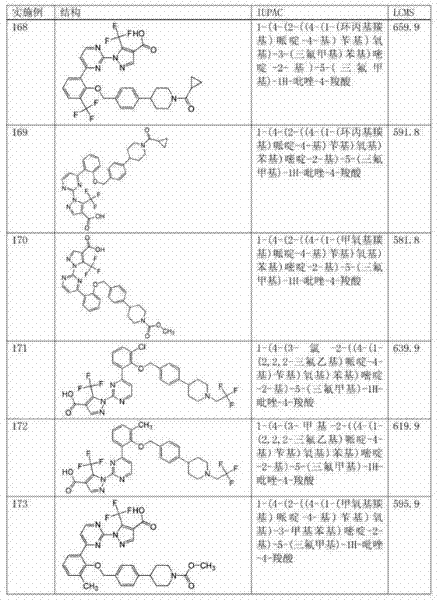

实施例180 Example 180

步骤A. 乙基1-(6-{2-[(4-溴苄基)氧基]-3-(三氟甲基)苯基}吡啶-2-基)-5-(三氟甲基)-1H-吡唑-4-羧酸酯Step A. Ethyl 1-(6-{2-[(4-bromobenzyl)oxy]-3-(trifluoromethyl)phenyl}pyridin-2-yl)-5-(trifluoromethyl )-1 H -pyrazole-4-carboxylate
向来自实施例136步骤D的标题化合物(2.26 g, 5.06 mmol)的DMF(25 mL)溶液添加1-溴-4-(溴甲基)苯(1.65 g, 6.60 mmol)和碳酸铯(3.31 g, 10.15 mmol)。将反应混合物在40℃下搅拌2 h,然后用水稀释,并用EtOAc萃取。将有机相经过Na2SO 4干燥,并真空浓缩。通过硅胶色谱纯化(己烷中的0至15% EtOAc,然后是己烷中的15至100% EtOAc)提供标题化合物:LCMS m/z 615.7 [M + H]+;1H NMR (500 MHz, CDCl3) δ 8.17 (s, 1 H)、8.07-8.01 (m, 2 H)、7.89 (t, J = 8.0 Hz, 1 H)、7.73 (d, J = 8.0 Hz, 1 H)、7.67 (d, J = 8.0 Hz, 1 H)、7.45 (d, J = 8.5 Hz, 2 H)、7.39 (t, J = 8.0 Hz, 1 H)、7.07 (d, J = 8.5 Hz, 2 H)、4.56 (s, 2 H)、4.40 (q, J = 7.0 Hz, 2 H)、1.40 (t, J = 7.0 Hz, 3 H)。 To a solution of the title compound from Example 136, Step D (2.26 g, 5.06 mmol) in DMF (25 mL) was added 1-bromo-4-(bromomethyl)benzene (1.65 g, 6.60 mmol) and cesium carbonate (3.31 g , 10.15 mmol). The reaction mixture was stirred at 40 °C for 2 h, then diluted with water and extracted with EtOAc. The organic phase was dried over Na2SO4 and concentrated in vacuo. Purification by silica gel chromatography (0 to 15% EtOAc in hexanes, then 15 to 100% EtOAc in hexanes) provided the title compound: LCMS m/z 615.7 [M+H] + ; 1 H NMR (500 MHz, CDCl 3 ) δ 8.17 (s, 1 H), 8.07-8.01 (m, 2 H), 7.89 (t, J = 8.0 Hz, 1 H), 7.73 (d, J = 8.0 Hz, 1 H), 7.67 ( d, J = 8.0 Hz, 1 H), 7.45 (d, J = 8.5 Hz, 2 H), 7.39 (t, J = 8.0 Hz, 1 H), 7.07 (d, J = 8.5 Hz, 2 H), 4.56 (s, 2 H), 4.40 (q, J = 7.0 Hz, 2 H), 1.40 (t, J = 7.0 Hz, 3 H).
步骤B. 乙基1-(6-{2-[(4-{(1E)-3-[(叔丁氧基羰基)氨基]丙-1-烯-1-基}苄基)氧基]-3-(三氟甲基)苯基}吡啶-2-基)-5-(三氟甲基)-1H-吡唑-4-羧酸酯Step B. Ethyl 1-(6-{2-[(4-{(1 E )-3-[(tert-butoxycarbonyl)amino]prop-1-en-1-yl}benzyl)oxy ]-3-(trifluoromethyl)phenyl}pyridin-2-yl)-5-(trifluoromethyl)-1 H -pyrazole-4-carboxylate
向包含来自实施例180步骤A的标题化合物(1.70 g, 2.77 mmol)的烧瓶添加叔丁基[(2E)-3-(4,4,5,5-四甲基-1,3,2-二氧杂环戊硼烷-2-基)丙-2-烯-1-基]氨基甲酸酯(1.02 g, 3.60 mmol, Tetrahedron Lett., 2002, 43, 4935-4938)和反式二氯二(三苯基膦)钯(II)(194 mg, 0.28 mmol)。添加乙腈(15 mL)和碳酸钠(6.92 mL, 1.0 M水溶液, 6.92 mmol),并通过氮气鼓泡使所产生的混合物脱气。将反应混合物在70℃下搅拌3 h,然后使其冷却至环境温度,并将其倒入水中。用EtOAc萃取该混合物,并将有机相真空浓缩。通过硅胶色谱纯化(己烷中的0至20% EtOAc,然后是己烷中的20至100% EtOAc)提供标题化合物:LCMS m/z 691.0 [M + H]+;1H NMR (500 MHz, CDCl3) δ 8.16 (s, 1 H)、8.08 (d, J = 7.5 Hz, 1 H)、8.04 (d, J = 7.5 Hz, 1 H)、7.88 (t, J = 8.0 Hz, 1 H)、7.73 (d, J = 8.0 Hz, 1 H)、7.66 (d, J = 8.0 Hz, 1 H)、7.38 (t, J = 7.5 Hz, 1 H)、7.31 (d, J = 8.0 Hz, 2 H)、7.14 (d, J = 8.0 Hz, 2 H)、6.49 (d, J = 16.0 Hz, 1 H)、6.24-6.16 (m, 1 H)、4.70-4.62 (br m, 1 H)、4.58 (s, 2 H)、4.40 (q, J = 7.0 Hz, 2 H)、3.96-3.88 (br m, 2 H)、1.47 (s, 9 H)、1.40 (t, J = 7.0 Hz, 3 H)。 To a flask containing the title compound from Example 180 Step A (1.70 g, 2.77 mmol) was added tert-butyl[( 2E )-3-(4,4,5,5-tetramethyl-1,3,2 -dioxaborolan-2-yl)prop-2-en-1-yl]carbamate (1.02 g, 3.60 mmol, Tetrahedron Lett ., 2002, 43 , 4935-4938) and trans di Chlorobis(triphenylphosphine)palladium(II) (194 mg, 0.28 mmol). Acetonitrile (15 mL) and sodium carbonate (6.92 mL, 1.0 M in water, 6.92 mmol) were added and the resulting mixture was degassed by bubbling nitrogen. The reaction mixture was stirred at 70 °C for 3 h, then allowed to cool to ambient temperature and poured into water. The mixture was extracted with EtOAc, and the organic phase was concentrated in vacuo. Purification by silica gel chromatography (0 to 20% EtOAc in hexanes, then 20 to 100% EtOAc in hexanes) provided the title compound: LCMS m/z 691.0 [M+H] + ; 1 H NMR (500 MHz, CDCl 3 ) δ 8.16 (s, 1 H), 8.08 (d, J = 7.5 Hz, 1 H), 8.04 (d, J = 7.5 Hz, 1 H), 7.88 (t, J = 8.0 Hz, 1 H) , 7.73 (d, J = 8.0 Hz, 1 H), 7.66 (d, J = 8.0 Hz, 1 H), 7.38 (t, J = 7.5 Hz, 1 H), 7.31 (d, J = 8.0 Hz, 2 H), 7.14 (d, J = 8.0 Hz, 2 H), 6.49 (d, J = 16.0 Hz, 1 H), 6.24-6.16 (m, 1 H), 4.70-4.62 (br m, 1 H), 4.58 (s, 2 H), 4.40 (q, J = 7.0 Hz, 2 H), 3.96-3.88 (br m, 2 H), 1.47 (s, 9 H), 1.40 (t, J = 7.0 Hz, 3 h).
步骤C. 乙基1-(6-{2-[(4-{3-[(叔丁氧基羰基)氨基]丙基}苄基)氧基]-3-(三氟甲基)苯基}吡啶-2-基)-5-(三氟甲基)-1H-吡唑-4-羧酸酯Step C. Ethyl 1-(6-{2-[(4-{3-[(tert-butoxycarbonyl)amino]propyl}benzyl)oxy]-3-(trifluoromethyl)phenyl }pyridin-2-yl)-5-(trifluoromethyl)-1 H -pyrazole-4-carboxylate
向来自实施例180步骤B的标题化合物(1030 mg, 1.49 mmol)的EtOAc(10 mL)脱气溶液添加氧化铂(102 mg, 0.45 mmol)。将反应烧瓶安装以氢气球,该气球连接3通接头。然后将反应混合物抽空,并回充以氢气。该过程重复三次后,将反应混合物置于氢气气氛下,并剧烈搅拌。45 min后,将反应混合物通过硅藻土过滤,用EtOAc漂洗。将该混合物经过无水硫酸钠干燥,过滤,并真空浓缩。通过硅胶色谱纯化(己烷中的0至20% EtOAc,己烷中的20至100% EtOAc)提供标题化合物:LCMS m/z 693.0 [M + H]+;1H NMR (500 MHz, CDCl3) δ 8.16 (s, 1 H)、8.11 (d, J = 8.0 Hz, 1 H)、8.05 (d, J = 8.0 Hz, 1 H)、7.91 (t, J = 8.0 Hz, 1 H ), 7.72 (d, J = 8.0 Hz, 1 H)、7.67 (d, J = 7.5 Hz, 1 H)、7.38 (t, J = 8.0 Hz, 1 H ), 7.14 (d, J = 8.5 Hz, 2 H)、7.11 (d, J = 8.5 Hz, 2 H)、4.59-4.53 (br m, 1 H)、4.57 (s, 2 H)、4.40 (q, J = 7.0 Hz, 2 H)、3.22-3.12 (br m, 2 H)、2.63 (t, J = 7.5 Hz, 2 H ), 1.80 (q, J = 7.5 Hz, 2 H ), 1.45 (s, 9 H)、1.40 (t, J = 7.5 Hz, 3 H)。 To a degassed solution of the title compound from Example 180, Step B (1030 mg, 1.49 mmol) in EtOAc (10 mL) was added platinum oxide (102 mg, 0.45 mmol). The reaction flask was fitted with a hydrogen balloon connected to a 3-way fitting. The reaction mixture was then evacuated and backfilled with hydrogen. After this process was repeated three times, the reaction mixture was placed under an atmosphere of hydrogen and stirred vigorously. After 45 min, the reaction mixture was filtered through Celite, rinsing with EtOAc. The mixture was dried over anhydrous sodium sulfate, filtered, and concentrated in vacuo. Purification by silica gel chromatography (0 to 20% EtOAc in hexanes, 20 to 100% EtOAc in hexanes) provided the title compound: LCMS m/z 693.0 [M+H] + ; 1 H NMR (500 MHz, CDCl 3 ) δ 8.16 (s, 1 H), 8.11 (d, J = 8.0 Hz, 1 H), 8.05 (d, J = 8.0 Hz, 1 H), 7.91 (t, J = 8.0 Hz, 1 H), 7.72 (d, J = 8.0 Hz, 1 H), 7.67 (d, J = 7.5 Hz, 1 H), 7.38 (t, J = 8.0 Hz, 1 H), 7.14 (d, J = 8.5 Hz, 2 H) , 7.11 (d, J = 8.5 Hz, 2 H), 4.59-4.53 (br m, 1 H), 4.57 (s, 2 H), 4.40 (q, J = 7.0 Hz, 2 H), 3.22-3.12 ( br m, 2 H), 2.63 (t, J = 7.5 Hz, 2 H ), 1.80 (q, J = 7.5 Hz, 2 H ), 1.45 (s, 9 H), 1.40 (t, J = 7.5 Hz, 3H).
步骤D. 乙基1-{6-[2-{[4-(3-氨基丙基)苄基]氧基}-3-(三氟甲基)苯基]吡啶-2-基}-5-(三氟甲基)-1H-吡唑-4-羧酸酯Step D. Ethyl 1-{6-[2-{[4-(3-aminopropyl)benzyl]oxy}-3-(trifluoromethyl)phenyl]pyridin-2-yl}-5 -(Trifluoromethyl)-1 H -pyrazole-4-carboxylate
将来自实施例180步骤C的标题化合物(850 mg, 1.23 mmol)的乙酸(4 mL)和水(1 mL)溶液在90 ℃下搅拌14 h。使反应混合物冷却至环境温度,并真空浓缩。不进行进一步纯化在随后的步骤中使用该产物:LCMS m/z 593.0 [M + H]+。 A solution of the title compound from Example 180, Step C (850 mg, 1.23 mmol) in acetic acid (4 mL) and water (1 mL) was stirred at 90 °C for 14 h. The reaction mixture was cooled to ambient temperature and concentrated in vacuo. The product was used in the subsequent step without further purification: LCMS m/z 593.0 [M + H] + .
步骤E. 乙基1-(6-{2-[(4-{3-[(2,2,2-三氟乙基)氨基]丙基}苄基)氧基]-3-(三氟甲基)苯基}吡啶-2-基)-5-(三氟甲基)-1H-吡唑-4-羧酸酯Step E. Ethyl 1-(6-{2-[(4-{3-[(2,2,2-trifluoroethyl)amino]propyl}benzyl)oxy]-3-(trifluoro Methyl)phenyl}pyridin-2-yl)-5-(trifluoromethyl)-1 H -pyrazole-4-carboxylate
向来自实施例180步骤D的标题化合物(500 mg, 0.84 mmol)的DCM(5 mL)溶液添加三氟甲磺酸2,2,2-三氟乙酯(0.42 mL, 2.53 mmol)和碳酸铯(1.65 g, 5.06 mmol)。将反应混合物在环境温度下搅拌6 h,然后用饱和NaHCO3水溶液稀释,并用DCM萃取。将有机相经过Na2SO4干燥,并真空浓缩。不进行进一步纯化在随后的步骤中使用该产物:LCMS m/z 675.1 [M + H]+。 To a solution of the title compound from Example 180, Step D (500 mg, 0.84 mmol) in DCM (5 mL) was added 2,2,2-trifluoroethyl triflate (0.42 mL, 2.53 mmol) and cesium carbonate (1.65 g, 5.06 mmol). The reaction mixture was stirred at ambient temperature for 6 h, then diluted with saturated aqueous NaHCO 3 and extracted with DCM. The organic phase was dried over Na2SO4 and concentrated in vacuo. The product was used in the subsequent step without further purification: LCMS m/z 675.1 [M + H] + .
步骤F. 乙基1-(6-{2-[(4-{3-[(环丙基甲基)(2,2,2-三氟乙基)氨基]丙基}苄基)氧基]-3-(三氟甲基)苯基}吡啶-2-基)-5-(三氟甲基)-1H-吡唑-4-羧酸酯Step F. Ethyl 1-(6-{2-[(4-{3-[(cyclopropylmethyl)(2,2,2-trifluoroethyl)amino]propyl}benzyl)oxy ]-3-(trifluoromethyl)phenyl}pyridin-2-yl)-5-(trifluoromethyl)-1 H -pyrazole-4-carboxylate
向来自实施例180步骤E的标题化合物(80 mg, 0.12 mmol)的DCM(2 mL)溶液添加环丙烷甲醛(0.01 mL, 0.12 mmol)、乙酸(0.02 mL, 0.36 mmol)和三乙酰氧基硼氢化钠(33 mg, 0.15 mmol)。将反应混合物在环境温度下搅拌12 h,然后用饱和NaHCO3水溶液稀释,并用DCM萃取。将有机相经过Na2SO 4干燥,并真空浓缩。不进行进一步纯化在随后的步骤中使用该产物:LCMS m/z 729.1 [M + H]+。 To a solution of the title compound from Example 180, Step E (80 mg, 0.12 mmol) in DCM (2 mL) was added cyclopropanecarbaldehyde (0.01 mL, 0.12 mmol), acetic acid (0.02 mL, 0.36 mmol) and triacetoxyboron Sodium hydride (33 mg, 0.15 mmol). The reaction mixture was stirred at ambient temperature for 12 h, then diluted with saturated aqueous NaHCO 3 and extracted with DCM. The organic phase was dried over Na2SO4 and concentrated in vacuo. The product was used in the subsequent step without further purification: LCMS m/z 729.1 [M + H] + .
步骤G. 1-(6-{2-[(4-{3-[(环丙基甲基)(2,2,2-三氟乙基)氨基]丙基}苄基)氧基]-3-(三氟甲基)苯基}吡啶-2-基)-5-(三氟甲基)-1H-吡唑-4-羧酸Step G. 1-(6-{2-[(4-{3-[(cyclopropylmethyl)(2,2,2-trifluoroethyl)amino]propyl}benzyl)oxy]- 3-(Trifluoromethyl)phenyl}pyridin-2-yl)-5-(trifluoromethyl)-1 H -pyrazole-4-carboxylic acid
向来自实施例180步骤F的标题化合物(86 mg, 0.12 mmol)的1,4-二

应用实施例180中所述的化学方法和/或通过实施例1-14、136、148、162和167中所述的化学方法的类推,制备表6中所列的化合物。 Using the chemistry described in Example 180 and/or by analogy with the chemistry described in Examples 1-14, 136, 148, 162 and 167, the compounds listed in Table 6 were prepared.
表6 Table 6

基于细胞的sGC功能分析(CASA分析)Cell-Based sGC Functional Analysis (CASA Assay)
原理:sGC是含有血红素的酶,其将GTP(鸟苷5’-三磷酸)转化为第二信使cGMP。cGMP水平的增加影响对几个生理过程,包括通过多个下游途径的血管舒张。sGC催化cGMP形成的速率通过NO和通过最近发现的NO依赖性激活剂和刺激物大幅提高。血红素依赖性激活剂 (HIAs)优先激活含有铁血红素基团的sGC,其可在用1H-(1,2,4)
方法:利用标准的转染方案,生成稳定表达sGC α1/β1异二聚体的CHO-K1细胞系。利用FUGENE试剂,同时用质粒pIREShyghsGCα1和pIRESneo-hsGCβ1转染CHO-K1细胞。用潮霉素和新霉素选择稳定表达两个亚单位的克隆,进行约2周。选择克隆#7用于分析,并将其命名为CHO-K1/sGC。将CHO-K1/sGC细胞保持在F-K12培养基中,该培养基包含10%热失活的胎牛血清(FBS)、100 μg/mL 青霉素/链霉素、0.5 mg/mL潮霉素和0.25 mg/mL G418。在分析那天,在EBSS(Earle平衡盐溶液)分析缓冲液(EAB)中收获细胞,该缓冲液包含5mM MgCl2、10mM HEPES (4-(2-羟基乙基)哌嗪-1-乙磺酸)和0.05% BSA(牛血清白蛋白),并用EAB将细胞密度调整至2 X 10⁶/mL。添加IBMX(3-异丁基-1-甲基黄嘌呤,0.5mM),以抑制cGMP降解。将化合物从DMSO原液稀释,并以1%的最终DMSO浓度添加到分析中。在10 μM的1H-(1,2,4)
在上述基于细胞的分析(利用ODQ温育)中,本发明化合物具有小于或等于10 μM的拐点(IP)、和至少4倍的相对于DMSO对照的最大诱导倍数,更特别地,小于或等于约200 nM/等于或大于约20倍。优选的化合物具有小于或等于约100 nM的IP、和至少50倍的相对于DMSO对照的最大诱导倍数。 Compounds of the invention have an inflection point (IP) of less than or equal to 10 μM in the above cell-based assay (incubation with ODQ), and a maximum fold induction of at least 4-fold relative to the DMSO control, more specifically, less than or equal to About 200 nM/equal to or greater than about 20-fold. Preferred compounds have an IP of less than or equal to about 100 nM, and a maximal fold induction of at least 50-fold relative to the DMSO control.
提供以下代表性化合物的基于细胞的分析结果(利用ODQ温育)。将数据列举为拐点(IP)和相对于DMSO对照的最大诱导倍数。 The results of cell-based assays (incubated with ODQ) for representative compounds are provided below. Data are presented as inflection point (IP) and fold maximal induction relative to DMSO control.
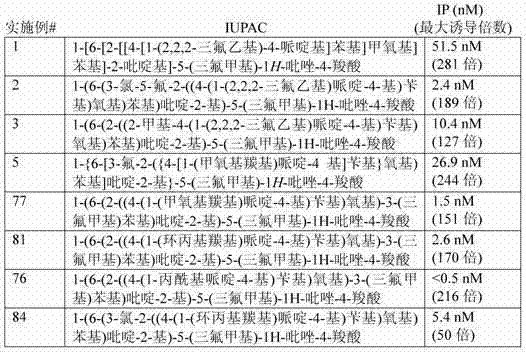
虽然关于其某些具体实施方式对本发明进行了描述,但根据本文所述的教导,多种可选的实施方式对于本领域技术人员将是显而易见的。权利要求中未指明手性的具体化合物(即种类)的陈述意为包括该化合物的外消旋体、外消旋混合物、每一个别的对映异构体、非对映异构混合物以及每一个别的非对映异构体,其中这些形式由于一个或多个不对称中心的存在而具有可能性。本文引用的所有专利、专利申请和公开以其整体引入作为参考。 While this invention has been described in terms of certain specific embodiments thereof, various alternative embodiments will be apparent to those skilled in the art from the teachings presented herein. Recitation of a specific compound (i.e., species) in a claim that does not indicate chirality is meant to include racemates, racemic mixtures, each individual enantiomer, diastereomeric mixture, and each An individual diastereomer wherein these forms are possible due to the presence of one or more asymmetric centers. All patents, patent applications, and publications cited herein are incorporated by reference in their entirety.
Claims (24)


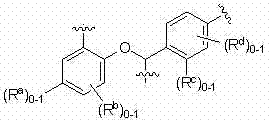
Applications Claiming Priority (3)
| Application Number | Priority Date | Filing Date | Title |
|---|---|---|---|
| US20864809P | 2009-02-26 | 2009-02-26 | |
| US61/208648 | 2009-02-26 | ||
| PCT/US2010/024853 WO2010099054A2 (en) | 2009-02-26 | 2010-02-22 | Soluble guanylate cyclase activators |
Publications (1)
| Publication Number | Publication Date |
|---|---|
| CN102414194A true CN102414194A (en) | 2012-04-11 |
Family
ID=42410011
Family Applications (1)
| Application Number | Title | Priority Date | Filing Date |
|---|---|---|---|
| CN2010800184490A Pending CN102414194A (en) | 2009-02-26 | 2010-02-22 | Soluble guanylate cyclase activators |
Country Status (15)
| Country | Link |
|---|---|
| US (1) | US8507512B2 (en) |
| EP (1) | EP2401265B1 (en) |
| JP (1) | JP5411300B2 (en) |
| KR (1) | KR20110133034A (en) |
| CN (1) | CN102414194A (en) |
| AR (1) | AR075609A1 (en) |
| AU (1) | AU2010218224B2 (en) |
| BR (1) | BRPI1008793A2 (en) |
| CA (1) | CA2753434C (en) |
| CO (1) | CO6430463A2 (en) |
| IL (1) | IL214559A0 (en) |
| MX (1) | MX2011008952A (en) |
| RU (1) | RU2011138970A (en) |
| TW (1) | TW201035077A (en) |
| WO (1) | WO2010099054A2 (en) |
Cited By (4)
| Publication number | Priority date | Publication date | Assignee | Title |
|---|---|---|---|---|
| CN105980373A (en) * | 2014-09-05 | 2016-09-28 | 葛兰素史密斯克莱知识产权发展有限公司 | Novel soluble guanylate cyclase activators and their use |
| CN106470986A (en) * | 2014-07-02 | 2017-03-01 | 诺华股份有限公司 | Cyclohexene 1 yl pyridines 2 base 1H pyrazoles 4 formic acid derivates and its purposes as soluble guanylate cyclase activators |
| CN106470985A (en) * | 2014-07-02 | 2017-03-01 | 诺华股份有限公司 | Indane as soluble guanylate cyclase activators and indolin derivatives and application thereof |
| CN106687456A (en) * | 2014-09-19 | 2017-05-17 | 葛兰素史密斯克莱知识产权发展有限公司 | Novel soluble guanylate cyclase activators and their use |
Families Citing this family (63)
| Publication number | Priority date | Publication date | Assignee | Title |
|---|---|---|---|---|
| KR20100059952A (en) * | 2007-09-06 | 2010-06-04 | 머크 샤프 앤드 돔 코포레이션 | Soluble guanylate cyclase activators |
| WO2010099054A2 (en) | 2009-02-26 | 2010-09-02 | Merck Sharp & Dohme Corp. | Soluble guanylate cyclase activators |
| WO2012058132A1 (en) | 2010-10-28 | 2012-05-03 | Merck Sharp & Dohme Corp. | Soluble guanylate cyclase activators |
| GB2486631A (en) * | 2010-12-01 | 2012-06-27 | Univ Sheffield | Phenol/quinone boronic acids/esters and method of preparation thereof |
| EP2683710B1 (en) * | 2011-03-10 | 2017-07-19 | Boehringer Ingelheim International GmbH | Soluble guanylate cyclase activators |
| JP5826393B2 (en) | 2011-08-12 | 2015-12-02 | ベーリンガー インゲルハイム インターナショナル ゲゼルシャフト ミット ベシュレンクテル ハフツング | Soluble guanylate cyclase activator |
| EP2594270A3 (en) | 2011-11-18 | 2013-07-31 | BIP Patents | The use of sGC stimulators, sGC activators, alone and combinations with PDE5 inhibitors for the treatment of systemic sclerosis (SSc) |
| EP2863914B1 (en) * | 2012-06-20 | 2018-10-03 | Merck Sharp & Dohme Corp. | Pyrazolyl derivatives as syk inhibitors |
| SI2892891T1 (en) | 2012-09-07 | 2019-11-29 | Boehringer Ingelheim Int | Alkoxy pyrazoles as soluble guanylate cyclase activators |
| BR112015023349A2 (en) | 2013-03-15 | 2017-07-18 | Ironwood Pharmaceuticals Inc | compound, pharmaceutical composition, and method of treating a disease, health condition or disorder |
| WO2015033307A1 (en) * | 2013-09-05 | 2015-03-12 | Glaxosmithkline Intellectual Property Development Limited | Novel soluble guanylate cyclase activators and their use |
| MX2016007522A (en) | 2013-12-11 | 2017-12-15 | Ironwood Pharmaceuticals Inc | Sgc stimulators. |
| EP3079700B1 (en) | 2013-12-11 | 2020-11-25 | Merck Sharp & Dohme Corp. | Soluble guanylate cyclase activators |
| WO2015088885A1 (en) | 2013-12-11 | 2015-06-18 | Merck Sharp & Dohme Corp. | Soluble guanylate cyclase activators |
| WO2015095515A1 (en) | 2013-12-20 | 2015-06-25 | Novartis Ag | Sgc activators for the treatment of glaucoma |
| WO2015106268A1 (en) | 2014-01-13 | 2015-07-16 | Ironwood Pharmaceuticals, Inc. | USE OF sGC STIMULATORS FOR THE TREATMENT OF NEUROMUSCULAR DISORDERS |
| EP3152214B1 (en) | 2014-06-04 | 2020-01-29 | Merck Sharp & Dohme Corp. | Imidazo-pyrazine derivatives useful as soluble guanylate cyclase activators |
| TW201625601A (en) | 2014-07-02 | 2016-07-16 | 諾華公司 | Thiophen-2-yl-pyridin-2-yl-1H-pyrazole-4-carboxylic acid derivatives and the use thereof as soluble guanylate cyclase activators |
| SG10201806565SA (en) | 2014-07-22 | 2018-08-30 | Boehringer Ingelheim Int | Heterocyclic carboxylic acids as activators of soluble guanylate cyclase |
| US20170298055A1 (en) | 2014-09-17 | 2017-10-19 | Ironwood Pharmaceuticals, Inc. | sGC STIMULATORS |
| JP2017527604A (en) | 2014-09-17 | 2017-09-21 | アイアンウッド ファーマシューティカルズ インコーポレイテッド | sGC stimulant |
| WO2016044447A1 (en) | 2014-09-17 | 2016-03-24 | Ironwood Pharmaceuticals, Inc. | Pyrazole derivatives as sgc stimulators |
| TW201625635A (en) | 2014-11-21 | 2016-07-16 | 默沙東藥廠 | Triazolo-pyrazinyl derivatives useful as soluble guanylate cyclase activators |
| US10245264B2 (en) | 2015-05-27 | 2019-04-02 | Merck Sharp & Dohme Corp. | Substituted imidazo[1,2-a]pyrazines as soluble guanylate cyclase activators |
| US10213429B2 (en) | 2015-05-28 | 2019-02-26 | Merck Sharp & Dohme Corp. | Imidazo-pyrazinyl derivatives useful as soluble guanylate cyclase activators |
| EP3766878B1 (en) | 2015-06-15 | 2022-03-16 | GlaxoSmithKline Intellectual Property Development Limited | Nrf2 regulators |
| CA2988338C (en) | 2015-06-15 | 2024-05-14 | Glaxosmithkline Intellectual Property Development Limited | Nrf2 regulators |
| EP3359532A1 (en) | 2015-10-06 | 2018-08-15 | GlaxoSmithKline Intellectual Property Development Limited | Biaryl pyrazoles as nrf2 regulators |
| JP2018529744A (en) * | 2015-10-06 | 2018-10-11 | グラクソスミスクライン、インテレクチュアル、プロパティー、ディベロップメント、リミテッドGlaxosmithkline Intellectual Property Development Limited | Arylcyclohexylpyrazoles as NRF2 regulators |
| EA201891416A1 (en) | 2015-12-14 | 2018-12-28 | Айронвуд Фармасьютикалз, Инк. | APPLICATION of sGC STIMULATORS FOR THE TREATMENT OF GASTRIC AND INTESTINAL SPINKLIN TREATMENT |
| US10316020B2 (en) * | 2015-12-18 | 2019-06-11 | Novartis Ag | Indane derivatives and the use thereof as soluble guanylate cyclase activators |
| WO2017107052A1 (en) | 2015-12-22 | 2017-06-29 | Merck Sharp & Dohme Corp. | Soluble guanylate cyclase stimulators |
| WO2017197555A1 (en) | 2016-05-16 | 2017-11-23 | Merck Sharp & Dohme Corp. | Fused pyrazine derivatives useful as soluble guanylate cyclase stimulators |
| EP3458063A4 (en) | 2016-05-18 | 2020-02-26 | Merck Sharp & Dohme Corp. | METHODS OF USING TRIAZOLO-PYRAZINYL-SOLUBLE GUANYLATE CYCLASE ACTIVATORS FOR FIBROTIC DISORDERS |
| KR20190025989A (en) | 2016-07-07 | 2019-03-12 | 아이언우드 파마슈티컬스, 인코포레이티드 | Solid form of sGC stimulant |
| BR112019000290B1 (en) | 2016-07-07 | 2022-10-18 | Cyclerion Therapeutics, Inc | PHOSPHORUS PRODRUGS FROM SGC STIMULATORS |
| IL292968B2 (en) | 2016-09-02 | 2025-10-01 | Cyclerion Therapeutics Inc | Fused bicyclic scg stimulators |
| WO2018069148A1 (en) | 2016-10-11 | 2018-04-19 | Bayer Pharma Aktiengesellschaft | Combination containing sgc activators and mineralocorticoid receptor antagonists |
| CA3042713A1 (en) | 2016-11-08 | 2018-05-17 | Cyclerion Therapeutics, Inc. | Sgc stimulators |
| KR102475124B1 (en) | 2016-11-08 | 2022-12-08 | 사이클리온 테라퓨틱스, 인크. | Treatment of CNS diseases with sGC stimulators |
| US20190381039A1 (en) | 2016-12-13 | 2019-12-19 | Cyclerion Therapeutics, Inc. | USE OF sGC STIMULATORS FOR THE TREATMENT OF ESOPHAGEAL MOTILITY DISORDERS |
| US11389449B2 (en) | 2017-09-14 | 2022-07-19 | Cyclerion Therapeutics, Inc. | Treatment of metabolic syndrome with an sGC stimulator |
| WO2019081456A1 (en) | 2017-10-24 | 2019-05-02 | Bayer Aktiengesellschaft | Use of activators and stimulators of sgc comprising a beta2 subunit |
| EP3498298A1 (en) | 2017-12-15 | 2019-06-19 | Bayer AG | The use of sgc stimulators and sgc activators alone or in combination with pde5 inhibitors for the treatment of bone disorders including osteogenesis imperfecta (oi) |
| MX2020006433A (en) | 2017-12-19 | 2020-09-17 | Cyclerion Therapeutics Inc | Sgc stimulators. |
| ES2980256T3 (en) | 2018-03-07 | 2024-09-30 | Tisento Therapeutics Inc | Crystalline forms of a SGC stimulator |
| JP7314173B2 (en) | 2018-04-30 | 2023-07-25 | バイエル アクチェンゲゼルシャフト | Use of sGC activators and sGC stimulants for the treatment of cognitive impairment |
| KR20210008070A (en) | 2018-05-15 | 2021-01-20 | 바이엘 악티엔게젤샤프트 | 1,3-thiazol-2-yl substituted benzamide for treatment of diseases associated with nerve fiber sensitization |
| EP3574905A1 (en) | 2018-05-30 | 2019-12-04 | Adverio Pharma GmbH | Method of identifying a subgroup of patients suffering from dcssc which benefits from a treatment with sgc stimulators and sgc activators in a higher degree than a control group |
| US12220414B2 (en) | 2018-07-11 | 2025-02-11 | Tisento Therapeutics Inc. | Use of sGC stimulators for the treatment of mitochondrial disorders |
| CN113166157B (en) | 2018-11-28 | 2024-08-27 | 托帕杜制药公司 | Double-acting mode soluble guanylate cyclase activators and phosphodiesterase inhibitors and uses thereof |
| CA3126778A1 (en) | 2019-01-17 | 2020-07-23 | Bayer Aktiengesellschaft | Methods to determine whether a subject is suitable of being treated with an agonist of soluble guanylyl cyclase (sgc) |
| WO2021195403A1 (en) | 2020-03-26 | 2021-09-30 | Cyclerion Therapeutics, Inc. | Deuterated sgc stimulators |
| WO2021202546A1 (en) | 2020-03-31 | 2021-10-07 | Cyclerion Therapeutics, Inc. | Early drug interventions to reduce covid-19 related respiratory distress, need for ventilator assistance and death |
| WO2021245192A1 (en) | 2020-06-04 | 2021-12-09 | Topadur Pharma Ag | Novel dual mode of action soluble guanylate cyclase activators and phosphodiesterase inhibitors and uses thereof |
| EP4011873A1 (en) | 2020-12-10 | 2022-06-15 | Bayer Aktiengesellschaft | Substituted pyrazolo piperidine carboxylic acids |
| WO2022225903A1 (en) | 2021-04-20 | 2022-10-27 | Cyclerion Therapeutics, Inc. | Sgc stimulators |
| EP4326268A1 (en) | 2021-04-20 | 2024-02-28 | Tisento Therapeutics Inc. | Treatment of cns diseases with sgc stimulators |
| WO2022265984A1 (en) | 2021-06-14 | 2022-12-22 | Curtails Llc | Use of nep inhibitors for the treatment of gastrointestinal sphincter disorders |
| WO2023018795A1 (en) | 2021-08-11 | 2023-02-16 | Curtails Llc | Nep inhibitors for the treatment of laminitis |
| JP2025518350A (en) | 2022-06-09 | 2025-06-12 | バイエル・アクチエンゲゼルシヤフト | Soluble guanylate cyclase activators for use in the treatment of heart failure with preserved ejection fraction in women - Patents.com |
| JP2025536344A (en) | 2022-10-18 | 2025-11-05 | ティセント セラピューティクス インコーポレーテッド | Treatment of mitochondrial disorders with sGC stimulators |
| CN120225524A (en) | 2022-10-18 | 2025-06-27 | 帝善多制药公司 | Pyrimidine sGC stimulators |
Citations (2)
| Publication number | Priority date | Publication date | Assignee | Title |
|---|---|---|---|---|
| WO2000027394A1 (en) * | 1998-11-05 | 2000-05-18 | University College London | Activators of soluble guanylate cyclase |
| WO2009032249A1 (en) * | 2007-09-06 | 2009-03-12 | Merck & Co., Inc. | Soluble guanylate cyclase activators |
Family Cites Families (48)
| Publication number | Priority date | Publication date | Assignee | Title |
|---|---|---|---|---|
| GB876526A (en) | 1957-12-24 | 1961-09-06 | Geigy Ag J R | Process for the production of new aminobenzoic acid derivatives and their use in pest control |
| US4845079A (en) | 1985-01-23 | 1989-07-04 | Luly Jay R | Peptidylaminodiols |
| US5066643A (en) | 1985-02-19 | 1991-11-19 | Sandoz Ltd. | Fluorine and chlorine statine or statone containing peptides and method of use |
| US4894437A (en) | 1985-11-15 | 1990-01-16 | The Upjohn Company | Novel renin inhibiting polypeptide analogs containing S-aryl-D- or L- or DL-cysteinyl, 3-(arylthio)lactic acid or 3-(arylthio)alkyl moieties |
| US4885292A (en) | 1986-02-03 | 1989-12-05 | E. R. Squibb & Sons, Inc. | N-heterocyclic alcohol renin inhibitors |
| US5089471A (en) | 1987-10-01 | 1992-02-18 | G. D. Searle & Co. | Peptidyl beta-aminoacyl aminodiol carbamates as anti-hypertensive agents |
| US4980283A (en) | 1987-10-01 | 1990-12-25 | Merck & Co., Inc. | Renin-inhibitory pepstatin phenyl derivatives |
| US5034512A (en) | 1987-10-22 | 1991-07-23 | Warner-Lambert Company | Branched backbone renin inhibitors |
| US5063207A (en) | 1987-10-26 | 1991-11-05 | Warner-Lambert Company | Renin inhibitors, method for using them, and compositions containing them |
| US5055466A (en) | 1987-11-23 | 1991-10-08 | E. R. Squibb & Sons, Inc. | N-morpholino derivatives and their use as anti-hypertensive agents |
| US5036054A (en) | 1988-02-11 | 1991-07-30 | Warner-Lambert Company | Renin inhibitors containing alpha-heteroatom amino acids |
| US5036053A (en) | 1988-05-27 | 1991-07-30 | Warner-Lambert Company | Diol-containing renin inhibitors |
| DE3841520A1 (en) | 1988-12-09 | 1990-06-13 | Hoechst Ag | ENZYME-INFRINGING DERIVATIVES OF DIPEPTIDES, METHOD FOR THE PRODUCTION THEREOF, METHODS CONTAINING THEM AND THEIR USE |
| US5106835A (en) | 1988-12-27 | 1992-04-21 | American Cyanamid Company | Renin inhibitors |
| US5063208A (en) | 1989-07-26 | 1991-11-05 | Abbott Laboratories | Peptidyl aminodiol renin inhibitors |
| US5098924A (en) | 1989-09-15 | 1992-03-24 | E. R. Squibb & Sons, Inc. | Diol sulfonamide and sulfinyl renin inhibitors |
| US5104869A (en) | 1989-10-11 | 1992-04-14 | American Cyanamid Company | Renin inhibitors |
| US5114937A (en) | 1989-11-28 | 1992-05-19 | Warner-Lambert Company | Renin inhibiting nonpeptides |
| US5064965A (en) | 1990-03-08 | 1991-11-12 | American Home Products Corporation | Renin inhibitors |
| US5075451A (en) | 1990-03-08 | 1991-12-24 | American Home Products Corporation | Pyrrolimidazolones useful as renin inhibitors |
| US5095119A (en) | 1990-03-08 | 1992-03-10 | American Home Products Corporation | Renin inhibitors |
| DE4011361A1 (en) | 1990-04-07 | 1991-10-10 | Bayer Ag | 2-Aryl-6-hetero:aryl-pyridine cpds. - useful as defoliants, desiccants, weedkillers and fungicides |
| US5071837A (en) | 1990-11-28 | 1991-12-10 | Warner-Lambert Company | Novel renin inhibiting peptides |
| DE19744026A1 (en) | 1997-10-06 | 1999-04-08 | Hoechst Marion Roussel De Gmbh | Pyrazole derivatives, their preparation and their use in medicinal products |
| DE19744027A1 (en) | 1997-10-06 | 1999-04-08 | Hoechst Marion Roussel De Gmbh | New pyrazolo(3,4-b)pyridine derivatives useful as cGMP agonists |
| US20010044445A1 (en) * | 1999-04-08 | 2001-11-22 | Bamaung Nwe Y. | Azole inhibitors of cytokine production |
| DE19943636A1 (en) * | 1999-09-13 | 2001-03-15 | Bayer Ag | Novel dicarboxylic acid derivatives with pharmaceutical properties |
| WO2002074753A2 (en) | 2001-03-15 | 2002-09-26 | Basf Aktiengesellschaft | 5-phenylpyrimidine, methods and intermediate products for the production thereof and use of the same for controlling pathogenic fungi |
| DE10149370A1 (en) | 2001-10-06 | 2003-04-10 | Merck Patent Gmbh | New 1-(phenyl or pyridinyl)-1H-pyrazole derivatives, are glycine transporter inhibitors useful e.g. for treating schizophrenia, depression, dementia, neurodegenerative diseases or pain |
| AU2003294275A1 (en) | 2002-11-21 | 2004-06-18 | New York Blood Center | Compounds for inhibition of hiv infection by blocking hiv entry |
| US7589116B2 (en) | 2003-04-03 | 2009-09-15 | Merck & Co. Inc. | Biaryl substituted pyrazoles as sodium channel blockers |
| EP1768557A1 (en) * | 2004-06-24 | 2007-04-04 | KSN Energies, LLC | Electrical impedance tomography to characterize tissue |
| RU2007115900A (en) | 2004-10-27 | 2008-11-10 | Дайити Санкио Компани, Лимитед (Jp) | BENZENE DERIVATIVES WITH 2 OR MORE SUBSTITUTES |
| ES2393792T3 (en) * | 2005-01-31 | 2012-12-28 | Dong Wha Pharm. Co., Ltd. | Pharmaceutical composition to treat nephropathy and healthy food comprising herbal extracts |
| CA2611979A1 (en) | 2005-06-15 | 2006-12-21 | Pfizer Limited | Substituted arylpyrazoles |
| CN101228134A (en) | 2005-06-15 | 2008-07-23 | 辉瑞有限公司 | Substituted arylpyrazoles useful as parasiticides |
| ES2525217T3 (en) | 2005-06-27 | 2014-12-19 | Exelixis Patent Company Llc | LXR modulators based on imidazole |
| DE102005050375A1 (en) * | 2005-10-21 | 2007-04-26 | Bayer Healthcare Ag | Tetrazole derivatives and their use |
| JP2010505957A (en) | 2006-10-10 | 2010-02-25 | アムゲン インコーポレイティッド | N-arylpyrazole compounds used for diabetes |
| DE102007015034A1 (en) * | 2007-03-29 | 2008-10-02 | Bayer Healthcare Ag | Lactam-substituted dicarboxylic acids and their use |
| DE102007015035A1 (en) * | 2007-03-29 | 2008-10-02 | Bayer Healthcare Ag | Substituted dibenzoic acid derivatives and their use |
| WO2009068652A1 (en) | 2007-11-30 | 2009-06-04 | Smithkline Beecham Corporation | 2, 6-disubstituted pyridines and 2, 4-disubstituted pyrimidines as soluble guanylate cyclase activators |
| UY31507A1 (en) | 2007-12-03 | 2009-07-17 | PIRIDINE DERIVATIVES SOLUBLE CYCLING GUANILATE ACTIVATORS | |
| US8461348B2 (en) * | 2008-04-04 | 2013-06-11 | Takeda Pharmaceutical Company Limited | Heterocyclic derivative and use thereof |
| WO2010015653A1 (en) | 2008-08-07 | 2010-02-11 | Smithkline Beecham Corporation | Pyrimidine derivatives as activators of soluble guanylate cyclase |
| WO2010015652A2 (en) | 2008-08-07 | 2010-02-11 | Smithkline Beecham Corporation | Thiazole compounds as activators of soluble guanylate cyclase |
| WO2010099054A2 (en) | 2009-02-26 | 2010-09-02 | Merck Sharp & Dohme Corp. | Soluble guanylate cyclase activators |
| WO2012058132A1 (en) | 2010-10-28 | 2012-05-03 | Merck Sharp & Dohme Corp. | Soluble guanylate cyclase activators |
-
2010
- 2010-02-22 WO PCT/US2010/024853 patent/WO2010099054A2/en not_active Ceased
- 2010-02-22 MX MX2011008952A patent/MX2011008952A/en active IP Right Grant
- 2010-02-22 BR BRPI1008793A patent/BRPI1008793A2/en not_active IP Right Cessation
- 2010-02-22 EP EP10705728.3A patent/EP2401265B1/en active Active
- 2010-02-22 CN CN2010800184490A patent/CN102414194A/en active Pending
- 2010-02-22 JP JP2011552075A patent/JP5411300B2/en not_active Expired - Fee Related
- 2010-02-22 AU AU2010218224A patent/AU2010218224B2/en not_active Ceased
- 2010-02-22 CA CA2753434A patent/CA2753434C/en not_active Expired - Fee Related
- 2010-02-22 RU RU2011138970/04A patent/RU2011138970A/en not_active Application Discontinuation
- 2010-02-22 KR KR1020117022295A patent/KR20110133034A/en not_active Ceased
- 2010-02-24 US US12/711,854 patent/US8507512B2/en active Active
- 2010-02-25 AR ARP100100555A patent/AR075609A1/en not_active Application Discontinuation
- 2010-02-25 TW TW099105497A patent/TW201035077A/en unknown
-
2011
- 2011-08-09 IL IL214559A patent/IL214559A0/en unknown
- 2011-09-12 CO CO11117858A patent/CO6430463A2/en not_active Application Discontinuation
Patent Citations (2)
| Publication number | Priority date | Publication date | Assignee | Title |
|---|---|---|---|---|
| WO2000027394A1 (en) * | 1998-11-05 | 2000-05-18 | University College London | Activators of soluble guanylate cyclase |
| WO2009032249A1 (en) * | 2007-09-06 | 2009-03-12 | Merck & Co., Inc. | Soluble guanylate cyclase activators |
Cited By (5)
| Publication number | Priority date | Publication date | Assignee | Title |
|---|---|---|---|---|
| CN106470986A (en) * | 2014-07-02 | 2017-03-01 | 诺华股份有限公司 | Cyclohexene 1 yl pyridines 2 base 1H pyrazoles 4 formic acid derivates and its purposes as soluble guanylate cyclase activators |
| CN106470985A (en) * | 2014-07-02 | 2017-03-01 | 诺华股份有限公司 | Indane as soluble guanylate cyclase activators and indolin derivatives and application thereof |
| CN105980373A (en) * | 2014-09-05 | 2016-09-28 | 葛兰素史密斯克莱知识产权发展有限公司 | Novel soluble guanylate cyclase activators and their use |
| CN106687456A (en) * | 2014-09-19 | 2017-05-17 | 葛兰素史密斯克莱知识产权发展有限公司 | Novel soluble guanylate cyclase activators and their use |
| CN106687456B (en) * | 2014-09-19 | 2019-12-03 | 葛兰素史密斯克莱知识产权发展有限公司 | Soluble guanylate cyclase activators and their uses |
Also Published As
| Publication number | Publication date |
|---|---|
| JP5411300B2 (en) | 2014-02-12 |
| TW201035077A (en) | 2010-10-01 |
| CA2753434C (en) | 2014-07-15 |
| KR20110133034A (en) | 2011-12-09 |
| CO6430463A2 (en) | 2012-04-30 |
| CA2753434A1 (en) | 2010-09-02 |
| AU2010218224A1 (en) | 2011-09-08 |
| BRPI1008793A2 (en) | 2016-03-08 |
| AR075609A1 (en) | 2011-04-20 |
| US20100216764A1 (en) | 2010-08-26 |
| RU2011138970A (en) | 2013-04-10 |
| JP2012519169A (en) | 2012-08-23 |
| EP2401265A2 (en) | 2012-01-04 |
| WO2010099054A2 (en) | 2010-09-02 |
| IL214559A0 (en) | 2011-09-27 |
| US8507512B2 (en) | 2013-08-13 |
| MX2011008952A (en) | 2011-09-27 |
| EP2401265B1 (en) | 2016-09-14 |
| WO2010099054A3 (en) | 2010-10-21 |
| AU2010218224B2 (en) | 2013-06-27 |
Similar Documents
| Publication | Publication Date | Title |
|---|---|---|
| EP2401265B1 (en) | Derivatives of 1-pyri(mid)in-2-yl-pyrazole-4-carboxylic acid which are useful for therapy or prophylaxis of cardiovascular diseases | |
| EP2632551B1 (en) | Soluble guanylate cyclase activators | |
| TWI796205B (en) | Novel cyp11a1 inhibitors | |
| AU2018217488A1 (en) | Aminotriazolopyridines as kinase inhibitors | |
| AU2015220551B2 (en) | 1,2-substituted cyclopentanes as orexin receptor antagonists | |
| AU2008324243A1 (en) | 4-benzylamino-1-carboxyacyl-piperidine derivatives as CETP inhibitors useful for the treatment of diseases such as hyperlipidemia or arteriosclerosis | |
| CN113490668B (en) | Compounds and compositions for treating diseases associated with APJ receptor activity | |
| WO2023194964A1 (en) | Fused pyridazine derivatives as nlrp3 inhibitors | |
| CA3255222A1 (en) | N-(pyrrolidin-3-yl or piperidin-4-yl)acetamide derivatives | |
| IL296902B2 (en) | n-Heteroarylalkyl-2-(heterocyclyl and heterocyclylmethyl)acetamide derivatives as sstr4 agonists | |
| CN103492366B (en) | Primary amine diazeniumdiolate Hete rocyclic derivatives | |
| IL296602A (en) | N-(heterocyclyl and heterocyclylalkyl)-3-benzylpyridin-2-amine derivatives as sstr4 agonists | |
| EA031310B1 (en) | Piperidine and azepine derivatives as prokineticin receptor modulators | |
| JP2024534028A (en) | Cyclin-dependent kinase inhibitors |
Legal Events
| Date | Code | Title | Description |
|---|---|---|---|
| C06 | Publication | ||
| PB01 | Publication | ||
| C10 | Entry into substantive examination | ||
| SE01 | Entry into force of request for substantive examination | ||
| ASS | Succession or assignment of patent right |
Owner name: SCHERING CORP (US) Free format text: FORMER OWNER: MSD CORP. Effective date: 20121031 |
|
| C41 | Transfer of patent application or patent right or utility model | ||
| C53 | Correction of patent of invention or patent application | ||
| CB02 | Change of applicant information |
Address after: New jersey, USA Applicant after: MERCK SHARP & DOHME Corp. Address before: New jersey, USA Applicant before: SCHERING Corp. |
|
| COR | Change of bibliographic data |
Free format text: CORRECT: APPLICANT; FROM: SCHERING CORP (US) TO: MSD CORP. |
|
| TA01 | Transfer of patent application right |
Effective date of registration: 20121031 Address after: New jersey, USA Applicant after: SCHERING Corp. Address before: New jersey, USA Applicant before: MERCK SHARP & DOHME Corp. |
|
| C02 | Deemed withdrawal of patent application after publication (patent law 2001) | ||
| WD01 | Invention patent application deemed withdrawn after publication |
Application publication date: 20120411 |