CN102378823A - Steel wire for high-strength spring - Google Patents
Steel wire for high-strength spring Download PDFInfo
- Publication number
- CN102378823A CN102378823A CN2010800154067A CN201080015406A CN102378823A CN 102378823 A CN102378823 A CN 102378823A CN 2010800154067 A CN2010800154067 A CN 2010800154067A CN 201080015406 A CN201080015406 A CN 201080015406A CN 102378823 A CN102378823 A CN 102378823A
- Authority
- CN
- China
- Prior art keywords
- steel wire
- strength
- less
- spring
- carbides
- Prior art date
- Legal status (The legal status is an assumption and is not a legal conclusion. Google has not performed a legal analysis and makes no representation as to the accuracy of the status listed.)
- Pending
Links
Images


Classifications
-
- C—CHEMISTRY; METALLURGY
- C22—METALLURGY; FERROUS OR NON-FERROUS ALLOYS; TREATMENT OF ALLOYS OR NON-FERROUS METALS
- C22C—ALLOYS
- C22C38/00—Ferrous alloys, e.g. steel alloys
- C22C38/18—Ferrous alloys, e.g. steel alloys containing chromium
- C22C38/34—Ferrous alloys, e.g. steel alloys containing chromium with more than 1.5% by weight of silicon
-
- C—CHEMISTRY; METALLURGY
- C21—METALLURGY OF IRON
- C21D—MODIFYING THE PHYSICAL STRUCTURE OF FERROUS METALS; GENERAL DEVICES FOR HEAT TREATMENT OF FERROUS OR NON-FERROUS METALS OR ALLOYS; MAKING METAL MALLEABLE, e.g. BY DECARBURISATION OR TEMPERING
- C21D6/00—Heat treatment of ferrous alloys
- C21D6/008—Heat treatment of ferrous alloys containing Si
-
- C—CHEMISTRY; METALLURGY
- C21—METALLURGY OF IRON
- C21D—MODIFYING THE PHYSICAL STRUCTURE OF FERROUS METALS; GENERAL DEVICES FOR HEAT TREATMENT OF FERROUS OR NON-FERROUS METALS OR ALLOYS; MAKING METAL MALLEABLE, e.g. BY DECARBURISATION OR TEMPERING
- C21D8/00—Modifying the physical properties by deformation combined with, or followed by, heat treatment
- C21D8/06—Modifying the physical properties by deformation combined with, or followed by, heat treatment during manufacturing of rods or wires
-
- C—CHEMISTRY; METALLURGY
- C21—METALLURGY OF IRON
- C21D—MODIFYING THE PHYSICAL STRUCTURE OF FERROUS METALS; GENERAL DEVICES FOR HEAT TREATMENT OF FERROUS OR NON-FERROUS METALS OR ALLOYS; MAKING METAL MALLEABLE, e.g. BY DECARBURISATION OR TEMPERING
- C21D9/00—Heat treatment, e.g. annealing, hardening, quenching or tempering, adapted for particular articles; Furnaces therefor
- C21D9/52—Heat treatment, e.g. annealing, hardening, quenching or tempering, adapted for particular articles; Furnaces therefor for wires; for strips ; for rods of unlimited length
-
- C—CHEMISTRY; METALLURGY
- C22—METALLURGY; FERROUS OR NON-FERROUS ALLOYS; TREATMENT OF ALLOYS OR NON-FERROUS METALS
- C22C—ALLOYS
- C22C38/00—Ferrous alloys, e.g. steel alloys
- C22C38/001—Ferrous alloys, e.g. steel alloys containing N
-
- C—CHEMISTRY; METALLURGY
- C22—METALLURGY; FERROUS OR NON-FERROUS ALLOYS; TREATMENT OF ALLOYS OR NON-FERROUS METALS
- C22C—ALLOYS
- C22C38/00—Ferrous alloys, e.g. steel alloys
- C22C38/04—Ferrous alloys, e.g. steel alloys containing manganese
-
- C—CHEMISTRY; METALLURGY
- C22—METALLURGY; FERROUS OR NON-FERROUS ALLOYS; TREATMENT OF ALLOYS OR NON-FERROUS METALS
- C22C—ALLOYS
- C22C38/00—Ferrous alloys, e.g. steel alloys
- C22C38/06—Ferrous alloys, e.g. steel alloys containing aluminium
-
- C—CHEMISTRY; METALLURGY
- C22—METALLURGY; FERROUS OR NON-FERROUS ALLOYS; TREATMENT OF ALLOYS OR NON-FERROUS METALS
- C22C—ALLOYS
- C22C38/00—Ferrous alloys, e.g. steel alloys
- C22C38/18—Ferrous alloys, e.g. steel alloys containing chromium
- C22C38/22—Ferrous alloys, e.g. steel alloys containing chromium with molybdenum or tungsten
-
- C—CHEMISTRY; METALLURGY
- C22—METALLURGY; FERROUS OR NON-FERROUS ALLOYS; TREATMENT OF ALLOYS OR NON-FERROUS METALS
- C22C—ALLOYS
- C22C38/00—Ferrous alloys, e.g. steel alloys
- C22C38/18—Ferrous alloys, e.g. steel alloys containing chromium
- C22C38/24—Ferrous alloys, e.g. steel alloys containing chromium with vanadium
-
- C—CHEMISTRY; METALLURGY
- C21—METALLURGY OF IRON
- C21D—MODIFYING THE PHYSICAL STRUCTURE OF FERROUS METALS; GENERAL DEVICES FOR HEAT TREATMENT OF FERROUS OR NON-FERROUS METALS OR ALLOYS; MAKING METAL MALLEABLE, e.g. BY DECARBURISATION OR TEMPERING
- C21D2211/00—Microstructure comprising significant phases
- C21D2211/001—Austenite
-
- C—CHEMISTRY; METALLURGY
- C21—METALLURGY OF IRON
- C21D—MODIFYING THE PHYSICAL STRUCTURE OF FERROUS METALS; GENERAL DEVICES FOR HEAT TREATMENT OF FERROUS OR NON-FERROUS METALS OR ALLOYS; MAKING METAL MALLEABLE, e.g. BY DECARBURISATION OR TEMPERING
- C21D2211/00—Microstructure comprising significant phases
- C21D2211/008—Martensite
Landscapes
- Chemical & Material Sciences (AREA)
- Engineering & Computer Science (AREA)
- Mechanical Engineering (AREA)
- Materials Engineering (AREA)
- Metallurgy (AREA)
- Organic Chemistry (AREA)
- Physics & Mathematics (AREA)
- Thermal Sciences (AREA)
- Crystallography & Structural Chemistry (AREA)
- Manufacturing & Machinery (AREA)
- Heat Treatment Of Steel (AREA)
- Heat Treatment Of Strip Materials And Filament Materials (AREA)
Abstract
一种高强度弹簧用钢线,其特征在于,以质量%计,含有C:0.67%以上且低于0.75%、Si:2.0~2.5%、Mn:0.5~1.2%、Cr:0.8~1.3%、V:0.03~0.20%、Mo:0.05~0.25%、W:0.05~0.30%和N:0.003~0.007%,Mn和V的含量的合计为0.70%≤Mn+V≤1.27%,Mo和W的含量的合计为0.13%≤Mo+W≤0.35%,并限制为:P:0.025%以下、S:0.025%以下和Al:0.003%以下,其余量由铁和不可避免的杂质构成,金属组织由体积率大于6%且在15%以下的残余奥氏体、和回火马氏体构成,原始奥氏体晶粒度号为10号以上,圆相当径为0.2~0.5μm的球状碳化物的存在密度为0.06个/μm2以下,圆相当径大于0.5μm的球状碳化物的存在密度为0.01个/μm2以下,抗拉强度为2100~2350MPa。
A high-strength spring steel wire characterized by containing, in mass%, C: 0.67% or more and less than 0.75%, Si: 2.0-2.5%, Mn: 0.5-1.2%, Cr: 0.8-1.3%, V: 0.03-0.20%, Mo: 0.05-0.25%, W: 0.05-0.30% and N: 0.003-0.007%, wherein the total content of Mn and V is 0.70%≤Mn+V≤1.27%, and the Mo and The total content of W is 0.13%≤Mo+W≤0.35%, and is limited to: P: less than 0.025%, S: less than 0.025% and Al: less than 0.003%, and the remainder is composed of iron and inevitable impurities. The metal structure is composed of retained austenite with a volume fraction greater than 6% and less than 15%, and tempered martensite. The original austenite grain size number is 10 or above, the density of spherical carbides with a circle equivalent diameter of 0.2 to 0.5 μm is less than 0.06 pieces/ μm2 , and the density of spherical carbides with a circle equivalent diameter greater than 0.5 μm is less than 0.01 pieces/ μm2 , and the tensile strength is 2100 to 2350 MPa.
Description
技术领域 technical field
本发明涉及在冷态下被卷绕、而且实施热处理、氮化处理、喷丸等来制造的作为高强度弹簧的坯料使用的高强度弹簧用钢线。The present invention relates to a steel wire for a high-strength spring used as a material for a high-strength spring, which is coiled in a cold state and manufactured by subjecting it to heat treatment, nitriding treatment, shot blasting, and the like.
背景技术 Background technique
随着汽车的轻量化、高性能化,对汽车发动机的阀簧、汽车悬架的悬架弹簧、离合器弹簧、制动弹簧等弹簧的负荷增大,近年来需求抗拉强度超过2000MPa的高强度弹簧用钢线。With the reduction in weight and performance of automobiles, the load on springs such as valve springs of automobile engines, suspension springs of automobile suspensions, clutch springs, and brake springs has increased. Steel wire for spring.
制造高强度弹簧时,将作为坯料的高强度弹簧用钢线在冷态下进行卷绕(冷卷绕),而且实施消应力退火等的热处理和/或氮化处理。因此,对高强度弹簧用钢线要求抑制因加热引起的软化,即回火软化抗力。When manufacturing a high-strength spring, a high-strength spring steel wire as a raw material is coiled in a cold state (cold coiling), and then subjected to heat treatment such as stress relief annealing and/or nitriding treatment. Therefore, the high-strength spring steel wire is required to suppress softening due to heating, that is, temper softening resistance.
另外,对弹簧要求疲劳特性,因此通过以高强度弹簧用钢线为坯料,而且进行氮化处理和/或喷丸,来提高弹簧的表层的硬度。In addition, since fatigue properties are required for springs, the hardness of the surface layer of the spring is increased by using a high-strength spring steel wire as a raw material and performing nitriding treatment and/or shot peening.
但是,弹簧的耐久性之中,关于弹力减弱特性并非由表层的硬度决定,弹簧的母材的硬度有较大影响。因此,为了提高弹力减弱特性,高强度弹簧用钢线的回火软化抗力很重要。However, in the durability of the spring, the spring force weakening characteristic is not determined by the hardness of the surface layer, but the hardness of the base material of the spring has a large influence. Therefore, the temper softening resistance of the high-strength spring steel wire is important in order to improve the weakening property.
此外,在冷卷绕的情况下,制造作为坯料的高强度弹簧用钢线时,可以采用能够进行快速加热和快速冷却的油回火处理、高频处理等。因此,能够减小弹簧用钢线的原始奥氏体粒径,得到断裂特性优异的弹簧。In addition, in the case of cold coiling, oil tempering, high-frequency treatment, etc. that enable rapid heating and rapid cooling can be employed when producing a high-strength spring steel wire as a raw material. Therefore, the prior-austenite grain size of the spring steel wire can be reduced, and a spring excellent in fracture characteristics can be obtained.
但是,如果弹簧用钢线的强度变高,则在冷卷中有时发生折损,不能够成形为弹簧形状。However, if the strength of the steel wire for springs becomes high, breakage may occur during cold coiling, and the spring shape cannot be formed.
对于这样的问题,本发明者们的一部分人曾提出了控制了残余奥氏体、非金属夹杂物、碳化物等的高强度弹簧用钢线(例如,参照专利文献1~6)。In response to such problems, some of the inventors of the present invention have proposed high-strength steel wires for springs in which retained austenite, non-metallic inclusions, carbides, and the like are controlled (for example, refer to
在专利文献1和2中提出的高强度弹簧钢,通过冷卷绕相变成加工诱发马氏体,抑制了使可加工性降低的残余奥氏体的生成、和成为断裂的起点的非金属夹杂物。In the high-strength spring steels proposed in
另外,在专利文献3提出的高强度弹簧钢,是控制碳化物、将原始奥氏体微细化,来谋求强度和冷卷绕性的兼备的钢。In addition, the high-strength spring steel proposed in
此外,在专利文献4~7提出的高强度弹簧钢,是控制残余奥氏体和碳化物,将原始奥氏体微细化,来谋求强度和冷卷绕性的兼备的钢。特别是抑制成为断裂起点的粗大的氧化物和碳化物的生成,除了碳化物的析出状态以外,还控制残余奥氏体,抑制了高强度弹簧用钢线的疲劳特性和可加工性的劣化。In addition, the high-strength spring steels proposed in
现有技术文献prior art literature
专利文献1:日本特开2000-169937号公报Patent Document 1: Japanese Patent Laid-Open No. 2000-169937
专利文献2:日本特开2003-3241号公报Patent Document 2: Japanese Unexamined Patent Publication No. 2003-3241
专利文献3:日本特开2002-180198号公报Patent Document 3: Japanese Patent Laid-Open No. 2002-180198
专利文献4:日本特开2002-235151号公报Patent Document 4: Japanese Patent Laid-Open No. 2002-235151
专利文献5:日本特开2006-183137号公报Patent Document 5: Japanese Patent Laid-Open No. 2006-183137
专利文献6:日本特开2006-342400号公报Patent Document 6: Japanese Unexamined Patent Publication No. 2006-342400
专利文献7:国际公开第WO2007/114491号Patent Document 7: International Publication No. WO2007/114491
发明内容 Contents of the invention
但是,近年来,为了提高高强度弹簧的耐久性,正在研究氮化处理的高温化。因此,对高强度弹簧用钢线要求回火软化抗力的进一步提高。However, in recent years, in order to improve the durability of high-strength springs, studies have been conducted on increasing the temperature of the nitriding treatment. Therefore, further improvement in temper softening resistance is required for high-strength spring steel wires.
在专利文献4~7提出的高强度弹簧用钢线,虽然可以就强度和冷卷绕性的兼备进行改善,但是就回火软化抗力和冷卷绕性的兼备而言研究并不充分。The high-strength steel wires for springs proposed in
本发明的目的在于提供一种冷卷绕性优异,即使在500℃保持1小时后也可维持抗拉强度和硬度的具有优异的回火软化抗力的高强度弹簧用钢线。An object of the present invention is to provide a high-strength steel wire for springs having excellent cold coilability and maintaining tensile strength and hardness even after holding at 500° C. for 1 hour and having excellent resistance to temper softening.
本发明者们严格地控制C、Si、Mn、Cr、V的含量以抑制球状碳化物的生成,并且有效利用残余奥氏体,由此得到了弹簧用钢线的强度和冷卷绕性比以往提高这样的见解。The present inventors strictly controlled the contents of C, Si, Mn, Cr, and V to suppress the formation of spherical carbides, and effectively utilized retained austenite, thereby obtaining the strength and cold coilability ratio of steel wire for springs. Such insights have been enhanced in the past.
此外,本发明者们就在比以往高温的温度下进行回火时的高强度弹簧用钢线的回火软化抗力进行了研究。In addition, the inventors of the present invention studied the temper softening resistance of a high-strength spring steel wire when tempered at a higher temperature than conventional ones.
其结果得到了下述见解:为了提高高强度弹簧用钢线的回火软化抗力,必须复合添加Mo和W,并控制Mo和W的含量的合计(Mo+W)。As a result, it was found that in order to improve the temper softening resistance of high-strength spring steel wire, it is necessary to add Mo and W in combination and to control the total content of Mo and W (Mo+W).
本发明是基于这样的见解而完成的,其发明的要旨如下。The present invention was completed based on such knowledge, and the gist of the invention is as follows.
(1)一种高强度弹簧用钢线,其特征在于,以质量%计,含有:(1) A steel wire for high-strength springs, characterized in that, by mass%, it contains:
C:0.67%以上且低于0.75%、C: 0.67% or more and less than 0.75%,
Si:2.0~2.5%、Si: 2.0-2.5%,
Mn:0.5~1.2%、Mn: 0.5~1.2%,
Cr:0.8~1.3%、Cr: 0.8~1.3%,
V:0.03~0.20%、V: 0.03~0.20%,
Mo:0.05~0.25%、Mo: 0.05 to 0.25%,
W:0.05~0.30%、和W: 0.05 to 0.30%, and
N:0.003~0.007%,N: 0.003~0.007%,
Mn和V的含量的合计为0.70%≤Mn+V≤1.27%,Mo和W的含量的合计为0.13%≤Mo+W≤0.35%,The total content of Mn and V is 0.70%≤Mn+V≤1.27%, the total content of Mo and W is 0.13%≤Mo+W≤0.35%,
并限制为:and restricted to:
P:0.025%以下、P: less than 0.025%,
S:0.025%以下、和S: 0.025% or less, and
Al:0.003%以下,Al: 0.003% or less,
其余量由铁和不可避免的杂质构成,金属组织由体积率大于6%且在15%以下的残余奥氏体、和回火马氏体构成,原始奥氏体晶粒度号为10号以上,圆相当径为0.2~0.5μm的球状碳化物的存在密度为0.06个/μm2以下,圆相当径超过0.5μm的球状碳化物的存在密度为0.01个/μm2以下,抗拉强度为2100~2350MPa。The balance is composed of iron and unavoidable impurities. The metal structure is composed of retained austenite and tempered martensite with a volume ratio greater than 6% and less than 15%. The grain size of the original austenite is above No. 10 , the existence density of spherical carbides with a circle equivalent diameter of 0.2-0.5 μm is 0.06 pieces/μm 2 or less, the existence density of spherical carbides with a circle equivalent diameter of more than 0.5 μm is 0.01 pieces/μm 2 or less, and the tensile strength is 2100 ~2350MPa.
(2)根据上述(1)所述的高强度弹簧用钢线,其特征在于,屈服强度为1470~1980MPa。(2) The high-strength spring steel wire according to (1) above, which has a yield strength of 1470 to 1980 MPa.
(3)根据上述(1)或(2)所述的高强度弹簧用钢线,其特征在于,在500℃保持1小时的加热处理后的维氏硬度为570以上。(3) The high-strength spring steel wire according to (1) or (2) above, which has a Vickers hardness of 570 or more after heat treatment at 500° C. for 1 hour.
根据本发明,可以提供冷卷绕性优异,并且,即使高温加热后也可维持抗拉强度和硬度的优异的软化抗力优异的高强度弹簧用钢线,能够得到耐久性优异的高强度弹簧。According to the present invention, it is possible to provide a high-strength steel wire for springs that is excellent in cold coilability and maintains tensile strength and hardness even after heating at a high temperature and is excellent in softening resistance, and a high-strength spring excellent in durability can be obtained.
附图说明 Description of drawings
图1是表示本发明的高强度弹簧用钢线的球状碳化物的一例的图。Fig. 1 is a diagram showing an example of spherical carbides of the high-strength spring steel wire of the present invention.
图2是表示对试件设置缺口的冲头的形状的图。Fig. 2 is a diagram showing the shape of a punch for notching a test piece.
图3是表示在试件上设置缺口的工序的图。Fig. 3 is a diagram showing a step of providing a notch in a test piece.
图4是表示缺口弯曲试验的概要的图。Fig. 4 is a diagram showing the outline of a notched bending test.
图5是表示缺口弯曲角度的测定方法的图。Fig. 5 is a diagram showing a method of measuring a notch bending angle.
具体实施方式 Detailed ways
本发明为特别是冷卷绕性和回火软化抗力优异的高强度弹簧用钢线,将本发明的钢线作为坯料所制造的高强度弹簧其疲劳特性和弹力减弱特性优异。The present invention is a high-strength spring steel wire excellent in cold coilability and temper softening resistance, and the high-strength spring manufactured by using the steel wire of the present invention as a material has excellent fatigue characteristics and elastic force weakening characteristics.
本发明的高强度弹簧用钢线,为了与以往相比进一步抑制成为断裂的起点的粗大的球状碳化物的生成,将C和V的添加量设为最佳的范围。In the high-strength steel wire for springs of the present invention, the addition amounts of C and V are set in an optimum range in order to further suppress the formation of coarse spherical carbides that serve as fracture origins compared with conventional ones.
另外,为了与以往相比提高强度,并且确保冷卷绕性,将Mn和V的添加量最佳化,并利用因残余奥氏体的相变诱发塑性引起的延展性的提高。In addition, in order to increase the strength compared with conventional ones and ensure cold coilability, the addition amount of Mn and V is optimized, and the improvement of ductility due to transformation-induced plasticity of retained austenite is utilized.
此外,将Mo和W的添加量最佳化,使回火软化抗力提高,以使得实施了在比以往高温的温度下的热处理后也能够维持硬度。In addition, the added amounts of Mo and W are optimized to increase the temper softening resistance so that the hardness can be maintained even after heat treatment at a higher temperature than before.
首先,就本发明的高强度弹簧用钢线的成分进行说明。在此,关于成分的%意指质量%。First, the components of the high-strength spring steel wire of the present invention will be described. Here, % with respect to a component means mass %.
C:0.67%以上且低于0.75%C: More than 0.67% and less than 0.75%
C是对钢材的强度带来大的影响,并有助于残余奥氏体的生成的重要元素。在本发明中,C量设为0.67%以上以得到足够的强度。优选为超过0.70%。C is an important element that greatly affects the strength of steel materials and contributes to the formation of retained austenite. In the present invention, the amount of C is set to 0.67% or more in order to obtain sufficient strength. It is preferably more than 0.70%.
另一方面,如果C量达到0.75%以上,则变成过共析,粗大的渗碳体大量地析出,韧性显著地降低。另外,如果C量过量,则生成粗大的球状碳化物,损害卷绕性。因此,C量设为低于0.75%。On the other hand, if the amount of C is 0.75% or more, it becomes hypereutectoid, a large amount of coarse cementite is precipitated, and the toughness is significantly lowered. Also, if the amount of C is excessive, coarse spherical carbides will be formed, impairing the coilability. Therefore, the amount of C is set to be less than 0.75%.
Si:2.0~2.5%Si: 2.0-2.5%
Si是使钢的回火软化抗力和弹簧的弹力减弱特性提高的重要元素,必须添加2.0%以上。另外,Si对渗碳体的球状化和微细化也有效,为了抑制粗大的球状碳化物的生成,优选添加2.1%以上的Si。为了进行了氮化处理等使表层硬化的处理后提高内部硬度,优选添加2.2%以上的Si。另一方面,如果过量地添加Si,则钢线发生硬化、脆化,因此将Si量的上限设为2.5%。Si is an important element for improving the temper softening resistance of steel and the spring weakening properties of springs, and must be added in an amount of 2.0% or more. In addition, Si is also effective for spheroidizing and refining cementite, and in order to suppress the formation of coarse spherical carbides, it is preferable to add 2.1% or more of Si. In order to increase the inner hardness after the surface layer is hardened by nitriding treatment or the like, it is preferable to add 2.2% or more of Si. On the other hand, if Si is added excessively, the steel wire will harden and become brittle, so the upper limit of the amount of Si is made 2.5%.
Mn:0.5~1.2%Mn: 0.5-1.2%
Mn是用于提高淬硬性,稳定地确保残余奥氏体量的重要元素。在本发明中,为了提高钢线的抗拉强度,确保残余奥氏体,添加0.5%以上的Mn。另一方面,如果过量地添加Mn,则残余奥氏体增加,加工时,生成加工诱发马氏体,损害冷卷绕性。为了防止因过量的Mn的添加引起的脆化,将Mn量的上限设为1.2%以下。Mn is an important element for improving hardenability and stably ensuring the amount of retained austenite. In the present invention, 0.5% or more of Mn is added in order to increase the tensile strength of the steel wire and secure retained austenite. On the other hand, if Mn is added excessively, retained austenite increases, and during processing, processing-induced martensite is formed, impairing cold coilability. In order to prevent embrittlement due to excessive addition of Mn, the upper limit of the amount of Mn is made 1.2% or less.
另外,为了提高抗拉强度,优选将Mn量设为0.65%以上。另一方面,在使冷卷绕性提高的情况下,优选将Mn量设为1.1%以下。更优选Mn量的上限为0.90%以下。In addition, in order to increase the tensile strength, it is preferable to make the amount of Mn 0.65% or more. On the other hand, when improving cold coilability, it is preferable to make the amount of Mn into 1.1 % or less. More preferably, the upper limit of the amount of Mn is 0.90% or less.
V:0.03~0.20%V: 0.03~0.20%
V是生成氮化物、碳化物、碳氮化物的元素。圆相当径低于0.2μm的微细的V的氮化物、碳化物、碳氮化物,对原始奥氏体的微细化有效,并且,也可以用于由氮化处理引起的表层的硬化。V is an element that forms nitrides, carbides, and carbonitrides. Fine nitrides, carbides, and carbonitrides of V having a circle equivalent diameter of less than 0.2 μm are effective for miniaturization of prior austenite and can also be used for hardening of the surface layer by nitriding treatment.
为了得到这些效果,必须添加0.03%以上的V。为了确保残余奥氏体量,优选添加0.05%以上的V。In order to obtain these effects, it is necessary to add 0.03% or more of V. In order to ensure the amount of retained austenite, it is preferable to add 0.05% or more of V.
另一方面,如果添加超过0.20%的V,则生成粗大的球状碳化物,损害冷卷绕性和弹簧的疲劳特性。因此,将V量的上限设为0.2%。另外,因V的添加,在拉丝加工之前容易产生成为裂纹和拉丝时的断线的原因的过冷组织。因此,优选将V量的上限设为0.15%。On the other hand, if V is added in excess of 0.20%, coarse spherical carbides are formed, impairing the cold coilability and the fatigue properties of the spring. Therefore, the upper limit of the amount of V is set to 0.2%. In addition, the addition of V tends to generate a supercooled structure that causes cracks and wire breakage during wire drawing before wire drawing. Therefore, it is preferable to set the upper limit of the amount of V to 0.15%.
另外,V是与Mn同样对残余奥氏体的生成有大的影响的元素,因此必须将V量与Mn量一起进行精密的控制。In addition, V is an element that has a large influence on the formation of retained austenite like Mn, so the amount of V must be precisely controlled together with the amount of Mn.
0.70%≤Mn+V≤1.27%0.70%≤Mn+V≤1.27%
Mn和V是使淬硬性提高的元素,对于残余奥氏体的生成的影响也大。因此,在本发明中,将Mn和V的含量的合计(Mn+V)设为0.7~1.27%。Mn and V are elements that improve hardenability, and also have a large influence on the formation of retained austenite. Therefore, in the present invention, the total (Mn+V) of the contents of Mn and V is set to 0.7 to 1.27%.
为了确保体积率大于6%的残余奥氏体量,必须将(Mn+V)的下限值设为0.7%。其结果,通过相变诱发塑性可以使延展性提高,并确保冷卷绕性。In order to ensure the amount of retained austenite with a volume ratio greater than 6%, the lower limit of (Mn+V) must be set to 0.7%. As a result, ductility can be improved by phase transformation-induced plasticity, and cold coilability can be ensured.
另一方面,为了使残余奥氏体的体积率为15%以下,必须将(Mn+V)的上限值设为1.27%。由此,可抑制因冷卷时的擦伤缺陷引起的加工诱发马氏体的生成,可以防止局部的脆化。为了提高屈服强度,优选将(Mn+V)的上限值设为1.25%。On the other hand, in order to make the volume fraction of retained austenite 15% or less, it is necessary to set the upper limit of (Mn+V) to 1.27%. Thereby, formation of working-induced martensite due to scratch defects during cold rolling can be suppressed, and local embrittlement can be prevented. In order to increase the yield strength, it is preferable to set the upper limit of (Mn+V) to 1.25%.
Mo:0.05~0.25%Mo: 0.05-0.25%
Mo是提高淬硬性的元素,并且,对回火软化抗力的提高也极其有效。在本发明中,特别是为了提高回火软化抗力,添加0.05%以上的Mo。另外,Mo也是在钢中生成Mo系碳化物的元素,Mo系碳化物析出的温度比V等的碳化物低。因此,适量的Mo的添加对碳化物的粗大化的抑制有效,优选添加0.10%以上的Mo。Mo is an element that improves hardenability, and is also extremely effective in improving temper softening resistance. In the present invention, Mo is added in an amount of 0.05% or more in order to improve the temper softening resistance. In addition, Mo is also an element that forms Mo-based carbides in steel, and the precipitation temperature of Mo-based carbides is lower than that of carbides such as V. Therefore, the addition of an appropriate amount of Mo is effective for suppressing the coarsening of carbides, and it is preferable to add 0.10% or more of Mo.
另一方面,如果Mo的添加量超过0.25%,则在热轧、拉丝加工前的钢丝韧化处理(铅浴淬火;patenting)等中容易产生过冷组织。因此,为了抑制成为裂纹和拉丝时的断线的原因的过冷组织的生成,将Mo量的上限设为0.25%。另外,如果Mo量多,则在钢丝韧化处理中直到珠光体相变结束的时间变长,因此优选将Mo量设为0.15%以下。On the other hand, if the added amount of Mo exceeds 0.25%, a supercooled structure is likely to be generated in the steel wire toughening treatment (lead bath quenching; patenting) before hot rolling and wire drawing. Therefore, in order to suppress the formation of supercooled structures that cause cracks and wire breakage during wire drawing, the upper limit of the Mo content is set to 0.25%. In addition, if the amount of Mo is large, the time until completion of the pearlite transformation in the steel wire toughening treatment becomes long, so it is preferable to make the amount of Mo 0.15% or less.
W:0.05~0.30%W: 0.05~0.30%
W与Mo同样是对淬硬性和回火软化抗力的提高有效的元素,并且,是在钢中作为碳化物析出的元素。在本发明中,特别是为了提高回火软化抗力而添加0.05%以上的W。W, like Mo, is an element effective in improving hardenability and temper softening resistance, and is an element that precipitates as carbides in steel. In the present invention, especially 0.05% or more of W is added for the purpose of improving the temper softening resistance.
另一方面,为了抑制如果过量地添加W则成为裂纹和拉丝时的断线的原因的过冷组织的生成,必须将W量设为0.30%以下。此外,如果考虑热处理的容易度等,则W量优选为0.10~0.20%,更优选为0.13~0.18%。On the other hand, in order to suppress the formation of supercooled structures that cause cracks and wire breakage when W is added excessively, it is necessary to make the amount of W 0.30% or less. In addition, considering easiness of heat treatment, etc., the amount of W is preferably 0.10 to 0.20%, more preferably 0.13 to 0.18%.
0.13%≤Mo+W≤0.35%0.13%≤Mo+W≤0.35%
Mo和W是对回火软化抗力的提高有效的元素,在本发明中,将两者复合地添加。其结果,与单独添加Mo、W相比,可以抑制碳化物的生长,并显著地提高回火软化抗力。特别是为了提高加热到500℃时的回火软化抗力,必须将(Mo+W)设为0.13%以上。为了进一步提高回火软化抗力,优选将(Mo+W)设为0.15%以上。Mo and W are elements effective in improving temper softening resistance, and in the present invention, both are added in combination. As a result, compared with adding Mo and W alone, the growth of carbides can be suppressed, and the temper softening resistance can be significantly improved. In particular, in order to increase the temper softening resistance when heated to 500° C., it is necessary to make (Mo+W) 0.13% or more. In order to further increase the temper softening resistance, it is preferable to make (Mo+W) 0.15% or more.
另一方面,如果(Mo+W)超过0.35%,则在热轧、拉丝加工前的钢丝韧化处理等中容易产生马氏体和贝氏体等的所谓过冷组织。因此,为了抑制成为裂纹和拉丝时的断线的原因的过冷组织的生成,将(Mo+W)的上限设为0.35%。另外,从尽量减少后述的球状碳化物的个数,使回火软化抗力进一步提高,并且更加有效地防止冷卷绕性的劣化的观点来看,(Mo+W)的上限优选为0.24%。On the other hand, if (Mo+W) exceeds 0.35%, so-called supercooled structures such as martensite and bainite are likely to be generated in hot rolling, wire toughening treatment before wire drawing, and the like. Therefore, the upper limit of (Mo+W) is set to 0.35% in order to suppress the formation of supercooled structures that cause cracks and wire breakage during wire drawing. In addition, the upper limit of (Mo+W) is preferably 0.24% from the viewpoint of reducing the number of spherical carbides described later as much as possible, further improving the temper softening resistance, and more effectively preventing deterioration of cold coilability. .
Cr:0.8~1.3%Cr: 0.8-1.3%
Cr是对提高淬硬性和回火软化抗力有效的元素,在本发明中,添加0.8%以上的Cr。在进行氮化处理的情况下,可以通过Cr的添加来加深由氮化引起的硬化层。因此,在赋予在氮化下的硬化和在氮化温度下的软化抗力的情况下,优选添加超过1.0%的Cr。Cr is an element effective in improving hardenability and temper softening resistance, and in the present invention, 0.8% or more of Cr is added. In the case of nitriding treatment, the hardened layer caused by nitriding can be deepened by adding Cr. Therefore, in the case of imparting hardening under nitriding and softening resistance at nitriding temperature, it is preferable to add more than 1.0% of Cr.
另一方面,如果Cr量过量,则不仅制造成本变高,还阻碍碳化物的溶解,未溶解碳化物变多而损害卷绕性,因此将Cr量的上限设为1.3%。另外,在C量多的情况下,为了抑制粗大的渗碳体的生成,优选将Cr量抑制在1.2%以下。此外,为了兼备强度和卷绕性,优选将Cr量的上限设为1.1%。On the other hand, if the amount of Cr is too large, not only the production cost will increase, but also the dissolution of carbides will be inhibited, and undissolved carbides will increase to impair the coilability. Therefore, the upper limit of the amount of Cr is made 1.3%. In addition, when the amount of C is large, in order to suppress the formation of coarse cementite, it is preferable to suppress the amount of Cr to 1.2% or less. In addition, in order to achieve both strength and windability, it is preferable to make the upper limit of the amount of Cr 1.1%.
N:0.003~0.007%N: 0.003~0.007%
N在本发明中是与钢中所含有的V形成氮化物的元素。为了利用微细的氮化物,将原始奥氏体微细化,在本发明中,含有0.003%以上的N。In the present invention, N is an element that forms a nitride with V contained in steel. In the present invention, 0.003% or more of N is contained in order to refine prior-austenite using fine nitrides.
另一方面,如果N量过量,则氮化物粗大化,冷卷绕性和疲劳特性降低。因此,将N量的上限设为0.007%。另外,如果考虑热处理等的容易度,则N量的上限优选为0.005%。On the other hand, if the amount of N is excessive, the nitrides will be coarsened, and the cold coilability and fatigue properties will be lowered. Therefore, the upper limit of the amount of N is made 0.007%. In addition, considering easiness of heat treatment and the like, the upper limit of the amount of N is preferably 0.005%.
P:0.025%以下P: 0.025% or less
P是杂质,使钢硬化,产生偏析并发生脆化,因此将P量限制在0.025%以下。另外,在原始奥氏体晶界偏析的P使韧性和抗延迟断裂特性等降低,因此优选将P量限制在0.015%以下。此外,在钢线的抗拉强度超过2150MPa这样的情况下,优选将P量限制在低于0.010%。P is an impurity that hardens steel, causes segregation, and causes embrittlement, so the amount of P is limited to 0.025% or less. In addition, P segregated in prior-austenite grain boundaries degrades toughness, delayed fracture resistance, etc., so it is preferable to limit the amount of P to 0.015% or less. In addition, when the tensile strength of the steel wire exceeds 2150 MPa, it is preferable to limit the amount of P to less than 0.010%.
S:0.025%以下S: 0.025% or less
S也是杂质,如果在钢中存在则使钢脆化,因此将S量限制在0.025%以下。为了抑制S的影响,有效的是添加Mn。但是,MnS是夹杂物,特别是在高强度钢中,有时MnS成为断裂的起点。因此,为了抑制断裂的发生,优选将S量限制在0.015%以下。此外,在钢线的抗拉强度超过2150MPa这样的情况下,优选将S量限制在低于0.010%。S is also an impurity, and if it exists in steel, it will embrittle the steel, so the amount of S is limited to 0.025% or less. In order to suppress the influence of S, it is effective to add Mn. However, MnS is an inclusion, and in high-strength steel in particular, MnS may become a starting point of fracture. Therefore, in order to suppress the occurrence of cracks, it is preferable to limit the amount of S to 0.015% or less. In addition, when the tensile strength of the steel wire exceeds 2150 MPa, it is preferable to limit the amount of S to less than 0.010%.
Al:0.003%以下Al: less than 0.003%
Al是脱氧元素,影响到氧化物的生成,如果生成硬质的氧化物,则疲劳耐久性降低。特别是在高强度弹簧中,如果过量地添加Al,则疲劳强度产生偏差,损害稳定性。在本发明的高强度弹簧用钢线中,如果Al量超过0.003%,则起因于夹杂物的破裂发生率变多,因此将Al量限制在0.003%以下。Al is a deoxidizing element and affects the formation of oxides. When hard oxides are formed, fatigue durability decreases. Especially in high-strength springs, if Al is added excessively, the fatigue strength will vary and the stability will be impaired. In the high-strength spring steel wire of the present invention, if the amount of Al exceeds 0.003%, the occurrence rate of cracks due to inclusions increases, so the amount of Al is limited to 0.003% or less.
接着,就本发明的高强度弹簧用钢线的金属组织进行说明。本发明的高强度弹簧用钢线的金属组织由体积率大于6%且在15%以下的残余奥氏体、和回火马氏体构成。Next, the metal structure of the high-strength spring steel wire of the present invention will be described. The metal structure of the high-strength spring steel wire of the present invention is composed of retained austenite and tempered martensite with a volume ratio of more than 6% and not more than 15%.
原始奥氏体晶粒度号:10号以上Prior austenite grain size number: above 10
本发明的高强度弹簧用钢线以回火马氏体作为主要的组织,原始奥氏体晶粒度对特性带来大的影响。即,如果使原始奥氏体的粒径微细,则由于细粒化的效果,疲劳特性和卷绕性提高。The high-strength spring steel wire of the present invention has tempered martensite as its main structure, and the grain size of prior austenite has a great influence on the properties. That is, if the prior-austenite grain size is made finer, the fatigue characteristics and coilability are improved due to the effect of finer grain size.
在本发明中,为了得到足够的疲劳特性和卷绕性,将原始奥氏体晶粒度号设为10号以上。原始奥氏体的微细化对高强度弹簧用钢线的特性的提高特别有效,优选将原始奥氏体晶粒度号设为11号,进一步优选设为12号以上。In the present invention, in order to obtain sufficient fatigue properties and coilability, the prior-austenite grain size number is set to be No. 10 or more. The miniaturization of prior-austenite is particularly effective in improving the properties of the high-strength spring steel wire, and the prior-austenite grain size number is preferably No. 11, and more preferably No. 12 or higher.
为了使原始奥氏体的粒径微细,降低淬火的加热温度和缩短加热时间较有效。但是,如果过量地使淬火时的加热温度降低、并缩短加热时间,则有粗大的球状碳化物残存的可能性。因此,原始奥氏体晶粒度号的优选上限为13.5号以下。再者,原始奥氏体晶粒度号基于JIS G 0551进行测定。In order to make the grain size of the prior austenite finer, it is effective to lower the heating temperature for quenching and shorten the heating time. However, if the heating temperature during quenching is excessively lowered and the heating time is shortened, coarse spherical carbides may remain. Therefore, the preferred upper limit of the prior-austenite grain size number is 13.5 or less. In addition, the prior austenite grain size number was measured based on JIS G 0551.
残余奥氏体:超过6%且在15%以下(体积率)Retained austenite: more than 6% and less than 15% (volume ratio)
残余奥氏体对冷卷绕性的提高有效。在本发明中,为了确保冷卷绕性,将残余奥氏体的体积率设为超过6%。Retained austenite is effective in improving cold coilability. In the present invention, in order to ensure cold coilability, the volume fraction of retained austenite is set to exceed 6%.
另一方面,如果残余奥氏体体积率大于15%,则因通过加工诱发相变而生成的马氏体,冷卷特性降低。因此,将残余奥氏体的体积率设为15%以下。On the other hand, if the volume ratio of retained austenite exceeds 15%, the cold coiling properties will be lowered due to the martensite formed by the processing-induced transformation. Therefore, the volume fraction of retained austenite is set to 15% or less.
残余奥氏体的体积率可以采用X射线衍射法、磁测定法求得。其中,磁测定法是可以简便地测定残余奥氏体的体积率的优选测定方法。The volume ratio of retained austenite can be obtained by X-ray diffraction method and magnetic measurement method. Among them, the magnetic measurement method is a preferable measurement method that can easily measure the volume fraction of retained austenite.
另外,残余奥氏体与回火马氏体相比是软质的,因此使屈服强度降低,并且,因相变诱发塑性而使延展性提高,因此显著地有助于冷卷绕性的提高。In addition, retained austenite is softer than tempered martensite, so the yield strength is lowered, and ductility is improved due to transformation-induced plasticity, so it contributes significantly to the improvement of cold coilability .
另一方面,残余奥氏体大多残留于偏析部、原始奥氏体晶界和亚晶粒所夹着的区域附近,因此因加工诱发相变而生成的马氏体(加工诱发马氏体)成为断裂的起点。On the other hand, most of the retained austenite remains near the segregation part, the prior-austenite grain boundary and the region sandwiched by sub-grains, so the martensite formed by the processing-induced transformation (processing-induced martensite) become the starting point of the break.
并且,如果残余奥氏体增加,则相对地回火马氏体减少。金属组织由残余奥氏体和回火马氏体构成。And, if retained austenite increases, tempered martensite decreases relatively. The metal structure is composed of retained austenite and tempered martensite.
因此,以往因残余奥氏体引起的强度和冷卷绕性的降低成为问题。但是,在要求超过2000MPa的高强度的本发明的弹簧用钢线中,C、Si、Mn、Cr等的添加量变多,因此残余奥氏体的相变诱发塑性的利用对冷卷绕性的提高极其有效。Therefore, reduction in strength and cold coilability due to retained austenite has conventionally become a problem. However, in the spring steel wire of the present invention requiring a high strength exceeding 2000 MPa, the addition amount of C, Si, Mn, Cr, etc. increases, so the utilization of transformation-induced plasticity of retained austenite has a great influence on cold coilability. Raising is extremely effective.
另外,最近,采用高精度的弹簧加工技术,即使因弹簧成形时生成的加工诱发马氏体,局部地生成高硬度部分,也能够某种程度地抑制卷绕特性的劣化。In addition, recently, high-precision spring processing technology has been adopted, and even if a high-hardness portion is locally generated due to processing-induced martensite generated during spring forming, the deterioration of the winding characteristics can be suppressed to some extent.
球状碳化物spherical carbide
本发明的高强度弹簧用钢线为了提高强度,除了添加C以外,还添加Mn、V、Cr、Mo、W等所谓的合金元素。In order to increase the strength of the high-strength spring steel wire of the present invention, in addition to C, so-called alloy elements such as Mn, V, Cr, Mo, and W are added.
大量地添加了C和特别是V、Cr等的形成氮化物、碳化物、碳氮化物的合金元素的情况下,球状的渗碳体系碳化物和合金系碳化物容易在钢中残留。When a large amount of C and, in particular, alloying elements such as V and Cr that form nitrides, carbides, and carbonitrides are added, spherical carburizing carbides and alloying carbides tend to remain in the steel.
球状的渗碳体系碳化物和合金系碳化物,是热轧的加热时没有在钢中固溶的未溶解碳化物。再者,在本发明中,将球状的合金系碳化物和球状的渗碳体系碳化物总称为球状碳化物。Spherical carburizing system carbides and alloy system carbides are undissolved carbides that are not dissolved in steel during heating in hot rolling. In addition, in the present invention, spherical alloy-based carbides and spherical carburizing carbides are collectively referred to as spherical carbides.
球状碳化物,如果将从高强度弹簧用钢线制取的试样进行镜面研磨,并实施采用苦味酸酒精溶液(picral)进行的蚀刻、和电解腐蚀等,则可以采用扫描型电子显微镜(SEM)进行观察。另外,也可以采用透射型电子显微镜(TEM)的复膜法进行观察。Spherical carbide, if the sample made from high-strength spring steel wire is mirror-ground, and etching with picral (picral) and electrolytic corrosion, etc., can be obtained by scanning electron microscope (SEM) ) for observation. In addition, observation can also be performed using a lamination method of a transmission electron microscope (TEM).
图1表示采用SEM观察了电解腐蚀后的试样的组织的一例。FIG. 1 shows an example of the structure of a sample after electrolytic corrosion was observed by SEM.
在图1的组织照片中,在钢中确认出基体的针状组织和球状组织这两种组织。其中,针状组织是通过淬火回火而生成的回火马氏体。In the microstructure photograph of FIG. 1 , two types of microstructures, the acicular microstructure and the spherical microstructure of the matrix, were confirmed in the steel. Among them, the acicular structure is tempered martensite formed by quenching and tempering.
另一方面,球状组织是通过热轧的加热而没有在钢中固溶,通过采用油回火处理和/或高频处理的淬火回火,发生了球状化的碳化物(球状碳化物)1。On the other hand, the spheroidal structure is a carbide (spheroidal carbide) that has been spheroidized by quenching and tempering with oil tempering treatment and/or high-frequency treatment without solid solution in steel due to the heating of hot rolling1 .
在本发明中,由于球状碳化物对高强度弹簧用钢线的特性带来影响,因而将尺寸和密度进行以下那样的控制。在本发明中,与现有技术相比,进一步对于微细的球状碳化物进行规定,谋求更高的性能和可加工性的兼备。In the present invention, since spherical carbides affect the properties of the high-strength spring steel wire, the size and density are controlled as follows. In the present invention, finer spherical carbides are further specified compared with the prior art, and both higher performance and workability are achieved.
为了确保钢的强度、回火软化抗力,圆相当径低于0.2μm的球状碳化物是有效的。另一方面,圆相当径为0.2μm以上的球状碳化物,对强度和回火软化抗力的提高没有帮助,并使冷卷绕性劣化。因此,在本发明中,控制圆相当径为0.2μm以上的球状碳化物的存在密度。In order to secure the strength and temper softening resistance of steel, spherical carbides having an equivalent circular diameter of less than 0.2 μm are effective. On the other hand, spherical carbides having a circle-equivalent diameter of 0.2 μm or more do not contribute to the improvement of strength and temper softening resistance, and degrade cold coilability. Therefore, in the present invention, the density of spherical carbides having a circle-equivalent diameter of 0.2 μm or more is controlled.
此外,圆相当径超过0.5μm的球状碳化物使特性显著地劣化。因此,与圆相当径为0.2~0.5μm的球状碳化物的情况相比,必须进一步限制圆相当径超过0.5μm的球状碳化物的存在密度。In addition, spherical carbides having a circle-equivalent diameter of more than 0.5 μm significantly degrade the properties. Therefore, compared with the case of spherical carbides having an equivalent circle diameter of 0.2 to 0.5 μm, the existence density of spherical carbides having an equivalent circle diameter exceeding 0.5 μm must be further restricted.
圆相当径为0.2~0.5μm的球状碳化物的存在密度:0.06个/μm2以下Existence density of spherical carbides with a circle-equivalent diameter of 0.2 to 0.5 μm: 0.06 pieces/μm or less
本发明的高强度弹簧用钢线的强度极高,因此圆相当径为0.2~0.5μm的球状碳化物也对冷卷绕性有害,所以优选为较少。因此,将圆相当径的平均粒径为0.2~0.5μm的球状碳化物的存在密度限制在0.06个/μm2以下。The high-strength spring steel wire of the present invention has extremely high strength, and therefore spherical carbides having a circle-equivalent diameter of 0.2 to 0.5 μm are also detrimental to cold coilability, so it is preferable to have less. Therefore, the density of spherical carbides having an average particle diameter of 0.2 to 0.5 μm in circle equivalent diameter is limited to 0.06 pieces/μm 2 or less.
圆相当径超过0.5μm的球状碳化物的存在密度:0.01个/μm2以下。Existence density of spherical carbides with a circle-equivalent diameter exceeding 0.5 μm: 0.01 pieces/μm 2 or less.
圆相当径超过0.5μm的球状碳化物,与圆相当径为0.2~0.5μm的球状碳化物相比,使机械性质和可加工性显著地劣化,所以优选为较少。因此,将圆相当径超过0.5μm的球状碳化物的存在密度限制在0.01个/μm2以下。Spherical carbides with an equivalent circle diameter of more than 0.5 μm significantly degrade mechanical properties and workability compared with spherical carbides with an equivalent circle diameter of 0.2 to 0.5 μm, so the number is preferably small. Therefore, the density of spheroidal carbides having a circle-equivalent diameter exceeding 0.5 μm is limited to 0.01 pieces/μm 2 or less.
在此,就球状碳化物的圆相当径和存在密度的测定方法进行说明。将从高强度弹簧用钢线制取的试样进行研磨、电解腐蚀。再者,观察部位是以能够排除脱碳或中心偏析等的特殊状况的方式任意地观察热处理线材(钢线)的半径的中央附近即所谓的1/2R部。再者,测定面积为300μm2以上。Here, the method of measuring the equivalent circle diameter and the existence density of spherical carbides will be described. Grind and electrolytically corrode samples made from high-strength spring steel wires. In addition, the observation site is a so-called 1/2R portion that is arbitrarily observed near the center of the radius of the heat-treated wire rod (steel wire) so that special conditions such as decarburization and center segregation can be excluded. In addition, the measurement area is 300 μm 2 or more.
电解腐蚀是在电解液(乙酰丙酮10质量%、四甲基氯化铵1质量%、其余成分为甲醇的混合溶液)中将样品作为阳极,铂作为阴极,使用采用低电位的电流发生装置,通过电解作用使样品表面腐蚀来进行。Electrolytic corrosion is to use a sample as an anode and platinum as a cathode in an electrolyte solution (a mixed solution of 10% by mass of acetylacetone, 1% by mass of tetramethylammonium chloride, and methanol as the rest), and use a low-potential current generator. This is done by corroding the surface of the sample by electrolysis.
电位在-50~-200mV vs SCE的范围,在适合于各自的样品的电位设为恒定。对于本发明的钢线,优选在-100mV vs SCE恒定。The potential is in the range of -50 to -200mV vs SCE, and the potential is set constant at a potential suitable for each sample. For the steel wire of the present invention, it is preferably constant at -100mV vs SCE.
通电量可以利用试样的总表面积×0.133[c/cm2]求得。再者,将试样埋入树脂的情况下,不仅是研磨面,还加上树脂内的试样面的面积算出试样的总表面积。The current flow amount can be calculated by the total surface area of the sample × 0.133 [c/cm 2 ]. In the case of embedding the sample in resin, the total surface area of the sample is calculated by adding not only the polished surface but also the area of the sample surface in the resin.
开始通电后保持10秒,然后停止通电并洗净。其后,采用SEM观察试样,拍摄球状碳化物的组织照片。在SEM中,观察到比较白的、长径和短径之比(纵横比)为2以下的组织是球状碳化物。在SEM中的拍摄倍率为1000倍以上,优选为5000~20000倍。Keep it on for 10 seconds after starting to energize, then stop energizing and wash off. Thereafter, the sample was observed by SEM, and a photograph of the structure of spherical carbides was taken. In SEM, it was observed that the relatively white structure with a ratio of the major axis to the minor axis (aspect ratio) of 2 or less was spherical carbide. The imaging magnification in SEM is 1000 times or more, preferably 5000 to 20000 times.
将这样拍摄的SEM组织照片进行图像处理,算出圆相当径,测定在测定视场内看到的圆相当径为0.2~0.5μm和超过0.5μm的球状碳化物的存在密度。The image processing of the SEM structure photograph taken in this way was performed to calculate the equivalent circle diameter, and the density of spherical carbides with a circle equivalent diameter of 0.2 to 0.5 μm and greater than 0.5 μm seen in the measurement field of view was measured.
接着,就本发明的高强度弹簧用钢线的机械特性进行说明。Next, the mechanical properties of the high-strength spring steel wire of the present invention will be described.
为了谋求弹簧的小型化和轻量化,有效的是作为坯料的弹簧用钢线的高强度化。另外,对以这样的高强度弹簧用钢线作为坯料的弹簧要求优异的疲劳强度。In order to reduce the size and weight of the spring, it is effective to increase the strength of the steel wire for the spring as a material. In addition, excellent fatigue strength is required for a spring made of such a high-strength spring steel wire as a material.
本发明的高强度弹簧,将作为坯料的钢线进行弯曲加工以形成为所希望的形状,再实施氮化处理、喷丸等使表面硬化的处理来制造。The high-strength spring of the present invention is produced by bending a steel wire as a material into a desired shape, and then subjecting it to surface hardening such as nitriding treatment and shot blasting.
在氮化处理中,加热到500℃左右,因此弹簧有时比作为坯料的钢线软化。因此,为了将弹簧高强度化,并提高疲劳特性,必须确保作为坯料的钢线的抗拉强度。In the nitriding treatment, the spring is heated to about 500°C, so the spring may be softened compared with the steel wire used as the material. Therefore, in order to increase the strength of the spring and improve the fatigue characteristics, it is necessary to ensure the tensile strength of the steel wire used as the material.
另外,为了将高强度弹簧用钢线加工成为所希望的形状的弹簧,要求冷卷绕性,因此必须限制抗拉强度的上限。In addition, in order to process a high-strength spring steel wire into a spring of a desired shape, cold coilability is required, so the upper limit of the tensile strength must be limited.
抗拉强度:2100~2350MPaTensile strength: 2100~2350MPa
如果弹簧用钢线的抗拉强度高,则可以提高实施了氮化处理等的将表面硬化的处理的弹簧的疲劳强度和弹力减弱特性。If the tensile strength of the steel wire for springs is high, the fatigue strength and elastic force weakening characteristics of the spring subjected to surface hardening treatment such as nitriding treatment can be improved.
在本发明中,为了提高弹簧的疲劳特性和弹力减弱特性,将弹簧用钢线的抗拉强度设为2100MPa以上。另外,弹簧用钢线的抗拉强度越高,弹簧的疲劳特性就越提高,因此弹簧用钢线的抗拉强度优选为2200MPa以上,进一步优选为2250MPa以上。In the present invention, the tensile strength of the steel wire for springs is set to be 2100 MPa or more in order to improve the fatigue characteristics and elastic force weakening characteristics of the spring. In addition, the higher the tensile strength of the spring steel wire is, the higher the fatigue characteristics of the spring will be. Therefore, the tensile strength of the spring steel wire is preferably 2200 MPa or more, more preferably 2250 MPa or more.
另一方面,如果弹簧用钢线的抗拉强度过高,则冷卷绕性降低,因此将抗拉强度设为2350MPa以下。On the other hand, if the tensile strength of the steel wire for springs is too high, the cold coilability will decrease, so the tensile strength is made 2350 MPa or less.
冷卷绕性可以由后述的缺口弯曲试验更加准确地评价。原因是即使在弹簧用钢线的抗拉强度过度地高,冷卷绕时弹簧用钢线发生破损之类的情况下,在弹簧用钢线的弯曲特性优异的情况下,也可以进行冷卷绕。这是由在冷卷绕时作用于钢线的主要是弯曲应力所致。缺口弯曲角度优选为28度以上,更优选为30度以上。Cold coilability can be more accurately evaluated by the notched bending test described later. The reason is that even if the tensile strength of the spring steel wire is excessively high and the spring steel wire is damaged during cold coiling, the spring steel wire can be cold coiled when the bending properties are excellent. around. This is due to the fact that mainly bending stress acts on the steel wire during cold coiling. The notch bending angle is preferably 28 degrees or more, more preferably 30 degrees or more.
屈服强度:1470~1980MPaYield strength: 1470~1980MPa
为了确保因循环应力而发生弹性变形的弹簧的强度和耐弹力减弱性,优选提高屈服强度。再者,本发明中,所谓屈服强度,在应力-应变曲线中,屈服点明显的情况下是上屈服点,屈服点不明显的情况下是0.2%屈服强度。In order to ensure the strength and weakening resistance of a spring elastically deformed by cyclic stress, it is preferable to increase the yield strength. In the present invention, the yield strength refers to the upper yield point when the yield point is obvious in the stress-strain curve, and the 0.2% yield strength when the yield point is not obvious.
为了提高弹簧的屈服强度,优选提高作为坯料的弹簧用钢线的屈服强度。另一方面,如果弹簧用钢线的屈服强度过度地高,则有时损害冷卷绕性。In order to increase the yield strength of the spring, it is preferable to increase the yield strength of the steel wire for spring used as the material. On the other hand, if the yield strength of the steel wire for springs is excessively high, cold coilability may be impaired.
因此,为了确保弹簧的强度和耐弹力减弱性,弹簧用钢线的屈服强度优选为1470MPa以上。Therefore, in order to ensure the strength and weakening resistance of the spring, the yield strength of the spring steel wire is preferably 1470 MPa or more.
另一方面,如果屈服强度超过1980MPa,则有时损害冷卷绕性,因此优选将屈服强度设为1980MPa以下。On the other hand, if the yield strength exceeds 1980 MPa, the cold coilability may be impaired, so it is preferable to make the yield strength 1980 MPa or less.
另外,为了提高弹簧用钢线的屈服强度,优选使残余奥氏体的体积率降低。In addition, in order to increase the yield strength of the steel wire for springs, it is preferable to reduce the volume fraction of retained austenite.
在500℃下保持1小时的加热处理后的维氏硬度:570以上Vickers hardness after heat treatment at 500°C for 1 hour: 570 or more
高强度弹簧在氮化处理时被加热到例如500℃左右。以往如果加热温度达到500℃则难以抑制钢线的软化。The high-strength spring is heated to, for example, about 500° C. during nitriding. Conventionally, it was difficult to suppress the softening of the steel wire when the heating temperature reached 500°C.
本发明的高强度弹簧用钢线,回火软化抗力优异,可以确保在500℃加热后的弹簧的疲劳特性和耐弹力减弱性。The high-strength spring steel wire of the present invention is excellent in temper softening resistance, and can ensure the fatigue characteristics and weakening resistance of springs heated at 500°C.
再者,在本发明中,将回火软化抗力的指标设为在500℃保持1小时的加热处理后的维氏硬度。在淬火时,钢线的表层的温度比内部高,因此维氏硬度的测定优选在距表面500μm深度的位置进行。In addition, in the present invention, the index of the temper softening resistance is the Vickers hardness after heat treatment at 500° C. for 1 hour. During quenching, the temperature of the surface layer of the steel wire is higher than that of the interior, so the measurement of the Vickers hardness is preferably performed at a depth of 500 μm from the surface.
为了确保弹簧的疲劳特性和耐弹力减弱性,在500℃保持1小时的加热处理后的维氏硬度为570以上即可,进一步优选为575以上。In order to ensure the fatigue characteristics and weakening resistance of the spring, the Vickers hardness after heat treatment at 500° C. for 1 hour should be 570 or more, more preferably 575 or more.
另一方面,在500℃保持1小时的加热处理后的维氏硬度的上限没有特别规定,但是不会超过加热处理前的维氏硬度,因此通常其上限为783。On the other hand, the upper limit of the Vickers hardness after heat treatment at 500° C. for 1 hour is not particularly specified, but it does not exceed the Vickers hardness before heat treatment, so the upper limit is usually 783.
另外,在以本发明的高强度弹簧用钢线作为坯料制造高强度弹簧的情况下,表层通过喷丸和/或氮化处理发生硬化。In addition, when a high-strength spring is manufactured using the high-strength spring steel wire of the present invention as a material, the surface layer is hardened by shot peening and/or nitriding.
另一方面,内部的硬度,即,距高强度弹簧的表面500μm深度位置的维氏硬度(内部硬度)受到氮化处理时的加热的影响。因此,实际上制造弹簧时,内部硬度根据氮化处理的温度而变动。On the other hand, the internal hardness, that is, the Vickers hardness at a depth of 500 μm from the surface of the high-strength spring (internal hardness) is affected by heating during nitriding. Therefore, when the spring is actually produced, the internal hardness fluctuates according to the nitriding temperature.
但是,高强度弹簧的情况下,为了避免内部硬度的降低,一般将氮化处理的温度控制在低温。因此,认为弹簧的内部硬度与将作为坯料的钢线在500℃保持1小时的加热处理后的维氏硬度相比更高。However, in the case of a high-strength spring, in order to avoid a decrease in internal hardness, the temperature of the nitriding treatment is generally controlled to a low temperature. Therefore, it is considered that the internal hardness of the spring is higher than the Vickers hardness after the heat treatment of the steel wire as the material at 500° C. for 1 hour.
因此,将本发明的高强度弹簧用钢线作为坯料的高强度弹簧,其内部硬度为维氏硬度570以上,具有极其优异的疲劳特性和耐弹力减弱性。Therefore, the high-strength spring using the high-strength spring steel wire of the present invention as a material has an internal hardness of 570 or higher in Vickers hardness, and has extremely excellent fatigue properties and weakening resistance.
再者,将本发明的高强度弹簧用钢线作为坯料,制造高强度弹簧时,实施冷卷绕和氮化处理。因此,高强度弹簧的在距表面500μm深度位置的残余奥氏体与坯料相比减少少许。但是,认为成分组成、球状碳化物、原始奥氏体晶粒度因冷卷绕和氮化处理受到的影响小。In addition, when the high-strength spring steel wire of the present invention is used as a raw material and a high-strength spring is produced, cold coiling and nitriding treatment are performed. Therefore, the retained austenite at a depth of 500 μm from the surface of the high-strength spring is slightly reduced compared with that of the blank. However, it is considered that the composition, spherical carbides, and grain size of prior austenite are less affected by cold coiling and nitriding treatment.
因此,将本发明的高强度弹簧用钢线作为坯料的高强度弹簧的成分组成、球状碳化物、原始奥氏体晶粒度,与本发明的高强度弹簧用钢线的成分组成、球状碳化物、原始奥氏体晶粒度相同。Therefore, the composition, spherical carbide, and prior austenite grain size of the high-strength spring using the high-strength spring steel wire of the present invention as a raw material are the same as the composition, spherical carbide The grain size of the original austenite and the original austenite are the same.
例如,使用本发明的高强度弹簧用钢线制作的弹簧之中,作为内燃机用的阀簧使用时,与现有材料相比可以在维持耐久性的状态下使线直径变细,降低阀机构的摩擦。For example, when a spring made of the high-strength steel wire for spring of the present invention is used as a valve spring for an internal combustion engine, the diameter of the wire can be reduced while maintaining durability compared with conventional materials, and the valve mechanism can be reduced. friction.
另外,除了可以进行阀升程量的增加和高旋转化以外,相对于现有的制品可以进行全长和外径的小型化等,对内燃机的帮助优异。In addition, in addition to the increase in valve lift and high rotation, it is possible to reduce the overall length and outer diameter compared to conventional products, and it is excellent in assisting internal combustion engines.
接着,就本发明的高强度弹簧用钢线的制造方法进行说明。Next, a method for producing the high-strength spring steel wire of the present invention will be described.
本发明的高强度弹簧用钢线,是加热钢坯进行热轧,进行钢丝韧化处理后,实施修整,进一步地进行用于将硬化层软质化的退火,并进行拉丝加工,实施淬火和回火来制造的。The steel wire for high-strength springs of the present invention is hot-rolled by heating a steel billet, trimmed after the toughening treatment of the steel wire, further annealed for softening the hardened layer, wire-drawn, quenched and tempered. made by fire.
钢丝韧化处理是使热轧后的钢线的组织成为铁素体-珠光体的热处理,在拉丝加工前为了使钢线软化而进行。The steel wire toughening treatment is a heat treatment for changing the structure of the hot-rolled steel wire into ferrite-pearlite, and is performed to soften the steel wire before wire drawing.
拉丝加工后,实施油回火处理和高频处理等的淬火和回火,调整钢线的组织和特性。After wire drawing, quenching and tempering such as oil tempering treatment and high-frequency treatment are performed to adjust the structure and characteristics of the steel wire.
在制造本发明的高强度弹簧用钢线时,必须防止球状碳化物的粗大化。一般来说,在制造钢坯时冷却速度慢,因此碳化物容易粗大化。因此,在本发明中特别是热轧的加热温度是重要的。When producing the high-strength spring steel wire of the present invention, it is necessary to prevent the coarsening of spherical carbides. In general, the cooling rate is slow when producing a billet, so carbides tend to coarsen. Therefore, in the present invention, the heating temperature of hot rolling is important.
在热轧中,将钢坯加热到1100℃以上,促进粗大的碳化物的固溶。为了防止粗大的球状碳化物的生成,必须使钢坯中产生的粗大的碳化物固溶于钢中,优选提高加热温度。因此,热轧的优选加热温度为1150℃以上,进一步优选加热温度为1200℃以上。In hot rolling, the billet is heated to 1100°C or higher to promote the solid solution of coarse carbides. In order to prevent the formation of coarse spherical carbides, it is necessary to dissolve the coarse carbides generated in the steel slab in the steel, and it is preferable to increase the heating temperature. Therefore, the heating temperature for hot rolling is preferably 1150°C or higher, and more preferably 1200°C or higher.
从加热炉取出后,温度降低,析出物生长。因此,优选从加热炉取出后,在5分钟以内完成热轧。After it was taken out from the heating furnace, the temperature decreased and precipitates grew. Therefore, it is preferable to complete hot rolling within 5 minutes after taking out from the heating furnace.
热轧后,对钢线实施钢丝韧化处理。该钢丝韧化处理的加热温度为了促进碳化物的固溶而优选为930℃以上的高温,进一步优选为950℃以上。After hot rolling, the steel wire is subjected to steel wire toughening treatment. The heating temperature of the steel wire toughening treatment is preferably a high temperature of 930° C. or higher, more preferably 950° C. or higher, in order to promote solid solution of carbides.
根据所要求的线材直径、精度而省略拉丝工序的情况下,有时拉丝工序之前的钢丝韧化处理工序也被省略。该情况下,重要的是通过淬火的加热来促进碳化物的固溶。When the wire drawing step is omitted depending on the required wire rod diameter and accuracy, the wire toughening treatment step before the wire drawing step may also be omitted. In this case, it is important to accelerate the solid solution of carbides by heating in quenching.
拉丝加工后的淬火,在将钢线加热到A3点以上的温度后进行。为了促进碳化物的固溶,优选提高淬火的加热温度。Quenching after wire drawing is performed after heating the steel wire to a temperature above A3 point. In order to promote solid solution of carbides, it is preferable to increase the heating temperature for quenching.
在淬火之前的加热中,为了抑制碳化物的生长,优选将加热速度设为10℃/秒以上、保持时间设为5分钟以下。另外,为了抑制奥氏体的晶粒生长,优选缩短保持时间。In the heating before quenching, in order to suppress the growth of carbides, it is preferable to set the heating rate to 10°C/sec or more and the holding time to 5 minutes or less. In addition, in order to suppress the grain growth of austenite, it is preferable to shorten the holding time.
淬火,为了促进马氏体相变,优选将冷却速度设为50℃/秒以上,并冷却到100℃以下。In quenching, in order to promote martensitic transformation, it is preferable to set the cooling rate to 50°C/sec or higher and cool to 100°C or lower.
淬火时的致冷剂宜为低温,优选为100℃以下,更优选为80℃以下。另一方面,为了精密地控制残余奥氏体量,致冷剂温度的下限优选为40℃。The refrigerant during quenching is preferably low temperature, preferably below 100°C, more preferably below 80°C. On the other hand, in order to precisely control the amount of retained austenite, the lower limit of the refrigerant temperature is preferably 40°C.
致冷剂只要是油、水溶性淬火剂、水等可以进行淬火的致冷剂就没有特别限定。The refrigerant is not particularly limited as long as it is a refrigerant capable of quenching such as oil, a water-soluble quenching agent, or water.
另外,冷却时间也可以像油回火处理和高频热处理那样短。为了极端地减少残余奥氏体,优选:避免过度地增长在低温下的保持时间和/或将致冷剂温度设为30℃以下。即,优选淬火在5分钟以内结束。In addition, the cooling time can be as short as oil tempering and high-frequency heat treatment. In order to extremely reduce retained austenite, it is preferable to avoid excessively increasing the holding time at low temperature and/or to set the refrigerant temperature to 30° C. or lower. That is, it is preferable to finish quenching within 5 minutes.
淬火后进行回火。为了抑制碳化物的生长,回火优选将加热速度设为10℃/秒以上,保持时间设为15分钟以下。Temper after quenching. In order to suppress the growth of carbides, it is preferable to set the heating rate at 10° C./sec or more and the holding time at 15 minutes or less for tempering.
通过冷卷绕将弹簧用钢线加工成所希望的弹簧形状,实施消应力退火,并进一步实施氮化处理和喷丸,以制造弹簧。The steel wire for springs is processed into the desired spring shape by cold coiling, subjected to stress relief annealing, and further subjected to nitriding treatment and shot peening to manufacture springs.
被进行了冷卷绕的钢线,通过消应力退火和氮化处理等被再加热。此时,在现有的高强度弹簧用钢线中,其内部发生软质化,因此作为弹簧的性能降低。The cold coiled steel wire is reheated through stress relief annealing, nitriding, etc. In this case, in the conventional high-strength spring steel wire, the inside becomes softened, so that the performance as a spring decreases.
但是,在本发明的高强度弹簧用钢线中,即使对钢线在500℃左右的高温下实施氮化处理,氮化处理后的钢线也保持了足够的硬度。However, in the high-strength spring steel wire of the present invention, even if the steel wire is subjected to nitriding treatment at a high temperature of about 500° C., the steel wire after the nitriding treatment maintains sufficient hardness.
即,如果以本发明的高强度弹簧用钢线为坯料,则可以使高强度弹簧的距表层500μm深度的维氏硬度达到HV570以上。再者,在距弹簧的表层500μm深度测定维氏硬度是为了评价没有因氮化处理和喷丸造成的硬化的影响的母材的维氏硬度。That is, if the high-strength spring steel wire of the present invention is used as a material, the Vickers hardness at a depth of 500 μm from the surface layer of the high-strength spring can be made HV570 or higher. In addition, the Vickers hardness was measured at a depth of 500 μm from the surface layer of the spring in order to evaluate the Vickers hardness of the base material without the influence of hardening by nitriding treatment and shot peening.
实施例Example
接着,利用实施例进一步说明本发明,实施例中的条件是为了确认本发明的可实施性和效果而采用的一个条件例,本发明并不限定于这一个条件例。本发明在不脱离本发明的要旨并达到本发明的目的的范围内可以采用各种的条件。Next, the present invention will be further described using examples. The conditions in the examples are examples of conditions adopted to confirm the practicability and effects of the present invention, and the present invention is not limited to this example of conditions. In the present invention, various conditions can be employed within a range in which the object of the present invention is achieved without departing from the gist of the present invention.
熔炼具有表1和2所示的成分的钢,进行铸造,制造了钢坯。再者,成分的值是将后位的位数四舍五入所求得的值。Steels having the compositions shown in Tables 1 and 2 were melted and cast to produce billets. In addition, the value of a component is the value obtained by rounding off the last digit.
试样是用250吨的转炉精炼、连续铸造以形成为小钢坯(billet),或者,用2吨的真空熔化炉熔炼、并铸造后,将铸坯加热到1200℃轧制,以形成为小钢坯。The sample is refined and continuously cast in a 250-ton converter to form a small billet (billet), or, after melting and casting in a 2-ton vacuum melting furnace, the billet is heated to 1200°C and rolled to form a small billet. billet.
将得到的钢坯进行热轧,制成为直径8mm的轧制线材。通过拉丝加工形成为直径4mm的拉丝材料。那时,为了形成为容易拉丝的组织而在拉丝前进行了钢丝韧化处理。钢丝韧化处理中的加热温度,优选加热到900℃以上以使得碳化物等充分地固溶,发明例在930~950℃加热进行了钢丝韧化处理。The obtained billet was hot-rolled to obtain a rolled wire rod having a diameter of 8 mm. It was formed into a wire drawing material with a diameter of 4 mm by wire drawing processing. At that time, steel wire toughening treatment was performed before wire drawing in order to form a structure that is easy to draw. The heating temperature in the steel wire toughening treatment is preferably 900°C or higher so that the carbides and the like can be fully dissolved, and the steel wire toughening treatment was performed by heating at 930-950°C.
为了调整进行了钢丝韧化处理和拉丝的钢线的抗拉强度而实施淬火回火处理,制造了弹簧用钢线。Steel wires for springs were manufactured by quenching and tempering in order to adjust the tensile strength of steel wires that had been toughened and drawn.
再者,在拉丝加工中发生断线的试样(No.30、32、36)没有实施淬火回火处理。In addition, the samples (Nos. 30, 32, and 36) in which wire breakage occurred during wire drawing were not subjected to quenching and tempering treatment.
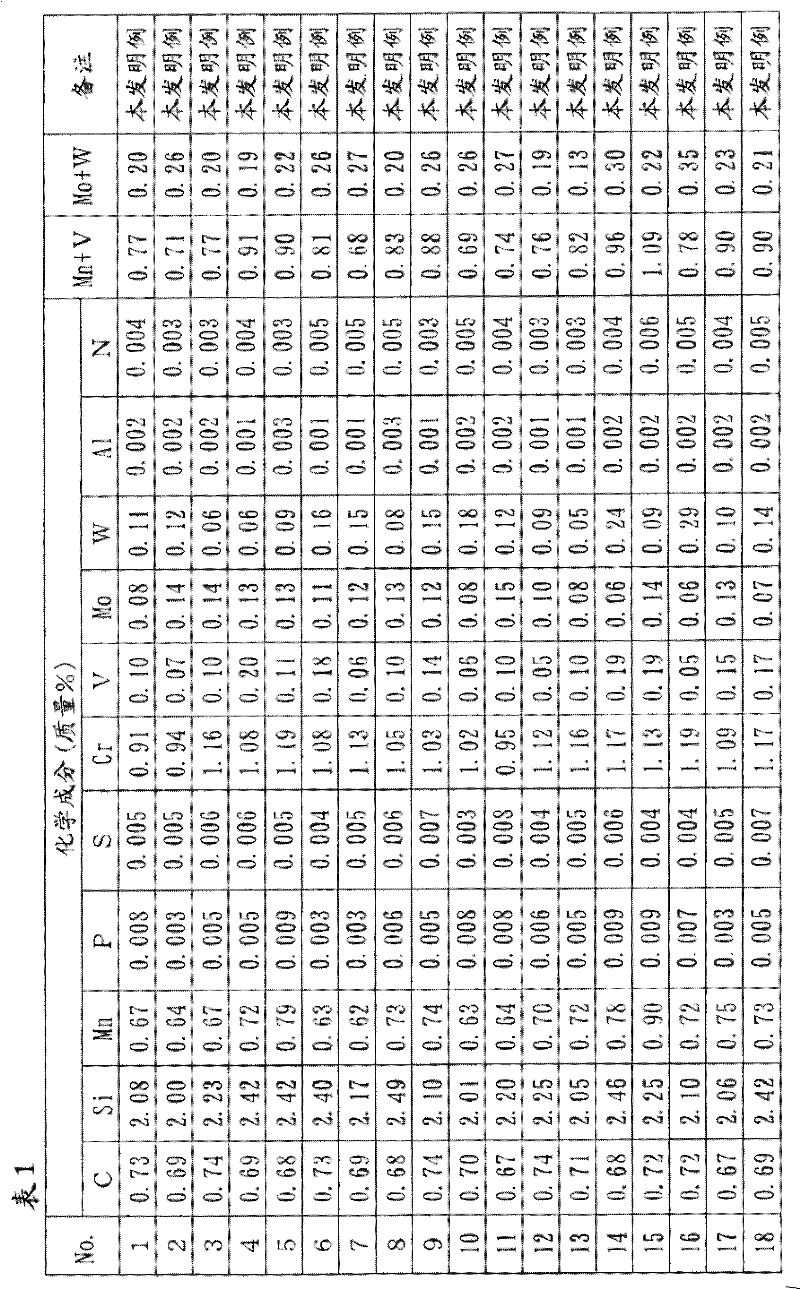

表3和4表示制造条件。对于一部分的拉丝材料,通过在加热炉(辐射炉)中将拉丝材料连续地加热,在油槽内通线来淬火,并使其通过加热了的铅槽等来进行回火的所谓的油回火处理(OT处理),进行了淬火回火处理。该情况下,拉丝材料通过的加热炉的温度为950℃、加热时间为150秒,油槽的温度为50℃。Tables 3 and 4 show the production conditions. So-called oil tempering in which a part of the wire drawing material is continuously heated in a heating furnace (radiation furnace), quenched by passing a wire in an oil tank, and tempered by passing it through a heated lead tank or the like. Treatment (OT treatment), quenching and tempering treatment. In this case, the temperature of the heating furnace through which the wire drawing material passed was 950° C., the heating time was 150 seconds, and the temperature of the oil bath was 50° C.
另外,在将拉丝材料高频加热,在水中淬火,连续地再次进行高频加热来回火的高频淬火回火(IQT处理)中,将加热温度设为1000℃,加热时间设为15秒。将淬火后的拉丝材料在400~500℃下加热1分钟来回火,以调整抗拉强度。In addition, in the induction quenching and tempering (IQT treatment) in which the wire-drawn material is heated at high frequency, quenched in water, and then continuously heated and tempered again, the heating temperature is set to 1000° C., and the heating time is set to 15 seconds. The quenched wire drawing material is tempered by heating at 400-500° C. for 1 minute to adjust the tensile strength.
再者,表4的淬火加热温度和热处理方法的栏的「-」意指在拉丝加工中发生断线,没有进行淬火回火处理(No.30、32、36)。In addition, "-" in the columns of the quenching heating temperature and heat treatment method in Table 4 means that wire breakage occurred during wire drawing, and quenching and tempering treatment was not performed (No. 30, 32, 36).
表3table 3
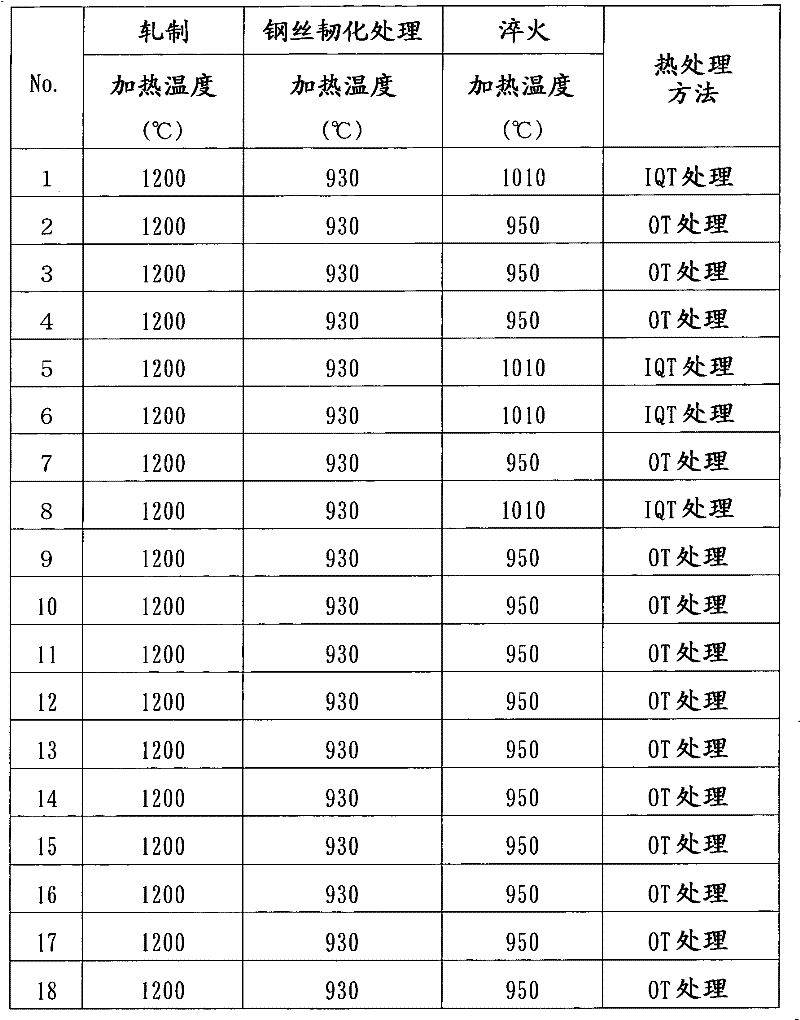
表4Table 4

下划线意指在本发明的范围之外。Underlined means outside the scope of the present invention.
从得到的弹簧用钢线制取试样,用于原始奥氏体晶粒度、残余奥氏体的体积率、碳化物的评价、抗拉试验、缺口弯曲试验、维氏硬度试验。Samples were prepared from the obtained steel wire for springs, and were used for evaluation of prior austenite grain size, volume ratio of retained austenite, carbides, tensile test, notch bending test, and Vickers hardness test.
疲劳特性是作为模拟了弹簧的制造的处理(以下,称为弹簧制造处理),实施了模拟了对加工后的弹簧实施的氮化处理的热处理(500℃、60分钟)、喷丸(切丝的直径为0.6mm、20分钟)和低温消应力处理(180℃、20分钟)来进行了评价。Fatigue characteristics are as a process simulating the manufacture of springs (hereinafter referred to as spring manufacturing process), and heat treatment (500°C, 60 minutes) simulating the nitriding treatment performed on the processed spring, shot peening (shredded diameter of 0.6mm, 20 minutes) and low-temperature stress relief treatment (180°C, 20 minutes) were evaluated.
原始奥氏体晶粒度号基于JIS G 0551进行了测定。碳化物的圆相当径和存在密度使用实施了电解腐蚀的试样,拍摄SEM组织照片,并进行图像处理以测定。Prior austenite grain size numbers were measured based on JIS G 0551. The equivalent circular diameter and density of carbides were measured using a sample subjected to electrolytic corrosion, taking a photograph of the SEM structure, and performing image processing.
残余奥氏体的体积率通过磁测定法来测定。The volume fraction of retained austenite was measured by magnetic measurement.
维氏硬度基于JIS Z 2244进行了测定。另外,作为模拟了在高温下的氮化处理的热处理,进行了在500℃保持1小时的加热处理的试样的维氏硬度也同样地进行了测定。使用JIS Z 2201的9号试件,基于JIS Z 2241进行了测定。The Vickers hardness was measured based on JIS Z 2244. In addition, the Vickers hardness of a sample subjected to a heat treatment at 500° C. for 1 hour as a heat treatment simulating a nitriding treatment at a high temperature was also measured in the same manner. Measured based on JIS Z 2241 using JIS Z 2201 No. 9 test piece.
疲劳试验是中村式旋转弯曲疲劳试验,将10根样品以50%以上的概率显示107次循环以上的寿命的最大负荷应力作为平均疲劳强度。The fatigue test is a Nakamura type rotating bending fatigue test, and the maximum load stress at which 10 samples exhibit a life of 107 cycles or more with a probability of 50% or more is taken as the average fatigue strength.
缺口弯曲试验是评价冷卷绕性的试验,如以下那样地进行。使用图2所示的尖端的角度为120°的冲头2,在试件上设置了最大深度30μm的沟槽(缺口)。再者,如图3所示那样,缺口在试件3的纵向的中央部设置成与纵向垂直。The notched bending test is a test for evaluating cold coilability, and is performed as follows. Using the punch 2 shown in FIG. 2 with a tip angle of 120°, a groove (notch) having a maximum depth of 30 μm was formed on the test piece. In addition, as shown in FIG. 3, the notch is provided in the center part of the longitudinal direction of the
接着,如图4所示那样,从缺口4的相反侧通过金属压件5负载最大拉伸应力的载荷P,施加3点弯曲变形。再者,金属压件的尖端的曲率半径r设为4.0mm,支柱间的距离L设为L=2r+3D。在此,D为试件的直径。Next, as shown in FIG. 4 , a load P of the maximum tensile stress is applied from the side opposite to the
持续施加弯曲变形直到从缺口部断裂为止,如图5所示那样地测定了断裂时的弯曲角度(缺口弯曲角度)。Bending deformation was continuously applied until breaking from the notch, and the bending angle at the time of breaking (notch bending angle) was measured as shown in FIG. 5 .
再者,在试件分离了的情况下,使断裂部对接来测定了缺口弯曲角度。在本发明中,将缺口弯曲角度为28°以上的试件判断为冷卷绕性良好。In addition, when the test piece was separated, the fractured part was butted to measure the notch bending angle. In the present invention, a test piece having a notch bending angle of 28° or more was judged to have good cold coilability.
表5和6表示原始奥氏体晶粒度号、残余奥氏体(体积%)、碳化物的圆相当径和存在密度、抗拉强度、缺口弯曲角度、平均疲劳强度和退火前后的维氏硬度。Tables 5 and 6 show the number of prior austenite grain size, retained austenite (volume%), equivalent circle diameter and density of carbides, tensile strength, notch bending angle, average fatigue strength and Vickers before and after annealing hardness.

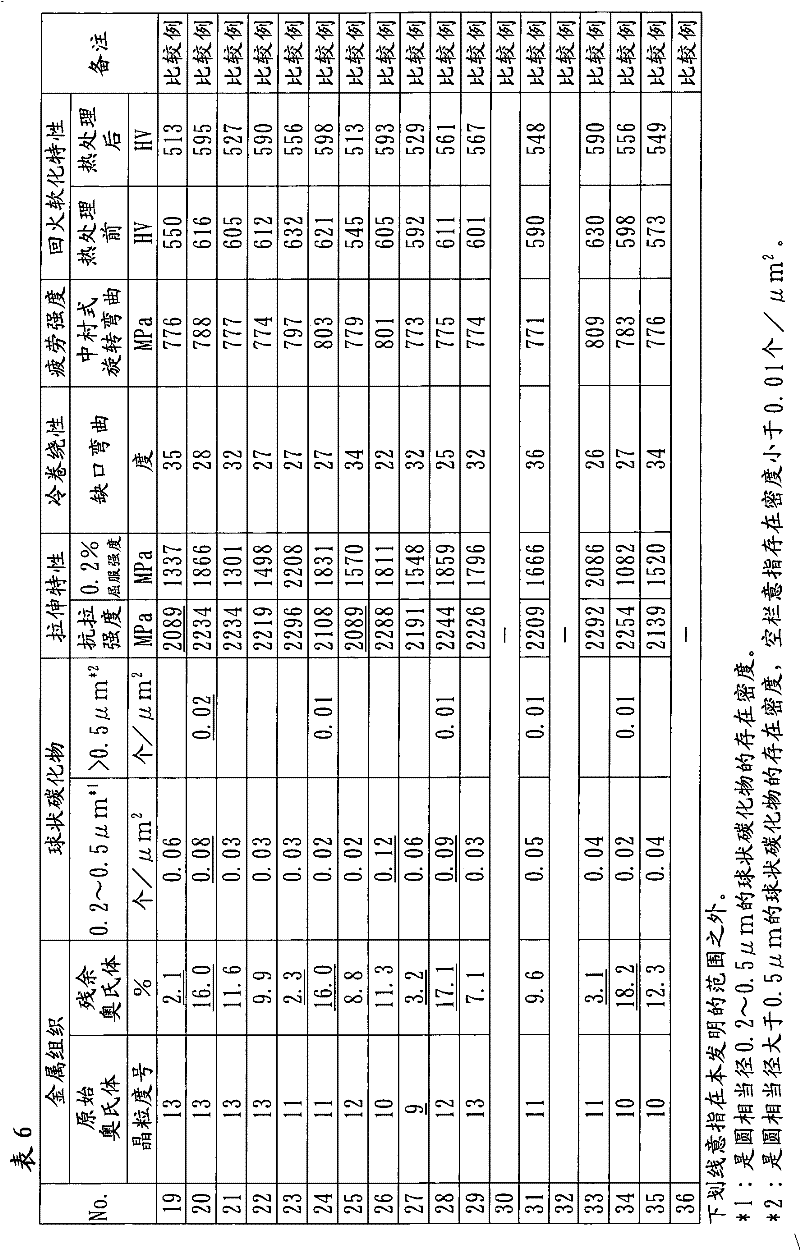
如图5所示那样,本发明的高强度弹簧用钢线,抗拉强度高,冷卷绕性良好,回火软化特性良好,并且,弹簧制造处理后的疲劳特性(以下,称为弹簧疲劳特性)也优异。因此可以确认若将本发明的高强度弹簧用钢线作为坯料,则可以制造疲劳特性优异的高强度弹簧用钢线。As shown in FIG. 5, the high-strength spring steel wire of the present invention has high tensile strength, good cold coilability, and good temper softening properties, and the fatigue properties after the spring manufacturing process (hereinafter referred to as spring fatigue) characteristics) are also excellent. Therefore, it was confirmed that if the high-strength steel wire for springs of the present invention is used as a raw material, it is possible to manufacture a high-strength steel wire for springs excellent in fatigue properties.
另一方面,表6表示了在本发明的范围之外的比较例。On the other hand, Table 6 shows comparative examples outside the scope of the present invention.
No.19是C量不足,强度降低的例子,弹簧疲劳特性和回火软化抗力降低。再者,No.19由于抗拉强度低,因此虽然残余奥氏体少,但冷卷绕性良好。另一方面,No.20虽然C量过量,强度高,但是球状碳化物的增加和粗大化、残余奥氏体量增加,冷卷绕性和弹簧疲劳特性降低。No. 19 is an example where the amount of C is insufficient, the strength is lowered, and the spring fatigue characteristics and temper softening resistance are lowered. In addition, since No. 19 has low tensile strength, it has good cold coilability although there is little retained austenite. On the other hand, No. 20 has an excessive amount of C and high strength, but increases and coarsens spherical carbides, increases the amount of retained austenite, and deteriorates cold coilability and spring fatigue characteristics.
No.21是Si量少的例子,回火软化抗力降低。另一方面,No.22是Si量过量,冷卷绕性降低的例子。No. 21 is an example with a small amount of Si, and the temper softening resistance decreased. On the other hand, No. 22 is an example in which the amount of Si is excessive and the cold coilability is lowered.
另外,No.23是Mn量少,残余奥氏体不足,冷卷绕性降低的例子。另一方面,No.24是Mn量过量,残余奥氏体增加,因加工诱发马氏体的生成而使冷卷绕性降低的例子。In addition, No. 23 is an example in which the amount of Mn is small, the retained austenite is insufficient, and the cold coilability is lowered. On the other hand, No. 24 is an example in which the amount of Mn is excessive, the retained austenite increases, and the cold coilability decreases due to the formation of working-induced martensite.
No.25是Cr量少,强度降低的例子。另一方面,No.26是由于Cr量过量,因此比较微细的球状碳化物增加,冷卷绕性和弹簧疲劳特性降低的例子。No. 25 is an example in which the amount of Cr is small and the strength is lowered. On the other hand, No. 26 is an example in which relatively fine spherical carbides increased due to an excessive amount of Cr, and the cold coilability and spring fatigue properties decreased.
另外,No.27是V量少,原始奥氏体的粒径变大,残余奥氏体不足的例子。该情况下,虽然卷绕性等良好,但是弹簧疲劳特性不充分,并且退火后的硬度也不充分。No.28是V较多,残余奥氏体过量地产生,比较微细的球状碳化物增加,冷卷绕性降低的例子。并且,退火后的弹簧疲劳特性也劣于发明例。在未溶解碳化物中较多的V被消耗,因此退火时的硬度也不充分。In addition, No. 27 is an example in which the amount of V is small, the grain size of the prior austenite is large, and the retained austenite is insufficient. In this case, although the windability and the like are good, the spring fatigue characteristics are insufficient, and the hardness after annealing is also insufficient. No. 28 is an example in which V is large, retained austenite is excessively generated, relatively fine spherical carbides increase, and cold coilability decreases. Furthermore, the spring fatigue characteristics after annealing were also inferior to those of the inventive examples. A large amount of V is consumed in undissolved carbides, so the hardness during annealing is also insufficient.
No.29是Mo量少,No.31是W量少,回火软化抗力劣化的例子。另一方面,No.30是Mo量多,No.32是W量多,拉丝时发生断线,得不到高强度弹簧用钢线的例子。No.35是Mo和W的含量的合计少,回火软化抗力劣化的例子,疲劳强度也不充分。另一方面,No.36是Mo和W的含量的合计多,拉丝时发生断线,得不到高强度弹簧用钢线的例子。No.33是Mn和V的含量的合计少,残余奥氏体量不足,冷卷绕性降低的例子。另一方面,No.34是Mn和V的含量的合计多,残余奥氏体量增加,起因于加工诱发马氏体,冷卷绕性降低的例子。No. 29 has a small amount of Mo, No. 31 has a small amount of W, and the temper softening resistance deteriorates. On the other hand, No. 30 has a large amount of Mo, and No. 32 has a large amount of W, so wire breakage occurs during wire drawing, and a high-strength spring steel wire cannot be obtained. No. 35 is an example in which the total content of Mo and W is small, the temper softening resistance deteriorates, and the fatigue strength is also insufficient. On the other hand, No. 36 is an example in which the total content of Mo and W is large, wire breakage occurs during wire drawing, and a high-strength spring steel wire cannot be obtained. No. 33 is an example in which the total content of Mn and V is small, the amount of retained austenite is insufficient, and the cold coilability is lowered. On the other hand, No. 34 is an example in which the total content of Mn and V is large, the amount of retained austenite increases, and the cold coilability decreases due to working-induced martensite.
产业上的利用可能性Industrial Utilization Possibility
如上述那样,根据本发明,可以提供冷卷绕性优异,并且,优异的软化抗力优异的高强度弹簧用钢线,因此可以得到耐久性优异的高强度弹簧,并有助于使用了弹簧的机械部件的小型化。本发明在工业上的利用价值高。As described above, according to the present invention, it is possible to provide a high-strength spring steel wire excellent in cold coilability and excellent softening resistance, so that a high-strength spring excellent in durability can be obtained, and it contributes to the use of springs. Miniaturization of mechanical components. The present invention has high industrial utilization value.
附图标记说明Explanation of reference signs
1...球状碳化物1... spherical carbide
2...冲头2...Punch
3...试件3...Test piece
4...缺口4...Notches
5...金属压件5...metal pressing
P...载荷P... load
L...支柱间的距离L...distance between pillars
θ...缺口弯曲角度θ... Notch bending angle
Claims (3)
Applications Claiming Priority (3)
| Application Number | Priority Date | Filing Date | Title |
|---|---|---|---|
| JP2009162784 | 2009-07-09 | ||
| JP162784/2009 | 2009-07-09 | ||
| PCT/JP2010/062025 WO2011004913A1 (en) | 2009-07-09 | 2010-07-09 | Steel wire for high-strength spring |
Publications (1)
| Publication Number | Publication Date |
|---|---|
| CN102378823A true CN102378823A (en) | 2012-03-14 |
Family
ID=43429333
Family Applications (1)
| Application Number | Title | Priority Date | Filing Date |
|---|---|---|---|
| CN2010800154067A Pending CN102378823A (en) | 2009-07-09 | 2010-07-09 | Steel wire for high-strength spring |
Country Status (6)
| Country | Link |
|---|---|
| US (1) | US8734600B2 (en) |
| EP (1) | EP2453033B1 (en) |
| JP (1) | JP5591130B2 (en) |
| KR (1) | KR20110123781A (en) |
| CN (1) | CN102378823A (en) |
| WO (1) | WO2011004913A1 (en) |
Cited By (5)
| Publication number | Priority date | Publication date | Assignee | Title |
|---|---|---|---|---|
| CN109026974A (en) * | 2018-09-26 | 2018-12-18 | 安徽博耐克摩擦材料有限公司 | A kind of automobile brake cable |
| CN112427484A (en) * | 2020-11-11 | 2021-03-02 | 南京工程学院 | Method for manufacturing stainless spring steel wire through recrystallization annealing regulation and control |
| CN112449654A (en) * | 2019-07-01 | 2021-03-05 | 住友电气工业株式会社 | Steel wire and spring |
| CN115298338A (en) * | 2020-02-21 | 2022-11-04 | 日本制铁株式会社 | Steel wire |
| CN117355625A (en) * | 2021-08-05 | 2024-01-05 | 住友电气工业株式会社 | Steel wire for spring |
Families Citing this family (25)
| Publication number | Priority date | Publication date | Assignee | Title |
|---|---|---|---|---|
| JP2012036418A (en) * | 2010-08-03 | 2012-02-23 | Chuo Spring Co Ltd | High-strength spring and method for manufacturing the same |
| US20140227546A1 (en) | 2011-09-20 | 2014-08-14 | Nv Bekaert Sa | Quenched and partitioned high-carbon steel wire |
| JP5364859B1 (en) * | 2012-05-31 | 2013-12-11 | 株式会社神戸製鋼所 | High-strength spring steel wire with excellent coiling and hydrogen embrittlement resistance and method for producing the same |
| RS56504B1 (en) * | 2013-10-11 | 2018-02-28 | N V Bekaert Sa | High tensile strength steel wire |
| JP6453693B2 (en) * | 2015-03-31 | 2019-01-16 | 株式会社神戸製鋼所 | Heat treated steel wire with excellent fatigue characteristics |
| EP3346020B1 (en) * | 2015-09-04 | 2020-07-29 | Nippon Steel Corporation | Spring steel wire and spring |
| US10652956B2 (en) | 2016-06-22 | 2020-05-12 | The Gillette Company Llc | Personal consumer product with thermal control circuitry and methods thereof |
| EP3351358B1 (en) | 2017-01-20 | 2019-11-20 | The Gillette Company LLC | Heating delivery element for a shaving razor |
| WO2019190911A1 (en) | 2018-03-30 | 2019-10-03 | The Gillette Company Llc | Shaving razor system |
| USD874061S1 (en) | 2018-03-30 | 2020-01-28 | The Gillette Company Llc | Shaving razor cartridge |
| WO2019191345A1 (en) * | 2018-03-30 | 2019-10-03 | The Gillette Company Llc | Razor handle with a pivoting portion |
| WO2019191185A1 (en) | 2018-03-30 | 2019-10-03 | The Gillette Company Llc | Razor handle with movable members |
| US11123888B2 (en) | 2018-03-30 | 2021-09-21 | The Gillette Company Llc | Razor handle with a pivoting portion |
| US11607820B2 (en) | 2018-03-30 | 2023-03-21 | The Gillette Company Llc | Razor handle with movable members |
| JP2021517043A (en) | 2018-03-30 | 2021-07-15 | ザ ジレット カンパニー リミテッド ライアビリティ カンパニーThe Gillette Company Llc | Razor handle with pivot part |
| WO2019191223A1 (en) | 2018-03-30 | 2019-10-03 | The Gillette Company Llc | Razor handle with movable members |
| US11453138B2 (en) | 2018-03-30 | 2022-09-27 | The Gillette Company Llc | Razor handle with a pivoting portion |
| US10864646B2 (en) | 2018-03-30 | 2020-12-15 | The Gillette Company Llc | Shaving razor cartridge |
| JP2021516136A (en) | 2018-03-30 | 2021-07-01 | ザ ジレット カンパニー リミテッド ライアビリティ カンパニーThe Gillette Company Llc | Razor handle with movable members |
| JP7090723B2 (en) | 2018-03-30 | 2022-06-24 | ザ ジレット カンパニー リミテッド ライアビリティ カンパニー | Razor handle with pivot part |
| EP3774235B1 (en) | 2018-03-30 | 2024-08-21 | The Gillette Company LLC | Razor handle with a pivoting portion |
| CA3091275A1 (en) | 2018-03-30 | 2019-10-03 | The Gillette Company Llc | Razor handle with a pivoting portion |
| EP3774218A1 (en) | 2018-03-30 | 2021-02-17 | The Gillette Company LLC | Razor handle with a pivoting portion |
| EP4204594A4 (en) * | 2020-11-27 | 2025-03-12 | Shane Xinyang Li | NEW WEAR-RESISTANT STEEL WITH HIGH HARDNESS AND GOOD TOUGHNESS THAT RETAINS HARDENING AFTER HARD FACING AND TUNGSTEN CARBIDE TILE BRAZING |
| KR20220163153A (en) * | 2021-06-02 | 2022-12-09 | 주식회사 포스코 | Wire rod and steel wire for spring, spring with improved strength and fatigue limit, and the method for manufacturing the same |
Citations (2)
| Publication number | Priority date | Publication date | Assignee | Title |
|---|---|---|---|---|
| WO2004055226A1 (en) * | 2002-12-13 | 2004-07-01 | Sumitomo (Sei) Steel Wire Corp. | Steel wire for spring |
| CN101321884A (en) * | 2006-03-31 | 2008-12-10 | 新日本制铁株式会社 | Heat-treated steel for high-strength spring |
Family Cites Families (10)
| Publication number | Priority date | Publication date | Assignee | Title |
|---|---|---|---|---|
| JP3595901B2 (en) | 1998-10-01 | 2004-12-02 | 鈴木金属工業株式会社 | High strength steel wire for spring and manufacturing method thereof |
| JP3971571B2 (en) | 2000-12-20 | 2007-09-05 | 新日本製鐵株式会社 | Steel wire for high strength spring |
| JP3851095B2 (en) * | 2001-02-07 | 2006-11-29 | 新日本製鐵株式会社 | Heat-treated steel wire for high-strength springs |
| JP2003003241A (en) | 2001-06-26 | 2003-01-08 | Nippon Steel Corp | High strength spring steel wire |
| JP4555768B2 (en) | 2004-11-30 | 2010-10-06 | 新日本製鐵株式会社 | Steel wire for high strength spring |
| EP2465963B1 (en) * | 2004-11-30 | 2015-10-07 | Nippon Steel & Sumitomo Metal Corporation | High strength spring steel and steel wire |
| JP4478072B2 (en) * | 2005-06-09 | 2010-06-09 | 新日本製鐵株式会社 | High strength spring steel |
| US8845825B2 (en) * | 2006-03-31 | 2014-09-30 | Nippon Steel & Sumitomo Metal Corporation | High strength spring-use heat treated steel |
| US20100028196A1 (en) * | 2006-11-09 | 2010-02-04 | Masayuki Hashimura | High Strength Spring Steel and High Strength Heat Treated Steel Wire for Spring |
| BRPI0607042B1 (en) * | 2006-11-09 | 2014-08-19 | Nippon Steel & Sumitomo Metal Corp | HIGH-RESISTANCE SPRING STEEL |
-
2010
- 2010-07-09 CN CN2010800154067A patent/CN102378823A/en active Pending
- 2010-07-09 JP JP2010550389A patent/JP5591130B2/en active Active
- 2010-07-09 EP EP10797220.0A patent/EP2453033B1/en active Active
- 2010-07-09 WO PCT/JP2010/062025 patent/WO2011004913A1/en not_active Ceased
- 2010-07-09 US US13/261,124 patent/US8734600B2/en active Active
- 2010-07-09 KR KR1020117022228A patent/KR20110123781A/en not_active Ceased
Patent Citations (2)
| Publication number | Priority date | Publication date | Assignee | Title |
|---|---|---|---|---|
| WO2004055226A1 (en) * | 2002-12-13 | 2004-07-01 | Sumitomo (Sei) Steel Wire Corp. | Steel wire for spring |
| CN101321884A (en) * | 2006-03-31 | 2008-12-10 | 新日本制铁株式会社 | Heat-treated steel for high-strength spring |
Cited By (7)
| Publication number | Priority date | Publication date | Assignee | Title |
|---|---|---|---|---|
| CN109026974A (en) * | 2018-09-26 | 2018-12-18 | 安徽博耐克摩擦材料有限公司 | A kind of automobile brake cable |
| CN112449654A (en) * | 2019-07-01 | 2021-03-05 | 住友电气工业株式会社 | Steel wire and spring |
| CN112449654B (en) * | 2019-07-01 | 2022-07-08 | 住友电气工业株式会社 | Steel wire and spring |
| CN115298338A (en) * | 2020-02-21 | 2022-11-04 | 日本制铁株式会社 | Steel wire |
| CN115298338B (en) * | 2020-02-21 | 2024-04-02 | 日本制铁株式会社 | Steel wire |
| CN112427484A (en) * | 2020-11-11 | 2021-03-02 | 南京工程学院 | Method for manufacturing stainless spring steel wire through recrystallization annealing regulation and control |
| CN117355625A (en) * | 2021-08-05 | 2024-01-05 | 住友电气工业株式会社 | Steel wire for spring |
Also Published As
| Publication number | Publication date |
|---|---|
| US20120125489A1 (en) | 2012-05-24 |
| WO2011004913A1 (en) | 2011-01-13 |
| US8734600B2 (en) | 2014-05-27 |
| JPWO2011004913A1 (en) | 2012-12-20 |
| KR20110123781A (en) | 2011-11-15 |
| EP2453033A4 (en) | 2014-09-10 |
| EP2453033A1 (en) | 2012-05-16 |
| EP2453033B1 (en) | 2015-09-09 |
| JP5591130B2 (en) | 2014-09-17 |
Similar Documents
| Publication | Publication Date | Title |
|---|---|---|
| JP5591130B2 (en) | Steel wire for high strength spring | |
| CN102482747B (en) | Drawn and heat-treated steel wire for high-strength spring, and undrawn steel wire for high-strength spring | |
| JP5624503B2 (en) | Spring and manufacturing method thereof | |
| JP5114665B2 (en) | Heat-treated steel for high-strength springs | |
| JP4555768B2 (en) | Steel wire for high strength spring | |
| CN101321885B (en) | Heat-treatment steel for high-strength spring | |
| JP4435953B2 (en) | Bar wire for cold forging and its manufacturing method | |
| CN101287850B (en) | Steel for high intensity spring and heat-treating steel line for high intensity spring | |
| JP3851095B2 (en) | Heat-treated steel wire for high-strength springs | |
| KR20020083181A (en) | High-strength spring steel and spring steel wire | |
| WO2006059784A9 (en) | Steel and steel wire for high strength spring | |
| JP5299118B2 (en) | Vacuum carburizing steel and vacuum carburized parts | |
| JP2002180198A (en) | High strength spring steel wire | |
| WO2012018144A1 (en) | Spring and manufacture method thereof | |
| CN100480411C (en) | Steel and steel wire for high-strength spring | |
| JP4478072B2 (en) | High strength spring steel | |
| WO2012133885A1 (en) | Spring and method for producing same | |
| CN100453684C (en) | Steel wire for cold-formed spring excellent in cold cutability and fatigue properties, and method for producing the same | |
| KR20100077250A (en) | High-strength spring steel and | |
| JP4559959B2 (en) | High strength spring steel | |
| JP5523241B2 (en) | Spring and manufacturing method thereof | |
| JP2004183047A (en) | Steel for induction hardening | |
| JP2002180196A (en) | High strength spring steel |
Legal Events
| Date | Code | Title | Description |
|---|---|---|---|
| C06 | Publication | ||
| PB01 | Publication | ||
| C10 | Entry into substantive examination | ||
| SE01 | Entry into force of request for substantive examination | ||
| C53 | Correction of patent of invention or patent application | ||
| CB02 | Change of applicant information |
Address after: Tokyo, Japan, Japan Applicant after: Nippon Steel Corporation Applicant after: Suzuki Metal Industry Co., Ltd. Applicant after: Honda Motor Co., Ltd. Address before: Tokyo, Japan, Japan Applicant before: Nippon Steel Corporation Applicant before: Suzuki Metal Industry Co., Ltd. Applicant before: Honda Motor Co., Ltd. |
|
| COR | Change of bibliographic data |
Free format text: CORRECT: APPLICANT; FROM: SHIN NIPPON STEEL LTD. TO: NIPPON STEEL + SUMITOMO METAL CORPORATION |
|
| C12 | Rejection of a patent application after its publication | ||
| RJ01 | Rejection of invention patent application after publication |
Application publication date: 20120314 |